Contents
3
EN
1 IMPORTANT SAFETY INSTRUCTIONS 4
1.1 Definition 4
1.2 State of California Proposition 65 Warning 4
1.3 Intended purpose 5
1.4 Installation warnings 5
1.5 Installation cautions 7
1.6 Usage warnings 7
1.7 Usage cautions 9
1.8 Disposal Warning 9
1.9 How to read the user manual 10
2 Description 11
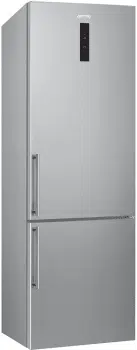
2.1 General Description 11
2.2 Description of parts 12
2.3 Control panel 12
2.4 Available accessories 13
3Use 15
3.1 Instructions 15
3.2 Preliminary operations 15
3.3 First use 15
3.4 Using the accessories 17
3.5 Ventilation 18
3.6 Using the refrigerator compartment 19
3.7 Using the freezer compartment 19
3.8 Noises during operation 20
3.9 Heated front surface 21
3.10Turning the appliance off 21
3.11Food storage advice 21
4 Cleaning and maintenance 23
4.1 Instructions 23
4.2 Cleaning the appliance 23
4.3 Defrosting 24
4.4 Interior lighting 24
4.5 What to do if... 24
5Installation 26
5.1 Electrical connection 26
5.2 Positioning 26
We advise you to read this manual carefully, as it contains all the instructions for maintaining
the appliance’s aesthetic and functional qualities.
For further information on the product: www.smeg.com
Instructions
4
1.1 Definition
1.2 State of California Proposition 65 Warning
1 IMPORTANT SAFETY INSTRUCTIONS
WARNING: If the instructions contained in this manual are not followed
precisely, fire or explosion may result causing property damage, personal
injury or loss of life.
READ AND SAVE THESE INSTRUCTIONS
DANGER:
not following instructions immediately may result in loss of life or severe injuries.
WARNING:
not following instructions may result in loss of life or severe injuries.
CAUTION:
indicates a potentially hazardous situation which, if not avoided, may result in
minor to moderate injury.
NOTE:
Important information.
WARNING
This product can expose you to chemicals including vinyl chloride, which is known
to the State of California to cause cancer and birth defects or other reproductive
harm. For more information go to www.P65Warnings.ca.gov.
Instructions
5
EN
1.3 Intended purpose
This appliance is intended to be used
in household and similar applications
such as:
• staff kitchen areas in shops, offices
and other working environments;
• farm houses and by clients in
hotels, motels and other residential
type environments;
• bed and breakfast type
environments;
• catering and similar non-retail
applications.
• This appliance is intended for
indoor household use only.
• This appliance is suitable for the
refrigeration and storage of fresh
and frozen food.
• This appliance is not designed or
manufactured for professional use.
1.4 Installation warnings
• Use two or more people to move
and install this appliance.
• The appliance is heavy and it must
be secured during transport and
installation.
• Do not install this appliance:
- outdoor,
- in manufactured (mobile) homes,
in recreational vehicles (RVs) or
boat.
- near a heater or flammable
material,
- in a room where there is a risk of
freezing,
- in direct sunlight or exposed to
heat from stoves.
• Always place the appliance in a
dry and well ventilated room.
• Depending on its climate class, the
appliance can be used in different
temperature conditions. The
climate class is specified on the
nameplate of the appliance.
• Observe all codes and
ordinances in force.
• Plug into a grounded 3-prong
outlet.
• Do not remove ground prong.
• Do not use an adapter plug.
• Do not use an extension cord.
• Do not twist or tie the power cord.
• Do not pull or bend the power
cord.
• Do not damage the power cord
when moving the appliance.
• Have the wall outlet and circuit
WARNING
Instructions
6
checked by a qualified electrician
to make sure the outlet is properly
grounded.
• Unplug the refrigerator before
servicing.
• Only qualified service personnel
should perform repairs. Service
personnel must disconnect the
power supply before servicing this
unit.
• Never unplug an appliance by
pulling the power cord. Always
grip the plug firmly and pull
straight out from the outlet to
prevent damaging the power
cord.
• Do not damage or puncture
refrigerant tubing.
• Do not damage the refrigerant
circuit.
• Do not attempt to repair or
replace any part of this appliance
unless specifically recommended
in this manual. Any other servicing
should be done by a qualified
technician.
• Do not scatter the packing
materials. Sort the various items of
waste and take them to the
nearest specialized waste
collection facility.
• Do not use sharp instruments,
rubbing alcohol, flammable fluids,
or abrasive cleaners to remove
tape glue. Wipe with warm water
only.
• Keep ventilation openings, in the
appliance enclosure or in the built-
in structure, clear of obstruction.
Instructions
7
EN
1.5 Installation cautions
• Leave the appliance standing
vertically for at least two hours
before turning it on for the first
time.
• Leave sufficient space around the
appliance and install it on a flat
surface.
• Never use the open door to lever
the appliance into place when
fitting.
• Avoid exerting too much pressure
on the door when open.
• Pay attention not to scratch or
damage the floor when installing
the appliance.
• Do not wiggle or drag the
appliance when trying to move it,
as floor damage could occur.
• Never cover or block the
appliance’s ventilation openings.
1.6 Usage warnings
• Read all instructions.
• This appliance is not intended for
use by people (including children)
with reduced physical, sensory or
mental capabilities, or lack of
experience and knowledge,
unless they have been given
supervision or instruction
concerning use of the appliance
by a person responsible for their
safety.
• Do not leave children unattended:
- Children should not be left alone
or unattended in the area where
the appliance is being used.
Never allow children to sit or
stand on any part of the
appliance.
• Never allow children to play with
the refrigerator and let them use
the drawers, shelves and others
parts of the appliance only as
described in this handbook.
• Do not attempt to repair,
disassemble or modify the
appliance yourself.
• Do not damage the refrigerant
circuit.
CAUTION WARNING
Instructions
8
• Do not use the appliance if the
power plug or cord is damaged.
• Do not use electrical appliances
inside the food storage
compartments of the appliance,
unless they are of the type
recommended by the
manufacturer.
• Use nonflammable cleaner.
• Do not climb, stand or hang on the
shelves in the refrigerator. This
could result in severe injuries or in
damage to the appliance.
• Bottles containing strong alcoholic
drinks must be tightly closed and
stored vertically.
• Never touch frozen product
straight from the freezer or put it in
your mouth. This can cause burn
injury due to very low
temperatures.
• Do not store explosive or
flammable substances, such as
gasoline in or in the vicinity of this
refrigerator or use gasoline or
other flammable vapors or liquids
in the vicinity of this or any other
appliance.
• Do not store or use gasoline or
other flammable vapors, liquids or
materials near this or any other
appliance.
• Do not store objects on the top of
the appliance.
• Do not store bottled or canned
liquids in the freezer compartment.
• Unplug your appliance before
cleaning and making repairs.
• Always unplug the appliance from
the power mains in the event of a
breakdown, maintenance, when
replacing the light bulb or
cleaning.
• Do not insert the power plug into a
wall socket with wet hands.
• Use nonflammable cleaner.
• Do not use sharp objects when
removing ice and frost in order not
to damage the appliance's walls.
• Do not defrost or clean the
appliance with a steam cleaner.
• Do not use a hair dryer to dry the
inside of the refrigerator.
• Do not sit or lean on the door or
any open drawers.
• Do not store inflammable,
explosive or volatile substances.
• Do Not Use Water on Grease
Fires - Smother fire or flame or use
dry chemical or foam-type
extinguisher.
Instructions
9
EN
• Organic compounds, acids and
essential oils can corrode the
seals and plastic surfaces if left in
contact with them for extended
periods.
• Bottles containing strong alcoholic
drinks must be tightly closed and
stored vertically.
• Do not put frozen food straight
from the freezer compartment into
your mouth.
1.7 Usage cautions
• For safety reasons and to avoid
damage to your appliance, never
sit, stand or lean on the
refrigerator door.
• Never cover or block the
appliance’s ventilation openings.
• Do not refreeze frozen foods
which have partly or completely
defrosted.
• Do not strike or apply too much
force to any glass surface.
• Never move the appliance by
pulling on the door or the handle.
• Do not use the appliance to cool
rooms for any reason.
• Wear proper apparel. Loose-
fitting or hanging garments should
never be worn while using the
appliance.
• Observe maximum storage times
and expiration dates of frozen
goods.
1.8 Disposal Warning
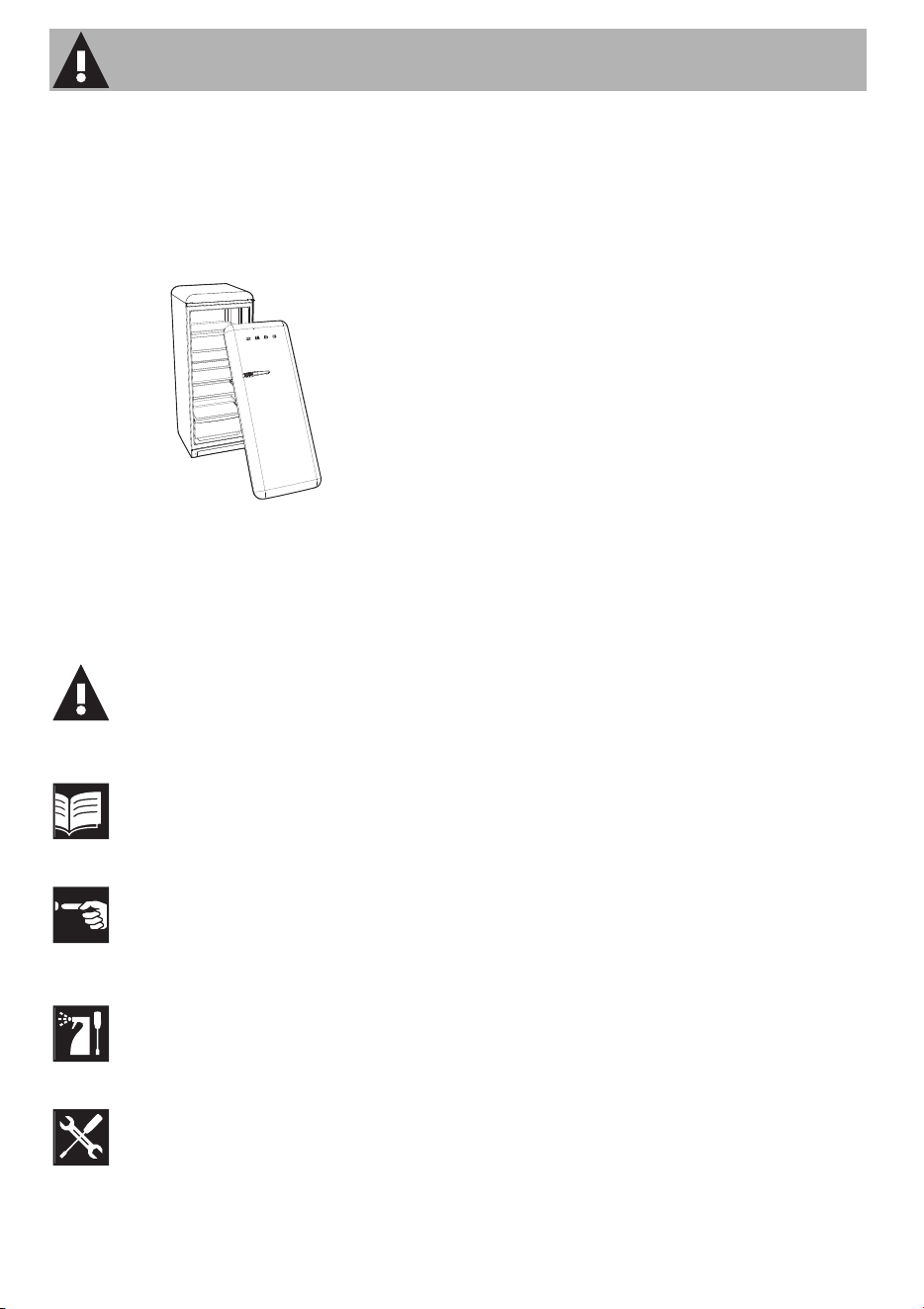
• Risk of child entrapment. Before
you throw away your old
refrigerator/freezer:
- Remove doors.
- Leave shelves in place so
children may not easily climb
inside.
• Destroy or recycle the carton,
plastic bags, and any exterior
wrapping material immediately
after the refrigerator is unpacked.
Children should NEVER use these
items to play. They can cause
suffocation and death.
• Before you throw away your old
refrigerator/freezer:
- Pull out the power cord plug.
- Cut off the power cord.
- Have refrigerant removed and
disposed by a qualified service
technician.
CAUTION
DANGER
WARNING
Instructions
10
- Do not allow children to climb,
stand or hang on the shelves in
the refrigerator.
- Never allow children to play
with the refrigerator.
1.9 How to read the user manual
This user manual uses the following reading
conventions:
SAVE THESE
INSTRUCTIONS
Instructions
General information on this user
manual, on safety and final
disposal.
Description
Description of the appliance and its
accessories.
Use
Information on the use of the
appliance and its accessories, food
storage advice.
Cleaning and maintenance
Information for proper cleaning and
maintenance of the appliance.
Installation
Information for the qualified
technician: Installation, operation
and inspection.
Description
11
EN
2 Description
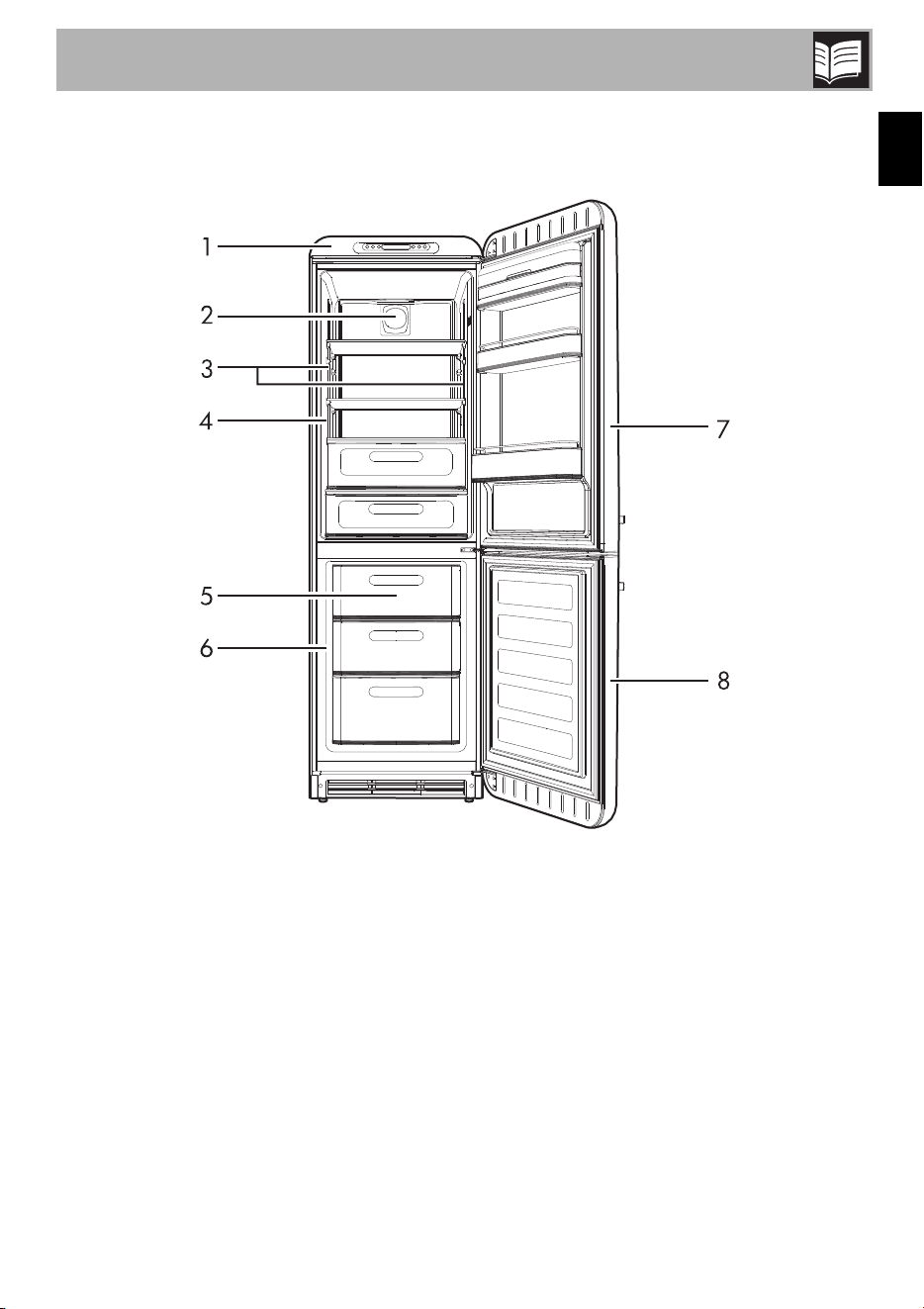
2.1 General Description
1 Control panel
2 Fan
3 Interior lighting
4 Refrigerator compartment
5 Quick freeze drawer
6 Freezer compartment
7 Refrigerator door
8 Freezer door
Description
12
2.2 Description of parts
Control panel
For setting the temperature inside the
refrigerator and freezer compartments.
Fan
Distributes the temperature and reduces
condensation on the shelves and other
surfaces.
Interior lighting
The interior of the appliance is lit when the
door is opened.
Refrigerator compartment
For storing fresh foods.
Quick freeze drawer
For quickly freezing fresh food.
Freezer compartment
For storing frozen foods, freezing fresh
foods and producing ice cubes.
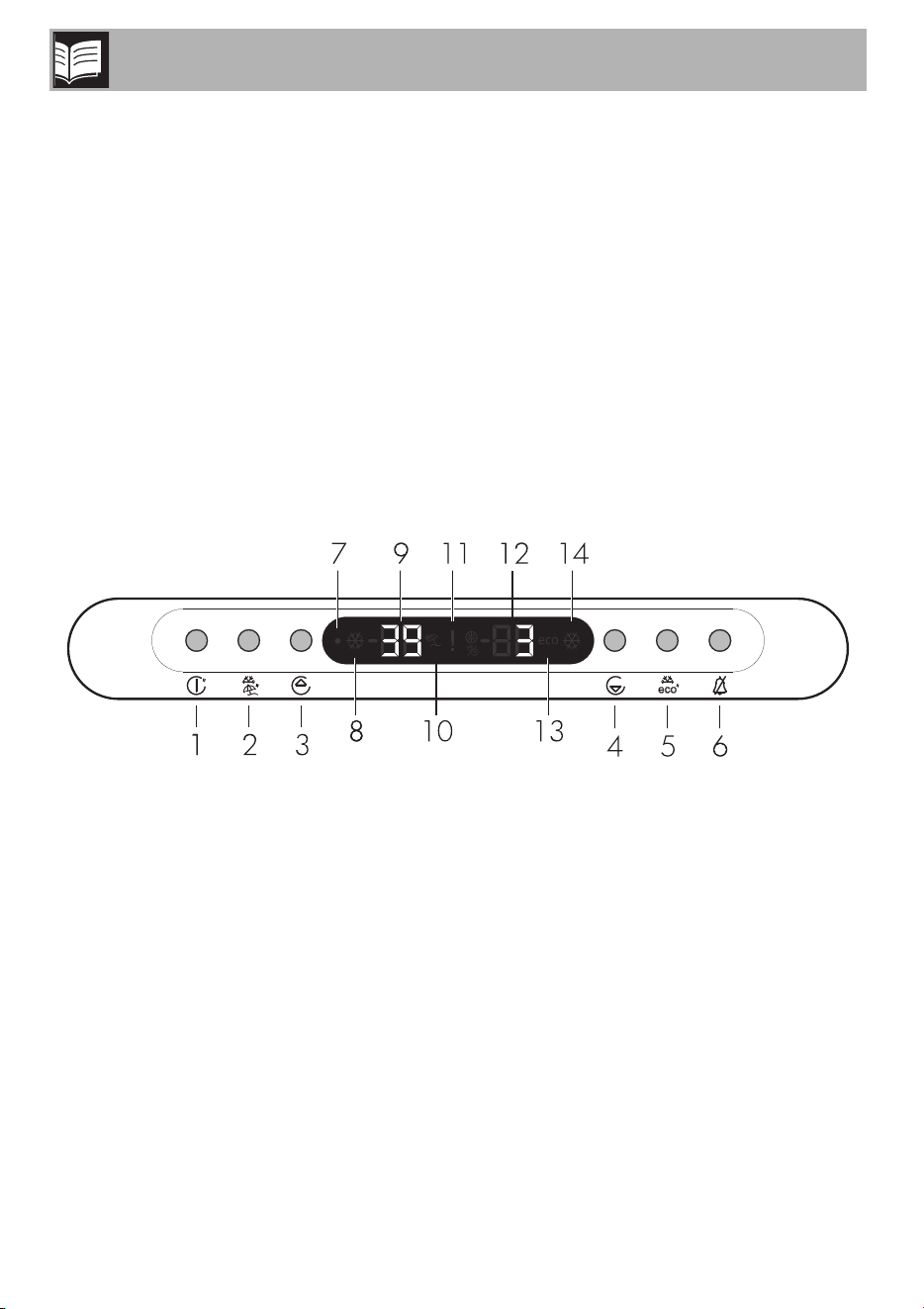
2.3 Control panel
1 Turning ON/OFF the appliance
2 Refrigerator compartment supercold
function ON/OFF button; Vacation
function (long press)
3 Refrigerator compartment temperature
setting button
4 Freezer compartment temperature setting
button
5 Freezer compartment supercold function
ON/OFF button; “ECO” function (long
press)
6 Alarm deactivation button.
7 Appliance off indicator.
8 Refrigerator compartment supercold
function indicator.
9 Refrigerator compartment temperature
display.
10 Vacation function indicator.
11 Alarm warning indicator.
12 Freezer compartment temperature
display.
13 “Eco” function ON/OFF indicator.
14 Freezer compartment supercold function
indicator.
Description
13
EN
2.4 Available accessories
Shelves
For optimizing refrigerator space and
placing foodstuffs inside the refrigerator
compartment.
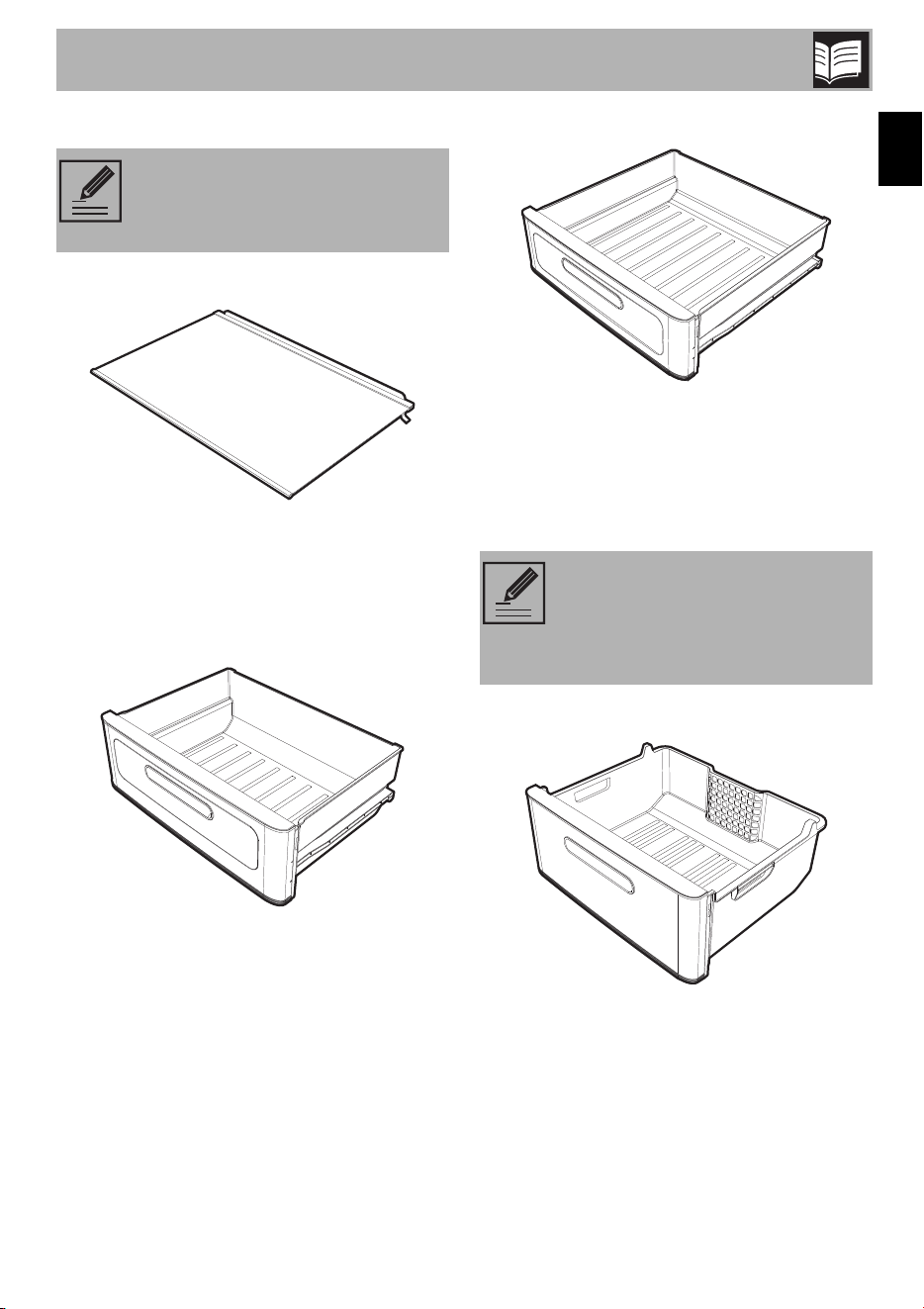
Fruit and vegetable drawer
For storing fruit and vegetables, maintaining
a constant humidity level.
Supercold drawer
Can be used for maintaining freshness and
flavor of delicate food such as meat, fish
and lightly frozen foods for a longer time
period, since temperature is kept constantly
between +28°F and +37°F.
Freezer drawers
For storing frozen or deep-frozen food.
NOTE:
Not all accessories are available
on some models.
NOTE:
Do not place food to be frozen or
trays to make ice in the super-cold
compartment.
Description
14
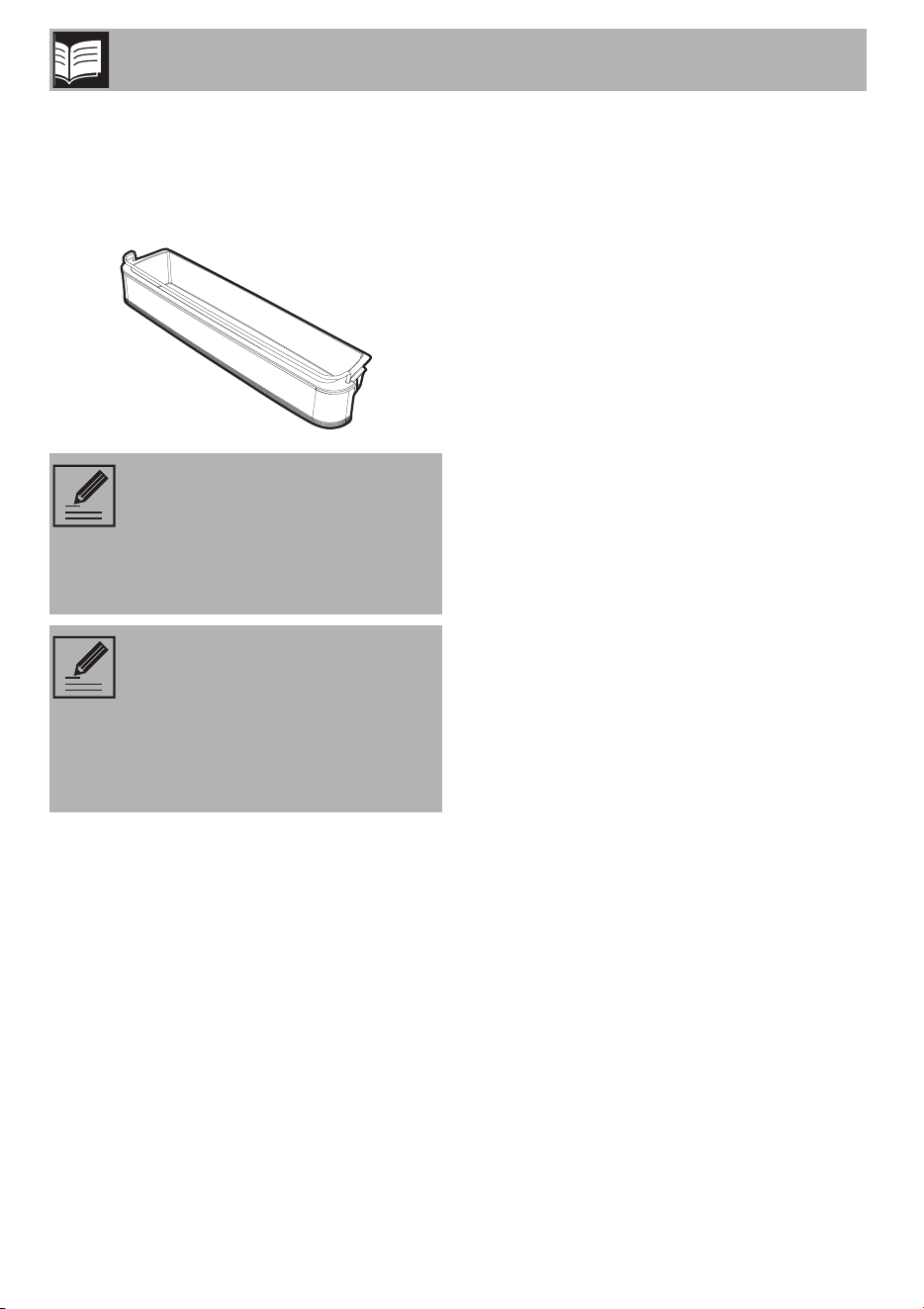
Door balconies and shelves
For storing foodstuffs in small containers.
The shelf in the lower part of the door is
useful for storing bottles.
NOTE:
The accessories intended to come
into contact with food are made of
materials that comply with the
provisions of current legislation.
NOTE:
Supplied and optional accessories
can be requested to Authorized
Service Centers. Use only original
accessories supplied by the
manufacturer.
Use
15
EN
3 Use
3.1 Instructions
3.2 Preliminary operations
1. Remove any protective film from the
outside or inside of the appliance,
including accessories.
2. Remove any labels (apart from the
technical data plate) from the
accessories and shelves.
3. Remove and wash all the appliance's
accessories (see 4 Cleaning and
maintenance).
3.3 First use
1. Keep the ON/OFF button on
the control panel pressed for
3 seconds to switch on the appliance.
WARNING
• Do not store explosive or flammable
substances, such as gasoline in or in the
vicinity of this refrigerator or use gasoline
or other flammable vapors or liquids in
the vicinity of this or any other appliance.
• Do not climb, stand or hang on the
shelves in the refrigerator. This could
cause serious injury or result in damage
to the appliance.
• Never allow children to play with the
refrigerator and let them use the
drawers, shelves and others parts of the
appliance only as described in this
handbook.
• Bottles containing strong alcoholic
drinks must be tightly closed and stored
vertically.
• Never touch frozen product straight from
the freezer or put it in your mouth. This
can cause burn injury due to very low
temperatures.
CAUTION
• Do not use sharp objects when
removing ice and frost in order not to
damage the appliance's walls.
• Organic compounds, acids and
essential oils can corrode the seals and
plastic surfaces if left in contact with them
for extended periods.
NOTE:
After installing or repositioning the
appliance, wait at least two hours
before activating it.
NOTE:
After a power failure, the
appliance will automatically switch
on with the previously selected
settings.
NOTE:
The appliance is set by default to
+41 °F for the refrigerator and
0°F for the freezer.
Use
16
Temperature setting
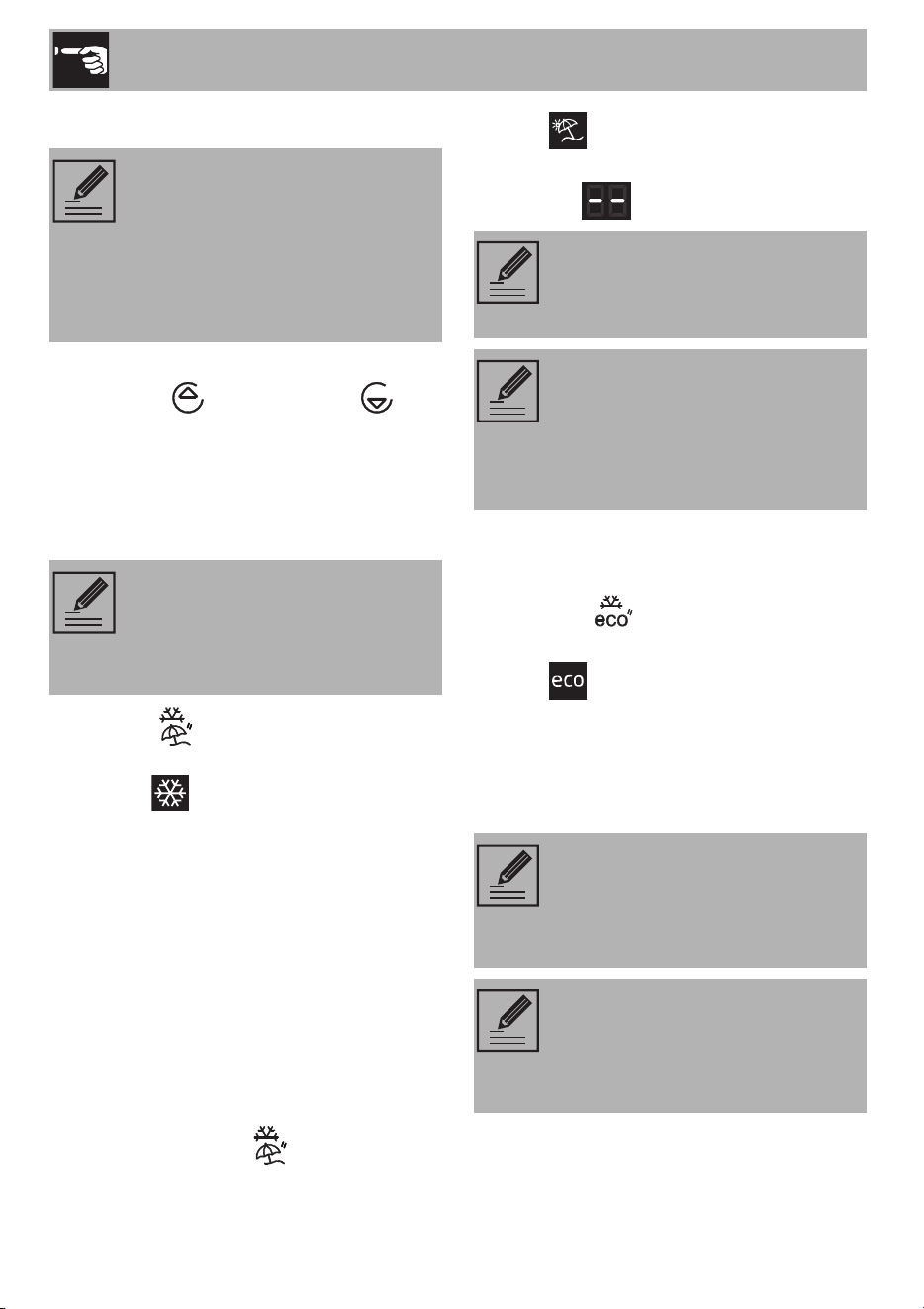
1. To set the refrigerator temperature,
press the button; press the
button for the freezer.
2. The set temperature will be shown on
the relevant display.
Refrigerator supercold function
1. Press the button to activate/
deactivate the supercold function, the
relevant indicator turns on.
2. After 1 hour the supercold function is
switched off automatically. The
refrigerator compartment returns to its
previous setting.
Vacation function
Useful during periods of prolonged
absence; the Vacation function allows you
to turn off the refrigerator compartment
while keeping the freezer active.
1. To activate/deactivate the Vacation
function, keep the button pressed
for 3 seconds.
2. The indicator will turn on in the
display, and the temperature will not be
shown
.
ECO mode
1. To activate/deactivate the ECO mode,
keep the button pressed for 3
seconds.
2. The indicator will turn on in the
display.
3. The appliance will reduce power
consumption after 6 hours since the
activation of the ECO mode.
NOTE:
The refrigerator temperature can
be set between +34 °F and
+46 °F.
The freezer temperature can be set
between 0°F and -11 °F.
NOTE:
The refrigerator supercold function
is used for quick cooling of large
quantities of food.
NOTE:
Remove the stored products from
the refrigerator compartment.
NOTE:
To prevent the formation of
unpleasant odors, a temperature
of about 59 °F will be kept inside
the refrigerator compartment.
NOTE:
The ECO mode is deactivated
after a power failure or when the
appliance is switched off.
NOTE:
Activation of the supercold function
(refrigerator/freezer) deactivates
the ECO mode.
Use
17
EN
Alarm for door open
When the refrigerator compartment door
remains open for a long time, the appliance
sounds to warn the user that door should be
closed; press the button to deactivate
the alarm.
High temperature alarm
If the temperature in the compartment is high
due to prolonged power failure or to a fault
of the appliance, an alarm will sound and
the indicator will turn on in the display.
Check food inside the refrigerator
compartment and press the button to
deactivate the alarm.
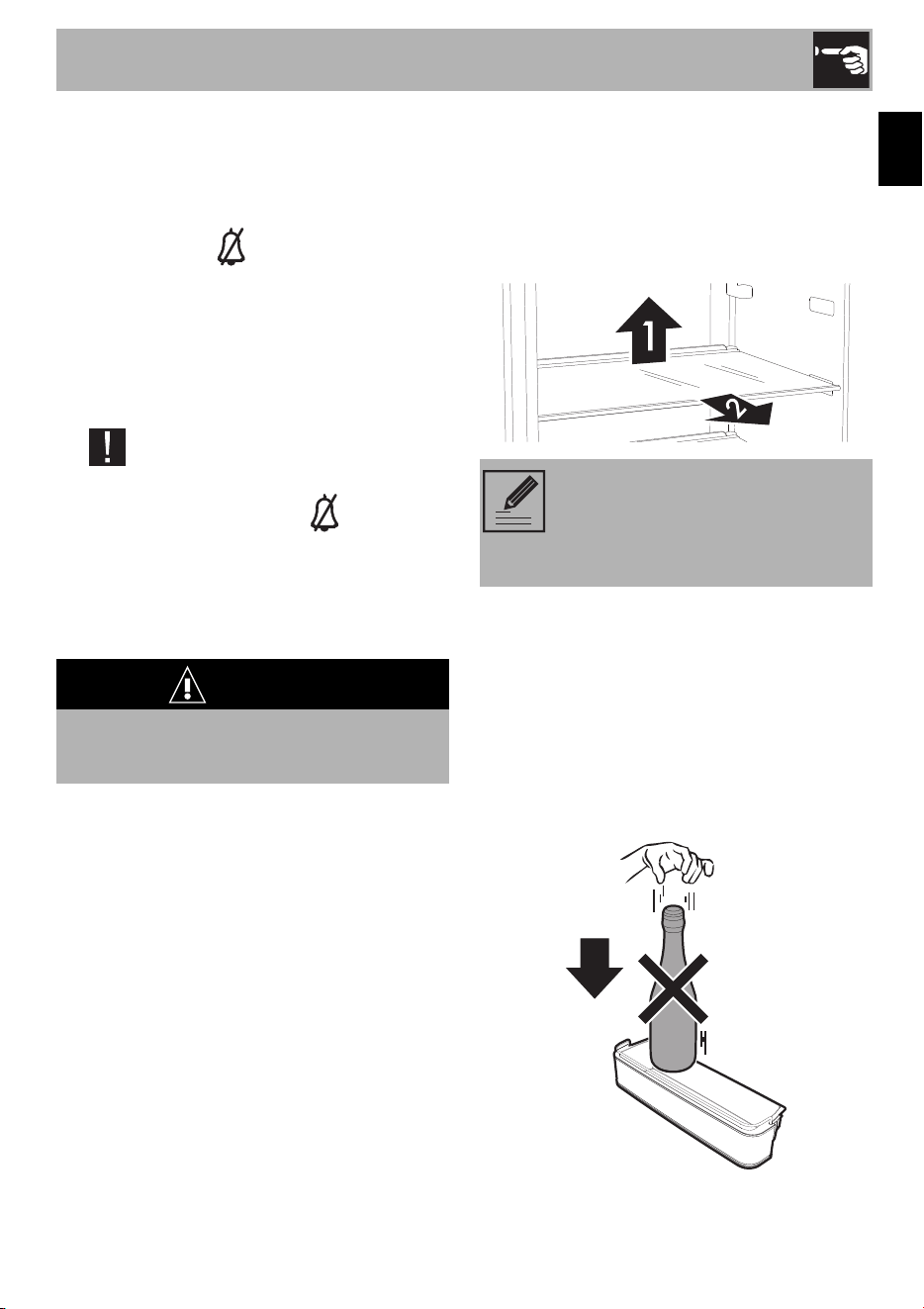
3.4 Using the accessories
Shelves
These can be positioned at different heights
on the guides according to requirements.
Each shelf has a safety fitting to prevent it
from being accidentally removed. To extract
them fully, lift up the rear part (1) and
remove them (2).
Door balconies and shelves
Suitable for storing eggs, butter, dairy
products, preserves and other small food
packages/containers. The lower part of the
door has a shelf for bottles. Avoid placing
excessively heavy bottles on the shelf and
do not let them drop onto the bottom when
inserting them.
CAUTION
• Glass shelves and covers are heavy,
use special care when removing them.
NOTE:
Perishable foods should be placed
on the rear part of the shelves
where the temperature is lower.
Use
18
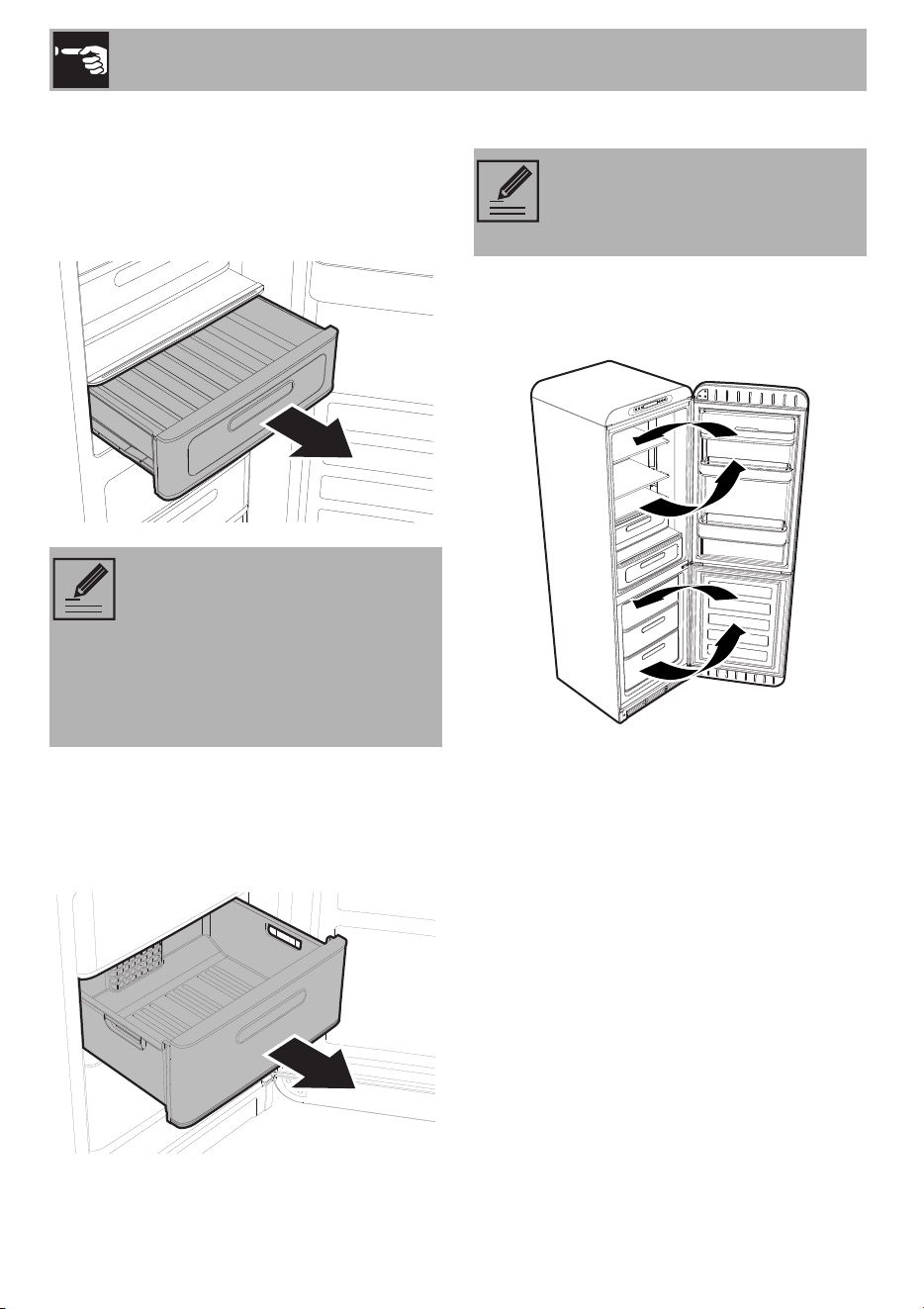
Fruit and vegetable drawer
Located at the bottom of the refrigerator
compartment, which is fitted with a glass
shelf to cover fresh foods that require
constant humidity for optimum storage.
Freezer drawers
For storing frozen foods and foods to be
frozen. To remove them, pull them towards
you and lift the front part of each drawer.
3.5 Ventilation
The forced recirculation air in the appliance
is free of humidity and quickly dries the food
inside.
The inner ventilation system cools food
more rapidly and keeps refrigeration
homogeneous inside the appliance.
NOTE:
Storing vegetables with high
content of water can generate
condensation on the glass shelf.
This is a natural phenomenon
which does not affect the
appliance’s operation in any way.
NOTE:
Before introducing food into the
appliance, seal it thoroughly.
Use
19
EN
3.6 Using the refrigerator
compartment
Arranging food
Arrange food on the various shelves,
making sure that they are wrapped and
covered hermetically. This precaution
ensures that:
•the flavor, moisture and freshness of the
foods are preserved;
• any contamination of foods with odors or
tastes from other foods can be avoided;
• the humidity level inside the refrigerator is
prevented from becoming too high as a
result of the normal transpiration of food
(especially fresh fruit and vegetables). In
some operating conditions (rise in
ambient temperature and humidity, more
frequent opening of the door) this might
cause condensation to form on the
shelves.
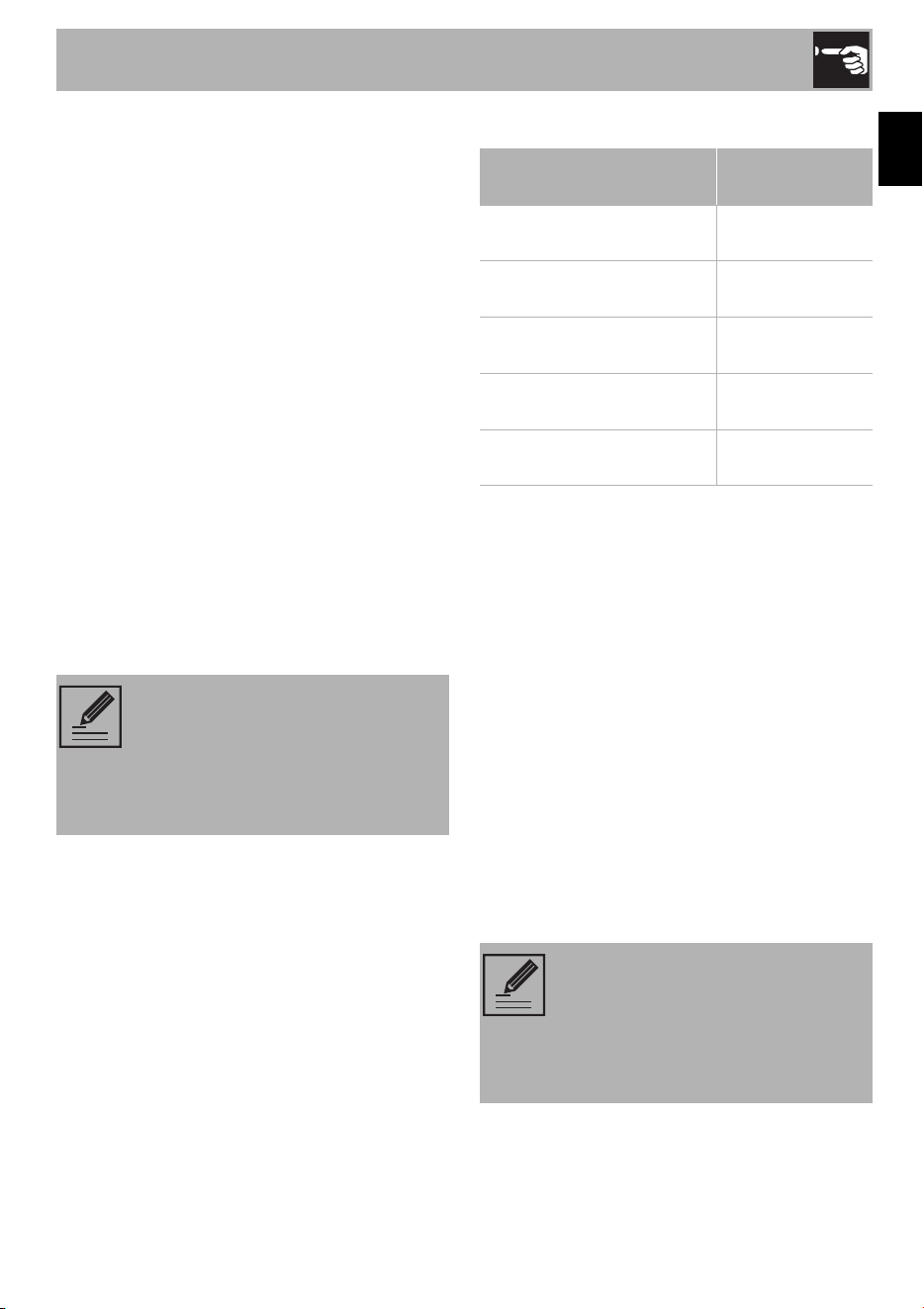
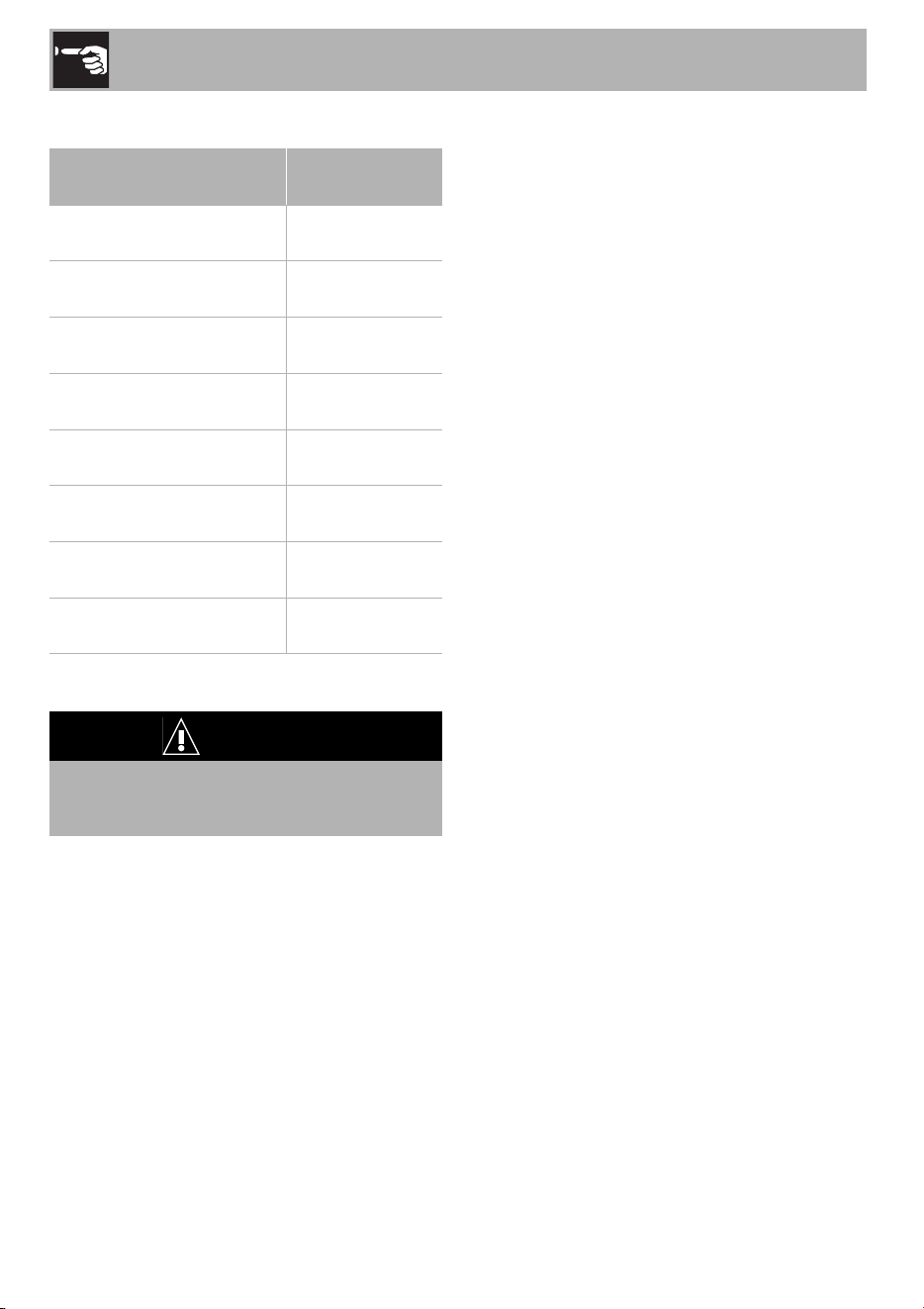
Storage life table
3.7 Using the freezer compartment
To keep and freeze foods properly:
• pack fruit and vegetables in portions of
no more than 2.20 oz and meat and fish
in portions of up to 4.40 oz.
• small packages freeze quickly which
means that the foods' nutritional
properties are preserved better,
including after defrosting/preparation.
• package foods in hermetically sealed
packages, expelling air as much as
possible.
• Do not use paper bags or shopping
bags, use the suitable freezer bags/
containers.
NOTE:
Always allow hot foods and drinks
to cool to room temperature
before putting them in the
appliance.
Foodstuff Time
Eggs, smoked meats,
marinated foods, cheese
max 10 days
Root vegetables max 8 days
Butter max 7 days
Pastries, fruit, ready meals,
fresh meat
max 2 days
Fish, minced meat, seafood max 1 day
NOTE:
Always allow hot foods and drinks
to cool to room temperature
before putting them in the
appliance.
Use
20
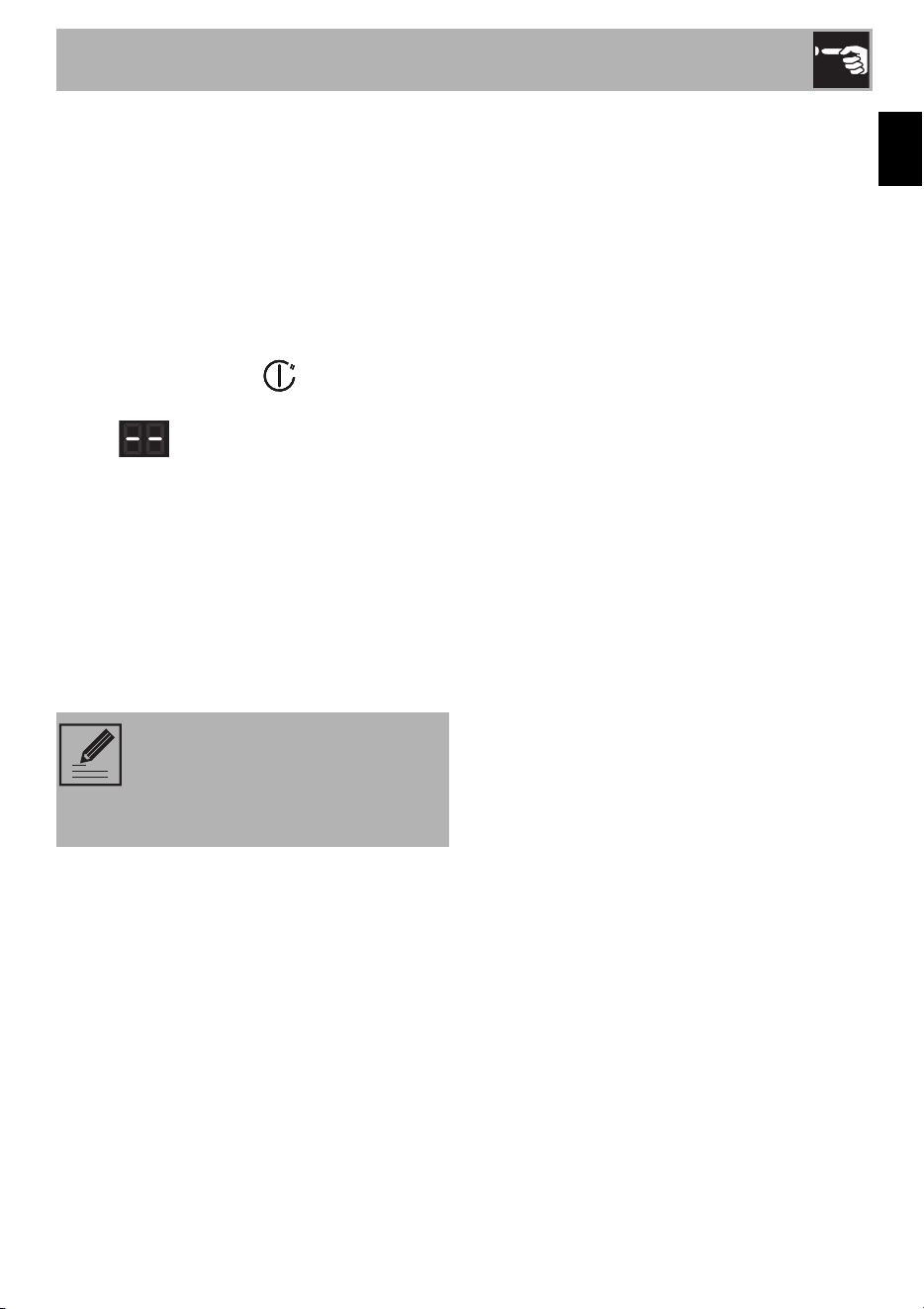
Frozen foods storage life table
Defrosted foods
Food must be consumed as soon as
possible once defrosted. Freezing foods
preserves them, but it does not destroy any
micro-organisms, which are activated after
defrosting, damaging the foods.
Partial defrosting lowers the nutritional value
of the foodstuffs, particularly of fruit,
vegetables and ready meals.
3.8 Noises during operation
The refrigerator and freezer compartments
are cooled by means of a compression
system. In order to maintain the preset
temperature inside the refrigerator and
freezer compartments, the compressor
comes into operation in response to the
level of cooling required, and may operate
continuously if necessary. When the
compressor starts to function, it creates a
buzzing noise which generally diminishes in
intensity after a few minutes.
Another normal operating noise of the
appliance is a gurgling due to the coolant
flowing through the pipes in the circuit. This
noise is normal and does not indicate an
appliance malfunction. If it becomes too
loud, this may mean that there are other
causes. Checks must then be made to
ensure that:
• The refrigerator is properly levelled on
the floor and does not vibrate when the
compressor is in operation: if this is not
the case, adjust the appliance's feet until
it is level;
• The drawers, shelves and trays on the
door are correctly positioned in their
holders: if they are not, put them in
correctly;
• Bottles and containers on the various
shelves are stable and not touching each
other: otherwise, the vibration resulting
from compressor operation could
generate noise;
• Do not place the refrigerator in such a
way that it is in contact with furniture or
other household appliances.
Foodstuff Time
Fruit, beef max 10-12 months
Vegetables, veal, poultry max 8-10 months
Game max 6-8 months
Pork max 4-6 months
Mince max 4 months
Bread, desserts, cooked foods,
oily fish
max 3 months
Offal max 2 months
Sausages, lean fish max 1 month
CAUTION
• Do not refreeze frozen foods which
have partly or completely defrosted.
Use
21
EN
3.9 Heated front surface
There is a front surface heating system
inside the cabinet to limit the formation of
condensation around the door seal.
3.10 Turning the appliance off
Whenever the appliance is to remain
unused for long periods, it should be
switched off.
1. Keep the ON/OFF button on the
control panel pressed for 3 seconds.
The symbols are displayed on the
refrigerator and freezer temperature
displays.
2. Unplug the appliance from the wall
socket.
3. Empty the compartments.
4. Once the freezer has fully defrosted, dry
any residual accumulated moisture with
a tea towel.
3.11 Food storage advice
Practical energy saving advice
• Correct use of the appliance, correct
packaging of foodstuffs, a constant
temperature and food hygiene have
significant effects on the quality of
storage.
• Reduce the number of times that the
doors are opened and the length of time
they remain open to prevent the
compartments from heating up
excessively.
• Clean the condenser (rear of the
appliance) periodically to prevent the
appliance from losing efficiency.
• Defrost frozen food in the refrigerator
compartment in order to make use of the
cold stored in the frozen foods.
General advice
• Always check the expiry date on the
food packaging.
• The foodstuffs must be stored in closed or
pre-packaged containers and must not
be able to emit or absorb moisture and
odors.
• Remove perishable products from the
appliance if you are going away for a
long period.
Refrigerator compartment door
• Keep eggs, butter, cheese etc. in the
upper and central parts.
• Keep drinks, bottles, cans etc. in the
lower part.
NOTE:
Leave the door ajar to ensure that
moisture and stagnant air do not
cause unpleasant odors.
Use
22
Refrigerator compartment
• Keep dairy products, ready meals,
pastries, fruit juices, beer etc. in the
central part.
• Keep meats, cold cuts etc. in the lower
part.
• Keep fresh and tropical fruit, vegetables,
root vegetables, onions, etc. in the fruit
and vegetable drawer.
Freezer compartment
• The type of food, quantity and date of
freezing should be marked on the
container/packaging.
• Use small containers, if possible already
cold.
• The quantity of fresh foods which can be
frozen at the same time is listed on the
nameplate inside the refrigerator
compartment.
• Use suitable freezer bags, tinfoil, cling-
film for use with food, and freezer
containers.
• Do not use paper bags, cellophane for
non-food use, shopping bags or
pre-used freezer bags.
• Avoid frozen food coming into contact
with fresh food to be frozen.
• Keep bagged frozen vegetables, ice,
ice cream etc.
Temperature scale
This function allows you to set the
temperature scale from degrees Fahrenheit
(°F) to degrees Celsius (°C) and vice
versa:
• Press keys and simultaneously
for 3 seconds.
• Repeat the procedure to return to the
previous temperature format.
NOTES:
After a power failure, the unit
maintains the previously set
temperature scale.
Cleaning and maintenance
23
EN
4 Cleaning and maintenance
4.1 Instructions
4.2 Cleaning the appliance
A special antibacterial protection on the
appliance's interior walls prevents bacterial
growth and keeps them clean. They must
nevertheless be cleaned regularly in order
to keep them in good condition.
Cleaning the outside of the appliance
• The appliance may be cleaned with
water or alcohol-based liquid detergents
(e.g. window cleaning products).
• Avoid aggressive detergents and rough
sponges in order not to damage the
surfaces.
• Use a soft brush to remove dust and fume
deposits from the condenser on the rear
of the appliance.
• Clean the tank above the compressor.
Cleaning the inside of the appliance
• Clean the inside of the appliance with
diluted liquid detergent and warm water,
adding a little bit of vinegar.
• Door balconies and shelves can be
removed.
• Do not use sharp objects or spray
products.
WARNING
• Turn off the appliance and unplug it from
the mains before cleaning or
maintenance.
• Do not pull the cable to remove the
plug.
• Use nonflammable cleaner.
CAUTION
• Do not use steam jets to clean the
appliance.
• Do not use cleaning products containing
chlorine, ammonia or bleach on parts
made of steel or that have metallic
surface finishes (e.g. anodizing, nickel-
or chromium-plating).
• Do not use abrasive or corrosive
detergents (e.g. powder products, stain
removers and metallic sponges) on
glass parts.
• Do not use rough or abrasive materials
or sharp metal scrapers.
• Do not clean glass shelves or covers
with warm water when they are cold.
• Glass shelves and covers are heavy,
use special care when removing them.
Cleaning and maintenance
24
4.3 Defrosting
Defrosting the refrigerator/freezer
compartments
The refrigerator/freezer compartment does
not require defrosting, as any ice which
forms on the refrigeration plate will melt
when the compressor is switched off. The
defrosting process is automatic.
Defrost water is channeled directly into the
dedicated pan on the back of the
appliance, which lets it evaporate by
means of the heat generated by the
compressor.
4.4 Interior lighting
Interior lighting, if damaged, must be
repaired by Technical Service only.
4.5 What to do if...
The appliance does not work:
• Make sure that the appliance is plugged
in and that the main switch is turned on.
The compressor starts to function too often
or functions continuously:
• The room temperature is too high.
• The door is being opened too often or
for too long.
• The door is not closing/sealing properly.
• The freezer is loaded with too many fresh
foods.
• Check that sufficient air can circulate
around the sensor on the right-hand side
of the refrigerator compartment.
• Check that the back of the freezer is
properly ventilated and that the
condenser is not too dirty.
Excessive ice or condensation has built up
inside the refrigerator compartment:
• The door is being opened too often or
for too long.
• Hot foods have been placed inside the
refrigerator compartment.
• The foodstuffs or containers are in
contact with the rear wall.
• The door seal is damaged or dirty.
Clean or replace it.
CAUTION
• Do not use electrical appliances (e.g.
hair dryers) or sprays for defrosting, the
plastic parts could be damaged.
NOTE:
Occasional presence of frost
inside the freezer compartment is
normal.
WARNING
• Turn off the appliance and unplug it from
the mains before cleaning or
maintenance.
• Do not pull the cable to remove the
plug.
• Use nonflammable cleaner.
Cleaning and maintenance
25
EN
The refrigerator compartment is not
sufficiently cold:
•The thermostat is set at too high a
temperature.
• The door is being opened too often or
for too long.
• The door is not closing/sealing properly.
• The room temperature is too high.
The temperature inside the refrigerator
compartment is too cold and the foodstuffs
are freezing:
• The thermostat is set at too low a
temperature.
• Food not contained in suitable containers
or bags.
• Fruit and vegetables might be too wet.
• Foodstuffs placed against the rear wall
of the refrigerator compartment.
Temperature inside freezer compartment
not low enough to freeze foods properly:
•The thermostat is set at too high a
temperature.
• The door is being opened too often or
for too long.
• The door is not closing/sealing properly.
• The door seal is damaged or dirty.
Clean or replace it.
• The food to be frozen contains large
quantities of sugar.
Excessive ice has built up inside the freezer
compartment:
• The thermostat is set at too low a
temperature.
• The room temperature is too high.
• The door is being opened too often or
for too long.
• The door is not closing/sealing properly.
• The door seal is damaged or dirty.
Clean or replace it.
• Hot foods have been placed inside the
freezer compartment.
Doors are hard to open just after closing:
• If you attempt to open the door again just
after closing it (especially the freezer
door), considerable strength is required.
This is due to the vacuum created by the
cooling of the warm air which has
entered the freezer.
The doors are misaligned:
• Check that the appliance is level.
• Level the appliance using its feet.
Installation
26
5 Installation
5.1 Electrical connection
General information
• Check the mains characteristics against
the data indicated on the plate.
The identification plate bearing the
technical data, serial number and brand
name is visibly positioned inside the
appliance. Do not remove this plate for
any reason.
• Make sure that the plug and socket are
of the same type.
• The plug must always be accessible
when the appliance is installed.
• Leave the appliance standing vertically
for at least two hours before turning it on
for the first time.
• If it is necessary to replace the power
cable, this must be performed by an
authorized technician from Technical
Support Service.
5.2 Positioning
Choice of location
DANGER
• Non-compliance with these instructions
may result in death, fire or an electric
shock.
WARNING
• Plug into a grounded 3-prong outlet.
• Do not remove ground prong.
• Do not use an adapter plug.
• Do not use an extension cord.
• Do not twist or tie the power cord.
• Do not pull or bend the power cord.
• The appliance must be connected to
ground in compliance with electrical
system safety standards.
• Do not pull the cable to remove the plug.
• Do not damage the refrigerant circuit
WARNING
• Keep ventilation openings, in the
appliance enclosure or in the built-in
structure, clear of obstruction.
CAUTION
• Never use the open door to lever the
appliance into place when fitting.
• Avoid exerting too much pressure on the
door when open.
WARNING
Do not install this appliance:
• outdoor,
• in manufactured (mobile) homes, in
recreational vehicles (RVs) or boat.
• near a heater or flammable material.
Keep flammable materials and vapor,
such as gasoline, away from the
appliance.
• in a room where there is a risk of
freezing.
• in direct sunlight or exposed to heat from
stoves (if this is not possible, insulate
properly).
Installation
27
EN
Always install the appliance in a dry place
with satisfactory ventilation. Depending on
its climate class (stated on the nameplate
inside the refrigerator compartment), the
appliance can be used in different
temperature conditions.
• The appliance must not be installed near
heat sources. If this is not possible,
insulate properly.
• To ensure proper ventilation for your
appliance allow 1 ¼” (3 cm) space on
each side.
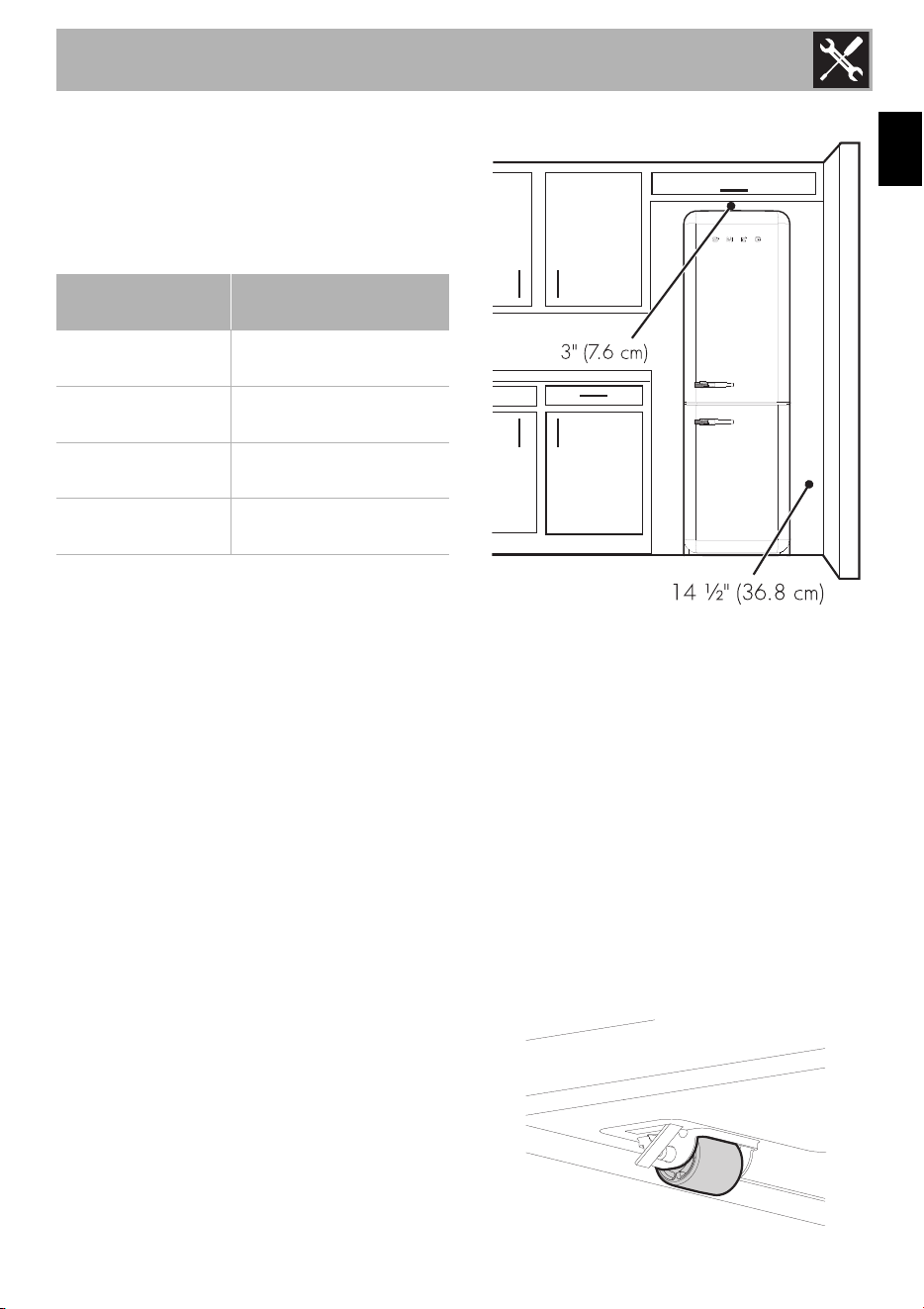
• If installed underneath wall units, at least
3” (7.6 cm) clearance must be left.
• Ensure that the appliance is located with
sufficient space for the door to open and
for the internal drawers and shelves to be
removed, if necessary. Leave 14 ½”
(36,8 cm) minimum on the hinge side to
allow for the door to swing open.
Spacers
To ensure proper cooling of the condenser,
the appliance must not be placed too close
to the wall. To prevent this, the appliance
comes complete with two plastic spacers,
which must be fitted in the rear part of the
appliance.
Positioning
Position the appliance on a firm, level
surface.
The appliance has two small wheels on the
back to allow it to be moved and
positioned more easily.
Class Room temperature
SN (Subnormal) + 50°F to + 89°F
N (Normal) + 61°F to + 89°F
ST (Subtropical) + 64°F to + 100°F
T (Tropical) + 64°F to + 109°F
Installation
28
In any case, we recommend moving the
appliance very carefully in order to avoid
damaging the floor (especially in the case
of wooden floors).
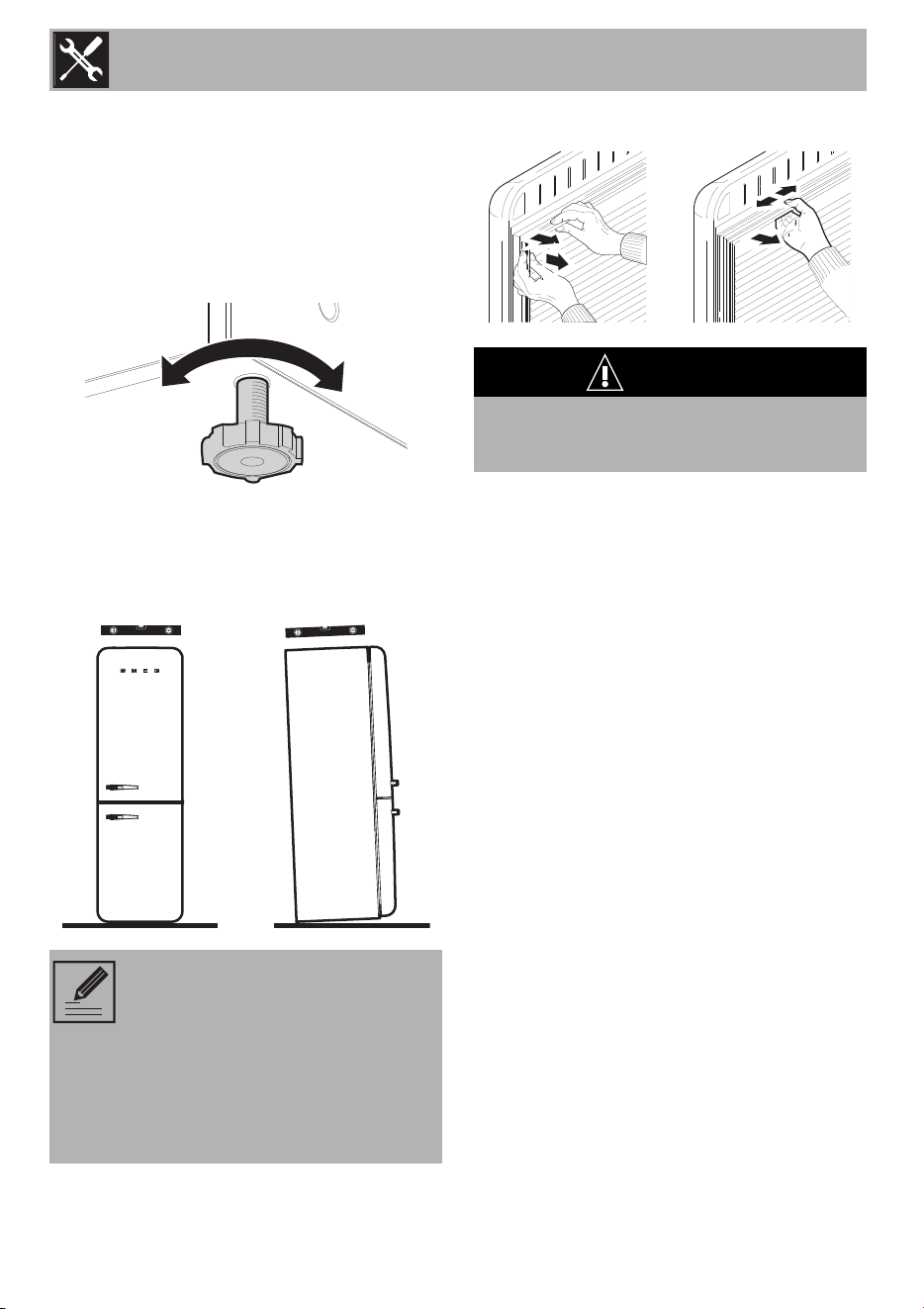
If the floor is not perfectly level, use the two
adjustable feet on the front part of the
appliance
Level the appliance horizontally adjusting its
feet.
Lean the appliance slightly towards the rear
part to facilitate proper door closure.
A few days after installation, check that the
initial level adjustment is still correct. Make
sure that the appliance is still stable and the
door seals still close hermetically when it is
in operation and loaded with food.
If necessary, re-adjust the level and the
seals.
NOTE:
In order for the appliance to be
installed correctly, the door must
be able to close properly. Ensure
that the door seals close
hermetically, especially at the
corners.
CAUTION
• Do not press, do not tear or detach the
seal from the door.