Installation Manual
TYPE : Multi zone
ENGLISH
FRANÇAIS
ESPAÑOL
960-911-05
2 Multi zone
MULTI ZONE INSTALLATION
INSTRUCTIONS

Installation Manual 3
ENGLISH
Multi zone Air Conditioner Installation Manual
TABLE OF CONTENTS
Installation Parts Provided ................................................4
Product Introduction .............................................................5
Indoor Unit ............................................................................5
Outdoor Unit..........................................................................5
Safety Precautions ................................................................6
Installation of Indoor, Outdoor Unit.....................................9
Select the best location ........................................................9
Seaside Applications and Installation..................................11
Piping length and elevation.................................................12
Installation............................................................................13
Connecting the piping .........................................................13
How to mount......................................................................16
Wiring Connection...............................................................17
Conduit connection .............................................................17
Ceiling dimension and hanging bolt location ......................18
How to mount......................................................................19
Wiring Connection...............................................................19
Conduit connection .............................................................19
Remote controller installation..............................................21
Wired remote controller installation.....................................23
Installer Setting - Test Run Mode........................................24
Installer Setting - Thermistor...............................................25
Installer Setting - Group Setting..........................................26
Installer Setting - Celsius / Fahrenheit Switching ...............27
Installer Setting - E.S.P. ......................................................28
Ceiling dimension and hanging bolt location ......................29
Conduit connection .............................................................30
How to Fix ...........................................................................30
Wiring Connection...............................................................30
Installation of Wired Remote Controller(Optional) ..............31
Installation of Decorative Panel ..........................................33
Drain Piping ........................................................................35
Flaring Work and Connection of Piping............................38
Flaring work ........................................................................38
Connection of piping - Outdoor...........................................39
Connecting the Cable between Indoor Unit and Outdoor
Unit........................................................................................40
Connect the cable to the Indoor unit...................................40
Connect the cable to the Outdoor unit................................41
Connection method of the connecting cable(Example) ......42
Checking the Drainage, Insulating the Pipe and Special
Piping Applications .............................................................43
Checking the drainage ........................................................43
Insulating the Pipe and Special Piping Applications ...........43
Extended line length setting...............................................44
Air Purging and Evacuation ...............................................45
Leak Checking ....................................................................45
Evacuation ..........................................................................46
Charging ...............................................................................47
❏ Level gauge
❏ Screw driver
❏ Electric drill
❏ Hole core drill [ø50mm(2 inch)]
❏ Flaring tool set
❏ Specified torque wrenches
1.8kg.m, 4.2kg.m, 5.5kg.m, 6.6kg.m
(different depending on model No.)
❏ Adjustable wrench
❏ A glass of water
❏ Screw driver
❏ Hexagonal wrench(4mm)
❏ Refrigerant Gas Leak Detector
❏ Vacuum pump
❏ Gauge manifold
❏ Owner's manual
❏ Thermometer
❏ Remote Control Holder
Installation Requirements
Required Tools
4 Multi zone
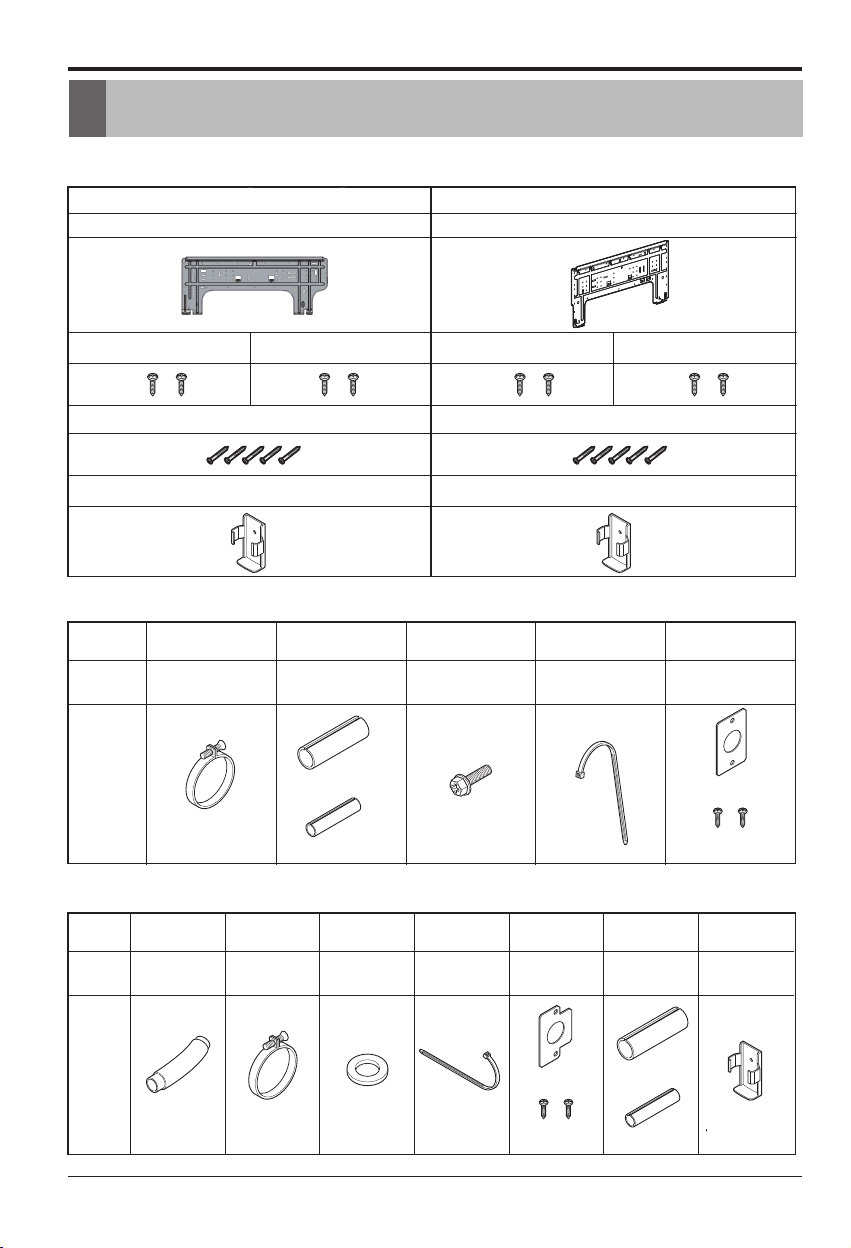
Installation Parts Provided
Installation Parts Provided
[Wall-mounted Type]
[Ceiling Concealed Duct Type]
[Ceiling Cassette Type]
Type “A” screw Type “A” screw
Type "B" screw Type "C" screw Type "B" screw Type "C" screw
Remote control holderRemote control holder
Type 1 Type 2
Installation plate Installation plate
Name
Quantity
Shape
for gas pipe
for liquid pipe
Clamp metal
1 EA
Insulation for
fitting
1 set
Clamp
8 EA
Screws for
duct flanges
1 set
Conduit Bracket
Screw(M4) 2EA
Conduit
Bracket
1 EA
Name
Quantity
Shape
for gas pipe
Conduit Bracket
Screw(M4) 2EA
for liquid pipe
Clamp metal
1 EA
Insulation for Remote
control holder
fitting
1 SET 1 EA
Drain hose
1 EA
Clamp
Conduit
Bracket
8 EA
Washer for
hanging backet
8 EA 1 EA
Installation Manual 5
Product Introduction
ENGLISH
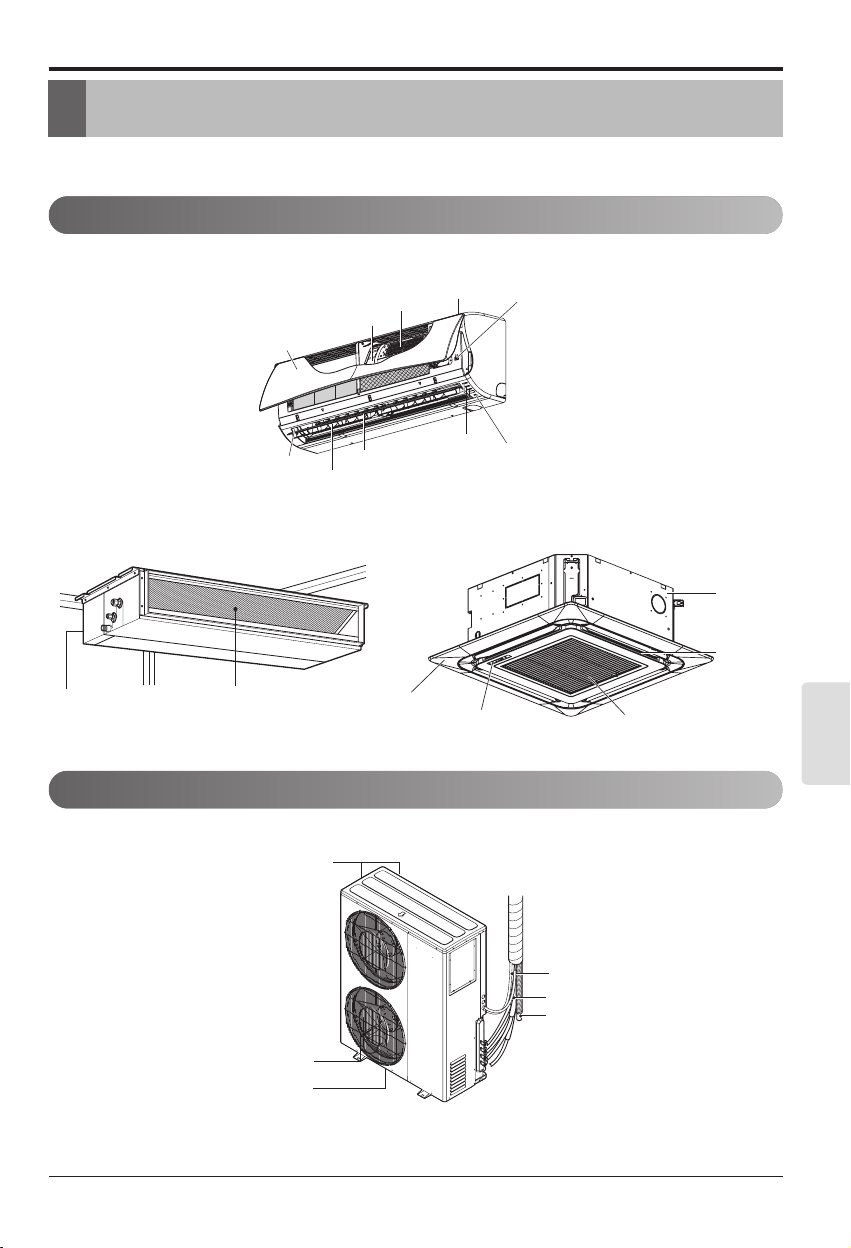
Here is a brief introduction of the indoor and outdoor units. Please see the information specific to
your indoor unit type.
more than
70 cm
more than
60 cm
more than
30 cm
(1
1.8 inch)
more than
30 cm
(11.8 inch)
Air Intake
(side, rear)
Connection pipe
Drain hose
Connecting wire
Control cover
more than 30 cm
(11.8 inch)
Cabinet
Air Discharge
Air Inlet
Signal receiver
Front Panel
Air outlet vents
Air Inlet
[Ceiling Concealed Duct Type]
[Wall-mounted Type]
[Ceiling Cassette Type]
Operation lamp
Signal Receiver
ON/OFF button
Air inlet
Plasma filter
Air filter
Front grille
Vertical louver
Air outlet
Horizontal vaneHorizontal vaneHorizontal vane
more than
30 cm
(1
1.8 inch)
Air outlet vents
Base plate
Connection pipe
Drain hose
Connecting wire
Air intake vents
Horizontal vane
Outdoor Unit
❈ The figure can be changed according to model.
Indoor Unit
Product Introduction
6 Multi zone
Safety Precautions
To prevent the injury of the user or other people and property damage, the following instructions
must be followed.
■ Be sure to read before installing the air conditioner.
■ Be sure to observe the cautions specified here as they include important items related to safety.
■ Incorrect operation due to ignoring instruction will cause harm or damage. The seriousness is
classified by the following indications.
■ The meanings of the symbols used in this manual are as shown below.
WARNING
CAUTION
This symbol indicates the possibility of death or serious injury.
This symbol indicates the possibility of injury or damage to properties only.
Be sure not to do.
Be sure to follow the instruction.
Safety Precautions
WARNING
■ Installation
Always perform grounding.
• Otherwise, it may cause electri-
cal shock.
Ensure that the power cord
used is not frayed or damaged
in anyway.
• Otherwise, it may cause a fire or
electrical shock.
Please contact a licensed service
center or installer to install this
equipment.
•
Otherwise, it may cause a fire, elec-
trical shock, explosion or injury.
Securely attach the electrical
part cover to the indoor unit
and the service panel to the
outdoor unit.
•
If the electrical part cover of the indoor
unit and the service panel of the out-
door unit are not attached securely, it
could result in a fire or electric shock
due to dust, water, etc.
Ensure a dedicated circuit
breaker is installed as well as
an independent electrical dis-
connect.
• No installation may cause a fire
and electrical shock.
Do not keep or use flammable
gases or combustibles near the
air conditioner.
• Otherwise, it may cause a fire or
the failure of product.
Use a vacuum pump or Inert (nitrogen) gas when doing leakage test or air purge. Do not use oxy-
gen, compressed air or other gases which may be flammable or harmful. Doing so causes risk for
fire, explosion, injury or death.
• There is the risk of death, injury, fire or explosion.
Ensure that the outdoor system is free of dam-
age prior to installation.
• It may cause injury or an accident.
Do not service this equipment unless you are a
licensed contractor.
• It will cause a fire or electrical shock.
Installation Manual 7
Safety Precautions
ENGLISH
Ensure that system is properly secured once in-
stallation is complete.
• Otherwise, it may result in personal injury.
Use caution when unpacking and installing.
• Sharp edges may cause injury.
Do not use the power cord
near the heating tools.
• Otherwise, it may cause a fire
and electrical shock.
Do not open the suction inlet
of the indoor/outdoor unit
during operation.
• Otherwise, it may electrical
shock and failure.
If equipment is submerged.
Please shut off power and
call a service center.
• Otherwise, it may cause the
failure of machine or electrical
shock.
Hold the plug by the head
when taking it out.
• It may cause electric shock
and damage.
Never touch the metal parts
of the unit when removing the
filter.
• They are sharp and may
cause injury.
Do not use the equipment as
a step or a shelf.
• It may cause an injury through
dropping of the unit or falling
down.
Do not place a heavy object
on the power cord.
• Otherwise, it may cause a fire
or electrical shock.
When the product is sub-
merged into water, always
contact the service center.
• Otherwise, it may cause a fire
or electrical shock.
Take care so that children
may not step on the outdoor
unit.
• Otherwise, children may be
seriously injured due to falling
down.
Ensure system is installed on
a dedicated circuit.
• It will cause an electric shock
or a fire due to heat genera-
tion.
Do not use the damaged
power cord.
• Otherwise, it may cause a fire
or electrical shock.
Do not alter the power cord
without seeking assistance
from a licensed professional.
• Otherwise, it may cause a fire
or electrical shock.
Ensure power cord is se-
curely in place and care is
taken to prevent cord from
being pulled loose.
• Otherwise, it may cause a fire
or electrical shock.
Unplug the unit if strange
sounds, smell, or smoke
comes from it.
• Otherwise, it may cause elec-
trical shock or a fire.
Keep unit clear of any heat
source.
• Otherwise, it may cause a fire.
■ Operation
8 Multi zone
Safety Precautions
CAUTION
■ Installation
Ensure drain is securely fastened.
• Otherwise, it may cause water leakage.
Install in area where consideration of sur-
roundings have been made, noise and heat
may not affect those nearby.
• Otherwise, it may cause dispute with the neigh-
bors.
Always check for leaks at all connections, if
leak is found perform proper repairs.
• Otherwise, it may cause the failure of product.
Ensure equipment is level during installation.
• Otherwise, it may cause vibration or water leak-
age.
Avoid excessive cooling and perform ventila-
tion sometimes.
• Otherwise, it may do harm to your health.
Use a soft cloth to clean. Do not use wax,
thinner, or a strong detergent.
• The appearance of the air conditioner may de-
teriorate, change color, or develop surface
flaws.
Do not use an appliance for special purposes
such as preserving animals vegetables, preci-
sion machine, or art articles.
• Otherwise, it may damage your properties.
Do not block or restrict the airflow inlet or
outlet.
• Otherwise, it may cause the failure of appliance
or an accident.
■ Operation
Installation Manual 9
Installation of Indoor, Outdoor Unit
ENGLISH
Read completely, then follow step by step.
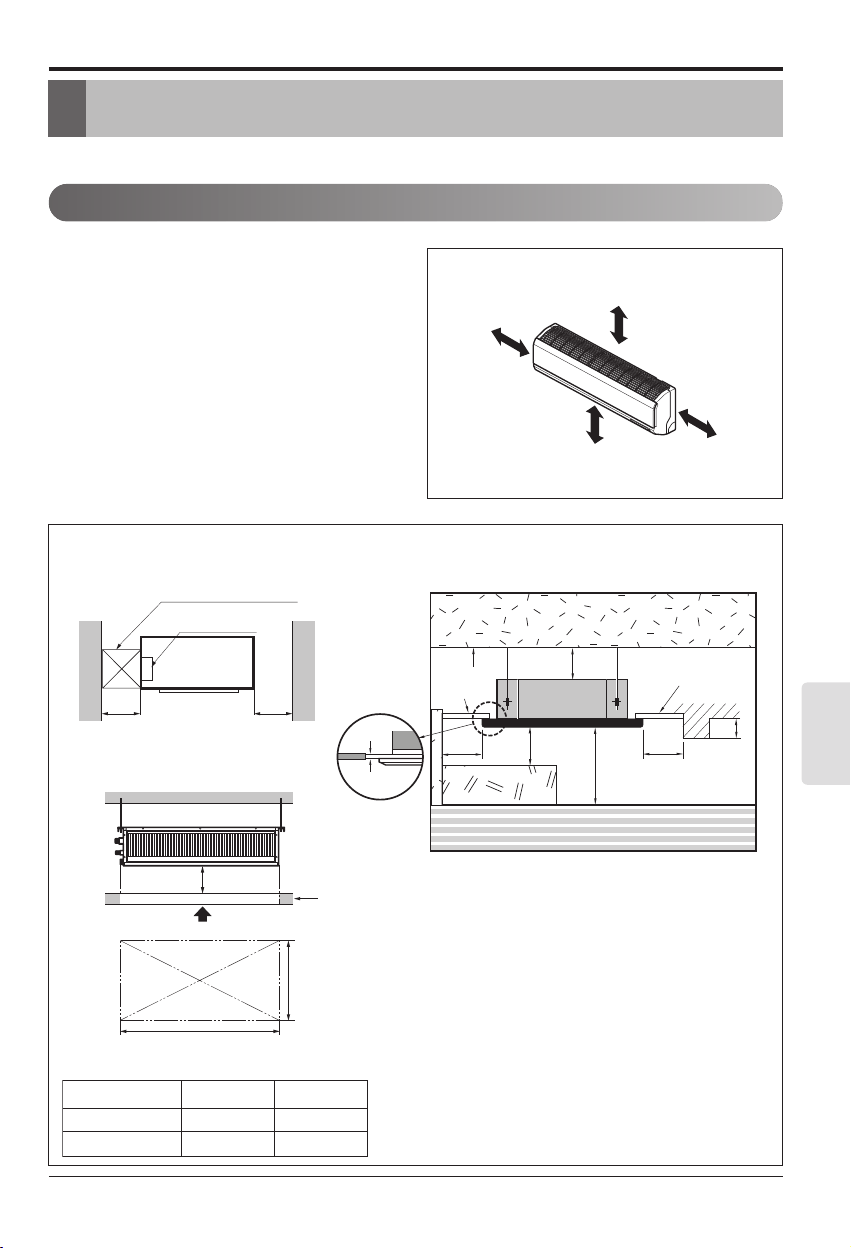
Indoor unit
1. Do not have any heat or steam near the unit.
2. Select a place where there are no obstacles
in front of the unit.
3. Make sure that condensation drainage can
be conveniently routed away.
4. Do not install near a doorway.
5. Ensure the unit is unobstructed, allow proper
space on all sides according to the arrows
and distance measurements in the figures.
6. Use a Metal Detector or Metal Scanner to
locate studs to prevent unnecessary damage
to the wall.
Select the best location
Top view
Front view
H=20(25/32) or more
Service Space
Ceiling
A
B
Capacity(Btu/h class)
AB
9/12k 600(23-5/8) 900(35-7/16)
18k 600(23-5/8) 1100(43-5/16)
Unit:mm(inch)
[Ceiling Concealed Duct Type] [Ceiling Cassette Type]
* Suitable dimention “H” is necessary to get a slope to
drain as show in the figure.
600
(23-5/8)
600
(23-5/8)
Inspection hole
[600(23-5/8) x 600(23-5/8)]
Control box
Ceiling
Ceiling Board
Ceiling Board
Floor
Unit:mm(inch)
At least 1800(70-
7
/
8
)
3600(141-
23
/
32
) or less
1000(39-
3
/
8
)
or more
500(19-
11
/
16
)
or more
10(
13
/
32
)
or more
500(19-
11
/
16
)
or more
300(11-
13
/
16
) or less
30(1-3/16)
±3(1/8)
More than 200(7-7/8)
Recommended height
2000(78-3/4)
More than
100(3-15/16)
More than
100(3-15/16)
Unit:mm(inch)
[Wall-mounted Type]
❈
Note : remove obstructions to prevent blockage of airflow path
Installation of Indoor, Outdoor Unit
10 Multi zone
Installation of Indoor, Outdoor Unit
Outdoor unit
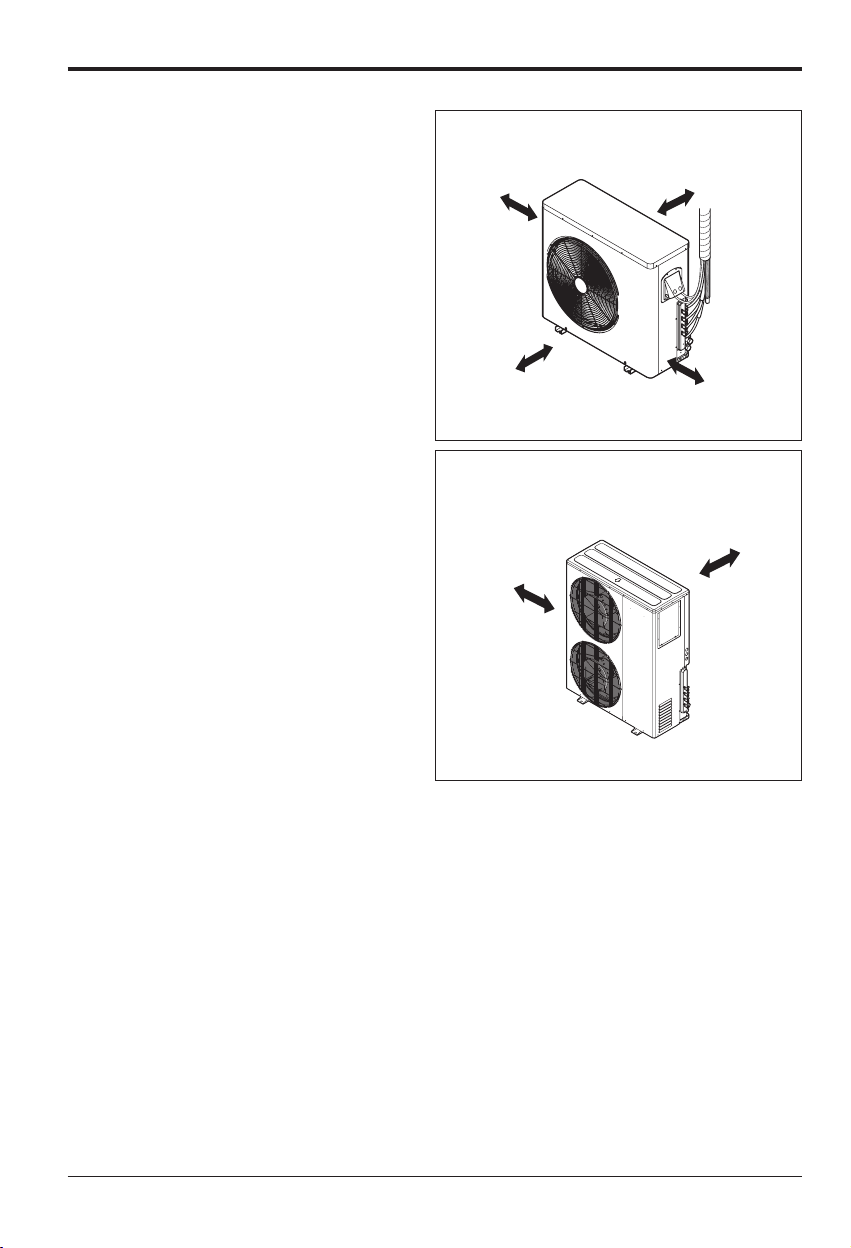
1. If an awning is built over the unit to prevent
direct sunlight or rain exposure, make sure
that heat radiation from the condenser is not
restricted.
2. Ensure the unit is unobstructed, allow proper
space on all sides according to the arrows
and distance measurements in the figures.
3. Do not place animals and plants in the path
of the warm air.
4. Take the air conditioner weight into account
and select a place where noise and vibration
are minimum.
5.
Select a place so that the warm air and sound
from the air conditioner does not disturb
neighbors.
Rooftop Installations:
If the outdoor unit is installed on a roof
structure, be sure to level the unit. Ensure the
roof structure and anchoring method are
adequate for the unit location. Consult local
codes regarding rooftop mounting.
more than 700
(27 9/16)
more than 300
(11 13/16)
more than 300
(11 13/16)
more than 600
(23 21/32)
more than 300
(11 13/16)
more than 300
(11 13/16)
Unit:mm(inch)
Unit:mm(inch)
Installation Manual 11
Installation of Indoor, Outdoor Unit
ENGLISH
Seaside Applications and Installation
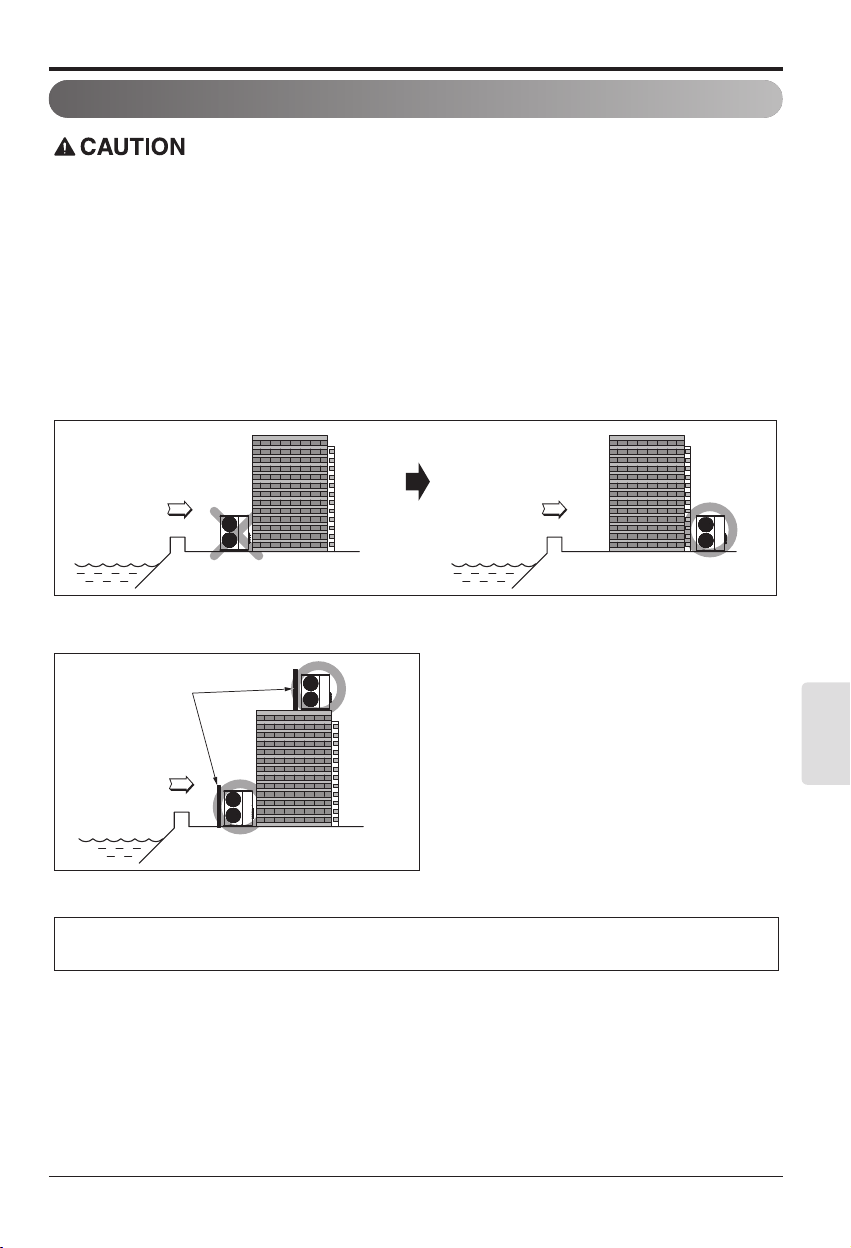
1.
Air conditioners should not be installed in areas where corrosive gases, such as acid or alkaline gas, are
produced.
2. Do not install the product where it could be exposed to sea wind (salty wind) directly. It can result
corrosion on the product. Corrosion, particularly on the condenser and evaporator fins, could
cause product malfunction or inefficient performance.
3. If outdoor unit is installed close to the seaside, it should avoid direct exposure to the sea wind.
1) If the outdoor unit is to be installed close to the seaside, direct exposure to the sea wind should be avoided.
Install the outdoor unit on the opposite side of the sea wind direction.
2)
In case, to install the outdoor unit on the seaside, set up a windbreaker/barrier, to lessen the unit's exposure to sea air
3) Select a well-drained place.
• It should be strong enough (like concrete) to obstruct
the wind from the sea.
• The height and width should be more than 150% of
the outdoor unit.
• A minimum of 70cm (27 1/16 inches)
of space between outdoor unit and the windbreak
for easy air flow.
Sea wind Sea wind
Sea wind
Windbreaker/Barrier
Periodic ( more than once/year ) cleaning of the dust or salt particles stuck on the heat exchanger
using water is recommended.
1. Selecting the location(Outdoor Unit)
12 Multi zone
Installation of Indoor, Outdoor Unit
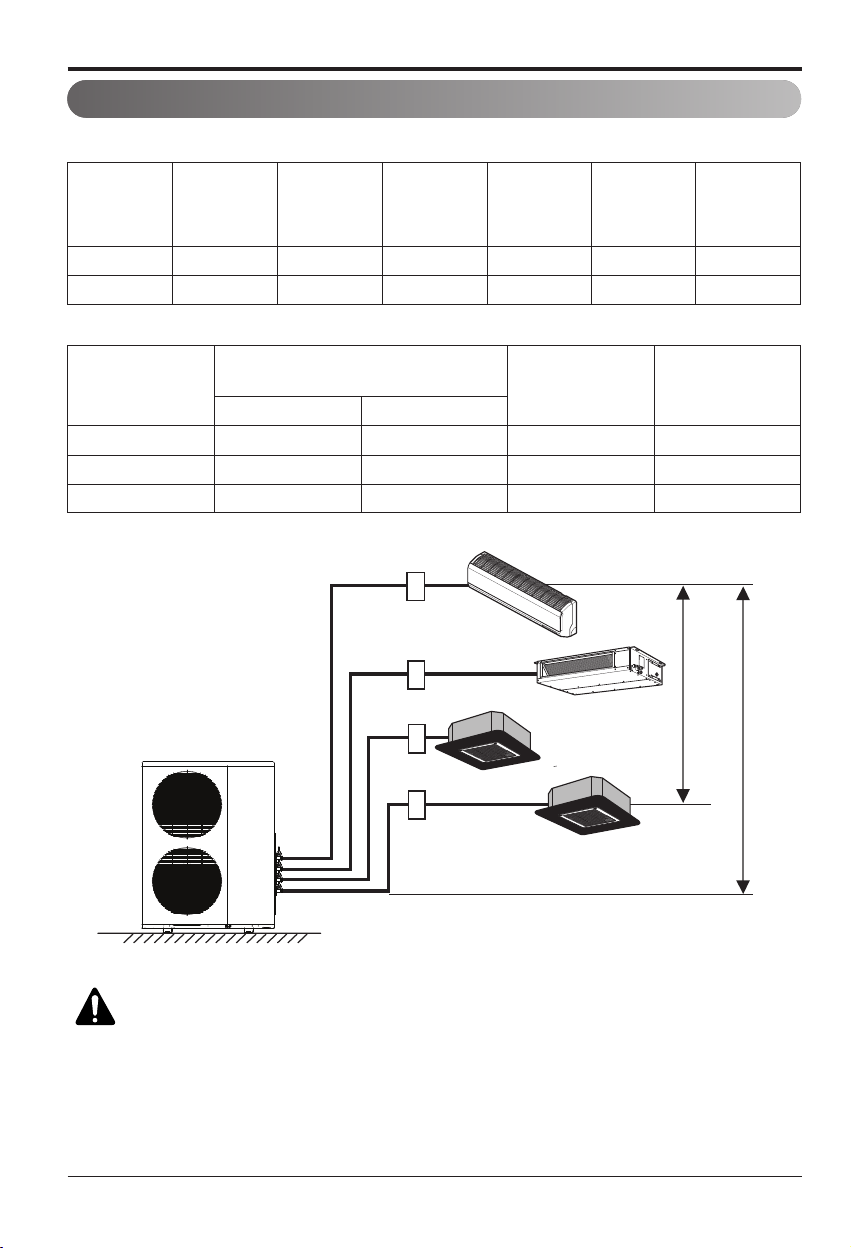
Multi Piping Type
Piping length and elevation
h2
A
B
C
D
h1
CAUTION: Capacity is based on standard length and maximum allowance
length is on the basis of reliability.
9k 9.52(3/8) 6.35(1/4) 7.5(25) 20(0.22)
12k 9.52(3/8) 6.35(1/4) 7.5(25) 20(0.22)
18k 12.7(1/2) 6.35(1/4) 7.5(25) 20(0.22)
Gas Liquid
Standard
Pipe Length
Unit : m(ft)
Additional
Refrigerant
Unit : g/m(oz/ft)
Indoor unit
Capacity
(Btu/h class)
Pipe Diameter
Unit : mm(inch)
Unit : m(ft)
24k 75(246) 25(82) 3(10) 15(49) 7.5(25) 18k
36k 75(246) 25(82) 3(10) 15(49) 7.5(25) 18k
Outdoor Unit
Capacity
(Btu/h class)
Max total length
of all pipes
(A+B)/(A+B+C)/
(A+B+C+D)
Max length of
each pipe
(A/B/C/D)
Min length of
each pipe
(A/B/C/D)
Max Elevation
between each
indoor unit and
outdoor unit (h1)
Max elevation
between indoor
units (h2)
Max.Combination
of Indoor unit
(Btu/h class)
Installation Manual 13
Installation
ENGLISH
Connecting the piping
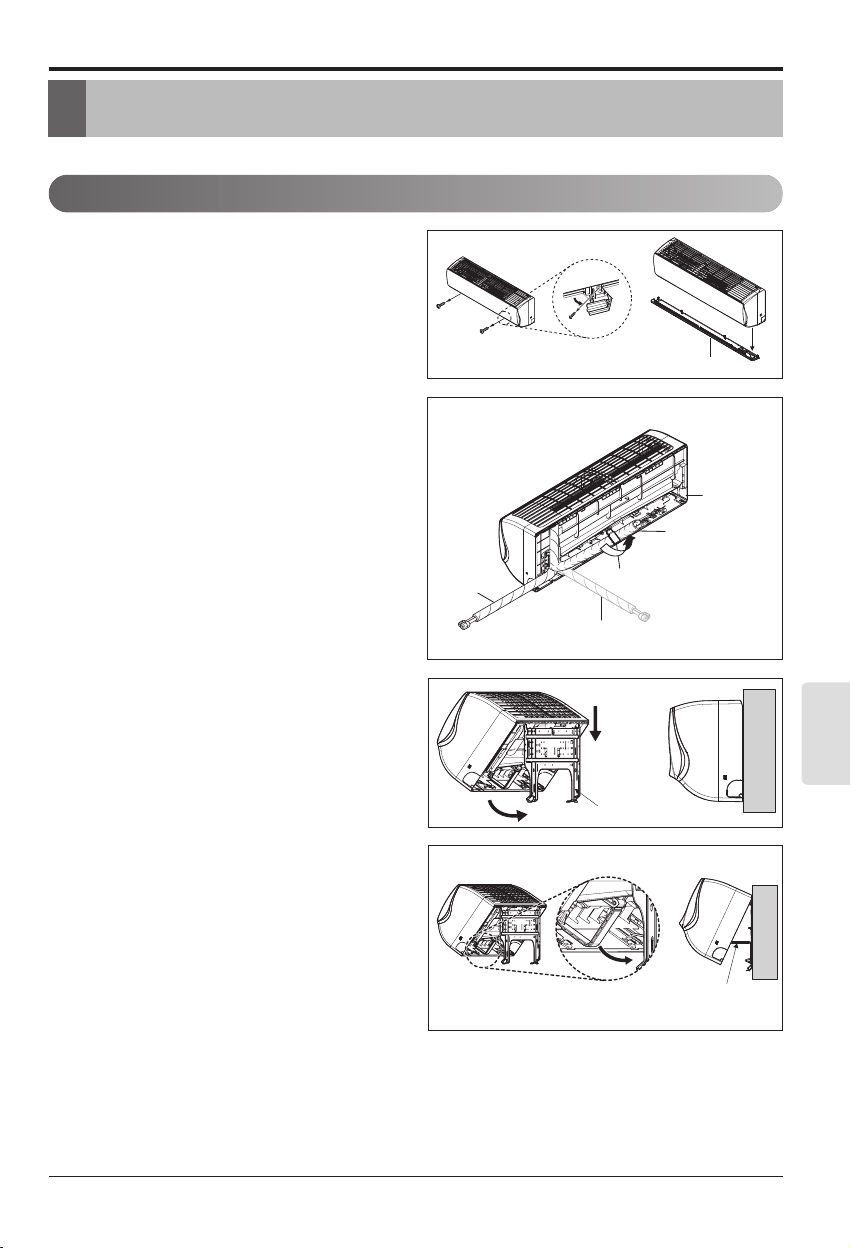
[Wall-mounted Type]
1. Pull the screw cap at the bottom of the in-
door unit
2. Remove the chassis cover from the unit by
loosening screws
3. Pull back the tubing holder.
4. Remove pipe port cover and positioning
the tubing
Chassis cover
Right
Indoor unit back side view
Tubing holder
Backwards
Left
Pipe Port
5. Indoor unit installation
1) Hook the indoor unit onto the upper portion of
the installation plate.( engage the three
hooks at the top of the indoor unit with the
upper edge of the installation plate) Ensure
that the hooks are properly seated on the in-
stallation plate by moving it left and right
2) Unlock the tubing holder from the chassis
and mount between the chassis and installa-
tion plate in order to separate the bottom side
of the indoor unit from the wall
Tubing Holder
Installation plate
Installation
14 Multi zone
Installation
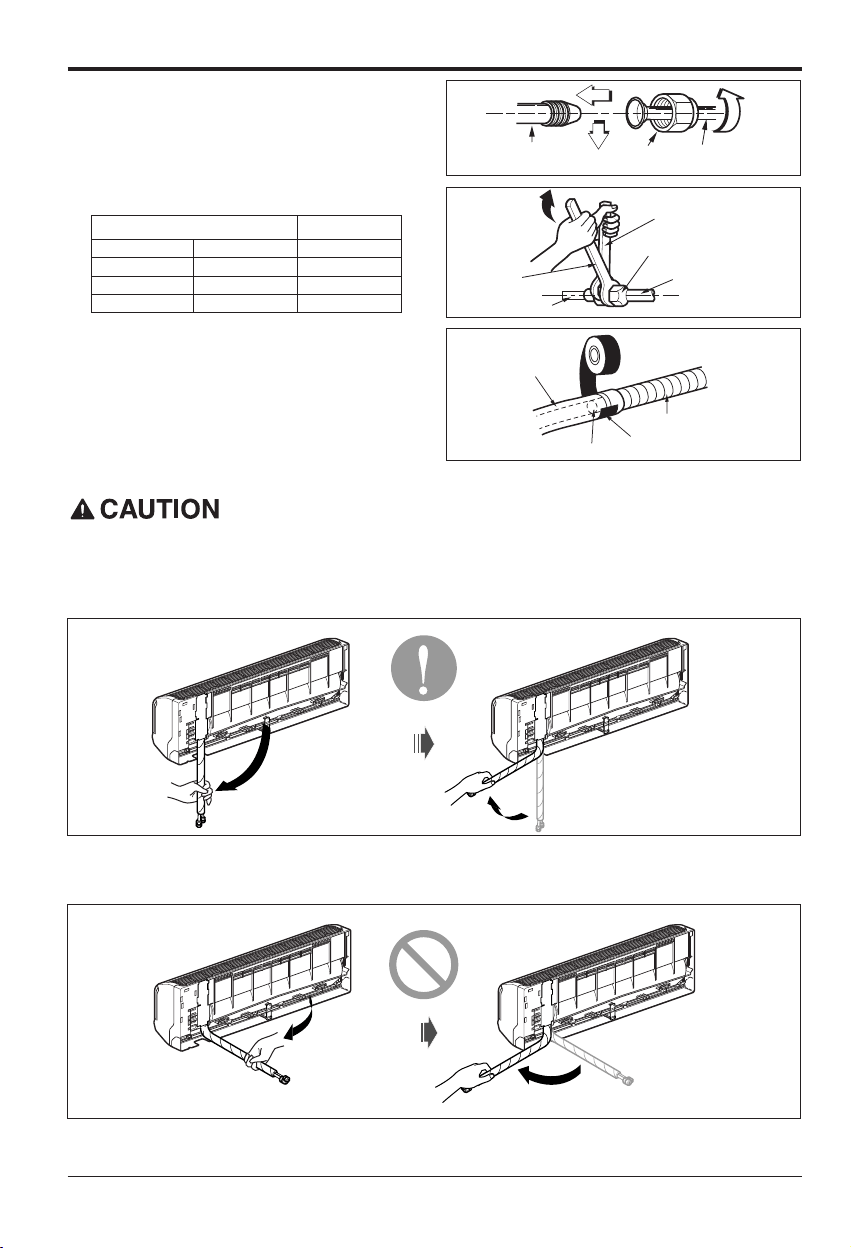
Connecting the piping to the indoor unit
and drain hose to drain pipe.
1. Align the center of the pipes and
sufficiently tighten the flare nut by hand.
2. Tighten the flare nut with a wrench.
3. Next, extend the indoor unit's drain hose.
Then attach the drain pipe.
Indoor unit tubing Flare nut Pipes
Wrench
Indoor unit tubing
Open-end wrench (fixed)
Connection pipe
Flare nut
Vinyl tape(narrow)
Adhesive
Drain pipe
Indoor unit drain hose
mm inch kgf.m (lbf·ft)
Ø6.35 1/4 1.8~2.5 (13~18)
Ø9.52 3/8 3.4~4.2 (24~30)
Ø12.7 1/2 5.5~6.6 (40~48)
Outside diameter Torque
Installation Information. For left piping. Follow the instruction below.
Good case
• Press on the upper side of clamp and unfold the tubing to slowly downward.
Bad case
• Bending the pipe from right to left may cause damage to the tubing.
Installation Manual 15
Installation
ENGLISH
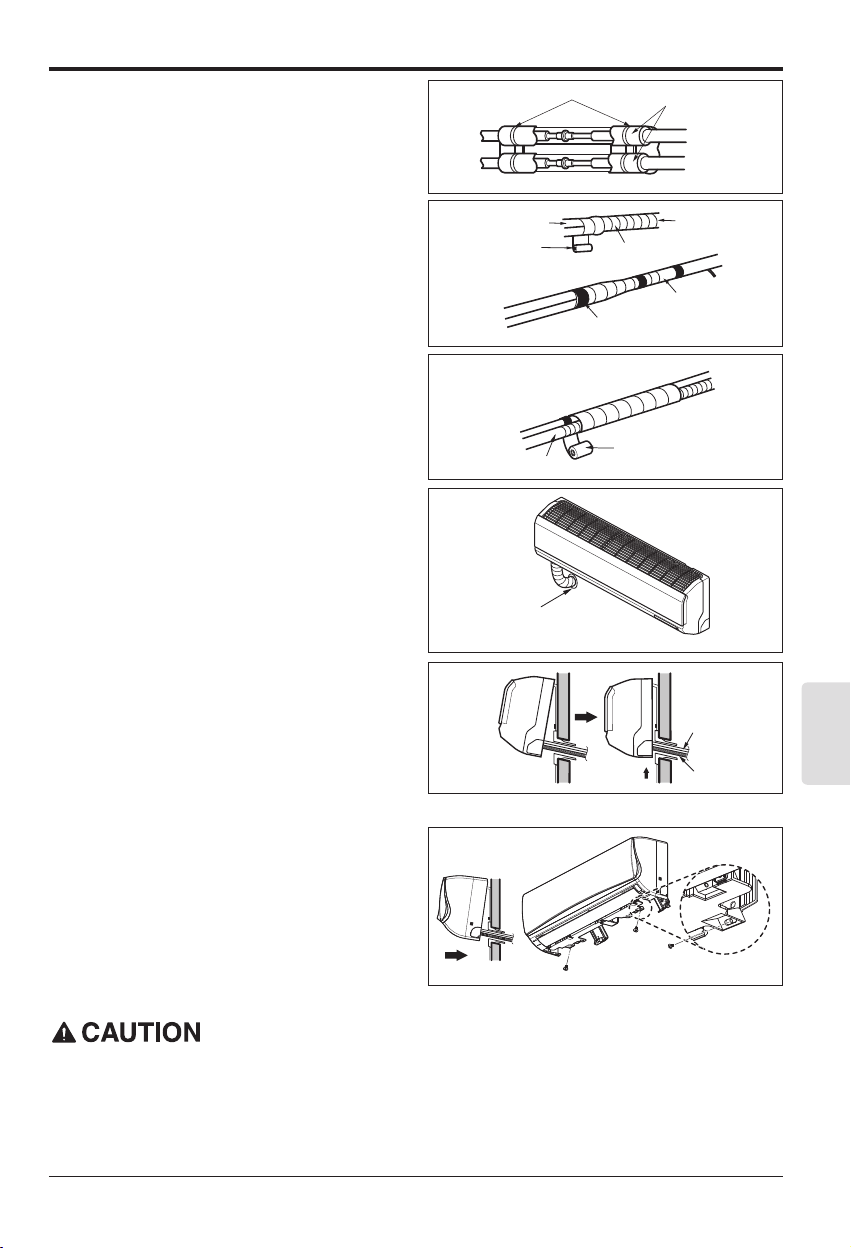
Wrap the insulation material around the
connecting portion.
1. Overlap the connection pipe insulation and the
indoor unit pipe heat insulation material. Bind
them together with vinyl tape so that there is no
gap.
2. Wrap the area which accommodates the rear
piping housing section with vinyl tape.
3. Bundle the piping and drain hose together by
wrapping them with vinyl tape over the range
within which they fit into the rear piping housing
section.
Reroute the pipings and the drain hose across
the back of the chassis.
Finishing the indoor unit installation
1.
Mount the tubing holder in the original positon.
2.
Ensure that the hooks are properly seated on the
installation plate by moving it left and right.
3. Press the lower left and right sides of the unit
against the installation plate until the hooks en-
gage into their slots (clicking sound).
4.
Finish the assembly by screwing the unit to the
installation plate by using two pieces of type "C"
screws. And assemble a chassis cover.
Plastic bands
Insulation material
Vinyl tape(narrow)
Connection pipe
Vinyl tape (wide)
Wrap with vinyl tape
Indoor unit pipe
Pipe
Drain hose
Vinyl tape(wide)
Piping for
passage through
piping hole
Drain hose
Connecting
Type 'C' screw
If the split type Indoor unit is installed in a wall having hole or opening near by or back side of the
unit, then the air from other side of the wall can come inside the condition space through that hole
/ opening. That air can cause unwanted dew / water droplet formation when it comes in contact
with body of the indoor unit. So all hole or opening on the wall must be blocked very well to avoid
water dropping from the body of the unit.
16 Multi zone
Installation
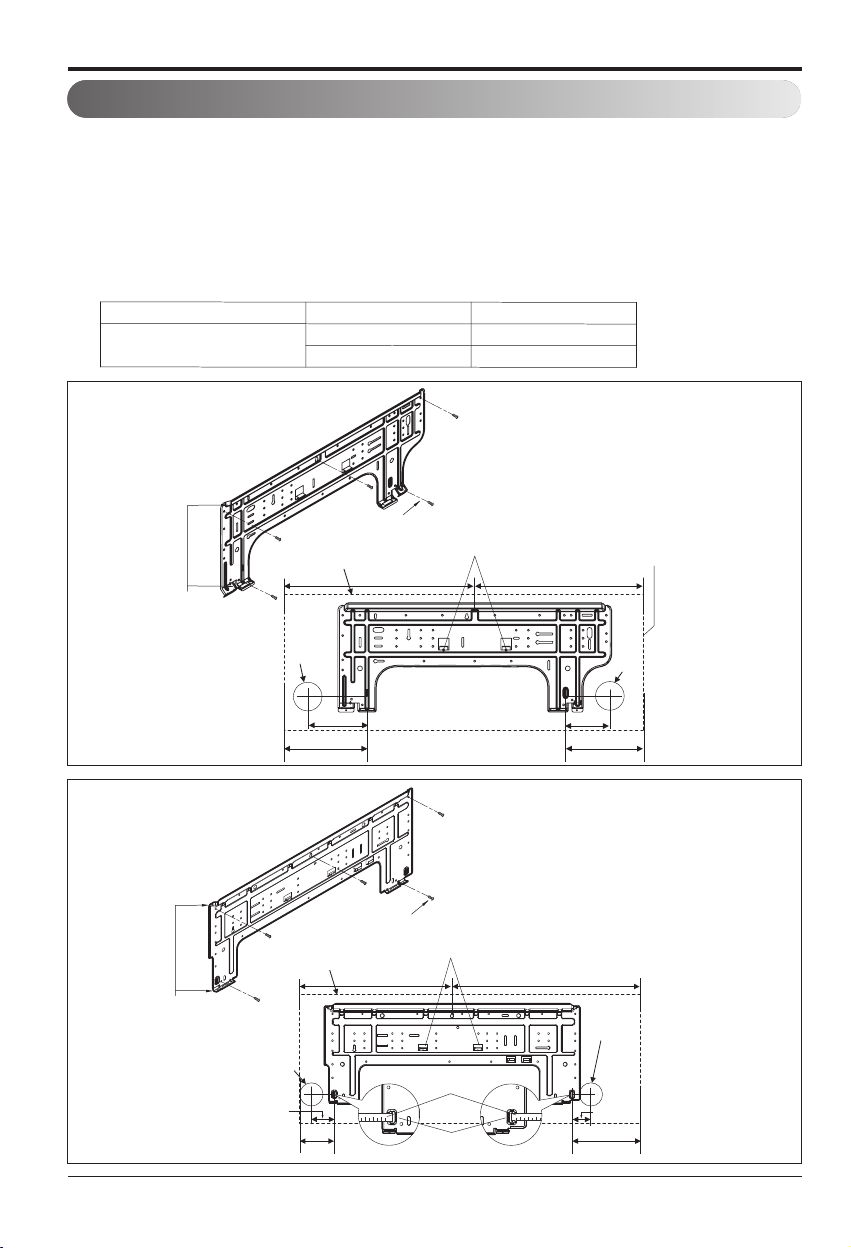
The wall you select should be strong and solid enough to prevent vibration
1. Mount the installation plate on the wall with
type "A" screws. If mounting the unit on a concrete wall, use anchor bolts.
• Mount the installation plate horizontally by aligning the centerline using a level.
2. Measure the wall and mark the centerline. It is also important to use caution concerning the
location of the installation plate-routing of the wiring to power outlets is through the walls
typically. Drilling the hole through the wall for piping connections must be done safely.
How to mount
Ø70
(2 3/4)
133(5 1/4)
95(5 3/4)
217(8 17/32)
175(6 7/8)
442(17 13/32) 442(17 13/32)
Ø70
(2 3/4)
Installation Plate
Enganche
del chasis
Type "A" Screws
Right rear piping
Left rear piping
Installation Plate
Place a level on raised tab
Unit Outline
Ø70
(2 3/4)
Ø70
(2 3/4)
69(2 23/32)
56(2 7/32)
207(8 5/32)
105(4 1/8)
460(18 1/8) 570(22 7/16)
Installation Plate
Enganche
del chasis
Type "A" Screws
Left rear piping
Installation Plate
Place a level on raised tab
Unit Outline
Right
rear
piping
Measuring Tape
Hanger
Measuring Tape
Indoor Type
Capacity (kBtu/h)
Type
Wall-mounted Type
9/12
Type 1
18
Type 2
<Type 1>
<Type 2>
Installation Manual 17
Installation
ENGLISH
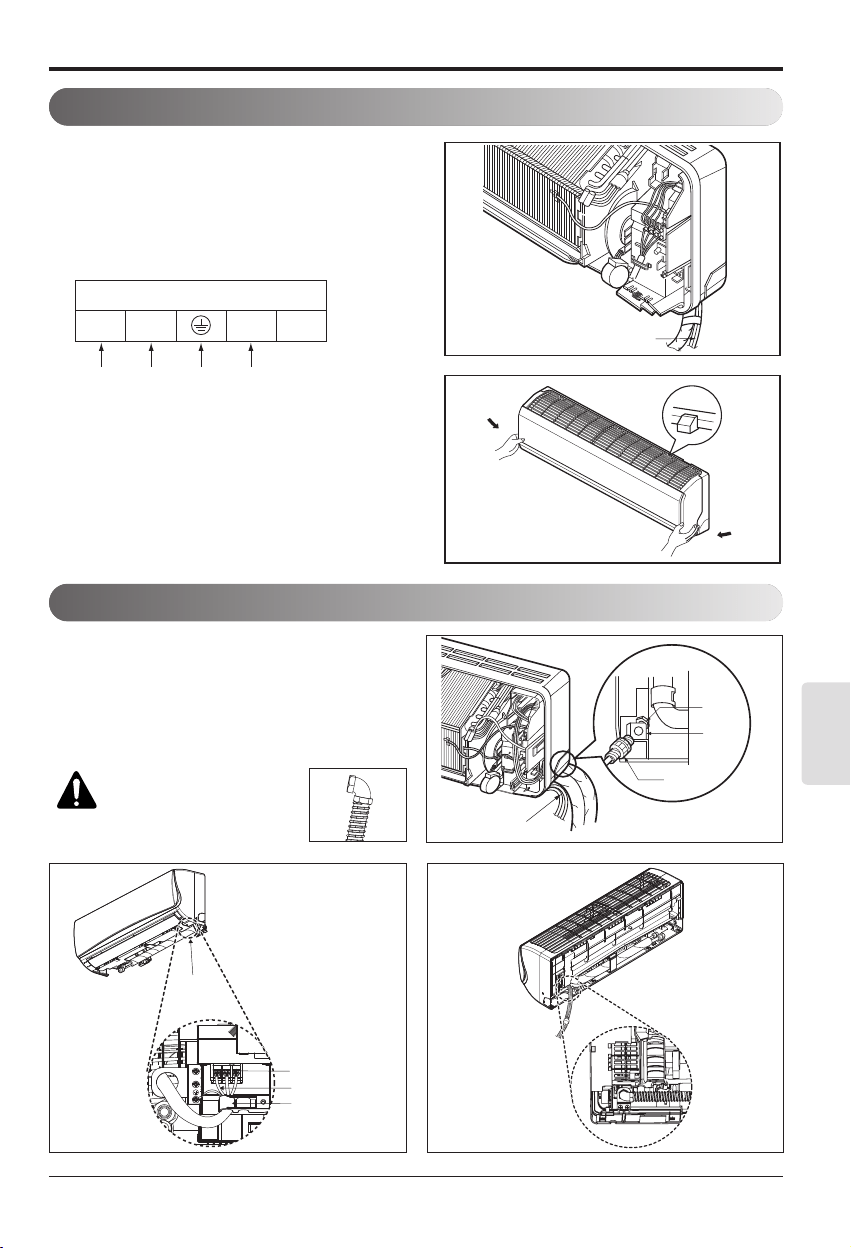
1. Connect the wires to the terminals on the
control board individually according to the
outdoor unit connection.
• Ensure that the color of the wires of outdoor
unit and the terminal No. are the same as
those of indoor unit respectively.
2. Attach the Grille onto the cabinet.
• Grasp the lower left and right side of the
Grille and engage four tabs on the top inside
edge of the chassis.
• Press the Grille toward the chassis until it
goes back into place.
Connecting cable
Conduit connection
1. Set the connecting cable into the terminal
block of indoor unit, and tighten set screw to
lock the conduit bracket to the indoor unit.
2. Join the conduit and the conduit bracket
together.
Connecting cable
Lock nut
Conduit
Conduit
bracket
Terminal Block in Indoor
1(L1) 2(L2) 3 4
Connected to Outdoor Unit
View
Terminal block
Connecting cable
Cable retainer
CAUTION :
Must use
the elbow type (L-Type)
conduit.
Wiring Connection
18 Multi zone
Installation
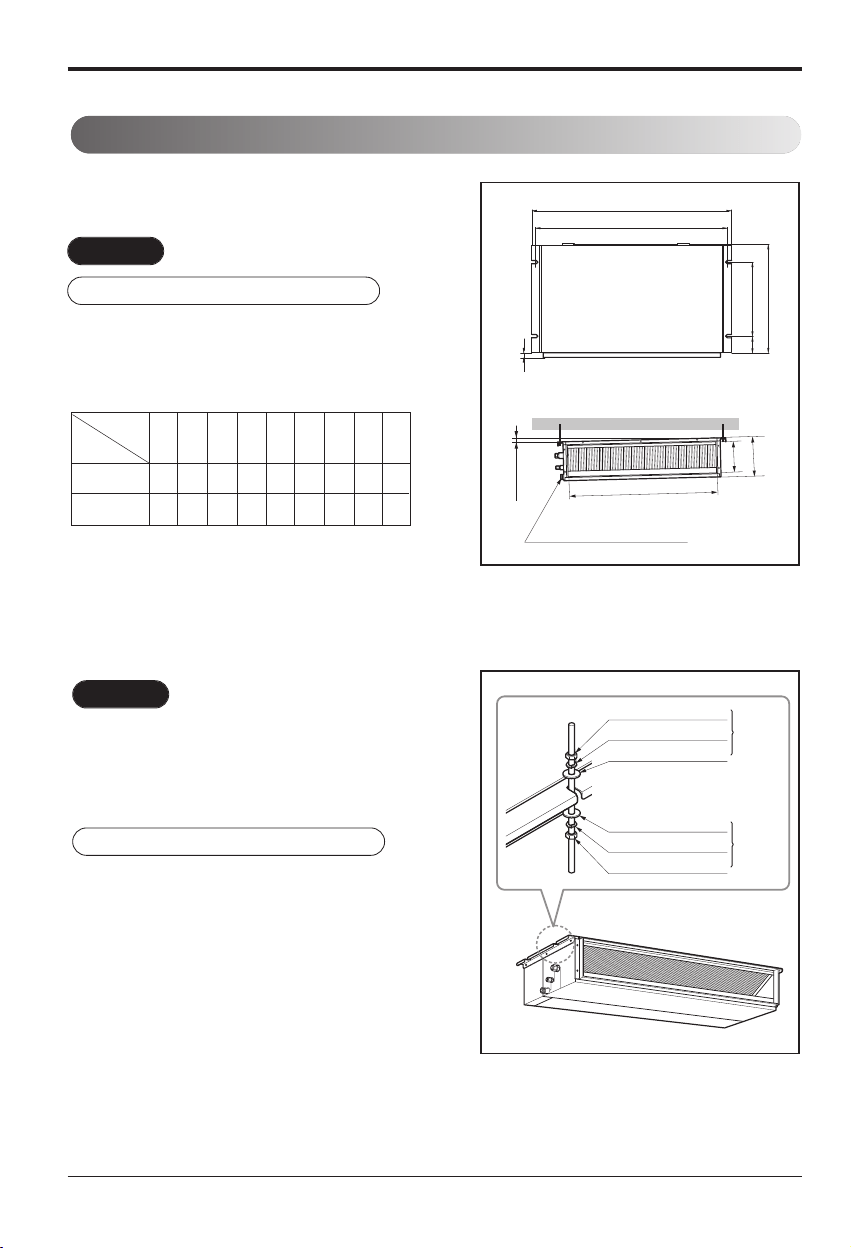
[Ceiling Concealed Duct Type]
Ceiling dimension and hanging bolt location
Installation of Unit
Install the unit above the ceiling correctly.
• Apply a joint-canvas between the unit and duct
to absorb unnecessary vibration.
• Apply a filter Accessory at air return hole.
• Install the unit leaning to a drainage hole side as
a figure for easy water drainage.
• A place where the unit will be leveled and that
can support the weight of the unit.
• A place where the unit can withstand its
vibration.
• A place where service can be easily performed.
CASE 1
POSITION OF SUSPENSION BOLT
CE
G
D
A
B
M10 Nut
M10 SP. washer
M10 washer
X 4
X 4
(Local
supply)
X 4
M10 Nut
M10 SP. washer
M10 washer
X 4
X 4
(Local
supply)
X 4
1/100
I
F
H
Drainage hole
CASE 2
POSITION OF CONSOLE BOLT
Unit:mm(inch)
12k
850 900 383 570 93.5 190 20.6 795 163
(33 15/32) (35 15/32) (15 3/32) (22 7/16) (3 11/16) (7 1/2) (13/16) (31 5/16) (6 13/32)
18k
1130 1180 383 570 93.5 190 20.6 1065 163
(44 1/2) (46 1/2) (15 3/32) (22 7/16) (3 11/16) (7 1/2) (13/16) (41 15/16) (6 13/32)
Dimension
Capacity
Btu/h class
ABCDEFGH I
Installation Manual 19
Installation
ENGLISH
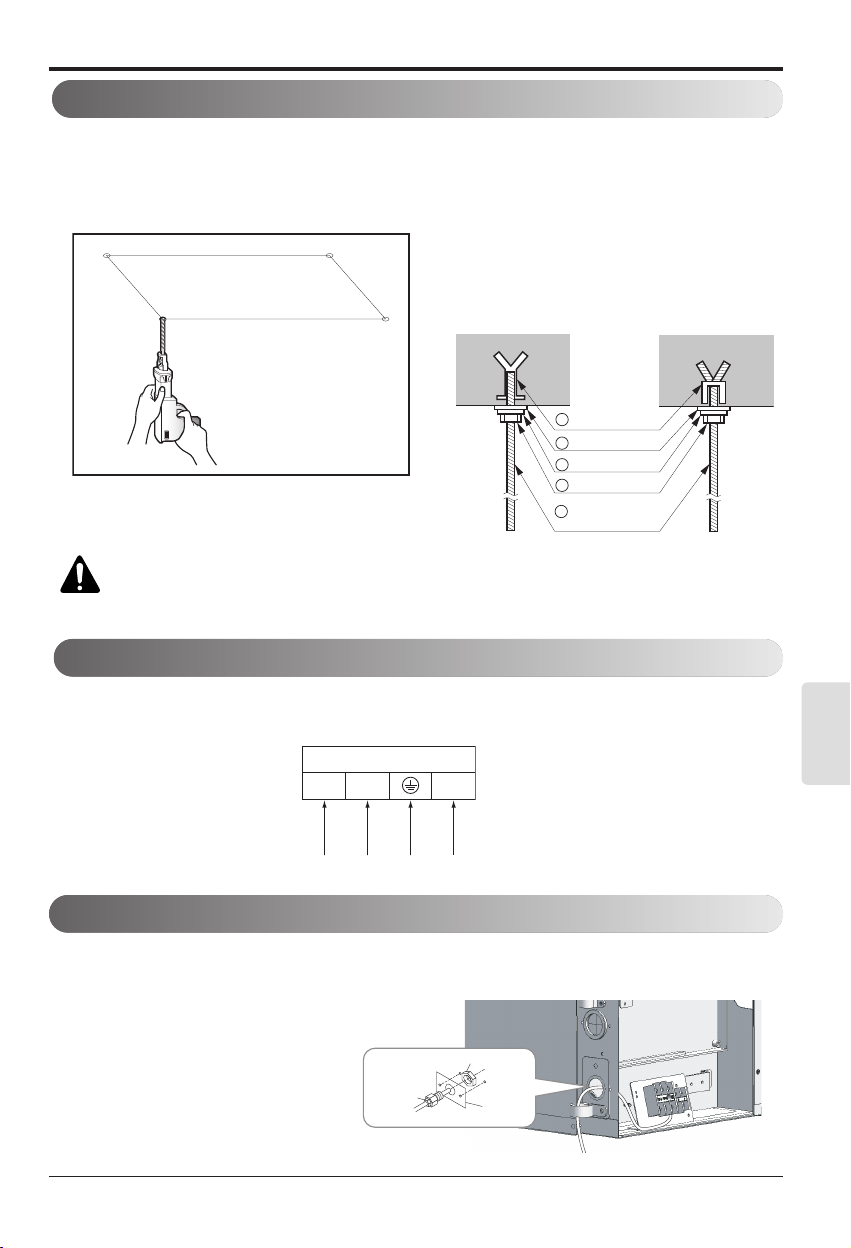
• Select and mark the position for fixing
bolts.
• Drill the hole for set anchor on the face of
ceiling.
• Insert the set anchor and washer onto the
suspension bolts for locking the
suspension bolts on the ceiling.
• Mount the suspension bolts to the set
anchor firmly.
• Secure the installation plates onto the
suspension bolts (adjust level roughly)
using nuts, washers and spring washers.
1 Set anchor
Old building New building
2 Plate washer
3 Spring washer
4 Nut
5 Suspension
bolts
CAUTION : Tighten the nut and bolt to prevent unit falling.
Connect the wires to the terminals on the control board individually according to the outdoor unit connection.
• Ensure that the color of the wires of outdoor unit and the terminal No. are the same as those of indoor unit respectively.
Terminal Block of Indoor Unit
1(L1) 2(L2) 3
Connected to outdooor unit
Conduit connection
1. Remove the bushing rubber product attached on the indoor unit.
2. Set the connecting cable into the terminal block of indoor unit, and tighten set screw to lock the
conduit bracket to the indoor unit.
3. Join the conduit and the conduit bracket together.
Lock nut
Conduit
mounting
plate
Conduit
Wiring Connection
How to mount
20 Multi zone
Installation
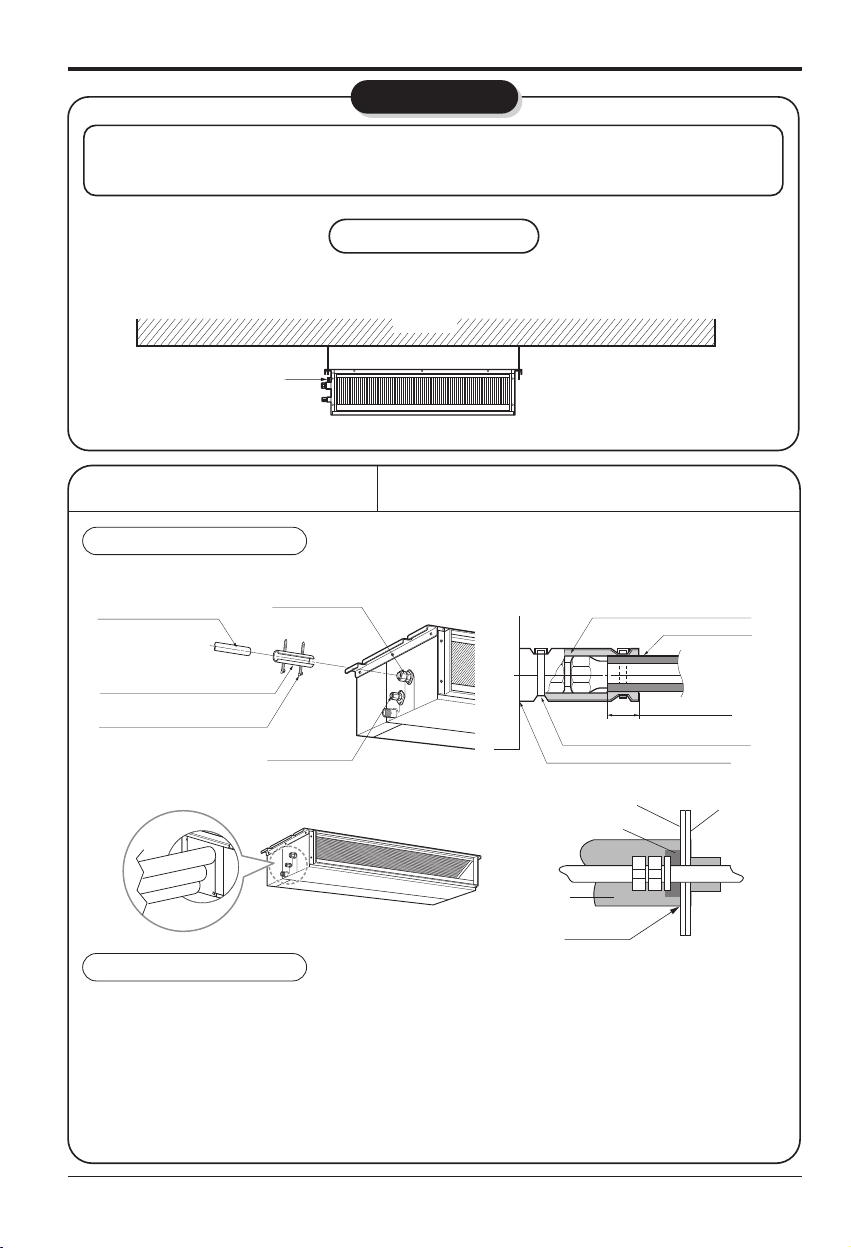
CAUTION
Ceiling
Drain Pump use
Drainage hole
Front of view
1. Install declination of the indoor unit is very important for the drain of the duct type air conditioner.
2. Minimum thickness of the insulation for the connecting pipe shall be 19mm(1/32 inch).
• The unit must be horizontal or declined to the drain hose connected when
finished installation.
INSULATION, OTHERS
Insulate the joint and tubes completely.
All thermal insulation must comply with local requirement.
INDOOR UNIT
■ After all workings are finished, check the working and operation.
• Air distribution ............... Is the air circulation good?
• Drain ............................. Is the drainage smoothly and no sweating?
• Gas leakage ................. Is the piping connection correctly?
• Wiring ........................... Is the wiring connection correctly?
• Lock-bolt ....................... Is the lock-bolt of compressor loosened?
• Insulation....................... Is the unit fully insulated?
• Ground .......................... Is the unit safely grounded?
THERMAL INSULATION
TEST AND CHECK
Make sure that there is no clearance here.
Overlap with thermal
insulator for piping.
Thermal insulator for refrigerant pipe
(Local supply)
Thermal insulator for
piping(Local supply)
Hose clip for thermal insulator(Local supply)
Union for gas pipe
Refrigerant pipe and thermal
insulator(Local supply)
Union for liquid pipe
Thermal insulator for refrigerant pipe
(Local supply)
Hose clip for thermal insulator
(Local supply)
Felt
Rubber
Insulation
No clearance
Cabinet

Installation Manual 21
Installation
ENGLISH
Remote controller installation
Please fix tightly using provided screw after placing remote controller setup board
on the place where you like to setup.
- Please set it up not to bend because poor setup could take place if setup board bends.
Please set up remote controller board fit to the reclamation box if there is a reclamation box.
Can set up Wired remote controller cable into three directions.
- Setup direction: the surface of wall reclamation, upper, right
- If setting up remote controller cable into upper and right side, please set up after removing remote
controller cable guide groove.
* Remove guide groove with long nose.
① Reclamation to the surface of the wall
② Upper part guide groove
③ Right part guide groove
<Wire guide grooves>

22 Multi zone
Installation
Please fix remote controller upper part into
the setup board attached to the surface of
the wall, as the picture below, and then,
connect with setup board by pressing
lower part.
- Please connect not to make a gap at the remote
controller and setup board’s upper and lower, right
and left part.
When separating remote controller from
setup board, as the picture below, after
inserting into the lower separating hole
using screw driver and then, spinning
clockwise, remote controller is separated.
- There are two separating holes. Please
individually separate one at a time.
- Please be careful not to damage the inside
components when separating.
Please connect indoor unit and remote controller using connection cable.
Please use extension cable if the distance between wired remote controller and
indoor unit is more than 10m.
Wall
Side
Wall
Side
Wall
Side
Wall
Side
<Connecting order>
<Separating order>
Please check if connector is normally connected.
Connecting cable
Indoor
Unit side
TEMP
FAN
SPEED
OPER
MODE
CAUTION :
When installing the wired remote controller, do not bury it in the wall.
(It can cause damage in the temperature sensor.)
Do not install the cable to be 50m or above.
(It can cause communication error.)
• When installing the extension cable, check the connecting direction of the connector of the
remote controller side and the product side for correct installation.
• If you install the extension cable in the opposite direction, the connector will not be connected.
• Specification of extension cable: 2547 1007 22# 2 core 3 shield 5 or above.
• Apply totally enclosed noncombustible conduit in case of local building code Requiring plenum
cable usage.
Installation Manual 23
Installation
ENGLISH
Wired remote controller installation
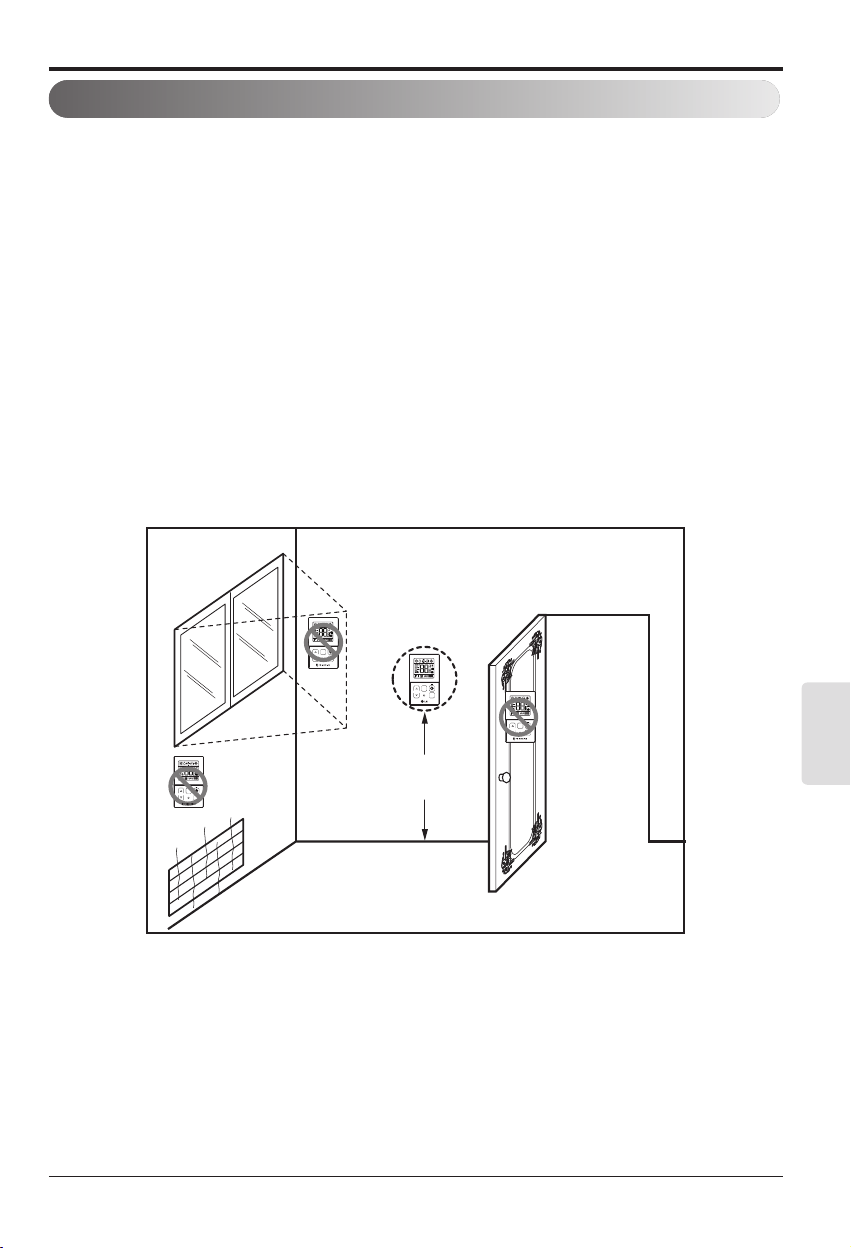
Since the room temperature sensor is in the remote controller, the remote controller box should be
installed in a place away from direct sunlight, high humidity and direct supply of cold air to maintain
proper space temperature. Install the remote controller about 5ft(1.5m) above the floor in an area
with good air circulation at an average temperature.
Do not install the remote controller where it can be affected by:
- Drafts, or dead spots behind doors and in corners.
- Hot or cold air from ducts.
- Radiant heat from sun or appliances.
- Concealed pipes and chimneys.
- Uncontrolled areas such as an outside wall behind the remote controller.
- This remote controller is equipped with LCD. display. For proper display of the remote controller
LCD's, the remote controller should be installed properly as shown in Fig.1.
(The standard height is 4~5 ft (1.2~1.5 m) from floor level.)
TEMP
FAN
SPEED
OPER
MODE
TEMP
FAN
SPEED
OPER
MODE
TEMP
FAN
SPEED
OPER
MODE
5feet
(1.5meters)
no
no
yes
TEMP
FAN
SPEED
OPER
MODE
[Fig.1]
24 Multi zone
Installation
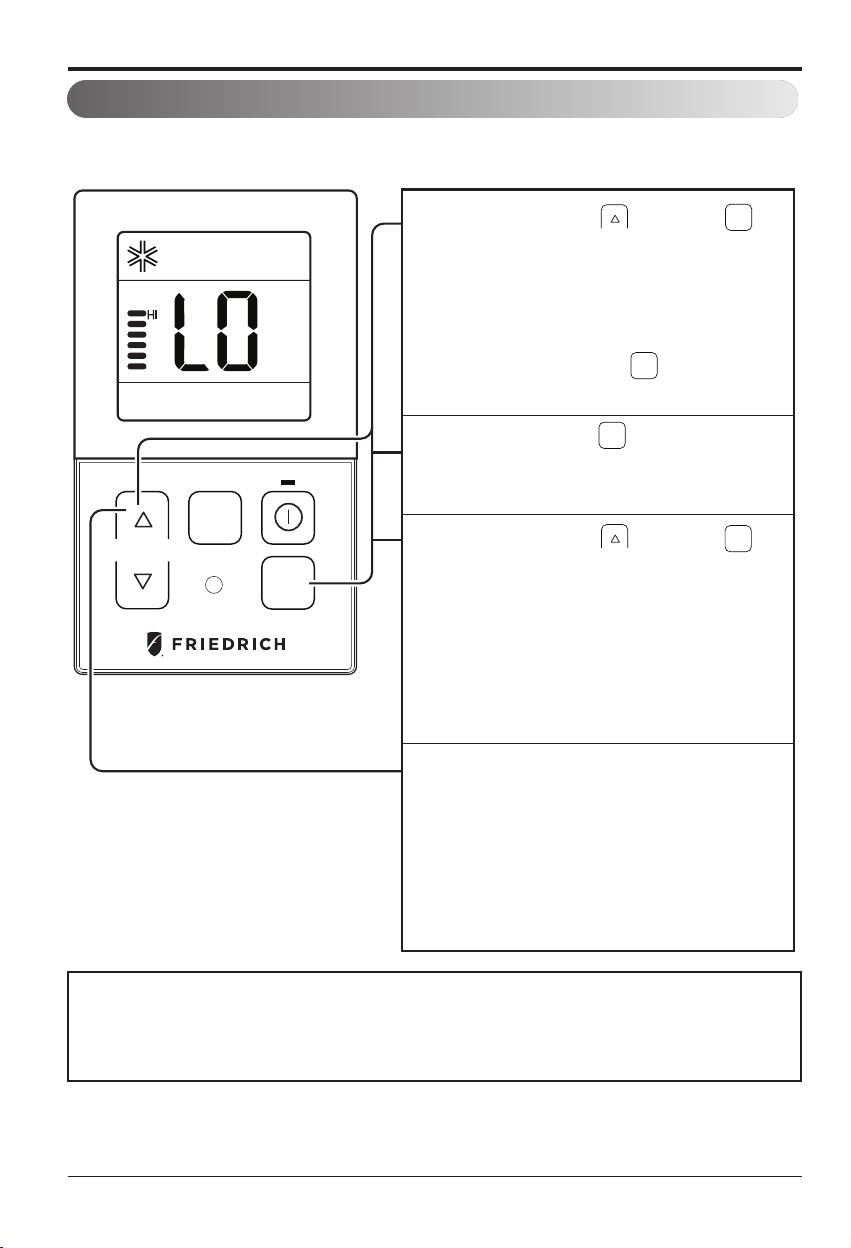
After installing the product, you must run a Test Run mode.
For details related to this operation, refer to the product manual.
TEMP
FAN
SPEED
OPER
MODE
When pressing the button and
button simultaneously for more than 3
seconds, the system will be entered into
the installer setting mode.
- After entering into the installer setting
mode, select the test run mode code
value by pressing the button.
* Test run mode code value : 01
1
When pressing the button, the test
operation mode will be performed, and it is
displayed as shown in the left figure.
2
When pressing the button and
button simultaneously for more than 3
seconds after the setting has been
completed, the setting mode will be
released.
- If there isn’t any button input for more
than 25 seconds, the installer setting
mode will also be released.
3
When approx. 18 minutes are elapsed after
starting of the test oper-mode, the system
will be stopped automatically and converted
to the standby state.
- If any button is inputted during the test run
mode, the test run mode will be forced to
be relreased.
4
OPER
MODE
OPER
MODE
OPER
MODE
OPER
MODE
• What is the test run mode??
- This means the operation of the product under the cooling, strong wind, and Comp on state
without performing room temperature control in order to confirm the installed state during the
product installation.
Installer Setting - Test Run Mode
Installation Manual 25
Installation
ENGLISH
Installer Setting - Thermistor
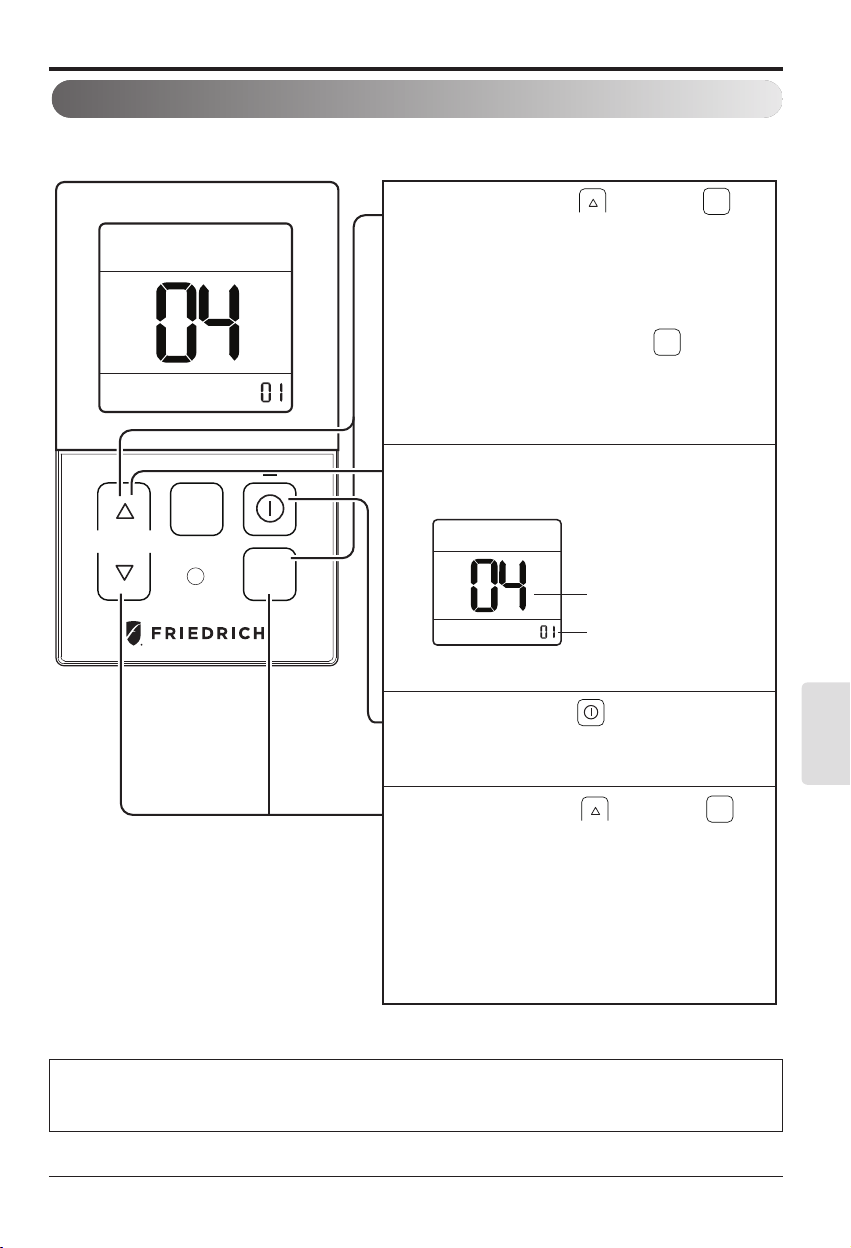
This is the function to select the temperature sensor to judge the room temperature.
TEMP
FAN
SPEED
OPER
MODE
When pressing the button and
button simultaneously for more than 3
seconds, the system will be entered into the
installer setting mode.
- After entering into the installer setting
mode, select the thermistor sensor setting
code value by pressing the
button.
* Thermistor sensor selection code value :
04
1
Select the desired setting value with the
temperature up(▲), down(▼) button.
2
When pressing the button, currently
established thermistor sensor location will
be set up.
3
When pressing the button and
button simultaneously for more than 3
seconds after the setting has been
completed, the setting mode will be
released.
- If there isn’t any button input for more than
25 seconds, the installer setting mode will
also be released.
4
OPER
MODE
OPER
MODE
Code value
*Setting value
01: Remote
controller
02: Indoor unit
03: 2TH
OPER
MODE
Value
• As the characteristic of the ‘2TH’ function can be different in accordance with the products,
refer to the product instruction manual for its detail.
26 Multi zone
Installation
TEMP
FAN
SPEED
OPER
MODE
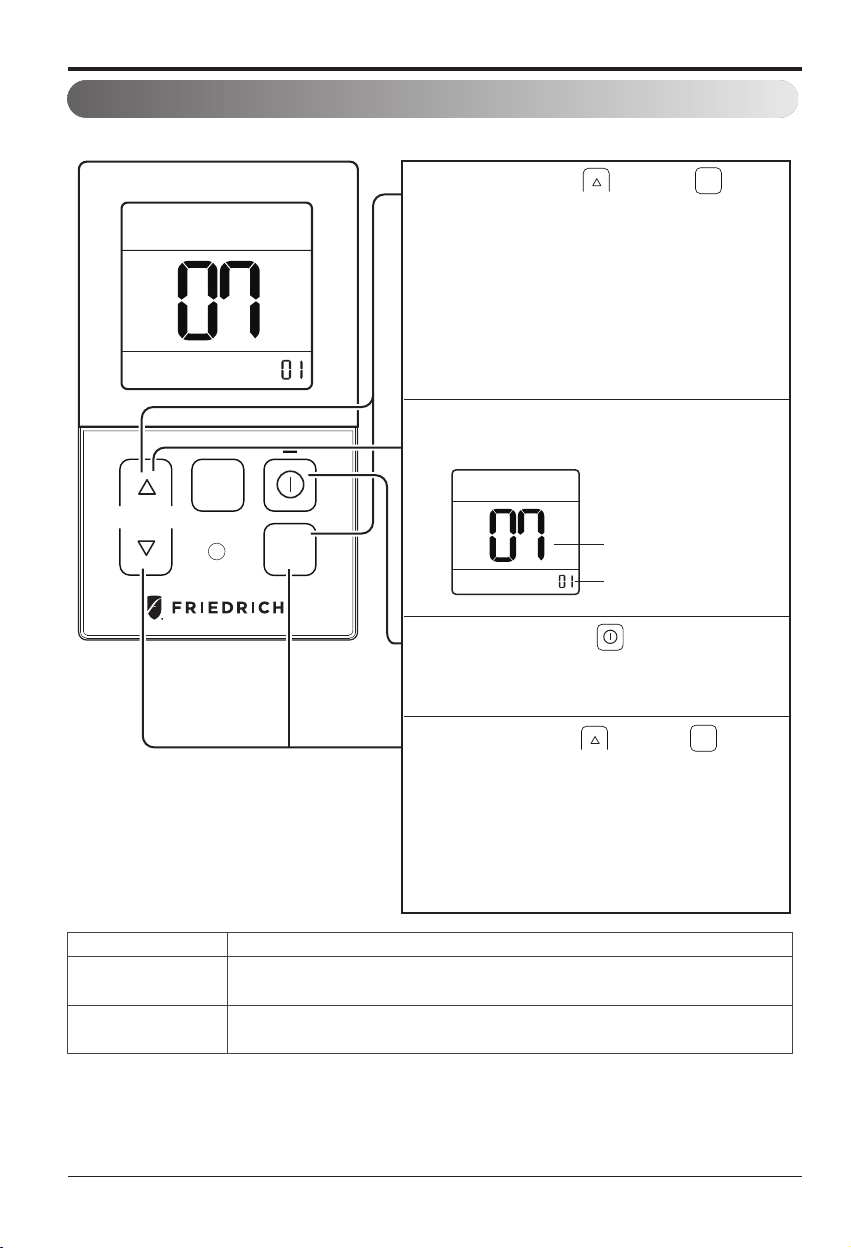
When pressing the button and button
simultaneously for more than 3 seconds, the
system will be entered into the installer setting
mode.
- After entering into the installer setting mode,
select the ceiling height setting code value by
pressing the oper-mode button.
* Remote controller master/slave setting code
value : 07
1
Select the desired setting value with the
temperature up(▲), down(▼) button.
2
When pressing the button, currently
established static pressure value will be set
up.
3
When pressing the button and button
simultaneously for more than 3 seconds after the
setting has been completed, the setting mode will
be released.
- If there isn’t any button input for more than 25
seconds, the installer setting mode will also be
released.
4
OPER
MODE
Code value
*Setting value
00:Slave
01:Master
OPER
MODE
Value
* Refer to the 'group control' part for details
- When controlling in groups, basic operation settings, airflow strength weak/medium/strong,
lock setting of the remote controller, time settings, and other functions may be restricted.
Remote controller Function
Master
Indoor unit operates based on master remote controller at group control.
(Master is set when delivering from the warehouse.)
Slave
Setup all remote controllers except one master remote controller to slave at
group control
It is a function for settings in group control, or 2-remote controller control.
Installer Setting - Group Setting
Installation Manual 27
Installation
ENGLISH
Installer Setting - Celsius / Fahrenheit Switching
TEMP
FAN
SPEED
OPER
MODE
When pressing the button and button
simultaneously for more than 3 seconds, the
system will be entered into the installer setting
mode.
- After entering into the installer setting mode,
select the ceiling height setting code value by
pressing the oper-mode button.
* Celsius/Fahrenheit setting code value : 07
1
Select the desired setting value with the
temperature up(▲), down(▼) button.
2
When pressing button, currently
established celsius/Fahrenheit setting value
will be set up.
3
When pressing the button and button
simultaneously for more than 3 seconds after the
setting has been completed, the setting mode will
be released.
- If there isn’t any button input for more than 25
seconds, the installer setting mode will also be
released.
4
OPER
MODE
Code value
*Setting value
00:Celsius
01:Fahrenheit
OPER
MODE
Value
• Whenever press temp up(▲), down(▼) button in Fahrenheit mode, the temperature will
increase/drop 2 degrees.
This function is used for switching the display between Celsius and Fahrenheit.
(Optimized only for U.S.A)

28 Multi zone
Installation
Installer Setting - E.S.P.
Static pressure(mmAq)
Setting value
01234
Model name
Step(H/M/L)
9.5 CMM(335cfm) 82 90 99 109 118
8.5 CMM(300cfm) 75 84 94 104 114
7.5 CMM(265cfm) 69 77 88 99 110
15 CMM(530cfm) 90 97 105 114 122
13.5 CMM(477cfm) 82 90 99 109 119
11.5 CMM(406cfm) 75 84 93 103 114
MD12Y3JM
MD18Y3JM
This is the function that decides the strength of the wind for each wind level and because this
function is to make the installation easier.
• If you set ESP incorrectly, the air conditioner may malfunction.
• This setting must be carried out by a certificated-technician.
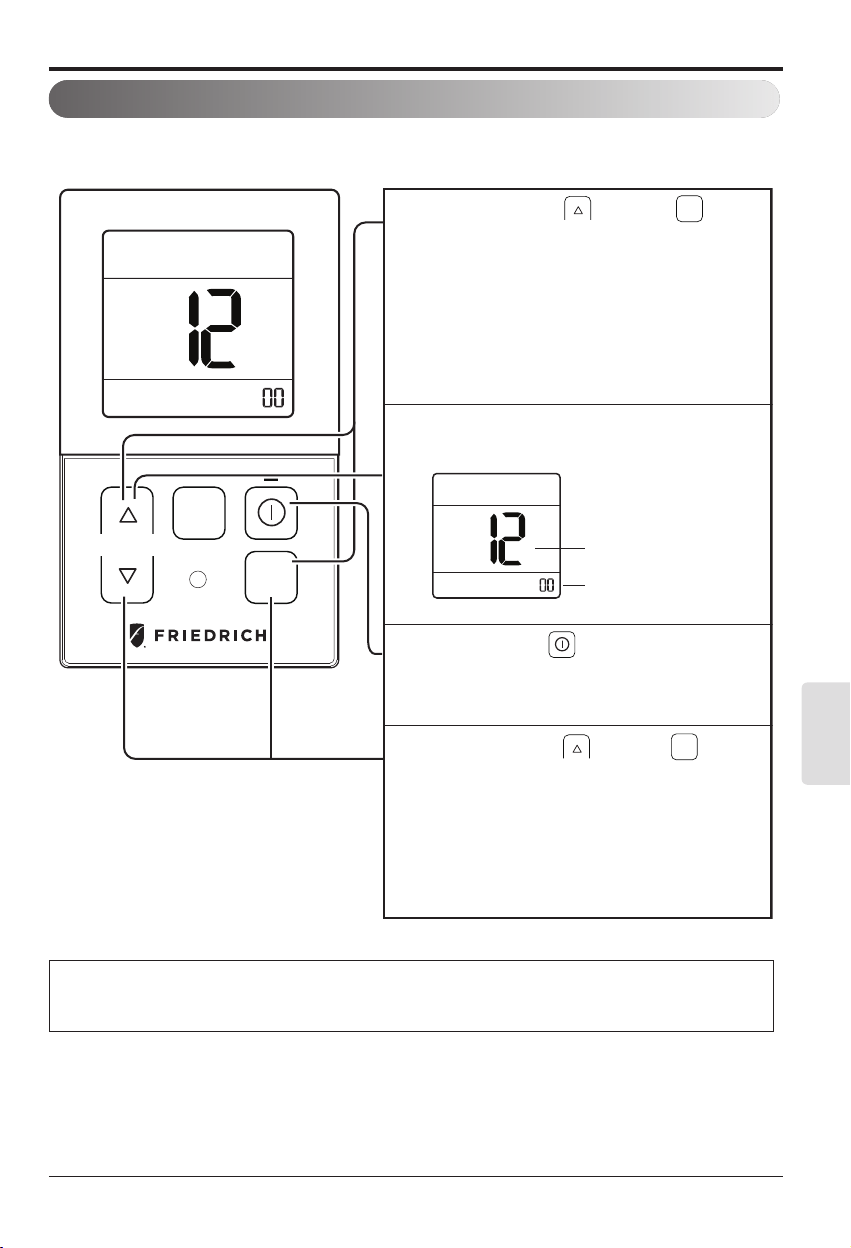
TEMP
FAN
SPEED
OPER
MODE
When pressing the button and button
simultaneously for more than 3 seconds, the system will be
entered into the installer setting mode.
- After entering into the installer setting mode, select the
E.S.P code value by pressing the button.
* E.S.P code value : 03
1
Select the desired air flow rate with
the button. Whenever pressing
the button, [SLo
→
Lo
→
Med
→
Hi
→
Po] will be indicated.
2
Select the desired air flow rate value with the temperature
up(▲), down(▼) button.
* E.S.P value range : 0~255
-
E.S.P value will be indicated at the upper right section of the
display window.
3
When pressing the button, currently established E.S.P
value will be set up.
4
When pressing the button and button simultaneously
for more than 3 seconds after the setting has been completed,
the setting mode will be released.
- If there isn’t any button input for more than 25 seconds, the
installer setting mode will also be released.
5
OPER
MODE
OPER
MODE
FAN
SPEED
FAN
SPEED
OPER
MODE
Installation Manual 29
Installation
ENGLISH
[Ceiling Cassette Type]
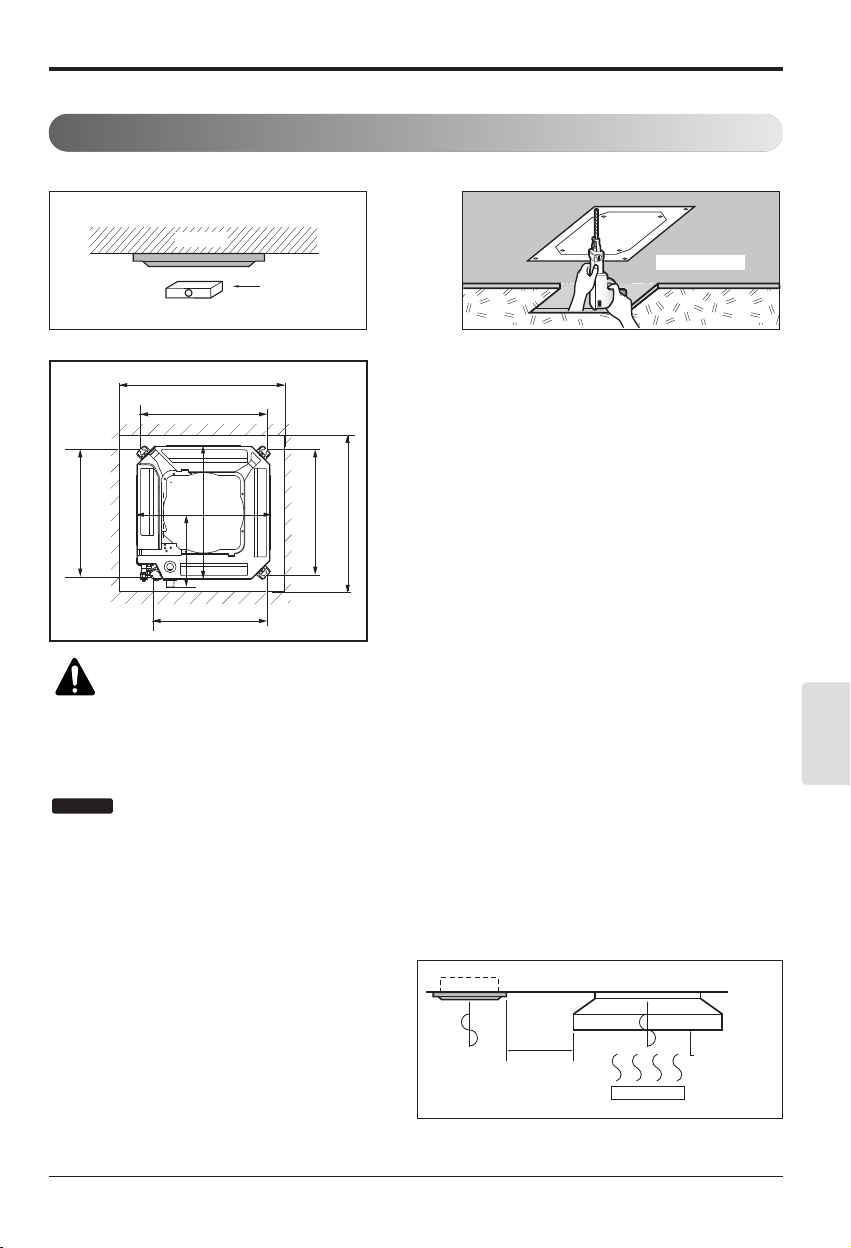
Ceiling dimension and hanging bolt location
Level gauge
Ceiling
Ceiling board
Unit: mm(inch)
585~660(23 1/16~26) (Ceiling Opening)
517(20 3/8)
461(18 5/32)
517(20 3/8)
585~660(23 1/16~26) (Ceiling Opening)
523(20 19/32)
570(22 15/32)
Unit Size
570(22 15/32)
Unit Size
319(12 9/16)
• The dimensions of the paper model for installation are the same as those of the ceiling opening dimensions.
• Avoid the following installation location.
1. Such places as restaurants and kitchen where considerable amount of oil steam and flour is generated.
These may cause heat exchange efficiency reduction, or water drops, drain pump mal-function.
In these cases, take the following actions;
• Make sure that ventilation fan is enough to cover all noxious gases from this place.
• Ensure enough distance from the cooking room to install the air conditioner in such a place where it may not suck oily
steam.
2. Avoid installng air conditioner in such places where
cooking oil or iron powder is generated.
3. Avoid places where inflammable gas is generated.
4. Avoid place where noxious gas is
generated.
5. Avoid places near high frequency
generators.
NOTICE
CAUTION :
• This air-conditioner uses a drain pump.
• Install the unit horizontally using a level gauge.
• During the installation, care should be taken not to damage electric wires.
• Select and mark the position for fixing bolts and piping
hole.
• Decide the position for fixing bolts slightly tilted to the
drain direction after considering the direction of drain
hose.
• Drill the hole for anchor bolt on the wall.
Use the ventilation fan
for smoke-collecting
hood with sufficient
capacity.
Cooking table
Air conditioner
Take enough
distance
30 Multi zone
Installation
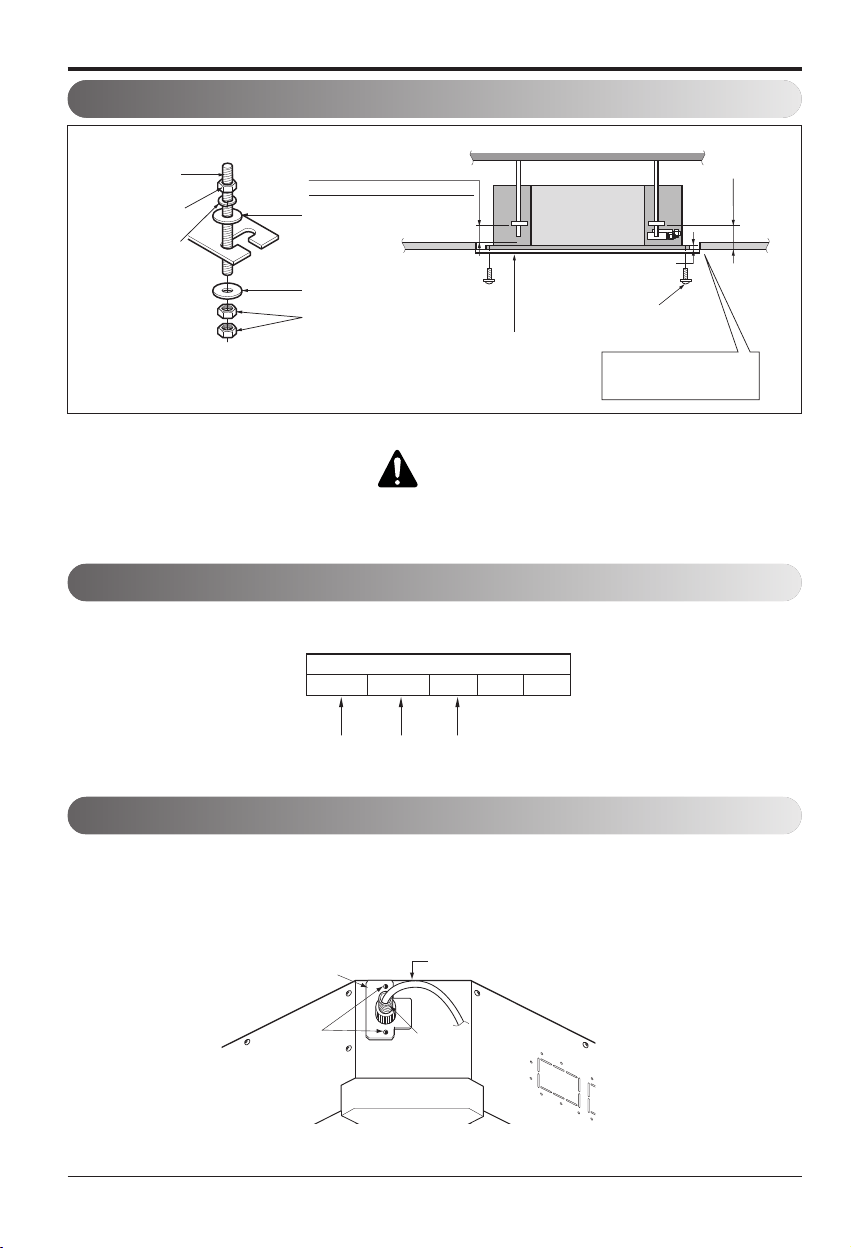
Set screw of
paper model (4 pieces)
Paper model
for installation
Ceiling board
150mm
(5-7/8 inch)
Ceiling board
Ceiling
Flat washer for M10
(accessory)
Keep the length of the bolt
from the bracket to 40mm(1-9/16 inch)
Open the ceiling board
along the outer edge of the
paper model
Flat washer for M10
(accessory)
Hanging bolt
(W3/8 or M10)
Nut
(W3/8 or M10)
Nut
(W3/8 or M10)
Spring washer
(M10)
Air Conditioner body
Keep the length of 31~34mm(1.22~1.34inch)
between the air conditioner bottom surfac
e and the ceiling surface
• The following parts are local purchasing.
① Hanging Bolt - W 3/8 or M10
② Nut - W 3/8 or M10
③ Spring Washer - M10
④ Plate Washer - M10
CAUTION : Tighten the nut and bolt to
prevent unit from falling off.
Wiring Connection
How to Fix
1(L1) 2(L2) 3 4 5
Terminal Block of Indoor Unit
Connected to outdoor unit
TQ/TR series
Connecting Cable
Conduit
Screw
Conduit bracket
Conduit connection
• Remove the busing rubber product attached on the indoor unit.
• Join the conduit and the conduit bracket together using nut.
• Set the connecting cable into the terminal block of indoor unit, and tighten set screw to lock the
conduit bracket to the indoor unit.
• Open the control box cover and connect the remote control cord and indoor power wires.

Installation Manual 31
Installation
ENGLISH
Installation of Wired Remote Controller(Optional)
1
2
3
2
3
<Wire guide grooves>
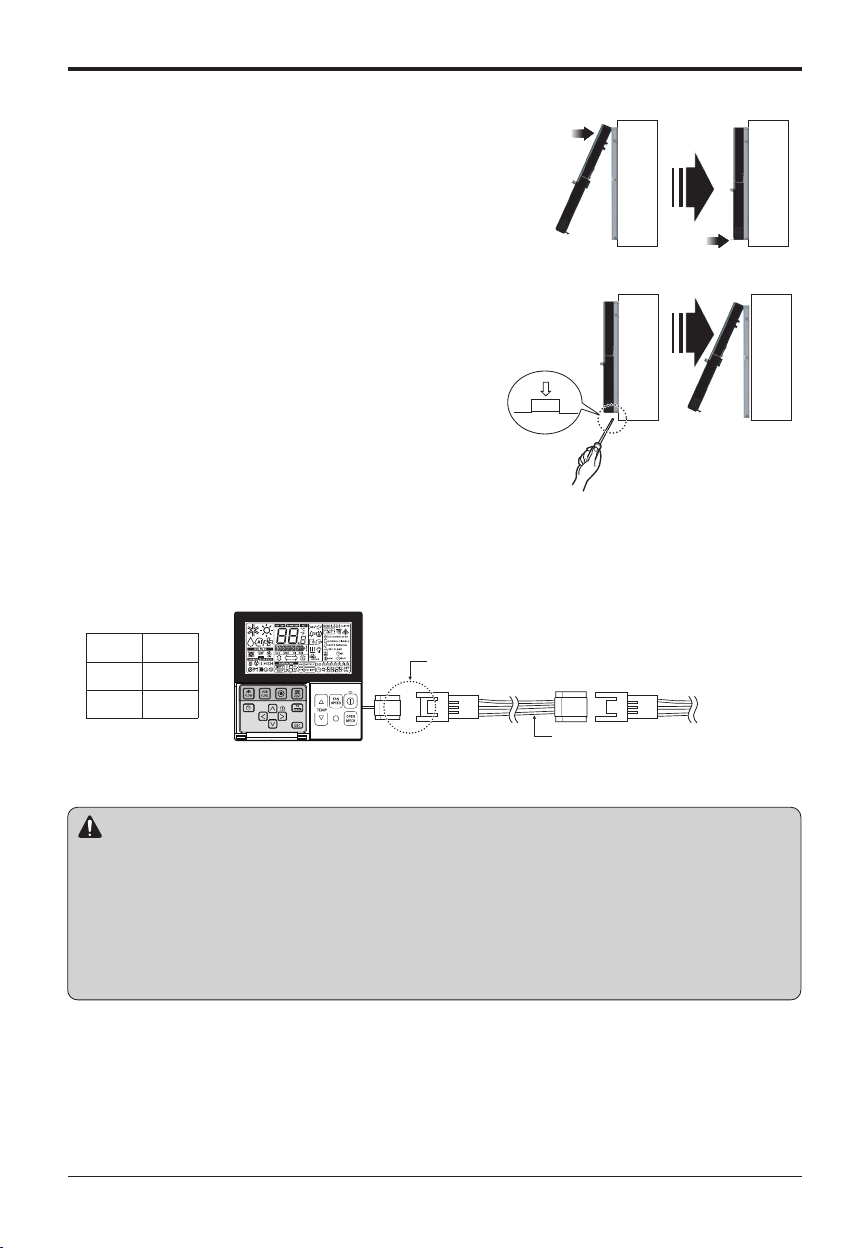
1. Please fix tightly using provided screw after placing remote controller setup board
on the place where you like to setup.
- Please set it up not to bend because poor setup could take place if setup board bends.
Please set up remote controller board fit to the reclamation box if there is a reclamation box.
- Install the product so as not to make a gap with the wall side and to prevent shaking after the installation.
2. Can set up Wired remote controller cable into three directions.
- Setup direction: the surface of wall reclamation, upper, right
- If setting up remote controller cable into upper and right side, please set up after removing remote con-
troller cable guide groove.
❈
Remove guide groove with long nose.
①
Reclamation to the surface of the wall
②
Upper part guide groove
③
Right part guide groove
32 Multi zone
Installation
Wall
Side
Wall
Side
Wall
Side
Wall
Side
<Connecting order>
<Separating order>
3. Please fix remote controller upper part into
the setup board attached to the surface of the
wall, as the picture below, and then, connect
with setup board by pressing lower part.
- Please connect not to make a gap at the remote controller
and setup board’s upper and lower, right and left part.
- Before assembly with the installation board, arrange the
Cable not to interfere with circuit parts.
When separating remote controller from setup
board, as the picture below, after inserting into
the lower separating hole using screw driver
and then, spinning clockwise, remote con-
troller is separated.
- There are two separating holes. Please individually sepa-
rate one at a time.
- Please be careful not to damage the inside
components when separating.
4. Please connect indoor unit and remote controller using connection cable.
Please check if connector is normally connected.
Connecting cable
Indoor
Unit side
When installing the wired remote controller, do not bury it in the wall.
(It can cause damage in the temperature sensor.)
Do not install the cable to be 50m(164ft) or above.
(It can cause communication error.)
• When installing the extension cable, check the connecting direction of the connector of the remote con-
troller side and the product side for correct installation.
• If you install the extension cable in the opposite direction, the connector will not be connected.
• Specification of extension cable: 2547 1007 22# 2 core 3 shield 5 or above.
CAUTION
12V Red
Signal Yellow
GND Black
Installation Manual 33
Installation
ENGLISH
Installation of Decorative Panel
The decorative panel has its installation direction.
Before installing the decorative panel, always remove the paper template.
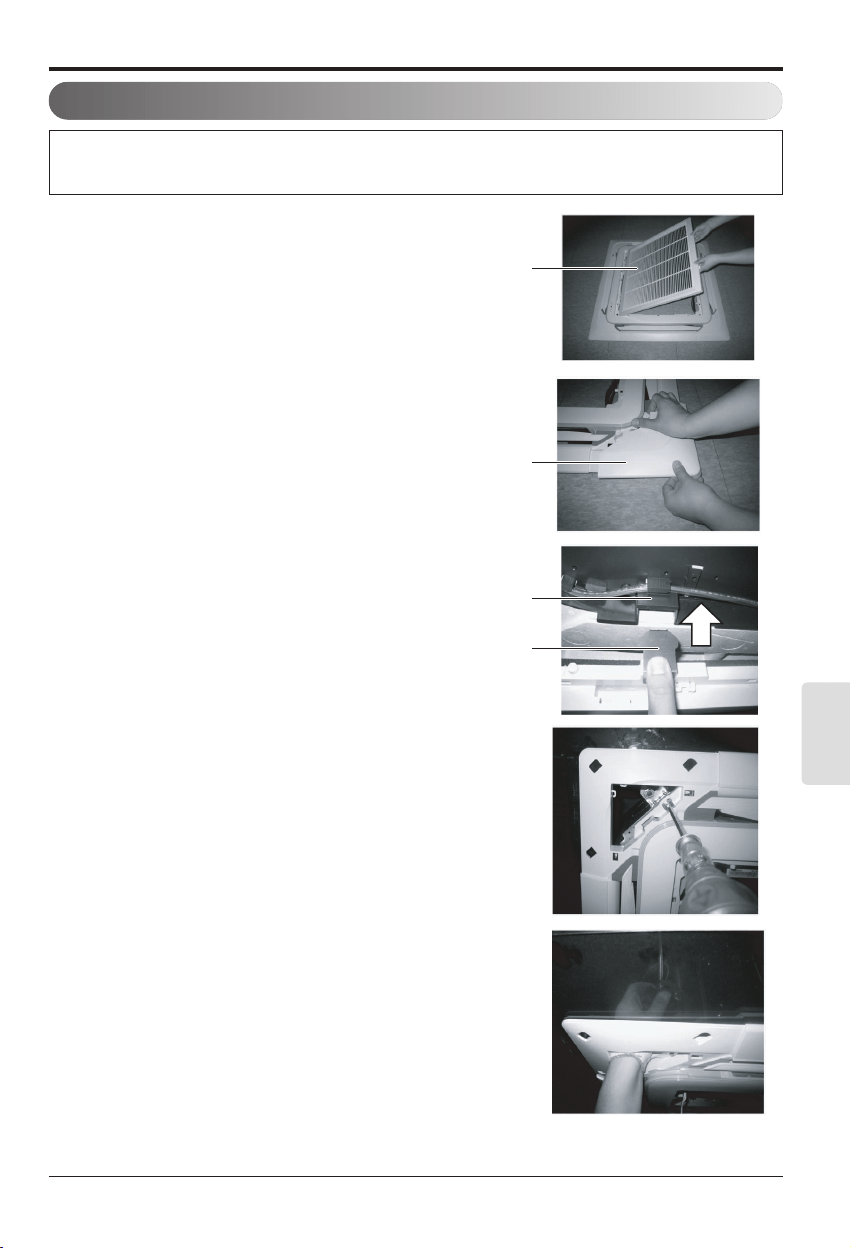
1. Remove the packing and take out air inlet
grille from front panel.
2. Remove the Corner covers of the panel.
3. Fit the panel on the unit by inserting
hooks as shown in picture.
4. Insert two screws on diagonal corners of
panel. Do not tighten the bolts
completely. (The fixing screws are
included in the indoor unit box.)
Check the alignment of panel with the
ceiling. Height can be adjusted using
hanging bolts as shown in picture. Insert
the other two screws and tighten all
screws completely.
Front grille
Coner cover
Hook clip
Hook
34 Multi zone
Installation
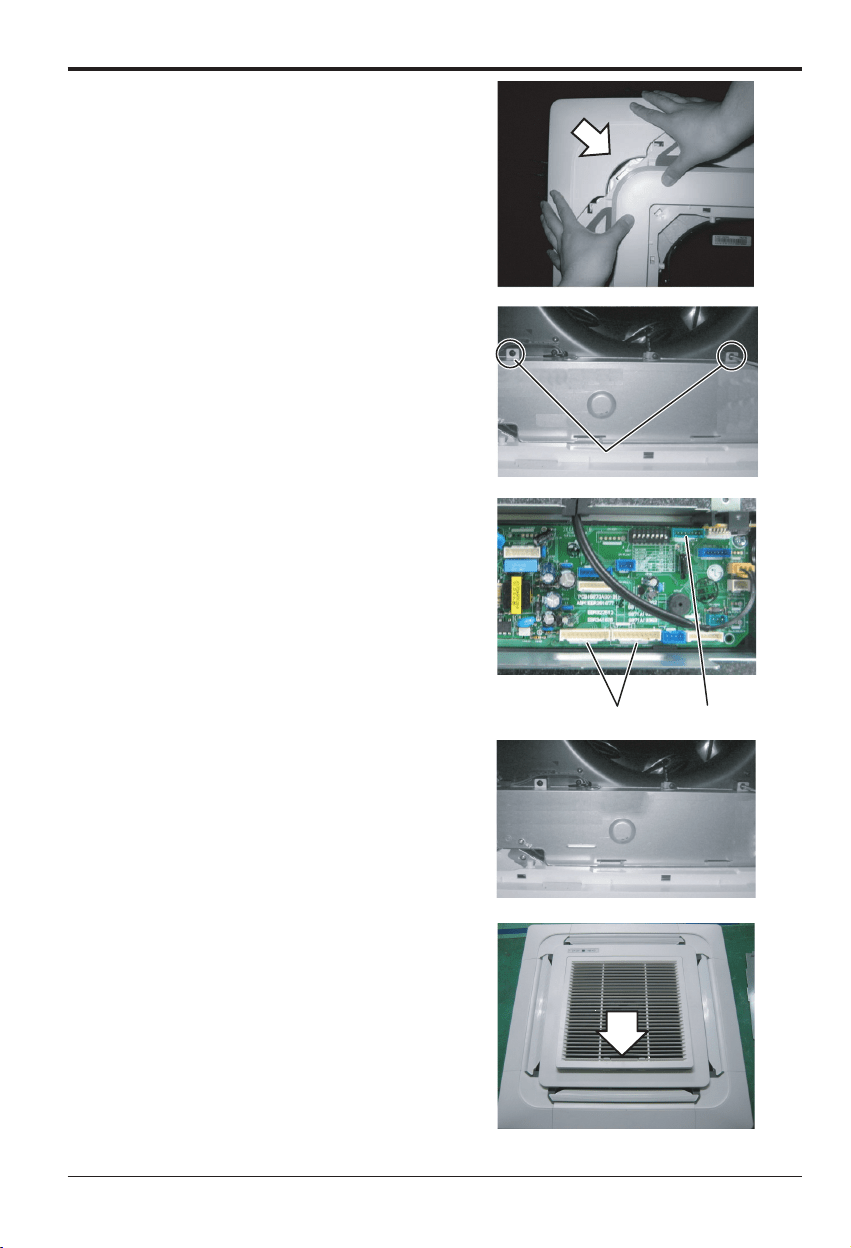
5. Fit the corner covers.
6. Open two screws of control panel cover.
7. Connect one display connector and two
vane control connectors of front panel to
indoor unit PCB.
The position marking on PCB is as:
Display connector : CN-DISPLAY
Vane control connector: CN-VANE 1,2
8. Close the cover for control box.
9. Install the air inlet grille and Filter on the
panel.
Screw
CN-VANE 1,2
CN-DISPLAY
Installation Manual 35
Installation
ENGLISH
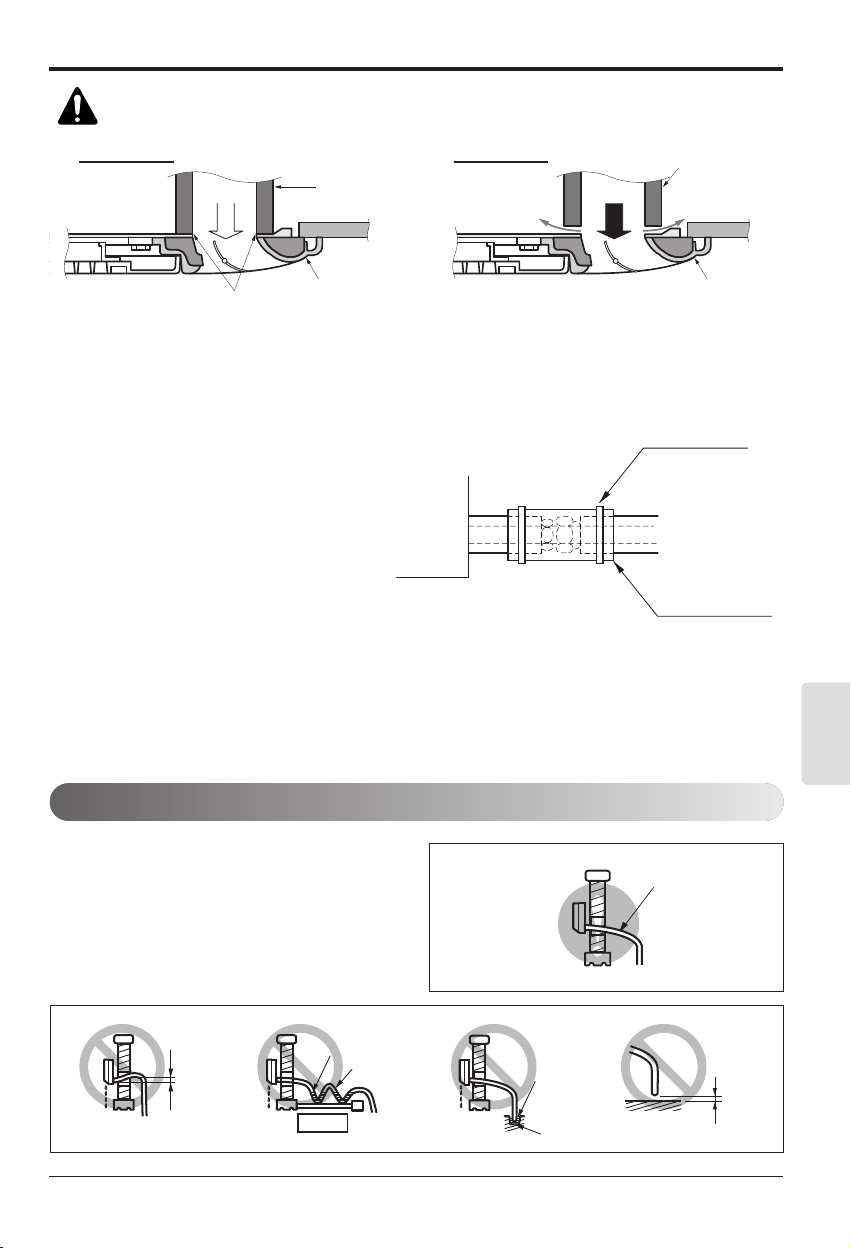
CAUTION:
Cool air leakage causes sweating/condensation.
Ensure panel is sealed properly.
Air conditioner
unit
Ceiling
board
Decorative panel
Decorative
panel
Fit the insulator (this part) and
be careful for cool air leakage
Good example
Air
Cool air leakage
(no good)
Bad example
Ceiling
board
Air conditioner unit
Flexible drain hose
HEAT INSULATION
1. Use the heat insulation material for the refrigerant piping which has an excellent heat-
resistance [over 120°C(248°F)].
2. Precautions in high humidity
circumstance:
This air conditioner has been tested
according to the "KS Standard
Conditions with Mist" and confirmed
that there is not any default. However, if
it is operated for a long time in high
humid atmosphere [dew point
temperature: more than 23°C(73.4°F)],
water drops are liable to fall. In this
case, add heat insulation material
according to the following procedure:
• Heat insulation material to be prepared... Adiabatic glass wool with thickness 10(0.4) to 20
mm(0.8 inch).
• Stick glass wool on all air conditioners that are located in ceiling atmosphere.
Indoor unit
Thermal insulator
(accessory)
Fastening band
(accessory)
Refrigerant piping
Drain Piping
Wall-mounted Type
1. The drain hose should point downward for
optimum drainage.
2. Incorrect Installation Examples:
Downward slope
Do not raise
Accumulated
drain water
Tip of drain hose
dipped in water
Air
Kinking
Water
leakage
Water
leakage
Ditch
Less than 50mm
(1 31/32 inch) gap
Water
leakage
36 Multi zone
Installation
CAUTION : The supplied
flexible drain hose should not
be curved, neither screwed.
The curved or screwed hose
may cause a leakage of water.
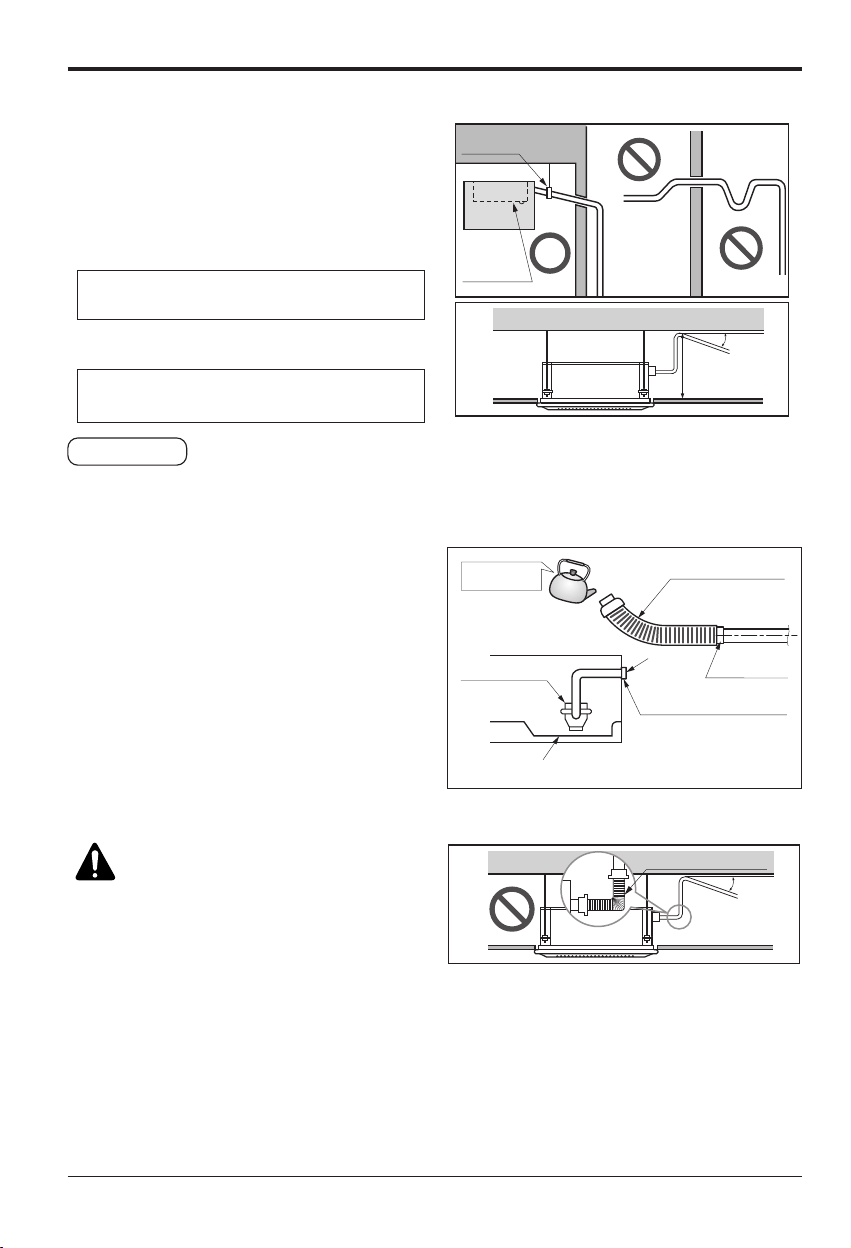
[Ceiling Concealed Duct/Ceiling Cassette Type]
• Drain piping must have down-slope (1/50 to 1/100): be
sure not to provide up-and-down slope to prevent
reversal flow.
• During drain piping connection, be careful not to exert
extra force on the drain port on the indoor unit.
• The outside diameter of the drain connection on the
indoor unit is 32mm(1 1/4 inch).
•
Be sure to install heat insulation on the drain piping.
Piping material: Polyvinyl chloride pipe inner
diometes Ø 25mm(1 inch) and pipe fittings
• Connect the main drain pipe to the exterior and
leave it provisionally until the test comes to an
end.
• Feed water to the flexible drain hose and check
the piping for leakage.
• Be sure to check the drain pump for normal
operating and noise when electrical wiring is
complete.
• When the test is complete, connect the flexible
drain hose to the drain port on the indoor unit.
The air conditioner uses a drain pump to drain water.
Use the following procedure to test the drain pump operation:
Heat insulation material: Polyethylene foam
with thickness more than 8mm(5/16 inch).
Drain test
Maintenance
drain port
Upward
routing
not allowed
Pipe clamp
Indoor unit
1/50~1/100
Flexible drain hose
MAX : 700 mm(27 9/16 inch)
Feed water
Drain Pump
Drain pan
Flexible drain hose
(accessory)
Main
drain pipe
Glue the joint
Drain
port
Drain hose connection
Use the clip (accessory)
Flexible drain hose
1/50~1/100
Flexible drain hoseFlexible drain hoseFlexible drain hose
❈ The figure can be changed according to model.
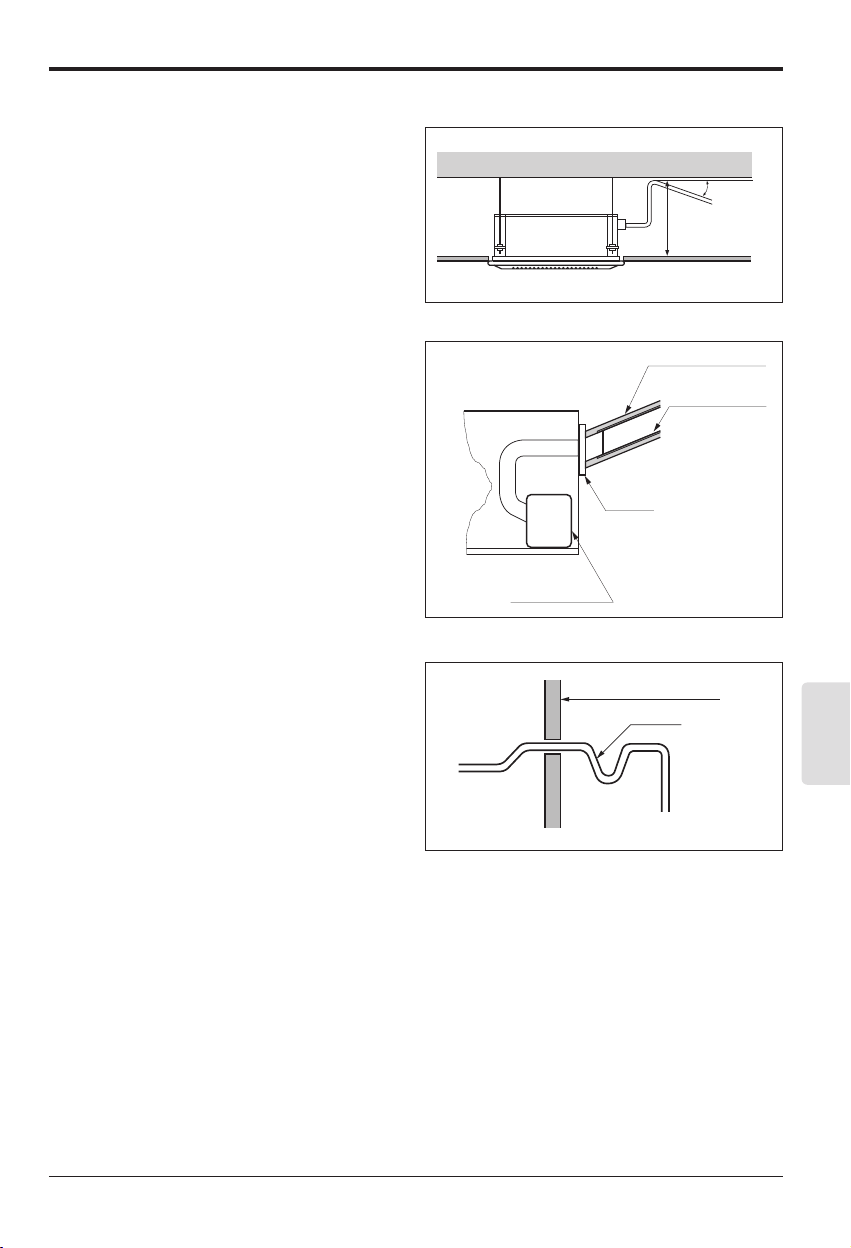
Installation Manual 37
Installation
ENGLISH
Attention
1. Possible drain-head height is up to
700mm(27 9/16 inch). So, it must be
installed below 700mm(27 9/16 inch).
2. Keep the drain hose downward up to
1/50~1/100 inclination.
Ex) length : 100 inch ⇨ height: 1~2 inch.
Prevent any upward flow or reverse flow in
any part.
3. 5mm(3/16 inch) or thicker formed thermal
insulator is provided for the drain pipe.
4. Upward routing is not allowed.
5. Be sure to check the drain pump for normal
operation and abnormal noise when
electrical wiring is complete.
1/50~1/100
MAX 700mm
(27 9/16 inch)
Elbow
Drain pump
Unit
Drain pipe
(Local supply)
Thermal insulator
(Local supply)
Wall
Drain hose
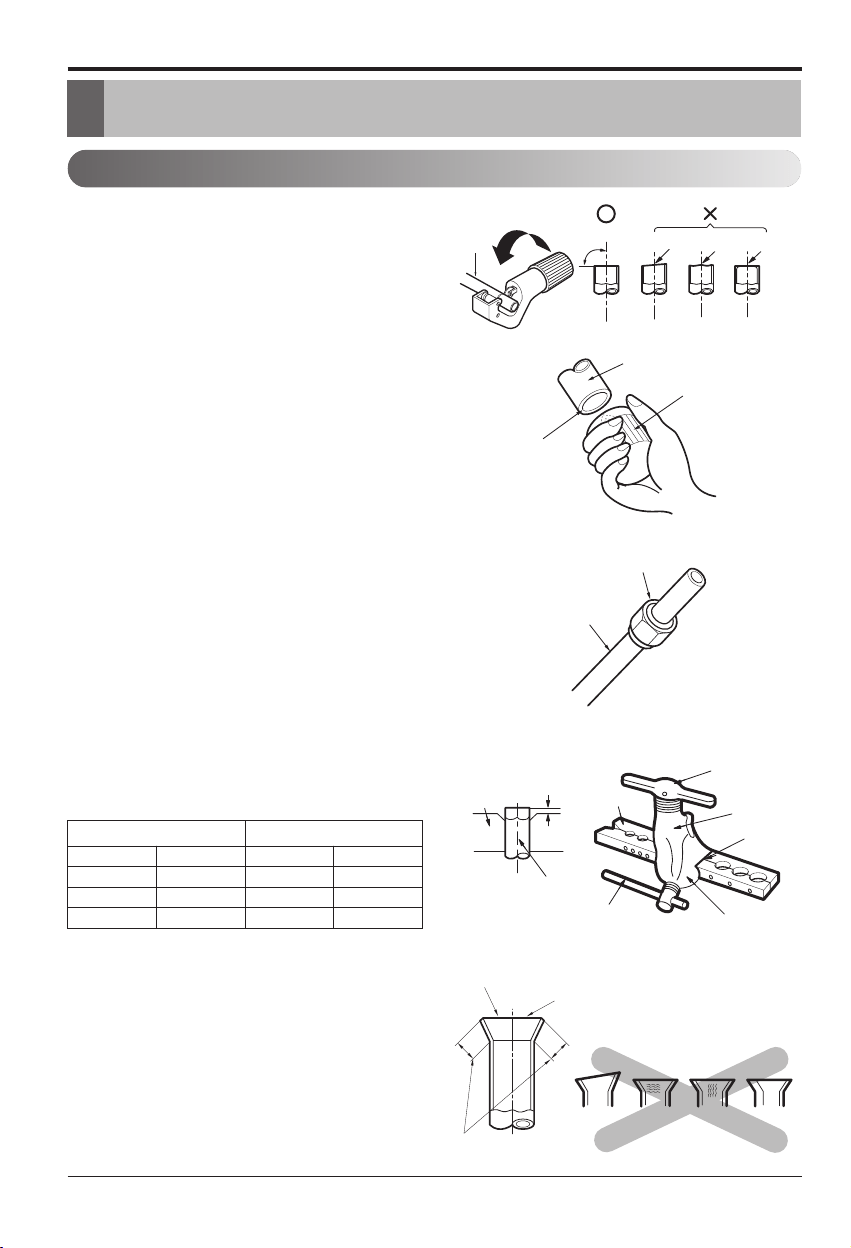
38 Multi zone
Flaring Work and Connection of Piping
Flaring work
Main cause of gas leakage is defect in flaring
work. Carry out correct flaring work in the
following procedure.
1) Cut the pipes and the cable.
■ Use the accessory piping kit or the pipes
purchased locally.
■ Measure the distance between the
indoor and the outdoor unit.
■ Cut the pipes a little longer than
measured distance.
■ Cut the cable 1.5m(4.9ft) longer than the
pipe length.
2) Burrs removal
■ Completely remove all burrs from the cut
cross section of pipe/tube.
■ Put the end of the copper tube/pipe to
downward direction as you remove burrs
in order to avoid to let burrs drop in the
tubing.
3) Putting nut on
■ Remove flare nuts attached to indoor
and outdoor units, than put them on
pipe/tube having completed burr
removal.
(Not possible to put them on after flaring
work)
4) Flaring work
■ Carry out flaring work using flaring tool
as shown below.
Firmly hold copper tube in a bar(or die) as
indicated dimension in the table above.
5) Check
■ Compare the flared work with figure.
■ If flare is noted to be defective, cut off
the flared section and do flaring work
again.
Copper
tube
90
Slanted Uneven Rough
Pipe
Reamer
Point down
Flare nut
Copper tube
Bar
Copper pipe
Clamp handle
Red arrow mark
Cone
Yoke
Handle
Bar
"A"
Inclined
Inside is shining without scratches.
Smooth all round
Even length
all round
Surface
damaged
Cracked Uneven
thickness
= Improper flaring =
mm inch mm inch
Ø6.35 1/4 1.1~1.3 0.04~0.05
Ø9.52 3/8 1.5~1.7 0.06~0.07
Ø12.7 1/2 1.6~1.8 0.06~0.07
Outside diameter A
Flaring Work and Connection of Piping
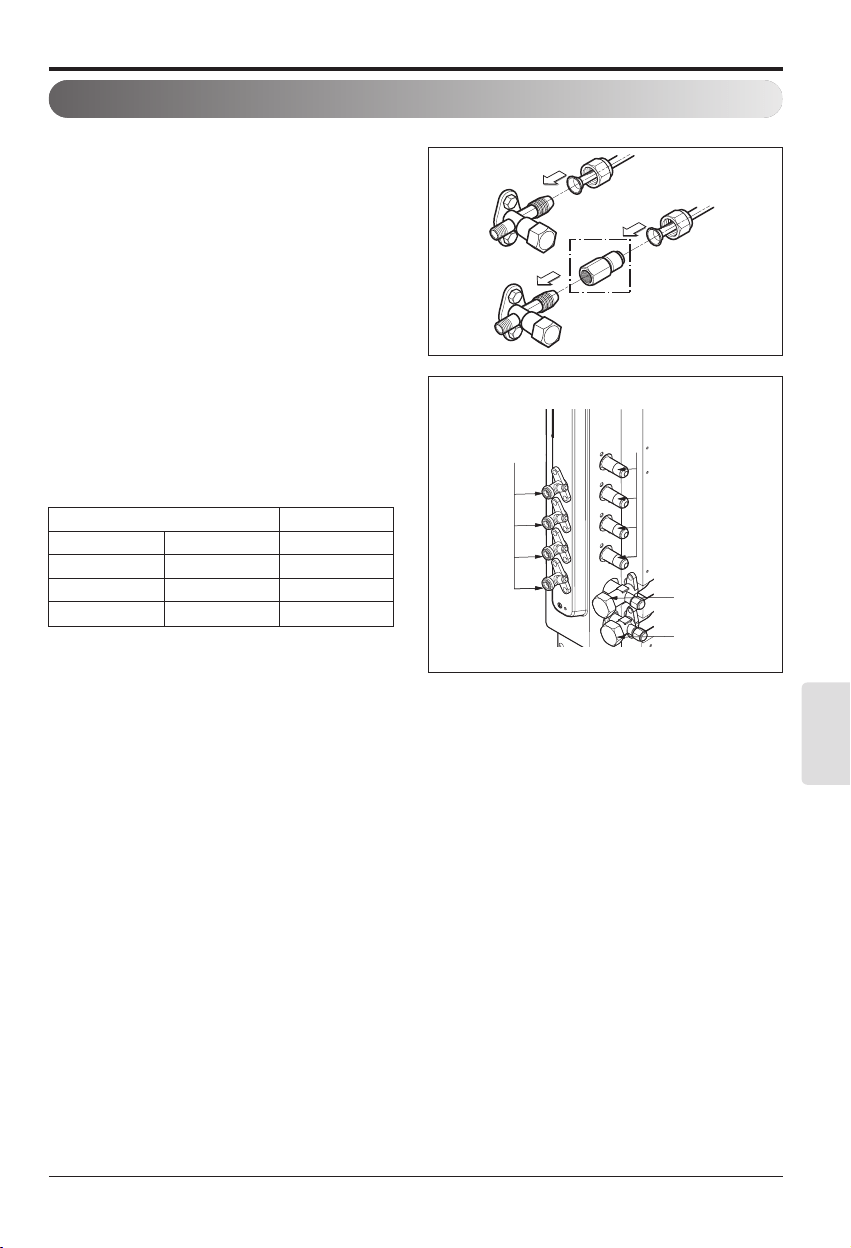
Installation Manual 39
Flaring Work and Connection of Piping
ENGLISH
Align the center of the piping and sufficiently
tighten the flare nut by hand.
Connecting pipe order
1) A~D-UNIT gas side pipe
2) A~D-UNIT liquid side pipe
Finally, tighten the flare nut with torque wrench
until the wrench clicks.
• When tightening the flare nut with torque
wrench ensure the direction for tightening
follows the arrow on the wrench.
Main gas
side valve
Main liquid
side valve
Gas side piping
Liquid
side piping
A-UNIT
B-UNIT
C-UNIT
D-UNIT
Outdoor unit(36 kBtu/h class)
Connection of piping - Outdoor
Outside diameter Torque
mm inch kgf.m(lbf.ft)
Ø6.35 1/4
1.8~2.5 (13~18)
Ø9.52 3/8
3.4~4.2 (24~30)
Ø12.7 1/2
5.5~6.6 (40~48)
(Only Indoor Units
18 kBtu/h class )
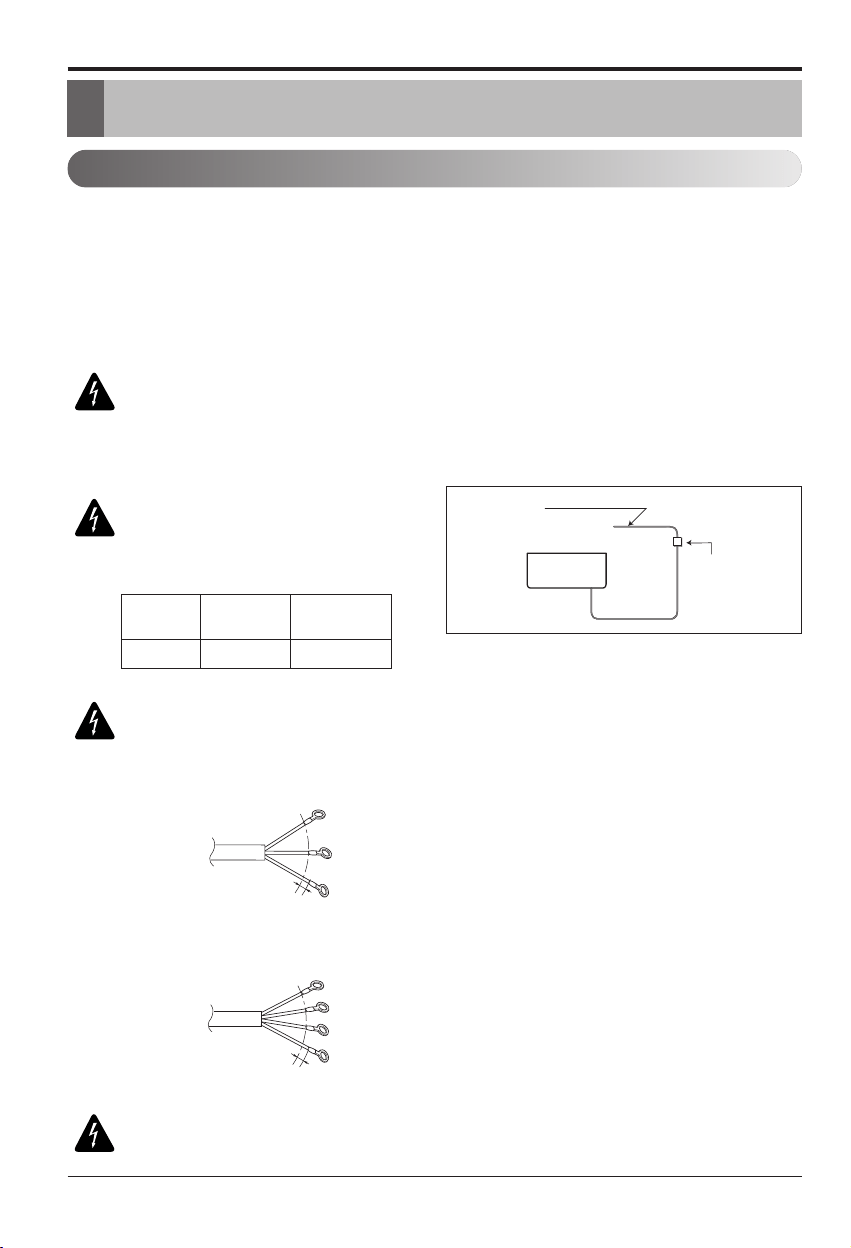
40 Multi zone
Connecting the Cable between Indoor Unit and Outdoor Unit
Connect the cable to the indoor unit by connecting the wires to the terminals on the control
board individually according to the outdoor unit connection. (Ensure that the color of the wires
of the outdoor unit and the terminal No. are the same as those of the indoor unit.)
The ground wire should be longer than the common wires.
The circuit diagram is not subject to change without notice.
When installing, refer to the electrical diagram behind the front panel of Indoor Unit.
The wiring for the outdoor unit can be found on the inside of the Outdoor Unit control cover.
Connect the cable to the Indoor unit.
RECOMMENDATION:
• The circuit diagram is subject to change without notice.
• Be sure to connect wires according to the wiring diagram.
• Connect the wires firmly, so that they can not be pulled out easily.
• Connect the wires according to color codes by referring to the wiring diagram.
RECOMMENDATION:
Provide a
circuit breaker between power
source and the outdoor unit as
shown below.
RECOMMENDATION:
The power cord connected to the outdoor unit should
comply with the following specifications: NRTL Recognized(for example, UL or
ETL recognized and CSA certified).
Air
Conditioner
Main power source
Circuit Breaker
Use a circuit breaker
or time delay fuse.
Line voltage
(208/230V)
GN/YL
20mm
(25/32 inch)
GN/YL
20mm
(25/32 inch)
RECOMMENDATION: When using separate wires as the power cord, please secure
separate wires in the control box panel using tie wraps to hold all wires in place.
■ Power supply cable
■ Connecting cable
Outdoor Unit
Capacity
(Btu/h class)
Power source
Fuse or breaker
Capacity
24/36k 1ø,208/230V 25A
The minimum recommended wire size for the 18kBtu/h unit
is AWG 14-3, the minimum wire size for the 24/36kBtu/h
unit is AWG 12-3.
As always, final wire selection is governed by local codes
and should be installed by a licensed professional
contractor.
The power connecting cable between the outdoor and
indoor units must comply with the following specifications:
NRTL Recognized (for example, UL or ETL recognized and
CSA certified).
AWG 18-4 is the minimum recommended wire size,
however, the selected conductors must comply with local
codes and be suitable for installation in wet locations.
Connecting the Cable between Indoor Unit and Outdoor Unit
Installation Manual 41
Connecting the Cable between Indoor Unit and Outdoor Unit
ENGLISH
Connect the cable to the Outdoor unit.
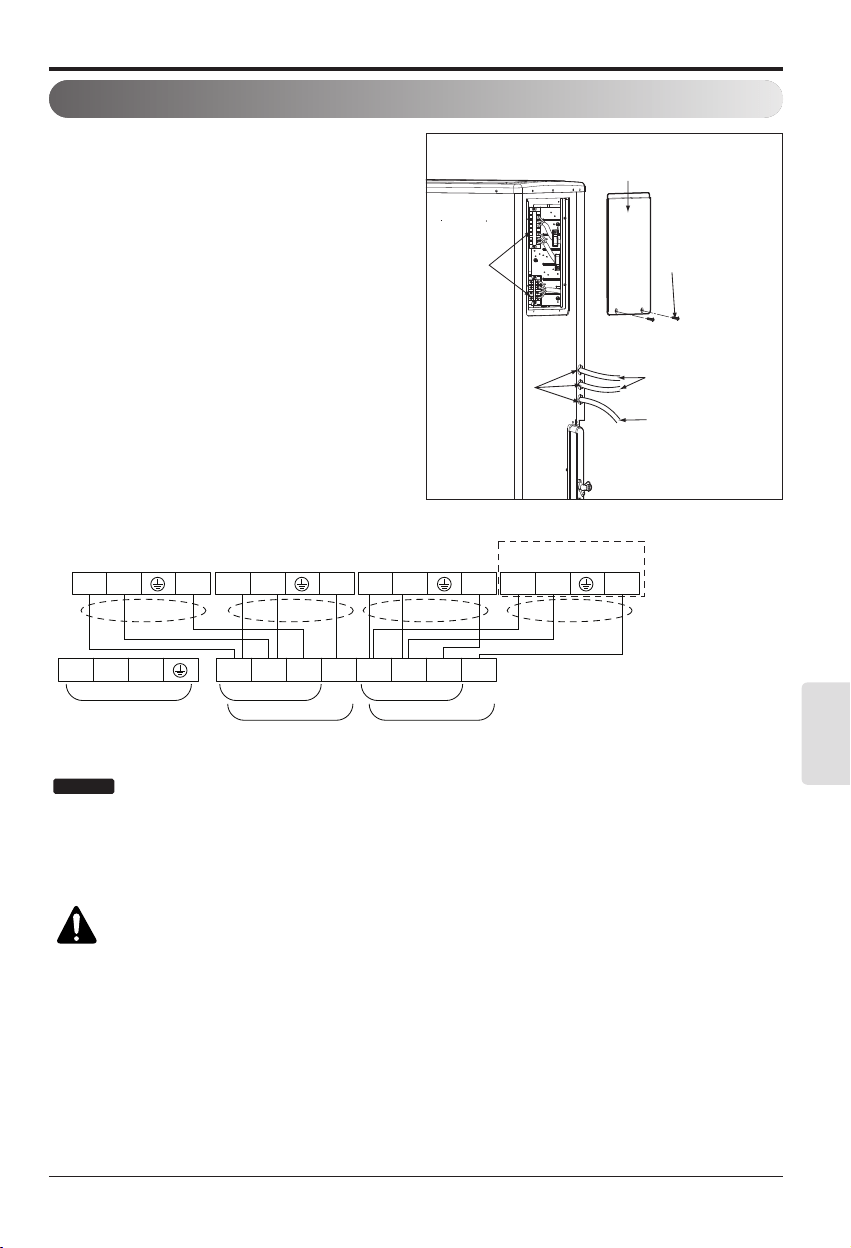
1. Remove the control cover by removing screws.
Connect the wires to the terminals on the
control board following the diagrams below.
2. Secure the cable onto the control board with the
holder (clamp).
3. Re-attach the cover control to the original
position using the screws.
:
1. Use connection cable NRTL(UL, ETL, CAS…) listed and stranded copper(4) THHN conductors,
sunlight (UV) resistant ROHS compliant PVC jacket 600V direct burial listed, approved for wet
conditions. Temperature rated for –20℃(-4℉) to 90℃(194℉). And this cable should be enclosed
in conduit.
WARNING:
• Be sure to comply with local and national codes while running the wire from the indoor unit to
the outdoor unit(size of wire and wiring method, etc).
• Every wire must be connected firmly.
• No wire should be allowed to touch refrigerant tubing, the compressor or any moving parts.
• The communication wirings of air conditioner should be separate and isolated from external
device’s electric wiring such as computers, elevator, radio & Television broadcasting facilities,
as well as medical imaging offices.
NOTICE
C UNIT
D UNIT
1(L1) 2(L2) 3 1(L1) 2(L2) 3
A Unit B Unit
1(L1) 2(L2) 3(B) 3(A) 1(L1) 2(L2) 3(C) 3(D)
POWER SUPPLY A UNIT
B UNIT
Indoor Unit Terminal Block Indoor Unit Terminal Block
1(L1) 2(L2) 3
C Unit
Indoor Unit Terminal Block
1(L1) 2(L2) 3
D Unit
Indoor Unit Terminal Block
L1 L2
36k Only
24/36 kBtu/h class
IF 3 POLE DISCONNECT IS
REQUIRED INSTALL AT
EACH INDOOR UNIT.
Outdoor unit
Terminal
block
Conduit Ports
Power supply
cable
Connecting cable
(to the indoor unit)
Screw
Cover control
42 Multi zone
Connecting the Cable between Indoor Unit and Outdoor Unit
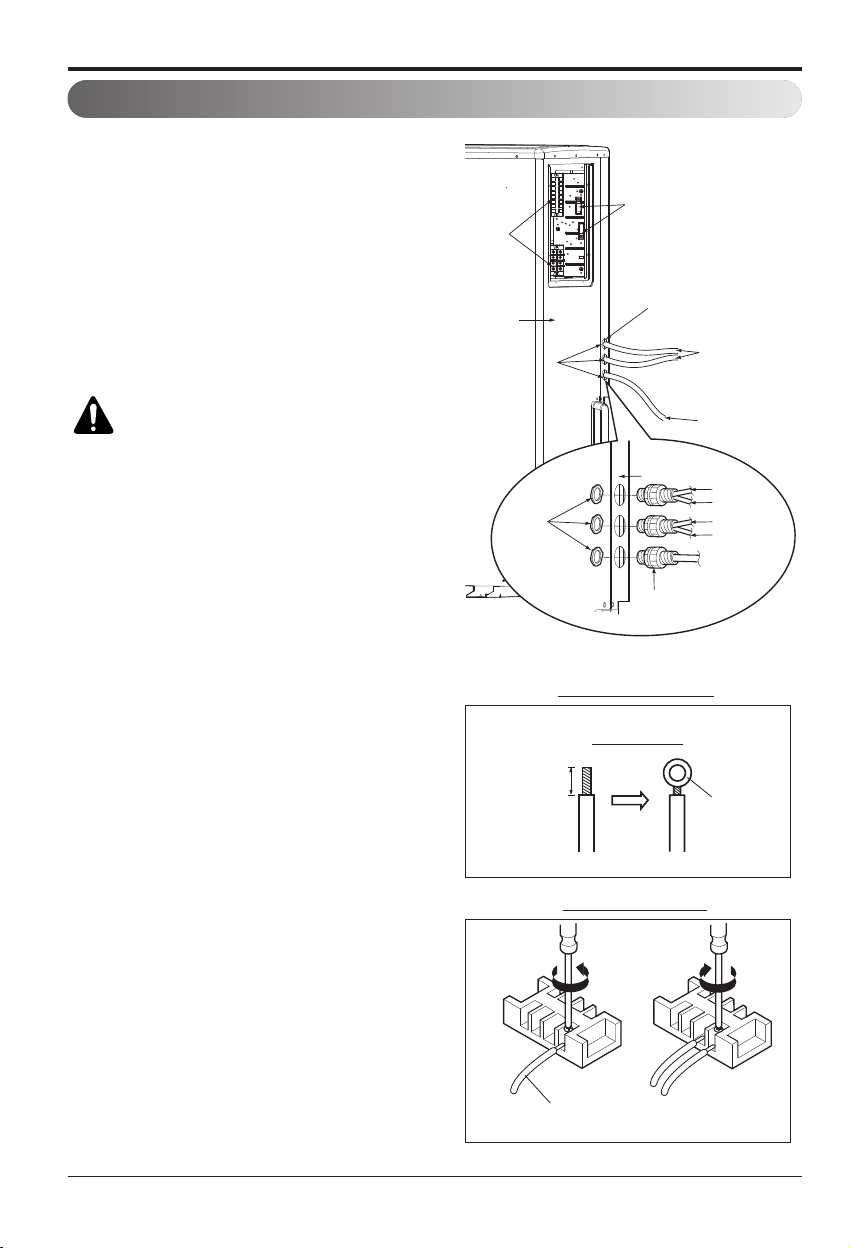
(1) Remove the side panel and knockouts of conduit
panel. (for low voltage line)
(2) Pull out connection cable through conduit.
(3) After conduit to the panel, fix nut to the opposite
side of panel.
(4) Pass the connection cabel through the hole.
(5) Properly connect the cable on the terminal block.
(6) Fix the connection cable with cord clamp
provided on the unit not to have strain at the
terminal when the connection cable is pulled
outside up to a 35 pound weight
WARNING: Loose wiring may cause
the terminal to overheat or result in
unit malfunction. A fire hazard may
also exist. Therefore, be sure all
wiring is tightly connected.
When connecting each power wire to the
corresponding terminal, follow instructions "How
to connect wiring to the terminals" and fasten the
wire tightly with the fixing screw of the terminal
plate.
How to connect wiring to the terminals
◼ For strand wiring
(1) Cut the wire end with a wire cutter or wire-
cutting pliers, then strip the insulation to
expose the strand wiring about 10 mm(3/8").
(2) Using a screwdriver, remove the terminal
screw(s) on the terminal plate.
(3) Using a round terminal fastener or pliers,
securely clamp each stripped wire end with a
round terminal.
(4) Position the round terminal wire, and replace
and tighten the terminal screw using a
screwdriver.
Connection method of the connecting cable(Example)
Power supply cable
Connecting Cable
Strip 10 mm(3/8")
Round
terminal
Connecting cable
Loosening the
terminal block
screw
Fastening the
wire tightly
Strand wire
Terminal
block
Side panel
Cord clamp
Conduit hole
Power supply cable
(1Ø, 208/230V)
Connecting cable
(1Ø, 208/230V)
Taping
(for sealing)
Lock nut
(field supply)
Conduit
(field supply)
Conduit panel
Indoor Unit A
Indoor Unit B
Indoor Unit C
Indoor Unit D
Installation Manual 43
Checking the Drainage, Insulating the Pipe and Special Piping Applications
ENGLISH
Insulating the Pipe and Special Piping Applications
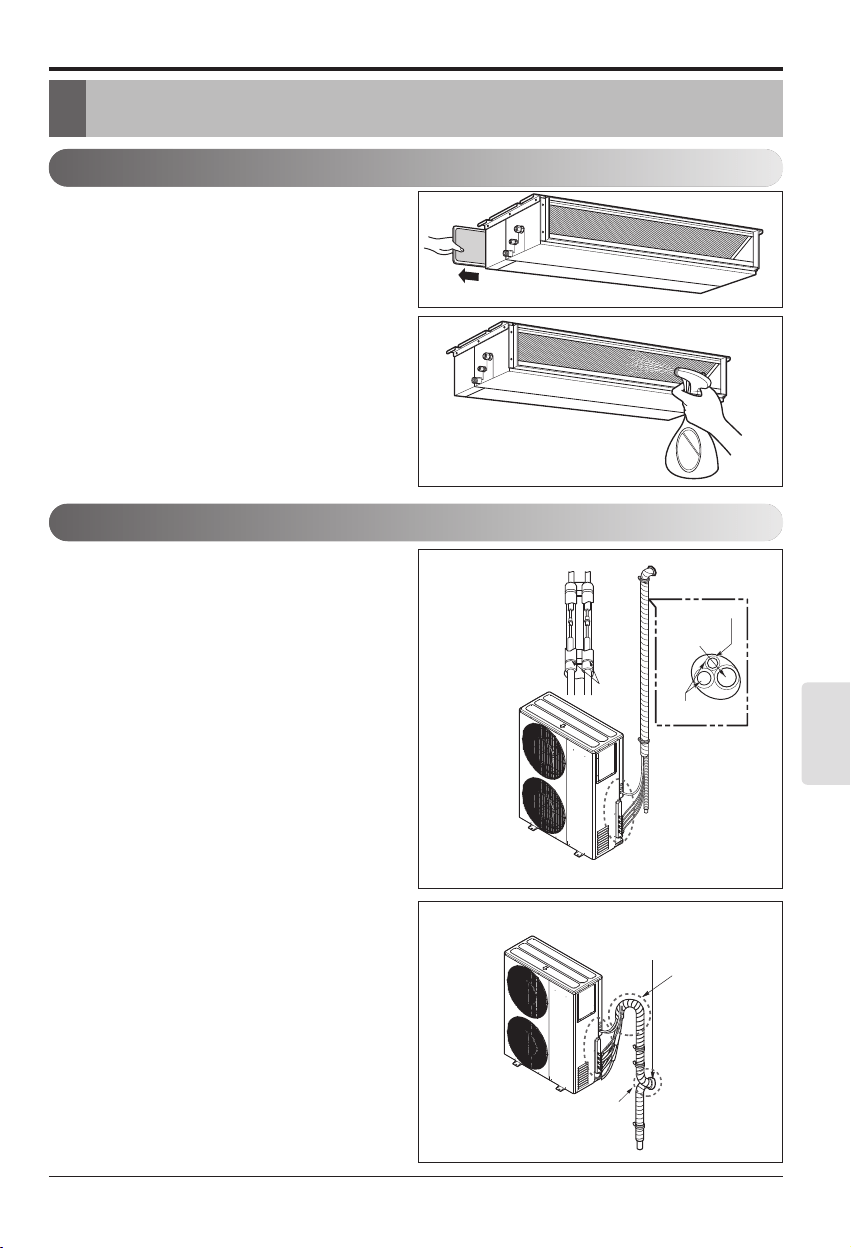
Insulate the piping by wrapping the
connecting portion of the indoor unit
with insulation material and secure it
with two kinds of vinyl tape.
• If you want to connect an additional drain
hose, the end of the drain outlet should be
routed above the ground. Secure the drain
hose appropriately.
In cases where the outdoor unit is
installed below the indoor unit
perform the following:
1. Tape the piping, drain hose and connecting
cable from down to up.
2. Secure the taped piping along the exterior
wall using saddle or equivalent.
In cases where the Outdoor unit is
installed above the Indoor unit
perform the following.
1. Tape the piping and connecting cable from
down to up.
2. Secure the taped piping along the exterior
wall. Form a trap to prevent water entering
the room.
3. Secure the piping onto the wall using a
saddle or equivalent.
Plastic
band
Taping
Drain hose
Pipings
Seal a small
opening around
the pipings with
gum type sealant.
Seal a small opening
around the pipings
with gum type sealant.
Trap
Trap
1. Remove the Air Filter.
2. Check the drainage.
• Spray one or two glasses of water upon the
evaporator.
• Ensure that water flows drain hose of indoor
unit without any leakage.
❈ The figure can be changed according to model.
Checking the drainage
Checking the Drainage, Insulating the Pipe and Special Piping Applications
44 Multi zone
Long Pipe Setting
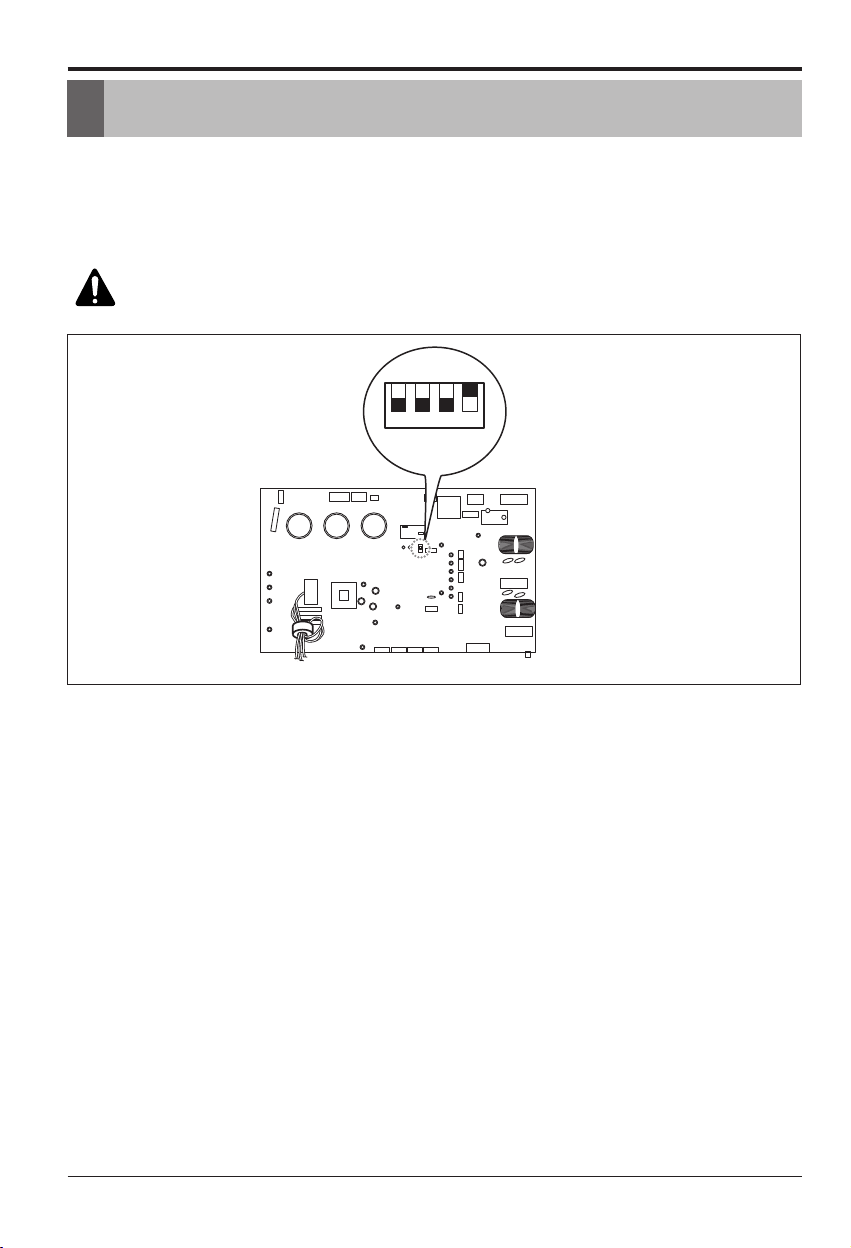
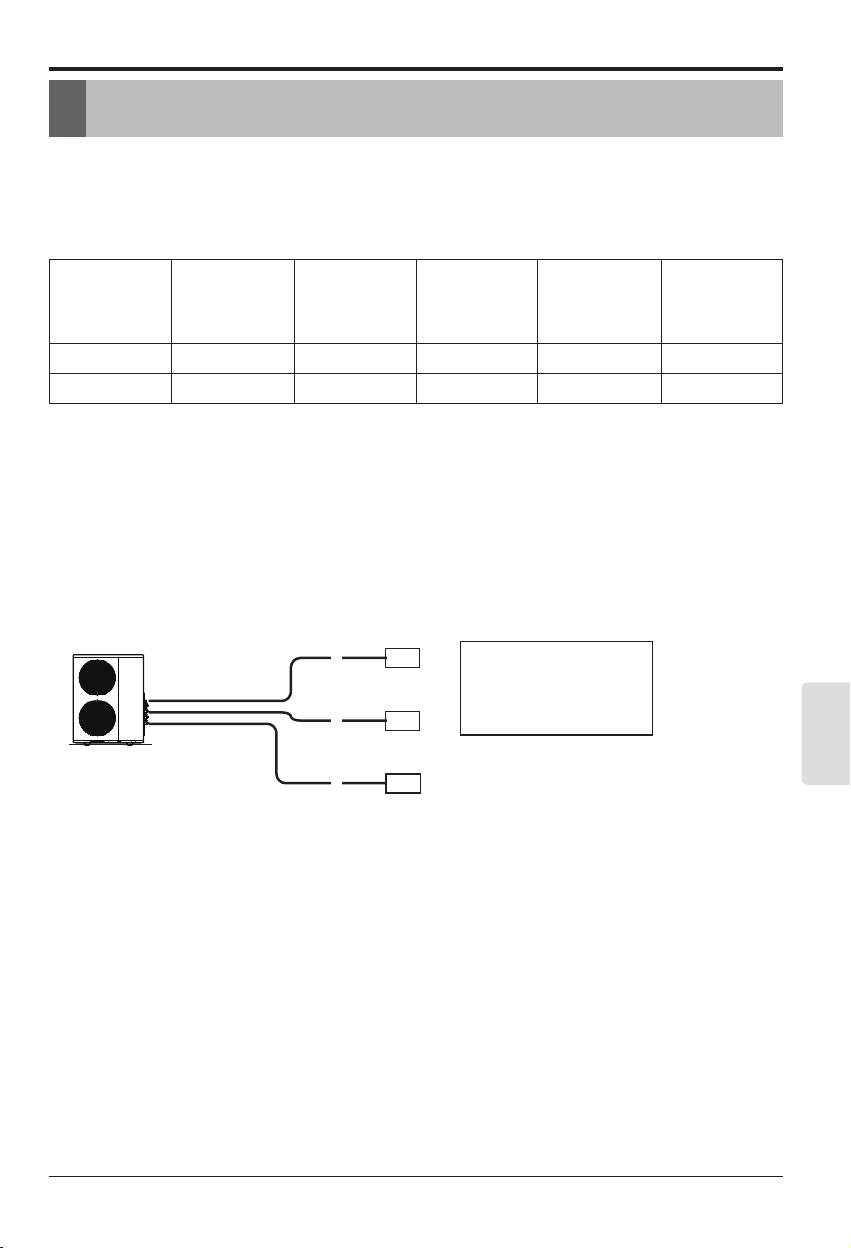
Extended line length setting
1
SW01N
234
1. Open the top cover of outdoor unit.
2. Select one of the two selectable modes as follows.
3. Set the Zone as shown in Fig.
4. Close the top cover and check whether the product works normally.
WARNING: Do not open the top cover or Set the pipe length when
operating the product.
Installation Manual 45
Air Purging and Evacuation
ENGLISH
Air and moisture remaining in the refrigerant system have undesirable effects as indicated below.
1. Pressure in the system rises.
2. Operating current rises.
3. Cooling(or heating) efficiency drops.
4. Moisture in the refrigerant circuit may freeze and block capillary tubing.
5. Water may lead to corrosion of parts in the refrigeration system.
Therefore, the indoor/outdoor unit and connecting tube must be checked for leaks, and vacuumed
to remove incondensible gas and moisture in the system.
Preparation
• Check that each tube(both liquid and gas side
tubes) between the indoor and outdoor units have
been properly connected and all wiring for the test
run has been completed. Remove the service
valve caps from both the gas and the liquid sides
on the outdoor unit. Check that both the liquid and
the gas side service valves on the outdoor unit
are kept closed at this stage.
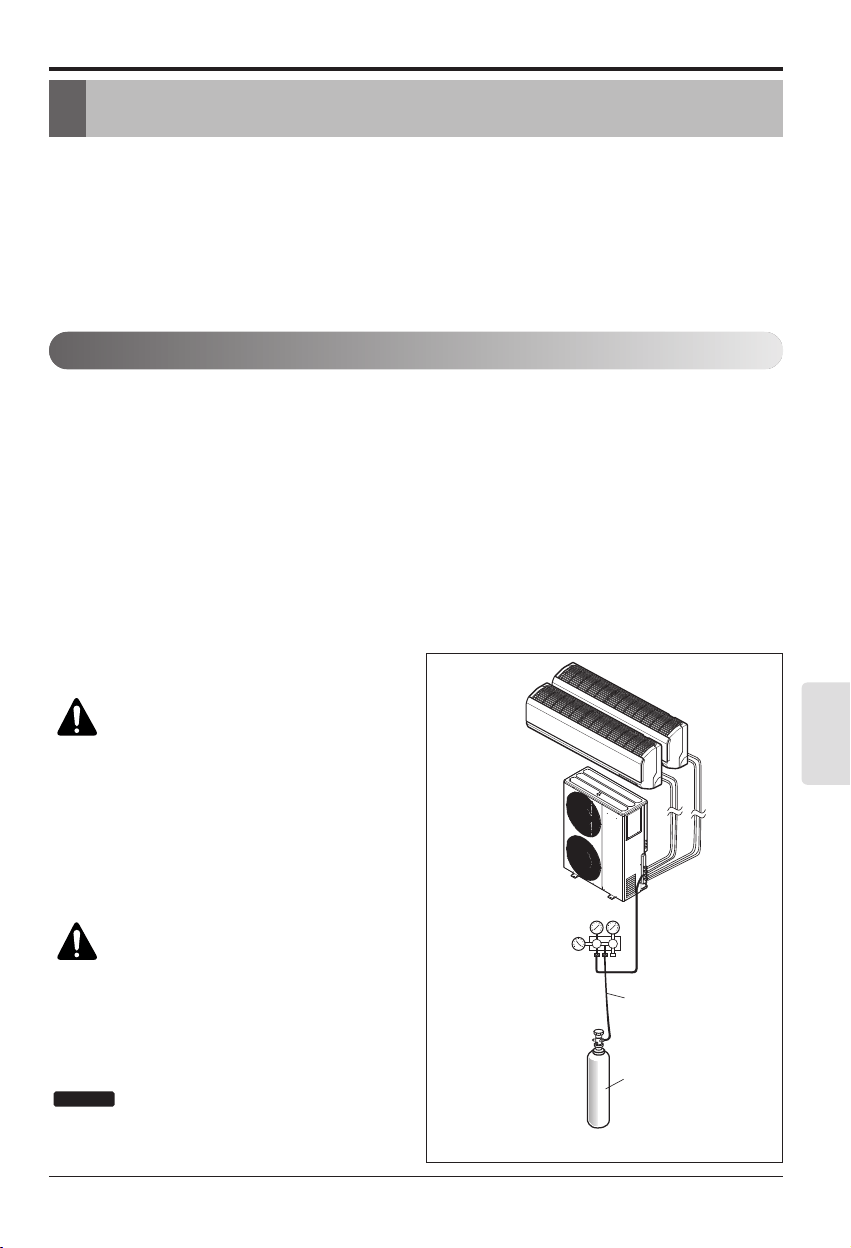
Leakage test
• Connect the manifold valve(with pressure gauges)
and dry nitrogen gas cylinder to this service port
with charge hoses.
CAUTION: Be sure to use a
manifold valve for leak testing.
The high side manifold valve must
always be kept closed.
• Pressurize the system to no more than 550
P.S.I.G. with dry nitrogen gas and close the
cylinder valve when the gauge reading
reached 550 P.S.I.G. Next, test for leaks with
liquid soap.
CAUTION:
To avoid nitrogen
entering the refrigerant system in a
liquid state, the top of the cylinder must be
higher than its bottom when you
pressurize the system. Usually, the cylinder
is used in a vertical standing position.
:
Leakage testing shoud be done
for each indoor unit connection set,
separately.
1. Do a leakage test of all joints of the
tubing(both indoor and outdoor) and both gas
and liquid side service valves with soap
bubbles.
Bubbles indicate a leak. Be sure to wipe off
the soap with a clean cloth.
2. After the system is found to be free of leaks,
relieve the nitrogen pressure by loosening
the charge hose connector at the nitrogen
cylinder. When the system pressure is
reduced to normal, disconnect the hose from
the cylinder.
NOTICE
Leak Checking
Charge hose
Nitrogen gas
cylinder(in vertical
standing position)
Indoor unit
Outdoor unit
Lo Hi
Manifold valve
Pressure
gauge
❈ The figure can be changed according to model.
Air Purging and Evacuation
46 Multi zone
Air Purging and Evacuation
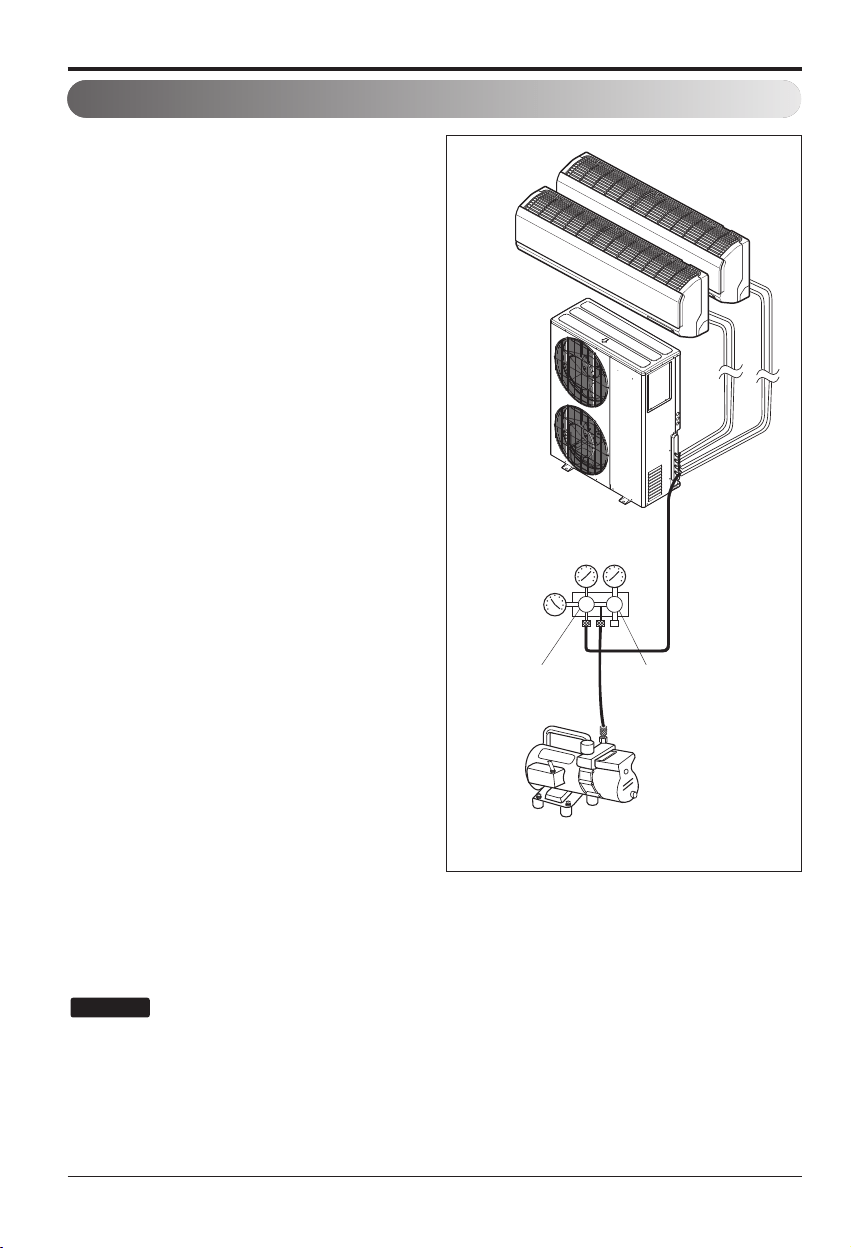
1. Connect the charge hose end described in
the preceding steps to the vacuum pump to
evacuate the tubing and indoor unit.
Confirm the "Lo" knob of the manifold valve is
open. Then, run the vacuum pump.
The operation time for evacuation varies with
tubing length and capacity of the pump.
[Each Room] The vacuum pump must be
operated less than 0.8torr of the gage
pressure.
2. When the desired vacuum is reached, close
the "Lo" knob of the manifold valve and stop
the vacuum pump.
Finishing the job
1. With a service valve wrench, turn the valve
stem of liquid side valve counter-clockwise to
fully open the valve.
2. Turn the valve stem of gas side valve
counter-clockwise to fully open the valve.
3. Loosen the charge hose connected to the
gas side service port slightly to release the
pressure, then remove the hose.
4. Replace the flare nut and its bonnet on the
gas side service port and fasten the flare nut
securely with an adjustable wrench. This
process is very important to prevent leakage
from the system.
5. Replace the valve caps at both gas and liquid
side service valves and fasten them tight.
This completes air purging with a vacuum
pump.
The air conditioner is now ready for test
running.
: Repeat evacuation procedure for each
indoor unit.
NOTICE
Indoor unit
Outdoor unit
Lo Hi
Manifold valve
Vacuum pump
Pressure
gauge
Open
Close
Evacuation
❈ The figure can be changed according to model.
Installation Manual 47
Charging
ENGLISH
Important:
If you are ever uncertain of the unit charge, reclaim, evacuate and weigh in the correct charge
using the charge amount specified on the Unit`s specification label.
Additional charge(oz ) = (Total Installation Piping Length-Standard Total Piping Length) x 0.22
Charging
■ If installed total piping length is more than standard total length, additional refrigerant charging is
necessary.
Below standard total piping length, additional refrigerant charging is not required.
24k 75(246) 25(82) 3(9.8) 20(0.22) 22.5(74)
36k 75(246) 25(82) 3(9.8) 20(0.22) 30(98.4)
Outdoor Unit
Capacity (Btu/h
class)
Max total length of all
pipes (A+B)/(A+B+C)/
(A+B+C+D)
Max length of each
pipe (A/B/C/D)
Min length of each
pipe (A/B/C/D)
Additional Refrigerant
Unit : g/m (oz/ft)
Standard Total Piping
Length (No Add`l
refrigerant)
Unit:m(ft)
❈ If the total additional charge value after calculation comes out to be negative, then do not
consider additional charge.
Each branch pipe
a=82ft
b=16ft
c=49ft
Additional Charge
= {(82+16+49)-98.4} x 0.22 = 10.69 oz
a
b
c
9k
9k
9k
EX) MR36TQY3JM
48 Multi zone
P/NO : MFL39817327