
1
USE & CARE MANUAL
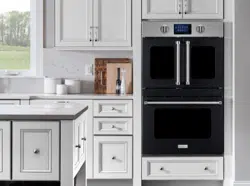
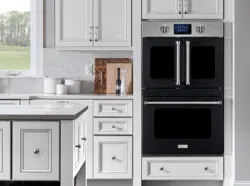
Double Electric Wall Oven
799257
2
BlueStar® Double Electric Wall Oven Use & Care Manual
Models DEWO
THIS APPLIANCE WAS DESIGNED FOR EASE OF INSTALLATION AND OPERATION. HOWEVER,
WE RECOMMEND THAT YOU READ ALL SECTIONS OF THIS MANUAL BEFORE YOU BEGIN
INSTALLATION AND USE.
DO NOT REMOVE PERMANENTLY AFFIXED LABELS, WARNINGS OR DATA PLATES FROM
YOUR APPLIANCE. THIS MAY VOID THE MANUFACTURER’S WARRANTY AND/OR HINDER
EFFECTIVE SERVICING AND MAINTENANCE.
THESE INSTRUCTIONS ARE TO REMAIN WITH THE APPLIANCE AND THE CONSUMER IS TO
RETAIN THEM FOR FUTURE REFERENCE.
WARNING!
If the information in this manual is not followed
exactly, a fire or explosion and or shock may result
causing property damage, personal injury or death.
FOLLOW ALL NATIONAL ELECTRICAL CODES,
STATE AND OR LOCAL CODES THAT DO APPLY TO
ELECTRICAL APPLIANCE.
Do not store or use gasoline or other flammable vapors and liquids in the vicinity of this or
any other appliance.
WHAT TO DO IF YOU SMELL WIRE BURNING
Do not try to activate any appliance.
Do not touch or activate any electrical switch.
Please disconnect the unit by turning off the circuit breaker or fuse.
If smell continues or increases, please contact the fire department.
Installation and service must be performed by a qualified installer or service agency.
DANGER
ELECTRICAL SHOCK HAZARD
To avoid risk of electrical shock, personal injury, verify the unit has been properly grounded in accordance with
local codes, with National Electric Code (NEC), ANSI/NFPA 70 or updated edition
NOTE: WARRANTY SERVICE MUST BE PERFORMED BY AN AUTHORIZED SERVICE AGENT.
YOU MAY REQUEST WARRANTY SERVICE BY CALLING 800-449-8691. YOU MAY ALSO
REQUEST SERVICE VIA THE INTERNET BY SUBMITTING THE SERVICE REQUEST FORM AT
WWW.BLUESTARCOOKING.COM
© Copyright 2019 Prizer –Painter Stove Works, Inc. All specifications are subject to change without prior notification

3
THANK YOU & WELCOME
Thank you for your purchase and welcome to the BlueStar® Family!
BlueStar® ovens and ranges are designed for discerning home chefs who demand restaurant-quality results in
their own kitchens. As the owner of a new BlueStar® electric wall oven you can look forward to years of
culinary excellence. You will prepare meals with the speed and accuracy of a professional chef right in your
own kitchen. All equipment is designed and manufactured to the highest quality standards in the industry
specifically to meet the needs of the world’s most demanding chef: you. From baking and broiling to stone
baking and dehydrating, the electric wall oven lets you explore a variety of methods. Please review and
familiarize yourself with this Use & Care Guide which includes operating and cleaning instructions as well as
tips for getting the most out of your electric wall oven.
Since 1880, we have been handcrafting the highest quality ovens and ranges at our Blandon, Pennsylvania
factory. If your electric wall oven ever needs attention, please be sure to use a BlueStar® certified service
provider recommended by our sales service team. Our service team can be reached at 1-800-449-8691 or
serviceteam@bluestarcooking.com. Please take a few moments now to fill in the Service Information on
PAGE 4 for your future reference. In the event you require parts or service, this information will be needed to
ensure you receive the highest quality service we can provide.
We hope you enjoy your new electric wall oven,
The BlueStar® Team
PLEASE NOTE: ALL ELECTRIC WALL OVENS SHOULD BE INSPECTED UPON ARRIVAL. PER THE
WARRANTY ANY COSMETIC ISSUES MUST BE REPORTED TO YOUR DEALER WITHIN 7 DAYS OF
DELIVERY. THE PERFROMANCE CHECKLIST MUST BE COMPLETED BY THE CERTIFIED INSTALLER
WITHIN 15 DAYS OF INSTALLATION, AND SENT TO BLUESTAR®.

4
SERVICE INFORMATION
Date of Purchase
Model Number
Serial Number
Dealer Name
Dealer Phone
Dealer Address
Date of Installation
Installer Name
Installer Phone
Installer Address
Your installer should complete the Performance Checklist, found in the Installation Manual or
on page 42 of this manual, before leaving your residence. Mail the completed checklist to:
Warranty Department Prizer-Painter Stove Works Inc. 318 June Avenue Blandon, PA 19510 or
submit online at bluestarcooking.com.
NOTE: WARRANTY SERVICE MUST BE PERFORMED BY AN AUTHORIZED SERVICE
AGENT. YOU MAY REQUEST WARRANTY SERVICE BY CALLING 800-449-8691. YOU
MAY ALSO REQUEST SERVICE VIA THE INTERNET BY SUBMITTING THE SERVICE
REQUEST FORM AT WWW.BLUESTARCOOKING.COM
5
IMPORTANT SAFETY INSTRUCTIONS
SAVE THESE INSTRUCTIONS
Read all instructions before using your appliance. Follow these important safety precautions to reduce the risk of
fire, electric shock, personal injury or property damage.
Do not remove permanent labels, warnings or data plates including the serial number from your appliance.
Removal may void the manufacturer’s warranty and/or hinder effective servicing and maintenance.
If the information in this manual is not followed exactly, a fire or explosion may result causing property
damage, personal injury or death.
Your appliance should be installed by a qualified electrical installation technician. Ask the technician to
show you the exact location of the circuit breaker and / or fuse on the incoming electrical panel so you
know how to turn off the electricity if necessary.
Disconnect the appliance from the electric supply before any maintenance or repairs.
In the event of a power failure, the unit will shut off. Do not attempt to operate the appliance.
Do not attempt to repair or replace any part of this appliance unless specified in this manual. In-
warranty service must be completed by an authorized service agency.
Do not store flammable materials in, on, or near the appliance. Keep the appliance area clean and
free of combustible materials, gasoline and other flammable vapors and liquids, aerosol and sealed
containers like baby food jars. Check before each use to make sure that no hazardous materials are in
the area.
Keep the ventilation of this appliance unobstructed at all times.
All local and national codes and ordinances must be observed. Installation must conform to the local
codes.
In Canada: Installation must be in accordance with the current local code.
This appliance requires two or more persons when lifting, handling, or moving.
Do not use the handle or oven door to lift the oven.
Drop down doors can be removed before installation to prevent damage to the oven while lifting and
installing if desired. Not recommended to remove French doors.

6
GENERAL SAFETY INSTRUCTION
SAVE THESE INSTRUCTIONS
Never use this appliance as a space heater to warm a room.
Do not touch the hot surfaces of the oven including the doors, door interior and oven interior.
Before any maintenance or repairs are performed, disconnect the appliance from the electric supply.
Only persons familiar with oven operation should use it.
Persons who lack physical, sensory or mental abilities, or experience with the appliance, should use
the appliance with supervision.
This appliance is designed for Residential Use Only.
This appliance is not approved for outdoor use.
Do not install if damaged.
Do not operate if not working properly or if damaged.
Disconnect from the power supply if there is an error display message.
Have a working smoke detector in or near the kitchen.
Do not allow children to touch or play in, on or near the oven when in operation.
Children should not use the unit without supervision unless its operation has been sufficiently
explained so they can safely operate it. Children must be able to recognize potential hazards or
improper operation.
Only use this appliance for the intended purposes described in this user manual.
Do not sit, stand, or climb on any part of the appliance including the oven door. Serious injury may
occur.
Do not store items of interest to children above the appliance.
Never wear loose fitting clothing or garments with loose sleeves or strings while using this appliance.
Do not use a steam cleaner to clean the oven since the steam could penetrate electrical components
and cause a short circuit.
Keep pet birds out of the kitchen or other rooms where kitchen fumes could reach them.
Keep operating instructions in a safe place and pass on to any future user.
IN THE EVENT OF FIRE, TAKE THE FOLLOWING STEPS TO PREVENT INJURY AND FIRE SPREADING
Turn off the oven and keep the oven door closed to smother the flame and prevent it from spreading.
Turn off any ventilation units.
If attempting to control fire use baking soda or a dry chemical or foam fire extinguisher.
Do NOT use water on grease fires.
It is recommended you purchase a multi-purpose dry chemical or foam-type fire extinguisher for your
home. Store it in close proximity to your appliance.

7
IMPORTANT SAFETY INFORMATION
SAVE THESE INSTRUCTIONS
OVEN SAFETY INSTRUCTIONS
OVEN WILL GET HOT! Never touch the inside of the oven cavity or heating elements when in
operation. Personal injury or harm may occur.
Do NOT cover the bottom of the oven floor with aluminum foil or any oven liner.
Only use dry oven mitts or potholders. Moist or damp potholders on hot surfaces may result in steam
burns. Do not allow potholders to touch hot burner areas in the oven. Do not use a towel or other
bulky material as a potholder.
Do NOT heat unopened food containers or jarred products like baby food in the oven. The built-up
pressure may cause the container to explode.
Keep the oven door closed at all times when operating the oven and broiling. Open only to
insert or remove food.
Do NOT cover an entire oven rack with any material such as aluminum foil. It will block airflow
throughout the oven and may cause undesired results. Aluminum foil linings may trap heat, creating a
fire hazard.
Do NOT place any pot, pan or food directly on the oven floor when baking except when using the
baking stone.
Do NOT put your face near the infrared broiler.
Use care when opening the oven door. Let hot air or steam escape before adding or removing food.
Do NOT store food, pots or pans, cooking equipment or containers in the oven when not in use.
Sitting, stepping, leaning, or other misuse of the oven door can result in hazards or injuries and
damage to the appliance and or user.
Do not drape towels or other materials on the oven doors. These articles may ignite.
Avoid reaching into the oven cavity. Use the motion of the oven racks to slide dishes in and out of the
oven. Reaching into the oven cavity could result in burns or personal injury.
Make sure the oven and racks are cool before changing the position of the oven racks.

8
Safe Minimum Internal Temperature Chart
Safe steps in food handling, cooking, and storage are essential in preventing food borne illness. You can't see,
smell, or taste harmful bacteria that may cause illness. In every step of food preparation, follow the four guidelines
to keep food safe:
Clean—Wash hands and surfaces often.
Separate—Separate raw meat from other foods.
Cook—Cook to the right temperature.
Chill—Refrigerate food promptly.
Cook all food to these minimum internal temperatures as measured with a food thermometer before removing
food from the heat source. For reasons of personal preference, consumers may choose to cook food to higher
temperatures. A holding temperature of 140 degrees F (60 degrees C) or higher is recommended for food safety.
Category
Food
Temperature
Rest Time
Ground Meat & Meat
Mixtures
Beef, Pork, Veal, Lamb
160 F / 71 C
None
Turkey, Chicken
165 F / 74 C
None
Fresh Beef, Veal, Lamb
Steaks, roasts, chops
145 F / 63 C
3 minutes
Poultry
Chicken & Turkey, whole
165 F / 74 C
None
Poultry breasts, roasts
165 F / 74 C
None
Poultry thighs, legs, wings
165 F / 74 C
None
Duck & Goose
165 F / 74 C
None
Stuffing (cooked alone or in bird)
165 F / 74 C
None
Pork and Ham
Fresh pork
145 F / 63 C
3 minutes
Fresh ham (raw)
145 F / 63 C
3 minutes
Precooked ham (to reheat)
140 F / 60 C
None
Eggs & Egg Dishes
Eggs
Cook until yolk and white
are firm
None
Egg dishes
160 F / 71 C
None
Leftovers & Casseroles
Leftovers
165 F / 74 C
None
Casseroles
165 F / 74 C
None
Seafood
Fin Fish
145 F/ 63 C or cook until
flesh is opaque and
separates easily with a fork.
None
Shrimp, lobster, and crabs
Cook until flesh is pearly
and opaque.
None
Clams, oysters, and mussels
Cook until shells open
during cooking.
None
Scallops
Cook until flesh is milky
white or opaque and firm.
None
Source: FoodSafety.gov, United States Food Safety and Inspection Service, as of June 2016

9
GETTING STARTED
We know you are excited to start cooking and baking with your new BlueStar oven. Before you begin, it is
essential that you follow these steps for safe and optimal use.
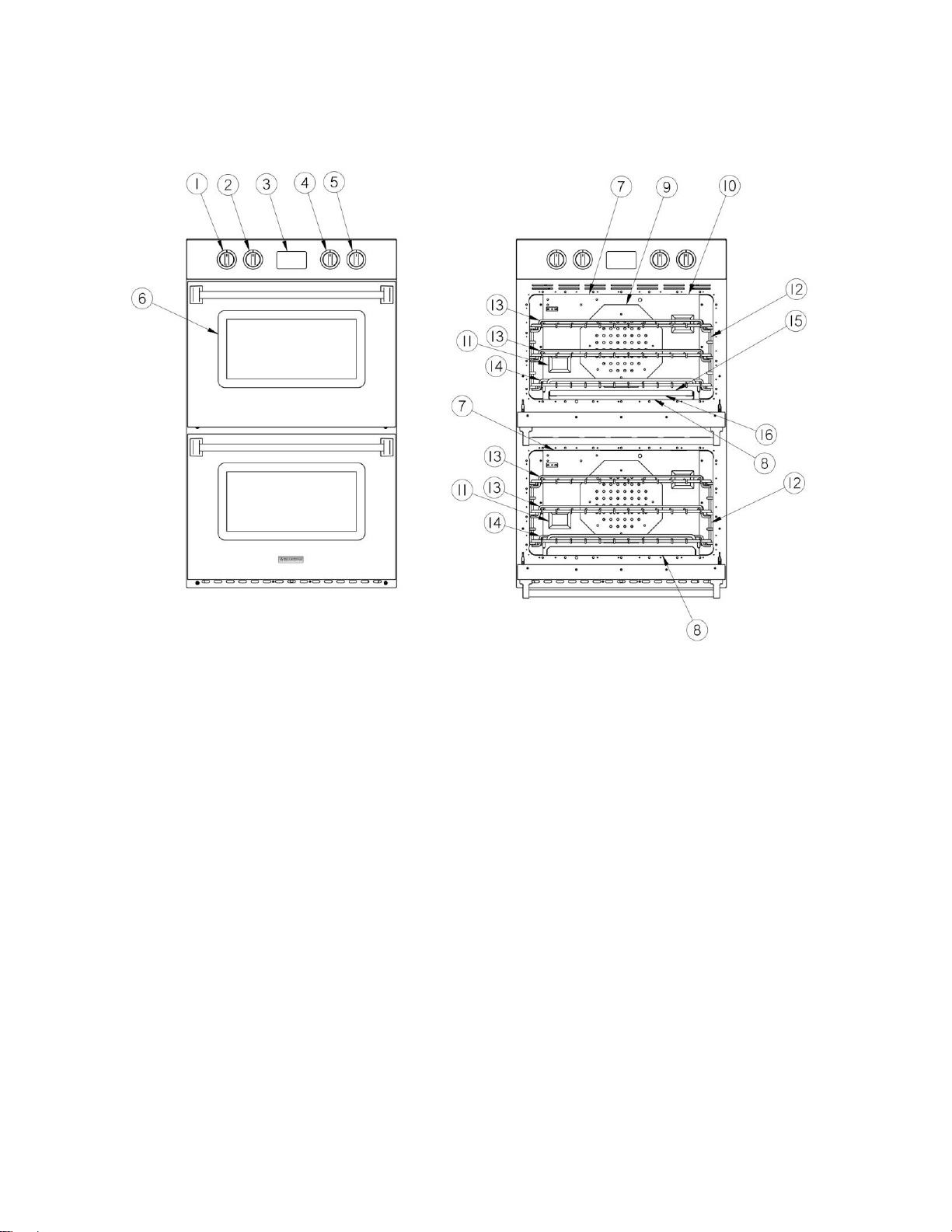
Become familiar with all the parts of your electric wall oven.
Remove and properly discard all temporary labels and packaging material from the oven exterior, oven
interior, oven rack glides and oven racks. Remove all cardboard, zip ties, paper and plastic sheathing used as
packaging. Failure to do so can create smells from the oven that will be difficult to remove.
Wash oven racks, and oven rack glides in hot, soapy water. Rinse well and dry thoroughly. See the Care and
Cleaning section.
DO NOT wash the baking stone. Washing the stone will allow the stone to absorb moisture and damage the
stone. Do not ever submerge the baking stone in any liquid. Residue can be removed from the stone
surface using a spatula or brush.
Register your appliance by completing the Performance Checklist completed by your installer, and mail to the
below address or submit online at bluestarcooking.com. The Performance Checklist can be found in the
Installation Manual or on page 42 of this manual.
Warranty Department
Prizer-Painter Stoveworks
318 June Avenue
Blandon, PA 19510
Perform the Oven Burn-Off Procedure before using your oven the first time to remove
all factory oils and residue. See page 14.
Perform the Pre-drying Procedure for the baking stone before first use. See page 15.
ATTENTION
10
GUIDE TO THE DOUBLE ELECTRIC WALL OVEN
1. Top Oven Mode Knob
2. Top Oven Temperature Control Knob
3. Display Screen
4. Bottom Oven Mode Knob
5. Bottom Oven Temperature Control Knob
6. Drop-down Door (French doors not shown)
7. Infrared Broiler Element
8. Infrared Heating Element
9. Convection Fan
10. Roast Probe Socket
11. Light
12. Rack Guide
13. Standard Rack (2)
14. Full Extension Rack (1)
15. Baking Stone
16. Baking Stone Temperature Probe
11
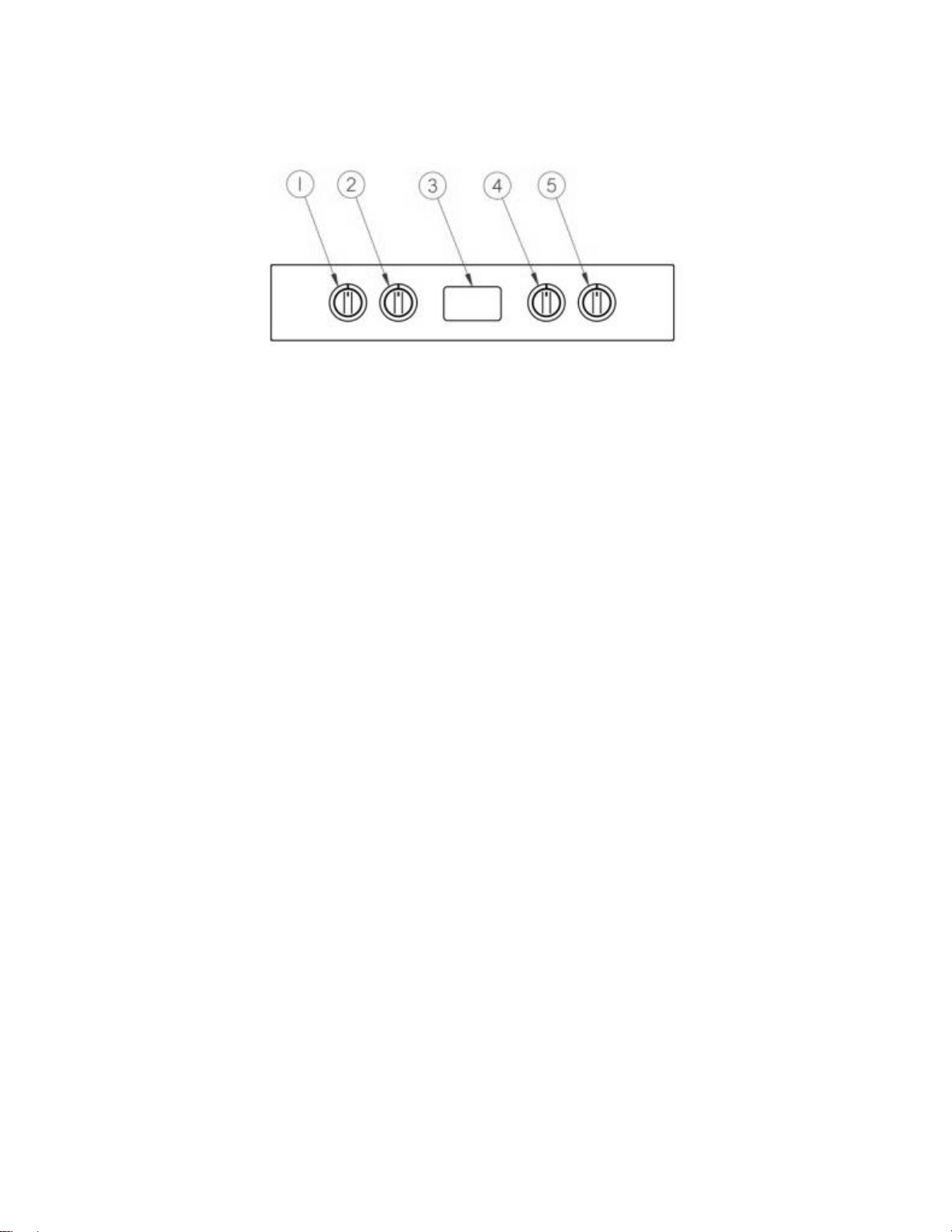
GUIDE TO THE OVEN CONTROLS
1. Top Oven Mode Knob
Use this knob to bypass the display screen and select one of the oven modes for the top oven.
2. Top Oven Temperature Control Knob
Use this knob to bypass the display screen and select the oven temperature for the top oven.
3. Display Screen
Shows and instructs the use of all the oven features.
4. Bottom Oven Mode Knob
Use this knob to bypass the display screen and select one of the oven modes for the bottom oven.
5. Top Oven Temperature Control Knob
Use this knob to bypass the display screen and select the oven temperature for the bottom oven.
12
OVEN ACCESSORIES
OVEN RACKS AND OVEN RACK GUIDES
Both the top and bottom ovens come equipped with two standard racks, one extension rack and two five-
position rack guides. Follow your recipe guidelines to determine the best rack location for your dish.
TIP: For best results, center baking pans on the rack to allow maximum air circulation around the food.
Extension Rack
The electric wall ovens each come with a rack that can be pulled out fully from the oven, making it easy to
handle heavy items. Although the full extension rack comes installed at the lowest position, it can be
moved to any position.
Extension Rack Operation
Make sure oven is cool and rack is fully inserted into oven cavity.
To Remove
Grasp the front of the rack and lift up slightly.
Pull the rack towards you, until completely removed from oven cavity.
To Insert
Grasp the slides of the rack, making sure that the slides are not extended. If extended, they can be
closed by standing the back end of the rack on the floor.
With the front end of the rack angled up, insert the top tab over the rack guide position you want to
use. Tilt the rack down slightly so the bottom tab slides under the guide bar.
Slide rack evenly into oven cavity.
Once almost completely in the oven, secure the two tabs at the front of the extension rack in place by
placing the rack guide in between
Oven Racks and Rack Guides Cleaning
Make sure oven is cool.
Remove oven racks and guides.
Wash in hot, soapy water. Rinse in clear water and dry thoroughly.
Oven racks and guides are dishwasher safe.
ROAST PROBE (TOP OVEN ONLY)
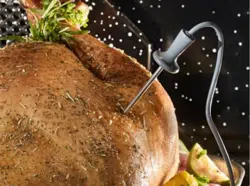
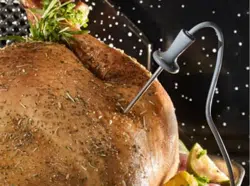
The roast probe monitors the core temperature of meat and poultry in the Roast Probe mode.
Insert the long pointed end of the probe into the thickest portion of the meat and the short end of the
probe into the roast probe socket located on the right front of the interior oven wall.
The roast probe will monitor temperatures between 65F and 225F.
Make sure probe is fully inserted into item being cooked. Failure to do so could result in incorrect
temperature reading. Item will indicate it is cooked before desired temperature is reached.
Be sure to remove the probe from the oven when not in use. The probe will be damaged
if the broiler is turned on with the probe in place.
ATTENTION
Always use an oven rack. Never place any food, pot, pan or tray directly on the oven
floor. You may place cooking vessels directly on the baking stone if in use.

13
Roast Probe Cleaning
When cool, wipe the probe clean with a mild soapy water solution. Rinse and dry thoroughly.
Do not put the meat probe in the dishwasher.
BAKING STONE (TOP OVEN ONLY)
The integrated baking stone lets you create perfectly baked breads and pizzas. In StoneBake™ mode,
the baking stone temperature probe makes sure that the stone maintains the desired temperature.
The stone should be pre-dried before first use. If not pre-dried, the stone could be
damaged. See page 15 for pre-drying procedure.
TIP: It is recommended to use the rough side of the pizza stone but either side is acceptable, experiment
to see which you prefer.
Baking Stone Cleaning
When completely cool, the stone can be removed for cleaning.
Scrape baked-on food with a nylon spatula. Never immerse the stone in water.
The baking stone weighs approximately 35 pounds. Use extreme care when
removing from the oven.
Make sure the stone’s probe socket is seated on the stone temperature probe in the
oven.
The stone will darken in color with use. This is normal and improves the stone’s
performance.
The stone may darken unevenly based on use. This is normal.
ATTENTION
ATTENTION
ATTENTION

14
OPERATING THE OVEN
BEFORE YOU BEGIN
Clean removable oven parts
Remove and properly discard all temporary labels and packaging material including cardboard, zip
ties, paper and wrapping from the oven, broiler pan, oven racks, oven rack glides and exterior
surfaces. Remove protective plastic wrap from any stainless steel surfaces.
BEFORE turning on your oven for the first time, remove and wash the oven racks and rack glides in
hot, soapy water. Rinse well and dry thoroughly. See the Care and Cleaning guide for more details.
Perform the Oven Burn-Off Procedure.
IF JUST DOING OVEN BURN OFF REMOVE BAKESTONE LOCATED ON THE OVEN
BOTTOM. IF PRE-DRYING THE BAKESTONE, THE OVEN BURN OFF PROCEDURE
IS NOT NEEDED. STONE CONDITIONING MUST BE COMPLETED BEFORE USING
THE BAKING STONE.
Oven Burn-Off Procedure
The entire Burn-Off Procedure takes about 100 minutes.
Remove the baking stone from the top oven before performing the Oven Burn-Off
Procedure. If not removed, it could shatter. The stone drying procedure can be used in
lieu of the burn-off procedure.
New appliances are wiped clean with solvents at the factory prior to shipping. The Burn-
Off procedure burns off any remaining processing residue.
Failing to perform the Oven Burn-Off Procedure before first use of the oven may result in
undesirable odors, flavors, and excessive smoke when you use your oven the first time.
Make sure your appliance has been installed properly and all performance checks and adjustments
are completed.
Turn on ventilation hood and make sure entire room is well-ventilated.
Check that the oven cavity is empty. The baking stone, oven racks, oven guides, roast probe and any
other objects should NOT be in the oven.
Start the Self-Clean cycle. See page 35.
The Oven Burn-Off Procedure can be completed by running the Self-Clean Cycle.
After the Self-Clean cycle is complete, allow oven to cool completely.
Insert oven rack guides and racks.
Your oven is now ready for use.
You may notice the following events during the Oven Burn-Off Procedure. All are normal.
Strong odor
Some smoke
Condensation on the front of the oven including the oven door, oven window, control
panel and side panel.
Your oven is not a storage compartment. Do NOT place
food, pots or pans, cooking equipment or storage containers in the oven
when not in use.
ATTENTION
CAUTION
ATTENTION
WARNING
ATTENTION
ATTENTION
15
PRE-DRY THE BAKING STONE (TOP OVEN ONLY)
Your baking stone must by pre-dried before using it to prevent warping
and maximize its life. If the stone is not properly dried before its first use,
it could warp, crack or shatter with explosive force.
Follow the pre-drying instructions and document the start time for each
step to keep track of your activity.
The entire pre-drying process will take six hours and
must be followed exactly as directed.
Keep the oven door closed throughout the entire
pre-drying process.
An odor and out-gassing may occur during the initial
heat-up. This is normal as the stone adjusts to its
environment.
1. Allow the baking stone to come to room temperature before starting.
2. Make sure the stone’s probe socket is properly seated on the stone
temperature probe.
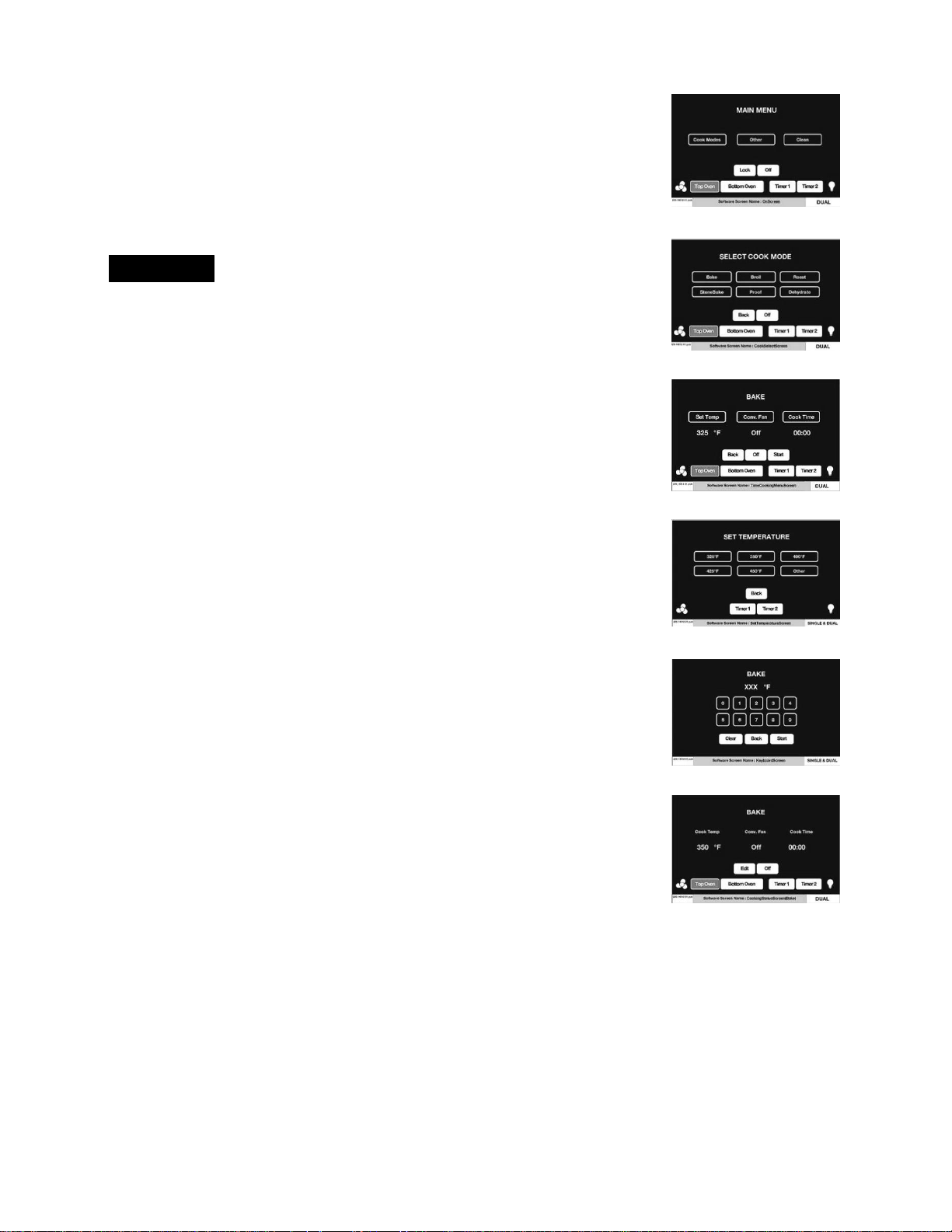
3. Press Top Oven on the Main Menu screen then Cook Modes. Figure
1. The selected oven will be red.
4. Press Bake on the Select Cook Mode screen. Figure 2
5. Press Set Temp on the Bake screen. Figure 3
6. Press Other on the Set Temperature screen. Figure 4
7. Enter 2-0-0 and press Start. Figure 5
9. Press Start on the Bake screen. Maintain the 200 degrees F. setting
for three hours. Figure 3
10. Do not open the oven door. After three hours at 200 degrees F.,
select Edit on the Bake screen. Figure 6
11. Press Set Temp on the Bake screen. Figure 3
12. Press Other on the Set Temperature screen. Figure 4
13. Press Clear, enter 3-0-0 and press Start. Figure 5
14. Press Start on the Bake screen. Maintain the 300 degrees F. setting
for one hour. Figure 3
15. Do not open the oven door. After one hour at 300 degrees F., select
Edit on the Bake screen. Figure 6
16. Press Set Temp on the Bake screen. Figure 3
17. Press Other on the Set Temperature screen. Figure 4
18. Press Clear, enter 4-0-0 and press Start. Figure 5
19. Press Start on the Bake screen. Maintain the 400 degrees F. setting
for one hour. Figure 3
20. Do not open the oven door. After one hour at 400 degrees F., select
Edit on the Bake screen.
21. Press Set Temp on the Bake screen. Figure 3
22. Press Other on the Set Temperature screen. Figure 4
23. Press Clear, enter 5-0-0 and press Start. Figure 5
24. Press Start on the Bake screen. Maintain the 500 degrees F. setting
for one hour. Figure 3
25. After one hour at 500 degrees F., your baking stone is ready for use.
Figure 1
Figure 2
Figure 3
Figure 4
Figure 5
Figure 6
ATTENTION

16
TIPS
Sprinkle a light dusting of baking flour on the stone to help season it
before baking the first time. The flour allows air to flow between the
stone and the item to be baked. Never use any type of oil on the
stone.
Use either the rough or smooth surface of the stone, depending on
your preference.
It is recommended to cook dough items on the rough surface.
Do not allow any liquid to come in contact with the stone.
Accidental spillage of liquid onto the stone during cooking
procedures is acceptable, but liquid should not be applied directly to
the stone.
To clean, after the stone is cool, use a nylon scraper or dry cloth to
remove crumbs or baked-on residue. Never use an abrasive sponge
or brush.
Never immerse the stone in any liquid.
With each use, the stone becomes seasoned and
darkens, making it more effective. The stone may
darken unevenly based on use, which is normal.
ATTENTION
Failure to follow the installation instructions and warnings regarding liquids contacting the
stone and stone being immersed in liquid may result in the baking stone disintegrating with
explosive force.
Handle the baking stone carefully. If the stone knocks a hard surface, it may crack or
develop hairline fractures that may expand over time and lead to premature product failure.
The stone is still usable and acceptable with hairline cracks.
Do not subject the stone to thermal shock. Foods cannot be thawed directly on the baking
stone.
Never place the baking stone over an open flame.
Only dough-based foods like pizza or bread should be baked directly on the stone surface.
Any other food that will be stone baked should be placed in a cooking vessel before
placing it on the stone.
17
OPERATING THE OVEN
DISPLAY SCREEN
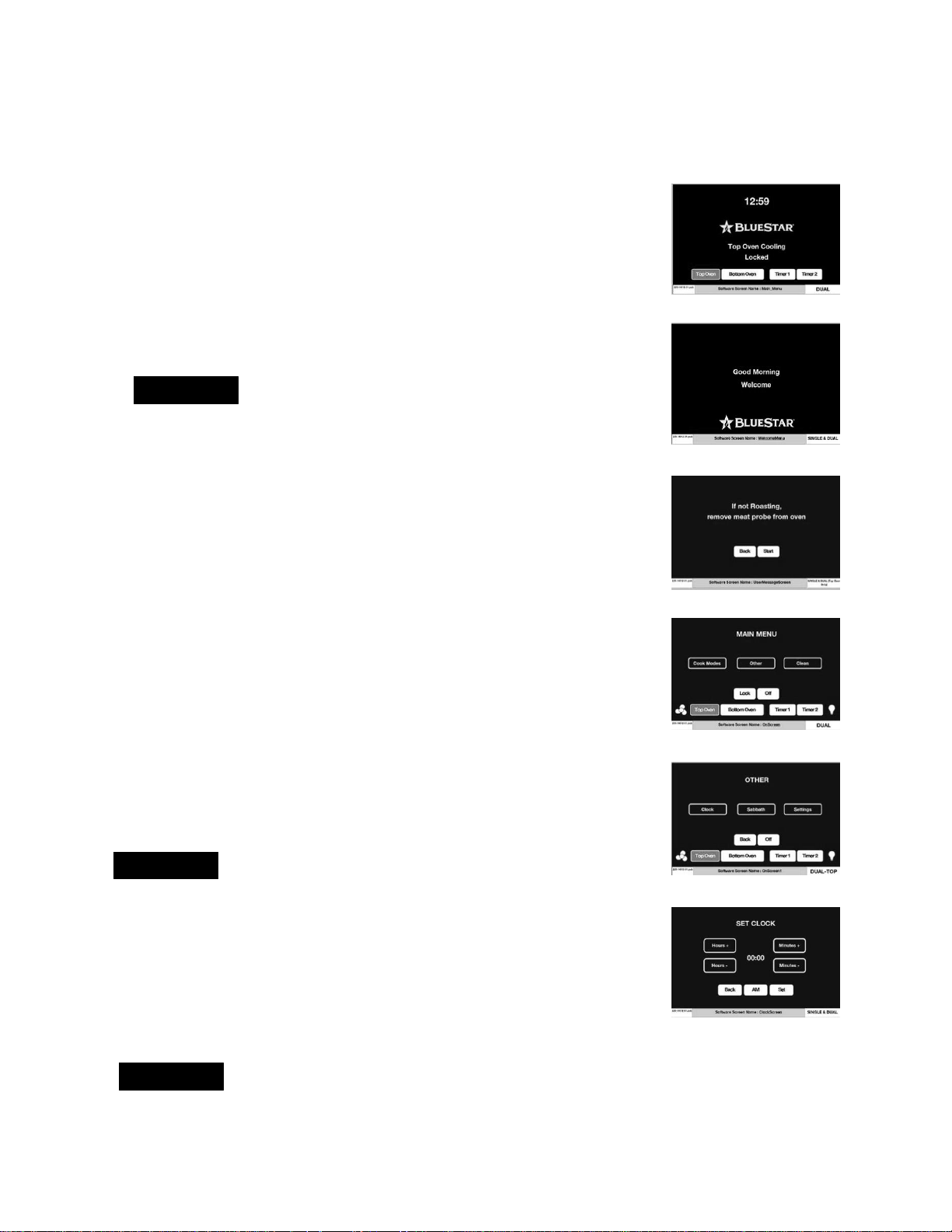
Both the top and bottom ovens are operated from the display screen.
When the oven is not in use, the screen displays the time and the
BlueStar logo.
Press Top Oven or Bottom Oven to start any oven operation.
Note: If “Locked” is displayed, press and hold Top Oven or
Bottom Oven for five seconds and release to unlock the display.
Figure 1
The Welcome screen will appear briefly. Figure 2
You will be reminded to remove the roast probe from the oven if
you are not probe roasting. Figure 3
Any time the display screen is in use, a fan will
automatically turn on to keep the electrical
components and computer hardware cool. The
display screen fan might stay on for several minutes
or hours after the oven is turned off. The message
Oven Cooling will be displayed until cavity
temperature goes below 200F.
LOCK
1. To lock the display screen to prevent accidental operation of the
oven, go to the Main Menu and press and hold Lock for five
seconds, then release. Figure 4
2. To unlock the display screen, press and hold Top Oven or Bottom
Oven for five seconds, then release. Figure 1
CLOCK
1. To set the oven clock, press Top Oven or Bottom Oven. Figure 1
2. Press Other on the Main Menu screen. Figure 4
3. Press Clock on the Other screen. Figure 5
4. Use the keypad to enter the Hours and Minutes, and AM or PM.
5. Press the Set button to confirm your entry. Figure 6
LIGHT
1. To turn on the oven light, press Top Oven or Bottom Oven, then
press the light bulb icon that appears on the lower right corner of the
display. Press the light bulb icon again to turn the light off. Figure 4
Keeping the oven light on while baking will increase the
oven temperature approximately 15 degrees F.
CONVECTION FAN
1. To activate the convection fan, press Top Oven or Bottom Oven,
then press the fan icon on the lower left side of the display screen.
Figure 4
2. In all cooking modes there is a Conv. Fan on/off button that can be
selected when cooking.
Certain cooking modes require the convection fan to
be on or off, and the fan icon will become inactive.
See the chart on page 19.
Figure 1
Figure 2
Figure 3
Figure 4
Figure 5
Figure 6
ATTENTION
ATTENTION
ATTENTION
18
INDEPENDENT KITCHEN TIMERS
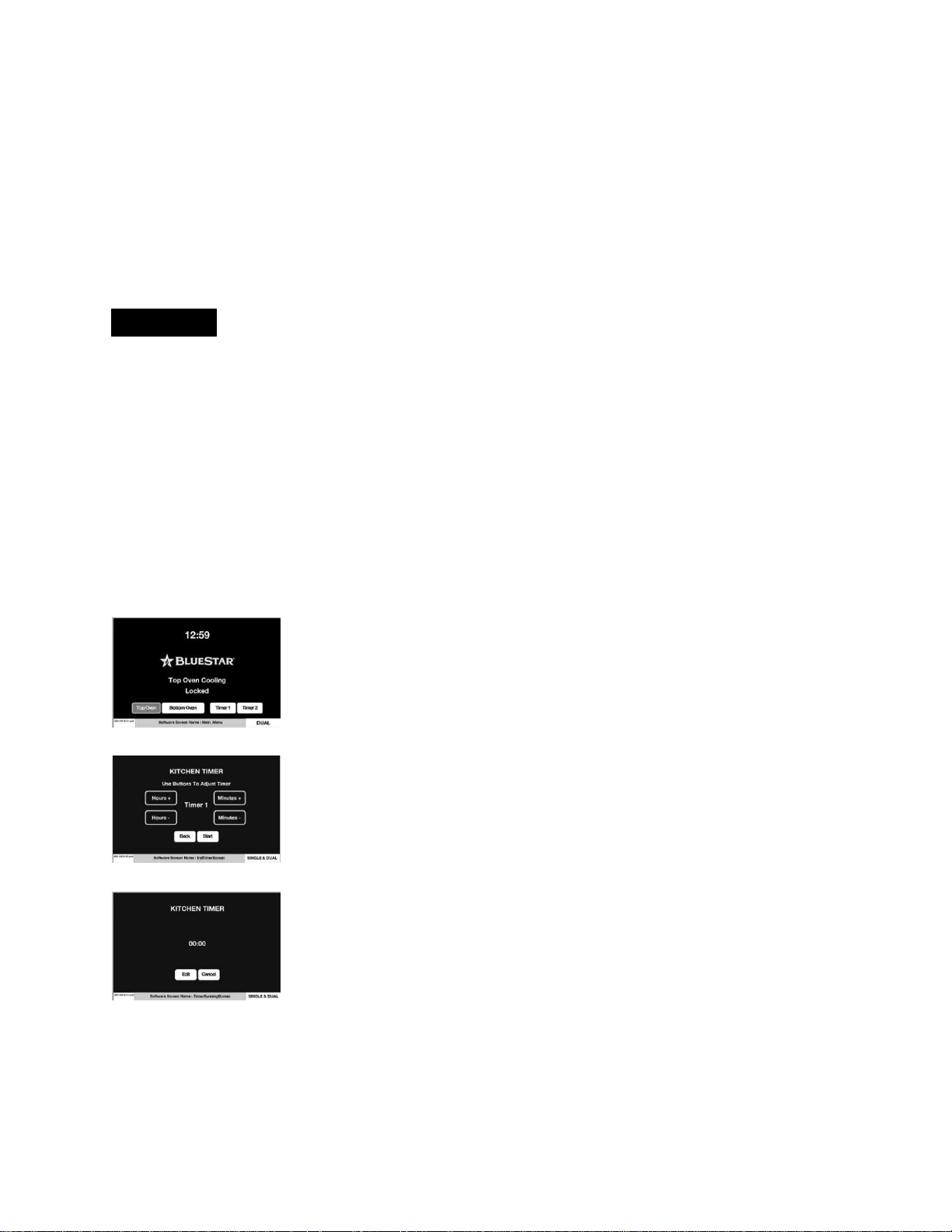
The double electric wall oven display has two timers that operate
independently from the ovens.
1. Press Timer 1 or Timer 2 on the Home screen or wherever the timer
buttons are displayed. Figure 1
2. Use the buttons on the screen to select the desired time, and press
Start. Figure 2
3. The Kitchen Timer running time screen will appear briefly. Figure 3
The Kitchen Timer screen will move to the
background and the last screen displayed will
appear.
If you are not using the oven and only using the
Kitchen Timer, that screen will remain displayed.
To view the timer countdown, select Timer on
the display screen.
When the oven is in any cooking mode, the
kitchen timer can be operated by selecting
Timer on the Touch Screen.
4. When time expires, an alarm sounds three times and the Kitchen
Timer screen appears. The alarm will continue to sound at 9 second
intervals until action is taken. Figure 3
5. Press Cancel to stop the timer and return to the last screen
displayed. Figure 3
6. Press Edit to stop the timer or change the timer setting. Figure 3
7. The timer countdown appears in the selected timer button.
Figure 1
Figure 2
Figure 3
ATTENTION

19
OPERATING THE OVEN
MODES
Your double electric wall ovens have 15 operating modes: Bake, Roast,
Broil, Proof, Dehydrate, Convection Bake, Convection Roast,
Convection Broil, Convection, Convection Proof, Convection
Dehydrate, and Clean.
The top oven also has Probe Roast, Convection Probe Roast,
StoneBake™, Convection StoneBake™, Sabbath, and Sabbath
Convection modes.
Each mode has pre-set minimum and maximum temperature ranges.
CONVECTION FAN
You have the option of using the convection fan for many modes. Using
the convection fan typically decreases cooking time while using a lower
temperature.
Mode
Convection Fan Status
Preheat for all modes
Auto On
Proof
Select On/Off
Dehydrate
Select On/Off
Hold & Keep Warm
Select On/Off
Bake
Select On/Off
Roast
Select On/Off
Probe Roast
Select On/Off
Broil
Select On/Off
StoneBake
Select On/Off
Sabbath
Select On/Off
Clean
Auto On
When the Convection Fan is in Auto On mode, the user
will not be able to change its status. The convection fan
will also run whenever the elements are energized.
DISPLAY SCREEN
All the oven’s functions operate from the display screen.
The Main Menu screen displays the time and the BlueStar logo.
Press Top Oven or Bottom Oven to start any oven operation.
If “Locked” is displayed, press the BlueStar® logo for five
seconds and release to unlock the display. Figure 1
The Welcome screen will appear briefly. Figure 2
You will be asked to remove the oven probe from the oven so it
is not damaged. Figure 3
The Main Menu screen appears.
Figure 1
Figure 2
Figure 3
ATTENTION

20
OPERATING THE OVEN
CONTROL KNOBS
Your double electric wall oven has cooking mode and temperature
control knobs that allow you to select a cooking mode or change the
oven temperature without touching the display screen.
It is critical that you do not place food in the oven
until the preheating cycle is complete.
Start with the oven OFF.
For the Top Oven, use the Control Knobs on the left side of the display
screen.
1. To select a cooking mode, turn the Mode Control Knob clockwise (to
the right) or counterclockwise (to the left) 1/8 turn to scroll through the
cooking modes.
2. When you reach the desired cooking mode, continue operating the
oven using the display screen. Top Oven will be displayed.
3. To increase the oven temperature, turn the Temperature Control Knob
clockwise 1/8 turn to increase the oven temperature in 5 degree
increments.
4. To decrease the oven temperature, turn the Temperature Control
Knob counterclockwise 1/8 turn to increase the oven temperature in 5
degree increments.
For the Bottom Oven, use the Control Knobs on the right side of the
display screen.
1. To select a cooking mode, turn the Mode Control Knob clockwise (to
the right) or counterclockwise (to the left) 1/8 turn to scroll through the
cooking modes.
2. When you reach the desired cooking mode, continue operating the
oven using the display screen. Bottom Oven will be displayed.
3. To increase the oven temperature, turn the Temperature Control Knob
clockwise 1/8 turn to increase the oven temperature in 5 degree
increments.
4. To decrease e the oven temperature, turn the Temperature Control
Knob counterclockwise 1/8 turn to increase the oven temperature in 5
degree increments.
Regardless of the cooking mode you select, your oven
preheats using a combination of the infrared heating
element, the broiling element, and the convection fan.
It is important to allow oven to pre-heat before loading.
Failure to do so can have negative results.
WARNING
ATTENTION

21
OPERATING THE OVEN USING THE DISPLAY PANEL
BAKE
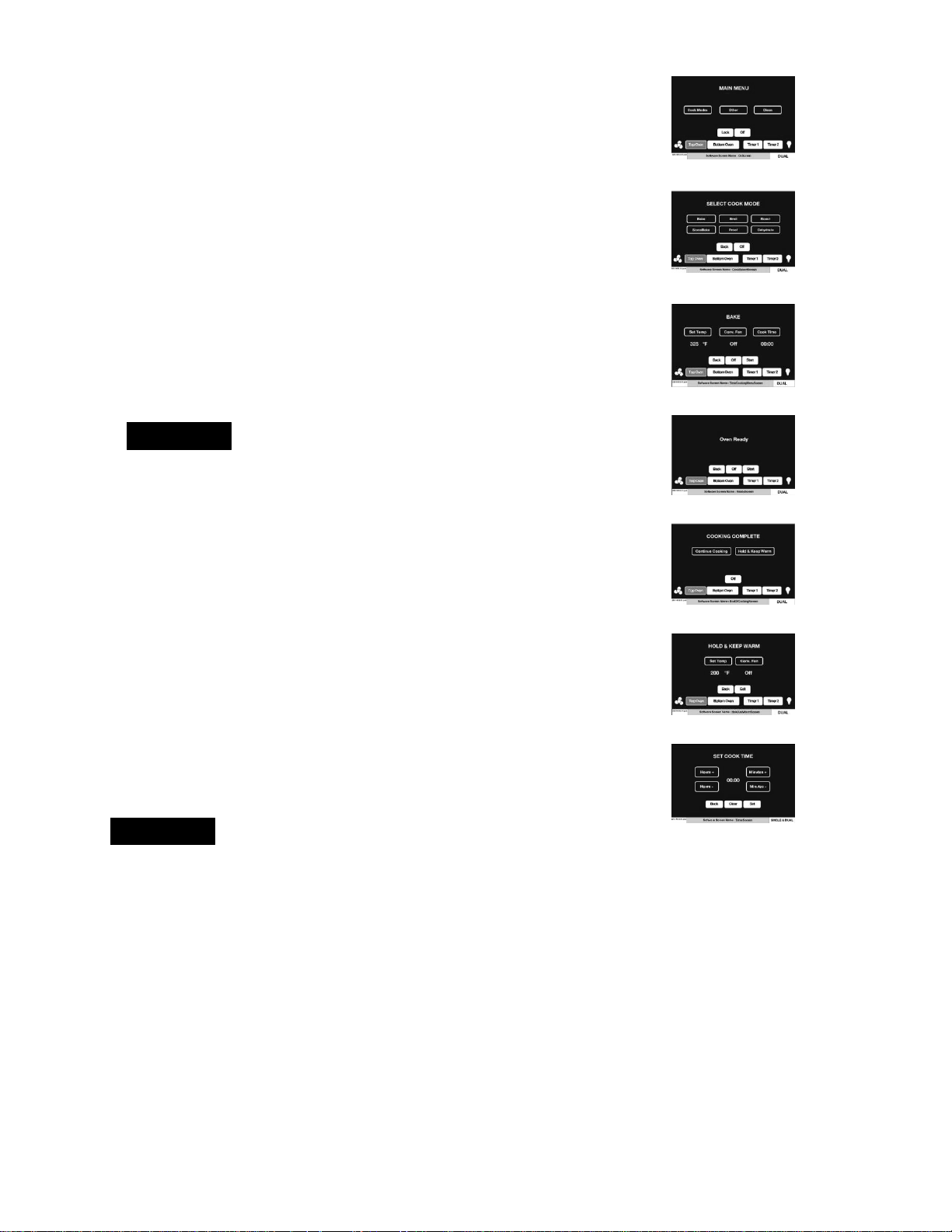
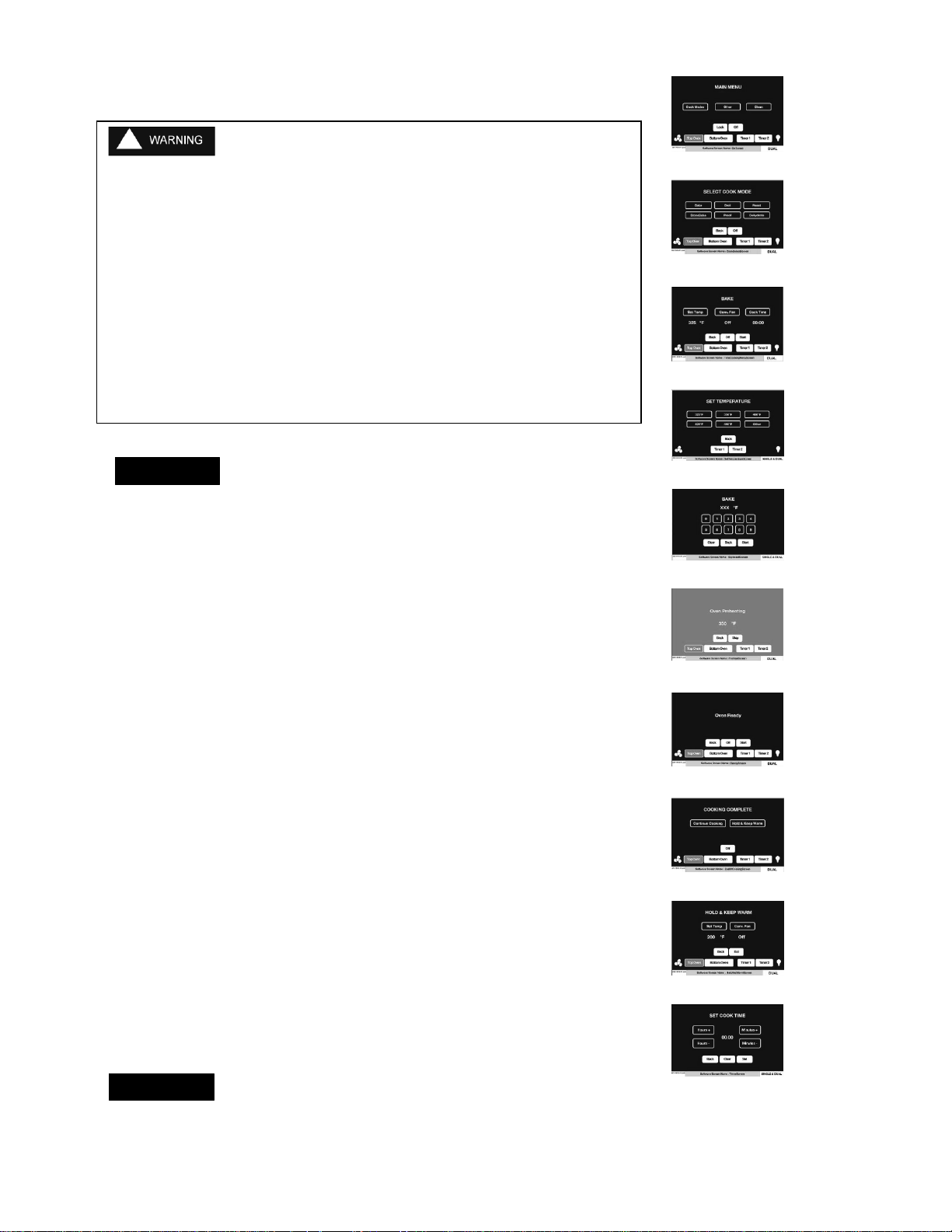
1. Select Top Oven or Bottom Oven from the Home screen. Remove
oven probe from oven to prevent damaging it.
2. Press Cook Modes on the Main Menu display. Figure 1
3. Press Bake on the Select Cook Mode screen. Figure 2
4. Press Set Temp on the Bake screen. Figure 3
5. Select one of the preset Bake temperatures or press Other to enter
a different temperature. Figure 4
6. If selecting Other, enter desired temperature, then Start. Figure 5
7. The Bake screen will be displayed. Press Start. Or, if desired, press
the Fan icon or Conv Fan for convection baking, then press Start.*
Convection Bake will be displayed. Figure 3
See the TIPS section for Convection Baking recommendations.
8. The oven will begin preheating. Figure 6 See Attention below.
9. When the oven is preheated, an alarm sounds three times, then
once every 10 seconds. The Oven Ready screen appears. Figure 7
10. Place baking dish in oven and select Start. The Bake or Convection
Bake screen appears. Figure 8
11. At the end of the selected bake time, the Cooking Complete screen
is displayed. An alarm will signal three times, then once every 10
seconds until one of the following actions is taken. Figure 9
a. Select Off to turn off the oven.
b. Select Continue Cooking to return to the Bake screen.
c. Select Hold & Keep Warm to keep your food in the oven at
a specific temperature until you are ready to serve. Figure 10
12. If you select Hold & Keep Warm, press Set Temp to display the set
temperature screen and make a selection. See Attention below.
Do not place food in the oven before or during the
preheating process. The oven uses a combination of
heating elements during the preheating process to
achieve the specified temperature.
Beware that the oven loses heat slowly and that
food will continue cooking in the Hold & Warm
mode.
Keeping the oven light on while baking will increase
the oven temperature approximately 15 degrees F.
*SET COOKING TIME
1. From the Bake or Convection Bake screen, press Cook Time.
Figure 3
2. Use the buttons on the touchpad to select desired cooking time, and
press Set. Figure 11
3. Return to the last screen displayed.
4. The cooking time countdown begins after the oven has preheated.
If the cooking timer is not set, the oven will continue to
operate at the selected temperature.
Figure 1
Figure 2
Figure 3
Figure 4
Figure 5
Figure 6
Figure 7
Figure 8
Figure 9
ATTENTION
ATTENTION

22
Figure 10
Figure 11
TIPS
TEMPERATURE RANGE
In Bake mode, the oven can operate at temperatures between 150 and
500 degrees F. Entering a temperature outside of this range will result in
an error message.
CONVECTION COOKING
Convection cooking uses a fan inside the oven to circulate the heated air
more evenly, resulting in better heat distribution and a more consistent
temperature.
In general, convection baking takes less time at lower temperatures than
traditional baking.
For best results:
Reduce the recommended recipe temperature 25°F to 50°F.
Reduce the recommended cooking time.
Closely monitor the first batch of each new recipe.
Keep a record of temperature, time and weight for each recipe.
Adjust accordingly for the next batch.
Center baking dishes on the racks for maximum air flow, allowing at
least 1” between pans.
Select a baking dish that has no or low sides like a broiler pan so
that the air can circulate freely around the food.
23
OPERATING THE OVEN USING THE DISPLAY PANEL
BROIL
1. Select Top Oven or Bottom Oven from the Home screen. Remove
oven probe from oven to prevent damaging it.
2. Press Cook Modes on the Main Menu display. Figure 1
3. Press Broil on the Select Cook Mode screen. Figure 2
4. Press Set Temp on the Broil screen to select a broil temperature of
Low or High. The Set Temp button toggles Low and High. Figure 3
a. In Broil mode, the oven operates at temperatures of either Low
(450 degrees F) or High (550 degrees F).
5. Press Start.* The Oven Ready screen appears and an alarm
sounds. Place baking dish in oven and select Start. Figure 4
6. Or, if desired, press the Fan icon or Conv Fan for convection
broiling, then press Start.* Convection Broil will be displayed.
See the TIPS section for Convection Baking recommendations.
7. Press Start.* When the Oven Ready screen appears, place baking
dish in oven and select Start. Figure 4
The oven will be ready to broil in five minutes.
Keep the oven door shut while broiling.
8. At the end of the selected cook time, the Cooking Complete screen
is displayed. An alarm will signal three times and then once every 10
seconds until one of the following actions is taken. Figure 5
a. Select Off to turn off the oven and remove food.
b. Select Continue Cooking to return to the Broil screen.
c. Select Hold & Keep Warm to continue broiling. Figure 6
i. If you select Hold & Keep Warm, press the Set
Temp to display the set temperature screen and
select Low or High. Figure 5
Keeping the oven light on while baking will increase the
oven temperature approximately 15 degrees F.
*SET COOKING TIME
1. From the Broil screen, press Time. Figure 5
2. Use the buttons on the touchpad to select desired cooking time, and
press Set. Figure 7
3. Return to the last screen displayed.
If the cooking timer is not set, the oven will continue to
operate at the selected temperature.
TIPS: CONVECTION COOKING
Convection cooking uses a fan inside the oven to circulate the heated air
more evenly, resulting in better heat distribution and a more consistent
temperature.
In general, convection baking takes less time at lower temperatures than
traditional baking.
For best results:
Reduce the recommended recipe temperature 25°F to 50°F.
Figure 1
Figure 2
Figure 3 - Broil
Figure 4
Figure 5
Figure 6-Broil
Figure 7
ATTENTION
ATTENTION

24
Reduce the recommended cooking time.
Closely monitor the first batch of each new recipe.
Keep a record of temperature, time and weight for each recipe.
Adjust accordingly for the next batch.
Center baking dishes on the racks for maximum air flow, allowing at
least 1” between pans.
Select a baking dish that has no or low sides like a broiler pan so
that the air can circulate freely around the food.
25
OPERATING THE OVEN USING THE DISPLAY PANEL
ROAST WITHOUT THE ROAST PROBE
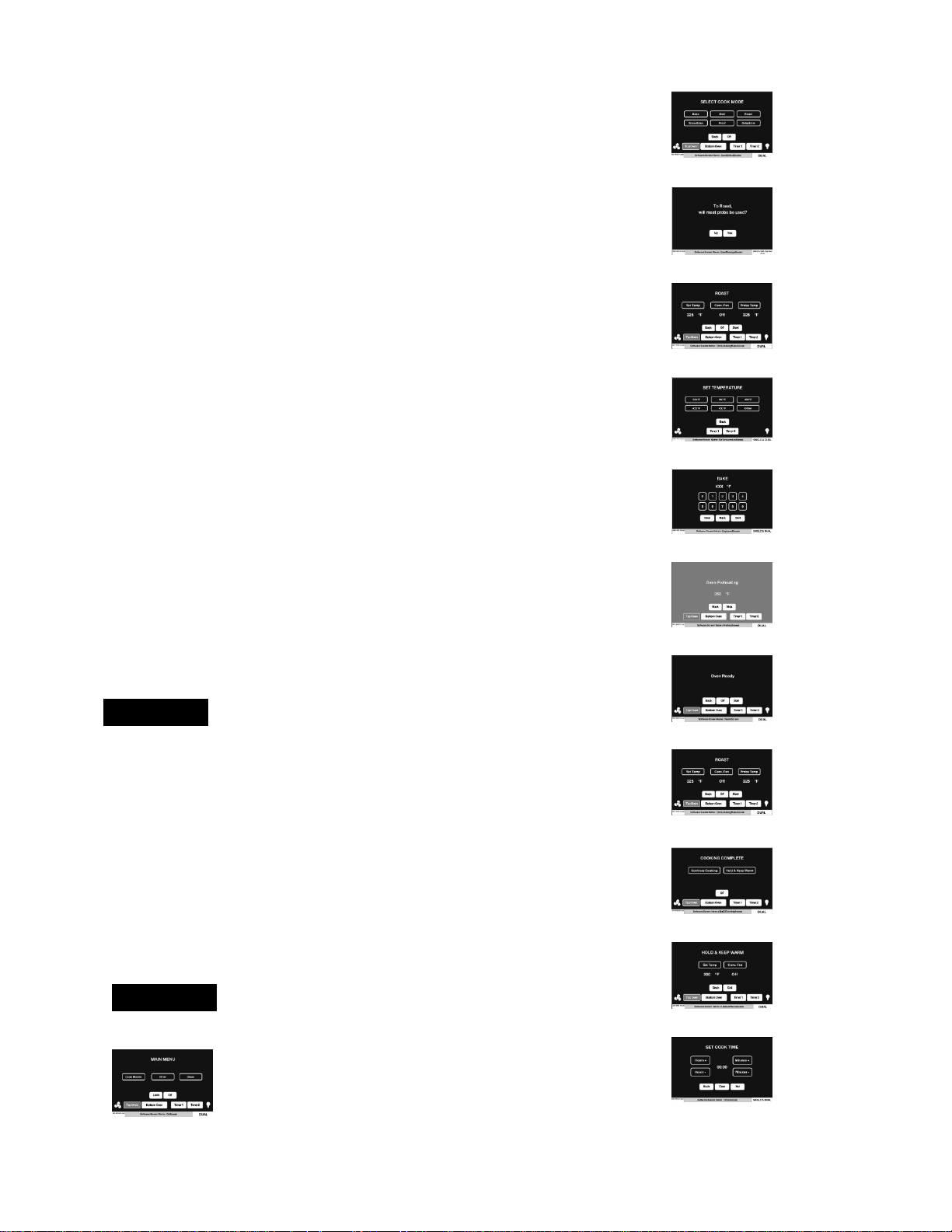
1. Select Top Oven or Bottom Oven from the Home screen. Remove
oven probe from oven to prevent damaging it.
2. Press Cook Modes on the Main Menu display. Figure 1
3. Press Roast on the Select Cook Mode screen. Figure 2
4. Press No when asked if meat probe will be used. Figure 3
5. Press Set Temp on the Roast screen. Figure 4
6. Select one of the preset Roast temperatures or press Other to enter
a different temperature. Figure 5
7. If selecting Other, enter desired temperature, then Start. Figure 6
8. The Roast screen will be displayed. Press Start. Or, if desired, press
the Fan icon or Conv Fan for convection baking, then press Start.*
Convection Roast will be displayed. Figure 4
See the TIPS section for Convection Baking recommendations.
9. The oven will begin preheating. Figure 7 See Attention below.
10. When the oven is preheated, an alarm sounds three times, then
once every 10 seconds. The Oven Ready screen appears. Figure 8
11. Place baking dish in oven and select Start. The Roast or
Convection Roast screen appears. Figure 9
12. At the end of the selected bake time, the Cooking Complete screen
is displayed. An alarm will signal three times, then once every 10
seconds until one of the following actions is taken. Figure 10
a. Select Off to turn off the oven.
b. Select Continue Cooking to return to the Bake screen.
c. Select Hold & Keep Warm to keep your food in the oven at
a specific temperature until you are ready to serve. Figure 11
i. If you select Hold & Keep Warm, press Set Temp
to display the set temperature screen and make a
selection. See Attention below.
The oven preheats using a combination of the
infrared heating element, the broiling element, and
the convection fan. It is critical that you do not place
food in the oven until the preheating cycle is
complete.
Beware that the oven loses heat slowly and that
food will continue cooking in the Hold & Warm
mode.
Keeping the oven light on while baking will increase
the oven temperature approximately 15 degrees F.
*SET COOKING TIME
1. From the Roast or Convection Roast screen, press Cook Time.
Figure 2
2. Use the buttons on the touchpad to select desired cooking time, and
press Set. Figure 12
3. Return to the last screen displayed.
4. The cooking time countdown begins after the oven has preheated.
If the cooking timer is not set, the oven will continue to
operate at the selected temperature.
Figure 1
Figure 2
Figure 3
Figure 4
Figure 5
Figure 6
Figure 7
Figure 8
Figure 9
Figure 10
Figure 11
Figure 12
ATTENTION
ATTENTION

26
TIPS
TEMPERATURE RANGE
In Roast mode, the oven can operate at temperatures between 150 and
500 degrees F. Entering a temperature outside of this range will result in
an error message.
CONVECTION COOKING
Convection cooking uses a fan inside the oven to circulate the heated air
more evenly, resulting in better heat distribution and a more consistent
temperature.
In general, convection roasting takes less time at lower temperatures
than traditional baking.
For best results:
Reduce the recommended recipe temperature 25°F to 50°F.
Reduce the recommended cooking time.
Closely monitor the first batch of each new recipe.
Keep a record of temperature, time and weight for each recipe.
Adjust accordingly for the next batch.
Center baking dishes on the racks for maximum air flow, allowing at
least 1” between pans.
Select a baking dish that has no or low sides like a broiler pan so
that the air can circulate freely around the food.
27
OPERATING THE OVEN USING THE DISPLAY PANEL
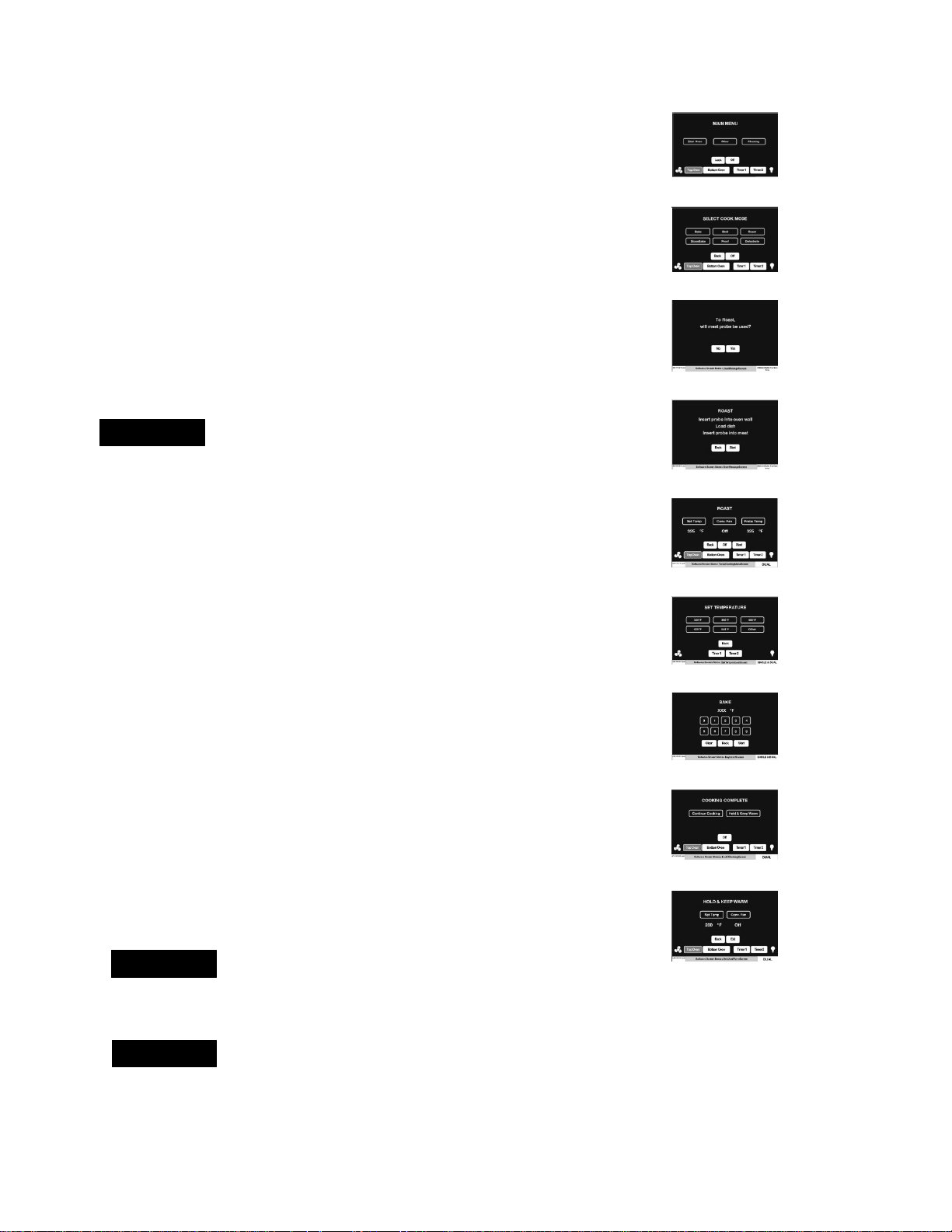
ROAST WITH THE ROAST PROBE (TOP OVEN ONLY)
1. Select Top Oven or Bottom Oven from the Home screen.
2. Press Cook Modes on the Main Menu display. Figure 1
3. Press Roast on the Select Cook Mode screen. Figure 2
4. Press Yes when asked if meat probe will be used. Figure 3
5. Insert the short end of the probe into the oven wall socket and the
long end into the thickest portion of the meat. Press Start. Figure 4
6. Press Set Temp on the Roast screen. Figure 5
7. Select one of the preset Roast temperatures or press Other to enter
a different temperature. Figure 6
8. If selecting Other, enter desired temperature, then Start. Figure 7
9. If desired, press the Fan icon or Conv Fan for convection baking.
Convection Roast will be displayed. Figure 5
See the TIPS section for Convection Baking recommendations.
10. Press Probe Temp on the Roast screen. Figure 5
See page 8 for the USDA’s recommendations on
safe minimum internal temperatures.
Do not place food in the oven before or during the
preheating process. The oven uses a combination of
heating elements during the preheating process to
achieve the specified temperature.
Roast Probe must be fully inserted into protein for
proper operation. If not fully inserted probe may
indicate inaccurate temperature.
11. Select one of the preset internal meat temperatures or press Other
to enter a different internal meat temperature. Figure 6
See page 8 for the USDA’s recommendations on safe minimum
internal temperatures.
12. If selecting Other, enter desired temperature, then Start. Figure 7
13. The oven will begin heating without a preheating cycle.
14. When the product has reached the selected internal temperature, the
Cooking Complete screen is displayed. An alarm will signal three
times, then once every 10 seconds until one of the following actions
is taken. Figure 8
a. Select Off to turn off the oven and remove food.*
b. Select Continue Cooking to return to the Roast screen.
c. Select Hold & Keep Warm to keep your food in the oven at
a specific temperature until you are ready to serve. Figure 9
i. If you select Hold & Keep Warm, press Set Temp
to display the set temperature screen and make a
selection. See Attention below.
Beware that the oven loses heat slowly and that
food will continue cooking in the Hold & Warm
mode.
Keeping the oven light on while baking will increase
the oven temperature approximately 15 degrees F.
*The oven probe will be HOT! Use a dry pot holder
to remove the probe from the meat and from the
oven socket.
Figure 1
Figure 2
Figure 3
Figure 4
Figure 5
Figure 6
Figure 7
Figure 8
Figure 9
ATTENTION
WARNING
ATTENTION

28
TIPS
TEMPERATURE RANGE
The oven probe temperature can be set between 80 and 200 degrees F.,
ensuring your dish cooks to the precise internal temperature you want.
In Roast with Oven Probe mode, the oven can operate at temperatures
between 150 and 500 degrees F. Entering a temperature outside of this
range will result in an error message.
CONVECTION COOKING
Convection cooking uses a fan inside the oven to circulate the heated air
more evenly, resulting in better heat distribution and a more consistent
temperature.
In general, convection baking takes less time at lower temperatures than
traditional baking.
For best results:
Reduce the recommended recipe temperature 25°F to 50°F.
Reduce the recommended cooking time.
Closely monitor the first batch of each new recipe.
Keep a record of temperature, time and weight for each recipe.
Adjust accordingly for the next batch.
Center baking dishes on the racks for maximum air flow, allowing at
least 1” between pans.
Select a baking dish that has no or low sides like a broiler pan so
that the air can circulate freely around the food.
29
OPERATING THE OVEN USING THE DISPLAY PANEL
STONEBAKE™ MODE (TOP OVEN ONLY)
Remove all racks before pre-heating the oven when
using StoneBake™.
1. Select Top Oven or Bottom Oven from the Home screen. Remove
oven probe from oven to prevent damaging it.
2. Press Cook Modes on the Main Menu display. Figure 1
3. Press StoneBake™ on the Select Cook Mode screen. Figure 2
4. Press Set Temp on the StoneBake™ screen. Figure 3
5. Select one of the preset StoneBake™ temperatures or press Other
to enter a different temperature. Figure 4
6. If Other, enter your desired temperature, then Start. Figure 5
7. If desired, press the Fan icon or Conv Fan for convection stone
baking, then press Start. Convection StoneBake will be displayed.
See the TIPS section for Convection recommendations.
8. The stone will begin preheating. Figure 6
9. When the stone is preheated, the alarm will sound and the Stone
Ready screen will appear. Figure 7
10. Place the dough or oven safe dish directly on the stone and select
Start.*
11. At the end of the cooking time, the Cooking Complete screen is
displayed. An alarm will signal twice and then once every 10
seconds until one of the following actions is taken. Figure 8
a. Select Off to turn off the oven and remove food.
b. Select Continue Cooking to return to the StoneBake™
screen.
c. Select Hold & Keep Warm to keep your food in the oven at
a specific temperature until you are ready to serve. Due to
the higher degrees that StoneBake™ operates at, it will take
longer to reach the hold & keep warm temperature.
i. If you select Hold & Keep Warm, press the Set
Temp to display the set temperature screen. Figure
9
The oven uses a combination of heating elements
during the preheating process to achieve the
specified temperature.
Do not place food in the oven before or during the
preheating process.
Figure 1
Figure 2
Figure 3 StoneBake
Figure 4 StoneBake
Figure 5 StoneBake
Figure 6 Stone Preheating
Figure 7 Stone Ready
Figure 8
Figure 9
Figure 10
ATTENTION
ATTENTION
Your baking stone must be pre-dried before first use to prevent
damaging it. See page 15.
Failure to follow the installation instructions and warnings may result in
the baking stone disintegrating with explosive force.
The baking stone weighs approximately 35 pounds. Handle with care.
If the stone knocks a hard surface, it may crack or develop hairline
fractures that may expand over time and lead to premature product
failure. Stone may still be used with hairline cracks.
Do not subject the stone to thermal shock. Foods cannot be thawed
directly on the baking stone.
Never place the baking stone over an open flame.
Only dough-based foods like pizza or bread should be baked directly
on the stone surface. Any other food should be placed in a cooking
vessel.

30
Keeping the oven light on while baking will increase
the oven temperature approximately 15 degrees F.
*SET COOKING TIME
1. From the StoneBake™ screen, press Cook Time. Figure 3
2. Use the buttons on the touchpad to select desired cooking time, and
press Set. Figure 10
3. Return to the last screen displayed.
4. The cooking time countdown begins after the stone has preheated.
If the cooking timer is not set, the oven will continue
to operate at the selected temperature.
TIPS
During StoneBake™ mode, both the bottom bake element and the broiler turn on to maintain the
oven cavity temperature. If you are getting too much browning on the top of what you are
cooking, place a baking sheet on the second rack from the top. If you are baking bread you may
already have a broiler pan with water in this position.
The baking stone weighs about 35 pounds.
Make sure the stone is cool and use extreme caution when removing it from the
oven.
PRE-DRYING THE BAKING STONE
See page 15 for instructions on pre-drying the baking stone.
TEMPERATURE RANGE
In StoneBake mode, the stone temperature can be set between 250 and 550 degrees F. Entering a
temperature outside of this range will result in an error message.
FOOD PLACEMENT
1. Place a dough-based product like pizza or bread directly on the baking stone. Any other food should be
placed in an appropriate vessel on the baking stone.
2. Either the rough or the smooth side of the stone can be the baking surface. Experiment with your
recipes and take notes for future baking.
TIP: The rough side of the stone is better for doughs, as they do not easily stick to it.
CONVECTION COOKING
Convection cooking uses a fan inside the oven to circulate the heated air more evenly, resulting in better
heat distribution and a more consistent temperature.
In general, convection baking takes less time at lower temperatures than traditional baking.
For best results:
Reduce the recommended recipe temperature 25°F to 50°F.
Reduce the recommended cooking time.
Closely monitor the first batch of each new recipe.
Keep a record of temperature, time and weight for each recipe. Adjust accordingly for the next batch.
Center baking dishes on the racks for maximum air flow, allowing at least 1” between pans.
Select a baking dish that has no or low sides like a broiler pan so that the air can circulate freely
around the food.
ATTENTION
ATTENTION

31
BAKING PIZZA AT HOME
Why cook pizza at high temperatures?
It's a little bit like popcorn. Popcorn needs extreme heat for the moisture inside the kernel to convert to
steam, expanding rapidly and exploding the outer hull. If you cooked popcorn at a low temp, it would dry
out and never pop.
With pizza, you don't have a hull containing this pressure, but the pressure of the expanding gases is still
vital to the volume achieved in the baked product. Without intense heat, the gases don't expand as rapidly
and you don't achieve the same volume/oven spring. Longer bakes produce denser crumbs. Dense
crumbs are perfectly fine for bagels, but, for pizza, you want puff.
As you get into more advanced home pizza making, you learn that temperature is relative. It becomes
less about high temps and more about high heat transfer and increased thermal mass. Certain materials
conduct heat faster, so a thin ceramic tile may give you a mediocre 12 minute bake at 550°, while a 3/4"
thick baking stone will give you phenomenal puffy pizza in 5 minutes.
The limits are raw dough. As you increase the heat transfer rate, you'll hit a point where the outside of the
crust is cooked but the inside is still raw. In fast baked Neapolitan pizza, this is called a gum line, and,
while some people like that little raw-ness, it is generally considered a defect.
Experimentation is the key to success. Try different temperatures, different times, and different dough
recipes until you find the combination that you like the best. It is a good idea to write down the different
combinations you experiment with so you can repeat them in the future.
32
OPERATING THE OVEN USING THE DISPLAY PANEL
PROOF
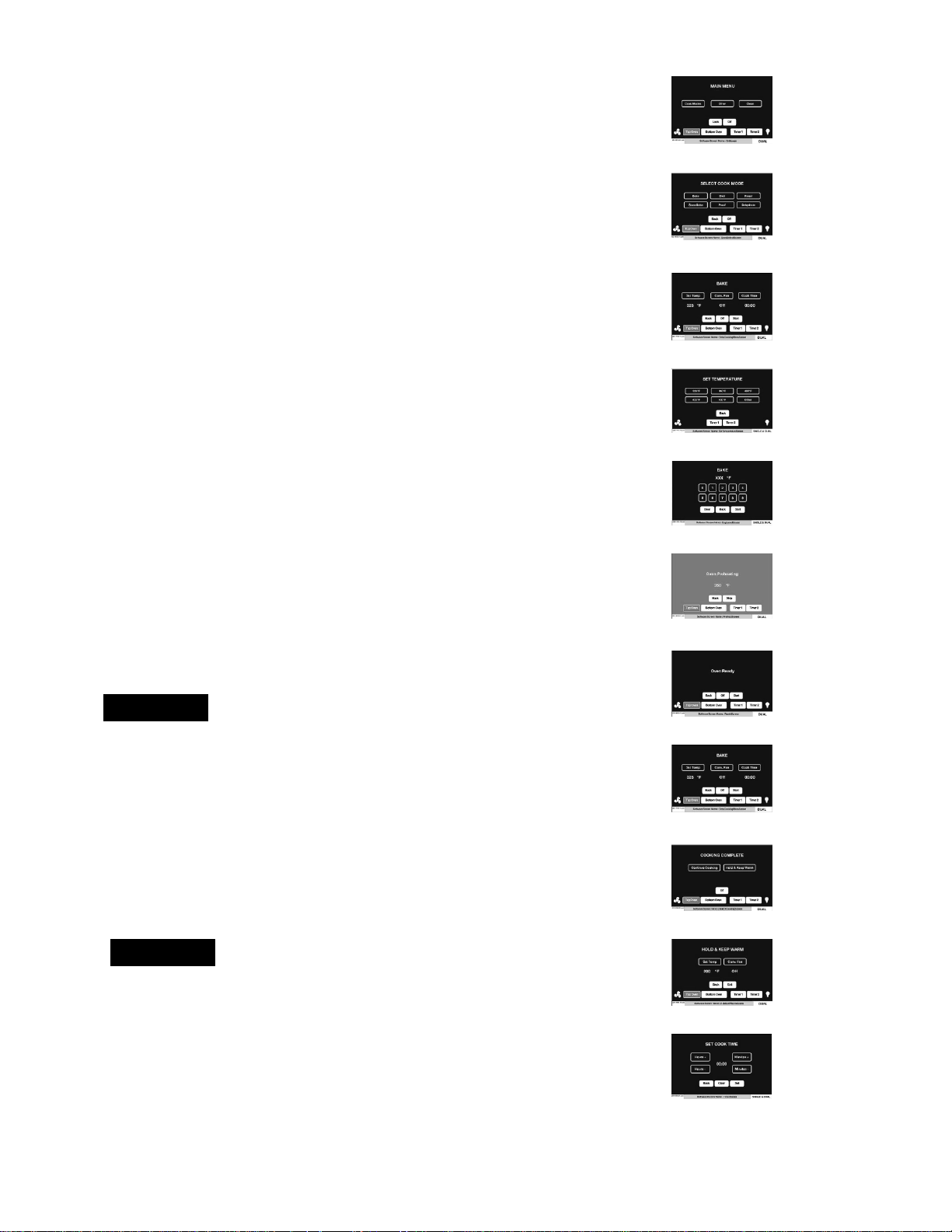
1. Select Top Oven or Bottom Oven from the Home screen. Remove
oven probe from oven to prevent damaging it.
2. Press Cook Modes on the Main Menu display. Figure 1
3. Press Proof on the Select Cook Mode screen. Figure 2
4. Press Set Temp on the Proof screen. Figure 3
5. Select one of the preset Proof temperatures and press Start*, or
press Other to enter a different temperature. Figure 4
6. If Other, enter your desired temperature, then Start. Figure 5
a. In Proof mode, the oven can operate at temperatures
between 80 and 200 degrees F. Entering a temperature
outside of this range will result in an error message.
7. The oven will begin preheating. Figure 6 See Attention below.
8. When the oven is preheated, an alarm sounds three times, then
once every 10 seconds. The Oven Ready screen appears. Figure 7
9. Place baking dish in the oven and select Start. The Proof screen
appears. Figure 8
10. At the end of the selected bake time, the Cooking Complete screen
is displayed. An alarm will signal twice and then once every 10
seconds until one of the following actions is taken. Figure 9
a. Select Off to turn off the oven and remove food.
b. Select Continue Cooking to return to the Proof screen.
Figure 3
c. Select Hold & Keep Warm to keep your food in the
oven at a specific temperature until you are ready to
serve.
11. If you select Hold & Keep Warm, press the Set Temp to display the
set temperature screen. Figure 10
Do not place food in the oven before or during the
preheating process. The oven uses a combination of
heating elements during the preheating process to
achieve the specified temperature.
Beware that the oven loses heat slowly and that
food will continue cooking in the Hold & Warm
mode.
Keeping the oven light on while baking will increase
the oven temperature approximately 15 degrees F.
*SET COOKING TIME
1. From the Proof screen, press Cook Time. Figure 3
2. Use the buttons on the touchpad to select desired cooking time, and
press Set. Figure 11
3. Return to the last screen displayed.
4. The cooking time countdown begins after the oven has preheated.
If the cooking timer is not set, the oven will continue
to operate at the selected temperature.
TEMPERATURE RANGE
In Proof mode, the oven can operate at temperatures between 80 and
200 degrees F. Entering a temperature outside of this range will result in
an error message.
Figure 1
Figure 2
Figure 3 - Proof
Figure 4 - Proof
Figure 5 - Proof
Figure 6
Figure 7
Figure 8 – Proof
Figure 9
Figure 10
Figure 11
ATTENTION
ATTENTION
33
OPERATING THE OVEN USING THE DISPLAY PANEL
DEHYDRATE
Foods must be dried to below .60 water activity or dry to
the touch to be safely stored with no danger of mold,
yeasts or bacteria growing.
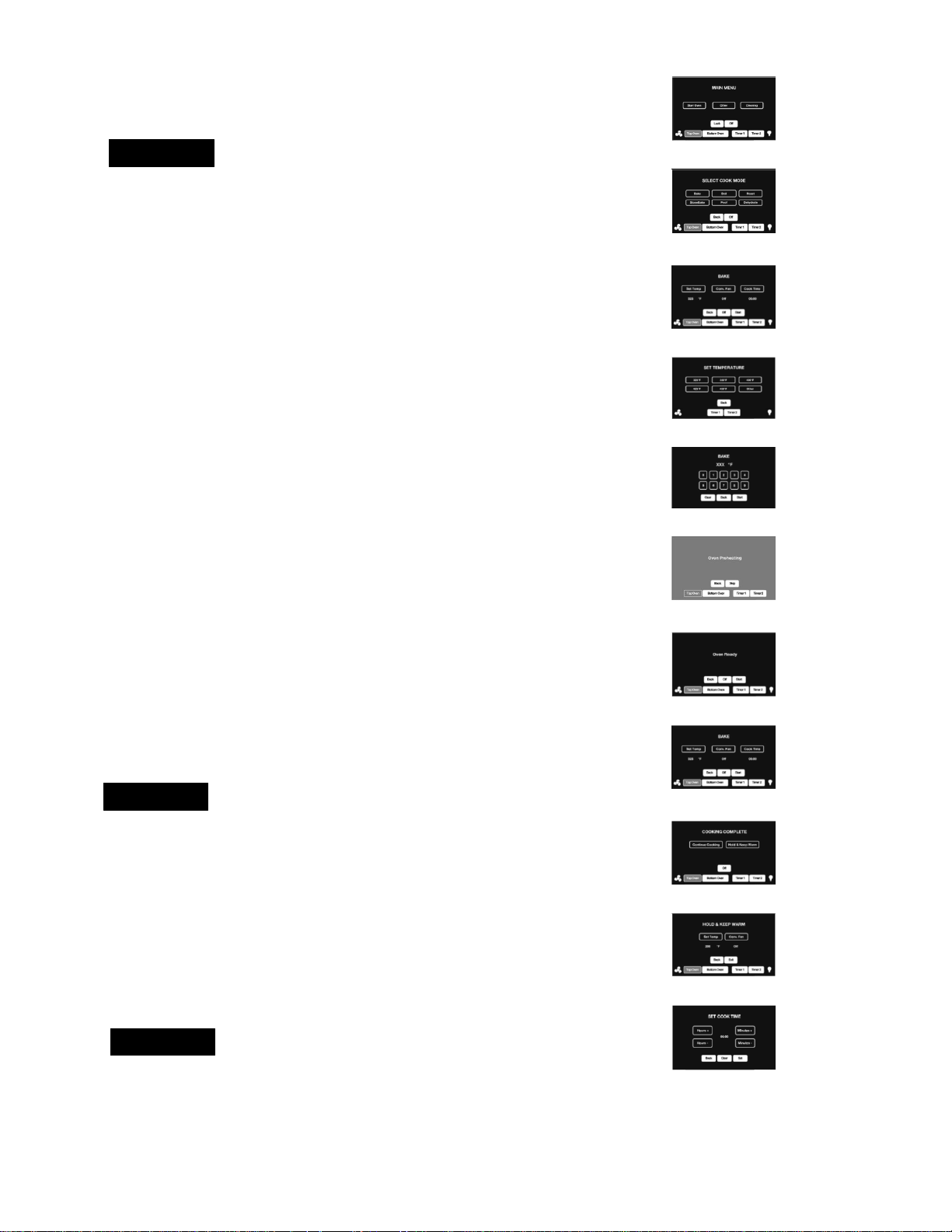
1. Select Top Oven or Bottom Oven from the Home screen. Remove
oven probe from oven to prevent damaging it.
2. Press Cook Modes on the Main Menu display. Figure 1
3. Press Dehydrate on the Select Cook Mode screen. Figure 2
4. Press Set Temp on the Dehydrate screen. Figure 3
5. Select one of the preset Dehydrate temperatures and press Start*,
or press Other to enter a different temperature. Figure 4
6. If Other, enter your desired temperature, then Start. Figure 5
a. In Dehydrate mode, the oven can operate at
temperatures between 80 and 200 degrees F. Entering a
temperature outside of this range will result in an error
message.
7. The oven will begin preheating. Figure 6 See Attention below.
8. When the oven is preheated, an alarm sounds three times, then
once every 10 seconds. The Oven Ready screen appears. Figure 7
9. Place baking dish in the oven and select Start. The Dehydrate
screen appears. Figure 8
10. At the end of the selected bake time, the Cooking Complete screen
is displayed. An alarm will signal twice and then once every 10
seconds until one of the following actions is taken. Figure 9
d. Select Off to turn off the oven and remove food.
e. Select Continue Cooking to return to the Proof screen.
Figure 3
f. Select Hold & Keep Warm to keep your food in the
oven at a specific temperature until you are ready to
serve.
11. If you select Hold & Keep Warm, press the Set Temp to display the
set temperature screen. Figure 10
Do not place food in the oven before or during the
preheating process. The oven uses a combination of
heating elements during the preheating process to
achieve the specified temperature.
Beware that the oven loses heat slowly and that
food will continue cooking in the Hold & Warm
mode.
Keeping the oven light on while baking will increase
the oven temperature approximately 15 degrees F.
*SET COOKING TIME
1. From the Dehydrate screen, press Cook Time. Figure 3
2. Use the buttons on the touchpad to select desired cooking time, and
press Set. Figure 11
3. Return to the last screen displayed.
4. The cooking time countdown begins after the oven has preheated.
If the cooking timer is not set, the oven will continue
to operate at the selected temperature.
Figure 1
Figure 2
Figure 3 - Dehydrate
Figure 4 - Dehydrate
Figure 5 - Dehydrate
Figure 6
Figure 7
Figure 8 – Dehydrate
Figure 9
Figure 10
Figure 11
ATTENTION
ATTENTION
ATTENTION

34
OPERATING THE OVEN USING THE DISPLAY PANEL
SABBATH (TOP OVEN ONLY)
Sabbath mode is intended to allow the oven to be used (subject to
various constraints) by Shabbat-observant Jews on the Shabbat and
Jewish holidays.
The oven maintains a set cooking temperature in Bake or Convection
Bake modes for a period of up to 76 hours* with the display screen dark.
All alarms and control knobs are disabled unless the display screen is
touched.
1. Select Top Oven from the Home screen. Remove oven probe from
oven to prevent damaging it.
2. Press Other on the Main Menu display. Figure 1
3. Press Sabbath on the Other screen. Figure 2
4. The oven goes into Sabbath mode. Press Set Temp on the Sabbath
screen. Figure 3
5. Select one of the preset Bake temperatures or press Other to enter
a different temperature. Figure 4
6. If Other, enter your desired temperature, then Start. Figure 5
In Sabbath mode, the oven can operate at temperatures
between 150 and 500 degrees F. Entering a temperature
outside of this range will result in an error message.
7. If desired, press the Fan icon or Conv Fan for convection baking,
then press Start. Convection Sabbath will be displayed.See the
TIPS section for Convection Baking recommendations.
8. The Sabbath screen appears. Press Start to activate Sabbath
mode.* Figure 7
When Start is pressed, the alarm and control knobs
will be disabled, the oven light’s On or Off status will
be maintained, and the oven will remain in Bake or
Convection Bake mode for the duration of the
Sabbath period.
Keeping the oven light on while baking will increase
the oven temperature approximately 15 degrees F.
Touching the screen will enable all functions. Select
Continue if you want to extend the Sabbath mode
or Stop to exit Sabbath mode.
9. A black screen is displayed until the Sabbath timer ends. Figure 8
10. When the Sabbath timer expires, the Sabbath Mode Ended screen
is displayed. Press Cancel to return to the Main Menu. The oven
turns off. Figure 10
*SET SABBATH DURATION TIME
1. The default time for the Sabbath mode is 76 hours. To change the
time period, press Cook Time on the Sabbath screen. Figure 3
2. Use the buttons on the touchpad to select desired Sabbath time, and
press Set. Figure 11
3. Return to the last screen displayed.
Figure 1
Figure 1
Figure 2
Figure 3 - Sabbath
Figure 4 - Sabbath
Figure 5 - Sabbath
Figure 7
Figure 8
Figure 10
Figure 11
ATTENTION
35
CLEANING
The electric wall oven’s eco-friendly Continu Clean™ works every time
the oven is turned on, helping to keep your oven clean by removing oils
and vapors without extreme temperatures or harsh cleaning chemicals.
When your oven interior becomes heavily soiled, use the self-cleaning
cycle to clean your oven.
Turn on ventilation to remove excess smoke or
fumes that might be produced.
Remove large built-up food particles and grease
before starting the Oven Cleaning Cycle.
Do not use water or other solvents on the Bake
Stone to clean.
Remove the roast probe from the oven.
Remove the oven racks and glides. Wash by hand
or in the dishwasher.
The Bake Stone can be left in the top oven during
the Oven Cleaning Cycle if it has been pre-dried.
The oven, including the oven doors, will get hot
during the Oven Cleaning Cycle.
Do not touch the oven or open the oven door during
the Oven Cleaning Cycle.
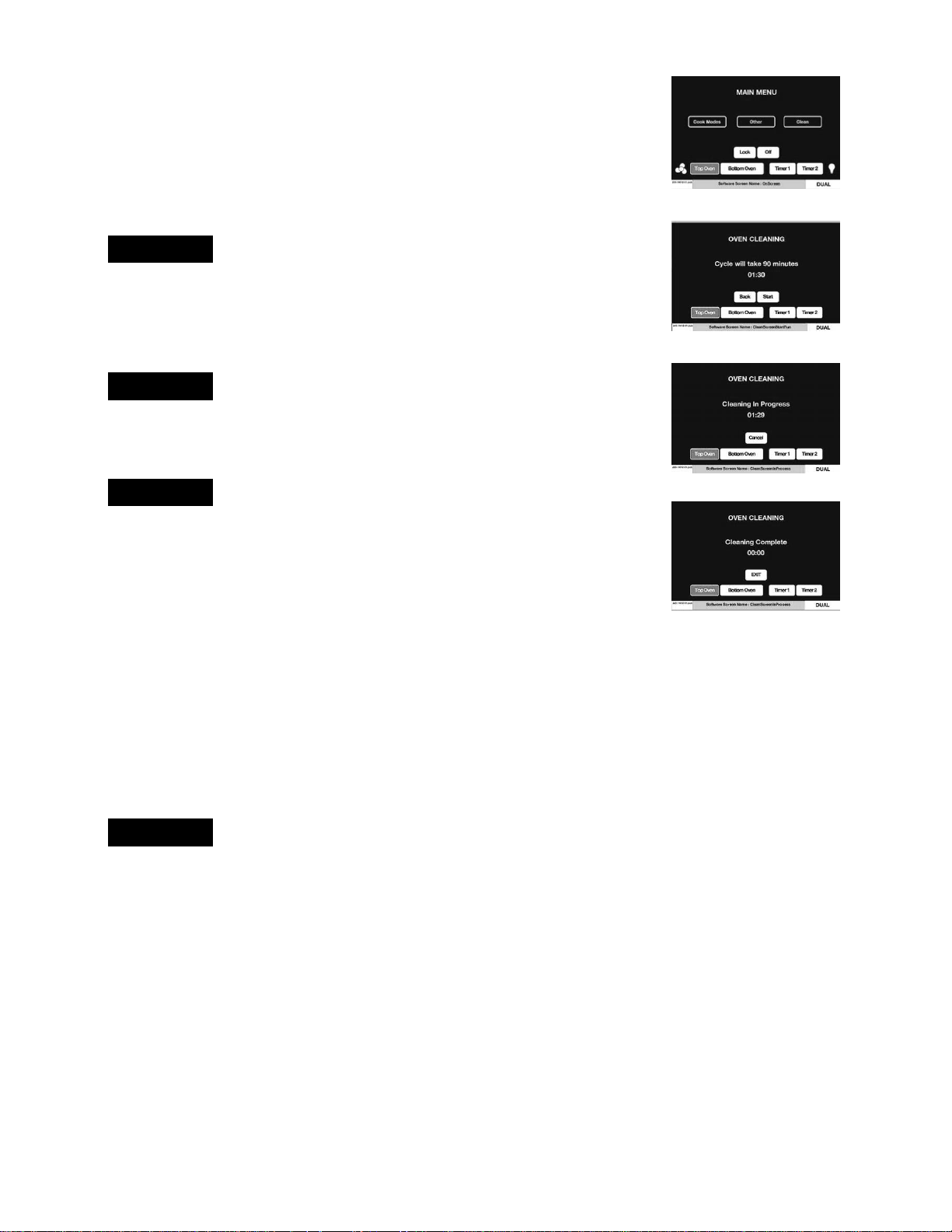
1. Select Top Oven or Bottom Oven from the Home screen. Remove
oven probe from oven to prevent damaging it.
2. Press Cleaning on the Main Menu display. Figure 1
3. Press Start on the Oven Cleaning screen to start the cleaning cycle.
Figure 2
4. The Cleaning in Progress screen will be displayed during the entire
cleaning cycle with a countdown timer that starts at 1:30. Figure 3
5. When the cleaning cycle is complete, the Cleaning in Progress
screen will display Exit. An alarm will signal twice and then once
every 10 seconds. Figure 4
6. Press Exit to return to the Main Menu. The oven will still be hot, but
is ready for use.
7. Press Cancel at any time on the Cleaning in Progress screen to stop
the cleaning process.
The oven will be hot if the Oven Cleaning Cycle is
cancelled mid-cycle. Do not open or touch the oven
doors.
Figure 1
Figure 2
Figure 3
Figure 4
TIPS
ATTENTION
ATTENTION
WARNING

36
Oven Cleaning
Make sure the area is well-ventilated when using a commercially available oven
cleaner.
Oven Window
When oven is cool, and after each use, use a cloth and warm soapy water to clean the interior oven
door window to reduce baked-on stains. Rinse with clear water and dry thoroughly.
For tougher stains, use a commercially available oven cleaning product. Follow cleaner
manufacturer’s instructions.
Interior Oven Walls
Your oven’s interior is coated with porcelain enamel and can be cleaned with commercially available
oven cleaners. Follow the cleaner manufacturer’s instructions. Do NOT use on door gasket or Bake
Stone.
Do NOT use soap or water on the Bake Stone.
Oven Fan Guard
Clean the oven fan guard periodically. Keep the fan guard clear of obstructions.
Apply a commercially available oven cleaner to a cloth to remove grease build-up and food particles.
Follow manufacturer’s cleaning instructions.
Oven Racks and Guides
Remove and clean racks and guides in hot, soapy water. Rinse well and dry thoroughly.
Racks and guides can be cleaned in the dishwasher.
Do NOT apply commercially available oven cleaners to the oven door gasket.
Do NOT rub or scrub the gasket since it may damage the oven door seal.
Make sure cleaning chemicals do not come in contact with any stainless steel, painted
surfaces.
Do NOT use steel wool or metal pads to clean the interior oven walls. They may damage
or scratch the enamel coating.
Do NOT apply commercially available oven cleaners to Bake Stone.
ATTENTION
37
SETTINGS
The Settings screen is used by the technician during installation or service calls to optimize the oven’s
performance. If you reach this screen by accident, press Cancel to return to the previous screen.
CHANGING TEMPERATURE SCALE FROM C TO F, OR F TO C
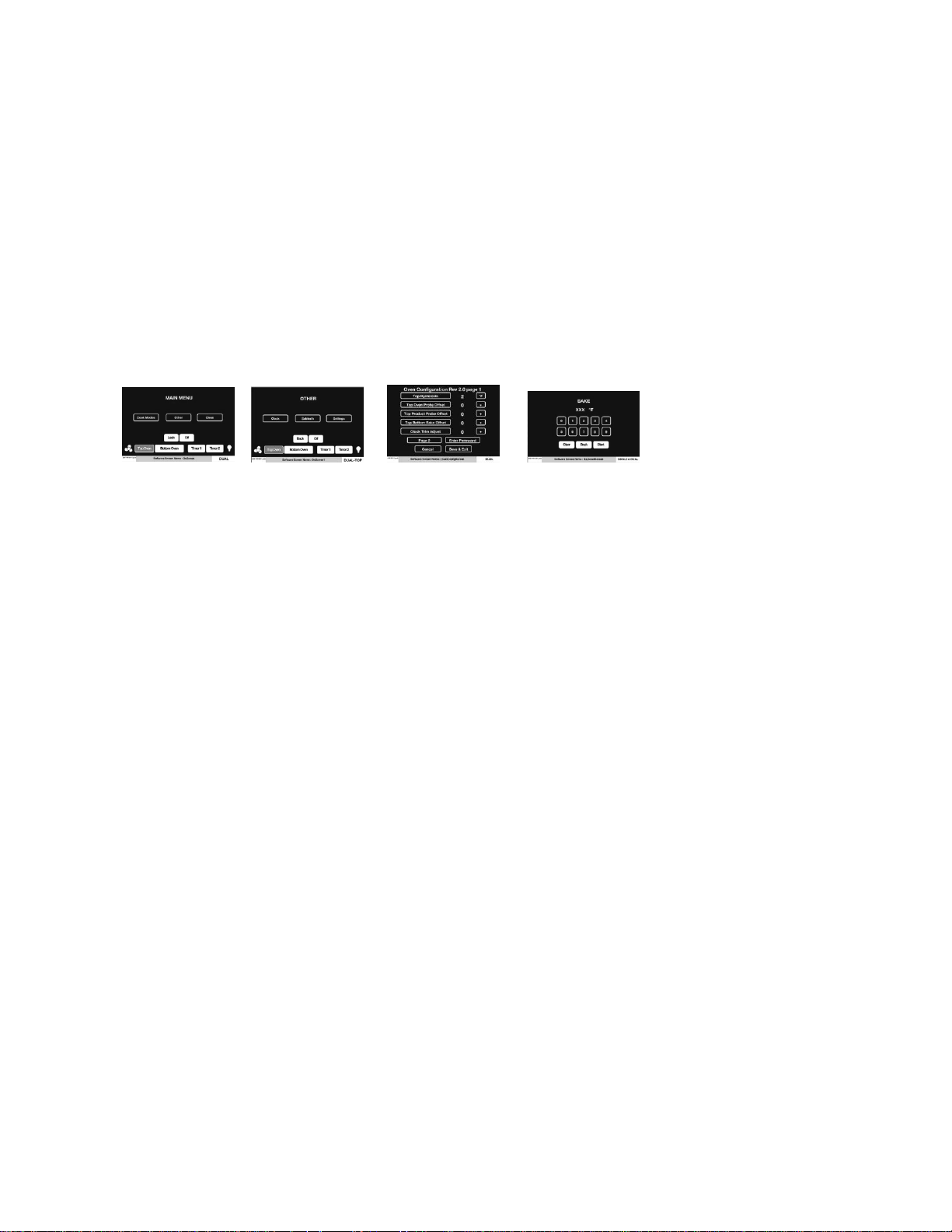
1. Select Top Oven or Bottom Oven from the Home screen.
2. Press Other on the Main Menu display. Figure 1
3. Press Settings on the Other display. Figure 2
4. Press Enter Password. Figure 3
5. Enter 12345 on the keypad and press Start. Figure 4
6. Press F or C located in the top right of the screen. Figure 5
7. Press Save & Exit. Figure 5
Figure 1 Figure 2 Figure 3 Figure 4
HYSTERESIS & OFFSETS
The hysteresis setting determines how quickly the oven responds to a change in temperature sensed by
the probe. Increasing this number will make the oven react slower while decreasing the number will make
it react faster. The factory default and recommended setting is 2.
Oven probe offset allows you to calibrate the center of the oven temperature to the probe location. A
number followed by a + will decrease the center oven temperature while a number followed by a – will
increase the center oven temperature. The oven is factory calibrated and changes to this setting are not
recommended.
Product Probe offset allows you to calibrate the product probe. A number followed by a + will decrease
the probe temperature while a number followed by a – will increase the probe temperature. The probe is
factory calibrated and changes to this setting are not recommended.
Bottom Bake offset allows you to calibrate the baking stone temperature to the probe location. A number
followed by a + will decrease the stone temperature while a number followed by a – will increase the
stone temperature. The oven is factory calibrated and changes to this setting are not recommended.

38
CARE AND CLEANING
Make sure the oven is cool before cleaning.
PART/
MATERIAL
CLEANING
FREQUENCY
ATTENTION
Convection
Fan Guard /
Porcelain
Enamel
Remove obstructions like aluminum foil or
other particles.
Apply commercial oven cleaner to a cloth
and wipe the guard. Follow
manufacturer’s instructions.
Once a month;
more often
with frequent
use.
Turn on ventilation fan and
make sure room is well
vented.
Do NOT use steel wool,
metal pads or abrasive
cleaners. They may scratch
and damage the coating.
Line floor with newspaper to
catch drips.
Exterior Body/
Standard RAL
Colors
Clean with hot, soapy water. Rinse well
and dry thoroughly.
For tough stains, apply a cloth soaked in
hot water for several minutes. Scrape
LIGHTLY with a nylon or rubber spatula.
As needed
Do NOT use steel wool,
metal pads or abrasive
cleaners.
Do NOT use any metal
objects to scrape the
surface.
Do NOT allow citrus or
tomato juices to sit and dry
on the surface. Citric acid
will discolor stainless steel.
Exterior Body/
Stainless Steel
Clean with hot, soapy water. Rinse well
and dry thoroughly.
For tough stains, use a commercial
stainless steel cleaner and follow the
cleaning manufacturer’s instructions.
As needed
Do NOT use steel wool,
metal pads or abrasive
cleaners.
Do NOT use any metal
objects to scrape the
surface.
Do NOT allow citrus or
tomato juices to sit and dry
on the surface. Citric acid
can discolor stainless steel.
Exterior Body/
Textured Paint
Clean with hot, soapy water. Rinse well
and dry thoroughly.
For tough stains, apply a cloth soaked in
hot water for several minutes. Scrape
LIGHTLY with a nylon or rubber spatula.
Repeat body stainless section – be gentle
when scrubbing textured paint
As needed
Do NOT use steel wool,
metal pads or abrasive
cleaners.
Do NOT use any metal
objects to scrape the
surface.
WARNING

39
Do NOT allow citrus or
tomato juices to sit and dry
on the surface. Citric acid
will discolor stainless steel.
Display
Screen
Use damp microfiber or soft cotton cloth;
wipe dry
Lock the display screen
before cleaning to prevent
the oven from operating.
Oven Interior /
Porcelain
Enamel
Use a commercially available oven
cleaner. Follow cleaner manufacturer’s
instructions.
Once a month;
more often
with frequent
use.
Turn on ventilation fan and
make sure room is well
vented.
Do NOT apply commercial
oven cleaners to the oven
door gasket.
Do NOT rub or scrub the
gasket. This may damage
the oven door seal.
Do NOT use steel wool,
metal pads or abrasive
cleaners. They may scratch
and damage the coating.
Do NOT use soap or water
on the Bake Stone.
Oven Racks
and Guides
Remove and wash in hot, soapy water.
Rinse well and dry thoroughly.
Dishwasher safe.
Once a month;
more often
with frequent
use.
Bake Stone
After the stone is cool, use a nylon
scraper or dry cloth to remove crumbs or
baked on residue.
After each
use.
Never use an abrasive
sponge or brush.
Never immerse the stone in
any liquid.
Do NOT use soap or water
on the Bake Stone.
Do NOT use commercially
available cleaning products
on the Bake Stone.
The stone will darken in
color with use. The stone
may darken unevenly based
on use. This is normal.

40
BEFORE CALLING FOR SERVICE
Check these helpful tips for any problems with your range. If you need additional help call BlueStar®
Customer Service at 800-449-8691.
PROBLEM
POSSIBLE CAUSE
SOLUTION
Display Screen not lit
Sabbath mode
No electrical power to the unit.
Cancel Sabbath mode
Check if the breaker/fuse is tripped. Reset
breaker. Call for service if it occurs more than
once during a backing cycle.
Convection fan does not turn
No electrical power to the unit.
Fan guard is obstructed or clogged.
Plug into a three-prong electrical outlet that is
properly grounded.
Check and re-set circuit breaker for the unit.
When oven is cool, remove any obstructions
like baked-on food or aluminum foil.
Call for service.
Unit is on, but no heat is being
produced.
Breaker may not be fully seated.
Make sure that the breaker is fully seated in
the on position. If issue continues, call for
service. Turn unit off at the breaker.
Oven light not on
No electrical power to the unit.
Oven light bulb burned out.
Check and re-set circuit breaker for the wall
outlet used for the unit.
Replace with 25 watt halogen G9 light bulb
only. See Replacing Oven Bulb instructions on
page 41.
Display screen text appears
blurry.
Software disruption
Cycle (turn on & off) the electrical breaker
connected to the electric wall oven.
Convection Fan making noise
Aluminum foil or other material stuck in fan
Mounting screws of fan cover are loose
Fan cover is bent
Make sure oven of cool and fan if off, then
remove debris.
Tighten screws
Call for replacement fan cover.
Fan (behind control panel) is
running when oven is turned
off
Oven has not cooled to 200 degrees F or
below.
Let oven cool down.
Oven is cool and Fan (behind
control panel) is running
Fan relay stuck in the on position.
Cycle (turn on & off) the electrical breaker
connected to the electric wall oven.

41
MAINTENANCE
Oven Light Bulb Replacement
Only use a 25 watt halogen G9 light bulb. Regular light bulbs cannot tolerate oven
temperatures.
To replace your oven light bulb:
1. Make sure appliance and lights are cool, and power has been turned off before replacing light
bulb.
2. Remove glass cover, pull out bulb, push new bulb in, replace and press glass cover back into
place.
o Hold replacement light bulb with a dry cloth, do not let hands make contact with light
bulb. Oils from skin can shorten replacement light bulb life. If you do touch bulb,
clean with rubbing alcohol before use.
Oven Doors
The oven door hinges may require lubrication periodically to work smoothly. Whether this is necessary, or
how frequently, depends on how and how often the oven is used.
Open the oven door fully and apply a small amount of lubricant such as food-grade light oil or grease
to the ball visible in the hinge slot on your door.
Do NOT use sprays like WD-40 or CRC that may get onto the oven door surface. We
recommend a food-grade light oil or grease. Avoid using cooking oil or mineral oil.
ELECTRICAL REQUIREMENTS
The Electrical Appliance Rating:
240V/ 60 hertz, 40 amp, recommended circuit
Effective January 1, 1996 the National Electrical Code requires that new, but not existing construction
utilize a four-conductor connection to an electric oven. For existing construction you must use a three-
wire, single phase A.C. electrical system. If you connect to aluminum wiring, properly installed
connectors approved for use with aluminum wiring must be used.
ATTENTION
ATTENTION
ATTENTION
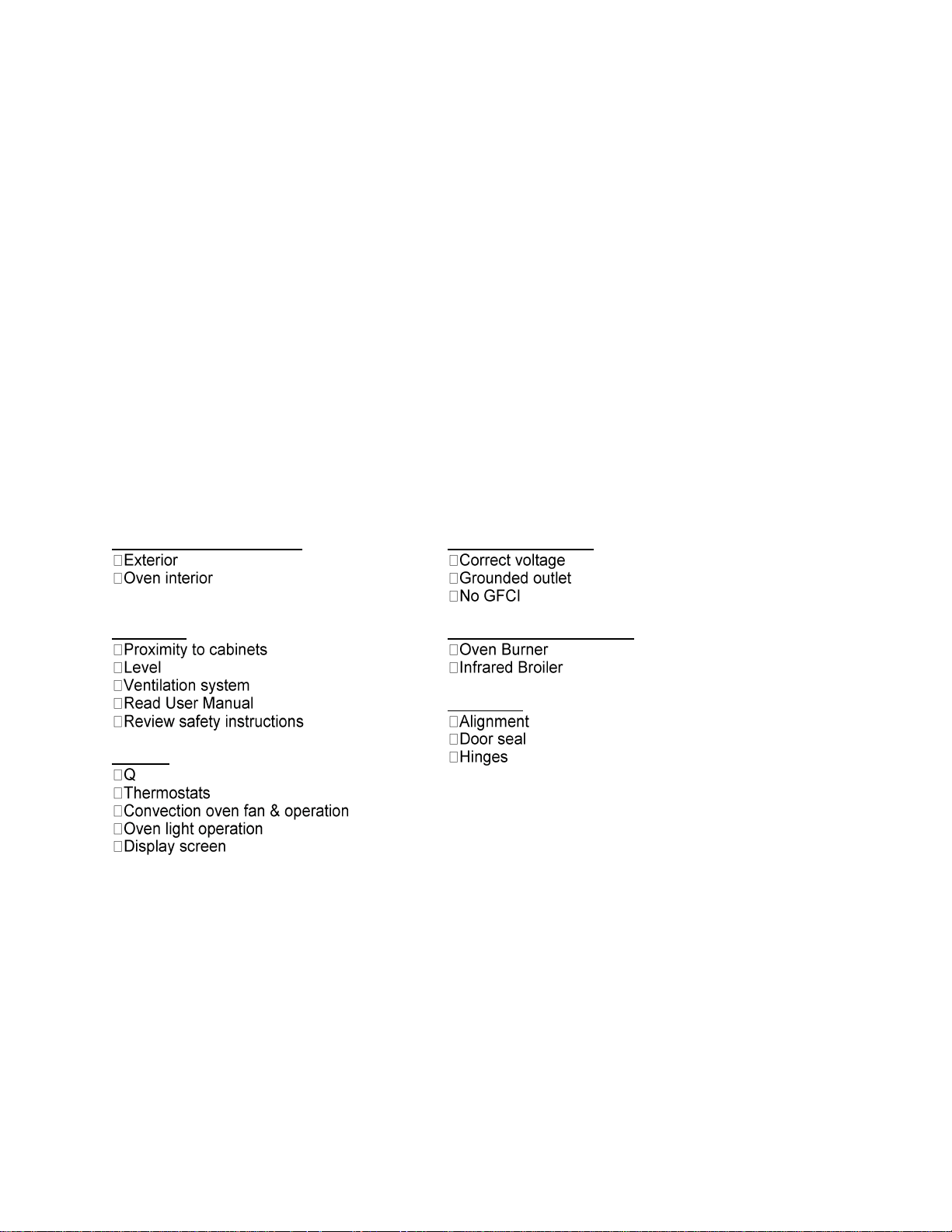
42
PERFORMANCE CHECKLIST
This checklist has been developed to assure proper installation of your appliance.
To validate your warranty you must mail, email or submit this form online within 90 days of installation,
with a copy of your receipt to: Warranty Department, Prizer-Painter Stove Works Inc.,318 June Avenue
Blandon, PA 19510 or submit online at bluestarcooking.com.
Customer Information (Please Print) Product Information (Please Print)
Name: ________________________________________ Model No: ________________________________
Address: ______________________________________ Serial No: _________________________________
City: _________________________________________ Purchase Date: _____________________________
State, Zip Code: ________________________________ Installation Date: ___________________________
E-mail: _______________________________________ Installer’s Name: ___________________________
Telephone: ____________________________________ Company: _________________________________
Dealer: _______________________________________ Telephone: ________________________________
CHECK ALL THAT APPLY
Appearance and Aesthetics Electrical Connection
Installation Heating Elements Function
Oven Door
Controls
uick control knobs

43
LIMITED WARRANTY
BlueStar
®
Cooking Appliances, BlueStar
®
Ventilation Hoods, Prizer Hoods
®
Ventilation Hoods and
Abbaka Ventilation hoods and remote blowers
Before using your Product, please read this Limited Warranty and Arbitration Clause carefully to
understand your rights.
This Warranty is provided to you by Prizer-Painter Stove Works, Inc. (“Prizer-Painter”), which warrants
the parts of your BlueStar
®
cooking appliance, BlueStar
®
ventilation hood, Prizer Hoods
®
ventilation hood,
or Abbaka ventilation hood or remote blower (“Product”), as described below.
This Warranty covers the owner of the residence in which the Product is installed, and his or her spouse
(“Owner” or “You”).
Products Covered
This Warranty applies only to BlueStar
®
cooking appliances, BlueStar
®
ventilation hoods, Prizer Hoods
®
ventilation hoods and Abbaka ventilation hoods and remote blowers purchased in the continental U.S.
and Canada on or after April 1, 2019. This Warranty applies only to Product sold by a BlueStar
®
authorized dealer or Prizer-Painter directly for use in residential properties only. Products must be
installed by a qualified, licensed installer. Any service call deemed to be the result of improper
installation shall be the responsibility of the owner. This Warranty is also void if the original factory
installed serial number is altered or removed from the Product.
Products Not Covered
This Warranty does not apply to Products installed or used in any commercial or other non-residential
property such as, but not limited to, day care facilities, hotels, motels, firehouses and nursing homes.
This Warranty does not cover Products installed outside the U.S. or Canada. This Warranty does not
apply to gas type conversions on cooking appliances not completed by a certified gas technician,
licensed plumber or certified BlueStar
®
servicers.
Full Two-Year Warranty
Product Registration is not required to obtain Warranty Coverage but is highly recommended for
optimal servicing and affects the length and certain remedies available under the warranty.
If the Product is properly registered within 90 days of Installation Date: For two (2) years from the date
that the Product is originally installed, this Warranty covers all parts and labor to repair or replace, at
our discretion, any functional component of the Product, that is defective in materials or workmanship.
Replacement service will only be provided if and when attempts to repair the Product have been
exhausted. Such repair or replacement service must be performed by a factory authorized service agent
located within 100 miles roundtrip from the location of the Product. Service will be provided during
normal business hours. The Owner will be responsible for any and all costs associated with additional
mileage, non-standard service or overtime, and special equipment required to remove the Product so

44
that service may be performed. Prizer-Painter reserves the right to deny warranty coverage for
excessive installation delays.
For products not properly registered: For one (1) year from the date that the Product is originally
installed, this Warranty covers all parts and labor to repair or replace, at our discretion, any functional
component of the Product, that is defective in materials or workmanship. Replacement service will only
be provided if and when attempts to repair the Product have been exhausted. Such repair or
replacement service must be performed by a factory authorized service agent located within 100 miles
roundtrip from the location of the Product. Service will be provided during normal business hours. The
Owner will be responsible for any and all costs associated with additional mileage, non-standard service
or overtime, and special equipment required to remove the Product so that service may be performed.
Prizer-Painter reserves the right to deny warranty coverage for excessive installation delays.
Limited Cosmetic Component Warranty: This Warranty covers the repair or replacement of all cosmetic
component flaws for thirty (30) calendar days from the date of delivery of the Product to the owner’s
home from a BlueStar
®
authorized dealer. Cosmetic components include top grates, ring grates, plate
rail, kick panel, body sides, glass, control panel, door panel, back guards, oven seals), front sides of
hoods, and hoods strapping. Cosmetic components flaws include visible chips, scratches, dents,
provided, however, that cosmetic flaws caused by freight damage are excluded.
Limited Warranty on Floor Models Not Used For Demonstration: Floor Models are covered by a one
(1) year limited functional parts and related services warranty, with proof of date of installation. There
is no cosmetic warranty of any kind for floor models.
Limited Warranty on Floor Models Used For Demonstration: Floor Models used for demonstration are
covered by a ninety (90) day limited parts warranty only, with proof of date of installation. There is no
service or cosmetic warranty of any kind for floor models.
Limited Warranty on Product Refurbished
Refurbished Products are covered by a six (6) months limited functional parts and labor warranty, with
proof of installation, as well as an additional six (6) months limited parts warranty. There is no cosmetic
warranty of any kind on Refurbished Product.
Registration
Registration is strongly recommended. While not necessary to effectuate warranty coverage, it is the
best way for Prizer-Painter to communicate with you about important events and also provides
additional warranty coverage. TO REGISTER, please fill out the “Performance Checklist and Warranty
Form” located online at www.bluestarcooking.com/support/product-registration. Or mail the form
located in the back of the Product Use and Care Manual to: Warranty Department, Prizer-Painter Stove
Works, 318 June Avenue, Blandon, PA 19510-9566.
Obtaining Warranty Service
If a Warranty claim is not submitted as required, such claim will be invalid and will not be honored.

45
To obtain Warranty service, where applicable, the Owner must call the Service Center (toll free: 1-800-
449-8691) or fill out the online form at www.bluestarcooking.com/service to report a warranty claim,
and may be required to, at the time, provide (1) the model number of the Product, (2) the serial number
of the Product, (3) proof of delivery, (4) a signed installation receipt, (5) a description of the claimed
defect, and (6) proof of purchase of the Product, including the original retail receipt or invoice to
establish the Warranty Period. Prizer-Painter must be given an opportunity to inspect any Product
subject to a warranty claim. All warranty related service repairs must be performed by a factory
authorized service agent.
This Limited Warranty gives you specific legal rights, and you may also have other rights that may vary
from state to state or province to province.
Out of Warranty Product
Prizer-Painter is under no obligation, at law otherwise, to provide you with any concessions, including
repairs, pro-rates or Product replacement, once this warranty has expired.
What Is Not Covered
This Warranty does not cover, and specifically excludes:
Damages caused by shipping.
Damage or repairs to the porcelain igniters, calibrations and normal adjustments after
installation and setup, including burner adjustments.
Normal wear and tear, care, and maintenance of the Product as described in the
installation and operating manual, such as cleaning of parts, discoloration of the griddle,
rust, gasket materials, ceramic materials, and fuses.
Damage or repairs caused by alterations or modifications, abuse, excessive force,
misuse, neglect, or improper installation, instruction, handling, operation, maintenance
or storage.
Accidental or intentional damage.
Damage or repairs caused by unauthorized or improper service or repairs.
Damages or repairs as a result of natural disasters, fires, floods, earthquakes, winds,
lightning, corrosive atmosphere, loss of electrical power to the Product for any reason,
or other conditions beyond Prizer-Painter’s control.
Damage or repairs caused by alteration for outdoor use.
Damage or repairs caused by the use of harsh chemicals or cleaning products
improperly applied.
Discolorations to backguards from use of griddle or burners.
The replacement of a part or Product under this Warranty does not extend the
Warranty period.
If the Product is removed from the property where it was originally installed .
Slight color variations may be noticed because of differences in painted parts, kitchen
lighting, product placement, and other factors; this warranty does not apply to color
variations.
Service calls to educate the customer on proper use and care of the product.

46
Failure of the product when used for commercial, business, rental or any application
other than for residential consumer use.
Liability or responsibility for damage to surrounding property including cabinetry, floors,
ceilings and other structures or objects around the Product.
Consequential or incidental damage, including but not limited to food or medicine loss,
time away from work or restaurant meals.
This warranty is in lieu of all other express warranties. No employee or representative of Prizer-Painter
is authorized to make any modification, extension or addition to this Limited Warranty.
ALL IMPLIED WARRANTIES, INCLUDING BUT NOT LIMITED TO WARRANTIES OF MERCHANTABILITY
AND FITNESS FOR PARTICULAR PURPOSE ARE LIMITED TO THE DURATION OF THIS WARRANTY. Some
states and provinces do not allow limitations on implied warranties, so the above limitation may not
apply to you.
THE OWNER AND PRIZER-PAINTER AGREE THAT THE REMEDIES SET OUT HEREIN ARE THE OWNER’S
EXCLUSIVE REMEDIES FOR BREACH OF ALL WARRANTIES, EXPRESS OR IMPLIED.
WHETHER ANY CLAIM IS BASED ON NEGLIGENCE OR OTHER TORT, BREACH OF WARRANTY OR
BREACH OF CONTRACT, OR ANY THEORY, PRIZER-PAINTER SHALL IN NO EVENT BE LIABLE FOR
INCIDENTAL, CONSEQUENTIAL OR SPECIAL DAMAGES, INCLUDING BUT NOT LIMITED TO DAMAGES
FOR EXPENSES, SUCH AS, EXTRA UTILITY EXPENSES, SHIPPING COSTS RELATED TO REPAIR OR
REPLACEMENT OF ANY PRODUCT OR DAMAGES TO PROPERTY, RESULTING FROM BREACH OF THIS
WARRANTY OR ANY IMPLIED WARRANTY. Some states and provinces do not allow the exclusion or
limitation of incidental or consequential damages, so these provisions may not apply to you.
Where Can Any Legal Remedies Be Pursued
Please see the Arbitration Clause and Related Provisions, which affect your legal rights. Read this
Arbitration Clause and its related provisions carefully. The Arbitration Clause is also available on Prizer-
Painter’s
For further information about this warranty,
contact Prizer-Painter Customer Service at 1-800-449-8691

47
ARBITRATION CLAUSE
BlueStar® Cooking Appliances, BlueStar® Ventilation Hoods, Prizer Hoods® Ventilation Hoods and
Abbaka Ventilation Hoods and remote blowers
ARBITRATION CLAUSE. IMPORTANT. PLEASE REVIEW THIS ARBITRATION CLAUSE. IT AFFECTS YOUR
LEGAL RIGHTS. YOU SHOULD ALSO CONSIDER CONSULTING WITH OTHERS ABOUT ARBITRATION
BECAUSE THE INFORMATION PROVIDED IS NOT INTENDED TO CONTAIN A COMPLETE EXPLANATION
OF THE CONSEQUENCES OF ARBITRATION.
1. Parties: This arbitration clause affects your rights against Prizer-Painter Stove Works, Inc. and any of its
affiliates or employees or agents, successors, or assigns, all of whom together are referred to as “we” or
“us” for ease of reference.
2. ARBITRATION REQUIREMENT: EXCEPT AS STATED BELOW, ANY DISPUTE BETWEEN YOU AND ANY OF
US SHALL BE DECIDED BY NEUTRAL, BINDING ARBITRATION RATHER THAN IN COURT OR BY JURY TRIAL.
“Dispute” will be given the broadest possible meaning allowable by law. It includes any dispute, claim, or
controversy arising from or relating to your purchase of a Prizer-Painter Product, any warranty upon the
unit, or the unit’s condition. The arbitrator(s) shall have the exclusive power and jurisdiction to make all
procedural and substantive decisions concerning the Dispute including the power to determine the
question of arbitrability including the scope or applicability of this Arbitration Clause. The arbitration
requirement applies to all claims including those arising out of contract and tort, pursuant to statute, or
otherwise.
3. CLASS-ARBITRATION WAIVER: ARBITRATION IS HANDLED ON AN INDIVIDUAL BASIS. IF A DISPUTE IS
ARBITRATED, YOU AND WE EXPRESSLY WAIVE ANY RIGHT TO PARTICIPATE AS A CLASS REPRESENTATIVE
OR CLASS MEMBER ON ANY CLASS CLAIM YOU MAY HAVE AGAINST US, AND US AGAINST US, OR AS A
PRIVATE ATTORNEY GENERAL OR IN ANY OTHER REPRESENTATIVE CAPACITY. YOU AND WE ALSO
WAIVE ANY RIGHT TO CLASS ARBITRATION OR ANY CONSOLIDATION OF INDIVIDUAL ARBITRATIONS.
4. Discovery and Other Rights: Discovery and rights to appeal in arbitration are generally more limited
than in a lawsuit. This applies to both you and us. Other rights that you or we would have in court may
not be available in arbitration. Please read this Arbitration Clause and consult the rules of the arbitration
organizations listed below for more information.
5. SMALL CLAIMS COURT OPTION: YOU MAY CHOOSE TO LITIGATE ANY DISPUTE BETWEEN YOU AND
ANY OF US IN SMALL CLAIMS COURT, RATHER THAN IN ARBITRATION, IF THE DISPUTE MEETS ALL
REQUIREMENTS TO BE HEARD IN SMALL CLAIMS COURT.
6. OPTING OUT OF THIS ARBITRATION CLAUSE: YOU MAY OPT OUT OF THIS ARBITRATION CLAUSE
WITHIN 60 DAYS OF WHEN WARRANTY COVERAGE BEGINS, IF YOU INFORM PRIZER-PAINTER IN
WRITING, VIA REGISTERED MAIL (SENT TO PRIZER-PAINTER CONSUMER AFFAIRS , Prizer-Painter
Stoveworks, 318 June Avenue Blandon, PA 19510-9566. THAT YOU ARE OPTING OUT. Please also provide
your name, address, product model and serial number and proof of purchase. There is no other
procedure to opt out. Opting out of this Arbitration Clause will not affect your other rights under this
warranty.

48
7. Governing Law: The procedures and effect of the arbitration clause will be governed by the Federal
Arbitration Act (9 U.S.C. § 1 et seq.) rather than by state law concerning arbitration. The law governing
your substantive warranty rights and other claims will be the law of the state in which you purchased your
Prizer-Painter Product. Any court having jurisdiction may enter judgment on the arbitration award.
8. Rules of the Arbitration: If the amount in controversy is less than $50,000, the arbitration will be
decided by a single arbitrator to be appointed according to the rules of the arbitration association that is
chosen. If the amount in controversy is greater than or equal to $50,000, the arbitration will be decided
by a panel of three arbitrators. The arbitrator(s) will be chosen pursuant to the rules of the administering
arbitration organization. You may choose either of the following arbitration organizations, and its
applicable rules: the American Arbitration Association, 1633 Broadway, 10th Floor, New York, NY 10019
(www.adr.org), JAMS, 1920 Main Street, Ste. 300, Irvine, CA 92614 (www.jamsadr.com), or any other
organization that you may choose subject to our approval. These organizations’ rules can be obtained by
contacting the organization or visiting its website. If the chosen arbitration organization’s rules conflict
with this Arbitration Clause, the provisions of this Arbitration Clause control. The award of the
arbitrator(s) shall be final and binding on all parties.
9. Location of the Arbitration Hearing: Unless applicable law provides otherwise, the arbitration hearing
will be conducted in the federal judicial district in which you reside.
10. Costs of the Arbitration: Each party is responsible for its own attorney, expert and other fees, unless
awarded by the arbitrator(s) under applicable law. Prizer-Painter will pay your share of the fees charged
by the arbitration organization and arbitrator(s) beyond the first $200. Where permissible by law, you
may be required to reimburse Prizer-Painter for the fees of the arbitration organization and arbitrator(s) in
whole or in part by decision of the arbitrator(s) at the discretion of the arbitrator(s).
11. Survival and Enforceability of this Arbitration Clause: This Arbitration Clause shall survive the
expiration or termination, or any transfer, of the warranty on your unit. If any part of this Arbitration
Clause, except waivers of class-action rights, is found to be unenforceable for any reason, the remainder
shall remain enforceable. If, in a case in which class-action allegations have been, a waiver of class-action
rights is found to be unenforceable with respect to all or some parts of a dispute, the remainder of this
Arbitration Clause shall be unenforceable as those parts. Instead, those parts will be severed and proceed
in court, with the remaining parts proceeding in arbitration.
12. Confidentiality. The arbitrator(s), Prizer-Painter and Owner will maintain confidentiality of the
proceedings including but not limited to all information gathered, prepared and presented for purposes of
the arbitration relate to the Dispute.
13. Informal Process to Resolve Disputes. Our goal is to resolve claims fairly and quickly. For any Dispute
that You have against Prizer-Painter, you agree to first contact Prizer-Painter and attempt to resolve the
claim informally by sending written notice of your claim by email to legal@bluestarcooking.com. The
notice must include (a) your name, address, email address and mobile telephone number; (b) describe the
nature and basis of the Dispute; and (c) set forth the specific relief being sought. If You and Prizer-Painter
cannot reach an agreement within thirty (30) days after such notice is received, then either party may
submit this Dispute to binding arbitration as set forth above or where applicable to small claims court.