www.lg.com
OWNER’S MANUAL
MICROWAVE/GRILL/CONVECTION
MC-9280XC
MC9280XC
MC9280XC1
Please read this owner’s manual thoroughly before operating.
The manufacturers are not liable for any problems caused by
the user’s failure to observe these instructions.
MFL65219801_08
Contents
2
How the Microwave Oven Works
Microwaves are a form of energy similar to radio and television waves and
ordinary daylight. Normally, microwaves spread outwards as they travel
through the atmosphere and disappear without effect. Microwave ovens,
however, have a magnetron which is designed to make use of the energy in
microwaves. Electricity, supplied to the magnetron tube, is used to create
microwave energy.
These microwaves enter the cooking area through openings inside the oven.
A turntable or tray is located at the bottom of the oven. Microwaves cannot
pass through the door, or metal walls of the oven, but they can penetrate
such materials as glass, porcelain and paper, the materials out of which
microwave-safe cooking dishes are constructed.
Microwaves do not heat cookware, though cooking vessels will eventually
get hot from the heat generated by the food.
Contents .................................................................................... 2
Important Safety Instructions......................................................... 3 ~ 16
Precautions ................................................................................ 17
Unpacking & Installing ................................................................ 18 ~ 19
Setting the Clock ........................................................................ 20
Child Lock .................................................................................. 21
Micro Power Cooking ................................................................. 22
Micro Power Level ...................................................................... 23
Quick Start ................................................................................ 24
Grill Cooking ............................................................................ 25
Convection Preheat .................................................................... 26
Convection Cooking ................................................................... 27
Convection Combination Cooking ................................................ 28
Grill Combination Cooking ......................................................... 29
SteamChef Cook ........................................................................ 30 ~ 32
Lean Roast .................................................................................. 33 ~ 34
Healthy Fry ................................................................................ 35 ~ 38
Aussie Cook................................................................................ 39 ~ 44
Crispy Reheat ............................................................................. 45 ~ 46
Sensor Cook .............................................................................. 47 ~ 49
Auto Defrost ............................................................................... 50
Auto weight defrost guide ........................................................... 51
Kitchen Timer ............................................................................. 52
Heating or Reheating Guide ........................................................ 53
Fresh Vegetable Guide ............................................................... 54
Grill Cooking Guide ................................................................... 55
Microwave-safe Utensils .............................................................. 56
Food characteristics & Microwave cooking ................................... 57 ~ 58
Questions & Answers .................................................................. 59
Technical Specifications .............................................................. 60
A very safe appliance
Your microwave oven is one of the safest of all home
appliances. When the door is opened, the oven
automatically stops producing microwaves. Microwave
energy is converted completely to heat when it enters
food, leaving no “left over” energy to harm you when
you eat your food.
Important Safety
Instructions
Please keep for future reference. Read and follow all instructions before using your oven to
prevent the risk of fire, electric shock, personal injury, or damage when using the oven.
This guide does not cover all possible conditions that may occur. Always contact your
service agent or manufacturer about problems that you do not understand.
3
This is the safety alert symbol. This symbol alerts you to potential hazards that
can cause death or serious injury to you and others. All safety messages will
follow the safety alert symbol and either the word “WARNING” or
“CAUTION”. These word means :
WARNING: This symbol will alert you to hazards or unsafe practices which
could cause serious bodily harm or death.
CAUTION: This symbol will alert you to hazards or unsafe practices which could
cause bodily injury or property damage.
Important Safety
Instructions
Please keep for future reference. Read and follow all instructions before using your oven to prevent
the risk of fire, electric shock, personal injury, or damage when using the oven. This guide does
not cover all possible conditions that may occur. Always contact your service agent or
manufacturer about problems that you do not understand.
4
1. If the door or door seals are damaged,
the oven must not be operated until it
has been repaired by a competent
person.
It is hazardous for anyone other than a
competent person to carry out any
service or repair operation that involves
the removal of a cover which gives
protection against exposure to
microwave energy.
Unlike other appliances, the microwave
oven is high-voltage and high-current
equipment. Improper use or repair could
result in harmful exposure to excessive
microwave energy or an electric shock.
2. Do not use the oven for the purpose of
dehumidification. (ex. Operating the
microwave oven with wet newspapers,
clothes, toys, electric devices, pets or
children inside.)
It can be the cause of serious damage
and safety risks causing fire, burns,
electric shock or death.
WARNING
Important Safety
Instructions
Please keep for future reference. Read and follow all instructions before using your oven to prevent
the risk of fire, electric shock, personal injury, or damage when using the oven. This guide does
not cover all possible conditions that may occur. Always contact your service agent or
manufacturer about problems that you do not understand.
5
3. During use the appliance becomes hot.
Care should be taken to avoid touching
heating elements inside the oven.
Children less than 8 years of age shall
be kept away unless continuously
supervised.
4. The appliance is not intended for use by
young children or infirm persons without
supervision. Only allow children to use
the oven without supervision when
adequate instructions have been given
so that the child is able to use the oven in
a safe way and understands the hazards
of improper use.
Improper use may cause damage and
safety concerns such as a fire, an electric
shock or burns.
5. Accessible parts may become hot during
use. To avoid burns young children
should be kept away.
Failing to do so could cause serious burns.
6. Liquids and other foods must not be
heated in sealed containers since they
are liable to explode. Remove the plastic
wrapping from food before cooking or
defrosting. Note though that in some
cases food should be covered with
plastic film, for heating or cooking.
Never heat bottles or fluid containers with
the lids fitted as they will explode.
WARNING
Important Safety
Instructions
Please keep for future reference. Read and follow all instructions before using your oven to prevent
the risk of fire, electric shock, personal injury, or damage when using the oven. This guide does
not cover all possible conditions that may occur. Always contact your service agent or
manufacturer about problems that you do not understand.
6
7. When the appliance is operated in the
combination mode, children should only
use the oven under adult supervision
due to the temperatures generated.
8. The microwave oven shall be used
freestanding.
9. If the appliance is supplied from a cord
extension set or an electrical portable
outlet device, the cord extension set on
electrical portable outlet device must be
positioned so that it is not subject to
splashing or ingress of moisture.
WARNING
Important Safety
Instructions
Please keep for future reference. Read and follow all instructions before using your oven to
prevent the risk of fire, electric shock, personal injury, or damage when using the oven.
This guide does not cover all possible conditions that may occur. Always contact your
service agent or manufacturer about problems that you do not understand.
7
1. You cannot operate your oven with the
door open due to the safety interlocks
built into the door mechanism. It is
important not to tamper with the safety
interlock.
It could result in harmful exposure to
excessive microwave energy. (Safety
interlocks automatically switch off any
cooking activity when the door is opened.)
2. Do not place any object (such as kitchen
towel, napkin, etc.) between the oven
front face and the door or allow food or
cleaner residue to accumulate on sealing
surfaces.
It could result in harmful exposure to
excessive microwave energy.
3. Do not operate your oven if it is
damaged. It is particularly important
that the oven door closes properly and
that there is no damage to the: (1)
door(bent), (2) hinges and latches
(broken or loosened), (3) door seals and
sealing surfaces.
It could result in harmful exposure to
excessive microwave energy.
CAUTION
Important Safety
Instructions
8
Please keep for future reference. Read and follow all instructions before using your oven to
prevent the risk of fire, electric shock, personal injury, or damage when using the oven.
This guide does not cover all possible conditions that may occur. Always contact your
service agent or manufacturer about problems that you do not understand.
4. Please ensure cooking times are correctly
set. Small amounts of food require
shorter cooking or heating time.
The over cooking may result in the food
catching fire and subsequent damage to
your oven.
Note:
Excessive cooking times and temperatures
can cause a build up of condensation
behind the door glass. The settings should
readjusted to reduce either the cooking
time or power. The condensation will
disappear shortly after the cooking has
stopped.
5. When heating liquids, e.g. soups, sauces
and beverages in your microwave oven,
* Avoid using straight sided containers
with narrow necks.
* Do not overheat.
* Stir the liquid before placing the
container in the oven and again
halfway through the heating time.
* After heating, allow to stand in the
oven for a short time, stir them again
carefully and check the temperature of
them before consumption to avoid
burns (especially, contents of feeding
bottles and baby food jars).
Microwave heating of beverages can
result in delayed eruptive boiling
CAUTION
Important Safety
Instructions
9
Please keep for future reference. Read and follow all instructions before using your oven to
prevent the risk of fire, electric shock, personal injury, or damage when using the oven.
This guide does not cover all possible conditions that may occur. Always contact your
service agent or manufacturer about problems that you do not understand.
without evidence of bubbling, therefore
care must be taken when handing the
container. This could result in a sudden
boil over of the hot liquid.
6. An exhaust outlet is located on top or
bottom or side of the oven. Don’t block
the outlet.
It could result in damage to your oven
and poor cooking results.
Never heat bottles, fluid or beverage
containers with the lids fitted. Doing so
will cause them to explode.
7. Do not operate the oven when empty. It
is best to leave a glass of water in the
oven when not in use. The water will
safely absorb all microwave energy, if
the oven is accidentally started.
Improper use could result in damage to
your oven.
8. Do not cook food wrapped in paper
towels, unless your cook book contains
instructions for the food you are cooking.
And do not use newspaper in place of
paper towels for cooking.
Improper use can be the cause of an
explosion or a fire.
CAUTION
Important Safety
Instructions
10
Please keep for future reference. Read and follow all instructions before using your oven to
prevent the risk of fire, electric shock, personal injury, or damage when using the oven.
This guide does not cover all possible conditions that may occur. Always contact your
service agent or manufacturer about problems that you do not understand.
9. Do not use wooden containers and
ceramic containers which have metallic
(e.g. gold or silver) inlays. Always
remove metal twist ties. Only use utensils
that are suitable for use in microwave
ovens.
They may heat-up and char. Especially
metal objects in the oven may arc, which
can cause serious damage.
10. Do not use recycled paper products.
They may contain impurities which may
cause sparks and/or fires when used in
cooking.
Never use Aluminium foil during
microwave cooking or leave metallic
eating or cooking utensils inside the
oven during operation
11. Do not rinse the tray and rack by
placing it in water just after cooking.
This may cause breakage or
deformation.
Improper use could result in damage to
your oven.
12. Be certain to place the oven so the front
of the door is 8 cm or more behind the
edge of the surface on which it is
placed, to avoid accidental tipping of
the appliance.
Improper use could result in bodily injury
and oven damage.
CAUTION
Important Safety
Instructions
11
Please keep for future reference. Read and follow all instructions before using your oven to
prevent the risk of fire, electric shock, personal injury, or damage when using the oven.
This guide does not cover all possible conditions that may occur. Always contact your
service agent or manufacturer about problems that you do not understand.
13. Before cooking, pierce the skin of
potatoes, apples or any such fruit or
vegetable.
If left unpierced, they could burst.
14. Do not cook eggs in their shell. Eggs in
their shell and whole hard-boiled eggs
should not be heated in microwave
ovens since they may explode, even
after microwave heating has ended.
Pressure will build up inside the egg
which will burst.
15. Do not attempt deep fat frying in your
oven.
This could result in a sudden boil over of
the hot liquid and cause serious damage
or fire.
16. If smoke is observed (or emitted),
switch off or disconnect the oven from
the power supply and keep the oven
door closed in order to stifle any
flames.
Failing to do so can result in serious
damage and safety risks such as fire
and electric shock.
CAUTION
Important Safety
Instructions
12
Please keep for future reference. Read and follow all instructions before using your oven to
prevent the risk of fire, electric shock, personal injury, or damage when using the oven.
This guide does not cover all possible conditions that may occur. Always contact your
service agent or manufacturer about problems that you do not understand.
17. When food is heated or cooked in
disposable containers of plastic, paper
or other combustible materials, keep an
eye on the oven due to the possibillity
of ignition and check it frequently.
Disposable containers may weaken and
crack due to deterioration which may
cause liquids to leak and cause damage
or fire.
18. The temperature of accessible surfaces
may be high when the appliance is
operating. Do not touch the oven door,
outer cabinet, rear cabinet, oven cavity,
accessories and dishes during grill
mode, convection mode and auto cook
operations, before clearing make sure
they are not hot.
As they will become hot, there is the
danger of a burn unless wearing thick
oven gloves.
This oven is not suitable for a built in
application. It is intended for bench top
application. Installation in a closed
cabinet will compromise airflow and
may cause fire or damage to the oven
and cabinetry.
CAUTION
Important Safety
Instructions
13
Please keep for future reference. Read and follow all instructions before using your oven to
prevent the risk of fire, electric shock, personal injury, or damage when using the oven.
This guide does not cover all possible conditions that may occur. Always contact your
service agent or manufacturer about problems that you do not understand.
19. The oven should be cleaned regularly
and any food deposits removed.
Failure to maintain the oven in a clean
condition could lead to deterioration of
the surface that could adversely affect
the life of the appliance and possibly
result in a hazardous situation.
20. Only use the temperature probe
recommended for this oven (for
appliances having a facility to use a
temperature-sensing probe).
You can not ascertain that the
temperature is accurate with an
unsuitable temperature probe.
21. During use of heating element cooking
functions, the appliance becomes hot.
Care should be taken to avoid touching
heating elements inside the oven.
Failing to do so will cause serious burns.
22. Follow exact directions given by each
manufacturer for their popcorn product.
Do not leave the oven unattended while
the corn is being popped. If corn fails to
pop after the suggested times,
discontinue cooking. Never use a
brown paper bag for popping corn.
Never attempt to pop leftover kernels.
Overcooking could result in the corn
catching fire.
CAUTION
Important Safety
Instructions
14
Please keep for future reference. Read and follow all instructions before using your oven to
prevent the risk of fire, electric shock, personal injury, or damage when using the oven.
This guide does not cover all possible conditions that may occur. Always contact your
service agent or manufacturer about problems that you do not understand.
23. This appliance must be earthed.
The wires in this mains lead are colored
in accordance with the following codes
BLUE ~ Neutral
BROWN ~ Live
GREEN & YELLOW ~ Earth
This unit must only be connected to a
240v 50Hz mains supply via the
connected 10amp plug .
If the supply cord is damaged, it must
be replaced by the manufacturer or its
service agent or a similarly qualified
person in order to avoid a hazard.
Improper use may cause serious
damage and electric shock.
24. Do not use harsh abrasive cleaners or
sharp metal scrapers to clean the oven
door glass.
They can scratch the surface, which may
result in shattering of the glass.
25. This oven should not be used for
commercial catering purposes.
Improper use could result in damage to
your oven.
26. The mains plug and its connection to
the power outlet should be easily
accessible in the event that the power
needs to be switched off immediately.
CAUTION
Important Safety
Instructions
15
Please keep for future reference. Read and follow all instructions before using your oven to
prevent the risk of fire, electric shock, personal injury, or damage when using the oven.
This guide does not cover all possible conditions that may occur. Always contact your
service agent or manufacturer about problems that you do not understand.
27. This appliance is not intended for use
by persons (including children) with
reduced physical, sensory or mental
capabilities, or lack of experience and
knowledge, unless they have been
given supervision or instruction
concerning use of the appliance by a
person responsible for their safety.
28. (Young)Children should be supervised
to ensure that they do not play with the
appliance.
29. The appliance is not intended to be
operated by means of an external timer
or separate remote-control system.
30. This appliance can be used by children
aged from 8 years and above and
persons with reduced physical, sensory
or mental capabilities or lack of
experience and knowledge if they have
been given supervision or instruction
concerning use of the appliance in a
safe way and understand the hazards
involved. Children shall not play with
the appliance.
Cleaning and user maintenance shall
not be undertaken by children without
supervision.
CAUTION
Important Safety
Instructions
16
Please keep for future reference. Read and follow all instructions before using your oven to prevent
the risk of fire, electric shock, personal injury, or damage when using the oven. This guide does
not cover all possible conditions that may occur. Always contact your service agent or
manufacturer about problems that you do not understand.
31. Where shelves are fitted, please follow
removal and refitting instructions when
cleaning the interior of the oven.
32. Never heat up feeding bottles or food
jars with the lids on. Stir all fluids as
they heat and always check the
temperature of the fluids before
consuming to avoid burns.
33. Do not use steam cleaners or chemical
oven cleaners to clean the internal
cavity. Always clean the oven along
with any spill overs after each use with
warm water and a soft cloth.
34. Do not place an object(a book, a box,
etc.) on the product. The product may
overheat or catch fire or the object may
fall, causing injury to persons.
CAUTION
MFL65219801_Eng 2016.6.28 9:28 AM 페이지16
Precautions
17
Precautions to avoid possible exposure to excessive microwave energy.
WARNING
You cannot operate your oven with the door open due to the safety interlocks
built into the door mechanism. These safety interlocks automatically switch off
any cooking activity when the door is opened; which in the case of a
microwave oven, could result in harmful exposure to microwave energy.
It is important not to tamper with the safety interlocks.
Do not place any object between the oven front face and the door or allow
food or cleaner residue to accumulate on sealing surfaces.
Do not operate your oven if it is damaged. It is particularly important that the
oven door closes properly and that there is no damage to the: (1) door(bent),
(2) hinges and latches (broken or loosened), (3) door seals and sealing
surfaces.
Your oven should not be adjusted or repaired by anyone except qualified
service personnel.
When heating liquids, e.g. soups, sauces and beverages in your microwave
oven, delayed eruptive boiling can occur without evidence of bubbling. This
could result in a sudden boil over of the hot liquid. To prevent this possibility
the following steps should be taken:
1 Avoid using straight sided containers with narrow necks.
2 Do not overheat.
3 Stir the liquid before placing the container in the oven and again halfway
through the heating time.
4 After heating, allow to stand in the oven for a short time, stir or shake
them(especially the contents of feeding bottles and baby food jars) again
carefully and check the temperature of them before consumption to avoid
burns (especially, contents of feeding bottles and baby food jars).
Be careful when handling the container.
Note: Never heat bottles, jars, or containers with the lids in place. They
can explode.
Please ensure cooking times are correctly set as
over cooking may result in the FOOD catching fire
and subsequent damage to your oven.
Always allow food to stand after being cooked by
microwaves and check the temperature of them
before consumption. Especially contents of feeding
bottles and baby food jars.
WARNING
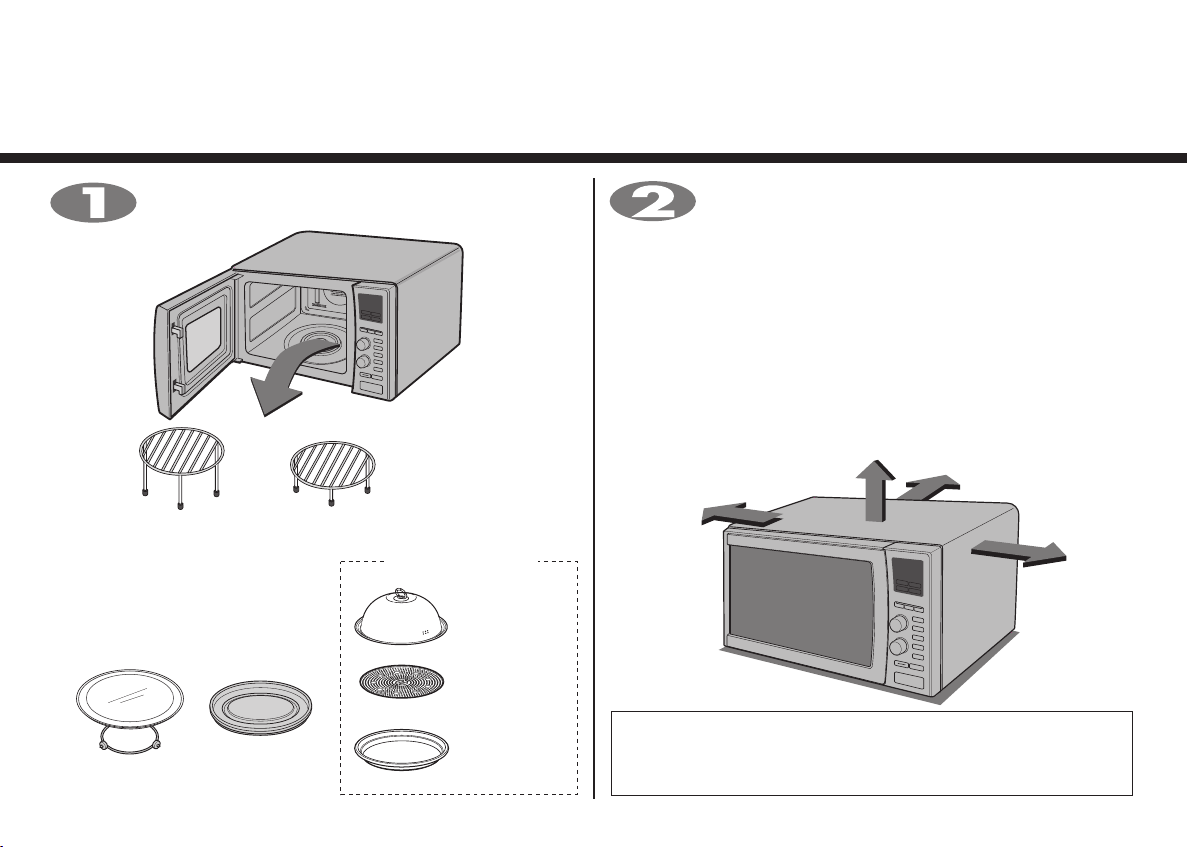
By following the basic steps on these two pages you will be able to quickly check that your oven is operating
correctly. Please pay particular attention to the guidance on where to install your oven. When unpacking your
oven make sure you remove all accessories and packing. Check to make sure that your oven has not been
damaged during delivery.
Unpacking &
Installing
18
GRILL RACK
(HIGH RACK)
ROTATING RING METAL TRAY
STEAMER
(SteamChef functions)
GLASS TRAY
STEAM COVER
STEAM PLATE
STEAM WATER
BOWL
(CRISPING TRAY)
Unpack your oven and place it on a flat level surface. Place the oven on a level bench top surface of your
choice with more than 85cm height but make sure
there is at least 20cm of space on the top, 10cm at the rear and
both side of the walls for proper ventilation.
The front of the oven should be at least min. 8cm from the edge of
the surface to prevent tipping.
An exhaust outlet is located on the underside of the oven and can
emit very hot air temperatures. If the bench top is made of timber or
has a veneered finish, a shield must be placed between the oven
and the bench top to avoid it from being damaged or discoloured.
Blocking the outlet can damage the oven.
* THIS OVEN MUST NOT BE USED FOR COMMERCIAL CATERING
PURPOSES
* THIS OVEN CAN NOT BE USED AS BUILT-IN TYPE.
CONVECTION RACK
(LOW RACK)
19
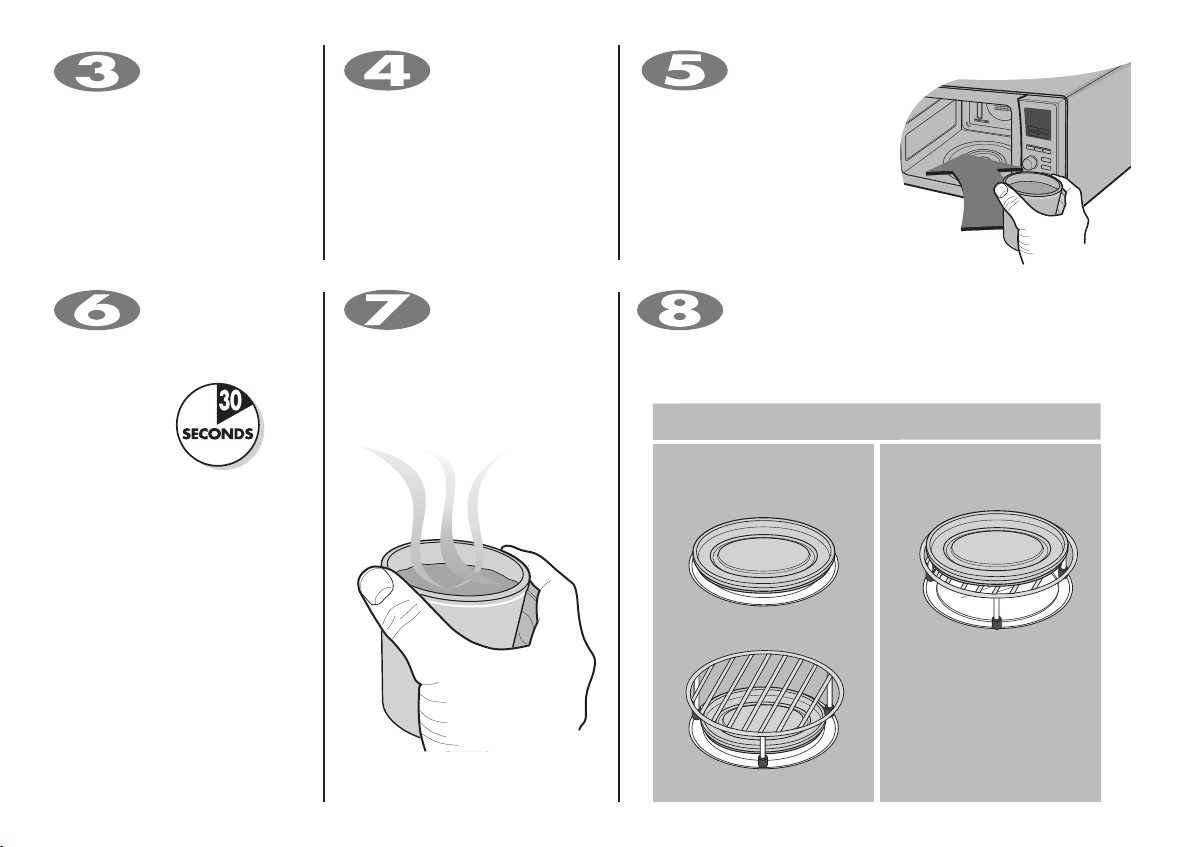
Plug your oven into a
standard household
socket. Make sure your oven is
the only appliance connected to
the socket. If your oven does not
operate properly, unplug it from
the electrical socket and then
plug it back in.
Press the STOP button,
and press the
START button one time
to set 30 seconds of
cooking time.
You will hear
a BEEP as the
unit starts to
operate.
Open your oven door
by pressing the
DOOR OPEN BUTTON. Place the
ROTATING RING inside the oven
and place the GLASS TRAY on
top.
The DISPLAY will
count down from 30
seconds. When it
reaches 0 it
will sound BEEPS. Open the oven
door and test the temperature of
the water. If your oven is
operating the water should be
warm. Be careful when removing
the container it may be hot.
Fill a microwave
safe container with
300ml (
1
/2
pint) of water.
Place on the GLASS TRAY and
close the oven door. If you have
any doubts about what type of
container to use please refer to
page 56.
The contents of feeding bottles and baby food jars
shall be stirred or shaken and the temperature
checked before consumption, in order to avoid
burns. Always remove the Lid before heating.
HOW TO USE THE ACCESSORY
YOUR OVEN IS NOW INSTALLED
Do not operate the
appliance with the trays
placed in the above manner.
It will cause arching and
damage the unit.
Normal Abnormal
Setting the
Clock
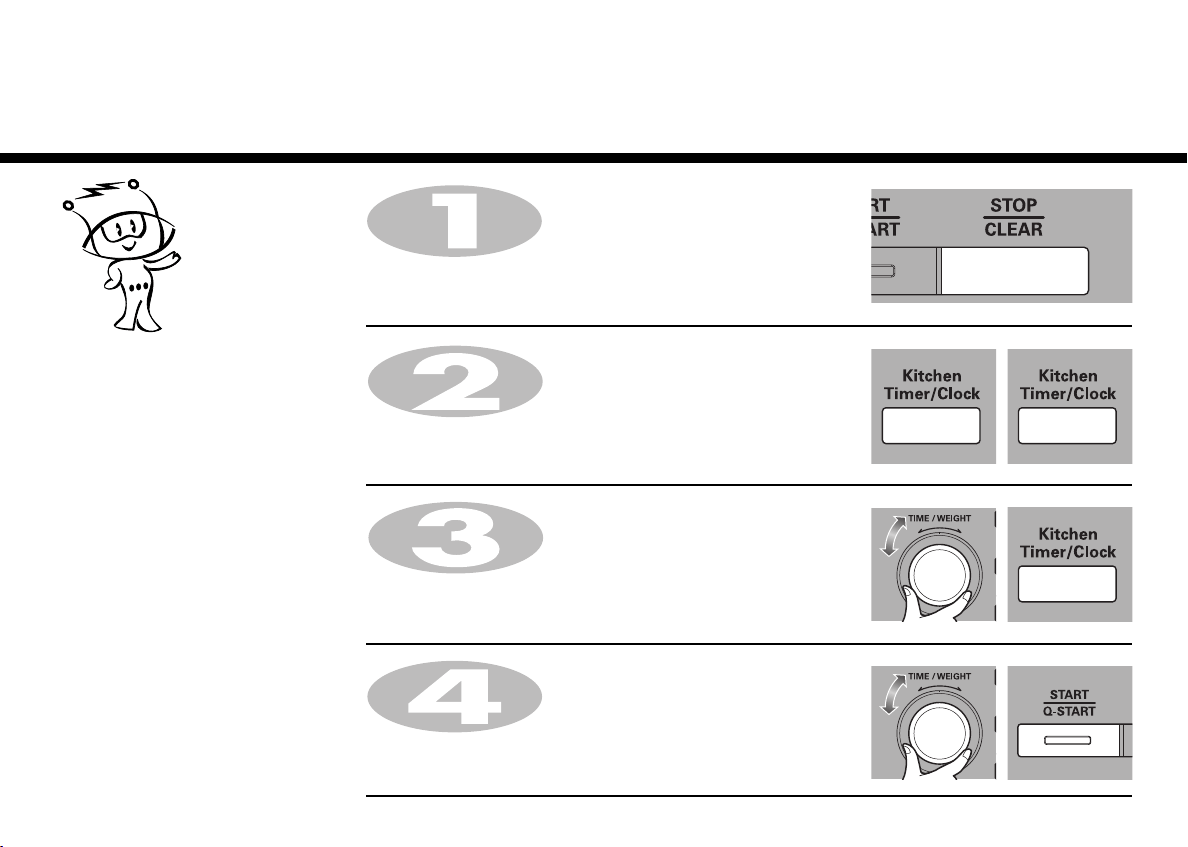
You can set either12 hour clock or 24 hour clock.
In the following example I will show you how to set the time for 14:35 when using the 24 clock.
Make sure that you have removed all packaging from your oven.
20
When your oven is plugged in for the
first time or when power resumes after a
power cut, a ‘:’ will be shown in the
display; you will have to reset the clock.
If the clock (or display) shows any
strange looking symbols, unplug your
oven from the electrical socket and plug
it back in and reset the clock.
Press STOP/CLEAR.
Press and hold Kitchen Timer/Clock until “12 H” appears on the display.
Press Kitchen Timer/Clock again for 24 hour clock setting.
(If you want to change different option after setting clock, you have to
unplug and plug it back in.)
Turn TIME/WEIGHT dial until display shows “14:00”.
Press Kitchen Timer/Clock.
Turn TIME/WEIGHT dial until display shows “14:35”.
Press START/Q-START.
The clock starts counting.
Child
Lock
21
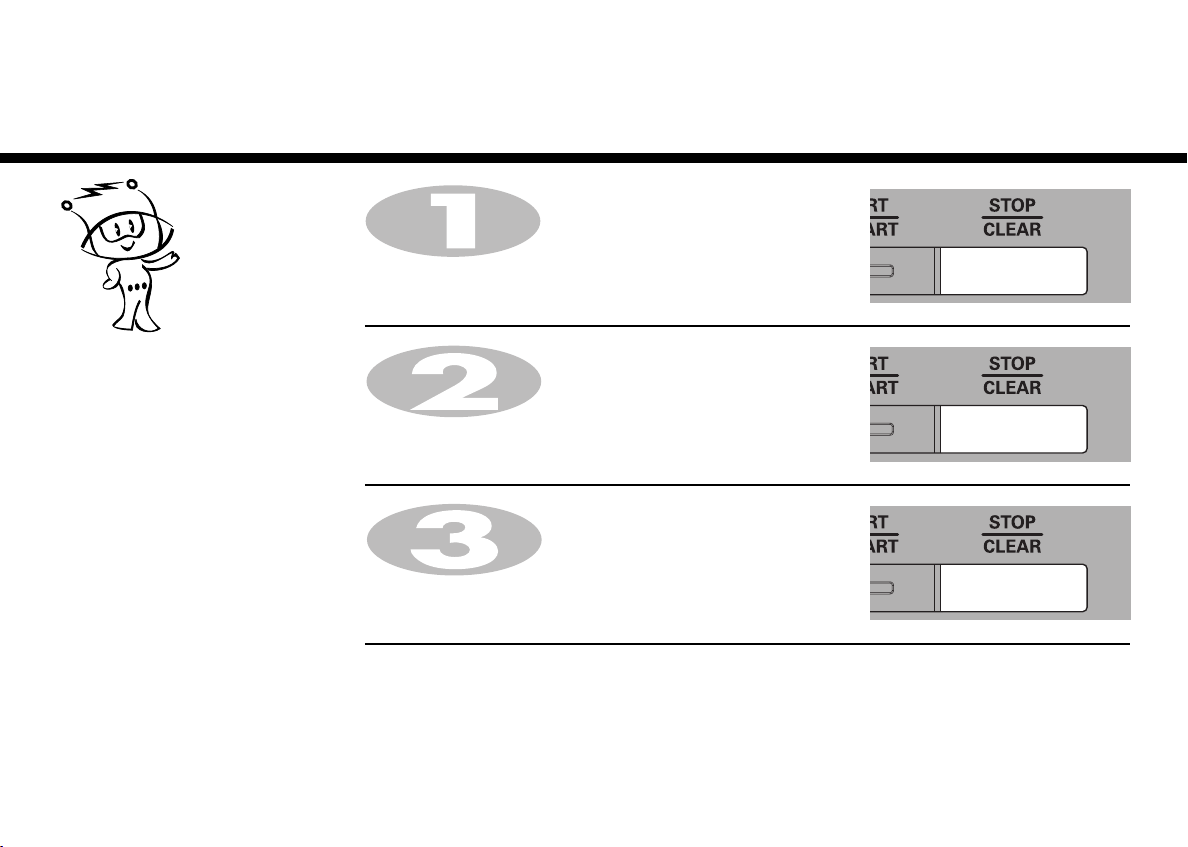
Press STOP/CLEAR.
Your oven has a safety feature that
prevents accidental running of the oven.
Once the child lock is set, you will be
unable to use any functions and no
cooking can take place.
However your child can still open the
oven door.
Press and hold STOP/CLEAR until “CHILD LOCKED” appears on the
display and BEEP sounds.
The CHILD LOCK is now set.
To cancel CHILD LOCK press and hold STOP/CLEAR until “CHILD
LOCKED” disappears.
You will hear a BEEP when it’s disabled.
Micro Power
Cooking
22
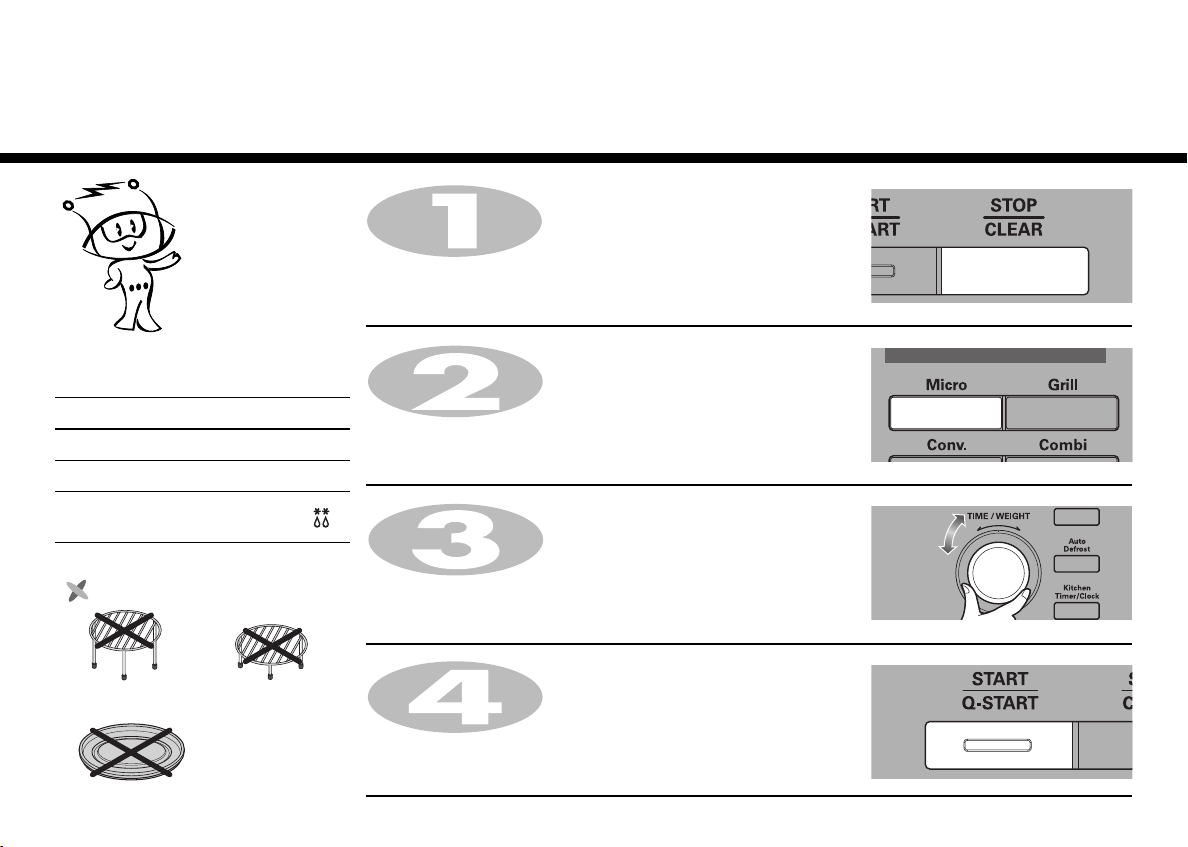
In the following example I will show you how to cook food on 80 % power for 5 minutes and 30 seconds.
NOTE: Do not use aluminium foil during any Microwave or Combi mode, as it can cause arcing when used with
trays which will damage the oven and cause fire.
Make sure that you have correctly installed your oven as described
earlier in this book.
Press STOP/CLEAR.
Your oven has five microwave Power settings.
POWER
HIGH MAX
MEDIUM HIGH
MEDIUM
DEFROST
MEDIUM LOW
LOW
%
100 %
80 %
60 %
40 %
20 %
Power Output
900 W
720 W
540 W
360 W( )
180 W
Press Micro twice.
It will show 720 W.
Turn
TIME/WEIGHT dial
until display shows “5:30”.
Press START/Q-START.
When cooking you can increase or decrease cooking time by turning
TIME/WEIGHT dial.
Don't Use
GRILL RACK
(HIGH RACK)
CONVECTION RACK
(LOW RACK)
METAL TRAY
Micro Power
Level
23
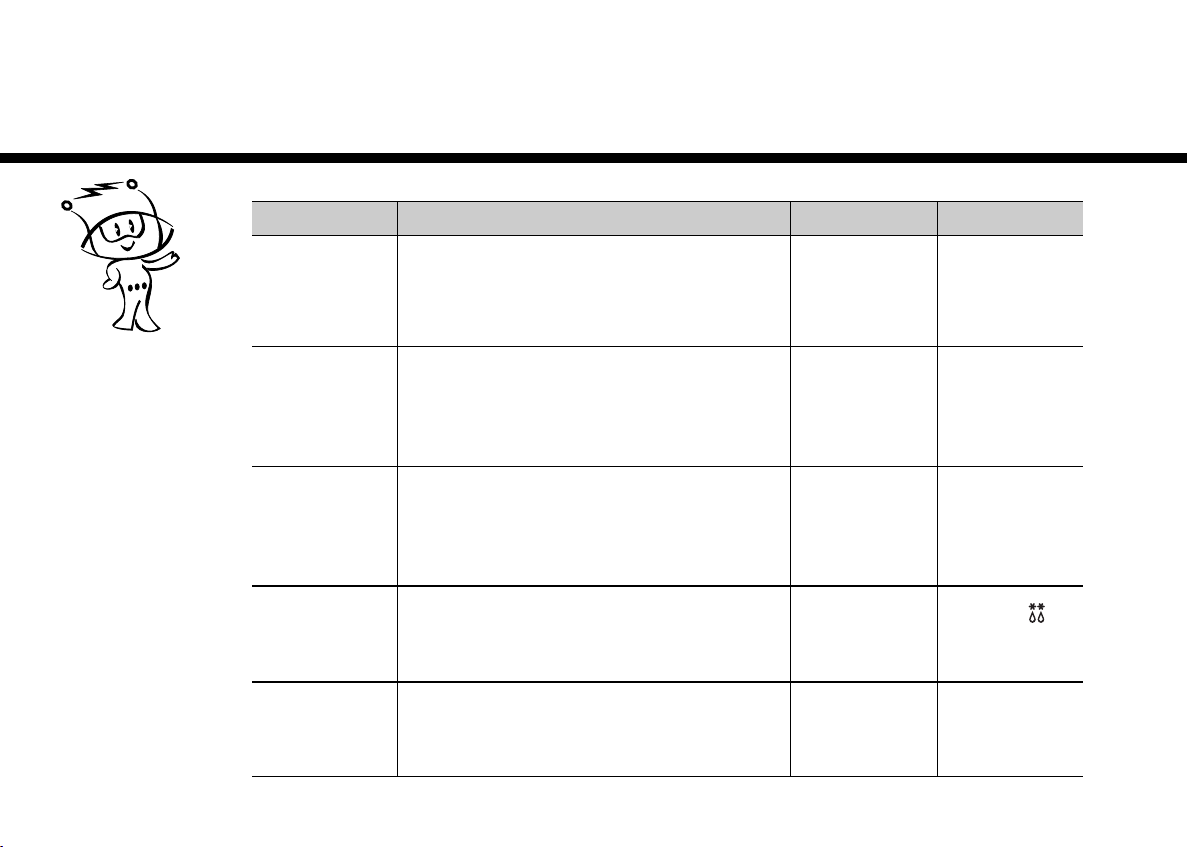
Your microwave oven is equipped with 5 power levels to give you maximum flexibility and control over cooking.
The table below shows the examples of food and their recommended cooking power levels for use with this
microwave oven.
POWER LEVEL USE POWER OUTPUT
HIGH
(Not for
STEAMER)
MEDIUM HIGH
(Not for
STEAMER)
MEDIUM
DEFROST/
MEDIUM LOW
LOW
900 W
720 W
540 W
360 W( )
180 W
POWER LEVEL (%)
100 %
80 %
60 %
40 %
20 %
* Boil water
* Brown minced beef
* Cook poultry pieces, fish, vegetables
* Cook tender cuts of meat
* Reheating(Liquid)
* Roast meat and poultry
* Cook mushrooms and shellfish
* Cook foods containing cheese and eggs
* Reheating(Mashed potato, Plated meal, Ready meal)
* Prepare eggs
* Cook custard
* Prepare rice, soup
* All thawing
* Melt butter and chocolate
* Cook less tender cuts of meat
* Soften butter & cheese
* Soften ice cream
* Raise yeast dough
Quick
Start
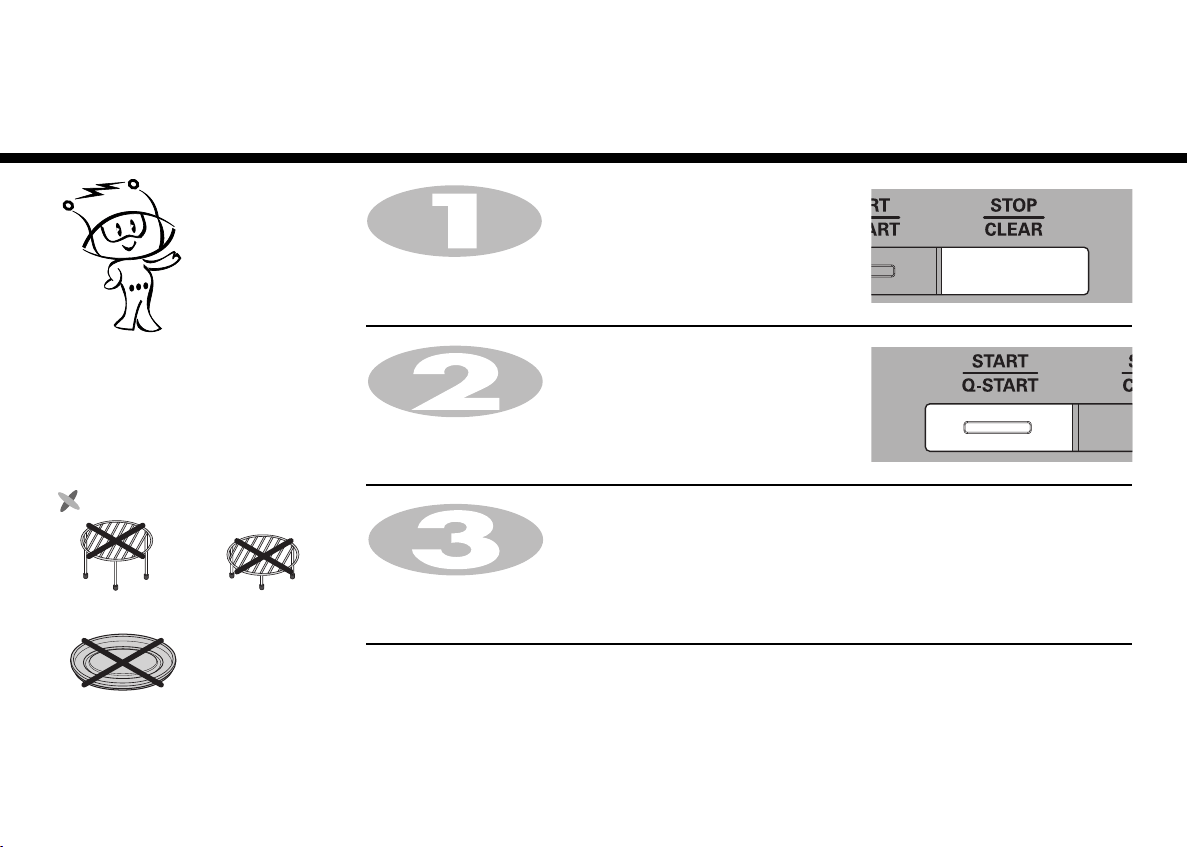
In the following example I will show you how to set 2 minutes of cooking on 900 W power.
The QUICK START feature allows you to
set 30 second intervals of HIGH power
cooking with each touch of the
START/Q-START button.
24
Press STOP/CLEAR.
Press START/Q-START four times to select 2 minutes on 900W power.
Your oven will start before you have finished the fourth press.
During QUICK START cooking, you can extend the cooking time up to
99 minutes 59 seconds by turning the
TIME/WEIGHT dial.
Note: Steam or condensation forming inside the door or display can
indicate that the cooking time or power levels are excessive.
To reduce this from happening, adjust the settings and cover the food.
This is not a malfunction or defect.
Don't Use
GRILL RACK
(HIGH RACK)
CONVECTION RACK
(LOW RACK)
METAL TRAY
25
Grill
Cooking
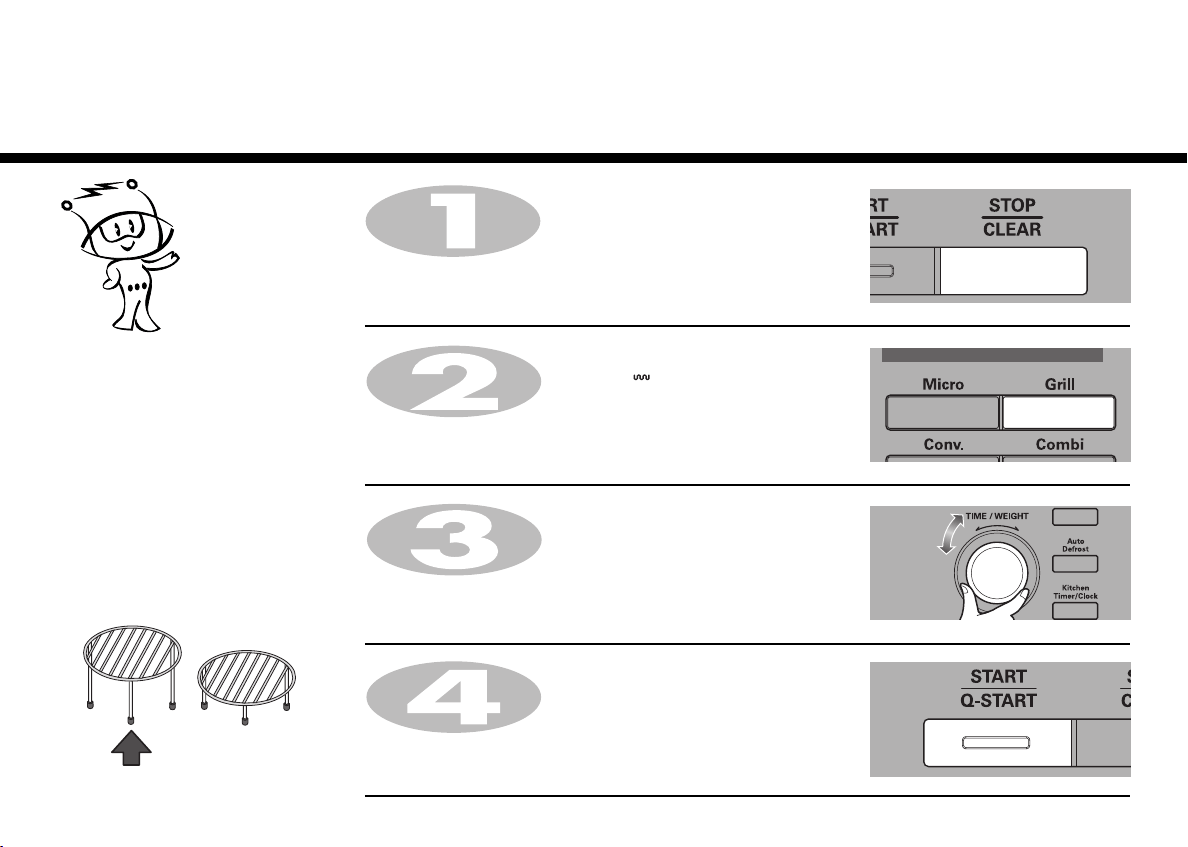
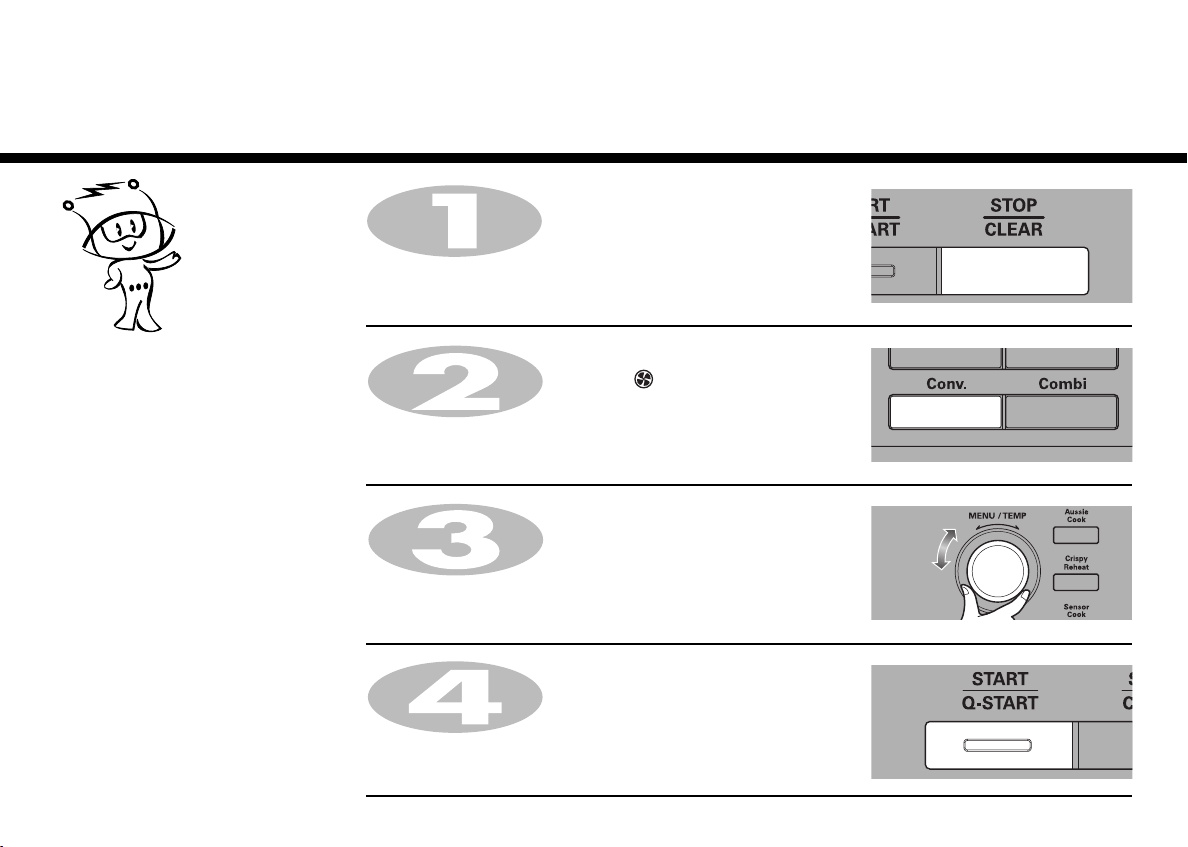
In the following example I will show you how to use the grill to cook some food for 12 minutes and 30 seconds.
This model is fitted with a QUARTZ
GRILL, so preheating is not needed.
This feature will allow you to brown and
crisp food quickly.
The metal Tray should be placed
between the glass Turntable and the Grill
rack during the Grill mode.
The grill rack(high rack) must be used
during grill cooking.
Press STOP/CLEAR.
Press Grill.
The following indication is displayed: “ “
Turn
TIME/WEIGHT dial
until display shows “12:30”.
Press START/Q-START.
When cooking you can increase or decrease cooking time by turning
TIME/WEIGHT dial.
Be careful when removing your food as the tray and Grill rack will be
hot!
Convection
Preheat
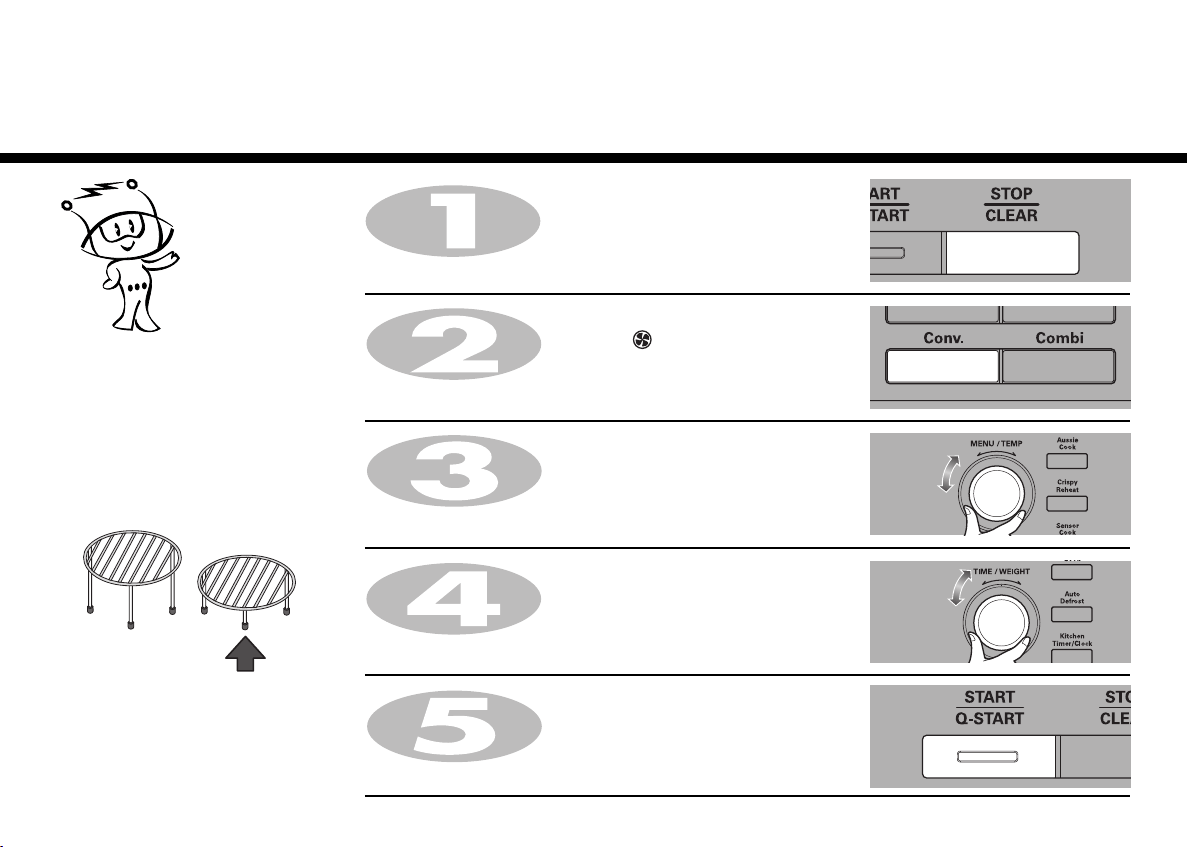
In the following example I will show you how to preheat the oven at a temperature of 230°C.
26
The convection oven has a temperature
range of 40°C and 100°C~250°C
(180°C is the default setting when
convection mode is selected).
The oven has a ferment function of 40
degrees oven temperature. You cannot use
the ferment function if the oven temperature
is over 40°C.
If the ferment function is selected and the
internal oven temperature is over 70deg C,
an "E-05" error will appear in the display.
After the preheat has started, the oven will
BEEP to let you know that it has reached the
correct temperature.
When Preheat is over, place the food in the
oven, then press Convection mode again, set
the cooking temperature and press START to
begin cooking.
Press STOP/CLEAR.
Press Conv.
The following indication is displayed: “ “
Turn MENU/TEMP
dial
until display shows “230°C”.
Press START/Q-START.
Preheating will be started with displaying “PREHEAT”.
Convection
Cooking
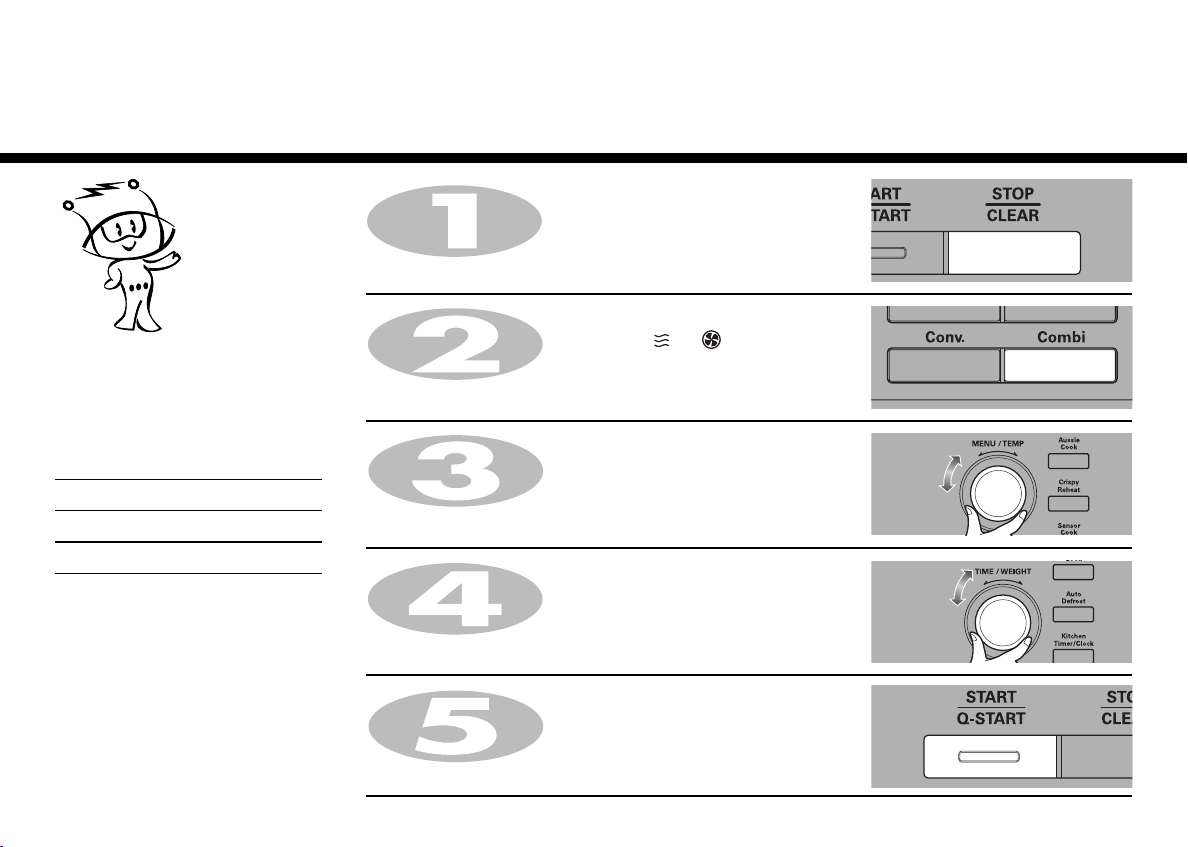
In the following example I will show you how to preheat the oven first, then cook food at a temperature of 230°C
for 50 minutes.
27
If you do not set a temperature your
oven will automatically select 180°C, the
cooking temperature can be changed by
turning the MENU / TEMP dial.
The convection rack(low rack) must be
used during convection cooking.
Place the spill tray under the Grill rack.
Press STOP/CLEAR.
Press Conv.
The following indication is displayed: “ “
Turn MENU/TEMP
dial
until display shows “230°C”.
Turn
TIME/WEIGHT dial
until display shows “50:00”.
Press START/Q-START.
When cooking you can increase or decrease cooking time by turning
TIME/WEIGHT dial.
Be careful when removing your food as the tray and rack will be hot!
Convection Combination
Cooking
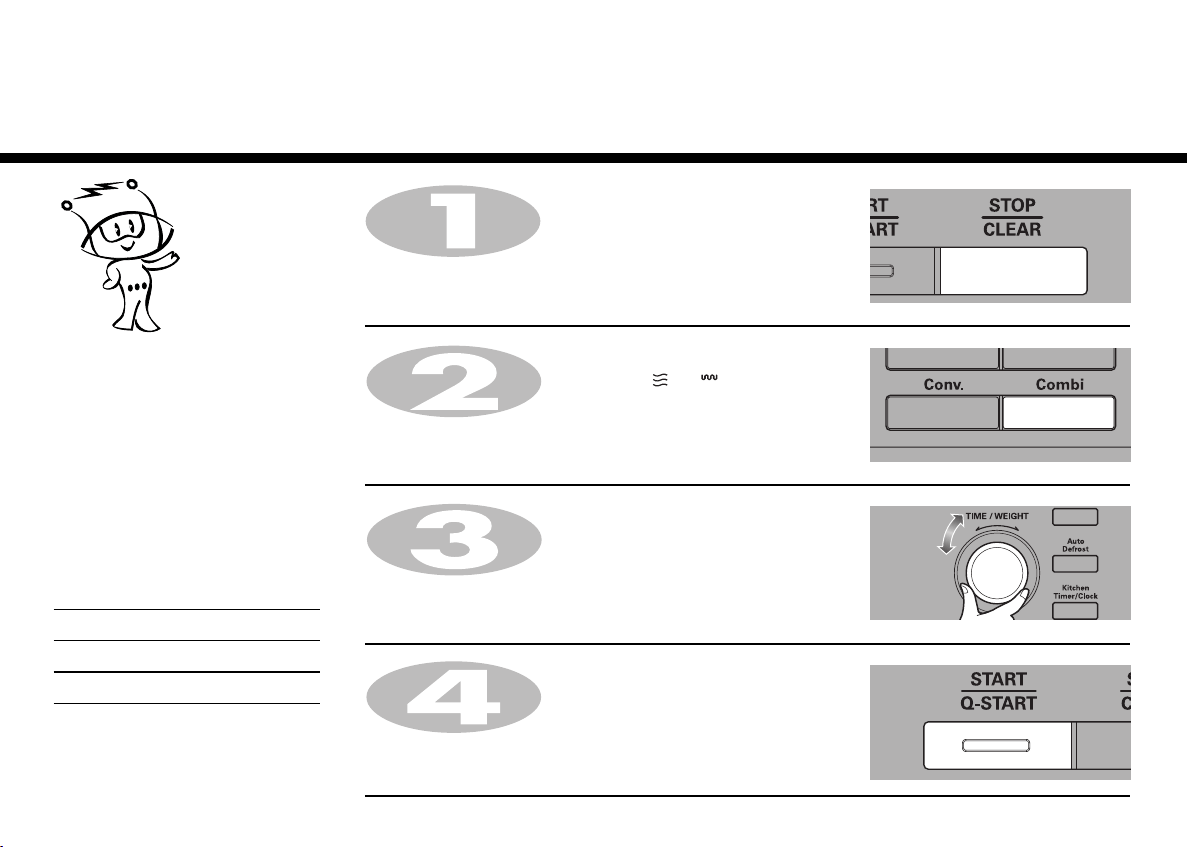
In the following example I will show you how to programme your oven with micro power
60% and at a convection temperature 200°C for a cooking time of 25 minutes.
28
You can set three kinds of micro power
level(20%, 40% and 60%) in combi
mode.
Use only the metal tray and low rack
supplied in the Combi mode. Do not use
aluminium foil as it will cause arching
which will damage the unit and cause
fire.
Press STOP/CLEAR.
Press Combi button once until display shows “540W”.
The following indications are displayed: “ “, “ “.
Turn MENU/TEMP
dial
until display shows “200°C”.
Turn
TIME/WEIGHT dial
until display shows “25:00”.
Press START/Q-START.
When cooking you can increase or decrease cooking time by turning
TIME/WEIGHT dial.
Be careful when removing your food as the cookware, and rack will be hot!
Microwave Power
(%)
60
40
20
(Watts)
540
360
180
Grill Combination
Cooking
In the following example I will show you how to programme your oven with micro power 20 % and grill
for a cooking time of 25 minutes.
29
Your oven has a combination cooking
feature which allows you to cook food
with the heater and microwave
operating alternately. This generally
means it takes less time to cook your
food.
You can set three kinds of micro power
level(20%, 40% and 60%) in combi
mode.
Do not use aluminium foil during this
mode if using the metal tray. Use only
the metal tray and grill racks supplied
with the oven.
Microwave Power
(%)
60
40
20
(Watts)
540
360
180
Press STOP/CLEAR.
Press Combi button six times until display shows “180W”.
The following indications are displayed: “ “, “ “.
Turn
TIME/WEIGHT dial
until display shows “25:00”.
Press START/Q-START.
When cooking you can increase or decrease cooking time by turning
TIME/WEIGHT dial.
Be careful when removing your food as the tray and rack will be hot!
SteamChef
Cook
In the following example I will show you how to cook 0.3kg of green beans.
NOTE: the STEAMER is required for this function.
30
This feature allows you steamed cook.
CAUTION:
1. Always use oven gloves when
removing the STEAMER from the
oven. It’s very hot.
2. Do not put a hot STEAMER on a glass
table or surface after cooking.
Always make sure to use a resting
pad or tray.
3. When using the Steamer, pour at
least 300 ml of water, but never
more than 500ml into the Steamer
water bowl, then place the steam
plate into position before placing
food onto it. If the amount of water is
less than 300 ml, it may cause
incomplete cooking, or may cause a
fire and severe damage to the unit.
4. Be careful when you move the
STEAMER containing any water.
5. When using the STEAMER, always
ensure that the steam plate and
Steam cover are correctly positioned
onto the steam water bowl. Incorrect
placement will inhibit steam from
forming and could cause certain food
such as eggs, to explode and other
foods to over cook.
6. Never use this Steamer with any
other microwave oven having a
different model number. Damage to
that product may occur as a result.
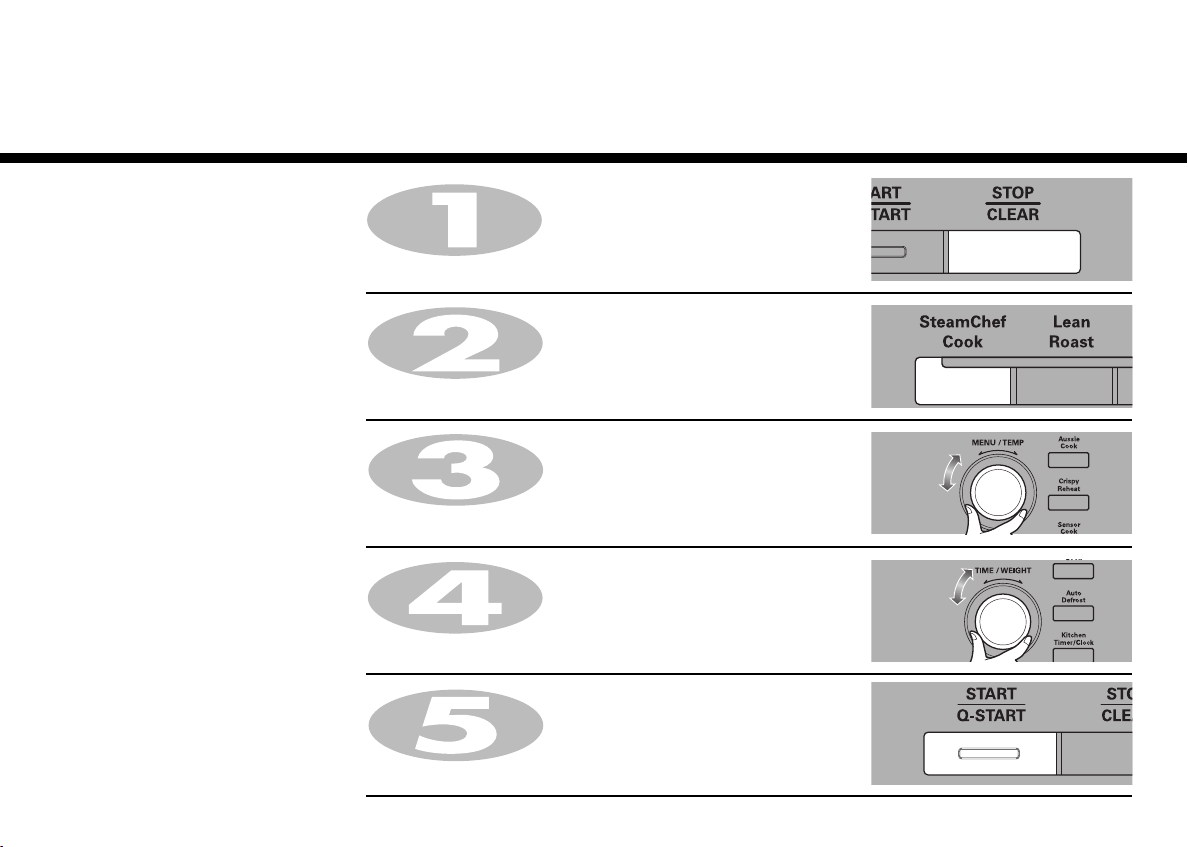
Press STOP/CLEAR.
Press SteamChef Cook.
Turn MENU/TEMP
dial
until display shows “3” (GREEN BEANS).
Turn
TIME/WEIGHT dial
until display shows “0.3kg”.
Press START/Q-START.
When cooking you can increase or decrease cooking time by turning
TIME/WEIGHT dial.
Be careful when removing your food as the Steamer and cookware will be hot!
31
1. Clean vegetables and cut into similar sized pieces.
2. Pour 300ml tap water into the steam water bowl.
Place the steam plate on the steam water bowl.
Place prepared food on the steam plate in a single layer.
Cover with the steam cover.
3. Place the steam water bowl in the oven.
4. Choose the menu and weight, press start.
- Cut small florets. (12-15g/piece)
Same as above.
- Under 5mm thickness
Same as above.
Same as above.
- Under 20cm length.
1. Clean mussels and discard any broken shell or dead mussels.
2. Place mussels on the steam water bowl in a single layer. Pour 300ml
white wine into the steam water bowl and add remaining
ingredients. Cover with the steam cover.
3. Place the steam water bowl in the oven.
4. Choose the menu and weight, press start.
Broccoli
Carrot
Green Beans
Prawns
Mussels
0.1-0.4kg
0.2-0.4kg
0.1-0.3kg
0.2-0.5kg
0.4-0.8kg
Steam cover
Steam plate
Steam water bowl
Steam cover
Steam plate
Steam water bowl
Steam cover
Steam plate
Steam water bowl
Steam cover
Steam plate
Steam water bowl
Steam cover
Steam water bowl
Room
Room
Room
Refrigerated
Refrigerated
CategoryFunction Weight Limit Utensil InstructionsFood Temp.
1
2
3
4
5
SteamChef
Cook
Ingredients
Mussels
300ml dry white wine
1 teaspoon chopped parsley
2 garlic cloves, crushed
32
1. Clean the food.
2. Pour 300ml tap water into the steam water bowl.
Place the steam plate on the steam water bowl.
Place the prepared food on the steam plate in a single layer.
Cover with the steam cover.
3. Place the steam water bowl in the oven.
4. Choose the menu and weight, press start.
Same as above.
- Under 2.5cm thickness
Same as above.
Eggs
Chicken
Breasts
Fish Fillet
2-9 Pc
0.2-0.6kg
0.2-0.6kg
Steam cover
Steam plate
Steam water bowl
Steam cover
Steam plate
Steam water bowl
Steam cover
Steam plate
Steam water bowl
Refrigerated
Refrigerated
Refrigerated
CategoryFunction Weight Limit Utensil InstructionsFood Temp.
6
7
8
SteamChef
Cook
Lean
Roast
In the following example I will show how to cook 0.7kg of roast beef.
33
This Lean Roast feature is designed to
give cooking results of low fat, low
calorie for roasting meats and poulty.
Press STOP/CLEAR.
Press Lean Roast.
Turn MENU/TEMP
dial
until display shows “1” (ROAST BEEF).
Turn TIME/WEIGHT
dial
until display shows “0.7kg”.
Press START/Q-START.
34
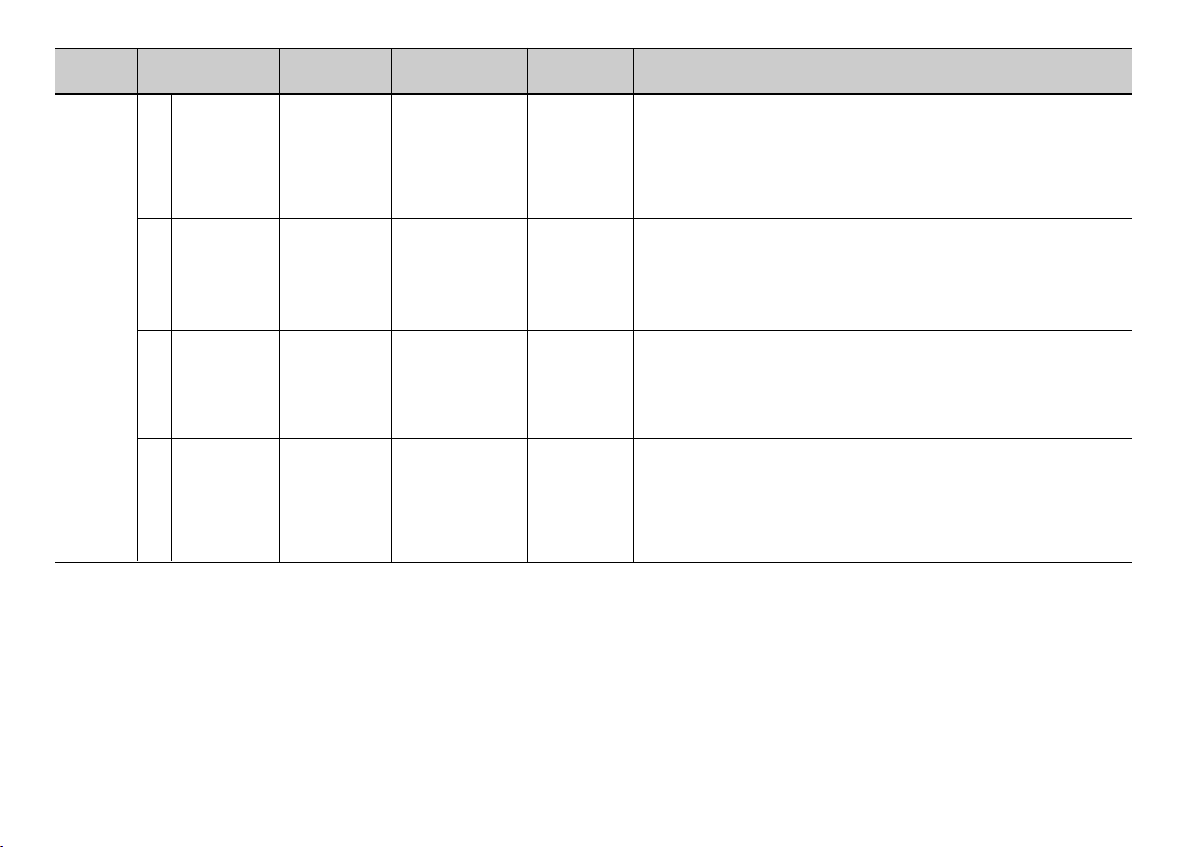
Brush beef with melted butter or oil and season as
desired.
Place food on the low rack on the metal tray. Choose the
menu and weight, press start. After cooking, stand covered with foil for
10 minutes.
Brush pork with melted butter or oil and season as desired.
Place food on the low rack on the metal tray. Choose the menu and
weight, press start. After cooking, stand covered with foil for
10 minutes.
Brush lamb with melted butter or oil and season as desired.
Place food on the low rack on the metal tray. Choose the menu and
weight, press start. After cooking, stand covered with foil for
10 minutes.
Brush chicken with melted butter or oil and season as desired.
Place food breast-side down on the low rack on the metal tray.
Choose the menu and weight, press start. When BEEP, turn food over
and press start to continue cooking.
After cooking, stand covered with foil for 10 minutes
Roast
Beef
Roast
Pork
Roast
Lamb
Roast
Chicken
0.5-1.5kg
0.5-1.5kg
0.5-1.5kg
0.8-1.8kg
Low rack
on the Metal tray
Low rack
on the Metal tray
Low rack
on the Metal tray
Low rack
on the Metal tray
Refrigerated
Refrigerated
Refrigerated
Refrigerated
CategoryFunction Weight Limit Utensil InstructionsFood Temp.
1
2
3
4
Lean Roast
Healthy
Fry
In the following example I will show you how to cook 0.4kg of chicken breasts.
35
Healthy Fry cooking make food fry
convient and easy to use.
The oven has been pre-programmed to
automatically fry food.
Press STOP/CLEAR.
Press Healty Fry.
Turn MENU/TEMP
dial
until display shows “1” (CHICKEN BREASTS).
Turn TIME/WEIGHT
dial
until display shows “0.4kg”.
Press START/Q-START.
36
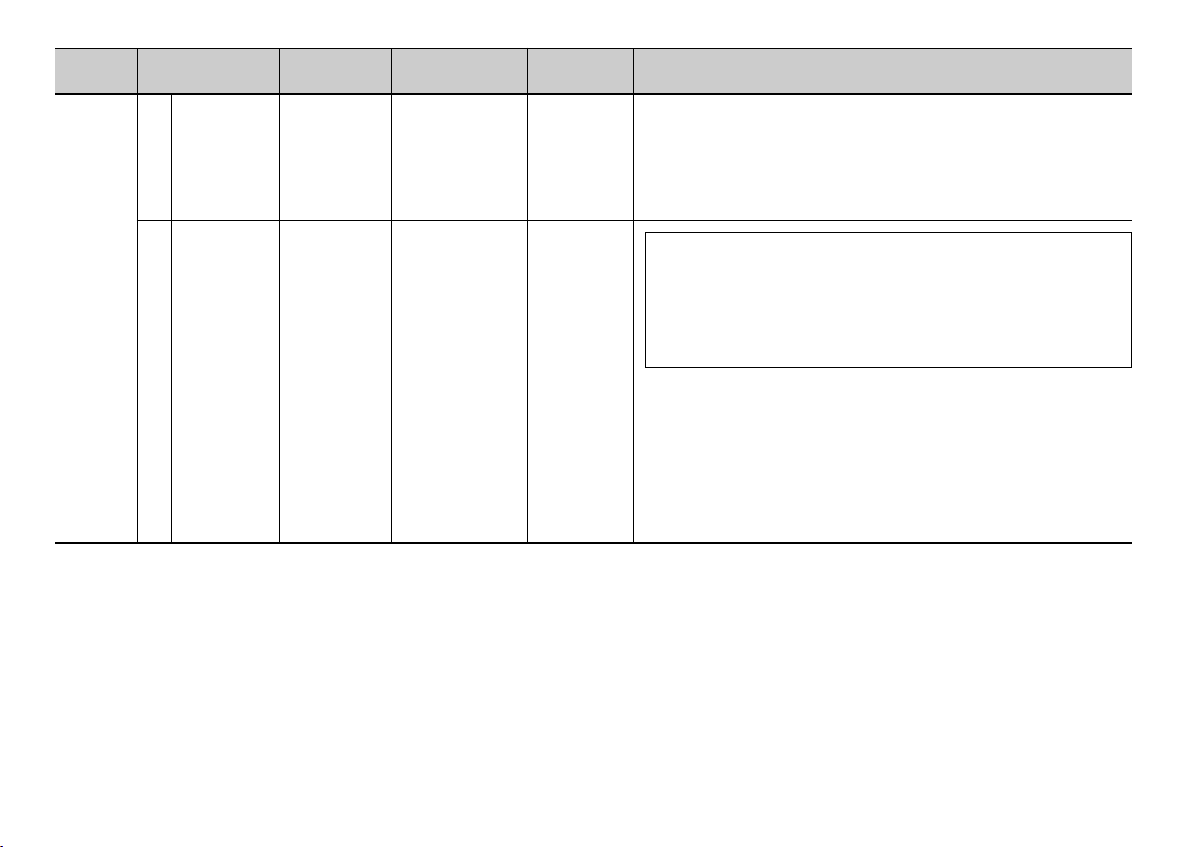
Chicken
Breasts
Chicken
Schnitzel
0.2-0.6kg
0.2-0.6kg
Crisping tray
on the High rack
Crisping tray
on the High rack
Refrigerated
Refrigerated
CategoryFunction Weight Limit Utensil InstructionsFood Temp.
1
2
Healthy
Fry
Brush chicken breasts with melted butter or oil and
season as desired.
Place food on the crisping tray on the high rack. Choose
the menu and weight, press start. When BEEP, turn food
over and press start to continue cooking.
1. Season chicken breasts with salt and pepper or as desired, coat in
flour and brush with beaten eggs.
2. Coat with finely ground breadcrumbs and brush surface of schnitzel
with oil.
3. Place food on the crisping tray on the high rack. Choose the menu
and weight, press start. When BEEP, turn food over and press start to
continue cooking.
Ingredients
Chicken breasts of 150-200g per each.
1 cup flour
2 eggs, lightly beaten
1 cup finely ground breadcrumbs
Salt and pepper to taste
37
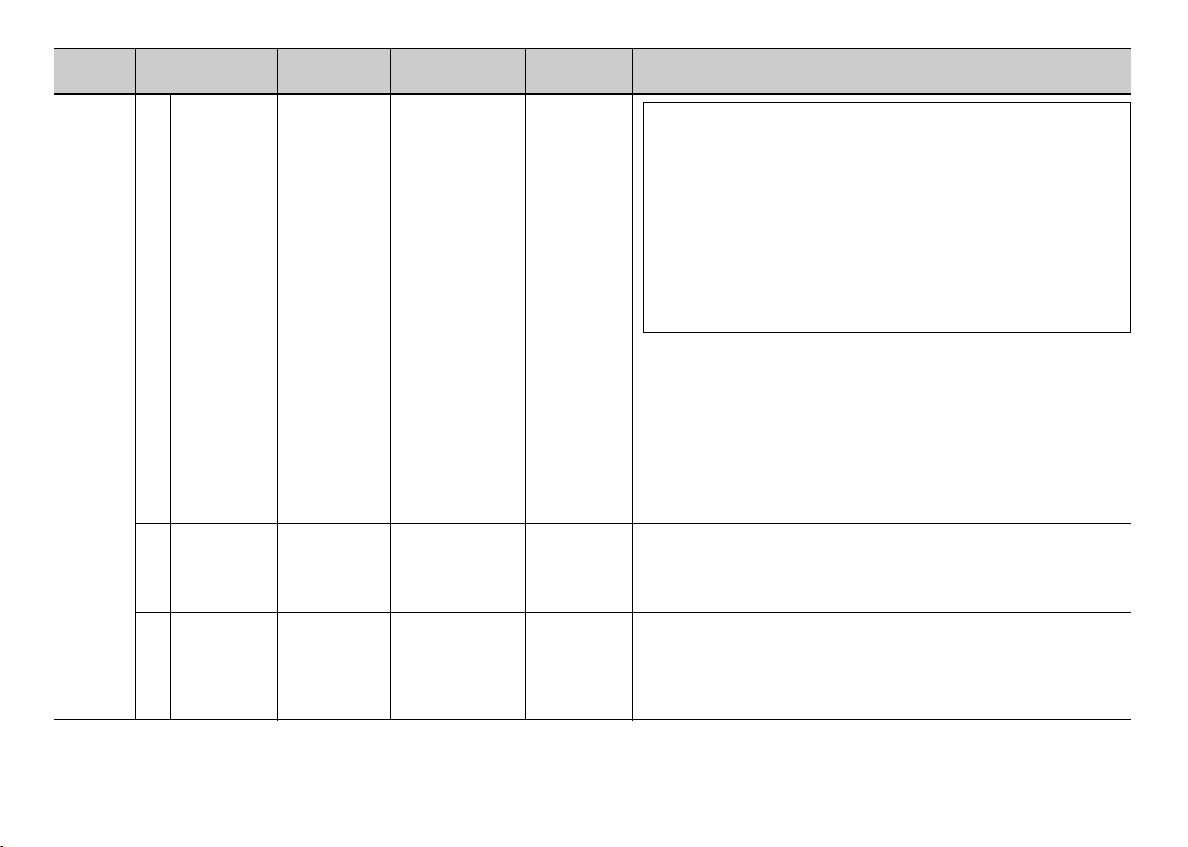
Chicken
Skewers
French Fries
Frozen
Fish Fingers
Frozen
0.2-0.8kg
0.2-0.4kg
0.2-0.4kg
High rack on the
Metal tray
Crisping tray
on the High rack
Crisping tray
on the High rack
Refrigerated
Frozen
Frozen
CategoryFunction Weight Limit Utensil InstructionsFood Temp.
3
4
5
Healthy
Fry
1. Cut chicken wings into 2 pieces. Combine the ingredients of
marinade and marinate chicken wings for 3-4 hours.
2. Thread chicken onto skewers.
3. Place food on the high rack on the metal tray. Choose
the menu and weight, press start. When BEEP, turn food
over and press start to continue cooking
Spread frozen potato products out on the crisping tray on
the high rack. For the best results, cook in a single layer.
Choose the menu and weight, press start.
Brush surface of fish fingers with oil.
Place food on the crisping tray on the high rack. Choose
the menu and weight, press start. When BEEP, turn food
over and press start to continue cooking.
Ingredients
Chicken wings
Skewers (metal or wood)
For Marinade :
1
/2
cup soy sauce
1
/2
cup honey
2 tablespoons lemon juice
2 garlic cloves, crushed
38
Hamburger
Patties
Sausages
Prawns
0.2-0.4kg
0.2-0.8kg
0.2-0.5kg
Crisping tray
on the High rack
Crisping tray
on the High rack
Crisping tray
on the High rack
Refrigerated
Refrigerated
Refrigerated
CategoryFunction Weight Limit Utensil InstructionsFood Temp.
6
7
8
Healthy
Fry
Choose hamburger of 100g weight and 0.5-1cm thickness each. Brush
surface of hamburger with oil.
Place food on the crisping tray on the high rack. Choose the menu and
weight, press start. When BEEP, turn food over and press start to
continue cooking.
Remove sausages from packaging and slit on surface.
Place food on the crisping tray on the high rack. Choose the menu and
weight, press start. When BEEP, turn food over and press start to
continue cooking.
Brush surface of prawns with oil.
Place food on the crisping tray on the high rack. Choose
the menu and weight, press start.
Aussie
Cook
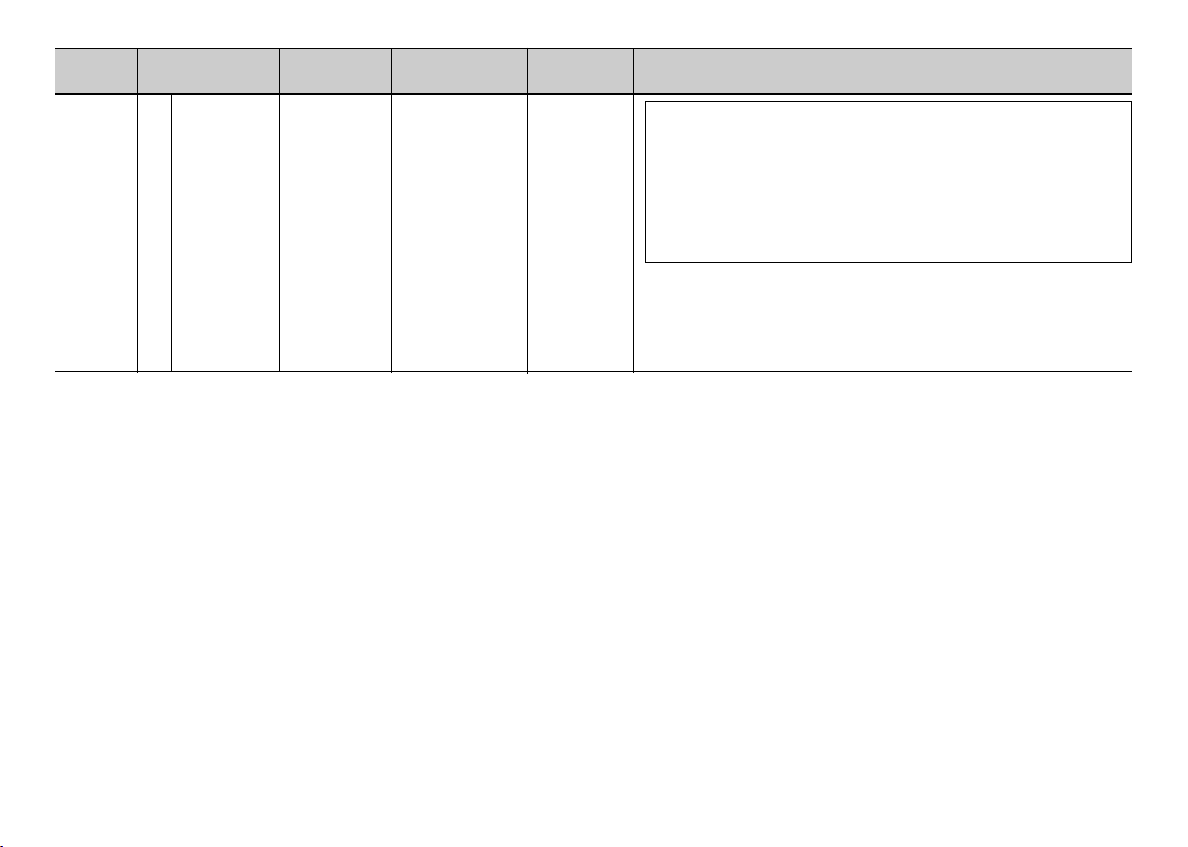
In the following example I will show you how to cook 0.4kg of pork chops.
39
Aussie Cook allows you to cook most of
your favorite food easily by selecting the
food type and entering the weight of the
food.
Press STOP/CLEAR.
Press Aussie Cook.
Turn MENU/TEMP
dial
until display shows “4”. (PORK CHOPS)
Turn
TIME/WEIGHT dial
until display shows “0.4kg”.
Press START/Q-START.
When cooking you can increase or decrease cooking time by turning
TIME/WEIGHT dial
.
40
Slice vegetables into large pieces. Brush vegetables with melted butter
or oil and season as desired.
Place food on the crisping tray on the high rack. Choose the menu and
weight, press start.
Roast
Vegetables
0.2-0.6kg Crisping tray
on the High rack
Room
CategoryFunction Weight Limit Utensil InstructionsFood Temp.
1
Aussie
Cook
Ingredients
Eggplants, cut into 1-2cm thickness
Zucchinis, cut into 1-2cm thickness
Onions, cut into wedges
Sweet peppers, cut in half lengthwise and discard seeds
Whole cherry tomatoes
Mushrooms, cut in half
41
1. Cook lasagna sheets according to package directions and drain.
2. Spread about 125g spaghetti sauce in a 26x17cm baking dish.
3. Layer 3 lasagna sheets, 300g cheese sauce, 125g spaghetti sauce,
100g mozzarella cheese. Repeat layering.
4. Finally layer remaining lasagna sheets, spread 125g spaghetti
sauce, sprinkle with 100g mozzarella cheese and 30g parmesan
cheese.
5. Place baking dish on the low rack. Choose the menu and weight,
press start.
Lasagna 1 26x17cm
baking dish
on the Low rack
Room
CategoryFunction Weight Limit Utensil InstructionsFood Temp.
2
Aussie
Cook
Ingredients
9 lasagna sheets
500g spaghetti sauce
600g cheese sauce
300g grated mozzarella cheese
30g grated parmesan cheese
For Cheese sauce :
60g butter
50g plain flour
Pinch ground nutmeg
500ml milk
20g grated parmesan cheese
Melt butter in small saucepan. Add flour and nutmeg, stirring until
smooth. Gradually add milk and stir until it boils and thickens.
Reduce heat and add parmesan cheese. Stir until cheese melts well.
42
1. On a lightly floured surface, roll out 1 puff pastry sheet into a circle
and line a 20cm pie tin. Trim edges, leaving a little overhang and
prick with a fork. Fill with the cooled meat mixture and brush around
edges with beaten egg to top will stick to it.
2. Roll out the remaining pastry sheet and place on top of pie to form a
lid and trim edges. Press edges together with a fork to seal. Cut a
vent in top of pie to allow steam to escape. Brush top with remaining
beaten egg.
3. Place pie tin on the low rack. Choose the menu and weight, press
start.
Meat Pie 1 20cm
pie tin
on the Low rack
Room
CategoryFunction Weight Limit Utensil InstructionsFood Temp.
3
Aussie
Cook
Ingredients
600-650g meat mixture
2 puff pastry sheets, thawed (180~200g/sheet)
1 egg, lightly beaten
For Meat mixture :
1 onion, chopped
500g steak, finely chopped
2 tablespoons plain flour
250ml bouillon
1
/2
teaspoon thyme
Pinch ground nutmeg
Salt and pepper to taste
Saute chopped onion over a low heat in a saucepan until soften.
Add chopped steak and stir until browned. Sprinkle flour over
steak and continue cooking for further 2 minutes. Gradually add
bouillon and stir constantly until it boils and thickens. Add all
remaining ingredients. Cover and simmer for 30 minutes.
43
Pork Chops
Lamb Chops
Chicken
Wings
0.2-0.8kg
0.2-0.8kg
0.2-0.8kg
High rack
on the Metal tray
High rack
on the Metal tray
High rack
on the Metal tray
Refrigerated
Refrigerated
Refrigerated
CategoryFunction Weight Limit Utensil InstructionsFood Temp.
4
5
6
Aussie
Cook
Choose pork chops of 200g weight and 2.5cm thickness each. Season
with salt and pepper or as desired.
Place food on the high rack on the metal tray. Choose the menu and
weight, press start. When BEEP, turn food over and press start to
continue cooking.
Choose lamb chops of 100-150g weight and 1.5-2.0cm thickness each.
Season with salt and pepper or as desired.
Place food on the high rack on the metal tray. Choose the menu and
weight, press start. When BEEP, turn food over and press start to
continue cooking.
Brush chicken wings with melted butter or oil and season as desired.
Place food on the high rack on the metal tray. Choose the menu
and weight, press start. When BEEP, turn food over and press start to
continue cooking.
44
Potato Gratin
Frozen Pizza
0.5-1.2kg
0.1-0.6kg
Microwave-safe
baking dish
on the Low rack
Low rack
Room
Frozen
CategoryFunction Weight Limit Utensil InstructionsFood Temp.
7
8
Aussie
Cook
For example of 1.0kg potato gratin
Place half of the potato mixture into a greased 25x25cm. baking dish,
pour half of heavy cream and sprinkle 100g Gruyere cheese. Add the
rest of potato mixture, pour remaining cream and finally sprinkle top
with remaining Gruyere cheese.
Place baking dish on the low rack. Choose the menu and weight,
press start.
Remove pizza from packaging and place food on the low rack.
Choose the menu and weight, press start.
Ingredients
Potato mixture
300ml heavy cream
350g grated Gruyere cheese
For Potato mixture :
1kg potatoes
400ml milk
1
/2
teaspoons salt
Pinch ground nutmeg
Slice potatoes into 3mm thickness. Combine all ingredients in a
saucepan and simmer over medium heat until milk boils and
thickens. Keep Stirring potatoes and scraping bottom of pan
regularly to prevent sticking.
Crispy
Reheat
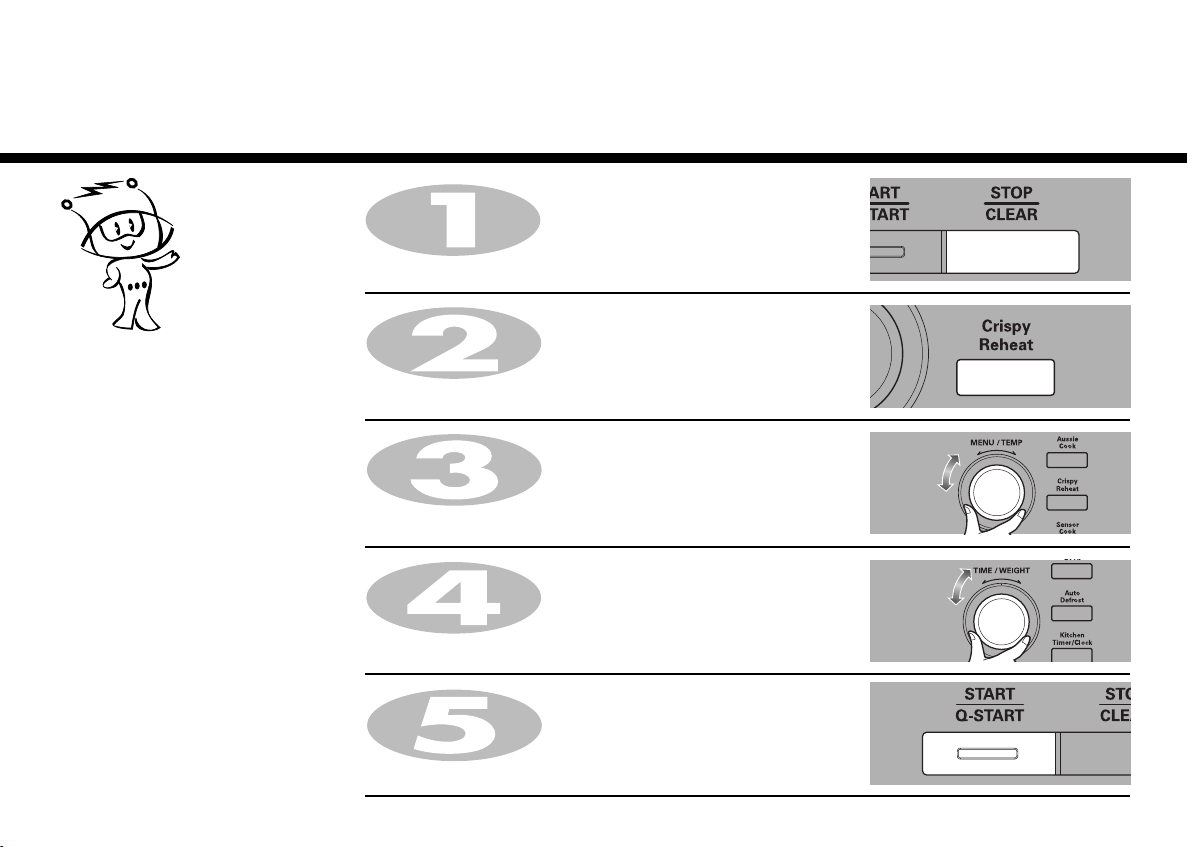
In the following example I will show you how to reheat 0.2kg of pizza.
45
Crispy reheat allows you to reheat
leftover foods easily by selecting the food
type and entering the weight of the food.
Press STOP/CLEAR.
Press Crispy Reheat.
Turn MENU/TEMP
dial
until display shows “3” (PIZZA).
Turn
TIME/WEIGHT dial
until display shows “0.2kg”.
Press START/Q-START.
46
Roasted Meat
Lasagna
Pizza
Pie
0.2-0.6kg
0.2-0.8kg
0.1-0.4kg
0.2-0.8kg
Crisping tray
on the High rack
Crisping tray
on the Low rack
Crisping tray
on the Low rack
Crisping tray
on the Low rack
Refrigerated
Refrigerated
Refrigerated
Refrigerated
CategoryFunction Weight Limit Utensil InstructionsFood Temp.
1
2
3
4
Crispy
Reheat
Cut leftover roasted meat into thin slices. (under 2.5cm thic kness) Place
food on the crisping tray on the high rack. Choose the menu and
weight, press start.
Cut leftover lasagna into pieces.(200-250g/piece)
Place food on the crisping tray on the low rack. Choose the menu and
weight, press start.
Cut leftover pizza into pieces.(100-150g/piece)
Place food on the crisping tray on the low rack. Choose the menu and
weight, press start.
Cut leftover pie into pieces.(200-250g/piece)
Place food on the crisping tray on the low rack. Choose the menu and
weight, press start.
Sensor
Cook
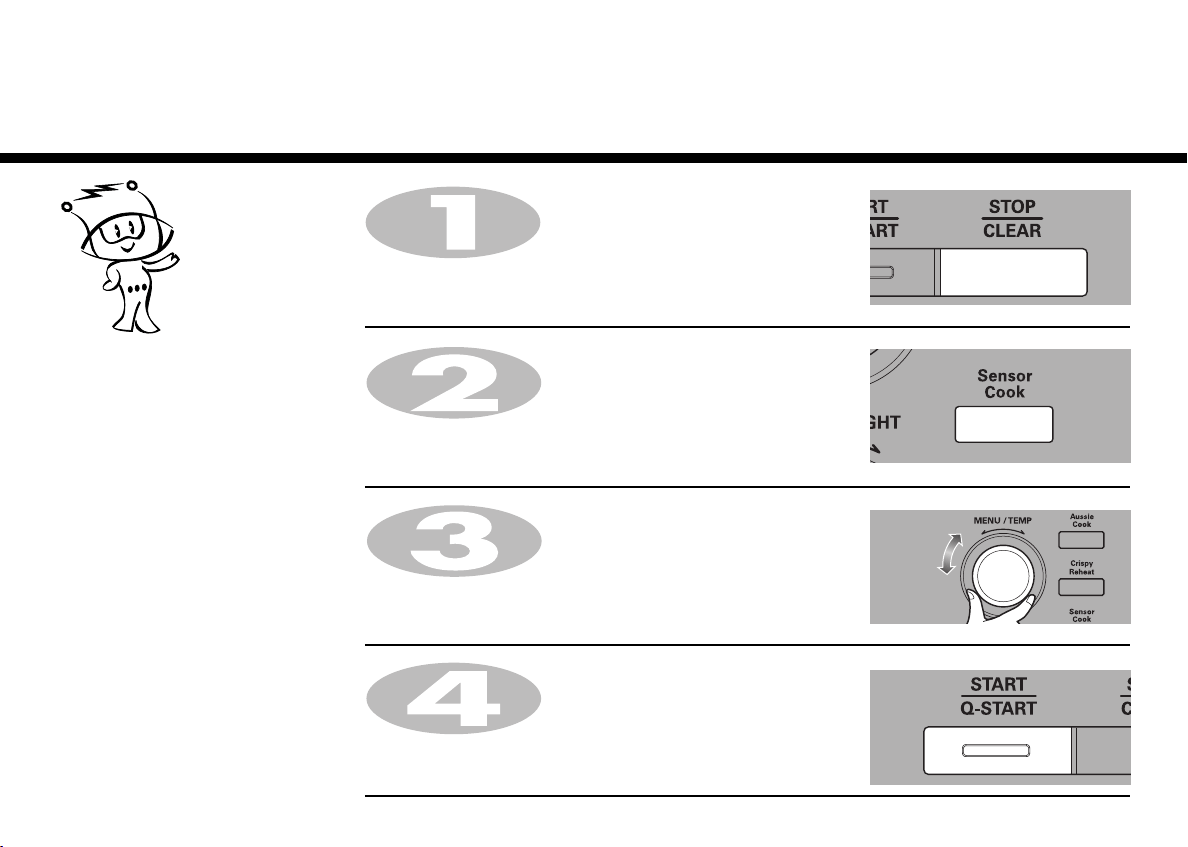
In the following example I will show you how to cook Jacket Potatoes using this function.
47
Press STOP/CLEAR.
Press Sensor Cook.
Turn MENU/TEMP
dial
until display shows “4” (JACKET POTATOES).
Press START/Q-START.
(Do not need to set cooking time. It sensor automatically)
48
Rice/ Pasta
Reheat
Dinner
Plate
Reheat Soup
Jacket
Potatoes
1
/2
– 2 cups
1 serving
(0.5-0.6kg)
1-4 cups
(1 cup = 250g)
1-4 potatoes
Microwave-safe
bowl
Microwave-safe
plate
Microwave-safe
bowl
Paper towel
Room
Refrigerated
Refrigerated
Room
CategoryFunction Weight Limit Utensil InstructionsFood Temp.
1
2
3
4
Sensor
Cook
Place rice/pasta and water with
1
/4
to 1 teaspoon salt in a deep and
large bowl(3L). Cover with a vented plastic cover. Place bowl in the
oven. Choose the menu, press start.
** Rice - After cooking, stand covered for 5 minutes or until water is
absorbed.
** Pasta - After cooking, stand for 1-2 minutes. Rinse pasta with cold
water.
Place leftover food (meat, chicken, mashed potato, vegetable etc.) on a
plate. Cover with a vented plastic cover.
Place plate in the oven. Choose the menu and weight, press start.
After cooking, allow to stand for 3 minutes.
Pour soup into a microwave-safe bowl. Cover with a vented plastic
cover. Place bowl in the oven. Choose the menu, press start.
After cooking, stir for 3-4 seconds and stand covered for 3 minutes.
Choose medium sized potatoes. (200-220g each)
Wash and dry potatoes. Pierce potatoes several times with a fork.
Place paper towel in the oven and arrange potatoes on towel.
Choose the menu, press start. After cooking, stand covered with
aluminum foil for 5 minutes.
Weight
Rice/Pasta
Water
1
/2
cup
100g
300ml
1 cup
200g
550ml
1
1
/2
cups
300g
800ml
2 cups
400g
1050ml
49
Fresh
Vegetables
Frozen
Vegetables
1-4 cups
(1 cup = 130g)
1-4 cups
(1 cup = 150g)
Microwave-safe
bowl
Microwave-safe
bowl
Room
Frozen
CategoryFunction Weight Limit Utensil InstructionsFood Temp.
5
6
Sensor
Cook
Place vegetables in a microwave-safe bowl.
Add the amount of water according to the quantity.
** 1-2 cups : 2 tablespoons of water
** 3-4 cups : 4 tablespoons of water
Cover with 2cm vented plastic wrap.
Place bowl in the oven. Choose the menu, press start. After cooking, stir
for 3-4 seconds and stand covered for 3 minutes.
Place vegetables in a microwave-safe bowl.
Add the amount of water according to the quantity.
** 1-2 cups : 2 tablespoons of water
** 3-4 cups : 4 tablespoons of water
Cover with 2cm vented plastic wrap.
Place bowl in the oven. Choose the menu, press start. After cooking, stir
for 3-4 seconds and stand covered for 3 minutes.
Auto
Defrost
The temperature and density of food varies, I would recommend that the food is checked before cooking
commences. Pay particular attention to large joints of meat and chicken, some foods should not be completely
thawed before cooking. For example fish cooks so quickly that it is sometimes better to begin cooking while still
slightly frozen. The BREAD programme is suitable for defrosting small items such as rolls or a small loaf. These
will require a standing time to allow the centre to thaw. In the following example I will show you how to defrost
1.4kg of frozen poultry.
50
Your oven has four microwave defrost
settings:- MEAT, POULTRY, FISH and
BREAD; each defrost category has
different power settings.
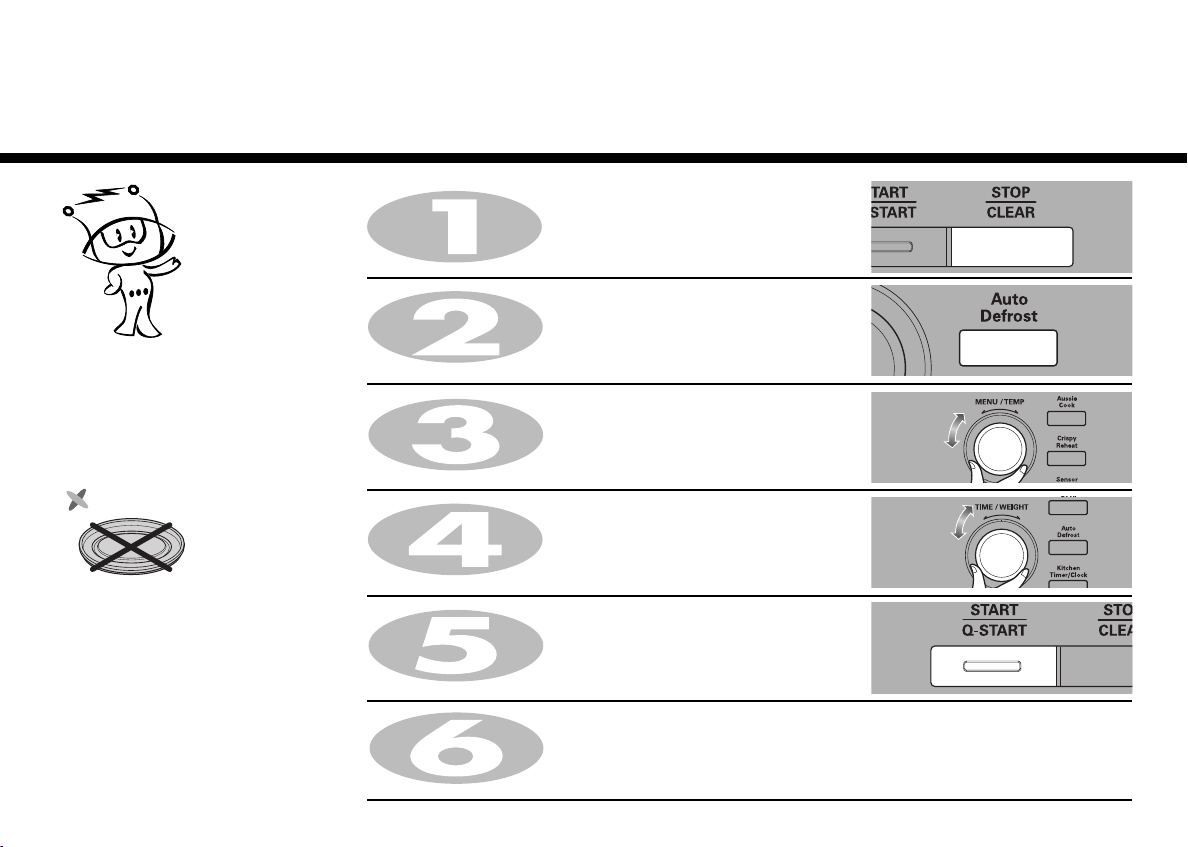
Press STOP/CLEAR.
Weight the food that you are about to defrost. Be certain to remove any
metallic ties or wraps; then place the food.
Press Auto Defrost.
Turn MENU/TEMP
dial
until display shows “2” (POULTRY).
Enter the weight of the frozen food that you are about to defrost.
Turn
TIME/WEIGHT dial
until display shows “1.4kg”.
Press START/Q-START.
During defrosting your oven will “BEEP”, at which point open the oven door, turn food over and separate to
ensure even thawing. Remove any portions that have thawed or shield them to help slow down thawing.
After checking close the oven door and press START/Q-START to resume defrosting.
Your oven will not stop defrosting (even when the beep sounds) unless the door is opened to turn the food over.
Don't Use
METAL TRAY
51
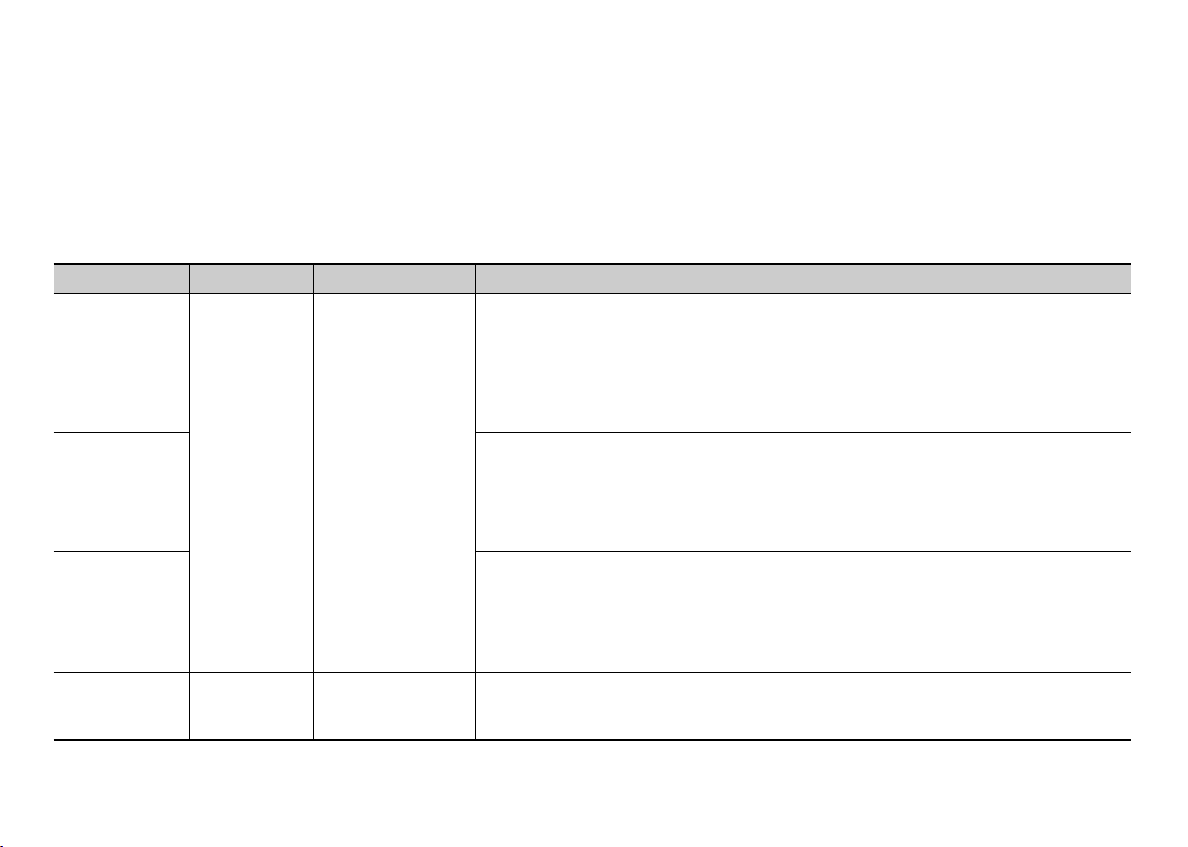
Auto weight defrost guide
* Food to be defrosted should be in a suitable microwave proof container and placed uncovered on the glass turntable.
* If necessary, shield small areas of meat or poultry with flat pieces of aluminum foil. This will prevent thin areas becoming warm during defrosting. Ensure the
foil does not touch the oven walls as it will arc and cause damage to the unit.
* Separate items like minced meat, chops and bacon as soon as possible.
* When BEEP, turn food over. Remove defrosted portions. Continue to defrost remaining pieces.
After defrosting, allow to stand until completely thawed.
To thaw completely , for example joints of meat and whole chickens should STAND for a minimum of 1 hour before cooking.
1. Meat
2. Poultry
3. Fish
4. Bread
Meat
Minced beef, Fillet steak, Cubes for stew, Sirloin steak, Pot roast, Rump roast, Beef burger,
Lamp chops, Rolled roast, Cutlets(2cm)
Turn food over and remove defrosted portions at beep.
After defrosting, let stand for 5-15 minutes.
Poultry
Whole chicken, Legs, Breasts, Turkey breasts(under 2.0kg)
Turn food over and remove defrosted portions at beep.
After defrosting, let stand for 20-30 minutes.
Fish
Fillets, Steaks, Whole fish, Sea foods
Turn food over and remove defrosted portions at beep.
After defrosting, let stand for 10-20 minutes.
Sliced bread, Buns, Baguette, etc.
Category Weight Limit Utensil Food
0.1 ~ 4.0kg
0.1 ~ 0.5kg
Microwave ware
(Flat plate)
Paper towel
or flat plate
Kitchen
Timer
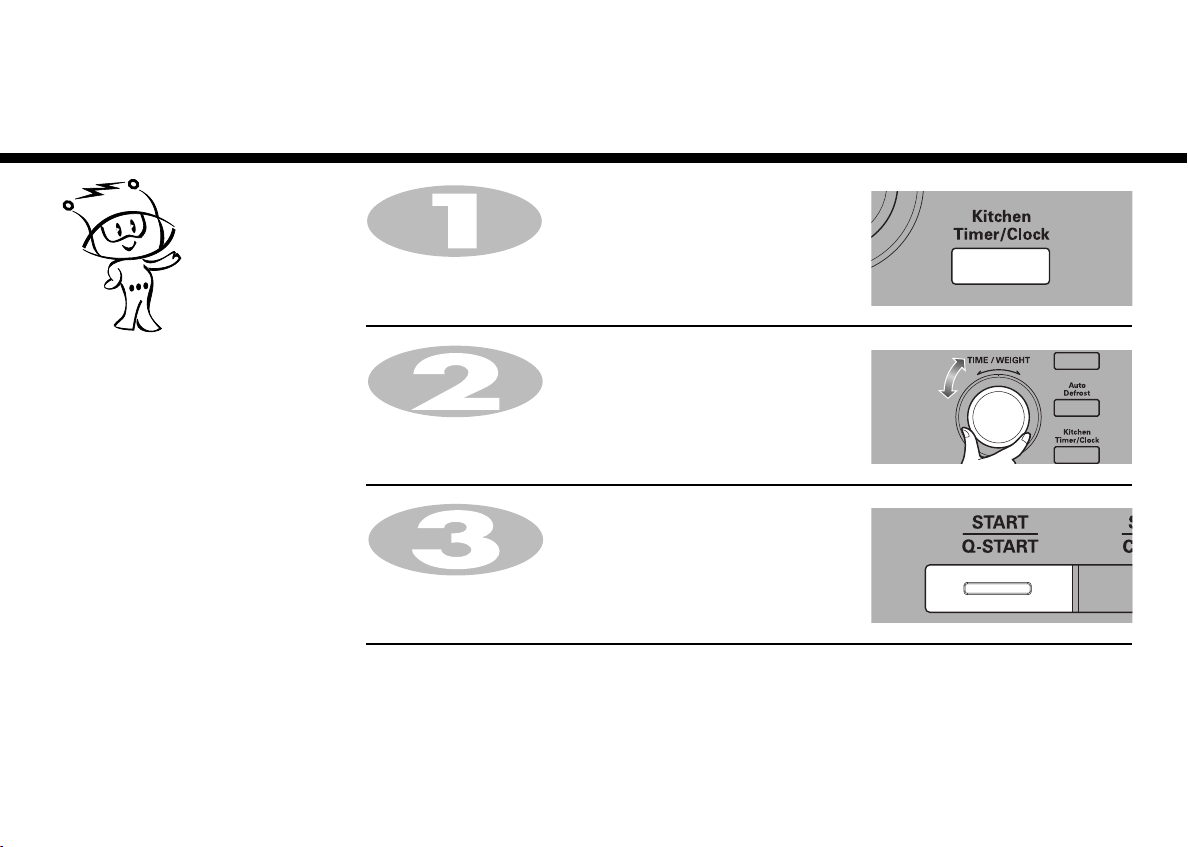
In the following example I will show you how to set the kitchen timer for 3:30.
52
Your microwave oven can be used as a
kitchen timer. You can set up to 99:00.
Press Kitchen Timer/Clock.
Turn
TIME/WEIGHT dial
until display shows “3:30”.
Press START/Q-START.
Heating or Reheating
Guide
To heat or reheat successfully in the microwave, it is important to follow several guidelines. Measure the amount of
food in order to determine the time needed to reheat. Arrange the food in a circular pattern for best results. Room
temperature food will heat faster than refrigerated food. Canned foods should be taken out of the can and placed in a
microwavable container. The food will be heated more evenly if covered with a microwavable lid or vented plastic
cover. Remove cover carefully to prevent steam burns. Use the following chart as a guide for reheating cooked food.
53
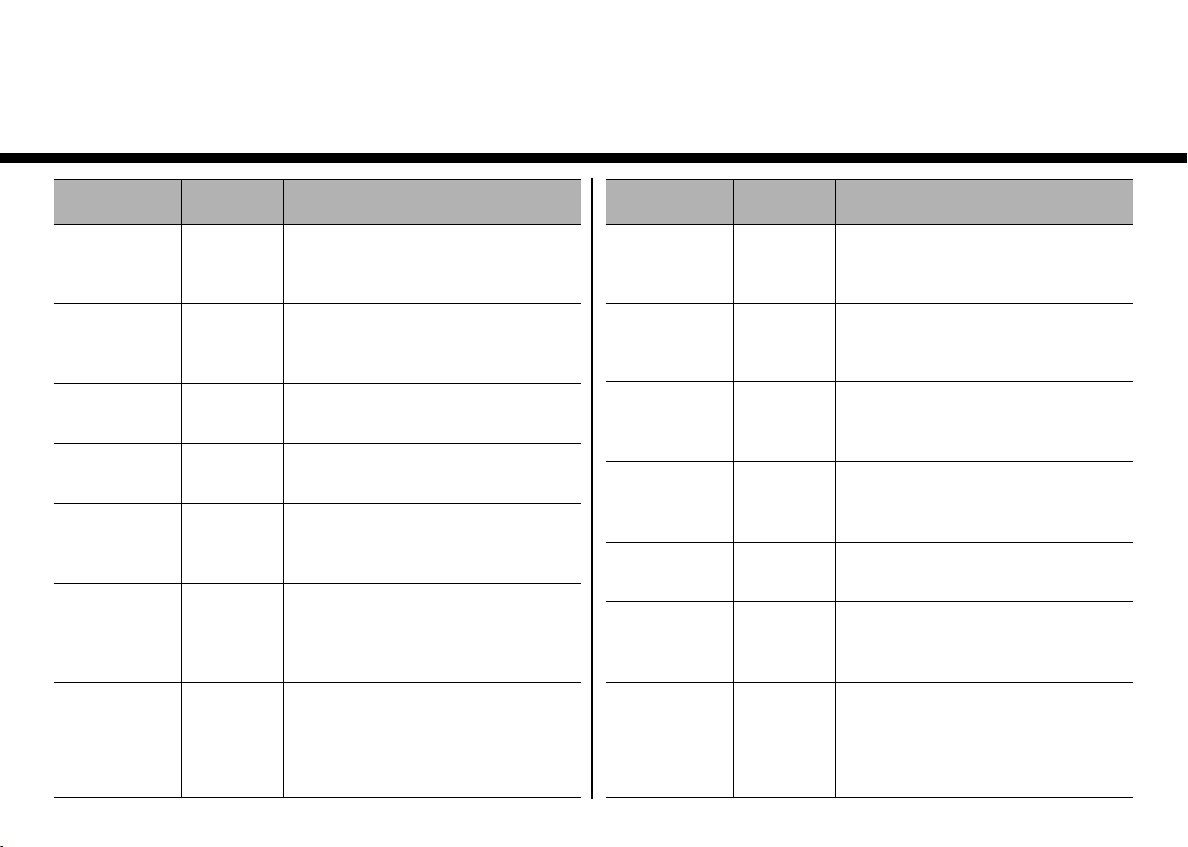
Item
Cook time
(at HIGH)
Special Instructions
Mashed potatoes
350g
Baked beans
1 cup
Ravioli or pasta in sauce
1 cup
4 cups
Rice
1 cup
4 cups
Sandwich roll or bun
1 roll
Vegetables
1 cup
4 cups
Soup
1 serving (8 oz.)
6~7 minutes
(at Medium)
1
1
/2~3 minutes
2
1
/2~4 minutes
7
1
/2~11minutes
1~1
1
/2 minutes
3
1
/2~5 minutes
15~30 seconds
1
1
/2~2
1
/2 minutes
3
1
/2~5
1
/2 minutes
1
1
/2~2 minutes
COOK covered in microwavable casserole dish.
Stir once halfway through cooking.
COOK covered in microwavable casserole dish.
Stir once halfway through cooking.
COOK covered in microwavable casserole dish.
Stir once halfway through cooking.
COOK covered in microwavable casserole dish.
Stir once halfway through cooking.
Wrap in paper towel and place on glass tray.
COOK covered in microwavable casserole dish.
Stir once halfway through cooking.
COOK covered in microwavable casserole dish.
Stir once halfway through cooking.
Item
Cook time
(at HIGH)
Special Instructions
Sliced meat
3 slices
(0.5cm thick)
Chicken pieces
1 breast
1 leg and thigh
Fish fillet
(170-230g)
Lasagne
1 serving(300g)
Casserole
1 cup
4 cups
Casserole
cream or cheese
1 cup
4 cups
Sloppy Joe or
Barbecued beef
1 sandwich
(
1
/2 cup meat filling)
without bun
1~2 minutes
2~3 minutes
3~3
1
/2 minutes
1~2 minutes
4~6 minutes
1
1
/2~3 minutes
4
1
/2~7 minutes
1~2
1
/2 minutes
3
1
/2~6 minutes
1~2
1
/2 minutes
Place sliced meat on microwavable plate.
Cover with plastic wrap and vent.
• Note: Gravy or sauce helps to keep meat juicy.
Place chicken pieces on microwavable plate.
Cover with plastic wrap and vent.
Place fish on microwavable plate.
Cover with plastic wrap and vent.
Place lasagne on microwavable plate.
Cover with plastic wrap and vent.
COOK covered in microwavable casserole dish.
Stir once halfway through cooking.
COOK covered in microwavable casserole dish.
Stir once halfway through cooking.
Reheat filling and bun separately.
COOK covered in microwavable casserole dish.
Stir once. Heat bun as directed in chart below.
54
Fresh Vegetable
Guide
Vegetable Amount
Cook time
(at HIGH)
Instructions
Standing
Time
Artichokes
(230g each)
Asparagus,
Fresh, Spears
Green Beans
Beats, Fresh
Broccoli, Fresh,
Spears
Cabbage, Fresh,
Chopped
Carrots, Fresh,
Sliced
Cauliflower,
Fresh, Whole
Fresh, Flowerettes
Celery, Fresh,
Sliced
2 medium
4 medium
450g
450g
450g
450g
450g
200g
450g
2 cups
4 cups
4
1
/2 ~ 7
10 ~ 12
2
1
/2 ~ 6
7 ~ 11
11 ~ 16
5 ~ 8
5
1
/2 ~ 7
1
/2
2 ~ 3
5 ~ 7
11 ~ 16
2~3 minutes
2~3 minutes
2~3 minutes
2~3 minutes
2~3 minutes
2~3 minutes
2~3 minutes
2~3 minutes
2~3 minutes
Trim. Add 2 tsp water and 2 tsp juice.
Cover.
Add 1 cup water. Cover.
Add
1
/2 cup water in 1.5 litre casserole
dish. Stir halfway through cooking.
Add
1
/2 cup water in 1.5 litre covered
casserole dish. Rearrange halfway
through cooking.
Place broccoli in baking dish.
Add
1
/2 cup water.
Add
1
/2 cup water in 1.5 litre covered
casserole dish. Stir halfway through
cooking.
Add
1
/4 cup water in 1.5 litre covered
casserole dish. Stir halfway through
cooking.
Trim. Add
1
/4 cup water in 1.5 litre
covered casserole dish. Stir halfway
through cooking.
Slice. Add
1
/2 cup water in 1.5 litre
covered casserole dish. Stir halfway
through cooking.
Vegetable Amount
Cook time
(at HIGH)
Instructions
Standing
Time
Corn, Fresh
Mushrooms,
Fresh, Sliced
Parsnips, Fresh,
Sliced
Peas, Green,
Fresh
Sweet Potatoes
Whole Baking
(170~230g each)
White potatoes,
Whole Baking
(170~230g each)
Spinach, Fresh,
Leaf
Courgette, Fresh,
Sliced
Courgette, Fresh,
Whole
2 ears
230g
450g
4 cups
2 medium
4 medium
2 potatoes
4 potatoes
450g
450g
450g
4 ~ 8
1
1
/2 ~ 2
1
/2
4 ~ 7
6 ~ 9
4 ~ 9
6 ~ 12
5
1
/2 ~ 7
1
/2
9
1
/2 ~ 14
4
1
/2 ~ 7
1
/2
4
1
/2 ~ 7
1
/2
6 ~ 9
2~3 minutes
2~3 minutes
2~3 minutes
2~3 minutes
2~3 minutes
2~3 minutes
2~3 minutes
2~3 minutes
2~3 minutes
Husk. Add 2 tbsp water in 1.5 litre
baking dish. Cover.
Place mushrooms in 1.5 litre covered
casserole dish. Stir halfway through
cooking.
Add
1
/2
cup water in 1.5 litre covered
casserole dish. Stir halfway through
cooking.
Add
1
/2
cup water in 1.5 litre covered
casserole dish. Stir halfway through
cooking.
Pierce potatoes several times with fork.
Place on 2 paper towels.
Turn over halfway through cooking.
Pierce potatoes several times with fork.
Place on 2 paper towels.
Turn over halfway through cooking.
Add
1
/2
cup water in 2 litre covered
casserole dish.
Add
1
/2
cup water in 1.5 litre covered
casserole dish. Stir halfway through
cooking.
Pierce. Place on 2 paper towels.
Turn courgette over and rearrange
halfway through cooking.
55
Grill Cooking
Guide
Directions for grilling meat on grill
• Trim excess fat from meat. Cut fat, making sure you do not cut into the meat.
(This will stop the fat curling.)
• Arrange on the rack. Brush with melted butter or oil.
• Halfway through, turn the meat over.
Directions for grilling fish and seafood
Place fish and seafood on the rack. Whole fish should be scored diagonally on both sides
before grilling. Brush fish and seafood with melted butter, margarine or oil before and
during cooking. This helps stop the fish drying out. Grill for times recommended in the chart.
Whole fish and fish steaks should be carefully turned over halfway through grilling time. If
desired thick fillets can also be turned halfway.
Item Weight
Approx. cooking time
( in minutes)
Hints
Beefburgers
Beefsteaks
(2.5cm (1”) thick)
Rare
Medium
Well
Lamb chops
(2.5cm (1”) thick)
50g x 2
100g x 2
230g x 2
230g x 2
230g x 2
230g x 2
13-16
19-23
18-20
22-24
26-28
25-32
Baste with oil or melted
butter. Thin items should
be placed on the grill
rack. Turn food over
after half the cooking
time.
Turn frequently.
Item Weight
Approx. cooking time
( in minutes)
Hints
Fish fillets
1 cm (
1
/2”) thick
1.5cm (
1
/2”) thick
Fish steaks
2.5 cm (1”) thick
Whole fish
Scallops
Prawns uncooked
230g
230g
230g
225-350 g each
450g
450g
450g
17-21
20-24
24-28
16-20
24-28
16-20
16-20
Brush with melted butter
and turn over halfway
through cooking.
Allow extra time for thick
and oily fish.
Baste well during
cooking.
56
Microwave-safe
Utensils
Never use metal or metal trimmed utensils in your microwave oven unless
instructed to do so in this user manual.
Microwaves cannot penetrate metal. They will bounce off any metal object in the
oven and cause arcing, an alarming phenomenon that resembles lightning.
Most heat resistant non metallic cooking utensils are safe for use in your microwave
oven. However, some may contain materials that render them unsuitable as
microwave cookware. If you have any doubts about a particular utensil, there’s a
simple way to find out if it can be used in your microwave oven.
Place the utensil in question next to a glass bowl filled with water in the microwave
oven. Microwave at power HIGH for 1 minute. If the water heats up but the utensil
remains cool to the touch, the utensil is microwave~safe. However, if the water does
not change temperature but the utensil becomes warm, microwaves are being
absorbed by the utensil and it is not safe for use in the microwave oven. You
probably have many items on hand in your kitchen right now that can be used as
cooking equipment in your microwave oven. Just read through the following
checklist.
Dinner plates
Many kinds of dinner-ware are microwave-safe. If in doubt consult the
manufacturer’s literature or perform the microwave test.
Glassware
Glassware that is heat-resistant is microwave-safe. This would include all brands of
oven tempered glass cookware. However, do not use delicate glassware, such as
tumblers or wine glasses, as these might shatter as the food warms.
Plastic storage containers
These can be used to hold foods that are to be quickly reheated. However, they
should not be used to hold foods that will need considerable time in the oven as hot
foods will eventually warp or melt plastic containers.
Paper
Paper plates and containers are convenient and safe to use in your microwave oven,
provided that the cooking time is short and foods to be cooked are low in fat and
moisture. Paper towels are also very useful for wrapping foods and for lining baking
trays in which greasy foods such as bacon are cooked. In general, avoid coloured
paper products as the colour may run. Some recycled paper products may contain
impurities which could cause arcing or fires when used in the microwave oven.
Plastic cooking bags
Provided they are made specially for cooking, cooking bags are microwave safe.
However, be sure to make a slit in the bag so that steam can escape. Never use
ordinary plastic bags for cooking in your microwave oven, as they will melt and
rupture.
Plastic microwave cookware
A variety of shapes and sizes of microwave cookware are available. For the most
part, you can probably use items you already have on hand rather than investing in
new kitchen equipment.
Pottery, stoneware and ceramic
Containers made of these materials are usually fine for use in your microwave oven,
but they should be tested to be sure.
CAUTION
Some items with high lead or iron content are not suitable for cooking
utensils.
Utensils should be checked to ensure that they are suitable for use in
microwave ovens.
57
Food characteristics &
Microwave cooking
Keeping an eye on things
The recipes in the book have been formulated with great care, but your success in
preparing them depends on how much attention you pay to the food as it cooks.
Always watch your food while it cooks. Your microwave oven is equipped with a
light that turns on automatically when the oven is in operation so that you can see
inside and check the progress of your food. Directions given in recipes to elevate,
stir, and the like should be thought of as the minimum steps recommended. If the
food seems to be cooking unevenly, simply make the necessary adjustments you think
appropriate to correct the problem.
Factors affecting microwave cooking times
Many factors affect cooking times. The temperature of ingredients used in a recipe
makes a big difference in cooking times. For example, a cake made with ice-cold
butter, milk, and eggs will take considerably longer to bake than one made with
ingredients that are at room temperature. All of the recipes in this book give a range
of cooking times. In general, you will find that the food remains under-cooked at the
lower end of the time range, and you may sometimes want to cook your food beyond
the maximum time given, according to personal preference. The governing
philosophy of this book is that it is best for a recipe to be conservative in giving
cooking times. While overcooked food is ruined for good. Some of the recipes,
particularly those for bread, cake, and custards, recommend that food be removed
from the oven when they are slightly undercooked. This is not a mistake. When
allowed to stand, usually covered, these foods will continue to cook outside of the
oven as the heat trapped within the outer portions of the food gradually travels
inward. If the food is left in the oven until it is cooked all the way through, the outer
portions will become overcooked or even burnt. You will become increasingly skilful
in estimating both cooking and standing times for various foods.
Density of food
Light, porous food such as cakes and breads cook more quickly than heavy, dense
foods such as roasts and casseroles. You must take care when microwaving porous
food that the outer edges do not become dry and brittle.
Height of food
The upper portion of tall food, particularly roasts, will cook more quickly than the
lower portion. Therefore, it is wise to turn tall food during cooking, sometimes several
times.
Moisture content of food
Since the heat generated from microwaves tends to evaporate moisture, relatively dry food
such as roasts and some vegetables should either be sprinkled with water prior to cooking
or covered to retain moisture.
Bone and fat content of food
Bones conduct heat and fat cooks more quickly than meat. Care must be taken when
cooking bony or fatty cuts of meat that they do not cook unevenly and do not become
overcooked.
Quantity of food
The number of microwaves in your oven remains constant regardless of how much food is
being cooked. Therefore, the more food you place in the oven, the longer the cooking time.
Remember to decrease cooking times by at least one third when halving a recipe.
Shape of food
Microwaves penetrate only about 2.cm into food, the interior portion of thick foods are
cooked as the heat generated on the outside travels inward. Only the outer edge of food in
cooked by microwave energy; the rest is cooked by conduction. The worst possible shape
for a food that is to be microwaved is a thick square. The corners will burn long before the
centre is even warm . Round thin foods and ring shaped foods cook successfully in the
microwave.
Covering
A cover traps heat and steam which causes food to cook more quickly. Use a lid or
microwave cling film with a corner folded back to prevent splitting.
Browning
Meats and poultry that are cooked fifteen minutes or longer will brown lightly in their own
fat. Food that are cooked for a shorter period of time may be brushed with a browning
sauce such as worcestershire sauce, soy sauce or barbecue sauce to achieve an appetizing
colour. Since relatively small amounts of browning sauces are added to food the original
flavour of the recipe is not altered.
Covering with greaseproof paper
Greaseproofing effectively prevents spattering and helps food retain some heat. But
because it makes a looser cover than a lid or clingfilm, it allows the food to dry out slightly.
Arranging and spacing
Individual foods such as baked potatoes, small cakes and hors d’oeuvres will heat more
evenly if placed in the oven an equal distance apart, preferably in a circular pattern. Never
stack foods on top of one another.
58
Food characteristics &
Microwave cooking
Stirring
Stirring is one of the most important of all microwaving techniques. In conventional cooking,
food is stirred for the purpose of blending. Microwaved food, however, is stirred in order to
spread and redistribute heat. Always stir from the outside towards the centre as the outside
of the food heats first.
Turning over
Large, tall foods such as roasts and whole chickens should be turned so that the top and
bottom will cook evenly. It is also a good idea to turn cut up chicken and chops.
Placing thicker portions facing outwards
Since microwaves are attracted to the outside portion of food, it makes sense to place
thicker portions of meat, poultry and fish to the outer edge of the baking dish. This way,
thicker portions will receive the most microwave energy and the food will cook evenly.
Shielding
Strips of aluminium foil (which block microwaves) can be placed over the corners or edges
of square and rectangular foods to prevent those portions from overcooking. Never use too
much foil and make sure the foil is secured to the dish or it may cause ‘arcing’ in the oven.
Elevating
Thick or dense foods can be elevated so that microwaves can be absorbed by the underside
and centre of the foods.
Piercing
Foods enclosed in a shell, skin or membrane are likely to burst in the oven unless they are
pierced prior to cooking. Such foods include yolks and whites of eggs, clams and oysters
and whole vegetables and fruits.
Testing if cooked
Food cooks so quickly in a microwave oven, it is necessary to test it frequently. Some foods
are left in the microwave until completely cooked, but most foods, including meats and
poultry, are removed from the oven while still slightly undercooked and allowed to finish
cooking during standing time. The internal temperature of foods will rise between 5 0 F (3 ˚C)
and 15 0 F (8˚C) during standing time.
Standing time
Foods are often allowed to stand for 3 to 10 minutes after being removed from the
microwave oven. Usually the foods are covered during standing time to retain heat unless
they are supposed to be dry in texture (some cakes and biscuits, for example). Standing
allows foods to finish cooking and also helps flavour blend and develop.
To Clean Your Oven
1 Keep the inside of the oven clean
Food spatters or spilled liquids stick to oven walls and between seal and door
surface. It is best to wipe up spillovers with a damp cloth right away. Crumbs and
spillovers will absorb microwave energy and lengthen cooking times. The glass
turntable and ring should be removed to clean the base of the microwave
periodically or immediately after a spillover. Use a damp
cloth to wipe out crumbs that fall between the door and the frame. It is important to
keep this area clean to assure a tight seal. Remove greasy spatters with a soapy cloth
then rinse and dry. Do not use harsh detergent or abrasive cleaners. The glass tray
can be washed by hand or in the dishwasher.
2 Keep the outside of the oven clean
Clean the outside of your oven with soap and water then with clean water and dry
with a soft cloth or paper towel. To prevent damage to the operating parts inside the
oven, the water should not be allowed to seep into the ventilation openings. To clean
control panel, open the door to prevent oven from accidentally starting, and wipe a
damp cloth followed immediately by a dry cloth. Press STOP/CLEAR after cleaning.
3
If steam accumulates inside or around the outside of the oven door, wipe the
panels with a soft cloth. This may occur when the microwave oven is operated
under high humidity conditions and in no way indicates a malfunction of the unit.
4
The door and door seals should be kept clean. Use only warm, soapy water, rinse
then dry thoroughly.
DO NOT USE ABRASIVE MATERIALS, SUCH AS CLEANING POWDERS OR
STEEL AND PLASTIC PADS.
Metal parts will be easier to maintain if wiped frequently with a damp cloth.
5 Do not use any steam cleaner.
6 Unplug your oven from the electrical socket when cleaning the control panel
with a damp cloth. Failure to do so can start it operating.
59
Questions &
Answers
Q What’s wrong when the oven light will not glow?
A There may be several reasons why the oven light will not glow.
Light bulb has blown
Door is not closed
Q Does microwave energy pass through the viewing screen in the door?
A No. The holes, or ports, are made to allow light to pass; they do not let
microwave energy through.
Q Why does the beep tone sound when a pad on the Control Panel is
touched?
A The beep tone sounds to assure that the setting is being properly entered.
Q Will the microwave oven be damaged if it operates empty?
A Yes Never run it empty or without the glass tray.
Q Why do eggs sometimes pop?
A When baking, frying, or poaching eggs, the yolk may pop due to steam
build up inside the yolk membrane. To prevent this, simply pierce the yolk
before cooking. Never microwave eggs in the shell.
Q Why is standing time recommended after microwave cooking is over?
A After microwave cooking is finished, food keeps on cooking during
standing time. This standing time finishes cooking evenly throughout the
food. The amount of standing time depends on the density of the food.
Q Is it possible to pop corn in a microwave oven?
A Yes, if using one of the two methods described
below
1 Popcorn-popping utensils designed specifically for microwave cooking.
2 Prepackaged commercial microwave popcorn that contains specific
times and power outputs needed for an acceptable final product.
FOLLOW EXACT DIRECTIONS GIVEN BY EACH MANUFACTURER FOR
THEIR POPCORN PRODUCT. DO NOT LEAVE THE OVEN UNATTENDED
WHILE THE CORN IS BEING POPPED. IF CORN FAILS TO POP AFTER
THE SUGGESTED TIMES, DISCONTINUE COOKING. OVERCOOKING
COULD RESULT IN THE CORN CATCHING FIRE.
CAUTION
NEVER USE A BROWN PAPER BAG FOR POPPING CORN. NEVER
ATTEMPT TO POP LEFTOVER KERNELS.
Q Why doesn’t my oven always cook as fast as the cooking guide says?
A Check your cooking guide again to make sure you’ve followed directions
correctly, and to see what might cause variations in cooking time.
Cooking guide times and heat settings are suggestions, chosen to help
prevent overcooking, the most common problem in getting used to a
microwave oven. Variations in the size, shape, weight and dimensions of
the food require longer cooking time. Use your own judgement along
with the cooking guide suggestions to test food condition, lust as you
would do with a conventional cooker.
Q Why is the Cooling fan operated , or continues to operate after some
cooking sessions have finished?
A When the oven inside is hot, the cooling fan automatically operates
to cool down the oven for short time. This is not fault.
60
Technical Specifications
Technical Specification
Power Input
Output
Microwave Frequency
Outside Dimension
Power Consumption
Microwave
Grill
Combination
Convection
MC-9280XC / MC9280XC / MC9280XC1
240 V~ 50 Hz
900 W (IEC60705 rating standard)
2450 MHz
574 mm(W) X 376 mm(H) X 520 mm(D)
1400 watts
max. 2150 watts (1350 watts)
max. 2150 watts
2150 watts
If the supplied flexible mains cord of this appliance is damaged, it
must be raplaced using the special mains cord part number
EAD61666903
• Microwave Frequency : 2450 MHz +/- 50 MHz (Group 2 / Class B)
** Group 2 equipment: group 2 contains all ISM RF equipment in
which radio-frequency energy in the frequency range 9 kHz to
400GHz is intentionally generated and used or only used, in the
form of electromagnetic radiation, inductive and /or capacitive
coupling, for the treatment of material or inspection/analysis
purposes. Class B equipment is equipment suitable for use in
domestic establishments and in establishments directly connected to a
low voltage power supply network which supplies buildings used for
domestic purposes.
• You can download a owner's manual at http://www.lg.com.
MEMO
MEMO
MEMO
Printed in Korea
FOR CUSTOMER SERVICE PLEASE CONTACT LG Service on
1300 LG CARE (1300 54 2273) AUSTRALIA or
0800 LG CARE (0800 54 2273) NEW ZEALAND
www.lg.com
LG Electronics Australia 2 Wonderland Drive Eastern Creek NSW 2766 (ABN : 98 064 531 264)