Operating Instructions
3-048-920-11 (1)
©2000 Sony Corporation
PHC-Z10
Personal
Component
System
Introduction2
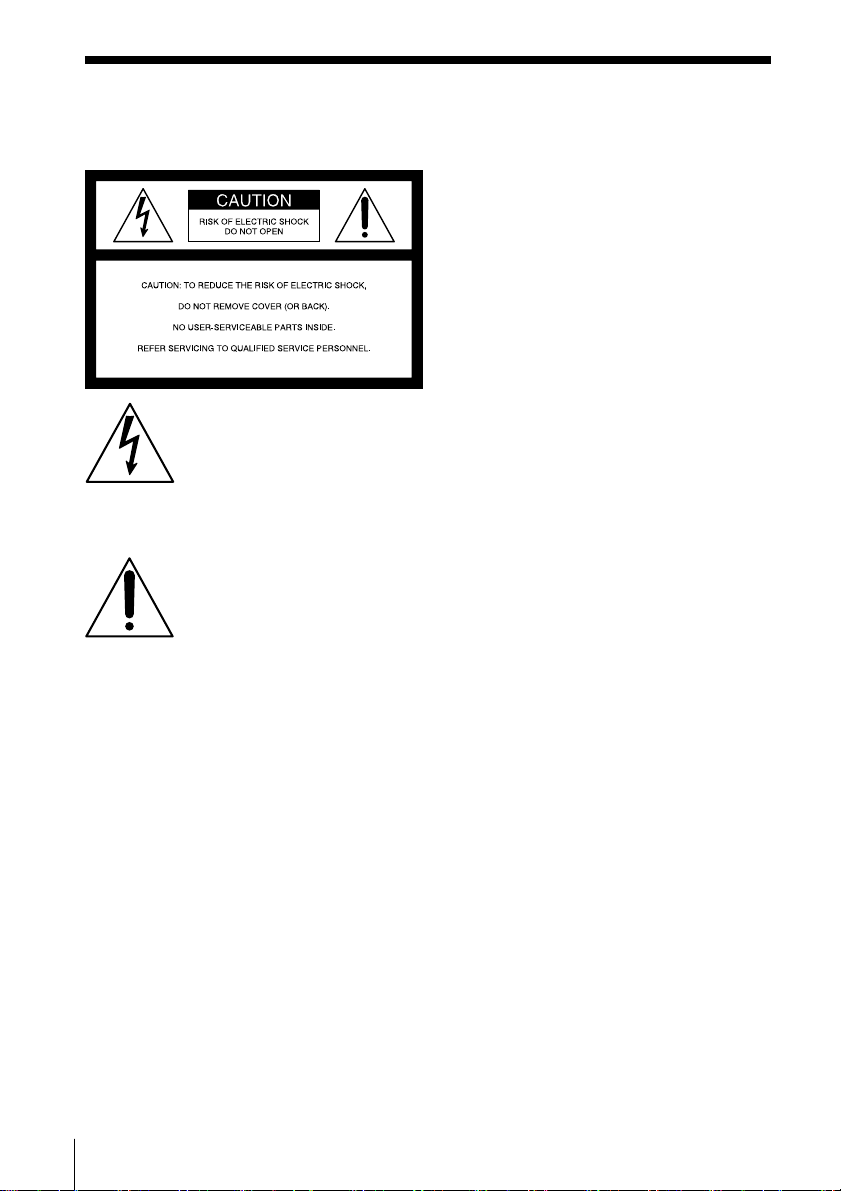
Warning
To prevent fire or shock hazard, do
not expose the player to rain or
moisture.
This symbol is intended to alert
the user to the presence of
uninsulated “dangerous
voltage” within the product's
enclosure that may be of
sufficient magnitude to
constitute a risk of electric
shock to persons.
This symbol is intended to alert
the user to the presence of
important operating and
maintenance (servicing)
instructions in the literature
accompanying the appliance.
CAUTION
The use of optical instruments with this
product will increase eye hazard.
Warning
Do not install the appliance in a confined
space, such as a bookcase or built-in cabinet.
For customers in Canada
To prevent electric shock, match wide blade
of plug to wide slot, fully insert.
Information
For customers in the United States
This equipment has been tested and found to
comply with the limits for a Class B digital
device, pursuant to Part 15 of the FCC Rules.
These limits are designed to provide
reasonable protection against harmful
interference in a residential installation. This
equipment generates, uses and can radiate
radio frequency energy and, if not installed
and used in accordance with the instructions,
may cause harmful interference to radio
communications. However, there is no
guarantee that interference will not occur in a
particular installation. If this equipment does
cause harmful interference to radio or
television reception, which can be determined
by turning the equipment off and on, the user
is encouraged to try to correct the interference
by one or more of the following measures:
—Reorient or relocate the receiving antenna.
—Increase the separation between the
equipment and receiver.
—Connect the equipment into an outlet on a
circuit different from that to which the
receiver is connected.
—Consult the dealer or an experienced
radio/TV technician for help.
You are cautioned that any changes or
modifications not expressly approved in this
manual could void your authority to operate
this equipment.
CAUTION
You can use this player on AC power
source only. You cannot use it on
batteries.
When you use this player for the first
time, or when you have not used it
for a long time, leave it connected to
AC power source for about one hour
to charge the built-in backup battery
for the clock, timer, preset radio
stations, etc. You can use the player
during charging. The player will
charge the battery automatically as
long as it is connected to a power
source.
When you disconnect the AC power
cord after charging, be sure to turn
the power off first. Once fully
charged, the backup battery will last
for about 30 minutes without being
connected to any power sources.
If the stored data are erased, reenter
them when you use the player again.
Owner's Record
The model and serial numbers are located at
the rear of the player.
Record the serial number in the space
provided below. Refer to these numbers
whenever you call upon your Sony dealer
regarding this product.
Model No. PHC-Z10
Serial No. ________________________

Basic Operations
3Introduction
Table of contents
Basic Operations
4 Playing a CD
6 Listening to the radio
8 Playing a tape
10 Recording on a tape
The CD Player
12 Using the display
13 Locating a specific track
14 Playing tracks repeatedly
(Repeat Play)
16 Playing tracks in random order
(Shuffle Play)
17 Creating your own program
(Program Play)
The Radio
19 Presetting radio stations
20 Playing preset radio stations
The Audio Emphasis
21 Selecting the audio emphasis
(SOUND/MEGA BASS)
23 Displaying the spectrum
analyzer
The Timer
24 Setting the clock
25 Waking up to music
27 Timer-recording radio programs
30 Falling asleep to music
Setting Up
31 Hooking up the system
35 Saving power
36 Connecting optional components
Additional Information
37 Precautions
39 Troubleshooting
41 Maintenance
42 Specifications
43 Index
Basic Operations4
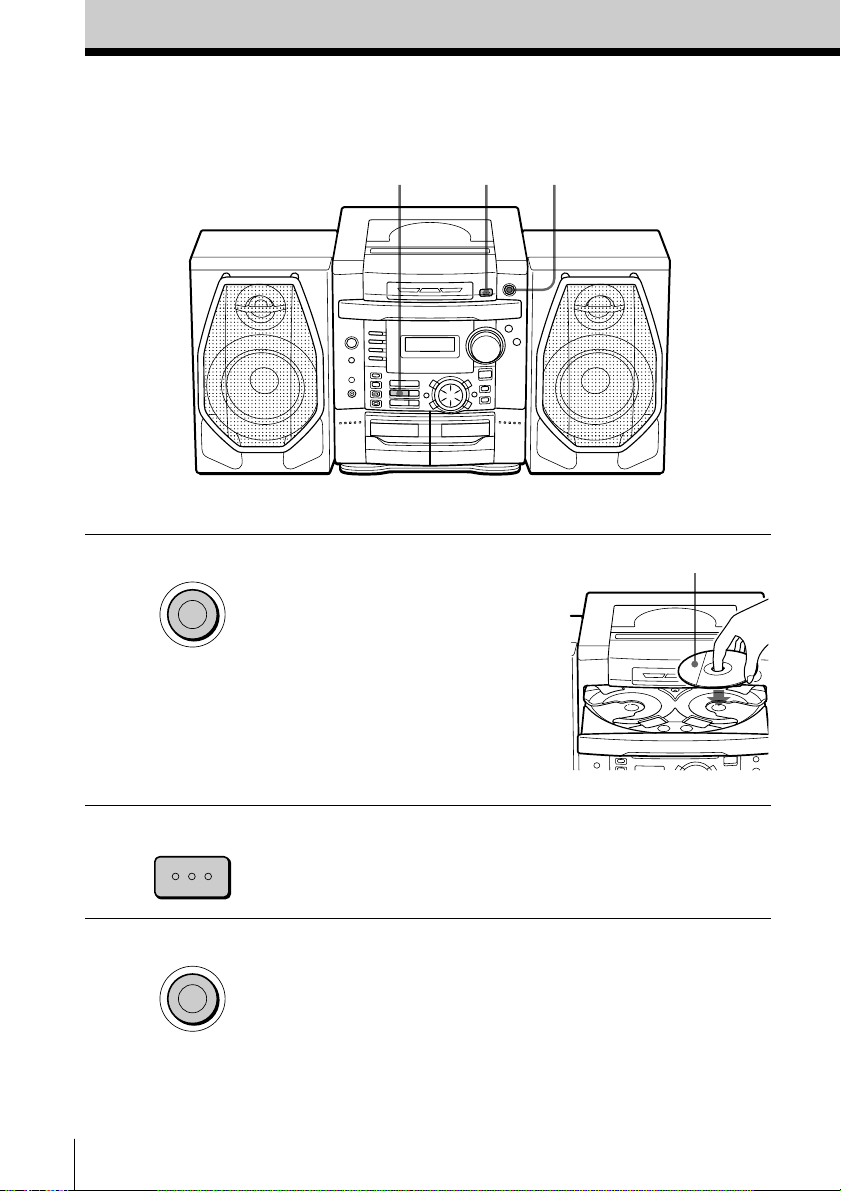
For hookup instructions, see pages 31 - 34.
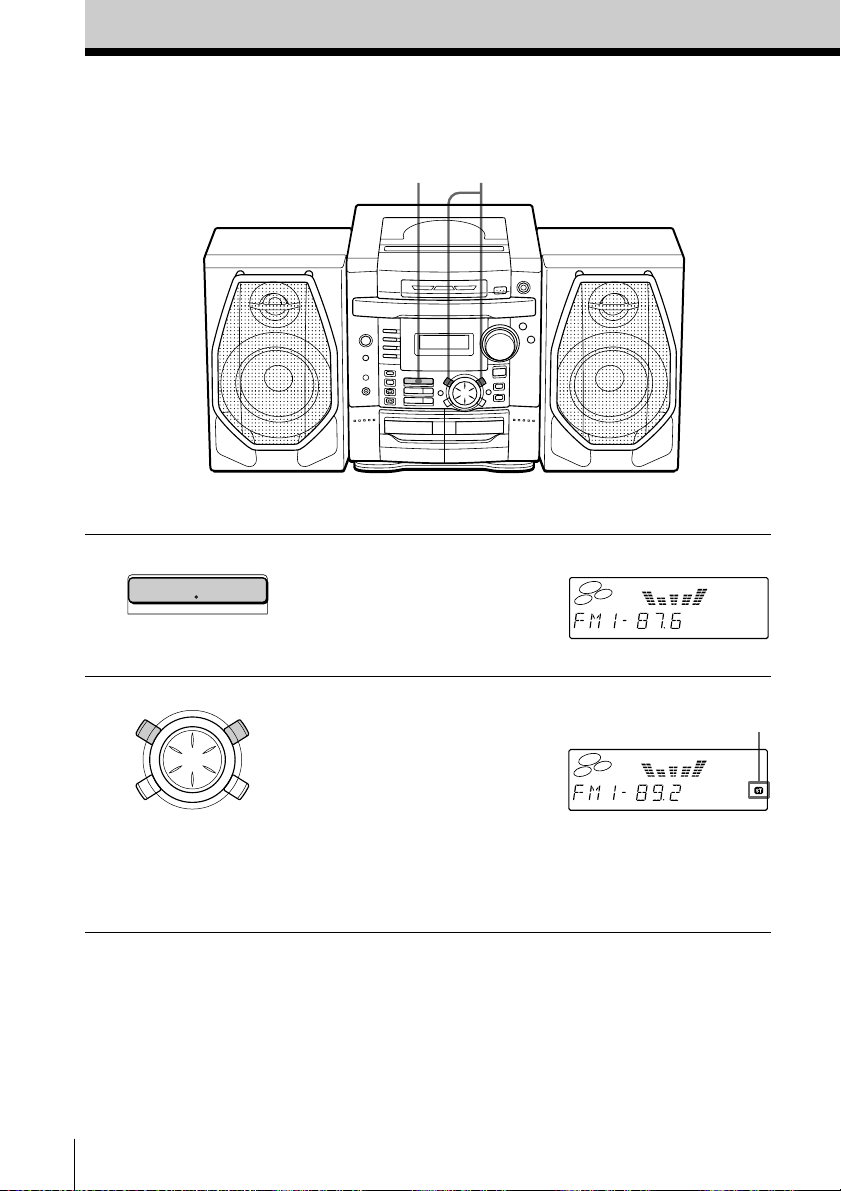
1 Press Z CD OPEN/CLOSE
(direct power-on) and place the
CD on the CD tray. Be sure to
align the center of the CD with
the center of the CD tray.
Note
Place one CD each only on the
CD tray. If you place one CD
over another and close the CD
tray, you will not be able to
pull out the tray.
2 Press DISC CHANGE to turn the
CD tray, and place second and
third CD on the CD tray.
3 Press Z CD OPEN/CLOSE to
close the CD tray.
Playing a CD
Basic Operations
24
1,3
Z
CD OPEN/CLOSE
13
DISC CHANGE
With the label side up
Z
CD OPEN/CLOSE
Basic Operations
Basic Operations
5
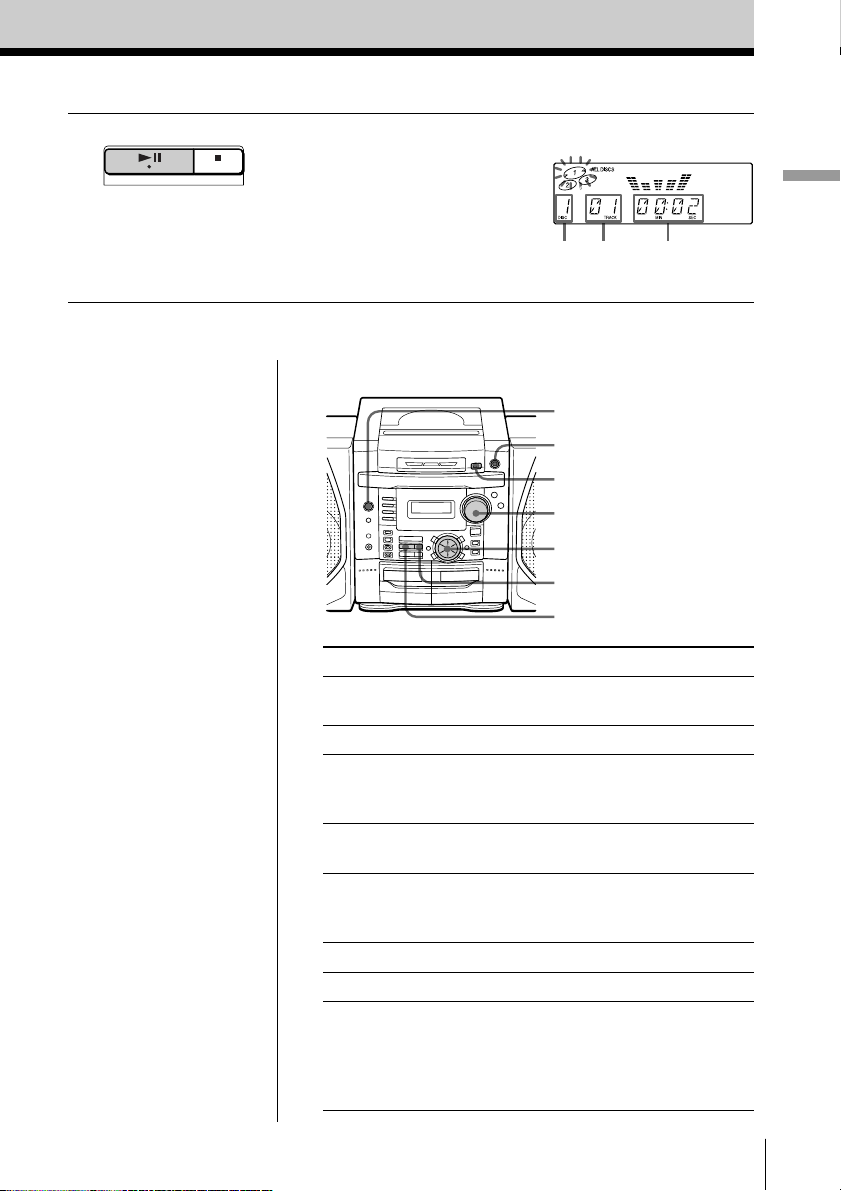
To Do this
adjust the volume Turn VOLUME (press VOL
+, – on the remote).
stop playback Press x on the CD section.
pause playback Press CD u (X on the remote).
Press the button again to resume
play after pause.
go to the next track Turn MULTI JOG clockwise
(press > on the remote).
go back to the previous Turn MULTI JOG
track counterclockwise (press . on the
remote).
remove the CD Press Z CD OPEN/CLOSE.
turn on/off the player Press POWER.
play only one CD Press MODE until “ALL DISCS”
disappears, press DISC CHANGE to
select the desired CD and then press
CD u (DISC 1, DISC 2 or DISC 3
on the remote).
Tips
• You can change a CD
while playing another.
Press Z CD OPEN/
CLOSE to pull out the
CD tray and change the
CD. Press Z CD OPEN/
CLOSE again to close
the CD tray.
• Next time you want to
listen to a CD, just press
CD u. The player
turns on automatically
and starts playing the
CD.
Notes
• Do not pull out the CD
tray by hand, as that
may cause trouble or
malfunction.
• If the CD tray does not
turn when you press
DISC CHANGE, press
Z CD OPEN/CLOSE to
close the CD tray and
then press DISC
CHANGE again.
Use these buttons for additional operations
x
MULTI JOG
VOLUME
CD u
DISC CHANGE
POWER
Z CD OPEN/CLOSE
4 Press CD u .
The player plays all the tracks of
all the CDs in the CD tray once.
CD
Display
Playing
time
CD number Track
number
Basic Operations6
For hookup instructions, see pages 31 - 34.
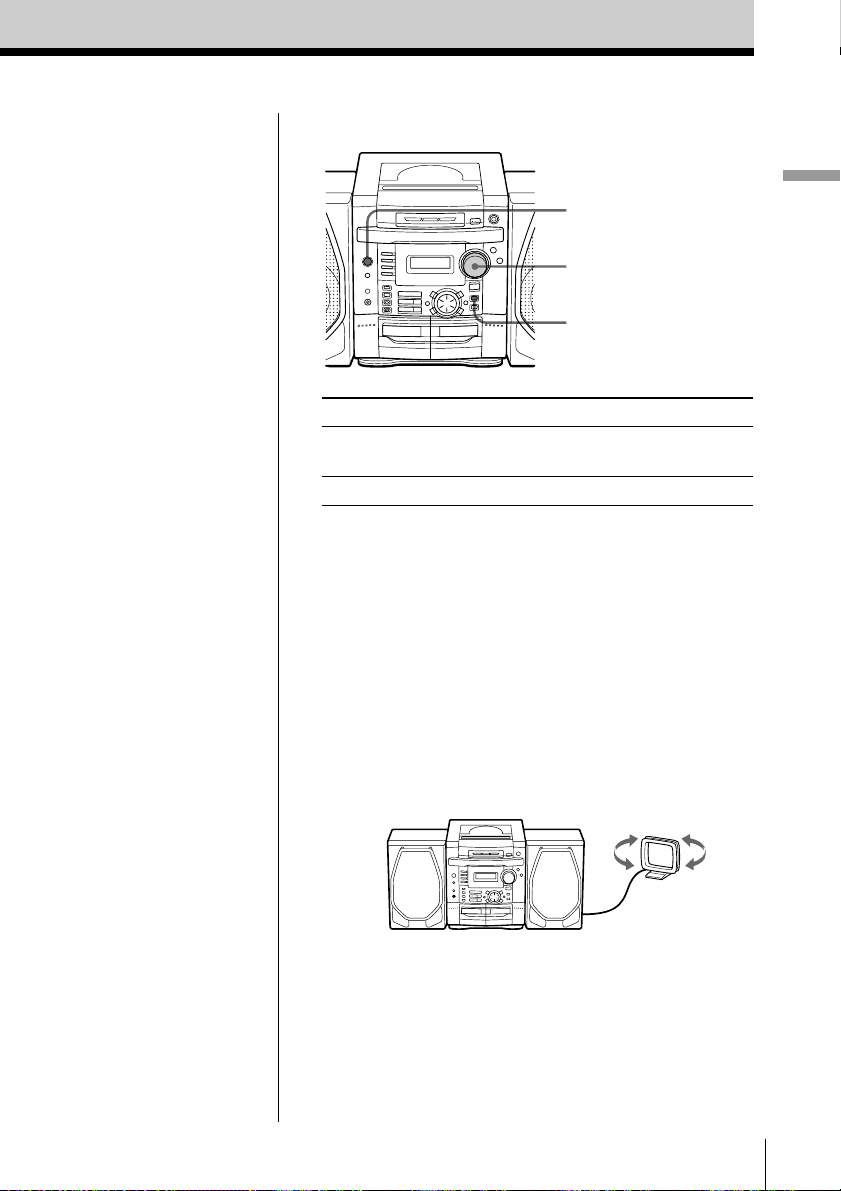
1 Press RADIO BAND•AUTO
PRESET until the band you want
appears in the display (direct
power-on).
2 Hold down + TUNE or TUNE –
until the frequency digits begin to
change in the display.
The player automatically scans
the radio frequencies and stops
when it finds a clear station.
If you can't tune in a station,
press the button repeatedly to
change the frequency step by
step.
Listening to the radio
Display
1
2
Indicates an FM
stereo broadcast.
BAND
RADIO
AUTO PRESET
CD
TUNE
m
–
M
+
CD
TAPE
mM
TAPE
TUNE
P
R
E
S
E
T
–
C
D
.
M
U
L
T
I
J
O
G
>
C
D
+
P
R
E
S
E
T
Basic Operations
Basic Operations
7
Use these buttons for additional operations
To Do this
adjust the volume Turn VOLUME (press VOL
+, – on the remote).
turn on/off the radio Press POWER.
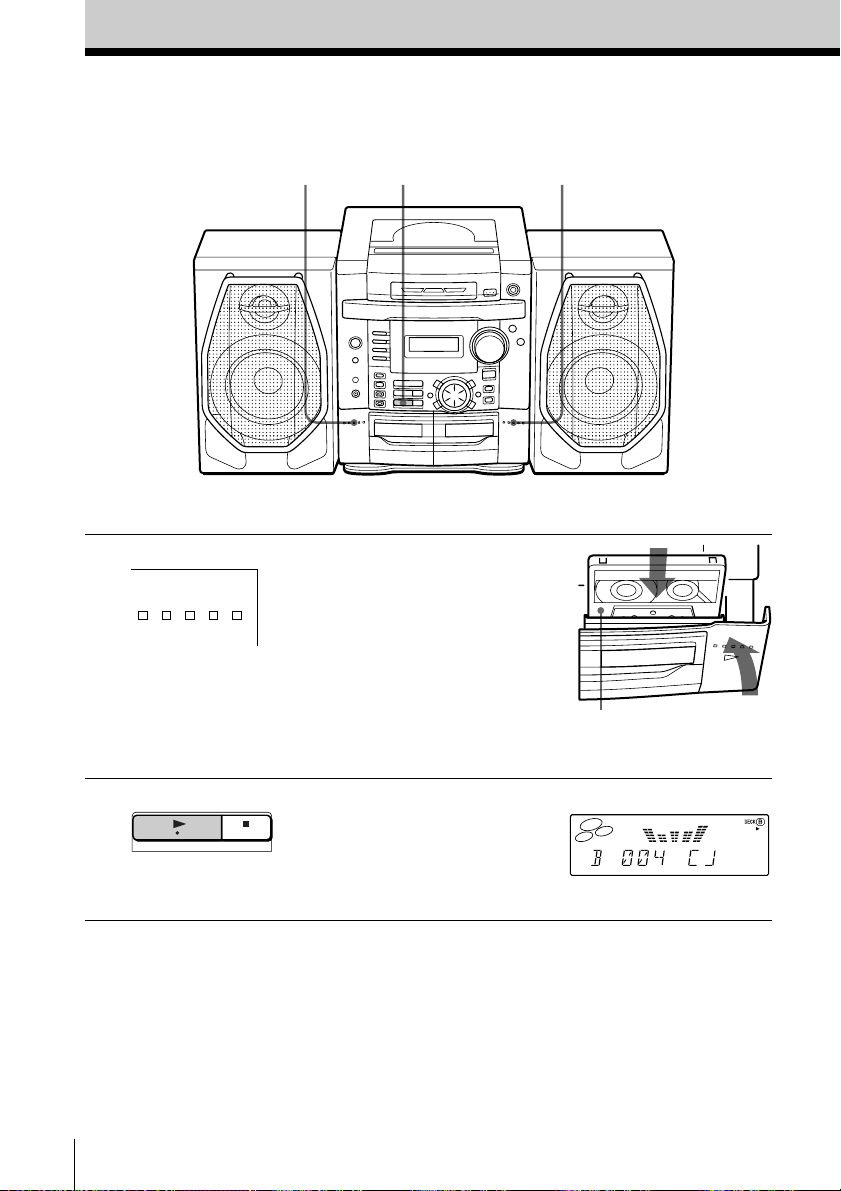
To improve broadcast reception
FM:
Keep the FM lead antenna as horizontal as possible
and reorient it.
If the FM broadcast is still noisy, disconnect the FM
lead antenna and connect the FM outdoor antenna
(not supplied) (page 33).
AM:
Keep the AM loop antenna as far as possible from the
player and reorient it.
Tips
• The “FM1” and “FM2”
bands have the same
functions. You can store
the stations you want
separately in “FM1” and
“FM2”.
• If the FM broadcast is
noisy, press MODE until
“MONO” appears in the
display and the radio
will play in monaural.
• Next time you want to
listen to the radio, just
press RADIO BAND•
AUTO PRESET. The
player turns on
automatically and starts
playing the previous
station.
VOLUME
POWER
MODE
Basic Operations8
Playing a tape
For hookup instructions, see pages 31 - 34.
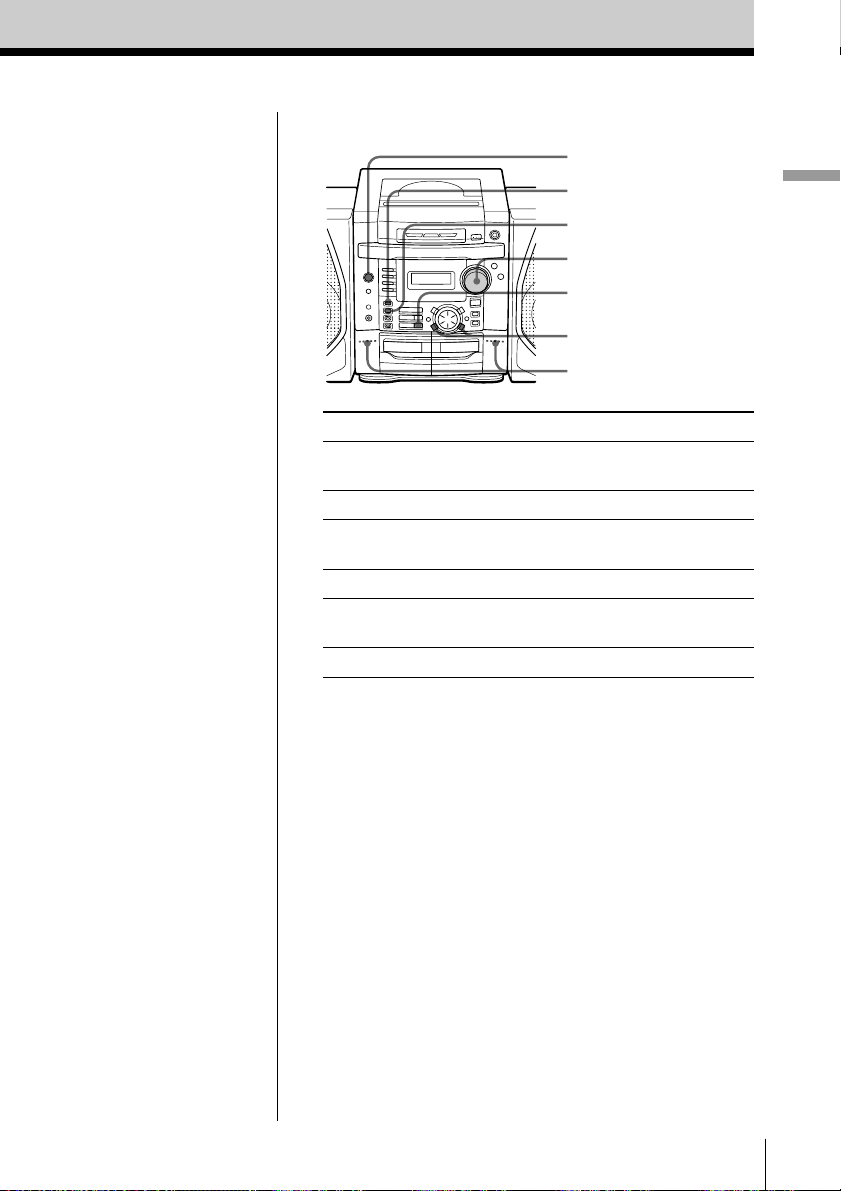
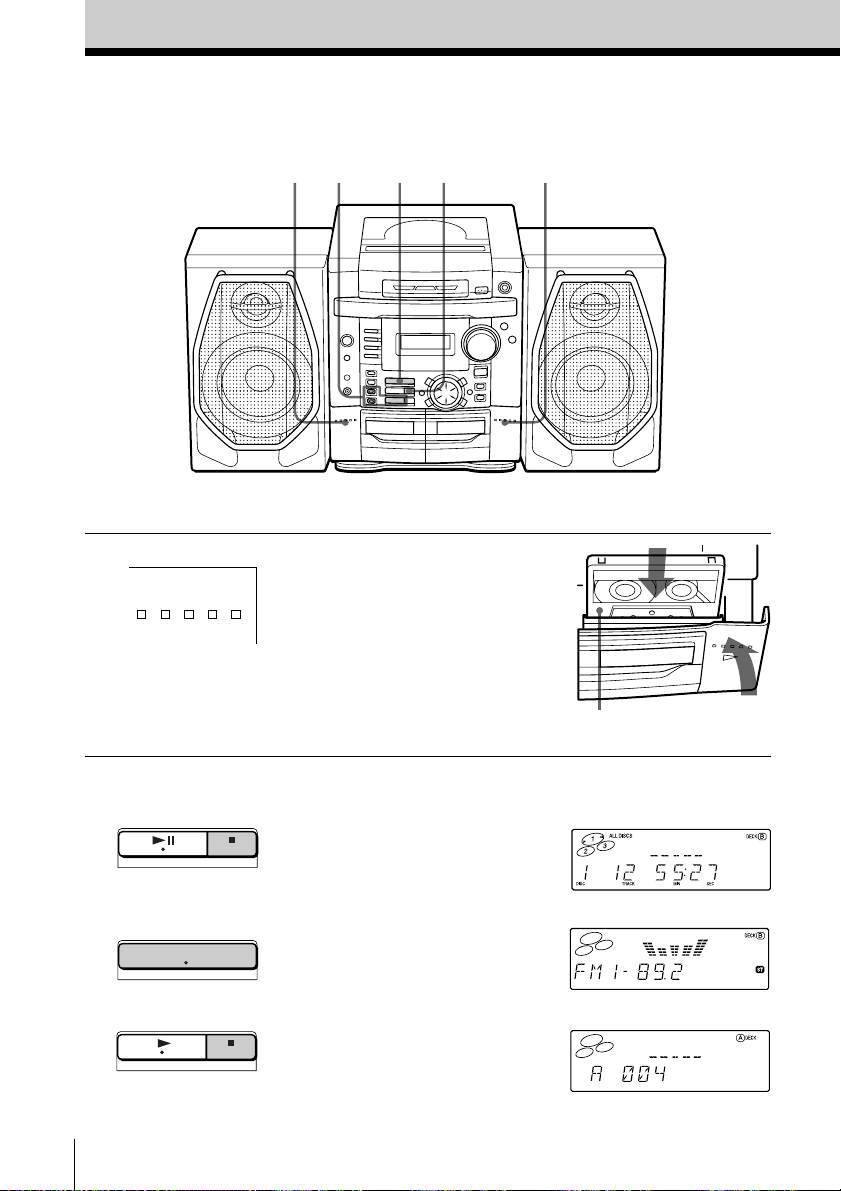
1 Press Z PUSH OPEN/CLOSE to
open the tape compartment and
insert a recorded tape. Use TYPE I
(normal) tape only.
2 Press TAPE N.
The player turns on (direct
power-on) and starts playing.
2
1
1
With the side you want
to play facing you
Display
B
TAPE
Z
PUSH OPEN/CLOSE
Basic Operations
Basic Operations
9
Use these buttons for additional operations
Tips
• Press COUNTER RESET
to reset the counter to
“000”.
• Next time you want to
listen to a tape, just
press TAPE N. The
player turns on
automatically and starts
playing the tape.
To Do this
adjust the volume Turn VOLUME (press VOL
+, – on the remote).
stop playback Press x.
fast-forward or rewind Press M TAPE or
the tape TAPE m.
select the deck Press DECK A/B.
eject the cassette Press Z PUSH OPEN/
CLOSE.
turn on/off the player Press POWER.
POWER
VOLUME
M TAPE, TAPE m
x
Z PUSH OPEN/CLOSE
COUNTER RESET
DECK A/B
Basic Operations10
Recording on a tape
For hookup instructions, see pages 31 - 34.
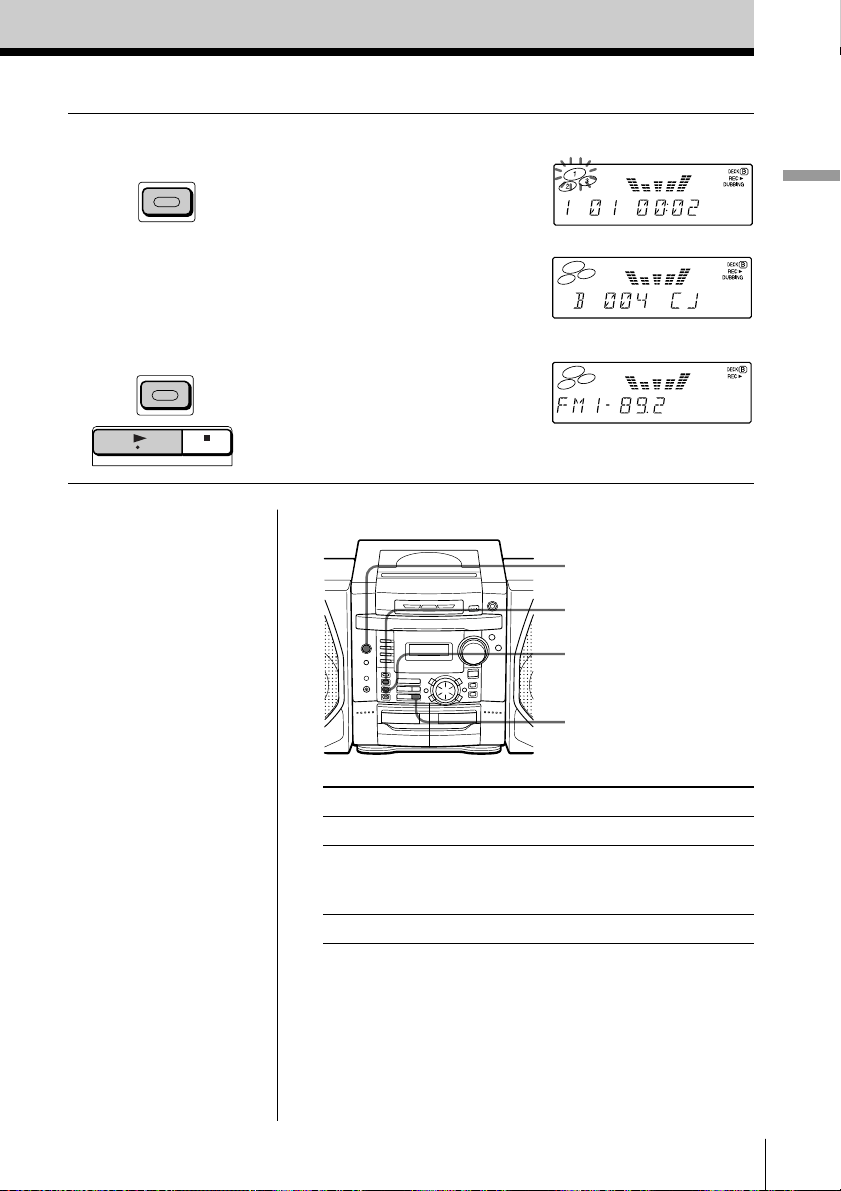
1 Press Z PUSH OPEN/CLOSE on
deck B to open the tape
compartment and insert a blank
tape. Use TYPE I (normal) tape
only.
2 Select the program source you
want to record.
To record from the CD player,
insert a CD (see page 4) and press
x on the CD section.
To record from the radio, tune in
the station you want (see page 6).
To record from a tape, insert a
recorded tape into deck A and
press x on the TAPE section.
3
1
222
With the side you want to
record on facing you
Display
B
CD
TAPE
Z
PUSH OPEN/CLOSE
BAND
RADIO
AUTO PRESET
Basic Operations
Basic Operations
11
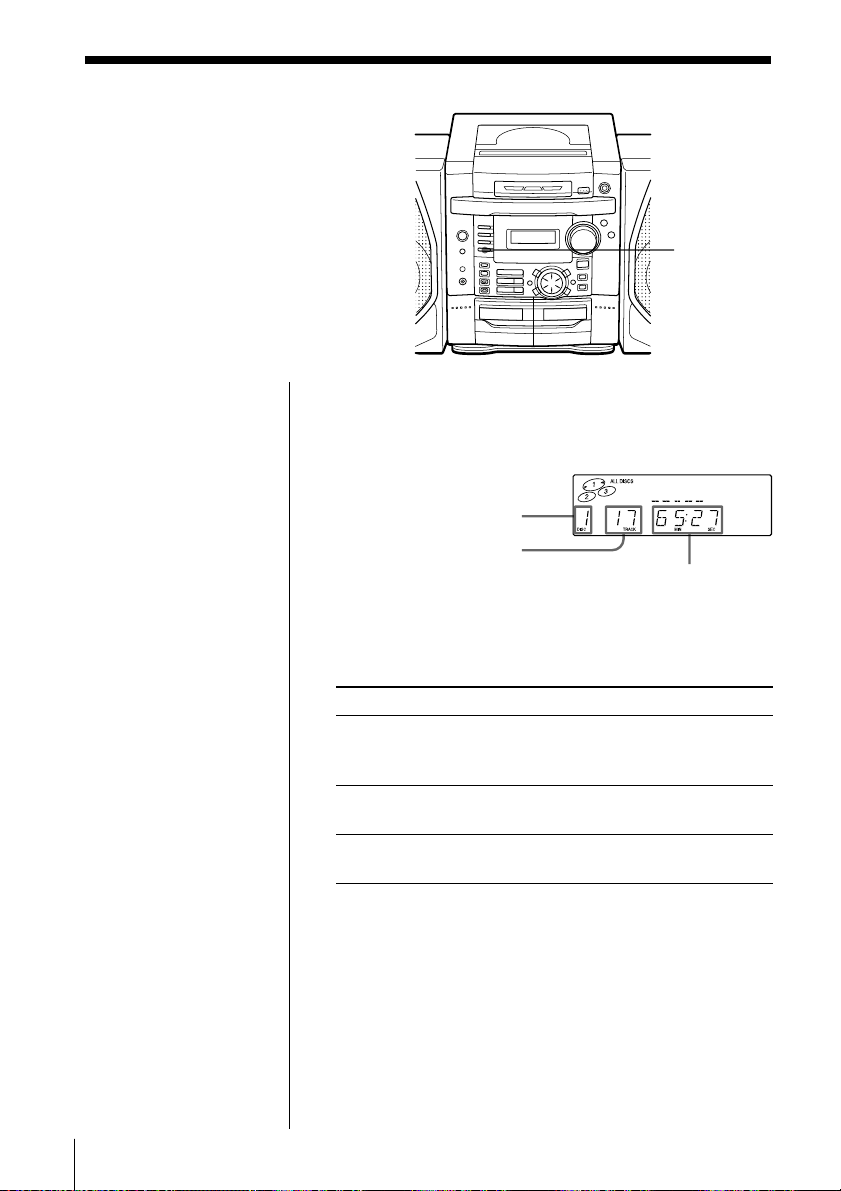
3 Start recording.
To record from the CD or tape
player, press DUBBING.
To record from the radio, press
z/X and then TAPE N.
To Press
stop recording x on the TAPE section
pause recording (only when z/X
you started recording with Press the button again to
the z/X button) resume recording.
turn on/off the player POWER
To erase a recording, proceed as follows:
1 Insert a tape you want to erase its recording into the
deck B and press x on the tape section.
2 Press z/X and then TAPE N.
Use these buttons for additional operations
Tips
• Adjusting the volume or
the audio emphasis (see
page 21) will not affect
the recording level.
• If the AM program
makes a whistling
sound after you've
pressed z/X in step 3,
press MODE to select
the position that most
decreases the noise.
• When recording from
two or three CDs, the
player pauses recording
and makes a blank
between the tracks
while CDs are being
changed. When
changing of CDs is
finished, recording
resumes automatically.
POWER
z/X
x
DECK A/B
Display
From the CD player
DUBBING
z/X
TAPE
From the tape player
From the radio
The CD Player12
Using the display
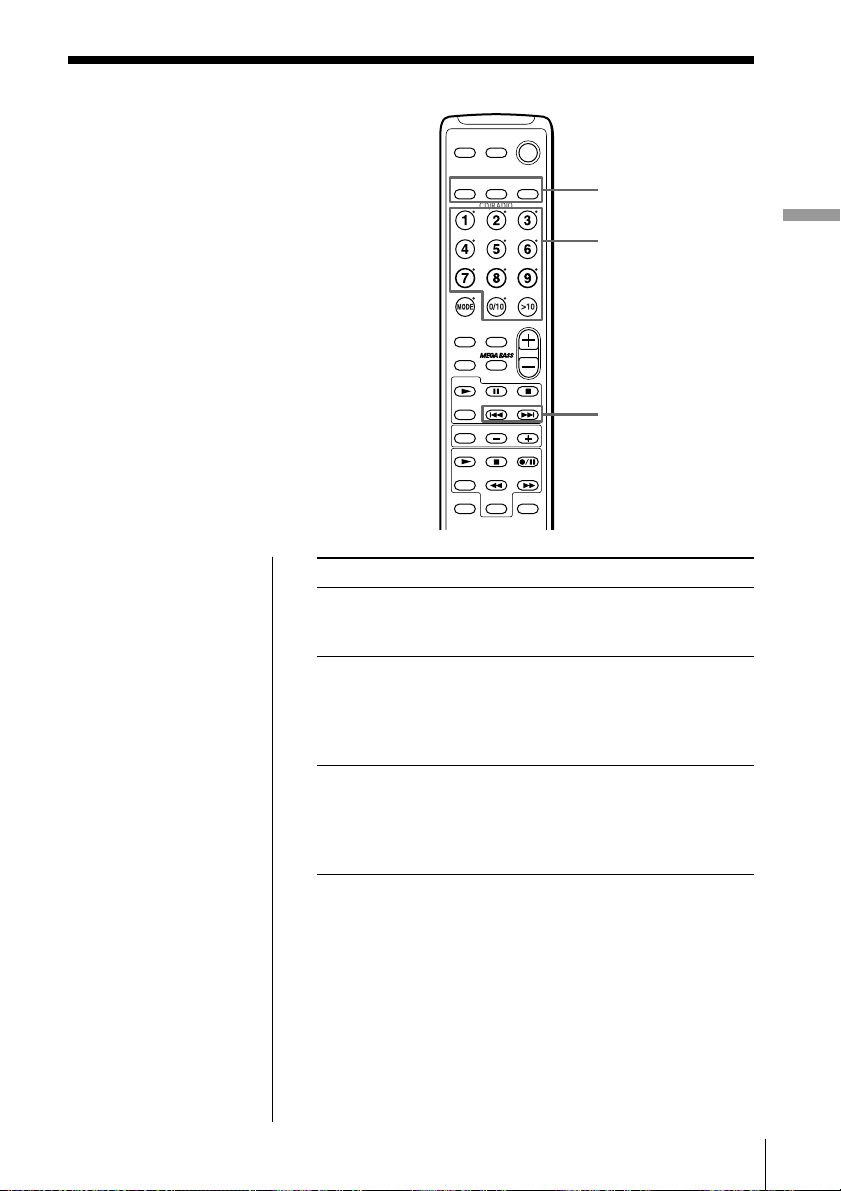
You can check information about the
CD using the display.
The CD Player
Checking the remaining time
Press DISPLAY while playing a CD.
To display Press DISPLAY
the current track number and once
the remaining time on the
current track*
the number of tracks left and twice
remaining time on the CD
the current track number and three times
playing time
* For a track whose number is more than 20, the remaining
time appears as “- -:- -”.
Tip
When two or three CDs
are placed, select the
CD you want to check
information about by
pressing DISC
CHANGE (DISC 1,
DISC 2 or DISC 3 on
remote).
DISPLAY
Current CD number
Total track number
Total playing
time
Checking the total track number and playing
time of the current CD
Press DISPLAY in stop mode.
The CD Player
The CD Player 13
Locating a specific
track
You can quickly locate any track using
the number buttons on the remote.
You can also find a specific point in a
track while playing a CD.
To locate Do this
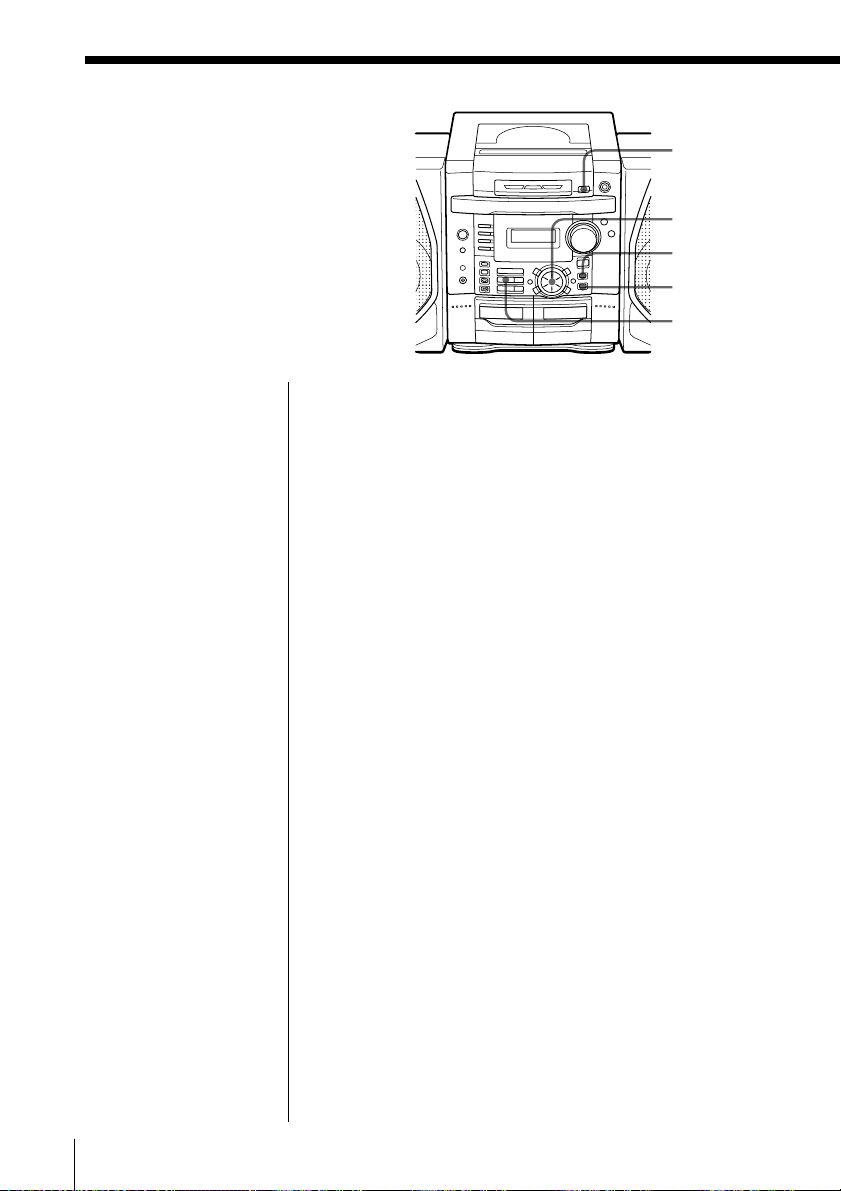
a specific track directly 1 Press DISC 1, DISC 2 or DISC 3.
2 Press the number button of the
track.
a point while listening to Press > (forward) or .
the sound (backward) while playing and
hold down until you find the
point (on the player, use M CD
or CD m).
a point while observing Press > (forward) or .
the display (backward) in pause and hold
down until you find the point (on
the player, use M CD or
CD m).
Note
You cannot locate a
specific track if
“SHUF” or “PGM” is lit
in the display. Turn off
the indication by
pressing x on the CD
section.
Tip
When you locate a
track numbered over
10, press >10 first, then
the corresponding
number buttons.
Example:
To play track number
23, press >10 first, then
2 and 3.
DISC 1 – 3
Number
buttons
., >
DECK
A/B
BAND
SPCANL
COUNTER
RESET
LINE
DISC 3DISC 2
CD/RADIO
DISC 1
SURROUND
DISPLAY
SOUND
SLEEP
CLOSE
POWER
CD OPEN/
TAPE
TUNERADIO
REPEAT
CD
VOL
The CD Player14
Playing tracks
repeatedly
(Repeat Play)
You can play tracks repeatedly in
normal, shuffle or program play modes
(see pages 17 – 18.).
CD u
REPEAT
MULTI JOG
DISC
CHANGE
Playing a single track repeatedly
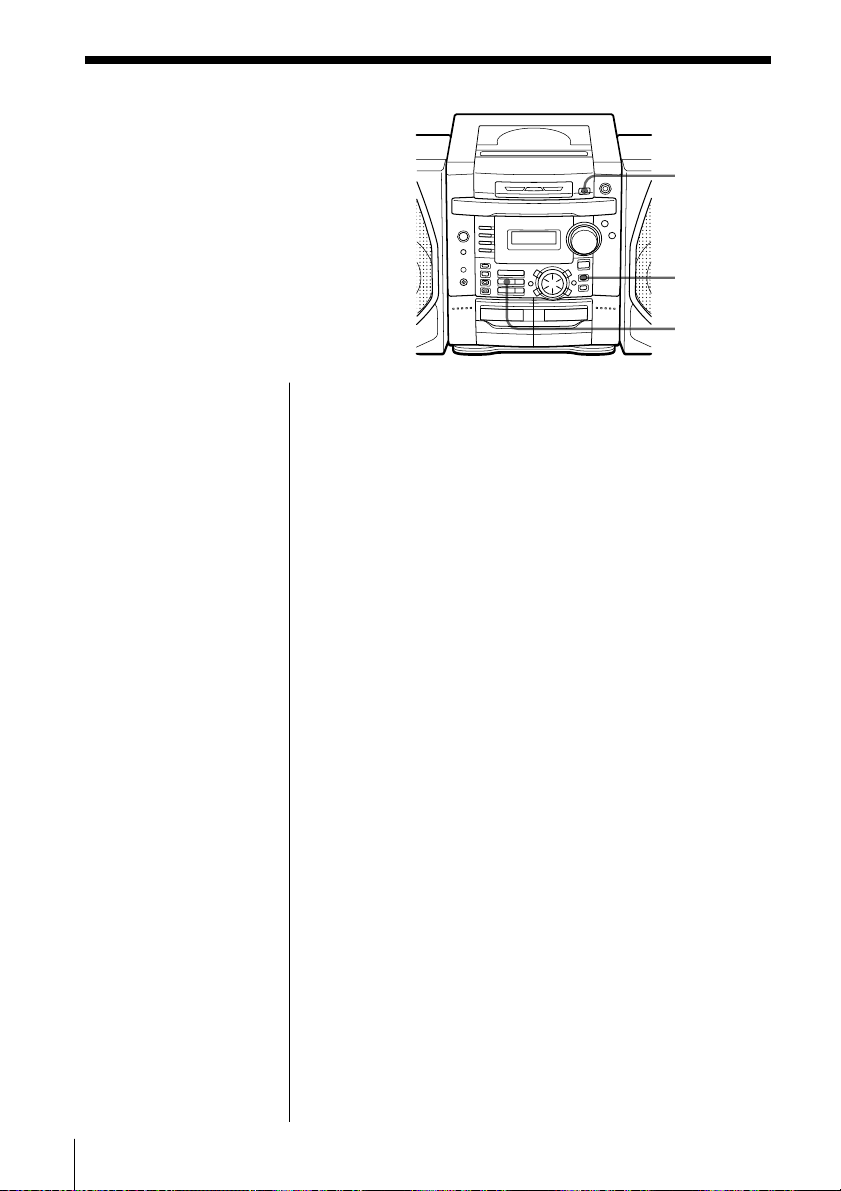
1 Press REPEAT until “REPEAT 1” appears in the
display.
2 Press DISC CHANGE to select the CD to be
played.
3 Turn MULTI JOG to select the track.
4 Press CD u to start repeat play.
Playing a single CD repeatedly
1 Press REPEAT until “REPEAT” appears in the
display.
If “ALL DISCS” is displayed in the display, press
MODE so that it disappears.
2 Press DISC CHANGE to select the CD to be
played.
3 Press CD u to start repeat play.
Playing two or three CDs repeatedly
1 Press MODE until “ALL DISCS ” appears in the
display.
2 Press REPEAT until “REPEAT” appears in the
display.
3 Press CD u to start repeat play.
On the remote
Playing a single track
repeatedly
1 Press REPEAT until
“REPEAT 1” appears
in the display.
2 Press DISC 1, DISC 2
or DISC 3 to select
the CD to be played.
The player starts
playing the selected
CD.
3 Use the number
button to select the
track.
Playing a single CD
repeatedly
1 Press REPEAT until
“REPEAT” appears
in the display.
2 Press DISC 1, DISC 2
or DISC 3 to select
the CD to be played.
Playing two or three
CDs repeatedly
1 Press MODE until
“ALL DISCS ”
appears in the
display.
2 Press REPEAT until
“REPEAT” appears
in the display.
3 Press CD N.
MODE

The CD Player
The CD Player 15
Playing tracks of a single CD in random order
repeatedly
1 Press MODE until “SHUF” appears in the display.
If “ALL DISCS” is displayed in the display, press
MODE so that it disappears.
2 Press REPEAT until “REPEAT” appears in the
display.
3 Press DISC CHANGE to select the CD to be
played.
4 Press CD u to start repeat play.
Playing tracks of two or three CDs in random
order repeatedly
1 Press MODE until “ALL DISCS SHUF” appears in
the display.
2 Press REPEAT until “REPEAT” appears in the
display.
3 Press CD u to start repeat play.
Playing programed tracks repeatedly
1 Program tracks (see steps 1 – 3 on page 17).
2 Press REPEAT until “REPEAT” appears in the
display.
3 Press CD u to start repeat play.
To cancel repeat play
Press REPEAT until “REPEAT” disappears from the
display.
On the remote
Playing tracks of a
single CD in random
order repeatedly
1 Press MODE until
“SHUF” appears in
the display.
2 Press REPEAT until
“REPEAT” appears
in the display.
3 Press DISC 1, DISC 2
or DISC 3 to select
the CD to be played.
Playing tracks of two
or three CDs in
random order
repeatedly
1 Press MODE until
“ALL DISCS SHUF”
appears in the
display.
2 Press REPEAT until
“REPEAT” appears
in the display.
3 Press CD N to start
repeat play.
Playing programed
tracks repeatedly
1 Program tracks (see
“On the remote” on
page 17).
2 Press REPEAT until
“REPEAT” appears
in the display.
3 Press CD N to start
repeat play.
The CD Player16
Playing tracks in
random order
(Shuffle Play)
You can play tracks in random order.
Playing tracks of a single CD in random order
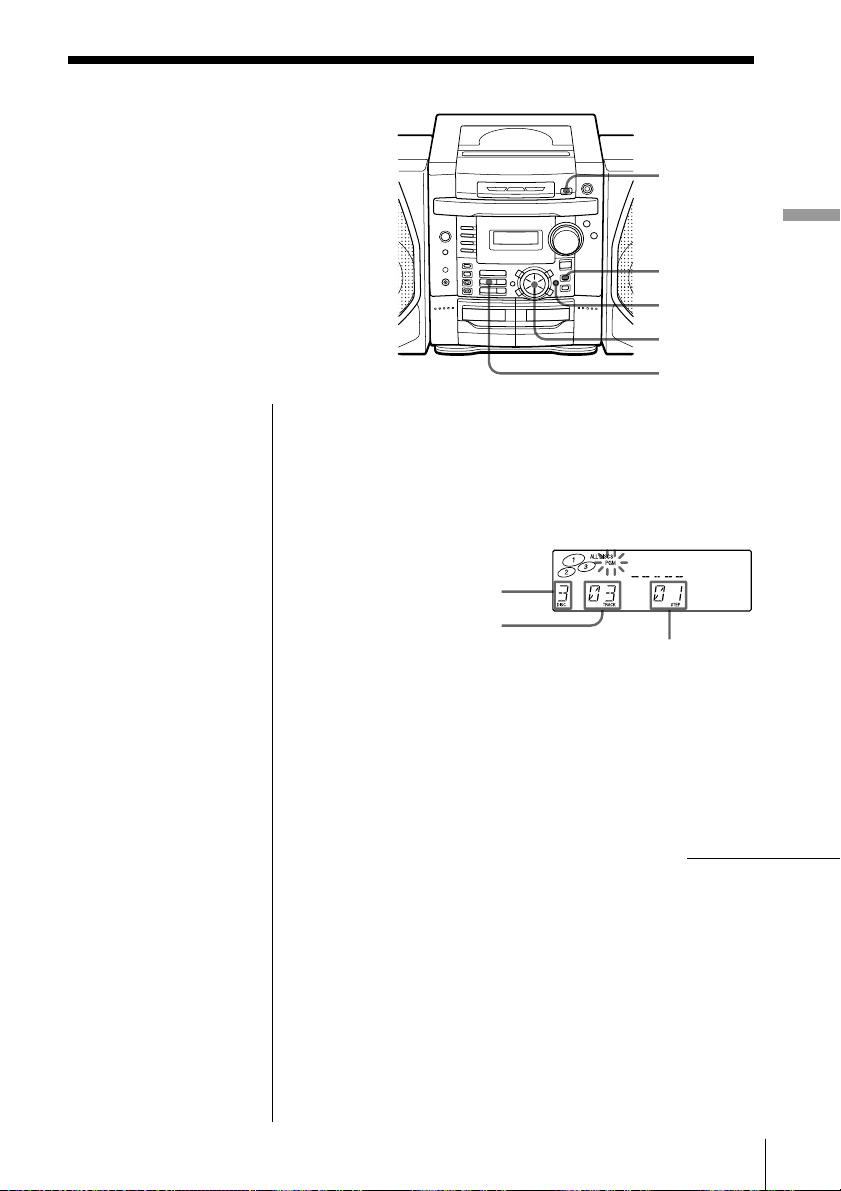
1 Press MODE until “SHUF” appears in the display.
If “ALL DISCS” is displayed in the display, press
MODE so that it disappears.
2 Press DISC CHANGE to select the CD to be
played.
3 Press CD u to start shuffle play.
Playing tracks of two or three CDs in random
order
1 Press MODE until “ALL DISCS SHUF” appears in
the display.
2 Press CD u to start shuffle play.
To cancel shuffle play
Press MODE until “SHUF” disappears from the
display.
CD u
DISC
CHANGE
MODE
On the remote
Playing tracks of a
single CD in random
order
1 Press MODE until
“SHUF” appears in
the display.
2 Press DISC 1, DISC 2
or DISC 3 to select
the CD to be played.
Playing tracks of two
or three CDs in
random order
1 Press MODE until
“ALL DISCS SHUF”
appears in the
display.
2 Press N on the CD
section to start
shuffle play.
The CD Player
The CD Player 17
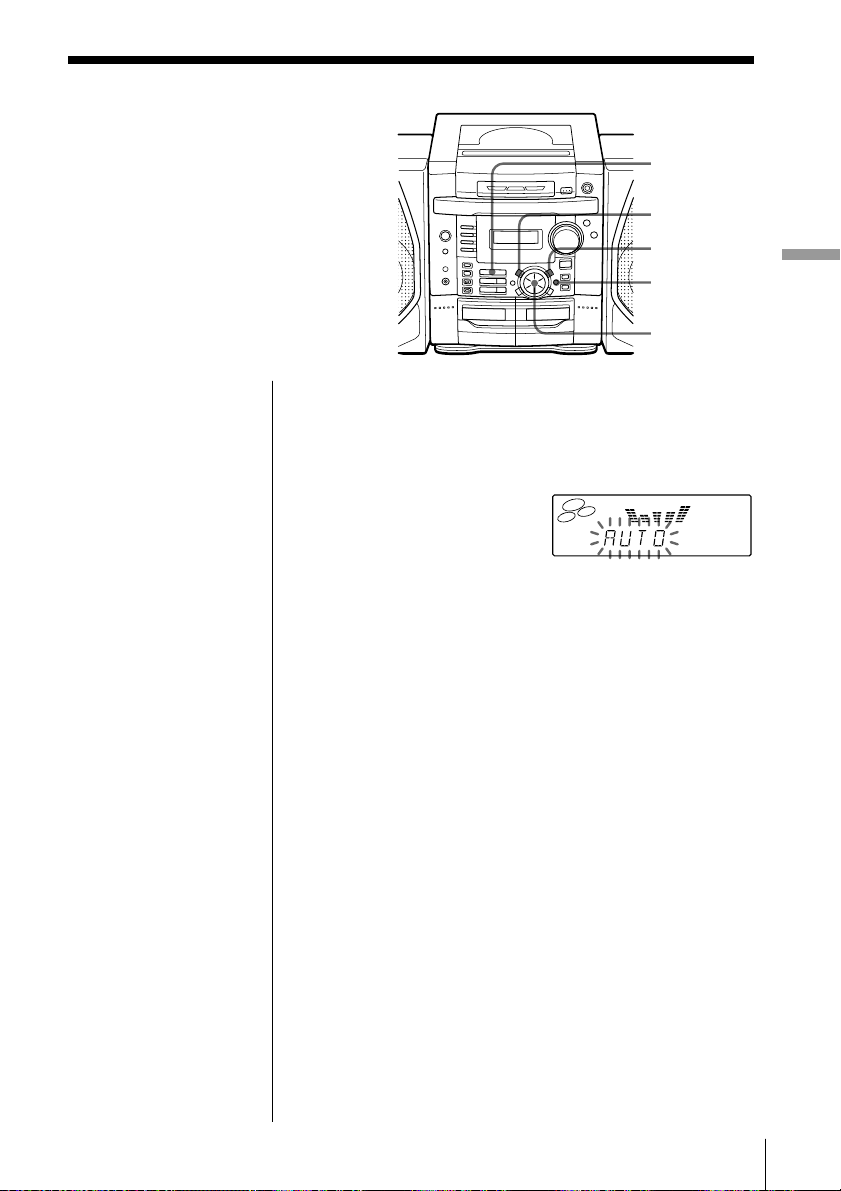
1 Press MODE until “ALL DISCS PGM” appears in
the display.
2 Press DISC CHANGE to select the CD.
3 Turn MULTI JOG to select the track you want to
program and press ENTER MEM.
To program additional tracks from another CD
Repeat steps 2 and 3.
4 Press CD u to start program play.
Creating your
own program
(Program Play)
You can make a program of up to 20
tracks from all the CDs in the order
you want them to be played.
continued
DISC
CHANGE
MULTI JOG
CD u
CD number
Track number
Playing order
On the remote
1 Press MODE until
“ALL DISCS PGM”
appears in the
display.
2 Press DISC 1, DISC 2
or DISC 3 to select
the CD.
3 Press the number
buttons for the tracks
you want to program
in the order you
want.
To program
additional tracks
from another CD,
repeat steps 2 and 3.
4 Press N on the CD
section.
MODE
ENTER
MEM

The CD Player18
To cancel Program Play
Press MODE until “PGM” disappears from the
display.
To check the order of tracks before play
Press ENTER MEM.
Every time you press the button, the track number
appears in the programed order.
To change the current program
Press x on the CD section once if the CD is stopped
and twice if the CD is playing. The current program
will be erased. Then create a new program following
the programing procedure.
Creating your own program (Program Play) (continued)
Tips
• You can play the same
program again, since
the program is saved
until you open the CD
tray.
• You can record your
own program.
1 After you’ve created
the program, insert a
blank tape into deck
B.
2 Press DUBBING to
start recording.
The Radio
The Radio
19
The Radio
Presetting radio
stations
You can store radio stations into the
player's memory. You can preset up to
30 radio stations, 10 for each band in
any order.
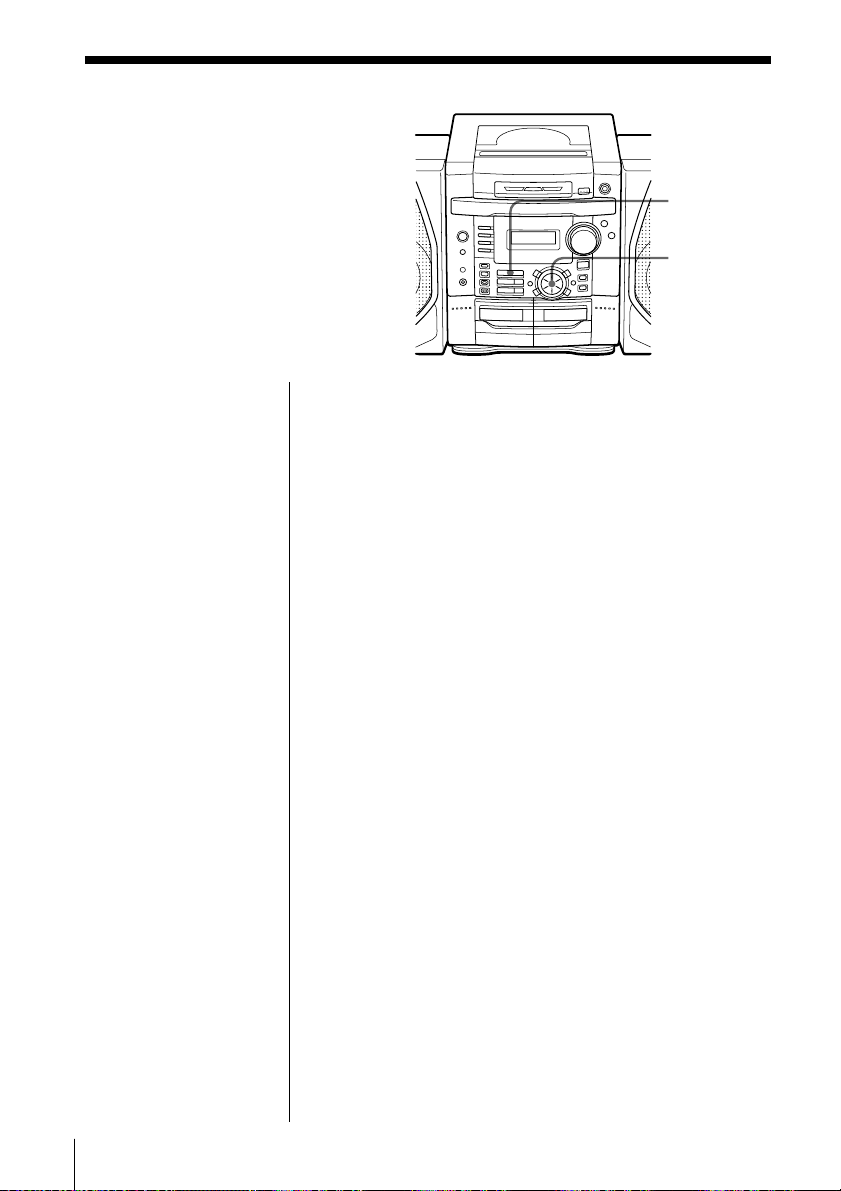
+ TUNE
RADIO BAND
AUTO PRESET
ENTER
MEM
1 Press RADIO BAND•AUTO PRESET to select the
band.
2 Hold down RADIO BAND•AUTO PRESET for 2
seconds until “AUTO” flashes in the display.
3 Press ENTER MEM.
The stations are stored in memory from the lower
frequencies to the higher ones.
If a station cannot be preset automatically
You need to preset a station with a weak signal
manually.
1 Press RADIO BAND•AUTO PRESET until the band
you want appears in the display.
2 Press + TUNE or TUNE – to set the frequency to the
station you want.
3 Press and hold ENTER MEM for 2 seconds.
4 Turn MULTI JOG until the preset number (1 to 10)
you want for the station flashes in the display.
5 Press ENTER MEM again.
On the remote
1 Press BAND to select
the band.
2 Press TUNE + or – to
set the frequency to
the station you want.
3 Press and hold the
number button that
you want to preset
the new station on
for 2 seconds.
Tip
If you automatically
preset the “FM1” or
“FM2” band, 10 radio
stations are stored in
“FM1” band and 10
more radio stations are
stored in “FM2” band.
TUNE –
MULTI JOG
The Radio20
Playing preset
radio stations
Once you've preset the stations, use
MULTI JOG on the player or the number
buttons on the remote to tune in to your
favorite stations.
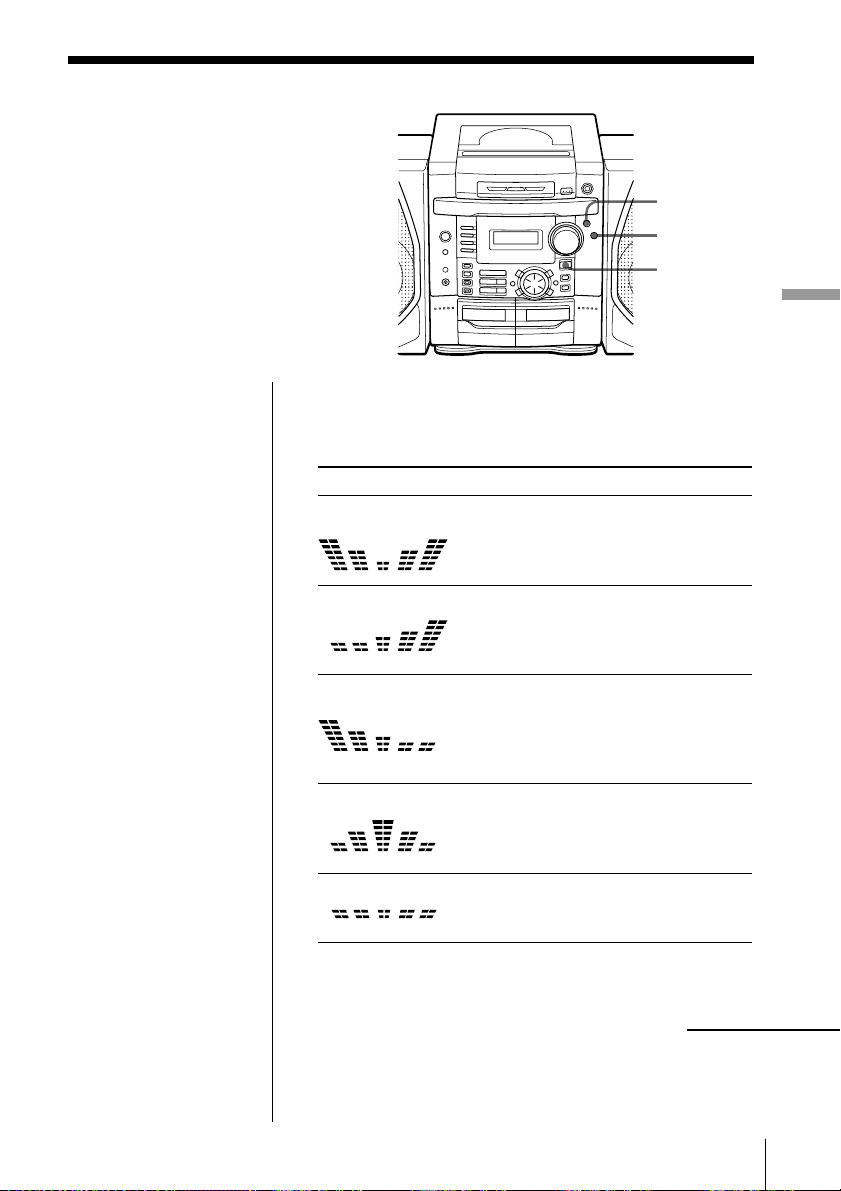
MULTI JOG
RADIO BAND
AUTO PRESET
1 Press RADIO BAND•AUTO PRESET to select the
band.
2 Turn MULTI JOG to tune in the stored station.
On the remote
1 Press BAND to select
the band.
2 Press the number
button to tune in the
stored station.
The Audio Emphasis 21
The Audio Emphasis
Selecting the sound characteristic
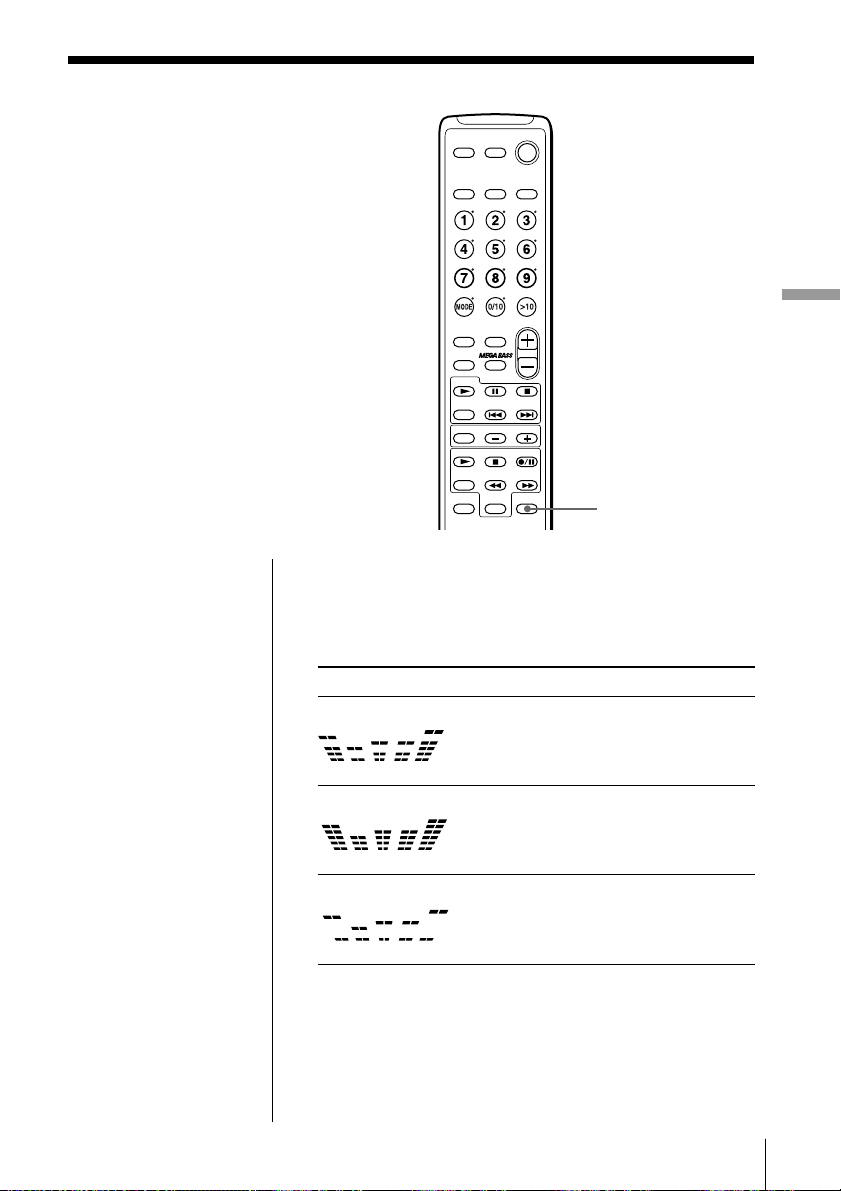
Press SOUND to select the audio emphasis you want.
Each time the button is pressed, the display changes.
Choose To get
ROCK powerful, clean sounds, emphasizing
low and high range audio
POP light, bright sounds emphasizing
high and middle range audio
JAZZ percussive sounds, emphasizing bass
audio
VOCAL the presence of vocals, stressing
middle range audio
Off the whole dynamic range for music
such as classical music
MEGA BASS
SOUND
Selecting the
audio emphasis
(SOUND/MEGA BASS)
You can adjust the audio emphasis of
the sound you are listening to.
The Audio Emphasis
SURROUND
continued

22
The Audio Emphasis
Reinforcing the bass sound
Press MEGA BASS.
”MEGA BASS” appears in the display. To return to
normal sound, press the button again.
Getting the surround effect
Press SURROUND.
“SUR” appears in the display.
You can get the surround effect without connecting
surround speakers. To return to normal sound, press
the button again.
Selecting the audio emphasis (SOUND/MEGA BASS) (continued)
The Audio Emphasis 23
The Audio Emphasis
Displaying the
spectrum analyzer
You can display 3 different patterns of
the audio signal you are listening to by
using the remote.
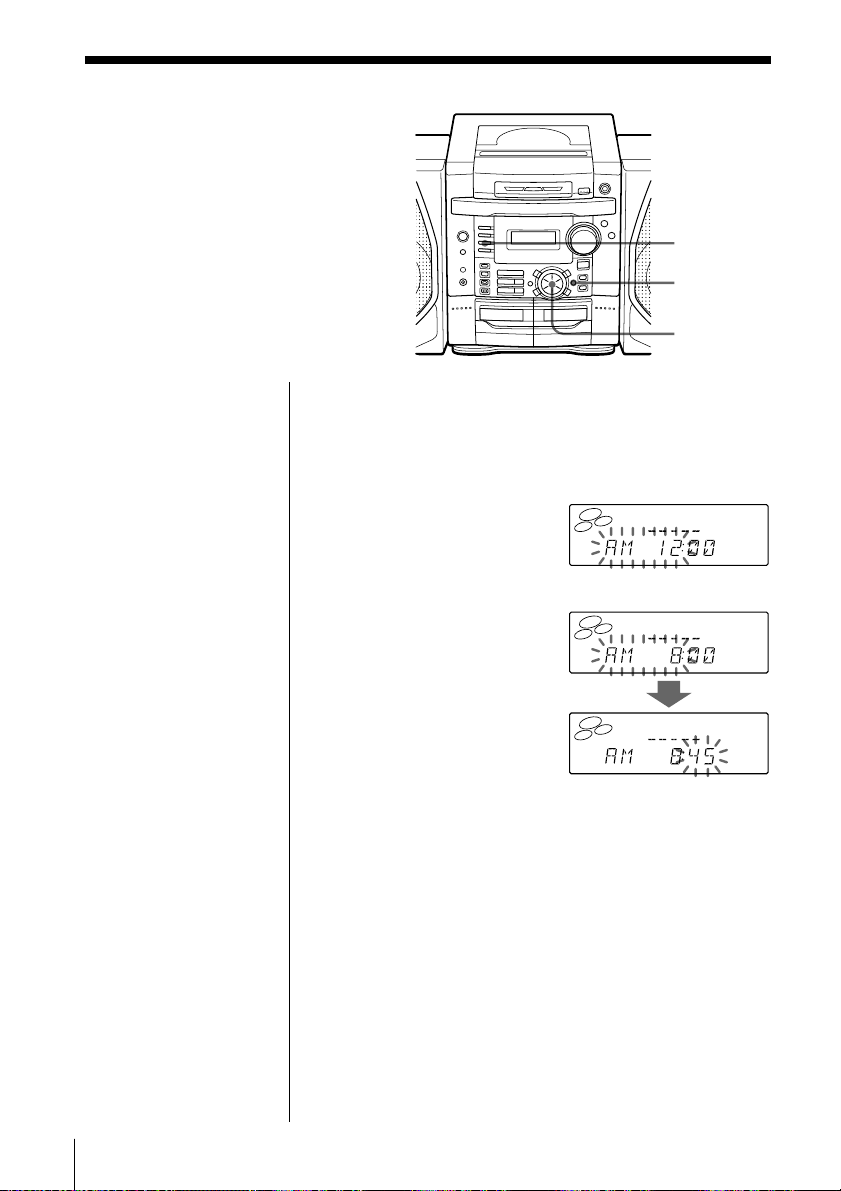
SPCANL
Displaying the audio signal pattern
Press SPCANL to display the audio signal pattern you
are listening to.
Each time the button is pressed, the display changes.
Choose To display
Peak hold input level of each band and at the same
time the highest level of each band for a
certain moment
Normal input level of each band
Peak the highest level of each band
DECK
A/B
BAND
SPCANL
COUNTER
RESET
LINE
DISC 3DISC 2
CD/RADIO
DISC 1
SURROUND
DISPLAY
SOUND
SLEEP
CLOSE
POWER
CD OPEN/
TAPE
TUNERADIO
REPEAT
CD
VOL
The Timer24
Setting the clock
“- -:- -” indication appears in the
display until you set the clock.
The Timer
Tip
The time display
system:
12-hour system
AM12:00 = midnight
PM12:00 = noon
CLOCK
ENTER
MEM
MULTI JOG
Before you begin, hook up the system (see pages 31 -
34).
1 Press and hold CLOCK until the hour digit flashes.
2 Set the clock.
1 Turn MULTI JOG to
set the hour and
press ENTER MEM.
2 Turn MULTI JOG to
set the minutes.
3 Press ENTER MEM.
The clock starts from 00 seconds.
The Timer 25
The Timer
Waking up to
music
You can wake up to music or a
radio program at a preset time.
Make sure you have set the clock
(“Setting the clock” on page 24).
STANDBY
TIMER
ENTER
MEM
MULTI JOG
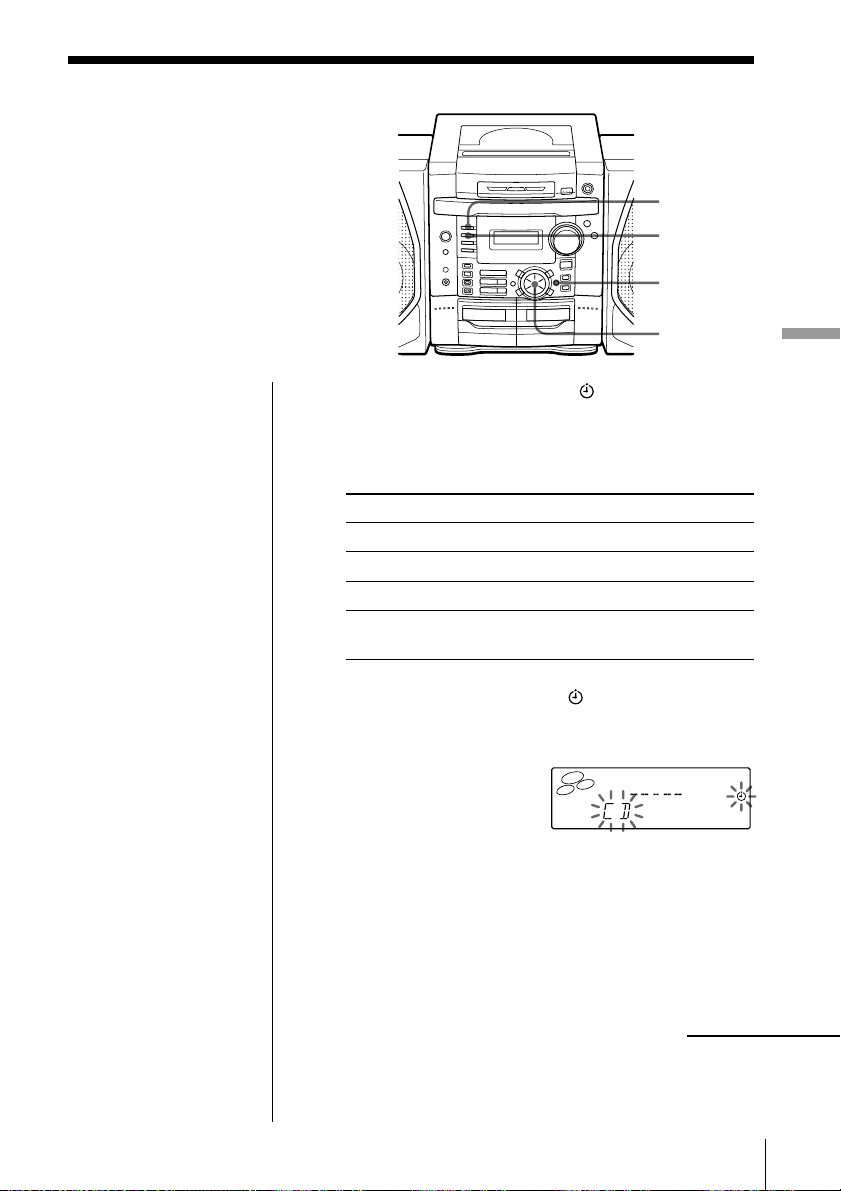
Before you begin, make sure the (clock) indication is
not lit in the display. If it is lit, press STANDBY.
1 Prepare the music source you want to play.
Source Do this
CD Insert a CD.
RADIO Tune in a station.
TAPE Insert a tape.
LINE Turn on the equipment connected
to LINE IN.
2 Press TIMER to display the indication.
Do the following operations by checking the
display.
3 Turn MULTI JOG until the music source you want
to play (“CD”, “TAPE”, “RADIO” or “LINE”)
appears in the display, and press ENTER MEM.
Note
You cannot preset
waking up timer and
recording timer (page
27) at the same time.
continued
The Timer26
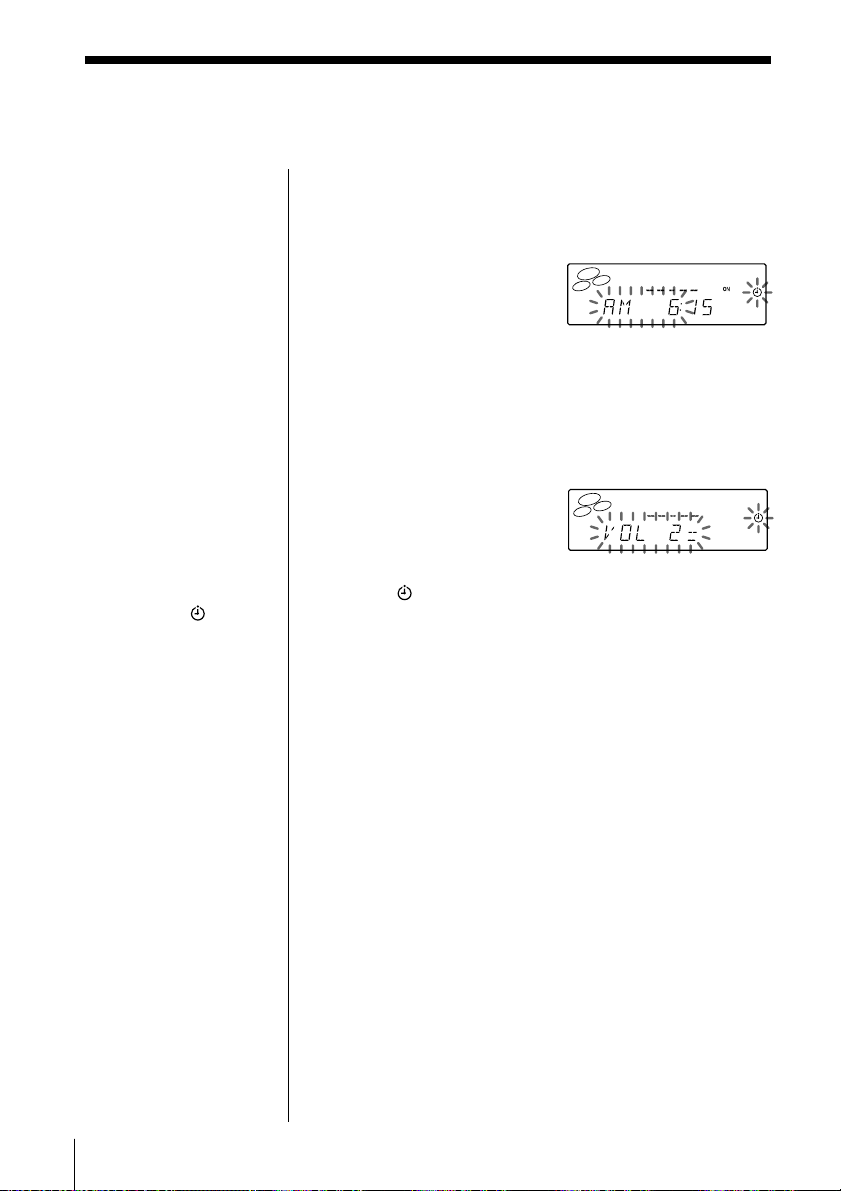
4 Set the timer to the hour and the minutes you want
the music to start.
1 Turn MULTI JOG to set the hour and press
ENTER MEM.
2 Turn MULTI JOG to set the minutes, and press
ENTER MEM.
5 Set the timer to the hour and the minutes you want
the music to go off. (Do as step 4.)
6 Turn MULTI JOG to set the volume you want, and
press ENTER MEM.
7 Press STANDBY.
The
indication lights up and the power goes off;
the player enters the standby mode.
At the preset time, the power will go on and music
will fade in. Then music will fade out and the
power will go off at the preset time, and the player
will enter the standby mode again.
To check/change the waking up timer settings
Press TIMER, then ENTER MEM. Each time you press
ENTER MEM, a stored setting is displayed in the set
order. To change the setting, display the setting you
want to change and re-enter it.
To use the player before a timer playback starts
If you turn on the player, you can use it as usual ( in
case of the radio, if you listen to the station which is
different from the one you tuned in step 1 on page 25,
you will hear that station at the preset time.) Turn off
the player before the preset time.
To stop play
Press POWER to turn off the power.
Tips
• To exit the standby
mode, press STANDBY
to make the
indication disappear.
• The preset settings
remain until you reset
them.
Waking up to music (continued)
The Timer 27
The Timer
Timer-recording
radio programs
You can set timer to record the radio
at a certain time. You can also record
the sound of the component connected
to the LINE IN jacks of the player.
Make sure you have set the clock (see
“Setting the clock” on page 24).
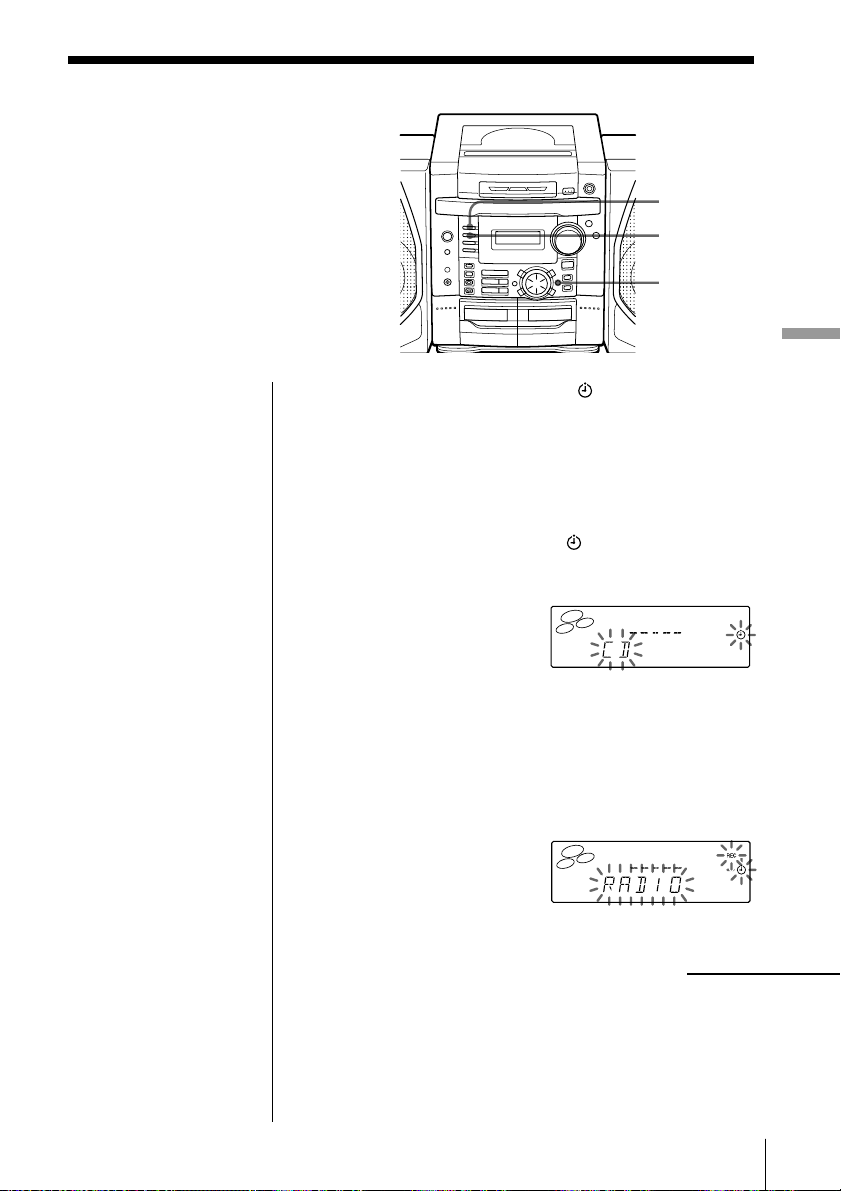
Before you begin, make sure the (clock) indication is
not lit in the display. If it is lit, press STANDBY.
1 Tune in the radio station and insert a blank tape
into the tape compartment with the side you want
to record on facing you.
2 Press TIMER to display the indication.
Do the following operations by checking the
display window.
3 Turn MULTI JOG to display “RADIO” and
“REC”, and press ENTER MEM.
When recording from the component connected to
the LINE IN jacks of the player, turn MULTI JOG
to display “LINE” and “REC”, and press ENTER
MEM.
Notes
• You cannot preset
recording timer and
waking up timer (page
25) at the same time.
• When recording from
the component
connected to the LINE
IN jacks of the player,
refer to the operating
instructions of the
component.
Tip
When you receive the
AM program in step 1,
press z/X to check if
the noise is heard. If so,
press MODE to select
the position that most
decreases the noise.
ENTER
MEM
TIMER
STANDBY
continued
The Timer28
Timer-recording radio programs (continued)
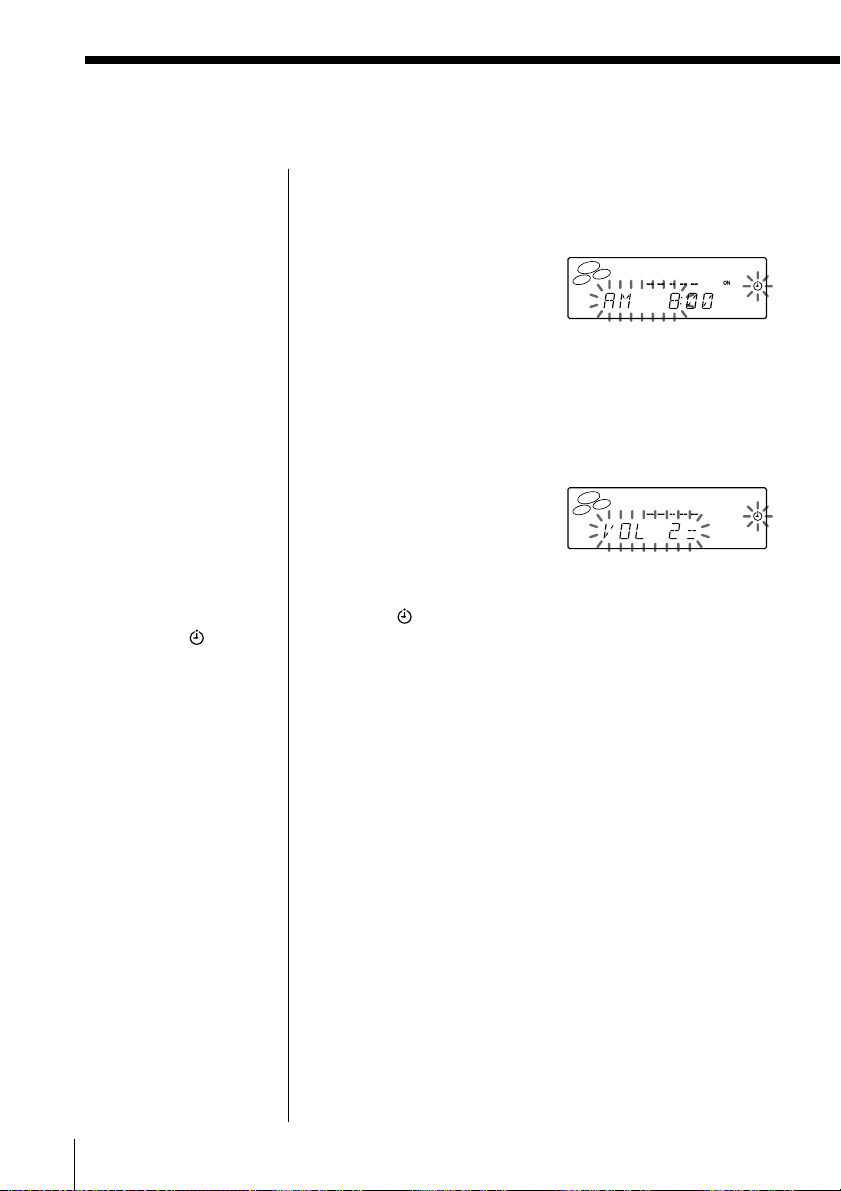
4 Set the timer to the hour and the minutes you want
to start recording.
1 Turn MULTI JOG to set the hour and press
ENTER MEM.
2 Turn MULTI JOG to set the minutes, and press
ENTER MEM.
5 Set the timer to the hour and the minutes you want
to stop recording. (Do as step 4.)
6 Turn MULTI JOG to set the volume you want, and
press ENTER MEM.
7 Press STANDBY.
The indication lights up and the power goes off;
the player enters the recording standby mode.
At the preset time, the power will go on and music
will fade in and the recording will start. Then
music will fade out and the power will go off at the
preset time, and the player will enter the standby
mode again.
To check/change the recording timer settings
Press TIMER, then ENTER MEM. Each time you press
ENTER MEM, a stored setting is displayed in the set
order. To change the setting, display the setting you
want to change and re-enter it.
Tips
• To exit the standby
mode, press STANDBY
to make the
indication disappear.
• The preset settings
remain until you reset
them.

The Timer 29
The Timer
To use the player before a timer-recording starts
If you turn on the player, you can use it as usual.
Before the preset time, tune in the station you want to
record and turn off the power.
To stop timer-recording
Press POWER to turn off the power.
The Timer30
Falling asleep to
music
You can set the player to turn off
automatically after 10, 20, 30, 60, 90,
and 120 minutes, allowing you to fall
asleep while listening to music.
Tips
• The display window
does not light while the
sleeping timer is on.
• You can fall asleep and
wake up to different
music. Set the waking
up timer first (see page
25), turn on the power,
and then set the
sleeping timer.
However, you cannot
store different radio
stations.
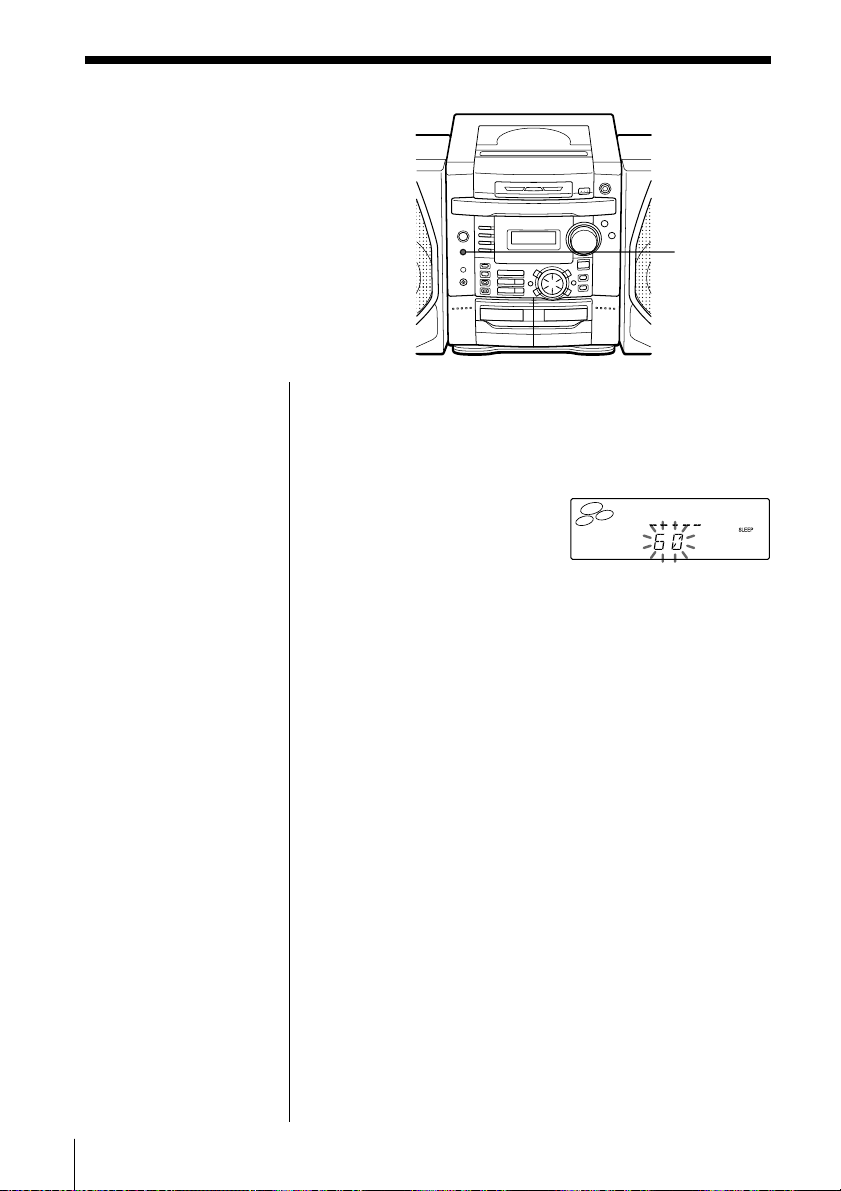
1 Play the music source you want.
2 Press SLEEP to display “SLEEP.”
3 Press SLEEP to select the minutes until the player
goes off automatically.
Each time you press
the button, the
indication changes as
follows:
“60” t “90”t “120”
t “OFF” t “10” t
“20” t “30.”
If 4 seconds have passed after you pressed SLEEP, the
minutes in the display are entered.
The preset time has passed, music fades out and the
player goes off automatically.
To cancel the sleep function
Press SLEEP to make “SLEEP” disappear from the
display.
To change the preset time
Do the steps 2 and 3 again.
SLEEP
Setting Up 31
Setting Up
Setting Up
Hooking up
the system
According to the illustrations,
connect the cords firmly.
Wrong connections cause
mal- functions. Connect the
AC power cord last.
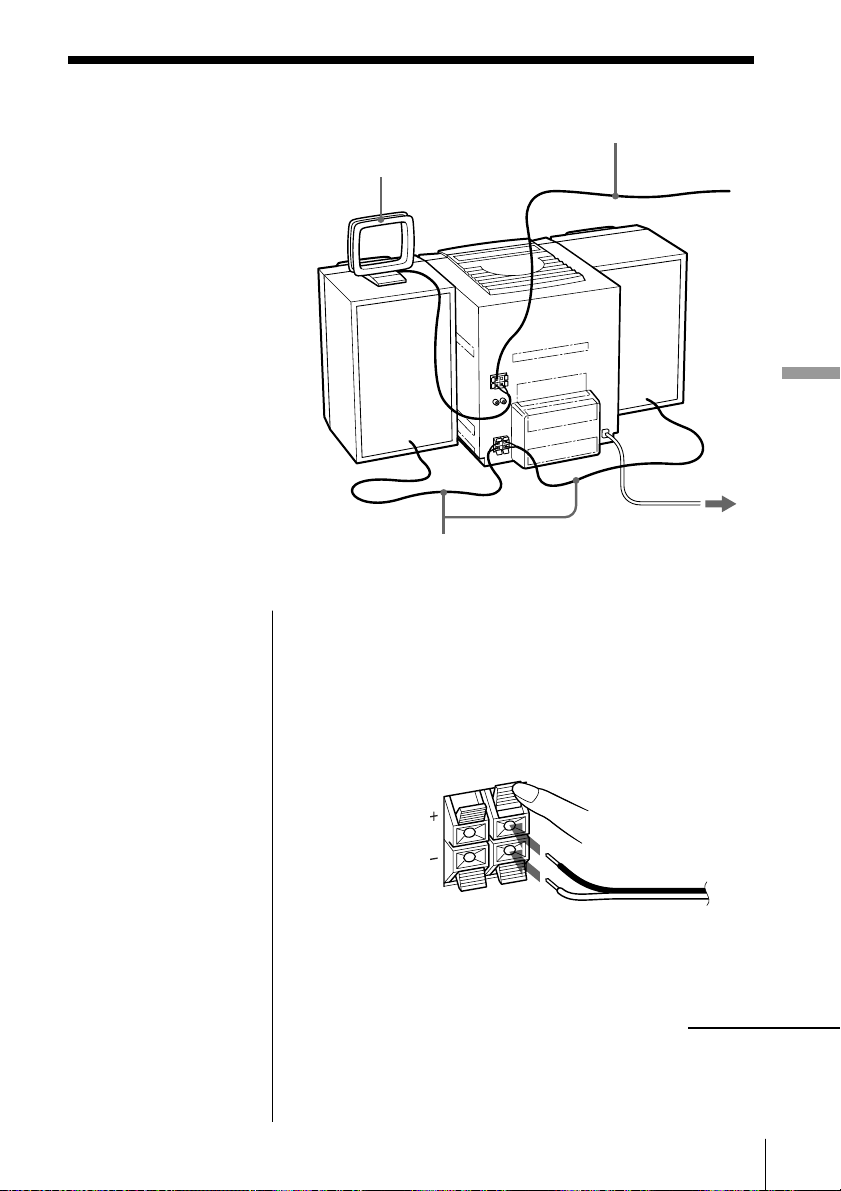
Right
speaker
Left
speaker
1 Hooking up the speakers
Connect the red wire to the (+) plus terminal, and the
black wire to the (–) minus terminal.
2 AM loop antenna
1 Speaker cords
3 To a wall outlet
2 FM lead antenna
Notes
• Be sure to turn off the
power of the player
before connecting/
disconnecting the AC
power cord.
• Connect the supplied
speakers to this player.
If you connect any
other speakers or
equipment, a mal-
function may occur.
S
P
E
A
K
E
R
IM
P
.6
Ω
R
L
R
L
continued
Setting Up32
Hooking up the system (continued)
F
M
E
X
T
A
N
T
7
5
Ω
A
M
E
X
T
A
N
T
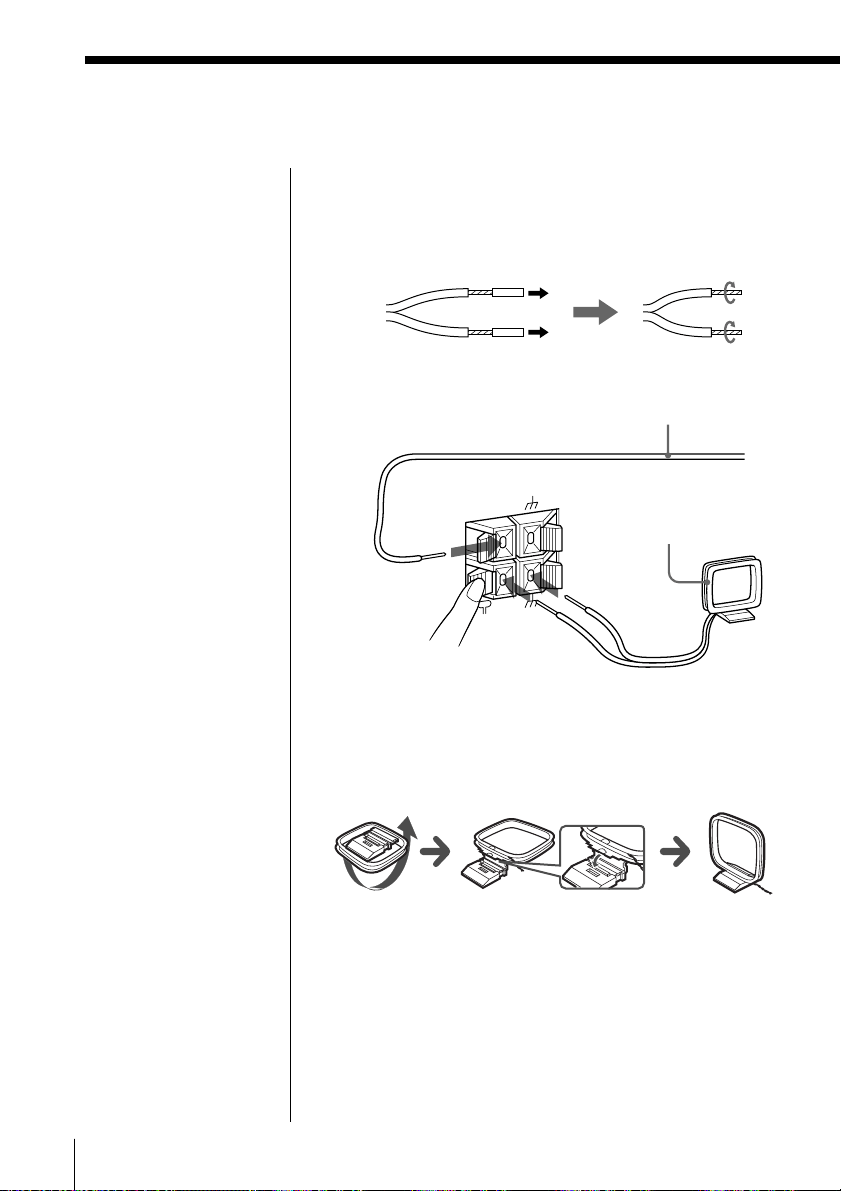
2 Hooking up the antennas
1 Strip the coating from the end of the cable and
twist the wires.
2 Connect the wires to the terminals.
Setting up the AM loop antenna
AM loop antenna**
(supplied)
FM antenna* (supplied)
* Keep the antenna as horizontal as possible.
** Reorient the antenna to improve broadcast reception.
Note
Do not connect the
outdoor antenna to the
AM EXT ANT
terminals.
Setting Up 33
Setting Up
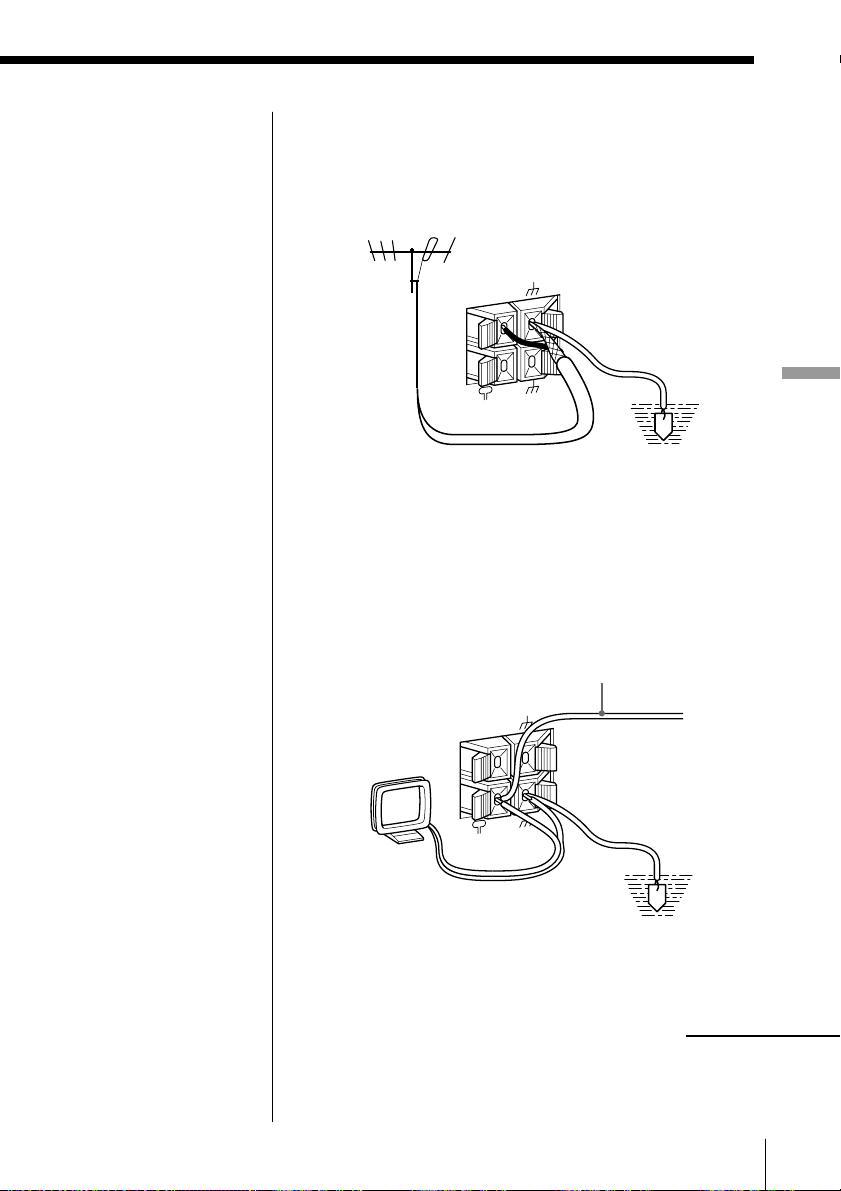
To improve the FM reception
Connect the FM outdoor antenna (not supplied). If you
use a distributor, you can also use the TV antenna.
To improve the AM reception
Connect a 6- to 15-meter (20- to 50 feet) insulated wire
(not supplied) to the AM antenna terminal. Keep the
wire as horizontal as possible near the window or
outdoor. You do not need to disconnect the supplied
AM loop antenna.
FM outdoor antenna
(not supplied)
Earth
Earth
Insulated wire
(not supplied)
F
M
E
X
T
A
N
T
7
5
Ω
A
M
E
X
T
A
N
T
F
M
E
X
T
A
N
T
7
5
Ω
A
M
E
X
T
A
N
T
continued
Setting Up34
3 Connecting the AC power cord
Insert the AC power cord to the wall outlet.
About the demonstration mode
The player enters the demonstration mode about 10
seconds after you connected the AC power cord to the
wall outlet. Demonstration indications such as
“DEMO MODE” and “PHC-Z10” appear in the
display one after another.
The player also enters the demonstration mode if you
do not operate the player for about one minute after
you turned it on.
To exit the demonstration mode, set the clock of the
player (page 24).
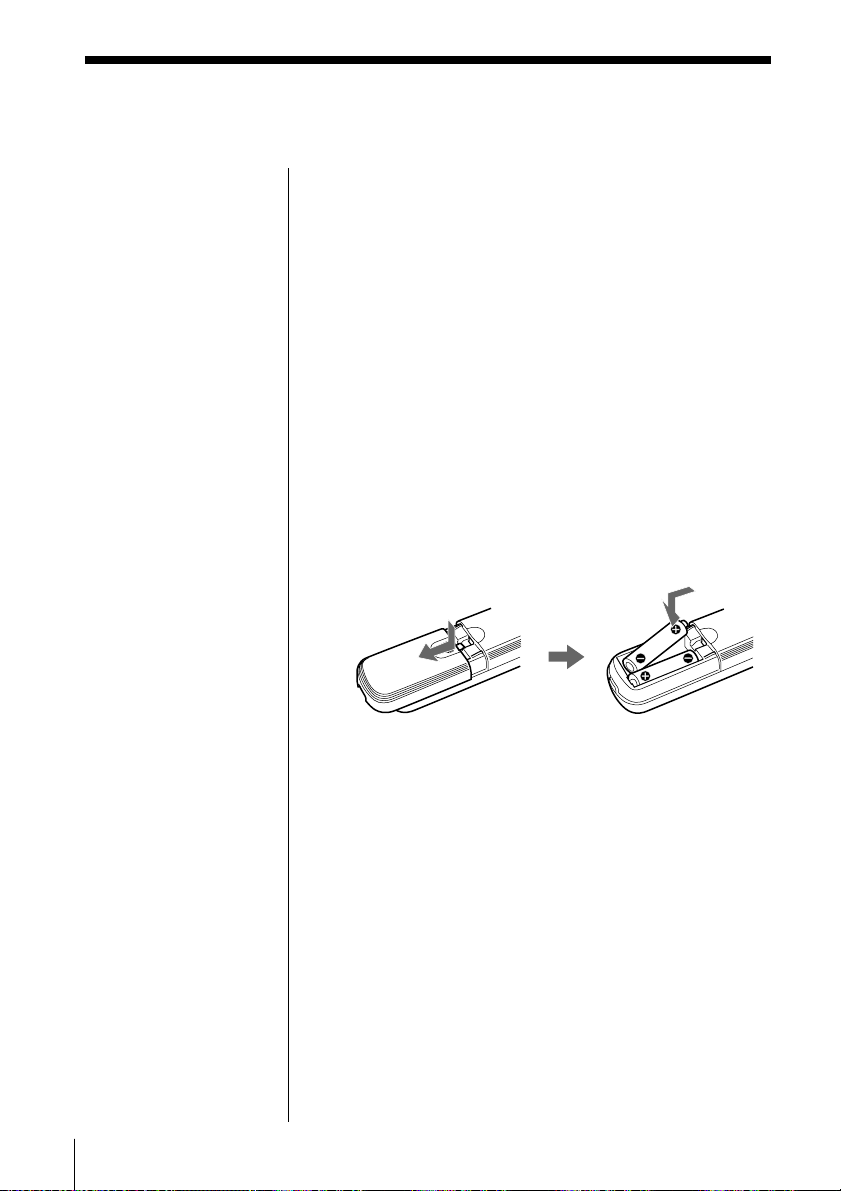
4 Inserting batteries into the remote
Insert two size AA (R6) batteries (not supplied)
Replacing batteries
With normal use, the batteries should last for about
six months. When the remote no longer operates the
player, replace all the batteries with new ones.
Hooking up the system (continued)
Setting Up 35
Setting Up
Saving power
Even when power is turned off, this
player consumes about 7.5 W for time
indication, timer operation, remote
control reception. If you use the saving
power function, you can reduce power
consumption to less than 1 W.
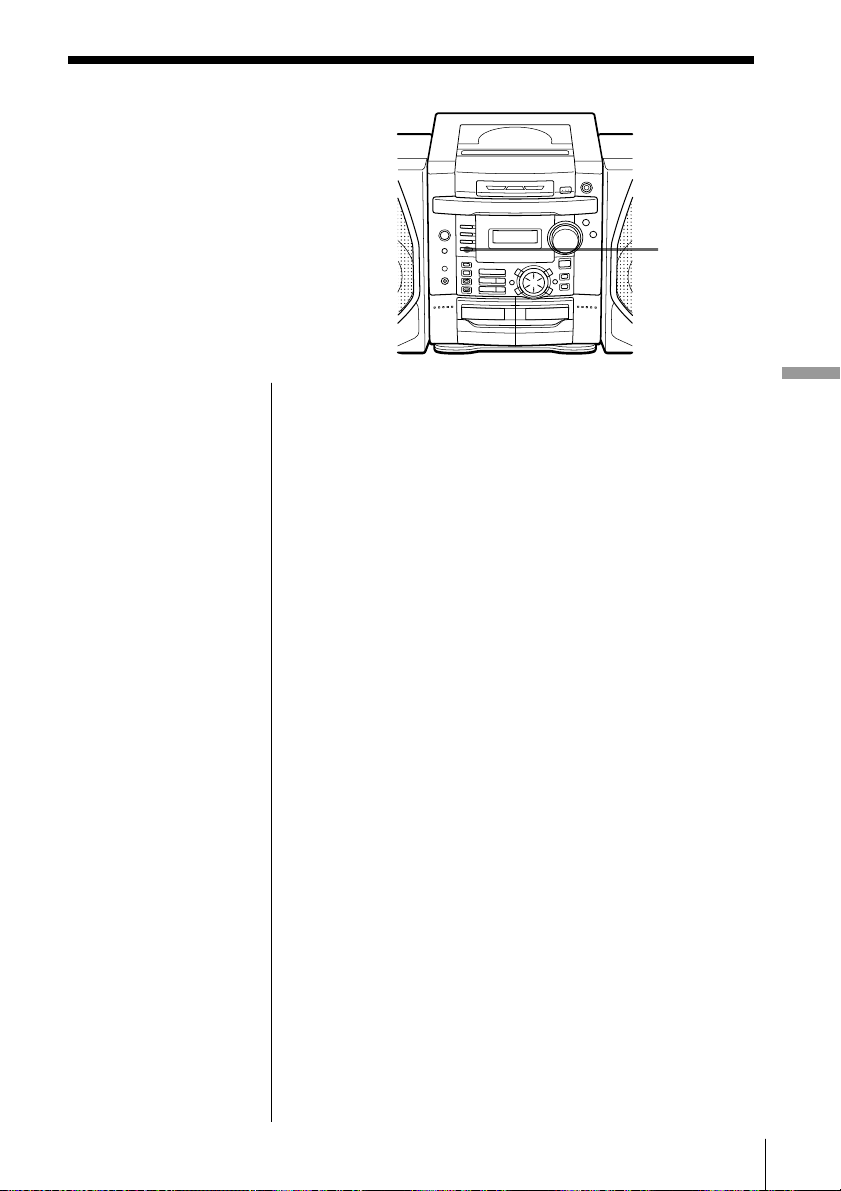
When the power is off, press and hold DISPLAY for
about 2 seconds.
The player enters the lower power consumption
standby mode.
To cancel the saving power
To make the time indication appear, press and hold
DISPLAY for about 2 seconds when the power is off.
DISPLAY
Setting Up36
LINE IN
R L
Connecting
optional
components
You can enjoy the sound from a VCR,
TV or MiniDisc player/recorder
through the speakers of this player.
Be sure to turn off the power of each
component before making
connections.
For details, refer to the instruction
manual of the component to be
connected.
Tip
You can record the
sound of the connected
component.
1 Insert a blank tape
into the deck B.
2 Press z/X then
TAPE N (page 11).
Listening to TV, VCR and MiniDisc player/
recorder
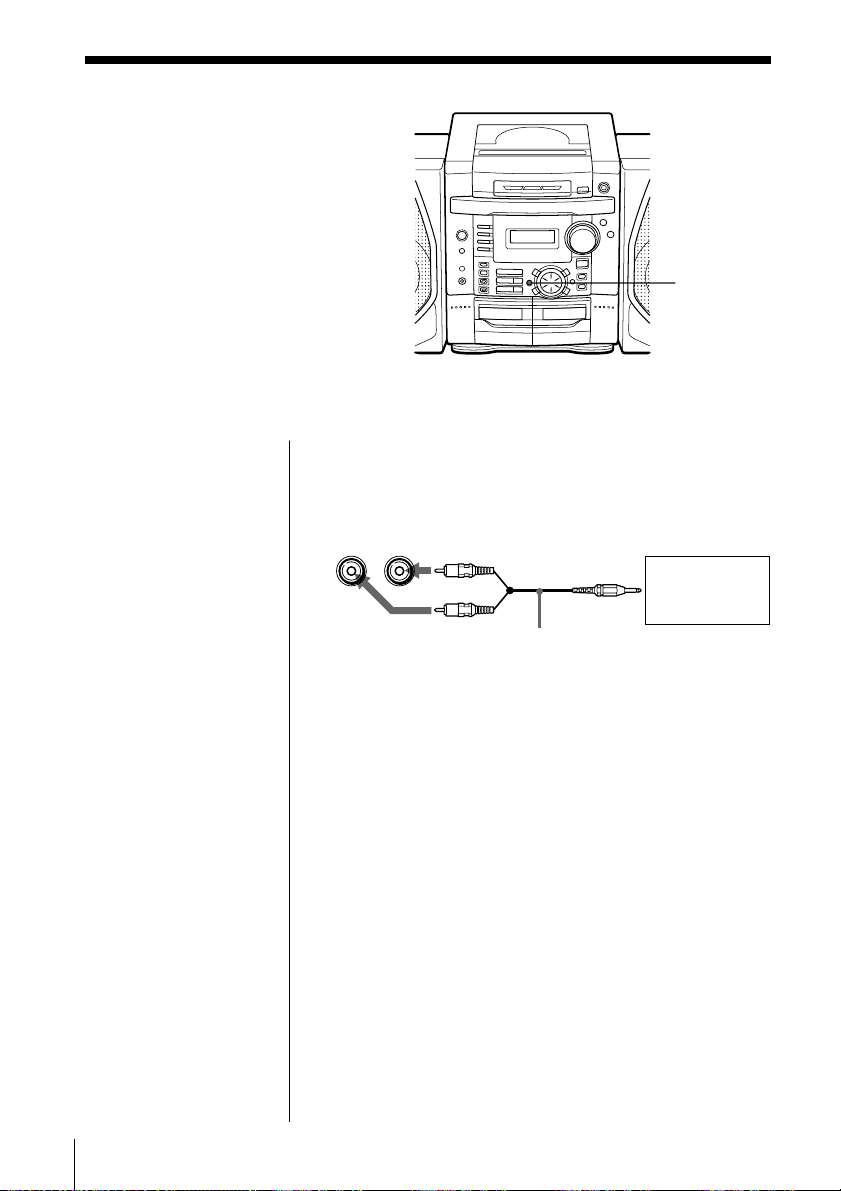
1 Connect the LINE IN jacks of this player with the
line output jacks of the MiniDisc player or other
component using the audio connecting cable (not
supplied) .
2 Turn on the power of this player and the
connected component.
3 Press LINE and start playing sound on the
connected component.
The sound from the connected component is
output from the speakers.
TV, VCR,
MiniDisc player/
recorder, etc.
Rear panel of
this player
to LINE IN
jacks
to line
output jack
Audio connecting cable
For MiniDisc recorder:
RK-G129 (1.5 m)
(not supplied)
For TV, VCR recorder:
RK-C320 (2 m)
(not supplied)
LINE
Note
Connect the cables
firmly to avoid any
malfunction.

Additional Information 37
Precautions
Additional Information
On placement
• Do not leave the player in a location
near heat sources, or in a place subject
to direct sunlight, excessive dust or
mechanical shock.
• Do not place the player on an inclined
or unstable place.
• Do not place anything within 10 mm
of the side of the cabinet. The
ventilation holes must be
unobstructed for the player to operate
properly and prolong the life of its
components.
• If the player is left in a car parked in
the sun, be sure to choose a location in
the car where the player will not be
subjected to the direct rays of the sun.
• Since a strong magnet is used for the
speakers, keep personal credit cards
using magnetic coding or spring-
wound watches away from the player
to prevent possible damage from the
magnet.
• When you move the player, be sure to
first remove the CD(s), otherwise, you
may not be able to take out the CD(s)
later or trouble with the unit may
occur.
On safety
• As the laser beam used in the CD
player section is harmful to the eyes,
do not attempt to disassemble the
casing. Refer servicing to qualified
personnel only.
• Should any solid object or liquid fall
into the player, unplug the player, and
have it checked by qualified personnel
before operating it any further.
On power sources
• The player is not disconnected from
the AC power source (mains) as long
as it is connected to the wall outlet,
even if the player itself has been
turned off.
• Unplug the player from the wall outlet
when it is not to be used for an
extended period of time.
• When the batteries are not to be used,
remove them to avoid damage that
can be caused by battery leakage or
corrosion.
• The nameplate indicating operating
voltage, power consumption, etc. is
located at the rear.
continued
Additional Information38
• Do not stick paper or sticker on the
CD, nor scratch the surface of the CD.
• After playing, store the CD in its case.
If there is a scratch, dirt or fingerprints
on the CD, it may cause tracking error.
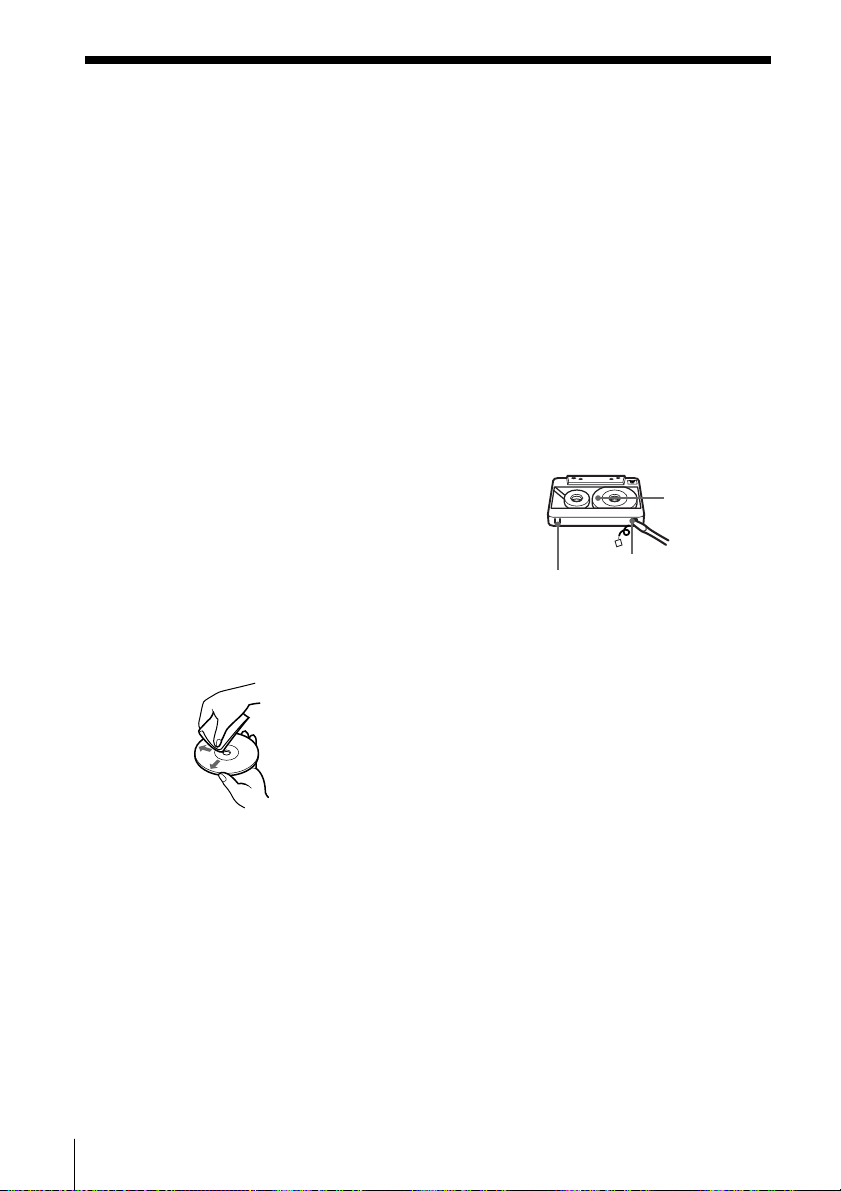
Notes on cassettes
• Break off the cassette tab from side A
or B to prevent accidental recording. If
you want to reuse the tape for
recording, cover the broken tab with
adhesive tape.
• The use of a cassette with more than
90 minutes of play time is not
recommended except for long,
continuous recording or playback.
On operation
• If the player is brought directly from a
cold to a warm location, or is placed in
a very damp room, moisture may
condense on the lens inside the CD
player section. Should this occur, the
player will not operate properly. In
this case, remove the CD and wait
about an hour for the moisture to
evaporate.
• If the player has not been used for a
long time, set it in the playback mode
to warm it up for a few minutes before
inserting a cassette.
If you have any questions or problems
concerning your player, please consult
your nearest Sony dealer.
Notes on CDs
• Before playing, clean the CD with a
cleaning cloth. Wipe the CD from the
center out.
• Do not use solvents such as benzine,
thinner, commercially available
cleaners or anti-static spray intended
for vinyl LPs.
• Do not expose the CD to direct
sunlight or heat sources such as hot
air ducts, nor leave it in a car parked
in direct sunlight as there can be a
considerable rise in temperature
inside the car.
Side A
Tab for side A
Tab for side B
Precautions (continued)
Additional Information 39
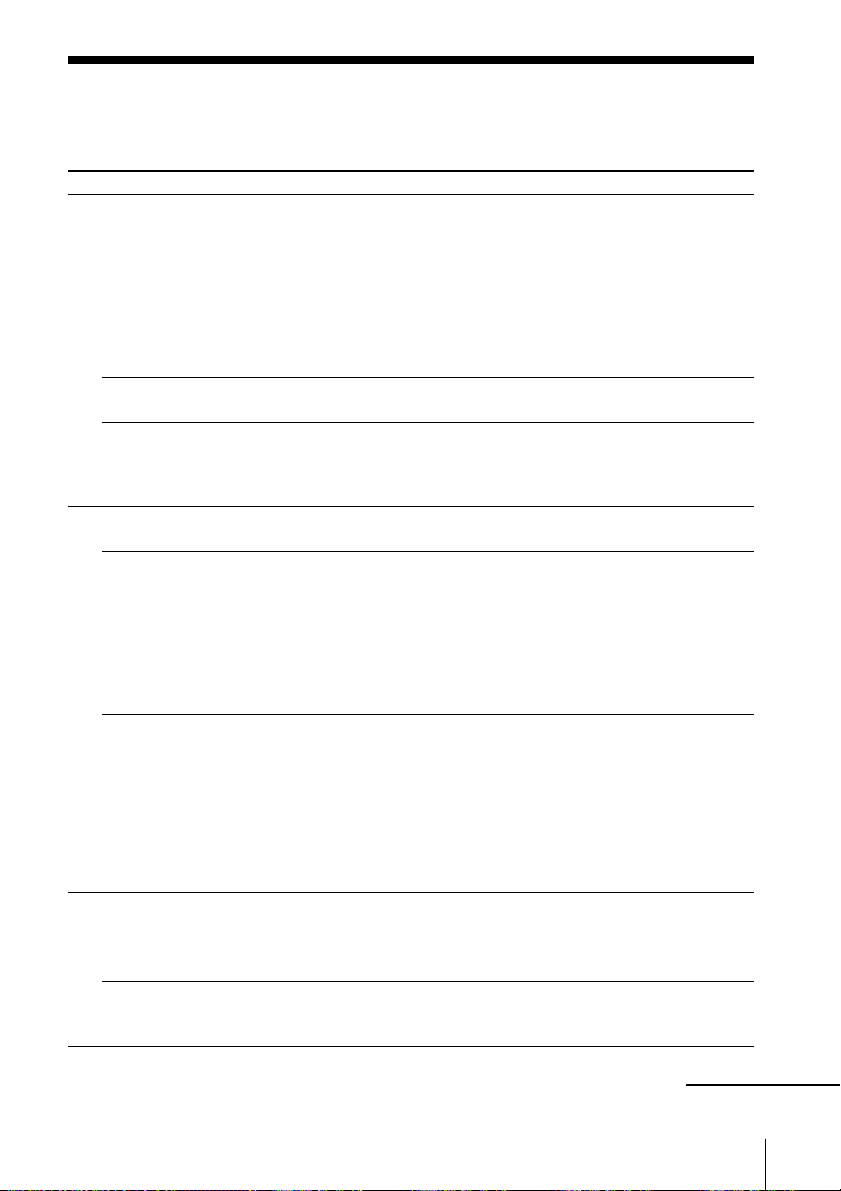
Troubleshooting
Radio
Symptom
There is no audio.
“SP CHECK” appears in the display.
Noise is heard.
“NO DISC“ lights in the display
even when a CD is in place.
The CD does not play.
The sound drops out.
The audio is weak or has poor
quality.
The picture of your TV becomes
unstable.
General
Remedy
• Press POWER to turn on the player.
• Connect the AC power cord to a wall outlet
securely.
• Make sure the function you want to use appears
in the display window.
• Adjust the volume.
• Unplug the headphones when listening through
speakers.
• The speaker cords are short-circuited. Twist the
wires and connect them to the terminals.
• Someone is using a portable telephone or other
equipment that emits radio waves near the
player. t Move the portable telephone, etc.,
away from the player.
• Insert the CD with the label surface up.
• Make sure that the CD tray is closed.
• Place the CD with the label surface up.
• Clean the CD.
• Take out the CD and leave the CD tray open for
about an hour to dry moisture condensation.
• Make sure “CD” appears in the display
window.
• Reduce the volume.
• Clean the CD, or replace it if the CD is badly
damaged.
• Place the player in a location free from
vibration.
• The sound may drop out or noise may be heard
if the CD is recorded using a personal computer
(CD-R, etc.).
• Move the player away from the TV.
• If you are using the remote while listening to
AM radio, noise may be heard. This is
unavoidable.
• If you are listening to an FM program near the
TV with an indoor antenna, move the player
away from the TV.
CD Player
continued
Additional Information40
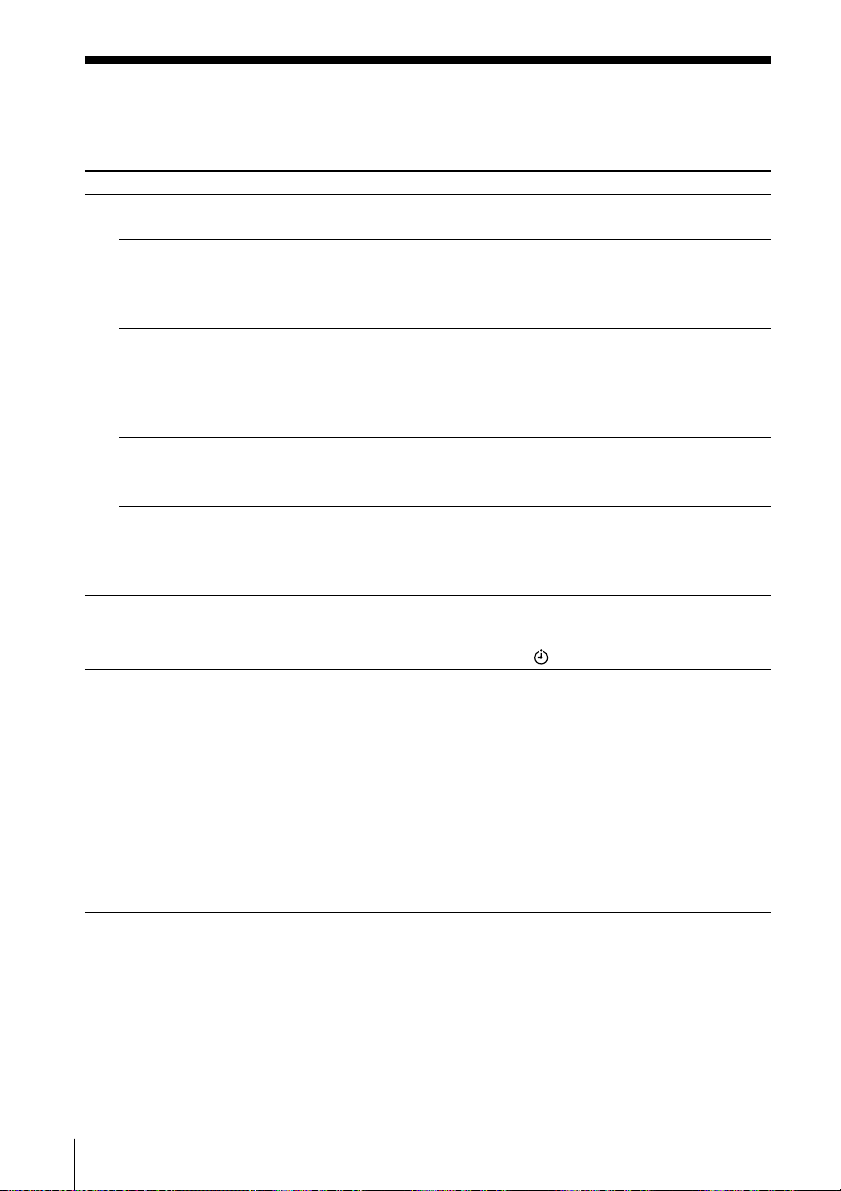
Symptom
The tape does not move when you
press an operation button.
The z/X button does not function/
The tape does not play.
The tape does not erase completely.
The tape does not record.
The audio is weak/The audio
quality is poor.
The timer does not operate.
The remote does not function.
The player uses a built-in micro computer for its various operations. Due to change in power
supply conditions, etc., operation way sometimes become unstable. After trying the above
remedies, if the player still does not function properly, press RESET at the rear with a pointed
material. If the problem persists, please consult your nearest Sony dealer.
Remedy
• Close the cassette compartment securely.
• Make sure the safety tab on the cassette is in
place.
• Make sure “TAPE” appears in the display
window.
• Clean the erase head (see page 41).
• The source which was recorded on TYPE II
(high position) or TYPE IV (metal) tape using
this unit is being played. Record on TYPE I
(normal) tape and play.
• Make sure the tape is inserted properly.
• Make sure the safety tab of the cassette is in
place.
• Clean the heads, pinch rollers and capstans
(see page 41).
• Demagnetize the heads using a demagnetizer
(see page 41).
• Make sure the time on the clock is correct.
• Check to see if the AC power had been cut off.
• Make sure the (clock) indication is displayed.
• Replace all the batteries in the remote with new
ones if they are weak.
• Make sure that you are pointing the remote at
the remote sensor on the player.
• Remove any obstacles in the path of the remote
and the player.
• Make sure the remote sensor is not exposed to
strong light such as direct sunlight or
fluorescent lamp light.
• Move closer to the player when using the
remote.
Tape Player
Remote
Timer
Troubleshooting (continued)
Additional Information 41
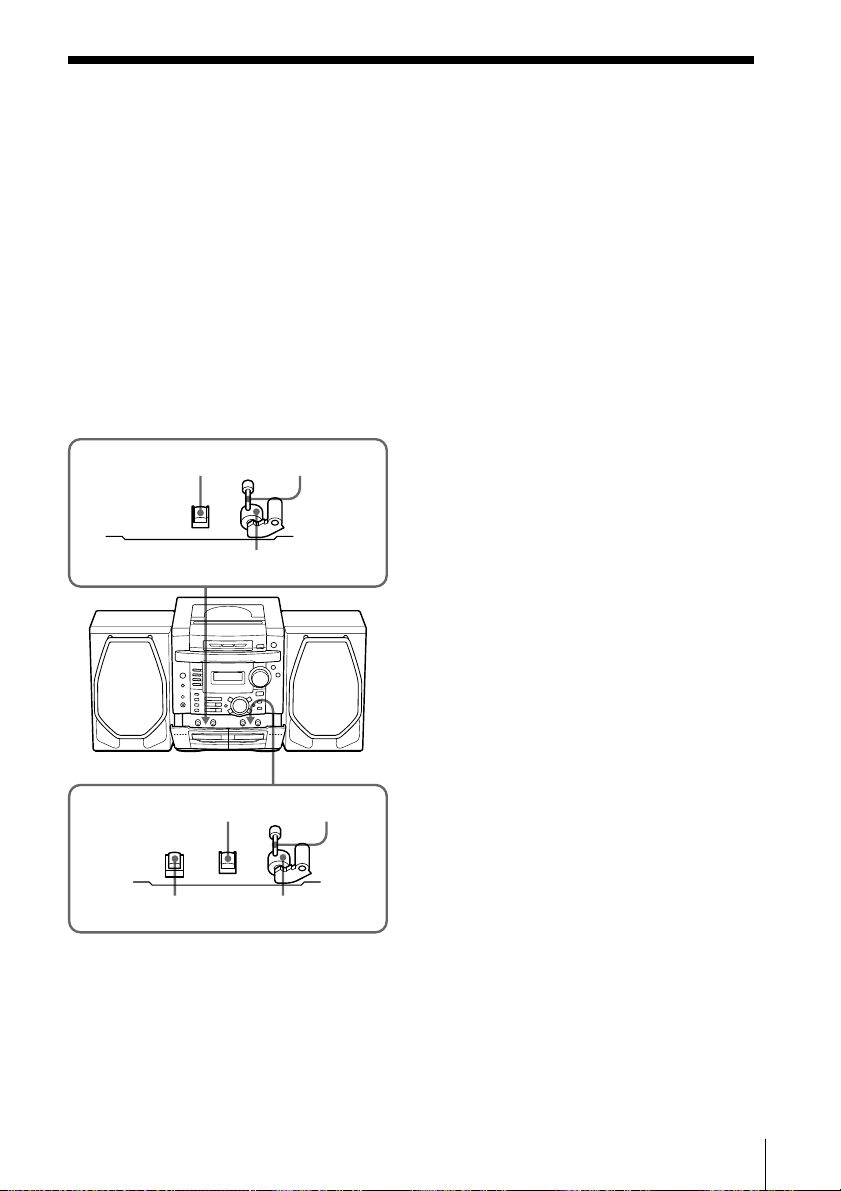
Maintenance
Demagnetizing the tape heads
After 20 to 30 hours of use, enough
residual magnetism will have built up
on the tape heads to begin to cause loss
of high frequency sound and hiss. At
this time, you should demagnetize the
heads and all metal parts in the tape
path with a commercially available tape
head demagnetizer.
Cleaning the cabinet
Clean the cabinet, panel and controls
with a soft cloth slightly moistened with
a mild detergent solution. Do not use
any type of abrasive pad, scouring
powder, or solvent, such as alcohol or
benzine.
Cleaning the tape heads and tape
path
Wipe the heads, the pinch rollers and
the capstans with a cleaning swab
slightly moistened with cleaning fluid or
alcohol after every 10 hours of operation
for optimum playback and recording
quality. To make the best possible
recording, however, we recommend that
you clean all surfaces over which tape
travels before each recording.
After cleaning, insert a tape when the
areas cleaned are completely dry.
Capstan
Playback head
Pinch roller
Deck B
Pinch roller
Erase head
CapstanRecord/playback head
Deck A

Additional Information42
Specifications
AUDIO POWER SPECIFICATIONS
POWER OUTPUT AND TOTAL
HARMONIC DISTORTION
With 6 Ω loads, both channel driven from 120
- 10 000 Hz; rated 50 W per channel-
minimum RMS power, with no more than
10 % total harmonic distortion from 250
milliwatts to rated output.
Other Specifications
CD player section
System
Compact disc digital audio system
Laser diode properties
Material: GaAlAs
Wave length: 780 nm
Emission duration: Continuous
Laser output: Less than 44.6 µW
(This output is the value measured at a distance of
about 200 mm from the objective lens surface on
the optical pick-up block with 7 mm aperture.)
Spindle speed
200 r/min (rpm) to 500 r/min (rpm) (CLV)
Number of channels
2
Frequency response
20 - 20 000 Hz +1/–2 dB
Wow and flutter
Below measurable limit
Radio section
Frequency range
FM: 87.6 - 108 MHz
AM: 530 - 1 710 kHz
Antenna
FM: Lead antenna
AM: Loop antenna
Cassette-corder section
Recording system
4-track 2 channel stereo
Fast winding time
Approx. 100 s (sec.) with Sony cassette C-60
Frequency response
TYPE I (normal): 100 - 10 000 Hz
General
Speaker
Woofer: 13 cm (5
1
⁄8 inches) dia.,
Tweeter: 5 cm (2 inches) dia.,
6 Ω, cone type (2)
Inputs
LINE IN jacks (2 phono jacks):
Sensitivity 220 mV
Outputs
Headphones jack (stereo minijack):
For 8 - 32 Ω impedance headphones
Speaker terminals: For supplied 6 Ω
impedance speaker
Power output (excluding US model)
50 W + 50 W (at 6 Ω, 10 % harmonic
distortion)
Power requirements
For personal component system:
120 V AC, 60 Hz
For remote control: 3 V DC, 2 size AA (R6)
batteries
Power consumption
AC 110 W
Dimensions
Player: approx. 285 × 322 × 408 mm (w/h/d)
(11
1
⁄4 × 12
3
⁄4 × 16
1
⁄8 inches)
Speaker: approx. 200 × 316 × 250 mm (w/h/d)
(7
7
⁄8 × 12
1
⁄2 × 9
7
⁄8 inches)
Mass
Player: approx. 7.7 kg (16 lb. 16 oz.)
Speaker: approx. 3.15 kg (6 lb. 15 oz.)
Supplied accessories
Remote control (1)
FM lead antenna (1)
AM loop antenna (1)
Design and specifications are subject to change without
notice.
Optional accessories
Sony MDR headphone series

Additional Information 43
A
Audio emphasis 21
B
Batteries for remote 34
C
CD player 12
Cleaning
cabinet 41
tape heads and tape
path 41
Connecting
AC power cord 34
antennas 32
optional components 36
speakers 31
Creating your own program
17
D, E, F, G, H
Demagnetizing the tape
heads 41
Demonstration mode 34
Display 12
I, J, K
Improving broadcast
reception 7
Index
L
Listening to the radio 6
Locating a specific track 13
M, N, O
MEGA BASS 22
P, Q
Playing
a CD 4
a tape 8
preset radio stations 20
tracks repeatedly 14
Presetting radio stations 19
Program Play 17
R
Radio stations
playing 20
presetting 19
Recording
on a tape 10
programed tracks 18
timer-recording radio
programs 27
Repeat Play 14
S
Selecting
audio emphasis 21
tracks 13
Setting the clock 24
Setting up 31
Shuffle Play 16
SOUND 21
Spectrum analyzer 23
SURROUND 22
T
Timer
Falling asleep to music 30
Timer-recording radio
programs 27
Waking up to music 25
Troubleshooting 39
U, V, W, X, Y, Z
Using the display 12

Additional Information44
Sony Corporation Printed in China