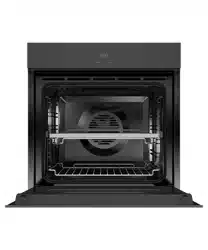

USER GUIDE
US CA
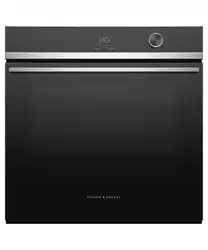
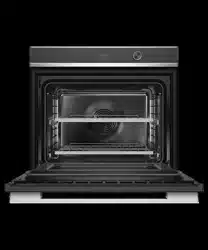
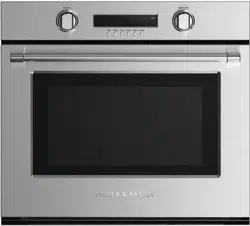
WALL OVEN
WODV230 & WOSV230
models

This user guide is an accompaniment to your ‘Quick start guide’ which is included
with your oven.
For operating instructions, see your ‘Quick start guide’. If you no longer have your
‘Quick start guide’, you can download it from our website, listed on the back cover.
Refer to your ‘Quick start guide’ for information on:
●
Setting the clock
●
Controls
●
Positioning the shelves
●
Conditioning the oven before first use
●
Using the timer

1
CONTENTS
Safety and warnings 2
Cooking guide 6
Oven functions 9
Cooking charts 14
Automatic cooking 20
Using the meat probe 25
User preference settings 28
Sabbath mode 30
Care and cleaning 32
Using the Self Clean function 38
Troubleshooting 41
Alert codes 45
Warranty and service 47
IMPORTANT!
SAVE THESE INSTRUCTIONS
The models shown in this user guide may not be available in all markets and are subject
to change at any time. For current details about model and specification availability
in your country, please go to our website fisherpaykel.com or contact your local
Fisher & Paykel dealer.

4
SAFETY AND WARNINGS
IMPORTANT SAFETY INSTRUCTIONS
●
Use only dry oven mitts or potholders. Moist or damp potholders on hot surfaces
could result in burns from steam. Do not let potholders touch hot areas or heating
elements. Do not use a towel or a bulky cloth for a potholder. It could catch fire.
●
Do not heat unopened food containers. They can build up pressure that may cause
the container to burst and result in injury.
●
Safe food handling: leave food in the oven for as short a time as possible before
and after cooking. This is to avoid contamination by organisms which may cause
food poisoning. Take particular care during warm weather.
●
Always keep oven vents unobstructed.
●
Do not operate your appliance by means of an external timer or separate
remote-control system.
●
Caution: Hot air can blow from the vent at the base of the oven as part of the
oven’s cooling system.
●
Placement of oven shelves: always position shelves in the desired location while
the oven is cool (before preheating). If a shelf must be removed while the oven
is hot, do not let the oven mitts or potholder contact hot heating elements in
the oven or the base of the oven.
●
Do not clean the oven seal or use any oven-cleaning products on it.
It is essential for a good seal, which ensures that the oven operates efficiently.
Care should be taken not to rub, damage or move it.
●
Do not use oven cleaners, harsh/abrasive cleaning agents, waxes, or polishes.
No commercial oven cleaner, oven liner, or protective coating of any kind should
be used in or around any part of the oven. Do not use harsh/abrasive cleaners,
scourers or sharp metal scrapers to clean the oven door glass since they scratch
the surface, which may result in the glass shattering.
●
Clean only the parts listed in this manual.
●
Do not use a steam cleaner to clean any part of the oven.
●
Double oven models only:
●
You can only Self Clean one oven at a time, and whilst in a Self Clean cycle,
the other oven cannot be used.

5
SAFETY AND WARNINGS
IMPORTANT SAFETY INSTRUCTIONS
●
Before starting a Self Clean cycle, remove oven shelves, side racks, and all other
cookware/utensils, and wipe up large food spills or grease deposits.
●
Before starting a Self Clean cycle, make sure you move any pet birds to another,
closed and well-ventilated room. Some pet birds are extremely sensitive to the
fumes given off during a Self Clean cycle and may die if left in the same room
as the oven during such a cycle.
●
During a Self Clean cycle, the oven reaches higher temperatures than it does for
cooking. Under such conditions, the surfaces may get hotter than usual and children
should be kept away.
●
Do not store things children might want above the oven. Children could be burned
or injured while climbing on the oven to retrieve items.
●
Do not install or operate the appliance if it is damaged or not working properly.
If you receive a damaged product, contact your dealer or installer immediately.
●
Use only bakeware approved for oven use. Follow the bakeware manufacturer’s
instructions.
●
The California Safe Drinking Water and Toxic Enforcement Act requires businesses
to warn customers of potential exposure to substances which are known by the
State of California to cause cancer or reproductive harm. Small amounts of harmful
chemicals are given off in the oven’s self-cleaning cycle from insulation and food
decomposition. Significant exposure to these substances can cause cancer and
reproductive harm. Venting with a hood or open window, and wiping out excess
food spills prior to self-cleaning the oven reduces exposure.

7
BAKING
●
For best results when baking, always pre heat your oven. The broil element may
come on for a short time while the oven is heating up. The temperature knob halo
will turn from white to orange when the preset temperature is reached.
●
Do not open the door until at least 3/4 of the way through cooking.
●
Make sure cake pans do not touch each other or the sides of the oven.
●
When baking double the recipe (especially cookies) you may need to increase the time.
●
Your cookware will influence baking times. Dark pans absorb the heat more quickly
than reflective pans; glass cookware may require a lower temperature.
●
Multi-shelf baking may also require a slight increase in cooking time.
●
Always leave a space between shelves when multi-shelf cooking to allow the air
to circulate.
Shelf Position Guide
Place your baking on a shelf that will have the top of your pan near the center
of the oven cavity.
ROASTING
●
Your oven has a dedicated ROAST function. This is designed to brown the outside
of the meat but still keep the inside moist and juicy.
●
Use the meat probe for perfect results. See ‘Using the Meat Probe’.
●
Boneless, rolled or stuffed roasts take longer than roasts containing bones.
●
Poultry should be well cooked with the juices running clear and an internal
temperature of 165°F / 75°C.
●
If using a roasting bag, do not use the ROAST function. The initial searing stage
is too hot for roasting bags. Use CONV BAKE or TRUE CONV and follow the
manufacturer’s instructions.
●
When using the ROAST function, do not cover your roast, as this will stop the searing
process browning the outside of the meat. If you prefer to roast in a covered pan,
use the CONV BAKE function instead and increase the temperature by 70°F / 20°C.
●
Cook larger cuts of meat at a lower temperature for a longer time. The meat will cook
more evenly.
●
Always roast meat fat side up. That way, basting may not be required.
●
Always rest the meat for at least 10 minutes after roasting to allow the juices to settle.
Remember the meat will continue to cook for a few minutes after removing it from
the oven.
Shelf Position Guide
Place the meat on a shelf so that the meat is in the center of the oven or lower.
COOKING GUIDE

8
COOKING GUIDE
BROILING
●
This is a healthier alternative to frying.
●
Always broil with the oven door completely shut.
●
If you use glass or ceramic pans, be sure they can withstand the high temperatures
of broiling.
●
To avoid piercing the meat and letting juices escape, use tongs or a spatula to turn
the meat halfway through cooking.
●
Brush meat with a little oil to help keep the meat moist during cooking. Alternatively
marinate the meat before broiling (but be aware that some marinades may burn easily).
●
Where possible broil cuts of meat of a similar thickness at the same time. This will
ensure even cooking.
●
Always keep a close watch on your food while broiling to avoid charring or burning.
●
The three-piece broil/roast system provided with your oven (consisting of the pan,
grid and rack) has been designed to reduce splatter and smoke, and is therefore
ideal for broiling and roasting. We suggest you place meat on the broil/roast rack
(on top of the pan and grid) to allow hot air to circulate around it. This gives more
even browning and a result similar to a rotisserie.
●
On occasions, you may want to use only two pieces of the system. For example,
when roasting a large turkey, use only the pan and grid for greater stability.
Shelf Position Guide
●
For thinner cuts of meat, toasting or browning foods, use a higher shelf position.
●
Thicker cuts of meats should be broiled on lower shelves or at a lower broil setting
to ensure even cooking.
REHEATING
●
Use BAKE or CONV BAKE to reheat food.
●
BAKE function is particularly good for reheating pastry based items, as the
base heat will help re-crisp the pastry case.
●
Always reheat food to piping hot. This reduces the risk of contamination by
harmful bacteria.
●
Once hot, use the WARM function to keep the food warm.
●
Never reheat food more than once.
If you wish to finish cooking using the residual heat in the oven
Leave the oven on and reduce the heat to the lowest temperature. Leaving the
oven on will decrease the risk of condensation forming (condensation may cause
damage to the oven cavity and surrounding cabinetry).
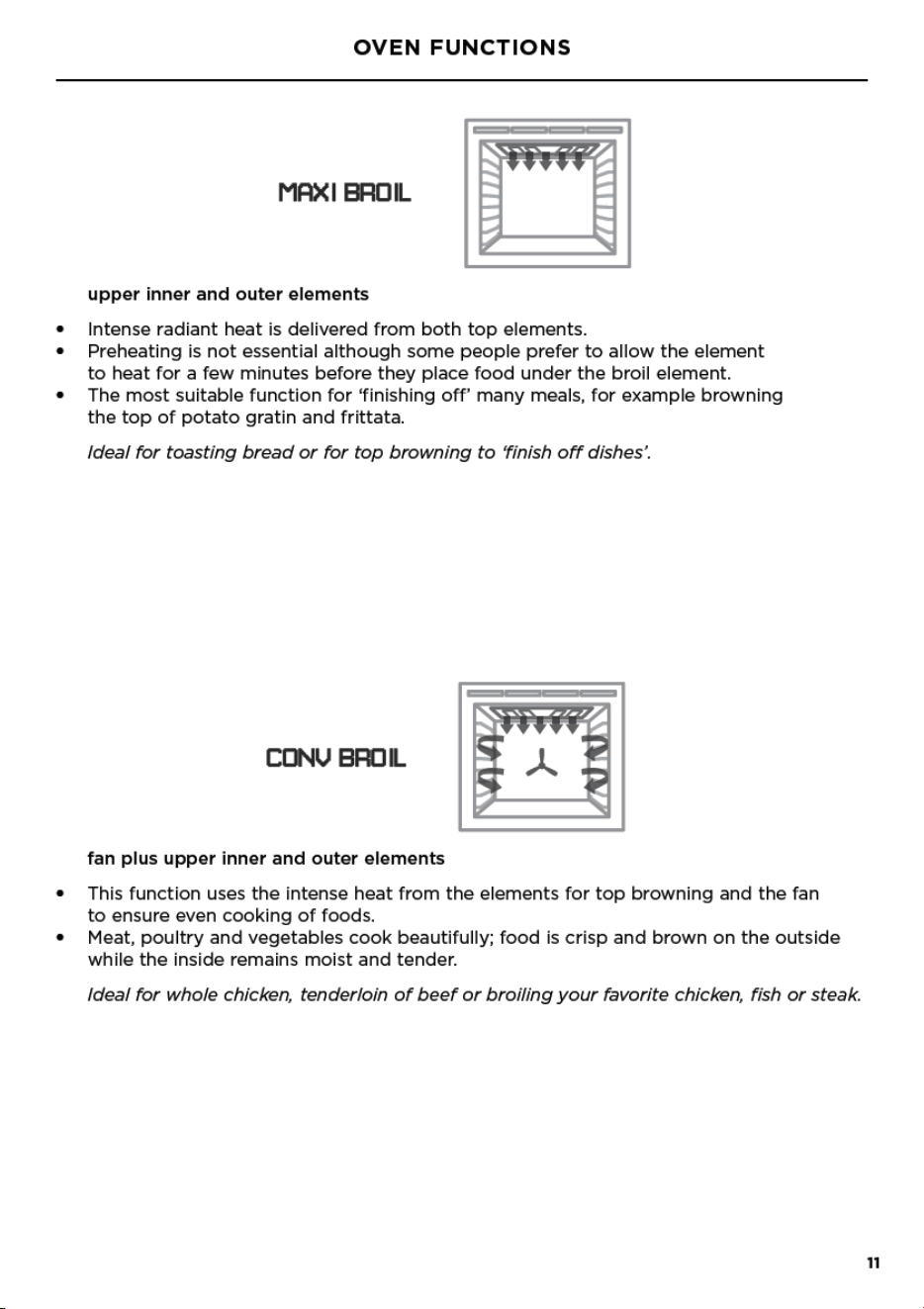
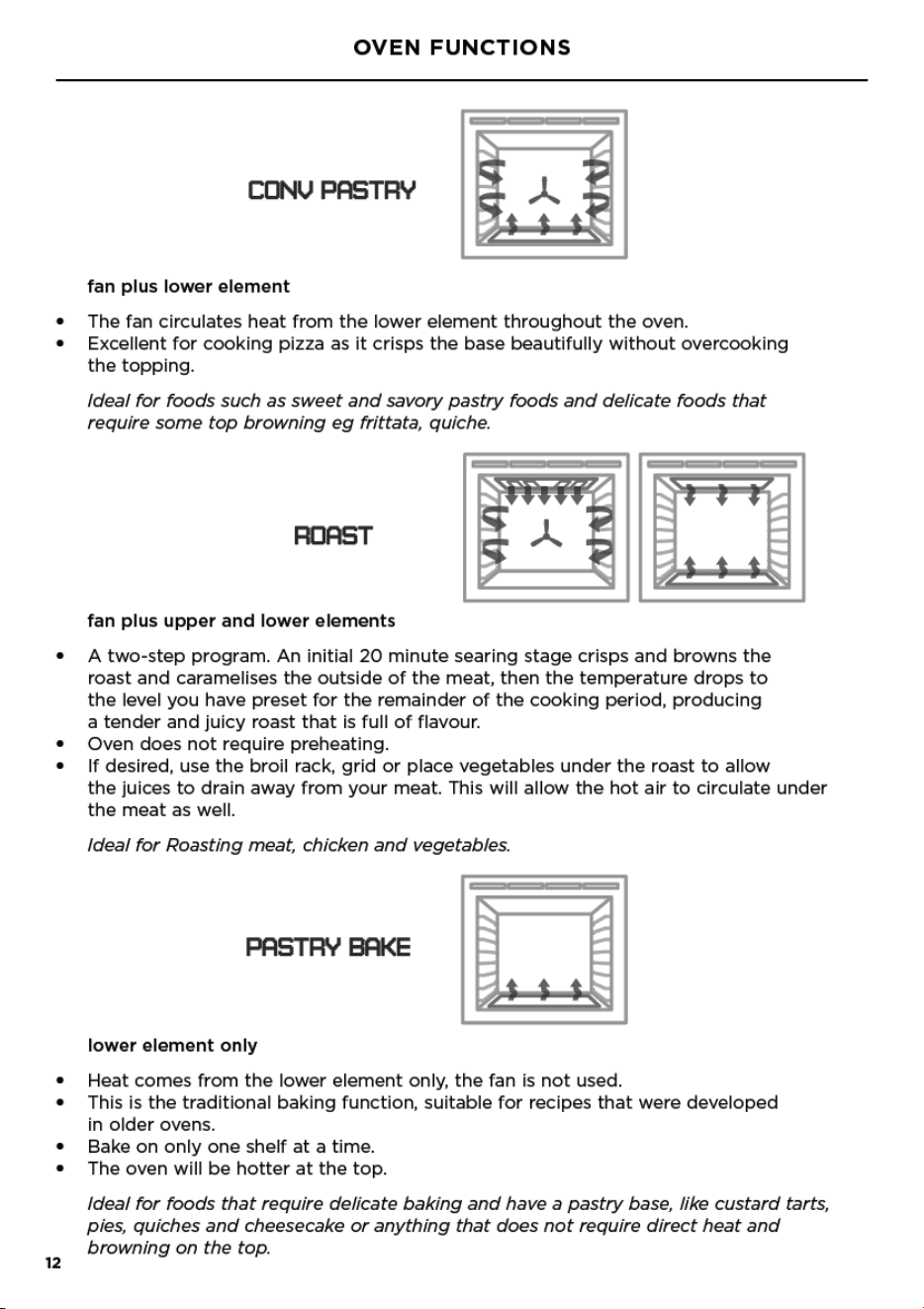

13
this is not a cooking function
●
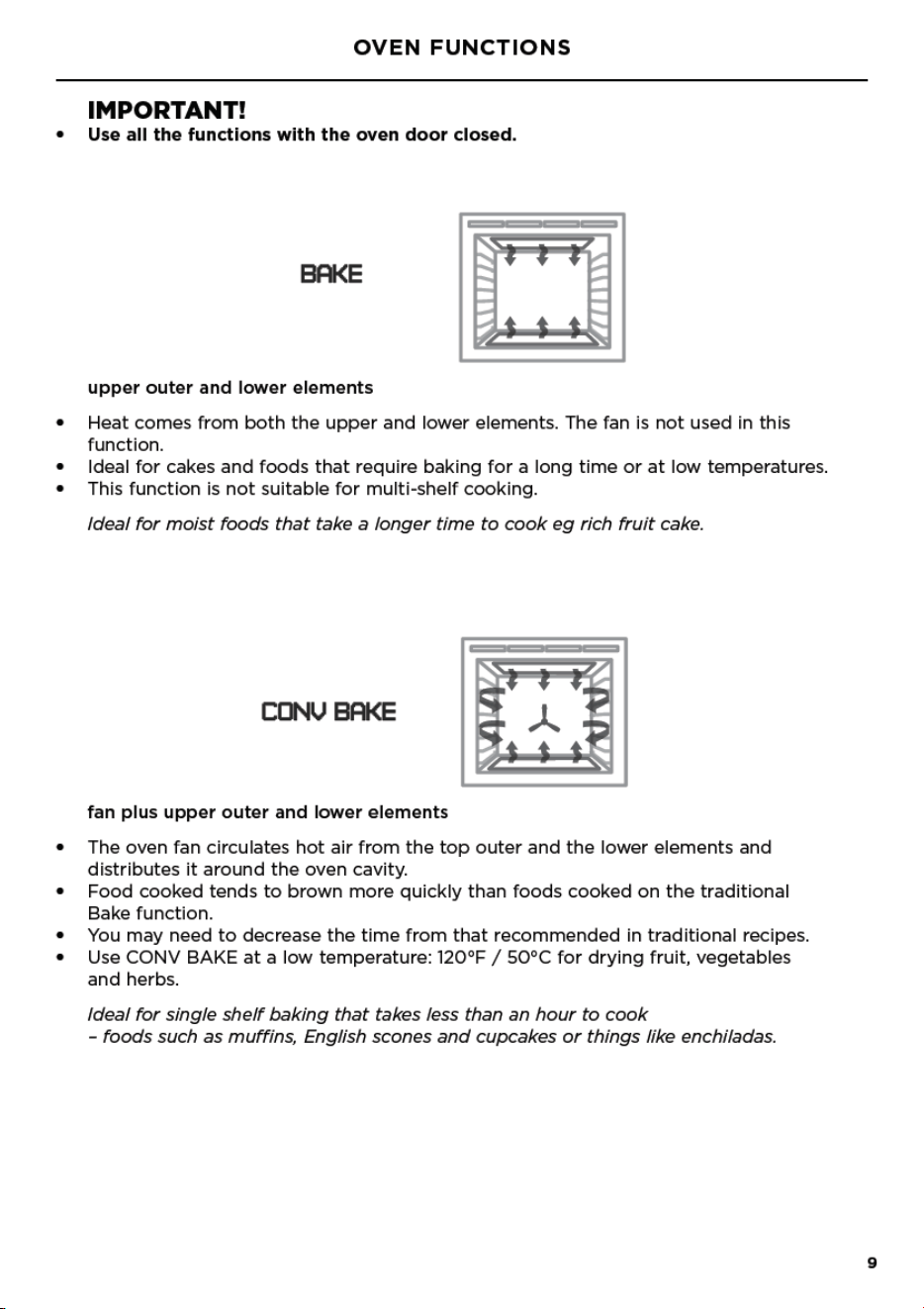
Provides a constant low heat of less than 195°F / 90°C.
●
Use to keep cooked food hot, or to warm plates and serving dishes.
To reheat food from cold, use another oven function to heat the
food piping hot and only then change to Warm, as this function
alone will not bring cold food up to a high enough temperature
to kill any harmful bacteria.
●
Use the WARM function to prove bread. See ‘Tips for proving bread’.
this is not a cooking function
●
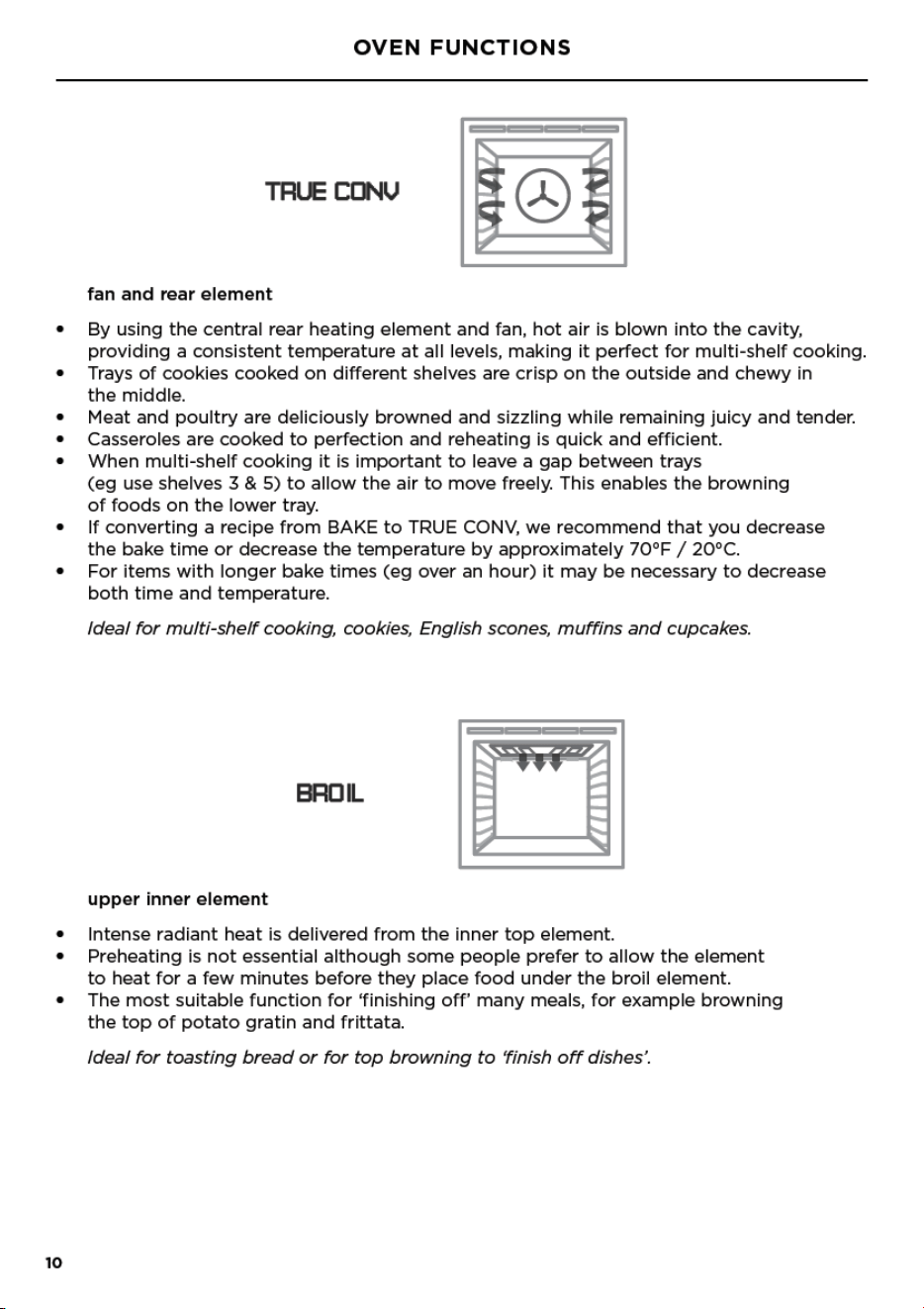
The Self Clean cycle takes care of the mess and grime that is
traditionally associated with oven cleaning.
●
There are two Self-Clean cycles available:
●
Self clean (which takes 5 hours) for normal cleaning and
●
Light self-clean (which takes 4 hours) for lightly soiled ovens.
●
See ‘Using the Self Clean function’ in the User guide for details.
WARM
SELF CLEAN
Tips for dehydrating fruit
●
To obtain high quality dried fruit, select only unblemished, ripe fruit.
●
Wash fruit thoroughly and pat dry. Peel if desired. Fruit that is not peeled will
take longer to dry. Remove pits, stems or seeds if necessary. Place fruit on a
baking tray on a shelf in the oven.
●
We recommend using TRUE CONV or CONV BAKE at 120°F / 50°C.
Tips for proofing bread
●
Your oven provides an ideal sealed environment for proofing bread.
1 Select the WARM function.
2 Adjust the temperature down until the display shows `Lo’ .
3 Place dough in a lightly oiled bowl and cover with plastic wrap and/or a
clean damp cloth.
4 Place the bowl into the warmed oven on shelf position 1.
Note: some recipes recommend putting water or ice in the oven with the bread
dough during baking. The additional moisture improves the bread crust.
You must place the water or ice in a heat resistant dish and on an oven shelf
in positions 1 or 2. Do not put it directly onto the oven floor. Placing water, ice or
any dish or tray directly on the oven floor will irreversibly damage the enamel.
OVEN FUNCTIONS

14
COOKING CHARTS
BAKING
●
Shelf positions are counted from the base up
(1 is the lowest, 8 is the highest).
Position shelves before you turn the oven on.
●
For best results preheat the oven to the required temperature.
●
The broil element may come on while the oven is heating up.
●
The halo on the temperature knob will change from white to orange when
the oven has reached the selected temperature. The halo may change between
white and orange as the oven maintains its set temperature.
FOOD SHELVES
Biscuits Plain Single
Multi
Chewy Choc Chip Single
Multi
Sugar Cookies Single
Multi
Cakes Pound Cake Single
Chocolate Brownie
(8"x8"/20x20cm pan)
Single
Angel Food Cake
(10"x4"/25x10cm tube pan)
Single
Rich Fruit Cake Single
Sponge
(single large) Single
Sponge
(2x20cm) Single
Muffins / Cupcakes Cupcakes Single
Multi
Muffins Single
Multi
Scones English Scones Multi
Meringues Meringues Single
Bread/Bread rolls Sandwich Loaf
(
9"x5"/23x13cm Loaf Pan)
Multi
Wholewheat Loaf
(
9"x5"/23x13cm Loaf Pan)
Single
Soft Dinner Rolls Single
Dough Proof Single
Pastry Pastry Shell
(baked blind) Single
Pies Fruit Pie
(2 crust) Single
Baked Cheesecake
(in water bath) Single
Pumpkin Pie
(blind bake, add filling) Single
English Custard Tart
(blind bake, then add filling)
Single
Dessert Crème Brulee
(in water bath) Single
Crème Caramel
(in water bath) Single

15
COOKING CHARTS
The information in these charts are guidelines only. Refer to your recipe or
the packaging and be prepared to adjust the cooking times and settings accordingly.
RECOMMENDED
FUNCTION
SHELF
POSITIONS
TEMP (°F) TEMP (°C) TIME (MINS)
Conv Bake 4 400–425 210–220 8–10
True Conv 2 & 5 425–450 215–230 10–12
Conv Bake 4 355–375 180–190 10–15
True Conv 2 & 5 325–340 160–170 10–15
Conv Bake 4 350–375 175–190 7–15
True Conv 2 & 5 325–350 160–175 7–15
Bake 4 325 160 70–80
Bake 4 350 175 20–25
Bake 4 325–350 160–175 50–60
Bake 4 275–300 135–150 3–6 hrs
Bake 4 350 175 30–40
Bake 4 350 175 15–25
Bake 4 365 185 13–18
True Conv 2 & 5 345 170 13–18
Conv Bake 4 345 170 23–30
True Conv 2 & 5 345 170 23–30
True Conv 4 425–450 215–230 10–12
Conv Bake 4 250–270 120–130 60–70
True Conv 4 350 175 40–50
Bake 4 375 190 35–45
Bake 4 375 190 15–18
Bake 1 LO LO 30
Bake 4 350 175 15
Bake 4 400–350 200–175 20–25
Warm 4 325 160 50–60
Conv Pastry 4 350–375 175–190 15–30
Conv Bake 4 350–300 175–150 15–30
Pastry Bake 4 275 135 35–45
Pastry Bake 4 350 175 35–45

16
COOKING CHARTS
* If multiple shelves are required (eg roasting vegetables at the same time), use True Conv and shelf positions 1 & 4.
SAVOURY
ROASTING
FOOD SHELVES
Cornbread Single
Vegetables Single
Lasagne Single
Casserole Single
Pizza Single
Quiche
(blind bake, then add filling) Single
Potatoes (whole, baked) Single
Frittata (shallow) Single
Oven Meals Single
FOOD SHELVES *
RECOMMENDED
FUNCTION
Beef (Boneless) Rare Single Roast
Medium Roast
Well Done Roast
Prime Rib Roast Rare Single Roast
Medium Roast
Well Done Roast
Lamb Rack Medium Rare Single Bake
Lamb leg (Bone in) Medium Single Roast
Well Done Roast
Lamb leg (Boneless) Medium Single Roast
Well Done Roast
Veal Medium Single Roast
Well Done Roast
Chicken Whole Unstuffed Single Conv Broil
Whole Stuffed Bake
Whole Butterflied Conv Broil
Turkey (Whole) Stuffed Single Bake
Unstuffed Bake
Pork (Boneless) Medium Single Roast
Well Done Roast
Pork Crackling Crisp (watch closely) Single Conv Broil
Venison Brown in
a pan first
Rare Single Conv Broil
Medium Conv Broil

17
COOKING CHARTS
** The internal temperature will rise more on standing.
RECOMMENDED
FUNCTION
SHELF
POSITIONS
TEMP (°F) TEMP (°C) TIME (MINS)
Conv Bake 4 400–425 210–215 20–25
Conv Bake 4 350–375 175–190 30–50
Conv Bake 4 350–375 175–190 35–40
Bake 4 300–350 150–175 1–2 hours
Conv Pastry 2 425 220 10–15
Conv Pastry 4 350 175 15–30
Bake 4 390 200 50–60
Conv Pastry 3 340–360 170–180 15–20
True Conv 4 340–375 170–190 30–40
SHELF
POSITIONS
TEMP (°F) TEMP (°C) TIME (MINS)
MEAT PROBE
(°F) **
MEAT PROBE
(°C) **
3 320–340 160–170 18–32 /450g 130–138 54–59
3 320–340 160–170 25–40 /450g 140–165 60–74
3 320–340 160–170 30–55 /450g 165–174 74–79
3 320–340 160–170 15–30 /450g 130–138 54–59
3 320–340 160–170 20–35 /450g 140–165 60–74
3 320–340 160–170 25–40 /450g 165–174 74–79
3 390 200 20 122 50
3 320–340 160–170 18–28 /450g 149–158 65–70
3 320–340 160–170 20–33 /450g 165–174 74–79
3 320–340 160–170 20–35 /450g 149–158 65–70
3 320–340 160–170 25–45 /450g 170–174 77–79
3 320–340 160–170 20–40 /450g 160 71
3 320–340 160–170 25–45 /450g 170 76
3 350 175 15–20 /450g 165 75
3 350 175 17–22 /450g 165 75
4 350 175 40–50 165 75
2 or 3 320–340 160–170 17–22 /450g 165 75
2 or 3 300–330 150–165 15–20 /450g 165 75
3 340–350 170–175 25–40 /450g 145–154 63–68
3 340–350 170–175 30–45 /450g 165–174 74–79
4 430 220 5 to 10 na na
4 435 225 7 /2.5cm meat
thickness
120–129 49–54
4 435 225 9 /2.5cm meat
thickness
131–140 55–60

18
COOKING CHARTS
BROILING
FOOD SHELVES
Beef Steak Rare Single
Medium Single
Hamburger
(ground–patties)
Single
Meatballs
(ground)
Single
Lamb Chops Medium Single
Well done Single
Pork Chops (well done) Single
Ham steak Single
Bacon Single
Chicken Boneless pieces Single
Bone In Pieces Single
Sausages Sausages Single
Fish Fillets Single
Whole Single
Vegetables Sliced Single

19
COOKING CHARTS
RECOMMENDED
FUNCTION
SHELF
POSITIONS
TEMP (°F) TEMP (°C) TIME (MINS)
Broil 6 HI HI 8–10
Broil 6 HI HI 10–15
Broil 6 HI HI 12–15
Broil 6 HI HI 12–15
Broil 6 HI HI 15–20
Broil 6 HI HI 20–25
Broil 6 HI HI 15–20
Broil 6 HI HI 15–20
Broil 6 HI HI 4–7
Conv Broil 4 350 175 30–50
Conv Broil 4 350 175 40–50
Broil 6 HI HI 10–15
Conv Broil 5 390–430 200–220 8–12
Conv Broil 5 390–430 200–220 15–20
Broil 6 HI HI 8–12
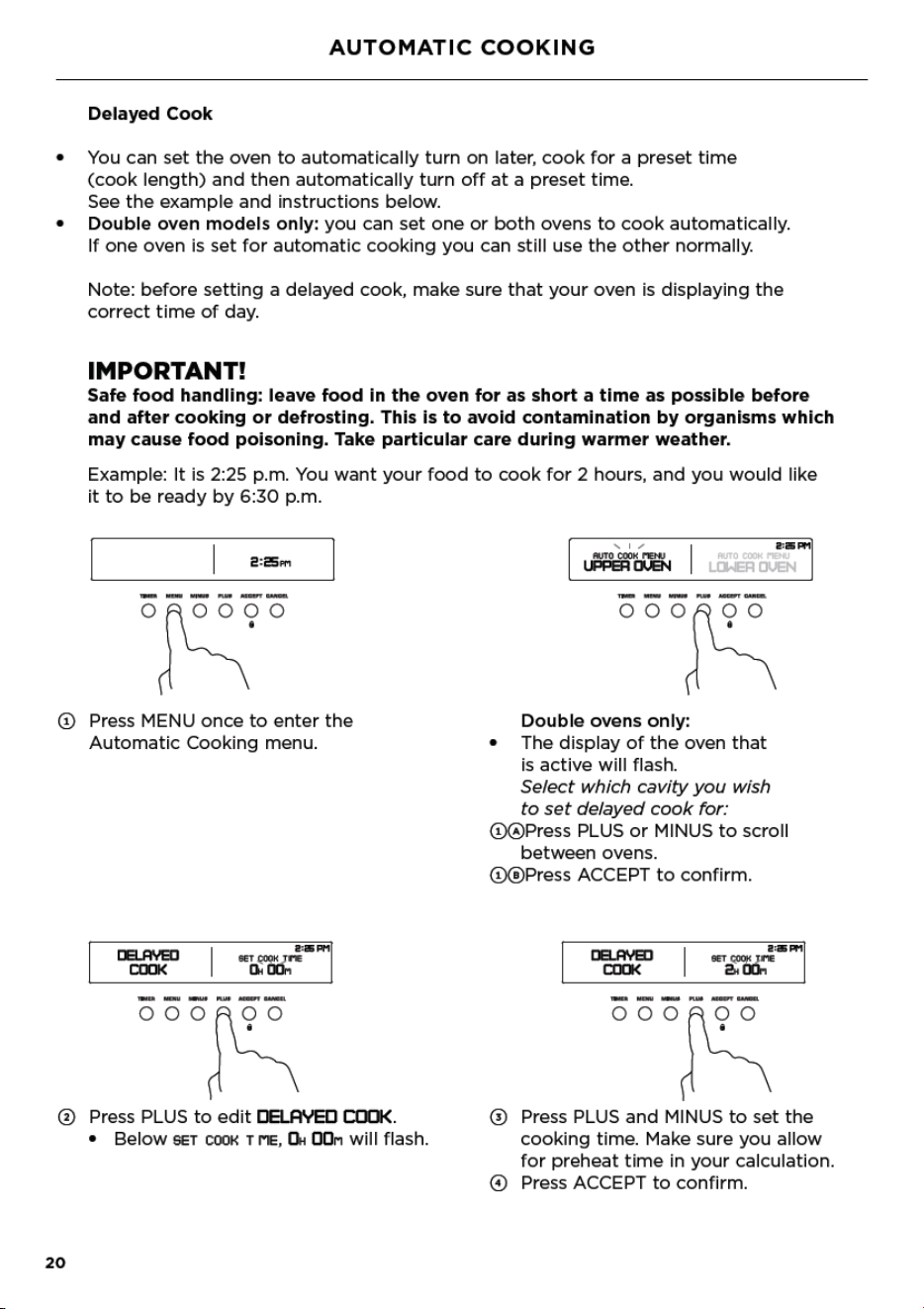
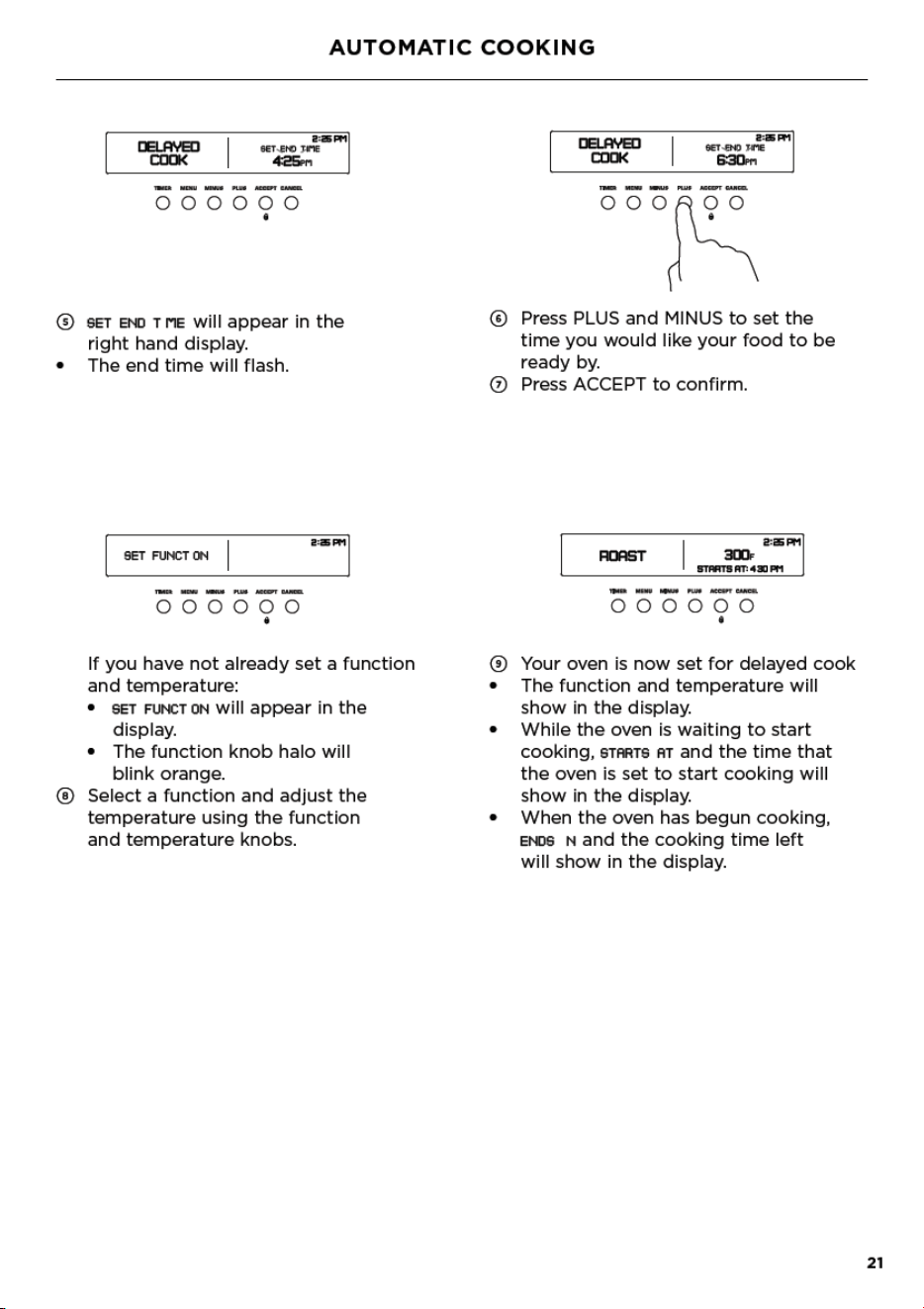

24
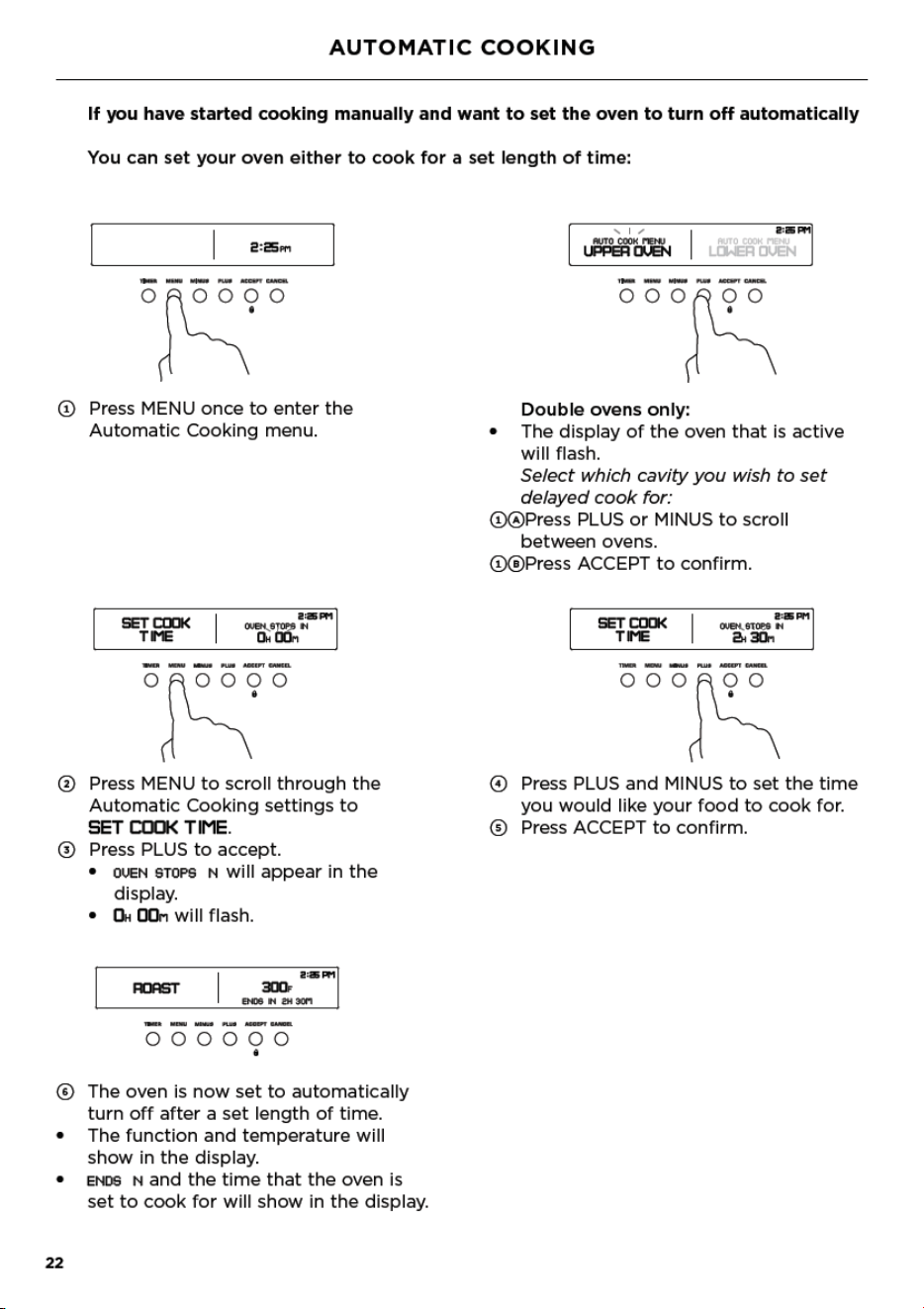
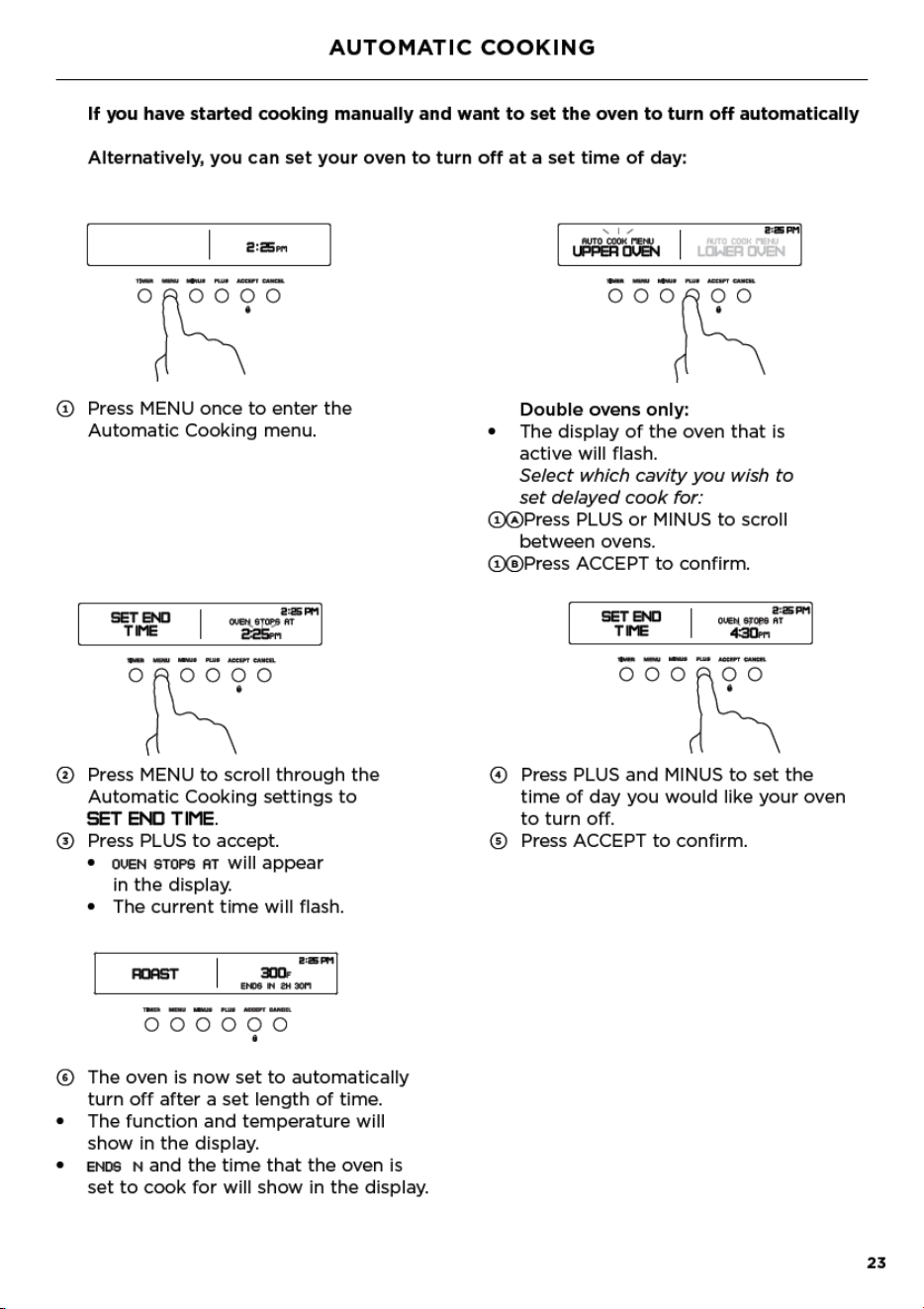
Double oven models only:
To set automatic cooking for the second oven, follow the steps above, selecting
the second oven at step 2.
When automatic cooking is set
●
The oven and the lights will stay off, the halos will be unlit, but your oven is now
set for automatic cooking. It will automatically turn on at the required time.
Note: you can modify the function and temperature while the oven is waiting
to start cooking.
While the oven is heating up
IMPORTANT!
●
During automatic cooking the broil element will come on while the oven is heating up.
Food placed into a cold oven could be prone to burning as the oven heats up.
●
Large items and foods with a high fat or sugar content are especially prone to
burning. Take particular care with foods such as macaroni cheese, large poultry,
and enchiladas.
●
Ideal foods for automatic cooking include stews, casseroles, braised meat and potato
top pie.
●
Position food on a lower shelf to prevent burning.
●
Where possible cook food in a pan with a lid, or cover food with foil.
To change the cook length or end time
●
Follow the steps previously to enter the Automatic Cooking menu and adjust as desired.
To exit the Automatic Cooking menu
●
Press and hold CANCEL to clear the selection at any point while adjusting Automatic
Cooking and exit the menu.
To cancel automatic cooking
●
When automatic cooking has been set, turn the function knob to Off at any point to cancel.
When the stop time is reached
The temperature will turn off and a long tone will sound.
Turn the function knob to the off position.
AUTOMATIC COOKING

27
USING THE MEAT PROBE
To cancel the meat probe at any time
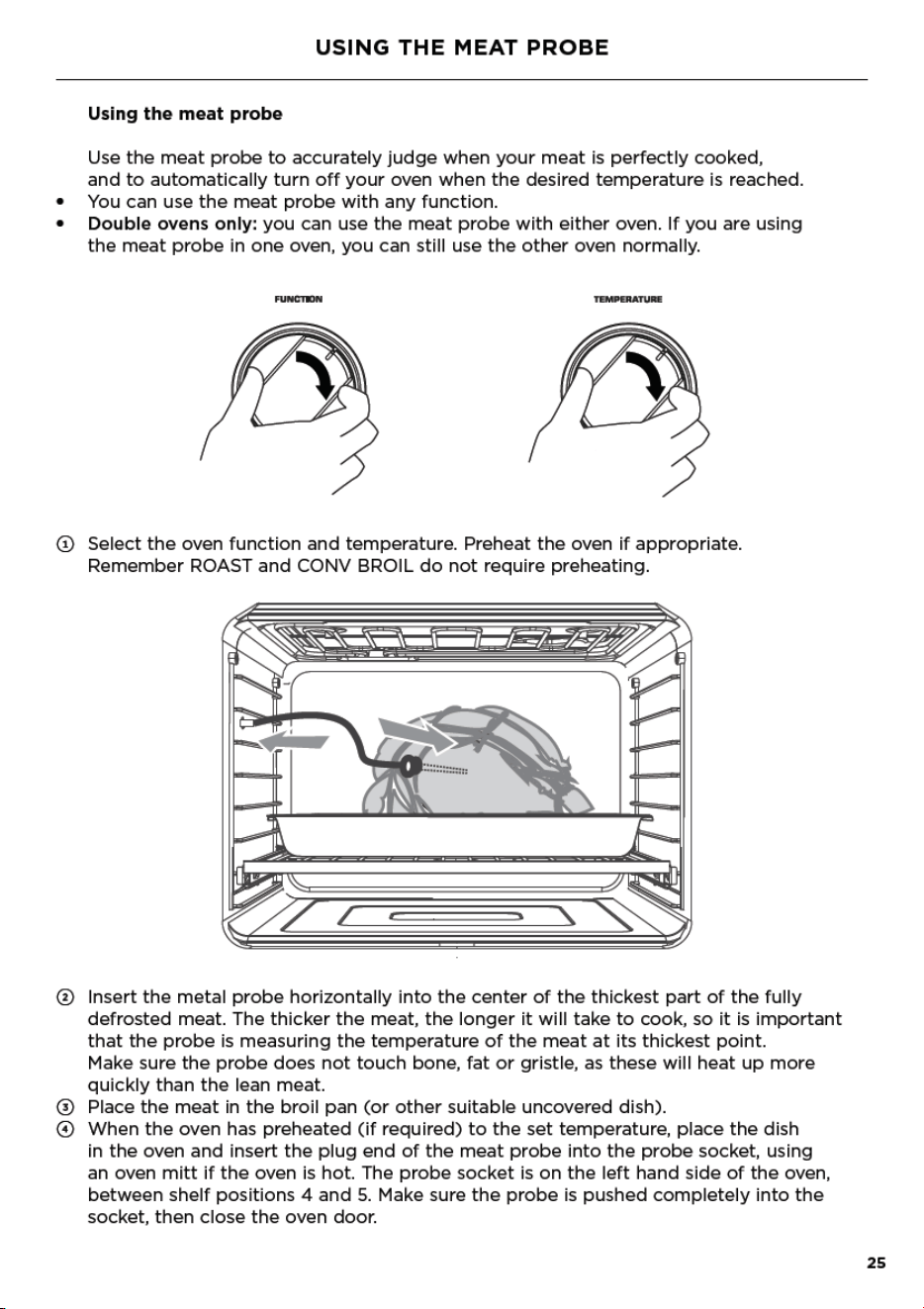
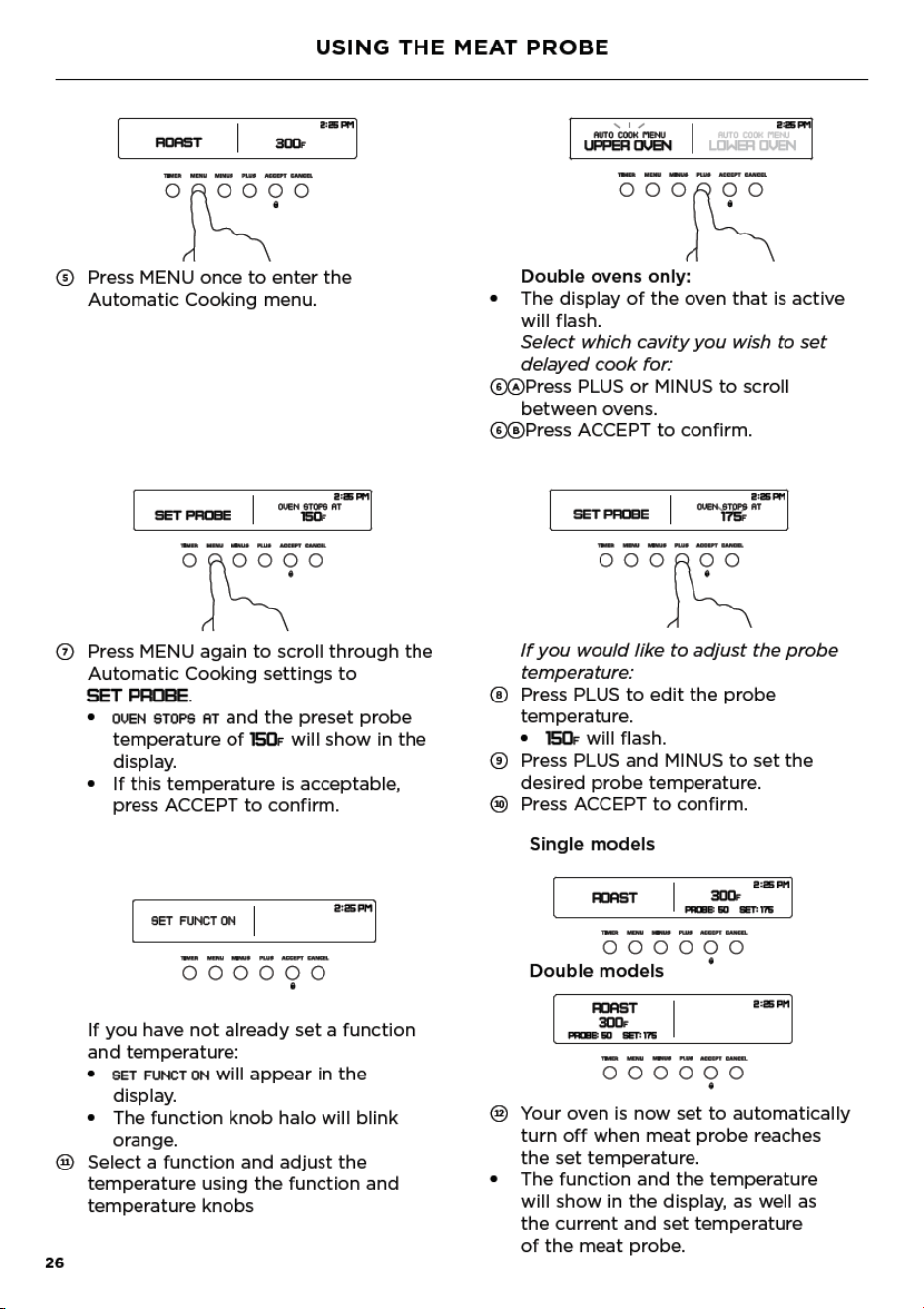
1 Press MENU once to enter the Automatic Cooking menu.
Double ovens only:
●
The display of the oven that is active will flash.
Select which cavity you wish to cancel the meat probe for:
1APress PLUS or MINUS to scroll between ovens.
1BPress ACCEPT to confirm.
●
The SET PROBE menu appears.
2 Press and hold CANCEL until the set temperature for the probe disappears.
The oven will remain on.
To cancel the meat probe and turn off the oven at any time
Turn the function knob to OFF.
When the probe preset temperature is reached
●
A beep will sound.
●
Press any button to stop the beeping.
●
The set function and temperature will go out in the display and the oven will stop heating
●
Turn the function knob to the Off position to turn the oven off.
Tips for using the meat probe
●
You can still use the timer when the meat probe is in use.
●
You cannot use the meat probe with Automatic cooking.
●
The internal temperature of the meat will continue to rise by 35-45°F / 2-8°C
after you have removed it from the oven, so allow for this in your calculations.
Cover with foil and let it rest for 15 to 20 minutes.
●
If you wish to remove the meat from the oven (eg basting), unplug the meat probe
from the socket but do not remove it from the meat. The display will show
probe; -- .
When you are ready to resume cooking, re-insert the probe plug into the socket
and the display will again show the internal temperature of the meat.
IMPORTANT!
●
Use only the meat probe supplied with your oven, purchased from your Fisher & Paykel
dealer or replaced under warranty by your nearest Fisher & Paykel Authorized Repairer.
●
Hold the meat probe at the handle when inserting and removing it from food and the
meat probe socket.
●
Remember to remove the meat probe from the oven before you start a self-clean cycle.
●
Do not store the probe in the oven.
●
Only use the probe with fully defrosted food.
●
Wash the meat probe in mild soapy water but do not immerse. It is NOT dishwasher safe

29
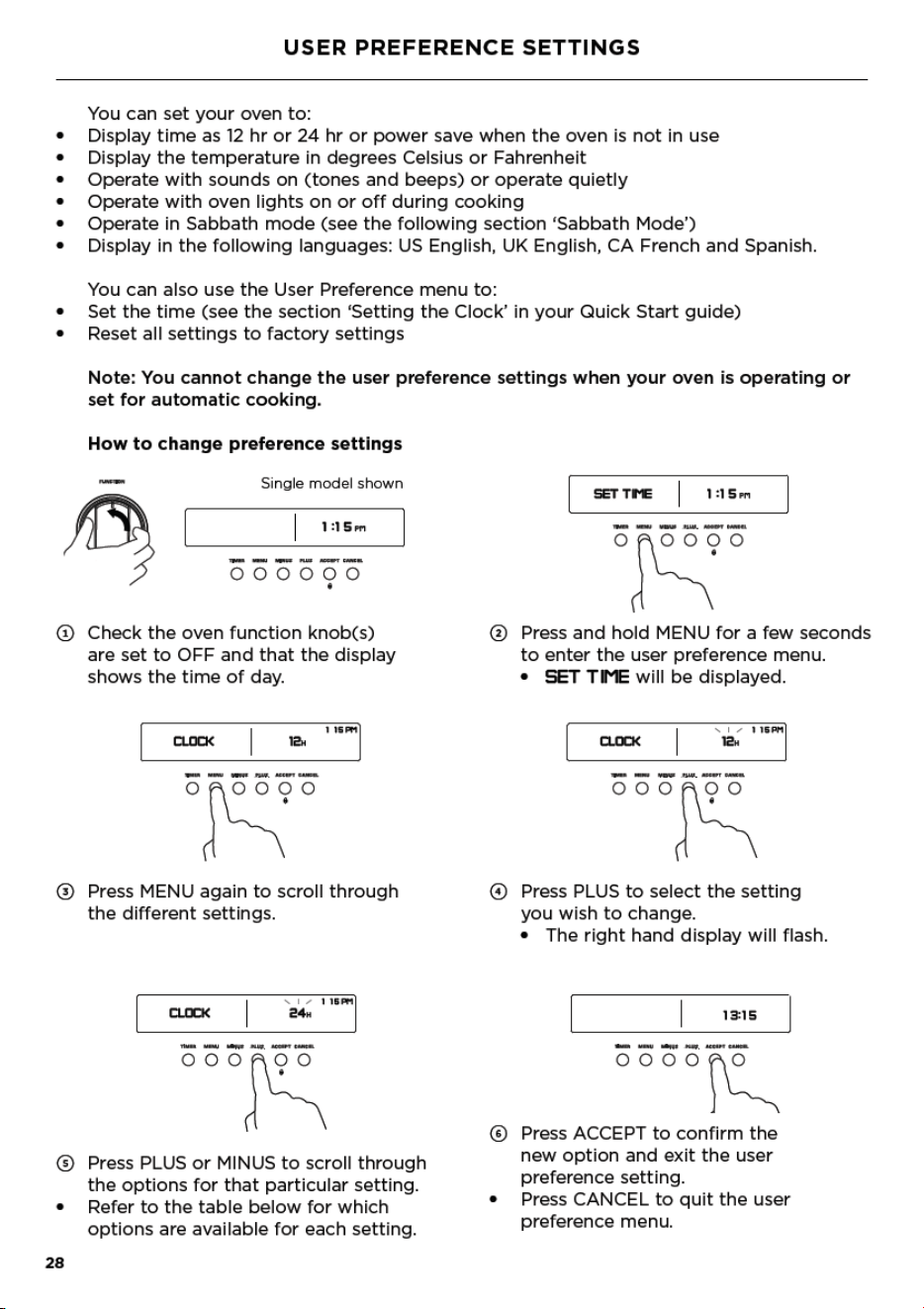
USER PREFERENCE SETTINGS
SETTING DEFAULT OPTION ALTERNATIVE OPTION(S)
SET TIME
The current time will show in the display.
See your Quick Start guide for instructions on setting the time.
CLOCK
Select between 24-hour
or 12-hour clock display.
POWER SAVE MODE**
Set the display to turn
off when the oven is not
in use.
DEGREE SCALE
Select between degrees
Celsius or Fahrenheit.
SOUNDS
Turn audio feedback
(beeps and tones)
on and off).*
OVEN LIGHTS
Have the light off during
cooking if you want to
save power or want the
food you cook to be a
surprise for others.
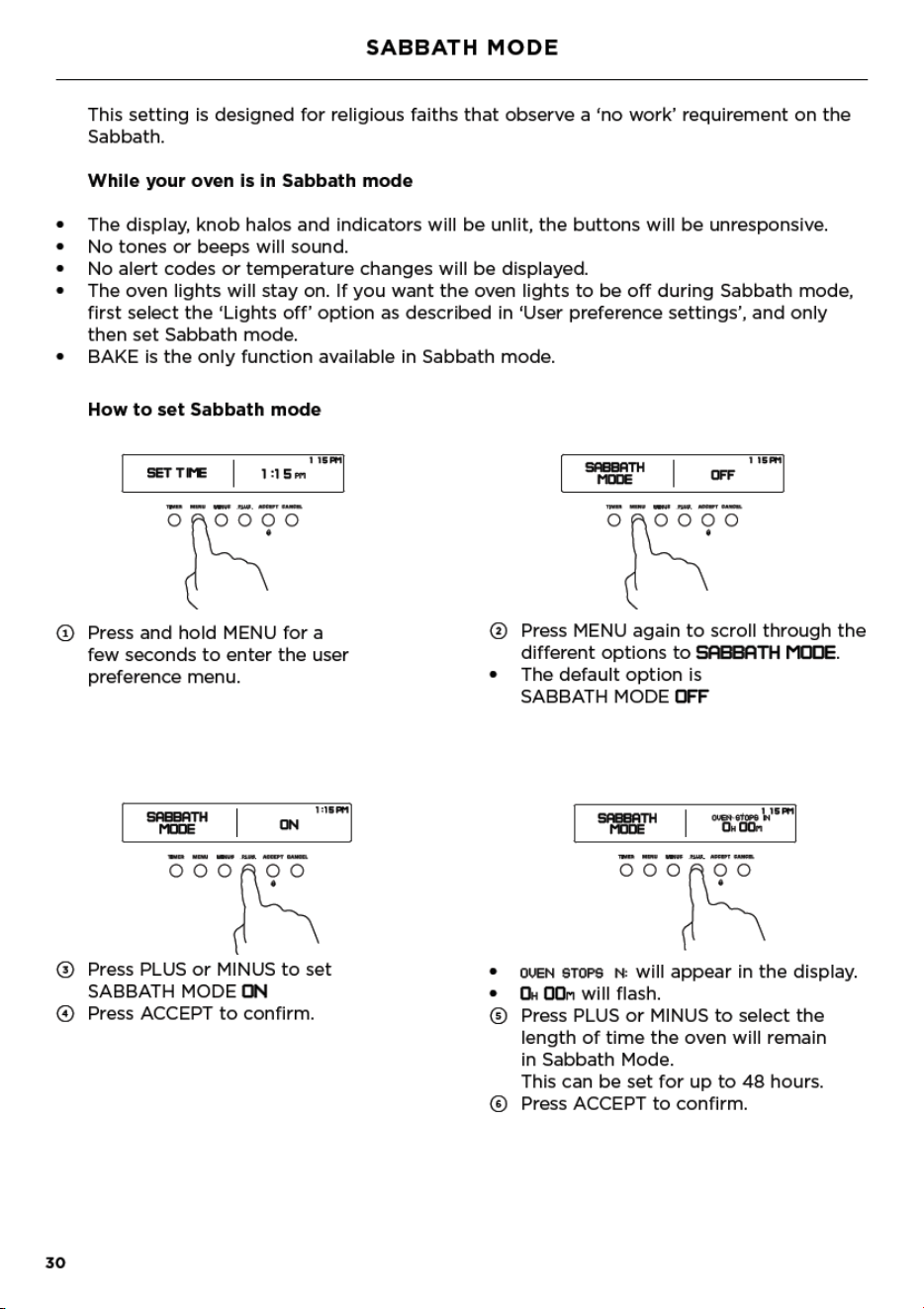
SABBATH MODE
LANGUAGE
Choose the language you
would like the oven to
display in.
USER SETTINGS RESET
Use this to clear all
changes to settings
and reset to the factory
settings
BEEPS/TONES ON BEEPS/TONES OFF
CELSIUS
24 H
LIGHTS ON
DURING COOKING
POWERSAVE
MODE ON
POWERSAVE
MODE OFF
LIGHTS OFF
DURING COOKING
FAHRENHEIT
12 H
See ‘Sabbath Mode’ for
instructions.
Select this option and accept
to reset all user settings.
* The timer tone and alert beeps will sound even if you save the BEEPS/TONES OFF option.
** With this option on, when the oven is not in use, the display will go into power save mode and turn off.
The display will remain on whenever the oven is in use.
SABBATH OFF
US ENGLISH
RESET
UK ENGLISH FRENCHSPANISH
24h
FAHRENHEIT
ON
ON
ON
OFF
US
ENGLISH
RESET
UK
ENGLISH
FRANCAISEESPANOL
OFF
OFF
OFF
CELSIUS
12h

33
CARE AND CLEANING
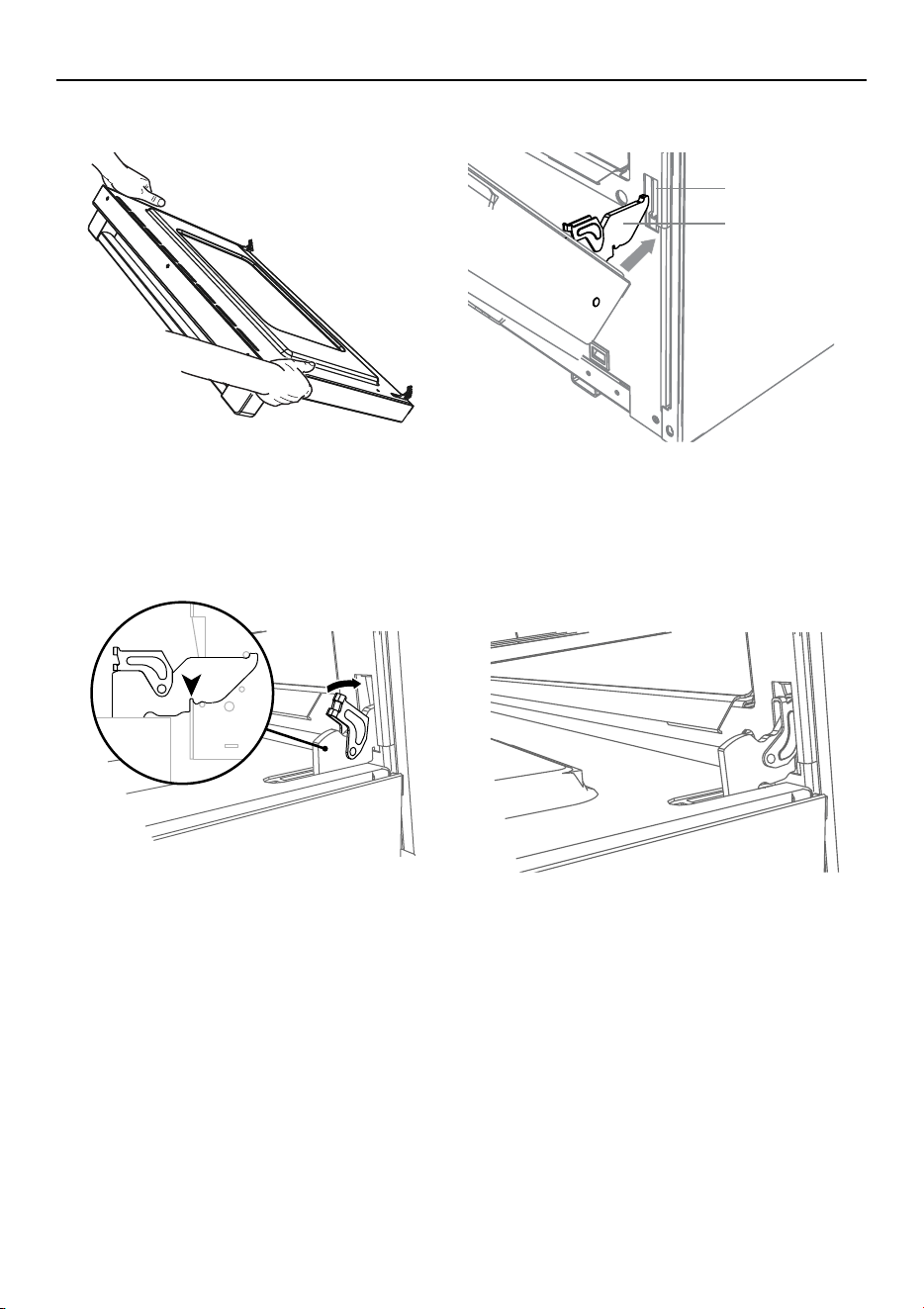
To replace the oven door
1 Hold the door firmly in an approximately
halfway open position.
4 Open the door completely and check
that the hinges are both secured by the
correct notches as shown.
5 Rotate the locks into the closed position.
2 Align the hinge tongue with the hinge
slots and push the door until you feel
the latches locate into position on
each side.
6 Close the oven door.
IMPORTANT!
Hinge locks should rest inside the
slots. Incorrect installation will
prevent door from correctly sealing.
Hinge slot
Hinge tongue
34
CARE AND CLEANING
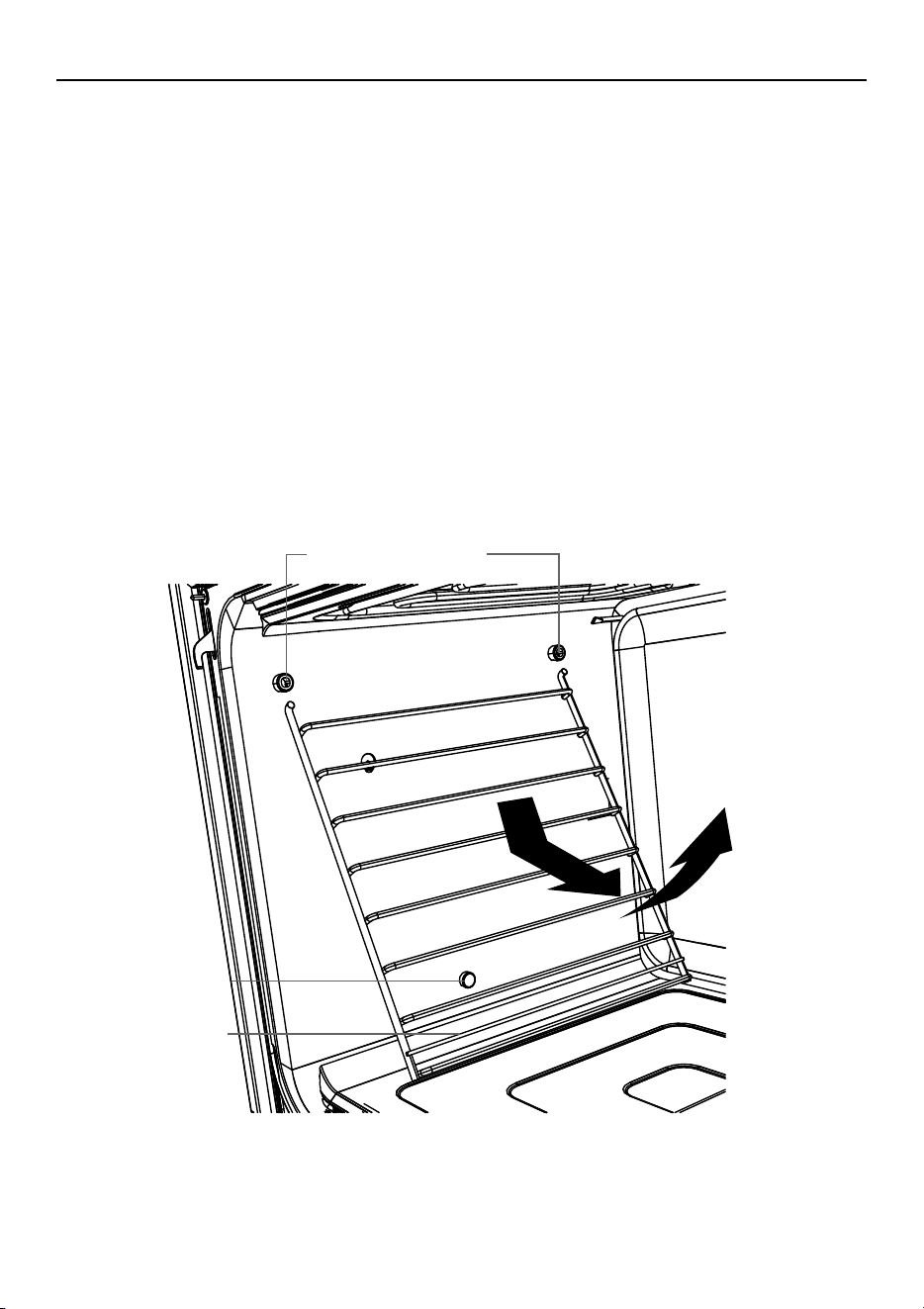
Removing and replacing the sliding shelves and side racks
1 To remove a sliding shelf, grip it by its two front corners (making sure you are gripping
the wire shelf and the sliding frame together), tilt upwards and pull it out of the oven.
2 To remove the side racks, gently push the retaining wire from underneath the
lock stud, then swing the lowest edge of the side rack up and out towards the center
of the oven until the rack is almost horizontal. The prongs at the top will slide out
of the mounting slots.
3 To replace the side racks, hold them almost horizontally and locate the prongs
into the small mounting slots at the top of the oven cavity. While you are doing
this, support the rack with your hand from underneath, to ensure that both prongs
perfectly locate into the mounting slots.
4 Lower the side racks carefully and gently place the retaining wire underneath
the lock stud.
IMPORTANT!
Do not lower the side racks until the prongs are fully inserted into the slots so that
you do not chip the enamel.
Mounting slots
Retaining wire
Lock stud

36
Manual cleaning
WHAT? HOW? IMPORTANT!
Aluminium
framing of oven
door and plastic
corner clips
Clean with a solution of mild
detergent and hot water, then
wipe dry.
Oven cavity
●
To clean light soiling off the
enamelled surfaces:
1 Wipe with a damp cloth and a
solution of hot water and mild
detergent or an ammonia-
based cleaner.
2 Wipe dry with a soft cloth.
●
To clean stubborn, ‘baked
on’ soiling or the whole
oven cavity: use the Self
Clean function. See ‘Using
the Self Clean function’ for
instructions.
●
To prevent soiling from
becoming ‘baked on’ and
stubborn, we recommend
removing any easy-to-reach
spills, food or grease stains
from the enamelled surfaces
after each use. Doing so will
reduce the need for using the
Self Clean function frequently.
●
Always remove the side racks
before a Self Clean cycle
●
To make wiping out the
oven easier you may remove
and the oven door. See
the following pages for
instructions.
Oven door glass Use a mild solution of detergent
and warm water; use a glass
cleaner to remove smears.
Do not use sharp metal scrapers
or scourers on the glass as it
may scratch the surface and
cause the glass to shatter.
CARE AND CLEANING
ALWAYS NEVER
●
Before any manual cleaning or
maintenance, first wait for the oven
to cool down to a safe temperature
to touch, then turn its power supply
off at the wall.
●
Read these cleaning instructions and
the ‘Safety and warnings’ section before
you start cleaning your oven.
●
To prevent soiling from becoming
‘baked on’ and stubborn, we
recommend removing any easy-to-reach
spills, food or grease stains from the
oven cavity enamel after each use.
●
Always clean the inner glass pane
before starting a Self Clean cycle
(where available).
●
Always remove oven shelves and
side racks before starting a Self Clean
cycle (where available).
●
Never use a steam cleaner.
●
Never store flammable substances
in the oven.
●
Never use abrasive or harsh cleaners,
cloths, scouring pads or steel wool.
Some nylon scourers may also scratch.
Check the label first.
●
Never use oven cleaner on catalytic
panels or in a pyrolytic oven.
●
Never leave alkaline (salty spills) or
acidic substances (such as lemon juice
or vinegar) on the oven surfaces.
●
Never use cleaning products with a
chlorine or acidic base.
●
Never spray detergent or liquid onto
the buttons on the control panel.
Liquid may seep behind the button
and damage the electronics.

37
Manual cleaning
WHAT? HOW? IMPORTANT!
Knobs Clean with a solution of mild
detergent and hot water, then
wipe dry.
Do not use stainless steel or
oven cleaner on the knobs, as
doing so may damage their
coating.
Stainless steel
strip/handle on
the front of the
oven door
●
Clean with a solution of
mild detergent and hot
water, then wipe dry with
a microfibre cloth.
●
If necessary, use a suitable
stainless steel cleaner and
polish.
●
Always read the label to make
sure that your stainless steel
cleaner does not contain
chlorine compounds as
these are corrosive and may
damage the appearance of
your oven.
●
Always rub the stainless steel
in the direction of the grain.
Telescopic
sliding shelf
supports
Wipe with a damp cloth and
mild detergent.
Do not wipe off or wash away
the white lubricating grease
(visible when the slides are
extended).
Do not wash these in the
dishwasher, immerse in soapy
water, use oven cleaner on them
or leave in the oven during a
Self Clean cycle (where available)
as doing so will remove the white
lubricating grease and prevent
the slides from running smoothly.
Meat probe Clean with a solution of mild
detergent and hot water, then
wipe dry with a microfiber cloth.
●
Clean after every use to
avoid contamination.
●
Do not wash in the dishwasher,
immerse in soapy water, use
oven cleaner or leave in the
oven during a Self Clean cycle
(where available).
Broil pan
Side racks
Oven shelves
●
Clean with a solution of mild
detergent and hot water.
●
Pre-soak stubborn burnt-on
stains in a solution of
dishwasher powder and
hot water.
●
These parts are dishwasher safe.
●
Never leave any of these
parts in the oven during
a Self Clean cycle.
They will become discoloured
or damaged.
Oven seal Do not clean this part.
Oven vent
louvres
Wipe with a damp cloth. Take care not to let any liquid
run down the louvres of the
oven vent.
CARE AND CLEANING
38
●
During the pyrolytic Self Clean cycle the extremely high temperature burns off
and breaks down grime and grease deposits. All that is left is a small amount
of grey ash that you can easily remove.
●
There is a choice of two Self Clean cycles:
- Self Clean (5 hours) (for normal soiling).
- Light Self Clean (4 hours) (suitable for a light or localised soiling).
Double oven models only:
●
Only one oven can be self-cleaned at a time.
●
During the Self clean cycle you cannot use the other oven or set Automatic cooking.
IMPORTANT!
●
You must clean the inside glass door panel BEFORE starting a self-clean cycle.
Failure to do this may result in permanent staining or marking of the door glass.
●
Do not use oven cleaners, any degreasing cleaners, or oven liners.
●
Make sure you remove the side racks, oven shelves and trays and all other
bakeware and utensils from the oven before starting a Self Clean cycle.
If left in the oven, they will become permanently discoloured or damaged;
items made from combustible materials (eg wood, fabric, plastic) may even
catch fire.
●
Do not use your oven to clean miscellaneous parts.
●
Make sure the room is well ventilated.
●
Before starting a Self Clean cycle, make sure you move any pet birds to another,
closed and well-ventilated room. Some pet birds are extremely sensitive to the
fumes given off during a Self Clean cycle, and may die if left in the same room
as the oven during such a cycle.
●
During a Self Clean cycle, the oven reaches higher temperatures than it does
for cooking. Under such conditions, the surfaces may get hotter than usual and
children should be kept away.
●
The oven door will be locked during the Self Clean cycle (approximately 3 hours).
●
If there are cracks or flaws on any of the oven door glass panes, if the oven seal
is damaged or worn, or if the door does not close properly, do not start a
Self Clean cycle. Call your Authorised Repairer or Customer Care.
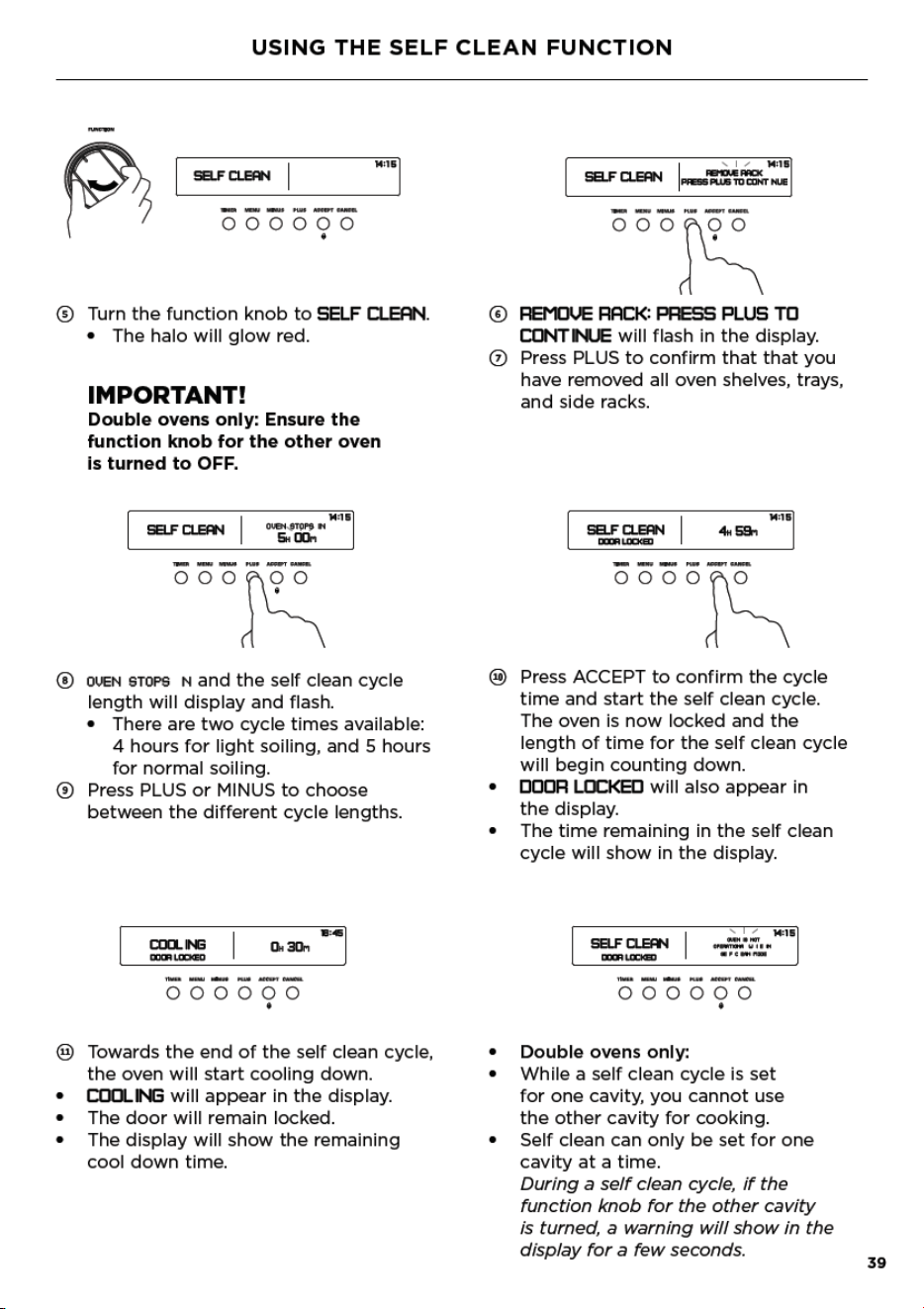
To start a Self Clean cycle
1 Remove oven shelves, side racks and all
other accessories, bakeware, and utensils.
2 Wipe up any spills. Failure to do so may
discolour the oven surfaces.
3 Check the inner glass pane of the oven door.
If it has soiling on it (eg stains from greasy
splatter), you will need to clean it manually
before starting a Self Clean cycle.
For instructions, see ‘Care and cleaning’.
IMPORTANT!
●
If soiling is left on the glass,
it will become burnt on during
the Self Clean cycle, making
it very difficult to remove.
4 Close the oven door firmly.
USING THE SELF CLEAN FUNCTION
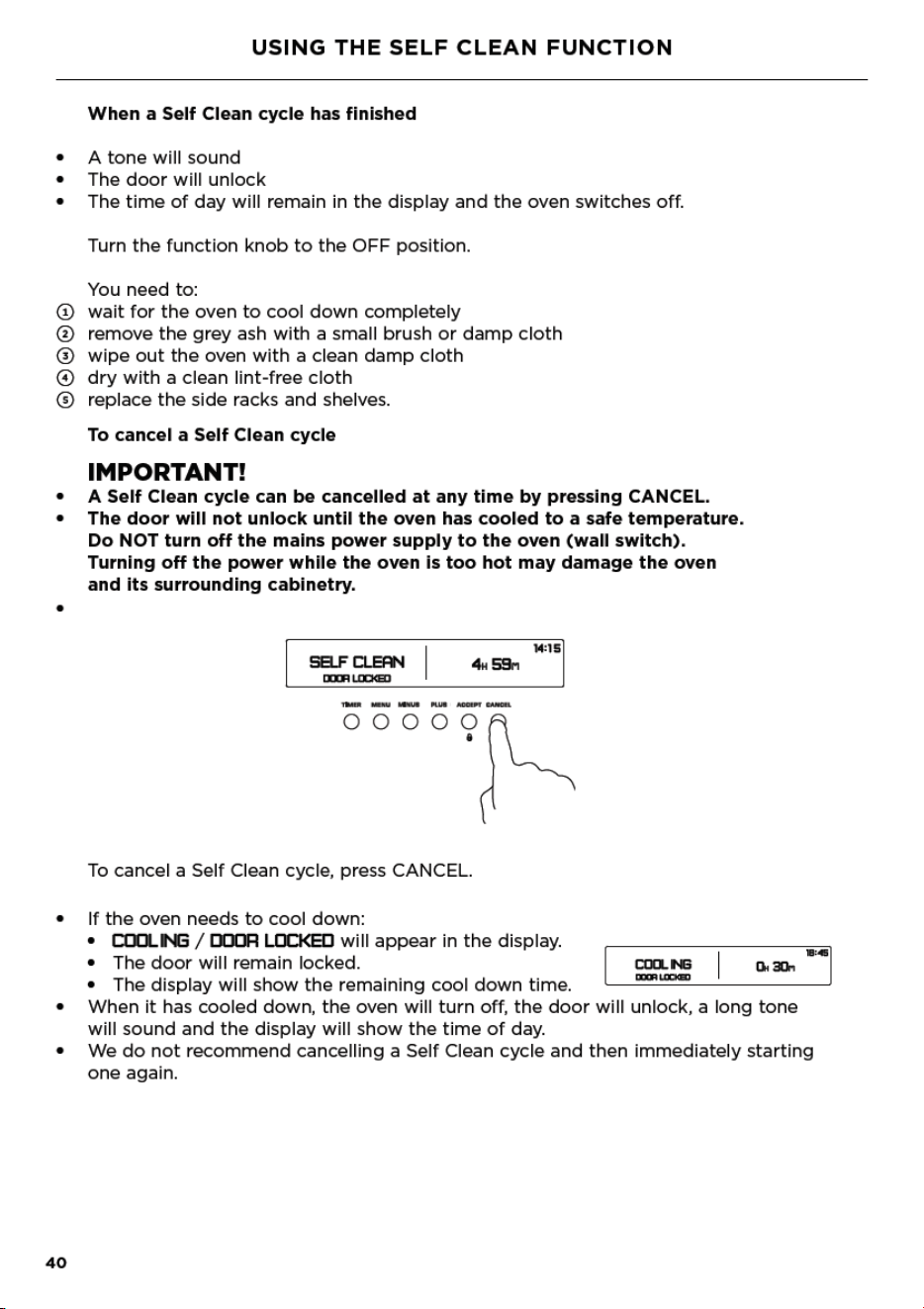

41
Troubleshooting chart
If there is a problem, check the chart below to see if you can fix it. If the problem cannot
be fixed or persists, call your Authorised Repairer or Customer Care.
PROBLEM POSSIBLE CAUSES WHAT TO DO
General
The oven does not work No pow
er. Check that the mains power
supply (wall switch) is turned
on, the fuse has not tripped
and there is no power outage
in your area.
The oven does not work
but the display is lit
The oven is set for
automatic cooking.
See ‘Automatic cooking’
for instructions.
The lights do not come
on when I open the
oven door
The oven light bulb(s)
have blown.
The door is not correctly
fitted.
The oven is in Sabbath
setting and the ‘Light off’
option has been saved.
Replace the light bulb(s).
See ‘Care and cleaning’
for instructions.
See ‘Care and cleaning’
for instructions on fitting
the door correctly.
To quit Sabbath setting,
press and hold CANCEL.
See ‘User preference settings’
for instructions on changing
the ‘Light off’ option.
The display shows
LOCKED
The control panel is locked. Press and hold ACCEPT to
unlock the control panel.
The oven is not heating The door is not properly
closed or it is opened too
frequently during cooking.
The heating elements are
disabled while the door is open.
Make sure the door is properly
closed and avoid opening it
frequently during cooking.
A glass pane in the oven
door has cracked,
chipped, or shattered
Incorrect cleaning or the
edge of the glass hitting
against something.
You must NOT use the oven.
Call your Authorised Repairer
or Customer Care.
The oven door does not
align with the control
panel or surrounding
cabinetry.
The oven door has been
installed incorrectly and the
hinges are misaligned within
the slots.
Re-install the door.
See ‘Replacing the oven door’
on page 33 for instructions.
Temperature is not
calibrated correctly.
Door is not sealing correctly. Re-install the door.
See ‘Replacing the oven door’
on page 33 for instructions.
TROUBLESHOOTING

42
TROUBLESHOOTING
PROBLEM POSSIBLE CAUSES WHAT TO DO
General
I can feel hot air
blowing out of the
v
ents after I have
turned the oven off
This is normal. For safety reasons the cooling
fans will continue to run even
when you have turned the
function knob to ‘Off’.
The fans will switch off
automatically when the
oven has cooled.
The oven fan comes
on when I select a
function that does not
use a fan (eg BAKE)
This is normal.
The fan comes on while
the oven is preheating.
It may turn off when the
oven has reached the set
temperature.
Wait until a long tone sounds
and the temperature knob
halo turns orange: the oven
will then be ready to use.
The oven has reached
the set temperature
but the temperature
knob halo is still white
(indicating that the oven
is not ready to use)
This is normal:
when heating up from cold,
your oven is designed to
initially heat to a temperature
somewhat higher than what
you have set.
This is to provide optimal
baking conditions right from
the start.
Wait until a long tone sounds
and the temperature knob
halo turns orange: the oven
will then be ready to use.
The oven is heating but
the display is dark
The oven is in Sabbath
setting.
To quit Sabbath setting,
press and hold CANCEL
until the display shows the
time of day.
The oven cancels
automatic cooking
when I try to adjust
the clock setting
The oven was set for
automatic cooking when
you were trying to adjust
the clock setting.
You can only adjust the
clock setting while the
oven is not set for
automatic cooking.
The oven sounds a tone
when I try to turn the
temperature knob below
a certain temperature
This is normal:
for food safety reasons,
the oven functions have
factory-set minimum
temperature settings.
The temperature knob itself
cannot be ‘turned off’.
Selecting Off with the function
knob will turn the oven off.
The temperature knob
halo doesn’t turn
whitewhen I use
BROIL/MAXI BROIL
This is normal:
the halo stays orange to indicate that the broil element
provides instant radiant heat.

43
TROUBLESHOOTING
PROBLEM POSSIBLE CAUSES WHAT TO DO
General
The displays work,
and the function and
temper
ature knobs
halos come on but the
oven does not heat up
The oven is in ‘Demo’ mode. Call Customer Care.
The display shows
CLOSE DOOR
The door is open during
cooking (some functions
only).
Ensure the door is shut fully.
The automatic cooking
does not display
You are trying to use
a meat probe and
automatic cooking.
You cannot use the meat
probe at the same time as
automatic cooking.
See ‘Using the Meat Probe’
During MAXI BROIL
the oven is louder than
usual
This is normal:
the oven’s cooling fans
are operating at their
highest speed.
I cannot start the
Sabbath setting
You have not selected the
BAKE function.
You must select BAKE when
using the Sabbath setting.
PROBLEM POSSIBLE CAUSES WHAT TO DO
Self Clean function
During a Self Clean
cycle
, the oven is
louder than usual
This is normal:
the oven’s cooling fans operate at their highest speed.
The display shows - - The meat probe mode
has been selected but the
meat probe is not plugged
in to the socket.
Ensure the meat probe is
plugged into the socket.
Cancel meat probe by
pressing CANCEL.
The display shows
CHECK DOOR
The door has not been
properly closed.
Make sure you close the
door properly.
At a point during
a Self Clean cycle,
The display changes
to show COOLING
This is normal:
the oven is in the last phase
of the Self Clean cycle,
cooling down.
Wait until the Self Clean cycle
has finished. A long tone will
sound and the oven door will
automatically unlock when
the oven is ready to use.

44
TROUBLESHOOTING
PROBLEM POSSIBLE CAUSES WHAT TO DO
Self Clean function
Double oven models
only:
I cannot select the
Self clean function
One ov
en is already turned
on or set for automatic
cooking.
You cannot start a Self Clean
cycle when one oven already
has a function selected.
Turn the function knob to
Off and try again.
I have cancelled a
Self Clean cycle but
cannot use the oven:
●
the oven door will
not open
●
the display is still
counting down
minutes or showing
0h 00m
●
COOLING is showing
●
in the display
●
the knobs and buttons
are unresponsive.
This is normal:
if COOLING is showing in the
display, you have successfully
cancelled the Self Clean cycle.
However, the oven is still too
hot to be used for cooking
and needs to cool down.
Wait until the cool-down
phase has finished.
A long tone will sound
and the oven door will
automatically unlock when
the oven is ready to use.
Note: depending on when
the Self Clean cycle was
cancelled, the cool-down
phase may take up to 45
minutes.
The oven is beeping
and the display shows
A2 or A3
See section ‘Alert codes’ for instructions.
There is a power cut
during a Self Clean
cycle
Power cut. The door will remain locked.
Once the power is turned
back on, the door will remain
locked until the oven has
cooled to a safe temperature.

45
ALERT CODES
If there is a problem, the oven will:
●
automatically suspend all oven functions
●
beep five times
●
display an alert code.
IMPORTANT!
Do not turn off the mains power supply to the oven (wall switch) if you get an alert
code, unless the instructions in the chart following specifically instruct you to.
There are cooling fans within the oven which are needed to cool the oven’s
components. Turning off the power while the oven is too hot may damage the
oven and its surrounding cabinetry.
What to do if an alert code is displayed
1 If the beeping hasn’t stopped already, press any button to stop it.
2 Make a note of the alert code displayed. You may need this information.
3 Check the chart following to see if you can fix the problem yourself and follow
the instructions.
4 If you can fix the problem and the alert code does not reappear, you can keep
using your oven.
OR
If you can’t fix the problem yourself or the alert code reappears and the problem
persists: wait until the cooling fans have stopped and the oven has completely
cooled down, then turn the power to the oven off at the wall and call your
Authorised Repairer or Customer Care with the alert code information.

46
ALERT CODES
ALERT CODE POSSIBLE CAUSES WHAT TO DO
A1
The oven has overheated
1 Allow the oven to cool down.
2 Once the oven has cooled down
and the door has unlocked, the
alert code will disappear. You can
now use the oven again.
A2
Door lock error:
the door cannot be locked
after you have started a
Self Clean cycle
1 Turn the power to the oven off
at the wall and on again.
2 Wait approximately 10 seconds.
This is to allow the door lock to
return to its initial position.
3 Set the clock. See ‘Setting the
clock and first use’ for instructions.
4 Try starting a Self Clean cycle
again, making sure that you close
the door firmly. See ‘Using the
Self Clean function’.
A3
Door lock error:
the door cannot be
unlocked after a Self Clean
cycle has finished
1 Turn the power to the oven off
at the wall and on again.
2 Try pressing on the oven door
to help the door lock disengage.
3 If this doesn’t help and the
alert code reappears, call
your Authorised Repairer or
Customer Care.
F+ number
Technical fault
1 Note down the alert code.
2 Wait until the cooling fans
have stopped and the oven has
completely cooled down.
3 Turn the power to the oven off
at the wall.
4 Call your Authorised Repairer or
Customer Care with the alert
code information.

47
WARRANTY AND SERVICE
Before you call for service or assistance ...
Check the things you can do yourself. Refer to the installation instructions
and your user guide and check that:
1 Your product is correctly installed.
2 You are familiar with its normal operation.
If after checking these points you still need assistance or parts, please refer to the
Service & Warranty book for warranty details and your nearest Authorized Service
Centre, Customer Care, or contact us through our website www.fisherpaykel.com.
Contact details
For replacement parts or if further help is needed concerning this appliance call:
Toll Free 1 888 9 FNP USA (1 888 936 7872)
or write to:
Fisher & Paykel Appliances Inc.
695 Town Center Drive
Suite 180 Costa Mesa
CA 92626-1902
USA
or contact us through our web site www.fisherpaykel.com
Complete and keep for safe reference:
Model
Serial No.
Purchase Date
Purchaser
Dealer
City
State
Zip
Country

US CA
591008 C 07.18
FISHERPAYKEL.COM
© Fisher & Paykel Appliances 2018. All rights reserved.
The product specifications in this booklet apply to the specific products
and models described at the date of issue. Under our policy of continuous
product improvement, these specifications may change at any time. You
should therefore check with your Dealer to ensure this booklet correctly
describes the product currently available.