

This supplement contains explanations and instructions for correctly
operating the following systems.
·
Naviga
tion System
·
Audio and
Visual System
·
Handsfree S
ystem
· APPS
If your vehicle contains one of the systems above, be sure to check the
contents of this supplement carefully.
If you transfer the ownership of the vehicle to another person, make
sure that this supplement is provided with the Owner’s Manual inside
the vehicle.
The information, specications and illustrations in this supplement
are valid at the time of publication. SUBARU CORPORATION reserves
the right to change the specications and design without prior notice,
with no obligation to perform the same or equivalent changes to
vehicles sold in the past.
This Owner’s Manual supplement applies to all models, and describes
all devices, including manufacturer-installed options. This means that
information may be included about devices that are not installed in
your vehicle.
SUBARU STARLINK is the “in-car connectivity system” available on select
Subaru vehicles.
SUBARU CORPORATION, TOKYO, JAPAN
“
SUBARU
”
and the six-star cluster design are registered trademarks of SUBARU
CORPORATION.
©Copyright 2019, SUBARU CORPORATION
Foreword
1
docstructure.indb 1 2019/05/31 11:45:06
TABLE OF CONTENTS
Quick Guide
Basic Function
Settings
Phone
Apps
Audio
Navigation System
Siri/Voice Recognition System
Appendix / What To Do If / Index
1
2
3
4
5
6
7
8
9
2
docstructure.indb 2 2019/05/31 11:45:07
· System Type... 12 · Main Product Features... 14 · Overview Buttons... 16 · Home Screen... 17
· Steering Wheel Controls... 28
· Basic Information Before Operation... 30 · Rear View Camera... 39
· Registering A Bluetooth Phone/Device For The First Time... 48 · Registering A Bluetooth Phone/Device... 52
· General Settings... 59 · Sound Settings... 72
· Calling On The Bluetooth Phone... 80 · Receiving On The Bluetooth Phone... 84
· Talking On The Bluetooth Phone... 85 · Bluetooth Phone Message Function... 87
· SUBARU STARLINK... 97 · aha
TM
... 102 · Pandora
®
*... 106 · Apple CarPlay... 109 · Android Auto... 111
· SiriusXM Travel Link... 113
· Basic Operation... 118 · Radio Operation... 122 · Media Operation... 139 · Audio Remote Controls... 148
· Basic Operation... 156 · Destination Search... 165 · Route Guidance... 173 · Setup... 180
· SUBARU Map Update... 184
· Siri... 194 · Voice Recognition System Operation... 197
· Troubleshooting... 212 · Index... 229
11
29
47
75
93
117
155
193
205
*: Pandora is only available in certain countries. Please visit pandora.com/legal for more information.
Quick Guide
Basic Function
Settings
Phone
Apps
Audio
Navigation System
Siri/Voice Recognition System
Appendix / What To Do If / Index
3
docstructure.indb 3 2019/05/31 11:45:07

INTRODUCTION
INTRODUCTION
The symbols described below are found in this instruction
manual as well as on the unit itself to ensure its proper and
safe usage and to prevent injury or damage to property.
Make sure you understand the meaning of these symbols
before reading the rest of this manual.
READ FIRST
We recommend that you wait until the positioning stabilizes
before starting to drive.
If you start to drive while the positioning is not complete,
the indicated position may differ from the actual vehicle
position.
The screens shown in this manual may differ from the actual
screens depending on the data type or when the map data
was created.
When maps are created, land surveys are conducted
and information on road improvements and reopening
is collected to provide the most accurate information
possible. However, modications
to roads, place names and
facilities may be carried out at any time. Consequently, we
cannot guarantee that map data contains no errors in road
positions, conguration and names, or in facility names.
INTRODUCTION
4
docstructure.indb 4 2019/05/31 11:45:07
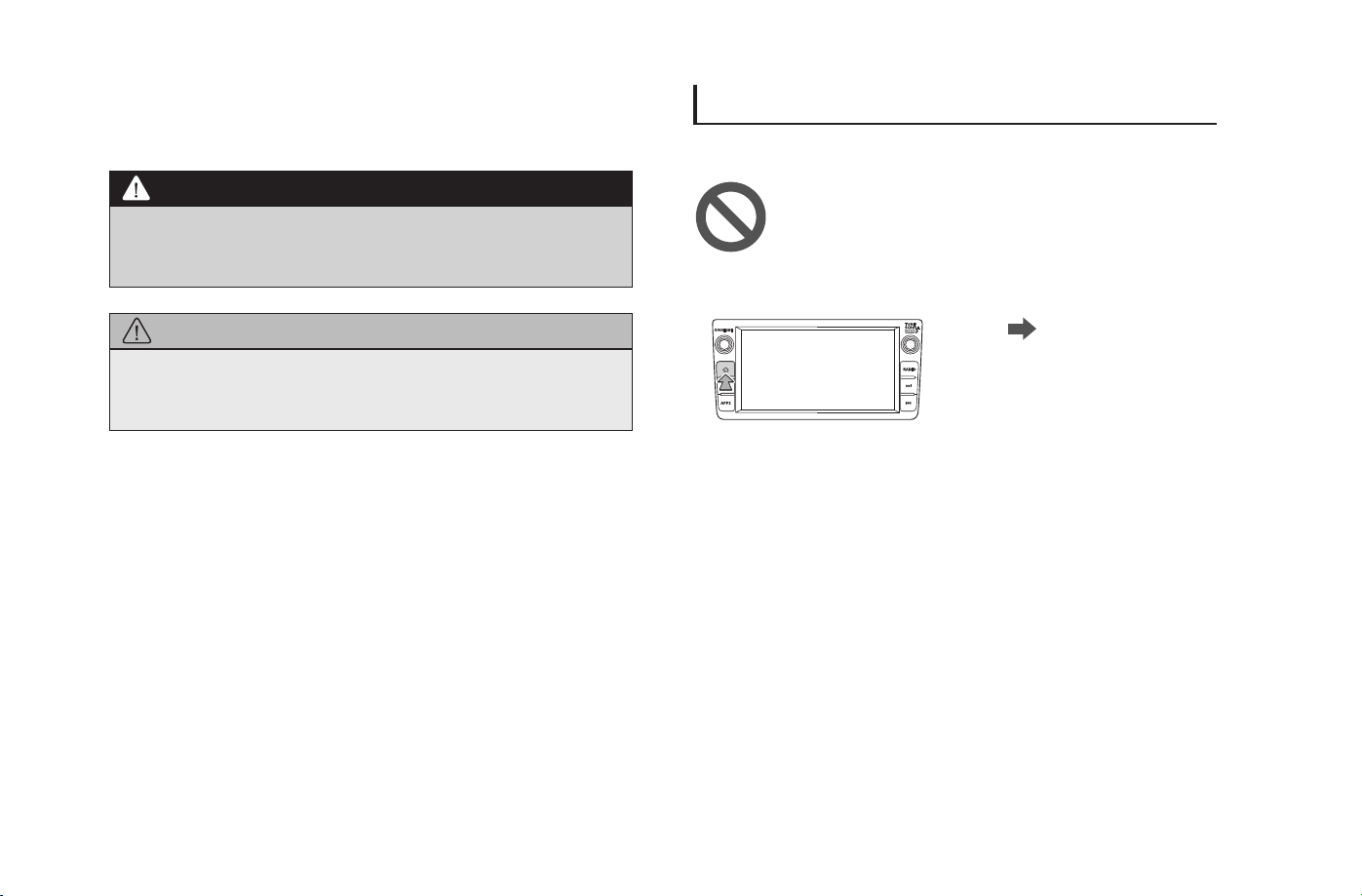
Information in this manual that must be observed for the
unit, and information that is useful to know is indicated as
follows.
WARNING
l This sign indicates a situation in which incorrect handling
through disregard of written information might result in death
or serious personal injury.
CAUTION
l This sign indicates a situation in which incorrect handling
through disregard of written information might result in
personal injury or damage to property.
NOTE
l Useful information for the user is described.
l Be sure to read all materials such as manuals and warranties
that come with the product. SUBARU CORPORATION is not
responsible for problems that arise due to failure to follow these
instructions.
l Changes to
product specications may result in differences
between the content of the manual and the features of the unit.
SYMBOLS USED IN ILLUSTRATIONS
Safety symbol
The symbol of a circle with a slash through it means
“Do not”, “Do not do this” or “Do not let this happen”.
Arrows indicating operations
Indicates the action
(pressing, turning,
etc.) used to operate
switches and other
devices.
INTRODUCTION
INTRODUCTION
5
docstructure.indb 5 2019/05/31 11:45:08

PRECAUTIONS FOR USE
WARNING
l The main unit requires a 12 V DC power supply. The main unit
should not be installed in any vehicle which does not have a
12 V power system with a ground-connected negative side.
An installation other than the one intended may cause severe
damage to the main unit, and electric shock or serious injury
to the users.
l Even when using
the route guidance of the navigation
system, be sure to drive by following the actual trafc
regulations. If you drive by following only the route guidance
of the navigation system, you may violate the actual trafc
regulations and cause a trafc accident.
l To ensure safety
, the driver should not operate the navigation
system while driving. Operating the navigation system while
driving may result in an accidental steering wheel operation
or otherwise cause an accident. Stop the vehicle before
operating the navigation system. Also, do not watch the
screen while driving because doing so may be dangerous
(ETC). Inattention to road conditions ahead may result in an
accident.
l The driver should not perform operations such as volume
adjustment while driving. Inattention to road conditions ahead
may result in an accident, so be sure to stop the vehicle in a
safe place before performing the operation.
l The driver should not perform operations such as adding
a location or setting the memory while driving. Inattention to
road conditions ahead may result in an accident, so be sure
to stop the vehicle in a safe place before performing the
operation.
l Before viewing a video, be sure to stop the vehicle in a safe
place and apply the parking brake. To ensure safety, videos
are not displayed during driving.
l To ensure safety, never operate a cell phone while driving.
l Do not disassemble or modify the unit. Doing so may result in
an accident, re or electric shock.
l Do not let water or foreign objects enter the internal parts
of the unit. Doing so may result in smoke, re or an electric
shock.
l Do not use the unit when it is malfunctioning,
such as when
the screen is not lit or no sound comes out. Doing so may
result in an accident, re or electric shock.
l Always replace fuses with fuses of the same specied
capacity (amperage). Using a fuse with a higher capacity than
the specication may result in a re.
l If a foreign object or water enters the unit, smoke or a strange
odor may be emitted. If such an abnormality occurs, stop
using the unit immediately and contact your SUBARU dealer.
An accident, re or electric shock may result if you continue to
use the unit under these conditions.
l In a thunderstorm, do not touch the antenna line or the unit.
Lightning may cause an electric shock.
l Do not park or stop in prohibited areas to use the unit.
l If direct sunlight shines into the vehicle, light may reect off
the product. Be very careful while driving.
l Never use headphones or earphon
es while driving. Driving
while not being able to hear sounds from outside the vehicle
may result in a trafc accident.
INTRODUCTION
6
docstructure.indb 6 2019/05/31 11:45:08

CAUTION
l Although the unit can be used when the ignition switch is set
to either “ACC” or “ON” position, to protect the battery, start
the engine before using the unit.
l Do not use the unit anywhere other than in a vehicle. Doing so
may result in an electric shock or other injury.
l While driving, keep the volume
low enough for you to hear
outside sounds. Driving while not being able to hear sounds
from outside the vehicle may result in an accident.
l Be careful of the volume when turning on the power. If a loud
noise is emitted suddenly when you turn on the power, it may
damage your hearing.
l Do not apply a strong force to the display. Doing
so may result
in a malfunction.
l Do not touch the hot parts of the unit. The hot parts may burn
you.
l Do not use while
there is an abnormality such as sound
breakup or distortion. Doing so may result in a re.
l Using the unit during extremely high or low temperature may
result in mistaken operation or a malfunction. In particular, the
temperature inside the vehicle can often rise to a high level
during the summer. Cool the vehicle, for example by opening
a window, before using the unit.
l Be careful if metal or water enters the unit, or the unit is
exposed to a strong impact, because it
may result in a
malfunction.
l The touch buttons on the display screen may not operate
correctly
if condensation forms inside them. If this happens,
do not attempt to operate the switches until the condensation
has disappeared.
l If juice or similar liquid is spilled on the display, wipe
off immediately. Failure to do so may result in product
malfunction.
l The screen is easily marked by ngerprints and tends to
attract dust, and should therefore be cleaned occasionally.
When cleaning, turn off the power, and wipe lightly with a soft,
dry cloth. To remove dirt, soak a soft cloth in neutral detergent
and squeeze well before wiping. Do not use a wet oor-cloth,
organic solvents (benzene, ethanol, thinner, etc.), acids, or
alkalis. Using such agents will result in screen deterioration.
Furthermore, do not hit the screen or rub it with hard objects.
INTRODUCTION
INTRODUCTION
7
docstructure.indb 7 2019/05/31 11:45:08

NOTE
l SUBARU CORPORATION is not responsible for any damages
to the purchaser or third parties that occur from using the map
data.
l We do not provide any replacements or refunds for any mistakes
there may be in the map data displays or contents, such as
misspelling, omissions or misaligned positions.
l SUBARU CORPORATION
makes no guarantee that the
functions included in the map data will be appropriate for the
specic objectives of the purchaser.
l Functions that cannot be operated
while driving have their colors
toned down when the vehicle is being driven, and their operation
is disabled. Touching a disabled switch may result in the display
of an operation prohibited message on the screen.
l When using the unit for the rst time after purchase, or after
the battery was removed for a long time, the current position
may not be displayed correctly. Wait a short time until the GPS
positioning corrects the displayed position.
l This device is precision-engineered equipment
and the recorded
data can be lost as a result of static electricity, electrical noise,
vibration, or other inuences. To protect the device against data
loss, we recommend keeping a separate record of the data that
you record after purchase.
l The screen may be adversely af
fected or disturbed by noise if
electrical equipment that generates powerful electrical noise
is used near the system. In such cases, keep the electrical
equipment at a distance, or refrain from use.
l The display may appear
brighter when the temperature is low,
or immediately after starting the engine, however, this is a
characteristic of the LED elements, and does not indicate a fault.
The display will return to its original brightness when the vehicle
cabin has warmed up.
NOTE
l When you look at the screen through polarized material such
as polarized sunglasses, the screen may be dark and hard to
see. If so, look at the screen from different angles, adjust the
screen settings on the general settings screen or take off your
sunglasses.
l It may
be difcult to view the screen if the display is exposed to
sunlight from an awkward angle.
l The LCD screen may not function normally if covered with a
protective lm. Do not afx a protective lm.
l The touch panel may function incorrectly or fail to respond if
operated
with objects other than ngers (nails, operation when
wearing gloves, pens, etc.)
l If the system functions unexpectedly
such as an area other than
the one touched being selected, or failure to respond when
touched, there is a possibility that another nger or part of the
hand is in contact with display.
l Scratches on the system panel surface are easily noticeable,
and it should therefore be handled with care.
INTRODUCTION
8
docstructure.indb 8 2019/05/31 11:45:08
SAFETY INSTRUCTION
To use this system in the safest possible manner, follow all
the safety tips shown below.
This system is intended to assist in reaching the destination
and, if used properly, can do so. The driver is solely
responsible for the safe operation of your vehicle and the
safety of your passengers.
Do not use any feature of this system to the extent it
becomes a distraction and prevents safe driving. The rst
priority while driving should always be the safe operation
of the vehicle. While driving, be sure to observe all trafc
regulations.
Prior to the actual use of this system, learn how to use it and
become thoroughly familiar with it. Read the entire manual
to make sure you understand the system. Do not allow
other people to use this system until they have read and
understood the instructions in this manual.
For your safety, some functions may become inoperable
when driving. Unavailable screen buttons are dimmed. Only
when the vehicle is not moving, can the destination and
route selection be done.
WARNING
l For safety, the driver should not operate the system while he/
she is driving. Insufcient attention to the road and trafc may
cause an accident.
l While driving, be sure to obey the trafc regulations and
maintain awareness of the road conditions. If a trafc sign on
the road has been changed, route guidance may not have the
updated information such as the direction of a one way street.
While driving, listen to the voice instructions as much as
possible and glance at the screen briey and only when it
is safe. However, do not totally rely on voice guidance. Use
it just for reference. If the system cannot determine the
current position correctly, there is a possibility of incorrect,
late, or non-voice guidance.
The data in the system may occasionally be incomplete.
Road conditions, including driving restrictions (no left turns,
street closures, etc.) frequently change. Therefore, before
following any instructions from the system, look to see
whether the instruction can be done safely and legally.
This system cannot warn about such things as the safety of
an area, condition of streets, and availability of emergency
services. If unsure about the safety of an area, do not drive
into it. Under no circumstances is this system a substitute
for the driver’s personal judgement.
Use this system only in locations where it is legal to do so.
Some states/provinces may have laws prohibiting the use of
video and navigation screens next to the driver.
INTRODUCTION
INTRODUCTION
9
docstructure.indb 9 2019/05/31 11:45:09
HOW TO READ THIS MANUAL
No. Name Description
Operational Outlines An outline of the operation is explained.
Main Operations The steps of an operation are explained.
Supplemental information Describes supplemental information relating to main operation.
● When a panel button should be selected, button names are shown as .
● When a touch button on the screen should be selected, button names are shown as
.
INTRODUCTION
10
docstructure.indb 10 2019/05/31 11:45:10

11
Quick Guide
Quick Guide
System Type
12
Main Product Features
14
Basic Function
16
Overview Buttons
16
Home Screen
17
“Phone” Screen
18
“Map” Screen
20
“Radio” Screen
22
“Media” Screen
23
“Apps” Screen
24
“Settings” Screen
26
Steering Wheel Controls
28
Steering Wheel Controls
28
docstructure.indb 11 2019/05/31 11:45:10
SYSTEM TYPE
12
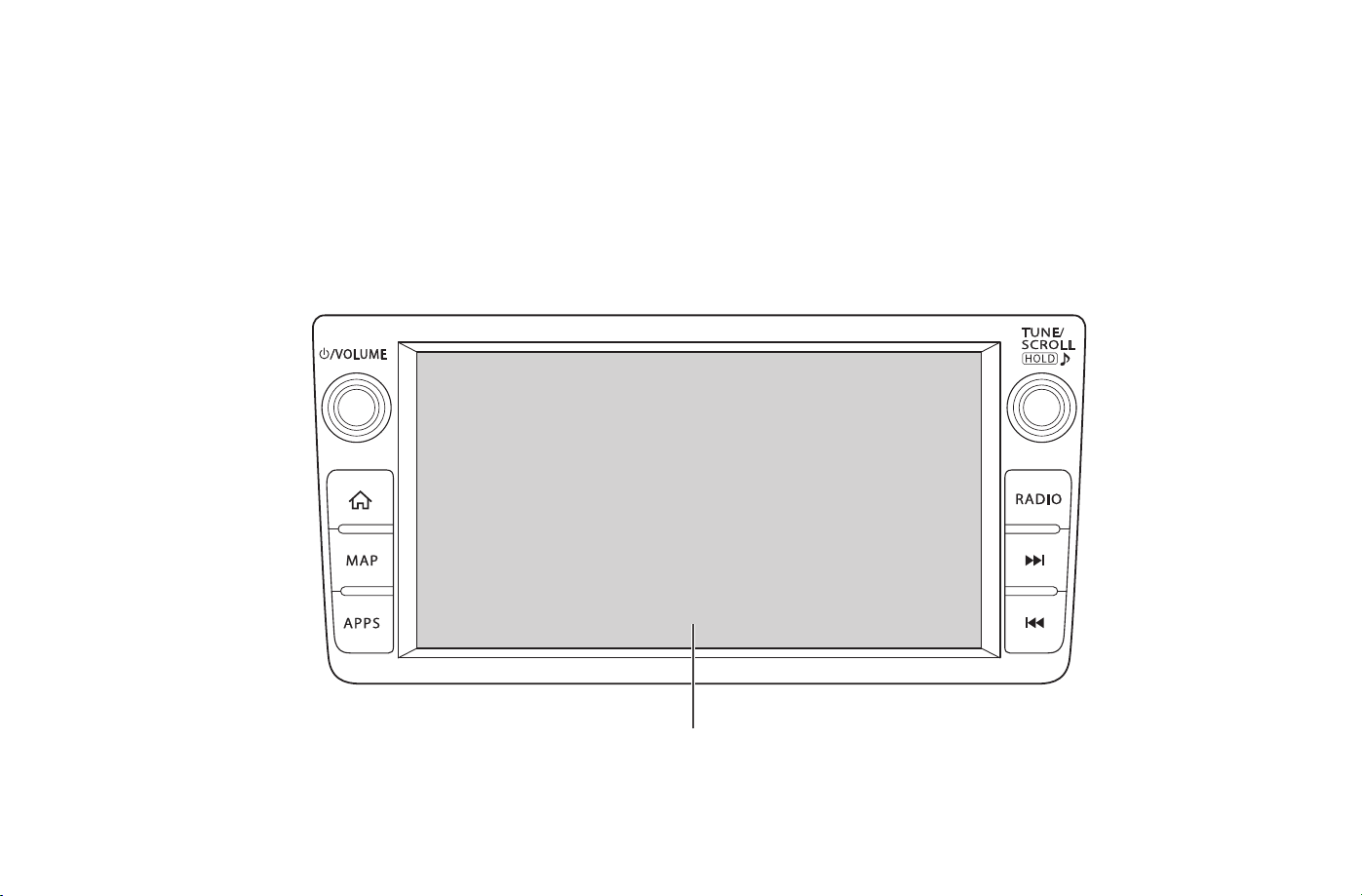
SYSTEM TYPE
This manual describes the operation method for the 7-inch touch screen display audio with Navigation
system.
7-inch touch screen
docstructure.indb 12 2019/05/31 11:45:10
SYSTEM TYPE
13
1
Quick Guide
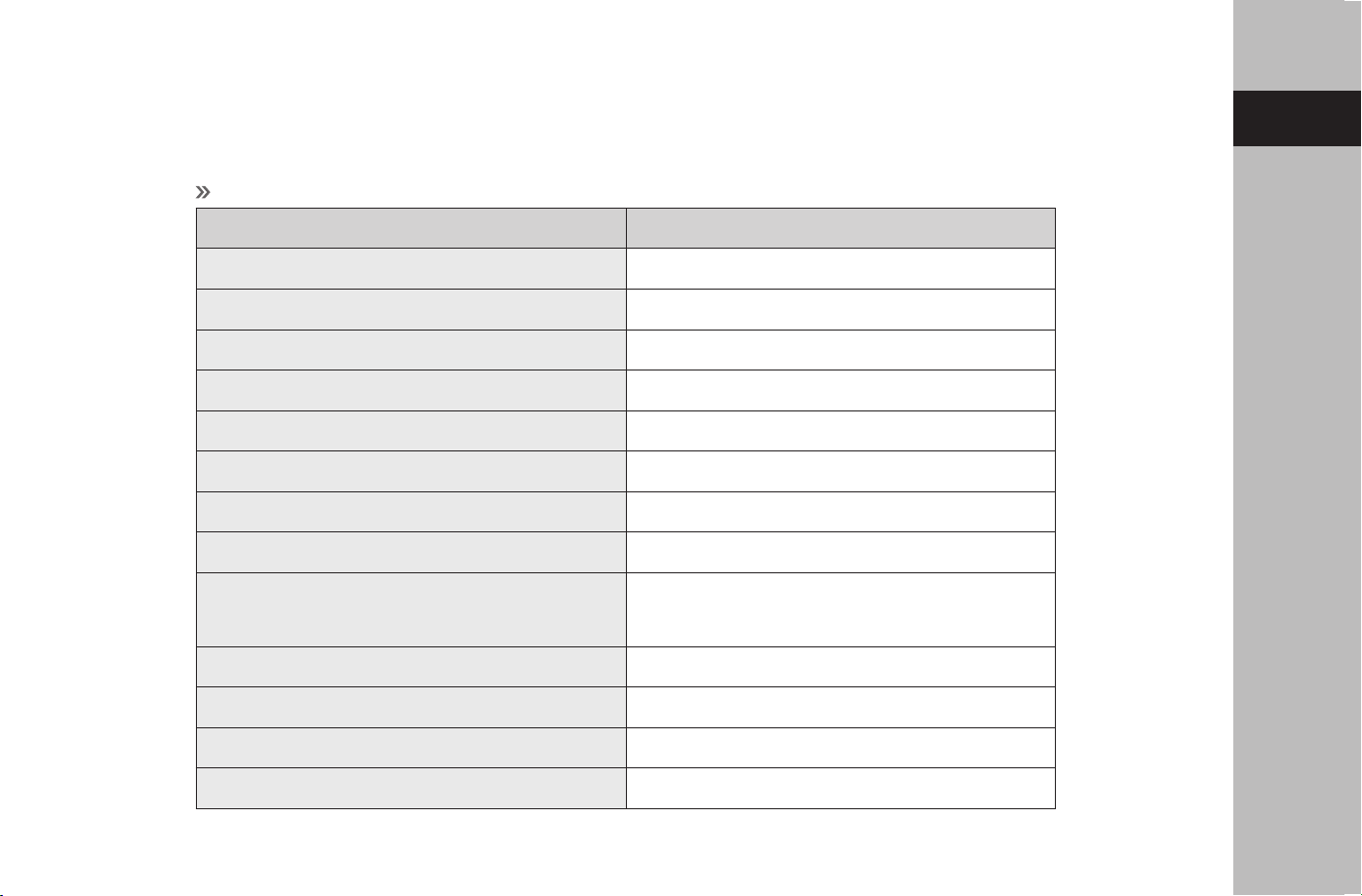
MAIN FUNCTIONS
Function Page
Pairing (Bluetooth 3.0) 18
Navigation system 20
Apps 24
Apple CarPlay 109
Android Auto 111
AM/FM radio 22
HD Radio receiver 124
SiriusXM
®
satellite radio 128
Media operation USB:139 iPod:141 Bluetooth audio:144
Phone 18
Voice recognition system 197
Steering wheel controls 28
Rear view camera 39
docstructure.indb 13 2019/05/31 11:45:11
MAIN PRODUCT FEATURES
14
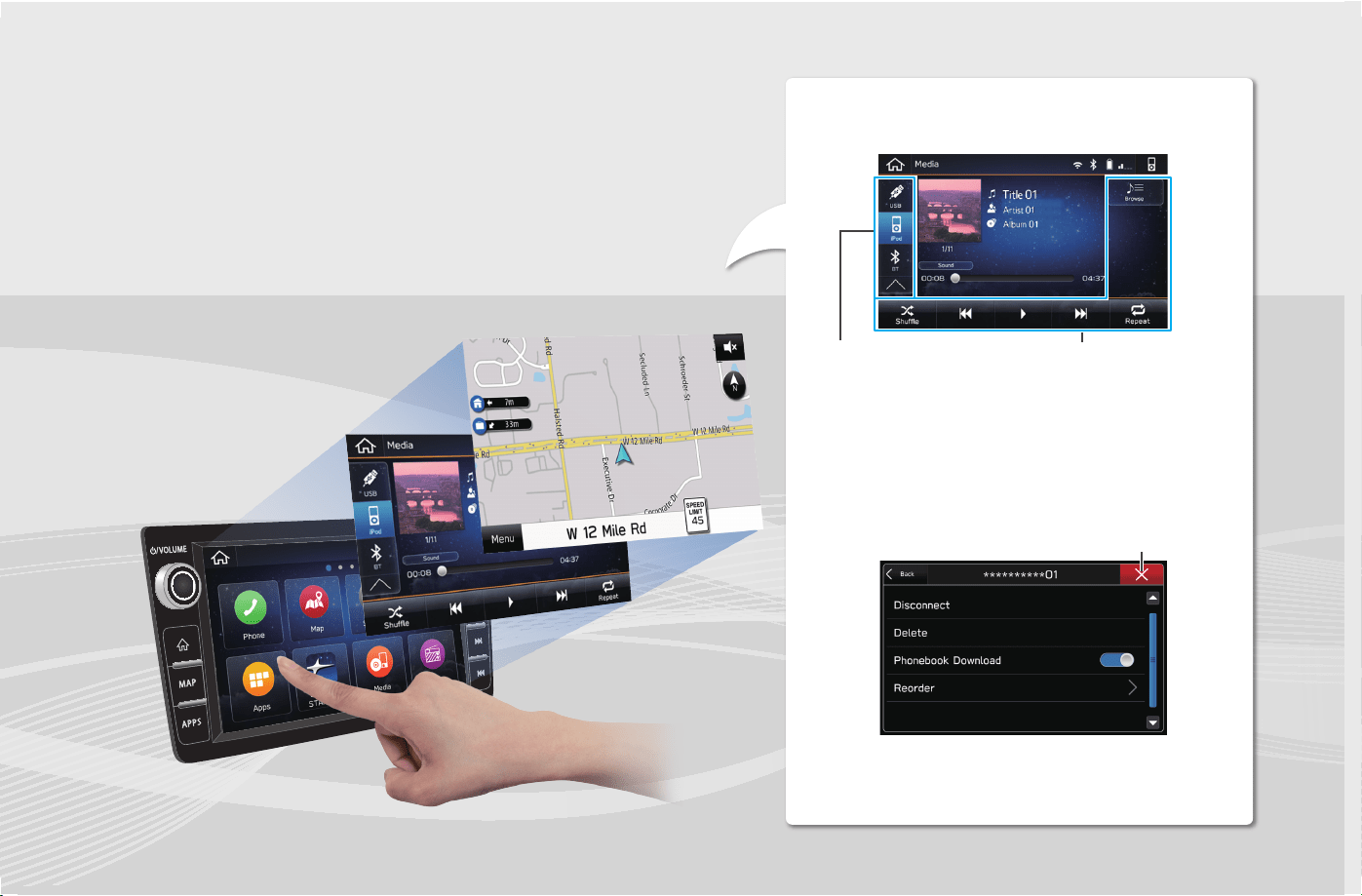
MAIN PRODUCT FEATURES
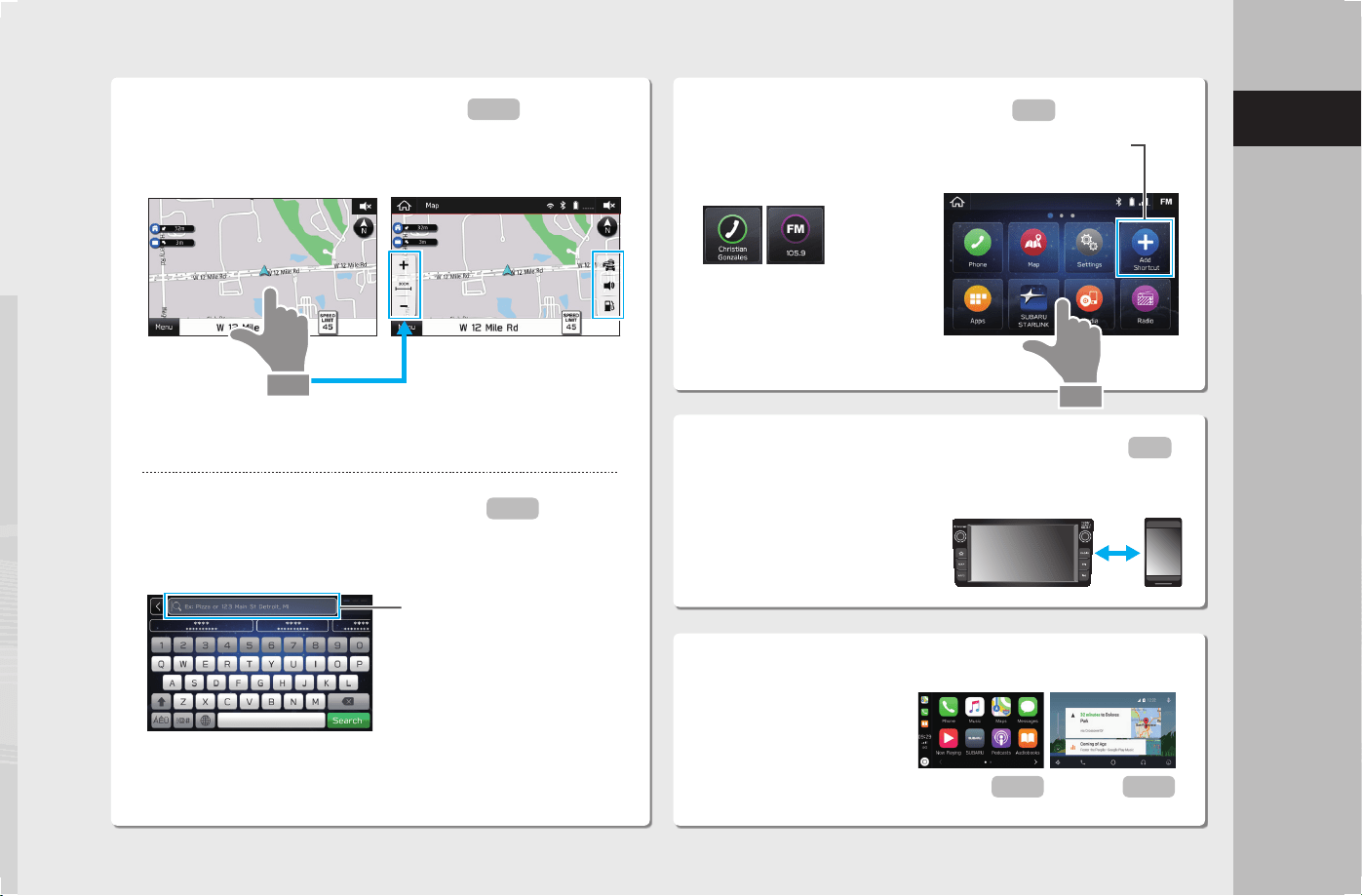
Adoption of intuitive and easy-to-use
smartphone-like graphical user interface
STANDARDIZED OPERATION SCREEN
LAYOUT FOR ALL FUNCTIONS
Mode switching buttons on the left and
operation buttons on the right and at the
bottom prevents users becoming lost in
operation no matter which functions are
used.
USE OF POP-UP SCREENS
Pop-up screens are used instead of screen
switching, preventing users from losing the
current screen.
Mode switching buttons, etc.
Operation buttons, etc.
Close pop-up screen to return to original screen
docstructure.indb 14 2019/05/31 11:45:14
MAIN PRODUCT FEATURES
15
1
Quick Guide
Easy-to-view map screen display
Maps appear wider by minimizing constantly
displayed buttons.
Rough destination search function
Start a search with a variety of words such as addresses,
facility names, intersection names, or latitude/longitude.
Touch screen to display automatically hidden buttons.
Displays search prediction
· Search results are
predicted and candidates
displayed even if only
partial words are known
· Searches can even be
performed with multiple
keywords.
Customized home screen layout
Frequently used functions and operations can be
added to the home screen.
Example: For calling specic
phone numbers, listening to
specic radio stations, etc.
Button positions can be changed freely.
System and Bluetooth phone / device pairing
Functions such as hands-free
and applications can be used
by connecting the system
with Bluetooth phones /
devices wirelessly.
Apple CarPlay / Android Auto
Support for Apple
CarPlay and Android
Auto allows access to
functions such as maps,
phone calls, and music.
P.157
P.166
P.109 P.111
P.37
P.18
docstructure.indb 15 2019/05/31 11:45:17
BASIC FUNCTION
16
BASIC FUNCTION
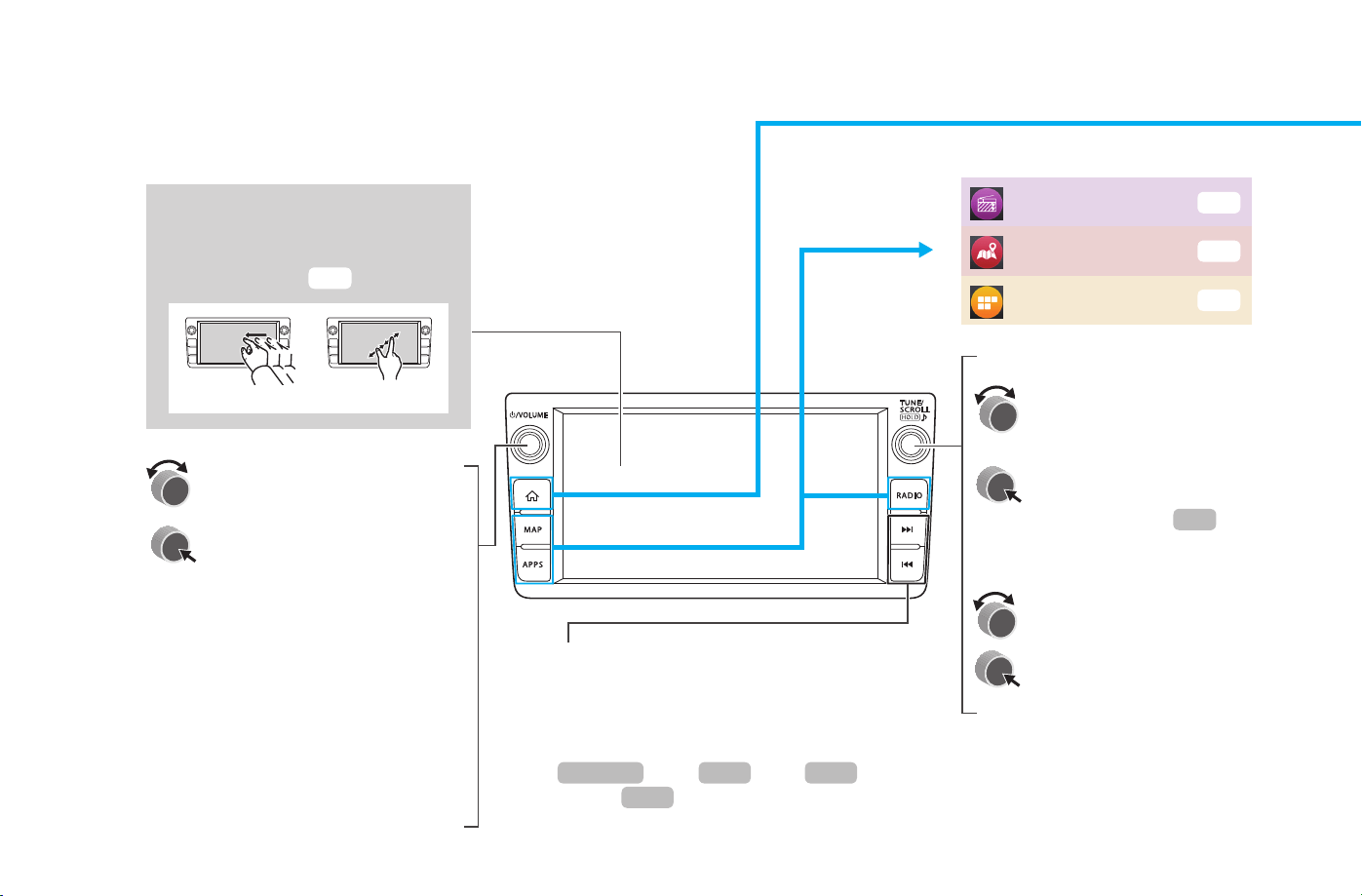
OVERVIEW BUTTONS
TOUCH SCREEN
Operations are performed by
touching the touch screen directly
with your nger.
Drag Pinch
Turn the knob to adjust the
volume.
Press the knob to turn the
volume mute on/off and pause
playback of cache radio and
other media devices.
Press and hold to turn the
audio system off, and press to
turn it on again.
Press and hold the knob for
10 seconds or longer to reset
the system if the touch screen
becomes unresponsive during
operation or if any other
system error occurs.
Press button to seek up or down for a radio
station or to access a desired track/le.
Press and hold button to fast forward/
rewind les or tracks.
Displays the home screen
Shortcut to each screen
Radio USB iPod
Bluetooth audio
“Radio”
“Map”
“Apps”
P.31
P.73
P.22
P.20
P.24
P.139 P.141
P.144
P.122,128
Audio operation screen:
Turn the knob to select a
radio station or skip to the
next or previous track/le.
Press and hold the
knob to display the sound
settings screen.
List display screen:
Turn the knob to move
the cursor.
Press the knob to select
the item selected with the
cursor.
docstructure.indb 16 2019/05/31 11:45:18
BASIC FUNCTION
17
1
Quick Guide
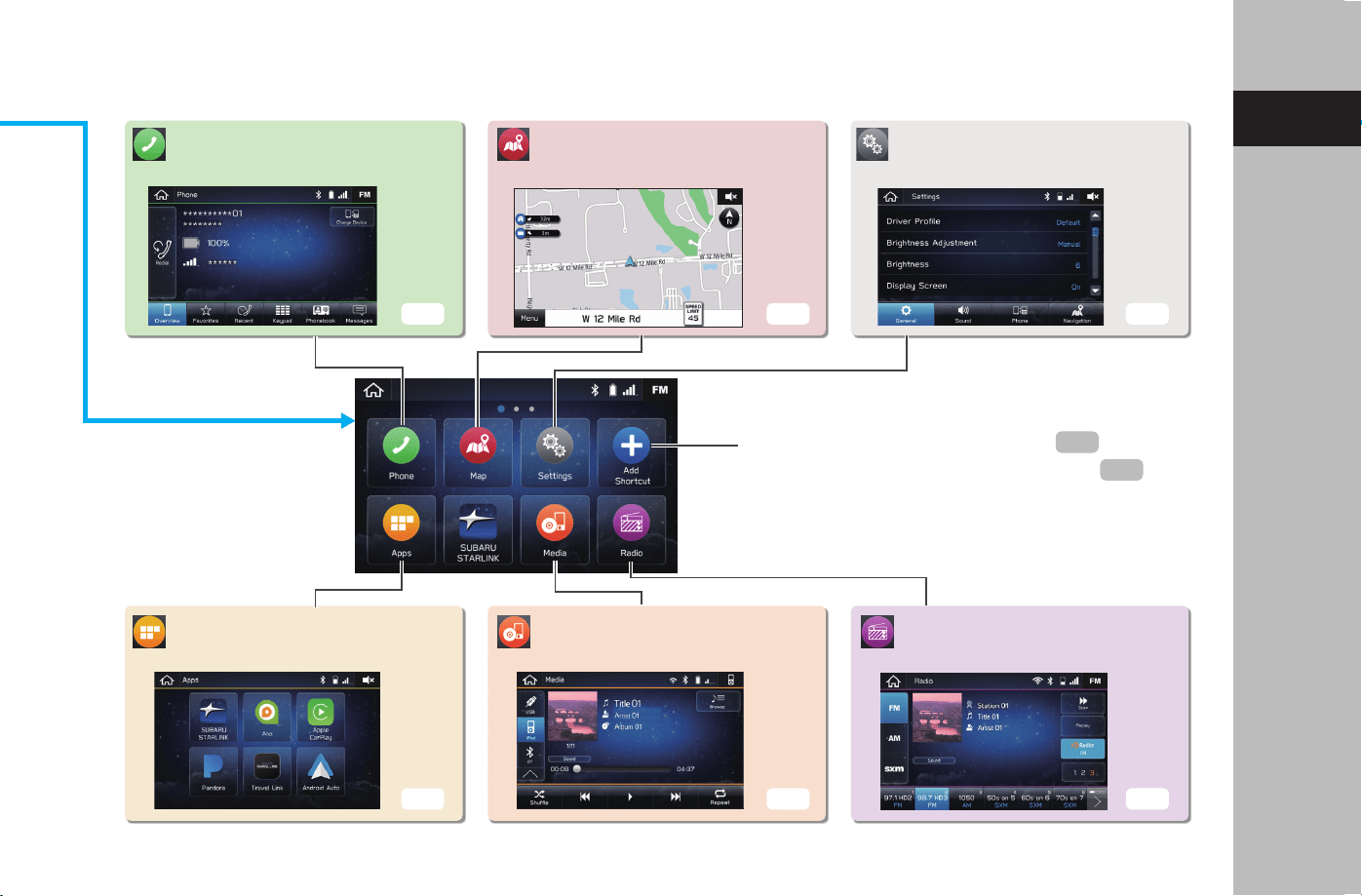
HOME SCREEN
Frequently used functions and operations
can be added to the home screen.
By connecting an iPhone or Android device to the
USB port, a CarPlay or Android Auto icon will display
on the home screen.
Button positions can be changed freely.
“Radio” SCREEN“Apps” SCREEN
“Settings” SCREEN
“Media” SCREEN
“Phone” SCREEN
“Map” SCREEN
P.18 P.20 P.26
P.24 P.23 P.22
P.37
P.38
docstructure.indb 17 2019/05/31 11:45:19
BASIC FUNCTION
18
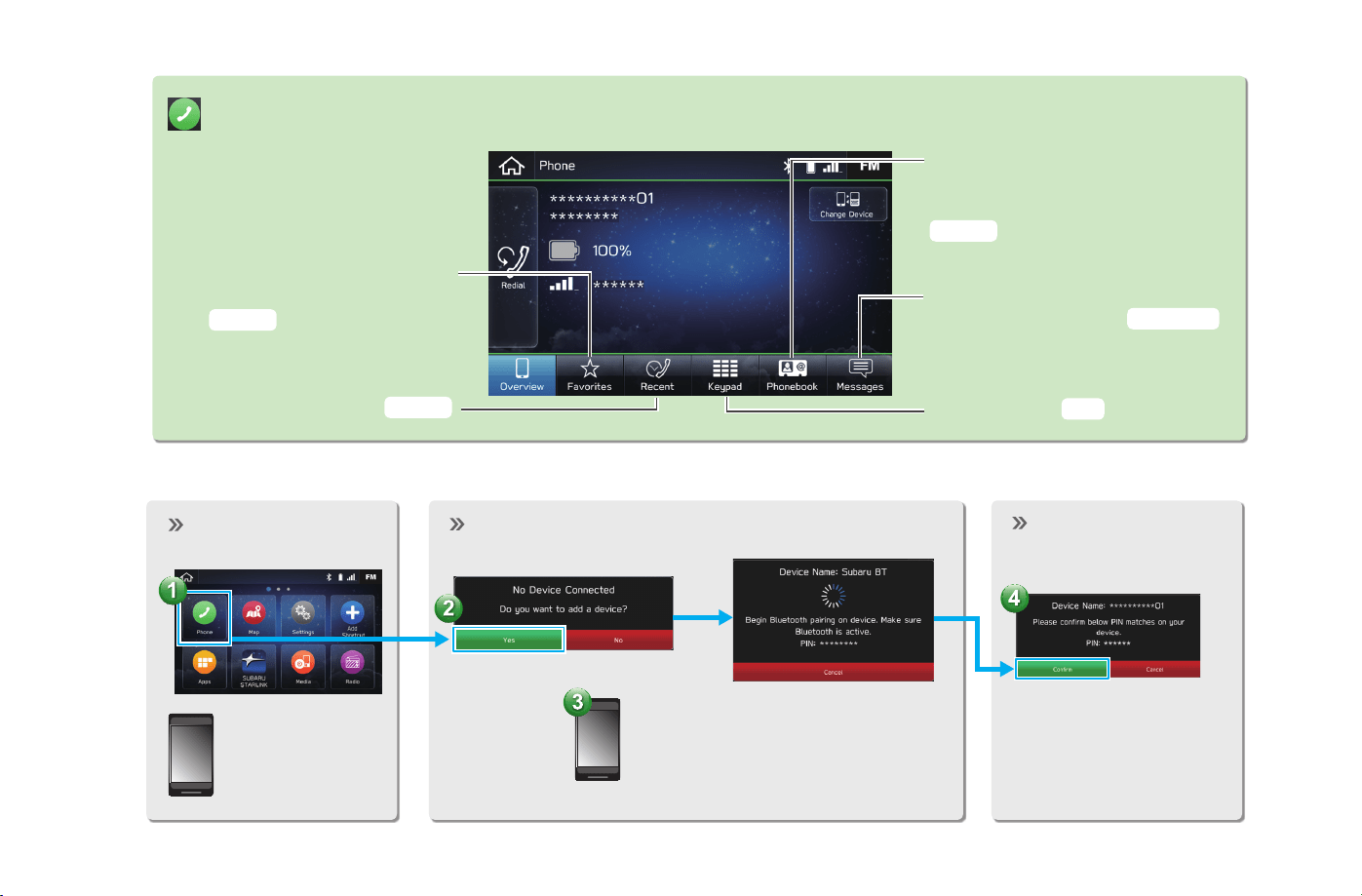
“Phone” SCREEN
Call or send a text message
to a registered favorite
Call or send a text message
to a recent contact
Call or send a text message to
a contact in the phonebook on
the Bluetooth connected phone
Check or reply to
messages/place calls from
received message list
Directly input a number
to place a call
Display the “Phone”
screen.
- Operation Flow: Pairing the System with a Bluetooth Phone/Device -
Prepare the
Bluetooth phone/
device to be
paired.
Operate the Bluetooth phone/device.
Turn the Bluetooth phone/device
Bluetooth function ON and select
“Subaru BT”.
Register the
Bluetooth phone/
device.
If unable to pair, check
whether your Bluetooth
phone/device is compati-
ble with the system.
P.83
P.82,91
P.82,91
P.83,91
P.89,90,91
docstructure.indb 18 2019/05/31 11:45:20
BASIC FUNCTION
19
1
Quick Guide
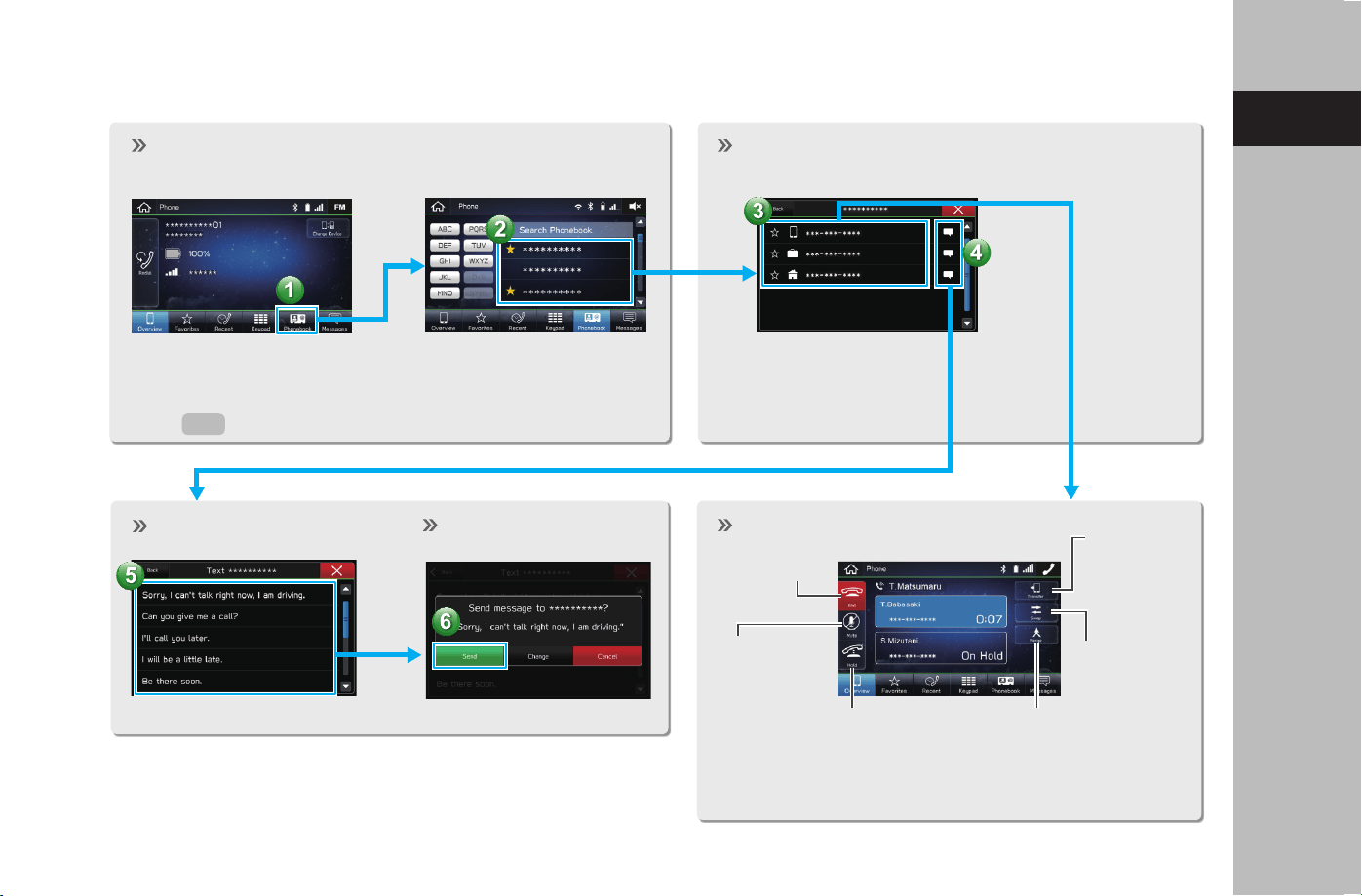
- Operation Flow: Placing Calls/Sending Messages from the Phonebook -
Select call recipient from phonebook.
If unable to select the button, the
setting for downloading the phone-
book for the Bluetooth phone may be
OFF.
Place call
Send
message
Select message.
Send message. In-call screen is displayed.
End call
Mute the
connected
smartphone’s
voice
Transfer call
to Bluetooth
phone
Hold call
Switch to call
with other party
Start three-way call
In-call screen display and operation may differ, or may
not be possible depending on the Bluetooth phone
used.
Select number for making
call/sending message.
P.57
docstructure.indb 19 2019/05/31 11:45:22
BASIC FUNCTION
20
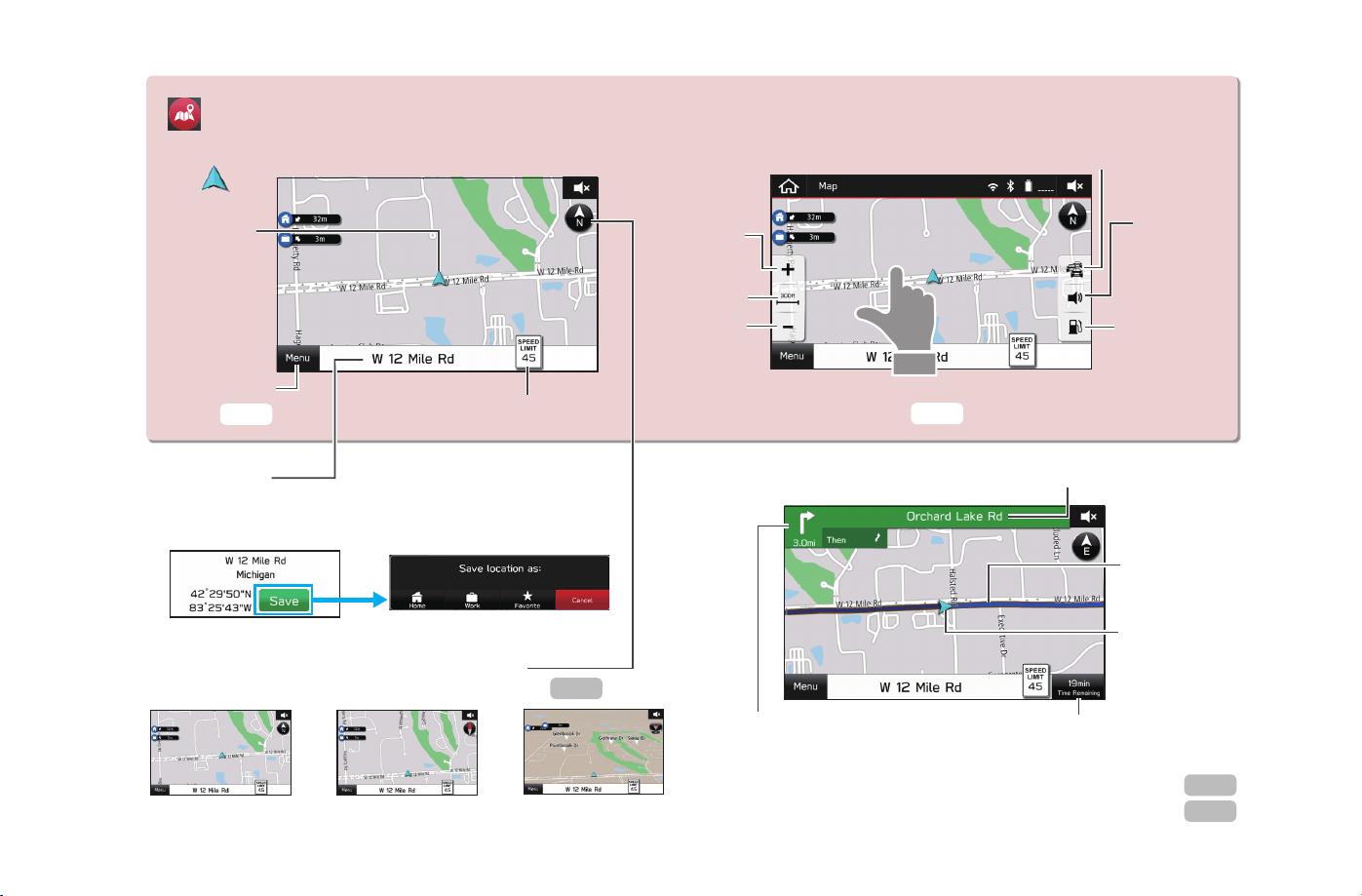
“Map” SCREEN
CURRENT POSITION MAP
Current
vehicle
position
(facing direction
of travel)
Menu button
Speed limit
Zoom in
Scale
indicator
Zoom out
Trafc information
on/off
Voice
guidance
on/off
Search for
nearby gas
stations
Touch screen to display automatically
hidden buttons.
Current street
Touch the current street name to display details of the
current location, allowing that location to be registered.
The orientation of the map can be changed
between 2D north-up, 2D heading-up and 3D.
2D North-up screen 2D Heading-up screen 3D screen
ROUTE GUIDANCE SCREEN
Next street name
Guidance
route
Current
position
Distance to the next turn
and an arrow indicating the
turning direction
Remaining time/remaining
distance/estimated arrival time
Destination search
Route guidance
P.159
P.156
P.157
P.165
P.173
docstructure.indb 20 2019/05/31 11:45:23
BASIC FUNCTION
21
1
Quick Guide
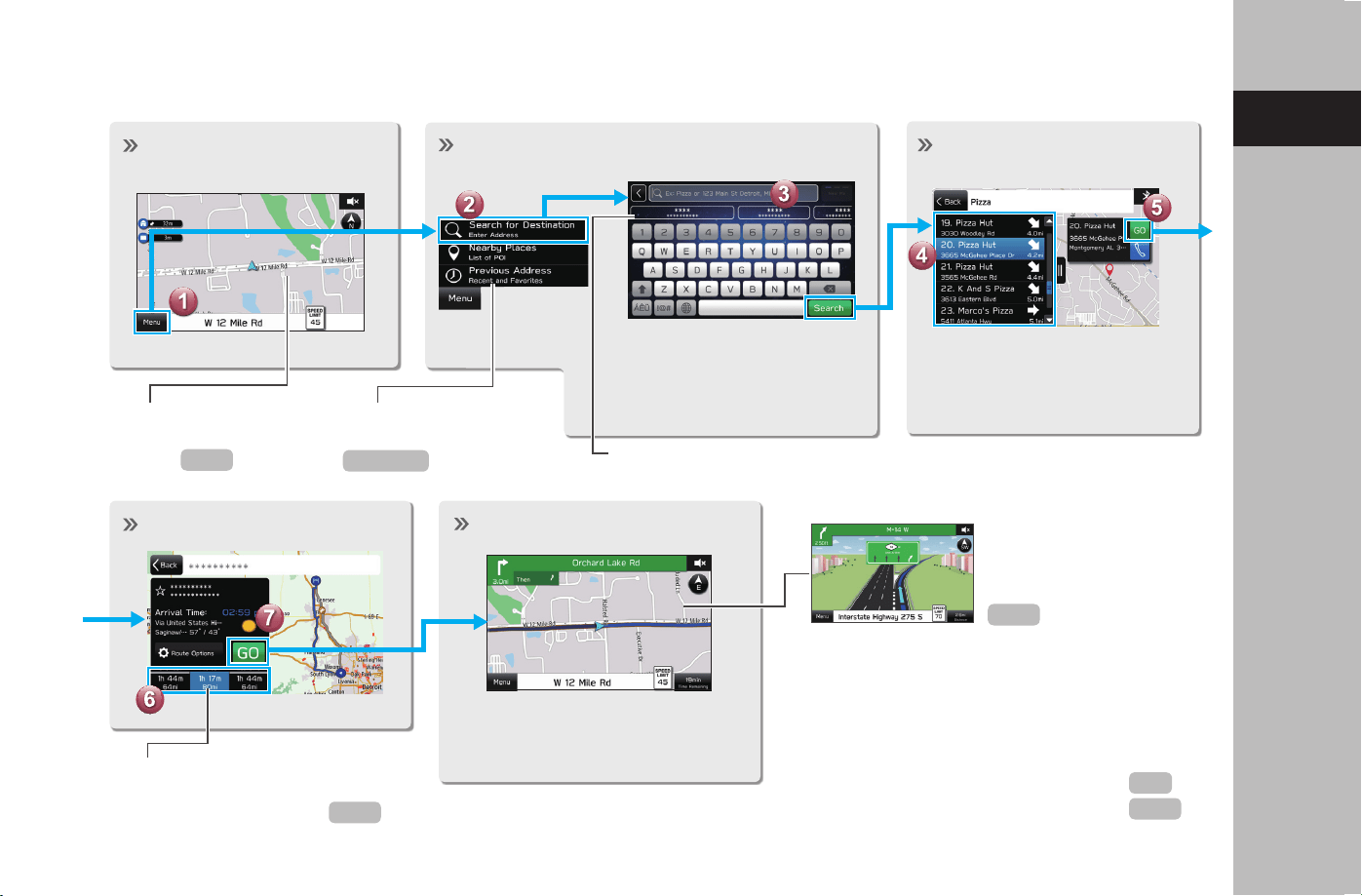
- Operation Flow: Route Guidance -
Display the destination
search menu.
Destinations can also be
set directly from the Map
screen.
Also search by POIs or
previously set destinations.
Search for your destination.
Start a search with a variety
of words such as addresses,
facility names, or latitude/
longitude, etc.
Predicted search results will
automatically appear as you type.
Select your destination.
Destinations matching the
search words are displayed
in a list.
Select the route.
A search is performed and results
displayed for the fastest, shortest,
and most economic routes.
Route guidance starts.
The travel route is displayed,
and voice guidance starts.
The screen display
automatically changes to
display travel lanes at
expressway junctions, etc.
JUNCTION SCREEN
RETURNING HOME
If you register an address as Home, it
can be quickly set as a destination.
Register an address as Home
Setting Home as the destination
P.166
P.167,168
P.171
P.165
P.27
P.174
docstructure.indb 21 2019/05/31 11:45:24
BASIC FUNCTION
22
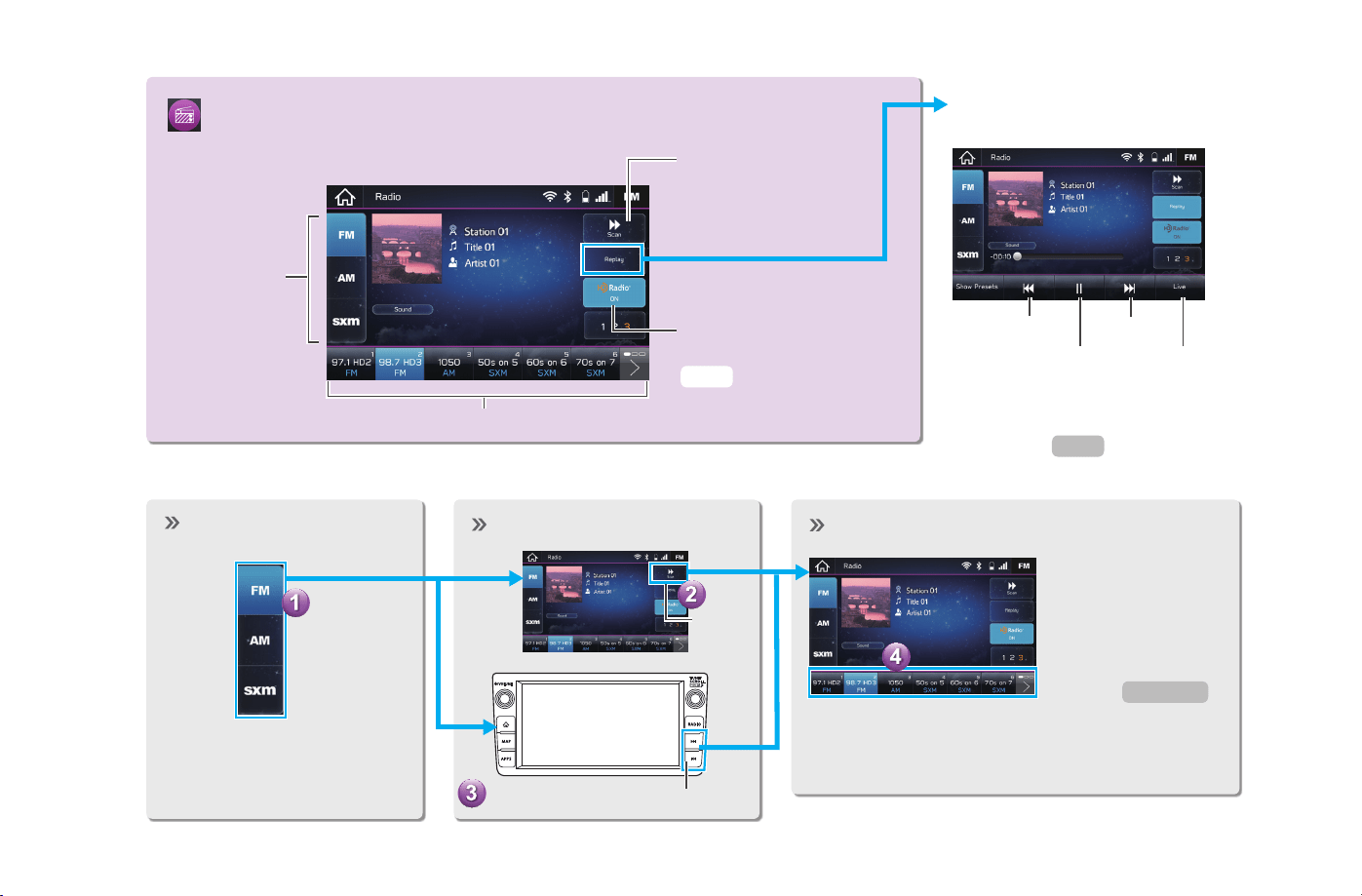
“Radio” SCREEN
Change
radio mode
Select to scan for
receivable
stations/channels.
Select to turn HD Radio
mode on/off (AM/FM).
Preset stations/channels
- Operation Flow: Presetting a Radio Station -
Select the radio band.
PAUSE AND PLAYBACK LIVE
RADIO
Radio programs can be
temporarily saved and played
back later.
A valid subscription to SiriusXM
®
Satellite Radio is required to
receive satellite radio service.
Select the radio station.
Mix preset function
Multiple stations can
be registered as
presets. ( AM, FM or
SiriusXM
®
Satellite
Radio)
Register the radio station.
Select and hold one of
the screen buttons.
Previous
Next
Pause/play Current program
P.124
P.126
P.123,132
Scan
OR
Press to seek for a station/channel.
docstructure.indb 22 2019/05/31 11:45:26
BASIC FUNCTION
23
1
Quick Guide
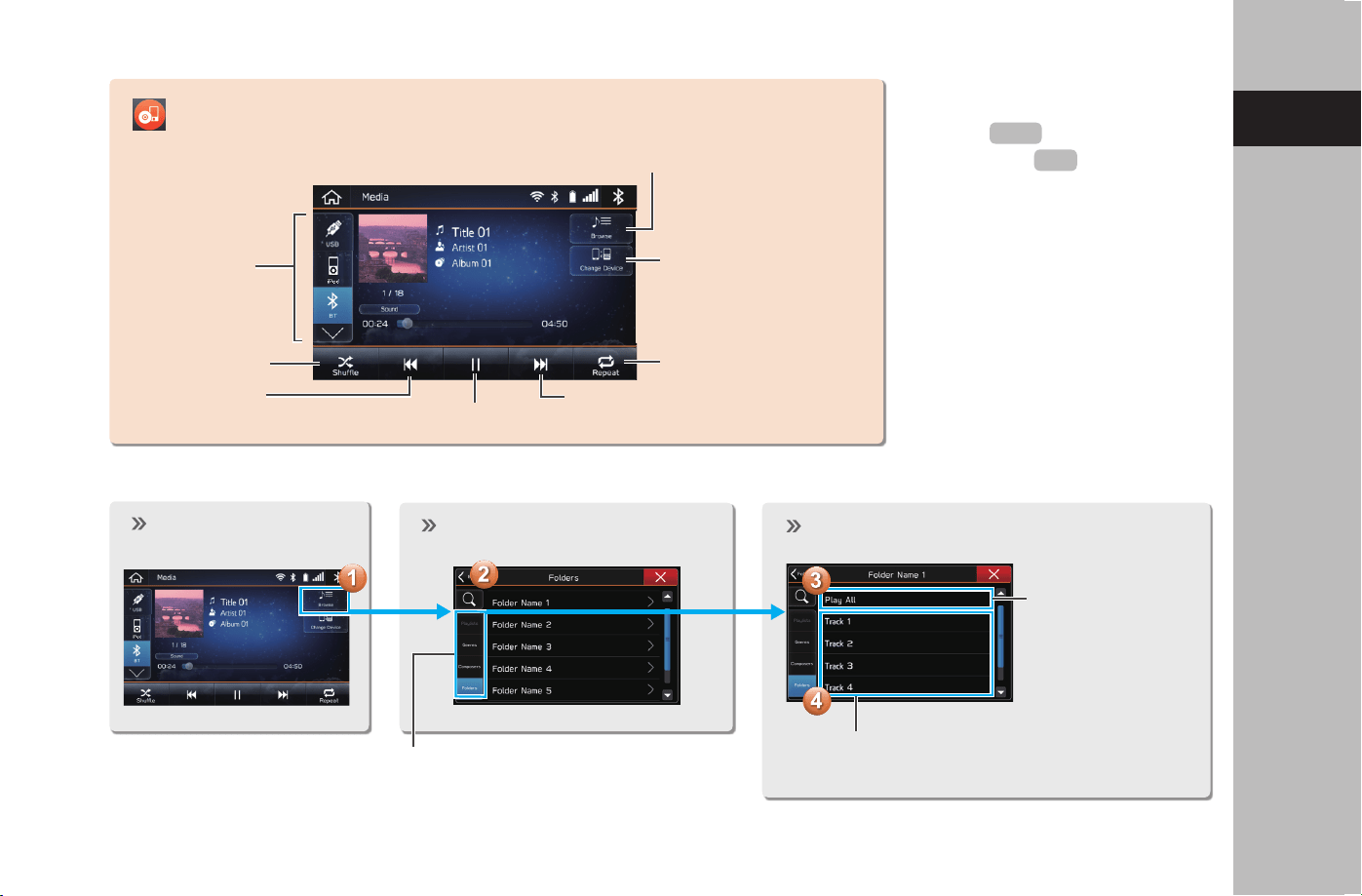
“Media” SCREEN
Change
media source
Random
playback on/off
Change tracks
Select and hold to fast rewind
Change to other
Bluetooth audio device/
register new device
Change tracks
Select and hold to fast forward
Repeat current track →
repeat current album/
folder → cancel repeat
Pause/play
- Operation Flow: Using Playback Modes -
Display the playback
mode list.
Select the playback mode.
Play a track.
Depending on the audio source, several
items from these categories are displayed
in a list.
Play the selected track.
Play all tracks from
the selected
category.
Playback tracks and programs, etc.
in a variety of playback modes
SUPPORTED MEDIA
USB/iPod
Bluetooth audio
P.152
P.49
docstructure.indb 23 2019/05/31 11:45:27
BASIC FUNCTION
24
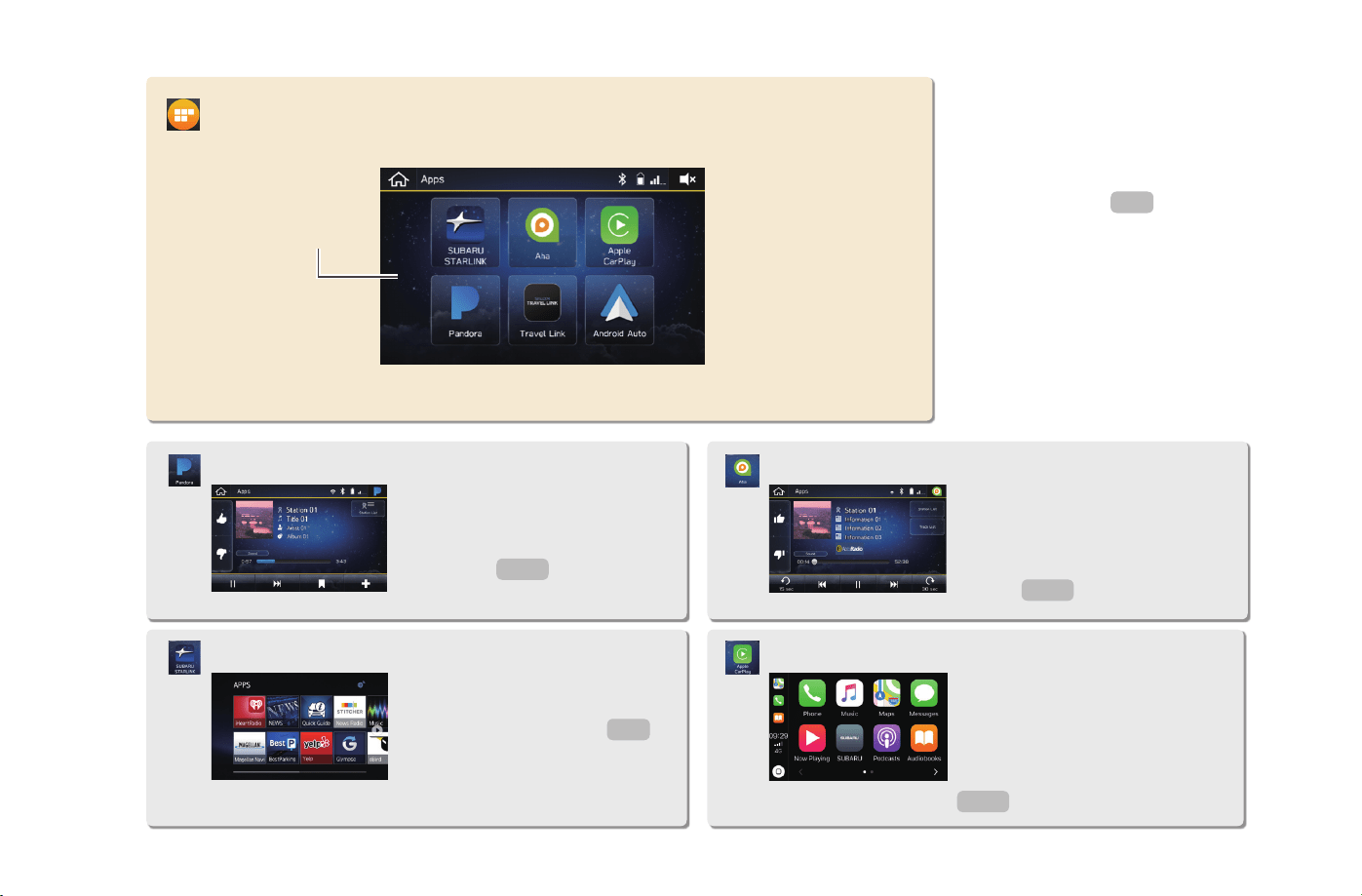
“Apps” SCREEN
List of usable
applications
ABOUT USING APPLICATIONS
In order to use an application on
this system, the corresponding
application must be installed on
your smartphone.
Apple CarPlay does not require
an application to be installed.
Pandora is free personalized
radio that offers effortless and
endless music enjoyment and
discovery.
Pandora*
*: Pandora is only available in certain countries. Please visit pandora.com/legal for more information.
The SUBARU STARLINK
function allows the system to
link with a smartphone.
SUBARU STARLINK
aha
TM
is a cloud-based applica-
tion that connects to the system
and gives you access to your
favorite web content safely and
easily.
aha
TM
P.94
P.106
P.102
P.97
CarPlay can be used to view
iPhone maps, play music, and
place calls by connecting your
iPhone to the system. Supported
applications can also be run.
Apple CarPlay
P.109
docstructure.indb 24 2019/05/31 11:45:28
BASIC FUNCTION
25
1
Quick Guide
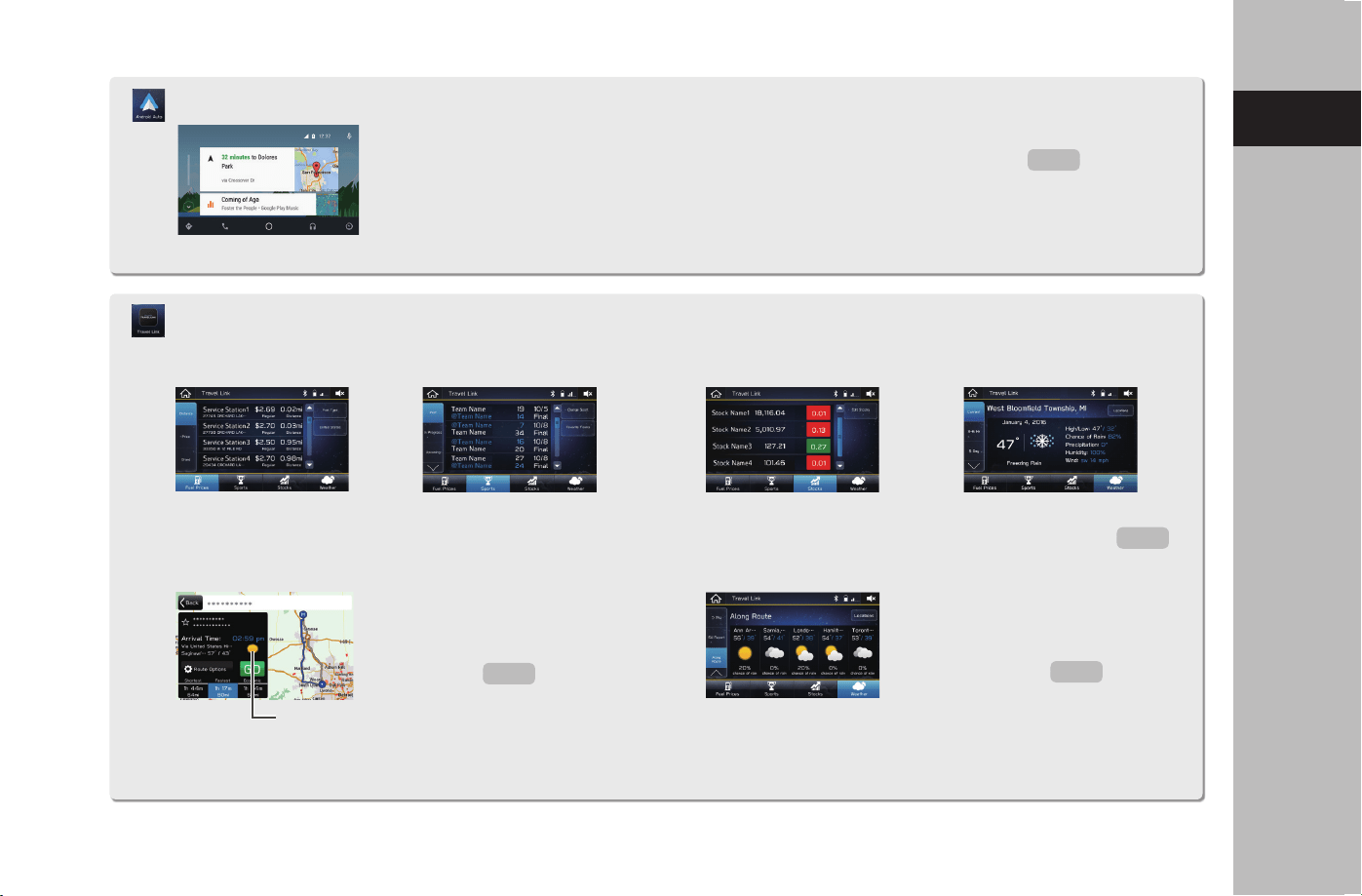
Android Auto can be used to view Android maps, play music, and place calls by connecting
your Android device to the system. Supported applications can also be run.
Android Auto
SiriusXM Travel Link is a service provided by SiriusXM
®
Satellite Radio, and can be used to view information on
fuel information, sports, stocks, and weather.
SiriusXM Travel Link
Weather information can be viewed by linking with the navigation function.
Current weather information
for your destination can be
viewed at the route calcula-
tion screen.
Weather information broadcast by
weather stations en route to your
destination can be viewed during
route guidance.
Fuel information Sports Stocks Weather
Weather information
SiriusXM Travel Link subscription is required.
P.111
P.113
P.171
P.179
docstructure.indb 25 2019/05/31 11:45:29
BASIC FUNCTION
26
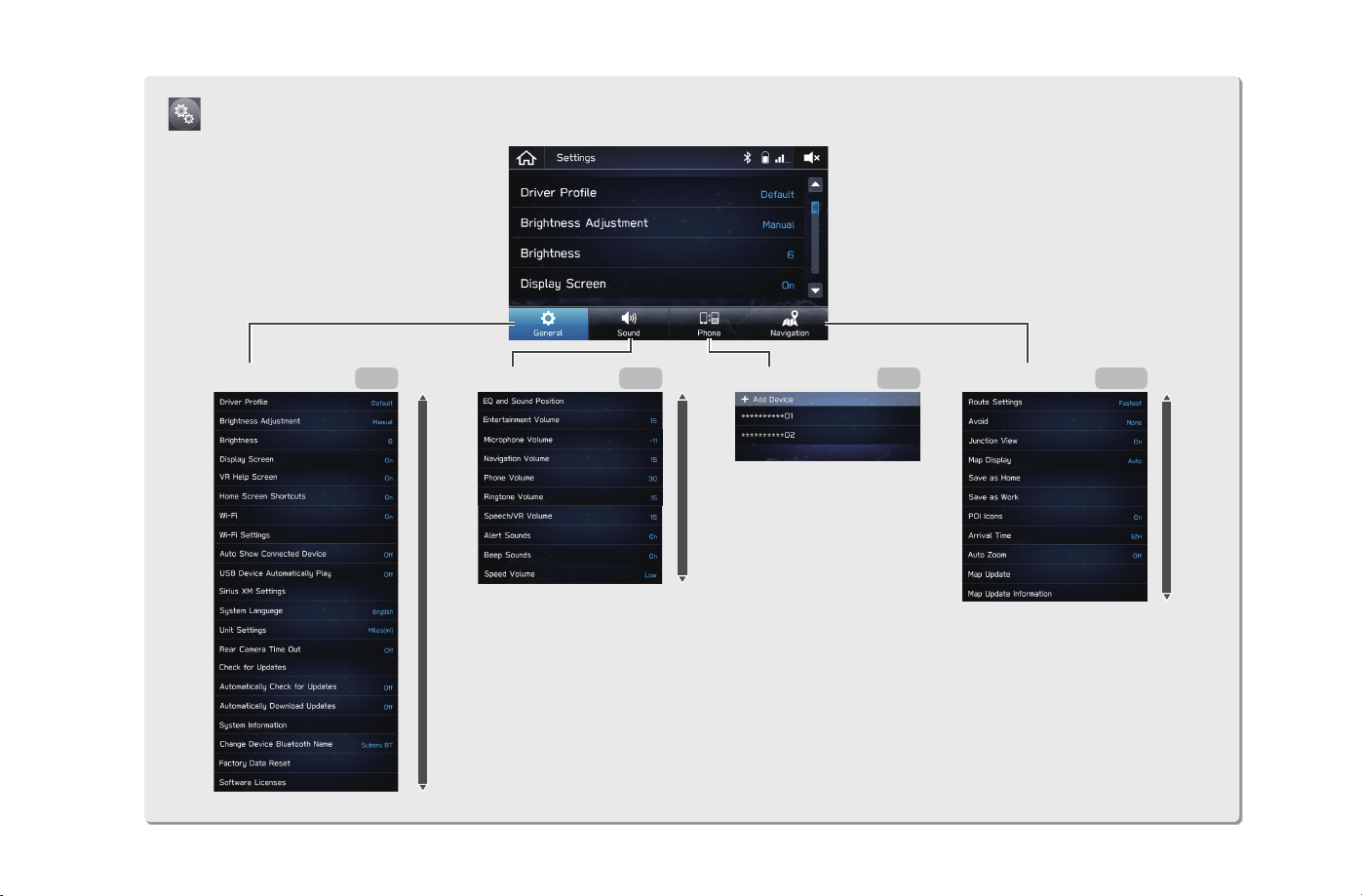
“Settings” SCREEN
PhoneSoundGeneral Navigation
SCROLL
SCROLL
SCROLL
P.180P.51P.73P.59
docstructure.indb 26 2019/05/31 11:45:29
BASIC FUNCTION
27
1
Quick Guide
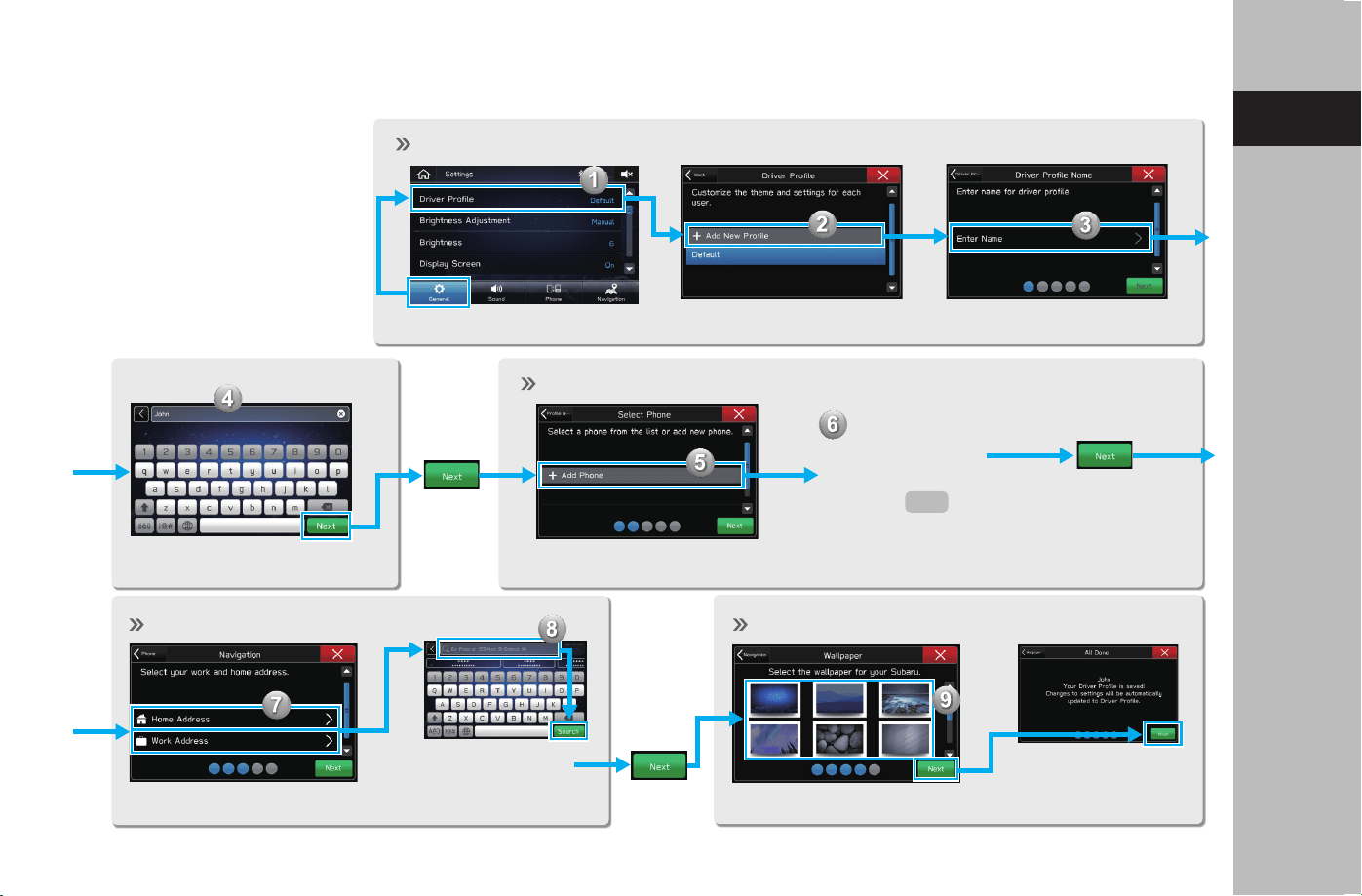
- Operation Flow: Create a driver prole -
CREATE A DRIVER
PROFILE
Create a driver prole and
register your cellular
phone, address, etc.
You can store and call
registered information at
any time.
Add a new prole.
Registering a Bluetooth phone
Enter a name.
Pair the system
and Bluetooth
phone.
Register wallpaper. Register your home/ofce.
Search for and
register your
home/ofce address.
Procedure complete.
P.18
docstructure.indb 27 2019/05/31 11:45:32
STEERING WHEEL CONTROLS
28
STEERING WHEEL CONTROLS
STEERING WHEEL CONTROLS
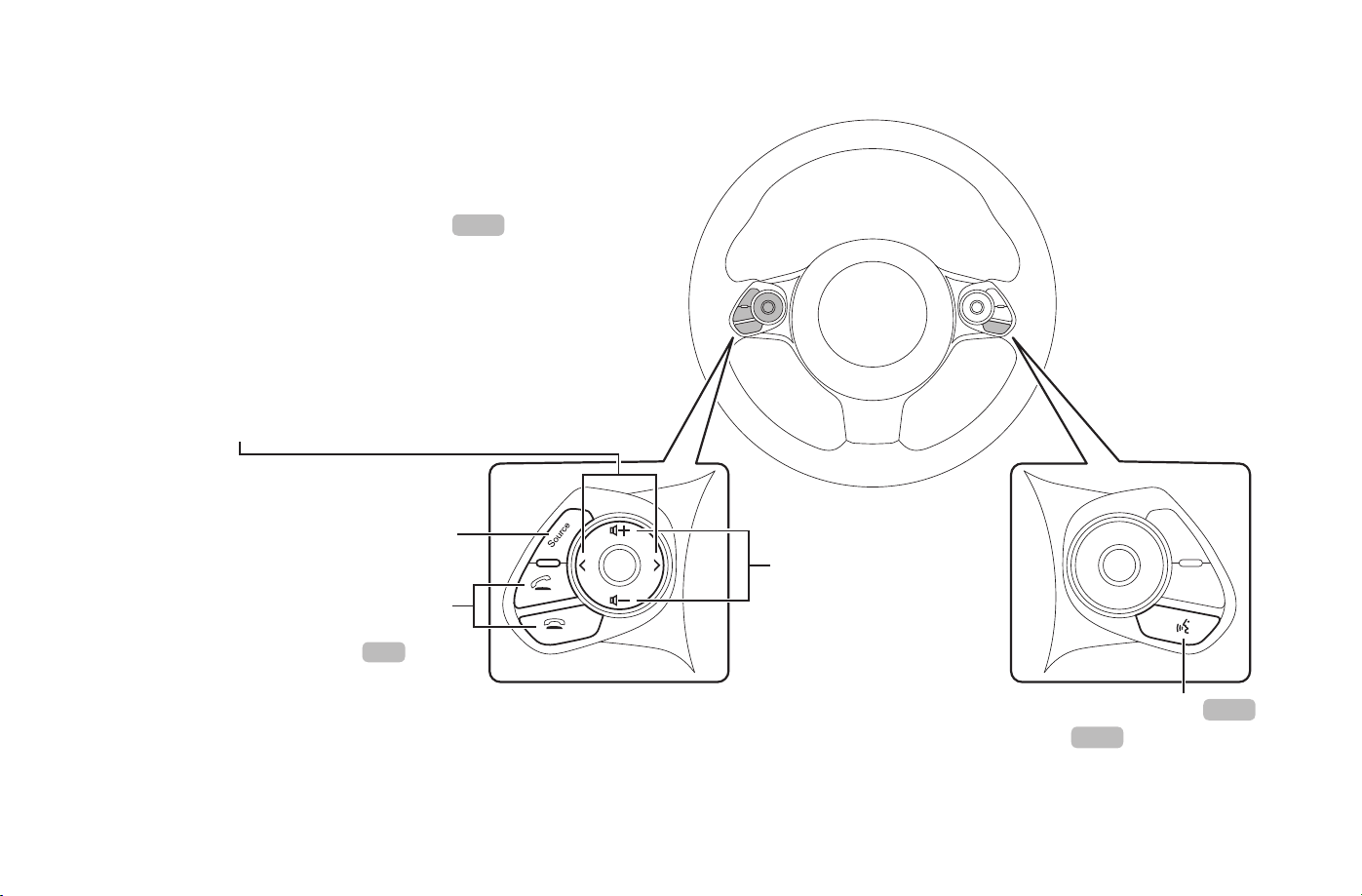
Some parts of the audio system can be controlled
using the steering wheel controls.
Press the switch to change
audio sources between radio
modes and media modes.
P.148
P.197
P.194
RADIO
Press: Preset station/channel up/down
Press and hold: Scan and stop at the rst received
station when the switch is released
MEDIA
Press: Change a track/le
Press and hold: Fast forward/rewind
Press: Volume up/down
Press and hold: Volume
up/down continuously
Press: Start the voice recognition system*
1
Press and hold: Start Siri*
2
Press the switch to receive/end
a call without taking your hands
off the steering wheel.
P.78
*
1
:
The system’s voice recognition function cannot be used while using
Siri, Apple CarPlay or Android Auto. Start the voice recognition
function after exiting Siri, Apple CarPlay or Android Auto.
*
2
: If connected to iPhone
docstructure.indb 28 2019/05/31 11:45:32

Basic Function
29
Basic Function
Basic Information Before Operation
30
Initial Screen
30
Initial Screen
30
Connecting And Disconnecting
A USB Memory Device
31
Connecting A Device
31
Touch Screen Gestures
31
Touch Screen Operation
33
Entering Letters And Numbers/
List Screen Operation
34
Entering Letters And Numbers
34
List Screen Operation
35
Screen Adjustment
36
Adjusting Brightness
36
Changing Between Day And Night Mode
36
Status Display
36
Home Screen Operation
37
Adding Shortcut Icons To The Home Screen
37
Moving And Deleting Shortcut Icons
38
Rear View Camera
39
Rear View Camera
39
How To Use The Rear View Camera
41
Viewing Range On The Screen
41
Help Line
43
docstructure.indb 29 2019/05/31 11:45:32
BASIC INFORMATION BEFORE OPERATION
INITIAL SCREEN
INITIAL SCREEN
WARNING
l When the vehicle is stopped with the engine running, always
apply the parking brake for safety.
1.
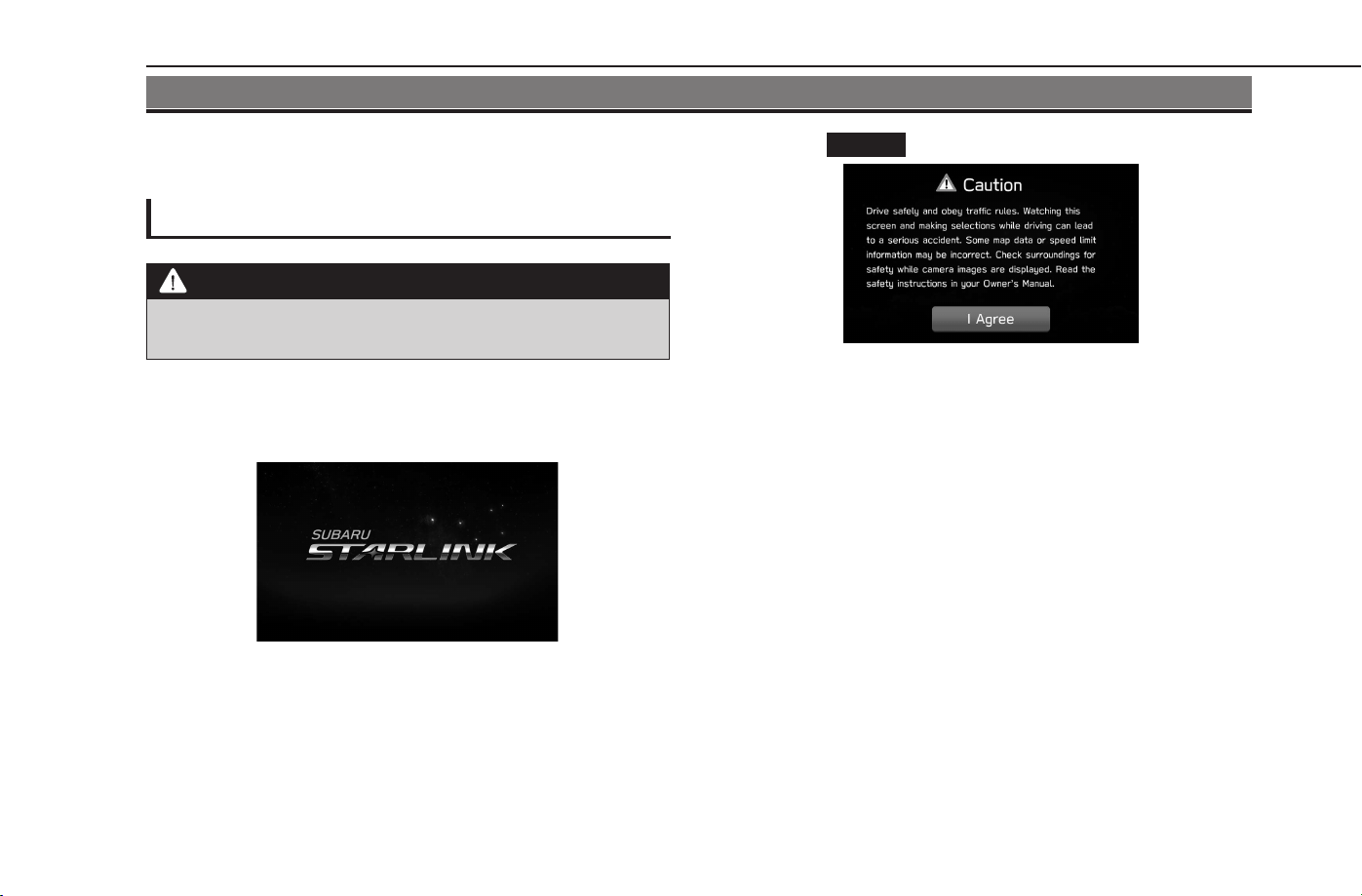
When the ignition switch is in the “ACC” or “ON”
position, the initial screen will be displayed and the
system will begin operating.
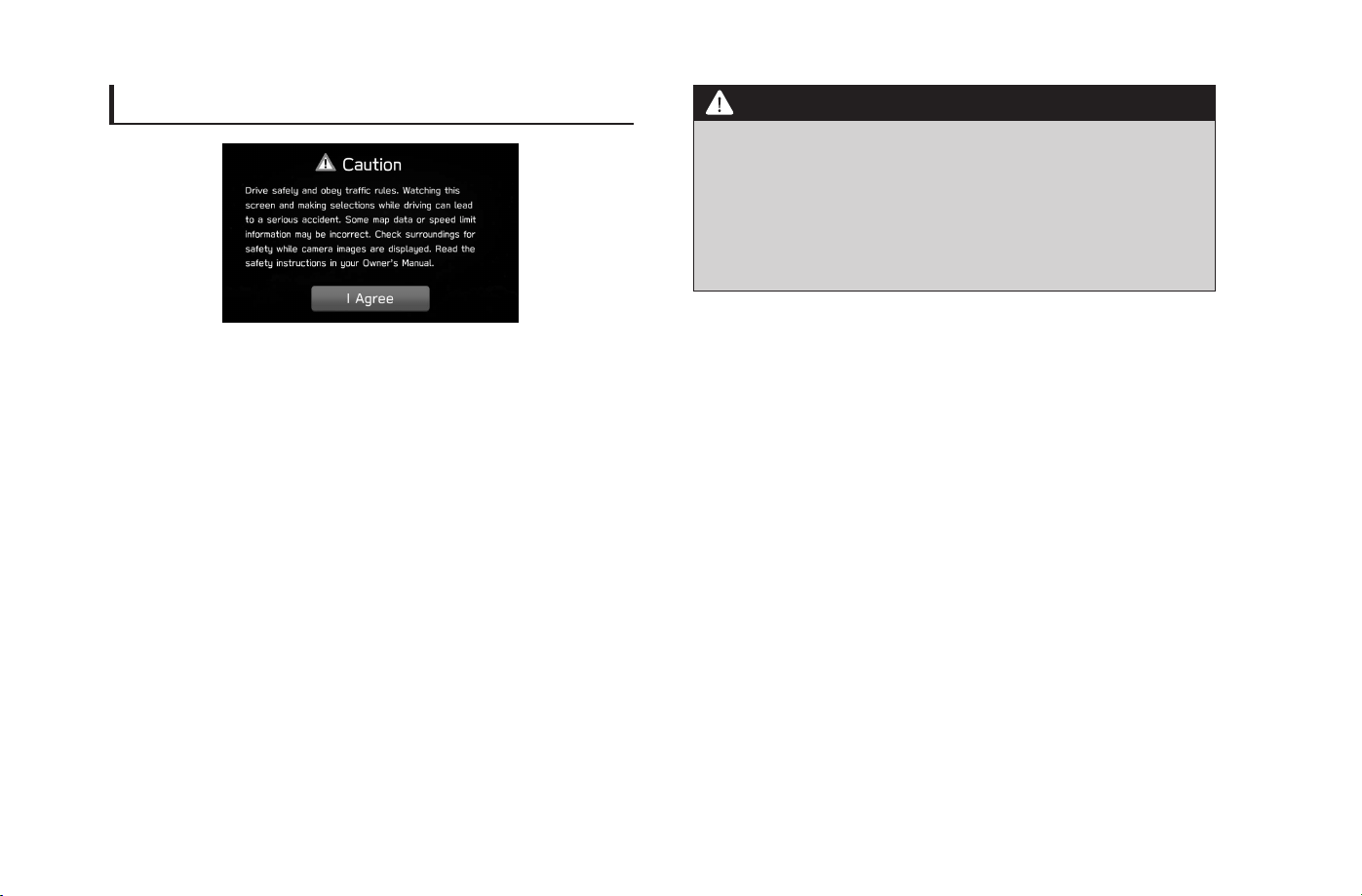
● After a few seconds, the “Caution” screen will be
displayed.
2.
Select
I Agree
(I Agree).
BASIC INFORMATION BEFORE OPERATION
30
docstructure.indb 30 2019/05/31 11:45:33
CONNECTING AND
DISCONNECTING A USB MEMORY
DEVICE
CONNECTING A DEVICE
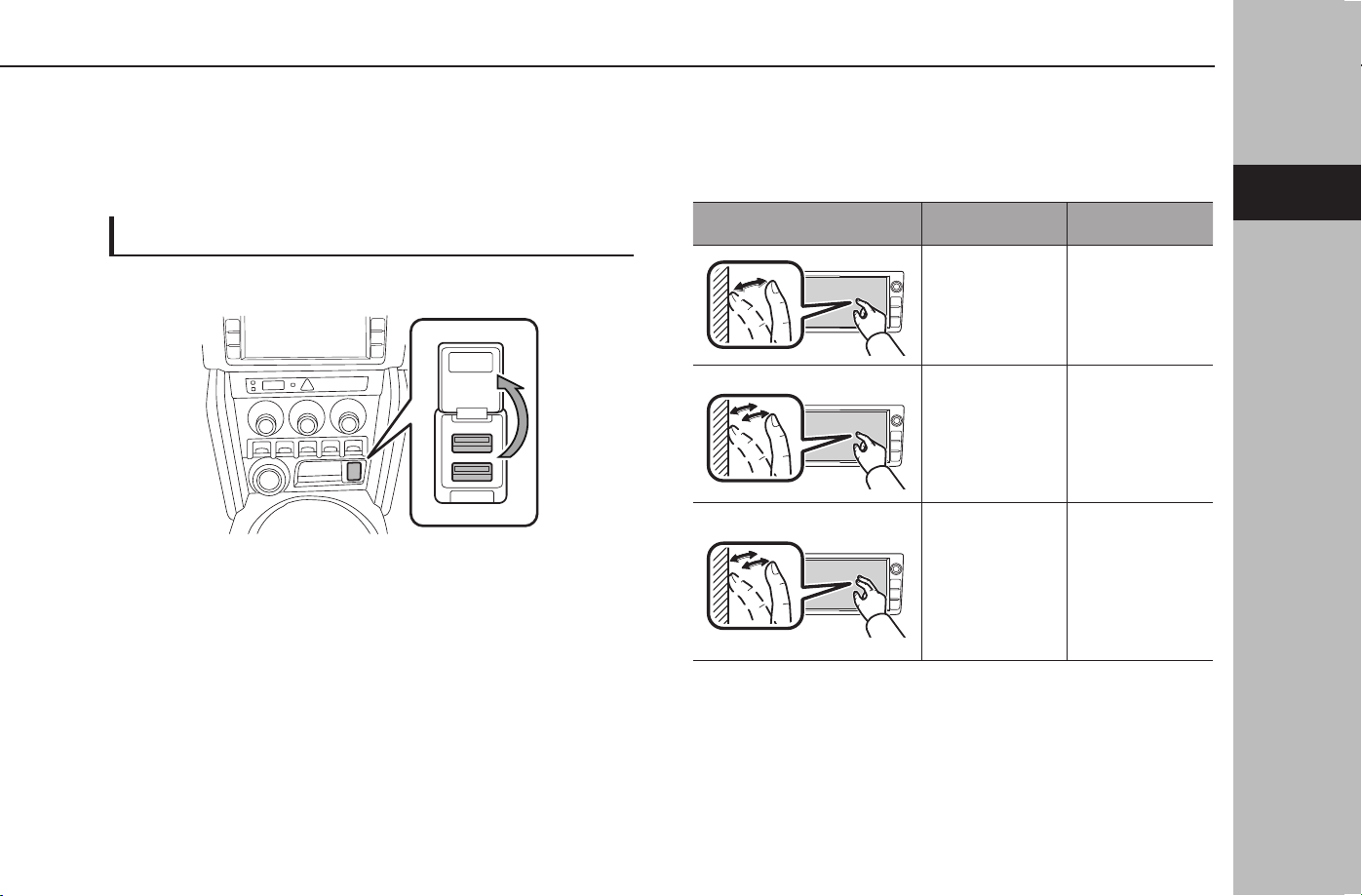
1.
Connect a device.
● Turn on the power of the device if it is not turned on.
NOTE
l Compatible USB memory device: →P.152
l Compatible iPod: →P.152
l This unit does not support commercially available USB hubs.
l By connecting a device such as a cellular phone, charging starts
depending on the device.
TOUCH SCREEN GESTURES
Operations are performed by touching the touch screen
directly with your nger.
Operation method Outline Main use
Touch
Quickly touch
and release
once.
Changing
and selecting
various settings
Double Touch
with one nger
Quickly touch
and release
twice with one
nger.
Enlarging the
scale of the map
screen
Double Touch
with two
ngers
Quickly touch
and release
twice with two
ngers.
Reducing the
scale of the map
screen
BASIC INFORMATION BEFORE OPERATION
31
Basic Function
2
docstructure.indb 31 2019/05/31 11:45:33
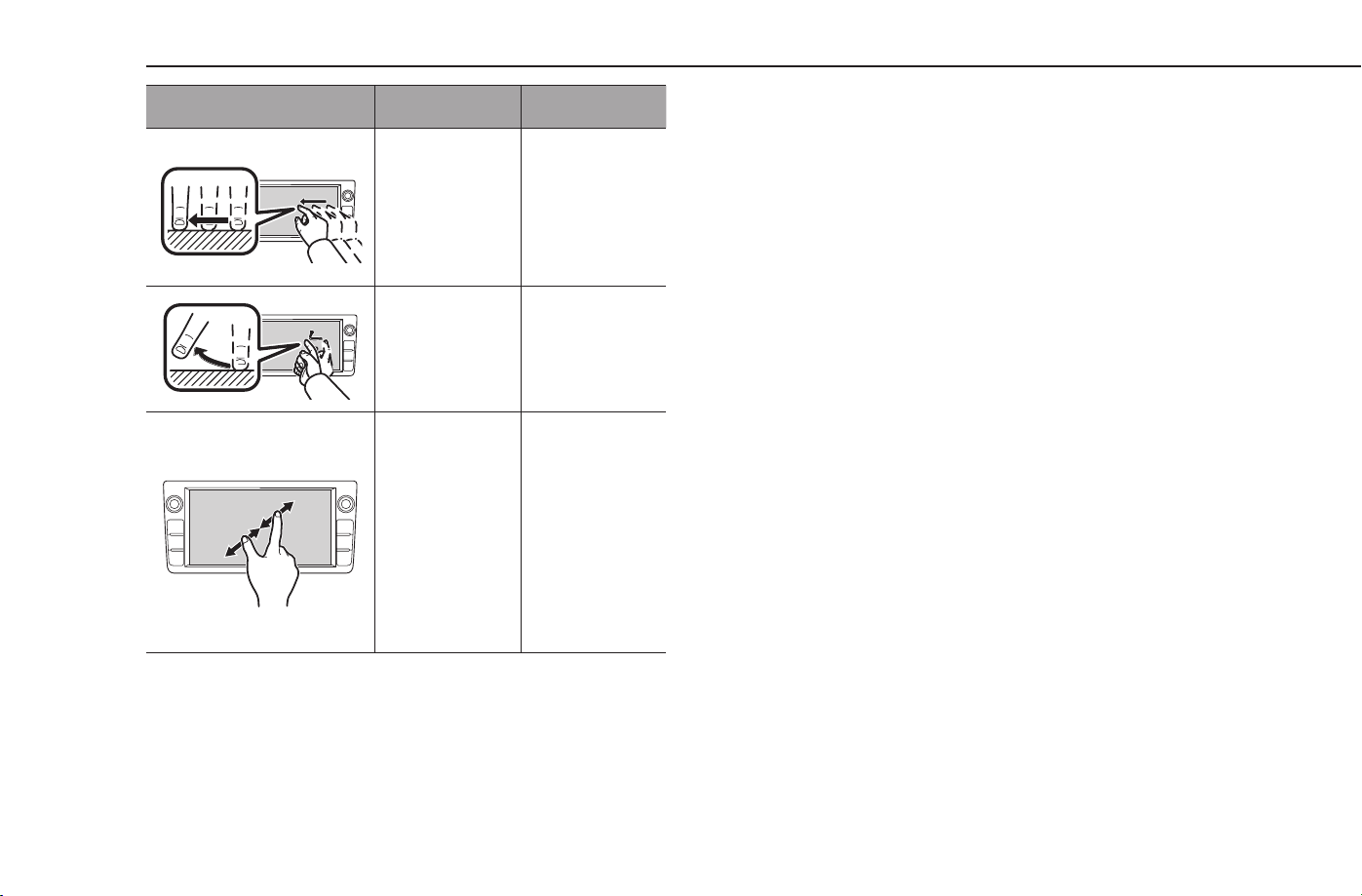
Operation method Outline Main use
Drag*
Touch the
screen with
your nger,
and move the
screen to the
desired position.
• Scrolling the
lists
•
Scrolling the
map screen
Swipe*
Quickly move
the screen by
swiping with
your nger.
•
Scrolling the
lists
•
Scrolling the
map screen
Pinch
Move your two
ngers further
apart (pinch-
out) to zoom in
the map. Move
your two ngers
closer together
(pinch-in) to
zoom out the
map.
Changing the
scale of the map
screen
*: The above operations may not be performed on all screens.
NOTE
l Swipe operations may not be performed smoothly in high
altitudes.
BASIC INFORMATION BEFORE OPERATION
32
docstructure.indb 32 2019/05/31 11:45:34
TOUCH SCREEN OPERATION
This system is operated mainly by the buttons on the
screen. (Referred to as screen buttons in this manual.)
● When a screen button is touched, a beep sounds.
The beep sound can be turned on/of
f. (→P.72)
CAUTION
l To prevent damaging the screen, lightly touch the screen
buttons with your nger.
l Do not use objects other than your nger to touch the screen.
l Wipe off
ngerprints using a glass cleaning cloth. Do not use
chemical cleaners to clean the screen, as they may damage
the touch screen.
NOTE
l If the system does not respond to touching a screen button,
move your nger away from the screen and then touch it again.
l Dimmed screen buttons cannot be operated.
l The displayed image may become darker and moving images
may be slightly distorted when the screen is cold.
l In extremely cold conditions, the map may not be displayed
and the data input by a user may be deleted. Also, the screen
buttons may be harder than usual to depress.
NOTE
l When is displayed on the screen, select to close a
pop-up screen.
BASIC INFORMATION BEFORE OPERATION
33
Basic Function
2
docstructure.indb 33 2019/05/31 11:45:34
ENTERING LETTERS AND
NUMBERS/LIST SCREEN
OPERATION
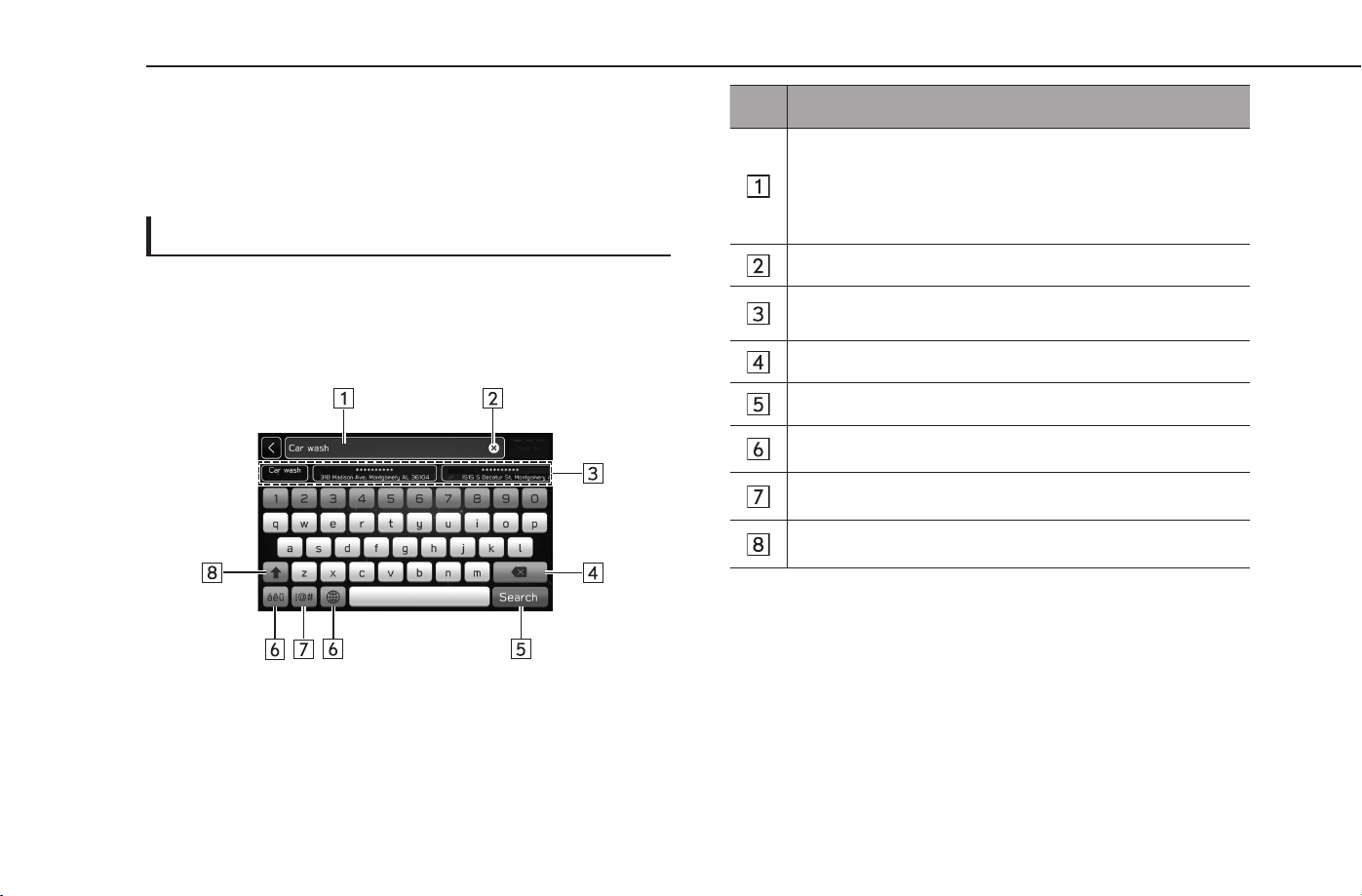
ENTERING LETTERS AND NUMBERS
When searching by an address, name, etc., or entering
data, letters and numbers can be entered via the screen.
No. Information/Function
Input eld
• The input eld contains text to assist the user in
completing tasks.
•
The position of the cursor can be moved by selecting
the desired location in the input eld.
Select to clear the input eld.
Displays candidate items based on the input letters.
The desired item can be selected.
Select to erase one character.
Select to enter the item.
Select to change keyboard types.
Select to enter symbols.
Select to enter characters in lower case or in upper case.
NOTE
l The appearance of the keyboard may change or the input
method may be limited depending on the circumstances where
the software keyboard is displayed.
BASIC INFORMATION BEFORE OPERATION
34
docstructure.indb 34 2019/05/31 11:45:35
LIST SCREEN OPERATION
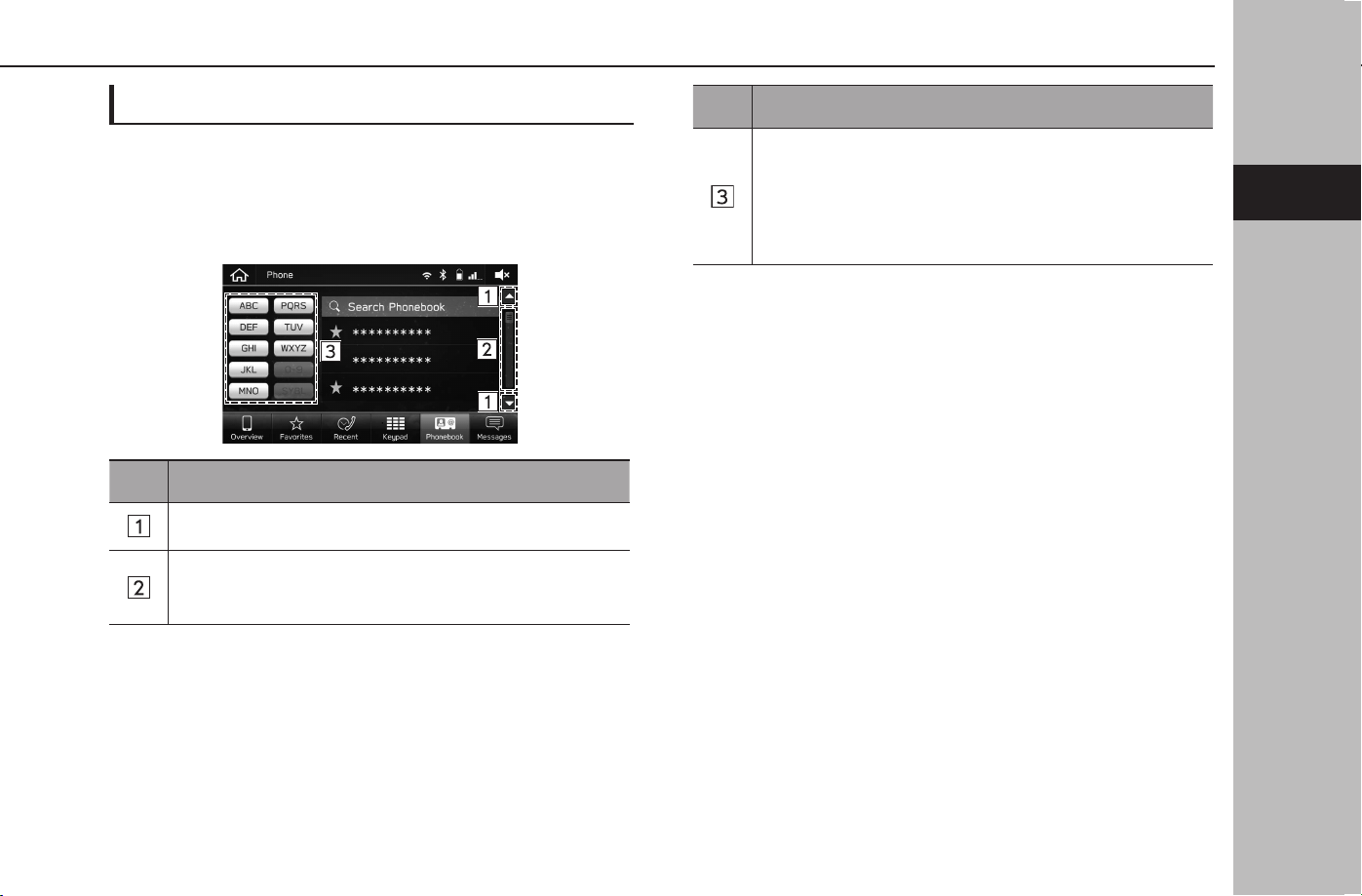
The list screen can be scrolled by a swipe gesture.
For details on the operation: →P. 31
The list screen can also be scrolled by the
“TUNE/
SCROLL” knob and pressing the knob will enter it.
No. Information/Function
Select to skip to the next or previous page.
This indicates the displayed screen’s position.
Faster scrolling is possible by dragging the position
indicator.
No. Information/Function
Some lists contain character screen buttons which allow
users to jump directly to list entries that begin with the
same letter as the character screen button.
Every time the same character screen button is selected,
the list starting with the subsequent character is
displayed.
BASIC INFORMATION BEFORE OPERATION
35
Basic Function
2
docstructure.indb 35 2019/05/31 11:45:36
SCREEN ADJUSTMENT
ADJUSTING BRIGHTNESS
The brightness of the screen can be adjusted. (→P.59)
CHANGING BETWEEN DAY AND NIGHT
MODE
By setting “Map Display” to auto on the navigation settings
screen, the map screen will change between day and night
mode depending on the position of the headlight switch or
illumination control dial and the surrounding brightness.
(→P.180)
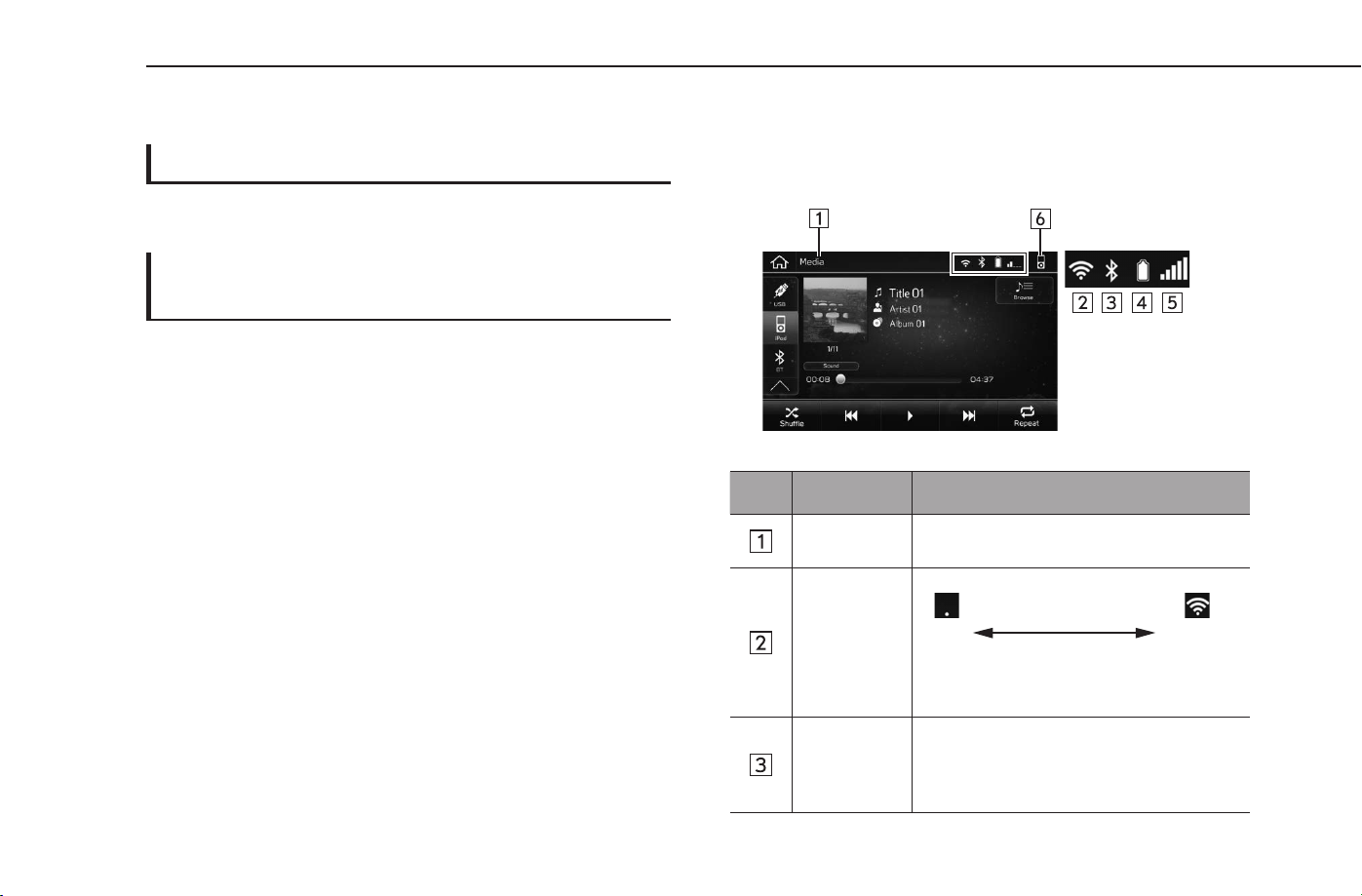
STATUS DISPLAY
The status of the Bluetooth connection, etc. is displayed on
the screen.
No. Name Conditions
Screen
name
Displays the screen name.
The level
of Wi-Fi
®
reception
Poor Excellent
When Wi-Fi
®
function is off, no item is
displayed.
The
Bluetooth
connection
indicator
This icon is displayed when the Bluetooth
connection is established.
BASIC INFORMATION BEFORE OPERATION
36
docstructure.indb 36 2019/05/31 11:45:36
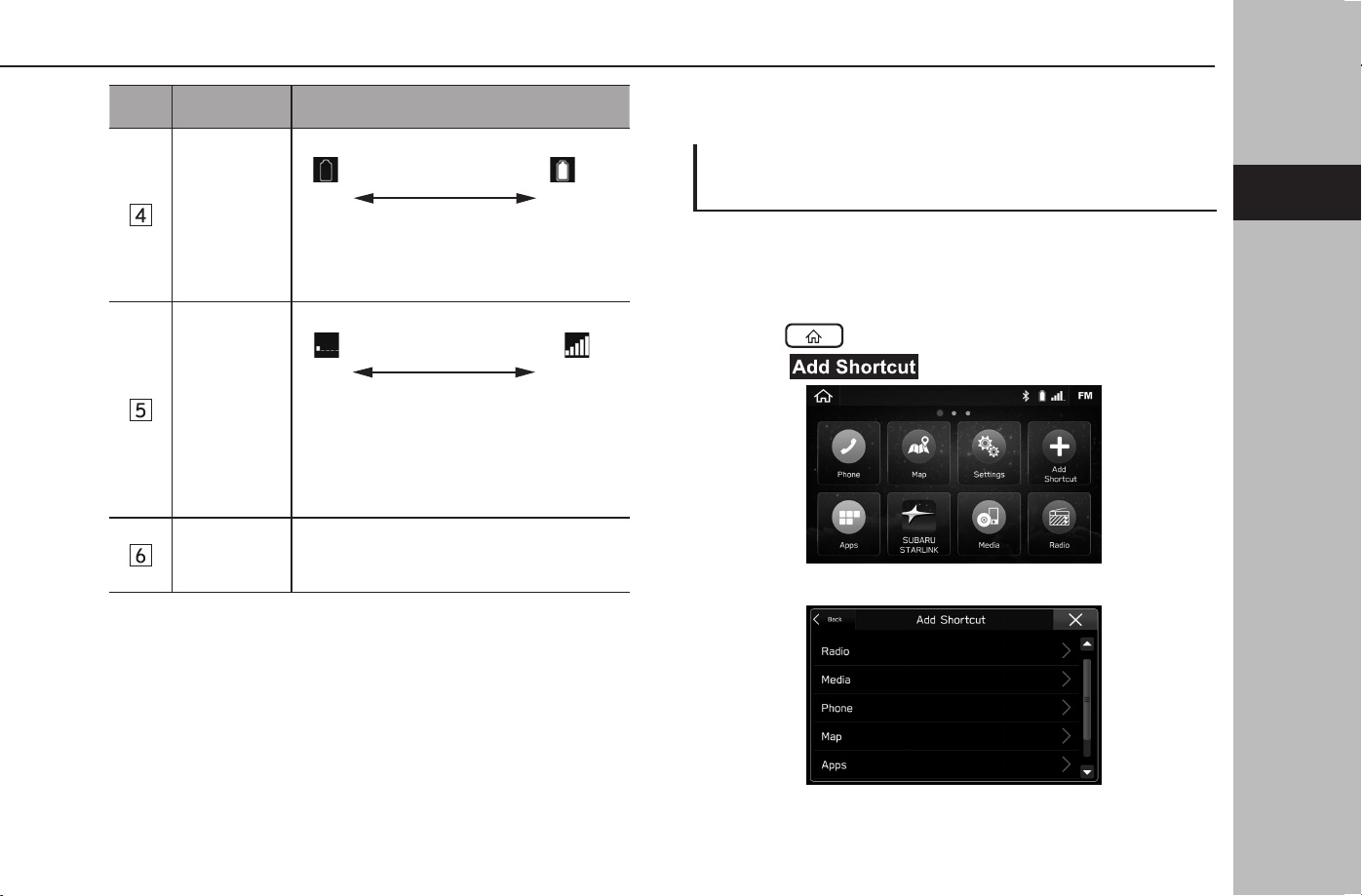
No. Name Conditions
Remaining
battery
charge
Low Full
The amount displayed does not always
correspond with the amount displayed on
the Bluetooth device.
Reception
level
Poor Excellent
The level of reception does not always
correspond with the level displayed on
the cellular phone. The level of reception
may not be displayed depending on the
phone you have.
Active audio
source
Select to display the active audio source
information, radio frequency, and name of
the artist and track currently playing, etc.
HOME SCREEN OPERATION
ADDING SHORTCUT ICONS TO THE HOME
SCREEN
Shortcut icons for various functions can be added to the
home screen when the home screen shortcut function is
turned on. (→P.59)
1.
Press .
2.
Select (Add Shortcut).
3.
Select the desired function.
BASIC INFORMATION BEFORE OPERATION
37
Basic Function
2
docstructure.indb 37 2019/05/31 11:45:38
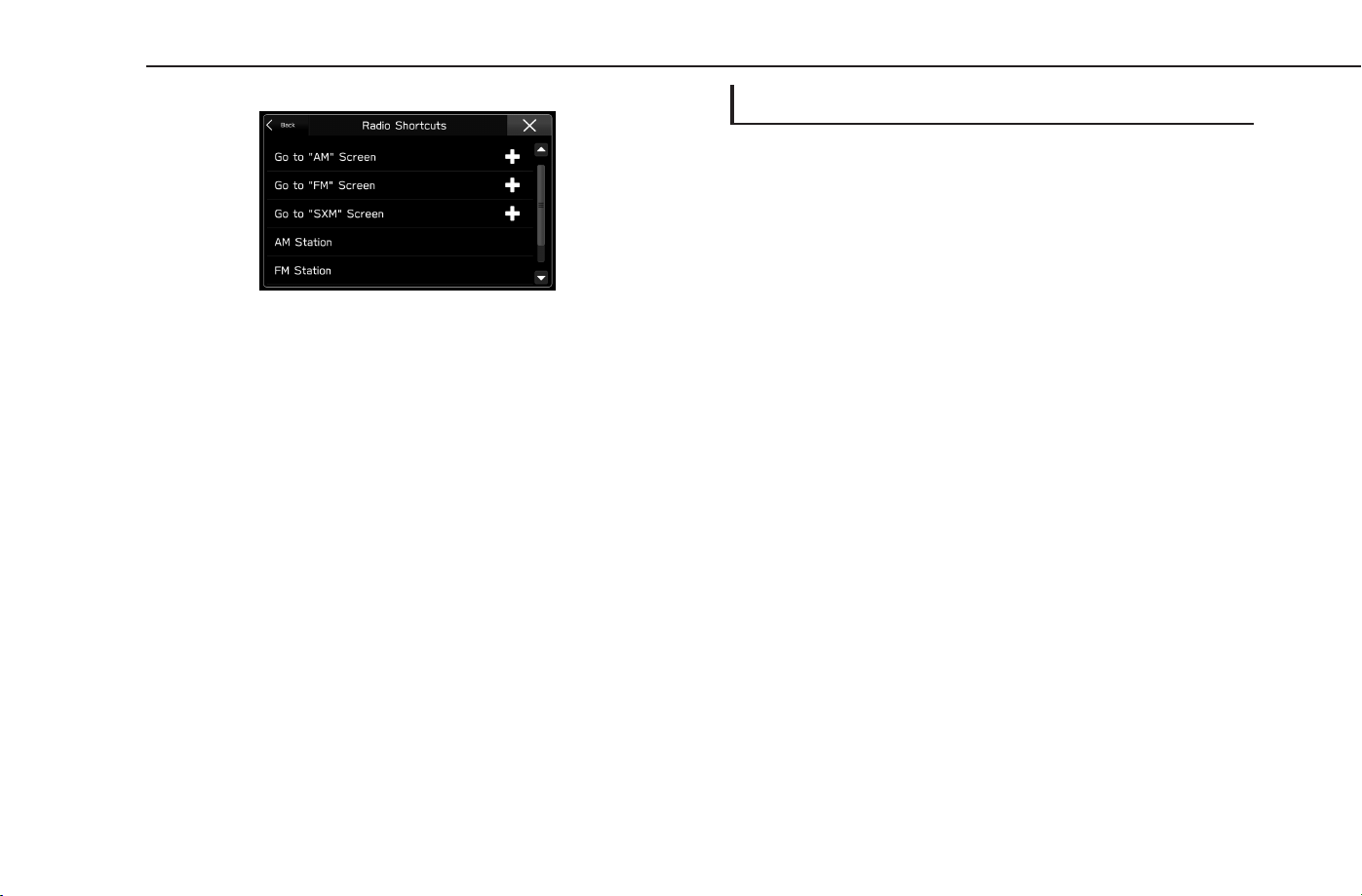
4.
Select the desired shortcut function.
● Depending on the function, select other items and
enter necessary information.
5.
Check that the shortcut icon is displayed on the home
screen.
NOTE
l The home screen has 3 pages, and shortcut icons can be added
to each page. The page can be changed by swiping.
MOVING AND DELETING SHORTCUT ICONS
Users can rearrange the home screen buttons when the
home screen shortcut function is turned on. (→P.59)
1.
Select and hold the shortcut icon.
XWhen moving shortcut icons
2.
Drag the button to the desired position.
● User can move buttons to another page by dragging
them to
the corresponding end of the screen if the
number of buttons allows for multiple pages.
XWhen deleting shortcut icons
2.
Drag the button to the bottom of the screen.
BASIC INFORMATION BEFORE OPERATION
38
docstructure.indb 38 2019/05/31 11:45:38
REAR VIEW CAMERA
REAR VIEW CAMERA
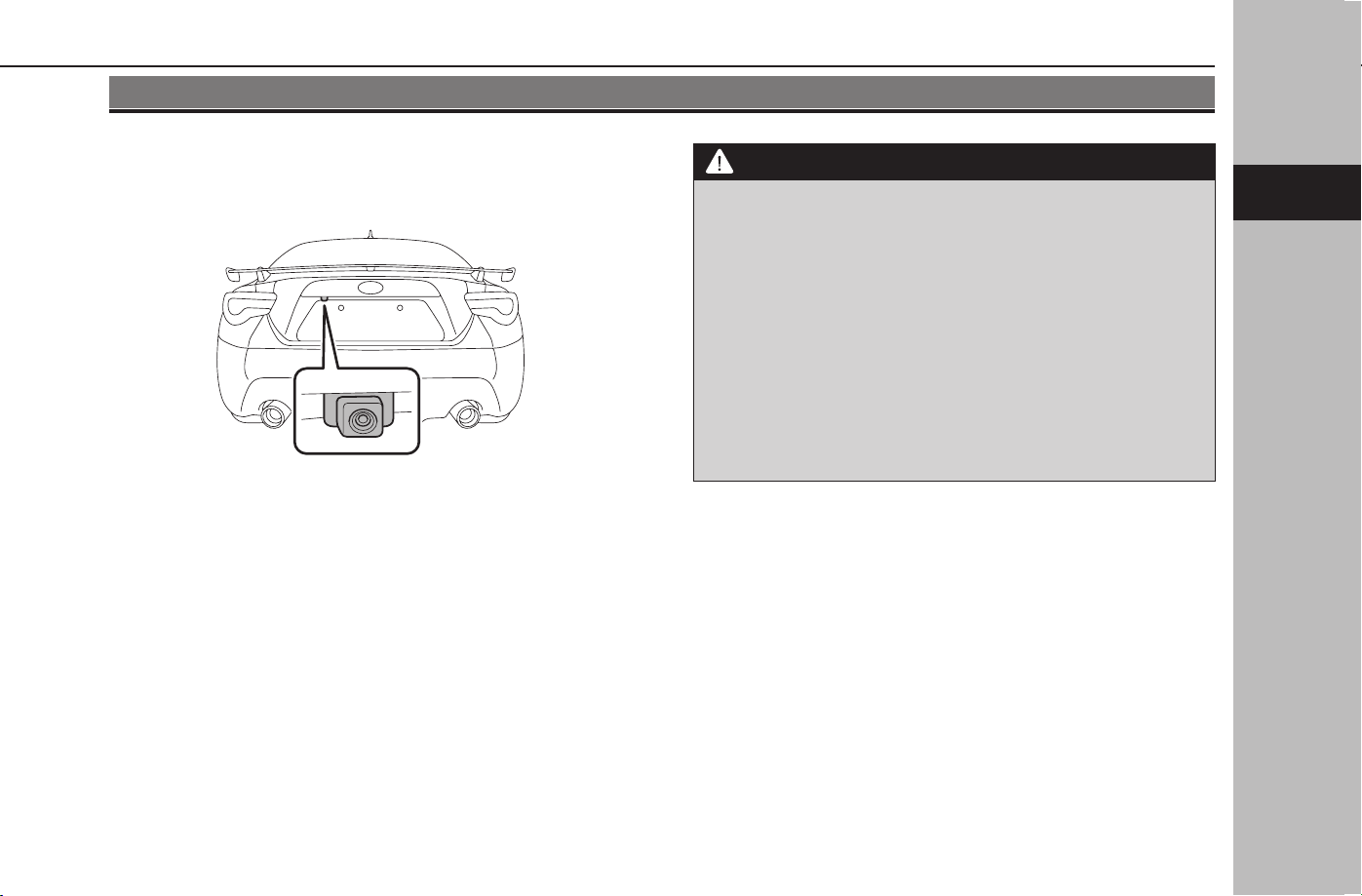
A rear view camera is attached to the trunk lid.
When the ignition switch is “ON” and the shift lever
(Manual transmission models) or select lever (Automatic
transmission models) is set to “R”, the rear view camera
automatically displays the rear view image behind the
vehicle. The rear view camera image is displayed on this
system.
WARNING
l Since the rear view camera uses a wide-angle lens, the image
on the monitor is different from the actual view in terms of
distance.
l Since the range of the image on the monitor is limited, you
should always check the rear view and the surrounding area
with your eyes and mirrors, and move backward at a slow
speed. Moving backward only by checking the rear view
image from the camera could cause an accident.
l Do not disassemble or modify the camera, switch or wiring. If
smoke comes out or you smell a strange odor, stop using the
rear view camera immediately. Contact your SUBARU dealer
for an inspection. Continued use may result in accident, re or
electric shock.
REAR VIEW CAMERA
39
Basic Function
2
docstructure.indb 39 2019/05/31 11:45:38
CAUTION
l If your vehicle is washed with a high-pressure washer, do not
allow water to contact the camera directly. Water entering the
camera may cause condensation on the inside of the camera
lens, damage and malfunction of the camera.
l Since the camera
is a precision device, do not subject it to
strong impacts. Otherwise, malfunction, re or electric shock
may occur.
l If mud or snow sticks
to the camera, or it freezes up, you must
be very careful when removing it.
Pour water
or lukewarm
water over the camera to remove mud and ice, and wipe it
with a soft, dry cloth.
l Do not try to melt snow or ice off
of the camera using heat.
Otherwise, damage to the camera may occur.
l When replacing the fuse, be sure to use a fuse with the
specied
rating. Using a fuse with a different rating may result
in a malfunction.
l If the rear view
camera is used for a long time while the
engine is not operated, the battery may become completely
discharged.
NOTE
l Do not wipe the camera with alcohol, benzine or paint thinner.
Otherwise, discoloration may occur. To remove contamination,
wipe the camera with a cloth moistened with a diluted neutral
detergent and then wipe it with a soft, dry cloth.
l When waxing the vehicle, be careful not to apply the wax to the
camera. If it comes in contact with the camera, moisten a clean
cloth with a diluted neutral detergent to remove the wax.
l The camera lens has a hard coating to help prevent scratches.
However, when washing the vehicle or cleaning the camera lens,
be careful not to scratch the camera lens. Do not use a washing
brush directly on the camera lens. The image quality of the rear
view camera may deteriorate.
l Strong light shined on the camera lens may develop vertical
lines around the light source. This is not a malfunction.
l Under uorescent
light, the display may icker. However, this is
not a malfunction.
l The image of the rear view camera may be slightly different from
the actual color of the objects.
REAR VIEW CAMERA
40
docstructure.indb 40 2019/05/31 11:45:38
HOW TO USE THE REAR VIEW CAMERA
When the shift lever/select lever is set to “R”, the rear view
camera automatically displays the rear view image from the
vehicle. When the lever is set to other positions, the image
before setting to “R” is displayed.
1.
Set the ignition switch to “ON”.
2.
Set the shift lever/select lever to “R”.
NOTE
l While the navigation system is activated, the image of the rear
view camera will not be displayed. However, the image of the
rear view camera has priority over other screen displays.
l The image of the rear view camera is horizontally reversed
as is
the case with the vehicle rearview mirror or the side view mirror.
l It may be difcult to see the image of the rear view camera in the
following cases. This is not a malfunction of the camera.
• The vehicle is in a dark place (at night, in a tunnel, etc.).
• The vehicle is in an extremely hot or cold place.
• An object (such as raindrops, snow, dirt, etc.) that disturbs the
view of the rear view camera sticks to the lens of the camera.
•
Strong light shined directly on the camera lens (occasionally
,
there are vertical lines on the screen).
• The vehicle is used for towing or a trailer hitch is installed.
SETTING THE CAMERA IMAGE DISPLAY TIME
The length of time that the camera image remains displayed
when the shift lever/select lever is shifted from “R” to other
position can be set. (→P.59)
VIEWING RANGE ON THE SCREEN
CAUTION
l The range that can be viewed with the rear view camera is
limited. Always be sure to check with your eyes when moving
backward and proceed slowly.
The area from the rear end of the bumper can be viewed.
Areas at both ends of the bumper and areas just under the
bumper cannot be viewed. Also, the image from the rear
view camera looks shorter than the actual distance.
REAR VIEW CAMERA
41
Basic Function
2
docstructure.indb 41 2019/05/31 11:45:38
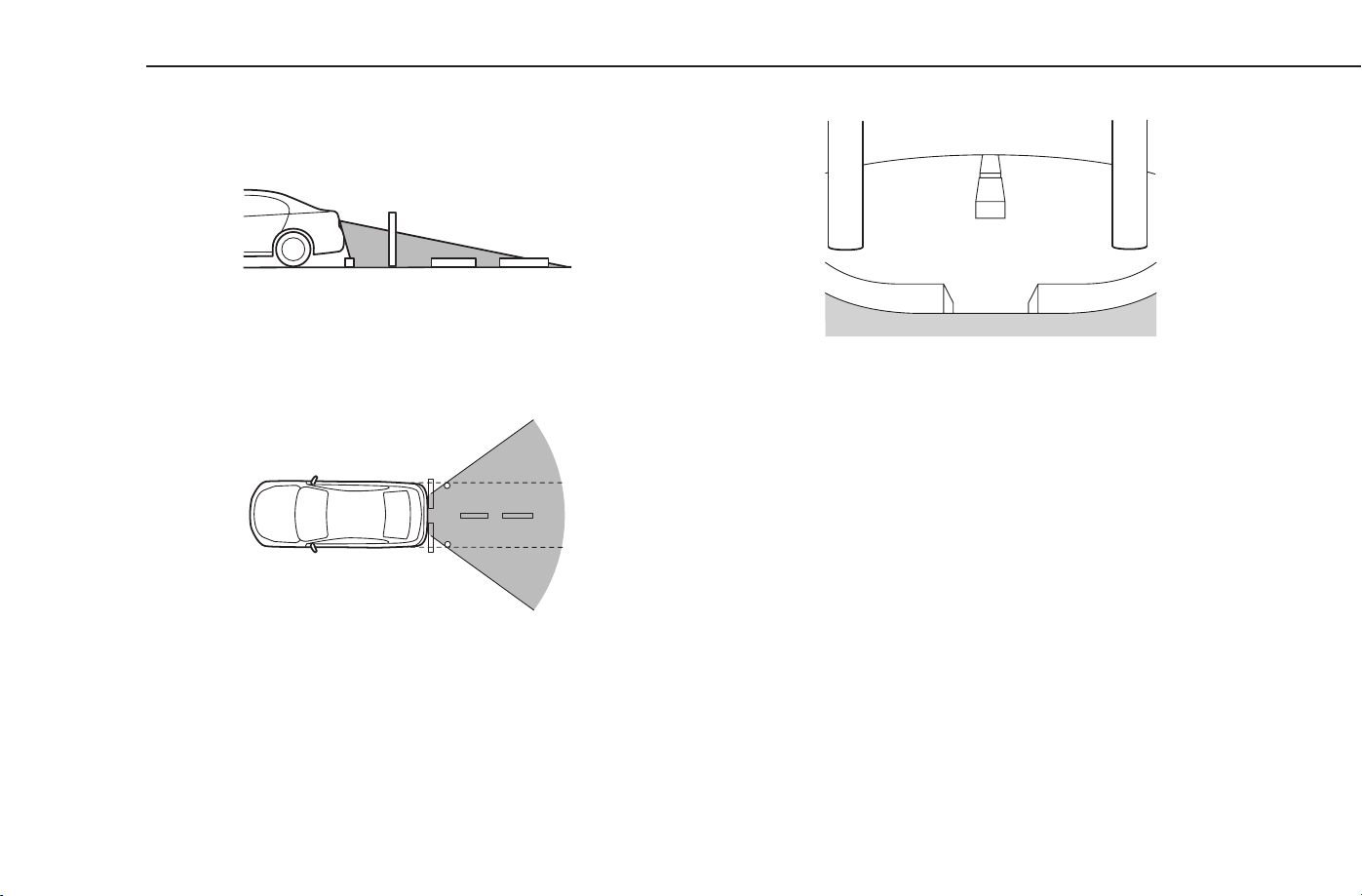
XRange of view XImage from camera
REAR VIEW CAMERA
42
docstructure.indb 42 2019/05/31 11:45:39
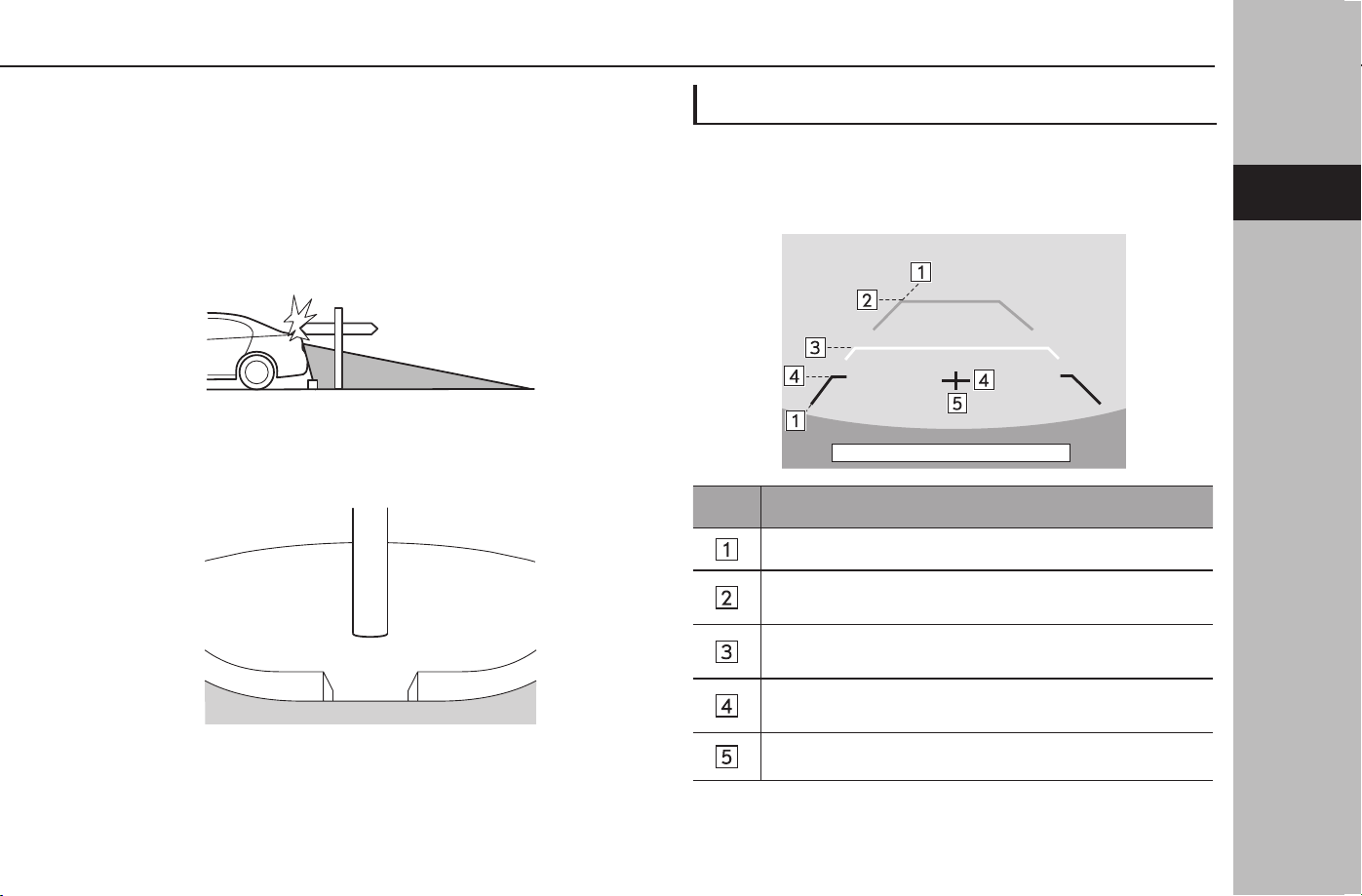
The area above the camera cannot be viewed. If there is an
object that has a wide projection on its upper part such as a
sign pole behind the vehicle, the projection cannot be seen
on the screen.
XRange of view
XImage from camera
HELP LINE
The help line (distance marker, dynamic guidelines and
vehicle width line) is a guide to help you realize the actual
distance and course from the screen image.
Check Surroundings Before Backing Up
No. Information
Vehicle width line (oblique vertical line)
Approx. 10 feet (3 m) from the bumper (green horizontal
line)
Approx. 3 feet (1 m) from the bumper (yellow horizontal
line)
Approx. 1.5 feet (0.5 m) or less from the bumper (red
horizontal line)
Vehicle centerline
REAR VIEW CAMERA
43
Basic Function
2
docstructure.indb 43 2019/05/31 11:45:39
REAR VIEW CAMERA
44
● When the shift lever/select lever is set to position “R”,
the monitor screen displays the help lines together
with the rear view image.
CAUTION
l When moving backward, always check the back with your
eyes without relying on the help lines.
l The actual position
and course may be different from the
indication of the help lines.
l Differences may occur due to number of passengers or loaded
cargo.
l When the vehicle is on a slope or when the vehicle is inclined
against the road, the indication
is different from the actual
position.
l Be sure to observe the displayed warning message “Check
Surroundings Before Backing Up”.
NOTE
l If you set the shift lever/select lever to “R” shortly after turning on
the ignition switch, the warning message “Check Surroundings
Before Backing Up” may not be displayed. Wait for several
seconds or more after turning on the ignition switch before
setting the shift lever/select lever to “R”. Then the warning
message will be displayed.
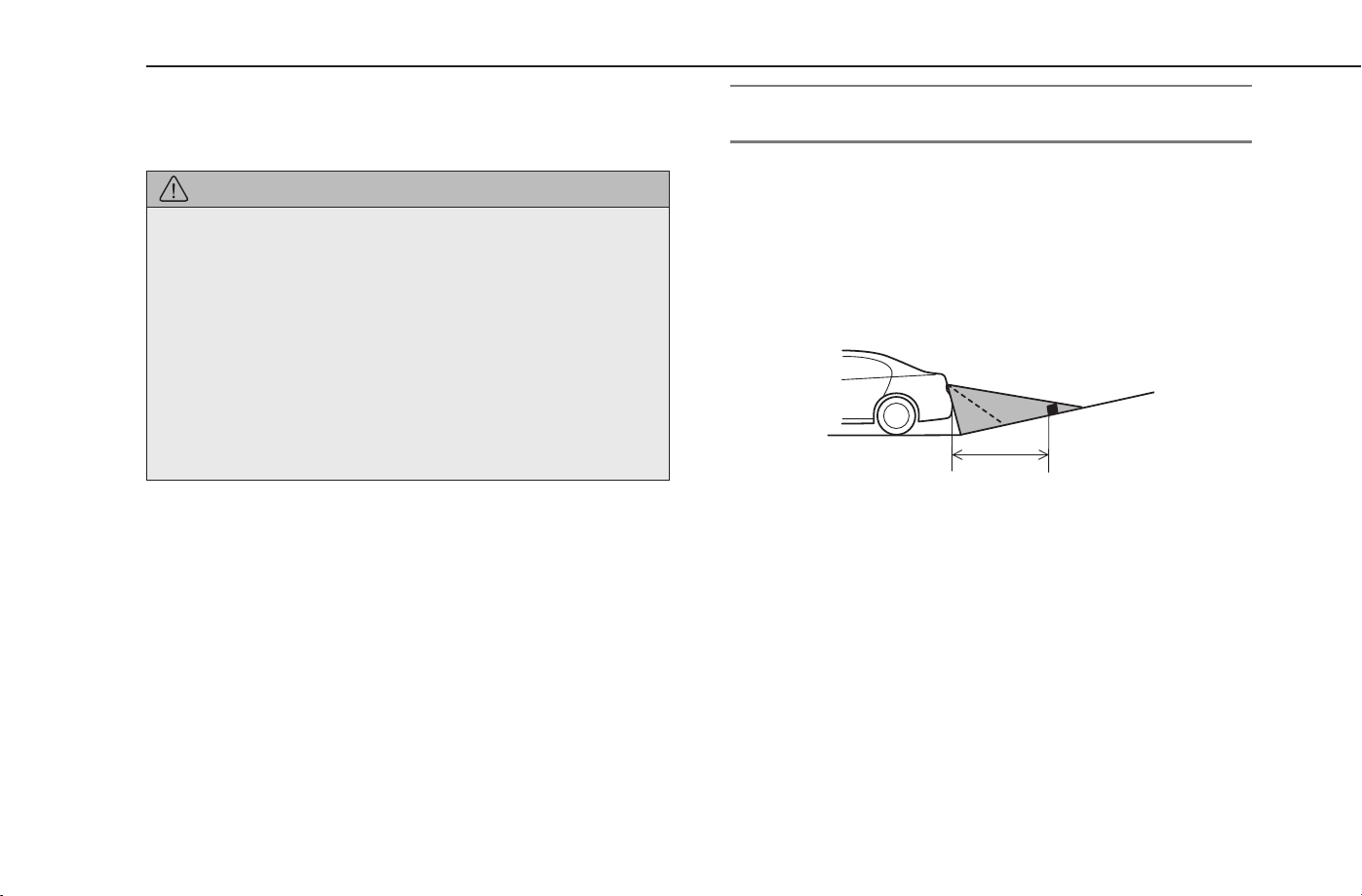
DIFFERENCE BETWEEN SCREEN IMAGE AND
ACTUAL ROAD
The distance markers show the distance for a level road
when the vehicle is not loaded. It may be different from the
actual distance depending on the loading conditions or road
conditions.
XWhen there is an upward slope at the back
3 feet (1 m)
● The distance on the screen looks farther than the
actual distance.
docstructure.indb 44 2019/05/31 11:45:39
REAR VIEW CAMERA
45
Basic Function
2
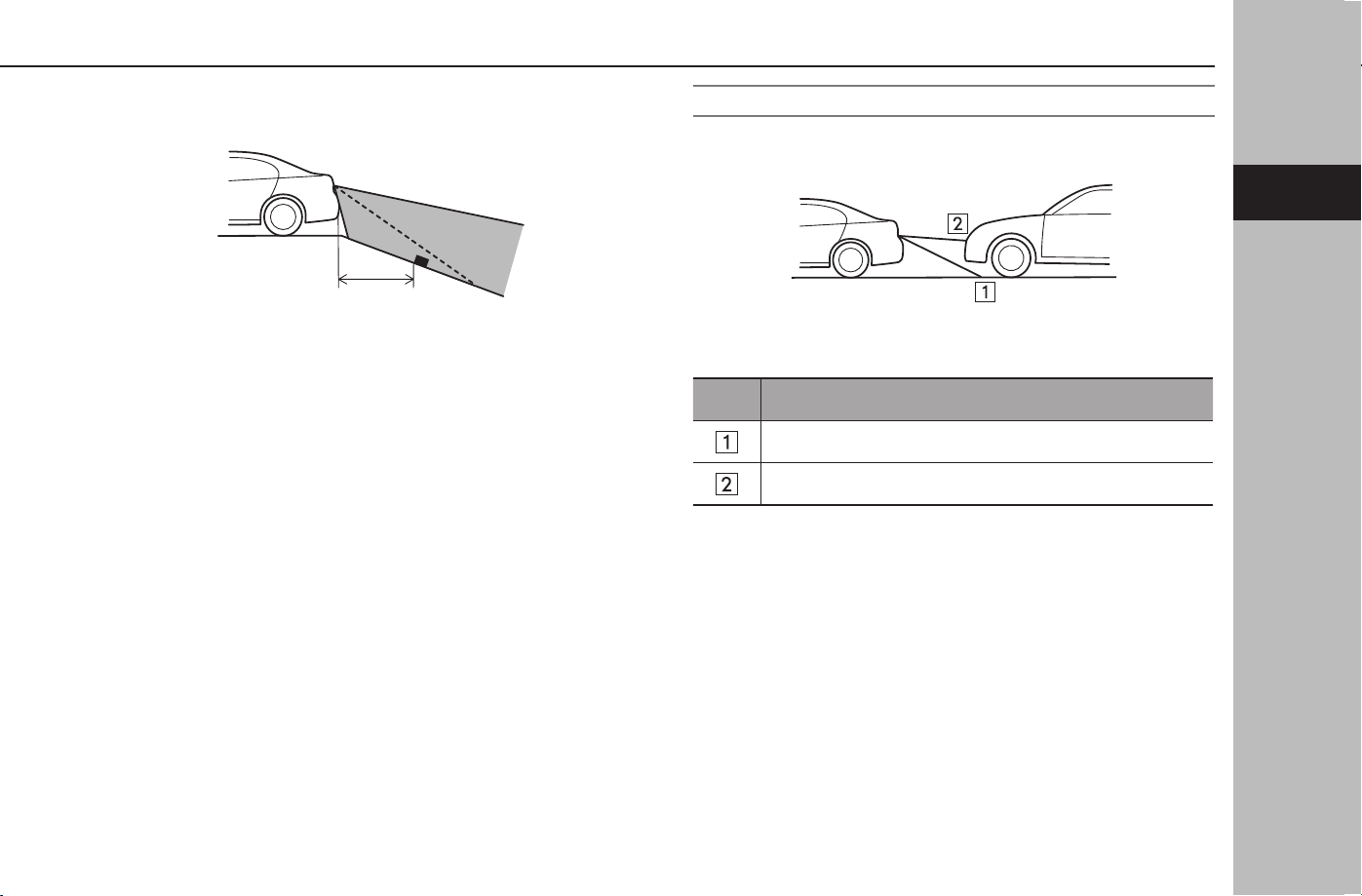
XWhen there is a downward slope at the back
3 feet (1 m)
● The distance on the screen looks nearer than the
actual distance.
NOTE
l When cargo is loaded, the rear view distance on the screen
looks farther than the actual distance as in an upward slope.
FEATURE OF DISTANCE MARKER
No. Information
3 feet (1 m) line
10 feet (3 m) line
● The distance marker shows the distance on the road.
If there is a vehicle or other object close behind,
distance cannot be correctly displayed.
docstructure.indb 45 2019/05/31 11:45:40

MEMO
46
docstructure.indb 46 2019/05/31 11:45:40

47
Settings
Settings
Bluetooth
®
Settings
48
Registering A Bluetooth Phone/
Device For The First Time
48
Proles
49
Bluetooth Settings
51
Registering A Bluetooth Phone/Device
52
Connecting Or Disconnecting
Bluetooth Phone/Device
54
Deleting Bluetooth Phones/Devices
56
Setting Phonebook Download
57
Setting The Automatic Connection Priority
58
Other Settings
59
General Settings
59
General Settings Screen
59
Setting The Driver Prole
62
Setting Wi-Fi
®
Connection
65
Updating The System
68
Sound Settings
72
Changing Volume Settings For Each
Function
72
Sound Settings Screen
73
docstructure.indb 47 2019/05/31 11:45:40
Bluetooth
®
SETTINGS
REGISTERING A Bluetooth PHONE/
DEVICE FOR THE FIRST TIME
The Bluetooth
®
word mark and logos are registered
trademarks owned by Bluetooth SIG, Inc.
To use the hands-free system or the Bluetooth audio
system, it is necessary to register a Bluetooth phone/device
with the system.
Once the Bluetooth phone/device has been registered, it is
possible to use the hands-free system and the Bluetooth
audio system.
This operation cannot be performed while driving.
For details
on registering a Bluetooth phone/device:
→P
.52
1.
Turn the Bluetooth connection setting of your Bluetooth
phone/device on.
● This function is not available when the Bluetooth
connection
setting of your Bluetooth phone/device is
set to off.
2.
Display the phone screen (→P.76) or the Bluetooth
audio operation screen (→P.144).
3.
Select
Yes
(Yes) to register a Bluetooth phone/device.
4.
Follow the steps in “REGISTERING A Bluetooth
PHONE/DEVICE” from “STEP 3” to “STEP 7”.
(→P.52)
Bluetooth
®
SETTINGS
48
docstructure.indb 48 2019/05/31 11:45:41
PROFILES
This system supports the following services.
Bluetooth Device Spec. Function Requirements Recommendations
Bluetooth Phone/Device Bluetooth Specication
Registering a Bluetooth
phone/device
Ver. 1.1 Ver. 3.0 +EDR
Bluetooth Device Prole Function Requirements Recommendations
Bluetooth Phone
HFP (Hands-Free Prole) Hands-free system Ver. 1.0 Ver. 1.6
PBAP (Phone Book
Access Prole)
Transferring the contacts Ver. 1.0 Ver. 1.1.1
MAP (Message Access
Prole)
Bluetooth phone message - Ver. 1.0
PAN (Personal Area
Networking Prole)
APPS function - PAN 1.0
DUN (Dial-Up Network
Prole)
APPS function - DUN 1.1
SPP (Serial Port Prole) APPS function - Ver. 1.1
Settings
3
Bluetooth
®
SETTINGS
49
Settings
3
docstructure.indb 49 2019/05/31 11:45:41
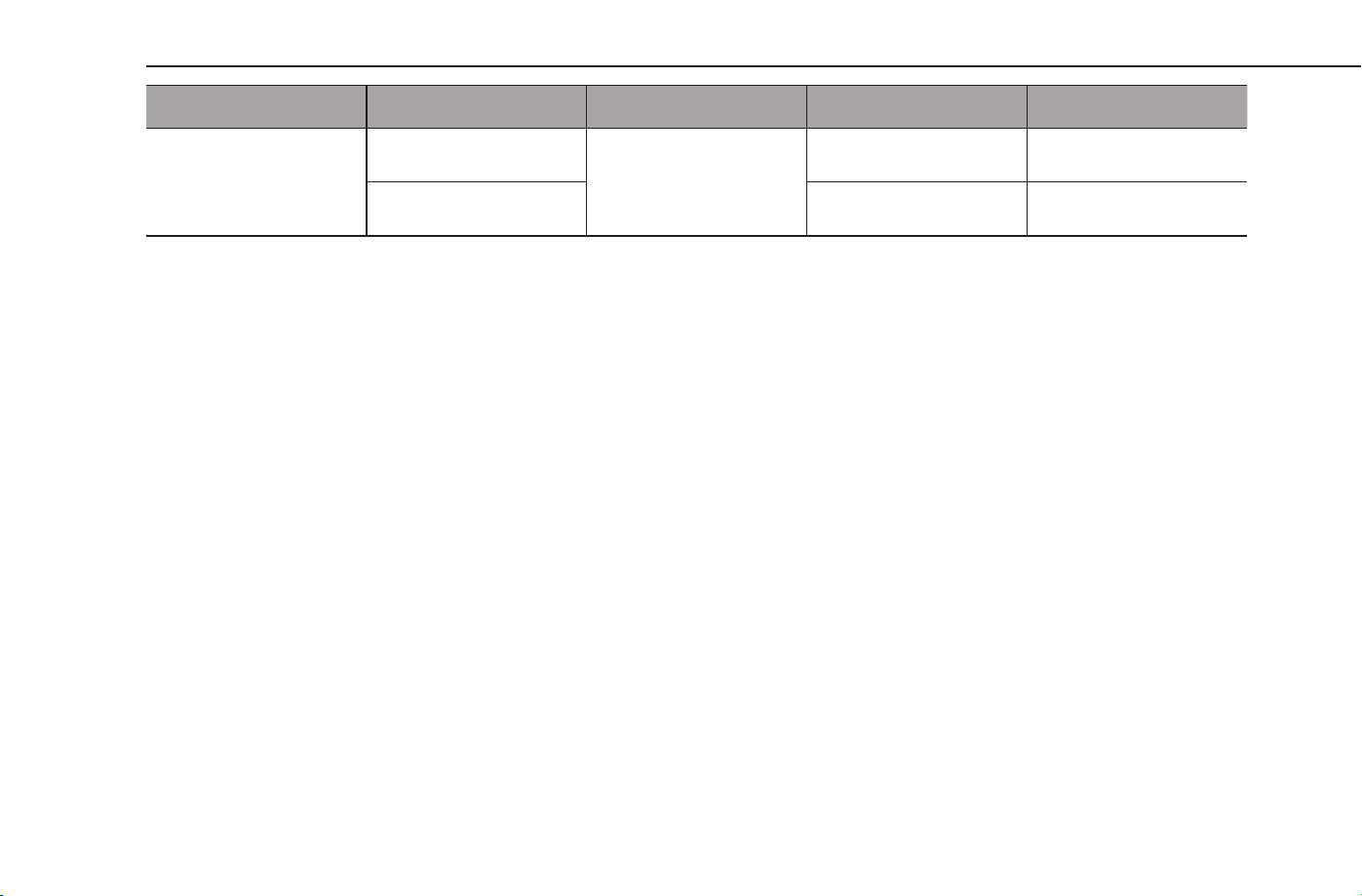
Bluetooth Device Prole Function Requirements Recommendations
Bluetooth Device
A2DP (Advanced Audio
Distribution Prole)
Bluetooth audio system
Ver. 1.0 Ver. 1.2
AVRCP (Audio/Video
Remote Control Prole)
Ver. 1.0 Ver. 1.4
NOTE
l If your cellular phone does not support HFP, registering the Bluetooth phone or using PBAP, MAP or SPP proles individually will not be
possible.
l If the connected Bluetooth
phone/device version is older than recommended or incompatible, the Bluetooth phone/device function may not
work properly.
l If the
application is not running smoothly or is unstable, disconnect and reconnect the Bluetooth phone/device via Bluetooth (→P.54) and/
or USB cable (→P.31). If the problem continues, reboot the Bluetooth phone/device.
Bluetooth
®
SETTINGS
50
docstructure.indb 50 2019/05/31 11:45:41
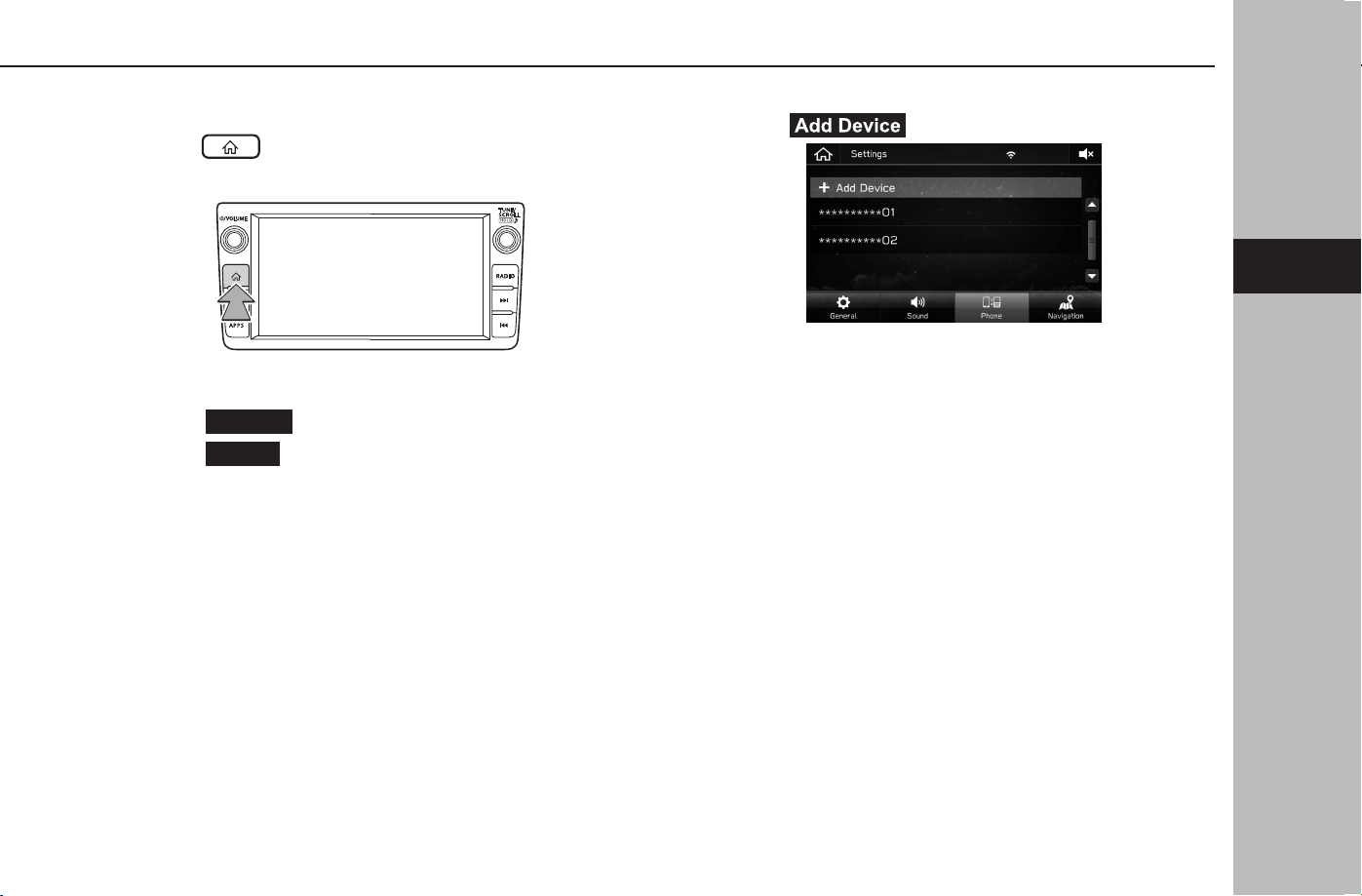
Bluetooth SETTINGS
1.
Press .
2.
Select
Settings
(Settings).
3.
Select
Phone
(Phone).
XWhen registering a Bluetooth phone/device
4.
Select (Add Device).
● For details on registering a Bluetooth phone/device:
→P.52
Settings
3
Bluetooth
®
SETTINGS
51
Settings
3
docstructure.indb 51 2019/05/31 11:45:42
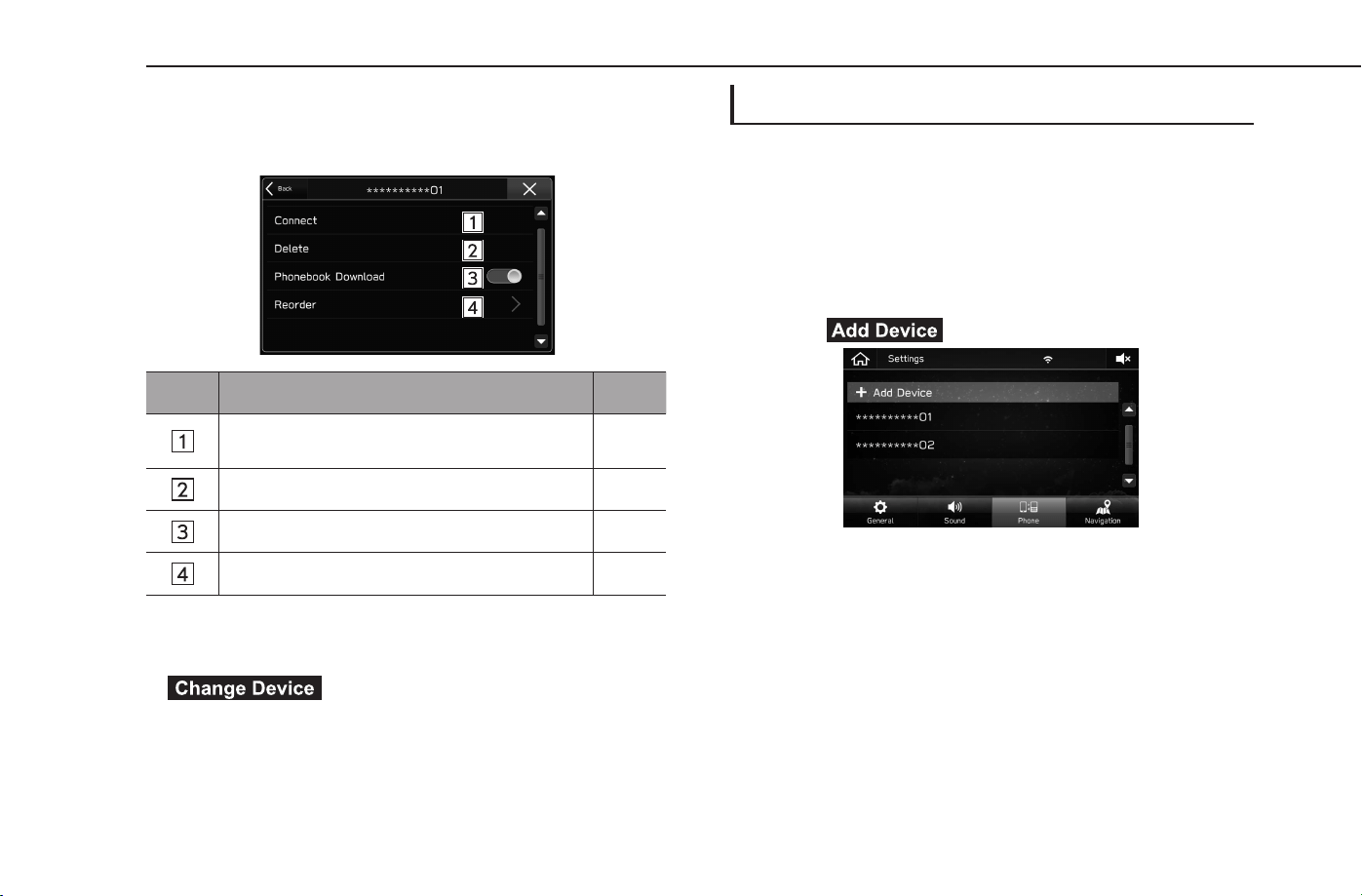
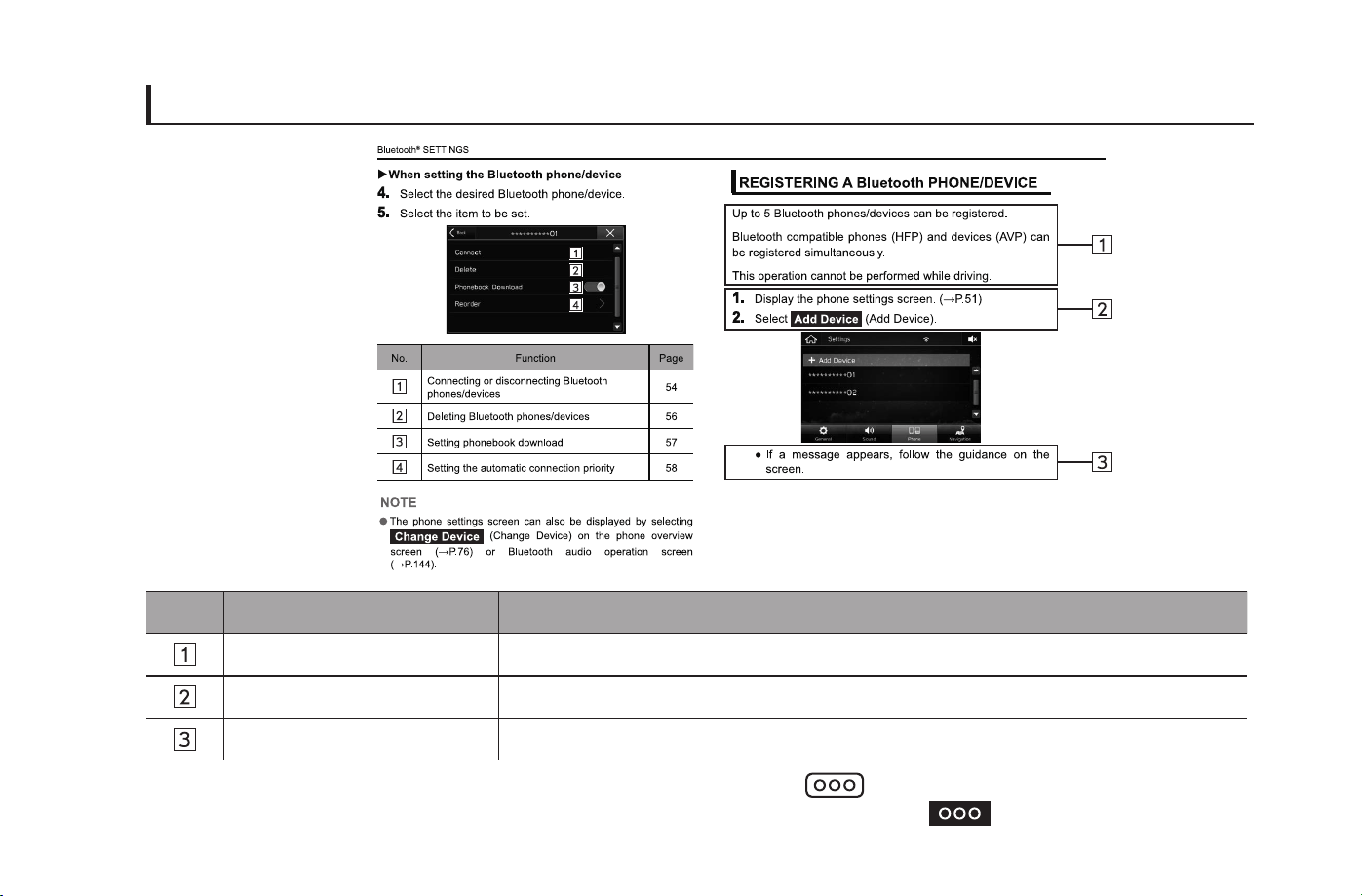
XWhen setting the Bluetooth phone/device
4.
Select the desired Bluetooth phone/device.
5.
Select the item to be set.
No. Function Page
Connecting or disconnecting Bluetooth
phones/devices
54
Deleting Bluetooth phones/devices 56
Setting phonebook download 57
Setting the automatic connection priority 58
NOTE
l The phone settings screen can also be displayed by selecting
(Change Device) on the phone overview
screen (→P.76) or Bluetooth audio operation screen
(→P.144).
REGISTERING A Bluetooth PHONE/DEVICE
Up to 5 Bluetooth phones/devices can be registered.
Bluetooth compatible phones (HFP) and devices (AVP) can
be registered simultaneously.
This operation cannot be performed while driving.
1.
Display the phone settings screen. (→P.51)
2.
Select (Add Device).
● If a message appears, follow the guidance on the
screen.
Bluetooth
®
SETTINGS
52
docstructure.indb 52 2019/05/31 11:45:43
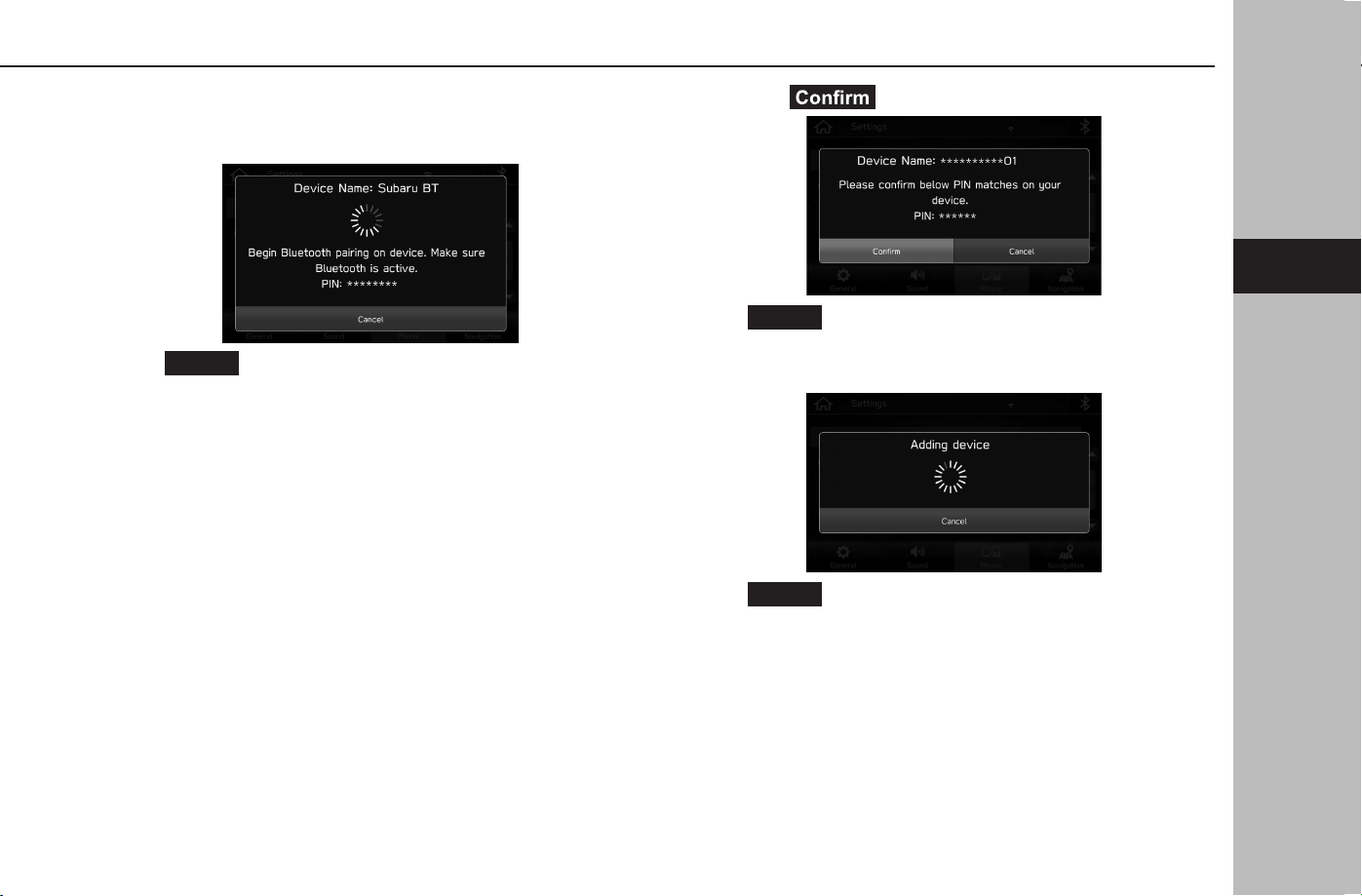
3.
When this screen is displayed, search for the device
name displayed on this screen on the screen of your
Bluetooth phone/device.
●
Cancel
(Cancel): Select to cancel the registration.
● For details on operating the Bluetooth phone/device,
see the manual that comes with it.
4.
Register using your Bluetooth phone/device.
● A PIN-code is not required for SSP (Secure Simple
Pairing) compatible Bluetooth phones/devices.
Depending on the type of Bluetooth phone/device
being connected, a message conrming registration
may be displayed on the Bluetooth phone’s/device’s
screen. Respond and operate the Bluetooth phone/
device according to the conrmation message.
NOTE
l To re-register your Bluetooth phone/device after having deleted
it from the system, operate the Bluetooth phone/device and
register it after deleting the previously registered system
information from the Bluetooth phone/device.
5.
Select (Conrm).
●
Cancel
(Cancel): Select to cancel the registration.
6.
Check that the following pop-up screen may be
displayed.
●
Cancel
(Cancel): Select to cancel the registration.
Settings
3
Bluetooth
®
SETTINGS
53
Settings
3
docstructure.indb 53 2019/05/31 11:45:43
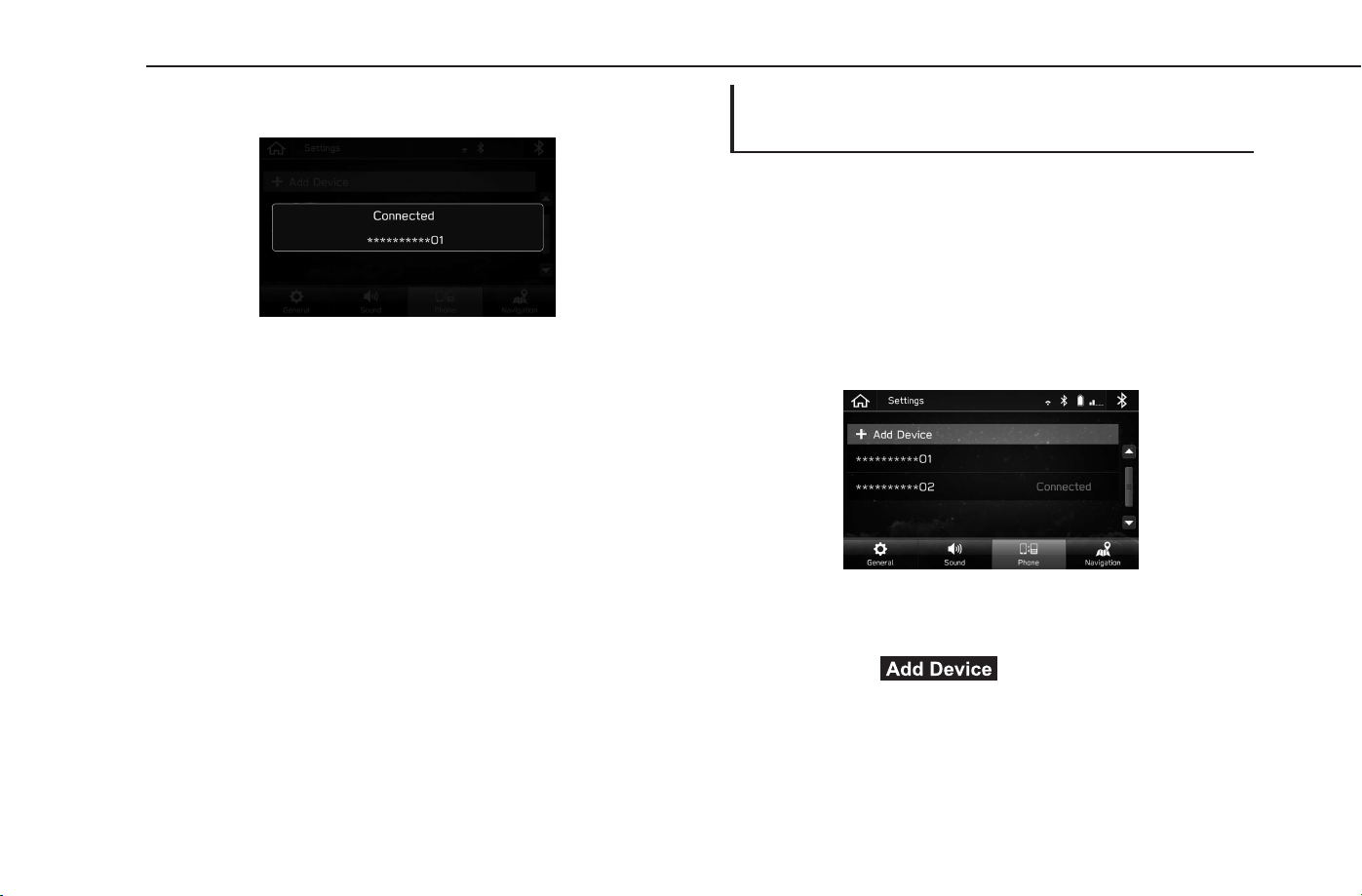
7.
Check that the following pop-up screen is displayed
when the connection is complete.
● If a conrmation message appears asking whether
to transfer the phone’s contact data to the system,
select the appropriate button.
● If an error
message appears, follow the guidance on
the screen to try again.
CONNECTING OR DISCONNECTING
Bluetooth PHONE/DEVICE
Up to 5 Bluetooth phones/devices (Phones (HFP) and
devices (AVP)) can be registered.
If more than 1 Bluetooth phone/device has been registered,
select which Bluetooth phone/device to connect to.
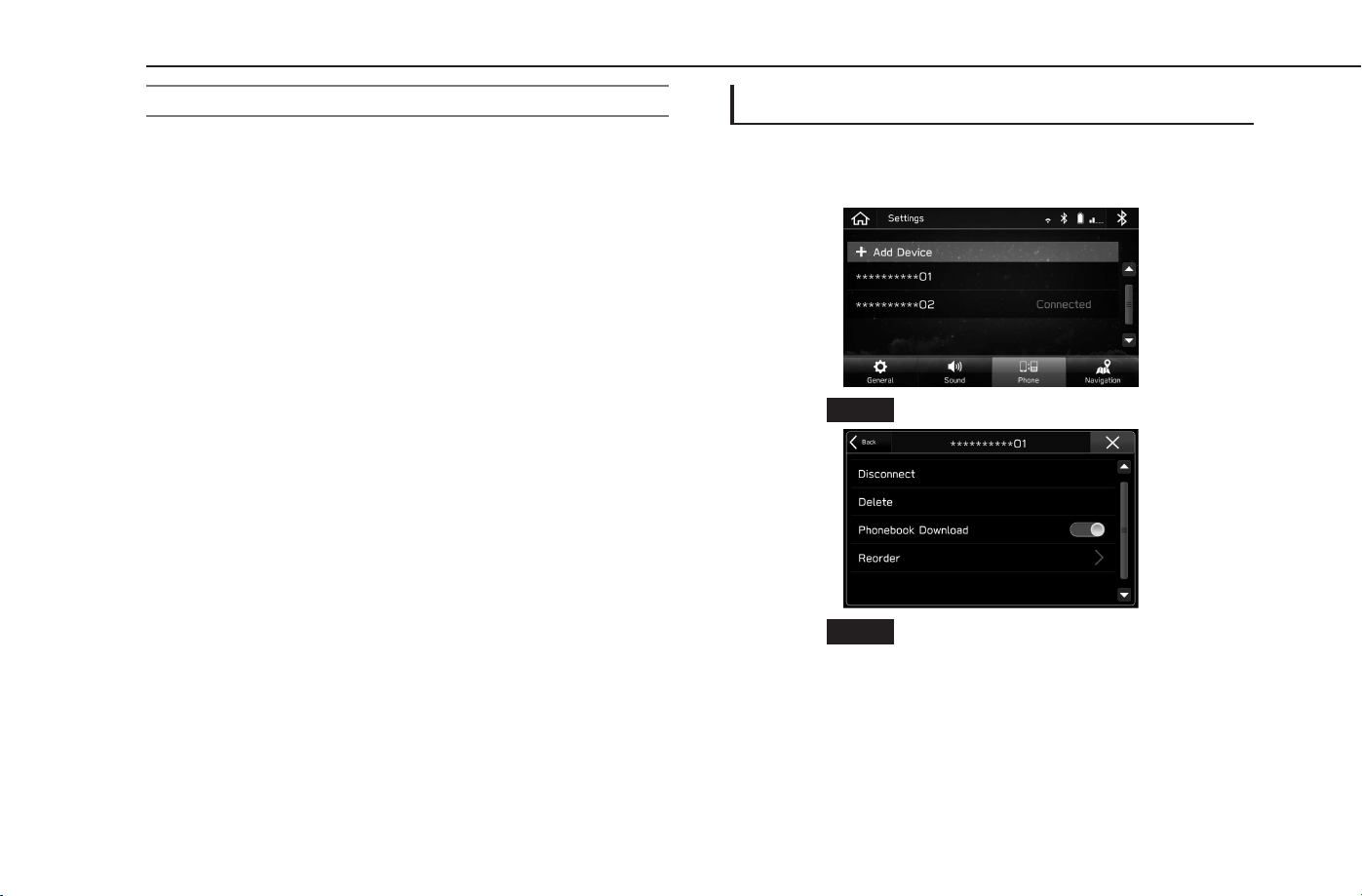
1.
Display the phone settings screen. (→P.51)
2.
Select the Bluetooth phone/device to be connected or
disconnected.
● “Connected” is displayed next to the currently
connected Bluetooth phone/device.
● If the desired Bluetooth phone/device is not on the
list, select
(Add Device) to register the
Bluetooth phone/device. (→P.52)
Bluetooth
®
SETTINGS
54
docstructure.indb 54 2019/05/31 11:45:44
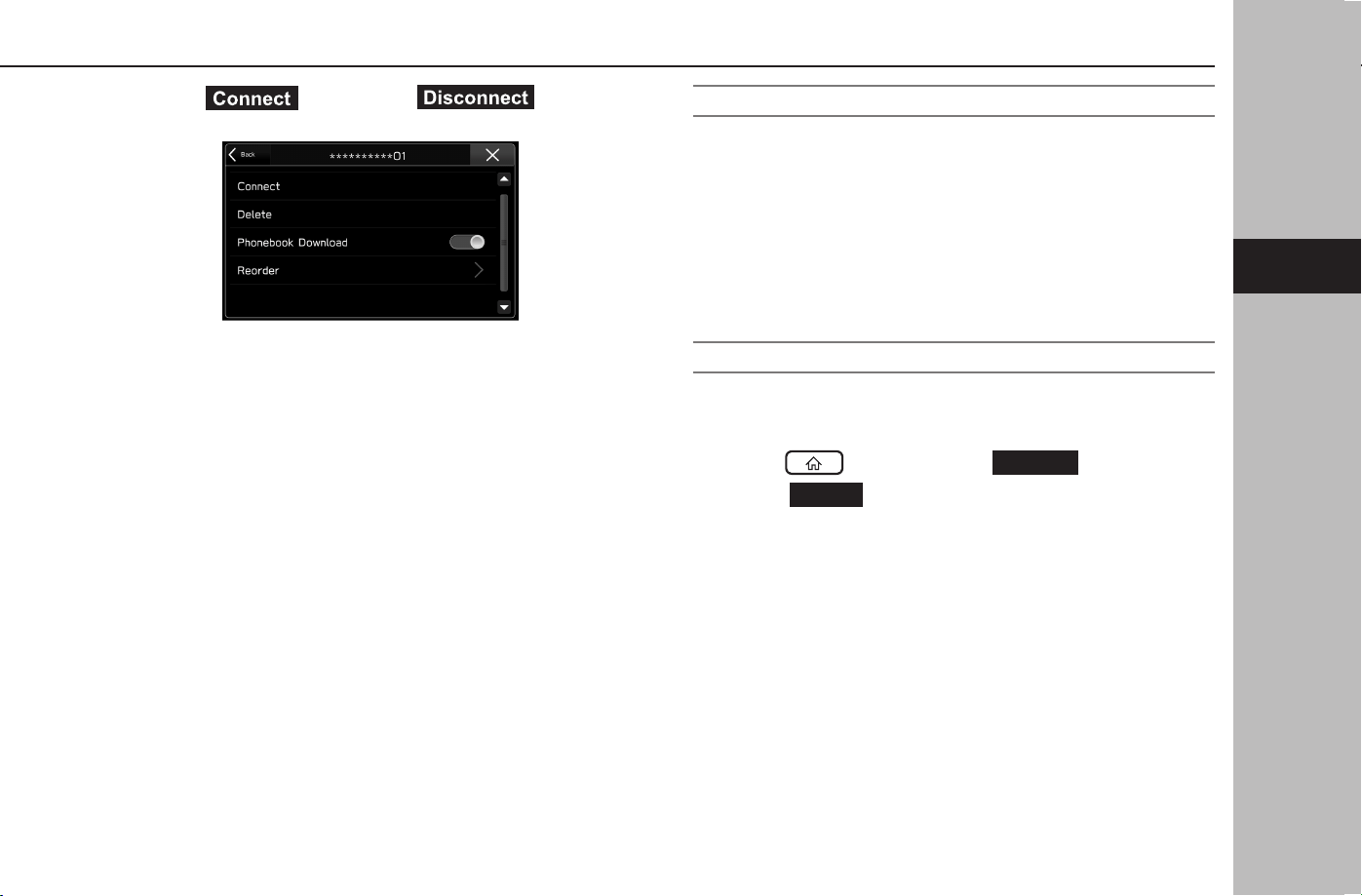
3.
Select (Connect) or
(Disconnect).
4.
Check that “Connected” is displayed next to the
Bluetooth phone/device when the connection is
complete.
● If an error
message appears, follow the guidance on
the screen to try again.
NOTE
l It may take time if the Bluetooth phone/device connection is
carried out during Bluetooth audio playback.
l Depending on the type of Bluetooth phone/device being
connected, it may be necessary to perform additional steps on
the Bluetooth phone/device.
AUTO CONNECTION MODE
Leave the Bluetooth phone/device in a location where the
connection can be established.
● When the ignition switch is in the “ACC” or “ON”
position, the system searches for a nearby registered
Bluetooth phone/device.
● The system will connect with the registered Bluetooth
phone/device that was last connected, if it is nearby.
CONNECTING MANUALLY
When the auto connection has failed, it is necessary to
connect Bluetooth phones/devices manually.
1.
Press , and then select
Settings
(Settings).
2.
Select
Phone
(Phone).
3.
Follow the steps in “CONNECTING OR
DISCONNECTING Bluetooth PHONE/DEVICE” from
“STEP 2”. (→P.54)
Settings
3
Bluetooth
®
SETTINGS
55
Settings
3
docstructure.indb 55 2019/05/31 11:45:44
RECONNECTING THE Bluetooth PHONE/DEVICE
If a Bluetooth phone/device is disconnected due to poor
reception from the Bluetooth network when the
ignition
switch is turned to the “ACC” or “ON” position, the system
automatically reconnects the Bluetooth phone/device.
● If a Bluetooth phone/device is disconnected on
purpose, such as turning it off, this does not happen.
Reconnect the Bluetooth phone/device manually.
DELETING Bluetooth PHONES/DEVICES
1.
Display the phone settings screen. (→P.51)
2.
Select the desired Bluetooth phone/device.
3.
Select
Delete
(Delete).
4.
Select
Delete
(Delete) when the conrmation message
appears.
NOTE
l The Bluetooth phone/device will still contain information from this
system even after the Bluetooth phone/device has been deleted.
Operate the Bluetooth phone/device to delete the system
information saved inside the Bluetooth phone/device.
Bluetooth
®
SETTINGS
56
docstructure.indb 56 2019/05/31 11:45:45
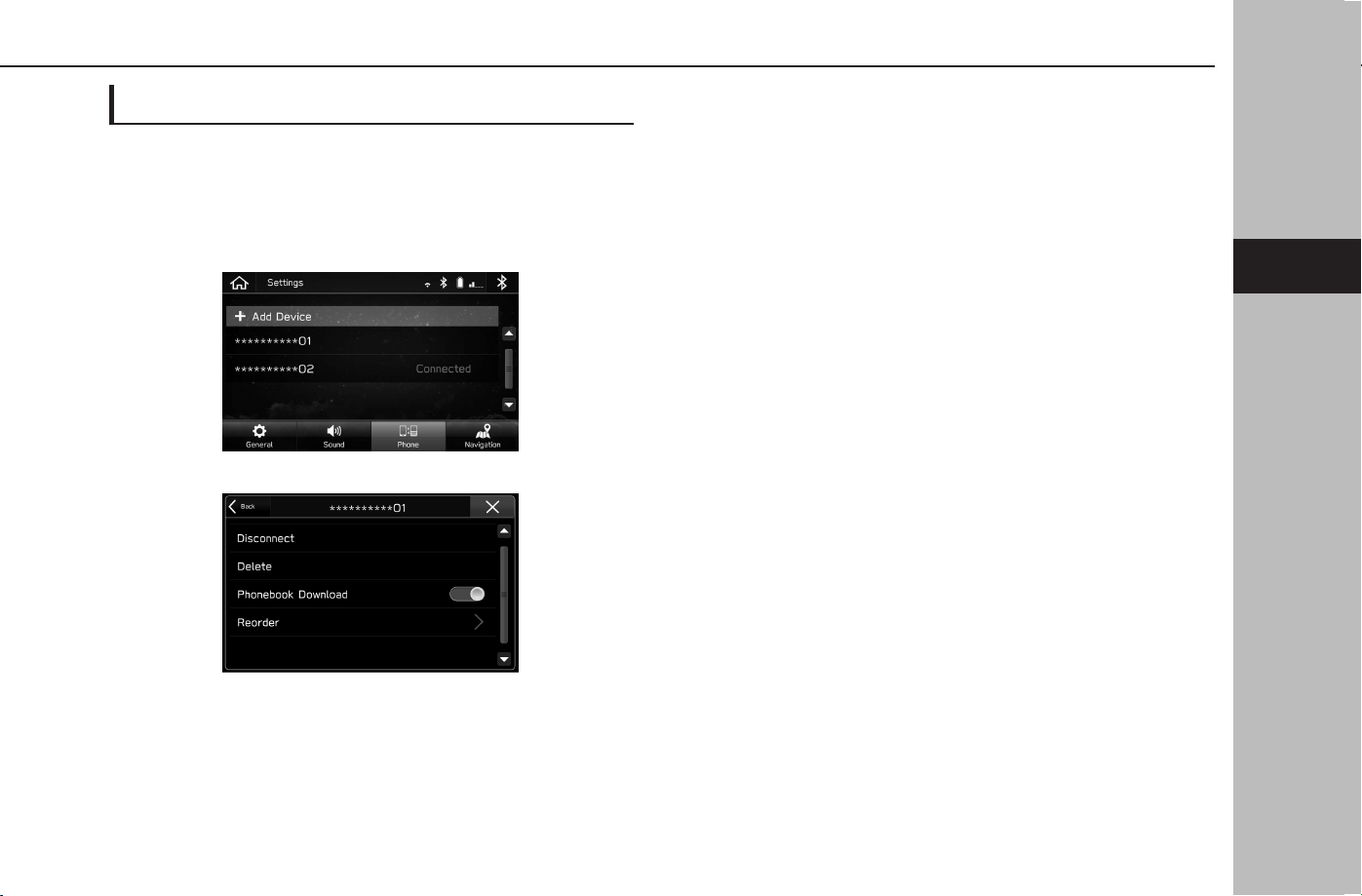
SETTING PHONEBOOK DOWNLOAD
When this function is activated, the phonebook data of the
connected phone will be downloaded automatically.
1.
Display the phone settings screen. (→P.51)
2.
Select the Bluetooth phone to be set.
3.
Select to turn “Phonebook Download” on/off.
NOTE
l The prole version of the connected Bluetooth phone may not be
compatible with transferring phonebook data. For details, contact
your SUBARU dealer.
l The notication setting on the Bluetooth phone may need to
be activated in order to download the phonebook. For details,
check the instructions for the connected Bluetooth phone.
This system’s message function will not function properly if the
phonebook is not downloaded. (→P.87)
l The Bluetooth phone’s favorite list will not be downloaded
automatically even after the phonebook data has been
downloaded from the Bluetooth phone. This system does not
currently support transfer of data from the Bluetooth phone
favorites list. To add the Bluetooth phone’s favorites list to the
system’s favorites list, you need to register it through the system
phonebook contacts list. (→P.83)
Settings
3
Bluetooth
®
SETTINGS
57
Settings
3
docstructure.indb 57 2019/05/31 11:45:45
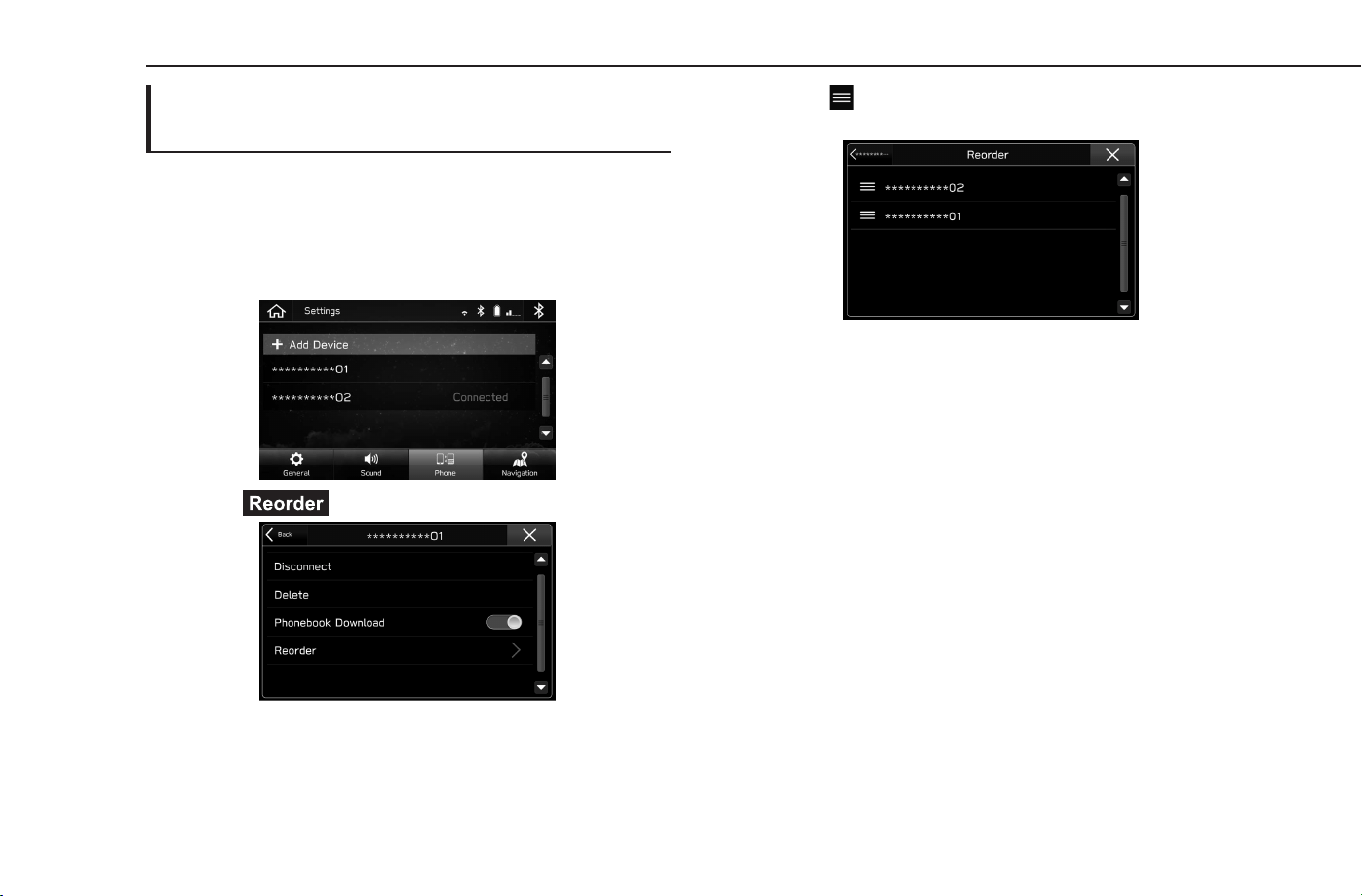
SETTING THE AUTOMATIC CONNECTION
PRIORITY
The automatic connection priority of the registered Bluetooth
phones/devices can be changed.
1.
Display the phone settings screen. (→P.51)
2.
Select the Bluetooth phone/device to be set.
3.
Select (Reorder).
4.
Select next to the desired Bluetooth phone/device,
and then drag it to the desired position.
Bluetooth
®
SETTINGS
58
docstructure.indb 58 2019/05/31 11:45:45
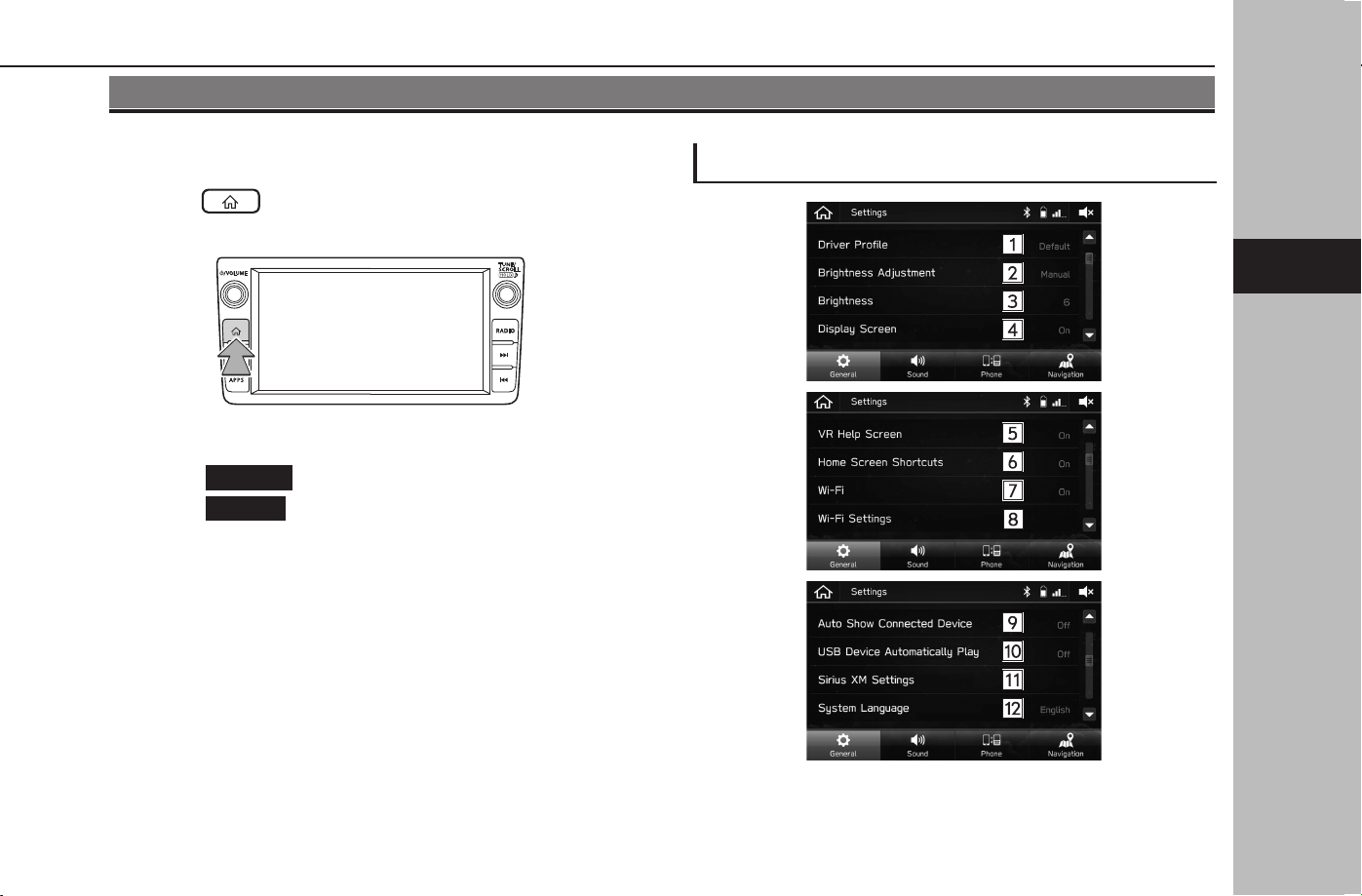
OTHER SETTINGS
GENERAL SETTINGS
1.
Press .
2.
Select
Settings
(Settings).
3.
Select
General
(General).
4.
Select the items to be set.
GENERAL SETTINGS SCREEN
OTHER SETTINGS
59
Settings
3
docstructure.indb 59 2019/05/31 11:45:46
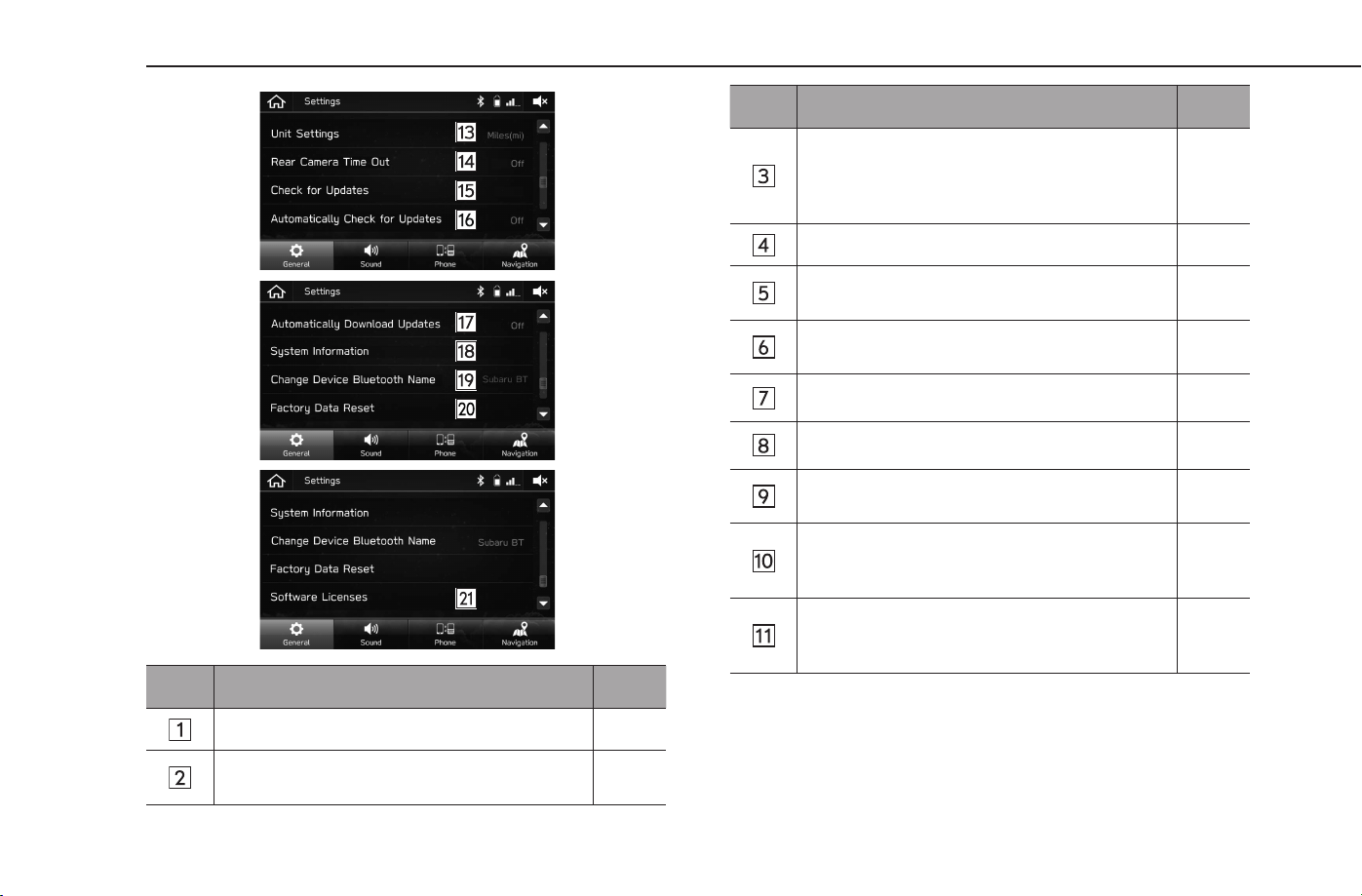
No. Function Page
Select to set the driver prole. 62
Select to switch screen brightness adjustment
between Auto/Manual.
-
No. Function Page
Select to adjust the screen brightness
manually.
This function is available when “Brightness
Adjustment” is set to “Manual”.
-
Select to turn the screen on/off. -
Select to turn the voice recognition prompts
on/off.
-
Select to turn the home screen shortcuts
function on/off.
37
Select to turn the Wi-Fi
®
function on/off. -
Select to set Wi-Fi
®
connection settings. 65
Set whether to automatically change to the
USB screen when a USB device is connected.
-
Select to set whether to automatically start
playing when an iPod or a USB memory
device containing audio les is connected.
-
Select to display Sirius XM subscription.
Select to turn the Tune Start function on/off.
Select to turn the Sports Flash function on/off.
-
OTHER SETTINGS
60
docstructure.indb 60 2019/05/31 11:45:48
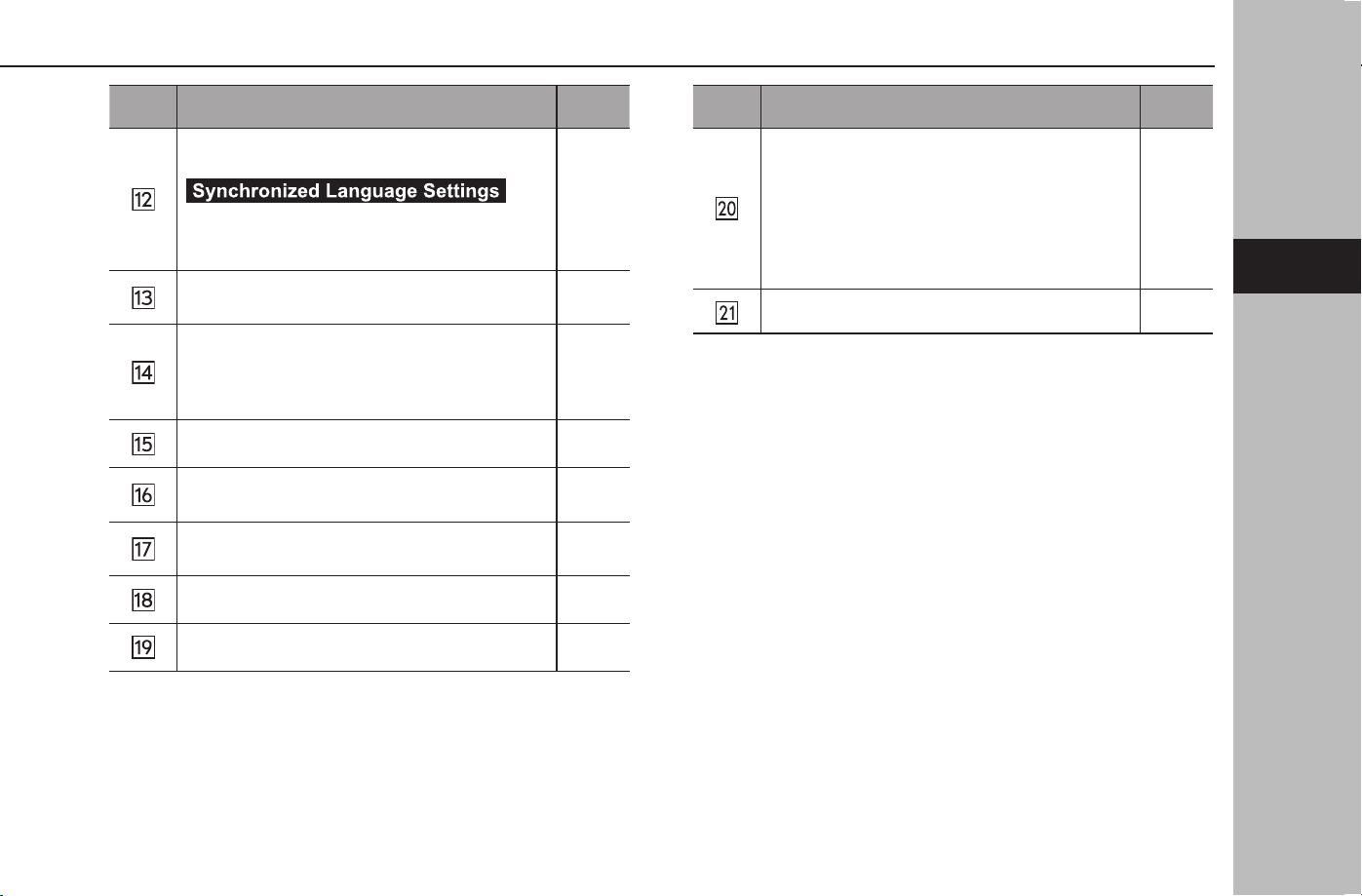
No. Function Page
Select to change the language.
When
(Synchronized Language Settings) is selected,
the language setting in the system is synced to
the language setting in the meter cluster.
-
Select to change the unit of measure for
distance.
-
Select to set the length of time that the camera
image remains displayed when the shift
lever/select lever is shifted from “R” to other
position.
-
Select to update system software versions. 68
Select to turn the available new system
software version check on/off.
68
Select to turn the automatic downloading of
updates on/off.
68
Select to display the system information. -
Select to change the Bluetooth system name. -
No. Function Page
Select to reset all setup items.
The audio system restarts automatically
after resetting factory data. To complete the
reset process, turn the ignition switch to the
“LOCK”/“OFF” position after the audio system
has restarted, and then turn to the “ACC” or
“ON” position after approximately 3 minutes.
-
Select to display the software license. -
OTHER SETTINGS
61
Settings
3
docstructure.indb 61 2019/05/31 11:45:50
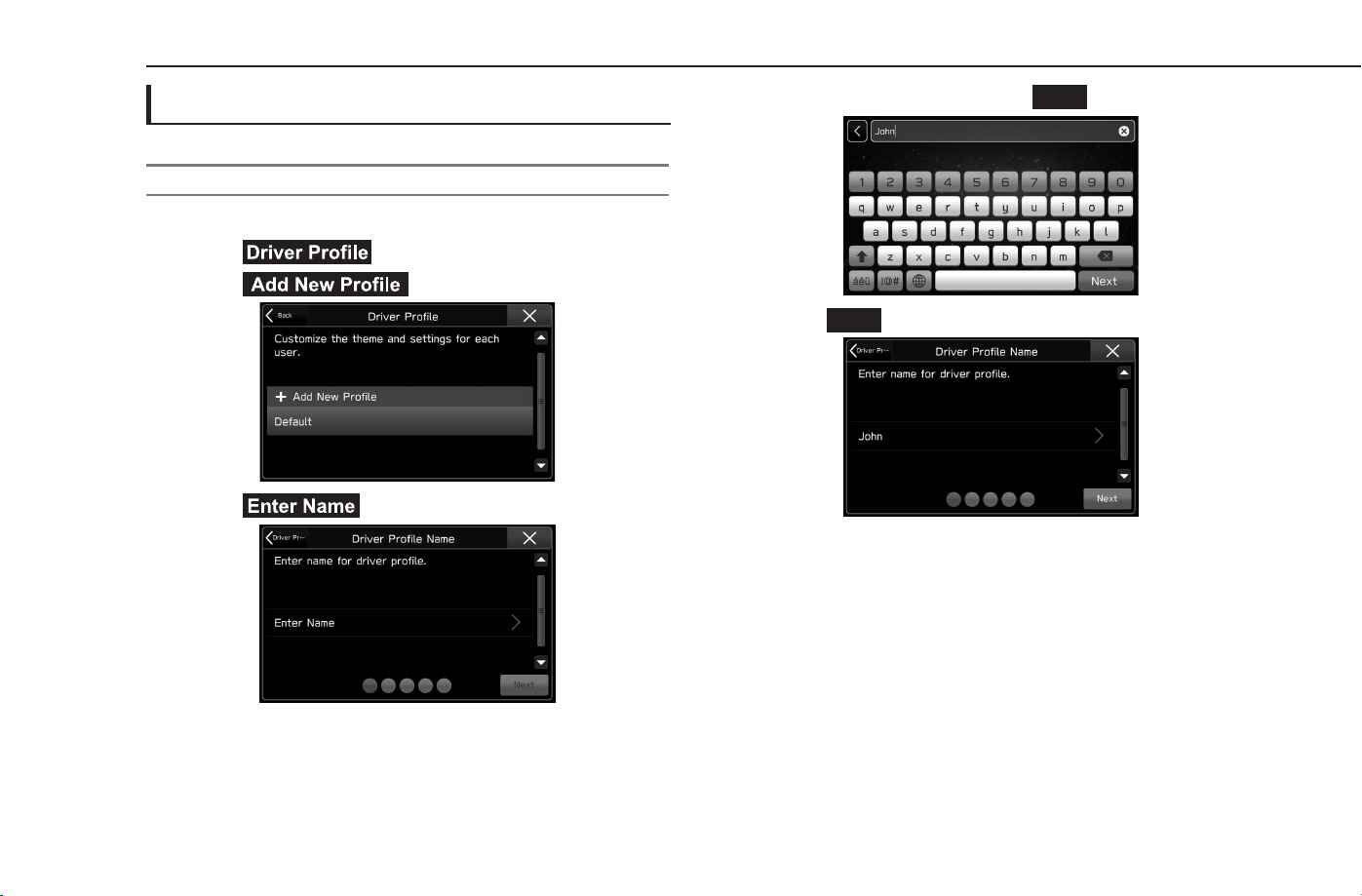
SETTING THE DRIVER PROFILE
ADDING A NEW PROFILE
1.
Display the general settings screen. (→P.59)
2.
Select (Driver Prole).
3.
Select (Add New Prole).
4.
Select (Enter Name).
5.
Enter a name, and then select
Next
(Next).
6.
Select
Next
(Next).
OTHER SETTINGS
62
docstructure.indb 62 2019/05/31 11:45:51
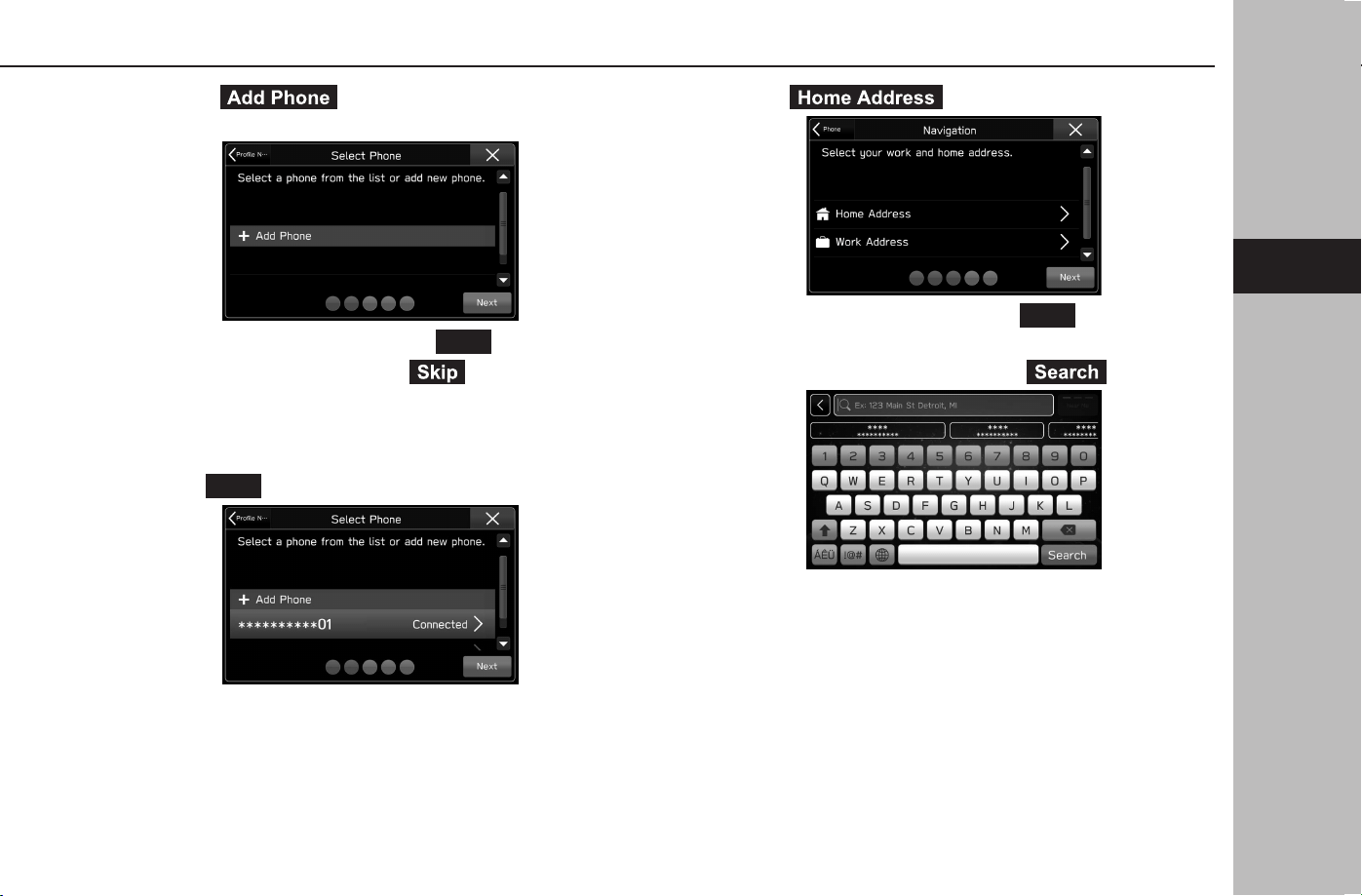
7.
Select (Add Phone) to register a
Bluetooth phone/device.
● To skip registration, select
Next
(Next) before
registration, and then select
(Skip).
8.
Follow the steps in “REGISTERING A Bluetooth
PHONE/DEVICE” from “STEP 3” to “STEP 7”.
(→P.52)
9.
Select
Next
(Next).
10.
Select (Home Address).
● To skip registration, select
Next
(Next) before
registration.
11.
Enter an address, and then select (Search).
OTHER SETTINGS
63
Settings
3
docstructure.indb 63 2019/05/31 11:45:52
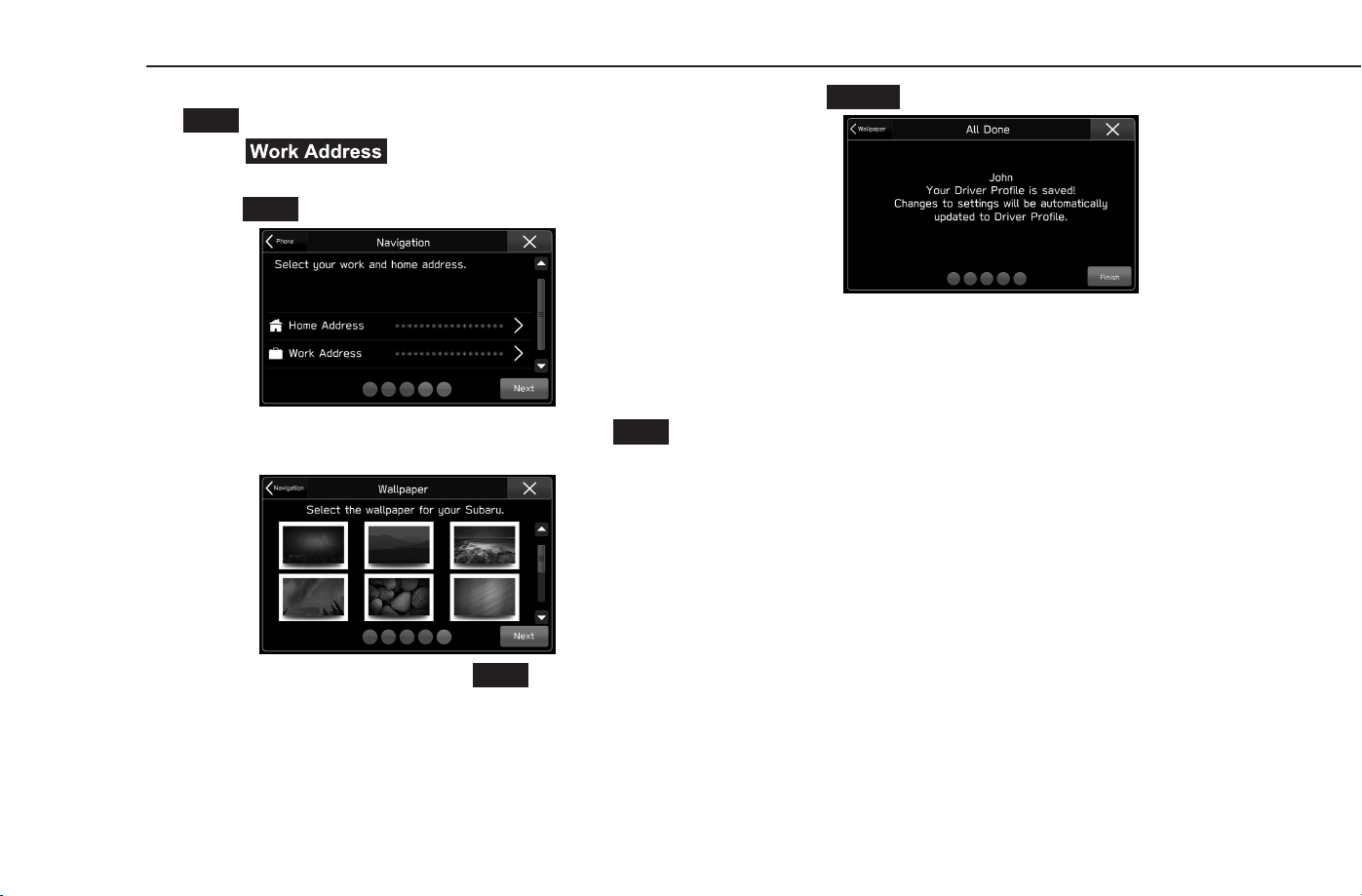
12.
Select the desired item from the list, and then select
Save
(Save).
13.
Select (Work Address) and register in
the same way as a home address.
14.
Select
Next
(Next).
15.
Select the desired wallpaper, and then select
Next
(Next).
● To skip registration, select
Next
(Next) before
registration.
16.
Select
Finish
(Finish).
After setting up, you can change home or work address and
phone settings, etc.
● Changing the home/work address: →P.163
● Changing the Bluetooth phone/device: →P.51
● Editing the driver prole: →P.65
NOTE
l Up to 4 driver proles can be registered.
OTHER SETTINGS
64
docstructure.indb 64 2019/05/31 11:45:53
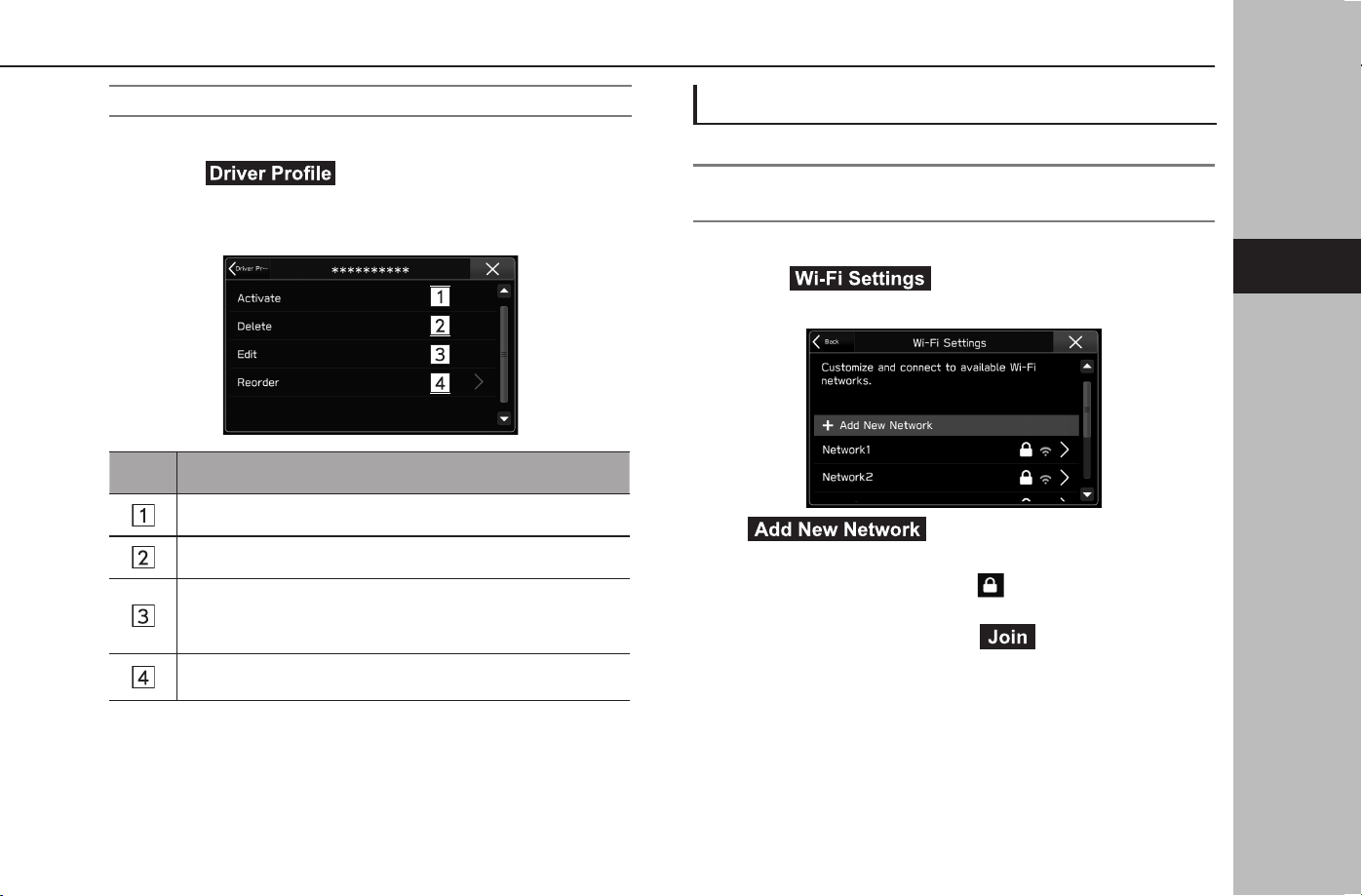
EDITING THE DRIVER PROFILE
1.
Display the general settings screen. (→P.59)
2.
Select (Driver Prole).
3.
Select the desired prole.
4.
Select the desired item to be set.
No. Function
Select to change the driver prole.
Select to delete the driver prole.
Select to edit the driver prole.
Follow the steps in “ADDING A NEW PROFILE” from
“STEP 4”. (→P.62)
Select to reorder the driver prole.
SETTING Wi-Fi
®
CONNECTION
CONNECTING OR DISCONNECTING A Wi-Fi
®
NETWORK
1.
Display the general settings screen. (→P.59)
2.
Select (Wi-Fi Settings).
3.
Select the desired network.
● (Add New Network): Select to
add a Wi-Fi
®
network. (→P.66)
● When a network with
is selected and the
password entry screen is displayed, enter the
password, and then select
(Join).
OTHER SETTINGS
65
Settings
3
docstructure.indb 65 2019/05/31 11:45:54
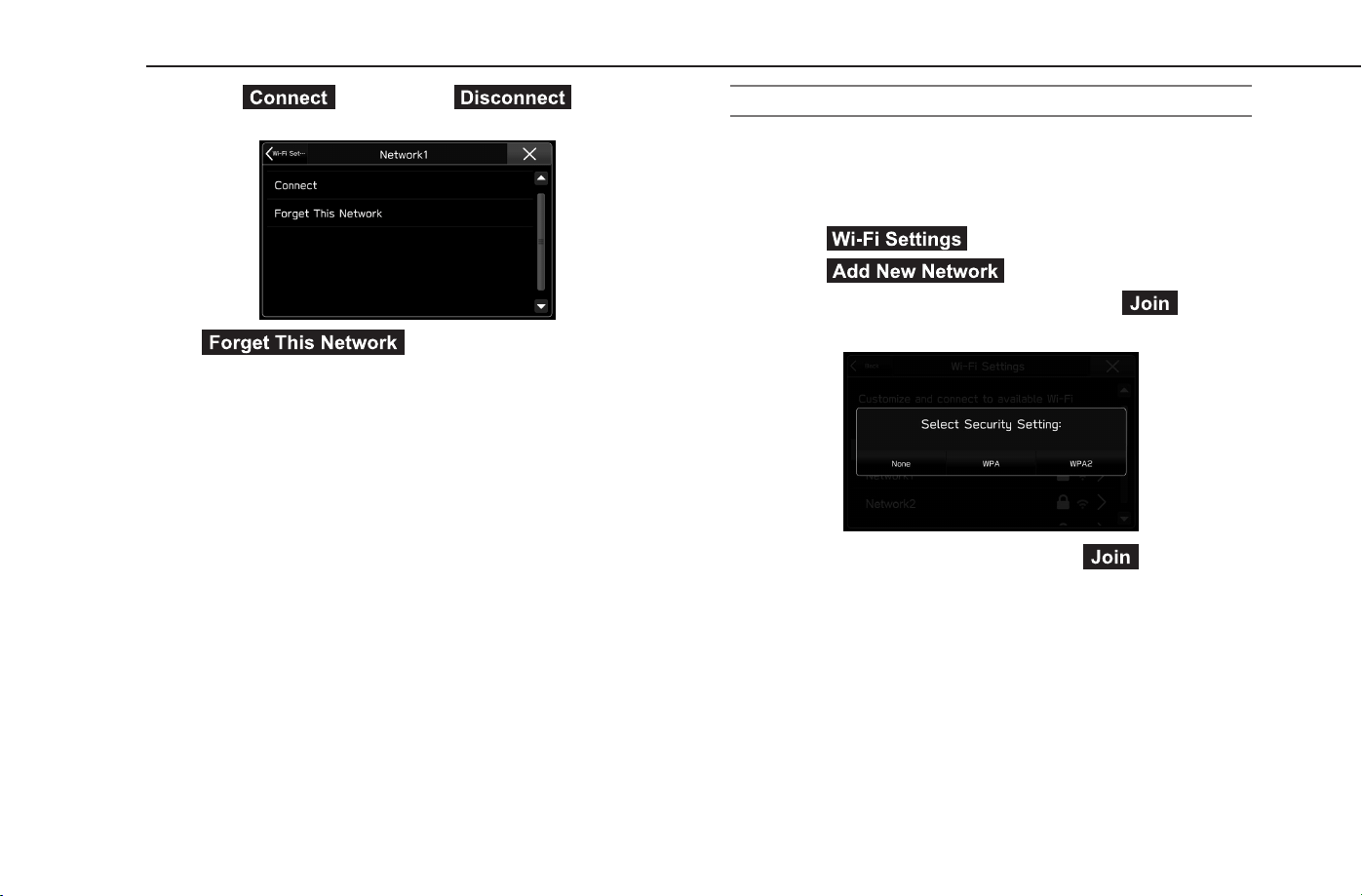
4.
Select (Connect) or
(Disconnect).
● (Forget This Network): Select
to delete the item.
5.
Check that a conrmation message appears when the
connection is complete.
● If an error
message appears, follow the guidance on
the screen to try again.
ADDING A Wi-Fi
®
NETWORK
Available networks which are not displayed by searching
can be added.
1.
Display the general settings screen. (→P.59)
2.
Select (Wi-Fi Settings).
3.
Select (Add New Network).
4.
Enter the network name, and then select (Join).
5.
Select the security type.
6.
Enter the password, and then select (Join).
7.
Check that a conrmation message appears when the
connection is complete.
OTHER SETTINGS
66
docstructure.indb 66 2019/05/31 11:45:54

WARNING
l Use Wi-Fi
®
devices only when safe and legal to do so.
l This system
is tted with Wi-Fi
®
antennas. People with
implantable cardiac pacemakers, cardiac resynchronization
therapy-pacemakers or implantable cardioverter debrillators
should maintain a reasonable distance between themselves
and the Wi-Fi
®
antennas. The radio waves may affect the
operation of such devices.
l Before using Wi-Fi
®
devices, users of any electrical medical
device other than implantable cardiac pacemakers, cardiac
resynchronization therapy-pacemakers or implantable
cardioverter debrillators should consult the manufacturer
of the device for information about its operation under the
inuence of radio waves.
Radio waves could have unexpected effects on the operation
of such medical devices.
SUPPORTED Wi-Fi NETWORK SPECIFICATIONS
The system can connect to a Wi-Fi network that supports
the following standards.
● Communication standards:
•
802.11b
•
802.11g
•
802.11n (2.4GHz)
•
802.11a
● Security:
•
WPA
TM
• WPA2
TM
NOTE
l WPA and WPA2 are registered mark of the Wi-Fi Alliance
®
.
OTHER SETTINGS
67
Settings
3
docstructure.indb 67 2019/05/31 11:45:54
UPDATING THE SYSTEM
BEFORE UPDATE
WARNING
l The engine does not need to be running to update the system.
If you leave the engine running while downloading or installing
an update, do not park the vehicle in a conned space, such
as a garage. Doing so could cause serious injury or death.
CAUTION
l When performing an update using Wi-Fi or a smartphone,
make sure to park the vehicle in an area with low electrical
noise and network signal is strong enough.
l Park the vehicle in an area where GPS signals can be
received normally.
l If an update is performed in an area with electrical noise
and/or weak network signal, it may take a long time to
complete or an error may occur.
NOTE
l After performing an update, various settings may be reset to
their default setting. In this case, it will be necessary to set them
to your desired setting again.
UPDATE THE CLOCK
In order to accurately check for software updates, the clock
of the system needs to be set to the correct time.
Perform the following procedure to set the clock using GPS
signals.
Once the clock is set, it will not need to be adjusted unless
the power supply is cut due to the battery being depleted or
replaced.
1.
Check that the current vehicle position is correctly
displayed on the navigation system screen.
● If the position is correct, proceed to “CONNECTING
TO THE NETWORK”. (→P.69)
2.
If the position is not correct, move the vehicle to an area
where GPS signals can be received normally (outside,
etc.).
● Once the vehicle is correctly positioned, proceed to
“CONNECTING TO THE NETWORK”. (→P.69)
OTHER SETTINGS
68
docstructure.indb 68 2019/05/31 11:45:55
OTHER SETTINGS
69
Settings
3
CONNECTING TO THE NETWORK
XWhen updating via a Wi-Fi connection
1.
Connect to a Wi-Fi network device (router, access point,
etc.) (→P.65)
● When a connection is established,
the Wi-Fi
connection status icon will be displayed. Check
that the connection is sufciently strong and stable.
(→P.36)
XWhen updating via the Aha application on a
smartphone
1.
Download the Aha application to the smartphone to be
connected, or update the app if already installed.
2.
Start the Aha application on the smartphone.
3.
If updates are to be downloaded using mobile data,
turn the “Download on WiFi Only” setting of the Aha
application off.
● If the smartphone is to be connected to a Wi-Fi
network device, it is not necessary to turn this setting
off.
4.
Connect the smartphone to the system.
● When using an Android OS smartphone, connect it
via Bluetooth. (→P.54)
● When using an iOS device, connect it via Bluetooth or
undamaged genuine USB cable. (→P.31, 54)
DOWNLOAD UPDATE
1.
Display the general settings screen. (→P.59)
2.
Select (Check for Updates).
● When the system is
started,
(Check for Updates) will be greyed out and cannot be
selected for approximately 1 minute.
● If the “Software Update Ready To Download” pop-up
is displayed:
Select
(Download Now) to
download the latest software update.
docstructure.indb 69 2019/05/31 11:45:55
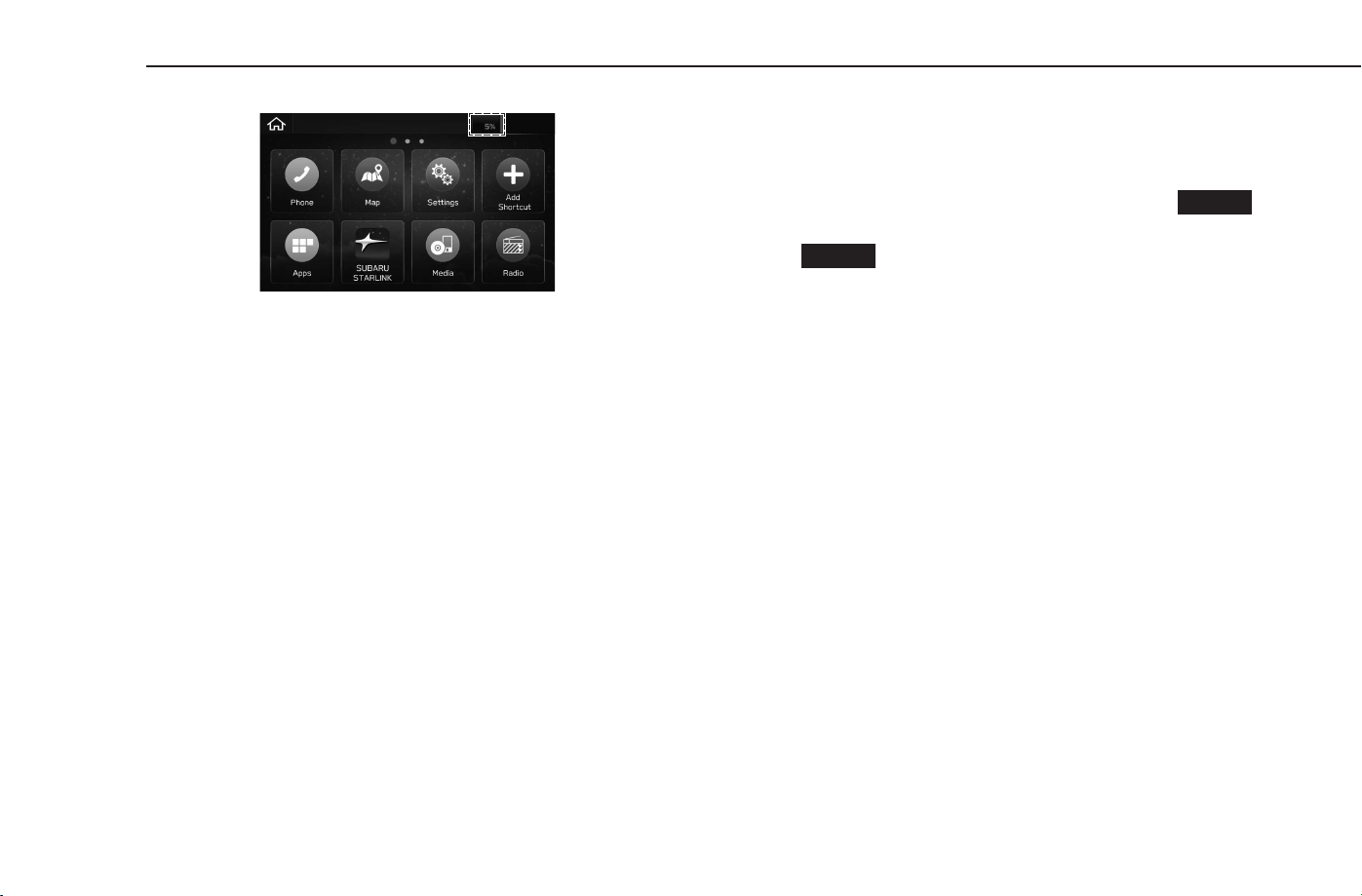
3.
Wait for the download progress to reach 100%.
● When downloading updates using the Aha application
on a smartphone, the download progress will be
displayed on the system screen after the update
has been downloaded to the smartphone and the
smartphone begins transferring it to the system.
Therefore, it may take some time before the
download progress is displayed.
● Approximate time to complete download to the
system
• Wi-Fi: 5-20 minutes (Depending on connection
speed and signal strength.)
• Aha application via Bluetooth: 10-50 minutes
(Depending on smartphone OS (Android or iOS).)
•
Aha application via USB (iOS only): 5-10 minutes
4.
After downloading has completed, check that “Software
Update Ready To Install” is displayed.
● If you are ready to install the update, proceed
to
“INSTALL UPDATE”. (→P.71)
● If you wish to install the
update later, select
Cancel
(Cancel).
● If
Cancel
(Cancel) is selected, it will be necessary to
perform the “DOWNLOAD UPDATE” procedure again
from “STEP 1”. (→P.69)
● If the “Connect To Wi-Fi” pop-up is displayed:
Perform the “CONNECTING TO THE NETWORK”
procedure again. (→P.69)
● If the “Your device’s software is up to date.” pop-up
is
displayed:
The system software is already the latest version and
update is not necessary.
● If the “Software download failed. Do you want to
retry?” pop-up is displayed:
The system clock may not be set correctly
.
Move the vehicle to where GPS signals can be
received normally to adjust the clock.
Perform the “UPDATE THE CLOCK” procedure again.
(→P.68)
● If the update procedure fails, refer to the “WHA
T TO
DO IF” section. (→P.219)
OTHER SETTINGS
70
docstructure.indb 70 2019/05/31 11:45:56
INSTALL UPDATE
WARNING
l The engine does not need to be running to update the system.
If you leave the engine running while downloading or installing
an update, do not park the vehicle in a conned space, such
as a garage. Doing so could cause serious injury or death.
CAUTION
l Park your vehicle in a safe place and do not operate it while
the update is installing.
l The following system functions are restricted during the
update installation.
• It will not be possible to use general system functions.
• The rear view camera may be fully or partially disabled
during the update. The help line (distance marker, dynamic
guidelines and vehicle width line) will not be displayed.
1.
Select (Install Now).
● The update will begin installing.
2.
Wait until the update installation has completed.
● Approximate time to complete installation: 10 minutes
3.
After installation has completed, check that the system
restarts automatically.
● The update
may be performed in 2 steps. In this case,
the system will restart 2 times. Wait for the home
screen to be displayed.
● Depending on the system, an update may be
performed in 3 steps. In this case, the system will
restart 3 times. This does not indicate a malfunction.
4.
Press .
● If the home screen
is displayed, the update has
completed normally.
● To check the software version, select
System Information
(System Information) on the
general settings screen. (→P.59)
5.
Operation is complete.
CAUTION
l If the “Software update install failed” screen is displayed,
contact your SUBARU dealer immediately. If this screen is
displayed, none of the system functions, other than the rear
camera, will operate. When using the rear camera, only the
camera image will be displayed. The help line (distance
marker, dynamic guidelines and vehicle width line) will not be
displayed.
OTHER SETTINGS
71
Settings
3
docstructure.indb 71 2019/05/31 11:45:56
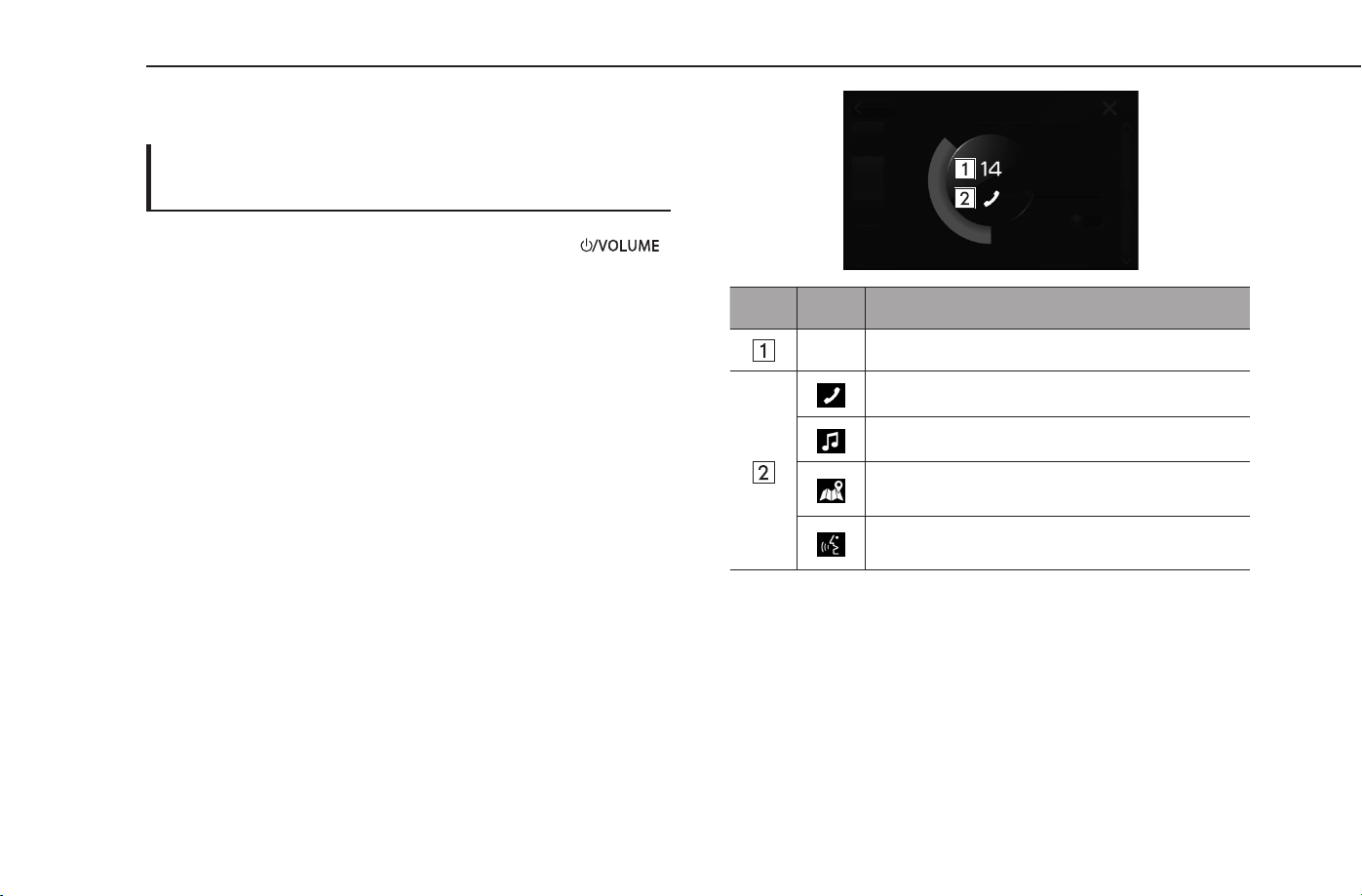
SOUND SETTINGS
CHANGING VOLUME SETTINGS FOR EACH
FUNCTION
The volume can be adjusted by turning the “ ”
knob or operating the volume control switch of the steering
switches.
The adjusted volume will change depending on the screen
displayed and system status.
When adjusting the volume, a volume display will
temporarily be displayed and the volume of which function is
being adjusted and the current volume can be checked.
No. Icon Function
- Current volume
Hands-free system volume setting (→P.84)
Audio volume setting (→P.118)
Navigation voice guidance volume setting
(→P.176)
Voice recognition system volume setting
(→P.198)
OTHER SETTINGS
72
docstructure.indb 72 2019/05/31 11:45:57
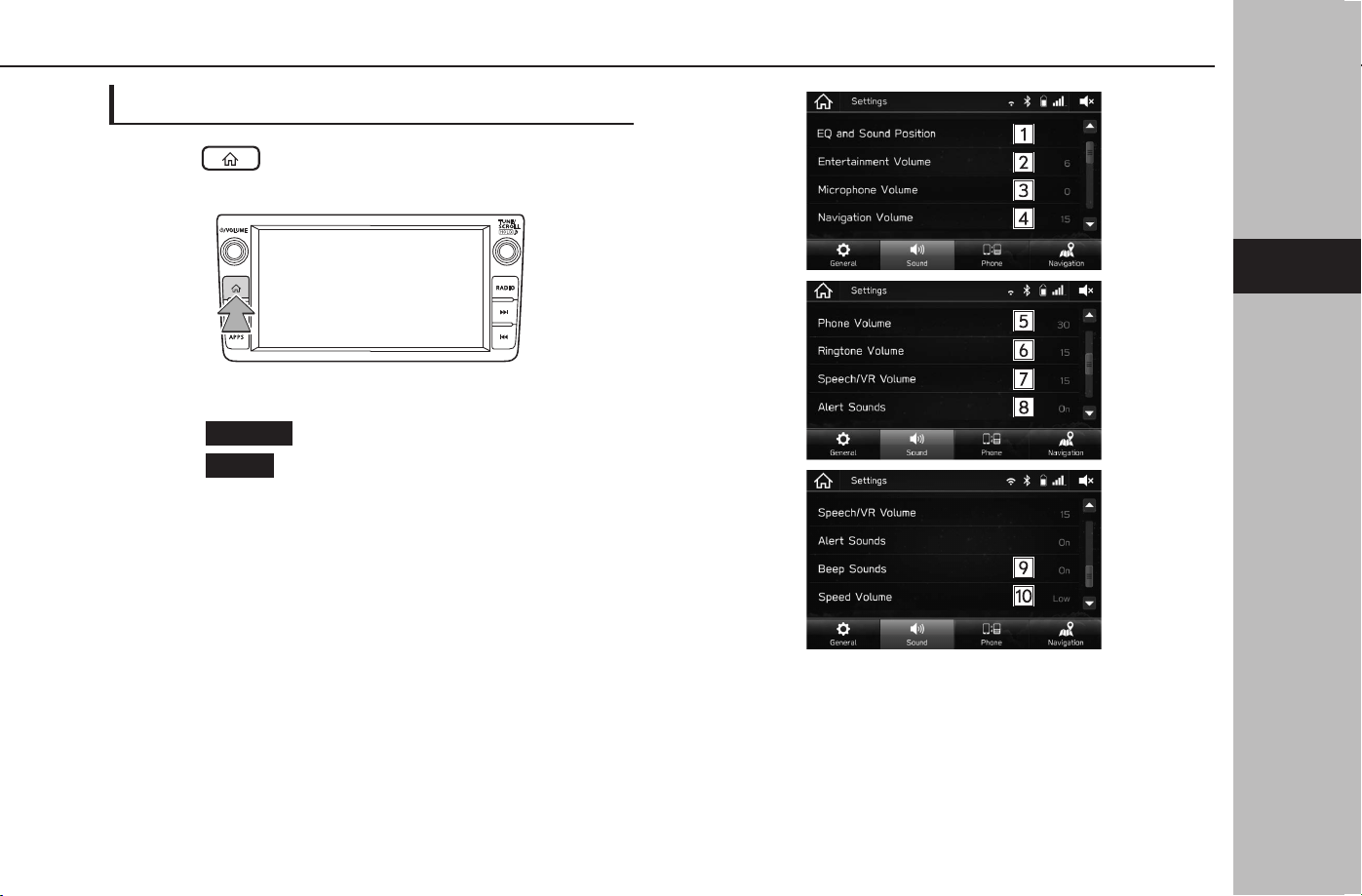
SOUND SETTINGS SCREEN
1.
Press .
2.
Select
Settings
(Settings).
3.
Select
Sound
(Sound).
4.
Select the items to be set.
OTHER SETTINGS
73
Settings
3
docstructure.indb 73 2019/05/31 11:45:58
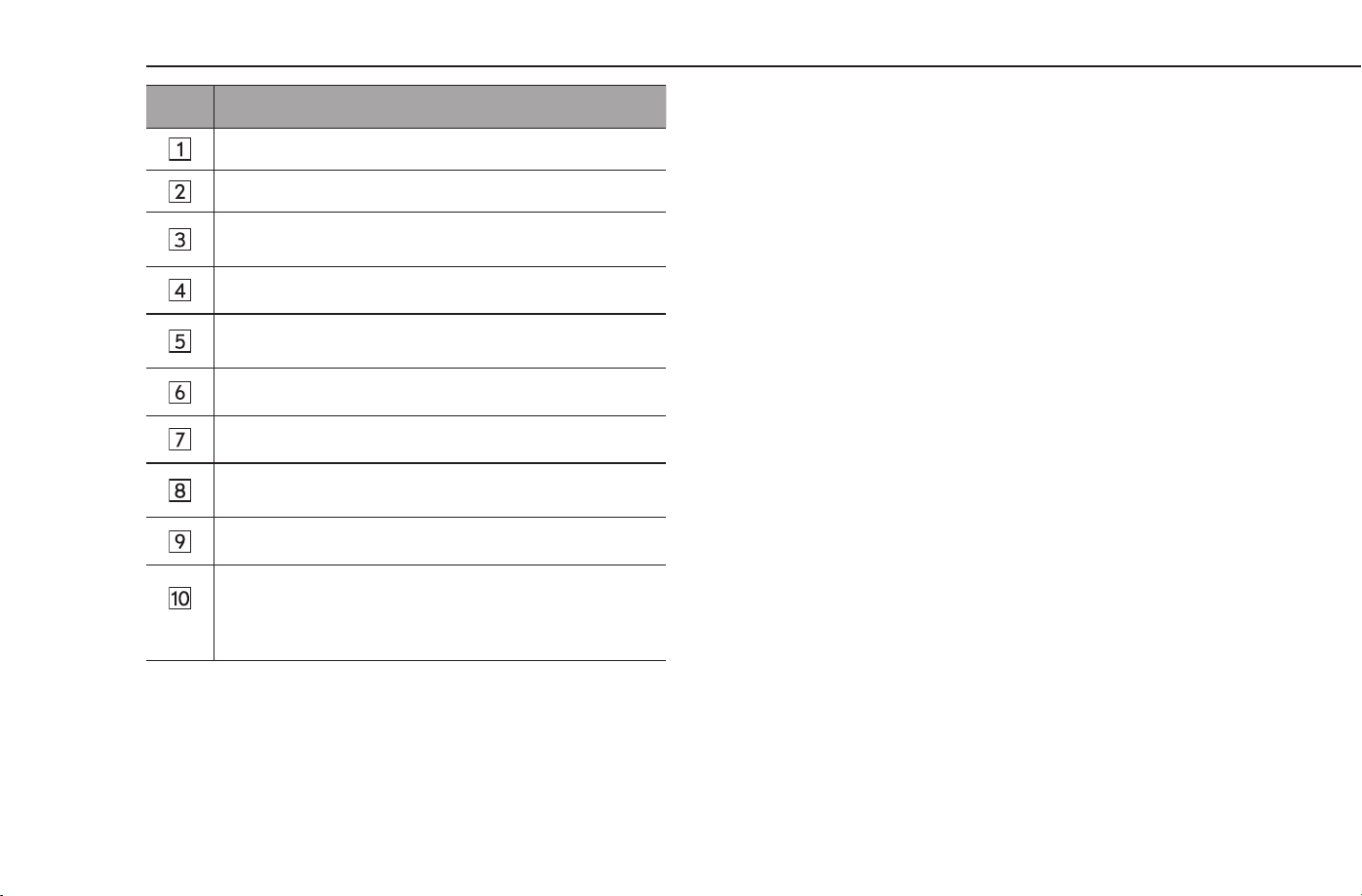
No. Function
Select to set sound settings. (→P.120)
Select to set audio volume.
Select to adjust the mic sensitivity. This adjusts the
speaker’s voice during hands-free communication.
Select to set the navigation prompt volume.
Select to set to adjust the default volume of the other
party’s voice.
Select to adjust the ringtone volume.
Select to set the voice recognition prompts volume.
Select to turn the alert sound when trafc, weather, or
SXM game information is updated on/off.
Select to turn the sound beeps on/off.
*
Select to set the speed volume.
The system adjusts to the optimum volume and tone
quality according to vehicle speed to compensate for
increased vehicle noise.
*: This setting can be made depending on the connected amplier type.
OTHER SETTINGS
74
docstructure.indb 74 2019/05/31 11:45:59

75
Phone
Phone
Phone Operation
76
Phone Screen
76
Some Basics
77
Registering/Connecting A Bluetooth Phone
78
Using The Phone Switch/Microphone
78
Voice Recognition System
79
About The Contacts In The Contact List
79
When Selling Or Disposing Of The Vehicle
80
Calling On The Bluetooth Phone
80
By The Last Number
81
By Favorites List
82
By Recent Calls List
82
By Keypad
83
By Contacts List
83
Receiving On The Bluetooth Phone
84
Incoming Calls
84
Talking On The Bluetooth Phone
85
Sending Tones
85
Call Waiting
86
Bluetooth Phone Message Function
87
Receiving A Message
88
Checking Messages
89
Replying To A Message (Quick Reply)
90
Sending A New Short Message
91
Calling The Message Sender
91
docstructure.indb 75 2019/05/31 11:45:59
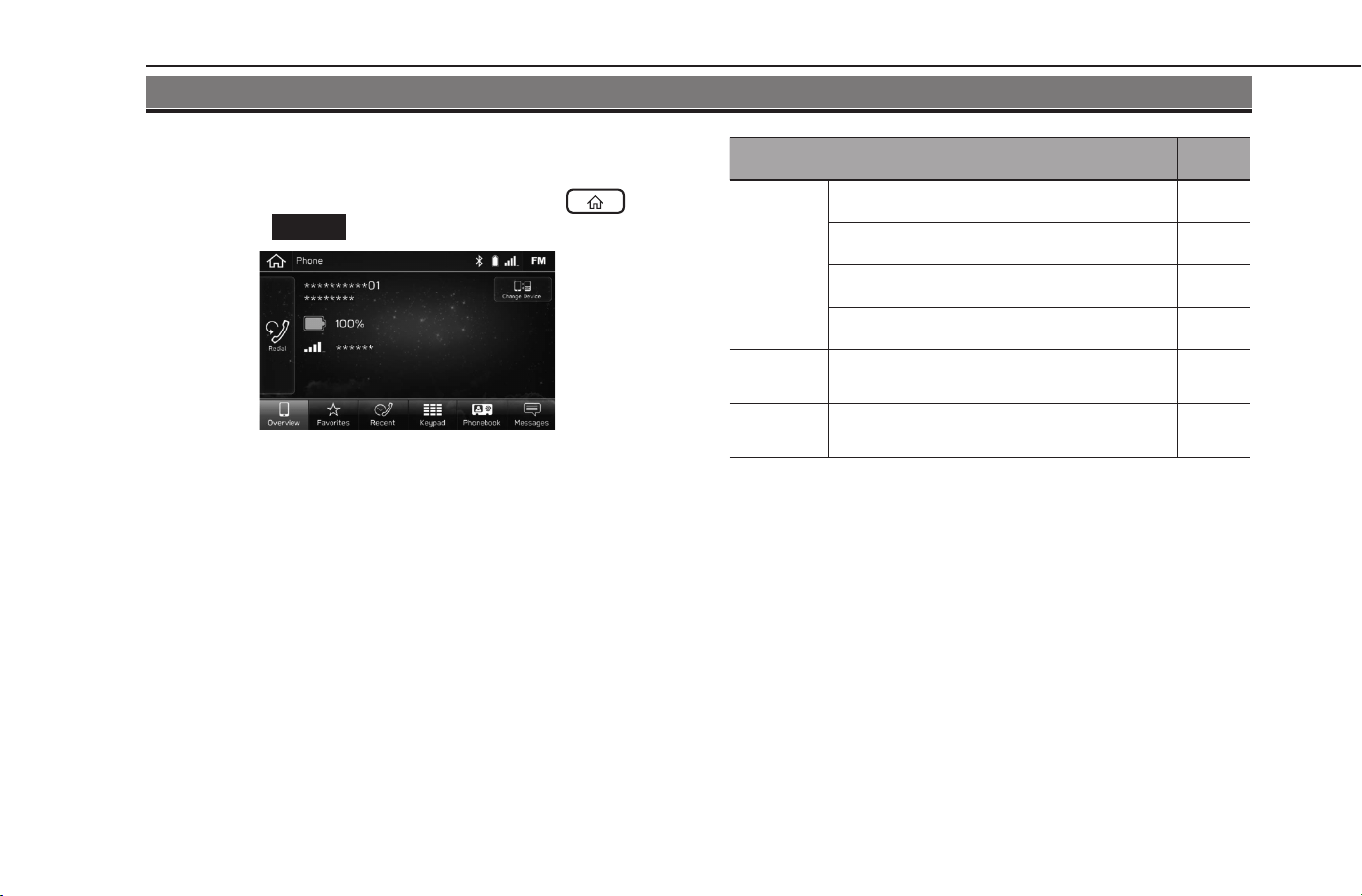
PHONE OPERATION (HANDS-FREE SYSTEM FOR CELLULAR PHONES)
PHONE SCREEN
The phone screen can be accessed by pressing , and
then selecting
Phone
(Phone).
Function Page
Phone
operation
Registering a Bluetooth phone/device 48
Calling on the Bluetooth phone 80
Receiving on the Bluetooth phone 84
Talking on the Bluetooth phone 85
Message
function
Using the Bluetooth phone message
function
87
Setting up
a phone
Setting the Bluetooth phone/device 51
PHONE OPERATION (HANDS-FREE SYSTEM FOR CELLULAR PHONES)
76
docstructure.indb 76 2019/05/31 11:46:00
SOME BASICS
The hands-free system enables calls to be made and
received without having to take your hands off the steering
wheel.
This system supports Bluetooth. Bluetooth is a wireless
data system that enables cellular phones to be used without
being connected by a cable or placed in a cradle.
The operating procedure of the phone is explained here.
WARNING
l While driving, do not use a cellular phone or connect the
Bluetooth phone.
l This system is tted with Bluetooth antennas. People with
implantable cardiac pacemakers, cardiac resynchronization
therapy-pacemakers or implantable cardioverter debrillators
should maintain a reasonable distance between themselves
and the Bluetooth antennas. The radio waves may affect the
operation of such devices.
l Before using Bluetooth phones, users of any electrical
medical
device other than implantable cardiac pacemakers,
cardiac resynchronization therapy-pacemakers or implantable
cardioverter debrillators should consult the manufacturer
of the device for information about its operation under the
inuence of radio waves. Radio waves could have unexpected
effects on the operation of such medical devices.
CAUTION
l Do not leave your cellular phone in the vehicle. The
temperature inside may rise to a level that could damage the
phone.
NOTE
l If your cellular phone does not support Bluetooth, this system
cannot function. Certain functions may not be available
depending on the type of cellular phone.
l In the following conditions, the system may not function:
•
The cellular phone is turned off.
•
The current position is outside the communication area.
•
The cellular phone is not connected.
•
The cellular phone has a low battery.
l When using the hands-free
function and other Bluetooth
functions at the same time, the following problems may occur:
• The Bluetooth connection may be cut.
• Noise may be heard when playing back voice with the
Bluetooth function.
l The other party’s voice will be heard from the front speakers.
The audio system will be muted during phone calls or when
hands-free voice commands are used.
l Talk alternately with the other party on the phone. If both parties
speak at the same time, the other party may not hear what has
been said. (This is not a malfunction.)
l Keep call volume down. Otherwise, the other party’s voice
may be audible outside the vehicle and voice echo may
increase. When talking on the phone, speak clearly towards the
microphone.
PHONE OPERATION (HANDS-FREE SYSTEM FOR CELLULAR PHONES)
77
Phone
4
docstructure.indb 77 2019/05/31 11:46:00
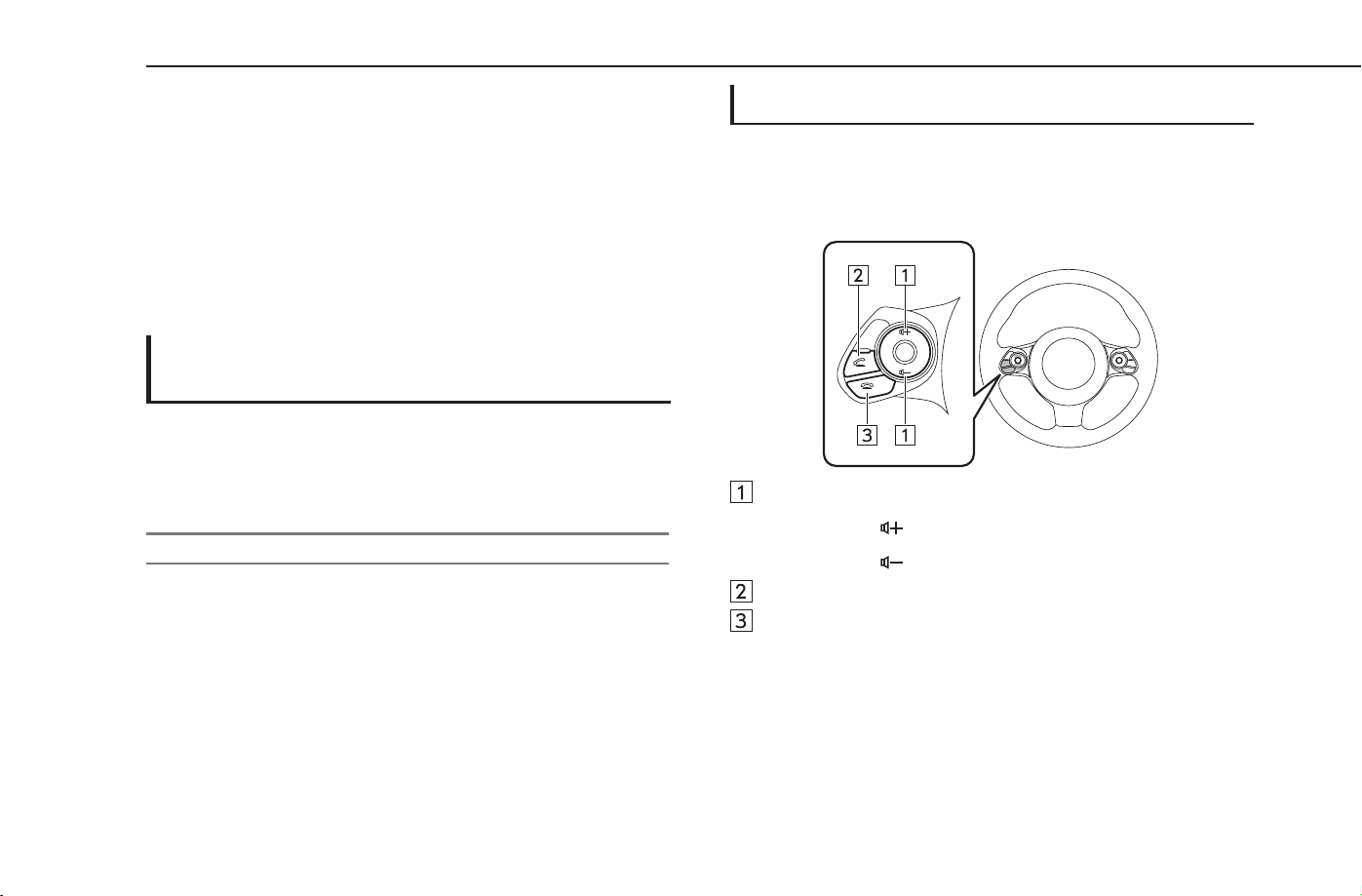
NOTE
l The other party may not hear you clearly when:
•
Driving on an unpaved road. (Making excessive trafc noise.)
•
Driving at high speeds.
•
Driving with a window open.
•
When air from the ventilator blows directly toward the
microphone.
•
The sound of the air conditioning fan is loud.
•
There is a negative effect on sound quality due to the phone
and/or network being used.
REGISTERING/CONNECTING A Bluetooth
PHONE
To use the hands-free system for cellular phones, it is
necessary to register a cellular phone with the system.
(→P.48)
Bluetooth PHONE CONDITION DISPLAY
The condition of the Bluetooth phone appears on the upper
right side of the screen. (→P.36)
USING THE PHONE SWITCH/MICROPHONE
XSteering switch
By pressing the phone switch, a call can be received or
ended without taking your hands off the steering wheel.
Volume control switch
● Press the “
” side to increase the volume.
● Press the “
” side to decrease the volume.
Off hook switch
On hook switch
PHONE OPERATION (HANDS-FREE SYSTEM FOR CELLULAR PHONES)
78
docstructure.indb 78 2019/05/31 11:46:01
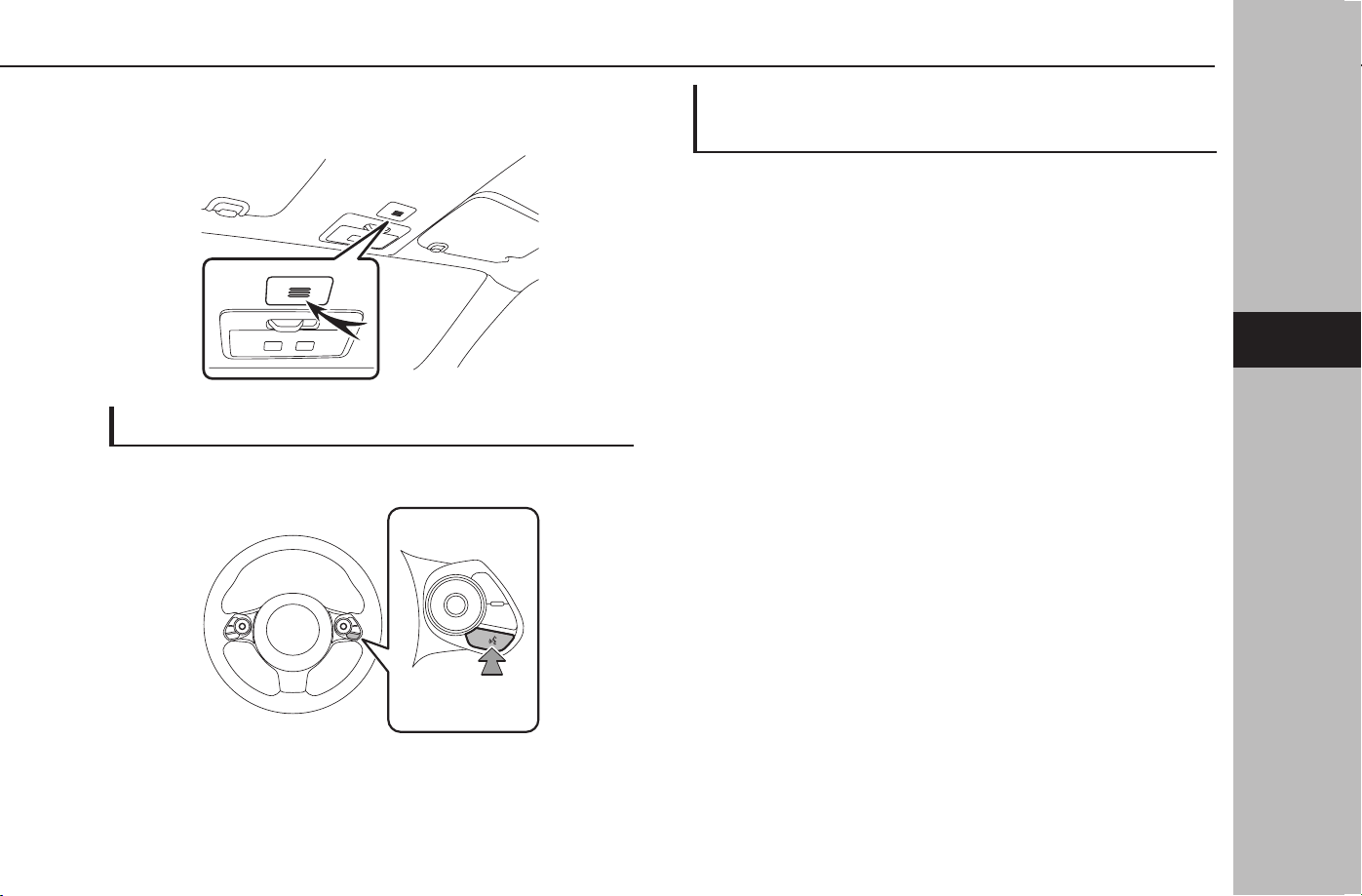
XMicrophone
The microphone is used when talking on the phone.
VOICE RECOGNITION SYSTEM
Press this switch to operate the voice recognition system.
● The voice recognition system and its list of
commands can be operated. (→P.197)
ABOUT THE CONTACTS IN THE CONTACT
LIST
● The following data is stored for every registered
phone. When another phone is connected, the
following registered data cannot be read:
•
Contact data
•
Call history data
•
Favorites data
•
All phone settings
NOTE
l When a phone’s registration is deleted, the above-mentioned
data is also deleted.
PHONE OPERATION (HANDS-FREE SYSTEM FOR CELLULAR PHONES)
79
Phone
4
docstructure.indb 79 2019/05/31 11:46:01
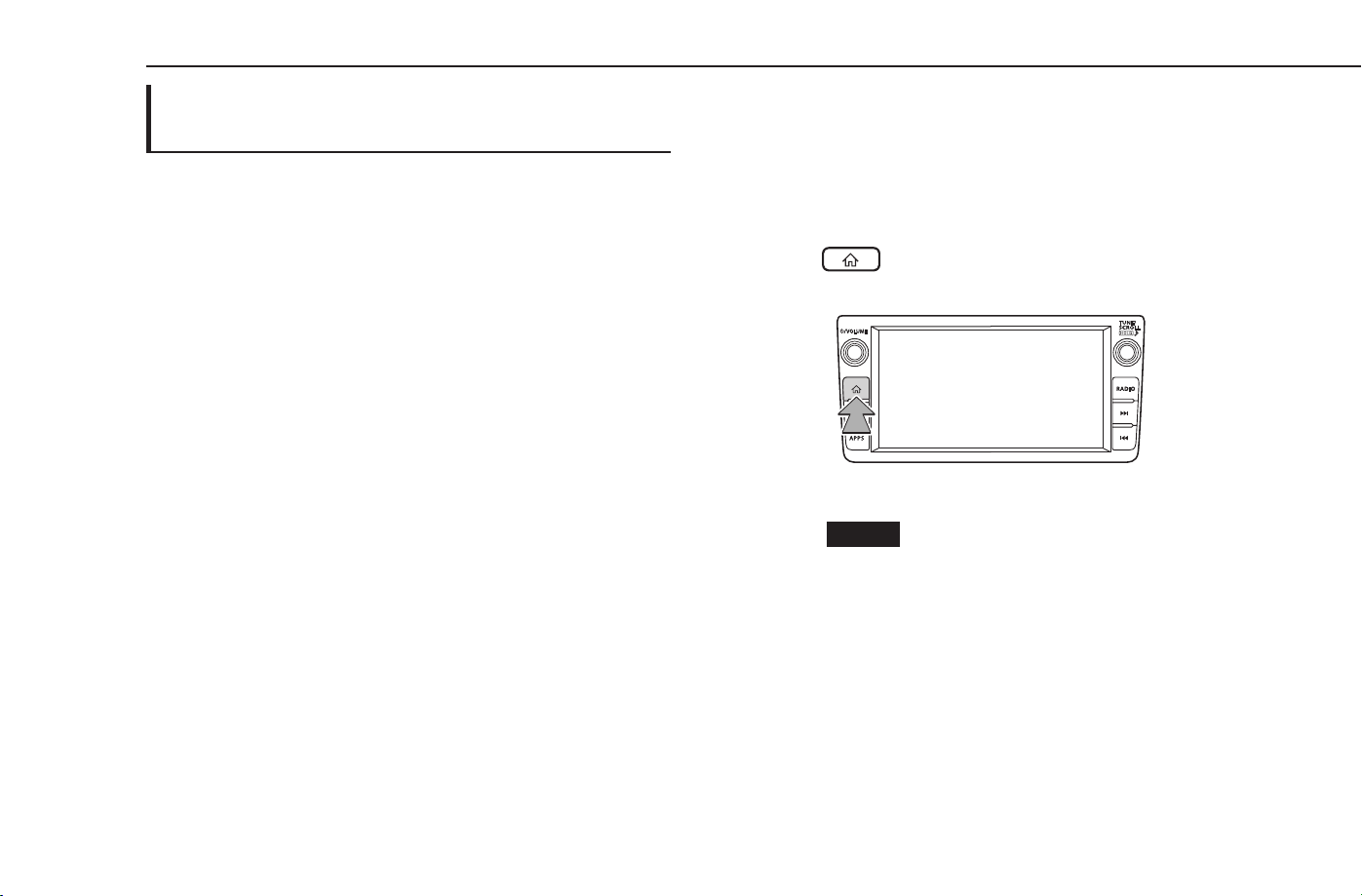
WHEN SELLING OR DISPOSING OF THE
VEHICLE
A lot of personal data is registered when the hands-free
system is used. When selling or disposing of the vehicle,
reset all setup items. (→P.59)
● The following data in the system can be reset:
•
Contact data
•
Call history data
•
Favorites data
•
All phone settings
NOTE
l Once reset, the data and settings will be erased. Pay close
attention when resetting the data.
CALLING ON THE Bluetooth
PHONE
After a Bluetooth phone has been registered, a call can
be made using the hands-free system. There are several
methods by which a call can be made, as described below.
1.
Press .
2.
Select
Phone
(Phone).
PHONE OPERATION (HANDS-FREE SYSTEM FOR CELLULAR PHONES)
80
docstructure.indb 80 2019/05/31 11:46:02
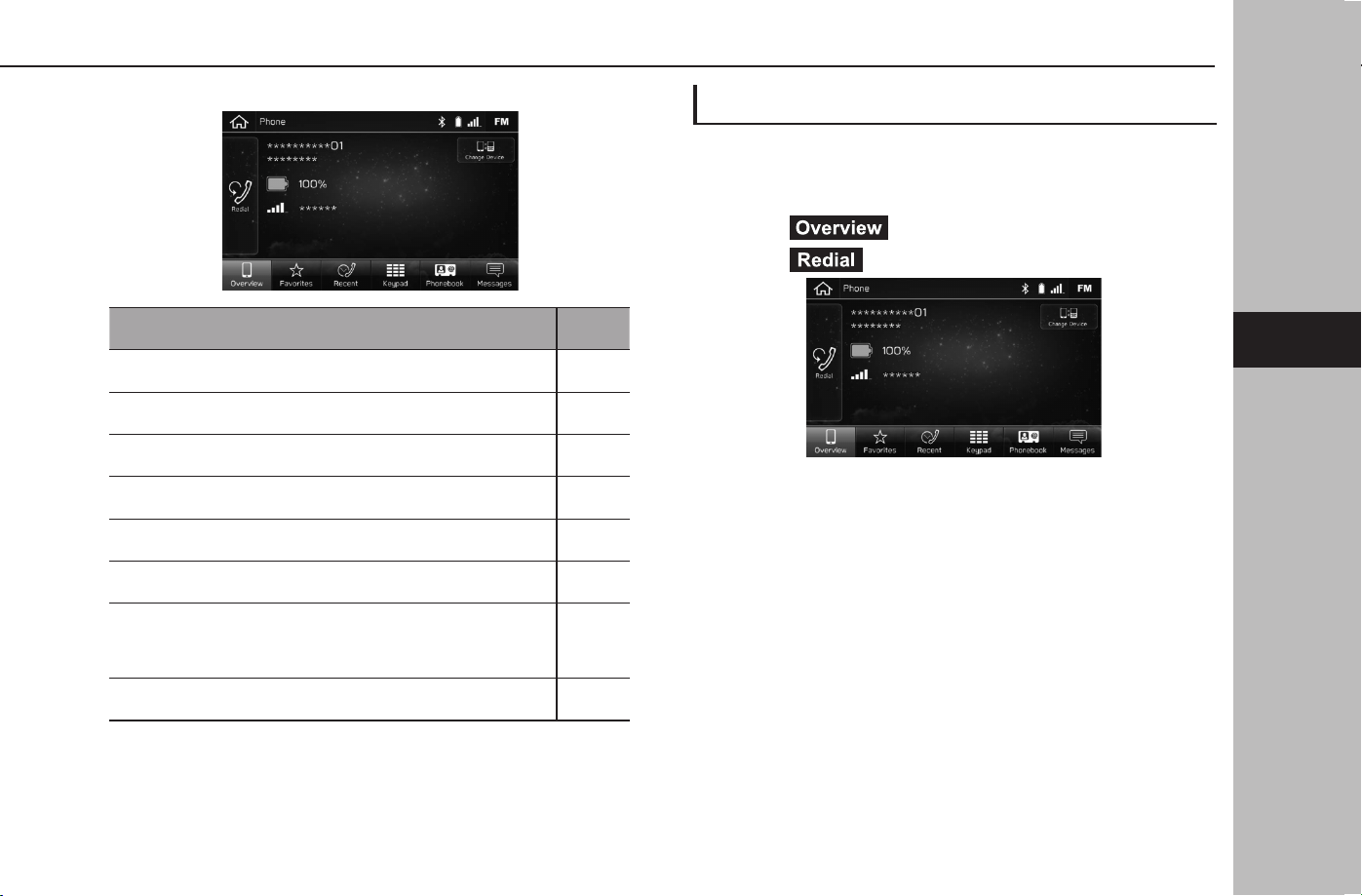
3.
Select the desired button to call from.
How to make a call list Page
By the last number 81
By
favorites list 82
By recent calls list 82
By keypad* 83
By contacts list 83
By SMS/MMS 91
By POI call
166,
167,
170
By voice
recognition system 197
*: The operation cannot be performed while driving.
BY THE LAST NUMBER
Calls can be made using the latest call history item.
1.
Display the phone screen. (→P.80)
2.
Select (Overview).
3.
Select (Redial).
4.
Check that the “Calling” screen is displayed.
PHONE OPERATION (HANDS-FREE SYSTEM FOR CELLULAR PHONES)
81
Phone
4
docstructure.indb 81 2019/05/31 11:46:02
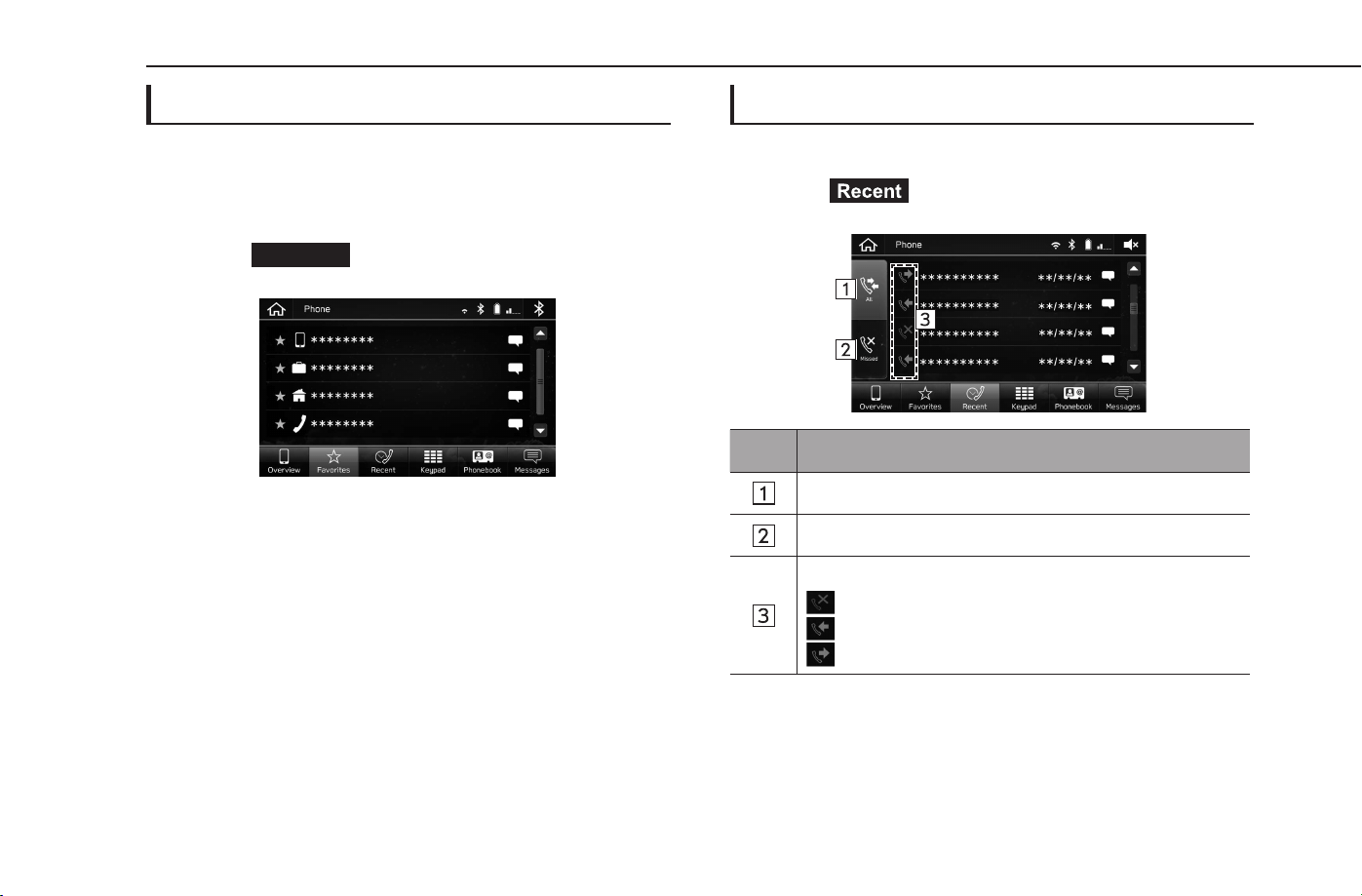
BY FAVORITES LIST
Calls can be made using registered contacts which can be
selected from a contact list.
1.
Display the phone screen. (→P.80)
2.
Select
Favorites
(Favorites), and then select the
desired contact.
3.
Check that the “Calling” screen is displayed.
NOTE
l This system’s favorites list and that of your Bluetooth phone
are not synchronized. This system does not currently support
transfer of favorites list data from the Bluetooth phone. To add
the Bluetooth phone’s favorites list to the system’s favorites list,
you need to register it through the system phonebook contacts
list. (→P.83)
BY RECENT CALLS LIST
1.
Display the phone screen. (→P.80)
2.
Select (Recent), and then select the desired
contact.
No. Information/Function
Select to display all latest call history items.
Select to display missed calls.
Displays the call type icons.
: Missed call
: Incoming call
: Outgoing call
3.
Check that the “Calling” screen is displayed.
PHONE OPERATION (HANDS-FREE SYSTEM FOR CELLULAR PHONES)
82
docstructure.indb 82 2019/05/31 11:46:03
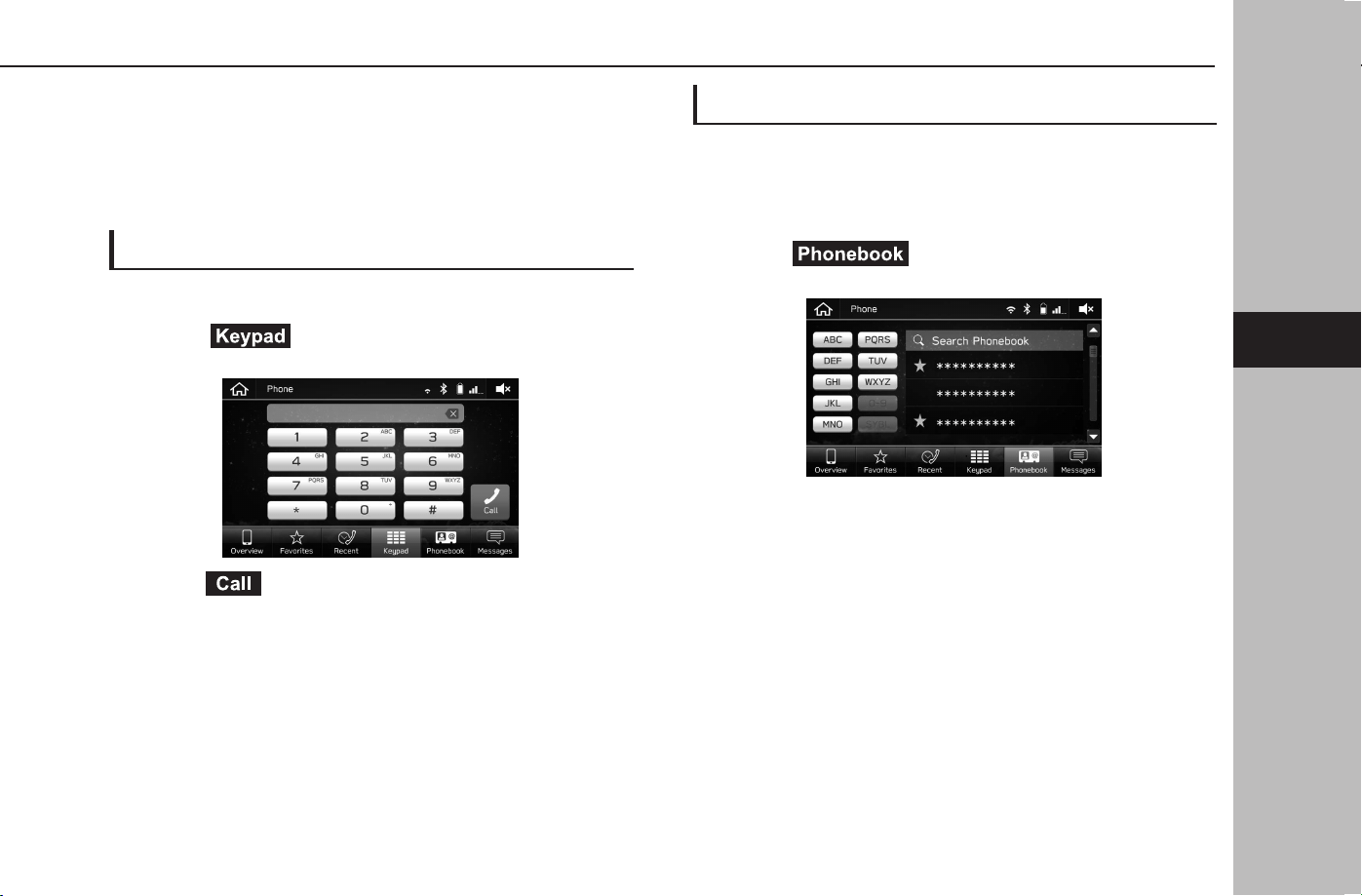
NOTE
l When a phone number registered in the contact list is received,
the name is displayed.
l International phone calls
may not be made depending on the
type of cellular phone you have.
BY KEYPAD
1.
Display the phone screen. (→P.80)
2.
Select (Keypad), and then enter the phone
number.
3.
Select (Call).
4.
Check that the “Calling” screen is displayed.
NOTE
l Depending on the type of Bluetooth phone being connected, it
may be necessary to perform additional steps on the phone.
BY CONTACTS LIST
Calls can be made by using contact data which is
transferred from a registered cellular phone.
1.
Display the phone screen. (→P.80)
2.
Select (Phonebook), and then select the
desired contact.
● A contact can be searched by entering the contact’s
name.
PHONE OPERATION (HANDS-FREE SYSTEM FOR CELLULAR PHONES)
83
Phone
4
docstructure.indb 83 2019/05/31 11:46:04
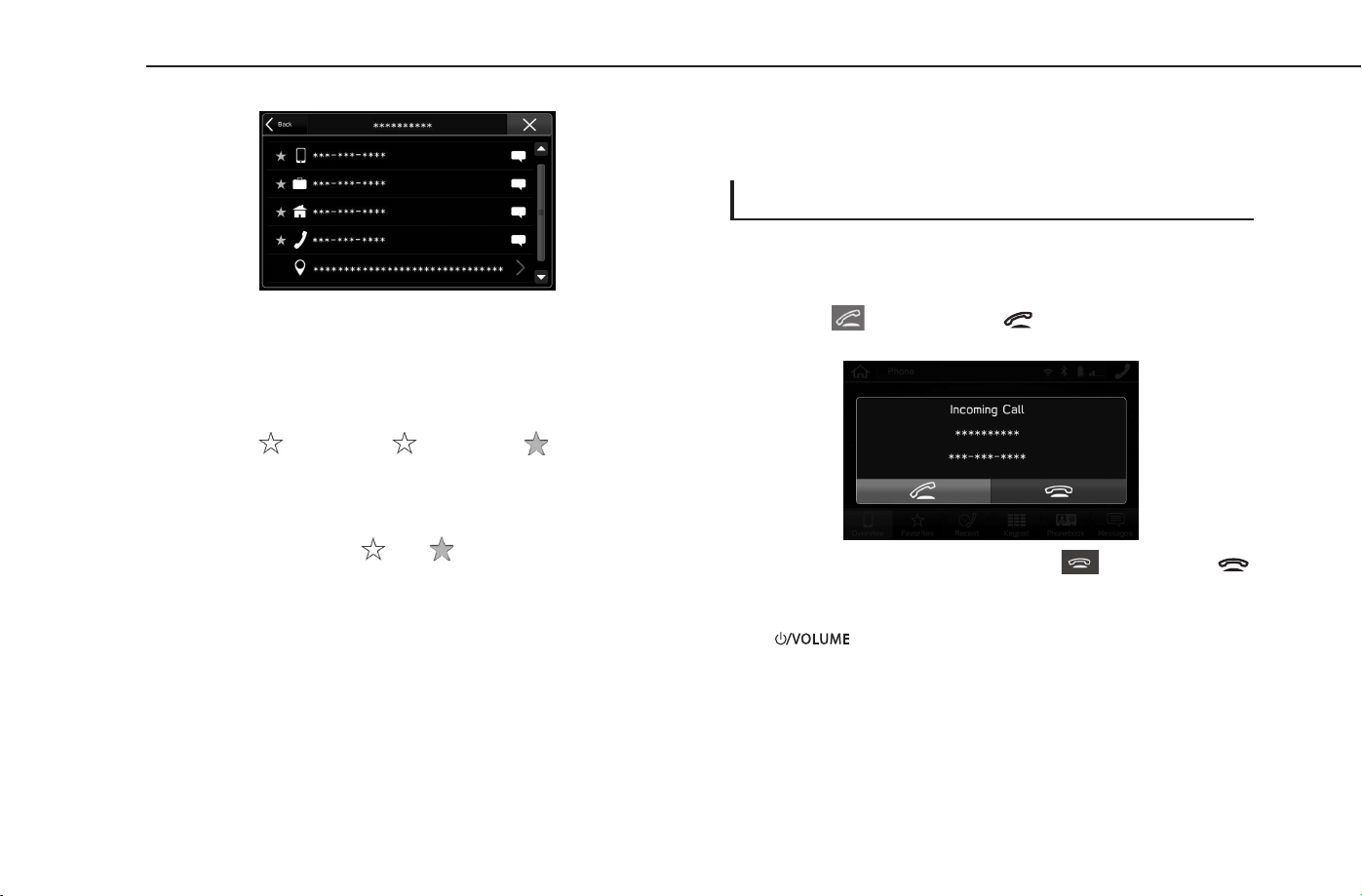
3.
Select the desired number.
● When the address is selected, the search screen is
displayed. (→P.166)
● Numbers may include home, work, and mobile as
categories depending on the phonebook data of the
connected cellular phone.
● When
is selected, changes to (yellow).
• The number is registered in the favorites list.
(→P.82)
● Each time the symbol is selected, the symbol
changes between
and (yellow).
4.
Check that the “Calling” screen is displayed.
NOTE
l When “Phonebook Download” is set to on, contacts is
transferred automatically. (→P.57)
RECEIVING ON THE Bluetooth
PHONE
INCOMING CALLS
When a call is received, the incoming call screen pops up
with sound.
1.
Select or press the switch on the steering
wheel to talk on the phone.
To refuse to receive the call: Select or press the
switch on the steering wheel.
To adjust the volume of a received call: Turn
the “
” knob, or use the volume control switch on
the steering wheel.
NOTE
l During international phone calls, the other party’s name or
number may not be displayed correctly depending on the type of
cellular phone you have.
l The ringtone volume can also be set from the sound settings
screen.(→P.72)
PHONE OPERATION (HANDS-FREE SYSTEM FOR CELLULAR PHONES)
84
docstructure.indb 84 2019/05/31 11:46:05
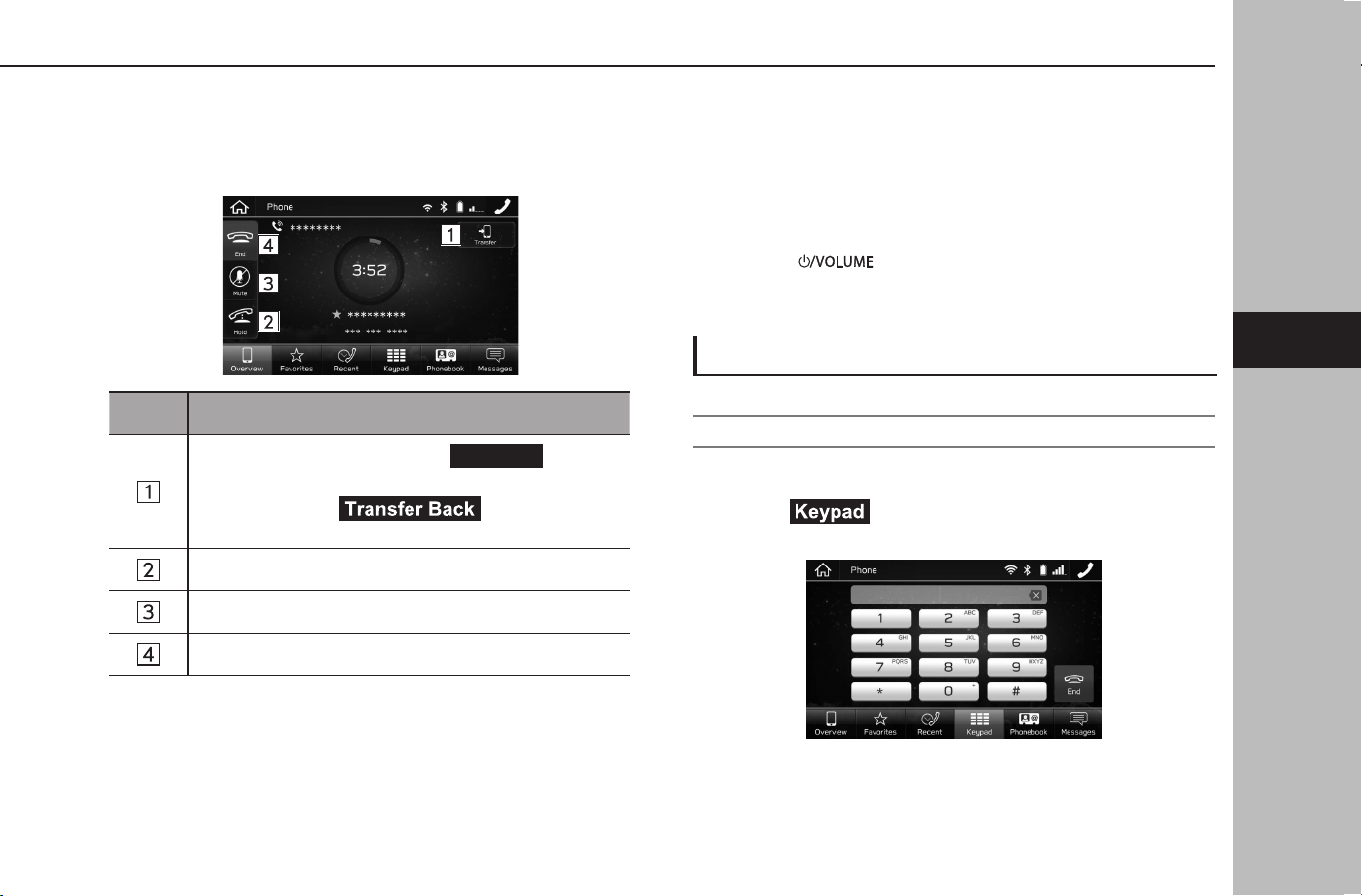
TALKING ON THE Bluetooth PHONE
While talking on the phone, this screen is displayed. The
operations outlined below can be performed on this screen.
No. Function
Select to transfer the call. Select
Transfer
(Transfer) to change from a hands-free call to a cellular
phone call. Select (Transfer Back)
to change from cellular phone call to hands-free call.
Select to put a call on hold.
Select to mute your voice to the other party.
Select to hang up the phone.
NOTE
l Changing between cellular phone call and hands-free call can be
performed by operating the cellular phone directly.
l Transferring methods and operations will be dif
ferent depending
on the type of cellular phone you have.
l For the operation of the cellular phone,
see the manual that
comes with it.
l Turn the
“ ” knob, or use the volume control switch
on the steering wheel to adjust the volume of the other party’s
voice.
SENDING TONES
BY KEYPAD
This operation cannot be performed while driving.
1.
Select (Keypad).
2.
Enter the desired number.
PHONE OPERATION (HANDS-FREE SYSTEM FOR CELLULAR PHONES)
85
Phone
4
docstructure.indb 85 2019/05/31 11:46:06
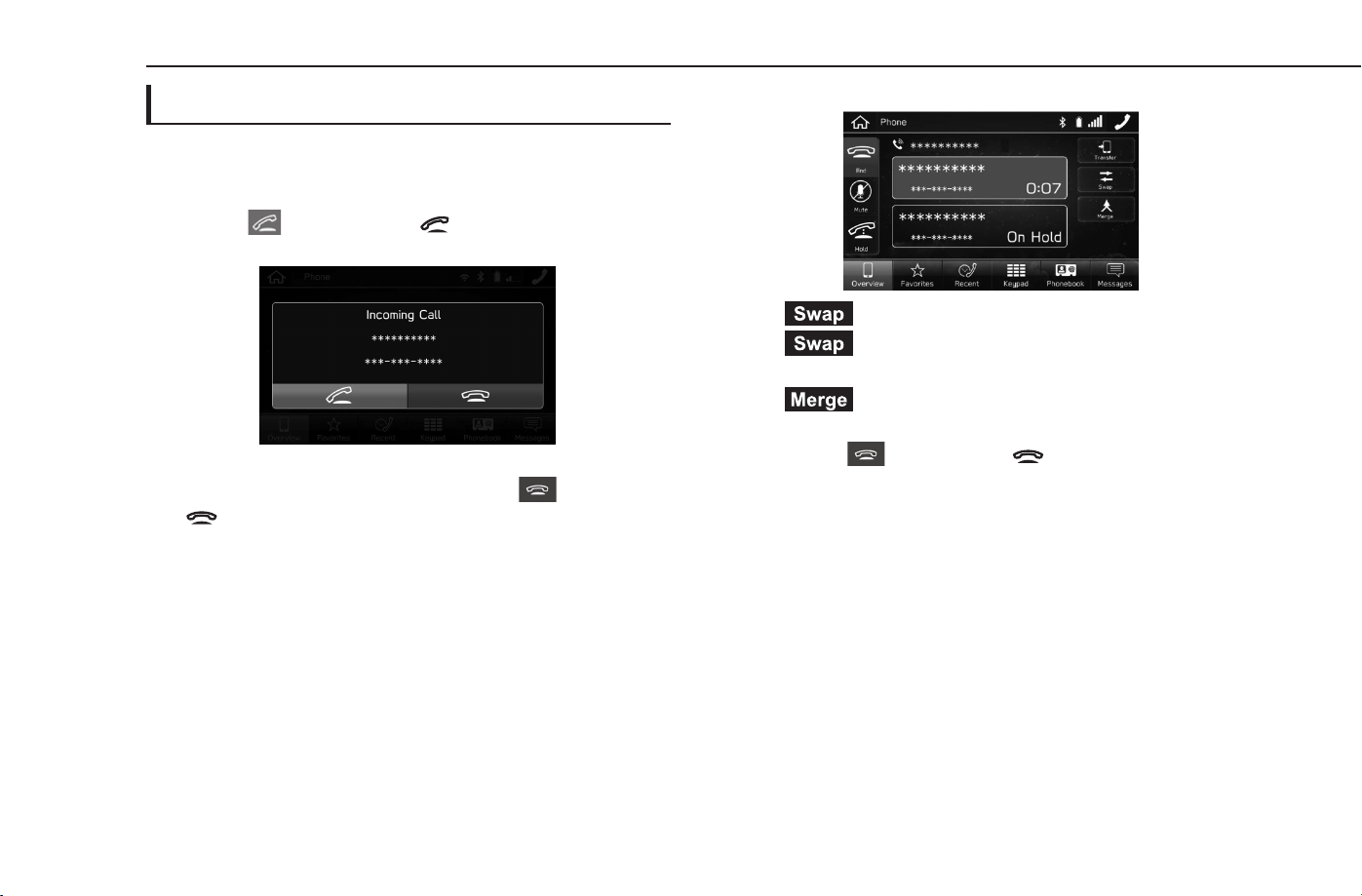
CALL WAITING
When a call is interrupted by a third party while talking, the
incoming call screen pops up with sound.
1.
Select or press the switch on the steering
wheel to start talking with the other party.
To refuse to receive the call: Select or press the
switch on the steering wheel.
● The rst call is put on hold.
2.
Check that the call waiting screen is displayed.
● (Swap): Select to change parties. Each time
(Swap) is selected, the party who is on hold
will be switched.
●
(Merge): Select to change to a conference
call.
● Select
or press the switch on the steering
wheel to end the call and return to the conversation
with the party on hold when having a two-way
conversation, and to end the call with both parties
when having a three-way conversation.
PHONE OPERATION (HANDS-FREE SYSTEM FOR CELLULAR PHONES)
86
docstructure.indb 86 2019/05/31 11:46:07
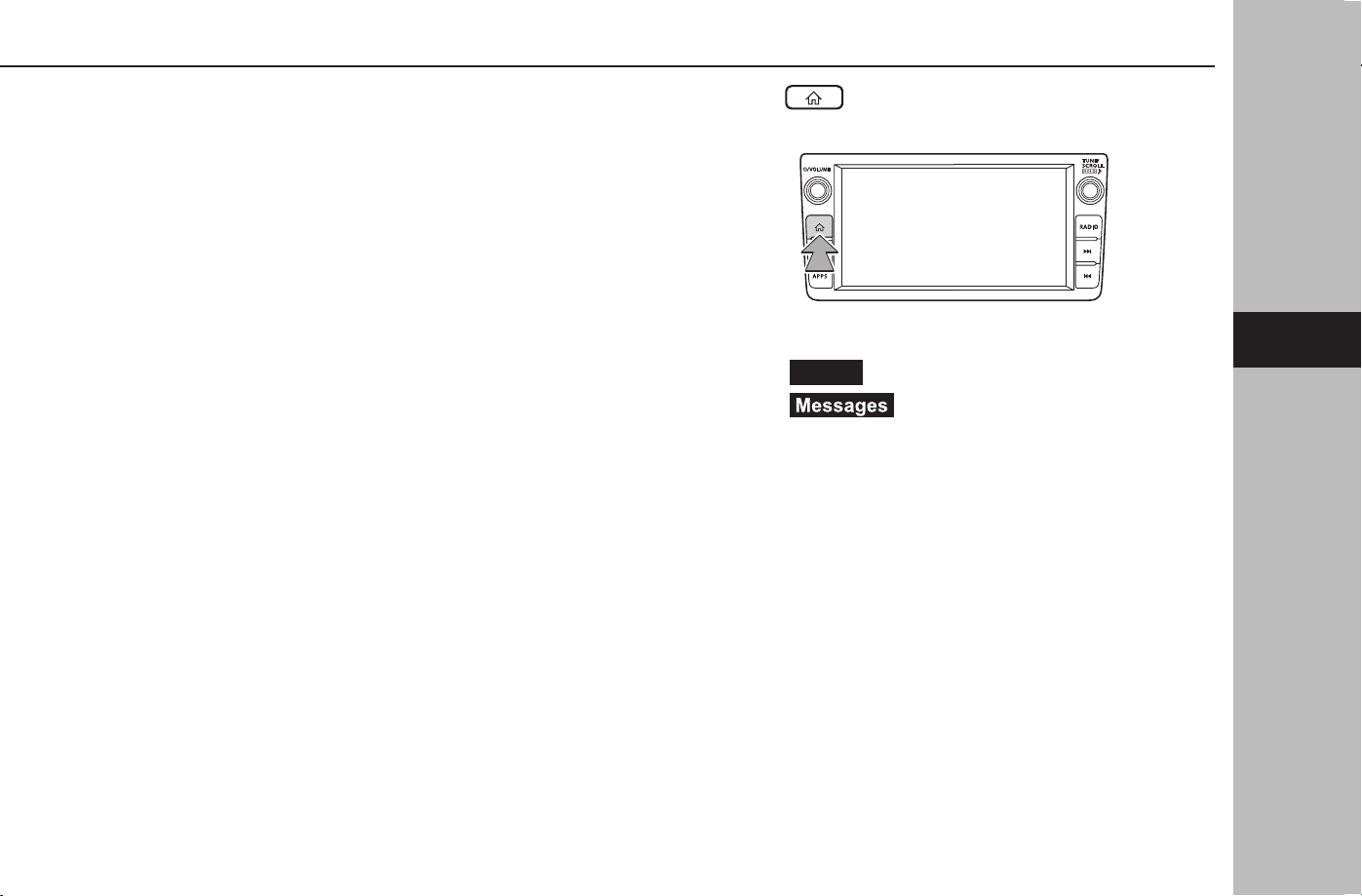
Bluetooth PHONE MESSAGE
FUNCTION
Received messages can be forwarded from the connected
Bluetooth phone, enabling checking and replying using the
system.
Depending on the type of Bluetooth phone connected,
received messages may not be transferred to the message
inbox.
If the phone does not support the message function, this
function cannot be used.
Depending on the Bluetooth phone type, the screen
display may differ, and it may not be possible to use certain
functions.
To use this function, it is necessary to set the phonebook
download function to on. (→P.57)
NOTE
l Depending on the model of your Bluetooth phone, the setting of
the connected phone may need to be changed. (ex: For iOS or
other models, the notication setting may need to be activated.)
For details, check the instructions for the connected Bluetooth
phone.
1.
Press .
2.
Select
Phone
(Phone).
3.
Select (Messages).
PHONE OPERATION (HANDS-FREE SYSTEM FOR CELLULAR PHONES)
87
Phone
4
docstructure.indb 87 2019/05/31 11:46:07
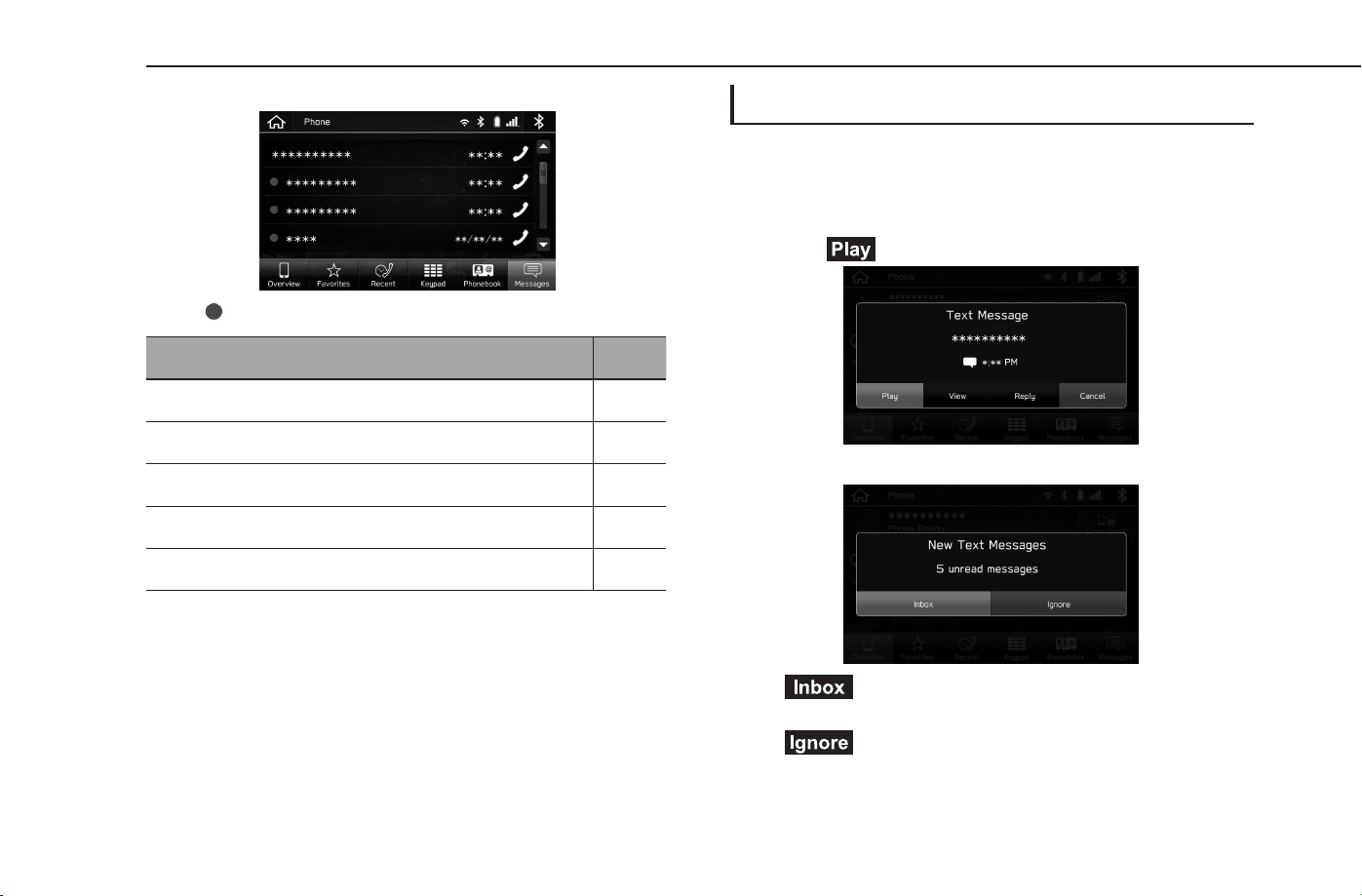
4.
Check that the message inbox screen is displayed.
●
: Unread message icon
Function Page
Receiving a message 88
Checking messages 89
Replying to a message (quick reply) 90
Sending a new short message 91
Calling the message sender 91
RECEIVING A MESSAGE
When an SMS/MMS is received, the incoming message
screen pops up with sound and is ready to be operated on
the screen.
1.
Select (Play) to have messages read out.
XIf there are any unread messages
● (Inbox): Select to display the message inbox
screen.
●
(Ignore): Select to not open the message.
PHONE OPERATION (HANDS-FREE SYSTEM FOR CELLULAR PHONES)
88
docstructure.indb 88 2019/05/31 11:46:08
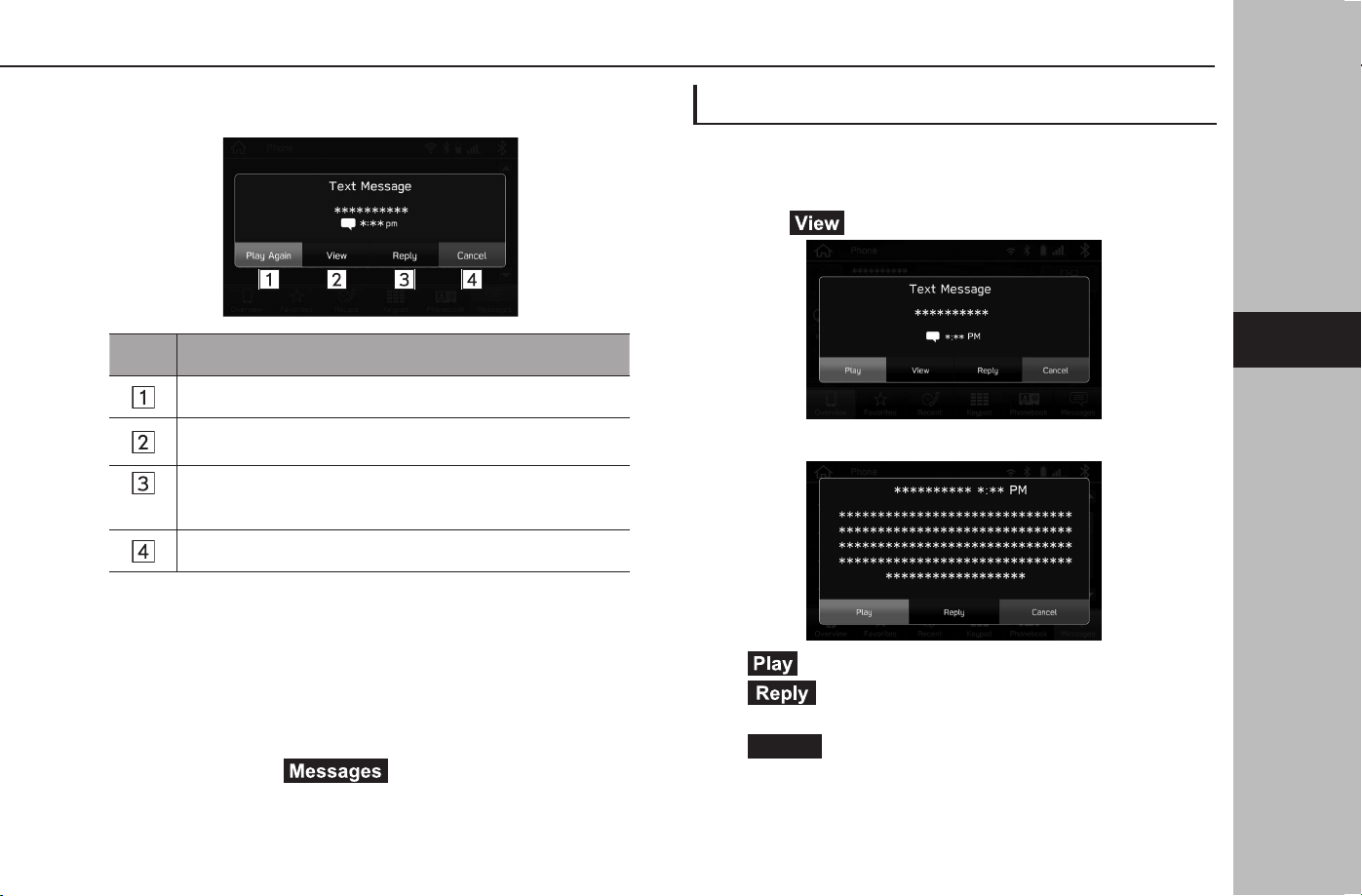
PHONE OPERATION (HANDS-FREE SYSTEM FOR CELLULAR PHONES)
89
Phone
4
2.
After checking the message, the following screen is
displayed.
No. Function
Select to have messages read out again.
Select to check the message.
*
Select to reply the message. (→P.90)
Select to cancel this function.
*: Depending on the Bluetooth phone that is connected to the audio system,
this function is not available.
NOTE
l Depending on the cellular phone used for receiving messages,
or its registration status with the system, some information may
not be displayed.
l When multiple text messages are received, a pop-up screen
displays. Select
(Messages) to store the
messages in the message inbox.
CHECKING MESSAGES
1.
Display the message inbox screen. (→P.87)
2.
Select the desired message from the list.
3.
Select (View).
4.
Check the message.
● (Play): Select to have messages read out.
●
(Reply)*: Select to reply the message.
(→P.90)
●
Cancel
(Cancel): Select to cancel this function.
*: Depending on the Bluetooth phone that is connected to the audio system,
this function is not available.
docstructure.indb 89 2019/05/31 11:46:09
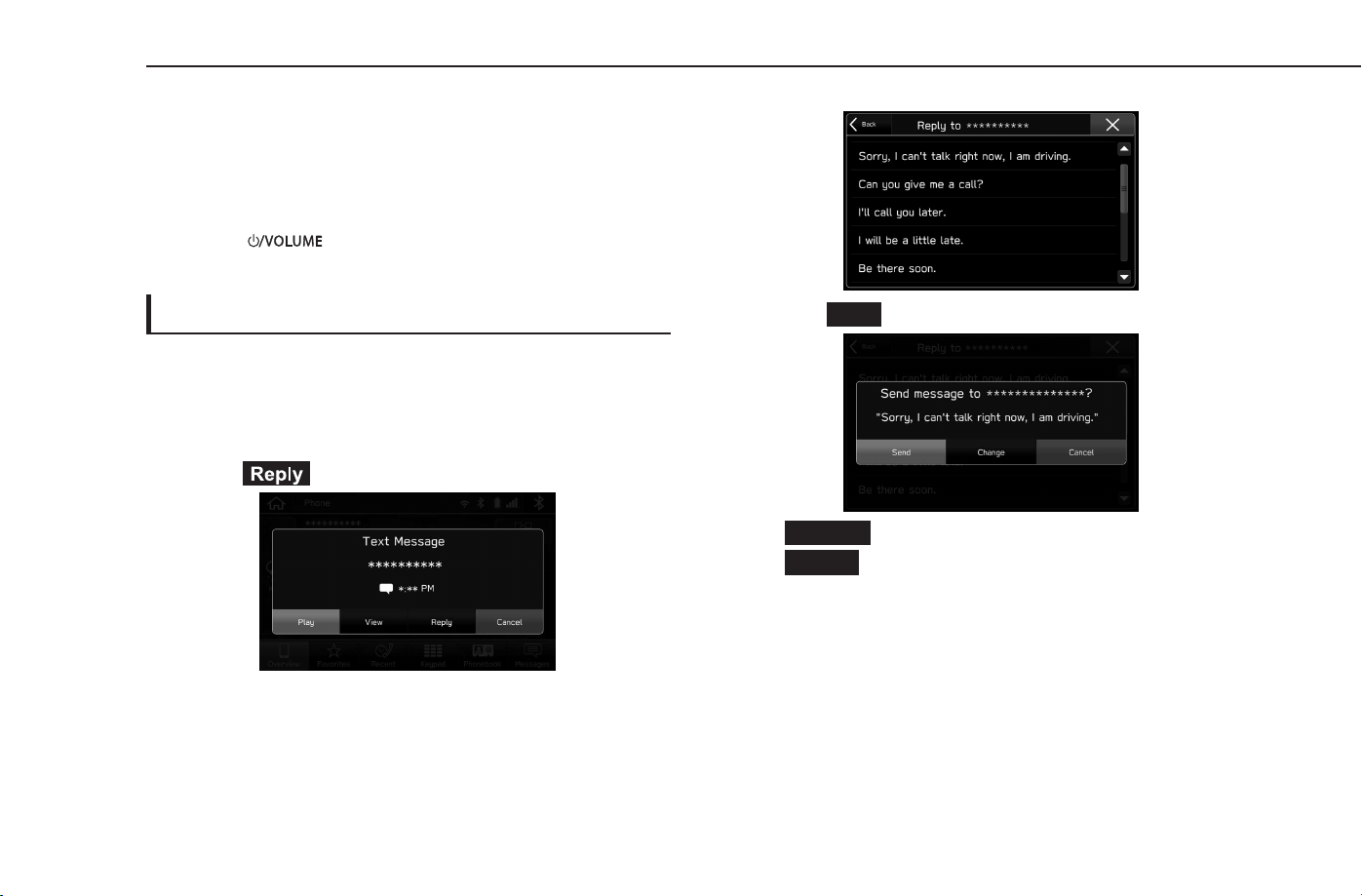
PHONE OPERATION (HANDS-FREE SYSTEM FOR CELLULAR PHONES)
90
NOTE
l Depending on the type of Bluetooth phone being connected, it
may be necessary to perform additional steps on the phone.
l Only received messages on the
connected Bluetooth phone can
be displayed.
l The text of the message is not displayed while driving.
l Turn th
e “ ” knob, or use the volume control switch on
the steering wheel to adjust the message readout volume.
REPLYING TO A MESSAGE (QUICK REPLY)*
*: Depending on the Bluetooth phone that is connected to the audio system,
this function is not available.
1.
Display the message inbox screen. (→P.87)
2.
Select the desired message from the list.
3.
Select (Reply).
4.
Select the desired message.
5.
Select
Send
(Send).
●
Change
(Change): Select to change the message.
●
Cancel
(Cancel): Select to cancel sending the
message.
NOTE
l 10 messages have already been stored.
docstructure.indb 90 2019/05/31 11:46:10
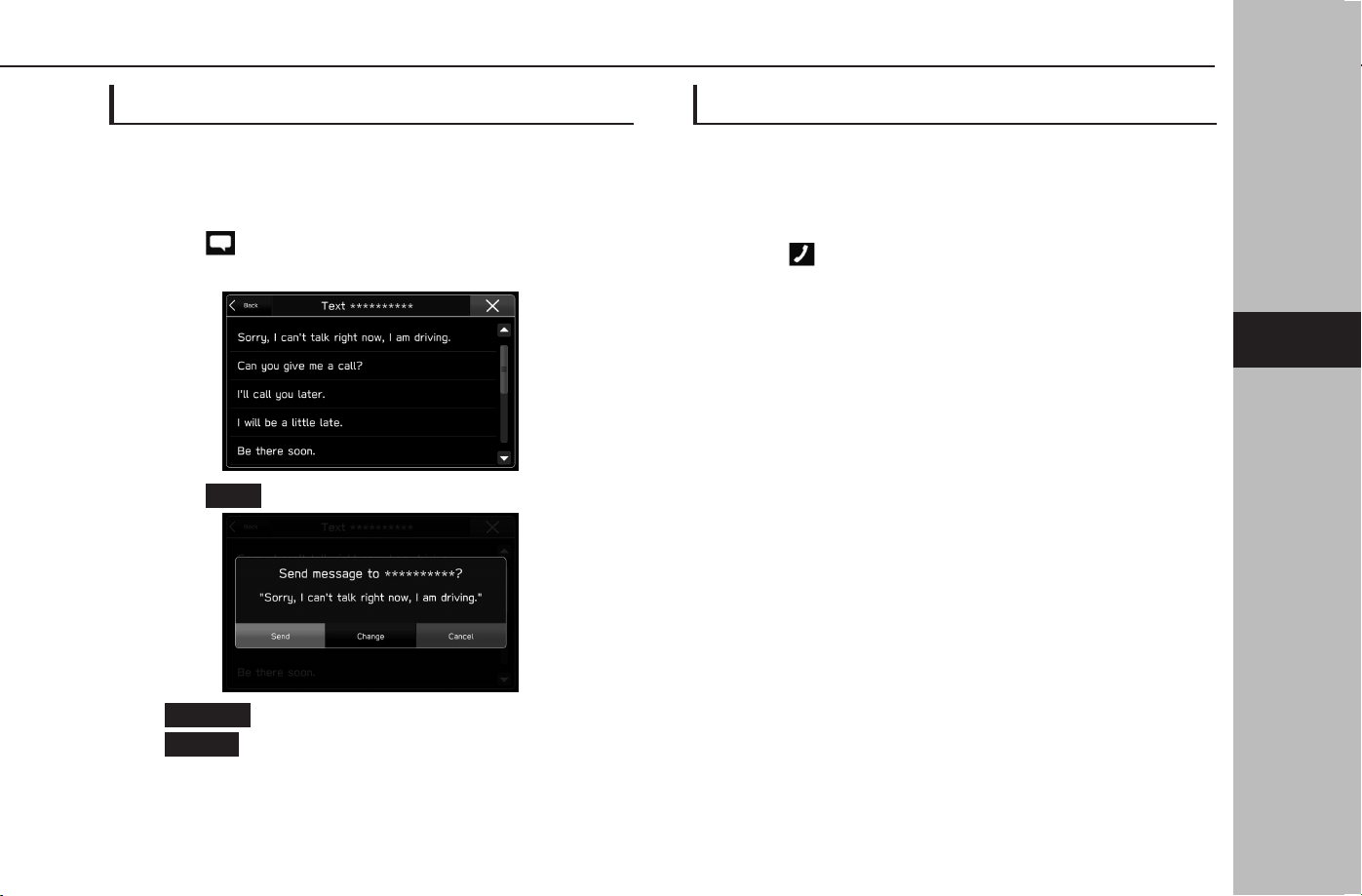
PHONE OPERATION (HANDS-FREE SYSTEM FOR CELLULAR PHONES)
91
Phone
4
SENDING A NEW SHORT MESSAGE
1.
Display the favorites list screen (→P.82), the recent
calls list screen (→P.82) or the contact detail screen
(→P.83).
2.
Select next to the desired number.
3.
Select the desired message.
4.
Select
Send
(Send).
●
Change
(Change): Select to change the message.
●
Cancel
(Cancel): Select to cancel sending the
message.
CALLING THE MESSAGE SENDER
Calls can be made to an SMS/MMS message sender’s
phone number.
1.
Display the message inbox screen. (→P.87)
2.
Select next to the desired sender.
3.
Check that the “Calling” screen is displayed.
docstructure.indb 91 2019/05/31 11:46:10

MEMO
92
docstructure.indb 92 2019/05/31 11:46:10

93
Apps
Apps
Before Using Applications
94
Before Using Applications
94
Settings Required To Use Applications
95
About App-based Connected Content
95
SUBARU STARLINK
97
SUBARU STARLINK
97
Displaying SUBARU STARLINK Information
97
Legal Notice
98
aha
TM
by HARMAN
102
aha
TM
by HARMAN
102
Overview
102
Pandora
®
106
Pandora
®
106
Overview
106
Apple CarPlay
109
Apple CarPlay
109
Overview
109
Android Auto
111
Android Auto
111
Overview
111
SiriusXM Travel Link
113
SiriusXM Travel Link
113
Displaying Sports Information
113
Displaying Weather Information
114
Displaying Stocks Information
115
Displaying Fuel Information
115
docstructure.indb 93 2019/05/31 11:46:11
BEFORE USING APPLICATIONS
BEFORE USING APPLICATIONS
Precautions to be aware of when using applications are
shown below.
In this chapter, iPhone or Android devices will be referred to
as a smartphone.
WARNING
l Do not connect or operate the smartphone while driving.
l Be sure to park the vehicle in a safe place before connecting
or operating the smartphone.
CAUTION
l Do not leave your smartphone in the vehicle. In particular, high
temperatures inside the vehicle may damage the smartphone.
l Do not push down on or apply unnecessary pressure to the
smartphone while it is connected as this may damage the
smartphone or its terminal.
l If connecting your smartphone via USB, do not insert foreign
objects into the USB port as this may damage the smartphone
or its terminal.
NOTE
l Depending on the application, certain functions are not available
while driving for reasons of safety.
l In order to maximize
signal reception, performance and precision
of the smartphone, please ensure the smartphone is placed as
close to the system as possible, while ensuring it is stowed and
secure while driving.
l When connecting your smartphone via USB, use the original
cables provided with your smartphone or equivalent third-party
(certied) cables.
l When the ignition switch is in the “ACC” or
“ON” position, the
battery of the connected smartphone is charged.
l If connecting your smartphone via USB, smartphone may not
be recognized when the ignition switch is in the “ACC” or “ON”
position. In this case, remove the smartphone and reconnect it.
l The accuracy of the displayed information
or the signal reception
performance depends on the smartphone or the connected
device, and its wireless connection.
l For operating the smartphone, see the instruction manual that
comes with it.
l Follow the
specic operation procedures for the smartphone
application.
l When connecting the device via Bluetooth, the communication
speed may become slower than via USB.
l If the application
is not running smoothly or is unstable,
disconnect and reconnect the smartphone via Bluetooth
(→P.54) and/or USB cable (→P.31). If the problem
continues, reboot the smartphone.
BEFORE USING APPLICATIONS
94
docstructure.indb 94 2019/05/31 11:46:11
SETTINGS REQUIRED TO USE
APPLICATIONS
In order to use an application on this system, the application
must be installed on your smartphone.
● Search and download the application
from your
smartphone app.
• iPhone: App Store via iT
unes
•
Android device: Google Play Store
● Create an account and login to the application on the
smartphone.
NOTE
l Please use the latest version of the application.
l Apple CarPlay does not require an application to be installed.
Refer to
“Apple CarPlay” for details on Apple CarPlay operation.
(→P.109)
ABOUT APP-BASED CONNECTED
CONTENT
Requirements for using the connected content services of
the application on this system.
● The latest version of the system is compatible
with
connected content application(s) for the smartphones,
and is downloaded to your smartphone.
● A current account with a wireless content service
provider.
● A smartphone data plan: If the data plan for your
smartphone does not provide for unlimited data
usage, additional charges from your carrier may apply
for accessing app-based connected content via 3G,
4G, Wi-Fi, or 4G LTE wireless networks.
● Connection to the internet via 3G, 4G, Wi-Fi, or 4G
LTE networks.
NOTE
l Changes to product specications may result in differences
between the content of the manual and features of the product.
l Be careful not to exceed the data usage limits for your
smartphone. Doing so will result in additional data usage
charges from your phone carrier.
BEFORE USING APPLICATIONS
95
Apps
5
docstructure.indb 95 2019/05/31 11:46:11

NOTE
l Limitations:
•
Access to app-based connected content will depend on the
availability
of wireless cellular and/or Wi-Fi network coverage
for the purpose of allowing your smartphone to connect to the
internet.
•
Service availability may
be geographically limited by region.
Consult the wireless connected content service provider for
additional information.
•
Ability of this
product to access connected content is subject
to change without notice and could be affected by any of the
following: compatibility issues with future rmware versions
of the smartphone; compatibility issues with future versions
of the connected content application(s) for the smartphone;
changes to or discontinuation of the connected content
application(s) or service by its provider.
l Since some applications use signals from GPS satellites and
wireless communication lines, they may not work properly in the
following locations.
•
In tunnels
• In underground parking lots
• Outside wireless communication
range, such as some
countryside areas
• Where the wireless communication network is congested, or
where communications are restricted
l Depending on the circumstances and environment, the signal
may be weak or not be received. In such cases, an error may
occur.
NOTE
l Communication and phone call charges for smartphones should
be paid by the wireless subscriber.
l If you lose the data in a smartphone or other device
while using
it with the system, no compensation will be given for the lost
data.
l SUBARU CORPORA
TION does not guarantee content provided
by the application.
l The application may not work due to factors on smartphones,
smartphone applications or stations. SUBARU CORPORATION
accepts no responsibility for this.
BEFORE USING APPLICATIONS
96
docstructure.indb 96 2019/05/31 11:46:12
SUBARU STARLINK
SUBARU STARLINK
The SUBARU STARLINK function allows the system to link
with a smartphone either by Bluetooth or USB connection.
When connecting iPhone or Android devices with the
SUBARU STARLINK application installed, you can control
SUBARU STARLINK content through the system.
To use the SUBARU STARLINK application, connect
your iPhone to the USB port or via Bluetooth, or
connect your Android device via Bluetooth.
When using the application, read the precautions indicated
in “BEFORE USING APPLICATIONS”. (→P.94)
NOTE
l SUBARU STARLINK may not be able to be used when
connecting to an external Wi-Fi source from this system if the
source IP address is 192.168.1.x.
DISPLAYING SUBARU STARLINK
INFORMATION
1.
Run the SUBARU STARLINK application on your
smartphone.
2.
Connect the iPhone to the USB port, or connect your
iPhone or Android device by utilizing the Bluetooth
connection.
● For details on connecting your iPhone to the USB
port: →P.31
For details on registering or connecting your iPhone
or Android device: →P.48
3.
Select
SUBARU STARLINK
(SUBARU STARLINK) on
the “Apps” screen. (→P.24)
NOTE
l There may be times when
SUBARU STARLINK
(SUBARU
STARLINK) does not appear immediately when the ignition
switch is set in the “ACC” or “ON” position. If so, please wait.
SUBARU STARLINK
97
Apps
5
docstructure.indb 97 2019/05/31 11:46:12

ABOUT THE SUPPORTED DEVICES
This system supports the following devices.
● iPhone: iOS 7.1.2 or later
● Android: Android 4.0 or later
LEGAL NOTICE
XFor iPhone
● Caution
For your safety, do not attempt to operate
any
feature of this device unless it is safe to do so
without distraction from safe driving. This device is
informational only. Check and abide by your local
laws and always obey safe driving rules, and posted
signs and signals. Operate this device only in locales
in which it is legal. Read the instruction manual for
proper operation of this device. This product uses the
Smart Phone’s data plan for features and services.
Please consult carrier data plan usage, pricing, data
overage charges, limitations and usage guidelines.
● Permission
You may be asked to provide your personal and/
or non-personal information solely for the purpose
specied.
● Warranty Disclaimer
Any use of this product (the "Product"), the
STARLINK software, and any applications that are
supported with the Product (collectively with the
Product and the STARLINK software, the "Product
System"), including any reliance upon any of the
content displayed by the Product System, shall
be at your sole risk. SUBARU CORPORATION
and its subsidiaries ("SUBARU CORPORATION")
disclaims any and all responsibility or liability for the
accuracy, content, completeness, legality, reliability, or
operability or availability of any information from the
use of the Product System. The telecommunication
network used and the particular version of the
iPhone, Android or other smart phone (each, a
"Smart Phone") and the related Apple iOS, Android
OS or other smart phone OS (collectively, the Smart
Phone and the OS, the "Phone System") used are
the responsibility of the customer, and SUBARU
CORPORATION shall have no responsibility for
the interoperability of the Product System with
any telecommunications network/Phone System
combination not explicitly supported by SUBARU
CORPORATION in written documentation of the
Product System.
SUBARU STARLINK
98
docstructure.indb 98 2019/05/31 11:46:12

The user’s sole and exclusive remedies for any app
downloaded from the iTunes Store, Google Play or
other application stores (each, an "Application Store")
(including the STARLINK app), or otherwise installed
on customer’s Smart Phone, shall be as provided in
the Application Store Terms and Conditions or other
similar document and SUBARU CORPORATION
assumes no responsibility for those apps or their
operation. Any services provided by the Product
System shall be covered by a separate Services
Agreement.
TO THE FULLEST EXTENT PERMITTED UNDER
APPLICABLE LAW, THE PRODUCT SYSTEM
IS PROVIDED "AS IS" AND "AS AVAILABLE,"
WITHOUT WARRANTY OF ANY KIND, EITHER
EXPRESS OR IMPLIED OR STATUTORY,
INCLUDING THE IMPLIED WARRANTIES OF
MERCHANTABILITY, FITNESS FOR A PARTICULAR
PURPOSE, OR NON-INFRINGEMENT. SUBARU
CORPORATION AND ITS AFFILIATES, OFFICERS,
EMPLOYEES, AGENTS, PARTNERS, SUPPLIERS
AND LICENSORS (COLLECTIVELY, "SUBARU
CORPORATION PARTIES") DISCLAIM ANY AND
ALL WARRANTIES REGARDING THE SECURITY,
RELIABILITY, TIMELINESS, COMPLETENESS,
ACCURACY AND PERFORMANCE OF THE
PRODUCT SYSTEM. SUBARU CORPORATION
PARTIES DO NOT WARRANT OR COVENANT
THAT ANY DEFECTS OR ERRORS ASSOCIATED
WITH THE PRODUCT SYSTEM WILL BE
CORRECTED, OR THAT THE PRODUCT SYSTEM
IS FREE OF VIRUSES, ERRORS, OR OTHER
HARMFUL COMPONENTS, OR WILL OPERATE
UNINTERRUPTED OR ON ANY SCHEDULE.
BECAUSE SOME JURISDICTIONS DO NOT ALLOW
THE EXCLUSION OF IMPLIED WARRANTIES, THE
ABOVE EXCLUSION OF IMPLIED WARRANTIES
MAY NOT APPLY TO YOU.
SUBARU STARLINK
99
Apps
5
docstructure.indb 99 2019/05/31 11:46:12

XFor Android devices
● Caution
For your safety, do not attempt to operate
any
feature of this device unless it is safe to do so
without distraction from safe driving. This device is
informational only. Check and abide by your local
laws and always obey safe driving rules, and posted
signs and signals. Operate this device only in locales
in which it is legal. Read the instruction manual for
proper operation of this device. This product uses the
Smart Phone’s data plan for features and services.
Please consult carrier data plan usage, pricing, data
overage charges, limitations and usage guidelines.
● Permission
You may be asked to provide your personal and/
or non-personal information solely for the purpose
specied.
● Warranty Disclaimer
Any use of this product (the "Product"), the
STARLINK software, and any applications that are
supported with the Product (collectively with the
Product and the STARLINK software, the "Product
System"), including any reliance upon any of the
content displayed by the Product System, shall
be at your sole risk. SUBARU CORPORATION
and its subsidiaries ("SUBARU CORPORATION")
disclaims any and all responsibility or liability for the
accuracy, content, completeness, legality, reliability, or
operability or availability of any information from the
use of the Product System. The telecommunication
network used and the particular version of the
iPhone, Android or other smart phone (each, a
"Smart Phone") and the related Apple iOS, Android
OS or other smart phone OS (collectively, the Smart
Phone and the OS, the "Phone System") used are
the responsibility of the customer, and SUBARU
CORPORATION shall have no responsibility for
the interoperability of the Product System with
any telecommunications network/Phone System
combination not explicitly supported by SUBARU
CORPORATION in written documentation of the
Product System.
SUBARU STARLINK
100
docstructure.indb 100 2019/05/31 11:46:12

The user’s sole and exclusive remedies for any app
downloaded from the iTunes Store, Google Play or
other application stores (each, an "Application Store")
(including the STARLINK app), or otherwise installed
on customer’s Smart Phone, shall be as provided in
the Application Store Terms and Conditions or other
similar document and SUBARU CORPORATION
assumes no responsibility for those apps or their
operation. Any services provided by the Product
System shall be covered by a separate Services
Agreement.
TO THE FULLEST EXTENT PERMITTED UNDER
APPLICABLE LAW, THE PRODUCT SYSTEM
IS PROVIDED "AS IS" AND "AS AVAILABLE,"
WITHOUT WARRANTY OF ANY KIND, EITHER
EXPRESS OR IMPLIED OR STATUTORY,
INCLUDING THE IMPLIED WARRANTIES OF
MERCHANTABILITY, FITNESS FOR A PARTICULAR
PURPOSE, OR NON-INFRINGEMENT. SUBARU
CORPORATION AND ITS AFFILIATES, OFFICERS,
EMPLOYEES, AGENTS, PARTNERS, SUPPLIERS
AND LICENSORS (COLLECTIVELY, "SUBARU
CORPORATION PARTIES") DISCLAIM ANY AND
ALL WARRANTIES REGARDING THE SECURITY,
RELIABILITY, TIMELINESS, COMPLETENESS,
ACCURACY AND PERFORMANCE OF THE
PRODUCT SYSTEM. SUBARU CORPORATION
PARTIES DO NOT WARRANT OR COVENANT
THAT ANY DEFECTS OR ERRORS ASSOCIATED
WITH THE PRODUCT SYSTEM WILL BE
CORRECTED, OR THAT THE PRODUCT SYSTEM
IS FREE OF VIRUSES, ERRORS, OR OTHER
HARMFUL COMPONENTS, OR WILL OPERATE
UNINTERRUPTED OR ON ANY SCHEDULE.
BECAUSE SOME JURISDICTIONS DO NOT ALLOW
THE EXCLUSION OF IMPLIED WARRANTIES, THE
ABOVE EXCLUSION OF IMPLIED WARRANTIES
MAY NOT APPLY TO YOU.
SUBARU STARLINK
101
Apps
5
docstructure.indb 101 2019/05/31 11:46:12
aha
TM
by HARMAN
aha
TM
by HARMAN
aha is a cloud-based application that connects to the system
and gives you access to your favorite web content safely
and easily. There are several tens of thousands of stations
spanning internet radio, personalized music, audiobooks,
Facebook, Twitter, restaurant and hotel searches,
weather and more. For more about aha, go to the aha site
(http://www.aharadio.com).
When connecting iPhone or Android devices with the aha
application installed, you can control, view, and hear aha
content through the system.
To use the aha application, connect your iPhone or
Android device via Bluetooth.
When using the application, read the precautions indicated
in “BEFORE USING APPLICATIONS”. (→P.94)
With navigation function: You may also display POI
information from the aha application on the map screen and
route to these POIs.
OVERVIEW
The aha
TM
by HARMAN operation screen can be accessed
with the following methods:
● Run the aha application on your smartphone.
● Connect the iPhone or Android device by utilizing the
Bluetooth connection.
• For details on registering or connecting
an iPhone
or Android device: →P.48
● Select
Aha
(Aha) on the “Apps” screen. (→P.24)
aha
TM
by HARMAN
102
docstructure.indb 102 2019/05/31 11:46:12
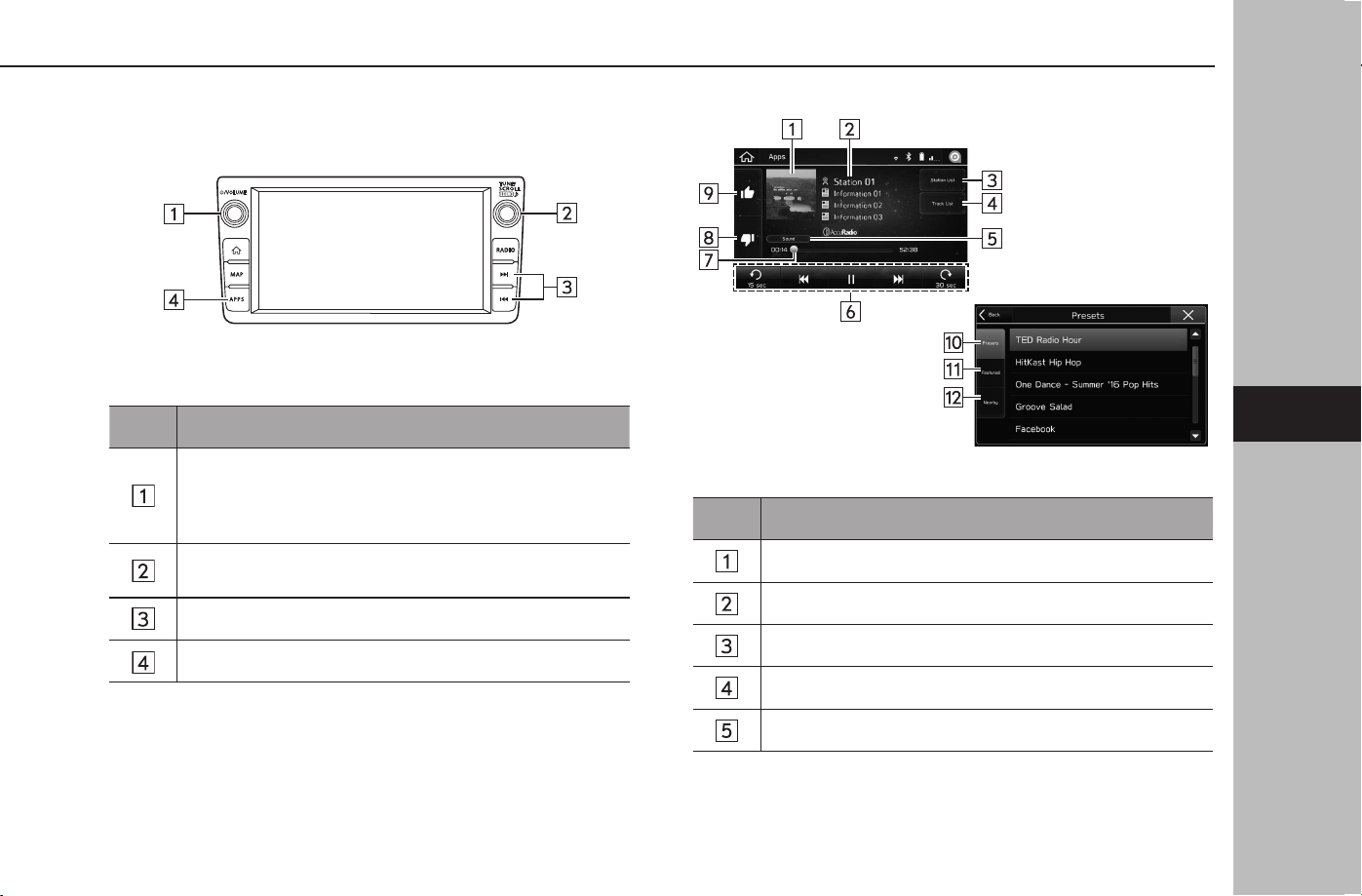
XControl panel
No. Function
Turn to adjust volume.
Press to mute the audio system and pause playback.
Press and hold to turn the audio system off, and press
to turn it on again.
Turn to display the next/previous content item.
Press to select an item.
Press to display the next/previous content item.
Press to display the “Apps” screen.
XControl screen
<Top screen>
<Station list screen>
No. Function
Displays cover art.
Displays station name.
Select to display the station list screen.
Select to display the track list screen.
Select to display the sound settings screen. (→P.73)
Apps
5
aha
TM
by HARMAN
103
Apps
5
docstructure.indb 103 2019/05/31 11:46:13
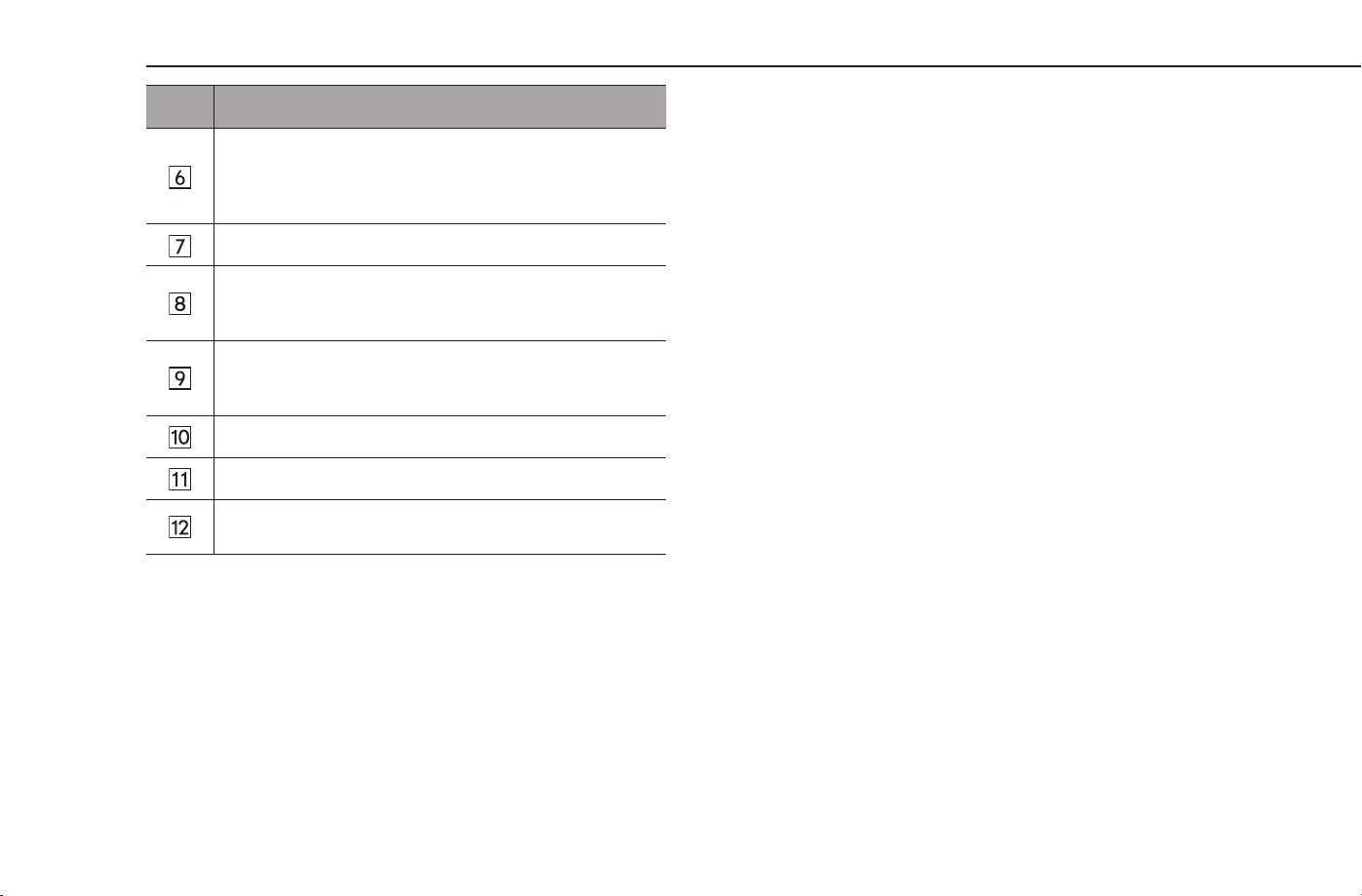
No. Function
Top screen operation buttons
• Content items can be changed, and if content items
contain information, calls can be placed and content
items can be set for destinations, etc.
Shows progress.
Select to upload “Dislike” information to the application
server. To cancel “Dislike” information that is being
uploaded to the server, select this button again.
Select to upload “Like” information to the application
server. To cancel “Like” information that is being
uploaded to the server, select this button again.
Select to display a list of preset stations.
Select to display a list of featured stations.
Select to display a list of stations using the location
information.
NOTE
l When you switch to other modes with the aha application
activated and then turn the system Off/On with the smartphone
device still connected, the home screen will display.
l Top 35 entries in the preset station list on the smartphone are
displayed. When there are more than 35 entries in the preset
station list, change the order of the entries in the list on the
smartphone. You can change the priority of your preset stations
within the aha application (after disconnected from this system)
to modify the station list shown on the screen. Please see your
smartphone aha application “Edit Presets” to modify this list.
l If there
are multiple
audio les
stored on your iPhone, it may
take some time until playback starts.
l Playback may be intermittent when you switch to streaming
Bluetooth audio from aha on your smartphone device.
l The following operations
are not available on this system.
Perform these operations on the smartphone.
• Add/Reorder/Delete stations
•
Log in to Facebook/Twitter (When not logged in, login will
be required
by the station. It is necessary to do so when the
device is disconnected from the system.)
l For the aha function,
the following touch screen gestures are not
available.
• Double touch with one nger
•
Double touch with two ngers
l The audio system will
turn off when the aha application is closed
on the iPhone and/or Android device.
l Use this system to play music with the aha application. If the
station or settings are changed frequently via both the audio
system and the smartphone, the aha application may not
function. Restarting the application from the smartphone may be
needed.
aha
TM
by HARMAN
104
docstructure.indb 104 2019/05/31 11:46:17

ABOUT THE SUPPORTED DEVICES FOR aha
This system supports the following devices.
● iPhone: iOS 7.0 or later
● Android: Android 2.2 or later
NOTE
l Note that the warranty does not apply if an unsupported iPhone
is connected.
l The available functions may vary depending on the type of
Android device.
Apps
5
aha
TM
by HARMAN
105
Apps
5
docstructure.indb 105 2019/05/31 11:46:17
Pandora
®
Pandora
®
Pandora is free personalized radio that offers effortless and
endless music enjoyment and discovery.
To use the Pandora application, connect your iPhone or
Android device via Bluetooth.
Depending on differences between models or software
version etc., some models might be incompatible with this
system.
The Pandora application must be installed on your
smartphone.
When using the application, read the precautions indicated
in “BEFORE USING APPLICATIONS”. (→P.94)
NOTE
l Pandora is only available in certain countries. Please visit
pandora.com/legal for more information.
OVERVIEW
The Pandora operation screen can be accessed with the
following methods:
● Connect the iPhone or Android device by utilizing the
Bluetooth connection.
•
For details on registering or connecting
an iPhone
or Android device: →P.48
● Select
Pandora
(Pandora) on the “Apps” screen.
(→P.24)
Pandora
®
106
docstructure.indb 106 2019/05/31 11:46:19
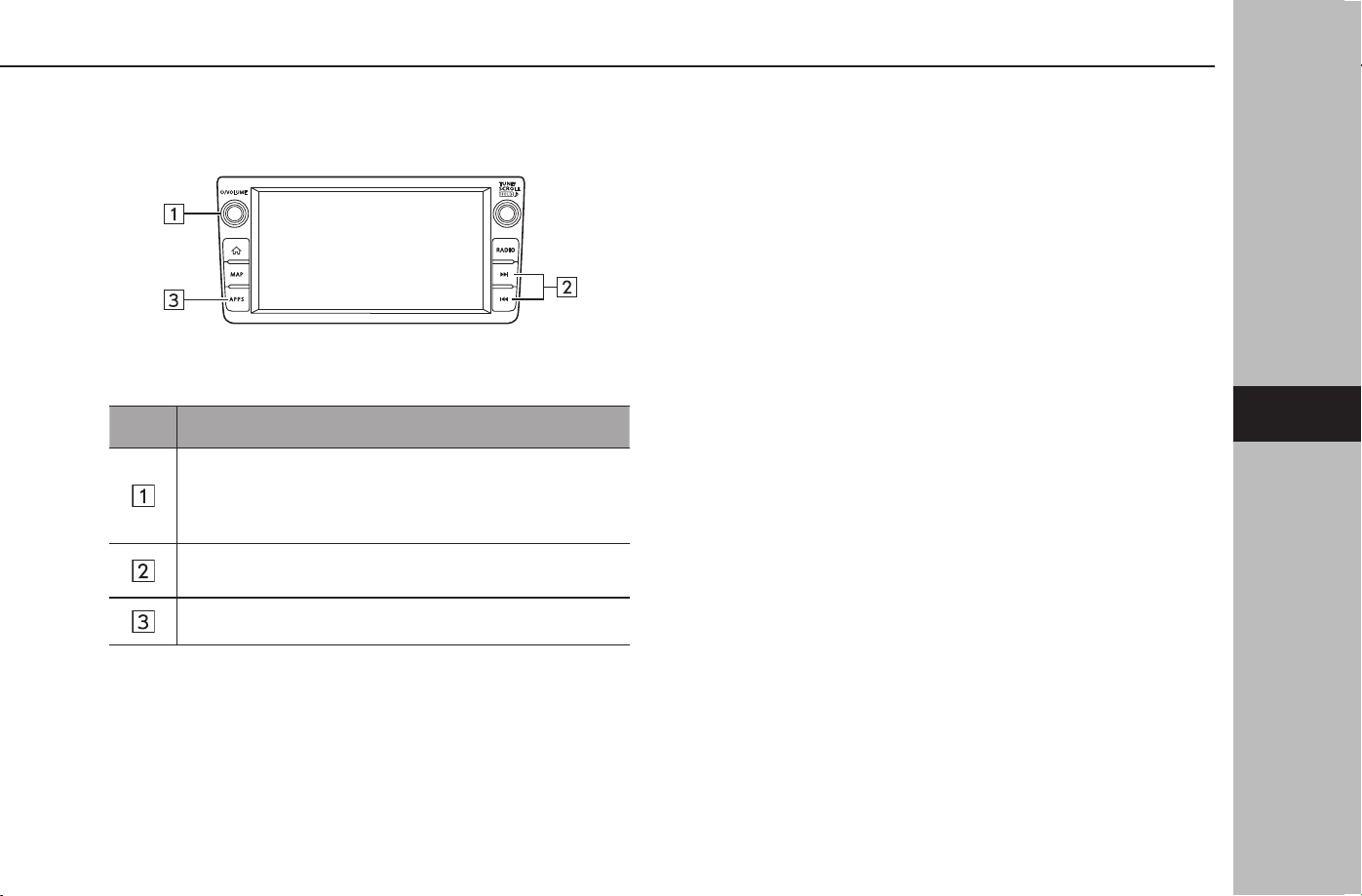
XControl panel
No. Function
Turn to adjust volume.
Press to mute the audio system and pause playback.
Press and hold to turn the audio system off, and press
to turn it on again.
Press to skip to the next track.
Press and hold to fast forward.
Press to display the “Apps” screen.
Apps
5
Pandora
®
107
Apps
5
docstructure.indb 107 2019/05/31 11:46:21
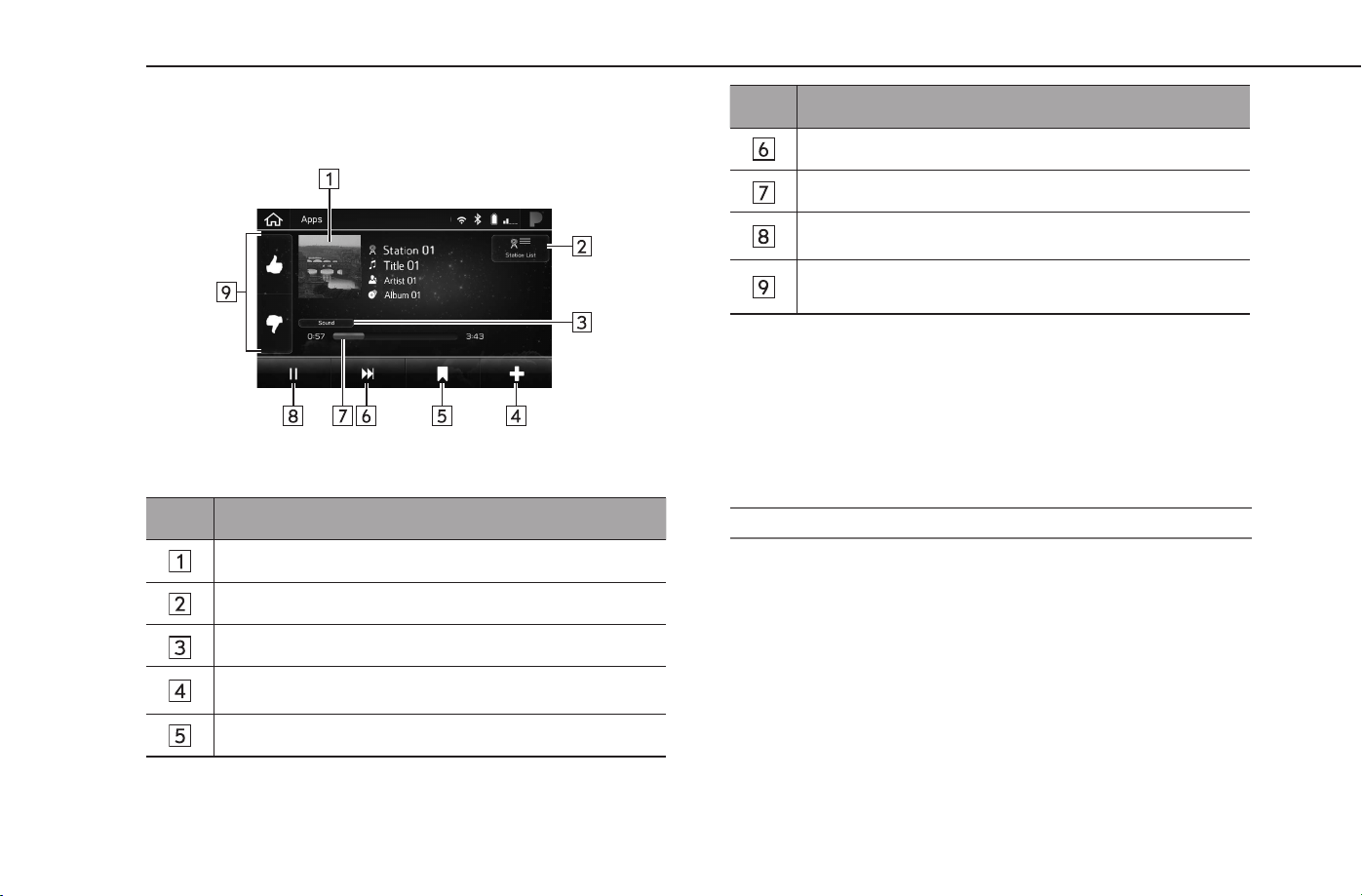
XControl screen
No. Function
Displays cover art.
Select to display the station list screen.
Select to display the sound settings screen. (→P.73)
Select to create a station from artist or track.
Select to bookmark the track currently playing.
No. Function
Select to skip to the next track.
Shows progress.
Select to pause/play.
Select to rate the track currently playing as “Like” or
“Dislike”.
NOTE
l Use this system to play music with the Pandora application. If
the station or settings are changed frequently via both the audio
system and the smartphone, the Pandora application may not
function. Restarting the application from the smartphone may be
needed.
ABOUT THE SUPPORTED DEVICES
This system supports the following devices.
● iPhone: iOS 8.0 or later
● Android: Jellybean 4.1.1 or later
Pandora
®
108
docstructure.indb 108 2019/05/31 11:46:22
Apple CarPlay
Apple CarPlay
CarPlay can be used to view iPhone maps, play music,
and place calls by connecting your iPhone to the system.
Supported applications can also be run.
● For details on the services
or the operations, check
the Apple CarPlay site
(https://ssl.apple.com/ios/carplay/).
To use the Apple CarPlay application, connect your
iPhone to the USB port.
When using the application, read the precautions indicated
in “BEFORE USING APPLICATIONS”. (→P.94)
NOTE
l Use an undamaged genuine cable when using this function.
l Turn on Apple CarPlay on your iPhone’s Restrictions settings
when using this function.
l While using Apple CarPlay, some functions of this system may
not operate.
OVERVIEW
The Apple CarPlay operation screen can be accessed with
the following methods:
● Connect your iPhone to the USB port.
•
For details on connecting your iPhone
to the USB
port: →P.31
● Select
Apple CarPlay
(Apple CarPlay) on the
“Apps” screen. (→P.24)
Apple CarPlay
109
Apps
5
docstructure.indb 109 2019/05/31 11:46:22
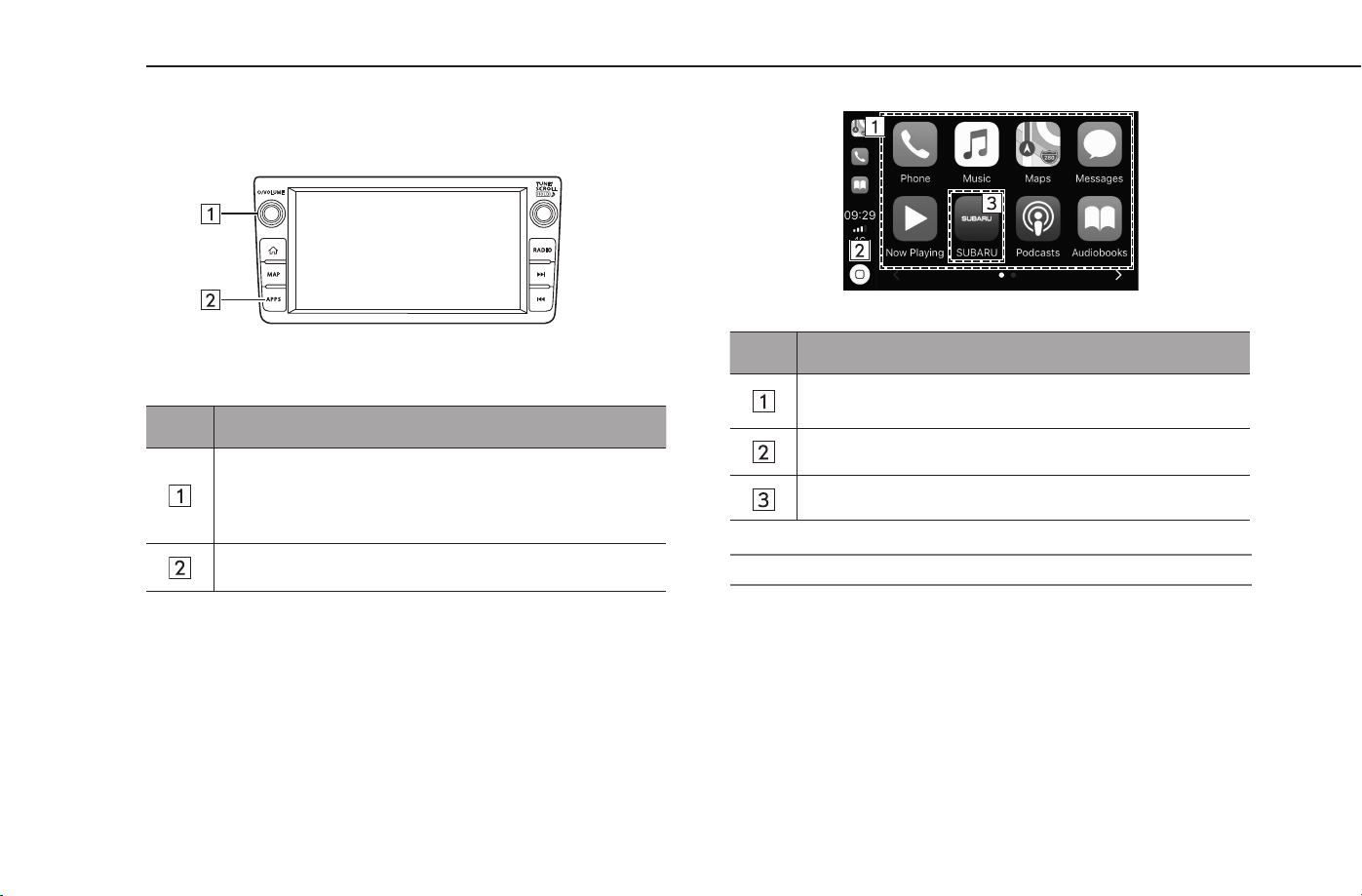
XControl panel
No. Function
Turn to adjust volume.
Press to mute the audio system and pause playback.
Press and hold to turn the audio system off, and press
to turn it on again.
Press to display the “Apps” screen.
XControl screen
*: The displayed screen will differ depending on the connected iPhone.
No. Function
Displays the application buttons.
Select to start the application.
Select to display the home screen of Apple CarPlay.
Select to exit Apple CarPlay.
ABOUT THE SUPPORTED DEVICES
This system compatible with iOS 7.0 or later are supported.
Apple CarPlay
110
docstructure.indb 110 2019/05/31 11:46:23
Android Auto
Android Auto
Android Auto can be used to view Android maps, play
music, and place calls by connecting your Android device to
the system. Supported applications can also be run.
● For details on the services
or the operations, check
the Android Auto site (https://www.android.com/auto/)
and (https://support.google.com/androidauto/).
To use the Android Auto application, connect your
Android device to the USB port.
When using the application, read the precautions indicated
in “BEFORE USING APPLICATIONS”. (→P.94)
NOTE
l Use an undamaged genuine cable when using this function.
l To use this function, check to make sure that your Android
device is set to accept connection with a new vehicle.
l While using Android Auto, some functions of this system may not
operate.
OVERVIEW
The Android Auto operation screen can be accessed with
the following methods:
● Connect your Android device to the USB port.
•
For details on connecting
your Android device to
the USB port: →P.31
● Select
Android Auto
(Android Auto) on the “Apps”
screen. (→P.24)
Android Auto
111
Apps
5
docstructure.indb 111 2019/05/31 11:46:23
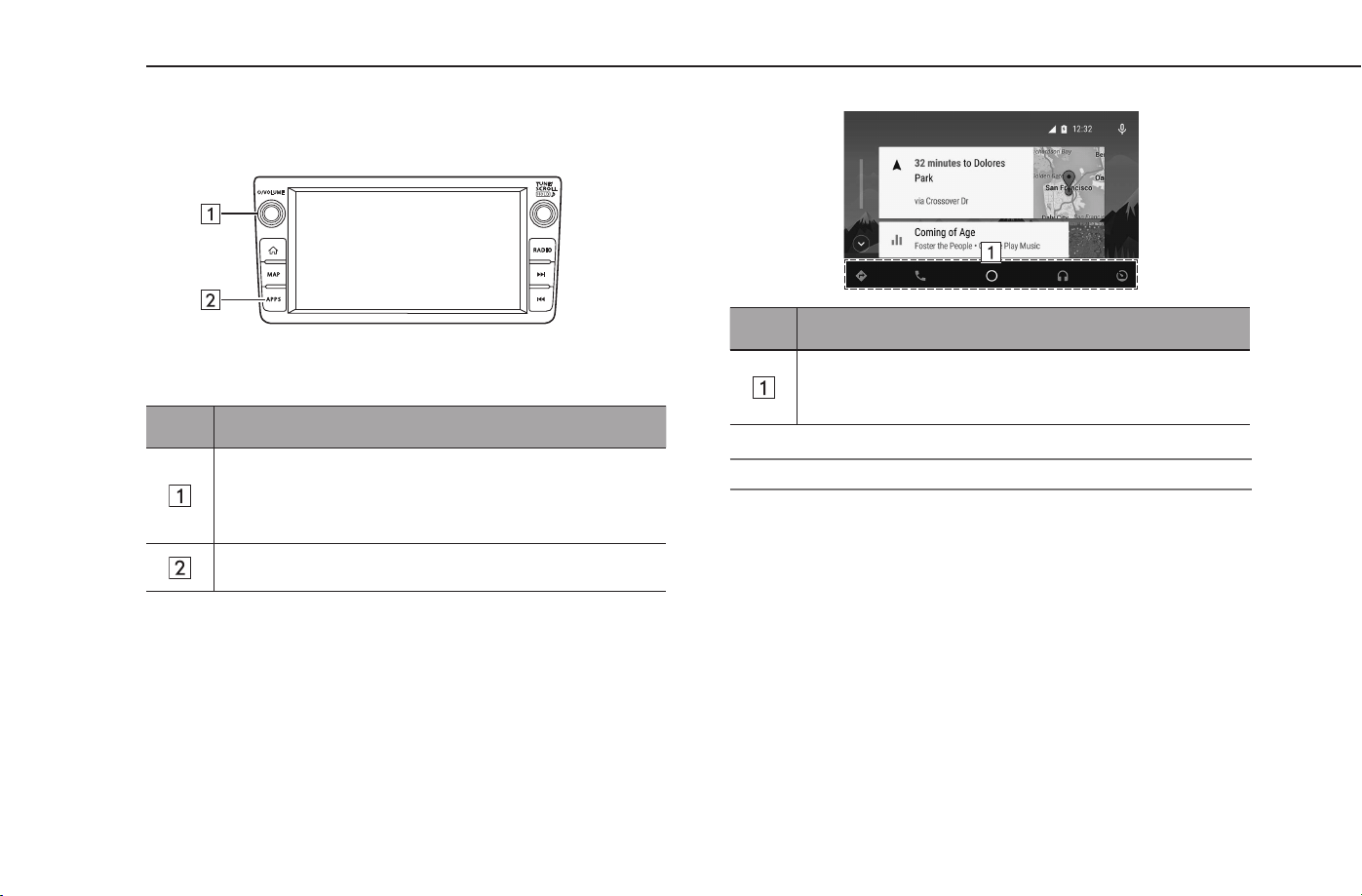
XControl panel
No. Function
Turn to adjust volume.
Press to mute the audio system and pause playback.
Press and hold to turn the audio system off, and press
to turn it on again.
Press to display the “Apps” screen.
XControl screen
No. Function
Displays the application/information buttons.
Select to start the application, or select to display
information.
ABOUT THE SUPPORTED DEVICES
This system compatible with Android 5.0 or later are
supported.
Android Auto
112
docstructure.indb 112 2019/05/31 11:46:24
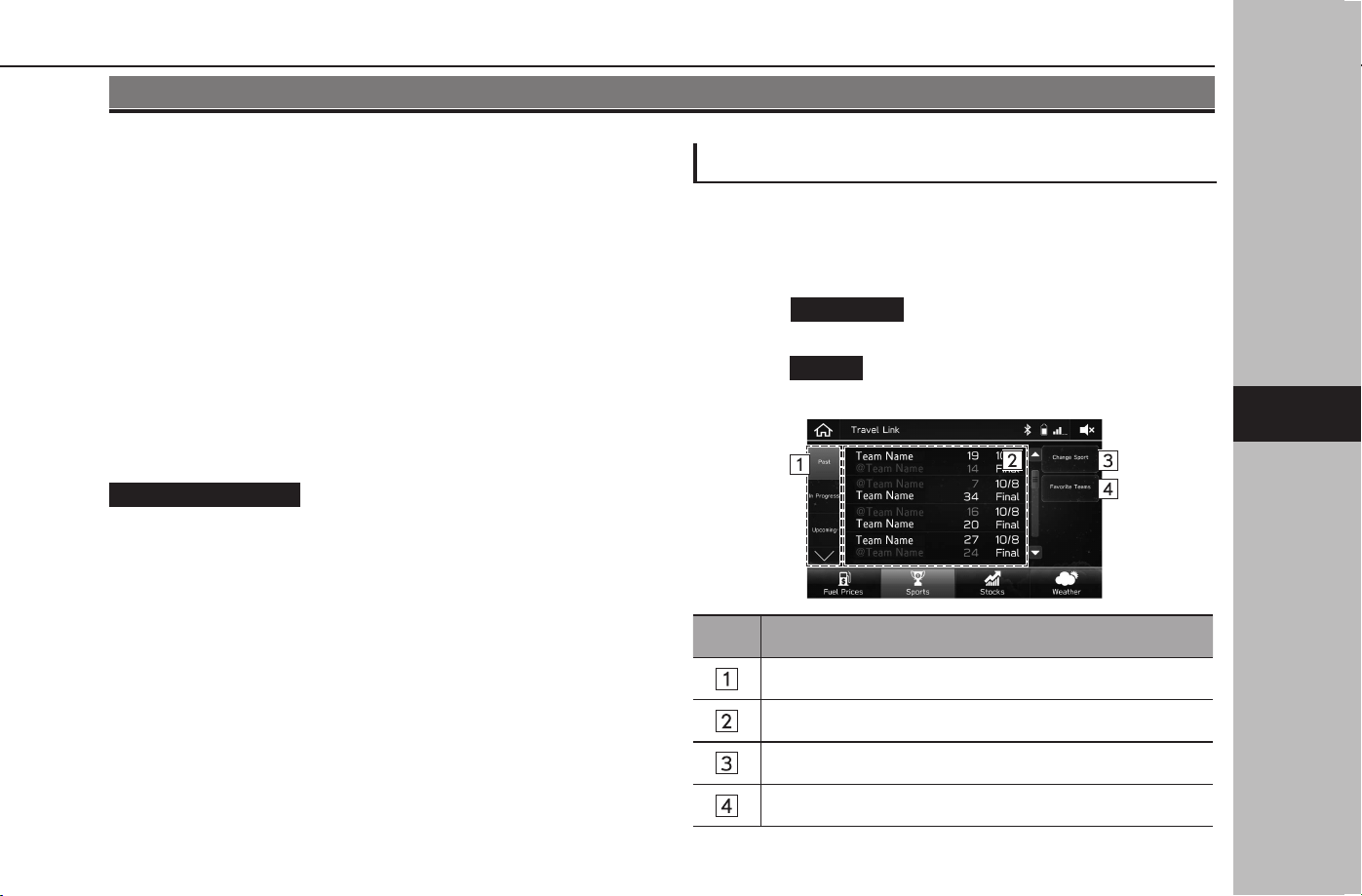
SiriusXM Travel Link
SiriusXM Travel Link*
*: SiriusXM U.S. satellite and data services are available only in the 48
contiguous USA and DC. SiriusXM satellite service is also available in
Canada; see www.siriusxm.ca.
Data service information, which is comprised of sports
information, weather information, stock information and fuel
information, can be received via the SiriusXM
®
Radio.
To receive the data service information in the vehicle, a
subscription to the SiriusXM
®
Satellite Radio Service is
necessary following a free trial. (→P.129)
Content that uses the SiriusXM
®
Satellite Radio Service is
reset when personal information is initialized by selecting
Factory Data Reset
(Factory Data Reset) at the
“GENERAL SETTINGS SCREEN”. (→P.59)
DISPLAYING SPORTS INFORMATION
By registering your favorite team, sports information such as
games and results, the status of games still in progress, and
future game schedules can be displayed.
1.
Select
Travel Link
(Travel Link) on the “Apps” screen.
(→P.24)
2.
Select
Sports
(Sports).
3.
Check that sports information is displayed.
No. Function
Select to change the displayed information.
Sports information is displayed.
Select to set which sports information is displayed.
Select to edit or register your favorite team.
SiriusXM Travel Link
113
Apps
5
docstructure.indb 113 2019/05/31 11:46:26
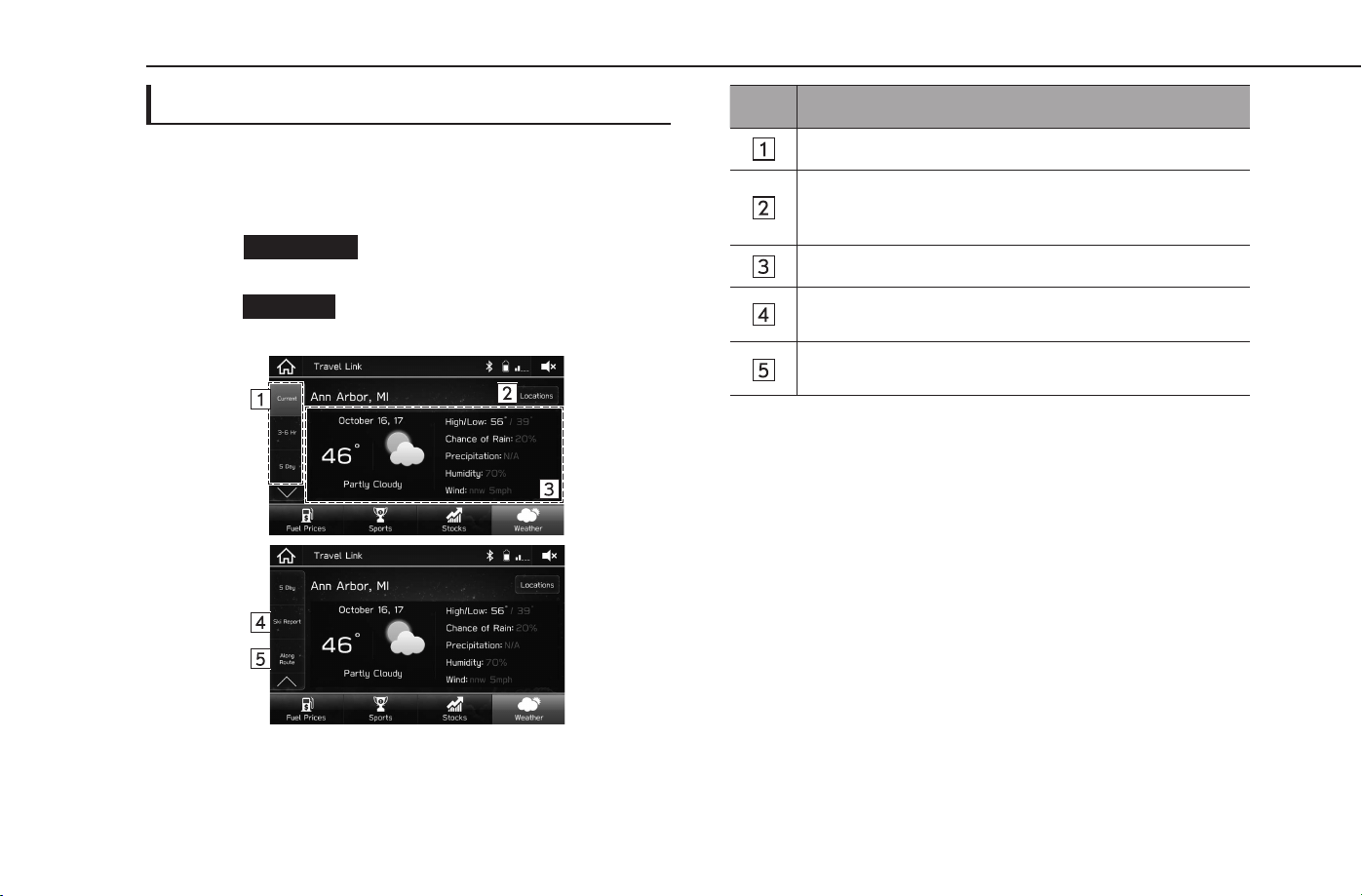
DISPLAYING WEATHER INFORMATION
Weather forecasts, forecast temperature or highest/lowest
temperature, and the chances of precipitation, etc. can be
displayed in weather information.
1.
Select
Travel Link
(Travel Link) on the “Apps” screen.
(→P.24)
2.
Select
Weather
(Weather).
3.
Check that weather information is displayed.
No. Function
Select to switch the timing of the displayed forecast.
Select to set the forecast region.
The weather forecast from your current location to your
destination can also be displayed.
Weather information is displayed.
Select to display the ski facility operating status,
weather, temperature, and snow depth, etc.
Select to display the weather forecast for the route being
travelled during route guidance.
SiriusXM Travel Link
114
docstructure.indb 114 2019/05/31 11:46:27
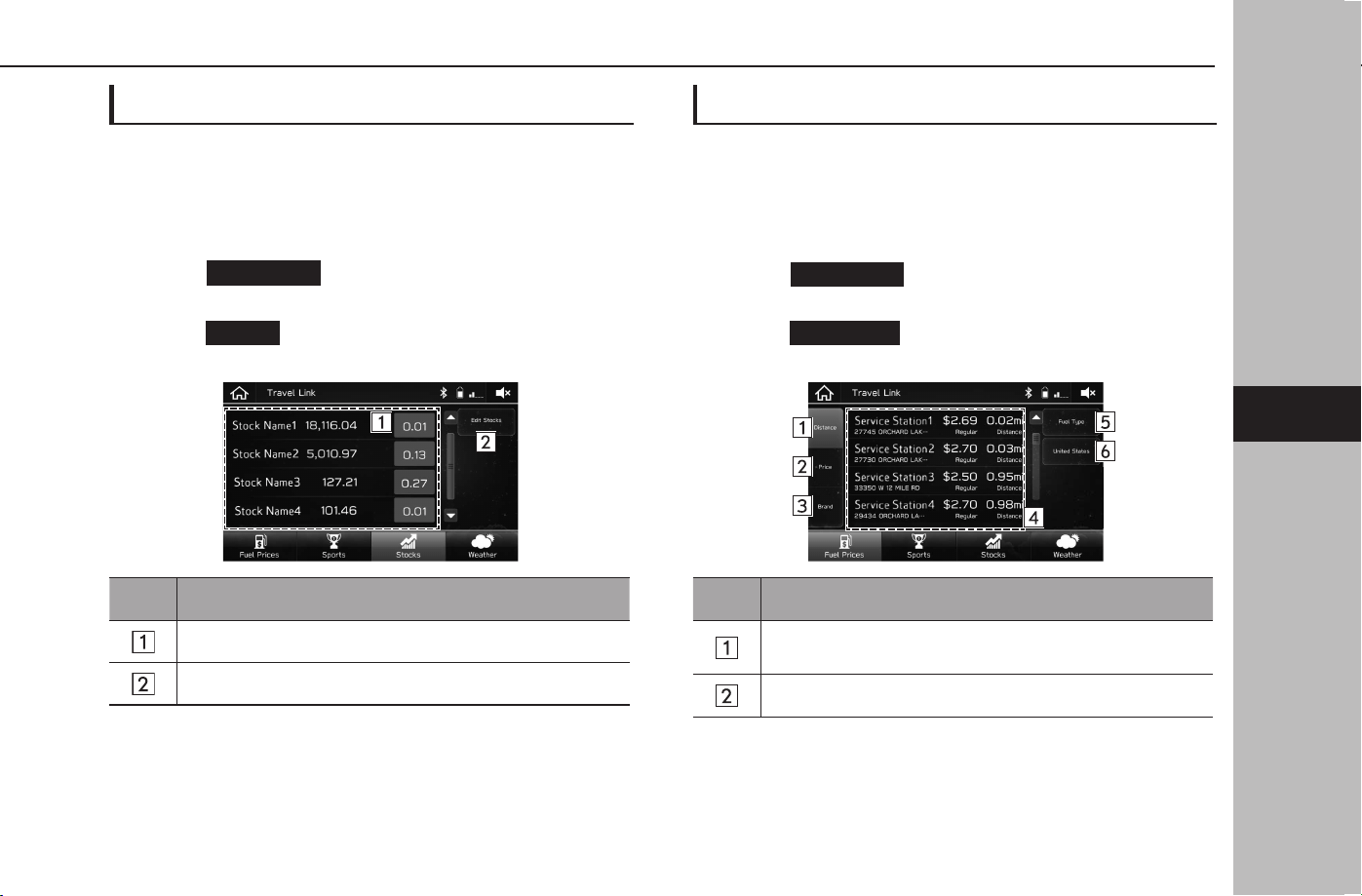
SiriusXM Travel Link
115
Apps
5
DISPLAYING STOCKS INFORMATION
Company names, stock prices, and price uctuations can
be displayed in stock information. Fluctuations greater than
zero are displayed with green arrows, and uctuations less
than zero are displayed with red arrows.
1.
Select
Travel Link
(Travel Link) on the “Apps” screen.
(→P.24)
2.
Select
Stocks
(Stocks).
3.
Check that stock information is displayed.
No. Function
Stock information is displayed.
Select to add or edit stocks.
DISPLAYING FUEL INFORMATION
Gas station information can be displayed, and gas stations
can be set as the destination. When Bluetooth is enabled
on your cellular phone, calls can be placed if the displayed
information screen contains phone number information.
1.
Select
Travel Link
(Travel Link) on the “Apps” screen.
(→P.24)
2.
Select
Fuel Prices
(Fuel Prices).
3.
Check that fuel information is displayed.
No. Function
Select to sort gas station by distance from the current
position.
Select to sort gas station by price.
docstructure.indb 115 2019/05/31 11:46:29
SiriusXM Travel Link
116
No. Function
Select to sort gas station by brand.
Gas station information is displayed.
Select to set the fuel type.
*
Select to change between the United States and
Canada.
*: If equipped
docstructure.indb 116 2019/05/31 11:46:29
117
Audio
Audio
Basic Operation
118
Some Basics
118
Turning The System On And Off
118
Selecting An Audio Source
119
Sound Settings
120
Voice Recognition System
121
Radio Operation
122
AM/FM Radio
122
Overview
122
Presetting A Station
123
Radio Broadcast Data System
124
Available HD Radio
TM
Technology
124
Caching Radio Programs
126
SiriusXM
®
Satellite Radio
128
Overview
128
How To Subscribe To SiriusXM
®
Satellite Radio
129
Displaying The Radio ID
132
Presetting A Channel
132
Caching Radio Programs
132
Searching By Featured Favorites
133
Selecting A Channel From The List
134
Setting Teams For Notications
135
Setting Tune Mix Channels
136
Setting The Trafc & Weather
138
Media Operation
139
USB Memory
139
Overview
139
iPod
141
Overview
141
Bluetooth Audio
144
Overview
144
Connecting A Bluetooth Device
147
Audio Remote Controls
148
Steering Wheel Controls
148
Tips For Operating The Audio System
150
Operating Information
150
Radio
150
USB Memory Device
152
iPod
152
File Information
152
docstructure.indb 117 2019/05/31 11:46:29
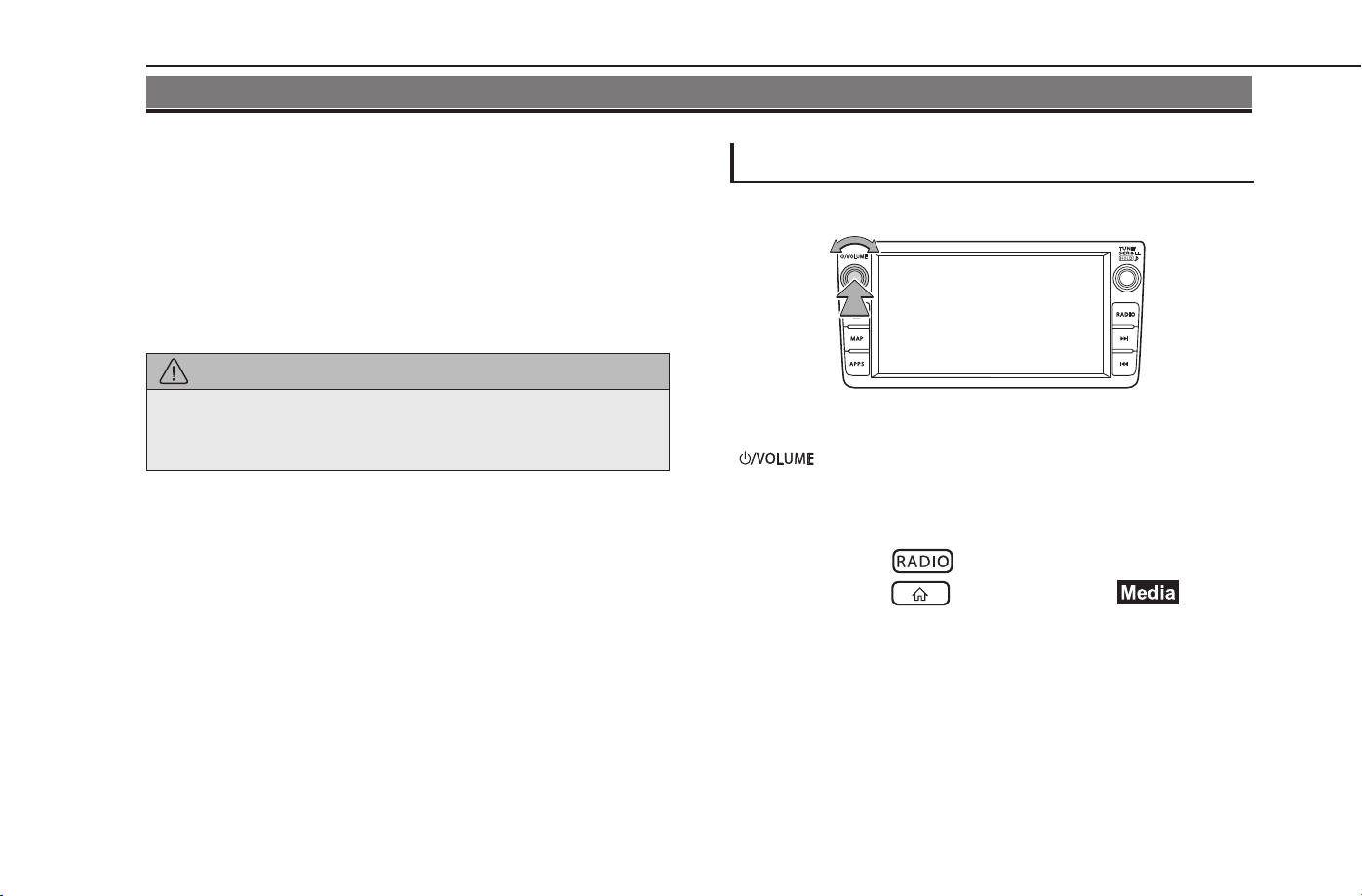
BASIC OPERATION
SOME BASICS
This section describes some of the basic features of the
audio system. Some information may not pertain to your
system.
Your audio system works when the
ignition
switch is turned
to the “ACC” or “ON” position.
CAUTION
l To prevent the battery from being discharged, do not leave the
audio system on longer than necessary when the engine is
not running.
NOTE
l The audio system upgrade accessory (dealer option) only works
when the ignition switch is in the “ACC” or “ON” position. No
audio is output from the amplier when the ignition switch is
“OFF”.
TURNING THE SYSTEM ON AND OFF
“ ” knob: Press and hold to turn the audio system
off, and press to turn it on again. The system turns on in the
last mode used. Turn this knob to adjust the volume. Press
to mute the audio system.
● By pressing
, the radio screen is displayed.
● By
pressing
, and then selecting (Media),
the media screen is displayed.
NOTE
l The audio system will remain off if you change the position of the
ignition switch from “LOCK”/“OFF” to “ACC”/“ON” while the audio
system is off. If you had set the volume to mute, then the track
will start playing from where it was last stopped.
BASIC OPERATION
118
docstructure.indb 118 2019/05/31 11:46:30
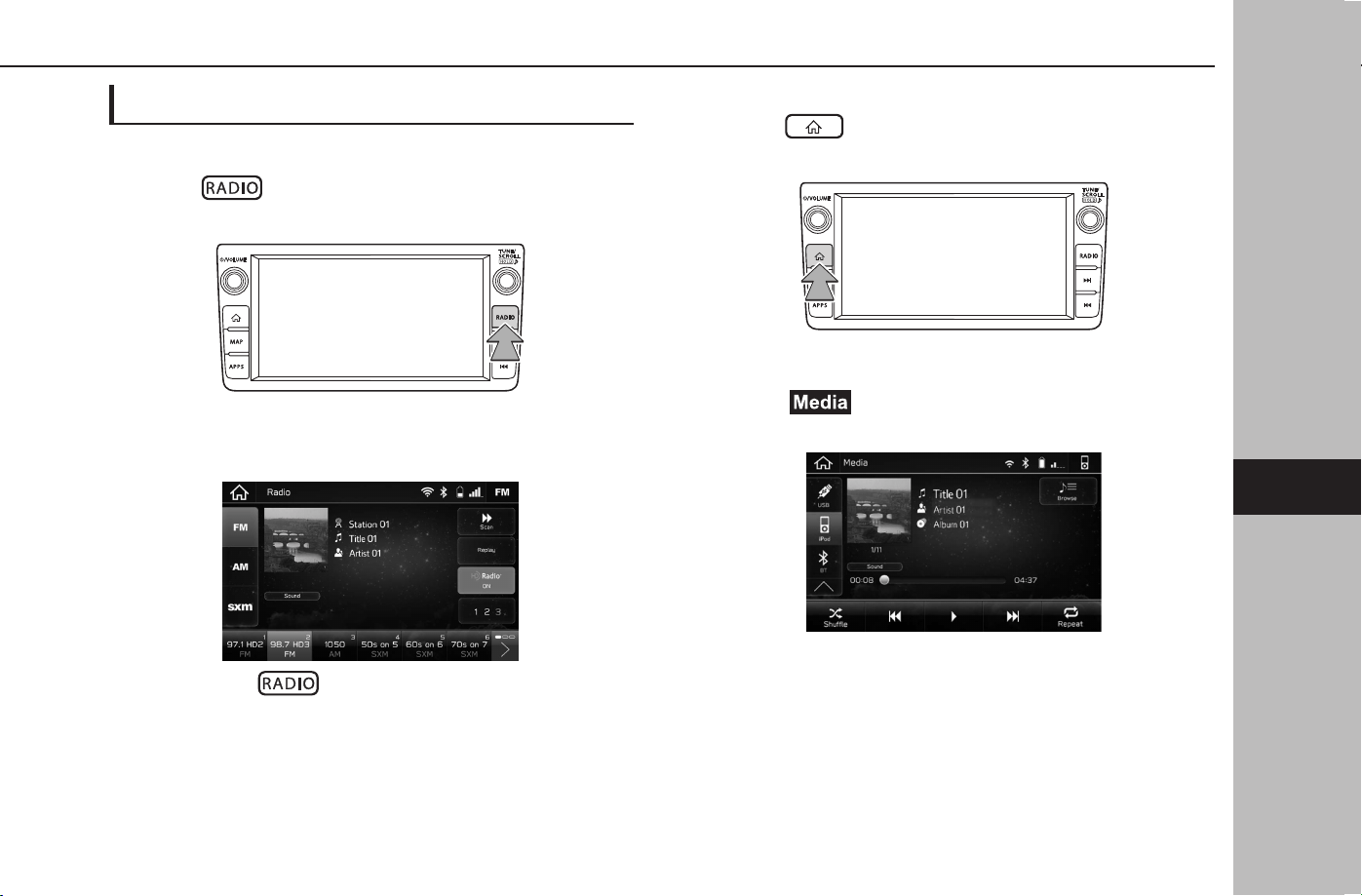
SELECTING AN AUDIO SOURCE
X“Radio” screen
1.
Press .
2.
Select the desired radio mode.
● Each time is pressed, the radio modes can be
changed.
X“Media” screen
1.
Press .
2.
Select (Media).
3.
Select the desired audio source.
BASIC OPERATION
119
Audio
6
docstructure.indb 119 2019/05/31 11:46:31
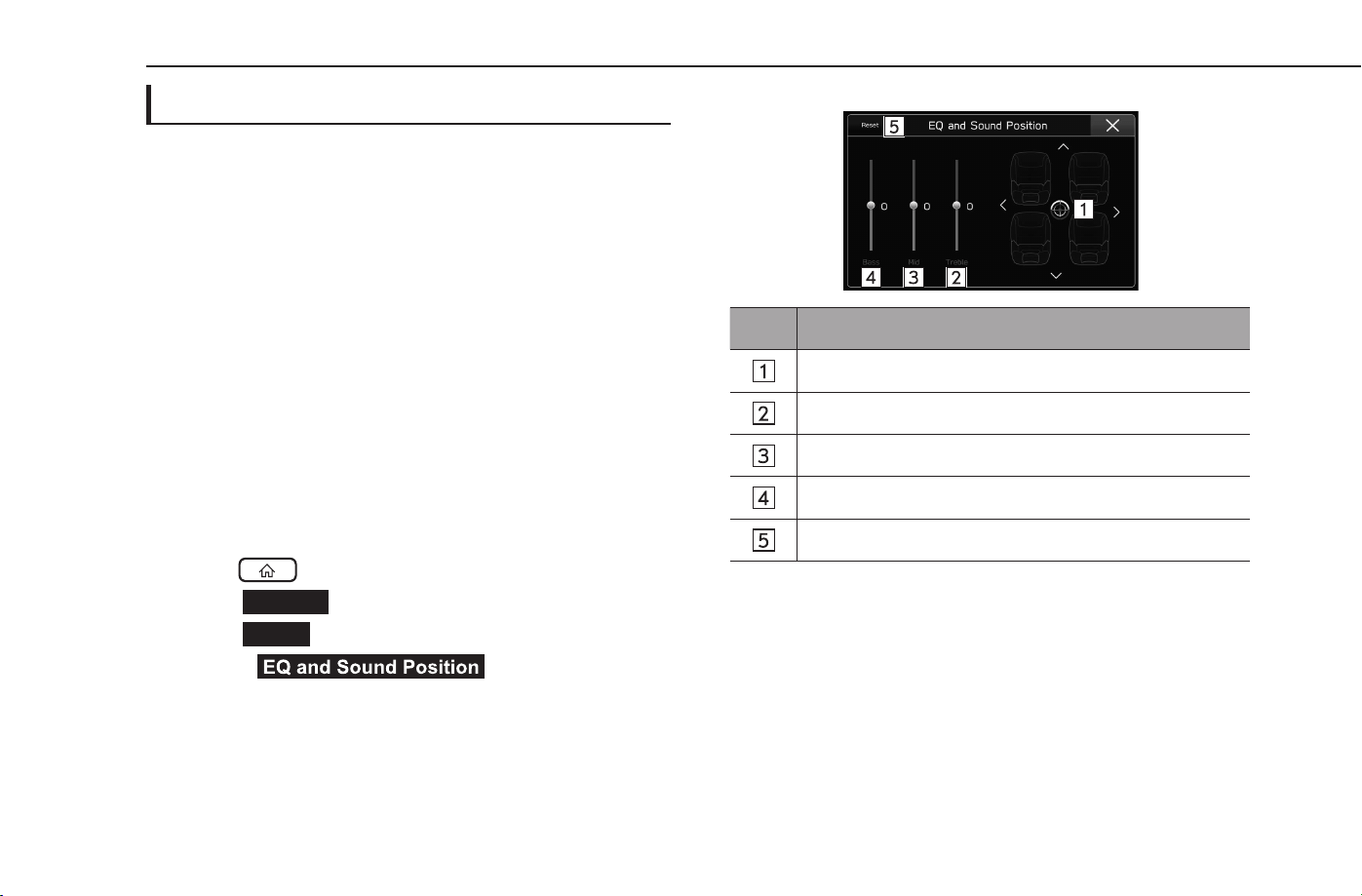
SOUND SETTINGS
The following sound quality can be adjusted.
TONE:
How good an audio program sounds is largely determined
by the mix of the treble, mid and bass levels. In fact,
different kinds of music and vocal programs usually sound
better with different mixes of treble, mid and bass.
BALANCE:
A good balance of the left and right stereo channels and of
the front and rear sound levels is also important.
Keep in mind that when listening to a stereo recording or
broadcast, changing the right/left balance will increase the
volume of 1 group of sounds while decreasing the volume of
another.
1.
Press .
2.
Select
Settings
(Settings).
3.
Select
Sound
(Sound).
4.
Select (EQ and Sound
Position).
5.
Set the desired item.
No. Function
Select the icon to adjust sound balance.
Select the sliders to adjust high-pitched tones.
Select the sliders to adjust mid-pitched tones.
Select the sliders to adjust low-pitched tones.
Select to reset all setup items.
BASIC OPERATION
120
docstructure.indb 120 2019/05/31 11:46:32
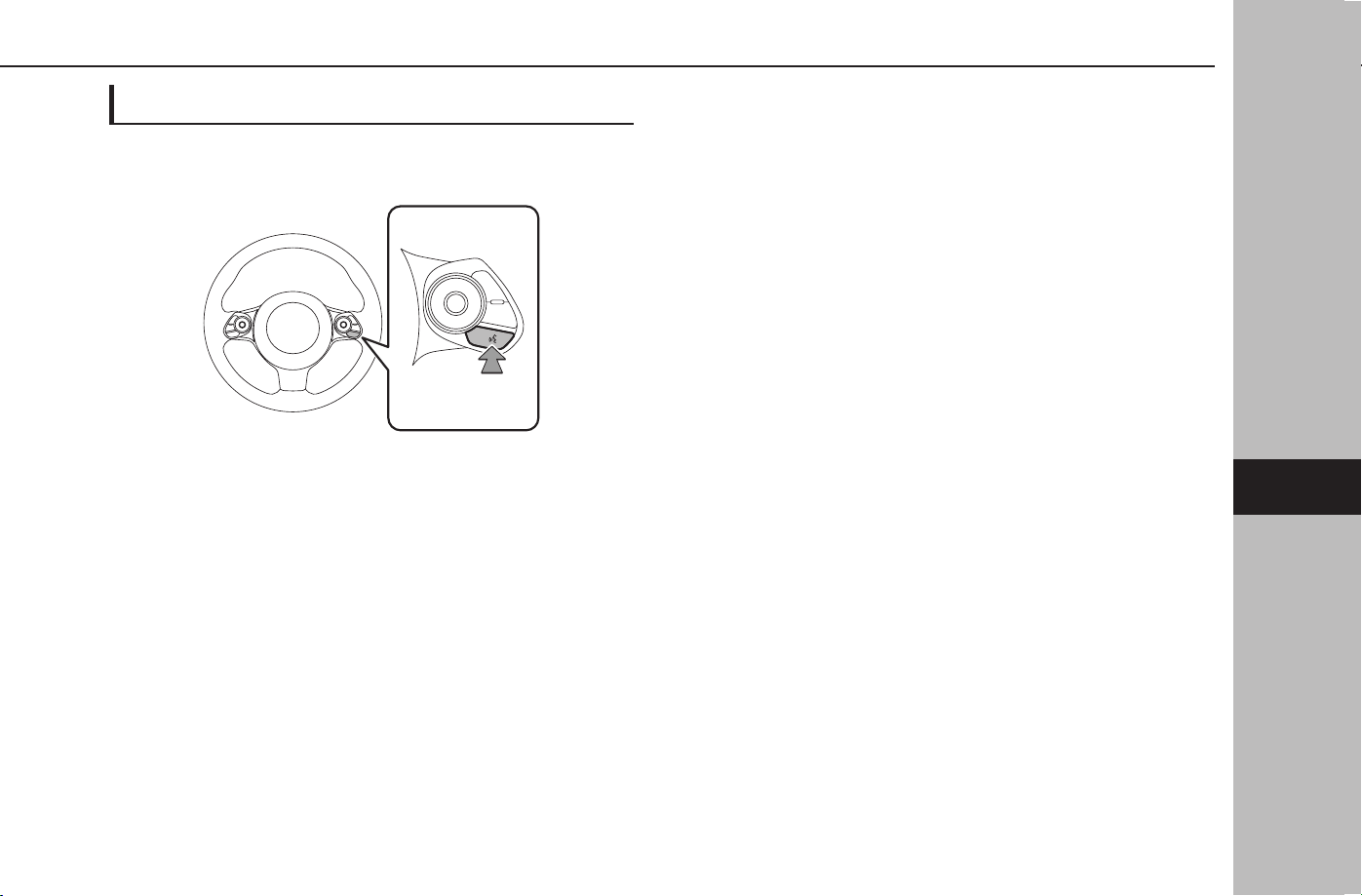
VOICE RECOGNITION SYSTEM
1.
Press this switch to operate the voice recognition
system.
● The voice recognition system and its list of
commands can be operated. (→P.197)
BASIC OPERATION
121
Audio
6
docstructure.indb 121 2019/05/31 11:46:33
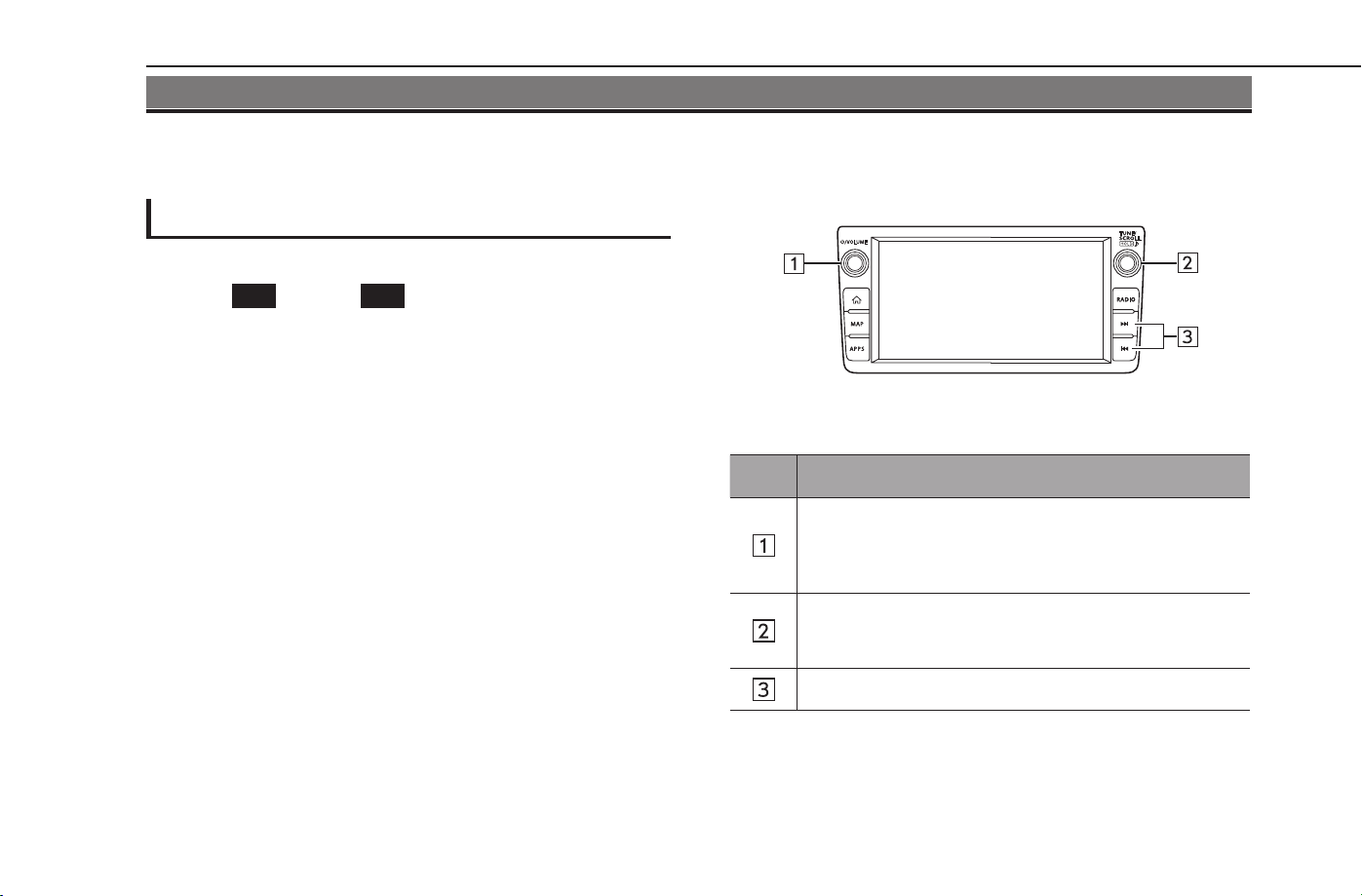
RADIO OPERATION
AM/FM RADIO
OVERVIEW
The FM/AM radio operation screen can be accessed by
selecting
FM
(FM) or
AM
(AM) on the “Radio” screen.
(→P.119)
XControl panel
No. Function
Turn to adjust volume.
Press to mute the audio system.
Press and hold to turn the audio system off, and press
to turn it on again.
Turn to step up/down frequencies.
Press and hold to display the sound settings screen.
(→P.73)
Press to seek up/down available stations/channels.
RADIO OPERATION
122
docstructure.indb 122 2019/05/31 11:46:33
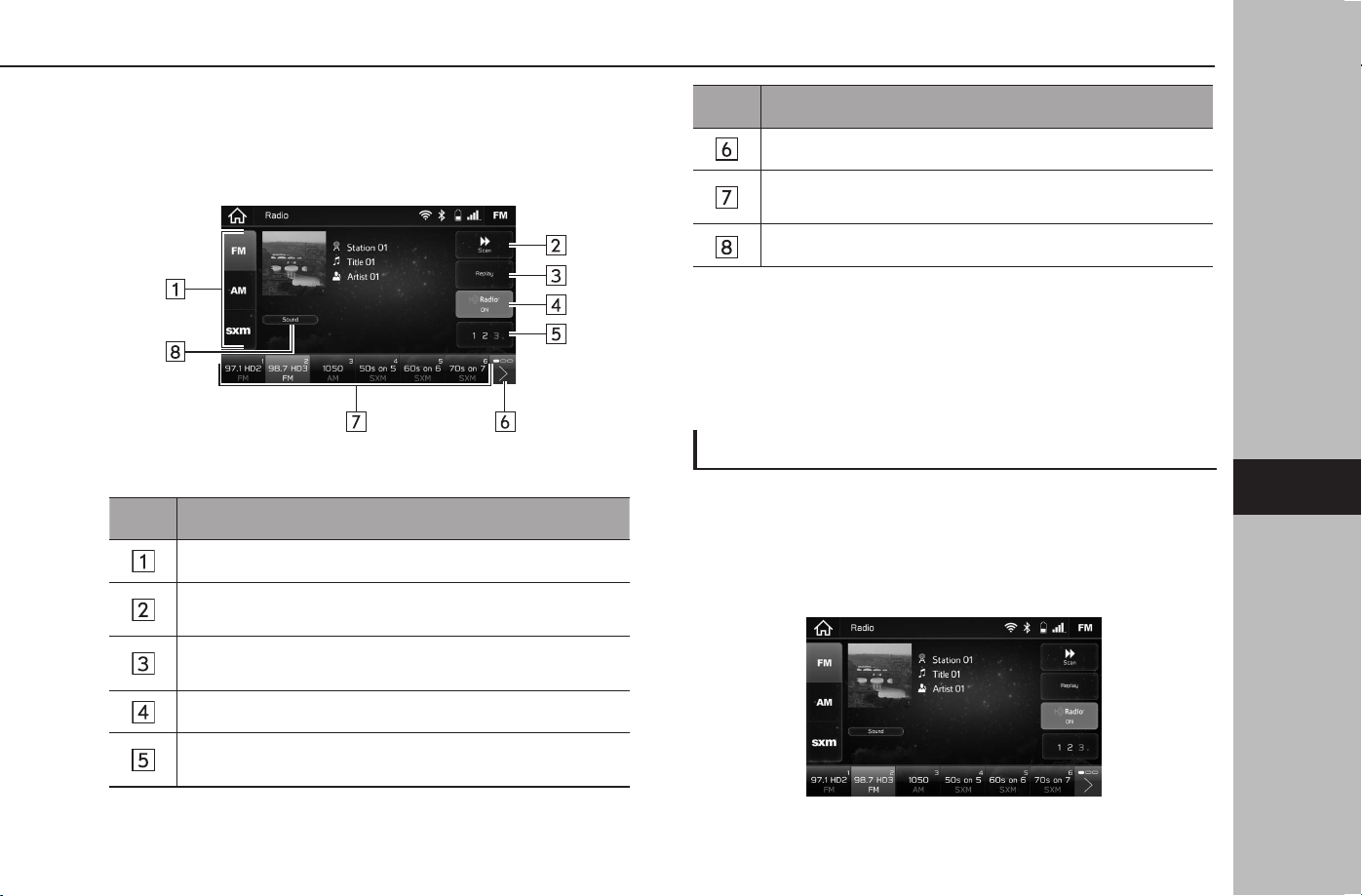
XControl screen
No. Function
Select to change radio modes.
Select to scan for receivable stations/channels.
The scan will continue until selected again.
Select to display the cache radio operation buttons.
(→P.126)
Select to turn HD Radio mode on/off.
Select to change multicast channels available.
(→P.125)
No. Function
Select to scroll the list of preset buttons.
Select to tune to preset stations/channels.
The preset station list can be scrolled by swiping the list.
Select to display the sound settings screen. (→P.73)
NOTE
l The radio automatically changes to stereo reception when a
stereo broadcast is received.
l The radio automatically tunes to an HD
Radio signal in AM or FM
where available.
PRESETTING A STATION
Multiple stations can be registered as presets.
1.
Tune in the desired station.
2.
Select and hold one of the desired preset station
buttons.
RADIO OPERATION
123
Audio
6
docstructure.indb 123 2019/05/31 11:46:34
● To change the preset station to a different one, follow
the same procedure.
RADIO BROADCAST DATA SYSTEM
This audio system is equipped with Radio Broadcast Data
Systems (RBDS).
RBDS mode allows text messages to be received from radio
stations that utilize RBDS transmitters.
RBDS features are available only when listening to an FM
station that broadcasts RBDS information.
AVAILABLE HD Radio™ TECHNOLOGY
RADIO OPERATION
124
docstructure.indb 124 2019/05/31 11:46:34
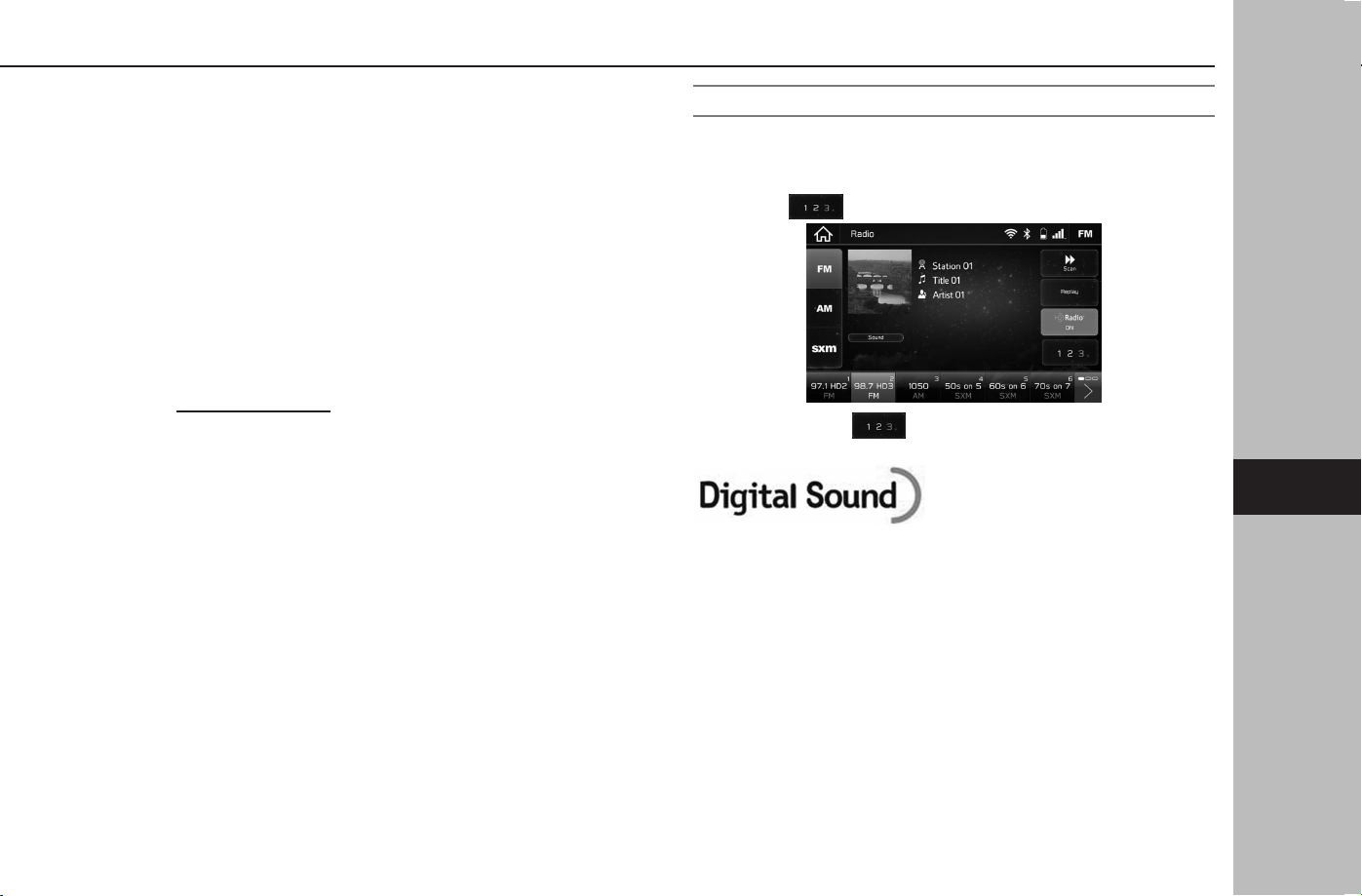
HD Radio Technology manufactured under license from
iBiquity Digital Corporation. U.S. and Foreign Patents.
HD Radio™ and the HD, HD Radio, and “Arc” logos are
proprietary trademarks of iBiquity Digital Corp.
HD
Radio™ T
echnology is the digital evolution of analog
AM/FM radio. Your radio product has a special receiver
which allows it to receive digital broadcasts (where
available) in addition to the analog broadcasts it already
receives. Digital broadcasts have better sound quality than
analog broadcasts as digital broadcasts provide free, crystal
clear audio with no static or distortion. For more information,
and a guide to available radio stations and programming,
refer to www.hdradio.com.
MULTICAST
On the FM radio frequency most digital stations have
additional programs on one FM station.
1.
Select .
● Each time is selected, the channel can be
changed.
● HD Radio
(TM)
Technology improves the audio quality of
your local stations and delivers a crystal clear digital
signal to your receiver. HD Radio Technology enables
local radio stations to broadcast a clean digital signal. AM
sounds like today’s FM and FM sounds like clear digital.
RADIO OPERATION
125
Audio
6
docstructure.indb 125 2019/05/31 11:46:34
● FM stations can provide additional digital-only audio
programming on HD2/HD3 Channels.
● EXAMPLE:
101.1 HD1
101.1 HD2
101.1 HD3
NOTE
l HD Radio™ stations can be preset.
l An orange
will be displayed on the screen when in digital.
The will rst appear in a gray color indicating the digital
station is being acquired. Once the digital signal is acquired, the
logo will change to a bright orange color.
l The song title and artist name will appear on the screen when
available by the radio station. The radio station can send album
pictures when available.
l As a user works through the analog radio stations, (where
applicable) the radio receiver will automatically tune from an
analog signal to a digital signal within 5 seconds.
● Program info provides song name, artist, station ID, and
other relevant data to your receiver.
● Visual images of album cover art and station logos
are broadcasted with the audio to your receiver, such
as Album Art, historical photographs, still art from live
broadcasts, station logos, among other related content.
CACHING RADIO PROGRAMS
A radio program can be cached and played back in a time-
shifted manner.
AUTOMATIC PLAYBACK OF THE CACHE
If the radio broadcast is interrupted by another audio
output, such as an incoming phone call, the system will
automatically cache the interrupted portion. To manually
operate the cache operation: (→P.127)
NOTE
l The system can store up to 30 minutes. Cached data will be
erased when the radio mode or station is changed or when the
audio system is turned off.
RADIO OPERATION
126
docstructure.indb 126 2019/05/31 11:46:35
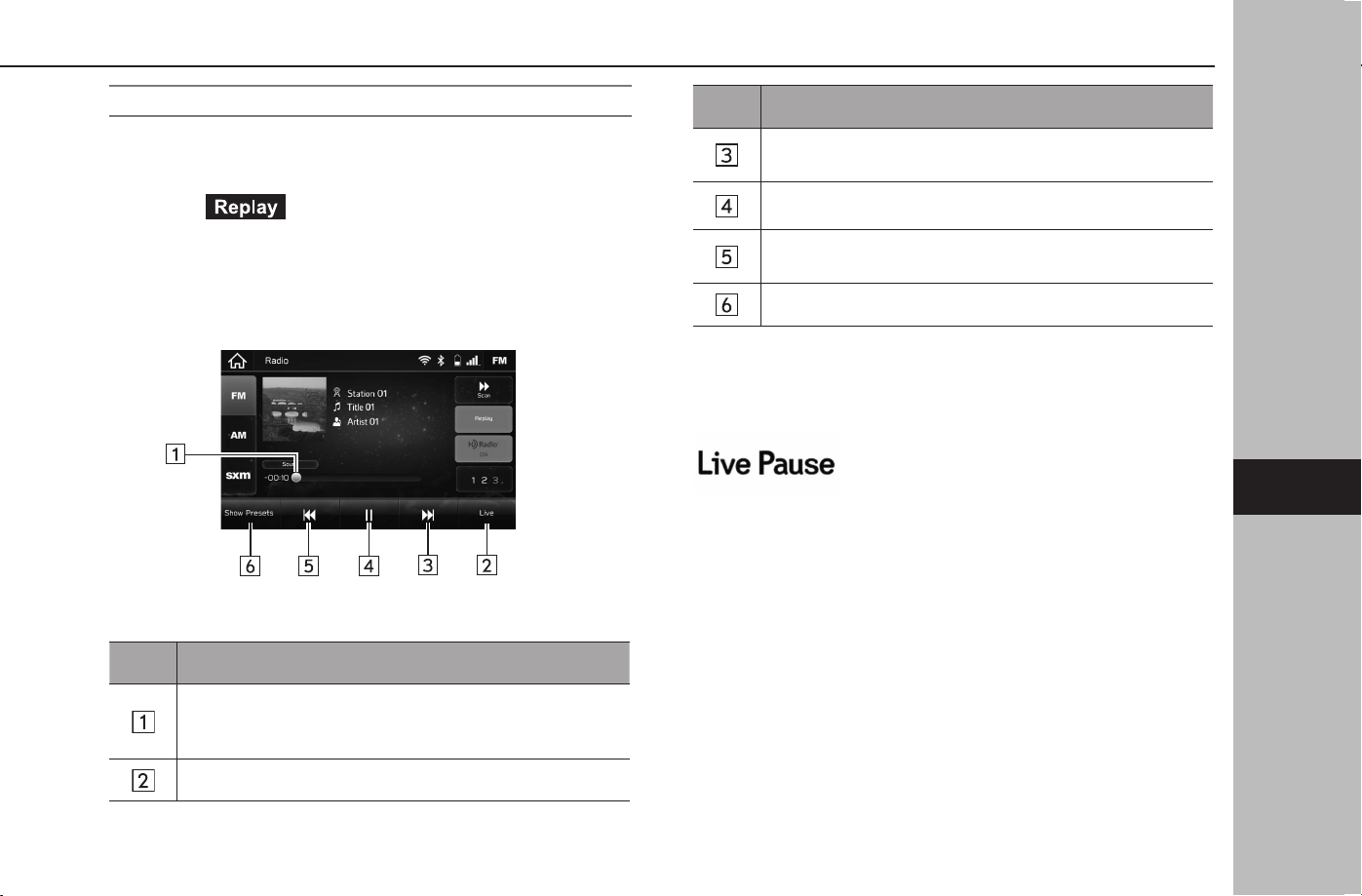
PLAYING BACK THE CACHE MANUALLY
The broadcast cached in the program cache can be played
back manually.
1.
Select (Replay). (→P.122)
2.
Select the desired cache radio operation button.
No. Information/Function
Shows the current playback location.
The playback location can be changed by dragging the
sliders.
Returns to the live radio broadcast.
No. Information/Function
Select: Skips forward 10 seconds.
Select and hold: Fast forwards continuously.
Pauses or plays the radio broadcast.
Select: Skips backward 10 seconds.
Select and hold: Fast rewinds continuously.
Exits cached playback.
NOTE
l The time displayed on the bar scale may differ from the actual
time.
● Allows HD Radio receivers to store content (songs/
programs and data) in a buffer. Playback shall start at
any point in the buffer and shall continue until the end of
the buffer or until the user has selected to stop playback.
Live Pause has the ability to store both analog and digital
content in the buffer.
RADIO OPERATION
127
Audio
6
docstructure.indb 127 2019/05/31 11:46:35
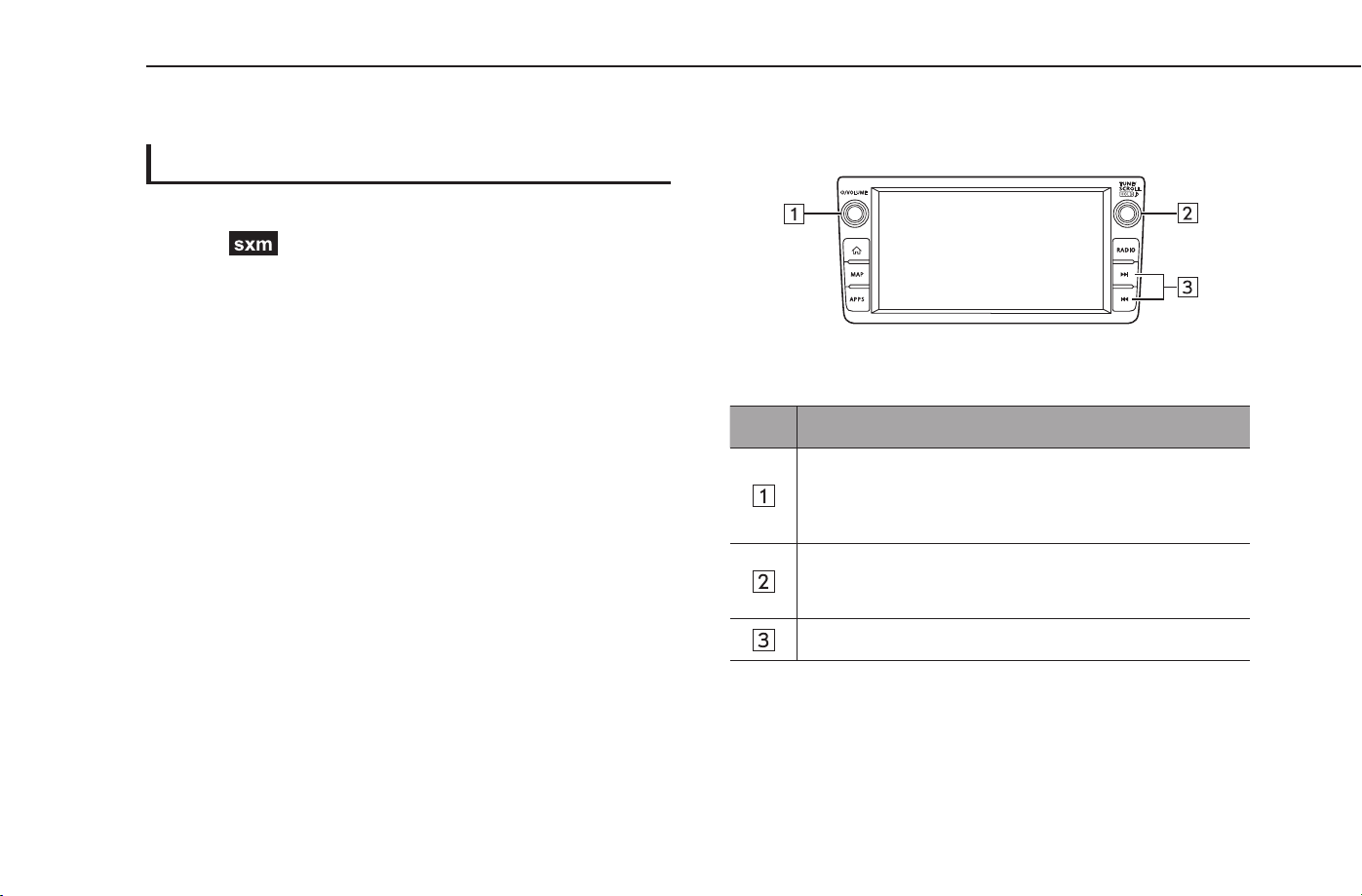
SiriusXM
®
Satellite Radio
OVERVIEW
The SiriusXM
®
operation screen can be accessed by
selecting
(sxm) on the “Radio” screen. (→P.119)
XControl panel
No. Function
Turn to adjust volume.
Press to mute the audio system.
Press and hold to turn the audio system off, and press
to turn it on again.
Turn to step up/down channels.
Press and hold to display the sound settings screen.
(→P.73)
Press to seek up/down available channels.
RADIO OPERATION
128
docstructure.indb 128 2019/05/31 11:46:35
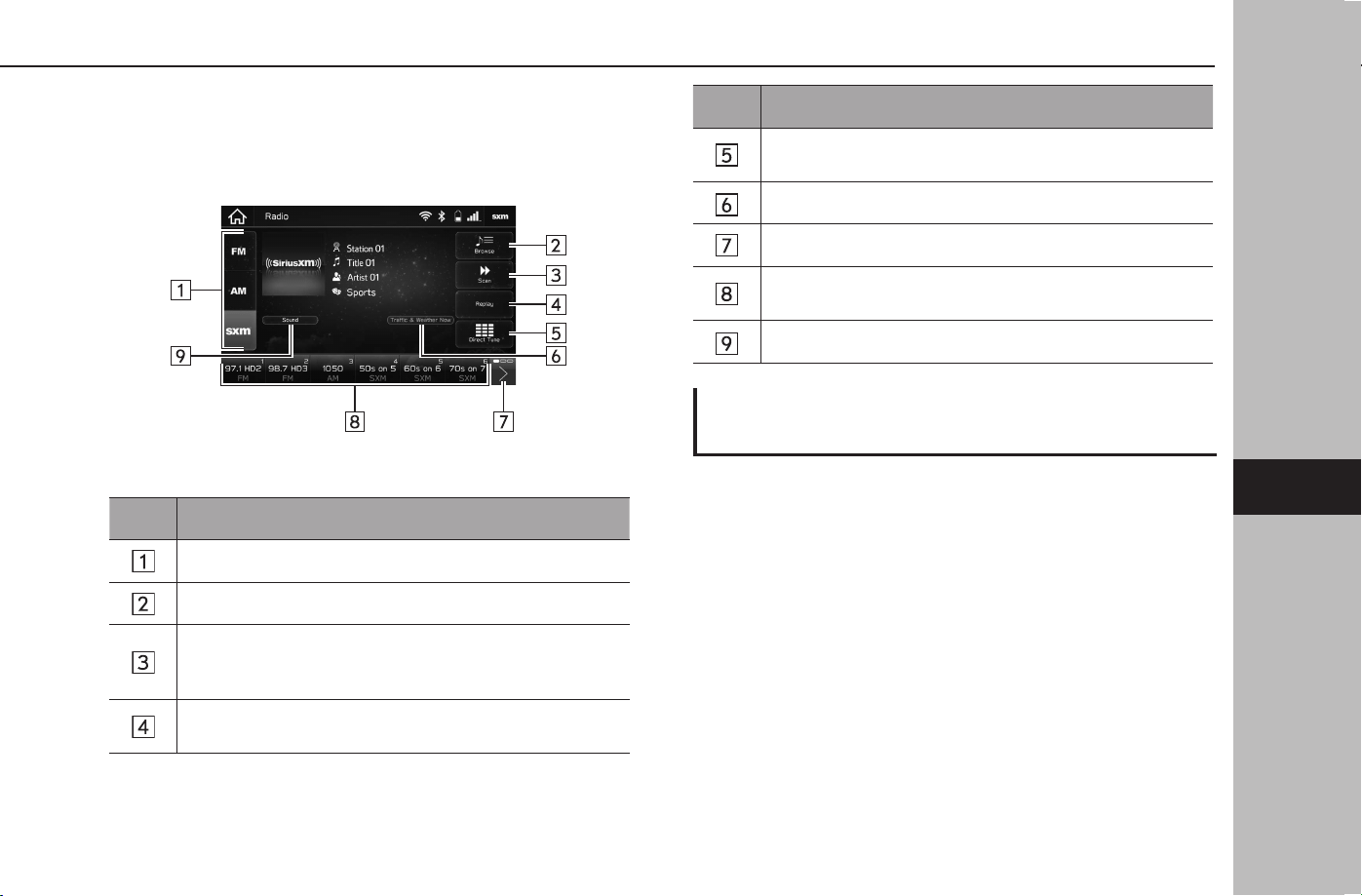
XControl screen
No. Function
Select to change radio modes.
Select to search channels. (→P.134)
Select to search subscribed channels by category.
To use this function, turn “Tune Start” off in “Sirius XM
Settings” on the general settings screen. (→P.59)
Select to display the cache radio operation buttons.
(→P.132)
No. Function
Select to search channels by entering the channel
number.
Select to play trafc and weather information. (→P.138)
Select to scroll the list of preset buttons.
Select to tune to preset stations/channels.
The preset station list can be scrolled by swiping the list.
Select to display the sound settings screen. (→P.73)
HOW TO SUBSCRIBE TO SiriusXM
®
Satellite
Radio
To listen to a satellite radio broadcast in the vehicle, a
subscription to the SiriusXM
®
Satellite Radio service is
necessary following a free trial.
A SiriusXM
®
Satellite Radio is a tuner designed exclusively
to receive broadcasts provided under a separate
subscription.
RADIO OPERATION
129
Audio
6
docstructure.indb 129 2019/05/31 11:46:36
HOW TO SUBSCRIBE
SiriusXM audio services require a subscription sold
separately, or as a package, by Sirius XM Radio Inc.
Subscription Details: Your SiriusXM service will
automatically stop at the end of your trial unless you
decide to subscribe. If you decide to continue service, the
paid subscription plan you choose will automatically renew
and you will be charged the rate in effect at that time and
according to your chosen payment method. Fees and taxes
apply. You may cancel at any time by calling 1-866-635-
2349. See the SiriusXM Customer Agreement for complete
terms at www.siriusxm.com. All fees and programming
subject to change.
● For complete information on subscription rates and
terms, or to subscribe to SiriusXM
®
Satellite Radio:
XU.S.A.
Refer to www.siriusxm.com or call
1-877-447-0011.
XCanada
Refer to www.siriusxm.ca or call
1-877-209-0079.
WARNING
l FCC WARNING
Changes or modications not expressly approved by the party
responsible for compliance could void the user’s authority to
operate the equipment.
l CAUTION: Radio Frequency Radiation Exposure
This equipment complies with FCC radiation exposure limits
set forth for an uncontrolled environment and meets the FCC
radio frequency (RF) Exposure Guidelines. This equipment
should be installed and operated keeping the radiator at
least 20cm or more away from person’s body in normal use
position.
l Co-location: This transmitter must not be co-located
or
operated in conjunction with any other antenna or transmitter.
l Explicit Language Notice — Channels
with frequent explicit
language are indicated with an “XL” preceding the channel
name. Channel blocking is available for SiriusXM
®
Satellite
Radio receivers by notifying SiriusXM at;
U.S.A. Customers:
Visit www.siriusxm.com or calling
1-877-447-0011
Canadian Customers:
Visit www.siriusxm.ca or calling
1-877-209-0079
RADIO OPERATION
130
docstructure.indb 130 2019/05/31 11:46:36
CAUTION
l It is prohibited to copy, decompile, disassemble, reverse
engineer, hack, manipulate, or otherwise make available any
technology or software incorporated in receivers compatible
with the SiriusXM
®
Satellite Radio Services or that support
the SiriusXM website, the Online Service or any of its content.
Furthermore, the AMBE
®
voice compression software included
in this product is protected by intellectual property rights
including patent rights, copyrights, and trade secrets of Digital
Voice Systems, Inc.
l Note: this applies to SiriusXM
®
Satellite Radio receivers only
and not SiriusXM Ready devices.
NOTE
l SiriusXM
®
Satellite Radio Services--Descriptions
• Get over 175 channels of the best entertainment at the touch
of a button, including commercial-free music, plus live games
from every major sport, breaking news from around the
world, and the best in comedy, talk and entertainment. More
information about SiriusXM
®
Satellite Radio is available online
at www.siriusxm.com (U.S.A.) or
www.siriusxm.ca (Canada).
NOTE
l SiriusXM
®
Satellite Radio Services — Subscription Instructions
•
For SiriusXM Services requiring a subscription
(such as
SiriusXM
®
Satellite Radio Services, and some Infotainment &
data services), the following paragraph shall be included.
SiriusXM audio and data services each require a subscription
sold separately, or as a package, by Sirius XM Radio Inc. The
subscription plan you choose will automatically renew and you
will be charged according to your chosen payment method at
then-current rates. Fees and taxes apply. To cancel you must
call Sirius XM at 1-866-635-2349. See SiriusXM Customer
Agreement for complete terms at www.siriusxm.com. All fees
and programming subject to change. © 2016 Sirius XM Radio
Inc. Sirius, XM, SiriusXM and all related marks and logos are
trademarks of Sirius XM Radio Inc. All other marks, channel
names and logos are the property of their respective owners.
All rights reserved.
For more information, program schedules, and to subscribe
or extend subscription after complimentary trial period; more
information is available at:
USA Customers:
Visit www.siriusxm.com or call
1-877-447-0011
l Customers should have their radio
ID ready; the radio ID can
be found by tuning to channel “0” on the radio. For details, see
“DISPLAYING THE RADIO ID” below.
RADIO OPERATION
131
Audio
6
docstructure.indb 131 2019/05/31 11:46:36
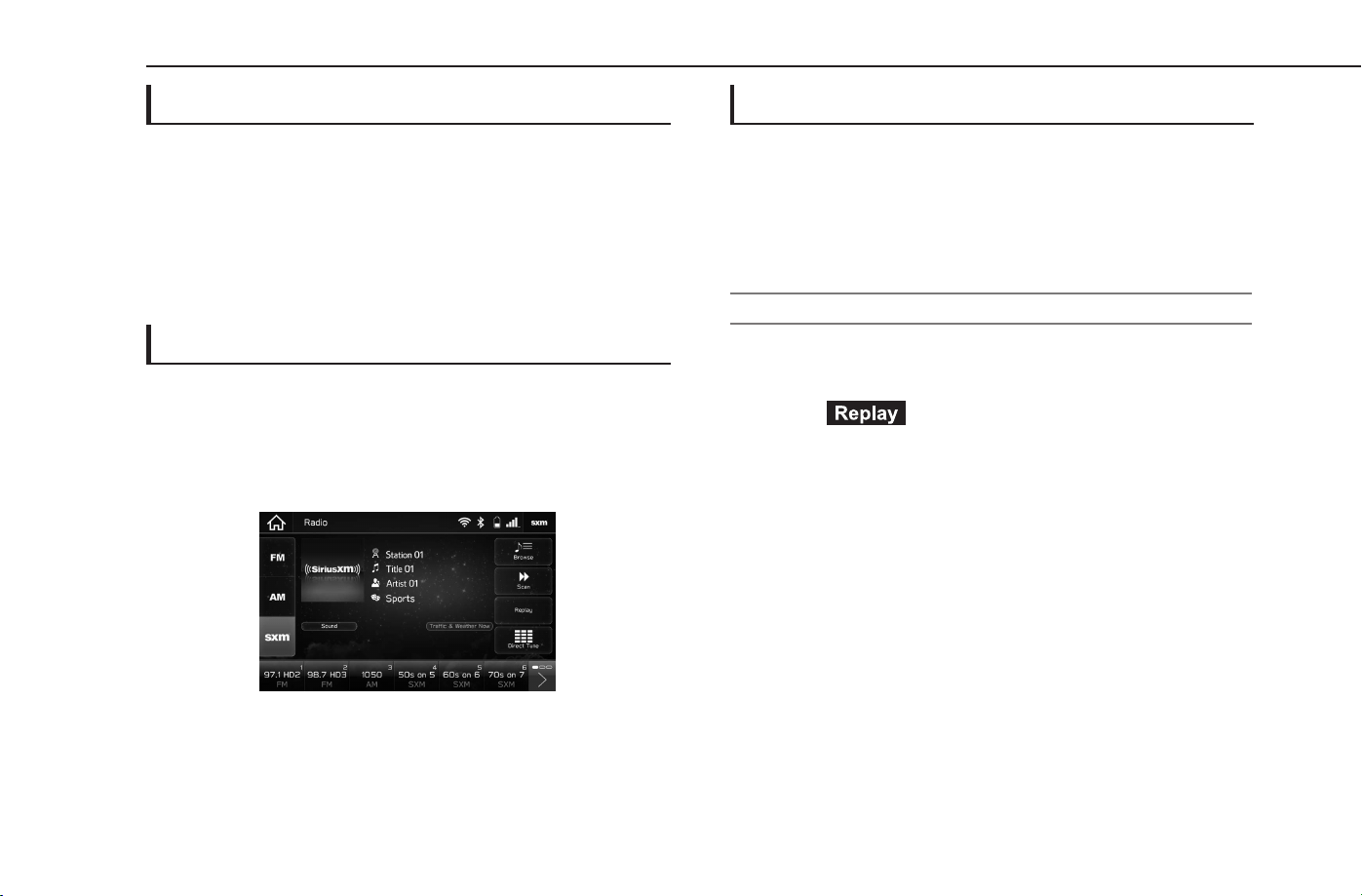
DISPLAYING THE RADIO ID
Each SiriusXM tuner is identied with a unique radio ID
which is 8 alphanumeric characters. The radio ID is required
when activating SiriusXM Satellite Services or when
reporting a problem.
The radio ID can be checked on the SiriusXM subscription
screen (→P.59) or tune to channel “0”.
PRESETTING A CHANNEL
Multiple stations can be registered as presets.
1.
Tune in the desired channel.
2.
Select and hold one of the desired preset station
buttons.
● To change the preset station to a different one, follow
the same procedure.
CACHING RADIO PROGRAMS
A radio program can be cached and played back in a time-
shifted manner.
The program that is currently being listened to can be
cached.
PLAYING BACK THE CACHE
The broadcast cached in the program cache can be played
back.
1.
Select (Replay). (→P.128)
RADIO OPERATION
132
docstructure.indb 132 2019/05/31 11:46:37
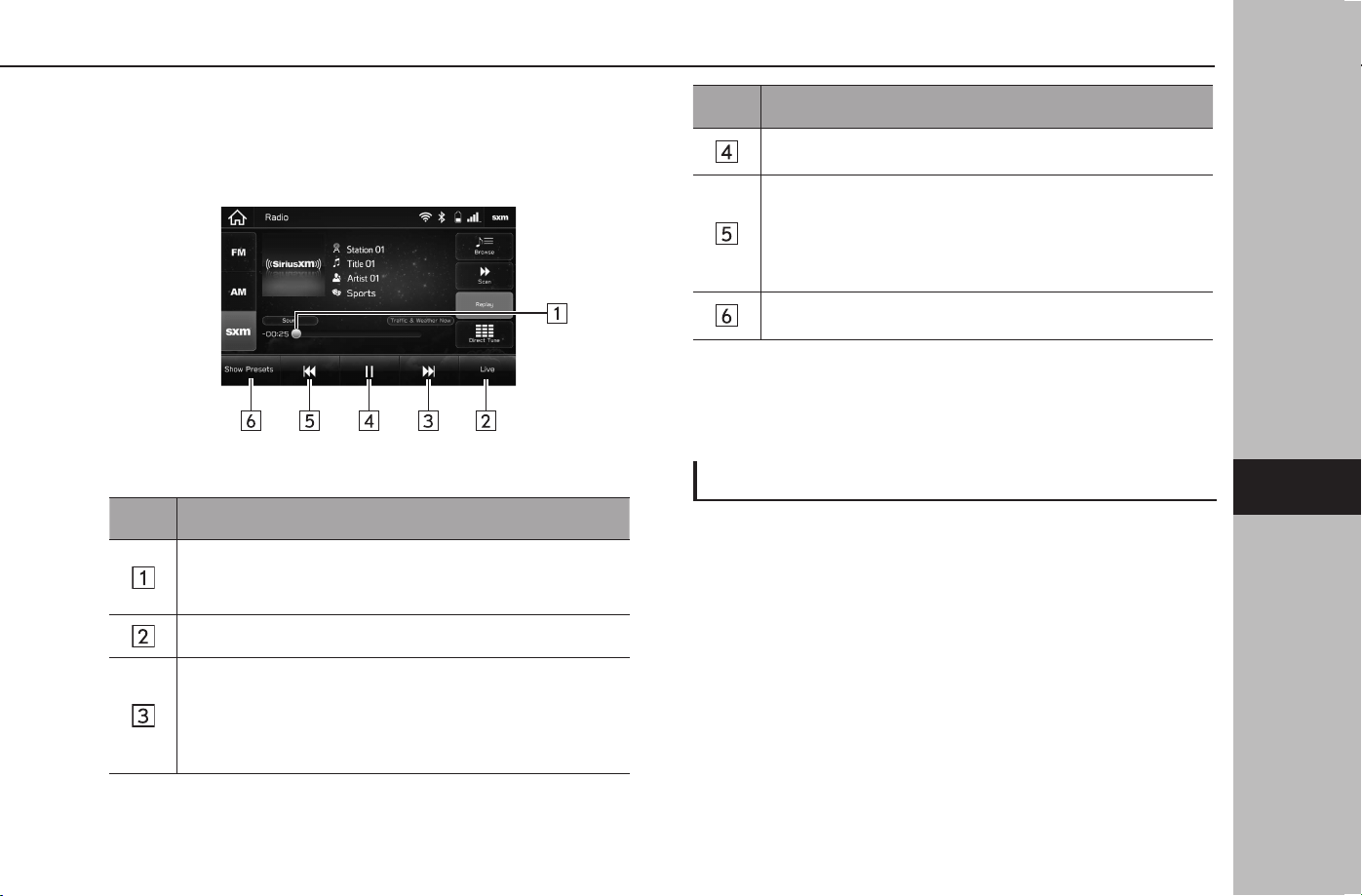
2.
Select the desired cache radio operation button.
No. Information/Function
Shows the current playback location.
The playback location can be changed by dragging the
sliders.
Returns to the live radio broadcast.
Select: Access the desired program. Skips forward
through program.
Select and hold: Fast forwards continuously.
The fast forward speed increases the longer the button
is held down.
No. Information/Function
Pauses or plays the radio broadcast.
Select: Access the desired program. Skips back through
program.
Select and hold: Fast rewinds continuously.
The fast rewind speed increases the longer the button is
held down.
Exits cached playback.
NOTE
l The time displayed on the bar scale may differ from the actual
time.
SEARCHING BY FEATURED FAVORITES
Featured Favorites are a collection of channels that are
created by the SiriusXM programming team that are
updated several times throughout the year.
The desired Featured Favorite channel can be selected
from the list screen. (→P.134)
RADIO OPERATION
133
Audio
6
docstructure.indb 133 2019/05/31 11:46:37
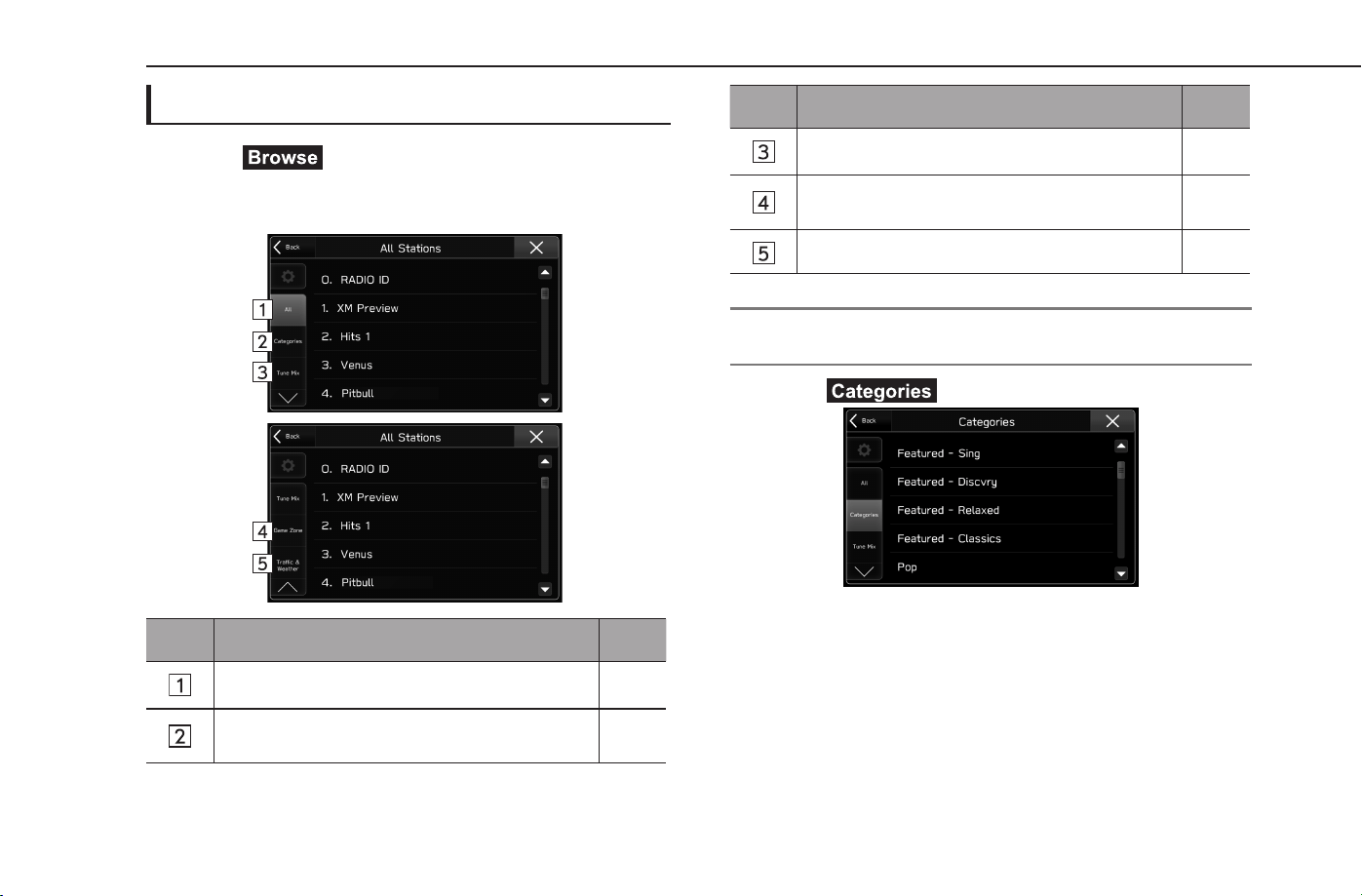
SELECTING A CHANNEL FROM THE LIST
1.
Select (Browse).
2.
Select the desired list, and then select the desired
channel.
No. Function Page
Select to display the all channels list. -
Select to display channel categories and
Featured Favorite channel list.
134
No. Function Page
Select to display the tune mix channel. 136
Select to set teams for notifying the user of
games starting and score updates.
135
Select to set the trafc and weather information. 138
SELECTING FROM CATEGORIES AND FEATURED
FAVORITE CHANNEL LIST
1.
Select (Categories).
● Received Featured Favorite channels is listed on the
top of the list.
2.
Select the desired channel.
RADIO OPERATION
134
docstructure.indb 134 2019/05/31 11:46:38
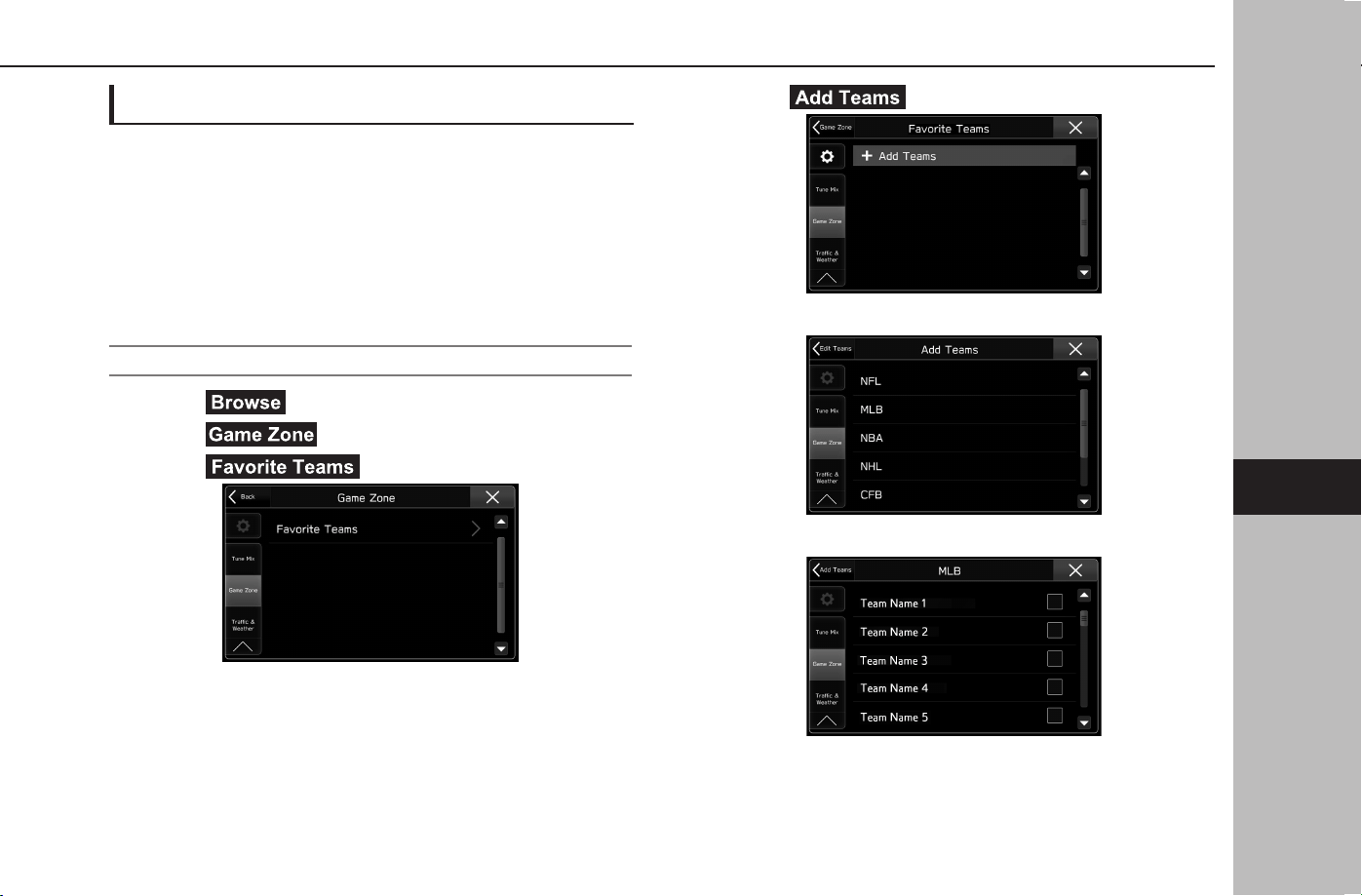
SETTING TEAMS FOR NOTIFICATIONS
By registering teams, a pop-up screen appears notifying
listeners of information on the game progress and so on.
You can return to the original point in the regular broadcast
by exiting the pop-up screen.
To use this function, turn “Sports Flash” on in “Sirius XM
Settings” on the general settings screen. (→P.59)
ADDING TEAMS
1.
Select (Browse).
2.
Select (Game Zone).
3.
Select (Favorite Teams).
4.
Select (Add Teams).
5.
Select the desired league.
6.
Select the desired team.
RADIO OPERATION
135
Audio
6
docstructure.indb 135 2019/05/31 11:46:39
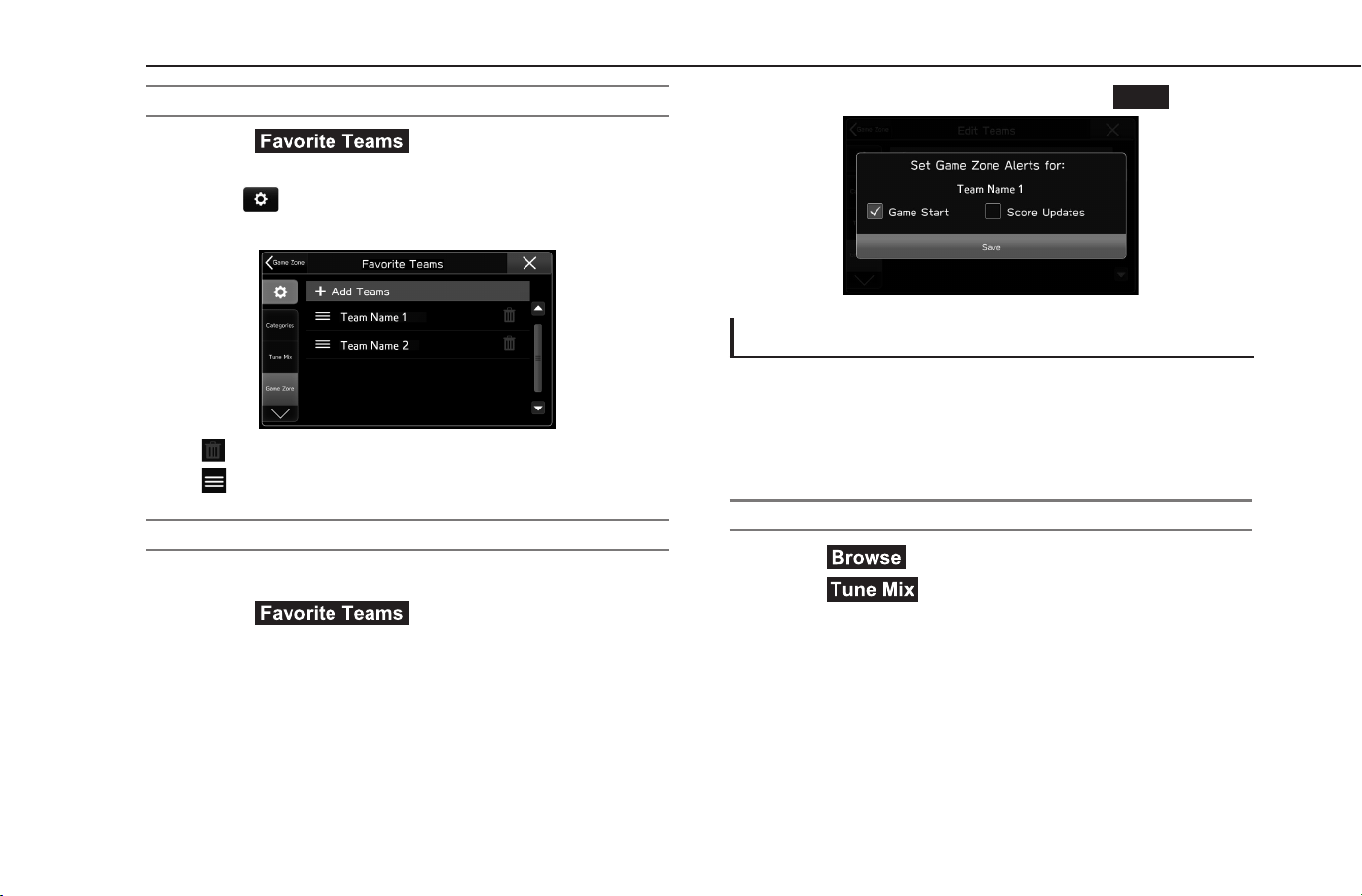
EDITING THE LIST
1.
Select (Favorite Teams) on the
“Game Zone” screen. (→P.135)
2.
Select .
3.
Select the desired item to be set.
● : Select to delete the item.
●
: Drag an item to the desired position.
SETTING POP-UP ALERTS
Pop-up alerts can be set to display on the screen.
1.
Select (Favorite Teams) on the
“Game Zone” screen. (→P.135)
2.
Select the desired item.
3.
Select the desired item, and then select
Save
(Save).
SETTING TUNE MIX CHANNELS
Tracks on multiple set channels can be played randomly.
To use this function, it is necessary to register the desired
channels to the preset channel. (→P.132)
REGISTERING CHANNELS
1.
Select (Browse).
2.
Select (Tune Mix).
RADIO OPERATION
136
docstructure.indb 136 2019/05/31 11:46:40
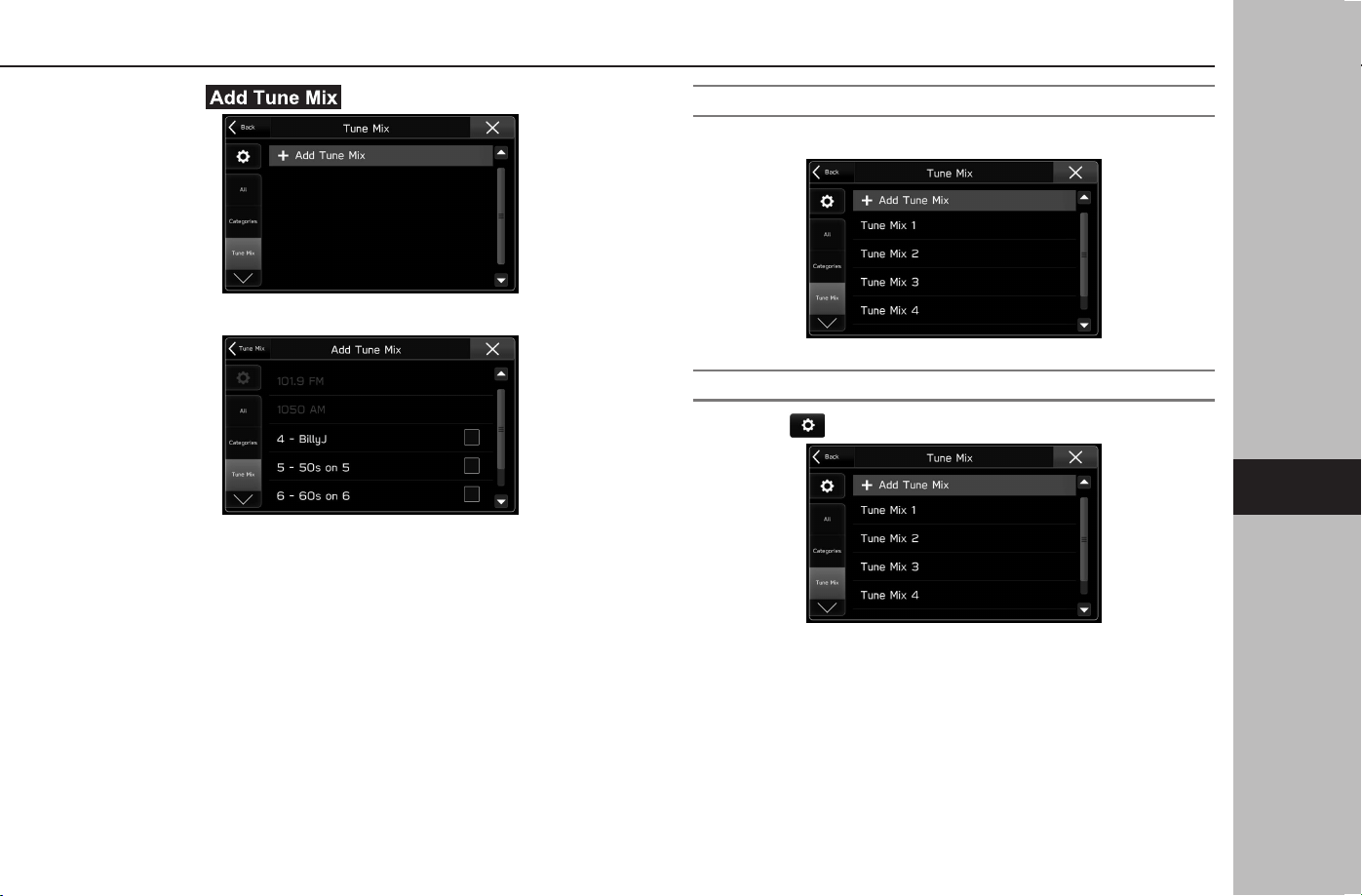
3.
Select (Add Tune Mix).
4.
Select the desired channels from the preset channel list.
LISTENING TO TUNE MIXED CHANNELS
1.
Select the desired channel on the “Tune Mix” screen.
EDITING THE TUNE MIX
1.
Select on the “Tune Mix” screen.
RADIO OPERATION
137
Audio
6
docstructure.indb 137 2019/05/31 11:46:40
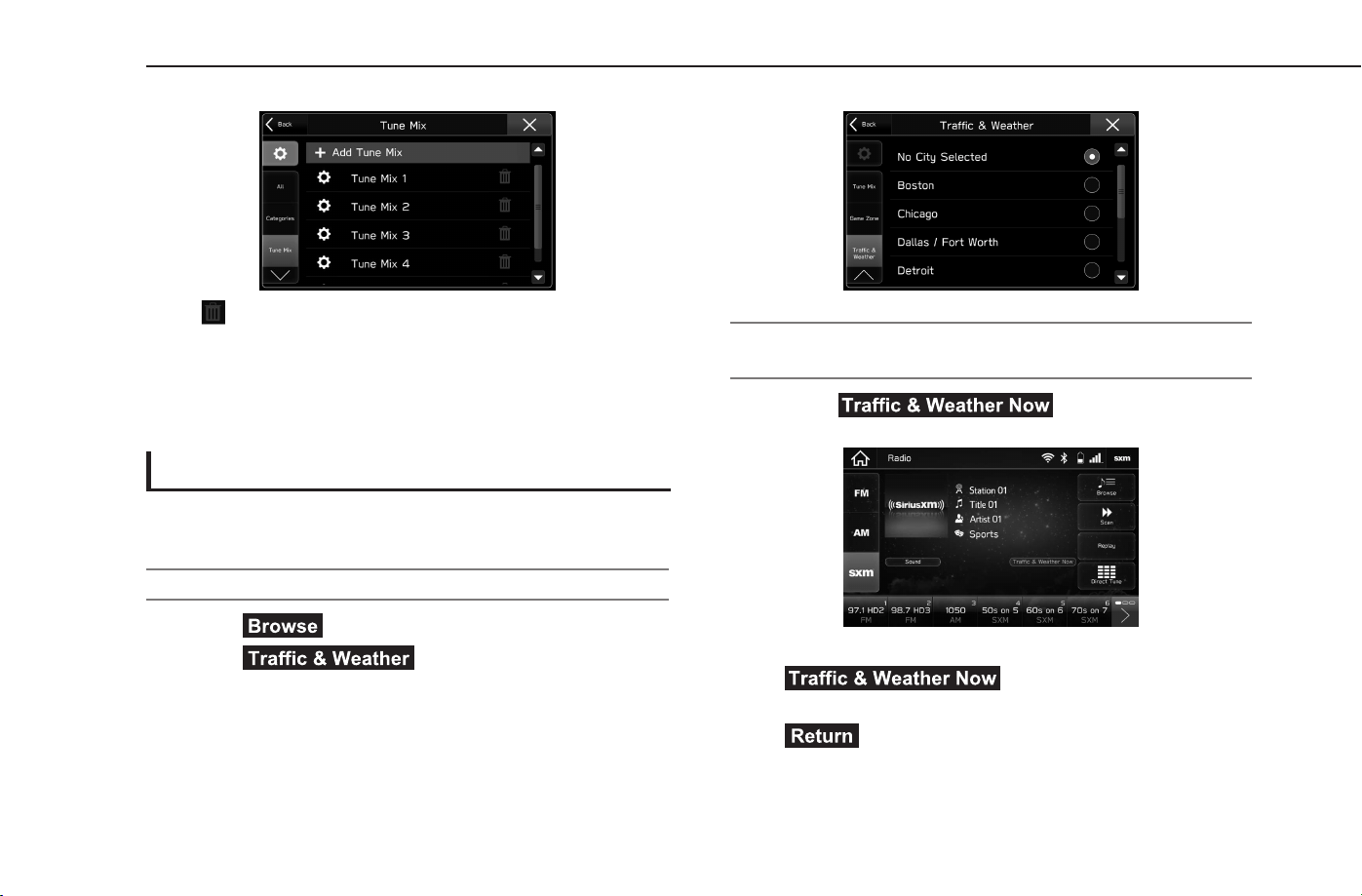
2.
Select the desired item to be set.
● : Select to delete the item.
3.
Select the desired channels from the preset channel list.
NOTE
l The Tune Mix name cannot be changed.
SETTING THE TRAFFIC & WEATHER
Trafc and weather information can be played for set cities.
SETTING THE TRAFFIC & WEATHER
1.
Select (Browse).
2.
Select (Trafc & Weather).
3.
Select the city.
LISTENING TO TRAFFIC AND WEATHER
INFORMATION
1.
Select (Trafc & Weather
Now) on the control screen.
● When the latest information is received,
(Trafc & Weather Now)
changes to green.
●
(Return): Select to return to the original
channel.
RADIO OPERATION
138
docstructure.indb 138 2019/05/31 11:46:41
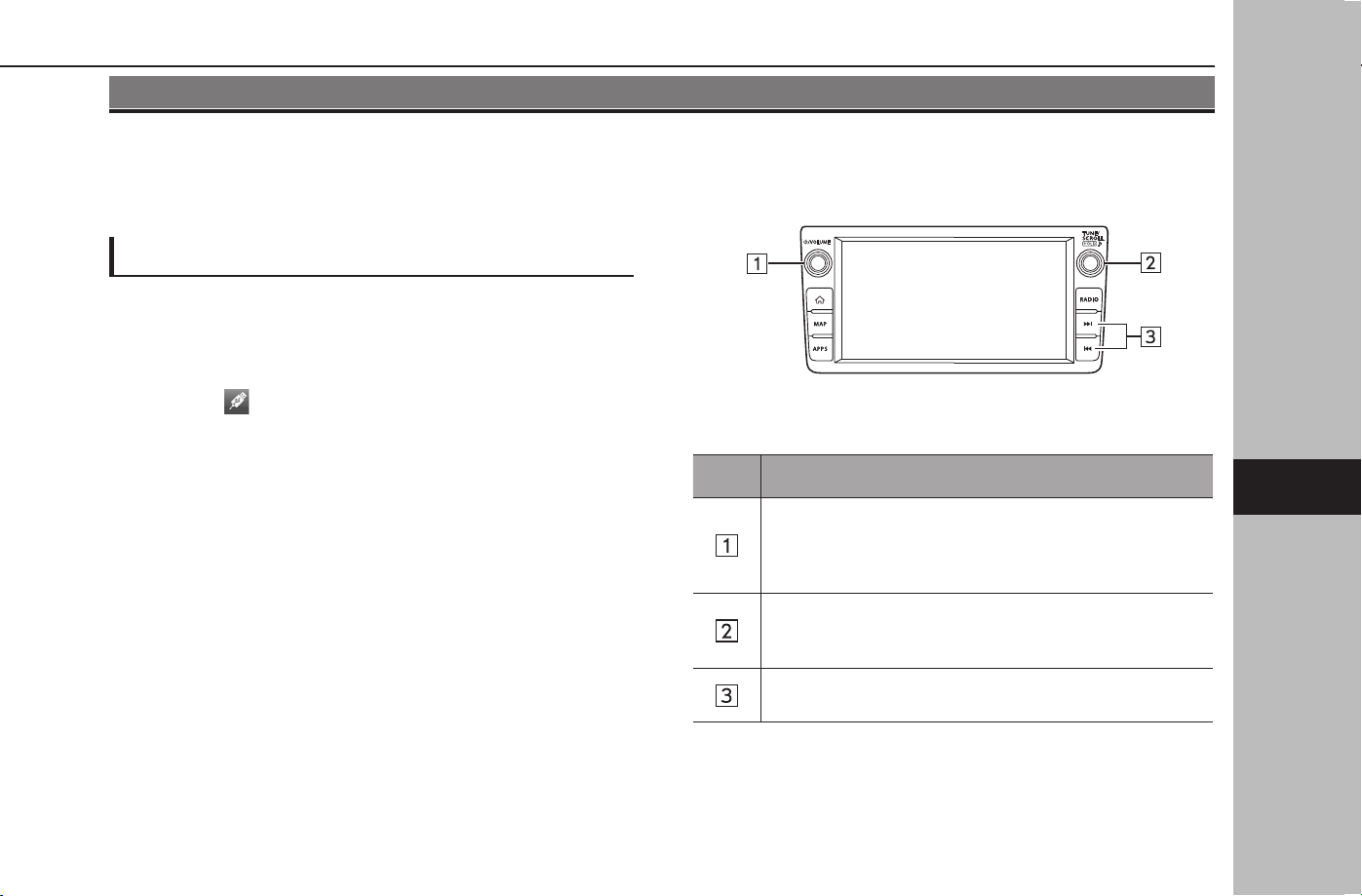
MEDIA OPERATION
USB MEMORY
Audio les on the USB memory device can be played back.
OVERVIEW
The USB Audio playback screen can be accessed with the
following methods:
● Connect a USB memory device. (→P.31)
● Select
on the “Media” screen. (→P.119)
XControl panel
No. Function
Turn to adjust volume.
Press to mute the audio system and pause playback.
Press and hold to turn the audio system off, and press
to turn it on again.
Turn to change a track.
Press and hold to display the sound settings screen.
(→P.73)
Press to change a track.
Press and hold to fast forward/rewind.
MEDIA OPERATION
139
Audio
6
docstructure.indb 139 2019/05/31 11:46:41
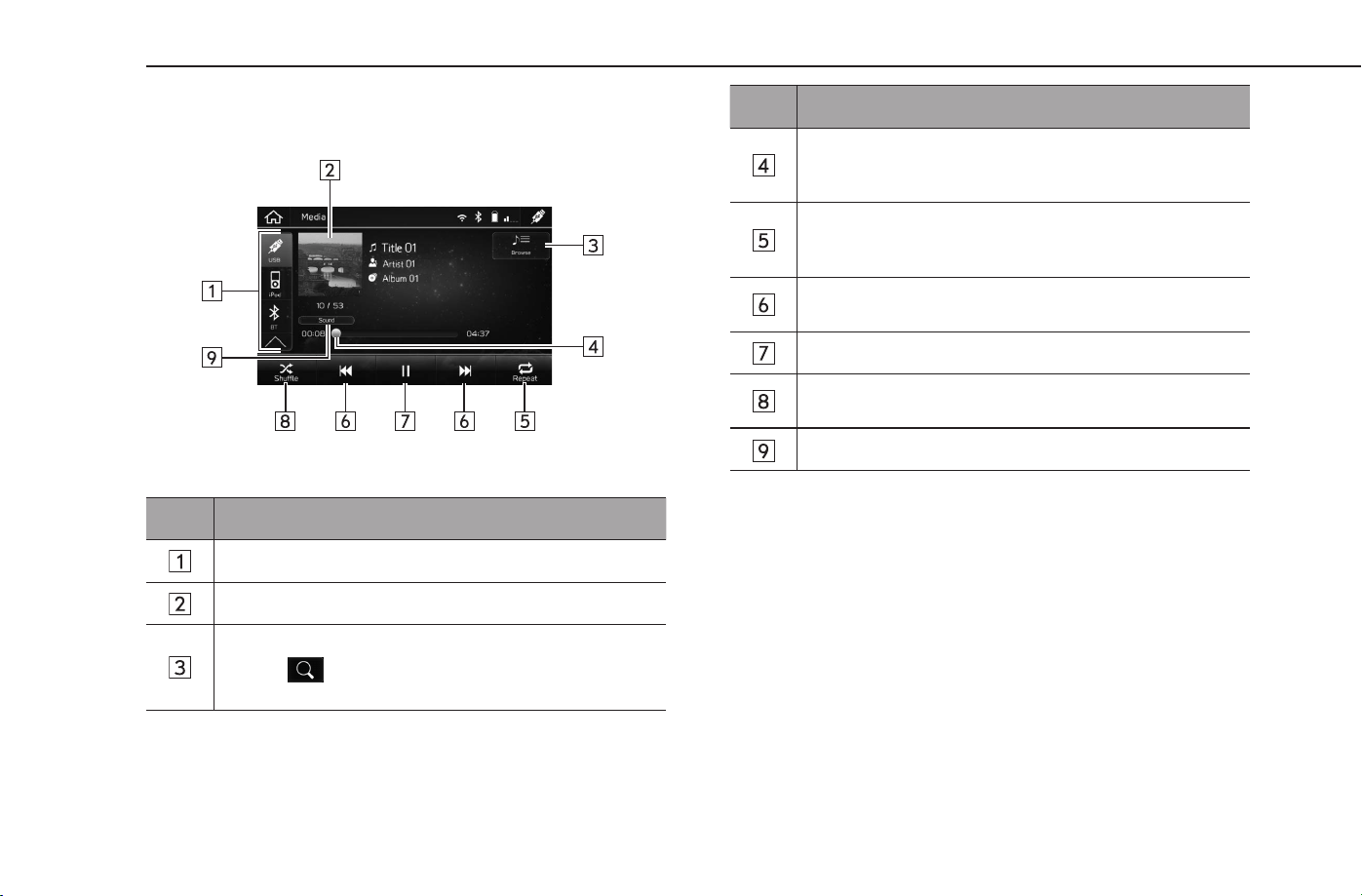
XControl screen
No. Function
Select to switch between other media sources.
Displays cover art.
Select to display the play mode selection screen.
• Select to narrow down the search for tracks in
each play mode.
No. Function
Shows progress.
The playback location can be changed by dragging the
sliders.
Changes between repeat current track → repeat current
folder/album → cancel repeat each time this button is
selected.
Select to change a track.
Select and hold to fast forward/rewind.
Select to pause/play.
Select to enable/disable random playback for the tracks
currently playing from the USB memory device.
Select to display the sound settings screen. (→P.73)
MEDIA OPERATION
140
docstructure.indb 140 2019/05/31 11:46:42
WARNING
l Do not operate the player’s controls or connect the USB
memory device while driving.
CAUTION
l Do not leave your portable player in the vehicle. In particular,
high temperatures inside the vehicle may damage the portable
player.
l Do not push down on or apply unnecessary pressure to the
portable player while it is connected as this may damage the
portable player or its terminal.
l Do not insert foreign objects into the port as this may damage
the portable player or its terminal.
NOTE
l Depending on the device or music le being played, the cover art
may not be displayed.
iPod
When an iPod is connected, you can play iPod music les.
On this unit, you can perform operations such as selecting
a le from a list or changing to the random playback mode.
At devices which support Apple CarPlay, turn Apple CarPlay
off in the device side Restrictions settings.
OVERVIEW
The iPod operation screen can be accessed with the
following methods:
● Connect an iPod. (→P.31)
● Select
on the “Media” screen. (→P.119)
MEDIA OPERATION
141
Audio
6
docstructure.indb 141 2019/05/31 11:46:42
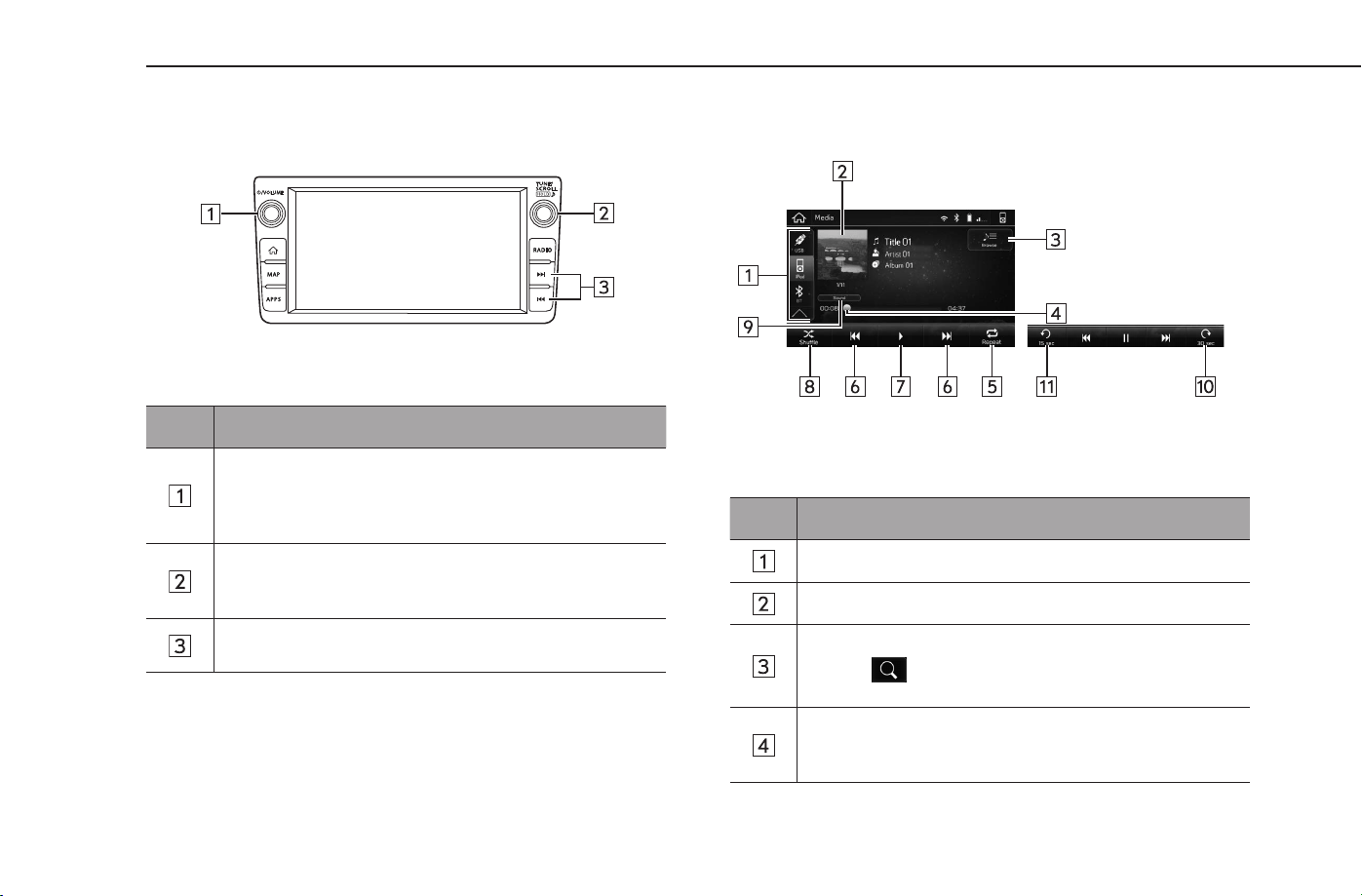
XControl panel
No. Function
Turn to adjust volume.
Press to mute the audio system and pause playback.
Press and hold to turn the audio system off, and press
to turn it on again.
Turn to change a track.
Press and hold to display the sound settings screen.
(→P.73)
Press to change a track.
Press
and hold to fast forward/rewind.
XControl screen
No. Function
Select to switch between other media sources.
Displays cover art.
Select to display the play mode selection screen.
• Select to narrow down the search for tracks in
each play mode.
Shows progress.
The playback location can be changed by dragging the
sliders.
MEDIA OPERATION
142
docstructure.indb 142 2019/05/31 11:46:42
No. Function
Changes between repeat current track → repeat current
album → cancel repeat each time this button is selected.
Select to change a track.
Select and hold to fast forward/rewind.
Select to pause/play.
Select to enable/disable random playback for the tracks
currently playing on the iPod.
Select to display the sound settings screen. (→P.73)
*
Select to fast forward the current content item in xed
intervals.
*
Select to rewind the current content item in xed
intervals.
*: Display when playing Audiobooks or Podcasts
WARNING
l Do not operate the player’s controls or connect the iPod while
driving.
CAUTION
l Do not leave your portable player in the vehicle. In particular,
high temperatures inside the vehicle may damage the portable
player.
l Do not push down on or apply unnecessary pressure to the
portable
player while it is connected as this may damage the
portable player or its terminal.
l Do not insert foreign objects into the port as this may damage
the portable player or its terminal.
NOTE
l When an iPod is connected using a genuine iPod cable, the iPod
starts charging its battery.
l If playing iPod music,
perform operation at the system. Certain
functions may not be available if played directly from the
iPod. Furthermore, depending on the connected iPod, certain
functions may not be available.
l Depending on the iPod or music le being played, the cover art
may not be displayed.
l When an iPod is connected and the audio source is changed to
iPod mode, the iPod will resume playing from the same point it
was last used.
l Tracks selected by operating a connected iPod may not be
recognized or displayed properly.
MEDIA OPERATION
143
Audio
6
docstructure.indb 143 2019/05/31 11:46:43
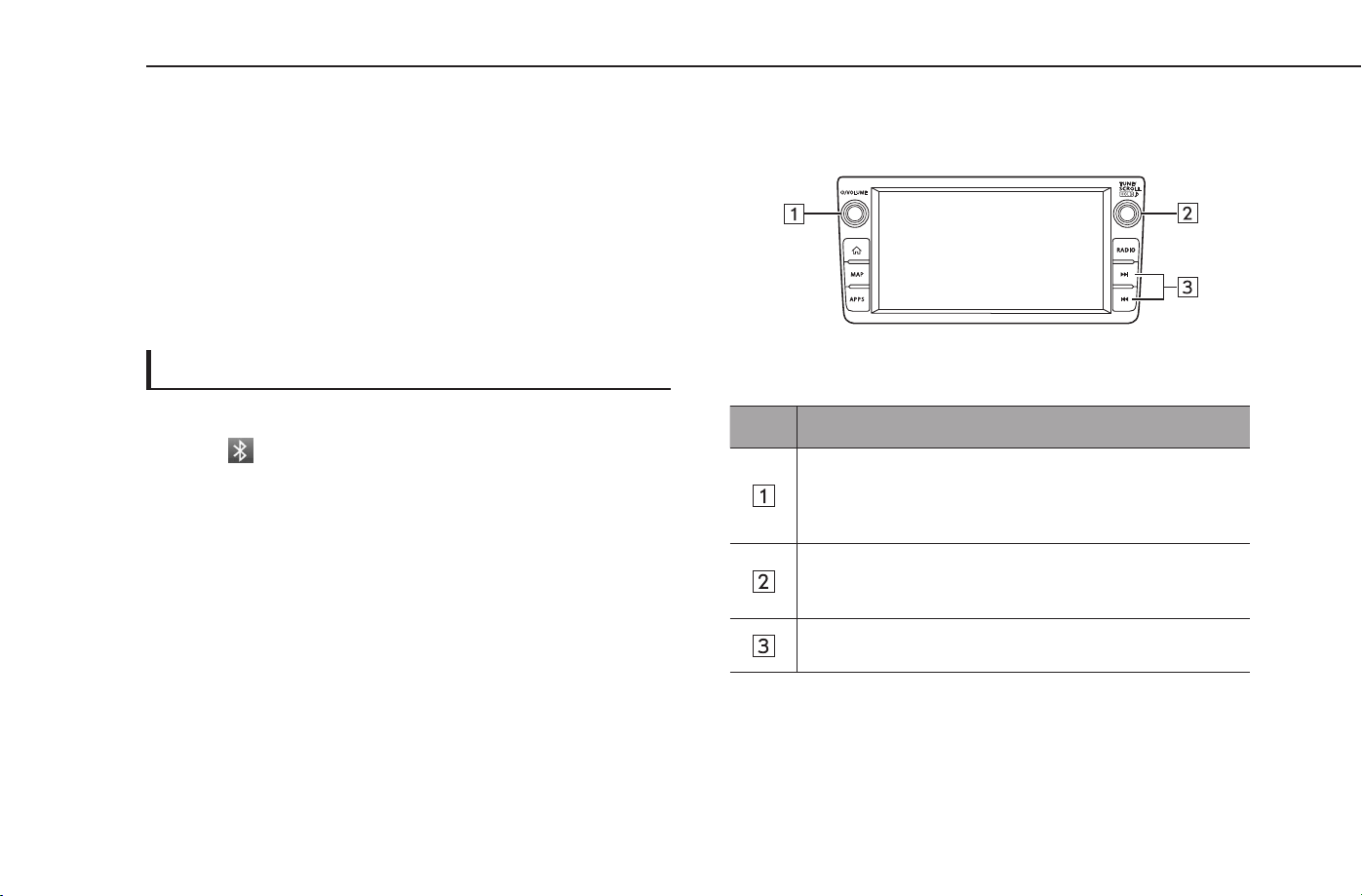
Bluetooth AUDIO
The Bluetooth audio system enables users to play music
les stored on Bluetooth devices through the vehicle
speakers via wireless communication.
This audio system supports Bluetooth, a wireless data
system capable of playing portable audio music without
cables. If your device does not support Bluetooth, the
Bluetooth audio system will not function.
OVERVIEW
The Bluetooth audio operation screen can be accessed by
selecting
on the “Media” screen. (→P.119)
Depending on the type of portable player connected, some
functions may not be available and/or the screen may look
differently than shown in this manual.
XControl panel
No. Function
Turn to adjust volume.
Press to mute the audio system and pause playback.
Press and hold to turn the audio system off, and press
to turn it on again.
Turn to change a track.
Press and hold to display the sound settings screen.
(→P.73)
Press to change a track.
Press and hold to fast forward/rewind.
MEDIA OPERATION
144
docstructure.indb 144 2019/05/31 11:46:43
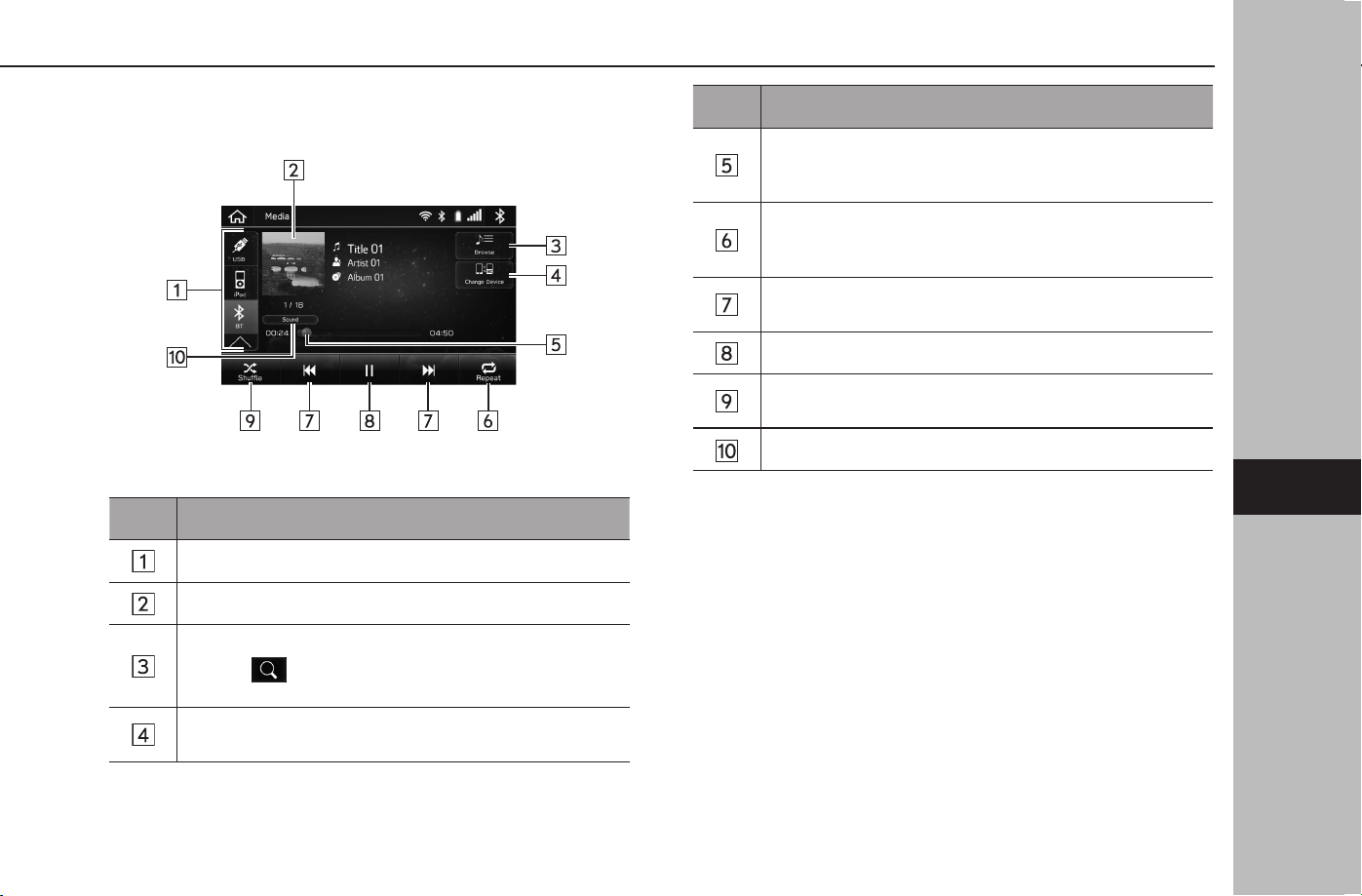
XControl screen
No. Function
Select to switch between other media sources.
Displays cover art.
Select to display the play mode selection screen.
• Select to narrow down the search for tracks in
each play mode.
Select to display the “Change Device” screen.
(→P.147)
No. Function
Shows progress.
The playback location can be changed by dragging the
sliders.
Changes between repeat current track → repeat current
folder/album → cancel repeat each time this button is
selected.
Select to change a track.
Select and hold to fast forward/rewind.
Select to pause/play.
Select to enable/disable random playback for the tracks
currently playing on the Bluetooth device.
Select to display the sound settings screen. (→P.73)
MEDIA OPERATION
145
Audio
6
docstructure.indb 145 2019/05/31 11:46:43
WARNING
l Do not operate the player’s controls or connect to the
Bluetooth audio system while driving.
l This system
is tted with Bluetooth antennas. People with
implantable cardiac pacemakers, cardiac resynchronization
therapy-pacemakers or implantable cardioverter debrillators
should maintain a reasonable distance between themselves
and the Bluetooth antennas. The radio waves may affect the
operation of such devices.
l Before using Bluetooth devices, users of any electrical
medical device other than implantable cardiac pacemakers,
cardiac resynchronization therapy-pacemakers or implantable
cardioverter debrillators should consult the manufacturer
of the device for information about its operation under the
inuence of radio waves. Radio waves could have unexpected
effects on the operation of such medical devices.
CAUTION
l Do not leave your portable player in the vehicle. In particular,
high temperatures inside the vehicle may damage the portable
player.
NOTE
l Depending on the Bluetooth device that is connected to the
system, the music may start playing when selecting while
it is paused. Conversely, the music may pause when selecting
while it is playing.
l In the following conditions, the system may not function:
•
The Bluetooth device is turned off.
•
The Bluetooth device is not connected.
•
The Bluetooth device has a low battery.
l It may take time to connect the phone when Bluetooth audio is
being played.
l For operating the portable player, see the instruction manual that
comes with it.
l If the Bluetooth device is disconnected due to poor reception
from the Bluetooth network when the
ignition switch is turned
to the “ACC” or “ON” position, the system will
automatically
reconnect to the portable player.
l If the Bluetooth device is disconnected on purpose, such as it
was turned off, this does not happen. Reconnect the portable
player manually.
l Bluetooth device information is registered when the Bluetooth
device is connected
to the Bluetooth audio system. When
selling or disposing of the vehicle, remove the Bluetooth audio
information from the system. (→P.59)
l Depending on the Bluetooth device or music le being played,
the cover art may not be displayed.
l If the Bluetooth device
does not play automatically when
connected, device operation may be necessary.
MEDIA OPERATION
146
docstructure.indb 146 2019/05/31 11:46:44
CONNECTING A Bluetooth DEVICE
To use the Bluetooth audio system, it is necessary to
register a Bluetooth device with the system.
XRegistering an additional device
1.
Select (Change Device) on the
Bluetooth audio control screen.
2.
For more information: →P.52
XSelecting a registered device
1.
Select (Change Device) on the
Bluetooth audio control screen.
2.
Select the Bluetooth device to be connected.
MEDIA OPERATION
147
Audio
6
docstructure.indb 147 2019/05/31 11:46:44
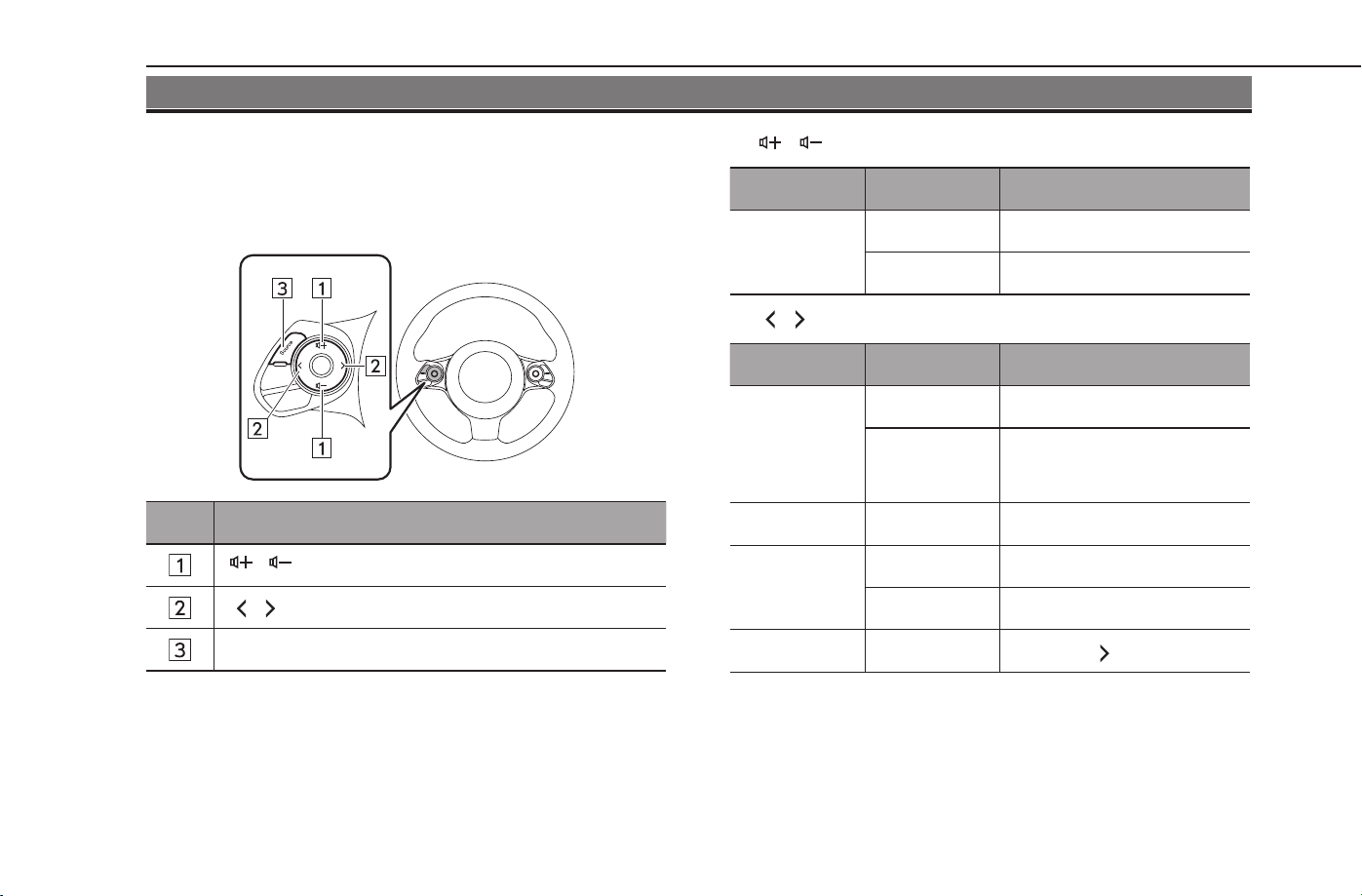
AUDIO REMOTE CONTROLS
STEERING WHEEL CONTROLS
Some parts of the audio system can be controlled using the
steering wheel controls.
No. Switch
“ / ” switch
“ / ” switch
“Source” switch
X“ / ” switch
Mode Operation Function
Volume
Press Volume up/down
Press and hold Volume up/down continuously
X“ / ” switch
Mode Operation Function
AM/FM Radio,
SiriusXM
®
Press Preset channel up/down
Press and hold
Scan and stop at the rst
received station when the
switch is released
aha Press Content up/down
USB, iPod,
Bluetooth
audio
Press Change a track
Press and hold Fast forward/rewind
Pandora* Press
Track
up (“
”only)
*: Pandora is only available in certain countries. Please visit pandora.com/
legal for more information.
AUDIO REMOTE CONTROLS
148
docstructure.indb 148 2019/05/31 11:46:45
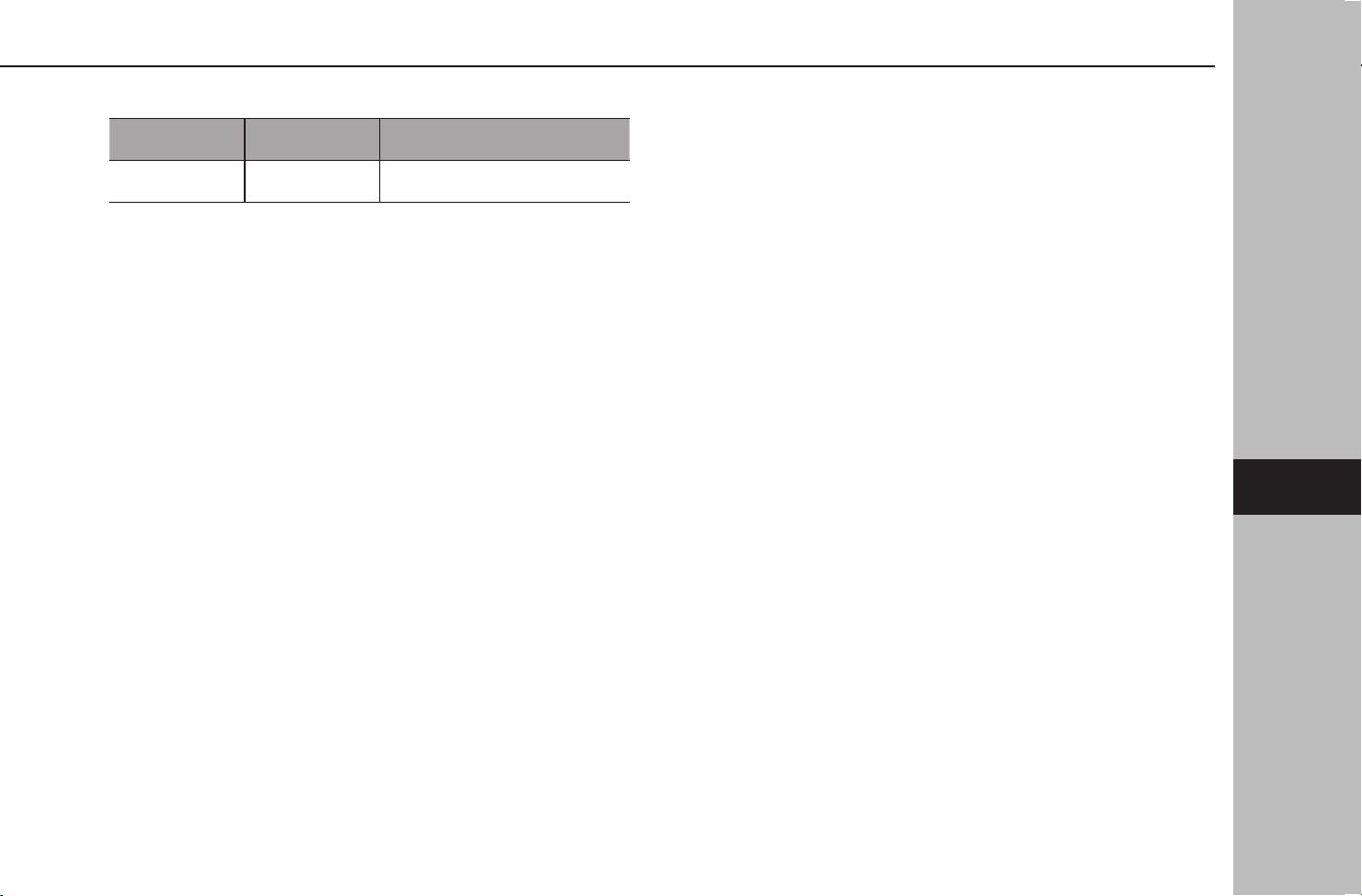
X“Source” switch
Mode Operation Function
All Press Change audio modes
NOTE
l In the aha, Pandora* and SUBARU STARLINK mode, some
operation may be done on the screen depend on the selected
APPS.
*: Pandora is only available in certain countries. Please visit pandora.com/
legal for more information.
AUDIO REMOTE CONTROLS
149
Audio
6
docstructure.indb 149 2019/05/31 11:46:45
TIPS FOR OPERATING THE AUDIO SYSTEM
OPERATING INFORMATION
CAUTION
l To avoid damage to the audio system, be careful not to spill
beverages over the audio system.
NOTE
l The use of a cellular phone inside or near the vehicle may cause
a noise from the speakers of the audio system which you are
listening to. However, this does not indicate a malfunction.
RADIO
Usually, a problem with radio reception does not mean there
is a problem with the radio — it is just the normal result of
conditions outside the vehicle.
For example, nearby buildings and terrain can interfere
with FM reception. Power lines or phone wires can interfere
with AM signals. And of course, radio signals have a limited
range. The farther the vehicle is from a station, the weaker
its signal will be. In addition, reception conditions change
constantly as the vehicle moves.
Here, some common reception problems that probably do
not indicate a problem with the radio are described.
TIPS FOR OPERATING THE AUDIO SYSTEM
150
docstructure.indb 150 2019/05/31 11:46:45

FM
Fading and drifting stations: Generally, the effective range
of FM is about 25 miles (40 km). Once outside this range,
you may notice fading and drifting, which increase with
the distance from the radio transmitter. They are often
accompanied by distortion.
Multi-path: FM signals are reective, making it possible for
2 signals to reach the vehicle’s antenna at the same time. If
this happens, the signals will cancel each other out, causing
a momentary utter or loss of reception.
Static and uttering: These occur when signals are blocked
by buildings, trees or other large objects. Increasing the
bass level may reduce static and uttering.
Station swapping: If the FM signal being listened to is
interrupted or weakened, and there is another strong station
nearby on the FM band, the radio may tune in the second
station until the original signal can be picked up again.
AM
Fading: AM broadcasts are reected by the upper
atmosphere — especially at night. These reected signals
can interfere with those received directly from the radio
station, causing the radio station to sound alternately strong
and weak.
Station interference: When a reected signal and a signal
received directly from a radio station are very nearly the
same frequency, they can interfere with each other, making
it difcult to hear the broadcast.
Static: AM is easily affected by external sources of electrical
noise, such as high tension power lines, lightening or
electrical motors. This results in static.
SiriusXM
®
● Cargo loaded on the roof luggage carrier, especially
metal objects, may adversely affect the reception of
SiriusXM
®
Satellite Radio.
● Alternation or modications carried out without
appropriate authorization may invalidate the user’s
right to operate the equipment.
TIPS FOR OPERATING THE AUDIO SYSTEM
151
Audio
6
docstructure.indb 151 2019/05/31 11:46:45
USB MEMORY DEVICE
● USB communication formats: USB 2.0 HS (480
Mbps) and FS (12 Mbps)
● File formats: FAT 16/32
● Correspondence class: Mass storage class
iPod
The following iPod
®
, iPod nano
®
, iPod touch
®
and
iPhone
®
devices can be used with this system.
Made for
● iPod touch (5th generation)
● iPod nano (7th generation)
● iPhone 4s
● iPhone 5
● iPhone 5s
● iPhone 6
● iPhone 6s
● iPhone 6 Plus
● iPhone 6s Plus
● iPhone SE
● iPhone 7
● Depending on dif
ferences between models or
software versions etc., some models might be
incompatible with this system.
● iPod video is not supported.
● For USA
customers, please visit www.subaru.com for
details. Outside of the USA customers, contact your
local dealer to arrange a demonstration in order to
conrm whether or not the phone can be paired with
the vehicle.
FILE INFORMATION
Codec Description Channels
Container/
Extension
MPEG-4
AAC LC
8-48 kHz sampling rate
8-320 kbps CBR, VBR
Mono and
stereo
.3gp, .m4a,
.aac, .mp4
MPEG-4 HE
AAC
16-48 kHz sampling
rate
8-320 kbps CBR, VBR
Mono and
stereo
.3gp, .m4a,
.aac, .mp4
MPEG-4 HE
AAC v2
16-48 kHz sampling
rate
8-320 kbps CBR, VBR
Mono and
stereo
.3gp, .m4a,
.aac, .mp4
MP3
8-48 kHz sampling rate
8-320 kbps CBR, VBR
Mono,
Stereo,
and Joint
.mp3
WMA2/7/8/
9/9.1/9.2
16-48 kHz sampling
rate
8-320 kbps CBR, VBR
Mono and
stereo
.wma, .asf
PCMWAVE
8 bit and 16bit
8000,16000,and
44100Hz
sampling frequency
Mono and
stereo
.wav
TIPS FOR OPERATING THE AUDIO SYSTEM
152
docstructure.indb 152 2019/05/31 11:46:45

● The player is compatible with VBR (Variable Bit Rate).
● MP3 (MPEG Audio Layer 3), WMA
(Windows Media
Audio) and AAC (Advanced Audio Coding) are audio
compression standards.
● This system
can play AAC/AAC+ v2/MP3/WMA les
on USB memory device and Bluetooth device.
● When naming
an AAC/AAC+ v2/MP3/WMA le, add
an appropriate le extension (.mp3/.wma/.m4a).
● This system
plays back les with .mp3/.wma/.m4a
le extensions as AAC/AAC+ v2/MP3/WMA les
respectively. To prevent noise and playback errors,
use the appropriate le extension.
● MP3 les
are compatible with the ID3 Tag Ver. 1.0,
Ver. 1.1, Ver. 2.2 and Ver. 2.3 formats. This system
cannot display folder name, le name and artist name
in other formats.
● WMA/AAC les can contain a WMA/AAC tag that is
used in the same way as an ID3 tag. WMA/AAC tags
carry information such as le name and artist name.
● This system
can play back AAC les encoded by
iTunes.
● The sound
quality of MP3/WMA les generally
improves with higher bit rates. In order to achieve
a reasonable level of sound quality, USB memory
device recorded with a bit rate of at least 128 kbps
are recommended.
● m3u playlists are not compatible with the audio
device.
● MP3i (MP3 interactive) and MP3PRO formats are not
compatible with the audio device.
● When playing
back les recorded as VBR (Variable
Bit Rate) les, the play time will not be correctly
displayed if the fast forward or rewind operations are
used.
● It is not possible to check folders that do not include
AAC/AAC+ v2/MP3/WMA les.
TIPS FOR OPERATING THE AUDIO SYSTEM
153
Audio
6
docstructure.indb 153 2019/05/31 11:46:45
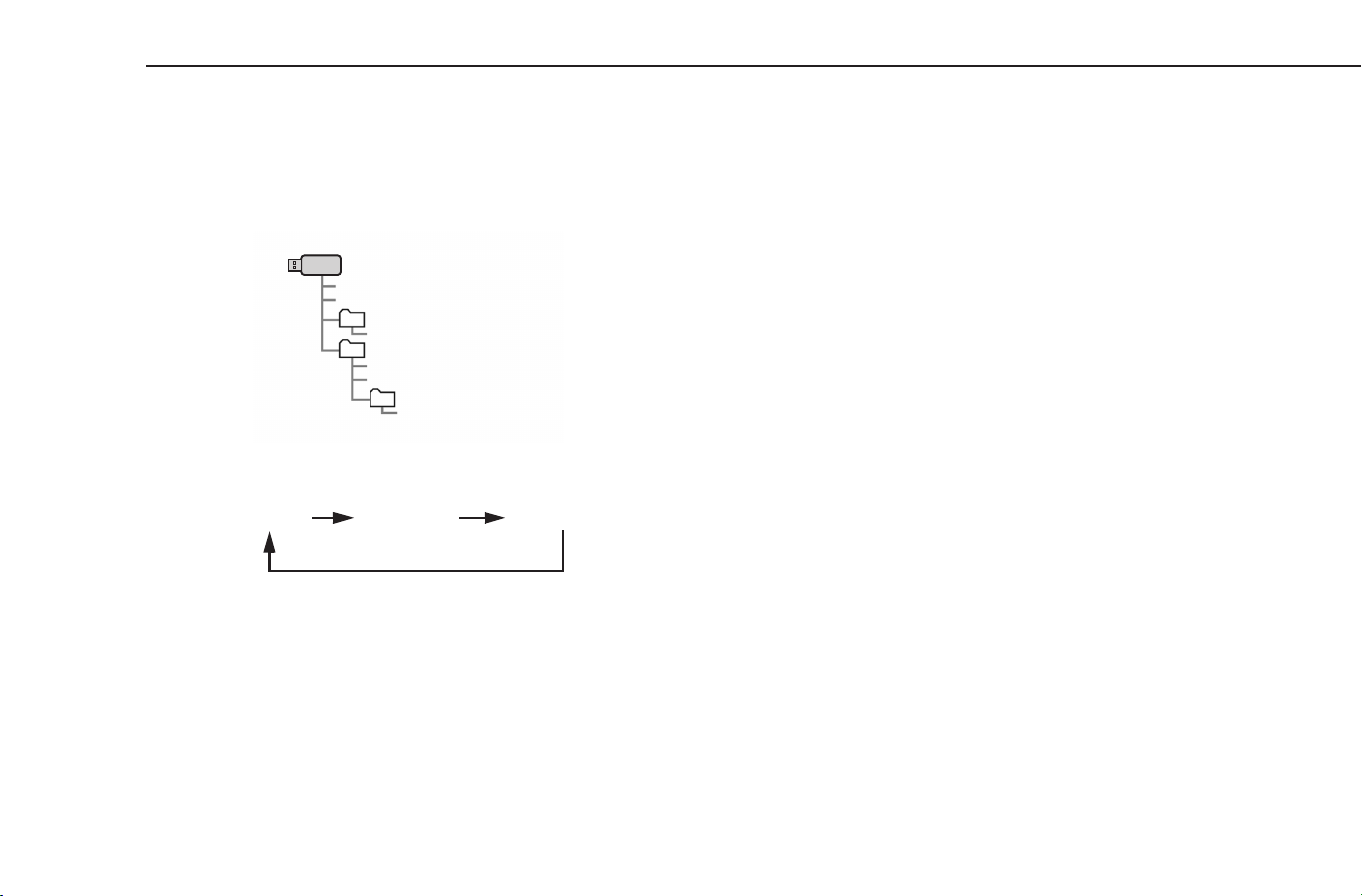
● AAC/AAC+ v2/MP3/WMA les in folders up to 3
levels deep can be played. However, the start of
playback may be delayed when using USB memory
device containing numerous levels of folders. For this
reason, we recommend creating USB memory device
with no more than 2 levels of folders.
001.mp3
002.wma
Folder 1
003.mp3
Folder 2
004.mp3
005.wma
Folder 3
006.m4a
● The play order of the USB memory device with the
structure shown above is as follows:
001.mp3 002.wma . . .006.m4a
● The order changes depending on the personal
computer and AAC/AAC+ v2/MP3/WMA encoding
software you use.
TIPS FOR OPERATING THE AUDIO SYSTEM
154
docstructure.indb 154 2019/05/31 11:46:46

155
Navigation System
(8-inch with Navi
system only)
Navigation System
Basic Operation
156
Map Screen
156
Map Screen Overview
156
Map Screen Buttons Overview
157
Map Screen Operation
158
Current Position Display
158
Map Scale
159
Orientation Of The Map
159
Map Screen Information
160
POI Icons
160
Trafc Information
161
Other Information
161
Memory Points
162
Registering Memory Points
162
Editing Memory Points
163
Destination Search
165
Search Operation
165
Setting Home Or Work As The Destination
165
Searching On The Map
166
Searching By Entering A Search Word
166
Searching By POI
167
Searching From Previously Set Destinations
168
Searching From The Favorite Destinations List
169
Searching For Gas Stations
170
Route Calculation
171
Route Calculation Screen
171
Route Guidance
173
Route Guidance
173
Route Guidance Screen
173
Standard Map Icon
175
Typical Voice Guidance Prompts
176
Route Related Functions
176
Checking The Route
176
Editing Route
177
Adding Destinations
177
Checking The Itinerary
178
Reordering Destinations
178
Deleting Destinations
179
Stopping Route Guidance
179
Weather Information
179
Setup
180
Navigation Settings
180
Navigation Settings Screen
180
Tips For The Navigation System
182
GPS (Global Positioning System)
182
Regarding Errors In Current Position Display
182
Limitations Of The Navigation System
182
Map Data
184
Regarding Roads And Place Name Data
184
SUBARU Map Update
184
Updating The Map Data Manually Using
A Usb Memory Device
185
Updating The Map Data Manually Using Wi-Fi
186
Updating The Map Data Manually Using
A Smartphone
187
Updating The Map Data Automatically
191
docstructure.indb 155 2019/05/31 11:46:46
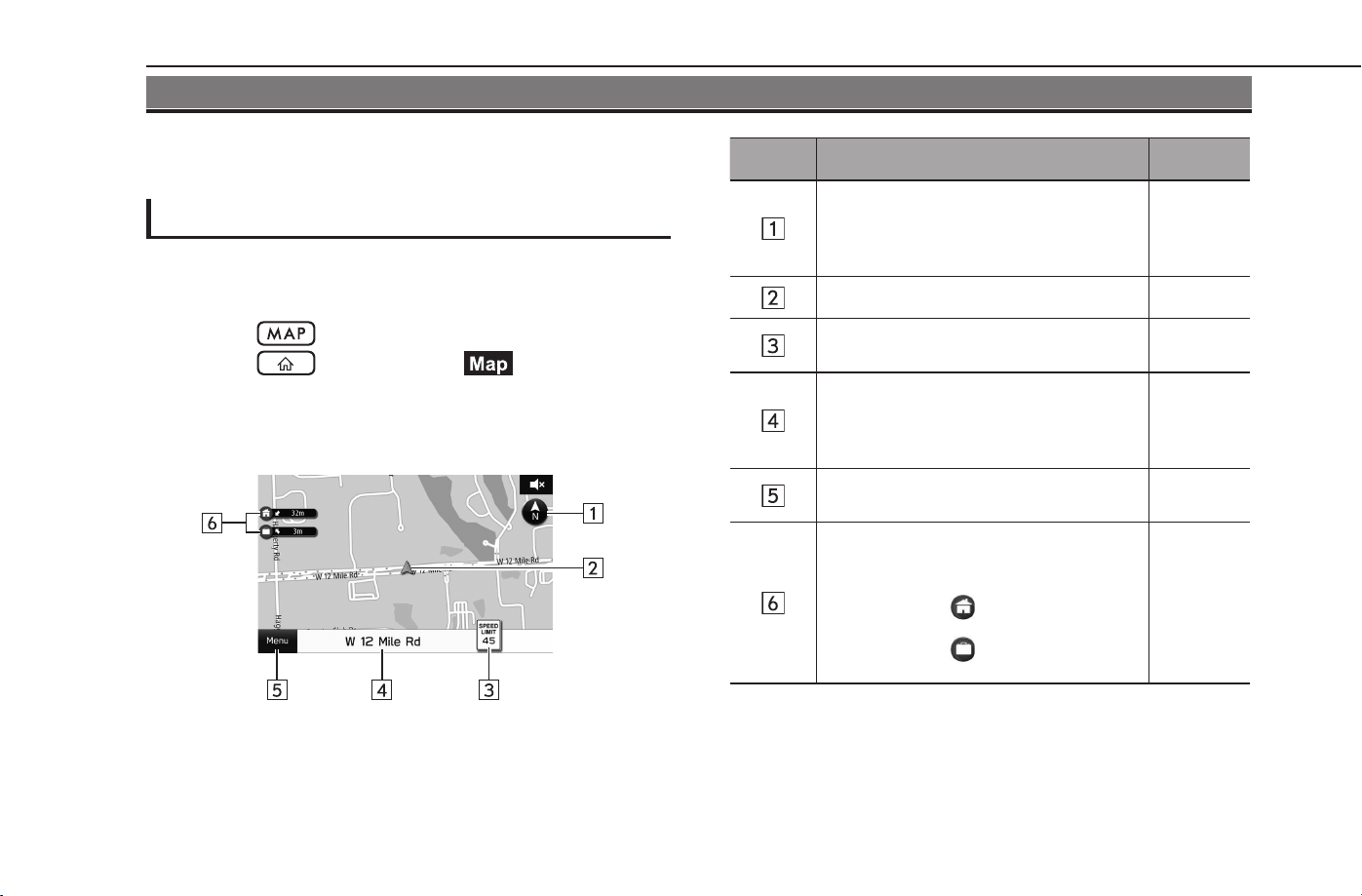
BASIC OPERATION
MAP SCREEN
MAP SCREEN OVERVIEW
The map screen can be accessed with the following
methods:
● Press
.
● Press
, and then select (Map).
No. Information/Function Page
Select to change the map display mode
between 2D north-up, 2D heading-up, or
3D. In 3D maps, only a heading-up view
is available.
159
Displays the current vehicle position. -
Displays the speed limit for the road
currently being travelled on.
-
Displays the current street name.
Select to display the current location and
geo-coordinates, and register the point
as home, work, or favorite.
162
Select to display the destination search
menu.
166, 167,
168, 169
By registering your home or work,
(→P.162), the direction and time
required are displayed.
Select and hold to set home as the
destination.
Select and hold to set work as the
destination.
165
BASIC OPERATION
156
docstructure.indb 156 2019/05/31 11:46:48
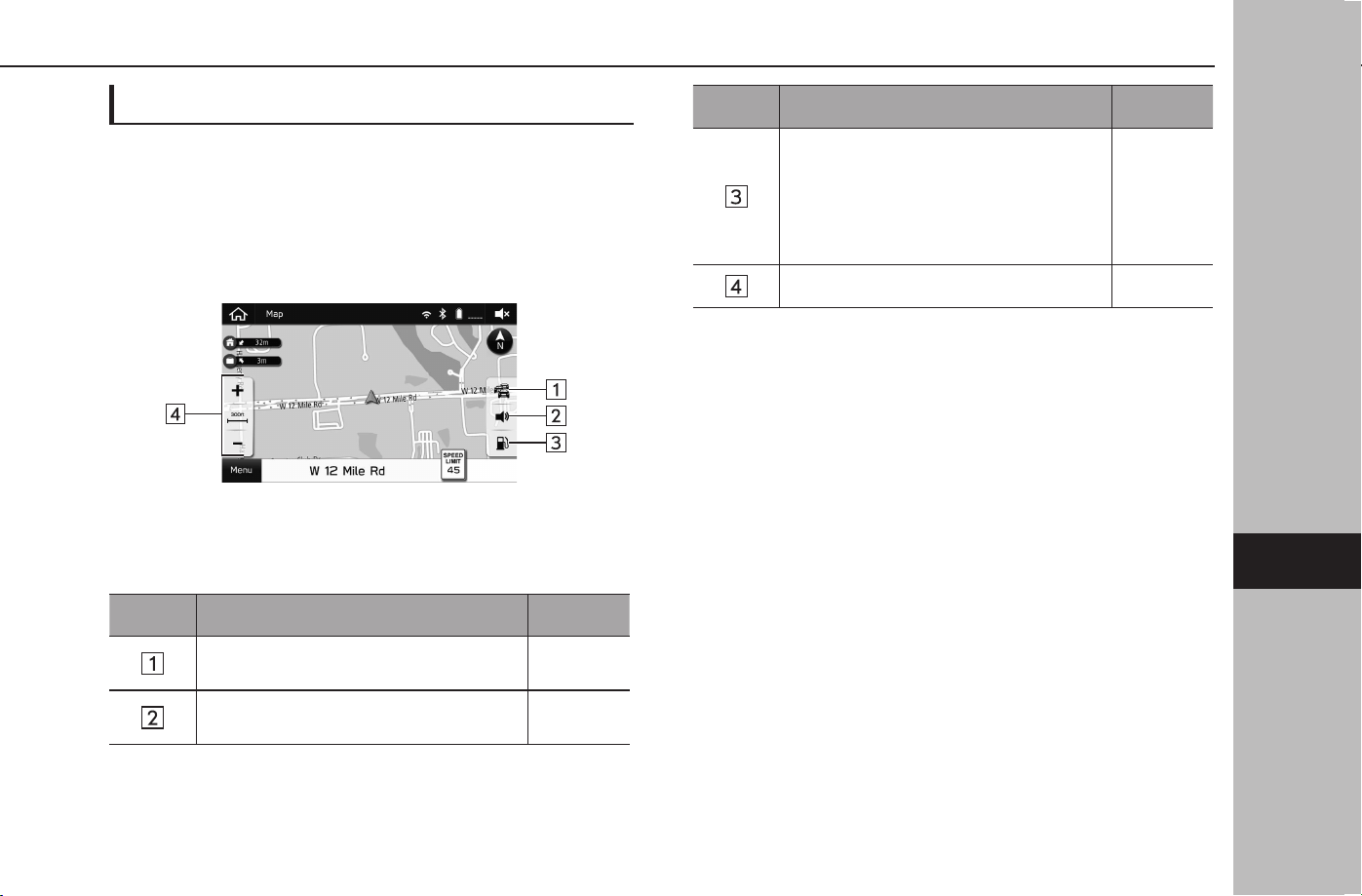
MAP SCREEN BUTTONS OVERVIEW
The map screen buttons can be accessed by selecting any
point on the map.
No. Function Page
Select to turn the trafc information
display on/off.
161
Select to mute/unmute the voice
guidance.
-
No. Function Page
Select to search for gas stations.
When driving on the highway during
route guidance, information on gas
stations, restaurants, or rest areas near
the next three highway exits will be
displayed.
170
Select to change the map scale. 159
BASIC OPERATION
157
Navigation System
7
docstructure.indb 157 2019/05/31 11:46:48
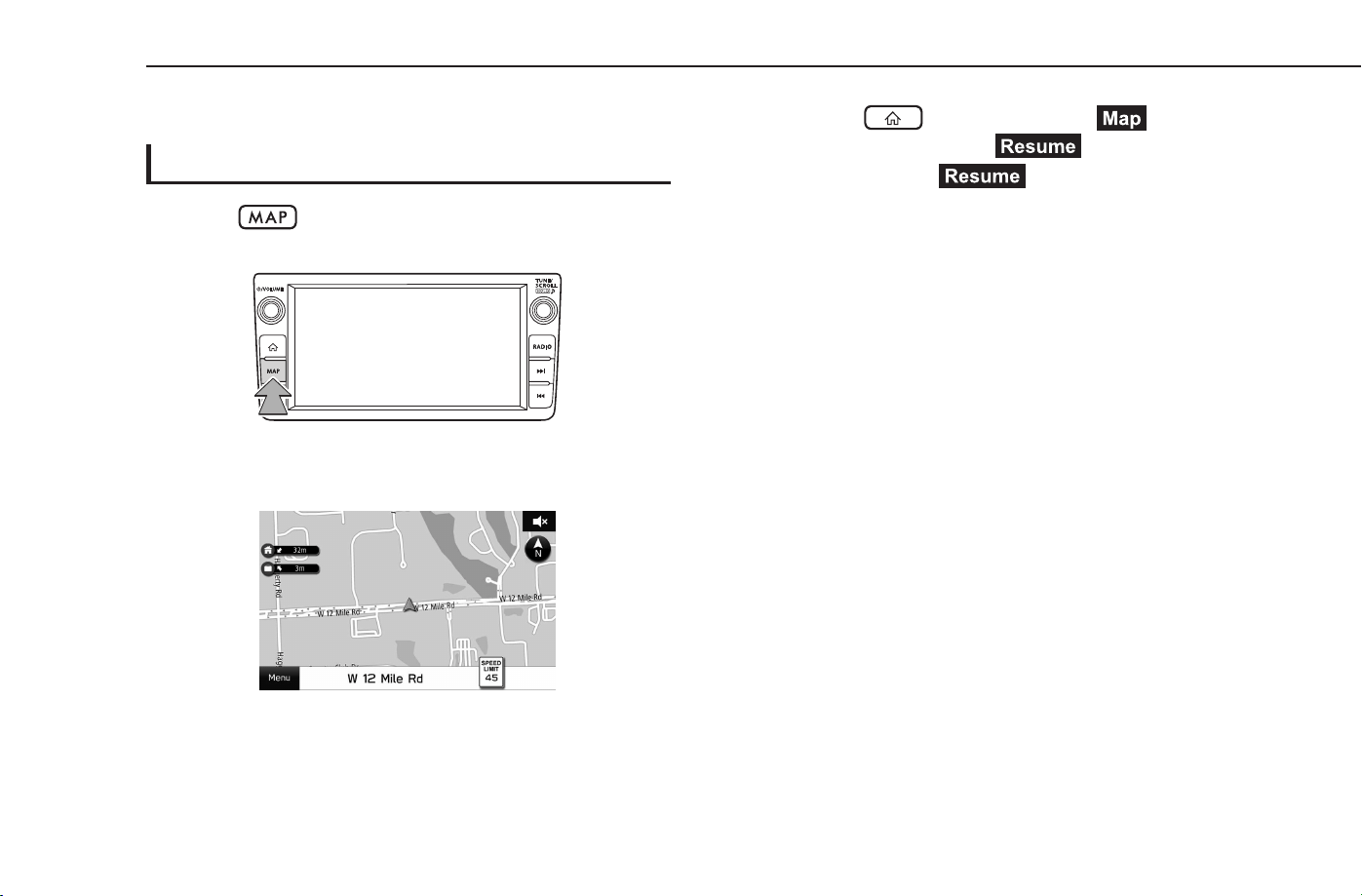
MAP SCREEN OPERATION
CURRENT POSITION DISPLAY
1.
Press .
2.
Check that the current position map is displayed.
● The current position map can also be displayed by
pressing
, and then selecting (Map).
● After moving the map,
(Resume) may be
displayed. Select
(Resume) to return to the
previous screen.
NOTE
l While driving, the current position mark is xed on the screen
and the map moves.
l The current position is automatically
set as the vehicle receives
signals from the GPS (Global Positioning System). If the current
position is not correct, it is automatically corrected after the
vehicle receives signals from the GPS.
l After the battery disconnection, or on a new vehicle, the current
position may not be correct. As soon as the system receives
signals from the GPS, the correct current position is displayed.
BASIC OPERATION
158
docstructure.indb 158 2019/05/31 11:46:49
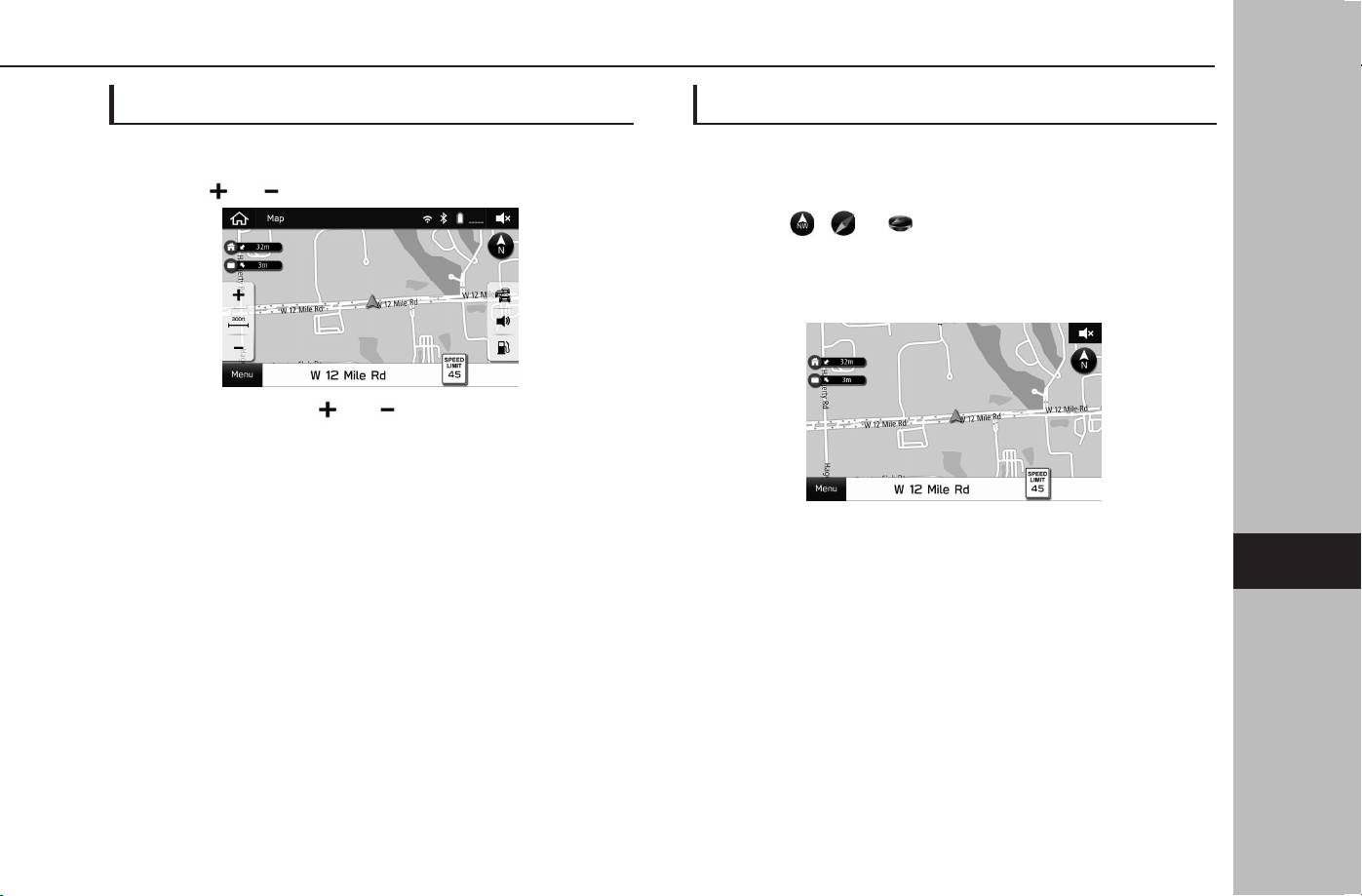
MAP SCALE
1.
Select any point on the map.
2.
Select or to change the scale of the map screen.
● Select and hold or to continue changing the
scale of the map screen.
● When the auto zoom function is ON (→P.180) during
route guidance, the map is enlarged automatically
when approaching intersections or turning points.
NOTE
l The scale of the map screen can also be changed with the
double touch or pinch operation. (→P.31)
ORIENTATION OF THE MAP
The orientation of the map can be changed between 2D
north-up, 2D heading-up, and 3D.
1.
Select , , or .
● Each time the symbol is selected, the orientation of
the map changes.
X2D north-up
● Regardless of the direction of vehicle travel, north is
always up.
● The letter(s) indicate the direction in which the vehicle
is heading (e.g. N for north).
BASIC OPERATION
159
Navigation System
7
docstructure.indb 159 2019/05/31 11:46:50
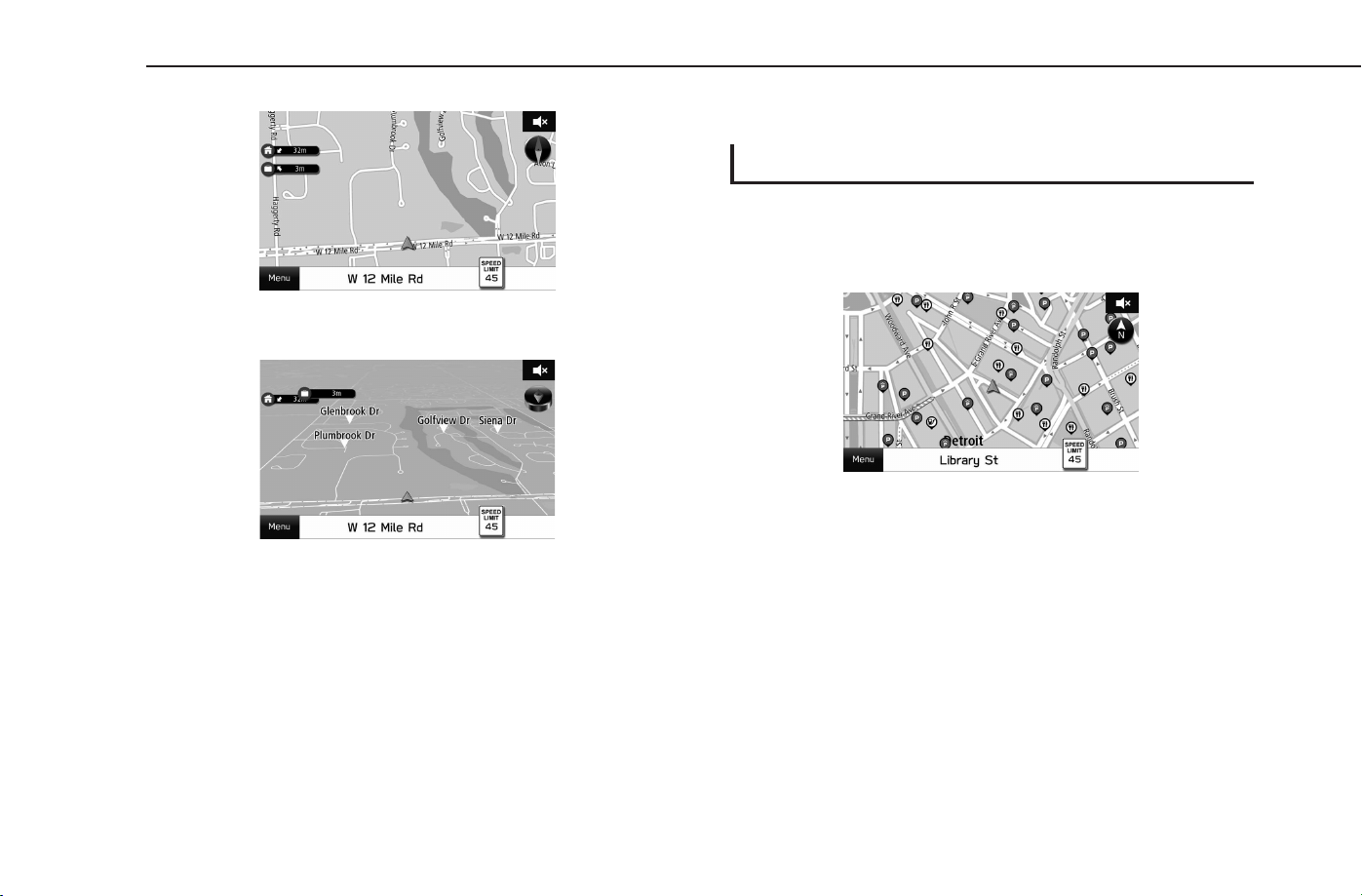
X2D heading-up
● The direction of vehicle travel is always up.
X3D heading-up
● The direction of vehicle travel is always up.
MAP SCREEN INFORMATION
POI ICONS
Points of Interest such as gas stations and restaurants can
be displayed on the map screen. Their location can also be
set as a destination.
● The display of POI icons can be turned on/off.
(→P.180)
BASIC OPERATION
160
docstructure.indb 160 2019/05/31 11:46:50
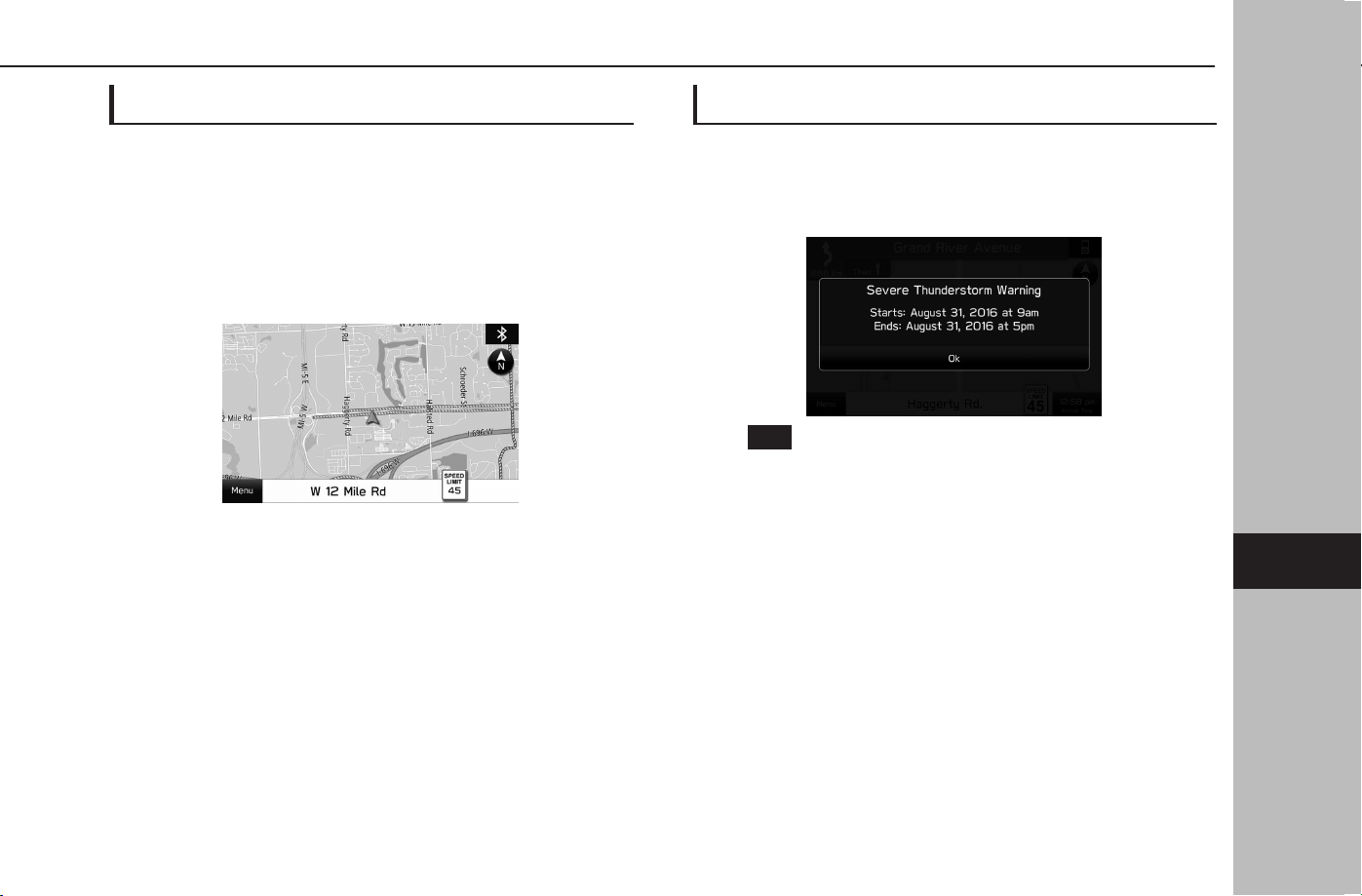
TRAFFIC INFORMATION
Road sections affected by trafc conditions are displayed in
a different color on the map, and a small icon representing
the type of trafc condition is displayed above the road.
To receive the data service information in the vehicle, a
subscription to the SiriusXM
®
Satellite Radio Service is
necessary following a free trial. (→P.129)
● The display of the trafc information can be turned on/
off. (→P.157)
OTHER INFORMATION
A pop-up screen will be displayed based on the driving
situation, etc.
XSevere weather warning
●
OK
(OK): Select to delete the message.
BASIC OPERATION
161
Navigation System
7
docstructure.indb 161 2019/05/31 11:46:51
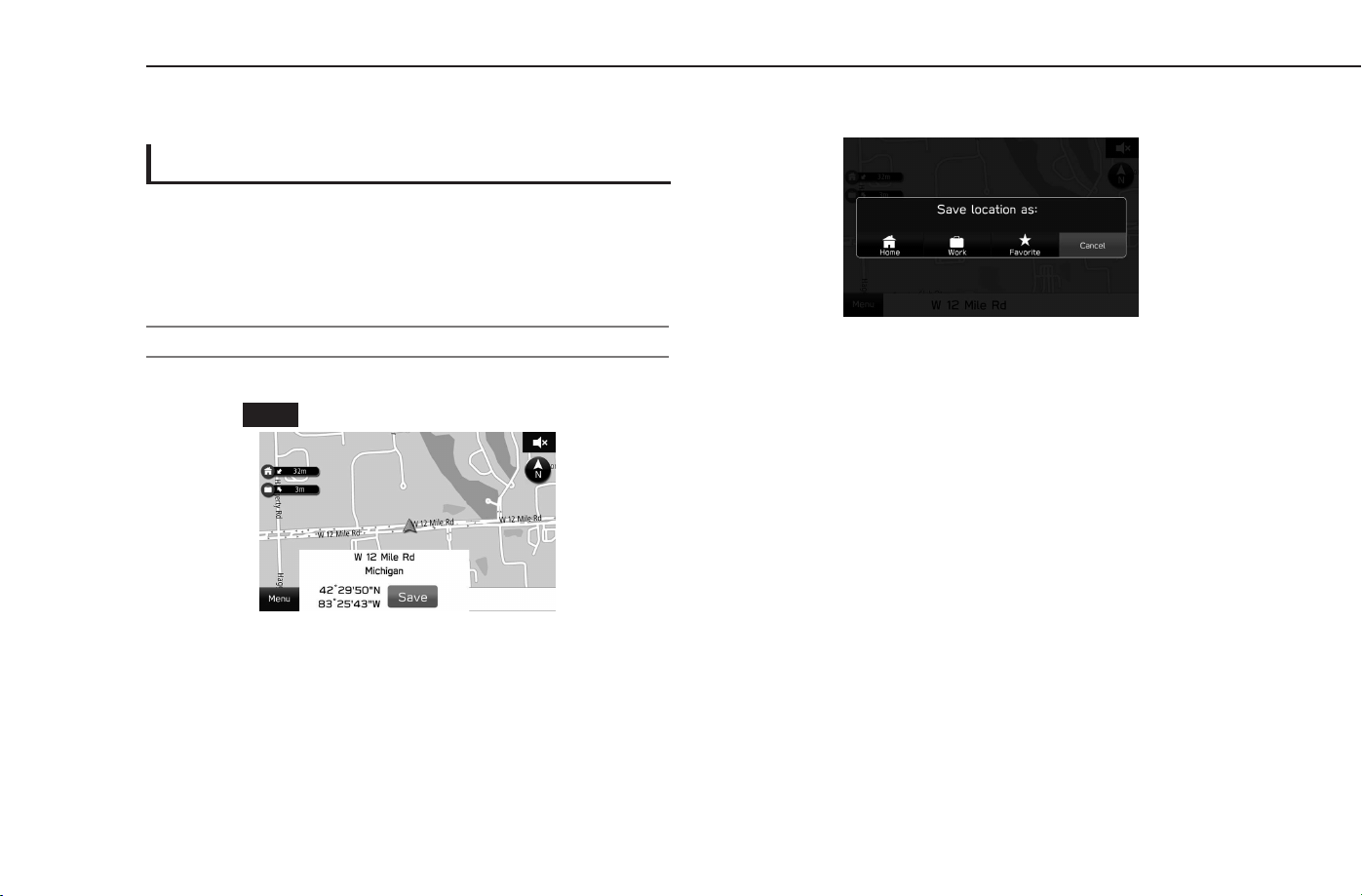
MEMORY POINTS
REGISTERING MEMORY POINTS
The desired point can be registered as home, work, or
favorite.
The registered points can be set as a destination.
REGISTERING THE CURRENT POINT
1.
Select the current street name.
2.
Select
Save
(Save).
3.
Select the item for which the street name is to be
registered.
● The point is registered in the favorite destinations list.
(→P.169)
● The icons are displayed on the map.
NOTE
l Home and work can also be registered from the navigation
settings screen. (→P.180)
l Favorite destinations can also be registered from the route
calculation screen. (→P.171)
BASIC OPERATION
162
docstructure.indb 162 2019/05/31 11:46:51
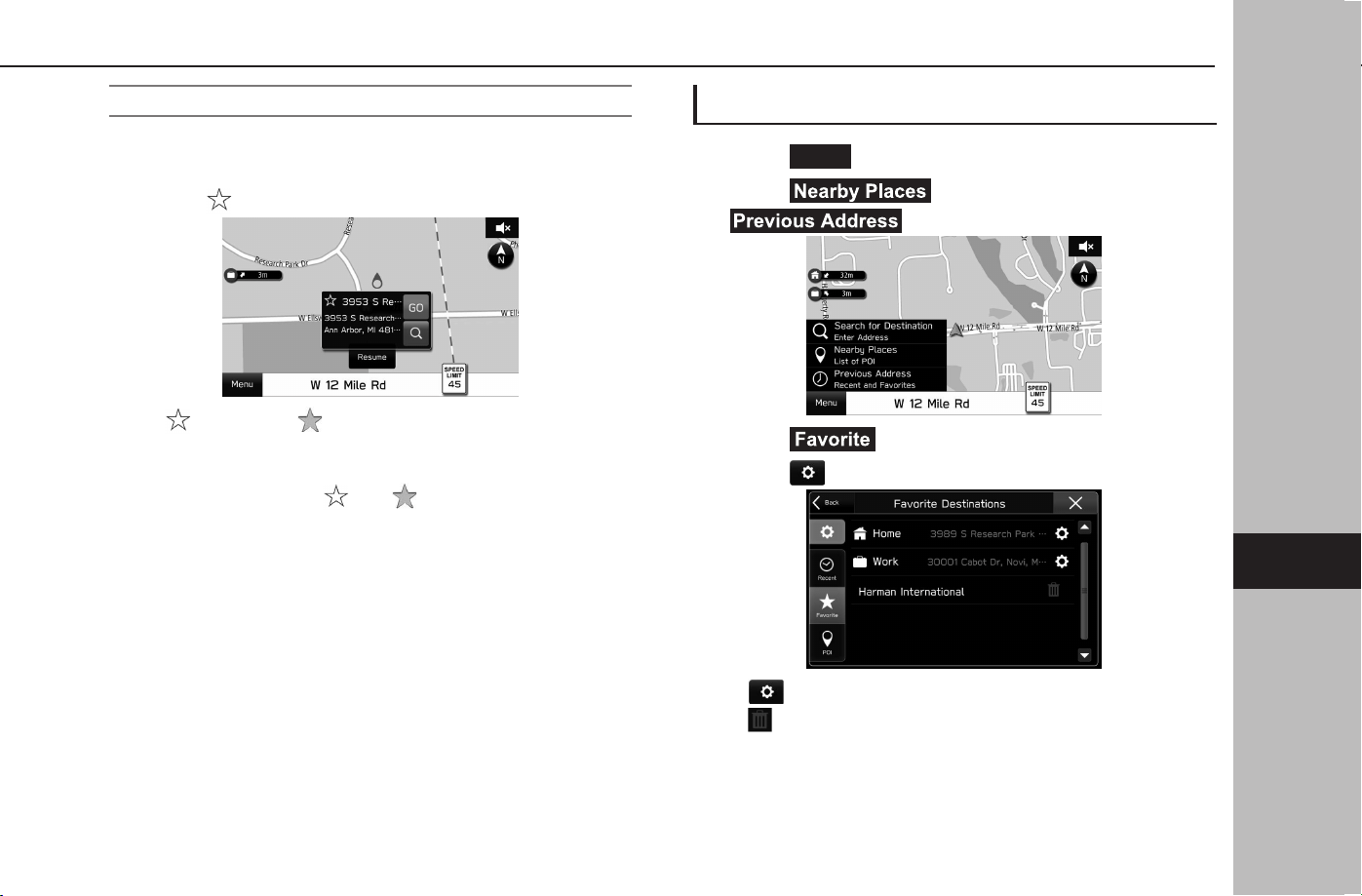
REGISTERING FROM THE MAP
1.
Select and hold the desired point on the map or POI
icon.
2.
Select .
● changes to (yellow), and the point is registered
in the favorite destinations list.
● Each time the symbol is selected, the symbol
changes between
and (yellow).
EDITING MEMORY POINTS
1.
Select
Menu
(Menu).
2.
Select (Nearby Places) or
(Previous Address).
3.
Select (Favorite).
4.
Select .
● : Select to edit home or work address. (→P.164)
●
: Select to delete the item. (→P.164)
● Select the destination to change the name. (→P.164)
BASIC OPERATION
163
Navigation System
7
docstructure.indb 163 2019/05/31 11:46:53
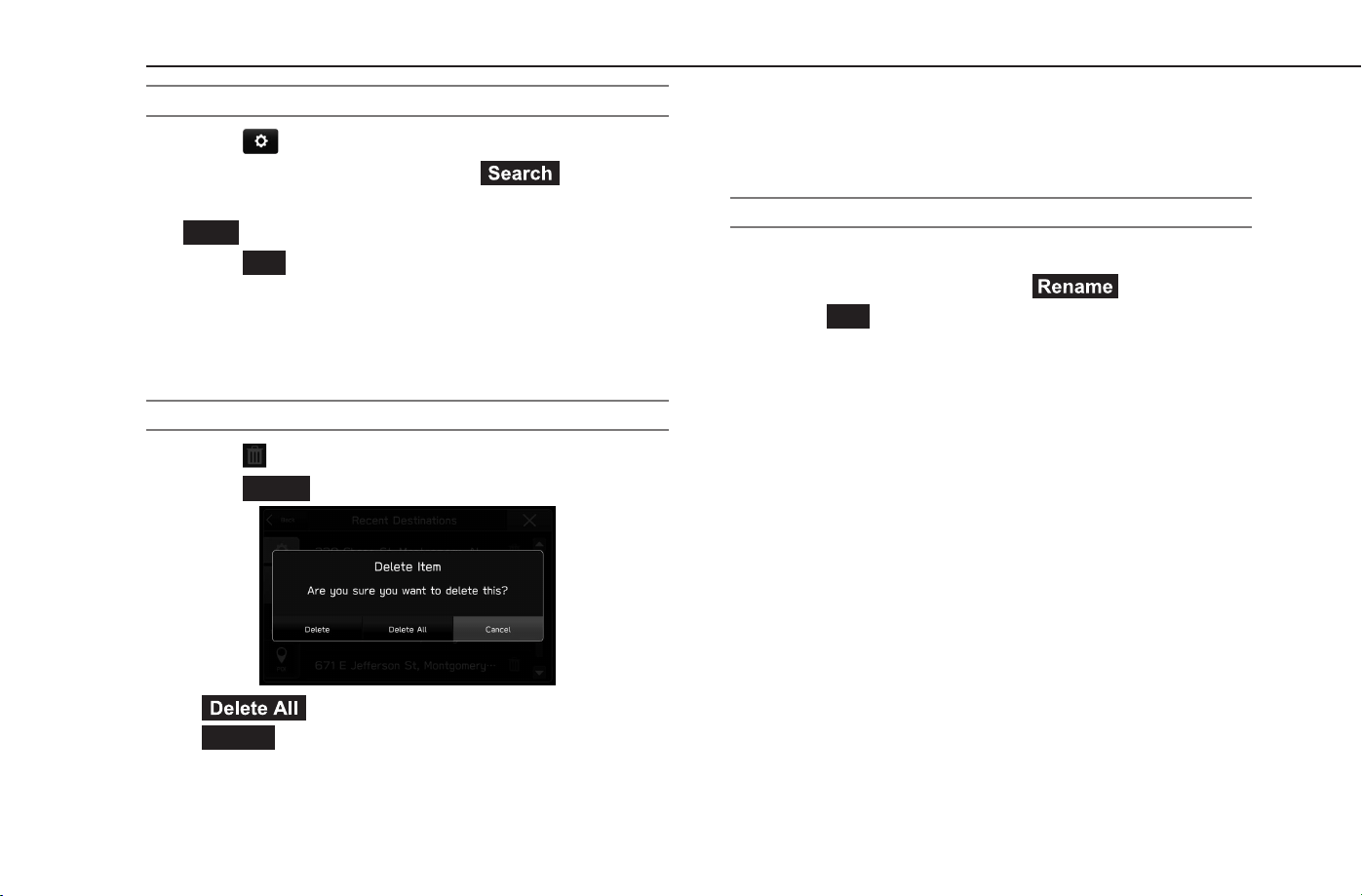
EDITING HOME OR WORK ADDRESS
1.
Select next to “Home” or “Work”.
2.
Enter an address, and then select (Search).
3.
Select the desired item from the list, and then select
Save
(Save).
4.
Select
OK
(OK).
NOTE
l Home and work can also be edited from the navigation settings
screen. (→P.180)
DELETING FAVORITE DESTINATIONS
1.
Select next to the desired item to be deleted.
2.
Select
Delete
(Delete).
● (Delete All): Select to delete all items.
●
Cancel
(Cancel): Select to cancel deleting.
NOTE
l Favorite can also be deleted from the route calculation screen.
(→P.171)
CHANGING THE FAVORITE DESTINATION NAME
1.
Select the desired destination to change the name.
2.
Enter a name, and then select (Rename).
3.
Select
OK
(OK).
BASIC OPERATION
164
docstructure.indb 164 2019/05/31 11:46:54
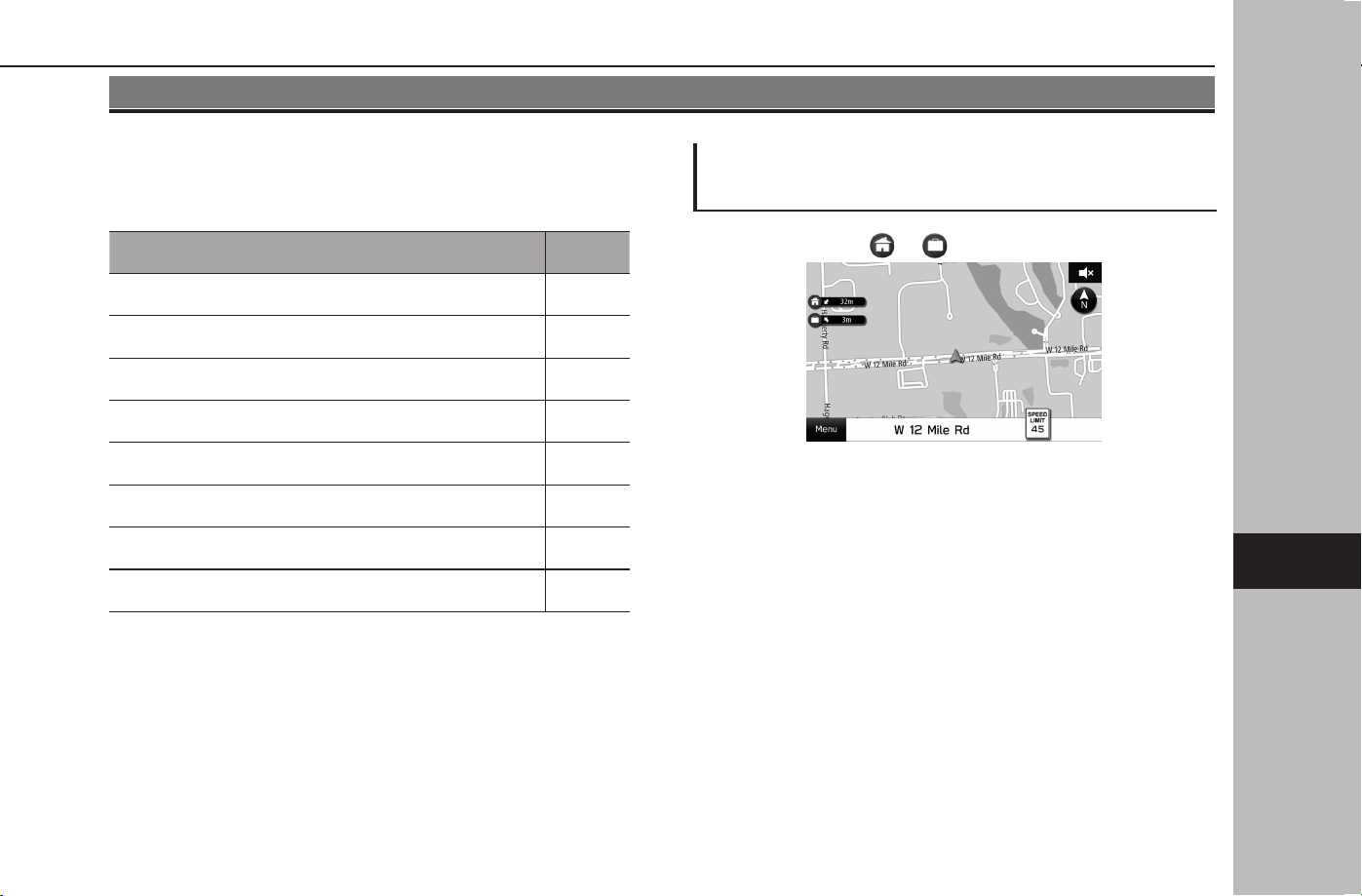
DESTINATION SEARCH
SEARCH OPERATION
There are several ways to search for a destination.
Function Page
Setting home or work as the destination 165
Searching on the map 166
Searching by entering a search word 166
Searching by POI 167
Searching from previously set destinations 168
Searching from the favorite destinations list 169
Searching for gas stations 170
Searching by phonebook 83
SETTING HOME OR WORK AS THE
DESTINATION
1.
Select and hold or .
● The estimated travel time and direction to the
destination is displayed next to the icon.
2.
Check that the route calculation screen is displayed.
(→P.171)
NOTE
l To use this function, it is necessary to register the entry.
(→P.162)
l Home and work can also be set as the destination from the
favorite destinations list. (→P.169)
DESTINATION SEARCH
165
Navigation System
7
docstructure.indb 165 2019/05/31 11:46:54
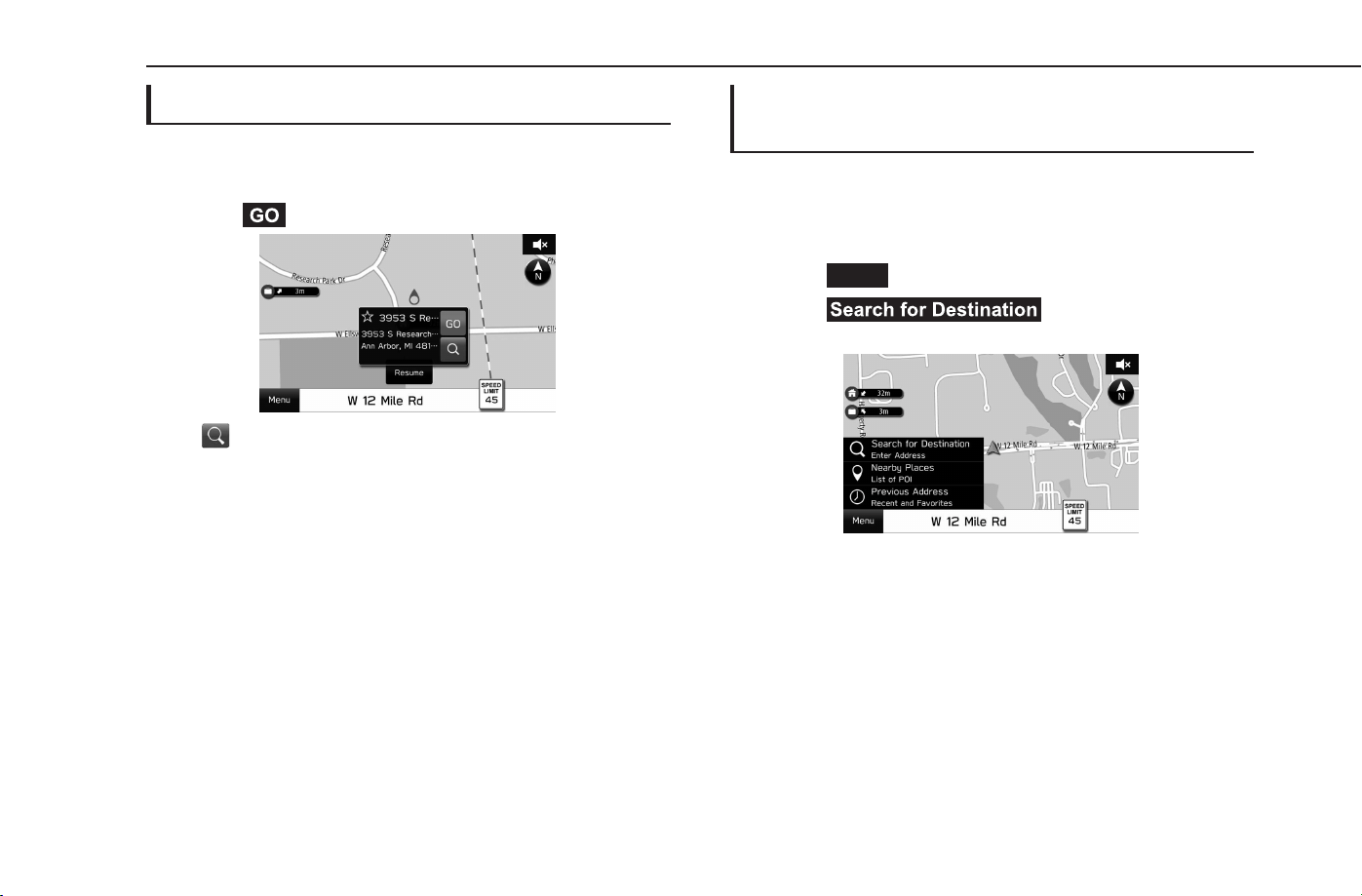
SEARCHING ON THE MAP
1.
Select and hold the desired point on the map or the POI
icon.
2.
Select (GO).
● : Select to search for a destination around the
point.
3.
Check that the route calculation screen is displayed.
(→P.171)
SEARCHING BY ENTERING A SEARCH
WORD
The destination can be set by entering a search word, for
example an address, a facility name, or latitude/longitude,
etc.
1.
Select
Menu
(Menu).
2.
Select (Search for
Destination).
DESTINATION SEARCH
166
docstructure.indb 166 2019/05/31 11:46:55
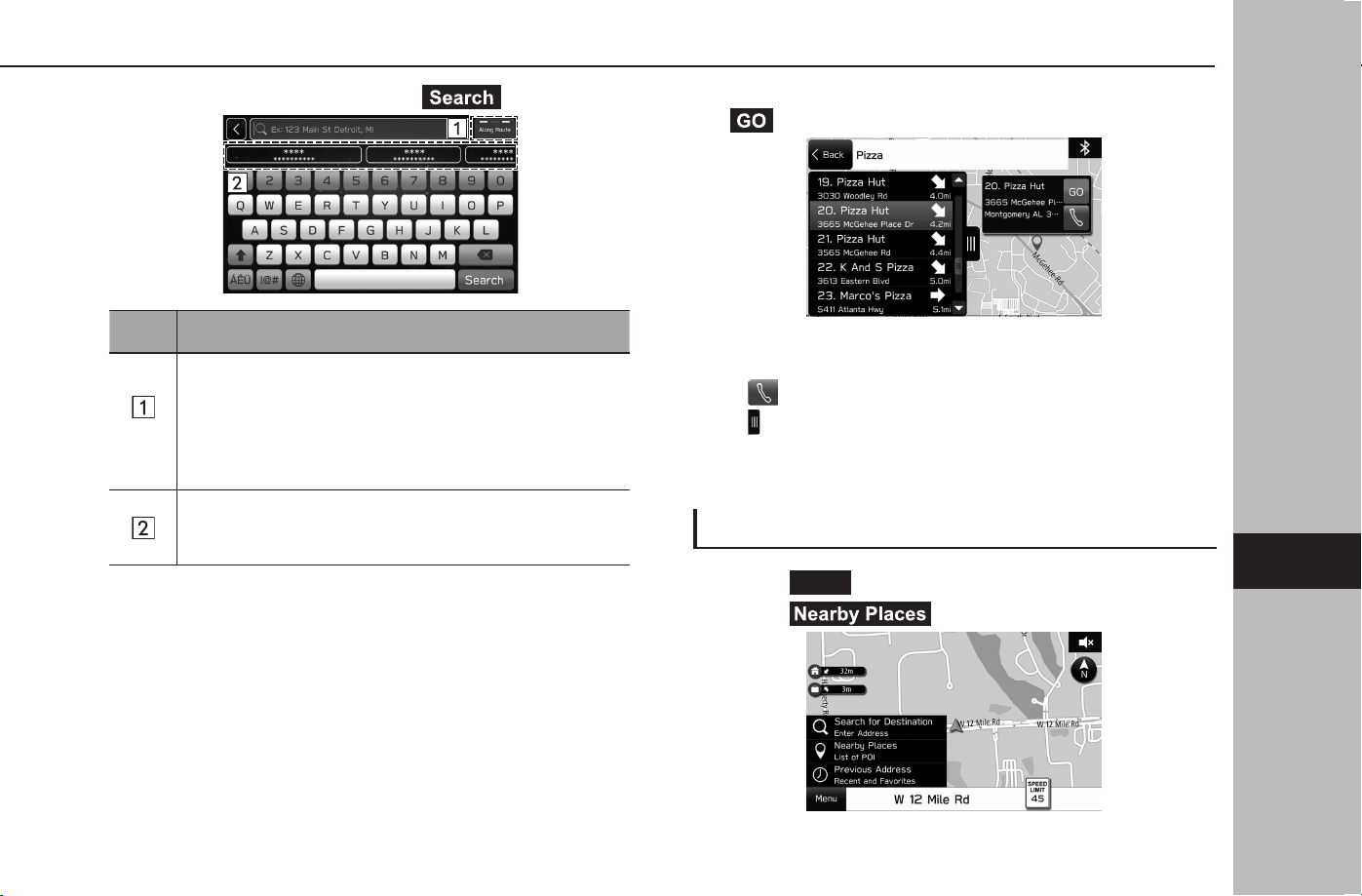
3.
Enter the word, and then select (Search).
No. Function
*
Select to set the radius lter. Once the radius lter has
been set, a search will only be performed for items
within the radius.
Each time the button is selected, the radius lter
changes between “Along Route”, “Near Destination”,
and “Near Me”.
Some candidate destinations are displayed based on
the input characters. The route calculation screen is
displayed when an item is selected.
*: During route guidance
4.
Select the desired item from the list, and then select
(GO).
● Select and hold the map to make ne adjustments to
the destination.
●
: Select to call the registered phone number.
●
: Select to open/close the list.
5.
Check that the route calculation screen is displayed.
(→P.171)
SEARCHING BY POI
1.
Select
Menu
(Menu).
2.
Select (Nearby Places).
DESTINATION SEARCH
167
Navigation System
7
docstructure.indb 167 2019/05/31 11:46:56
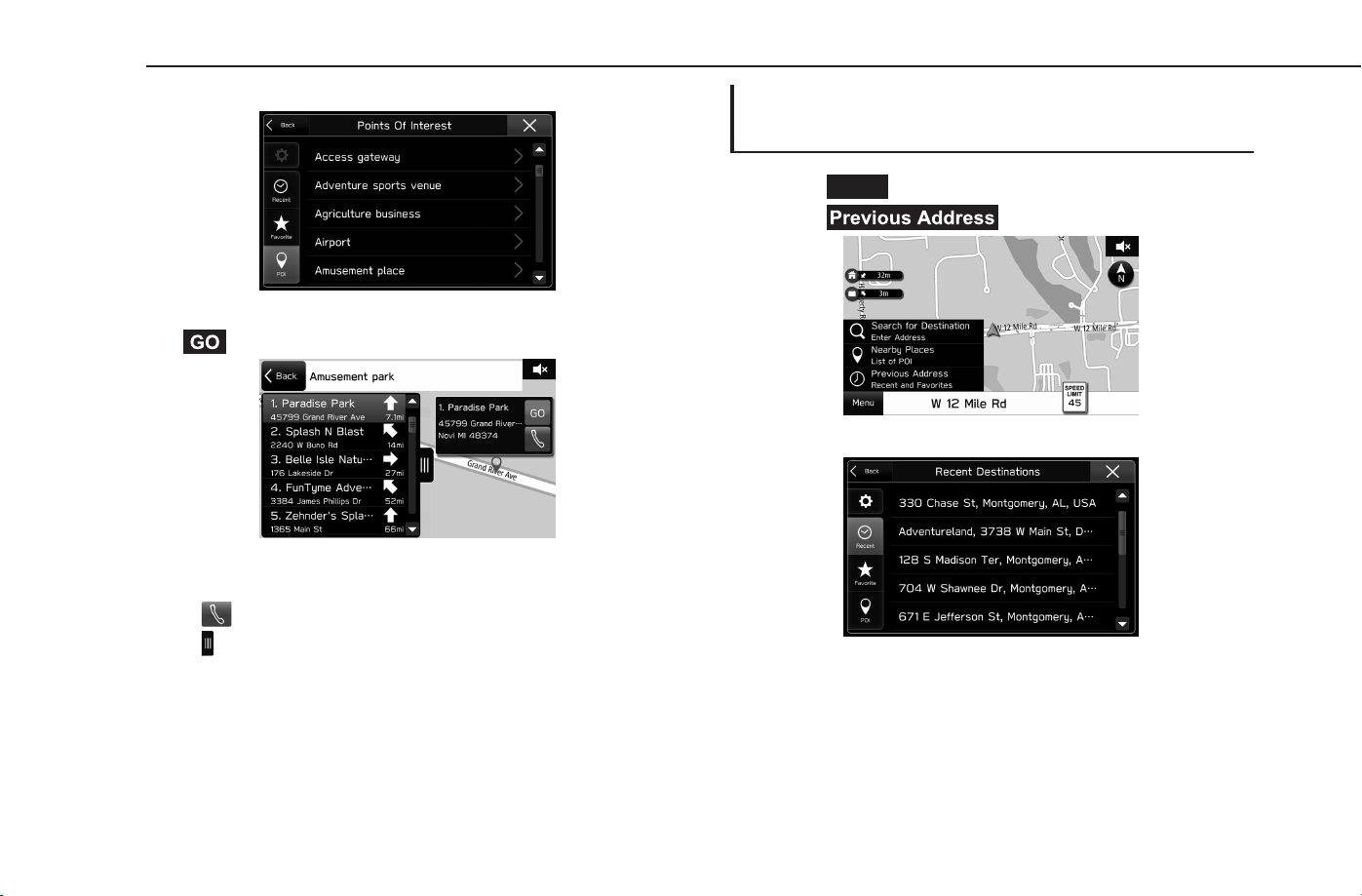
3.
Select the desired category.
4.
Select the desired item from the list, and then select
(GO).
● Select and hold the map to make ne adjustments to
the destination.
●
: Select to call the registered phone number.
●
: Select to open/close the list.
5.
Check that the route calculation screen is displayed.
(→P.171)
SEARCHING FROM PREVIOUSLY SET
DESTINATIONS
1.
Select
Menu
(Menu).
2.
Select (Previous Address).
3.
Select the desired item.
4.
Check that the route calculation screen is displayed.
(→P.171)
DESTINATION SEARCH
168
docstructure.indb 168 2019/05/31 11:46:56
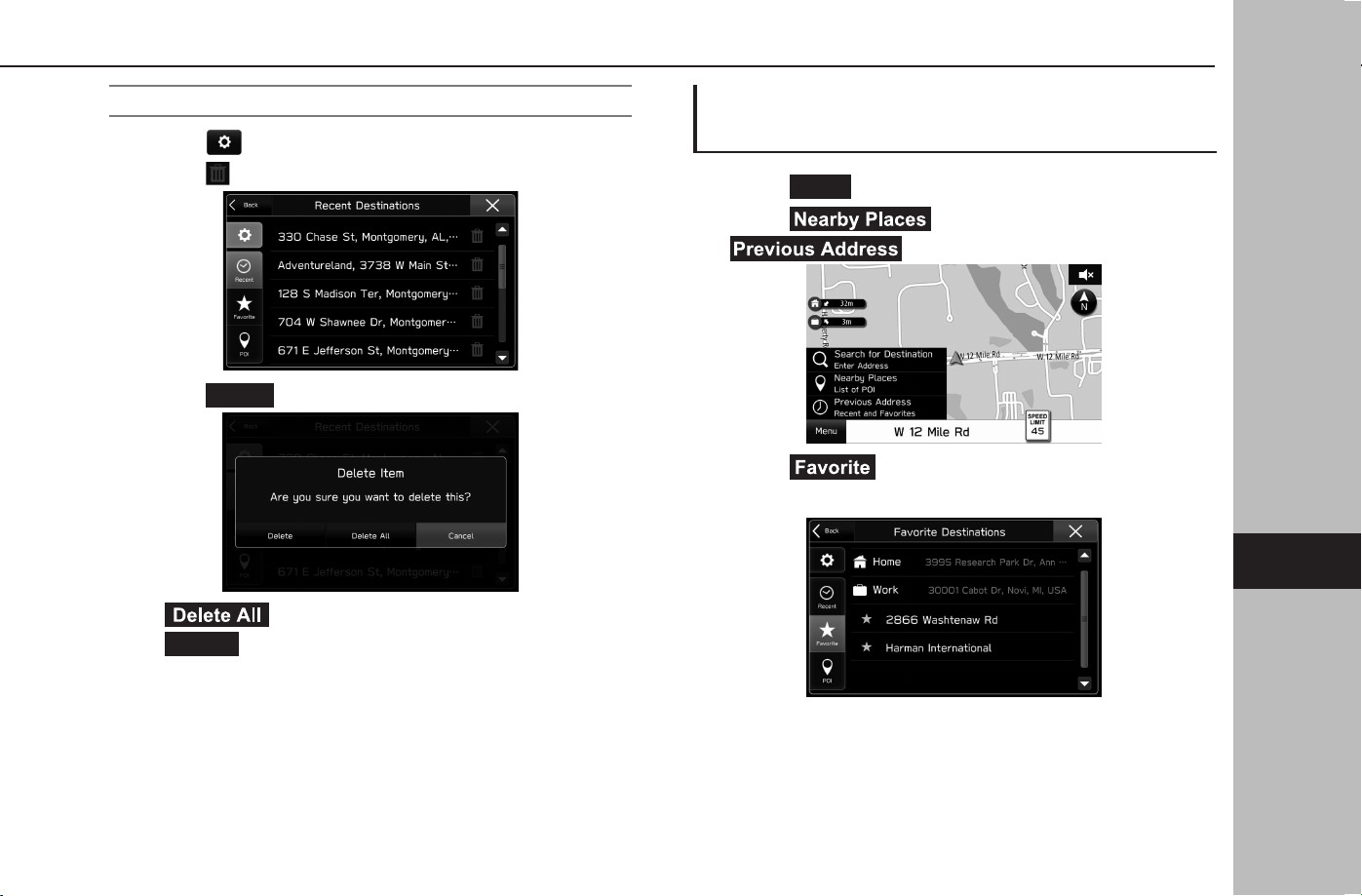
DELETING THE ITEM IN THE LIST
1.
Select on the “Recent Destinations” screen.
2.
Select next to the desired item to be deleted.
3.
Select
Delete
(Delete).
● (Delete All): Select to delete all items.
●
Cancel
(Cancel): Select to cancel deleting.
SEARCHING FROM THE FAVORITE
DESTINATIONS LIST
1.
Select
Menu
(Menu).
2.
Select (Nearby Places) or
(Previous Address).
3.
Select (Favorite).
4.
Select the desired item.
5.
Check that the route calculation screen is displayed.
(→P.171)
DESTINATION SEARCH
169
Navigation System
7
docstructure.indb 169 2019/05/31 11:46:57
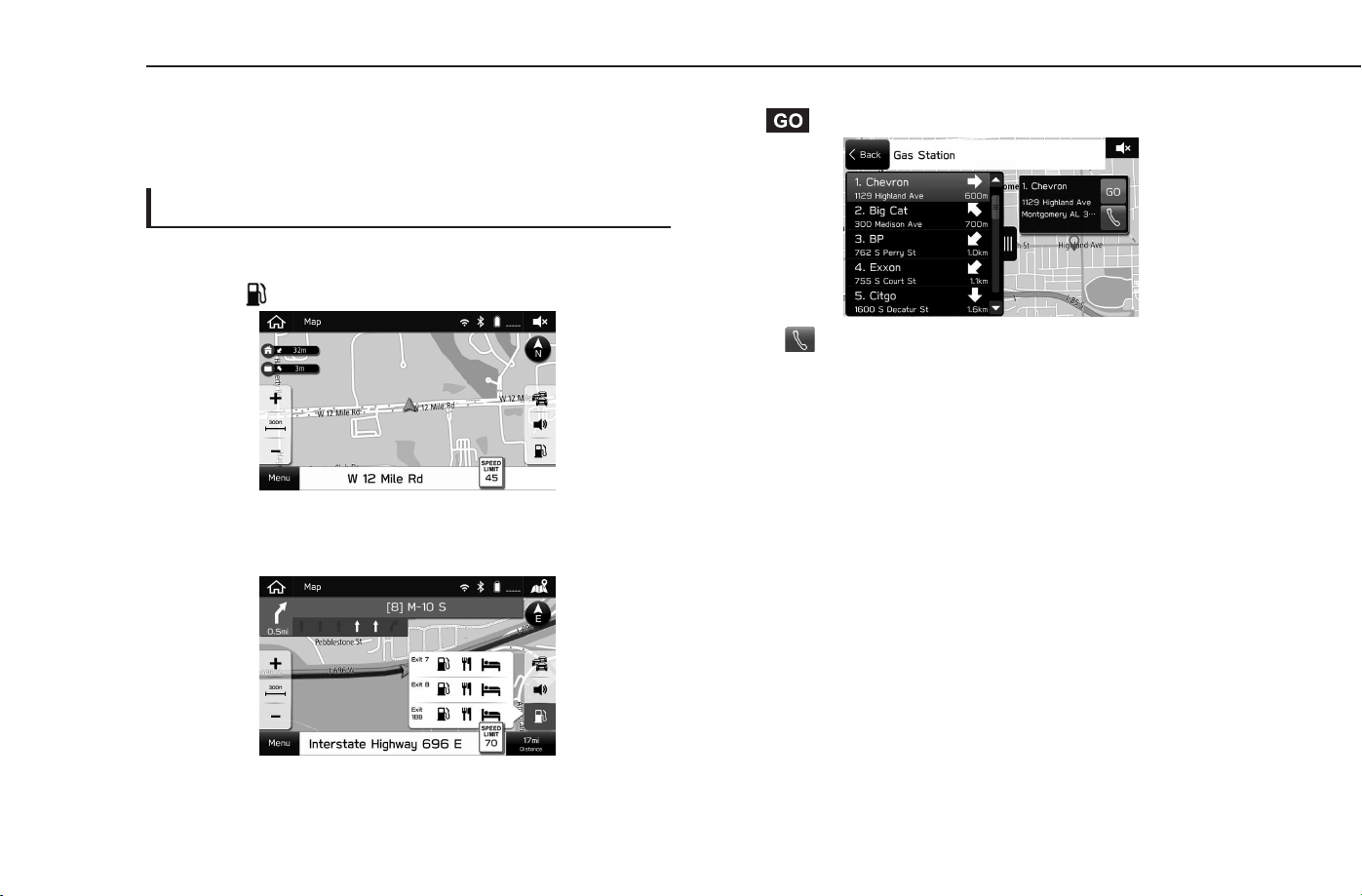
NOTE
l To use this function, it is necessary to register the entry.
(→P.162)
SEARCHING FOR GAS STATIONS
1.
Select any point on the map.
2.
Select .
● When driving on the highway during route guidance,
information on gas stations, restaurants, or rest areas
near the next three highway exits will be displayed.
3.
Select the desired item from the list, and then select
(GO).
● : Select to call the registered phone number.
4.
Check that the route calculation screen is displayed.
(→P.171)
DESTINATION SEARCH
170
docstructure.indb 170 2019/05/31 11:46:57
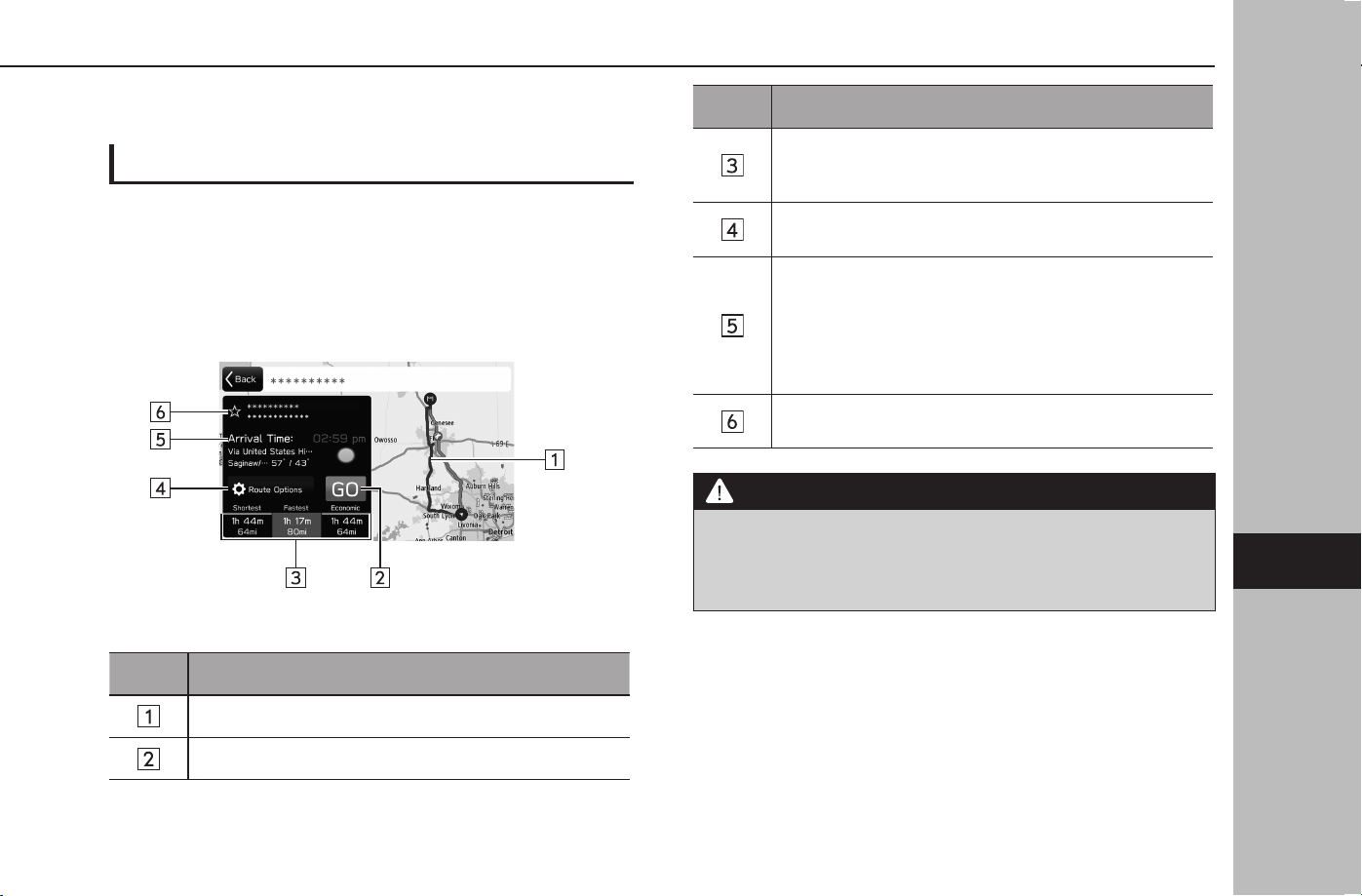
ROUTE CALCULATION
ROUTE CALCULATION SCREEN
After searching for the destination, the route calculation
screen will be displayed.
No. Information/Function
Displays the route overview.
Select to start route guidance.
No. Information/Function
Select one of the three recommended routes.
The route type (→P.180) set in Route Settings is
displayed in blue.
Select to set the avoidance criteria for the current
route. (→P.172)
Displays the arrival time.
If SiriusXM Travel Link is available,
the weather icon
name, name of the weather station closest to the
destination, and the High/Low temperature for that
location will be displayed.
For details on SiriusXM T
ravel Link: →P.113
Select to register the point in the favorite destinations
list. (→P.169)
WARNING
l Be sure to obey trafc regulations and keep road conditions
in mind while driving. If a trafc sign on the road has been
changed, the route guidance may not indicate such changed
information.
NOTE
l The route for returning may not be the same as that for going.
l The route guidance to the destination may not be the shortest
route or a route without trafc congestion.
l Route guidance may not be available if there is no road data for
the specied location.
DESTINATION SEARCH
171
Navigation System
7
docstructure.indb 171 2019/05/31 11:46:58
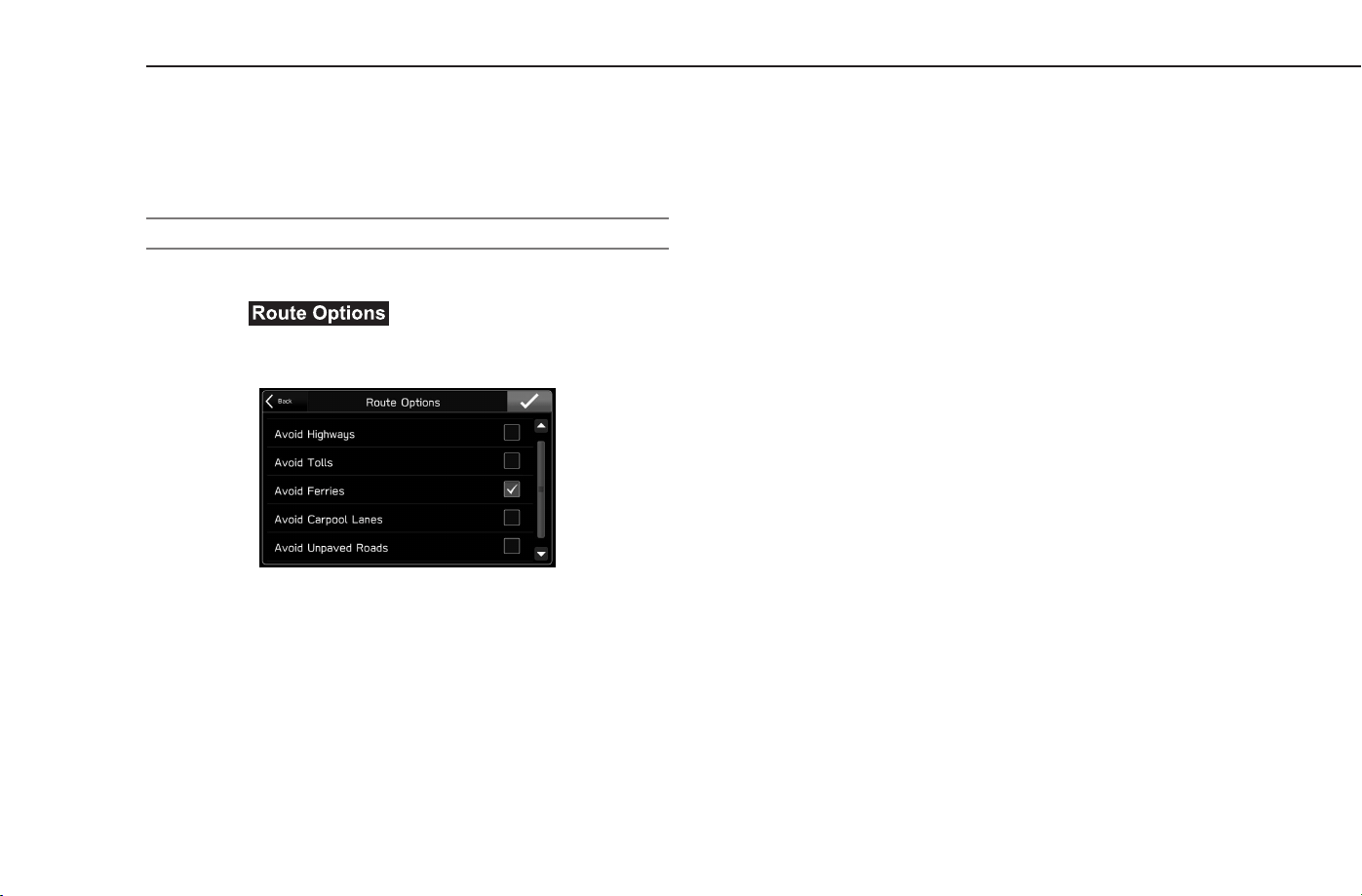
NOTE
l If a destination that is not located on a road is set, the vehicle will
be guided to the point on a road nearest to the destination. The
road nearest to the selected point is set as the destination.
ROUTE SETTINGS SCREEN
The avoidance criteria for the route calculation can be set.
1.
Select (Route Options) on the route
calculation screen.
2.
Select the desired item.
NOTE
l The avoidance criteria for the route calculation can also be set
from the navigation settings screen. (→P.180)
DESTINATION SEARCH
172
docstructure.indb 172 2019/05/31 11:46:58
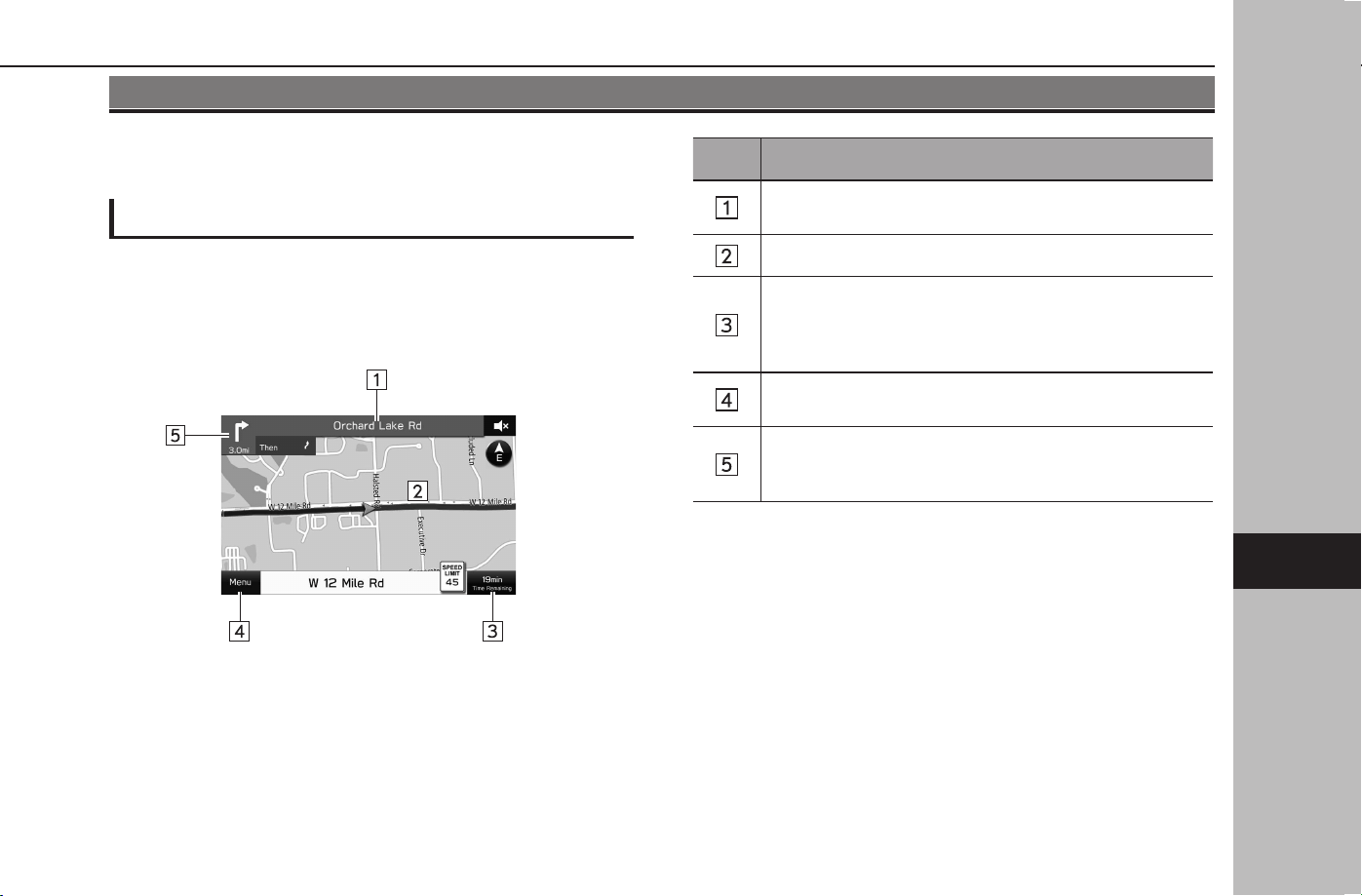
ROUTE GUIDANCE
ROUTE GUIDANCE
ROUTE GUIDANCE SCREEN
During route guidance, various types of guidance screens
can be displayed depending on conditions.
No. Information/Function
Displays the next street name.
Select to display the turn/itinerary list. (→P.176, 178)
Displays the guidance route.
Displays the distance, the estimated travel time to
the destination, or the estimated arrival time at the
destination. Select the information box, and then select
the desired information.
Select to search for a destination or stop route guidance.
(→P.179)
Displays the distance to the next turn with an arrow
indicating the turn direction.
Select to play the navigation announcement.
ROUTE GUIDANCE
173
Navigation System
7
docstructure.indb 173 2019/05/31 11:46:58
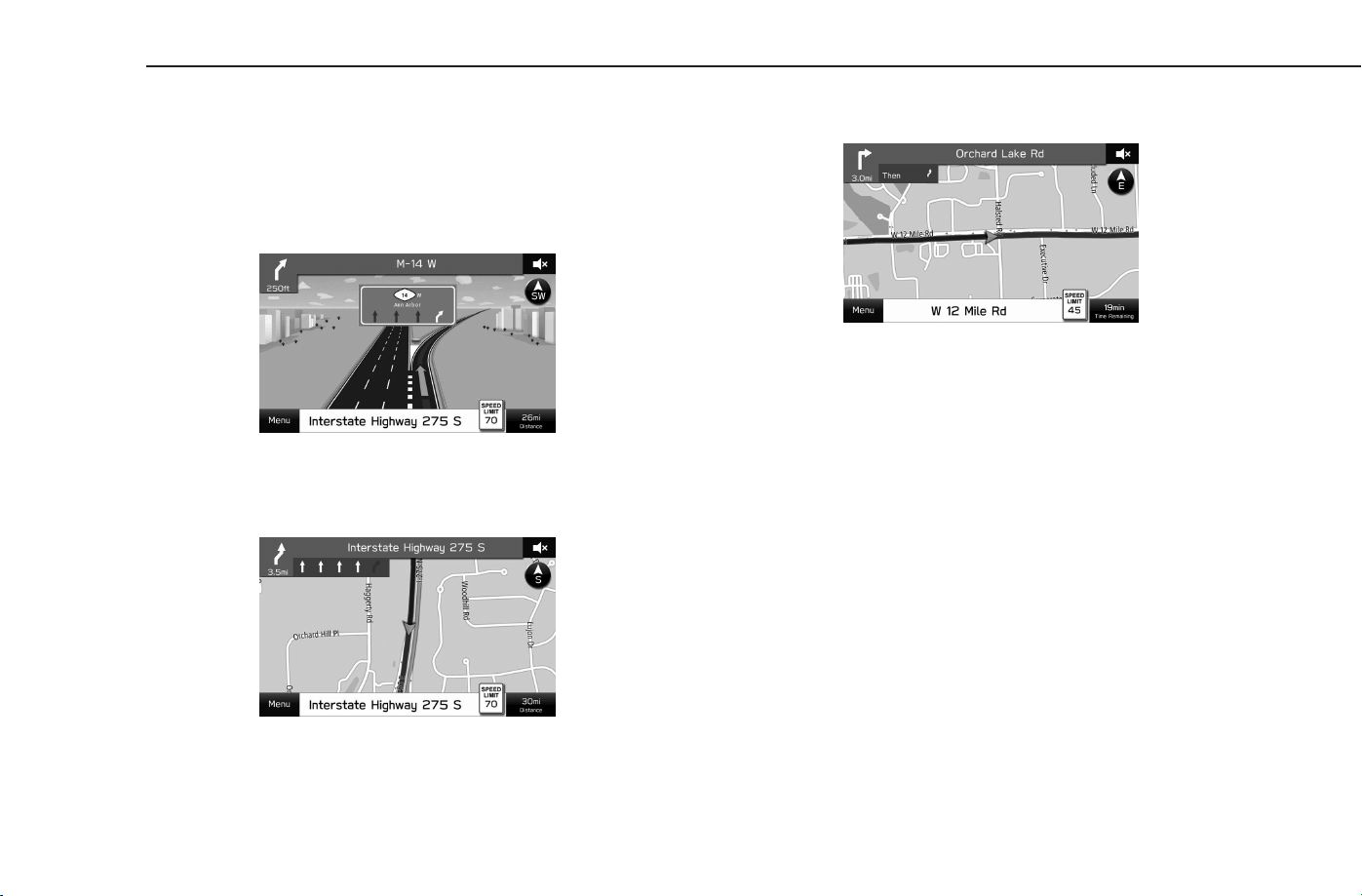
XJunction screen
When approaching an expressway exit or a complicated
intersection, the map switches to a 3D display if the
necessary information can be displayed. An arrow indicates
the lane in which you should drive. Signs are also displayed
if the information is available.
XLane recommendation screen
When approaching a turning point, the lane
recommendation will be displayed automatically.
“Then” will be displayed if necessary to turn again
immediately after a turn.
XAuto zoom screen
When the auto zoom function is ON (→P.180), the map is
enlarged automatically when approaching intersections or
turning points.
NOTE
l If the vehicle goes off the guidance route, the route is searched
again.
l For some areas, the roads have not been completely digitized in
our database. For this reason, the route guidance may select a
road that should not be traveled on.
ROUTE GUIDANCE
174
docstructure.indb 174 2019/05/31 11:46:58
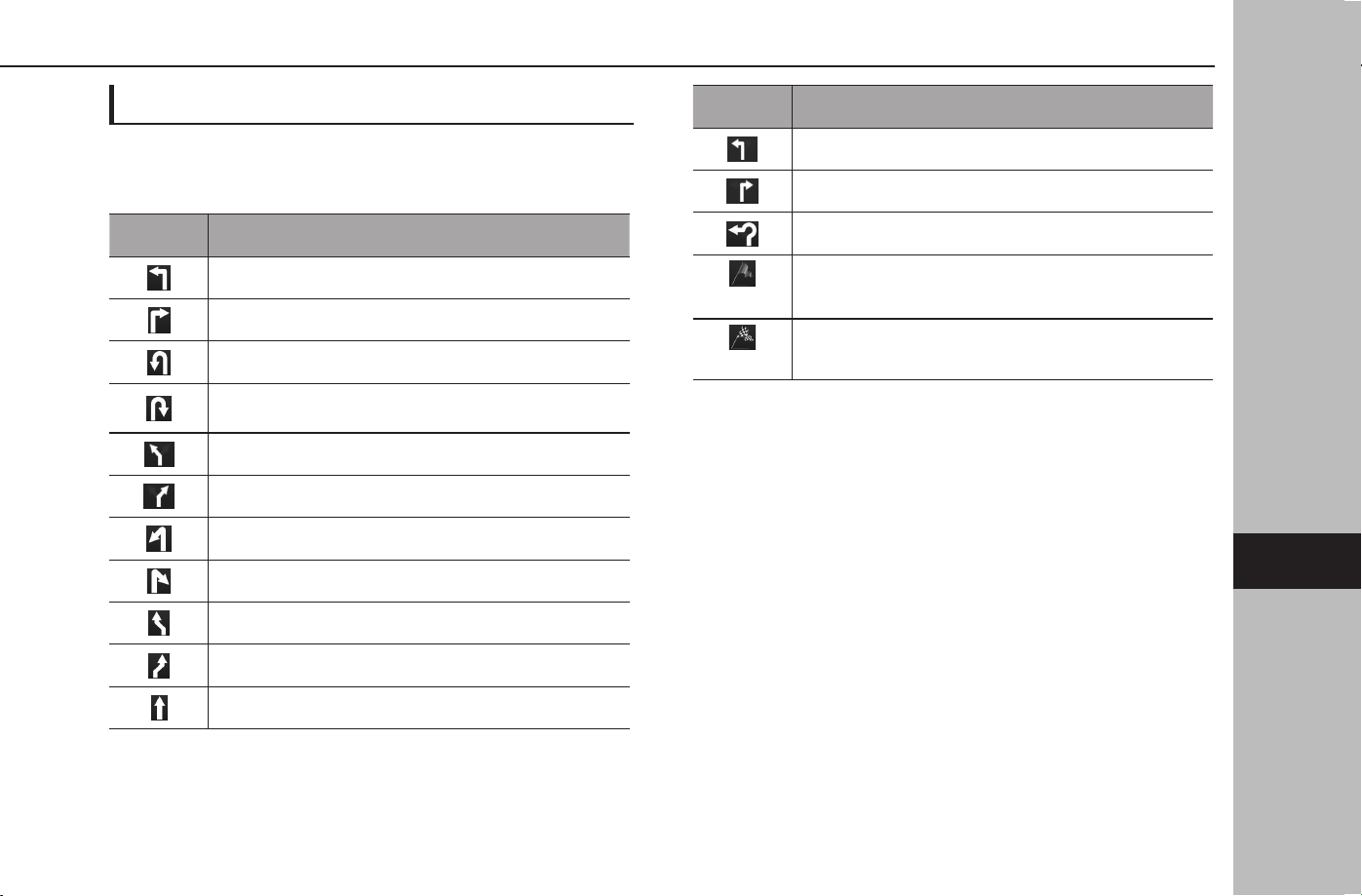
STANDARD MAP ICON
The following table shows the most frequently displayed
route events.
Icon Explanation
Turn left
Turn right
U-turn left
U-turn right
Keep left at the fork in the road.
Keep right at the fork in the road.
Turn left & sharp curve.
Turn right & sharp curve.
Stay in the left lane.
Stay in the right lane.
Go straight ahead at the intersection.
Icon Explanation
Turn left at the T junction.
Turn right at the T junction.
Go left at the roundabout.
(blue)
You are half way to your destination.
(checkered)
You have arrived at your destination.
ROUTE GUIDANCE
175
Navigation System
7
docstructure.indb 175 2019/05/31 11:46:59
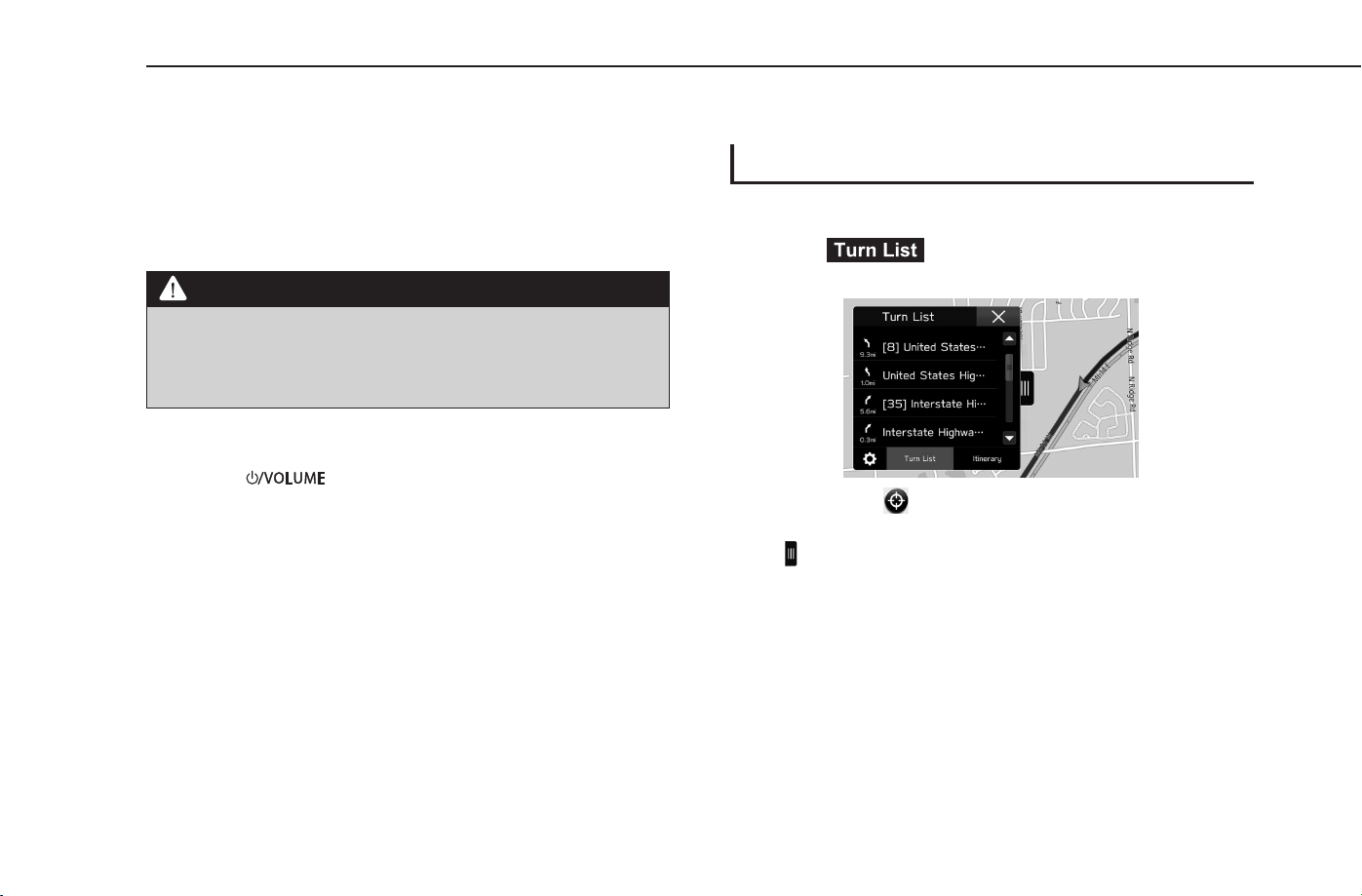
TYPICAL VOICE GUIDANCE
PROMPTS
As the vehicle approaches an intersection, or point, where
maneuvering the vehicle is necessary, the system’s voice
guidance will provide various messages.
WARNING
l Be sure to obey the trafc regulations and keep the road
condition in mind especially when you are driving on IPD
roads. The route guidance may not have the updated
information such as the direction of a one way street.
NOTE
l Turn the “ ” knob, or use the volume control switch on
the steering wheel to adjust the voice guidance volume.
l The voice guidance volume can also
be adjust from the sound
settings screen. (→P.73)
l Voice guidance may be made early or late.
l If the system cannot determine the current position correctly,
you may not hear voice guidance or may not see the magnied
intersection on the screen.
ROUTE RELATED FUNCTIONS
CHECKING THE ROUTE
1.
Select the next street name. (→P.173)
2.
Select (Turn List).
3.
Select the item for which the route is to be checked.
● Select the displayed when the map is moved to
display a screen showing all routes.
●
: Select to close the list and display the screen
showing all routes.
ROUTE GUIDANCE
176
docstructure.indb 176 2019/05/31 11:47:00
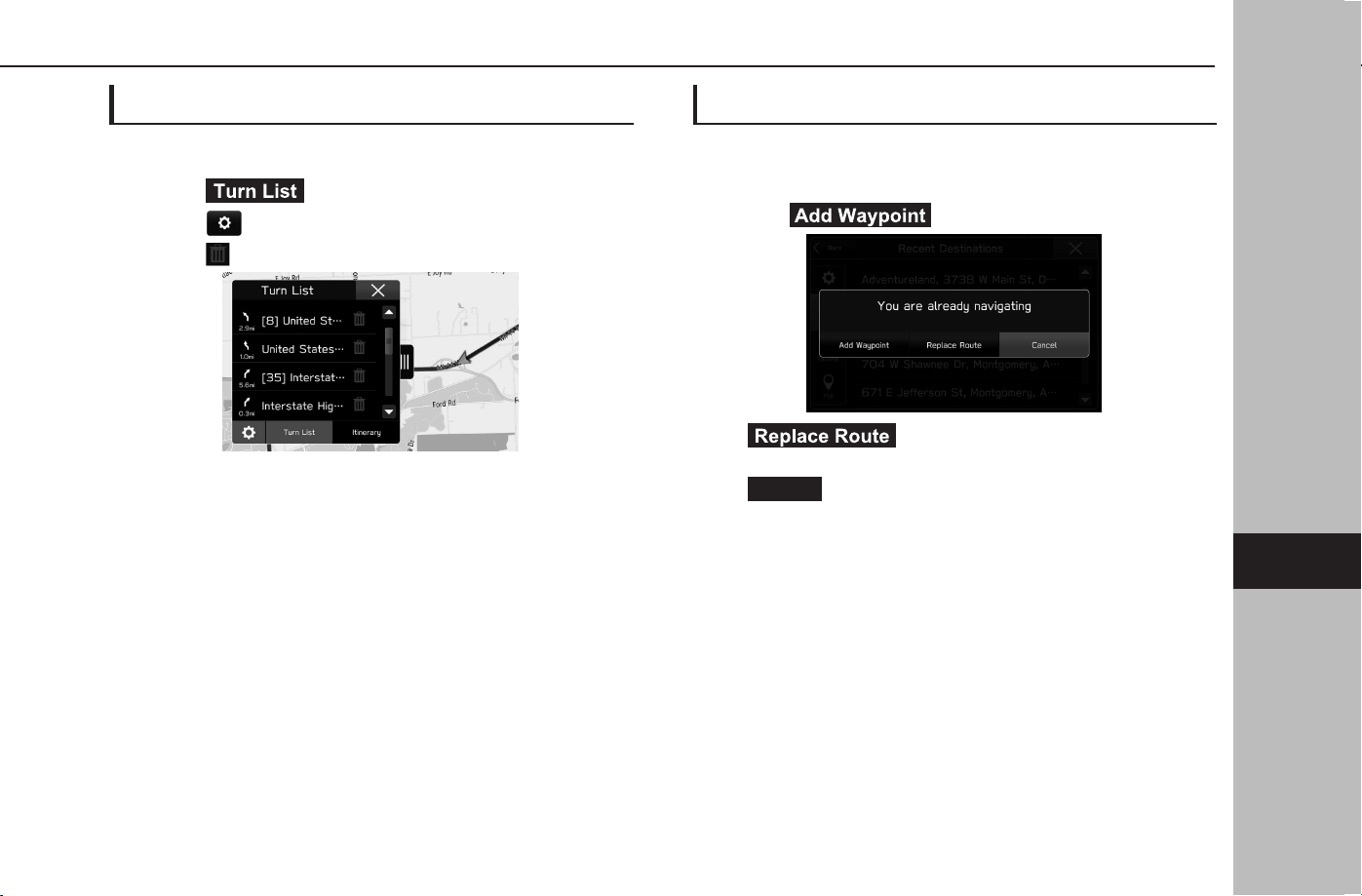
EDITING ROUTE
1.
Select the next street name. (→P.173)
2.
Select (Turn List).
3.
Select .
4.
Select next to the desired item to be deleted.
● The route will be recalculated automatically.
ADDING DESTINATIONS
1.
Search for an additional destination in the same way as
a destination search. (→P.165)
2.
Select (Add Waypoint).
● (Replace Route): Select to replace
the existing destination with a new one.
●
Cancel
(Cancel): Select to cancel adding
destinations.
● The route will be recalculated automatically.
NOTE
l The last entered destination is added as the rst destination. The
destination order can be changed. (→P.178)
ROUTE GUIDANCE
177
Navigation System
7
docstructure.indb 177 2019/05/31 11:47:00
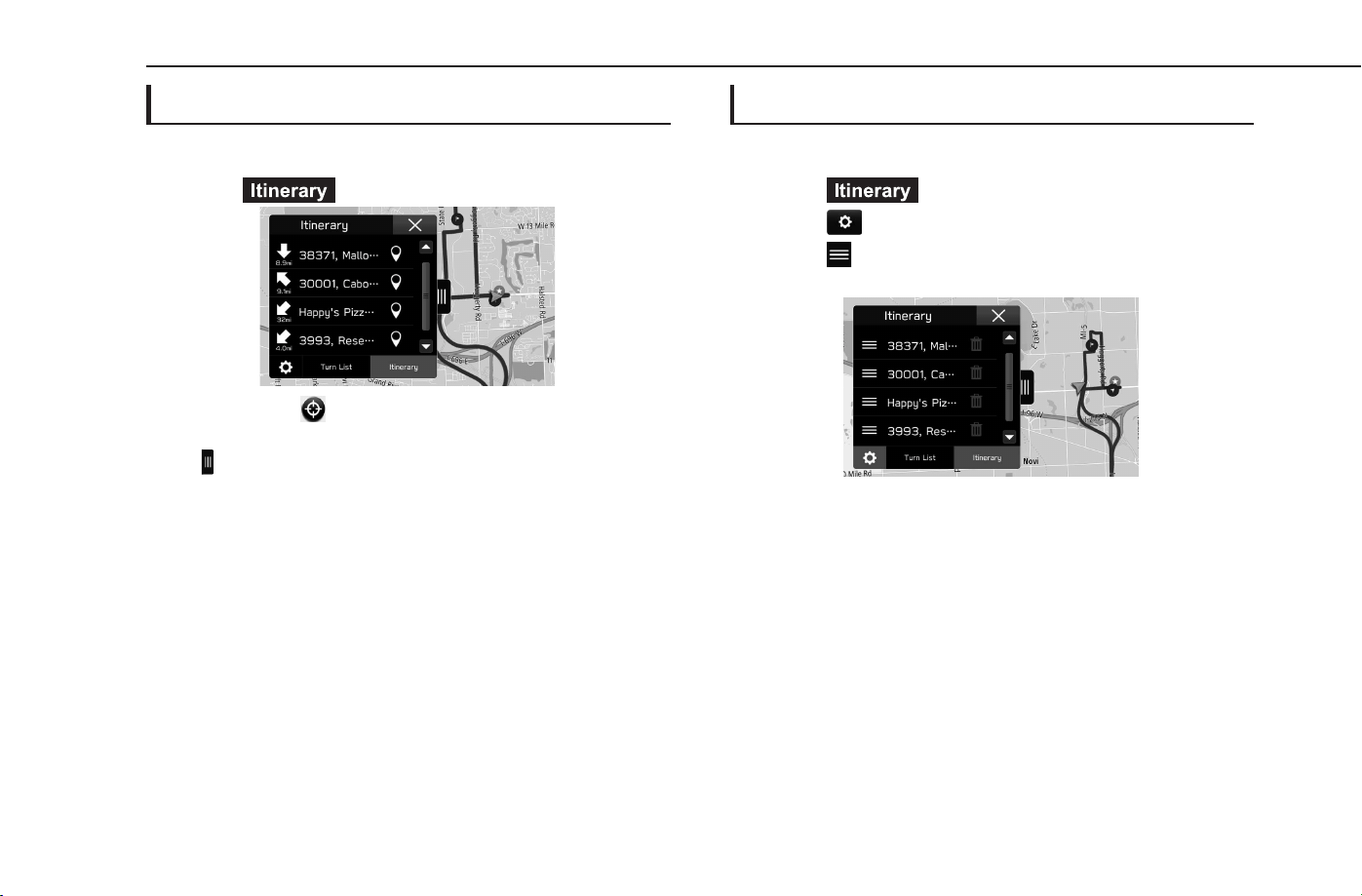
CHECKING THE ITINERARY
1.
Select the next street name. (→P.173)
2.
Select (Itinerary).
● Select the displayed when the map is moved to
display a screen showing all routes.
●
: Select to close the list and display the screen
showing all routes.
REORDERING DESTINATIONS
1.
Select the next street name. (→P.173)
2.
Select (Itinerary).
3.
Select .
4.
Select next to the desired destination, and then drag
it to the desired position.
● The route will be recalculated automatically.
ROUTE GUIDANCE
178
docstructure.indb 178 2019/05/31 11:47:01
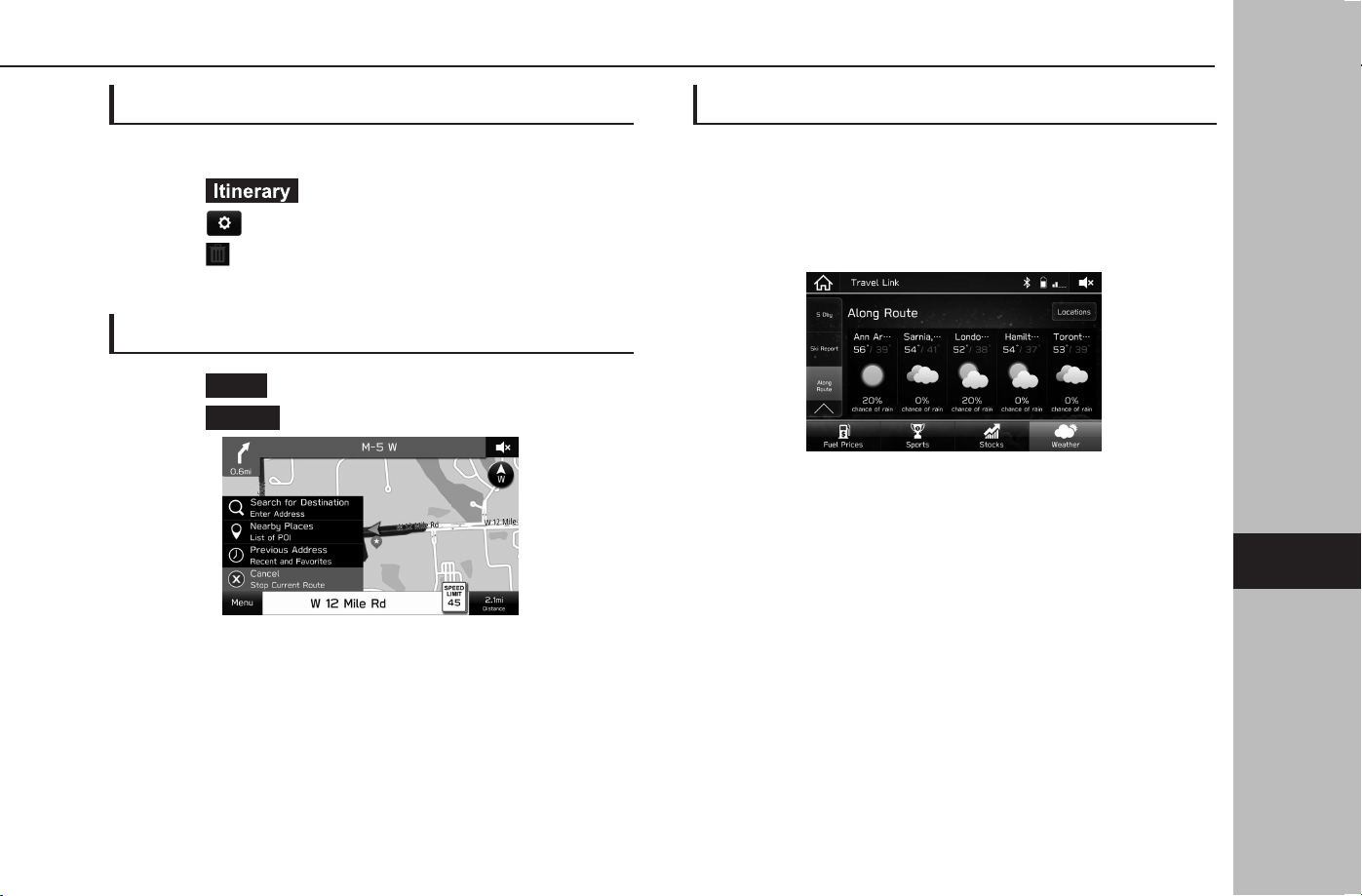
DELETING DESTINATIONS
1.
Select the next street name. (→P.173)
2.
Select (Itinerary).
3.
Select .
4.
Select next to the desired item to be deleted.
● The route will be recalculated automatically.
STOPPING ROUTE GUIDANCE
1.
Select
Menu
(Menu).
2.
Select
Cancel
(Cancel).
WEATHER INFORMATION
“At Destination” and “Along Route” weather information can
be checked during route guidance using the SiriusXM Travel
Link function.
For details
on SiriusXM T
ravel Link: →P.113
ROUTE GUIDANCE
179
Navigation System
7
docstructure.indb 179 2019/05/31 11:47:01
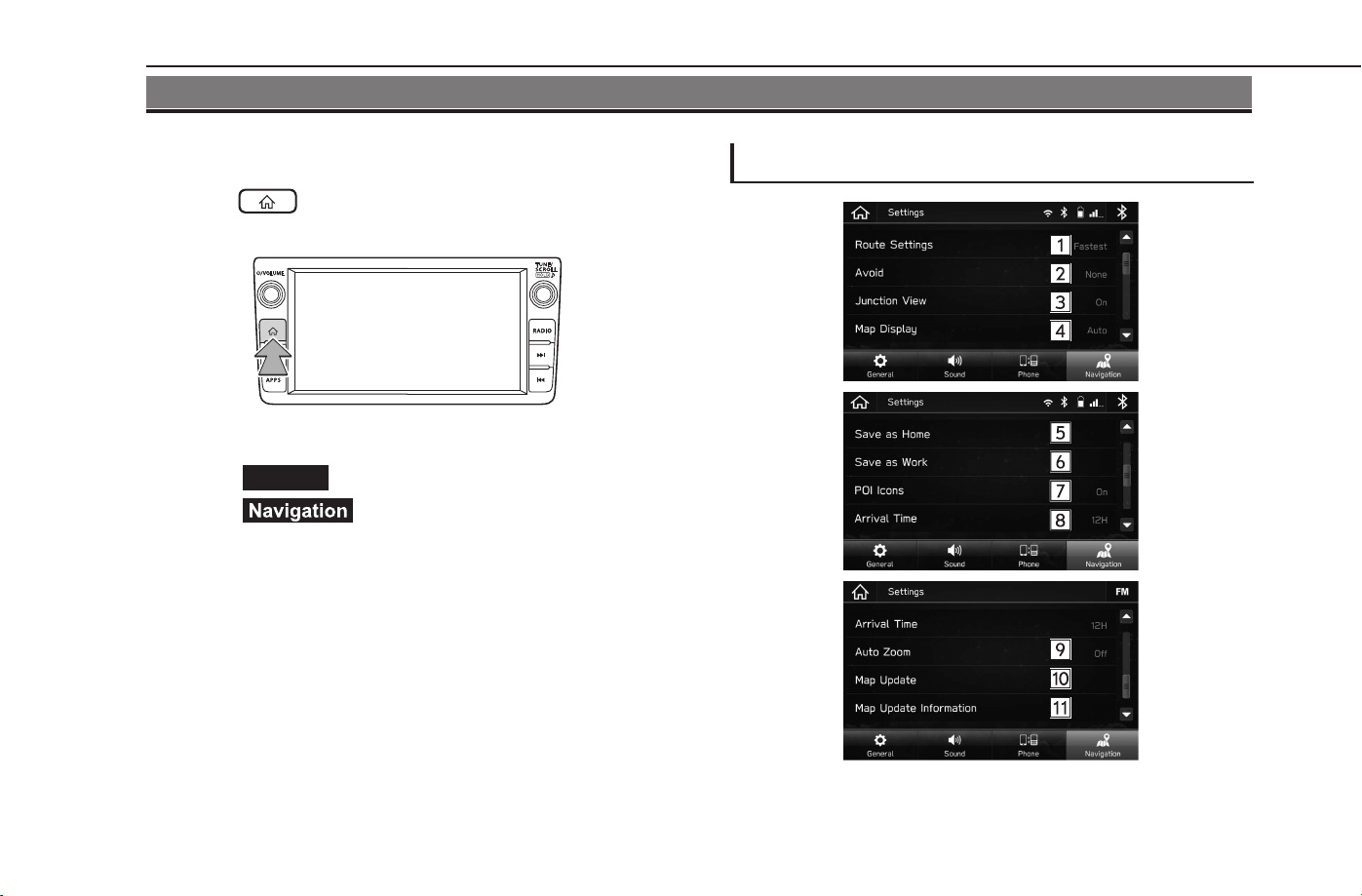
SETUP
NAVIGATION SETTINGS
1.
Press .
2.
Select
Settings
(Settings).
3.
Select (Navigation).
4.
Select the desired item to be set.
NAVIGATION SETTINGS SCREEN
SETUP
180
docstructure.indb 180 2019/05/31 11:47:02
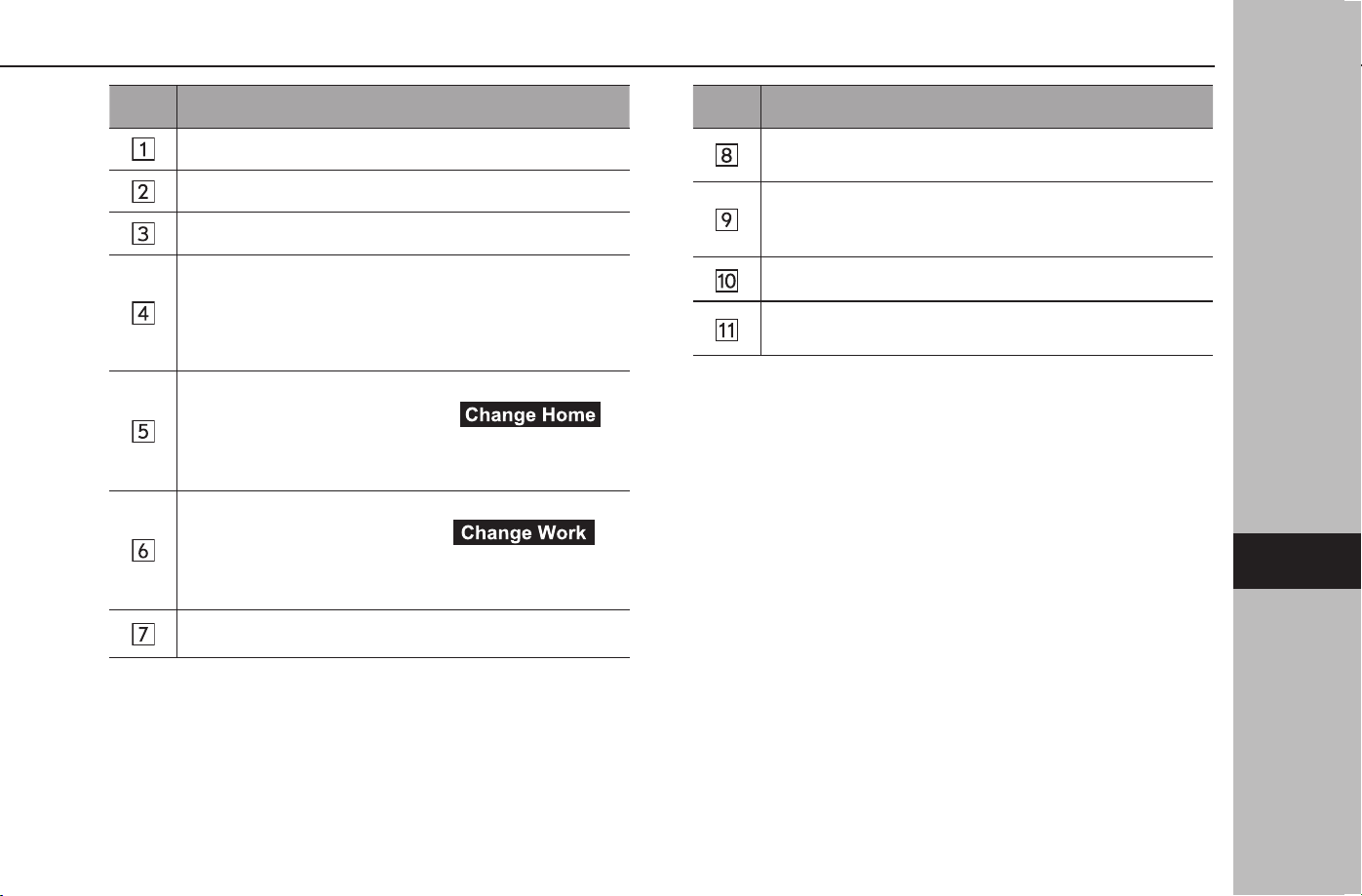
No. Function
Select to set the route type.
Select to set avoidance criteria for the route calculation.
Select to turn the display for the junction view on/off.
Select to set the screen mode.
“Auto”: Select to change the screen to day or night
mode depending on the position of the headlight switch.
“Day”: Select to always display the map in day mode.
“Night”: Select to always display the map in night mode.
Select to register or edit the home address.
•
When home has been registered,
(Change Home) is displayed.
•
For details on registering or editing the address:
→P.164
Select to register or edit the work address.
• When work has been registered,
(Change Work) is displayed.
• For details on registering or editing the address:
→P.164
Select to turn the display for POI icons on/off.
No. Function
Select to set whether the arrival time is displayed with
the 24-hour clock or 12-hour clock. (→P.173)
Select to set whether to automatically enlarge the map
when approaching intersections or turning points during
route guidance.
Select to set the updating of map data. (→P.184)
Select to display the request code for downloading the
maps via the website.
SETUP
181
Navigation System
7
docstructure.indb 181 2019/05/31 11:47:03
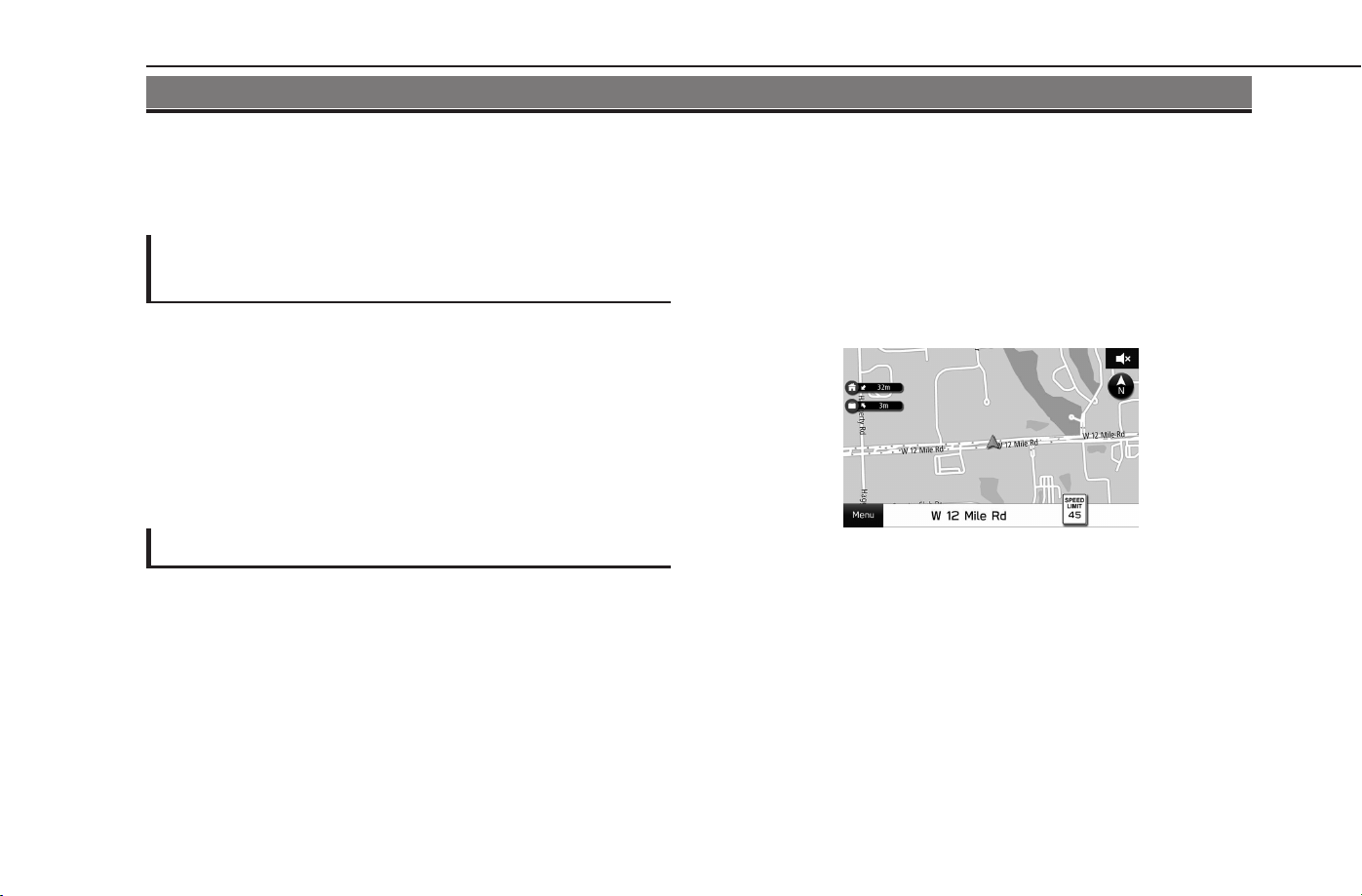
TIPS FOR THE NAVIGATION SYSTEM
182
TIPS FOR THE NAVIGATION SYSTEM
GPS (GLOBAL POSITIONING
SYSTEM)
REGARDING ERRORS IN CURRENT
POSITION DISPLAY
The system displays the vehicle current position based on
GPS information and data from various sensors and road
maps. However, when the radiowave signals from GPS
satellites are weak or when signals are received
from only
two satellites or less, errors may occur in the position.
Modifying
or adjusting the system will not prevent these
errors.
LIMITATIONS OF THE NAVIGATION SYSTEM
This navigation system calculates the current position using
satellite signals, various vehicle signals, map data, etc.
However, an accurate position may not be shown depending
on satellite conditions, road conguration, vehicle condition
or other circumstances.
The Global Positioning System (GPS) developed and
operated by the U.S. Department of Defense provides
an accurate current position, normally using 4 or more
satellites, and in some case 3 satellites. The GPS system
has a certain level of inaccuracy. While the navigation
system compensates for this most of the time, occasional
positioning errors of up to 300 feet (100 m) can and should
be expected. Generally, position errors will be corrected
within a few seconds.
The GPS signal may be physically obstructed, leading to
inaccurate vehicle position on the map screen. Tunnels, tall
buildings, trucks, or even the placement of objects on the
instrument panel may obstruct the GPS signals.
The GPS satellites may not send signals due to repairs or
improvements being made to them.
Even when the navigation system is receiving clear GPS
signals, the vehicle position may not be shown accurately or
inappropriate route guidance may occur in some cases.
docstructure.indb 182 2019/05/31 11:47:03
TIPS FOR THE NAVIGATION SYSTEM
183
Navigation System
7
CAUTION
l The installation of window tinting may obstruct the GPS
signals. Most window tinting contains some metallic content
that will interfere with GPS signal reception of the antenna in
the instrument panel. We advise against the use of window
tinting on vehicles equipped with navigation systems.
● Accurate current position may not be shown in the
following cases:
• When driving on a small angled Y-shaped road.
• When driving on a winding road.
•
When driving on a slippery
road such as in sand,
gravel, snow, etc.
•
When driving on a long straight road.
• When freeway and surface streets run in parallel.
• After moving by ferry or vehicle carrier.
•
When a long route is searched during
high speed
driving.
•
After repeating a change of direction by going
forward and backward, or
turning on a turntable in
a parking lot.
•
When leaving a covered
parking lot or parking
garage.
•
When a roof carrier is installed.
• When driving with tire chains installed.
• When the tires are worn.
• After replacing a tire or tires.
• When using tires that are smaller or larger than the
factory specications.
• When the tire pressure in any of the 4 tires is not
correct.
● Inappropriate route guidance may occur in the
following cases:
• When turning at an intersection off the designated
route guidance.
• If you set more than 1 destination but skip any of
them, auto reroute will display a route returning to
the destination on the previous route.
•
When turning at an intersection
for which there is
no route guidance.
•
When passing through an intersection for which
there is no route guidance.
• During auto reroute, the route guidance may not be
available for the next turn to the right or left.
• During high speed driving, it may take a long time
for auto reroute to operate. In auto reroute, a detour
route may be shown.
•
After auto reroute, the route may not be changed.
• If an unnecessary U-turn is shown or announced.
•
If a location has multiple names and the system
announces 1 or more of them.
• When a route cannot be searched.
• If the route to your destination includes
gravel,
unpaved roads or alleys, the route guidance may
not be shown.
docstructure.indb 183 2019/05/31 11:47:04

TIPS FOR THE NAVIGATION SYSTEM
184
• Your destination point might be shown on the
opposite side of the street.
• When a portion of the route has regulations
prohibiting the entry of the vehicle that vary by time
or season or other reasons.
•
The road and map data stored in the navigation
system may not be complete or may not be the
latest version.
NOTE
l This navigation system uses tire turning data and is designed to
work with factory-specied tires for the vehicle. Installing tires
that are larger or smaller than the originally equipped diameter
may cause inaccurate display of the current position. The tire
pressure also affects the diameter of the tires, so make sure that
the tire pressure of all 4 tires is correct.
MAP DATA
REGARDING ROADS AND PLACE NAME
DATA
When maps are created, land surveys are conducted
and information
on road improvements and reopening
is collected to provide
the most accurate information
possible. However, modications to roads, place names and
facilities may be carried out at any time. Consequently, we
cannot guarantee that map data contains no errors in road
positions, conguration and names, or in facility names.
SUBARU MAP UPDATE
Map data can be updated using the following methods:
● USB memory: All map data can
be updated at once.
(→P.185)
● Wi-Fi: The map data for up to 8 regions can be
selected and updated. (→P.186)
● Smartphone: The map data for up to 8 regions can
be selected and updated. This method is for when
the map update data is to be downloaded to a
smartphone from outside of the vehicle, such as at
home, and then transferred to the system. (→P.187)
docstructure.indb 184 2019/05/31 11:47:04

TIPS FOR THE NAVIGATION SYSTEM
185
Navigation System
7
NOTE
l When map update data is being installed, a blank map screen
will be displayed for the region that is being updated. If the
vehicle is operated while the map data is being updated, the
map function may not be available until the update procedure is
complete.
l For the best possible navigation
experience, regularly update
maps for all frequented regions, including nearby states. Failure
to update maps for surrounding states may result in inaccurate
map information during interstate travel. Updates made using a
USB memory device will update map information for all states.
Please visit Subaru.com for more information and the latest
updates.
l If the map update fails or cannot be performed when using Wi-Fi
or a connected smartphone, check the communication status of
the connected device. If there is a problem with communication,
perform the procedure again using a different Wi-Fi access point
or smartphone.
l If the map update procedure fails, refer to the “WHAT TO DO IF”
section. (→P.223)
l SUBARU, in its sole discretion, may terminate or suspend
your access
to all or part of the Services for any or no reason,
including without limitation, any violation of these Terms.
UPDATING THE MAP DATA MANUALLY
USING A USB MEMORY DEVICE
Maps can be updated using a USB memory device.
For details and to download update data, refer to the
following URL:
https://subaru-maps.com/
docstructure.indb 185 2019/05/31 11:47:04
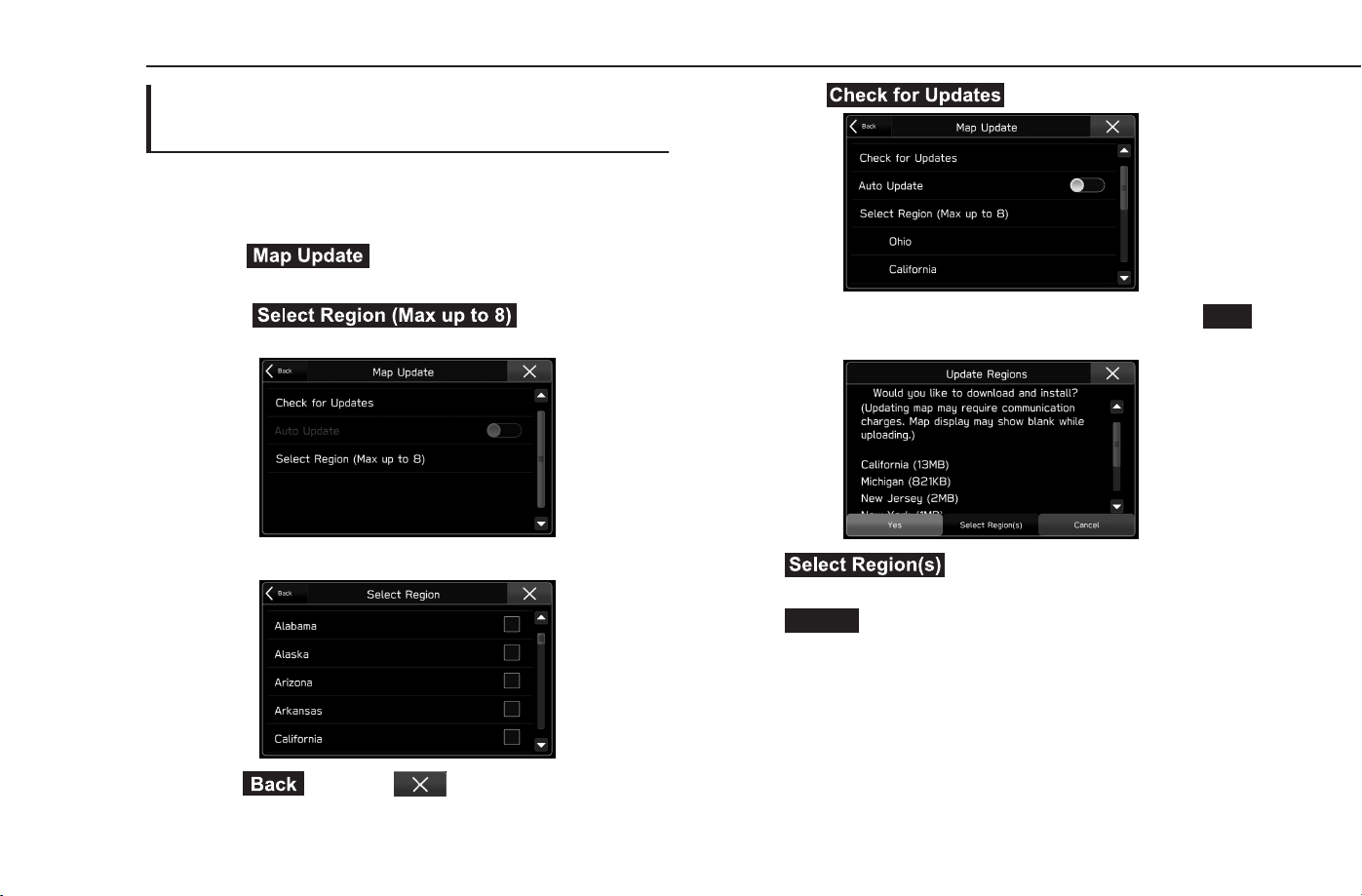
TIPS FOR THE NAVIGATION SYSTEM
186
UP
DATING THE MAP DATA MANUALLY
USING Wi-Fi
The map data may also be updated via Wi-Fi network.
1.
Connect to a Wi-Fi network. (→P.65)
2.
Select (Map Update) on the navigation
settings screen. (→P.180)
3.
Select (Select Region
(Max up to 8)).
4.
Select the regions for which maps are to be updated.
5.
Select (Back) or .
6.
Select (Check for Updates).
7.
Check the conrmation message, and then select
Yes
(Yes).
● (Select Region(s)): Return to
“STEP 4” and select the region again.
●
Cancel
(Cancel): Select to cancel updating the map
data.
docstructure.indb 186 2019/05/31 11:47:05
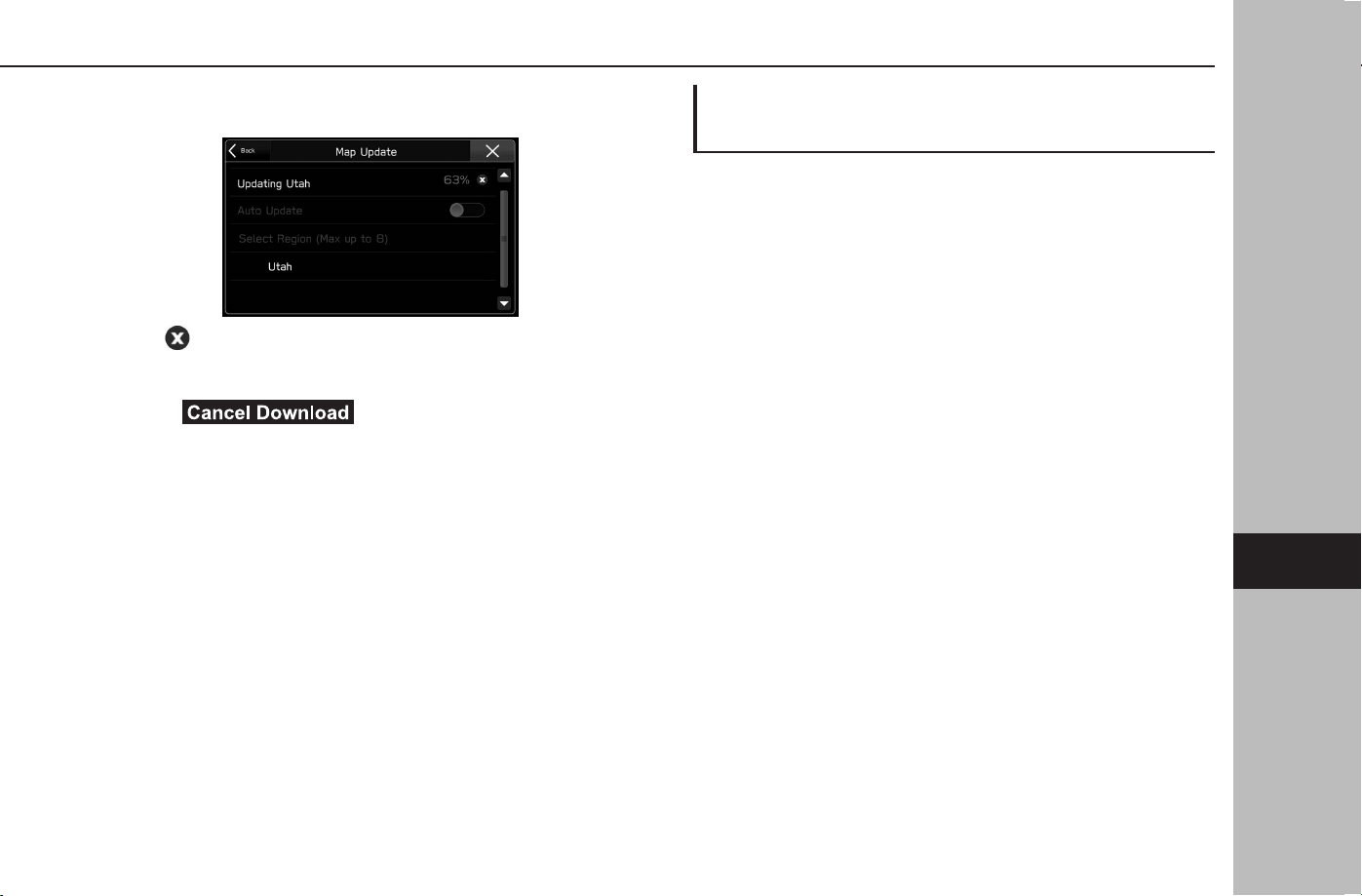
TIPS FOR THE NAVIGATION SYSTEM
187
Navigation System
7
8.
The following screen is displayed simultaneously with
the start of download and installation.
●
: Select to cancel the update download and
installation. If the download has completed, only
installation can be canceled.
If
(Cancel Download) is selected,
the download to the smartphone can later be
resumed.
NOTE
l If the Wi-Fi connection is cut while downloading, a blank map
screen may be displayed. In this case, reconnect and perform
the download and installation procedure again to restore the
system.
UPDATING THE MAP DATA MANUALLY
USING A SMARTPHONE
If the system cannot connect to a Wi-Fi network, the map
data can be updated using a smartphone. Map update
data can be downloaded to a smartphone from outside of
the vehicle, such as at home, and then transferred to the
system to perform the map data update.
When updating the map data using a smartphone, the
SUBARU STARLINK application must be installed on the
smartphone.
NOTE
l Map update data for each region can be downloaded if it is 30
MB or less.
docstructure.indb 187 2019/05/31 11:47:06
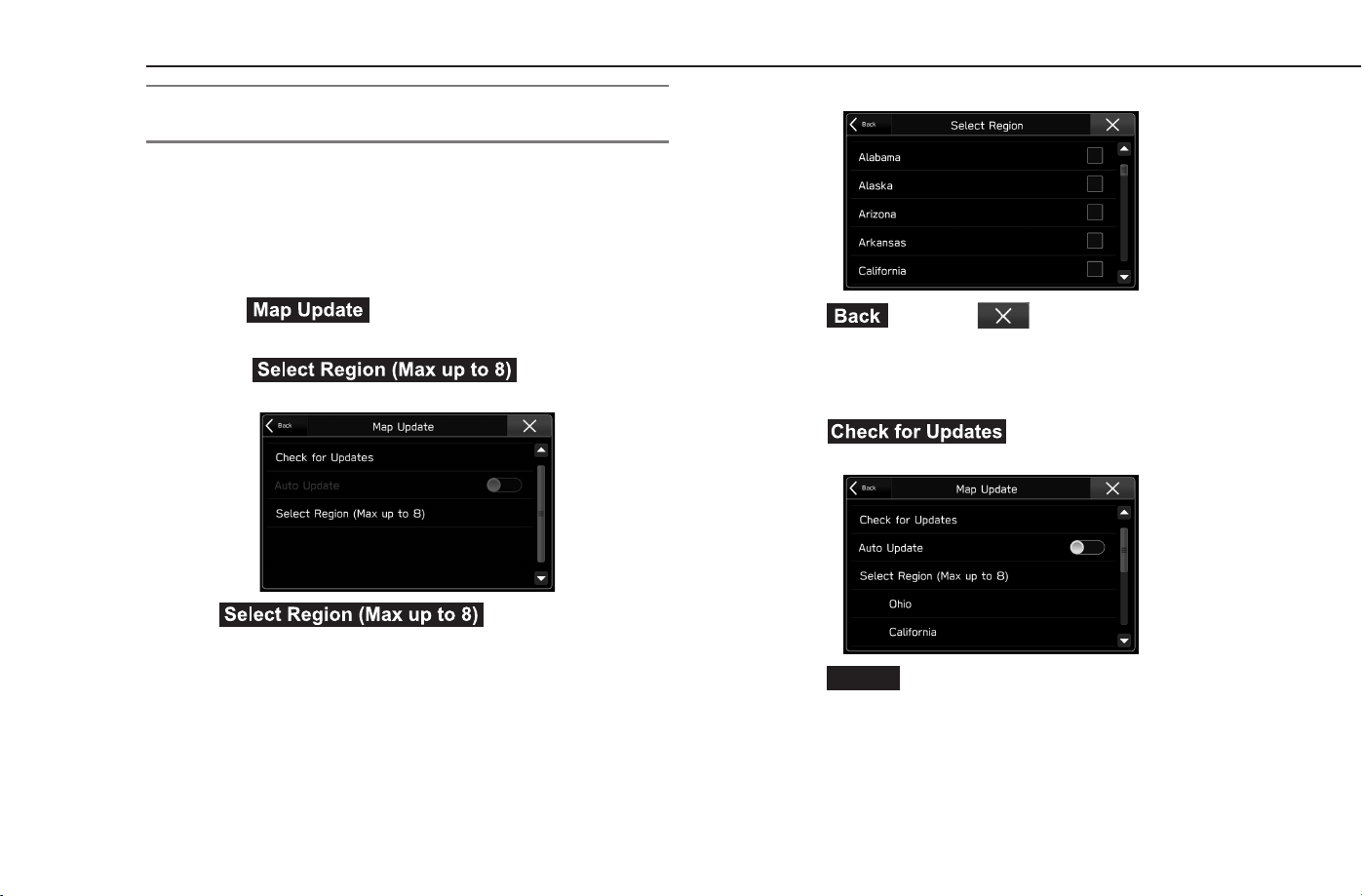
TIPS FOR THE NAVIGATION SYSTEM
188
DOWNLOAD MAP UPDATE DATA TO A
SMARTPHONE
1.
Connect a smartphone to the system via Bluetooth.
● When using an iPhone, it can also be connected
using a USB cable.
2.
Start the SUBARU STARLINK application on the
smartphone.
3.
Select (Map Update) on the navigation
settings screen. (→P.180)
4.
Select (Select Region
(Max up to 8)).
● If (Select Region (Max
up to 8)) cannot be selected, perform this procedure
again from “STEP 1”.
5.
Select the regions for which maps are to be updated.
6.
Select (Back) or .
7.
Change the mobile data communication setting of the
SUBARU STARLINK application on the smartphone to
on.
8.
Select (Check for Updates) on the
map update screen.
9.
Select
Cancel
(Cancel).
10.
Connect the smartphone to a Wi-Fi network.
11.
Using the SUBARU STARLINK application on the
smartphone, download the map update data.
docstructure.indb 188 2019/05/31 11:47:06
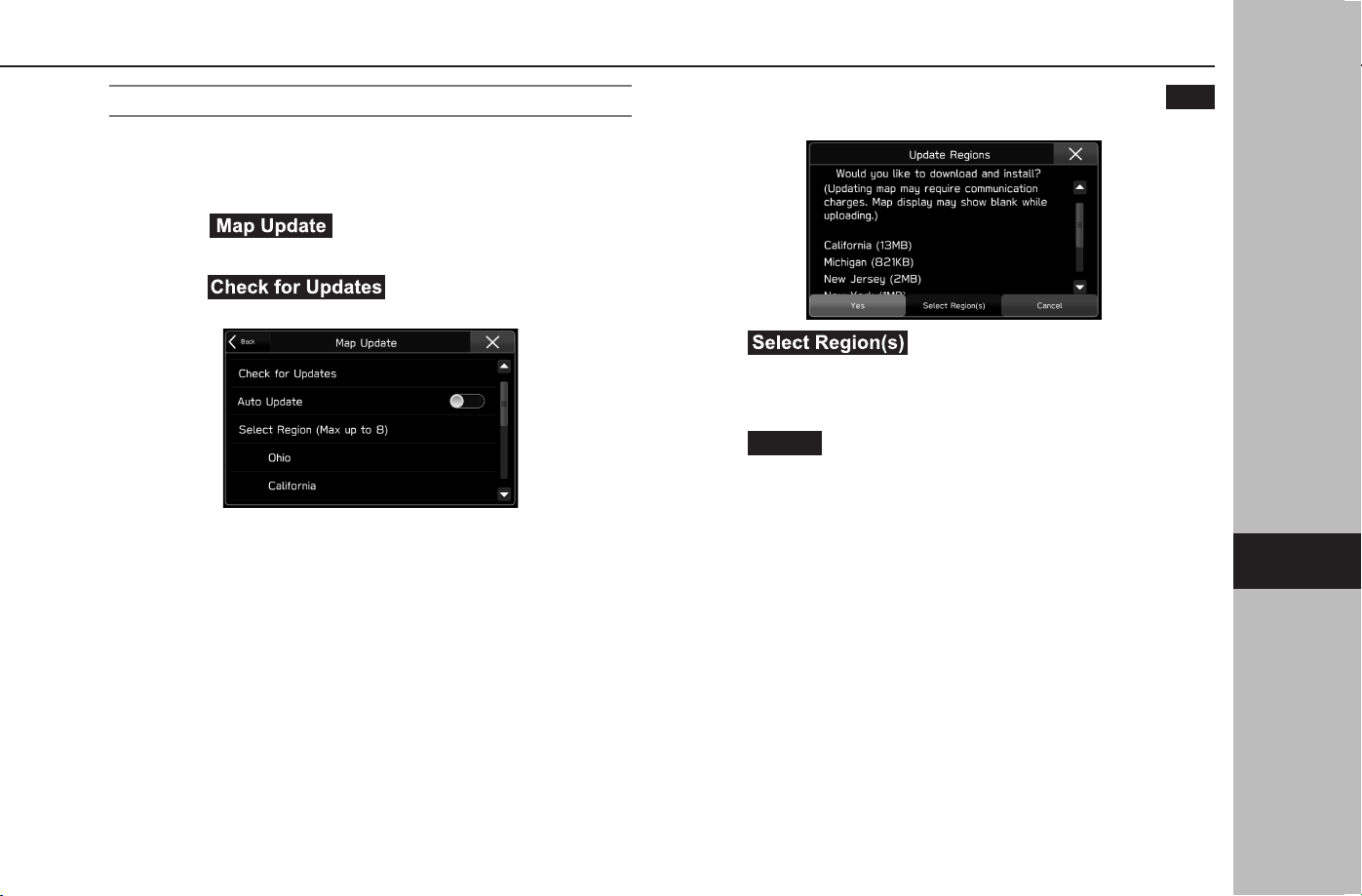
TIPS FOR THE NAVIGATION SYSTEM
189
Navigation System
7
INSTALL MAP UPDATE DATA
1.
Connect a smartphone to the system via Bluetooth.
● When using an iPhone, it can also be connected
using a USB cable.
2.
Select (Map Update) on the navigation
settings screen. (→P.180)
3.
Select (Check for Updates) on the
map update screen.
● If “Auto Update” is enabled, the map update data will
be installed automatically when the smartphone is
connected to the system.
4.
Check the conrmation message, and then select
Yes
(Yes).
● (Select Region(s)): Return to
“STEP 5” in “DOWNLOAD MAP UPDATE DATA TO
A SMARTPHONE” and select the desired regions
again. (→P.188)
●
Cancel
(Cancel): Select to cancel updating the map
data.
● If the mobile data communication setting has
not been turned on on the SUBARU STARLINK
application, the map update data cannot be
downloaded.
docstructure.indb 189 2019/05/31 11:47:07
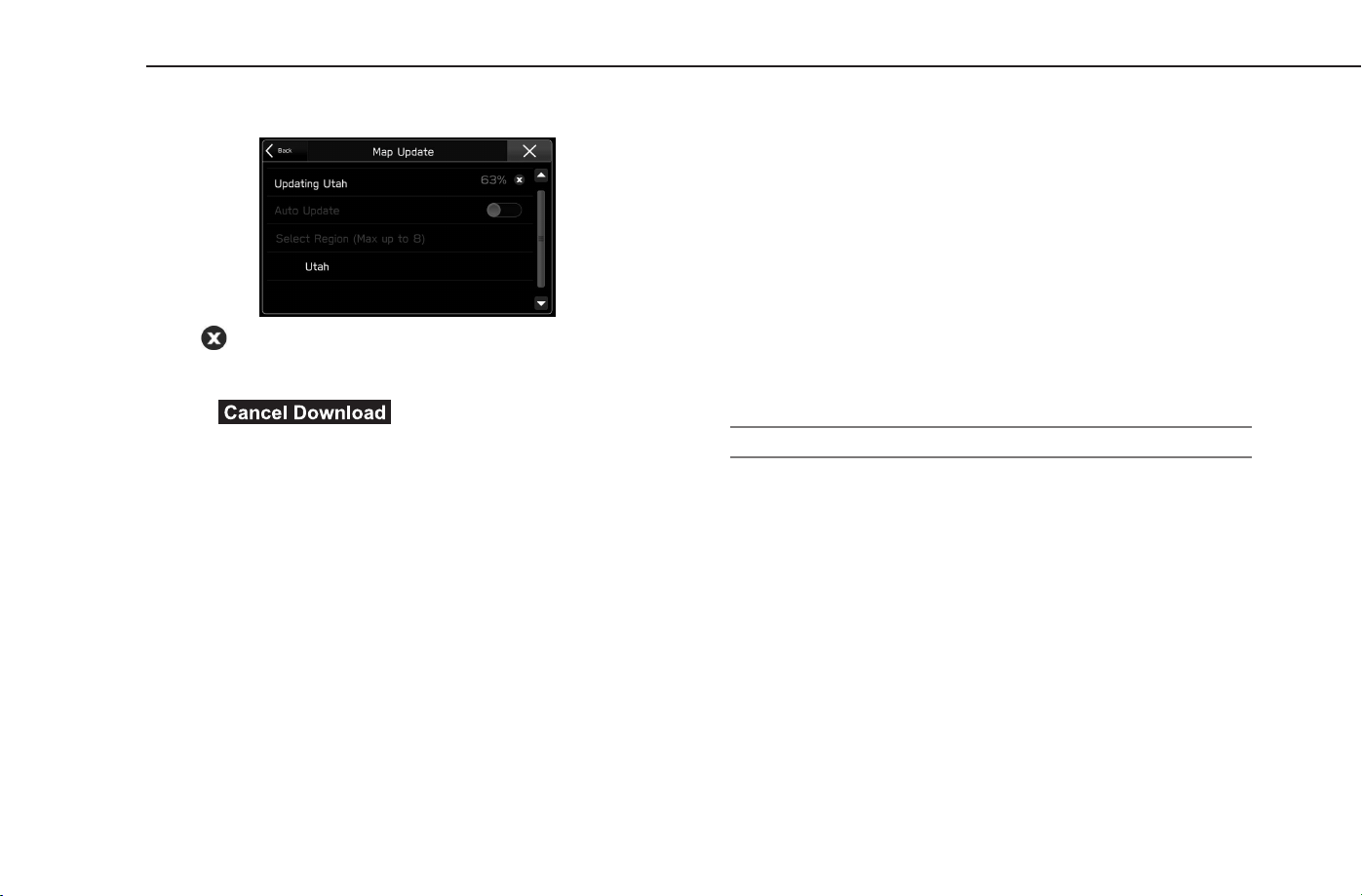
TIPS FOR THE NAVIGATION SYSTEM
190
5.
The following screen is displayed simultaneously with
the start of download and installation.
●
: Select to cancel the update download and
installation. If the download has completed, only
installation can be canceled.
If
(Cancel Download) is selected,
the download to the smartphone can later be
resumed.
● Even if installation is cancelled, the map data
downloaded to the smartphone will not be deleted.
Therefore, installation can be performed immediately
the next time the update procedure is started.
NOTE
l When downloading map data using the SUBARU STARLINK
application, make sure there is sufcient storage space on the
smartphone for the selected region map data.
l When using an iPhone to perform an update, connecting the
iPhone to the system via USB is recommended. In this case, if
a genuine Apple USB cable is used, high speed communication
is possible.
l While the map update data is being installed, even if another
screen is displayed, the update will continue to be installed.
l This product uses the smartphone’
s data plan for features and
services.
Please consult carrier data plan usage, pricing, data overage
charges, limitations and usage guidelines.
ABOUT THE SUPPORTED DEVICES
This system supports the following devices.
● iPhone: iOS 11 or later
● Android: Android 7.0 or later
docstructure.indb 190 2019/05/31 11:47:07
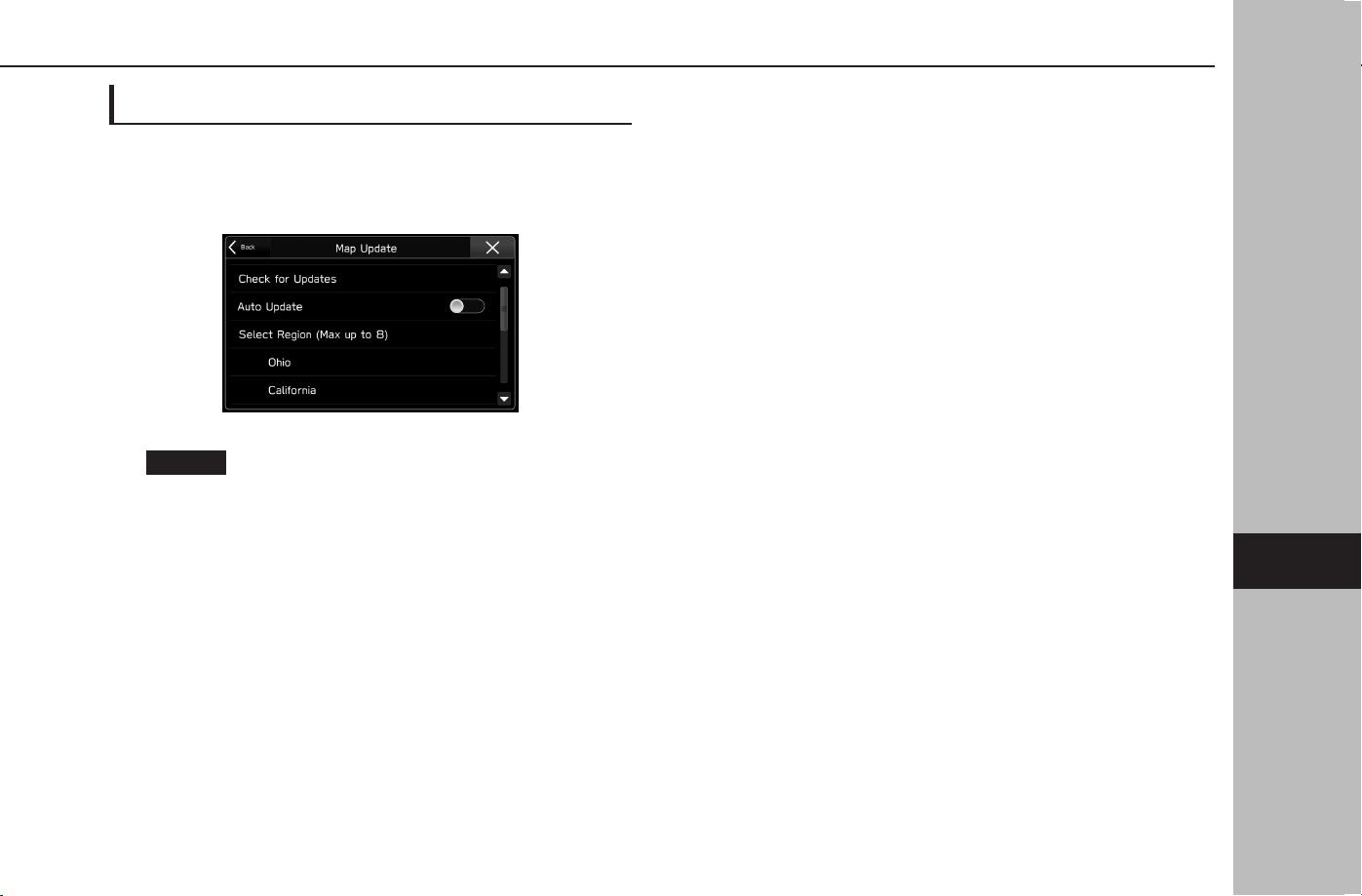
TIPS FOR THE NAVIGATION SYSTEM
191
Navigation System
7
UPDATING THE MAP DATA AUTOMATICALLY
1.
Follow “STEPS 1 to 5” in “UPDATING THE MAP DATA
MANUALLY USING Wi-Fi”. (→P.186)
2.
Set “Auto Update” to on.
3.
Check the conrmation message, and then select
I Agree
(I Agree).
docstructure.indb 191 2019/05/31 11:47:07

MEMO
192
docstructure.indb 192 2019/05/31 11:47:07

193
Siri/Voice
Recognition System
Siri/Voice Recognition System
Siri
194
Siri
®
194
Before Using Siri
194
Using Siri
194
Siri Operation
195
Voice Recognition System Operation
197
Voice Recognition System
197
Using The Voice Recognition System
197
Voice Recognition System Operation
198
Command List
199
docstructure.indb 193 2019/05/31 11:47:07
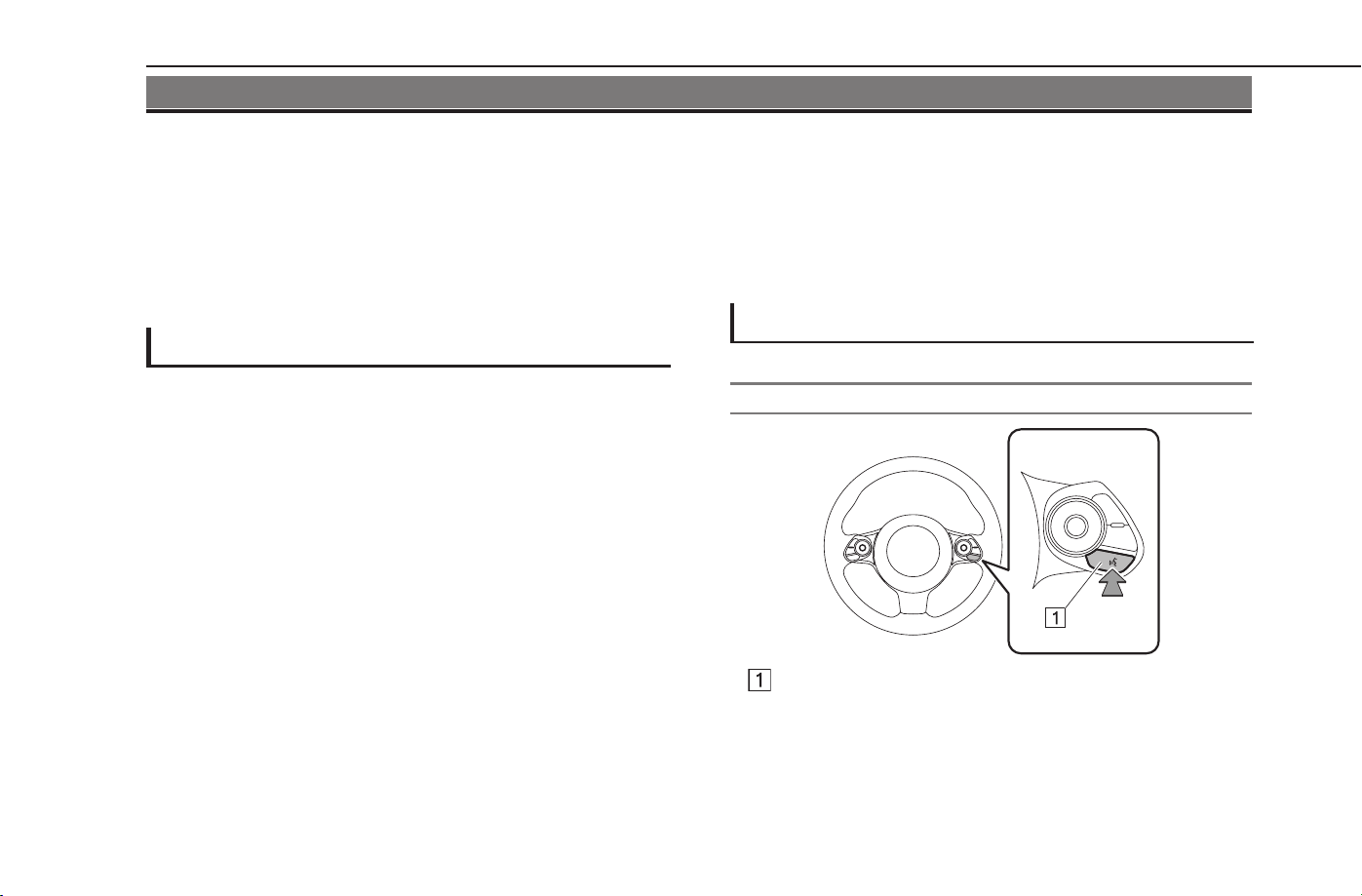
Siri
Siri
®
Siri is a function that allows your iPhone and iPod touch to
be used without any manual operation by connecting your
device to the unit.
To use Siri, connect your device via Bluetooth.
BEFORE USING Siri
This section describes the preparation required to use Siri.
● Register your iPhone or iPod touch in the unit.
(→P.48)
● Connect your iPhone or iPod touch to the unit.
(→P
.54)
● Enable Siri in your iPhone
or iPod touch settings.
(See Apple website for details.)
● An iPhone and iPod touch data plan: If the data plan
for your iPhone
and iPod touch does not provide for
unlimited data usage, additional charges from your
carrier may apply for accessing app-based connected
content via 3G, 4G, Wi-Fi, or 4G LTE wireless
networks.
● Connection to the internet via 3G, 4G, Wi-Fi, or 4G
LTE networks.
NOTE
l Available operations will differ based on your iPhone and iPod
touch.
l Be careful not to exceed the data usage limits for
your iPhone
and iPod touch. Doing so will result in additional data usage
charges from your phone carrier.
USING Siri
STEERING SWITCH
Talk switch
● Press and hold the talk switch to start Siri.
● To cancel Siri, press the talk switch.
Siri
194
docstructure.indb 194 2019/05/31 11:47:08
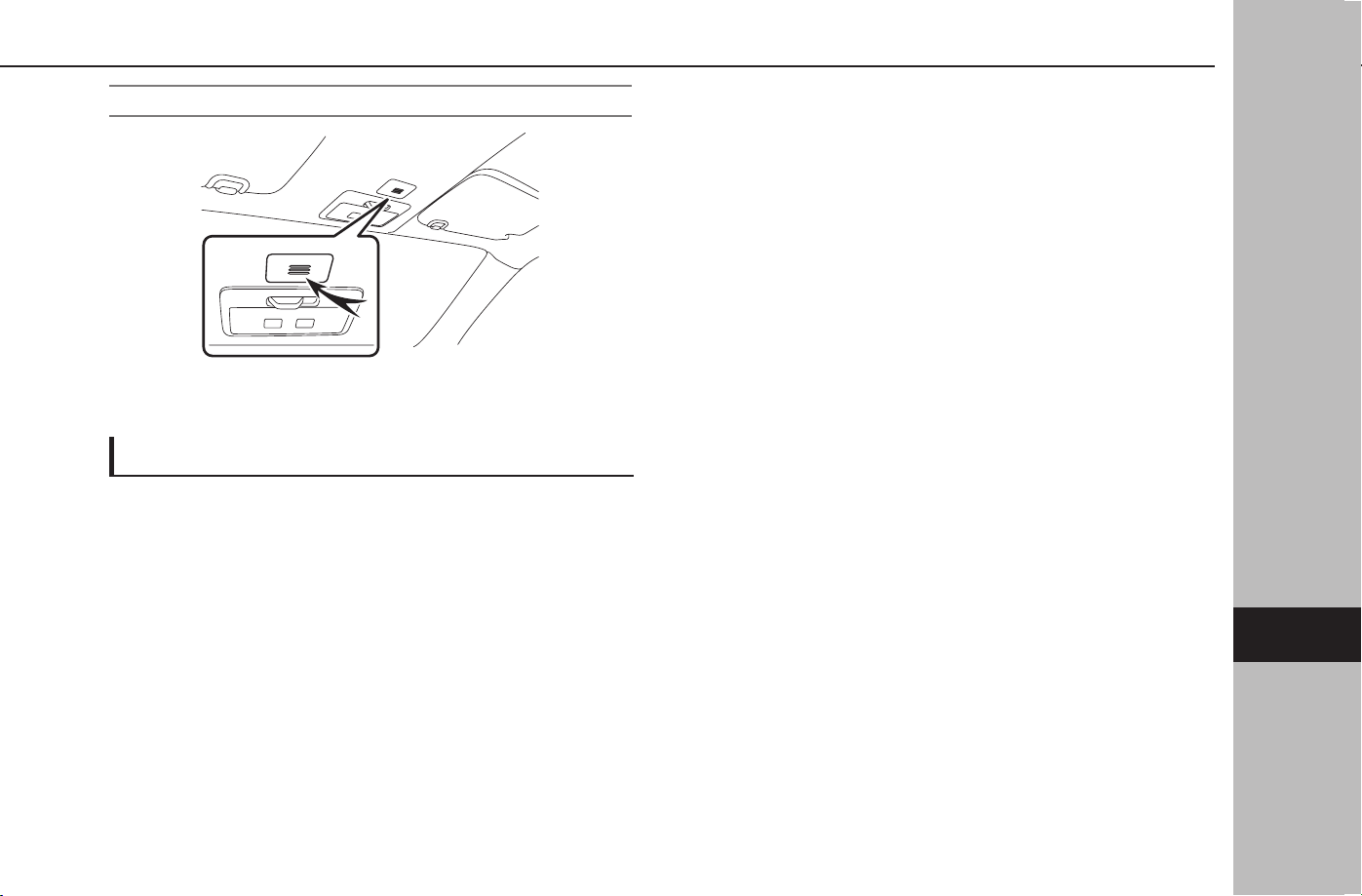
MICROPHONE
● It is unnecessary to speak directly into the
microphone when using Siri.
Siri OPERATION
1.
Press and hold the talk switch.
2.
Speak when you hear the beep sound.
● If required to say more, the system will notify you with
the beep sound. Continue speaking.
● If the system fails to recognize what is being said, or
to request a different operation, press and hold the
talk switch.
● To cancel Siri, press the talk switch.
NOTE
l Siri cannot be started while placing or receiving hands-free
calls with your iPhone and iPod touch (including while holding
incoming calls), or while having a hands-free conversation.
l Siri cannot be used while using the system’s voice recognition
function. Start Siri after exiting the voice recognition function.
l The system screen will display
the calling screen when a hands-
free call is placed.
l Unit operation while using Siri will differ depending on your
iPhone or iPod touch.
l Siri may not recognize what is being said if:
•
Spoken too quickly.
•
Spoken at a low or high volume.
•
Driving with a window open.
• Passengers are talking while using Siri.
• The air conditioning speed is set high.
• When air from the ventilator blows directly toward the
microphone.
l In the following conditions,
the system may not recognize what is
being said properly, and use of Siri may not be possible.
• What is being said is incorrect or unclear. Note that certain
words, accents or speech patterns may be difcult for your
iPhone or iPod touch to recognize.
•
There is excessive background noise, such as wind noise.
l Functionality offered by Siri is dependent on the iOS version,
and
as such, specications may be subject to change without
prior notice.
Siri
195
Siri/Voice Recognition System
8
docstructure.indb 195 2019/05/31 11:47:08

ABOUT THE SUPPORTED DEVICES FOR Siri
This system supports the following devices.
n Supported iOS versions
● iOS6 or later (6, 7)
n Supported models
● iPod touch (5th generation)
● iPhone 4s
● iPhone 5
● iPhone 5s
● iPhone 6
● iPhone 6s
● iPhone 6 Plus
● iPhone 6s Plus
● iPhone SE
● iPhone 7
Siri
196
docstructure.indb 196 2019/05/31 11:47:08
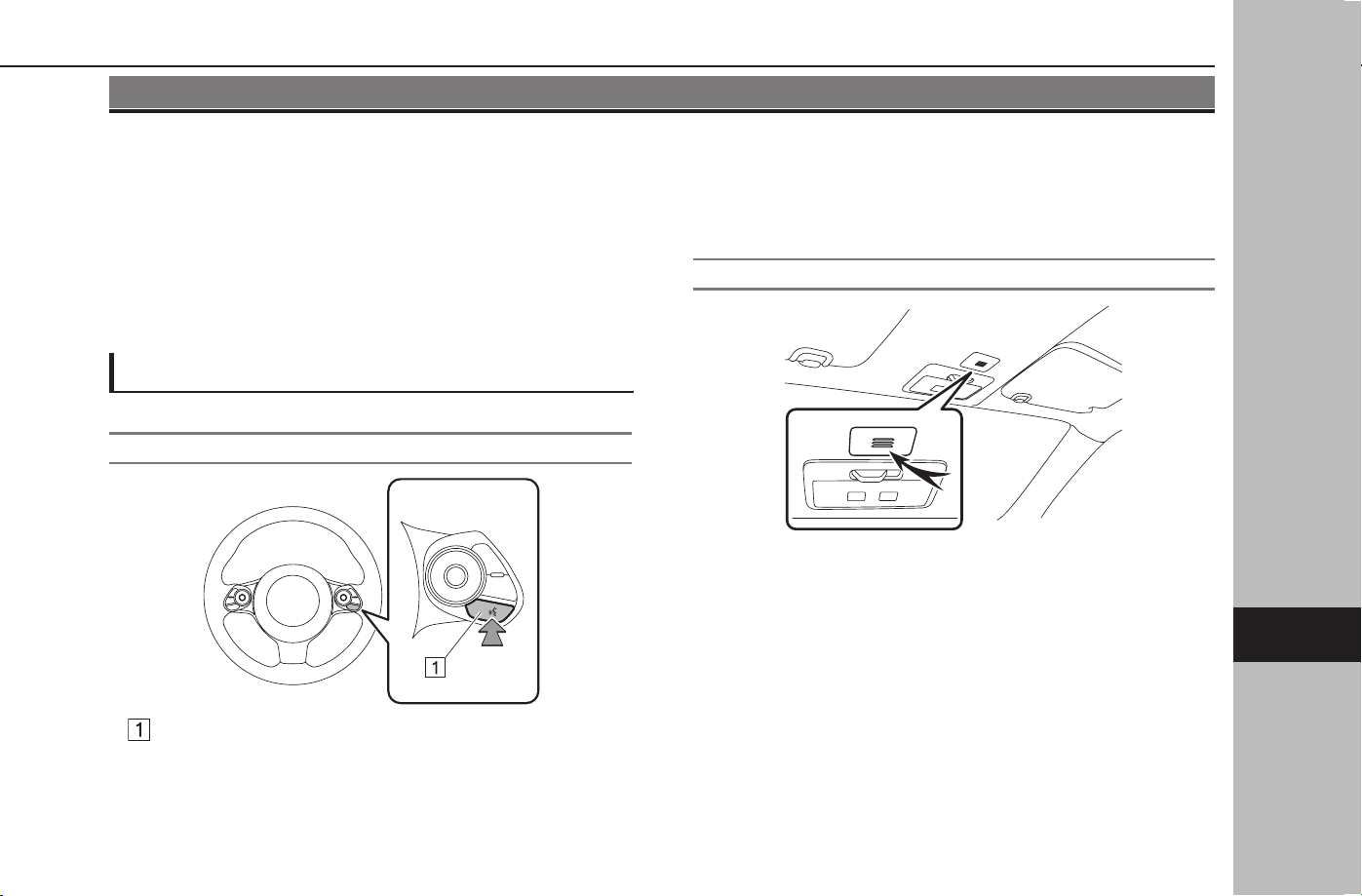
VOICE RECOGNITION SYSTEM OPERATION
VOICE RECOGNITION SYSTEM
The voice recognition system enables the navigation,
audio, hands-free systems, etc. to be operated using voice
commands.
Refer to the command list for samples of voice commands.
(→P.199)
USING THE VOICE RECOGNITION SYSTEM
STEERING SWITCH
Talk switch
● Press the talk switch to start the voice recognition
system.
● To cancel voice recognition, press and hold the talk
switch or the source switch.
MICROPHONE
● It is unnecessary to speak directly into the
microphone when giving a command.
VOICE RECOGNITION SYSTEM OPERATION
197
Siri/Voice Recognition System
8
docstructure.indb 197 2019/05/31 11:47:08
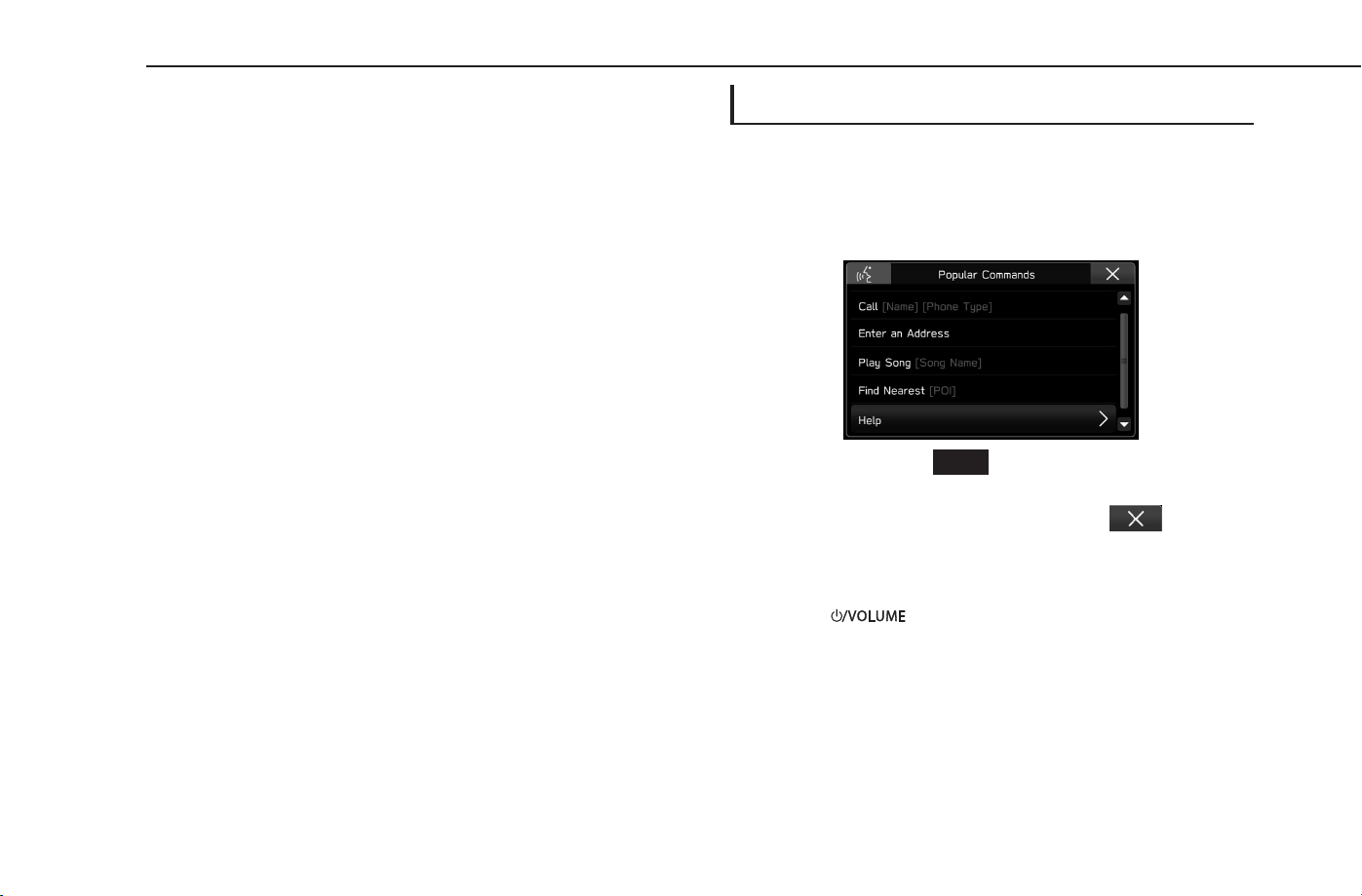
NOTE
l Wait for the conrmation beep before speaking a command.
l Voice commands may not be recognized if:
•
Spoken too quickly.
•
Spoken at a low or high volume.
•
Driving with a window open.
•
Passengers are talking while voice commands are spoken.
•
The air conditioning speed is set high.
•
When air from the ventilator blows directly toward the
microphone.
l In the following conditions, the system may not recognize the
command properly and using voice commands may not be
possible:
• The command is incorrect or unclear. Note that certain words,
accents or speech patterns may be difcult for the system to
recognize.
• There is excessive background noise, such as wind noise.
VOICE RECOGNITION SYSTEM OPERATION
1.
Press the talk switch.
● After the voice recognition top screen has been
displayed, speech guidance will commence.
2.
Say the command.
● When selecting
Help
(Help) or saying “Help”, all
commands supported by the system are listed.
● To cancel voice recognition, select
, or press
and hold the talk switch.
NOTE
l Turn the “ ” knob, or use the volume control switch on
the steering wheel to adjust the speech guidance volume.
l The system’s voice recognition function cannot be used while
using Siri,
Apple CarPlay or Android Auto. Start the voice
recognition function after exiting Siri, Apple CarPlay or Android
Auto.
VOICE RECOGNITION SYSTEM OPERATION
198
docstructure.indb 198 2019/05/31 11:47:09

COMMAND LIST
Recognizable voice commands and their actions are shown
below.
● Frequently used commands are listed in the following
tables.
● For devices that are not installe
d in the vehicle, the
related commands will not be displayed in the screen.
Also, according to conditions, other commands may
not be displayed in the screen.
● The functions available may vary according
to the
system installed.
● Voice recognition
language can be changed.
(→P.59)
NOTE
l The notations used in the commands are as follows.
• [○○○]: Numbers, titles, or names to be spoken
• (○○○): Choose one of the command from within the brackets
XMain commands
Voice command Function
Enter an Address
Enables setting a destination by saying
the address
Navigate to [House
Number, Street, City,
State]
Enables setting a destination by saying
the address with city and state
Find Nearest [POI]
Displays a list of POI category near the
current position
Call [Name] [Phone
Type]
Place a call to the spoken contact name
and phone type of the contact from the
phonebook
Dial [Number]
Places a call to the spoken phone
number
Play Song [Song
Name]
Plays the selected song
Show (Songs /
Albums / Artists /
Genres / Playlists /
Podcasts /
Composers /
Audiobooks)
Displays the list of Songs/Albums/Artists/
Genres/Playlists/ Podcasts/Composers/
Audiobooks
Tune to [Frequency]
(AM / FM)
Switches to AM/FM and tunes to spoken
frequency
Preset [Number] Switches to the preset channel
VOICE RECOGNITION SYSTEM OPERATION
199
Siri/Voice Recognition System
8
docstructure.indb 199 2019/05/31 11:47:09
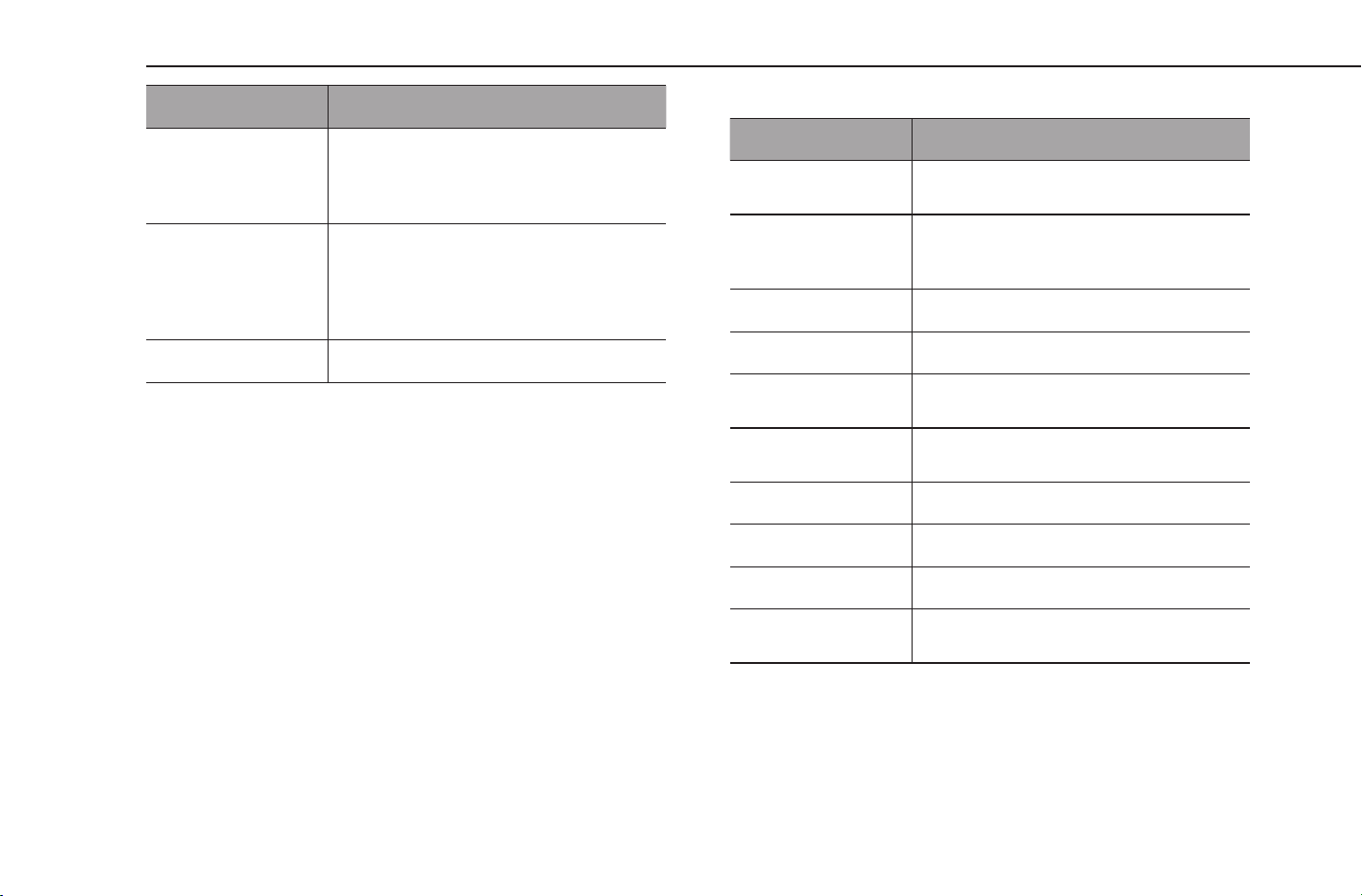
Voice command Function
Change Source to
(AM / FM / USB /
iPod / Bluetooth /
Satellite Radio)
Changes source to AM/FM/USB/iPod/
Bluetooth/SiriusXM
®
Satellite Radio
Go to (Radio /
Media / Phone /
Map / Home /
Settings / Pandora /
Aha / Apps)
Changes screen to Radio/Media/Phone/
Map/Home/Settings/Pandora/Aha/Apps
Help Changes to help screen
XNavigation commands
Voice command Function
Enter an Address
Enables setting a destination by saying
the address
Navigate to [House
Number, Street, City,
State]
Enables setting a destination by saying
the address with city and state
Drive Home Displays the route to home
Drive to Work Displays the route to work
Find Nearest [POI]
Displays a list of POI category near the
current position
Find Gas Station
Displays the list of gas station near the
current position
Show Map Displays the map screen
Stop Route Cancels route guidance
Where am I Displays current location on map
Navigation Help
Displays a list of voice commands related
to navigation
VOICE RECOGNITION SYSTEM OPERATION
200
docstructure.indb 200 2019/05/31 11:47:09
XPhone commands
Voice command Function
Send a Text
Message to [Name]
[Phone Type]
Send the preset message to the spoken
contact name and phone type of the
contact from the phonebook
Call [Name] [Phone
Type]
Place a call to the spoken contact name
and phone type of the contact from the
phonebook
Dial [Number]
Places a call to the spoken phone
number
Redial
Places a call to the phone number of the
latest outgoing call
Paired Phones Displays the phone settings screen
Recent Calls Displays the call history screen
Missed Calls Displays the missed call list screen
Reply to Text
Message
Reply to text message
View Text Messages Displays the message inbox screen
Phone help
Displays a list of voice commands related
to controlling your phone
XMedia commands
Voice command Function
Track [Number] Plays the selected track
Play Song [Song
Name]
Plays the selected song
Play Album [Album
Name]
Plays tracks from the selected album
Play Artist [Artist
Name]
Plays tracks from the selected artist
Play Genre [Genre
Name]
Plays tracks from the selected genre
Play Playlist [Playlist
Name]
Plays tracks from the selected playlist
Play Podcast
[Podcast Name]
Plays the selected podcast
Play Audiobook
[Book Name]
Plays the selected audiobook
Play Composer
[Composer Name]
Plays tracks from the selected composer
Show (Songs /
Albums / Artists /
Genres / Playlists /
Podcasts /
Composers /
Audiobooks)
Displays the list of Songs/Albums/Artists/
Genres/Playlists/ Podcasts/Composers/
Audiobooks
VOICE RECOGNITION SYSTEM OPERATION
201
Siri/Voice Recognition System
8
docstructure.indb 201 2019/05/31 11:47:09
Voice command Function
Shufe (On/Off) Turns shufe on/off
Browse Album
[Album Name]
Displays the list of songs of the album
Browse Artist [Artist
Name]
Displays the list of albums of the artist
Browse Genre
[Genre Name]
Displays the list of artists of genre
Browse Playlist
[Playlist Name]
Displays the list of playlist
Browse Composer
[Composer Name]
Displays the list of albums from the
composer
Media Help
Displays a list of commands related to
the media
NOTE
l Depending on the device, your iPod/iphone may not work when
operated via voice recognition.
XRadio commands
Voice command Function
Tune to [Frequency]
(AM / FM)
Switches to AM/FM and tunes to the
spoken frequency
Preset [Number] Switches to the preset channel
Satellite Channel
[Name / Channel
Number]
Switches to satellite channel number
Satellite Category
[Category Name]
Displays the list of Satellite Channels of
the spoken category
Radio Help
Displays a list of commands related to
the radio
VOICE RECOGNITION SYSTEM OPERATION
202
docstructure.indb 202 2019/05/31 11:47:09
XMore commands
Voice command Function
Change Source to
(AM / FM / USB /
iPod / Bluetooth /
Satellite Radio)
Changes source to AM/FM/USB/iPod/
Bluetooth/SiriusXM
®
Satellite Radio
Go to (Radio /
Media / Phone /
Map / Home /
Settings / Pandora /
Aha / Apps)
Changes screen to Radio/Media/Phone/
Map/Home/Settings/Pandora/Aha/Apps
Gas Prices
Changes screen to SiriusXM Travel Link
Fuel Prices
Sports Scores
Changes screen to SiriusXM Travel Link
Sports Scores
Stocks
Changes screen to SiriusXM Travel Link
Stock Prices
Weather
Changes screen to SiriusXM Travel Link
Weather
Go to Aha Changes screen to Aha
Go to Pandora* Changes screen to Pandora
Repeat Play back last dialog prompt
Cancel Cancels current dialog session
*: Pandora is only available in certain countries. Please visit pandora.com/
legal for more information.
VOICE
RECOGNITION SYSTEM OPERA
TION
203
Siri/Voice Recognition System
8
docstructure.indb 203 2019/05/31 11:47:09

MEMO
204
docstructure.indb 204 2019/05/31 11:47:09

205
Appendix/What To
Do If/Index
Appendix/What To Do If/Index
Certication
206
Certication
206
SiriusXM
®
Satellite Radio
206
SiriusXM Data Service
206
Radio Wave Communications
206
Bluetooth
209
iPod
209
Pandora
210
Google
210
How To Get The Source Code
Using The Open Source
211
What To Do If
212
Troubleshooting
212
Troubleshooting Issues Common
To This System
212
Radio Operation
212
Phone
214
Updating The System
219
Map Update
223
Index
229
docstructure.indb 205 2019/05/31 11:47:09
CERTIFICATION
CERTIFICATION
SiriusXM
®
Satellite Radio
● © 2016 Sirius XM Radio Inc. Sirius, XM, SiriusXM and
all related marks and logos are trademarks of Sirius XM
Radio Inc. All other marks, channel names and logos are
the property of their respective owners. All rights reserved.
SiriusXM DATA SERVICE
Neither SiriusXM nor Subaru is responsible for any errors
or inaccuracies in the SiriusXM data services or its use in
vehicle.
RADIO WAVE COMMUNICATIONS
XU.S.A.
● FCC § 15.19 Labelling requirements
“This device complies with part 15 of the FCC Rules
and
Industry Canada license-exempt RSS standard(s).
Operation is subject to the following two conditions:
(1) This device may not cause harmful interference, and
(2) this device must accept any interference received,
including interference that may cause undesired
operation.”
FCC § 15.21 Information to user
“Changes or modications not expressly approved by the
party responsible for compliance could void the user’s
authority to operate the equipment.”
RF Exposure Requirements
To comply with FCC RF exposure compliance
requirements. the device must be installed to provide a
separation distance of at least 20 cm from all persons.
CERTIFICATION
206
docstructure.indb 206 2019/05/31 11:47:10

WARNING
l FCC WARNING
Changes or modications not expressly approved by the party
responsible for compliance could void the user’s authority to
operate the equipment.
l CAUTION: Radio Frequency Radiation Exposure
This equipment complies with FCC radiation exposure limits
set forth for an uncontrolled environment and meets the FCC
radio frequency (RF) Exposure Guidelines. This equipment
should be installed and operated keeping the radiator at
least 20cm or more away from person’s body in normal use
position.
l Co-location: This transmitter must not be co-located
or
operated in conjunction with any other antenna or transmitter.
XCanada
This device complies with part 15 of the FCC Rules
and Industry Canada license-exempt RSS standard(s).
Operation is subject to the following two conditions:
(1) This device may not cause harmful interference, and
(2) this device must accept any interference received,
including interference that may cause undesired
operation.
Le présent appareil est conforme aux CNR d’Industrie
Canada applicables aux appareils radio exempts de
licence. L’exploitation est autorisée aux deux conditions
suivantes : (1) l’appareil ne doit pas produire de
brouillage, et (2) l’utilisateur de l’appareil doit accepter
tout brouillage radioélectrique subi, même si le brouillage
est susceptible d’en compromettre le fonctionnement.
CERTIFICATION
207
Appendix/What To Do If/Index
9
docstructure.indb 207 2019/05/31 11:47:10
WARNING
l CAUTION: Radio Frequency Radiation Exposure
This equipment complies with IC radiation exposure limits set
forth for an uncontrolled environment and meets RSS-102 of
the IC radio frequency (RF) Exposure rules. This equipment
should be installed and operated keeping the radiator at
least 20cm or more away from person’s body (excluding
extremities: hands, wrists, feet and ankles).
ATTENTION: l’exposition aux rayonnements radiofréquence
- Cet équipement est conforme aux limites d’exposition
aux rayonnements énoncées pour un environnement non
contrôlé et respecte les règles d’exposition aux fréquences
radioélectriques (RF) CNR-102 de l’IC. Cet équipement doit
être installé et utilisé en gardant une distance de 20cm ou
plus entre le dispositif rayonnant et le corps (à l’exception des
extrémités: mains, poignets, pieds et chevilles).
XMéxico
● La operación de este equipo está sujeta a las siguientes
dos condiciones: (1) es posible que este equipo o
dispositivo no cause interferencia perjudicial y (2) este
equipo o dispositivo debe aceptar cualquier interferencia,
incluyendo la que pueda causar su operación no
deseada.
CERTIFICATION
208
docstructure.indb 208 2019/05/31 11:47:10
Bluetooth
● The Bluetooth
®
word mark and logos are registered
trademarks owned by Bluetooth SIG, Inc. and any use
of such marks by SUBARU CORPORATION is under
license. Other trademarks and trade names are those of
their respective owners.
iPod
● “Made for iPod” and “Made for iPhone” mean that an
electronic accessory has been designed to connect
specically to iPod or iPhone respectively, and has been
certied by the developer to meet Apple performance
standards.
● Apple is not responsible for the operation of this device
or its compliance with safety and regulatory standards.
Please note that the use of this accessory with iPod or
iPhone may affect wireless performance.
● iPhone, iPod, iPod classic, iPod nano, and iPod touch are
trademarks of Apple Inc.,
registered in the U.S. and other
countries. Lightning is a trademark of Apple Inc.
● App Store is a service mark of Apple Inc.
CERTIFICATION
209
Appendix/What To Do If/Index
9
docstructure.indb 209 2019/05/31 11:47:10

Pandora
● Pandora, the Pandora logo, and the Pandora trade dress
are trademarks or registered trademarks of Pandora
Media, Inc. Used with permission.
Google
● Google Play is a trademark of Google Inc.
CERTIFICATION
210
docstructure.indb 210 2019/05/31 11:47:10

HOW TO GET THE SOURCE CODE USING THE OPEN SOURCE
This product contains open source software, some of
which is licensed under the GPL. For your convenience,
the source code and relevant build instruction for software
licensed under the GPL is available at
http://www.harmankardon.com/opensource.html.
You may also obtain this information by contacting us at:
[MAILING ADDRESS]
HOW TO GET THE SOURCE CODE USING THE OPEN SOURCE
211
Appendix/What To Do If/Index
9
docstructure.indb 211 2019/05/31 11:47:10
WHAT TO DO IF
TROUBLESHOOTING
TROUBLESHOOTING ISSUES COMMON TO THIS SYSTEM
Symptom Cause Action
The touch screen becomes unresponsive
during operation.
An error has occurred in the system.
Press and hold the
“ ” knob for 10
seconds or longer to reset the system.
The sound suddenly stops working.
Only the background is displayed on the
screen and no icons appear.
RADIO OPERATION
Experience Cause Action
Mismatch of time alignment- a user may hear
a short period of programming replayed or an
echo, stutter or skip.
The radio stations analog and digital volume
is not properly aligned or the station is in
ballgame mode.
None, radio broadcast issue. A user can
contact the radio station.
Sound fades, blending in and out.
Radio is shifting between analog and digital
audio.
Reception issue, may clear-up as the vehicle
continues to be driven. Turning the indicator
of the HD Radio button off can force radio in
an analog audio.
Audio mute condition when an HD2/HD3
multicast channel had been playing.
The radio does not have access to digital
signals at the moment.
This is normal behavior, wait until the digital
signal returns. If out of the coverage area,
seek a new station.
WHAT TO DO IF
212
docstructure.indb 212 2019/05/31 11:47:11
Experience Cause Action
Audio mute delay when selecting an HD2/
HD3 multicast channel preset.
The digital multicast content is not available
until HD Radio™ broadcast can be decoded
and make the audio available. This takes up
to 7 seconds.
This is normal behavior, wait for the audio to
become available.
Text information does not match the present
song audio.
Data service issue by the radio broadcaster. Broadcaster should be notied.
No text information shown for the present
selected frequency.
Data service issue by the radio broadcaster. Broadcaster should be notied.
WHAT TO DO IF
213
Appendix/What To Do If/Index
9
docstructure.indb 213 2019/05/31 11:47:11
PHONE
If there is a problem with the hands-free system or a Bluetooth phone, rst check the table below.
XWhen using the hands-free system with a Bluetooth phone
Symptom Likely cause Solution
Page
Cellular
phone
This
system
The hands-free system or Bluetooth
phone does not work.
The connected Bluetooth phone may
not be a compatible Bluetooth cellular
phone.
For a list of specic Bluetooth phones
which operation has been conrmed
on this system.
For USA customers, please visit
www.subaru.com for details.
Outside of the USA customers,
contact your local dealer to arrange
a demonstration in order to conrm
whether or not the phone can be
paired with the vehicle.
* 49
The Bluetooth version of the
connected cellular phone may be
older than the specied version.
Use a cellular phone with Bluetooth
version 1.1 or higher.
Recommended: Ver. 3.0 +EDR or
higher
* 49
*: For details, refer to the owner’s manual that came with the cellular phone.
WHAT TO DO IF
214
docstructure.indb 214 2019/05/31 11:47:11
XWhen registering/connecting a cellular phone
Symptom Likely cause Solution
Page
Cellular
phone
This
system
A cellular phone cannot be
registered.
An incorrect passcode was entered
on the cellular phone.
Enter the correct passcode on the
cellular phone.
* -
The registration operation has not
been completed on the cellular phone
side.
Complete the registration operation
on the cellular phone (approve
registration on the phone).
* -
Old registration information remains
on either this system or the cellular
phone.
Delete the existing registration
information from both this system and
the cellular phone, then register the
cellular phone you wish to connect to
this system.
* 56
A Bluetooth connection cannot be
made.
Another Bluetooth phone is already
connected.
Manually connect the cellular phone
you wish to use to this system.
- 54
Bluetooth function is not enabled on
the cellular phone.
Enable the Bluetooth function on the
cellular phone.
* -
*: For details, refer to the owner’s manual that came with the cellular phone.
XWhen making/receiving a call
Symptom Likely cause Solution
Page
Cellular
phone
This
system
A call cannot be made/received. Your vehicle is in a “No Service” area. Move into the service area. - -
WHAT TO DO IF
215
Appendix/What To Do If/Index
9
docstructure.indb 215 2019/05/31 11:47:11
XWhen using the phonebook
Symptom Likely cause Solution
Page
Cellular
phone
This
system
Phonebook data cannot be
transferred automatically.
The prole version of the connected
cellular phone may not be compatible
with transferring phonebook data.
For a list of specic Bluetooth phones
which operation has been conrmed
on this system.
For USA customers, please visit
www.subaru.com for details.
Outside of the USA customers,
contact your local dealer to arrange
a demonstration in order to conrm
whether or not the phone can be
paired with the vehicle.
* 49
Automatic contact transfer function
on this system is set to off.
Set automatic contact transfer
function on this system to on.
- 57
*: For details, refer to the owner’s manual that came with the cellular phone.
WHAT TO DO IF
216
docstructure.indb 216 2019/05/31 11:47:11
XWhen using the Bluetooth message function
Symptom Likely cause Solution
Page
Cellular
phone
This
system
Messages cannot be viewed.
Message transfer is not enabled on
the cellular phone.
Enable message transfer on the
cellular phone (approve message
transfer on the phone).
* -
*: For details, refer to the owner’s manual that came with the cellular phone.
WHAT TO DO IF
217
Appendix/What To Do If/Index
9
docstructure.indb 217 2019/05/31 11:47:11
XIn other situations
Symptom Likely cause Solution
Page
Cellular
phone
This
system
Even though all conceivable
measures have been taken, the
symptom status does not change.
The cellular phone is not close
enough to this system.
Bring the cellular phone closer to this
system.
- -
The cellular phone is the most likely
cause of the symptom.
Turn the cellular phone off, remove
and reinstall the battery pack, and
then restart the cellular phone.
* -
Enable the cellular phone’s Bluetooth
connection.
* -
Stop the cellular phone’s security
software and close all applications.
* -
Before using an application installed
on the cellular phone, carefully check
its source and how its operation
might affect this system.
* -
*: For details, refer to the owner’s manual that came with the cellular phone.
WHAT TO DO IF
218
docstructure.indb 218 2019/05/31 11:47:11
UPDATING THE SYSTEM
If a problem occurs when attempting to perform a system update, refer to the following table.
Symptom Cause Solution
Cannot connect to Wi-Fi network.
Attempted to connect to Wi-Fi network device
with wrong device name (SSID)
Check the settings and operation of the Wi-Fi
network device.
Incorrect Wi-Fi password entered.
Max number of devices connected already
connected to desired Wi-Fi network device.
Wi-Fi signal is weak.
Vehicle is out of range of Wi-Fi network
device.
Wi-Fi network device service contract has
expired.
WHAT TO DO IF
219
Appendix/What To Do If/Index
9
docstructure.indb 219 2019/05/31 11:47:11
Symptom Cause Solution
“Connect To Wi-Fi” is displayed when
(Check for Updates)
is selected.
System is not connected to Wi-Fi network
device.
Connect system to Wi-Fi network device.
(→P.65)
Wi-Fi network device does not have internet
access.
Check Wi-Fi network device.
System is not connected to or has
connection problem with Wi-Fi network
device.
On the “Wi-Fi” screen, turn the Wi-Fi setting
off and then back on. (→P.59)
If the symptom reoccurs, perform the
following procedure:
1) Select the desired Wi-Fi network device
(SSID) on the “Wi-Fi Settings” screen.
(→P.65)
2) Select
(Forget
This Network).
3) Select the desired Wi-Fi network device
(SSID) again and input the password to
connect the device.
“Software download failed. Do you
want to retry?” is displayed when
(Check for Updates)
is selected.
System may not have been able to receive
clock information correctly.
Move the vehicle to where GPS signals can
be received.
Wi-Fi network device service contract has
expired.
Check the settings and operation of the Wi-Fi
network device.
Communication problem with Aha app.
If updating using the Aha smartphone app,
force close and restart the Aha app, then try
again.
WHAT TO DO IF
220
docstructure.indb 220 2019/05/31 11:47:11

Symptom Cause Solution
Download progress bar is not displayed.
Download of update to smartphone has not
completed.
Check the download progress on Aha app
of the smartphone. When download of the
update to the smartphone has completed,
it will transfer the data to the system and
the system will then display the download
progress.
If using the iOS Aha app, the download
progress will not be displayed on the app.
Wait until download has competed.
The download time may vary depending
on the size of the update data and
communication status.
Download progress stops for a long time.
Communication problem with Aha app.
If updating using the Aha smartphone app,
force close and restart the Aha app, then try
again.
Communication problem with smartphone.
If updating using the Aha smartphone app,
disconnect the smartphone from the system,
close the Aha smartphone app, connect it
again using Bluetooth/USB (→P.31, 54)
and then start Aha app again.
Download is stopped and cannot be
resumed.
Communication with Wi-Fi network device or
smartphone was cut.
Check the Wi-Fi network connection.
Check the connection of the smartphone
(Bluetooth connection and Aha smartphone
app status). (→P.36)
Cannot resume install after selecting
Cancel
(Cancel) on “Software Update
Ready To Install” pop-up screen.
-
Downloads cannot be resumed if canceled,
perform update procedure again. (→P.69)
WHAT TO DO IF
221
Appendix/What To Do If/Index
9
docstructure.indb 221 2019/05/31 11:47:12

Symptom Cause Solution
Installation does not complete (system
restarts continuously).
-
Wait until the home screen is displayed.
•
Depending on the software version you
are updating from, updating may be
performed in multiple steps and the system
may restart multiple times. This is not a
malfunction.
“Software update install failed” is displayed.
The system software has been corrupted.
Have the software updated by your SUBARU
dealer immediately.
In this case, none of the system functions,
other than the rear camera, will operate.
When using the rear camera, only the
camera image will be displayed, guide lines,
etc. will not be displayed.
If this message is displayed, the system will
restart every 180 seconds. In this situation,
turn the ignition switch to the “LOCK”/“OFF”
position, open and close the driver’s side
door and check that the system is off. If
any door is open when the ignition switch
is turned to the “LOCK”/“OFF” position, the
system may not turn off.
WHAT TO DO IF
222
docstructure.indb 222 2019/05/31 11:47:12
MAP UPDATE
If a problem occurs when attempting to perform a map update, refer to the following table.
XErrors when updating via Wi-Fi, smartphone
Error code Cause Solution
101
The update package received is not valid for this
device.
Update the map data using a USB memory device. (→P.185)
Then, perform the following procedure:
Turn the ignition switch to the “LOCK”/“OFF” position → Open the
driver’s side door → Close the door → Wait for 3 minutes or more →
Start the engine.
If the update cannot be completed successfully, contact your
SUBARU dealer.
103 There is not enough space for the update package
Perform a factory reset to free up space (→P.59) and perform the
update again. (→P.184)
Then, perform the following procedure:
Turn the ignition switch to the “LOCK”/“OFF” position → Open the
driver’s side door → Close the door → Wait for 3 minutes or more →
Start the engine.
If the update cannot be completed successfully, contact your
SUBARU dealer.
CAUTION:
When a factory reset is performed, various settings (driver
prole, paired Bluetooth devices, radio presets, audio settings,
etc.) will be reset.
104
The update package is older than the current
package on the device.
The system map data is the latest version. Update is not necessary.
WHAT TO DO IF
223
Appendix/What To Do If/Index
9
docstructure.indb 223 2019/05/31 11:47:12

Error code Cause Solution
106
Compatibility error with map data and navigation
system
Update the map data using a USB memory device. (→P.185)
Then, perform the following procedure:
Turn the ignition switch to the “LOCK”/“OFF” position → Open the
driver’s side door → Close the door → Wait for 3 minutes or more →
Start the engine.
If the update cannot be completed successfully, contact your
SUBARU dealer.
107
Connection Error
Wi-Fi/Hotspot internet connection not available or
internet not reachable.
1) Check the Wi-Fi network signal. (→P.36) If possible, move the
vehicle to an area where the signal is better and communication is
possible.
2) Attempt the update again. (→P.184)
3) If the update cannot be performed, perform the following:
Turn the ignition switch to the “LOCK”/“OFF” position → Open the
driver’s side door → Close the door → Wait for 3 minutes or more →
Start the engine.
4) Attempt the update again. (→P.184)
5) If the update cannot be performed, update the map data via USB
memory. (→P.185)
6) Repeat “STEP 3”.
7) If the update cannot be completed successfully, contact your
SUBARU dealer.
WHAT TO DO IF
224
docstructure.indb 224 2019/05/31 11:47:12
XErrors when updating via smartphone
Error code Cause Solution
108 Aha Phone App error Service Not Authenticated Update the map data using a USB memory device or Wi-Fi network.
(→P.185, 186)
Then, perform the following procedure or contact your SUBARU
dealer.
Turn the ignition switch to the “LOCK”/“OFF” position → Open the
driver’s side door → Close the door → Wait for 3 minutes or more →
Start the engine.
109 Aha Phone App error Service Not Enabled
110 Aha Phone App error Unknown Error 1) Turn the ignition switch to the “LOCK”/“OFF” position → Open the
driver’s side door → Close the door → Wait for 3 minutes or more →
Start the engine.
2) Attempt the update again. (→P.187)
3) If the update cannot be performed, update the map data using a
USB memory device or Wi-Fi network. (→P.185, 186)
4) Repeat “STEP 1”.
5) If the update cannot be completed successfully, contact your
SUBARU dealer.
111 Aha Phone App error Server Error
WHAT TO DO IF
225
Appendix/What To Do If/Index
9
docstructure.indb 225 2019/05/31 11:47:12

Error code Cause Solution
112 Aha Phone App error Timeout 1) Check the network signal. (→P.36)
If possible, move the vehicle to an area where the signal may be
better and communication is possible.
2) Attempt the update again. (→P.187)
3) If the update cannot be performed, perform the following
procedure:
Turn the ignition switch to the “LOCK”/“OFF” position → Open the
driver’s side door → Close the door → Wait for 3 minutes or more →
Start the engine.
4) Attempt the update again. (→P.187)
5) If the update cannot be performed, update the map data using a
USB memory device or Wi-Fi network. (→P.185, 186)
6) Repeat “STEP 3”.
7) If the update cannot be completed successfully, contact your
SUBARU dealer.
113 Aha Phone App error Invalid Response
114 Not enough space on phone
Free up sufcient space on the smartphone and attempt to download
the map update data again (→P.187), or update the map data using
a USB memory device or Wi-Fi network. (→P.185, 186)
Then, perform the following procedure:
Turn the ignition switch to the “LOCK”/“OFF” position → Open the
driver’s side door → Close the door → Wait for 3 minutes or more →
Start the engine.
115
Data size restriction on phone
Reached data restriction on the mobile phone.
The connected smartphone has exceeded it’s data plan limit.
Update the map data using a USB memory device or Wi-Fi network.
(→P.185, 186) Then, perform the following procedure:
Turn the ignition switch to the “LOCK”/“OFF” position → Open the
driver’s side door → Close the door → Wait for 3 minutes or more →
Start the engine.
WHAT TO DO IF
226
docstructure.indb 226 2019/05/31 11:47:12

Error code Cause Solution
116 Invalid request data
Perform a factory reset (→P.59) and attempt the update again
(→P.187), or update the map data using a USB memory device
or Wi-Fi network. (→P.185, 186) Then, perform the following
procedure:
Turn the ignition switch to the “LOCK”/“OFF” position → Open the
driver’s side door → Close the door → Wait for 3 minutes or more →
Start the engine.
CAUTION:
When a factory reset is performed, various settings (driver
prole, paired Bluetooth devices, radio presets, audio settings,
etc.) will be reset.
117 Internal Error
1) Turn the ignition switch to the “LOCK”/“OFF” position → Open the
driver’s side door → Close the door → Wait for 3 minutes or more →
Start the engine.
2) Attempt the update again. (→P.187)
3) If the update cannot be performed, update the map data using a
USB memory device or Wi-Fi network. (→P.185, 186)
4) Repeat “STEP 1”.
5) If the update cannot be completed successfully, contact your
SUBARU dealer.
WHAT TO DO IF
227
Appendix/What To Do If/Index
9
docstructure.indb 227 2019/05/31 11:47:12
Error code Cause Solution
128 Installation failed
Perform a factory reset (→P.59) and attempt the update again
(→P.187), or update the map data using a USB memory device
or Wi-Fi network. (→P.185, 186) Then, perform the following
procedure:
Turn the ignition switch to the “LOCK”/“OFF” position → Open the
driver’s side door → Close the door → Wait for 3 minutes or more →
Start the engine.
CAUTION:
When a factory reset is performed, various settings (driver
prole, paired Bluetooth devices, radio presets, audio settings,
etc.) will be reset.
WHAT TO DO IF
228
docstructure.indb 228 2019/05/31 11:47:12
INDEX
A
aha
TM
by HARMAN .......................................................................102
AM radio .......................................................................................122
Android Auto ................................................................................. 111
Apple CarPlay...............................................................................109
B
Bluetooth ........................................................................................48
Proles ........................................................................................49
Registering Bluetooth device ...................................................... 48
Bluetooth audio.............................................................................144
Bluetooth phone message ..............................................................87
C
Calling on Bluetooth phone ............................................................80
By contacts list ............................................................................83
By favorites list............................................................................82
By keypad ................................................................................... 83
By last number ............................................................................81
By recent calls list ....................................................................... 82
Command list................................................................................199
D
Destination search ........................................................................165
E
Entering letters, numbers/list screen ..............................................34
Entering letters/numbers.............................................................34
List screen operation ..................................................................35
F
FM radio .......................................................................................122
G
General settings .............................................................................59
GPS .............................................................................................. 182
Limitations.................................................................................182
H
Hands-free system .........................................................................76
Home screen operation ..................................................................37
Adding shortcut icons .................................................................37
Moving/deleting shortcut icons ...................................................38
INDEX
229
Appendix/What To Do If/Index
9
docstructure.indb 229 2019/05/31 11:47:12
I
Initial screen ...................................................................................30
iPod ..............................................................................................141
M
Map data.......................................................................................184
Update ......................................................................................184
Map screen information ................................................................ 160
Map screen operation ...................................................................158
Current position display ............................................................158
Map scale .................................................................................159
Orientation of the map ..............................................................159
Media operation
............................................................................139
Bluetooth audio .........................................................................144
iPod
...........................................................................................141
USB memory
............................................................................139
Memory points settings.................................................................162
N
Navigation settings .......................................................................180
P
Pandora ........................................................................................ 106
Phone settings ................................................................................51
R
Radio operation ............................................................................122
AM/FM radio .............................................................................122
SiriusXM
®
satellite radio ............................................................128
Rear view camera...........................................................................39
Receiving on Bluetooth phone........................................................84
Incoming calls ............................................................................. 84
Route guidance ............................................................................173
Route related functions.................................................................176
Adding destinations
..................................................................177
Checking itinerary ..................................................................... 178
Checking route
..........................................................................176
Deleting destinations
................................................................179
Editing route
..............................................................................177
Reordering destinations
............................................................178
Stopping guidance .................................................................... 179
W
eather information
.................................................................179
INDEX
230
docstructure.indb 230 2019/05/31 11:47:12
S
Screen adjustment..........................................................................36
Adjusting brightness ...................................................................36
Day and night mode....................................................................36
Search operation ..........................................................................165
Favorite places list .................................................................... 169
Gas stations ..............................................................................170
Home/work................................................................................165
On the map ............................................................................... 166
POI............................................................................................167
Previously set destinations .......................................................168
Search word..............................................................................166
Setting ............................................................................................47
General ....................................................................................... 59
Navigation .................................................................................180
Phone .........................................................................................51
Sound .........................................................................................72
Siri ................................................................................................194
SiriusXM
®
satellite radio ...............................................................128
SiriusXM Travel Link ..................................................................... 113
Sound settings ................................................................................72
Status display .................................................................................36
Steering wheel controls ................................................................148
SUBARU STARLINK ......................................................................97
T
Talking on Bluetooth phone ............................................................ 85
Call waiting .................................................................................86
Sending tones .............................................................................85
Touch screen gestures ...................................................................31
Touch screen operation ..................................................................33
Trafc information ......................................................................... 161
Troubleshooting ............................................................................ 212
Typical voice guidance prompts ................................................... 176
U
USB memory ................................................................................139
V
Voice recognition system .............................................................. 197
W
Weather information .....................................................................179
INDEX
231
Appendix/What To Do If/Index
9
docstructure.indb 231 2019/05/31 11:47:12

MEMO
232
docstructure.indb 232 2019/05/31 11:47:12