d
wan
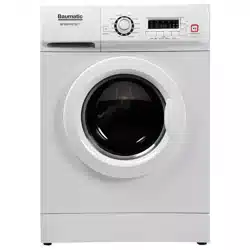
BWMI1206
/
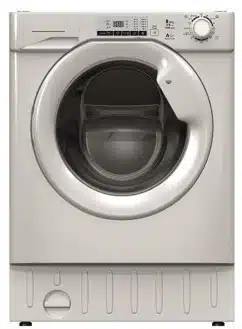
BWMI1407
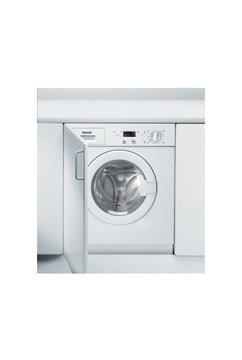
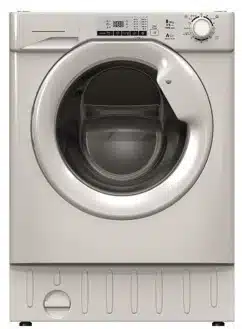
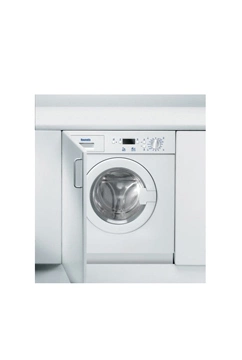
Fully integrated
washing machine
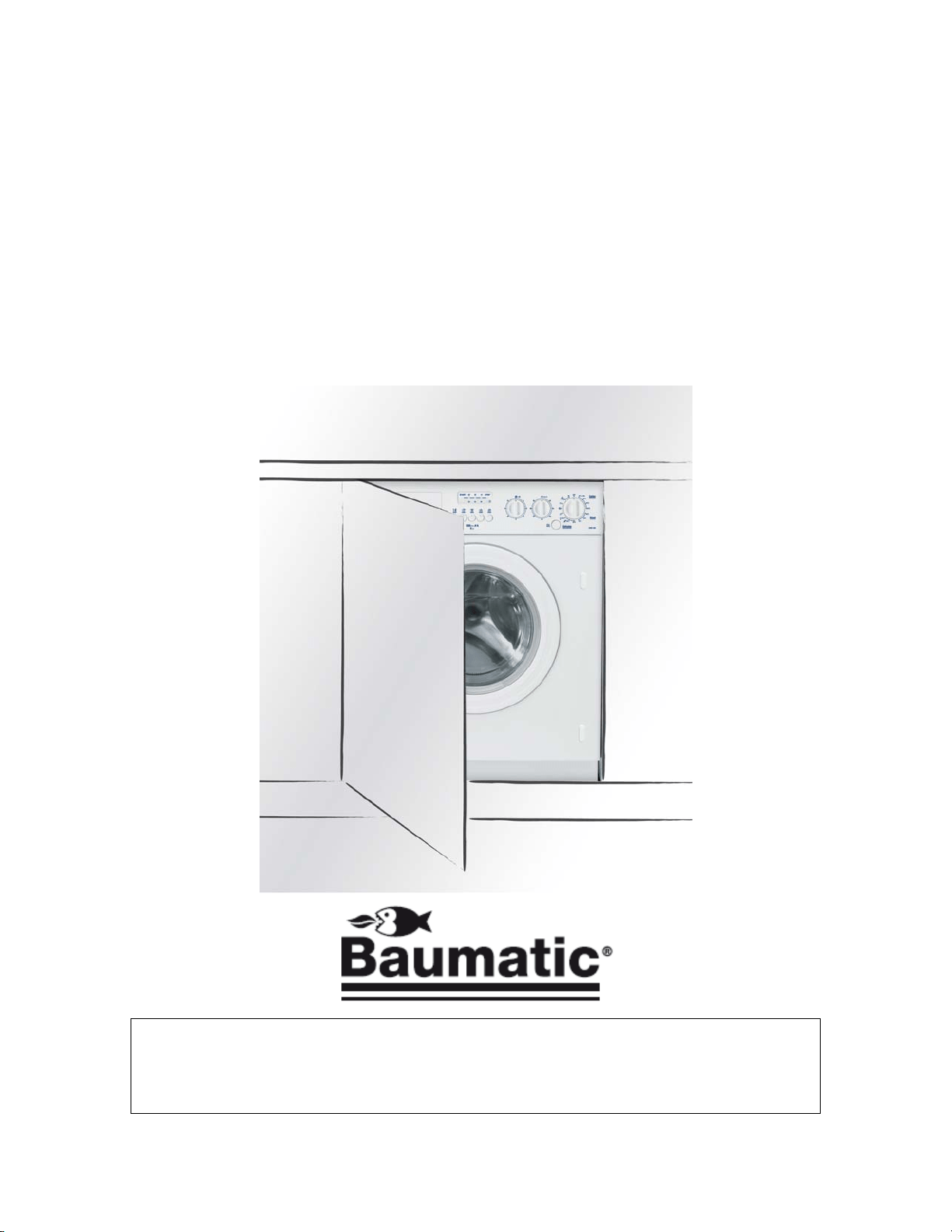
USER MANUAL FOR YOUR BAUMATIC
BWMI1206
BWMI1407
Fully integrated
washing machine
NOTE: This User Instruction Manual contains important
information, including safety & installation points, which will
enable you to get the most out of your appliance. Please keep it
in a safe place so that it is easily available for future reference.
GS 06/01/11
2

3
Contents
Environmental note 4
Important safety information 5 - 6
Specifications 7 – 8
Product and aperture dimensions 7
Product specifications 7 – 8
Baumatic consumables 8
Control panel 9 - 13
Detergent drawer 12 - 13
Preparing the wash cycle 13 - 19
Preparing your garments for washing 13 - 14
A selection of wash care symbols 14
Detergents and conditioners 15
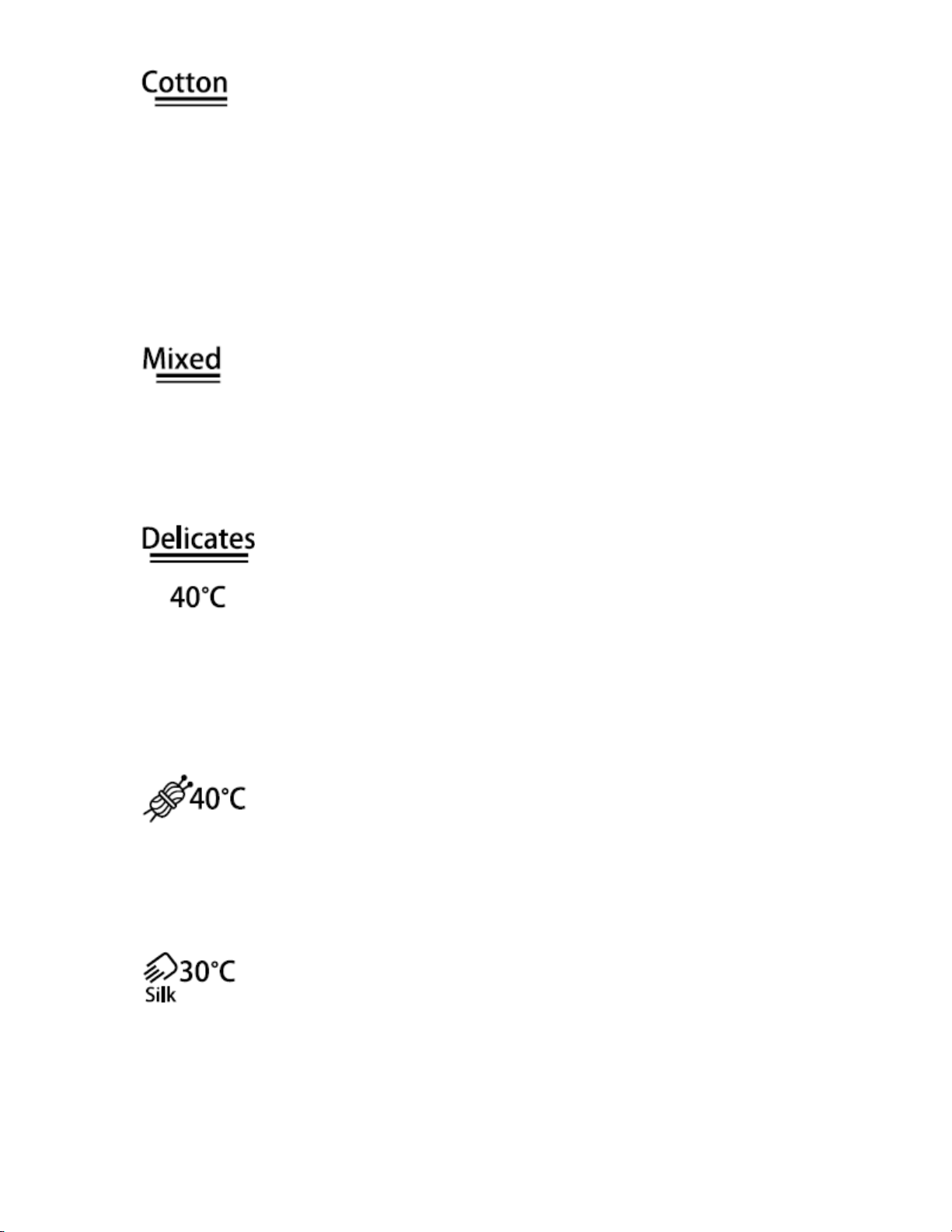
Program table 16
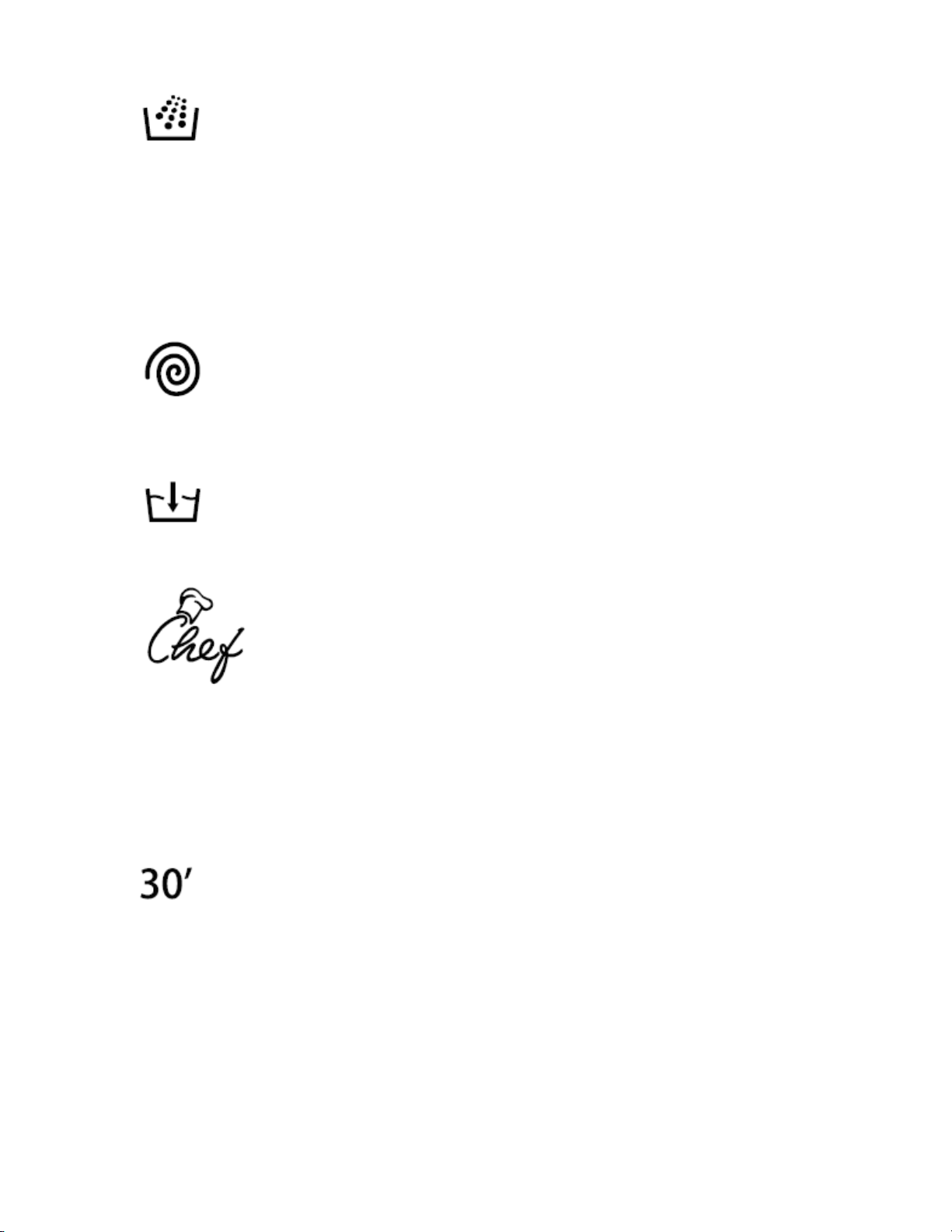
Program description 17 – 18
Wash program guidance 19
Selecting a wash program 19 - 23
Cancelling or pausing a wash program 20
Delay start feature 20 – 21
Saving energy when using your washing machine 21
Automatic consumption reduction 21
Removing stains 22
Stain removal rules 22
Stain removal guide 22 - 23
Maintenance and cleaning 24 - 26
In daily use 24
Control panel and washing machine cabinet 24
Detergent drawer 24 - 25
The washing machine drum 25
Door 25
90 degree maintenance wash 25
Long periods of not in use 26
General troubleshooting 26 - 27
Poor wash results 28
Installation 29 - 36
Unpacking and removing the transit bolts 29 - 30
Positioning and levelling the appliance 30 – 31
Fitting the décor door 31 - 33
Connecting to the mains water supply 33
Water outlet 34
Power supply 35
Before first use maintenance wash 35 – 36
Contact details 37
Environmental note
Note
: Before discarding an old appliance, switch off and
disconnect it from the power supply. Cut off and render any plug
useless. Cut the cable off directly behind the appliance to prevent
misuse. This should be undertaken by a competent person. Disable
the door lock to make sure that children cannot get stuck inside
the appliance.
4
Important safety information
Your safety is of the utmost importance to Baumatic.
Please make sure that you read this instruction booklet
before attempting to install or use the appliance. If you
are unsure of any of the information contained in this
booklet, please contact the Baumatic Advice Line.
General Safety
o Repairs to your appliance must only be carried out by a
Baumatic engineer or one of its authorised service agents. Any
attempt by an inexperienced person to repair the appliance,
could result in injury or damage to your washing machine.
o If you notice that the mains cable is damaged. The appliance
must not be used. The same applies if you notice that the
worktop, control panel or base area is damaged. As this could
allow access to the internal components of the machine.
o The appliance should be switched off and isolated from the
mains supply, before either cleaning or maintenance work is
attempted.
o The mains cable must not be used to pull the plug out of the
electrical socket.
o The machine should not be sprayed with water.
o The glass of the porthole door may become hot during the higher
temperature wash programs.
o The machine should be allowed to cool before carrying out an
emergency drain or cleaning the drain filter.
o It is possible for small animals to chew either mains cables or
water hoses, which could cause an electric shock hazard.
Installation
o The installation instructions contained within this user manual
should be followed.
o It is obligatory for the completed installation to comply with all
relevant building regulations and local water authority
requirements.
5

6
o Before the first use of the appliance, we advise that a
90°C cotton wash is completed. No garments should be
placed inside the machine; however a small amount of
detergent must be used.
During Use
o It is recommended that the appliance is unplugged and the
water supply is switched off after the machine is used.
o This appliance is only designed to wash normal domestic
washloads. If you use your washing machine in any other way or
it is incorrectly used, then Baumatic accepts no liability for any
damage that might be caused and any guarantee will be void.
o No attempt should be made to alter or modify the specifications
of this appliance.
o The detergents that you place in this appliance should be
suitable for automatic washing machines. With regards to dosage
levels, the detergent manufacturer’s recommendations should be
followed.
o You should not wash garments that have been in contact with
flammable materials.
o Your washing machine should not be used for dry cleaning.
o If you use either dyes or bleaching agents inside this machine,
then you should consult with the manufacturer of these products
to make sure they are suitable for use in your washing machine.
Baumatic cannot be held responsible for any damage that may
result.
Child Safety
o Your washing machine should only be used by adults. You should
not allow children in the area of the machine unsupervised. You
should not let them touch the controls or play with the appliance.
o It could be possible for a child or pet to gain access to the
washing machine through the porthole door. Therefore please
check the drum before using the appliance.
o Any packaging that is removed from the machine should be kept
away from children.
o All detergents should be kept out of children’s reach in a safe
place.
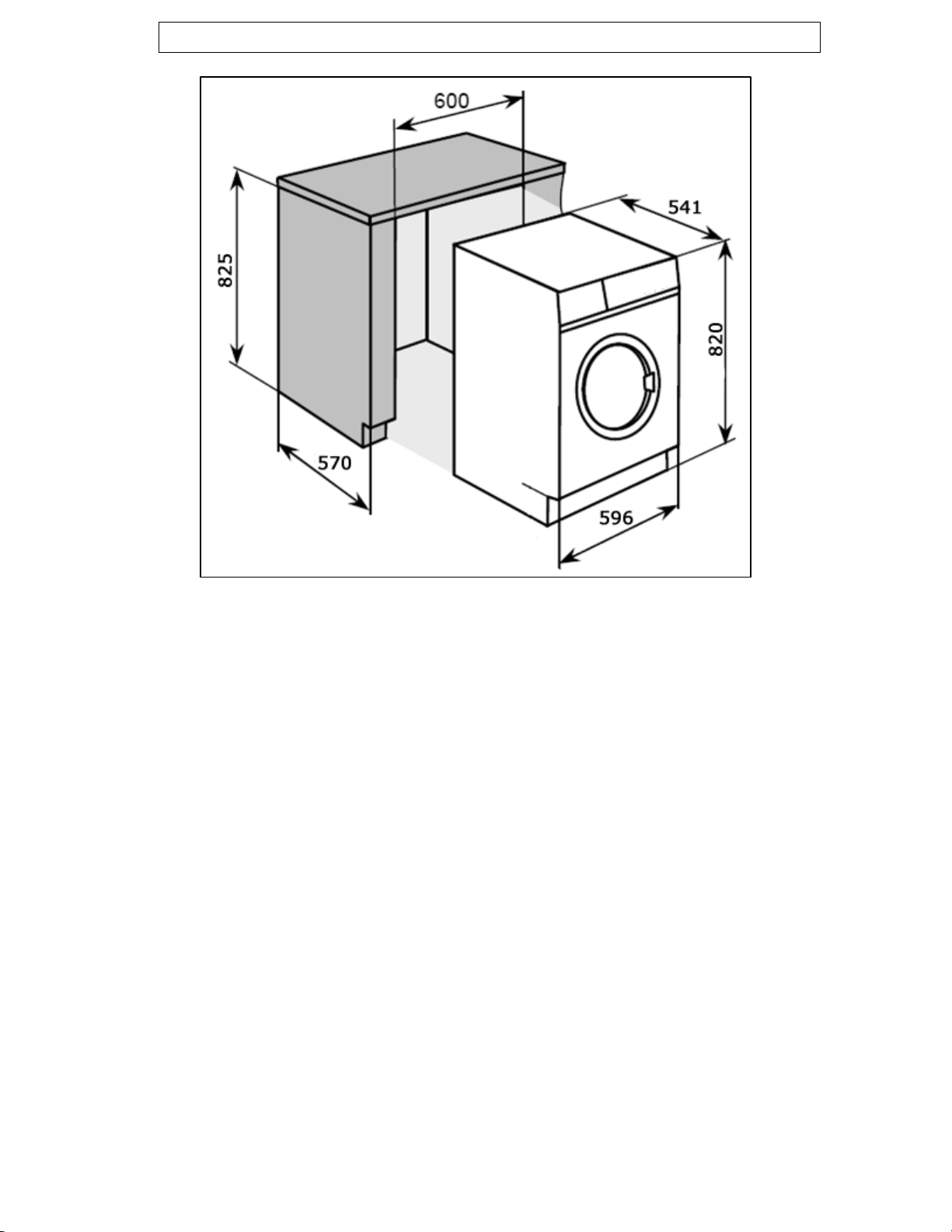
Specifications
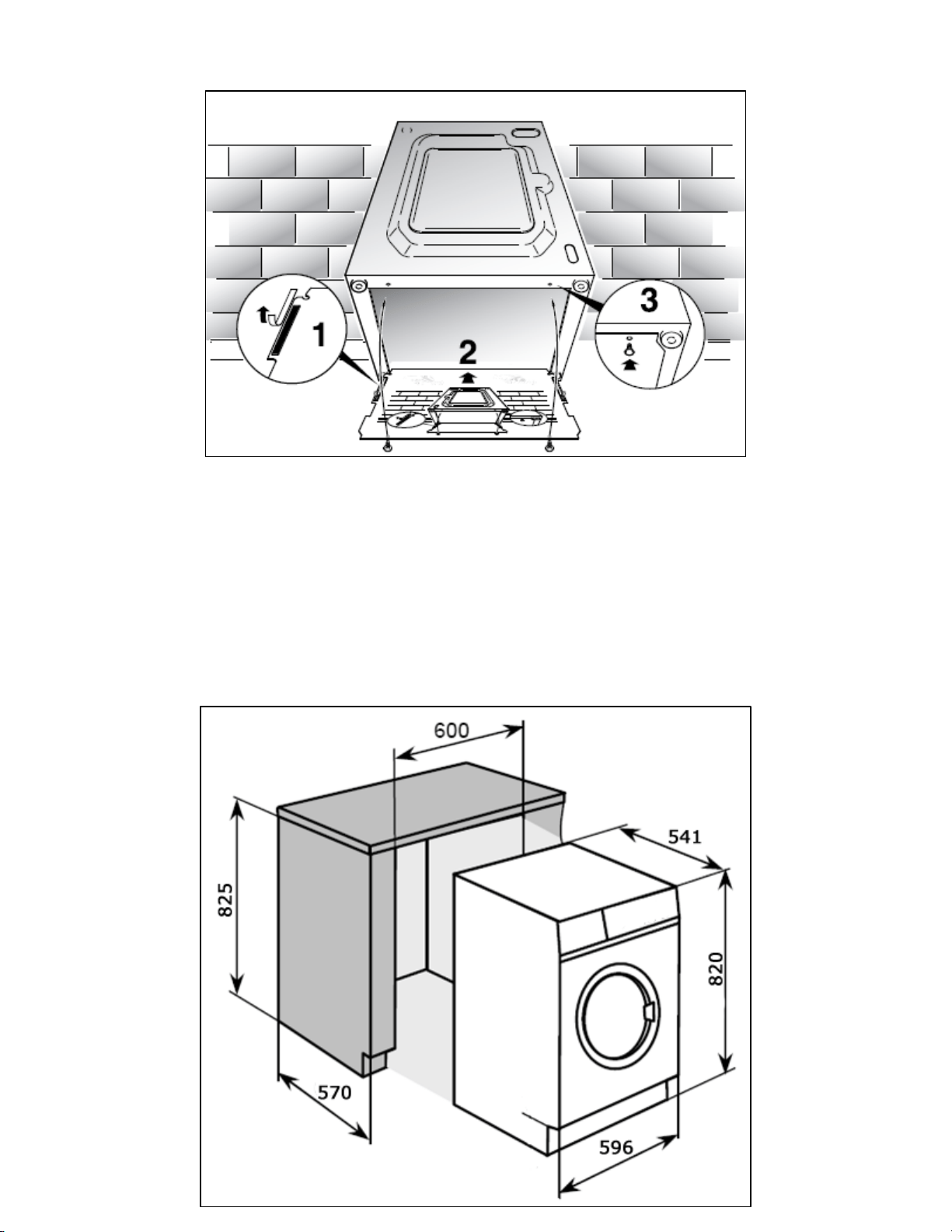
Product dimensions: Aperture dimensions:
Height: 820 mm 825 mm
Width: 596 mm 600 mm
Depth: 541 mm 570 mm
Product specifications
BWMI1206 BWMI1407
o Load capacity: 6 kg 7 kg
o Maximum spin speed: 1200 rpm 1400 rpm
o Drum size: 46 litres 56 litres
o 15 wash programs
o 3 option buttons: Pre-wash, Extra Rinse and Anti-Crease
o Variable spin speed with no spin option
o Porthole diameter: 30 mm
o 180° door opening
o LED display
o Digital countdown indicator
o Delay start
o Separate temperature control option
7

8
o Automatic consumption reduction
o Self-adjusting water level to load
o Imbalance control system
o Overflow protection
o Foam protection
o Safety lock
o Fuzzy logic
o Adjustable feet
Energy efficiency:
Energy rating A+
Wash performance A
Water extraction performance class B (BWMI1206)
A (BWMI1407)
Baumatic Consumables
o BC002 Washing Machine and Dishwasher Descaler (200g)
o BC006 Washing Bag (40 x 60 cm)
To order a Baumatic consumable product please call 0123 5437 244
and quote the product code. You can also order online from
eshop.baumatic.co.uk
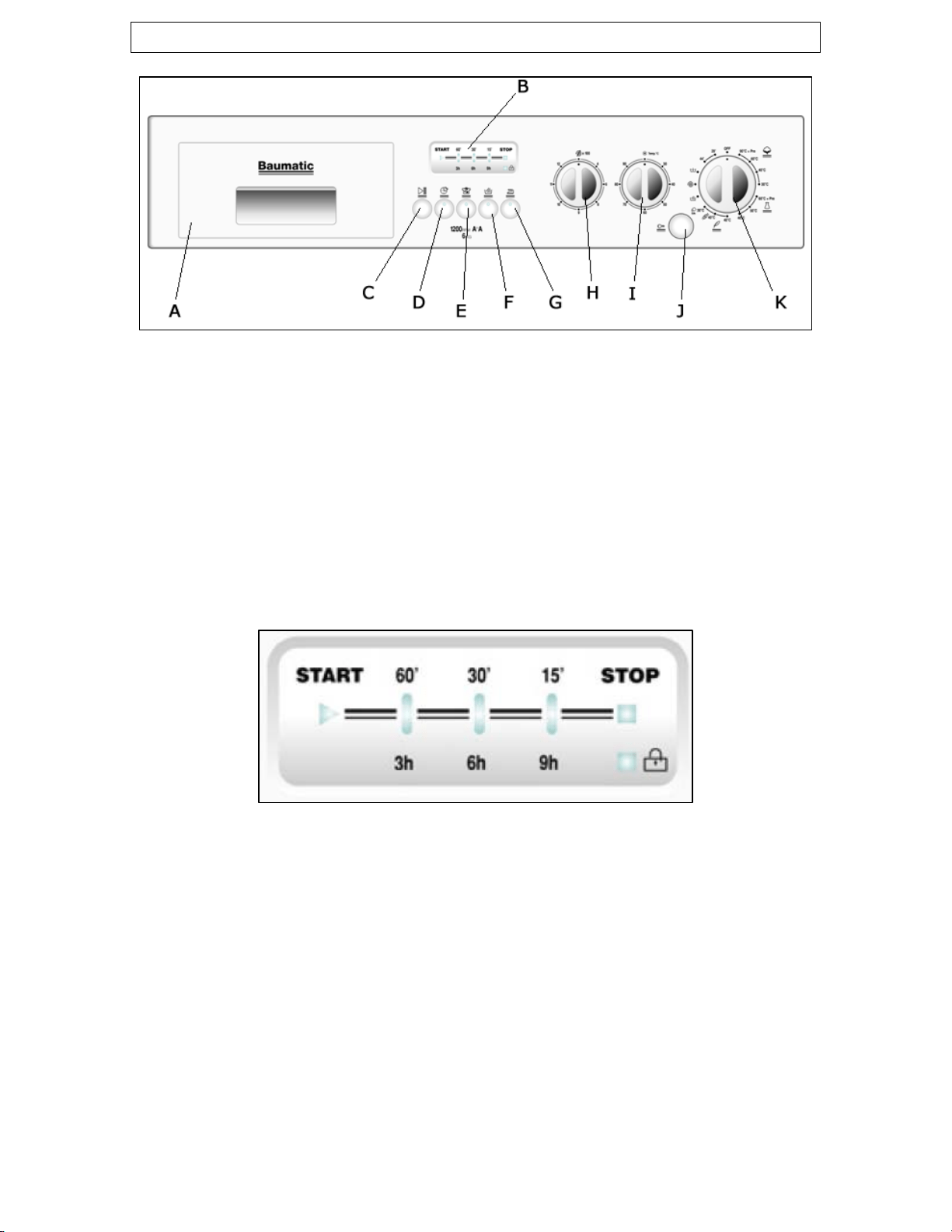
Control panel
A) Detergent drawer
B) Cycle progress indicator
C) Start / pause button
D) Delay start button
E) Pre-wash button
F) Extra rinse button
G) Anti-crease button
H) Spin speed control knob
I) Wash temperature control knob
J) Door open button
K) Program selection knob
Cycle progress indicator
This display shows the time remaining for a set wash program. The
icons indicate the following remaining times:
Start light: Remaining time above 60 minutes
60 light: Remaining time less than 60 minutes
30 light: Remaining time less than 30 minutes
15 light: Remaining time less than 15 minutes
Stop light: End of the program.
The display also shows the set delayed start time of 3, 6 or 9 hours.
The stop light will flash while a program is being set until the
program has started or the program selection knob is returned to
the “OFF” position.
9
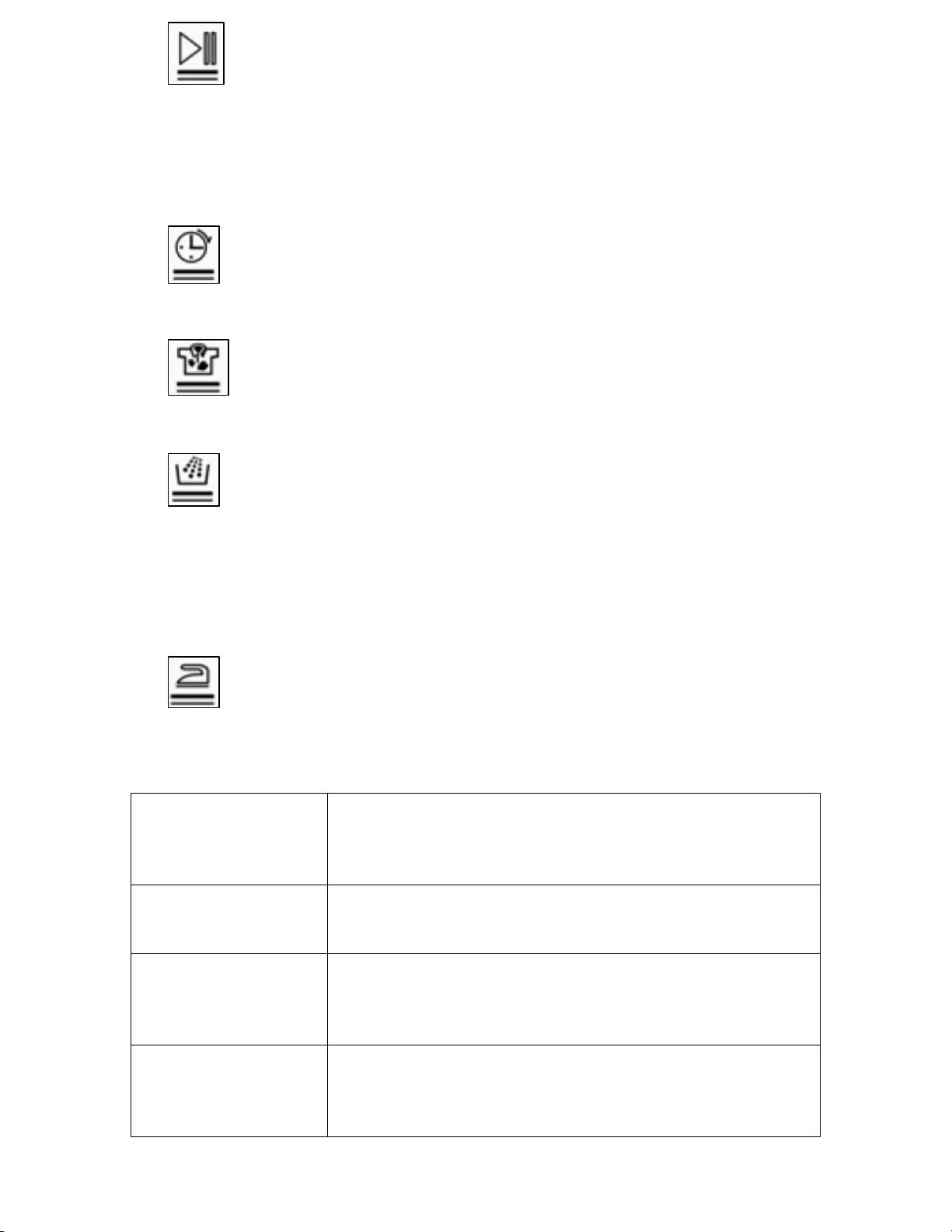
Start / pause button
10
This button should be used to start the chosen wash
program. When the button is pressed, the appliance will begin the
cycle within a few seconds. You can also press this button to pause
a wash cycle in progress and continue after. When a program is
selected, wait for the STOP light to flash before pressing the
Start / Pause button.
Delay start button
This button can be used to program a delay start of 3, 6 or 9
hours. See the section “Delay start feature” for instructions.
Pre-wash button
This option is useful for heavily soiled loads and can be
used only on some programs.
Extra rinse button
This button will program the machine to add an additional
rinse to the cycle. This function is ideal for people with sensitive
skin as it removes more of the detergent from washing. It is
advisable to use this function for very dirty loads where extra
detergent has been used. This option can be used only on some
programs.
Anti-crease button
Use this button to select the anti-crease function. This will
minimise creases in mixed fabrics, delicate fabrics and woollens and
silk. It works in the following ways:
Fabric
(according to
program
selected)
Process
Mixed fabrics The water is gradually cooled throughout the final
2 rinses with no spinning and then a delicate spin
assures the maximum relaxation of the fabrics.
Delicate fabrics The final 2 rinses are carried out with no spinning
and then the fabrics are left in water until it is
time to unload. When you are ready to unload,
press the anti-crease button (G) to drain.
Woollens / silk After the final rinse the fabrics are left in water
until it is time to unload. When you are ready to
unload, press the anti-crease button (G) to drain
and spin.
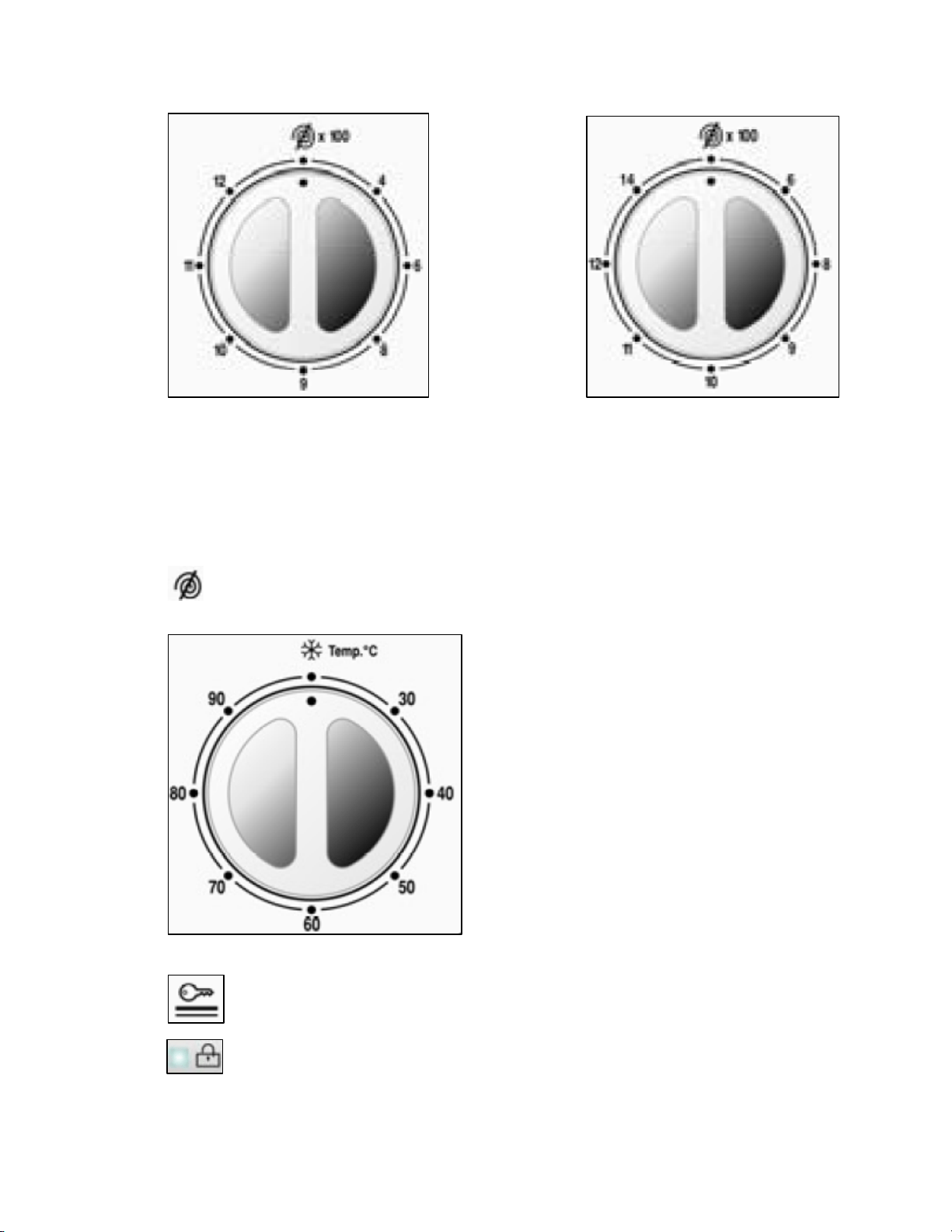
Spin speed control knob
BWMI1206 BWMI1407
11
ne.
The spin cycle is important to remove as much water as possible
from the laundry without damaging the fabrics. You can adjust the
spin speed of the machine to reduce the maximum speed. The
machine is fitted with an imbalance control system to cancel the
spin cycle if the load is unbalanced. This reduces the noise and
vibration in the machi
You can rotate the dial to this symbol to select “No Spin”.
Wash temperature control knob
This control knob enables you to
reduce, but not increase, the
washing cycle temperature. Please
refer to the program table for
information on the maximum
temperature advised for each wash
cycle.
Door open button
A safety device prevents the door from being opened
immediately after the end of the cycle. You should wait for 2
minutes after the program has finished and ensure the door
security light on the cycle progress indicator has gone out before
opening the door. If the door is not closed, the indicator will
continue to flash.
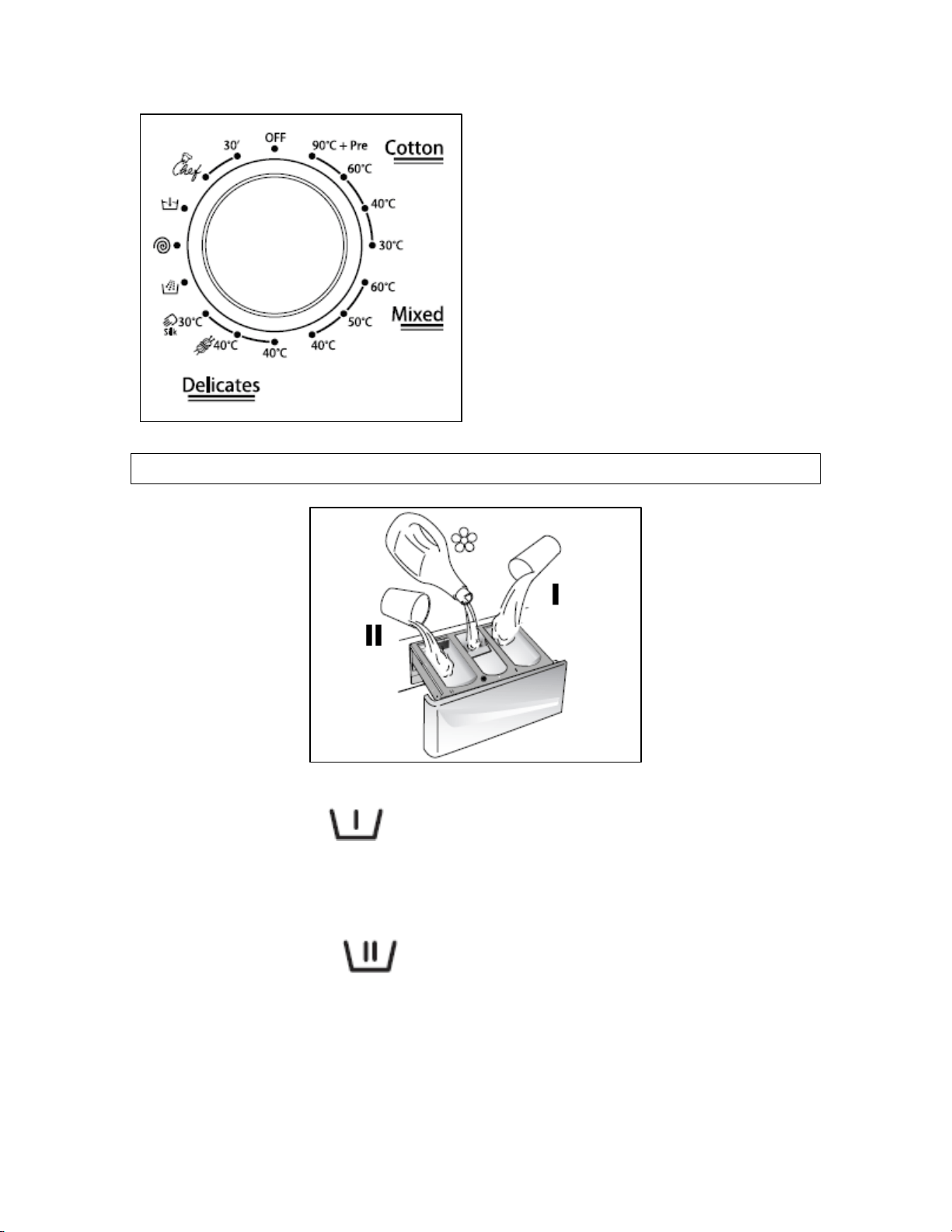
Wash program selection knob
This control knob allows you to
select the wash program of your
choice. You can rotate the knob in
both directions.
Detergent drawer
Pre wash section
This compartment should have detergent placed in it, if you are going
to select a wash program that has a pre wash as part of it.
Main wash section
This compartment should have detergent placed in it (you should also
put a water softening agent in this section, if you use one). The
detergent will be added to the drum at the start of the main wash
program.
12
Conditioner section
This compartment should be used for liquid conditioners (fabric
softener, starch). They will be added to the wash load during the final
rinse.
Preparing the wash cycle
Preparing your garments for washing
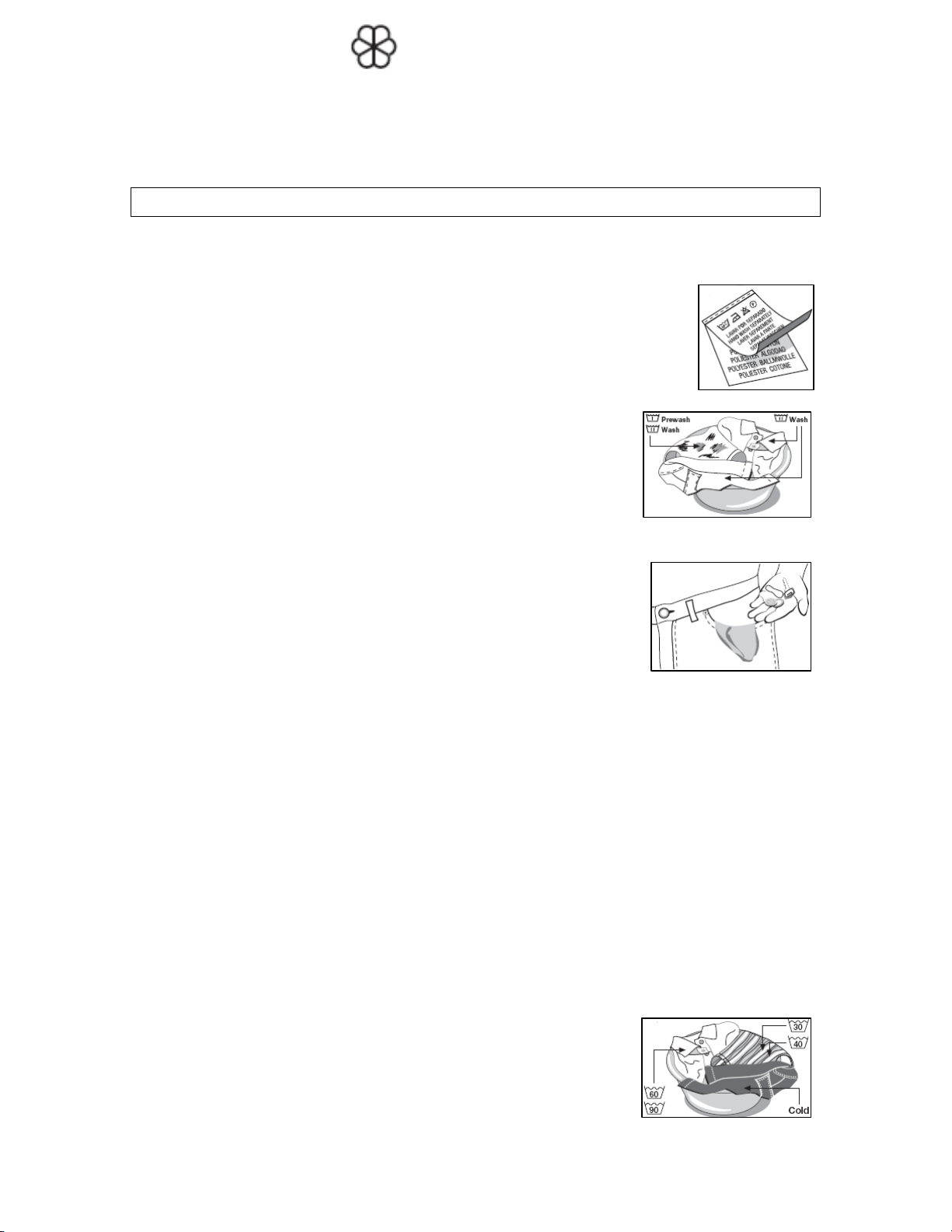
o Your washing should be sorted out, according to
the fabric type and the wash care symbol that is
printed on the garment’s wash care label. (See
separate section on wash care symbols).
o Your washing should also be sorted out
according to the degree of soiling.
o Check all pockets on a garment to make sure
that they are empty.
o Remove any detachable metal items (badges,
paperclips, safety pins etc).
o Zips should be closed, duvet covers and pillow cases should be
buttoned up and any loose straps should be tied up. This will
help to prevent other garments from getting damaged during the
wash.
o Woollens and knitted coloured fabrics should be turned inside out
before being washed in the appliance.
o Small delicate items (tights, baby socks) should be placed in
either a washing net or a zipped pillow case.
o Curtains should be handled with particular care. All plastic hooks
or metal strips must be removed before being washed in the
appliance.
13
o Coloured items and whites should be washed
in separate wash cycles.
o New garments often contain an excess of
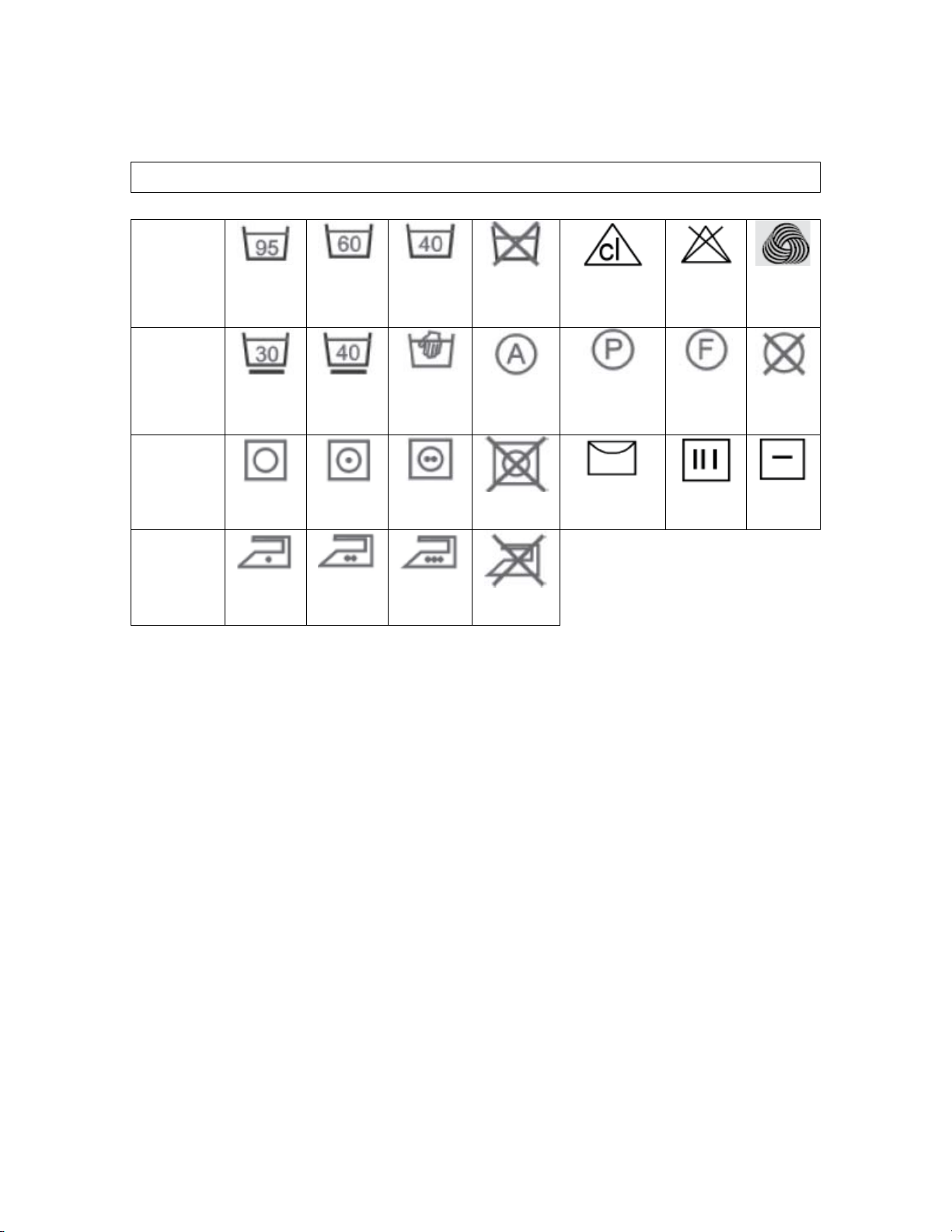
dye, therefore it is advisable to wash them separately for their
first wash.
o Garments should be unfolded and shook out before being placed
inside the machine.
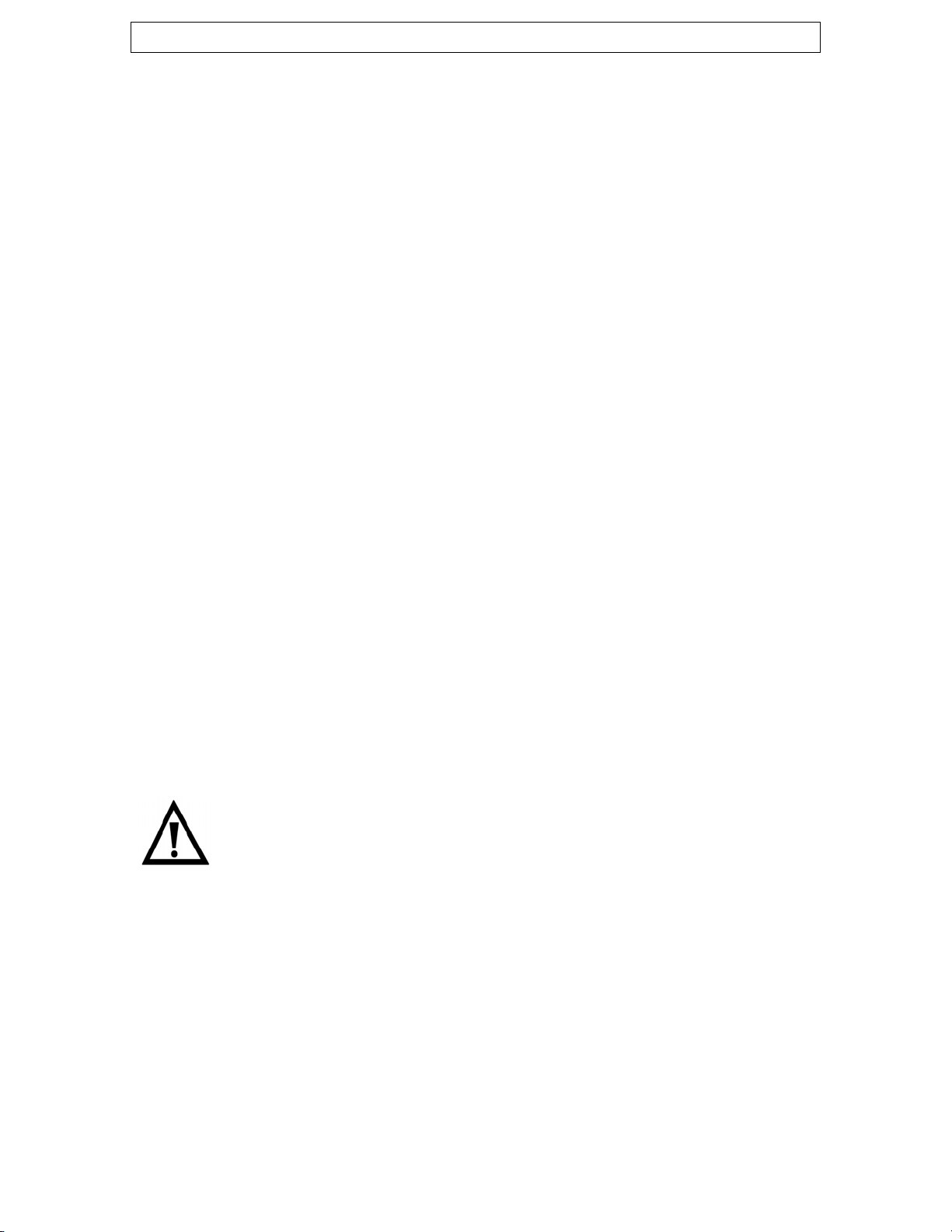
A selection of wash care symbols
Washing
Boiling
temp
95°C
Normal
temp
60°C
Normal
temp
40°C
Do not
wash!
Bleachable
in cold
water
Do not
bleach!
Wool
seal
Dry
cleaning
Delicate
temp
30°C
Delicate
temp
40°C
Hand
wash
only
All
solvents
All but TRI
Benzine
only
Do not
clean!
Spin
dryer
Normal
Low
High
Do not
dry!
Hang to
dry
Drip dry
Dry
flat
Ironing
110°C
150°C
200°C
Do not
iron!
o The wash care symbols should be used to help you to select the
most suitable wash program. They will also help you to sort your
laundry into different loads, depending on the fabric type and the
highest temperature which the garment can be washed at.
o If the wash care label does not appear in the above table, then
please refer to the washing machine program chart. This gives
more detailed descriptions of the types of fabric that are suitable
to be washed using a particular wash program.
14
Detergents and conditioners
The amount of detergent that you need to use in your appliance, will
depend on
o The degree of soiling. Lightly soiled garments in general
require less detergent.
o The size of the wash load. A smaller wash load will require a
reduction in the amount of detergent.
o The hardness of your tap water. The harder your water is,
then the more detergent you will need to use. The detergent
manufacturers normally give guidance as to how much extra
detergent should be used, depending on the hardness of the
water.
Liquid detergent
If you are using liquid detergent, then in the majority of cases the
liquid should be placed inside the dosing device supplied by the
detergent manufacturer. All instructions on the detergent packaging
should be followed.
Water softening agents
If your tap water is hard, then it may be prudent to utilise a water
softening agent. This will help to ensure that the appliance does not
become clogged with hard water deposits. You may also find that it will
allow you to lessen the amount of detergent that you are using.
When using any detergent or water softening
agent, the recommendations of the
manufacturers should be followed.
15
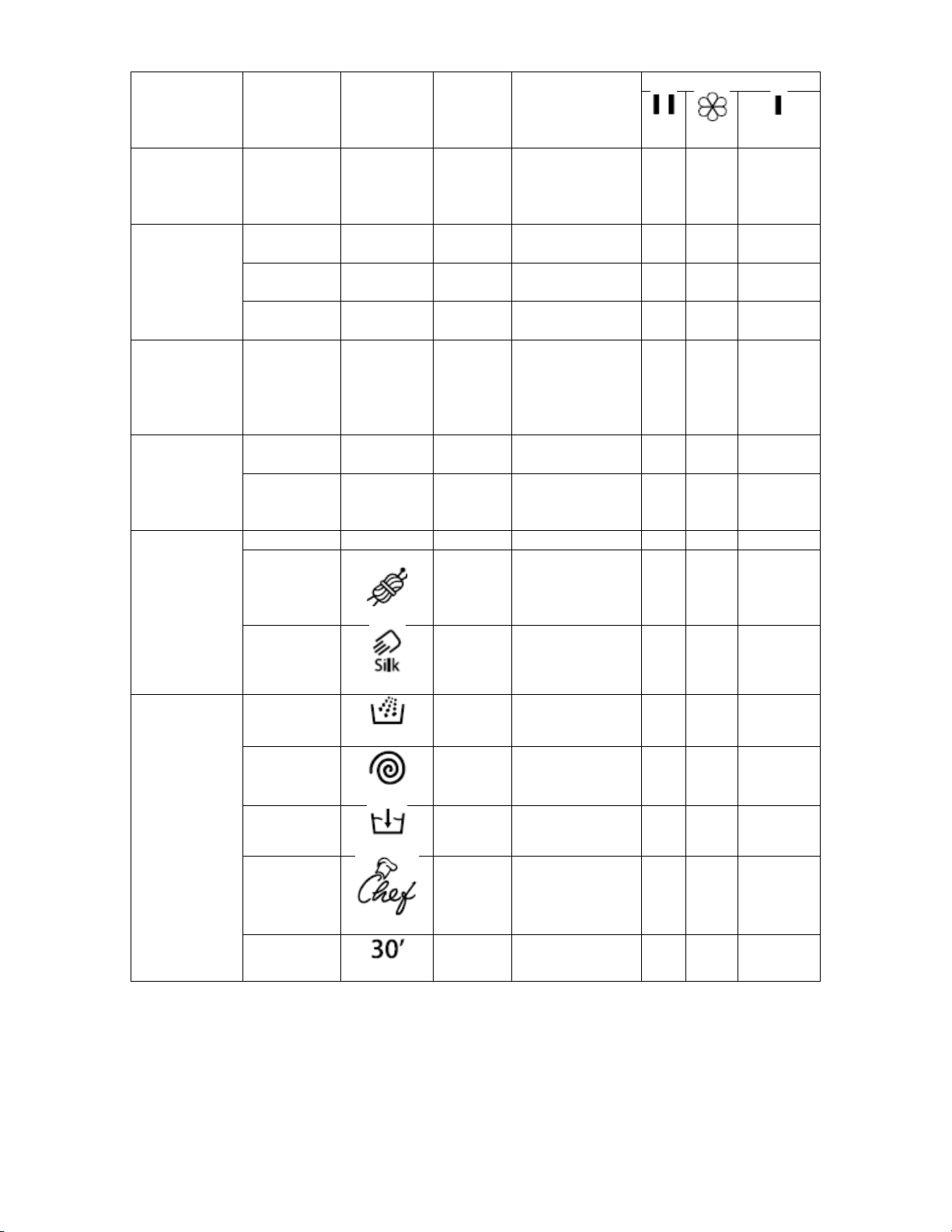
Program table
Detergent drawer
Program
Laundry
Control
knob
position
MAX
weight
(kg)
Temperature
(°C)
Resistant
fabrics
(cotton,
linen)
Whites
with
prewash
90 + Pre 7 Up to 90 Yes Yes Yes
Fast
coloureds
60 7 Up to 60 Yes Yes Optional
Fast
coloureds
40 7 Up to 40 Yes Yes Optional
Cotton,
mixed
Non-fast
coloureds
30 7 Up to 30 Yes Yes Optional
Mixed
fabrics and
synthetics
(mixed,
resistant)
Fast
coloureds
60 3.5 Up to 60 Yes Yes No
Fast
coloureds
50 3.5 Up to 50 Yes Yes No Synthetics
(nylon,
perlon,
mixed
cotton)
Non-fast
coloureds
40 3.5 Up to 40 Yes Yes No
Delicates 40 2 Up to 40 Yes Yes No
Machine
washable
woollens
40
1.5 Up to 40 Yes Yes No
Very
delicate
fabrics
Silk,
hand-
wash
30
1 Up to 30 Yes Yes No
Rinse
- - No Yes No
Spin
- - No No No
Drain
- - No No No
“Chef”
intense
7 Up to 40 Yes Yes No
Specials
Rapid 30
minute
2 Up to 30 Yes Yes No
16
17
Program description
s spun dry as much as possible up to the
maximum speed.
if the pre-wash
button (E) is pressed when selecting the cycle.
due to the
rotation rhythms of the drum and the water levels.
o A gentle spin ensures the fabrics become less creased.
ing and soaking and is recommended
for very delicate fabrics.
es are carried out with high water levels
to ensure best results.
o thoroughly wash woollen garments
without damaging them.
o The cycle consists of alternate periods of activity and pauses.
ash only” and laundry items made from silk
on the fabric label.
o The cotton program is designed for maximum washing and
rinsing efficiency. With spin cycles in between, the program
guarantees the laundry is rinsed thoroughly. The final spin cycle
ensures laundry i
o The cotton programs can include a pre-wash,
o The main wash and rinse gives the best results
o This cycle alternates wash
o The wash cycle and rins
o This cycle enables you t
o This program allows a complete washing cycle for garments
specified as “Hand-w
18
o This cycle has a maximum temperature of 30°C and concludes
with 3 final rinses and no final spin.
m carries out 3 rinses with an intermediate spin
which can be reduced or excluded using the spin speed control
le can be used for rinsing any type of fabric or after
hand-washing. This program can also be used as a bleaching
cycle.
o The spin program carries out a maximum spin which can be
reduced using the spin speed control knob (H).
This program drains out the water.
o This program enables you to wash together different types of
washes with considerable energy saving by using a
temperature of 40°C and alternating spin action with soaking
phases.
nute rapid program allows a complete washing cycle to
be carried out in approximately 30 minutes with a temperature
is cycle it is recommended to use only 20% of the
recommended quantities shown on the detergent manufacturer’s
instructions.
o This progra
knob (H).
o The cyc
o
fabrics e.g. cotton and synthetic fast coloureds.
o The cycle
o The 30 mi
of 30°C.
o When using th

19
Wash program guidance
The washing machine automatically seleco ts a spin speed for a
ture, you can make the machine
.g. the temperature of your water supply, your water
pressure etc. can affect the time it takes for the wash cycle to
particular wash program. However it is possible to reduce the spin
speed by using the spin reduction feature.
o Important: You should make sure that the selected spin speed is
appropriate for the garments that you are washing.
If you use the spin reduction feao
not go into a spin cycle. If you pick this option, then the machine
will stop with water in the drum.
o Important: Before opening the door of the appliance, you MUST
select the drain program to clear this water.
o The LCD display shows an approximate time remaining for the
selected wash cycle. Please note that factors external to the
machine, e
complete.
Selecting a wash program
o Load your laundry and put detergent in the relevan
compartment of the soap drawe
t
r.
d, using the spin speed control
rature by using the wash
o Close the porthole door firmly.
o Select the most appropriate wash program for the garments that
you are washing, by turning the program selection knob (K).
o Select any program options by using the pre-wash button (E),
extra rinse button (F) or anti-crease button (G).
o Any program option that you select, will affect the length of time
that the wash cycle will take to complete.
Alter the spin speed, if requireo
knob (H) or change the wash tempe
temperature control knob (I).
o Press the Start / Pause button (C).
o After approximately 5 seconds, you will hear your washing
machine start the wash cycle.
20
power has
been restored, the wash program will continue.
Whilst the wash program is in progress, the time remaining to
ash program
old the Start / Pause button (C) for about 2
seconds.
ob (K) to
the OFF position.
ove items the door will remain locked
for two minutes before it is possible to open the door.
e
n
opening the porthole door, you MUST
De
use
wash cycle until a later time. You can delay the start
o Before pressing the Start / Pause button (C), you should select
ow the set delay time.
wn. The indicator light for the chosen delay time will stop
blinking and remain on.
o If there is a power failure or the plug is pulled out of the
socket when a wash cycle is in progress, once
o
the end of the wash cycle will appear on the display.
Cancelling or pausing a w
o To stop a wash program once a wash cycle is in progress, you
should press and h
o To cancel the program, turn the program selection kn
o If you wish to add or rem
the door and press the Start / Pause button (C) to
ue the wash cycle.
Before
o Clos
conti
drain the appliance; otherwise there may still
be water in the drum when you open the
door.
lay start feature
Your appliance has a delay start feature, which allows you to pa
the start of a
time by 3, 6 or 9 hours.
o Follow the process listed under “Selecting a wash program”.
the length of time that you want to delay the wash program for
by pressing the delay start button (D). The relevant LED will
light on the display to sh
o Press the Start / Pause button (C) to begin the delay
countdo
o At the end of the required delay time, the chosen program will
begin.

21
ing the Start /
Pause button (C) or switch the appliance off by turning the
aste of energy, water or detergent, we
recommend that you put a full load in your washing machine but
o Using stain removers before machine washing reduces the need
60°C. Energy savings of up to
50% can be made by using a 60°C wash temperature rather
o The washing machine is fitted with an automatic consumption
o This results in a reduction in the amount of water used and
o The amount of water and electricity used will always be
appropriate for the amount of laundry which ensures you achieve
excellent washing results whilst respecting the environment and
saving money.
o To cancel a time delay that has been set, you should press and
hold the delay start button (D) until the indicator light goes OFF
and the stop light blinks.
o You can then start the program manually by press
program selection knob (K) to the OFF position.
Saving energy when using your washing machine
o To prevent any possible w
without exceeding the recommended maximum load size. Up to
50% of energy saving can be made with one full load compared
to two half load washes.
o Only use the pre-wash function with particularly dirty loads.
Energy savings of 5% to 15% can be made by not selecting the
pre-wash option for normal soiled laundry.
to wash at temperatures over
than 90°C.
Automatic consumption reduction
reduction system which enables the machine to use the amount
of water needed to wash and rinse the laundry in relation to the
particular load size.
electricity needed to heat it to the minimum temperature
required without compromising the washing and rinsing
performance in any way.
22
covered in stains, grease or are heavily soiled may
eed to be pre-washed or soaked before being placed inside of the
o Soaking helps to remove protein-type stains, like blood, milk or
s to loosen soil before the main wash.
Use warm water for soaking or pre-washing stained laundry. Hot
in it is,
how old the stain is, what the fabric type is and whether the
find this out).
When bleach is recommended, use a mild fabric bleach that is
er towel or white cloth. Apply the stain remover to
the back of the stain. This forces the stain off the fabric, instead
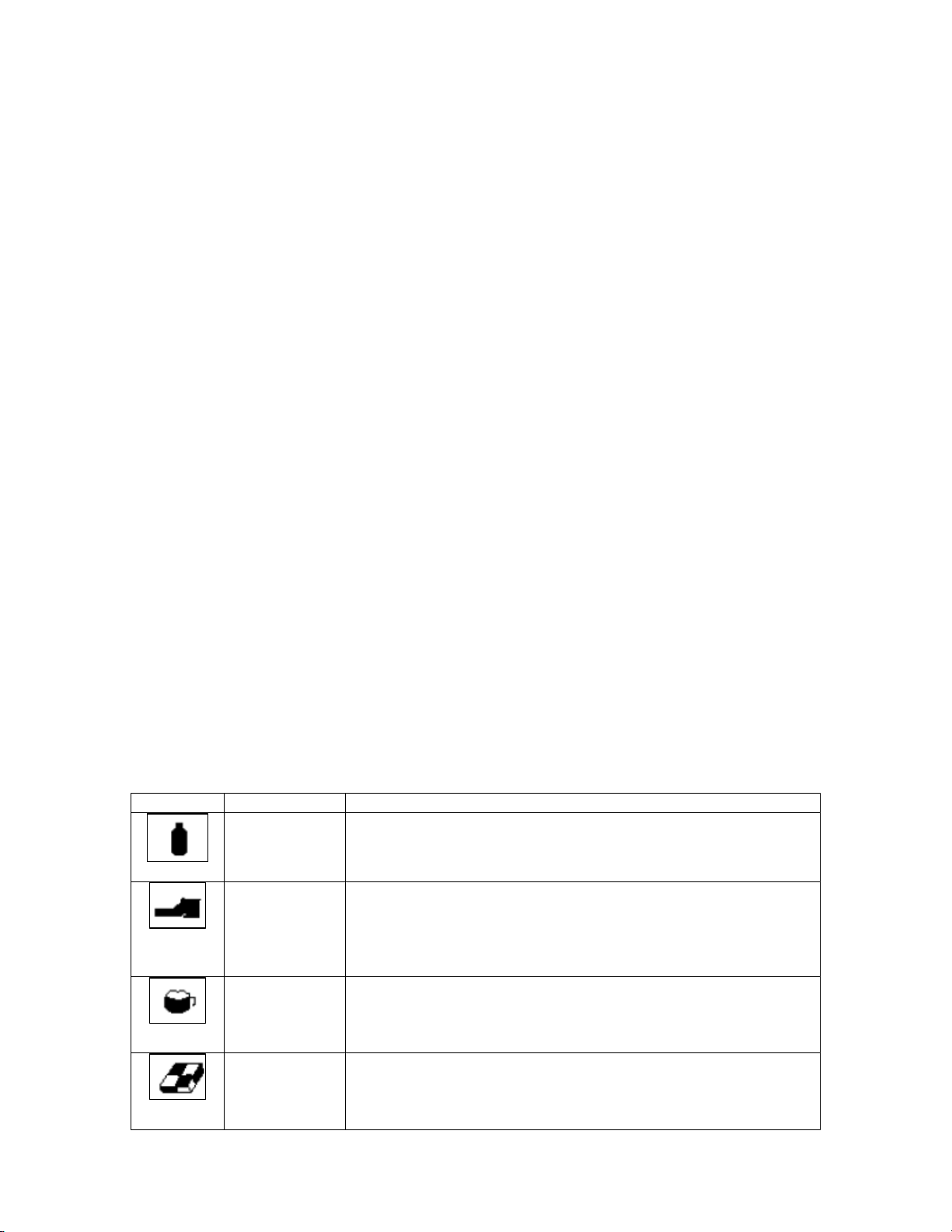
tain removal guide
Removing stains
Garments that are
n
washing machine.
grass.
o Pre-washing help
Stain removal rules
o
water can set stains.
o Most stains are easier to remove when they are fresh.
o Before treating any stain try to establish; what kind of sta
fabric is colourfast (check the care label to
o Washing and drying can fix some stains.
o
safe for the fabric.
o If you need to use a stain remover, put the stained area face
down on a pap
of through it.
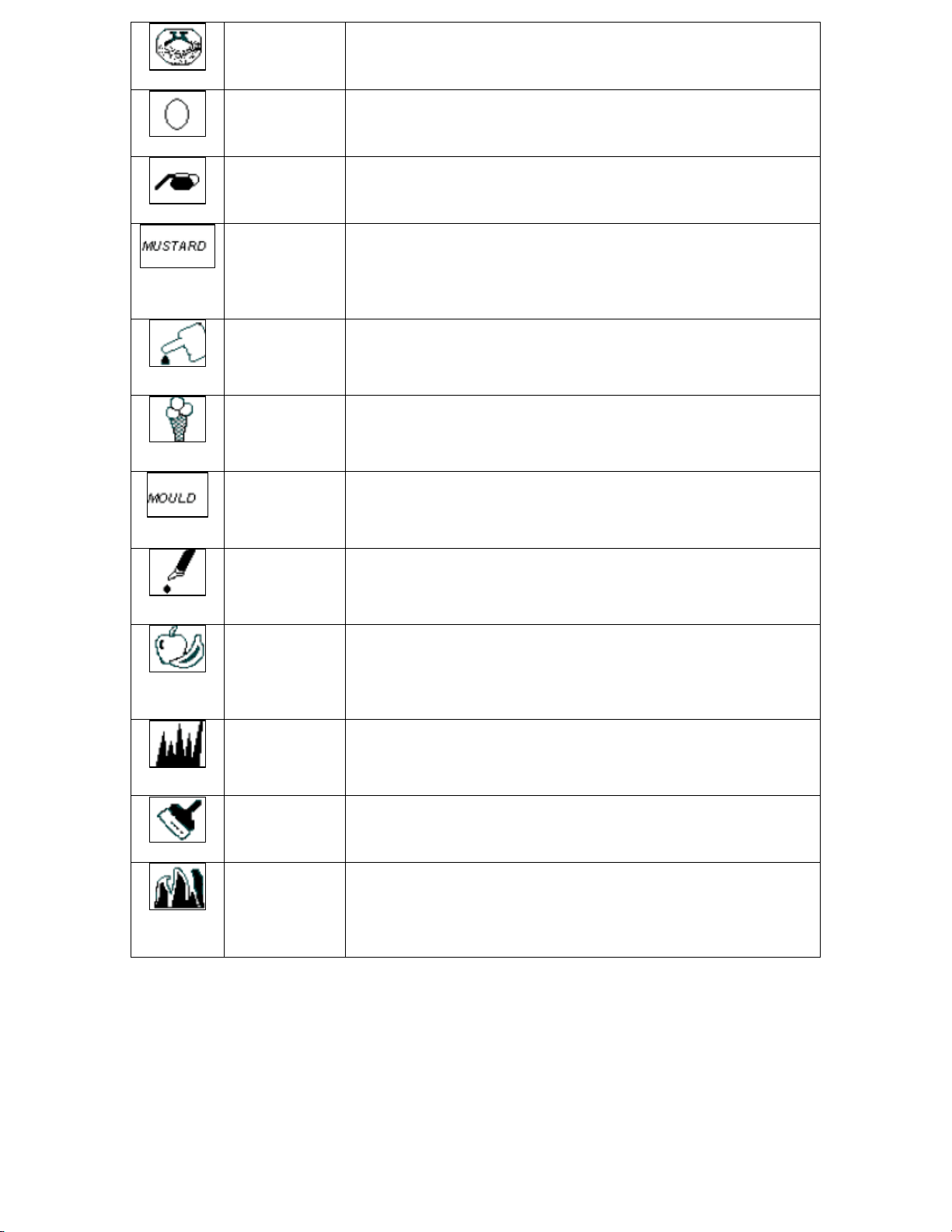
S
Stain Removal Method
Alcoholic washed with cold water, then
beverages
The stain should be first
wiped with glycerine and water and rinsed with water
mixed with vinegar.
Shoe polish The stain should be softly scratched without ruining the
material, then rubbed with detergent and rinsed. In case
it is not eliminated, rub with 1 unit of pure alcohol (96
degrees) mixed in 2 units of water and then washed with
lukewarm water.
Tea and
coffee
Stretch the stained area of material on the top of a
container and pour water as hot as the material can
endure on it. If the type of material is suitable, wash it
with lye.
Chocolate
and cocoa
Leave your clothes in cold water and rub with soap or
detergent, wash it in the highest temperature that the
material type can endure. If there is still a stain of oil left,
wipe with oxygenated water (in proportion of 3%).
23
paste
Tomato Scrape the dried pieces without ruining the material, then
leave in cold water for about 30 minutes and wash by
rubbing with detergent.
Meat broth/
egg
Eliminate the dried stain residues and wipe with a sponge
or soft cloth wetted in cold water. Rub w
ith detergent and
wash with diluted lye.
Grease and
oil stains
First wipe the residues. Rub the stain with detergent and
then wash with lukewarm soapy water.
Mustard First apply glycerine to the stained area. Rub with
detergent and then wash. If the stain still does not
disappear, wipe with alcohol (on synthetic and coloured
cloth, a mixture of 1 unit alcohol, 2 units water should be
used).
Blood stain Lay your clothes in cold water for 30 minutes. If the stain
still does not disappear, lay in mixture of water and
ammonia (3 table-spoons of ammonia in 4 litres of water)
for 30 minutes.
Cr
cream and
milk
eam, ice- Lay your clothes in cold water and rub the stained area
with detergent. If the stain has still not disappeared,
apply lye on the fabric of your clothes in proper
proportion. (Do not use lye on coloured clothes).
M ould Mould stains should be cleaned as soon as possible. The
stain should be washed with detergent, and if it does not
disappear, it should be wiped with oxygenated water (in
proportion of 3%).
Ink Hold the stained area under cold water and wait until the
inky water completely runs off. Then rub with water
diluted with lemon juice and detergent. Wait five minutes
and then wash.
Fruit Stretch the stained area of your clothes on the top part of
a container and pour cold water on it. Do not pour hot
water on the stain. Wipe with cold water and apply
glycerine. Wait for 1-2 hours and rinse after wiping with a
few drops of white vinegar.
G
ure alcohol and 2 units of water).
rass stain Rub the stained part with detergent. If the type of fabric
is suitable for use of lye, wash it with lye. Rub your
woollen clothes with alcohol (for coloured one, a mixture
of 1 unit p
Oil paint The stain should be eliminated before it dries by applying
thinner on it. Then it should be rubbed with detergent and
washed.
Burnt stain
fabrics, a cloth
dampened in oxygenated water should be pressed on the
ain and it should be ironed with a dry cloth on it. It
ould be washed after rinsing well.
If your fabric is suitable for the use of lye, you can add
lye into your washing water. For woollen
st
sh
24
aintenance and cleaning M
In daily use
o Once a wash cycle has completed, you should pull out the
detergent drawer slightly, so it can dry out.
o Leave the porthole door ajar for
has completed. This
a short while after a wash cycle
should help to prevent stagnant smells and
ce from your mains
supply, when it is not in use.
inet.
ny liquid detergent or conditioner from the
er onto the washing machine cabinet, then these
should be cleaned up immediately as they could be corrosive.
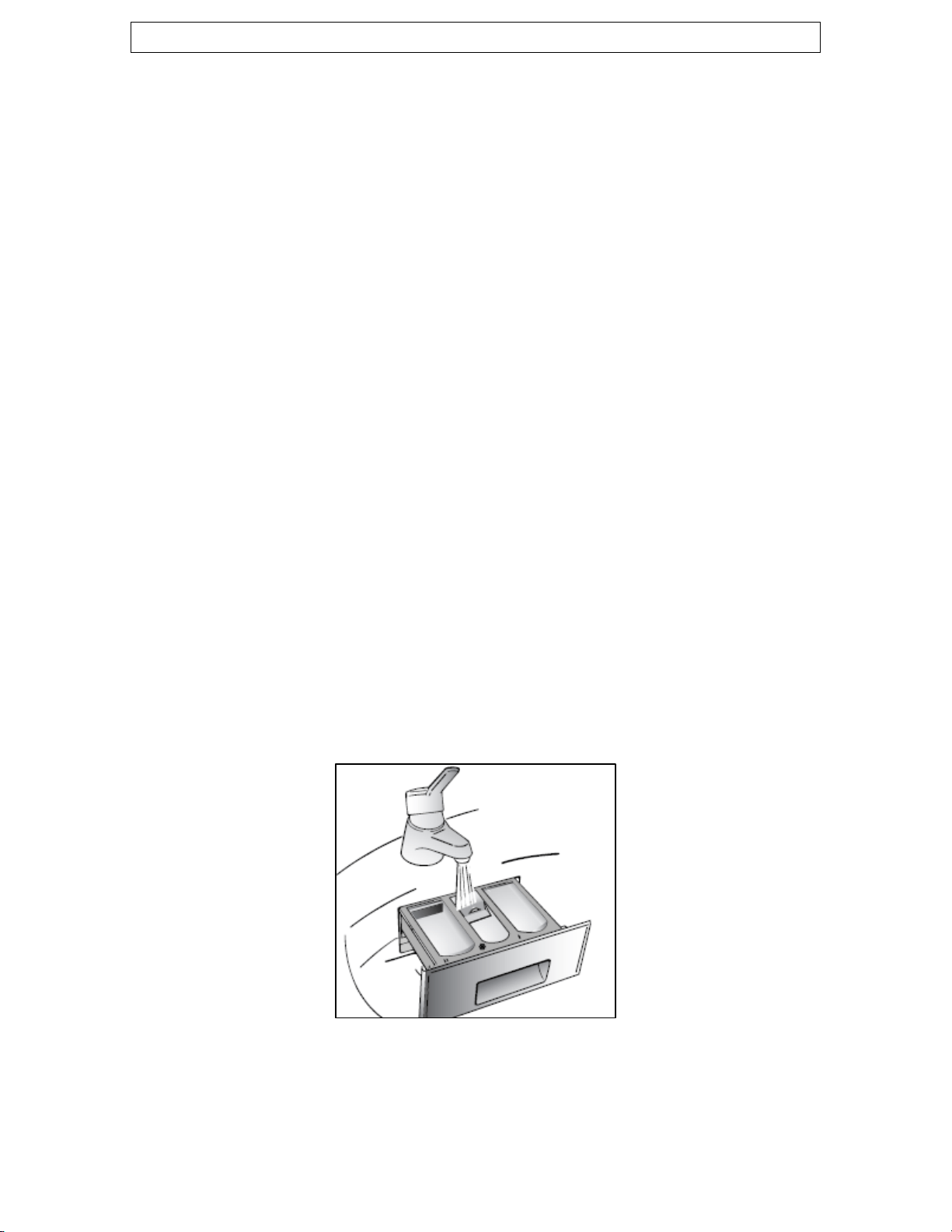
etergent drawer
ccasiona
o Pull the detergent drawer out as far as it will go and then
to protect the door seal.
o Close the water tap.
o We suggest that you disconnect the applian
Control panel and washing machine cab
IMPORTANT: Do not use any abrasive cleaner or household polish on
ither the control panel or operating parts. e
o Wipe over the control panel and the external surface of the
machine using a brand new damp cloth with warm water.
o If you ever spill a
detergent draw
D
O lly the detergent drawer should be cleaned.
remove the drawer by pulling firmly.

25
tments of the detergent drawer.
awer by placing it back into the slot.
Then push the drawer fully back into position.
he drum of your washing machine is constructed from stainless steel.
your appliance.
e drum with an appropriate
stainless steel cleaning agent.
o You should regularly check to see if any deposits have formed,
o Regularly clean the door glass with a damp cloth. A build up of
he water can result in water leaking
from the door.
shing machine can lead to a
acteria build up inside of the machine and in extreme cases you may
ycle has
completed.
ur appliance on a 90 degree wash.
powder that contains a bleaching agent
(i.e. not a wash powder that is only suitable for washing
coloured garments).
o Use warm water and a brush to thoroughly clean the three
compar
o Clean the area that the detergent drawer slides into with a
brush.
o Replace the detergent dr
The washing machine drum
T
However if there are objects that can rust placed inside the drum, then
it is possible for the drum to become stained.
IMPORTANT: Do not use a descaling agent, iron/steel wool or
scouring agents to clean the drum of
o Remove any rust stains on th
Door
or there are any foreign bodies in the rubber door gasket. This
sits inside the opening of the porthole door.
soiling and residues from t
90 degree maintenance wash
The warm and damp environment of a wa
b
even get a “sludge” like material building. To prevent this from
happening, you should do the following:-
o Leave the door ajar for a few minutes after the wash c
o Once a month, set yo
o You should not put clothing inside the appliance for this
maintainence wash.
o You should use a wash
Long periods of not in use
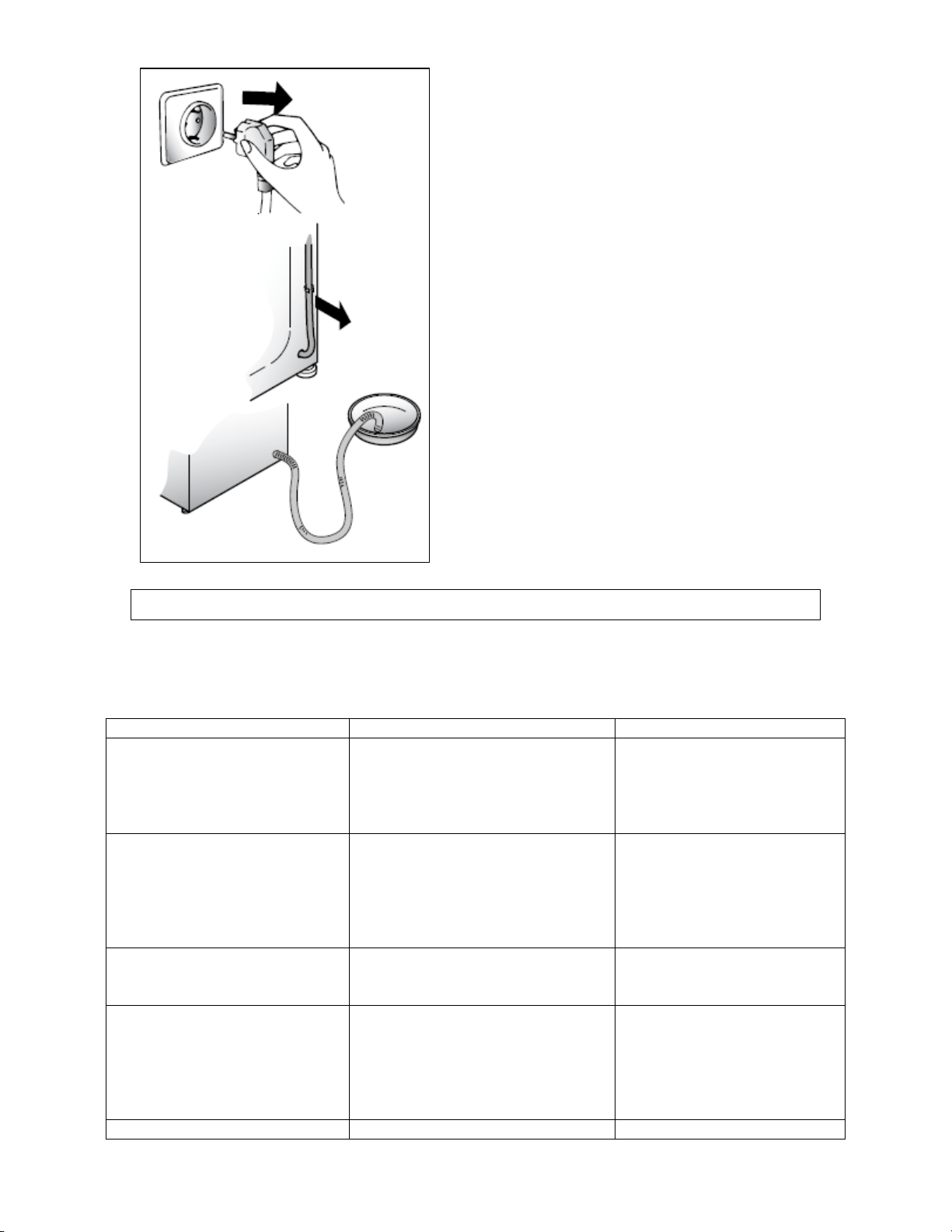
26
r
s,
ining water must be
completely removed from the
it downwards into a basin
until all the water has emptied
out.
o If the appliance is being
transported or is out of use fo
long periods in unheated place
all rema
hoses.
o Ensure the mains power is off
and then unclip the hose and
point
General troubleshooting
If your appliance does not appear to be functioning correctly, please
refer le below before ca e Customer Care Helpline.
lem
to the tab lling th
Prob Cause Solution
Machine does not work on
any program.
socket
on
e
n
1) Plug not in the
2) Not switched
3) Power failur
4) Fuse blown
5) Door open
1) Plug it i
2) Switch it on
3) Check
4) Check
5) Close door
Does not fill with water.
es
1) As above
Tap turned off 2)
3) Program selection knob
3
not positioned correctly
4) Fill hoses are kinked
1) Check
2) Turn on the tap
Position the )
program selection
knob correctly
Straighten fill hos4)
Water does not drain away. 1) Kink in discharge hose
2) House drain is blocked
1) Straighten
discharge hose
2) Clean drain
Water on floor around the
washing machine. ho
ed
t 1) Leaking gasket between
setap and water inlet
2) House drain is block
Detergent
1)
and tighten hose
an
3) drawer
blocked with soap
residues
Replace gaske
d tap well
Clean dr2) ain
3) Clean detergent
drawer
1) Water has not yet 1) ew minutes Wait a fDoes not spin.
27
drained away.
2) No Spin option selected
pin
peed control
for machine to
empty
2) Choose a s
speed using the
spin s
knob (H)
Machine vibrates a lot
during the spin.
ine not
bolts not
d
he adjustable
sit
3) Rearrange the
laundry evenly
1) Washing mach
completely level
2) Transit
removed yet
3) Load not distribute
evenly
1) Alter t
feet
2) Remove the tran
bolts
Door will not open. 1) 2 minutes have not
since the progr
elapsed
am finished
1) Wait 2 minutes
The machine makes a
different noise when
spinning.
This is due to the brush motor
which ensures better
performance.
N/A
On a small level of water
can be seen in the drum.
Water level automatically set
according to the load size so
N/A ly
may seem less than usual.
IMPORTANT: Your appliance has an unbalance control system.
If this system detects that the washload is unevenly distributed
inside the drum. Your washing machine will try to redistribute
he load before spinning. If after several attemptst it is unable
e caused by too large a wash
oo
n
BEEN CLEARED BY THE
USTOMER, THEN YOU MAY BE LIABLE FOR THE
COST OF THE SERVICE CALL.
to redistribute the washload, then the appliance will either spin
at a slower speed or skip the spin cycle and drain.
neven load distribution can bU
load or t small a wash load. It can also occur if a single item
side the appliance.
IF AN ENGINEER ATTENDS DURING THE
GUARANTEE PERIOD AND FINDS THAT A FAULT
HAS BEEN CAUSED BY AN ITEM IN THE ABOVE
ABLE, WHICH COULD HAVE
if washed i
T
C
Poor wash results
28
28
achine.
these stains
getting
e.
ult in there still being foam in
the final rinse. This does not mean that the washing is
ts, and
it is
washed. You may wish to move from a powder
tergent and switch to a liquid detergent instead.
My garments are looking grey and there are limescale
deposits present in the drum of my washing m
o There is not enough detergent being added.
o The incorrect detergent is being used.
Stains areo not being pre-treated.
The correct wash program or wash temperature was not o
selected.
I have followed the advice given above, but my
garments are still coming out with grey stains on them.
o The garments are soiled with oils, ointments or grease
and were washed without enough detergent.
o The wash temperature selected was too low.
o Fabric conditioner has come into contact with the
garments. If this happens try to wash out
as quickly as you can and try to avoid
conditioner on the garments in the futur
After the final rinse, I can still see foam.
o Modern detergents can res
not being rinsed properly.
There is white residue on my garments when I remove
them from the appliance.
o Modern detergents can contain insoluble conten
white residue after a wash cycle is not necessarily a
sign of the garments not being rinsed properly.
o You should shake out the garment or brush it off. In
future possibly turn the garment inside out before
de
29
ion Installat
IMPORTANT: THIS INSTALLATION MUST BE
COMPLETED BY A SUITABLY QUALIFIED PERSON.
BAUMATIC ONLY SANCTION THE INSTALLATION
GIVEN IN THIS INSTRUCTION MANUAL. YOU
SHOULD KEEP THE TRANSIT PACKAGING, IN CASE
moving the transit bolts
e
and place the machine near
its permanent position (1).
f the appliance, taking
care not to cut the hose
(2).
4 fixing
u should
gentle tilt the appliance to
YOU NEED TO TRANSPORT THE MACHINE IN THE
FUTURE.
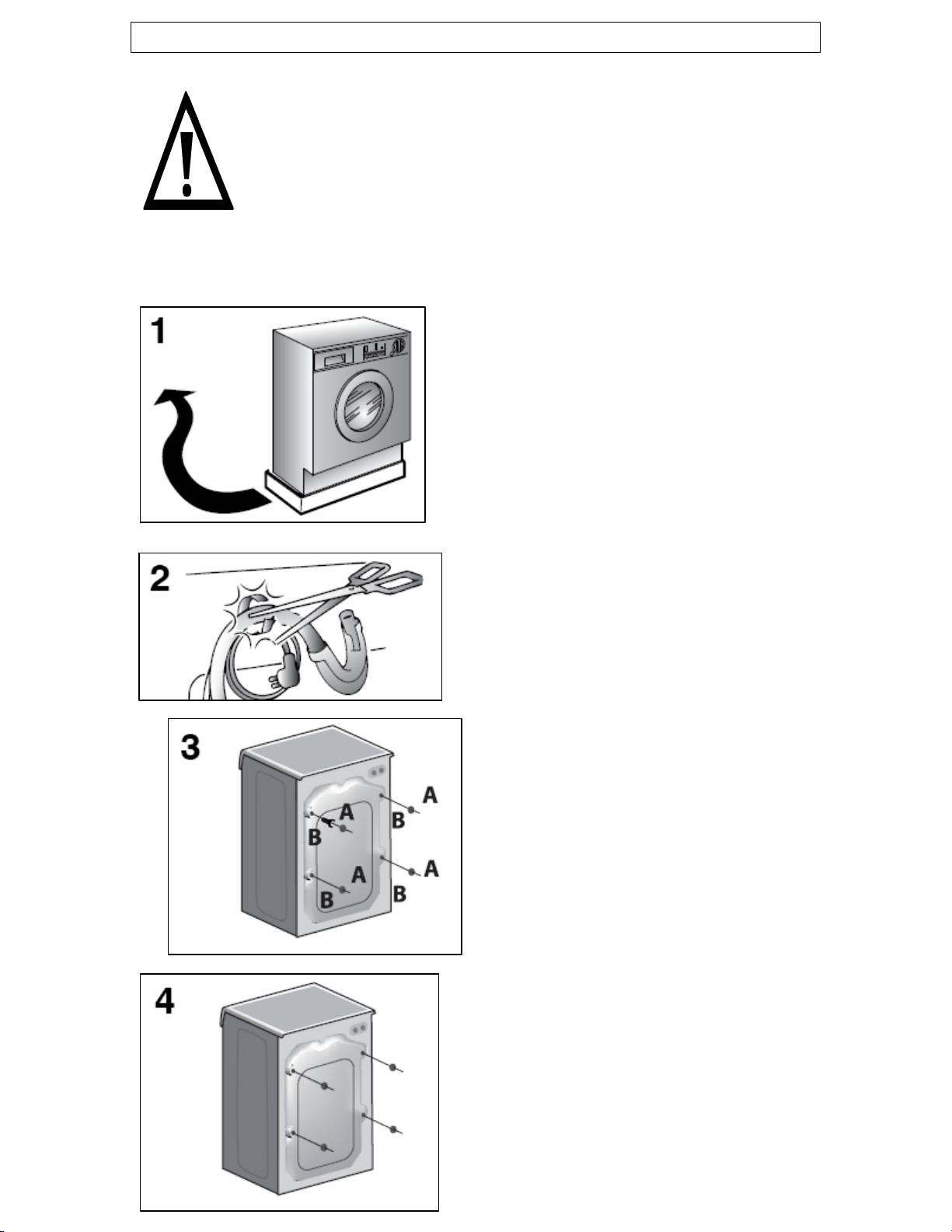
Unpacking the machine and re
o Remove the polystyrene bas
o Carefully cut through the
hose retaining clip at the
rear o
o Remove the
screws A and remove the
spacers B (3).
o It is possible for the
spacers to fall inside the
machine so yo
remove these.
o Cover the 4 holes using the
caps provided (4).
o We recommend that you
keep the transit bolts to
immobilise the machine for
future transit.
30
be removed before your
ashing machine is used for the first time.
rrugated material to the base of
the appliance as shown above.
. Secure the sheet in place
using the screws as shown (3).
ositioning and levelling the appliance
IMPORTANT: The transit bolts MUST
w
o Apply the insulation sheet or co
o Peel back the sealing strips (1) and line the insulation sheet up
with the base of the appliance (2)
P
o The washing machine requires an aperture of the size given in
the diagram on the previous page.
o Place the washing machine on a solid and level floor surface.
o DO NOT PLACE THE WASHING MACHINE ON A CARPET.
o The feet are adjustable to ensure that the appliance is level. This
is essential for quiet operation.
o Slacken off the lock nut on each
of the washing machine feet
using a spanner.
o Adjust the feet to level off the
washing machine.
o Once levelled correctly, you should tighten the lock nut back up
on each of the washing machine feet using a spanner.
IMPORTANT: When the washing machine is positioned in the location
where it will be used. Make sure that all four feet are resting firmly on
the floor, by pressing down on each corner and checking that the
appliance stands still.
Fitting the décor door
o The front of the appliance has been drilled to accommodate the
hinges to enable the door to be opened from the left or right
hand side.
o The following instructions demonstrate how to fit a standard
height décor door with dummy drawer.
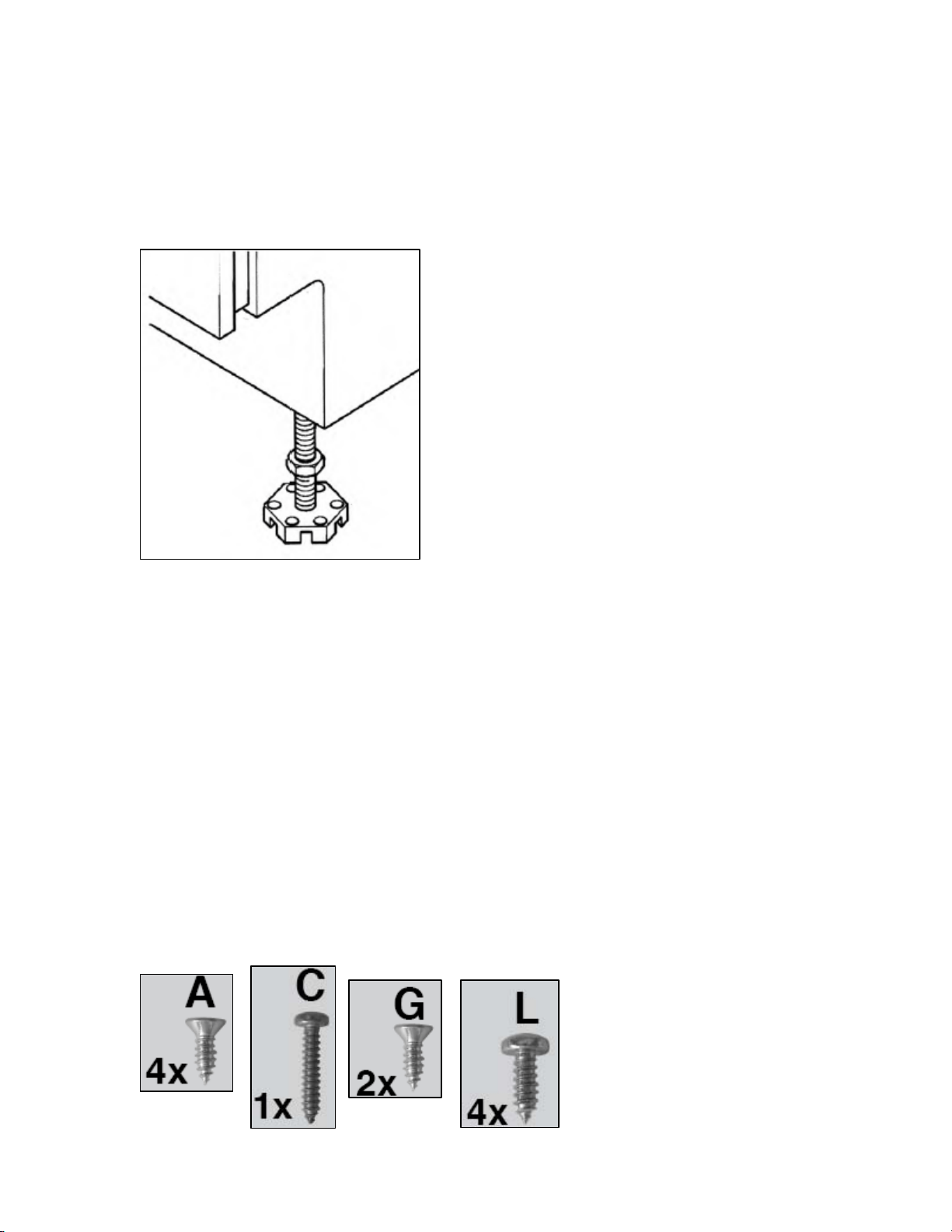
o You will need these
screws to complete
the fitting.
31
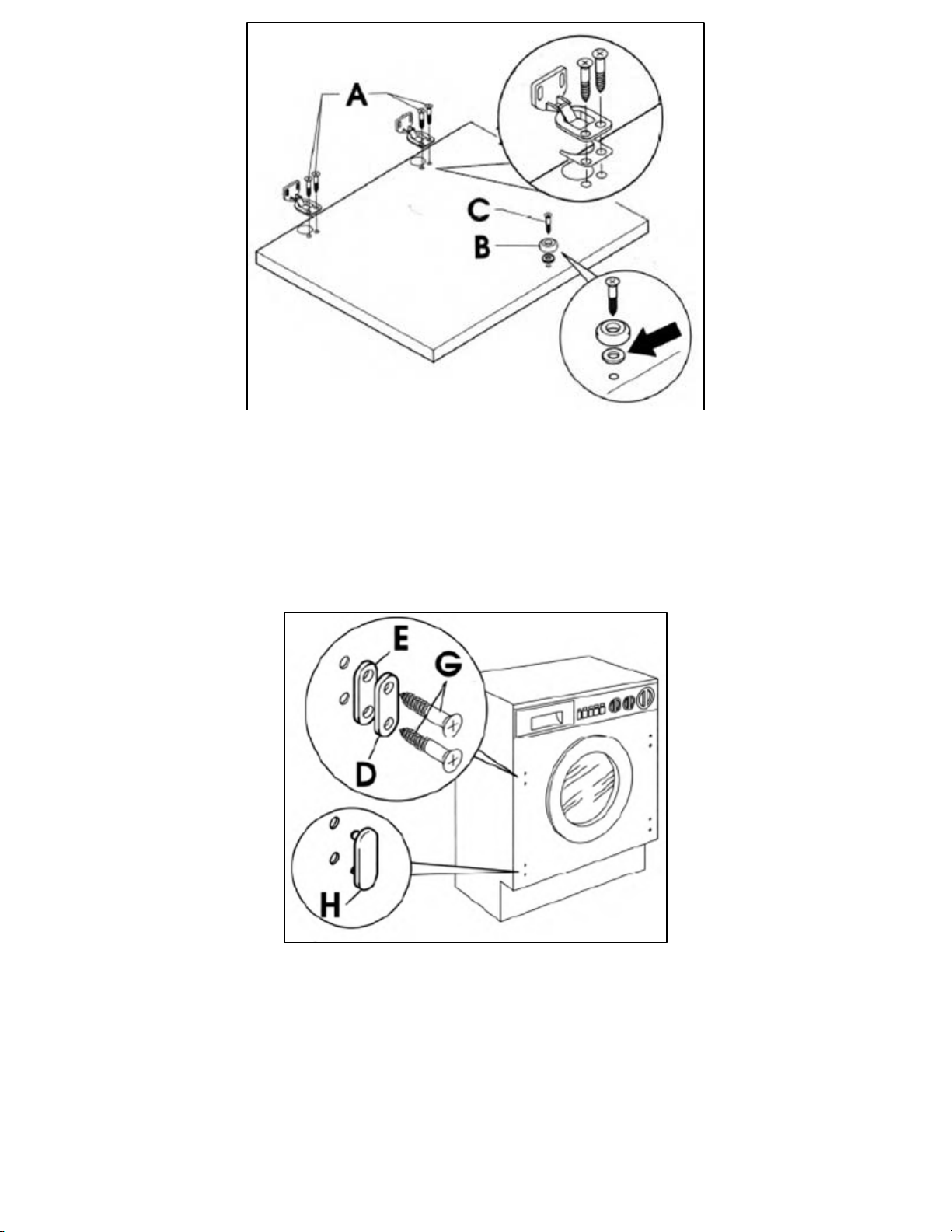
o Screw the hinges onto the décor door (A) then fasten the
dummy drawer front to the top edge of the door. Ensure that the
gap between the door and drawer front matches the units on
either side.
o Fasten the magnetic catch (B) using screw (C) to the décor
door.
o Fasten the magnetic catch striker plate (D) to the front of the
appliance, placing the rubber washer (E) under the plate and
screw in place with screws (G).
o Snap mount the plastic cover cap (H) into the lower hinge
position.
32
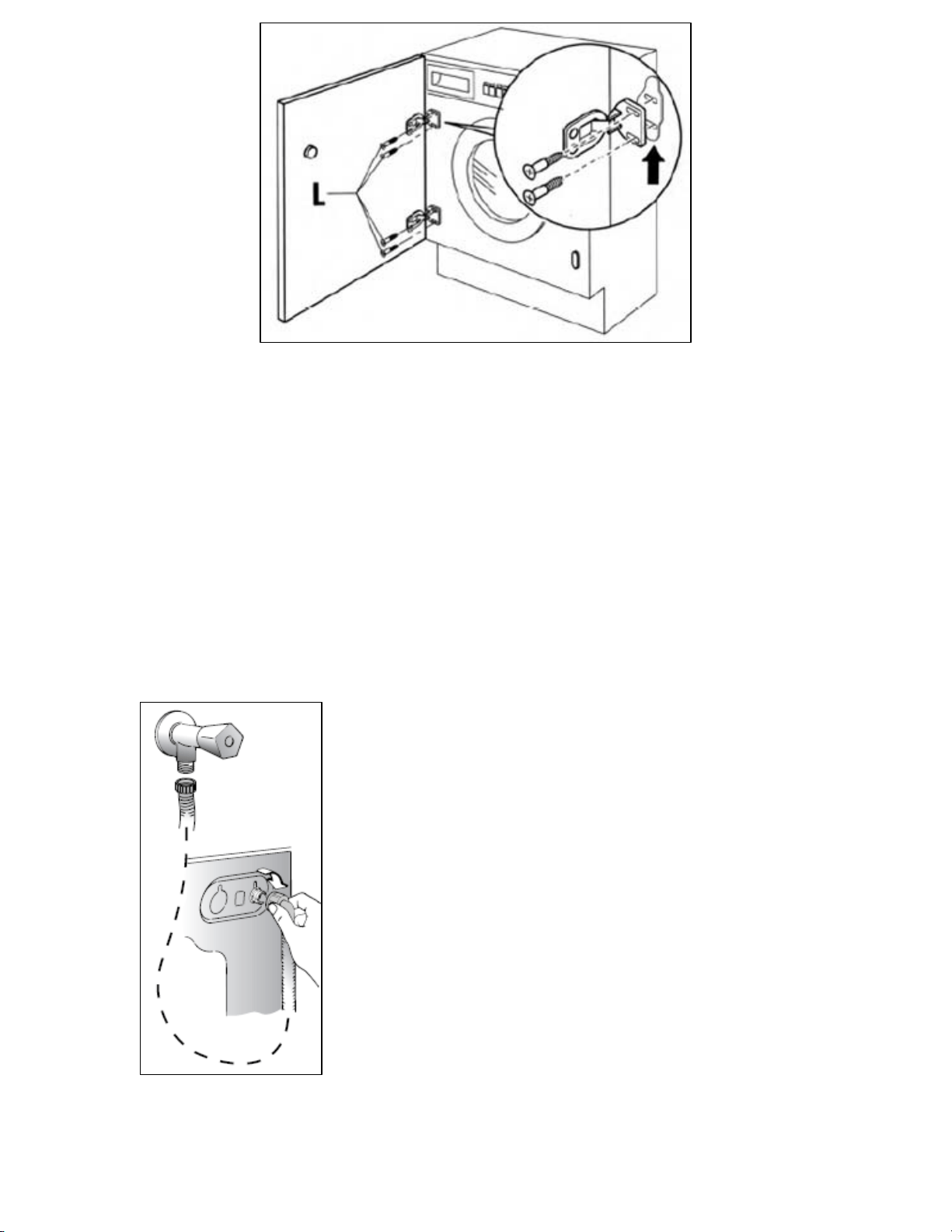
o Mount the door and hinges to the front of the appliance using
screws (L).
o IMPORTANT: It is recommended that, where possible, the
décor door is hinged on the same side as the appliance
door as this will give greater space to load and unload the
washing.
Connecting to the mains water supply
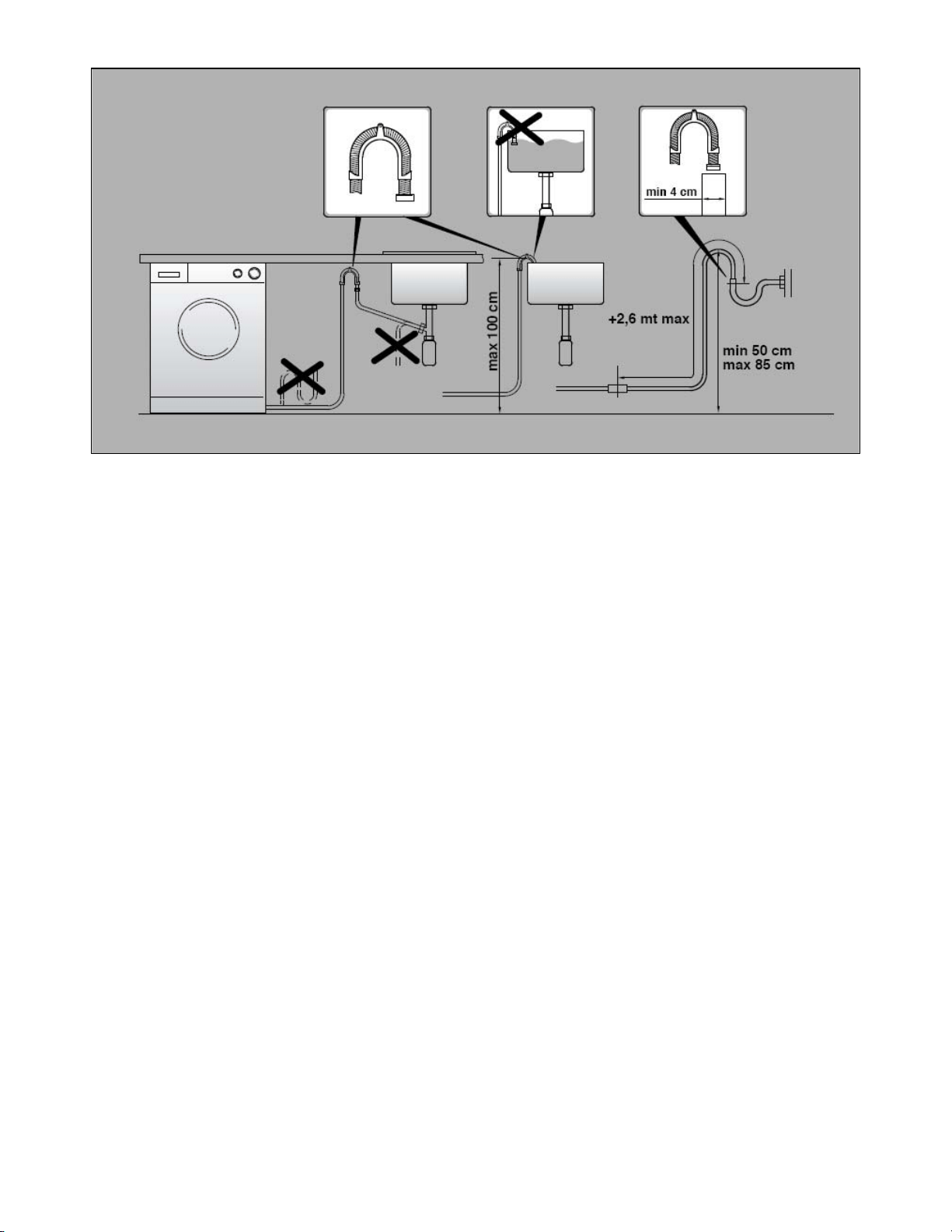
o Connect and fully tighten the inlet hose to the threaded inlet
valve that is located at the rear of the washing machine. You
should connect the end with the right angle connector on it to
the back of your appliance.
o Connect the other end of the inlet hose to
your mains water supply. This machine only
uses cold water therefore only one hose is
needed to connect to the cold water supply.
DO NOT CONNECT TO A HOT WATER
SUPPLY.
o Tighten the inlet hose to your mains supply
fully.
o Test for any leaks.
33
Water outlet
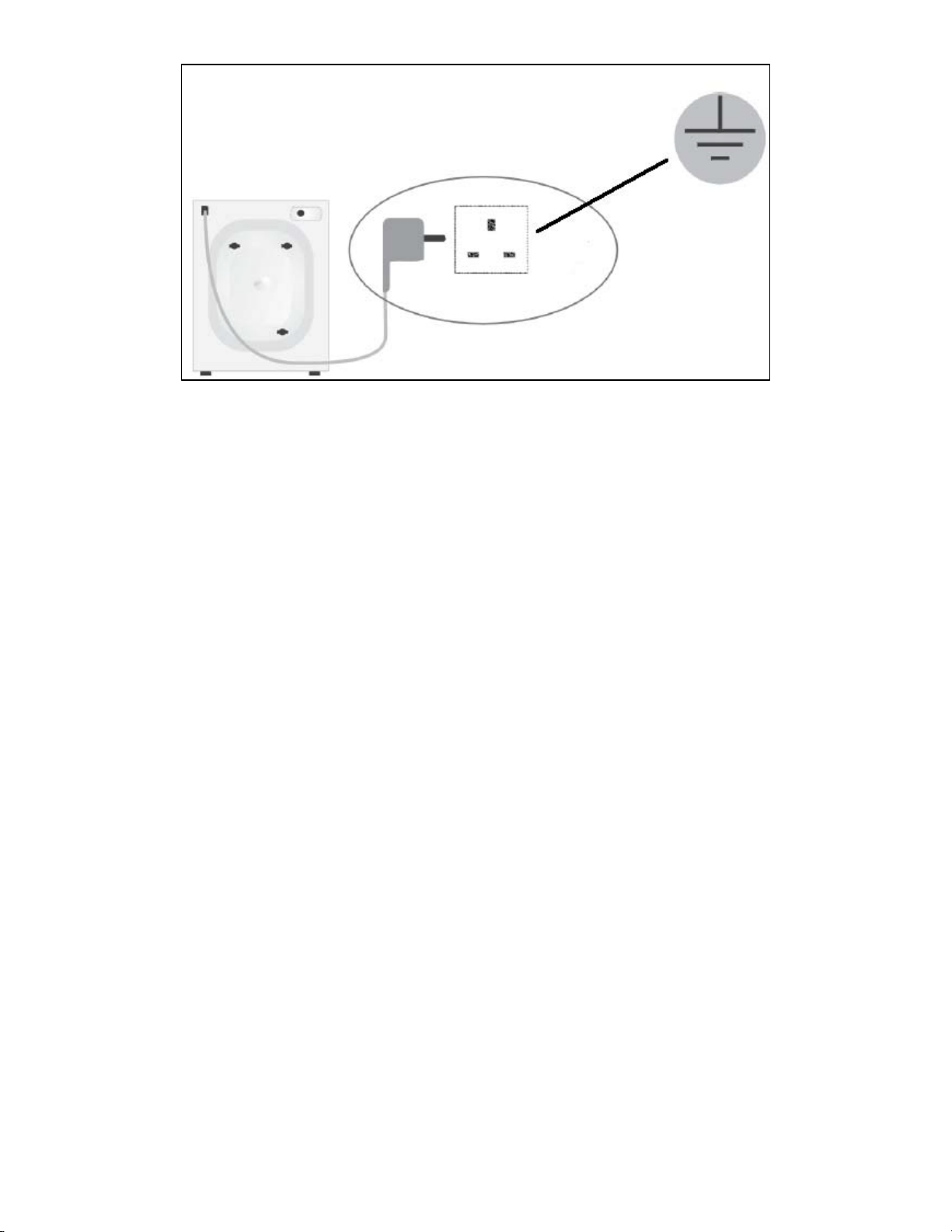
o Secure the drain hose, so that it cannot move whilst the washing
machine is in use.
o Place the end of the drain hose on your drain pipe. Push it a
short way down into your drain pipe.
o IMPORTANT: Do not insert the drain hose too deeply into the
water pipe, as this may cause siphoning.
o NEVER EXTEND THE DRAINAGE HOSE FROM ITS ORIGINAL
LENGTH.
o For the washing machine to function properly, the end of the
discharge hose must be at a minimum of 50 cm and a maximum
of 85 cm from the ground.
34
Power supply
o IMPORTANT: As your appliance is a built in product, the
electrical socket must still be accessible once the
appliance is installed.
o Consult the rating plate, located on the inner rim of the porthole
door of the appliance BEFORE making the electrical connections.
Ensure that the voltage reaching the plug is the same as that on
the rating plate.
o DO NOT REMOVE THE RATING PLATE AS THE
INFORMATION ON IT IS IMPORTANT.
o The moulded plug that is supplied with the appliance must be
placed into an earthed and insulated socket.
o Broken or damaged power leads must only be replaced by a
suitably qualified person. A power lead of a similar type must be
used in replacement.
o Power lead type – H 0 V V – F 3G 1,5.
o IMPORTANT: We do not recommend that this appliance is
connected to an extension lead.
Before first use maintenance wash
o When your washing machine has been correctly installed, we
recommend that you perform a maintenance wash cycle.
o This will check that all aspects of the installation are correct; it
will also remove any deposits that may have been left in the
drum by the manufacturing process.
35
o Select the Cotton 90°C wash program.
o A small quantity of detergent should be used during this
maintenance wash.
IMPORTANT: If your appliance appears not to be
operating correctly, then you should disconnect it
from your mains supply and then contact
Baumatic Customer Care on telephone number
(0118) 933 6911.
DO NOT ATTEMPT TO REPAIR THE APPLIANCE
YOURSELF.
Please note that if an engineer is asked to attend whilst the product is
under guarantee and finds that the problem is not the result of an
appliance fault, then you may be liable for the cost of the call out
charge.
The appliance must be accessible for the engineer to perform
any necessary repair. If your appliance is installed in such a
way that an engineer is concerned that damage will be caused
to the appliance or your kitchen, then he will not complete a
repair.
This includes situations where appliances have been tiled in,
sealed in with sealant, have wooden obstructions placed in
front of the appliance, like plinths. Or any installation other
than the one specified by Baumatic Ltd. has been completed.
Please refer to the conditions of guarantee that appear on the
warranty card that you receive with the appliance.
36
United Kingdom
Baumatic Ltd.,
Baumatic Buildings,
6 Bennet Road,
Reading, Berkshire
RG2 0QX
United Kingdom
Sales Telephone
(0118) 933 6900
Sales Fax
(0118) 931 0035
Customer Care Telephone
(0118) 933 6911
Customer Care Fax
(0118) 986 9124
Spares Telephone
(01235) 437244
Advice Line Telephone
(0118) 933 6933
E-mail:
customercare@baumatic.co.uk
spares@baumatic.co.uk
Website:
www.baumatic.co.uk
Republic of Ireland
Service Telephone
1-890 812 724
Spares Telephone
091 756 771
Czech Republic
Baumatic CR spol s.r.o.
Průmyslová zóna Sever 696
460 11 Liberec 11
Czech Republic
+420 483 577 200
www.baumatic.cz
Slovakia
Baumatic Slovakia, s.r.o.
Galvániho 7/D
Slovakia
+421 255 640 618
Germany
Baumatic Gmbh
Lilienthalstrasse 1
320 52 Herford
Deutschland
+49 5221 694 99-0
www.baumatic.de
Italy
Baumatic Italia S.R.L.
Via Galvani N.3
35011 Campodarsego (PD)
+3904 9920 2297
www.baumatic.it
Holland
Baumatic Benelux B.V.
Grindzuigerstraat 22
1333 MS ALMERE
Nederland
+3136 549 1555
www.baumatic.nl

38

39

38