
EN Instruction Manual
FR Guide de l'utilisateur
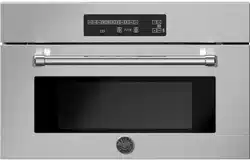
PROF30SOEX
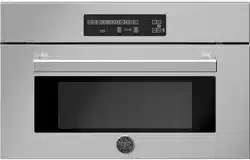
MAST30SOEX

3
USA
Contents
Grounding Instructions ...................................................................................................................... 4
Important safety instructions ............................................................................................................ 5
Precautions to avoid possible exposure to excessive Microwave energy .................................... 7
Precautions to be observed before and during servicing to avoid possible exposure to excessive
Microwave energy ............................................................................................................................... 8
The advantages of microwaves ....................................................................................................... 11
Description of your oven .................................................................................................................. 12
Basic controls ................................................................................................................................... 14
Basic Functions ................................................................................................................................ 16
Special functions .............................................................................................................................. 21
When the oven is working... ............................................................................................................. 23
Defrosting .......................................................................................................................................... 24
Cooking with a microwave oven ..................................................................................................... 26
Cooking with the grill ....................................................................................................................... 28
Roasting and baking......................................................................................................................... 31
What kind of ovenware can be used? ............................................................................................. 34
Oven Cleaning and Maintenance ..................................................................................................... 36
What should I do if the oven doesn’t work? ................................................................................... 38
Technical characteristics ................................................................................................................. 39
Installation instructions ................................................................................................................... 40
Installation dimensions .......................................................................... Error! Bookmark not defined.
Dear Customer,
Before going any further, we want to thank you for preferring our BERTAZZONI product. We are
sure that this modern, functional and practical microwave oven, manufactured with top quality
materials, will fully meet your expectations.
We ask you to read the instructions in this booklet very carefully as this will allow you to get the
best results from using your microwave oven.
KEEP THE DOCUMENTATION OF THIS PRODUCT FOR FUTURE REFERENCE.
Always keep the instruction manual handy. If you lend the microwave oven to someone
else give them the manual as well!
The Speed Oven PROF30SOEX and MAST30SOEXO complies with Part 18 of the FCC rules.
The user manual is also available for download at www.bertazzoni.com

4
USA
GROUNDING INSTRUCTIONS
This appliance must be grounded. In the event of an electrical short circuit,
grounding reduces the risk of electric shock by providing an escape wire for
the electric current. This appliance is equipped with a cord having a grounding
wire with a grounding plug. The plug must be plugged into an outlet that is
properly installed and grounded.
Warning! IMPROPER USE OF THE GROUNDING CAN RESULT IN A RISK OF
ELECTRICAL SHOCK.
Consult a qualified electrician or serviceman if the grounding instructions are
not completely understood, or if doubt exists as to whether the appliance is
properly grounded, and do not use an extension cord. If the power supply cord
is too short, have a qualified electrician or serviceman install an outlet near the
appliance.

5
USA
IMPORTANT SAFETY
INSTRUCTIONS
When using electrical appliances basic safety precautions should be followed,
including the following:
Warning! To reduce the risk of burns, electric shock, fire, injury to persons, or
exposure to excessive microwave energy:
• Read all instructions before using the appliance.
• Read and follow the specific “PRECAUTIONS TO AVOID POSSIBLE
EXPOSURE TO EXCESSIVE MICROWAVE ENERGY” found on this manual.
• This appliance must be grounded. Connect only to properly grounded outlet. See
“GROUNDING INSTRUCTIONS” found on this manual.
• Install or locate this appliance only in accordance with the provided installation
instructions.
• Some products such as whole eggs and sealed containers – for example, closed
glass jars are able to explode and should not be heated in this oven.
• Use this appliance only for its intended use as described in the manual. Do not
use corrosive chemicals or vapors in this appliance. This type of oven is
specifically designed to heat, cook, or dry food. It is not designed for industrial
or laboratory use.
• As with any appliance, close supervision is necessary when used by children.
• Do not operate this appliance if it is has a damaged cord or plug, if it is not
working properly, or if it has been damaged or dropped.
• This appliance should be serviced only by qualified service personnel. Contact
nearest authorized service facility for examination, repair, or adjustment.
• Do not cover or block any openings on the appliances.
• Do not store this appliance outdoors. Do not use this product near water – for
example, near a kitchen sink, in a wet basement, near a swimming pool, or
similar locations.
• Do not immerse cord or plug in water.
• Keep cord away from heated surfaces.
• Do not let cord hang over edge of table or counter.
• When cleaning surfaces of door and oven that comes together on closing the
door, use only mild, nonabrasive soaps, or detergents applied with a sponge or
soft cloth.
6
USA
IMPORTANT SAFETY
INSTRUCTIONS
To reduce the risk of fire in the oven cavity:
• Do not overcook food. Carefully attend appliance when paper, plastic, or other
combustible materials are placed inside the oven to facilitate cooking.
• Remove wire twist-ties from paper or plastic bags before placing bag in oven.
• If materials inside the oven ignite, keep oven door closed, turn oven off, and
disconnect the power cord, or shut off power at the fuse or circuit breaker panel.
• Do not use the cavity for storage purposes. Do not leave paper products,
cooking utensils, or food in the cavity when not in use.
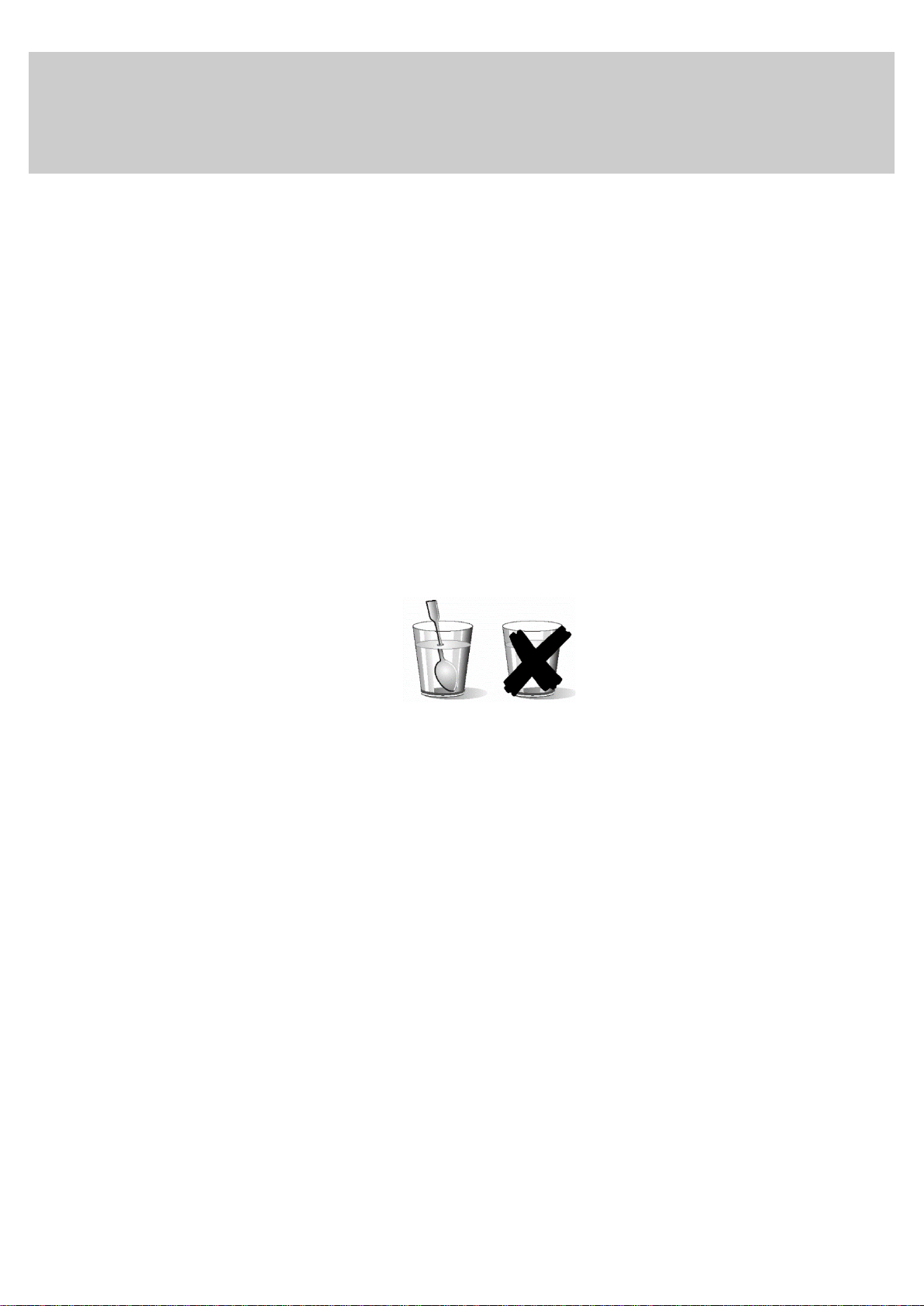
• Liquids such as water, coffee, or tea are able to be overheated beyond the
boiling point without appearing to be boiling. Visible bubbling or boiling when
the container is removed from the microwave oven is not always present. THIS
COULD RESULT IN VERY HOT LIQUIDS SUDDENLY BOILING OVER WHEN
THE CONTAINER IS DISTURBED OR A UTENSIL INTO THE LIQUID.
To avoid that type of situation when heating liquids, put a teaspoon or glass rod
inside the container.

7
USA
PRECAUTIONS TO AVOID
POSSIBLE EXPOSURE TO
EXCESSIVE MICROWAVE
ENERGY
(a) Do not attempt to operate this oven with the door open since open – door
operation can result in harmful exposure to microwave energy. It is important
not to defeat or tamper with the safety interlocks.
(b) Do not place any object between the oven front face and the door or allow soil
or cleaner residue to accumulate on sealing surfaces.
(c) Do not operate the oven if it is damaged. It is particularly important that the
oven door closes properly and that there is no damage to the: (1) door (bent),
(2) hinges and latches (broken or loosened), (3) door seals and sealing
surfaces.
(d) The oven should not be adjusted or repaired by anyone except properly
qualified service personnel.
(e) A microwave leakage check to verify compliance with the Federal
Performance Standard should be performed on each oven prior to release to
the owner.
Pacemakers:
Most pacemakers are shielded from interference from electronic products, including
microwaves. However, patients with pacemakers may wish to consult their
physicians if they have concerns.

8
USA
PRECAUTIONS TO BE
OBSERVED BEFORE AND
DURING SERVICING TO AVOID
POSSIBLE EXPOSURE TO
EXCESSIVE MICROWAVE
ENERGY
(a) Do not operate or allow the oven to be operated with the door open.
(b) Make the following safety checks on all ovens to be serviced before activating
the magnetron or other microwave source, and make repairs as necessary:
interlock operation, proper door closing, seal and sealing surfaces (arcing,
wear, and other damage), damage to or loosening of hinges and latches,
evidence of dropping or abuse).
(c) Before turning on microwave power for any service test or inspection within
the microwave generating compartment, check the magnetron, wave guide or
transmission line, and cavity for proper alignment, integrity and connection.
(d) Any defective or misadjusted components in the interlock, monitor, door seal,
and microwave generation and transmission systems, shall be repaired,
replaced, or adjusted by procedures described in this manual before the oven
is released to the owner.
(e) A microwave leakage check, to verify compliance with the Federal
Performance Standard, should be performed on each oven prior to release to
the owner.

9
USA
Microwave safety
• Warning! Never leave the oven
unwatched, especially when using paper,
plastic or other combustible materials.
These materials can char and may fire.
FIRE RISK!
• Warning! Do not heat pure alcohol or
alcoholic drinks in the microwave. FIRE
RISK!
• Warning! Do not heat liquids or other
foods in closed containers since these
may explode readily.
• Warning! This appliance is not intended
for use by persons (including children)
with reduced physical, sensory or mental
capabilities, or lack of experience and
knowledge, unless they have been given
supervision or instruction concerning use
of the appliance by a person responsible
for their safety. Children should be
supervised to ensure that they do not play
with the appliance.
• Warning! If the oven has a combined
function mode (microwave with other
means of heating), children should not be
allowed to use the oven without adult
supervision on account of the high
temperatures generated.
• Warning! The oven cannot be used if:
- The door is not closed correctly;
- The door hinges are damaged;
- The surfaces of the contact between the
door and the oven front are damaged;
- The door window glass is damaged;
- There is frequent electrical arcing inside
the oven even though there is no metal
object inside.
The oven can only be used again after it
has been repaired by a Technical
Assistance Service technician.
Beware!
• Never heat baby foods or drinks in bottles
or jars with the teats or lids on them. After
heating the food mix or shake well so that
the heat is spread evenly. Check the food
temperature before feeding this to the
child. DANGER OF BURNING!
• To avoid food overheating or burning it is
very important not to select long time
periods or power levels that are too high
when heating small quantities of food.
For example, a bread roll can burn after 3
minutes if the power selected is too high.
• For toasting, use just the grilling function
and watch the oven all the time. It you use
a combined function to toast bread it will
catch fire in a very short time.
• Make sure you never catch the power
cables of other electrical appliances in the
hot door or the oven. The cable insulation
may melt. Danger of short-circuiting!

10
USA
Microwave safety
This oven is exclusively for domestic use!
Use the oven only for preparing meals.
Avoid damaging the oven or other dangerous
situations by following these instructions:
• Do not switch on the oven without the
turntable support, the turntable ring and
the respective plate being in place.
• Never switch on the microwave when it
is empty. If there is no food inside there
may be an electrical overcharge and the
oven could be damaged. RISK OF
DAMAGE!
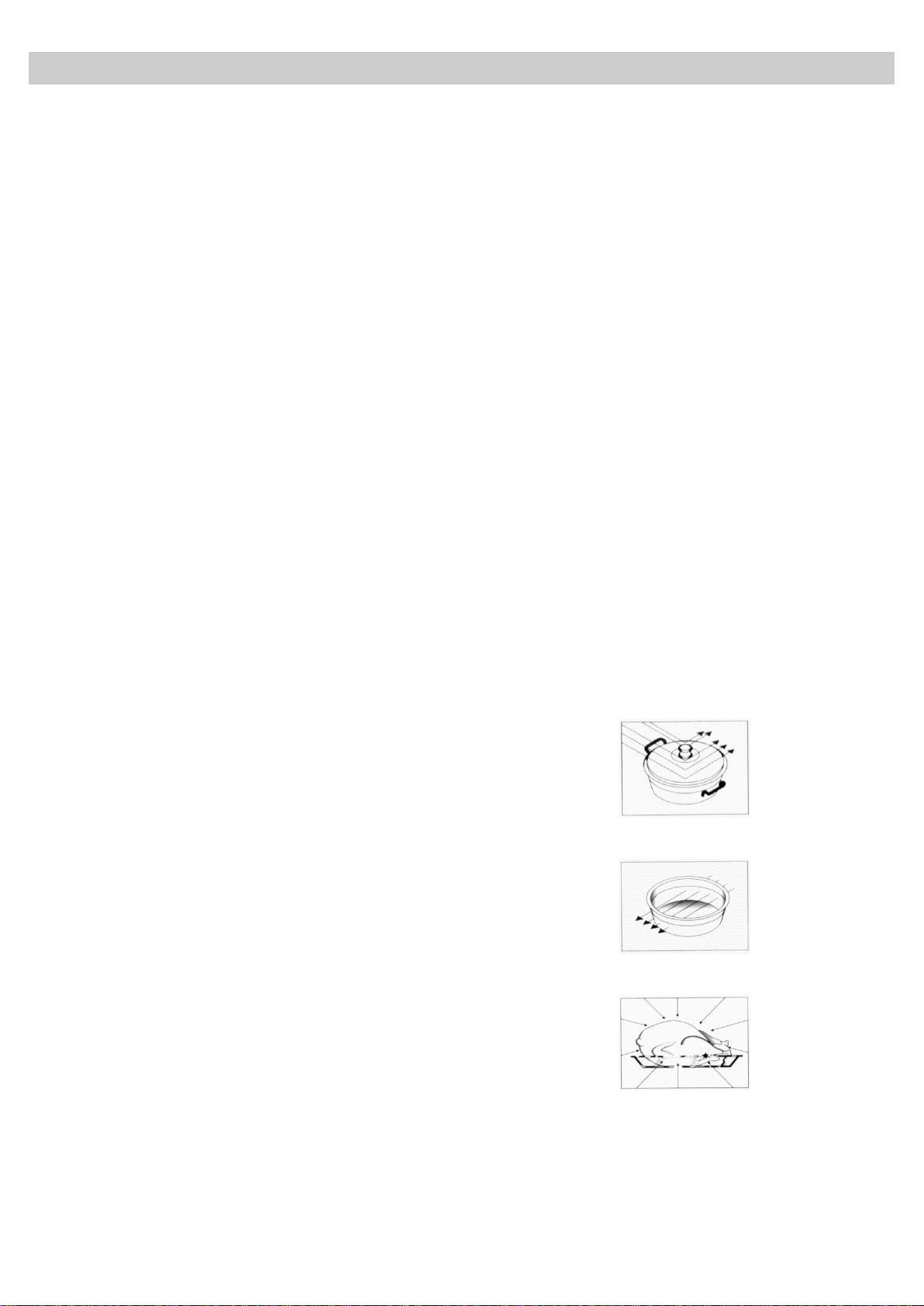
• For carrying out oven programming
tests put a glass of water inside the oven.
The water will absorb the microwaves and
the oven will not be damaged.
• Use only dishes suitable for microwaves.
Before using dishes and containers in the
microwave, check that these are suitable
(see the section on types of dishes).
• Never remove the mica cover on the
ceiling of the oven interior! This cover
stops fat and pieces of food damaging the
microwave generator.
• Do not keep any inflammable object
inside the oven as it may burn if the oven is
switched on.
• Do not use the oven as a pantry.
• Eggs with their shells and whole boiled
eggs must not be heated in microwave
ovens because they may explode.
• Do not use the oven for frying as it is
impossible to control the temperature of oil
heated by microwaves.
• To avoid being burnt, always use oven
gloves for handling dishes and containers
and touching the oven.
• Do not lean or sit on the open oven door.
This may damage the oven, especially in
the hinge zone. The door can bear a
maximum weight of 8 kg.
• The turntable and the grills can bear a
maximum load of 8 kg. To avoid damaging
the oven, do not exceed this load.
Cleaning:
• Warning! Your microwave oven must be
cleaned regularly. All food remains must be
removed (see section on Oven Cleaning). If
the microwave oven is not kept clean its
surface may deteriorate and this may
shorten the oven’s working life and could
even result in a dangerous situation.
• The door contact surfaces (the front of the
cavity and the inside part of the doors) must
be kept very clean in order to ensure the
oven functions correctly.
• Do not use harsh abrasive cleaners or
sharp metal scrapers to clean the oven
door glass since they can scratch the
surface, which may result in shattering
of the glass.
• Do not use high pressure or stream jet
cleaning appliances.
• Please follow the instructions regarding
cleaning in the section “Oven Cleaning and
Maintenance”.
Repairs:
• Warning – Microwaves! The outer
protection of the oven must not be
removed. It is dangerous for anyone not
authorized by the manufacturer to carry out
any kind of repair or maintenance work.
• If the power cable is damaged it should be
substituted by the manufacturer, authorized
agents or technicians qualified for this task
in order to avoid dangerous situations.
Furthermore, special tools are required for
this task.
• Repair and maintenance work, especially of
current carrying parts, can only be carried
out by technicians authorized by the
manufacturer.
11
USA
The advantages of microwaves
In conventional ovens, heat radiated by
electrical elements or gas burners slowly
penetrates the food from outside to inside. On
account of this there is a major amount of
energy is wasted heating the air, the oven
components and the food containers.
In a microwave oven, heat is generated by the
food itself and the heat travels from inside to
outside. No heat is lost to the air, the walls of
the oven cavity or the dishes and containers (if
these are suitable for use in microwave oven),
in other words, only the food is heated.
Microwave ovens have the following
advantages:
1. Shorter cooking times; in general these
are up to 3/4 less than the time required
for conventional cooking.
2. Ultra-fast food defrosting, thus reducing
the danger of bacterial development.
3. Energy savings.
4. Conservation of the nutritional value of
foods due to the shorter cooking times.
5. Easy to clean.
How a microwave oven works
In a microwave oven there is a high tension
valve called a magnetron which converts
electrical energy into microwave energy. These
electromagnetic waves are channeled to the
interior of the oven through a wave guide and
distributed by a metallic spreader or through a
turntable.
Inside the oven the microwaves propagate in
all directions and are reflected by the metal
walls, uniformly penetrating the food.
Why food heats up
Most foods contain water and water molecules
vibrate when subjected to microwaves.
The friction between molecules produces heat
which raises the temperature of the food, de-
freezing it, cooking it or keeping it hot.
Since the heat arises inside the food:
• This can be cooked with little or no liquid
or fats/oils;
• De-freezing, heating or cooking in a
microwave oven is quicker than in a
conventional oven;
• The vitamins, minerals and nutritional
substances in the food are conserved;
• The natural color and aroma of the food
are unchanged.
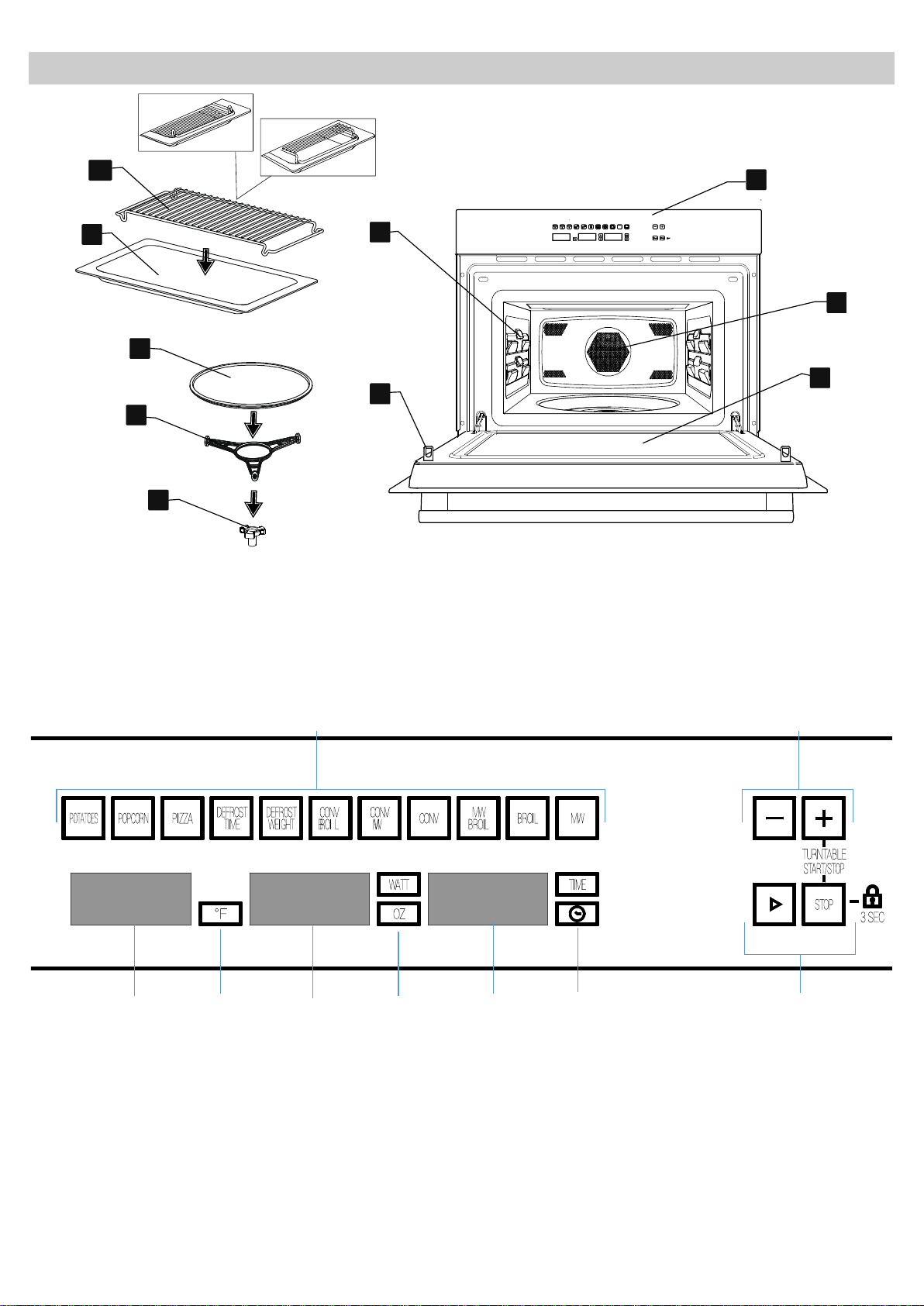
Microwaves pass through china, glass,
cardboard or plastic but do not go through
metal. For this reason, metal containers or
ones with metal parts must not be used in a
microwave oven.
Microwaves are reflected by metal...
... but go through glass and china...
... and are absorbed by foods.
12
USA
Description of your oven
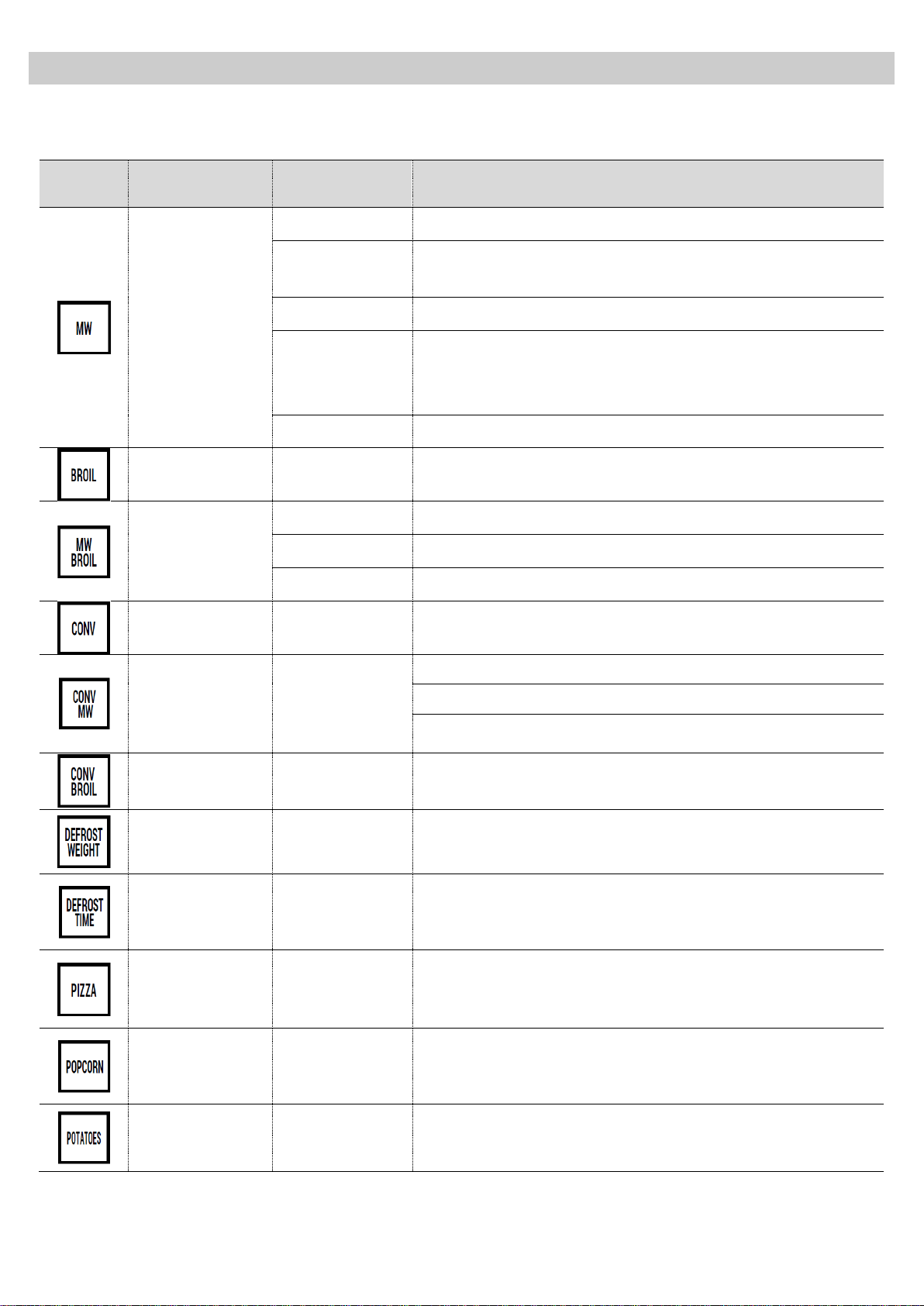
1. – Control panel
6. – Turntable support
2. – Door window glass
7. – Turntable ring
3. – Lateral supports
8. – Turntable plate
4. – Catches
9. – Glass tray
5. – Hot Air Output
10. – Rectangular Rack
1. – Function selection keys
4a.-Power/Weight indication lights
2. – “+” and “–“ keys
5. – Clock/ Time selection key
3. – Oven Temperature selection key
5a.-Clock/ Time indication lights
3a.- Oven Temperature indication light
6. – Start and Stop/ Safety blocking keys
4. – Power/Weight selection key
1
5
2
3
4
6
7
9
8
10
1
2
3
3a
4
4a
5
5a
6
150
600
12:00
13
USA
Description of your oven
Description of Functions
Symbol
Function
Microwave
Power Output
Foods
Microwave
200 W
Slow defrosting for delicate foods; keeping food hot.
400 W
Cooking with little heat; boiling rice.
Rapid defrosting, heating baby food.
600 W
Heating and cooking food.
800 W
Cooking vegetables and food.
Cooking and heating carefully.
Heating and cooking small portions of food.
1000 W
Rapidly heating liquids.
Broil
Grilling food.
Microwave
+ Broil
200 W
Toasting food.
400 W
Grilling poultry and meat.
600 W
Cooking pies and cheese-topped dishes.
Convection
---
Roasting and baking.
Convection +
Microwave
---
Grilling meat and fish.
Grilling poultry.
Potatoes – deep-frozen, defrosting and roasting.
Convection +
Broil
200-600 W
Quick meat, fish and poultry roasting.
Baking cakes.
Defrosting
---
Defrosting by weight (automatic)
Defrosting
---
Defrosting by time (manual)
Pizza
---
Baking pizza.
Popcorn
---
Cook popcorn.
Potatoes
---
Cook potatoes.
14
USA
Basic controls
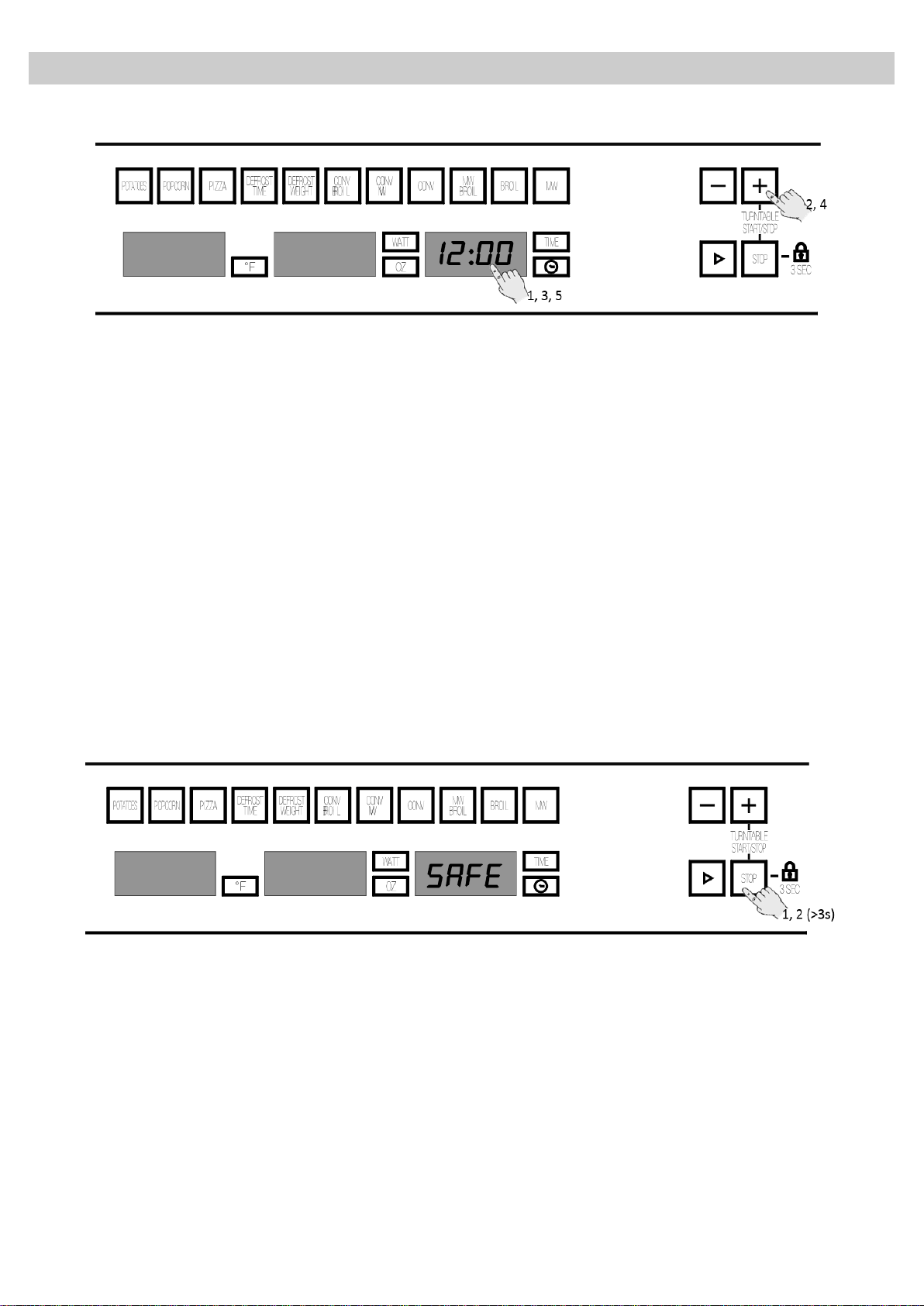
Setting the clock
After your microwave oven is first plugged in or
after a power failure, the clock display will flash
to indicate that the time shown is not correct.
To set the clock, proceed as follows:
1. Press the Clock key for 6 seconds (not
necessary on first plug-in or after a power
failure). The hour numbers will start to flash.
2. Press key “-” and “+” to set the hours.
3. Press again the Clock key to set the
minutes. The minute numbers will start to
flash.
4. Press key “-” and “+” to set the minutes.
5. To finish, press the Clock key again.
Displaying the Clock
To save energy, the clock is normally hidden. If you want to see the clock, press the Clock
key briefly and the clock will be visible.
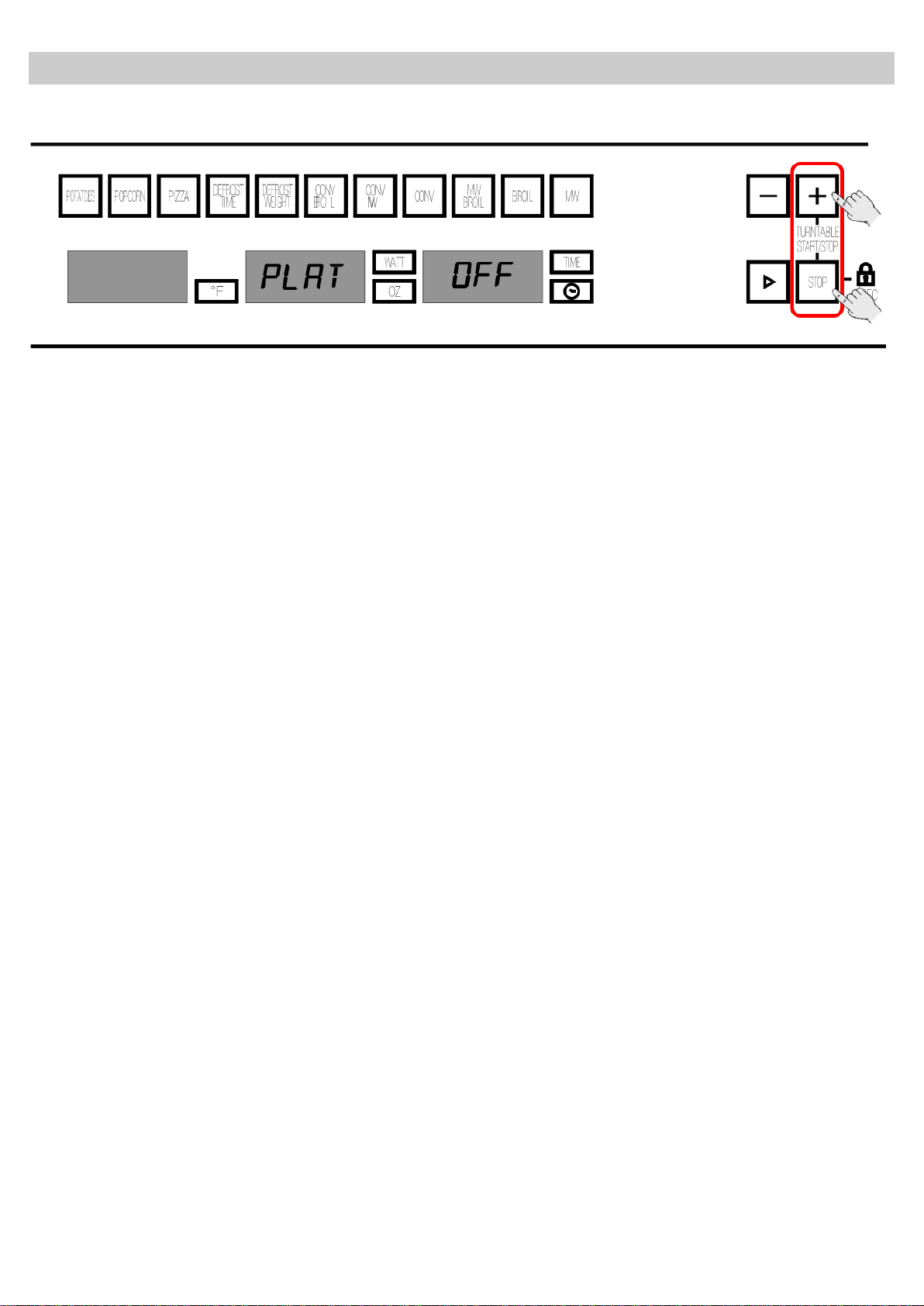
Safety blocking
The oven functioning can be blocked (for
example, to stop it being used by children).
1. To block the oven, press the Stop key for 3
seconds. You will hear a sound signal and
the display will show the word “SAFE”. The
oven is blocked in this state and cannot be
used.
2. To unblock the oven, press the Stop key
again for 3 seconds. You will hear a
sound signal and the display will show
the time again.
15
USA
Basic controls
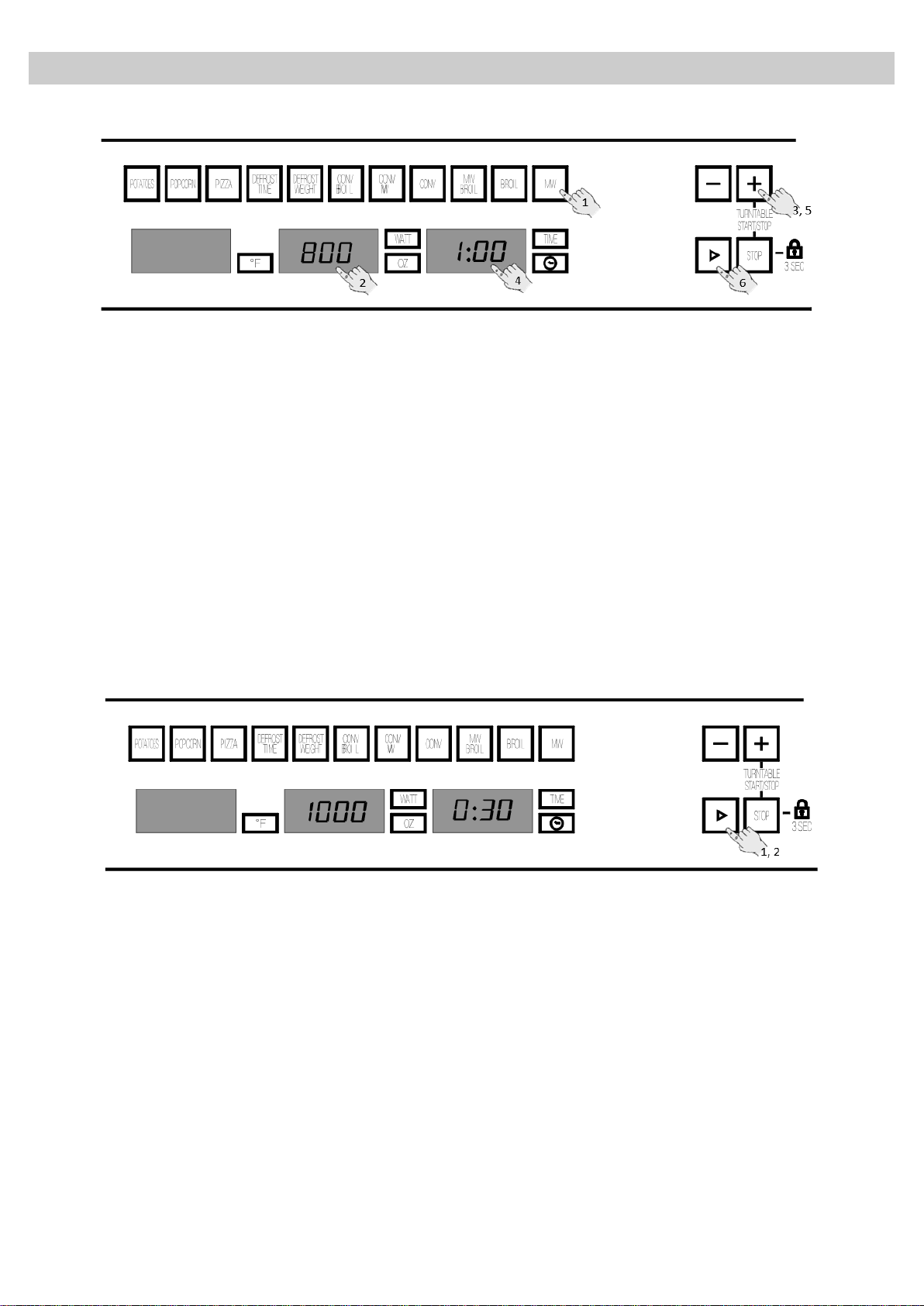
Stopping the rotating plate
1. To stop the rotating plate, press the “+” key
and the “Stop” key at the same time
2. To start plate rotation again, press the “+”
Key and the “Stop” key at the same again.
16
USA
Basic Functions
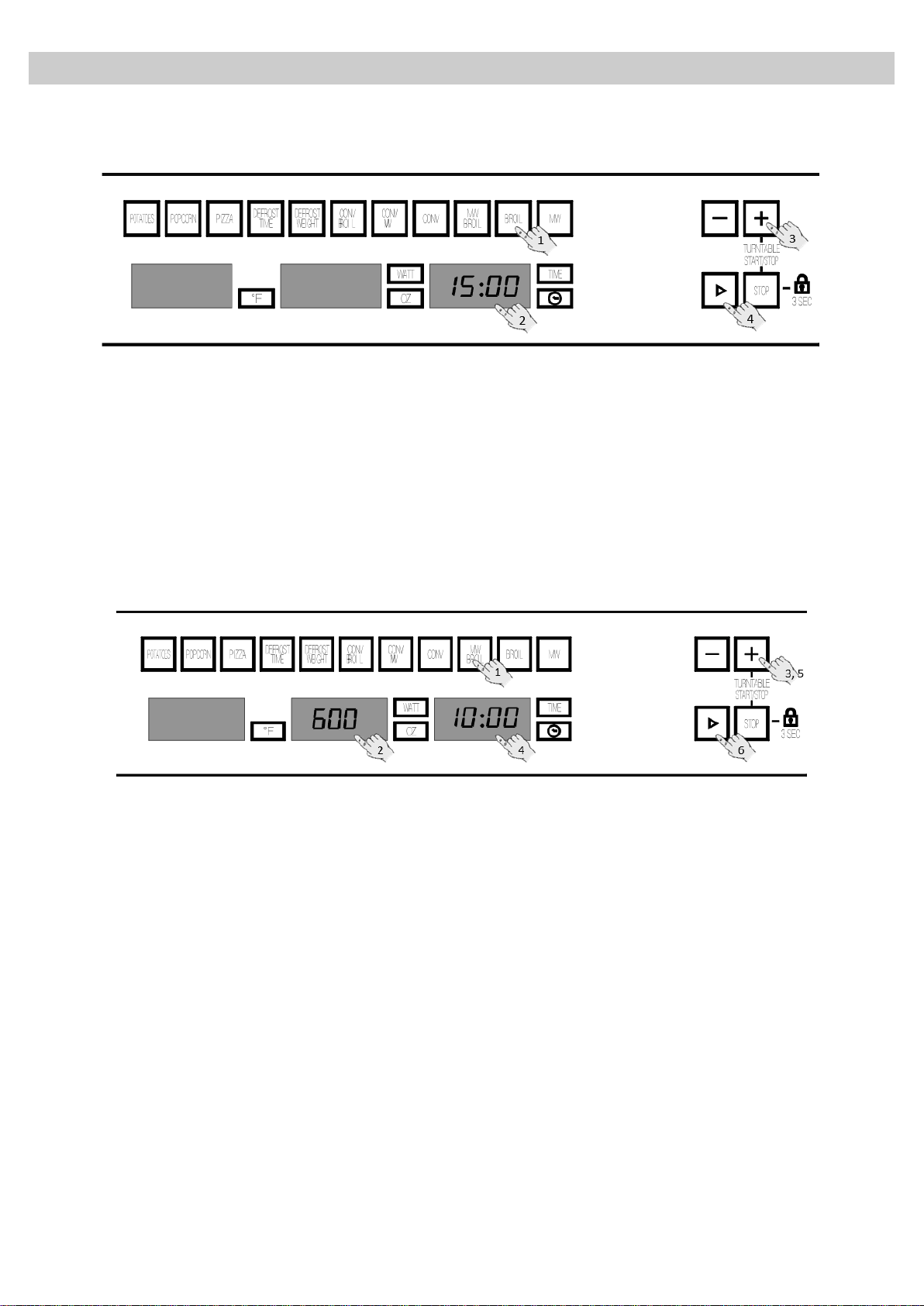
Microwave
1. Press the Microwave function key. The function
key lights up.
2. Press the Power Selection key to change the
microwave power. The respective light will start
to flash. If you do not press this key, the oven
operates at 800 W.
3. To change the microwave power press key “-”
and “+”.
4. Press the Time Selection key to change the
operating time. The correspondent light will start
to flash.
5. Press key “-” and “+”, to change the function time
(e.g. 1 minute).
6. Press the START key. The oven will start to
operate
NOTE: When 1000 W power is selected, the
operating time is limited to a maximum of 15
minutes.
Microwave – Quick Start
1. Press the Start key. The oven starts to operate
in the Microwave function at maximum power for
30 seconds.
2. If you want to increase the operating time press
the Start key again. Each time you press this key
the operating time will be increased by 30
seconds.
NOTE: When 1000 W power is selected, the
operating time is limited to a maximum of 15
minutes.
WARNING! Never switch on the microwave
when it is empty. If there is no food inside there
may be an electrical overcharge and the oven
could be damaged. RISK OF DAMAGE!
WARNING! When using small loads, such as
popcorn bags, place a glass of water on one of
the cavity corners to avoid damages.
17
USA
Basic Functions
Broil
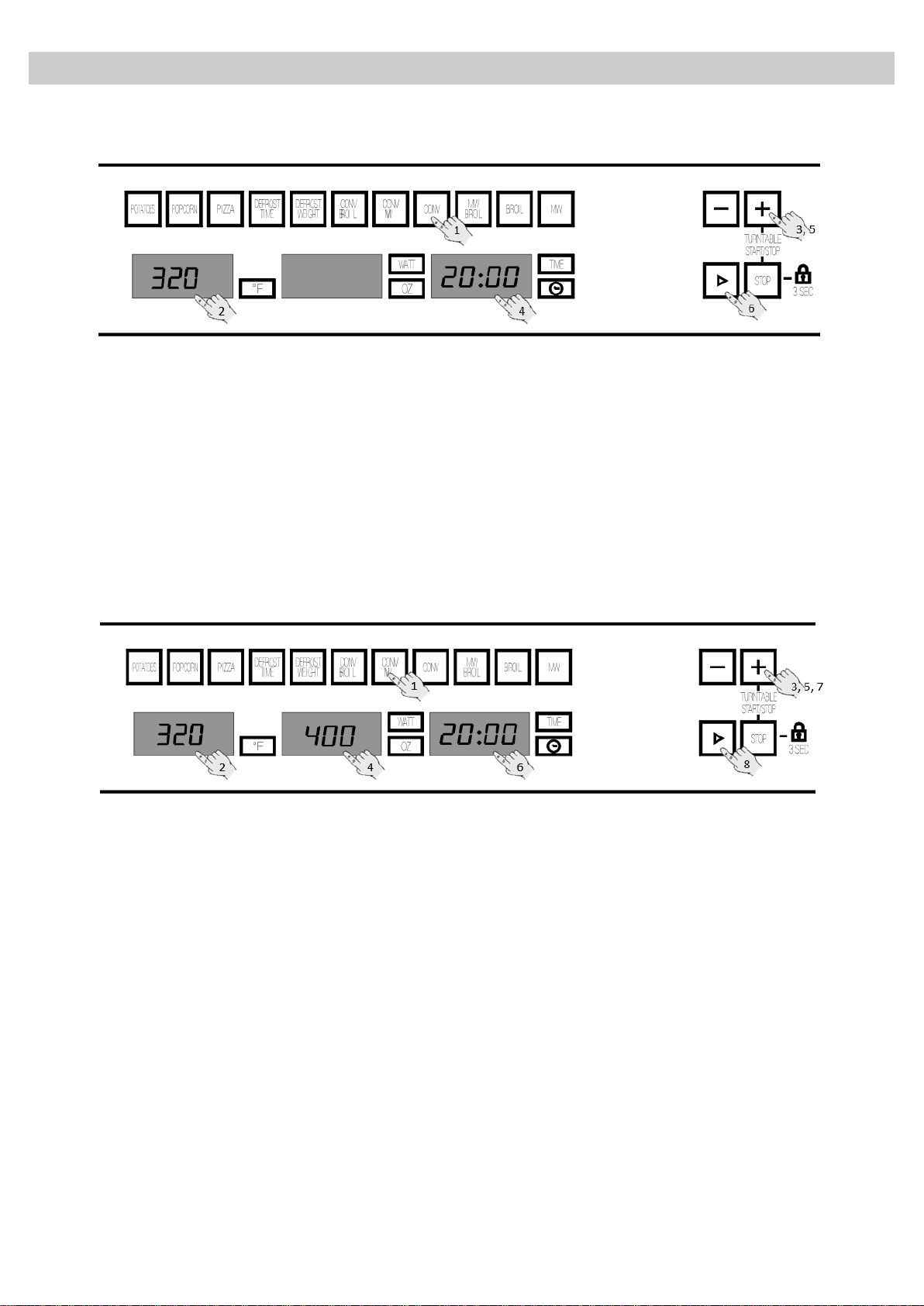
1. Press the function key Broil. The function key
lights up.
2. Press the Time Selection key to change the
operating time. The correspondent light will start
to flash.
3. Press key “-” and “+”, to change the function time
(e.g. 15 minutes).
4. Press the Start key. The oven will start to
operate.
Microwave + Broil
1. Press the function key Microwave + Broil. The
function key lights up.
2. Press the Power Selection key to change the
microwave power. The respective light will flash.
If you do not press this key, the oven operates at
600 W.
3. To change the microwave power press key “-”
and “+”.
4. Press the Time Selection key to change the
operating time. The respective light will start to
flash.
5. Press key “-” and “+”, to change the function time
(e.g. 10 minutes).
6. Press the Start key. The oven will start to
operate.
7. In combined mode, the microwave oven power
is limited to 600 W.
WARNING! Never switch on the microwave
when it is empty. If there is no food inside
there may be an electrical overcharge and the
oven could be damaged. RISK OF DAMAGE!
18
USA
Basic Functions
Convection
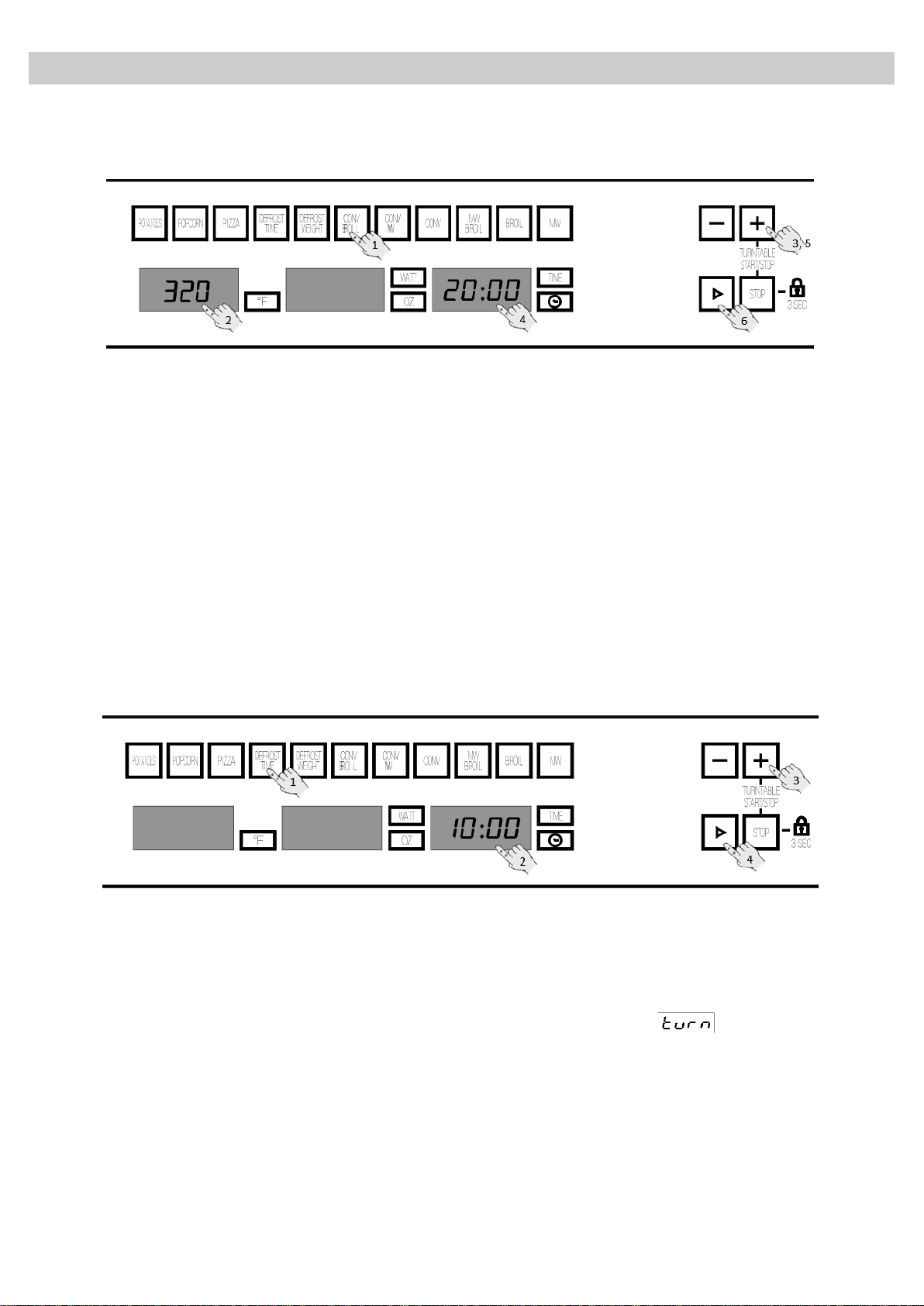
1. Press the function key Convection. The function
key lights up.
2. Press the temperature key to change the
temperature. The respective light will flash. If you
do not press this key, the oven operates at
320 ºF.
3. To change the temperature press key “-” and “+”.
4. Press the Time Selection key to change the
operating time. The respective light will start to
flash.
5. Press key “-” and “+”, to change the function time
(e.g. 20 minutes).
6. Press the Start key. The oven will start to
operate.
Convection + Microwave
1. Press the function key Convection +
Microwave. The function key lights up.
2. Press the Temperature Selection key to
change the temperature. The respective light will
start to flash. If you do not press this key, the
oven operates at 320ºF.
3. Press key “-” and “+”, to change the
temperature.
4. Press the Power Selection key to change the
microwave power. The respective light will flash.
If you do not press this key, the oven operates
at 400W.
5. To change the microwave power press key “-”
and “+”.
6. Press the Time Selection key to change the
operating time. The respective light will start to
flash.
7. Press key “-” and “+”, to change the function time
(e.g. 20 minutes).
8. Press the Start key. The oven will start to
operate,
9. In combined mode, the microwave oven power
is limited to 600W.
WARNING! Never switch on the microwave
when it is empty. If there is no food inside
there may be an electrical overcharge and the
oven could be damaged. RISK OF DAMAGE!
WARNING! For pre-heating the cavity, please
select the Convection function with the
desired temperature, and then switch to the
Microwave + Convection after placing the food
in the cavity.
19
USA
Basic Functions
Convection + Broil
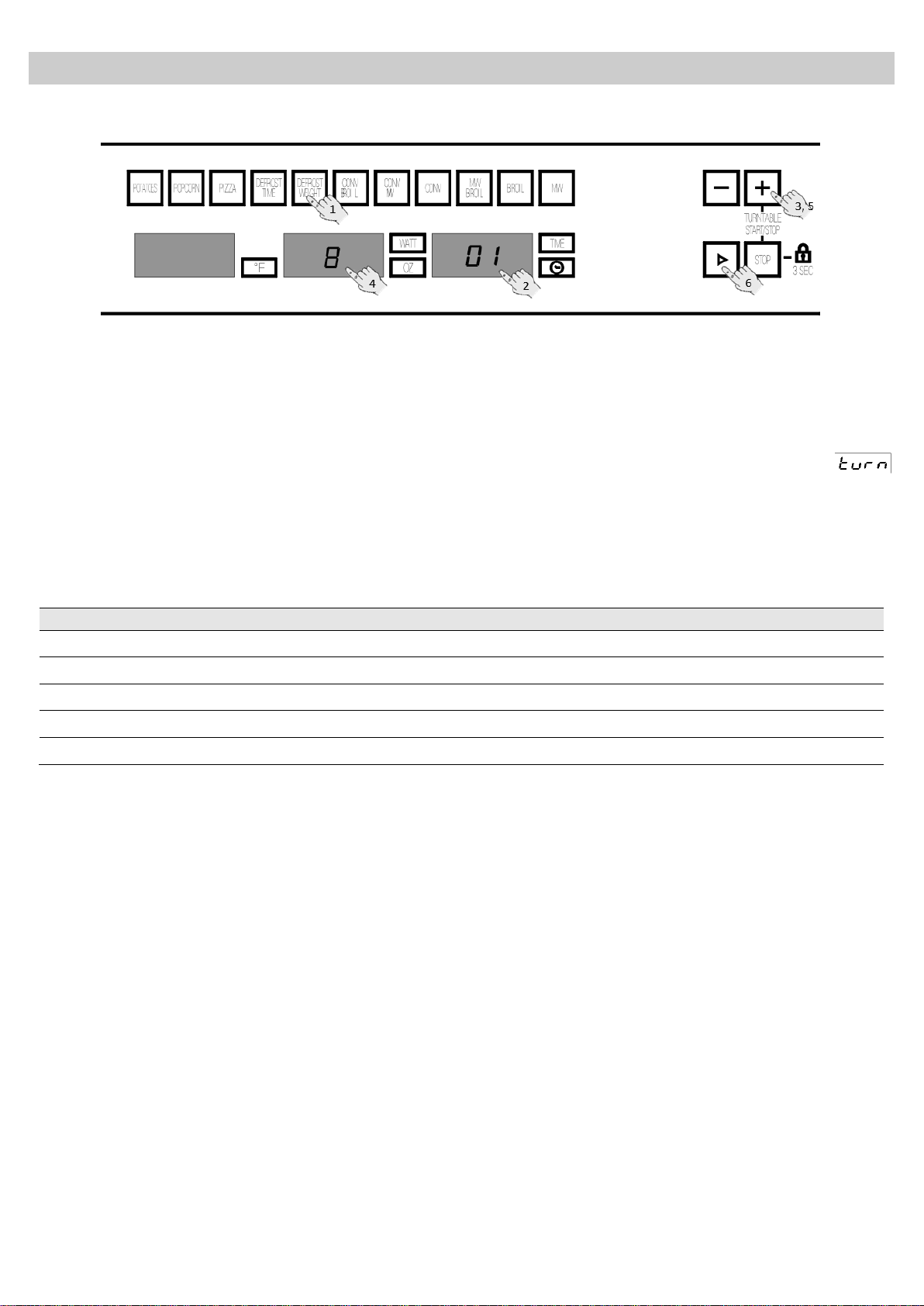
1. Press the function key Convection + Broil.
The function key lights up.
2. Press the Temperature key to change the
temperature. The respective light will flash. If
you do not press this key, the oven operates
at 320 ºF.
3. To change the temperature press key “-” and
“+”.
4. Press the Time Selection key to change the
operating time. The respective light will start
to flash
5. Press key “-” and “+”, to change the function
time (e.g. 20 minutes).
6. Press the Start key. The oven will start to
operate.
Defrosting by time (manual)
1. Press the function key Defrosting by time.
The function key lights up.
2. Press the Time Selection key to change the
function time. The respective light will flash.
3. Press key “-” and “+”, to change the function
time (e.g. 10 minutes).
4. Press the Start key. The oven will start to
operate.
Note: Stir or mix the foods several times during
heating, especially when the oven emits a beep and
the display is flashing .
20
USA
Basic Functions
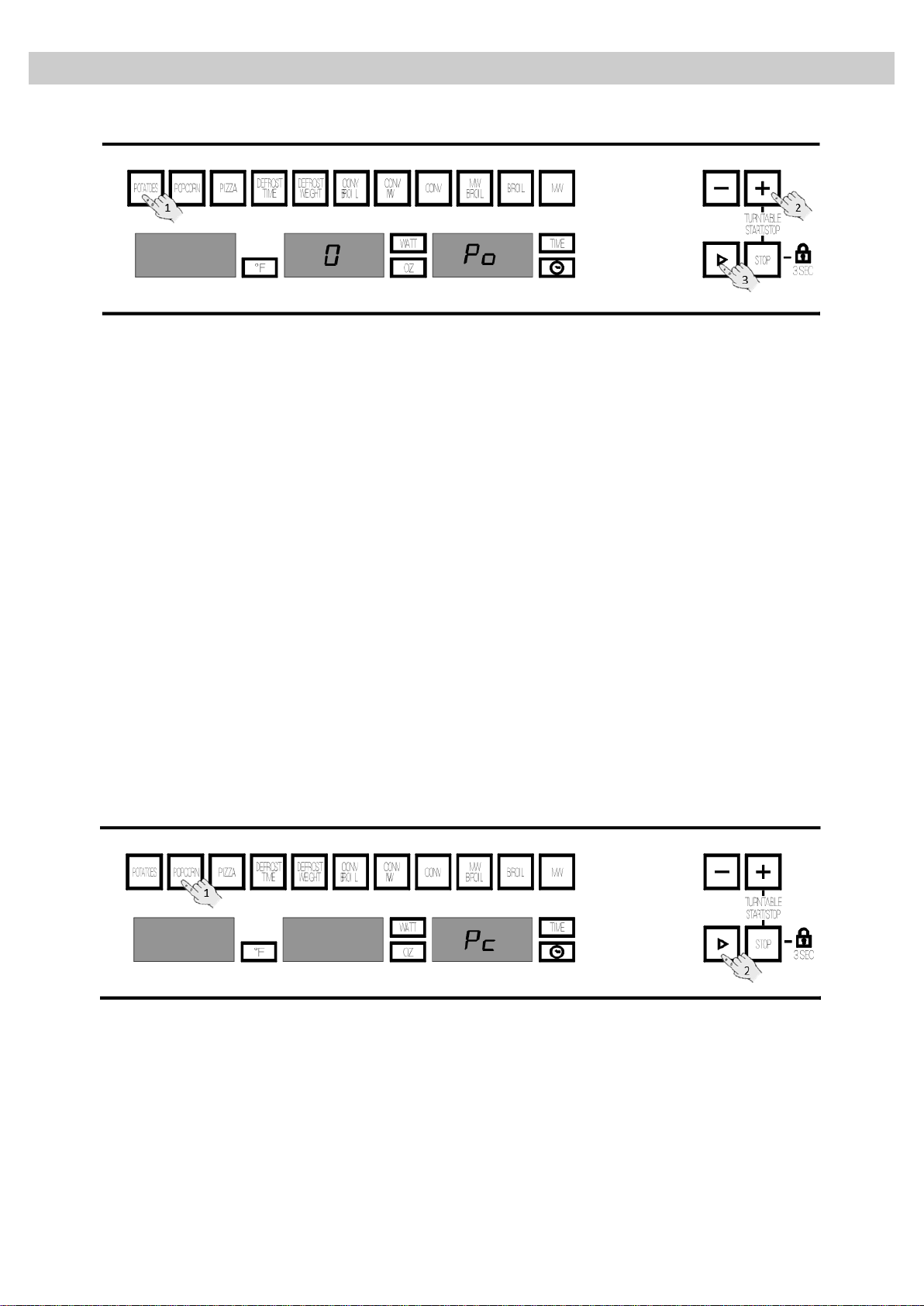
Defrosting by weight (automatic)
1. Press the function key Defrosting by weight.
The function key lights up.
2. Press the Food Type selection key to change
the food type. The respective lights will flash.
3. Press key “-” and “+”, to change the program,
e.g. “Pr 01” (see following table).
4. Press the Weight Selection key to define the
food weight. The respective light will flash.
5. Press key “-” and “+”, to change the weight.
6. Press the Start key. The oven will start to
operate.
7. Turn the food whenever the oven lets out a
beep, and the display flashes de word
. Press the Start key to resume.
The following table shows the defrosting by weight function programs, indicating weight intervals, and
defrosting and standing times (in order to ensure the food is of a uniform temperature).
Program
Food
Weight (OZ)
Time (min)
Standing time (min)
01
Meat
4 – 80
2,30 – 50
20 – 30
02
Poultry
4 – 100
2,40 – 67
20 – 30
03
Fish
4 – 80
2 – 45,30
20 – 30
04
Fruit
4 – 40
3 – 30
10 – 20
05
Bread
4 – 60
3 – 42
10 – 20
Important Note: see “General instructions for defrosting”.
21
USA
Special functions
Special Function: POTATOES
1. Press the function key Potatoes. The
function key lights up.
2. Press key “-” and “+”, to change the
weight.
3. Press the Start key. The oven will start to
operate.
Important Notes:
• Always use dishes for use in the
microwave oven and a lid or cover to
avoid loss of liquids.
• The time required to heat the food will
depend on its initial temperature. Food
taken straight from the fridge will take
longer to heat up than food that is at
room temperature.
• If the food temperature is not what is
wanted, select a greater or lesser weight
next time you heat up the food.
• After heating, stir the food or shake the
container and then leave the food to stand
for some time to allow the temperature to
become uniform throughout the food.
Warning! After heating the container may be
very hot. Although microwaves do not heat up
most containers, these may heat up through heat
transmission from food.
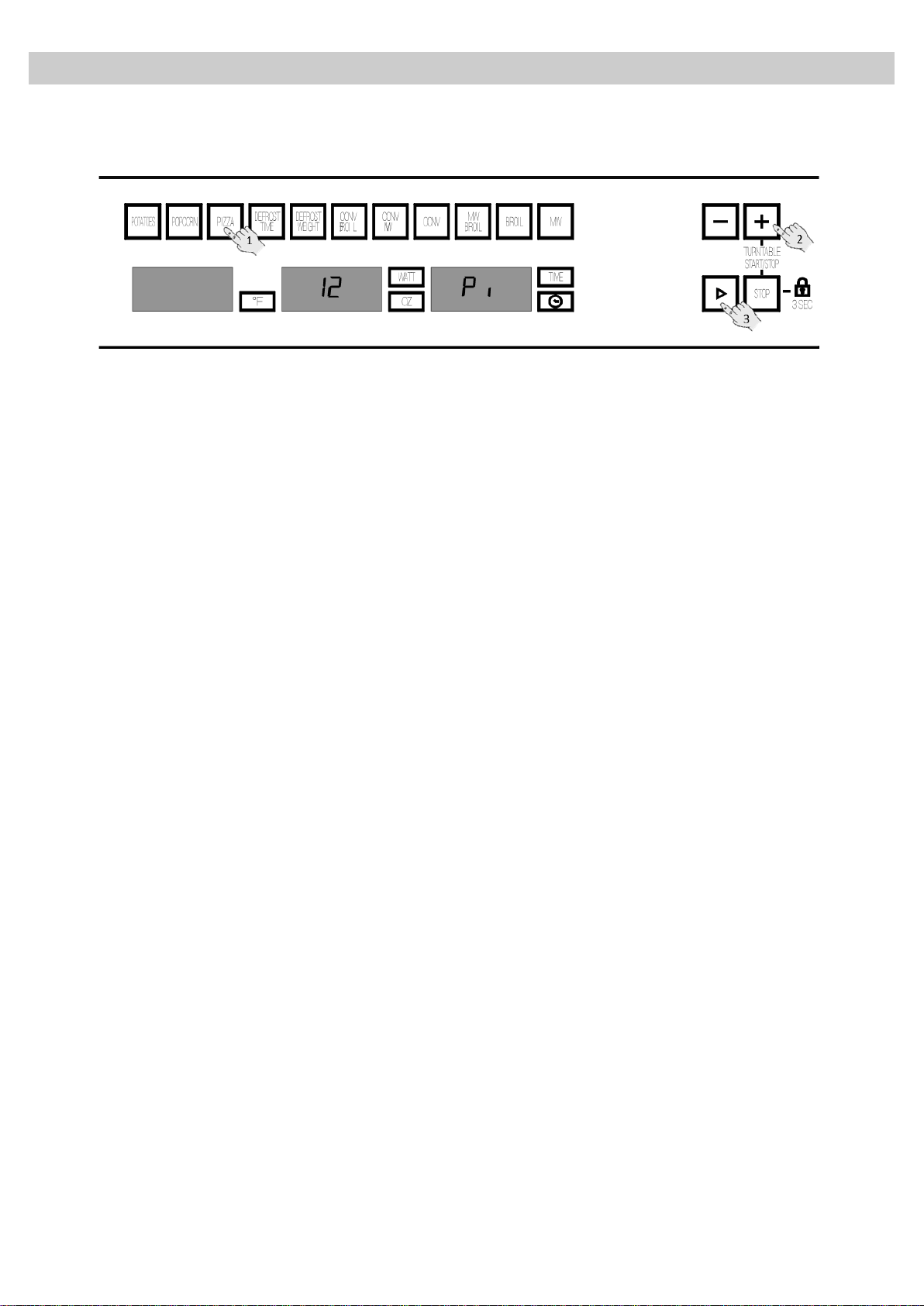
Special Function: POPCORN
1. Press the function key Popcorn. The
function key lights up.
2. Press the Start key. The oven will start to
operate.
Important Notes:
• Always use dishes for use in the
microwave oven and a lid or cover to
avoid loss of liquids.
Warning! After heating, the container may be
very hot. Although microwaves do not heat up
most containers, these may heat up through heat
transmission from food.
22
USA
Special functions
Special Function: PIZZA
1. Press the function key Pizza. The function
key lights up.
2. Press key “-” and “+”, to change the
weight.
3. Press the Start key. The oven will start to
operate.
Important Notes:
• Always use dishes that are suitable for
microwaving and heat resistant (e.g.
baking dishes). The oven produces very
high temperatures.
Warning! After heating, the container may be
very hot. Although microwaves do not heat most
containers, they can get very hot due to heat
transfer.

23
USA
When the oven is working...
Interrupting a cooking cycle
You can stop the cooking process at any time
by pressing the Stop key once or by opening
the oven door.
In both cases:
• Microwave emission is stopped
immediately.
• The grill is de-activated but is still very hot.
Danger of burning!
• The timer stops and the display show the
remaining amount of operating time.
If you wish, at this time you can:
1. Turn or stir the food to ensure it will be
evenly cooked.
2. Change the process parameters.
3. Cancel the process by pressing the Stop
key.
To restart the process, close the door and
press the Start key
Altering parameters
The operating parameters (time and
temperature) can only be altered when the
cooking process has been interrupted by
proceeding as follows:
1. To alter the time, press key “-” and “+”.
The new time defined is immediately valid.
2. To alter the power, press the Power
Selection key. The display and respective
light start to flash. Alter the parameter by
pressing the “-” and “+” keys and confirm
by pressing the Power Selection key
again.
Cancelling a cooking cycle
If you wish to cancel the cooking process,
press the Stop key twice.
You will then hear a beep and the blinking dots
“:” will appear on the display.
End of a cooking cycle
At the end of the process you will hear three
beeps and the display will show the word
“End”.
The beeps are repeated every 30 seconds until
the door is opened or the Stop key is pressed.
24
USA
Defrosting
The table below shows different defrosting
and standing times (in order to ensure the
food temperature is evenly distributed) for
different types and weights of food, plus
recommendations.
Food
Weight
(oz.)
Defrosting time
(min)
Standing time
(min)
Recommendation
Portions of meat,
veal, beef, pork
4
2-3
5-10
Turn once
7
4-5
5-10
Turn once
17-18
10-12
10-15
Turn twice
35-36
21-23
20-30
Turn twice
51-53
32-34
20-30
Turn twice
70-71
43-45
25-35
Turn twice
Goulash
17-18
8-10
10-15
Turn twice
35-36
17-19
20-30
Turn twice
Minced meat
4
2-4
10-15
Turn once
17-18
10-14
20-30
Turn twice
Sausages
7
4-6
10-15
Turn once
17-18
9-12
15-20
Turn twice
Poultry (portions)
8-9
5-6
5-10
Turn once
Chicken
35-36
20-24
20-30
Turn twice
90
38-42
25-35
Turn twice
Fish fillet
7
4-5
5-10
Turn once
Trout
8-9
5-6
5-10
Turn once
Prawns
4
2-3
5-10
Turn once
17-18
8-11
10-20
Turn twice
Fruit
7
4-5
5-10
Turn once
10-11
8-9
5-10
Turn once
17-18
11-14
10-20
Turn twice
Bread
17-18
4-5
5-10
Turn once
17-18
10-12
10-15
Turn once
28-29
15-17
10-20
Turn twice
Butter
8-9
8-10
10-15
Cream cheese
8-9
6-8
10-15
Creams
8-9
7-8
10-15

25
USA
Defrosting
General instructions for defrosting
1. When defrosting, use only dishes that are
appropriate for microwaves (china, glass,
suitable plastic).
2. The defrost function by weight and the
tables refer to the defrosting of raw food.
3. The defrosting time depends on the
quantity and thickness of the food. When
freezing food keep the defrosting process
in mind. Distribute the food evenly in the
container.
4. Distribute the food as best as possible
inside the oven. The thickest parts of fish
or chicken drumsticks should be turned
towards the outside. You can protect the
most delicate parts of food with pieces of
aluminum foil. Important: The aluminum
foil must not come into contact with the
oven cavity interior as this can cause
electrical arcing.
5. Thick portions of food should be turned
several times.
6. Distribute the frozen food as evenly as
possible since narrow and thin portions
defrost more quickly than the thicker and
broader parts.
7. Fat-rich foods such as butter, cream
cheese and cream should not be
completely defrosted. If they are kept at
room temperature they will be ready to be
served in a few minutes. With ultra-frozen
cream, if you find small pieces of ice in it,
you should mix these in before serving.
8. Place poultry on an upturned plate so that
the meat juices can run off more easily.
9. Bread should be wrapped in a napkin so
that it does not become too dry.
10. Turn the food at regular intervals.
11. Remove frozen food from its wrapping and
do not forget to take off any metal twist-
tags. For containers that are used to keep
frozen food in the freezer and which can
also be used for heating and cooking, all
you need to do is take off the lid. For all
other cases you should put the food into
containers that are suitable for microwave
use.
12. The liquid resulting from defrosting,
principally that from poultry should be
discarded. In no event should such liquids
be allowed to come into contact with other
foods.
13. Do not forget that by using the defrosting
function you need to allow for standing time
until the food is completely defrosted.

26
USA
Cooking with a microwave oven
Warning! Read the section “Microwave
Safety” before cooking with your
microwave.
Follow these recommendations when cooking
with your microwave:
• Before heating or cooking foods with peel
or skin (e.g. apples, tomatoes, potatoes,
sausages) prick them so that they do not
burst. Cut the food up before starting to
prepare it.
• Before using a container or dish make
sure that it is suitable for microwave use
(see the section on types of ovenware).
• When cooking food with very little
moisture (e.g. defrosting bread, making
popcorn, etc.) evaporation is very quick.
The oven then works as if it was empty
and the food may burn. The oven and the
container may be damaged in such a
situation. You should therefore set just the
cooking time necessary and you must
keep a close eye on the cooking process.
• It is not possible to heat large quantities of
oil (frying) in the microwave.
• Remove pre-cooked food from the
containers they come in since these are
not always heat resistant. Follow the food
manufacturer’s instructions.
• If you have several containers, such as
cups, for example, set them out uniformly
on the turntable plate.
• Do not close plastic bags with metal
clips. Use plastic clips instead. Prick the
bags several times so that the steam can
escape easily.
• When heating or cooking foods, check
that they reach at least a temperature of
158°F.
• During cooking, steam may form on the
oven door window and may start to drip.
This situation is normal and may be more
noticeable if the room temperature is low.
The oven’s safe working is not affected by
this. After you have finished cooking,
clean up the water coming from the
condensation
• When heating liquids, use containers
with a wide opening, so that the steam
can evaporate easily.
Prepare the foods as per the instructions and
keep in mind the cooking times and power
levels indicated in the tables.
Keep in mind that the figures given are only
indicative and can vary depending on the initial
state, temperature, moisture and type of food.
It is advisable to adjust the times and power
levels to each situation. Depending on the
exact characteristics of the food you may need
to increase or shorten the cooking times or
increase or decrease the power levels.
Cooking with microwaves rules
1. The greater the amount of food, the longer
the cooking time. Keep in mind that:
• Double the quantity » double the time
• Half the quantity » half the time
2. The lower the temperature, the longer the
cooking time.
3. Foods containing a lot of liquid heat up more
quickly.
4. Cooking will be more uniform if the food is
evenly distributed on the turntable. If you put
dense foods on the outside part of the plate and
less dense ones on the center of the plate, you
can heat up different types of food
simultaneously.
5. You can open the oven door at any time.
When you do this the oven switches off
automatically. The microwave will only start
working again when you close the door and
press the start key.
6. Foods that are covered require less cooking
time and retain their characteristics better. The
lids used must let microwaves pass through
and have small holes that allow steam to
escape.
27
USA
Cooking with a microwave oven
Tables and suggestions – Cooking vegetables
Food
Quantity
(oz.)
Addition of
liquids (fl
oz)
Power
(Watt)
Time
(min.)
Standing
Time
(min.)
Instructions
Cauliflower
Broccoli
Mushrooms
17-18
10-11
8-9
3,5
2
1
800
800
800
9-11
6-8
6-8
2-3
2-3
2-3
Cut into slices.
Keep covered
Turn once
Peas & carrots
Frozen carrots
10-11
8-9
3,5
1
800
800
7-9
8-10
2-3
2-3
Cut into chunks
or slices. Keep
covered
Turn once
Potatoes
8-9
1
800
5-7
2-3
Peel and cut
into equal sized
pieces. Keep
covered
Turn once
Paprika
Leek
8-9
8-9
1
2
800
800
5-7
5-7
2-3
2-3
Cut into chunks
or slices Keep
covered
Turn once
Frozen Brussels
sprouts
10-11
2
800
6-8
2-3
Keep covered
Turn once
Sauerkraut
8-9
1
800
8-10
2-3
Keep covered
Turn once
Tables and suggestions – Cooking fish
Food
Quantity
(oz.)
Power
(Watt)
Time
(min.)
Standing
Time
(min.)
Instructions
Fish fillets
17-18
600
10-12
3
Cook covered over. Turn
after half of cooking time.
Whole fish
28-29
800
400
2-3
7-9
2-3
Cook covered over. Turn
after half of cooking time.
You may wish to cover up
the small edges of the fish.

28
USA
Cooking with the grill
For good results with the grill, use the
rectangular rack supplied with the oven.
Fit the rectangular rack in such a way that it
doesn’t come into contact with the metal
surfaces of the oven cavity since if it does
there is a danger of electric arcing which
may damage the oven.
IMPORTANT POINTS:
1. When the microwave grill is used for the
first time there will be some smoke and a
smell coming from the oils used during
oven manufacture.
2. The oven door window becomes very hot
when the grill is working. Keep children
away.
3. When the grill is operating, the cavity walls
and the rectangular rack become very hot.
You should use oven gloves.
4. If the grill is used for extended period of
time it is normal to find that the elements
will switch themselves off temporarily due
to the safety thermostat.
5. Important! When food is to be grilled or
cooked in containers you must check that
the container in question is suitable for
microwave use. See the section on types
of ovenware!
6. When the grill is used it is possible that
some splashes of fat may go onto the
elements and be burnt. This is a normal
situation and does not mean there is any
kind of operating fault.
7. After you have finished cooking, clean the
interior and the accessories so that
cooking remains do not become
encrusted.
29
USA
Cooking with the grill
Tables and suggestions – Grill without microwave
Fish
Quantity (oz.)
Time (min.)
Instructions
Fish
Bass
Sardines/gurnard
28-29
6-8 fish.
18-24
15-20
Spread lightly with butter. After half of
cooking time turn and spread with
seasoning.
Meat
Sausages
6-8 units
22-26
Prick after half cooking time and turn.
Frozen
hamburgers
3 units
18-20
Prick after half cooking time.
Spare rib (approx.
3 cm thick)
14-15
25-30
Brush with oil. After half of cooking time,
baste and turn.
Others
Toast
4 units
1½-3
Watch toasting. Turn
Toasted
sandwiches
2 units
5-10
Watch toasting.
Heat up the grill beforehand for 2 minutes.
Unless indicated otherwise, use the grid iron.
Place the grid on a bowl so that the water and
the fat can drop. The times shown are merely
indicative and can vary as a function of the
composition and quantity of the food, as well as
the final condition wished for. Fish and meat
taste great if, before grilling, you brush them
with vegetable oil, spices and herbs and leave
to marinate for a few hours. Only add salt after
grilling.
Sausages will not burst if you prick them with a
fork before grilling.
After half the grilling time has passed, check on
how the cooking is going and, if necessary, turn
the food over or brush it with some oil.
The grill is especially suitable for cooking thin
portions of meat and fish. Thin portions of meat
only need to be turned once, but thicker
portions should be turned several times. In the
case of fish, you should join the two ends,
putting the tail in its mouth, and then put the fish
on the grid iron.
30
USA
Cooking with the Grill
Tables and suggestions – Microwave + Grill
The microwave + grill function is ideal for
cooking quickly and, at the same time,
browning foods. Furthermore, you can also grill
and cook cheese covered food.
The microwave and the grill work
simultaneously. The microwave cooks and the
grill toasts.
Food
Quantity (oz.)
Dish
Power
(Watt)
Time (min.)
Standing
time (min.)
Cheese topped
pasta
17
Low dish
400
12-17
3-5
Cheese topped
potatoes
28
Low dish
600
20-22
3-5
Lasagna
approx. 28
Low dish
600
15-20
3-5
Grilled cream
cheese
approx. 17
Low dish
400
18-20
3-5
2 fresh chicken legs
(grilled)
7 each
Low dish
400
10-15
3-5
Chicken
approx. 35
Low and wide
dish
400
35-40
3-5
Cheese topped
onion soup
2 x 7 oz. cups
Soup bowls
400
2-4
3-5
Before using a dish in the microwave oven
make sure that it is suitable for microwave use.
Only use dishes or containers that are suitable
for microwave use.
The dish to be used in the combined function
must be suitable for microwave and grill use.
See the section on types of ovenware!
Keep in mind that the figures given are merely
indicative and can vary as a function of the
initial state, temperature, moisture and type of
food.
If the time is not enough to brown the food well,
put it under the grill for another 5 or 10 minutes.
Please follow the standing times and don’t
forget to turn the meat pieces.
Unless indicated to the contrary, use the
turntable plate for cooking.
The values given in the tables are valid when
the oven cavity is cold (it is not necessary to
pre-heat the oven).
WARNING! Never switch on the microwave
when it is empty. If there is no food inside there
may be an electrical overcharge and the oven
could be damaged. RISK OF DAMAGE!
31
USA
Roasting and baking
Table and advices – Preparing meat and cake
Microwave / Hot air
Food
Quantity
(oz.)
Power
(W)
Temperature
(ºF)
Time
(Min.)
Standing
time (min.)
Instructions
Roast beef
35-53
400
390
30-40
20
Do not put lid on
container
Turn once
Pork loin /
Cutlet or bones
Pork roast
28-36
200
350-370
50-60
20
Do not put lid on
container
Turn once
Whole chicken
35-43
400
390
30-40
10
Do not put lid on
container. Turn the
chicken chest down.
Turn once.
Half chicken
17-35
400
390
25-35
10
Do not put lid on
container. Turn the
pieces with skin
down. Turn once.
Roast loin of
veal
53-71
200
350
60-65
20
Do not put lid on
container. Turn once
or twice. After turning
keep it without lid
Beef topside
53-64
200
390
80-90
20
Do not put lid on
container. Turn once
or twice
Microwave / Baking
Pastry
Power
(W)
Temperature
(ºF)
Time
(Min.)
Standing
time
(min.)
Instructions
Chocolate– cherry pie
200
390
30
5-10
Turntable,
Springform, Ø 28 cm
Cheesecake with fruit
400
350
40-45
5-10
Turntable,
Springform, Ø 28 cm
Apple pie
200
360
40-45
5-10
Turntable,
Springform, Ø 28 cm
Cheese cake with
streusel
400
350
40-50
5-10
Turntable,
Springform, Ø 26 cm
Nuts cake
200
340
30-35
5-10
Turntable,
Cake tin

32
USA
Roasting and baking
Advice to roast - bake
Turn the pieces of meat halfway through the
cooking time. When the roasted meat is ready
you should let it stand for 20 minutes in the
oven with this switched off and closed. This will
ensure the juices in the meat are well
distributed.
The roasting temperature and time required
depends on the type and amount of meat being
cooked.
If the weight of the meat to be roasted does not
appear on the table choose the settings for the
weight immediately below and extend the
cooking times.
Advice on ovenware
Check that the ovenware fits inside the oven.
Hot glass containers should be put on a dry
kitchen cloth. If such containers are put on a
cold or wet surface the glass may crack and
break. Use oven gloves to take the ovenware
out of the oven.
WARNING! Never switch on the microwave
when it is empty. If there is no food inside there
may be an electrical overcharge and the oven
could be damaged. RISK OF DAMAGE!
33
USA
Baking
Table and advices – baking/hot air
Type
Container
Level
Temperature
(ºF)
Time
(min.)
Walnut cake
Spring-form type tin
Turntable
320
30/35
Fruit tart
Spring-form type tin Ø
28 cm
Turntable
320
35/45
Ring cake
Spring-form type tin
Turntable
320
30/45
Piquant cakes e.g.
Pizza made with
potatoes
Spring-form type tin
Turntable
370–390
50/70
Sponge cake
Spring-form type tin Ø
26 cm
Turntable
320
40/45
Jelly roll
Glass griddle
1
390
35/45
Cherry pie
Glass griddle
1
350-370
35/45
Advice on cake baking ware
The most commonly used type of baking ware
is black metal tins. If you are also going to use
the microwave, use glass, ceramic or plastic
baking ware. These must be able to withstand
temperatures up to 482ºF. If you use these
types of baking ware the cakes are not
browned as much.
Advice on how to bake cakes
Different amounts and types of pastry require
different temperatures and baking times. Try
low settings first of all and then, if necessary,
use higher temperatures next time. A lower
temperature will result in more uniform baking.
Always put the cake tray in the center of the
turntable.
Baking suggestions
How to check if the cake is properly cooked
Start sticking a tooth pick in the highest part of
the cake 10 minutes before the end of the
baking time. When no dough sticks to the tooth
pick the cake is ready.
If the cake is very dark on the outside:
Next time choose a lower temperature and let
the cake bake for a longer time.
If the cake is very dry
Make small holes in the cake with a tooth pick
after baking has finished. Then sprinkle the
cake with some fruit juice or alcoholic drink.
Next time increase the temperature by about
212ºF and reduce the baking time.
If the cake does not come free when turned
Let the cake cool down for 5 to 10 minutes after
baking and it will come out of the tin more
easily. If the cake still does not come free run
a knife carefully around the edges. Next time
grease the cake tin well.
Advice on saving energy
When you are making more than one cake, it is
advisable to bake them in the oven one after
the other when the oven is still hot. This lets
you reduce the baking time for the second and
later cakes.
It is preferable to use dark colored baking ware
- painted or enameled black – since such
baking tins absorb heat better.
When dealing with long baking times, you can
switch the oven off 10 minutes before the end
of the time and make use of the residual heat
to complete the baking.

34
USA
What kind of ovenware can be used?
Microwave function
For the microwave function, keep in mind that
microwaves are reflected by metal surfaces.
Glass, china, clay, plastic, and paper let
microwaves pass.
For this reason, metal pans and dishes or
containers with metal parts or decorations
cannot be used in the microwave. Glass
ware and clay with metallic decoration or
content (e.g. lead crystal) cannot be used in
microwave ovens.
The ideal materials for use in microwave
ovens are glass, refractory china or clay, or
heat resistant plastic. Very thin, fragile glass or
china should only be used for short period of
times (e.g. heating).
Hot food transmits heat to the dishes which
can become very hot. You should, therefore,
always use an oven glove!
How to test ovenware you want to use
Put the item you want to use in the oven for 20
seconds at maximum microwave power. After
that time, if it is cold and just slightly warm, it
is suitable to use. However, if it heats up a lot
or causes electric arcing it is not suitable for
microwave use.
Grill and Hot air function
In the case of the grill function, the ovenware
must be resistant to temperature of at least
572°F.
Plastic dishes are not suitable for use in the
grill.
Combined functions
In the combined function, the ovenware must
be suitable for use in conventional heating
functions.
Aluminum containers and foil
Pre-cooked food in aluminum containers or in
aluminum foil can be put in the microwave if
the following aspects are respected:
• Keep in mind the manufacturer’s
recommendations written on the
packaging.
• The aluminum containers cannot be
more than 3 cm high or come in contact
with the cavity walls (minimum distance
3 cm). Any aluminum lid or top must be
removed.
• Put the aluminum container directly on
top of the turntable plate. If you use the
grid iron, put the container on a china
plate. Never put the container directly on
the grid iron!
• The cooking time is longer because the
microwaves only enter the food from the
top. If you have any doubts, it is best to
use only dishes suitable for microwave
use.
• Aluminum foil can be used to reflect
microwaves during the defrosting
process. Delicate food, such as poultry or
minced meat, can be protected from
excessive heat by covering the
respective extremities/edges.
• Important: aluminum foil cannot come
into contact with the cavity walls since
this may cause electrical arcing.
Lids
We recommend you use glass or plastic lids or
clinging film since:
1. This will stop excessive evaporation
(mainly during very long cooking times);
2. The cooking times are shorter;
3. The food does not become dry;
4. The aroma is preserved.
The lid should have holes or openings so that
no pressure develops. Plastic bags must also
be opened. Baby feeding bottles or jars with
baby food and similar containers can only be
heated without their tops / lids otherwise they
can burst.
35
USA
What kind of ovenware can be used?
Table of Ovenware
The table below gives you a general idea of what type of ovenware is suitable for each situation.
Operating
mode
Type of
ovenware
Microwave
Grill and
Hot – Air
function
Combined
functions (with
microwaves)
Defrosting /
heating
Cooking
Glass and china 1)
Home use, not flame resistant,
can be used in dish washer
yes
yes
no
no
Glazed china
Flame resistant glass and china
yes
yes
yes
yes
China, stone ware 2)
Unglazed or glazed without
metallic decorations
yes
yes
no
no
Clay dishes 2)
Glazed
Unglazed
yes
no
yes
no
no
no
no
no
Plastic dishes 2)
Heat resistant to 212°F
Heat resistant to 482°F
yes
yes
no
yes
no
no
no
no
Plastic films 3)
Plastic film for food
Cellophane
no
yes
no
yes
no
no
no
no
Paper, cardboard, parchment
4)
yes
no
no
no
Metal
Aluminum foil
Aluminum wrappings 5)
Accessories
yes
no
yes
no
yes
yes
yes
yes
yes
no
yes
yes
1. Without any gold or silver leaf edging; no
lead crystal.
2. Keep the manufacturer’s instructions in
mind!
3. Do not use metal clips for closing bags.
Make holes in the bags. Use the films only
to cover the food.
4. Do not use paper plates.
5. Only shallow aluminum containers without
lids/tops. The aluminum cannot come into
contact with the cavity walls.

36
USA
Oven Cleaning and Maintenance
Cleaning is the only maintenance normally
required.
Warning! Your microwave oven should be
cleaned regularly, with all food remains being
removed. If the microwave is not kept clean its
surfaces may deteriorate, reducing the
oven’s working life and possibly resulting
in a dangerous situation.
Warning! Cleaning should be done with the
oven power switched off. Take the plug out
of the socket or switch off the oven’s power
circuit.
Do not use aggressive or abrasive cleaning
products, scourers that scratch surfaces or
sharp objects, since stains may appear.
Do not use high pressure or stream jet
cleaning appliances.
The door contact surfaces (the front of the
cavity and the inside part of the doors) must be
kept very clean in order to ensure the oven
functions correctly.
Do not use harsh abrasive cleaners or sharp
metal scrapers to clean the oven door glass
since they can scratch the surface, which
may result in shattering of the glass.
Front surface
Normally you just need to clean the oven with
a damp cloth. If it is very dirty, add a few drops
of dishwashing liquid to the cleaning water.
Afterwards, wipe the oven with a dry cloth.
Immediately remove lime, fat, starch or egg
white stains. Corrosion can occur under these
stains.
Do not let any water get inside the oven.
Oven interior
After each time the oven is used, clean the
inside walls with a damp cloth since this is the
easiest way to remove splashes or spots of
food that may have stuck to the inside.
To remove dirt that is harder to shift, use a non-
aggressive cleaning product. Do not use oven
sprays or other aggressive or abrasive
cleaning products.
Always keep the door and the oven front
very clean to ensure that the door opens
and closes properly.
Make sure water does not enter the microwave
ventilation holes.
Regularly take out the turntable plate and the
respective support and clean the cavity base,
especially after any liquid spillage.
Do not switch on the oven without the
turntable and the respective support being
in place.
If the oven cavity is very dirty, put a glass of
water on the turntable and switch on the
microwave oven for 2 or 3 minutes at maximum
power. The steam released will soften the dirt
which can then be cleaned easily using a soft
cloth.
Unpleasant odors (e.g. after cooking fish) can
be eliminated easily. Put a few drops of lemon
juice in a cup with water. Put a spoonful of
coffee in the cup to avoid the water boiling over.
Heat the water for 2 to 3 minutes at maximum
microwave power.
37
USA
Oven Cleaning and Maintenance
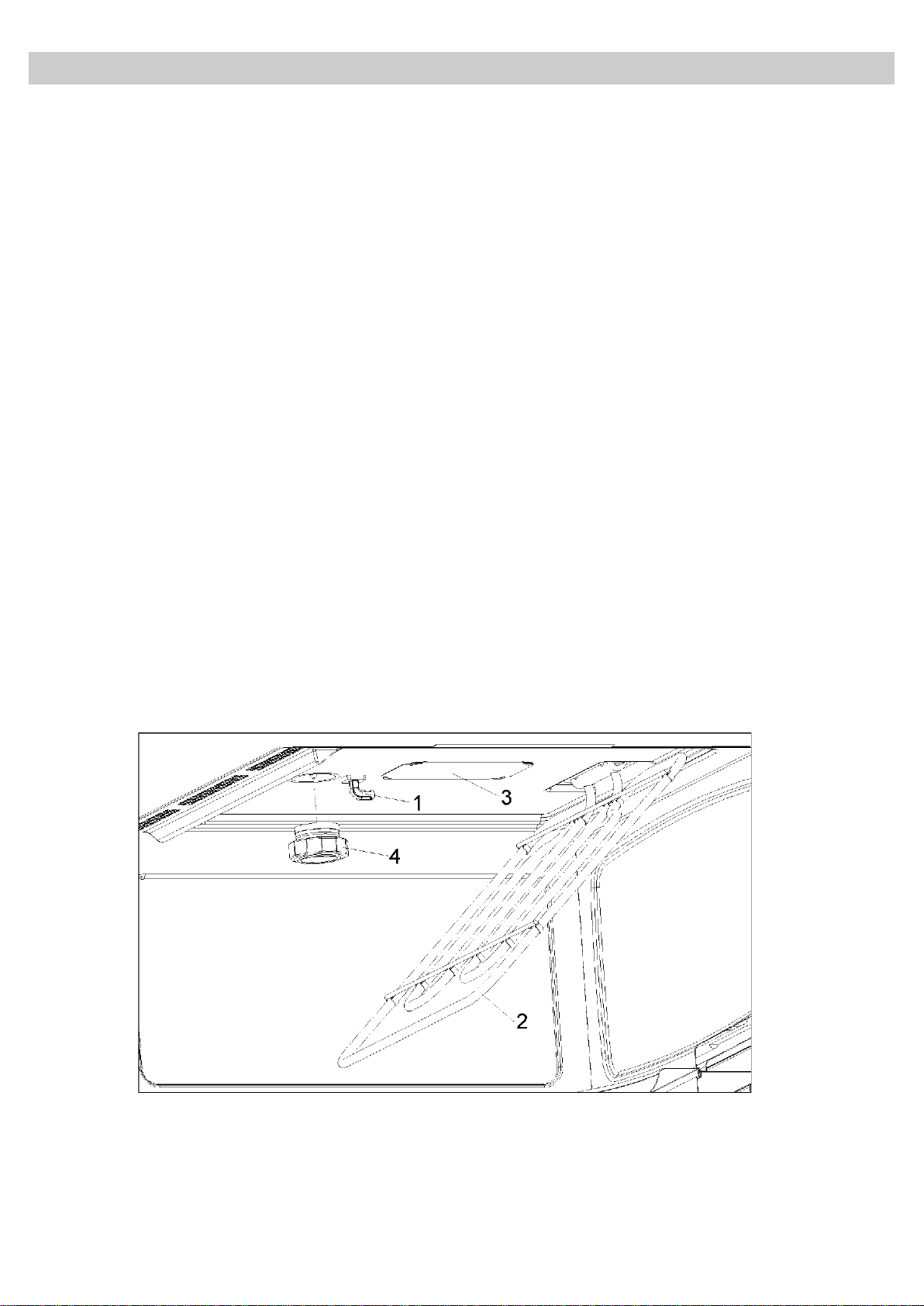
Oven ceiling
If the oven ceiling is dirty, the grill can be
lowered to make cleaning easier.
To avoid the danger of burning, wait until
the grill is cold before lowering it. Proceed
as follows:
1. Turn the grill support by 180º (1).
2. Lower the grill gently (2). Do not use
excessive force as this may cause
damage.
3. After cleaning the ceiling, put the grill (2)
back in its place, carrying out the previous
operation.
IMPORTANT WARNING: The grill heating
element support (1) may fall when it is rotated.
If this happens, insert the grill heating element
support (1) into the slot in the ceiling of the
cavity and rotate it 90º to the grill heating
element support (2) position.
The mica cover (3) located in the ceiling
must always be kept clean. Any food remains
that collect on the mica cover can cause
damage or provoke sparks.
Do not use abrasive cleaning products or
sharp objects.
To avoid any risk, do not remove the mica
cover.
The glass lamp cover (4) is located on the oven
ceiling and can be removed easily for cleaning.
For this you just need to unscrew it and clean it
with water and dishwashing liquid.
Accessories
Clean the accessories after each use. If they
are very dirty, soak them first of all and then
use a brush and sponge. The accessories can
be washed in a dish washing machine.
Make sure that the turntable plate and the
respective support are always clean. Do not
switch on the oven unless the turntable and the
respective support are in place.
38
USA
What should I do if the oven doesn’t work?
WARNING! Any type of repair must only be
done by a specialized technician. Any repair
done by a person not authorized by the
manufacturer is dangerous.
You do not need to contact Technical
Assistance to resolve the following questions:
• The display is not showing! Check if:
- The time indication has been switched off
(see section on Basic Settings).
• Nothing happens when I press the keys!
Check if:
- The Safety Block is active (see section on
Basic Settings).
• The oven does not work! Check if:
- The plug is correctly fitted in the socket.
- The oven’s power is switched on.
- The door is completely closed. The door
should close with an audible click.
- There are any foreign bodies between the
door and the cavity front.
• When the oven is operating I can hear
some strange noises! Check if:
- There is any electrical arcing inside the
oven caused by foreign metallic objects
(see section on type of ovenware).
- The ovenware is touching the oven walls.
- There are any loose items of cutlery or
cooking tools inside the oven.
• The food doesn’t heat up or heats very
slowly! Check if:
- You have inadvertently used metal
ovenware.
- You have selected the correct operating
times and power level.
- The food you have put inside the oven is
a larger amount or colder than you usually
put in.
• The food is too hot, dried out or burnt!
Check if you selected the correct
operating time and power level.
• I hear some noises after the cooking
process is finished! This is not a
problem. The cooling fan keeps on
working for some time. When the
temperature has dropped sufficiently, the
fan will switch itself off.
• TV/radio interference might be noticed
while using the microwave, similar to
the interference caused by other small
appliances. This is not a problem with the
Microwave. Move the radio or TV as far
away from the microwave as possible, or
check the position of the TV/radio
antenna.
• The oven switches on but the interior
light does not go on! If all the functions
work properly it is probable that the lamp
has blown. You can keep on using the
oven
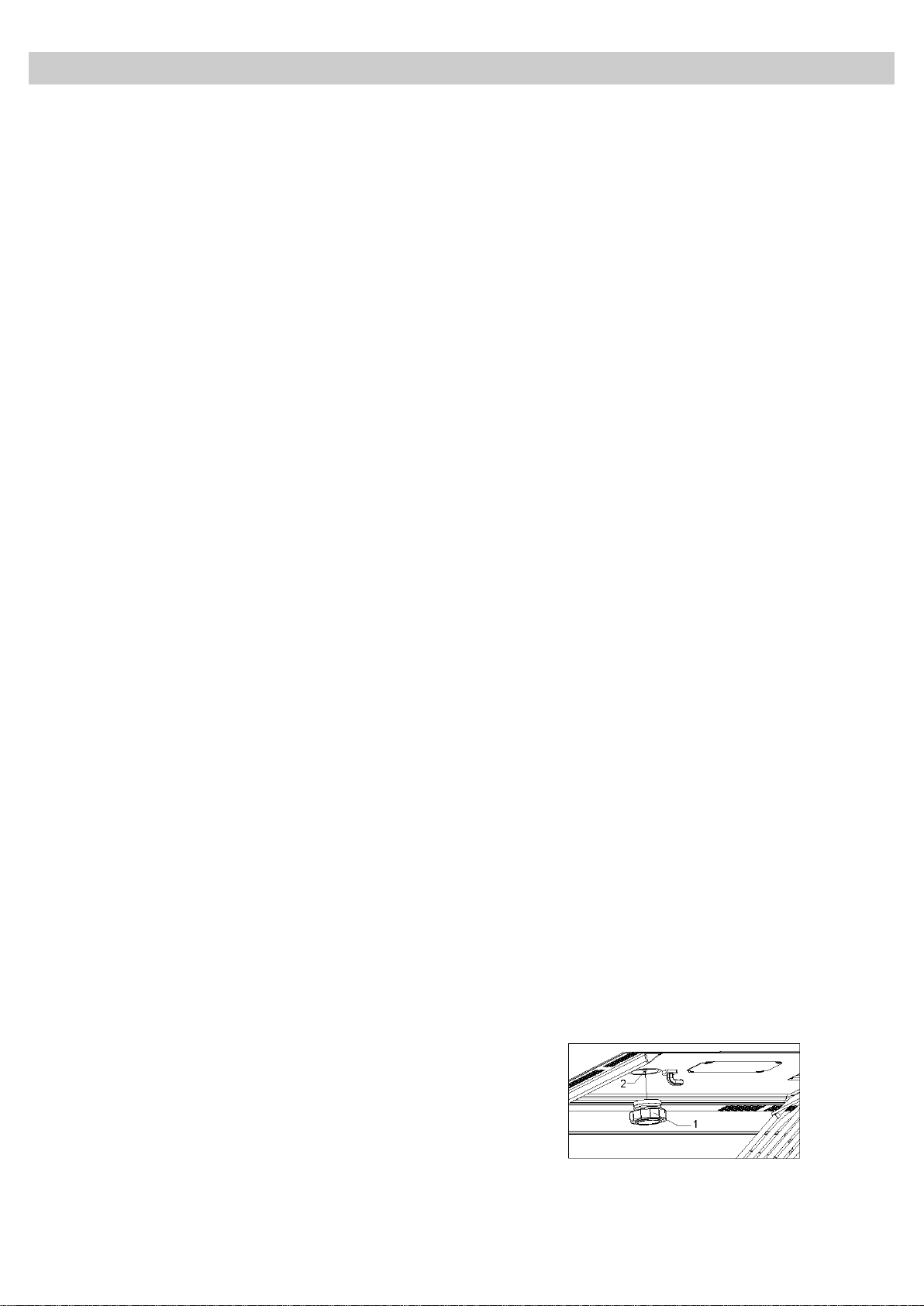
Substitution of light bulb
To substitute the light bulb, proceed as follows:
- Disconnect the oven from the power
supply. Take the plug out of the socket or
switch off the oven’s power circuit.
- Unscrew and remove the glass light cover
(1).
- Remove the halogen light bulb (2).
Warning! The bulb may be very hot.
- Fit a new G4/12V/10-20W halogen bulb.
Warning! Do not touch the light bulb
surface directly with your fingers
because you may damage the bulb.
Follow the lamp manufacturer’s
instructions.
- Screw the glass light cover into place (1).
- Connect the oven again to the power
supply.

39
USA
Technical characteristics
Specifications
• AC Voltage ................................................................................... 240V, 2ph, 60Hz
• Power required ............................................................................ 3850 W
• Broiler power. ............................................................................... 1500 W
• Hot air power ............................................................................... 1600 W
• Microwave output power. ............................................................. 1000 W
• Microwave frequency… ............................................................... 2450 MHz
• Exterior dimensions (WHD). .................................................... 29 ¾ x 18 ⅝ x 21 ½
• Interior dimensions (WHD). ..................................................... 16 ½ x 8 ¼ x 15 ½
• Oven capacity. ............................................................................. 1.34 ft
3
• Weight. ......................................................................................... 78 lbs

40
USA
Installation instructions
Before installation
Check that the input voltage indicated on the
rating plate is the same as the voltage of the power
outlet you are going to use. The rating plate is
located on the front part of the cavity and it is only
visible after opening the door.
If required by the National Electrical Code (or
Canadian Electrical Code), this appliance must be
installed on a separate branch circuit.
Installer – show the owner the location of the circuit
breaker or fuse. Mark it for easy reference.
Before installing, turn power OFF at the service
panel. Lock service panel to prevent power from
being turned ON accidentally.
Be sure your appliance is properly installed and
grounded by a qualified technician. Installation,
electrical connections and grounding must comply
with all applicable codes.
Open the oven door and take out all the
accessories and remove the packing material.
Do not remove the mica cover on the ceiling of
the interior! This cover stops fat and pieces of food
damaging the microwave generator.
Warning! The front surface of the oven may be
wrapped with a protective film. Before using the
oven for the first time, carefully remove this film,
starting on the inside.
Make sure that the oven is not damaged in any
way. Check that the oven door closes correctly and
that the interior of the door and the front of the oven
opening are not damaged. If you find any damage
contact the Technical Assistance Service.
DO NOT USE THE OVEN if the metal conduit is
damaged, if the oven does not function correctly or
if it has been damaged or dropped. Contact the
Technical Assistance Service.
Place the oven on a flat and stable surface. The
oven must not be put close to any sources of heat,
radios or televisions.
Electrical supply
Before installing the oven have a qualified
electrician verify that your home is provided with
adequate electrical service and that the addition of
the oven will not overload the branch circuit on
which it is to be installed.
A separate three-wire or four-wire single phase,
240 Volt, 60 Hz, branch circuit is required.
For hook-up of the oven you will need to have an
approved junction box installed where it will be
easily reached through the front of the cabinet
where the oven will be located. The oven has 3 feet
of conduit.
Allow two to three feet of slack in the line so that
the oven can be moved if servicing is ever
necessary.
DO NOT shorten the flexible conduit.
Wiring requirements
When making the wire connections, use the entire
length of the conduit provided (3 feet). The conduit
must not be cut.
Before making connections make sure the power is
off and read and observe the following:
1. A separate three-wire or four-wire, single
phase, 240 Volt, 60 Hz branch circuit is
required for the oven.
2. The oven must be connected with Copper or
Aluminum wire.
3. In the United States:
Wiring must conform to the National Electrical
Code, ANSI/NFPA No. 7 latest edition. You
can obtain a copy of the National Electrical
Code by writing to: National Fire Protection
Association Batterymarch Park Quincy, MA
02269
41
USA
Installation instructions
In Canada:
Wiring must conform to Cana dian Electrical
Code C22.1- latest edition. You can obtain a
copy of the Canadian Electrical Code by
writing to: Canadian Standards Association
178 Rexdale Boulevard Rexdale (Toronto),
Ontario, Canada M9W 1R3
4. Wire size (Copper or Aluminum wire) and
connections must be suitable for the rating of
the appliance as per the National Electrical
Code requirements. The flexible armoured
cable extending from the oven should be
connected directly to the junction box.
5. The junction box should be located so as to
allow as much slack as possible between the
junction box and the oven so it can be moved
if servicing is ever required.
6. A U.L. listed conduit connector must be
provided at each end of the power supply
cable.
Electrical connections
Be sure your appliance is properly installed and
grounded by a qualified technician. Ask your
dealer to recommend a qualified technician or
an authorized repair service.
This appliance is manufactured with a green
GROUND wire connected to the oven chassis.
After making sure that the power has been turned
off, connect the flexible conduit from the oven to the
junction box using a U.L. listed conduit connector.
The figures and the instructions provided below
present the most common way of connecting the
ovens.
Your local codes and ordinances, of course, take
precedence over these instructions.
WARNING” Risk of Electric Shock, frame
grounded to neutral of appliance through a link.
Grounding through the neutral conductor is
prohibited for new branch-circuit installations (1996
NEC); mobile homes; and recreational vehicles, or
in an area where local codes prohibit grounding
through the neutral conductor. For installations
where grounding through the neutral conductor is
prohibited:
• Disconnect the ground from the neutral at
free end of conduit;
• Use grounding terminal or lead to ground
unit; and
• Connect neutral terminal or lead to branch
circuit neutral in usual manner.
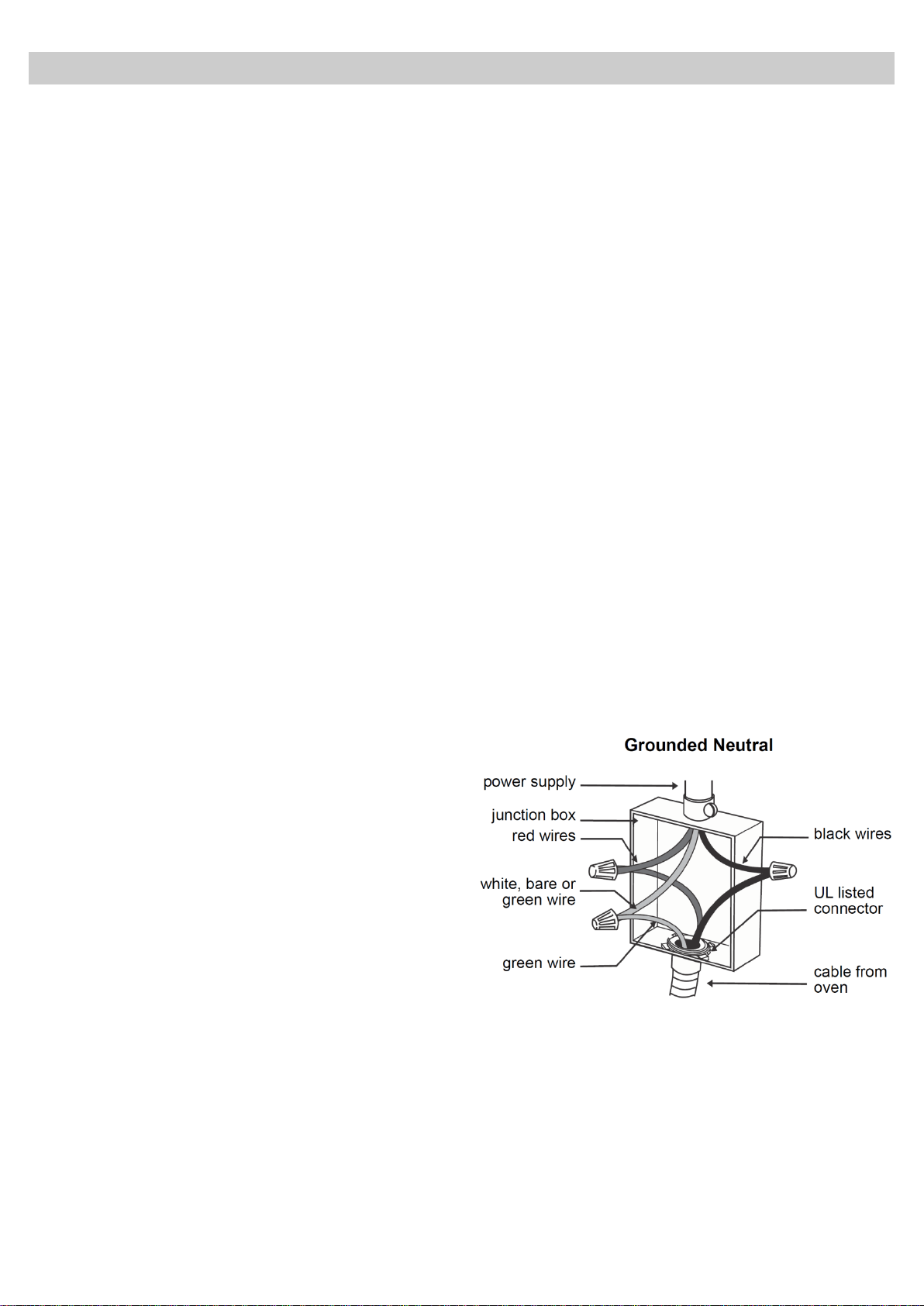
3-Wire branch circuit (for US only)
Refer to the following Figure, where local codes
allow the connection of GROUND wire from the
oven to the branch circuit NEUTRAL wire (gray or
white colored wire):
• If local codes permit, connect the green
GROUND wire from the oven and the
white wire from the oven to the branch
circuit NEUTRAL wire (gray or white
colored wire).
• Connect the red and black leads from the
oven to the corresponding leads in the
junction box.
42
USA
Installation instructions
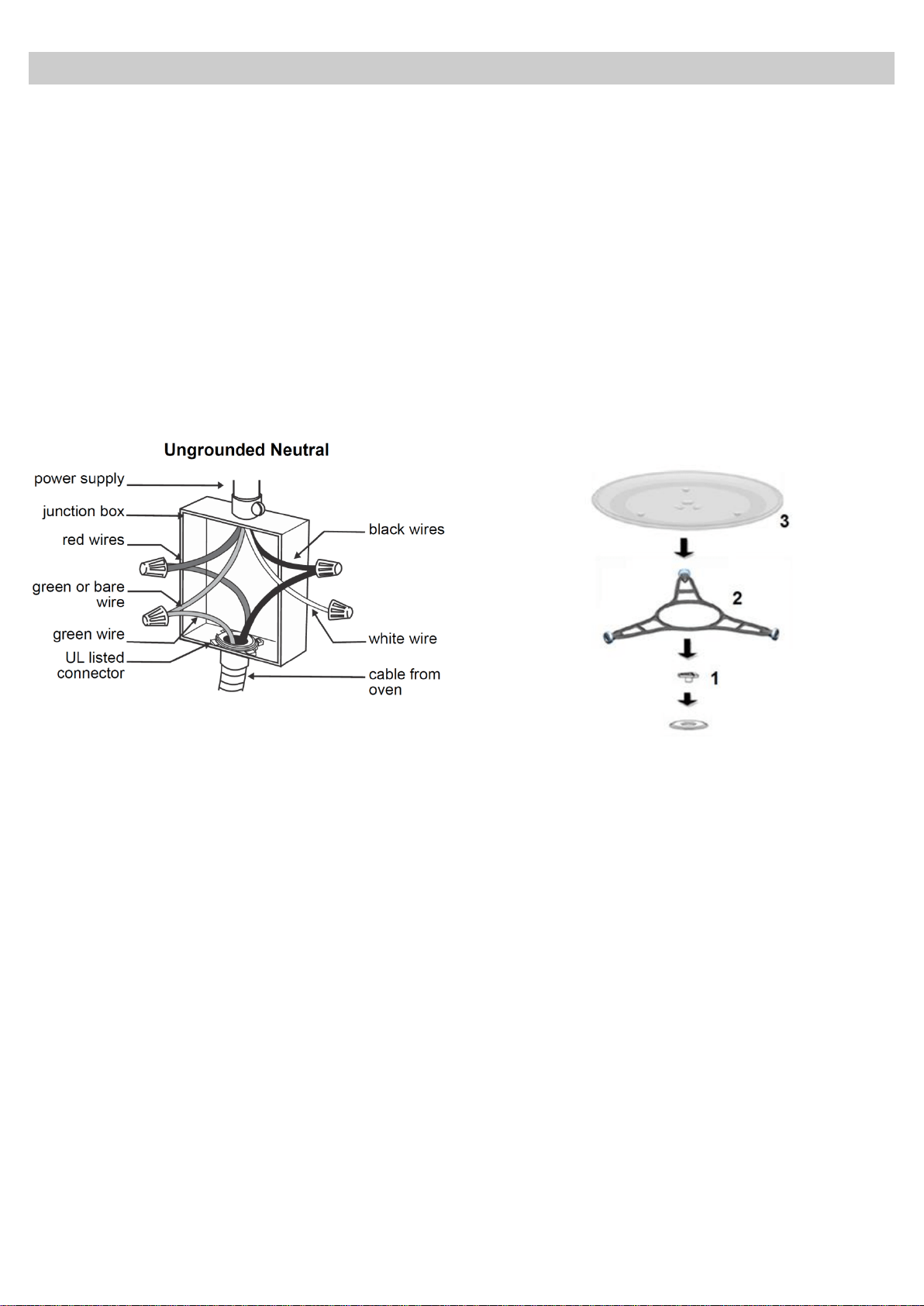
4-Wire branch circuit (for US and
CANADA)
Refer to the following Figure:
• Disconnect ground from neutral at free
end of conduit.
• Connect the green GROUND wire from
the oven to the GROUND wire in the
junction box (bare or green colored
wire).
• Connect the red and black leads from
the oven to the corresponding leads in
the junction box.
After installation
The oven only functions when the door is
closed correctly.
After the first use, clean the inside of the oven and
the accessories, following the cleaning
instructions given in the section “Oven cleaning
and maintenance”.
Fit the Turntable support in the center of the oven
cavity and put the Turntable ring and the
Turntable plate on top, making sure they slot in.
Whenever you use the microwave, the turntable
plate and the respective accessories must be
inside and correctly fitted. The turntable plate can
rotate in both directions.

43
FR
Sommaire
Instructions pour lier à la terre ........................................................................................................ 44
Consignes de sécurité importantes ................................................................................................ 45
Précautions pour éviter une exposition excessif aux microondes .............................................. 47
Précautions à ètre observées avant et durant l’entretien pour éviter une possible exposition à un
excès d’energie du microondes ...................................................................................................... 48
Instructions concernant la sécurité ................................................................................................ 49
Les avantages des micro-ondes ..................................................................................................... 51
Description du four ........................................................................................................................... 52
Réglages de base ............................................................................................................................. 54
Fonctions de base ............................................................................................................................ 56
Fonctions spéciales ......................................................................................................................... 61
Pendant le fonctionnement... ........................................................................................................... 63
Décongélation ................................................................................................................................... 64
Cuisiner aux micro-ondes ................................................................................................................ 66
Cuisiner au gril .................................................................................................................................. 68
Rôtir et cuire ...................................................................................................................................... 70
Quel type de vaisselle pouvez-vous utiliser? ................................................................................. 73
Nettoyage et entretien du four ......................................................................................................... 75
Que faire en cas de mauvais fonctionnement ? ............................................................................. 77
Caractéristiques techniques ............................................................................................................ 78
Instructions pour l'installation ......................................................................................................... 79
Dimensions d’Installation ................................................................................................................ 82
Cher client,
Nous vous remercions d'avoir préféré notre produit BERTAZZONI. Nous sommes certains que ce four à
micro-ondes moderne, fonctionnel et pratique, fabriqué avec des matériaux de première qualité, vous
donnera toute satisfaction.
Nous vous demandons une lecture attentive des instructions de ce manuel. Elles vous permettront
d'utiliser votre four en obtenant les meilleurs résultats.
CONSERVEZ TOUTE LA DOCUMENTATION DE CE PRODUIT POUR LA CONSULTER
ULTÉRIEUREMENT.
Gardez toujours le manuel d'instructions à portée de main. Si vous cédez l'appareil à un tiers,
remettez-lui également le manuel.
Le Four Speed PROF30SOEX et MAST30SOEXO respecte la section 18 du règlement FCC.
Vous pouvez aussi télécharger le manuel d’utilisation sur www.bertazzoni.com

44
FR
INSTRUCTIONS POUR LIER À LA
TERRE
L’appareil doit être lié à la terre. En cas de court-circuit électrique, la liaison à
la terre réduit le risque de choc électrique grâce a la fuite permise par le fil de
terre. L’appareil vient équipé avec un fil de terre ainsi que la prise de terre. La
fiche doit être branchée dans une prise correctement installée et liée à la terre.
Attention! UNE MAUVAISE LIAISON À LA TERRE PEUT PROVOQUER UN
RISQUE DE CHOC ÉLECTRIQUE.
Consultez un électricien qualifié si les instructions pour lié à la terre ne sont
pas complètement comprises ou en cas de doute quant à savoir si l'appareil
est correctement lié à la terre. Ne pas utiliser de rallonge. Si le cordon
d'alimentation est trop court, demandez à un électricien qualifié d'installer une
prise près de l'appareil.

45
FR
CONSIGNES DE SÉCURITÉ
IMPORTANTES
Lors de l'utilisation des appareils électriques les précautions bases de sécurité
doivent être respectées, y compris ce qui suit.
Attention! Pour réduire le risque de brûlures, d’électrocution, d’incendie, de
blessure ou d'exposition à l'énergie micro-ondes excessive :
• Lisez toutes les instructions avant d'utiliser l’appareil.
• Lisez et suivez les " PRÉCAUTIONS POUR ÉVITER UNE EXPOSITION AUX
MICRO-ONDES " spécifiques indiqués sur ce manuel.
• L’appareil doit être lié à la terre. Connectez uniquement à une prise de terre.
Voir "CONSIGNES DE LIAISON À TERRE" présentées dans ce manuel.
• Installer ou placer l'appareil en conformité aux instructions d'installation
fournies.
• Certains produits comme les œufs entiers et des contenants scellés - par
exemple, des bocaux en verre fermés peuvent exploser et ne doivent pas être
chauffés dans ce four.
• Utilisez cet appareil uniquement pour l’usage prévu comme décrit dans le
manuel. Ne pas utiliser de produits chimiques corrosifs dans cet appareil. Ce
type de four a été spécialement conçu pour chauffer, cuire ou sécher des
aliments. Il n'est pas conçu pour utilisation industriel ou de laboratoire.
• Comme dans tout appareil, une surveillance étroite est nécessaire quand il est
utilisé par les enfants.
• Ne pas utiliser cet appareil s’il a le cordon ou la fiche endommagés, s'il ne
fonctionne pas correctement, s’il a été endommagé ou s’il est tombé.
• Cet appareil doit être réparé que par un technicien qualifié. Contactez le centre
de service agréé le plus proche pour une examinassions, réparation ou réglage.
• Ne pas couvrir ou obstruer les ouvertures sur les appareils.
• Ne stockez pas cet appareil à l'extérieur. Ne pas utiliser ce produit près de l'eau
- par exemple près d’un évier de cuisine, dans un sous-sol humide, près d'une
piscine, ou des endroits similaires.
• Ne pas immerger le cordon ou la fiche dans l’eau.
• Garder le cordon loin des surfaces chauffées.
• Ne laissez pas le cordon pendre de la table ou du comptoir.
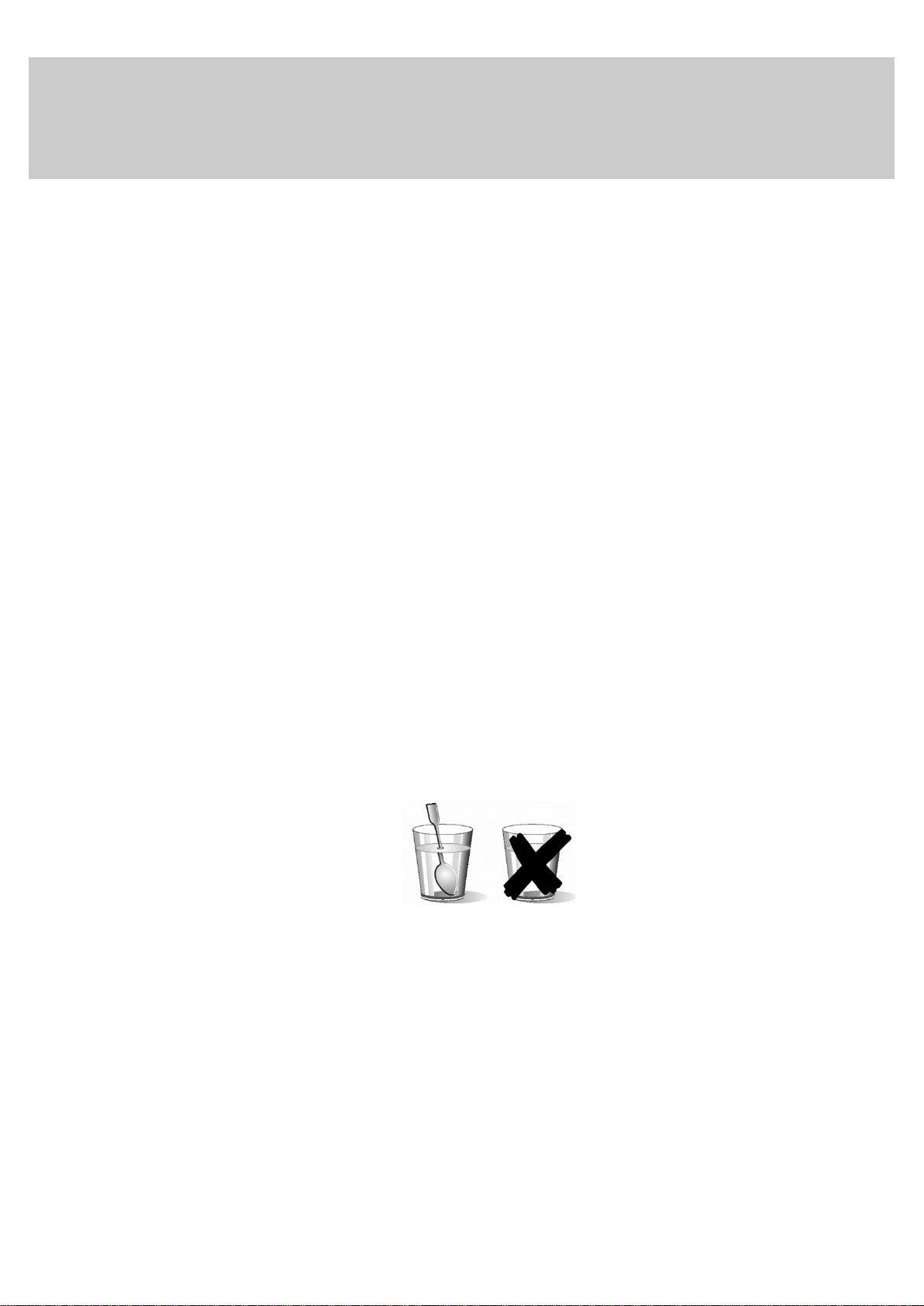
46
FR
CONSIGNES DE SÉCURITÉ
IMPORTANTES
• Lors du nettoyage de surfaces de la porte et du four qui se réunit à la fermeture
de la porte, utilisez uniquement du savon léger et non abrasif ou du détergent
et une éponge ou un chiffon doux.
Pour réduire le risque d'incendie dans la cavité du four :
• Ne pas trop cuire les aliments. Surveillez attentivement votre four lorsque du
papier , du plastique ou d'autres matériaux combustibles sont placés à
l'intérieur du four pour faciliter la cuisson .
• Retirer les attaches de sacs en papier ou en plastique avant de les placer dans
le four.
• Si des matériaux à l'intérieur du four prennent feu, gardez la porte du four
fermée, éteignez le four et débranchez le cordon d’alimentation ou coupez le
courant du fusible ou du panneau de disjoncteurs.
• Ne pas utiliser la cavité à des fins de stockage . Ne laissez pas de produits en
papier, ustensiles de cuisine, ou de la nourriture dans la cavité lorsqu'il n'est
pas utilisé.
• Les liquides tels que l’eau, le café ou le thé peuvent être surchauffés au-delà
du point d'ébullition sans sembler bouillir . Bullage ou ébullition visible lorsque
le récipient est retiré du four à micro-ondes ne sont pas toujours présents.
CELA POURRAIT PROVOQUER QUE DES LIQUIDES TRÈS CHAUDS
DÉBORDENT lorsque le récipient est perturbé ou un ustensile dans le liquide.
• Pour éviter ce genre de situation pour le chauffage de liquides, mettez une
cuillère à café ou une tige en verre à l'intérieur du récipient.

47
FR
PRÉCAUTIONS POUR ÉVITER
UNE EXPOSITION AUX MICRO-
ONDES
(a) Ne pas faire fonctionner ce four avec la porte ouverte, car le fonctionnement
de la porte peut entraîner a une dangereuse exposition d'énergie des micro-
ondes. Il est important de ne pas annuler ou de ne pas modifier les dispositifs
de verrouillage de sécurité.
(b) Ne placez aucun objet entre le front de l’appareil et la porte. Ne pas laisser de
souillures ou résidus du produit de nettoyage s'accumuler sur les surfaces
d'étanchéité.
(c) Ne pas faire fonctionner le four s'il est endommagé. Il est particulièrement
important que la porte du four ferme correctement et qu'il n'y ait pas de
dommages : (1) sur la porte (tordue), (2) aux charnières et verrous (brisés ou
desserrés), (3) et aux joints et surfaces d'étanchéité.
(d) Le four doit pas être réglé ou réparé uniquement par un technicien qualifié.
(e) Une vérification des fuites des micro-ondes, pour vérifier la conformité avec
les normes de performance fédérale, doit être effectuée sur chaque four à être
livre au propriétaire.
Pacemakers:
La plupart des pacemakers sont protégés des interférences des appareils
électroniques y compris les micro-ondes. Cependant, les patients porteurs de
pacemakers peuvent consulter leur médecin en cas de doute.

48
FR
PRÉCAUTIONS À ÊTRE
OBSERVÉES AVANT ET DURANT
L'ENTRETIEN POUR ÉVITER UNE
POSSIBLE EXPOSITION À UN
EXCÈS D'ÉNERGIE DU MICRO
ONDES
(a) Ne pas opérer ou permettre que le four soit utilisé avec la porte ouverte.
(b) Faire les vérifications suivantes sur tous les fours à être utilisés avant d'activer
le magnétron ou une autre source de micro ondes, et faire les réparations
nécessaires: opération de verrouillage, fermeture de la porte correcte, joints
et surfaces d’étancheité (l’arc électrique, revêtement, autres dommages),
dommage ou relâchement de charnières et loquets, preuves de chute ou
d'abus.
(c) Avant de brancher le micro ondes pour un service de test où inspection au
compartiment générateur de micro-ondes, vérifier le magnétron, guide
d'ondes ou ligne de transmission et la cavité pour un propre alignement,
intégrité et connexion.
(d) Tout défaut ou dé-réglage de composants du verrouillage, moniteur, joint de
la porte et les systèmes de la génération et de transmission de micro-ondes
doivent être réparés, remplacés ou ajustes par les procédures décrites sur ce
mode d'emploi avant que le four soit livre au propriétaire.
(e) Une vérification des fuites des micro-ondes, pour vérifier la conformité avec
les normes de performance fédérale, doit être effectuée sur chaque four à être
livre au propriétaire.

49
FR
Instructions concernant la sécurité
• Attention ! Vous devez surveiller votre four si
vous utilisez du papier, du plastique ou autres
matériaux inflammables. Ces matériaux
peuvent être carbonisées et brûler. RISQUE
DE FEU !
• Attention ! Si du feu ou des flammes se
dégagent, gardez la porte fermée pour étouffer
les flammes. Éteignez le four et débranchez la
prise de courant ou coupez l'alimentation
électrique.
• Attention ! Ne chauffez pas de l’alcool pur ni
des boissons alcooliques. RISQUE DE FEU !
• Attention ! N'utilisez pas des récipients fermés
pour chauffer des liquides ou d’autres aliments,
ils pourraient éclater facilement.
• Attention ! Cet appareil n’est pas indiqué pour
l’utilisation de la part de personnes (y compris
les enfants) ayant des capacités physiques,
sensorielles ou mentales réduites. Les
utilisateurs n’ayant pas l’expérience, une
connaissance suffisante de l’appareil ou
n’ayant pas reçu les instructions relatives à
l’appareil, devront faire l’objet d’un contrôle de
supervision de la part d’une personne
responsable de leur sécurité. Il est nécessaire
de surveiller les enfants pour empêcher qu’ils
ne jouent avec l’appareil.
• Attention ! Si le four possède un mode de
fonctionnement combiné (micro-ondes plus
autres moyens de chauffage), ne laissez pas
les enfants utiliser le four sans la présence d'un
adulte en raison des hautes températures
générées par le four.
• Attention! Le four ne peut pas être utilisé si:
- La porte ne ferme pas correctement ;
- Les gonds de la porte sont endommagés ;
- Les surfaces de contact entre la porte et l'avant de
l'appareil sont endommagées ;
- La vitre de la porte est endommagée ;
- Il y a fréquemment un arc électrique à l'intérieur,
malgré l'absence de tout objet métallique.
Le four ne peut être réutilisé qu'après avoir été
réparé par un technicien du Service d'assistasse
technique.
• Lors de son utilisation, l’appareil devient chaud.
Faire attention à ne pas toucher les éléments
chauffants situés à l’intérieur du four.
• MISE EN GARDE: Les parties accessibles
peuvent devenir chaudes au cours de
l’utilisation. Il est recommandé d’éloigner les
jeunes enfants.
• Ne pas utiliser de produits d’entretien abrasifs
ou de grattoirs métalliques durs pour nettoyer
la porte en verre du four, ce qui pourrait érafler
la surface et entraîner l’éclatement du verre.
Attention!
• Ne mettez jamais ni bouchon ni couvercle ni
tétine sur les récipients destinés à chauffer les
aliments pour bébés. Après avoir chauffé
l'aliment, remuez ou agitez bien afin de
distribuer uniformément la chaleur. Vous devez
vérifier la température de l'aliment avant de le
donner à l'enfant. DANGER DE BRÛLURE !
• Pour éviter que les aliments ne chauffent trop
ou ne prennent feu, il est très important, quand
vous chauffez de petites quantités
d'aliments, de ne pas sélectionner des
périodes de fonctionnement trop longues, ni
des niveaux de puissance trop élevés. Le pain,
par exemple, peut brûler au bout de 3 m avec
une puissance trop élevée.
• Utilisez la fonction grill seulement pour gratiner
et surveillez constamment l’appareil. Si vous
utilisez un mode de fonctionnement combiné
pour le grill, prêtez attention au temps.
• N'approchez jamais les câbles d'alimentation
d'autres appareils électriques de la porte
chaude du four. La gaine isolante pourrait
fondre. Danger de court-circuit !!

50
FR
Instructions concernant la sécurité
Votre four est exclusivement destiné à un
usage domestique !
Utilisez votre four exclusivement pour la
préparation des repas.
Vous éviterez d'endommager votre four ainsi
que toute autre situation dangereuse si vous
respectez les indications suivantes :
• Ne mettez pas le four en fonctionnement
sans le manchon, le support plateau et
le plateau rotatif.
• Ne mettez pas votre four en marche à
vide. Sans rien à chauffer, il peut en effet
se trouver en surcharge et être
endommagé. RISQUE DE
DÉTÉRIORATION !
• Pour effectuer des tests de
programmation du four, placez-y un
verre d'eau. Celle-ci absorbera les micro-
ondes et le four ne sera pas endommagé.
• Ne couvrez pas, n'obstruez pas les
ouvertures de ventilation.
• N'utilisez que de la vaisselle adéquate
pour micro-ondes. Vérifiez, avant de les
utiliser dans le four, que la vaisselle et les
récipients sont adaptés (voir chapitre sur
le type de vaisselle).
• Ne retirez pas le couvercle de mica
situé au plafond de la cavité ! Ce
couvercle évite que les graisses et
particules d'aliments n'endommagent le
générateur de micro-ondes.
• Ne laissez aucun objet inflammable
dans le four, il peut brûler si vous
l'allumez.
• N'utilisez pas le four comme rangement.
• Vous ne pouvez pas cuire les œufs, avec
ou sans coquille, dans un four micro-
ondes car ils peuvent éclater.
• N'utilisez pas le four micro-ondes pour
frire dans l'huile, car il est impossible
d'en contrôler la température sous l'action
des micro-ondes.
• Pour éviter les brûlures, utilisez toujours
des gants de cuisine pour manipuler les
récipients et toucher le four.
• Ne vous appuyez pas, ne mettez aucun
poids sur la porte ouverte du four. Cela
pourrait endommager la zone des gonds.
La porte peut supporter un poids
maximum de 8 kg..
• Le plateau rotatif et les grilles supportent
une charge maximum de 8 kg. Ne
dépassez pas cette charge, pour éviter
des dégâts.
Nettoyage :
• Attention! Le four micro-ondes doit être
nettoyé régulièrement, toutes les
particules d'aliments doivent être retirées
(voir chapitre Nettoyage du four). À défaut
d'un entretien régulier du four micro-
ondes, sa surface peut se détériorer, sa
vie utile peut se réduire et une
situation dangereuse peut
éventuellement survenir.
• Les surfaces de contact de la porte
(l'avant de la cavité et la partie intérieure
de la porte) doivent être maintenues très
propres pour garantir le bon
fonctionnement du four.
• S'il vous plaît, soyez attentif aux
indications concernant le nettoyage,
figurant au point « Nettoyage et entretien
du four « .
En cas de réparation :
• Attention – Micro-ondes ! La
protection extérieure ne doit pas être
retirée. Toute réparation ou maintenance
effectuée par des personnes non
autorisées par le fabricant est
dangereuse.
• Si le câble d'alimentation est
endommagé, il doit être remplacé par le
fabricant, par des agents certifiés ou des
techniciens qualifiés à cet effet, de façon
à éviter des situations dangereuses et
parce que les outils utilisés sont
spécifiques.
• Les réparations ou opérations de
maintenance, en particulier des pièces
sous tension, ne peuvent être réalisées
que par des techniciens certifiés par le
fabricant..
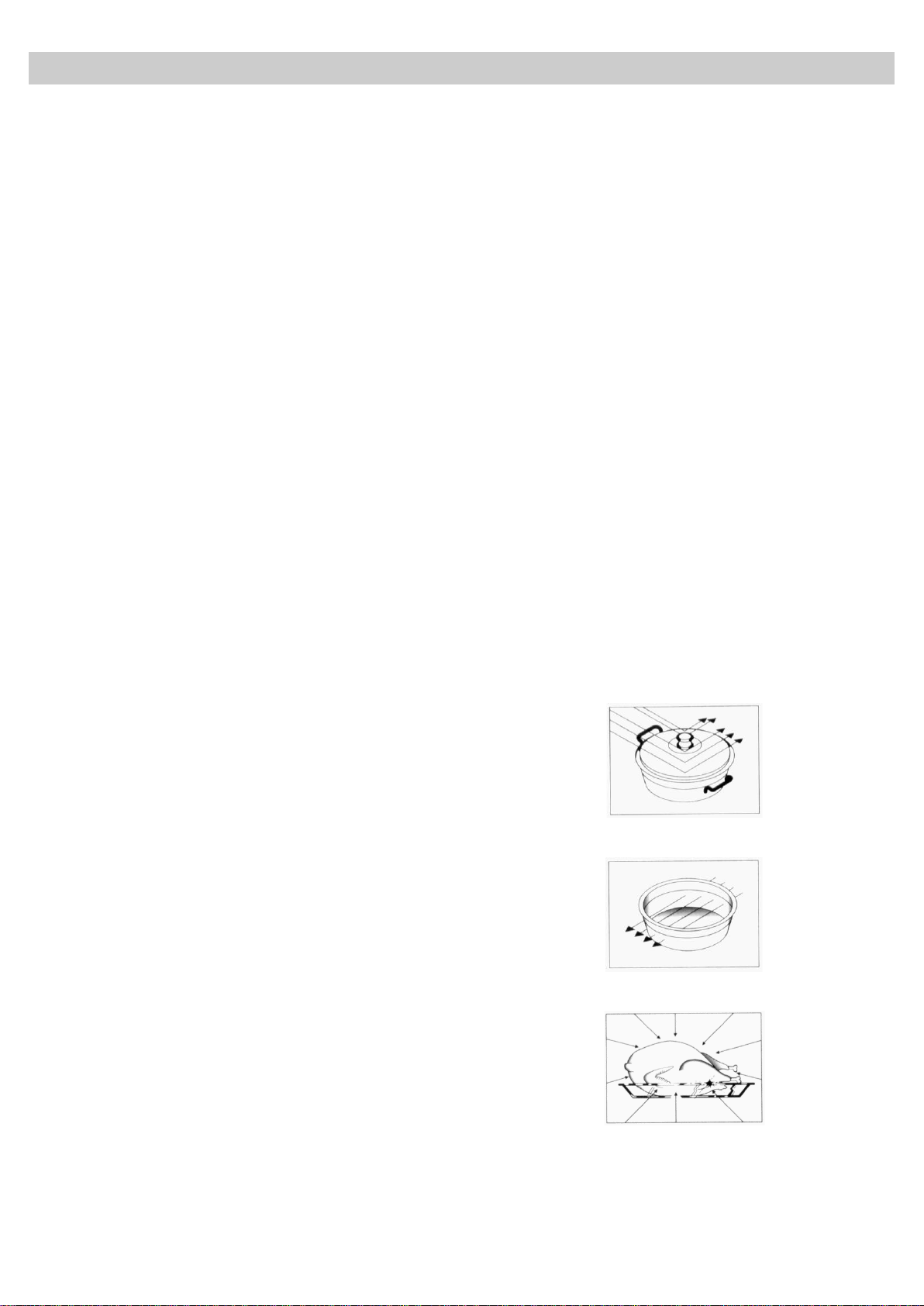
51
FR
Les avantages des micro-ondes
Avec une cuisinière traditionnelle, la chaleur créée
par les brûleurs de gaz ou par les résistances
pénètre lentement de l'extérieur vers l'intérieur de
l'aliment. Il y a par conséquent une grande perte
d'énergie pour chauffer l'air, les composants du
four et les récipients.
Dans les micro-ondes, la chaleur est générée par
les aliments eux-mêmes, elle passe de l'intérieur
vers l'extérieur. Il n'y a aucune perte de chaleur
dans l'air, dans les parois de la cavité ni dans les
récipients (s'ils sont bien adaptés aux micro-
ondes), c'est-à-dire que seul l'aliment est chauffé.
En résumé, les fours micro-ondes offrent les
avantages suivants :
1. Gain de temps de cuisson : réduction jusqu'à 3/4
du temps par rapport à la cuisson traditionnelle.
2. Décongélation ultrarapide des aliments, ce qui
réduit le risque de produire des bactéries.
3. Économie d'énergie.
4. Le temps de cuisson étant réduit, les aliments
gardent mieux leur valeur nutritive.
5. Nettoyage facile.
Mode de fonctionnement du four micro-
ondes
Le four micro-ondes possède une valve à haute
tension appelée magnétron, qui convertit l'énergie
électrique en énergie micro-ondes. Ces ondes
électromagnétiques sont canalisées vers l'intérieur
du four au moyen d'un conducteur d'ondes puis
distribuées par un diffuseur métallique ou au
moyen d'un plateau rotatif.
À l'intérieur du four, les micro-ondes se propagent
dans tous les sens et sont réfléchies par les parois
métalliques. Elles pénètrent alors uniformément
dans les aliments.
Comment les aliments chauffent-ils?
Tous les aliments contiennent de l'eau dont les
molécules vibrent sous l'action des micro-ondes.
La friction entre les molécules provoque la chaleur
qui élève la température des aliments. Ils peuvent
être décongelés, cuits ou maintenus chauds.
Du fait que les aliments chauffent de l'intérieur :
• Ils peuvent être cuisinés sans liquides ni
graisses, ou avec très peu ;
• Décongeler, chauffer ou cuisiner est plus
rapide dans un four micro-ondes que
dans un four conventionnel ;
• Les vitamines, sels minéraux et
substances nutritives sont conservés ;
• Ni la couleur naturelle ni le goût ne sont
altérés.
Les micro-ondes traversent la porcelaine, le verre,
le carton, le plastique, mais pas le métal. Vous ne
pouvez donc pas utiliser dans le four micro-ondes
de récipients métalliques, ou dont certaines parties
sont en métal.
Les micro-ondes sont réfléchies par le métal...
...traversent le verre et la porcelaine...
... et sont absorbées par les aliments.
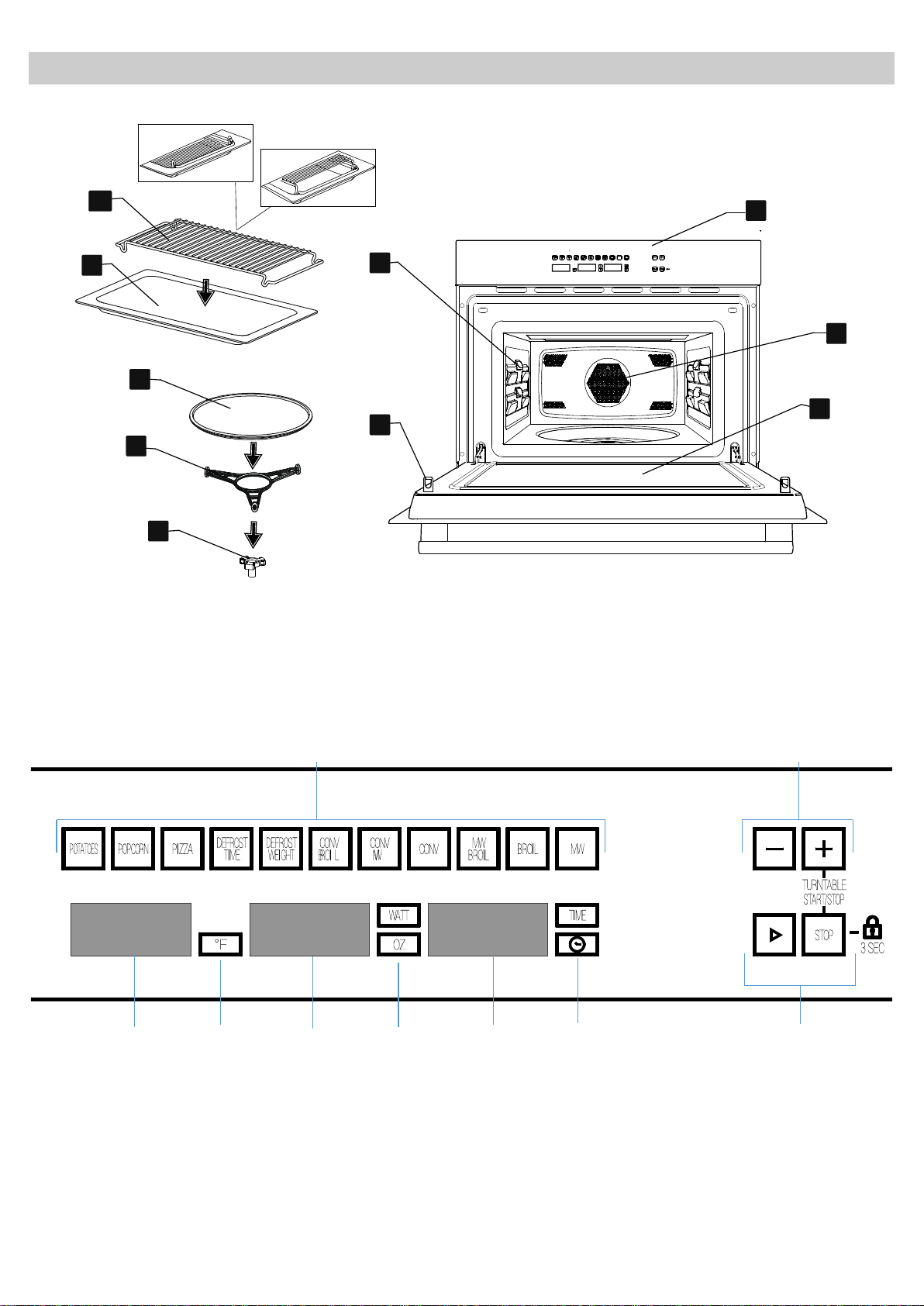
52
FR
Description du four
1. – Tableau de commandes
6. – Manchon du moteur
2. – Vitre de la porte
7. – Support plateau
3. – Cran pour support du plateau
8. – Plateau rotatif
4. – Verrou
9. – Plateau en verre
5. – Sortie d'air chaud
10. – Grille rectangulaire
1. – Sélecteur de fonctions
4a. – Affichage puissance / poids
2. – Touches “+” et “–“
5. – Touche de sélection durée / horloge
3. –Touche de sélection de température du four
5a. – Affichage durée / horloge
3a.– Affichage de température du four
6. – Touche Start / Stop / Blocage de sécurité
4. – Touche de selection puissance/poids
1
5
2
3
4
6
7
9
8
10
1
2
3
3a
4
4a
5
5a
6
150
600
12:00
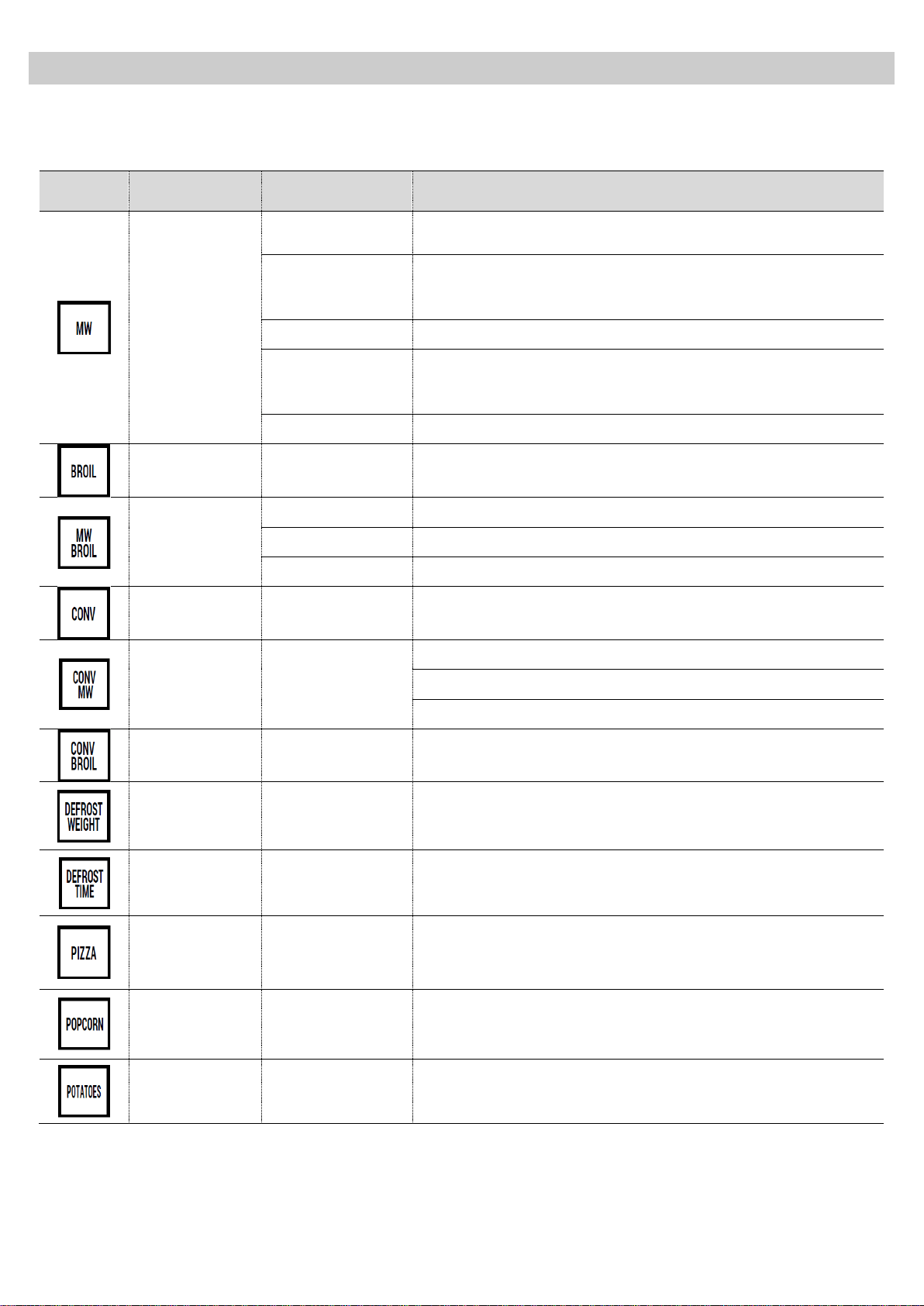
53
FR
Description du four
Description des fonctions
Symbole
Fonction
Puissance Micro-
ondes
Aliments
Micro-ondes
200 W
Décongeler lentement les aliments délicats ; pour
décongeler et continuer de cuire à faible puissance.
400 W
Cuire de la viande, du poisson et du riz.
Décongeler rapidement de petites quantités et aliments
pour bébés, comme par exemple les biberons.
600 W
Chauffer et cuire les aliments.
800 W
Cuire des légumes et pommes de terre.
Cuire des gratins et des plats cuisinés.
Décongeler et cuire de petites quantités.
1000 W
Chauffer des liquides.
Gril
---
Griller des aliments.
Micro-ondes
+ Gril
200 W
Gratiner des toasts.
400 W
Griller volailles et viande.
600 W
Cuisiner tourtes et gratins.
Air chaud
---
Rôtir et cuire.
Micro-ondes +
Air chaud
---
Griller viande et poisson, en morceaux fins.
Griller de la volaille.
Frites – décongeler et dorer des produits ultracongelés.
Gril
+ Air chaud
200-600 W
Rôtir rapidement viande, poisson et volailles.
Cuire gâteaux secs et humides.
Décongélation
---
Décongélation en fonction du poids (automatique)
Décongélation
---
Décongélation en fonction du temps (manuel)
Pizza
---
Pour cuire pizza.
Pop-corn
---
Pour cuire du pop-corn au micro-ondes
Pommes de
terre
---
Pour cuire les pommes de terre.
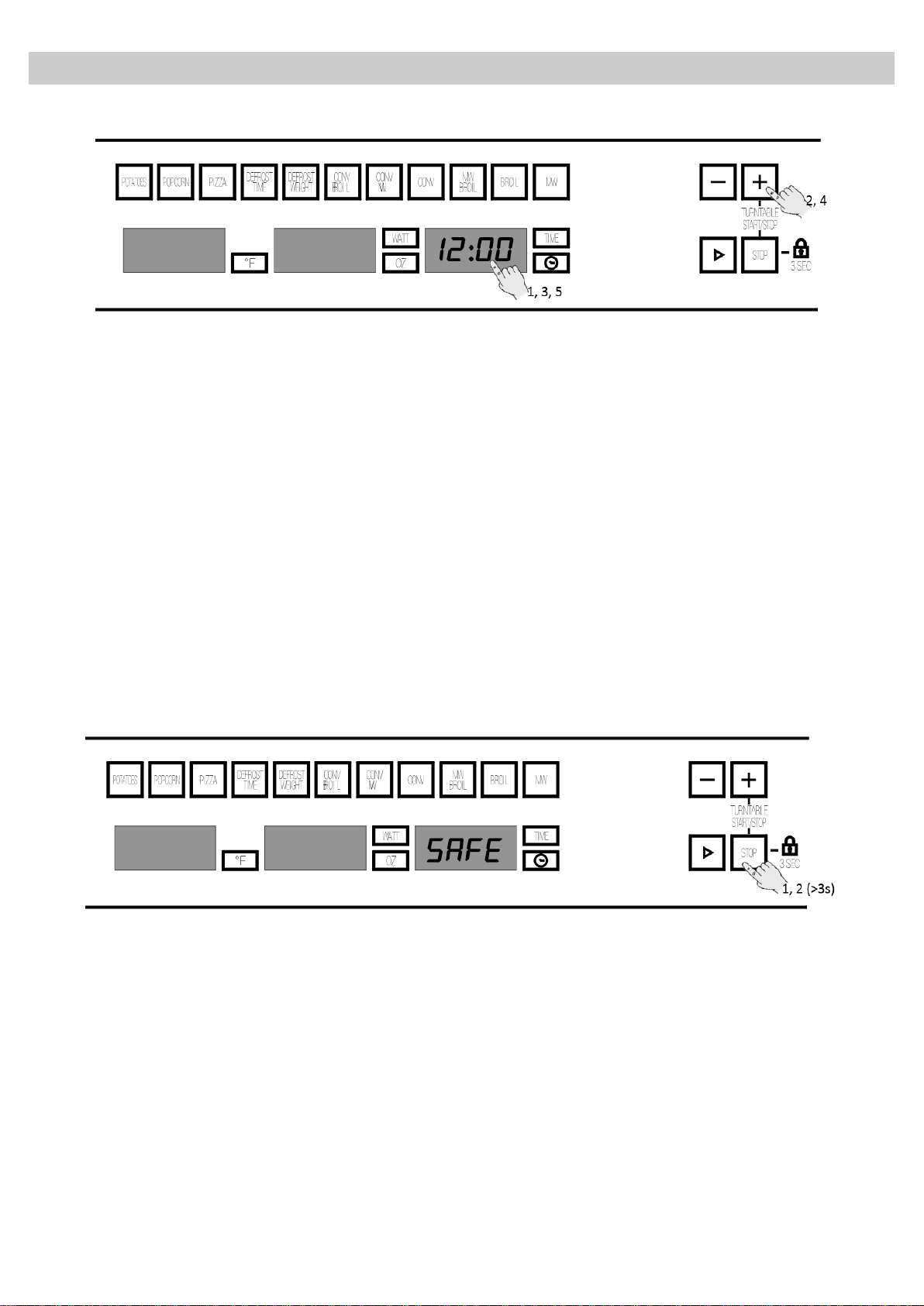
54
FR
Réglages de base
Réglage de l'horloge
Après une coupure d'électricité, ou si le four a été
rebranché, l'horloge clignote pour indiquer que
l'indication de l'heure n'est pas correcte. Pour
régler l'horloge, procédez de la façon suivante :
1. Appuyez sur la touche de l'Horloge pour 6
secondes. Les chiffres des heures commencent
à clignoter.
2. Appuyez sur les touches « - » et « + » pour
définir les heures.
3. Appuyez de nouveau sur la touche Horloge
pour définir les minutes. Les minutes clignotent.
4. Appuyez sur les touches « - » et « + » pour
définir les minutes.
5. Pour terminer, appuyez de nouveau sur la
touche Horloge.
Affichage de l'horloge
Pour économiser l'énergie, l'horloge est
normalement caché.
Si vous voulez voir l'horloge, appuyez brièvement
sur la touche de l'horloge et l'horloge sera visible.
Blocage de sécurité
Vous pouvez bloquer le fonctionnement du four
(par exemple pour empêcher son utilisation par des
enfants).
1. Pour bloquer le four, appuyez sur la touche Stop
pendant 3 secondes. Un signal sonore est alors
émis et l'écran affiche le mot « SAFE ». Le four
est alors bloqué, toute opération est interdite.
2. Pour débloquer le four, appuyez de nouveau sur
la touche Stop pendant 3 secondes. Le signal
sonore est émis et l'écran donne de nouveau
indication de l'heure.
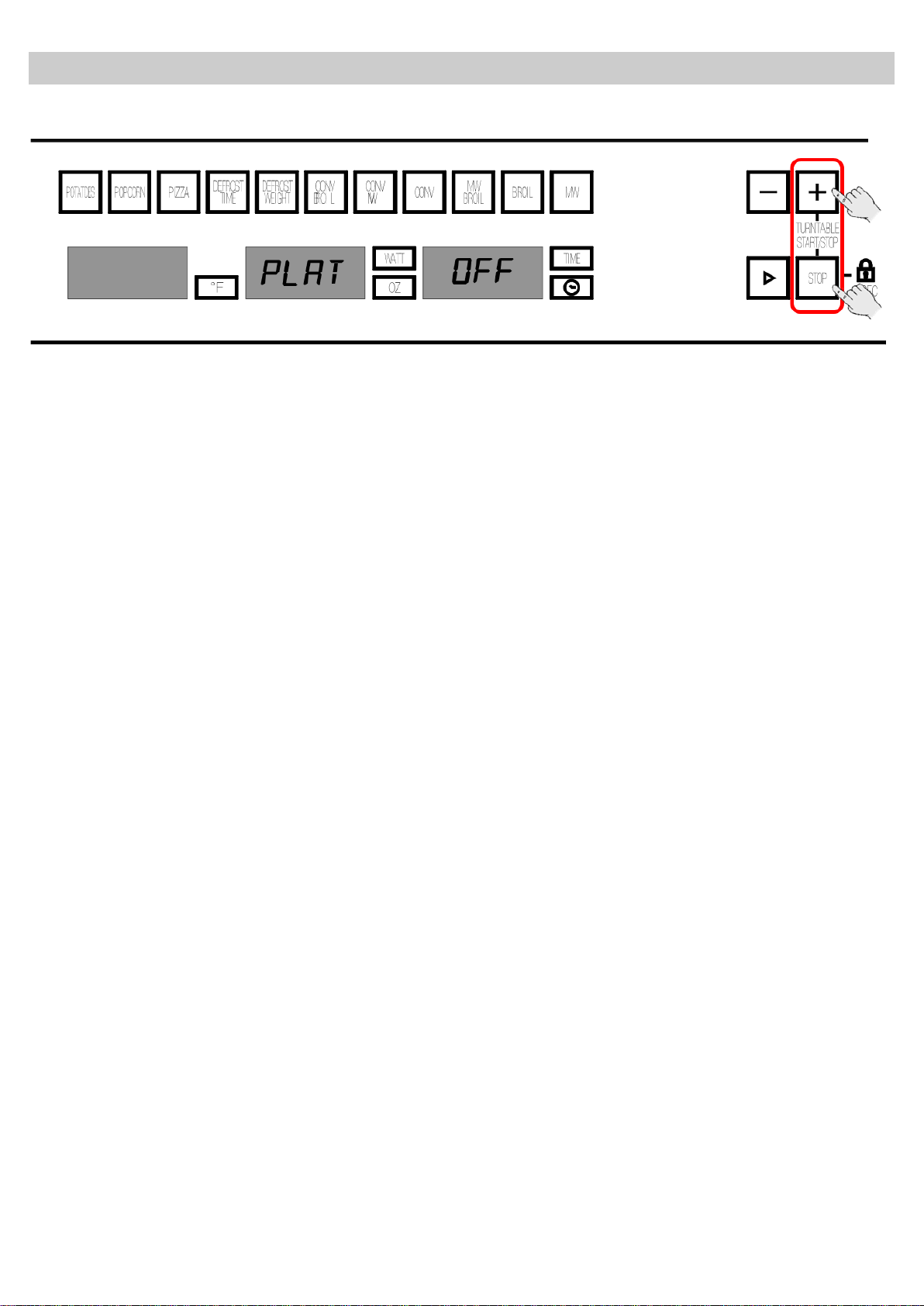
55
FR
Réglages de base
Arrêter le plateau tournant
1. Pour arrêter le plateau tournant, appuyez en
même temps sur les touches «+» et «Stop».
2. Pour remettre en marche le plateau,
appuyez à nouveau en même temps sur les
touches «+» et «Stop».
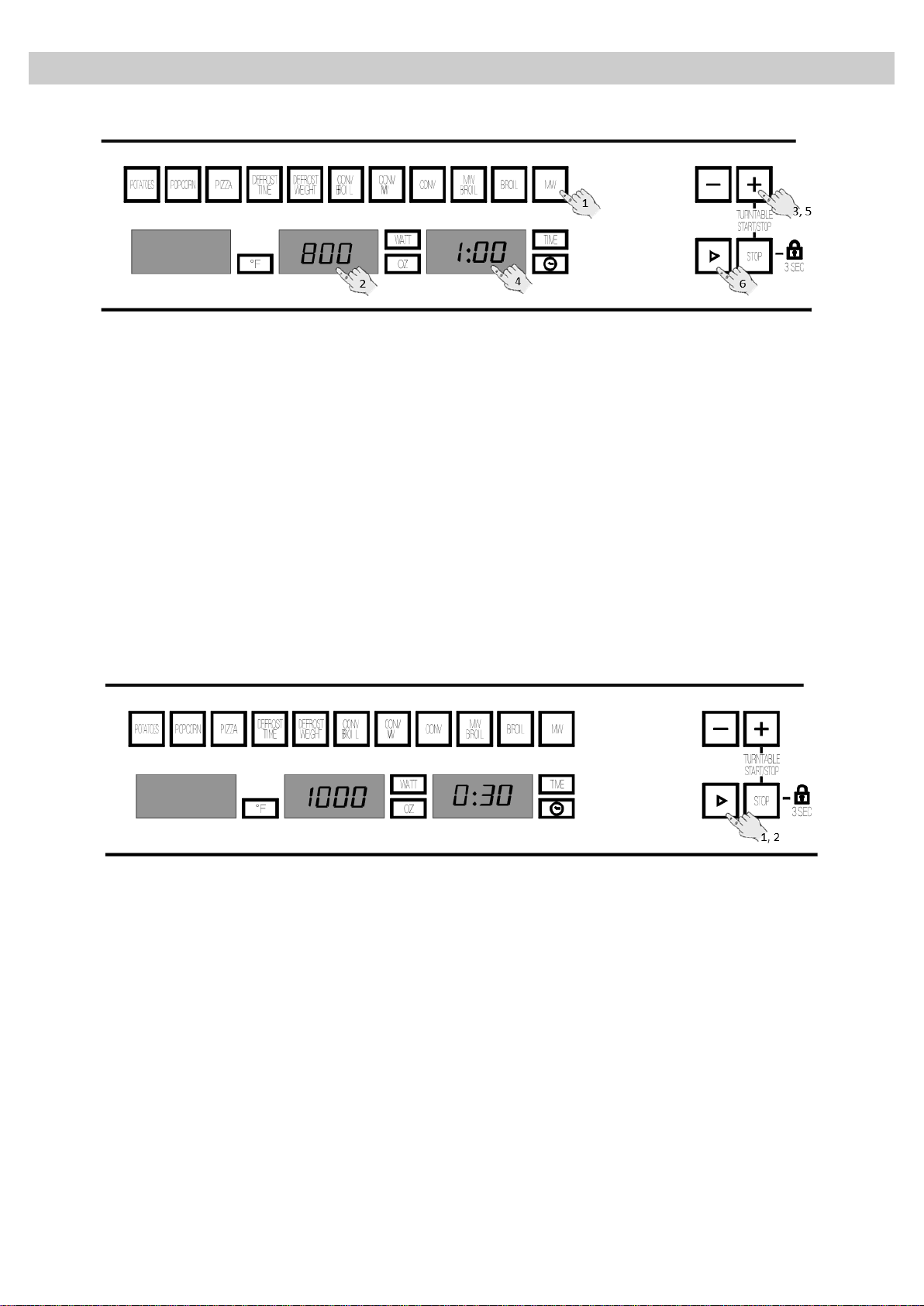
56
FR
Fonctions de base
Micro-ondes
1. Appuyez sur la touche de fonction Micro-ondes.
La touche de fonction s'allume.
2. Appuyez sur la touche Sélection de puissan-
ce. Le témoin correspondant se met à cligno-ter.
En l'absence de sélection, le four fonctionne à la
puissance 800 Watts.
3. Appuyez sur les touches « - » et « + » pour
modifier la puissance des micro-ondes.
4. Appuyez sur la touche Sélection du temps pour
modifier le temps de fonctionnement. Le témoin
respectif se met à clignoter.
5. Définissez le temps de fonctionnement désiré
avec les touches « - » et « + » (par exemple 1
minute).
6. Appuyez sur la touche Start. Le four commence
à fonctionner.
OBSERVATION: si vous sélectionnez la puissance
de 1000 W, le temps de fonctionnement est limité à
un maximum de 15 minutes.
Micro-ondes – Lancement rapide
1. Appuyez sur la touche Start. Le four se met en
marche en fonction Micro-ondes, à la puissance
maximum, pendant 30 secondes.
2. Si vous souhaitez prolonger le fonctionne-ment
du four, appuyez de nouveau sur la touche Start,
ce qui a pour effet d'augmenter le temps de
fonctionnement de 30 secondes.
OBSERVATION: quand vous sélectionnez la
puissance maximum de 1000 W, le temps de
fonctionnement est limité à un maximum de 15
minutes.
ATTENTION! Ne mettez pas votre four en
marche à vide. Sans rien à chauffer, il peut en
effet se trouver en surcharge et être
endommagé. RISQUE DE DÉTÉRIORATION !
ATTENTION! Lorsque vous utilisez de petites
charges, comme des sacs de popcorn, placez
un verre d'eau sur l'un des coins de la cavité
pour éviter les dommages.
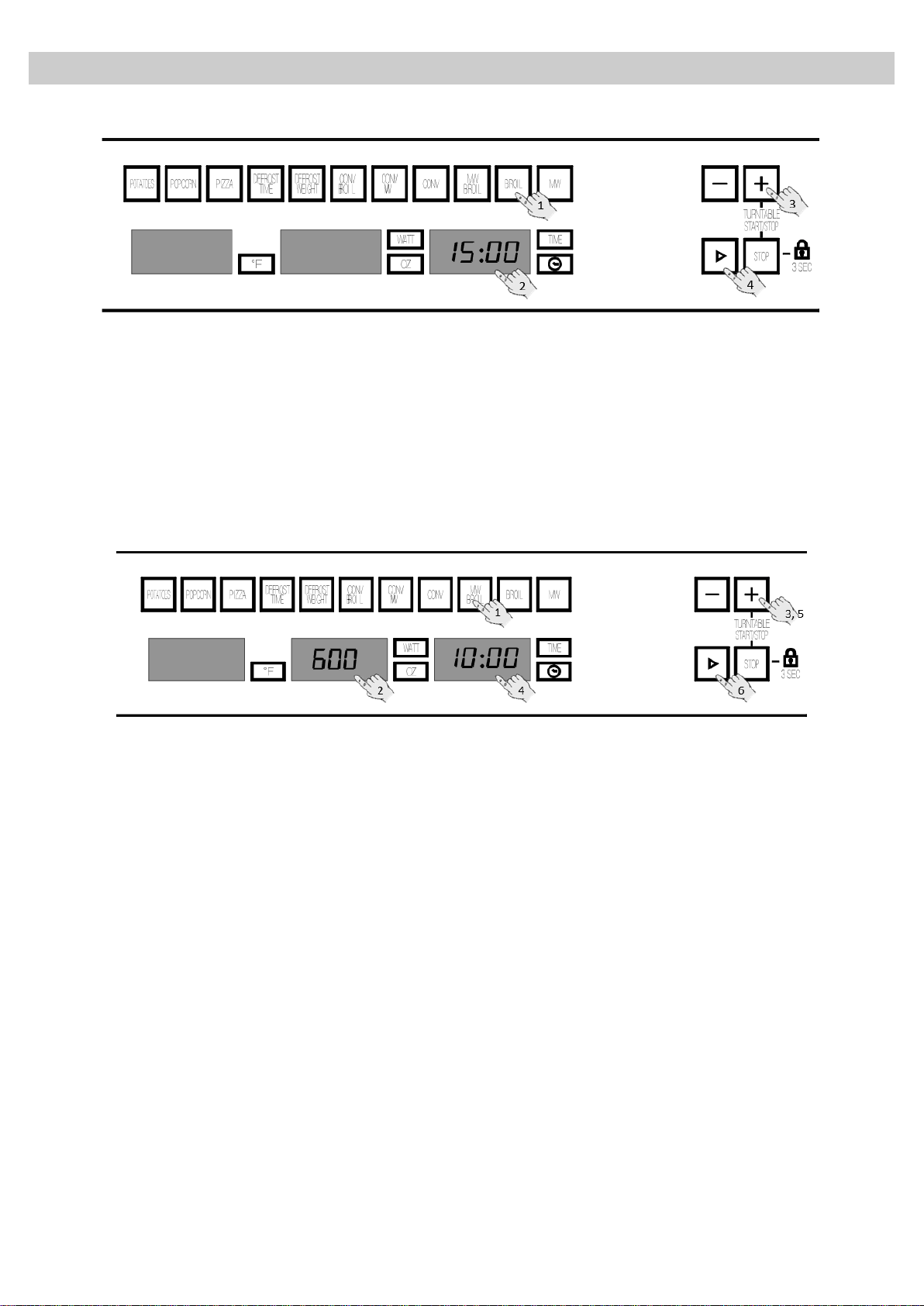
57
FR
Fonctions de base
Gril
1. Appuyez sur la touche de fonction Gril. Le
témoin s'allume.
2. Appuyez sur la touche Sélection du temps pour
modifier le temps de fonctionnement. Le témoin
respectif clignote.
3. Appuyez sur « - » et « + » pour sélectionner le
temps voulu (par exemple 15 minutes).
4. Appuyez sur la touche Start. Le four commen-
ce à fonctionner.
Micro-ondes + Gril
1. Appuyez sur la touche de fonction Micro-ondes
+ Gril. La touche de fonction s'allume.
2. Appuyez sur la touche Sélection de puissance
pour modifier la puissance des micro-ondes. Le
témoin respectif se met à clignoter. Si vous
ignorez cette touche, le four fonctionne à la
puissance de 600 W.
3. Appuyez sur « - » et « + » pour sélectionner la
puissance souhaitée.
4. Appuyez sur la touche Sélection du temps pour
modifier le temps de fonctionnement. Le témoin
respectif se met à clignoter.
5. Sélectionnez le temps de fonctionnement voulu
en appuyant sur les touches « - » et « + » (par
exemple 10 minutes).
6. Appuyez sur Start. Le four commence à
fonctionner.
7. En fonction combinée, la puissance des micro-
ondes est limité à 600 W.
ATTENTION! Ne mettez pas votre four en
marche à vide. Sans rien à chauffer, il peut en
effet se trouver en surcharge et être
endommagé. RISQUE DE DÉTÉRIORATION !
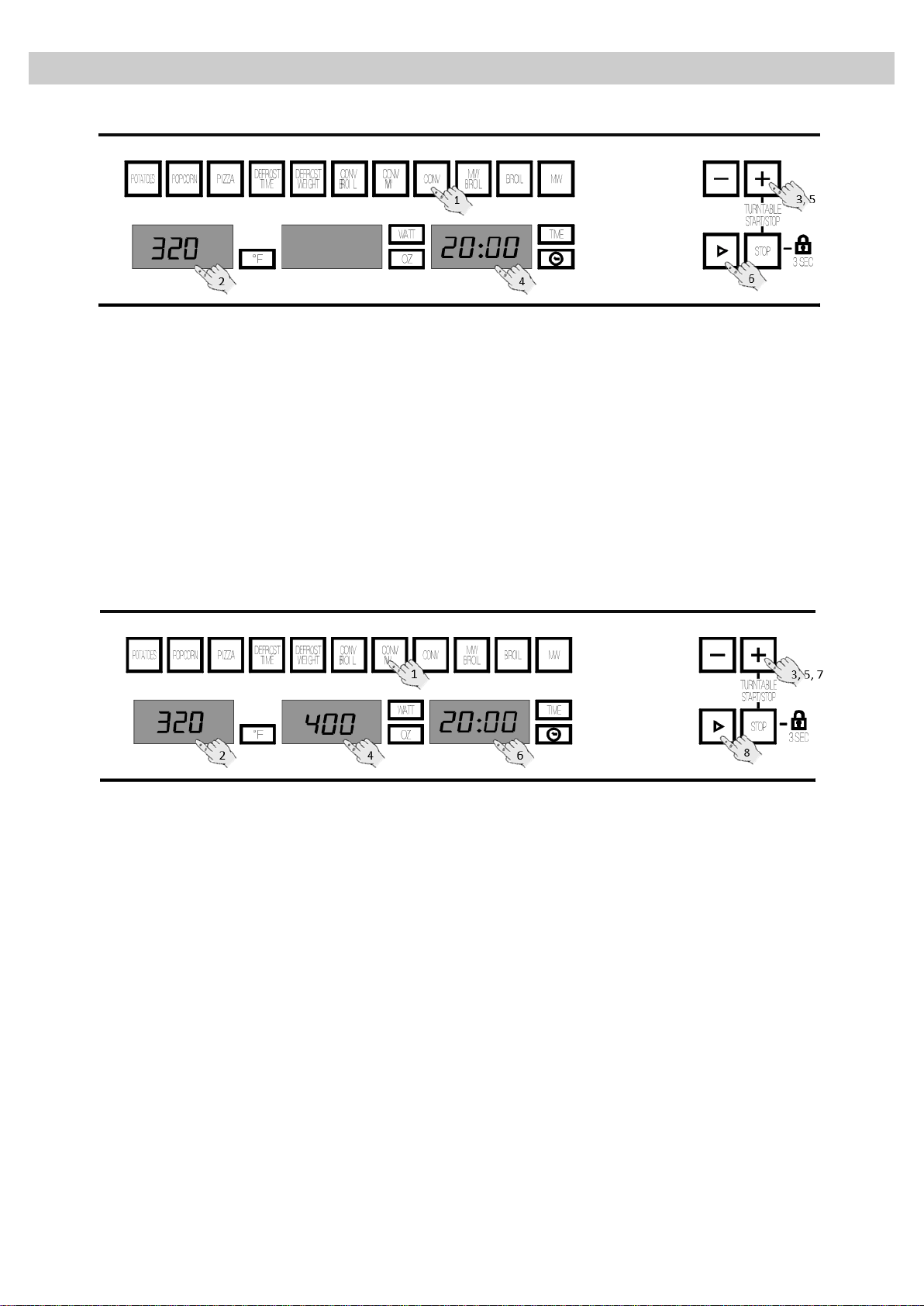
58
FR
Fonctions de base
Air chaud
1. Appuyez sur la touche de fonction Air chaud. Le
voyant de la touche s'allume.
2. Appuyer sur Sélection de température, pour
modifier la puissance des micro-ondes. Le
témoin respectif clignote. En l'absence de
sélection, le four fonctionne à la puissance de
160ºC.
3. Appuyer sur « - » et « + » pour sélectionner la
température désirée.
4. Appuyez sur Sélection de Temps, pour modifier
le temps de fonctionnement souhaité. Le témoin
respectif clignote.
5. Appuyez sur les touches « - » et « + » pour
sélectionner le temps de fonctionnement voulu
(par exemple 20 minutes).
6. Appuyez sur Start. Le four commence à
fonctionner.
Micro-ondes + Air chaud
1. Appuyez sur la touche de fonction Micro-ondes
+ Air chaud. Le voyant de la touche s'allume.
2. Appuyez sur la touche Sélection de
Température pour modifier la puissance des
micro-ondes. Le témoin clignote. À défaut, le
four fonctionnera à une température de 320ºF.
3. Appuyez sur « - » et « + » pour sélectionner la
température.
4. Appuyez sur la touche Sélection de puissance
pour modifier la puissance des micro-ondes. Le
témoin respectif clignote. Si vous ignorez cette
touche, le four fonctionne à la puissance de 400
W.
5. Appuyez sur « - » et « + » pour sélectionner la
puissance désirée.
6. Appuyez sur Sélection de Temps, pour modifier
le temps de fonctionnement souhaité. Le témoin
respectif clignote.
7. Appuyez sur les touches « - » et « + » pour
sélectionner le temps de fonctionnement voulu
(par exemple 20 minutes).
8. Appuyez sur Start. Le four commence à
fonctionner.
9. Pendant le fonctionnement en mode combiné, la
puissance des micro-ondes est limité à 600 W.
ATTENTION! Ne mettez pas votre four en
marche à vide. Sans rien à chauffer, il peut en
effet se trouver en surcharge et être
endommagé. RISQUE DE DÉTÉRIORATION !
ATTENTION! Pour préchauffer la cavité, veuillez
sélectionner la fonction de convection avec la
température désirée, puis passer à la Micro-
onde + Convection après avoir placé les
aliments dans la cavité.
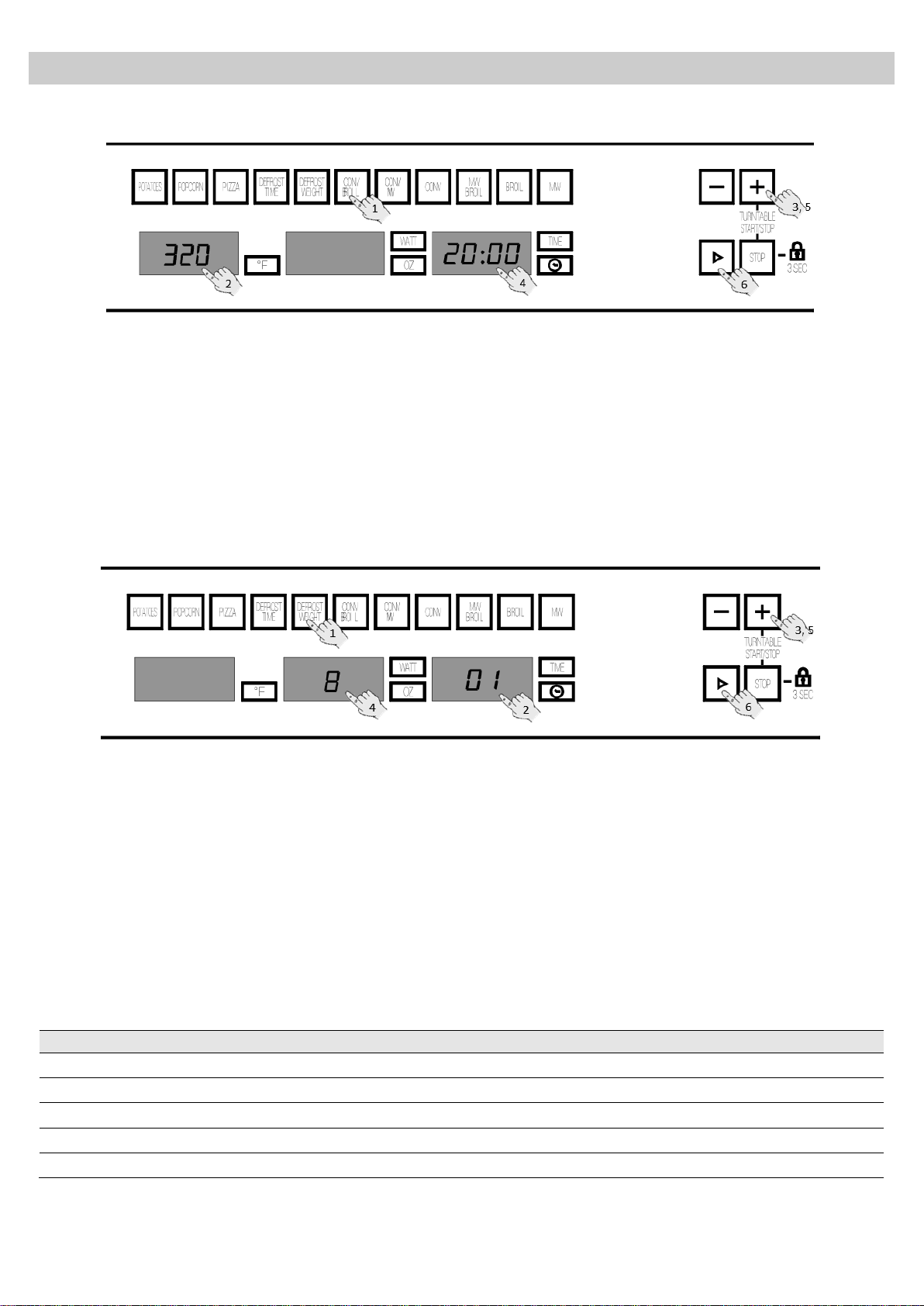
59
FR
Fonctions de base
Gril avec Ventilateur
1. Appuyez sur la touche de fonction Gril +
Ventilateur. Le voyant de la touche s'allume.
2. Appuyez sur la touche Sélection de
Température pour modifier la puissance des
micro-ondes. Le témoin clignote. À défaut, le
four fonctionnera à la température de 160ºC.
3. Appuyez sur les touches « - » et « + » pour
sélectionner la température souhaitée.
4. Appuyez sur la touche Sélection de temps pour
modifier le temps de fonctionnement désiré. Le
témoin clignote.
5. Appuyez sur les touches « - » et « + » pour
sélectionner le temps de fonctionnement désiré
(par exemple 20 minutes).
6. Appuyez sur Start. Le four commence à
fonctionner.
Décongélation en fonction du poids (automatique)
1. Appuyez sur la touche de fonction
Décongélation en fonction du poids. La
touche s'allume.
2. Appuyez sur la touche Sélection du type
d'aliment pour modifier l'aliment sélectionné.
Les témoins respectifs clignotent.
3. Appuyez sur les touches « - » et « + » pour
sélectionner le temps voulu, par exemple 'Pr 01'
(voir tableau ci-après).
4. Appuyez sur Sélection de poids pour modifier
le poids sélectionné. Le témoin clignote.
5. Appuyez sur « - » et « + » pour sélectionner le
poids correspondant à l'aliment.
6. Appuyez sur Start. Le four commence à
fonctionner.
Le tableau suivant vous présente les programmes de la fonction Décongélation en fonction du poids, en
indiquant les temps de décongélation et de repos (afin que l'aliment soit uniformément chauffé) en fonction
du poids de l'aliment.
Programme
Aliment
Poids (OZ)
Temps (minutes)
Temps de repos (minutes)
01
Viande
4 – 80
2,30 – 50
20 – 30
02
Volailles
4 – 100
2,40 – 67
20 – 30
03
Poisson
4 – 80
2 – 45,30
20 – 30
04
Fruit
4 – 40
3 – 30
10 – 20
05
Pain
4 – 60
3 – 42
10 – 20
Observation importante: voir «Indications générales pour la décongélation».
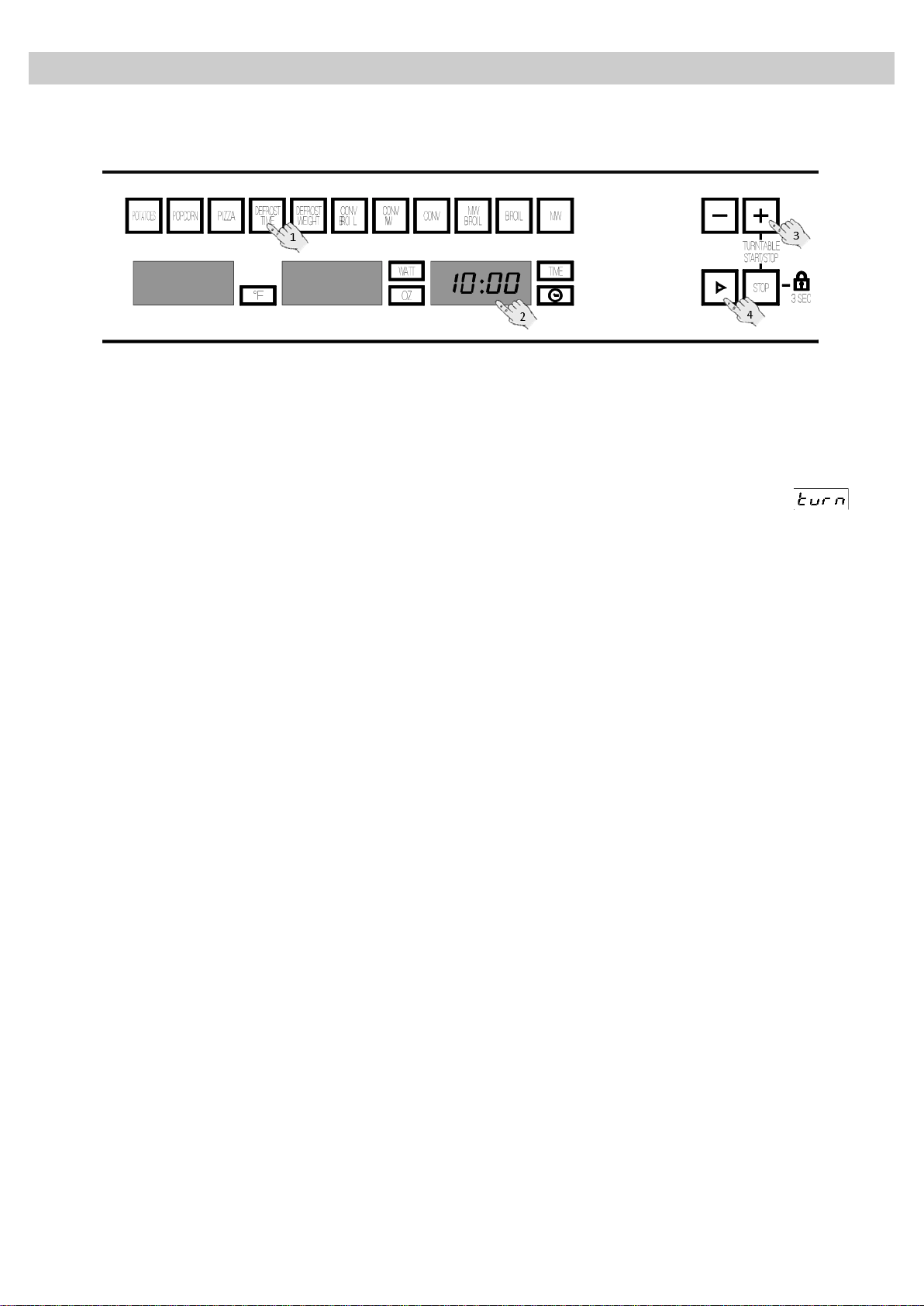
60
FR
Fonctions de base
Décongélation en fonction du temps (manuel)
Utilisez cette fonction pour décongeler rapidement tout type d'aliment.
1. Appuyez sur Décongélation en fonction du
temps. La touche s'allume.
2. Appuyez sur la touche Sélection de Temps
pour modifier le temps de fonctionnement. Le
témoin respectif s'allume.
3. Appuyez sur « - » et « + » pour sélectionner le
temps de fonctionnement désiré, (par exemple
10 minutes).
4. Appuyez sur la touche Start. Le four commence
à fonctionner.
Observations : Remuez ou retournez les aliments
plusieurs fois pendant qu'ils chauffent, en particulier
quand le four émet un signal sonore et que l'écran
affiche l'indication clignotante suivante : .
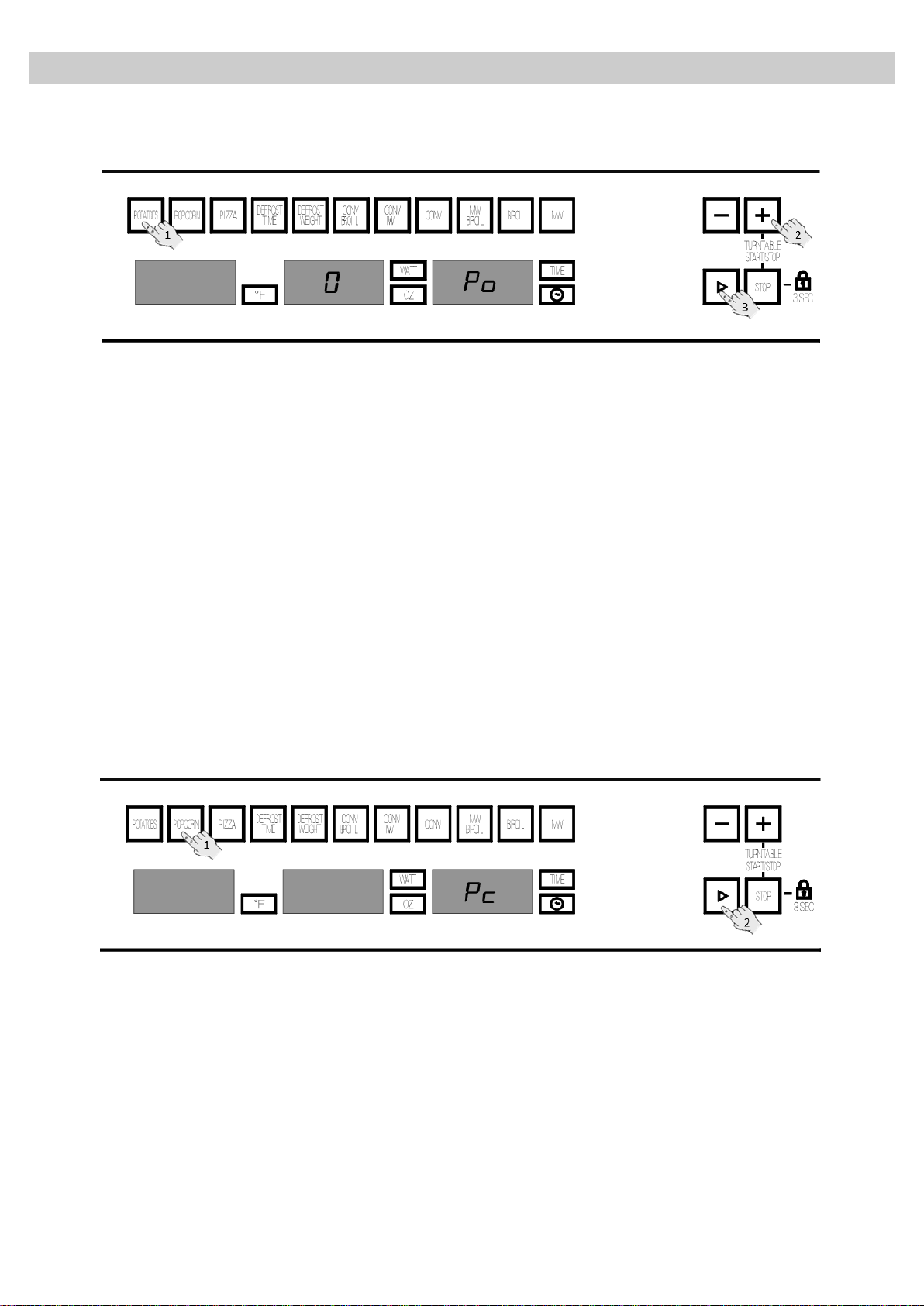
61
FR
Fonctions spéciales
Fonction Spéciale : Pommes de terre
Utilisez cette fonction pour chauffer des différents types d'aliments.
1. Appuyez sur la touche de fonction Pommes de
terre. La touche de fonction s'allume.
2. Appuyez sur « - » et « + » pour sélectionner le
poids désiré.
3. Appuyez sur Start. Le four commence à
fonctionner.
Observations importantes:
• Vous devez toujours utiliser des récipients
adaptés au micro-ondes et un couvercle pour
éviter la perte des liquides.
• Le temps nécessaire pour chauffer les
aliments dépend de leur température initiale.
Les aliments retirés directement du
réfrigérateur mettent plus de temps à chauffer
que ceux à température ambiante. Si la
température de l'aliment ne vous donne pas
satisfaction, sélectionnez un poids moindre ou
plus important la prochaine fois que vous
réchauffez l'aliment. Après avoir réchauffé les
aliments, mélangez-les, puis laissez-les reposer
un peu afin d'uniformiser leur température.
Attention! Le récipient peut être très chaud à la fin du
fonctionnement. La plupart des récipients ne sont pas
chauffés par les micro-ondes, mais ils peuvent l'être par
transmission de la chaleur des aliments.
Fonction Spéciale: Pop-corn
1. Appuyez sur la touche de fonction Popcorn. La
touche de fonction s'allume.
2. Appuyez sur Start. Le four commence à
fonctionner.
Observations importantes :
• Vous devez toujours utiliser des
récipients adaptés au micro-ondes et un
couvercle pour éviter la perte des
liquides.
Attention ! Le récipient peut être très chaud à la
fin du fonctionnement. La plupart des récipients
ne sont pas chauffés par les micro-ondes, mais ils
peuvent l'être par transmission de la chaleur des
aliments.
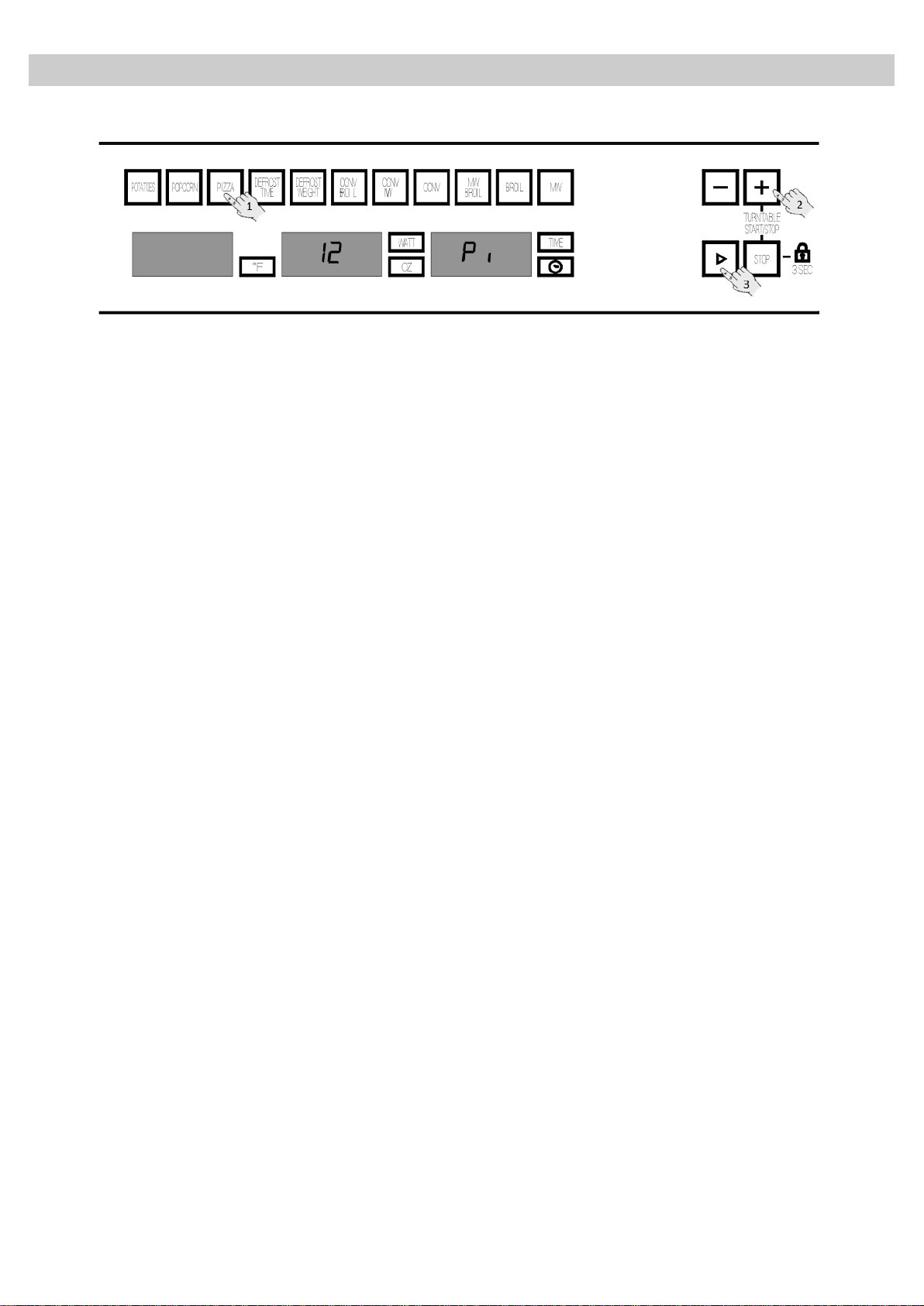
62
FR
Fonctions spéciales
Fonction Spéciale : Pizza
1. Appuyez sur la touche de fonction Pizza. La
touche de fonction s'allume.
2. Appuyez sur les touches « - » et « + » pour
sélectionner le poids correspondant.
3. Appuyez sur Start. Le four commence à
fonctionner.
Observations importantes:
• Utiliser uniquement de la vaisselle
adaptée au micro-ondes et résistant à la
chaleur (p. ex. plats à gratins). Le grill
produit des températures très élevées.
Toujours couvrir le plat d’un couvercle
pour le programme C 02 afin d’éviter les
pertes de liquide.
Attention! Le récipient peut être très chaud à la fin
du fonctionnement. Les fours à micro-ondes ne
chauffent pas la plupart des récipients, mais le
transfert de chaleur de l’élément chauffant du grill
peut néanmoins rendre ces derniers très chauds.

63
FR
Pendant le fonctionnement...
Interruption d'une cuisson
Vous pouvez interrompre le fonctionnement du four
à tout instant en appuyant une fois sur la touche
Start/Stop ou en ouvrant la porte du four.
Dans ces deux cas :
• L'émission de micro-ondes cesse
immédiatement.
• Le gril est désactivé mais garde une
température très élevée. Danger de
brûlure !
• Le temporisateur s'arrête et l'écran
affiche le temps de fonctionnement
restant.
Vous pouvez alors :
1. remuer ou retourner les aliments, pour obtenir
une cuisson uniforme ;
2. modifier les paramètres de la cuisson ;
3. annuler la cuisson, en appuyant sur la touche
Start/Stop.
Pour reprendre la cuisson, fermez la porte et
appuyer sur la touche Start/Stop.
Modification des paramètres
Il est possible de changer les paramètres de
fonctionnement (temps et température) seulement
quand la cuisson a été interrompue, en procédant
comme suit:
1. Pour modifier le temps de fonctionnement,
tournez le bouton rotatif dans l'un ou l'autre
sens. Le nouveau temps défini est
immédiatement pris en compte.
2. Pour modifier la puissance, appuyez sur la
touche Sélection de poids/puissance. Le
témoin respectif clignote. Modifiez le paramètre
en tournant le bouton rotatif et validez en
appuyant de nouveau sur Sélection de
poids/puissance.
Annuler une cuisson
Si vous souhaitez annuler le processus de cuisson,
appuyez sur Start/Stop pendant 3 secondes.
Un signal sonore est alors émis et l'écran affiche
l'heure.
Fin d'une cuisson
À la fin du processus de cuisson, 3 signaux
sonores sont émis et l'écran affiche « End ».
Les signaux sonores sont répétés toutes les 30
secondes jusqu'à ce que la porte soit ouverte ou
que vous appuyez sur la touche Start/Stop.
64
FR
Décongélation
Le tableau ci-dessous présente, d'une manière
générale, les différents temps pour la
décongélation et pour le repos (de façon à ce que
l'aliment soit uniformément réchauffé) en fonction
du type et du poids des aliments, et aussi les
respectives recommandations
Aliment
Poids (OZ)
Temps de
décongélation (m)
Temps de repos
(m)
Observation
Morceaux de viande,
porc, veau, bœuf
4
2-3
5-10
Retournez 1 fois
7
4-5
5-10
Retournez 1 fois
17-18
10-12
10-15
Retournez 2 fois
35-36
21-23
20-30
Retournez 2 fois
51-53
32-34
20-30
Retournez 2 fois
70-71
43-45
25-35
Retournez 2 fois
Viande à l'étouffée
17-18
8-10
10-15
Retournez 2 fois
35-36
17-19
20-30
Retournez 2 fois
Viande hachée
4
2-4
10-15
Retournez 1 fois
17-18
10-14
20-30
Retournez 2 fois
Saucisse
7
4-6
10-15
Retournez 1 fois
17-18
9-12
15-20
Retournez 2 fois
Volailles, morceaux
8-9
5-6
5-10
Retournez 1 fois
Poulet
35-36
20-24
20-30
Retournez 2 fois
Poularde
90
38-42
25-35
Retournez 2 fois
Filets de poisson
7
4-5
5-10
Retournez 1 fois
Truite
8-9
5-6
5-10
Retournez 1 fois
Crevettes
4
2-3
5-10
Retournez 1 fois
17-18
8-11
15-20
Retournez 2 fois
Fruit
7
4-5
5-10
Retournez 1 fois
10-11
8-9
5-10
Retournez 1 fois
17-18
11-14
10-20
Retournez 2 fois
Pain
17-18
4-5
5-10
Retournez 1 fois
17-18
10-12
10-15
Retournez 1 fois
28-29
15-17
10-20
Retournez 2 fois
Beurre
8-9
8-10
10-15
Tomme
8-9
6-8
10-15
Crème fraîche
8-9
7-8
10-15

65
FR
Décongélation
Indications générales pour la décongélation
1. Pour décongeler, utilisez uniquement de la
vaisselle adaptée au micro-ondes (porcelaine,
verre, plastique approprié).
2. La fonction Décongélation en fonction du poids
et les tableaux correspondants concernent les
aliments crus.
3. Le temps de décongélation dépend de la
quantité et de la hauteur de l'aliment. Quand
vous congelez des aliments, pensez déjà à leur
décongélation. Distribuez l'aliment en morceaux
de hauteur égale à celle du récipient.
4. Distribuez le mieux possible l'aliment à l'intérieur
du four. Les parties les plus grosses du poisson
ou des cuisses de poulet doivent être tournées
vers l'extérieur. Vous pouvez protéger les
parties les plus délicates avec une feuille
d'aluminium. Important : la feuille d'aluminium
ne doit pas entrer en contact avec les parois de
la cavité, car elle peut provoquer un arc
électrique.
5. Les morceaux les plus denses doivent être
retournés plusieurs fois.
6. Distribuez l'aliment congelé de la façon la plus
uniforme possible, les parties les plus étroites et
fines décongelant plus rapidement que les
parties grosses et hautes.
7. Les aliments riches en graisse comme le beurre
et la crème fraîche ne doivent pas être
complètement décongelés. S'ils sont à
température ambiante, ils seront prêts à être
servis en peu de temps. La crème congelée doit
être remuée avant son utilisation.
8. Mettez les volailles dans un plat creux pour que
le jus de la viande s'écoule plus facilement.
9. Le pain doit être enveloppé dans une serviette
de table pour ne pas trop sécher.
10. Tournez la nourriture à intervalles réguliers.
11. Retirez l'emballage de l'aliment congelé sans
oublier d'enlever les agrafes, le cas échéant.
Pour les récipients destinés à conserver les
aliments dans le congélateur et que vous
pouvez également utiliser dans le four, retirez
seulement le couvercle. Dans les autres cas,
mettez les aliments dans des récipients adaptés
au micro-ondes.
12. Vous devez enlever et jeter le liquide résultant
de la décongélation, principalement des
volailles. Il ne doit en aucun cas entrer en
contact avec les autres aliments.
13. Remarquez bien qu'un temps de repos est
nécessaire, dans la fonction Décongélation,
jusqu'à ce que l'aliment soit complètement
décongelé.

66
FR
Cuisiner aux micro-ondes
Attention ! Lisez attentivement le chapitre
« Indications de sécurité » avant de cuisiner
avec votre micro-ondes.
Quand vous cuisinez avec le micro-ondes, suivez
les recommandations suivantes :
• Avant de chauffer ou de cuisiner des aliments
ayant une peau ou une enveloppe
(saucisses, pommes de terre, tomates,
pommes), percez-les avec une fourchette
pour qu'ils n'éclatent pas à la cuisson.
Coupez l'aliment avant de le préparer.
• Vérifiez que votre récipient est adapté aux
micro-ondes avant de l'utiliser (voir chapitre :
« Quel type de vaisselle utiliser ? »).
• Certains aliments contiennent peu d'eau et
son évaporation rapide dans le four peut faire
que ce dernier travaille à vide. L'aliment peut
alors carboniser (par exemple en
décongelant du pain ou en faisant des pop-
corns). Le four et la vaisselle peuvent être
endommagés. Le mieux est de surveiller la
cuisson et d'éviter tout dépassement du
temps nécessaire.
• Il n'est pas possible de chauffer une grande
quantité d'huile (frire) dans le micro-ondes.
• Retirez les emballages des plats
préconfectionnés car ils ne sont pas
toujours résistants à la chaleur. Suivez les
instructions données par le fabricant
• Si vous mettez des récipients différents,
par exemple des tasses, disposez-les
uniformément sur le plateau rotatif.
• Ne fermez pas les sacs plastique avec des
pinces en métal. Choisissez-les en plastique.
Percez le sac en plusieurs endroits pour que
la vapeur puisse s'échapper.
• Assurez-vous que les aliments que vous
chauffez ou que vous cuisinez atteignent une
température de 70ºC.
• Pendant la cuisson, il est possible que de la
vapeur d'eau se condense sur la vitre de la
porte et que des gouttes s'écoulent. C'est une
situation normale, surtout quand la
température ambiante est basse. La sécurité
du four n'est pas en cause. Après l'utilisation,
essuyez l'eau de condensation.
• Pour chauffer des liquides, utilisez des
récipients avec une grande ouverture,
pour mieux évacuer la vapeur.
Préparez les aliments en suivant les indications et
restez vigilant avec les temps de cuisson et les
niveaux de puissance qui sont indiqués dans les
tableaux.
Les chiffres sont donnés à titre d'indication. Ils
peuvent changer en fonction de l'état initial, de la
température, de l'humidité et du type d'aliment.
Nous vous conseillons d'ajuster les temps et les
niveaux de puissance à chaque situation. Selon
l'aliment, il faudra allonger ou raccourcir le temps
de cuisson, ou bien monter ou baisser le niveau de
puissance.
Cuisiner avec micro-ondes...
1. Plus grande est la quantité des aliments, plus
longue est la durée de la cuisson. Remarquez
bien :
• Double quantité ⇒ double du temps
• Moitié de la quantité ⇒ moitié du temps
2. Plus basse est la température, plus long est le
temps de cuisson.
3. Les aliments liquides se réchauffent plus
rapidement.
4. Une bonne distribution des aliments sur le
plateau rotatif facilite une cuisson uniforme. Si
vous chauffez en même temps des aliments
différents, placez ceux qui sont moins denses au
centre du plateau et les plus denses vers
l'extérieur du plateau.
5. La porte du four peut être ouverte à tout
moment. Le four s'éteint alors automatiquement.
Pour le remettre en fonctionnement, fermez la
porte et appuyez sur la touche START.
6. Quand ils sont couverts, les aliments cuisent
plus rapidement et leurs qualités sont mieux
préservées. Les micro-ondes doivent pouvoir
traverser le couvercle qui doit avoir de petits
orifices pour laisser passer la vapeur d'eau.
67
FR
Cuisiner aux micro-ondes
Tableaux et suggestions – Cuisiner les légumes
Aliment
Quantité
(OZ)
Addition de
liquides (fl
oz)
Puissanc
e
(Watt)
Temps
(min.)
Temps de
repos
(min.)
Indications
Choux-fleur
Brocolis
Champignons
17-18
3,5
2
1
800
800
800
9-11
6-8
6-8
2-3
2-3
2-3
Couper en rondelles. Couvrir
Petits pois et
carottes,
Carottes
congelées
10-11
3,5
1
800
800
7-9
8-10
2-3
2-3
Couper en morceaux ou en
rondelles. Couvrir
Pommes de terre
8-9
1
800
5-7
2-3
Peler, couper en morceau
égaux. Couvrir
Piment
Poireau
10-11
1
2
800
800
5-7
5-7
2-3
2-3
Couper en morceaux ou en
rondelles. Couvrir
Choux de
Bruxelles congelés
2
800
6-8
2-3
Couvrir
Chou
8-9
1
800
8-10
2-3
Couvrir
Tableaux et suggestions – Cuisiner le poisson
Aliment
Quantité
(OZ)
Puissance
(Watt)
Temps
(m)
Temps de
repos
(m)
Indications
Filets de poisson
17-18
600
10-12
3
Couvrir. Retourner quand la moitié du temps
est écoulée.
Poisson entier
28-29
800
400
2-3
7-9
2-3
Couvrir. Retourner quand la moitié du temps
est écoulée. Éventuellement, couvrir les
extrémités fines du poisson.
68
FR
Cuisiner au gril
Pour obtenir de bons résultats avec le gril, utilisez
la grille fournie avec le four.
Positionnez la grille de façon à ce qu'elle
n'entre pas en contact avec les surfaces
métalliques de la cavité, ce qui provoquerait un
arc électrique et pourrait détériorer le four.
INDICATIONS IMPORTANTES :
1. Lors de la première utilisation du gril, un peu de
fumée odorante peut se dégager. Elle résulte de
l'emploi d'huiles pendant le processus de
fabrication.
2. La vitre de la porte atteint des températures très
élevées quand le gril est utilisé. Ne laissez pas
les enfants s'approcher.
3. Nous vous conseillons de porter des gants de
cuisine car la grille et les parois de la cavité
atteignent des températures très élevées.
4. Le thermostat de sécurité fait que les
résistances s'éteignent temporairement lors
d'une utilisation prolongée du gril.
5. Important ! Vous devez vérifier que les
récipients que vous utilisez quand vous cuisinez
ou faites griller des aliments sont bien adaptés
au micro-ondes. Voir le chapitre sur le type de
vaisselle !
6. Quand vous utilisez le gril, des éclaboussures
de graisse peuvent atteindre la résistance et être
brûlées. C'est une situation normale qui ne
représente aucun problème de fonctionnement.
7. Nettoyez l'intérieur et les accessoires après
chaque cuisson, pour que les saletés ne
s'incrustent pas.
Tableaux et suggestions – Gril sans micro-ondes
Aliment
Quantité (OZ)
Temps (m)
Indications
Poisson
Dorade
Sardine/ rascasse rouge
28-29
6-8 unités
18-24
15-20
Beurrez légèrement. Quand la moitié du
temps est écoulée, retournez et ajoutez les
condiments.
Viande
Saucisse
6-8 unités
22-26
Percez et retournez quand la moitié du
temps est écoulée.
Hamburger congelé
3 unités
18-20
Retourner 2 ou 3 fois.
Entrecôte (environ 3 cm
d'épaisseur)
14-15
25-30
Saucez et retournez quand la moitié du
temps est écoulée.
Autres
Toasts
4 unités
1½-3
Surveillez les toasts.
Gratiner des sandwichs
2 unités
5-10
Surveillez le gratin
Préchauffez le gril pendant 2 minutes. Sauf
indication contraire, utilisez la grille. Placez la grille
sur un récipient dans lequel l'eau et la graisse
puissent couler.
Les temps sont mentionnés à titre d'indication car
ils peuvent varier en fonction de la composition des
aliments, de leur quantité et de la cuisson
demandée. Le poisson et la viande gagnent un
goût délicieux si, avant de les griller, vous les
badigeonnez d'huile végétale, épices et herbes
aromatiques, et si vous les laisser mariner
quelques heures. Ne salez qu'après la grillade.
Les saucisses n'éclatent pas si vous les percez
préalablement avec une fourchette.
Au milieu du temps de fonctionnement, contrôlez la
cuisson, remuez ou retournez si nécessaire.
Le gril est spécialement adapté pour la cuisson de
la viande en morceaux et du poisson en filets. Les
morceaux fins de viande peuvent être retournés
une seule fois, les plus gros plusieurs fois.
69
FR
Cuisiner au gril
Tableaux et suggestions – Micro-ondes + Gril
La fonction Micro-ondes avec Gril est idéale pour
cuisiner rapidement et dorer en même temps les
aliments. Vous pouvez également les gratiner.
Les micro-ondes et le gril fonctionnent
simultanément. Les micro-ondes cuisent et le gril
gratine.
Plat
Quantité (OZ)
Vaisselle
Puissance
(Watt)
Temps (m)
Temps de
repos (m)
Pâtes gratinées
17
Récipient bas
400
12-17
3-5
Pommes de terres
gratinées
28
Récipient bas
600
20-22
3-5
Lasagne
environ 28
Récipient bas
600
15-20
3-5
Gratin de tomme
environ 17
Récipient bas
400
18-20
3-5
2 cuisses de poulet, frais
(sur la grille)
7 chaque
Récipient bas
400
10-15
3-5
Poulet
environ 35
Récipient bas et
large
400
35-40
3-5
Soupe à l'oignon
gratinée
2 tasses de 7 oz.
Bol de soupe
400
2-4
3-5
Avant d'utiliser de la vaisselle et des récipients
dans le micro-ondes, vérifiez qu'ils y sont bien
adaptés. Utilisez seulement de la vaisselle adaptée
aux micro-ondes.
La vaisselle utilisée pour la fonction combinée doit
être adaptée aux micro-ondes et au gril. Voir le
chapitre sur le type de vaisselle !
Remarquez que les valeurs sont mentionnées à
titre indicatif et qu'elles peuvent varier en fonction
du temps initial, de la température, de l'humidité et
du type d'aliment.
Si l'aliment n'est pas assez doré, mettez-le 5 ou 10
minutes de plus en fonction Gril.
Faites attention aux temps de repos et retournez
les morceaux de volaille.
Sauf indications contraires, utilisez le plateau rotatif
pour cuisiner.
Les valeurs indiquées dans les tableaux sont
valables pour une cavité du four à froid (il n'est
nécessaire de préchauffer).
ATTENTION! Ne mettez pas votre four en
marche à vide. Sans rien à chauffer, il peut en
effet se trouver en surcharge et être
endommagé. RISQUE DE DÉTÉRIORATION !
70
FR
Rôtir et cuire
Tableaux et suggestions – Préparation de viande et gâteaux
Micro-ondes / Air chaud
Aliment
Quantité
(oz)
Puissance
(Watt)
Température
(ºF)
Temps
(min)
Temps de
repos (min)
Indications
Rôti
35-53
400
390
30-40
20
Récipient sans couvercle,
tourner 1x
Filet de porc
Côtelette ou os
Rôti de porc
28-36
200
350-370
50-60
20
Récipient sans couvercle,
tourner 1x
Poulet entier
35-43
400
390
30-40
10
Récipient sans couvercle,
bréchet vers le bas,
tourner 1x
Poulet en
morceaux
17-35
400
390
25-35
10
Récipient sans couvercle,
Placer les morceaux la
peau en bas. Tourner 1x.
Rôti de veau
53-71
200
350
60-65
20
Récipient avec couvercle,
tourner 1-2x, puis
continuez la cuisson sans
couvercle
Rôti de bœuf
53-64
200
390
80-90
20
Récipient avec couvercle,
tourner 1-2x
Micro-ondes / Cuire
Aliment
Puissance
(Watt)
Température
(ºF)
Temps
(min)
Temps de
repos
(min)
Indications
Gâteau au chocolat/cerise
200
390
30
5-10
Plateau rotatif, moule de
Ø 28 cm
Cheesecake aux fruits
400
350
40-45
5-10
Plateau rotatif, moule de
Ø 28 cm
Tarte aux pommes
200
360
40-45
5-10
Plateau rotatif, moule de
Ø 28 cm
Cheesecake su streusel
400
350
40-50
5-10
Plateau rotatif, moule de
Ø 28 cm
Gâteau aux noix
200
340
30-35
5-10
Plateau rotatif,
Moule creux

71
FR
Rôtir et cuire
Conseils pour la cuisson
Retournez les pièces de viande à la moitié du
temps de cuisson. Quand le rôti est cuit, laissez-le
reposer 20 minutes dans le four éteint et fermé. Le
jus de la viande sera ainsi mieux réparti.
La température et le temps de cuisson dépendent
du type et de la quantité d'aliment.
S'il n'y a pas d'indication du poids exact du rôti
dans le tableau, choisissez le poids immédia-
tement inférieur et prolongez le temps.
Conseils pour la vaisselle
Vérifiez que la vaisselle entre bien à l'intérieur du
four.
Les récipients en verre, quand ils sont chauds,
doivent être posés sur un chiffon de cuisine sec. Au
contact d'une surface froide ou mouillée, le verre
pourrait se fendiller et éclater. Utilisez un gant de
cuisine pour retirer les plats du four.
Important
En mode de fonctionnement Air chaud/Micro-
ondes, utilisez toujours le petit trépied placé sur le
plateau rotatif. Les moules, plats bas et récipients
doivent toujours être placés sur le trépied.
Exception : placez le moule creux directement sur
le plateau rotatif.
ATTENTION! Ne mettez pas votre four en
marche à vide. Sans rien à chauffer, il peut en
effet se trouver en surcharge et être
endommagé. RISQUE DE DÉTÉRIORATION !

72
FR
Cuire
Tableaux et suggestions – Cuire / Air chaud
Aliment
Récipient
Niveau
Température
(ºF)
Temp (min)
Gâteau aux noix
Moule creux
Plateau rotatif
320
50-60
Tarte aux fruits
Moule de Ø 28 cm
Plateau rotatif
320
55-60
Gâteau anglais
Moule creux
Plateau rotatif
320
55-65
Tarte salée
Moule rond en verre
Plateau rotatif
370–390
40-60
Gâteau simple
Moule de Ø 26 cm
Plateau rotatif
320
30-40
Bûche
Moule à gâteau en verre
1
390
12-15
Gâteau aux cerises
Moule à gâteau en verre
1
350-370
40-50
Conseils pour les moules à gâteaux
Les moules les plus fréquents sont les moules
noirs en métal. Si vous utilisez les micro-ondes,
servez-vous de moules à gâteau en verre, en
céramique ou en plastique, résistant à des
températures de 250ºC. Avec ce type de moules,
les gâteaux sont moins dorés.
Conseils pour cuisiner les gâteaux
La température de cuisson des gâteaux dépend de
la qualité et de la quantité de pâte. Essayez une
première fois avec une température plutôt en
dessous, ce qui permet d'obtenir un doré plus
uniforme. La fois suivante, si nécessaire,
choisissez une température plus forte. Placez
toujours le moule au centre du plateau ou sur le
plateau rotatif.
Suggestions pour une bonne cuisson
Comment vérifier que le gâteau est cuit :
Enfoncez un couteau fin sur le dessus du gâteau.
Si la pâte ne colle pas au couteau, le gâteau est
cuit.
Le gâteau est très foncé :
La prochaine fois, sélectionnez une température
plus basse et laissez cuire le gâteau plus
longtemps.
Le gâteau est très sec :
Faites de petits orifices, avec une petite fourchette,
dans le gâteau déjà cuit, puis arrosez avec du jus
de fruit ou une boisson alcoolique. La prochaine
fois, montez la température de près de 10ºC et
réduisez le temps de cuisson.
Le gâteau ne veut pas sortir du moule :
Laissez refroidir le gâteau 5 à 10 minutes. Si la
situation perdure, passez la lame d'un couteau tout
autour du gâteau pour le dégager. La prochaine
fois, beurrez mieux le moule.
Conseils pour économiser l'énergie
Quand vous faites plus de 1 gâteau, il est
préférable de les mettre au four les uns après les
autres. Encore chaud, le four cuira le deuxième
gâteau plus rapidement. Utilisez de préférence des
moules foncés, peints ou émaillés en noir, car ils
absorbent mieux la chaleur.
Dans le cas de cuissons qui demandent plus de
temps, vous pouvez éteindre le four 10 minutes
avant la fin pour profiter de la chaleur résiduelle.

73
FR
Quel type de vaisselle pouvez-vous utiliser?
Fonction Micro-ondes
Prenez garde que les micro-ondes sont réfléchies
par les surfaces métalliques. Le verre, la
porcelaine, la terre cuite, le plastique et le papier
laissent passer les micro-ondes.
Les récipients ou la vaisselle en métal, ou ayant
des parties ou des décorations métalliques, ne
doivent donc pas être utilisés dans le micro-
ondes. Le verre et la terre cuite avec des
décorations ou des parties métalliques (comme
le cristal de plomb) ne doivent pas être utilisés.
L'idéal pour cuisiner au four micro-ondes est
d'utiliser le verre, la porcelaine ou la terre cuite
réfractaires, et le plastique résistant à la chaleur.
Le verre et la porcelaine très fins et fragiles doivent
être utilisés, peu de temps, pour décongeler ou
chauffer des aliments déjà confectionnés.
La vaisselle peut être très chaude car les aliments
chauds lui transmettent leur chaleur. Vous devez
donc toujours utiliser un gant de cuisine !
Testez la vaisselle
Placez la vaisselle dans le four. Si au bout de 20
secondes à la puissance maximum elle ressort
froide ou tiède, alors vous pourrez l'utiliser. Elle
n'est pas adaptée si elle a beaucoup chauffé ou
provoqué un arc électrique.
Fonctions Gril + Air chaud
En les fonctions Fonctions Gril + Air chaud, la
vaisselle doit résister à des températures de
300ºC. N'utilisez pas de vaisselle en plastique.
Fonctions combinées
En les fonctions combinées, la vaisselle doit être
adaptée autant aux micro-ondes qu'au gril.
Récipients et papier aluminium
Vous pouvez utiliser des récipients en aluminium
ou du papier aluminium dans le four, si vous suivez
les consignes suivantes:
• Suivez les recommandations du fabricant
figurant sur l'emballage.
• Ces récipients en aluminium ne doivent
pas avoir une hauteur supérieure à 3 cm
ni entrer en contact avec les parois de la
cavité (distance minimum de 3 cm). Le
couvercle en aluminium doit être retiré.
• Mettez le récipient en aluminium
directement sur le plateau rotatif. Si vous
utilisez la grille, placez le récipient sur un
plateau en porcelaine. Ne mettez jamais
le récipient directement sur la grille !
• Le temps de cuisson est plus long car les
micro-ondes entrent dans les aliments
seulement par le dessus. Dans le doute,
n'utilisez que de la vaisselle adaptée aux
micro-ondes.
• Le papier aluminium peut être utilisé pour
réfléchir les micro-ondes pendant la
décongélation. Les aliments délicats, tels
la volaille ou la viande hachée, peuvent
être protégés d'un excès de chaleur en
recouvrant les extrémités.
• Important : le papier aluminium ne peut
entrer en contact avec les parois de la
cavité, cela provoquerait un arc
électrique.
Couvercles
Nous vous recommandons d'utiliser des
couvercles en verre, en plastique, ou une pellicule
adhérente, car ainsi :
1. Vous empêchez une évaporation excessive
(principalement pour les cuissons très
longues) ;
2. La cuisson est plus rapide ;
3. Les aliments cuits ne sont pas secs ;
4. Le goût est mieux préservé.
Le couvercle doit être percé d'orifices pour éviter
toute formation de pression. Les sacs en plastique
doivent également avoir des ouvertures. Les
biberons, les petits pots pour les bébés et tous les
récipients équivalents doivent être chauffés sans
couvercle, sinon ils pourraient éclater.
74
FR
Quel type de vaisselle pouvez-vous utiliser?
Tableau – Vaisselle
Le tableau suivant vous indique de manière générale quel type de vaisselle est adapté à chaque situation.
Mode de
fonctionnement
Type vaisselle
Micro-ondes
Gril + Air
chaud
Fonctions
combinées
Décongeler /
réchauffer
Cuisiner
Verre et porcelaine 1)
Vaisselle non résistante au feu, peut
être lavée au lave-vaisselle
oui
oui
non
non
Céramique vitrée
Verre et porcelaine résistant au feu
oui
oui
oui
oui
Céramique, vaisselle en grès 2)
Avec ou sans verre, sans décorations
métalliques
oui
oui
non
non
Vaisselle en terre cuite 2)
Avec du verre
Sans verre
oui
non
oui
non
non
non
non
non
Vaisselle en plastique 2)
Résistant à une chaleur de 212°F
Résistant à une chaleur de 482°F
oui
oui
non
oui
non
non
non
non
Films plastique 3)
Film plastique pour aliments
Cellophane
non
oui
non
oui
non
non
non
non
Papier, carton, parchemin 4)
oui
non
non
non
Métal
Papier aluminium
Emballages en aluminium 5)
Accessoires
oui
non
oui
non
oui
oui
oui
oui
oui
non
oui
oui
1. Sans rebord doré ou argenté et sans cristal de
plomb.
2. Suivez les indications du fabricant !
3. Ne pas utilisez des agrafes en métal pour fermer
les sacs. Perforez les sacs. Utilisez les films
plastique uniquement pour recouvrir.
4. N'utilisez pas des assiettes en papier ou carton.
5. Utilisez uniquement des emballages en
aluminium peu profonds et sans couvercle.
L'aluminium ne doit pas entrer en contact avec
les parois de la cavité.

75
FR
Nettoyage et entretien du four
Le nettoyage est l'unique entretien normalement
nécessaire.
Attention ! Le four micro-ondes doit être nettoyé
régulièrement, les éclaboussures et petites
particules doivent être enlevées. Si vous ne le
nettoyez pas régulièrement, la surface du four peut
se détériorer, la vie utile du four sera réduite et
une situation dangereuse peut éventuellement
apparaître.
Attention ! Le nettoyage doit être effectué
quand le four est débranché de l'alimentation
électrique. Retirez la prise du mur ou
débranchez le circuit d'alimentation du four.
N'utilisez pas de produits de nettoyage
agressifs ou abrasifs, ni frottoirs qui peuvent
rayer les parois, ni objets pointus.
N'utilisez pas d'appareils de nettoyage à haute
pression ou qui projettent de la vapeur.
Surface avant
Un chiffon humide suffit pour nettoyer le four. S'il
est très sale, ajoutez quelques gouttes de produit
vaisselle dans l'eau pour humidifier le chiffon. En
suivant, essuyez tout le four avec un chiffon sec.
Pour les fours dont le devant est en aluminium,
utilisez un produit doux pour les vitres et un chiffon
doux ne laissant pas de fibres. Nettoyez
horizontalement sans exercer de pression sur la
surface.
Retirez immédiatement les taches de calcaire,
graisse, amidon, blanc d'œufs. Elles peuvent
provoquer de la corrosion.
Évitez que de l'eau entre dans le four.
Intérieur du four
Après chaque utilisation, nettoyez les parois
intérieures avec un chiffon humide. Il est ainsi plus
facile d'enlever éclaboussures et particules.
Pour les saletés les plus difficiles à enlever, utilisez
un produit de nettoyage non agressif. N'utilisez
pas de sprays pour four ni d'autres produits de
nettoyage agressifs ou abrasifs.
La porte et le devant du four doivent toujours
être bien propres pour assurer un
fonctionnement correct.
Évitez que de l'eau entre dans les orifices de
ventilation du micro-ondes.
Enlevez régulièrement le plateau rotatif et son
support pour nettoyer la base de la cavité, en
particulier quand des liquides ont débordé.
N'allumez pas le four sans le plateau rotatif et
son support.
Si la cavité du four est très sale, placez un verre
d'eau sur le plateau rotatif et faites fonctionner le
four micro-ondes pendant 2 ou 3 minutes à la
puissance maximum. La vapeur ainsi libérée va
ramollir les saletés qui seront plus faciles à
nettoyer avec un chiffon doux.
Les odeurs désagréables (comme après la cuisson
d'un poisson) peuvent être facilement éliminées.
Ajoutez quelques gouttes de jus de citron ou de
vinaigre dans une tasse d’eau. Mettez une petite
cuillère dans la tasse pour éviter une ébullition
après coup. Chauffez à la puissance maximum
pendant 2 à 3 minutes.
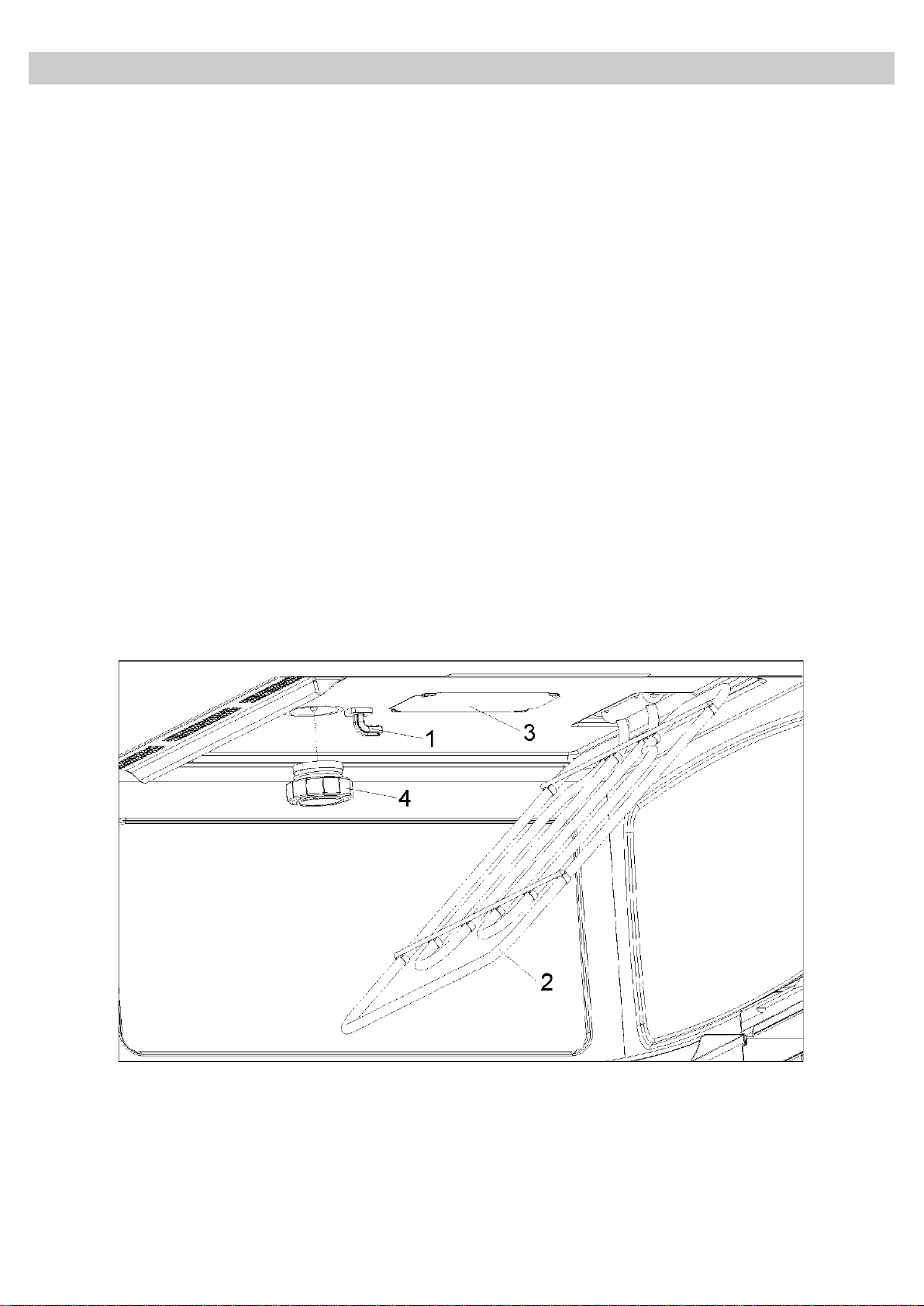
76
FR
Nettoyage et entretien du four
Plafond du four
Quand le plafond du four est sale, le gril peut être
abaissé pour en faciliter le nettoyage.
Attendez que le gril ait refroidi avant de
l'abaisser, pour éviter tout danger de brûlure.
Procédez comme suit :
1. Faites tourner le support du gril de 180º (1).
2. Abaissez doucement le gril (2). Ne forcez pas
excessivement, vous pourriez
l'endommager.
3. Quand le plafond est nettoyé, remettez le gril (2)
à sa place, puis bloquez-le avec son support en
le tournant de 90º.
AVIS IMPORTANT : si le support du grill (1) tombe
lorsque vous le faites pivoter, replacez-le (1) dans
l’orifice du plafond et faites-le pivoter de 90º jusqu’à
sa position de support du grill (2).
Le couvercle en mica (3) situé dans le plafond
doit toujours être propre. Les particules
d'aliments qui s'y accumulent peuvent
endommager le four ou provoquer des étincelles.
N'utilisez pas de produits de nettoyage abrasifs
ni d'objets pointus.
Ne retirez pas le couvercle en mica, pour éviter
tout risque.
Le couvercle en verre de la lampe (4), situé dans
le plafond du four, peut être facilement retiré pour
être nettoyé. Dévissez-le et nettoyez-le avec de
l'eau et un peu de produit vaisselle.
Accessoires
Nettoyez les accessoires après chaque utilisation.
S'ils sont très sales, laissez-les d'abord tremper,
puis lavez-les avec une brosse et une éponge. Les
accessoires peuvent être lavés au lave-vaisselle.
Assurez-vous que le plateau rotatif et son support
sont toujours propres. N'allumez pas le four sans le
plateau rotatif et son support.
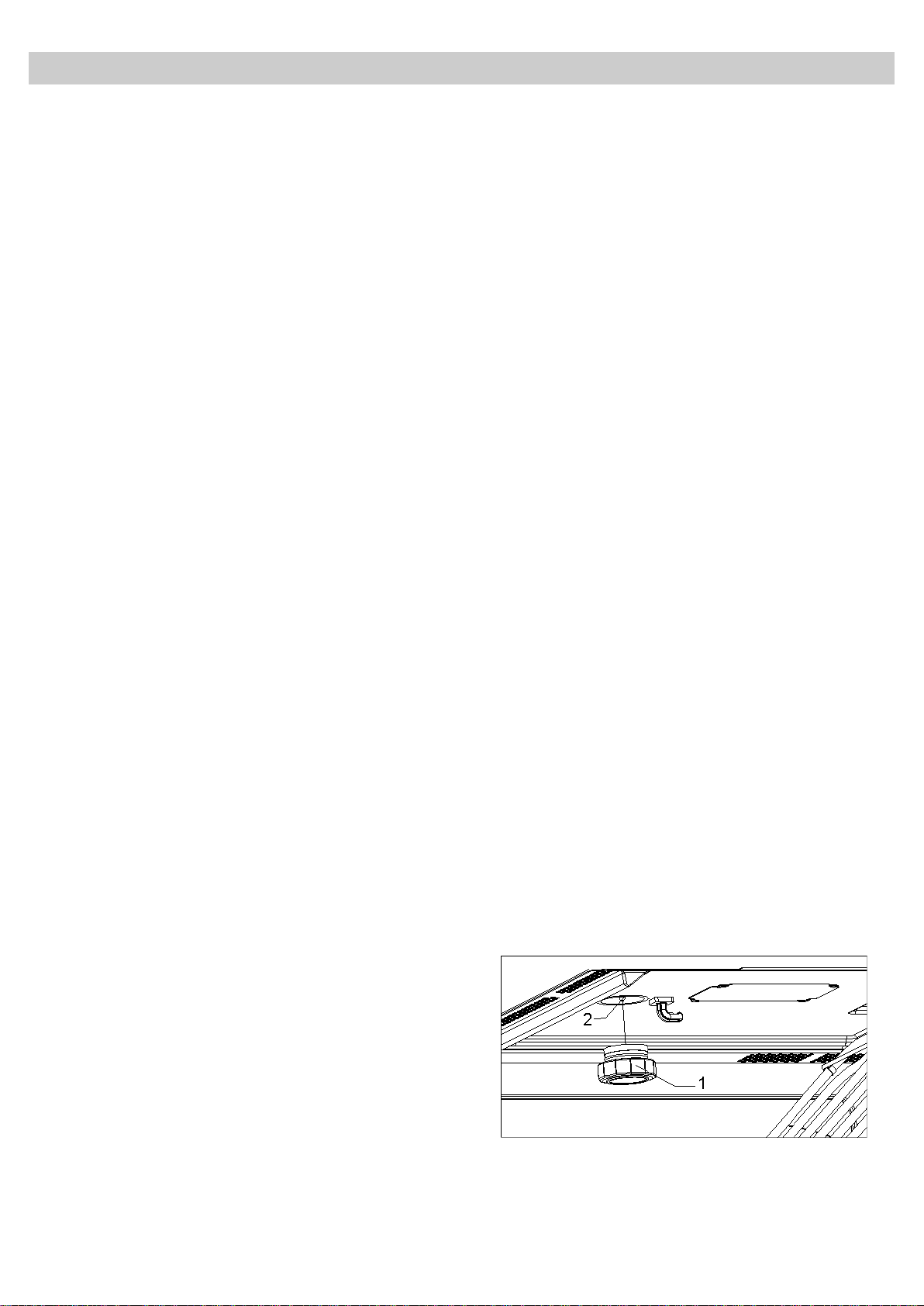
77
FR
Que faire en cas de mauvais fonctionnement ?
ATTENTION ! Toute réparation ne peut être
effectuée que par des techniciens spécialisés.
Toute réparation effectuée par des personnes
non certifiées par le fabricant peut se révéler
dangereuse.
Les problèmes suivants peuvent être corrigés sans
appeler l'assistance technique :
• L'écran ne s'allume pas ! Vérifiez si :
- L'affichage de l'heure a été masquée (voir
chapitre Réglages de base).
• Rien ne se passe quand on appuie sur les
touches ! Vérifiez si :
- Le blocage de sécurité est actif (voir chapitre
Réglages de base).
• Le four ne fonctionne pas ! Vérifiez si :
- La prise est correctement branchée au mur.
- Le circuit d'alimentation du four est branché.
- La porte est complètement fermée. Assurez-
vous-en au son produit à la fermeture.
- Il y a des corps étrangers entre la porte et le
devant de la cavité.
• Pendant le fonctionnement du four, des
bruits bizarres se font entendre ! Vérifiez
si :
- Des objets métalliques génèrent des arcs
électriques à l'intérieur du four (voir chapitre sur
le type de vaisselle).
- La vaisselle entre en contact avec les parois du
four.
- Il y a des instruments de cuisine à l'intérieur du
four.
• Les aliments ne chauffent pas ou se
chauffent très lentement ! Vérifiez si :
- Vous avez utilisé de la vaisselle en métal.
- Vous avez sélectionné un temps de
fonctionnement et une puissance appropriés.
- Vous avez placé à l'intérieur du four une quantité
d'aliments plus importante ou plus froide que
d'habitude.
• L'aliment est excessivement chaud,
desséché ou brûlé ! Vérifiez que vous
avez sélectionné le temps de
fonctionnement et le niveau de puissance
appropriés.
• Un bruit se fait entendre à la fin d'un
fonctionnement ! Ceci n'est pas un
problème. Le ventilateur de réfrigération
continue de fonctionner un moment. Il se
débranche quand la température est
suffisamment basse.
• Le four fonctionne mais l'éclairage
intérieur ne s'allume pas ! Si toutes les
fonctions travaillent correctement, vous
devez probable-ment changer la lampe.
Vous pouvez continuer à utiliser
l'appareil.
Remplacement de la lampe
Pour remplacer la lampe, procédez de la façon
suivante:
- Débranchez le four de l'alimentation électrique,
en retirant la prise du mur ou en coupant le
circuit d'alimentation du four.
- Dévissez et enlevez le couvercle en verre de la
lampe (1).
- Retirez la lampe halogène (2). Attention ! La
lampe peut être très chaude.
- Installez une nouvelle lampe 12V / 10W.
Attention ! Ne touchez pas la surface de la
lampe directement avec les doigts car cela
endommage la lampe. Suivez les instructions
du fabricant de la lampe.
- Revissez le couvercle en verre de la lampe (1).
- Rebranchez le four à l'alimentation électrique.

78
FR
Caractéristiques techniques
Spécifications
• Tension AC ................................................................................. 240V, 2ph, 60Hz
• Puissance requise....................................................................... 3850 W
• Puissance du gril......................................................................... 1500 W
• Puissance de l'air chaud ............................................................. 1600 W
• Puissance de sortie des micro-ondes. ........................................ 1000 W
• Fréquence des micro-ondes… ................................................... 2450 MHz
• Dimensions hors-tout (LongueurhauteurProfondeur). ............ 29 ¾ x 18 ⅝ x 21 ½
• Dimensions de la cavité (LhP). ............................................... 16 ½ x 8 ¼ x 15 ½
• Capacité du four.......................................................................... 1.34 ft
3
• Poids ........................................................................................... 78 lbs

79
FR
Instructions pour l'installation
Avant l'installation
Vérifiez que la tension de l'alimentation de
l'appareil, indiquée sur la plaque des
caractéristiques correspond à celle de votre
installation. Le plaque des caractéristiques est
situé sur la partie avant de la cavité et est visible
seulement après l’ouverture de la porte.
S'il y a lieu, conformément au Code national de
l'électricité (ou au Code canadien de l'électricité),
cet appareil doit être installé sur un circuit de
dérivation séparé.
Installateur – Indiquer au propriétaire
l’emplacement du disjoncteur ou du fusible.
Identifier sa position pour pouvoir le retrouver
facilement.
Avant l'installation, mettre l'appareil hors service au
panneau de service. Verrouiller le panneau
d'entrée d'électricité pour éviter que le courant ne
soit accidentellement rétabli.
S'assurer que l'appareil est installé et mis à la
terre par un technicien qualifié. L'installation, les
connexions électriques et la mise à la terre doivent
être conformes à tous les codes applicables.
Ouvrez la porte du four et retirez tous les
accessoires ainsi que l'emballage.
N'enlevez pas le couvercle de mica situé au
plafond de la cavité du four! Ce couvercle évite que
graisses et particules d'aliments endommagent le
générateur de micro-ondes.
Attention! Le devant du four peut être enveloppé
d'une pellicule de protection. Retirez-la
soigneusement, avant la première utilisation, en
commençant par le bas.
Vérifiez que le four n'est pas endommagé.
Assurez-vous que la porte du four ferme correcte-
ment et que le côté intérieur de la porte et le devant
de la cavité ne sont pas abîmés. S'ils le sont,
appelez le Service d'assistance technique.
N'UTILISEZ PAS LE FOUR si le conduit flexible
est endommagé, si le four ne fonctionne pas
correctement ou s'il est endommagé ou bien
tombé. Appelez le Service d'assistance technique.
Installez le four sur une surface stable, le plus loin
possible des radios, télévisions et de tout ce qui
produit de la chaleur.
Alimentation Electrique
Avant d’installer le four avec un électricien qualifié,
vérifiez que votre maison est pourvue du système
électrique approprié et qu’en plus le four ne
surchargera pas le circuit de branchement sur
lequel il doit être installé.
Sont nécessaires un triphasé séparé, ou un four à
simple phase à 4 fils, 240 Volt, 60 Hz.
Pour brancher le four, vous aurez besoin d’une
boîte de raccordement approuvée qui est
facilement à portée de main à travers le devant du
meuble où le four sera placé. Le four a 90 cm de
conduit.
Laissez 60 des 90 d’espace entre la ligne
électrique pour que le four puisse être déplacé si
un dépannage était nécessaire.
NE RACCOURCISSEZ PAS le conduit flexible.
Cablage Necessaire
Lorsque vous raccordez les fils, utilisez toute la
longueur de conduit fourni (90 cm). Le conduit ne
doit pas être coupé.
Avant de faire les raccordements, assurez-vous
qu’il n’y a plus d’électricité et lisez et observez ce
qui suit:
1. Sont nécessaires pour le four un circuit de
raccord triphasé ou à quatre fils, simple
phase, 240 Volt, 60 Hz.
2. Le four doit uniquement être raccordé avec
des fils cuivre ou aluminium.
3. Aux Etats-Unis :
Les fils doivent être conformes au code
électrique national, ANSI/NFPA No. 7
dernière édition. Vous pouvez obtenir une
copie du code électrique national en écrivant
à: National Fire Protection Association
Batterymarch Park Quincy, MA 02269
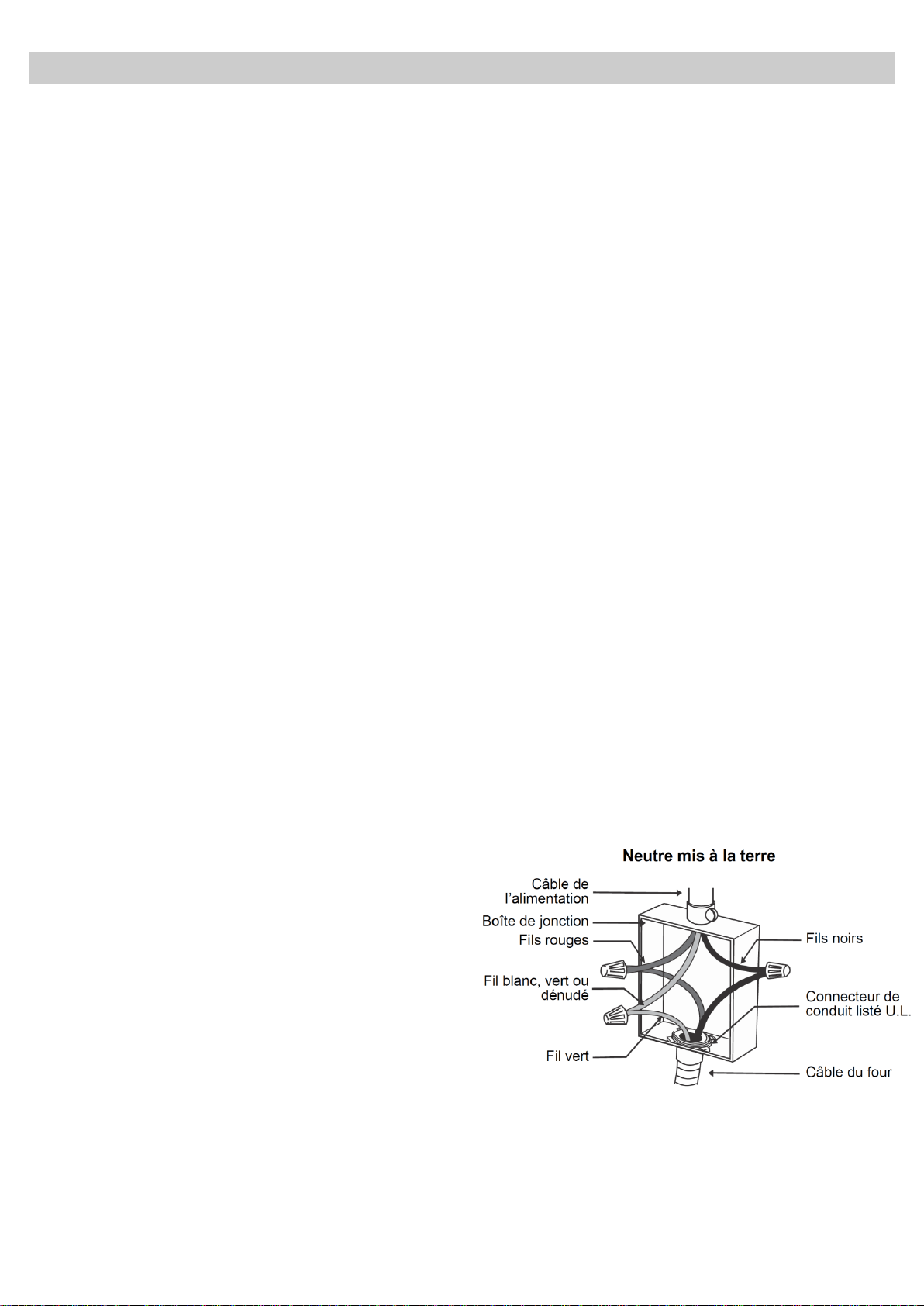
80
FR
Instructions pour l'installation
Au Canada:
Les fils doivent être conformes au code
électrique canadien C22.1- dernière édition.
Vous pouvez obtenir une copie du code
électrique canadien en écrivant à: Canadian
Standards Association 178 Rexdale
Boulevard Rexdale (Toronto), Ontario,
Canada M9W 1R3
4. La taille des fils (CUIVRE OU ALUMINIUM) et
des connexions doit être appropriée aux
caractéristiques des appareils
électroménagers par le code électrique
national. Le câble armé flexible s’étendant
du four doit être connecté directement au
boîtier de raccordement.
5. Le boîtier de raccordement doit être situé
pour qu’il y ait un maximum d’espace entre
lui et four pour qu’il puisse être déplacé en
cas de panne.
6. Un connecteur conduit U.L. listé doit être
placé à chaque extrémité du câble de
raccordement d’alimentation.
Connexions Electriques
Assurez-vous que votre installation est
correctement installée et branchée par un
technicien qualifié. Demandez à votre
revendeur un technicien qualifié ou un service
de réparation agréé.
Cet appareil est fabriqué avec un conducteur de
terre vert connecté au châssis du four. Après vous
être assurer qu’il n’y a plus de courant, branchez le
conduit flexible depuis le four jusqu’au boîtier de
raccordement en utilisant un connecteur de conduit
U.L. listé. Les figures suivantes et les instructions
fournies présentant la manière la plus commune de
brancher un four. Vos codes locaux et règlements
sont évidemment prioritaires sur ces instructions.
Effectuez les connexions électriques
conformément aux codes locaux et les règlements.
“AVERTISSEMENT” Risque d’électrocu-tion,
cadre à la masse à une position neutre d’un
appareil par une liaison.
Mettre à la masse par un conducteur neutre est
interdit pour les nouvelles installations de circuit
électrique (1996 NEC); les mobile homes; et les
véhicules de parc, ou dans les régions où les codes
locaux interdisent de brancher à la masse à travers
un conducteur neutre. Pour les installations où la
mise à terre par un conducteur neutre est interdit:
• Déconnectez la masse du conducteur
neutre aux extrémités libres du conduit ;
• Utilisez la borne de terre ou une broche
de raccordement pour mettre à la terre
l’unité; et
• Connectez la borne de neutre ou une
broche de raccordement à un circuit de
dérivation neutre de la manière habituelle.
Connexion à 3 Fils (Pour US seulement)
Selon la Figure suivant, où les codes locaux
permettent la connexion du conducteur de terre du
four au fil NEUTRE du circuit de branchement (fil
gris ou coloré blanc):
• Si les codes locaux le permettent,
connectez le conducteur de terre vert du
four et le fil blanc du four au fil NEUTRE
du circuit de branchement (fil gris ou
coloré blanc).
• Connectez les broches de raccordement
du four aux broches de raccordement
correspondantes dans le boîtier de
raccordement.
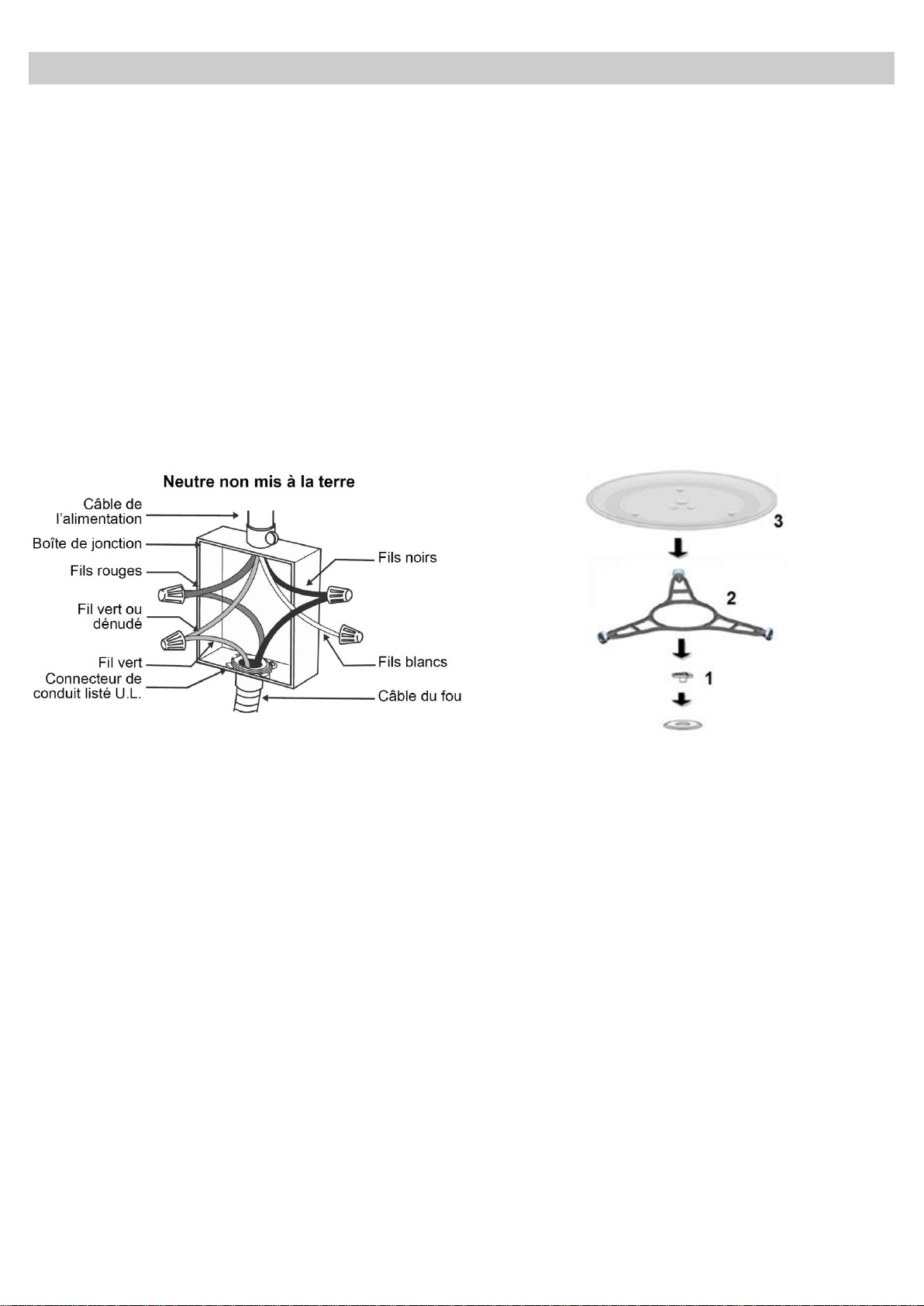
81
FR
Instructions pour l'installation
Connexion à 4 Fils (Pour des US ou
CANADA)
Selon la Figure suivant :
• Déconnectez la masse du point neutre
aux extrémités du conduit.
• Connectez le conducteur de terre vert du
four au conducteur de terre dans le boîtier
de raccordement (fil nu ou coloré vert).
• Connectez les broches de raccordement
rouge et noir du four aux broches de
raccordement correspondantes dans le
boîtier de raccordement.
Après l'installation
Le four ne fonctionne que si la porte est
correctement fermée.
Avant la première utilisation, nettoyez l'intérieur du
four ainsi que les accessoires en suivant les
indications figurant au point «Nettoyage et
entretien de votre four».
Emboîtez le manchon dans le centre de la cavité
du four, placez le support plateau puis le plateau
rotatif qui doit s'emboîter. Chaque fois que le four
est utilisé, il est important que ces accessoires
soient à l'intérieur du four et correctement placés.
Le plateau rotatif peut tourner dans les deux
sens.
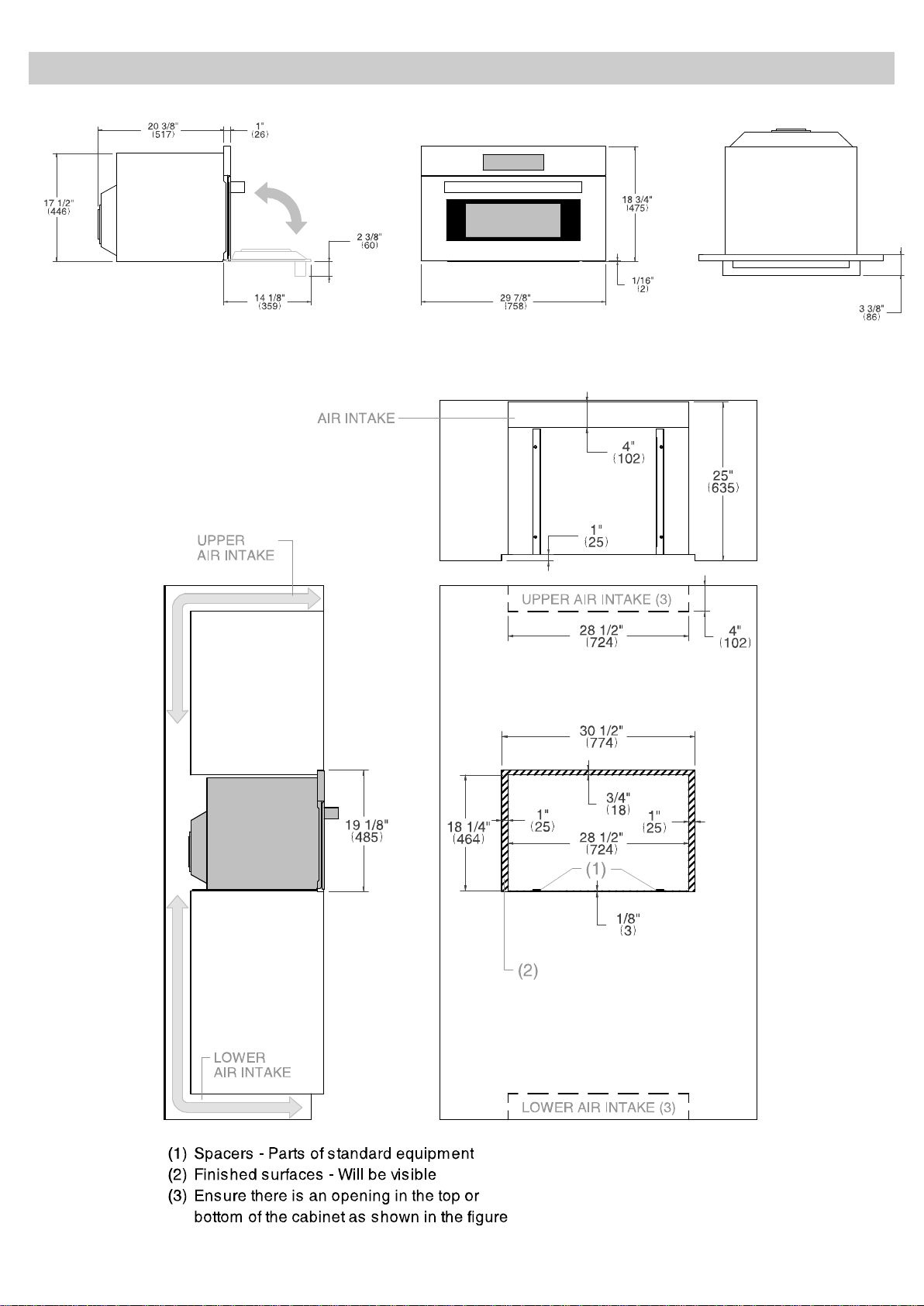
82
Installation dimensions / Dimensions d’Installation
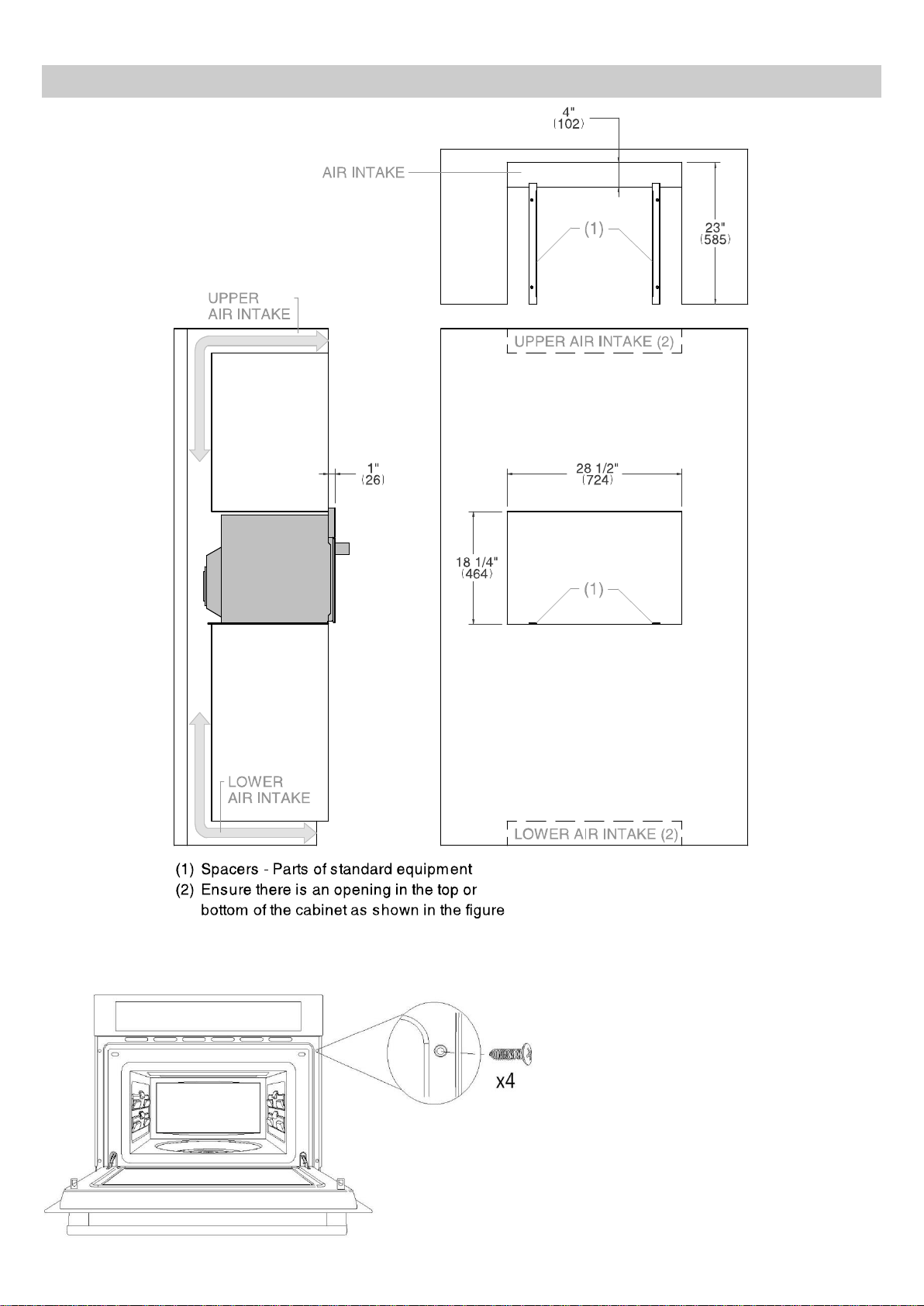
Installation dimensions/ Dimensions d’Installation
EN
• Push oven completely into the cabinet
and centre it.
• Open microwave door and fasten the
appliance to the cabinet using the four
screws provided. Insert the screws
through the front holes.
FR
• Introduisez le four dans le meuble
jusqu'à ce que l'avant du four butte sur
le bois et alignez-le.
• Ouvrez la porte du four et fixez ce
dernier aux parois latérales du meuble
au moyen des 4 vis fournies, par les
trous prévus à cet effet.
BERTAZZONI Distributor List
Distributor
States
DISTINCTIVE APPLIANCES
DISTRIBUTING INC.
51155 GRAND RIVER AVENUE
WIXOM, MI 48393
Illinois, Indiana, Kentucky, Michigan,
Minnesota, Ohio, West Virginia, Wisconsin
DOOLITTLE DISTRIBUTING INC.
13269 WEST 98TH STREET
LENEXA, KANSAS 66215
Arkansas, Illinois, Iowa, Kansas, Missouri,
Nebraska, Oklahoma
EASTERN MARKETING CORP.
24 EISENHOWER PARKWAY
ROSELAND, NJ 07068
Connecticut, DC, Delaware, Maine, Maryland,
Massachusetts, New Hampshire, New
Jersey, New York, North Carolina,
Pennsylvania, Rhode Island, South Carolina,
Vermont, Virginia
ECHELON HOME PRODUCTS INC.
1051 ANDOVER PARK EAST
TUKWILA, WA 98188
Alaska, Idaho, Montana, Oregon,
Washington, Wyoming
PURCELL & MURRAY
185 PARK LANE
BRISBANE, CA 94005
California, Nevada
PINNACLE EXPRESS INC.
PO BOX 1836
33838 DUNDEE, FLORIDA
Alabama, Florida, Georgia, Tennessee
MILESTONE DISTRIBUTORS
4531 MCKINNEY AVENUE
DALLAS, TEXAS 75205
Arizona, Louisiana, Mississippi, New Mexico,
Texas
1631232