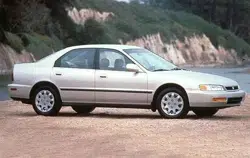

1994 Accord Coupe Online Reference Owner's Manual
Use these links (and links throughout this manual) to navigate through this reference.
For a printed owner's manual, click on authorized manuals or go to www.helminc.com.
Contents
Introduction ......................................................................................................................................... i
A Few Words About Safety.................................................................................................................ii
Driver and Passenger Safety ..............................................................................................................3
Proper use and care of your vehicle's seat belts, and Supplemental Restraint System.
Instruments and Controls.................................................................................................................31
Instrume
nt panel indicator and gauge, and how to use dashboard and steering column controls.
Comfort and Convenience Features ...............................................................................................69
How to operate the climate control system, the audio system, and other convenience features.
Before Driving..................................................................................................................................101
What gasoline to use, how to break
-in your new vehicle, and how to load luggage and other cargo.
Driving ..............................................................................................................................................111
The proper way to start the engine, shift the transmission, and park, plus towing a trailer.
Maintenance.....................................................................................................................................131
The Maintenance Schedule shows you when you need to take you
r vehicle to the dealer.
Appearance Care..............................................................................................................................179
Tips on cleaning and protecting your vehicle. Things to look for if your vehicle ever needs body repairs.
Taking Care of the Unexpected......................................................................................................187
This section covers several problems motorists sometimes experience, an
d how to handle them.
Technical Information.....................................................................................................................211
ID numbers, dimensions, capacities, and technical information.
Warranty and Customer Relations (U.S. and Canada)................................................................225
A summary of the warranties covering your new Acura, and how to contact us.
Authorized Manuals (U.S. only)......................................................................................................231
How to order manuals and other technical literature.
Index...................................................................................................................................................... I
Gas Station Information
Information you need when you pull up to the fuel pump.
Owner's Identification Form
ProCarManuals.com

Introduction
Congratulations ! Your selection of a 1994 Honda Accord was a wise investment. It will give you years of driving
pleasure.
To enhance the enjoyment of your new car, take time to study this manual. In it, you will learn about your car's many
conveniences and useful features. Following the service interval and maintenance recommendations will help keep
your driving trouble-free while preserving your investment.
Keep this owner's manual in your car so you can refer to it at any time. Please make sure the manual stays with the car
if you sell it. The next owner will find it just as helpful.
Several warranties protect your Honda. We suggest you read the warranty booklets carefully to fully understand the
coverages and the responsibilities of ownership.
When your car needs scheduled maintenance, keep in mind that your Honda dealer's service staff is specially-trained
in the service and maintenance of the many systems unique to your Honda. Your Honda dealer is dedicated to your
satisfaction and will be pleased to answer any questions and concerns.
Preface
ProCarManuals.com
Safety Messages
Your safety and the safety of others is very important. We have provided
many important safety messages in this manual and on the vehicle. Please
read these messages carefully.
A safety message alerts you to potential hazards that could hurt you or
others. Each safety message is preceded by a safety alert symbol and
one of three words, DANGER, WARMING or CAUTION.
These mean:
You WILL be KILLED or
SERIOUSLY HURT if you don't
follow instructions.
You CAN be KILLED or
SERIOUSLY HURT if you don't
follow instructions.
You CAN be HURT if you don't
follow instructions.
Each safety message tells you what the hazard is, what can happen and what
you can do to avoid or reduce injury.
You will also see another important
symbol:
Your Honda or other properly can be
damaged if you don't follow instruc-
tions.
Preface
NOTICE
ProCarManuals.com

Driver and Passenger Safety
This section gives you important
information about occupant protec-
tion. It shows how to use seat belts
properly. It explains the Supple-
mental Restraint System. And it
gives useful information about how
to protect infants and children in
your car.
Your Occupant Protection System.. 4
The Seat Belt System and How It
Works.......................................... 5
Why Wear Seat Belts.................... 5
Seat Belt System Components..... 6
Lap/Shoulder Belt......................... 6
Lap Belt........................................... 6
Wearing Seat Belts Properly........ 7
Wearing a Lap/Shoulder Belt...... 7
Wearing the Lap Belt.................... 9
Advice for Pregnant Women...... 10
Seat Belt Maintenance................ 10
Supplemental Restraint System..... 11
Important Safety Reminder........ 12
How the Driver's Airbag
Works........................................ 13
How the Passenger's Airbag
Works........................................ 14
How the SRS Indicator Light
Works....................................... 15
System Service............................. 15
System Service Precautions....... 16
Additional Safety Information........ 17
Seat-back Position........................ 17
Head Restraint Position.............. 17
Door Locks................................... 18
Storing Cargo Safely................... 18
Driving with Pets......................... 18
Child Safety...................................... 19
Where Should Children Sit?....... 19
Important Safety Reminders...... 20
General Guidelines
for Restraining Children
Under 18 kg (40 Ibs) ............... 21
Restraining
an Infant Who Weighs
Less Than 9 kg (20 Ibs).......... 21
Restraining
a Child Who Weighs Between
9 and 18 kg (20 and 40 Ibs)..... 22
Restraining a Child Who Weighs
Over 18 kg (40 Ibs).................. 23
Using a Seat Belt Locking Clip.. 23
Using Child Restraints
with Tethers............................. 24
Storing a Child Seat..................... 25
Alcohol and Drugs........................... 26
Carbon Monoxide Hazard.............. 27
Safety Labels.................................... 28
Driver and Passenger Safety
ProCarManuals.com

Your Occupant Protection System
Your Honda is equipped with seat
belts and other features that work
together to protect you and your
passenger during a crash.
Seat belts are the most important
part of your occupant protection
system. When worn properly, seat
belts can reduce the chance of
serious injury or death in a crash.
For added protection during a severe
frontal collision, your Accord has a
Supplemental Restraint System
(SRS) with airbags for the driver and
a front seat passenger.
Two indicator lights are also part of
your safety system. One reminds you
to make sure you and your
passengers wear seat belts. The
other alerts you to a possible
problem with your supplemental
restraint system (see page 15 ).
The seats, head restraints, and door
locks also play a role in occupant
safety. For example, reclining the
seat-back can decrease the effec-
tiveness of your seat belt. Head
restraints can help protect your neck
and head, especially during rear-end
impacts. Door locks help keep your
doors from being accidentally
opened during a crash.
To get the maximum protection from
your occupant protection system,
check the following before you drive
away:
Everyone in the car is wearing a
seat belt properly (see page 7 ).
Infants and small children are
properly secured in child safety
seats (see page 19 ).
Both doors are closed and locked
(see page 18).
Seat-backs are upright and head
restraints are properly adjusted
(see pages 17 and 54).
There are no loose items that
could be thrown around and hurt
someone during a crash or sudden
stop (see page 18 ).
By following these guidelines, you
can reduce injuries to yourself and
your passengers in many crash
situations. Remember, however, that
no safety system can prevent all
injuries or deaths that can occur in
severe crashes.
Driver and Passenger Safety
ProCarManuals.com

The Seat Belt System and How It Works
Why Wear Seat Belts
Wearing seat belts, and wearing
them properly, is fundamental to
your safety and the safety of your
passengers.
During a crash or emergency stop,
seat belts can help keep you from
being thrown against the inside of
the car, against other occupants, or
out of
the
car.
Of course, seat belts cannot com-
pletely protect you in every crash.
But, in most cases, seat belts reduce
your chance of serious injury. They
can even save your life. That is why
many states and all Canadian pro-
vinces require you to wear seat belts.
Important Safety Reminders
Seat belts are designed for adults
and larger children. All infants and
small children must be properly
restrained in child safety seats (see
page 19).
A pregnant woman needs to wear a
seat belt to protect herself and her
unborn child (see page 10).
Two people should never use the
same seat belt. If they do, they could
be very seriously injured in a crash.
Do not place the shoulder portion of
a lap/shoulder belt under your arm
or behind your back. This could
increase the chance of serious
injuries in a crash.
Do not put shoulder belt pads or
other accessories on seat belts. They
can reduce the effectiveness of the
belts and increase the chance of
injury.
Driver and Passenger Safety
Not wearing a seat belt in-
creases the chance of being
killed or seriously hurt in a
crash.
Be sure you and your passen-
gers always wear seat belts
and wear them properly.
ProCarManuals.com
The Seat Belt System and How It Works
Seat Belt System Components
Your Honda has seat belts in all five
seating positions. The front seats
and the outside positions of the rear
seat have lap/shoulder belts. The
center position of the rear seat has a
lap belt.
Your seat belt system also includes a
light on the instrument panel to
remind you to fasten your seat belt,
and to make sure your passengers
fasten theirs. This light comes on
when you turn on the ignition if you
have not fastened your seat belt. A
beeper also sounds for several
seconds (see page 34).
The following pages cover more
about the seat belt components and
how they work.
Lap/Shoulder Belt
SHOULDER
PORTION
This style of seat belt has a single
belt that goes over your shoulder,
across your chest, and across your
hips.
Each lap/shoulder belt has an
emergency locking retractor. In
normal driving, the retractor lets you
move freely in your seat while it
keeps some tension on the belt.
During a collision or sudden stop,
the retractor automatically locks the
belt to help restrain your body.
Lap Belt
The lap belt has one manually-
adjusted belt that fits across the hips.
It is similar to safety belts used in
airplanes.
Driver and Passenger Safety
UPPER SEAT
BELT ANCHOR
To retractor
LAP
PORTION
LATCH
PLATE
BUCKLE
LATCH PLATE BUCKLE
ProCarManuals.com
The Seat Belt System and How It Works
Wearing Seat Belts Properly
You can increase the effectiveness of
your seat belts if you take a little
time to read the following pages and
make sure you know how to wear
seat belts properly.
Wearing a Lap/Shoulder Belt
Before putting on a front seat belt,
be sure your seat is adjusted forward
or backward to a good driving or
riding position and the back of your
seat is upright (see page 54).
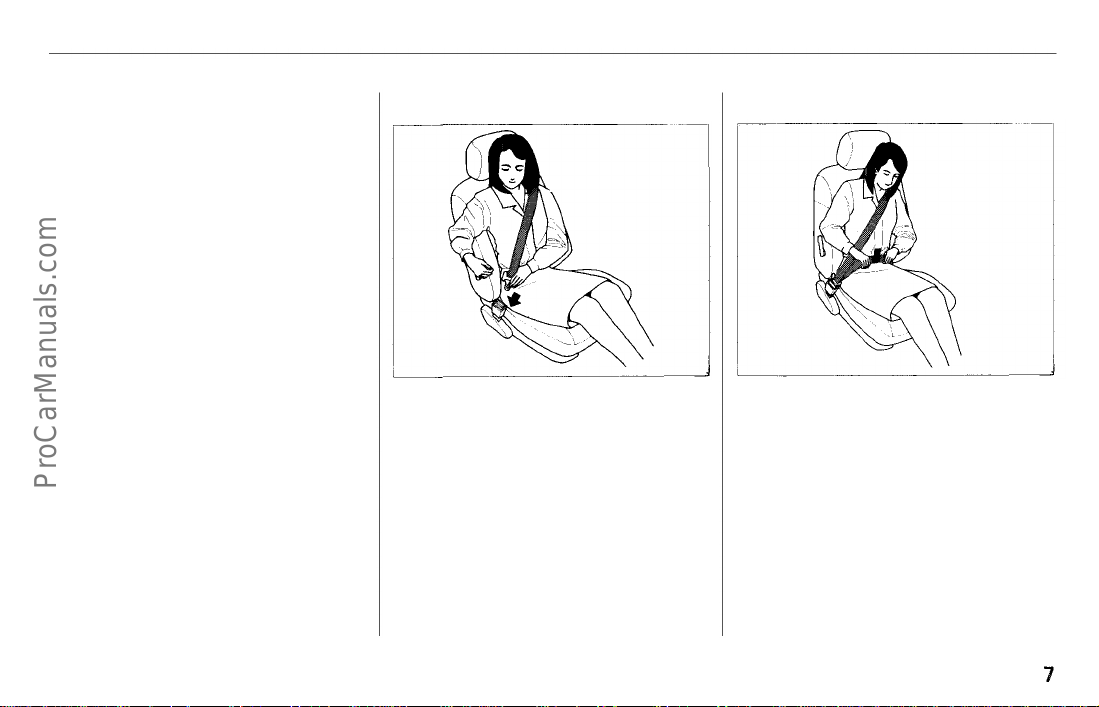
1. Pull the latch plate across your
body and insert it into the buckle.
Tug on the belt to make sure the
latch is securely locked.
2. Check that the belt is not twisted.
3. Position the lap portion of the belt
as low as possible across your hips,
not across your stomach. This lets
your strong pelvic bones take the
force of a crash.
CONTINUED
Driver and Passenger Safety
Not wearing a seat belt pro-
perly increases the chance of
serious injury or death in a
crash.
Be sure you and your passen-
gers always wear seat belts
and wear them properly.
ProCarManuals.com
The Seat Belt System and How It Works
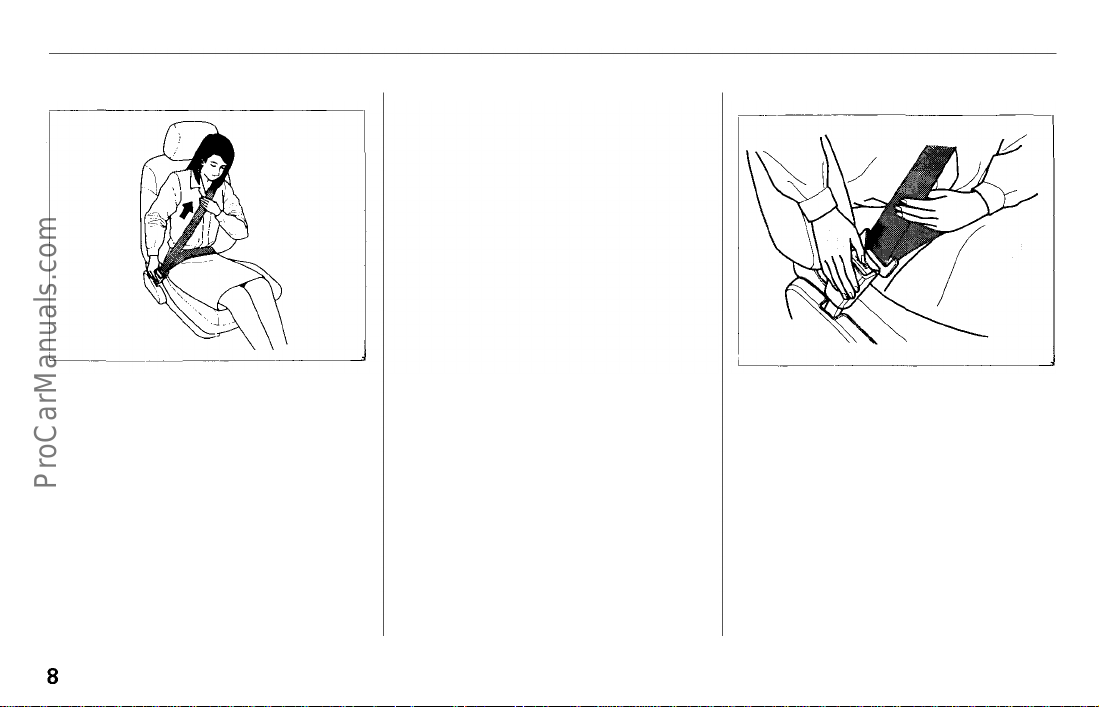
4. Pull up on the shoulder part of the
belt to remove any slack. Make
sure the belt goes over your
collarbone and across your chest.
5. If the shoulder belt crosses your
neck while you are sitting in one of
the outside positions of the rear
seat, you need to adjust your
seating position. Move toward the
center of the seat until the belt fits
over your collarbone.
To unlatch the seat belt, push the
red PRESS button on the buckle.
Guide the belt across your body to
the door pillar. If the belt doesn't
retract easily, pull it out and check
for twists or kinks.
Driver and Passenger Safety
ProCarManuals.com
The Seat Belt System and How It Works
Wearing the Lap Belt
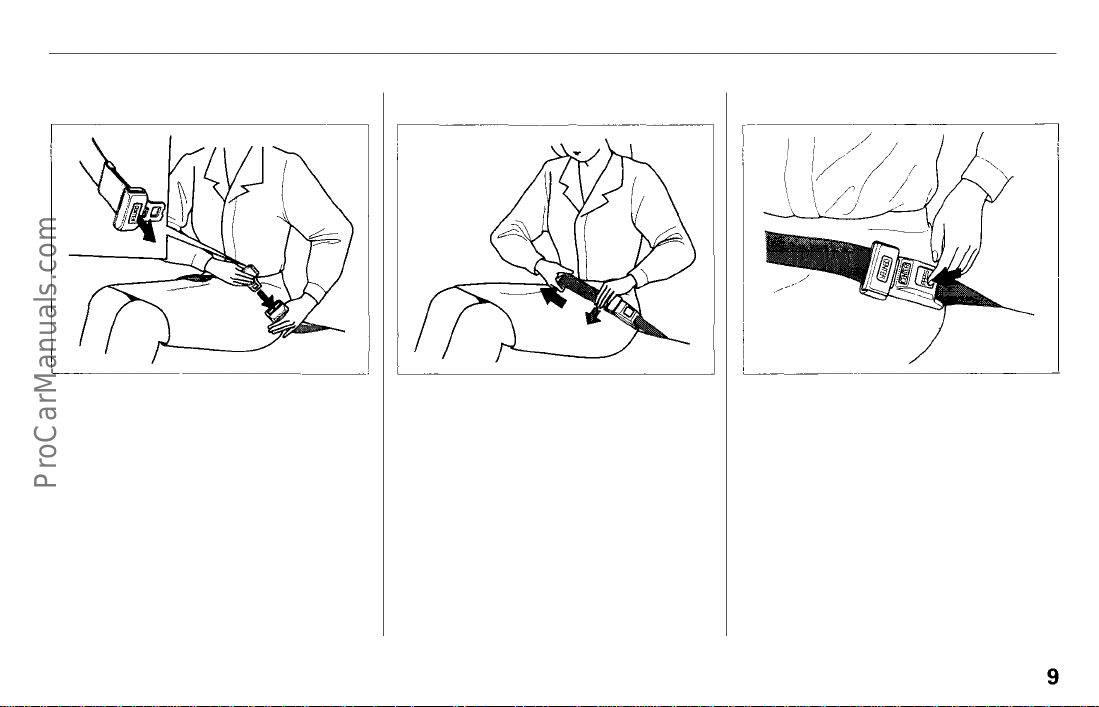
1. Pull the latch plate across your
hips and insert it into the buckle
marked CENTER.
If the belt is too short, hold the
latch plate at a right angle and pull
it to extend the belt while sliding
the tail toward the latch. Insert the
latch plate into the buckle.
2. Position the belt as low as possible
across your hips and pelvic bones,
not across your stomach. Pull the
loose end of the belt to adjust for a
snug but comfortable fit.
To unlatch the belt, push the red
PRESS button on the buckle.
Driver and Passenger Safety
ProCarManuals.com
The Seat Belt System and How It Works
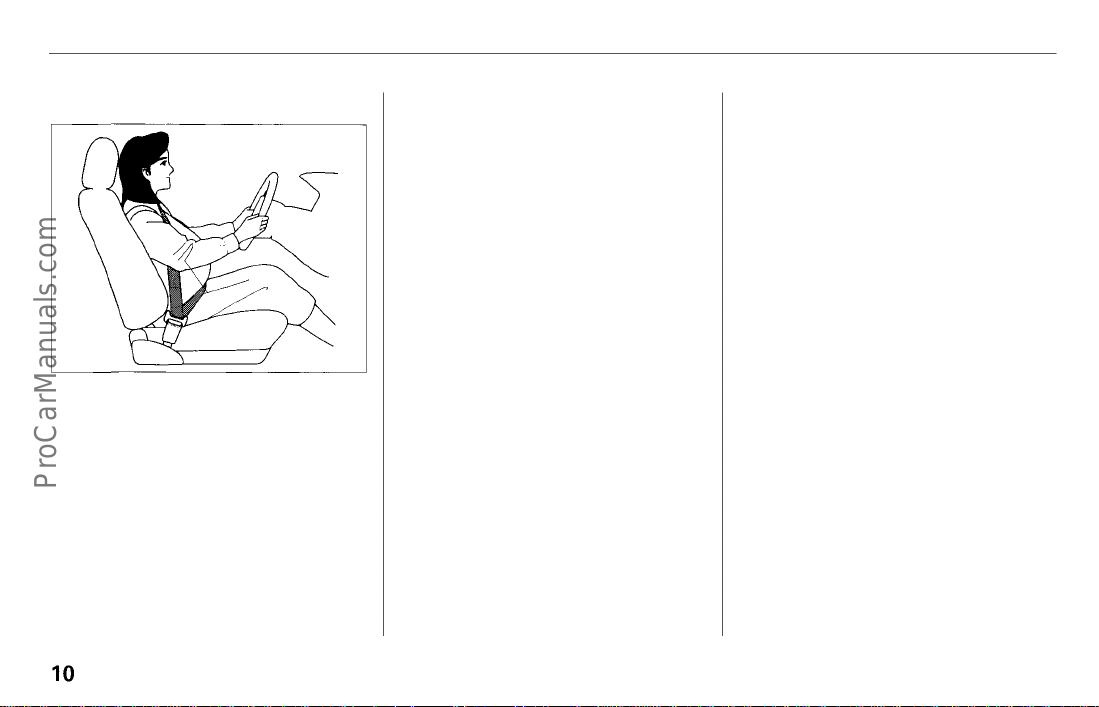
Advice for Pregnant Women
Protecting the mother is the best
way to protect her unborn child.
Therefore, a pregnant woman should
wear a properly-positioned seat belt
whenever she drives or rides in a car.
If possible, use the lap/shoulder seat
belt, remembering to keep the lap
portion as low as possible (see page
7 ).
Each time you have a check-up, ask
your doctor if it's okay for you to
drive and how you should position a
lap/shoulder seat belt.
Seat Belt Maintenance
For safety, you should check the
condition of your seat belts regularly.
Pull out each belt fully and look for
frays, cuts, burns, and wear. Check
that the latches work smoothly and
the lap/shoulder belts retract easily.
Any belt not in good condition or not
working properly should be replaced.
If a seat belt is worn during a crash,
have your dealer replace the belt and
inspect the anchors for damage.
For information on how to clean your
seat belts, see page 184 .
Driver and Passenger Safety
ProCarManuals.com
Supplemental Restraint System
Your Honda is equipped with a
Supplemental Restraint System
(SRS) to help protect your head and
chest during a severe frontal
collision. This system does not replace
your seat belt. It supplements, or adds
to, the protection offered by your
seat belt.
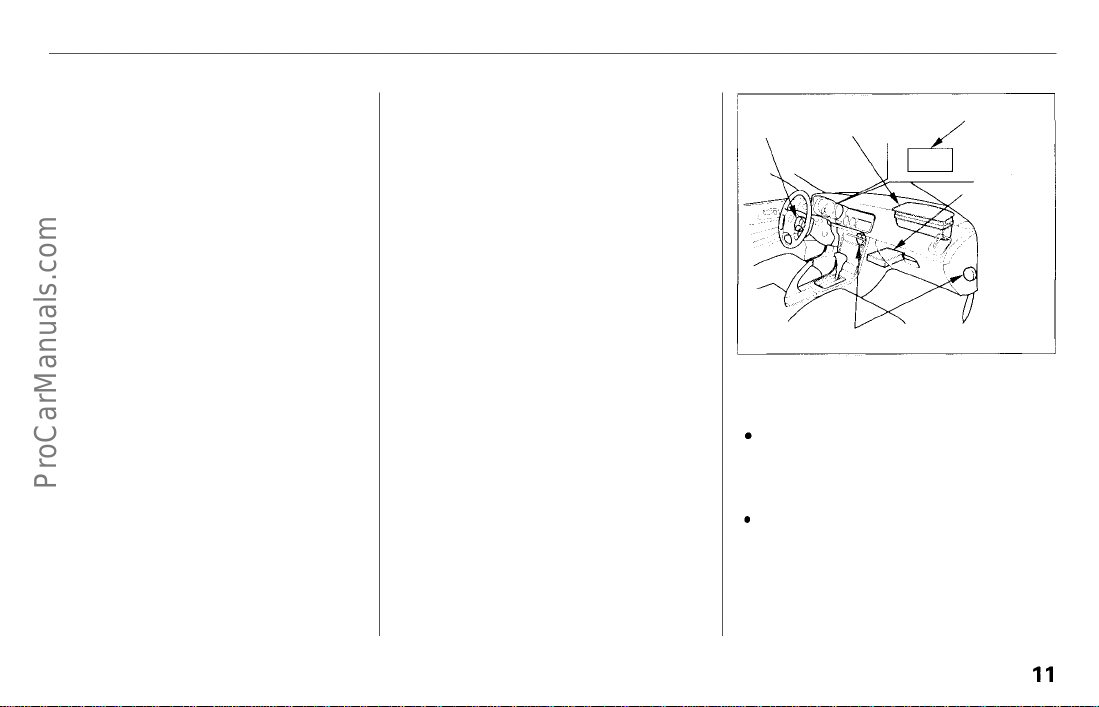
The main components in your SRS
are:
One airbag in the steering wheel
for the driver and another in the
dashboard for the passenger.
A diagnostic system that, when
the ignition is ON (II), continually
monitors the sensors, control unit,
airbag activator, and all related
wiring.
Driver and Passenger Safety
CONTINUED
Not wearing a seat belt in-
creases the chance of serious
injury or death in a crash,
even if you have an airbag.
Be sure you and your passen-
gers always wear seat belts
and wear them properly.
DRIVER'S
AIRBAG
PASSENGER'S
AIRBAG
INDICATOR
S R S
CONTROL
UNIT
SENSORS
ProCarManuals.com
Supplemental Restraint System
An indicator light to warn you of a
possible problem with the system.
Emergency power backup in case
your car's electrical system is
disconnected in a crash.
Important Safety Reminder
Even with an airbag, you need to
wear a seat belt. The reasons are:
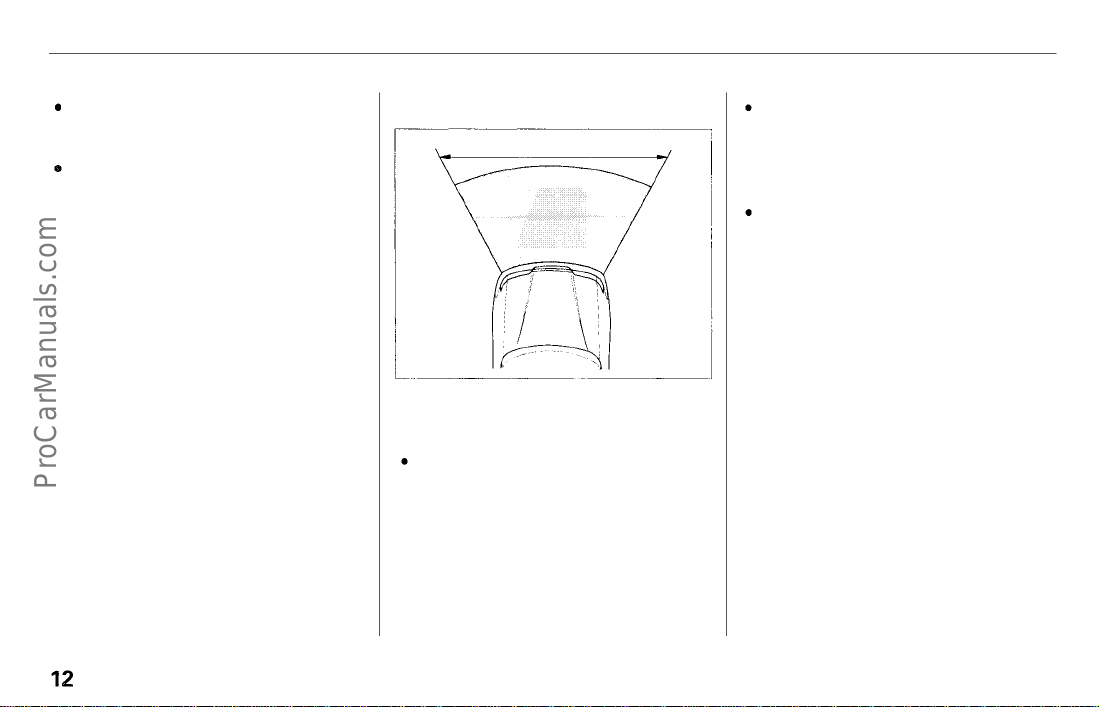
Airbags only inflate in severe
frontal collisions. They offer no
protection in rear impacts, side
impacts, rollovers, or moderate
frontal collisions.
An airbag inflates and deflates
very quickly. It cannot protect you
during any additional impacts that
can occur during a crash.
A seat belt helps keep you in the
proper position when an airbag
inflates. An airbag opens with
considerable force and can hurt
you if you are not in the proper
position.
Driver and Passenger Safety
Frontal collision range
ProCarManuals.com
Supplemental Restraint System
How the Driver's Airbag Works
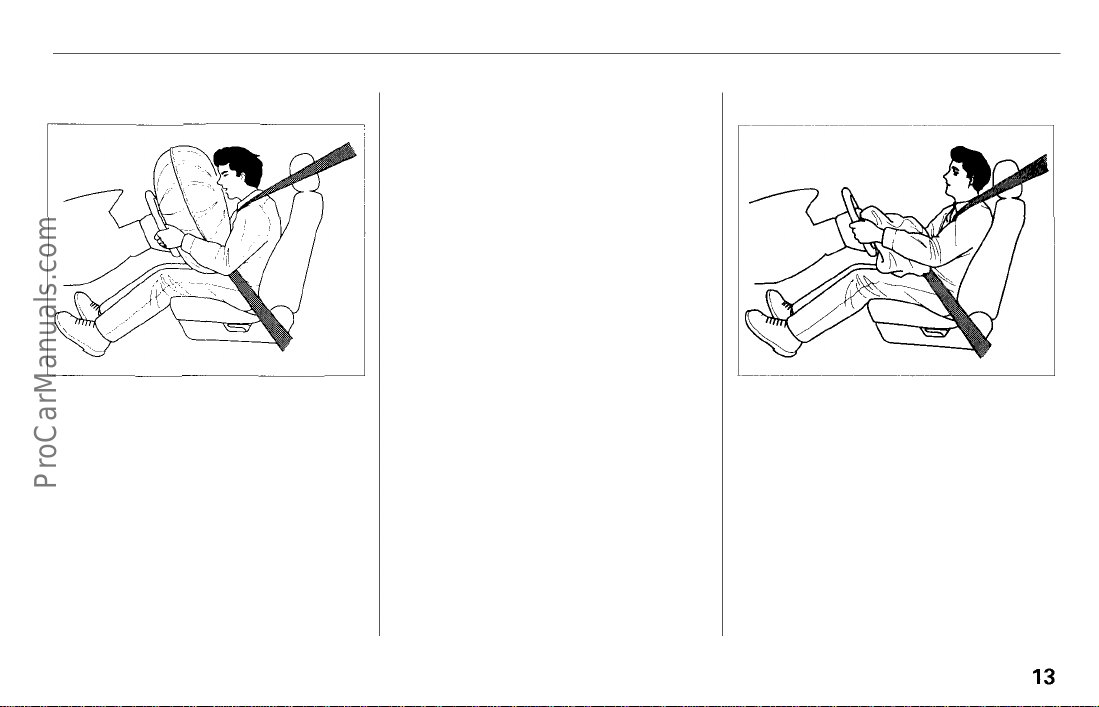
If you ever have a severe frontal
collision, your airbag will instantly
inflate to help protect your head and
chest.
When the airbag inflates, you may
hear a fairly loud noise and you
might see smoke or powder. This is
normal; it is caused by the inflation
of the airbag.
To do its job, the airbag inflates with
considerable force. So, while it can
reduce serious injuries and even save
your life, the airbag might cause
some facial abrasions or other
injuries. For this reason, you should
always sit as far back from the
steering wheel as comfortable while
still maintaining control.
After the bag completely inflates, it
immediately starts deflating so it
won't interfere with your visibility,
ability to steer, or ability to operate
other controls. The total time for
inflation and deflation takes less than
a fraction of a second. You may not
even be aware that the airbag has
been fully inflated.
CONTINUED
Driver and Passenger Safety
ProCarManuals.com
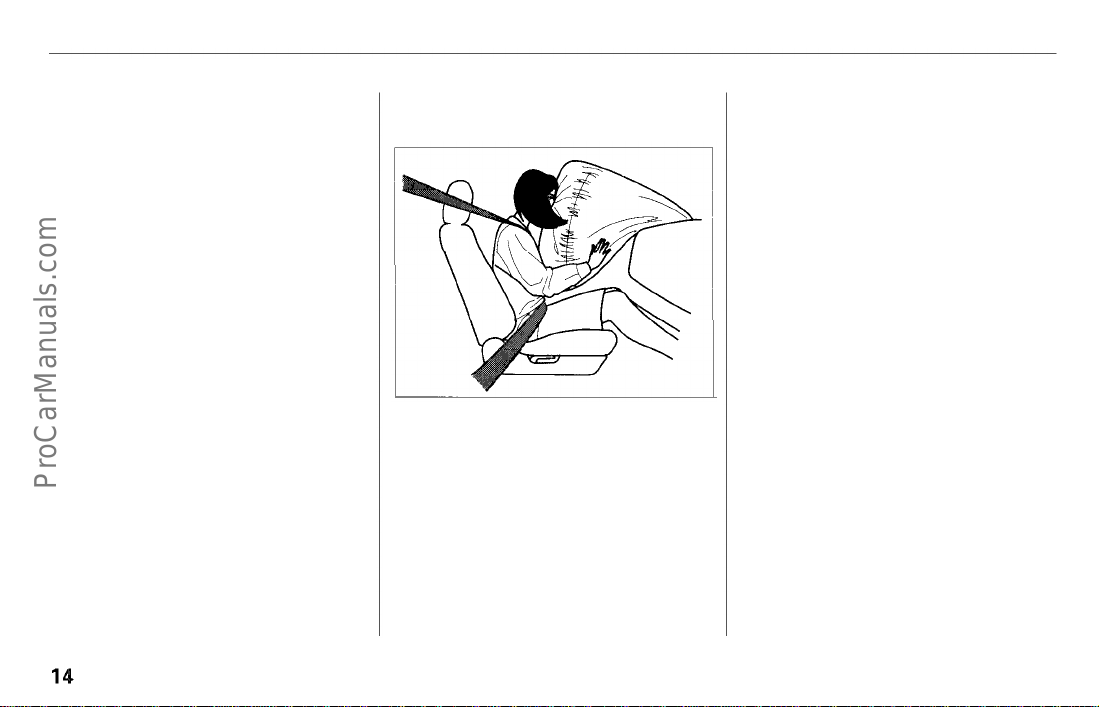
Supplemental Restraint System
The airbag is stored in the center of
the steering wheel. For your safety,
do not attach any items to the
steering wheel. They could interfere
with the proper operation of the
airbag. Or, if the airbag inflates, they
could be propelled inside the car and
hurt someone.
How the Passenger's Airbag
Works
If you ever have a severe frontal
collision, the passenger's airbag will
inflate at the same time as the driver's
airbag.
This airbag is quite large and inflates
with considerable force. It can
seriously hurt a front seat passenger
who is not in the proper position and
wearing the seat belt properly. Front
seat passengers should move the
seat as far back as practical and sit
well back in the seat.
Because of the airbag, we strongly
recommend that you do not put an
infant seat in the front passenger's
seat. If the airbag inflates, it can
dislodge the infant seat and seriously
injure the infant.
If a toddler seat is used in the front
passenger's seat, the vehicle seat
should be moved as far back as
possible. If the passenger's bag
inflates, it could seriously hurt a
toddler who is not in the proper
position or properly restrained.
Driver and Passenger Safety
ProCarManuals.com
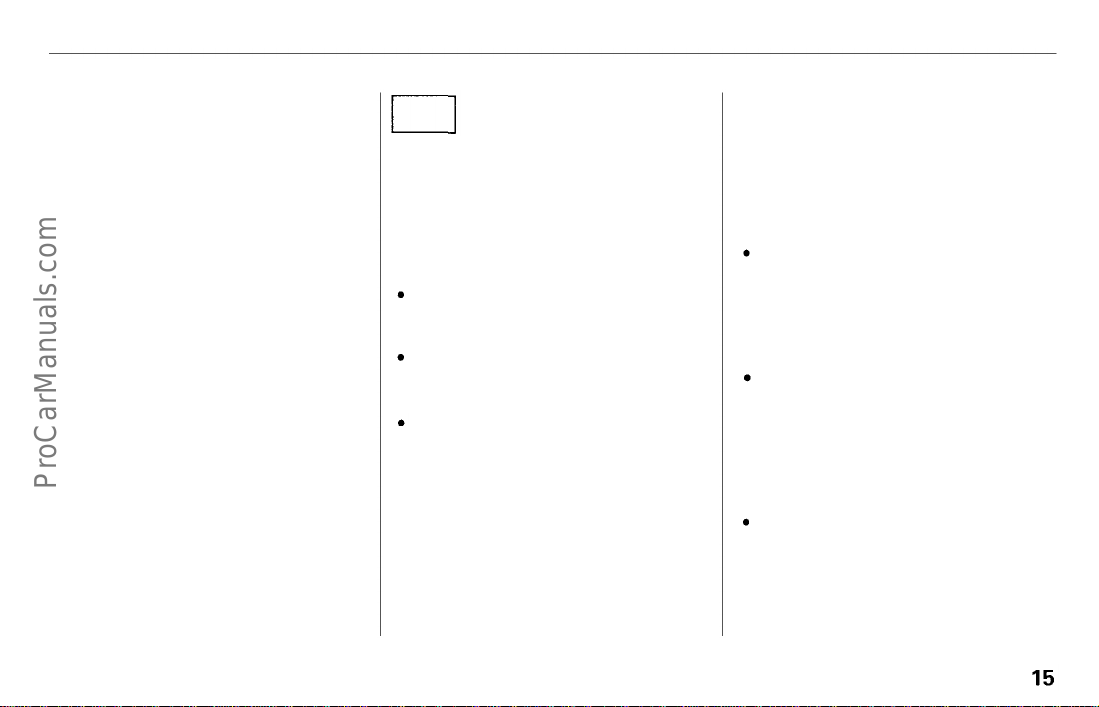
Supplemental Restraint System
The passenger's airbag is stored
near the top of the dashboard, under
a lid marked SRS. Do not place any
objects on top of this lid. If the airbag
inflates, those objects can be
propelled inside the car and possibly
hurt someone.
How the SRS Indicator
Light Works
The purpose of the SRS light on your
instrument panel is to alert you of a
potential problem with your supple-
mental restraint system.
Have the system checked if:
The light does not come on when
you turn the ignition ON (II).
The light stays on after the engine
starts.
The light comes on or flashes
while you are driving.
System Service
Your supplemental restraint system
is virtually maintenance-free. There
are no parts you can safely service.
You must have the system serviced
by an authorized Honda dealer:
If your airbag ever inflates. The
airbag must be replaced. Do not
try to remove or discard the airbag
by yourself. This must be done by
a Honda dealer.
If the SRS indicator light alerts
you of a problem. Have the
supplemental restraint system
checked as soon as possible.
Otherwise, the airbags might not
inflate when you need it.
When the car is ten years old.
Have the dealer inspect the
system. The production date is on
the driver's door jamb for your
convenience.
Driver and Passenger Safety
S R S
ProCarManuals.com

Supplemental Restraint System
System Service Precautions
Do not modify your steering wheel
or any other part of the supplemental
restraint system. Modifications could
make the system ineffective.
Do not tamper with the system's
components or wiring. This could
cause the airbags to inflate inadver-
tently, possibly injuring someone
very seriously.
Tell anyone who works on your car
that you have a supplemental
restraint system. Failure to follow
the procedures and precautions in
the official Honda service manual
could result in personal injury or
damage to the system.
Scrapping an entire car that has an
uninflated airbag can be dangerous.
Get assistance from a Honda dealer
if your car must be scrapped.
If you sell your car, please be sure to
tell the new owner that the car has a
supplemental restraint system. Alert
them to the information and
precautions in this part of the owner's
manual.
Driver and Passenger Safety
ProCarManuals.com
Additional Safety Information
The seat belts and airbags are obvi-
ously important parts of your occu-
pant protection system.
In addition, you should know that
sitting upright, adjusting the head
restraint properly, locking the doors,
and stowing things properly can also
increase your safety and possibly
even save your life.
Seat-back Position
The seat-backs should be in an
upright position for you and your
passengers to get the most protec-
tion from the seat belts.
If you recline a seat-back, you reduce
the protective capability of your seat
belt. The farther a seat-back is
reclined, the greater the risk that
you will slide under the belt in a
severe crash and be very seriously
injured.
For information on how to adjust the
seat-back, see page 54 .
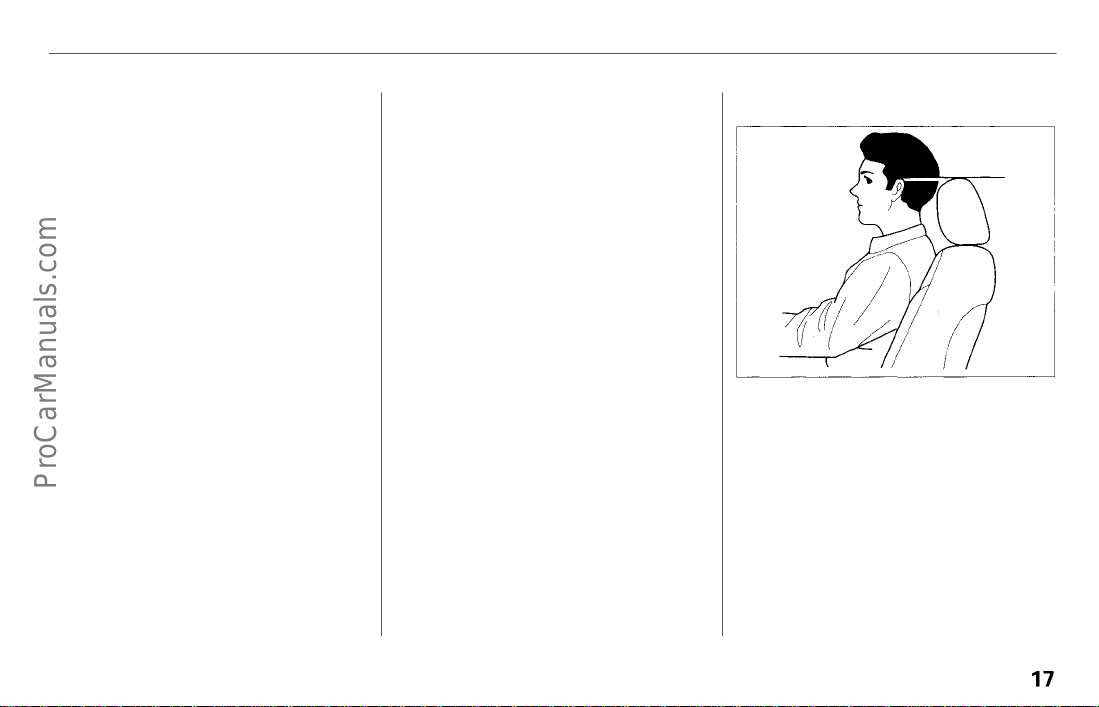
Head Restraint Position
Head restraints can help protect you
from whiplash and other injuries. For
the best protection, adjust the top of
the restraint so it is even with the
tops of your ears, or as high as possi-
ble. For instructions on adjusting the
head restraints, see page 56.
Driver and Passenger Safety
ProCarManuals.com

Additional Safety Information
Door Locks
It is not safe to leave your car doors
unlocked. A passenger, especially a
child, could open a door and acci-
dentally fall out. Also, there is a
greater chance of being thrown out
of the car during a crash when the
doors are not locked.
Storing Cargo Safely
Before you drive, make sure you
first securely store or tie down any
items that could be thrown around
the car and hurt someone, or
interfere with your ability to operate
the controls.
Do not put any items on top of the
rear shelf. They can block your view
and they could be thrown about the
car in a crash.
Be sure to keep compartment doors
closed when the car is moving. If a
passenger hits the door of an open
glove box, for example, he could
injure his knees.
For information on loading cargo,
see page 110.
Driving with Pets
Loose pets can be a hazard while you
are driving. An unrestrained pet can
interfere with your ability to drive
the car. In a crash or sudden stop,
loose pets or cages can be thrown
around inside the car and hurt you or
your passengers. It is also for their
safety that pets should be properly
restrained in your car.
The recommended way to restrain a
medium-sized or larger dog is with a
special traveling harness. This har-
ness can be secured to the rear seat
with a seat belt. Travel harnesses are
available at pet stores.
A small dog, cat, or other small
animal will be safest in a pet carrier
with rigid sides. Choose a style that
allows you to secure it to the car's
seat by routing a seat belt through
the carrier's handle.
For further information, contact your
veterinarian or local animal protec-
tion society.
Driver and Passenger Safety
ProCarManuals.com
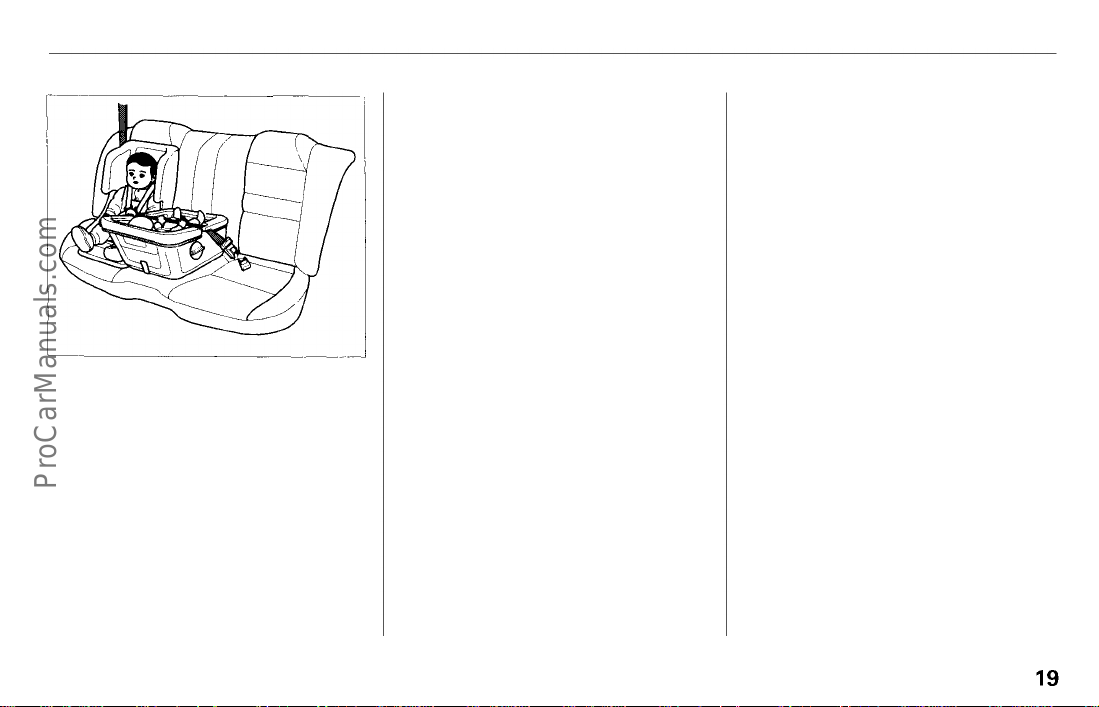
Child Safety
Children depend on adults to protect
them. To help make sure we do,
every state and Canadian province
has laws requiring infants and young
children to be properly restrained
whenever they ride in a car.
Where Should Children Sit?
According to accident statistics,
children of all sizes and ages are
safer when they are properly
restrained in the rear seat rather
than the front seat.
We recommend that, whenever
possible, you secure your child's
infant or toddler seat in the center
position of the rear seat with the lap
belt.
We strongly recommend that you do
not put an infant seat in the front
passenger seat. If the airbag inflates,
it can hit the seat with great force.
The infant seat can be dislodged and
the baby seriously injured.
CONTINUED
Driver and Passenger Safety
An infant or child who is not
properly restrained can be
killed or seriously injured in a
crash.
Be sure any child too small
for seat belts is properly
secured in a child restraint.
ProCarManuals.com

Child Safety
If a toddler seat is used in the front
passenger's seat, the vehicle seat
should be moved as far back as
possible. If the passenger's bag
inflates, it could seriously hurt a
toddler who is not in the proper
position or properly restrained.
We also recommend that any child
who is too large to use an infant or
toddler seat ride in one of the out-
side positions of the rear seat. The
child should then wear the lap/
shoulder belt properly for protection.
Important Safety Reminders
Never hold a baby or child on your
lap when riding in a car. If you are
wearing your seat belt, the violent
forces created during a crash will
tear the child from your arms. The
child could be seriously hurt or killed.
If you are holding a child and not
wearing a seat belt in a crash, you
could crush the child against the car's
interior.
Never put your seat belt over
yourself and a child. During a crash,
the belt could press deep into the
child, causing serious internal
injuries.
Two children should never use the
same seat belt. If they do, they could
be very seriously injured in a crash.
Driver and Passenger Safety
ProCarManuals.com
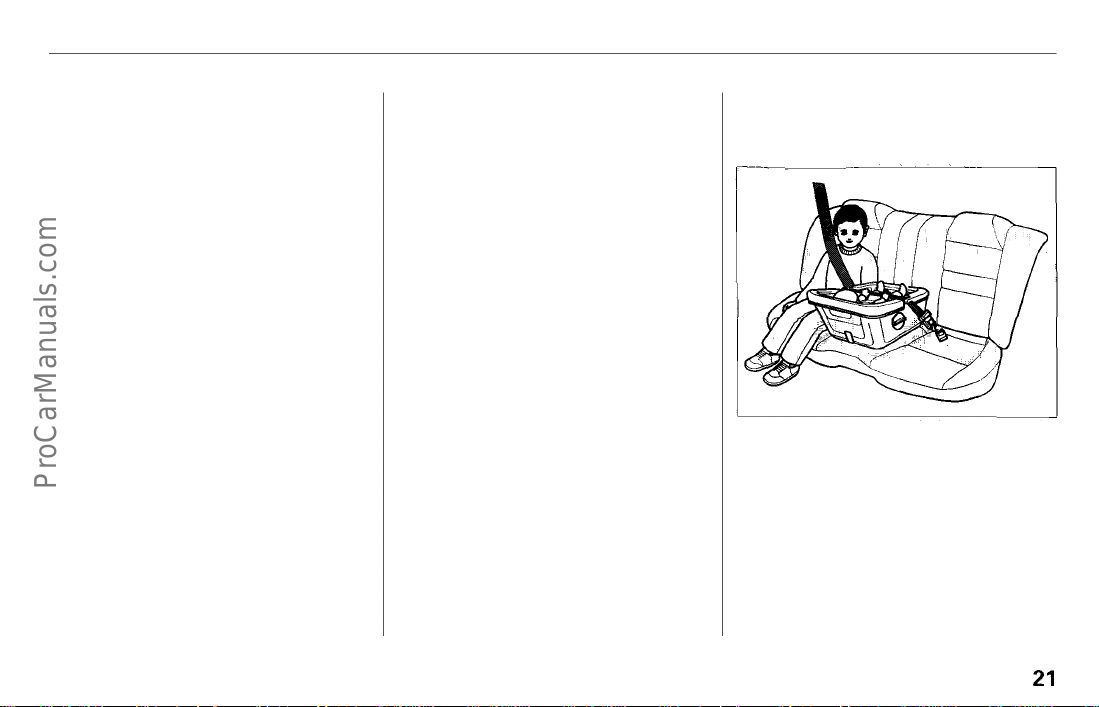
Child Safety
General Guidelines for
Restraining Children Under 18
kg (40 Ibs)
Use an approved child seat. The seat
must meet Federal Motor Vehicle
Safety Standard 213 (FMVSS-213) or
Canadian Motor Vehicle Safety
Standards. Look for the manufac-
turer's statement of compliance on
the box and seat.
Use a seat of the right size. Make sure
the seat fits your child. Check the
seat manufacturer's instructions and
labels for height and weight limits.
Secure the child seat to the car. All
approved child seats are designed to
be secured to the car seat by the lap
belt or the lap belt portion of a lap/
shoulder belt. A child whose seat is
not properly secured to the car can
be endangered in a crash.
To properly route a seat belt through
a child seat, follow the seat maker's
instructions. If you use a lap/
shoulder belt, be sure you install a
locking clip on the belt (see page 23).
Secure the child in the child seats Make
sure the infant or child is firmly
secured to the child seat. Use the
straps provided, and carefully follow
the manufacturer's instructions.
Restraining an Infant Who
Weighs Less Than 9 kg
(20 Ibs)
An infant up to about 9 kg (20 Ibs)
must be restrained in an infant seat
or a convertible seat designed for a
baby. Because infants must ride in a
reclining position, be sure the infant
seat always faces the REAR of the
car as shown.
CONTINUED
Driver and Passenger Safety
ProCarManuals.com
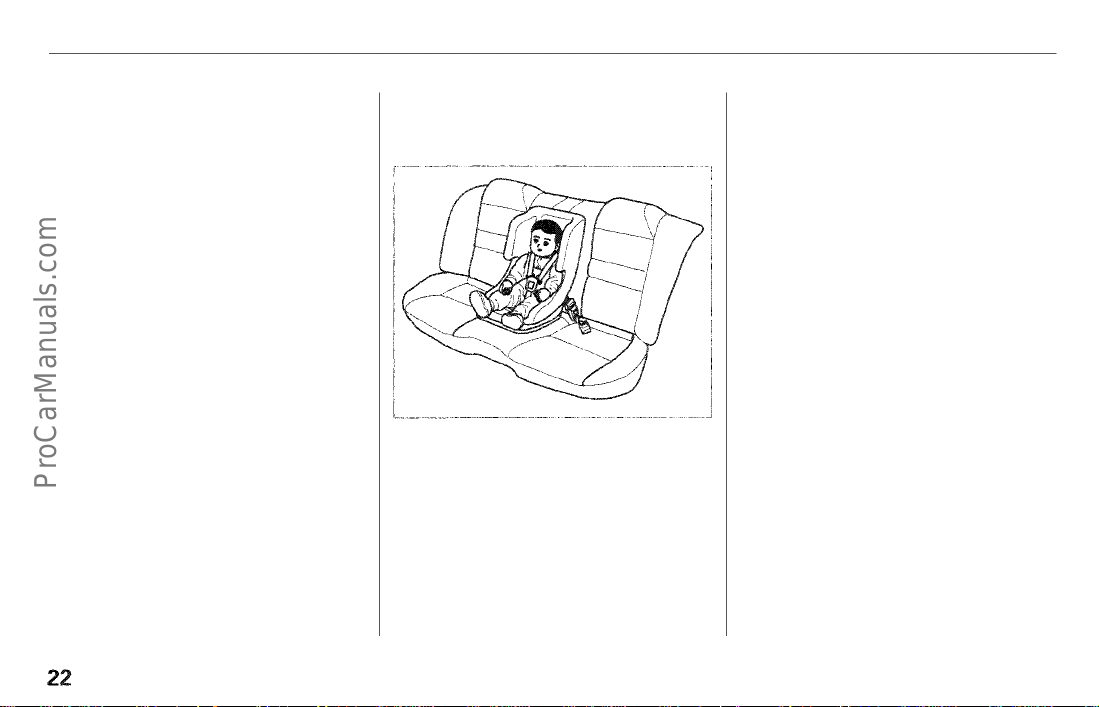
We recommend that, whenever
possible, you put the infant seat in
the center position of the rear seat
and secure it to the car with the lap
belt
If you decide to put an infant seat in
any other seating position, you must
use a locking clip on the car's lap/
shoulder belt (see page 23).
We strongly recommend that you do
not put an infant seat in the front
passenger's seat. In a severe frontal
collision, the inflating airbag can hit-
the infant seat with considerable
force. The infant seat can be
dislodged, causing serious injury to
the infant.
Restrainin
g
a Child Who Weighs
Betwee
n
9 and 18 kg (20 and 40
Ibs
)
Toddler seats are designed for
children who weigh between 9 and
18
kg
(20 and 40 Ibs).
The preferred place to put a toddler
seat is in the center position of the
rear seat. Use the car's lap belt to
secure the seat to the car.
If you decide to put a toddler seat in
any other seating position, you must
use a locking clip on the car's lap/'
shoulder belt (see page 23).
If a toddler seat is used in the front
passenger's seat, the vehicle seat
should be moved as far back as
possible. If the passenger's bag
inflates, it could seriously hurt a
toddler who is not. in the proper
position or properly restrained.
Driver and Passenger Safety
Child Safety
ProCarManuals.com
Child Safety
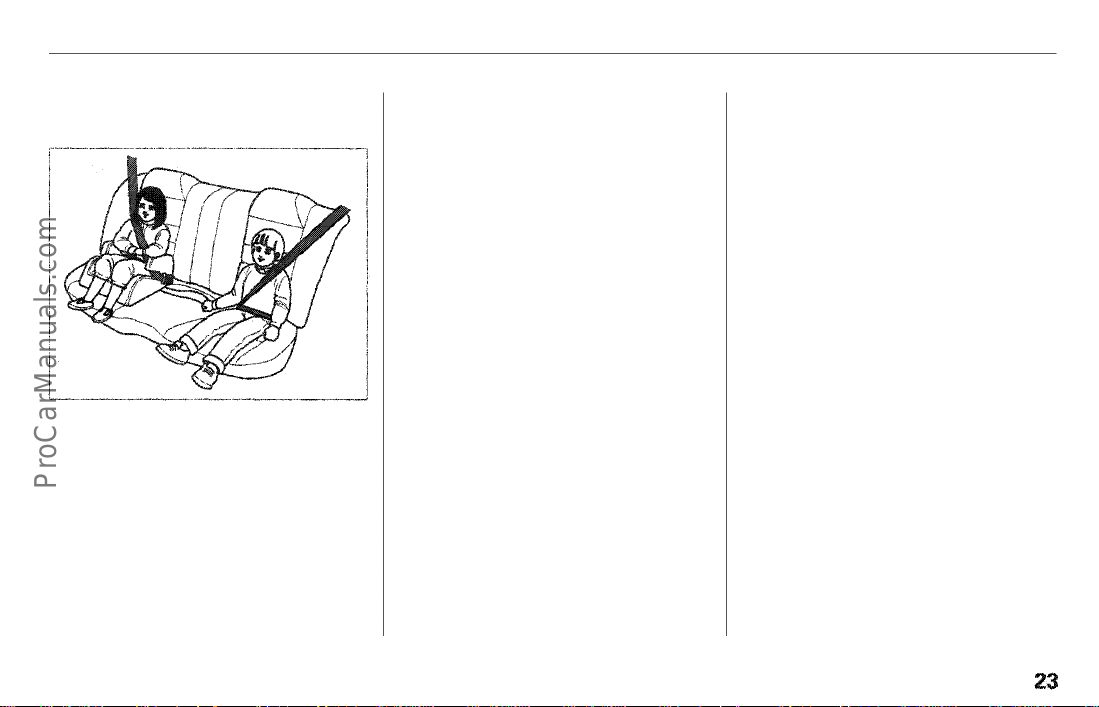
Restraining a Child Who Weighs
Over 18 kg (40 lbs)
We recommend that, whenever
possible, a child who has outgrown a
toddler seat ride In one of the
outside positions of the rear seat and
use a lap/shoulder belt.
Put the seat belt on your child and
check its fit. The shoulder belt
should fit over the collarbone and
across the chest. The lap belt should
sit low on your child's hips, not
across the stomach.
If the shoulder belt crosses the neck,
have your child move toward the
center of the rear seat until the belt
fits properly. If the belt still crosses
the child's neck, you should use a
booster seat.
Several styles of booster seats are
available. We recommend a design
that allows the child to use the car's
lap/shoulder belt.
Whichever style you select, follow
the booster seat manufacturer's
instructions.
Using a Seat Belt Locking Clip
Always use a seat belt locking clip
when you secure a child seat to your
car with a lap/shoulder belt. This
helps prevent the seat from shifting
position or overturning,
A locking clip is usually included
with the child seat. If you need a clip,
contact the seat's manufacturer or a
store that sells child restraints.
CONTINUED
Driver and Passenger Safety
ProCarManuals.com
Child Safety
To install a locking clip, do the
following:
1. Place the child restraint in the
desired position. Route the lap/
shoulder belt through the restraint
according to the seat manufac-
turer's instructions.
2. Insert the latch plate into the
buckle. Pull on the shoulder part
of the belt to make sure there is
no slack in the lap portion.
3. Tightly grasp the belt near the
latch plate. Pinch both parts of the
belt together so they won't slip
through the latch plate. Unbuckle
the seat belt.
4. Install the locking clip as shown.
Position the clip as close as
possible to the latch plate.
5. Insert the latch plate into the
buckle. Push and pull on the child
seat to verify that it is held firmly
in place. If it is not, repeat these
steps until the restraint is secure.
Using Child Restraints with
Tethers
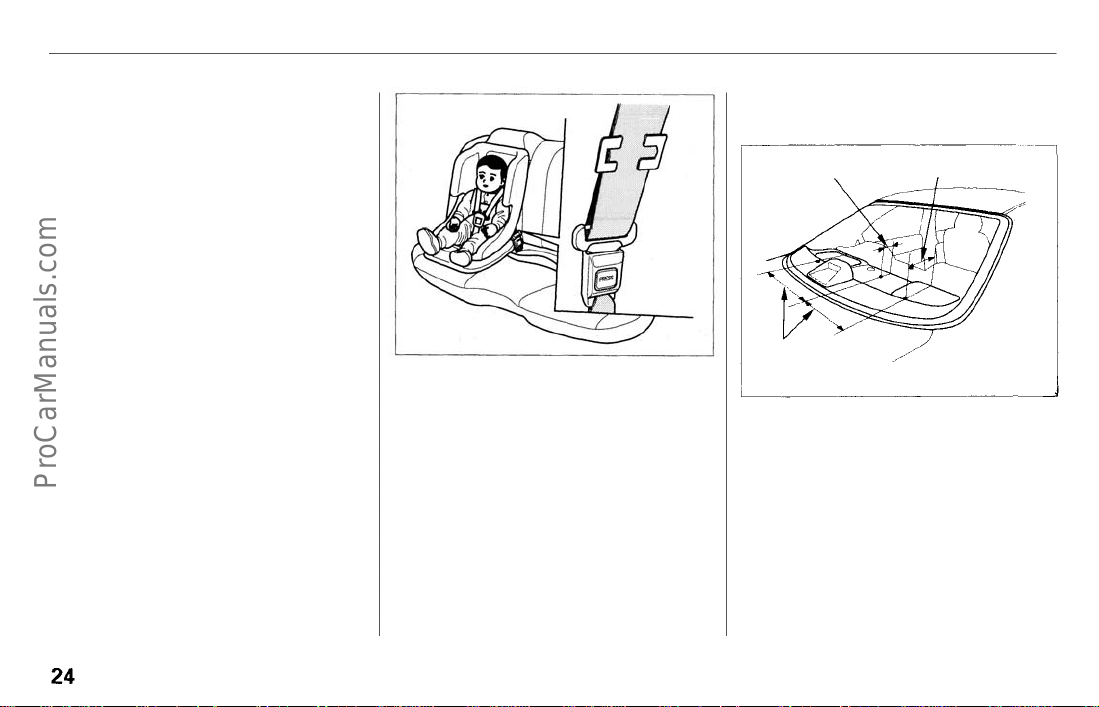
Your Honda has three attachment
points for tether-style child seat.
They are located on the rear shelf.
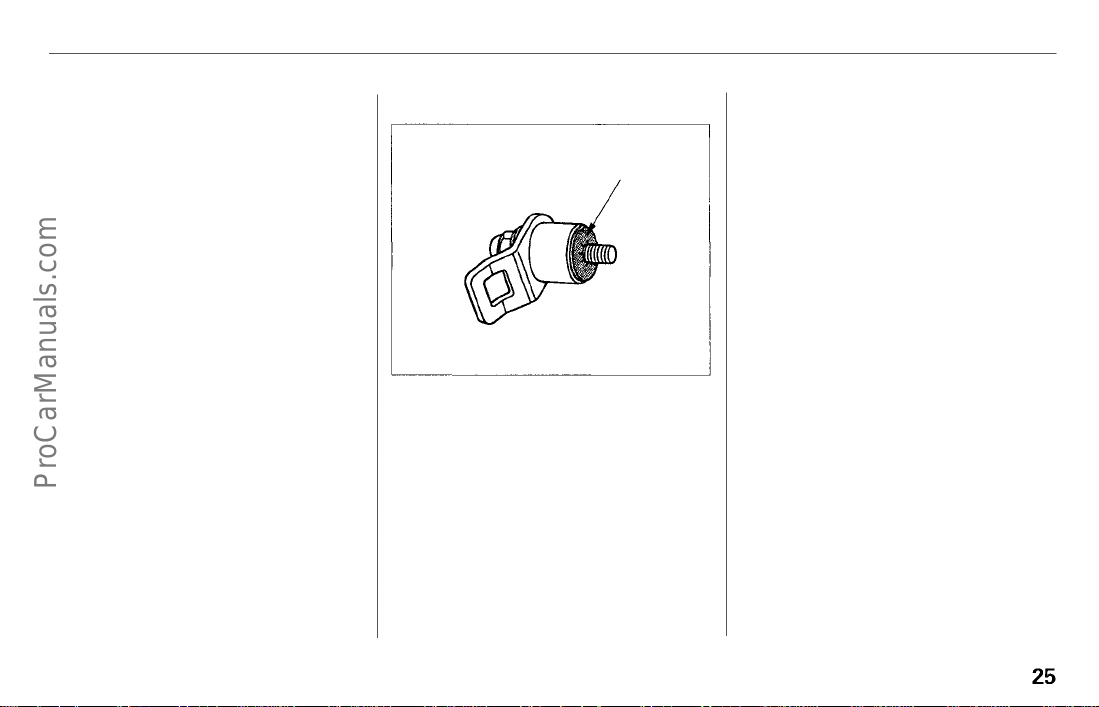
U.S. Models
Use the dimensions in the illustra-
tion to locate either of the outside
attachment points you want to use.
Cut a 22 mm (7/8 inch) diameter
hole in the rear shelf.
Driver and Passenger Safety
340 mm
(13.4 in)
121 mm (4.8 in)
306 mm (12.0 in)
ProCarManuals.com
Child Safety
Canadian Models
Select the attachment point you want
to use and remove the plug with a
small flat-tipped screwdriver or
fingernail file.
Install the tether hardware that came
with the child seat.
Tighten to:
2
2
N.m(2.2 kg-m , 16 Ib-ft)
I f you are not sure how to install the
bracket, have it installed by your
Honda dealer.
If you need an anchor plate and
mounting hardware, you can obtain
them by writing to:
American Honda Motor Co., Inc.
Consumer Affairs
1919 Torrance Blvd.
Torrance, CA 90501-2746
Canadian Cars
The anchor plate and mounting
hardware for a top tether are
supplied with the car. When
installing, make sure the toothed
washer is on the bottom of the bolt.
The supplied anchor plate is
designed only for mounting a child
restraint. Do not use it for any other
purpose.
Storing a Child Seat
When you are not using an infant
seat or other child restraint, either
remove it or make sure it is properly
secured so it cannot be thrown
around the car during a crash.
Driver and Passenger Safety
TOOTHED WASHER
ProCarManuals.com

Alcohol and Drugs
Driving a car requires your full at-
tention and alertness. Traffic condi-
tions change rapidly. You must be
able to react just as rapidly. Alcohol
or drugs directly affect your alert-
ness and ability to react. Even pre-
scription and non-prescription medi-
cines can have this effect.
There are laws that deal with
drunken driving. These laws define
how much alcohol it takes in your
system to be legally "drunk." How-
ever, your judgment and reaction
time get worse with every drink —
even the first one.
The safest thing you can do is never
drink and drive. This can be done if
you plan ahead. If you know you are
going to be drinking, make plans to
ride with a friend who will not be
drinking.
What if you find that you've been
drinking and cannot get a ride from a
friend? Find alternative transpor-
tation. Call a taxi. Take a bus. Many
communities have transportation
services devoted to shuttling people
who have been drinking.
If you have no choice but to drive,
stop drinking and give yourself lots
of time to sober up. Time is the only
thing that can make you sober.
Things like coffee or a cold shower
don't speed up the process.
If you see friends trying to get
behind the wheel after drinking, stop
them. Drive them yourself or
arrange other transportation. If you
think you are interfering, remember
that your interference will keep them
from sharing the road with you.
Driver and Passenger Safety
ProCarManuals.com
Carbon Monoxide Hazard
Your car's exhaust contains carbon
monoxide gas. You should have no
problem with carbon monoxide
entering the car in normal driving if
you maintain your car properly.
Have the exhaust system inspected
for leaks whenever:
The car is raised for an oil change.
You notice a change in the sound
of the exhaust.
The car was in an accident that
may have damaged the underside.
High levels of carbon monoxide can
collect rapidly in enclosed areas,
such as a garage. Do not run the
engine with the garage door closed.
Even with the door open, run the
engine only long enough to move the
car out of the garage.
With the trunk lid open, air flow can
pull exhaust gas into your car's
interior and create a hazardous
condition. If you must drive with the
trunk lid open, open all the windows
and set the heating and cooling
system as follows.
If you must sit in your parked car,
even in an unconfined area, with the
engine running, adjust the heating
and cooling system as follows:
1. Push the button.
2. Select the mode.
3. Turn the fan on high speed.
4. Set the temperature control to a
comfortable setting.
Driver and Passenger Safety
Carbon monoxide gas is toxic.
Breathing it can cause uncon-
sciousness and can even kill
you.
Avoid any enclosed areas or
activities that expose you to
carbon monoxide.
ProCarManuals.com
Safety Labels
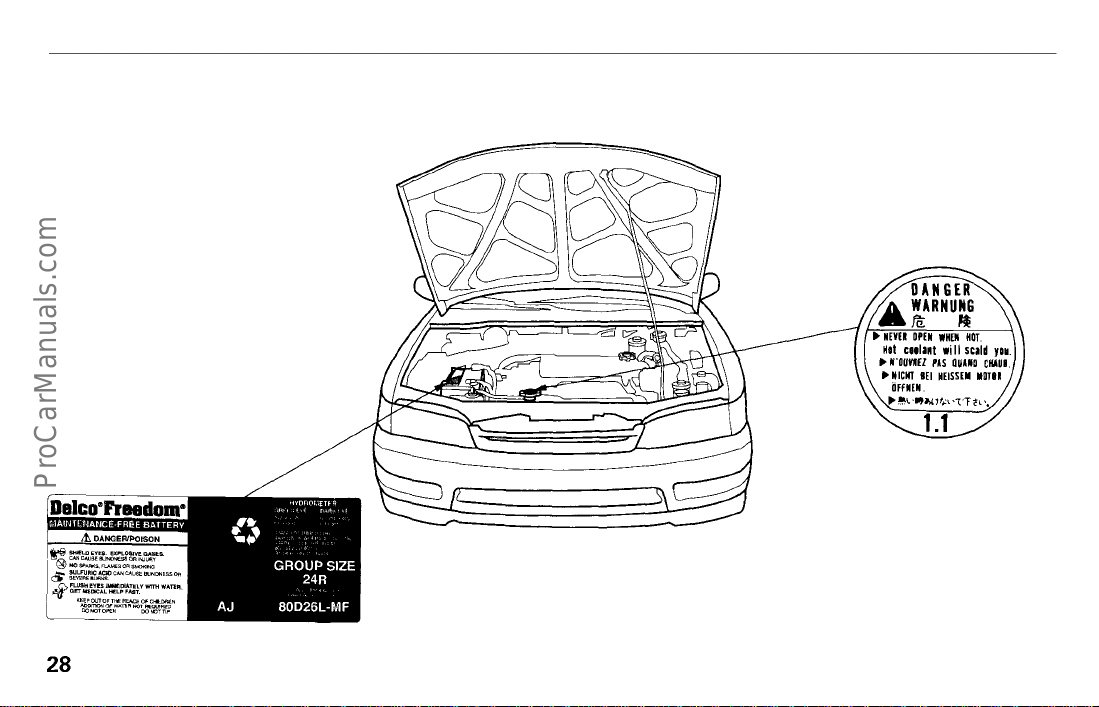
These labels are in the locations
shown. They warn you of potential
hazards that could cause serious
injury. Read these labels carefully
and don't remove them.
If a label comes off or becomes hard
to read, contact your Honda dealer
for a replacement.
Driver and Passenger Safety
RADIATOR CAP
BATTERY
ProCarManuals.com

Instruments and Controls
This section gives information about
the controls and displays that
contribute to the daily operation of
your Honda. All the essential
controls are within easy reach.
Control Locations............................ 32
Indicator Lights................................ 33
Gauges.............................................. 37
Speedometer................................ 37
Tachometer.................................. 37
Odometer...................................... 37
Trip Meter.................................... 37
Temperature Gauge.................... 38
Fuel Gauge................................... 38
Maintenance Required
Indicator.................................... 38
Controls Near the Steering
Wheel...................................... 39
Headlights.................................... 40
Daytime Running Lights............. 40
Instrument Panel Brightness..... 41
Turn Signals................................. 41
Windshield Wipers...................... 42
Windshield Washers................... 43
Hazard Warning........................... 43
Rear Window Defogger.............. 43
Steering Wheel Adjustment....... 44
Steering Wheel Controls ................ 46
Cruise Control.............................. 46
Horn.............................................. 49
Keys and Locks................................ 49
Keys............................................. 49
Ignition Switch............................. 50
Door Locks................................... 51
Power Door Locks....................... 51
Trunk........................................... 52
Glove Box..................................... 53
Seat Adjustments............................. 54
Front Seat Adjustments.............. 54
Driver's Seat Power Height
Adjustment............................... 55
Driver's Lumbar Support............ 55
Rear Seat Access......................... 55
Head Restraints........................... 56
Folding Rear Seat............................ 57
Power Windows............................... 58
Moonroof.......................................... 59
Sunshade....................................... 60
Mirrors.............................................. 60
Manual Door Mirrors.................. 61
Adjusting the Power Mirrors..... 61
Parking Brake.................................. 62
Digital Clock..................................... 63
Beverage Holder.............................. 64
Console Compartment.................... 64
Coin Box........................................... 65
Vanity Mirror................................... 65
Cigarette Lighter............................. 66
Ashtrays............................................ 66
Interior Lights.................................. 67
Instruments and Controls
ProCarManuals.com
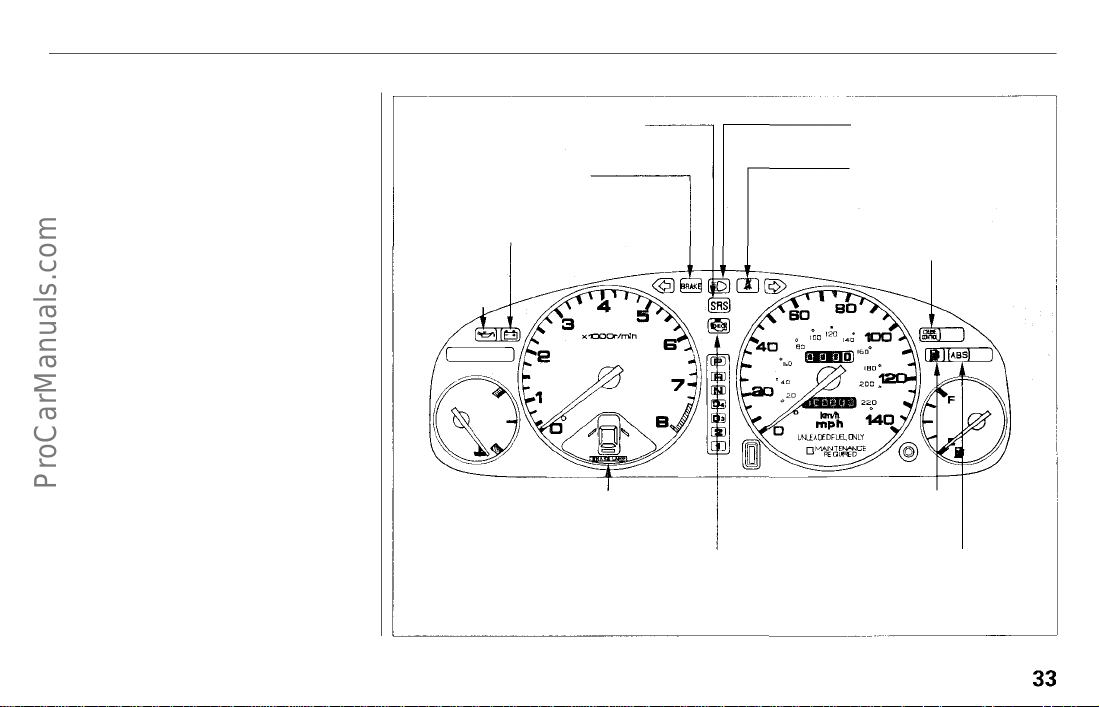
Indicator Lights
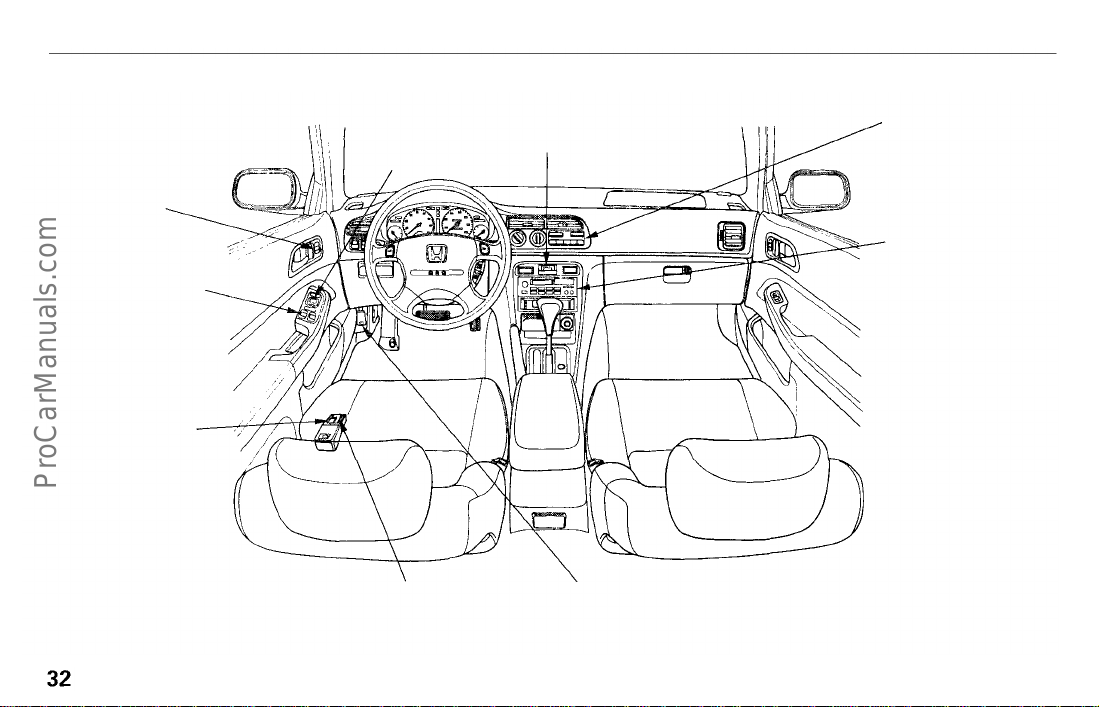
The instrument panel has many
indicators to give you important
information about your car.
Lamp Check
Many of the indicator lights come on
when you turn the ignition switch
ON (II), allowing you to see that they
are working. The instrument panel
should look like the illustration. If an
indicator does not light during this
test, it cannot alert you if that system
develops a problem. Have the dealer
check your car for burned-out bulbs
or other problems.
* The U.S. instrument panel is
shown. Differences for the Canadian
model are noted in the text.
Instruments and Controls
SUPPLEMENTAL RESTRAINT
SYSTEM INDICATOR
PARKING BRAKE AND
BRAKE SYSTEM INDICATOR*
CHARGING SYSTEM INDICATOR
DOOR AND BRAKE
LAMP MONITOR
LOW OIL
PRESSURE
INDICATOR
LOW FUEL
INDICATOR
MALFUNCTION INDICATOR LAMP/
CHECK ENGINE LIGHT*
ANTI-LOCK BRAKE
SYSTEM INDICATOR*
CRUISE CONTROL
INDICATOR
SEAT BELT REMINDER
LIGHT
HIGH BEAM INDICATOR
ProCarManuals.com
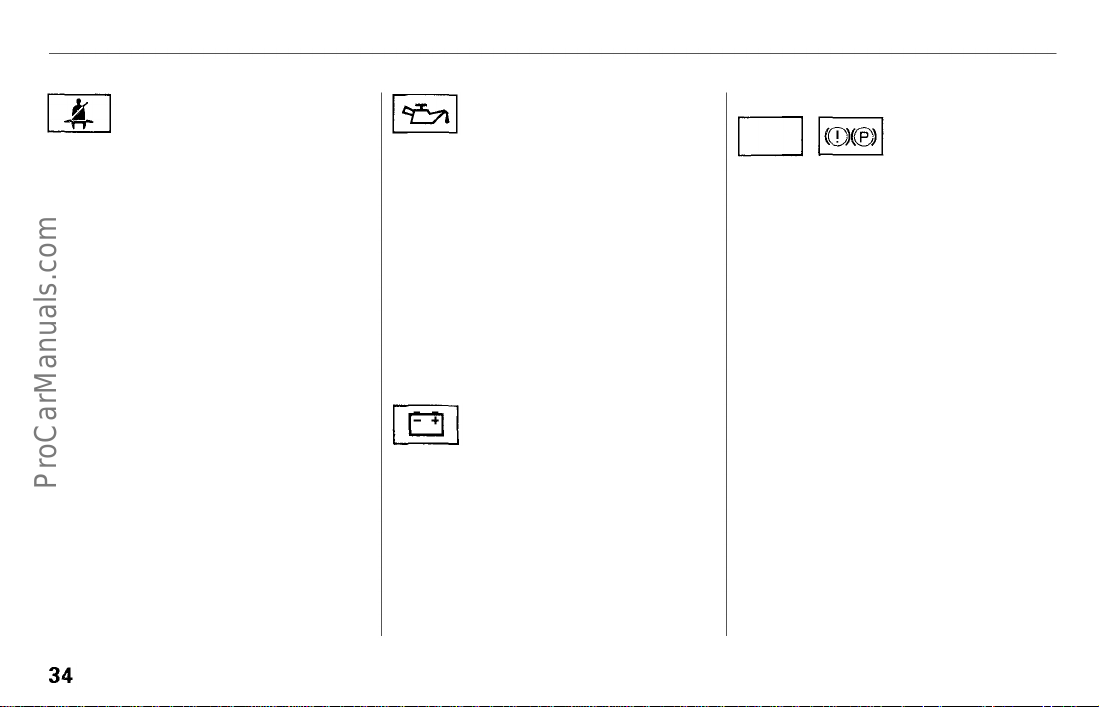
Indicator Lights
Seat Belt Reminder Light
This indicator lights when you turn
the ignition ON (II). It is a reminder
to you and your passengers to
protect yourselves by fastening the
seat belts. A beeper also sounds if
you have not fastened your seat belt.
If you do not fasten your seat belt,
the beeper will stop after a few
seconds but the light stays on until
you do. Both the light and the beeper
stay off if you fasten your seat belt
before turning on the ignition.
Low Oil Pressure
Indicator
This indicator lights when the oil
pressure in the engine drops low
enough to cause damage. It should
light when the ignition is ON (II) and
go out after the engine starts. If this
light comes on when the engine is
running, there is a possibility of
serious engine damage. Safely pull to
the side of the road and shut off the
engine as soon as you can. Turn to
page 200 for instructions and
precautions on checking the engine.
Charging System
Indicator
This light indicates the battery is not
being charged. It should come on
when the ignition is ON (II), and go
out after the engine starts. If this
light comes on while driving, the
battery is not being charged. Turn to
page 201 for information about what
to do.
Instruments and Controls
BRAKE
US
System
Indicator
This light has two functions:
1. It lights as a reminder that you
have set the parking brake.
Driving with the parking brake set
can damage the brakes and tires,
and cause the Anti-lock brake
system to turn off (see page 122 ).
2. It can indicate the brake fluid level
is low if it remains lit after you
release the parking brake or
comes on while driving. This is
normally due to worn brake pads.
Have your dealer check the
braking system for worn pads or
fluid leaks.
Parking Brake
and Brake
Canada
ProCarManuals.com
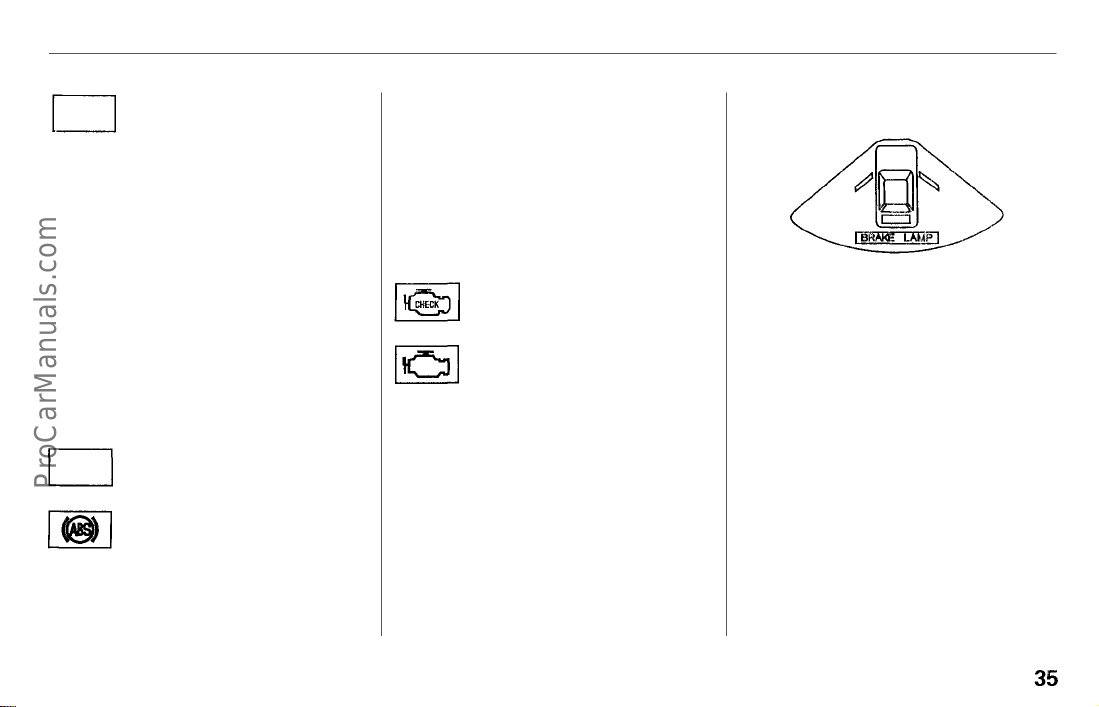
Indicator Lights
Supplemental Restraint
System Indicator
The SRS light normally comes on for
a few seconds when you turn the
ignition ON (II). If it doesn't, or it
stays on after the engine starts,
something is wrong with the
Supplemental Restraint System. It
may also flash on and off to indicate
a problem.
If you see any of these indications,
the airbag may not work when
needed in an accident. Take the car
to your dealer promptly for diagnosis
and service.
Anti-lock Brake System
(ABS) Indicator
Only on cars equipped with ABS (see
page 122)
This light normally comes on when
you turn the ignition ON (II) and
goes off after the engine starts. If it
comes on at any other time, there is
a problem in the ABS. If this happens,
take the car to your dealer to have it
checked. With the light on, your car
still has normal braking ability but no
anti-lock.
Malfunction Indicator
Lamp
Check Engine Light
This light comes on for a few
seconds when you turn the ignition
switch ON (II). If it comes on at any
other time, it indicates one of the
engine's emission control systems
may have a problem. Turn to page
202 for information about what to do.
Door and Brake Lamp Monitor
The appropriate light comes on in
this display if the trunk or either
door is not closed tightly. If a brake
light does not work, the BRAKE
LAMP indicator comes on when you
push the brake pedal with the
ignition switch ON (II).
A burned out brake light is a hazard
when drivers behind you cannot tell
you are braking. Have your brake
lights repaired right away.
All the lights in the monitor display
come on for a few seconds when you
turn the ignition switch ON (II).
Instruments and Controls
S R S
US
A B S
Canada
US
Canada
ProCarManuals.com
Indicator Lights
Turn Signal and
Hazard Warning
Indicators
The left or right turn signal light
blinks when you signal a lane change
or turn. If the light does not blink or
blinks rapidly, it usually means one
of the turn signal bulbs is burned out
(see page 170 ). Replace the bulb as
soon as possible, since other drivers
cannot see that you are signalling.
When you turn on the Hazard
Warning switch, both turn signal
lights blink. All turn signals on the
outside of the car should flash.
"Daytime Running
Lights" Indicator
Canadian models only
This indicator lights when you turn
the ignition to ON (II) with the
headlight switch off and the parking
brake set. It should go off if you turn
on the headlights or release the
parking brake. If it comes on at any
other time, it means there is a
problem with the DRL. There may
also be a problem with the high
beam headlights.
High Beam Indicator
This light comes on with the high
beam headlights. See page 40 for
information on the headlight
controls.
Cruise Control Indicator
Only on cars equipped with Cruise
Control System
This lights when you set the cruise
control. See page 46 for information
on operating the cruise control.
Low Fuel Indicator
This light comes on as a reminder
that you must refuel soon.
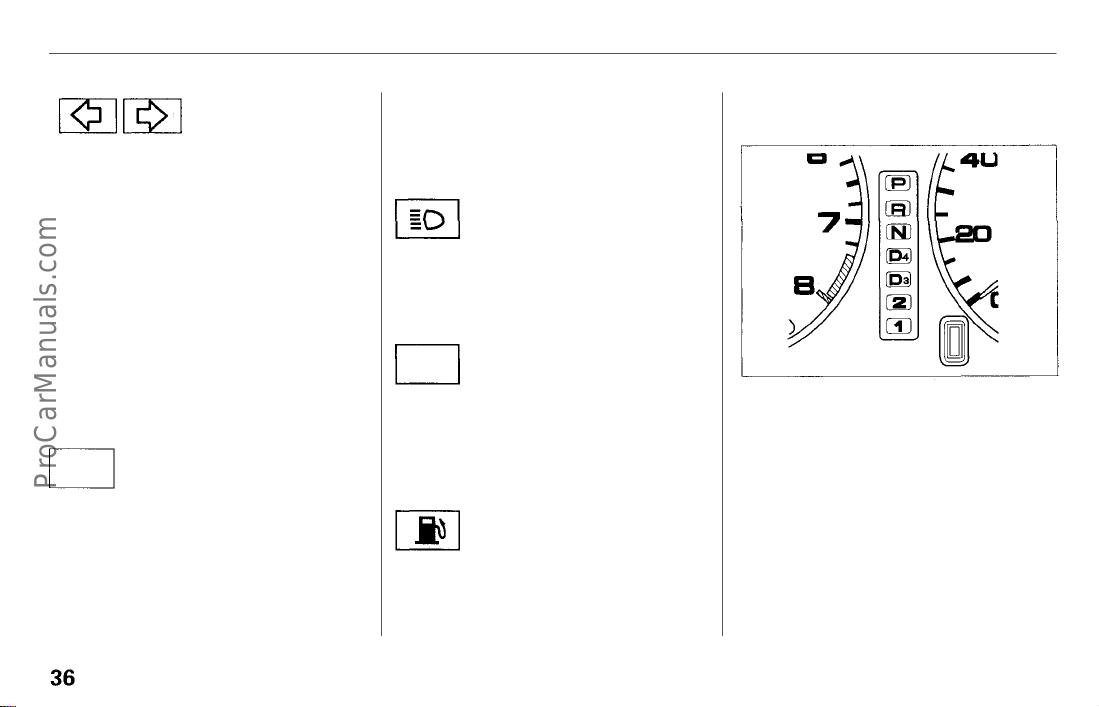
Shift Lever Position Indicator
(Automatic Transmission only)
This indicator between the tacho-
meter and speedometer shows which
shift position the shift lever is in.
The "D4" indicator comes on for a
few seconds when you turn the
ignition switch ON (II). If it flashes
while driving (in any shift position),
it indicates a possible problem in the
transmission. Avoid rapid acceler-
ation and have the transmission
checked by an authorized Honda
dealer as soon as possible.
Instruments and Controls
D R L
CRUISE
CONTROL
ProCarManuals.com
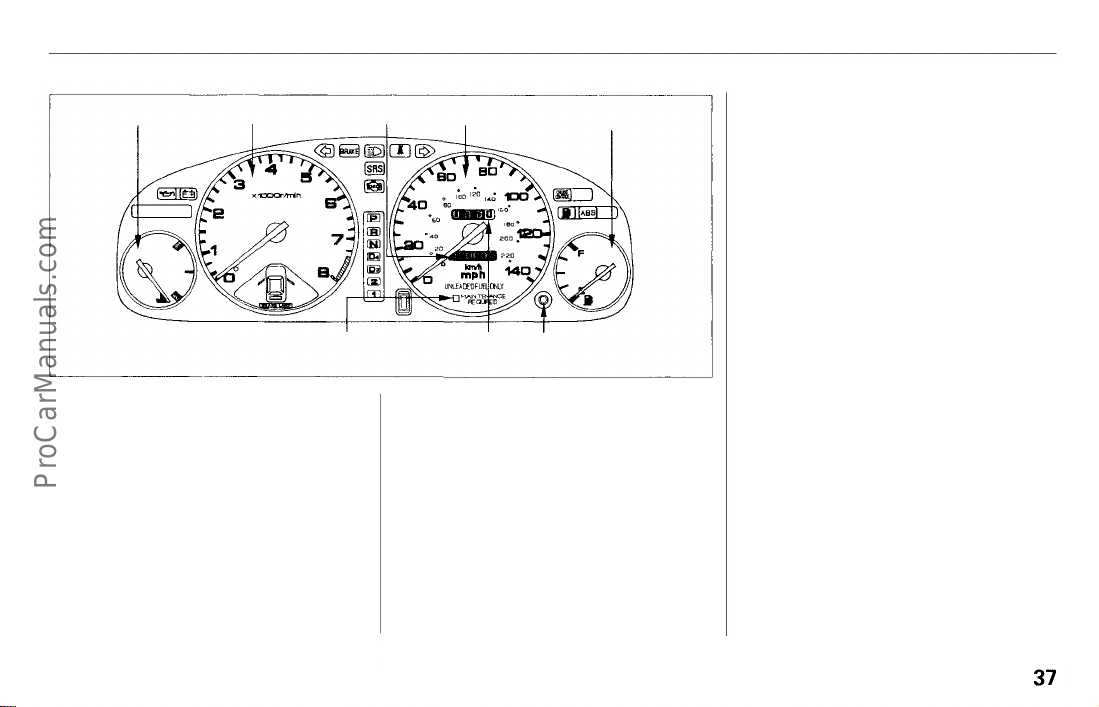
Gauges
Speedometer
U.S. Models
This shows your speed in miles per
hour (mph). The smaller inner
numbers are the speed in kilometers
per hour (km/h).
Canadian Models
This shows your speed in kilometers
per hour (km/h). The smaller inner
numbers are the speed in miles per
hour (mph).
Tachometer
The tachometer shows the engine
speed in revolutions per minute
(rpm). To protect the engine from
damage, never drive with the
tachometer needle in the red zone.
Odometer
The odometer shows the total dis-
tance your car has been driven. It
measures miles in U.S. models and
kilometers in Canadian models.
It is illegal under federal law (in the
U.S.) and provincial regulations (in
Canada) to disconnect, reset, or alter
the odometer with the intent to
change the number of miles or
kilometers indicated.
Trip Meter
This meter shows the number of
miles (U.S.) or kilometers (Canada)
driven since you last reset it. To
reset it, push the trip meter reset
button.
Instruments and Controls
TEMPERATURE
GAUGE
TACHOMETER
ODOMETER
SPEEDOMETER
FUEL GAUGE
MAINTENANCE
REQUIRED INDICATOR
TRIP METER TRIP METER
RESET BUTTON
ProCarManuals.com
Gauges
Temperature Gauge
This shows the temperature of the
engine's coolant. During normal
operation, the pointer should rise
from the bottom white mark to about
the middle of the gauge. In severe
driving conditions, such as very hot
weather or a long period of uphill
driving, the pointer may rise to the
upper white mark. If it reaches the
red (Hot) mark, pull safely to the
side of the road. Turn to page 198 for
instructions and precautions on
checking the engine's cooling
system.
Fuel Gauge
This shows how much fuel you have.
It is most accurate when the car is on
level ground. It may show slightly
more or less than the actual amount
when you are driving on curvy or
hilly roads.
The gauge stays at the same fuel
level reading after you turn off the
ignition. When you add fuel, the
gauge slowly changes to the new
reading after you turn the ignition
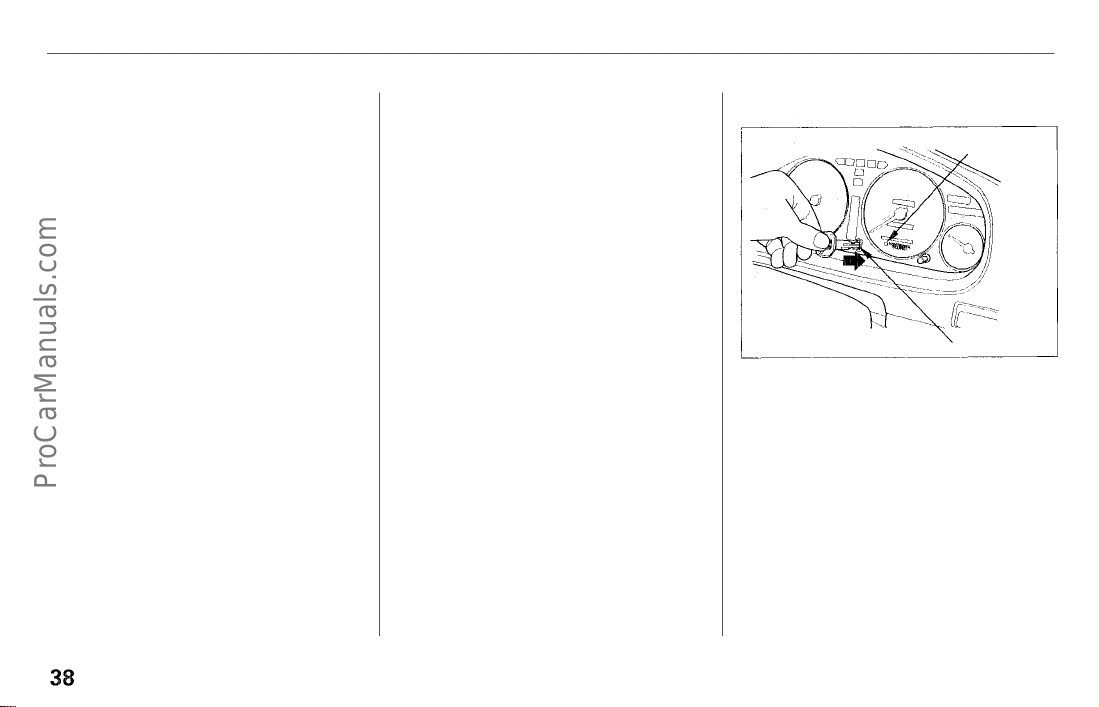
back ON (II). The indicator reminds you when it is
time for scheduled maintenance.
When it nears 12,000 km (7,500
miles) since the last maintenance,
the indicator will turn yellow. If you
exceed 12,000 km (7,500 miles), the
indicator will turn red. Your dealer
will reset the indicator when he
performs the scheduled maintenance.
If someone else performs the
maintenance, reset the indicator by
inserting your key in the slot below
the indicator.
Instruments and Controls
Maintenance Required Indicator
INDICATOR
SLOT
ProCarManuals.com
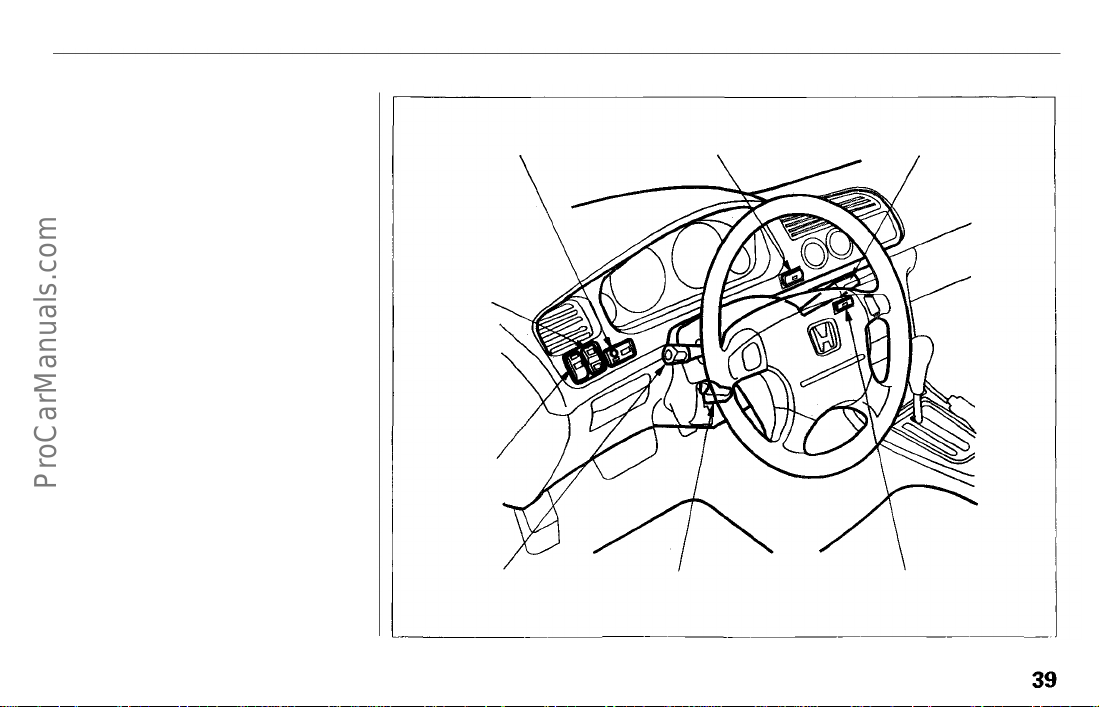
Controls Near the Steering Wheel
The two levers on the steering
column contain controls for driving
features you use most often. The left
lever controls the turn signals,
headlights, and high beams. The
right lever controls the windshield
wipers.
The rear window defogger switch is
on the dashboard to the right of the
steering column.
The controls under the left air vent
are for the moonroof, cruise control
and instrument panel brightness.
The lever on the underside of the
steering column allows you to tilt the
steering wheel.
Instruments and Controls
INSTRUMENT PANEL
BRIGHTNESS
REAR WINDOW
DEFOGGER
WINDSHIELD
WIPERS/WASHERS
MOONROOF
CRUISE
CONTROL
TILT ADJUSTMENT
HEADLIGHTS/
TURN SIGNALS
HAZARD WARNING
ProCarManuals.com
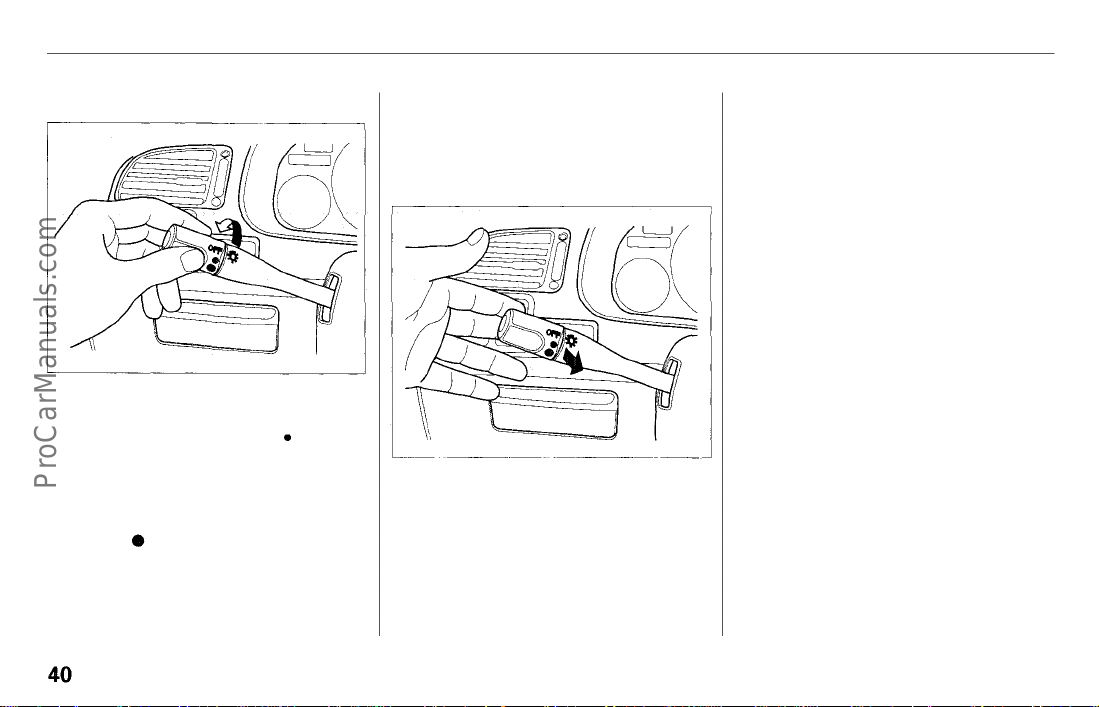
Controls Near the Steering Wheel
Headlights
The rotating switch on the left lever
controls the lights. Turning this
switch to the first position " " turns
on the parking lights, tail lights,
instrument panel lights, side-marker
lights, and rear license plate lights.
Turning the switch to the second
position " " turns on the headlights.
If you leave the lights on with the
ignition switch in ACCESSORY (I)
or LOCK (0), you will hear a
reminder chime when you open the
driver's door.
To change between low beams and
high beams, pull back on the turn
signal lever until you hear a click,
then let go. The blue high beam
indicator will light (see page 36).
To flash the high beams, pull back
and hold the turn signal lever.
Release the lever and the high
beams will go off.
The high beams will stay on for as
long as you hold the lever, no matter
what position the headlight switch is
in.
Daytime Running Lights
(Canadian Models)
With the headlight switch off, the
high beam headlights come on with
reduced brightness when you turn
the ignition switch to ON (II) and
release the parking brake. They
remain on until you turn the ignition
off, even if you set the parking brake.
The headlights revert to normal
operation when you turn them on
with the switch.
Instruments and Controls
ProCarManuals.com
Controls Near the Steering Wheel
Instrument Panel Brightness
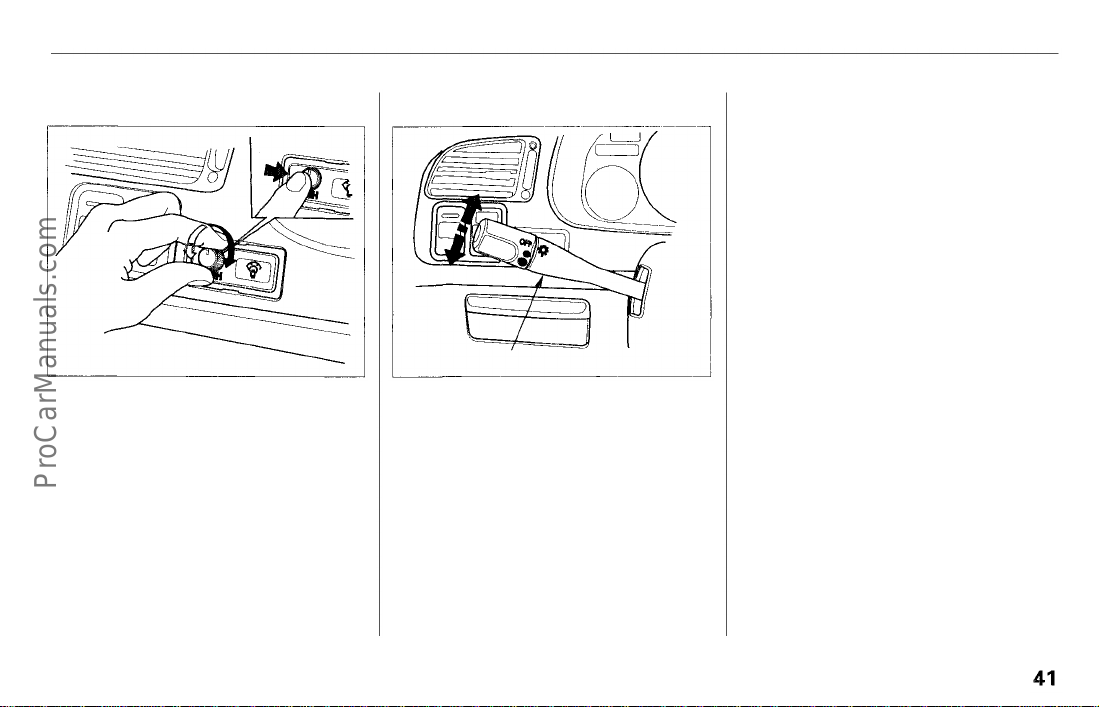
The knob on the dashboard to the
left of the instrument panel controls
the brightness of the instrument
panel lights. Push the knob to get it
to pop out. Turn the knob to adjust
the brightness.
Turn Signals
Signal a turn or lane change with this
lever. Push down on the lever to
signal a left turn, and up to signal a
right turn. If you push it up or clown
all the way, the turn signal continues
to blink even when you release the
lever. It shuts off automatically as
you complete the turn.
To signal a lane change, push lightly
on the turn signal lever in the proper
direction and hold it. The lever will
return to the center position as soon
as you release it.
Instruments and Controls
TURN SIGNAL LEVER
ProCarManuals.com
Controls Near the Steering Wheel
Windshield Wipers
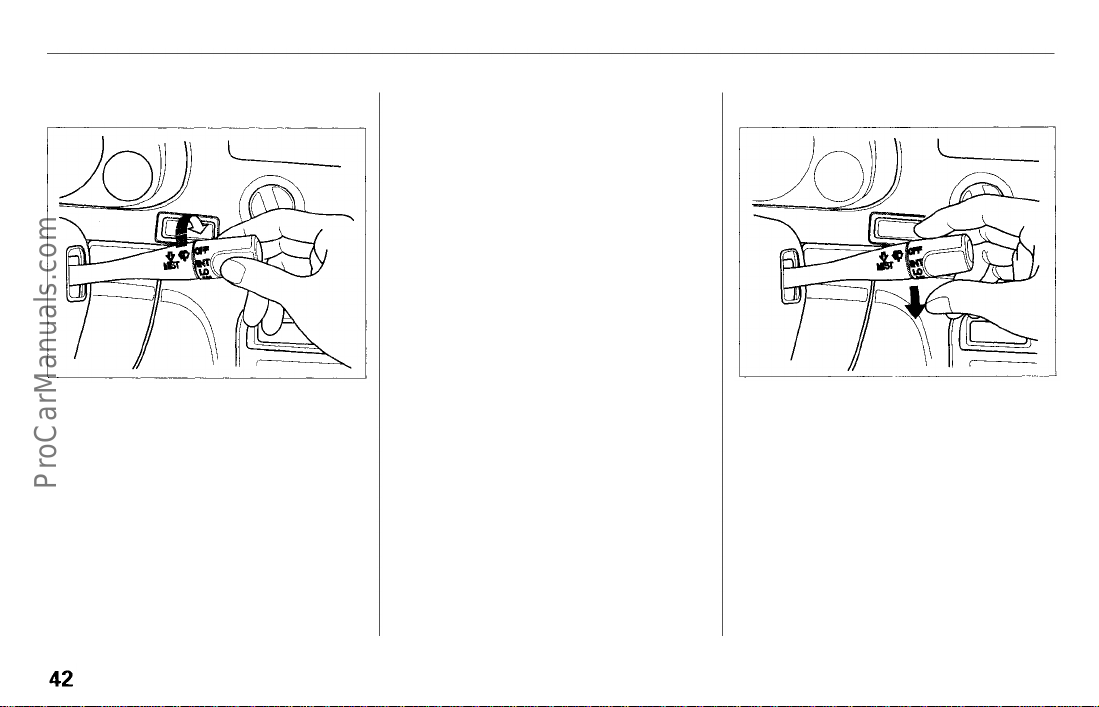
The right lever controls the wind-
shield wipers and washers. The
rotary switch at the end of the lever
has three positions:
INT — intermittent
LO—low speed
HI — high speed
In intermittent, the wipers operate
every few seconds. In low speed and
high speed, the wipers run continu-
ously.
To operate the wipers in mist mode,
push the control lever down. The
wipers run at high speed until you
release the lever. This gives you a
quick way to clear the windshield.
Instruments and Controls
ProCarManuals.com
Controls Near the Steering Wheel
Windshield Washers
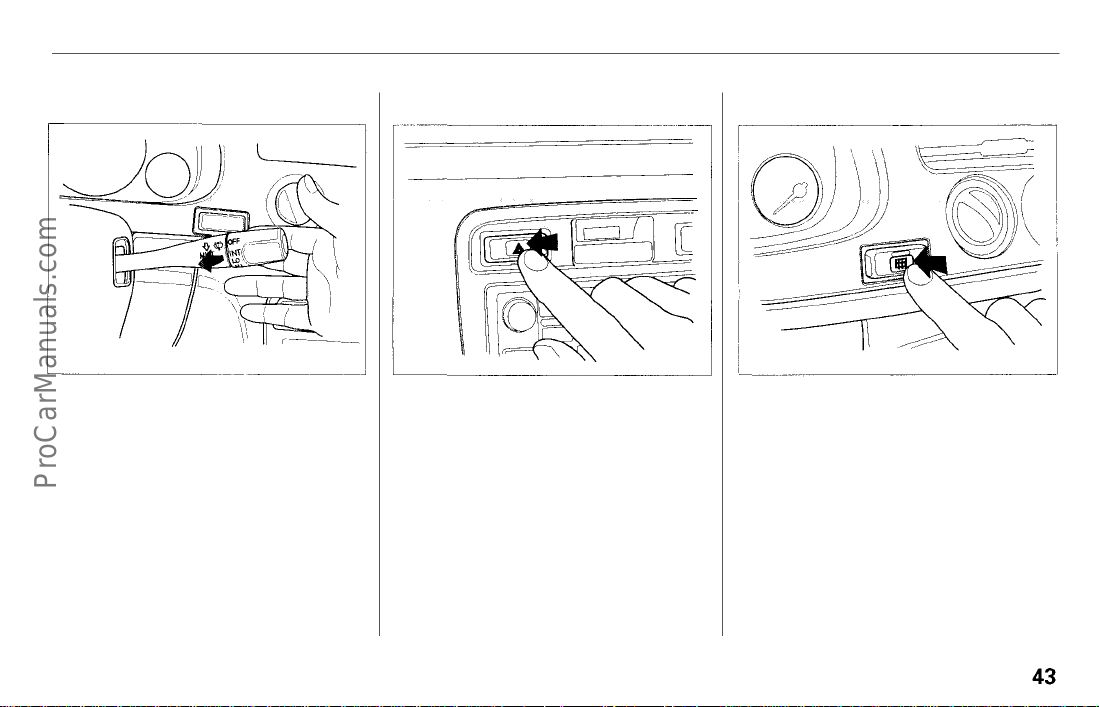
To clean the windshield, pull back on
the wiper control lever. The washers
spray until you release the lever. The
wipers run at low speed while you're
pulling the lever, then complete one
more sweep of the windshield after
you release it.
Hazard Warning
Push the red button to the left of the
clock to turn on the hazard warning
lights (four-way flashers). This
causes all four outside turn signals
and both indicators in the instrument
panel to flash. Use the hazard
warning lights if you need to park in
a dangerous area near heavy traffic,
or if your car is disabled.
Rear Window Defogger
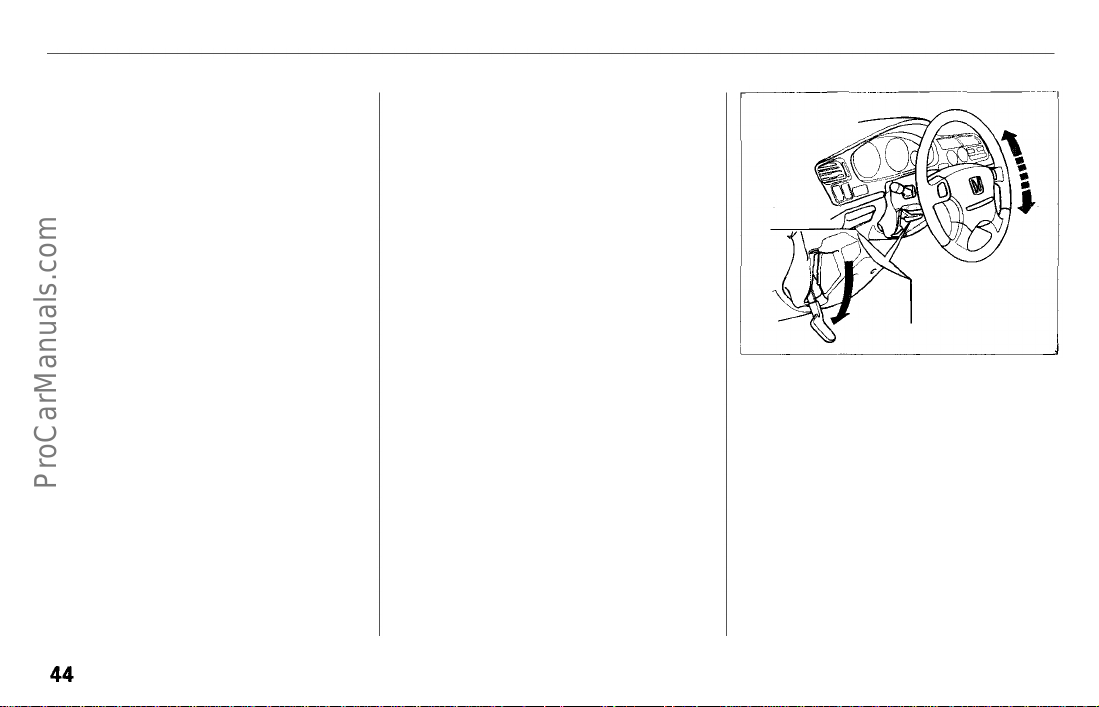
The rear window defogger will clear
fog, frost, and thin ice from the
window. Push the defogger button to
turn it on and off. The light in the
button lights to show the defogger is
on. If you do not turn it off, the
defogger will shut itself off after
about 25 minutes. It also shuts off
when you turn off the ignition. You
have to turn it on again when you
restart the car.
Instruments and Controls
CONTINUED
ProCarManuals.com
Controls Near the Steering Wheel
Make sure the rear window is clear
and you have good visibility before
starting to drive.
The defogger wires on the inside of
the rear window can be accidentally
damaged. When cleaning the glass,
always wipe side to side.
Steering Wheel Adjustment
You can adjust the steering wheel
height to suit your preference. Do
this before you begin driving.
1. Adjust the seat so you are a
comfortable distance from the
pedals and can operate them
safely.
2. The lever to tilt the steering wheel
is under the steering column to
the left. Push this lever all the way
down.
Instruments and Controls
Adjusting the steering wheel
position while driving may
cause you to lose control of
the car and be seriously
injured in a crash.
Adjust the steering wheel
only when the car is stopped.
ProCarManuals.com

Controls Near the Steering Wheel
Instruments and Controls
3. Move the steering wheel up or
down to the desired position.
Position the wheel so you can see
all the instrument panel gauges
and warning lights. Push the lever
up to lock the steering wheel in
that position.
4. Make sure you have securely
locked the steering wheel in place
by trying to move it up and down.
ProCarManuals.com
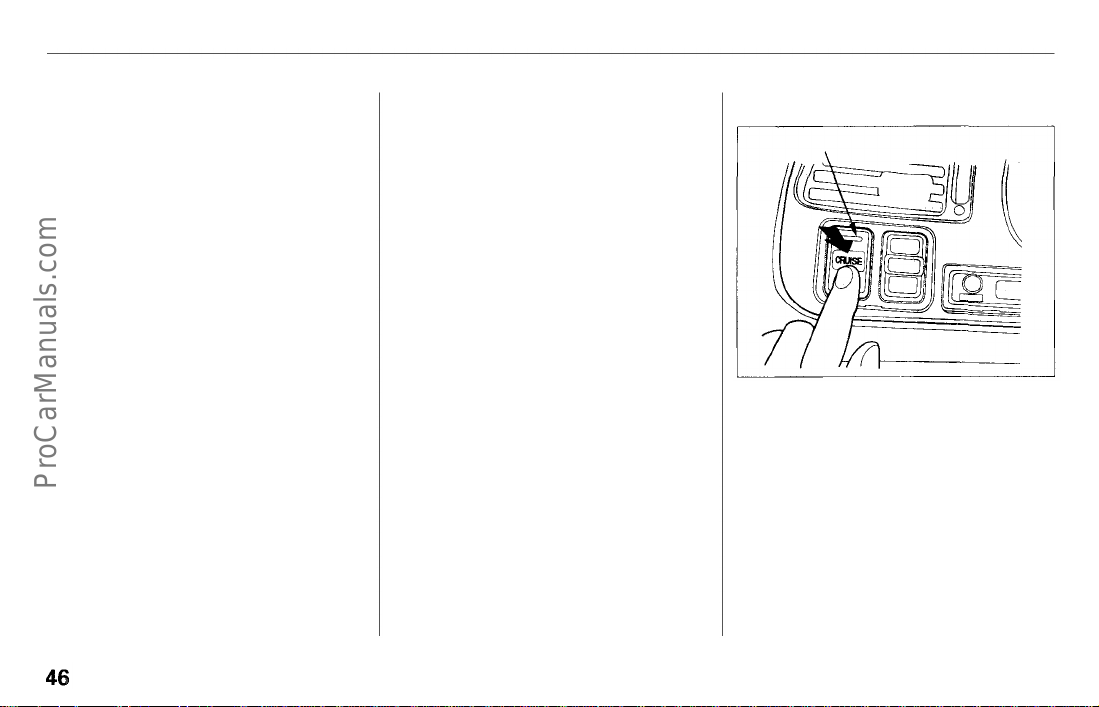
Steering Wheel Controls
Cruise Control
Except for DX model in the U.S.
Cruise control allows you to maintain
a set speed above 25 mph (40 km/h)
without keeping your foot on the
accelerator pedal. It is for cruising on
straight, open highways. It is not
recommended for conditions such as
city driving, winding roads, slippery
roads, heavy rain, or bad weather.
You should have full control of the
car under those conditions.
Using the Cruise Control
1. Push in the Cruise Control Master
Switch to the left of the steering
column. The indicator in the
switch will light.
2. Accelerate to the desired cruising
speed above 25 mph (40 km/h).
Instruments and Controls
Improper use of the cruise
control can lead to a crash.
Use the cruise control only
when traveling on open high-
ways in good weather.
CRUISE CONTROL MASTER SWITCH
ProCarManuals.com
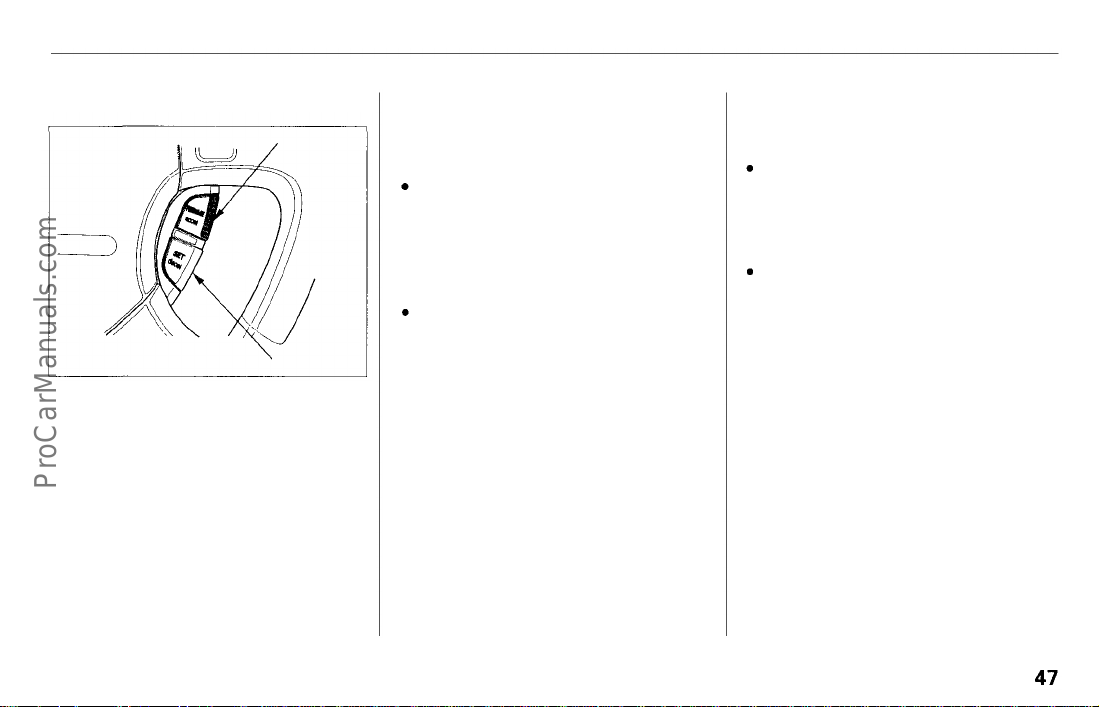
Steering Wheel Controls
3. Press and hold the SET/decel
button on the steering wheel until
the CRUISE CONTROL light next
to the speedometer comes on.
This shows the system is now
activated.
The set speed may vary slightly,
particularly on hills.
Changing the Set Speed
You can increase the set cruising
speed in either of two ways:
Press and hold the RESUME/
accel button. The car will acceler-
ate slowly. When you reach the
desired cruising speed, release the
button.
Push on the accelerator pedal. Ac-
celerate to the desired cruising
speed and press the SET/decel
button.
You can decrease the set cruising
speed in either of two ways:
Press and hold the SET/decel
button. The car will decelerate.
Release the button when you
reach the desired speed.
Tap the brake or clutch pedal
lightly with your foot. The
CRUISE CONTROL light on the
instrument panel will go out.
When the car slows to the desired
speed, press the SET/decel button.
The car will then maintain the
desired speed.
CONTINUED
Instruments and Controls
RESUME/
accel
SET/decel
ProCarManuals.com
Steering Wheel Controls
Even with the cruise control turned
on, you can still use the accelerator
pedal to speed up for passing. After
completing the pass, take your foot
off the accelerator pedal. The car
will return to the set cruising speed.
Resting your foot on the brake or
clutch pedal will cause the cruise
control to cancel.
Cancelling the Cruise Control
Any of these actions cause the cruise
control to cancel.
Tap the brake or clutch pedal.
Press the SET/decel and RE-
SUME/accel buttons at the same
time.
Press the Cruise Control Master
Switch.
When you tap the brake or clutch
pedal, or press the SET and RE-
SUME buttons at the same time, the
CRUISE CONTROL light on the
instrument panel will go out and the
car will begin to slow down. You can
use the accelerator pedal in the
normal way.
If you use the brake or clutch pedal
to cancel cruise control, the system
retains the previously-set cruising
speed. To return to that speed, ac-
celerate to above 25 mph (40 km/h)
and press the RESUME/accel button
until the CRUISE CONTROL light
comes on. The car will accelerate to
the same cruising speed as before.
If you cancel cruise control by
pressing the SET and RESUME
buttons at the same time, the
previously-set cruising speed is
erased. To use the cruise control,
accelerate to the desired cruising
speed and press the SET/decel
button.
Pressing the Cruise Control Master
Switch turns the system completely
off and erases the previous cruising
speed from memory. To use the
system again, refer to Using the
Cruise Control
Instruments and Controls
ProCarManuals.com
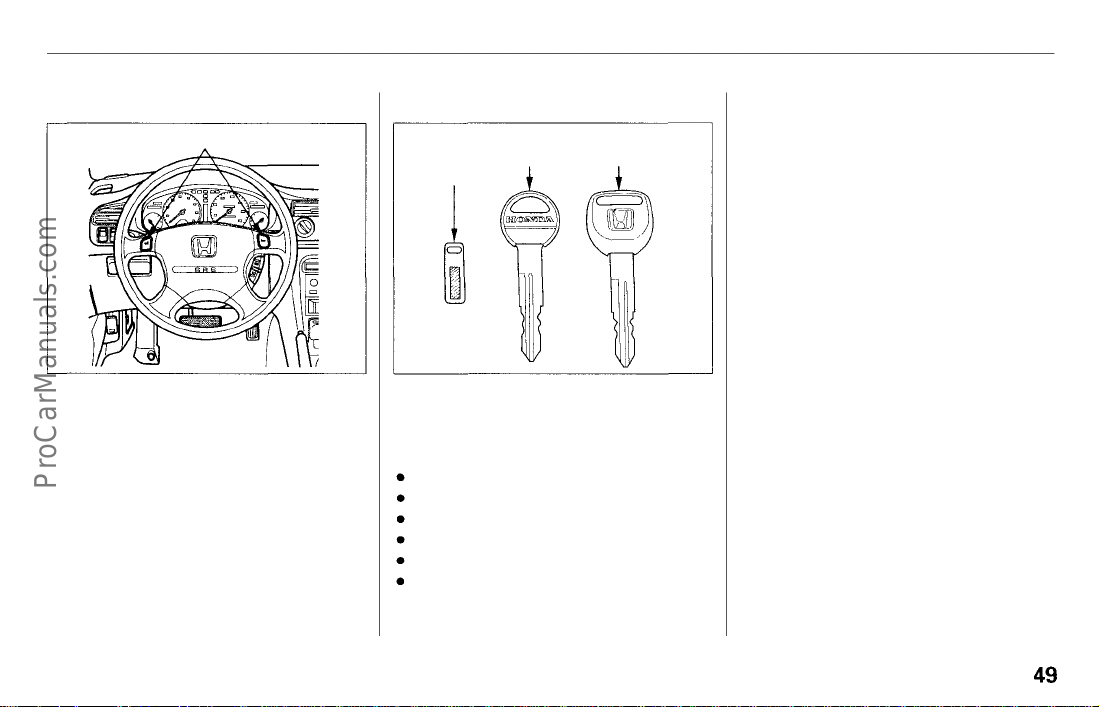
Steering Wheel Controls, Keys and Locks
Horn
Press either of the buttons on the
steering wheel spokes to sound the
horn.
Keys
Your car comes with two kinds of
keys: a master key and a valet key.
The master key fits all locks on your
car:
Ignition
Doors
Trunk
Trunk release handle
Rear seat trunk access
Glove box
The valet key only works the ignition
and the door locks. You can keep the
trunk, trunk release handle, rear seat
trunk access and glove box locked
when you leave your car and valet
key at a parking facility.
You should have received a key
number plate with your set of keys.
You will need this key number if you
ever have to replace a lost key. Store
this plate in a safe place.
When replacing keys, use only
Honda approved key blanks.
Instruments and Controls
KEY
NUMBER
PLATE
VALET
KEY
MASTER
KEY
HORN BUTTONS
ProCarManuals.com
Keys and Locks
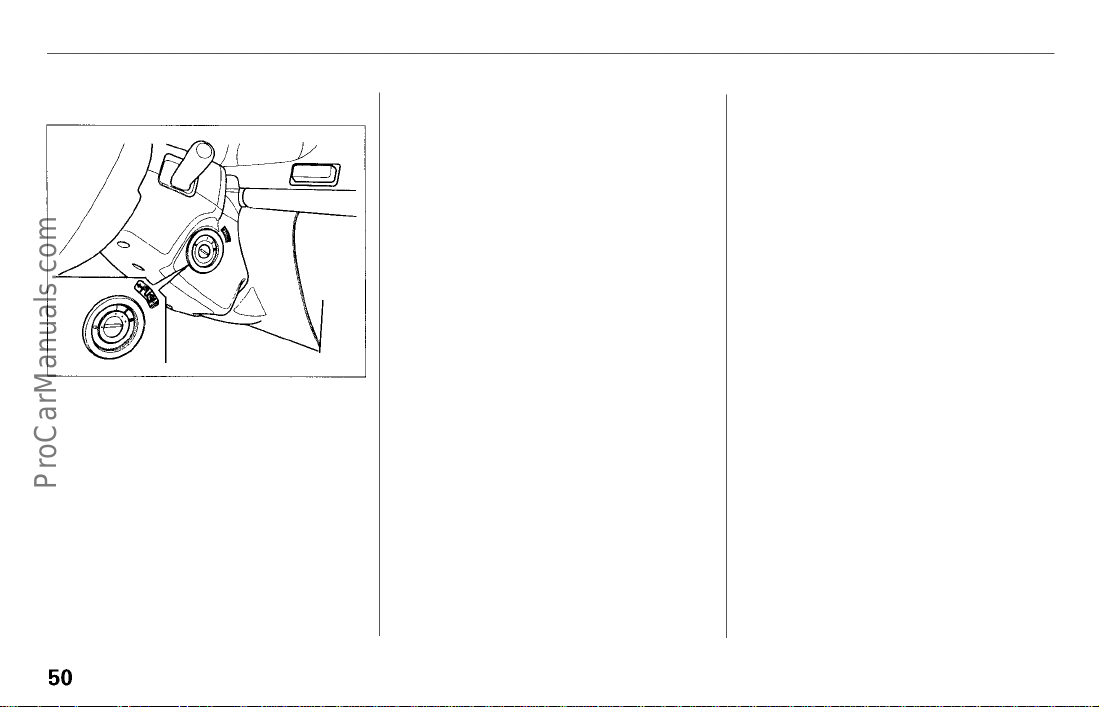
Ignition Switch
The ignition switch is on the right
side of the steering column. It has
four positions: LOCK (0), ACCES-
SORY (I), ON(II), and START (III).
LOCK (0) — You can insert or
remove the key only in this position.
When you turn the key from LOCK
to ACCESSORY, you may have to
turn the steering wheel to release
the anti-theft lock. To switch from
ACCESSORY to LOCK, you must
push the key in slightly as you turn it.
If your car has an automatic trans-
mission, it must also be in Park. The
anti-theft lock will lock the steering
column when you remove the key.
ACCESSORY (I) — In this position,
you can operate the audio system
and cigarette lighter.
ON (II) — This is the normal key
position when driving. All features
and accessories on the car are usable.
Several of the lights on the instru-
ment panel come on as a test when
you turn the ignition switch from
ACCESSORY to ON (see page 33 ).
START (III) — Use this position
only to start the engine. The switch
returns to ON when you let go of the
key.
You will hear a reminder beeper if
you open the driver's door with the
key in the LOCK or ACCESSORY
position. Remove the key to turn it
off.
Instruments and Controls
Removing the key from the
ignition switch while driving
locks the steering. This can
cause you to lose control.
Remove the key from the igni-
tion switch only when parked.
ProCarManuals.com
Keys and Locks
Door Locks
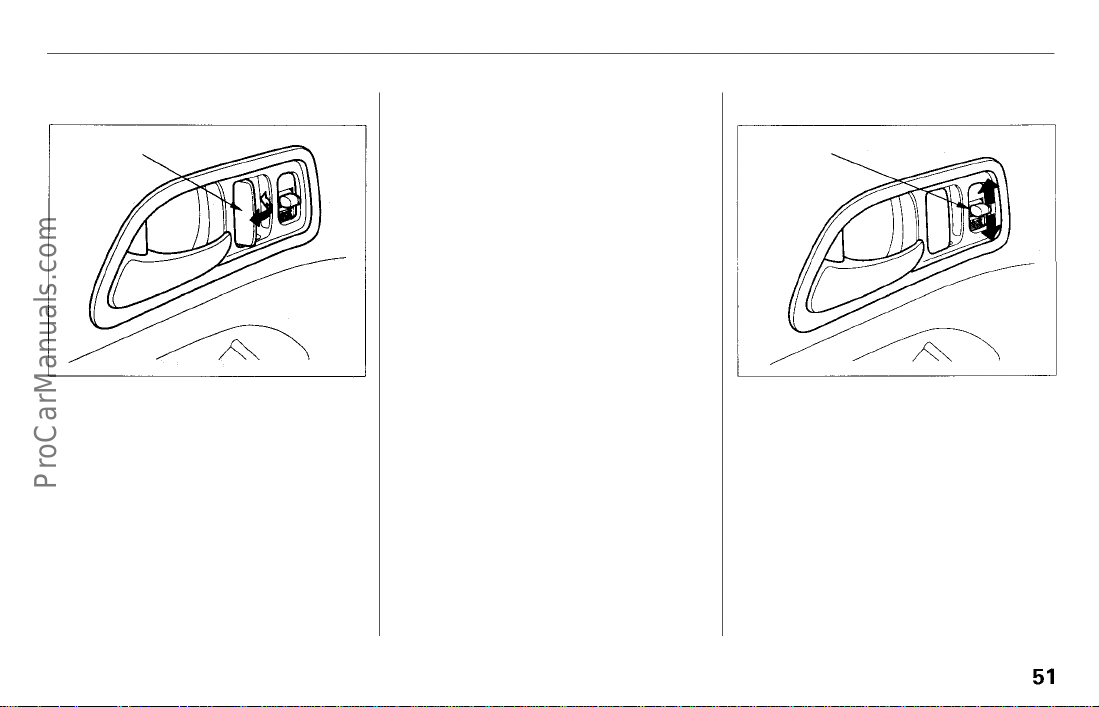
Each door has a lock tab next to the
inside door handle. Push the tab in to
lock the door and pull it out to unlock.
To lock the passenger's door when
getting out of the car, push the lock
tab in and close the door. To lock the
driver's door, pull the door handle
and push the lock tab in. Release the
handle then close the door.
The doors can also be locked and
unlocked from the outside with the
key.
Power Door Locks
Available on LX and EX models in the
U.S. and EX-R model in Canada
Each door has a master door lock
switch. Either switch locks and
unlocks both doors. Push the switch
down to lock and up to unlock.
CONTINUED
Instruments and Controls
MASTER DOOR LOCK SWITCHLOCK TAB
ProCarManuals.com
Keys and Locks
Both doors lock when you push the
lock tab on the driver's door.
In addition, both doors lock when
you use the key to lock either door
from the outside.
Both doors unlock immediately if
you use the key to unlock the
passenger's side door. To unlock the
doors from the driver's side, turn the
key clockwise and hold it there for
several seconds.
Trunk
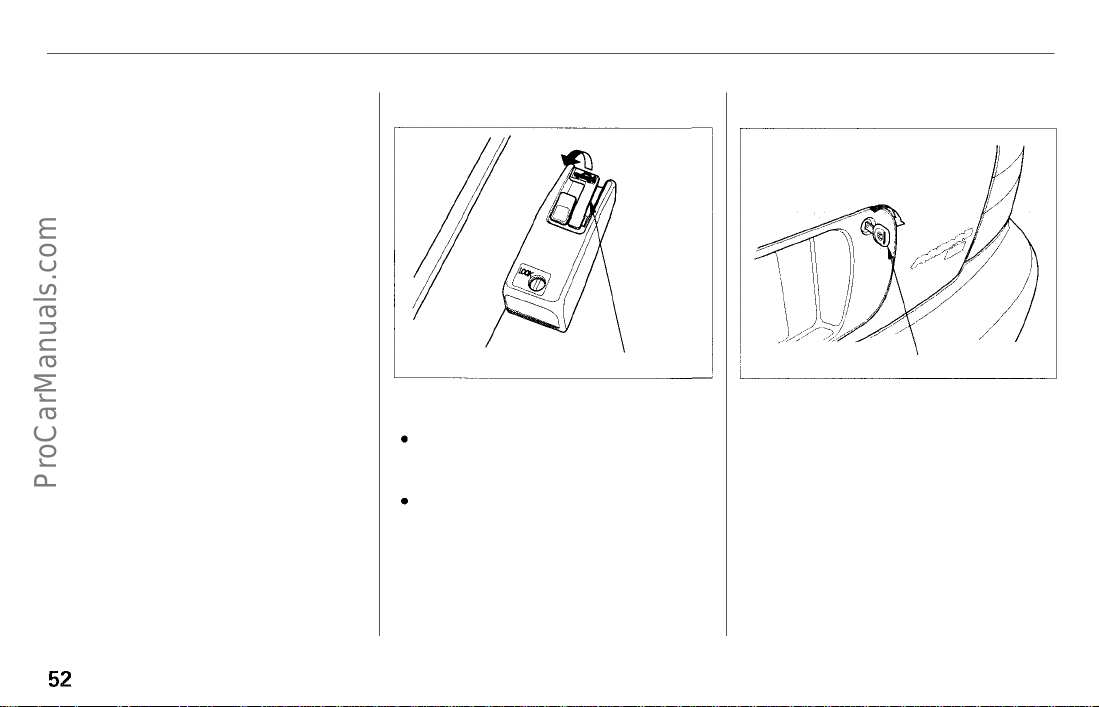
You can open the trunk in two ways:
Pull the trunk release handle to
the left of the driver's seat.
Use the master key to open the
trunk lock. The valet key does not
work in this lock.
To close the trunk, press down on
the trunk lid.
See page 110 for cargo loading and
weight limit information. Keep the
trunk lid closed at all times while
driving to avoid damaging the lid and
getting exhaust gas in the interior.
See Carbon Monoxide Hazard on
page 27.
Instruments and Controls
TRUNK RELEASE HANDLE
MASTER KEY
ProCarManuals.com
Keys and Locks
To protect items in the trunk when
you need to give the key to someone
else:
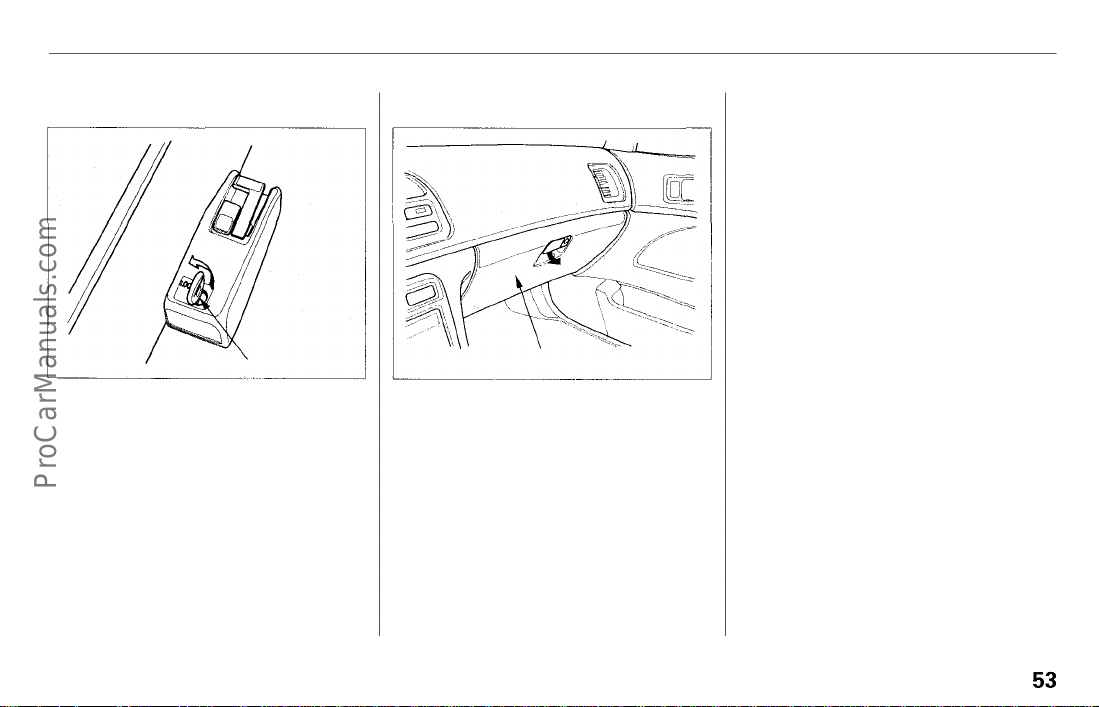
1. Lock the trunk release handle
with the master key.
2. Give the person the valet key.
Glove Box
Open the glove box by pulling the
bottom of the handle. Close it with a
firm push. Lock or unlock the glove
box with the master key.
The glove box light comes on only
when the instrument panel lights are
on.
Instruments and Controls
MASTER KEY
GLOVE BOX
An open glove box can cause
serious injury to your passen-
ger in a crash, even if the pas-
senger is wearing the seat
belt.
Always keep the glove box
closed while driving.
ProCarManuals.com
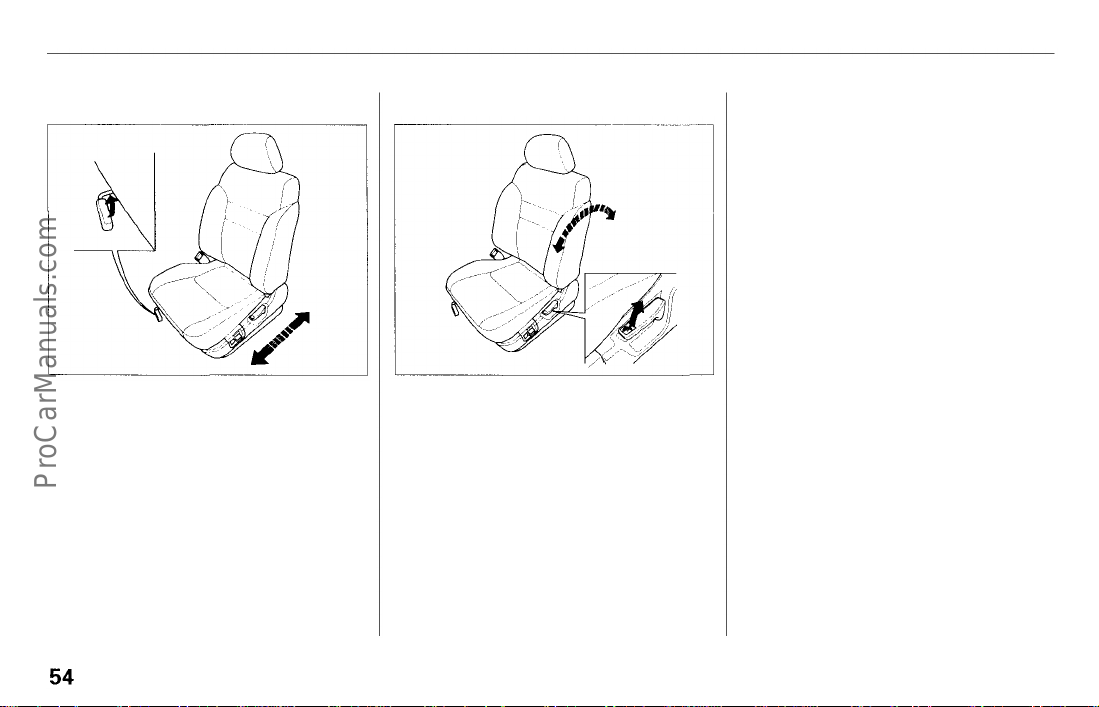
Seat Adjustments
Front Seat Adjustments
Adjust the seat before you start
driving.
To adjust the seat forward and
backward, pull up on the lever under
the seat cushion's front edge. Move
the seat to the desired position and
release the lever. Try to move the
seat to make sure it is locked in
position.
To change the angle of the seat-back,
pull up on the lever on the outside of
the seat bottom. Move the seat-back
to the desired position and release
the lever. Let the seat-back latch in
the new position.
Instruments and Controls
Reclining the seat-back can
decrease the protection you
get from your seat belt in a
crash.
You can slide under the seat
belt and be seriously injured.
Adjust the seat-back to an
upright position and sit well
back in the seat.
ProCarManuals.com
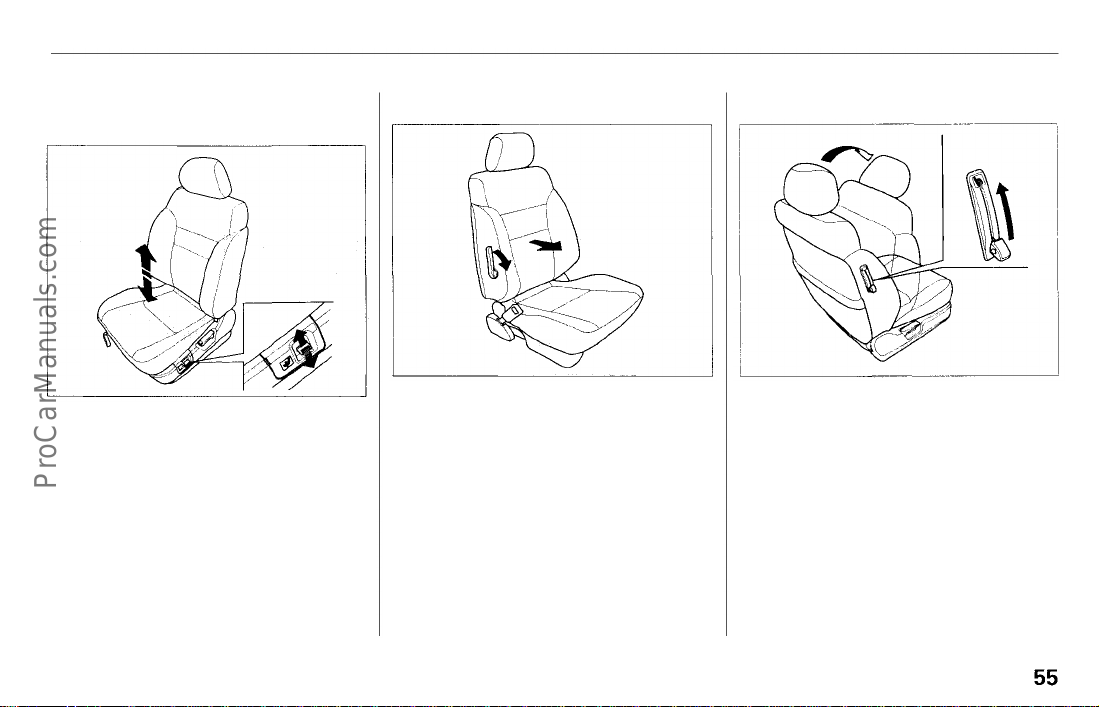
Seat Adjustments
Driver's Seat Power Height
Adjustment
On EX model in the U.S., and EX-R
model in Canada
The height of your driver's seat is
power adjustable. Pull up the switch
to raise the seat. Push it down to
lower the seat.
Driver's Lumbar Support
On EX model in the U.S., and EX-R
model in Canada
Vary the lumbar support by moving
the lever on the right side of the
seat-back. Pivot the lever forward
until it stops, then let it return. Doing
this several times adjusts the lumbar
support through its full range.
Rear Seat Access
To get into the back seat on the
driver's side, pull up on the seat-back
adjustment lever.
To tilt the passenger's seat-back out
of the way, push forward on the
release lever on the side of the seat-
back. The seat returns to the original
position when you push back the
seat.
Instruments and Controls
ProCarManuals.com
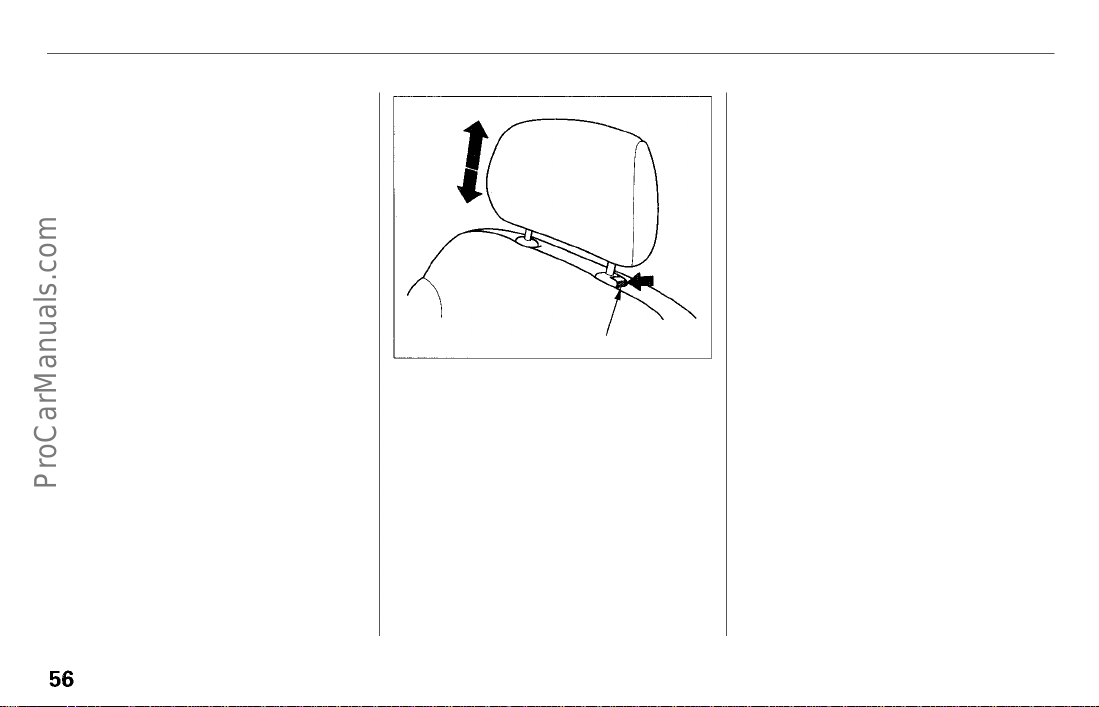
Seat Adjustments
Head Restraints
The front head restraints help
protect you and your passenger from
whiplash and other injuries. They are
most effective when you adjust them
so the top of the restraint is even
with the top of your ears.
The front head restraints adjust for
height. You need both hands to
adjust the restraint. Do not attempt
to adjust it while driving. To raise it,
pull upward. To lower the restraint,
press the release button and push
the restraint down.
To remove a head restraint for
cleaning or repair, pull it up as far as
it will go. Press the release button
and pull the restraint out of the seat-
back.
Instruments and Controls
Driving your car without
head restraints can lead to
serious injury to you and
your passenger in a crash.
Make sure the head re-
straints are in place and ad-
justed properly before driving.
RELEASE BUTTON
ProCarManuals.com
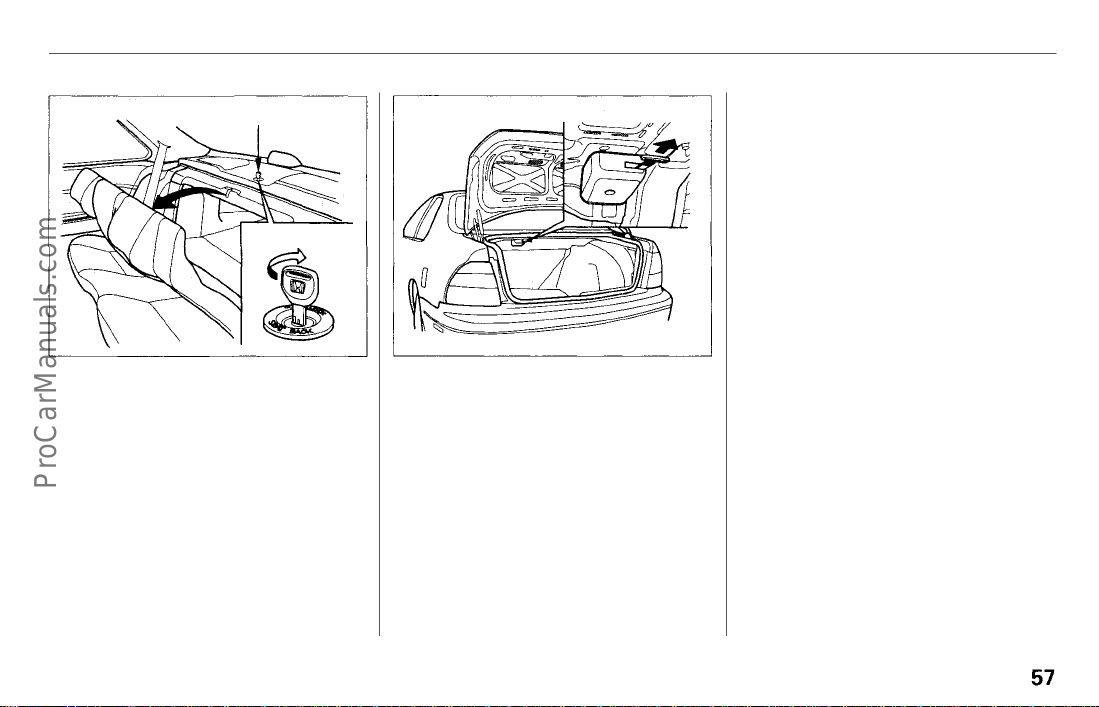
Folding Rear Seat
The back of the rear seat folds down,
giving you direct access to the trunk.
The seat-back can be released from
inside the car or inside the trunk.
To fold down the seat-back from
inside the car, insert the master key
in the lock on the rear shelf. Turn
the key clockwise, pull down the top
of the seat-back, then release the
key.
To release the seat-back from inside
the trunk, pull the release under the
rear shelf.
To lock the seat-back upright, push it
firmly against the rear shelf. Make
sure it is latched in place by pulling
on the top of the seat.
Make sure both rear shoulder belts
are positioned in front of the rear
seat-back whenever the seat-back is
in its upright position.
Make sure all items in the trunk, or
items extending through the opening
into the back seat, are tied down.
Loose items can fly forward and
cause injury if you have to brake
hard. See Loading Cargo on page
110.
Never drive with the seat-back
folded down and the trunk lid open.
See Carbon Monoxide Hazard on
page 27.
CONTINUED
Instruments and Controls
MASTER KEY
Pull
ProCarManuals.com
Power Windows
Only on LX and EX models in the U.S.,
and EX-R model in Canada
Your car's windows are electrically-
powered. Turn the ignition switch to
ON (II) to raise or lower any window.
Each door has a switch that controls
its window. To open the window,
push the switch down and hold it.
Release the switch when you want
the window to stop. Close the
window by pushing the switch up
and holding it.
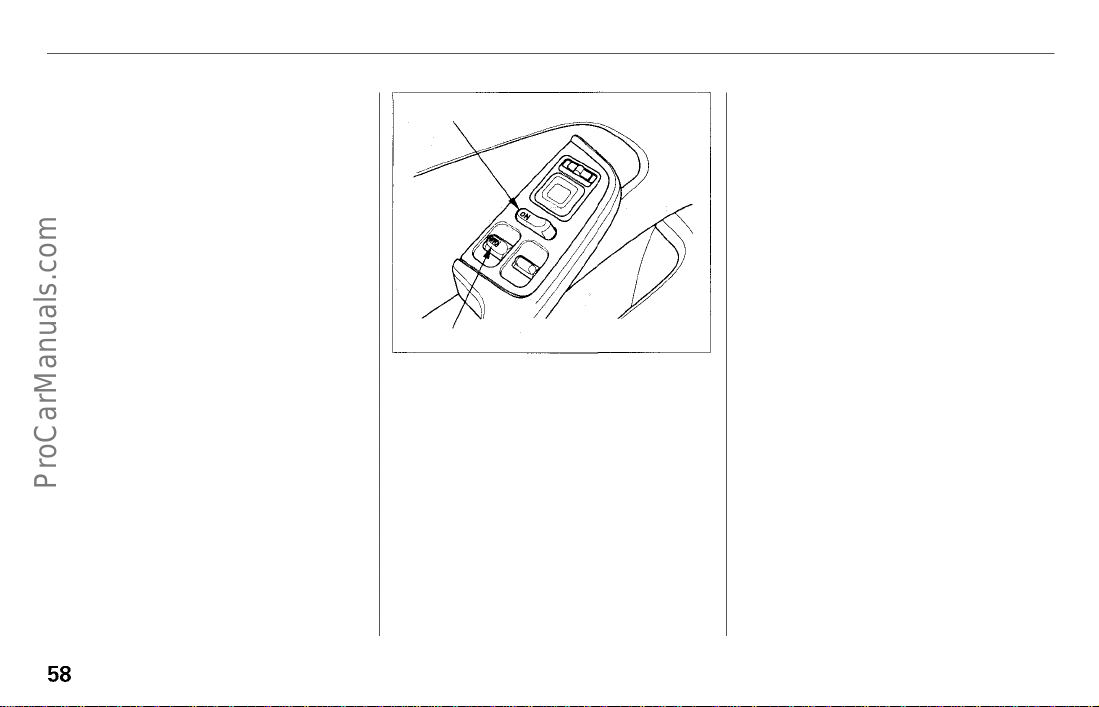
The driver's door has a master
power window control panel. To
open the passenger's window, push
down on the switch and hold it down
until the window reaches the desired
position. To close the window, push
up on the window switch. Release
the switch when the window gets to
the position you want.
The master control panel also con-
tains these extra features:
AUTO — To open the driver's
window fully, push the window
switch firmly down and release it.
The window automatically goes all
the way down. To stop the window
from going all the way down, push
the window switch up briefly.
To open the driver's window only
partially, push the window switch
down lightly and hold it. The window
will stop as soon as you release the
switch.
The AUTO function only works to
lower the driver's window. To raise
the window, you must push the
window switch up and hold it until
the window reaches the desired
position.
Instruments and Controls
MAIN SWITCH
DRIVER'S WINDOW SWITCH
ProCarManuals.com
Power Windows, Moonroof
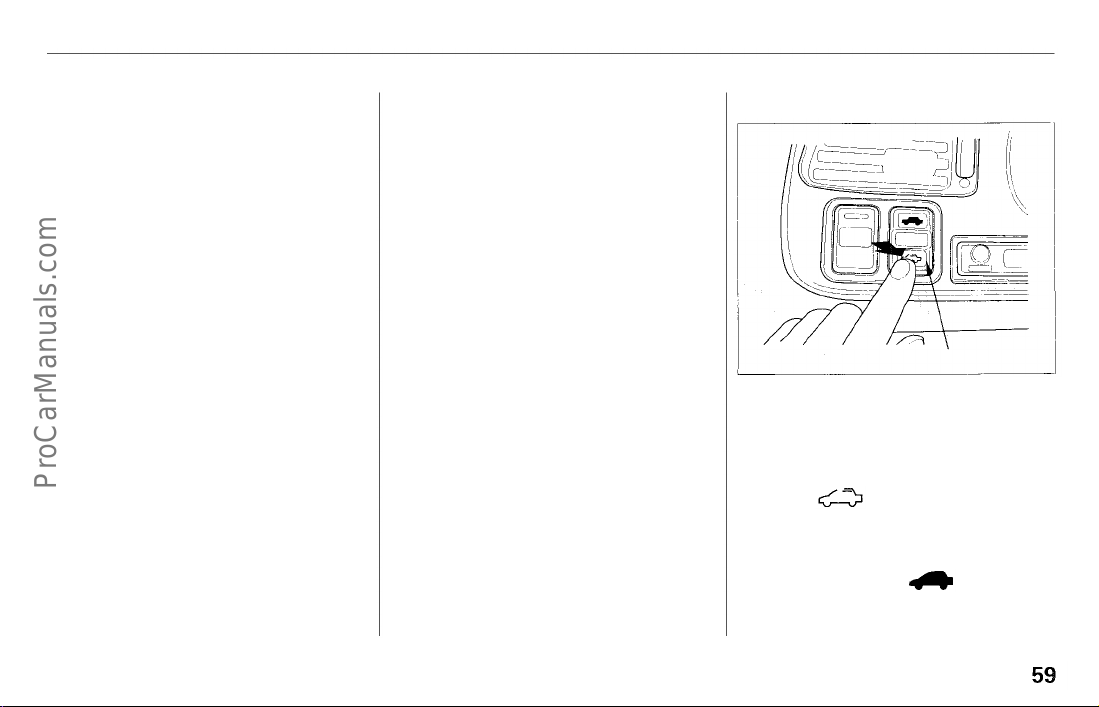
The MAIN switch controls power to
the passenger's window. With this
switch off, the passenger's window
cannot be raised or lowered. The
MAIN switch does not affect the
driver's window. Keep the MAIN
switch off when you have children in
the car so they do not injure
themselves by operating the
windows unintentionally.
The power window system has a key-
off delay function. The windows will
still operate for up to ten minutes
after you turn off the ignition.
Opening either front door cancels
the delay function. You must turn
the ignition ON (II) again before you
can raise or lower the windows.
Moonroof
Only on EX model in the U.S., and EX-R
model in Canada
Use the switch on the dashboard to
open and close the moonroof. The
ignition must be ON (II). Push and
hold the switch to open the
moonroof. Release the switch when
the moonroof reaches the desired
position. To close the moonroof,
press and hold the switch.
Instruments and Controls
CONTINUED
Closing a power window on a
child's hands or fingers can
cause serious injury.
Make sure your children are
away from the windows be-
fore closing them.
ROOF
MOONROOF SWITCH
ProCarManuals.com
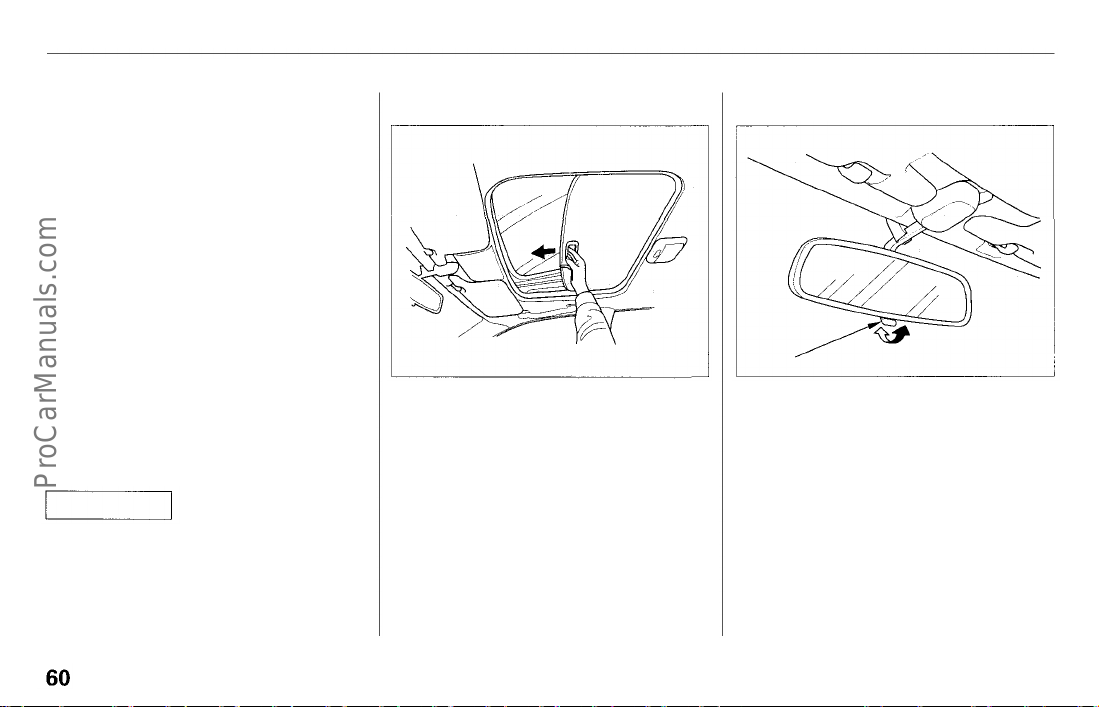
Moonroof, Mirrors
The moonroof has a key-off delay.
You can still open and close the
moonroof for up to ten minutes after
you turn off the ignition. The key-off
delay cancels as soon as you open
either front door. You must then
turn the ignition ON (II) for the
moonroof to operate.
If you try to open the moonroof in
below-freezing temperatures, or
when it is covered with snow or ice,
you can damage the moonroof panel
or motor.
Sunshade
You can slide the sunshade to any
position when the moonroof is closed.
The sunshade slides open with the
moonroof. You must close it manu-
ally.
Mirrors
Keep the inside and outside mirrors
clean and adjusted for best visibility.
Be sure to adjust the mirrors before
you start driving.
The inside mirror has day and night
positions. The night position reduces
glare from headlights behind you.
Flip the tab on the bottom edge of
the mirror to select the day or night
position.
Instruments and Controls
Closing the moonroof on
someone's hands or fingers
can cause serious injury.
Make sure passengers are
clear of the moonroof before
closing it.
NOTICE
TAB
ProCarManuals.com
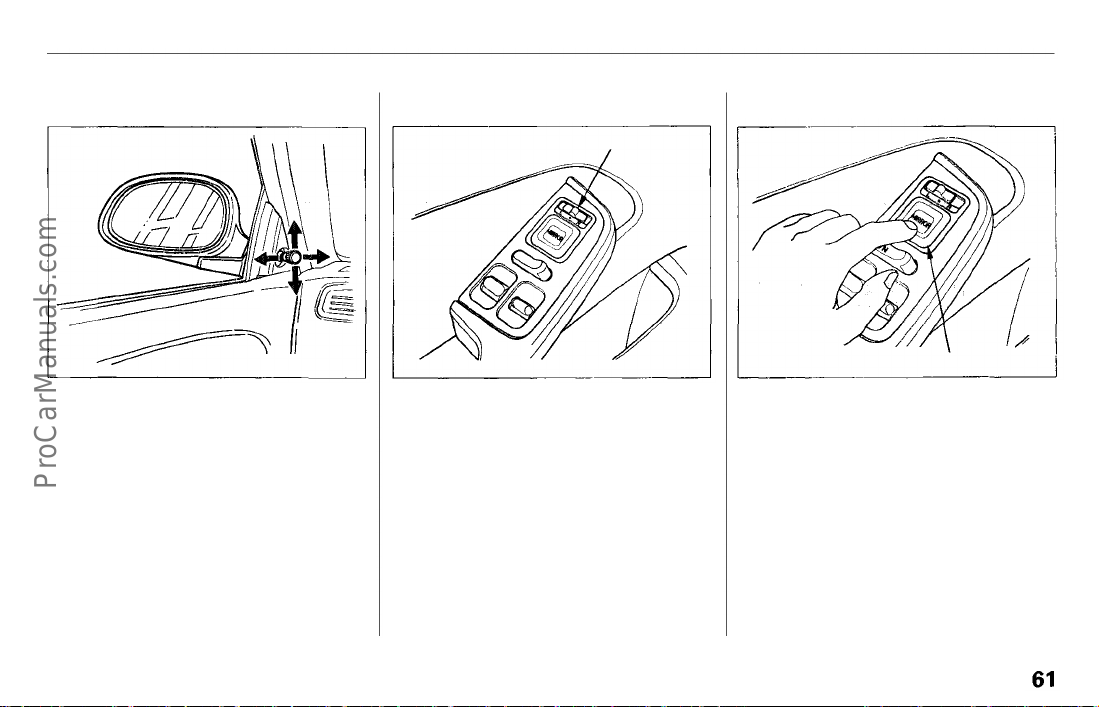
Mirrors
Manual Door Mirrors
Only on U.S. DX and Canadian LX
models
The outside mirrors can be adjusted
by moving the knob located on each
door.
Adjusting the Power Mirrors
On U.S. LX and EX models, and
Canadian EX-R model
Adjust the outside mirrors with the
adjustment switch on the driver's
door armrest:
1. Turn the ignition switch ON (II).
2. Move the selector switch to L
(driver's side) or R (passenger's
side).
3. Push the appropriate edge of the
adjustment switch to move the
mirror right or left, up or down.
4. When you finish, move the
selector switch to the center (off)
position. This turns off the
adjustment switch so you can't
move a mirror out of position by
accidentally bumping it.
Instruments and Controls
CONTINUED
SELECTOR SWITCH
ADJUSTMENT SWITCH
ProCarManuals.com
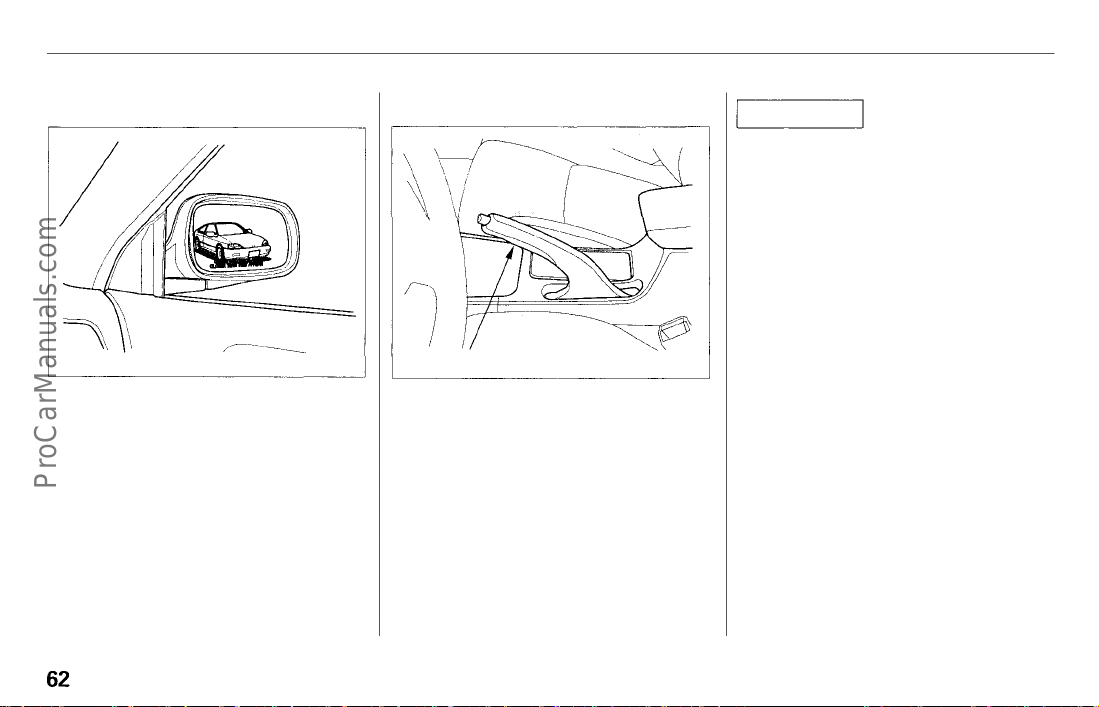
Mirrors, Parking Brake
The outside mirror on the passenger's
side has curved glass. Objects look
farther away than they are. Use this
mirror to get a "wide view". Don't
use it to judge the distance of things
behind you.
Parking Brake
To apply the parking brake, pull the
lever up fully. To release it, pull up
slightly, push the button, and lower
the lever. The parking brake light on
the instrument panel should go out
when the parking brake is fully
released (see page 34). If you try to
drive the car without releasing the
parking brake, the ABS cannot work
properly.
Driving the car with the parking
brake applied can damage the rear
brakes and axles.
Instruments and Controls
NOTICE
PARKING BRAKE LEVER
ProCarManuals.com
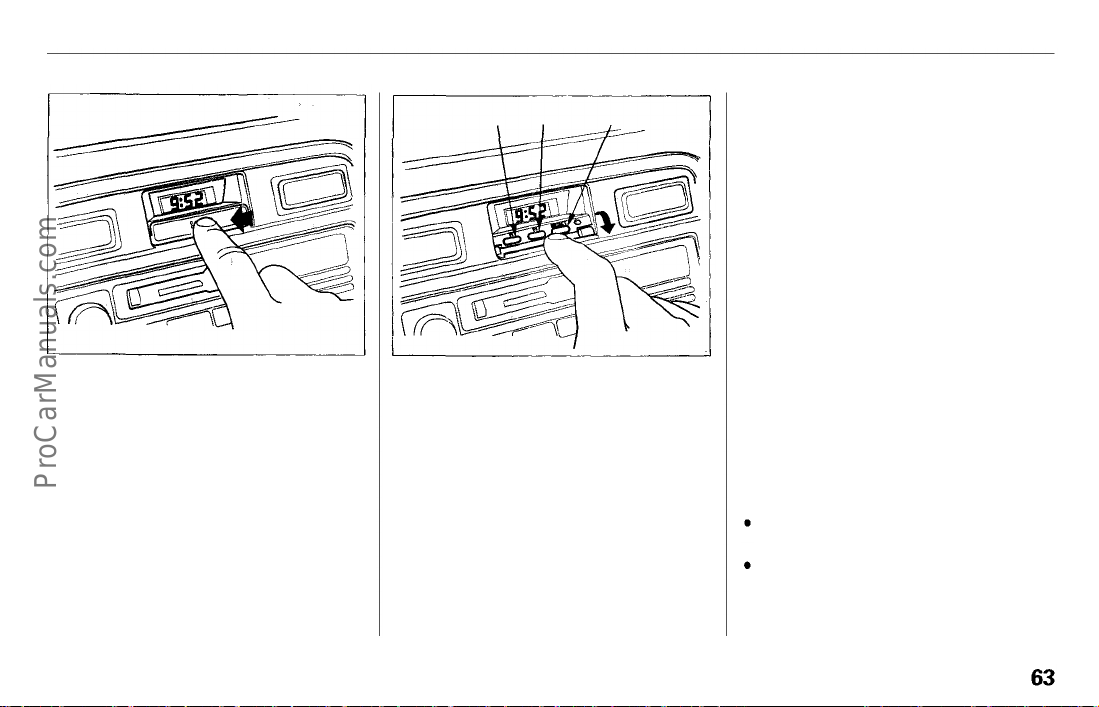
Digital Clock
The digital clock displays the time
with the ignition switch ON (II). To
see the time with the ignition off,
press and hold the wide button
under the clock.
To set the clock:
1. Turn the ignition switch ON (II) to
display the time.
2. Swing down the front cover of the
wide button under the clock
display. You will see H, M, and
RESET buttons.
3. Press and hold the H button until
the hour advances to the desired
time.
4. Press and hold the M button until
the numbers advance to the
desired time.
You can use the RESET button to
quickly set the time to the nearest
hour. If the displayed time is before
the half hour, pressing the RESET
button sets the clock back to the
previous hour. If the displayed time
is after the half hour, pressing the
RESET button sets the clock
forward to the beginning of the next
hour.
For example:
1:06 would RESET backward to
1:00.
1:52 would RESET forward to 2:00.
Instruments and Controls
RESETH
M
ProCarManuals.com
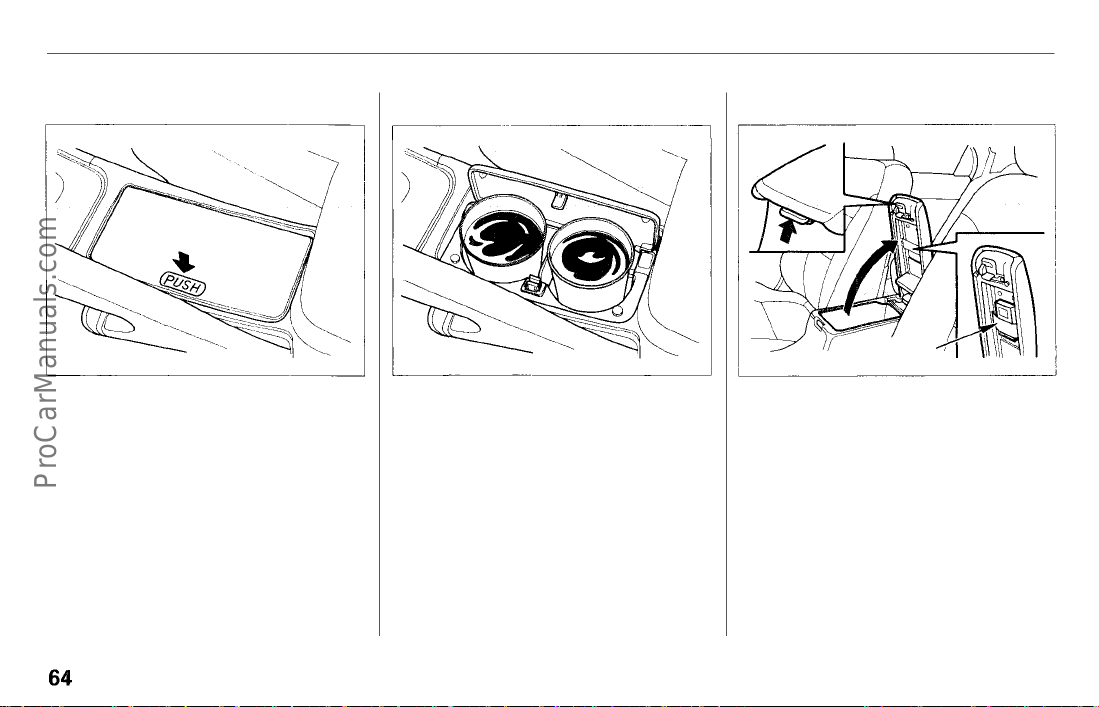
Beverage Holder, Console Compartment
Beverage Holder
Only on LX and EX models in the U.S.,
and EX-R model in Canada
To open the beverage holder, push
on the top. It is spring-loaded and will
swing open. To close it, push it down
until it latches.
Use the beverage holder only when
the car is parked. If you place cups in
the holder while driving, the liquid
may spill when you go over bumps or
around corners.
Be careful when you are using the
cup holder. Spilled liquids can
damage the upholstery, carpeting,
and electrical components in the
interior. If the liquid is very hot, it
can scald you or your passengers.
Console Compartment
To open the console compartment,
pull up the front edge of the lid.
A strap is provided under the
console cover to hold your garage
door opener.
Instruments and Controls
Push
STRAP
ProCarManuals.com
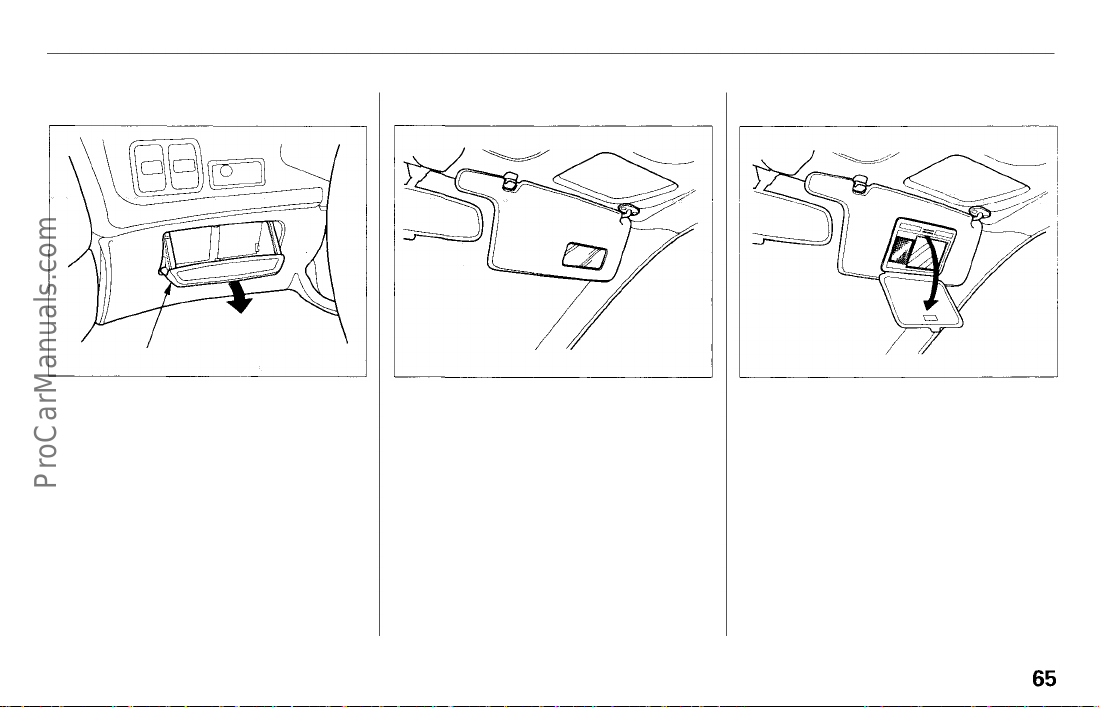
Coin Box, Vanity Mirror
Coin Box
To open the coin box, pull the upper
edge. Close it with a firm push.
Vanity Mirror
On DX model in the U.S. and LX model
in Canada
To use the vanity mirror, pull down
the passenger's sun visor.
On LX and EX models in the U.S., and
EX-R model in Canada
To use the vanity mirror, pull down
the passenger's sun visor and swing
down the cover.
The light beside the mirror comes
on only when the light switch is
turned on.
The driver's sun visor also has a
vanity mirror.
Instruments and Controls
COIN BOX
ProCarManuals.com
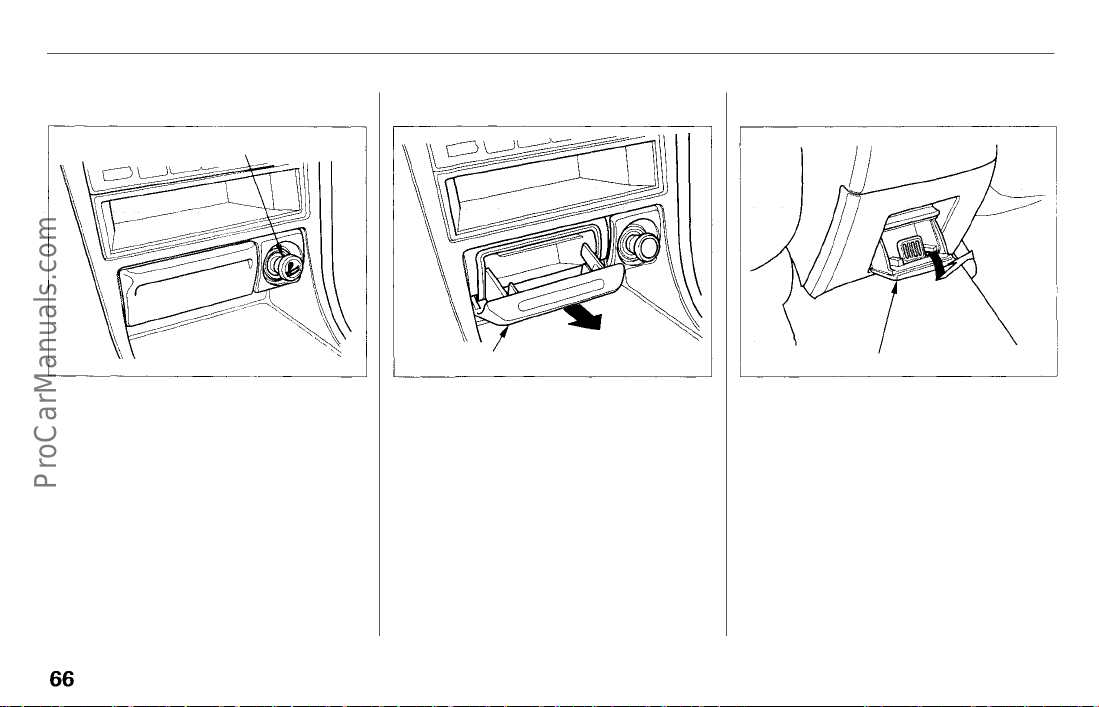
Cigarette Lighter, Ashtray
Cigarette Lighter
The ignition switch must be in
ACCESSORY (I) or ON (II) for the
cigarette lighter to work. To heat up
the lighter, push it in. It will pop out
when it is ready for use. Do not hold
the lighter in while it is heating up,
you could cause it to overheat.
Ashtrays
Open the front ashtray by swinging
the lid down. To remove it for
emptying, open the lid then pull the
ashtray straight outward.
The rear ashtray is at the rear end of
the center console. Open the ashtray
by swinging the upper edge of the lid
down. To remove the ashtray for
emptying, open it then lift up and out.
Instruments and Controls
CIGARETTE LIGHTER
ASHTRAY
ASHTRAY
ProCarManuals.com
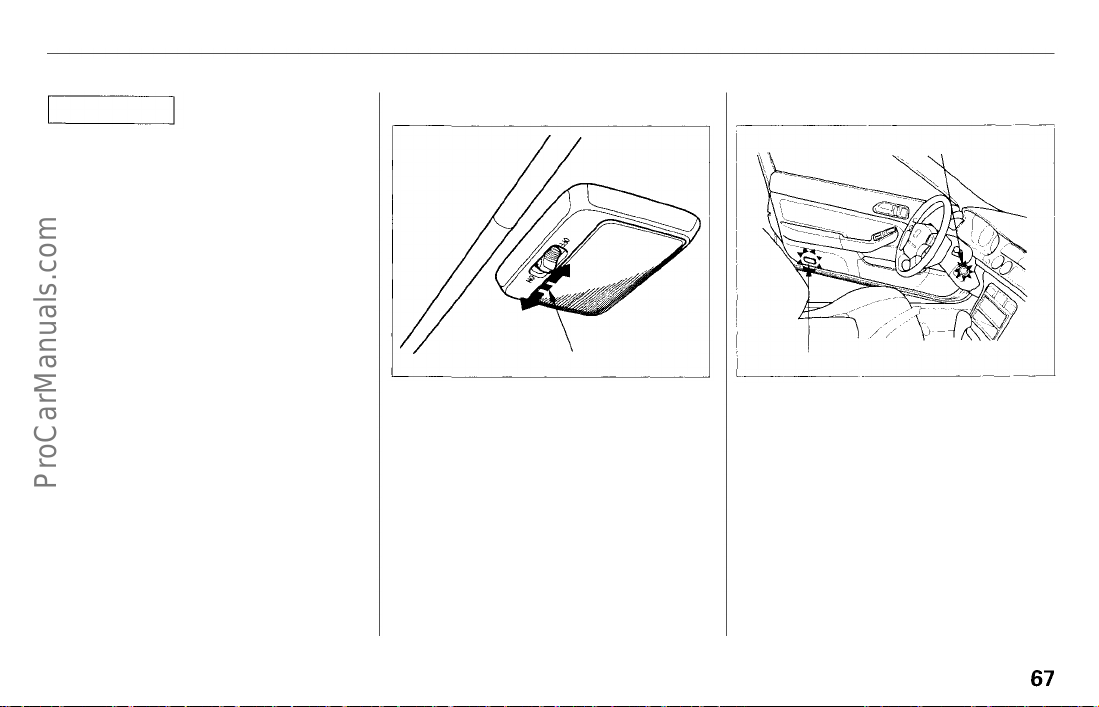
Ashtrays, Interior Lights
Use the ashtray only for cigarettes,
cigars and other smoking materials.
To prevent a possible fire and
damage to your car, don't put paper
or other things that can burn in the
ashtray.
Ceiling Light
The ceiling light has a three-position
switch. In the OFF position, the light
does not come on. In the center
position, the ceiling light comes on
when you open either door. In the
ON position, the ceiling light stays
on continuously.
Courtesy Lights
Only on LX and EX models in the U. S.,
and EX-R model in Canada
The ignition switch light comes on
when you open the driver's door and
stays on several seconds after you
close the door.
The door light comes on when you
open the door and goes off when you
close the door.
Instruments and Controls
OFF
ON
IGNITION SWITCH LIGHT
DOOR LIGHT
DOOR ACTIVATED
NOTICE
ProCarManuals.com

Comfort and Convenience Features
The heating and air conditioning*
system in your car provides a com-
fortable driving environment in all
weather conditions.
* Air conditioning is optional on U.S.
DX and Canadian LX models.
The audio sound system* is very
versatile. To get the most from this
system, take the time to learn what
the controls do.
Some models have an anti-theft
audio system that requires a code
number to enable it.
* Audio sound system is optional on
the U.S. DX model.
Heating and Cooling........................ 70
What Each Control Does............ 72
How to Use the System............... 73
Controlling Air Flow
Direction............................... 73
Ventilation................................ 73
To Cool with A/C.................... 74
To Heat..................................... 75
To Heat and Dehumidify
with Air Conditioning.......... 75
To Defog and Defrost............. 76
To Turn Everything off.............. 76
Audio System (Canadian LX)......... 77
Operating the Radio.................... 78
Finding the Radio Station........... 78
Presetting..................................... 79
Adjusting the Sound.................... 79
Radio Frequencies....................... 80
Operating the Cassette Player... 81
Cassette Search Functions......... 81
Caring for Cassettes.................... 81
Audio System (Except U.S. DX and
Canadian LX)........................... 82
Operating the Radio.................... 84
Presetting..................................... 86
Adjusting the Sound.................... 88
Radio Frequencies....................... 89
Operating the Cassette Player... 90
Cassette Search Functions......... 92
Caring For Cassettes................... 92
Operating the CD Player............ 93
CD Error Indications................... 96
Caring for the Cassette Player....... 97
Theft Protection............................... 99
Comfort and Convenience Features
ProCarManuals.com
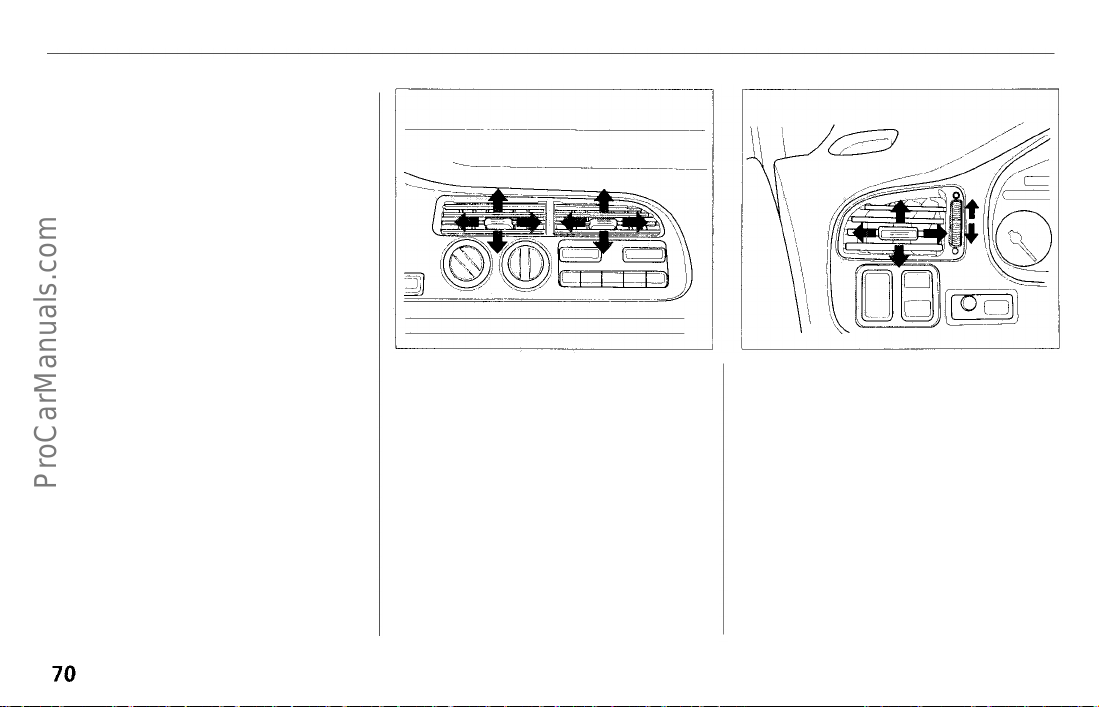
Heating and Cooling
This system has full heating, venti-
lation, and air conditioning capabi-
lities. You can adjust the system
controls to mix these in various
combinations. The air flows into the
interior at three possible levels,
which you can select.
(U.S. DX and Canadian LX models)
If you purchased your car without air
conditioning, it can be installed at
any time. A Genuine Honda air
conditioning system is available from
your dealer. It meets Honda's high
quality standards and is designed to
fit your car. Please contact your
dealer for more information.
The direction of air flow from the
vents in the center and each side of
the dashboard is adjustable. Move
the tab in the center of each vent up-
and-down and side-to-side.
The side vents can be opened and
closed with the dial next to it.
The heating and cooling system
draws air through the exterior vents
at the bottom of the windshield.
Keep these vents clear of leaves and
other debris.
Comfort and Convenience Features
SIDE VENT
CENTER VENT
ProCarManuals.com

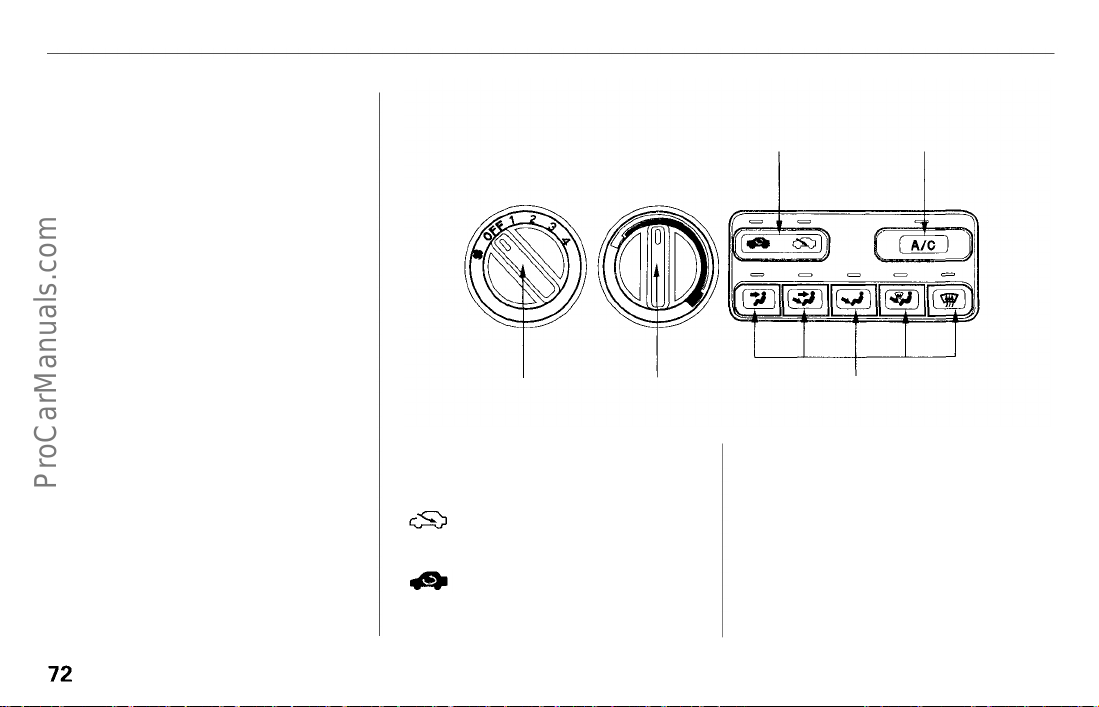
Heating and Cooling
What Each Control Does
Fan Control Dial
Turning this dial clockwise increases
the fan speed, which increases air
flow.
Temperature Control Dial
Turning this dial clockwise increases
the temperature of air flowing from
the system.
Mode Buttons
These buttons control the direction
of air flow. The indicator light shows
which button is controlling air flow.
Air Conditioning (A/C) Switch
This switch turns the air condi-
tioning ON and OFF. The indicator
above the switch lights when the
A/C is ON.
Recirculation/Fresh Air Button
This button controls the source of air
going into the system. When the
side of the button is pressed,
air comes from outside the car (the
Fresh Air mode). When the
side of the button is pressed,
the interior air recycles through the
system (the Recirculation mode).
The indicator light shows which
mode is selected.
Comfort and Convenience Features
RECIRCULATION/
FRESH AIR BUTTON
AIR CONDITIONING
SWITCH
FAN CONTROL
DIAL
TEMPERATURE
CONTROL DIAL
MODE BUTTONS
ProCarManuals.com
Heating and Cooling
How to Use the System
This section covers the best way to
use the system for ventilation,
cooling, dehumidifying, defrosting
and heating. In most cases, the mode
and air source selections are only
recommendations. You may prefer
different settings.
Use mode to heat or cool the
interior more quickly, or to keep out
smoke and dust. Leaving the system
in the recirculation mode with the
A/C off can cause the windows to
fog up. Switch to mode as
soon as the interior reaches a
comfortable temperature or the
outside smoky, dusty condition
clears.
The engine must be running for the
heater and air conditioning to pro-
vide hot and cold air. The heater
uses engine coolant to warm the air.
If the engine is cold, it will be several
minutes before you feel warm air
circulating.
The air conditioning system does not
depend on engine temperature. It
can produce cold air almost immedi-
ately.
Controlling Air Flow Direction
Air flows into the interior at three
levels: Toward the floor
through the dash vents and
toward the windshield and side
windows You select the air
flow level or combination of levels
with the five mode buttons.
Ventilation
Your car has a flow-through venti-
lation system. Air enters the car
through vents in front of the wind-
shield. It circulates through the
interior then exits through vents
near the rear window. This system
provides fresh air even when the car
is standing still. To bring in outside
air, press the button. Set the
fan at a comfortable speed.
CONTINUED
Comfort and Convenience Features
ProCarManuals.com
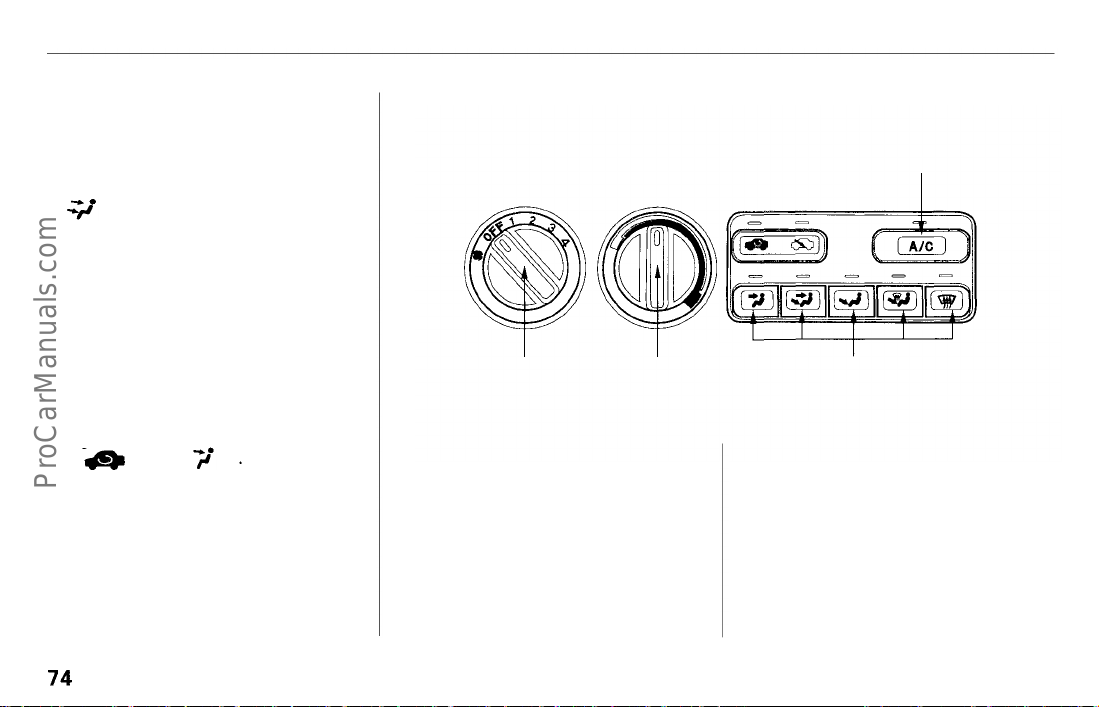
Heating and Cooling
To Cool with A/C
To operate the air conditioning
system, press the air conditioning
switch. Set the fan to the desired
speed. You can also use the
mode button to direct air out
of the dash and heater vents.
To cool the interior down rapidly
after the car has been sitting in the
sun:
1. Start the engine.
2. Turn on the A/C by pressing the
switch.
3. Set the fan to maximum speed.
4. Open the windows partially. Select
and
When the interior reaches a com-
fortable temperature, close the
windows and set the system for
cooling as described above.
Air conditioning places an extra load
on the engine. Watch the engine
coolant temperature gauge (see page
38 ) when using the A/C in heavy
traffic or driving up long hills. If it
moves near the red zone, turn off the
air conditioning until the gauge
reads normally.
Comfort and Convenience Features
AIR CONDITIONING SWITCH
FAN CONTROL
DIAL
TEMPERATURE
CONTROL DIAL
MODE BUTTONS
ProCarManuals.com
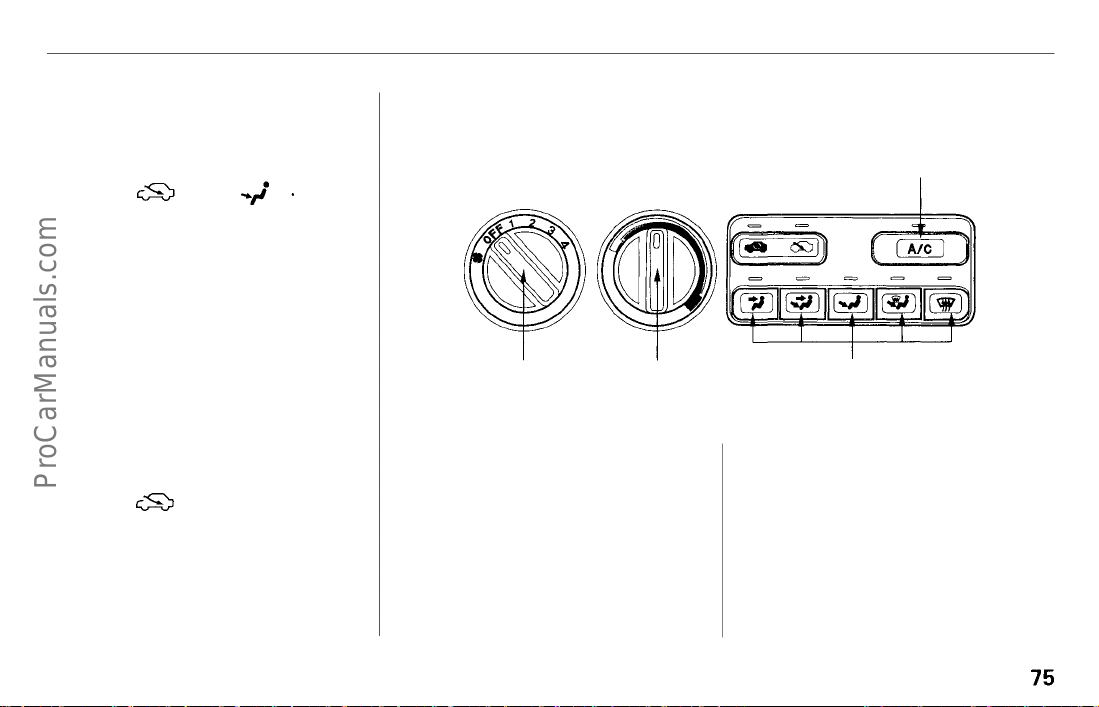
Heating and Cooling
To Heat
To warm the interior:
1. Start the engine.
2. Select and
3. Switch the fan to the desired
speed.
4. Adjust the warmth of the air with
the temperature control dial.
To Heat and Dehutnidify with Air
Conditioning
Air conditioning removes moisture
from the air as it operates. When
used in combination with the heater,
it makes the interior warm and dry.
1. Switch the fan on.
2. Turn on the air conditioning.
3. Select and any desired
mode button.
4. Adjust the temperature control
dial so the mixture of heated and
cooled air feels comfortable.
This setting is suitable for all driving
conditions whenever the outside
temperature is above 32° F (0°C).
CONTINUED
Comfort and Convenience Features
AIR CONDITIONING SWITCH
MODE BUTTONS
TEMPERATURE
CONTROL DIAL
FAN CONTROL
DIAL
ProCarManuals.com
Heating and Cooling
To Defog and Defrost
To remove fog from the inside of the
windows:
1. Switch the fan on.
2. Turn on the air conditioning.
3. Select and
4. Adjust the temperature control
dial so the air flow from the
defroster vents feels warm.
5. Turn on the rear window defogger
to help clear the rear window.
To remove exterior frost or ice from
the windshield and side windows
after the car has been sitting out in
cold weather:
1. Start the engine.
2. Select and
3. Switch the fan and temperature
controls to maximum.
To rapidly remove exterior frost or
ice from the windshield (on very cold
days), first select Once the
windshield is clear, select to
avoid fogging the windows.
These settings direct all the air flow
to the defroster vents at the base of
the windshield and the side window
defroster vents. The air flow will get
warmer and clear the windows faster
as the engine warms up. You can
close the side vents with the dial
beside each vent. This will send
more warm air to the windshield
defroster vents.
For safety, make sure you have a
clear view through all the windows
before driving away.
To Turn Everything Off
To shut off the system temporarily,
turn the fan speed and temperature
control dials all the way OFF.
You should shut the system com-
pletely off only for the first few
minutes of driving in cold weather,
until the engine coolant warms up
enough to operate the heater. Keep
the fan on at all other times so stale
air does not build up in the interior.
Comfort and Convenience Features
ProCarManuals.com
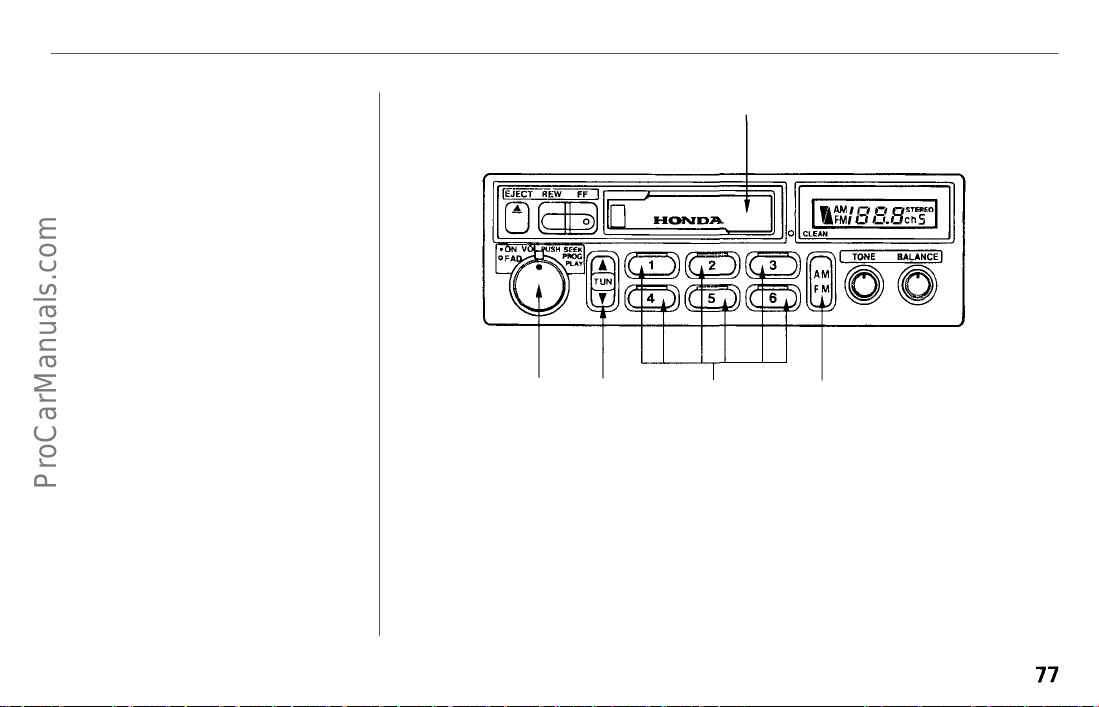
Audio System
AM/FM/Cassette Stereo Audio
System
For Canadian LX model only
Your Honda audio system is easy to
use, and will give clear AM/FM
reception. The preset buttons allow
you to select six stations on each
band.
The cassette player features auto-
reverse for continuous play.
Comfort and Convenience Features
CASSETTE SLOT
AM/FM
BUTTON
PRESET
BUTTONS
TUNE
BAR
ON/VOL KNOB
SEEK BUTTON
ProCarManuals.com
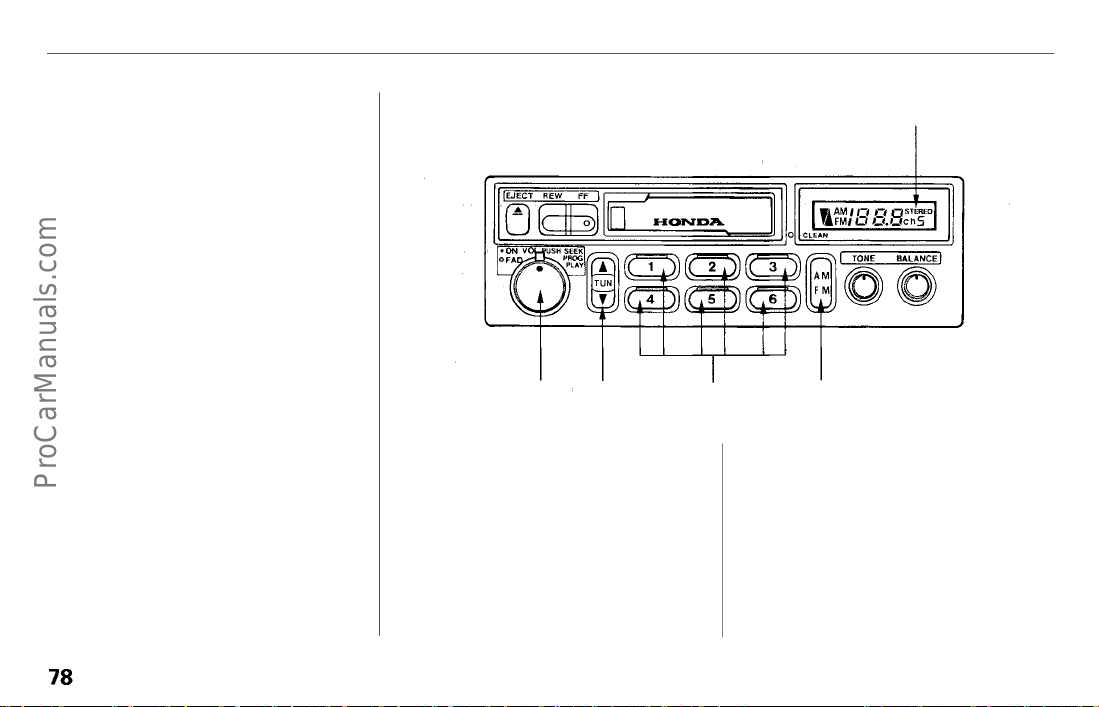
Audio System
Operating the Radio
The ignition switch must be in AC-
CESSORY (I) or ON (II) to operate
the audio system. Turn the system
on by turning the ON/VOL knob
clockwise. The radio comes on and
displays the frequency of the station
it was last tuned to.
Adjust the volume by turning the
ON/VOL knob.
Select the band you want to listen to
by pressing the AM/FM button. You
will see the selected band and the
frequency in the display.
STEREO will be displayed next to
the frequency if the station is
broadcasting in FM stereo. The AM
stereo feature is not available.
Finding the Radio Station
Yo
u can use any of three methods to
find radio stations on the selected
band: TUNE, SEEK, or the Preset
buttons.
Comfort and Convenience Features
STEREO INDICATOR
ON/VOL KNOB
SEEK BUTTON
PRESET
BUTTONS
AM/FM
BUTTON
TUNE
BAR
ProCarManuals.com

Audio System
Use the TUNE bar to change the
frequency in small increments. Press
the top ( ) to go up, and the bottom
( ) to go down. Press and release to
change the frequency to the next
number.
Press the TUNE bar and hold it to go
to a frequency that is far away. The
frequency display will begin to count
rapidly. It will stop counting when
you release the bar.
The SEEK function searches for
radio stations with strong signals.
Every time you press the ON/VOL
button, it advances to the next
station.
Presetting
The preset buttons allow you to store
radio frequencies for later selection.
Each button will store one frequency
on the AM band, and one on the FM
band.
To store a frequency:
1. Select the desired band, AM or
FM.
2. Use the TUNE or SEEK function
to tune the radio to a desired
station.
3. Pick the Preset button you want
for that station. Press the button
and hold it until you hear a beep.
Repeat steps 1 to 3 to store a total
of six stations each on AM and
FM.
Once that station's frequency is
stored, simply press and release the
proper preset button to tune to it. If
you want to change any preset
button's selection, store another fre-
quency as described. The frequen-
cies you preset will be lost if your
car's battery goes dead or is discon-
nected.
Adjusting the Sound
Use the Balance and Fader controls
to adjust the sound "direction". The
Balance control moves it left-to-right.
The Fader control moves it front-to-
back.
Use the Tone control to adjust the
bass and treble to your liking.
The radio panel illumination comes
on with the instrument panel lights,
even with the radio off. You can turn
off this illumination even with the
radio on by pulling the Balance
control knob out. Check this knob if
the lights do not come on with the in-
strument panel lights.
Comfort and Convenience Features
ProCarManuals.com
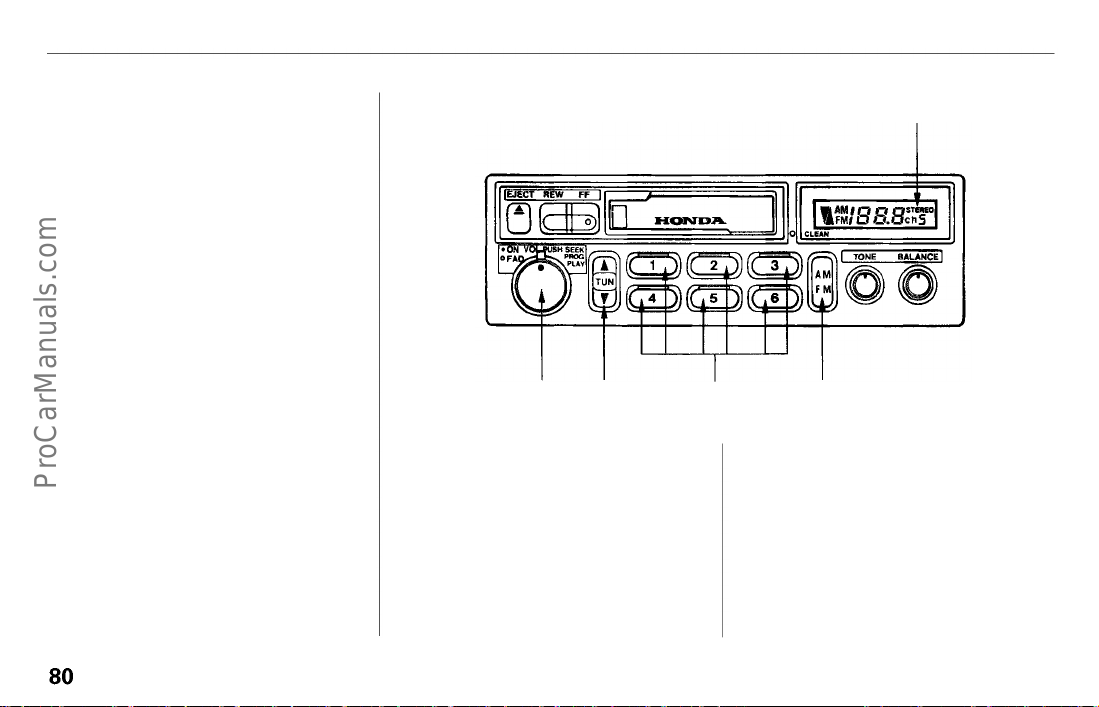
Audio System
Radio Frequencies
Your Honda's radio can tune in all
frequencies in both the AM and FM
bands.
Those bands cover these frequen-
cies:
AM band:
530 kilohertz to 1,710 kilohertz
FM band:
87.7 megahertz to 107.9 mega-
hertz
Radio stations on the AM band are
assigned frequencies at least 10
kilohertz apart (530, 540, 550).
Those on the FM band are assigned
frequencies at least 0.2 megahertz
apart (87.9, 88.1, 88.3).
ON/VOL KNOB
SEEK BUTTON
PRESET
BUTTONS
AM/FM
BUTTON
Stations must use these exact
frequencies. It is fairly common for
stations to round-off the frequency in
their advertising, so your radio will
show a frequency of 100.9 even
though the announcer may call the
station "FM101."
Comfort and Convenience Features
STEREO INDICATOR
TUNE
BAR
ProCarManuals.com
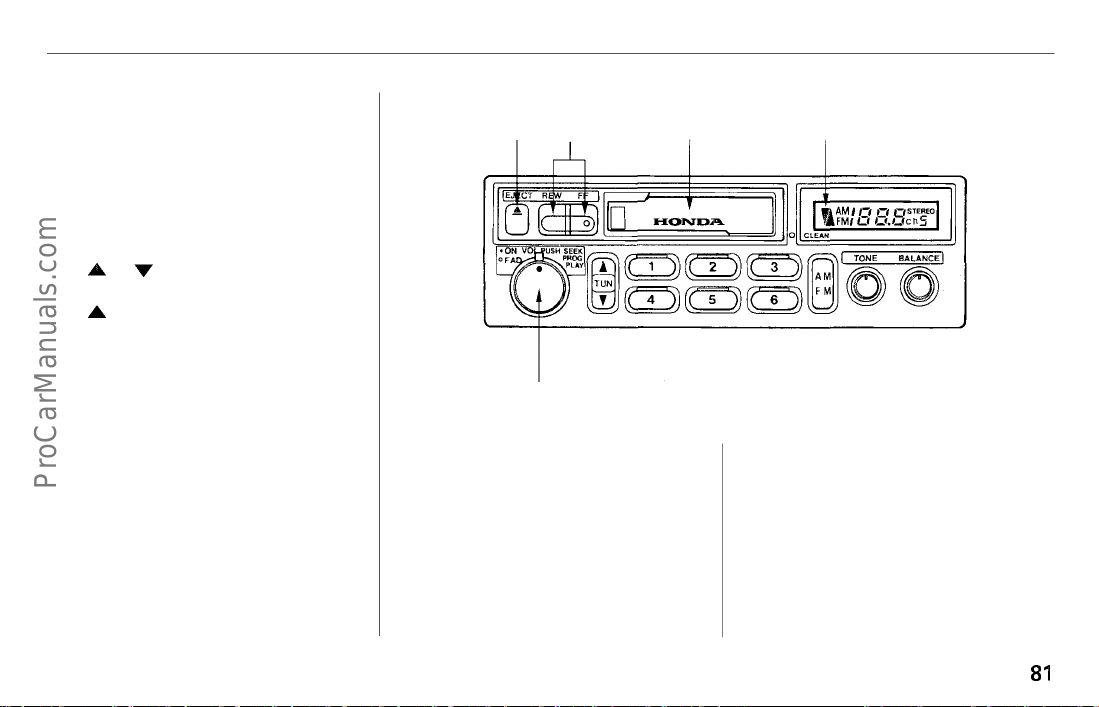
Audio System
Operating the Cassette Player
Turn the system ON. Insert the
cassette into the slot with the tape
opening to the right. Push the
cassette in most of the way. The
drive will pull it in the rest of the way
and begin to play.
The or will light to show you
which side of the cassette is playing.
The indicates the side you
inserted facing upward is now
playing. To play the other side of the
tape, press the PROG/PLAY button.
The system also has an Auto-reverse
feature. It will automatically reverse
direction when it reaches the end of
the cassette.
To remove the cassette from the
drive, press the EJECT button. The
system automatically ejects the
cassette whenever you turn off the
system or the ignition switch.
EJECT
BUTTON
CASSETTE
SLOT
TAPE DIRECTION
INDICATOR
PROG/PLAY
BUTTON
Cassette Search Functions
Fast forward and rewind allow you to
move the tape rapidly to find a
desired program. Note which
direction the tape is moving from the
Tape Direction Indicator. Press the
FF or REW button to move the tape
in the same direction or the opposite
direction. It will go back to PLAY
when you push the PLAY button.
Caring for Cassettes
Damaged cassettes can jam inside
the drive or cause other problems.
See page 97 for information on
cassette care and protection.
Comfort and Convenience Features
FF/REW
BUTTONS
ProCarManuals.com
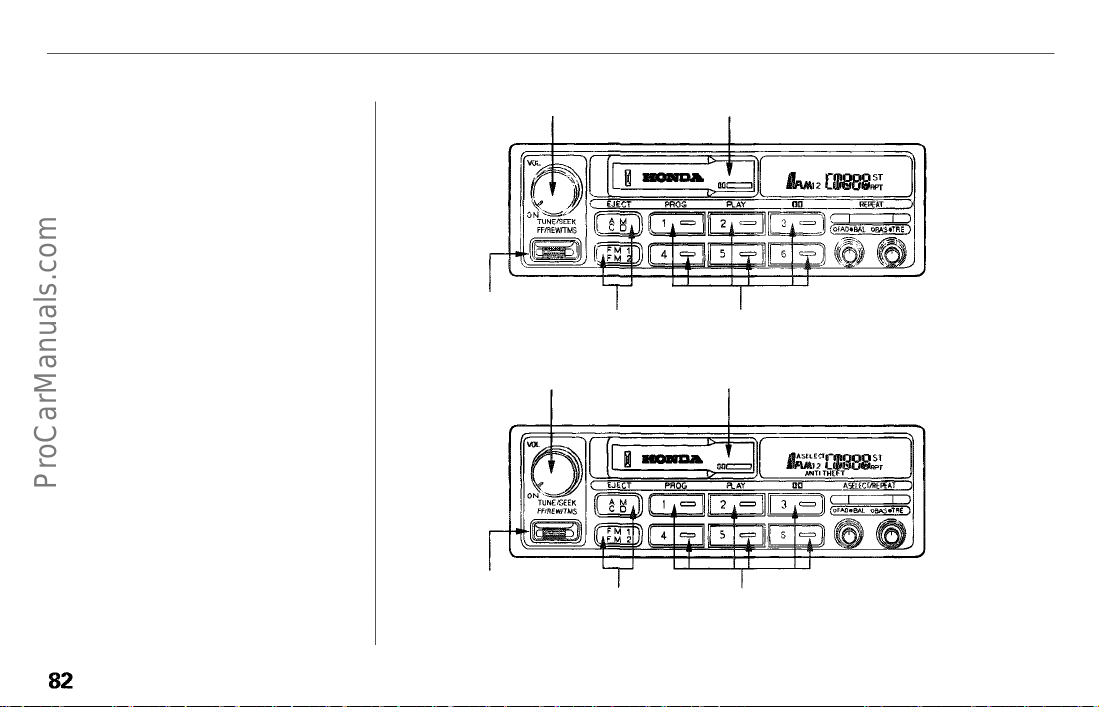
Audio System
AM/FM/Cassette Stereo Audio
System
For U.S. LX and EX models, and
Canadian EX-R model
Your Honda audio system is easy to
use, and will give clear AM/FM
reception. The preset buttons allow
you to select six stations on AM and
twelve stations on FM.
(US: LX)
ON/OFF/VOL KNOB
TUNE/SEEK
FF/REW/TMS
SWITCH
PRESET
BUTTONS
Comfort and Convenience Features
TUNE/SEEK
FF/REW/TMS
SWITCH
AM/FM
BUTTON
PRESET
BUTTONS
CASSETTE SLOT
ON/OFF/VOL KNOB
(US: EX,
Canada: EX-R)
AM/FM
BUTTON
CASSETTE SLOT
ProCarManuals.com
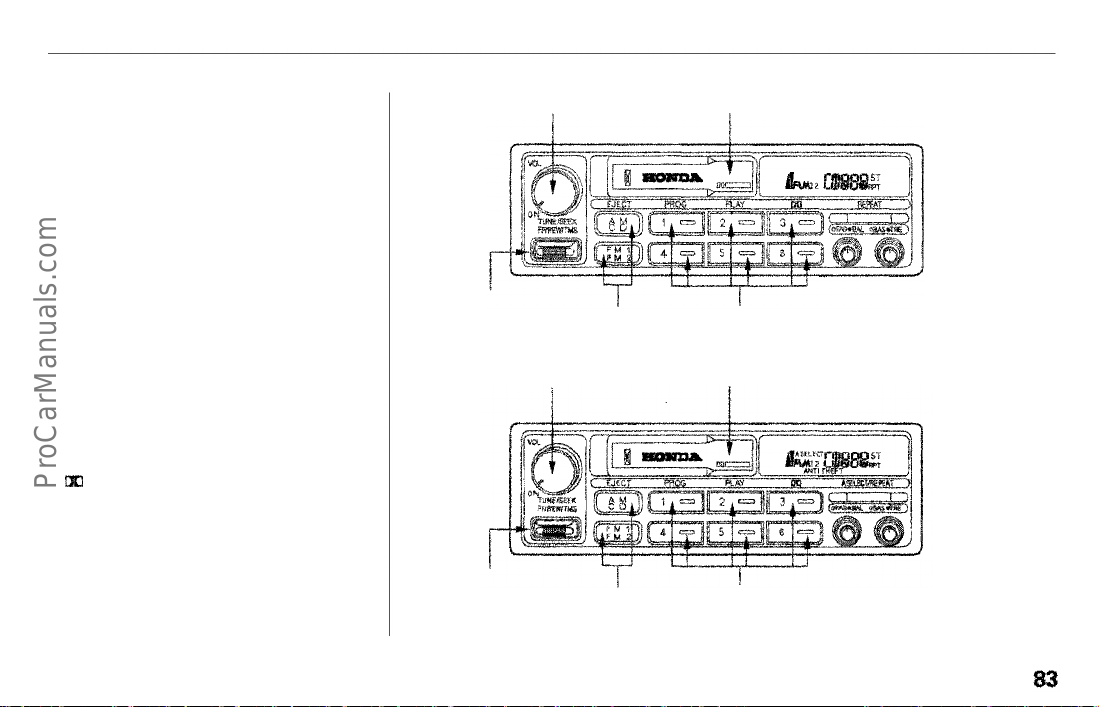
Audio System
The cassette system uses
Dolby B
®
* noise reduction to give
excellent sound reproduction. The
system also senses when a metal or
chromium-dioxide (CrO
2
) tape is
being played and adjusts accordingly.
On U.S. EX and Canadian EX-R models
The Anti-theft feature disables the
system if it is disconnected from the
car's battery. To get the system
working again, you must enter a
code number,
* Dolby noise reduction manufac-
tured under license from Dolby
Laboratories Licensing Corporation.
"DOLBY" and the double-D symbol
are trademarks of Dolby
Laboratories Licensing Corporation.
(US: LX)
ON/OFF/VOL KNOB
Comfort and Convenience Features
CASSETTE SLOT
TUNE/SEEK
FF/REW/TMS
SWITCH
AM/FM
BUTTON
PRESET
BUTTONS
CASSETTE SLOT
ON/OFF/VOL KNOB
(US: EX,
Canada: EX-R)
PRESET
BUTTONS
AM/FM
BUTTON
TUNE/SEEK
FF/REW/TMS
SWITCH
ProCarManuals.com

Audio System
Operating the Radio
The ignition switch must be in AC-
CESSORY (I) or ON (II) to operate
the audio system. Turn the system
on by turning the ON/OFF/VOL
knob clockwise. The radio comes on
and displays the frequency of the
station it was last tuned to.
The system turns off when you turn
the ignition switch to LOCK (0).
Adjust the volume by turning the
ON/OFF/VOL knob.
Select the band you want to listen to
by pressing the AM/FM button. You
will see the selected band and the
frequency in the display.
ST will be displayed next to the fre-
quency if the station is broadcasting
in FM stereo. The AM stereo feature
is not available.
(US:
LX)
ON/OFF/VOL KNOB
STEREO INDICATOR
AM/FM
BUTTON
STEREO INDICATOR
AM/FM
BUTTON
Comfort and Convenience Features
ON/OFF/VOL KNOB
(US:
EX,
Canada: EX-R)
ProCarManuals.com
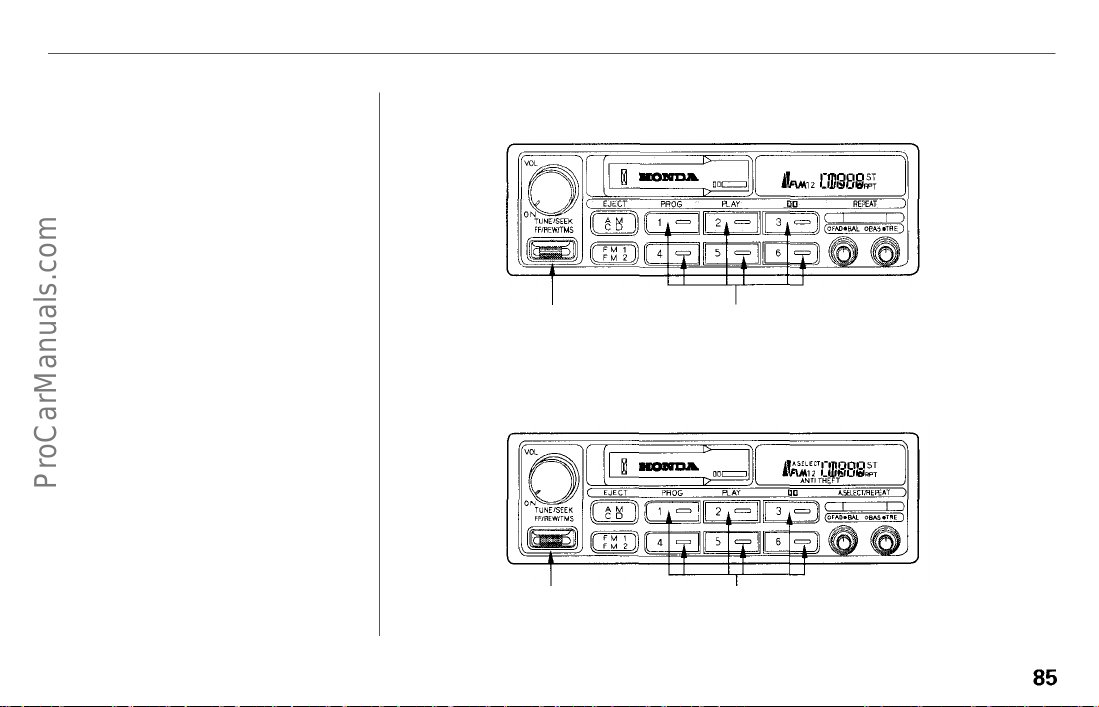
Audio System
Yo u can use any of three methods to
find radio stations on the selected
band: TUNE, SEEK, or the Preset
buttons.
The TUNE function lets you find a
desired frequency. Push the TUNE/
SEEK switch up to change to a
higher frequency, and down to
change to a lower frequency.
To change the frequency up or down
a single increment, push and release
the TUNE/SEEK switch.
The SEEK function searches the
band for stations with a strong signal.
Depending on which way you push
the TUNE/SEEK switch, the system
searches up or down from the
current frequency. Push the switch
until you hear a beep, then release it.
The system searches until it finds a
station with a strong signal, then
stops. If you do not want to listen to
that station, push TUNE/SEEK
again.
(US: LX)
TUNE/SEEK
SWITCH
PRESET
BUTTONS
(US: EX,
Canada: EX-R)
TUNE/SEEK
SWITCH
PRESET
BUTTONS
Comfort and Convenience Features
ProCarManuals.com
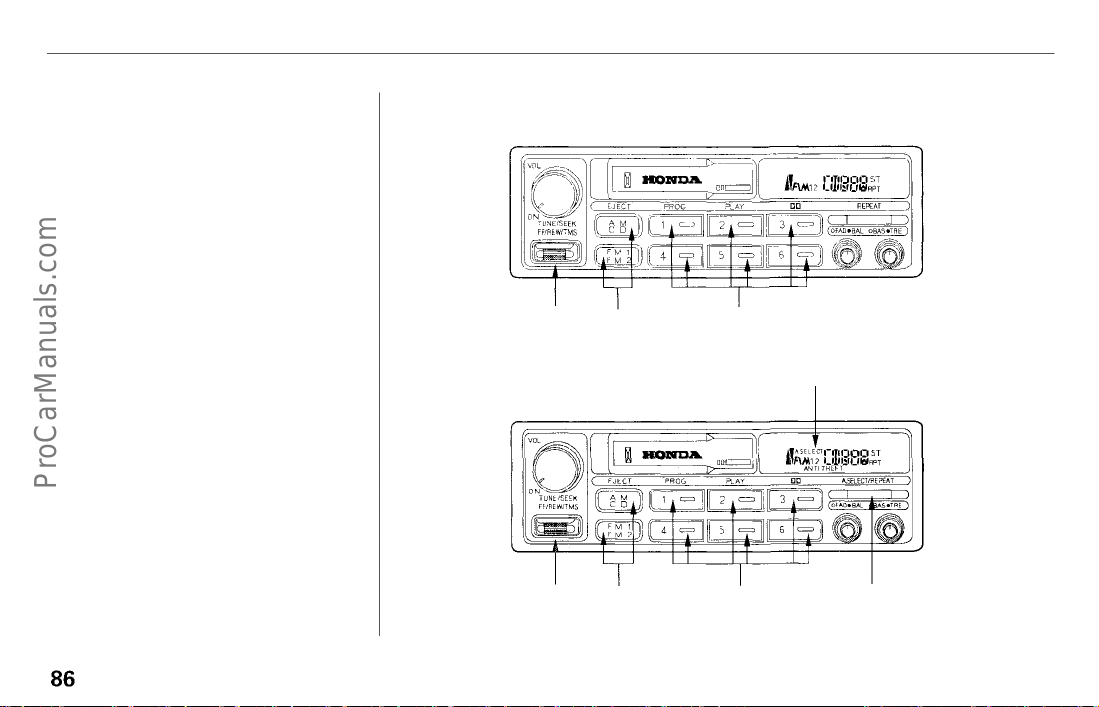
Audio System
Presetting
The preset buttons allow you to store
radio frequencies for later selection.
Each button will store one frequency
on the AM band, and two on the FM
band.
To store a frequency:
1. Select the desired band, AM or
FM. FM1 and FM2 let you store
two frequencies with each Preset
button.
2. Use the TUNE or SEEK function
to tune the radio to a desired
station.
3. Pick the Preset button you want
for that station. Press the button
and hold it until you hear a beep.
4. Repeat steps 1 to 3 to store a total
of six stations on AM and twelve
on FM.
(US: LX)
(US: EX,
Canada: EX-R)
AUTO SELECT LIGHT
TUNE/SEEK
SWITCH
AUTO SELECT
BUTTON
Comfort and Convenience Features
AM/FM
BUTTON
PRESET
BUTTONS
TUNE/SEEK
SWITCH
AM/FM
BUTTON
PRESET
BUTTONS
ProCarManuals.com

Audio System
Once that station's frequency is
stored, simply press and release the
proper preset button to tune to it. If
you want to change any preset
button's selection, store another fre-
quency as described. The frequen-
cies you preset will be lost if your
car's battery goes dead or is discon-
nected.
On U.S. EX and Canadian EX-R models
The AUTO SELECT function allows
you to find stations easily when you
are in an unfamiliar area. Press the
AUTO SELECT button. The system
automatically scans both bands to
find six strong stations on AM and
twelve on FM, and stores their
frequencies in the Preset buttons.
You can then use the Preset buttons
in the normal manner to select those
stations. "A SELECT" stays
displayed next to the frequency as a
reminder.
If you are in a remote area, AUTO
SELECT may not find enough
stations to fill all the available
presets. If this is the case, you will
see a "0" displayed when you press
any Preset button that does not have
a station stored.
AUTO SELECT does not erase the
stations you have manually preset.
When you return to your normal
reception area, turn off AUTO
SELECT by pressing the button
again. The light goes out and the
Preset buttons can then select the
stations you originally set.
You cannot manually store radio
station frequencies in the Preset
buttons when AUTO SELECT is ON.
If you do not like the stations found
by AUTO SELECT, you can still use
the TUNE or SEEK function to find
other stations.
Comfort and Convenience Features
ProCarManuals.com
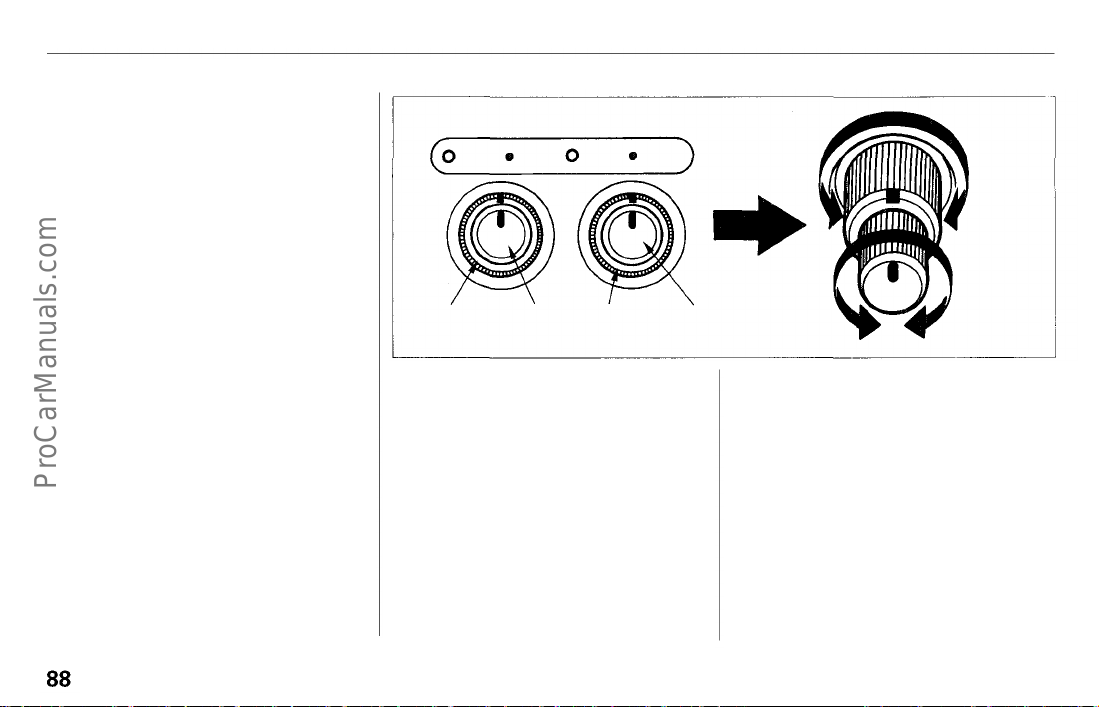
Audio System
Adjusting the Sound
Use the Balance and Fader controls
to adjust the sound "direction". The
Balance control moves it left-to-right.
The Fader control moves it front-to-
back.
To use either control, push on the
knob to get it to pop out. Adjust the
front-to-back sound to your liking
with the outside ring.
Adjust side-to-side sound balance
with the knob. Push the knob back in
when you are done.
The illumination for the radio con-
trols comes on with the instrument
panel lights, even if the radio is off.
You can use the Balance control to
turn off the radio panel illumination
even with the radio on. Push the
control knob so it pops out, then pull
it out slightly further. Check this
control if the control panel lights do
not come on with the instrument
panel lights.
Use the Bass and Treble controls to
adjust the tone quality to your liking.
Push on the knob to get the controls
to pop out. Adjust the bass level with
the outer ring and the treble level
with the knob. When finished, push
the knobs back in so there is less
chance of accidentally changing your
settings.
Comfort and Convenience Features
FAD
BAL BAS TRE
FADER
CONTROL
BALANCE
CONTROL
BASS
CONTROL
TREBLE
CONTROL
ProCarManuals.com
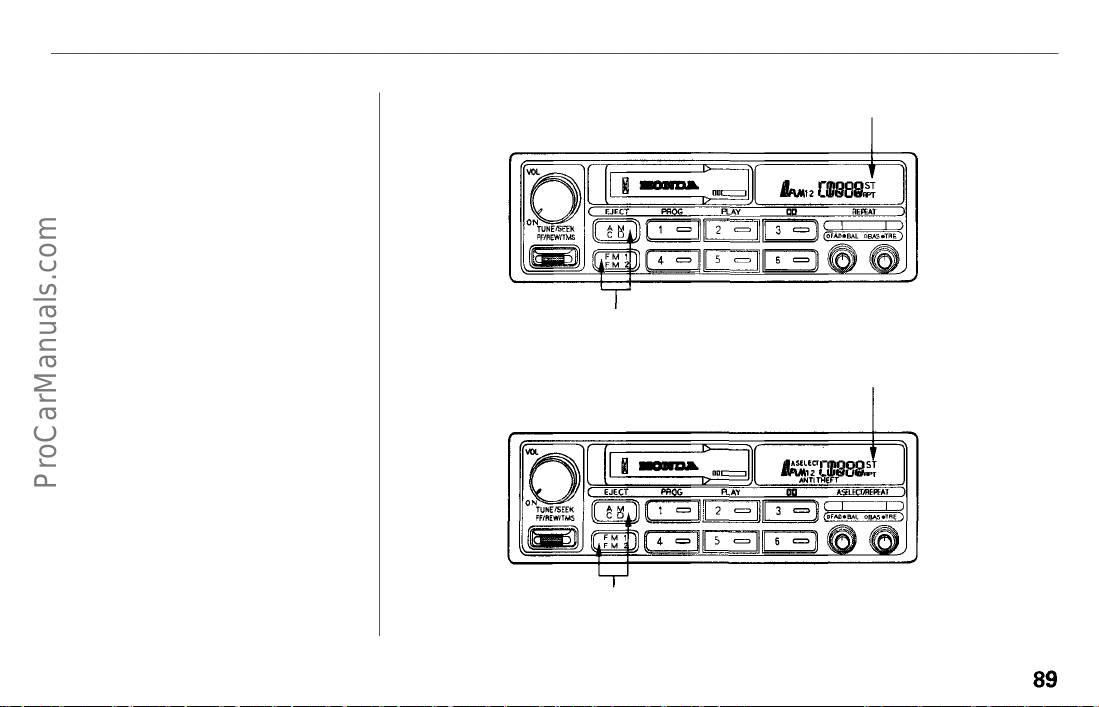
Audio System
Radio Frequencies
Your Honda's radio can tune in all
frequencies in both the AM and FM
bands.
Those bands cover these frequen-
cies:
AM band:
530 kilohertz to 1,710 kilohertz
FM band:
87.7 megahertz to 107.9 mega-
hertz
Radio stations on the AM band are
assigned frequencies at least 10
kilohertz apart (530, 540, 550).
Those on the FM band are assigned
frequencies at least 0.2 megahertz
apart (87.9, 88.1, 88.3).
Stations must use these exact
frequencies. It is fairly common for
stations to round-off the frequency in
their advertising, so your radio will
show a frequency of 100.9 even
though the announcer may call the
station "FM101."
(US: LX)
STEREO INDICATOR
AM/FM
BUTTON
(US: EX,
Canada: EX-R)
STEREO INDICATOR
AM/FM
BUTTON
Comfort and Convenience Features
ProCarManuals.com

Audio System
Operating the Cassette Player
Turn the system ON. Insert the
cassette into the slot with the tape
opening to the right. Push the
cassette in most of the way. The
drive will pull it in the rest of the way
and begin to play.
The or will light to show you
which side of the cassette is playing.
The indicates the side you
inserted facing upward is now
playing. To play the other side of the
tape, press the PROG button.
The system also has an Auto-reverse
feature. It will automatically reverse
direction when it reaches the end of
the cassette.
(US: LX)
ON/OFF/VOL KNOB
EJECT
BUTTON
EJECT
BUTTON
Comfort and Convenience Features
(US: EX,
Canada: EX-R)
ON/OFF/VOL KNOB
CASSETTE
SLOT
TAPE DIRECTION
INDICATOR
PROG
BUTTON
PLAY
BUTTON
DOLBY
BUTTON
PROG
BUTTON
PLAY
BUTTON
DOLBY
BUTTON
CASSETTE
SLOT
TAPE DIRECTION
INDICATOR
ProCarManuals.com
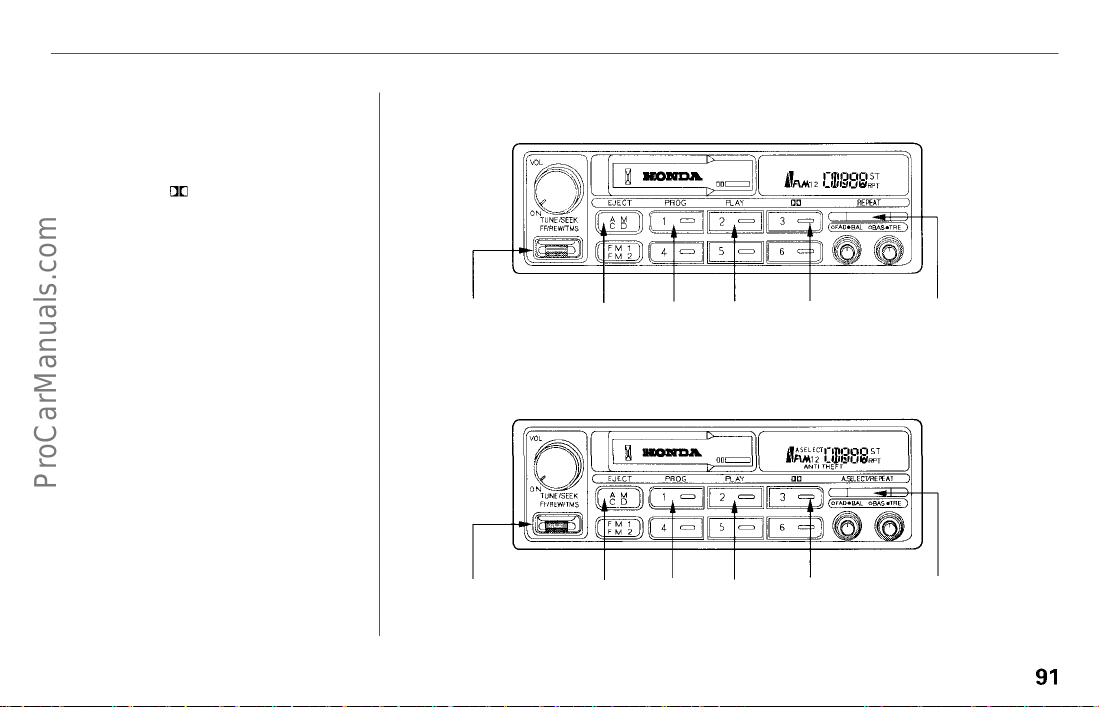
Audio System
Dolby
®
noise reduction turns on
when you insert a cassette. If the
tape was not recorded with Dolby
"B" noise reduction, turn it off by
pressing the button.
To remove the cassette from the
drive, press the EJECT button. The
system automatically ejects the
cassette whenever you turn off the
system or the ignition switch.
(US: LX)
FF/REW/TMS
SWITCH
(US: EX,
Canada: EX-R)
FF/REW/TMS
SWITCH
Comfort and Convenience Features
EJECT
BUTTON
PROG
BUTTON
PLAY
BUTTON
DOLBY
BUTTON
REPEAT
BUTTON
EJECT
BUTTON
PROG
BUTTON
PLAY
BUTTON
DOLBY
BUTTON
REPEAT
BUTTON
ProCarManuals.com

Audio System
Cassette Search Functions
Once a cassette is playing, you can
use the FF, REW, TMS, or REPEAT
function to look for desired songs or
passages.
To rewind the tape, push the FF/
REW/TMS switch down then
release it. You will see REW in the
display. To fast forward the tape,
push the switch up then release it.
You will see FF displayed. To stop
rewind or fast forward, press the
PLAY button. If the system reaches
the end of the cassette while in fast
forward or rewind, it automatically
stops that function, reverses
direction, and begins to play.
Press the REPEAT button to replay
the current passage. You will see
RPT displayed. When the system
reaches the end of the song or
passage that is being played, it
automatically goes into rewind.
When it senses the beginning of that
passage, it goes back to play. The
system will continue repeating this
passage until you turn off REPEAT
by pressing the button again.
The TMS function lets you skip to
the beginning of a song or other
passage. The tape skips forward or
backward, depending on which
direction you push the FF/REW/
TMS switch.
Activate TMS by pushing the FF/
REW/TMS switch and holding it
until you hear a beep. If you push the
switch down, you will see REW
blinking in the display as the tape
rewinds. If you push the switch up,
you will see FF blinking in the
display as the tape fast forwards.
When the system senses a silent
period on the tape, it goes back to
PLAY mode.
The REPEAT and TMS functions
use silent periods on the tape to find
the end of a selection. These
features may not work satisfactorily
on tapes that have almost no gap
between songs, a high noise level
between songs, or silent periods in
the middle of songs.
Caring for Cassettes
Damaged cassettes can jam inside
the drive or cause other problems.
See page 98 for information on
cassette care and protection.
Comfort and Convenience Features
ProCarManuals.com

Audio System
Operating the CD Player
Optional for U.S. LX and EX models and
Canadian EX-R model
A Compact Disc changer is available
for your car. It holds up to six discs,
providing several hours of continu-
ous programming. You operate the
CD changer with the same controls
used for the radio and cassette
player.
Load the desired CD's in the
magazine and load the magazine in
the changer according to the
instructions that came with the unit.
Your dealer has Genuine Honda
accessory in-dash CD players
available that are operated by the
radio controls. If you have one of
these units, use the directions in this
section (except for multi-disc
selection) to operate it.
To operate the CD changer, the
ignition key must be in ACCESSORY
(I) or ON (II). If you are listening to
a cassette tape, eject it before
playing a CD.
Press the CD button until "CD"
appears on the display. Once in the
CD mode, the system will start to
play the first track of the first disc in
the magazine.
When that disc ends, the next disc in
the magazine is loaded and played.
After disc 6 has completed, the
system will return to disc 1. To make
your own disc selection, push one of
the six preset buttons. Your selection
will appear in the display and start
playing.
You can use the TUNE/SEEK
switch while a disc is playing to
select passages and change tracks.
To move rapidly forward within a
track, push up and hold the TUNE/
SEEK switch. Push down and hold
the switch to move rapidly backward
within a track. You will hear a beep a
half s
econd
after you push the
switc
h up or down. Keep pushing the
switch until you think the track has
advanced or returned to the desired
position. The disc will start playing
when you release the switch.
If you push the TUNE/SEEK switch
up and release it before you hear a
beep, the system will skip forward to
the beginning of the next track on
that CD.
If will skip backward to the begin-
ning of the current track if you push
the switch down and release it.
CONTINUED
Comfort and Convenience Features
ProCarManuals.com
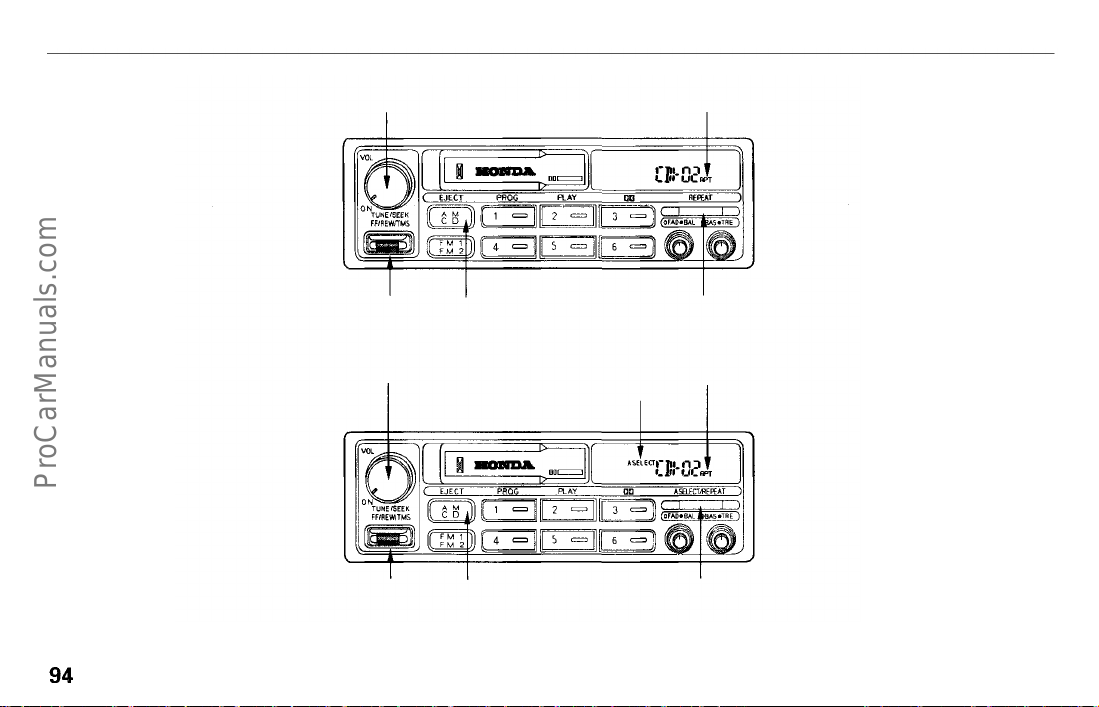

Audio System
If you push the REPEAT button on
the U.S. LX model or the
A. SELECT/REPEAT button on the
U.S. EX and Canadian EX-R models,
the system will continuously play the
track you are listening to. You will
see RPT in the display. Push the
switch again to turn off the REPEAT
mode.
On U.S. EX and Canadian EX-R models
You can get the CD player to
randomly select tracks by pressing A.
SELECT/REPEAT until you see A.
SELECT in the display.
With this active, the system selects
and plays the tracks randomly,
rather than sequentially, on each
disc. When the system has played all
the tracks on that disc, it loads the
next disc and starts to play randomly.
The system continues to select and
play tracks randomly on each of the
six discs until you press the A.
SELECT/REPEAT button again.
To turn on random play mode while
the system is in the REPEAT mode,
turn off REPEAT mode first by
pressing the A. SELECT/REPEAT
button. Then, press the button again
as explained above.
If you change modes to radio or
tape while a CD is playing, then
change back to CD mode, the
same disc and track will play.
If you turn off the system while a
CD is playing, either with the ON-
OFF/VOL knob or by turning off
the ignition, the system will begin
at the same disc and track when
you turn it back on.
If you try to select an empty slot in
the magazine, the system will
select and play the first track of
the next disc in the magazine.
To return to the radio function, press
the AM/FM button.
Comfort and Convenience Features
ProCarManuals.com

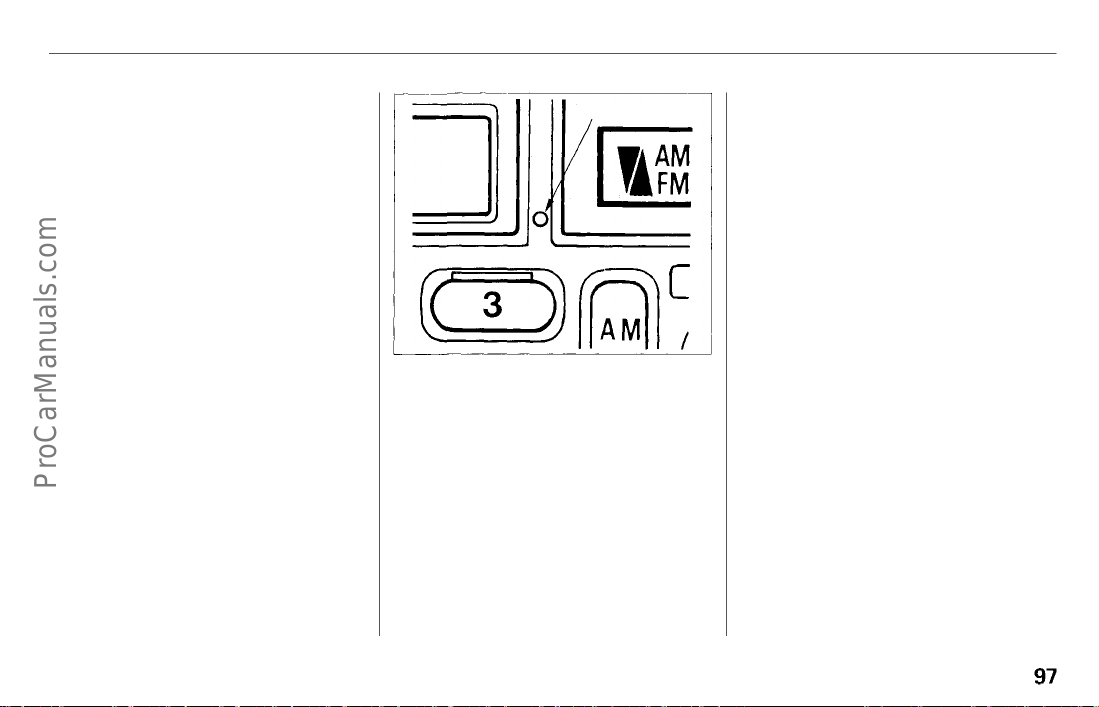
Caring for the Cassette Player
For Canadian LX model only
The cassette drive picks up dirt and
oxides whenever you play a tape.
This builds up over time and causes
the sound quality to degrade. To
prevent this, you should clean the
cassette drive after every 30 hours of
use. Your dealer has a cleaning kit
available for this purpose.
To remind you, a small red light
labelled CLEAN comes on every 50
hours of tape use. If you are already
regularly cleaning the tape drive at
least every 30 hours, simply push the
CLEAN light for five seconds to turn
it off.
If you do not clean the cassette drive
regularly, it may eventually become
impossible to remove the deposits
with a normal cleaning kit.
The cassette player automatically
ejects cassettes that do not play
normally. If it ejects a cassette
before it begins to play, it is probably
defective and should not be inserted
again. You may have a cassette
suddenly stop playing, reverse
directions once or twice and then
eject. This is normally an indication
the tape is wound unevenly. It should
play normally after being manually
rewound.
Use 100-minute or shorter cassettes.
Cassettes longer than 100 minutes
use thinner tape that may break or
jam the drive.
Look at a cassette before you insert
it. If the tape is loose, tighten it by
turning one of the hubs with a pencil
or your finger.
If the label is peeling off, do not put
it in the player. It may cause the
cassette to jam in the drive mecha-
nism when you try to eject it.
Do not leave cassettes sitting where
they are exposed to high heat or
humidity, such as on top of the
dashboard or in the player. If a
cassette is exposed to extreme heat
or cold, let it reach a moderate
temperature before putting it in the
player.
CONTINUED
Comfort and Convenience Features
CLEAN LIGHT
CLEAN
ProCarManuals.com
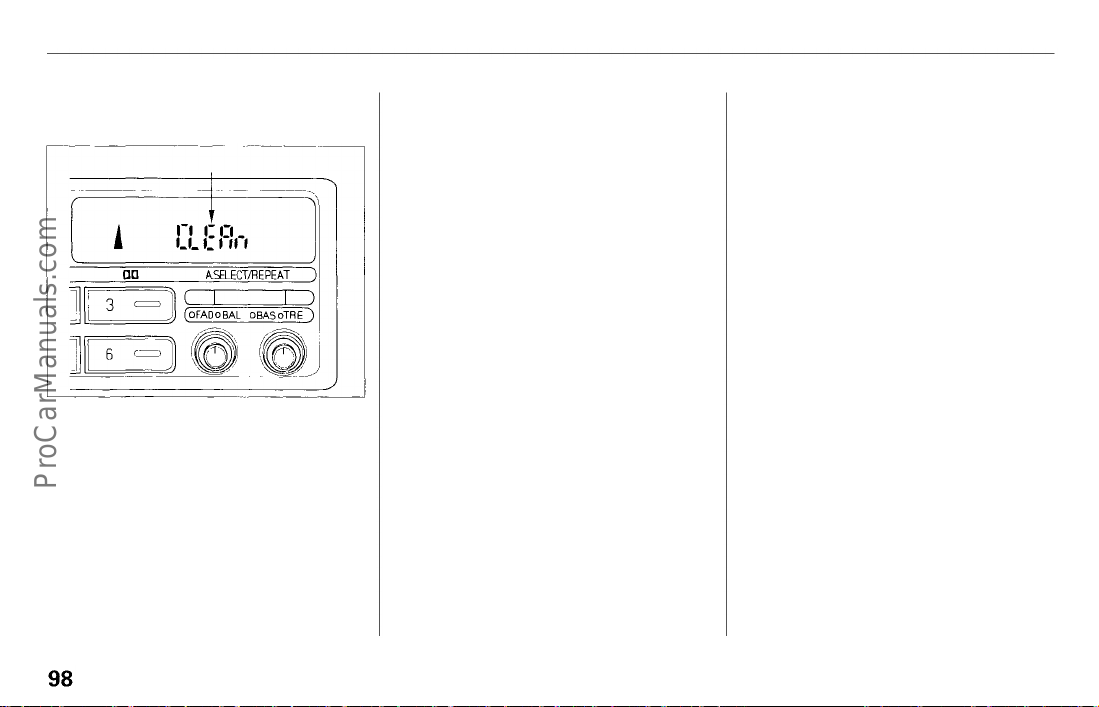
Caring for the Cassette Player
On U.S. LX and EX models, and
Canadian EX-R model
The cassette drive picks up dirt and
oxides whenever you play a tape.
This builds up over time and causes
the sound quality to degrade. To
prevent this, you should clean the
cassette drive after every 30 hours of
use. Your dealer has a cleaning kit
available for this purpose.
After 30 hours of tape use, you will
see CLEAN flashing for 5 seconds in
the display when you insert a tape
into the tape slot. If you are already
regularly cleaning the tape drive at
least every 30 hours, reset the
indicator by pressing the Preset 6
button while the system is in the
tape operation mode. Hold the
button until you hear a beep and the
CLEAN indicator goes out.
If you do not clean the cassette drive
regularly, it may eventually become
impossible to remove the deposits
with a normal cleaning kit.
The cassette player automatically
ejects cassettes that do not play
normally. If it ejects a cassette
before it begins to play, it is probably
defective and should not be inserted
again. You may have a cassette
suddenly stop playing, reverse
directions once or twice and then
eject. This is normally an indication
the tape is wound unevenly. It should
play normally after being manually
rewound.
Use 100-minute or shorter cassettes.
Cassettes longer than 100 minutes
use thinner tape that may break or
jam the drive.
Look at a cassette before you insert
it. If the tape is loose, tighten it by
turning one of the hubs with a pencil
or your finger.
If the label is peeling off, do not put
it in the player. It may cause the
cassette to jam in the drive mecha-
nism when you try to eject it.
Do not leave cassettes sitting where
they are exposed to high heat or
humidity, such as on top of the
dashboard or in the player. If a
cassette is exposed to extreme heat
or cold, let it reach a moderate
temperature before putting it in the
player.
Comfort and Convenience Features
CLEAN INDICATOR
ProCarManuals.com
Theft Protection
On U.S. EX and Canadian EX-R models
Your car's audio system will disable
itself if it is disconnected from
electrical power for any reason. To
make it work again, the user must
enter a specific five-digit code in the
Preset buttons. Because there are
hundreds of number combinations
possible from five digits, making the
system work without knowing the
exact code is nearly impossible.
You should have received two copies
of a card that lists your audio system's
code number and serial number. It is
best to store one of these cards in a
safe place at home, and to keep the
other in your wallet or purse. In
addition, you should write the audio
system's serial number in this
Owner's Manual. If you should
happen to lose both cards, you must
obtain the code number from your
Honda dealer. To do this, you will
need the system's serial number.
If your car's battery is disconnected
or goes dead, the audio system will
disable itself. If this happens, you
will see "Code" in the frequency
display the next time you turn on the
system. Use the Preset buttons to
enter the five-digit code. If it is
entered correctly, the radio will start
playing.
If you make a mistake entering the
code, do not start over or try to
correct your mistake. Complete the
five-digit sequence, then enter the
correct code. You have three tries to
enter the correct code. If you are
unsuccessful in three attempts, you
must then leave the system on for
one hour before trying again.
You will have to store your favorite
stations in the Preset buttons after
the system begins working. Your
original settings were lost when
power was disconnected.
Comfort and Convenience Features
ProCarManuals.com

Before Driving
Before you begin driving your Honda,
you should know what gasoline to
use, and how to check the levels of
important fluids. You also need to
know how to properly stow luggage
or packages. This section will help
you. If you plan to add any accesso-
ries to your car, please read the
information in this section first.
Break-in Period.............................. 102
Gasoline.......................................... 102
Oxygenated Fuels...................... 102
Driving in Foreign Countries... 103
Service Station Procedures.......... 104
Filling the Fuel Tank................. 104
Opening the Hood..................... 105
Fuel Economy................................ 108
Vehicle Condition...................... 108
Driving Habits............................ 108
Accessories..................................... 109
Loading Cargo................................ 110
Before Driving
ProCarManuals.com

Break-in Period, Gasoline
Break-in Period
Help assure your car's future
reliability and performance by paying
extra attention to how you drive
during the first 1,000 km (600 miles).
During this period:
Avoid full-throttle starts and rapid
acceleration.
If you need to add oil, use the
engine oil recommended in this
owner's manual.
Avoid hard braking. New brakes
need to be broken-in by moderate
use for the first 300 km (200
miles).
You should follow these same re-
commendations with an overhauled
or exchanged engine, or when the
brakes are relined.
Gasoline
Your Honda operates most effec-
tively on unleaded gasoline with a
pump octane number of 86 or higher.
Use of a lower octane gasoline can
cause a persistent, heavy metallic
rapping noise in the engine that can
lead to mechanical damage.
We recommend gasolines containing
detergent additives that help prevent
fuel system and engine deposits.
Using gasoline containing lead will
damage your car's emission controls.
This contributes to air pollution and
can void certain parts of your
warranty.
Oxygenated Fuels
Some conventional gasolines are
being blended with alcohol or an
ether compound. These gasolines
are collectively referred to as
oxygenated fuels. To meet clean air
standards, some areas of the United
States and Canada use oxygenated
fuels to help reduce emissions.
If you use an oxygenated fuel, be
sure it is unleaded and meets the
minimum octane rating requirement.
Before using an oxygenated fuel, try
to confirm the fuel's contents. Some
states/provinces require this
information to be posted on the
pump.
Before Driving
ProCarManuals.com

Gasoline
The following are the EPA-approved
percentages of oxygenates:
ETHANOL (ethyl or grain alcohol)
You may use gasoline containing up
to 10% ethanol by volume. Gasoline
containing ethanol may be marketed
under the name "Gasohol."
MTBE (Methyl Tertiary Butyl
Ether)
You may use gasoline containing up
to 15% MTBE by volume.
METHANOL (methyl or wood
alcohol)
You may use gasoline containing up
to 5% methanol by volume as long as
it also contains cosolvents and
corrosion inhibitors to protect the
fuel system. Gasoline containing
more than 5% methanol by volume
may cause starting and/or perform-
ance problems. It may also damage
metal, rubber and plastic parts of
your fuel system.
If you notice any undesirable
operating symptoms, try another
service station or switch to another
brand of gasoline.
Fuel system damage or performance
problems resulting from the use of
an oxygenated fuel containing more
than the percentages of oxygenates
given above are not covered under
warranty.
Driving in Foreign Countries
Using any type of leaded gasoline in
your Honda will affect performance
and damage its emission controls.
Unleaded gasoline may not be
available in other countries. If you
are planning to take your car outside
the U.S. or Canada, write to Honda at
the address shown for information
about any modifications your car
may need. Be sure to include the
year and model of your car.
U.S. Owners:
American Honda Motor Co., Inc.
Consumer Affairs
1919 Torrance Blvd.
Torrance, CA 90501-2746
Canadian Owners:
Honda Canada Inc.
715 Milner Ave.
Scarborough, Ontario M1B 2K8
Before Driving
ProCarManuals.com
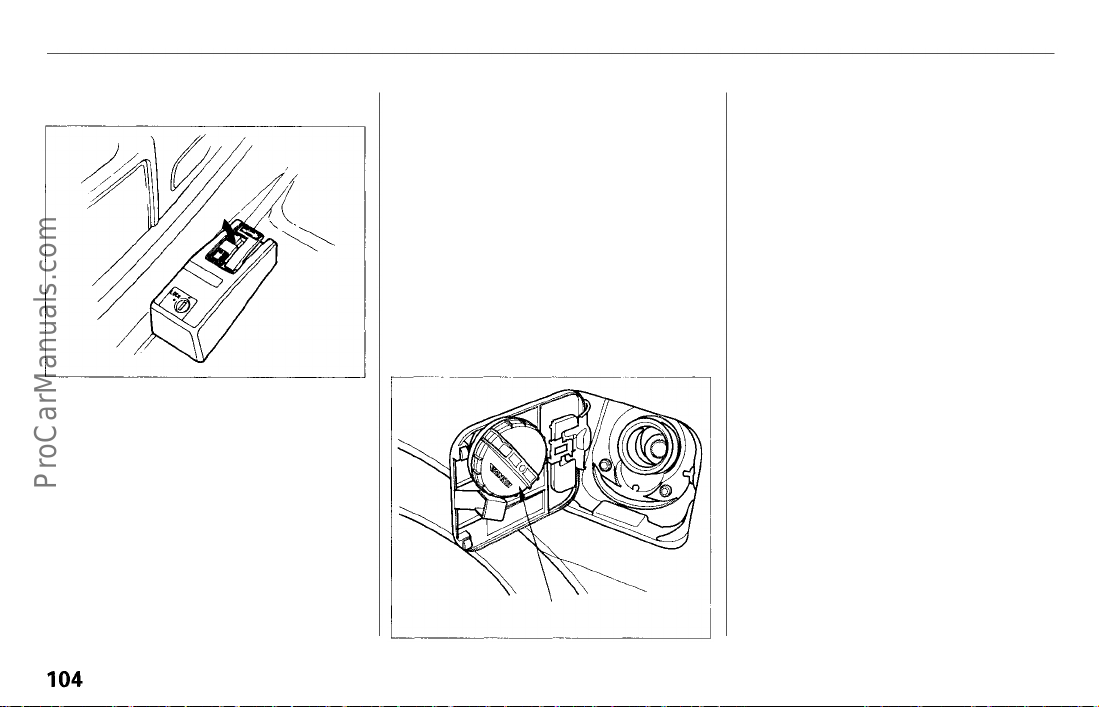
Service Station Procedures
Filling the Fuel Tank
1. The fuel fill is on the driver's side
of the car. Park with that side
closest to the service station
pumps.
2. Open the fuel fill door by pulling
on the handle to the left of the
driver's seat.
3. Remove the fuel fill cap slowly.
You may hear a hissing sound as
pressure inside the tank escapes.
Place the fuel fill cap on the inside
of the door as shown.
4. Stop filling the tank after the fuel
pump automatically clicks off. Do
not try to "top off" the tank, leave
some room for the fuel to expand
with temperature changes.
5. Screw the fuel fill cap back on,
tighten it until it clicks.
6. Push the fuel fill door until it
latches.
Before Driving
Handling gasoline improperly
can cause it to ignite or ex-
plode, causing you to be seri-
ously or fatally injured.
Always put out cigarettes
and other smoking materials,
and keep all sparks and open
flames away when you are
around gasoline.
FUEL FILL CAP
Pull
ProCarManuals.com
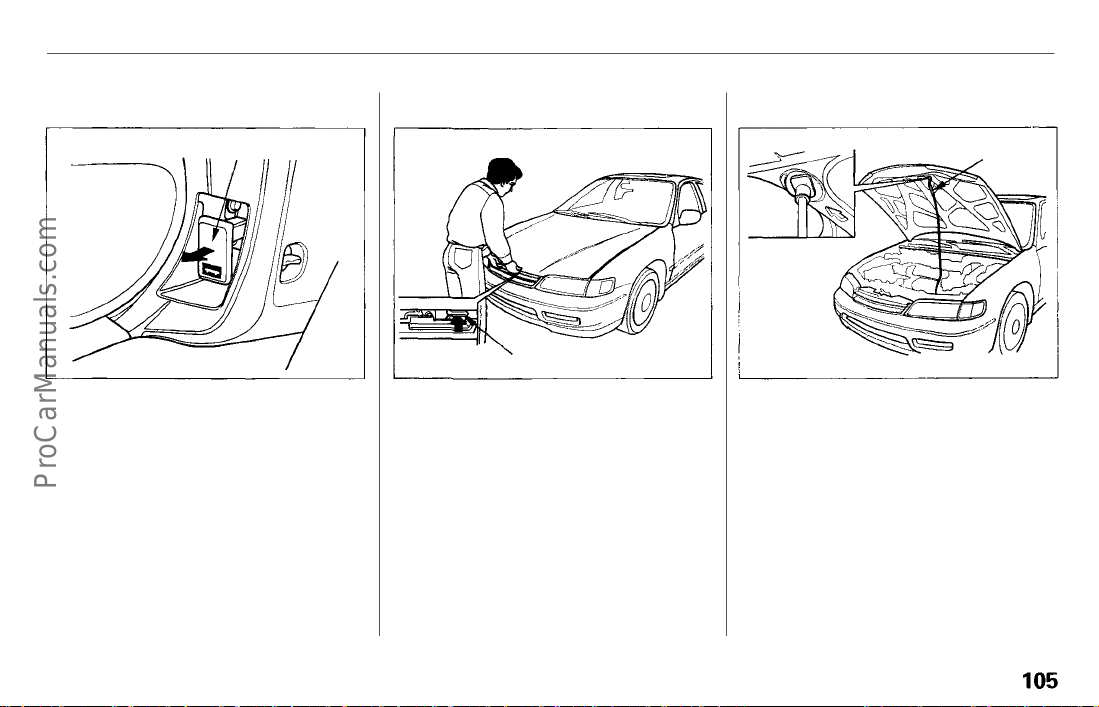
Service Station Procedures
Opening the Hood
1. Shift to Park or Neutral and set
the parking brake. Pull the hood
release handle, located under the
left lower corner of the dashboard.
The hood will pop up slightly.
2. Standing in front of the car, put
your fingers under the front edge
of the hood to the right of center.
Slide your hand to the left until
you feel the hood latch handle.
Push this handle up until it
releases the hood. Lift the hood.
3. Pull the support rod out of its clip
and insert the end into the hole on
the front of the hood around the
center.
To close the hood, lift it up slightly to
remove the support rod from the
hole. Put the support rod back into
its holding clip. Lower the hood to
about a foot above the fender, then
let it drop.
Before Driving
HOOD RELEASE HANDLE
LATCH
SUPPORT ROD
CONTINUED
ProCarManuals.com
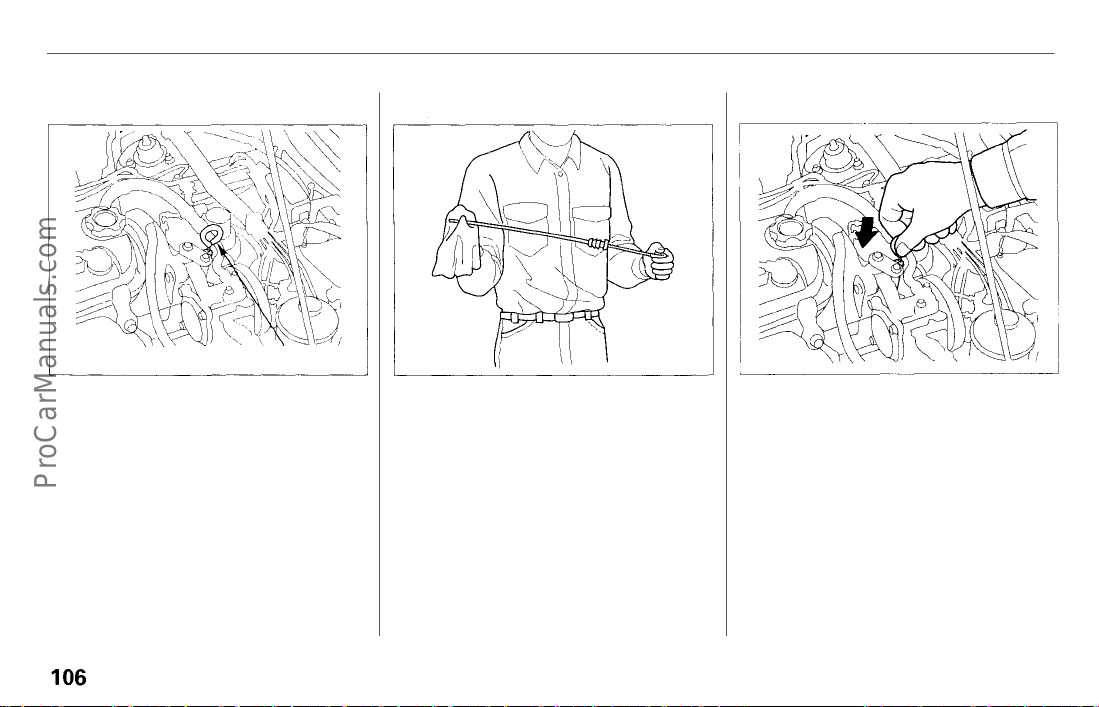
Service Station Procedures
Oil Check
Check the engine oil level every time
you fill the car with fuel. Wait at least
two minutes after turning the engine
off before you check the oil.
1. Remove the dipstick (orange
handle).
2. Wipe the dipstick with a clean
cloth or paper towel.
3. Insert it all the way back in its tube.
Before Driving
DIPSTICK
ProCarManuals.com
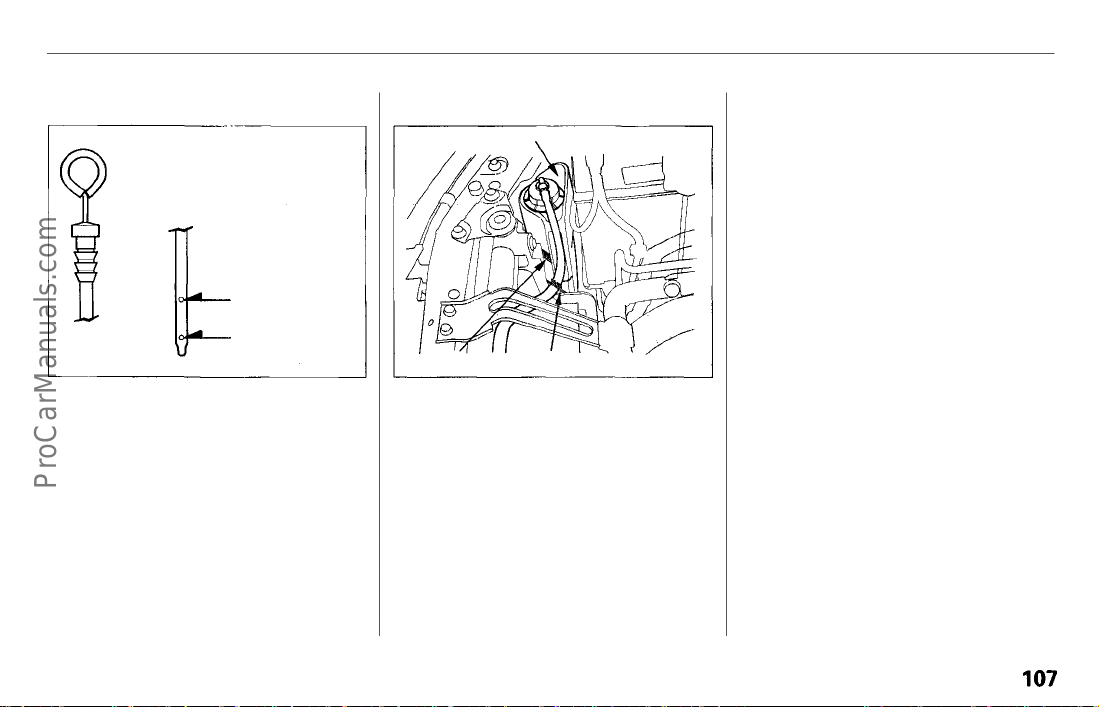
Service Station Procedures
4. Remove it again and check the
level. It should be between the
upper and lower marks.
If it is near or below the lower mark,
see page 139 for information on the
proper oil and how to add it.
Engine Coolant Check
Look at the coolant level in the
radiator reserve tank. Make sure it is
between the MAX and MIN lines. If
it is below the MIN line, see Adding
Engine Coolant on page 144 for
information on adding the proper
coolant.
Refer to Periodic Checks on page
137 for information on checking
other items in your Honda.
Before Driving
UPPER MARK
LOWER MARK
RESERVE TANK
MAX MIN
ProCarManuals.com

Fuel Economy
The condition of your car and your
driving habits are the two most
important things that affect the fuel
mileage you get.
Vehicle Condition
Always maintain your car according
to the maintenance schedule. This
will keep it in top operating condition.
An important part of that mainte-
nance is the Periodic Checks (see
page 137). For example an under-
inflated tire causes more "rolling
resistance," which uses fuel. It also
wears out faster, so check the tire
pressure at least monthly. In winter,
the build-up of snow on your car's
underside adds weight and rolling
resistance. Frequent cleaning helps
your fuel mileage and reduces the
chance of corrosion.
Driving Habits
You can improve fuel economy by
driving moderately. Rapid acceler-
ation, abrupt cornering, and hard
braking use more fuel.
Always drive in the highest gear that
allows the engine to run and acceler-
ate smoothly.
Depending on traffic conditions, try
to maintain a constant speed. Every
time you slow down and speed up,
your car uses extra fuel. Use the
cruise control, when appropriate, to
increase fuel economy.
A cold engine uses more fuel than a
warm engine. It is not necessary to
"warm-up" a cold engine by letting it
idle for a long time. You can drive
away in about a minute, no matter
how cold it is outside. The engine
will warm up faster, and you get
better fuel economy. To cut down on
the number of "cold starts," try to
combine several short trips into one.
The air conditioning puts an extra
load on the engine which makes it
use more fuel. Turn off the A/C to
cut down on air conditioning use.
Use the flow-through ventilation
when the outside air temperature is
moderate.
Before Driving
ProCarManuals.com

Accessories
Your Honda dealer has many
Genuine Honda Accessories that
allow you to personalize your car.
These have all been approved for
installation and use on your car, and
are covered by warranty.
Some non-Honda accessories you
can buy in the "aftermarket" are
designed for universal applications.
Although they may fit your Honda,
they may not be within factory
specifications. For example, after-
market wheels may not meet Honda's
specifications for width and offset.
They could cause suspension
problems which would not be
covered by your warranty. Im-
properly-designed accessories can
adversely affect your car's handling
and stability.
Your car has several computer-
controlled systems, including the
SRS system, the engine's fuel
injection, and the Anti-lock brake
system. Strong electronic inter-
ference can affect their operation.
Electronic communications equip-
ment, such as cellular telephones
and two-way radios are regulated by
the FCC (DOC in Canada) and
should not interfere with your car's
systems. Improper installation, or
using electrical equipment not in-
tended for mobile use may interfere
with your car's operation. If you want
to install a cellular telephone, other
mobile communications equipment
or even add-on stereo amplifiers,
please discuss it first with your
Honda dealer.
In many cases, improper installation
is the real cause of problems with
aftermarket accessories. Have these
accessories installed by qualified
technicians who are familiar with
your Honda. If possible, have your
Honda dealer inspect the final
installation.
Before Driving
ProCarManuals.com
Loading Cargo
The maximum load you can carry in
your Honda is 395 kg (850 Ibs). It
includes the total weight of all
passengers and their belongings, any
accessories, and the tongue weight
of a trailer. This 395 kg (850 Ibs)
figure is shown as the Vehicle
Capacity Weight on the tire infor-
mation label attached to the passen-
ger's door jamb.
To figure out how much cargo you
can carry:
Figure the total "occupant weight"
you will be transporting. To do this,
multiply the number of people
(driver and all passengers) by 70
kg (150 Ibs).
Subtract this number from the
Vehicle Capacity Weight (395 kg/
850 Ibs).
If you are towing a trailer, subtract
the tongue weight. See Towing a
Trailer on page 125.
This final number is the total weight
of cargo you can load in or on the car.
With five occupants (driver and four
passengers), the maximum recom-
mended weight for cargo is 45 kg
(100 Ibs).
Where you store this cargo, and how
well you secure it, are just as
important as how much it weighs.
Make sure you load cargo so it will
not shift while driving. When storing
items in the trunk, place them as far
forward as possible. You could store
additional items on the floor behind
the front seats. Make sure they
cannot roll under the front seat and
interfere with the pedals.
If you must carry large objects that
prevent you from closing the trunk
lid, be aware that exhaust gas can
enter the interior. See Carbon
Monoxide Hazard on page 27 .
Never place items on the shelf
behind the back seat. Those items
can fly forward and injure you or
your passengers if you brake hard or
are involved in a collision.
Before Driving
ProCarManuals.com

Driving
This section gives you tips on
starting the engine under various
conditions, and how to operate the
manual and automatic transmissions.
It also includes important infor-
mation on your car's braking system
and facts you need if you are plan-
ning to tow a trailer.
Preparing to Drive......................... 112
Starting the Engine........................ 113
5-speed Manual
Transmission.......................... 113
Automatic
Transmission.......................... 113
Starting in Cold Weather
at High Altitude ..................... 114
5-speed Manual Transmission..... 115
Recommended Shift Points...... 115
Maximum Speeds...................... 116
Automatic Transmission............... 116
Shift Lever Positions................. 117
Maximum Speeds...................... 120
Shift Lock Release..................... 120
The Braking System...................... 121
Brake Wear Indicators.............. 121
Brake System Design................ 121
Anti-lock Brakes........................ 122
Driving in Bad Weather................ 123
Towing a Trailer............................ 125
Driving
ProCarManuals.com

Preparing to Drive
You should do the following checks
and adjustments every day before
you drive your car.
1. Make sure all windows, mirrors,
and outside lights are clean and
unobstructed. Remove frost, snow,
or ice.
2. Check that the hood and trunk are
fully closed.
3. Check that any items you may be
carrying with you inside are stored
properly or fastened down
securely.
4. Check the adjustment of the seat
(see page 54).
5. Check the adjustment of the
inside and outside mirrors (see
page 60).
6. Check the adjustment of the
steering wheel (see page 44).
7. Make sure the doors are securely
closed and locked.
8. Fasten your seat belt. Check that
your passengers have fastened
their seat belts (see page 7 ).
9. Turn the ignition ON (II). Check
the indicator lights in the instru-
ment panel.
10.Start the engine (see page 113 ).
11. Check the gauges and indicator
lights in the instrument panel (see
page 33).
Driving
ProCarManuals.com

Starting the Engine
5-speed Manual Transmission
1. Apply the parking brake.
2. In cold weather, turn off all
electrical accessories to reduce
the drain on the battery.
3. Push the clutch pedal down all the
way. START (III) does not
function unless the clutch pedal is
depressed.
4. Without touching the accelerator
pedal, turn the ignition key to the
START (III) position. If the engine
does not start right away, do not
hold the key in START (III) for
more than 15 seconds at a time.
Pause for at least 10 seconds
before trying again.
5. If the engine does not start within
15 seconds, or starts but stalls
right away, repeat step 4 with the
accelerator pedal pressed half-way
down. If the engine starts, release
pressure on the accelerator pedal
so the engine does not race.
6. If the engine still does not start,
press the accelerator pedal all the
way down and hold it there while
starting in order to clear flooding.
As before, keep the ignition key in
the START (III) position for no
more than 15 seconds. Return to
step 5 if the engine does not start.
If it starts, lift your foot off the
accelerator pedal so the engine
does not race.
Automatic Transmission
1. Apply the parking brake.
2. In cold weather, turn off all
electrical accessories to reduce
the drain on the battery.
3. Make sure the shift lever is in
Park. Press on the brake pedal.
4. Without touching the accelerator
pedal, turn the ignition key to the
START (III) position. If the engine
does not start right away, do not
hold the key in START (III) for
more than 15 seconds at a time.
Pause for at least 10 seconds
before trying again.
CONTINUED
Driving
ProCarManuals.com

Starting the Engine
5. If the engine does not start within
15 seconds, or starts but stalls
right away, repeat step 4 with the
accelerator pedal pressed half-way
down. If the engine starts, release
pressure on the accelerator pedal
so the engine does not race.
6. If the engine still does not start,
press the accelerator pedal all the
way down and hold it there while
starting in order to clear flooding.
As before, keep the ignition key in
the START (III) position for no
more than 15 seconds. Return to
step 5 if the engine does not start.
If it starts, lift your foot off the
accelerator pedal so the engine
does not race.
Starting in Cold Weather at High
Altitude (Above 2,400 meters/
8,000 feet)
An engine is harder to start in cold
weather. The thinner air found at
high altitude above 2,400 meters
(8,000 feet) adds to the problem.
Use the following procedure:
1. Turn off all electrical accessories
to reduce the drain on the battery.
2. Push the accelerator pedal half-
way to the floor and hold it there
while starting the engine. Do not
hold the ignition key in START
(III) for more than 15 seconds.
When the engine starts, release
the accelerator pedal gradually as
the engine speeds up and smooths
out.
3. If the engine fails to start in step 2,
push the accelerator pedal to the
floor and hold it there while you
try to start the engine for no more
than 15 seconds. If the engine
does not start, return to step 2.
Driving
ProCarManuals.com
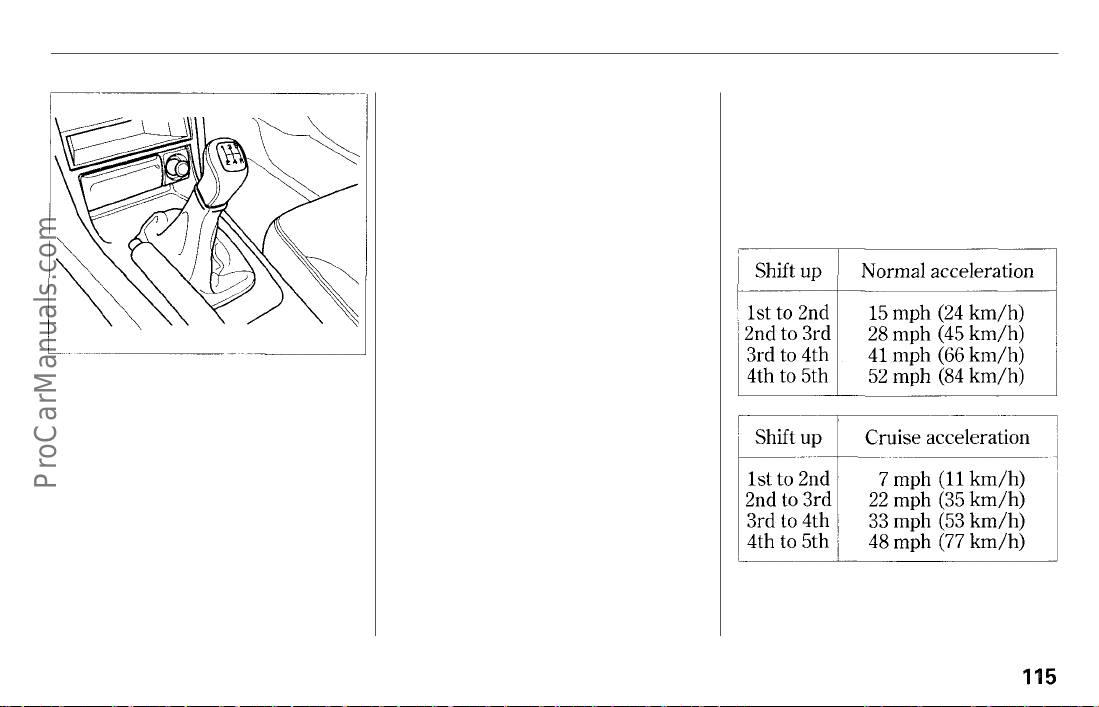
5-speed Manual Transmission
The manual transmission is syn-
chronized in all forward gears for
smooth operation. It has a lockout so
you cannot shift directly from Fifth
to Reverse. When shifting up or
down, make sure you push the clutch
pedal down all the way, shift to the
next gear, and let the pedal up
gradually. When you are not shifting,
do not rest your foot on the clutch
pedal. This can cause your clutch to
wear out faster.
Come to a full stop before you shift
into reverse. You can damage the
transmission by trying to shift into
reverse with the car moving.
You can get extra braking from the
engine when slowing down by
shifting to a lower gear. This extra
braking can help you maintain a safe
speed and prevent your brakes from
overheating while going down a
steep hill. Before downshifting,
make sure engine speed will not go
into the red zone in the lower gear.
Refer to the Maximum Speeds chart.
Recommended Shift Points
Drive in the highest gear that lets
the engine run and accelerate
smoothly. This will give you the best
fuel economy and effective emis-
sions control. The following shift
points are recommended:
Driving
Rapid slowing or speeding-
up can cause loss of control
on slippery surfaces. If you
crash, you can be injured.
Use extra care when driving
on slippery surfaces.
ProCarManuals.com
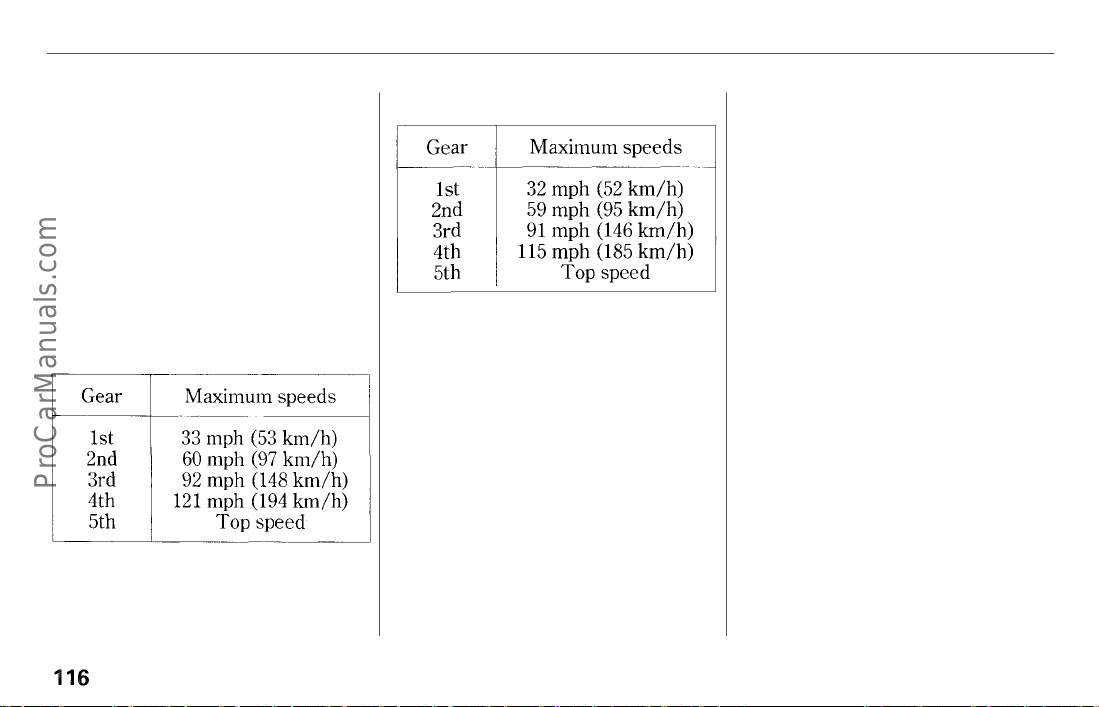
5-speed Manual Transmission, Automatic Transmission
Maximum Speeds
The speeds in this table are the
maximums for the given gears. If
you exceed these speeds, the engine
speed will enter into the tachometer's
red zone. If this occurs, you may feel
the engine cut in and out. This is
caused by a limiter in the engine's
computer controls. The engine will
run normally when you reduce the
RPM below the red zone.
(US: DX, LX, Canada: LX)
(US: EX, Canada: EX-R)
Automatic Transmission
Your Honda's transmission has four
forward speeds, and is electronically
controlled for smoother shifting. It
also has a "lock-up" torque converter
for better fuel economy. You may
feel what seems like another shift
when the converter locks.
Driving
ProCarManuals.com

Automatic Transmission
Shift Lever Positions
This display is on the instrument
panel between the speedometer and
tachometer. It shows you the
position of the shift lever. It also
indicates a possible problem in the
transmission if the "D
4" indicator
light flashes.
The shift lever has seven positions.
It must be in Park or Neutral to start
the engine. When you are stopped in
D
4, D3, 2, 1, N or R, press firmly on
the brake pedal and keep your foot
off the accelerator pedal.
CONTINUED
SHIFT LEVER
Driving
ProCarManuals.com
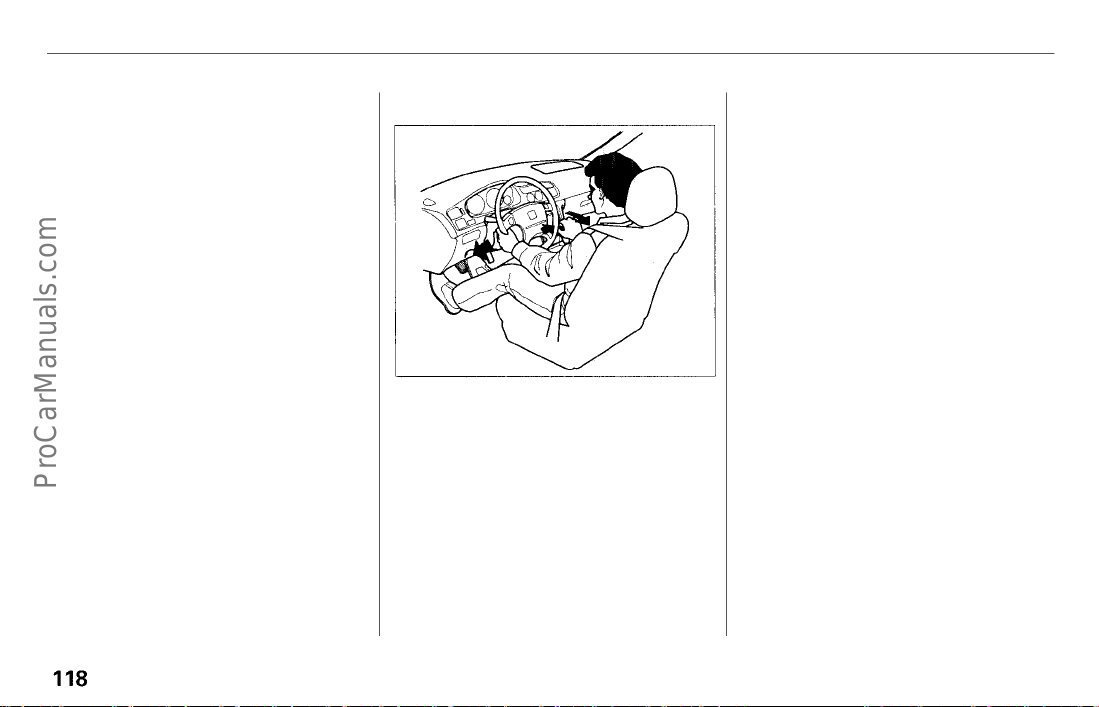
Automatic Transmission
Park (P) — This position mechani-
cally locks the transmission. Use
Park whenever you are turning off or
starting the engine. To shift out of
Park, you must press on the brake
pedal and have your foot off the
accelerator pedal. Press the release
button on the side of the shift lever
to move it.
You must also press the release
button to shift into Park. To avoid
transmission damage, come to a
complete stop before shifting into
Park. The shift lever must be in Park
before you can remove the key from
the ignition switch.
If you have done all of the above and
still cannot move the lever out of
Park, see Shift Lock Release on page
120.
Reverse (R) — To shift to Reverse
from Park, see the explanation under
Park. To shift to Reverse from
Neutral, come to a complete stop and
then shift. Press the release button
before shifting into Reverse from
Neutral.
Neutral (N) — Use Neutral if you
need to restart a stalled engine, or if
it is necessary to stop briefly with
the engine idling. Shift to Park posi-
tion if you need to leave the car for
any reason. Press on the brake pedal
when you are moving the shift lever
from Neutral to another gear.
Drive (D4) — Use this position for
your normal driving. The transmis-
sion automatically selects a suitable
gear for your speed and acceleration.
You may notice the transmission
shifting up at higher speeds when
the engine is cold. This helps the
engine warm up faster.
Driving
ProCarManuals.com

Automatic Transmission
Drive (D3) —This position is similar
to D4, except only the first three
gears are selected. Use D3 when
towing a trailer in hilly terrain, or to
provide engine braking when going
down a steep hill. D3 can also keep
the transmission from cycling
between third and fourth gears in
stop-and-go driving.
For faster acceleration when in D3 or
D4, you can get the transmission to
automatically downshift by pushing
the accelerator pedal to the floor.
The transmission will shift down one
or two gears, depending on your
speed.
Second (2) — To shift to Second,
press the release button on the side
of the shift lever. This position locks
the transmission in second gear. It
does not downshift to first gear
when you come to a stop. Second
gives you more power when climbing,
and increased engine braking when
going down steep hills. Use second
gear when starting out on a slippery
surface or in deep snow. It will help
reduce wheelspin.
Whenever you move the shift lever
to a lower gear, the transmission
downshifts only if the engine's
redline will not be exceeded in the
lower gear.
First (1) — To shift from Second to
First, press the release button on the
side of the shift lever. With the lever
in this position, the transmission
locks in First gear. By upshifting and
downshifting through 1, 2, D3 and D4,
you can operate this transmission
much like a manual transmission
without a clutch pedal.
Driving
ProCarManuals.com

Automatic Transmission
Maximum Speeds
The speeds in this table are the
maximums for the given position. If
you exceed these speeds, the engine
speed will enter into the tachometer's
red zone. If this occurs, you will feel
the engine cut in and out. This is
caused by a limiter in the engine's
computer controls. The engine will
run normally when you reduce the
RPM below the red zone.
Shift Lock Release
This allows you to move the shift
lever out of Park if the normal
method of pushing on the brake
pedal and pressing the release
button does not work.
1. Set the Parking brake.
2. Remove the key from the ignition
switch.
3. Insert the key in the Shift Lock
Release slot next to the shift lever.
4. Push down on the key while you
press the release button and move
the shift lever out of Park to
Neutral.
5. Remove the key from the Shift
Lock Release slot. Depress the
brake pedal and restart the engine.
If you need to use the Shift Lock
Release, it could mean your car is
developing a problem. Have the car
checked by your Honda dealer.
Driving
RELEASE BUTTON
SHIFT LOCK RELEASE SLOT
ProCarManuals.com
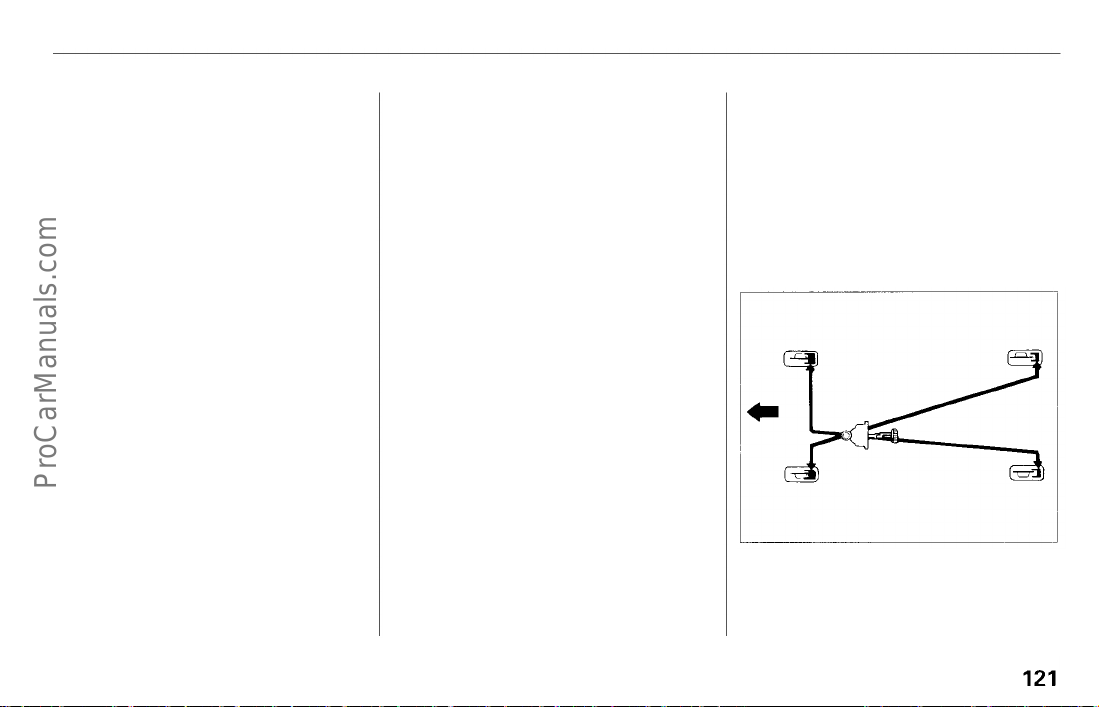
The Braking System
Your Honda is equipped with front
disc brakes. The brakes on the rear
wheels may be disc or drum,
depending on model. The braking
system is power-assisted to reduce
the effort needed on the brake pedal.
Put your foot on the brake pedal only
when you intend to brake. Resting
your foot on the pedal keeps the
brakes applied lightly, causing them
to build up heat. Heat build-up can
reduce how well your brakes work. It
also keeps your brake lights on all
the time, confusing drivers behind
you.
Constant application of the brakes
when going down a long hill builds
up heat and reduces their effective-
ness. Use the engine to assist the
brakes by downshifting to a lower
gear and taking your foot off the
accelerator pedal.
Check your brakes after driving
through deep water. Apply the
brakes moderately to see if they feel
normal. If not, apply them gently and
frequently until they do. Since a
longer distance is needed to stop
with wet brakes, be extra cautious
and alert in your driving.
Brake Wear Indicators
The front disc brakes on all cars
have audible brake wear indicators.
They are also on the rear brakes of
cars equipped with ABS.
When the brake pads need replacing,
you will hear a distinctive metallic
"screeching" sound when you apply
the brakes. If you do not have the
brake pads replaced, they will begin
screeching all the time.
Your brakes may sometimes squeal
or squeak when you apply them
lightly. Do not confuse this with the
brake wear indicators. They make a
very audible "screeching".
Brake System Design
The hydraulic system that operates
the brakes has two separate circuits.
Each circuit works diagonally across
the car (the left-front brake is
connected with the right-rear brake,
etc.). If one circuit should develop a
problem, you will still have braking
at two wheels.
CONTINUED
Driving
Front
ProCarManuals.com
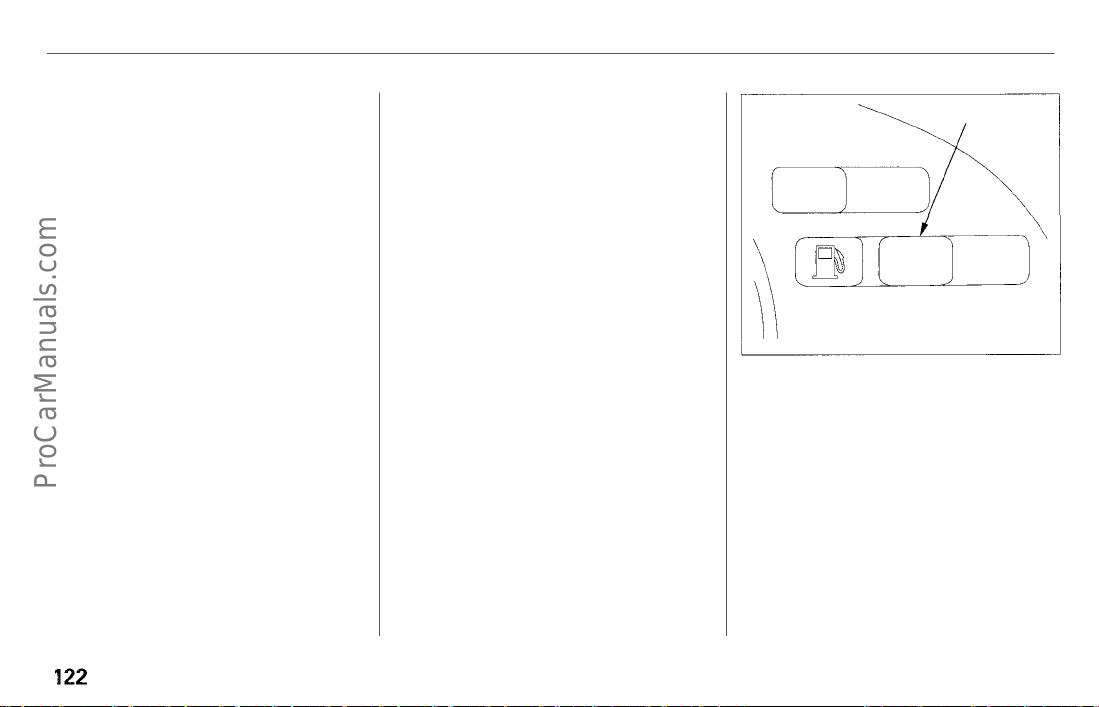
The Braking System
If this happens, you will immediately
notice that the brake pedal goes
down much farther and you need to
press on it much harder. A much
longer distance will be needed to
stop the car.
Slow the car by downshifting to a
lower gear and removing your foot
from the accelerator pedal. Pull to
the side of the road as soon as it is
safe. Because of the longer stopping
distance needed, brake system
failure is very hazardous. It is best to
have your car towed, but if you must
drive the car in this condition, be
extremely cautious. Have your car
repaired as soon as possible.
Anti-lock Brakes
The U.S. EX and Canadian EX-R
models have an Anti-lock Brake
System (ABS) as standard equip-
ment. It is optional on the U.S. DX
and LX models and on the Canadian
LX model.
ABS helps you maintain steering
control. It does this by helping you to
prevent the wheels from locking up
and skidding.
The ABS is always "On". It requires
no special effort or driving technique.
You will feel a pulsation in the brake
pedal when the ABS activates.
Activation varies with the amount of
traction your tires have. On dry
pavement, you will need to press on
the brake pedal very hard before you
feel the pedal pulsation that means
the ABS has activated. However, you
may feel the ABS activate immedi-
ately if you are trying to stop on
snow or ice. Under all conditions, the
ABS is helping to prevent the wheels
from locking so you can retain
steering control. You should con-
tinue to press on the brake pedal
with the same force.
You may feel a slight movement of
the brake pedal just after you start
the engine. This is the ABS working.
The ABS is self-checking. If anything
goes wrong, the ABS indicator on
the instrument panel comes on (see
page 35 ). This means the Anti-lock
function of the braking system has
shut down. The brakes still work like
a conventional system, providing
normal stopping ability. You should
have the dealer inspect your car as
soon as possible.
Driving
ABS INDICATOR*
ABS
* U.S. indicator shown
ProCarManuals.com
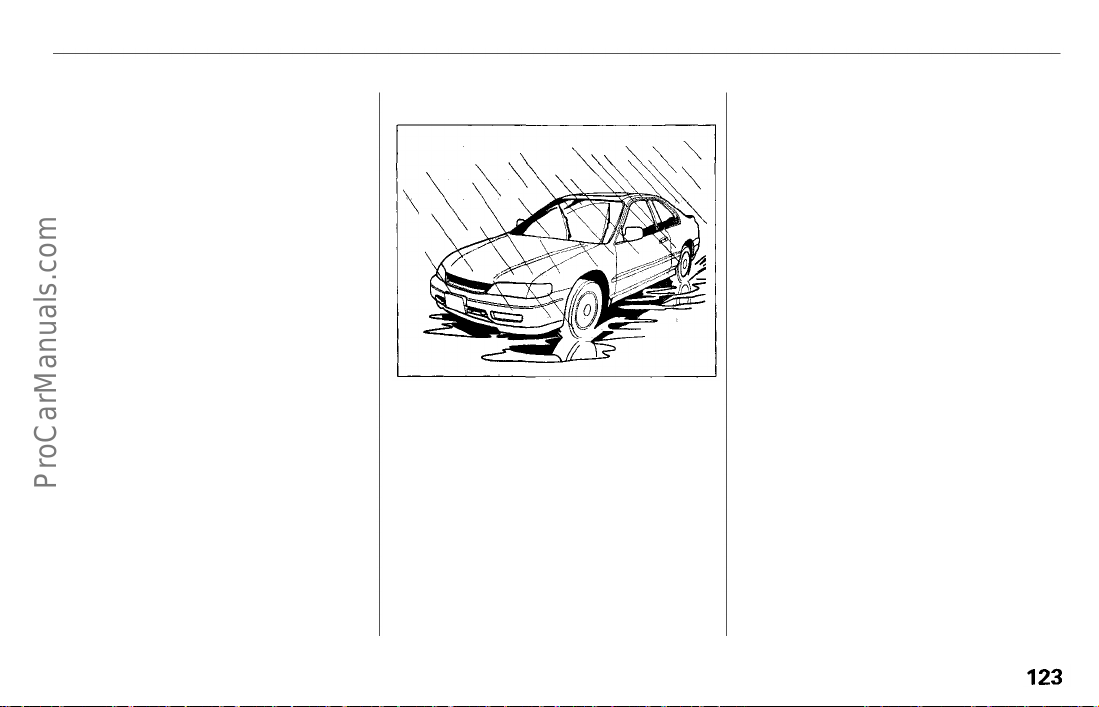
The Braking System, Driving in Bad Weather
The ABS works by comparing the
speed of the wheels. When replacing
tires, use the same size originally
supplied with the car. Tire size and
construction can affect wheel speed
and may cause the system to work in-
consistently.
A car with ABS may require a longer
distance to stop on loose or uneven
surfaces than an equivalent car with-
out Anti-lock. The ABS cannot make
up for road conditions or bad judg-
ment. It is still your responsibility to
drive at reasonable speeds for
weather and traffic conditions, and
to leave a margin of safety.
For a technical description of the
ABS hardware, refer to page 216.
Driving in Bad Weather
Rain, fog, and snow conditions re-
quire a different driving technique
because of reduced traction and
visibility. Keep your car well-
maintained and exercise greater
caution when you need to drive in
bad weather. The cruise control
should not be used in these condi-
tions.
Driving Technique — Always drive
slower than you would in dry
weather. It takes your car longer to
react, even in conditions that may
seem just barely damp. Apply
smooth, even pressure to all the
controls. Abrupt steering wheel
movements or sudden, hard appli-
cation of the brakes can cause loss of
control in wet weather. Be extra
cautious for the first few miles of
driving while you adjust to the
change in driving conditions. This is
especially true in snow. A person can
forget some snow-driving techniques
during the summer months. Practice
is needed to relearn those skills.
Exercise extra caution when driving
in rain after a long dry spell. After
months of dry weather, the first
rains bring oil to the surface of the
roadway, making it slippery.
CONTINUED
Driving
ProCarManuals.com
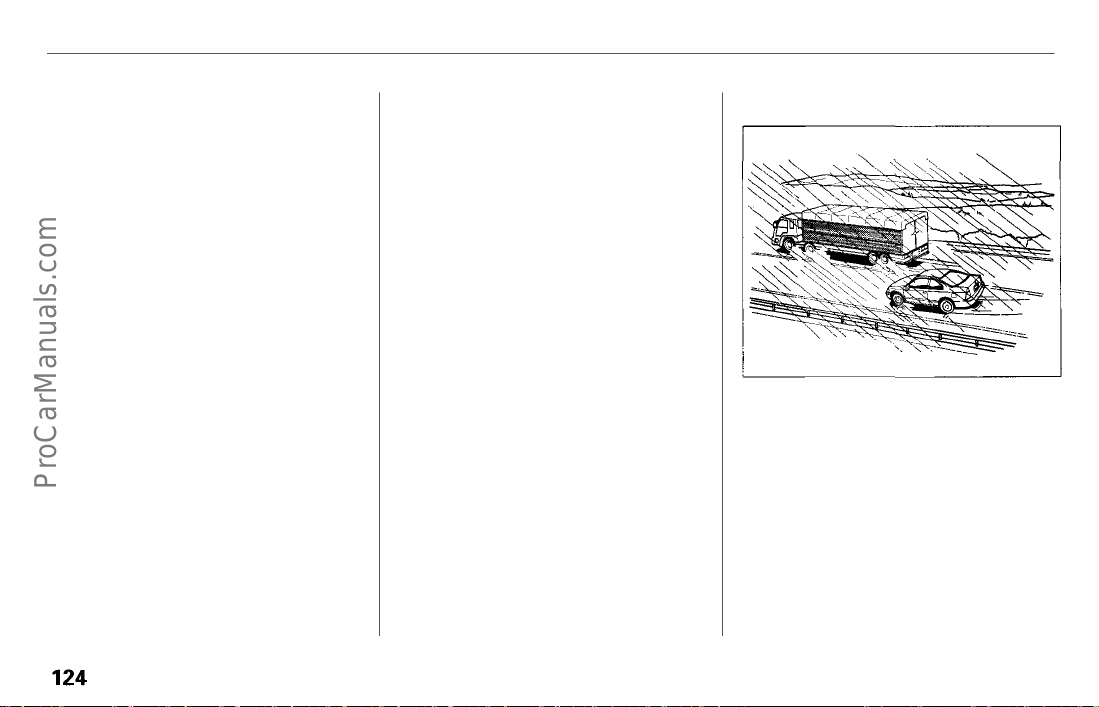
Driving in Bad Weather
Visibility — Being able to see
clearly in all directions and being
visible to other drivers are important
in all weather conditions. This is
more difficult in bad weather. To be
seen more clearly during daylight
hours, turn on your headlights.
Inspect your windshield wipers and
washers frequently. Keep the wind-
shield washer reservoir full of the
proper fluid. Have the windshield
wiper blades replaced if they start to
streak the windshield or leave parts
unwiped. Use the demister and air
conditioning to keep the windows
from fogging up on the inside (see
page 76).
Traction — Check your tires
frequently for wear and proper
pressure. Both are important in
preventing "hydroplaning" (loss of
traction on a wet surface). In the
winter, mount snow tires on all four
wheels for the best handling.
Watch road conditions carefully,
they can change from moment to
moment. Wet leaves can be as slip-
pery as ice. "Clear" roads can have
patches of ice. Driving conditions
can be very hazardous when the
outside temperature is near freezing.
The road surface can become
covered with areas of water puddles
mixed with areas of ice, so your
traction can change without warning.
Be careful when downshifting. If
traction is low, you can lock up the
drive wheels for a moment and cause
a skid.
Be very cautious when passing, or
being passed by other vehicles. The
spray from large vehicles reduces
your visibility, and the wind buffeting
can cause you to lose control.
Driving
ProCarManuals.com
Towing a Trailer
Your Honda is designed primarily to
carry passengers and their cargo.
You can use it to tow a trailer if you
carefully observe some general rules.
The total weight of the trailer and
everything loaded in it must not
exceed 450 kg (1,000 Ibs).
The "tongue load" should never
exceed 45 kg (100 Ibs). This is the
amount of weight the trailer puts
on the hitch when it is fully-loaded.
As a rule of thumb, the tongue
load should be 10% of the total
trailer package.
For example, if the trailer and its
load weigh 225 kg (500 Ibs), the
tongue load should be 22.5 kg (50
Ibs). Adjust the the trailer's cargo
to change the tongue load. Start by
putting approximately 60% of the
cargo toward the front and 40%
toward the rear. Never load the
trailer so the back is heavier than
the front. This takes weight off
your car's rear axle and reduces
traction.
The combined weight of the car,
all passengers and their luggage,
and tongue load must not exceed
the Gross Vehicle Weight Rating.
The GVWR is printed on the
Certification label attached to the
driver's door jamb (see page 212 ).
The combined weight of the car,
all passengers and their luggage,
and tongue load also must not
exceed the Gross Axle Weight
Rating. The GAWR is also shown
on the Certification label. It tells
you the maximum load for the
front and rear axles. It is possible
that your towing package does not
exceed the GVWR but does
exceed the GAWR. Improper
trailer loading, and/or too much
luggage in the trunk can overload
the rear axle. Redistribute the load
and check the axle weights again.
CONTINUED
Driving
ProCarManuals.com

Towing a Trailer
The best way to confirm that your
total towing package is within these
specifications is to get it weighed.
Load the car and trailer as you
normally would while towing, and
take them to a public scale. Have
them check the total weight and the
weight at each axle, then compare
them to the specifications.
Trailer Hitches
Your Honda dealer, or the Honda
Customer Relations Zone Office, can
give you advice on the proper hitch
for your car. Never use a hitch that
mounts only to the rear bumper. The
bumper is not designed to handle
that type of load. The hitch should
bolt to the underbody of the car and
distribute the load over a wide area.
Always have a trailer hitch installed
by a qualified technician.
A trailer hitch that is not adequate
for the size of the trailer, or a hitch
that is improperly installed, can
cause damage to the underside of
your car.
Driving
NOTICE
Improperly loading your car
and trailer can seriously af-
fect its steering and braking
performance, causing a crash
in which you can be seriously
injured.
Check the loading of your car
and trailer carefully before
starting to drive.
ProCarManuals.com

Towing a Trailer
Mirrors
Many states and provinces have laws
requiring special outside mirrors
when you are towing a trailer. Check
the laws in your area. You may want
to install mirrors, even if they are not
required. Hook up the trailer and see
how much it obscures your ability to
see behind you with the standard
mirrors. If you cannot see directly
behind you, or have a large blind
spot next to the trailer or the car,
you should install mirrors intended
for towing.
Connecting the Trailer
Most trailers that have a gross
weight of 450 kg (1,000 Ibs) do not
have their own braking system. If
you are thinking of getting a trailer
that does have brakes, make sure
they are electrically-operated. There
are no provisions in your car to tap
into its hydraulic braking system.
Any attempt to attach the trailer's
brakes to your car's hydraulic
system, no matter how successful it
may seem, will lower braking
effectiveness and create a potential
hazard.
Always use a safety chain when
towing a trailer. Connect the safety
chain securely at both ends. Make
sure the chain crosses under the
tongue so it will catch the trailer if it
becomes unhitched. Leave enough
slack in the chain so it can't bind in a
sharp turn. Do not let it drag on the
ground.
CONTINUED
Driving
ProCarManuals.com
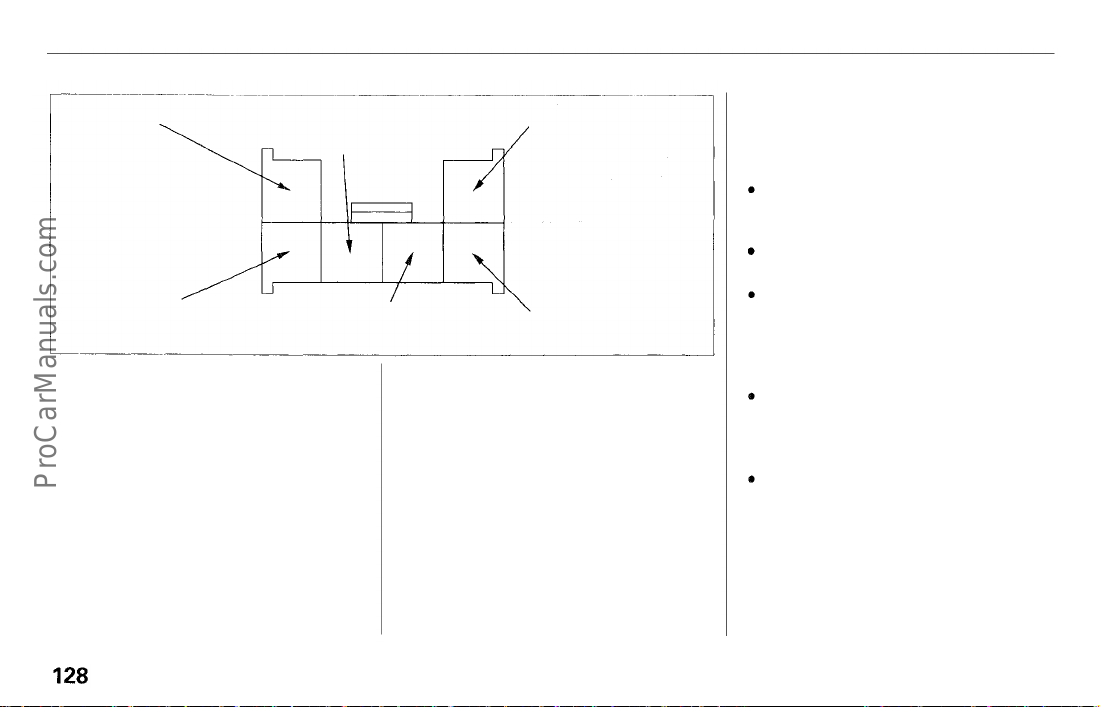
Towing a Trailer
Your car has a trailer lighting
connector in the trunk. To use the
connector, remove the left cover by
unscrewing the knob. Refer to the
drawing above for the wiring color
code and purpose of each connector
pin.
Since the lighting and wiring can be
different for various brands of
trailers, have a technician who is
familiar with your trailer modify its
lighting plug. A converter may be
required between the car and trailer
for the lights to work correctly.
Before Starting Out
As you are preparing to tow your
trailer, do the following:
Measure the trailer's tongue load.
You can do this with a bathroom
scale.
Verify that the hitch and safety
chain are securely fastened.
Check the condition and air
pressure of all tires on the trailer
and your car. Low tire pressure
can seriously affect the handling.
Also check the spare tire.
With everything loaded and the
trailer connected, check that the
rear of the car is not sagging. If so,
redistribute the load in the car.
Check that all lights on the car and
trailer are working properly.
Driving
GROUND
(BLACK)
BACK-UP LIGHT
(GREEN/BLACK)
LEFT TURN SIGNAL
(GREEN/BLUE)
TAILLIGHT
(RED/BLACK)
BRAKE LIGHT
(GREEN/WHITE)
RIGHT TURN SIGNAL
(GREEN/YELLOW)
ProCarManuals.com

Towing a Trailer
Towing Safety
Your car will not stop as quickly with
a trailer in tow. Leave extra distance
between your car and other vehicles.
Avoid braking or turning suddenly.
This could cause the trailer to
jackknife or possibly turn over.
Keep in mind that your total vehicle
is now much longer. Leave more
room when making turns. The trailer
tracks a smaller arc than the car and
can hit or run over something that
the car misses. When passing
another vehicle, make sure the
trailer is clear before changing lanes.
The car/trailer combination is more
affected by crosswinds and buffeting.
When being passed by a large
vehicle, keep a constant speed and
steer straight ahead. If there is too
much wind buffeting, slow down to
get out of the other vehicle's air
turbulence.
Towing a trailer puts an extra load
on your car. You should have your
car serviced according to the
"Maintenance schedule under severe
driving conditions" on page 134 .
This extra load is magnified when
you are driving in hilly terrain.
Watch the temperature gauge
closely when climbing hills. If it gets
near the hot area, turn off the air
conditioning (if it is on). If this does
not reduce the heat, it may be
necessary to pull to the side of the
road and wait for the engine to cool.
If the automatic transmission shifts
frequently between 3rd and 4th
gears, put it in D3. This will help
prevent the transmission from
overheating. Help keep the brakes
from overheating by shifting to a
lower gear when going downhill.
CONTINUED
Driving
ProCarManuals.com

Towing a Trailer
If you have to stop while going uphill,
do not hold the car in place by
pressing on the accelerator. This can
cause the automatic transmission to
overheat. Use the parking brake or
footbrake.
When parking your car and trailer,
especially on a hill, be sure to follow
all the normal precautions. Turn
your front wheels into the curb, set
the parking brake firmly, and put the
transmission in 1st or Reverse
(manual) or Park (automatic). In
addition, place wheel chocks at each
of the trailer's tires.
Backing up with a trailer is difficult
and takes practice. Drive slowly,
make small movements with the
steering wheel, and have someone
stand outside to guide you. Grip the
steering wheel on the bottom (rather
than the usual position near the top).
Move your hand to the left to get the
trailer to move to the left, and right
to move the trailer right.
Driving
ProCarManuals.com

Maintenance
Regularly maintaining your Honda is
the best way to protect your invest-
ment. You will be rewarded with
safer, more economical, trouble-free
driving. This section lists items that
need to be checked regularly and
explains how to check them. It also
details some simple maintenance
tasks you can do yourself. The
maintenance schedules for normal
and severe driving conditions show
you when these things need to be
done.
If you are interested in how to per-
form more complex maintenance on
your Honda, you can purchase the
Service Manual. See page 231 for
information on how to obtain a copy,
or see your Honda dealer.
Maintenance Schedule.................. 132
Maintenance Record..................... 135
Periodic Checks............................. 137
Fluid Locations............................... 138
Engine Oil....................................... 139
Checking Engine Oil................. 139
Adding........................................ 139
Recommended Oil..................... 140
Additives..................................... 141
Oil and Filter Changes.............. 141
Cooling System.............................. 143
Checking the Engine Coolant
Level...................................... 143
Adding Engine Coolant............. 144
Replacing Engine Coolant........ 145
Windshield Washers..................... 147
Transmission Oil............................ 148
Automatic
Transmission.......................... 148
5-speed Manual
Transmission.......................... 149
Brake and Clutch Fluid................. 149
Brake System............................. 150
Anti-lock Brake System............ 150
Clutch System............................ 151
Power Steering............................... 151
Air Cleaner..................................... 152
Fuel Filter....................................... 154
Spark Plugs..................................... 154
Replacement............................... 154
Specification............................... 156
Battery............................................ 156
Windshield Wipers........................ 159
Air Conditioning............................. 161
Engine Belts................................... 162
Tires................................................ 162
Inflation....................................... 163
Inspection................................... 164
Maintenance............................... 164
Tire Rotation.............................. 165
Replacing Tires and Wheels .... 165
Wheels and Tires....................... 166
Winter Driving........................... 166
Snow Tires.............................. 167
Tire Chains............................. 167
Lights.............................................. 168
Replacing Bulbs......................... 168
Storing Your Car............................ 177
Maintenance
ProCarManuals.com
Maintenance Schedule
The Required Maintenance Schedule
specifies how often you should have
your car serviced, and what things
need attention. It is essential that
your car be serviced as scheduled to
retain its high level of safety,
dependability, and emission control
performance.
The services and time or distance
intervals shown in the maintenance
schedule assume you will use your
car as normal transportation for
passengers and their possessions.
You should:
Avoid exceeding your car's load
limit. This puts excess strain on
the engine, brakes, and many
other parts of your car. The load
limit is shown on the label on the
driver's door jamb.
Operate your car on reasonable
roads within the legal speed limit.
Drive your car regularly over a
distance of several kilometers
(miles).
Always use unleaded gasoline with
a pump octane number of 86 or
higher.
Your authorized Honda dealer
knows your car best, and can provide
competent, efficient service.
However, service at a dealer is not
mandatory to keep your warranties
in effect. Maintenance may be done
by any qualified service facility or
person who is skilled in this type of
automotive service. Keep all the
receipts as proof of completion, and
have the person who does the work
fill out the maintenance record on
page 135 . Check your warranty
booklet for more information.
We recommend the use of Genuine
Honda parts and fluids or their
equivalent whenever you have
maintenance done. These are the
same high-quality items that went
into your car when it was new, so
you can be sure they fit and perform
flawlessly.
U.S. Cars:
Maintenance, replacement or
repair of emission control devices
and systems may be done by any
automotive repair establishment
or individual using parts that are
"certified" to EPA standards.
Vehicles sold in California have
slightly different maintenance
requirements. These are noted in the
Required Maintenance Schedule.
Other maintenance operations are
required by California regulations,
and condition the emission warranty.
Maintenance
ProCarManuals.com
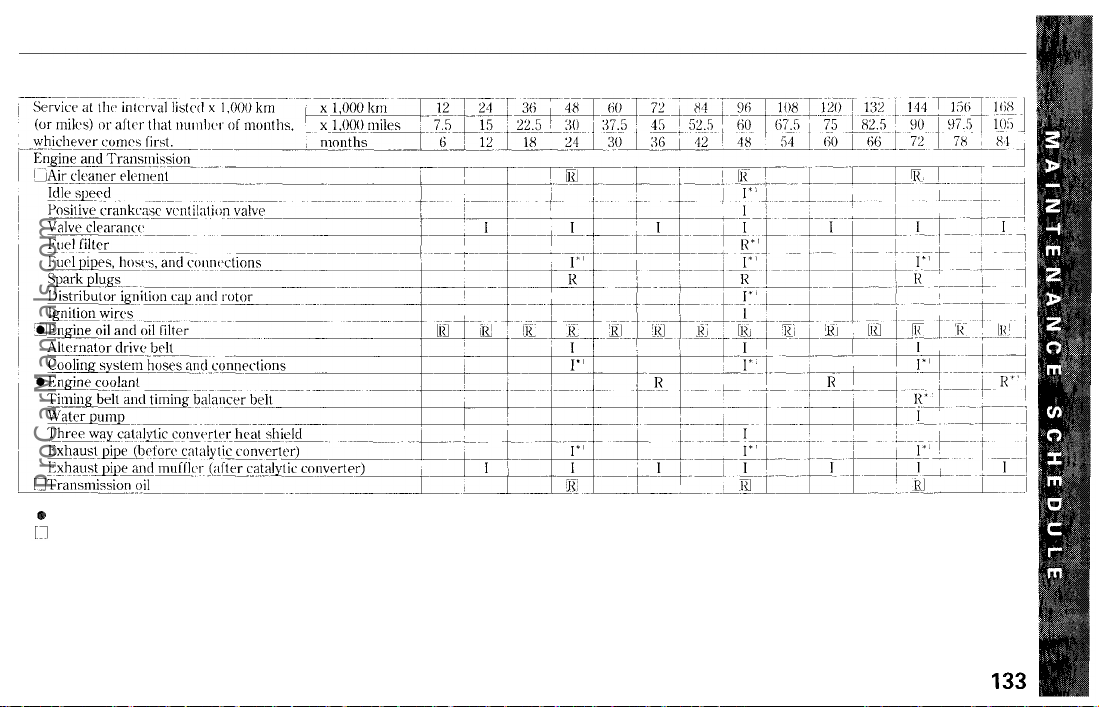
Maintenance Schedule
: Check oil and coolant level at each fuel stop.
: Under severe driving conditions, service these items more often.
*
1: For cars sold in California, this service is recommended only: other
areas, it is required.
*
2: Thereafter, replace every 2 years or 48,000 km (30,000 miles), which-
ever comes first.
*
3 : This service is recommended only.
*
4 : For cars with Anti-lock brake system
CONTINUED
Maintenance
R — Replace I — Inspect After inspection, clean, adjust, repair or replace if necessary.
ProCarManuals.com
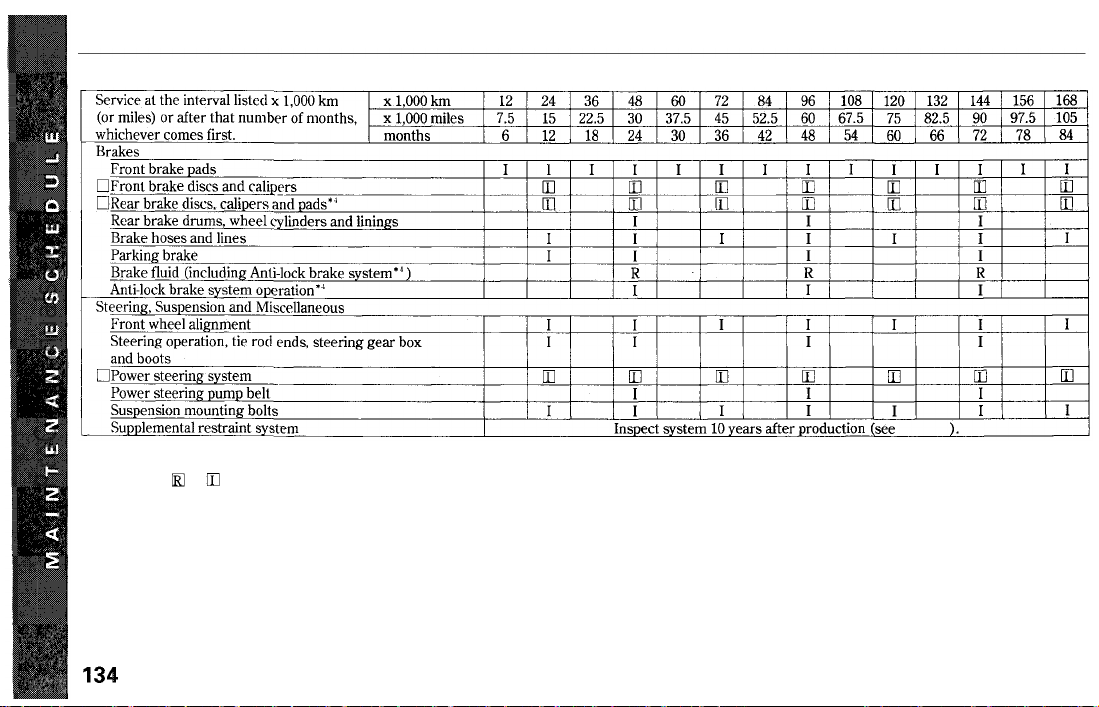
Maintenance Schedule
R — Replace I — Inspect After inspection, clean, adjust, repair or replace if necessary.
Severe Driving Conditions
Items marked or in the chart indicate you will need some
services more frequently in certain severe driving conditions.
The conditions are:
A. Driving less than 8 km (5 miles) per trip, or, in freezing
temperatures, driving less than 16 km (10 miles) per trip.
B. Driving on rough or muddy roads, or de-iced roads.
C. Driving in extremely dusty conditions.
D. Extensive idling or driving long periods at slow speeds, such as a
delivery vehicle.
E. Towing a trailer.
Service for Severe Driving Conditions
— Clean the air cleaner element every 24,000 km (15,000 miles) or 12 months and
replace every 48,000 km (30,000 miles) or 24 months under condition B or C.
— Replace engine oil and oil filter every 6,000 km (3,750 miles) or 3 months under
condition A, B, C, D or E.
— Replace transmission oil every 24,000 km (15,000 miles) or 12 months under
condition D or E.
— Inspect front brake discs and calipers, and rear brake discs, calipers and pads every
12,000 km (7,500 miles) or 6 months under condition B, C, D or E.
— Inspect the power steering system every 12,000 km (7,500 miles) or 6 months
under condition A, B or C.
page 15
Maintenance
ProCarManuals.com
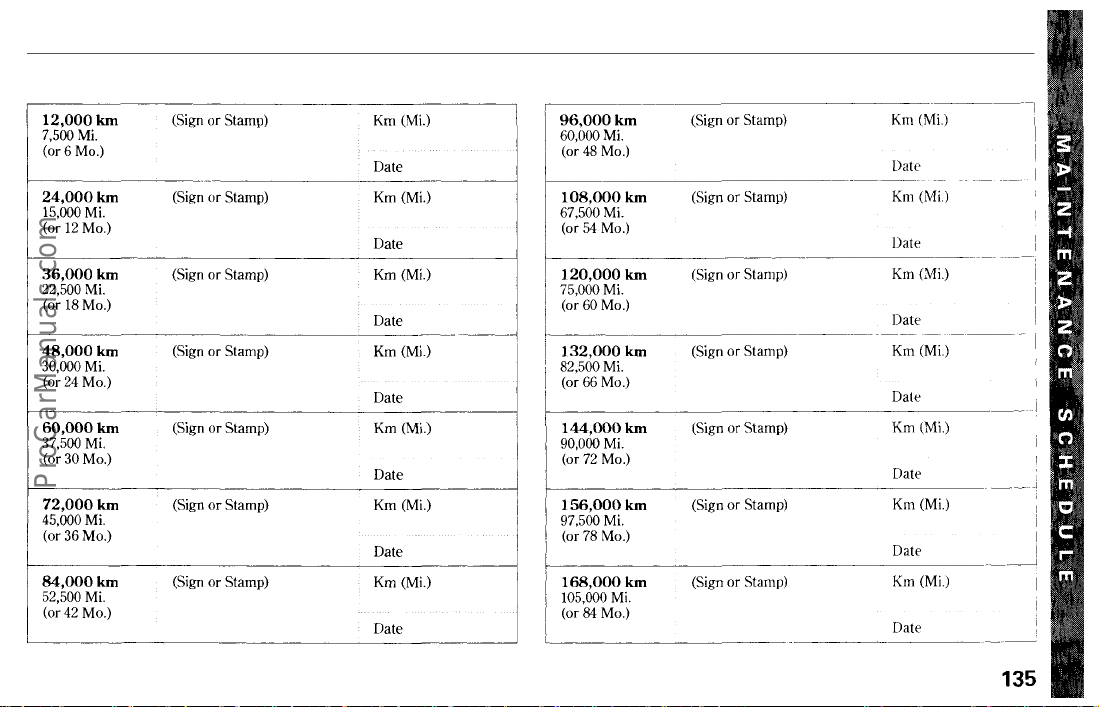
Periodic Checks
You should check the following
items at the specified intervals. If
you are unsure of how to perform
any check, turn to the page given.
Engine oil level — Check every
time you fill the fuel tank. See
page 106.
Engine coolant level — Check the
radiator reserve tank every time
you fill the fuel tank. See page 107.
Windshield washer fluid — Check
the level in the reservoir monthly.
If weather conditions cause you to
use the washers frequently, check
the reservoir each time you stop
for fuel. See page 147.
Automatic transmission — Check
the fluid level monthly. See page
148
.
Brakes, clutch and power steering
— Check the fluid level monthly.
See page 150 .
Tires — Check the tire pressure
monthly. Examine the tread for
wear and foreign objects. See page
162.
Battery — Check its condition and
the terminals for corrosion
monthly. See page 157 .
Air conditioning — Check its
operation weekly. See page 161.
Lights — Check the operation of
the headlights, parking lights,
taillights, high-mount brake light,
turn signals, brake lights, and
license plate lights monthly. See
page 168 .
Maintenance
ProCarManuals.com
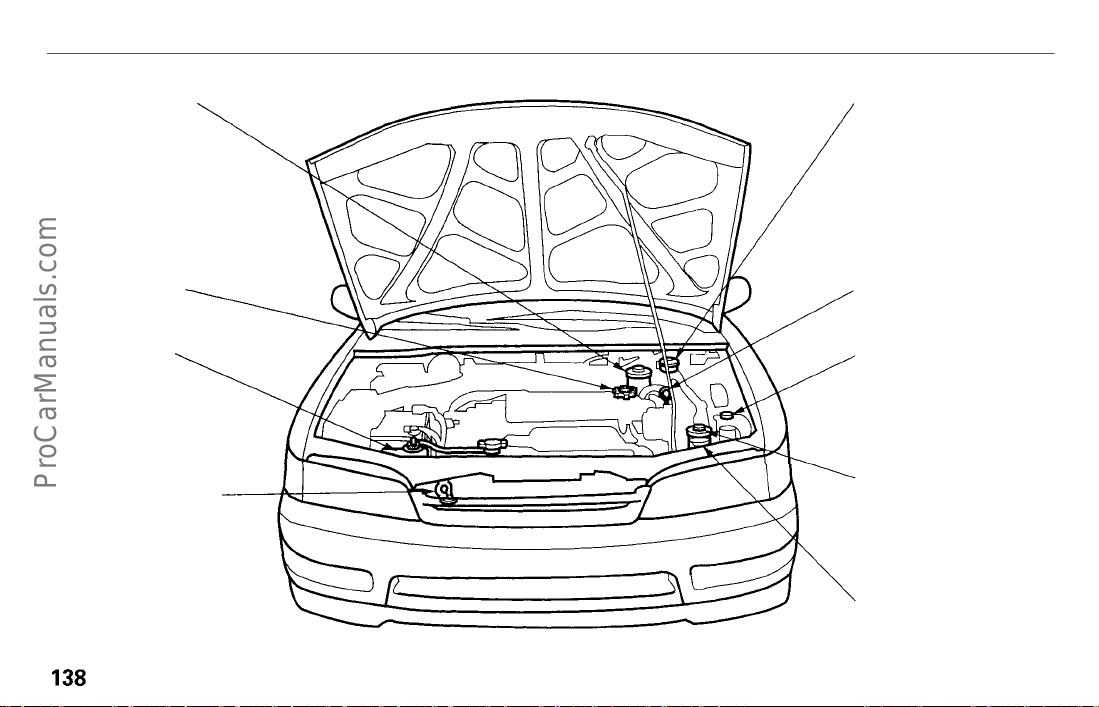
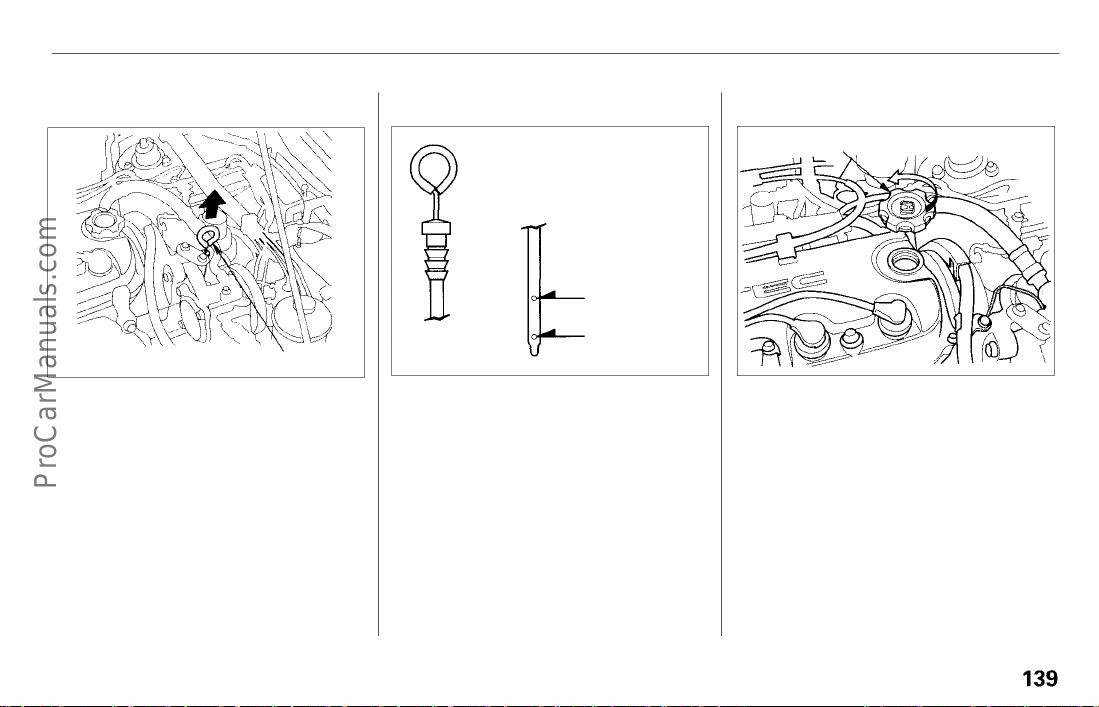
Engine Oil
Checking Engine Oil
Check the engine oil a couple of
minutes after shutting off the engine.
This will allow the oil to drain down
to the bottom of the engine. Make
sure the car is parked on level
ground.
1. Pull out the dipstick (orange loop)
and wipe it with a cloth or paper
towel.
2. Insert it all the way back in its tube.
3. Pull it out again and look at the oil
level at the end of the dipstick. If it
is between the upper and lower
marks, the level is correct. Add oil
if the level is at or below the lower
mark.
Adding
To add oil, unscrew and remove the
engine oil fill cap on top of the valve
cover. Pour in the oil, and replace the
engine oil fill cap. Tighten it securely.
Wait a few minutes and recheck the
oil level. Do not fill above the upper
mark; you could damage the engine.
Maintenance
DIPSTICK
UPPER MARK
LOWER MARK
ENGINE OIL FILL CAP
ProCarManuals.com
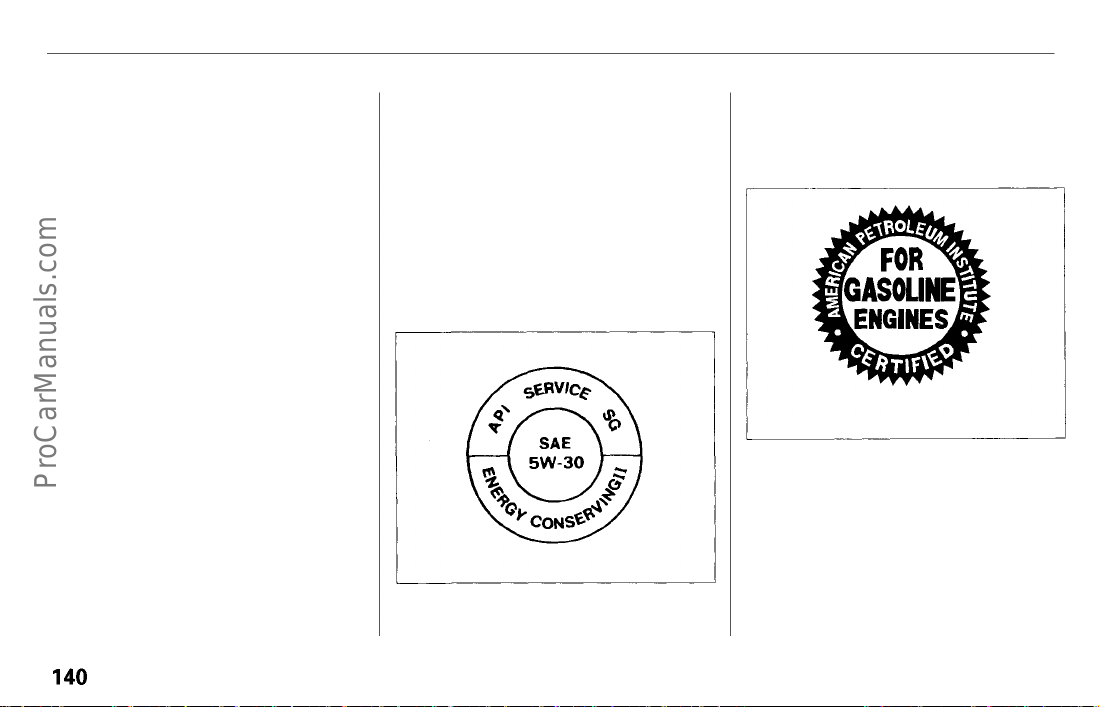
Engine Oil
Recommended Oil
Oil is a major contributor to your
engine's performance and longevity.
Always use a premium-grade deter-
gent oil.
You can determine an oil's SAE
viscosity and Service Classification
from the API Service label on the oil
container.
A fuel-efficient oil is recommended
for your Honda. This is shown on the
API Service label by the words
"Energy Conserving II." This oil is
formulated to help your engine use
less fuel.
The API Service label also tells you
the service classification of the oil.
Always use an oil that says "API
Service SG or SH." This service
rating may also include other
designations, such as CD. These
additional classifications are not a
problem, as long as the label also
carries the SG or SH classification.
An oil that is only classified SF is not
recommended.
The oil container may also display
the API Certification mark shown
below. Make sure it says "For
Gasoline Engines."
Maintenance
API CERTIFICATION MARK
API SERVICE LABEL
ProCarManuals.com
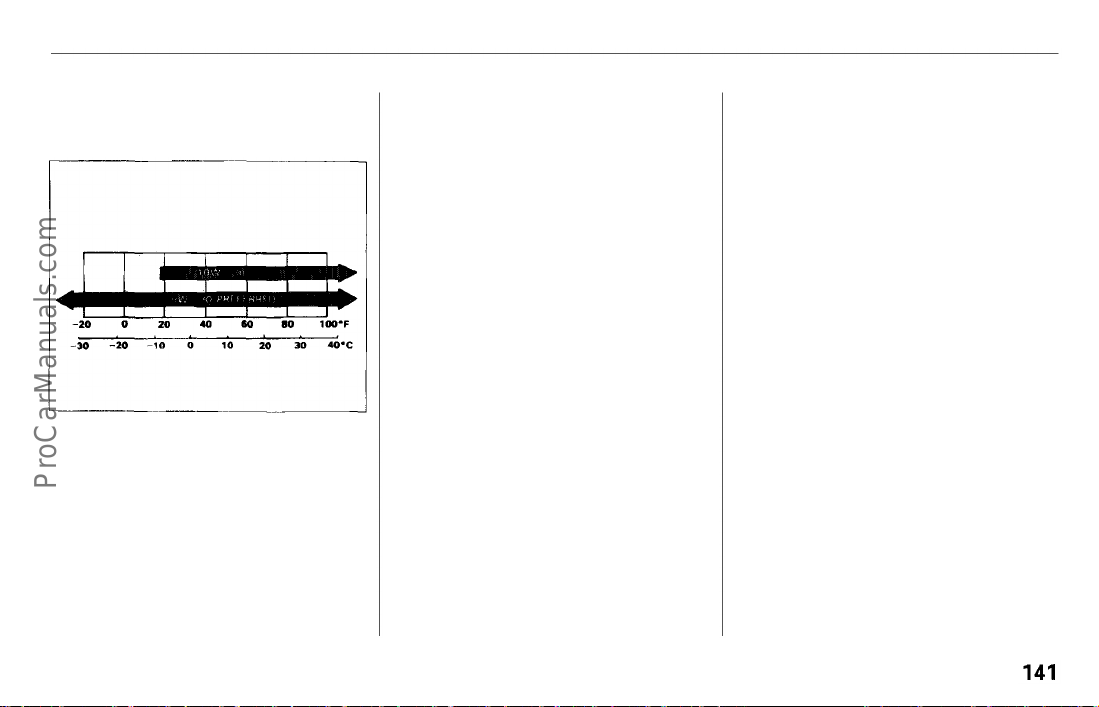
Engine Oil
The SAE numbers tell you the oil's
viscosity or weight. Select the oil for
your car according to this chart.
An oil with a viscosity of 5W-30 is
preferred for improved fuel economy
and year-round protection in your
Honda. You may use a 10W-30 oil if
the temperature in your area never
goes below 20°F ( — 7°C).
Additives
Your Honda does not need any oil
additives. Purchasing additives for
the engine or transmission will not
increase your car's performance or
longevity. It only increases the cost
of operating your car.
Oil and Filter Changes
Always change the oil and filter
according to the time and distance
recommendations in the mainte-
nance schedule. The oil and filter
collect contaminants that can dam-
age your engine if they are not
removed regularly.
Changing the oil and filter requires
special tools and access from
underneath the car. The car should
be raised on a service station-type
hydraulic lift for this service. Unless
you have the knowledge and proper
equipment, you should have this
maintenance done by a skilled
mechanic.
1. Run the engine until it reaches
normal operating temperature,
then shut it off.
CONTINUED
Maintenance
Ambient Temperature
Repeated, prolonged ex-
posure to used motor oil may
cause skin cancer.
Wash your hands thoroughly
with strong soap as soon as
possible after handling used
oil.
The oil, engine components
and the exhaust system are
hot and can burn you.
Use caution and wear protec-
tive clothing while working in
the engine compartment.
ProCarManuals.com
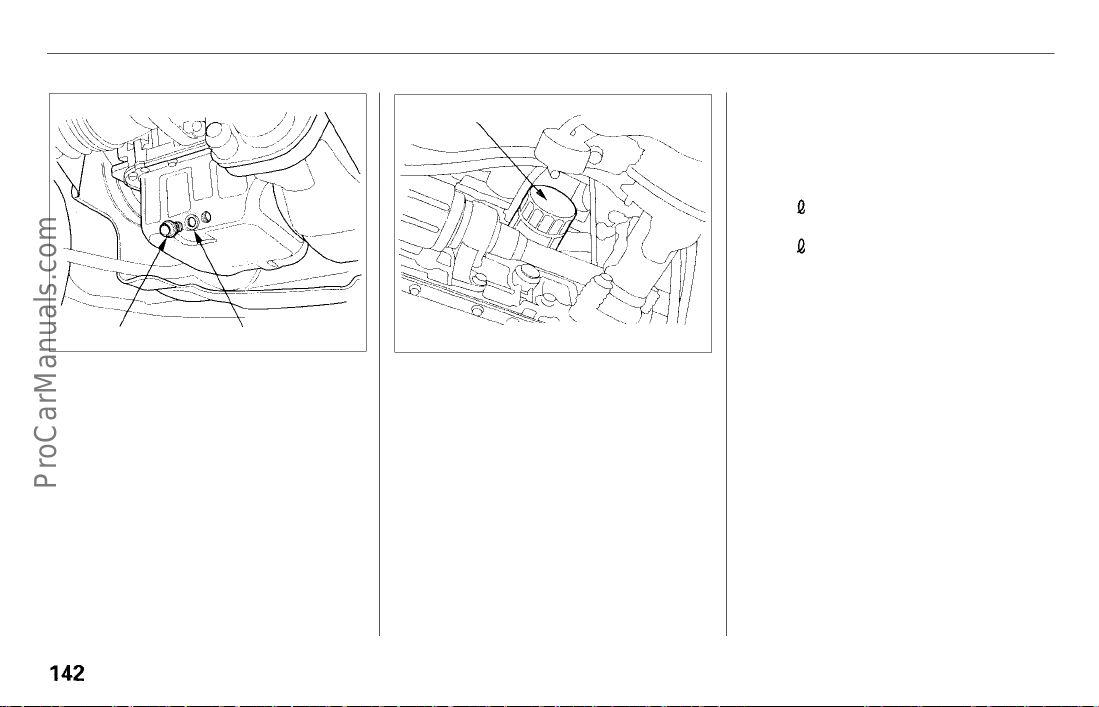
Engine Oil
2. Open the hood and remove the
engine oil fill cap. Remove the oil
drain bolt from the bottom of the
engine. Drain the oil into an
appropriate container.
3. Remove the oil filter and let the
remaining oil drain. A special
wrench (available from your
Honda dealer) is required to
remove the filter.
4. Install a new oil filter according to
instructions that come with it.
5. Put a new washer on the drain bolt,
then reinstall the drain bolt.
Tighten it to:
4
4
N.m (4.4 kg-m , 32 Ib-ft)
6
. Refill the engine with the recom-
mended oil.
Engine oil change capacity
(including filter):
(US: DX, LX, Canada: LX)
3.8 (4.0 US qt, 3.3 Imp qt)
(US: EX, Canada: EX-R)
4.3 (4.5 US qt, 3.8 Imp qt)
7. Replace the engine oil fill cap.
Start the engine. The oil pressure
indicator light should go out within
five seconds. If it does not, turn off
the engine and reinspect your
work.
8. Let the engine run for several
minutes and check the drain bolt
and oil filter for leaks.
9. Turn off the engine, let it sit for
several minutes, then check the oil
level. If necessary, add oil to bring
the level to the upper mark on the
dipstick.
Maintenance
WASHER
DRAIN BOLT
OIL FILTER
ProCarManuals.com
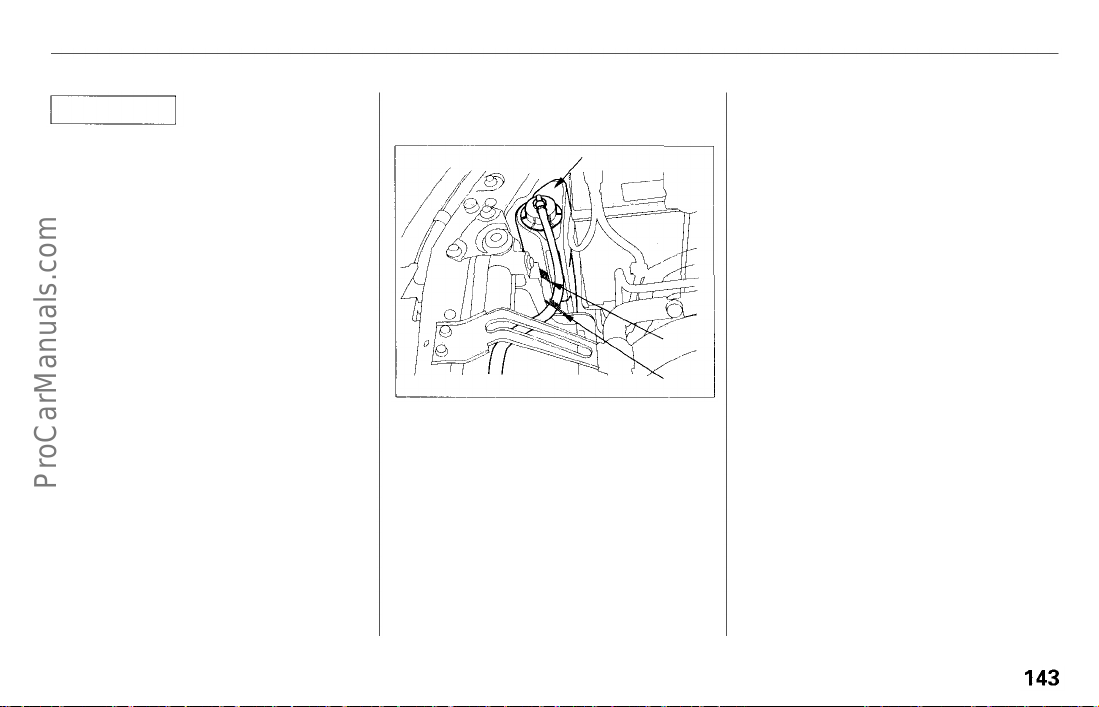
Engine Oil, Cooling System
If you change your own oil, please
dispose of the used oil properly. Put
it in a sealed container and take it to
a recycling center. Do not discard it
in a trash bin or dump it on the
ground.
The oil and filter should be changed
every 6 months or 12,000 km (7,500
miles), whichever comes first. Under
severe driving conditions, they
should be changed every 3 months
or 6,000 km (3,750 miles). See page
134 for a description of severe
driving conditions.
Checking the Engine Coolant
Level
Check the level of the engine coolant
by looking at the radiator reserve
tank next to the battery. If the level
is at or below the MIN line, add
coolant to bring it up to the MAX line.
This coolant should always be a
mixture of 50% antifreeze and 50%
water. Never add straight antifreeze
or plain water.
Always use Genuine Honda Anti-
freeze/Coolant. The cooling system
contains many aluminum compo-
nents which can corrode if an
improper antifreeze is used. Some
antifreeze, even though labeled as
safe for aluminum parts, may not
provide adequate protection.
Maintenance
NOTICE
RESERVE TANK
MAX
MIN
ProCarManuals.com
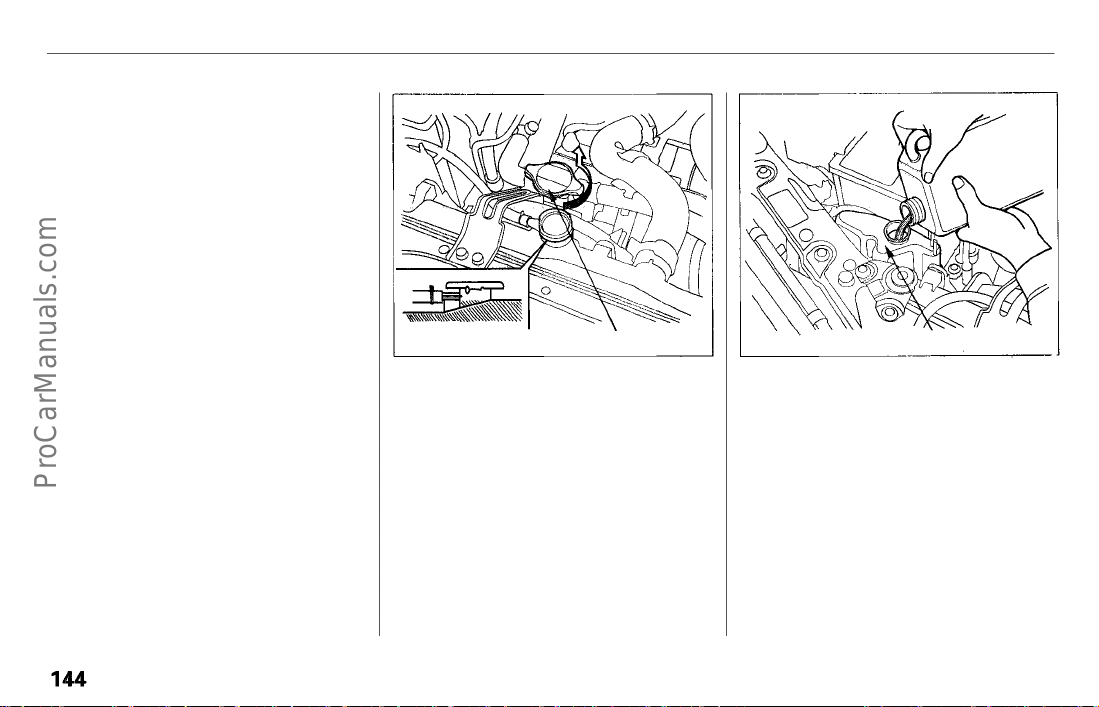
Cooling System
Adding Engine Coolant
If the reserve tank is completely
empty, you should also check the
coolant level in the radiator.
1. Make sure the engine and radiator
are cool.
2. Turn the radiator cap counter-
clockwise, without pressing down
on it, until it stops. This relieves
any pressure remaining in the
cooling system.
3. Remove the radiator cap by
pushing down and turning
counterclockwise.
4. The coolant level should be up to
the base of the filler neck. Add
coolant if it is low.
5. Put the radiator cap back on.
Tighten it fully.
6. Pour coolant into the reserve tank.
Fill it to halfway between the MAX
and MIN marks. Put the cap back
on the reserve tank.
Maintenance
Removing the radiator cap
while the engine is hot can
cause the coolant to spray
out, seriously scalding you.
Always let the engine and
radiator cool down before
removing the radiator cap.
RADIATOR CAP RESERVE TANK
ProCarManuals.com
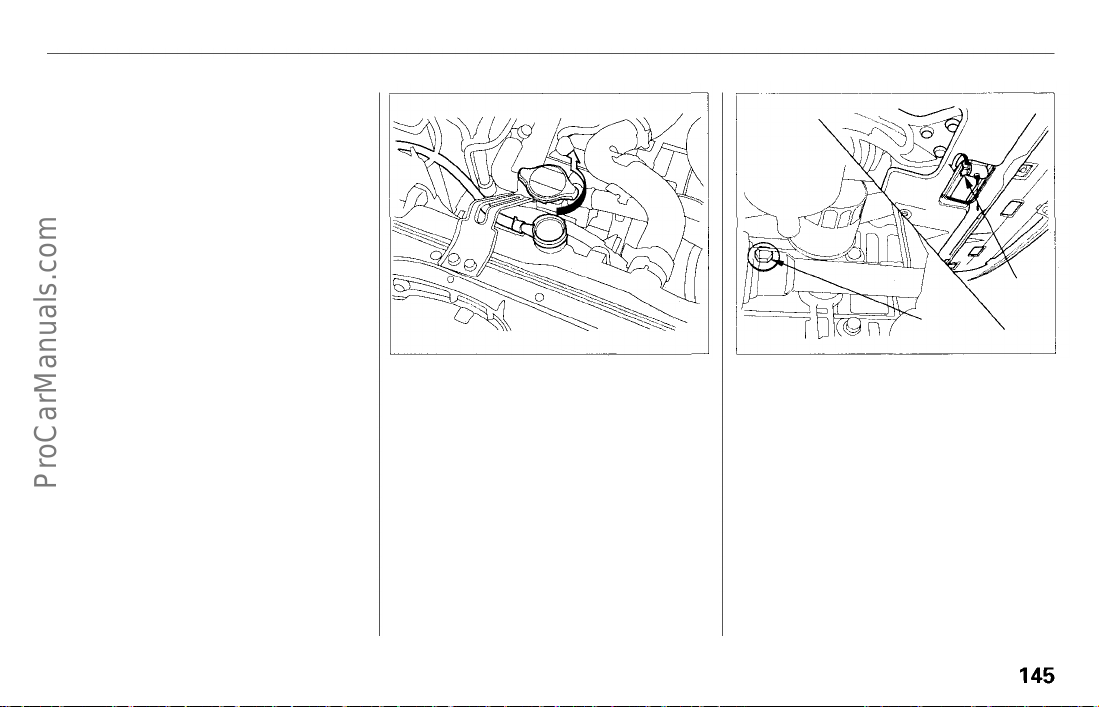
Cooling System
Do not add any rust inhibitors or
other additives to your car's cooling
system. They may not be compatible
with the coolant or engine
components.
Replacing Engine Coolant
The cooling system should be
completely drained and refilled with
new coolant according to the time
and distance recommendations in
the maintenance schedule. Only use
recommended antifreeze.
Draining the coolant requires access
to the underside of the car. Unless
you have the tools and knowledge,
you should have this maintenance
done by a skilled mechanic.
1. Start the engine. Turn the heater
temperature control dial to
maximum heat and turn off the
engine. Open the hood. Make sure
the engine and radiator are cool to
the touch.
2. Remove the radiator cap.
3. Loosen the drain plug on the
bottom of the radiator. The
coolant will drain through the
splash guard. Remove the drain
bolt from the engine block.
CONTINUED
Maintenance
DRAIN
PLUG
DRAIN
BOLT
ProCarManuals.com

Cooling System
4. Remove the reserve tank from its
holder by pulling it straight up.
Drain the coolant, then put the
tank back in its holder.
5. When the coolant stops draining,
tighten the drain plug in the
bottom of the radiator. Apply non-
hardening sealant to the drain bolt
threads and reinstall the bolt in
the engine block. Tighten it
securely.
6. Mix the recommended antifreeze
with an equal amount of purified
or distilled water in a clean
container. The cooling system
capacity is:
With manual transmission:
5.4 (1.43 US gal, 1.19 Imp gal)
With automatic transmission:
5.3 (1.40 US gal, 1.17 Imp gal)
7. Pour coolant into the radiator up
to the base of the filler neck.
8. Loosen the bleeder bolt on top of
the engine. Tighten it again when
coolant comes out in a steady
stream with no bubbles.
9. Refill the radiator to the base of
the filler neck. Put the cap on the
radiator, only tighten it to the first
stop. Start the engine and let it run
until it warms up (the radiator
cooling fan comes on at least
twice).
Maintenance
RESERVE TANK
HOLDER
RESERVE TANK CAP
FILLER NECK
Fill up to here BLEEDER BOLT
ProCarManuals.com
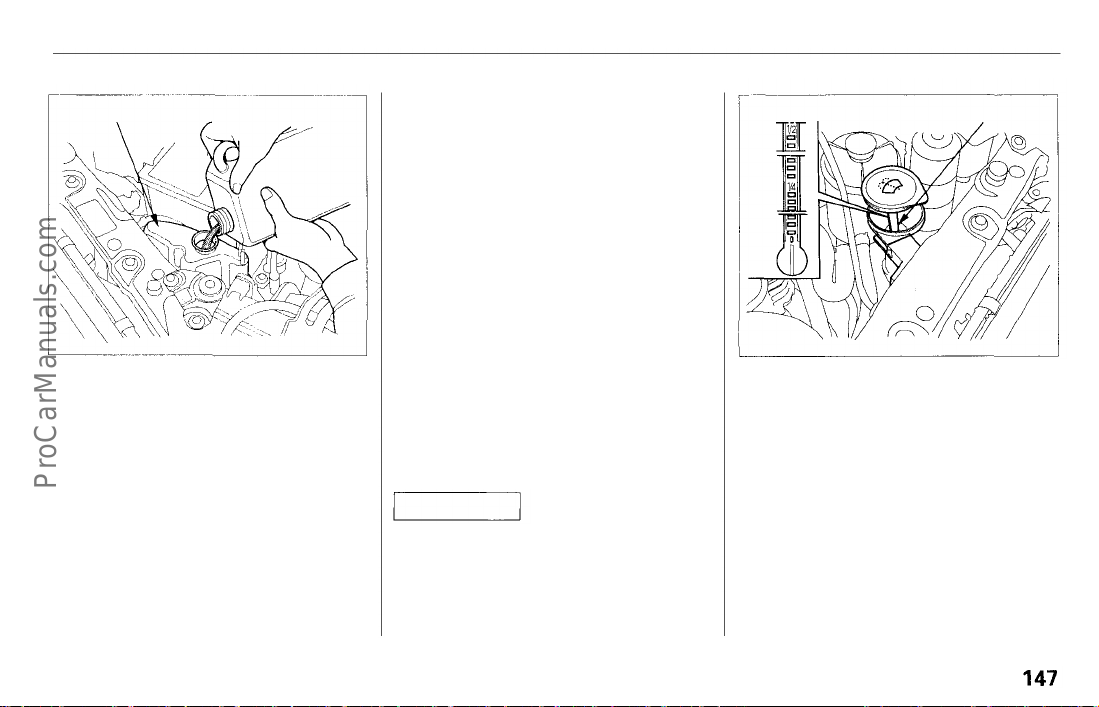
Cooling System, Windshield Washers
10.Turn off the engine. Check the
level in the radiator, add coolant if
needed. Install the radiator cap,
tighten it fully.
11. Fill the reserve tank to the MAX
mark. Install the reserve tank cap.
Windshield Washers
Check the level in the windshield
washer reservoir at least monthly
during normal usage. In bad weather,
when you use the washers often,
check the level every time you stop
for fuel.
The windshield washer reservoir is
located behind the left headlight.
Check the reservoir's fluid level by
removing the cap and looking at the
level gauge attached to the cap.
Fill the reservoir with a good-quality
windshield washer fluid. This
increases the cleaning capability and
prevents freezing in cold weather.
Do not use engine antifreeze or a
vinegar/water solution in the
windshield washer reservoir.
Antifreeze can damage your car's
paint, while a vinegar/water solution
can damage the windshield washer
pump.
Use only commercially-available
windshield washer fluid.
Maintenance
RESERVE TANK LEVEL GAUGE
NOTICE
ProCarManuals.com
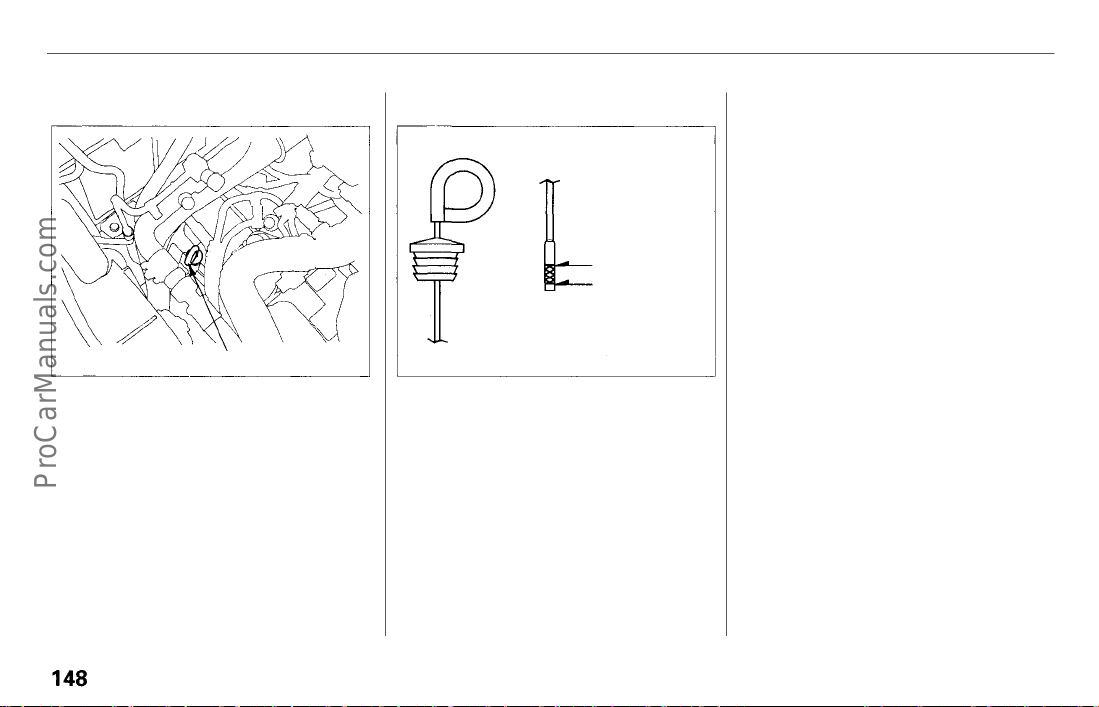
Transmission Oil
Automatic Transmission
Check the fluid level with the engine
at normal operating temperature.
1. Park the car on level ground. Shut
off the engine.
2. Remove the dipstick (yellow loop)
from the transmission and wipe it
with a clean cloth.
3. Insert the dipstick all the way into
the transmission.
4. Remove the dipstick and check
the fluid level. It should be
between the upper and lower
marks.
5. If the level is below the lower
mark, add fluid into the tube to
bring it to the upper mark. Use
Honda Premium Formula Auto-
matic Transmission Fluid or an
equivalent DEXRON
®
II Auto-
matic Transmission Fluid (ATF)
only.
6. Insert the dipstick all the way back
in the transmission.
The transmission should be drained
and refilled with new fluid every 24
months or 48,000 km (30,000 miles),
whichever comes first. Shorten this
to every 12 months or 24,000 km
(15,000 miles) under severe driving
conditions (see page 134).
Maintenance
DIPSTICK
UPPER MARK
LOWER MARK
ProCarManuals.com
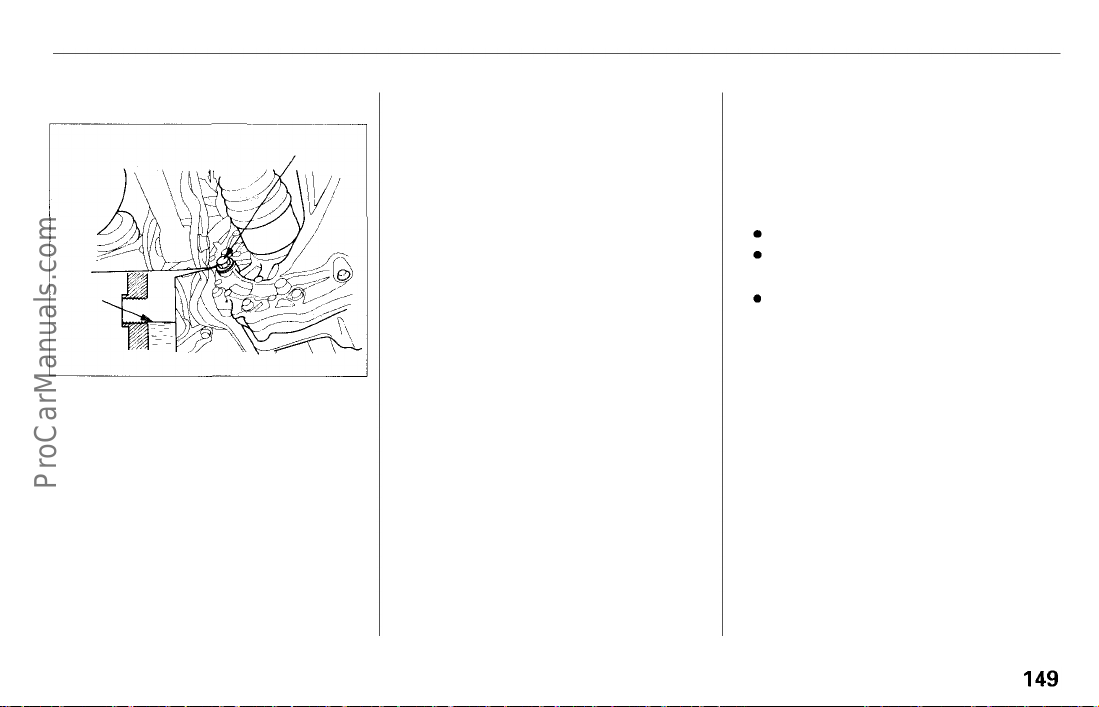
Transmission Oil, Brake and Clutch Fluid
5-speed Manual Transmission
Check the oil level a couple of mi-
nutes after shutting off the engine.
Make sure the car is on level ground.
Remove the transmission filler bolt.
The oil level should be up to the
edge of the bolt hole. Feel inside the
bolt hole with your finger. If you do
not feel any oil, slowly add oil until it
starts to run out of the hole. Reinstall
the filler bolt and tighten it securely.
Only use an API Service SF or SG
grade motor oil with a viscosity of
SAE 10W-30 or 10W-40.
The transmission should be drained
and refilled with new oil every 24
months or 48,000 km (30,000 miles),
whichever comes first. Shorten the
service interval to every 12 months
or 24,000 km (15,000 miles) under
severe driving conditions (see page
134).
Brake and Clutch Fluid
Check the fluid level in the reser-
voirs monthly. There are three reser-
voirs depending on the model. They
are:
Brake fluid reservoir
Clutch fluid reservoir (manual
transmission only)
ABS reservoir (for ABS
equipped cars)
The brake fluid in the brake and
Anti-lock brake systems should be
replaced every 2 years or 48,000 km
(30,000 miles), whichever comes
first.
Maintenance
FILLER BOLT
Correct
level
ProCarManuals.com
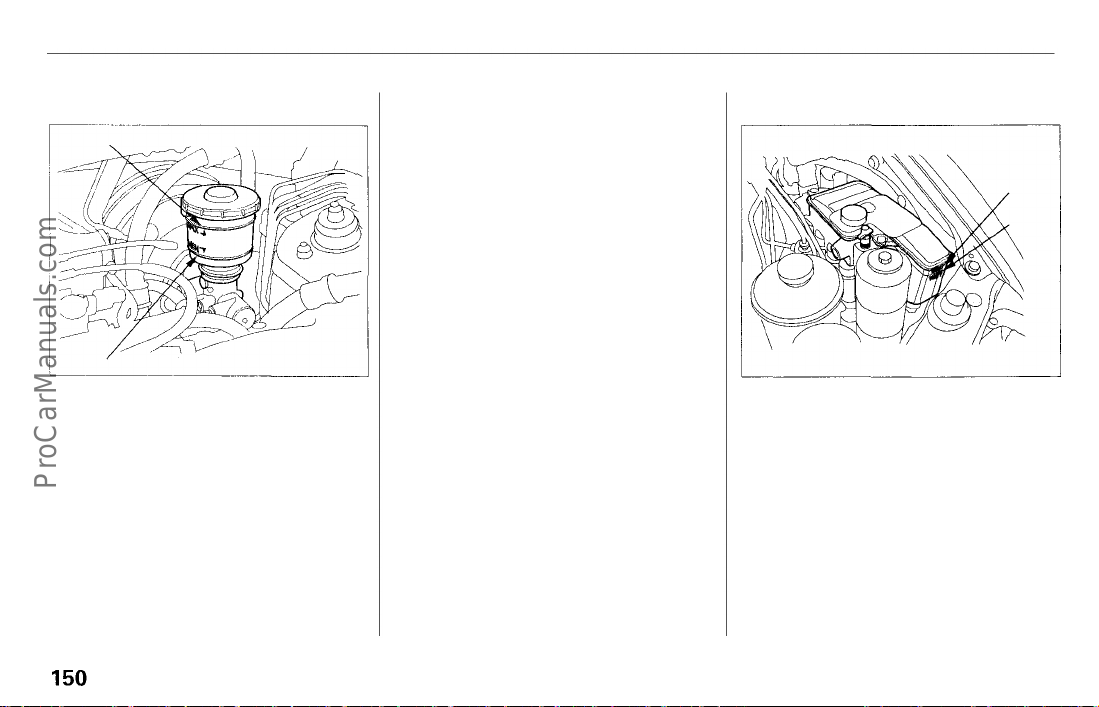
Brake and Clutch Fluid
Brake System
The fluid should be between the
MIN and MAX marks on the side of
the reservoir. If the level is at or
below the MIN mark, it is an
indication that your brake system
needs attention. Have the brake
system inspected for leaks or worn
brake pads.
If you add brake fluid to bring it up
to the MAX mark, use Genuine
Honda Brake Fluid or an equivalent
from a sealed container that is
marked DOT3 or DOT4 only. Brake
fluid marked DOT5 is not compatible
with your car's braking system.
Anti-lock Brake System
The fluid should be between the
MIN and MAX marks on the side of
the reservoir. If it is at or below the
MIN mark, it indicates a possible
problem in the ABS. Have the dealer
inspect the system and add fluid.
Maintenance
MAX
MIN
MAX
MIN
ProCarManuals.com
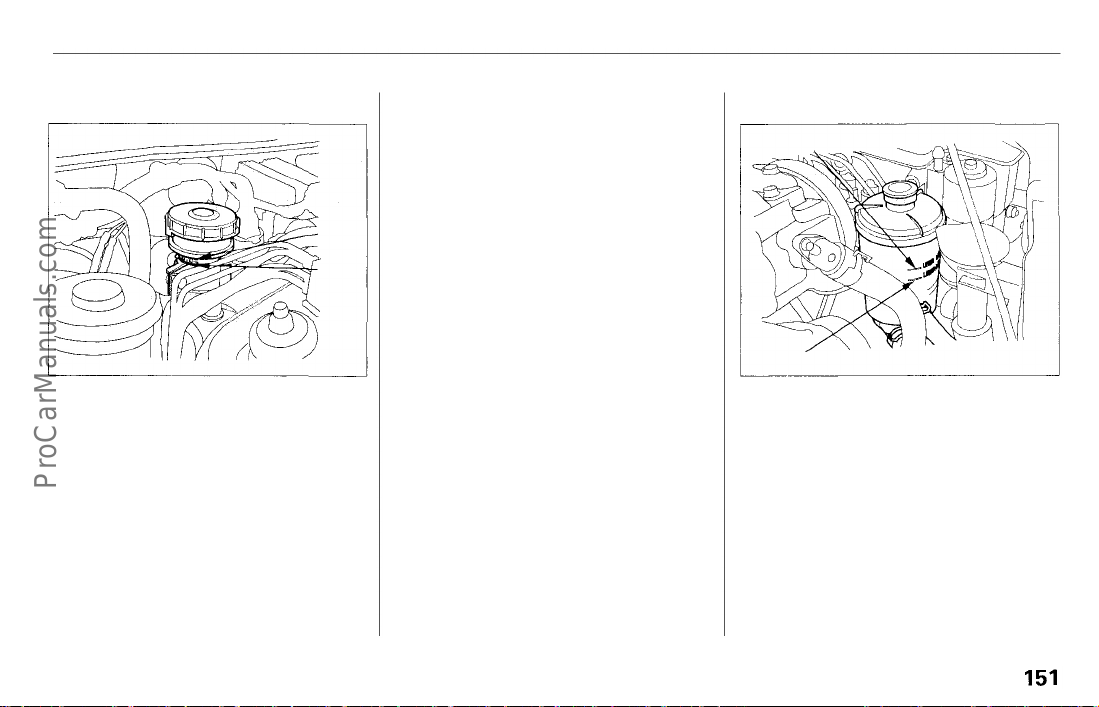
Brake and Clutch Fluid, Power Steering
Clutch System
The fluid should be between the
MIN and MAX marks on the side of
the reservoir. If it is not, add brake
fluid to bring it up to that level. Use
the same DOT3 or DOT4 brake fluid
from a sealed container specified for
the brake system.
Low fluid level can indicate a leak in
the clutch system. Have this system
inspected as soon as possible.
Power Steering
You should check the fluid level in
the power steering reservoir
monthly. Check the level when the
engine is cold. Look at the side of
the reservoir. The fluid should be
between the UPPER LEVEL and
LOWER LEVEL. If it is below the
LOWER LEVEL, add power steering
fluid to the UPPER LEVEL.
CONTINUED
Maintenance
MAX
MIN
UPPER LEVEL
LOWER LEVEL
ProCarManuals.com
Power Steering, Air Cleaner
Using automatic transmission fluid
or another brand of power steering
fluid will damage the system. Use
only GENUINE HONDA Power
Steering Fluid-V.
A low power steering fluid level can
indicate a leak in the system. Check
the fluid level frequently and have
the system inspected as soon as
possible.
Turning the steering wheel to full
left or right lock and holding it there
can damage the power steering
pump.
Air Cleaner
The air cleaner element should be
replaced every 2 years or 48,000 km
(30,000 miles), whichever comes
first. Under severe driving condi-
tions, it should also be cleaned every
12 months or 24,000 km (15,000
miles), whichever comes first.
Cleaning (Severe Conditions)
Clean the air cleaner element by
blowing compressed air through it in
the opposite direction to normal air
flow. If you do not have access to
compressed air (such as a gas
station), ask your Honda dealer to do
this service.
Follow the replacement procedure
for removal and reinstallation.
Maintenance
NOTICE
NOTICE
ProCarManuals.com
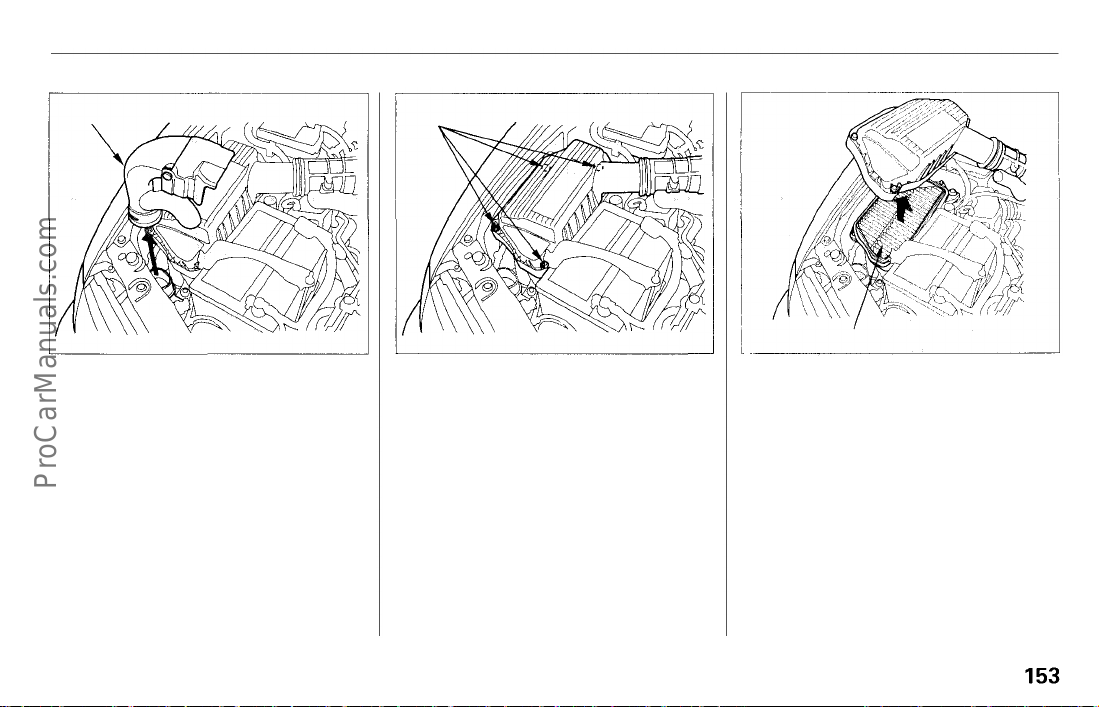
Air Cleaner
The air cleaner element is inside the
box on the passenger's side of the
engine compartment.
To replace it:
1. Remove the duct by pulling it
straight out.
2. Loosen the four bolts and remove
the air cleaner housing cover.
3. Remove the old air cleaner
element.
Clean the inside of the air cleaner
housing with a damp rag.
4. Place the new air cleaner element
in the air cleaner housing.
5. Reinstall the air cleaner housing
cover, tighten the four bolts and
reinstall the duct.
Maintenance
DUCT
BOLTS
AIR CLEANER ELEMENT
ProCarManuals.com
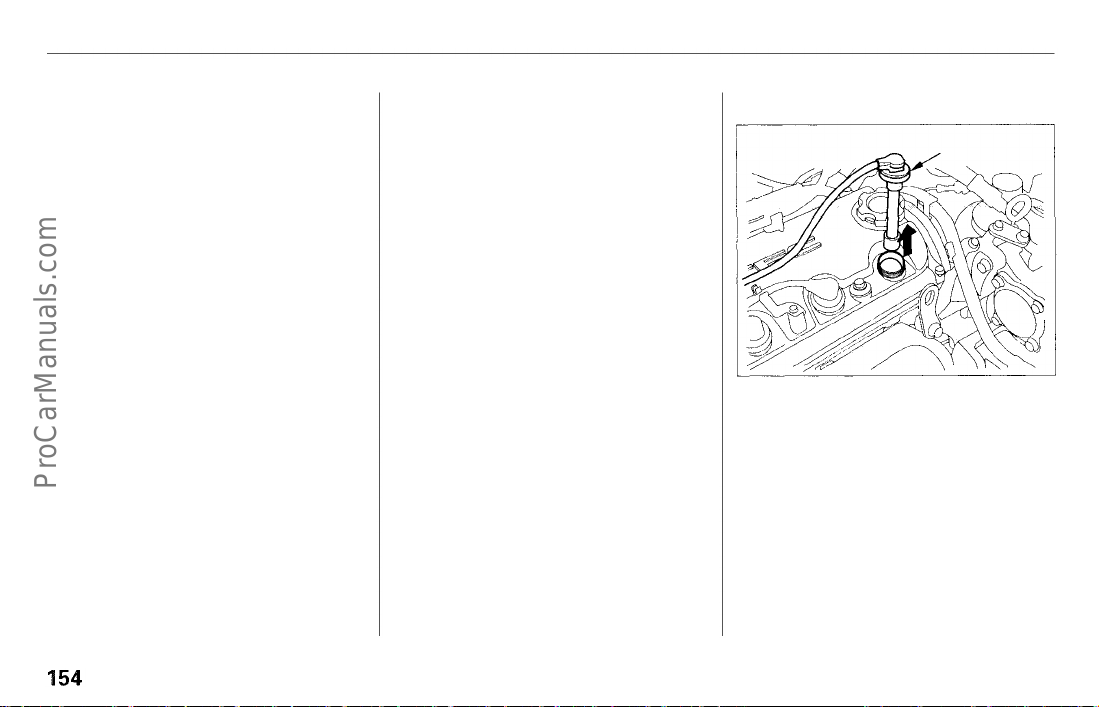
Fuel Filter, Spark Plugs
Fuel Filter
The fuel filter should be replaced
every 4 years or 96,000 km (60,000
miles), whichever comes first.
Have a qualified technician change
the fuel filter. Since the fuel system
is under pressure, gasoline can spray
out and create a hazard if all fuel line
connections are not handled
correctly.
The filter may require replacement
sooner if you happen to buy one or
more tankfuls of contaminated
gasoline. Have the filter tested or
replaced if you suspect it has been
clogged by contaminants.
Spark Plugs
The original spark plugs in your car
need to be replaced every 2 years or
48,000 km (30,000 miles), whichever
comes first.
Replacement
1. Clean up any dirt and oil around
the spark plug caps.
2. Remove the spark plug cap by
pulling it straight out.
3. Remove the spark plug, using a 16
mm (5/8 inch) spark plug socket.
Maintenance
SPARK PLUG CAP
ProCarManuals.com
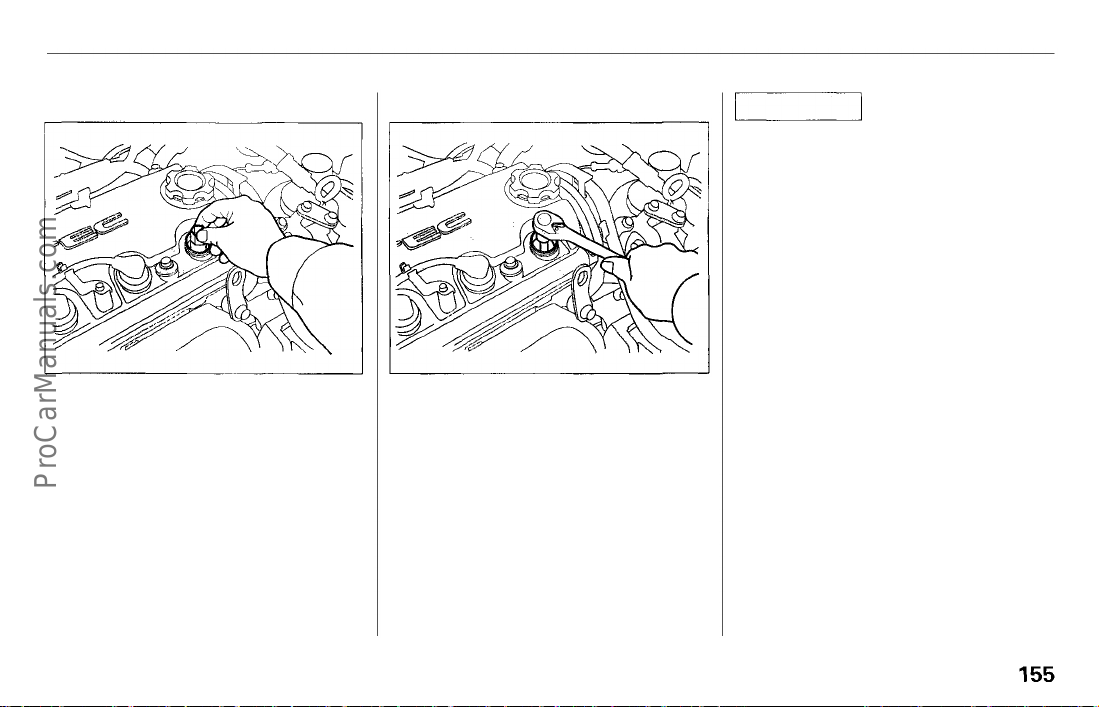
Spark Plugs
4. Put the new spark plug into the
socket, then thread it into the hole.
Screw it in by hand so you do not
crossthread it.
5. Torque the spark plug. (If you do
not have a torque wrench, tighten
the spark plug 2/3 turn after it
contacts the cylinder head.)
Tightening torque:
1
8
N.m(1.8 kg-m,13 Ib-ft)
Tighte
n the spark plugs carefully. A
spark plug that is too loose can
overheat and damage the engine.
Overtightening can cause damage to
the threads in the cylinder head.
6. Install the spark plug cap.
7. Repeat this procedure for the
other three spark plugs.
CONTINUED
Maintenance
NOTICE
ProCarManuals.com

Spark Plugs, Battery
Specifications:
Normal driving conditions
NGK: ZFR5F-11
Nippondenso: KJ16CR-L11
Hot climates, or continuous high
speed driving
NGK: ZFR6F-11
Nippondenso: KJ20CR-L11
Spark Plug Gap:
1.1 mm (0.04 in)
Battery
Check the condition of your car's
battery monthly. You should check
for proper electrolyte level and
corrosion on the terminals.
Maintenance
The battery gives off explo-
sive hydrogen gas during nor-
mal operation. A spark or
open flame can cause the
battery to explode with
enough force to kill or seri-
ously hurt you.
Keep all sparks, open flames,
and smoking materials away
from the battery.
Wear protective clothing and
a face shield, or have a skilled
mechanic do the battery
maintenance.
The battery contains sulfuric
acid (electrolyte) which is
highly corrosive and poison-
ous.
Getting electrolyte in your
eyes or on your skin can
cause serious burns. Wear
protective clothing and eye
protection when working
near the battery.
Swallowing electrolyte can
cause fatal poisoning if im-
mediate action is not taken.
KEEP OUT OF THE REACH OF
CHILDREN
ProCarManuals.com
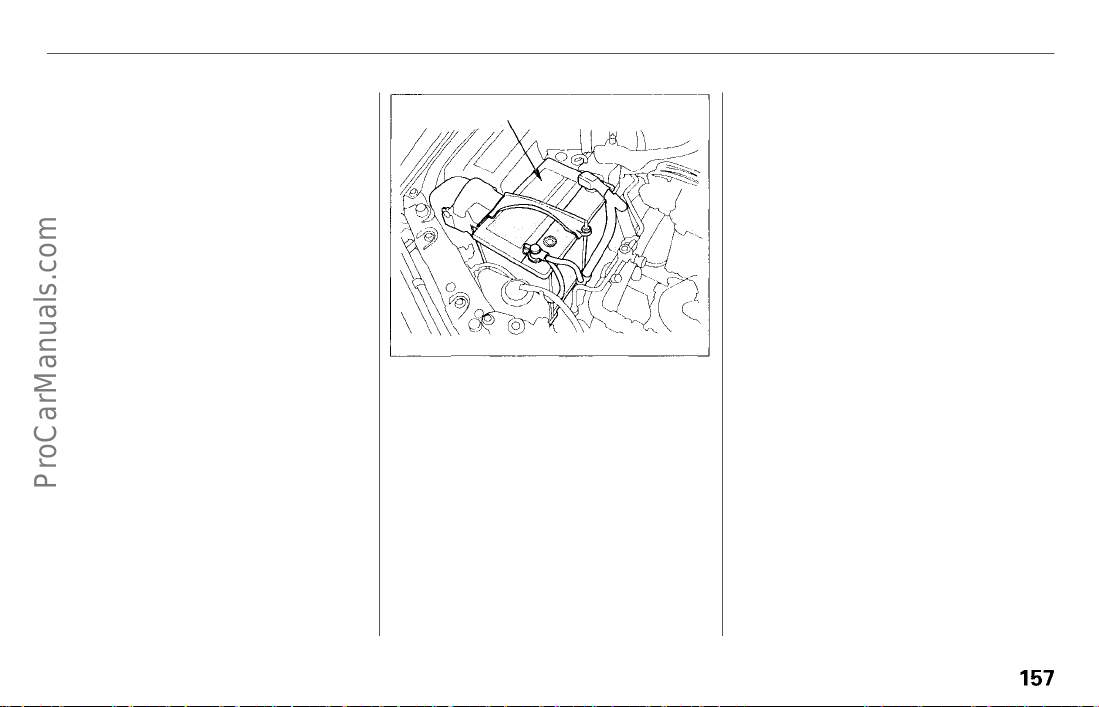
Battery
Emergency Procedures
Eyes — Flush with water from a cup
or other container for at least fifteen
minutes. (Water under pressure can
damage the eye.) Immediately call a
physician or 911.
Skin — Remove contaminated
clothing. Flush the skin with large
quantities of water. Call a physician
immediately.
Swallowing — Drink water or milk.
Call your local Poison Control Center
or a physician immediately.
Check the battery condition by
looking at the test indicator window
on the battery.
The label on the battery explains the
test indicator's colors.
Check the battery terminals for
corrosion (a white or yellowish
powder). To remove it, cover the
terminals with a solution of baking
soda and water. It will bubble up and
turn brown. When this stops, wash it
off with plain water. Dry off the
battery with a cloth or paper towel.
Coat the terminals with grease to
help prevent future corrosion.
CONTINUED
Maintenance
TEST INDICATOR WINDOW
ProCarManuals.com
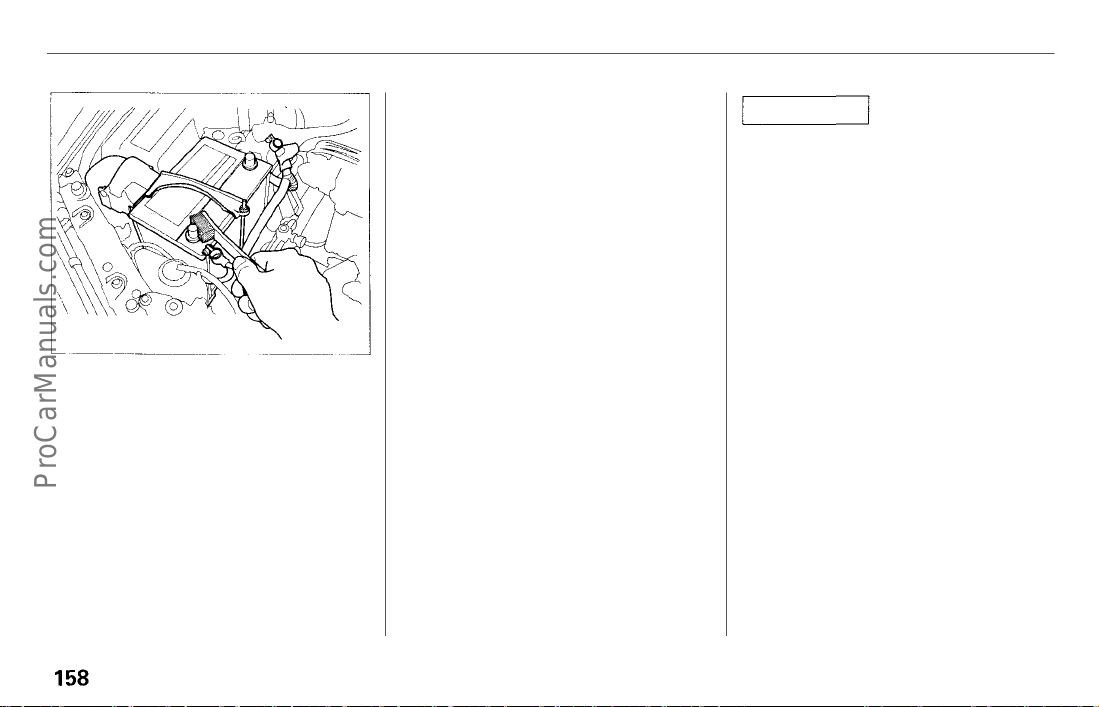
Battery
If the terminals are severely cor-
roded, clean them with baking soda
and water. Then use a wrench to
loosen and remove the cables from
the terminals. Always disconnect the
negative ( — ) cable first and recon-
nect it last. Clean the battery termi-
nals with a terminal cleaning tool or
wire brush. Reconnect and tighten
the cables, then coat the terminals
with grease.
If you need to connect the battery to
a charger, disconnect both cables to
prevent damage to the car's electri-
cal system.
On the U.S. EX and Canadian EX-R
models
If your car's battery is disconnected
or goes dead, the audio system will
disable itself. The next time you turn
on the radio you will see "Code" in
the frequency display. Use the
Preset buttons to enter the five-digit
code (see page 99 ).
Charging the battery with the cables
connected can seriously damage
your car's electronic controls.
Detach the battery cables before
connecting the battery to a charger.
Maintenance
NOTICE
ProCarManuals.com
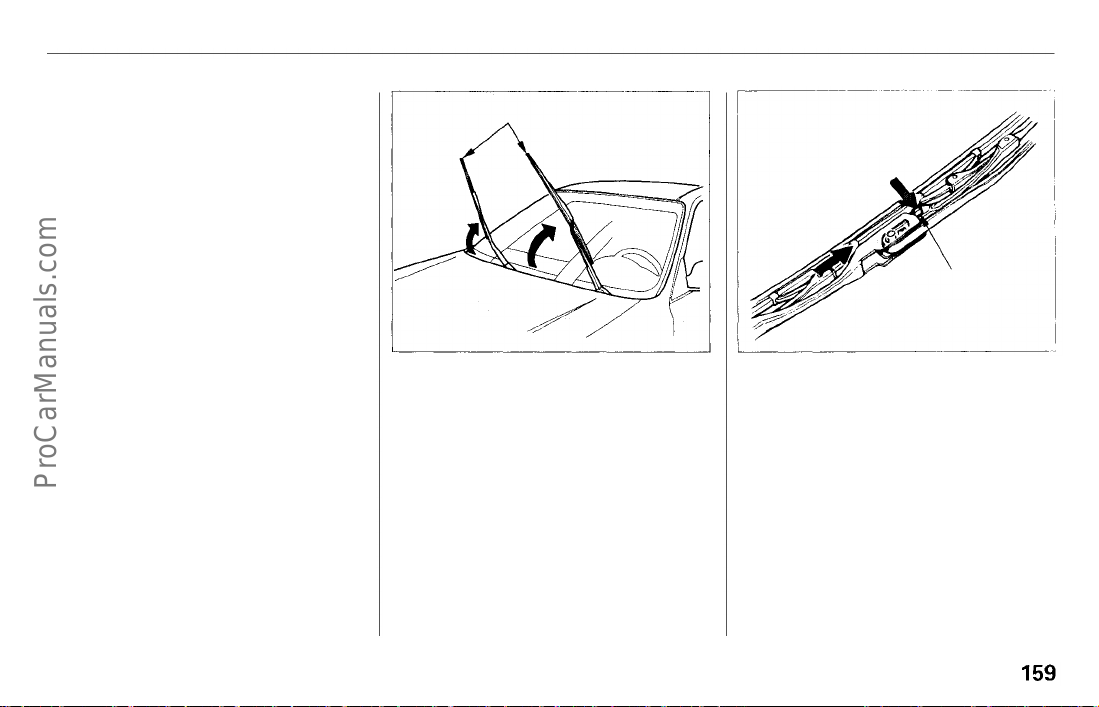
Windshield Wipers
Check the condition of the wind-
shield wiper blades at least every six
months. Look for signs of cracking
in the rubber, or areas that are
getting hard. Replace the blades if
you find these signs, or they leave
streaks and unwiped areas when
used.
To replace:
1. Raise the wiper arm off the
windshield.
2. Disconnect the blade assembly
from the wiper arm by pushing in
the lock tab. Hold it in while you
push the blade assembly toward
the base of the arm.
CONTINUED
Maintenance
WIPER ARMS
LOCK TAB
ProCarManuals.com
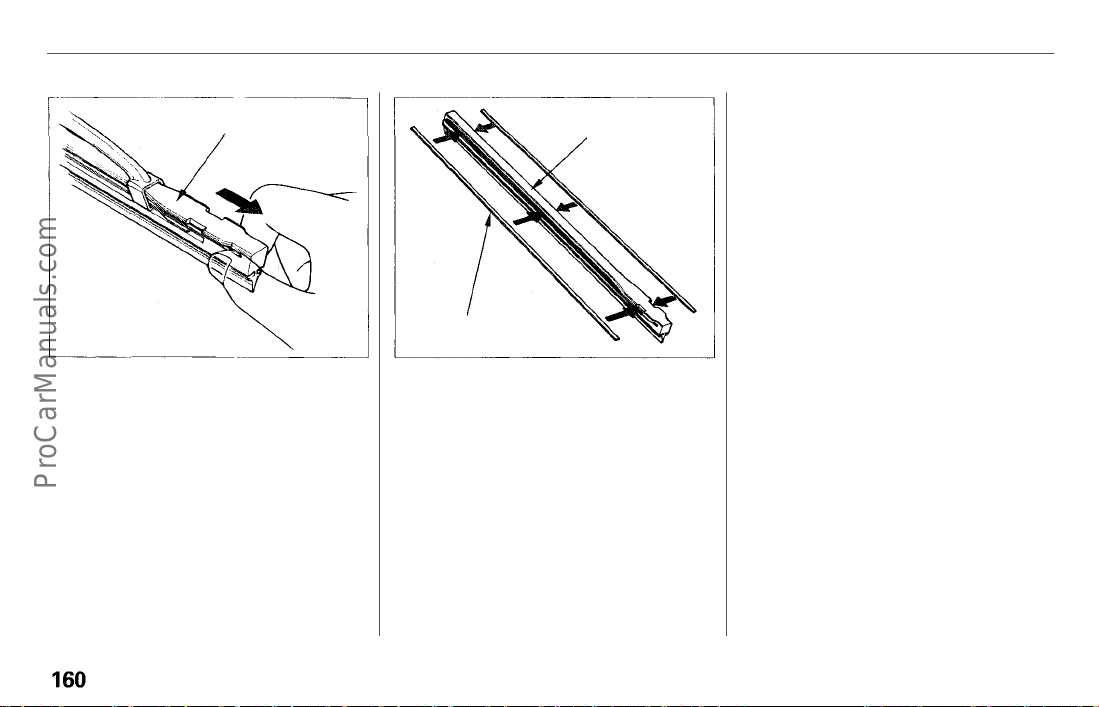
Windshield Wipers
3. Remove the blade from its holder
by grasping the tabbed end of the
blade. Pull firmly until the tabs
come out of the holder.
4. Examine the new wiper blades. If
they have no plastic or metal rein-
forcement along the back edge,
remove the metal reinforcement
strips from the old wiper blade and
install them in the slots along the
edge of the new blade.
5. Slide the new wiper blade into the
holder until the tabs lock.
6. Slide the new blade assembly onto
the wiper arm. Make sure it locks
in place.
7. Lower the wiper arm down against
the windshield.
Maintenance
BLADE
BLADE
REINFORCEMENT
ProCarManuals.com
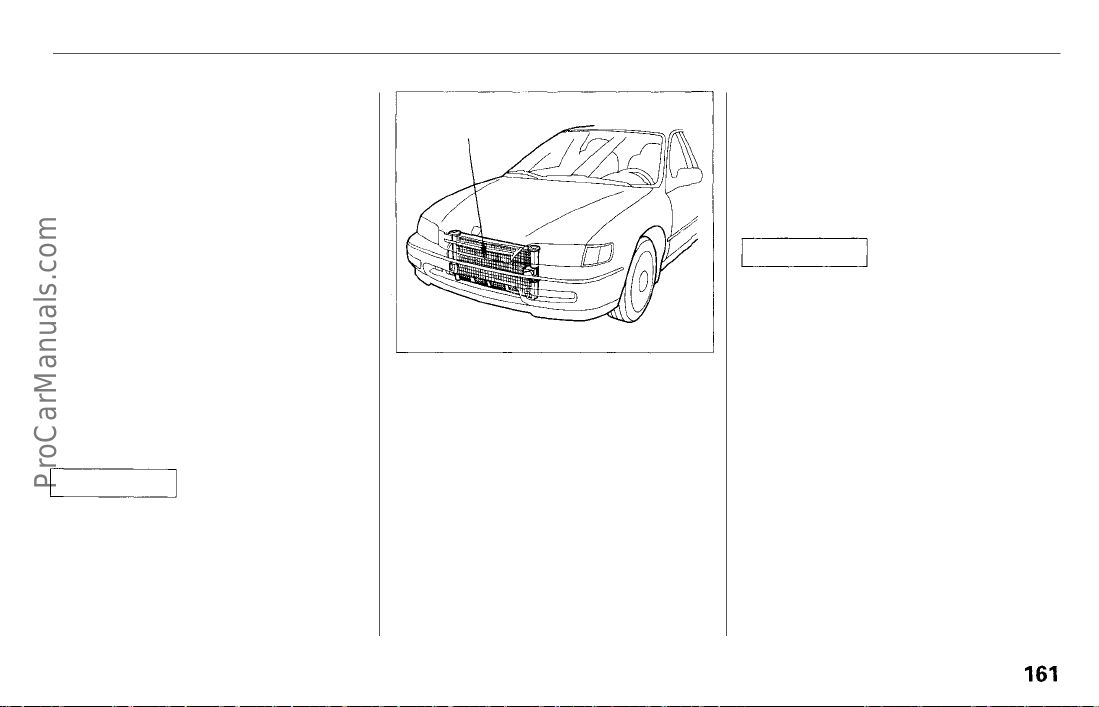
Air Conditioning
Optional for the U.S. DX and Canadian
LX models
Your car's air conditioning is a sealed
system. Any major maintenance,
such as recharging, should be done
by a qualified technician. There are a
couple of things you can do to make
sure the air conditioning works
efficiently.
Periodically check the engine's
radiator and air conditioning
condenser for leaves, insects, and
dirt stuck to the front surface. These
block the air flow and reduce cooling
efficiency. Use a light spray from a
hose or a soft brush to remove them.
The condenser and radiator fins
bend easily. Only use a low-pressure
spray or soft-bristle brush to clean
them.
Run the air conditioning at least once
a week during the cold weather
months. Run it for at least ten
minutes while you are driving at a
steady speed with the engine at
normal operating temperature. This
circulates the lubricating oil con-
tained in the refrigerant.
If the air conditioning does not get as
cold as before, have your dealer
check the system. Recharge the
system with Refrigerant HFC-134a
(R-134a). (See Specifications on page
214.)
Whenever you have the air condi-
tioning system serviced, make sure
the service facility uses a refrigerant
recycling system. This system
captures the refrigerant for reuse.
Releasing refrigerant into the at-
mosphere can damage the environ-
ment.
Maintenance
NOTICE
AIR CONDITIONING
CONDENSER
NOTICE
ProCarManuals.com
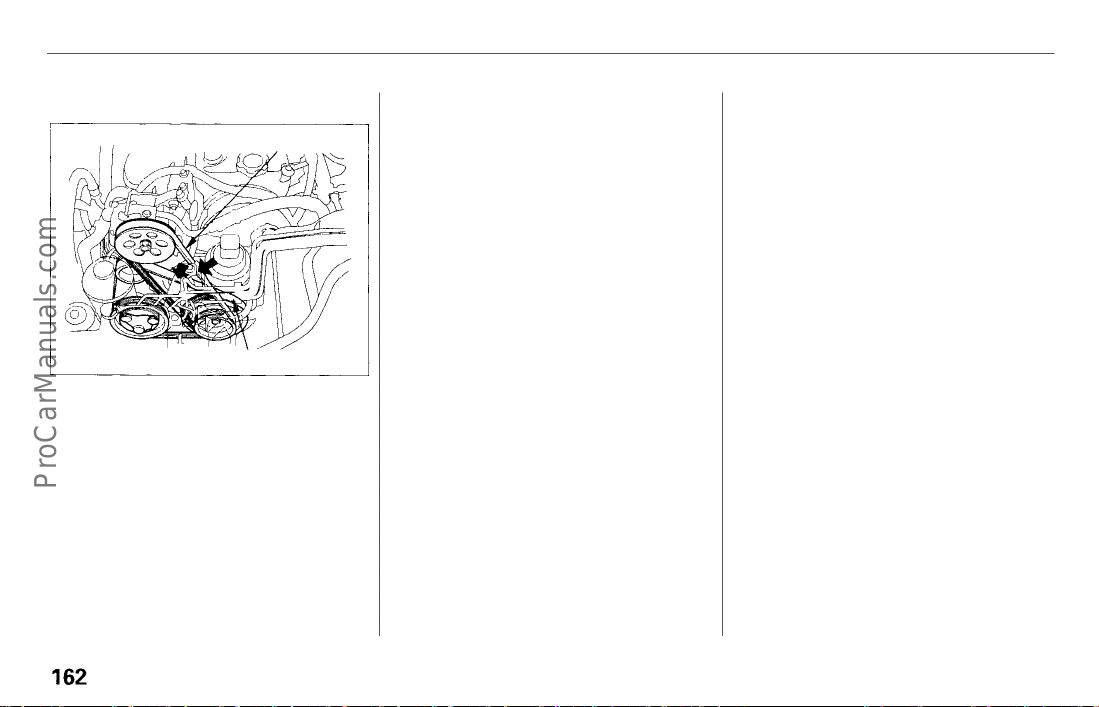
Engine Belts, Tires
Engine Belts
Check the condition of the two
engine belts. Examine the edges of
each belt for cracks or fraying.
Check the tension of each belt by
pushing on it with your thumb
midway between the pulleys.
The belts should have the following
"play" or deflection.
Alternator belt:
(On cars without A/C)
10.5—12.5 mm (0.41—0.49 in)
(O
n cars with A/C)
8.0 — 10.5 mm (0.31— 0.41 in)
Power steering belt:
13.0 —16.0 mm (0.51— 0.63 in)
If you see signs of wear or looseness,
have your dealer adjust or replace
the belts.
Tires
To safely operate your car, your tires
must be the proper type and size, in
good condition with adequate tread,
and correctly inflated. The following
pages give more detailed information
on how and when to check air
pressure, how to inspect your tires
for damage, and what to do when
your tires need to be replaced.
Maintenance
POWER STEERING BELT
ALTERNATOR BELT
Using tires that are ex-
cessively worn or improperly
inflated can cause a crash in
which you can be seriously
hurt or killed.
Follow all instructions in this
owner's manual regarding
tire inflation and
maintenance.
ProCarManuals.com
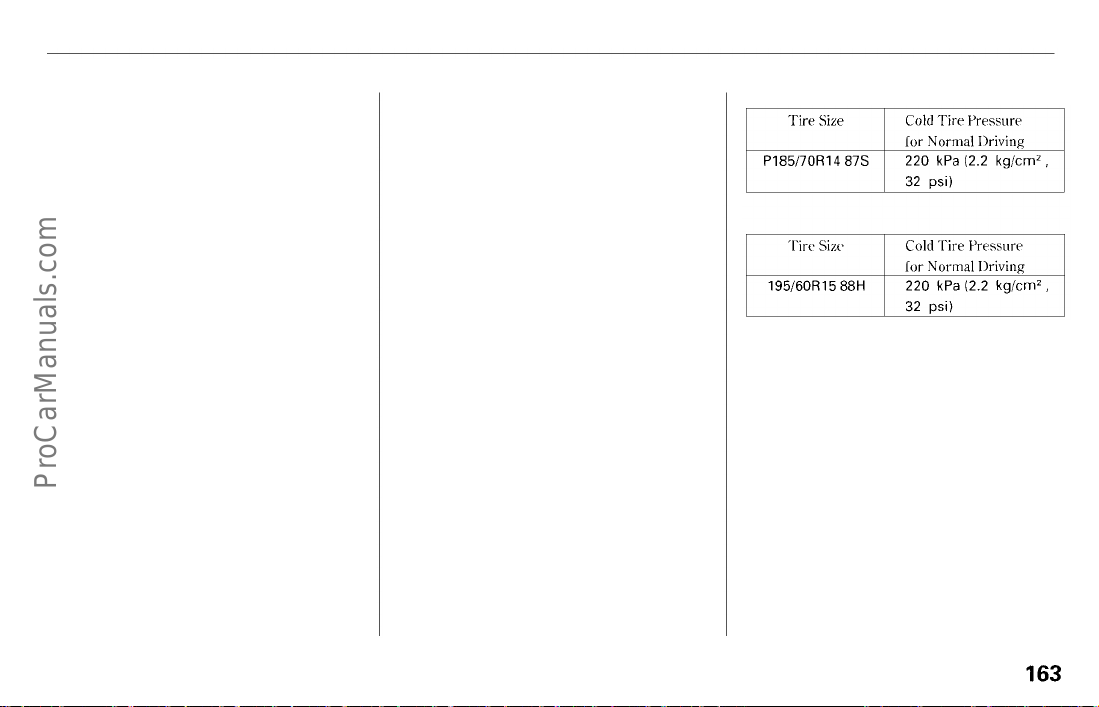
Tires
Inflation
Keeping the tires properly inflated
provides the best combination of
handling, tread life and riding
comfort. Underinflated tires wear
unevenly, adversely affect handling
and fuel economy, and are more
likely to fail from being overheated.
Overinflated tires can make your car
ride more harshly, are more prone to
damage from road hazards, and wear
unevenly.
We recommend that you visually
check your tires every day and use a
gauge to measure the air pressure at
least once a month. If you think a tire
might be low, check it immediately.
Remember to check the spare tire at
the same time you check all the
other tires.
Check the pressure in the tires when
they are cold. This means the car
has been parked for at least three
hours. If you have to drive the car
before checking the tire pressure,
the tires can still be considered
"cold" if you drive less than 1.6 km
(1 mile).
If you check the pressure when the
tires are hot (the car has been driven
several miles), you will see readings
28 to 41 kPa (0.3 to 0.4 kg/cm
2
, 4 to
6 psi) higher than the cold reading.
This is normal. Do not let air out to
match the specified cold pressure.
The tire will be underinflated.
Recommended Tire Pressures for
Normal Driving
The following chart shows the
recommended cold tire pressures for
most normal driving conditions and
speeds. Tire pressures for high
speed driving are shown on page
219.
(US: DX, LX, Canada: LX)
(US: EX, Canada: EX-R)
The compact spare tire pressure is:
420 kPa (4.2 kg/cm
2
, 60 psi)
The pressures are also given on the
tire information label on the driver's
door jamb.
CONTINUED
Maintenance
ProCarManuals.com
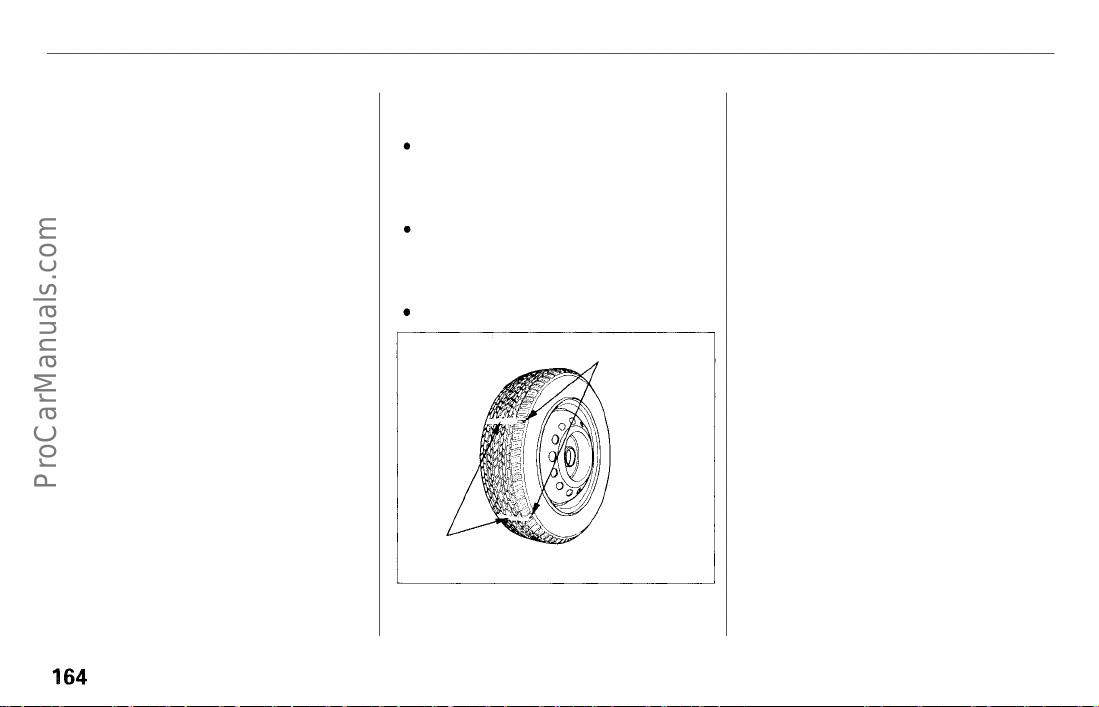
Tires
You should get your own tire
pressure gauge and use it whenever
you check your tire pressures. This
will make it easier for you to tell if a
pressure loss is due to a tire problem
and not due to a variation between
gauges.
Tubeless tires have some ability to
self-seal if they are punctured.
However, because leakage is often
very slow, you should look closely
for punctures if a tire starts losing
pressure.
Inspection
Every time you check inflation, you
should also examine the tires for
damage, foreign objects, and wear.
You should look for:
Bumps or bulges in the tread or
side of the tire. Replace the tire if
you find either of these conditions.
Cuts, splits, or cracks in the side
of the tire. Replace the tire if you
can see fabric or tread.
Excessive tread wear.
Your car's tires have wear indicators
molded into the tread. When the
tread wears down to that point, you
will see a 12.7 mm (1/2 inch) wide
band running across the tread. This
shows there is less than 1.6 mm (1/
16 inch) of tread left on the tire. A
tire that is this worn gives very little
traction on wet roads. You should
replace the tire if you can see the
tread wear indicator in three or more
places around the tire.
Maintenance
In addition to proper inflation,
correct wheel alignment helps to
decrease tire wear. You should get
your car's wheel alignment checked
every 12 months or 24,000 km
(15,000 miles).
Maintenance
INDICATOR
LOCATION
MARKS
TREAD WEAR
INDICATORS
ProCarManuals.com

Tires
The tires were properly balanced by
the factory. They may need to be
rebalanced at some time before they
are worn out. Have your dealer
check the tires if you feel a consis-
tent vibration while driving. A tire
should always be rebalanced if it is
removed from the wheel for repair.
Make sure the installer balances the
wheels when you have new tires
installed. This increases riding
comfort and tire life. Your car's
original tires were dynamic or "spin"
balanced at the factory. For best
results, have the installer perform a
dynamic balance.
(US: EX, Canada: EX-R)
Improper wheel weights can damage
your car's aluminum wheels. Use
only genuine Honda wheel weights
for balancing.
Tire Rotation
To help increase tire life and
distribute wear more evenly, you
should have the tires rotated every
12,000 km (7,500 miles). Move the
tires to the positions shown in the
chart each time they are rotated.
Replacing Tires and Wheels
The tires that came with your car
were selected to match the perform-
ance capabilities of the car while
providing the best combination of
handling, ride comfort, and long life.
You should replace them with radial
tires of the same size, load range,
speed rating, and maximum cold tire
pressure rating (as shown on the
tire's sidewall). Mixing radial and
bias-ply tires on your car can reduce
its braking ability, traction, and
steering accuracy.
CONTINUED
Maintenance
NOTICE
Front
Installing improper tires on
your car can affect handling
and stability. This can cause a
crash in which you can be
seriously hurt or killed.
Always use the size and type
of tires recommended in this
owner's manual.
ProCarManuals.com

Tires
It is best to replace all four tires at
the same time. If that is not possible
or necessary, then replace the two
front tires or the two rear tires as a
pair. Replacing just one tire can
seriously affect your car's handling.
If you ever need to replace a wheel,
make sure the wheel's specifications
match those of the original wheel
that came on your car. Replacement
wheels are available at your Honda
dealer.
Wheels and Tires
Wheel:
(US: DX, LX, Canada: LX)
14 x
5
J
(US: EX, Canada: EX-R)
15 x 5 1/2 JJ
Tire:
(US: DX, LX, Canada: LX)
P185/70R1487S
(US: EX, Canada: EX-R)
195/60R 15 88H
See Tire Information on page 218 for
additional information about tire and
wheel size designations. See page
219 for information about DOT Tire
Quality Grading.
Winter Driving
Tires that are marked "M+S" or "All
Season" on the sidewall have an all-
weather tread design. They should
be suitable for most winter driving
conditions. Tires without these
markings are designed for optimum
traction in dry conditions. They may
not provide adequate performance in
winter driving.
For the best performance in snowy
or icy conditions, you should install
snow tires or tire chains. They may
be required by local laws under
certain conditions.
Maintenance
ProCarManuals.com
Tires
Snow Tires
If you mount snow tires on your
Honda, make sure they are radial
tires of the same size and load range
as the original tires. Mount snow
tires on all four wheels to balance
your car's handling in all weather
conditions. Keep in mind the traction
provided by snow tires on dry roads
may not be as high as your car's
original-equipment tires. You should
drive cautiously even when the roads
are clear. Check with the tire dealer
for maximum speed recommenda-
tions.
Tire Chains
Mount snow chains on your car
when warranted by driving condi-
tions or required by local laws. Make
sure the chains are the correct size
for your tires. Install them only on
the front tires. If metal chains are
used, they must be SAE class"S".
Cable type traction devices can also
be used.
When installing chains, follow the
manufacturer's instructions and
mount them as tightly as you can.
Drive slowly with chains installed. If
you hear the chains contacting the
body or chassis, stop and tighten
them. If they still make contact, slow
down until it stops. Remove the
chains as soon as you begin driving
on cleared roads.
Chains of the wrong size or that are
improperly installed can damage
your car's brake lines, suspension,
body, and wheels. Stop driving if you
hear the chains hitting any part of
the car.
Maintenance
NOTICE
ProCarManuals.com
Lights
Check the operation of your car's
exterior lights at least once a month,
A burned out bulb can create an
unsafe condition by reducing your
car's visibility and the ability to
signal your intentions to other
drivers.
Check the following:
Headlights (low and high beam)
Parking lights
Taillights
Brake lights
High-mount brake light
Turn signals
Back-up lights
Hazard light function
License plate light
Side marker lights
Daytime running lights
(Canadian cars)
If you find any bulbs are burned out,
replace them as soon as possible.
Refer to the chart on page 215 to
determine what type of replacement
bulb is needed.
Replacing a Headlight Bulb
Your car has two bulbs on each side,
four in total. Make sure you are
replacing the bulb that is burned out.
Your car uses halogen headlight
bulbs. When replacing a bulb, handle
it by its plastic case and protect the
glass from contact with your skin or
hard objects. If you touch the glass,
clean it with denatured alcohol and a
clean cloth.
Maintenance
ProCarManuals.com

Lights
Halogen headlight bulbs get very hot
when lit. Oil, perspiration, or a
scratch on the glass can cause the
bulb to overheat and shatter.
1. Open the hood.
If you need to change a bulb on
the passenger's side, remove the
radiator reserve tank,
2. Remove the electrical connector
from the bulb by squeezing the
connector to unlock the tab while
you push down on the connector.
3. Remove the bulb by turning it one-
quarter turn counterclockwise.
4. Insert the new bulb into the hole
and turn it one-quarter turn clock-
wise.
5. Push the electrical connector back
onto the bulb. Make sure it is on
all the way.
6. Turn on the headlights to test the
new bulb.
7. (Passenger's side)
Reinstall the radiator reserve tank.
Maintenance
NOTICE
BULB
TAB
ProCarManuals.com
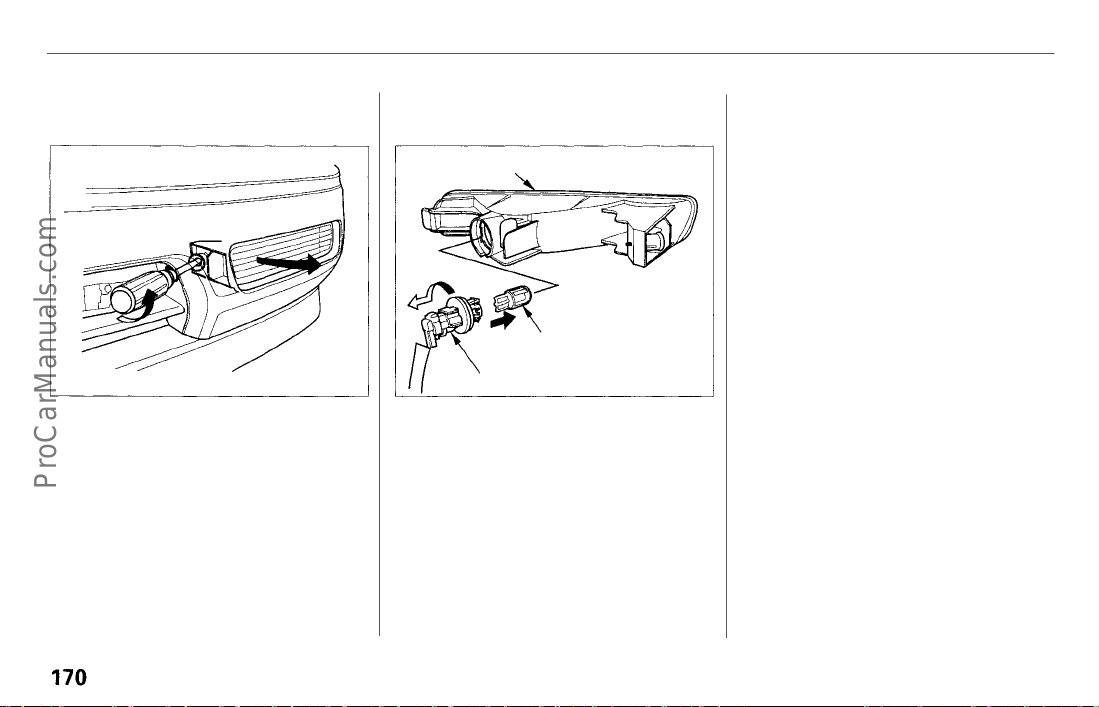
Lights
Replacing a Front Turn Signal
Light Bulb
1. Use a Phillips-head screwdriver to
loosen the turn signal assembly's
mounting screw.
2. Remove the turn signal assembly
from the bumper.
3. Remove the bulb holder from the
turn signal assembly by turning it
counterclockwise.
4. Remove the burned out bulb from
the socket by pulling it straight out
of its socket.
5. Install the new bulb in the socket.
6. Push the bulb holder into the turn
signal assembly and turn it
clockwise until it locks.
7. Test the turn signals to make sure
the new bulb is working.
8. Put the turn signal assembly into
the bumper. Make sure the tabs
on the turn signal assembly fit into
the bumper slots. Tighten the
mounting screw.
Maintenance
TURN SIGNAL ASSEMBLY
BULB
BULB HOLDER
ProCarManuals.com
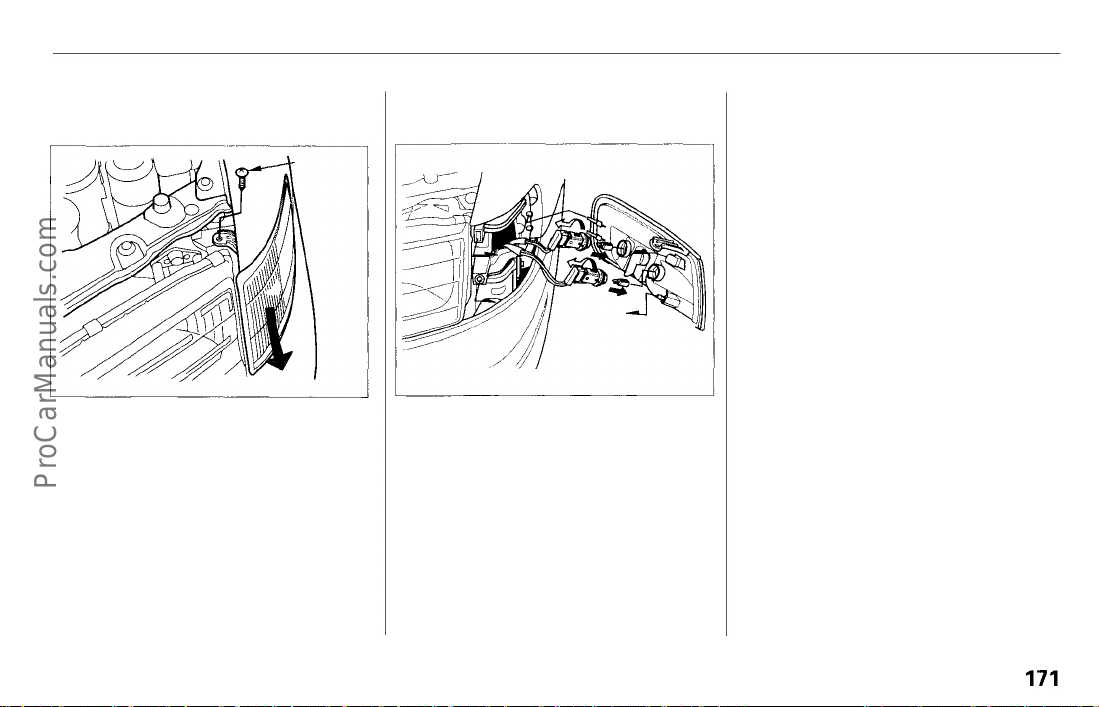
Lights
Replacing Front Side Marker and
Parking Light Bulbs
1. Use a Phillips-head screwdriver to
remove the screw from the top of
the fender.
2. Move the side marker light
assembly forward until it pops out
of the body.
3. Turn the bulb holder one-quarter
counterclockwise to remove it
from the lens.
4. Pull the bulb straight out of its
socket.
Push the new bulb straight into
the socket until it bottoms.
5. Put the bulb holder back into its
hole in the lens, and turn it
clockwise until it locks.
6. Turn on the parking lights and
check that the new bulb is
working.
7. Put the side marker assembly
back into the body. Push on the
front edge until it snaps into place.
Install the mounting screw and
tighten it securely.
Maintenance
SCREW
ProCarManuals.com
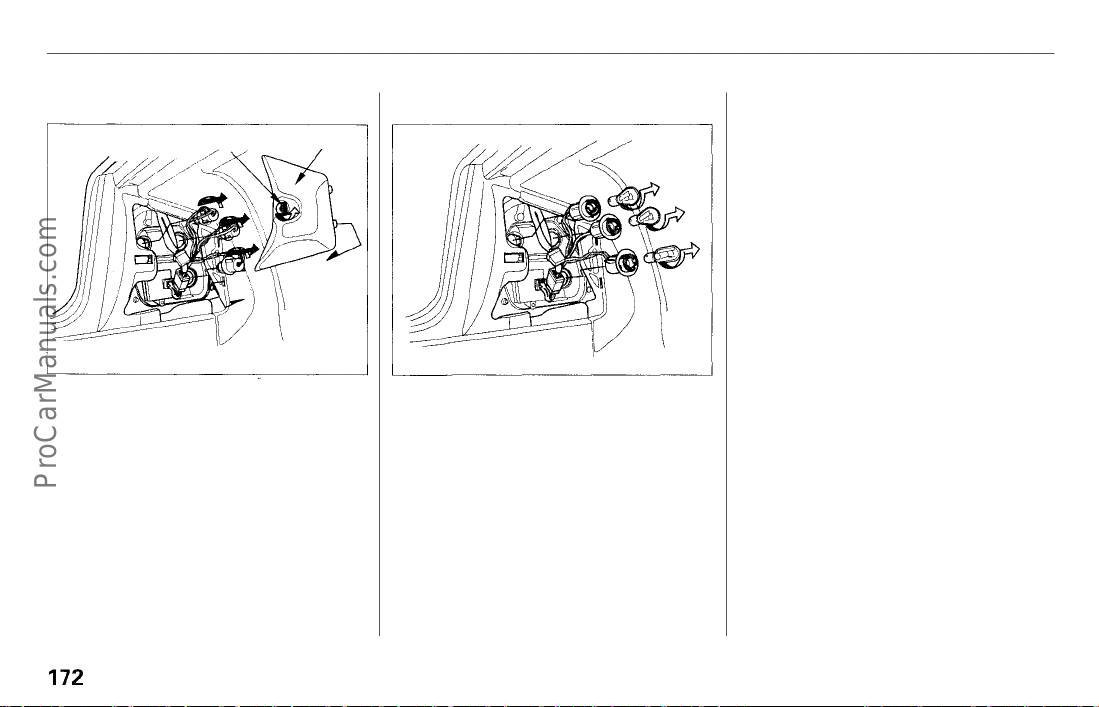
Lights
Replacing Rear Bulbs
1. Open the trunk and remove the
taillight cover by turning the knob.
2. Determine which of the three
bulbs is burned out: tail/stoplight,
back-up light or turn signal.
3. Remove the socket by turning it
one-quarter turn counterclockwise.
4. Remove the bulb by turning it one-
quarter turn counterclockwise and
pulling it out of the socket.
5. Install the new bulb in the socket.
6. Reinstall the socket into the light
assembly.
7. Test the lights to make sure the
new bulb is working.
8. Reinstall the taillight assembly
cover.
Maintenance
KNOB
COVER
ProCarManuals.com
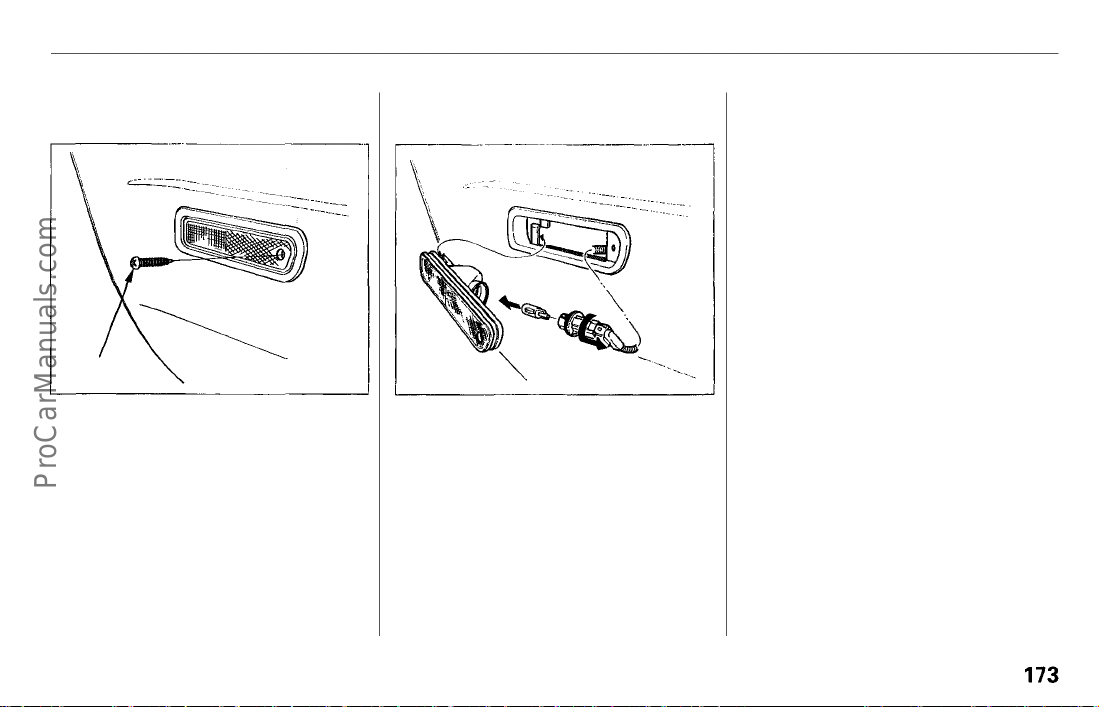
Lights
Replacing a Rear Side Marker
Light Bulb
1. Use a Phillips-head screwdriver to
loosen the side marker assembly
mounting screw.
2. Remove the assembly from the
fender by pulling out the back
edge and sliding the assembly
backwards.
3. Remove the socket from the light
assembly by turning it counter-
clockwise.
4. Remove the bulb from the socket
by pulling it straight out.
Install the new bulb. Turn on the
headlights to test the bulb.
5. Insert the socket in the assembly.
Turn it clockwise to lock it in place.
6. Reinstall the side marker assem-
bly in the bumper. Tighten the
mounting screw securely.
Maintenance
SCREW
ProCarManuals.com
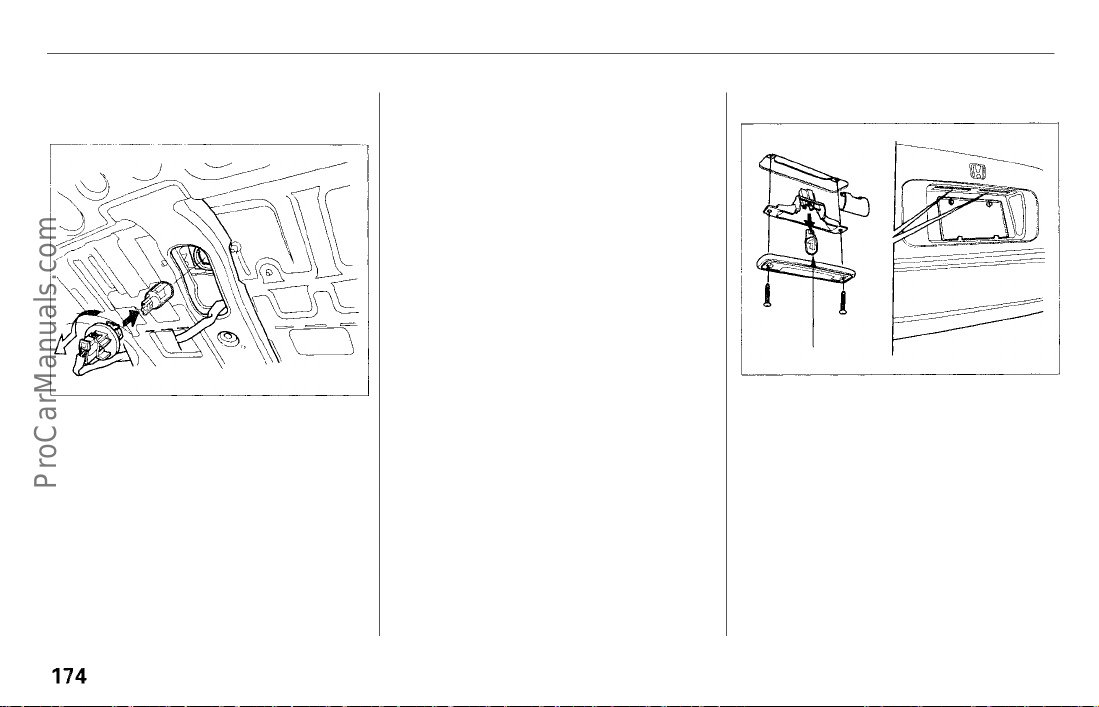
Lights
Replacing a High-mount Brake
Light Bulb
1. Open the trunk and remove the
socket from the light assembly by
turning it one-quarter turn counter-
clockwise.
2. Remove the burned-out bulb by
pulling it straight out of the socket.
3. Install the new bulb and reinstall
the socket. Make sure the new
bulb is working.
Replacing a Rear License Bulb
1. Remove the two screws and
remove the license light assembly.
2. Remove the lens from the rubber
seal and the metal cover.
3. Pull the bulb straight out of its
socket. Push the new bulb in until
it bottoms in the socket.
Maintenance
BULB
ProCarManuals.com

Lights
4. Turn on the parking lights and
check that the new bulb is
working.
5. Reinstall the cover and the lens.
Put the license light assembly in
place. Reinstall the two screws and
tighten them securely.
Replacing Bulbs in the Interior
Lights
The ceiling light, door light and
vanity mirror light come apart the
same way. They do not all use the
same bulb.
1. Remove the lens by carefully
prying on the edge of the lens with
a fingernail file or a small flat-tip
screwdriver. Do not pry on the
edge of the housing around the
lens.
Door light:
Not available on the U.S. DX model and
Canadian LX models
pry on the top middle of the lens.
Ceiling light:
pry on the front edge of the lens in
the middle.
2. Remove the bulb by pulling it
straight out of its metal tabs.
3. Push the new bulb into the metal
tabs. Snap the lens back in place.
CONTINUED
Maintenance
CEILING LIGHT
ProCarManuals.com
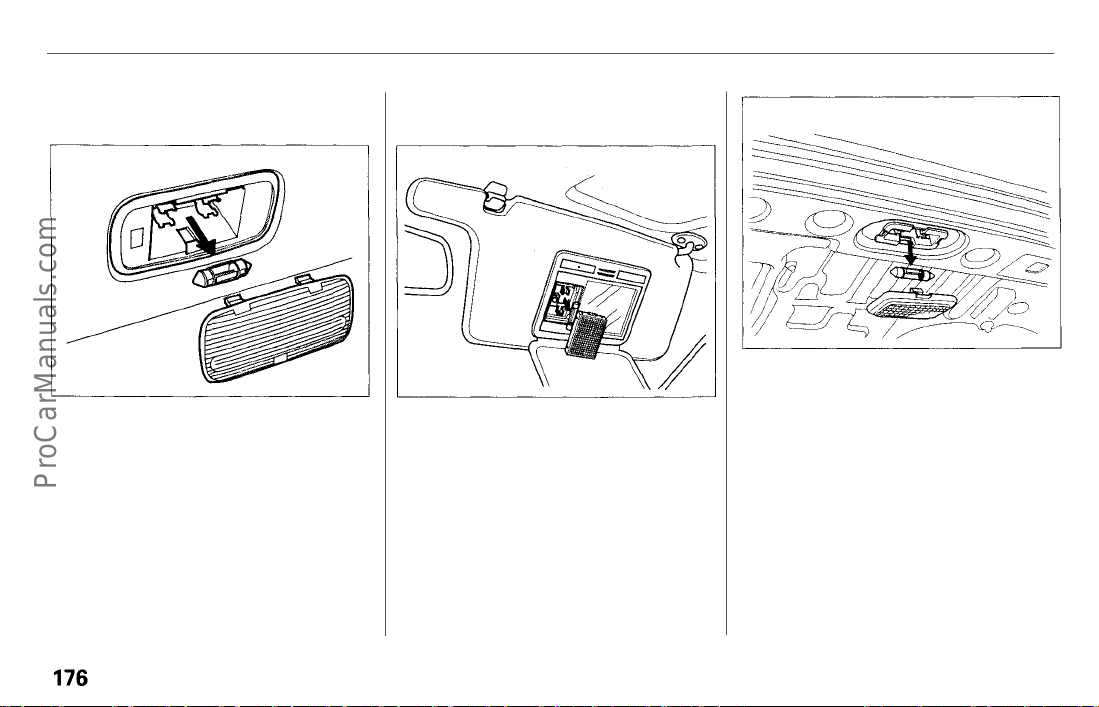
Storing Your Car
If you need to park your car for an
extended period (more than 1
month), there are several things you
should do to prepare it for storage.
Proper preparation helps prevent
deterioration and makes it easier to
get your car back on the road. It is
best to store your car indoors if at all
possible.
Fill the fuel tank.
Change the engine oil and filter
(see page 141).
Wash and dry the exterior
completely.
Clean the interior. Make sure the
carpeting, floor mats, etc. are
completely dry.
Leave the parking brake off. Put
the transmission in Reverse
(manual) or Park (automatic).
Block the rear wheels.
If the car is to be stored for a
longer period, it should be
supported on jackstands so the
tires are off the ground.
Leave one window open slightly (if
the car is being stored indoors).
Disconnect the battery.
Cover the car with a "breathable"
car cover, one made from a porous
material such as cotton.
Nonporous materials, such as
plastic sheeting, trap moisture
which can damage the paint.
If possible, run the engine for a
while periodically (preferably once
a month).
If you store your car for 12 months
or longer, have your Honda dealer
perform the inspections called for in
the 24 months/48,000 km (30,000
miles) maintenance schedule as soon
as you take it out of storage (see
page 133 ). The replacements called
for in the maintenance schedule are
not needed unless the car has
actually reached that time or mileage.
Maintenance
ProCarManuals.com

Appearance Care
Regular cleaning and polishing of
your Honda helps to keep It "new"
looking. This section gives you hints
on how to clean and preserve your
car's appearance: the paint, bright-
work, wheels and interior. Also
included are several things you can
do to help prevent corrosion.
Exterior Care.................................. 180
Washing...................................... 180
Waxing........................................ 181
Aluminum Wheels..................... 181
Paint Touch-up........................... 182
Interior Care.................................... 183
Carpeting.................................... 183
Fabric.......................................... 183
Vinyl............................................ 183
Leather........................................ 133
Seat Belts.................................... 184
Windows..................................... 184
Air Fresheners........................... 184
Corrosion Protection..................... 185
Body Repairs.................................. 186
Appearance Care
ProCarManuals.com
Exterior Care
Washing
Frequent washing helps preserve
your car's beauty. Dirt and grit can
scratch the paint, while tree sap and
bird droppings can permanently ruin
the finish.
Wash your car in a shady area, not in
direct sunlight. If the car is parked in
the sun, move it into the shade and
let the exterior cool down before you
start.
Chemical solvents and strong
cleaners can damage the paint, metal,
and plastic on your car. Only use the
solvents and cleaners recommended
in this Owner's Manual.
Rinse the car thoroughly with cool
water to remove loose dirt.
Fill a bucket with cool water. Mix
in a mild detergent, such as
dishwashing liquid or a product
made especially for car washing.
Wash the car, using the water and
detergent solution and a soft-
bristle brush, sponge, or soft cloth.
Start at the top and work your way
down. Rinse frequently.
Check the body for road tar, tree
sap, etc. Remove these stains with
tar remover or turpentine. Rinse it
off immediately so it does not
harm the finish. Remember to re-
wax these areas, even if the rest of
the car does not need waxing.
When you have washed and rinsed
the whole exterior, dry it with a
chamois or soft towel. Letting it
air-dry will cause dulling and water
spots.
As you dry the car, inspect it for
chips and scratches that could allow
corrosion to start. Repair them with
touch-up paint (see page 182 ).
Appearance Care
NOTICE
ProCarManuals.com

Exterior Care
Waxing
Always wash and dry the whole car
before waxing it. You should wax
your car, including the metal trim,
whenever water sits on the surface
in large patches. It should form into
beads or droplets after waxing.
You should use a quality liquid or
paste wax. Apply it according to the
instructions on the container. In
general, there are two types of
products:
Waxes — A wax coats the finish and
protects it from damage by exposure
to sunlight, air pollution, etc. You
should use a wax on your Honda
when it is new.
Polishes — Polishes and cleaner/
waxes can restore the shine to paint
that has oxidized and lost some of its
shine. They normally contain mild
abrasives and solvents that remove
the top layer of the finish. You
should use a polish on your Honda if
the finish does not have its original
shine after using a wax.
Cleaning tar, insects, etc. with
removers also takes off the wax.
Remember to re-wax those areas,
even if the rest of the car does not
need waxing.
Aluminum Wheels
On the U.S. EX and Canadian EX-R
models
Clean your Honda's aluminum alloy
wheels as you do the rest of the
exterior. Wash them with the same
solution, and rinse them thoroughly.
The wheels have a protective clear-
coat that keeps the aluminum from
corroding and tarnishing. Using
harsh chemicals, including some
commercial wheel cleaners, or stiff
brushes can damage this clear-coat.
Only use a mild detergent and soft
brush or sponge to clean the wheels.
Appearance Care
ProCarManuals.com
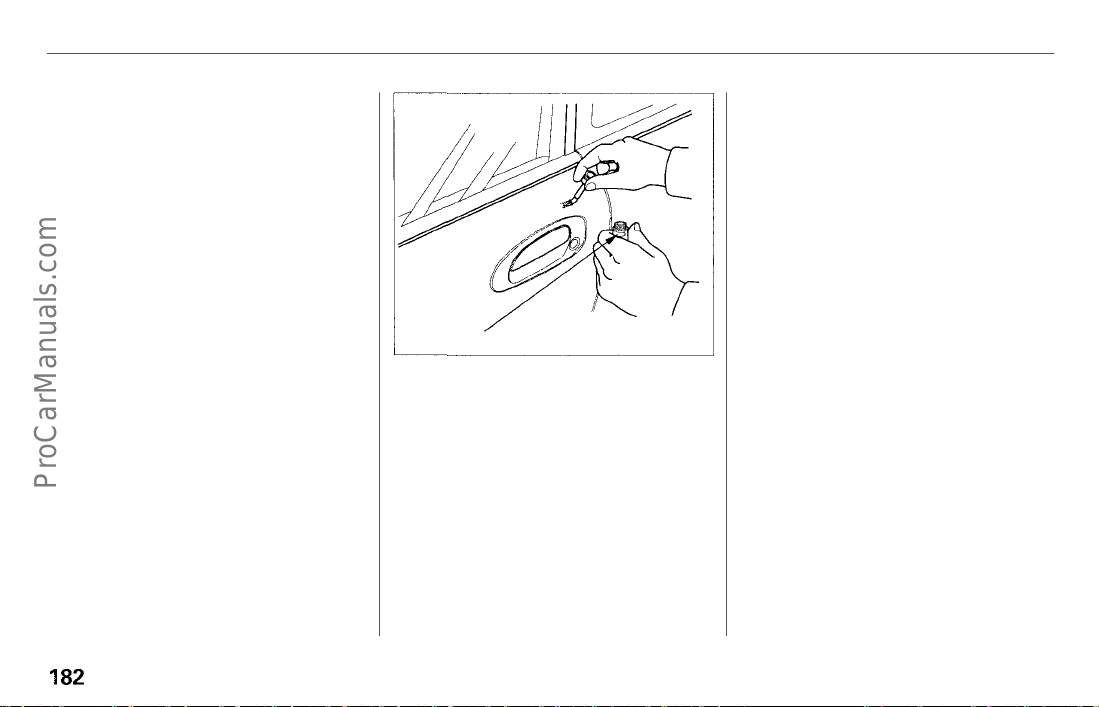
Exterior Care
Paint Touch-up
Your dealer has touch-up paint to
match your car's color. The color
code is printed on a sticker on the
driver's door jamb. Take this code to
your dealer so you are sure to get
the correct color.
Inspect your car for chipped or
scratched paint every time you wash
it. Repair it as soon as possible to
prevent corrosion. Use the touch-up
paint on small chips and scratches.
More extensive damage should be
repaired by a professional.
Examine the chip or scratch closely
before repairing it. If it does not go
down to bare metal, clean it with
soap and water and apply the touch-
up paint. If it does go to the metal,
apply a coat of primer first. After this
dries, apply the touch-up paint. Build
up the paint in the damaged area to
the level of the surrounding paint.
Several thin coats of paint are better
than one thick coat.
Appearance Care
TOUCH-UP PAINT
ProCarManuals.com

Interior Care
Carpeting
Vacuum the carpeting frequently to
remove dirt. Ground-in dirt will make
the carpet wear out faster.
Periodically shampoo the carpet to
keep it looking new. Use one of the
foam-type carpet cleaners on the
market. Follow the instructions that
come with the cleaner, applying it
with a sponge or soft brush. Keep
the carpeting as dry as possible by
not adding water to the foam.
Fabric
Vacuum dirt and dust out of the
material frequently. For general
cleaning, use a solution of mild soap
and lukewarm water, letting it air dry.
To clean off stubborn spots, use a
commercially-available fabric cleaner.
Test it on a hidden area of the fabric
first, to make sure it does not bleach
or stain the fabric. Follow the
instructions that come with the
cleaner.
Vinyl
Remove dirt and dust with a vacuum
cleaner. Wipe the vinyl with a soft
cloth dampened in a solution of mild
soap and water. Use the same
solution with a soft-bristle brush on
more difficult spots. You can also use
commercially-available spray or
foam-type vinyl cleaners.
Leather
Optional for the U.S. EX and Canadian
EX-R models
Vacuum dirt and dust from the
leather frequently. Pay particular
attention to the pleats and seams.
Clean the leather with a soft cloth
dampened with clear water, then
buff it with a clean, dry cloth. If
further cleaning is needed, use a
soap specifically for leather, such as
saddle soap. Apply this soap with a
damp, soft cloth. Wipe down and
buff as described above.
Appearance Care
ProCarManuals.com
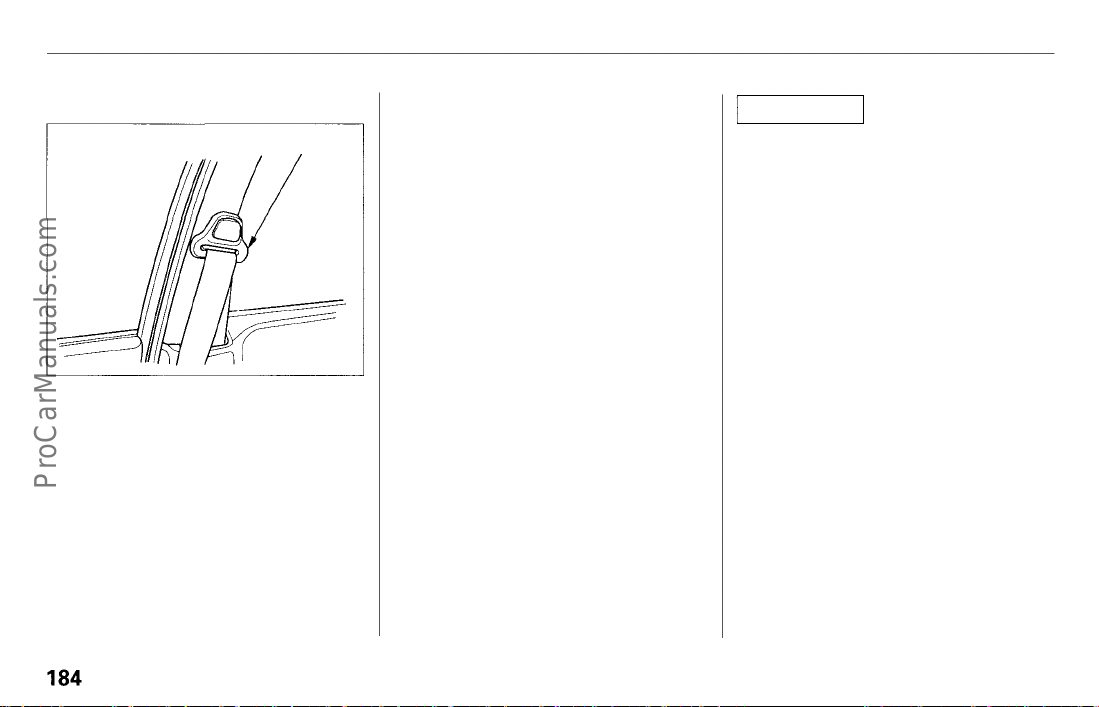
Interior Care
Seat Belts
If your seat belts get dirty, you can
use a soft brush with a mixture of
mild soap and warm water to clean
them. Do not use bleach, dye, or
cleaning solvents. They can weaken
the belt material. Let the belts air-
dry before you use the car.
Dirt build-up in the metal loops of
the seat belt anchors can cause the
belts to retract slowly. Wipe the
inside of the loops with a clean cloth
dampened in isopropyl alcohol or a
mixture of mild soap and warm
water.
Windows
Clean the windows, inside and out,
with a commercially-available glass
cleaner. You can also use a mixture
of one part white vinegar to ten parts
water. This will remove the haze that
builds up on the inside of the
windows. Use a soft cloth or paper
towels to clean all glass and clear
plastic surfaces.
The rear window defogger and
antenna wires are bonded to the
inside of the glass. Wiping vigorously
up-and-down can dislodge and break
these wires. When cleaning the rear
window, use gentle pressure and
wipe side-to-side.
Air Fresheners
If you want to use an air freshener/
deodorizer in the interior of your car,
it is best to use a solid type. Some
liquid air fresheners contain chemi-
cals that may cause parts of the
interior trim and fabric to crack or
discolor.
If you use a liquid air freshener,
make sure you fasten it securely so it
does not spill as you drive.
Appearance Care
METAL LOOP
NOTICE
ProCarManuals.com
Corrosion Protection
Two factors normally contribute to
causing corrosion in your car:
1. Moisture trapped in body cavities.
Dirt and road salt that collects in
hollows on the underside of the
car stays damp, promoting
corrosion in that area.
2. Removal of paint and protective
coatings from the exterior and
underside of the car.
Many corrosion-preventive measures
are built into your Honda. You can
help keep your car from corroding
by performing some simple periodic
maintenance:
Repair chips and scratches in the
paint as soon as you discover them.
Inspect and clean out the drain
holes in the bottom of the doors
and body.
Check the floor coverings for
dampness. Carpeting and floor
mats may remain damp for a long
time, especially in winter. This
dampness can eventually cause
the floor panels to corrode.
Use a high-pressure spray to clean
the underside of your car. This is
especially important in areas that
use road salt in winter. It is also a
good idea in humid climates and
areas subject to salt air. Cars
equipped with ABS have a sensor
and wiring at each wheel. Be
careful not to damage them.
Have the corrosion-preventive
coatings on the underside of your
car inspected and repaired
periodically.
Appearance Care
ProCarManuals.com

Body Repairs
Body repairs affect your car's
resistance to corrosion. If your car
needs repairs after a collision, pay
close attention to the parts used in
the repair and the quality of the
work.
Make sure the repair facility uses
genuine Honda replacement body
parts. Some companies make
sheetmetal pieces that seem to
duplicate the original Honda body
parts, but are actually inferior in fit,
finish, and quality. Once installed,
they do not give the same high-
quality appearance and level of
corrosion resistance.
When reporting your collision to the
insurance company, tell them you
want genuine Honda parts used in
the repair. Although most insurers
recognize the higher quality of
original parts, some may try to
specify that the repairs be done with
the "lowest cost" parts available. You
should investigate this before any
repairs are begun.
Take your car to your authorized
Honda dealer for inspection after the
repairs are completed. He can make
sure that quality materials were used,
and that corrosion-preventive
coatings were applied to all repaired
and replaced parts.
Appearance Care
ProCarManuals.com

Taking Care of the Unexpected
This section covers the more-
common problems that motorists
experience with their cars. It gives
you information about how to safely
evaluate the problem and what to do
to correct it. If the problem has
stranded you on the side of the road,
you may be able to get going again.
If not, you will also find instructions
on getting your car towed.
Compact Spare Tire....................... 188
Changing a Flat Tire ..................... 189
If Your Engine Won't Start........... 195
Nothing Happens....................... 195
The Starter Operates
Normally................................. 196
Jump Starting................................. 196
If Your Engine Overheats............. 198
Low Oil Pressure........................... 200
Charging System Indication......... 201
Malfunction Indicator Lamp/
Check Engine Light.................. 202
Closing the Moonroof................... 203
Fuses............................................... 204
Checking and Replacing........... 205
Towing............................................ 209
Taking Care of the Unexpected
ProCarManuals.com
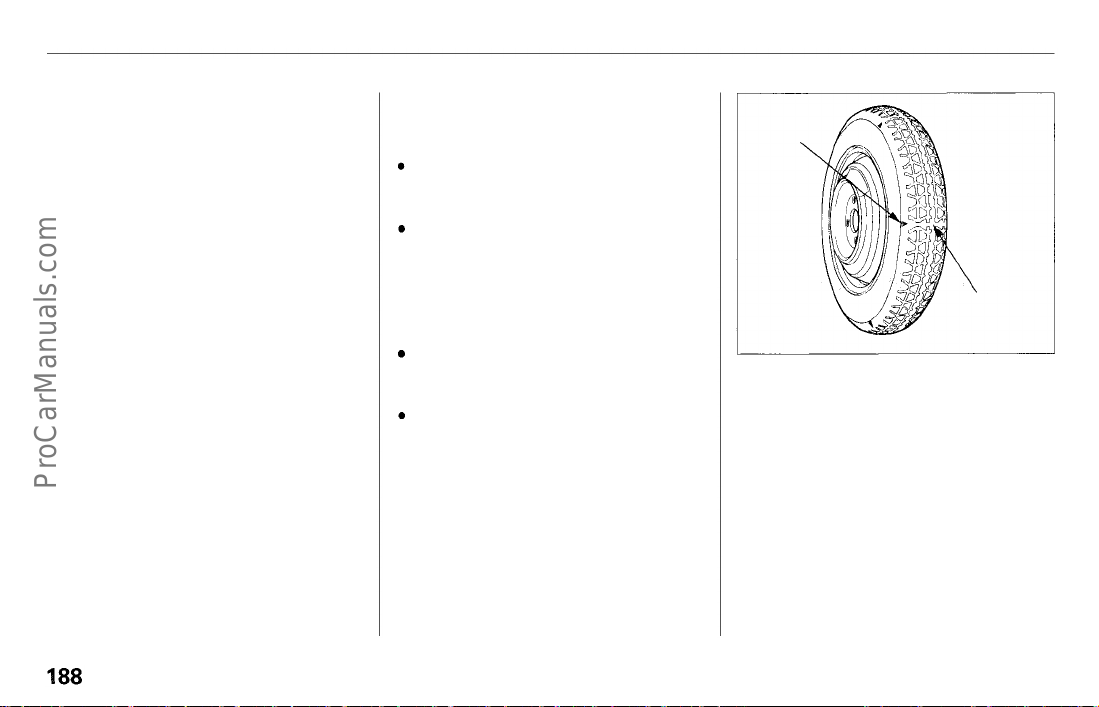
Compact Spare Tire
Your car has a compact spare tire
that takes up less space. Use this
spare tire as a temporary replace-
ment only. Get your regular tire
repaired or replaced and put back on
your car as soon as you can.
Check the inflation pressure of the
compact spare tire every time you
check the other tires. It should be
inflated to:
420 kPa (4.2 kg/cm
2
, 60 psi)
Follow these precautions whenever
you are using the compact spare tire:
Do not exceed 50 mph (80 km/h)
under any circumstances.
This tire gives a harsher ride and
less traction on some road sur-
faces than the regular tire. Use
greater caution while driving on
this tire.
Do not mount snow chains on the
compact spare.
The wheel of the compact spare
tire is designed especially to fit
your car. Do not use your spare
tire on another car unless it is the
same make and model.
The compact spare tire has a shorter
tread life than a regular tire. Replace
it when you can see the tread wear
indicator bars. The replacement
should be the same size and design
tire, mounted on the same wheel.
The compact spare tire is not
designed to be mounted on a regular
wheel, and the compact wheel is not
designed for mounting a regular tire.
Taking Care of the Unexpected
INDICATOR
LOCATION
MARK
TREAD WEAR
INDICATOR
BAR
ProCarManuals.com
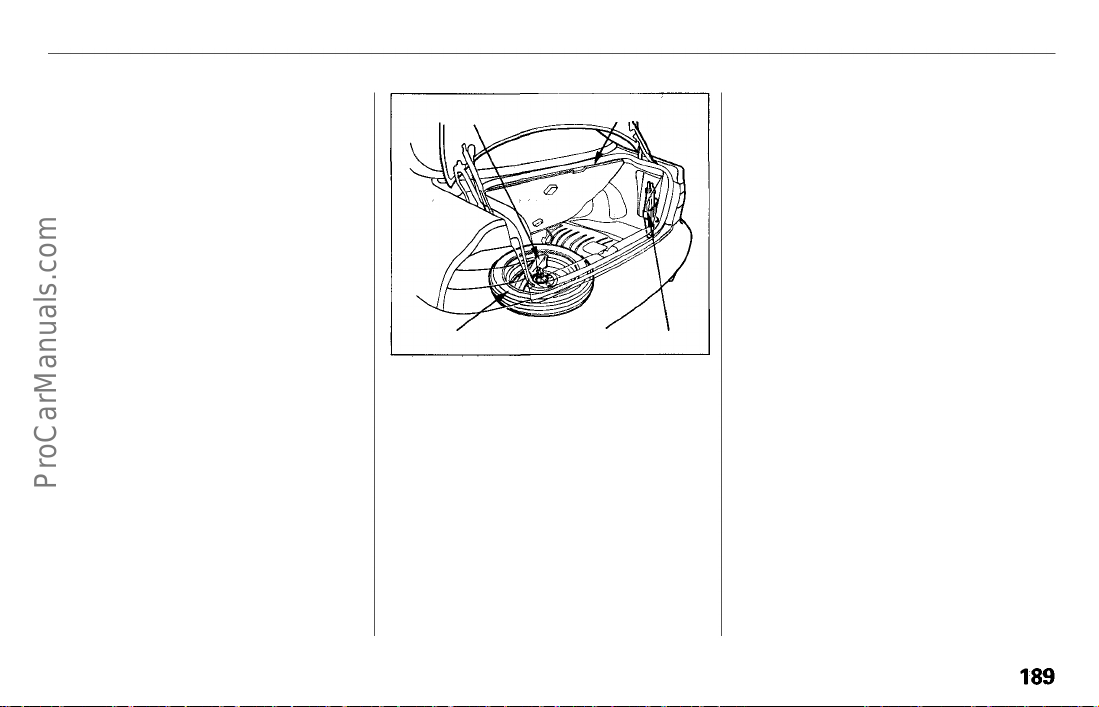
Changing a Flat Tire
If you have a flat tire while driving,
stop in a safe place to change it.
Stopping in traffic or on the shoulder
of a busy road is dangerous. Drive
slowly along the shoulder until you
get to an exit or an area to stop that
is far away from the traffic lanes.
1. Park the car on firm, level ground
away from traffic. Turn on the
hazard warning lights and turn the
ignition to LOCK (0).
2. Put the transmission in Park
(automatic) or Reverse (manual).
Set the parking brake.
3. Open the trunk. Raise the trunk
floor by lifting up on the back edge.
4. Take the tool kit out of the spare
tire well.
5. Unscrew the wing bolt and take
the spare tire out of its well.
CONTINUED
Taking Care of the Unexpected
The car can easily roll off the
jack, seriously injuring any-
one underneath.
Follow the directions for
changing a tire exactly, and
never get under the car when
it is supported only by the
jack.
TOOL KIT
TRUNK FLOOR
SPARE TIRE
JACK
ProCarManuals.com
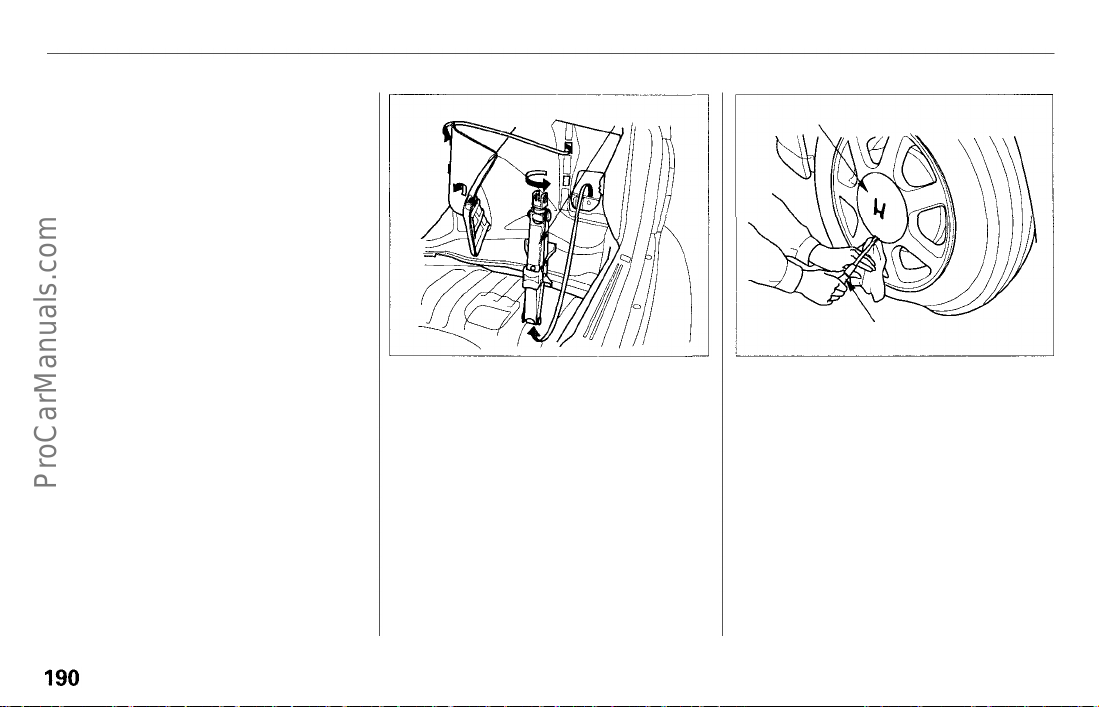
Changing a Flat Tire
6. The jack is behind a cover in the
right fender. Remove the cover by
turning the handle clockwise, then
pulling on the cover.
7. Turn the jack's end bracket
counterclockwise to loosen it, then
remove the jack.
8. (US: EX, Canada: EX-R)
Remove the center cap from the
wheel with a screwdriver (not
included in tool kit) or coin.
Taking Care of the Unexpected
JACK
CENTER CAP
SCREWDRIVER
ProCarManuals.com
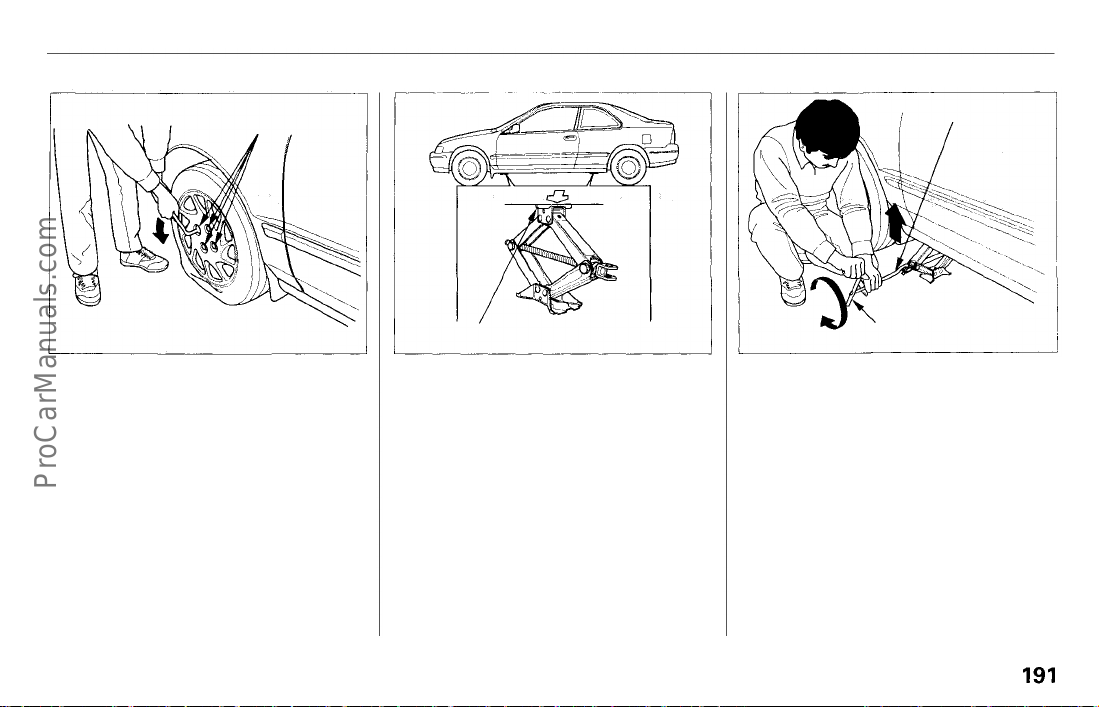
Changing a Flat Tire
9. Loosen the four wheel nuts 1/2
turn with the wheel wrench.
10.Find the jacking point nearest the
wheel you are removing. Place the
jack under the jacking point. Turn
the end bracket clockwise until
the top of the jack contacts the
jacking point. Make sure the
jacking point tab is resting in the
jack notch.
11.Use the extension and wheel
wrench as shown to raise the car
until the flat tire is off the ground.
CONTINUED
Taking Care of the Unexpected
WHEEL NUTS
JACKING POINT
EXTENSION
WHEEL WRENCH
ProCarManuals.com
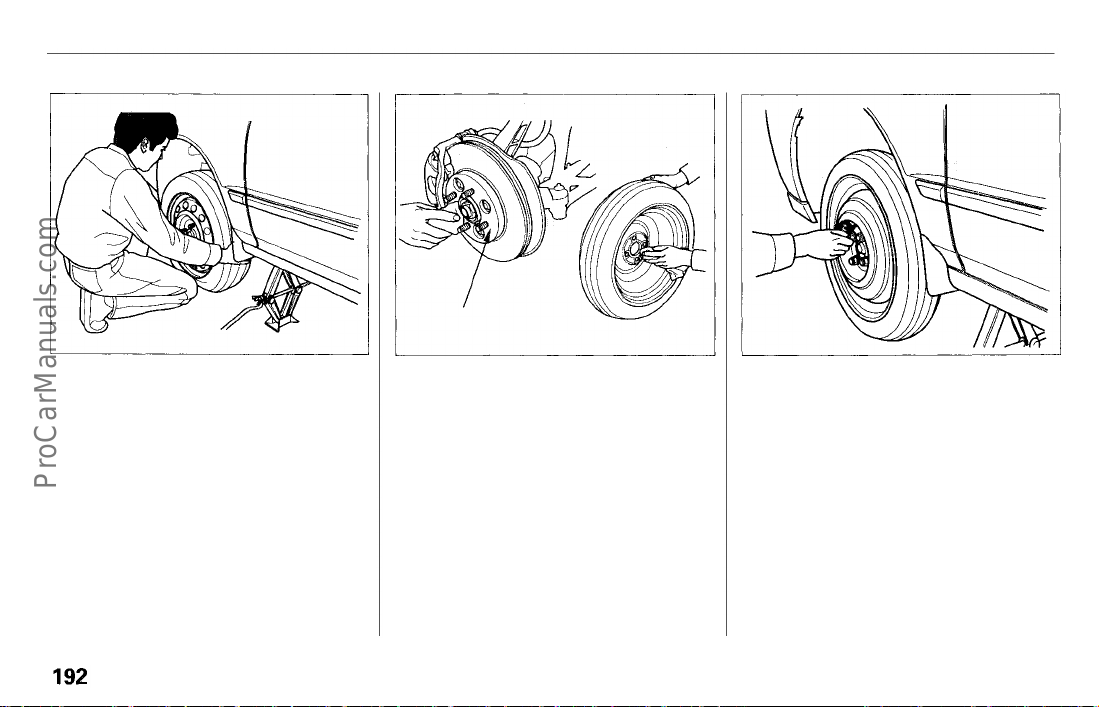
Changing a Flat Tire
12.Remove the wheel nuts and flat
tire. Temporarily place the flat tire
on the ground with the outside
surface of the wheel facing up.
The outside surface contacting the
ground could damage the wheel
surface.
13.Before mounting the spare tire,
wipe any dirt off the mounting
surface of the wheel and hub with
a cloth.
14.Put on the spare tire. Put the
wheel nuts back on finger-tight,
then tighten them in a crisscross
pattern with the wheel wrench
until the wheel is firmly against
the hub. Do not try to tighten
them fully.
Taking Care of the Unexpected
BRAKE HUB
ProCarManuals.com
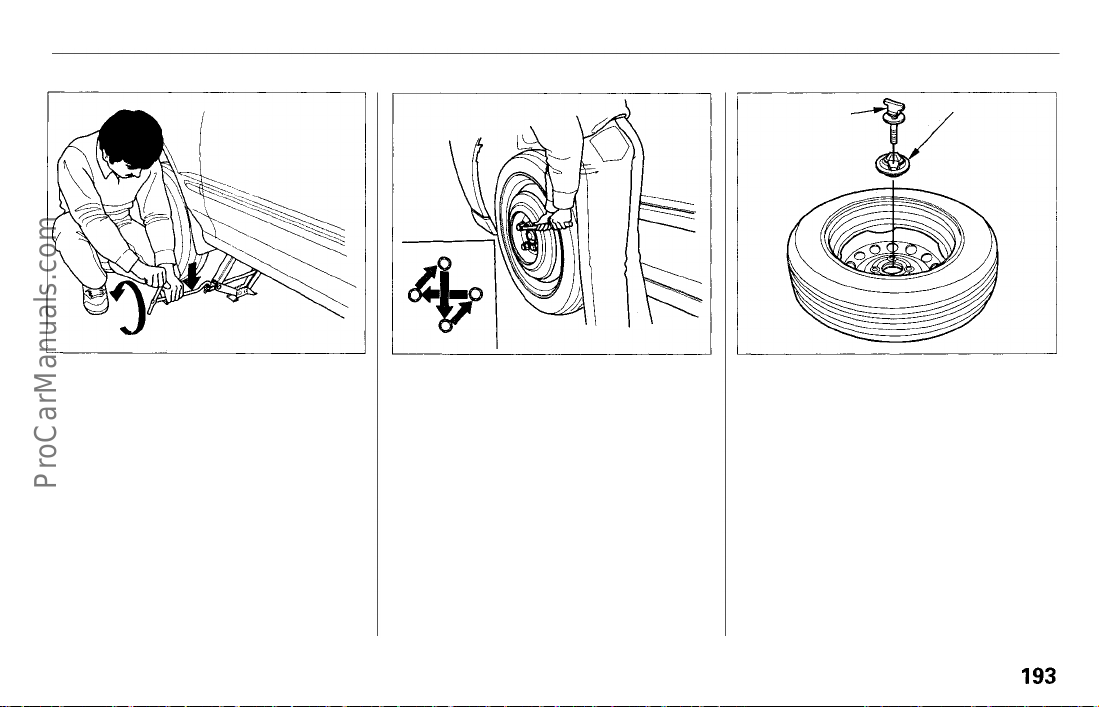
Changing a Flat Tire
15.Lower the car to the ground and
remove the jack.
16.Tighten the wheel nuts securely in
the same crisscross pattern. Have
the wheel nut torque checked at
the nearest automotive service
facility.
Tighten the wheel nuts to:
110 N.m(11 kg-m, 80 Ib-ft)
17.Place the flat tire face down in the
spare tire well.
18.Remove the spacer cone from the
wing bolt, turn it over, and put it
back on the bolt.
19.Secure the flat tire by screwing
the wing bolt back into its hole.
CONTINUED
Taking Care of the Unexpected
WING BOLT
SPACER
CONE
ProCarManuals.com

If Your Engine Won't Start
Diagnosing why your engine won't
start falls into two areas, depending
on what you hear when you turn the
key to START (III):
You hear nothing, or almost
nothing. The engine's starter
motor does not operate at all, or
operates very slowly.
You can hear the starter motor
operating normally, but the engine
does not start up and run.
Nothing Happens or the Starter
Motor Operates Very Slowly
When you turn the ignition switch to
START (III), you do not hear the
normal noise of the engine trying to
start. You may hear a clicking sound
or series of clicks, or nothing at all.
Check these things:
Check the transmission interlock.
If you have a manual transmission,
the clutch pedal must be pushed
all the way to the floor or the
starter will not operate. With an
automatic transmission, it must be
in Park or Neutral.
Turn the ignition switch to ON (II).
Turn on the headlights and check
their brightness. If the headlights
are very dim or don't light at all,
the battery is discharged. See
Jump Starting on page 196 .
Turn the ignition switch to START
(III). If the headlights do not dim,
check the condition of the fuses. If
the fuses are OK, there is proba-
bly something wrong with the
electrical circuit for the ignition
switch or starter motor. You will
need a qualified technician to
determine the problem. (See
Towing on page 209 .)
If the headlights dim noticeably or
go out when you try to start the
engine, either the battery is dis-
charged or the connections are
corroded. Check the condition of
the battery and terminal connec-
tions (see page 157 ). You can
then try jump starting the car from
a booster battery (see page 196).
Taking Care of the Unexpected
ProCarManuals.com
If Your Engine Won't Start, Jump Starting
The Starter Operates Normally
In this case, the starter motor
sounds normal when you turn the
ignition switch to START (III), but
the engine does not run.
Are you using the proper starting
procedure? Refer to Starting the
Engine on page 113 .
Do you have gas? Turn the
ignition switch to ON (II) for a
minute and watch the fuel gauge.
The low fuel level warning light
may not be working, so you were
not reminded to fill the tank.
There may be an electrical
problem, such as no power to
the fuel pump. Check all the
fuses (see page 204 ).
If you find nothing wrong, you will
need a qualified technician to find
the problem. See Towing on page
209.
Jump Starting
If your car's battery has run down,
you may be able to start the engine
by using a booster battery. Although
this seems like a simple procedure,
there are several precautions you
should take. Follow the directions
closely.
You cannot start a Honda with an
automatic transmission by pushing
or pulling it.
To jump start your car:
1. Open the hood and check the
physical condition of the battery
(see page 157 ). In very cold
weather, check the condition of
the electrolyte. If it seems slushy
or like ice, do not try jump starting
until it thaws.
If a battery sits in extreme cold, the
electrolyte inside can freeze.
Attempting to jump start with a
frozen battery can cause it to rupture
or explode.
2. Turn off all the electrical acces-
sories: heater, A/C, stereo system,
lights, etc.
Put the transmission in Neutral or
Park and set the parking brake.
Taking Care of the Unexpected
NOTICE
A battery can explode if you
do not follow the correct pro-
cedure, seriously injuring any-
one nearby.
Keep all sparks, open flames,
and smoking materials away
from the battery.
ProCarManuals.com
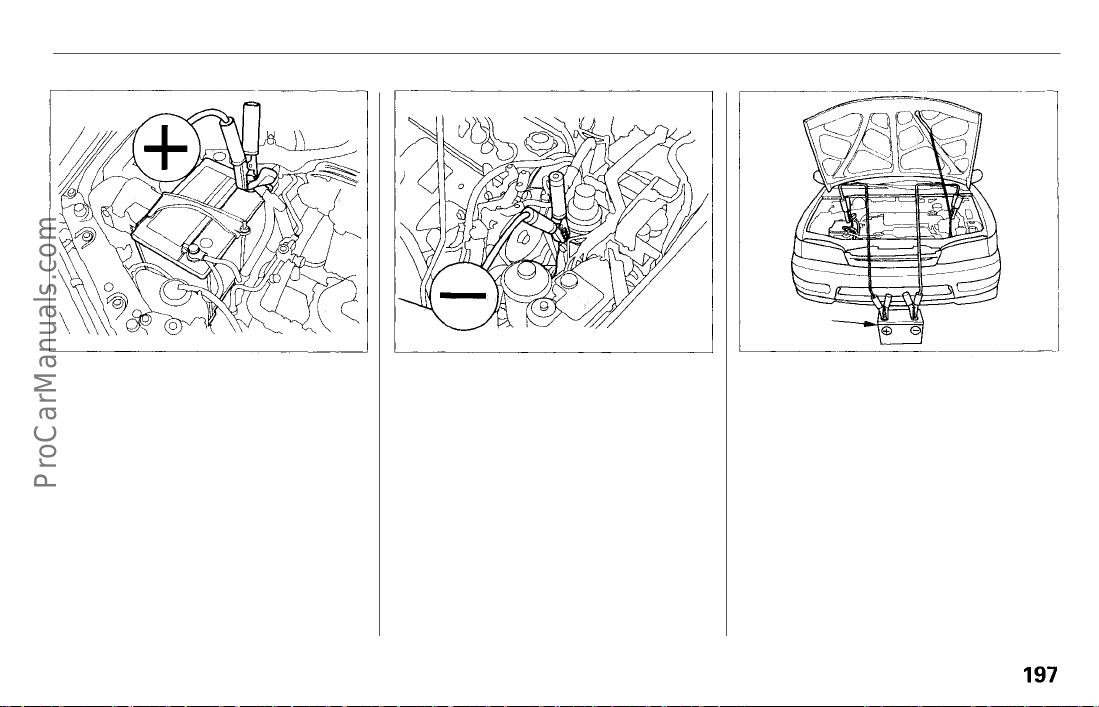
Jump Starting
3. Connect one jumper cable to the
positive (+) terminal on the
booster battery. Connect the other
end to the positive (+) terminal on
your Honda's battery.
4. Connect the second jumper cable
to the negative (—) terminal on
the booster battery. Connect the
other end to the grounding strap
as shown. Do not connect this
jumper cable to any other part of
the engine.
5. If the booster battery is in another
car, have an assistant start that car
and run it at a fast idle.
6. Start your car. If the starter motor
still operates slowly, check the
jumper cable connections to make
sure they have good metal-to-
metal contact.
7. Once your car is running, discon-
nect the negative cable from your
car, then from the booster battery.
Disconnect the positive cable from
your car, then the booster battery.
Taking Care of the Unexpected
BOOSTER
BATTERY
ProCarManuals.com
If Your Engine Overheats
The pointer of your car's tempera-
ture gauge should stay in the mid-
range under most conditions. It may
go higher if you are driving up a long
steep hill on a very hot day. If it
climbs to the red mark, you should
determine the reason.
Driving with the temperature gauge
pointer at the red mark can cause
serious damage to your engine.
Your car can overheat for several
reasons, such as lack of coolant or a
mechanical problem. The only
indication may be the temperature
gauge climbing to or above the red
mark. Or you may see steam or
spray coming from under the hood.
In either case, you should take
immediate action.
1. Safely pull to the side of the road.
Put the transmission in neutral or
park and set the parking brake.
Turn off the heating and cooling
system and all other accessories.
Turn on the hazard warning
indicators.
2. If you see steam and/or spray
coming from under the hood, turn
off the engine.
3. If you do not see steam or spray,
leave the engine running and
watch the temperature gauge. If
the high heat is due to overloading
(climbing a long, steep hill on a
hot day with the A/C running, for
example), the engine should start
to cool down almost immediately.
If it does, wait until the tempera-
ture gauge comes down to the mid-
point then continue driving.
Taking Care of the Unexpected
NOTICE
Steam and spray from an
overheated engine can seri-
ously scald you.
Do not open the hood if
steam is coming out.
ProCarManuals.com

If Your Engine Overheats
4. If the temperature gauge stays at
the red mark, turn off the engine.
5. Wait until you see no more signs
of steam or spray, then open the
hood.
6. Look for any obvious coolant leaks,
such as a split radiator hose.
Everything is still extremely hot,
so use caution. If you find a leak, it
must be repaired before you
continue driving (see Towing on
page 209).
7. If you don't find an obvious leak,
check the coolant level in the
radiator reserve tank (see page
143). If the level is below the
MIN mark, add coolant to half-way
between the MIN and MAX marks.
8. If there was no coolant in the
reserve tank, you may also have to
add coolant to the radiator. Let the
engine cool down until the pointer
reaches the middle of the tempera-
ture gauge, or lower, before check-
ing the radiator.
9. Using gloves or a large heavy
cloth, turn the radiator cap
counterclockwise, without pushing
down, to the first stop. This
releases any remaining pressure in
the cooling system. After the
pressure releases, push down on
the cap and turn it until it comes
off.
10. Start the engine and set the heater
control dial to maximum. Add
coolant to the radiator up to the
base of the filler neck. If you do
not have the proper coolant
mixture available, you can add
plain water. Remember to have
the cooling system drained and
refilled with the proper mixture as
soon as you can.
11. Put the radiator cap back on
tightly. Run the engine and watch
the temperature gauge. If it goes
back to the red mark, the engine
needs repair. (See Towing on
page 209).
12. If the temperature stays normal,
check the coolant level in the
radiator reserve tank. If it has
gone down, add coolant to the
MAX mark. Put the cap back on
tightly.
Taking Care of the Unexpected
Removing the radiator cap
while the engine is hot can
cause the coolant to spray
out, seriously scalding you.
Always let the engine and
radiator cool down before
removing the radiator cap.
ProCarManuals.com
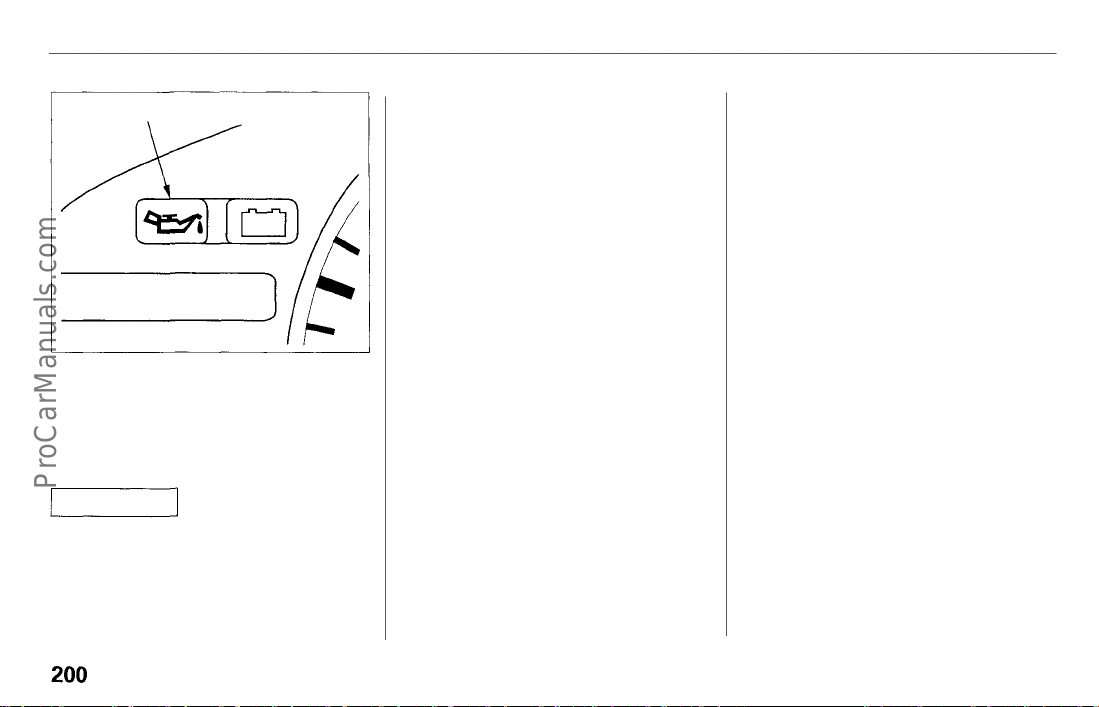
Low Oil Pressure
The low oil pressure indicator should
never come on when the engine is
running. If this light comes on with
the engine running, take immediate
Running the engine with low oil
pressure can cause serious mechani-
cal damage almost immediately.
Turn off the engine as soon as you
can safely get the car stopped.
1. Safely pull off the road and shut
off the engine.
2. Let the car sit for a minute. Open
the hood and check the oil level
(see page 139 ). Although oil level
and oil pressure are not directly
connected, an engine that is very
low on oil can lose pressure during
cornering and other driving
maneuvers.
3. If necessary, add oil to bring the
level back to the full mark on the
dipstick (see page 139 ).
4. Start the engine and watch the oil
pressure light. If the light does not
go out within ten seconds, turn off
the engine. There is a mechanical
problem that needs to be repaired
before you can continue driving.
(See Towing on page 209 .)
Taking Care of the Unexpected
LOW OIL PRESSURE INDICATOR
NOTICE
ProCarManuals.com

Charging System Indication
The charging system indicator
should go out after the engine starts.
If it comes on brightly with the
engine running, the alternator is no
longer charging the battery.
Immediately turn off all electrical
accessories: radio, heater, A/C, rear
defogger, cruise control, etc. Try not
to use other electrically-operated
controls such as the power windows.
Keep the engine running and take
extra care not to stall it. Starting the
engine will discharge the battery
rapidly.
By eliminating as much of the
electrical load as possible, you can
drive several miles before the
battery is too discharged to keep the
engine running. Drive to a service
station or garage where you can get
technical assistance.
Taking Care of the Unexpected
CHARGING SYSTEM INDICATOR
ProCarManuals.com
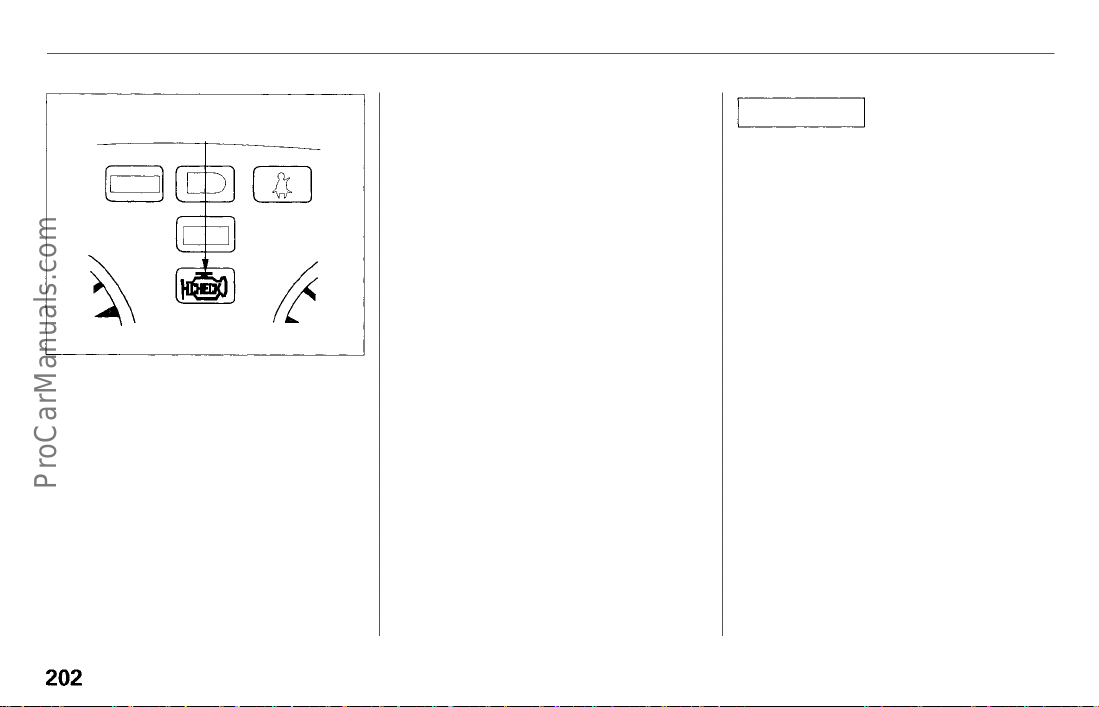
Malfunction Indicator Lamp/Check Engine Light
If this indicator comes on while
driving, there is a problem with your
engine or its emission control
systems. Even though you may feel
no difference in your car's per-
formance, it can reduce your fuel
economy and cause your car to put
out excessive emissions. Continued
operation may cause serious engine
damage.
If this indicator light comes on,
safely pull off the road and turn off
the engine. Restart the engine and
watch the indicator light. If it stays
on, have your car checked by the
dealer as soon as possible. Drive
moderately until the dealer has
inspected the problem. Avoid full-
throttle acceleration and driving at
high speed.
You should also have the dealer
inspect your car if the indicator light
comes on frequently, even though it
goes off when you follow the above
procedure.
If you keep driving with the malfunc-
tion indicator lamp/check engine
light on, you can damage your car's
emission controls and engine. Those
repairs may not be covered by your
car's warranties.
Taking Care of the Unexpected
NOTICE
MALFUNCTION INDICATOR LAMP/
CHECK ENGINE LIGHT*
* U.S. indicator shown
ProCarManuals.com
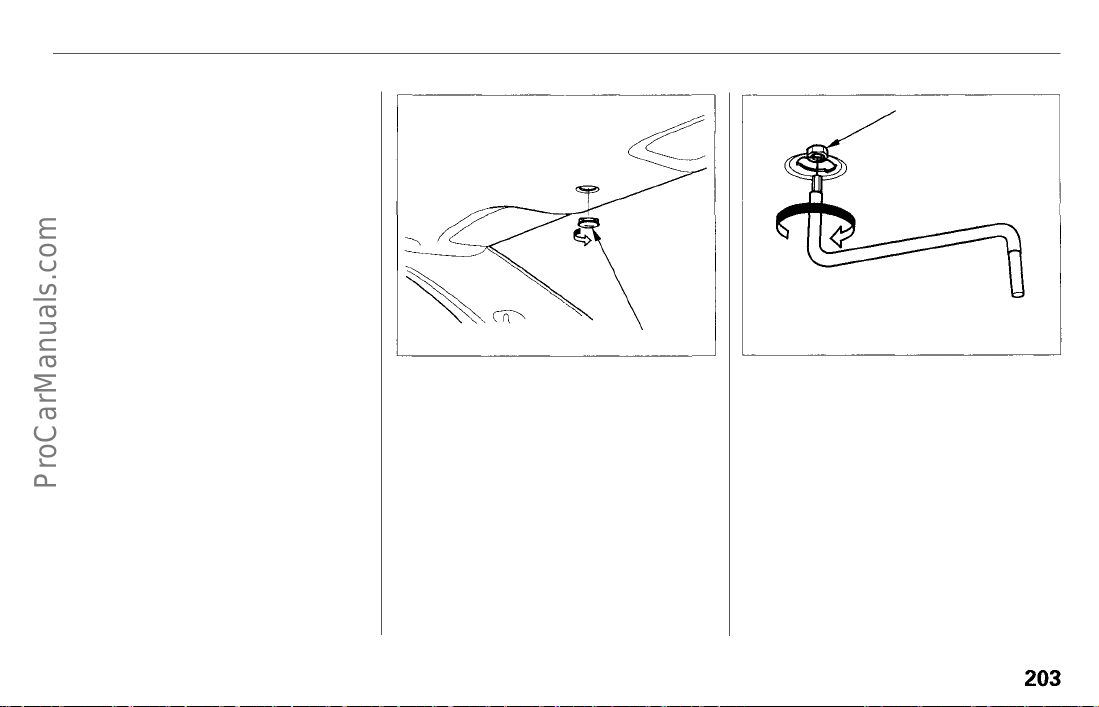
Closing the Moonroof
If the electric motor will not close
the moonroof, do the following:
1. Check the fuse for the moonroof
motor (see page 204 ). If the fuse
is blown, replace it with one of the
same or lower rating.
2. Try closing the moonroof. If the
new fuse blows immediately or the
moonroof motor still does not
operate, you can close the
moonroof manually.
3. Get the tool kit out of the trunk.
4. Use a screwdriver or coin to
remove the round plug in the
center of the headliner.
5. Insert the moonroof wrench into
the socket behind this plug. Turn
the wrench until the moonroof is
fully closed.
6. Remove the wrench. Replace the
round plug.
Taking Care of the Unexpected
ROUND PLUG
SOCKET
ProCarManuals.com
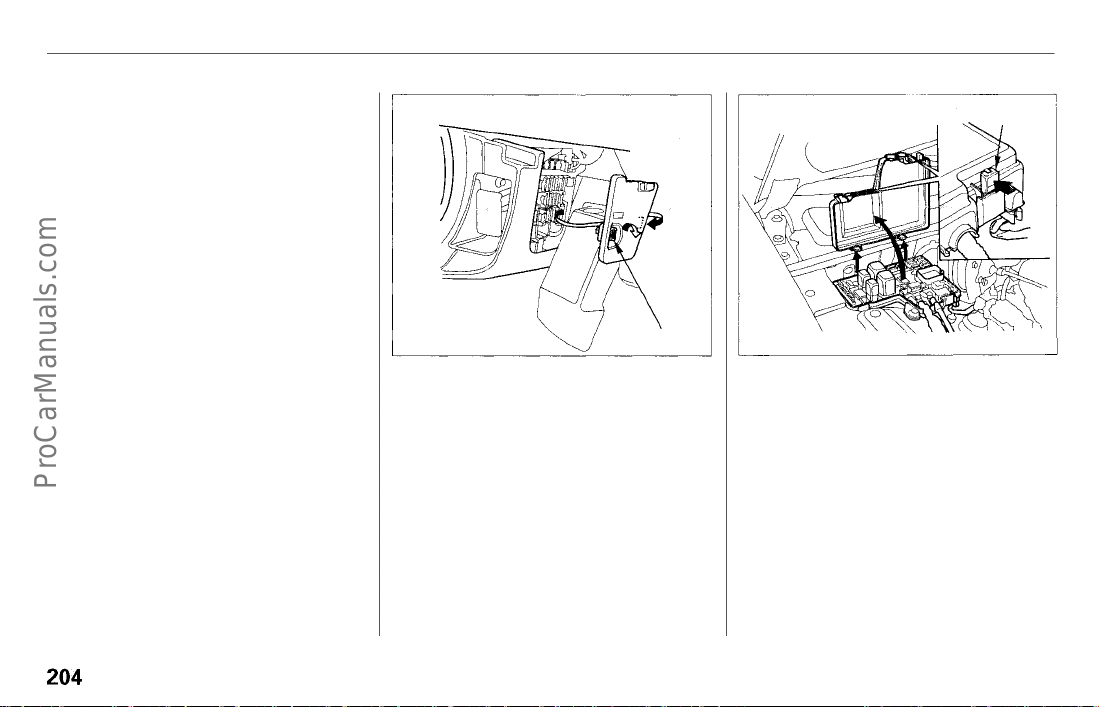
Fuses
All the electrical circuits in your car
have fuses to protect them from a
short circuit or overload. These
fuses are located in two or three fuse
boxes.
The interior fuse box is underneath
the dashboard on the driver's side.
To open, turn the knob as shown.
The underhood fuse box is located in
the front of the engine compartment
on the passenger's side. To open,
push the tab as shown.
Taking Care of the Unexpected
INTERIOR
KNOB
UNDERHOOD
TAB
ProCarManuals.com
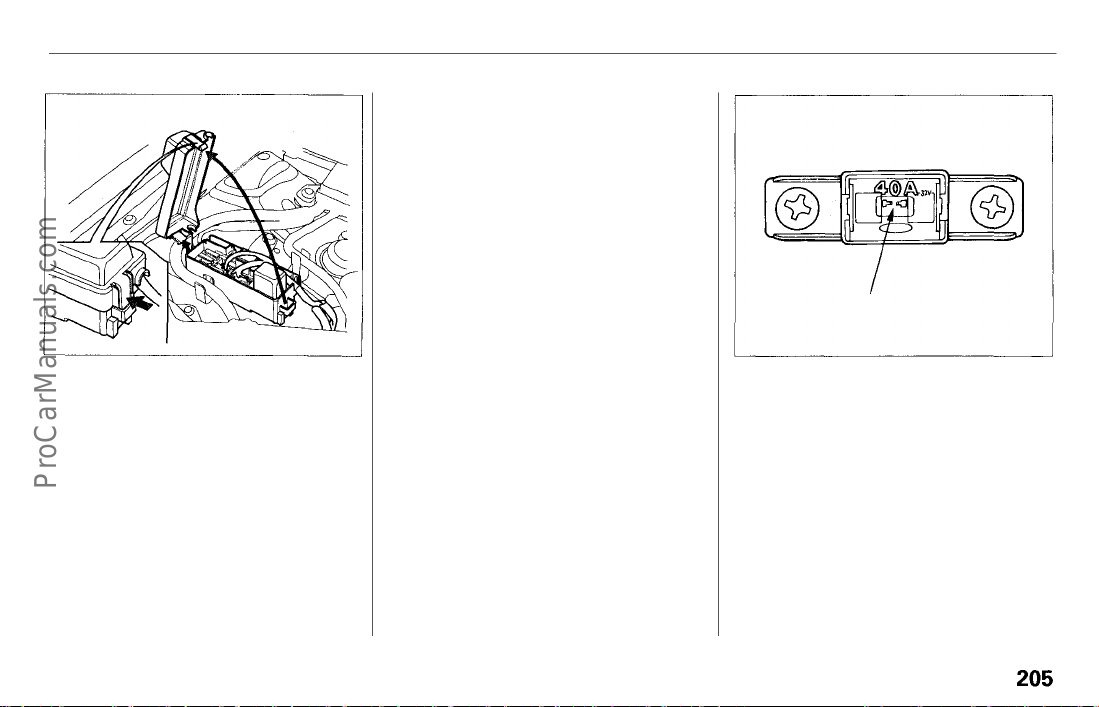
Fuses
Cars equipped with ABS have a third
fuse box for the ABS. It is in the
engine compartment on the right
side.
Checking and Replacing Fuses
If something electrical in your car
stops working, the first thing you
should check for is a blown fuse.
Determine from the chart on pages
207 and 208 , or the diagram on the
fuse box lid, which fuse or fuses
control that component. Check those
fuses first, but check all the fuses
before deciding that is not the cause.
Replace any blown fuses and check
the component's operation.
1. Turn the ignition switch to LOCK
(0). Make sure the headlights and
all other accessories are off.
2. Remove the cover from the fuse
box.
3. Check each of the large fuses in
the underhood fuse box by looking
through the top at the wire inside.
Removing these fuses requires a
Phillips-head screwdriver.
CONTINUED
Taking Care of the Unexpected
ABS FUSE BOX
BLOWN
ProCarManuals.com
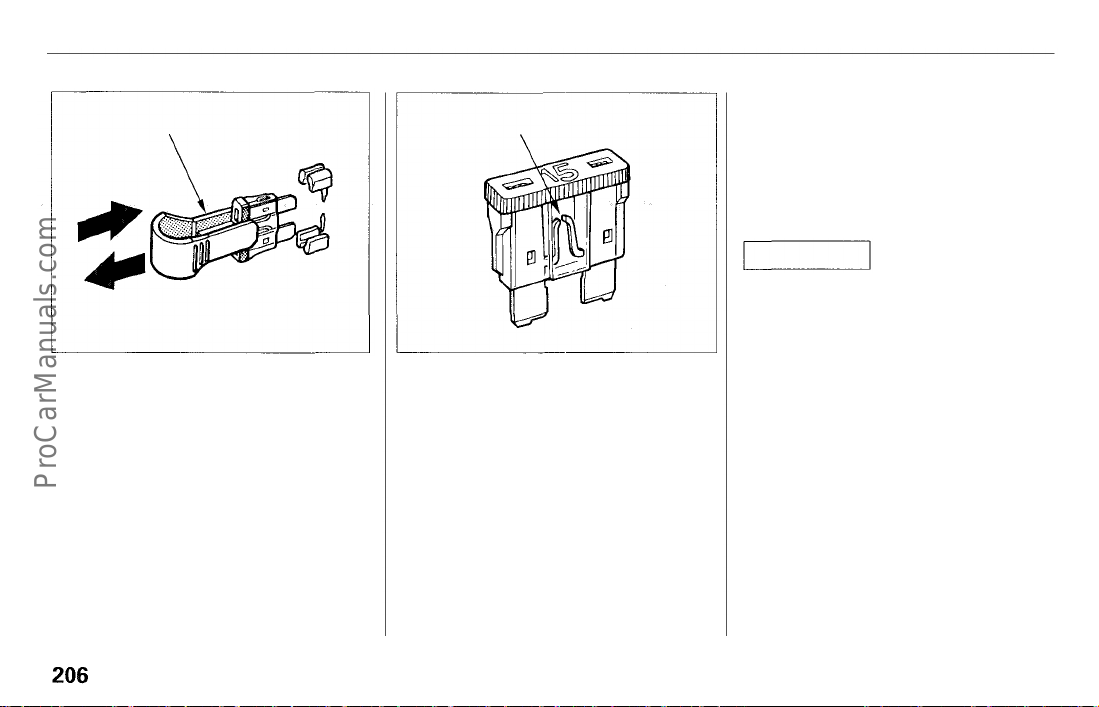
Fuses
4. Check the smaller fuses in the
underhood fuse box and all the
fuses in the interior fuse box by
pulling out each fuse with the fuse
puller provided in the interior fuse
box.
5. Look for a burned wire inside the
fuse. If it is burned out, replace it
with one of the spare fuses of the
same rating or lower.
If you cannot drive the car without
fixing the problem, and you do not
have a spare fuse, take a fuse of the
same rating or a lower rating from
one of the other circuits. Make sure
you can do without that circuit
temporarily (such as the cigarette
lighter, or radio).
If you replace the blown fuse with a
spare fuse that has a lower rating, it
might blow out again. This does not
indicate anything wrong. Replace the
fuse with one of the correct rating as
soon as you can.
Replacing a fuse with one that has a
higher rating greatly increases the
chances of damaging the electrical
system. If you do not have a replace-
ment fuse with the proper rating for
the circuit, install one with a lower
rating.
6. If the replacement fuse of the
same rating blows in a short time,
there is probably a serious
electrical problem in your car.
Leave the blown fuse in that
circuit and have your car checked
by a qualified technician.
Taking Care of the Unexpected
FUSE PULLER
BLOWN
NOTICE
ProCarManuals.com
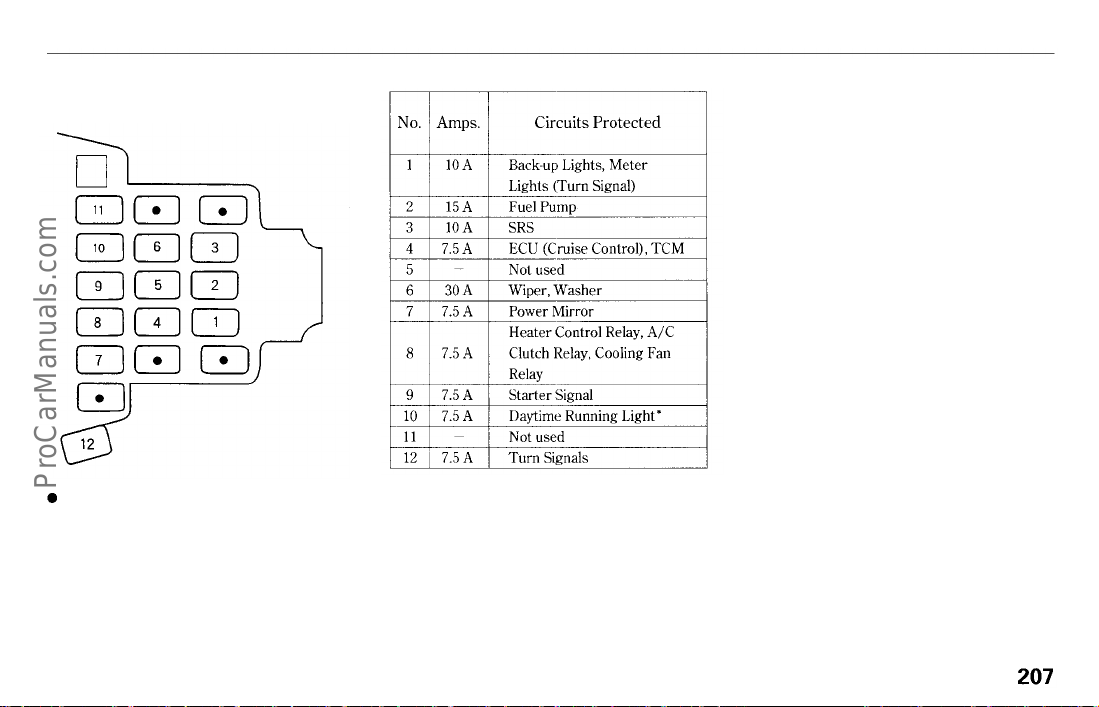
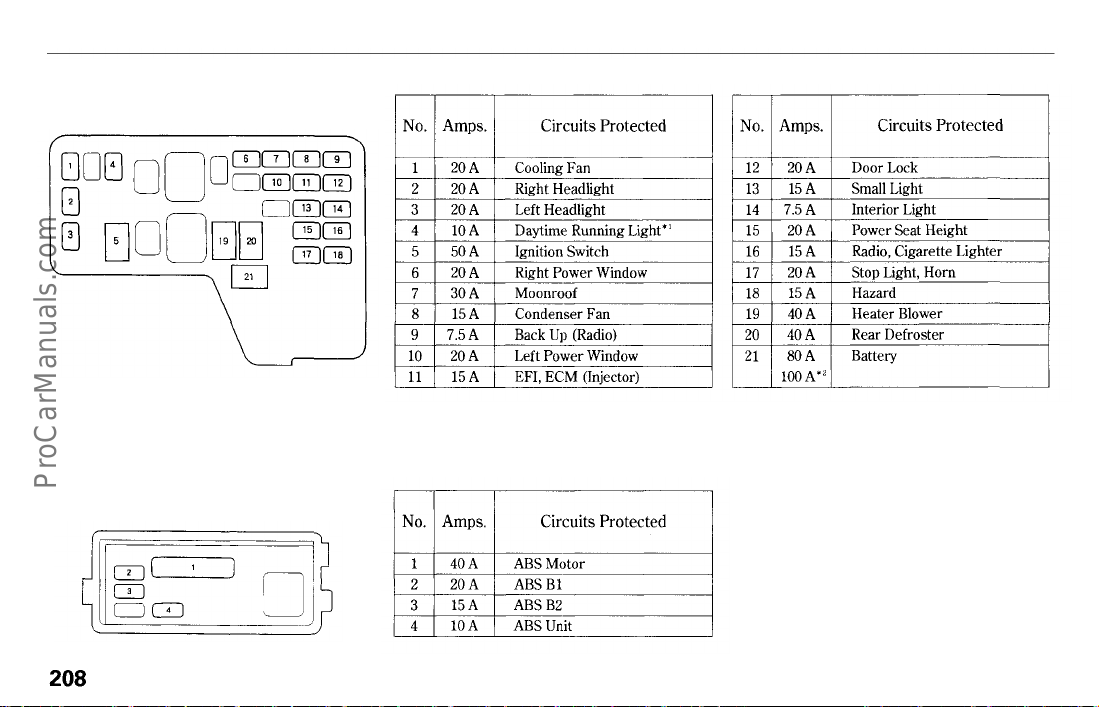
Towing
I f your car needs to be towed, call a
professional towing service or, if you
belong to one, an organization that
provides roadside assistance. Never
tow your car behind another car with
just a rope or chain. It is very
dangerous.
Emergency Towing
There are three popular methods of
towing a car:
Flat-bed Equipment — The operator
loads your car on the back of a truck.
This is the best way of trans-
porting your Honda.
Wheel Lift Equipment —
The
tow
truc
k uses two pivoting arms that go
under the tires (front or rear) and lift
them off the ground. The other two
wheels remain on the ground.
Sling-type Equipment — The tow
truck uses metal cables with hooks
on the ends. These hooks go around
parts of the frame or suspension and
the cables lift that end of the car off
the ground. Your car's suspension
and body can be seriously damaged
if this method of towing is attempted.
If your Honda cannot be transported
by flat-bed, it should be towed with
the front wheels off the ground. If
due to damage, your car must be
towed with the front wheels on the
ground, do the following:
5-speed Manual Transmission
Release the parking brake.
Shift the transmission to Neutral.
Automatic Transmission
Release the parking brake.
Start the engine.
Shift to D4, then to N.
Turn off the engine.
Improper towing preparation will
damage the transmission. Follow the
above procedure exactly. If you
cannot shift the transmission or start
the engine (automatic transmission),
your car must be transported on a
flat-bed.
It is best to tow the car no farther
than 80 km (50 miles), and keep
the speed below 35 mph (55 km/
h).
Trying to lift or tow your car by the
bumpers will cause serious damage.
The bumpers are not designed to
support the car's weight.
Taking Care of the Unexpected
NOTICE
NOTICE
ProCarManuals.com

Technical Information
The diagrams in this section give
you the dimensions and capacities of
your Honda, and the locations of the
identification numbers. The expla-
nations of several electronic and
mechanical systems on your Honda
are for the more technically-oriented
owner.
Identification Numbers ................ 212
Specifications................................. 214
Anti-lock Brake System................ 216
Supplemental Restraint System... 217
Tire Information............................ 218
Tire Size Designation................ 218
Wheel Size Designation............ 218
Tire Speed Ratings.................... 218
Tire Pressure Adjustment
For High Speed Driving........ 219
DOT Tire Quality Grading....... 219
Treadwear.............................. 219
Traction.................................. 220
Temperature.......................... 220
Emission Controls......................... 221
The Clean Air Act...................... 221
Crankcase Emission Control
System..................................... 221
Evaporative Emission Control
System..................................... 221
Exhaust Emission Controls...... 222
PGM-FI System..................... 222
Ignition Timing Control
System................................ 222
Exhaust Gas Recirculation
(EGR) System.................. 222
Three Way Catalytic
Converter.......................... 222
Replacement Parts..................... 222
Three Way Catalytic Converter... 223
Technical Information
ProCarManuals.com
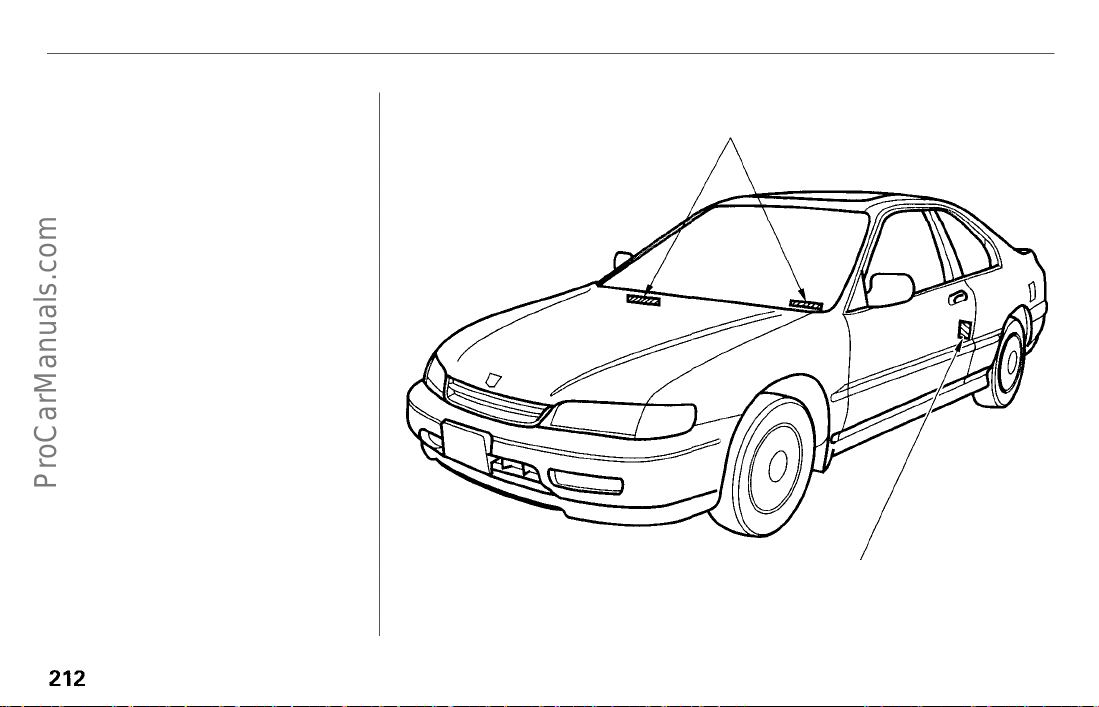
Identification Numbers
Your car has several identifying
numbers located in various places.
The Vehicle Identification Number
(VIN) is the 17-digit number your
Honda dealer uses to register your
car for warranty purposes. It is also
necessary for licensing and insuring
your car. The easiest place to find
the VIN is on a plate fastened to the
top of the dashboard. You can see it
by looking through the windshield
on the driver's side. It is also on the
Certification label attached to the
driver's door jamb, and is stamped
on the engine compartment bulk-
head. The VIN is also provided in bar
code on the Certification label.
Technical Information
VEHICLE IDENTIFICATION NUMBER
CERTIFICATION LABEL
ProCarManuals.com
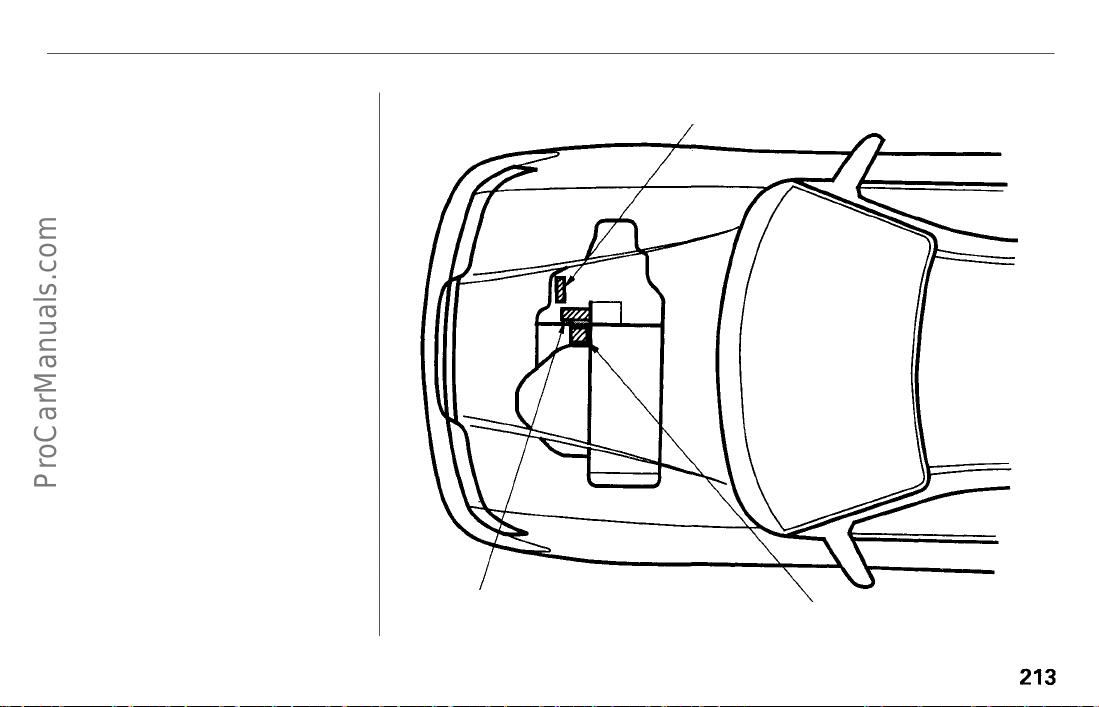
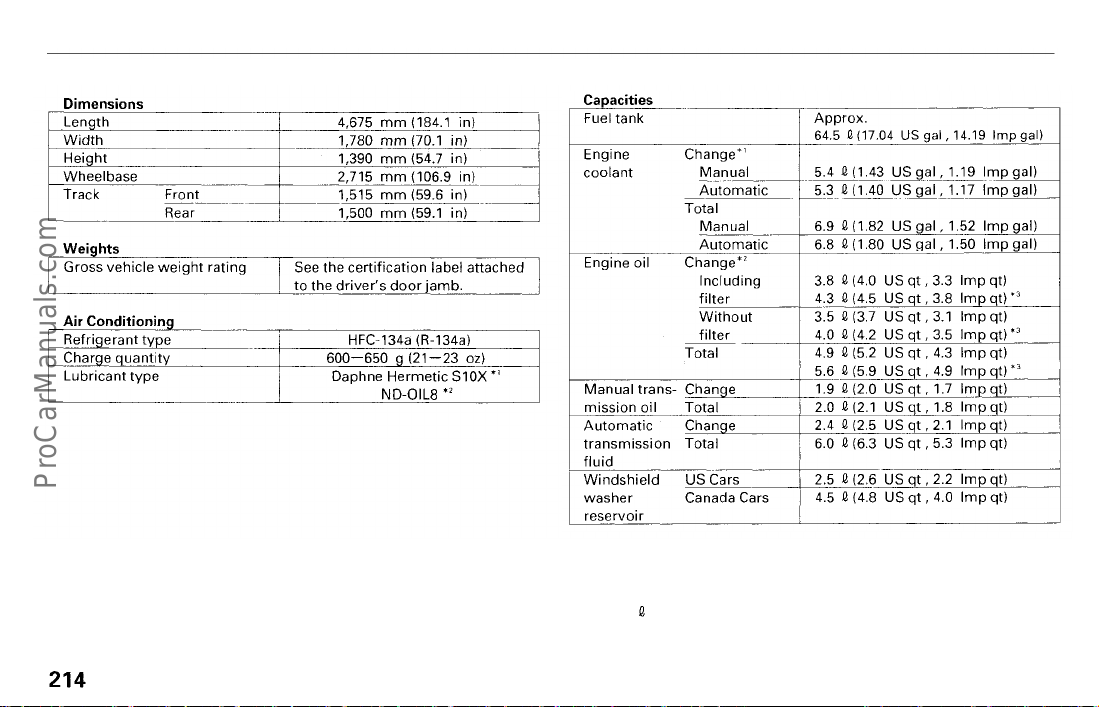
Specifications
*
1 : Including the coolant in the reserve tank and that remaining in the
engine.
Reserve tank capacity:
0.6
(0.16 US gal ,0.13 Imp gal)
*
2 : Excluding the oil remaining in the engine.
*
3: US: EX, Canada: EX-R
Technical Information
*
1 : US: EX, Canada: EX-R
*
2 : US: DX, LX, Canada: LX
(Air conditioning is optional on U.S. DX and Canadian LX models)
ProCarManuals.com
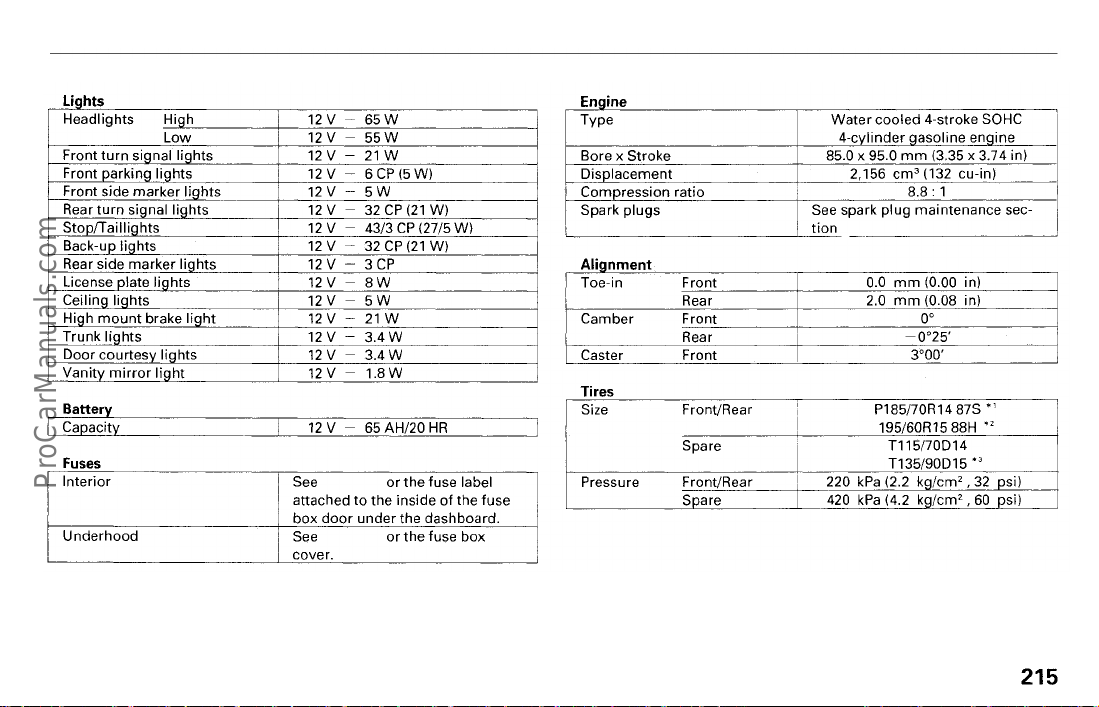

Anti-lock Brake System
The Anti-lock Brake System (ABS)
is standard equipment on the EX
model in the U.S. and the EX-R
model in Canada. It is optional on the
DX and LX models in the U.S. and
the LX model in Canada.
The ABS works by measuring how
fast the wheels are turning during
braking and comparing their speed.
If any wheel is rotating much slower
than the others (on the verge of
locking up and skidding), the system
reduces hydraulic pressure to that
wheel's brake caliper. When that
wheel's speed matches the other
wheels, the system applies normal
hydraulic pressure. This can take
place several times per second at
each wheel. You feel the ABS
working as rapid pulsations in the
brake pedal.
Each wheel has a wheel speed
sensor assembly. As the wheel
rotates, the sensor sends electrical
pulses to the ABS control unit. The
pulse frequency varies with the
wheel speed.
The electrical output of the ABS
control unit is connected to the
modulator/solenoid unit. During
braking, the ABS control unit
monitors the pulse frequencies from
the four wheels. When the control
unit detects a wheel locking up, it
energizes the appropriate solenoid in
the modulator/solenoid unit. There
are six solenoids: two for each front
wheel, and two for the rear wheels.
The energized solenoid reduces
hydraulic pressure to one side of a
modulator valve. This, in turn,
reduces hydraulic pressure in the
brake line going to the affected
wheel. When that wheel speeds up
because of the reduced braking
effort, the control unit de-energizes
the solenoid. This builds hydraulic
pressure on the modulator valve.
The pressure increases in the
hydraulic line to the wheel.
For the system to react quickly, the
modulator/solenoid unit must have
brake fluid under high pressure.
This is supplied by a piston-type
accumulator that is pressurized by
an electric pump. A pressure-sensing
switch on the accumulator controls
this pump.
The control unit also contains error
detection circuitry. It monitors the
operation of the wheel sensors,
solenoids, pump, and electronics. If
the control unit detects any faults, it
shuts off power to the pump motor
and solenoids. The light on the
instrument panel comes on. The
brakes then work like a conventional
system without anti-lock capabilities.
Technical Information
ProCarManuals.com

Supplemental Restraint System
The SRS includes the steering wheel
airbag assembly, sensors in the
dashboard, and a control unit with
sensors behind the center console.
The system also has a dashboard-
mounted airbag assembly for the
passenger.
The sensors are decelerometers, set
to trigger in a severe frontal impact
that generates more force than a 25
mile per hour crash into a parked
vehicle of similar size. For the SRS to
activate, at least two sensors must
trigger. This duplication is to prevent
accidental activation.
When the control unit receives
trigger signals from at least two
sensors, it sends voltage to the
airbag. The control unit stores this
charge in capacitors to insure
reliability even if a severe impact
damages the car's battery or
electrical connections.
The electrical charge sent to the
airbag assembly ignites its propellant,
which burns instantaneously. The
gas produced by the burning
propellant inflates the airbag
instantly.
The airbag is vented so it stays
inflated for only an instant and does
not block the driver's vision. Smoke
from the burned propellant comes
out of the airbag and into the car's
interior. This is normal and does not
mean there is a fire. The airbag
collapses onto the driver's lap.
The airbag unit can inflate only one
time. After use, your Honda dealer
must check the complete Supple-
mental Restraint System and replace
the airbag assembly.
To ensure long-term reliability, the
SRS uses gold-plated electrical
connections throughout. Exposed
components are sealed with epoxy.
The control unit monitors the SRS
circuitry whenever the ignition is ON
(II). If the control unit senses any
faults, it turns on the SRS indicator
light on the instrument panel. Take
the car to your Honda dealer to
diagnose and repair the system as
soon as possible.
The SRS needs no regular mainte-
nance other than an inspection by
your Honda dealer ten years after
manufacture.
Technical Information
ProCarManuals.com
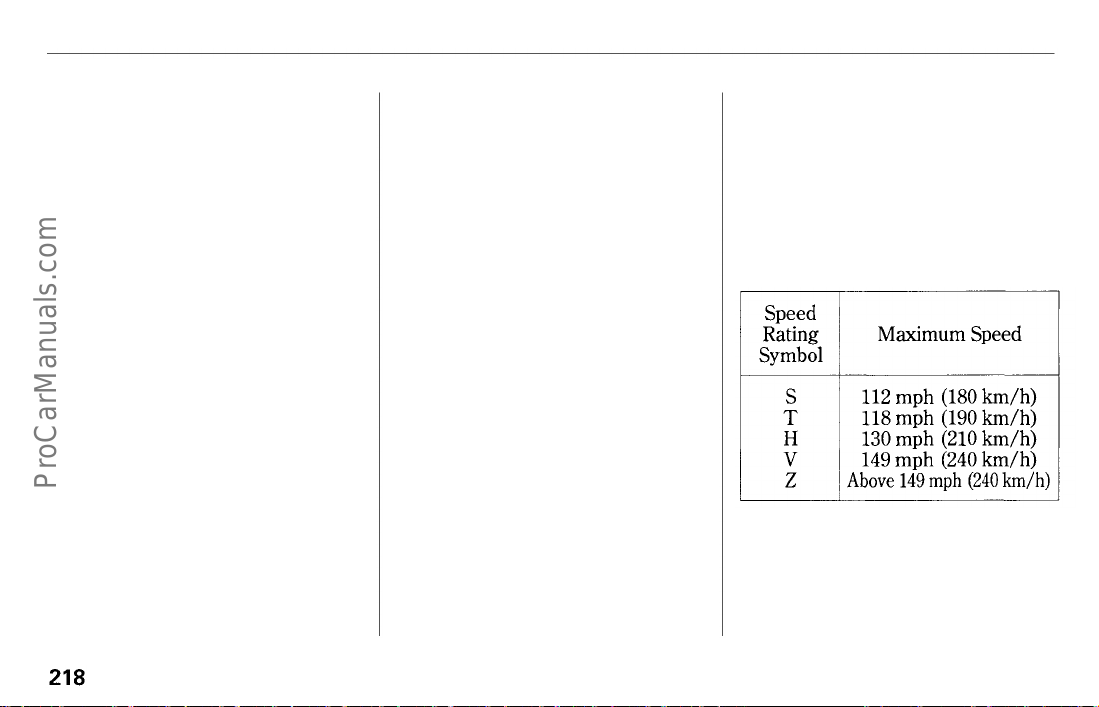
Tire Information
Tire Size Designation
A tire's sidewall is marked with a tire
size designation. You will need this
information when selecting
replacement tires for your car. The
following explains what the letters
and numbers in the tire size
designation mean.
(Example tire size designation)
P185/70R14 87S
P — Applicable vehicle type (tires
marked with the prefix "P" are
intended for use on passenger cars;
however, not all tires have this
marking).
185 — Tire width in millimeters.
70 — Aspect ratio. The tire's section
height as a percentage of its width.
R — Tire construction code (Radial).
14 — Rim diameter in inches.
87 — Load Index, a numerical code
associated with the maximum load
the tire can carry.
S — Speed Rating Symbol. See the
speed rating chart in this section for
additional information.
Wheel Size Designation
Wheels are also marked with
important information that you need
if you ever have to replace one. The
following explains what the letters
and numbers in the wheel size
designation mean.
(Example wheel size designation)
15
x 5-1/2 JJ
15 — Rim diameter in inches.
5-1/2 — Rim width in inches.
JJ — Rim contour designation.
Tire Speed Ratings
The chart below shows many of the
different speed ratings currently
being used for passenger car tires.
The speed rating symbol is part of
the tire size designation on the
sidewall of the tire. This symbol
corresponds to that tire's designed
maximum safe operating speed.
Technical Information
ProCarManuals.com
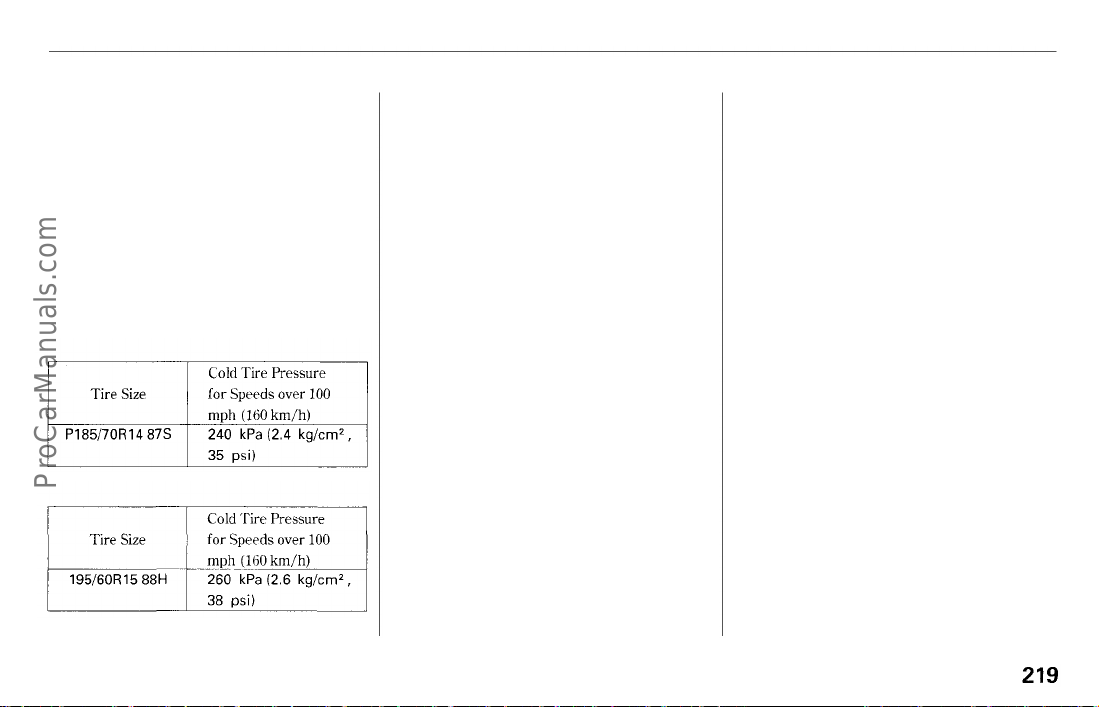
Tire Information
Tire Pressure Adjustment For
High Speed Driving
Honda strongly recommends that
you not drive faster than posted
speed limits and conditions allow. If
you decide it is safe to drive at high
speeds, be sure to adjust the cold tire
pressures as shown below. If you do
not adjust the tire pressure,
excessive heat can build up and
cause sudden tire failure.
Be sure to readjust the pressure for
normal driving speeds. You should
wait untill the tires are cold before
adjusting the tire pressure (see page
163).
DOT Tire Quality Grading
(U.S. Cars)
The tires on your car meet all U.S.
Federal Safety Requirements. All
tires are also graded for treadwear,
traction, and temperature perform-
ance according to Department of
Transportation (DOT) standards.
The following explains these
gradings.
Treadwear
The treadwear grade is a compara-
tive rating based on the wear rate of
the tire when tested under controlled
conditions on a specified government
test course. For example, a tire
graded 150 would wear one and one
half (1-1/2) times as well on the
government course as a tire graded
100. The relative performance of
tires depends upon the actual condi-
tions of their use, however, and may
depart significantly from the norm
due to variations in driving habits,
service practices and differences in
road characteristics and climate.
CONTINUED
Technical Information
(US: EX, Canada: EX-R)
(US: LX, DX, Canada: LX)
ProCarManuals.com

Tire Information
Traction
The traction grades, from highest to
lowest, are A, B, and C, and they
represent the tire's ability to stop on
wet pavement as measured under
controlled conditions on specified
government test surfaces of asphalt
and concrete. A tire marked C may
have poor traction performance.
Warning: The traction grade as-
signed to this tire is based on brak-
ing (straight ahead) traction tests
and does not include cornering
(turning) traction.
Temperature
The temperature grades are A (the
highest), B, and C, representing the
tire's resistance to the generation of
heat and its ability to dissipate heat
when tested under controlled
conditions on a specified indoor
laboratory test wheel. Sustained high
temperature can cause the material
of the tire to degenerate and reduce
tire life, and excessive temperature
can lead to sudden tire failure. The
grade C corresponds to a level of
performance which all passenger car
tires must meet under the Federal
Motor Vehicle Safety Standard No.
109. Grades B and A represent
higher levels of performance on the
laboratory test wheel than the
minimum required by law.
Warning: The temperature grade for
this tire is established for a tire that
is properly inflated and not over-
loaded. Excessive speed, underinfla-
tion, or excessive loading either
separately or in combination, can
cause heat build-up and possible tire
failure.
Technical Information
ProCarManuals.com

Emission Controls
The burning of gasoline in your car's
engine produces several byproducts.
Some of these are carbon monoxide
(CO), oxides of nitrogen (NOx) and
hydrocarbons (HC). Gasoline
evaporating from the tank also
produces hydrocarbons. Controlling
the production of NOx, CO, and HC
is important to the environment.
Under certain conditions of sunlight
and climate, NOx and HC react to
form photochemical "smog." Carbon
monoxide does not contribute to
smog creation, but it is a poisonous
gas.
The Clean Air Act
The United States Clean Air Act*
sets standards for automobile
emissions. It also requires that
automobile manufacturers explain to
owners how their emission controls
work and what to do to maintain
them. This section summarizes how
the emission controls work.
Scheduled maintenance is on page
133.
* In Canada, Honda vehicles comply
with the Canadian Motor Vehicle
Safety Standards (CMVSS) for
Emissions valid at the time they are
manufactured.
Crankcase Emission Control
System
Your car has a Positive Crankcase
Ventilation System. This keeps
gasses that build up in the engine's
crankcase from going into the
atmosphere. The Positive Crankcase
Ventilation valve routes them from
the crankcase back to the intake
manifold. They are then drawn into
the engine and burned.
Evaporative Emission Control
System
As gasoline evaporates in the fuel
tank, an evaporative emission control
canister filled with charcoal adsorbs
the vapor. It is stored in this canister
while the engine is off. After the
engine is started and warmed up, the
vapor is drawn into the engine and
burned during driving.
Technical Information
ProCarManuals.com

Emission Controls
Exhaust Emission Controls
The exhaust emission controls
include four systems: PGM-FI,
Ignition Timing Control, Exhaust
Gas Recirculation and Three Way
Catalytic Converter. These four
systems work together to control the
engine's combustion and minimize
the amount of HC, CO, and NOx that
comes out the tailpipe. The exhaust
emission control systems are
separate from the crankcase and
evaporative emission control
systems.
PGM-FI System
The PGM-FI System uses sequential
multiport fuel injection.
It has three subsystems: Air Intake,
Engine Control, and Fuel Control.
The Engine Control Module (ECM)
uses various sensors to determine
how much air is going into the
engine. It then controls how much
fuel to inject under all operating
conditions.
Ignition Timing Control System
This system constantly adjusts the
ignition timing, reducing the amount
of HC, CO and NOx produced.
Exhaust Gas Recirculation (EGR)
System
The Exhaust Gas Recirculation
(EGR) system takes some of the
exhaust gas and routes it back into
the intake manifold. Adding exhaust
gas to the air/fuel mixture reduces
the amount of NOx produced when
the fuel is burned.
Three Way Catalytic Converter
The three way catalytic converter is
in the exhaust system. Through
chemical reactions, it converts HC,
CO, and NOx in the engine's exhaust
to carbon dioxide (CO
2
), dinitrogen
(N
2
), and water vapor.
Replacement Parts
The emission control systems are
designed and certified to work to-
gether in reducing emissions to
levels that comply with the Clean Air
Act. To make sure the emissions
remain low, you should use only new
genuine Honda replacement parts or
their equivalent for repairs. Using
lower quality parts may increase the
emissions from your car.
The emissions control systems are
covered by warranties separate from
the rest of your car. Read your
warranty manual for more informa-
tion.
Technical Information
ProCarManuals.com
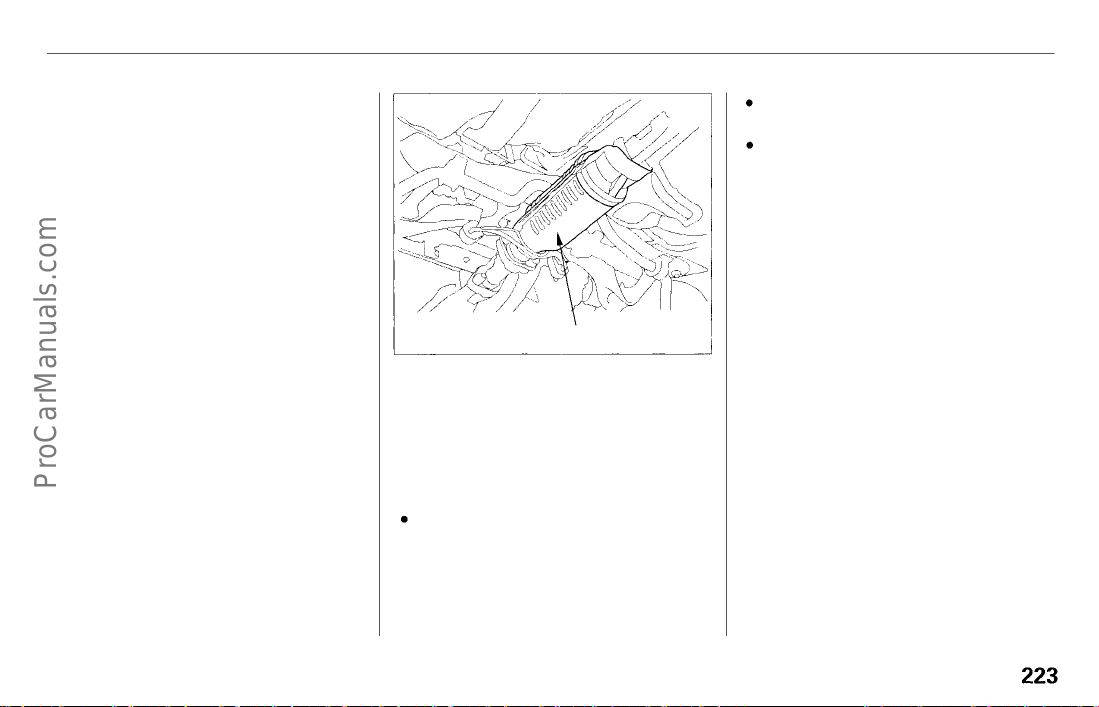
Three Way Catalytic Converter
The three way catalytic converter
contains platinum, palladium and
rhodium. These metals serve as
catalysts, promoting chemical
reactions to convert the exhaust
gasses without affecting the metals.
The catalytic converter is referred to
as a three-way catalyst, since it acts
on HC, CO, and NOx. A replacement
unit must be an original Honda part
or its equivalent.
The three way catalytic converter
must operate at a high temperature
for the chemical reactions to take
place. It can set on fire any com-
bustible materials that come near it.
Park your car away from high grass,
dry leaves, or other flammables.
A defective three way catalytic
converter contributes to air pollution,
and can impair your engine's per-
formance. Follow these guidelines to
protect your car's three way catalytic
converter.
Always use unleaded gasoline.
Even a small amount of leaded
gasoline can contaminate the
catalyst metals, making the three
way catalytic converter ineffective.
Keep the engine tuned-up.
Have your car diagnosed and
repaired if it is misfiring, back-
firing, stalling, or otherwise not
running properly.
Technical Information
THREE WAY CATALYTIC CONVERTER
ProCarManuals.com

Warranty and Customer Relations
Warranty Coverages .......... 226
Customer Relations
Information ................ 227
Reporting Safety Defects
(U.S. cars) ................. 228
U.S. Zone Office Map ......... 229
Canada Zone Office Map ...... 230
Authorized Manuals .......... 231
Warranty and Customer Relations
ProCarManuals.com

Warranty Coverages
U.S. Cars
Your new Honda is covered by these
warranties:
New Car Limited Warranty — covers
your new car, except for the battery,
emissions control systems and
accessories, against defects in
materials and workmanship.
Emissions Control Systems Defects
Warranty and Emissions
Performance Warranty — these two
warranties cover your car's
emissions control systems. Time,
mileage, and coverage are condi-
tional. Please read the warranty
manual for exact information.
Original Equipment Battery Limited
Warranty — this warranty gives up
to 100% credit toward a replacement
battery.
Seat Belt Limited Warranty — a seat
belt that fails to function properly is
covered for the useful life of the car.
Rust Perforation Limited Warranty
— all exterior body panels are
covered for rust-through from the
inside for the specified time period
with no mileage limit.
Accessory Limited Warranty —
Genuine Honda Accessories are
covered under this warranty. Time
and mileage limits depend on the
type of accessory and other factors.
Please read your warranty manual
for details.
Replacement Parts Limited
Warranty — covers all Genuine
Honda replacement parts against
defects in materials and workman-
ship.
Replacement Battery Limited
Warranty — provides prorated
coverage for a replacement battery
purchased from a Honda dealer.
Replacement Muffler Lifetime
Limited Warranty — provides
coverage for as long as the pur-
chaser of the muffler owns the car.
Restrictions and exclusions apply to
all these warranties. Please read the
1994 Honda Warranties booklet that
came with your car for precise
information on warranty coverages.
Your Honda's original tires are
covered by their manufacturer. Tire
warranty information is in a separate
booklet.
Canad
a
Cars
Pleas
e refer to the 1994 Warranty
and Maintenance Guide that came
with your car.
Warranty and Customer Relations
ProCarManuals.com

Customer Relations Information
Honda dealership personnel are
trained professionals. They should
be able to answer all your questions.
If you encounter a problem that your
dealership does not solve to your
satisfaction, please discuss it with
the dealership's management. The
Service Manager or General
Manager can help. Almost all
problems are solved in this way.
If you are dissatisfied with the
decision made by the dealership's
management, contact your Honda
Customer Relations Zone Office.
Refer to the U.S. and Canadian Zone
Office maps on the following pages.
When you call or write, please give
us this information:
Vehicle Identification Number
(see page 212 )
Name and address of the dealer
who services your car
Date of purchase
Mileage on your car
Your name, address, and tele-
phone number
A detailed description of the
problem
Name of the dealer who sold the
car to you
Warranty and Customer Relations
ProCarManuals.com

Reporting Safety Defects (U.S. Cars)
If you believe that your vehicle has a
defect which could cause a crash or
could cause injury or death, you
should immediately inform the
National Highway Traffic Safety
Administration (NHTSA) in addition
to notifying American Honda Motor
Co., Inc.
If NHTSA receives similar com-
plaints, it may open an investigation,
and if it finds that a safety defect
exists in a group of vehicles, it may
order a recall and remedy campaign.
However, NHTSA cannot become
involved in individual problems
between you, your dealer, or
American Honda Motor Co., Inc.
To contact NHTSA, you may either
call the Auto Safety Hotline toll-free
at 1-800-424-9393 (or 366-0123 in
Washington D.C. area) or write to:
NHTSA, U.S. Department of
Transportation, Washington,
D.C. 20590. You can also obtain
other information about motor
vehicle safety from the Hotline.
Warranty and Customer Relations
ProCarManuals.com
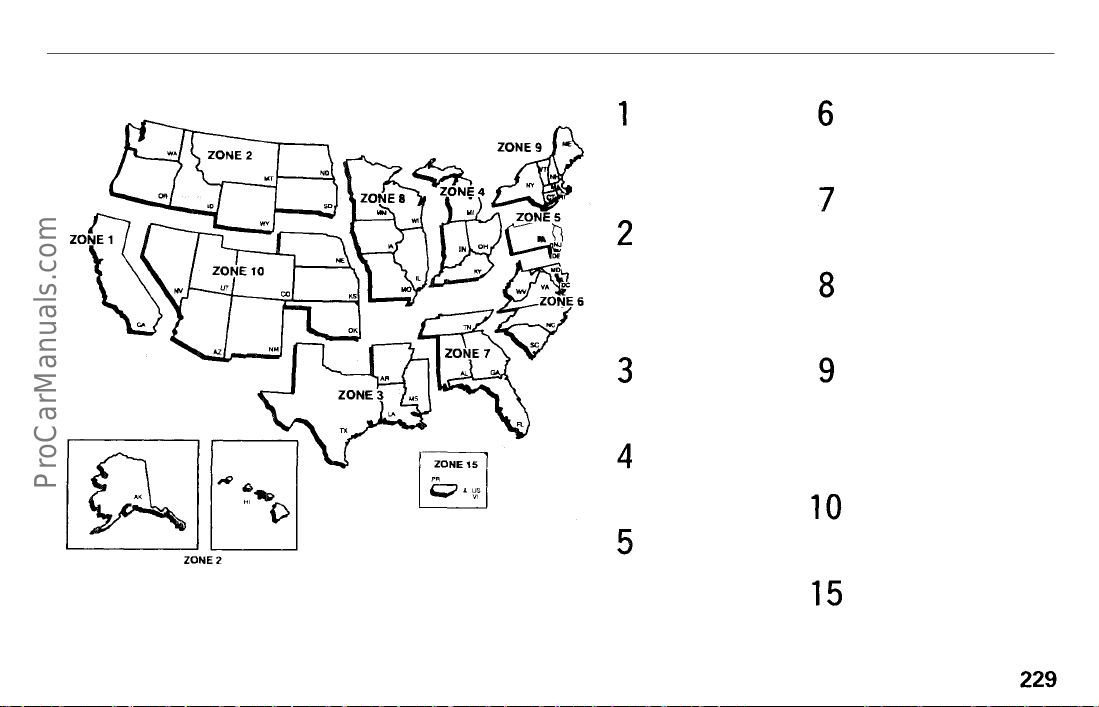
U.S. Zone Office Map
The addresses and telephone numbers are subject to change. If you cannot
reach your Zone office, ask your Honda dealer for the current information.
Western Zone
P.O. Box 2260
700 Van Ness Avenue
Torrance, California
90509-2260
(310) 781-4565
Northwestern Zone
P.O. Box 20186
12439 N.E. Airport Way
Portland, Oregon 97220
(503) 256-0943
(also includes Alaska and
Hawaii)
South Central Zone
4529 Royal Lane
Irving, Texas 75063
(214) 929-5481
Central Zone
101 South Stanfield Road
Troy, Ohio 45373
(513) 332-6250
Northeastern Zone
P.O.
Box 337
Eastgate Industrial Park
115 Gaither Drive
Moorestown, New Jersey 08057
(609) 235-5533
Includes: NYC Metro area and
Fairfield County, CT area
Mid-Atlantic Zone
902 Wind River Ln., Suite 200
Gaithersburg, Maryland 20878
(301) 990-2020
Southeastern Zone
1500 Morrison Parkway
Alpharetta, Georgia 30201
(404) 442-2045
North Central Zone
601 Campus Drive, Suite A-9
Arlington Heights, Illinois 60004
(708) 870-5600
New England Zone
555 Old County Road
Windsor Locks, Connecticut 06096
(203) 623-3310
See Zone 5 for:
NYC Metro area and
Fairfield County, CT area
West Central Zone
1600 South Abilene Street, Suite D
Aurora, Colorado 80012
(303) 696-3935
Puerto Rico and U.S. V.I.
Bella International
P.O. Box 190816
San Juan, PR 00919-0816
(809) 250-8070
Customer Relations
ProCarManuals.com
Canada Zone Office Map
Western Zone
Honda Canada inc.
13240 Worster Court
Richmond, B.C.
V6V 2B8
(604)278-7121
Central Zone
Honda Canada Inc.
126 Milner Avenue
Scarborough, Ontario
M1S 3R2
(416) 299-3400
Quebec Zone
Honda Canada Inc.
1750 rue Eiffel
Boucherville, Quebec
J4B 7W1
(514) 655-6161
Atlantic Zone
Honda Canada Inc.
800 Windmill Road
Dartmouth, N.S.
B3B
1L1
(902) 468-4416
Customer Relations
ProCarManuals.com
Index
Accessories
Installation.................................. 109
ACCESSORY (Ignition Key
Position)........................................ 50
Adding
Automatic Transmission
Fluid........................................ 148
Brake Fluid................................. 150
Clutch Fluid................................ 151
Engine Coolant........................... 144
Engine Oil................................... 139
Manual Transmission Fluid..... 149
Power Steering Fluid................. 151
Windshield Washer Fluid......... 147
Additional Safety Information........ 17
Door Locks................................... 18
Driving with Pets......................... 18
Head Restraint Position.............. 17
Seat-back Position........................ 17
Storing Cargo Safely................... 18
Additives, Engine Oil..................... 141
Adjustments
Mirrors.......................................... 60
Head Restraints........................... 56
Seats.............................................. 55
Steering Wheel............................ 44
Airbag (SRS).................................... 11
Air Cleaner..................................... 152
Air Conditioning............................... 72
Maintenance............................... 161
Usage............................................. 74
Air Outlets (Vents).......................... 70
Air Pressure, Tires....................163, X
Alcohol and Drugs......................... 2 6
Alcoho
l in Gasoline........................ 102
Antifreeze....................................... 143
Anti-lock Brakes (ABS)
Description............................. 216
Indicator Light.....................35, 122
Operation.................................... 122
Anti-theft Steering Column Lock .. 50
Appearance Care........................... 179
Ashtray.............................................. 66
Audio System................................... 77
Automatic Speed Control................ 46
Automatic Transmission............... 116
Capacity, Fluid........................... 214
Checking Fluid Level................ 148
Shifting........................................ 116
Shift Lever Positions................. 117
Shift Lock Release..................... 120
Battery
Charging System Light............... 34
Jump Starting............................. 196
Maintenance............................... 156
Specifications............................. 215
Before Driving............................... 101
Belts, Seat........................................... 5
Beverage Holder.............................. 64
Body Repair.................................... 186
Brakes
Anti-lock System (ABS)............ 122
Break-in, New Linings .............. 102
Fluid............................................ 149
Light, Burned-out...................... 172
Parking.......................................... 62
System Indicator.......................... 34
Wear Indicators......................... 121
Brakes, ABS
Description................................. 216
Operation.................................... 122
System Indicator..................35, 122
CONTINUED
ProCarManuals.com
Index
Braking System.............................. 121
Break-in, New Car......................... 102
Brightness Control, Instruments... 41
Brights, Headlights......................... 40
Bulb Replacement
Back-up Lights........................... 172
Brake Lights............................... 172
Ceiling Light............................... 175
Front Parking Lights................. 171
Front Side Marker Lights......... 171
Headlights.................................. 168
High-mount Brake Light.......... 174
License Plate Lights.................. 174
Rear Side Marker Lights.......... 173
Specifications............................. 214
Turn Signal Lights..................... 170
Bulbs, Halogen............................... 169
Cables, Jump Starting With.......... 196
Capacities Chart.............................
214
Carbo
n Monoxide Hazard.............. 27
Cargo, Loading............................... 110
Cassette Player
Care............................................. 97
Operation................................ 81, 90
CAUTION, Explanation of... Preface ii
CD Player.......................................... 93
Certification Label......................... 212
Chains............................................. 167
Change Oil
How to......................................... 141
When to....................................... 133
Changing a Flat Tire..................... 189
Changing Engine Coolant............. 145
Charging System Indicator....34, 201
Check Engine Light....................... 35
Checking
Automatic Transmission
Fluid........................................ 148
Battery Condition...................... 156
Brake Fluid................................. 150
Clutch Fluid................................ 151
Engine Belts............................... 162
Engine Coolant........................... 143
Engine Oil................................... 139
Fuses........................................... 204
Manual Transmission Fluid ..... 149
Power Steering Fluid................. 151
Checklist, Before Driving............. 112
Child Safety...................................... 19
Cigarette Lighter............................. 66
Cleaner, Air.................................... 152
Cleaning
Aluminum Wheels..................... 181
Carpeting.................................... 183
Exterior....................................... 181
Fabric.......................................... 183
Interior........................................ 183
Leather........................................ 183
Seat Belts.................................... 184
Vinyl............................................ 183
Window....................................... 184
CLEAN Light................................... 97
Clock, Setting the ............................ 63
Clutch Fluid.................................... 151
Coin Box........................................... 65
CO in the Exhaust......................... 218
Cold Weather, Starting in............. 114
Compact Spare............................... 188
Consumer Information*................ 225
Controls, Instruments and.............. 31
Coolant
Adding......................................... 144
Checking..................................... 143
Proper Solution.......................... 143
Temperature Gauge.................... 38
ProCarManuals.com
Index
Corrosion Protection..................... 185
Crankcase Emission Control
System......................................... 221
Cruise Control Operation............... 46
Customer Relations Office*......... 225
DANGER, Explanation of... Preface ii
Dashboard....................................... . 32
Daytime Running Lights................. 40
Dead Battery, What to Do............ 196
Defects, Reporting Safety............... 28
Defogger, Rear Window................. 43
Defrosting the Windows................. 76
DEXRON
®
II Automatic
Transmission Fluid.................... 148
Dimensions..................................... 214
Dimming the Headlights................ 40
Dipstick
Automatic Transmission........... 148
Engine Oil................................... 139
Directional Signals........................... 41
Disabled, Towing Your Car If...... 209
Disc Brake Wear Indicators......... 121
Disposal of Used Oil...................... 143
Doors
Locking and Unlocking............... 51
Power Door Locks....................... 51
DOT Tire Quality Grading........... 219
Downshifting, 5-speed Manual
Transmission.............................. 115
Driving........................................... 111
Economy..................................... 108
In Bad Weather.......................... 123
In Foreign Countries................. 103
Economy, Fuel............................... 108
Emergencies on the Road............. 187
Battery, Jump Starting.............. 196
Changing a Flat Tire................. 189
Charging System Indicator...... 201
Check Engine Light.................. 202
Checking the Fuses................... 205
Low Oil Pressure Indicator...... 200
Malfunction Indicator Lamp.... 202
Manually Closing Moonroof.... 203
Overheated Engine................... 198
Emergency Brake............................ 62
Emergency Flashers....................... 43
Emission Controls......................... 221
Engine
Belts............................................. 162
Check Engine Light............ 35, 202
Coolant Temperature Gauge ..... 38
Malfunction Indicator
Lamp............................... 35, 202
Oil Pressure Indicator......... 34, 200
Oil, What Kind to Use........... 140, X
Overheating................................ 199
Specifications............................. 214
Ethanol in Gasoline....................... 103
Evaporative Emission Controls.... 221
Exhaust Fumes................................ 27
Expectant Mothers, Use of Seat
Belts by....................................... 10
Exterior, Cleaning the................... 181
Fabric, Cleaning............................. 183
Fan, Interior...................................... 72
CONTINUED
ProCarManuals.com
Index
Features, Comfort and
Convenience................................. 69
Filling the Fuel Tank..................... 104
Filters
Fuel.............................................. 154
Oil................................................ 141
First Gear, Shifting........................ 119
5-speed Manual Transmission,
Checking Fluid Level................ 149
5-speed Manual Transmission,
Shifting the................................. 115
Flashers, Hazard Warning.............. 43
Flat Tire, Changing a.................... 189
Fluids
Automatic Transmission...... 148, X
Brake......................................... 150
Clutch.......................................... 151
Manual Transmission .......... 149, X
Power Steering........................... 151
Windshield Washer................... 147
FM Stereo Radio
Reception...................................... 80
Folding Rear Seat............................ 57
Foreign Countries, Driving in...... 103
Four-way Flashers........................... 43
Front End, Towing by
Emergency Wrecker................. 209
Fuel.................................................. 102
Fill Door and Cap....................... 104
Filter............................................ 154
Gauge............................................ 38
Octane Requirement............. 102, X
Oxygenated................................ 102
Tank, Filling the......................... 104
Fuses, Checking the...................... 204
Gas Mileage, Improving................ 108
Gasohol........................................... 102
Gasoline..................................... 102, X
Filter............................................ 154
Gauge............................................ 38
Octane Requirement............ 102, X
Tank, Filling the......................... 104
Gas Station Procedures................. 104
Gauges
Engine Coolant Temperature .... 38
Fuel................................................ 38
Gearshift Lever Positions
Automatic Transmission........... 117
5-speed Manual
Transmission.......................... 115
Glass Cleaning............................... 184
Glove Box......................................... 53
Halogen Headlight Bulbs.............. 169
Hazard Warning Flashers............... 43
Headlights......................................... 40
Daytime Running Lights............. 40
High Beam Indicator................... 36
High Beams, Turning on............ 40
Low Beams, Turning on ............. 40
Reminder Chime.......................... 40
Replacing Halogen Bulbs ......... 168
Turning on.................................... 40
Head Restraints............................... 56
Heating and Cooling........................ 70
High Altitude, Starting at.............. 114
High-Low Beam Switch .................. 40
Hood, Opening the ........................ 105
Horn................................................. 49
Hot Coolant, Warning about........ 144
Hydraulic Clutch............................ 151
Hydroplaning.................................. 123
ProCarManuals.com
Index
Identification Number, Vehicle.... 212
If Your Car Has to be Towed....... 209
Ignition
Keys............................................... 49
Switch............................................ 50
Timing Control System............. 222
Indicator Lights, Instrument
Panel............................................ 33
Infant Restraint................................ 21
Inflation, Proper Tire .................... 163
Inside Mirror.................................... 60
Inspection, Tire.............................. 164
Instrument Panel............................. 32
Instrument Panel Brightness......... 41
Interior Cleaning............................ 183
Interior Lights.................................. 67
Introduction......................... Preface i
Jacking up the Car......................... 191
Jack,
Tire........................................ 190
Jump
Starting................................. 196
Keys................................................. 49
Label, Certification........................ 212
Lane Change, Signaling.................. 41
Lap Belt...............................................6
Lap/Shoulder Belts........................... 6
Leaking of Exhaust into Car.......... 27
Lighter, Cigarette............................ 66
Lights
Bulb Replacement..................... 168
Indicator........................................ 33
Parking.......................................... 40
Turn Signal................................... 41
Loading Cargo................................ 110
LOCK (Ignition Key Position)....... 50
Locks
Anti-theft Steering Column........ 50
Fuel Fill Door............................. 104
Glove Box..................................... 53
Power Door.................................. 51
Trunk............................................ 52
Low Coolant Level......................... 143
Maintenance................................... 131
Periodic Items............................ 137
Record.................................. 135-136
Required Indicator....................... 38
Schedule.............................. 133-134
Malfunction Indicator Lamp.. 35, 202
Manual Transmission.................... 115
Manual Transmission Fluid ......... 149
Maximum Shift Speeds.........116, 120
Meters, Gauges................................ 37
Methanol in Gasoline.................... 103
Mirrors, Adjusting........................... 66
Moonroof.......................................... 59
Closing Manually....................... 203
Operation...................................... 59
CONTINUED
Lower Gear, Downshifting to a.... 115
Low Oil Pressure Indicator.... 34, 200
Lubricant Specifications Chart.... 214
Luggage.......................................... 110
ProCarManuals.com

Index
Neutral Gear Position.................... 118
New Vehicle Break-in ................... 102
Normal Shift Speeds...................... 115
NOTICE, Explanation of...... Preface ii
Numbers, Identification................ 212
Occupant Protection System............ 4
Octane Requirement, Gasoline 102, X
Odometer.......................................... 37
Odometer, Trip................................ 37
Oil
Change, How to ......................... 141
Change, When to....................... 133
Checking Engine....................... 139
Pressure Indicator....................... 34
Selecting Proper Viscosity
Chart....................................... 140
ON (Ignition Key Position)............ 50
Opening the Hood ......................... 105
Operation in Foreign Countries... 103
Outside Mirrors............................... 61
Overheating, Engine..................... 198
Panel Brightness Control............... 41
Park Gear Position......................... 118
Parking Brake.................................. 62
Parking Lights.................................. 40
Parking Over Things that Burn... 223
PGM-FI System.............................. 222
Polishing and Waxing................... 181
Power
Door Locks................................... 51
Mirrors.......................................... 61
Steering....................................... 151
Windows....................................... 58
Pregnancy, Using Seat Belts.......... 10
Proper Seat Belt Usage..................... 7
Radiator Overheating.................... 198
Radio/Cassette Sound System....... 77
Rear End Towing........................... 209
Rear Lights, Bulb Replacement... 172
Rear Seat Access ............................. 55
Rear Seat, Folding........................... 57
Rear View Mirror............................. 61
Rear Window Defogger.................. 43
Reclining the Seat Backs................ 54
Recommended Shift Speeds ........ 115
Reminder Lights.............................. 33
Replacement Information
Air Cleaner................................. 152
Coolant........................................ 145
Engine Oil and Filter................. 141
Fuel Filter................................... 154
Fuses......................................... 204
Light Bulbs................................. 168
Schedule..................................... 133
Spark Plugs................................. 154
Tires............................................ 165
Wiper Blades.............................. 159
Replacing Seat Belts After a
Crash........................................... 10
Reserve Tank, Coolant.................. 143
Restraint, Child................................ 19
Reverse Gear Position................... 118
Rotation, Tire................................. 165
Safety Belts......................................... 5
Safety Defects, Reporting*........... 228
ProCarManuals.com
Index
Safety Labels, Location of.............. 28
Safety Messages.................. Preface ii
Seat Belts............................................ 5
Advice for Pregnant Women...... 10
Child Seat Anchor Plate.............. 24
Cleaning...................................... 184
Frayed or Torn............................. 10
Maintenance................................. 10
Reminder Light and Beeper....... 34
Replacement................................. 10
System Components...................... 6
Tether Attachment Points.......... 24
Use During Pregnancy................ 10
Wearing a Lap/Shoulder Belt...... 7
Wearing the Lap Belt.................... 9
Seats, Adjusting the......................... 54
Serial Number................................ 212
Service Intervals............................ 133
Service Manual.............................. 231
Service Station Procedures .......... 104
Setting the Clock............................. 63
Shifting
The Automatic Transmission ..116
The 5-speed Manual
Transmission.......................... 115
Shift Lever Position
Indicator................................ 36, 117
Side Marker Lights, Bulb
Replacement in.......................... 171
Signaling Turns............................. 41
Snow Tires...................................... 167
Solvent-type Cleaners.................... 181
Sound System................................... 77
Spare Tire
Inflating................................. 188, X
Specifications............................. 215
Spark Plugs, Replacing................. 154
Specifications Charts..................... 214
Speed Control................................... 46
Speedometer.................................... 37
SRS Indicator.............................. 11, 35
START (Ignition Key Position)..... 50
Starting the Engine........................ 113
In Cold Weather at High
Altitude................................... 114
With a Dead Battery................. 196
Steam Coming from Engine......... 198
Steering Wheel
Adjustment................................... 44
Anti-theft Column Lock.............. 50
Stereo Sound System...................... 77
Storing Your Car............................ 177
Supplemental Restraint System
Service Precautions..................... 16
Servicing....................................... 15
SRS Indicator.......................... 15, 35
System Components.................... 11
Technical Description............... 217
Tachometer...................................... 37
Taillights, Changing Bulbs in....... 172
Taking Care of the Unexpected .. 187
Tape Player................................. 81, 90
Technical Descriptions
Anti-lock Brake System............ 216
Emission Control Systems........ 221
Supplemental Restraint
System..................................... 217
Three Way Catalytic
Converter................................ 223
Tire Information............................ 218
Temperature Gauge........................ 38
Tether Attachment Points.............. 24
CONTINUED
ProCarManuals.com
Index
Three Way Catalytic Converter... 223
Time, Setting the............................. 63
Tire Chains..................................... 167
Tire, How to Change a Flat.......... 189
Tires................................................ 162
Air Pressure .......................... 163, X
Checking Wear.......................... 164
Compact Spare........................... 188
DOT Tire Quality Grading....... 219
Inflation................................... 163, X
Inspection................................... 164
Maintenance............................... 164
Replacing................................ 165, X
Rotating....................................... 165
Snow.......................................... 167
Specifications........................ 215, X
Tire Chains................................. 167
Tire Pressure Adjustment
For High Speed Driving........ 219
Tire Size Designation................ 218
Tire Speed Ratings.................... 218
Wheel Size Designation............ 218
Winter Driving........................... 166
Tools, Tire Changing.................... 189
Torn Seat Belts................................ 10
Towing
A Trailer...................................... 125
Emergency Wrecker................. 209
Transmission
Checking Fluid Level,
Automatic............................... 148
Checking Fluid Level,
Manual.................................... 149
Fluid Selection ...................148, 149
Identification Number............... 212
Shifting the Automatic.............. 116
Shifting the Manual................... 115
Treadwear...................................... 219
Trip Meter........................................ 37
Trunk................................................. 52
Opening the................................. 52
Open Monitor Light.................... 35
Turn Signals..................................... 41
Underside, Cleaning...................... 185
Unexpected, Taking Care
of the........................................... 187
Uniform Tire Quality Grading..... 219
Unleaded Gasoline......................... 102
Upholstery Cleaning...................... 183
Used Oil, How to Dispose of........ 143
Vanity Mirror................................... 65
Vehicle Capacity Load .................. 110
Vehicle Dimensions....................... 214
Vehicle Identification Number..... 212
Vehicle Storage.............................. 177
Ventilation......................................... 73
VIN.................................................. 212
Vinyl Cleaning................................ 183
Viscosity, Oil................................... 141
Warning Beepers
Key in Ignition.............................. 50
Seat Belts...................................... 34
WARNING, Explanation of. Preface ii
Warning Labels, Location of.......... 28
Warranty Coverages*................... 226
Washer, Windshield
Checking the Fluid Level......... 147
Operation...................................... 42
ProCarManuals.com

Washing.......................................... 180
Waxing and Polishing ................... 181
Wheels
Adjusting the Steering................ 44
Alignment and Balance............. 165
Compact Spare........................... 188
Wrench...................................... 191
Windows
Cleaning...................................... 184
Operating the Power................... 58
Rear, Defogger............................ 43
Windshield
Cleaning........................................ 42
Defroster...................................... 76
Wipers, Windshield
Changing Blades........................ 159
Operation...................................... 42
Worn Tires..................................... 164
Wrecker, Emergency Towing...... 209
*U.S. and Canada Only.
Index
ProCarManuals.com

Gas Station Information
Gasoline:
UNLEADED gasoline
Pump octane of 86 or higher
Fuel Tank Capacity:
64.5 l (17.04 US gal, 14.19 Imp gal)
Recommended Engine Oil:
API SG or SH grade
"Energy Conserving II" oil
SAE 5W-30 viscosity
Engine Oil Capacity:
including filter
(US: DX, LX, Canada: LX)
3.8 l (4.0 US qt,3.3 Imp qt)
(US: EX, Canada: EX-R)
4.3 l (4.5 US qt, 3.8 Imp qt)
without filter
(US: DX, LX, Canada: LX)
3.5 l (3.7 US qt, 3.1 Imp qt)
(US: EX, Canada: EX-R)
4.0 l (4.2 US qt,3.5 Imp qt)
5-speed Manual Transmission Oil:
SAE 10W-30 or 10W-40 viscosity
API SF or SG grade recom-
mended
Capacity:
1.9 l (2.0 US qt, 1.7 Imp qt)
Automatic Transmission Fluid:
Honda Premium Formula Auto-
matic Transmission Fluid or an
equivalent DEXRON
®
II type Auto-
matic Transmission Fluid (ATF)
Capacity:
2.4 l (2.5 US qt, 2.1 Imp qt)
Tire Pressure (measured cold):
220 kPa (2.2 kg/cm
2
, 32 psi)
Spare Tire Pressure:
420 kPa (4.2 kg/cm
2
, 60 psi)
Tire Size (Front and Rear):
(US:DX, LX, Canada: LX)
P185/70R14 87S
(US: EX, Canada: EX-R)
195/60R15 88H
Spare Tire:
(Cars without ABS)
T115/70D14
(Cars with ABS)
T135/90D15
Other Tire Information:
See label on the driver's door
jamb.
ProCarManuals.com