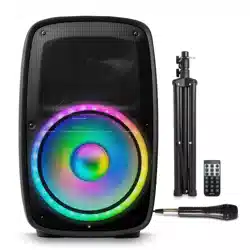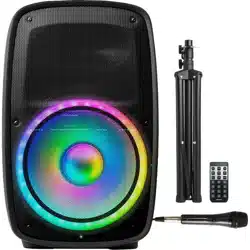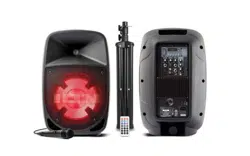
iPA69C
Quickstart Guide English ( 3 – 8 )
Guía de inicio rápido Español ( 9 – 14 )
Guide d’utilisation rapide Français ( 15 – 20 )
Guida rapida Italiano ( 21 – 26 )
Schnellstart-Anleitung Deutsch ( 27 – 31 )
Snelstartgids Nederlands ( 32 – 38 )
Appendix English ( 39 )

2
3
Quickstart Guide (English)
Introduction
1. Make sure all items listed in the Box Contents are included in the box. Look in the box under the
foam sheet for the speaker stand rubber feet, speaker stand mounting knob, power cable, and
microphone.
2. Read the safety instruction booklet before using the product.
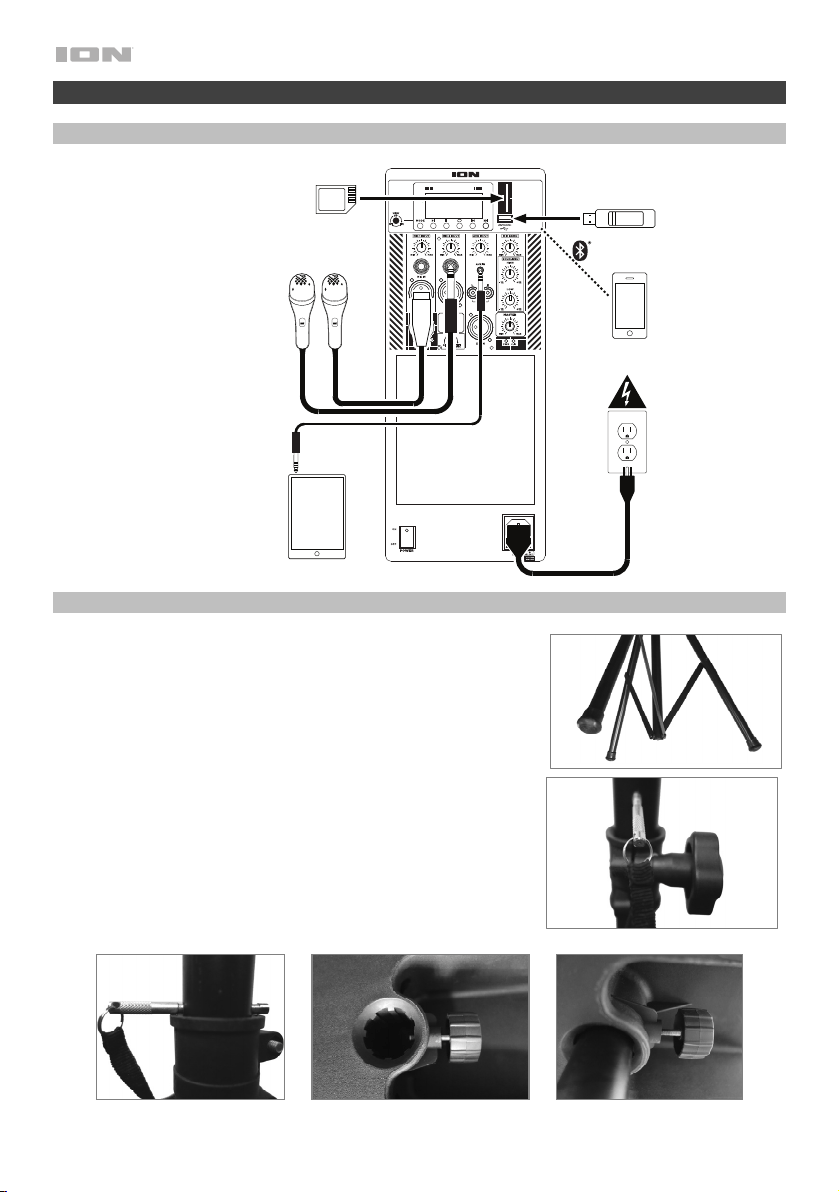
3. Study the Connection Diagram.
4. Make sure all input devices such as microphones, CD players, or digital media players are turned
off and volume settings are set at “zero.”
5. Connect all devices as shown.
6. Switch everything on in the following order:
• audio input sources (i.e. microphones, instruments, CD players)
• Total PA Glow
7. When turning off, always reverse this operation:
• Total PA Glow
• any input devices
Box Contents
Total PA Glow
Microphone with Cable
Telescoping Speaker Stand
Remote Control
Power Cable (IEC)
Quickstart Guide
Safety Instructions & Warranty Information Booklet
Support
For the latest information about this product (system requirements, compatibility information, etc.)
and product registration, visit ionaudio.com.
For additional product support, visit ionaudio.com/support.
Caution: Do not expose Total PA Glow to rain or standing water.
4
TOTAL PA GLOW
Quick Setup
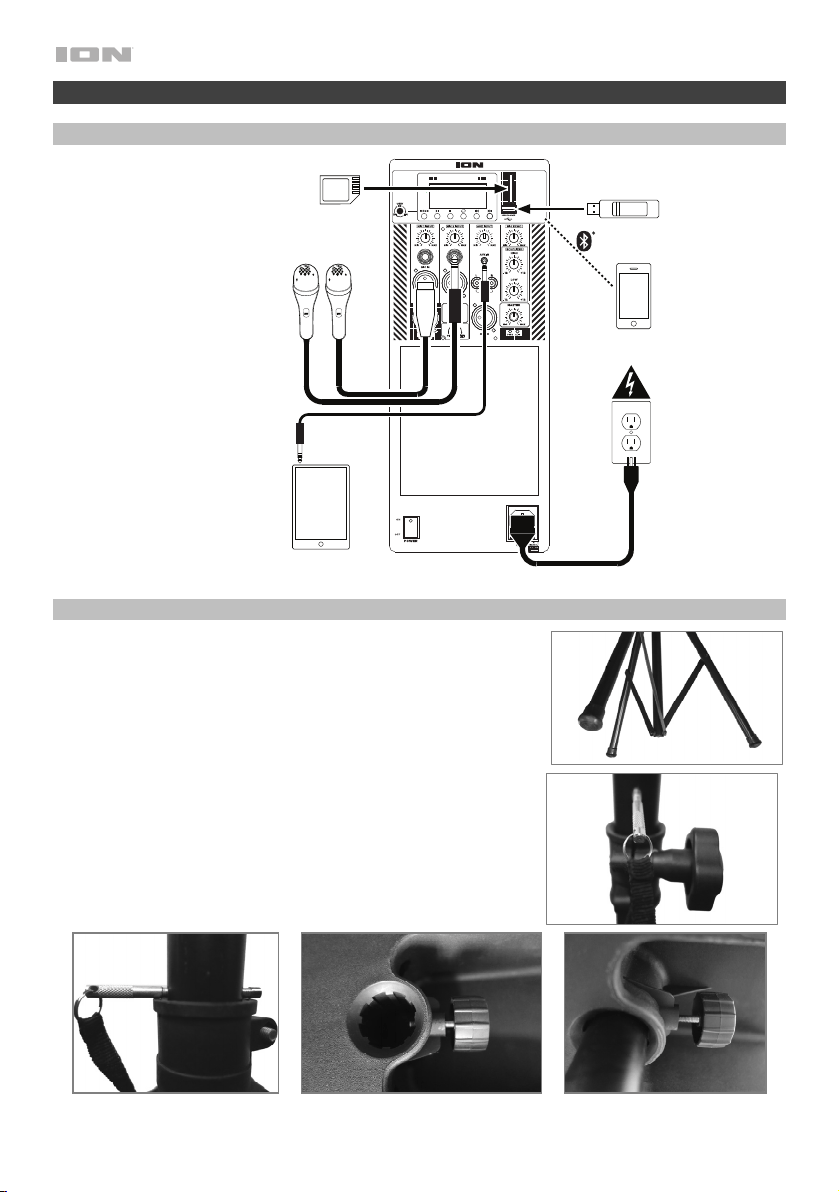
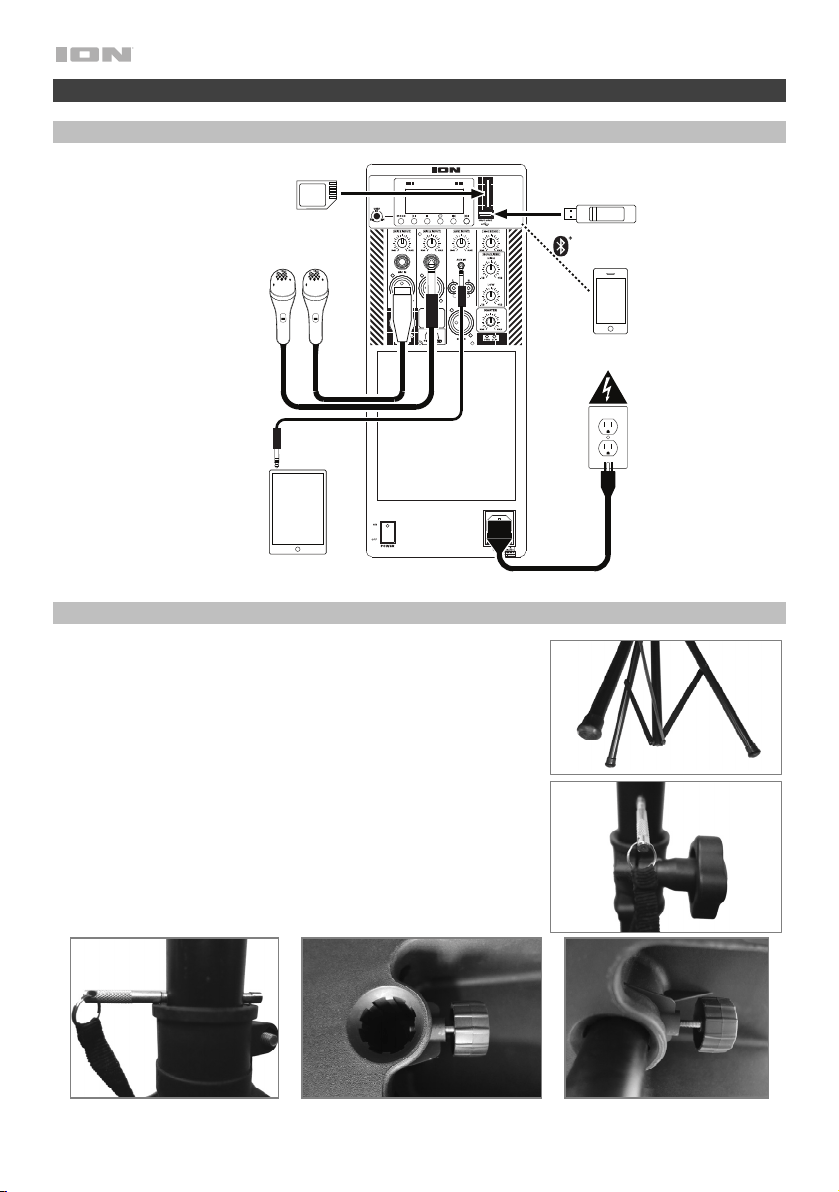
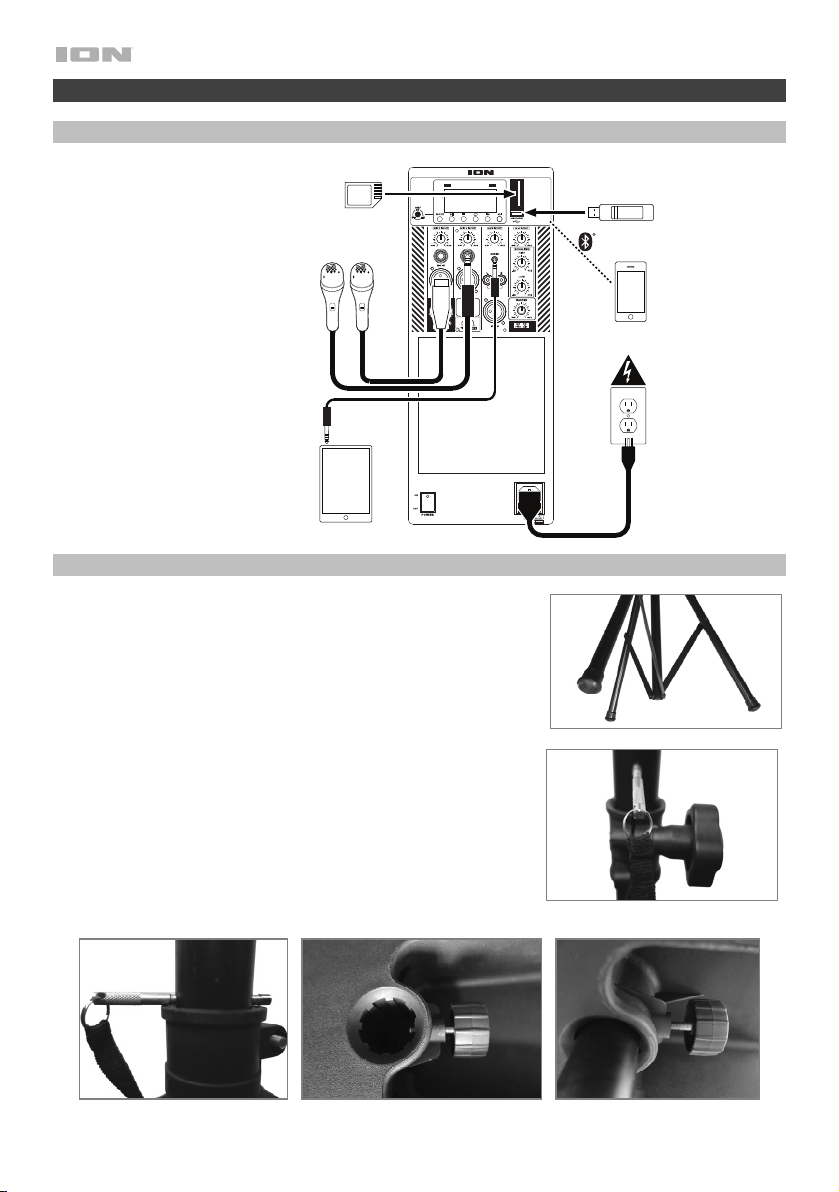
Connection Diagram
Speaker Stand Installation
1. Fully extend the speaker stand tripod legs on a flat, stable
surface. Look in the box contents under the foam sheet for the
rubber feet and speaker stand mounting knob.
2. Raise the mounting pole up to the appropriate height needed
and tighten the side adjustment knob.
3. Insert the pin into the bottom pin-hole so the mounting pole
stays at your set height.
4. On Total PA Glow, adjust the bottom knob counter-clockwise
so the screw is not blocking the opening.
5. Line up the Total PA Glow mounting hole with the speaker
stand pole and place on the pole.
6. Tighten the mounting knob clockwise on Total PA Glow.
3 45/6
Items not listed under
Introduction > Box Contents
are sold separately.
2
1
Tablet
Microphones
SD Card
USB drive
Smartphone
Power
5
Features
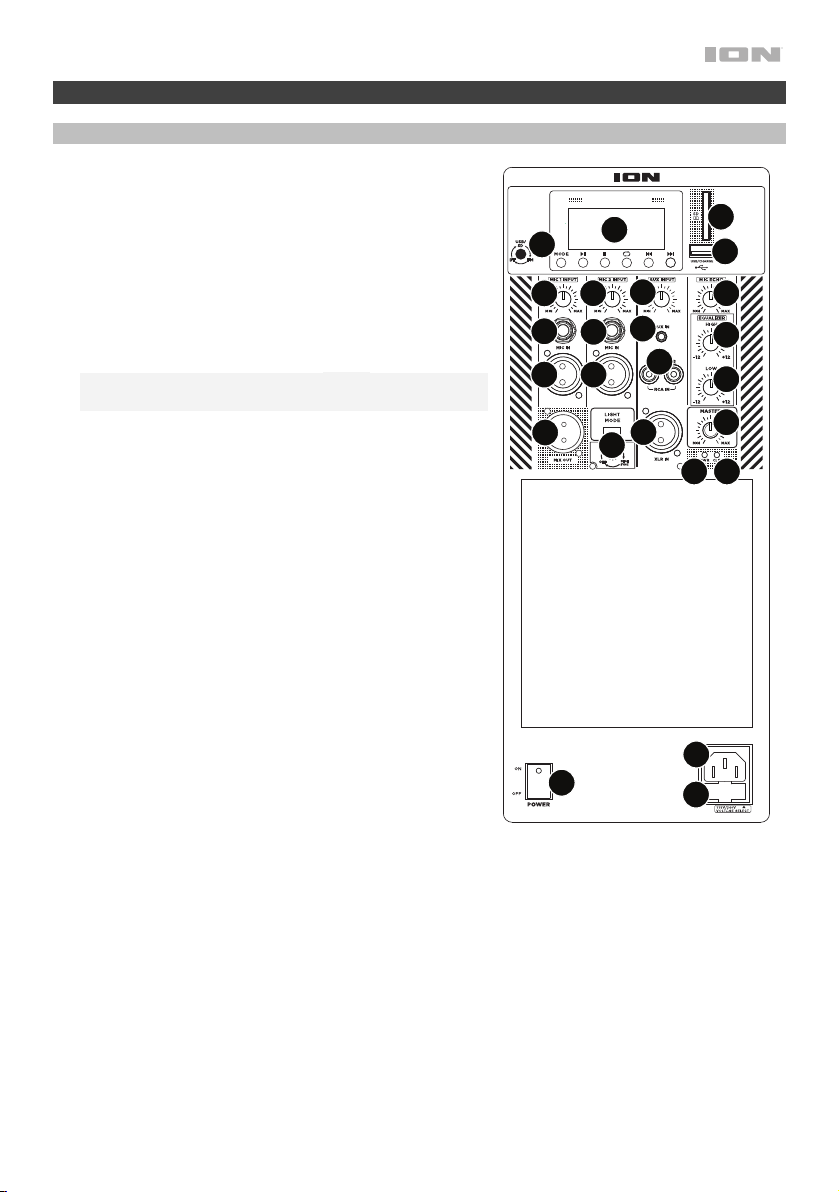
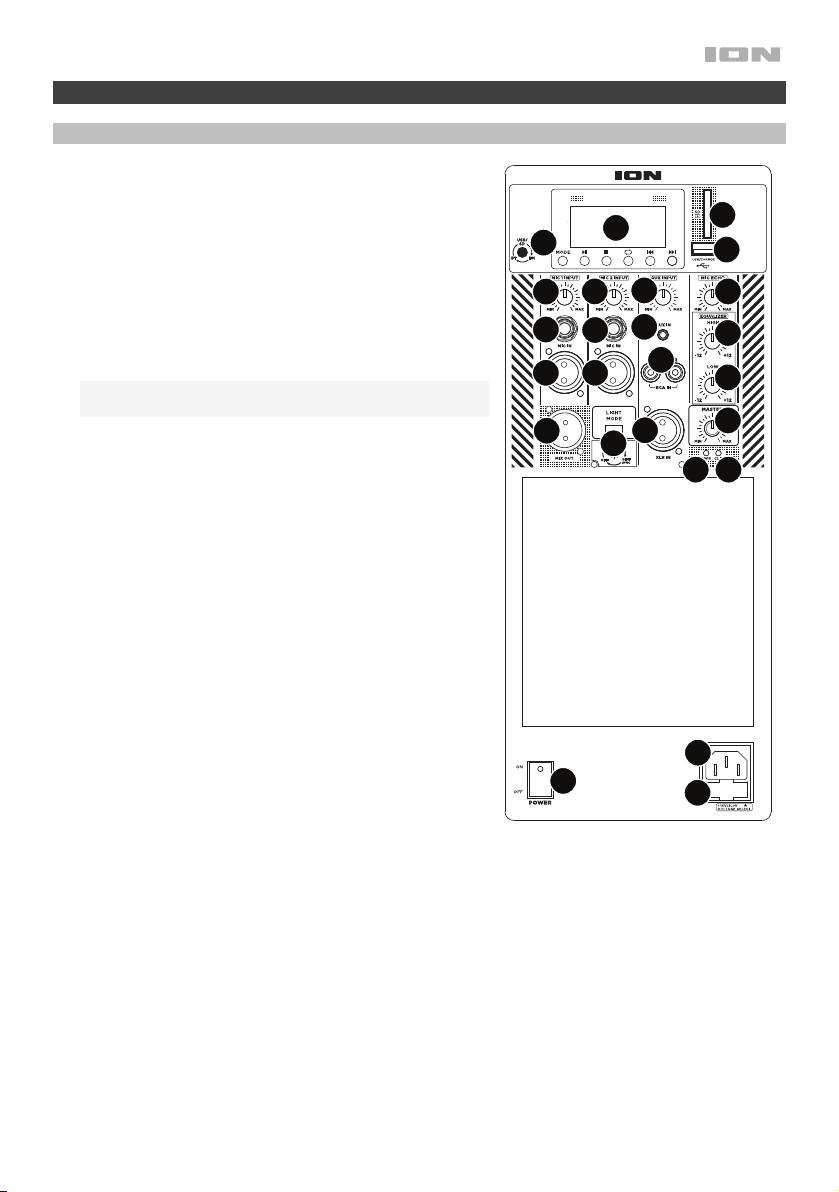
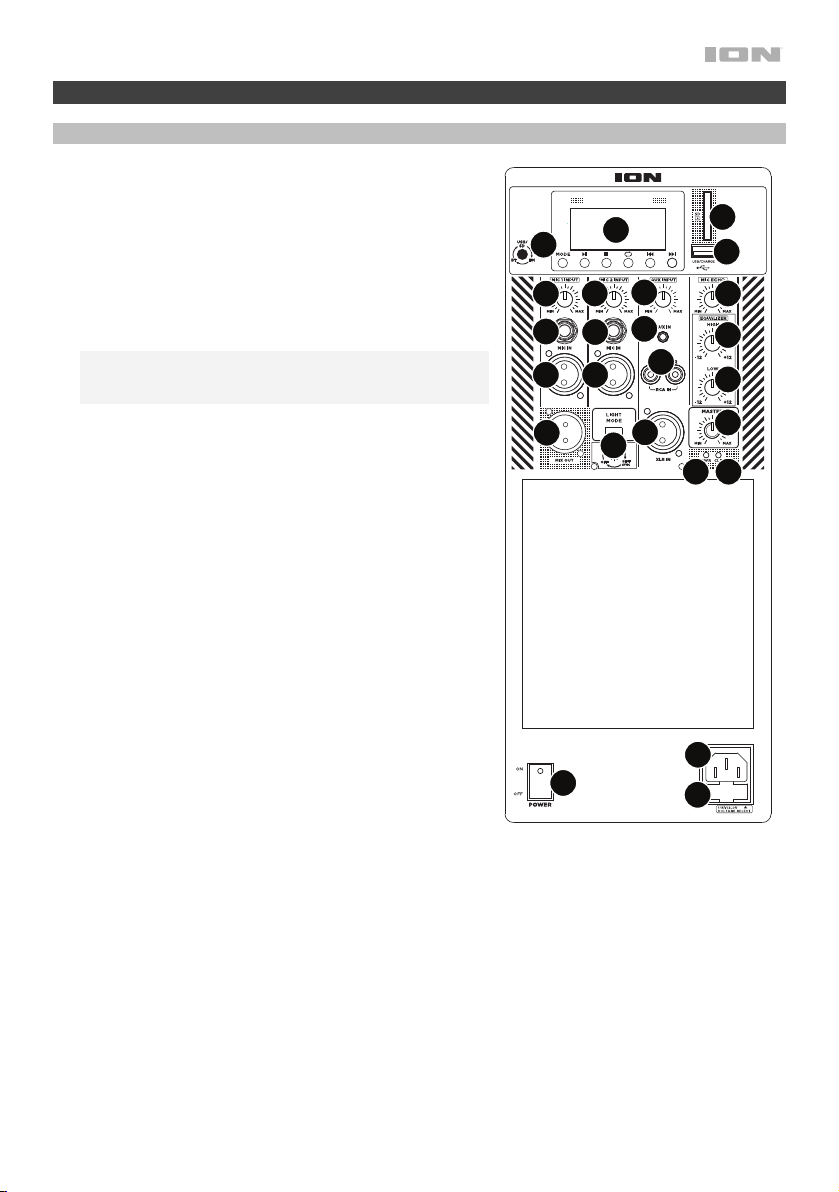
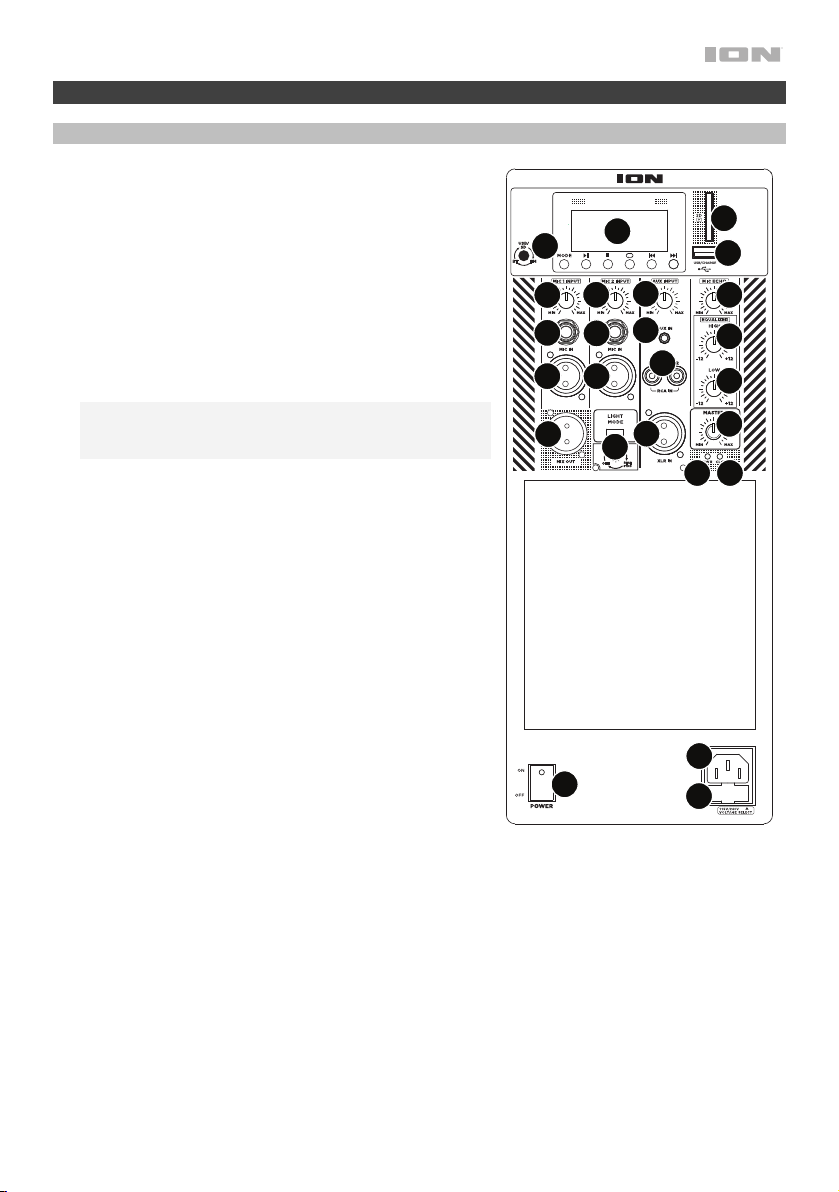
Rear Panel
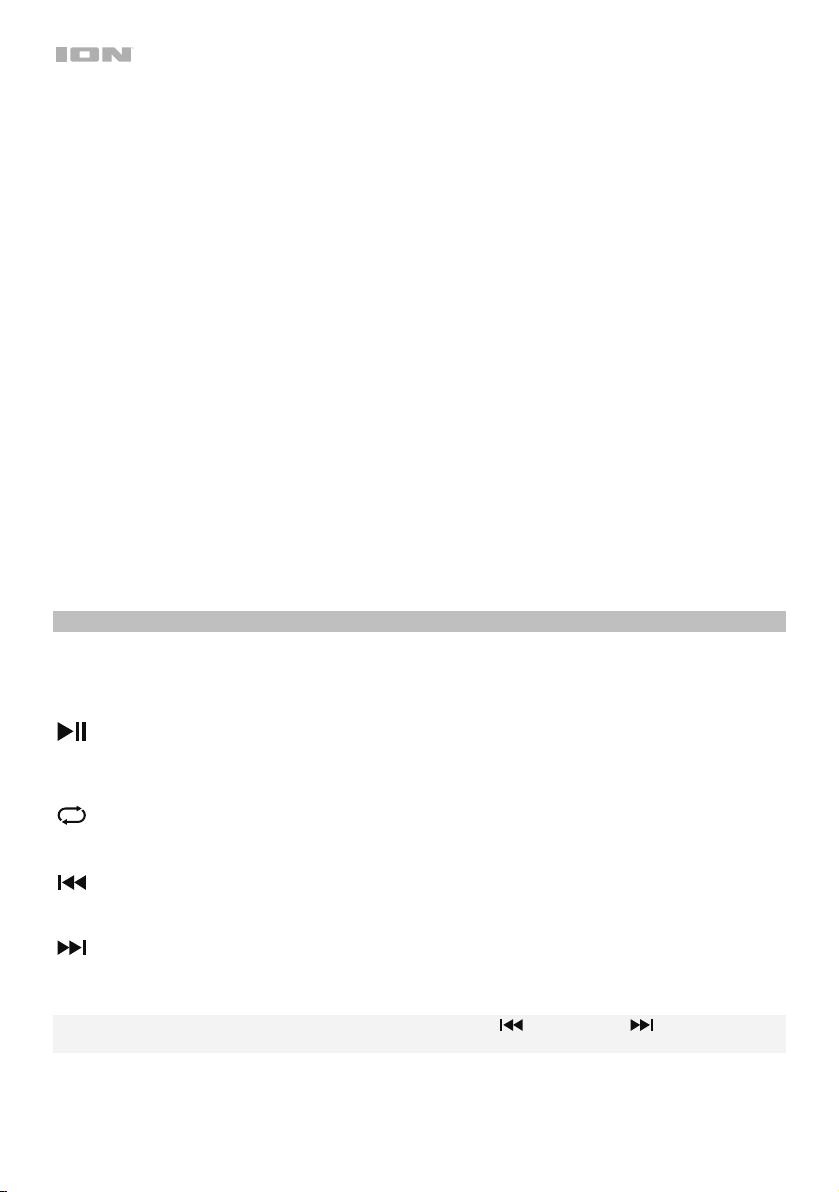
1. Media Panel: Controls for the USB, SD, FM radio (if
applicable), and Bluetooth sources. The Media Panel
Mode source symbol will illuminate when that source is
playing.
2. USB Port: Connect your USB flash drive here to play
music.
3. SD Card Slot: Insert your SD card here to play music.
4. Display: Displays the media panel modes for USB, SD,
FM radio (if applicable), and Bluetooth.
Note: The display comes with a plastic protector on it.
Remove this for optimal viewing.
5. Mic Inputs (1/4”/6.35 mm & XLR): Connect a dynamic
microphone to the 1/4” (6.35 mm) or XLR inputs.
Control the volume of the inputs using the Mic Input
Volume knobs.
6. Mic Input Volume: Turn this knob to adjust the input
volume of the Mic Input.
7. Aux Input (1/8”/3.5 mm): Connect a CD player, digital
media player, or other audio source to this 1/8” (3.5
mm) stereo auxiliary input. Control the volume using the
Aux Input Volume knob.
8. XLR Input (XLR): Connect a line-level mixer or musical
instrument to this XLR line-level input. Control the volume
using the Aux Input Volume knob. Use this line-level
input when linking together two Total PA Glow units.
9. RCA Inputs: Connect a CD player, digital media player,
mixer, or other media source to these inputs. Control
the volume using the Aux Input Volume knob.
10. Aux Input Volume: Turn this knob to adjust the input
volume of the Aux Input, XLR Input, and RCA Inputs.
11. Mix Out (XLR): Connect this XLR output to another active (powered) speaker. The level of the
output is controlled by the Mic Input Volume, Aux Input
Volume, and Master Volume.
12. Mic Echo: Use this knob to add or remove an echo effect to the Mic Inputs.
13. High EQ: Increases or decreases the high (treble) frequencies for Mic Input, Line Input, and
Media Panel sources at a range between -12 dB to +12 dB.
14. Low EQ: Increases or decreases the low (bass) frequencies for Mic Input, Line Input, and Media
Panel sources at a range between -12 dB to +12 dB.
15. Master Volume: Turn this knob to adjust the overall output volume of the loudspeaker.
TOTAL PA GLOW
1
2
3
4
5
5
5
9
8
5
7
10
11
12
13
14
15
17
21
16
6
6
18
19
20
6
16. Clip LED: This LED will flash red if the signal from the inputs or media panel source is clipping. If
this happens, decrease the setting of the Mic Input Volume knob, Aux Input Volume knob, or
Master Volume knob.
17. Power LED: Indicates whether Total PA Glow is powered on or off.
18. Light Mode Button: Press this button to select how the lights on the front panel function:
• Color Cycle: The lights slowly glow and cycle through colors. Press and hold the light mode
button to freeze the lights on one color. This is the default mode when Total PA Glow is first
powered on.
• Beat Sync: The lights react to the beat of the music.
• Off: The lights turn off.
19. Power Cable Input (IEC): Insert the included power cable here to power the unit.
20. Fuse: The orientation of the fuse holder determines the current voltage setting of Total PA Glow.
The current setting is shown above the white triangle (): 110–120 V or 220–240 V. If you use
Total PA Glow in a region with a different voltage, change the voltage setting by removing the
fuse holder, inverting it, and reinserting it.
If the unit’s fuse is broken, remove the fuse holder and replace the broken fuse with one with the
same rating (printed on the fuse holder). Using a fuse with an incorrect rating can damage the unit
and/or fuse.
21. Power Switch: Turns Total PA Glow on or off.
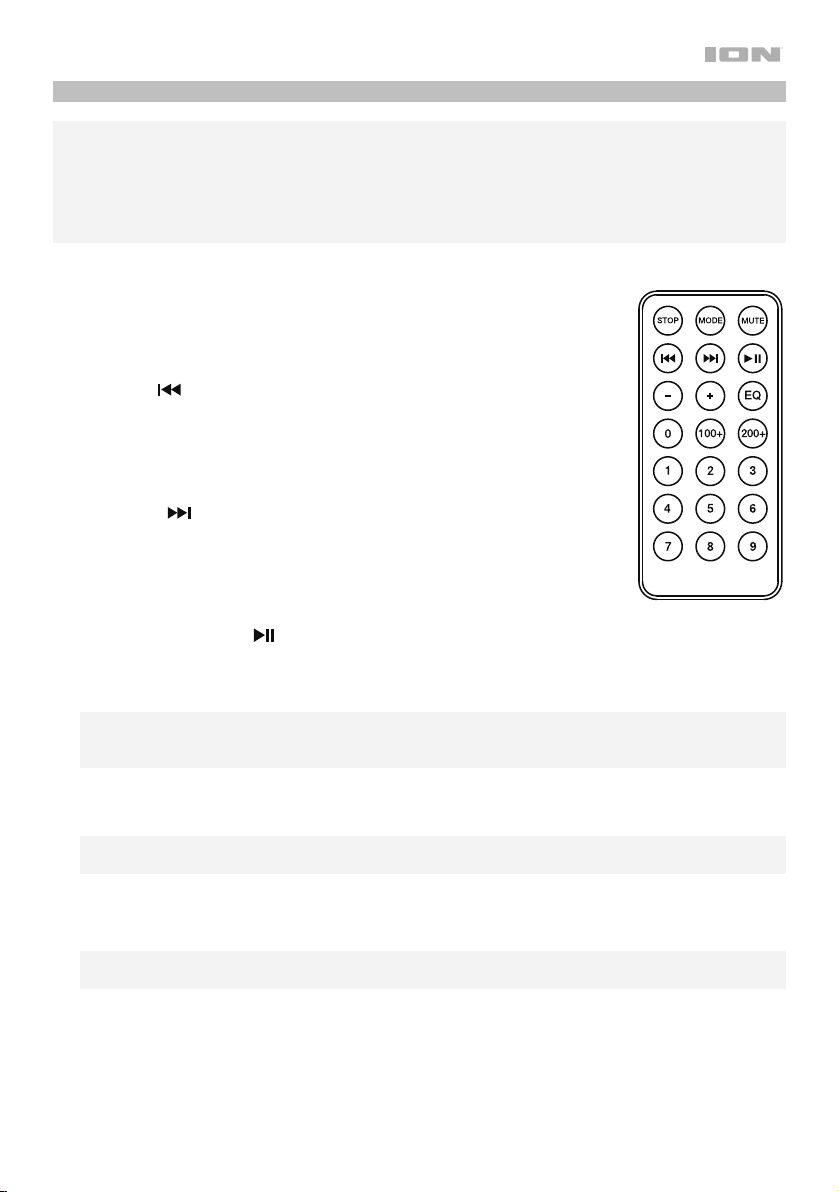
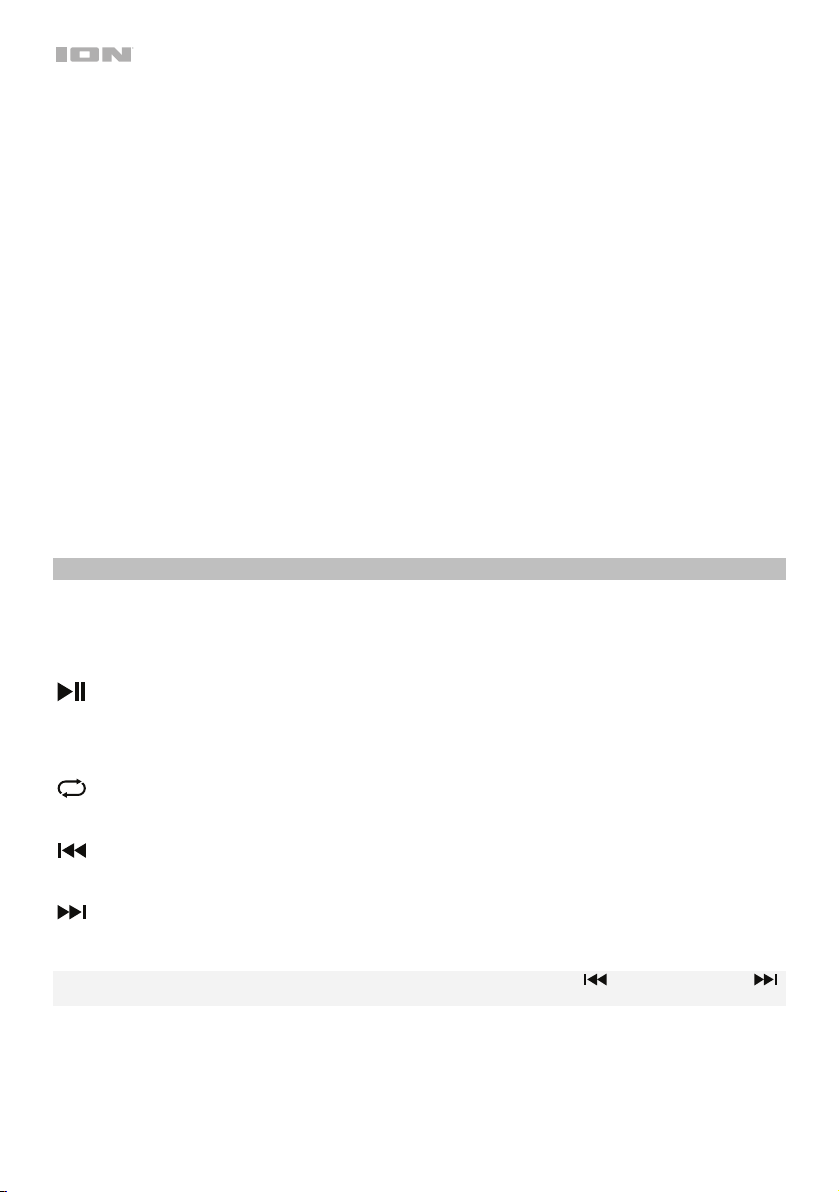
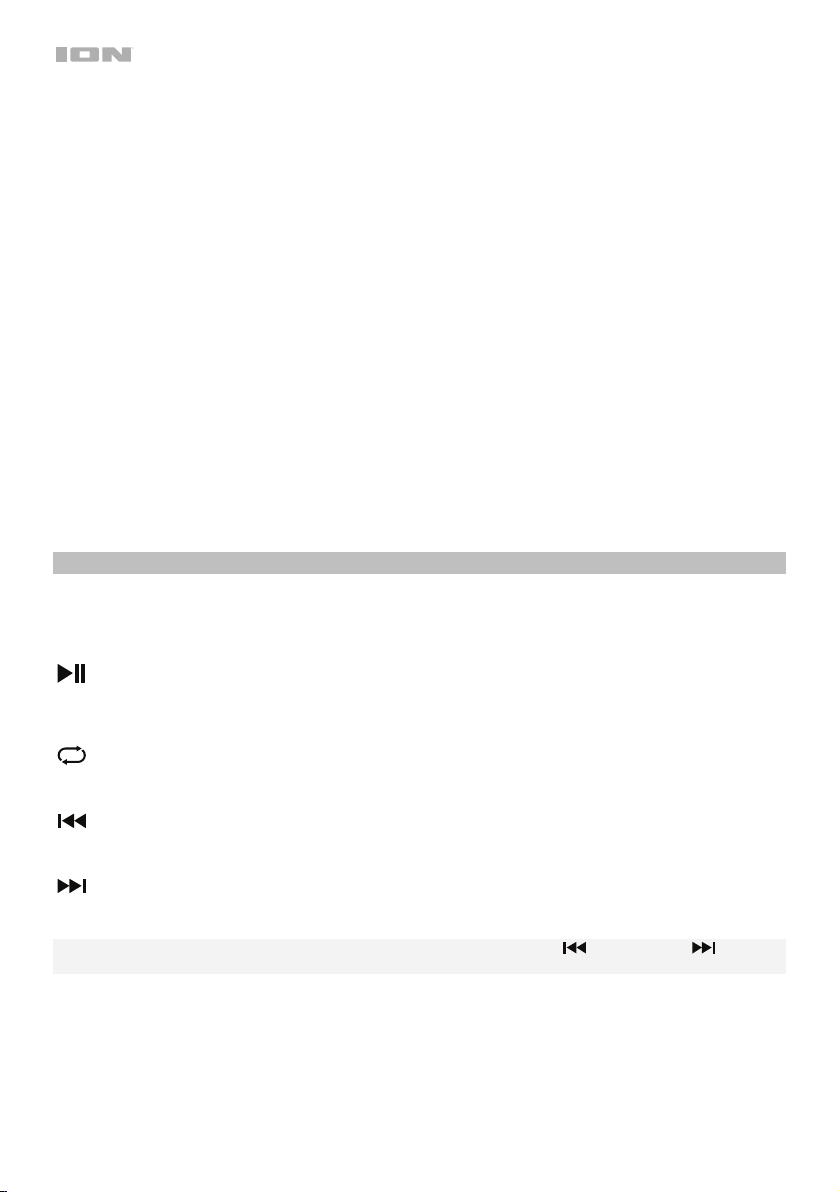
Media Panel
Media Panel Functions:
MODE Mode: Switches modes from USB, SD, FM radio (if applicable), or Bluetooth.
Play/Pause: Play/pause the USB, SD, or Bluetooth source. Press and hold Play/Pause for 2
seconds to begin the preset auto-store function (if applicable). This jumps to the lowest
station (87.5) and then travels through the bandwidth to auto-store the strongest stations as
presets.
Repeat: Repeat all of the tracks (ALL), repeat all of the tracks in the folder (FOLd
)
, repeat the
current playing USB or SD track (OnE), or shuffle the track order (rAn).
Previous: Plays the previous USB, SD, or Bluetooth track. When listening to the FM radio (if
applicable), press the button once to skip back through the FM stations and hold the button
down to seek back through the channel presets.
Next: Plays the next USB, SD, or Bluetooth track. When listening to the FM radio (if
applicable), press the button once to tune the radio down one preset and hold the button
down to seek forward through the channel presets.
Note: In some apps, pressing the Previous ( ) or Next ( ) buttons may go to another playlist or
music genre.
7
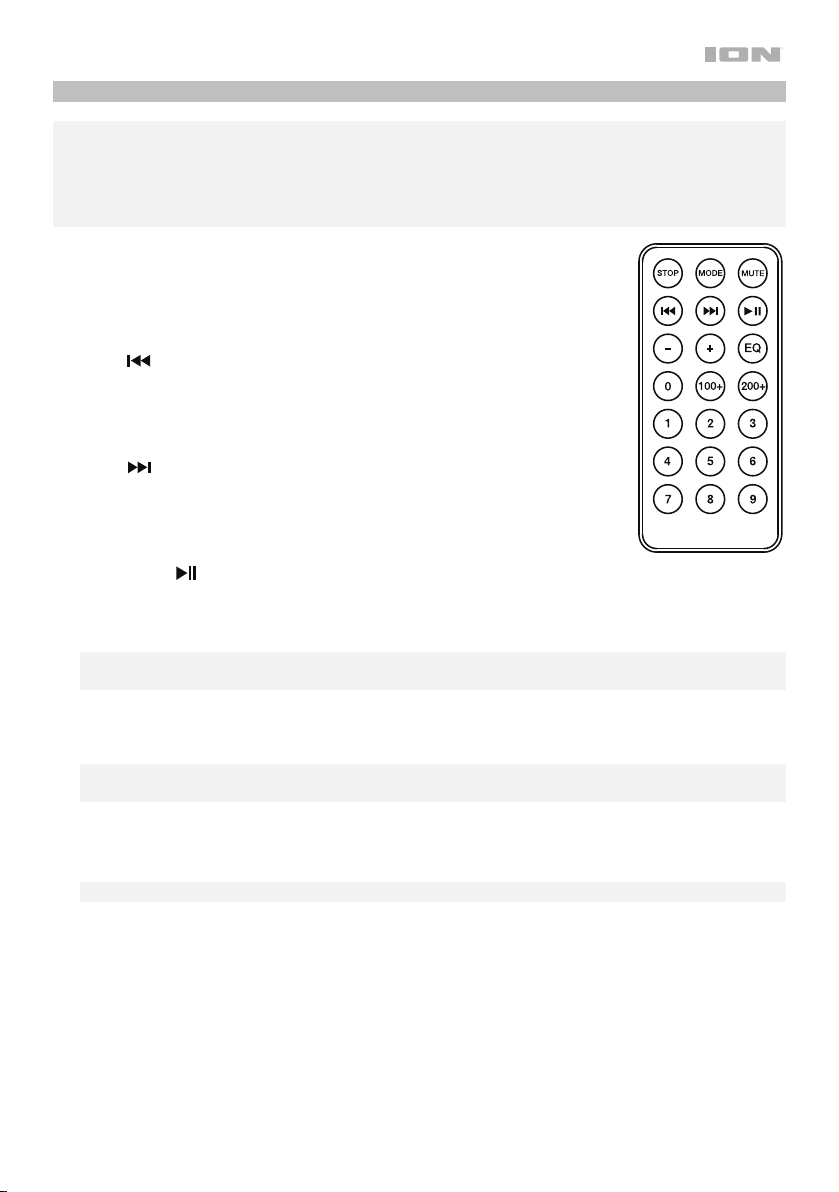
Media Panel Remote
Note: Aim the remote straight at the front of the speaker woofer. Room lighting and battery life can
affect the operating range of the remote control.
Note: In order to use the remote control for the first time, first pull out the tab attached to the battery
compartment. To change the remote battery, follow the diagram located on the back of the remote.
Use a 3 V DC CR2032 lithium button cell battery for replacement.
1. Stop: Stops the media panel source from playing.
2. Mode: Selects the media panel source: USB, SD, FM radio (if applicable), or
Bluetooth.
3. Mute: Silences the music playback on media panel sources.
4. Prev (
): Goes to the previous USB or SD card track. When listening to
Bluetooth sources, pressing Prev in some apps may go to another playlist
or music genre. When listening to the FM radio (if applicable), press the
Prev button once to skip back through the FM stations and hold the button
down to seek back through the channel presets.
5. Next (
): Advances to the next USB or SD card track. When listening to
Bluetooth sources, pressing Next in some apps may go to another playlist
or music genre. When listening to the FM radio (if applicable), press the
Next button once to tune the radio down one preset and hold the button
down to seek forward through the channel presets.
6. Play/Pause (
): Plays or pauses the USB, SD, or Bluetooth media panel source. Press and hold
Play/Pause for 2 seconds to begin the preset auto-store function (if applicable). This jumps to the
lowest station (87.5) and then travels through the FM band to auto-store the strongest stations as
presets.
Note: Files are played from the USB or SD source first by alphabetical order of what is on the root
level, then alphabetical by folder, and then alphabetical by the track name.
7. Vol –: Decreases the media panel source volume.
8. Vol +: Increases the media panel source volume.
Note: The remote volume only affects the media panel source and works together with the
physical media panel volume knob on the unit’s rear panel.
9. EQ: Selects one of the following digital EQ presets to use with a media panel source: Bass (BAS),
Pop (POP), Rock (rOC), Jazz (JA2), Classical (CLA), Country (COU), No EQ (OFF, factory default
setting).
Note: The digital EQ only works for Bluetooth, USB flash drive, and SD card sources.
10. 100+: Jumps ahead by 100 tracks.
11. 200+: Jumps ahead by 200 tracks.
12. Number Keys: Provides channel selection for FM radio stations (if applicable), and track selection
for USB and SD card sources.
8
Operation
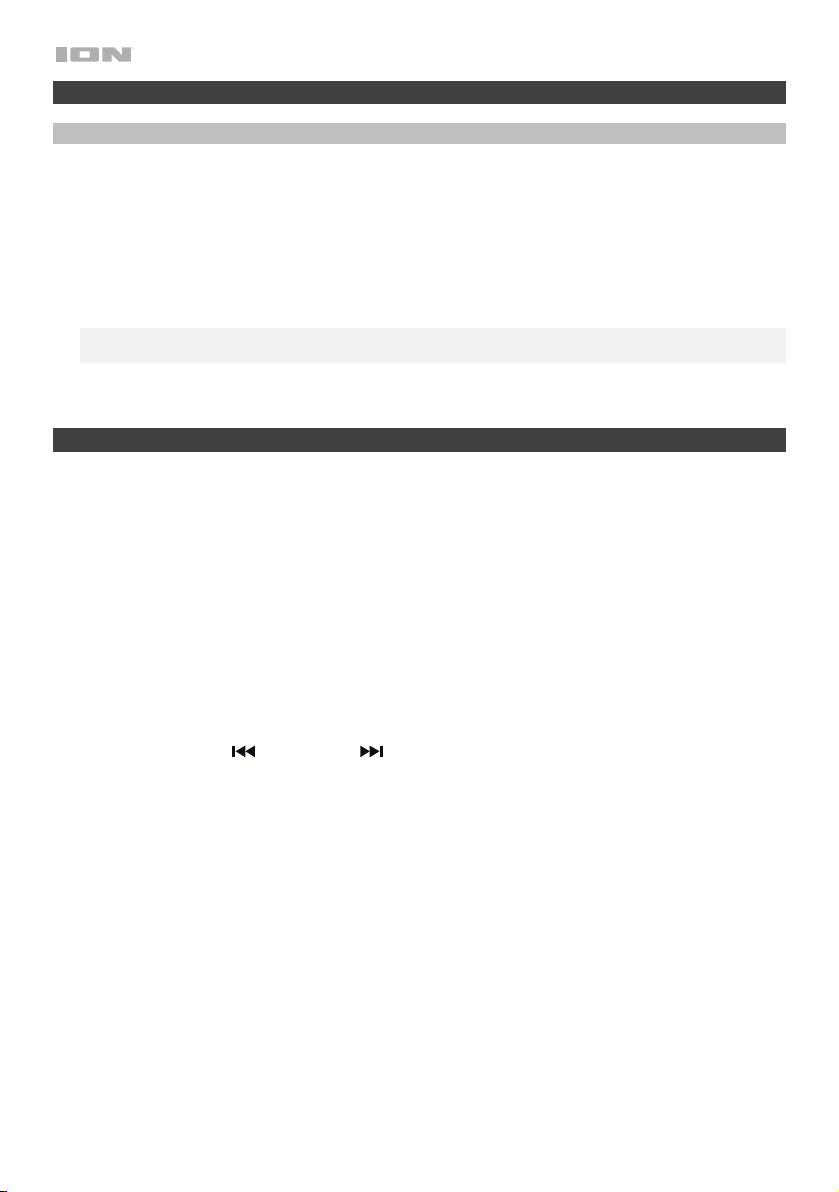
Pairing a Bluetooth Device
1. Turn on your Bluetooth device.
2. Power on Total PA Glow.
3. Use the Mode button to select Bluetooth mode, which appears as "bt" in the display. Total PA Glow will
automatically go into pairing mode to search for Bluetooth devices. You will know you are in pairing
mode when the Bluetooth icon is flashing.
4. Navigate to your Bluetooth device’s setup screen, find Total PA Glow, and connect. The Bluetooth
icon will remain solidly lit.
Note: Users should consider updating their device’s OS if experiencing trouble with pairing or playing
music.
5. To disconnect pairing, turn off Bluetooth on your device or select Forget this device from your device.
Troubleshooting
If the sound is distorted: Try lowering the volume control of your sound source or musical instrument. Also,
try to reduce the overall volume of Total PA Glow.
If there is too much bass: Try adjusting the tone or EQ control from Total PA Glow or your sound source to
lower the bass level. This will allow you to play the music louder before clipping (distortion) occurs.
If there is a high-pitched whistling noise when using a microphone: This is probably feedback. Point the
microphone away from the speaker.
If you can’t hear the microphone over the music volume: Turn down the music volume from your source.
When I press Previous ( ) or Next ( ), it doesn’t increment to the next FM station: Short presses of
the button will jump to presets. Hold the button down to seek to the next station. (If applicable)
If the radio station channel is flashing: The unit is currently muted. Unmute to stop the flashing and
resume playback.
If the Bluetooth logo is flashing rapidly: The unit is currently in pairing mode.
If the Bluetooth logo is flashing slowly: A device is paired, but the music is muted. Unmute to stop the
flashing and resume playback.
The USB track number (Example: 001) is flashing slowly: The USB drive music playback is muted.
Unmute to stop the flashing and resume playback.
The LCD shows “NONE”: The unit is in USB/SD mode, but there is no USB drive attached or no SD card
inserted.
9
Guía de inicio rápido (Español)
Introducción
1. Asegúrese de que todos los artículos indicados en Contenido de la caja estén incluidos en ella.
Localice las patas de goma del soporte del altavoz, la perilla de montaje del soporte del altavoz,
el cable de alimentación y el micrófono en la caja bajo la hoja de espuma de poliestireno.
2. Lea el folleto de instrucciones de seguridad antes de utilizar el producto.
3. Estudie el Diagrama de conexión.
4. Asegúrese de que todos los dispositivos de entrada tales como micrófonos y reproductores de
CD o reproductores de otros medios digitales estén apagados y con el control de volumen en
“cero”.
5. Conecte todos los dispositivos como se muestra.
6. Encienda todo en el siguiente orden:
• fuentes de entrada de audio (por ejemplo, micrófonos, instrumentos, reproductores de CD)
• Total PA Glow
7. Al apagar, realice siempre esta operación en forma inversa:
• Total PA Glow
• cualquier otro dispositivo de entrada
Contenido de la caja
Total PA Glow
Micrófono con cable de micrófono
Soporte de altavoz telescópico
Control remoto
Cable de corriente (IEC)
Guía de inicio rápido
Folleto de instrucciones de seguridad e información sobre la garantía
Soporte
Para obtener la información más completa acerca de este product (los requisitos del sistema,
compatibilidad, etc) y registro del producto, visite ionaudio.com.
Para obtener soporte adicional del producto, visite ionaudio.com/support.
Precaución: No exponga el Total PA Glow a lluvia ni lo coloque en agua.
10
TOTAL PA GLOW
Instalación rápida
Diagrama de conexión
Instalación del soporte de altavoz
1. Extienda completamente las patas del trípode del soporte del
altavoz sobre una superficie plana y estable. Localice las patas
de goma y la perilla de montaje del soporte del altavoz en los
contenidos de la caja bajo la hoja de espuma de poliestireno.
2. Extienda el poste de montaje hasta la altura necesaria y apriete
la perilla de ajuste del costado.
3. Inserte la clavija en el orificio inferior de manera que el poste de
montaje permanezca a la altura necesaria.
4. En el Total PA Glow, ajuste la perilla inferior en el sentido
contrario a las agujas del reloj de manera tal que el tornillo no
bloquee la apertura.
5. Alinee el orificio de montaje del Total PA Glow con el poste del
soporte del altavoz y colóquelo en el poste.
6. Apriete la perilla de montaje en el Total PA Glow en el sentido
de las agujas del reloj.
3 45/6
2
1
Los elementos que no se
enumeran en Introducción >
Contenido de la caja se
venden por separado.
Tableta
Micrófonos
Tarjeta SD
Unidad flash USB
Teléfono
inteligente
(smartphone)
Alimentación

11
Características
Panel trasero
1. Panel de medios: Controles para fuentes de USB, SD,
radio FM (si es aplicable) y Bluetooth. El símbolo de fuente
del modo panel de medios se iluminará cuando se esté
reproduciendo esa fuente.
2. Puerto USB: Conecte su unidad flash USB para reproducir
música.
3. Ranura para tarjeta SD: Inserte su tarjeta SD aquí.
4. Pantalla: Muestra los modos del panel de medios para
USB, SD, radio FM (si es aplicable) y Bluetooth.
Nota: La pantalla viene con un protector de plástico
adherido. Quítelo para visualizar el LCD de manera óptima.
5. Entradas micrófono (6,35 mm/1/4 pulg. y XLR): Conecte
un micrófono dinámico a las entradas de XLR o 6,35 mm
(1/4 pulg.). Controle el volumen de las entradas XLR y 6,35
mm (1/4 pulg.) mediante la perilla de volumen de entradas
micrófono.
6. Volumen de entradas micrófono: Gire esta perilla para
ajustar el volumen de las entradas micrófono.
7. Entrada auxiliar (3,5 mm/1/8 pulg.): Conecte a esta
entrada auxiliar estéreo de 3,5 mm (1/8 pulg.) un
reproductor de CD, un reproductor de medios digitales u
otra fuente de audio. Controle el volumen de salida
mediante la perilla de volumen de entrada auxiliar.
8. Entrada línea (XLR): Conecte un nivel de línea mezclador
o instrumento musical a esta entrada XLR de nivel de línea.
Controle el volumen de la salida mediante la perilla
volumen de entrada auxiliar. Utilice esta entrada de nivel
de línea para vincular dos unidades Total PA Glow entre sí.
9. Entradas RCA: Conecte a estas entradas un reproductor
de CD, un reproductor de medios digitales, un mezclador u
otras fuentes de medios. Controle el volumen de salida
mediante la perilla volumen de entrada auxiliar.
10. Volumen de entrada auxiliar: Gire esta perilla para ajustar
el volumen de la entrada auxiliar, la entrada línea y las
entradas RCA.
11. Salida de mezcla (XLR): Conecte esta salida XLR a otro altavoz activo (alimentado). El nivel de esta
salida se controla mediante el ajuste de volumen de entradas micrófono, volumen de entrada
auxiliar y volumen maestro.
12. Micrófono Eco: Use esta perilla para agregar o quitar un efecto de eco a las entradas de micrófono.
13. Ecualización de agudos: Aumenta o disminuye las frecuencias altas (agudos) para las entradas
micrófono y línea y las fuentes del panel de medios en un rango entre -12 dB y +12 dB.
14. Ecualización de graves: Aumenta o disminuye las frecuencias bajas (graves) para las entradas
micrófono y línea y las fuentes del panel de medios en un rango entre -12 dB y +12 dB.
15. Volumen maestro (Master Volume): Gire esta perilla para ajustar el volumen de salida del altavoz Total
PA Glow.
TOTAL PA GLOW
1
2
3
4
5
5
5
9
8
5
7
10
11
12
13
14
15
17
21
16
6
6
18
19
20
12
16. LED de recorte: Este LED destella con luz roja si la señal de las entradas o de la entrada del
panel de medios se está recortando. Si este ocurre, disminuya el ajuste de las perillas de
volumen de entradas micrófono, volumen de entrada auxiliar o volumen maestro.
17. LED de encendido: Indica si el Total PA Glow está encendido o apagado.
18. Botón de modo de luz: Pulse este botón para seleccionar el funcionamiento de las luces del
panel frontal:
• Ciclo de color: Las luces brillan suavemente y cambian de un color a otro. Mantenga
pulsado el botón de modo para congelar las luces en un color. Este es el modo
predeterminado la primera vez que se enciende el Total PA Glow.
• Sincronización con el ritmo: Las luces reaccionan al ritmo de la música.
• Apagadas: Las luces se apagan.
19. Entrada del cable de corriente (IEC): Inserte aquí el cable de corriente incluido para alimentar la
unidad.
20. Fusible: La orientación del portafusibles determina el ajuste de voltaje actual del Total PA Glow.
El ajuste actual se muestra encima del triángulo blanco (): 110–120 V o 220–240 V. Si utiliza el
Total PA Glow en una región con voltaje diferente, cambie el ajuste de voltaje extrayendo el
portafusibles, invirtiéndolo y volviéndolo a insertar.
Si el fusible de la unidad está roto, levante esta lengüeta para reemplazar el fusible. Reemplácelo
por un fusible con especificación apropiada (impresa debajo de la entrada del cable de
alimentación de la unidad). Si utiliza un fusible de especificación incorrecta, puede dañarse la
unidad y/o el fusible.
21. Interruptor de encendido/apagado: Enciende y apaga el Total PA Glow.
Panel de medios
Funciones del panel de medios:
MODE Modo: Conmuta entre los modos USB, SD, radio FM (si es aplicable), o Bluetooth.
Reproducir/Pausa: Reproducir/hacer pausa en la fuente USB, SD o Bluetooth. Mantenga
pulsado reproducir/pausa durante 2 segundos para iniciar la función de autoguardado del
preset (si es aplicable). Esto salta hasta la estación más baja (87,5) y avanza por la banda de
FM para guardar las estaciones más fuertes como presets.
Repetir: Repetir todas las pistas (ALL), repetir todas las pistas en la carpeta (FOLd
)
, repetir
la pista USB o SD que está sonando actualmente (OnE
)
o entremezclar el orden de los
temas (rAn).
Anterior: Reproduce la pista de USB, SD o Bluetooth anterior. Cuando escucha radio FM
(si es aplicable), pulse el botón una vez para saltar por las estaciones de radio FM hacia
atrás y mantenga este botón pulsado para recorrer los presets de canales hacia atrás.
Siguiente: Reproduce la pista de USB, SD o Bluetooth siguiente. Cuando escucha radio
FM (si es aplicable), pulse el botón una vez para saltar por las estaciones de radio FM hacia
adelante y mantenga este botón pulsado para recorrer los presets de canales hacia
adelante.
Nota: En algunas aplicaciones, pulsar los botones Anterior ( ) o Siguiente ( ) hará que vaya a
otra lista de reproducción o género musical.
13
Control remoto del panel de medios
Nota: El símbolo de fuente del modo panel de medios se iluminará cuando se esté reproduciendo
esa fuente. La iluminación de la sala y la vida útil de la pila pueden afectar al alcance operacional del
control remoto.
Nota: A fin de usar el control remoto por primera vez, extraiga primero la lengüeta fijada al
compartimiento de las pilas. Para cambiar la batería del control remoto, siga el diagrama ubicado en
el reverso del mismo. Utilice una pila de celda tipo botón de litio CR2032 de 3 VDC como reemplazo.
1. Detener: Detiene la reproducción de la fuente del panel de medios.
2. Modo: Selecciona la fuente del panel de medios: USB, SD, Bluetooth o
radio FM (si es aplicable).
3. Silenciar: Silencia la reproducción de música de las fuentes del panel de
medios.
4. Anterior (
): Retrocede a la pista anterior del USB o tarjeta SD. Al
escuchar de fuentes Bluetooth, pulsar Anterior en algunas aplicaciones
puede hacer que vaya a otra lista de reproducción o género musical.
Cuando escucha radio FM (si es aplicable), pulse el botón Anterior una vez
para saltar por las estaciones de radio FM hacia atrás y mantenga este
botón pulsado para recorrer los presets de canales hacia atrás.
5. Siguiente (
): Avanza a la pista siguiente del USB o tarjeta SD. Al
escuchar de fuentes Bluetooth, pulsar Siguiente en algunas aplicaciones
puede hacer que vaya a otra lista de reproducción o género musical.
Cuando escucha radio FM (si es aplicable), pulse el botón Siguiente una
vez para saltar por las estaciones de radio FM hacia adelante y mantenga
este botón pulsado para recorrer los presets de canales hacia adelante.
6. Reproducción/Pausa (
): Reproduce/hace pausa en la fuente de USB,
SD o Bluetooth del Media Panel. Mantenga pulsado reproducir/pausa durante 2 segundos para
iniciar la función de autoguardado del preset (si es aplicable). Esto salta hasta la estación más
baja (87,5) y avanza por la banda de FM para guardar las estaciones más fuertes como presets.
Nota: Los archivos se reproducen desde la fuente USB o SD primero alfabéticamente según el
contenido de la raíz, luego alfabéticamente según la carpeta y luego alfabéticamente según el
nombre de la pista.
7. Volumen –: Disminuye el volumen de la fuente del panel de medios.
8. Volumen +: Aumenta el volumen de la fuente del panel de medios.
Nota: El volumen del control remoto solo afecta la fuente del panel de medios y funciona junto
con la perilla de volumen físico del panel de medios en el panel trasero de la unidad.
9. Ecualizador: Selecciona uno de los siguiente presets de ecualizador digital para utilizar con una
fuente del panel de medios: Graves (BAS), Pop (POP), Rock (rOC), Jazz (JA2), Clásica (CLA),
Country (COU), Sin ecualización (OFF, ajuste predeterminado de fábrica).
Nota: El ecualizador digital solamente funciona para fuentes Bluetooth, unidades de memoria
USB y tarjetas SD.
10. 100+: Saltar 100 pistas hacia adelante.
11. 200+: Saltar 200 pistas hacia adelante.
12. Teclas numéricas: Permite la selección de canales para estaciones de radio FM (si son
aplicables) y la selección de pistas para fuentes de tarjeta SD/USB.
14
Funcionamiento
Apareamiento de un dispositivo Bluetooth
1. Encienda su dispositivo Bluetooth.
2. Encienda el Total PA Glow.
3. Use el botón Mode para seleccionar el modo Bluetooth, el cual se muestra como "bt" en la pantalla.
Total PA Glow entrará automáticamente al modo de apareamiento para buscar dispositivos Bluetooth.
Se dará cuenta de que está en modo de apareamiento cuando el icono Bluetooth esté parpadeando.
4. Navegue a la pantalla de configuración de su dispositivo Bluetooth, busque Total PA Glow y realice la
conexión. El icono Bluetooth permanecerá encendido.
Nota: Los usuarios deben considerar la actualización del sistema operativo (OS) de su dispositivo si
experimentan problemas con el apareamiento o la reproducción de música.
5. Para desconectar el apareamiento, apague el Bluetooth de su dispositivo o seleccione Olvidar este
dispositivo (Forget this device) en su dispositivo.
Solución de problemas
Si el sonido está distorsionado: Pruebe bajando el control de volumen de su fuente de sonido o
instrument musical. Pruebe también reduciendo el volumen general del Total PA Glow.
Si los graves son demasiado fuertes: Intente ajustando el control de tono o ecualización de su Total PA
Glow o fuente de sonido para reducir el nivel de graves. De esta forma podrá reproducir la música con más
volumen antes de que se produzca el recorte (distorsión).
Si hay un silbido agudo cuando se usa un micrófono: Probablemente sea realimentación. Apunte el
micrófono apartándolo del altavoz.
Si no puede oír el micrófono por arriba del volumen de la música: Disminuya el volumen de la música en
su fuente.
Cuando pulso Anterior ( ) o Siguiente ( ) no pasa a la siguiente estación FM: Con pulsaciones
breves de este botón se salta a los presets. Mantenga pulsado este botón para buscar la estación
siguiente. (Si es aplicable.)
Si el canal de la estación de radio parpadea: la unidad está silenciada. Anule el silenciamiento para
detener el parpadeo y continuar la reproducción.
Si el logo Bluetooth parpadea rápidamente: la unidad está en modo de apareamiento.
Si el logo Bluetooth parpadea lentamente: el dispositivo está apareado, pero la música está silenciada.
Anule el silenciamiento para detener el parpadeo y continuar la reproducción.
El n° de pista USB (Por ejemplo: 001) parpadea lentamente: la reproducción de música de la unidad USB
está silenciada. Anule el silenciamiento para detener el parpadeo y continuar la reproducción.
Aparece “NONE” en el LCD: la unidad está en modo USB/SD, pero no hay ninguna unidad USB o tarjeta
SD insertada.
15
Guide d'utilisation rapide (Français)
Présentation
1. Assurez-vous que tous les articles énumérés dans le Contenu de la boîte de ce guide sont inclus
dans la boîte. Dans la boîte, sous la feuille de polystyrène se trouvent les pieds en caoutchouc et
le bouton du support de l'enceinte, le câble d'alimentation et le microphone.
2. Veuillez lire le livret des consignes de sécurité avant d'utiliser le produit.
3. Veuillez examiner le Schéma de connexion.
4. Veuillez vous assurer que tous les appareils d'entrée tels que microphones, lecteurs de disques
compacts ou lecteurs multimédia numériques raccordés sont éteints et que leur volume est à
« zéro ».
5. Veuillez raccorder tous les appareils comme indiqué sur le schéma.
6. Mettez tous les appareils sous tension dans l'ordre suivant :
• sources d'entrée audio (p. ex., microphones, instruments, lecteurs de disques compacts)
• Total PA Glow
7. Pour mettre hors tension, toujours inversez l'opération :
• Total PA Glow
• sources d’entrée audio
Contenu de la boîte
Total PA Glow
Microphone avec câble
Support télescopique
Télécommande
Câble d'alimentation (IEC)
Guide d'utilisation rapide
Consignes de sécurité et information concernant la garantie
Assistance
Pour les dernières informations concernant ce produit (la configuration système minimale requise, la
compatibilité, etc) et l'enregistrement du produit, veuillez visitez le site ionaudio.com.
Pour de l'assistance supplémentaire, veuillez visiter ionaudio.com/support.
Mise en garde : Ne pas exposer le Total PA Glow aux intempéries ou reposer dans l'eau.
16
TOTAL PA GLOW
Démarrage rapide
Schéma de connexion
Installation du support pour enceinte
1. Déployez entièrement les pieds du support sur une surface plate
et stable. Dans la boîte, sous la feuille de polystyrène se trouvent
les pieds en caoutchouc et le bouton du support de l'enceinte.
2. Allongez la perche télescopique du support à la hauteur
appropriée et serrez la vis latérale.
3. Introduisez la goupille dans le trou inférieur de la perche afin
qu'elle demeure à la hauteur désirée.
4. Serrez la vis inférieure de la Total PA Glow dans le sens
antihoraire afin qu'elle ne bloque pas l'ouverture.
5. Alignez le trou de fixation de la Total PA Glow à la perche du
support et placez l'enceinte sur la perche.
6. Serrez la vis de fixation de la Total PA Glow dans le sens horaire.
3 45/6
2
1
Les éléments qui ne figurent
pas dans Présentation >
Contenu de la boîte sont
vendus séparément.
Tablette
Microphones
Carte mémoire SD
Clé USB
Téléphone
intelligente
(smartphone)
Alimentation
17
Caractéristiques
Panneau arrière
1. Panneau des médias : Commandes pour les sources USB,
SD, radio FM (le cas échéant) et Bluetooth. Le symbole du
panneau des médias s'allume lorsque cette source est en
cours de lecture.
2. Port USB : Ce port permet de brancher une clé USB pour
écouter de la musique.
3. Emplacement pour carte mémoire SD : Inserez une carte
SD dans cet emplacement.
4. Écran : Affiche les modes de fonctionnement de
l’enceinte pour USB, SD, radio FM (le cas échéant) et
Bluetooth.
Remarque : Un film de protection en plastique recouvre
l'écran. Retirez-le pour un affichage optimal.
5. Entrées microphone (6,35 mm et XLR) : Ces entrées
permettent de brancher un microphone électrodynamique.
Le volume des entrées XLR et 6,35 mm est commandé par
le bouton volume des entrées microphone.
6. Volume des entrées microphone : Ces commandes
permettent d'ajuster le volume des entrées du
microphone.
7. Entrée auxiliaire (3,5 mm) : Cette entrée stéréo 3,5 mm
permet de brancher un lecteur de disques compacts, un
lecteur multimédia ou autres sources audio. Le niveau de
cette entrée est commandé par le bouton volume d'entrée
auxiliaire.
8. Entrée ligne (XLR) : Cette entrée à niveau ligne et XLR
permet de brancher une niveau ligne console de mixage ou
un instrument de musique. Le niveau de cette entrée est
commandé par le bouton volume d'entrée auxiliaire.
Utilisez cette entrée à niveau ligne afin de relier deux
enceintes Total PA Glow.
9. Entrées RCA : Ces entrées permettent de brancher un
lecteur de disques compacts, un lecteur multimédia, une
console de mixage ou autres sources audio. Le niveau de
ces entrées est commandé par le bouton volume d'entrée
auxiliaire.
10. Volume d'entrée auxiliaire : Cette commande permet d'ajuster le volume d'entrée auxiliare, entrée
ligne et entrées RCA.
11. Sortie mix (XLR) : Cette sortie XLR permet de brancher une autre enceinte amplifiée. Le volume est
commandé par les réglages volume des entrées microphone, volume d'entrée auxiliaire et volume
principal.
12. Mic Echo : Ce bouton de réglage permet d'ajouter ou de supprimer un effet d'écho au entrées
microphone.
13. Égalisation des hautes fréquences : Augmente ou diminue les hautes fréquences pour les sources
des entrées microphone, ligne et panneau des médias entre -12 dB à +12 dB.
14. Égalisation des basses fréquences : Augmente ou diminue les basses fréquences pour les sources
des entrées microphone, ligne et panneau des médias entre -12 dB à +12 dB.
TOTAL PA GLOW
1
2
3
4
5
5
5
9
8
5
7
10
11
12
13
14
15
17
21
16
6
6
18
19
20
18
15. Volume principal : Cette commande permet d'ajuster le volume principal du haut-parleur Total PA
Glow.
16. Témoin d'écrêtage : En présence d'écrêtage du signal des entrées ou du panneau des médias, le
voyant DEL clignote. Pour remédier à l'écrêtage, diminuez le réglage des boutons volume des entrées
microphone, volume d'entrée auxiliaire et volume principal.
17. Témoin d'alimentation DEL : Indique si l'enceinte Total PA Glow est sous ou hors tension.
18. Touche de mode d'éclairage : Appuyez sur ce bouton pour sélectionner la façon dont les lumières du
panneau avant fonctionnent :
• Color Cycle : Les lumières brillent et défilent à travers toutes les couleurs. Maintenez la touche du
mode d'éclairage enfoncée afin que les lumières s'allument d'une seule couleur. C'est le mode par
défaut lors de la mise sous tension initiale de la Total PA Glow.
• Beat Sync : Les lumières se synchronisent au rythme de la musique.
• Off : Les lumières sont éteintes.
19. Câble d'alimentation (IEC) : Branchez le câble d'alimentation inclus ici afin d'alimenter l'appareil.
20. Fusible : L'orientation du porte-fusible détermine le réglage de tension de la Total PA Glow. Le réglage
de la tension est affiché au-dessus du triangle blanc () : 110 – 120 V ou 220 – 240 V. Si vous utilisez la
Total PA Glow dans une région qui utilise une tension différente, vous devez changer la tension en
retirant le porte-fusible, en l’inversant et le réinsérant.
Si le fusible de l'appareil est endommagé, soulevez cette languette afin de remplacer le fusible.
Remplacez-le par un fusible de calibre approprié (imprimé sous l'entrée d'alimentation de l'appareil).
L'utilisation d’un fusible de calibre inapproprié pourrait endommager l'appareil et/ou le fusible.
21. Interrupteur d'alimentation : Cet interrupteur met la Total PA Glow sous et hors tension.
Panneau des médias
Fonctions du panneau des médias :
MODE Mode : Permet de changer le mode de fonctionnement : USB, SD, radio FM (le cas échéant) et
Bluetooth.
Lecture/Pause : Cette touche permet de lancer ou d'interrompe la lecture de la source Bluetooth,
USB ou de la carte SD. Maintenez la touche de lecture/pause pendant 2 secondes afin d'amorcer
la fonction d'enregistrement automatique des stations préréglées (le cas échéant). Ceci permet de
balayer la bande FM, en commencer par la station radio la plus basse (87,5), afin d'enregistrer les
stations ayant un signal plus fort.
Répéter : Cette touche permet de répéter toutes les pistes (ALL), toutes les pistes dans le dossier
(FOLd), la piste en cours (OnE), ou toutes les pistes de manière aléatoire (rAn) de la source USB
ou de la carte SD en cours de lecture.
Précédente : Cette touche permet de faire jouer la piste USB, SD ou Bluetooth précédente. Durant
l'écoute de la radio FM (le cas échéant), appuyer une fois sur cette touche permet de passer à la
station FM précédente et la maintenir enfoncée permet de passer au canal préréglé précédent.
Suivante : Cette touche permet de faire jouer la piste USB, SD ou Bluetooth suivante. Durant
l'écoute de la radio FM (le cas échéant), appuyer une fois sur cette touche permet de passer à la
station FM suivante et la maintenir enfoncée permet de passer au canal préréglé suivant.
Remarque : Dans certaines applications, les touches piste précédente ( ) et piste suivante ( )
permettent de passer à la liste de lecture ou le genre de musique suivant ou précédent.
19
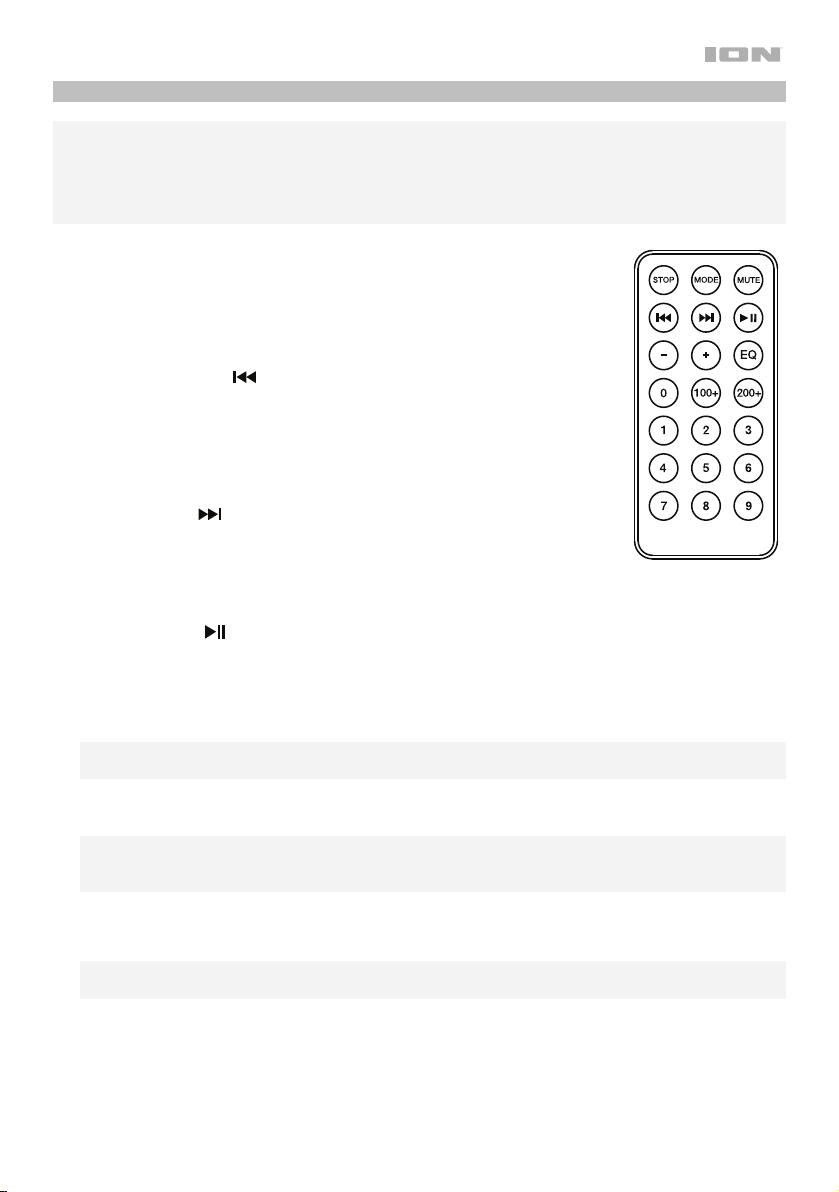
Télécommande du panneau des médias
Remarque : Pointez la télécommande vers le haut-parleur d'extrêmes graves de l'enceinte. L'éclairage
de la pièce et la charge de la pile peuvent affecter la plage de fonctionnement de la télécommande.
Remarque : Avant d'utiliser la télécommande pour la première fois, retirez la languette du
compartiment à pile. Pour changer la pile de la télécommande, suivez le schéma situé à l'arrière de la
télécommande. Utilisez une pile de rechange au lithium CR2032 de 3 V CC.
1. Stop : Cette touche permet d'arrêter la lecture de la source du panneau
des médias.
2. Mode : Cette touche permet de sélectionner la source du panneau des
médias : USB, SD, Bluetooth ou radio FM (le cas échéant).
3. Mute : Cette touche permet de mettre en sourdine le signal audio des
sources du panneau des médias.
4. Piste précédente (
) : Cette touche permet de passer à la piste
précédente de la source USB ou de la carte SD. Sur des sources
Bluetooth, cette touche permet de passer à d'autres listes de lecture ou de
genre musical, selon l'application. Durant l'écoute de la radio FM (le cas
échéant), appuyer une fois sur cette touche permet de passer à la station
FM précédente et la maintenir enfoncée permet de passer au canal
préréglé précédent.
5. Piste suivante (
) : Cette touche permet de passer à la piste suivante de
la source USB ou de la carte SD. Sur des sources Bluetooth, cette touche
permet de passer à d'autres listes de lecture ou de genre musical, selon
l'application. Durant l'écoute de la radio FM (le cas échéant), appuyer une
fois sur cette touche permet de passer à la station FM suivante et la
maintenir enfoncée permet de passer au canal préréglé suivant.
6. Lecture/Pause (
) : Cette touche permet de lancer ou d'interrompe la lecture de la source
Bluetooth, USB ou de la carte SD du panneau des médias. Maintenez la touche de
lecture/pause/d'appel-réponse pendant 2 secondes afin d'amorcer la fonction d'enregistrement
automatique des stations préréglées (le cas échéant). Ceci permet de balayer la bande FM, en
commencer par la station radio la plus basse (87,5), afin d'enregistrer les stations ayant un signal
plus fort.
Remarque : Les fichiers sont lus de la source USB et de la carte SD en ordre alphabétique, en
partant du répertoire racine, puis du dossier et ensuite par le nom de la piste.
7. Vol – : Cette touche permet de diminuer le volume de la source du panneau des médias.
8. Vol + : Cette touche permet d’augmenter le volume de la source du panneau des médias.
Remarque : Les commandes volume de la télécommande affectent uniquement le volume de la
source du panneau des médias et fonctionnent conjointement avec le bouton volume matériel du
panneau des médias du panneau arrière de l'appareil.
9. EQ : Cette touche permet de sélectionner un des préréglages d'égalisation numérique suivants à
utiliser avec une source du panneau des médias : Basses (BAS), Pop (POP), Rock (rOC), Jazz
(JA2), Classique (CLA), Country (COU), Aucune égalisation appliquée (OFF, réglages d’usine).
Remarque : L'égalisation numérique fonctionne uniquement pour les sources Bluetooth, les clés
USB et les cartes SD.
10. 100+ : Cette touche permet d'effectuer un saut de 100 pistes.
11. 200+ : Cette touche permet d'effectuer un saut de 200 pistes.
12. Touches numériques : Ces touches permettent de sélectionner le canal pour les stations de
radio FM (le cas échéant) et de sélectionner les pistes des clés USB et des cartes SD.
20
Fonctionnement
Jumelage d'un appareil Bluetooth
1. Mettez votre appareil Bluetooth sous tension.
2. Mettez l'enceinte Total PA Glow sous tension.
3. Utilisez le bouton Mode pour sélectionner le mode Bluetooth qui s’affichera comme « bt ». La Total PA
Glow passera automatiquement en mode jumelage afin de rechercher les appareils Bluetooth. Vous
saurez que le mode jumelage est activé lorsque l’icône Bluetooth clignotera.
4. Accédez à l'écran de configuration de votre appareil Bluetooth, recherchez « Total PA Glow » et lancez
le jumelage. L'icône Bluetooth demeurera allumée.
Remarque : Veuillez mettre à jour le système d'exploitation de votre appareil si vous éprouvez des
problèmes durant le jumelage ou lors de la lecture de musique.
5. Pour supprimer la connexion, désactivez la fonction Bluetooth sur votre appareil ou sélectionnez
Oublier cet appareil.
Dépannage
Lorsqu'il y a de la distorsion : Essayez de diminuer le volume sur l'appareil d'entrée audio ou l'instrument
de musique. Essayez également de diminuer le volume de la Total PA Glow.
Lorsqu'il y a trop de basses fréquences : Essayez de régler le niveau de tonalité et d'égalisation de la
Total PA Glow ou de la source d'entrée audio afin de diminuer le niveau des basses fréquences. Cela vous
permettra d'augmenter le volume de la musique avant que l'écrêtage se produise.
Lorsqu'il y a un sifflement aigu lors de l'utilisation d'un microphone : Ceci est probablement causé par
la rétroaction (effet Larsen). Dirigez le microphone loin de l'enceinte.
Si vous ne pouvez entendre le microphone à cause du volume trop élevé de la musique : Baissez le
volume de la musique provenant de la source.
Lorsque j'appuie sur la touche piste précédente ( ) ou piste suivante ( ), le module ne passe pas
à la station FM suivante : Appuyer sur les touches permet de sauter au préréglage suivant ou précédent.
Maintenir la touche enfoncée permet de rechercher la station de radio suivante ou précédente. (Le cas
échéant.)
Si le canal de la station de radio clignote : l'appareil est en mode en sourdine. Désactivez la mise en
sourdine afin d'arrêter le clignotement et reprendre la lecture.
Si le logo Bluetooth clignote rapidement : l'appareil est en mode de jumelage.
Si le logo Bluetooth clignote lentement : un appareil est jumelé, mais la musique a été mise en sourdine.
Désactivez la mise en sourdine afin d'arrêter le clignotement et reprendre la lecture.
Le numéro de piste USB (exemple : 001) clignote lentement : la lecture de la musique de la source USB a
été mise en sourdine. Désactivez la mise en sourdine afin d'arrêter le clignotement et reprendre la lecture.
Si l'écran à cristaux liquides affiche « NONE » : l'appareil est en mode d'USB/SD, mais aucune clé USB
ou carte SD n'est insérée dans l'appareil.
21
Guida rapida (Italiano)
Introduzione
1. Assicurarsi che tutti gli elementi elencati nel paragrafo Contenuti della confezione siano
contenuti nella confezione stessa. Guarda nella scatola sotto il foglio in polistirolo per trovare i
piedini in gomma del supporto dell'altoparlante, la manopola di montaggio del supporto
dell'altoparlante, il cavo di alimentazione e il microfono.
2. Leggere attentamente il libretto delle istruzioni di sicurezza prima di utilizzare il prodotto.
3. Studiare lo Schema dei collegamenti.
4. Assicurarsi che tutti i dispositivi di ingresso quali microfoni, lettori CD o lettori digitali siano spenti
e che i relativi volumi siano su “zero”.
5. Collegare tutti i dispositivi come illustrato.
6. Accendere tutto nel seguente ordine:
• Sorgenti di ingresso audio (microfoni, strumenti, lettori CD)
• Total PA Glow
7. Al momento dello spegnimento, invertire questa operazione spegnendo:
• Total PA Glow
• Qualsiasi dispositivo di ingresso
Contenuti della confezione
Total PA Glow
Microfono con cavo
Supporto telescopico per altoparlante
Telecomando
Cavo di alimentazione (IEC)
Guida rapida
Istruzioni di sicurezza e garanzia
Assistenza
Per conoscere le ultime informazioni in merito a questo prodotto (i requisiti di sistema complete,
compatibilità, ecc) e per la registrazione del prodotto, recarsi alla pagina ionaudio.com.
Per ulteriore assistenza sul prodotto, recarsi alla pagina ionaudio.com/support.
Attenzione! Non esporre il Total PA Glow alla pioggia né immergerlo in acqua.
22
Inizio rapido
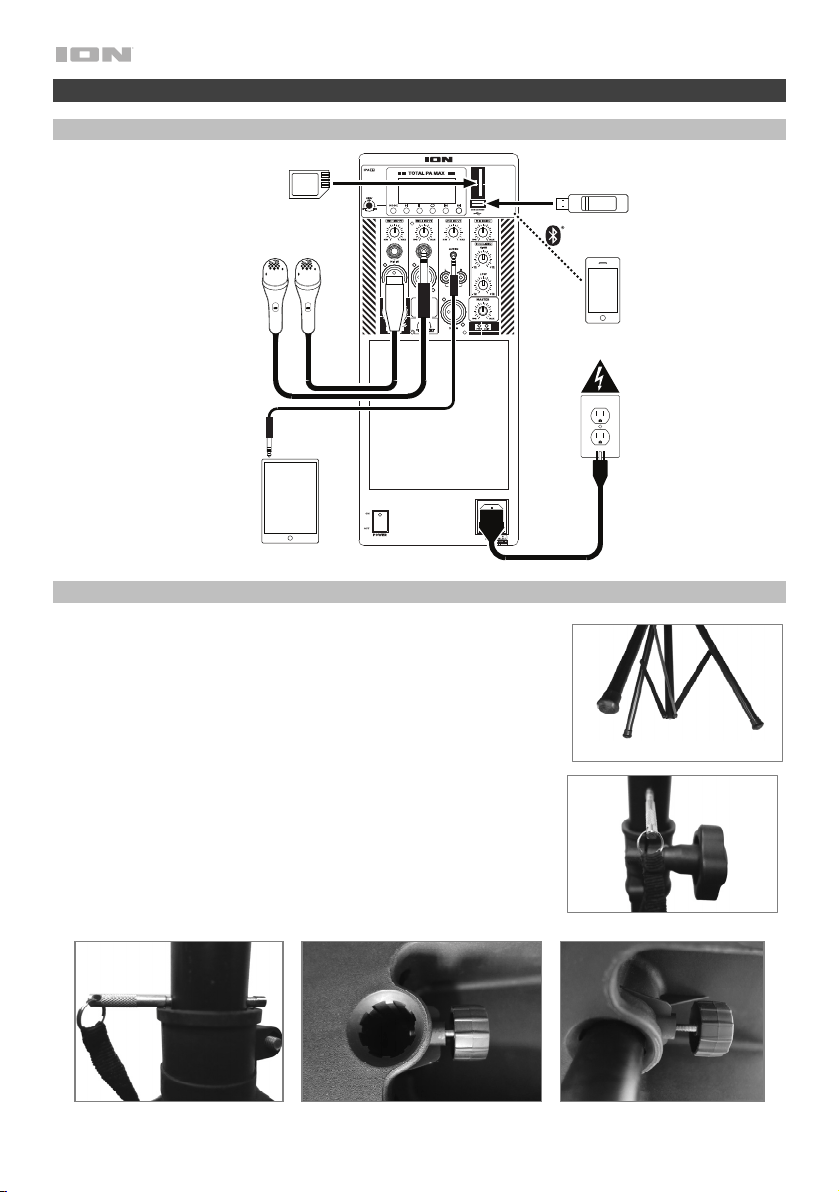
Schema dei collegamenti
Installazione del support per altoparlante
1. Allungare interamente le gambe del supporto a tripode per
altoparlante su una superficie pianeggiante e stabile. Guarda i
contenuti della confezione sotto il foglio in polistirolo per trovare i
piedini in gomma e la manopola di montaggio del supporto
dell'altoparlante.
2. Sollevare il palo di montaggio all'altezza necessaria e stringere la
manopola di regolazione laterale.
3. Inserire il perno nell'apposito foro in basso in modo che il palo
rimanga all'altezza stabilita.
4. Sul Total PA Glow, regolare la manopola inferiore in senso antiorario
in modo che la vite non blocchi l'apertura.
5. Allineare il foro di montaggio del Total PA Glow al palo di supporto
dell'altoparlante e collocarlo sul palo.
6. Stringere la manopola di montaggio in senso orario a livello del
Total PA Glow.
3 45/6
2
1
Elementi non elencati sotto
Introduzione > Contenuti
della confezione
sono
venduti separatamente.
Tablet
Microfoni
Scheda SD
Drive flash USB
Telefono
intelligente
(smartphone)
Alimentazione
23
Caratteristiche
Pannello posteriore
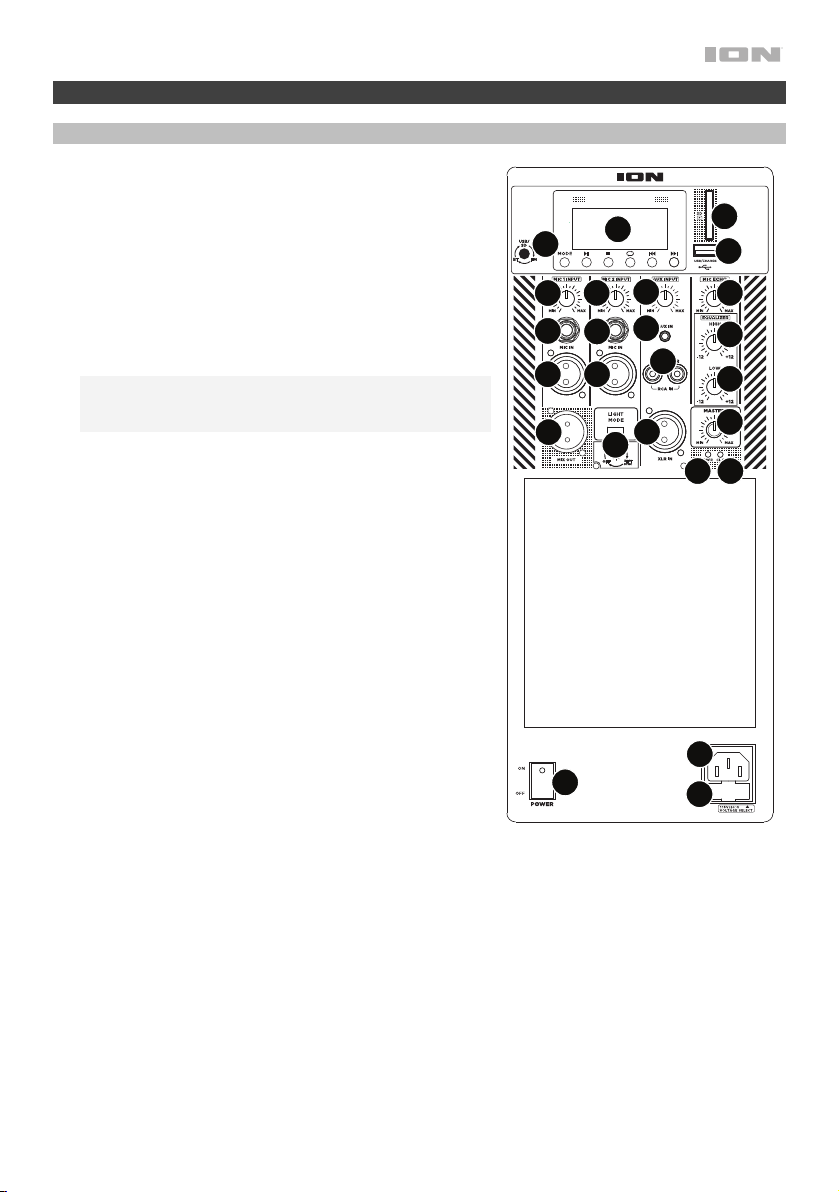
1. Pannello dei media: comandi per le fonti USB, SD,
radio FM (si applicabile) e Bluetooth. Quando la fonte
viene riprodotta, il simbolo della modalità Media Panel si
accende.
2. Porta USB: collegare qui il drive flash USB per
riprodurre musica.
3. Slot scheda SD: inserire la scheda SD a questo livello.
4. Display: mostra a display le modalità del pannello dei
media per USB, SD, radio FM (si applicabile) e
Bluetooth.
Nota bene: Il display è fornito con una protezione in
plastica. Rimuovere la protezione per una visualizzazione
ottimale del display.
5. Ingressi microfono (6,35 mm / 1/4" e XLR): collegare
un microfono dinamico agli ingressi da XLR o da 6,35
mm (1/4"). Regolare il volume degli ingressi XLR e da
6,35 mm (1/4") servendosi della manopola volume dei
ingressi microfono.
6. Volume dei ingressi microfono: girare queste manopole
per regolare il volume dei ingressi microfono.
7. Ingresso Aux (3,5 mm / 1/8"): collegare un lettore CD,
un lettore di media digitali o altre fonti audio a questo
ingresso ausiliario stereo da 3,5 mm (1/8"). Regolare il
volume di uscita servendosi della manopola volume di
ingresso ausiliario.
8. Ingresso linea (XLR): collegare il livello di linea mixer o
uno strumento musicale a questo ingresso XLR a livello
di linea. Regolare il volume di uscita servendosi della
manopola volume di ingresso ausiliario. Utilizza
questo ingresso a livello di linea per collegare due unità
Total PA Glow.
9. Ingressi RCA: collegare un lettore CD, un lettore di
media digitale, un mixer, o altre fonti di media a questi
ingressi. Regolare il volume di uscita servendosi della manopola volume di ingresso ausiliario.
10. Volume di ingresso ausiliario: girare queste manopole per regolare il volume di ingresso ausiliario.
11. Uscita mix (XLR): collegare questa uscita XLR a un altro altoparlante attivo (alimentato). Il livello
dell'uscita è controllato dall’impostazione di volume dei ingressi microfono, volume di
ingresso ausiliario o volume principale
.
12. Mic Echo: servirsi di questa manopola per aggiungere o rimuovere un effetto eco al Ingressi
microfono.
13. High EQ: aumenta o diminuisce le frequenze alte (acute) per ingressi microfono, ingresso linea
e fonti del pannello dei media in un intervallo compreso tra -12 dB e +12 dB.
14. Low EQ: aumenta o diminuisce le frequenze basse (bassi) per ingressi microfono, ingresso
linea e fonti del pannello dei media in un intervallo compreso tra -12 dB e +12 dB.
TOTAL PA GLOW
1
2
3
4
5
5
5
9
8
5
7
10
11
12
13
14
15
17
21
16
6
6
18
19
20
24
15. Volume principale: girare questa manopola per regolare il volume principale del altoparlante
Total PA Glow.
16. LED clip: questo LED lampeggia di rosso se il segnale dagli ingressi o dal pannello dei media
salta. Se ciò dovesse accadere, abbassare l’impostazione della manopola volume dei ingressi
microfono, volume di ingresso ausiliario o volume principale.
17. LED di alimentazione: indica se il Total PA Glow è acceso o è spento.
18. Tasto di modalità luci: premere questo pulsante per selezionare il funzionamento delle luci del
pannello anteriore:
• Ciclo cromatico: le luci si accendono lentamente e passano ciclicamente da un colore
all’altro. Tenere premuto il tasto di modalità luminosa per congelare le luci su un colore
specifico. Questa è la modalità predefinita nel momento in cui il Total PA Glow viene acceso.
• Beat Sync: le luci reagiscono al battito della musica.
• Off: le luci si spengono.
19. Ingresso cavo di alimentazione (IEC): per alimentare l'apparecchio, inserire a questo livello il
cavo di alimentazione in dotazione.
20. Fusibile: l’orientamento del portafusi determina la tensione attuale del Total PA Glow.
L’impostazione attuale è illustrata sopra il triangolo bianco (): 110–120 V o 220–240 V. Se si
utilizza il Total PA Glow in una regione caratterizzata da una tensione diversa, modificare
l’impostazione rimuovendo il portafusi, invertendola e inserendolo nuovamente.
Se il fusibile dell'apparecchio è rotto, sollevare questa linguetta per sostituirlo. Sostituire il fusibile
con uno dalla tensione nominale adeguata (stampata sotto l'ingresso per il cavo di alimentazione
dell'apparecchio). L'utilizzo di un fusibile dalla tensione nominale errata può danneggiare
l'apparecchio e/o il fusibile.
21. Interruttore on/off (accensione/spegnimento): accende o spegne il Total PA Glow.
Pannello dei media
Funzioni pannello dei media:
MODE Modalità: Commuta le modalità tra USB, SD, radio FM (si applicabile), e Bluetooth.
Riprodurre/interrompere: Riprodurre/interrompere momentaneamente la riproduzione della
fonte USB, SD o Bluetooth. Tenere premuto Riprodurre/interrompere per 2 secondi per
avviare la funzione di memorizzazione automatica dei preset (si applicabile). Questa passa
alla stazione più bassa (87,5) e scorre lungo la banda FM per memorizzare automaticamente
le stazioni dal segnale più forte come predefinite.
Ripete: Ripete tutte le tracce (ALL), ripete tutte le tracce nella carella corrente (FOLd
)
, ripete
la traccia USB o SD attualmente riprodotta (OnE
)
, o mischia l'ordine delle tracce in maniera
casuale (rAn).
Precendente: Riproduce la traccia precendente USB, SD, o Bluetooth. Quando si ascolta la
radio FM (si applicabile), premere il tasto una volta per saltare indietro lungo le stazioni FM e
tenerlo premuto per scorrere indietro tra i canali predefiniti.
Successivo: Riproduce la traccia successiva USB, SD, o Bluetooth. Quando si ascolta la
radio FM (si applicabile), premere il tasto una volta per sintonizzare la radio di un preset e
tenerlo premuto per scorrere avanti tra i canali predefiniti.
Nota bene: in alcune app, la pressione del tasto Precendente ( ) o Successivo ( ) può far
passare a un'altra playlist o a un altro genere musicale.
25
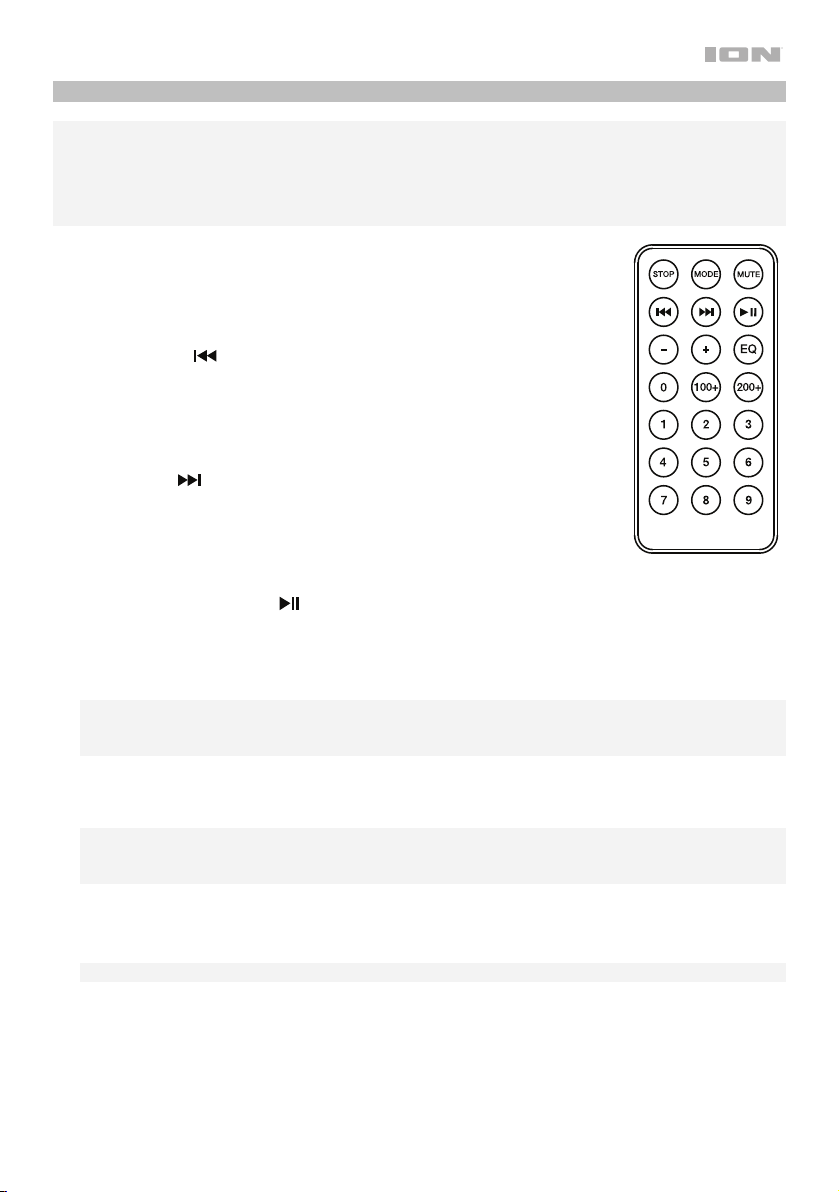
Telecomando pannello dei media
Nota bene: Puntare il telecomando verso la parte anteriore del woofer dell'altoparlante. l’illuminazione
della stanza e la durata della batteria possono influenzare la portata operativa del telecomando.
Nota bene: per poter utilizzare il telecomando per la prima volta, prima estrarre la linguetta fissata
allo scomparto batterie. Per sostituire la batteria del telecomando, seguire lo schema situato sul retro
del telecomando. Servirsi di una batteria 3V CC CR2032 al litio.
1. Stop: Interrompe la riproduzione della fonte del pannello dei media.
2. Mode: Seleziona la fonte del pannello dei media: USB, SD, Bluetooth, o
radio FM (si applicabile).
3. Mute: Silenzia la riproduzione della musica dalle fonti del pannello dei media.
4. Precendente (
): Passa alla traccia precedente presente su USB o
scheda SD. Quando si ascoltano fonti Bluetooth, la pressione di
Precendente in alcune app può passare a un'altra playlist o a un altro
genere musicale. Quando si ascolta la radio FM (si applicabile), premere il
tasto Precendente una volta per saltare indietro lungo le stazioni FM e
tenerlo premuto per scorrere indietro tra i canali predefiniti.
5. Successivo (
): Passa alla traccia successiva presente su USB o scheda
SD. Quando si ascoltano fonti Bluetooth, la pressione di Successivo in
alcune app può passare a un'altra playlist o a un altro genere musicale.
Quando si ascolta la radio FM (si applicabile), premere il tasto Successivo
una volta per sintonizzare la radio di un preset e tenerlo premuto per
scorrere avanti tra i canali predefiniti.
6. Riprodurre/interrompere (
): Riproduce o interrompe momentaneamente la riproduzione della
fonte USB, SD, o Bluetooth del pannello dei media. Tenere premuto Riprodurre/interrompere
per 2 secondi per avviare la funzione di memorizzazione automatica dei preset (si applicabile).
Questa passa alla stazione più bassa (87,5) e scorre lungo la banda FM per memorizzare
automaticamente le stazioni dal segnale più forte come predefinite.
Nota bene: i file vengono riprodotti dalla fonte USB o SD innanzitutto in ordine alfabetico di
quanto si trova nella directory principale, quindi in ordine alfabetico per cartella, quindi in ordine
alfabetico per traccia.
7. Vol –: Riduce il volume della fonte del pannello dei media.
8. Vol +: Aumenta il volume della fonte del pannello dei media.
Nota bene: Il volume del telecomando influisce solo sulla fonte del pannello dei media e funziona
unitamente alla manopola del volume vera e propria presente sul pannello posteriore
dell'apparecchio.
9. EQ: Seleziona uno dei seguenti preset EQ digitali da utilizzarsi con una fonte del pannello dei
media: Bass (BAS), Pop (POP), Rock (rOC), Jazz (JA2), Classica (CLA), Country (COU), Nessuna
EQ (OFF, impostazione predefinita di fabbrica).
Nota bene: l'EQ digitale funziona unicamente per Bluetooth, drive USB flash e schede SD.
10. 100+: Avanza di 100 tracce.
11. 200+: Avanza di 200 tracce.
12. Tasti numerici: Garantisce la scelta di canale per stazioni radio FM (si applicabili) e la scelta delle
tracce per USB/schede SD.
26
Operazione
Allineamento di un dispositivo Bluetooth
1. Accendere il dispositivo Bluetooth.
2. Accendere il Total PA Glow.
3. Servirsi del tasto Mode per selezionare Bluetooth che compare come "bt" a display. Total PA Glow
entrerà automaticamente in modalità di collegamento per cercare dispositivi Bluetooth. Si entra in
modalità di collegamento quando l’icona Bluetooth lampeggia.
4. Navigare nella schermata di configurazione del dispositivo Bluetooth, trovare “Total PA Glow” e
collegarlo. L’icona Bluetooth rimane accesa.
Nota bene: gli utenti dovrebbero aggiornare il loro sistema operativo in caso di problemi con
l'accoppiamento o con la riproduzione di musica.
5. Per annullare l'allineamento, spegnere il Bluetooth sul dispositivo o selezionare Dimentica dispositivo
(Forget this device) sul dispositivo.
Risoluzione di problemi
Il suono è distorto: provare ad abbassare il volume della propria fonte audio o dello strumento musicale.
Inoltre, provare a ridurre il volume complessivo del Total PA Glow.
Eccessivi bassi: provare a regolare la tonalità o il comando EQ sul Total PA Glow o a livello della fonte
audio per abbassare il livello dei bassi. Ciò permetterà di suonare la musica più forte prima che salti (che si
verifichi distorsione).
Se quando si utilizzano i microfoni si verifica un fischio ad alto pitch: si tratta probabilmente di ritorno.
Puntare il microfono lontano dall'altoparlante.
Se non si sente il microfono al di sopra della musica: abbassare il volume della musica dalla fonte.
Quando premo Precendente ( ) o Successivo ( ) non passa alla prossima stazione FM: brevi
pressioni del tasto farà passare ai preset. Tenere premuto il tasto per cercare la stazione successiva. (Si
applicabile.)
Se il canale della stazione radio lampeggia: l'apparecchio è attualmente silenziato. Annullare la funzione
di silenziamento per interrompere il lampeggio e riprendere la riproduzione.
Se il logo Bluetooth lampeggia rapidamente: l'apparecchio è attualmente in modalità di collegamento.
Se il logo Bluetooth lampeggia lentamente: un dispositivo è collegato, ma la riproduzione della musica è
silenziata. Annullare la funzione di silenziamento per interrompere il lampeggio e riprendere la riproduzione.
Il numero di traccia USB track (ad es.: 001) lampeggia lentamente: la riproduzione di musica dal drive
USB è silenziata. Annullare la funzione di silenziamento per interrompere il lampeggio e riprendere la
riproduzione.
Sullo schermo LCD compare la scritta “NONE” (nessuno): l'apparecchio è in modalità USB/SD, ma non
vi è alcun drive USB collegato né scheda SD inserita.
27
Schnellstart-Anleitung (Deutsch)
Einführung
1. Stellen Sie sicher, dass alle im Lieferumfang aufgelisteten Teile in der Verpackung enthalten sind.
In der Schachtel unter dem Styropor-Blatt finden Sie die Gummifüße für die Lautsprecherstative,
den Montageknopf der Lautsprecherstative, das Netzkabel und das Mikrofon.
2. Lesen Sie zuerst die Sicherheitshinweise, bevor Sie das Produkt verwenden.
3. Werfen Sie einen Blick auf die Anschlussdiagramm.
4. Stellen Sie sicher, dass alle Eingabegeräte wie Mikrofone, CD-Player oder digitale Wiedergabegeräte
ausgeschaltet sind und deren Lautstärke auf „Null“ steht.
5. Verbinden Sie alle Geräte wie angegeben.
6. Schalten Sie alles in folgender Reihenfolge ein:
• Audio-Eingangsquellen (z.B. Mikrofone, Instrumente, CD/MP3-Player)
• Total PA Glow
7. Beim Ausschalten gehen Sie in umgekehrter Reihenfolge vor:
• Total PA Glow
• alle Eingabegeräte
Lieferumfang
Total PA Glow
Mikrofon mit Mikrofonkabel
Teleskoplautsprecherständer
Fernbedienung
Netzkabel (IEC)
Schnellstart-Anleitung
Sicherheitshinweise & Garantieinformationen
Kundendienst
Für aktuelledie neuesten Informationen zu diesem Produkt (Systemanforderungen, Informationen zur
Kompatibilität etc.) und zur Produktregistrierung besuchen Sie ionaudio.com.
Für zusätzlichen Produkt-Support besuchen Sie ionaudio.com/support.
Achtung: Setzen Sie Total PA Glow niemals Regen oder stehendem Wasser aus.
28
TOTAL PA GLOW
Schnelles Einrichten
Anschlussdiagramm
Montage der Lautsprecherständer
1. Fahren Sie die Stativbeine des Lautsprecherständers auf einer
ebenen, stabilen Oberfläche aus. In der Schachtel unter dem
Styropor-Blatt finden Sie die Gummifüße und den
Montageknopf für die Lautsprecherstative.
2. Ziehen Sie die Montagestange bis zur benötigten Höhe heraus
und sichern Sie die Stange mit dem seitlichen Einstellknopf.
3. Stecken Sie den Stift in das untere Loch, so dass die
Montagestange auf Ihrer eingestellten Höhe bleibt.
4. Drehen Sie den unteren Drehknopf am Total PA Glow gegen
den Uhrzeigersinn, so dass die Schraube die Öffnung nicht
blockiert.
5. Richten Sie das Loch zur Aufnahme des Boxenständers des
Total PA Glow auf den Lautsprecherständer aus und setzen Sie
es auf die Stange.
6. Ziehen Sie den Befestigungsknopf des Total PA Glow im
Uhrzeigersinn an.
3 45/6
2
1
Teile, die nicht im
Einführung > Lieferumfang
angegeben sind, sind
separat erhältlich.
Tablet
Mikrofone
SD-Karte
USB-Stick
Smartphone
Steckdose
29
Funktionen
Rückseite
1. Medien-Panel: Bedienelemente für USB, SD, FM-Radio
(falls zutreffend) und Bluetooth-Quellen. Das Symbol des
Medien-Panel-Modus wird leuchten, wenn diese Quelle
wiedergegeben wird.
2. USB-Port: Schließen Sie Ihren USB-Stick an, um Musik zu
spielen.
3. SD-Kartensteckplatz: Legen Sie Ihre SD-Karte ein.
4. Anzeige: Zeigt die Medien-Panel-Modi für USB, SD, FM-
Radio (falls zutreffend) und Bluetooth an.
Hinweis: Die Anzeige wird mit einem Kunststoffschutzfilm
ausgeliefert. Entfernen Sie diesen Film, um die Anzeige
optimal zu nutzen.
5. Mikrofon-Eingänge: (6,35 mm und XLR): Schließen Sie ein
dynamisches Mikrofon an die XLR- oder 6,35 mm-Eingänge
an. Regeln Sie die Lautstärke der XLR, und 6,35 mm-
Eingänge mit dem Mikrofon-Eingang Lautstärkeregler.
6. Mikrofon-Eingangslautstärke: Drehen Sie diesen Regler,
um die Lautstärke der Mikrofon-Eingänge einzustellen.
7. Aux-Eingang (3,5 mm): Schließen Sie einen CD-Player,
digitalen Medien-Player oder eine andere Audioquelle an
diesen 3,5 mm Aux-Stereoeingang an. Regeln Sie die
Lautstärke mit dem Aux-Eingangs Lautstärkeregler.
8. Line-Eingang (XLR): Schließen Sie einen Line-Eingang an
Mixer oder ein Musikinstrument an diesen XLR Line-
Eingang an. Regeln Sie die Lautstärke mit dem Aux-
Eingangs Lautstärkeregler. Mit diesem Line-Eingang
können zwei Total PA Glow-Einheiten verknüpft werden.
9. Cinch-Eingänge: Schließen Sie einen CD-Player, einen
digitalen Medien-Player, Mixer oder eine andere
Medienquelle an diese Eingänge an. Regeln Sie die
Lautstärke mit dem Aux-Eingangs Lautstärkeregler.
10. Aux-Eingangslautstärke: Drehen Sie diesen Regler, um die
Lautstärke der Aux-Eingänge, Line-Eingang und Cinch-
Eingänge einzustellen.
11. Mix Out (XLR): Verbinden Sie diesen XLR-Ausgang mit einem anderen aktiven (mit Strom versorgten)
Lautsprecher. Der Ausgangspegel wird durch die Lautstärkeeinstellungen jedes Kanals geregelt:
Mikrofon-Eingangslautstärke, Aux-Eingangslautstärke und Hauptlautstärke.
12. Mikrofon Echo: Mit diesem Regler können Sie den Echoanteil des Mikrofons Eingänge regulieren.
13. High-EQ: Hebt oder senkt die hohen Frequenzen (Höhen) für Mikrofon-Eingänge, Line-Eingang und
Medien-Panelquellen in einem Bereich von -12 dB bis +12 dB.
14. Low-EQ: Hebt oder senkt die niedrigen Frequenzen (Bass) für Mikrofon-Eingänge, Line-Eingang und
Medien-Panelquellen in einem Bereich von -12 dB bis +12 dB.
15. Hauptlautstärke: Mit diesem Regler stellen Sie die Hauptlautstärke des Total PA Glow Lautsprecher
ein.
TOTAL PA GLOW
1
2
3
4
5
5
5
9
8
5
7
10
11
12
13
14
15
17
21
16
6
6
18
19
20
30
16. Clip-LED: Diese LED blinkt rot, wenn das Signal von den Eingängen oder von der Medien-Panelquelle
übersteuert. Wenn dies passiert, verringern Sie die Einstellung von Mikrofon-Eingangslautstärke, Aux-
Eingangslautstärke und Hauptlautstärke.
17. Power-LED: Zeigt an, ob Total PA Glow ein- oder ausgeschaltet ist.
18. Licht-Modus-Taste: Mit diesem Taste können Sie auswählen, wie sich die Lichter auf der Frontseite
verhalten:
• Farbwahl: Die Lichter glühen langsam und wechseln die Farben. Halten Sie die Lichtmodustaste
gedrückt, um die Lichter auf eine einzige Farbe einzustellen. Dies ist der Standardmodus beim
ersten Einschalten des Total PA Glow.
• Beat Sync: Das Licht regiert auf den Takt der Musik.
• Off: Die Lichter erlöschen.
19. Stromkabeleingang (IEC): Schließen Sie das mitgelieferte Stromkabel hier an, um das Gerät mit Strom
zu versorgen.
20. Sicherung: Die Ausrichtung des Sicherungshalters bestimmt die aktuelle Spannungseinstellung des
Total PA Glow. Die aktuelle Einstellung wird über dem weißen Dreieck () angezeigt: 110–120 V oder
220–240 V. Wenn Sie Total PA Glow in einer Region mit einer anderen Spannung verwenden, ändern Sie
die Spannungseinstellung, indem Sie den Sicherungshalter entfernen, invertieren und wieder einsetzen.
Wenn die Sicherung des Geräts beschädigt ist, heben Sie diese Lasche an, um die Sicherung zu
ersetzen. Ersetzen Sie sie mit einer Sicherung, die einen geeigneten Sicherungswert besitzt (siehe
Aufdruck unter dem Netzkabeleingang des Geräts). Die Verwendung einer Sicherung mit falschem
Sicherungswert kann das Gerät und/oder Sicherung beschädigen.
21. Ein-/Ausschalter: Schaltet Total PA Glow ein oder aus.
Medien-Panel
Funktionen des Medien-Panels
MODE Modus: Wechselt zwischen den Modi von USB, SD, FM-Radio (falls zutreffend), und Bluetooth.
Wiedergabe/Pause: Spielen Sie/Pausieren Sie die USB, SD oder Bluetooth-Quelle. Halten Sie
Wiedergabe/Pause 2 Sekunden lang gedrückt, um die automatische Speicherfunktion für
Presets zu aktivieren (falls zutreffend). Damit schaltet das Gerät auf den niedrigsten Sender (87,5)
und bewegt sich durch das FM-Band, um die stärksten Sender als Presets zu speichern.
Wiederholen: Wiederholen Sie alle Tracks (ALL), wiederholen Sie alle Tracks im Aktuellen Ordner
(FOLd), wiederholen Sie den aktuell wiedergegebenen USB- oder SD-Track (OnE) oder
wiederholen Sie die Tracks in zufälliger Reihenfolge (rAn).
Zurück: Spielt die vorherige USB, SD- oder Bluetooth-Track. Wenn Sie FM-Radio hören (falls
zutreffend), drücken Sie einmal auf die Taste Zurück, um rückwärts durch die FM-Sender zu
blättern. Halten Sie die Taste gedrückt, um durch die Kanaleinstellungen zu blättern.
Weiter: Spielt die nächste USB-, SD- oder Bluetooth-Track. Beim Hören von FM-Radio (falls
zutreffend), drücken Sie einmal die Taste Weiter, um eine Voreinstellung nach unten zu schalten.
Halten Sie die Taste gedrückt, um vorwärts durch die Kanaleinstellungen zu suchen.
Hinweis: In einigen Apps kann es sein, dass das Drücken von Zurück ( ) oder Weiter ( ) auf eine
andere Wiedergabeliste oder ein anderes Musik-Genre schaltet.
31
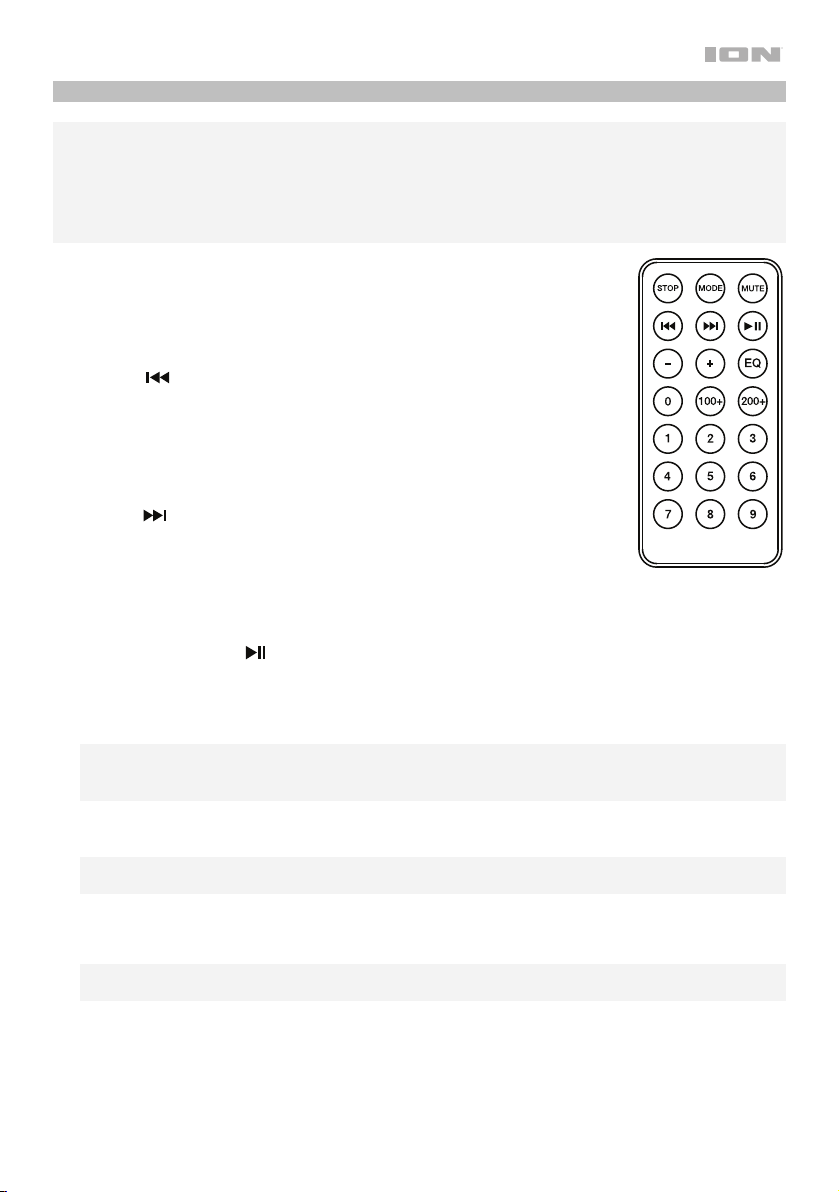
Fernbedienung für das Medien-Panel
Hinweis: Richten Sie die Fernbedienung direkt auf die Vorderseite des Woofers. Die Zimmerbeleuchtung
und die Lebensdauer der Batterie können die Reichweite der Fernbedienung beeinträchtigen.
Hinweis: Um die Fernbedienung zum ersten Mal zu verwenden, ziehen Sie zuerst den Streifen aus
dem Batteriefach heraus. Um die Batterie der Fernbedienung zu wechseln, sehen Sie sich das
Diagramm auf der Rückseite der Fernbedienung an. Als Ersatz verwenden Sie eine 3 VDC CR2032
Lithium-Knopfzelle.
1. Stopp: Stoppt die Wiedergabe des Medien-Panels.
2. Modus: Wählt die Medien-Panelquelle aus: USB, SD, Bluetooth oder FM-
Radio (falls zutreffend).
3. Stummschalten: Schaltet die Musikwiedergabe der Medien-Panelquellen
stumm.
4. Zurück ( ): Springt zum vorherigen USB- oder SD-Karten-Track. Bei der
Wiedergabe von Bluetooth-Quellen kann es in einigen Apps sein, dass das
Drücken von Zurück auf eine andere Wiedergabeliste oder ein anderes
Musik-Genre schaltet. Wenn Sie FM-Radio hören (falls zutreffend), drücken
Sie einmal auf die Taste Zurück, um rückwärts durch die FM-Sender zu
blättern. Halten Sie die Taste gedrückt, um durch die Kanaleinstellungen zu
blättern.
5. Weiter (
): Springt zum nächsten USB- oder SD-Karten-Track. Bei der
Wiedergabe von Bluetooth-Quellen kann es in einigen Apps sein, dass das
Drücken von Weiter auf eine andere Wiedergabeliste oder ein anderes
Musik-Genre schaltet. Beim Hören von FM-Radio (falls zutreffend), drücken
Sie einmal die Taste Weiter, um eine Voreinstellung nach unten zu schalten.
Halten Sie die Taste gedrückt, um vorwärts durch die Kanaleinstellungen zu
suchen.
6. Wiedergabe/Pause (
): Die Quelle via USB, SD oder Bluetooth-Medien-Panel wird
wiedergegeben oder pausiert. Halten Sie Wiedergabe/Pause 2 Sekunden lang gedrückt, um die
automatische Speicherfunktion für Presets zu aktivieren (falls zutreffend). Damit schaltet das
Gerät auf den niedrigsten Sender (87,5) und bewegt sich durch das FM-Band, um die stärksten
Sender als Presets zu speichern.
Hinweis: Die Dateien via USB oder SD-Karte werden in alphabetischer Reihenfolge abgespielt,
und zwar wird zunächst alles auf der Root-Ebene abgespielt. Anschließend erfolgt die
Wiedergabe alphabetisch nach Ordner und alphabetisch nach Track-Namen.
7. Vol –: Reduziert das Quellenvolumen des Medien-Panels.
8. Vol +: Erhöht das Quellenvolumen des Medien-Panels.
Hinweis: Die Remote-Lautstärke betrifft nur die Medien-Panelquelle und arbeitet zusammen mit
dem physischen Medien-Panel-Lautstärkeregler auf der Rückseite des Geräts.
9. EQ: Wählt eine der folgenden digitalen EQ-Presets für die Verwendung mit einer Medien-Panel-
Quelle aus: Bass (BAS), Pop (POP), Rock (rOC), Jazz (JA2), Klassische Musik (CLA),
Country (COU) und Kein EQ (OFF, Werkseinstellung).
Hinweis: Der digitale EQ funktioniert nur mit Bluetooth-, USB-Laufwerken und SD-Karten als
Quellen.
10. 100+: Springt um 100 Tracks nach vorne.
11. 200+: Springt um 200 Tracks nach vorne.
12. Zifferntasten: Bietet Kanalauswahl für FM-Radiosender (falls zutreffend) und Track-Auswahl für
USB/SD-Kartenquellen.
32
Betrieb
Koppeln eines Bluetooth-Geräts
1. Schalten Sie Ihr Bluetooth-Gerät ein.
2. Schalten Sie Total PA Glow ein.
3. Verwenden Sie die Mode -Taste, um den Bluetooth-Modus auszuwählen, der im Display als „bt“ erscheint.
Total PA Glow geht automatisch in den Koppel-Modus, um nach Bluetooth-Geräten zu suchen. Sie wissen,
dass Sie sich im Koppel-Modus befinden, wenn das Bluetooth-Symbol blinkt.
4. Navigieren Sie zum Setup-Bildschirm Ihres Bluetooth-Geräts, suchen Sie Total PA Glow und verbinden Sie die
Geräte. Das Bluetooth-Symbol leuchtet durchgehend.
Hinweis: Anwender sollten eine OS-Aktualisierung Ihres Geräts in Betracht ziehen, wenn es beim Koppeln oder
bei der Musikwiedergabe zu Problemen kommt.
5. Um die Geräte zu trennen, schalten Sie Bluetooth auf Ihrem Gerät aus oder wählen Sie auf Ihrem Gerät Dieses
Gerät ignorieren (Forget this Device).
Fehlerbehebung
Der Ton klingt verzerrt: Drehen Sie den Lautstärkeregler an Ihrer Tonquelle oder dem Musikinstrument zurück.
Versuchen Sie auch, das Gesamtvolumen des Total PA Glow zu reduzieren.
Zu viel Bass: Versuchen Sie, den Ton- oder EQ-Regler des Total PA Glow oder Ihrer Tonquelle anzupassen, um
den Bass zu verringern. Dies ermöglicht Ihnen, die Musik lauter abzuspielen, bevor der Klang verzerrt.
Bei der Verwendung von Mikrofonen tritt einer hoher Pfeifton auf: Hier handelt es sich wahrscheinlich um einen
Rückkopplungseffekt. Richten Sie es so ein, dass die Mikrofone vom Lautsprecher wegzeigen.
Wenn das Mikrofon im Vergleich zur Musik zu leise eingestellt ist: Verringern Sie die Musiklautstärke Ihrer
Quelle.
Wenn ich Zurück ( ) oder Weiter ( ) drücke, wird nicht zum nächsten FM-Sender gewechselt: Kurzes
Drücken der Taste wechselt die Voreinstellungen. Halten Sie die Taste gedrückt, um den nächsten Sender zu
suchen. (Falls zutreffend.)
Wenn die Radiostation blinkt: die Einheit ist derzeit stumm geschaltet. Heben Sie die Stummschaltung auf, um
das Blinken zu stoppen und die Wiedergabe fortzusetzen.
Wenn das Bluetooth-Logo schnell blinkt: das Gerät befindet sich derzeit im Koppel-Modus.
Wenn das Bluetooth-Logo langsam blinkt: ein Gerät wurde verbunden, aber die Musik ist stumm geschaltet.
Heben Sie die Stummschaltung auf, um das Blinken zu stoppen und die Wiedergabe fortzusetzen.
Der USB-Track # (Beispiel: 001) blinkt langsam: die Musikwiedergabe des USB-Laufwerks ist stumm geschaltet.
Heben Sie die Stummschaltung auf, um das Blinken zu stoppen und die Wiedergabe fortzusetzen.
Die LCD-Anzeige zeigt „KEINE“: das Gerät ist zwar im USB/SD-Modus, es wurde jedoch kein USB-Laufwerk
angeschlossen bzw. keine SD-Karte eingelegt.
Allgemeinhinweis zur Konformitätserklärung: Hiermit erklären wir, daß sich das Gerät Total PA Glow in Übereinstimmung mit
den grundlegenden Anforderungen der europäischen Richtlinie 1999/5/EG befindet. Die vollständige EG Konformitätserklärung
kann unter folgender Adresse angefordert werden:
inMusic GmbH
Harkortstrasse 12-32
40880 Ratingen
Germany
33
Snelstartgids (Nederlands)
Introductie
1. Zorg ervoor dat alle artikelen, opgesomd in Inhoud van de doos, zich in de doos bevinden. Kijk
in het doos onder het Piepschuim blad voor de luidsprekerstandaard rubbervoetjes,
luidsprekerstandaard montage knop, voedingskabel, en een microfoon.
2. Lees de veiligheidsvoorschriften vooraleer het product te gebruiken.
3. Bestudeer het Aansluitschema.
4. Zorg ervoor dat alle invoerapparaten, zoals microfoons, cd-spelers of digitale mediaspelers
uitgeschakeld zijn en dat het volume op “nul” staat.
5. Sluit alle apparaten aan zoals afgebeeld.
6. Zet alles aan in deze volgorde:
• geluidsbronnen (bijv. microfoons, instrumenten, cd-spelers)
• Total PA Glow
7. Doe bij het uitschakelen steeds het omgekeerde:
• Total PA Glow
• alle invoerapparaten
Inhoud van de doos
Total PA Glow
Microfoon met microfoonkabel
Uitschuifbare luidsprekerstand
Afstandsbediening
Stroomkabel (IEC)
Snelstartgids
Veiligheidsvoorschriften & boekje met garantie-informatie
Ondersteuning
Voor de laatste informatie over dit product (systeemvereisten, compatibiliteitsinformatie, enz.) en
productregistratie, bezoek ionaudio.com.
Voor aanvullende productondersteuning naar ionaudio.com/support.
Let op: Total PA Glow niet blootstellen aan regen of in water plaatsen.
34
TOTAL PA GLOW
Snelstart
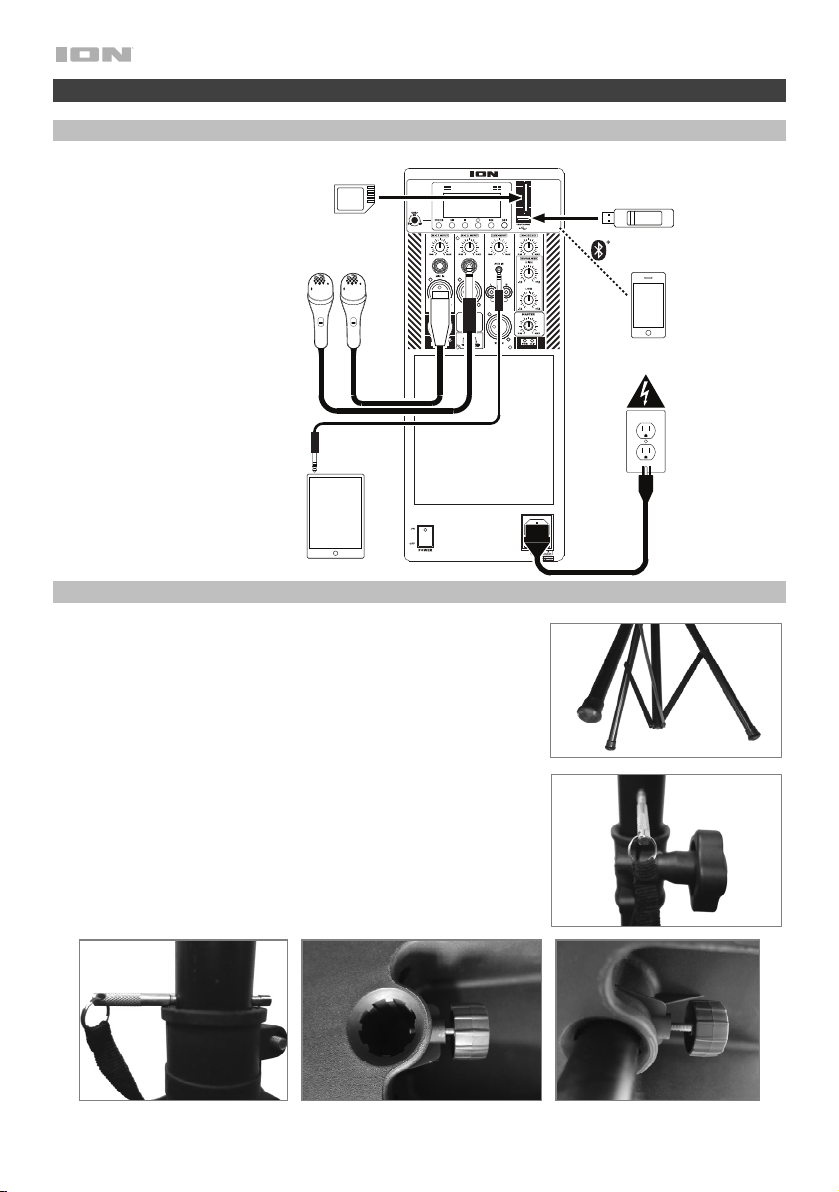
Aansluitschema
De luidsprekerstand installeren
1. Vouw de benen van het luidsprekerstatief volledig uit op een vlak
en stabiel oppervlak. Kijk in de inhoud van de doos onder het
Piepschuim blad voor de rubbervoetjes en luidsprekerstandaard
montage knop.
2. Til de staander op tot de vereiste hoogte en draai de regelknop
op de zijkant vast.
3. Plaats de pin in het onderste pingaatje, zodat de staander op de
ingestelde hoogte blijft staan.
4. Draai de onderste knop op de Total PA Glow linksom, zodat de
schroef de opening niet blokkeert.
5. Plaats de montageopening van de Total PA Glow op één lijn
met de staander van het luidsprekerstatief en plaats het
apparaat op de staander.
6. Draai de montageknop op de Total PA Glow rechtsom vast.
3 45/6
2
1
Artikelen die niet zijn
opgesomd in Introductie >
Inhoud van de doos
worden
afzonderlijk verkocht.
Tabletcomputer
Microfoons
SD-kaart
USB-stick
Smartphone
Stroom
35
Kenmerken
Achterpaneel
1. Mediapaneel: Bedieningsknoppen voor geluidsbronnen
van USB-stick, SD-kaart, FM-radio (indien van
toepassing) en Bluetooth. Het modussymbool van de
mediapaneelbron gaat branden wanneer deze bron wordt
afgespeeld.
2. USB-poort: Sluit hier uw USB-stick aan om muziek af te
spelen.
3. SD-kaartsleuf: Plaats hier uw SD-kaart.
4. Scherm: Geeft de mode van het mediapaneel voor
USB, SD, FM-radio (indien van toepassing) en
Bluetooth.
Opmerking: Het scherm is voorzien van een plastic
beschermfolie. Verwijder dit folie voor een optimale
kijkervaring.
5. Microfoon-ingangen (6,35 mm en XLR): Sluit een
dynamische microfoon aan op de XLR- of 6,35 mm
ingangen. Regel het volume van de XLR en 6,35 mm
ingangen met de microfoon ingangsvolume knop.
6. Microfoon ingangsvolume: Draai aan deze knop om het
ingangsvolume van het microfoon kanaal te regelen.
7. Aux-ingang (3,5 mm): Sluit op deze stereo aux-ingang
van 3,5 mm een cd-speler, digitale mediaspeler of
andere geluidsbron aan. Regel het uitgangsvolume met
de Aux-ingangsvolume knop.
8. Lijnniveau-ingang (XLR): Sluit op deze XLR-ingang op
lijnniveau een lijnniveau mixer of muziekinstrument aan.
Regel het uitgangsvolume met de Aux-ingangsvolume
knop. Maak gebruik van deze line-level input bij het
koppelen van twee Total PA Glow units.
9. RCA-ingangen: Sluit op deze ingangen een cd-speler,
digitale mediaspeler, mixer of andere mediabron aan.
Regel het uitgangsvolume met de Aux-ingangsvolume
knop.
10. Aux-ingangsvolume: Draai aan deze knop om het volume van het Aux-ingang, lijnniveau-
ingang en RCA-ingangen te regelen.
11. Mix Out-uitgang (XLR): Sluit deze XLR-uitgang aan op een andere actieve luidspreker (met
versterker). Het uitgangsniveau wordt geregeld door de volume-instelling van elk kanaal
(microfoon ingang volume, Aux-ingang volume, en hoofdvolume).
12. Mic Echo: Gebruik deze knop toe te voegen of te verwijderen van een echo-effect aan de
microfoon ingangen
.
13. EQ Hoog: Verhoogt of verlaagt de hoge (treble) frequenties voor microfoon ingangen, Aux-
ingang en mediapaneelbronnen binnen een bereik van -12 dB tot +12 dB.
14. EQ Laag: Verhoogt of verlaagt de lage (bas) frequenties voor microfoon ingangen, Aux-ingang
en mediapaneelbronnen binnen een bereik van -12 dB tot +12 dB.
TOTAL PA GLOW
1
2
3
4
5
5
5
9
8
5
7
10
11
12
13
14
15
17
21
16
6
6
18
19
20
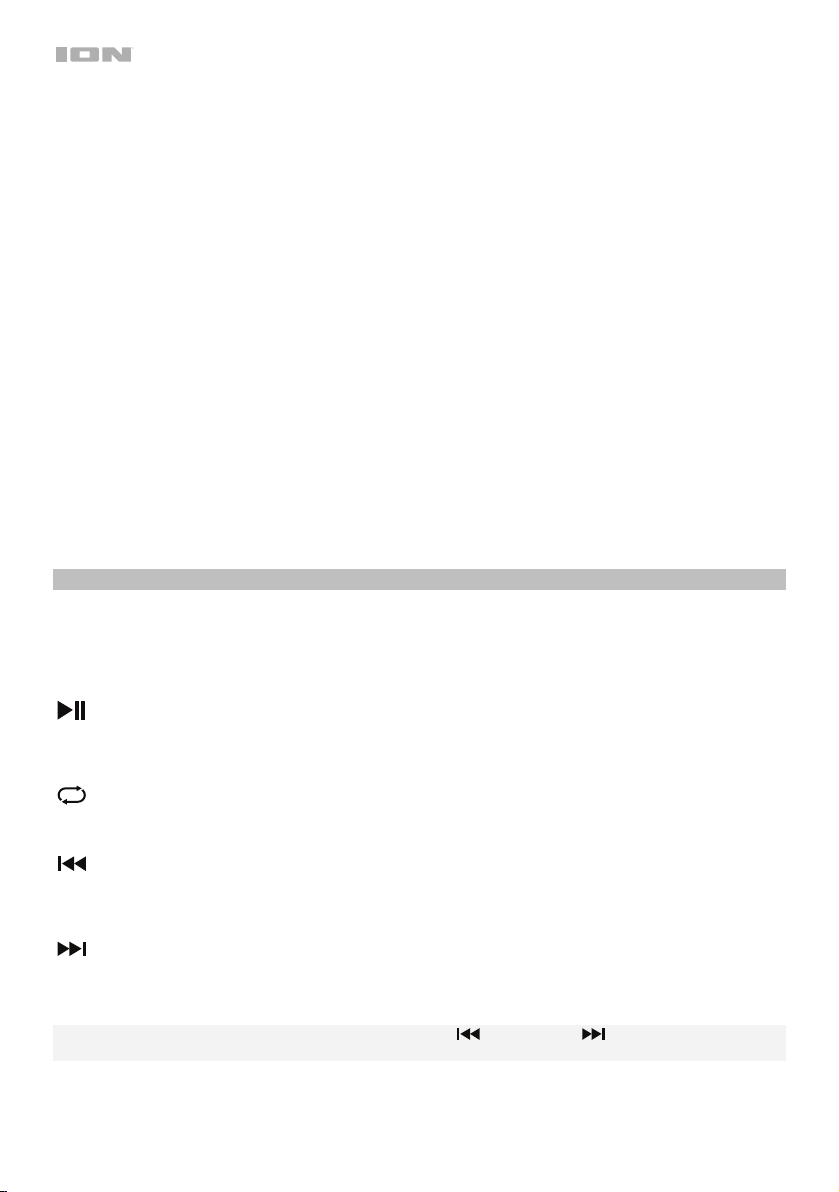
36
15. Hoofdvolume: Draai aan deze knop om het hoofdvolume van de Total PA Glow-luidspreker aan te
passen.
16. Clip-LED: Deze LED begint rood te knipperen als het signaal van de ingangen of de bron van het
mediapaneel overstuurd wordt. Als dat gebeurt, verlaag dan de instelling van volumeknop microfoon
ingang volume, Aux-ingang volume, of hoofdvolume.
17. Stroom-LED: Geeft aan of Total PA Glow aan of uit staat.
18. Verlichtingsmodus-knop: Druk op de knop om te selecteren aan de lichten op het voorpanel werken:
• Kleuren doorlopen: De lichten gloeien traag en doorlopen de kleuren. Druk de lichtmodustoets in
om de lichten op één kleur vast te zetten. Dit is de standaardmodus wanneer de Total PA Glow voor
het eerst wordt ingeschakeld.
• Beat Sync: De lichten reageren op het ritme van de muziek.
• Uit: De lichten gaan uit.
19. Ingang voor stroomkabel (IEC): Sluit de meegeleverde stroomkabel hierop aan om het apparaat van
stroom te voorzien.
20. Zekering: De oriëntatie van de zekeringhouder bepaalt de huidige spanningsinstelling van Total PA
Glow. De huidige instelling wordt weergegeven boven de witte driehoek (): 110–120 V of 220–240 V.
Als u de Total PA Glow gebruikt in een land met een andere netspanning, wijzig dan de spanning door
de zekering te verwijderen, deze om te keren en terug te plaatsen.
Als de zekering van het apparaat kapot is, til dan dit klepje op om de zekering te vervangen. Vervang
deze door een zekering van passende waarde (afgedrukt onder de stroomkabelingang van het
apparaat). Een zekering met onjuiste waarde kan het apparaat en/of de zekering beschadigen.
21. Aan/uit-schakelaar: Zet Total PA Glow aan of uit.
Mediapaneel
Mediapaneelfuncties
MODE Modus: Schakelt om tussen de verschillende modi: USB, SD-kaart, FM-radio (indien van toepassing),
en Bluetooth.
Afspelen/Pauzeren: Speelt de mediapaneelbron af van USB, SD-kaart of Bluetooth. Houd de
knop Afspelen/Pauzeren 2 seconden lang ingedrukt om de automatische opslagfunctie van
voorinstellingen te starten (indien van toepassing). Dit springt naar de laagste zender (87,5) en
doorloopt de hele FM-band om automatisch de sterkste zenders te programmeren.
Herhaling: Herhaal alle nummers (ALL), herhaal alle nummers in de huidige map (FOLd), herhaal
het nummer dat momenteel van USB of SD wordt afgespeeld (OnE) of speel de nummers in
willekeurige volgorde (rAn).
Vorige: Indien eenmalig ingedrukt: speelt het vorige nummer af van de USB-stick, SD-kaart,
Bluetooth. Druk bij het beluisteren van de FM-radio (indien van toepassing) eenmalig op de knop
om terug te bladeren door de radiostations en houd de knop ingedrukt om achteruit te zoeken
door de geprogrammeerde zenders.
Volgende: Indien eenmalig ingedrukt: Speelt het volgende nummer af van de USB-stick, SD-kaart
of Bluetooth. Druk bij het luisteren naar de FM-radio (indien van toepassing) een keer op de knop
Volgende om de vorige geprogrammeerde zender te beluisteren en houd deze knop ingedrukt om
vooruit te bladeren door de geprogrammeerde zenders.
Opmerking: In sommige apps kunnen de knoppen Vorige ( ) of Volgende ( ) een andere afspeellijst of
muziekgenre oproepen.
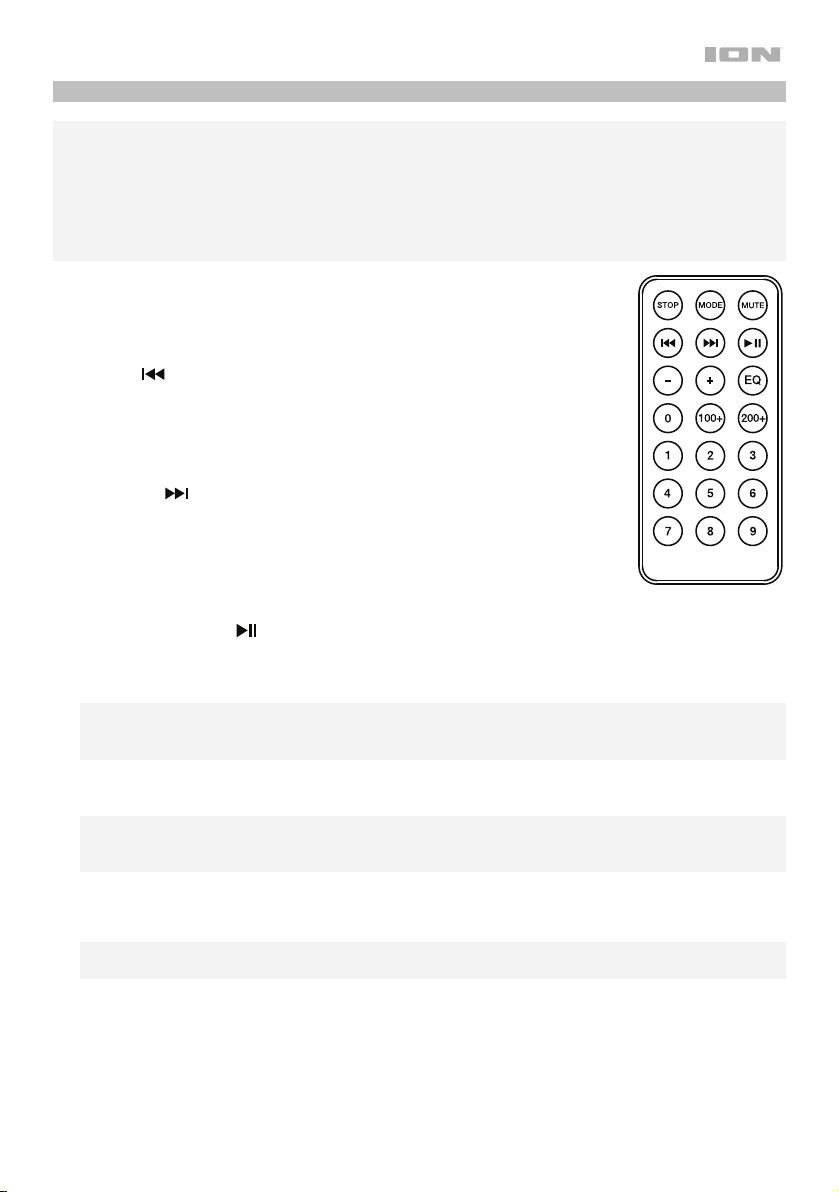
37
Afstandsbediening mediapaneel
Opmerking: Richt de afstandsbediening recht op de voorkant van de woofer van de luidspreker. De
verlichting in de kamer en de levensduur van de batterij kunnen het werkingsbereik van de
afstandsbediening beïnvloeden.
Opmerking: Om de afstandsbediening voor de eerste keer te gebruiken, moet u het lipje uit het
batterijcompartiment trekken. Volg voor het vervangen van de batterij van de afstandsbediening het
diagram op de achterkant van de afstandsbediening. Gebruik als vervangbatterij een 3V DC CR2032
lithium knoopbatterij.
1. Stop: Stopt het afspelen van de mediapaneelbron.
2. Modus: Selecteert de mediapaneelbron: USB, SD, Bluetooth, of FM-radio
(indien van toepassing).
3. Dempen: Dempt de muziek die op de mediapaneelbron wordt afgespeeld.
4. Vorige (
): Gaat naar het vorige nummer op USB of de SD-kaart. Bij het
beluisteren van audiobronnen over Bluetooth roept het indrukken van de
knop Vorige in sommige apps een andere afspeellijst of muziekgenre op.
Druk bij het beluisteren van de FM-radio (indien van toepassing) eenmalig
op de knop Vorige om terug te bladeren door de radiostations en houd de
knop ingedrukt om achteruit te zoeken door de geprogrammeerde zenders.
5. Volgende (
): Gaat vooruit naar het volgende nummer op USB of SD-
kaart. Bij het luisteren naar audiobronnen via Bluetooth, roept het indrukken
van Volgende mogelijk een andere afspeellijst of muziekgenre op. Druk bij
het luisteren naar de FM-radio (indien van toepassing) een keer op de knop
Volgende om de vorige geprogrammeerde zender te beluisteren en houd
deze knop ingedrukt om vooruit te bladeren door de geprogrammeerde
zenders.
6. Afspelen/Pauzeren (
): Speelt de mediapaneelbron af van USB, SD-kaart of Bluetooth. Houd
de knop Afspelen/Pauzeren 2 seconden lang ingedrukt om de automatische opslagfunctie van
voorinstellingen te starten (indien van toepassing). Dit springt naar de laagste zender (87,5) en
doorloopt de hele FM-band om automatisch de sterkste zenders te programmeren.
Opmerking: Bestanden van een USB-stick of SD-kaart worden eerst afgespeeld in alfabetische
volgorde, op basis van de inhoud van de hoofdmap, daarna alfabetisch per map en ten slotte
alfabetisch op basis van de naam van het nummer.
7. Vol –: Verlaagt het volume van de geluidsbron op het mediapaneel.
8. Vol +: Verhoogt het volume van de geluidsbron op het mediapaneel.
Opmerking: De volumeknop op de afstandsbediening verandert het volume van de
mediapaneelbron, samen met de fysieke volumeknop op het mediapaneel, op het achterpaneel
van het apparaat.
9. EQ: Selecteert één van de volgende digitale EQ-voorinstellingen, toepasbaar op een geluidsbron
van het mediapaneel: Bas (BAS), Pop (POP), Rock (rOC), Jazz (JA2), Klassiek (CLA),
Country (COU) en Geen EQ (OFF, standaard fabrieksinstelling).
Opmerking: De digitale EQ werkt alleen voor bronnen afkomstig van Bluetooth, USB-flashstation
of SD-geheugenkaart.
10. 100+: bladert 100 nummers vooruit.
11. 200+: bladert 200 nummers vooruit.
12. Cijfers: Biedt kanaalkeuze van FM-radiostations (indien van toepassing) en nummerkeuze voor
bronnen van USB-station of SD-geheugenkaart.
38
Operatie
Een Bluetooth-apparaat koppelen
1. Zet uw Bluetooth-apparaat aan.
2. Zet Total PA Glow aan.
3. Gebruik de Mode-knop om de Bluetooth-modus te selecteren. Op het scherm verschijnt "bt". Total PA
Glow activeert de koppelingsmodus en zoekt naar Bluetooth-apparaten. U weet of u zich in
koppelingsmodus bevindt als het Bluetooth-pictogram knippert.
4. Navigeer naar het instelscherm van uw Bluetooth-apparaat, zoek naar Total PA Glow en maak
verbinding. Het Bluetooth-pictogram blijft branden.
Opmerking: Gebruikers die problemen ondervinden met het koppelen of het afspelen van muziek
moeten overwegen het besturingssysteem van hun apparaat bij te werken.
5. Om de koppeling te verbreken: schakel Bluetooth uit op uw apparaat of selecteer dit apparaat
vergeten (Forget this device) op uw apparaat.
Problemen oplossen
Het geluid is vervormd: Probeer het volumeniveau van uw geluidsbron of muziekinstrument te verlagen.
Probeer ook het algemene volume van Total PA Glow te verlagen.
Er zijn teveel bassen: Probeer de toon- of EQ-bedieningsknop op Total PA Glow of uw geluidsbron bij te
regelen om het basniveau te verlagen. Dit stelt u in staat de muziek luider te zetten vooraleer “afgeknipte”
(vervormde) klanken optreden.
Er is een hoge fluitende pieptoon bij het gebruik van een microfoon: Dit is waarschijnlijk feedback. Richt
de microfoon weg van de luidspreker.
Als het geluid van de microfoon niet boven de muziek uitkomt: Verlaag het volume van de muziek van
uw geluidsbron.
Wanneer ik druk op Vorige ( ) of op Volgende ( ) gaat het apparaat niet naar de volgende FM-
zender: Een korte druk op de knop springt naar de voorinstellingen. Houd de knop ingedrukt om naar de
volgende zender te zoeken. (Indien van toepassing.)
Als het radiostation blijft knipperen: het apparaat is momenteel gedempt. Hef het dempen op om het
geknipper stop te zetten en het afspelen te hervatten.
Als het Bluetooth-logo snel knippert: het apparaat bevindt zich momenteel in koppelingsmodus.
Als het Bluetooth-logo traag knippert: een apparaat is gekoppeld, maar de muziek is gedempt. Hef het
dempen op om het geknipper stop te zetten en het afspelen te hervatten.
Het titelnummer op USB (voorbeeld: 001) knippert traag: het afspelen van muziek van het USB-station wordt
gedempt. Hef het dempen op om het geknipper stop te zetten en het afspelen te hervatten.
Op het LCD-scherm staat “NONE” te lezen: het apparaat bevindt zich in USB/SD-modus, maar er is geen
USB-station aangesloten, noch een SD-kaart ingebracht.
39
Appendix (English)
Technical Specifications
Output Power
400 W (Peak)
Max SPL (@ 1 m)
116 dB peak, 110 dB continuous C-weighted, free space
Low Frequency
15” (381 cm) woofer, 2” (51 mm) voice coil
High Frequency
1” (25 mm)-exit ferrite compression driver, 1” (25 mm) voice coil
Crossover
2.2 kHz
Frequency Response
55 Hz – 20 kHz (+3 dB)
Frequency Range
45 Hz – 22 kHz (@ -10 dB)
Horn Coverage
80/100° H x 60° V, nominal (@ -6 dB)
Input
Gain Range: -∞ to +10 dB (microphone/line)
Max Input Level: +10 dBu
Impedance: 22 KΩ
External Controls
Channel volume, master volume, power on/off with LED, clip limiter with LED, echo, 2-band
equalizer, mode, play/pause, repeat, previous track, next track
Connectors
(3) XLR inputs (2 dynamic microphone/line, 1 line)
(2) 1/4” (6.35 mm) TRS inputs
(1) 1/8” (3.5 mm) TRS input
(1) stereo RCA input pair
(1) XLR mix output
(1) SD card slot
(1) USB port (host)
(1) IEC power connection
Bluetooth* Profile: A2DP
Module: Bluetooth 2.1+EDR, compatible under 3.0
Speed: 3 Mbps
Range: Up to 100 feet / 30.5 meters
USB/SD Card Audio: Music playback from USB drive or SD card
Supported File System: FAT32
Supported File Types: MP3, WAV, WMV
Maximum File Size: > 16 GB
Maximum USB Drive / SD Card Capacity: > 16 GB
Protection Features
Over-excursion, thermal, short-circuit protection
Power Speaker: 100 VAC, 110–120 VAC, or 220–240 VAC; 50/60 Hz
Remote Control: 3 VDC CR2032 lithium button cell battery
Specifications are subject to change without notice.
* Bluetooth range is affected by walls, obstructions, and movement. For optimal performance, place the product in the center of the
room so it is unobstructed by walls, furniture, etc.
Trademarks & Licenses
ION Audio is a trademark of ION Audio, LLC, registered in the U.S. and other countries. The Bluetooth word mark and logos are owned
by the Bluetooth SIG, Inc. and any use of such marks by ION Audio is under license. All other product names, company names,
trademarks, or trade names are those of their respective owners.

ionaudio.com
Manual Version 1.1