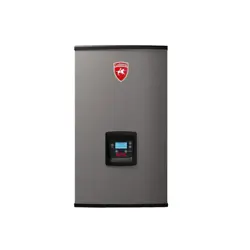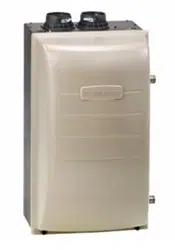

Wall Mount
Gas-Fired Water Boilers
70/110/155
Part number 550-142-122/0513
This manual must only be used by a qualified heating installer/service technician. Read all instructions, includ-
ing this manual and all other information shipped with the boiler, before installing. Perform steps in the order
given. Failure to comply could result in severe personal injury, death or substantial property damage.
s)NSTALLATION
s3TARTUP
s-AINTENANCE
s0ARTS
Boiler Manual
TM

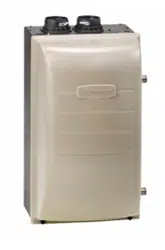
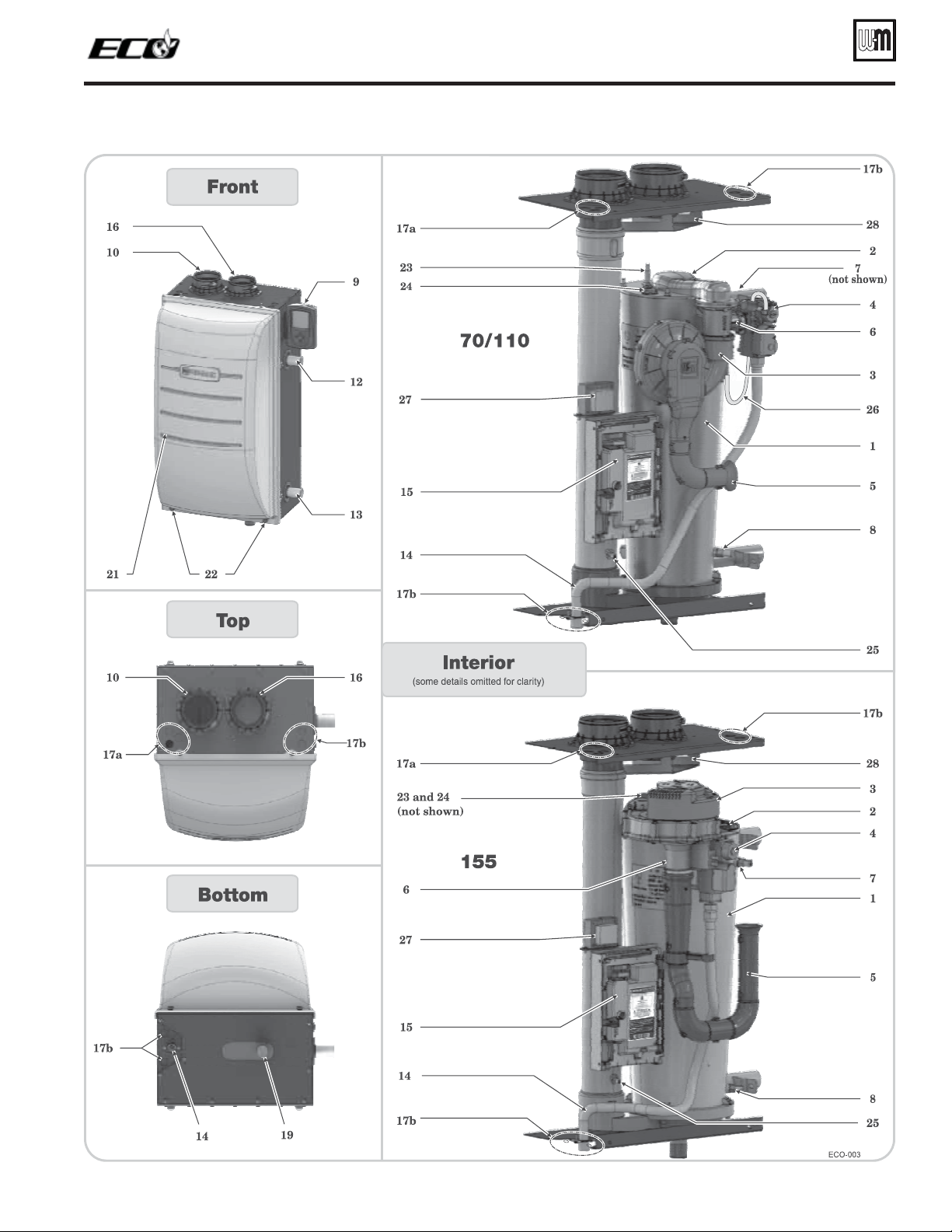
The ECO Gas-fired water boilers
3TAINLESSSTEELlRETUBEHEATEXCHANGER
(EATEXCHANGERACCESSCOVERBURNERMOUNTINGPLATE
3. Blower
The advanced blower design and air inlet silencer on ECO Wall
Mount boilers result in very quiet operation.
Air enters the boiler enclosure through the air intake adapter (16),
flows through the enclosure, enters the air inlet silencer (5), then
enters the blower. The blower pulls air through the silencer and
pushes it into the venturi (6), where it mixes with gas before enter-
ing the burner (11).
'ASVALVE
The automatic gas valve senses the vacuum in the venturi (6) caused
by flowing air and allows gas to flow when power is applied. A
manual gas valve is shipped loose with the boiler. It allows shutting
off the gas supply for servicing or shutdown. See instructions in this
manual for manual gas valve installation.
!IRINLETSILENCER
The horn-shaped air inlet silencer significantly reduces fan noise,
providing exceptionally quiet operation.
6. Venturi
When air flows through the venturi, it creates a negative pressure.
This vacuum pulls gas from the gas valve (4). Gas will only flow
if air is flowing. The gas mixes with air in the venturi. The gas/air
mixture then flows into the burner (11).
3UPPLYWATERTEMPERATUREDUALSENSOR
This dual sensor monitors boiler outlet water temperature. The ECO
control adjusts boiler firing rate so the outlet water temperature
is correct, based on the calculated (if outdoor reset used — see
page 119) or fixed target temperature.
2ETURNWATERTEMPERATURESENSOR
This sensor monitors return water temperature. The ECO control
reduces or increases boiler input, depending on how close the return
water temperature is to the outlet water temperature.
%LECTRONICDISPLAYBUTTONS
The electronic display is used to configure boiler settings and
monitor boiler operation. The buttons allow changing display mode,
selecting and adjusting control settings, and resetting the control
after lockout. This display can be mounted either on the boiler (as
shown) or on the wall.
&LUEADAPTERlTSv06#
"URNERNOTSHOWN
Made with high-grade stainless steel construction, the burner uses
pre-mixed air and gas. The burner and control provide modulat-
ing firing.
7ATEROUTLETPIPESYSTEMSUPPLY
7ATERRETURNPIPESYSTEMRETURN
'ASCONNECTIONPIPE
Manual gas valve is shipped loose. Other ½” NPT gas connection
pipe and fittings external to boiler must be supplied by the installer.
#ONTROLMODULE
The control module responds to signals from the room thermostat,
DHW aquastat (if used), boiler sensors (boiler return, boiler supply,
flue temperature, and outdoor temperature, if used — see page 119).
The control automatically adjusts blower speed (and gas flow rate) to
match boiler output to space heating and/or DHW heating demand.
The control provides for one heating zone and one DHW zone.
!IRINTAKEADAPTERlTSv06#
A%LECTRICALENTRANCESLINEVOLTAGE
The top left side knockouts are designated for line voltage wiring
only. Ensure all wiring entrances are sealed.
B%LECTRICALENTRANCESLOWVOLTAGE
The top right side and bottom knockouts are designated for low
voltage wiring only. Ensure all wiring entrances are sealed.
"OILERDRAINVALVENOTSHOWN
Shipped loose for field piping. Pipe drain valve on reducing tee
at the lowest point of return piping to boiler. See instructions in
this manual.
#ONDENSATETRAPNOZZLE
The outlet at the bottom of the condensate collection dish. This is
where condensate is discharged from the boiler. The condensate
trap assembly attaches here.
&LUEGASCONDENSATEDRAINTRAPASSEMBLYNOTSHOWN
The condensate trap assembly is field-installed, connected to the
condensate trap nozzle as shown in this manual.
*ACKETDOOR
The jacket door is sealed to the boiler assembly around its entire
perimeter.
*ACKETDOORSCREWS
Two screws secure the jacket door in place.
)GNITIONELECTRODEmAMESENSOR
The burner flame is ignited by applying a high voltage to the igni-
tion electrode. This causes a spark (from electrode to ground). After
ignition, the electrode measures flame signal.
&LAMEINSPECTIONWINDOW
The quartz glass window provides a view of the burner surface, the
flame, and the ignition electrode.
&LUEGASDUALSENSOR
This dual sensor monitors the flue gas exit temperature. The ECO
control will shut down the boiler if flue gas temperature gets too hot.
This protects the flue pipe and the heat exchanger from overheating.
'ASVALVEREFERENCEHOSEONLY
This rubber line connects the gas valve diaphragm reference
chamber to the venturi intake to insure the valve senses the correct
reference pressure.
4RANSFORMER
The 120V/24V transformer provides 24V to low voltage control
circuitry.
Do NOT splice wiring into transformer.
!IRBAFmE
The air baffle protects internal boiler components by diverting any
incoming moisture or debris away from critical components. It
must be temporarily removed while servicing the heat exchanger.
Part number 550-142-122/0513
2
TM
GAS-FIRED WATER BOILER — Boiler Manual
The ECO Gas-fired water boilers (cont.)
Part number 550-142-122/0513
3
TM
GAS-FIRED WATER BOILER — Boiler Manual

Contents
The ECO Gas-fired water boilers. . . . . . . . . . . . . . . . 2
Please read before proceeding . . . . . . . . . . . . . . . . 5
Boiler location . . . . . . . . . . . . . . . . . . . . . . . . . 6
Wall-mounting the boiler. . . . . . . . . . . . . . . . . . . . 8
Display bracket installation . . . . . . . . . . . . . . . . . 10
Boiler hydrostatic test . . . . . . . . . . . . . . . . . . . . 11
Converting boiler to propane — ECO 70/110 . . . . . . . . 13
Converting boiler to propane — ECO 155 . . . . . . . . . . 15
Gas piping — sizing gas lines . . . . . . . . . . . . . . . . 17
Venting/air piping — general . . . . . . . . . . . . . . . . 18
Commonwealth of Massachusetts installations . . . . . . 21
Vent termination requirements . . . . . . . . . . . . . . . 22
Boiler room air openings. . . . . . . . . . . . . . . . . . . 23
DIRECT VENT — Sidewall with separate pipes . . . . . . . 24
DIRECT VENT — Sidewall concentric . . . . . . . . . . . . 26
DIRECT VENT — Sidewall with W-M vent/air plate . . . . . 28
DIRECT VENT — Vertical with separate pipes. . . . . . . . 30
DIRECT VENT — Vertical concentric. . . . . . . . . . . . . 32
Concentric termination, typical (sidewall or vertical). . . . 34
Vent and air piping and boiler connections . . . . . . . . . 35
Install water piping . . . . . . . . . . . . . . . . . . . . . 36
Direct Connect System Piping . . . . . . . . . . . . . . . . 37
Verify the application will work. . . . . . . . . . . . . . . . . . 37
Expansion Tank Location . . . . . . . . . . . . . . . . . . . . . 37
Diaphragm- or bladder-type tank. . . . . . . . . . . . . . . . . 37
Closed-type expansion tank . . . . . . . . . . . . . . . . . . . 38
System water piping methods . . . . . . . . . . . . . . . . . . 38
System circulators and zone circulators . . . . . . . . . . . . . 38
System water piping methods . . . . . . . . . . . . . . . . . . 39
Install relief valve . . . . . . . . . . . . . . . . . . . . . . . . . 40
ZONE VALVE zoning – direct connection. . . . . . . . . . . . . . . 41
Primary/Secondary System Piping . . . . . . . . . . . . . 42
Expansion Tank Location . . . . . . . . . . . . . . . . . . . . . 43
Diaphragm- or bladder-type tank. . . . . . . . . . . . . . . . . 43
Closed-type expansion tank . . . . . . . . . . . . . . . . . . . 44
System water piping methods . . . . . . . . . . . . . . . . . . 45
Install relief valve . . . . . . . . . . . . . . . . . . . . . . . . . 46
ZONE VALVE zoning – primary/secondary . . . . . . . . . . . . . . 47
CIRCULATOR zoning – primary/secondary . . . . . . . . . . . . . . 48
CIRCULATOR zoning – primary/secondary multi. temp. zone . . . . 49
Multiple boiler installations . . . . . . . . . . . . . . . . . 50
Install condensate line . . . . . . . . . . . . . . . . . . . . 54
Gas piping . . . . . . . . . . . . . . . . . . . . . . . . . . 55
Field wiring . . . . . . . . . . . . . . . . . . . . . . . . . . 56
Wiring diagram — schematic . . . . . . . . . . . . . . . . 60
Wiring diagram — ladder . . . . . . . . . . . . . . . . . . 61
EXPRESS SETUP — using default settings . . . . . . . . . 62
ECO control operation . . . . . . . . . . . . . . . . . . . . 63
ESSENTIAL settings . . . . . . . . . . . . . . . . . . . . . 65
ECO control settings menus . . . . . . . . . . . . . . . . . 66
BOILER SETTINGS menu . . . . . . . . . . . . . . . . . . . 67
HEATING SETTINGS menu . . . . . . . . . . . . . . . . . . 68
DHW SETTINGS menu . . . . . . . . . . . . . . . . . . . . 70
CIRCULATOR EXERCISING and FREEZE PROTECTION . . . . 71
DIAGNOSTIC menu . . . . . . . . . . . . . . . . . . . . . . 72
DATE AND TIME menu . . . . . . . . . . . . . . . . . . . . 74
Startup — fill the system . . . . . . . . . . . . . . . . . . 75
Startup — final checks . . . . . . . . . . . . . . . . . . . 77
Check-out/startup verification. . . . . . . . . . . . . . . . 82
Annual startup and general maintenance . . . . . . . . . . 83
Annual startup . . . . . . . . . . . . . . . . . . . . . . . . 84
Troubleshooting . . . . . . . . . . . . . . . . . . . . . . . 90
Maintenance . . . . . . . . . . . . . . . . . . . . . . . . . 98
Cleaning heat exchanger flue side, 70/110 . . . . . . . . . 100
Cleaning heat exchanger flue side, 155 . . . . . . . . . . . 103
Replacement parts . . . . . . . . . . . . . . . . . . . . . . 106
Dimensions . . . . . . . . . . . . . . . . . . . . . . . . . . 118
Ratings — ECO boilers. . . . . . . . . . . . . . . . . . . . 119
Ratings — Multiple ECO boilers . . . . . . . . . . . . . . . 120
Installation and Service Certificate . . . . . . . . . . . . . 121
ECO Gas Boiler Data Collection Sheet . . . . . . . . . . . . 122
NOTES. . . . . . . . . . . . . . . . . . . . . . . . . . . . . 123
DO NOT SERVICE THE
BOILER WITHOUT A ECO
MAINTENANCE KIT AVAILABLE
The ECO maintenance kit includes components that may
have to be replaced when accessing or disassembling parts
of the boiler. Failure to replace damaged components and
to use only the parts specifically intended for the boiler
can result in severe personal injury, death or substantial
property damage. See Figure 109, page 107 for part number.
Part number 550-142-122/0513
4
TM
GAS-FIRED WATER BOILER — Boiler Manual
Please read before proceeding
)NSTALLER— Read all instructions, including this
manual and all other information shipped with
the boiler, before installing. Perform steps in the
order given.
User — This manual is for use only by a quali-
fied heating installer/service technician. Refer to
User’s Information Manual for your reference.
User — Have this boiler serviced/inspected by
a qualified service technician, at least annually.
Failure to comply with the above could result
in severe personal injury, death or substantial
property damage.
Write in the CP number in the space provided
on the Installation certificate on page 121 if not
already shown. The CP number label is located
on the right side of the exterior of the cabinet.
When calling or writing about the boiler— Please
have the boiler model number from the boiler
rating label and the CP number from the boiler
jacket.
Consider piping and installation when determin-
ing boiler location.
Any claims for damage or shortage in shipment
must be filed immediately against the transporta-
tion company by the consignee.
#OMMONWEALTHOF-ASSACHUSETTS
If the boiler is installed within the Commonwealth of Mas-
sachusetts:
s This product must be installed by a licensed plumber or
gas fitter.
s If antifreeze is used, a reduced pressure back-flow preventer
device shall be used.
s Sidewall vent air installations — see instruction on page 21.
Failure to adhere to the guidelines on this page
can result in severe personal injury, death or sub-
stantial property damage.
7(%.3%26)#).'"/),%2
s To avoid electric shock, disconnect electrical supply before
performing maintenance.
s To avoid severe burns, allow boiler to cool before perform-
ing maintenance.
s This boiler contains ceramic fiber and fiberglass materials.
Refer to the WARNING and instructions on page 84.
"/),%2/0%2!4)/.
s Do not block flow of combustion or ventilation air to boiler.
#!2"/.-/./8)$%$%4%#4/2
s A carbon monoxide detector that is wired on the same elec-
trical circuit as the boiler is strongly recommended.
352'%02/4%#4/2
s Provide surge protection in the boiler power supply. This
will reduce the possibility of damage to the boiler control.
"/),%27!4%2
s The
ECO heat exchanger is made of stainless steel, and
requires that system water chemistry be within the limits
in this manual. Use the Sentinel X100 inhibitor supplied
with boiler.
!$$)4)/.!,#(%-)#!,42%!4-%.4-!9"%
.%#%33!29
. See page 75 for details.
s Thoroughly flush the system (
"%&/2% connecting boiler)
to remove sediment. The high-efficiency heat exchanger
can be damaged by build-up or corrosion due to sediment.
&2%%:%02/4%#4)/.&,5)$3
s Thoroughly clean and flush any replacement boiler system
that has used glycol before installing the new boiler. Use only
the products listed by Weil-McLain for use with this boiler.
See page 76 for details.
s 3HOULDOVERHEATINGOCCURORGASSUPPLY
FAILTOSHUTOFF, $/./4 turn off or disconnect
electrical supply to circulator. Instead, shut off the
gas supply at a location external to the appliance.
s $ONOTUSETHISBOILERIFANYPARTHASBEEN
under water. Immediately call a qualified service
technician to inspect the boiler and to replace any
part of the control system and any gas control that
has been under water.
(AZARDDElNITIONS
The following defined terms are used throughout this manual to
bring attention to the presence of hazards of various risk levels
or to important information concerning the life of the product.
Indicates presence of hazards that will cause severe
personal injury, death or substantial property dam-
age.
Indicates presence of hazards that can cause severe
personal injury, death or substantial property dam-
age.
Indicates presence of hazards that will or can cause
minor personal injury or property damage.
Indicates special instructions on installation, opera-
tion or maintenance that are important but not
related to personal injury or property damage.
Part number 550-142-122/0513
5
TM
GAS-FIRED WATER BOILER — Boiler Manual

Boiler location
Installations must comply with:
s Local, state, provincial, and national codes, laws, regulations
and ordinances.
s National Fuel Gas Code, ANSI Z223.1/NFPA 54.
s National Electrical Code.
s For Canada only: CAN/CSA B149.1, Natural Gas and Pro-
pane Installation Code, and any local codes.
The ECO boiler gas manifold and controls met
safe lighting and other performance criteria when
boiler underwent tests specified in ANSI Z21.13
— latest edition.
Before mounting the boiler, check:
1. Wall construction — Make sure the wall construction is
suitable to carry the weight of the boiler and components.
See page 8 for instructions.
2. A floor stand kit is available. See “BOILER ACCESSORIES”
on page 107 for part number. See kit instructions for details.
3. The boiler is suitable for INDOOR installation
only.
4. Check for nearby connection to:
s System water piping
s Venting connections
s Gas supply piping
s Electrical power
s Condensate drain
5. Check area around boiler. Remove any combustible materials,
gasoline and other flammable liquids.
Failure to keep boiler area clear and free of com-
bustible materials, gasoline and other flammable
liquids and vapors can result in severe personal
injury, death or substantial property damage.
6. The
ECO boiler must be installed so that gas control system
components are protected from dripping or spraying water
or rain during operation or service.
7. If new boiler will replace existing boiler, check for and correct
system problems, such as:
s Sediment or corrosion in system piping — clean and flush
piping BEFORE connecting the new boiler. See page 75.
s System leaks causing oxygen corrosion or heat exchanger
cracks from hard water deposits.
s Incorrectly-sized expansion tank.
s Lack of freeze protection in boiler water causing system
and boiler to freeze and leak.
Residential garage installation
0RECAUTIONS
1. Take the following special precautions when installing the
boiler in a residential garage. If the boiler is located in a
residential garage:
s Mount the boiler with its bottom at least 18 inches above
the floor. This complies with the National Fuel Gas Code,
ANSI Z223.1 for U. S. installations, or CSA B149.1 and
B149.2 for Canadian installations.
s Locate or protect the boiler so it cannot be damaged by
a moving vehicle.
s Ensure that the installation complies with all applicable
codes.
s Prevent boiler water and condensate from freezing.
Provide air openings to room
%#/BOILERALONEINBOILERROOM
1. No air ventilation openings into boiler room are needed if
clearances around ECO boiler are at least equal to the SER-
VICE clearances shown in Figure 1, page 7.
2. For spaces that DO NOT supply the minimum service clear-
ances, provide two openings as shown in Figure 1, page 7.
Each opening must provide 1 square inch free area per 1,000
Btuh of boiler input.
%#/BOILERINSAMESPACEWITHOTHERGASOROIL
lREDAPPLIANCES
1. Follow the sizing requirements shown in Figure 22, page 23.
The space must be provided with combustion/
ventilation air openings correctly sized for all
appliances located in the same space as the ECO
boiler.
Reinstall boiler jacket door after servicing. The
boiler jacket door must be securely fastened to
the boiler to prevent boiler from drawing air
from inside the boiler room. This is particularly
important if the boiler is located in the same
room as other appliances.
Failure to comply with the above warnings
could result in severe personal injury, death or
substantial property damage.
Vent and air piping
1. The ECO boiler requires a special vent system, designed for
pressurized venting. ECO boilers are rated ANSI Z21.13
Category IV (pressurized vent, likely to condense in the vent).
See instructions beginning on page 18.
2. You must also install air piping from outside to the boiler
air intake adapter. The resultant installation is categorized as
direct vent (sealed combustion). Note prevention of combus-
tion air contamination on page 18 when considering vent/
air termination.
3. Vent and air must terminate near one another unless oth-
erwise specified in this manual. Vent and air piping may be
routed vertically through the roof or out a side wall, following
the options give in this manual. You may use any of the vent/
air piping methods covered in this manual. Do not attempt
to install the ECO boiler using any other means.
4. Be sure to locate the boiler such that the vent and air piping
can be routed through the building and properly terminated.
The vent/air piping lengths, routing and termination method
must all comply with the methods and limits in instructions
beginning on page 18.
Part number 550-142-122/0513
6
TM
GAS-FIRED WATER BOILER — Boiler Manual
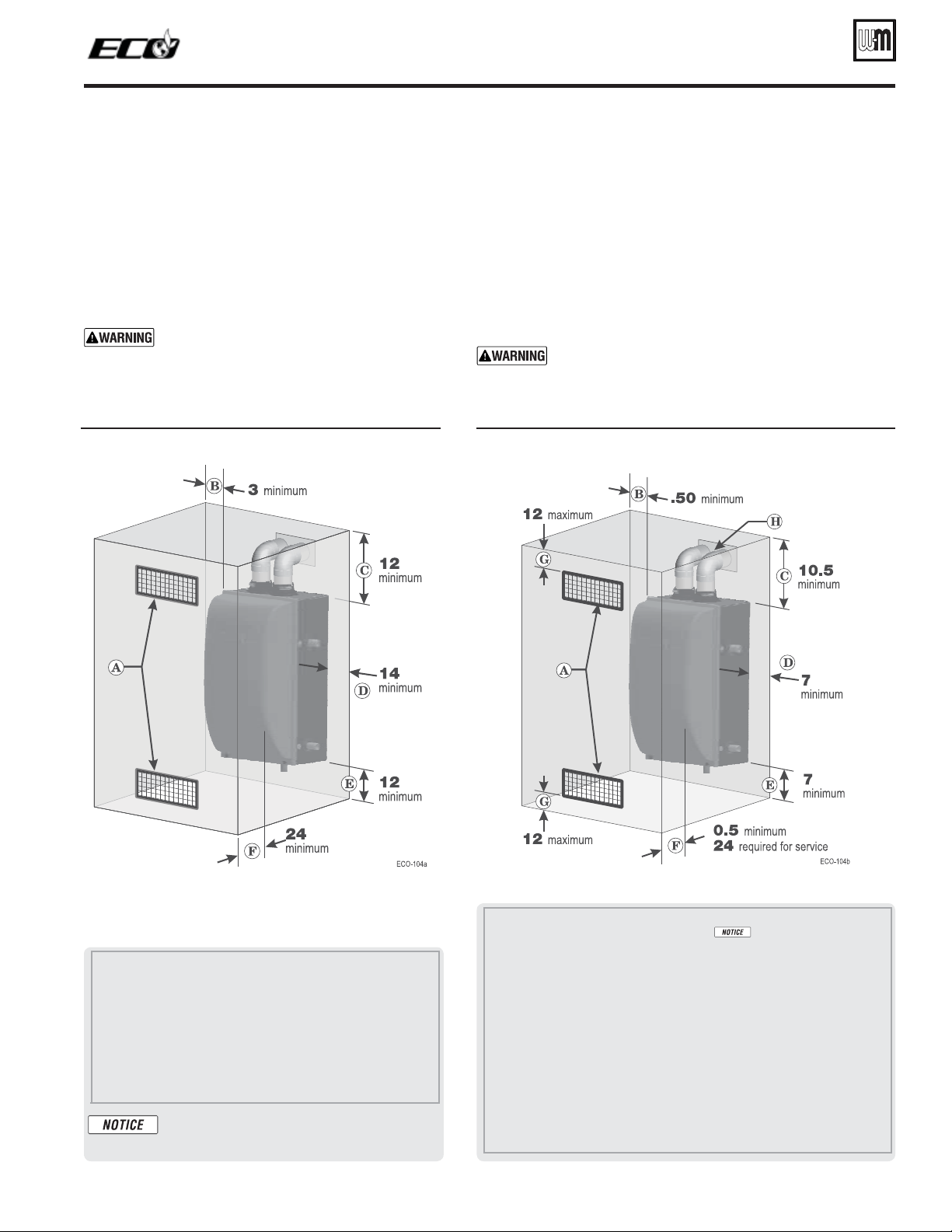
Provide clearances for service
access — RECOMMENDED
1. See Figure 1 for recommended service clearances.
2. If you do not provide minimum service clearances
shown, it might not be possible to service the boiler
without removing it from the space.
3. Clearance D, Figure 1 allows for the installation of pip-
ing as shown in Figure 8, page 12 plus a close nipple
and elbow.
#LOSET OR SMALLENCLOSURE INSTALLATIONS
WHICHDONOTPROVIDEATLEASTTHESERECOM-
MENDEDCLEARANCESREQUIRETHESPECIALLY
SIZED AND PLACED AIR OPENINGS SHOWN IN
&IGURE
.
Provide clearances from combustible
materials — REQUIRED
1. See Figure 2 for REQUIRED minimum clearances. ALL installa-
tion must provide at least these minimums.
2. Hot water pipes — at least ½” from combustible materials.
3. Vent pipe — at least ³⁄₁₆” from combustible materials.
4. Clearance D, Figure 2 allows for the installation of a reducer bush-
ing (155 only) and elbow. Other piping may require additional
clearance.
5. See Figure 1 for service clearance minimums.
#LOSET OR SMALLENCLOSURE INSTALLATIONSWHICH DO
NOTPROVIDEATLEASTTHERECOMMENDEDSERVICECLEAR-
ANCESSHOWNIN&IGURE
REQUIRETHESPECIALLYSIZED
ANDPLACEDAIROPENINGSSHOWNIN&IGURE.
&IGURE REQUIRED minimum clearances
(
ALLDIMENSIONSAREININCHES)
&IGURE RECOMMENDED service clearances
(
ALLDIMENSIONSAREININCHES)
Boiler location (continued)
A Provide combustion air/ventilation openings per Figure 22, page 23 or as otherwise
directed in this manual or by applicable codes.
If the installation does not
provide the minimum clearances in Figure 1, then the enclosure MUST HAVE air
openings located per Figure 2, above. Each of these air openings must have free area of
at least 1 square inch per 1,000 MBH of boiler input.
B Left side clearance to combustibles = .50 inches minimum
C Top of boiler clearance to combustibles = 10.5 inches minimum
D Right side clearance to combustibles = 7 inches minimum
E Bottom of boiler clearance to combustibles = 7 inches minimum (must be 18 inches
above floor for garage installations)
F Clearance in front of the boiler = 0.5 inches, but 24 inches minimum required for
service
G Air openings must be located in the FRONT of the enclosure, as shown. They must be
no more than 12 inches from the floor or ceiling, as shown.
H Vent pipe must be minimum 3/16 inch from combustibles. Opening in combustible
wall, floor, ceiling or roof must be 3/8” larger than flue pipe diameter, fitted with
galvanized steel thimble, or larger if required by codes or as specified by vent pipe
manufacturer.
A Provide combustion air/ventilation openings per Figure 22, page 23 or as
otherwise directed in this manual or by applicable codes. NOTE: If the
installation does not provide the minimum clearances in this illustration,
then the enclosure must have air openings located and sized per Figure 2.
B Left side service clearance = 3 inches minimum
C Service clearance above top of boiler = 12 inches minimum
D Right side service clearance = 14 inches minimum
E Service clearance below the boiler = 12 inches minimum
F Service clearance in front of the boiler = 24 inches minimum
ADDITIONAL service clearance may be
needed, depending on how piping is routed
to the boiler.
Part number 550-142-122/0513
7
TM
GAS-FIRED WATER BOILER — Boiler Manual
Wall-mounting the boiler
Remove boiler from crate
4HEBOILERISHEAVY. Use caution not to drop the boiler
or cause bodily injury while lifting and handling. Verify
that the boiler is securely attached to prevent possibility
of boiler falling after installation.
After the boiler is removed from the shipping carton,
$/./4 allow the boiler to sit on its bottom. This would
cause pressure on protruding plastic, resulting in interior
damage. Either lay the boiler on its back or leave on the
styrofoam protective shipping base.
Do not drop boiler or bump jacket on floor or pallet.
Damage to boiler can result.
Cold weather handling — If boiler has been stored in a
very cold location (below 0°F) before installation, handle
with care until the plastic components come to room
temperature.
1. The ECO boiler is generally easier to handle and maneuver after
removing the shipping container.
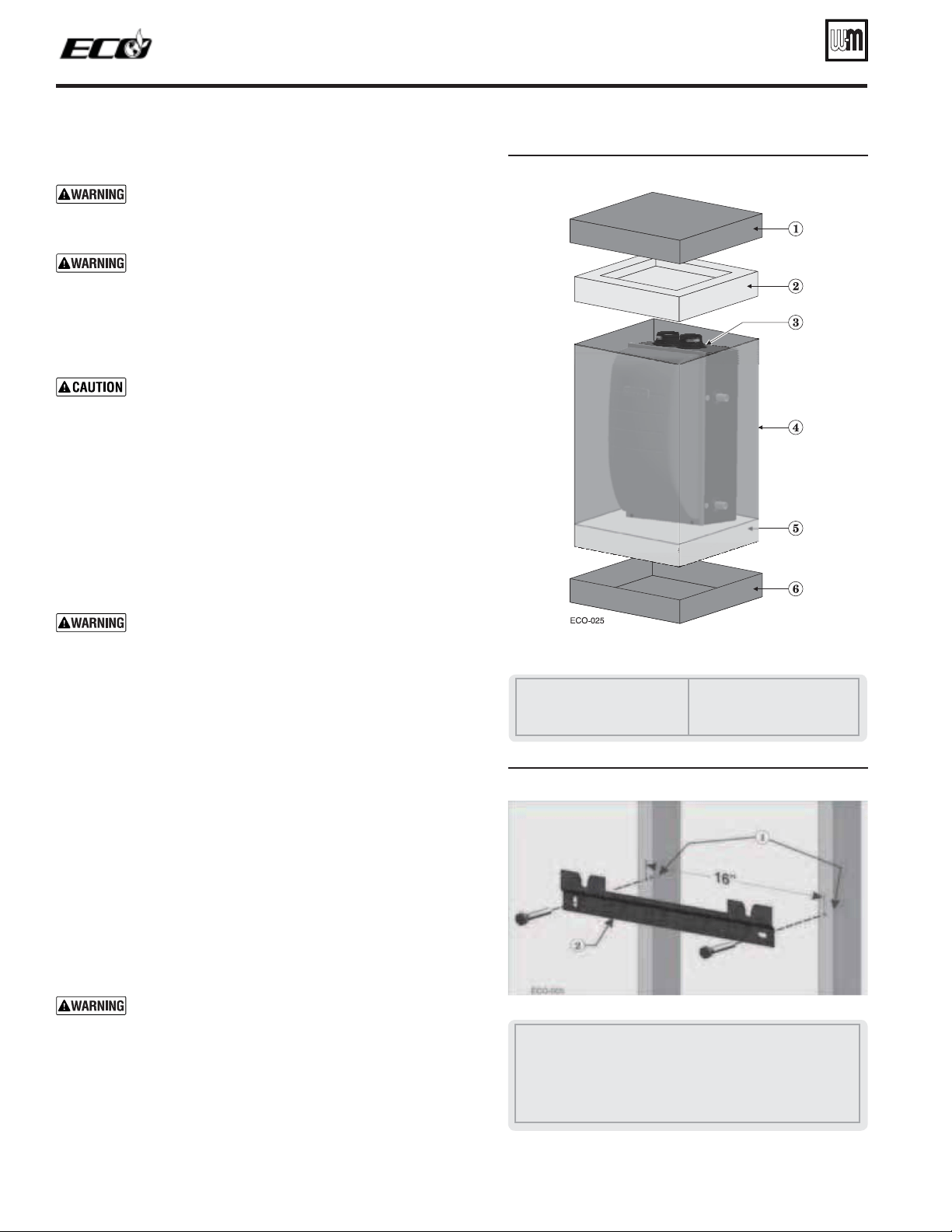
2. Remove items 1, 2 and 4 in Figure 3. Remove trim kit and parts
from item 2.
3.
,EAVE THE BOILER RESTINGON THE STYROFOAMPROTECTIVEBASE
(item 5) and bottom cardboard cap (item 6), until ready to place
on the wall. If removing the boiler from the shipping base, rest
the boiler on its back, NOT on its bottom.
Wall-mounting requirements
DO NOT attempt to attach the wall mount bracket using
anchors or any means other than directly securing to the
wall studs (or equivalent wood structure if studs are not
on 16-inch centers).
4HE WALL MUST BEVERTICALLY PLUMB AND CAPABLEOF
CARRYINGTHE WEIGHTOFTHEBOILERANDANYATTACHED
PIPINGCOMPONENTS
.
The operating weights for wall-mountable boilers are:
ECO 70 or ECO 110: POUNDS
ECO 155: POUNDS
Failure to comply with above and the procedure given
below could result in severe personal injury, death or
substantial property damage.
1. Stud spacing: Bracket holes are spaced for studs on 16-inch centers.
For other stud spacing, provide secure, solid mounting surface on
which to attach the boiler wall-mounting bracket. The mounting
surface must not extend above the top of the boiler jacket.
2. Wood stud wall: Install bracket with lag screws (3/8” x 3”) included
in kit, only into the studs.
3. Metal stud wall: Secure bracket and spacer board to studs with
3/16-inch toggle bolts and 3/16-inch flat washers (not included
with kit).
Verify that the studs are suitable for carrying a wall-
mounted load. Some metal studs are not designed for
this purpose.
4. If the mounting wall has exposed studs, installer must provide a
backer board to mount boiler. Boiler cannot be leveled without
a backing surface.
5. Mount the boiler on the wall following these instructions. The
boiler mounting studs must engage with the wall-mount bracket.
Make sure the bracket is not just resting on the edge of the mount-
&IGURE Boiler shipping container
1 Cardboard cap, top
2 Styrofoam protective cap (in-
cludes compartment for trim
kit and parts)
3 Boiler
4 Cardboard sleeve
5 Styrofoam protective base
6 Cardboard cap, bottom
&IGURE Wall-mount bracket and studs
1 Studs — Pre-drill through the wall into the studs ¼ inch diameter x 3 inches
deep for 3/8-inch lag screws— Studs must be on 16-inch centers. If studs
are any other spacing, provide a secure, solid mounting surface on which to
attach the boiler wall-mounting bracket.
2 Wall-mount bracket
Part number 550-142-122/0513
8
TM
GAS-FIRED WATER BOILER — Boiler Manual
Wall-mounting the boiler (continued)
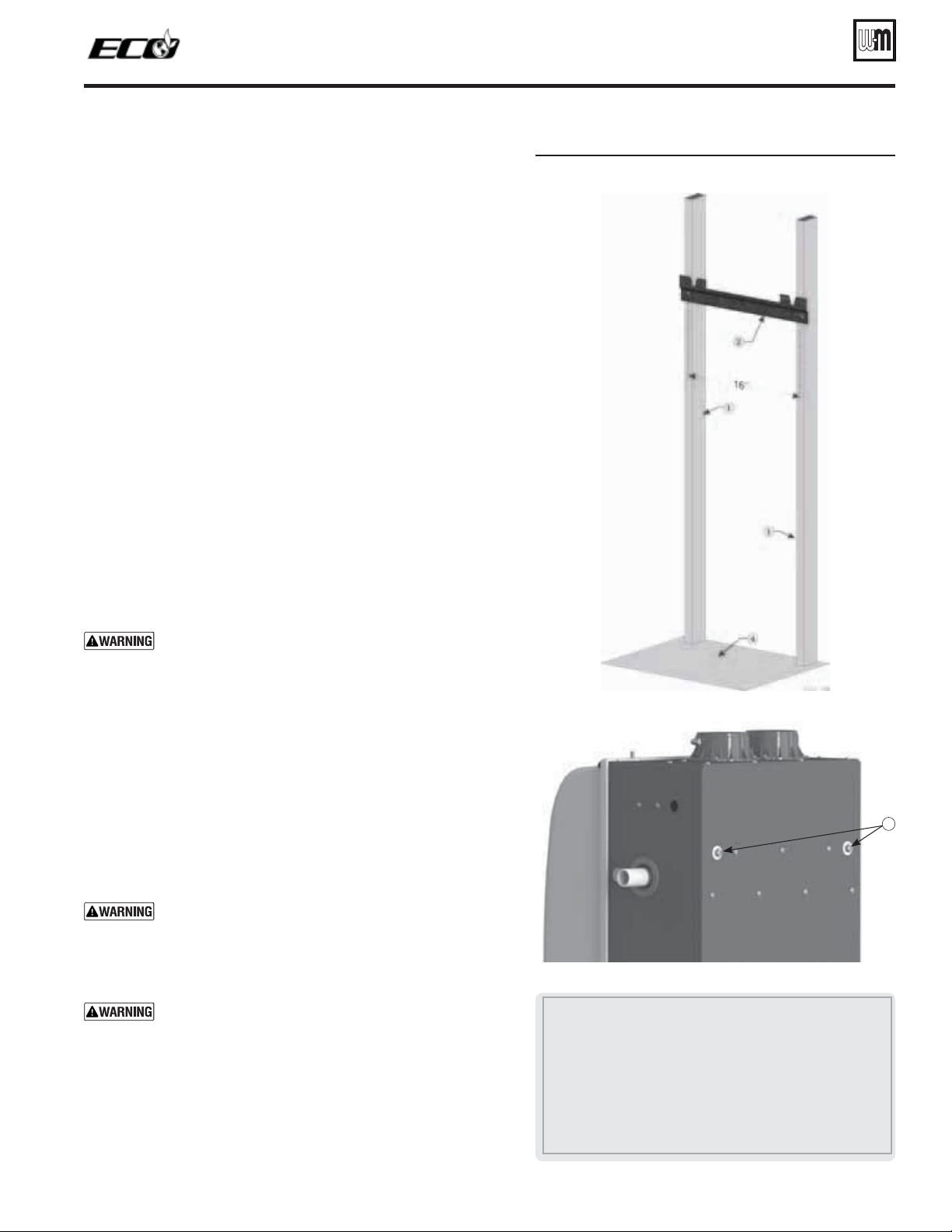
&IGURE Place boiler on wall-mount bracket
ing stud or washer. Perform all procedures given in the Boiler
Manual on previous pages before mounting the boiler.
Install the wall-mount bracket (by installer)
1. See Figure 4, page 8.
2. Locate the studs — must be on 16-inch centers. See previous page
instructions if studs are not on 16-inch centers.
3. Place the wall-mount bracket (item 2, Figure 4, page 8) on the wall,
using a level to align correctly.
4. Place the wall-mount bracket so the mounting slots are centered
over the studs.
5. Level the bracket and trace the outline of the screw slots with a
pencil.
6. Remove the mounting bracket and drill holes 1/4” diameter by 3
inches deep, centered on the screw slot outlines. (For metal stud
walls, using 3/16” toggle bolts, drill required clearance holes.)
7. Position the wall-mount bracket on the wall. Insert and loosely
tighten the two lag screws (or toggle bolts for metal studs).
8. Level the wall-mounting bracket. Then tighten lag screws securely.
For drywall or plaster lathe installations, avoid tightening so much
that the bracket digs into the wall surface.
Place boiler on bracket
1. See Figure 5. The wall-mount bracket must be installed before
mounting the boiler.
2. Measure 22
1/2 inches below the bottom edge of the wall-mount
bracket (item 2). Strike a line or place a piece of masking tape with
its top edge even with the 22
1/2-inch mark. (This line, or tape,
will indicate whether the boiler has been properly seated onto the
wall-mount bracket.)
4HEBOILERISHEAVY
, and requires two people to lift and
place. Wear non-slip leather gloves to prevent possibility
of cuts from sheet metal edges.
The jacket door can be left in place when handling the boiler,
but the boiler must ONLY be lifted by the bottom and rear of
the sheet metal housing — NOT by any pipe or plastic part.
3. /BTAINASSISTANCETOLIFTTHEBOILERINTOPOSITION
.
4. Lift the boiler high enough that its mounting studs (item 3) will
be above the wall-mount bracket (item 2).
5. Let the rear of the boiler slide against the lag screw heads as you
lower the boiler into place. The V-groove will help guide the studs
into the slot.
6. When the brackets are engaged correctly, the bottom of the boiler
enclosure will be at or near the pencil line, or tape, you applied
in step 2.
7. Adjust the studs properly until engaged with the bracket and the
boiler slips into the correct position.
When mounting the boiler, use the method described in
paragraph 2 above to ensure the mounting studs are properly
engaged. If not, the boiler could fall. Failure to comply could
result in severe personal injury, death or substantial property
damage.
8. Ensure boiler is level front-to-back.
Ensure boiler is NOT pitched upward with the front of the boiler
higher than the back of the boiler. This can prevent conden-
sate from draining properly. Failure to comply could result in
severe personal injury, death or substantial property damage.
Floor-standing boiler option
An optional accessory to allow the boiler to be placed on a level
floor is available from Weil-McLain. See kit instructions (available
on website) details. See “BOILER ACCESSORIES” on page 107 for
part number information.
1 Studs — Pre-drill through the wall into the studs ¼ inch diameter x 3
inches deep — Studs must be on 16-inch centers. If studs are any other
spacing, provide a secure, solid mounting surface on which to attach the
boiler wall-mounting bracket.
2 Wall-mount bracket — secure wall mount bracket to wall as instructed
on previous page.
3 Boiler mounting studs— The V-groove on the wall-mount bracket will
help guide the studs into the slots. The studs are attached to the back of
the boiler.
4 Floor surface
Part number 550-142-122/0513
9
TM
GAS-FIRED WATER BOILER — Boiler Manual
3

Display bracket installation
Determine display unit location
1. Boiler display unit can be mounted on either the right side of the
boiler jacket or on the wall in close proximity to the boiler
2. For displays mounted on the boiler jacket, use the provided display
bracket.
a. For boilers mounted using the optional floor stand kit, always
mount the display to the display bracket on the boiler jacket.
See page 107 for information on the optional floor stand kit.
3. For displays mounted on the wall, the back plastic housing of the
display can mount either directly to the wall or a standard 2” x 4”
junction box.
a. The display should be mounted within 2 feet of the top right
corner of the boiler. If mounted further away, the display’s
wire harness will not reach.
DO NOT cut or splice the display wire harness. If display
is mounted too far from the boiler for the provided wire
harness, relocate the display closer to the boiler.
Display bracket installation (on boiler jacket)
Install display bracket to the boiler jacket BEFORE installing
any piping.
1. Remove the two (2) screws on the top right side of the boiler above
the supply pipe shown in Figure 6.
2. The front screw is a pivot to rotate the display bracket up or down
depending on the boiler mounting height and desired display
angle. Potentional mounting angles are demonstrated in Figure 7.
3. Ensure that intended piping locations will not interfere with the
display housing when mounted.
Installing the display bracket after piping may result
in interference between the piping and display. Leave
clearance around the bracket because the display is
larger than the bracket.
It may be helpful to remove the display from the box
and temporarily fit it up to the bracket to estimate the
needed clearance. Remove display before piping boiler.
Damage to display may occur, if not removed.
Display installation on wall
1. Ensure mounting location follows guidelines in paragraph 3 of
“Determine display unit location” above.
2. Separate the front and back pieces of plastic.
3. If mounting directly to drywall or plaster, use one of these meth-
ods:
a. Route wire through the back of the unit like a thermostat by
routing wire harness through the wall.
b. Use spacers behind the plastic to allow space for routing the
wire harness behind the plastic backing and entering through
the back.
4. Drill two 3/16-in. mounting holes in wall where marked.
5. Secure back plastic to wall with two (2) anchors and screws
making sure allowance has been made for the display wire har-
ness to enter through the back.
6. Keep front half of display safe until it is time to wire the display.
Wire the display after piping is complete.
&IGURE 6IEWRIGHTSIDEOFBOILERscrews for
mounting display bracket
&IGURE $ISPLAYONBRACKET- potential mounting
angles
Display installation on junction box
1. Ensure mounting location follows guidelines in para-
graph 3 of “Determine display unit location”.
2. Remove one knockout to allow the wire harness to
pass through to the back of the plastic once inside the
junction box.
3. Mount the display after piping is completed and the
display wire harness has been routed to box. Use a
bushing or clamp to ensure harness is secure to the
junction box and insulation will not be damaged.
Part number 550-142-122/0513
10
TM
GAS-FIRED WATER BOILER — Boiler Manual
Boiler hydrostatic test
$/./4INSTALLARELIEFVALVEWITHA
PRESSUREHIGHERTHAN03)'. This
is the maximum allowable relief valve
setting for the ECO boiler. Failure to
comply could prevent the relief valve
from operating as needed, resulting in
possibility of severe personal injury,
death or substantial property damage.
5SETWOWRENCHESWHENTIGHTENING
ANYPIPE CONNECTION TO THE BOILER.
Failure to prevent the boiler pipes from
turning could damage pipes or heat
exchanger, resulting in possible severe
personal injury, death or substantial
property damage.
Hydrostatic pressure test
Pressure test the boiler before permanently attaching
water or gas piping or electrical supply.
Install pipe fittings for relief
valve and P/T gauge
1. Install the reducer bushings (155 only), reducing
tees, and close nipples, shipped loose with the boiler,
located and oriented as shown in Figure 8, page 12.
Boilers installed in locations with less
than the RECOMMENDED service
clearances will need to adjust piping
layout to meet space requirements.
2. Apply pipe dope to all fittings sparingly.
$/ ./4INSTALL THE RELIEF VALVE UNTIL
AFTERTHEHYDROSTATICTEST
. Temporarily
install a ¾” pipe plug in the relief valve
location as directed in these instructions.
The plug must be removed after the test.
#ONNECTTHERELIEFVALVE/.,9ONTHE
"/),%2 3500,9 /54,%4 ./4
the
boiler return. Connect the relief valve
only as shown in this manual. Ensure re-
lief valve is located above heat exchanger.
Failure to comply with the above could
prevent the relief valve from operating as
needed, resulting in possibility of severe
personal injury, death or substantial
property damage.
3. Install the pressure/temperature gauge to the reduc-
ing tee as shown in Figure 8, page 12.
Install fittings and valves
required for hydrostatic testing
1. The following piping components (supplied by
installer) are required for the test configuration:
a. Two shut-off valves (1”NPT on 70/110,
1¼”NPT on 155).
b. Two close nipples (1”NPT on 70/110,
1¼”NPT on 155).
c. ¾” NPT pipe plug.
2.
4%-0/2!2),9 insert a ¾” NPT pipe plug in the relief valve tapping.
After the hydrostatic test, this plug must be removed and the relief
valve must be installed.
Fill and pressure test
1. See Figure 9, page 12 for use with the following instructions.
2. CLOSE the boiler drain valve (item 11). Connect a hose to fresh water
supply and to the drain valve.
3. Place a bucket under the ends of the isolation valves (item 9 and 10)
to catch water drippings.
4. CLOSE isolation valve item 10, then crack open the valve slightly. Leave
isolation valve item 9 open.
5. Slowly open the boiler drain valve (item 11) and fresh water supply to
fill boiler with water. The boiler and piping will fill quickly because of
the low water content.
6. When water begins to flow from bottom isolation valve (item 10),
close the valve.
7. Continue filling until water flows from top isolation valve (item 9),
then close the valve.
8. When pressure on the pressure/temperature gauge (item 4) reaches
at least 45 PSIG, but no higher than 55 PSIG, CLOSE the boiler drain
valve (item 11).
9. Hold at test pressure for 10 minutes.
Do not leave boiler unattended. A cold water fill could expand
and cause excessive pressure, resulting in severe personal
injury, death or substantial property damage.
10. Make sure constant gauge pressure has been maintained throughout
test. Check for leaks. Repair if found.
,EAKSMUSTBEREPAIREDATONCE Failure to do so can
damage boiler, resulting in substantial property damage.
Do not use petroleum-based cleaning or sealing compounds
in boiler system. Gaskets and seals in the system may be dam-
aged. This can result in substantial property damage.
Drain and remove fittings
1. Disconnect fill water hose from water source.
2. Drain boiler through drain valve
(item 11).
Use caution when releasing pressure from the boiler. Rapid
water flow could cause injury.
3. Remove hose after draining.
4. Remove nipples and valves unless they will remain for use in the system
piping.
5. Remove plug and install relief valve as specified in the following
WARNING.
Remove plug from relief valve street elbow. Install the relief
valve in the ¾” street. See page 40 or page 46 to install
relief valve discharge piping. Failure to install the boiler
relief valve could result in severe personal injury, death or
substantial property damage.
Part number 550-142-122/0513
11
TM
GAS-FIRED WATER BOILER — Boiler Manual
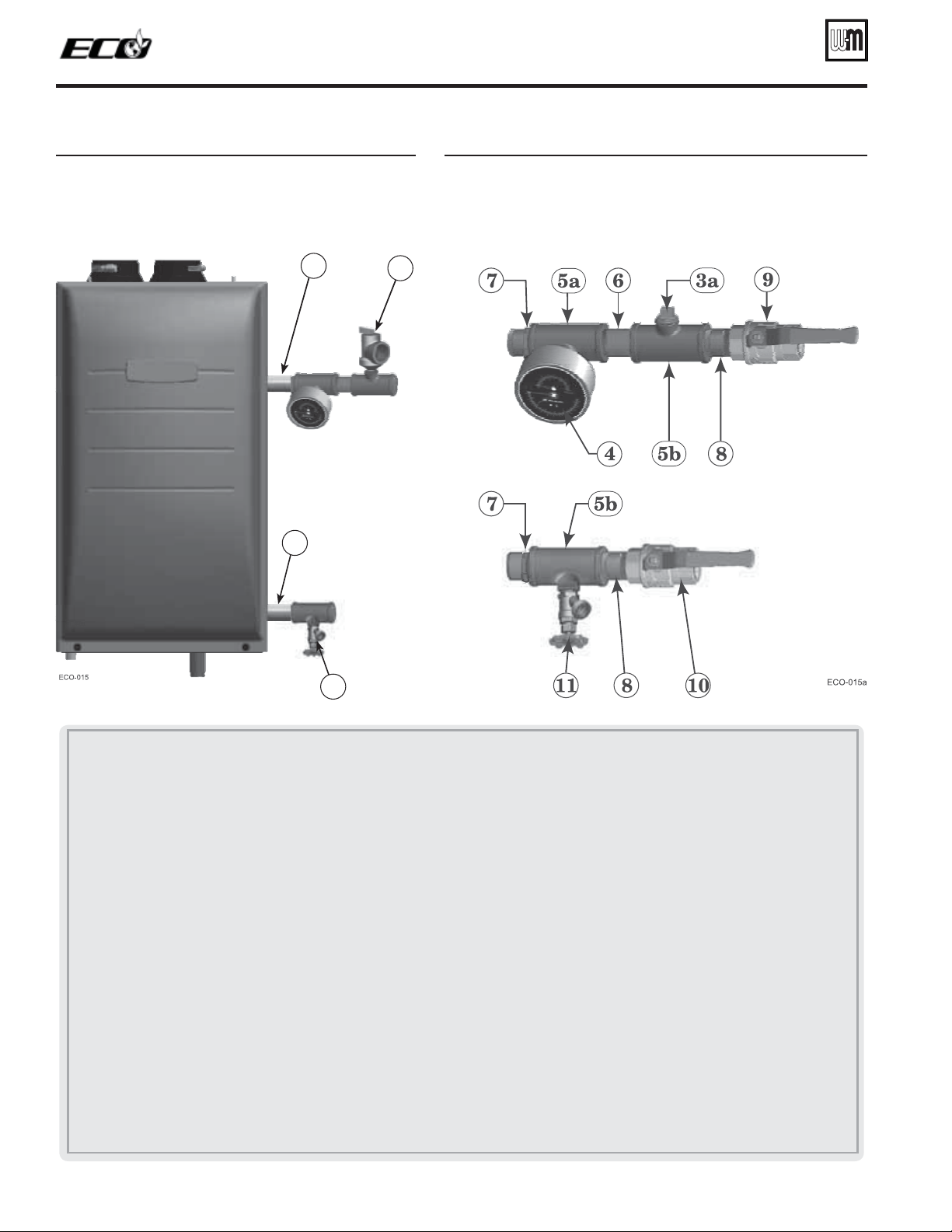
&IGURE Install pipe fittings for relief valve and
pressure/temperature gauge —
$/
./4MOUNTRELIEFVALVEUNTIL!&4%2
HYDROSTATICTESTING
(see legend below)
&IGURE Install piping components required for hydrostatic
test (
see legend below)
3
1
Part number 550-142-122/0513
12
TM
GAS-FIRED WATER BOILER — Boiler Manual
1 Boiler supply (outlet) connection, (male, 1” NPT )
2 Boiler return (intlet) connection, (male, 1” NPT )
3 Boiler relief valve, shipped loose with boiler — $/./4MOUNTRELIEFVALVEUNTIL!&4%2HYDROSTATICTESTING.
3a 4%-0/2!2),9/.,9 Insert a ¾” NPT plug in the relief valve tapping of the reducing tee. 4HIS-534"%2%-/6%$AFTER
THETESTANDTHERELIEFVALVEMOUNTEDHERE.
4 Pressure/temperature gauge, shipped loose with boiler
5a Reducing tee, NPT, 1 ” x 1 ” x ¼” on 70/110, & 1 ¼” x 1 ¼” x ¼” on 155, shipped loose with boiler
5b Reducing tee, NPT, 1 ” x 1 ” x ¾” on 70/110, & 1 ¼” x 1 ¼” x ¾” on 155, shipped loose with boiler
6 Nipple, NPT 1” x close on 70/110, & 1 ¼” x close on 155, shipped loose with boiler
7 Reducing bushing, NPT, 1 ¼” x 1”, shipped loose with boiler (155 only)
8 Nipple, NPT 1” x close on 70/110, & 1 ¼” x close on 155, by installer
9 Isolation valve on supply connection, by installer (1” NPT on 70/110, 1¼” NPT on 155)
10 isolation valve on return connection, by installer (1” NPT on 70/110, 1¼” NPT on 155)
11 ¾” NPT boiler drain valve, shipped loose with boiler — after hydrostatic testing, move drain valve to lowest point on the return piping if not
already there.
Boiler hydrostatic test (continued)
(155 only)
(155 only)
11
Piping from system
Piping to system
2
Prepare boiler for propane —
ECO 70/110 only (if required)
Propane operation
!,, %#/ BOILERSMUSTBE CONVERTED FOR
PROPANEOPERATION
.
#ONVERTINGANEXISTINGNATURALGASlREDBOILER
FORPROPANE
— For a boiler already installed, you
must turn off gas supply, turn off power and allow
boiler to cool before proceeding. You must also
completely test the boiler after conversion to verify
performance and start up the boiler following in-
structions beginning on page 75 of this manual.
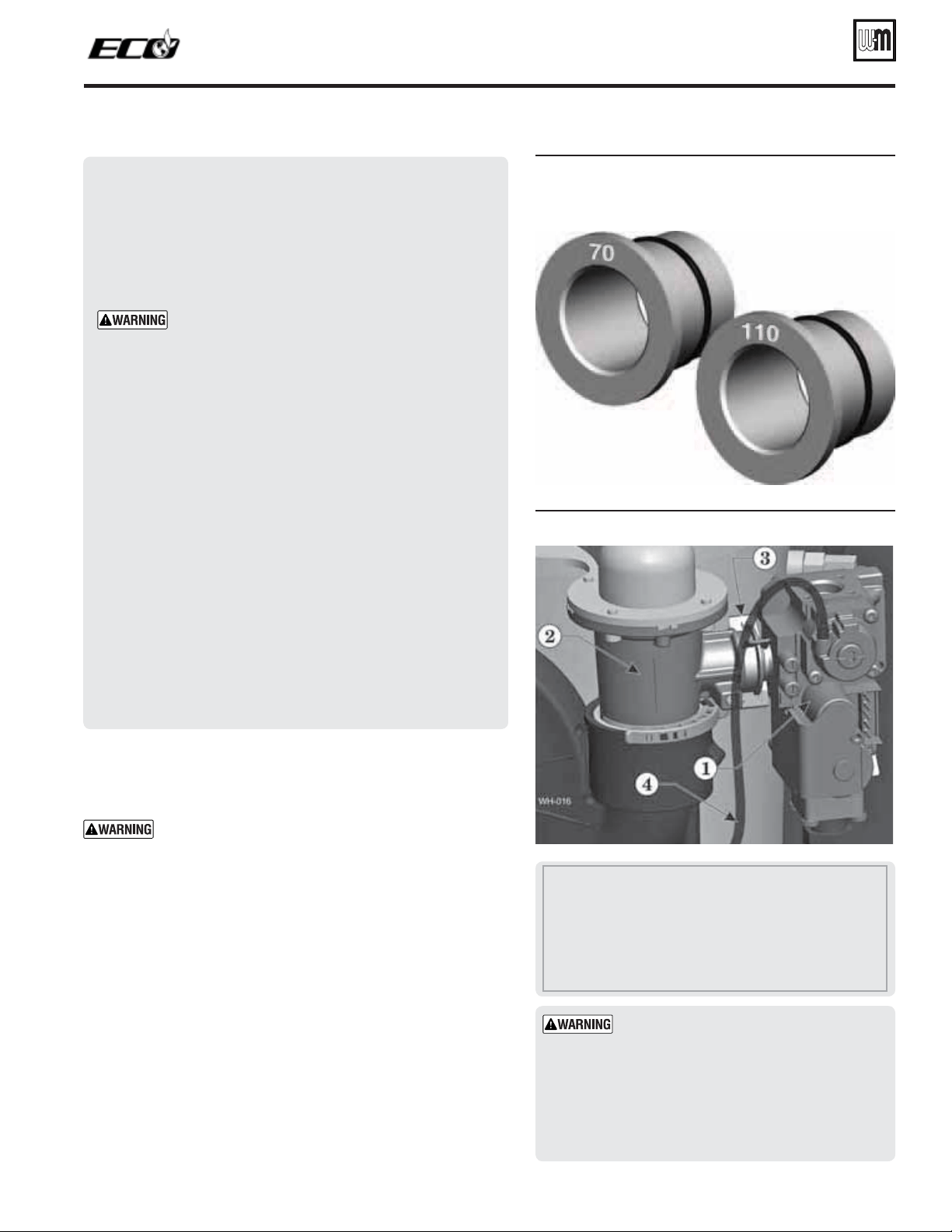
6ERIFYPROPANEGASORIlCEBUSHING —
See Figure 10. Verify when installing that the orifice
size marking is correct. Bushings will be stamped as
in illustration or with “3.85” for model 70 and “4.45”
for model 110.
Failure to comply could result in severe personal
injury, death or substantial property damage.
Installing propane orifice bushing —
ECO 70/110 only
)FBOILERISALREADYINSTALLED — You must turn off elec-
trical supply to the boiler and close the external manual
gas shut-off valve to isolate the boiler during conversion.
Allow the boiler to cool if it has been operating.
Following conversion of an installed boiler, follow all
instructions in this manual to start up the boiler and
verify operation of the boiler and all system components.
1. Locate the propane orifice bushing from the propane conversion
kit bag.
2. Verify that the stamping on the orifice bushing is correct for the
model size (see Figure 10).
3. If the jacket door is not already removed, remove it.
4. Locate the gas valve and venturi (see Figure 11).
5. Pull the gas valve retention ring (item 3, Figure 11) off of the gas
valve/venturi joint.
6. Carefully pull the gas valve to the right until it is free of the venturi.
Leave the pressure reference hose (item 4, Figure 11) connected
at both ends.
&IGURE Propane gas orifice bushing identification
%#/ 70 on left (may be stamped 3.85)
%#/ 110 on right (may be stamped 4.45)
&IGURE Gas valve and venturi
1 Gas valve
2 Venturi
3 Gas valve retention ring
4 Pressure reference hose — LEAVE CONNECTED AT BOTH
ENDS
Support the gas valve after disconnecting
it. DO NOT allow it to hang from the gas
valve flex line. When re-attaching the gas
valve, ensure the gas valve-to-venturi O-
ring (item 5, Figure 12, page 14) is in place
and in good condition. Inspect the gas valve
flex line to ensure it is undamaged and in
good condition.
Part number 550-142-122/0513
13
TM
GAS-FIRED WATER BOILER — Boiler Manual
Converting boiler to propane — ECO 70/110
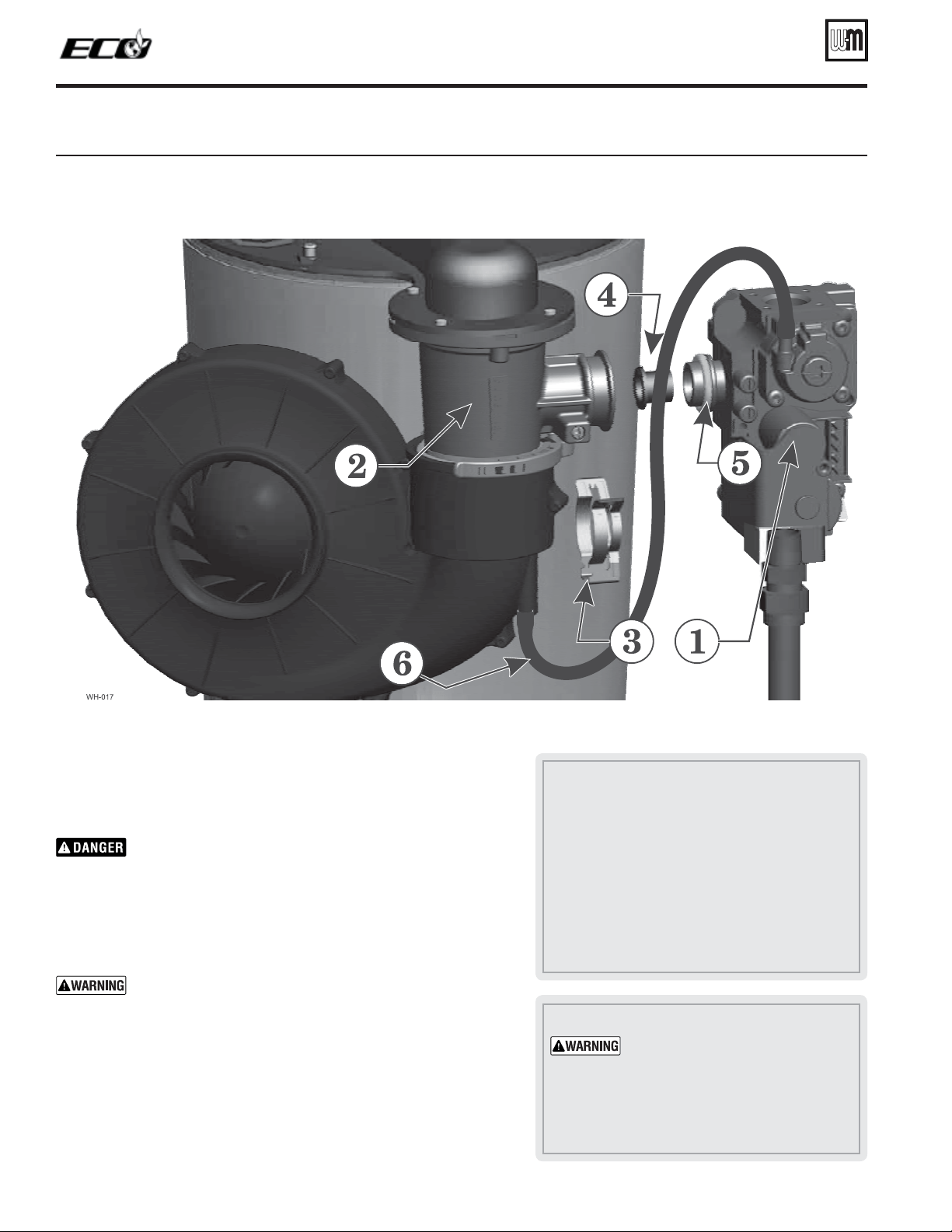
&IGURE Installing the propane gas orifice bushing (some details omitted for clarity)
Converting boiler to propane — ECO 70/110 (cont.)
7. See Figure 12. Insert the propane gas orifice bushing (item 4) into
the gas valve outlet as shown.
8. Press the bushing into the gas valve outlet until the bushing flange
butts against the gas valve outlet.
Inspect the O-rings on the propane gas orifice bushing
an on the gas valve outlet (item 5, Figure 12). The O-
rings must be in good condition and must be installed.
Failure to comply will cause a gas leak, resulting in severe
personal injury or death.
9. Reposition gas valve into the venturi and reinstall the gas valve
retention ring (item 3, Figure 12).
$/./4!44%-044/-%!352%6!,6%/54,%4
02%3352%
The valve could be damaged by manom-
eter fluid contamination. Failure to comply could result
in severe personal injury, death or substantial property
damage.
10. After installation is complete, attach the propane conversion label
(in conversion kit bag) next to the boiler rating plate.
11. Perform complete start-up sequence (beginning on page 75),
including check for gas leaks and checking for proper operation.
12. Reinstall jacket door.
,%'%.$for Figure 12
1 Gas valve
2 Venturi
3 Gas valve retention ring
4 Propane orifice bushing with o-ring
5 Gas valve o-ring
6 Pressure reference hose — LEAVE CONNECTED AT
BOTH ENDS
4HEJACKETDOORMUSTBEINPLACE
DURINGOPERATION
DO NOT oper-
ate the boiler with the jacket door
removed except for inspection and
testing as directed in this manual.
Part number 550-142-122/0513
14
TM
GAS-FIRED WATER BOILER — Boiler Manual
Converting boiler to propane — ECO 155
Prepare boiler for propane —
ECO 155 only (if required)
Propane operation
!,,%#/BOILERSMUSTBECONVERTEDFORPRO-
PANEOPERATION
.
#ONVERTINGANEXISTINGNATURALGASlREDBOILER
FORPROPANE
— For a boiler already installed, you
must turn off gas supply, turn off power and allow
boiler to cool before proceeding. You must also
completely test the boiler after conversion to verify
performance and start up the boiler following in-
structions beginning on page 75 of this manual.
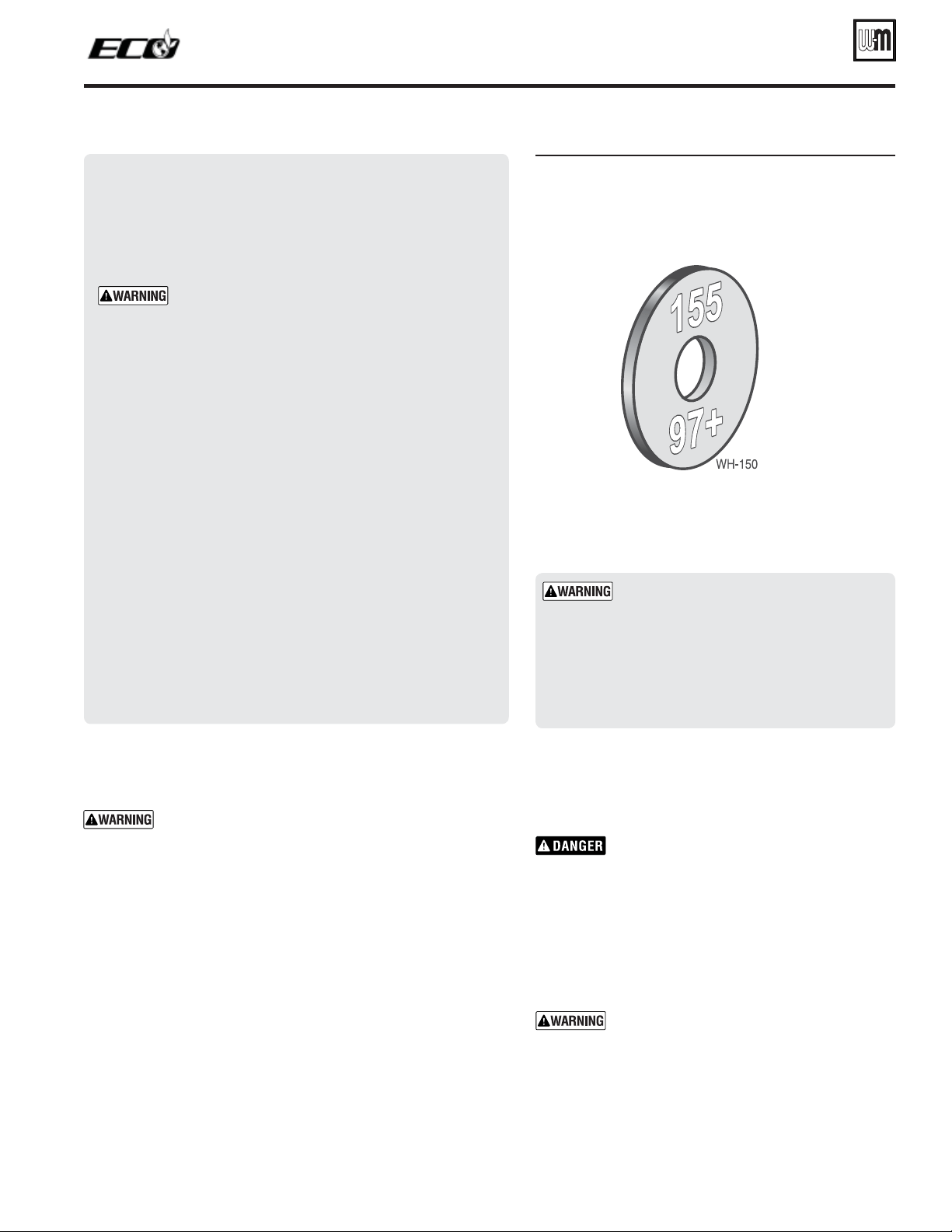
6ERIFYPROPANEGASORIlCESIZE — See Figure 13.
Verify when installing that the orifice size marking
is correct. Orifice will be stamped as in illustration.
Failure to comply could result in severe personal
injury, death or substantial property damage.
Installing propane orifice —
ECO 155 only
)FBOILERISALREADYINSTALLED — You must turn off elec-
trical supply to the boiler and close the external manual
gas shut-off valve to isolate the boiler during conversion.
Allow the boiler to cool if it has been operating.
Following conversion of an installed boiler, follow all
instructions in this manual to start up the boiler and
verify operation of the boiler and all system components.
1. Locate the propane orifice from the propane conversion kit bag.
2. Verify that the stamping on the orifice is correct for the model size
(see Figure 13).
3. If the jacket door is not already removed, remove it.
4. See Figure 14, page 16 and Figure 15, page 16 for the following.
5. Locate the gas valve and venturi (items 1 and 3).
6. Release the gas line to silencer bracket (item 6) from the gas line
and rotate it forward out of the way.
7. Use a 5-mm hex wrench to remove the three Allen screws (item 2)
that secure the gas valve to the venturi.
&IGURE Propane gas orifice identification
%#/ 155
8. See Figure 15, page 16. Carefully pull the gas valve to
the right until it is free of the venturi. Securely support
the gas valve — DO NOT leave it dangling.
3UPPORTTHEGASVALVEAFTERDISCONNECT-
INGFROMTHEVENTURI$/./4ALLOWITTO
HANGFROMTHEGASVALVEmEXLINE
When
re-attaching the gas valve, ensure the gas
valve grommet (item 8, Figure 15, page 16)
is in place and in good condition. Inspect
the gas valve flex line to ensure it is undam-
aged and in good condition.
9. Insert the propane gas orifice (item 7) into the gas valve
opening as shown in Figure 15, page 16.
10. Make sure that the rubber grommet (item 8) is firmly
seated in the gas valve opening.
When re-attaching the gas valve, ensure the
gas valve grommet (item 8, Figure 15, page 16)
is in place and in good condition. Failure to
comply will cause a gas leak, resulting in severe
personal injury or death.
11. Reposition gas valve onto the venturi and reinstall the
gas valve retention screws (item 2).
12. Swing the gas line to silencer bracket (item 6) back into
position and snap onto the gas line.
$/./4!44%-044/-%!352%6!,6%
/54,%4 02%3352%
The valve could be
damaged by manometer fluid contamina-
tion. Failure to comply could result in severe
personal injury, death or substantial property
damage.
13. After installation is complete, attach the propane con-
version label (in conversion kit bag) next to the boiler
rating plate.
Part number 550-142-122/0513
15
TM
GAS-FIRED WATER BOILER — Boiler Manual
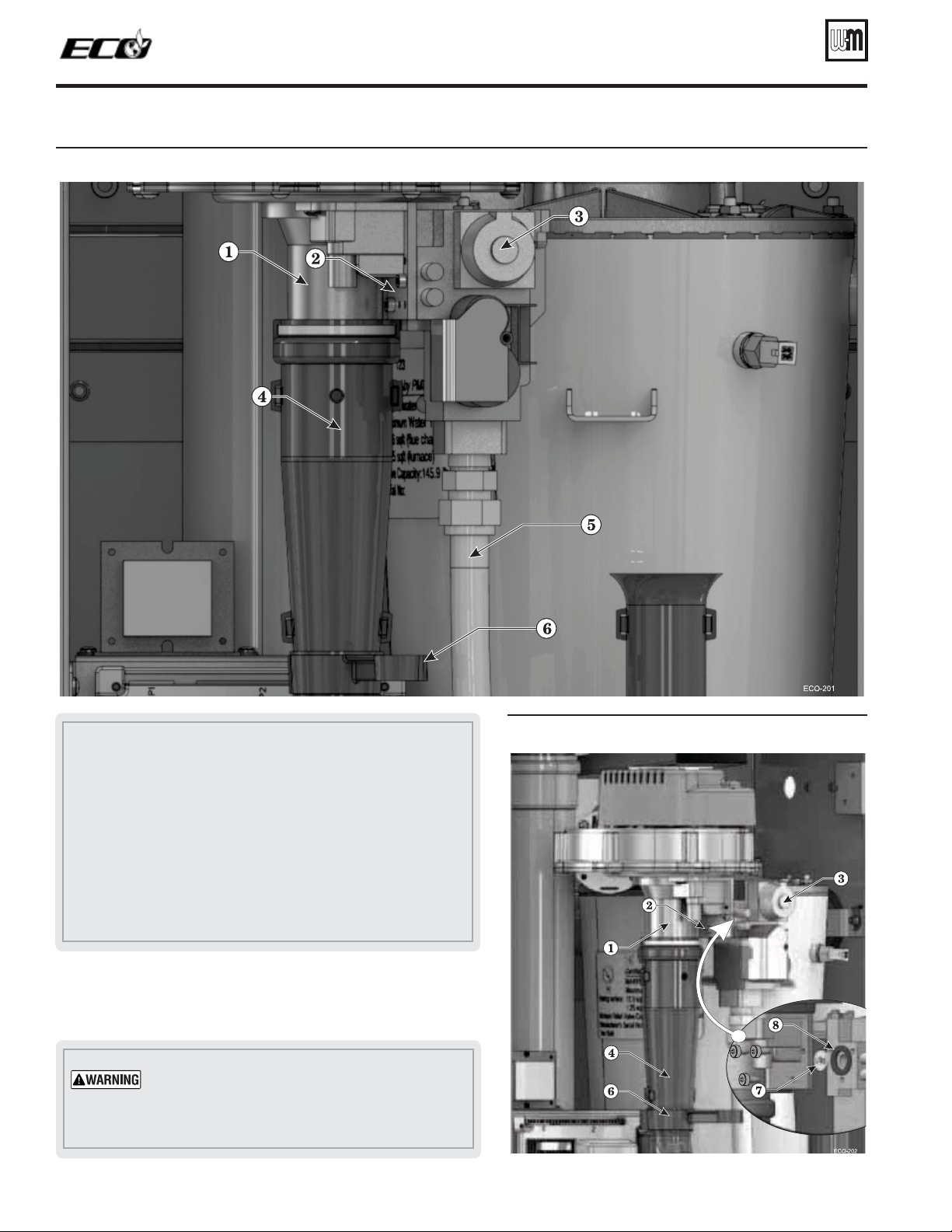
&IGURE Installing the propane gas orifice bushing (some details omitted for clarity)
Converting boiler to propane — ECO 155 (cont.)
14. Perform complete start-up sequence (beginning on page 75),
including check for gas leaks and checking for proper operation.
15. Reinstall jacket door.
4HEJACKETDOORMUSTBEINPLACEDURINGOPERA-
tion.
DO NOT operate the boiler with the jacket
door removed except for inspection and testing as
directed in this manual.
,%'%.$for Figure 14 and Figure 15
1 Venturi (leave venturi attached to blower)
2 (3) hex-head screws, 5 mm hex (remove and retain)
3 Honeywell gas valve
4 Air silencer (leave connected to venturi)
5 Flexible gas line
6 Gas line to silencer bracket (rotate forward before disconnecting gas valve
from venturi
7 Propane orifice (in propane conversion kit envelope)
8 Rubber grommet (must be installed in valve for all applications) — make
sure grommet is properly seated in valve before inserting the propane
orifice
&IGURE Gas valve and venturi
Part number 550-142-122/0513
16
TM
GAS-FIRED WATER BOILER — Boiler Manual
Gas piping — sizing gas lines
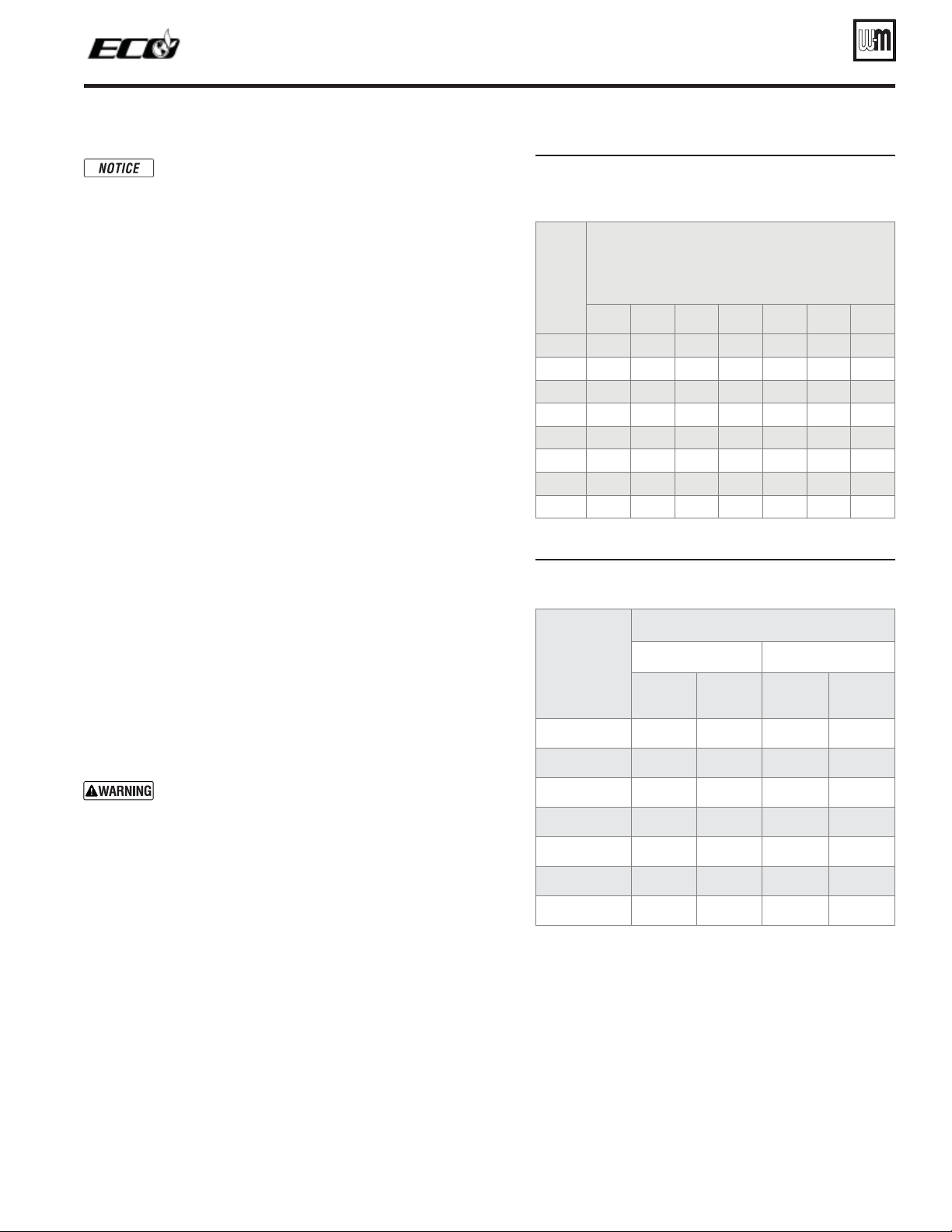
&IGURE Pipe capacity for 0.60 specific gravity
natural gas; pipe length is in equivalent
feet
Gas
PIPE
total
LENGTH
FEET
#APACITY
Cubic feet per hour, natural gas, 0.60 specific gravity
Gas pressure 13” (330 mm) w.c. or less
Pressure drop 0.3 inches (7.6 mm) w.c.
v Ðv v v v v v
10 132 278 520 1050 1600 3050 4800
20 92 190 350 730 1100 2100 3300
30 73 152 285 590 890 1650 2700
40 NA 130 245 500 760 1450 2300
50 NA 115 215 440 670 1270 2000
75 NA 105 175 360 545 1020 1650
100 NA 96 150 305 460 870 1400
150 NA 90 120 250 380 710 1130
&IGURE Equivalent lengths of straight pipe for
typical gas line fittings
0IPESIZE
inches
%QUIVALENTLENGTHFEET
%LBOW Tee
SHORT
radius
LONG
radius
line
mOW
BRANCH
mOW
½
3.6 2.2 1.7 4.2
¾
4.4 2.3 2.4 5.3
1
5.2 2.7 3.2 6.6
1¼
6.6 3.2 4.6 8.7
1½
7.4 3.4 5.6 9.9
2
8.5 3.6 7.7 12.0
2½
9.3 4.0 9.3 13.0
Boiler gas connection is ½” NPT. Size gas lines large
enough to provide gas to all connected appliances.
Natural Gas:
0IPESIZINGFORNATURALGAS
1. Size gas piping from meter outlet to entrance of boiler in accor-
dance with Figure 16 and Figure 17.
2. Use total input of all connected appliances. Divide total input in
Btuh by 1,000 to obtain cubic feet per hour of natural gas.
a. Pipe lengths in Figure 16 are equivalent length of straight
pipe. Convert pipe fittings to equivalent lengths using data
from Figure 17.
b. Figure 16 is only for natural gas with specific gravity 0.60, with
a pressure drop through the gas piping as listed in the table.
c. For additional gas pipe sizing information, refer to ANSI Z223.1
(or B149.1 or B149.2 for Canadian installations).
.ATURALGASSUPPLYPRESSURE
1. Pressure required at gas valve inlet pressure port:
a. Maximum: 13” (330 mm) w.c. with no flow (lockup).
b. Minimum gas pressure, with gas flowing (verify during
boiler startup, while boiler is at high fire):
ECO 70: 3½” (89 mm) w.c.
ECO 110: 4½” (114 mm) w.c.
ECO 155: 3½” (89 mm) w.c.
c. Nominal gas pressure: 7.0” (178 mm) w.c.
2. Install 100% lockup gas pressure regulator in supply line if inlet
pressure can exceed 13” w.c. at any time. Adjust lockup regulator
for 13” w.c. maximum.
Propane Gas:
You must follow the instructions, beginning on page 13,
to operate the boiler on propane. Failure to comply could
result in severe personal injury, death or substantial
property damage.
0IPESIZINGFORPROPANEGAS
1. Contact gas supplier to size pipes, tanks and 100% lockup gas
pressure regulator.
0ROPANESUPPLYPRESSURE
1. Adjust propane supply regulator provided by gas supplier for 13”
(330 mm) w.c. maximum pressure.
2. Pressure required at gas valve inlet pressure port:
a. Maximum: 13” (330 mm) w.c. with no flow (lockup).
b. Minimum gas pressure, with gas flowing (verify during
boiler startup, while boiler is at high fire):
ECO 70: 3½” (89 mm) w.c.
ECO 110: 4½” (114 mm) w.c.
ECO 155: 3½” (89 mm) w.c.
c. Nominal gas pressure: 11.0” (279 mm) w.c.
Part number 550-142-122/0513
17
TM
GAS-FIRED WATER BOILER — Boiler Manual
9OUMUSTPIPECOMBUSTIONAIRTOTHE
BOILERAIRINTAKE
.
Install air inlet piping for the ECO boiler
as described in this manual.
The air termination fitting must be in-
stalled with the clearances and geometry
relative to the vent outlet depicted in this
manual to ensure that flue products do
not enter the air intake.
Ensure that the combustion air will not
contain any of the contaminants in Fig-
ure 18. Do not pipe combustion air near a
swimming pool, for example. Avoid areas
subject to exhaust fumes from laundry
facilities. These areas will always contain
contaminants.
Contaminated combustion air will dam-
age the boiler, resulting in possible severe
personal injury, death or substantial
property damage.
&IGURE
Corrosive contaminants and sources
0RODUCTSTOAVOID
Spray cans containing chloro/fluorocarbons
Permanent wave solutions
Chlorinated waxes/cleaners
Chlorine-based swimming pool chemicals
Calcium chloride used for thawing
Sodium chloride used for water softening
Refrigerant leaks
Paint or varnish removers
Hydrochloric acid/muriatic acid
Cements and glues
Antistatic fabric softeners used in clothes dryers
Chlorine-type bleaches, detergents, and cleaning
solvents found in household laundry rooms
Adhesives used to fasten building products and other
similar products
Excessive dust and dirt
!REASLIKELYTOHAVECONTAMINANTS
Dry cleaning/laundry areas and establishments
Swimming pools
Metal fabrication plants
Beauty shops
Refrigeration repair shops
Photo processing plants
Auto body shops
Plastic manufacturing plants
Furniture refinishing areas and establishments
New building construction
Remodeling areas
Garages with workshops
Venting/air piping — general
Do not install the ECO boiler into a common vent with
any other appliance. This will cause flue gas spillage or ap-
pliance malfunction, resulting in possible severe personal
injury, death or substantial property damage.
Existing common vent systems may be too large for the
appliances remaining connected after the existing boiler
is removed.
Failure to follow all instructions can result in flue gas
spillage and carbon monoxide emissions, causing severe
personal injury or death.
When removing a boiler from an existing
common vent system
4HE%#/BOILERCANNOTBECOMMONVENTEDWITHANYOTHERAPPLI-
ANCE
. When an existing boiler is replaced with an ECO boiler, the ECO
boiler CANNOT use the existing common vent. The ECO boiler requires
its own vent and air piping, as specified in this manual. This may cause a
problem for the appliances that remain on the old common vent, because
the vent may be too large. The following test is intended to check for proper
operation of the appliances remaining on the old common vent system.
6ENTSYSTEMVERIlCATION
Perform the test sequence below for EACH appliance remaining on the
original common vent system. Operate each appliance individually, with
other appliances turned off. This procedure will test whether the common
vent system can properly vent each appliance.
Existing vent test procedure
(The following is intended to test whether the appliances remaining
on an existing vent system will operate satisfactorily.)
1. Seal any unused openings in the common venting system.
2. Visually inspect the venting system for proper size and horizontal pitch
and determine there is no blockage or restriction, leakage, corrosion or
other deficiencies which could cause an unsafe condition.
3. Test vent system — Insofar as is practical, close all building doors and
windows and all doors between the space in which the appliances
remaining connected to the common venting system are located and
other spaces of the building. Turn on clothes dryers and any appliance
not connected to the common venting system. Turn on any exhaust
fans, such as range hoods and bathroom exhausts, so they will oper-
ate at maximum speed. Do not operate a summer exhaust fan. Close
fireplace dampers.
4. Place in operation the appliance being inspected. Follow the lighting
instructions. Adjust thermostat so appliance will operate continuously.
5. Test for spillage at draft hood relief opening after 5 minutes of main
burner operation. Use the flame of a match or candle, or smoke from
a cigarette, cigar, or pipe.
6. After it has been determined that each appliance remaining connected
to the common venting system properly vents when tested as outlined
herein, return doors, windows, exhaust fans, fireplace dampers, and
any other gas-burning appliance to their previous conditions of use.
Any improper operation of common venting system should be corrected
so the installation conforms with the National Fuel Gas Code, ANSI Z223.1
— latest edition. Correct by re-sizing to approach the minimum size as
determined using the appropriate tables in Part 11 of that code. Canadian
installations must comply with B149.1 or B149.2 Installation Code.
Part number 550-142-122/0513
18
TM
GAS-FIRED WATER BOILER — Boiler Manual
Venting & air — general (cont.)
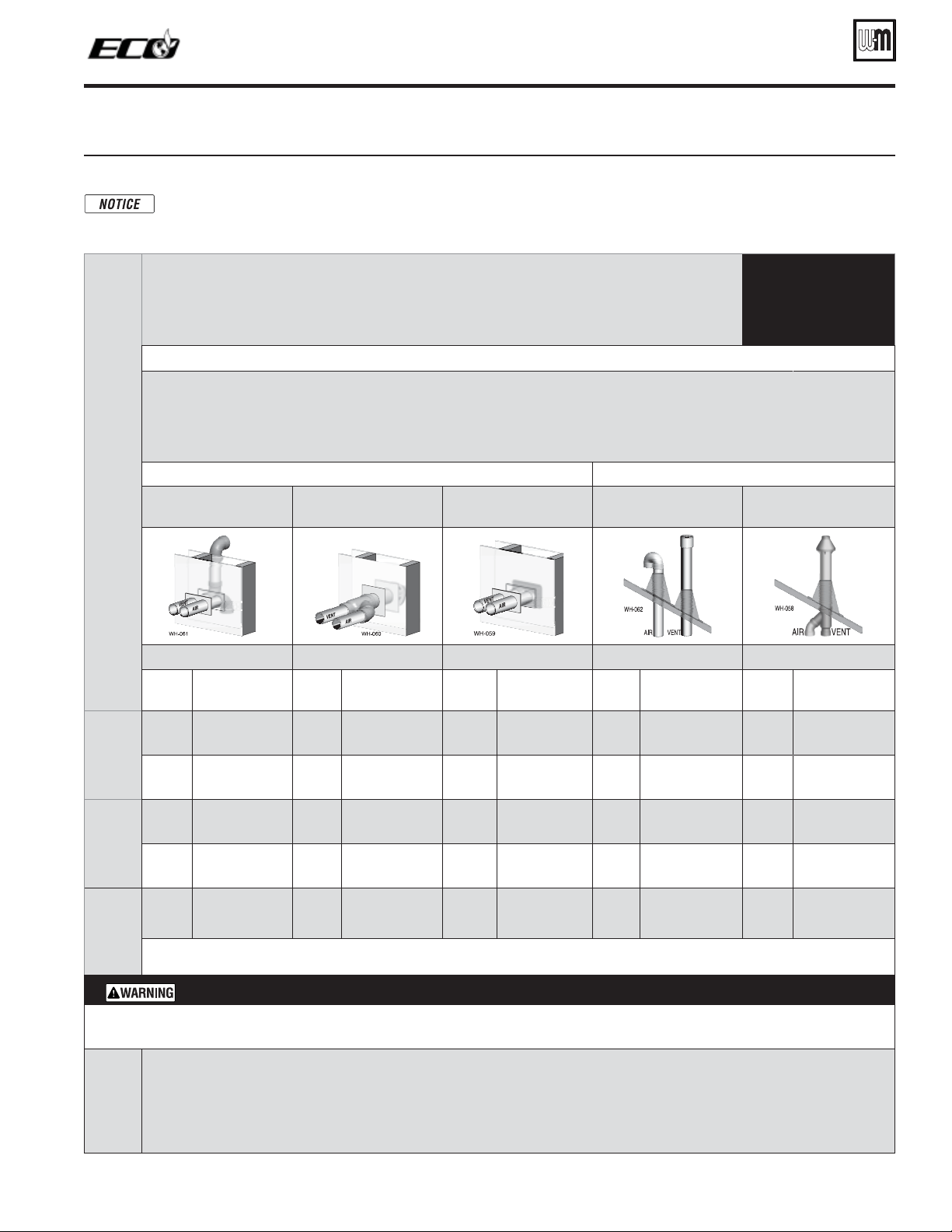
&IGURE ECO venting and air piping — DIRECT VENT ONLY — OPTIONS and PIPING LIMITS
The table below lists the acceptable vent/air pipe terminations described in this manual. Follow all instructions provided to install the
vent/air system. ./43(/7. below, but also approved, are the polypropylene piping and terminations listed in Figure 20, page 20.
For these applications, use ONLY the manufacturers’ parts listed and follow all instructions provided by the pipe manufacturer.
ECO Model
Maximum vent and air pipe length = 100 feet for all applications
(Minimum length for all applications is 2 feet)
(All applications include allowance for the termination fittings plus one elbow in air piping and one elbow in vent piping)
USE SWEEP
ELBOWS
ONLY
See Figure20,page20 for material specications | See Figure109,page107 for part/kit numbers
Vent and air pipe sizes:
Maximum vent lengths apply for either 2” or 3” vent and air pipe.
If using 2” pipe, provide 3”x 2” reducers at boiler connections and at Weil-McLain vent/air cap or at concentric terminations.
Boilers will derate as vent/air pipe length increases — see rating data on Figure122,page119 for derate amounts.
SIDEWALL termination VERTICAL termination
Separate pipes
[Note 1]
PVC or PP Concentric
[Note 1]
3” Weil-McLain PVC
vent/air cap [Note 1]
Separate pipes
[Note 1]
PVC or PP Concentric
[Note 1]
See page 24 See page 26 See page 28 See page 30 See page 32
Size,
inches
Materials
Fig. 20, page 20
Size,
inches
Materials
Fig. 20, page 20
Size,
inches
Materials
Fig. 20, page 20
Size,
inches
Materials
Fig. 20, page 20
Size,
inches
Materials
Fig. 20, page 20
70
2
PVC/PVC-DWV
CPVC, PP, SS
2
PVC/PVC-DWV
CPVC, PP, SS
2
PVC/PVC-DWV
CPVC, PP, SS
2
PVC/PVC-DWV
CPVC, PP, SS
2
PVC/PVC-DWV
CPVC, PP, SS
3
PVC/PVC-DWV
CPVC, PP, SS
3
PVC/PVC-DWV
CPVC, PP, SS
3
PVC/PVC-DWV
CPVC, PP, SS
3
PVC/PVC-DWV
CPVC, PP, SS
3
PVC/PVC-DWV
CPVC, PP, SS
110
2
CPVC, PP or SS
ONLY
2
CPVC, PP or SS
ONLY
2
CPVC, PP or SS
ONLY
2
CPVC, PP or SS
ONLY
2
CPVC, PP or SS
ONLY
3
PVC/PVC-DWV
CPVC, PP, SS
3
PVC/PVC-DWV
CPVC, PP, SS
3
PVC/PVC-DWV
CPVC, PP, SS
3
PVC/PVC-DWV
CPVC, PP, SS
3
PVC/PVC-DWV
CPVC, PP, SS
155
3
PVC/PVC-DWV
CPVC, PP, SS
3
PVC/PVC-DWV
CPVC, SS, PP**
3
PVC/PVC-DWV
CPVC, PP, SS
3
PVC/PVC-DWV
CPVC, PP, SS
3
PVC/PVC-DWV
CPVC, SS,
** Model 155 may be concentric sidewall vented using Centrotherm polypropylene pipe (Eco Systems InnoFlue® Single-wall) ONLY
if using Centrotherm stainless steel concentric termination kit, part number ICWS3513.
!LLELBOWSINVENTANDAIRPIPINGMUSTBESWEEPELBOWS/.,9$/./4USESHORTRADIUSELBOWS
Equivalent feet for elbows (USE SWEEP ELBOWS ONLY) —
deduct from max equivalent length of piping (does not apply to termination fittings)
tGFFUQFSGPSFBDIBEEJUJPOBM¡TXFFQFMCPXPS¡FMCPX
If piping contains more than 1 elbow in air or vent piping, other than termination fittings
Note 1:
.BUFSJBMBCCSFWJBUJPOT11QPMZQSPQZMFOF44"-$TUBJOMFTTTUFFM
If using polypropylene or stainless pipe, provide adapters to for 3” boiler connections and for terminations, if required
*1&9w17$DPODFOUSJDWFOULJUTDBOCFVTFEXJUITUBOEBSE17$QJQFmUUJOHTBOEDFNFOU"/4*"45.%FYDFQUJG6-$4DPNQMJBODF
JTSFRVJSFE'PS6-$4DPNQMJBODFBMMQJQFmUUJOHTBOEDFNFOUNVTUCF*1&94ZTUFN*GVTJOH*1&9LJUTVTFPOMZ*1&9QSPEVDUDPEF
GPSwWFOUJOH
Contact Weil-McLain for ordering information and availability of Weil-McLain venting kits.
Part number 550-142-122/0513
19
TM
GAS-FIRED WATER BOILER — Boiler Manual
Venting & air — general (cont.)
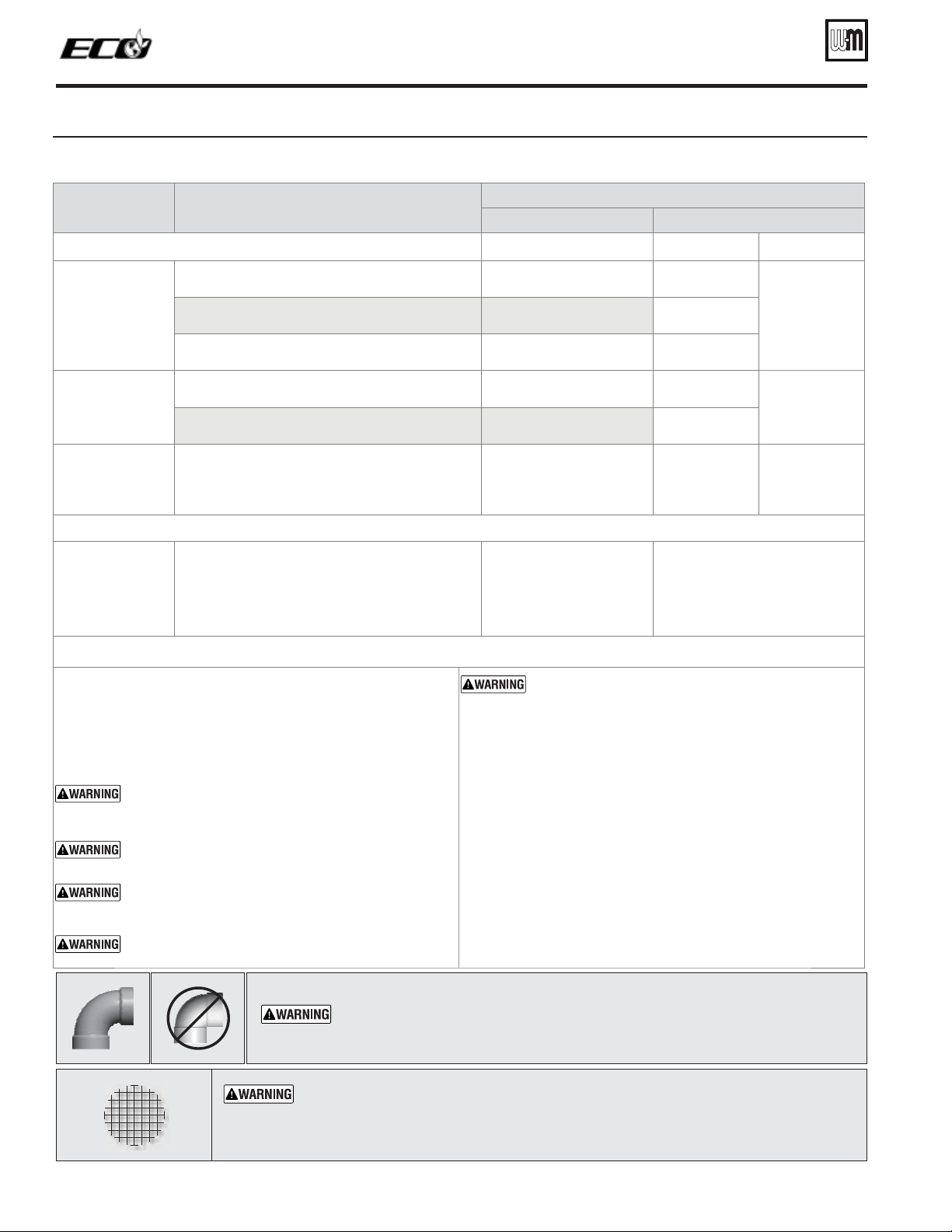
&IGURE Vent and air piping materials — Use only the materials listed below, ensuring that all materials meet
local codes (see Figure 109, page 107 for part/kit numbers)
)TEM Material
3TANDARDSFORINSTALLATIONSIN
5NITED3TATES #ANADA
(Note 2)
0LASTICPIPINGMATERIALS 6ENTORAIRPIPING 6ENTPIPING !IRPIPING
6ENTORAIRPIPE
lTTINGS
PVC schedule 40 ANSI/ASTM D1785 ULC S636
PVC, PVC-DWV,
CPVC or
polypropylene
PVC-DWV schedule 40 (Note 1) ANSI/ASTM D2665 NA
CPVC schedule 40 (Note 1) ANSI/ASTM F441 ULC S636
06#!"3PIPE
CEMENTPRIMER
PVC ANSI/ASTM D2564/F656 ULC S636
Use only cement
and primer
suitable for piping
material used
CPVC (Note 1) ANSI/ASTM F493 ULC S636
0OLYPROPYLENE
VENTPIPElTTINGS
TERMINATIONSAND
CEMENT
3IMPSON$URAVENTObtain all materials from M&G
Simpson-Duravent
#ENTROTHERM%CO3YSTEMS)NNO&LUE§3INGLEWALL
Obtain all materials from Centrotherm
See manufacturer’s literature for
detailed information
MUST USE LOCKING
COLLAR ON EVERY JOINT
ULC S636
PVC, PVC-DWV,
CPVC or
polypropylene
!,#STAINLESSSTEELPIPINGMATERIALS
6ENTPIPE
!,#
stainless
steel
Heat Fab, Inc. — Saf-T-Vent
®
Z-Flex, Inc. — Z-Vent II
Dura-Vent — FasNSeal™
Metal-Fab, Inc. — CORR/GUARD
Centrotherm Eco Systems — InnoFlue®
Certified for Category IV and
direct vent appliance venting
Certified for Category IV and direct vent
appliance venting
7EIL-C,AINSTAINLESSSTEELBIRDSCREENSvORv(purchase separately) — see Figure 109, page 107 for part numbers
Note 1: Weil-McLain concentric vent kits are made from PVC pipe
and ttings.
Note 2: System 636 PVC concentric terminations utilize PVC
pipe/ttings certied to ULC S636.
If ULC S636 compliance is required, use only System
636 pipe, ttings and cement.
DO NOT mix piping from dierent pipe manufacturers
unless using adapters specically designed for the pur-
pose by the manufacturer.
Every joint on polypropylene vent piping must in-
clude a locking collar.
DO NOT use cellular core PVC (ASTM F891), cellular
core CPVC, or Radel
®
(polyphenolsulfone) in venting
systems.
DO NOT cover non-metallic vent pipe and ttings with
thermal insulation.
ADAPTERS — AL29-4C piping — Install a PVC-to-stainless
adapter supplied by the AL29-4C stainless pipe manu-
facturer at the 3” PVC boiler vent connection and at the
termination (if using Weil-McLain plate or concentric PVC
termination).
ADAPTERS — Polypropylene piping — Provide adapters
from polypropylene pipe to the 3” PVC connections at
the boiler and at terminations, if required (Weil-McLain
sidewall plate, for example).
ADAPTERS — If using 2” piping, where approved for the
application, provide adapters for the 3” PVC boiler con-
nections and at the terminations, if required (Weil-McLain
sidewall plate, for example)
ALL vent and air pipes require a BIRD SCREEN at each termination. Most kits do not include
the bird screens. Purchase bird screens separately from Weil-McLain or vent kit supplier if
not included. [Note — bird screening is integral to the 3” PVC Weil-McLain sidewall vent
cap,
available for purchase from Weil-McLain
. No additional screening is required.]
USE SWEEP ELBOWS FOR ALL VENT AND AIR PIPING — DO NOT use short
radius elbows for vent or air piping. Boiler performance could be aected.
Part number 550-142-122/0513
20
TM
GAS-FIRED WATER BOILER — Boiler Manual

(a) For all sidewall horizontally-vented gas-fueled equipment
installed in every dwelling, building or structure used in
whole or in part for residential purposes, including those
owned or operated by the Commonwealth and where the
side wall exhaust vent termination is less than seven (7) feet
above finished grade in the area of the venting, including but
not limited to decks and porches, the following requirements
shall be satisfied:
1.
).34!,,!4)/. /& #!2"/. -/./8)$% $%4%#-
4/23
. At the time of installation of the side wall horizon-
tal vented gas fueled equipment, the installing plumber or
gas fitter shall observe that a hard wired carbon monoxide
detector with an alarm and battery back-up is installed on
the floor level where the gas equipment is to be installed.
In addition, the installing plumber or gas fitter shall
observe that a battery operated or hard wired carbon
monoxide detector with an alarm is installed on each ad-
ditional level of the dwelling, building or structure served
by the side wall horizontal vented gas fueled equipment.
It shall be the responsibility of the property owner to
secure the services of qualified licensed professionals for
the installation of hard wired carbon monoxide detectors
a. In the event that the side wall horizontally vented gas
fueled equipment is installed in a crawl space or an
attic, the hard wired carbon monoxide detector with
alarm and battery back-up may be installed on the
next adjacent floor level.
b. In the event that the requirements of this subdivision
can not be met at the time of completion of installa-
tion, the owner shall have a period of thirty (30) days
to comply with the above requirements; provided,
however, that during said thirty (30) day period, a
battery operated carbon monoxide detector with an
alarm shall be installed.
2.
!002/6%$#!2"/.-/./8)$%$%4%#4/23. Each
carbon monoxide detector as required in accordance with
the above provisions shall comply with NFPA 720 and be
ANSI/UL 2034 listed and IAS certified.
3.
3)'.!'%. A metal or plastic identification plate shall
be permanently mounted to the exterior of the build-
ing at a minimum height of eight (8) feet above grade
directly in line with the exhaust vent terminal for the
horizontally vented gas fueled heating appliance or
equipment. The sign shall read, in print size no less than
one-half (1/2) inch in size, “GAS VENT DIRECTLY BE-
LOW. KEEP CLEAR OF ALL OBSTRUCTIONS.”
4.
).30%#4)/.. The state or local gas inspector of the
side wall horizontally vented gas fueled equipment shall
not approve the installation unless, upon inspection,
the inspector observes carbon monoxide detectors and
signage installed in accordance with the provisions of
248 CMR 5.08(2)(a) 1 through 4.
(b)
%8%-04)/.3: The following equipment is exempt from
248 CMR 5.08(2)(a)1 through 4:
1. The equipment listed in Chapter 10 entitled “Equipment
Not Required To Be Vented” in the most current edition
of NFPA 54 as adopted by the Board; and
2. Product Approved side wall horizontally vented gas fueled
equipment installed in a room or structure separate from
the dwelling, building or structure used in whole or in
part for residential purposes.
(c)
-!.5&!#452%22%15)2%-%.43'!3%15)0-%.4
6%.4).'3934%-02/6)$%$. When the manufacturer of
Product Approved side wall horizontally vented gas equip-
ment provides a venting system design or venting system
components with the equipment, the instructions provided
by the manufacturer for installation of the equipment and
the venting system shall include:
1. Detailed instructions for the installation of the venting
system design or the venting system components; and
2. A complete parts list for the venting system design or
venting system.
(d)
-!.5&!#452%22%15)2%-%.43'!3%15)0-%.4
6%.4).'3934%-./402/6)$%$. When the manufac-
turer of a Product Approved side wall horizontally vented gas
fueled equipment does not provide the parts for venting the
flue gases, but identifies “special venting systems”, the follow-
ing requirements shall be satisfied by the manufacturer:
1. The referenced “special venting system” instructions shall
be included with the appliance or equipment installation
instructions; and
2. The “special venting systems” shall be Product Approved
by the Board, and the instructions for that system shall
include a parts list and detailed installation instructions.
(e) A copy of all installation instructions for all Product Approved
side wall horizontally vented gas fueled equipment, all venting
instructions, all parts lists for venting instructions, and/or all
venting design instructions shall remain with the appliance
or equipment at the completion of the installation.
Commonwealth of Massachusetts installations
Commonwealth of Massachusetts — When the boiler is installed within the Commonwealth of Massachusetts,
the boiler must be installed by a licensed plumber or gas fitter. Read and comply with the instructions below.
Part number 550-142-122/0513
21
TM
GAS-FIRED WATER BOILER — Boiler Manual
Vent termination requirements
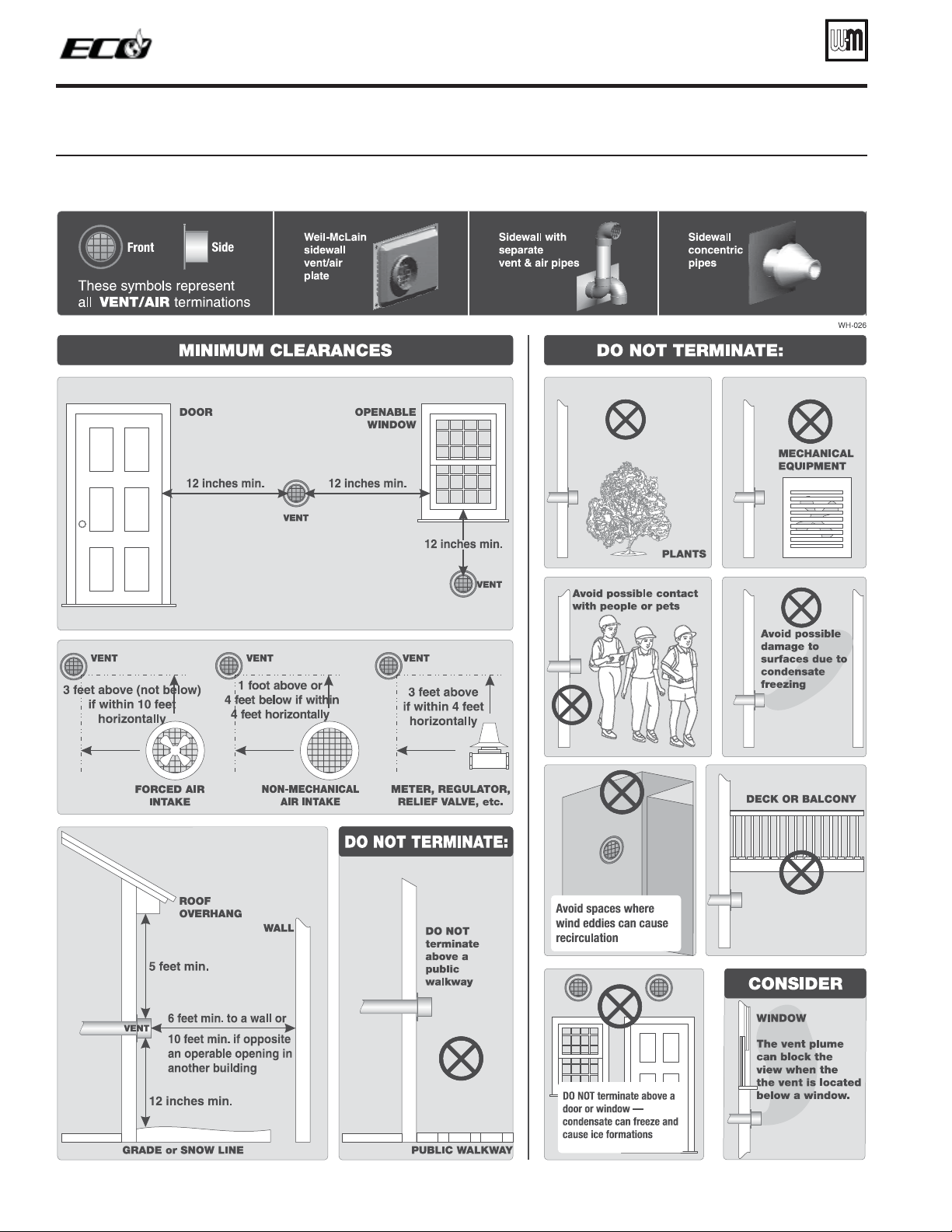
&IGURE The vent termination must be located to meet all requirements below (also applies to vertical vent terminations).
For Canadian installations, defer to the requirements of CSA B149.1 or B149.2 Installation Code.
Part number 550-142-122/0513
22
TM
GAS-FIRED WATER BOILER — Boiler Manual
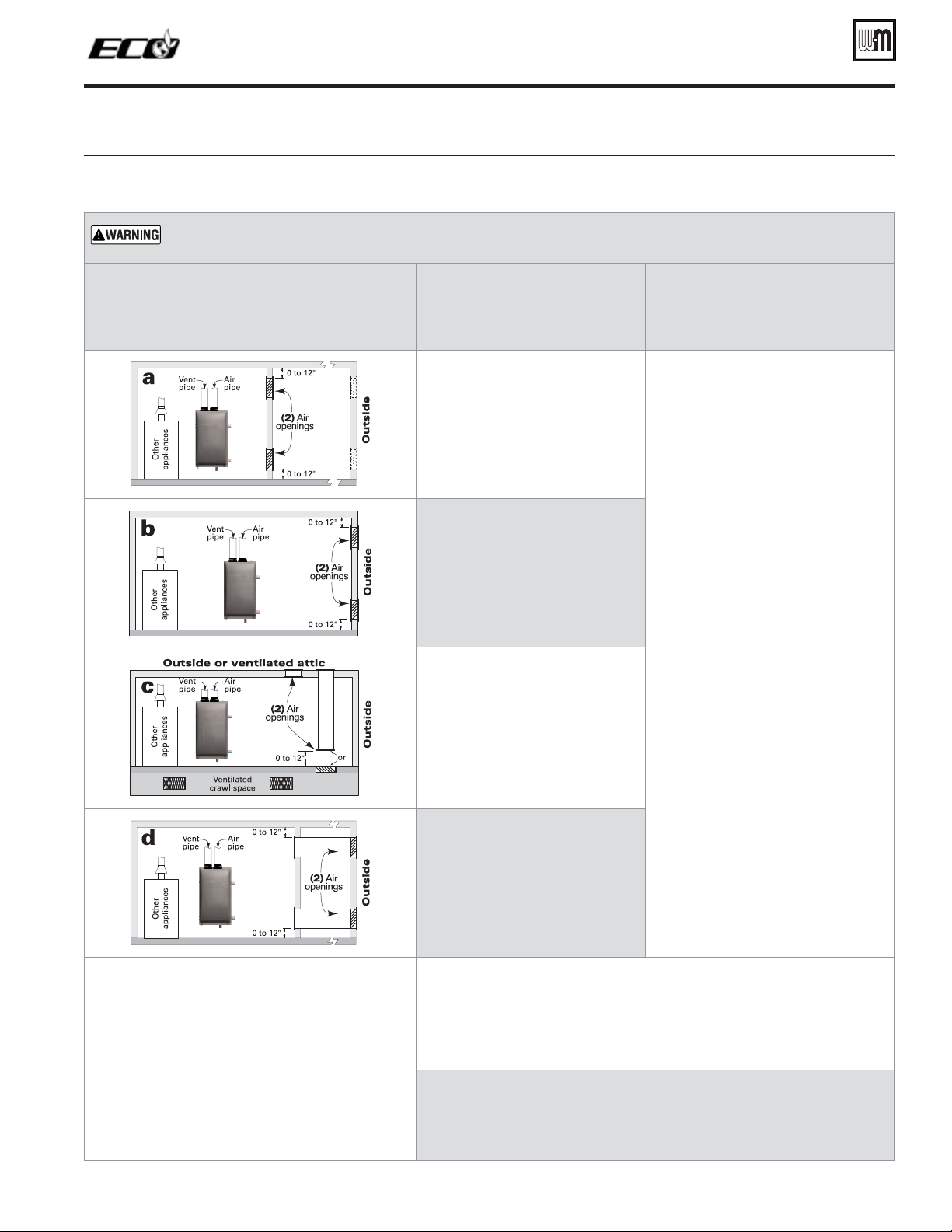
&IGURE Combustion and ventilation air openings for %#/ Direct Vent installations
The ECO boiler CANNOT be in the same space with other appliances if clearances around the ECO are less than the
recommended service clearances shown in Figure 1, page 7.
Air openings
The required air opening sizes below are FREE AREA,
after reduction for louver obstruction. Note the ex-
ception below for large spaces.
ECO boiler
WITH other
appliances in room
ECO boiler
WITHOUT other
appliances in room
47/ openings, each at least:
1 square inch per Btuh
of all other appliances in the room
(Unless specified otherwise by
appliance manufacturer)
./ openings are required if the
boiler installation provides at least the
recommended service clearances
shown in Figure 1, page 7.
If the space is smaller than Fig-
ure 1, page 7, provide openings
ONLY as shown in Figure 2, page 7.
Each opening must have a free
area no less than 1 square inch per
1,000 Btuh input of the boiler.
47/ openings, each at least:
1 square inch per Btuh
of all other appliances in the room
— OR —
/.% opening **, each at least:
1 square inch per Btuh
of all other appliances in the room
(Unless specified otherwise by
appliance manufacturer)
47/ openings, each at least:
1 square inch per Btuh
of all other appliances in the room
— OR —
/.% opening **, each at least:
1 square inch per Btuh
of all other appliances in the room
(Unless specified otherwise by
appliance manufacturer)
47/ openings, each at least:
1 square inch per Btuh
of all other appliances in the room
— OR —
/.% opening **, each at least:
1 square inch per Btuh
of all other appliances in the room
(Unless specified otherwise by
appliance manufacturer)
./4)#%
2EQUIREMENTSFORUSINGTHE3).',%AIROPENING
OPTION
A single combustion air opening can be used for cases b, c or d above (%#/ with
other appliances in room only), sized as listed, provided that:
s The single opening must communicate directly to the outdoors or to a space that
communicates directly with outdoors (NOT to an interior space).
s The top of the opening must be within 12 inches of the ceiling.
s The free area of the opening must be at least equal to the sum of the areas of all
equipment vent connectors in the space.
30%#)!,%8#%04)/.&/2,!2'%30!#%3
%#/7)4(OTHERAPPLIANCESINROOMONLY
NO combustion air openings are needed if the boiler (and other appliances) are
installed in a space with a volume NO LESS than 50 cubic feet per 1,000 Btuh of all
appliances in the space. That is, total the input of all appliances in MBH (1,000’s of
Btuh), then multiply this total times 50. The building MUST NOT be of tight construction.
Example: For a total input of 500 MBH (500,000 Btuh), the minimum volume would
be 50 x 500 = 25,000 cubic feet.
Boiler room air openings
Part number 550-142-122/0513
23
TM
GAS-FIRED WATER BOILER — Boiler Manual
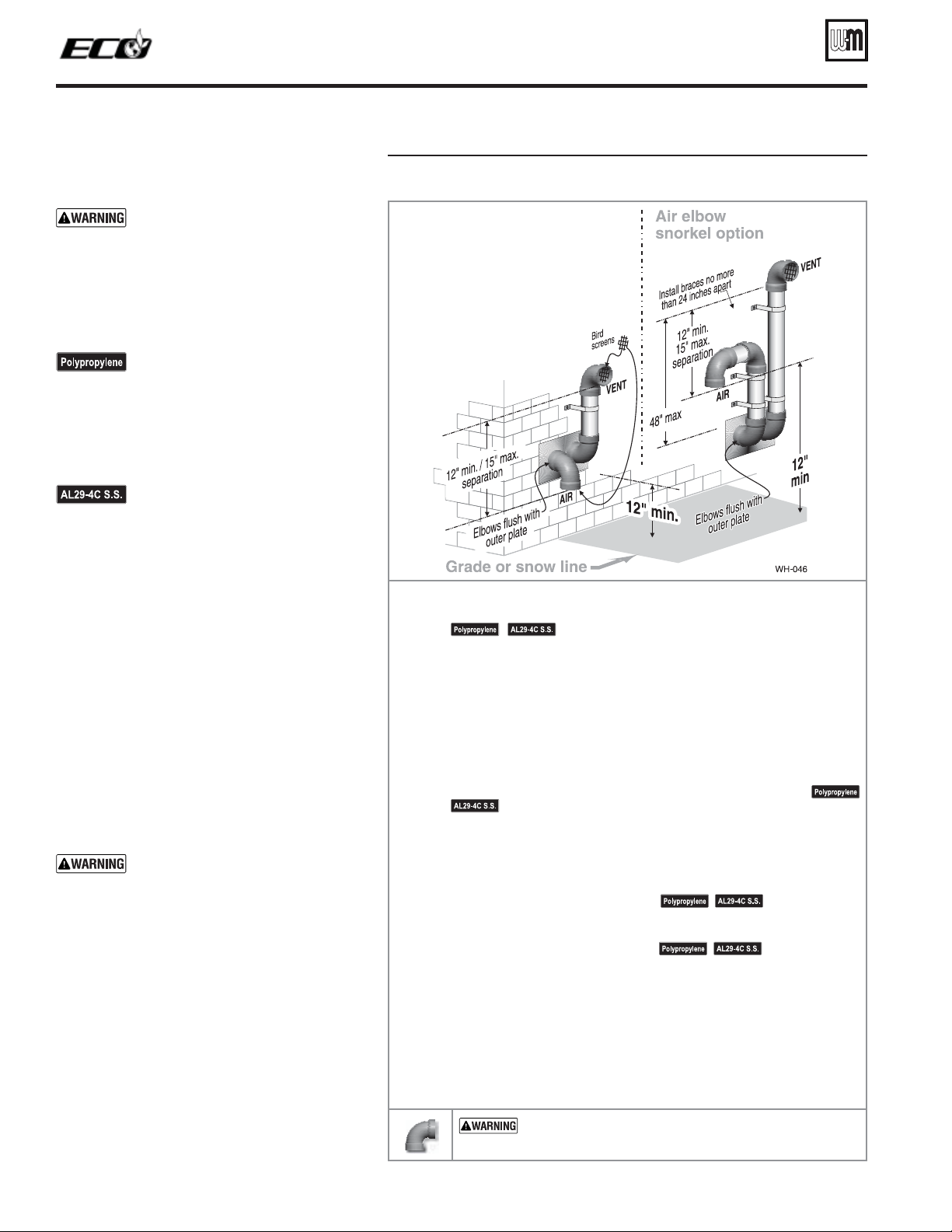
DIRECT VENT — 3IDEWALLWITHSEPARATEPIPES
!LLOWABLEVENTAIRPIPEMATERIALS
LENGTHS
Use only the vent materials and kits
listed in Figure 20, page 20. Provide
pipe adapters if specified.
1. Locate the termination such that the total air
piping and vent piping from the boiler to the
termination will not exceed the maximum
length given in Figure 19, page 19.
For polypropylene applications,
comply with any additional require-
ments in the vent system manufac-
turer’s instructions. Provide 3” PVC
transition pieces at the boiler vent
and air connections. Install a locking
collar at every joint.
For AL29-4C vent pipe applica-
tions, comply with any additional
requirements in the vent system
manufacturer’s instructions. Pro-
vide a 3” PVC transition piece at the
boiler vent connection. The air pip-
ing must be PVC or CPVC. Provide a
3” PVC transition piece at the boiler
air connection if using 2” air piping.
$ETERMINETERMINATIONLOCATION
1. The air and vent terminations must be installed
as shown in Figure 23 and Figure 25, page 25.
2. The terminations must comply with clearances
and limitations shown in Figure 21, page 22.
3. Locate the terminations so they are not likely
to be damaged by foreign objects, such as
stones or balls, or subject to buildup of leaves
or sediment.
Do not exceed the maximum lengths
of the outside vent piping shown in
Figure 23. Excessive length exposed
to the outside could cause freezing
of condensate in the vent pipe, re-
sulting in potential boiler shutdown.
In extremely cold climates, install
an insulated chase around the vent
piping, particularly if using longer
lengths. The chase must allow for
inspection of the vent pipe, and
insulation must be protected from
water.
-ULTIPLEVENTAIRTERMINATIONS
1. When terminating multiple ECO boilers, ter-
minate each vent/air connection as described
in this manual.
&IGURE ).34!,,!4)/.3%15%.#% — Separate pipes sidewall
3TEP Read and follow all instructions in this manual. $/./4PROCEEDWITH
VENTAIRINSTALLATIONUNTILYOUHAVEREADPAGETHROUGHPAGE.
See notices at left.
3TEP Install the boiler in a location that allows proper routing of all vent and air
piping to the selected sidewall location.
3TEP Make sure the selected sidewall termination location complies with Fig-
ure 21, page 22. (Multiple boiler sidewall plates must also comply with
Figure 24, page 25.)
3TEP Use only the vent materials listed in Figure 20, page 20. Provide pipe adapt-
ers where required. Vent piping and air piping lengths must not exceed the
values shown in Figure 19, page 19.
3TEP Prepare the sidewall penetrations and secure the sidewall plates as instructed
in this section. See “Prepare wall penetrations” on page 25.
See notices at left.
3TEP The air piping must terminate in a DOWNTURNEDELBOW as shown above.
The vent piping must terminate in an ELBOWPOINTEDOUTWARDORAWAY
FROMTHEAIRINLET as shown above. See illustration above.
3TEP Install vent and air piping between the boiler and the sidewall openings.
Slope horizontal piping downward toward the boiler at least 1/4 inch per
foot. See page 35 for general guidelines.
See notices at left.
3TEP Install pipe supports every 5 feet on both the horizontal and vertical runs.
Install a hanger support within 6 inches of any upturn in the piping, or per
vent pipe manufacturer’s instructions.
See notices at left.
3TEP Attach the vent termination exterior piping: Use either of the configura-
tions shown above, as needed to ensure clearance above grade or snow line.
3TEP The vent and air pipes may run up as high as 4 feet with no enclosure.
The vent and air pipes must be secured with braces, and all clearances and
lengths must be maintained. Space braces no further than 24 inches apart.
3TEP External venting greater than 4 feet requires an insulated enclosure around
the vent and air pipes. The vent and air terminations must exit through
the enclosure as shown in the illustration above, maintaining all required
clearances.
53%37%%0%,"/73&/2!,,6%.4!.$!)20)0).'
— DO NOT use short radius elbows for vent or air piping. Boiler
performance could be affected.
Part number 550-142-122/0513
24
TM
GAS-FIRED WATER BOILER — Boiler Manual
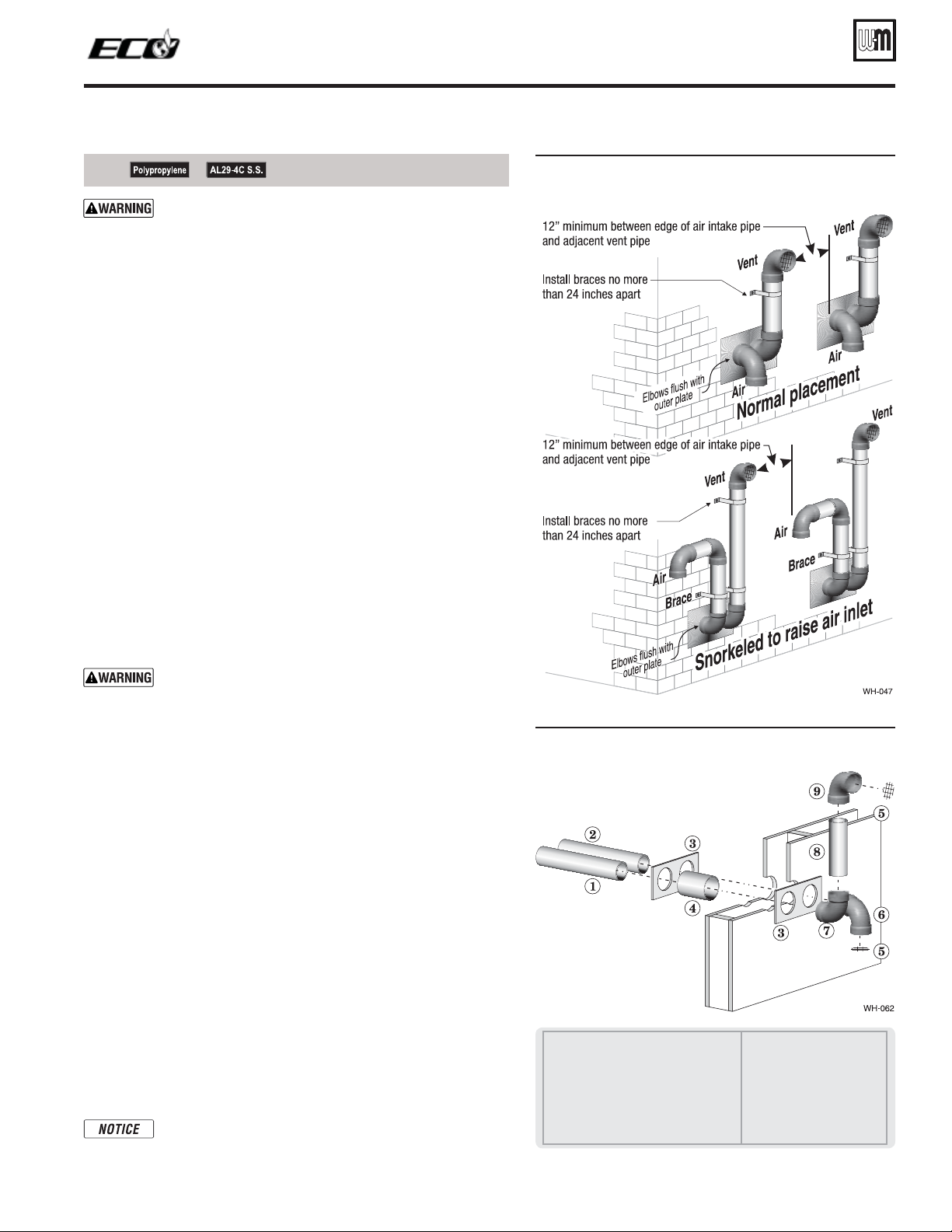
DIRECT VENT — 3IDEWALLWITHSEPARATEPIPES (continued)
All vent pipes and air inlets must terminate at the same
height to avoid possibility of severe personal injury, death
or substantial property damage.
2. Place wall penetrations to obtain minimum clearances shown in
Figure 24 for U. S. installations. For Canadian installations, provide
clearances required by CSA B149.1 or B149.2 Installation Code and
a ULC S636 compliant vent kit.
3. The air inlet of a ECO boiler is part of a direct vent connection. It
is not classified as a forced air intake with regard to spacing from
adjacent boiler vents.
0REPAREWALLPENETRATIONS
1. Air pipe penetration:
a. Cut a hole for the air pipe. Size the air pipe hole as close as
desired to the air pipe outside diameter.
2. Vent pipe penetration:
a. Cut a hole for the vent pipe. For either combustible or non-
combustible construction, size the vent pipe hole at least 0.4”
larger than the vent pipe diameter.
b. Insert a galvanized metal thimble in the vent pipe hole as
shown in Figure 25.
3. Use the provided paper template for correct location of hole centers.
4. Use of a sidewall termination plate is REQUIRED.
a. Kits for several vent sizes are available from Weil-McLain.
See “VENT/AIR PARTS AND KITS” on page 107.
b. Plate may be field fabricated from corrosion resistant material
of sufficient strength. Plate must allow venting to maintain
minimum clearance to combustibles.
Ensure that the plate material is strong enough to prevent
the termination from being pushed inward if struck or
pushed from the outside.
5. Follow all local codes for isolation of vent pipe when passing
through floors or walls.
6. Seal exterior openings thoroughly with exterior caulk.
4ERMINATIONANDlTTINGS
1. Prepare the vent termination elbow and the air termination elbow
by inserting bird screens. (See Figure 23, page 24.) Bird screens
must be purchased separately. See the parts list at the end of this
manual for part numbers.
2. Secure the elbows so they will butt against the sidewall termina-
tion plate.
3. When completed, the air termination coupling must be oriented
at least 12 inches below the vent termination and at least 12 inches
above grade or snow line as shown in Figure 23, page 24.
4. You can orient the vent termination elbow either directly out-
ward or 90 degrees away from the air inlet elbow as shown in
Figure 23, page 24.
5. Maintain the required dimensions of the finished termination
piping as shown in Figure 23, page 24.
6. For multiple boiler terminations, see Figure 24.
7. Do not extend exposed vent pipe outside of building more than
shown in this document. Condensate could freeze and block vent
pipe.
If extending the vent and air pipes out from the wall,
install a coupling on each pipe. Mount the piping with
the coupling flush with the outer plate.
&IGURE
Multiple separate pipes sidewall terminations
— maintain vertical spacing between vent and
air fittings shown in Figure 23, page 24
&IGURE Sidewall termination assembly — using
separate pipes
1 Vent piping
2 Air piping
3 Sidewall termination plates: for 3” PVC,
use plates supplied with boiler in W-M
vent/air plate kit; for 3” AL29-4C or 2” PVC,
purchase optional sidewall separate pipes
plate kit
4 Galvanized thimbles, by in-
staller
5 Bird screen, by installer
6 Air inlet elbow
7 Elbow
8 Nipple
9 Elbow (vent termination)
See notices on previous page.
Part number 550-142-122/0513
25
TM
GAS-FIRED WATER BOILER — Boiler Manual
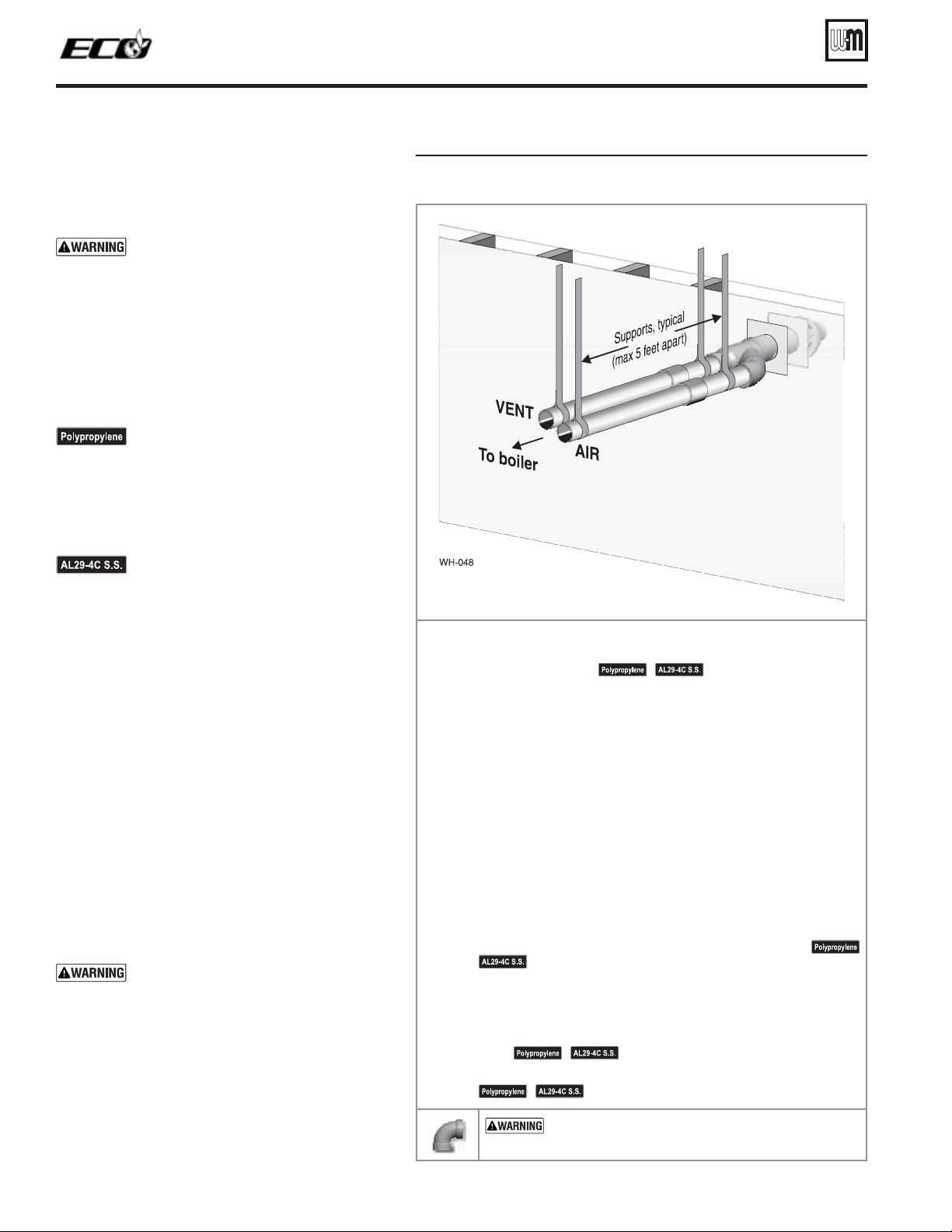
DIRECT VENT — 3IDEWALLCONCENTRIC
!LLOWABLEVENTAIRPIPEMATERIALS
LENGTHS
1. The concentric termination kit must be purchased
separately.
Use only the vent materials and kits listed
in Figure 20, page 20. Provide pipe adapt-
ers if specified.
2. Locate the termination such that the total air piping
and vent piping from the boiler to the termina-
tion will not exceed the maximum length given in
Figure 19, page 19.
3. This termination requires a 45-degree elbow that
is not supplied with the termination kit. The
maximum vent/air pipe lengths include allowance
for this elbow.
For polypropylene applications, comply
with any additional requirements in the
vent system manufacturer’s instructions.
Provide 3” PVC transition pieces at the
boiler vent and air connections and at the
termination if using a 3” PVC concentric
vent kit. Install a locking collar at every
joint.
For AL29-4C vent pipe applications, com-
ply with any additional requirements in
the vent system manufacturer’s instruc-
tions. Provide a 3” PVC transition at the
boiler vent connection. Air pipe must be
PVC or CPVC. Provide a 3” PVC transi-
tion at the boiler air connection if using
2” air pipe. Provide transition pieces to
PVC at the vent and air pipe termination
connections.
$ETERMINETERMINATIONLOCATION
1. The concentric termination kit must be installed
as shown in Figure 28, page 27.
2. The termination must comply with clearances and
limitations shown in Figure 21, page 22.
3. Locate the termination so it is not likely to be dam-
aged by foreign objects, such as stones or balls, or
subject to buildup of leaves or sediment.
-ULTIPLEVENTAIRTERMINATIONS
1. When terminating multiple ECO boilers, install
each concentric termination as described in this
manual.
All vent pipes and air inlets must ter-
minate at the same height to avoid pos-
sibility of severe personal injury, death or
substantial property damage.
2. Place wall penetrations to obtain minimum clear-
ance as shown in Figure 27, page 27 for U. S. instal-
lations. For Canadian installations, provide clear-
ances required by CSA B149.1 or B149.2 Installation
Code and a ULC S636 compliant vent kit.
3. The air inlet of a ECO boiler is part of a direct vent
connection. It is not classified as a forced air intake
with regard to spacing from adjacent boiler vents.
&IGURE ).34!,,!4)/.3%15%.#% — Concentric horizontal
3TEP Read and follow all instructions in this manual. $/./4PROCEED
WITH VENTAIR INSTALLATIONUNTIL YOUHAVEREAD PAGE
THROUGHPAGE.
See notices at left.
3TEP Install the boiler in a location that allows proper routing of all vent
and air piping to the selected sidewall location.
3TEP Make sure the selected sidewall termination location complies with
Figure 21, page 22. (Multiple boiler concentric terminations must also
comply with Figure 27, page 27.)
3TEP Use only the vent materials listed in Figure 20, page 20. Provide pipe
adapters where required.
3TEP Vent piping and air piping lengths must not exceed the values shown
in Figure 19, page 19.
3TEP The concentric termination must be assembled and installed before
piping from the boiler to the termination.
3TEP Prepare the sidewall penetration — assemble the concentric termi-
nation kit and secure the cover plates as instructed in this section.
Provide the supports indicated and mount the termination assembly.
See “Install termination — concentric pipes” on page 27.
See notices at left.
3TEP Install vent and air piping between the boiler and the concentric vent/
air termination. Slope horizontal piping downward toward the boiler
at least 1/4 inch per foot. See page 35 for general guidelines.
3TEP Install pipe supports every 5 feet on both the horizontal and vertical
runs.
See notices at left.
3TEP Install a hanger support within 6 inches of any upturn in the piping.
See notices at left.
53% 37%%0 %,"/73 &/2 !,,6%.4 !.$ !)2
0)0).' — DO NOT use short radius elbows for vent or
air piping. Boiler performance could be affected.
Part number 550-142-122/0513
26
TM
GAS-FIRED WATER BOILER — Boiler Manual
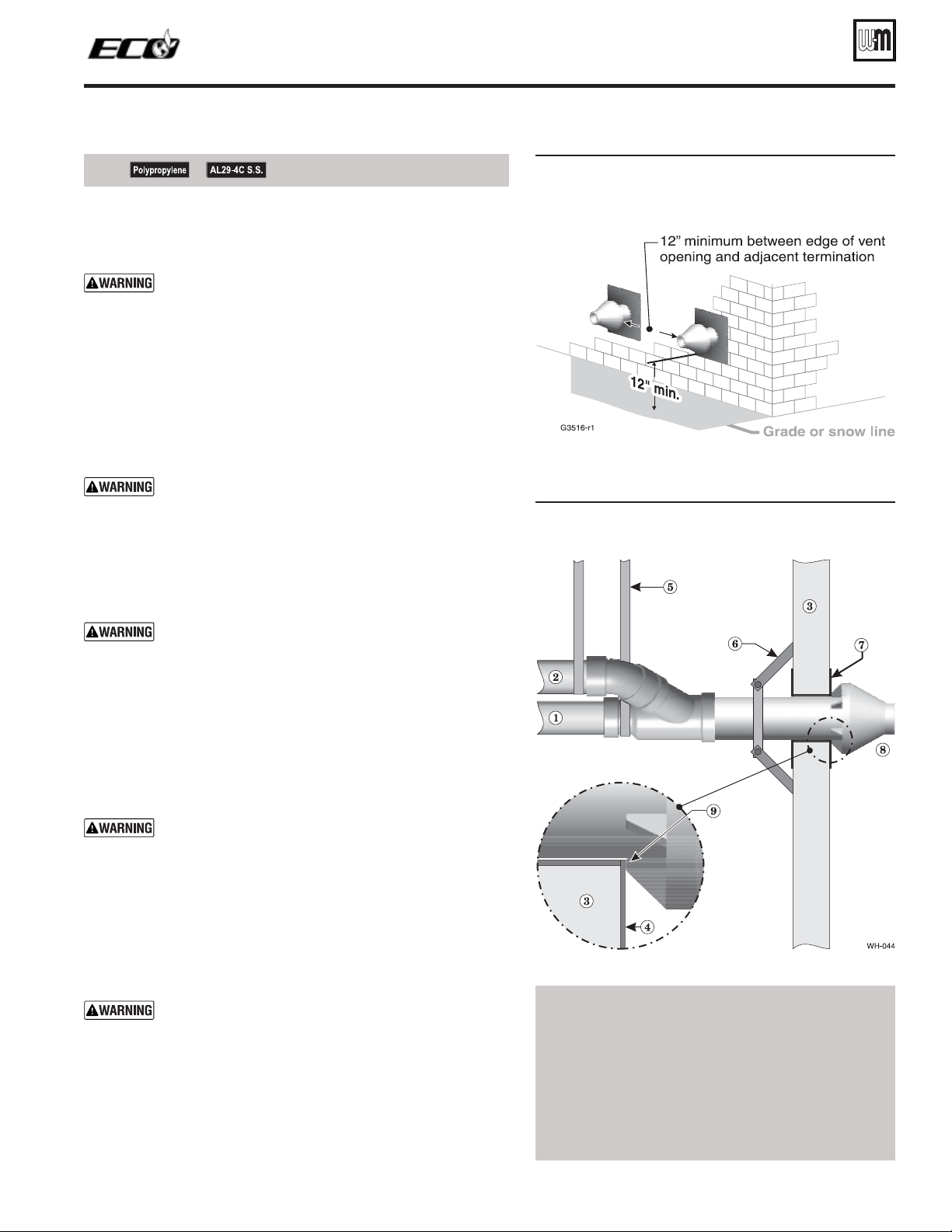
DIRECT VENT — 3IDEWALLCONCENTRIC (continued)
&IGURE Termination location — concentric
termination — multiple boilers —
clearance from vent of one to air intake of
the next
&IGURE Installing and supporting the concentric
sidewall vent assembly
,%'%.$
1 Vent pipe
2 Air pipe
3 Wall
4 Outer thimble plate
5 Supports every 5 feet or
per vent pipe mfg’s in-
structions
6 Wall brace, by installer,
(or see vent pipe mfg’s
instructions)
7 Thimble, by installer
8 Rain cap
9 Rain cap ribs must butt
against outer thimble
plate or wall opening
)NSTALLTERMINATIONCONCENTRICPIPES
1. Assemble the vent termination as described for concentric termi-
nations, on page 34.
If necessary, you can shorten the lengths of the inner and
outer pipes for a shorter finished assembly. But you must
ensure the pipes butt correctly at both ends. Failure to
properly assemble the concentric termination can result
in flue gas recirculation, causing possible severe personal
injury or death.
2. Wall penetration:
a. Preferably, use a thimble with a 4½-inch hole. If not using a
thimble, carefully use a hole saw to cut a hole not larger than
4¾ inches in diameter through the wall. The finished hole
must provide a solid stop for the rain cap ribs, as shown in the
inset to Figure 28.
Ensure that the wall material is strong enough to pre-
vent the rain cap from being pushed inward if struck or
pushed from the outside.
3. Secure the termination in place so the rain cap will butt against the
outside wall or outer thimble plate as shown in Figure 28.
4. Before beginning vent and air piping from the boiler to the con-
centric termination, mount and secure the concentric termination
as shown in Figure 28.
The vent and air piping must be securely supported, and
must not rest its weight on the boiler fittings. Failure to
properly support the vent and air piping could result in
vent piping damage, resulting in possible severe personal
injury, death or substantial property damage.
The supports/bracing used must support the termination
assembly to prevent slippage or movement. See instruc-
tions provided with concentric kit for details.
The clamps used on the outside of the termination pipe
must not cut into the pipe or contain sharp edges that
could cause a crack to form.
When inserting the partially-assembled termination
kit through the wall penetration, wrap plastic or other
protection over the end of the exposed assembly to pre-
vent debris from entering the pipes. If the air passages
become blocked, the boiler will not operate. Once the
rain cap has been cemented to the assembly, there is no
way to correct the problem. The assembly would have
to be replaced if it were cut to be removed and cleaned.
Altering the assembly in any way could result in severe
personal injury or death due to toxic flue product emis-
sions.
If using AL29-4C stainless vent pipe, use the vent pipe
manufacturer’s PVC adapter if connecting to a PVC
concentric vent attachment.
5. After the assembly has been positioned in the opening and all sup-
ports have been attached, install a bird screen (purchased separately
if not included with the kit) and rain cap as follows:
a. Place the bird screen on the end of the inner pipe as in Fig-
ure 38, page 34, or per concentric kit instructions for poly-
propylene kits.
b. Cement the rain cap in place as shown.
See notices on previous page.
Part number 550-142-122/0513
27
TM
GAS-FIRED WATER BOILER — Boiler Manual
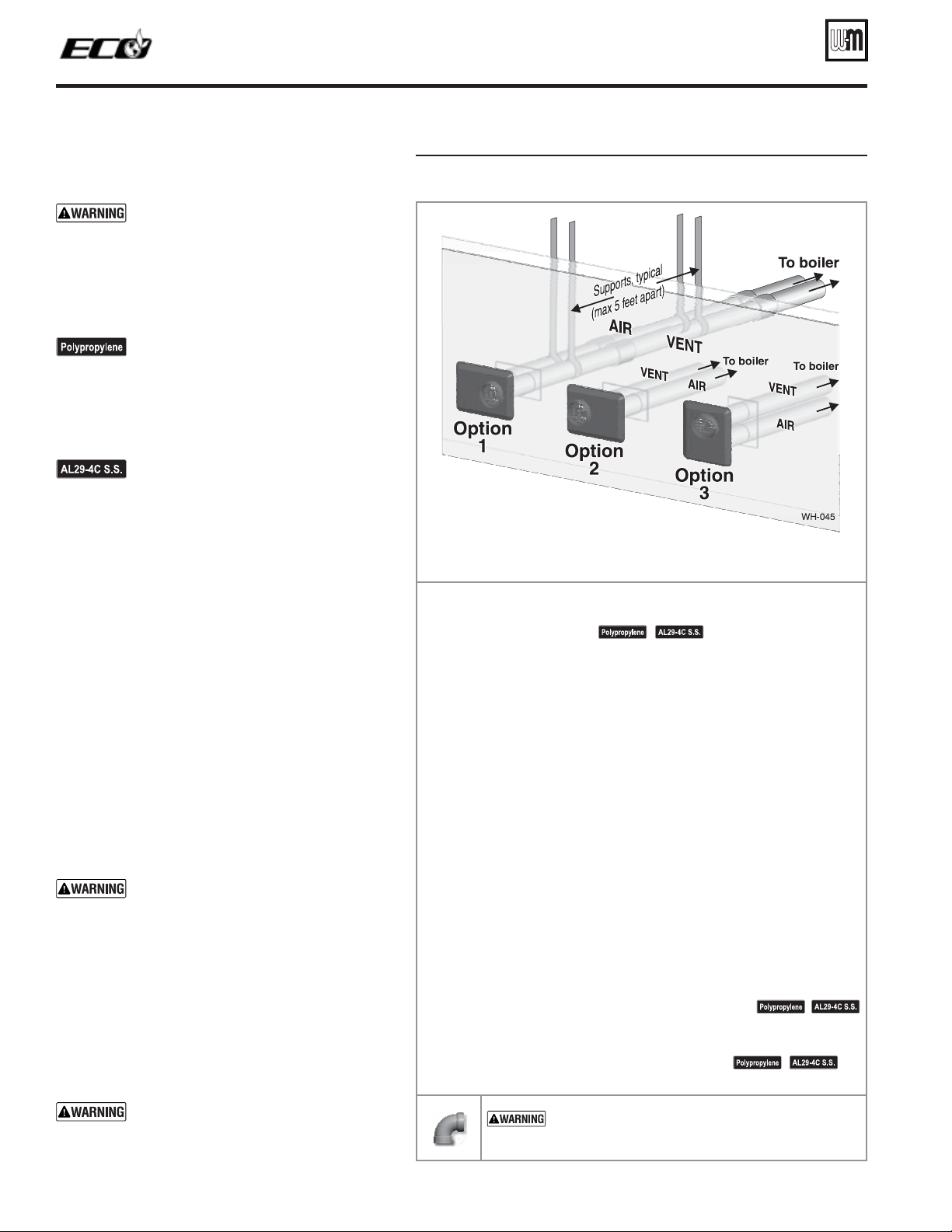
Part number 550-142-122/0513
28
TM
GAS-FIRED WATER BOILER — Boiler Manual
DIRECT VENT — 3IDEWALLWITH7-VENTAIRPLATE
!LLOWABLEVENTAIRPIPEMATERIALS
LENGTHS
Use only the vent materials and kits listed
in Figure 20, page 20. Provide pipe adapt-
ers if specified.
1. Locate the termination such that the total air piping
and vent piping from the boiler to the termina-
tion will not exceed the maximum length given in
Figure 19, page 19.
For polypropylene applications, comply
with any additional requirements in the
vent system manufacturer’s instructions.
Provide 3” PVC transition pieces at the
boiler vent and air connections and at the
vent termination. Install a locking collar
at every joint.
For AL29-4C vent pipe applications,
comply with any additional require-
ments in the vent system manufacturer’s
instructions. Provide 3” PVC transition
pieces at the boiler and at the vent and
air terminations. (The air pipe must be
PVC or CPVC.)
$ETERMINETERMINATIONLOCATION
1. The vent/air cap must be installed as shown in
Figure 32, page 29.
2. The termination must comply with clearances and
limitations shown in Figure 21, page 22.
3. Locate the termination so it is not likely to be dam-
aged by foreign objects, such as stones or balls, or
subject to buildup of leaves or sediment.
-ULTIPLEVENTAIRTERMINATIONSOR
TERMINATIONADJACENTTOOTHERAPPLIANCE
TERMINATIONS
1. When terminating multiple ECO boilers, termi-
nate each vent/air connection as described in this
manual.
All vent pipes and air inlets must ter-
minate at the same height to avoid pos-
sibility of severe personal injury, death or
substantial property damage.
2. Place wall penetrations to obtain minimum
clearance as shown in for U. S. installations. For
Canadian installations, provide clearances required
by CSA B149.1 or B149.2 Installation Code and a
ULC S636 compliant vent kit.
3. The air inlet of a ECO boiler is part of a direct vent
connection. It is not classified as a forced air intake
with regard to spacing from adjacent boiler vents.
For terminations of other appliances,
provide at least the clearance shown. The
installation must also comply with the
manual for the other appliances.
&IGURE ).34!,,!4)/. — W-M sidewall vent/air plate
6ENTAIRPIPESANDVENTAIRCANBEORIENTEDASOPTIONOR$/
./4MOUNTWITHPLATEVERTICALANDVENTOUTLETDOWN
3TEP Read and follow all instructions in this manual. $/./4PROCEED
WITH VENTAIR INSTALLATIONUNTIL YOUHAVEREAD PAGE
THROUGHPAGE.
See notices at left.
3TEP Install the boiler in a location that allows proper routing of all vent
and air piping to the selected sidewall location.
3TEP Make sure the selected sidewall termination location complies with
Figure 21, page 22. (Multiple boiler sidewall plates must also comply
with Figure 30, page 29.)
3TEP Use only the vent materials listed in Figure 20, page 20. Provide pipe
adapters where required.
3TEP Vent piping and air piping lengths must not exceed the values shown
in Figure 19, page 19.
3TEP Prepare the sidewall penetrations and secure the sidewall plates as
instructed in this section. See “Install Weil-McLain vent/air cap” on
page 29.
3TEP The Weil-McLain plate termination must be installed before piping
from the boiler to the termination.
3TEP Install vent and air piping between the boiler and the vent/air termina-
tion plate. Slope horizontal piping downward toward the boiler at least
1/4 inch per foot. See page 35 for general guidelines.
3TEP Install pipe supports every 5 feet on both the horizontal and vertical
runs, or per vent pipe manufacturer’s instructions.
See notices at left.
3TEP Install a hanger support within 6 inches of any upturn in the piping,
or per vent pipe manufacturer’s instructions.
See
notices at left.
53% 37%%0 %,"/73 &/2 !,,6%.4 !.$ !)2
0)0).' — DO NOT use short radius elbows for vent or
air piping. Boiler performance could be affected.
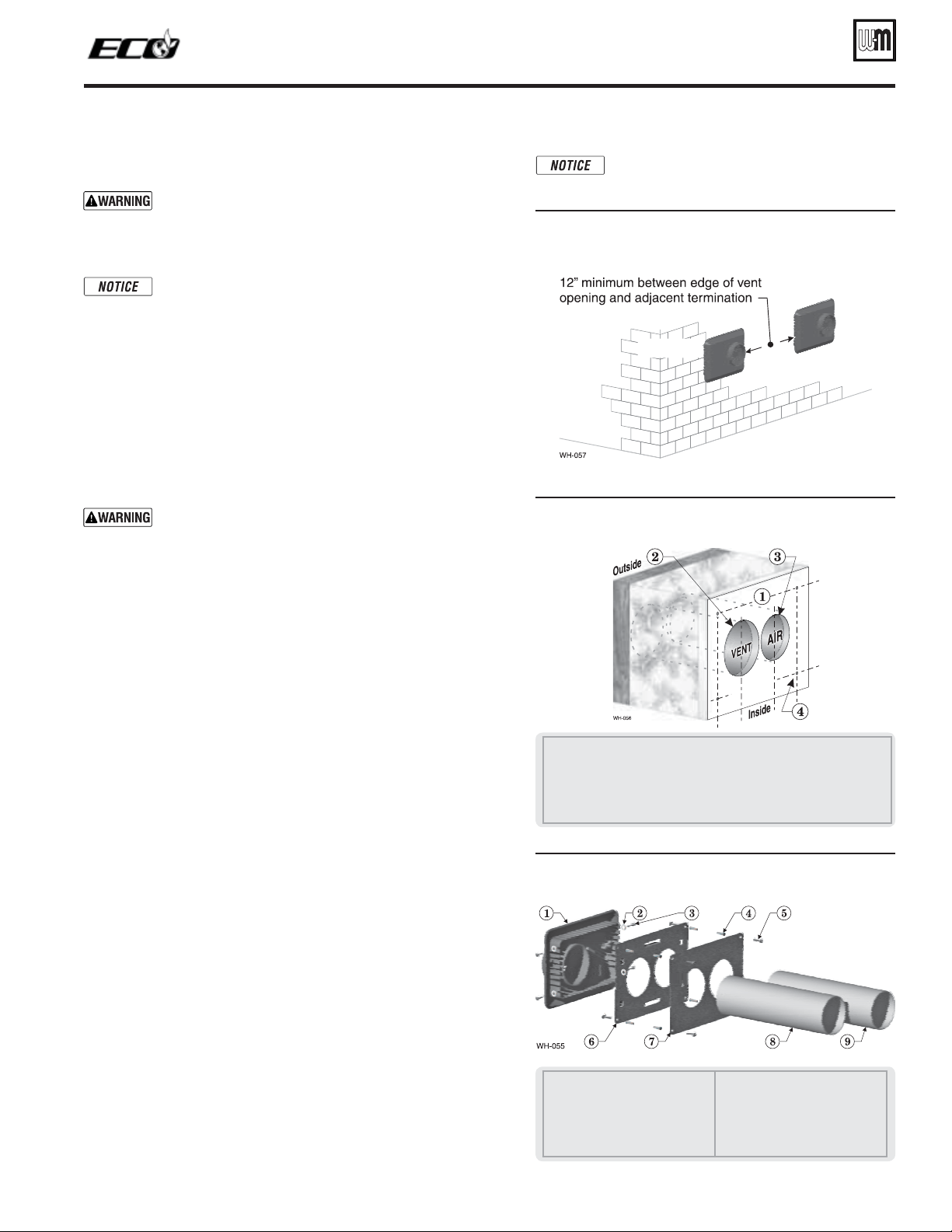
Part number 550-142-122/0513
29
TM
GAS-FIRED WATER BOILER — Boiler Manual
Vent/air pipes and W-M vent/air plate can be
oriented in any of the configurations shown
in Figure 29, page 28.
&IGURE Adjacent terminations — OUTSIDE VIEW
— clearance from air inlet to exhaust from
another appliance
DIRECT VENT — 3IDEWALLWITH7-VENTAIRPLATE (continued)
&IGURE Hole preparation in wall — INSIDE VIEW
(use template provided)
1 Inside wall
2 Drill: 3½" diameter for 3" air pipe; locate using template provided
3 For combustible materials, drill: 4" diameter for 3" vent pipe
For noncombustible materials, drill 3½" diameter for 3" vent pipe
Locate opening using template provided
4 Drill mounting screw holes using template provided
&IGURE Termination assembly — INSIDE VIEW
Weil-McLain vent/air cap and plates
1 Vent termination (3”)
2 Lock washer, #10 (4)
3 Sheet metal screw, #10 x ½” (4)
4 Plastic wall anchor (8)
5 Sheet metal screw, #10 x 1¼” (8)
6 Outer mounting plate
7 Inner mounting plate
8 Vent pipe (butt to screen in termina-
tion)
9 Air pipe (butt to stops in termina-
tion)
)NSTALL7EIL-C,AINVENTAIRCAP
!$!04%23 — Use adapters if using other than 3-inch
PVC or CPVC. This is required for different materials
(polypropylene or AL29-4C stainless steel) or if using
2-inch pipe.
The inside and outside cover plates are stamped to iden-
tify the exhaust (vent) and intake (air) openings. Make
sure to orient the plates correctly.
1. Locate termination opening and avoid obstructions:
a. Use the template supplied with the termination kit.
b. Locate the template on the outside building surface where the
penetration is to be made.
c. Make sure there will be no obstructions that might prevent
proper placement of the termination.
d. Use the template to mark the locations for the four mounting
holes, flue pipe and air pipe. Level the template with a level.
For the Weil-McLain plate, the template must be level to
ensure the flue and air pipe will be side-to-side, as shown
in Figure 31. Failure to comply could result in severe
personal injury, death or substantial property damage.
e. Cut holes in the wall as shown in Figure 31, using the location
marks made with the template. For best results, use a small-
diameter, long drill bit to drill centering holes for the flue and
air pipe openings. Then drill the large openings from both the
inside and outside.
f. The flue pipe and air pipe may be run through a rectangular
cutout (as marked on the template) in lieu of two separate
holes if desired.
2. Drill holes for the screws or plastic anchors to secure the outside
plate. Install the outside plate and mount the termination on the
plate (temporarily).
a. Cut the flue pipe so the extension through the wall will cause
the vent pipe to fully extend into the termination socket.
b. Cut the air pipe so the extension through the wall will butt the
air pipe against the stops inside the termination.
c. Temporarily slide the flue and air pipes through the opening(s).
Slide the inside wall plate over the two pipes and into position
on the inside wall.
d. Position the inside plate so the flue pipe and air pipe slope
downward slightly toward the boiler (1/4” per foot).
e. Mark the four (4) mounting holes for the plate.
f. Remove the vent and air pipe, drill the four mounting holes,
and mount the inside plate.
3. Test fit the vent/air termination on the vent pipe. Make sure the
vent pipe fully penetrates the termination socket and the air pipe
butts against the interior stops.
4. Apply silicon RTV sealant to the interior of the vent termination
and slide onto vent pipe. Rotate slightly to spread the silicon to
ensure a tight seal around the vent pipe.
5. Secure the termination in place using the four (4) #10 x ½” sheet
metal screws and lock washers (see Figure 32).
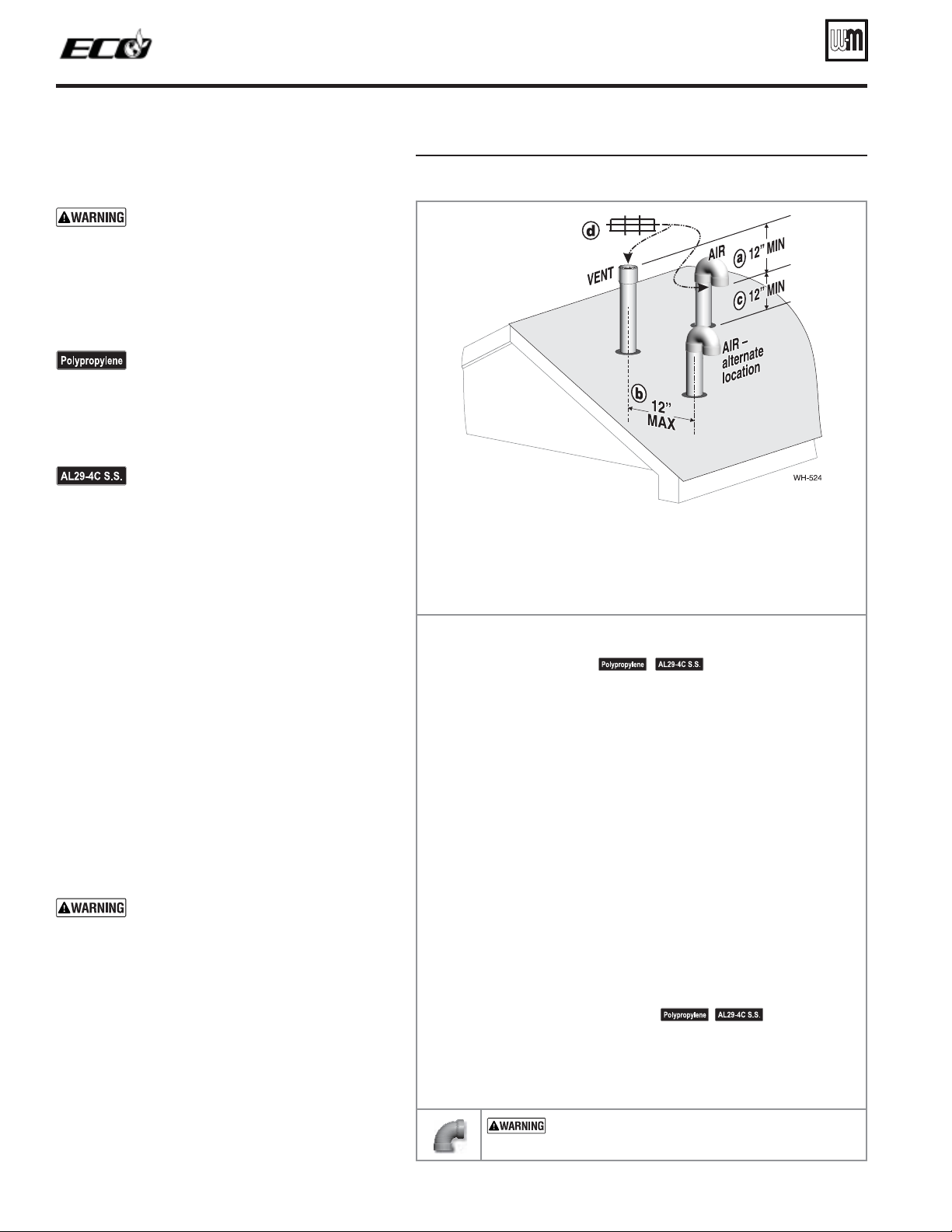
DIRECT VENT — 6ERTICALWITHSEPARATEPIPES
!LLOWABLEVENTAIRPIPEMATERIALS
LENGTHS
Use only the vent materials and kits listed
in Figure 20, page 20. Provide pipe adapt-
ers if specified.
1. Locate the terminations such that the total air pip-
ing and vent piping from the boiler to the termina-
tion will not exceed the maximum length given in
Figure 19, page 19.
For polypropylene applications, comply
with any additional requirements in the
vent system manufacturer’s instructions.
Provide 3” PVC transition pieces at the
boiler vent and air connections. Install a
locking collar at every joint.
For AL29-4C vent pipe applications, com-
ply with any additional requirements in
the vent system manufacturer’s instruc-
tions. Provide a 3” PVC transition piece
at the boiler vent connection. The air
piping must be PVC or CPVC. Provide a
3” PVC transition piece at the boiler air
connection if using 2” air piping.
$ETERMINETERMINATIONLOCATION
1. The air and vent terminations must be installed as
shown in Figure 33.
2. The terminations must comply with clearances and
limitations shown in Figure 21, page 22.
3. Locate the terminations so they are not likely to be
damaged by foreign objects, such as stones or balls,
or subject to buildup of leaves or sediment.
-ULTIPLEVENTAIRTERMINATIONS
1. When terminating multiple ECO boilers, termi-
nate each vent/air connection as described in this
manual.
Terminate all vent pipes at the same
height and all air pipes at the same height
to avoid possibility of severe personal
injury, death or substantial property
damage.
2. Place roof penetrations to obtain minimum clear-
ance of 12 inches between edge of air intake elbow
and adjacent vent pipe of another boiler for U. S.
installations (see Figure 34, page 31). For Canadian
installations, provide clearances required by CSA
B149.1 or B149.2 Installation Code and a ULC S636
compliant vent kit.
3. The air inlet of a ECO boiler is part of a direct vent
connection. It is not classified as a forced air intake
with regard to spacing from adjacent boiler vents.
&IGURE Separate pipes vertical termination
4ERMINATEVENTANDAIRPIPESSUCHTHAT
A !)2).4!+%IS AT LEAST 12 inches below vent outlet
B !)2).4!+%IS NO FURTHER than 12 inches away center to center
C !)2).4!+%IS AT LEAST 12 inches above roof or snow line
D 6ENTANDAIRTERMINATIONSARElTTEDWITHBIRDSCREENS
3TEP Read and follow all instructions in this manual. $/./4PROCEED
WITH VENTAIR INSTALLATIONUNTIL YOUHAVEREAD PAGE
THROUGHPAGE.
See notices at left.
3TEP Install the boiler in a location that allows proper routing of all vent
and air piping to the selected sidewall location.
3TEP Make sure the selected vertical termination location complies with
Figure 21, page 22. (Multiple boiler terminations must also comply
with Figure 34, page 31.)
3TEP Use only the vent materials listed in Figure 20, page 20. Provide pipe
adapters where required. Vent piping and air piping lengths must not
exceed the values shown in Figure 19, page 19.
3TEP Prepare the vertical penetrations and secure penetration components
as instructed in this section. See “Prepare roof penetrations” on page 31
and “Termination and fittings” on page 31.
3TEP The air piping must terminate in a 180-degree return bend or down-
TURNEDELBOW as shown above. The vent piping must terminate in a
COUPLINGPOINTEDUPWARD as shown above.
3TEP Install vent and air piping between the boiler and the vertical termina-
tions. Slope horizontal piping downward toward the boiler at least 1/4
inch per foot. Install pipe supports every 5 feet on both the horizontal
and vertical runs. Install a hanger support within 6 inches of any upturn
in the piping. See page 35 for general guidelines. Also comply with vent
pipe manufacturer’s instructions.
See notices at left.
3TEP Insert the vent and air piping through the vertical penetrations and
secure the termination fittings.
3TEP Maintain clearances shown above. Vent and air terminations must be
fitted with a bird screen as shown.
53% 37%%0 %,"/73 &/2 !,,6%.4 !.$ !)2
0)0).' — DO NOT use short radius elbows for vent or
air piping. Boiler performance could be affected.
Part number 550-142-122/0513
30
TM
GAS-FIRED WATER BOILER — Boiler Manual
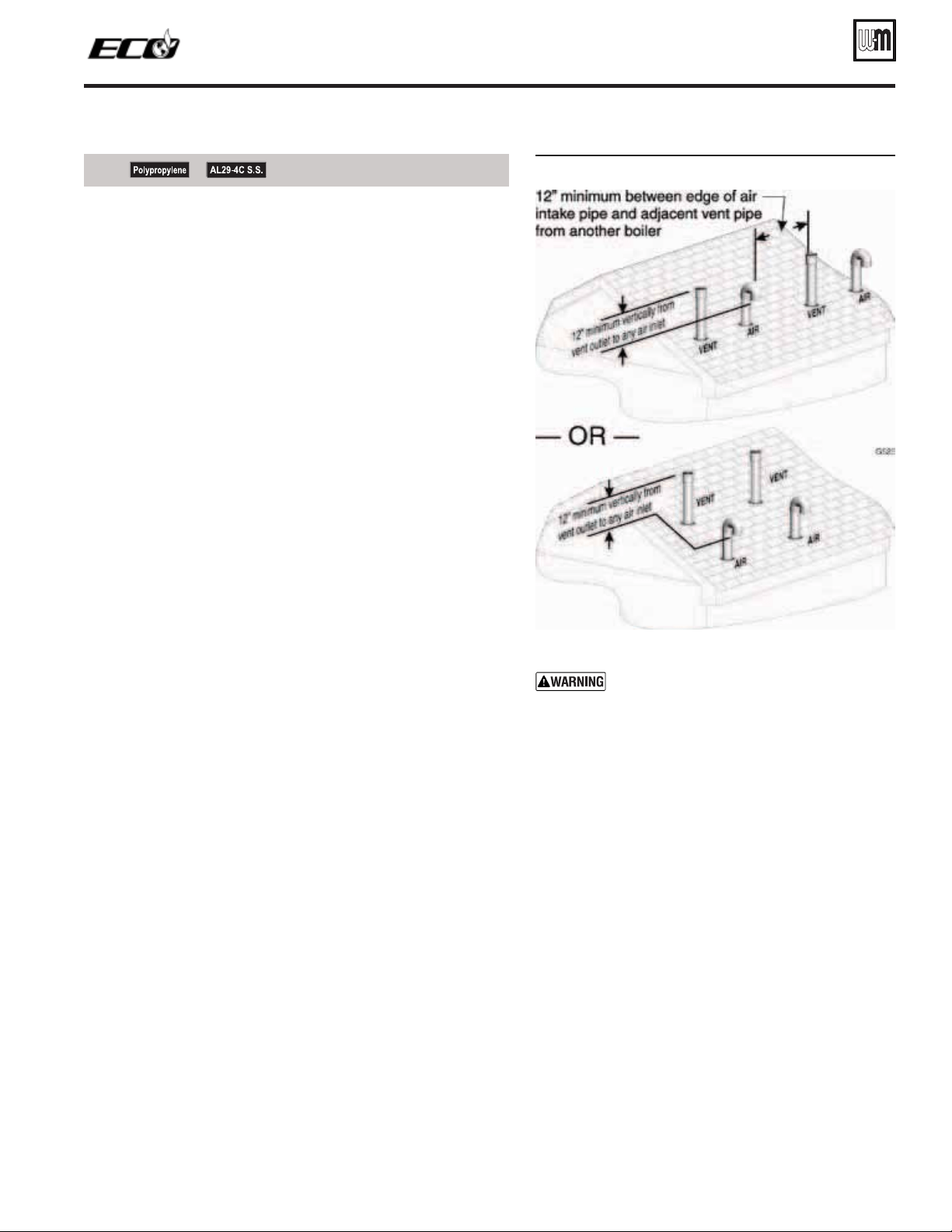
&IGURE Terminations for multiple boilers
Also maintain maximum distances between
the vent and air pipes for each boiler as shown
in Figure 23, page 24.
DIRECT VENT — 6ERTICALWITHSEPARATEPIPES (continued)
0REPAREROOFPENETRATIONS
1. Air pipe penetration:
a. Cut a hole for the air pipe. Size the air pipe hole as close as
desired to the air pipe outside diameter.
2. Vent pipe penetration:
a. Cut a hole for the vent pipe. For either combustible or non-
combustible construction, size the vent pipe hole at least 0.4”
larger than the vent pipe diameter.
b. Insert a galvanized metal thimble in the vent pipe hole.
3. Space the air and vent holes
no closer than the minimum spacings
shown in Figure 23, page 24.
4. Follow all local codes and vent pipe manufacturer’s instructions
for isolation of vent pipe when passing through floors, ceilings
and roofs.
5. Provide flashing and sealing boots sized for the vent pipe and air
pipe. Follow all vent pipe manufacturer’s instructions.
4ERMINATIONANDlTTINGS
1. Prepare the vent termination elbow and the air termination elbow
(Figure 33, page 30) by inserting bird screens. Bird screens must be
purchased separately. See the parts list at the end of this manual
for part numbers.
2. The air piping must terminate in a down-turned 180-degree re-
turn bend as shown in Figure 33, page 30. Locate the air inlet pipe
no further than 12 inches from the center of the vent pipe. This
placement avoids recirculation of flue products into the combus-
tion air stream.
3. The vent piping must terminate in an up-turned coupling as shown
in Figure 33, page 30. The top of the coupling must be at least 12
inches above the air intake. The air inlet pipe and vent pipe can be
located in any desired position on the roof, but must always be no
further than 12 inches apart (center to center) and with the vent
termination at least 12 inches above the air intake.
4. Maintain the required dimensions of the finished termination
piping as shown in Figure 33, page 30.
5. Do not extend exposed vent pipe outside of building more than
shown in this document. Condensate could freeze and block vent
pipe.
See notices on previous page.
Part number 550-142-122/0513
31
TM
GAS-FIRED WATER BOILER — Boiler Manual

DIRECT VENT — 6ERTICALCONCENTRIC
!LLOWABLEVENTAIRPIPEMATERIALS
LENGTHS
1. The concentric termination kit must be purchased
separately.
Use only the vent materials and kits listed
in Figure 20, page 20. Provide pipe adapt-
ers if specified.
2. Locate the termination such that the total air piping
and vent piping from the boiler to the termina-
tion will not exceed the maximum length given in
Figure 19, page 19.
3. This termination requires a 45-degree elbow that
is not supplied with the termination kit. The
maximum vent/air pipe lengths include allowance
for this elbow.
For polypropylene applications, comply
with any additional requirements in the
vent system manufacturer’s instructions.
Provide 3” PVC transitions at the boiler
vent and air connections and at the termi-
nation if using a 3” PVC concentric vent
kit. Install a locking collar at every joint.
For AL29-4C vent pipe applications, com-
ply with any additional requirements in
the vent system manufacturer’s instruc-
tions. Provide a 3” PVC transition at the
boiler vent connection. Air pipe must be
PVC or CPVC. Provide a 3” PVC transi-
tion at the boiler air connection if using
2” air pipe. Provide transition pieces to
PVC at the vent and air pipe termination
connections.
$ETERMINETERMINATIONLOCATION
Locate the concentric vent/air termination using the
following guidelines:
1. The concentric vent/air assembly must terminate
as shown in Figure 37, page 33
2. The termination must comply with the clearances
and limitations shown in Figure 21, page 22.
3. Locate the termination so it is not likely to be dam-
aged by foreign objects, such as stones or balls, or
subject to buildup of leaves or sediment.
4. For Canadian installations, follow requirements
of CSA B149.1 or B149.2 Installation Code and a
ULC S636 compliant vent kit.
-ULTIPLEVENTAIRTERMINATIONS
1. When terminating multiple ECO boilers, install
the concentric vent/air termination assemblies as
described in this manual.
All vent outlets must terminate at the
same height to avoid possibility of severe
personal injury, death or substantial
property damage.
&IGURE ).34!,,!4)/.3%15%.#% — Concentric vertical
3TEP Read and follow all instructions in this manual. $/./4PROCEED
WITH VENTAIR INSTALLATIONUNTIL YOUHAVEREAD PAGE
THROUGHPAGE.
See notices at left.
3TEP Install the boiler in a location that allows proper routing of all vent
and air piping to the selected sidewall location.
3TEP Make sure the selected vertical termination location complies with
Figure 21, page 22. (Multiple boiler concentric terminations must also
comply with Figure 36, page 33.)
3TEP Use only the vent materials listed in Figure 20, page 20. Provide pipe
adapters where required.
3TEP Vent piping and air piping lengths must not exceed the values shown
in Figure 19, page 19.
3TEP The concentric termination must be assembled and installed before
piping from the boiler to the termination.
3TEP Prepare the vertical penetration(s) — assemble the concentric termina-
tion kit and secure the penetration components as instructed in this
section. Provide the supports indicated and mount the termination
assembly. See “Prepare roof penetrations” on page 33 and “Mount con-
centric termination” on page 33.
See notices at left.
3TEP Install vent and air piping between the boiler and the concentric vent/
air termination. Slope horizontal piping downward toward the boiler
at least 1/4 inch per foot. See page 35 for general guidelines.
3TEP Install pipe supports every 5 feet on both the horizontal and vertical
runs.
See notices at left.
3TEP Install a hanger support within 6 inches of any upturn in the piping.
See notices at left.
53% 37%%0 %,"/73 &/2 !,,6%.4 !.$ !)2
0)0).' — DO NOT use short radius elbows for vent or
air piping. Boiler performance could be affected.
Part number 550-142-122/0513
32
TM
GAS-FIRED WATER BOILER — Boiler Manual
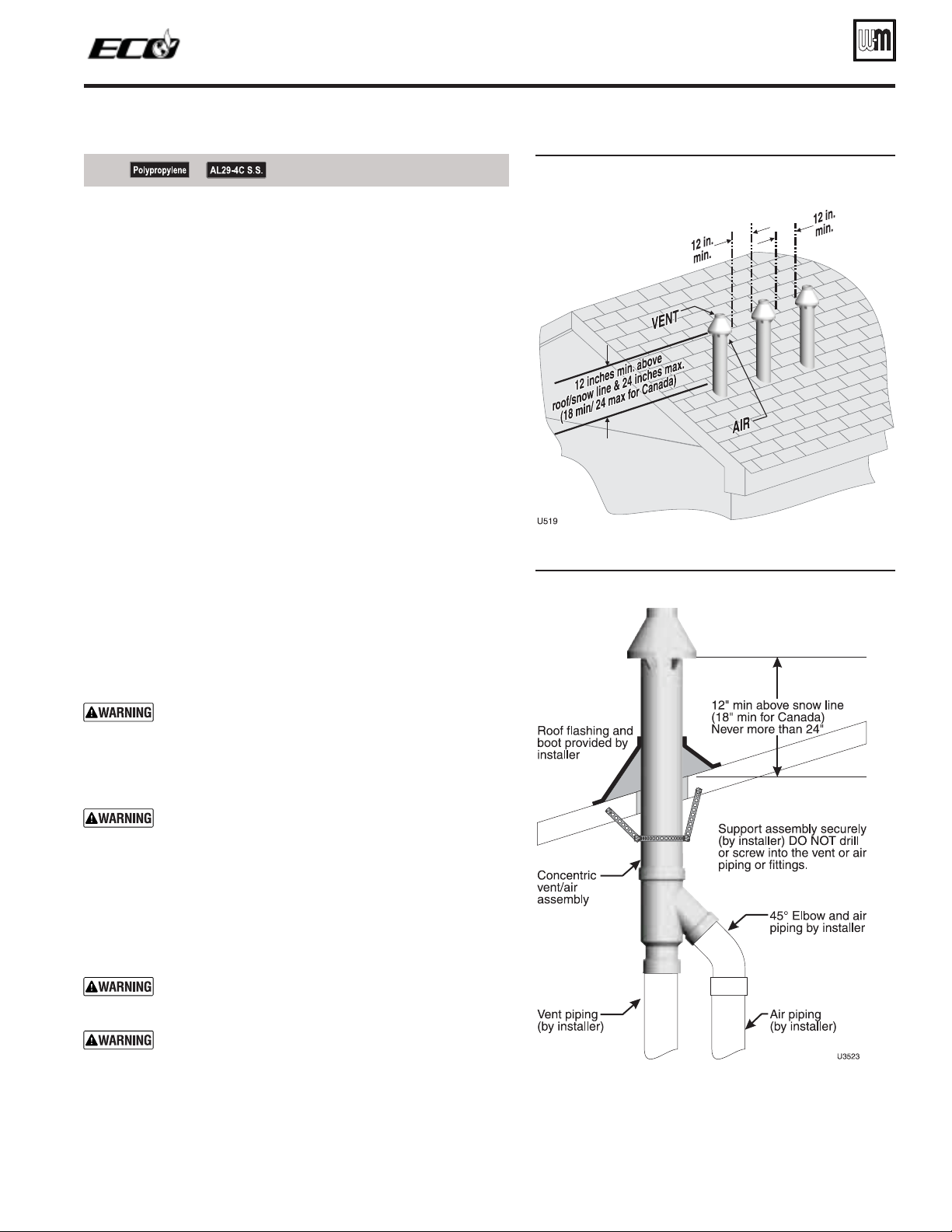
DIRECT VENT — 6ERTICALCONCENTRIC (continued)
2. Place roof penetrations to obtain minimum clearance of
12 inches between the edges of adjacent vent pipes of other boil-
ers for U. S. installations (see Figure 36). For Canadian instal-
lations, provide clearances required by CSA B149.1 or B149.2
Installation Code and a ULC S636 compliant vent kit.
3. The air inlet of a ECO boiler is part of a direct vent connection. It
is not classified as a forced air intake with regard to spacing from
adjacent boiler vents.
0REPAREROOFPENETRATIONS
1. Roof penetration hole:
a. Cut a clearance hole to clear the termination outside diameter
as prescribed in the kit instructions.
b. Insert a galvanized metal thimble in the vent pipe hole.
2. Follow all local codes for isolation of vent pipe when passing
through floors, ceilings and roofs.
3. Provide flashing and sealing boots sized for the concentric termi-
nation outside diameter.
-OUNTCONCENTRICTERMINATION
1. Assemble the vent termination as described for concentric termi-
nations, on page 34.
2. Mount the termination as shown in Figure 37.
3. Support the concentric vent/air termination at the roof penetration
as shown in Figure 37 or per concentric kit instructions.
s The supports/bracing used must support the termination
assembly to prevent vertical slippage or sideways movement.
s The clamps used on the outside of the termination pipe must
not cut into the pipe or contain sharp edges that could cause
a crack to form.
The vent and air piping must be securely supported,
and must not rest its weight on the boiler fittings. DO
NOT drill or screw into either the vent pipe or air pipe.
Failure to properly support the vent and air piping could
result in vent piping damage, resulting in possible severe
personal injury, death or substantial property damage.
When inserting the partially-assembled termination kit
through the roof penetration, wrap plastic or other pro-
tection over the end of the exposed assembly to prevent
debris from entering the pipes. If the air passages become
blocked, the boiler will not operate. Once the rain cap
has been cemented to the assembly, there is no way to
correct the problem. The assembly would have to be re-
placed if it were cut to be removed and cleaned. Altering
the assembly in any way could result in severe personal
injury or death due to toxic flue product emissions.
If using AL29-4C stainless vent pipe, use the vent pipe
manufacturer’s PVC adapter if connecting to a PVC
concentric vent attachment.
Do not connect any other appliance to the vent pipe or
multiple boilers to a common vent pipe.
4. After the assembly has been positioned in the roof opening and
all supports have been attached, install a bird screen (purchased
separately if not included with the kit) and rain cap as follows:
a. Place the bird screen on the end of the inner pipe as in Fig-
ure 38, page 34, or per kit instructions for polypropylene kits.
b. Cement the rain cap in place.
&IGURE Vertical termination — 3” PVC concentric
— single or multiple boilers
&IGURE 3” PVC concentric termination supports
See notices on previous page.
Part number 550-142-122/0513
33
TM
GAS-FIRED WATER BOILER — Boiler Manual
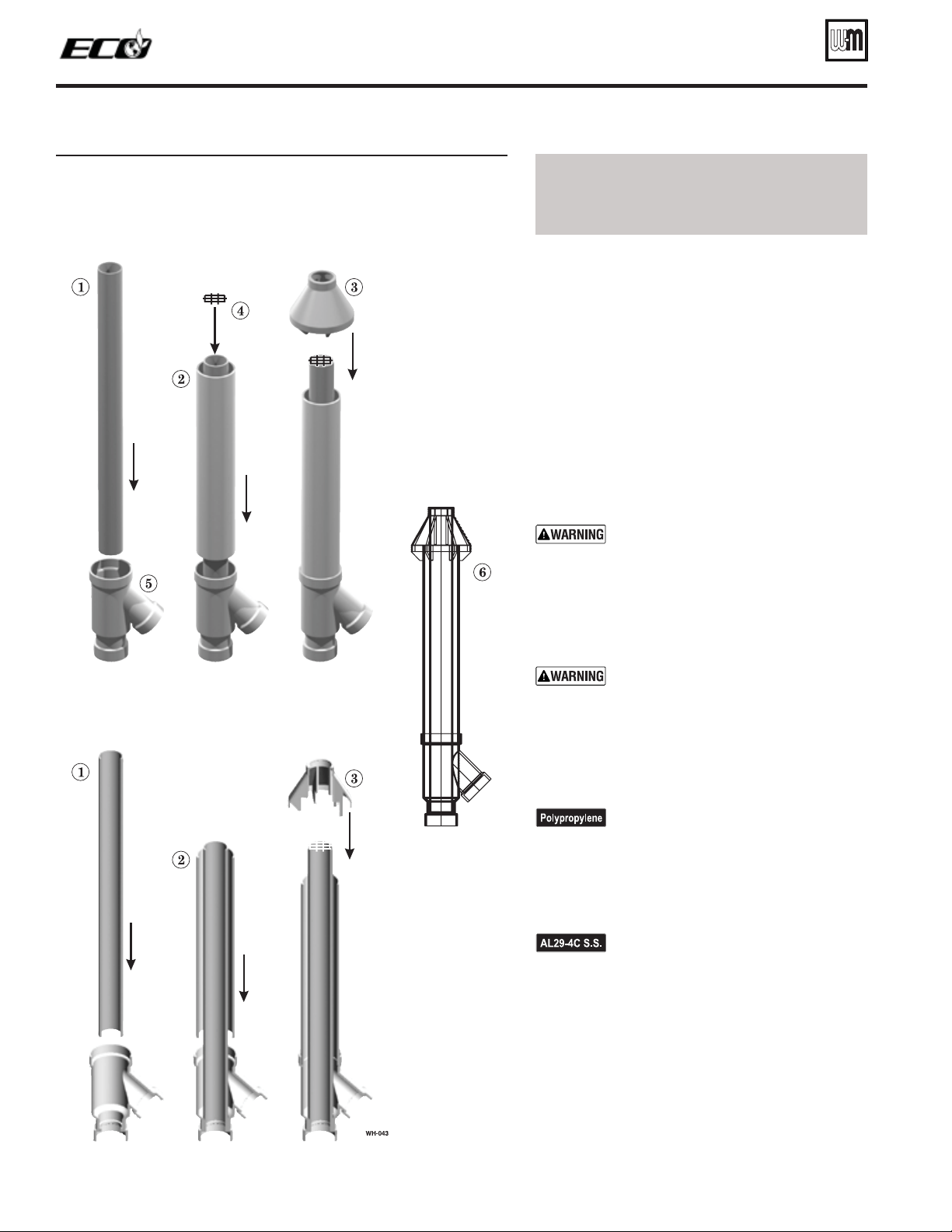
Concentric termination, typical (sidewall or vertical)
&IGURE 06# concentric termination assembly — DO NOT
attach the rain cap until the termination has been
inserted through the roof or wall and all supports
have been installed. See LEGEND at right. See kit
instructions for details of polypropylene kits.
!SSEMBLINGCONCENTRICTERMINATION
1. Follow all instructions provided with the concentric
termination kit. The following are general guide-
lines for information only
2. See Figure 38 for the typical assembly of a concen-
tric termination assembly.
3. Prepare the bird screen, item 4 (purchase separately
if not included with the kit). Cut the bird screen to
size if required. If the bird screen must be trimmed,
cut the bird screen to fit the outside diameter of the
PVC inner pipe supplied with the termination kit.
4. Partially assemble the vent termination kit in the
sequence shown in Figure 38, or per the concentric
kit instructions.
$/ ./4 install the rain cap and bird
screen until the assembly has been in-
serted through the roof (or sidewall)
and all supports have been installed.
Follow instructions to cover the end of
the assembly with plastic before inserting
through the roof penetration to prevent
debris from blocking the air passages.
If necessary, you can shorten the lengths
of the inner and outer pipes for a shorter
finished assembly. But you must ensure
the pipes butt correctly at both ends. Fail-
ure to properly assemble the concentric
termination can result in flue gas recir-
culation, causing possible severe personal
injury or death.
For polypropylene applications, comply
with any additional requirements in the
vent system manufacturer’s instructions.
Provide 3” PVC transitions at the boiler
vent and air connections and at the ter-
mination if using a PVC concentric vent
kit.
Install a locking collar at every joints.
For AL29-4C vent pipe applications, com-
ply with any additional requirements in
the vent system manufacturer’s instruc-
tions. Provide a 3” PVC transition at the
boiler vent connection. Air pipe must be
PVC or CPVC. Provide a 3” PVC transi-
tion at the boiler air connection if using
2” air pipe. Provide transition pieces to
PVC at the vent and air pipe termination
connections.
,%'%.$FOR&IGURE
1 Inner PVC pipe (vent)
2 Outer PVC pipe (air)
3 Rain cap
4 Bird screen
5 Y fitting
6 Finished assembly
Part number 550-142-122/0513
34
TM
GAS-FIRED WATER BOILER — Boiler Manual

&IGURE Boiler vent and air connections
!$!04%23
— Use adapters if using other than
3-inch PVC or CPVC. This is required for different
materials or if using 2-inch pipe.
1. Use ONLY 3” PVC or CPVC pipe at boiler connections.
2. Clean and deburr inside and outside of both ends of air
and vent pipes. Chamfer boiler end of vent pipe for ease of
insertion.
The vent pipe end must be smooth and chamfered
to prevent possible damage to sealing gasket in vent
pipe adapter.
3. Inspect vent or air adapter (above) — verify no obstructions
or foreign objects inside.
4. Loosen clamp screw.
5. Measure 3½ inches from end of pipe and make a mark with
felt-tip pen.
6. Loosen adapter clamp screw.
7. Apply small amount of silicon grease to end of pipe to ease
insertion.
8. Insert pipe into adapter.
9. Slide pipe down until the 3½-inch mark is reached.
Do not apply excessive force or bend the adapter
or flue/air pipe when inserting. The adapter or seal
could be damaged. If any portion of the vent or air
system is damaged, it must be replaced.
10. Secure vent or air pipe by tightening the adapter clamp
securely. Do not overtighten.
11. The seal is accomplished with the internal gasket. The clamp
is only to hold the pipe in place.
53% 37%%0 %,"/73 &/2 !,,
6%.4!.$!)20)0).' — DO NOT
use short radius elbows for vent or air pip-
ing. Boiler performance could be affected.
Vent and air piping and boiler connections
Follow termination instructions
1. Read and follow all instructions for the termination type used
before proceeding with this page. Follow all instructions provided
by vent pipe manufacturer.
Use only materials from the manufacturers listed in
Figure 20, page 20.
Installing vent and air piping
For polypropylene applications, comply with any addi-
tional requirements in the vent system manufacturer’s
instructions. Provide 3” PVC transition pieces at the
boiler vent and air connections, and also at the termi-
nation if using the W-M termination plate. Provide 2”
or 3” PVC transitions at the termination if using a PVC
concentric vent kit. Install a locking collar at every joint.
For AL29-4C vent pipe applications, comply with any
additional requirements in the vent system manufac-
turer’s instructions. Provide a 3” PVC transition piece
at the boiler vent connection. Air piping must be PVC
or CPVC. Connect to the boiler air piping only with
3” PVC (use a transition piece for 2” air pipe). Provide
3” PVC connections at the termination if using the W-M
termination plate. Provide 2” or 3” PVC transitions at
the termination if using a PVC concentric vent kit.
1. Work from the boiler to vent or air termination. Do not exceed the
lengths given in the previous pages for either the air or vent piping.
2. See Figure 39 for attaching vent (and air) pipes at the boiler. Con-
nections must be 3” PVC or CPVC only — use transitions if needed
to adapt to other material or size (2”).
3. Cut pipe to required lengths.
4. Dry assemble entire vent or air piping to ensure proper fit before
assembling any joint.
5. Maintain minimum clearance of ³⁄₁₆ inch between vent pipe and
any combustible wall or material.
6. Seal wall or floor penetration openings following local code re-
quirements.
7. Assembling PVC or CPVC: (
— follow pipe
manufacturer’s instructions for preparation and assembly)
a. Deburr inside and outside of pipe ends.
b. Chamfer outside of each pipe end to ensure even cement
distribution when joining.
c. Clean all pipe ends and fittings. Dry thoroughly.
d. For each joint:
s Handle fittings and pipes carefully to prevent contamina-
tion of surfaces.
s Apply primer liberally to both joint surfaces — pipe end
and fitting socket.
s While primer is still damp, lightly apply approved cement
to both surfaces in a uniform coating.
s Apply a second coat to both surfaces. Avoid using too much
cement on sockets to prevent cement buildup inside.
s With cement still wet, insert pipe into fitting, twisting ¼
turn. Make sure pipe is fully inserted.
s Wipe excess cement from joint. Check joint to be sure a
smooth bead of cement shows around the entire joint.
Part number 550-142-122/0513
35
TM
GAS-FIRED WATER BOILER — Boiler Manual
Install water piping
Use two wrenches when tightening water piping
at boiler, using one of the wrenches to prevent
the boiler interior piping from turning. Failure to
support the boiler piping connections to prevent
them from turning could cause damage to boiler
components.
General piping information
!DDITIONALCONTROLSIFREQUIRED
The ECO control uses temperature sensors to
provide both high limit protection and modulating
temperature control. 4HE CONTROLS HIGH LIMIT
FUNCTION REQUIRES MANUAL RESET
. Some codes/
jurisdictions may require additional external
controls for high limit and/or low water cutoff
protection.
!DDITIONALLIMITCONTROLS
Following standard industry practices, if installation is to com-
ply with ASME or Canadian requirements, an additional high
temperature limit may be needed. Consult local requirements
for other codes/standards to determine if needed.
1. Install a manual reset high temperature limit constructed to
prevent a temperature setting above 200°F in system supply
piping between boiler and isolation valve. (Note that the
control operating limit function shuts the boiler down at
195°F, or lower if set to a lower value.)
-ULTITEMPERATURESYSTEMS — If the heating sys-
tem includes circuits that require lower temperature
water (radiant slab circuits, for example) as well as
higher temperature circuits, it is recommended to
protect low-temperature circuits with limit controls
that are wired to the control external limit circuit
terminals.
,OWTEMPERATUREMATERIALS — If using tem-
perature-limited materials (such as PEX tubing)
in system piping, it is recommended to protect
the system with limit controls that are wired to
the controls external limit circuit.
2. See instructions beginning on page 56 for wiring information.
3. If using a manual reset limit control or wiring in the manual
reset circuit, set ECO control boiler limit at least 20°F less
than the external manual reset limit (i.e., set ECO control no
higher than 180°F for a 200°F external limit, for example).
"ACKmOWPREVENTER
1. Use backflow preventer in the cold water supply piping if
required by local codes.
System/zone pipe sizing
"ASEBOARDCONVECTORSORCASTIRONRADIATORS/.,9
1. For residential space heating applications (other than radiant
heating or unit heaters) ONLY, you can use the sizing sug-
gestions in Figure 40.
&IGURE Suggested pipe sizing for system headers
and zone piping — RESIDENTIAL with
baseboard, convectors or cast iron radiators
ONLY (20°F temperature rise)
%#/ Model System header
70/110 1” or larger
155 1¼” or larger
Recommendations are based on a 20°F temperature drop
through the system.
Suggested maximum load per zone
Copper pipe and
baseboard size
Maximum recommended
feet of baseboard
¾” 67
1” 104
Size zone circulators to handle the required flow and head
loss for each zone.
System water piping methods
$IRECTCONNECTIONPIPINGTOBOILER
It is recommended, but not required, to use
primary/ secondary piping to the boiler. Using
primary/secondary piping will provide the most
efficient and reliable operation of the boiler and
the heating system.
)NSTALLATIONSUSINGDIRECTCONNECTIONPIPINGLAYOUT
SHOULD
1. Read the NOTICES and guidelines beginning on to deter-
mine if the system is eligible for this piping strategy.
2. If eligible, reference suggested piping layouts on pages 41
and 42.
3. Use primary/secondary piping if system ineligible.
0RIMARYSECONDARYPIPINGTOBOILER
Using primary/secondary piping will provide the most efficient
and reliable operation of the boiler and the heating system.
1. Use information beginning on page 42 to size pump for
proper flow through the ECO boiler.
2. Reference suggested piping layouts on pages 47-49.
Some installations can be piped in numerous other
ways that will work equally as well as the sugges-
tions here.
Part number 550-142-122/0513
36
TM
GAS-FIRED WATER BOILER — Boiler Manual
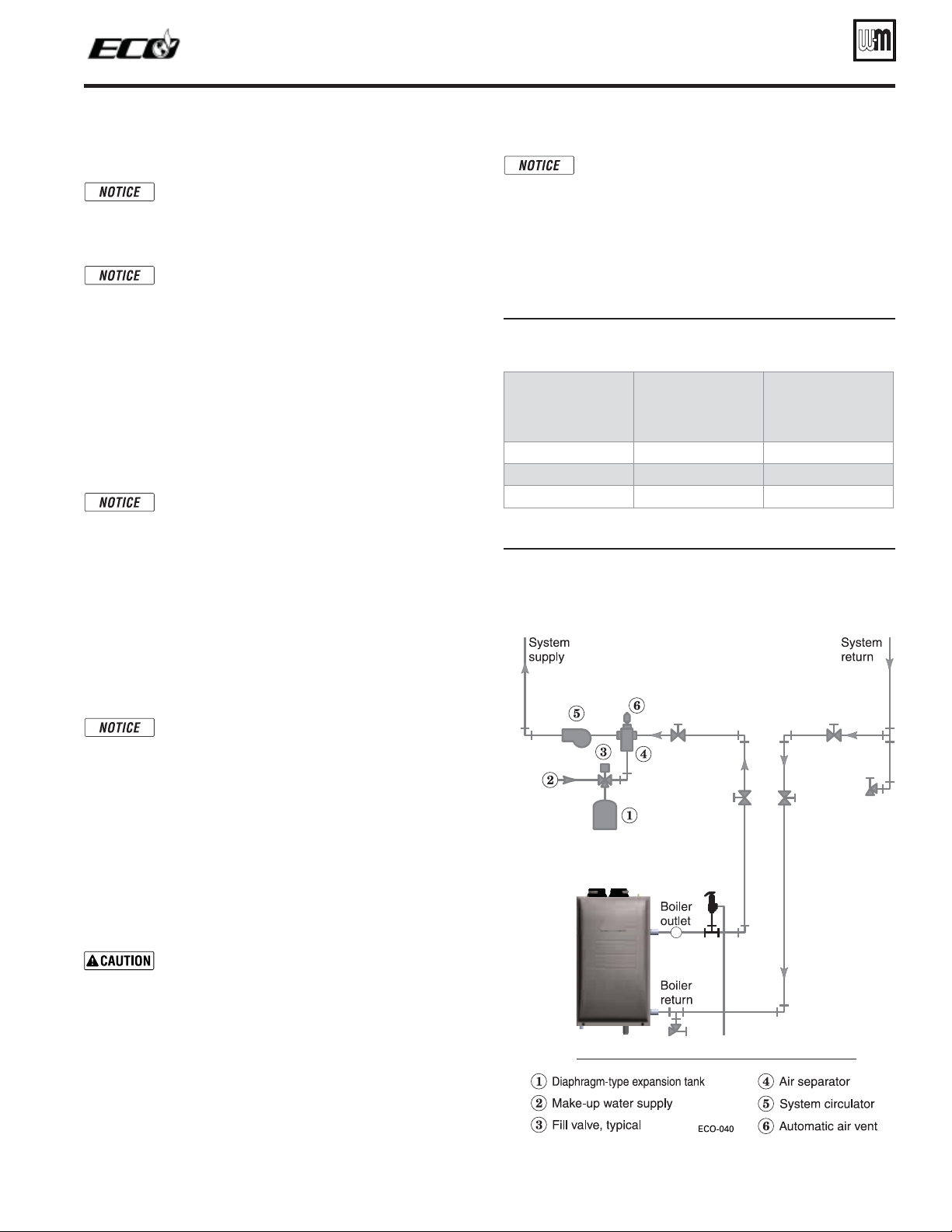
Verify the application will work:
For systems requiring a higher flow than that
recommended in Figure 41 − DO NOT use a direct
connect piping layout. Design system using a
primary/secondary piping layout using guidelines
starting on page 42.
Systems zoning with circulators must use primary/
secondary piping layout using guidelines starting
on page 42.
#HECKSYSTEMmOWRATE
To determine whether direct connection will provide suitable
flow for the intended application, refer to Figure 41.
1. The minimum temperature drop across the heat exchanger
is 20°F. Using flow rates higher than the maximum listed in
Figure 41 is NOT RECOMMENDED.
2. Design zoning to ensure minimum flow rate is maintained
under any call for heat condition that could see full input
rate (High Fire).
Systems using a modulating pump may operate be-
low the minimum flow rates listed in Figure 41 only
if the boiler is operating at a reduced firing rate (low
fire) when doing so. A pump that modulates based
on the system Delta T (ǻT) would provide such op-
eration assurance by varying flow with firing rate.
Use a primary/secondary piping layout if the total flow through
the ECO’s heat exchanger will be higher than the maximum
listed in Figure 41.
#HECKSYSTEMPIPEDESIGN
Only systems with a single system pump zoned with zone valves
may use the direct connect system piping methods shown here.
Any system zoned with zone valves must include a
by-pass pressure regulator. Failure to comply may
reduce pump life.
Expansion Tank Location
Figure 42 and 43 show typical installation of the system expansion
tank. It is highly recommended that you locate the air separator
and expansion tank as shown in the suggested piping drawings
on page 42 and page 43.
Ensure that the expansion tank size will handle boiler and system
water volume and temperature. See tank manufacturer’s instruc-
tions and ratings for details. Additional tanks may be added to
the system if needed to handle the expansion. These tanks may
be installed by connecting to tees in the system piping.
Undersized expansion tanks cause system water to
be lost from the relief valve and makeup water to be
added through the fill valve. Eventual boiler failure
can result due to excessive make-up water addition.
Always locate the cold-water fill connection at the
expansion tank. Never locate this elsewhere.
Diaphragm- or bladder-type tank:
Refer to Figure 42 for suggested piping when using a diaphragm-
or bladder-type expansion tank.
Install an automatic air vent on top of the air separator, per
separator manufacturer’s instructions.
Diaphragm- or bladder-type expansion tank—
Control fill pressure with the tank air charge
pressure. Always check pressure and charge tank
with tank removed from system to be sure reading
is accurate. Boiler relief valve is set for 30 PSIG.
Operating pressure of system, after temperature
expansion above cold fill pressure, should not
exceed 24 PSIG to avoid weeping of relief valve.
&IGURE Maximum and minimum flow rates through
boiler heat exchanger
ECO
Model
MAXIMUM
flow rate
through
boiler
MINIMUM
flow rate
through
boiler
70
6.5 GPM 3.0 GPM
110
10.0 GPM 5.0 GPM
155
14.5 GPM 7.0 GPM
&IGURE Piping to diaphragm (or bladder) type
expansion tank
Direct Connect System Piping
Part number 550-142-122/0513
37
TM
GAS-FIRED WATER BOILER — Boiler Manual
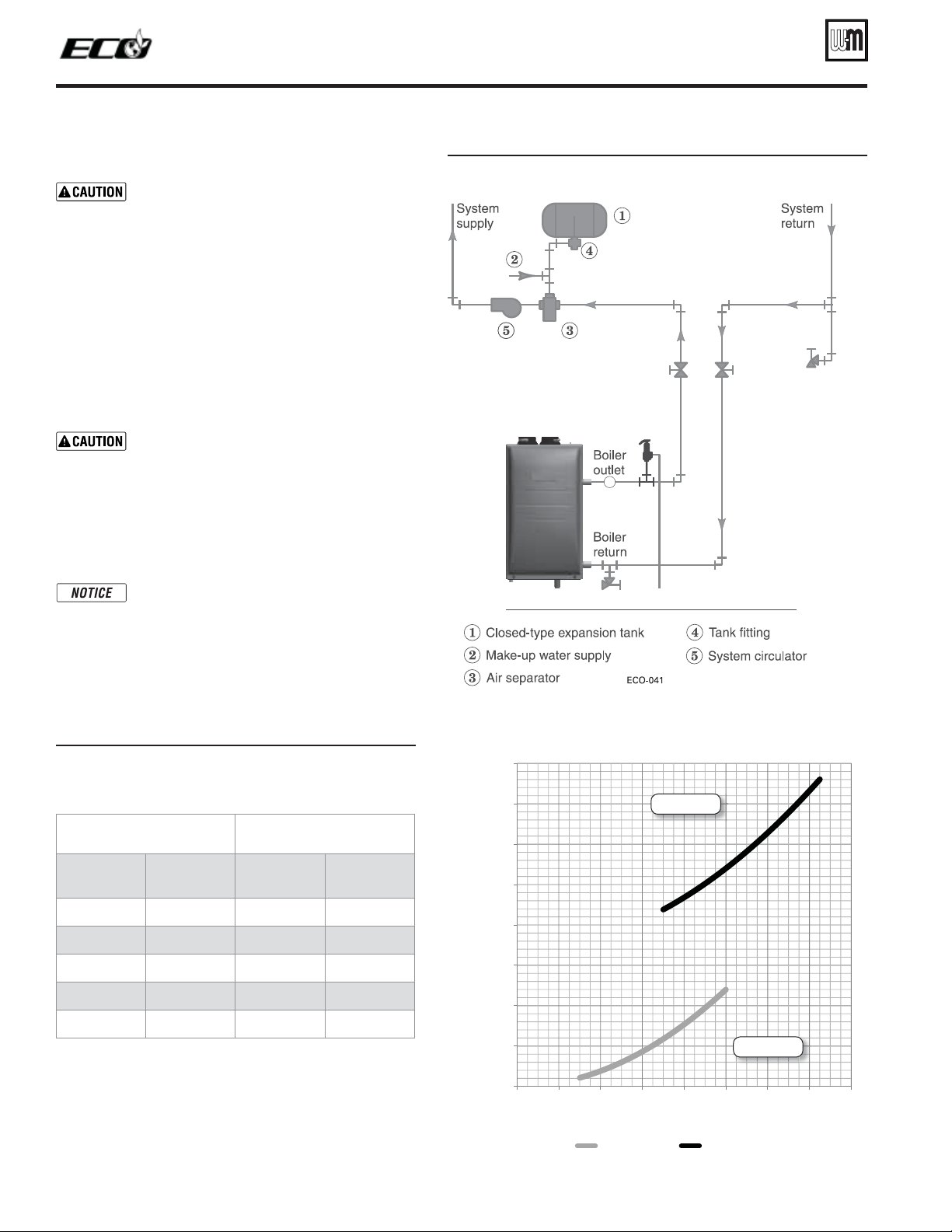
Closed-type expansion tank:
DO NOT use a closed-type tank if connect-
ing to a water heater that is equipped with an
automatic air vent.
Figure 43 shows suggested piping when using a closed-type
expansion tank, in which the air is directly in contact with
tank water.
Connect piping (½” or ¾”) from the air separator outlet to
the tank fitting. Slope any horizontal piping a minimum of
1 inch per 5 feet of horizontal pipe.
Always use a tank fitting such as the B&G Tank-trol or Taco
Taco-trol (shown). The fitting reduces gravity flow of water
in the piping to the tank, avoids air bubbling through the
tank water, and provides the proper fill height in the tank
Correct all leaks in the system or tank piping.
Leaks allow air to escape from the system and
will cause water-logging of the tank. This will
result in water loss through the boiler relief
valve due to over-pressurization. NEVER use
an automatic air vent in a system equipped
with a closed-type expansion tank. The air
removed from the system will cause water-
logging of the expansion tank.
Closed-type expansion tank—Follow tank
manufacturer’s instructions for filling the tank.
Typical tank sizing provides for approximately
12 PSIG when the tank is filled to the normal
level and system water is cold. Note that boiler
relief valve is set for 30 PSIG. Operation pres-
sure of system, after temperature expansion
above cold fill pressure, should not exceed
24 PSIG to avoid weeping of relieve valve.
&IGURE
Pressure drop through %#/ heat
exchanger (graph and table)
ECO 70 or 110 ECO 155
Flow Rate
(GPM)
Head Loss
(ft. w.c.)
Flow Rate
(GPM)
Head Loss
(ft. w.c.)
3.0 0.11 7.0 2.19
5.0 0.30 9.0 2.51
6.5 0.51 11.0 2.91
8.0 0.77 13.0 3.39
10.0 1.20 14.5 3.81
Direct Connect System Piping (continued)
&IGURE Piping to closed -type expansion tank
0.00
0.50
1.00
1.50
2.00
2.50
3.00
3.50
4.00
0246810121416
Pressure Drop (ft. w.c.)
Flow Through Heat Exchanger (GPM)
70/110 Models 155 Model
155
70/110
Part number 550-142-122/0513
38
TM
GAS-FIRED WATER BOILER — Boiler Manual

System water piping methods
(EADLOSSTHROUGHBOILERPIPING
1. See Figure 43 for the head loss through the boiler.
Use boiler head loss values to size pump after determining
other piping head loss values.
3YSTEMCIRCULATOR
1. Install a system circulator as shown in the piping diagram in
the Direct Connect System Piping section on page 41.
2. This circulator must be supplied by the installer.
3YSTEMCIRCULATORmOWRATES
1. Size circulators based on the flow rate required to achieve the
temperature rise or drop.
2. You can closely estimate the required flow through a circuit
by using the following formula, where TD is temperature rise
(or drop), FLOW is flow rate (in gpm), and BTUH is the heat
load for the circuit:
&,/7 =
BTUH
nnnn
4$X
%XAMPLES:
1. Consider a system loop for a system with total heating input
equal to 210,000 Btuh. The desired temperature drop through
the system piping is 20°F. Then the required flow rate is:
&,/7 =
nnnn
X
= GPM
3)-0,)&)%$
&ORTEMPERATUREDROP&,/7-"(
3YSTEMCIRCULATORHEADREQUIREMENT
1. The circulator must be capable of delivering the required
flow against the head loss that will occur in the boiler piping.
2. Determine the pipe size needed and the resultant head loss
using accepted engineering methods.
Part number 550-142-122/0513
39
TM
GAS-FIRED WATER BOILER — Boiler Manual
Direct Connect System Piping (continued)

Install relief valve
1. Install relief valve in 1 ” x 1 ” x ¾” (for 70/110) or 1 ¼” x 1 ¼” x ¾” (for 155)
reducing tee piped from boiler supply (Figure 8, page 12).
2. Pipe the relief valve only as shown, in the location shown.
3. Connect discharge piping to safe disposal location, following guidelines in
the
7!2.).' below.
4OAVOIDWATERDAMAGEORSCALDINGDUETORELIEF
VALVEOPERATIONASPERLOCALORSTATECODES
:
Install relief valve ONLY with the spindle vertical, as
shown in illustrations in this manual.
Discharge line must be connected to relief valve out-
let and run to a safe place of disposal. Terminate the
discharge line in a manner that will prevent possibility
of severe burns or property damage should the valve
discharge. Locate away from the top of the boiler.
Discharge line must be as short as possible and be the
same size as the valve discharge connection throughout
its entire length.
Discharge line must pitch downward from the valve and
terminate at least 6” above the floor drain where any
discharge will be clearly visible.
The discharge line shall terminate plain, not threaded,
with a material serviceable for temperatures of 375 °F
or greater.
Do not pipe the discharge to any place where freezing
could occur.
No shutoff valve shall be installed between the relief valve
and boiler, or in the discharge line. Do not plug or place
any obstruction in the discharge line.
Test the operation of the valve after filling and pres-
surizing system by lifting the lever. Make sure the valve
discharges freely. If the valve fails to operate correctly,
replace it with a new relief valve.
Failure to comply with the above guidelines could result
in failure of the relief valve to operate, resulting in pos-
sibility of severe personal injury, death or substantial
property damage.
Part number 550-142-122/0513
40
TM
GAS-FIRED WATER BOILER — Boiler Manual
Direct Connect System Piping (continued)
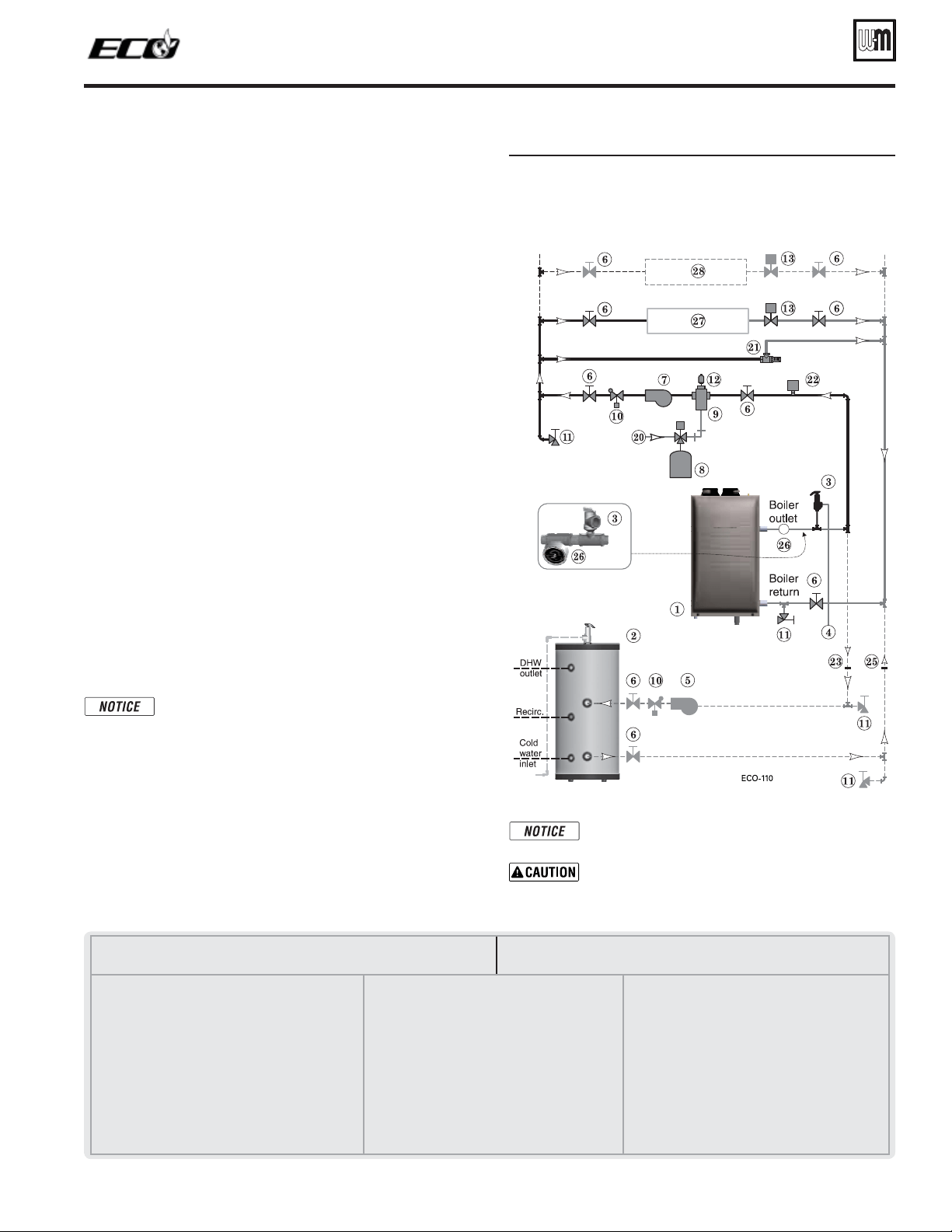
ZONE VALVE zoning – direct connection
(Shown with optional DHW piping)
See Figure 45.
1. This configuration is for zone valve systems that qualify to
use direct connection piping based on the criteria on page 37
only. If system does not qualify, pipe using primary/secondary
piping. See pages 43-49 for piping suggestions and guidelines.
2. Systems zoned with zone valves MUST use a by-pass pressure
regulator (Taco 3196 shown).
3. Install a system circulator (supplied by installer) capable of
delivering the proper flow and head as shown.
Expansion Tank required
1. Provide a system expansion tank following the guidelines on
page 37 or page 38.
2. DO NOT use a closed-type tank if connecting to a water heater
that is equipped with an automatic vent.
Domestic Hot Water (DHW) tank, if used
1. DHW direct connection—Pipe from the near-boiler piping to
the DHW tank’s boiler connections as shown.
2. DHW as zone—A DHW tank can be connected as a zone if a
DHW tank is NOT already connected to the boiler. To provide
DHW priority operation, use a zone controller. See notices on
page 59 to ensure compliance with the 2007 Energy Act.
3. DHW Priority operation—The ECO control turns off space
heating to the HEAT zones during domestic water heating calls
on the DHW input. The MAX ON TIME setting can be adjusted
to limit how long this occurs. Set the MAX ON TIME to “0” to
disable domestic priority. See page 70 for setting instructions.
4. If NOT connecting a water heater, do not use the DHW input
or DHW Circulator output on the ECO control.
Overriding the Outdoor Reset function by connecting
space heating zones to inputs and outputs intended
for DHW applications may violate Section 303 of
the 2007 Energy Act. See page 119 for compliance
information and exemptions.
Controlling the Zones
1. The ECO control can be used to control space heating only,
domestic water heating only, or both. Refer to field wiring,
beginning on page 56, for instructions on wiring to zone valves.
2. The boiler and zone valves can also be operated by a
Weil-McLain WMZV zone controller.
Direct Connect System Piping (continued)
&IGURE %#/Zone valve zoning direct
connection (system circulator provides flow
for system)
,%'%.$FOR&IGURE
.OTEThis is a common legend for all piping diagrams, not
all items listed appear in every figure.
1 ECO wall mount boiler
2 Indirect Water Heater, if used
3 Relief valve, supplied with boiler, field piped — MUST
be piped to boiler supply connection — see page 12 for
information
4 Relief valve piping to drain — see page 40
5 DHW circulator
6 Isolation valves
7 System circulator
8 Expansion tank, diaphragm type, if used
9 Air separator
10 Flow/check valves
11 Purge/drain valves
(one drain valve shipped loose with boiler)
12 Auto air vent
13 Zone valves
14 Primary/secondary connection (tees no more than 12
inches apart)
15 Expansion tank, closed type, if used (some chiller
systems may use a diaphragm-type expansion tank)
16 Water chiller
17 Check valve
18 Y-strainer
19 Balancing valve
20 Make-up water supply – Use applicable codes to deter-
mine if backflow preventers, pressure reducing valves,
and fill valves may be required
21 By-pass pressure regulator, REQUIRED for zone valve
systems unless other provision is made
22 High limit temperature control
23 DHW tank boiler water supply connection, when used
24 Zone circulator
25 DHW tank boiler water return connection, when used
26 Pressure/temperature gauge, supplied with boiler, field
piped
27 Heating circuits
28 Additional heating circuits, if any
29 Boiler circulator, if any
30 Mixing valve, if any
Connect zone valve end switches to HEAT input.
Connect system circulator to HEAT Circ. output.
Use isolation relays if connecting 3-wire zone valve end
switches to the HEAT input.
Part number 550-142-122/0513
41
TM
GAS-FIRED WATER BOILER — Boiler Manual
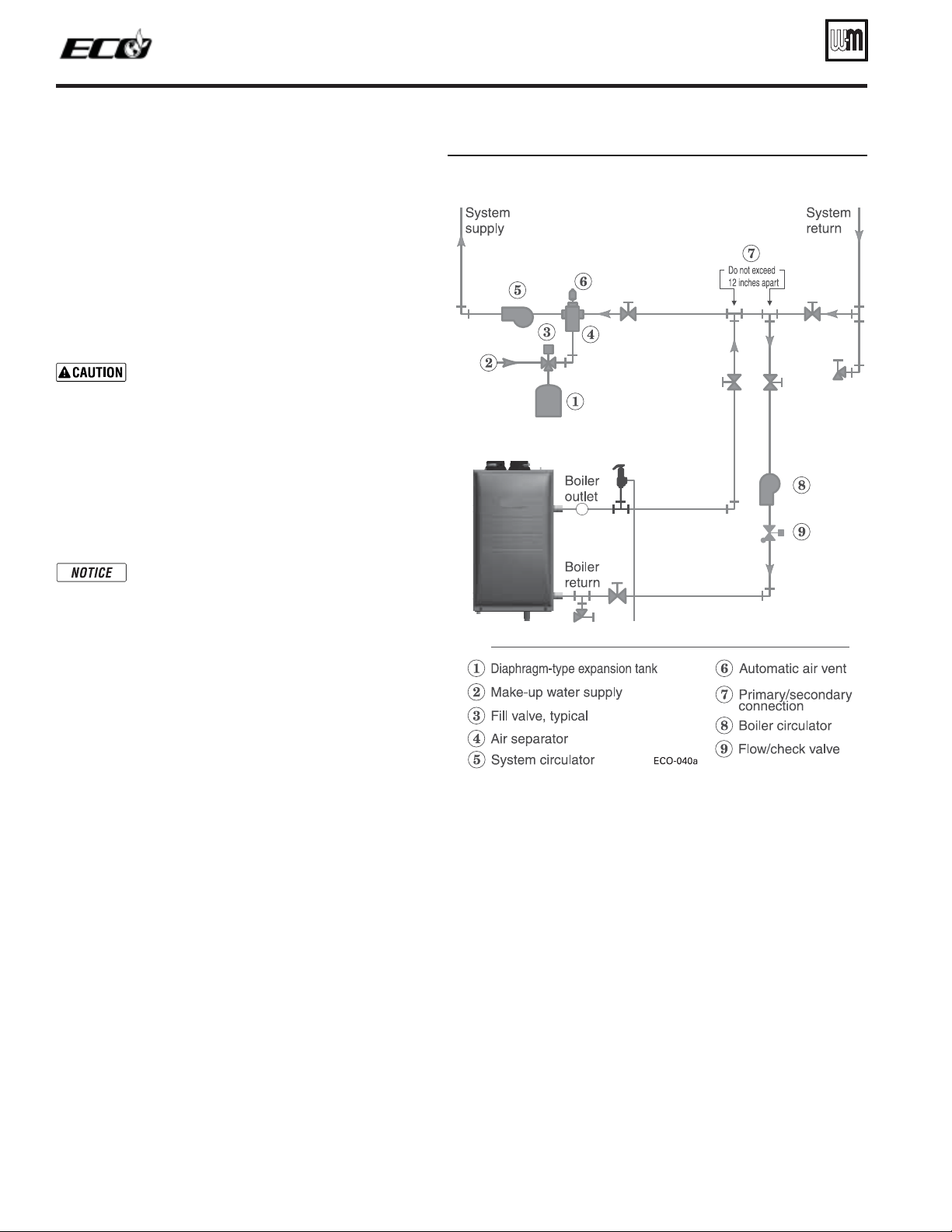
&IGURE 0IPINGTODIAPHRAGMORBLADDEREXPANSIONTANK
Expansion Tank Location
Figures 46 and 47 show typical installation of the system
expansion tank. It is highly recommended that you locate
the air separator and expansion tank as shown in the sug-
gested piping drawings on pages 47 - 49.
Ensure that the expansion tank size will handle boiler and
system water volume and temperature. See tank manu-
facturer’s instructions and ratings for details. Additional
tanks may be added to the system if needed to handle the
expansion. These tanks may be installed by connecting to
tees in the system piping.
Undersized expansion tanks cause system
water to be lost from the relief valve and
makeup water to be added through the fill
valve. Eventual boiler failure can result due
to excessive make-up water addition. Always
locate the cold-water fill connection at the
expansion tank. Never locate this elsewhere.
Diaphragm- or bladder-type tank:
Refer to Figure 48 for suggested piping when using a dia-
phragm- or bladder-type expansion tank.
Diaphragm- or bladder-type expansion
tank—Control fill pressure with the tank air
charge pressure. Always check pressure and
charge tank with tank removed from system
to be sure reading is accurate. Boiler relief
valve is set for 30 PSIG. Operating pressure
of system, after temperature expansion above
cold fill pressure, should not exceed 24 PSIG
to avoid weeping of relief valve.
Install an automatic air vent on top of the air separator, per
separator manufacturer’s instructions.
Part number 550-142-122/0513
42
TM
GAS-FIRED WATER BOILER — Boiler Manual
Primary/Secondary System Piping
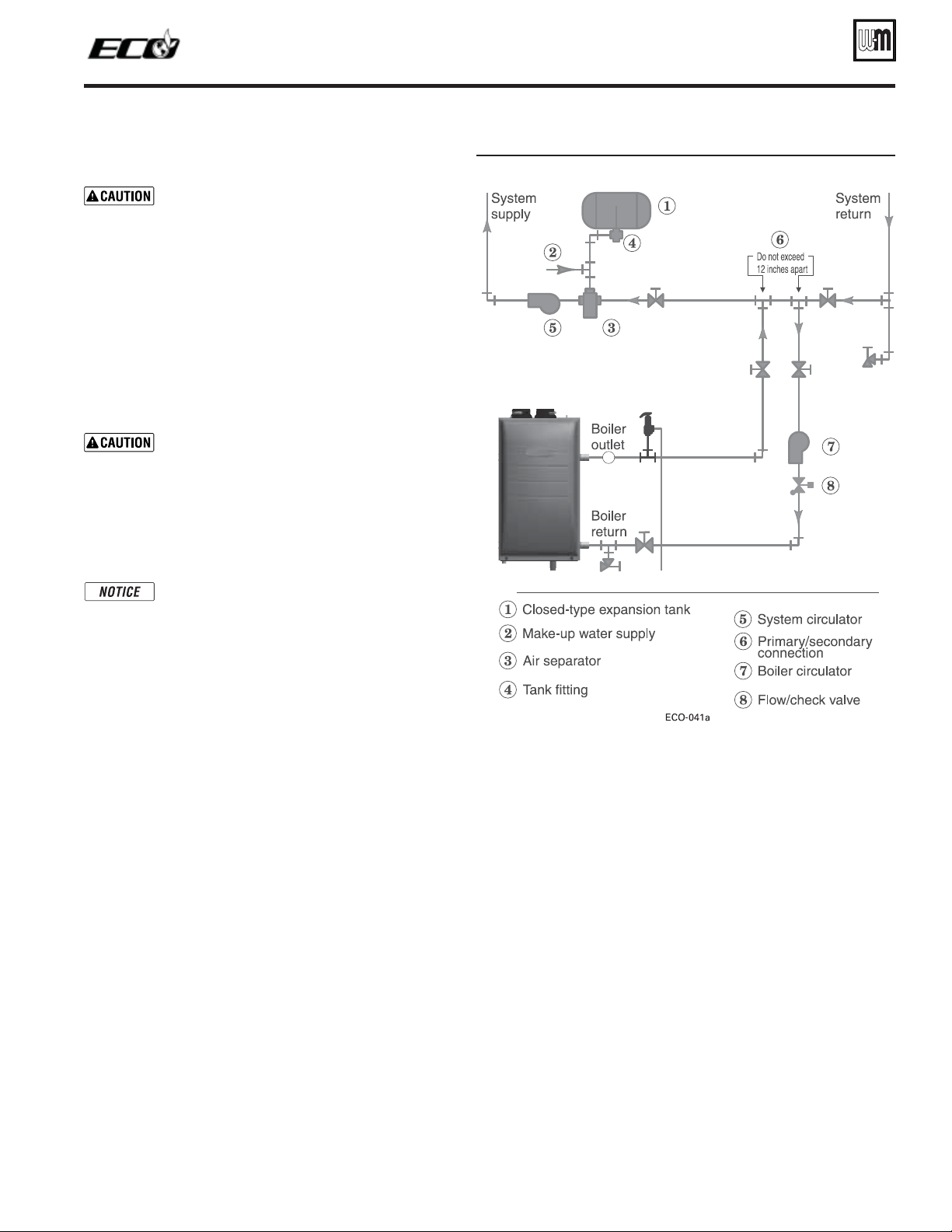
Closed-type expansion tank:
DO NOT use a closed-type tank if connect-
ing to a water heater that is equipped with an
automatic air vent.
Figure 47, page 43 shows suggested piping when
using a closed-type expansion tank, in which
the air is directly in contact with tank water.
Connect piping (½” or ¾”) from the air separator outlet to
the tank fitting. Slope any horizontal piping a minimum of
1 inch per 5 feet of horizontal pipe.
Always use a tank fitting such as the B&G Tank-trol or Taco
Taco-trol (shown). The fitting reduces gravity flow of water
in the piping to the tank, avoids air bubbling through the
tank water, and provides the proper fill height in the tank
Correct all leaks in the system or tank piping.
Leaks allow air to escape from the system and
will cause water-logging of the tank. This will
result in water loss through the boiler relief
valve due to over-pressurization. NEVER use
an automatic air vent in a system equipped with
a closed-type expansion tank. The air removed
from the system will cause water-logging of the
expansion tank.
Closed-type expansion tank—Follow tank
manufacturer’s instructions for filling the tank.
Typical tank sizing provides for approximately
12 PSIG when the tank is filled to the normal
level and system water is cold. Note that boiler
relief valve is set for 30 PSIG. Operation pressure
of system, after temperature expansion above
cold fill pressure, should not exceed 24 PSIG to
avoid weeping of relieve valve.
&IGURE Piping to closed-type expansion tank
Part number 550-142-122/0513
43
TM
GAS-FIRED WATER BOILER — Boiler Manual
Primary/Secondary System Piping
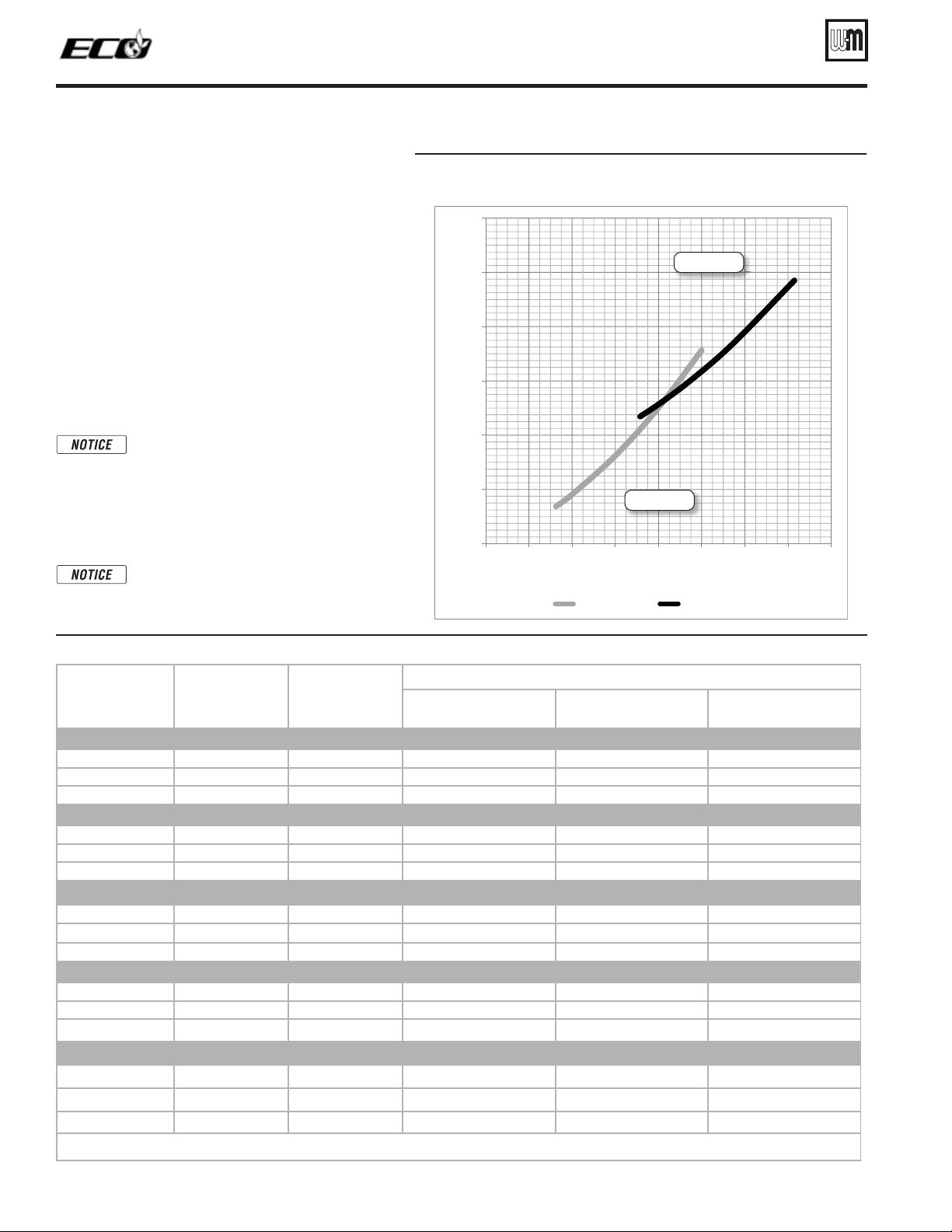
0
2
4
6
8
10
12
0246810121416
Pressure Drop (ft. w.c.)
Flow Through Heat Exchanger and Near-Boiler Piping (GPM)
70/110 Models 155 Model
Model
FLOW
(GPM)
HEAD
(ft. w.c.)
Circulators
Taco
(Std. Models)
Taco
(3 speed Models)
Grundfos
20°F Temperature Rise Application
70 6.5 3.0 007 * 007 (Lo)* UPS 15-42 F (Spd 1) *
110 10.1 6.6 007 * 0015 (Med) UPS 15-42 F (Spd 3) *
155 14.3 9.7 0014 – UPS 26-99 FC
25°F Temperature Rise Application
70 5.2 2.0 007 * 007 (Lo)* UPS 15-42 F (Spd 1) *
110 8.1 4.4 007 * 007 (Med) UPS 15-42 F (Spd 2) *
155 11.4 7.4 007 0015 (Hi) UPS 15-42 F (Spd 3)
30°F Temperature Rise Application (RECOMMENDED)
70 4.3 1.5 007 * 007 (Lo)* UPS 15-42 F (Spd 1) *
110 6.7 3.2 007 * 007 (Lo)* UPS 15-42 F (Spd 1) *
155 9.5 6.0 007 * 0010 (Lo) UPS 15-42 F (Spd 2)
35°F Temperature Rise Application
70 3.7 1.1 007 * 007 (Lo)* UPS 15-42 F (Spd 1) *
110 5.8 2.4 007 * 007 (Lo)* UPS 15-42 F (Spd 1) *
155 8.2 5.2 007 * 007 (Med) UPS 15-42 F (Spd 2) *
40°F Temperature Rise Application
70
3.3
0.9 007 * 007 (Lo)* UPS 15-42 F (Spd 1) *
110
5.1
1.9 007 * 007 (Lo)* UPS 15-42 F (Spd 1) *
155
7.2
4.7 007 * 007 (Lo) UPS 15-42 F
System water piping methods
.EARBOILERPIPING
1. Connect boiler to system only as shown in Figure 46
and Figure 47, page 44. The primary/secondary
piping shown ensures the boiler loop will have
sufficient flow.
2. Select a boiler loop temperature rise from
Figure 48, page 44. The table indicates the flow
and head loss characteristics at that temperature
rise and suggests potential circulators. Circulators
of other brands not listed (Wilo, Armstrong, B&G)
are acceptable if they meet the flow and head
requirements of the design.
Verify that the boiler loop piping matches
closely with the listed criteria in the
NOTICE below. If near boiler piping is
different, calculate head loss separately
using heat exchanger pressure drop
information from Figure 43, page 38 and
match to an appropriate pump.
The pressure drops shown are for
near boiler piping as illustrated in
Figure 46, page 42 and Figure 47 with 20
feet of straight piping.
&IGURE Estimated head loss of boiler loop piping and recommended circulators.
&IGURE Estimated head loss of boiler loop piping and
recommended circulators.
155
70/110
Part number 550-142-122/0513
44
TM
GAS-FIRED WATER BOILER — Boiler Manual
Primary/Secondary System piping (continued)

3YSTEMCIRCULATORSANDZONECIRCULATORS
1. Install a system circulator or zone circulators as shown
in the piping diagrams in the Primary/Secondary System
Piping section in this manual. These circulators must be
supplied by the installer.
3YSTEMORZONECIRCULATORSmOWRATES
1. Size circulators based on the flow rate required to achieve
the temperature change you needed. You can closely esti-
mate temperature rise (or drop) through a circuit by using
the following formula, where TD is temperature rise (or
drop), FLOW is flow rate (in gpm), and BTUH is the heat
load for the circuit:
&,/7 =
BTUH
nnnn
4$X
%XAMPLES:
1. Consider a system loop for a system with total heating
load equal to 210,000 Btuh. The desired temperature drop
through the system piping is 20°F. Then the required flow
rate is:
&,/7 =
nnnn
X
= GPM
3)-0,)&)%$
&ORTEMPERATUREDROP&,/7-"(
3YSTEMORZONECIRCULATORHEADREQUIREMENT
1. The circulator must be capable of delivering the required
flow against the head loss that will occur in the piping.
2. Determine the pipe size needed and the resultant head loss
using accepted engineering methods.
Part number 550-142-122/0513
45
TM
GAS-FIRED WATER BOILER — Boiler Manual
Primary/Secondary System piping (continued)

Install relief valve
1. Install relief valve in 1 ” x 1 ” x ¾” (for 70/110) or 1 ¼” x 1 ¼” x
¾” (for 155) reducing tee piped from boiler supply piping tee
(Figure 8, page 12).
2. Pipe the relief valve only as shown, in the location shown.
3. Connect discharge piping to safe disposal location, following guidelines
in the
7!2.).' below.
4OAVOIDWATERDAMAGEORSCALDINGDUETORELIEF
VALVEOPERATIONASPERLOCALORSTATECODES
:
Install relief valve ONLY with the spindle vertical, as
shown in illustrations in this manual.
Discharge line must be connected to relief valve out-
let and run to a safe place of disposal. Terminate the
discharge line in a manner that will prevent possibility
of severe burns or property damage should the valve
discharge. Locate away from the top of the boiler.
Discharge line must be as short as possible and be the
same size as the valve discharge connection throughout
its entire length.
Discharge line must pitch downward from the valve and
terminate at least 6” above the floor drain where any
discharge will be clearly visible.
The discharge line shall terminate plain, not threaded,
with a material serviceable for temperatures of 375 °F
or greater.
Do not pipe the discharge to any place where freezing
could occur.
No shutoff valve shall be installed between the relief valve
and boiler, or in the discharge line. Do not plug or place
any obstruction in the discharge line.
Test the operation of the valve after filling and pres-
surizing system by lifting the lever. Make sure the valve
discharges freely. If the valve fails to operate correctly,
replace it with a new relief valve.
Failure to comply with the above guidelines could result
in failure of the relief valve to operate, resulting in pos-
sibility of severe personal injury, death or substantial
property damage.
Part number 550-142-122/0513
46
TM
GAS-FIRED WATER BOILER — Boiler Manual
Primary/Secondary System piping (continued)

&IGURE Zone valve zoning — primary/secondary
connection — a system circulator is required
ZONE VALVE zoning – primary/secondary
(Shown with optional DHW piping)
See Figure 50.
1. This configuration is for zone valve systems using a boiler loop
connected as a secondary circuit off of a primary system loop.
Systems whose flow characteristics do not comply with those listed
in Figure 41, page 37 must pipe the boiler loop as a secondary
circuit as show.
2. Systems zoned with zone valves MUST use a by-pass pressure
regulator.
3. Install a system circulator (supplied by installer) capable of deliver-
ing the proper flow and head as shown.
Expansion Tank required
1. Provide a system expansion tank following the guidelines on
pages 43 or 44.
2. DO NOT use a closed-type tank if connecting to a water heater
that is equipped with an automatic vent.
Domestic Hot Water (DHW) tank, if used
1. DHW direct connection—Pipe from the near-boiler piping to the
DHW tank’s boiler connections as shown.
2. DHW as zone—A DHW tank can be connected as a zone if a DHW
tank is NOT already connected to the boiler. To provide DHW
priority operation, use a zone controller. See notices on page 59
to ensure compliance with the 2007 Energy Act.
3. DHW Priority operation—The ECO control turns off space heat-
ing to the HEAT zones during domestic water heating calls on the
DHW input. The MAX ON TIME setting can be adjusted to limit
how long this occurs. Set the MAX ON TIME to “0” to disable
domestic priority. See page 70 for setting instructions.
4. If NOT connecting a water heater, do not use the DHW input or
DHW Circulator output on the ECO control.
Overriding the Outdoor Reset function by connecting
space heating zones to inputs and outputs intended for
DHW applications may violate Section 303 of the 2007
Energy Act. See page 119 for compliance information
and exemptions.
Controlling the Zones
1. The ECO control can be used to control space heating only,
domestic water heating only, or both. Refer to field wiring,
beginning on page 56, for instructions on wiring to zone valves.
2. The boiler and zone valves can also be operated by a
Weil-McLain WMZV zone controller.
Primary/Secondary System piping (continued)
,%'%.$FOR&IGURE.
.OTEThis is a common legend for all piping diagrams, Not
all items listed appear in every figure.
1 ECO wall mount boiler
2 Indirect Water Heater, if used
3 Relief valve, supplied with boiler, field piped — MUST
be piped to boiler supply connection — see page 12 for
information
4 Relief valve piping to drain — see page 46
5 DHW circulator
6 Isolation valves
7 System circulator
8 Expansion tank, diaphragm type, if used
9 Air separator
10 Flow/check valves
11 Purge/drain valves
(one drain valve shipped loose with boiler)
12 Auto air vent
13 Zone valves
14 Primary/secondary connection (tees no more than 12
inches apart)
15 Expansion tank, closed type, if used (some chiller
systems may use a diaphragm-type expansion tank)
16 Water chiller
17 Check valve
18 Y-strainer
19 Balancing valve
20 Make-up water supply – Use applicable codes to deter-
mine if backflow preventers, pressure reducing valves,
and fill valves may be required
21 By-pass pressure regulator, REQUIRED for zone valve
systems unless other provision is made
22 High limit temperature control
23 DHW tank boiler water supply connection, when used
24 Zone circulator
25 DHW tank boiler water return connection, when used
26 Pressure/temperature gauge, supplied with boiler, field
piped
27 Heating circuits
28 Additional heating circuits, if any
29 Boiler circulator, if any
30 Mixing valve, if any
Connect zone valve end switches to HEAT
input. Connect system circulator to HEAT
Circ. output.
Use isolation relays if connecting 3-wire zone
valve end switches to the HEAT input.
Part number 550-142-122/0513
47
TM
GAS-FIRED WATER BOILER — Boiler Manual
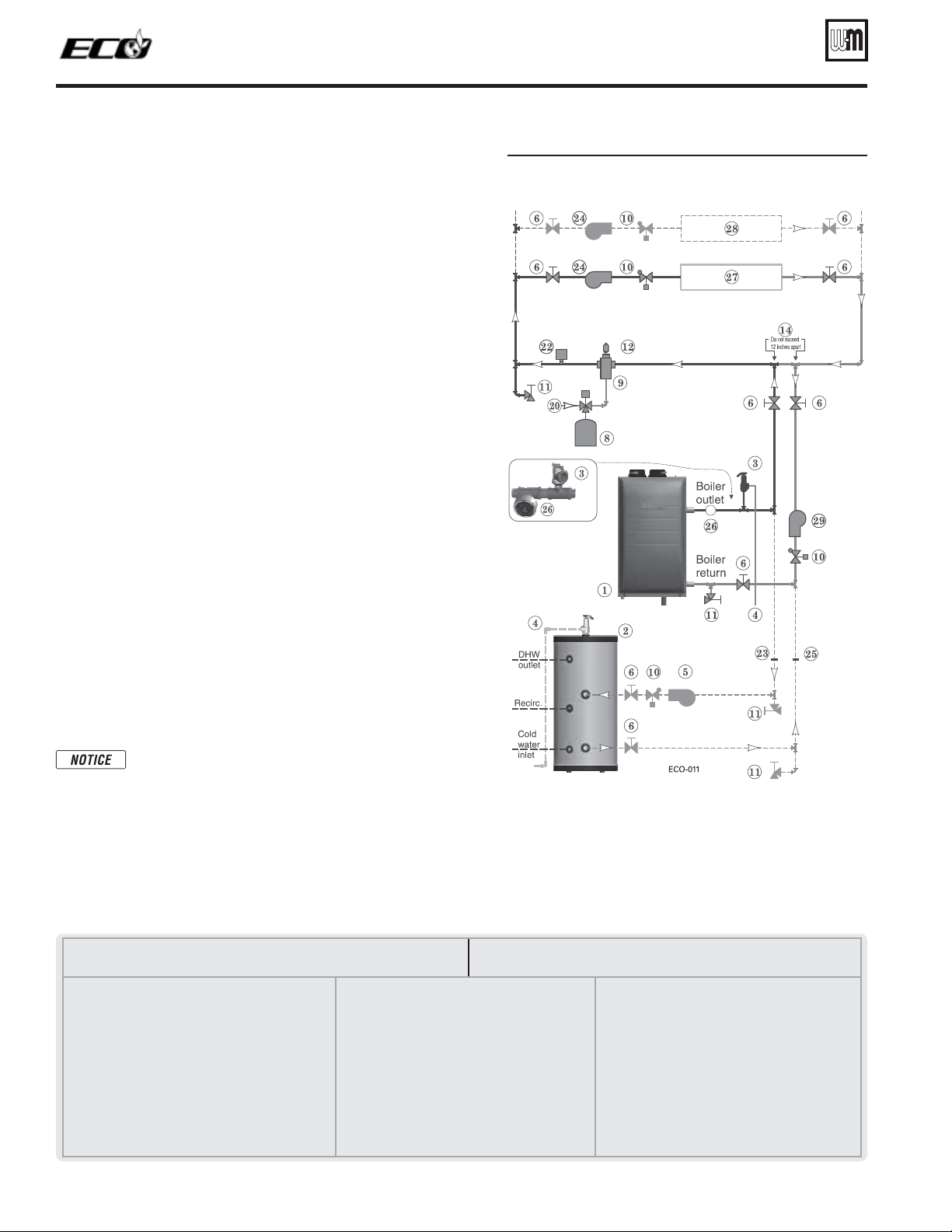
Primary/Secondary System piping (continued)
&IGURE Circulator zoning plus optional DHW
piping
,%'%.$FOR&IGURE and &IGURE
.OTEThis is a common legend for all piping diagrams, not
all items listed appear in every figure.
1 ECO wall mount boiler
2 Indirect Water Heater, if used
3 Relief valve, supplied with boiler, field piped — MUST
be piped to boiler supply connection — see page 12 for
information
4 Relief valve piping to drain — see page 46
5 DHW circulator
6 Isolation valves
7 System circulator
8 Expansion tank, diaphragm type, if used
9 Air separator
10 Flow/check valves
11 Purge/drain valves
(one drain valve shipped loose with boiler)
12 Auto air vent
13 Zone valves
14 Primary/secondary connection (tees no more than 12
inches apart)
15 Expansion tank, closed type, if used (some chiller
systems may use a diaphragm-type expansion tank)
16 Water chiller
17 Check valve
18 Y-strainer
19 Balancing valve
20 Make-up water supply – Use applicable codes to deter-
mine if backflow preventers, pressure reducing valves,
and fill valves may be required
21 By-pass pressure regulator, REQUIRED for zone valve
systems unless other provision is made
22 High limit temperature control
23 DHW tank boiler water supply connection, when used
24 Zone circulator
25 DHW tank boiler water return connection, when used
26 Pressure/temperature gauge, supplied with boiler, field
piped
27 Heating circuits
28 Additional heating circuits, if any
29 Boiler circulator, if any
30 Mixing valve, if any
Circulator zoning – primary/secondary
(Shown with optional DHW piping)
See Figure 51.
1. This configuration is for circulator-zoned systems using a boiler loop
connected as a secondary circuit off of a primary system loop. Systems
zoned with circulators must pipe the boiler loop as a secondary circuit as
show.
2. Install a separate circulator (supplied by installer) for each zone capable
of delivering the proper flow and head as shown.
Expansion Tank required
1. Provide a system expansion tank following the guidelines on page
43 or page 44.
2. DO NOT use a closed-type tank if connecting to a water heater
that is equipped with an automatic vent.
Domestic Hot Water (DHW) tank, if used
1. DHW direct connection — Pipe from the near-boiler piping to the
DHW tank’s boiler connections as shown.
2. DHW as zone—A DHW tank can be connected as a zone if a DHW
tank is NOT already connected to the boiler. To provide DHW prior-
ity operation, use a zone controller. See notices on page 59 to ensure
compliance with the 2007 Energy Act.
3. DHW Priority operation—The ECO control turns off space heating
to the HEAT zones during domestic water heating calls on the DHW
input. The MAX ON TIME setting can be adjusted to limit how long
this occurs. Set the MAX ON TIME to “0” to disable domestic priority.
See page 70 for setting instruction
s.
4. If NOT connecting a water heater, do not use the DHW input or DHW
Circulator output on the ECO control.
Overriding the Outdoor Reset function by connecting space
heating zones to inputs and outputs intended for DHW ap-
plications may violate Section 303 of the 2007 Energy Act.
See page 119 for compliance information and exemptions.
Controlling the Zones
1. The ECO control can be used to control space heating only, domes-
tic water heating only, or both. Refer to field wiring, beginning on
page 56
, for instructions on wiring to circulators.
2. The boiler and circulators can also be operated by a
Weil-McLain WMCR zone controller.
Part number 550-142-122/0513
48
TM
GAS-FIRED WATER BOILER — Boiler Manual
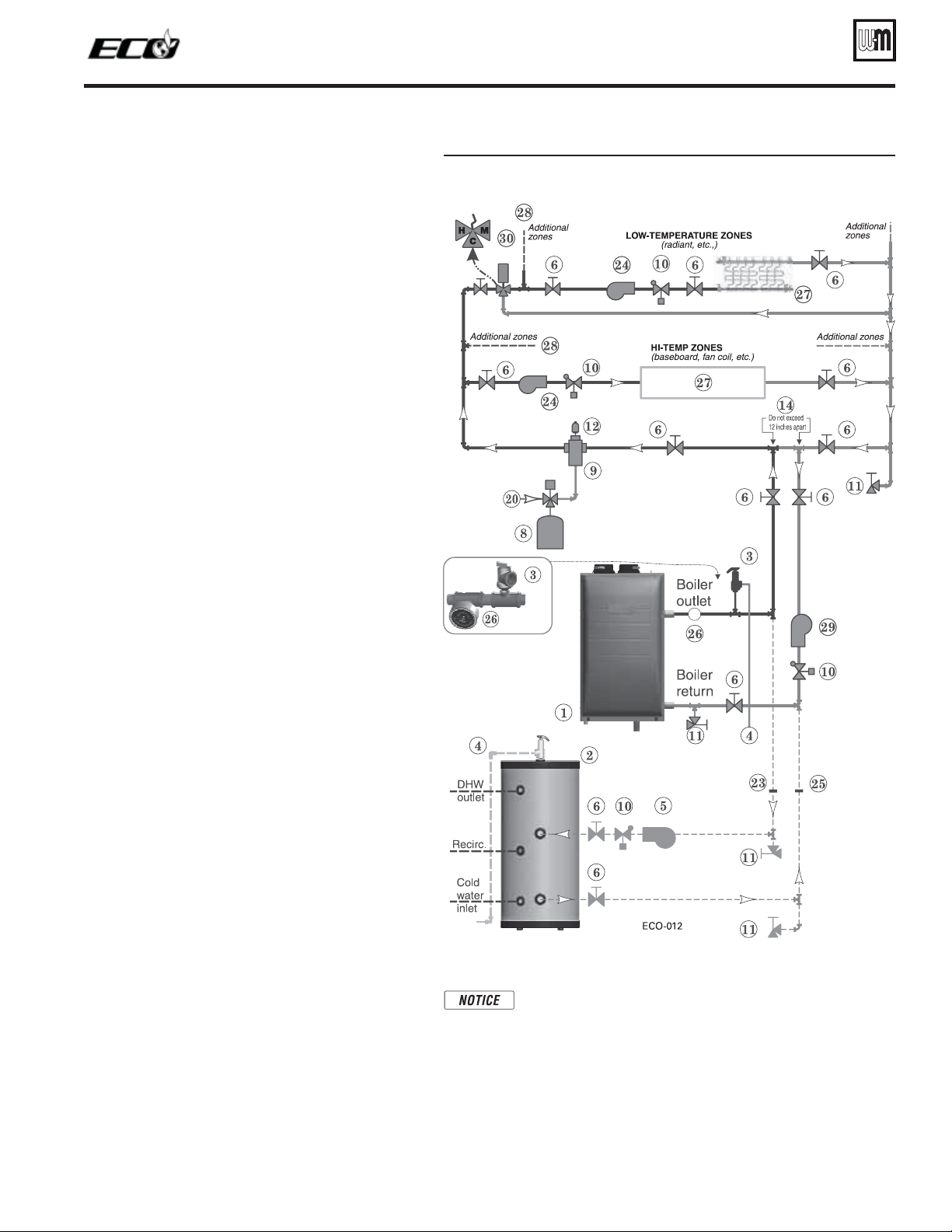
&IGURE Circulator zoning with high- and low-temperature
heating zones
Primary/Secondary System piping (continued)
Circulator zoning – Multiple
temperature zones with primary/
secondary
(Shown with optional DHW piping)
See Figure 52.
1. This configuration is for circulator-zoned systems
with high- and low-temperature heating zones
using a boiler loop connected as a secondary circuit
off of a primary system loop. Systems zoned with
circulators must pipe the boiler loop as a secondary
circuit as shown.
2. Install a separate circulator (supplied by installer)
for each zone capable of delivering the proper flow
and head as shown.
Expansion Tank required
1. Provide a system expansion tank following the
guidelines on page 43 or page 44.
2. DO NOT use a closed-type tank if connecting to
a water heater that is equipped with an automatic
vent.
System setup and settings
1. Hi-temp emitters may be baseboards, radiators, fan
coils, or heat exchangers.
2. Add a mixing device (Figure 52, item 30) to help
ensure supply water temperature will not exceed
the maximum allowable for the radiant system.
3. Heating zone supply water temperature settings
should be selected for the hi-temp zones. The
mixing device regulates supply temperature to the
lower-temp zones
Domestic Hot Water (DHW) tank, if used
1. DHW direct connection—Pipe from the near-
boiler piping to the DHW tank’s boiler connections
as shown.
2. DHW as zone—A DHW tank can be connected as
a zone if a DHW tank is NOT already connected to
the boiler.
To provide DHW priority operation, use
a zone controller. See notices on page 59 to ensure
compliance with the 2007 Energy Act.
3. DHW Priority operation—The ECO control turns
off space heating to the HEAT zones during do-
mestic water heating calls on the DHW input. The
MAX ON TIME setting can be adjusted to limit
how long this occurs. Set the MAX ON TIME to
“0” to disable domestic priority. See page 70 for
setting instructions.
4. If NOT connecting a water heater, do not use the
DHW input or DHW Circulator output on the ECO
control.
Overriding the Outdoor Reset function by connecting space
heating zones to inputs and outputs intended for DHW ap-
plications may violate Section 303 of the 2007 Energy Act.
See page 119 for compliance information and exemptions.
Controlling the Zones
1. The ECO control can be used to control space heating only, domes-
tic water heating only, or both. Refer to field wiring, beginning on
page 56, for instructions on wiring to circulators.
2. The boiler and circulators can also be operated by a Weil-McLain
WMCR zone controller.
Part number 550-142-122/0513
49
TM
GAS-FIRED WATER BOILER — Boiler Manual
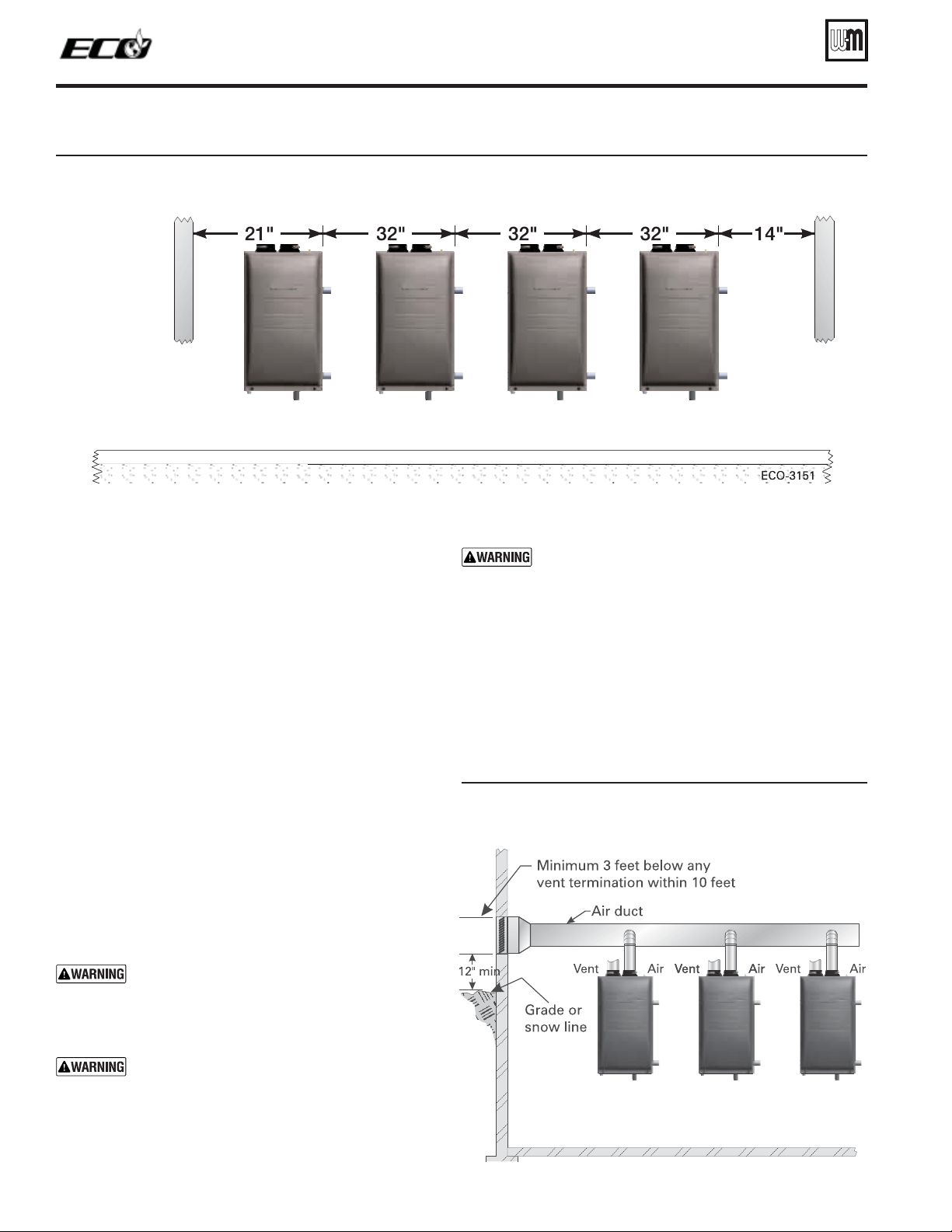
Multiple boiler installations
Placing multiple boilers
1. Locate multiple boilers with spacings shown in Figure 53.
2. Provide indicated clearances around boilers for access and
servicing. If recommended dimensions are not possible,
provide at least the minimum clearances given on page 7.
Also follow local codes.
3. Provide a minimum 30-inch walkway in front of the boilers
to ensure accessibility.
4. Uncrate, assemble and mount boilers according to instruc-
tions in this manual.
5. Provide clearance for installation of venting, air piping,
gas piping, expansion tank, primary circulator and other
accessories.
Manifolded combustion air option
1. Multiple ECO boilers can use a common combustion air
manifold.
a. Provide minimum clearance to adjacent vents and
grade/snow line as shown in Figure 54.
b. Provide minimum free area in duct (adjusted for louver
restriction) of
SQUAREINCHPER"TUH total
boiler input (or see Figure 123, page 120).
c. If combustion air damper is used, wire to boilers to
prevent operation except after damper has opened.
ONLY air piping can be combined. DO NOT use
combined vent piping. Flue gas leakage and boiler
component damage can occur. Failure to comply
could result in severe personal injury, death or
substantial property damage.
DO NOT use common venting — the manifold
option is only for combustion air — all vent pipes
must be routed and terminated individually as
described in this manual.
See Figure 123, page 120 for minimum cross sectional area of
combined air ducts.
&IGURE Side-to-side mounting of multiple ECO boilers
&IGURE Manifolded combustion air option
— OR —
Calculate required cross section (for area in square
inches):
-).!2%!4/4!,-"().054$)6)$%$"9
Example: A multiple boiler system with (6) ECO
155 boilers has a total input of 6 x 155 = 930 MBH
(930,000 Btuh). The required duct cross sectional area
is:
-).!2%!$)6)$%$"9SQINCHES
Part number 550-142-122/0513
50
TM
GAS-FIRED WATER BOILER — Boiler Manual
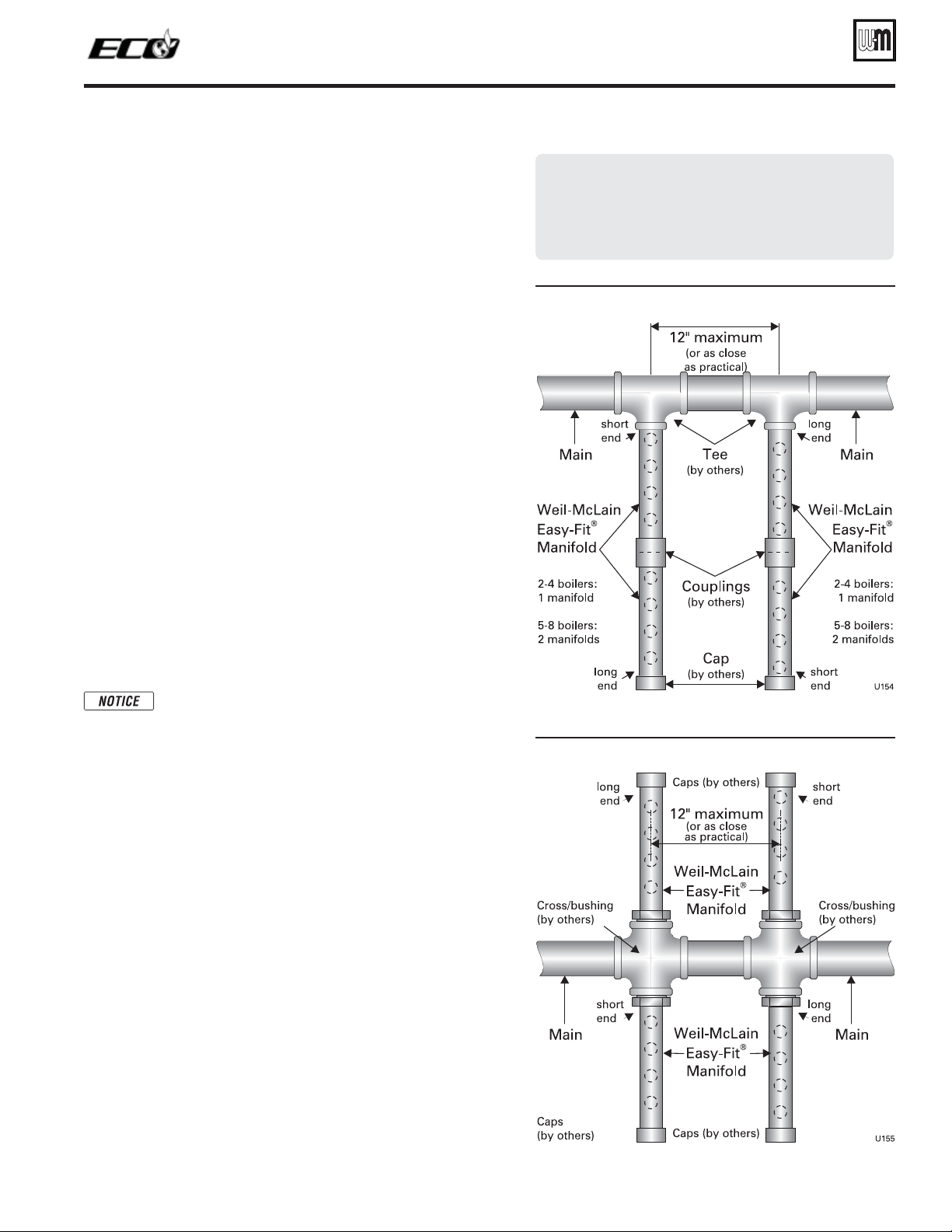
Sequencing multiple ECO boilers
1. Use a multiple-boiler controller, such as the Weil-McLain BCP,
BMC or BSC, to sequence boilers. Locate temperature sensors as
required in the controller manual.
Easy-Fit® piping installation
1. Main header and Easy-Fit® Manifold pipe sizing.
a. Size system piping as required for the flow.
b. Install tees or crosses in the system piping for Easy-Fit® mani-
folds as shown in Figure 55 or Figure 56. Size manifolds to
handle total connected boiler output as shown.
2. Provide connections in main header for Easy-Fit® manifolds as
close as possible to the midpoint of multiple boilers.
a. Use tees for four or less boilers, as in Figure 55.
b. Use either tees (Figure 55) or crosses (Figure 56) for five or
more boilers.
3. Manifold placement:
a. To alternate spacing for supply and return lines to boilers,
reverse the short-end and long-end of the manifolds as shown
in Figure 55 and Figure 56.
b. Return manifold must be on the return side of the main and
supply manifold must be on the supply side of the main. Draw-
ings in this manual show flow in system main from right to
left. For system flowing left to right, reverse the locations of
the manifolds accordingly.
4. Connect from Easy-Fit® manifold branches to boiler supply and
return connections using copper or steel pipe, sized for the required
flow rate.
It is recommended to pipe to boilers such that the first
boiler connection off the return manifold is piped
to the furthest connection on the supply manifold
from the main header. See Figure 57, page 52 and
Figure 58, page 53 for example.
5. Install an isolation valve on the supply and return of each boiler
as shown in the piping diagrams in this manual. Some local codes
may require the use of individual water level controls and limits
on each boiler because isolation valves are installed.
6. Install main system air eliminator and primary circulator in sup-
ply piping as shown in piping diagrams. Place expansion tank on
suction side of system circulator as shown.
7. Install system accessories as shown in drawings.
8. Piping recommendation drawings:
a. Figure 55 and Figure 56 show details of Easy-Fit® manifolds.
b. Figure 57, page 52 is a schematic piping drawing showing the
locations of typical boiler piping and system piping, including
limits and other devices often required by local codes.
9. If desired, other primary/secondary piping arrangements can be
used.
-AXIMUMCONNECTEDLOADPERMANIFOLD
INCHMANIFOLD-"(
INCHMANIFOLD-"(
INCHMANIFOLD-"(
&IGURE Single-sided EZ-Fit Header connection
&IGURE Double-sided EZ-Fit Header connection
Multiple boiler installations
(continued)
Part number 550-142-122/0513
51
TM
GAS-FIRED WATER BOILER — Boiler Manual
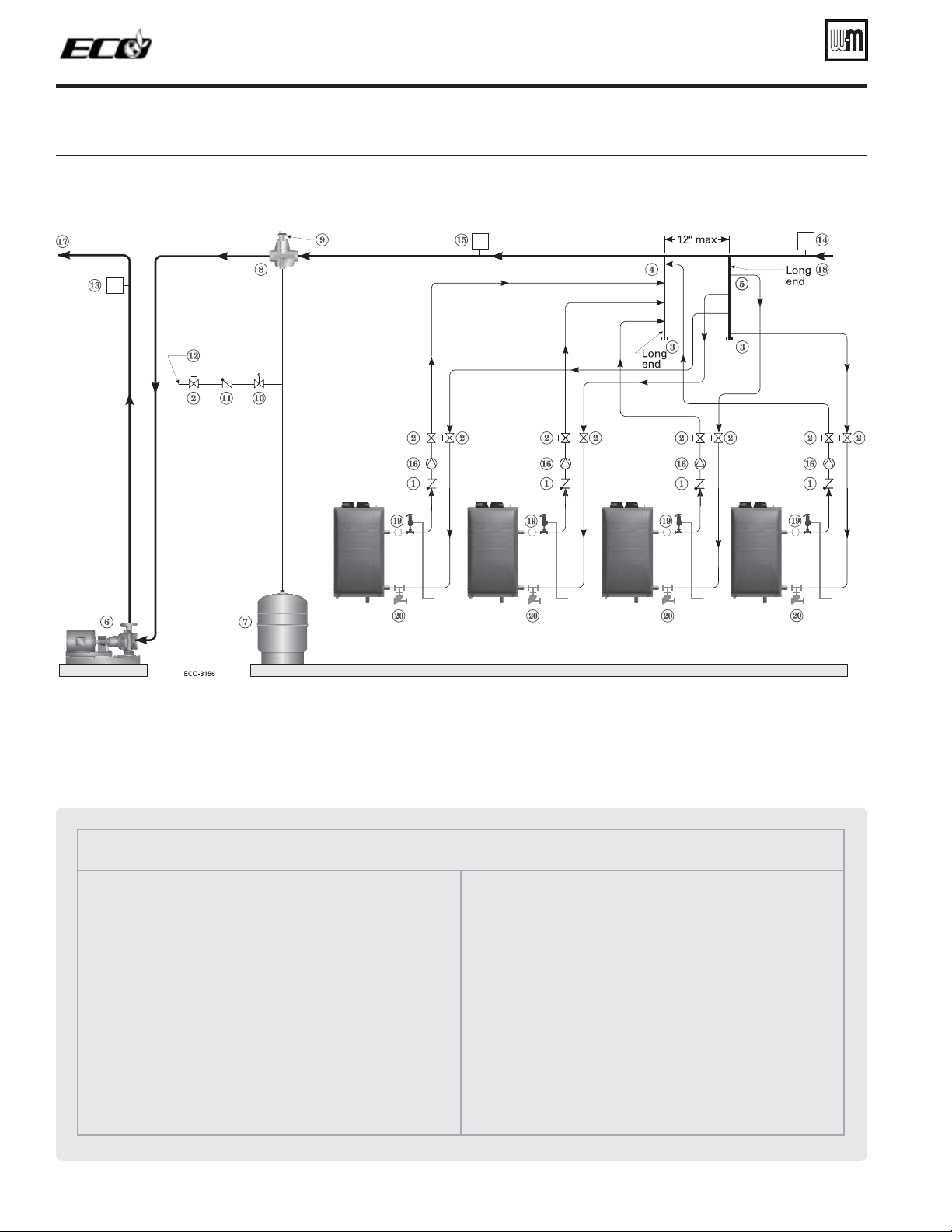
,EGENDFOR&IGURE
1 Flow/check valve
2 Isolation valves (when used)
3 Cap
4 Easy-Fit® Manifold (supply) — layout and size per page 51
5 Easy-Fit® Manifold (return) — layout and size per page 51
6 Primary circulator
7 Expansion tank (diaphragm type)
8 System air eliminator
9 System automatic air vent
10 Pressure reducing valve
11 Check valve or backflow preventer, as required by applicable codes
12 Cold water supply
13 Supply water temperature control (when used)
14 Low water cutoff (when used) (place above primary header)
15 Water flow switch (when used)
16 Boiler circulators
17 System supply
18 System return
19 Boiler P/T gauge, relief valve and discharge piping, installed per
ECO Boiler Manual
20 Purge/drain valve
&IGURE Piping schematic — typical piping for multiple ECO boilers, using Weil-McLain Easy-Fit manifolds
Multiple boiler installations
(continued)
Part number 550-142-122/0513
52
TM
GAS-FIRED WATER BOILER — Boiler Manual
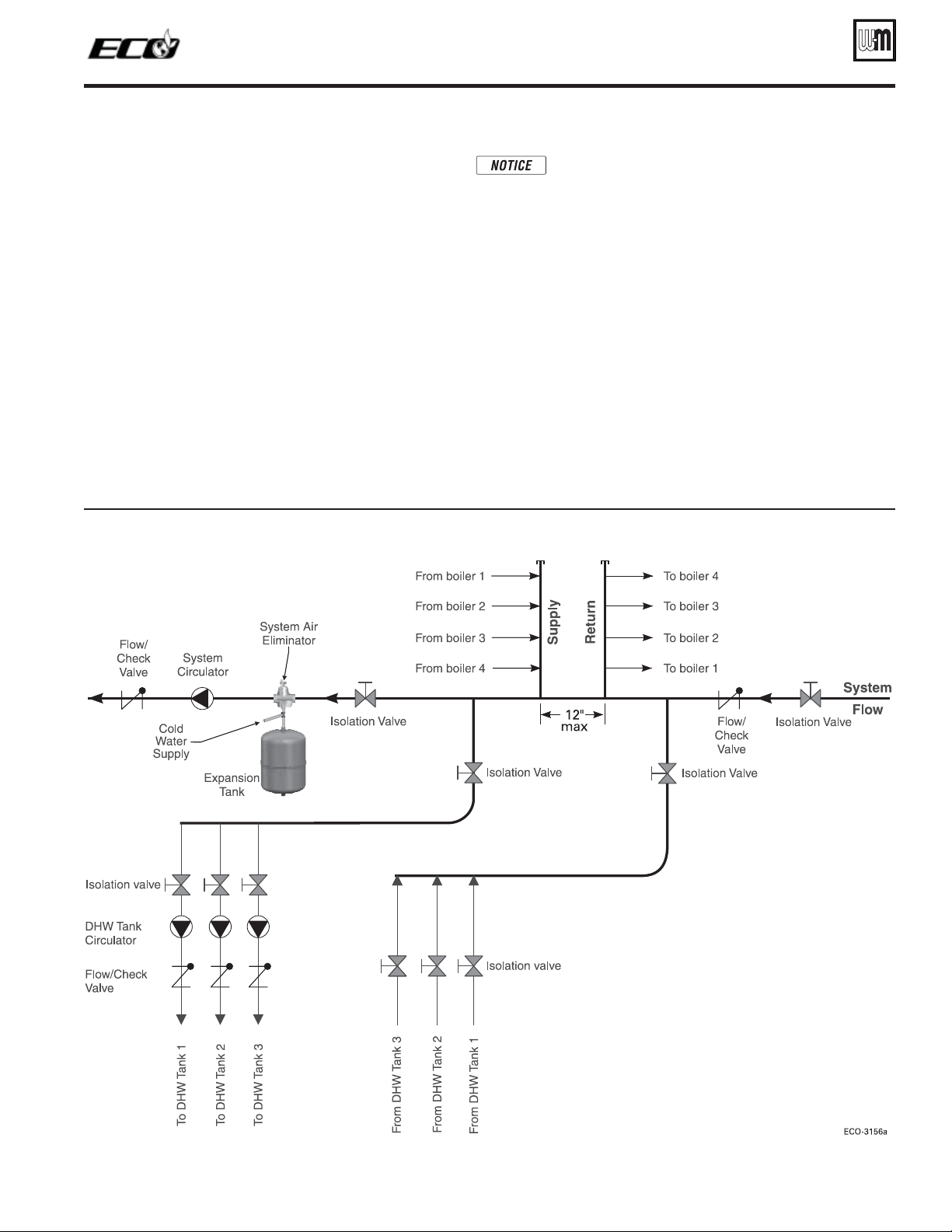
&IGURE Piping layout—typical piping for multiple boilers (4-boiler system shown) with DHW storage heaters grouped
as zone in secondary loop off primary system loop
Multiple boiler installations
(continued)
DHW tank piping with multiple ECO
boilers
DHW direct connection—single tank
1. If BTUH output of a single boiler is sufficient for the
DHW tank/demand, pipe the indirect water heater to
the last boiler in the firing sequence. This will allow the
previous boilers to continue space heating while the last
boiler delivers DHW priority.
2. Pipe from the near-boiler piping to the DHW tank’s
boiler connections as shown in Figure 50, page 47.
3. Connect the DHW tank aquastat directly to the DHW
input on the last boiler in the sequence.
When using a multiple-boiler control with lead boiler
rotation, it is recommended that the boiler connected to
the DHW tank is always set as the last boiler to operate
in the sequence so that space heat can be maintained
during times of DHW demand.
DHW tanks as zone—multiple tanks
1. If using multiple DHW tanks or multiple banks of tanks, pipe the
tanks to the primary system loop with a secondary connection as
shown in Figure 58.
2. DHW tanks are zoned with circulators as shown.
3. DHW circulators should be controlled with a Weil-McLain
WMCR zone controller.
4. If DHW priority is required, use separate zone controllers for
DHW and space heating. Connect the isolation switch output
of the DHW zone controller to the DHW input of the multiple
boiler control (Weil-McLain BCP, BMC, or BSC).
Part number 550-142-122/0513
53
TM
GAS-FIRED WATER BOILER — Boiler Manual
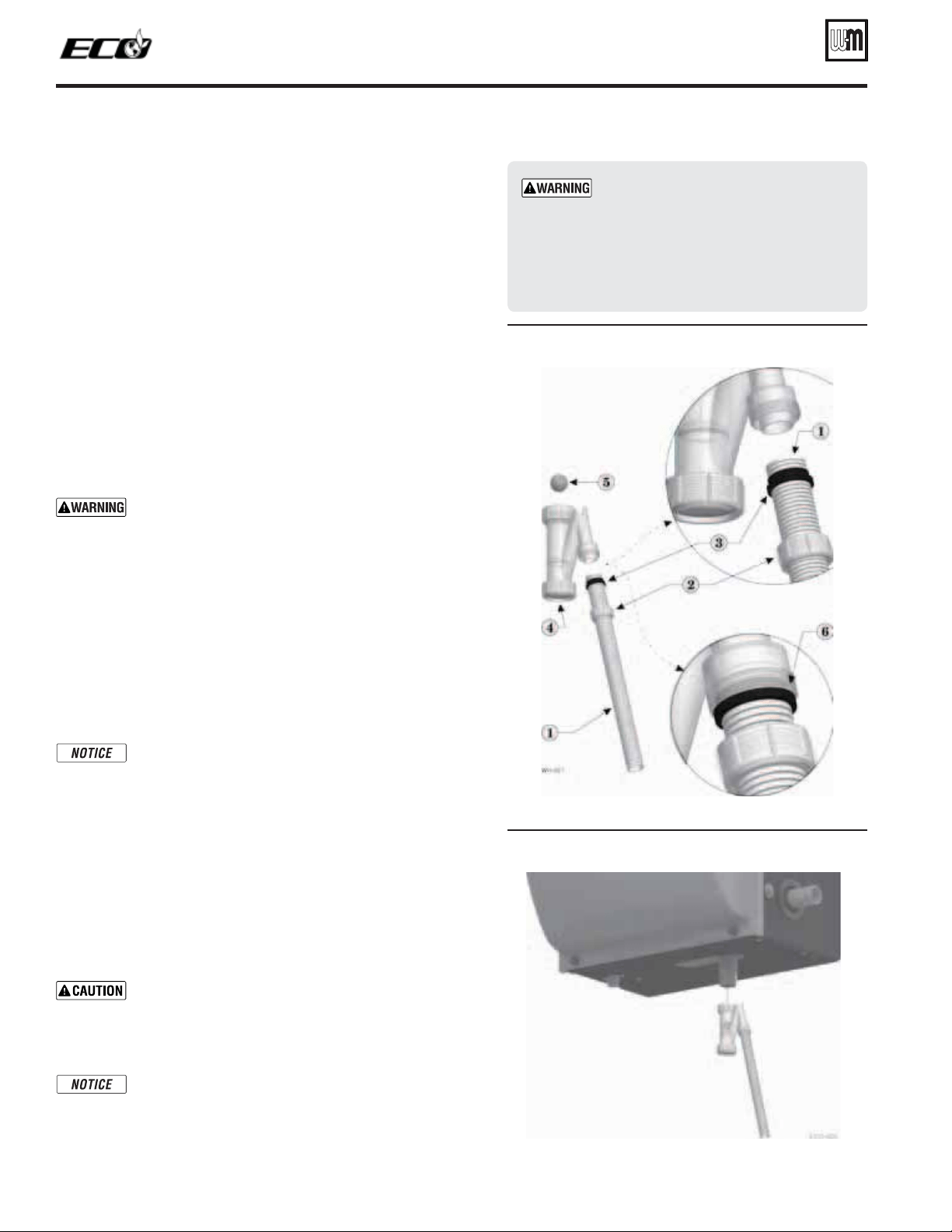
Install condensate line
Prepare condensate trap assembly
1. Remove the condensate trap kit from the accessories bag.
2. See Figure 59. The left image shows the complete condensate trap
kit.
3. Remove the flexible drain tube nut, item 2.
4. Push the flexible tube gasket ring (item 3) onto the end of the flex-
ible tube (item 1) as shown in Figure 59. The tube should extend
through the gasket about ¼ inch.
5. Insert the flexible tube and gasket into the drain fitting. When in
position, the offset edge of the gasket ring will rest on the shoulder
of the drain fitting as shown in Figure 59, detail 6.
6. Secure the flexible tube in place by screwing on the nut, item 2.
Finger tighten securely.
Install the condensate trap assembly
1. Insert the condensate trap ball, Figure 59, item 5 into the trap
body (item 4).
The condensate trap ball MUST be in place in the con-
densate trap assembly to prevent possible flue gas leakage
through the condensate drain system.
2. Loosen the top nut on the trap body.
3. Slide the trap assembly onto the boiler condensate outlet. Firmly
hand tighten the upper nut to secure the condensate trap in place.
Condensate drain system
1. )NSTALLCONDENSATEDRAIN BYCONNECTINGTUBING OR 06# PIPE
TOTHEmEXIBLEDRAINLINE2UNTHEDRAINTUBINGORPIPINGTOA
mOORDRAINORCONDENSATEPUMP
. The flexible drain line will fit
in a ¾” PVC coupling. Run minimum ½” PVC for the piping to
drain or condensate pump.
Use materials approved by the authority having jurisdic-
tion. In the absence of other authority, PVC and CPVC
pipe must comply with ASTM D1785, F441 or D2665.
Cement and primer must comply with ASTM D2564
or F493. For Canada, use CSA or ULC certified PVC or
CPVC pipe, fittings and cement.
2. Select a condensate pump (if used) that is approved for use with
condensing boilers and furnaces. The pump should have an over-
flow switch to prevent property damage from condensate spillage.
The pump should have a minimum capacity of 2 GPH for the ECO
70, 3 GPH for the ECO 110, or 4 GPH for the ECO 155.
3. When sizing condensate pumps, make sure to include the total
load of all appliances connected to it.
The condensate line must remain unobstructed, allow-
ing free flow of condensate. If condensate is allowed to
freeze in the line or if the line is obstructed in any other
manor, condensate can exit from the boiler tee, resulting
in potential water damage to property.
Condensate from the boiler will be slightly acidic (typi-
cally with a pH from 3.2 to 4.5). Install a neutralizing
filter when draining into metal pipe and if required by
local codes. See Replacement parts section at the end of
this manual for the Weil-McLain kit.
The condensate trap must be in place
during all operation. Make sure the trap
is securely attached to the condensate
outlet and that the condensate discharge
line is in good condition and installed
per this manual. Failure to comply could
result in severe personal injury, death or
substantial property damage.
&IGURE
Condensate trap assembly
&IGURE Condensate trap connection
Part number 550-142-122/0513
54
TM
GAS-FIRED WATER BOILER — Boiler Manual
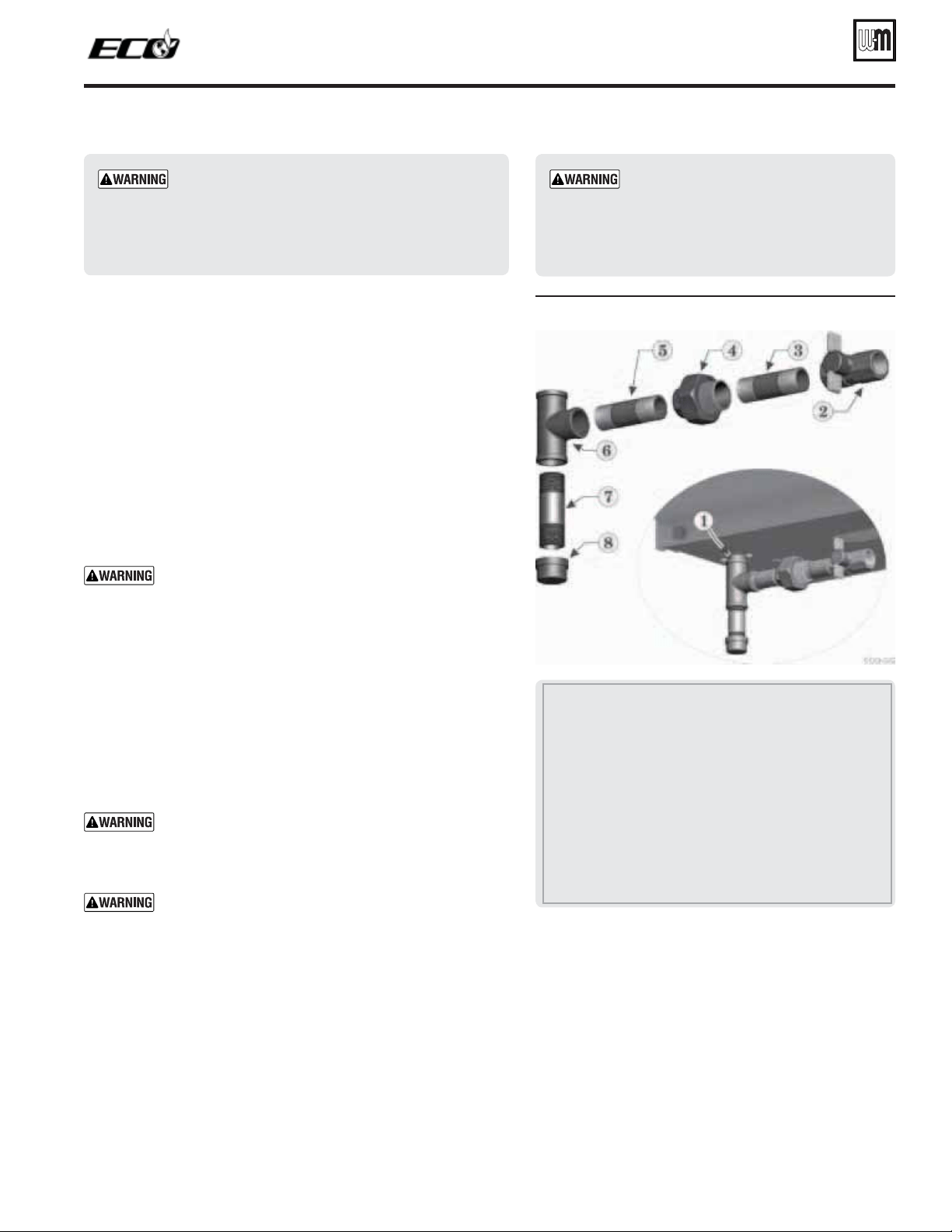
Gas piping
ECO boilers are shipped ready to fire natural gas
ONLY. You must install the propane orifice bush-
ing if the boiler will be connected to propane. See
page 13. Failure to comply could result in severe
personal injury, death or substantial property dam-
age.
Connecting gas supply piping
1. Remove jacket door and refer to Figure 61 to pipe gas to boiler.
a. Place a pipe wrench on the gas line inside the jacket when
tightening the gas line assembly to the boiler gas connection
(item 1).
b. Install steel pipe fittings and factory-supplied gas cock as shown
in Figure 61. All pipe fittings are supplied by the installer. The
gas cock is shipped loose with the boiler.
c. In Canada — The gas shut-off valve (item 2) must be identi-
fied by the installer.
2. Use pipe dope compatible with propane gases. Apply sparingly
only to male threads of pipe joints so that pipe dope does not
block gas flow.
Failure to apply pipe dope as detailed above can result
in severe personal injury, death or substantial property
damage.
3. Connect gas supply piping to the ½” NPT gas cock (item 2).
4. Support gas piping with hangers, not by boiler or its accessories.
5. Purge all air from gas supply piping.
6. Before placing boiler in operation, check boiler and its gas con-
nection for leaks.
a. During any pressure testing at less than 13” (330 mm) w.c.,
close the gas shutoff valve and disconnect system gas piping.
At higher test pressures, disconnect boiler and gas valve from
gas supply piping.
Do not check for gas leaks with an open flame — use
bubble test. Failure to use bubble test or check for gas
leaks can cause severe personal injury, death or substan-
tial property damage.
DO NOT adjust or attempt to measure gas valve outlet
pressure. The gas valve is factory-set for the correct out-
let pressure. This setting is suitable for natural gas and
propane. Attempting to alter or measure the gas valve
outlet pressure could result in damage to the valve, caus-
ing potential severe personal injury, death or substantial
property damage.
'ASPIPESIZING
1. See page 17 for gas line sizing information.
#HECKGASPRESSUREATINLETTOBOILER
1. See Figure 86, page 80 (ECO 70/110) or Figure 87, page 81 (ECO
155) for location of the gas inlet pressure test port.
5SETWOWRENCHES when tightening gas
piping at boiler, using one wrench to pre-
vent the boiler gas line connection from
turning. Failure to support the boiler gas
connection pipe to prevent it from turn-
ing could damage gas line components.
&IGURE
Connect gas supply piping
1 Boiler gas supply connection, ½” NPT male
2 T-handle gas cock, ½” NPT, shipped loose with boiler
!,,/&4(%&/,,/7).'!2%3500,)%$"94(%).34!,,%2
3 Nipple, ½” NPT
4 Union, ½” NPT
5 Nipple, ½” NPT
6 Tee, ½” NPT
7 Nipple, ½” NPT x 4”, for drip leg
8 Cap, ½” NPT
2. For natural gas or propane, the pressure required at gas
valve inlet pressure port (verify minimum gas pressure
when all gas appliances are in operation):
a. Maximum: 13” (330 mm) w.c. with no flow (lockup)
or with boiler on.
b. Minimum gas pressure, with gas flowing (verify dur-
ing boiler startup, while boiler is at high fire) — ECO
70: 3½” (89 mm) w.c.; ECO 110: 4½” (114 mm) w.c.;
ECO 155: 3½” (89 mm) w.c.
c. Nominal gas pressure: 11.0” (279 mm) w.c.
3. Install 100% lockup gas pressure regulator in supply
line if inlet pressure can exceed 13” (330 mm) w.c. at
any time. Adjust lockup regulator for 13” (330 mm)
w.c. maximum.
Part number 550-142-122/0513
55
TM
GAS-FIRED WATER BOILER — Boiler Manual
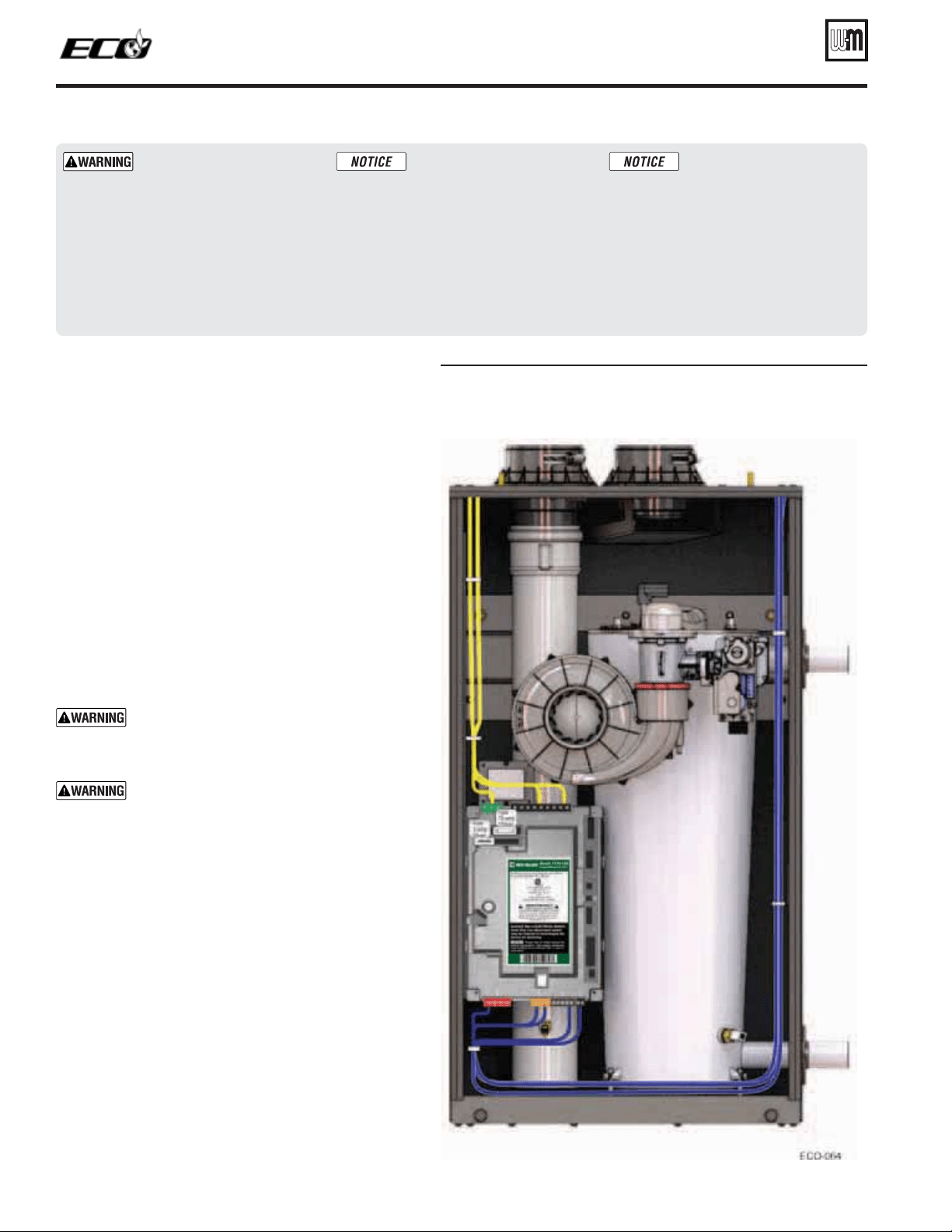
Field wiring
%,%#42)#!, 3(/#+
(!:!2$ — For your
safety, turn off electrical
power supply at service en-
trance panel before making
any electrical connections
to avoid possible electric
shock hazard. Failure to do
so can cause severe personal
injury or death.
The installation must com-
ply with: National Electri-
cal Code and any other
national, state, provincial or
local codes or regulations.
In Canada, CSA C22.1 Ca-
nadian Electrical Code Part
1, and any local codes.
Wiring must be N.E.C.
Class 1. If original wiring
as supplied with boiler must
be replaced, use only type
105 °C wire or equivalent.
Boiler must be electrically
grounded as required by
National Electrical Code
ANSI/NFPA 70 – latest edi-
tion.
&IGURE Field wiring overview (see Figure 66, page 60 and
Figure 67, page 61 for detailed schematic and ladder wiring
diagrams)
ECO boiler wiring
#ONNECTINGTERMINALS
All field wiring is made through the six colored connectors
(shipped loose with boiler) directly to the control module.
Line voltage, 120 VAC, terminals are on the top of the
control module. Low voltage, 24 VAC, terminals are on the
bottom of the control module.
7IREENTRANCES
Wire entrance knockouts are provided on the top and bot-
tom of the boiler cabinet:
1. Line voltage—3 knockouts on the top left of the cabinet
(Line In, DHW Circ., Heat Circ.)
2. Low voltage—2 knockouts on the bottom left and 2
knockouts on the top right of the cabinet
3. Display wiring—a single knockout on the right side
of the cabinet
Installer MUST use a strain relief through
jacket knockouts. Failure to do so can cause
severe personal injury, death or substantial
property damage.
Installer MUST SEAL all electrical entrances
using a sealed strain relief or a strain relief
sealed with duct seal putty or silicone. Sealing
the entrances prevents the boiler from draw-
ing air from inside the boiler room. This is
particularly important if the boiler is located
in the same room as other gas appliances.
Failure to seal entrances could result in sever
personal injury, death or substantial property
damage.
7IREROUTINGINTHECABINET
Line voltage:
1. Install 4 of the wire tie bases to the holes on the left
side interior of the cabinet.
2. Line voltage should be wired from the top left electrical
entrances following the left side of the cabinet.
3. Wires should be bundled together and secure with the
provided wire ties to the wire tie bases located on the left
side wire chase. Two sets of bases are provided, one for
line in and one for the circulator outputs. Route wires
in front of the transformer then into terminal blocks.
Part number 550-142-122/0513
56
TM
GAS-FIRED WATER BOILER — Boiler Manual
Low
Voltage
Line
Voltage
Low
Voltage
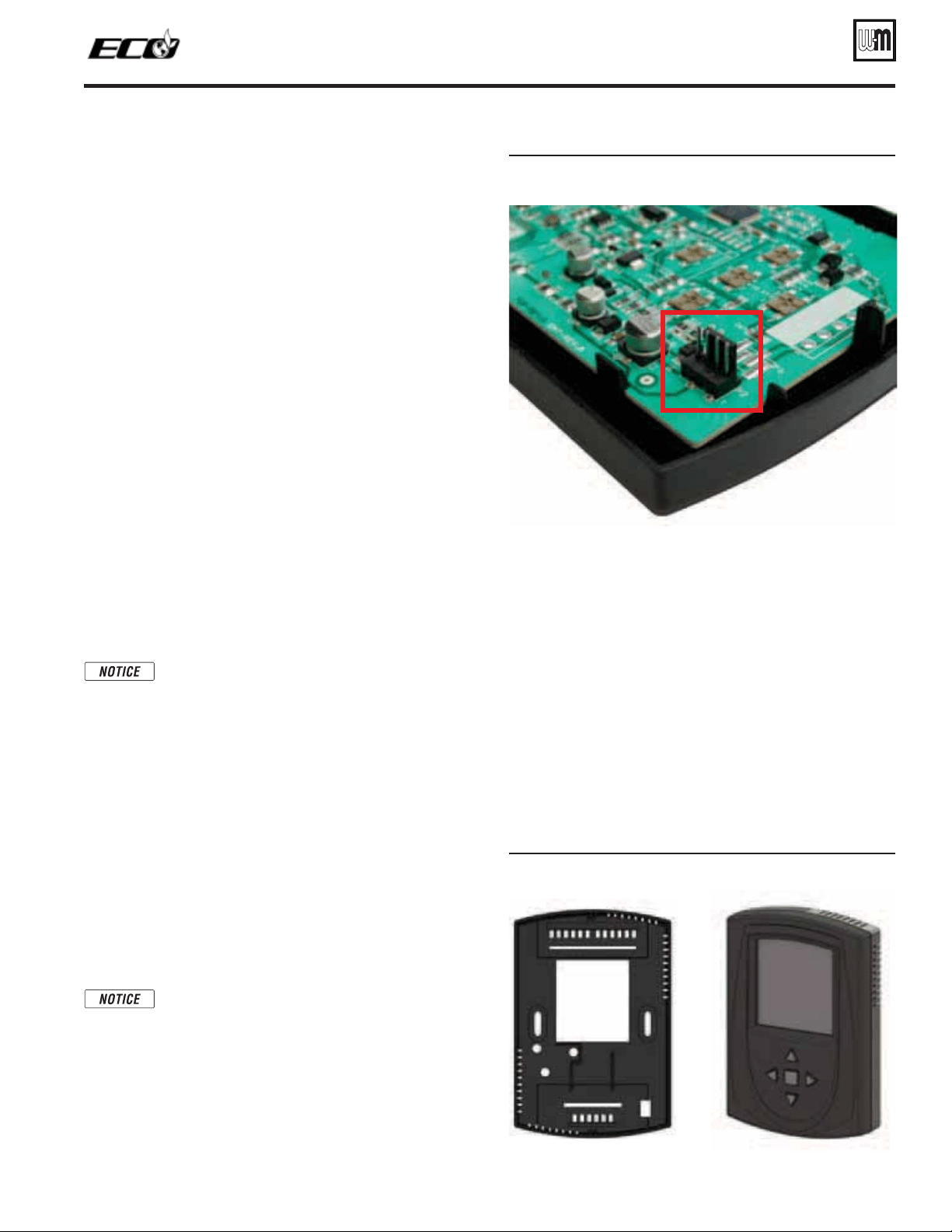
Field wiring
&IGURE Back of display circuit board -
4-pin terminal
Part number 550-142-122/0513
57
TM
GAS-FIRED WATER BOILER — Boiler Manual
Low voltage:
1. Mount multi-hole cord grip (provided) to desired low voltage
knockout and secure with a locknut.
2. Thermostat, aquastat, limit devices, and outdoor temperature
sensor wire pairs should be routed through the cord grip.
1. If routed through the bottom left knockouts, wires should
be connected directly into the corresponding terminal block.
2. If routed through the top right knockouts, wires should be
bundled together along the right side wire chase. Install a
wire tie base on each of the two bent tabs along the right side
to allow attachment of the provided wire ties.
3. Low water cutoff (optional) should be routed following the
instructions in step 3 or 4 above depending on entrance loca-
tion. Provide strain relief and a seal at cabinet entry.
4. Bundle all wires together with provided wire ties
5. After wires are attached to the control terminal blocks, hand-
tighten the nut of the cord grip to seal any unused holes and
grip wire tightly.
#ONNECTINGTHEDISPLAYWIREHARNESS
1. The display wire harness (shipped loose with boiler) is a long,
grey wire with a 4-pin connector on each end.
2. Remove the grommet from the hole in the right side of the boiler
jacket show in Figure 6, page 10. Route the harness through the
hole so that the push-in strain relief clips are inside the cabinet
and the grommet attached to the cable is outside the cabinet.
3. Connect the 4-pin connector on the inside of the boiler jacket
to pin P9 on the control.
Do not force the connector on to the pin. Connector
should only connect one way. If connector does not
easily slide on the pin, ensure connector is oriented
properly. If connector is forced or connected im-
properly, damage to the circuit board could result.
4. Push the strain relief clips into the extra holes provided on
the two bent tabs along the right side of the boiler. You may
need to push the wire harness or other low voltage wires out
of the way to access the holes.
5. Find the grommet that is attached to the display wire harness. In-
sert the grommet into the hole on the right side of the boiler cabi-
net. Ensure grommet seals around both the cabinet and the wire.
6. If using a junction box, install a wire clamp or strain relief to
one of the knockouts.
7. Unsnap the back plastic cover from the display housing.
Mount back plastic cover to the display bracket, wall or junc-
tion box depending on installation. Screws for mounting to
the display bracket are provided.
Ensure that the small, square hole in the corner of
the back plastic is located in the bottom right corner
when mounted. This provides room to connect the
display harness, see view at right).
8. Route wire depending on display location:
a. Display bracket—bundle wire behind the display bracket
and use a provided wire tie to neatly collect the extra wire
length. Leave enough wire to reach through bottom right
hole in the back plastic cover.
Proper orientation of display when mounted
b. Drywall or plaster—fish the wire through the wall or
through scoring in drywall and through the large, square
hole in the back of the display backing. Ensure wire does
not fall back into wall.
c. Junction box—route wire through the previously in-
stalled clamp or strain relief. Gather extra wire length
inside the box and tighten clamp to provide strain relief.
Route wire through the large square hole in the back
plastic cover.
9. Turn over the front half of the display so that the circuit
board is visible. Connect the 4-pin connector of the wiring
harness to the 4-pin terminal shown in Figure 63.
10. Fit the front display plastic to the back display plastic. Clip
the two halves together and ensure they are firmly secure.
The buttons should be located below the display screen (see
view below).
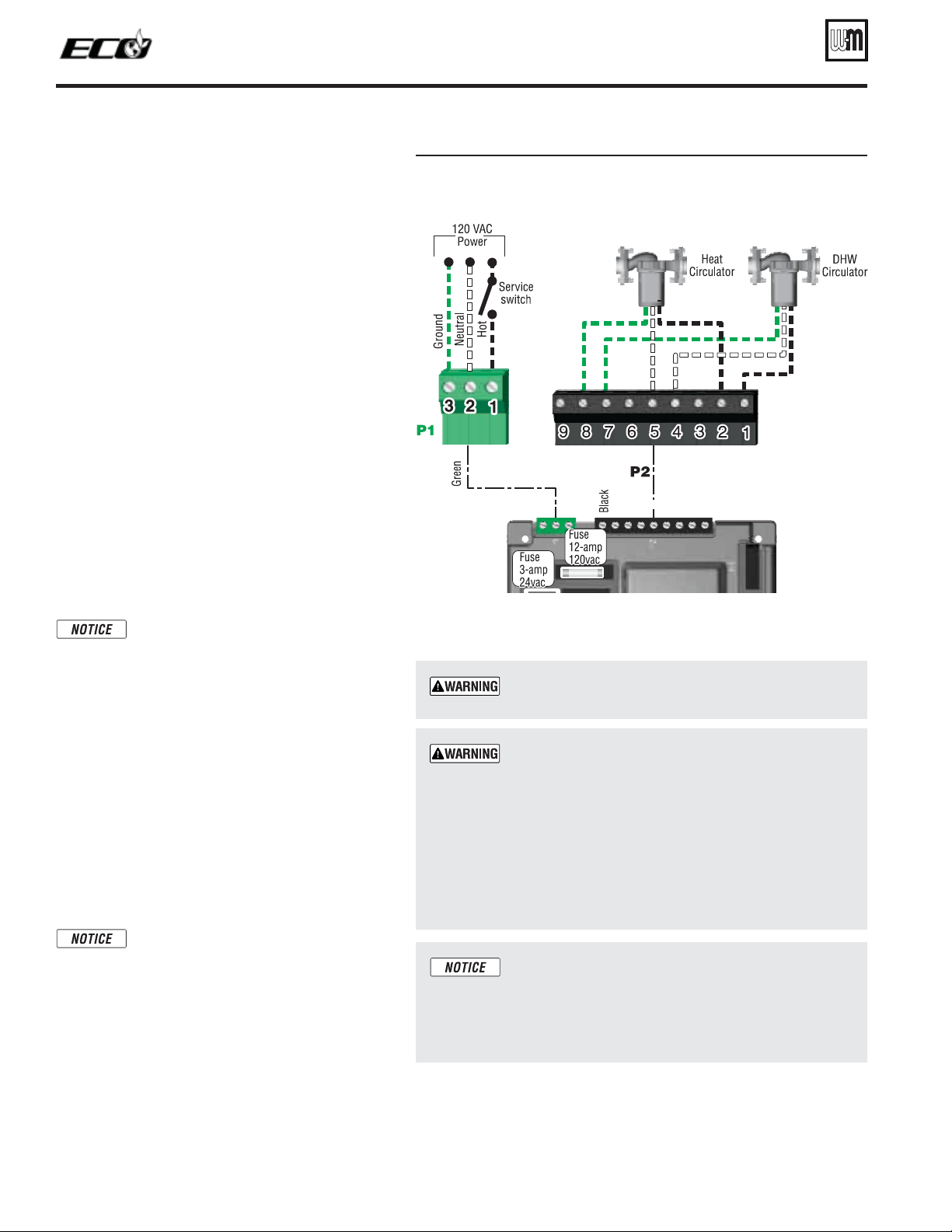
Field wiring (continued)
&IGURE ECO LINEVOLTAGE input and output connections (120
VAC)
/UTPUTCIRCUITSARE6!#)FANOUTPUTISTOOPERATE
ALOWVOLTAGECIRCUITUSEANISOLATIONRELAY
#)2#5,!4/20/7%2 — 4HEMAXIMUMALLOWABLE
CURRENTFOREACHCIRCULATORISAMPSAT6!#.
For circulators with higher amp ratings, you must install
a circulator relay or starter to provide line voltage to the
circulator. For circulators rated over 2.2 amps, connect
only the circulator relay or starter coil to the ECO cir-
culator terminals.
7)2).').&/2-!4)/. — See Figure 62, page 56 for
wiring connection locations. See Figure 66, page 60
for the complete schematic wiring diagram. See
Figure 67, page 61 for the complete ladder wiring
diagram.
Line voltage wiring (120 VAC)
Make the following line-voltage connections, some
of which depend on your system and how the ECO
control will be programmed. The callouts below refer
to Figure 64.
P1 6!#0OWERINPUT
1. Provide and install a fused disconnect or service
switch (15-ampere rated recommended) as re-
quired by applicable codes.
1. Connect minimum
AMPERE 6!# power
wiring to
green, 3-pin terminal block as shown in
Figure 64.
2. If possible, provide a surge suppressor in the supply
power line. This will reduce the possibilities of ECO
control damage due to line surges.
3. Must wire ground to this terminal to provide boiler
grounding.
P2 $(7#IRCULATOR/UTPUT6!#PINS
1. The ECO boiler control provides dedicated 120-
VAC outputs for one DHW zone (priority) and
one heating zone.
2. Control setup requires that DHW tank be con-
trolled from DHW Input/Output terminals to
ensure post-pumping functionality.
Always connect the DHW circulator to
the DHW Circ. Output to ensure post-
pumping functionality.
3. DHW Circ. Output cannot be used to control a
central heating zone. It bypasses the outdoor reset
function.
P2 (%!4#IRCULATOR/UTPUT6!#PINS
258
1. Control setup requires this output to:
a. Provide 120VAC to a system circulator (such as
on a zone valve system with system circulator).
b. Provide 120VAC to a boiler loop circulator (in
primary/secondary piping).
c. Provide post-pumping functionality (built
in to ECO control) to prevent lockout due to
temperature over shoot.
Always connect the system circulator
(direct connect) or boiler circulator
(primary/secondary) to the HEAT Circ.
Output to ensure post-pumping func-
tionality.
2. The ECO control will activate HEAT Circ. Output
if the Heat thermostat or input device calls for heat,
after DHW heating (if used) is satisfied.
Part number 550-142-122/0513
58
TM
GAS-FIRED WATER BOILER — Boiler Manual
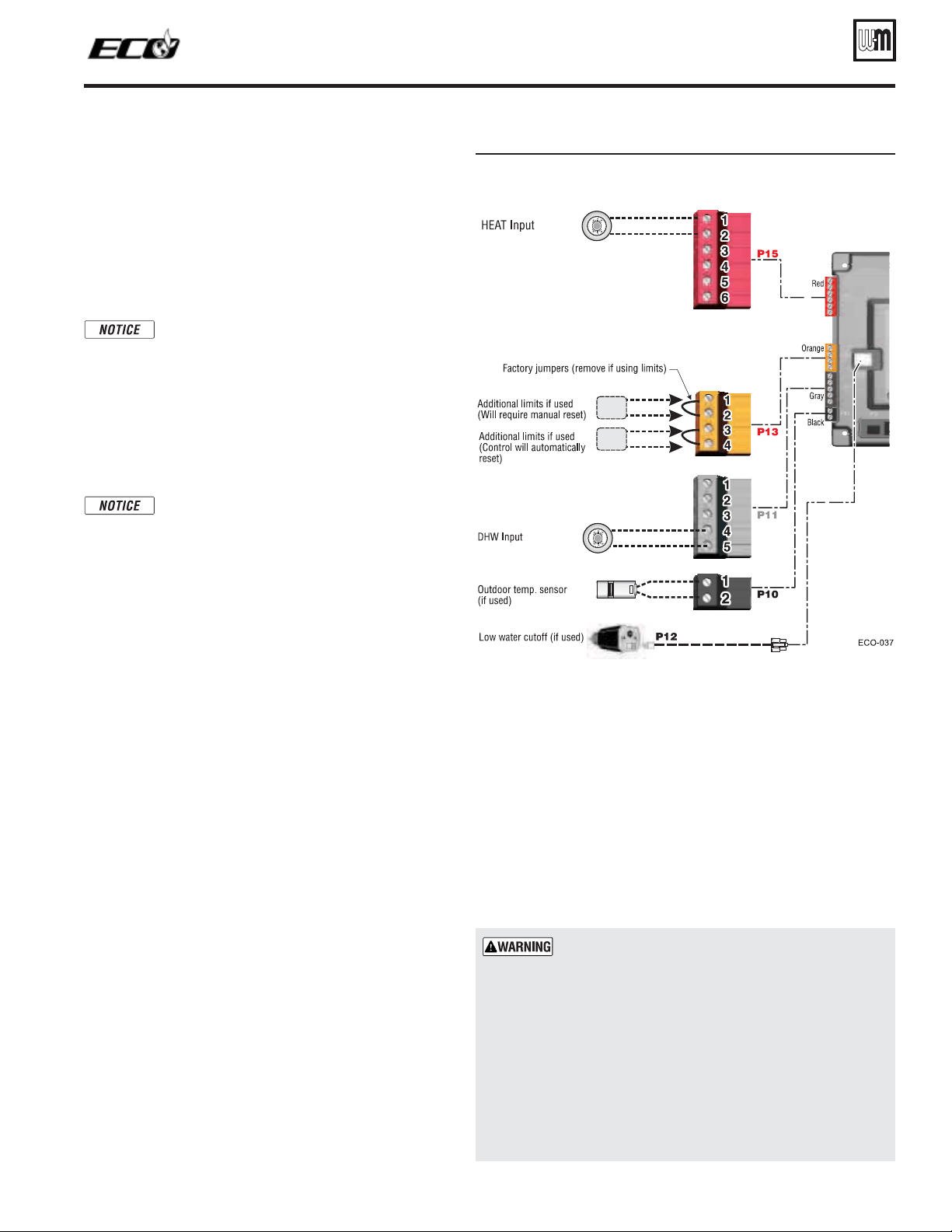
&IGURE ECO LOWVOLTAGE input and output connections
Low voltage wiring (24 VAC)
Make the following low-voltage connections, some of which
depend on your system and how the ECO control will be
programmed. The callouts below refer to Figure 65.
The ECO control provides inputs for one DHW zone
(priority) and one heating zone.
P11
$(7INPUT$(7CIRCUITONLY
/NLYUSETHE$(7INPUTWHENTHE
SYSTEMUSESA$(7TANKOROTHER
$OMESTIC(OT7ATERPRODUCTIONDEVICE
$ONOTUSEASAHEATINGZONE
1. Cont
rol requires that DHW tanks be controlled from
DHW Input if domestic water priority is required.
2. ALWAYS connect DHW aquastat or isolated relay con-
tacts from a DHW device to the DHW input. Depending
on system design, a zone control may be necessary.
5NLESSSYSTEMISEXEMPTBASEDONTHE
CRITERIALISTEDONPAGEINSTALLER
MUSTPROVIDEEXTERNALCONTROLSTHAT
DISTINGUISHBETWEEN!QUASTAT$(7
ANDTHERMOSTAT(%!4CALLSFORHEATIF
EXTERNALCONTROLSARENEEDED
P15
(%!4INPUTCENTRALHEATING
1. Use
HEAT
input to:
a. Connect the thermostat for a space heating zone.
b. Connect end switch wire (must be ISOLATED
contacts) to start boiler on a call for space heating.
c. Connect system control input for space heating call
for heat (ISOLATED contact only).
The ECO control will activate the 120VAC
(%!4 #IRC
output if the
HEAT
thermostat or input device calls for
heat, after DHW heating is satisfied.
P10
/UTDOORTEMPERATURESENSORFOROUTDOOR
RESET
1. The ECO control provides programmable options if
using an outdoor temperature sensor. This sensor is
supplied with the boiler. 4HEOUTDOOR SENSORMUST
BE INSTALLED UNLESSSPECIlCALLYEXEMPTED IN THE
%NERGY!CTSTATEMENTONPAGE.
2. Mount the outdoor sensor on an exterior wall, shielded
from direct sunlight or flow of heat or cooling from
other sources. The wire outlet on the sensor must be
oriented DOWN to prevent water entry.
3. Connect the sensor leads to the black, 2-pin terminal
block, as shown in the wiring diagrams. Thermostat
wire can be used to connect the sensor.
P13
%XTERNALLIMITS
WILLCAUSEMANUALRESET
WHENOPENED
PINS
1. Connect isolated contacts of external limits in series
across pins 1 and 2 of the orange, 4-pin terminal block
to cause the ECO control to lock out (requiring manual
reset) if the limit opens. The limit must close and the
control must be re-started using the procedure given
in this manual.
4HERMOSTATS — $/./4 supply 24-volt power to
the thermostat circuits (P11 and P15 in Figure 65) or
attempt to supply 24 volts for any other application.
For thermostats that require a continuous 24-volt
power source, connect the thermostat power input
to “a separate 24V power source.
:ONE VALVES — If using 3-wire zone valves, use
relays to provide dry contacts to the ECO control
thermostat connections. The zone valve end switches
of 3-wire valves carry 24VAC from the valve.
4HERMOSTATANTICIPATORSETTING — 0.1 amps.
P13
%XTERNALLIMITSWILLCAUSEAUTOMATICRESETWHEN
OPENED
PINS
1. Connect isolated contacts of external limits in series across pins
3 and 4 of the orange, 4-pin terminal block to cause the ECO
control to shut down the boiler on limit opening, then automati-
cally restart after the limit closes.
P12 ,OWWATERCUTOFFDEVICEIFUSED
1. If using the optional kit, remove factory jumper from P12. Insert
4-pin molex connector from kit wire harness into P12.
2. To field wire a non-powered (isolated contact) low water cut-off,
clip the factory jumper in the factory installed molex plug, strip
the wires and connect to the LWCO’s isolated contacts
Part number 550-142-122/0513
59
TM
GAS-FIRED WATER BOILER — Boiler Manual
Field wiring (continued)
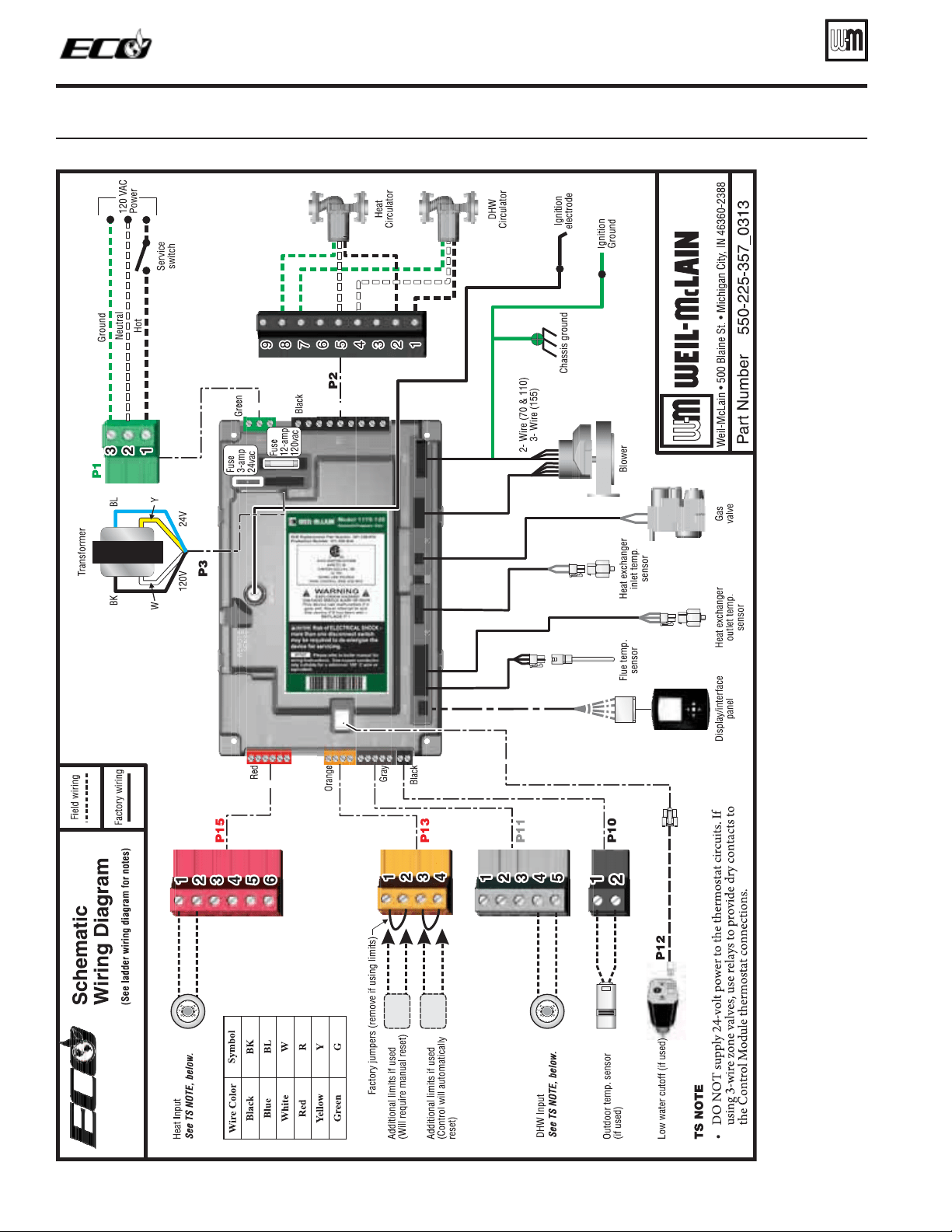
Wiring diagram — schematic
&IGURE %#/ schematic wiring diagram (see Figure 67, page 61 for legend and notes)
Part number 550-142-122/0513
60
TM
GAS-FIRED WATER BOILER — Boiler Manual
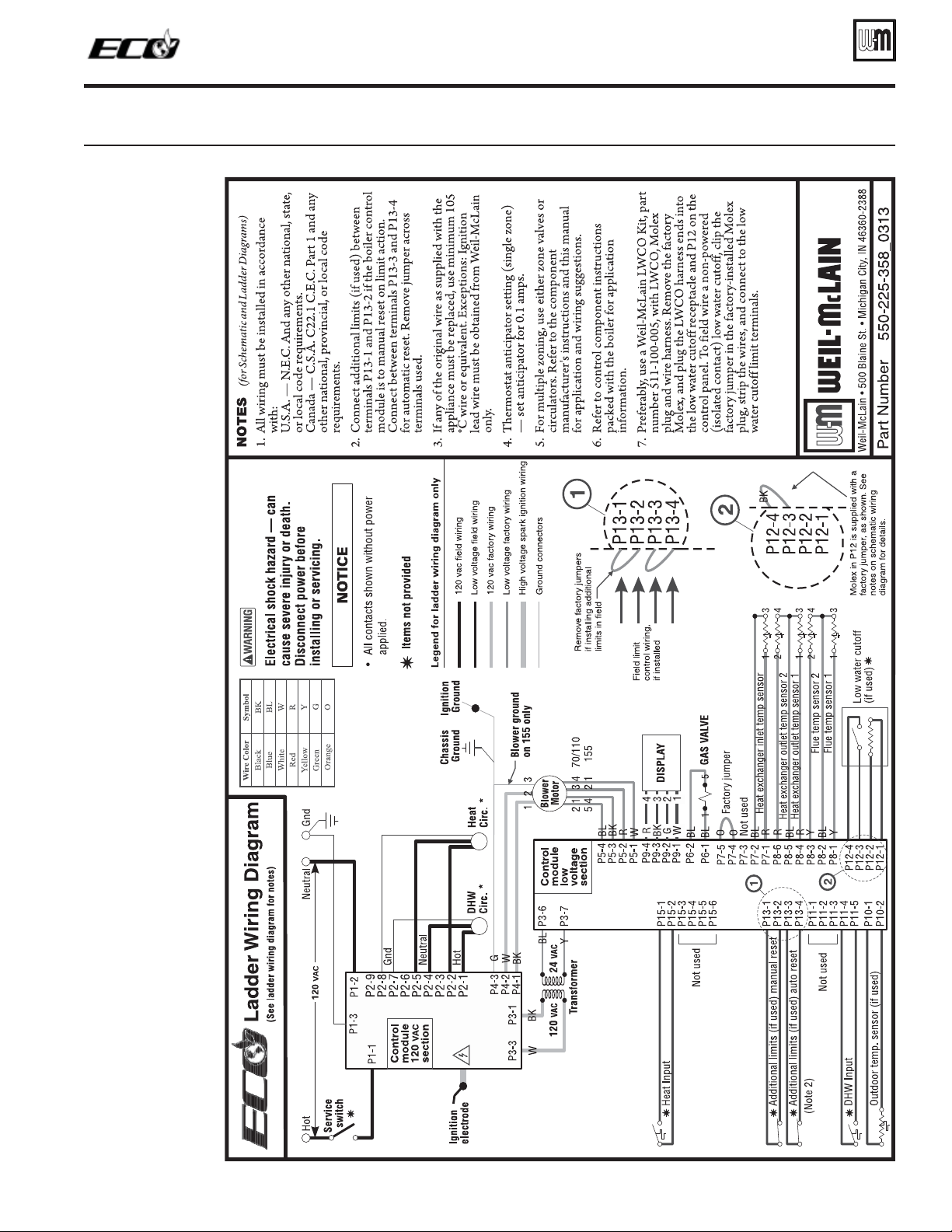
Wiring diagram — ladder
&IGURE %#/ ladder wiring diagram (see Figure 66, page 60 for schematic wiring diagram)
Part number 550-142-122/0513
61
TM
GAS-FIRED WATER BOILER — Boiler Manual

EXPRESS SETUP — using default settings
Part number 550-142-122/0513
62
TM
GAS-FIRED WATER BOILER — Boiler Manual
&IGURE Default boiler and temperature settings (for complete list and details, see instructions and figures on
pages 63-75).
-!.$!4/29 #/.42/, 3%44).'3 — The
following settings must be checked and adjusted
if necessary: BOILER MODEL and HIGH AL-
TITUDE in BOILER SETTINGS menu. See
instructions on the following pages for menu
access and control settings.
1. 4HEECOCONTROLISSETUPTOSUPPLYONE$(7INPUT
ANDONE(%!4INPUT#IRCULATOROUTPUTSARERELAYS
CONTROLLEDBYTHEBOILERCONTROLMODULE
2. All heating zones use the same temperature settings (or
outdoor reset curve if outdoor sensor is connected — see
page 119).
3. DHW input is priority over the HEAT input.
4. DHW temperature settings are separate from heating settings
and DHW calls do not use the outdoor reset curve.
5. Default heating settings are for finned tube baseboard only.
(Other heat emitter types may require changes in the control
setup.)
6. Only one zone thermostat or end switch input is provided.
Use zone controllers for multiple zone systems.
7. Some of the default boiler and temperature setting are sum-
marized in Figure 68 below. Verify that these settings are
acceptable for the system type.
8. If the system qualifies for direct connect system piping
(guidelines on page 37), reference the following pages for
piping and control suggestions:
a. General guidelines—pages 37-40.
b. Zoned with zone valves—page 41.
c. Zoned with circulators—page 42.
9. If the system is piped using primary/secondary system pip-
ing, reference the following pages for piping and control
suggestions:
a. General guidelines—pages 43-46.
b. Zoned with zone valves—page 47.
c. Zoned with circulators (single temp heating)—page 48.
d. Zoned with circulators (multi-temp heating)—page 49.
Other control settings may need to be adjusted in
order for the control to operate the system most
effectively. To ensure proper operation, read all
instructions on pages 63-74 before starting up
the system. Failure to comply could cause system
problems.
Parameter Name Default setting Comments
Boiler Model Factory-set WARNING:
THIS MUST BE SET CORRECTLY FOR
SAFE OPERATION. See pages 67 and 68 if
not set correctly.
High Altitude No WARNING: IF INSTALLED AT ALTITUDES ABOVE 5,500
FEET, CHANGE SETTING. See pages 67 and
68 if not set correctly.
Supply Max (Heat only) 180° F
See pages 69 for suggestions based on system type.
Supply Min (Heat only) 130° F
OD Reset Max (Heat only) 70° F
OD Reset Min (Heat only) 0° F
Boiler Supply (DHW only) 185° F
See pages 70 -71. Consult tank supplier manual.
ECO control operation
4EMPERATURESETTINGS — You must ensure that the
ECO control is set for the proper water temperatures
for the system. Excessive water temperature can cause
significant property damage in some applications.
-ULTITEMPERATURESYSTEMS — If the heating system
includes circuits that require lower temperature water
(radiant slab circuits, for example) as well as higher
temperature circuits (DHW, finned tube baseboard,
etc.), it is recommended to protect low-temperature
circuits with limit controls that are wired to a ECO
control external limit circuit. Failure to provide regula-
tion can result in substantial property damage.
&IGURE Control sequence of operation
$ISPLAY
status
TEXT
#ONTROLACTION
(also see Figure 70, page 64)
0/7%2
50
s Check the boiler model listed on the power-up
screen. If it is not correct, turn off the boiler. See
page 67 to change setting.
s When power is turned on, the screen lists sen-
sors that are detected. If any sensor is not listed,
make sure it is connected correctly. Turn off
power and restart.
3TANDBY
s Standby — no calls for heat.
s Backlight will turn off due inactivity.
0REPURGE
s Call for heat detected.
s Display on with BLUE light (HEAT) or PURPLE
light (DHW).
s Start min./max. on timers if more than one
system is calling — highest priority starts first.
s Start circulators for this priority setup.
s Calculate target temp — If sensor temp is below
target temp, begin firing sequence.
s Blower to ignition speed for prepurge.
)GNITION
s After prepurge times out, begin ignition cycle
s Activate gas valve and ignition spark.
s Continue ignition spark for ignition period
s Turn off spark and use electrode to check for
flame signal.
(%!4).'
s Flame detected.
s Release boiler to modulation.
s NOTE: If flame is not detected, the gas valve
is turned off, blower turns on (postpurge), and
control starts cycle again. After 5 failures, the
control waits 60 minutes, then tries again.
s If priority timer times out, switch to next priority
and start priority timer.
s If demand satisfied, go to postpurge.
$(7
s Flame detected.
s Release boiler to modulation.
s NOTE: If flame is not detected, the gas valve
is turned off, blower turns on (postpurge), and
control starts cycle again. After 5 failures, the
control waits 60 minutes, then tries again.
s If priority timer times out, switch to next priority
and start priority timer.
s If demand satisfied, go to postpurge.
0OSTPURGE
s Demand satisfied (temperature reaches target
temperature or limit setting).
s Gas valve off.
s Blower to ignition speed for postpurge.
s Return to standby after purge.
%RRORFAULT
s Display turns RED due to error or limit event.
s Flashing display means lockout condition.
773$
s Warm weather shutdown — the boiler will not
be allowed to fire on space heating if the outside
temperature is greater than the WWSD setting.
DHW operation is not affected by WWSD.
Part number 550-142-122/0513
63
TM
GAS-FIRED WATER BOILER — Boiler Manual
Control features
❏
Blower speed modulation to control the ECO boiler’s firing rate.
❏
Advanced PID response to anticipate system needs based on response
to heat input.
❏
Robust text display for ease of operation monitoring and troubleshoot-
ing.
❏
Control of two dedicated inputs for DHW and HEAT respectively.
❏
Integral outdoor reset option (see page 119).
❏
Dual sensors for boiler outlet temperature and flue temperature, pro-
viding redundant protection.
❏
Low water cut-off, (field wired or optional kit).
❏
Boiler is shipped with an outdoor sensor, allowing outdoor reset opera-
tion for maximum boiler efficiency. See page 119.
❏
Freeze protection and circulator exercising.
Sequence of operation
1. Figure 69 is a summary of the operating sequence for the ECO control.
❏
The statuses shown appear in the display as the ECO control cycles
the boiler.
❏
The display will flash red if a problem has been detected.
ECO control setup
"%&/2%02/#%%$).'PERFORM%33%.4)!,CONTROL
SETTINGSASINSTRUCTEDONPAGE.
1. See Figure 71, page 66 for an overview of the ECO control menus.
This page also gives the location of instruction manual information
for each of the main menus.
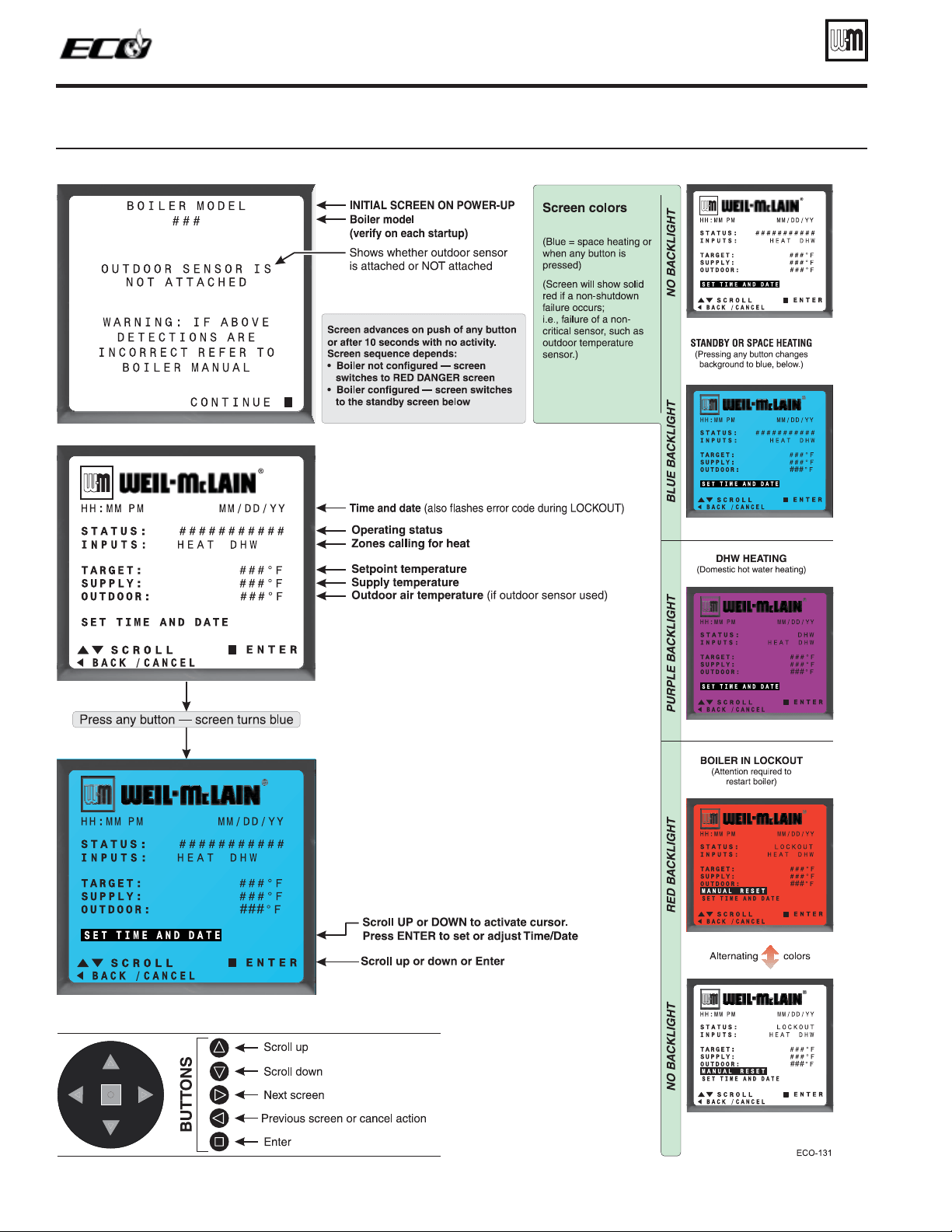
ECO control operation (continued)
&IGURE ECO control display screens and typical navigation
Part number 550-142-122/0513
64
TM
GAS-FIRED WATER BOILER — Boiler Manual
ESSENTIAL settings
4(%#/.42/,3%44).'3,)34%$"%,/7-534"%-!$%"%&/2%34!24).'4(%"/),%2. Failure
to comply could result in incorrect operation of the boiler, causing possible severe personal injury, death or sub-
stantial property damage.
4(%#/.42/,3%44).'3,)34%$"%,/73(/5,$"%-!$%"%&/2%34!24).'4(%"/),%2. These
settings provide information about boiler start-up and service. This information will help reduce troubleshooting
time and inform technicians working on the equipment about boiler history.
Step 1 Read about menu access and navigation
on page 66.
Step 2 Turn OFF power to the boiler.
Step 3 Turn off gas supply to the boiler by closing
the boiler’s manual gas valve.
Step 4 Disconnect thermostat input wires from the
boiler at the low voltage terminal blocks.
Step 5 Turn ON power to the boiler. Navigate to
the BOILER SETTINGS / BOILER MODEL
screen.
Step 6 Read the boiler model shown on the dis-
play.
If the boiler model number shown does NOT
match the boiler, the selection MUST be changed
to the correct model number. Failure to comply
could result in severe personal injury, death or
substantial property damage.
Step 7 Navigate to the BOILER SETTINGS /
HIGH ALTITUDE screen.
Step 8 If the boiler is installed at altitude above
5,500 feet, the selection must be changed
to YES.
If the boiler is installed at altitude above 5,500
feet, the high altitude selection MUST be changed
to 9%3. Failure to comply could result in severe
personal injury, death or substantial property
damage.
Step 9 Continue with recommended settings
below.
Step 1 Navigate to the CONTRACTOR MENU /
SET DATE AND TIME screen.
Step 2 Enter current date and time by accessing
each screen and setting the data.
0/7%2/54!'%3 — The date and time infor-
mation will be saved during power interruptions.
For interruptions longer than several days, the
date and time information may be lost.
Step 3 Turn off power to the boiler. Reconnect
thermostat input wires to the boiler at the
low voltage terminal blocks.
Step 4 To adjust controls settings, proceed to the
next page. If settings are complete, pro-
ceed with start-up on page 75.
Part number 550-142-122/0513
65
TM
GAS-FIRED WATER BOILER — Boiler Manual
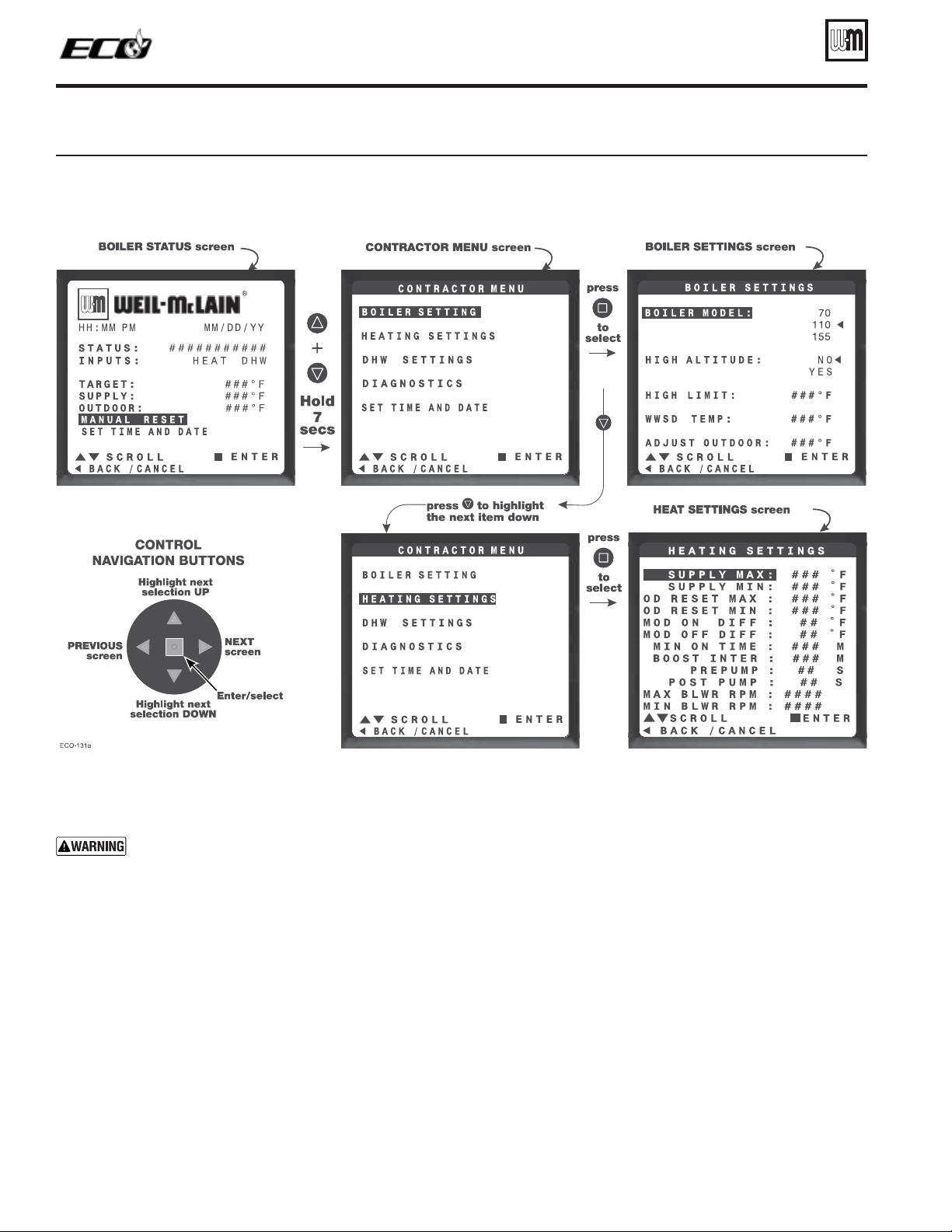
ECO control settings menus
"%&/2% 02/#%%$).' PERFORM ESSENTIAL
CONTROLSETTINGSASINSTRUCTEDONPAGE.
Control menus — OVERVIEW
1. Access contractor menus by pressing and holding the UP and
DOWN arrow keys at the same time for 7 seconds.
2. See Figure 71 for the screen sequences up to the BOILER
SETTINGS and HEATING SETTINGS menus.
3. Adjust control settings as needed for the central heating and
DHW systems supplied by the boiler.
4. Wire the line voltage and low voltage connections as required.
5. The CONTRACTOR MENU screen will show:
a. "/),%23%44).'3SEEPAGE
B (%!4).'3%44).'3SEE
C $(73%44).'3SEE
d. $)!'./34)#3SEEPAGE
e. 3%4$!4%!.$4)-%SEEPAGE and PAGE
Part number 550-142-122/0513
66
TM
GAS-FIRED WATER BOILER — Boiler Manual
&IGURE ECO control menu access — accessing contractor menus
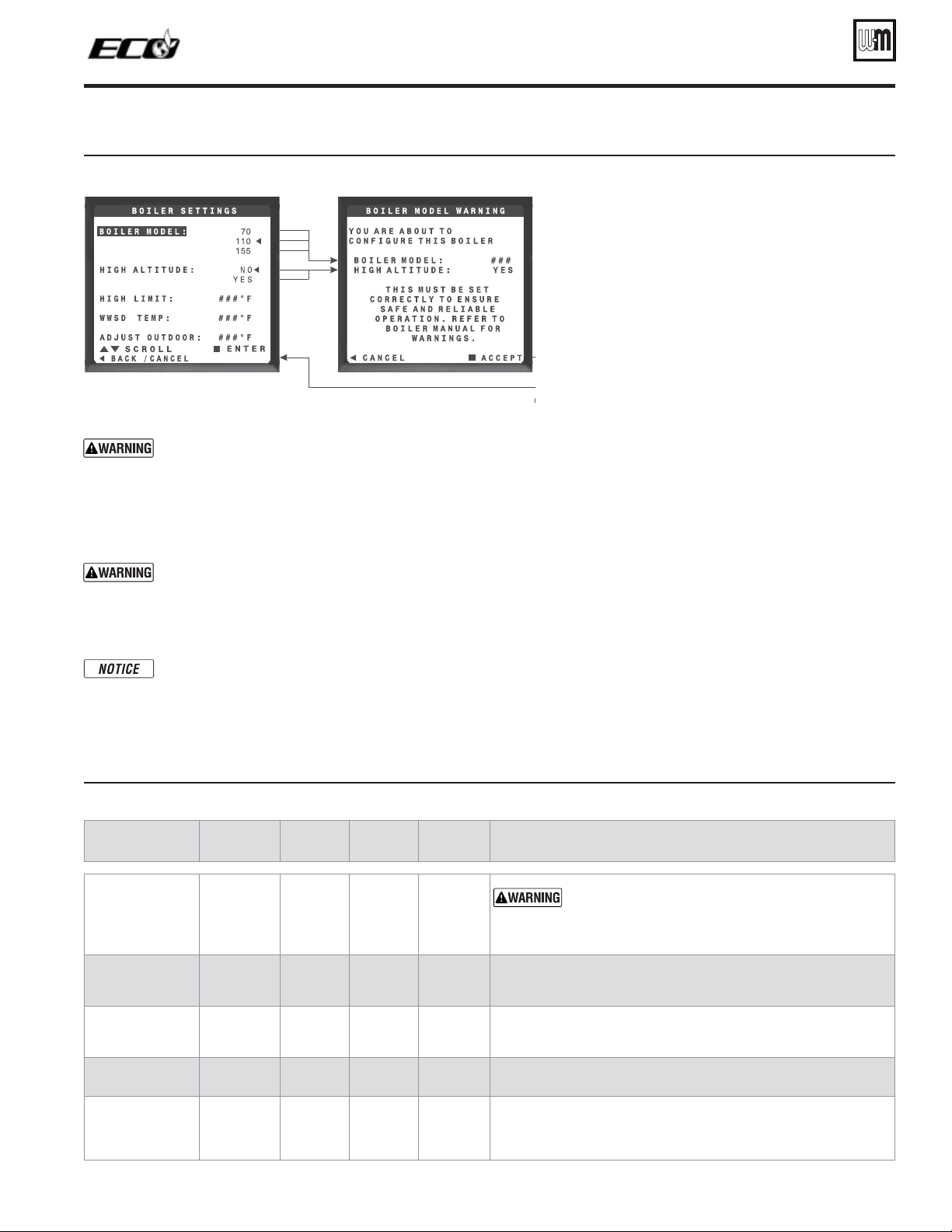
&IGURE "/),%23%44).'3 menu (see Figure 73 for setting values and descriptions)
BOILER SETTINGS menu
&IGURE "/),%23%44).'3 menus (see Figure 71, page 66 for access information)
-ENU)TEM Units
,OW
Value
(IGH
Value
$EFAULT #OMMENT
Boiler Model 70
110
155
factory
THIS MUST BE SET CORRECTLY FOR SAFE
OPERATION. Adjusts blower speeds and flame
sense (Startup screen will show “HA” after the model number if
high altitude has been selected, below.)
High Altitude yes or no no Adjusts ignition and low fire fan speed (for altitudes above 5,500
feet only)
High Limit °F 50 200 200 If boiler out temperature reaches this temperature, boiler will
lockout, which requires a manual reset
WWSD Temp °F Off, 50 100 70 Boiler will not respond to heating calls above this outdoor temp
Adjust Outdoor °F
(difference)
-10 +10 0 This value plus outdoor sensor reading equals outdoor temp
(Use this setting to compensate for solar gain or other factors
that cause a shift in sensor temperature.)
BOILER MODEL
Check the BOILER MODEL against the model listed on the
boiler’s rating plate. Change the selection to the correct model
if not. Also verify the model number on the ECO control
display at power-up. Failure to correct could result in severe
personal injury, death or substantial property damage.
HIGH ALTITUDE
If the boiler is installed at an altitude above 5,500 feet, select
YES for high altitude. Selecting YES will automatically adjust
firing rates (blower speeds) to compensate for altitude.
HIGH LIMIT TEMPERATURE
The boiler’s high limit temperature during normal operation
is fixed at 200°F and cannot be changed. The HIGH LIMIT
TEMPERATURE setting in the ECO control menu is a tem-
porary setting for test purposes ONLY.
1. If boiler outlet water temperature exceeds this temperature, the ECO
control will shut down the boiler and enter lockout. Manual reset is
required to restart the boiler.
2. The HIGH LIMIT TEMPERATURE setting will
automatically return to 200°F if power is turned
off. The boiler will restart when power is restored.
3. Use this control setting only to test the control’s
high limit function.
WWSD
1. WWSD stands for “warm weather shutdown.” It
means the boiler will not be allowed to fire if the
outside temperature is greater than the WWSD
setting.
2. When the boiler is kept off because the outside
temperature is above WWSD, the graphic display
will show “WWSD,” and the boiler will remain in
standby until the outside temperature drops below
WWSD temperature.
3. WWSD does not apply to DHW systems.
4. The outdoor sensor must be installed to use this
function.
4HEOUTDOORSENSORMUSTBEINSTALLED
UNLESSSPECIlCALLYEXEMPTEDINTHE%NERGY!CT
STATEMENTONPAGE.
ADJUST OUTDOOR
1. Use this setting to adjust the outdoor sensor tem-
perature to account for solar or other effects, such
as long lead wire, that would cause the sensor to
read incorrectly.
Part number 550-142-122/0513
67
TM
GAS-FIRED WATER BOILER — Boiler Manual
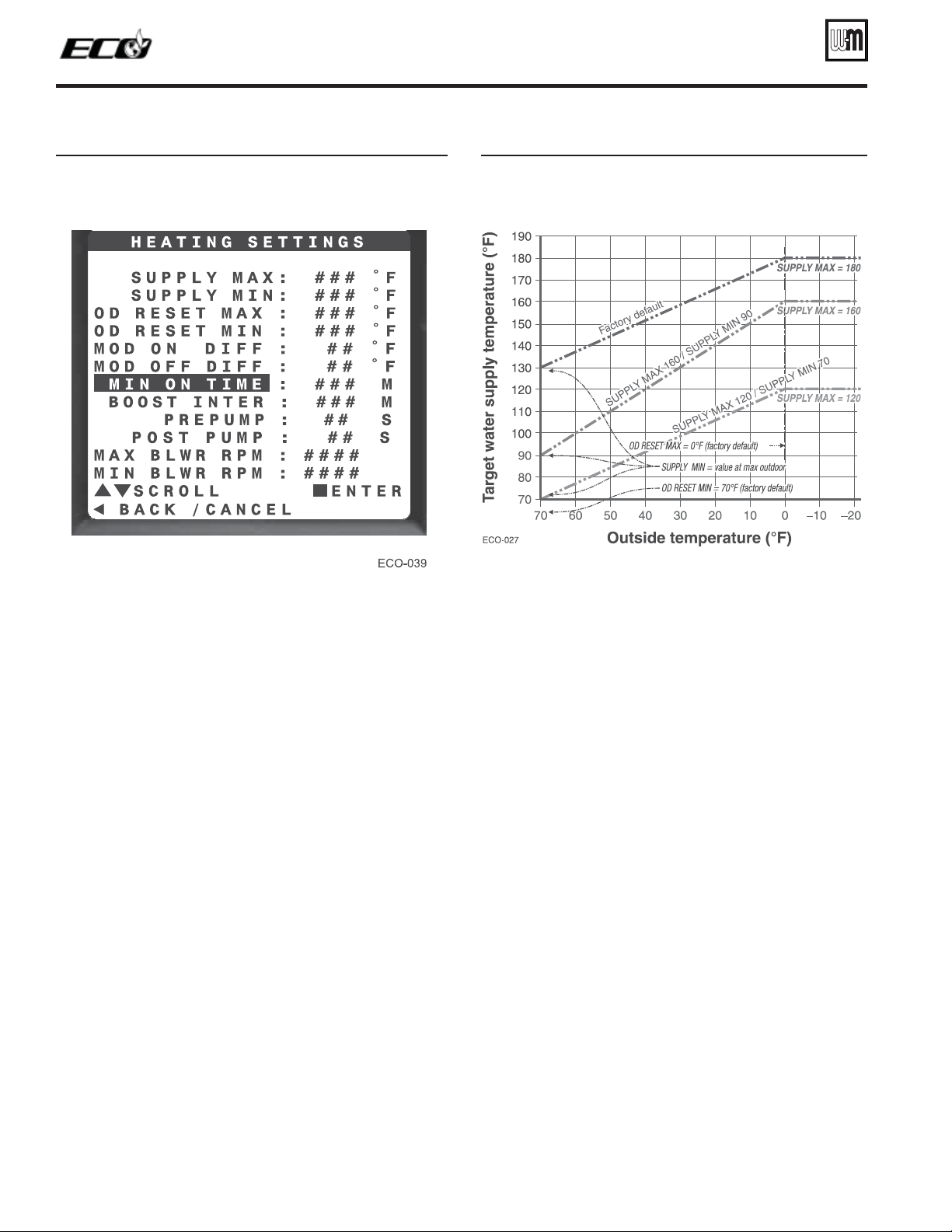
&IGURE (%!4).'3%44).'3 menu (see
Figure 77, page 70 for setting values and
descriptions)
HEATING SETTINGS
1. The heating settings menu is for setting control operation
during space heating. The settings apply to zones controlled
by the HEAT Input/output. See Figure 77, page 70 for a listing
of menu parameters.
2. If DHW is used, the settings for control operation during
DHW calls are set under the DHW SETTINGS menus (see
Figure 77, page 70).
HEATING DESIGN TEMPERATURES
1. Set desired temperatures for space heating zones. Refer to
Figure 76, page 69, for recommended settings based on
system type.
2. For an explanation of the target temperatures and associated
outdoor temperatures, see Figure 75.
3500,9-!8
1. Set SUPPLY MAX to the required supply water temperature
for the system at design maximum heat loss (typically 180°F
for finned tube baseboard on new installations).
3500,9-).
1. SUPPLY MIN should equal the desired minimum supply
water temperature for the system.
2. The factory default is 130°F. This could be set as low as 60°F,
which would supply “zero heat” when outdoor temperature
is 60°F, because supply water temp would equal room temp.
3. See examples in Figure 75.
&IGURE Typical outdoor reset curves
/$2%3%4-!8
1. OD RESET MAX means the outdoor temperature at which
the target temperature reaches its minimum (SUPPLY MIN).
2. In the example of Figure 75, this occurs at 70 °F (the factory
default).
/$2%3%4-).
1. OD RESET MIN means the outdoor temperature at
which the target temperature reaches its maximum value
(SUPPLY MAX).
2. In the example of Figure 75, this occurs at 0°F outside
(the factory default setting).
3. OD RESET MIN should equal the ODT (outdoor design
temperature) for the installation’s location.
-/$5,!4%/.$)&&
1. The temperature must drop this many degrees below target
temperature for the boiler to come on when a call for heat
is present on HEAT Input.
-/$5,!4%/&&$)&&
1. While the boiler is firing, as the temperature increases above
the target temperature, the boiler firing rate is reduced.
2. At this many degrees above the target temperature, the
control will temporarily turn off burner. The burner will
be restored when temperature drops below TARGET TEM-
PERATURE minus MOD ON DIFF.
Part number 550-142-122/0513
68
TM
GAS-FIRED WATER BOILER — Boiler Manual
HEATING SETTINGS menu
HEATING TIMES
-)./.4)-%
1. This is the minimum time the boiler will satisfy the call for
space heating before switching back to DHW (if there is still
a DHW call).
"//34).4%26!,
1. This applies when in outdoor reset mode (outdoor sensor
installed — see page 119).
2. The boost timer starts on a call for heat. If the boost interval
time passes and the call for heat is still on, the ECO control
“boosts” the calculated target outlet water temperature by
10°F.
3. This occurs again if another boost interval elapses.
4. Boost will continue until the setpoint (target temperature)
reaches the
SUPPLY MAX setting.
5. The purpose of boost is to compensate for changes in demand
not addressed by the reset curve. Typically, set boost to 30
minutes. The factory default is “OFF” — that is, boost is not
enabled with default settings.
02%05-04)-%
1. The boiler circulator and zone circulators (if activated by the
ECO zone circulator outputs) will start this amount of time
before the burner is started.
0/3405-04)-%
1. The boiler circulator and zone circulators (if activated with
the ECO zone circulator outputs) will continue this amount
of time after the burner is shut down when the call for heat
is satisfied.
MIN / MAX BLOWER RPM
1. Use to set minimum and maximum boiler inputs by setting
minimum and maximum blower RPM.
2. This adjustment can be used to match the maximum boiler
output to the maximum heat load. This will reduce boiler
cycling and increase boiler/system efficiency.
$URING COMBUSTION TESTING, the Maximum rate
must be set to the Maximum Rate “High Value” listed
in Figure 77, page 70 to allow the boiler to be set to
maximum input during high-fire set-up and testing.
&IGURE 3YSTEM3ETTINGS2ECOMMENDED
Part number 550-142-122/0513
69
TM
GAS-FIRED WATER BOILER — Boiler Manual
3YSTEMTYPE 2ECOMMENDEDTEMPERATURES
SUPPLY MAX
Temp
OD RESET MIN
Temp
SUPPLY MIN
Temp
OD RESET MAX
Temp
Fan-coil 190 0 140 70
&INNEDTUBEBASEBOARD
*
$EFAULTSETTINGS
180 0 130 70
Cast iron baseboard 180 0 120 70
Cast iron radiators 180 0 120 70
Radiant – slab on grade 120 0 80 70
Radiant – thin slab 140 0 80 70
Radiant – below floor (staple up) 160 0 90 70
Radiant – above floor (sleeper system) 140 0 90 70
HEATING SETTINGS menu (continued)
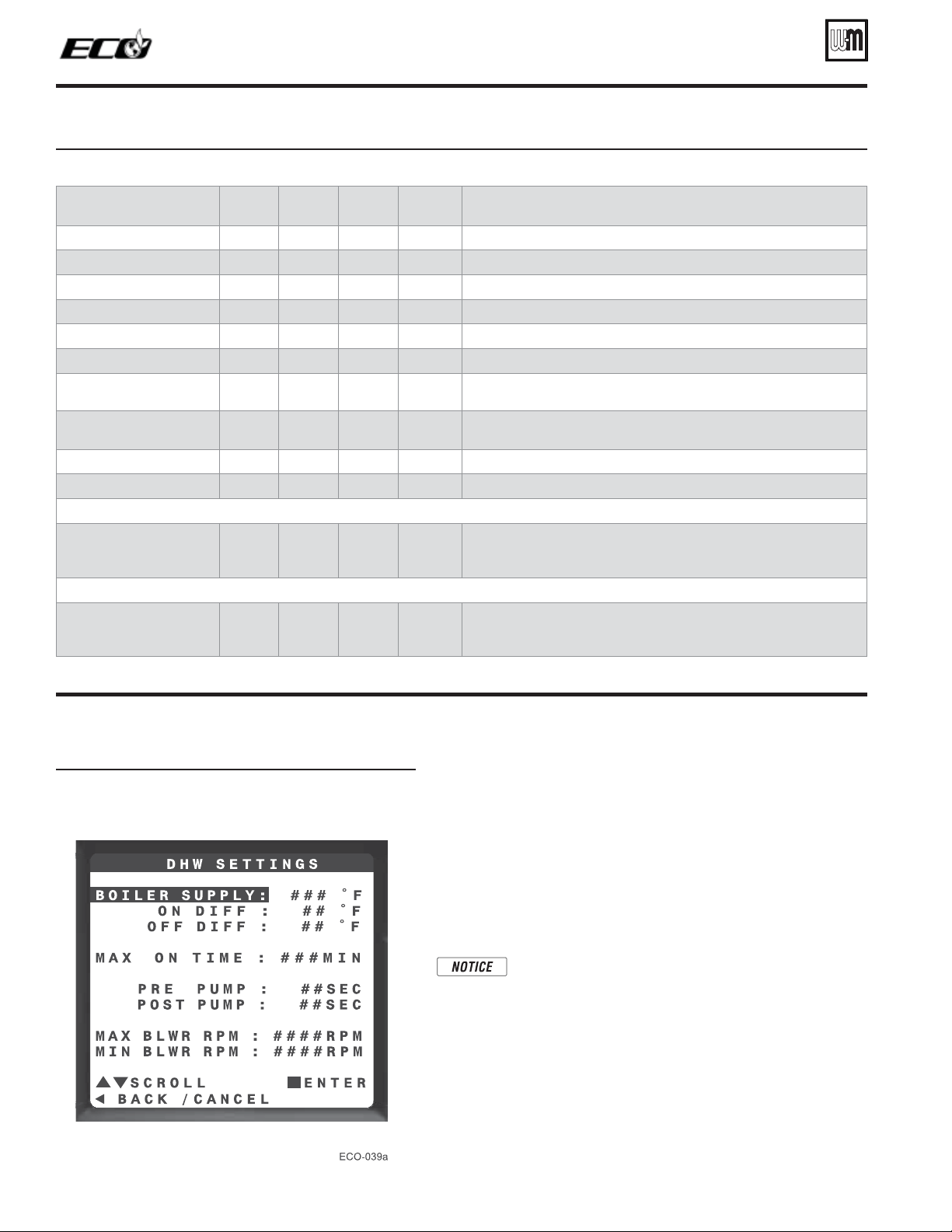
DHW SETTINGS menu
&IGURE (%!4).'3%44).'3 menu (see Figure 71, page 66 for access information)
DHW SETTINGS
1. The DHW SETTINGS menus are for setting control operation
during DHW operation. The settings apply ONLY to $(7 Zone
(see Figure 78).
2. If DHW is used, the settings for control operation during DHW calls
for heat are set under the DHW SETTINGS menus (see Figure 78).
DHW TEMPERATURES
$(7PRIORITY — The ECO control gives priority to DHW
operation. During DHW call for heat, the CENTRAL heating
zone output is disabled. This continues until the DHW
call ends or the DHW MAX ON TIME has elapsed.
"/),%23500,9
1. The ECO control will regulate boiler firing to provide outlet water
at this temperature.
2. For most DHW applications, set this to 190°F. A lower supply
temperature can be used, but will reduce the indirect water heater
heating capacity.
-ENU)TEM Units
,OW
Value
(IGH
Value
$EFAULT #OMMENT
SUPPLY MAX
°F 60 190 180
Required supply temp. at system design max. load
SUPPLY MIN
°F 60 190 130
Minimum supply temp. for system
OD RESET MAX
°F 50 100 70
Outdoor temp. at which supply target reaches min.
OD RESET MIN
°F –20 50 0
Outdoor temp. at which supply target reaches max.
Modulate On Diff
°F 2 10 5
Boiler turns on if temperature drops below target minus differential on
Modulate Off Diff
°F 2 10 5
Boiler shuts down if modulates past target plus differential off
Min On Time
minutes off 240 30
Shortest time boiler will satisfy space heating system before
switching to DHW
Boost Interval
minutes off 240 off
When operating on ODR increases target 10°F when this time
expires until reaching MAX
Prepump Time: ### SEC
seconds 0 240 20
Additional time to run circulators longer than standard 10 second time
Postpump Time: ### SEC
seconds off 240 30
Circulator run time after call for heat ends
MAXIMUM BLOWER RPM
%#/
%#/ 110
%#/ 155
RPM
RPM
RPM
1100
1400
1300
4300
5650
5500
4150
5450
5300
Boiler Model specific
NOTE: Adjusting boiler firing rate will affect AFUE rating.
MINIMUM BLOWER RPM
%#/ 70
%#/ 110
%#/ 155
RPM
RPM
RPM
1100
1400
1300
4300
5650
5500
1100
1400
1300
Boiler Model specific (low value adjusted automatically if HIGH
ALTITUDE is selected in control setup)
NOTE: Adjusting boiler firing rate will affect AFUE rating.
&IGURE $(73%44).'3 menu (see
Figure 79, page 71 for setting values and
descriptions)
Part number 550-142-122/0513
70
TM
GAS-FIRED WATER BOILER — Boiler Manual
HEATING SETTINGS menu (continued)
/.$)&&
1. The temperature must drop this many degrees below
target temperature for the boiler to come on when a
call for heat is present on DHW input.
/&&$)&&
1. While the boiler is firing, as the temperature increases
above the target temperature, the boiler firing rate is
reduced.
2. At this many degrees above the target temperature, the
control will temporarily turn off burner. The burner will
be restarted when temperature drops below TARGET
TEMPERATURE minus ON DIFF.
DHW TIMES
-!8/.4)-%
1. This is the longest time the boiler will continue in DHW
mode before switching to space heating (if there is a
space heating call).
DHW SETTINGS menu (continued)
&IGURE $(73%44).'3menu (see Figure 71, page 66 for access information)
-ENU)TEM Units
,OW
Value
(IGH
Value
$EFAULT #OMMENT
Boiler Supply °F 60 190 185 Boiler enters manual reset lockout at 200°F
On Diff °F 2 10 5 Boiler turns on if temperature drops below target minus
differential on
Off Diff °F 2 10 5 Boiler shuts down if modulates past target plus differential off
Max On Time minutes off 240 30 Longest time boiler will satisfy DHW call before switching to HEAT
input (if present)
Prepump Time: ### SEC seconds 0 240 20 Additional time to run circulators longer than standard 10
second time
Postpump Time: ### SEC seconds off 240 30 Circulator run time after call for heat ends
MAXIMUM BLOWER RPM
%#/70
%#/ 110
%#/ 155
RPM
RPM
RPM
1100
1400
1300
4300
5650
5500
4150
5450
5300
Boiler Model specific
NOTE: Adjusting boiler firing rate will affect AFUE rating.
MINIMUM BLOWER RPM
%#/ 70
%#/ 110
%#/ 155
RPM
RPM
RPM
1100
1400
1300
4300
5650
5500
1100
1400
1300
Boiler Model specific (low value adjusted automatically if HIGH
ALTITUDE is selected in control setup)
NOTE: Adjusting boiler firing rate will affect AFUE rating.
CIRCULATOR EXERCISING and FREEZE PROTECTION
CIRCULATOR EXERCISING
1. The ECO control will automatically start both circula-
tor outputs and run for 10 seconds for each 72-hour
period of inactivity.
Setting MAX ON TIME to off will cause the control to
never switch to space heating while DHW call for heat
is present. This could present a freeze hazard for some
installations if the DHW aquastat were to remain closed
indefinitely.
02%05-04)-%
1. The DHW circulator will start this amount of time before the
burner is started.
0/3405-04)-%
1. The DHW circulator will continue to run this amount of time
after the burner is shut down when the call for heat is satisfied.
MIN / MAX BLOWER RPM
1. Use to set minimum and maximum boiler inputs by setting
minimum and maximum blower RPM.
2. Adjusting the MAX BLOWER RPM down will reduce DHW
performance
FREEZE PROTECTION
1. This function automatically fires the boiler and starts the HEAT
circulator when the heat exchanger sensor detects a temperature
less than 40 °F. The circulator turns off when the temperature
rises above 45 °F.
Part number 550-142-122/0513
71
TM
GAS-FIRED WATER BOILER — Boiler Manual
&IGURE $)!'./34)#3 menu navigation (see Figure 71, page 66 for access information)
Menus .EXTSCREEN .EXTSCREEN .EXTSCREEN .EXTSCREEN
Follow information at the bottom of each screen to navigate to next/previous screen or enter/save data
DIAGNOSTICS TEMPERATURES STATUS: ##########
BOILER OUT1: ###°F
BOILER OUT2: ###°F
BOILER IN: ###°F
FLUE 1: ###°F
FLUE 2: ###°F
OUTDOOR: ###°F
INPUTS STATUS: ##########
HEAT INPUT 1: ###
DHW INPUT 2: ###
MANUAL LIMIT: ######
AUTO LIMIT: ######
LOW WTR CUTOFF: ######
BLOWER SPEED: ####RPM
FLAME SIGNAL: ###
OUTPUTS STATUS: ##########
GAS VALVE: ###
CIRCULATOR HEAT: ###
CIRCULATOR DHW: ###
BLOWER SIGNAL: ###%
ERRORS CONTROL FAULT ###
IGNITION RETRIES ###
MANUAL RESET CNT ###
AUTO RESET CNT ###
LOCKOUT HISTORY 1 FAULT NAME: ##########
FAULT TYPE: ######
FAULT TIME: HH:MM AM
FAULT DATE: MM/DD/YY
STATUS: ##########
TEMPERATURES
INPUTS
OUTPUTS
TEMPERATURES
INPUT STATUS
OUTPUT STATUS
LOCKOUT HISTORY 2
LOCKOUT HISTORY 3
. . . SAME AS HISTORY 1
. . . SAME AS HISTORY 1
SOFTWARE VERSIONS DISPLAY E#.##
MAIN MICRO E#.##
SECOND MICRO E#.##
MANUAL TEST MODE STATUS: ##########
TARGET: ###°F
MODULATION: ###°F
BOILER OUT: ###°F
BOILER IN: ###°F
FLUE: ###°F
OUTDOOR: ###°F
BLOWER SIGNAL: ###%
BLOWER SPEED: ####RPM
FORCE RATE AUTO
MANUAL RESET
PRESS ENTER TO RESET THE ###### RESET
FAULT BELOW:
(SCREEN SHOWS ERROR NAME, AND THE
TIME AND DATE IT OCCURRED)
DIAGNOSTIC menu
Part number 550-142-122/0513
72
TM
GAS-FIRED WATER BOILER — Boiler Manual
-ENU)TEM Units ,OW
Value
(IGH
Value
$EFAULT #OMMENT
4/2%3%4!,,()34/29
!.$#/5.4%234/:%2/
To reset all history and counters to zero: Enter the DIAGNOSTICS menu. Then press and hold
the left and right arrows located below the display. Hold for 3 seconds. This will cause ALL
history and counters to be deleted.
4EMPERATURES
Status
Text Data Current operating status of the boiler: Prepurge, Ignition, Heating or DHW, Post Purge,
Warm Weather Shutdown (WWSD), Fault
Boiler Out 1
°F Data Temperature of the first sensing element of the boiler’s heat exchanger outlet sensor
Boiler Out 2
°F Data Temperature of the second sensing element of the boiler’s heat exchanger outlet sensor
Boiler In
°F Data Temperature of the boiler’s heat exchanger inlet sensor
Flue 1
°F Data Temperature of the first sensing element of the boiler’s flue gas sensor
Flue 2
°F Data Temperature of the second sensing element of the boiler’s flue gas sensor
Outdoor
°F Data Temperature of the remote outdoor air temperature sensor
)NPUTS
Status
Text Data
Current operating status of the boiler: Prepurge, Ignition, Heating or DHW, Post Purge,
Warm Weather Shutdown (WWSD), Fault
HEAT
Input
on-off Data
Call for heat status on Heat Input
DHW Input
on-off Data
Call for heat status on DHW Input
Manual Limit
open-closed Data External manual limit on limit terminal block
Auto Limit
open-closed Data External auto limit on limit terminal block
Low Wtr Cutoff
open-closed Data Low water cutoff device (optional) attached to control terminal P12
Blower Speed RPM
Data Feedback from blower sensor
Flame Signal
no units Data Number indicating the presence and quality of the flame used to prove flame presence and
shut down boiler
/UTPUTS
Status
Text Data Current operating status of the boiler: Prepurge, Ignition, Heating or DHW, Post Purge,
Warm Weather Shutdown (WWSD), Fault
Gas Valve
on-off Data Control’s gas valve circuit status
Circulator Heat
on-off Data Control’s Heat Circulator relay status
Circulator DHW
on-off Data Control’s DHW Circulator relay status
Blower Signal
% of rate Data Control’s signal controlling the blower speed
Errors
Control Fault
# 0 Displays number of control faults
Ignition Retries
# 0 Displays number of ignition attempts boiler is currently on
Manual Reset Cnt
# 0 Displays number of manual reset lockouts since last cleared
Auto Reset Cnt
# 0 Displays number of auto reset lockouts since last cleared
Lockout History 1
Choose this to view the most recent error recorded
Fault Name text Data
Displays the name of the fault
Fault Type text Data Displays whether the fault was MANUAL OR AUTO reset
Time text Data Displays the time error occurred
Date text Data Displays the date error occurred
Status text Data Displays the boiler’s status when the error occurred
Temperatures menu menu Choose this to view the Boiler Temperatures at the time of the error
Inputs
menu menu
Choose this to view the status of the Boiler Inputs at the time of the error
Outputs
menu menu
Choose this to view the status of the Boiler Outputs at the time of the error
Lockout History 2
Choose this to view the most recent error recorded
Fault Name text Data
Displays the name of the fault
Fault Type text Data Displays whether the fault was MANUAL OR AUTO reset
Time text Data Displays the time error occurred
Date text Data Displays the date error occurred
&IGURE $)!'./34)#3 menu details (see Figure 80, page 72 for access information)
DIAGNOSTICS menu (continued)
Part number 550-142-122/0513
73
TM
GAS-FIRED WATER BOILER — Boiler Manual
&IGURE $)!'./34)#3 menu details (continued) (see Figure 80, page 72 for access information)
DIAGNOSTICS menu (continued)
-ENU)TEM Units ,OW
Value
(IGH
Value
$EFAULT #OMMENT
4/2%3%4!,,()34/29
!.$#/5.4%234/:%2/
To reset all history and counters to zero: Enter the DIAGNOSTICS menu. Then press and hold
the left and right arrows located below the display. Hold for 3 seconds. This will cause ALL
history and counters to be deleted.
Status text Data Displays the boiler’s status when the error occurred
Temperatures
menu menu
Choose this to view the Boiler Temperatures at the time of the error
Inputs
menu menu
Choose this to view the status of the Boiler Inputs at the time of the error
Outputs
menu menu
Choose this to view the status of the Boiler Outputs at the time of the error
Lockout History 3
Choose this to view the most recent error recorded
Fault Name text Data
Displays the name of the fault
Fault Type text Data Displays whether the fault was MANUAL OR AUTO reset
Time text Data Displays the time error occurred
Date text Data Displays the date error occurred
Status text Data Displays the boiler’s status when the error occurred
Temperatures
menu menu
Choose this to view the Boiler Temperatures at the time of the error
Inputs
menu menu
Choose this to view the status of the Boiler Inputs at the time of the error
Outputs
menu menu
Choose this to view the status of the Boiler Outputs at the time of the error
3OFTWARE6ERSIONS
Display E#.## Data Software version of the microprocessor on the display circuit board
Main Micro E#.## Data Software version of the main microprocessor on the control circuit board
Second Micro E#.## Data Software version of the second microprocessor on the control circuit board
Manual Test Mode
Status text Data
Current operating status of the boiler: Prepurge, Ignition, Heating or DHW, Post Purge,
Warm Weather Shutdown (WWSD), Fault
Inputs text HEAT or DHW Data Indicates status of calls for heat on Heating and DHW inputs
Target °F Data Calculated target temperature based on outdoor temp (for Heating input) or the DHW
Boiler Supply temperature (for DHW input)
Boiler Out °F Data Temperature of the outlet sensor on the boiler heat exchanger
Boiler In °F Data Temperature of the inlet sensor on the boiler heat exchanger
Flue °F Data Temperature of flue gases
Outdoor °F Data Temperature of outdoor air
Blower Speed rpm Data Blower’s feedback to the control
Flame Signal no units Data
Number indicating the presence and quality of the flame used to prove flame presence and
shut down boiler
Force Rate Low, Med, High, or Auto Auto Used to manually force a rate during a call for heat. Choose auto for normal operation.
Manual Reset
Reset selected condition
DATE AND TIME menu
3ET4IMEAND$ATE
Year text 2013 Set year (homeowner or contractor)
Month text 1 Set month (homeowner or contractor)
Day text 1 Set day (homeowner or contractor)
Hour text 12 (AM) Set hour (homeowner or contractor)
Minute text 0 Set minute (homeowner or contractor)
&IGURE $!4%!.$4)-% menus — navigation (see Figure 71, page 66 for access information)
Part number 550-142-122/0513
74
TM
GAS-FIRED WATER BOILER — Boiler Manual
Startup — fill the system
!NTIFREEZE
1. Use only antifreeze listed by Weil-McLain as suitable for
use with ECO Gas Boilers. See Figure 109, page 107 for
information.
2. See Replacement parts at the end of this manual for
Weil-McLain part numbers to obtain antifreeze through a
Weil-McLain distributor.
5SETHECORRECTAMOUNTOFANTIFREEZE
1. Determine the freezing temperature needed (to protect
against lowest likely temperature the system water will
encounter).
2. Find the antifreeze concentration by volume needed for this
temperature from the antifreeze manufacturer’s data on the
antifreeze container.
3. Add up the volume (gallons) of all system piping and com-
ponents, including the expansion tank and boiler.
a. Boiler water content is listed in Figure 122, page 119.
b. Remember to include expansion tank water content.
4. Multiply this volume by the (percent) antifreeze needed to
find the number of gallons of antifreeze to add.
Fill and test water system
1. Fill system only after ensuring the water meets the require-
ments of this manual.
2. Close manual and automatic air vents and boiler drain valve.
3. Fill to correct system pressure. Correct pressure will vary
with each application.
a. Typical cold water fill pressure for a residential system
is 12 psi.
b. Pressure will rise when boiler is turned on and system
water temperature increases. Operating pressure must
never exceed 25 PSIG.
4. At initial fill and during boiler startup and testing, check
system thoroughly for any leaks. Repair all leaks before
proceeding further.
Eliminate all system leaks. Continual fresh make-up
water will reduce boiler life. Minerals can build up
in the heat exchanger, reducing heat transfer, over-
heating heat exchanger, and causing heat exchanger
failure.
Purge air from water system
1. Connect a hose to the purge valve (see purge/drain valves,
item 11, in piping diagrams beginning on page 42). Route
hose to an area where water can drain and be seen.
2. Close the boiler or system isolation valve between the purge
valve and fill connection to the system.
3. Close zone isolation valves.
4. Open quick-fill valve on cold water make-up line.
5. Open purge valve.
6. One zone at a time, open the isolation valves. Allow water
to run through the zone, pushing out the air. Run until no
noticeable air flow is present. Close the zone isolation valves
#LEANSYSTEMTOREMOVESEDIMENT
1. You must thoroughly flush the system (without boiler
connected) to remove sediment. The high-efficiency heat
exchanger can be damaged by buildup or corrosion due to
sediment.
If the system needs to be cleaned, use only Sen-
tinel X400 cleaner, available from Weil-McLain.
See Figure 109, page 107 for information. Follow
instructions supplied with the X400 cleaner.
2. For zoned systems, flush each zone separately through a purge
valve. (If purge valves and isolation valves are not already
installed, install them to properly clean the system.)
3. Flush system until water runs clean and you are sure piping
is free of sediment.
Do not use petroleum-based cleaning or
sealing compounds in boiler system. Dam-
age to elastomer seals and gaskets in system
could occur, resulting in substantial prop-
erty damage.
Before filling the boiler and system with
water, verify the following. Boiler corrosion
can occur.
Failure to comply could result in boiler
failure or unreliable operation.
Water chemistry
7ATERP(BETWEENAND
1. Maintain boiler water pH between 7.0 and 8.5. Check with
litmus paper or have chemically analyzed by water treatment
company.
2. If pH differs from above, consult local water treatment com-
pany for treatment needed.
(ARDNESSLESSTHANGRAINS
1. Consult local water treatment companies for unusually hard
water areas (above 7 grains hardness).
#HLORIDECONCENTRATIONMUSTBE
,%334(!.PPM
1. Filling with chlorinated fresh water should be acceptable
since drinking water chloride levels are typically less than
5 ppm.
2. Do not use the boiler to directly heat swimming pool or
spa water.
3. Do not fill boiler or operate with water containing chloride
in excess of 200 ppm.
Verify that the water chemistry meets the limita-
tions and requirements of all other equipment in
the system.
Part number 550-142-122/0513
75
TM
GAS-FIRED WATER BOILER — Boiler Manual

Startup — fill the system (continued)
Freeze protection (if used)
Follow these guidelines to prevent pos-
sibility of severe personal injury, death
or substantial property damage:
5SEONLYTHEPRODUCTSLISTEDBY7EIL
-C,AINFORUSEWITHTHISBOILER3EE
PAGEFORINFORMATION
4HOROUGHLYmUSHANYSYSTEMTHAT
HASUSEDGLYCOL
before installing the
new ECO boiler.
2EVIEW THE MATERIAL SAFETY DATA
SHEETS -3$3
are available online.
The MSDS contains information on po-
tential hazards and first aid procedures
for exposure or ingestion.
#HECKANTIFREEZE INHIBITOR LEVELAT
LEAST ANNUALLY
. Glycol concentration
and inhibitor levels may change over
time. Add antifreeze to increase con-
centration if necessary. Add inhibitor
as needed to bring to acceptable level,
using inhibitor test kit to verify.
In addition to antifreeze and inhibitor,
use and maintain minimum level of
Sentinel X100 inhibitor as directed on
this page.
If using freeze protection fluid with
automatic fill,
INSTALLAWATERMETERTO
MONITORWATERMAKEUP
. Freeze pro-
tection fluid may leak before the water
begins to leak, causing concentration
to drop, reducing the freeze protection
level.
$/ ./4 EXCEED ANTIFREEZE
BYVOLUME
. Antifreeze moves more
sluggishly than water and can interfere
with heat transfer. At antifreeze concen-
trations higher than 50%, sludge can
develop in the boiler, potentially causing
damage to the heat exchanger.
#LEAN THE SYSTEM BEFORE FILLING.
Always drain and flush the system
thoroughly before filling with antifreeze.
Sludge, iron oxide deposits and other
sediment in the system inhibit flow and
can cause rapid breakdown of inhibi-
tors.
Use only antifreeze recommended by
Weil-McLain.
Weil-McLain provides information for
application of the antifreeze products
listed in this document only for use
in Weil-McLain boilers. Do not apply
these products or instructions for other
applications. Local codes may require a
backflow preventer or actual disconnec-
tion from city water supply.
and proceed with the next zone. Follow this procedure until all zones
are purged. Follow the same procedure to purge air from the boiler
and its internal piping.
7. Close the quick-fill water valve and purge valve and remove the hose.
Open all isolation valves. Watch that system pressure rises to correct
cold-fill pressure.
8. After the system has operated for a while, eliminate any residual air by
using the manual air vents located throughout the system.
9. If purge valves are not installed in system, open manual air vents in
system one at a time, beginning with lowest floor. Close vent when
water squirts out. Repeat with remaining vents.
10. Open automatic air vent (diaphragm-type or bladder-type expansion
tank systems only) one turn.
11. Starting on the lowest floor, open air vents one at a time until water
squirts out.
12. Repeat with remaining vents.
13. Refill to correct pressure.
Use of X100 inhibitor is REQUIRED
1. The ECO boiler is shipped with Sentinel X100 inhibitor and Sentinel
X100 Quick Test Kit. See Repair Parts at the end of this manual for
re-ordering information.
2. After filling the system as directed in these instructions, use a caulking
gun to inject the X100 inhibitor into the system, following the instruc-
tions on the tube.
3. Inject all of the inhibitor supplied in the Kit. Allow time for the water
to circulate and mix. Then check the inhibitor level. Add additional
inhibitor if necessary.
Check/verify water chemistry
1. The system may have residual substances that could affect water
chemistry.
2. After the system has been filled and leak tested, verify water pH and
chloride concentrations are acceptable.
3. Verify antifreeze concentration, if used.
4. Follow the instructions on the Sentinel test kit to sample the system
water and verify inhibitor concentration.
Check inhibitor concentration annually
1. Test the pH of a sample of system water at least annually. The pH of
the water mixture must be between 7.0 and 8.5. (Or use the Sentinel
inhibitor test kit to check concentration.)
2. If pH is outside this range (or inhibitor test kit indicates low level), the
inhibitor level may not be sufficient to prevent corrosion.
3. Test antifreeze concentration.
Test antifreeze concentration at least annually. If concentra-
tion is low, add antifreeze or drain system and refill with
correct mixture.
4. Follow instructions on antifreeze container to determine the amount
of antifreeze needed.
$/./4 exceed 50% by volume concentration
of antifreeze.
5. Check inhibitor level after adjustments are made.
Part number 550-142-122/0513
76
TM
GAS-FIRED WATER BOILER — Boiler Manual
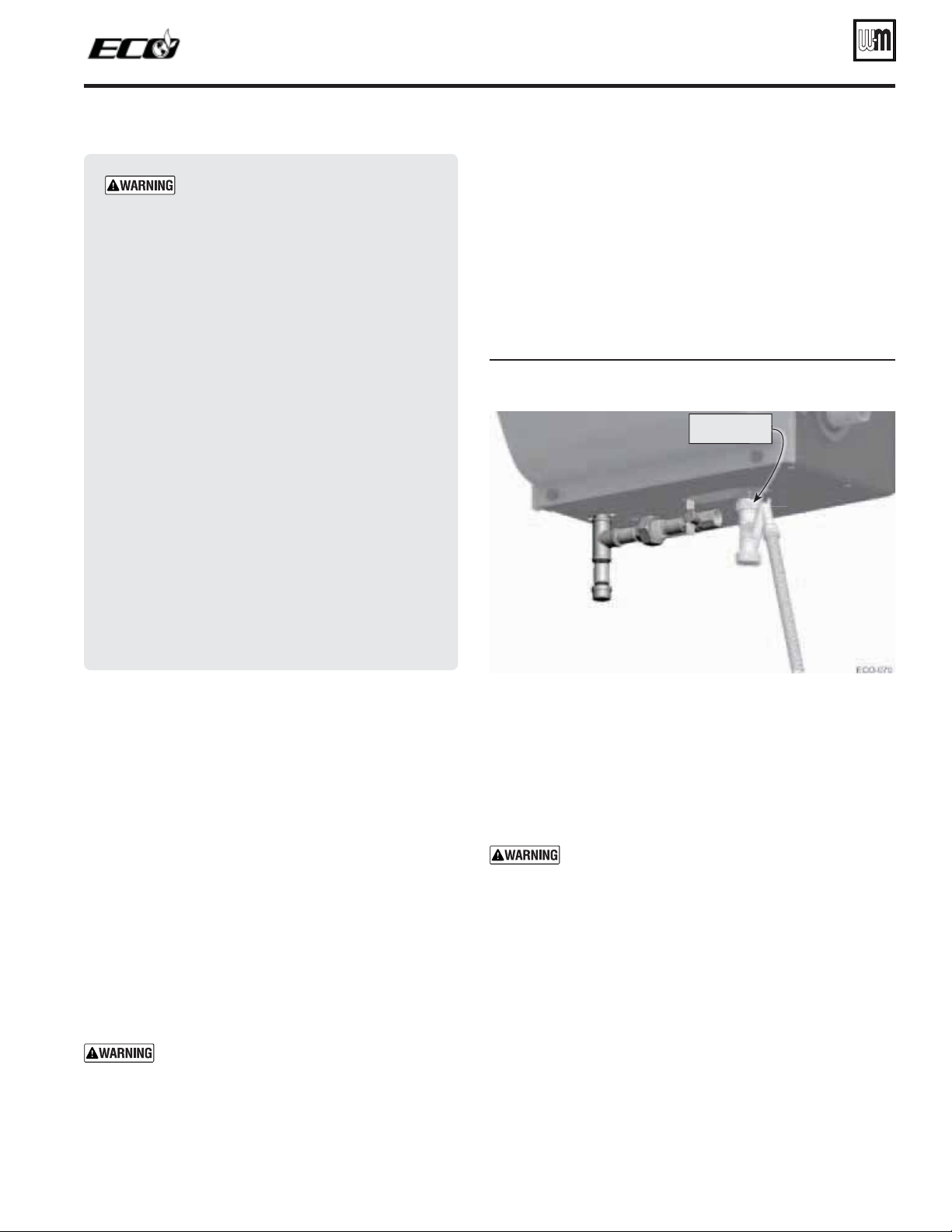
Startup — final checks
Check for gas leaks
Before starting the boiler, and during initial operation,
use a leak detector or smell near the floor and around
the boiler for gas odorant or any unusual odor. Remove
boiler jacket door and smell the interior of the boiler
jacket.
$ONOTPROCEEDWITHSTARTUPIFTHEREISANY
INDICATIONOFAGASLEAK2EPAIRANYLEAKATONCE
.
$/./4ADJUSTORATTEMPTTOMEASUREGASVALVEOUT-
LETPRESSURE
The gas valve is factory-set for the correct
outlet pressure. This setting is suitable for natural gas
and propane, requiring no field adjustment. Attempting
to alter or measure the gas valve outlet pressure could
result in damage to the valve, causing potential severe
personal injury, death or substantial property damage.
0ROPANEBOILERSONLY — Your propane supplier mixes
an odorant with the propane to make its presence de-
tectable. In some instances, the odorant can fade, and
the gas may no longer have an odor. Before startup
(and periodically thereafter), have the propane supplier
verify the correct odorant level in the gas.
Check thermostat circuits
1. Disconnect wires connected to the $(7AND(%!4 ther-
mostat terminals (see Field wiring, beginning on page 56
for low voltage terminal locations and application infor-
mation). Mark the wires before removing to avoid wiring
errors when re-connecting them.
2. Connect a voltmeter across each pair of incoming wires.
Close each thermostat, zone valve and relay in the external
circuits one at a time and check the voltmeter reading
across the incoming wires.
3.
4HERESHOULD.%6%2BEAVOLTAGEREADING
4. If a voltage does occur under any condition, check and
correct the external wiring.
$/./4CONNECTTHE%#/THERMOSTATTERMI-
NALSTOWIREZONEVALVES
. This could cause
ECO control damage.
5. Once the external thermostat circuit wiring is checked and
corrected if necessary, reconnect the external thermostat
circuit wires.
Inspect/fill condensate system
)NSPECTCHECKCONDENSATELINESANDlTTINGS
1. Inspect the condensate drain line, condensate PVC fittings and
condensate trap. (See page 54 for component locations.)
&ILLCONDENSATETRAPWITHWATER
1. Loosen the top nut that secures the condensate trap body to
the boiler condensate connection (see Figure 84). Pull the trap
down to disengage from heat exchanger.
&IGURE
Disconnect condensate trap assembly to fill trap
body with water
Nut
2. Pull the trap body forward enough to allow pouring water into
the top of the trap.
3. Fill the trap with fresh water until water begins to run into the
condensate drain tube.
4. Reattach the trap body by sliding onto the boiler condensate
outlet, then retightening the trap body nut.
The condensate trap must be filled with water during
all times of boiler operation to avoid flue gas emission
from the condensate drain line. Failure to fill the trap
could result in severe personal injury or death.
Part number 550-142-122/0513
77
TM
GAS-FIRED WATER BOILER — Boiler Manual

Startup — final checks (continued)
Final checks before starting boiler
❏
Read the instructions to adjust and set up the ECO control.
❏
Verify that the boiler model is set correctly in the ECO con-
trol, and that it displays correctly.
❏
Verify that the boiler and system are full of water and all
system components are correctly set for operation.
❏
Verify that condensate trap is filled with water.
❏
Verify electrical connections are correct and securely at-
tached.
❏
Inspect vent piping and air piping for signs of deteriora-
tion from corrosion, physical damage or sagging. Verify air
piping and vent piping are intact and correctly installed per
this manual.
To start the boiler
1. Apply power to the blower via the service switch.
2. Follow the Operating Instructions, Figure 85, page 79.
3. The ECO control display will show installed sensors when
first powered. Make sure the right sensors are detected and
the correct boiler model is identified. If not, determine the
cause and correct before proceeding.
If boiler does not start correctly
1. Check for loose connections, blown fuse or service switch off?
2. Are external limit controls (if used) open? Is boiler water
temperature above 200 °F?
3. Are thermostats set below room temperature?
4. Is gas turned on at meter and boiler?
5. Is incoming gas pressure less than the minimum values given
on page 17?
6. Are ECO control settings correct for the application?
7. Is the warm weather shutdown activated?
8. If none of the above corrects the problem, refer to Trouble-
shooting, beginning on page 90.
❏ Check system and boiler
❏#HECKWATERPIPING
1. Check system piping for leaks. If found, shut down boiler and
repair immediately. (See WARNING on page 75 regarding
failure to repair leaks.)
2. Vent any remaining air from system using manual vents. Air
in the system will interfere with circulation and cause heat
distribution problems and noise.
❏#HECKVENTPIPINGANDAIRPIPING
1. Check for gas-tight seal at every connection and seam of air
piping and vent piping.
Venting system must be sealed gas-tight to prevent
flue gas spillage and carbon monoxide emissions
which will result in severe personal injury or death.
❏#HECKGASPIPING
1. Check around the boiler and inside the boiler jacket for gas
odor following the procedure of page 55 of this manual.
If you discover evidence of any gas leak, shut down
the boiler at once. Find the leak source with bubble
test and repair immediately. Do not start boiler
again until corrected. Failure to comply could re-
sult in severe personal injury, death or substantial
property damage.
❏0ROPANEBOILERSVERIFYCONVERSION
1. Verify boiler has been converted for propane. See page 13 for
ECO 70 or 110 or page 15 for ECO 155.
DO NOT attempt to mea-
sure gas valve outlet pres-
sure
DO NOT adjust or attempt to measure gas valve outlet
pressure. The gas valve is factory-set for the correct outlet
pressure. This setting is suitable for natural gas and propane,
requiring no field adjustment.
Attempting to alter or measure the gas valve outlet pressure
could result in damage to the valve, causing potential severe
personal injury, death or substantial property damage.
ECO boilers are shipped ready to fire natural gas ONLY.
Failure to comply could result in severe personal injury,
death or substantial property damage.
❏#HECKmAMECOMBUSTIONWITHINSTRUMENTS
1. Initiate a call for heat on one of the thermostat inputs.
2. Access the ECO control installer menus by pressing and
holding the UP and DOWN arrow keys for seven seconds.
3. See page 69 and Figure 77, page 70. Make sure the Max firing
rate is set to the maximum given in the table. If not, adjust
as necessary. Then navigate to DIAGNOSTICS — Manual
test mode (see Figure 80, page 72) and force the firing rate
to HIGH (high fire).
4. Look at the flame through the flame inspection window.
The high fire flame should be blue and should be stable. The
burner surface should be covered with orange dots.
5.
)NSERT COMBUSTION ANALYZER PROBE — Remove the flue
temperature sensor from the flue pipe and insert a combus-
tion test probe.
6. Test for CO
2
(or O
2
) and for CO. The CO
2
values must comply
with Figure 88, page 81. If results are acceptable, proceed to
step 7. )&./4, follow the instructions under “Throttle Screw
Adjustment” on page 80 or page 81 to set the throttle screw
position. See
7!2.).' on page 80 upper left.
CONTINUED AFTER NEXT PAGE
Part number 550-142-122/0513
78
TM
GAS-FIRED WATER BOILER — Boiler Manual
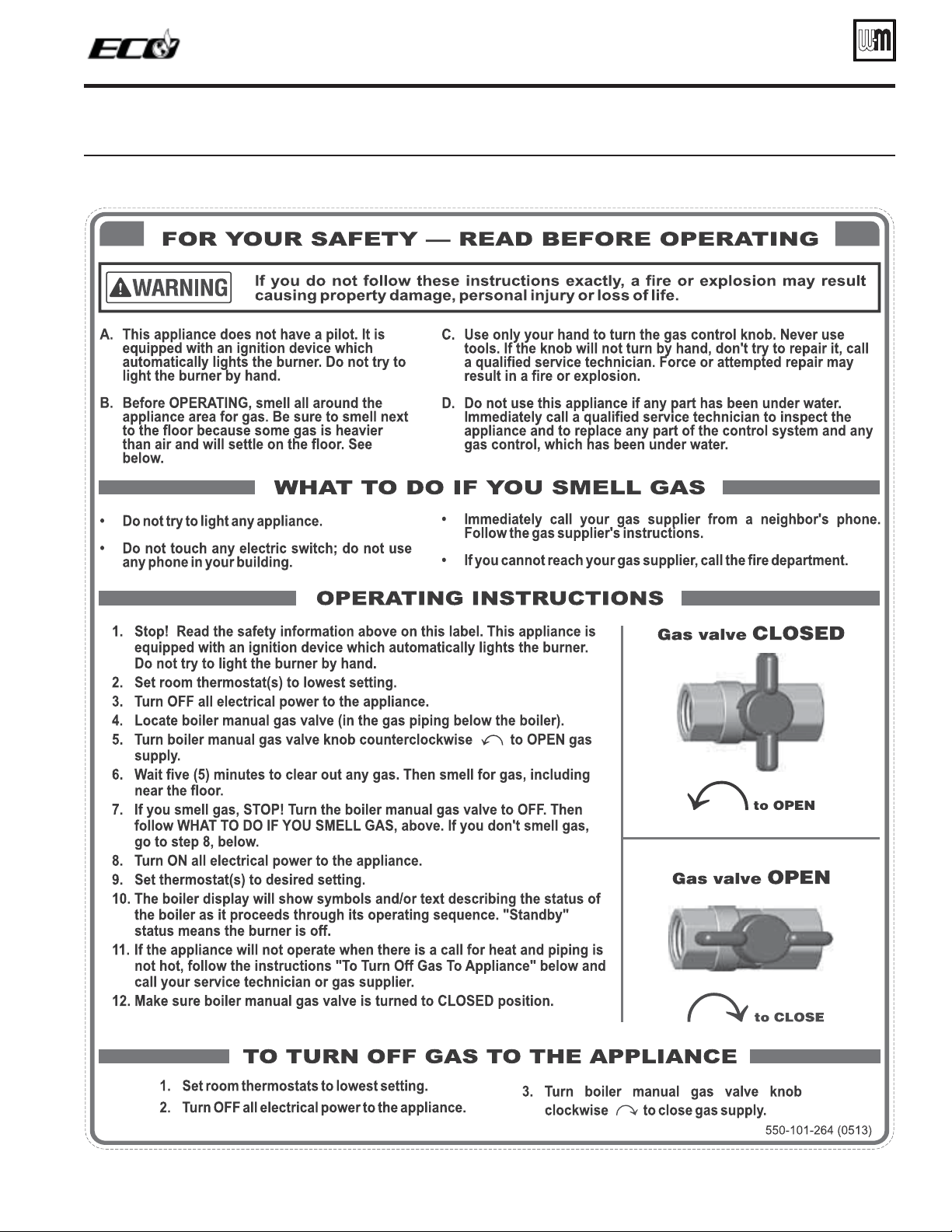
Startup — final checks (continued)
&IGURE Operating instructions (WARNING — Verify that the ECO control is set for the correct boiler model before
proceeding.)
Part number 550-142-122/0513
79
TM
GAS-FIRED WATER BOILER — Boiler Manual
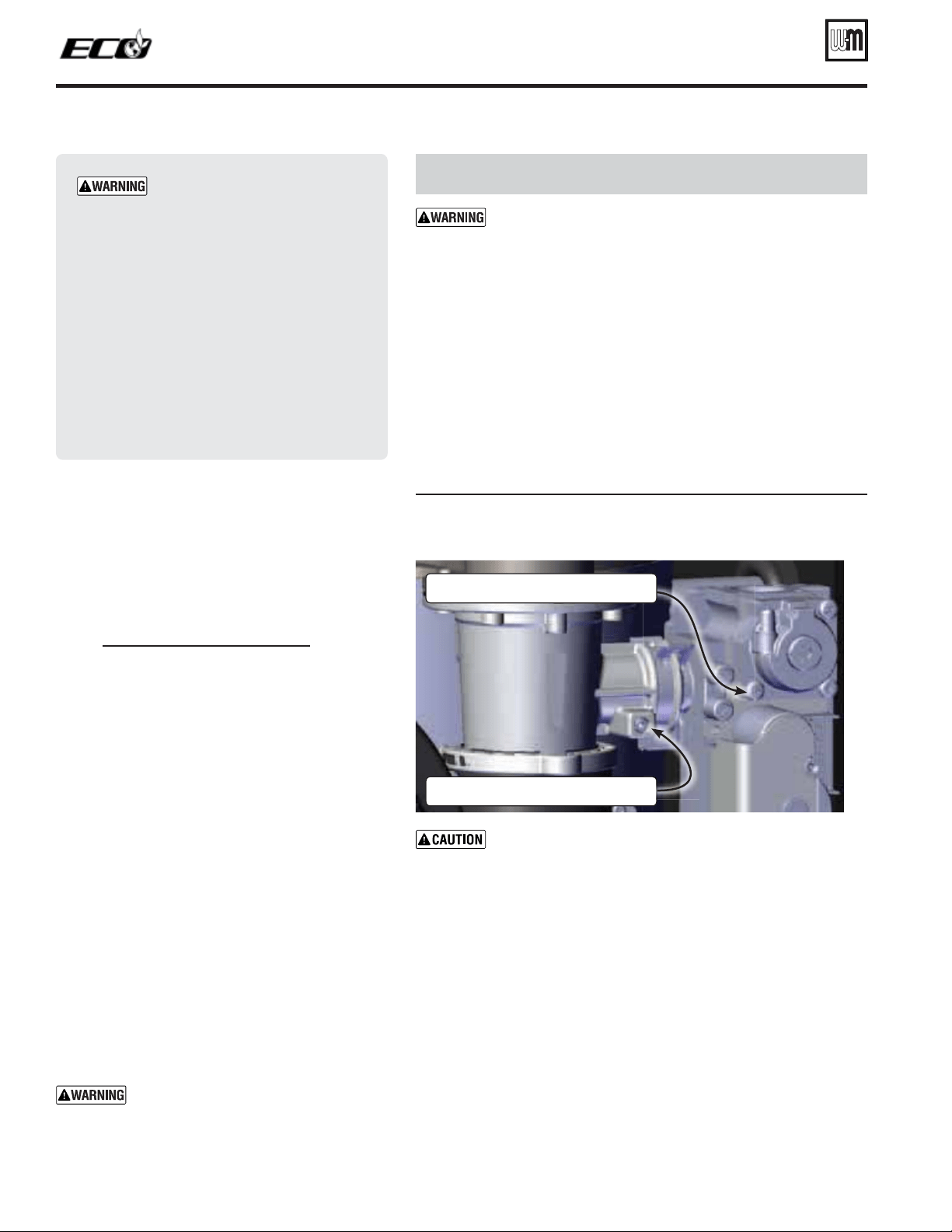
Startup — final checks (continued)
If combustion at either high or
low fire is outside the range given
in Figure 87, page 81, follow the
procedure given on page 80 or
page 81 for adjusting the throttle
screw on the venturi. If throttle
screw adjustment does not correct
the problem, then shut down the
boiler and contact your local Weil-
McLain representative. Throttle
screw adjustment must be done
only by a qualified technician,
using calibrated test instruments.
Failure to comply could result in
severe personal injury, death or
substantial property damage.
7. Measure natural gas input:
a. Operate boiler 10 minutes. Turn off other ap-
pliances.
b. At natural gas meter, measure time (in seconds)
required to use one cubic foot of gas.
c. Calculate gas input:
3600 x 1000
= Btuh
number of seconds from step b
d. Btuh calculated should approximate input rat-
ing on boiler rating label.
8. Use the ECO control display to navigate to Manual
test mode (see Figure 80, page 72) and force the
firing rate to LOW (low fire).
9. Look at the flame through the flame inspection
window. The low fire flame should be stable and
evenly distributed over burner surface with a uni-
form orange color.
10. Repeat the combustion test as instructed in the
previous steps.
11. Use the ECO control display to navigate to Manual
test mode (see Figure 80, page 72) and force the
firing rate to AUTO (normal operation).
12. Reinstall the flue gas temperature sensor. When
replacing the sensor, remove the rubber grommet
from the probe. Insert the rubber grommet into
the flue pipe, then insert the probe into the rubber
grommet.
You must reinstall the flue gas tempera-
ture sensor to prevent flue gas spillage
into the boiler enclosure. Failure to com-
ply could result in severe personal injury,
death or substantial property damage.
Throttle screw adjustment
%#/OR/.,9
$/./4 attempt to adjust the throttle screw unless by a quali-
fied technician, and with the use of calibrated combustion
test instruments. Adjust the throttle screw only as needed to
meet the combustion values given in Figure 87
1. Throttle screw adjustment is
ONLYNECESSARYif specified elsewhere in
this manual or if combustion tests indicate the need, as explained under
“❏#HECKmAMECOMBUSTIONWITHINSTRUMENTS,” page 78.
2. Boiler behavior that might indicate a need to check combustion values
at high fire (as per page 78) to verify boiler is in adjustment include:
difficulty igniting, poor flame stability at low fire, combustion noise
or high carbon monoxide values.
3. Combustion readings must be taken at both high fire and low fire. DO
NOT attempt an adjustment of the throttle screw at low fire. Just check
the combustion values.
4. See Figure 86 for location of the
%#/OR throttle screw.
&IGURE
%#/ Throttle screw (ONLY for use by a
qualified technician, using calibrated combustion test
instruments)
4HROTTLEADJUSTMENTSCREW
'ASINLETPRESSURETESTPORT
Adjust the throttle screw in small movements. Turning the
screw too far will cause the adjustment to reverse behavior.
5. See page 69 and Figure 77, page 70. Make sure the Max firing rate is set
to the maximum given in the table. If not, adjust as necessary. Then navi-
gate to DIAGNOSTICS — Manual test mode (see Figure 80, page 72)
and force the firing rate to HIGH (high fire). After the boiler has had
time to stabilize, take a CO
2
reading. If result is not acceptable, do the
following:
a. Turn the throttle screw either direction very slightly. Allow the
boiler to stabilize and take another CO
2
reading. Note whether CO
2
increases or decreases.
b. Turn the screw slightly in the direction needed to increase or
decrease reading as needed. Allow the boiler to stabilize and take
another reading. Continue until CO
2
is acceptable.
6. Lock the boiler into low fire. Check the combustion readings. If results
are acceptable at low fire, verify high fire readings again. Restore firing
rate to AUTO. DO NOT adjust throttle on low fire.
7. Consult your local Weil-McLain representative if acceptable results
cannot be obtained for both high and low fire.
Part number 550-142-122/0513
80
TM
GAS-FIRED WATER BOILER — Boiler Manual
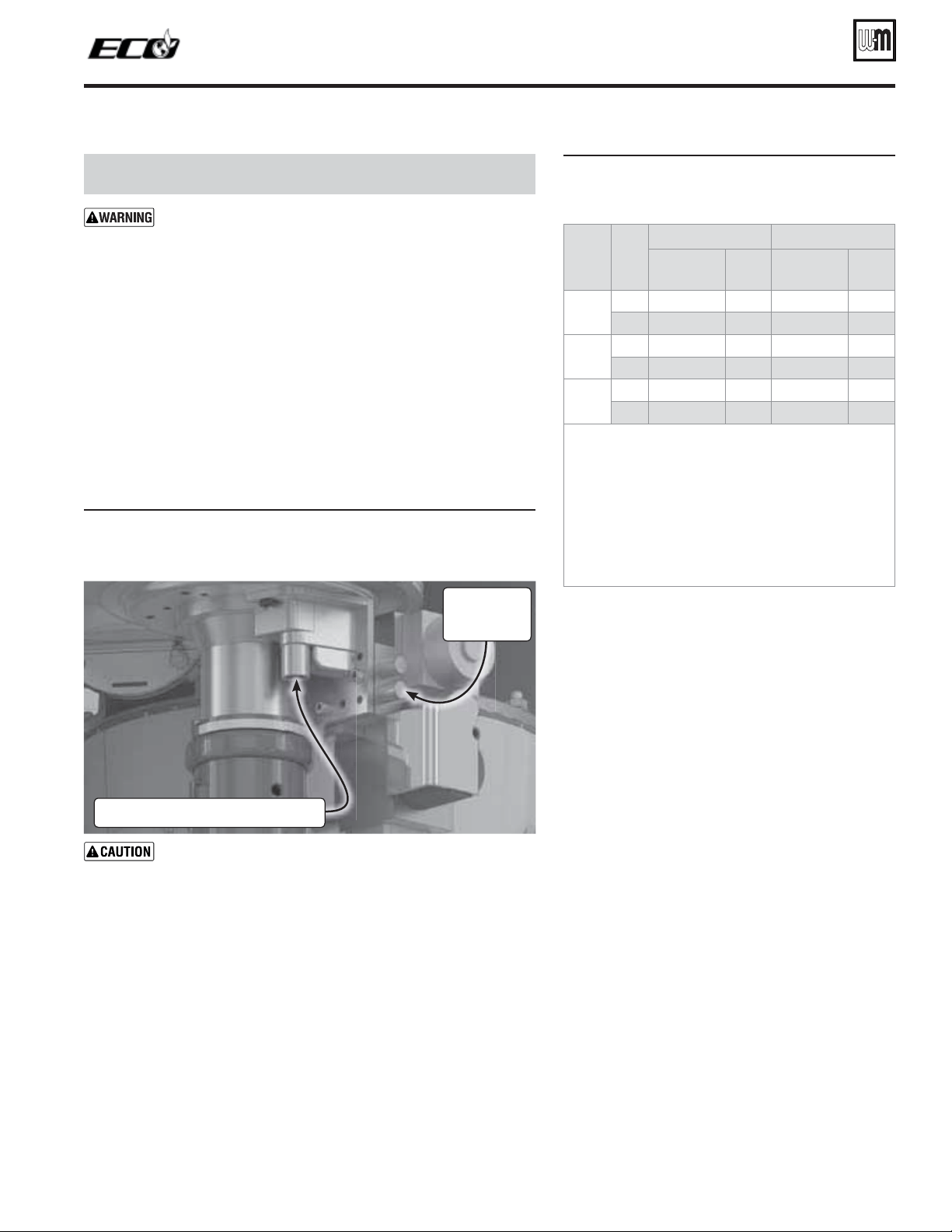
Startup — final checks (continued)
Throttle screw adjustment
%#//.,9
$/./4 attempt to adjust the throttle screw unless by a quali-
fied technician, and with the use of calibrated combustion
test instruments. Adjust the throttle screw only as needed to
meet the combustion values given in Figure 87.
1. Throttle screw adjustment is
ONLYNECESSARY when specified else-
where in this manual or when combustion tests indicate the need, as
explained under “❏#HECKmAMECOMBUSTIONWITHINSTRU-
MENTS,” page 78.
2. Boiler behavior that might indicate a need to check combustion values
at high fire (as per page 78) to verify boiler is in adjustment include:
difficulty igniting, poor flame stability at low fire, combustion noise
or high carbon monoxide values.
3. Combustion readings must be taken at both high fire and low fire. DO
NOT attempt an adjustment of the throttle screw at low fire. Just check
the combustion values.
4. See Figure 87 for location of the
%#/ throttle screw.
&IGURE
%#/ Throttle screw (ONLY for use by a qualified
technician, using calibrated combustion test
instruments)
Gas inlet
PRESSURE
TESTPORT
4HROTTLEADJUSTMENTSCREW
Adjust the throttle screw in small movements.
5. See page 69 and Figure 77, page 70. Make sure the Max firing rate is set
to the maximum given in the table. If not, adjust as necessary. Then navi-
gate to DIAGNOSTICS — Manual test mode (see Figure 80, page 72)
and force the firing rate to HIGH (high fire). After the boiler has had
time to stabilize, take a CO
2
reading.
a. If the CO
2
is HIGH, turn the throttle screw CLOCKWISE to lower
the input. Allow the boiler to stabilize and take another reading.
Continue until the desired CO
2
value is achieved.
b. If the CO
2
is LOW, turn the throttle screw COUNTERCLOCKWISE
to increase the input. Allow the boiler to stabilize and take another
reading. Continue until the desired CO
2
value is achieved.
6. Lock the boiler into low fire. Check the combustion readings. If results
are acceptable at low fire, verify high fire readings again. Restore firing
rate to AUTO. DO NOT adjust throttle on low fire.
7. Consult your local Weil-McLain representative if acceptable results
cannot be obtained for both high and low fire.
Boiler
MODEL
Fuel
(IGHlRE ,OWlRE
%
CO
2
CO
ppm
%
CO
2
CO
ppm
70
NG 9.25 +/
–
1.0 < 150 9.25 +/
–
1.0 < 50
LP 10.0 +/
–
0.5 < 150 10.0 +/
–
0.5 < 50
110
NG 9.25 +/
–
1.0 < 150 9.25 +/
–
1.0 < 50
LP 10.0 +/
–
0.5 < 150 10.0 +/
–
0.5 < 50
155
NG 9.25 +/
–
1.0 < 150 8.75 +/
–
1.0 < 50
LP 10.25 +/
–
0.5 < 150 9.75 +/
–
0.5 < 50
s 6ALUES ABOVE AREWITHTHEBOILER JACKET DOOR
REMOVED. Values will increase about 0.2% once the
jacket door is reinstalled.
s
2%).34!,, the boiler jacket door after completing
service.
s 6ALUESABOVEAREFORALTITUDESUPTOFEET&ORHIGHER
altitudes, CO
2
may be slightly lower and CO slightly
higher.
s Low fire CO
2
should be equal to or less than High fire CO
2
.
❏#HECKEXCHANGERANDVENTSEALS
1. Operate the boiler on HIGH fire.
2. Using an inspection mirror, move the mirror
around all heat exchanger joints and vent pipe
connections at the top of the boiler and at the con-
nection to the condensate dish.
3. A leak would appear as vapor on the surface of
the mirror.
4. If there is any indication of a leak at any joint, im-
mediately shut down the boiler.
a. If possible, tighten the retaining screws or nuts
(without over-tightening).
b. If this does not correct the problem, disassemble
the components where the leak appeared. Use
the procedures given in the Maintenance sec-
tion of this manual.
c. When disassembling components, inspect
gaskets to see if there is damage. Replace any
damaged gasket.
d. Contact your Weil-McLain representative if the
problem cannot be addressed with the informa-
tion provided in this manual.
5. Condensate dish joint
a. If the inspection mirror check shows a leak at
the condensate dish-to-heat exchanger joint,
contact your Weil-McLain representative for
instructions to correct the problem.
b. If the mirror test does not reveal a leak at the
condensate dish joint, but there are signs of
weepage or other indications that there might
be leakage, follow the procedure for checking
the heat exchanger-to-condensate dish seal on
page 99.
&IGURE Acceptable combustion values —
measured values must be within the
ranges given below
Part number 550-142-122/0513
81
TM
GAS-FIRED WATER BOILER — Boiler Manual
Check-out/startup verification
Adjust and test boiler controls
1. Follow instructions in this manual to set and verify operation
of the boiler controls.
2. Follow low water cutoff manufacturers instructions (if used).
Have the following been done?
❏
ECO control set for the correct boiler model?
❏
Installation date and time entered into ECO control?
❏
Boiler and heat distribution units filled with water?
❏
Water chemistry verified per page 75?
❏
Sentinel X100 corrosion inhibitor added and water tested to
be within range?
❏
Automatic air vents, if used, opened one full turn?
❏
Air purged from system?
❏
Air purged from gas piping? Piping checked for leaks?
❏
Condensate trap primed?
❏
Propane orifice bushing installed for propane firing and
propane conversion label affixed to jacket?
ECO boilers are shipped ready to fire natural gas
ONLY. To fire on propane, you must follow the
instructions in this manual to install the propane
orifice bushing. See page 13 for ECO 70 or 110 or
page 15 for ECO 155. Failure to comply could re-
sult in severe personal injury, death or substantial
property damage.
❏
Thermostat circuit wiring checked to ensure there are no
stray voltages?
❏
Followed Operating Instructions, Figure 85, page 79?
❏
Burner flame and combustion verified per page 78?
❏
ECO control operation for space heating and DHW (if used)
verified per this manual?
❏
Additional field-installed controls tested as outlined by
control manufacturers? (Boiler should be operating and
should go off when controls are tested. Verify controls cause
automatic reset lockout or manual reset lockout as desired.)
❏
Additional field-installed limit control(s) set to system
temperature requirements? Balancing valves and controls
adjusted to provide design temperature to system?
❏
Flow adjusted/balanced for each zone of multiple zones
systems?
❏
Thermostat heat anticipator (if available) set properly?
❏
Boiler cycled with thermostats (and with DHW aquastat, if
installed) — Raised to highest setting and verified boiler goes
through normal startup cycle? Lowered to lowest setting and
verified boiler goes off?
❏
Natural gas input measured? (page 80)
❏
Incoming gas pressure checked by connecting manometer to
gas valve ahead of boiler? (Gas pressure must be at least the
minimum values given on page 17, with boiler operating at
high fire, and no more than 13 inches (330 mm) w.c. with
boiler operating or boiler off.)
❏
Observed several operating cycles for proper operation?
❏
Room thermostats set to desired room temperature (and
DHW aquastat, if installed, to desired DHW storage tem-
perature)?
❏
All instructions shipped with this boiler reviewed with owner
or maintenance person?
Before leaving:
❏
Fill in )NSTALLATIONCERTIlCATE, page 121.
❏
Fill out the warranty registration card and send to Weil-McLain.
❏
Return instructions to envelope and give to owner or place
inside boiler housing.
Fill out start-up data on the In-
stallation and Service Certificate,
page 121.
Part number 550-142-122/0513
82
TM
GAS-FIRED WATER BOILER — Boiler Manual
Annual startup and general maintenance
&IGURE Service and maintenance schedules
Follow the service and maintenance procedures given throughout this manual and in component literature shipped
with the boiler. Failure to perform the service and maintenance could result in damage to the boiler or system. Failure to
follow the directions in this manual and component literature could result in severe personal injury, death or substantial
property damage.
/WNERMAINTENANCE
(see %#/ User’s Information Manual)
$AILY
s #HECKBOILERAREA
s #HECKAIROPENINGS
s #HECKPRESSURE
TEMPERATUREGAUGE
s 6ERIFYBOILERJACKETDOORIS
SECURELYINPLACE
-ONTHLY
s #HECKVENTPIPING
s #HECKAIRPIPING
s #HECKRELIEFVALVE
s #HECKCONDENSATEDRAIN
SYSTEM
s #HECKAUTOMATICAIRVENTS
IFUSED
s 6ERIFYTHATDOMESTICHOT
WATERISBEINGSUPPLIED
TOlXTURESATTHECORRECT
TEMPERATURE
%VERY
MONTHS
s #HECKBOILERPIPINGGAS
ANDWATER
s /PERATERELIEFVALVE
3ERVICETECHNICIAN
(see page numbers indicated for details)
!..5!,34!24503EE&IRSTYEARSPECIALINSPECTION
s !DDRESSREPORTEDPROBLEMS 85
s )NSPECTBOILERAREA 85
s )NSPECTBOILERINTERIORJACKETDOORGASKETS 85
s #LEANCONDENSATETRAP 85
s #HECKALLPIPINGFORLEAKS 85
s #HECKAIROPENINGS 86
s &LUEVENTSYSTEMANDAIRPIPING 86
s #HECKWATERSYSTEM 86
s #HECKEXPANSIONTANKS 86
s )NSPECTIGNITIONELECTRODE 86
s #HECKIGNITIONWIRING 87
s #HECKALLBOILERWIRING 87
s #HECKCONTROLSETTINGS 87
s 0ERFORMSTARTUPANDCHECKS 87
s #HECKLOWWATERCUTOFFSERVICELIGHTIFUSED87
s #HECKBURNERmAME 87
s #HECKmAMESIGNAL 87
s #HECKBLOWERSPEEDS 88
s #HECKmUEGASTEMPERATURE 88
s #HECKBOILERRELIEFVALVE 89
s 2EINSTALLJACKETDOORAFTERSERVICING 89
s 2EVIEWWITHOWNER 89
Part number 550-142-122/0513
83
TM
GAS-FIRED WATER BOILER — Boiler Manual
Annual startup
HANDLING CERAMIC FIBER
MATERIALS
2%-/6).'"52.%2'!3+%4OR
#/6%20,!4%).35,!4)/.
The ECO cover plate refractory
contain ceramic fiber material.
Ceramic fibers can be converted to
cristobalite in very high temperature
applications.
The International Agency for Research
on Cancer (IARC) has concluded,
“Crystalline silica inhaled in the
form of quartz or cristobalite from
occupational sources is carcinogenic
to humans (Group 1).”:
■ Avoid breathing dust and contact with skin and
eyes.
s Use NIOSH certified dust respirator (N95).
This type of respirator is based on the OSHA
requirements for cristobalite at the time
this document was written. Other types of
respirators may be needed depending on
the job site conditions. Current NIOSH
recommendations can be found on the
NIOSH web site at http://www.cdc.gov/
niosh/homepage.html. NIOSH approved
respirators, manufacturers, and phone
numbers are also listed on this web site.
s Wear long-sleeved, loose fitting clothing,
gloves, and eye protection.
■ Handle carefully to minimize dust that could
be caused by abrasion.
■ If replacement is necessary, remove the refrac-
tory from the boiler and place it in a plastic bag
for disposal.
■ Wash potentially contaminated clothes sepa-
rately from other clothing. Rinse clothes washer
thoroughly.
.)/3(STATED&IRST!ID
■ Eye: Irrigate immediately
■ Breathing: Fresh air.
FIRST-YEAR SPECIAL INSPECTION
)TISRECOMMENDEDTHATYOUOBTAINA7EIL-C,AIN
"OILER -AINTENANCE KIT BEFORE ATTEMPTING THE
lRSTYEARINSPECTIONTOENSUREALLPARTSTHATMAY
BENEEDEDAREAVAILABLE
. This kit includes a heat ex-
changer cover plate gasket, burner gasket, new ignitor,
and ignitor gasket. See listing in Replacement parts sec-
tion of this manual. These parts must be on hand when
you perform the first-year inspection in the event they
must be replaced.
Failure to replace the items above when needed could
result in severe personal injury, death or substantial
property damage.
1. .OLATERTHANMONTHS after the boiler is installed, perform a
first-year inspection of the boiler. This should include the following
INADDITIONTOROUTINEANNUALSTARTUPPROCEDURES.
a. Inspect the heat exchanger and clean if necessary (see page 100,
ECO 70 or 110, or page 103, ECO 155, for access and cleaning
procedures).
b. Inspect the cover plate refractory and gasket. Replace if not in
good condition.
c. Inspect the burner and inspect carefully. Clean the burner thor-
oughly using a vacuum cleaner and compressed air if needed.
d. Make sure there is no blockage or accumulation of debris in
the burner or the burner ports. Replace the burner if necessary.
e. ECO 70 or 110: Check the burner for tightness. Remove the
cover plate refractory and tighten the burner mounting screws
if needed, following the instructions on page 100.
f. ECO 155: Check burner access cover for tightness.
g. Make sure to follow the inspection procedure given in “Check
exchanger and vent seals,” page 81.
h. Disconnect the condensate trap and drain lines. Inspect, then
flush thoroughly. Reinstall and refill the trap per page 77.
2. Determine any follow-up maintenance and service needs based on
the condition of the heat exchanger and condensate lines.
a. If the heat exchanger shows substantial fouling, or if condensate
lines show accumulation of sediment, schedule a follow-up
service call to perform the first-year inspection again, sooner
than the normal twelve months between.
b. Heavy fouling of the exchanger or condensate lines indicates
possible combustion air contamination. Inspect the air intake
area carefully, and remove possible contaminants. See page 18,
for products to avoid.
You must eliminate causes of corrosion and contamina-
tion to ensure reliable operation of the boiler and system.
Part number 550-142-122/0513
84
TM
GAS-FIRED WATER BOILER — Boiler Manual
Annual startup (continued)
The boiler should be inspected and
started annually, at the beginning of
the heating season, only by a qualified
service technician. In addition, the
maintenance and care of the boiler
designated in Figure 89, page 83 and
explained on the following pages must
be performed to assure maximum
boiler efficiency and reliability. Fail-
ure to service and maintain the boiler
and system could result in equipment
failure.
Electrical shock hazard — Turn off
power to the boiler before any service
operation on the boiler except as noted
otherwise in this instruction manual.
Failure to turn off electrical power
could result in electrical shock, causing
severe personal injury or death.
Address reported problems
1. Inspect any problems reported by owner and correct before
proceeding.
Inspect boiler area
1. Verify that boiler area is free of any combustible materials,
gasoline and other flammable vapors and liquids.
2. Verify that air intake area is free of any of the contaminants
listed on page 18 of this manual. If any of these are present
in the boiler intake air vicinity, they must be removed. If
they cannot be removed, reinstall the air and vent lines per
this manual.
Inspect boiler interior & jacket door
gaskets
1. Remove jacket door and inspect interior of boiler.
2. Visually inspect the jacket door gaskets on front of cabinet.
Make sure all are in good condition. Obtain replacements if
any gasket is damaged.
Jacket door gaskets must be intact, and must pro-
vide a reliable seal. Replace any damaged gasket.
3. Remove the venturi air inlet silencer and clean if necessary.
Reinstall silencer.
4. Vacuum any sediment from the inside of the boiler and
components. Remove any obstructions.
Do not use solvents to clean any of the boiler
components. The components could be damaged,
resulting in unreliable or unsafe operation.
Clean condensate trap
1. See Figure 90.
2. Disconnect top nut that secures the trap body to the boiler
condensate connection (see Figure 59, page 54).
3. Remove the cleanout cap and remove the trap internal parts
as shown.
4. Clean all trap components.
5. Re-assemble trap assembly. Re-install all lower gaskets.
6. Make sure the trap ball moves freely when re-inserted.
7. Fill trap with fresh water by pouring into the top of the trap
body. Continue filling slowly until water begins flowing out
the condensate drain line. Make sure the trap line is unob-
structed and flows freely.
8. Reattach the trap to the boiler condensate outlet. Push the
trap up until fully engaged. Then twist the upper nut clock-
wise to tighten. Check for secure connection.
&IGURE
Condensate trap cleaning
4RAPBALL
5PPERNUT
#LEANOUTCAP
6ALVESEAT/RING
ANDGASKET
#ONDENSATE
drain line
Check all piping for leaks
Eliminate all system or boiler leaks. Continual fresh
make-up water will reduce boiler life. Minerals
can build up in the heat exchanger, reducing heat
transfer, overheating heat exchanger, and causing
heat exchanger failure. Leaking water may also
cause severe property damage.
1. Inspect all water and gas piping and verify to be leak free.
2. Look for signs of leaking lines in the system and in the boiler
and correct any problems found.
3. Check gas line using procedure on page 55.
Part number 550-142-122/0513
85
TM
GAS-FIRED WATER BOILER — Boiler Manual

Annual startup (continued)
Check air openings
1. Verify that combustion and ventilation air openings
to the boiler room and/or building are open and un-
obstructed.
2. Check operation and wiring of automatic combustion
air dampers, if used.
3. Verify that boiler vent discharge and air intake are clean
and free of obstructions.
Flue vent system and air piping
1. Visually inspect entire flue gas venting system and
combustion air piping for blockage, deterioration or
leakage. Repair any joints that show signs of leakage in
accordance with vent manufacturer’s instructions. Verify
that air inlet piping is connected and properly sealed.
Failure to inspect for the above conditions
and have them repaired can result in severe
personal injury or death.
Check water system
1. Verify all system components are correctly installed and
operational.
2. Check the cold fill pressure for the system. Verify it is
correct (usually around 12 PSIG).
3. Watch the system pressure as the boiler heats up (dur-
ing testing) to ensure pressure doesn’t rise too high.
Excessive pressure rise indicates expansion tank sizing
or performance problem.
4. Inspect automatic air vents and air separators. Remove
air vent caps and briefly press push valve to flush vent.
Reinstall caps. Make sure vents do not leak. Replace any
leaking vents.
5. Check system water chemistry (pH, hardness and inhibi-
tor level). See page 75.
Check expansion tank(s)
1. Expansion tanks provide space for water to move in
and out as the heating system water expands due to
temperature increase or contracts as the water cools.
2. See page 37 or page 42 depending on system type for
information.
3. Tank types
s Closed-type — welded gas tight and located above
boiler. Tank is partially filled with water, leaving an
air cushion for expansion.
s Make sure a closed-type tank is fitted with a
tank fitting, such as the B & G Tank-trol or Taco
Taco-trol. This fitting reduces gravity circulation
of air-saturated tank water back to the system
and prevents the air from bubbling up through
the water as it returns from the system.
s Do not use automatic air vents in systems with closed-
type tanks. The air will escape from the system instead
of returning to the tank.
s Eventually, the tank will waterlog and no longer con-
trol pressurization. The boiler relief valve will weep
frequently.
s
Diaphragm- or bladder-type — welded gas tight with a
rubber membrane to separate the tank pressurizing air and
the water. May be located at any point in the system, but
preferably located on the suction side of the system circulator.
s Systems with this type of expansion tank require at least
one automatic air vent, preferably located on top of an
air eliminator, as shown in examples in this manual.
4. If relief valve has tended to weep frequently, the expansion tank
my be water logged or undersized.
a.
$IAPHRAGMORBLADDERTYPEEXPANSIONTANK — first, check
tank size to be sure it is large enough for the system. If size
is too small, add additional tank (or tanks) as necessary to
provide sufficient expansion. If tank size is large enough,
remove tank from system and check charge pressure (usu-
ally 12 PSIG for residential applications). If tank won’t hold
pressure, membrane has been damaged. Replace tank.
b.
#LOSEDTYPEEXPANSIONTANK — tank is most likely water-
logged. Install a tank fitting if not already installed. Then
check fill level per fitting manufacturer’s instructions. If
fill level is correct, check tank size against manufacturer’s
instructions. Replace with a larger tank if necessary.
Inspect ignition electrode
1. Remove the ignition electrode from the boiler heat exchanger
access cover (see item 23, page 3). (Disconnect the ground wire
and ignition cable connected to the electrode.)
2. Remove any white oxides accumulated on the ignition electrode
using steel wool. If the ignition electrode cannot be cleaned
satisfactorily, replace ignitor with a new one.
3. Reinstall ignition electrode, making sure gasket is in good condi-
tion and correctly positioned.
4/215%,)-)4 — Use a torque wrench when tight-
ening the two ignition electrode retainer screws. DO
NOT exceed 20 inch-pounds.
4. Re-attach the ground wire to the electrode assembly.
Part number 550-142-122/0513
86
TM
GAS-FIRED WATER BOILER — Boiler Manual
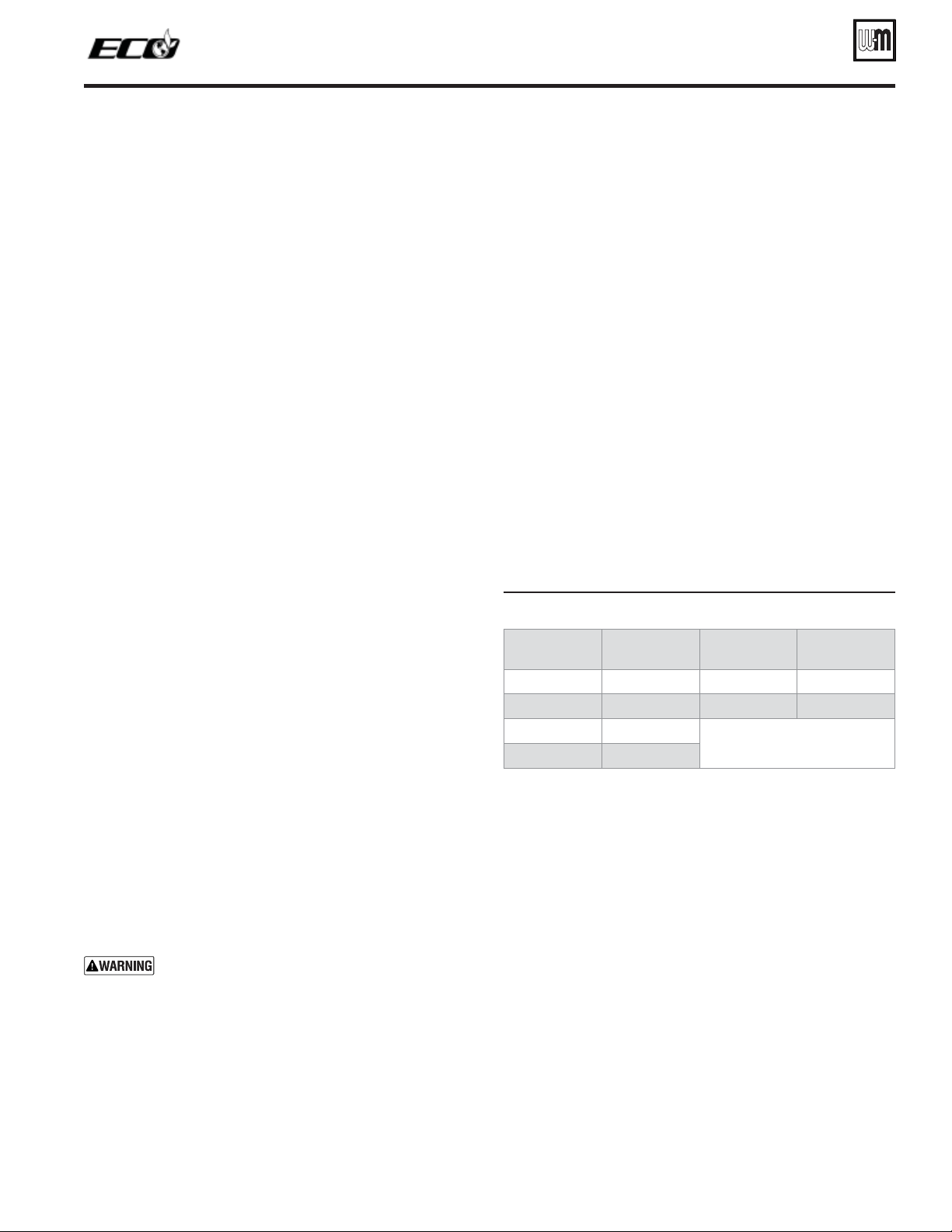
Annual startup (continued)
Check ignition wiring
1. Check ignition cable electrical resistance. A good cable will
have resistance between 950 and 1050 ohms. Replace if not
acceptable.
2. Inspect boiler ground wire from heat exchanger access cover
to ground terminal screw.
3. Verify all wiring is in good condition and securely attached.
4. Check ground continuity of wiring using continuity meter.
5. Replace ground wires if results are not satisfactory.
Check all boiler wiring
1. Inspect all boiler wiring, making sure wires are in good condi-
tion and securely attached.
2. Verify that all connectors are securely inserted.
Check control settings
1. Use the ECO control display to navigate through all settings.
Adjust settings if necessary.
2. Check settings of external limit controls (if any) and adjust
if necessary. Adjust as needed to accommodate the system
design.
Perform startup and checks
1. Start boiler and perform checks and tests specified in this
manual.
2. Verify cold fill pressure is correct and that operating pressure
does not go too high. Adjust water pressure and expansion
tank charge pressure as necessary.
3. Complete the check-out procedure on page 82.
Check low water cutoff service light
(if used)
1. If the low water cutoff amber LED is on, the device requires
service. Follow the low water cutoff manufacturer’s instruc-
tions.
Check burner flame
The boiler contains ceramic fiber materials. Use
care when handling these materials per instructions
on page 84 of this manual. Failure to comply could
result in severe personal injury.
1. Inspect flame through observation window using the pro-
cedure on page 78.
2. If flame is unsatisfactory at either high fire or low fire, check
combustion values. If combustion is properly adjusted, turn
off boiler and allow boiler to cool down. Then remove burner
and clean it thoroughly using a vacuum cleaner or compressed
air. Do not use compressed air to clean burner if performed
inside a building.
3. To access the burner, remove the heat exchanger cover plate
following the procedure beginning on page 100 or 103.
4. If replacing the burner, ensure the burner gasket is in good
condition and correctly positioned. Follow all instructions
on page 100 or 103 to reinstall all components.
5. Restart the boiler.
6. Inspect the flame at high and low fire. If flame is still not ac-
ceptable, check combustion values. If combustion is properly
adjusted, obtain a replacement burner from Weil-McLain.
Check flame signal
1. Navigate to Diagnostics/Inputs on the ECO control display
(see Figure 71, page 66 for navigation instructions and Fig-
ure 80, page 72 for the complete Diagnostics menus).
2. The flame signal value must be at least 75 for a ECO 70 or
110, or at least 160 for the ECO 155. If the flame signal drops
below this level, the ECO control will attempt to correct by
increasing the blower speed to increase flame signal.
&IGURE
Flame signal shutdown values
Model
%#/
3HUTDOWN
mAMESIGNAL
Model
%#/
3HUTDOWN
mAMESIGNAL
70 50 155 150
70 HA 50 155HA 150
110 50
NOTE: “HA” means high altitude,
5500 feet or more above seal level.
110 HA 50
3. A low flame signal may indicate a fouled ignitor or damaged
ignitor insulation.
a. See “Inspect ignition electrode,” page 86 to remove and
inspect the ignitor.
b. If required, clean the igniter as instructed.
c. If cleaning the ignitor does not improve, ground wiring is
in good condition, and ground continuity is satisfactory,
replace the ignitor.
4. If flame signal still remains low:
a. Inspect the vent and air piping.
b. Check combustion values.
c. Then inspect the heat exchanger, following the procedures
given in this manual for removal and reinstallation of the
heat exchanger cover plate and other boiler components
(see page 100).
d. Clean the exchanger as described in this manual if neces-
sary.
Part number 550-142-122/0513
87
TM
GAS-FIRED WATER BOILER — Boiler Manual
Annual startup (continued)
Check blower speeds
1. For installations at altitudes above 5,500 feet, make
sure the control is set up for high altitude in the
boiler setup menu. The ECO control automatically
adjusts low fire and ignition rates to compensate for
high altitude conditions.
2. For installations below 5,500 feet, high altitude
should NOT be enabled.
3. Use the ECO control display to navigate to
DIAGNOSTICS/Manual test mode (see Fig-
ure 71, page 66 for navigation instructions and
Figure 80, page 72 for the complete Diagnostics
menus).
4. Set the firing rate to LOW (low fire).
5. Write down the blower RPM value shown and com-
pare to the value in Figure 92. The value should be
no less than the “Minimum setting” and no higher
than the Ignition “Factory setting” listed. Low fire
rate (and corresponding blower speed) is adjusted
in the boiler setup menu.
6. Set the firing rate to MED (ignition rate).
7. Write down the blower RPM value. It should be
within 200 RPM of the value listed in Figure 92.
8. Set the firing rate to HIGH (high fire).
9. Write down the blower RPM value. It should be
within 200 RPM of the value given in Figure 92.
10. If any of the values are outside the ranges listed in
the previous steps, contact the factory for technical
assistance.
Minimum and maximum blower speeds
can be adjusted within limits, but chang-
ing speeds will affect AFUE ratings.
Check flue gas temperature
1. Set the boiler to high fire. Then adjust the ECO
control display to view flue gas temperature and
boiler return temperature.
2. The flue gas temperature should be no more than
50°F higher than the boiler return temperature.
3. If the flue temperature is higher than this, shut
down the boiler, allow to cool, and follow the
procedure starting on page 100 to clean the heat
exchanger.
&IGURE Firing rates and corresponding blower speeds (low fire,
ignition, and high fire) — for altitudes up to 5,500 feet
and high altitude (above 5,500 feet)
%#/
Model
70 110 155
% RPM Btu/Hr
Note 1
% RPM Btu/Hr
Note 1
% RPM Btu/Hr
Note 1
Low fire
Minimum
setting
20 1,100 14,000 20 1,400 22,000 18 1,300 28,000
Factory
setting
20 1,100 14,000 20 1,400 22,000 18 1,300 28,000
High
altitude
33 1,675 23,000 33 2,150 37,000 33 2,100 52,000
Ignition
(“Medium” setting in manual test mode)
Factory
setting
47 3,200 32,900 47 2,800 51,700 47 2,800 72,850
High
altitude
62 3,500 43,400 62 3,500 68,200 61 3,500 94,550
High fire
(adjust if desired to match maximum system load —
High fire % rate = Max heat load / Boiler output)
(adjusting speed will affect boiler AFUE rating)
Factory
setting
96 4,150 67,200 96 5,450 105,600 96 5,300 148,800
Maximum
setting
100 4,300 70,000 100 5,650 110,000 100 5,500 155,000
Note 1 — The boiler will automatically derate the BTU values listed in
this table by 4% per 1,000 feet above sea level.
Part number 550-142-122/0513
88
TM
GAS-FIRED WATER BOILER — Boiler Manual
Check boiler relief valve
1. Inspect the relief valve and lift the lever to verify flow as in the
following warnings, excerpted from a relief valve manufac-
turer’s warning label. Before operating any relief valve, ensure
that it is piped with its discharge in a safe area to avoid severe
scald potential.
2. Read page 40 or 46 before proceeding further.
3. Follow instructions below or perform procedures per relief
valve manufacturer’s printed instructions.
Safety relief valves should be reinspected AT LEAST
ONCE EVERY THREE YEARS, by a licensed plumb-
ing contractor or authorized inspection agency, to
ensure that the product has not been affected by cor-
rosive water conditions and to ensure that the valve
and discharge line have not been altered or tampered
with illegally. Certain naturally occurring conditions
may corrode the valve or its components over time,
rendering the valve inoperative. Such conditions are
not detectable unless the valve and its components
are physically removed and inspected. This inspec-
tion must only be conducted by a plumbing con-
tractor or authorized inspection agency — not by
the owner. Failure to reinspect the boiler relief valve
as directed could result in unsafe pressure buildup,
which can result in severe personal injury, death or
substantial property damage.
Following installation, the valve lever must be
operated AT LEAST ONCE A YEAR to ensure that
waterways are clear. Certain naturally occurring
mineral deposits may adhere to the valve, rendering
it inoperative. When manually operating the lever,
water will discharge and precautions must be taken
to avoid contact with hot water and to avoid water
damage. Before operating lever, check to see that a
discharge line is connected to this valve directing
the flow of hot water from the valve to a proper
place of disposal. Otherwise severe personal injury
or property damage may result. If no water flows,
valve is inoperative. Shut down boiler until a new
relief valve has been installed.
4. After following the above warning directions, if the relief
valve weeps or will not seat properly, replace the relief valve.
Ensure that the reason for relief valve weeping is the valve and
not over-pressurization of the system due to expansion tank
waterlogging or under-sizing.
Review with owner
1. Review the User’s Information Manual with the
owner.
2. Emphasize the need to perform the maintenance
schedule specified in the User’s Information
Manual (and in this manual as well).
3. Remind the owner of the need to call a licensed
contractor should the boiler or system exhibit
any unusual behavior.
4. Remind the owner to follow the proper shutdown
procedure and to schedule an annual startup at
the beginning of the next heating season.
Reinstall jacket door after
servicing
Reinstall boiler jacket door after start-up or servicing.
The boiler jacket door must be securely fastened to
the boiler to prevent boiler from drawing air from
inside the boiler room. This is particularly important
if the boiler is located in the same room as other
appliances.
Inspect boiler jacket door gaskets on front of cabinet.
Gaskets must be in good condition, with no tears or
gaps. Replace if necessary.
Failure to keep the jacket door securely sealed and fas-
tened could result in severe personal injury or death.
Annual startup (continued)
Part number 550-142-122/0513
89
TM
GAS-FIRED WATER BOILER — Boiler Manual
Troubleshooting
1. See Figure 93 for tools and kits recommended for troubleshoot-
ing ECO boilers.
2. Check for 120 VAC (minimum 102 VAC to maximum 132 VAC)
to boiler.
3. Check the ECO control’s last three lockout histories. (Navigate to
the DIAGNOSTICS menus.)
a. See Figure 71, page 66 for navigation instructions and Fig-
ure 80, page 72 for the complete Diagnostics menus.
b. In the DIAGNOSTICS menu, scroll down to ERRORS and
press the enter key.
c. Record the first four data records and then highlight the his-
tory record you want to view.
d. Follow information at the bottom of the screen to navigate
through your lockout histories.
&IGURE
Tools and kits needed for troubleshooting
Tool 0URPOSE
#2 Phillips screwdriver
Multiple uses
10 mm wrench
Remove heat exchanger cover plate
#20 long-handled Torx
driver
Remove burner screws
Multimeter
Measurements on sensors and electrical components
Manometer
(Inclined or digital)
Measure the INLET gas pressure to the boiler
Combustion analyzer
(Digital preferred)
Combustion testing and boiler adjustments
Contact thermometer
Checking surface temperatures of heat exchanger and
pipes
Maintenance kit
ALWAYS have this kit on hand when performing main-
tenance in case replacement is required.
Check the following:
1. Make sure thermostat is calling for heat and contacts (including
appropriate zone controls) are closed. Check for 24 VAC between
thermostat wire nuts and ground.
2. Make sure all external limit controls are either installed (and
closed) or temporarily jumpered for testing.
3. Make sure that connectors to ECO control are securely plugged
in at module and originating control.
4. Gas pressures:
s Maximum: 13” (330 mm) w.c. with no flow (gas valve lockup
pressure).
s Minimum: must be no less than the minimum values given
on page 17 while operating on high fire.
&AILURETOADHERETOTHESEGUIDE-
LINES CANRESULT IN SEVERE PER-
SONALINJURYDEATHORSUBSTANTIAL
PROPERTYDAMAGE
ELECTRICAL SHOCK HAZARD
452./&&!,,0/7%24/4(%"/),%27(%.
3%26)#).'
. Internal wiring is still powered when
the switch is off.
DO NOT JUMPER DEVICES
Never jumper (bypass) any device except for mo-
mentary testing.
REINSTALL Jacket door
The boiler jacket door must be securely fastened to
the boiler to prevent boiler from drawing air from
inside the boiler room. This is particularly important
if the boiler is located in the same room as other ap-
pliances. Failure to keep the jacket door securely fas-
tened could result in severe personal injury or death.
BEFORE SERVICING or
MAKING CONNECTIONS —
!,7!93452.0/7%2/&&4/4(%"/),%2
4/02%6%.4%,%#42)#!,352'%37()#(
#!.$!-!'%"/),%2#/-0/.%.43
LABEL WIRES BEFORE
REMOVING
Label all wires prior to disconnection when servic-
ing controls. Wiring errors can cause improper and
dangerous operation.
Before calling for troubleshooting assistance, fill in
the “
%#/'AS$ATA#OLLECTION3HEET” (page 122).
Record the boiler size and CP number (located on the
right side exterior of the boiler jacket).
Part number 550-142-122/0513
90
TM
GAS-FIRED WATER BOILER — Boiler Manual
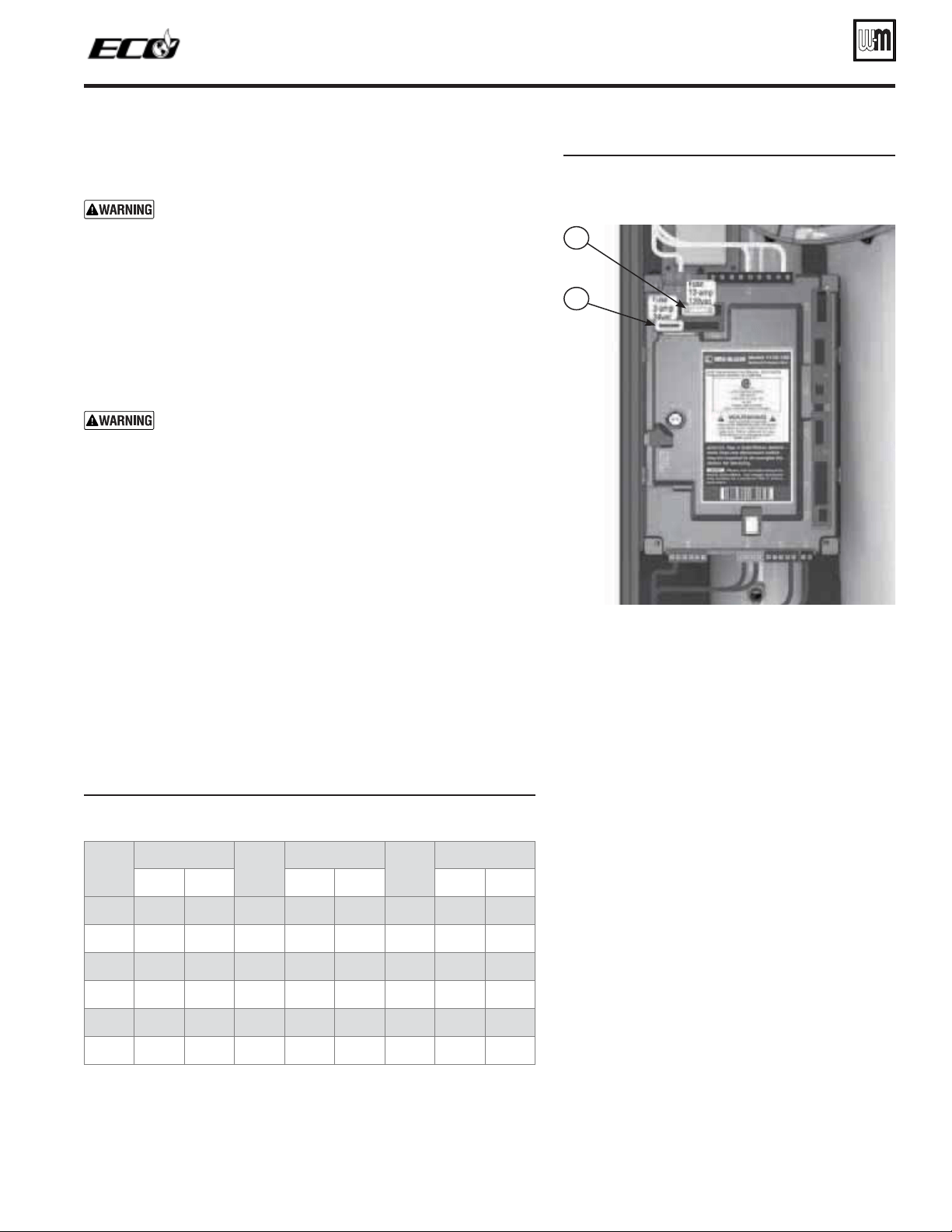
Troubleshooting (continued)
Check ECO control fuses
ALWAYS check ECO control fuses before replacing ECO
control or any major components (blower, etc.). If one of
these fuses is blown, it can prevent ECO control or other
components from operating.
1. Turn OFF power to boiler at external line switch. Then remove the
jacket door.
2. Locate fuses using Figure 95.
3. Remove and inspect the two fuses (items 1 and 2, Figure 95).
4. If necessary, replace one or both of the fuses:
a. Low voltage circuit fuse is 3-amp fast-blow (Littelfuse 326012P).
b. Line voltage circuit fuse is 12-amp slow-blow (Littelfuse 257003).
Do not jumper either fuse or replace with any fuse except as
specified. Failure to comply could result in severe personal
injury, death or substantial property damage.
Checking temperature sensors
1. The boiler temperature sensors (flue, outdoor, return water and supply
water) are all resistance-type devices. Figure 94 shows the correct value
for the sensor at various temperatures. For dual sensors, the temperature
difference between the sensors must be no more than 10 °F.
2. Use the resistance values at 32°F, 60°F, 70°F and 212°F to measure the
sensor resistance at known temperatures (ice point, room temperature
and sea level boiling point). For ice point and boiling point, insert the
sensor in water at that temperature. Use an ohmmeter to read resis-
tance value.
3. To check whether the ECO control is correctly sensing temperature,
you can use a resistance decade box. Connect the decade box tempo-
rarily in place of a sensor and read the corresponding temperature on
the ECO control display. The temperature should be close to the value
corresponding to the input resistance.
&IGURE
Sensor resistance values
Temp
(°F)
Sensor ohms
Temp
(°F)
Sensor ohms
Temp
(°F)
Sensor ohms
Min Max Min Max Min Max
32 34265 37871 90 8504 9399 150 2517 2782
40 27834 30764 100 6847 7568 160 2091 2311
50 21630 23907 110 5545 6129 170 1744 1928
60 16944 18727 120 4517 4992 180 1461 1615
70 13372 14780 130 3698 4088 190 1229 1359
80 10629 11747 140 3043 3364 200 1038 1147
Part number 550-142-122/0513
91
TM
GAS-FIRED WATER BOILER — Boiler Manual
&IGURE Control fuses
1
2
Line Voltage
Low
Voltage
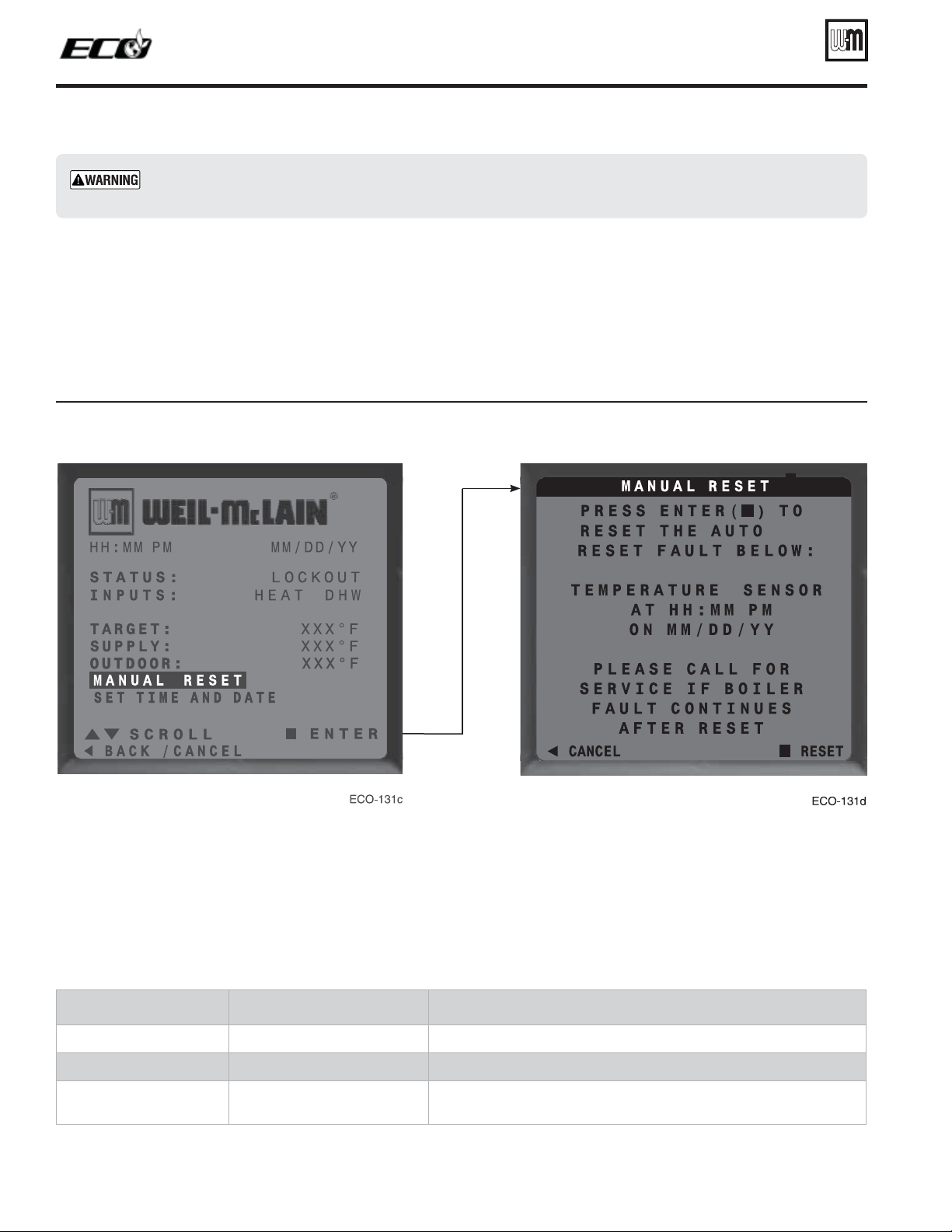
&IGURE ECO display when a fault occurs—main homeowner screen and manual reset screens shown.
Troubleshooting (continued)
ECO control fault indications
1. The ECO control provided diagnostic
information for automatic reset con-
ditions, manual reset conditions, and
certain functional warnings. See Fig-
ure 71, page 66 for information menu
navigation and Figure 80, page 72 for
DIAGNOSTIC screen information.
2. Figure 96 shows the screen behavior
during an automatic or manual reset
condition.
3. Figure 97, page 93 shows the infor-
mation available on the “ERRORS”
screens for diagnosing a fault condi-
tion.
4. Figure 98, page 94 lists conditions that
will cause the fault screen operations.
The reset conditions are listed. Some
will reset automatically but others may
require the use of the control’s manual
reset screen to reset the fault.
-AKESURETODETERMINETHECAUSESOFOUTAGES$ONOTLEAVETHEBOILEROPERATINGWITHOUTACOM-
PLETEDIAGNOSIS
Part number 550-142-122/0513
92
TM
GAS-FIRED WATER BOILER — Boiler Manual
During a fault, the status will change to “LOCK-
OUT” and the Time & Date line will alternate with
the fault name. The line “MANUAL RESET” will
appear on the Homeowner screen. This screen can
also be accessed from the DIAGNOSTIC menu in
the contractor screens.
The “MANUAL RESET” screen will
indicate whether the fault was a manual
or automatic reset, the fault name, and
the time and date it occurred.
Error Type Screen color Operation
Manual Reset Flashing RED Lockout—will not accept any calls for heat
Automatic Reset Solid RED Lockout—will not accept any calls for heat
Warning Solid RED
(on standby only)
Boiler runs during warning condition but may not run
Troubleshooting (continued)
&IGURE Troubleshooting suggestions for ECO boilers — %#/CONTROL%RROR#ONDITION,OG
The ECO control is able to record information about the boiler’s condition at the time of the three previous faults or errors. This
information is available to view in Contractor Menus under “DIAGNOSTICS” by selecting “ERRORS.” The control will display
the following information:
Information Description Action
Control Fault Records the number of internal control faults
Ignition Retries Displays the number of ignition attempts in the current
ignition sequence.
Manual Reset Count Records number of lockouts that required a manual reset
since this count was last cleared.
Auto Reset Count Records number of lockouts that have automatically reset
since this count was last cleared.
Lockout History 1 Details of present or last recorded lockout Select and press the enter key for more details
Lockout History 2 Details of boiler during the second oldest lockout still in
memory
Select and press the enter key for more details
Lockout History 3 Details of boiler during the oldest lockout still in memory Select and press the enter key for more details
How to read the last 3 lockout histories:
1. Scroll down to “DIAGNOSTICS” and press the
enter key (Square Key in center)
2. Scroll down to “ERRORS” and press the enter key
(Square Key in center)
3. 4DSPMMEPXOUPi-0$,065)*4503:wBOEQSFTT
the enter key.
4. Screen should display Error name, type, time,
date, and boiler status at time fault occurred.
5. Scroll up or down to highlight other choices
and press the enter key to view the details of
the boiler’s condition when the lockout was
recorded.
How to clear all counters and lockout
histories:
1. While on the “ERRORS” screen, hold the Left
and Right arrow buttons simultaneously for 3
seconds.
Part number 550-142-122/0513
93
TM
GAS-FIRED WATER BOILER — Boiler Manual
Troubleshooting (continued)
Display
Condition Diagnostics Corrective Action(s)
Nothing shown
on display
screen and
boiler will not
respond to call
for heat
Control is not receiving
24V power
Check wiring for short circuit or
incorrect wiring.
Correct wiring per wiring diagram including connection of transformer
to the control module.
Check 3-amp low voltage fuse
on control module shown on
QBHF.
Replace fuse with proper part found in replacement part section of this
manual. If fuse blows again recheck wiring per diagram.
Check transformer connection
to the control module per wiring
diagram. Check for 24V output of
transformer.
Replace transformer if it is receiving 120Vac, but not outputting 24Vac.
Nothing
is shown
in display
screen and no
other boiler
components are
operating
Control is not receiving
120V power
Check service switch and/or
circuit breaker to ensure boiler is
turned on.
Turn on service switch to power boiler.
Is there 120 Volts at the service
switch?
Troubleshoot and correct the power supply to the service switch.
Check for 120 volts at the line
voltage terminal block located at
P1 on the control module.
Correct wiring to the control module using the wiring diagram in this
manual.
Inspect 12-amp fuse as shown on
QBHF. Replace if necessary.
Replace the fuse with proper part found in the replacement part section
of this manual. If fuse blows again recheck wiring per diagram.
Nothing is
shown on
display screen,
but boiler is
operating
Occurs if the
communication is lost from
the control module to the
display.
Check for loose connections
and proper pin alignment/
engagement on the control
NPEVMFhTQMVH1BOEUIFCBDLPG
the display circuit board.
Check for continuity on the wire harness from the display to the control
module. See repair parts section for proper replacement part.
Cycle power off and on using
service switch or breaker.
Replace with new display module. See repair parts section for proper
replacement part.
TEMP RISE TOO
QUICKLY
Occurs if supply water
temperature in heat
exchanger rises faster than
2º F per second during the
first two minutes the burner
is on.
Automatically resets after 1
minute delay or using manual
reset on display.
Manual reset is necessary after 5
automatic resets have occurred
during the same Priority heat
demand. Reset using manual
reset screen on display.
Verify water pipe is installed correctly per instructions in this manual.
Verify proper circulator sizing for boiler size and system requirements.
Verify circulator connected to correct circulator output on the control
module’s plug P2.
Verify external controls are installed per manufacturer’s instructions, all
applicable codes, and sound industry practices.
4FFNFTTBHFEJTQMBZFE5&.1&3"563&4&/403BOEGPMMPXQSPDFEVSFGPS
loose connections.
SUPPLY 58º F >
RETURN
Boiler Out temperature
has exceeded the Boiler In
temperature by more than
58º F
Automatically resets after 30
second delay or using manual
reset on display.
Verify water pipe is installed correctly per instructions in this manual.
Verify proper circulator sizing for boiler size and system requirements.
Verify circulator connected to correct circulator output on the control
module’s plug P2.
Verify external controls are installed per manufacturer’s instructions, all
applicable codes, and sound industry practices.
4FFNFTTBHFEJTQMBZFE5&.1&3"563&4&/403BOEGPMMPXQSPDFEVSFGPS
loose connections.
RETURN >
SUPPLY
Occurs if a return water
temperature is greater than
the corresponding supply
temperature by 10º F or
more.
Automatically resets when
condition no longer exists.
Verify proper flow direction of the boiler or system circulator. This
circulator must be installed to push water through the boiler’s return
pipe as shown in piping diagrams beginning on .
Verify circulator connected to correct circulator output on the control
module’s plug P2.
Verify external controls are installed per manufacturer’s instructions, all
applicable codes, and sound industry practices.
&IGURE Troubleshooting suggestions for %#/ boilers — &AULTDISPLAYSDIAGNOSTICSANDCORRECTIVEACTIONS
Part number 550-142-122/0513
94
TM
GAS-FIRED WATER BOILER — Boiler Manual
Troubleshooting (continued)
Display
Condition Diagnostics Corrective Action(s)
TEMPERATURE
SENSOR
Occurs if a temperature
sensor has electrically
TIPSUFE4)035PSIBT
become disconnected
(OPEN).
Will automatically reset if the
condition clears.
Check all the temperature readings of the boiler on the DIAGNOSTICS -
5&.1&3"563&4NFOVUPEFUFSNJOFJGBOZTFOTPSTBSFDVSSFOUMZEJTQMBZFE
BT4)035PS01&/$PNQBSFUIJTUPUIFCPJMFSUFNQFSBUVSFTSFDPSEFE
JOUIF%*"(/045*$4&33034-0$,065)*4503:5&.1&3"563&4
during the last several lockout conditions.
Determine which sensors are suspect and measure their resistance
value and compare it to the values shown in 'JHVSFQBHF. If the
resistance values are incorrect replace the temperature sensor. Refer to
repair parts section for proper part number.
065%0035&.1JTUIFPQUJPOBMPVUEPPSBJSUFNQFSBUVSFTFOTPS*GUIJT
is not being used it will always be shown as NONE. This is normal unless
the sensors were installed.
Check wire harness for loose connections and pin engagement at sensor
DPOOFDUJPOBOEUIFDPOUSPMNPEVMF6OQMVHDPOOFDUJPOBUTFOTPSBOE
at control module and check continuity between ends.
If problem persists after checking items above replace control module.
Refer to repair parts section for kit number.
Occurs if dual temperature
sensors values have spread
by more that 10º F if the
burner is on.
Automatically resets when
sensors are within 10º F.
'PMMPXQSPDFEVSFBCPWFGPS4)035BOE01&/TFOTPSDPOEJUJPOTUP
properly diagnose sensor. If measured resistance values of sensors
convert to temperatures separated by more than 10º F replace the
sensor.
FLUE TEMP
TOO HIGH
Occurs if flue temperature
sensor exceeds 216º F.
Automatic reset occurs if
temperature drops below 216º F
for 2.5 minutes.
Manual reset is required if the
UFNQFSBUVSFSJTFTBCPWF¡'
Reset using manual reset screen
on display.
'PMMPXQSPDFEVSFGPSBCPWFGPS4)035BOE01&/TFOTPSDPOEJUJPOT
to properly diagnose sensor. In addition inspect heat exchanger
combustion chamber and flueways for abnormal wear or buildup.
Inspect vent system for abnormal wear or damage.
Contact Weil-McLain Technical Support.
LOW WTR
CUTOFF OPEN
Occurs if low water cutoff
contacts open.
Automatic reset occurs if contacts
are open at least one second, but
less than 5 seconds.
Manual reset of control module
if contacts are open longer than
5 seconds.
Check for low water condition in system. Repair system as necessary
refer to piping section of this manual.
If low water condition does not exist, check Diagnostics — Inputs screen
to view status of Low Water Cutoff. If shown as OPEN check wiring
b
etween LWCO and control module. If wiring is correct and functioning,
then replace the LWCO.
If LWCO option is not installed, check the wiring of the jumper in control
module’s plug P12.
DISPLAY COMM
Occurs if display
communications out for 30
seconds.
Automatically resets when
communication is re-established.
Check for a loose connection at the molex plug on the control and
connection on the back of the display.
LIMIT OPEN
Occurs if manual or
automatic r eset l imit op ens.
Automatic external limit will reset
2½ minutes after external limit
device closes.
Manual limit fault must be reset
using manual Reset screen on the
display.
Is there an external safety device connected? If yes, trouble shoot the
external limit to determine and correct the cause that opened the limit.
Also check for loose wiring connections.
Inspect the connector on control module’s plug P13.
Ensure a jumper is installed across the left two (Pins 1&2) terminals if not
using a manual reset external limit.
Ensure a jumper is installed across the right two (Pins 3&4) terminals if
not using an automatic reset external limit.
Troubleshooting (continued)
&IGURE Troubleshooting suggestions for %#/ boilers — &AULTDISPLAYSDIAGNOSTICSANDCORRECTIVEACTIONS
Part number 550-142-122/0513
95
TM
GAS-FIRED WATER BOILER — Boiler Manual
Troubleshooting (continued)
Display
Condition Diagnostics Corrective Action(s)
HIGH TEMP
LIMIT
Boiler temperature sensor
SFBDIFE)JHI5FNQ-JNJU
setting (no higher than
¡'
Reset using manual reset screen
on display.
7FSJGZUIBUIJHIMJNJUTFUUJOHJTBUMFBTU¡'BCPWFUIFTVQQMZUBSHFU
UFNQFSBUVSF%)8#PJMFS4VQQMZBOE)FBUJOH4VQQMZ.BY
Verify all isolation valves are open and circulators are connected to the
control module properly.
Verify external controls are installed per manufacturer’s instructions, all
applicable codes, and sound industry practices.
Verify water pipe is installed correctly per instructions in this manual.
Verify proper circulator sizing for boiler size and system requirements.
4FFNFTTBHFEJTQMBZFE5&.1&3"563&4&/403BOEGPMMPXQSPDFEVSFGPS
loose connections.
FLAME FAULT
Occurs if flame is detected
when there should be no
flame.
Reset using manual reset screen
on display.
Burner may be operating too hot due to incorrect combustion. Inspect
flame and conduct combustion test.
Force boiler into hi-fire. Check flue gases with combustion analyzer and
correct using the maintenance and startup procedure in this manual.
Verify FLAME SIGNAL value quickly goes to zero on the DIAGNOSTICS -
*/1654TDSFFOXIFOUIFHBTWBMWFDMPTFT
Check for flame at burner via flame current with burner off. Turn boiler
off and watch flame through observation port. If flame continues after
shutdown replace gas valve and venturi.
GAS VALVE
FAULT
The control module has
detected a problem with its
gas valve output circuit.
Control will automatically retry;
lockout if retry unsuccessful;
retry 1 hour after lockout —
restart if condition cleared, but
lockout requiring manual reset if
condition still present.
Requires manual reset if control is
in lockout.
Check wire harness connections between gas valve and control module.
Check resistance between control and gas valve.
Disconnect low-voltage wires connected to the low voltage field-wired
connectors. Check all wire leads from system from system for stray
voltage. Any voltage in excess of 0.5 volts will cause gas valve fault
failures. Correct the cause of stray voltages before reconnecting wires.
After correcting problem, check to see if gas valve fault issue is corrected.
If lockout reoccurs replace control module.
BLOWER FAULT Blower unable to reach
required speed or does not
reach 0 RPM when turned
off.
NOTICE: ECOPSPOMZ
— The blower will not rotate
without a low voltage signal.
6OQMVHHJOHUIFMPXWPMUBHF
blower wire harness will not
allow or cause the blower
to rotate.
Reset using manual reset screen
on display; control module will
check again after 1 hour and will
automatically restart if condition
is corrected.
Check wire harness for loose connections and pin engagement at
CMPXFSDPOOFDUJPOTBOEDPOUSPMNPEVMF6OQMVHDPOOFDUJPOBUCMPXFS
and at control module and check continuity between ends. Blower is
connected to both low voltage and line voltage harness.
Check Diagnostics - Inputs screen with boiler in standby mode and
blower not running. If BLOWER SPEED is not 0 RPM replace blower.
If blower does not rotate during ignition sequence check for 120V power
at blower connection. If 120Vac power is present at blower motor and it
doesn’t start, replace blower. Check power at control module. If 120Vac
is not present at control module when boiler is powered, replace control
module. Refer to repair parts section.
Troubleshooting (continued)
&IGURE Troubleshooting suggestions for %#/ boilers — &AULTDISPLAYSDIAGNOSTICSANDCORRECTIVEACTIONS
Part number 550-142-122/0513
96
TM
GAS-FIRED WATER BOILER — Boiler Manual
Display
Condition Diagnostics Corrective Action(s)
IGNITION
FAULT
Boiler went through 5
ignition attempts and never
detected flame.
Automatically resets after 1 hour
or can be reset by performing
manual reset on boiler.
Check condensate trap for blockage allowing condensate to accumulate
inside heat exchanger.
Check ignition cable connection.
Fouled, worn, bent, or faulty igniter.
Fouled igniters can be cleaned for additional use with steel wool.
Worn or badly fouled igniters should be replaced with the proper repair
part.
*HOJUFSSPETTIPVMECFQBSBMMFMXJUIBNNJOTQBSLHBQ
NPEFMTPSBNNJOTQBSLHBQNPEFMT
Thin white deposits on the igniter are typical, but brown or
black deposits could be the result of flue gas recirculation. Thoroughly
inspect the venting system and termination for the possibility of leakage
or flue gas feedback into the air line.
Dirty burner and/or heat exchanger will cause high back pressure and
poor ignition.
Follow procedure in maintenance section of this manual to clean burner
and heat exchanger. Visual inspection of flueways may not be sufficient
to diagnose condition.
Check combustion settings on high and low fire and adjust per setup
instructions if necessary.
Check incoming gas pressure with boiler off and at high fire. Adjust
within limits on rating label.
Verify correct boiler model is selected in control and high altitude is
selected for installations 5,500 feet above sea level.
Check ignition cable resistance. Should measure 1000 Ohms (+/- 50
Ohms).
Check for flue pipe and intake pipe restrictions or blockage.
Check burner fasteners and gaskets.
Check venturi gaskets and proper propane orifice bushing.
Troubleshooting (continued)
&IGURE Troubleshooting suggestions for %#/ boilers — &AULTDISPLAYSDIAGNOSTICSANDCORRECTIVEACTIONS
Part number 550-142-122/0513
97
TM
GAS-FIRED WATER BOILER — Boiler Manual
Maintenance
Disconnect power
Electrical shock hazard — Disconnect all
electrical power to the boiler before attempting
maintenance procedures. Failure to complete
could result in severe personal injury, death or
substantial property damage.
Re-install boiler jacket door after
startup or servicing
Reinstall boiler jacket door after start-up or
servicing. The boiler jacket door must be se-
curely fastened to the boiler to prevent boiler
from drawing air from inside the boiler room.
This is particularly important if the boiler is
located in the same room as other appliances.
Inspect boiler jacket door gaskets on front of
cabinet. Gaskets must be in good condition,
with no tears or gaps. Replace if necessary.
Failure to keep the jacket door securely sealed
and fastened could result in severe personal
injury or death.
Start-up and check/out
Removing and reinstalling components can
change boiler behavior. After any maintenance
procedure, you must prove the boiler is oper-
ating correctly. To do so, follow the complete
procedure for boiler and system start-up,
beginning on page 75. Failure to comply
could result in severe personal injury, death
or substantial property damage.
DO NOT SERVICE THE BOILER
WITHOUT A ECO MAINTENANCE
KIT AVAILABLE
The ECO maintenance kit includes components that may
have to be replaced when accessing or disassembling parts
of the boiler.
Failure to replace damaged components and to use only
the parts specifically intended for the boiler can result
in severe personal injury, death or substantial property
damage.
See Figure 109, page 107 for part number.
Oiled bearing circulators
1. Check circulators in the system. Oil any circulators requiring
oil, following circulator manufacturer’s instructions. Over-
oiling will damage the circulator.
Part number 550-142-122/0513
98
TM
GAS-FIRED WATER BOILER — Boiler Manual
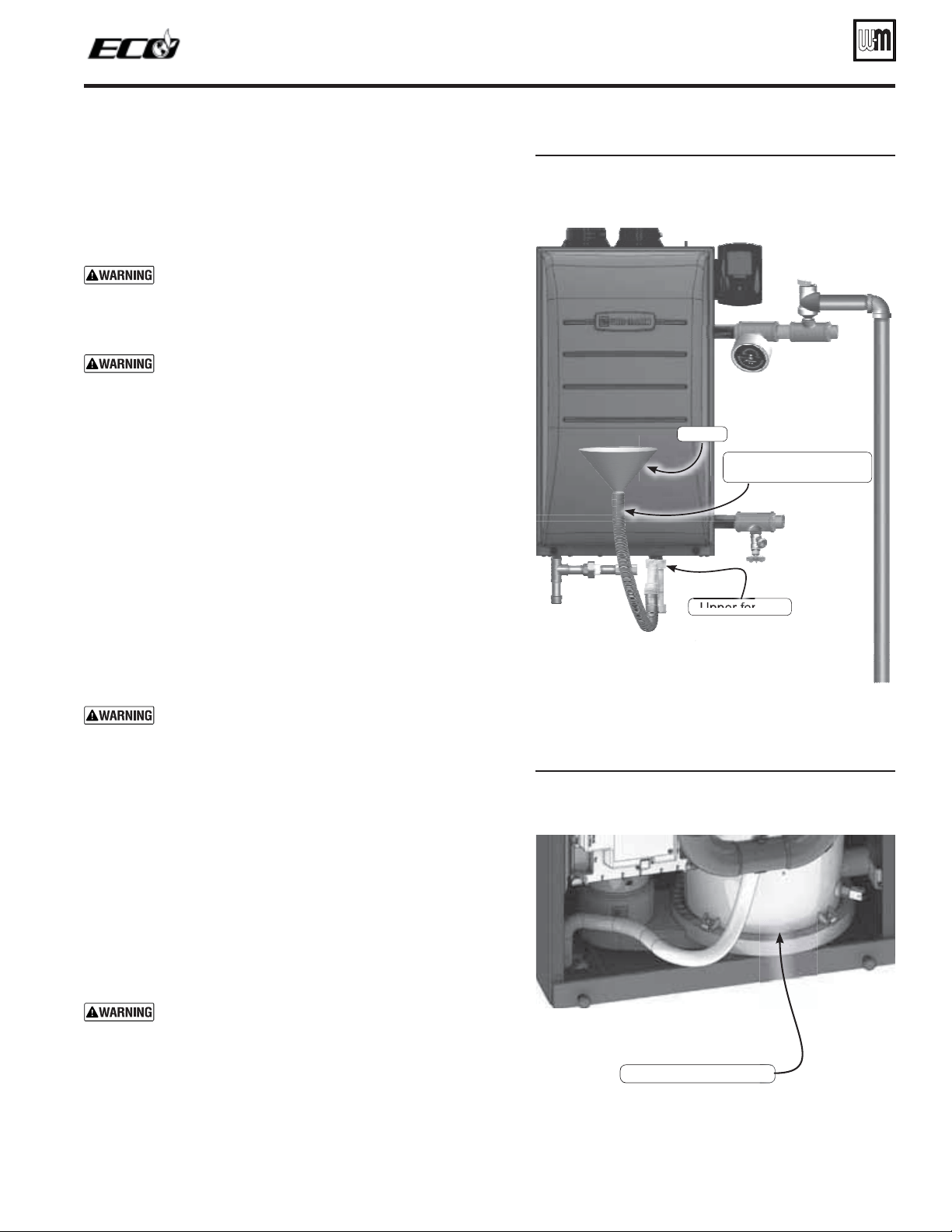
Maintenance (continued)
Cleaning the heat exchanger WATER
SIDE, when required
1. Isolate the boiler from the heating system.
2. Obtain Sentinel X400 cleaner from Weil-McLain. Follow instruc-
tions supplied with the cleaner to clean the boiler heat exchanger.
Use ONLY the cleaning product available from Weil-
McLain, Sentinel X400. See the Repair Parts section at
the end of this manual for ordering information.
Using other cleaning materials or methods could cause
permanent damage to the boiler heat exchanger.
Inspect the heating system water. If there is evidence of
sediment or corrosion, the boiler must be isolated from
the system. The system must then be thoroughly cleaned
to remove all sediment.
Isolated the cause of the system corrosion and correct
the problem(s) before placing the boiler back in service.
Failure to comply could result in severe personal injury,
death or substantial property damage.
Checking the heat exchanger-to-
condensate dish seal
1. Remove the jacket door.
2. Place a container under the boiler for drainage.
3. Disconnect the flexible condensate drain tube from the condensate
drain piping so it’s outlet end is free to move.
4. Loosen the condensate trap upper ferrule (see Figure 102) and
rotate the trap assembly so the flexible drain tube can be lifted as
shown. Tighten the upper ferrule when in position.
The boiler is shipped with a 24-inch flexible tube. If the
tube has been cut shorter, attach a ¾” PVC coupling to
the flexible tube with tape. Then use a length of ¾” PVC
pipe long enough to locate the funnel as directed.
5. Insert a funnel into the open end of the flexible tube. Wrap the
funnel-to-tube joint with tape so it will be watertight.
6. Lift the funnel up as shown in Figure 102 so it is from 6 to 10 inches
above the bottom of the boiler.
7. Pour one gallon of water (no more than one gallon) slowly into
the funnel. Use tape or cord to secure the funnel and flexible tube
up in position so the funnel remains 6 to 10 inches above the bot-
tom of the boiler.
8. Use a flashlight and mirror to inspect around the perimeter of the
heat exchanger where it joins the condensate dish (see Figure 103).
9. There must be no signs of water leakage anywhere around the heat
exchanger-to-condensate dish joint.
If there are signs of leakage, wipe the area with a clean
rag to ensure there is a leak and not just splashed water. If
the leak continues, the boiler must not be operated until
a new sealing ring is obtained. Follow the instructions
supplied with the sealing ring kit to disassemble boiler
components as necessary to access and replace the seal.
10. If there are no indications of leakage, the seal is acceptable.
11. Remove the funnel, drain the water into the container below,
return the condensate trap assembly to its original position, and
re-connect the flexible drain tube to the condensate drain tubing.
&IGURE Adding water to exchanger for
condensate dish seal check
&IGURE Inspect the heat exchanger-to-
condensate dish joints
Part number 550-142-122/0513
99
TM
GAS-FIRED WATER BOILER — Boiler Manual
Funnel
Flexible condensate
drain tube
Upper ferrule
Inspect joints

Cleaning heat exchanger flue side, 70/110
Cleaning the ECO 70 or 110 heat
exchanger FLUE SIDE or accessing
the burner, if required
The boiler contains ceramic fiber materials. Use
care when handling these materials per instructions
on page 84 of this manual. Failure to comply could
result in severe personal injury.
4OOLSREQUIRED
1. Long-handled Torx driver, #20.
2. Phillips head screwdriver, #2.
3. Nut driver,
5/16”
4. Torque wrench.
5. Putty knife.
6. Wrench or socket, 10 mm.
"EFOREPROCEEDING
1. Shut down the boiler:
a. Follow “To Turn Off Gas to Appliance” instructions on
boiler and Lighting instructions.
b. Close the boiler manual gas valve.
2. Allow time for the boiler to cool to room temperature if it
has been firing.
3. Remove jacket door by removing two screws at the bottom
of the plastic jacket door.
4. Lift the jacket door up and away from the boiler to remove.
2EMOVECOMPONENTSTOALLOWACCESS
1. See Figure 105, page 101 part A to locate components refer-
enced in the following.
2. Remove the air baffle (item 28, page 3) by removing the two
hex head screws in front of the air intake adapter (item 16
page 3). Set aside.
3. See Figure 105, page 101 part B.
a. Pull the silencer straight forward until it snaps free of the
blower housing. Set the air silencer aside. Rotate the air
inlet silencer if needed to clear as it is removed.
b. Remove the gas valve retainer clip (item 4) and set aside.
Pull the gas valve slightly to the right until it disengages
from the venturi (item 5).
Support the gas valve. DO NOT allow it to hang
from the gas valve flex line. Make sure the gas
valve-to-venturi O-ring (item 5, Figure 12, page 14)
remains on the gas valve sleeve.
c. Disconnect the blower end of the gas valve sense line
(item 8).
d. Remove the blower retainer clip (item 15). Set aside.
e. Remove the blower by pulling down. Disconnect the two
blower wiring harnesses on the back side of the blower.
f. Remove the four 10-mm hex nuts (item 9)that secure the
heat exchanger cover plate (item 6).
g. Disconnect the ground wire and ignition cable from the
igniter (item 7).
h. Lift the cover plate/venturi/burner assembly vertically
until the refractory (part C, item 12) clears the heat ex-
changer.
i. Tilt the cover plate/venturi/burner assembly slightly
forward. Then pull the assembly forward and out of the
jacket.
j. Remove the igniter by removing the two Phillips head
igniter screws. Set the igniter, its gasket and screws aside.
Be careful when handling the igniter not to damage the
igniter ceramic.
k. Inspect the igniter ceramic and electrodes. Clean the
electrodes carefully with steel wool. If the igniter ceramic
is cracked or damaged, replace the igniter with a new one.
Handle the cover plate/venturi/burner assembly
carefully to avoid damage to the igniter or refrac-
tory. Place the assembly on a clean, flat surface
with the assembly upside down, as shown in Fig-
ure 105, page 101 part C and part D.
4. See Figure 105, page 101 part C.
a. Use a wide-blade putty knife (item 11) to gently pry
the refractory from the heat exchanger cover plate. The
refractory is attached with silicone adhesive and should
separate with a little pressure on the putty knife.
DO NOT gouge or crack the refractory. The re-
fractory is made of ceramic fiber materials. Read
the ceramic fiber WARNING on page 84 before
handling or disposing of ceramic fiber materials.
&IGURE Legend for Figure 105
A Boiler interior
B Boiler interior, with
components disconnected to
allow removal of combustion
chamber cover plate
# Combustion chamber cover
plate and components removed
from boiler
$ Disassembling to access the
burner
E Heat exchanger interior
1 Inlet air silencer
2 Blower assembly
3 Gas valve
4 Gas valve retainer clip
5 Venturi assembly
6 Heat exchanger cover plate
7 Ignitor assembly
8 Gas valve sense line
9 (4) Combustion chamber cover
plate retainer nuts
10 Burner
11 Putty knife
12 Refractory
13 Burner gasket
14 (3) Burner retainer screws
15 Blower retainer clip
16 Control module
Part number 550-142-122/0513
100
TM
GAS-FIRED WATER BOILER — Boiler Manual
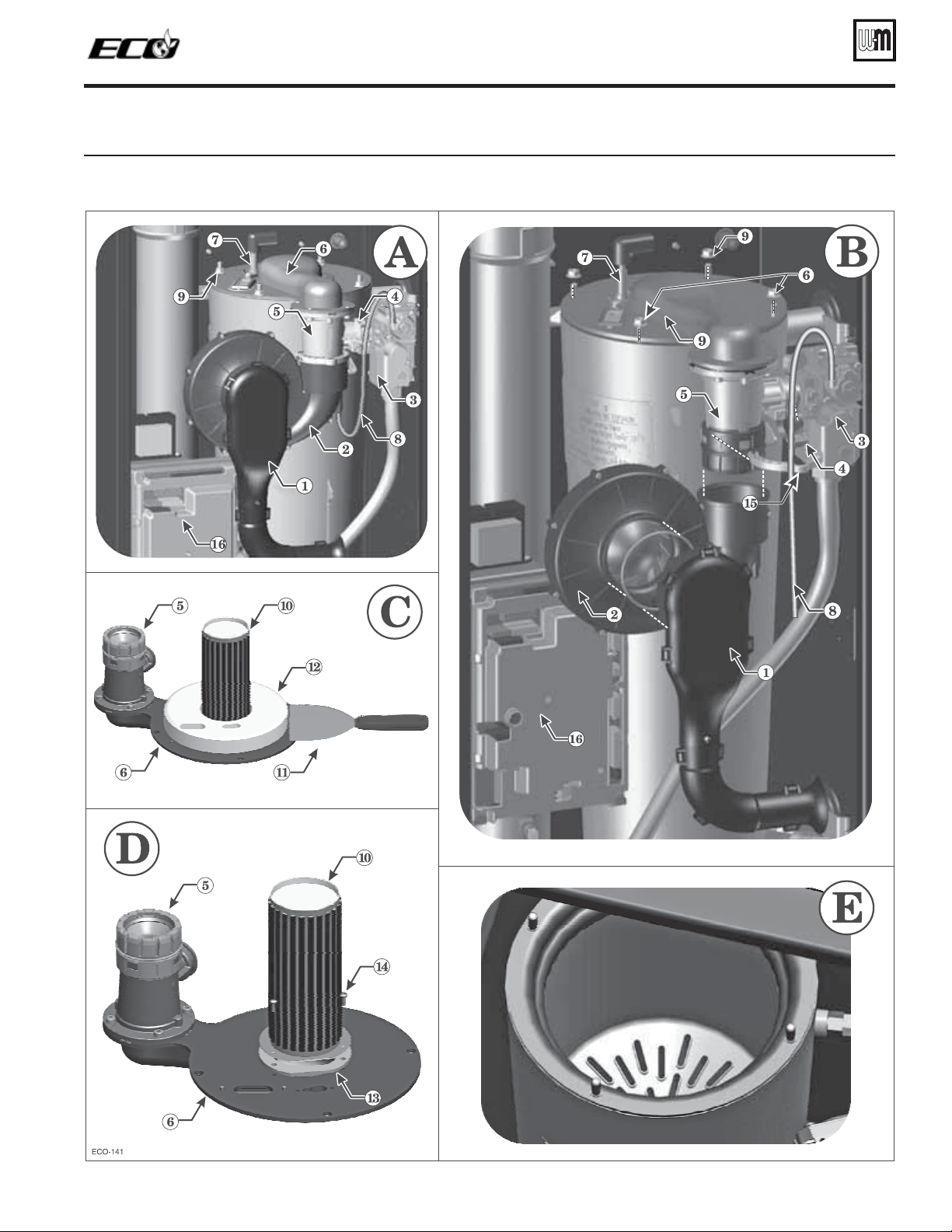
&IGURE Accessing the burner or heat exchanger (see Legend on page 100)
Cleaning heat exchanger flue side, 70/110 (continued)
Part number 550-142-122/0513
101
TM
GAS-FIRED WATER BOILER — Boiler Manual

Cleaning heat exchanger flue side, 70/110 (continued)
)NSPECTANDCLEANTHEBURNER
1. See Figure 105, page 101 part D.
a. Slide the refractory (item 12) over the burner and off.
Set the refractory aside where it will be kept clean and
protected from damage. If the refractory is damaged, it
must be discarded and replaced with a new one.
b. Remove the three #20 Torx screws (item 14) securing the
burner (item 10) to the cover plate. Set aside.
c. Remove the burner and its gasket (item 13).
d. Inspect the interior of the burner. Brush and vacuum the
interior if needed to remove lint or sediment. Alternative
CLEANINGMETHODSsBLOWAIRORNITROGENFROMTHEINSIDE
OUTsCLEANWITHAWATERSPRAYFROMINSIDETHEBURNER
sSWIRLTHEBURNERTHOROUGHLYINABUCKETOFMILDLIQUID
laundry detergent water, then rinse thoroughly.
e. Inspect the burner exterior. It must be in good condition,
with no visible damage.
f. Inspect the burner gasket. If the gasket is damaged, obtain
a new gasket before re-installing the burner.
)NSPECTANDCLEANTHEHEATEXCHANGER
1. Access the heat exchanger interior by following the previous
instructions.
2. See Figure 105, page 101 part E.
3. Before using water to clean the heat exchanger, remove the
control module (item 16). Label wires if they are not labeled.
Set aside. Remove all connectors and wire harnesses from the
control module and then remove the two screws securing it
to the bracket.
4. Use a strong light to visually inspect the interior of the heat
exchanger. Make sure the flueways (tubes) are clear and
unobstructed.
5. Use a vacuum cleaner to remove any accumulation on the
heating surfaces. This includes removing any pieces of refrac-
tory that may have dropped into the exchanger.
DO NOT use any solvent when cleaning the ex-
changer.
6. If the vacuum cleaner is unable to clean completely, wash the
heating surfaces with clean, warm water.
a. Place a bucket under the boiler condensate drain con-
nection.
b. Then loosen the condensate trap upper nut and slide the
trap off of the drain connection. (See Figure 59, page 54
for reference.)
c. Spray fresh water into the heat exchanger and tubes to
remove sediment. Collect water in the bucket below.
7. Inspect the heat exchanger cover plate refractory. Replace if
insulation is damaged.
2EINSTALLCOMPONENTS
1. See Figure 105, page 101 for reference.
2. Reinstall the control module (item 16) to the control bracket
and reconnect all connectors and wire harnesses.
3. Reinstall the burner (item 10) and burner gasket (item 13) on
the cover plate (item 6). Tighten the burner screws (item 14)
using a torque wrench. The screws must be secure, but the
torque must not exceed 20 inch-pounds.
4. Apply a ring of silicone adhesive on the cover plate (to secure
the refractory).
5. Slide the refractory (item 12) over the burner. Align the re-
fractory and press in place.
6.
"EFORE handling the assembly, allow the adhesive to set
enough that the refractory is firmly held in place.
7. Reinstall the igniter assembly (item 7).
a. The igniter gasket must be intact and in good condition.
Replace with a new gasket if necessary.
b. Insert the igniter into the cover plate opening, with the
gasket in position.
c. Reinstall the two Phillips head screws finger tight.
d. Use a torque wrench to tighten the igniter screws. DO
NOT exceed 20 inch-pounds torque.
8. Reinstall the venturi/cover plate assembly (items 5 and 6)
and secure the cover plate with 10-mm hex nuts (item 9).
You must gradually tighten the cover plate nuts us-
ing a torque wrench. The final torque MUST NOT
exceed 45 inch-pounds. Alternate tightening until
all nuts reach 45 inch-pounds.
9. Reconnect the ignition cable and the igniter ground wire.
10. Reinstall the blower (items 2).
a. Reconnect the two blower wiring harnesses.
b. Slide the blower up onto the venturi sleeve.
c. Reinstall the blower retainer clip, item 15.
11. Reinstall the air inlet silencer (item 1) by pressing onto the
air inlet adapter. Rotate into the normal vertical position (see
part A) of Figure 105, page 101.
12. Slide the gas valve (item 3) outlet collar into the venturi
(item 5) opening. Make sure the gas valve-to-venturi O-ring
(item 5, Figure 10, page 15) is in place and in good condition.
Inspect the gas valve flex line, making sure there are no signs
of wear or damage. Replace if necessary.
13. Slide the gas valve retainer clip (item 4) into position to
secure the gas valve.
14. Reinstall the condensate trap on the boiler condensate drain
connection, if removed. (See Figure 59, page 54 for reference.)
Perform a complete start-up procedure when put-
ting the boiler back into service. See page 75 and all
instructions for start-up and verification. Include a
soap suds leak test on all interior and exterior gas
piping after starting the boiler.
Part number 550-142-122/0513
102
TM
GAS-FIRED WATER BOILER — Boiler Manual

Cleaning heat exchanger flue side, 155
Cleaning the ECO 155 heat exchanger
FLUE SIDE or accessing the burner,
when required
The boiler contains ceramic fiber materials. Use
care when handling these materials per instructions
on page 84 of this manual. Failure to comply could
result in severe personal injury.
4OOLSREQUIRED
1. Metric wrench or socket, 10 mm.
2. Phillips head screwdriver, #2.
3. Socket with 8” extension, 5/16”.
4. Torque wrench.
5. Putty knife.
"EFOREPROCEEDING
1. Shut down the boiler:
a. Follow “To Turn Off Gas to Appliance” instructions on
boiler and Lighting instructions.
b. Close the boiler manual gas valve.
2. Allow time for the boiler to cool to room temperature if it
has been firing.
3. Remove jacket door by removing two screws at the bottom
of the jacket door.
4. Lift the jacket door up and away from the boiler to remove.
2EMOVEANDINSPECTTHEIGNITERASSEMBLY
1. See Figure 107, page 105 part A.
2. Disconnect the ground wire and ignition cable from the
igniter (item 7).
3. Remove the two Phillips-head screws securing the igniter to
the heat exchanger cover plate (item 6).
4. Carefully slide the igniter out of its mounting slot.
5. Remove and inspect the igniter gasket. Replace with a new
gasket if necessary.
6. Inspect the igniter ceramic and electrodes. Clean the elec-
trodes carefully with steel wool. If the igniter ceramic is
cracked or damaged, replace the igniter with a new one.
2EMOVECOMPONENTSTOALLOWACCESS
1. See Figure 107, page 105 part A to locate components refer-
enced in the following.
2. Remove the air silencer and disconnect gas line:
a. See Figure 107, page 105 part A and part B.
b. Locate the air silencer clip, item 8. Pull on the right side of
the clip until it rotates forward as shown in part A inset.
c. Slide the air silencer (item 1) down and off of the venturi
(item 5). Set the air silencer aside.
d. Disconnect the flexible gas line where it connects just
below the gas valve (item 3). Lay the free end of the
flexible gas line to the side.
Use two wrenches when disconnecting the flexible
gas line to prevent damage to the gas valve and other
gas line components.
e. Disconnect the two wire harnesses connected to the
blower and the wire harness connected to the gas valve.
3. It is RECOMMENDED to remove the blower/gas valve
venturi assembly (item 2) from the cover plate (item 6) by
removing the two
5/16” locknuts attaching them. This will
make removing the cover plate significantly easier.
4. Remove the heat exchanger cover plate assembly:
a. See Figure 107, page 105 part A, part C and part D.
b. Use a 10-mm wrench to remove the five (5) M6 nuts (item
9) that secure the heat exchanger cover plate (item 6) to
the heat exchanger.
c. Lift the cover plate assembly vertically until the refractory
(part D, item 16) clears the heat exchanger.
d. Slide the cover plate forward as you tilt the front down-
ward until the rear lip clears the cabinet. Avoid gouging
the refractory on the heat exchanger studs.
DO NOT gouge or crack the refractory. The re-
fractory is made of ceramic fiber materials. Read
the ceramic fiber WARNING on page 84 before
handling or disposing of ceramic fiber materials.
e. Carefully place the cover plate assembly aside.
Handle the cover plate assembly carefully to avoid
damage to the components or refractory. Place the
assembly on a clean, flat surface.
)NSPECTANDCLEANTHEBURNER
1. See Figure 107, page 105 part A, part B and part C.
2. Use a Phillips screwdriver to remove the three (3) M4
screws and flat washers (item 10) that secure the burner
access cover (item 4) to the heat exchanger cover plate
(item 6).
3. Remove the burner cover plate (item 4) and the burner
(item 11).
4. Remove the burner gasket (item 12) from the heat
exchanger cover plate if still in place. This gasket is ceramic
fiber and may pull apart or stick to the burner on removal.
Do not let fragments drop into the heat exchanger if the
gasket pulls apart during removal. Replace the gasket with
a new one during reassembly.
5. Inspect the burner cover plate seal (item 13). Discard and
use a new seal during re-assembly if the seal is damaged in
any way.
6. Inspect the interior of the burner. Brush and vacuum the
interior if needed to remove lint or sediment. Alternative
CLEANINGMETHODSsBLOWAIRORNITROGENFROMTHEINSIDE
OUTsCLEANWITHAWATERSPRAYFROMINSIDETHEBURNERs
swirl the burner thoroughly in a bucket of mild liquid
laundry detergent water, then rinse thoroughly.
7. Inspect the burner exterior. It must be in good condition,
with no visible damage.
8. Clean the underside of the burner flange (see item 15) with
a soft brush to remove any gasket fragments remaining.
)NSPECTREFRACTORYANDREPLACEBURNERGASKET
1. See Figure 107, page 105 part D.
a. Inspect the refractory (item 16) to make sure it is
intact, with no visible damage.
b. If the refractory must be replaced, use a wide-blade
putty knife to gently pry the refractory from the heat
exchanger cover plate. The refractory is attached with
silicone adhesive and should separate with a little
pressure on the putty knife.
Part number 550-142-122/0513
103
TM
GAS-FIRED WATER BOILER — Boiler Manual

Cleaning heat exchanger flue side, 155 (continued)
DO NOT gouge or crack the refractory. The re-
fractory is made of ceramic fiber materials. Read
the ceramic fiber WARNING on page 84 before
handling or disposing of ceramic fiber materials.
c. When replacing the refractory, apply a ring of silicone
adhesive on the cover plate. Place the refractory onto the
cover plate. Before handling the assembly, allow the adhesive
to set enough that the refractory is firmly held in place.
2. Remove the burner gasket (item 12) from the heat exchanger
cover plate.
3. Clean the gasket surface with a soft brush to remove any gasket
residue.
4. The burner gasket must be replaced with a new one when the
boiler is re-assembled after servicing.
)NSPECTANDCLEANTHEHEATEXCHANGER
1. Access the heat exchanger interior by following the previous
instructions. Remove and inspect the heat exchanger cover plate
gasket. Replace if necessary.
2. See Figure 107, page 105 part E.
3. Before using water to clean the heat exchanger, remove the
control module (item 20). Label wires if they are not labeled.
Set aside. Remove all connectors and wire harnesses from the
control module and then remove the two screws securing it to
the bracket.
4. Use a strong light to visually inspect the interior of the heat
exchanger. Make sure the flue ways (tubes) are clear and un-
obstructed.
5. Use a vacuum cleaner to remove any accumulation on the heating
surfaces. This includes removing any pieces of refractory than
may have dropped into the exchanger.
DO NOT use any solvent when cleaning the
exchanger.
6.
If the vacuum cleaner is unable to clean completely, wash the
heating surfaces with clean, warm water.
a. Place a bucket under the boiler condensate drain
connection.
b. Then loosen the condensate trap upper nut and slide the
trap off of the drain connection. (See Figure 59, page 54
for reference.)
c. Spray fresh water into the heat exchanger and tubes to
remove sediment. Collect water in the bucket below.
7. Inspect the heat exchanger cover plate gasket (item 18). Replace
if is damaged in any way.
2EINSTALLCOMPONENTS
1. See Figure 107, page 105 for reference.
2. Reinstall the control module (item 20) to the control bracket
and reconnect all connectors and wire harnesses.
3. Reinstall the burner (item 11), burner gasket (item 12) and
burner access cover seal (item 13) on the heat exchanger cover
plate (item 6).
a. Insert and tighten the burner cover plate screws and
washers (item 10) using a Phillips screwdriver. The screws
must be secure, with torque no more than 20 inch-pounds.
4. Reinstall the heat exchanger cover plate assembly on the heat
exchanger.
a. Seat the heat exchanger cover plate gasket on the heat
exchanger sealing surface.
b. Tilt heat exchanger cover plate front lip downward until back
lip clears cabinet and burner can slide inside combustion
chamber. Slide cover plate back and rotate until seated flat
on the heat exchanger sealing surface. Avoid gouging the
refractory on the heat exchanger studs.
c. Secure the heat exchanger cover plate (item 6) to the heat
exchanger with the five (5) M6 nuts using a 10-mm wrench.
You must gradually tighten the cover plate nuts using a
torque wrench. The final torque MUST NOT exceed 45
inch-pounds. Alternate tightening until all nuts reach 45
inch-pounds.
5. Reinstall the blower/gas valve/venturi assembly (items 2, 3, and 5).
a. Place blower flange on to studs protruding from cover plate.
b. Reinstall the two
5/16” locknuts using a socket with extension,
c. Do not over tighten (torque no more than 20 inch-pounds).
6. Reinstall the igniter assembly (item 7).
a. The igniter gasket must be intact and in good condition.
Replace with a new gasket if necessary.
b. Insert the igniter into the cover plate opening, with the
gasket in position.
c. Reinstall the two (2) Phillips head screws finger tight.
d. Use a torque wrench to tighten the igniter screws. DO
NOT exceed 25 inch-pounds torque.
e. Reconnect the ignition cable and the igniter ground wire.
7. Reconnect the flexible gas line to the gas valve using two wrenches.
8. Reinstall the air inlet silencer (item 1) by pressing up onto the venturi
(item 5). Rotate the air silencer clip (item 8) and snap it onto the gas line.
9. Reconnect the wire harnesses to the blower and gas valve.
10. Reinstall the condensate trap on the boiler condensate drain
connection. (See Figure 59, page 54 for reference.)
Perform a complete start-up procedure when put-
ting the boiler back into service. See page 75 and all
instructions for start-up and verification. Include a
soap suds leak test on all interior and exterior gas
piping after starting the boiler.
&IGURE Legend for Figure 107
A Boiler interior
B Burner assembly
# Boiler interior, showing
heat exchanger cover plate
(item 6) and burner cover plate
seal (item 13), with burner
assembly removed
$ Exchanger cover plate, blower
and other components,
showing combustion chamber
refractory (item 16)
E Heat exchanger interior
1 Inlet air silencer
2 Blower assembly
3 Gas valve
4 Burner access cover
5 Venturi assembly
6 Heat exchanger cover plate
7 Igniter assembly
8 Air silencer clip
9 (5) Heat exchanger cover plate
retainer nuts,
10 Burner cover retainer screws,
M4 Phillips plus flat washers
11 Burner
12 Burner gasket
13 Burner access cover seal
14 Burner gasket sealing surface
15 Burner sealing surface (lower
surface of burner flange)
16 Combustion chamber
refractory
17 Heat exchanger tube sheet
18 Heat exchanger cover plate
gasket
19 Heat exchanger outer shell
20 Control module
Part number 550-142-122/0513
104
TM
GAS-FIRED WATER BOILER — Boiler Manual
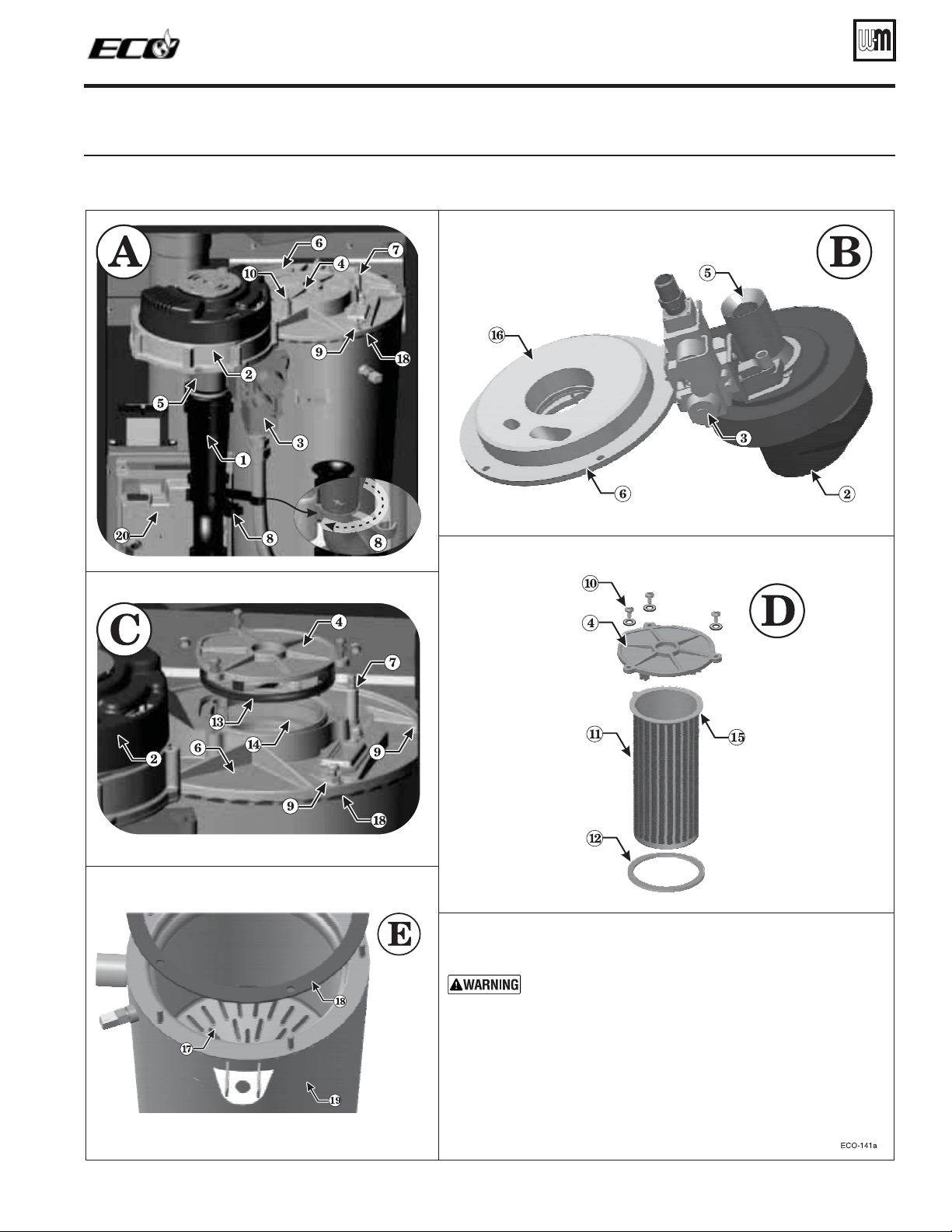
Cleaning heat exchanger flue side, 155 (continued)
&IGURE Accessing the burner or heat exchanger (see Legend on page 104)
Do NOT attempt to remove the burner from the
heat exchanger cover plate without first remov-
ing the heat exchanger cover plate from heat
exchanger. Damage to refractory will result. This
damage is difficult to detect without the removal
of the cover plate.
Part number 550-142-122/0513
105
TM
GAS-FIRED WATER BOILER — Boiler Manual
Replacement parts
DO NOT SERVICE THE
BOILER WITHOUT A
ECO MAINTENANCE KIT
AVAILABLE
The ECO maintenance kit includes components
that may have to be replaced when accessing or
disassembling parts of the boiler. Failure to replace
damaged components and to use only the parts
specifically intended for the boiler can result in se-
vere personal injury, death or substantial property
damage. See Figure 109, page 107 for part number.
'OTOWWWWEILMCLAINCOMTOLOCATE7EIL-C,AINDISTRIBUTORS
&IGURE Propane conversion kits and
instructions
Boiler
MODEL
+IT
PARTNUMBER
+IT
LOCATION
)NSTALLATION
INSTRUCTIONS
%#/
540-202-837
Shipped loose
with boiler
See
page 13
%#/
540-202-838
Shipped loose
with boiler
See
page 13
%#/
540-202-839
Shipped loose
with boiler
See
page 15
&AILURETO ADHERE TO THESE GUIDELINES CAN
RESULT INSEVERE PERSONAL INJURY DEATH OR
SUBSTANTIALPROPERTYDAMAGE
OBTAIN PARTS ONLY THROUGH
WEIL-McLAIN
Replacement parts must be purchased through a local Weil-McLain
distributor. When ordering, specify boiler model and size and include
description and part number of replacement part. Results from us-
ing modified or other manufactured parts will not be covered by
warranty and may damage boiler or impair operation.
THE BOILER CONTAINS CERAMIC
FIBER MATERIALS
4HEBOILER CONTAINS CERAMIC lBER MATERIALS. Use care when
handling these materials per instructions on page 84 of this manual.
Failure to comply could result in severe personal injury.
REINSTALL Jacket door
Inspect boiler jacket door gaskets on front of cabinet and reinstall
boiler jacket door after start or servicing. The boiler jacket door must
be securely fastened to the boiler to prevent boiler from drawing air
from inside the boiler room. This is particularly important if the
boiler is located in the same room as other appliances. Failure to
keep the jacket door securely fastened could result in severe personal
injury or death.
BEFORE SERVICING or MAKING
CONNECTIONS —
!,7!93452.0/7%2/&&4/4(%"/),%24/02%6%.4
%,%#42)#!, 352'%37()#( #!. $!-!'% "/),%2
#/-0/.%.43
LABEL WIRES BEFORE REMOVING
Label all wires prior to disconnection when servicing controls.
Wiring errors can cause improper and dangerous operation.
REPLACEMENT PART
NUMBERS
7EIL-C,AIN PARTNUMBERSARE FOUNDIN
THISMANUALANDINWeil-McLain Boilers
and Controls Repair Parts Lists.
WHEN OPERATING THE
BOILER ON PROPANE GAS
!,,%#/BOILERSMUSTBECON-
VERTEDINORDERTOOPERATEWITH
PROPANEGAS
.
Part number 550-142-122/0513
106
TM
GAS-FIRED WATER BOILER — Boiler Manual
&IGURE Miscellaneous parts and kits
Replacement parts (continued)
'OTOWWWWEILMCLAINCOMTOLOCATE7EIL-C,AINDISTRIBUTORS
Item Description
0ART.UMBER
#(%-)#!,3
100
Antifreeze, Sentinel X500 . . . . . . . . . . .
Corrosion inhibitor, Sentinel X100 . . . . . . .
Sentinel X100 Quick Test Kit. . . . . . . . . .
Cleaner, Sentinel X400 . . . . . . . . . . . .
592-900-004
592-900-002
592-900-005
592-900-003
"/),%2!##%33/2)%3
110
ECO 70/110 maintenance kit — igniter,
igniter gasket, venturi gasket, cover
plate gasket, venturi-gas valve o-ring,
refractory, silicone, inhibitor test kit, clips
and manuals
383-700-165
ECO 155 maintenance kit — igniter,
igniter gasket, venturi gasket, cover
plate gasket, venturi-gas valve o-ring,
refractory, silicone, inhibitor test kit, clips
and manuals
383-700-200
120
Wall-mount kit (supplied with boiler ) —
wall mount bracket and hardware
383-800-218
130
ECO Floor stand kit
383-800-101
140
Condensate trap kit (supplied with boiler) —
560-907-722
#/.$%.3!4%(!.$,).'!##%33/2)%3
150
Condensate neutralizer kit 383-500-631
6%.4!)20!243!.$+)4306#OR34!).,%3334%%,
AVAILABLEFROM7EIL-C,AIN
160
Weil-McLain sidewall vent/air cap termination kit
for PVC vent and air pipes
Includes sidewall vent/air termination cap, inside
and outside cover plates, and mounting hardware;
installed 3 x 2 adapter if using 2” vent/air pipes)
383-500-397
170
Weil-McLain sidewall vent/air cap termination kit
for AL29-4C vent pipe and PVC air pipe
Includes sidewall vent/air termination cap, inside
and outside cover plates, and mounting hardware;
openings are sized for 3” SS vent pipe and 3” PVC
using 2” vent/air pipes)
382-200-430
Item Description
0ART.UMBER
180
Sidewall separate pipes vent/air termination
kits (includes two cover plates)
Kit for 2” PVC vent and air pipes. . . . . . . .
Kit for 3” PVC vent and air pipes. . . . . . . .
Kit for 3” AL29-4C SS vent pipe and PVC air
pipe . . . . . . . . . . . . . . . . . . . . . .
383-700-171
383-500-100
383-700-172
190
PVC concentric vent kit — horizontal or vertical
(includes components for concentric assembly)
Kit for 2” PVC vent and air pipes. . . . . . . .
Kit for 3” PVC vent and air pipes. . . . . . . .
383-700-167
383-500-350
200
Bird screens (1 screen each)
For 2” PVC vent and air pipes . . . . . . . . .
For 3” PVC vent and air pipes . . . . . . . . .
560-907-728
383-500-105
VENT/AIR PARTS AND KITS (POLYPROPYLENE PIPE)
available from M&G Simpson-Duravent ONLY
210
M&G Simpson-Duravent PolyPro SIDEWALL
concentric vent/air kit (color: white)
2” polypropylene pipe . . . . . . . . . . . .
3” polypropylene pipe . . . . . . . . . . . .
2PPS-HK
3PPS-HK
220
M&G Simpson-Duravent PolyPro VERTICAL
concentric vent/air kit; color = black (part
2” polypropylene pipe . . . . . . . . . . . .
3” polypropylene pipe . . . . . . . . . . . .
2PPS-VK
3PPS-VK
230
M&G Simpson-Duravent PolyPro SIDEWALL
separate air and vent pipes
2” polypropylene pipe . . . . . . . . . . . .
3” polypropylene pipe . . . . . . . . . . . .
2PPS-HTP
3PPS-HTP
6%.4!)20!243!.$+)430/,902/09,%.%0)0%
AVAILABLEFROM#ENTROTHERM%CO3YSTEMS/.,9
240
Centrotherm INNOFLUE SIDEWALL concentric
vent/air kit
3” polypropylene pipe. . . . . . . . . . . . . .
2” stainless steel/pp pipe . . . . . . . . . . . .
3” stainless steel/pp pipe . . . . . . . . . . . .
ICWT352
ICWS2413
ICWS3513
250
Centrotherm INNOFLUE VERTICAL concentric
vent/air kit
2” polypropylene pipe . . . . . . . . . . . .
3” polypropylene pipe . . . . . . . . . . . .
ICRT2439
ICRT3539
Part number 550-142-122/0513
107
TM
GAS-FIRED WATER BOILER — Boiler Manual
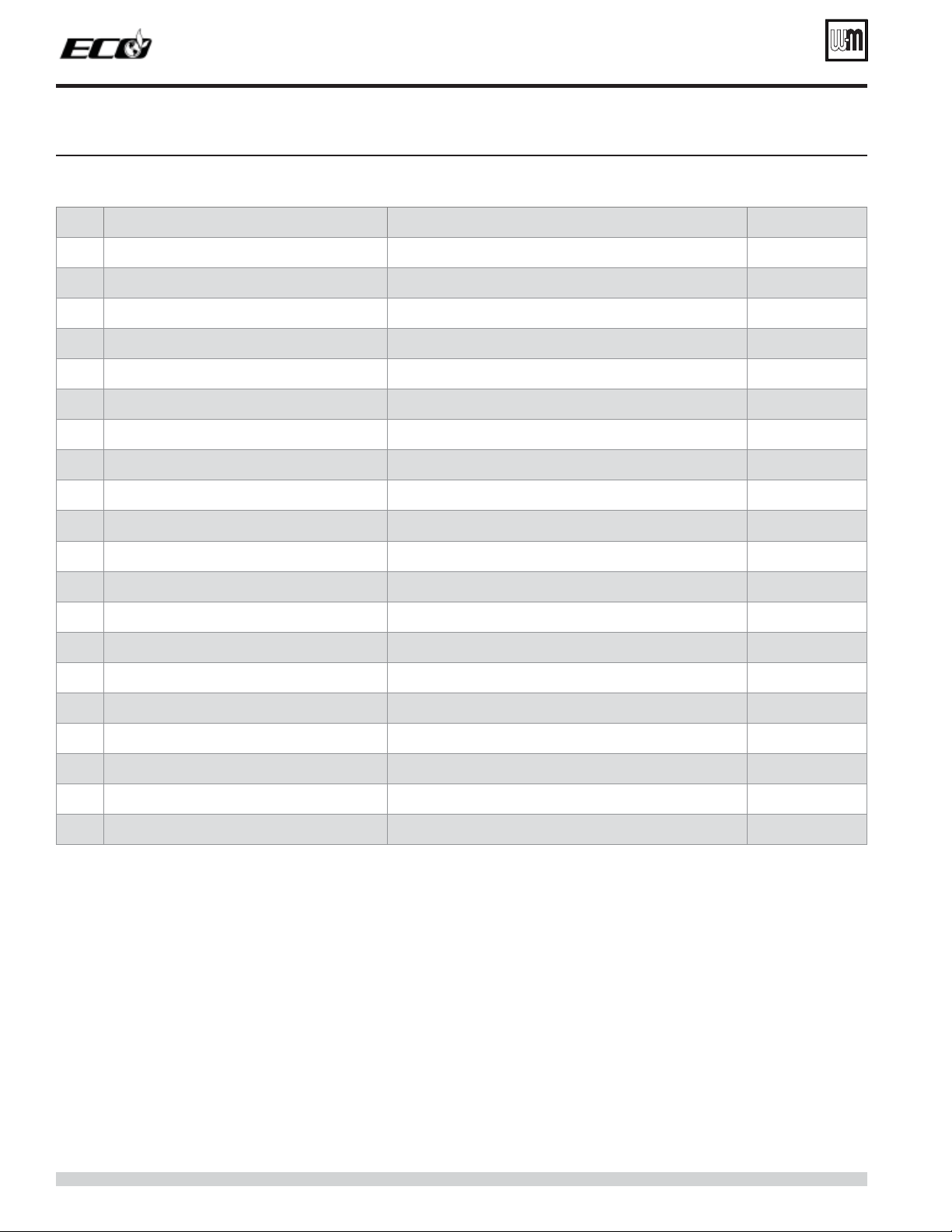
Replacement parts (continued)
&IGURE Jacket parts — ECO 70/110/155 (see Figure 111, page 109 for illustration)
Item Name Description / contents Part Number
100
Jacket door Jacket door and labels 383-800-216
110
Seals – jacket door to cabinet Seals for front face of cabinet 383-800-217
120
Wall-mount bracket (wall side) Bracket and hardware 383-800-218
130
Wall-mount hardware (boiler side) Boiler mounting studs (bolts, washers, and spacers, 2 each) 383-800-219
140
Gaskets - upper panel to cabinet Gaskets - upper panel to cabinet 383-800-220
150
Gasket - heat exchanger to bottom panel Gasket - condensate trap to bottom panel 590-318-071
160
Door screw Screw Truss Head #10-24 (1 each) 562-150-290
170
590-318-051
180
Flue pipe adapter 560-907-719
190
560-907-720
200
Air inlet adapter Top air inlet adapter with internal gasket 560-907-718
210
Gasket - pipe adapter to cabinet Gasket - pipe adapter to cabinet (applies to air and vent adapters) 590-300-031
220
Gasket - pipe adapter to system pipe 590-318-052
230
Jacket bottom panel kit Jacket bottom panel, gasket (items 150 and 240) and screws 383-800-221
240
Gaskets - bottom panel to cabinet Gaskets - bottom panel to cabinet 383-800-222
250
383-800-223
260
Hole plug (not shown) Hole plug, 7/8", for sealing electrical knockouts 561-444-186
270
Water line sealing gaskets Seals water pipes to cabinet 562-248-740
280
Control/transformer bracket Bracket to mount control module and transformer 383-800-228
290
Display board bracket Mounting for the display to side of cabinet 383-800-227
'OTOWWWWEILMCLAINCOMTOLOCATE7EIL-C,AINDISTRIBUTORS
Part number 550-142-122/0513
108
TM
GAS-FIRED WATER BOILER — Boiler Manual
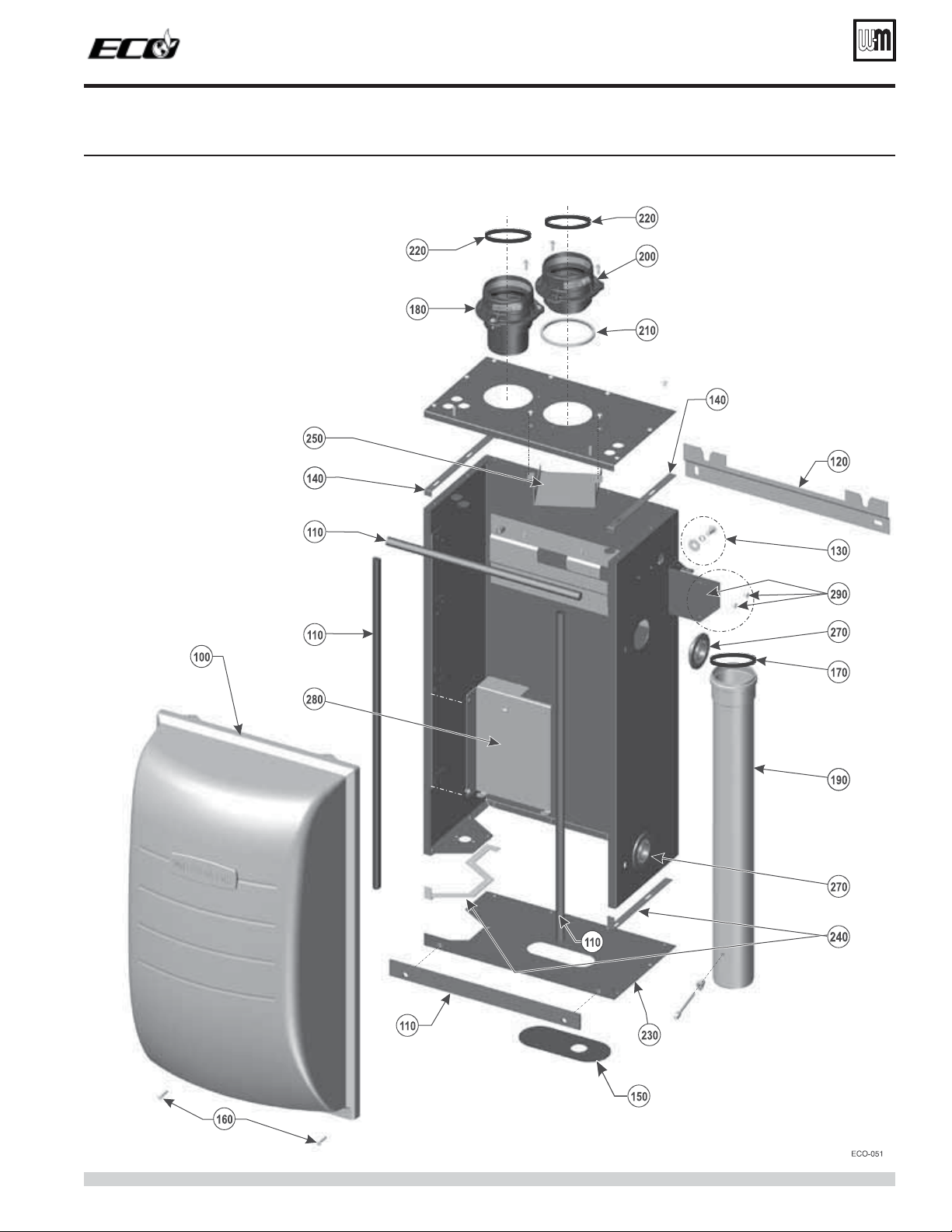
Replacement parts (continued)
&IGURE Jacket assembly — ECO 70/110/155 (see Figure 110, page 108 for part numbers)
'OTOWWWWEILMCLAINCOMTOLOCATE7EIL-C,AINDISTRIBUTORS
Part number 550-142-122/0513
109
TM
GAS-FIRED WATER BOILER — Boiler Manual
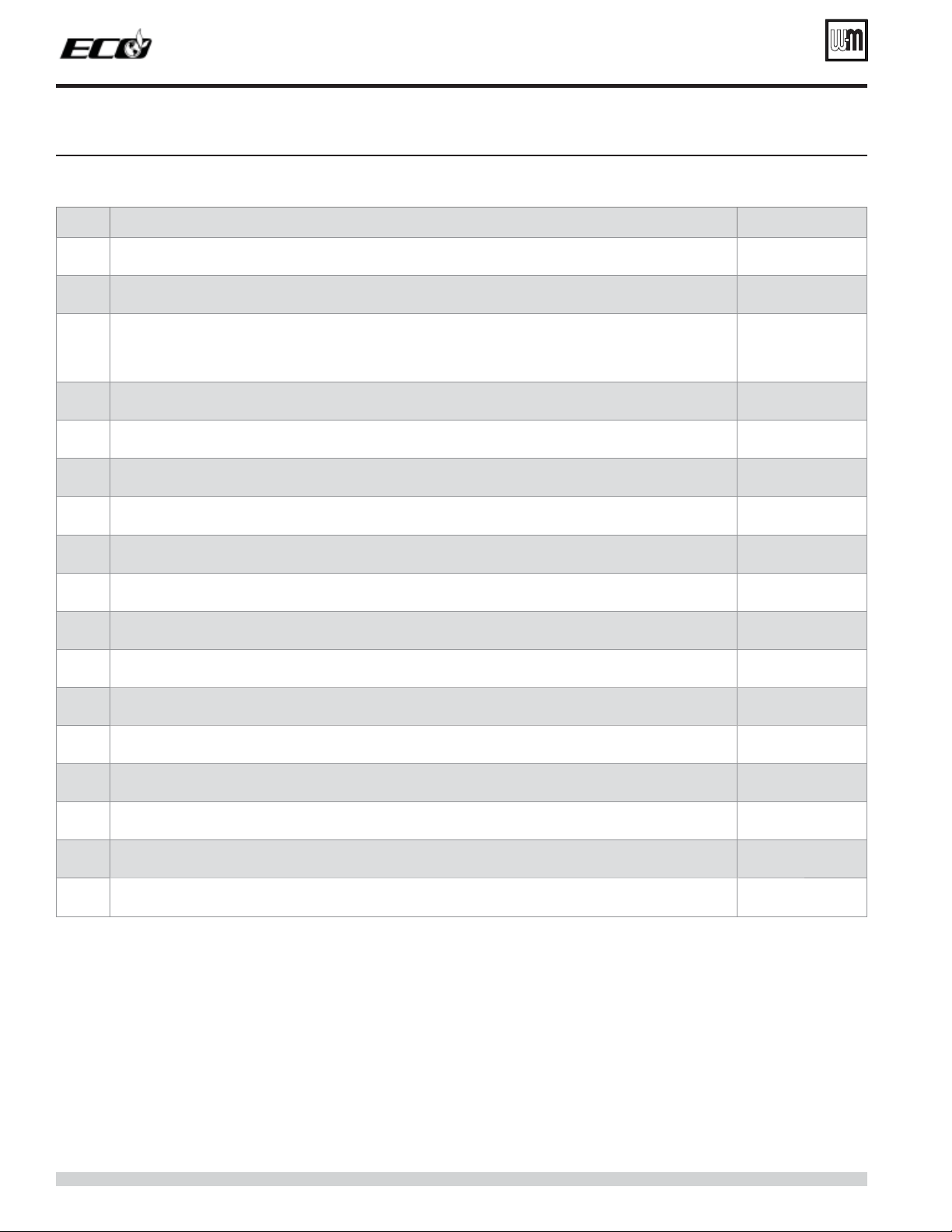
&IGURE Heat exchanger parts ECO 70/110 (see Figure 113, page 111 for illustration)
Item Name Part Number
100
Heat exchanger
383-800-234
105
Heat exchanger with condensate dish, assembled (includes items 100, 120, 130, and 140)
383-800-235
110
Heat exchanger, condensate dish, cover plate, burner, igniter, sight glass, refractory, water sensors, gaskets,
silicone, and hardware
(includes items 100, 120, 130, 140, 160, 180, 210, 240, and 260)
383-800-236
120
Condensate dish, gaskets, and hardware
383-700-102
130
Gasket to seal heat exchanger to condensate dish
383-700-103
140
383-700-104
150
Refractory insulation & silicone sealant
383-700-105
160
Heat exchanger cover plate, refractory, silicone, and gaskets (includes items 150, 170, 200, 220, and 250)
383-700-108
170
Cover plate gasket (exchanger to gasket)
383-700-109
180
Sight glass kit (bracket, glass, gaskets, and hardware) (includes items 190 and 200)
383-700-185
190
Sight glass
591-419-202
200
Sight glass gaskets, upper and lower
383-700112
210
Igniter kit (igniter, gasket and screws)
383-700-113
220
Igniter to cover plate gasket
590-300-034
240
Burner, gasket, and hardware (includes item 250)
383-700-106
250
Burner gasket
383-700-107
260
Heat exchanger water temperature sensor (one sensor for either boiler inlet or outlet water temperature)
511-724-296
'OTOWWWWEILMCLAINCOMTOLOCATE7EIL-C,AINDISTRIBUTORS
Replacement parts (continued)
Part number 550-142-122/0513
110
TM
GAS-FIRED WATER BOILER — Boiler Manual
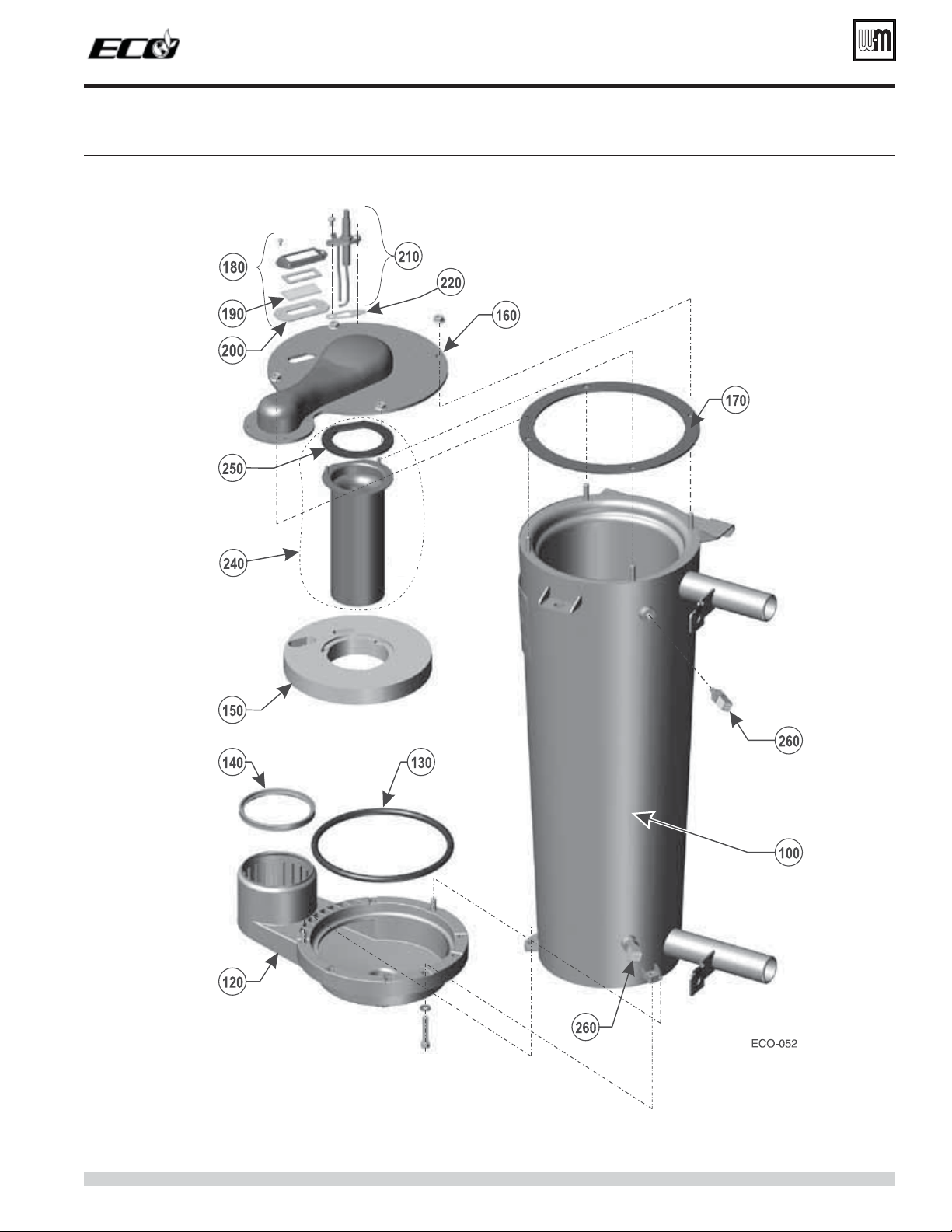
'OTOWWWWEILMCLAINCOMTOLOCATE7EIL-C,AINDISTRIBUTORS
&IGURE Heat exchanger assembly ECO 70/110 (see Figure 112, page 110 for part numbers)
Replacement parts (continued)
Part number 550-142-122/0513
111
TM
GAS-FIRED WATER BOILER — Boiler Manual

Replacement parts (continued)
&IGURE Heat exchanger parts ECO 155 (see Figure 115, page 113 for illustration)
Item Name
Part Number
100
Heat exchanger
383-800-231
105
Heat exchanger with condensate dish, assembled (includes items 100, 160, 170 and 180)
383-800-232
110
Heat exchanger, condensate dish, cover plate, burner, igniter, sight glass, refractory, water sensors, gaskets,
silicone, and hardware
(includes items 100, 130, 140, 160, 170,180, 190, 200, 210, and 270)
383-800-233
120
Cover plate/heat exchanger gasket
590-318-054
130
Boiler inlet temperature sensor
511-724-296
140
Boiler outlet temperature sensor (same as item 130)
150
Blower gasket
590-318-006
160
Condensate dish, gaskets, and hardware
383-700-181
170
Gasket to seal heat exchanger to condensate dish
590-300-039
180
383-700-104
190
Heat exchanger cover plate, refractory and gaskets (includes items 200, 230, 260, and 290)
383-700-184
200
Refractory insulation & silicone sealant
383-700-182
210
Burner, gasket, and hardware (includes item 220)
383-700-183
220
Burner gasket
590-318-055
230
Burner access cover, gasket and hardware (includes item 240)
383-700-202
240
Burner access cover gasket
590-318-053
250
Igniter kit (igniter, gasket and screws) (includes item 260)
383-700-187
260
Igniter gasket
590-300-034
270
Sight glass kit (bracket, glass, gaskets, and hardware) (includes items 280 and 290)
383-700-185
280
Sight glass
591-419-202
290
Sight glass gaskets, upper and lower
383-700-112
Part number 550-142-122/0513
112
TM
GAS-FIRED WATER BOILER — Boiler Manual
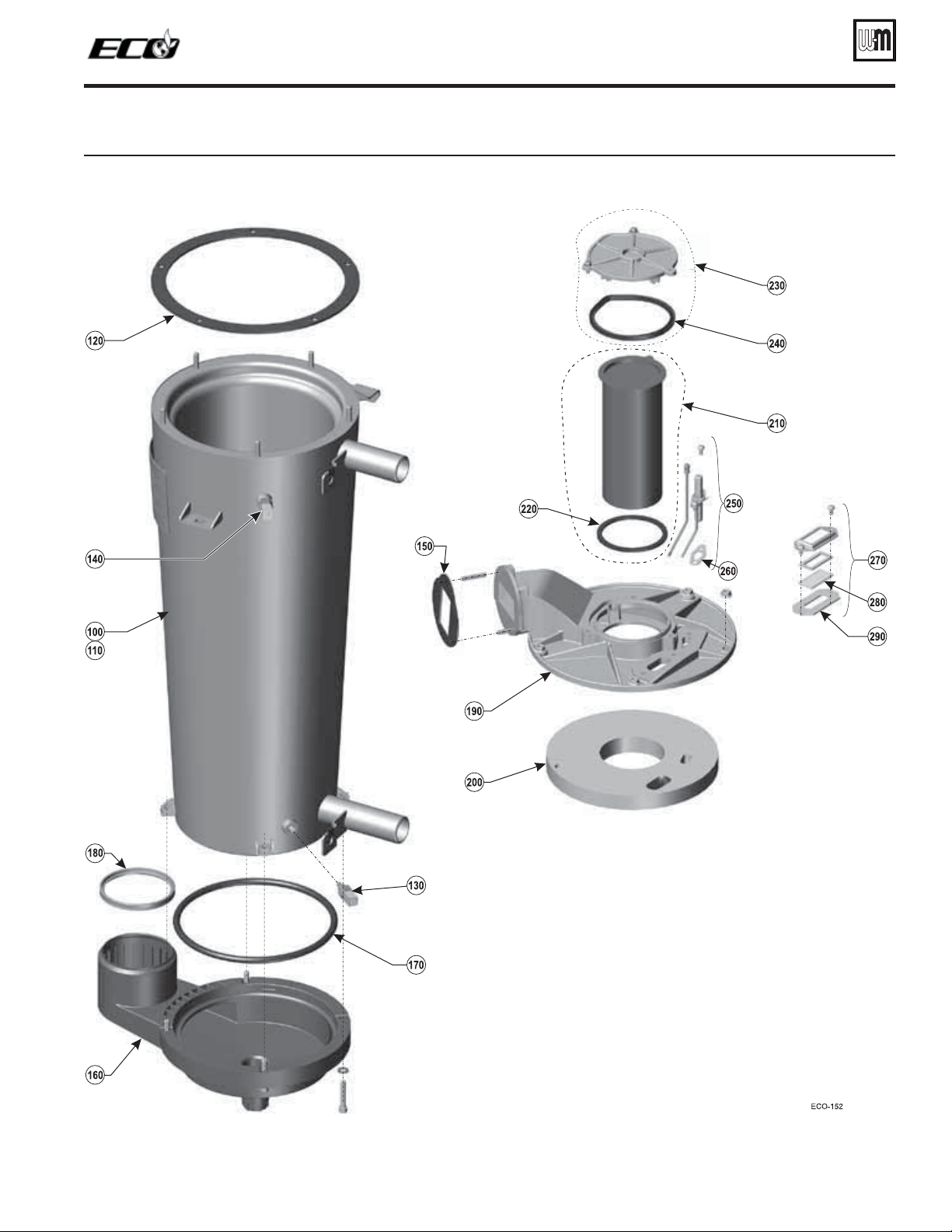
&IGURE Heat exchanger assembly ECO 155 (see Figure 114, page 112 for part numbers)
Replacement parts (continued)
Part number 550-142-122/0513
113
TM
GAS-FIRED WATER BOILER — Boiler Manual
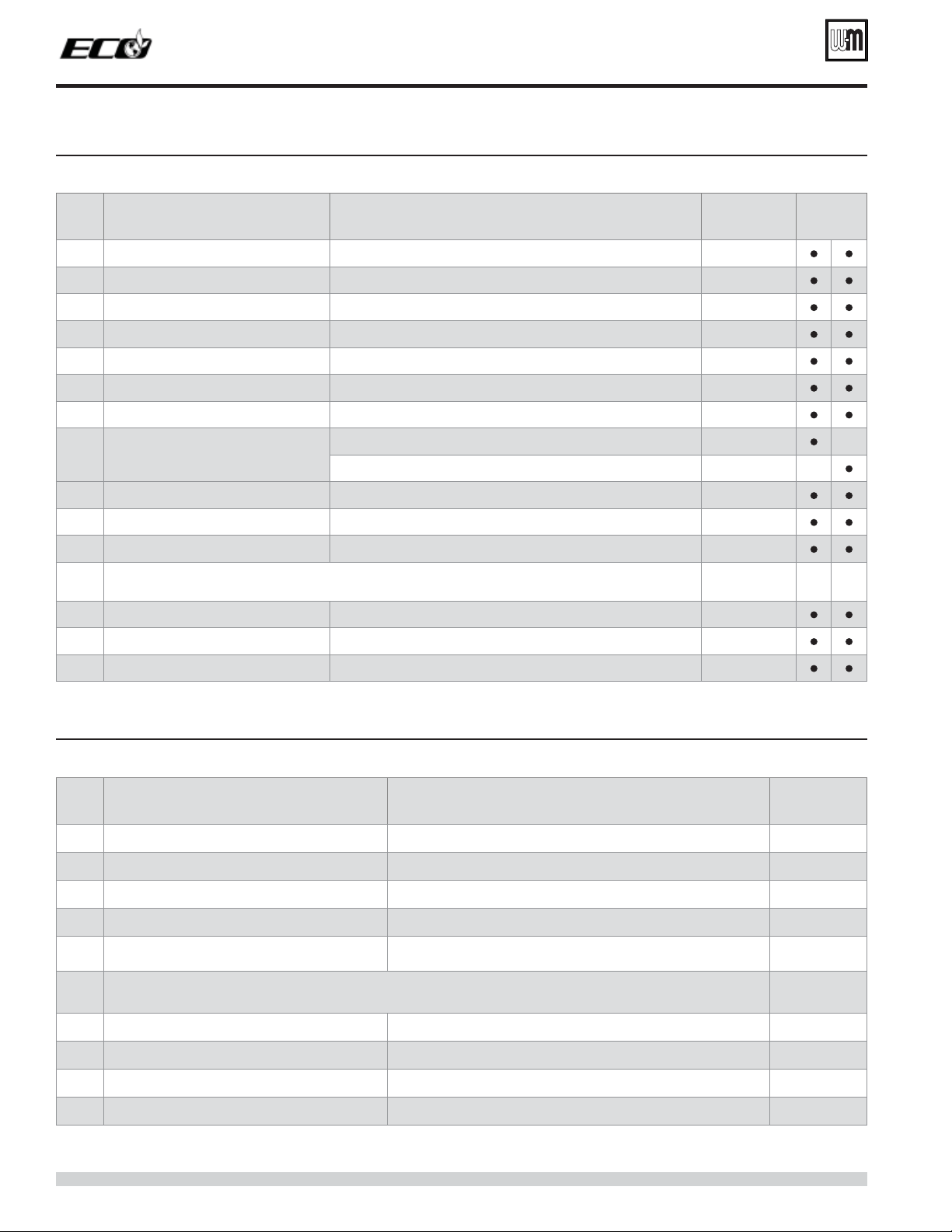
&IGURE Combustion components for ECO 70/110 (see Figure 118, page 115 for illustration)
Item Name Description / contents
Part Number
Model
70
|
110
100 Relief valve 383-500-095
110 Pressure & temperature gauge 380-000-000
200 Air inlet silencer Silencer 383-700-155
210 Silencer o-ring O-ring 590-318-049
220 Blower Blower, clip and gasket 383-700-157
230 Blower retainer clip Clip 562-650-115
240 Reference tube Tube to connect blower to gas valve 590-300-001
250 Gas valve/venturi assembly
Gas valve, venturi (027), gasket, o-ring, clip, and screws 383-700-159
Gas valve, venturi (040), gasket, o-ring, clip, and screws 383-700-160
260 Gas valve retainer clip Clip 562-650-116
270 Gas valve adapter block Threaded block, o-ring, and screws 563-910-031
275 Gas valve outlet o-ring O-ring 590-318-045
280
Figure 108, page 106 for information
—
——
285 562-302-576
290 Gas line, seal, and hardware 383-800-224
295 590-300-027
Replacement parts (continued)
'OTOWWWWEILMCLAINCOMTOLOCATE7EIL-C,AINDISTRIBUTORS
&IGURE Combustion components for ECO 155 (see Figure 118, page 115 for illustration)
Item Name Description / contents
Part Number
100 Relief valve 383-500-095
110 Pressure & temperature gauge 383-000-000
300 Air inlet silencer Silencer with gasket and clip 383-700-203
310 Blower Blower 383-700-195
320 Gas valve/venturi assembly Gas valve, venturi, gasket and hardware 383-700-196
330
Figure 108, page 106 for information
—
340 Gas valve adapter block Threaded block, o-ring and screws 563-910-031
350 562-302-576
360 Gas pipe and hardware 383-800-224
370 590-300-027
Part number 550-142-122/0513
114
TM
GAS-FIRED WATER BOILER — Boiler Manual
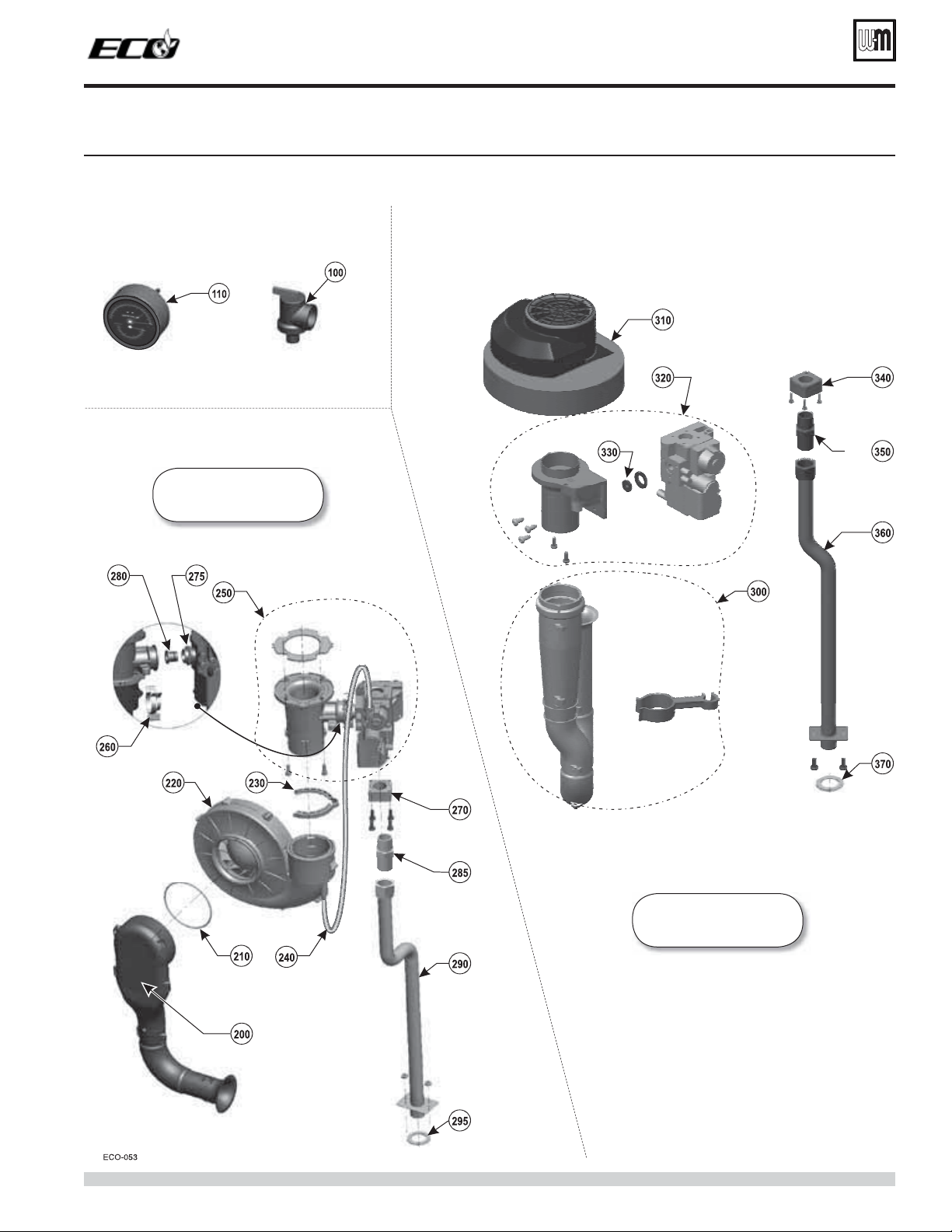
'OTOWWWWEILMCLAINCOMTOLOCATE7EIL-C,AINDISTRIBUTORS
Replacement parts (continued)
&IGURE Combustion components for ECO 70/110 /155(see Figure 116, page 114 for part numbers)
70/110
155
Part number 550-142-122/0513
115
TM
GAS-FIRED WATER BOILER — Boiler Manual
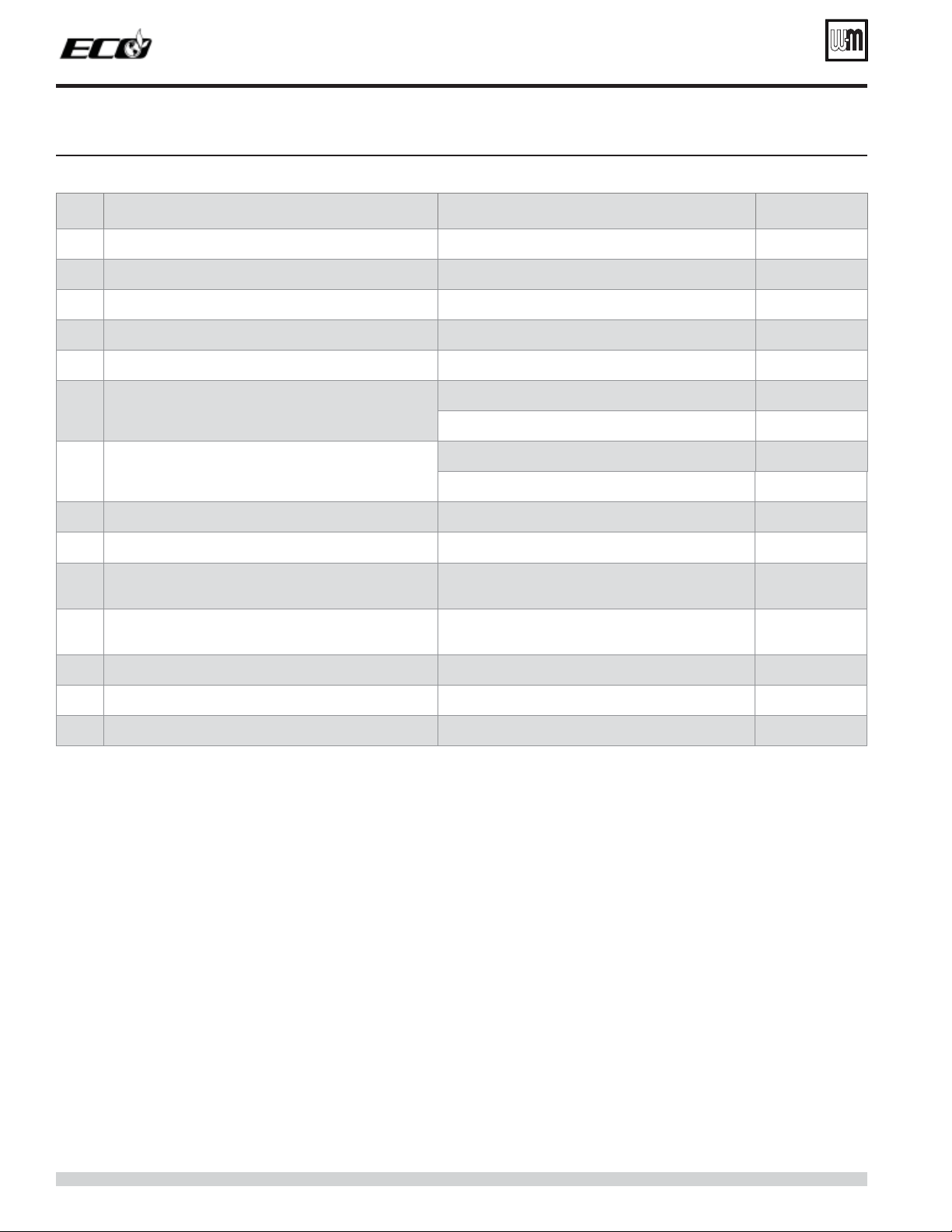
&IGURE Controls and electrical components — ECO 70/110/155 (see Figure 120, page 117 for illustration)
Item Name Description / contents
Part Number
100 Flue temperature sensor One sensor 511-724-292
110 Outdoor temperature sensor One sensor 510-312-218
120 Transformer 120V/24V 50 VA transformer 511-802-011
130 Display board assembly Includes circuit board and plastic housing 381-330-019
140 Control module assembly Control module and housing 381-330-018
150 Wire harness — line voltage (not shown)
Wire harness (ECO 70 or 110) 591-392-001
Wire harness (ECO 155) 591-392-003
160 Wire harness — low voltage (not shown)
Wire harness (ECO 70 or 110) 591-392-000
Wire harness (ECO 155) 591-392-002
170 Wire harness — display (not shown) Connects display to control 591-392-004
180 Ignition cable (not shown) Ignition cable 591-391-997
190
F1 - 3 amp, fast blow ato (5 fuses)
(not shown here — see Figure 95, page 91)
5 Fuses 383-500-603
200
F2 - 12 amp, slow-blow ag (5 fuses)
(not shown here — see Figure 95, page 91)
5 Fuses 383-500-604
210 Jumper for low voltage terminal blocks (not shown) 5 jumpers 383-500-641
220 Connector electrical control (not shown) Includes all 6 connectors 383-800-229
230 Low voltage sealed wire cord grip (not shown) Seals thermostat wire at entrance to cabinet 591-850-571
Replacement parts (continued)
'OTOWWWWEILMCLAINCOMTOLOCATE7EIL-C,AINDISTRIBUTORS
Part number 550-142-122/0513
116
TM
GAS-FIRED WATER BOILER — Boiler Manual
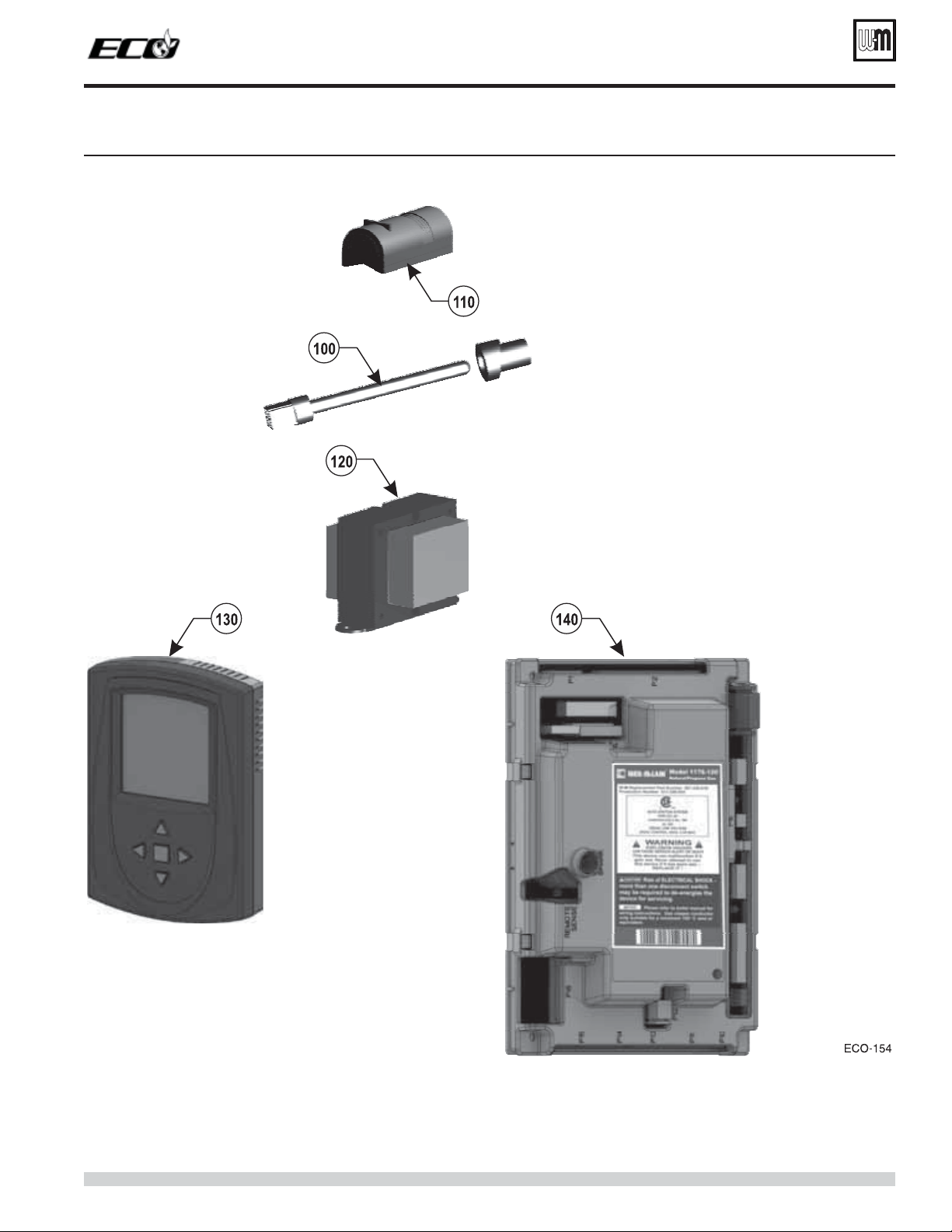
'OTOWWWWEILMCLAINCOMTOLOCATE7EIL-C,AINDISTRIBUTORS
Replacement parts (continued)
&IGURE Controls and electrical assemblies — ECO 70/110/155 (see Figure 119, page 116 for part numbers)
Part number 550-142-122/0513
117
TM
GAS-FIRED WATER BOILER — Boiler Manual
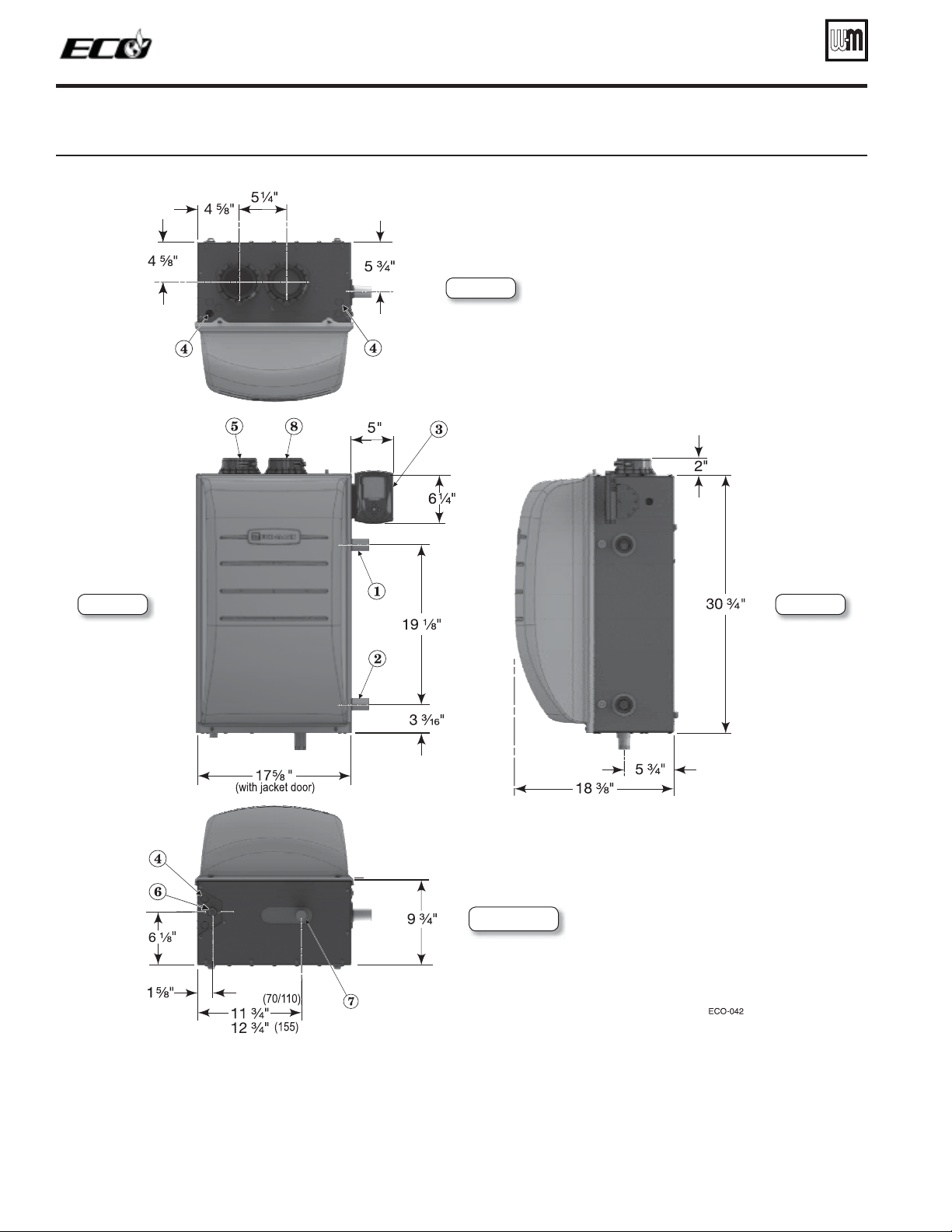
&IGURE Dimensional data — ECO 70/110/155 (all dimensions in inches)
Dimensions
4/0
&2/.4 2)'(4
"/44/-
1 Boiler supply tapping — 1” NPT
2 Boiler return tapping — 1” NPT
3 Control display and navigation buttons
4 Electrical entrance openings
5 Vent connection: 3” PVC
6 Gas connection
7 Condensate trap nozzle
8 Air connection: 3” PVC
Part number 550-142-122/0513
118
TM
GAS-FIRED WATER BOILER — Boiler Manual
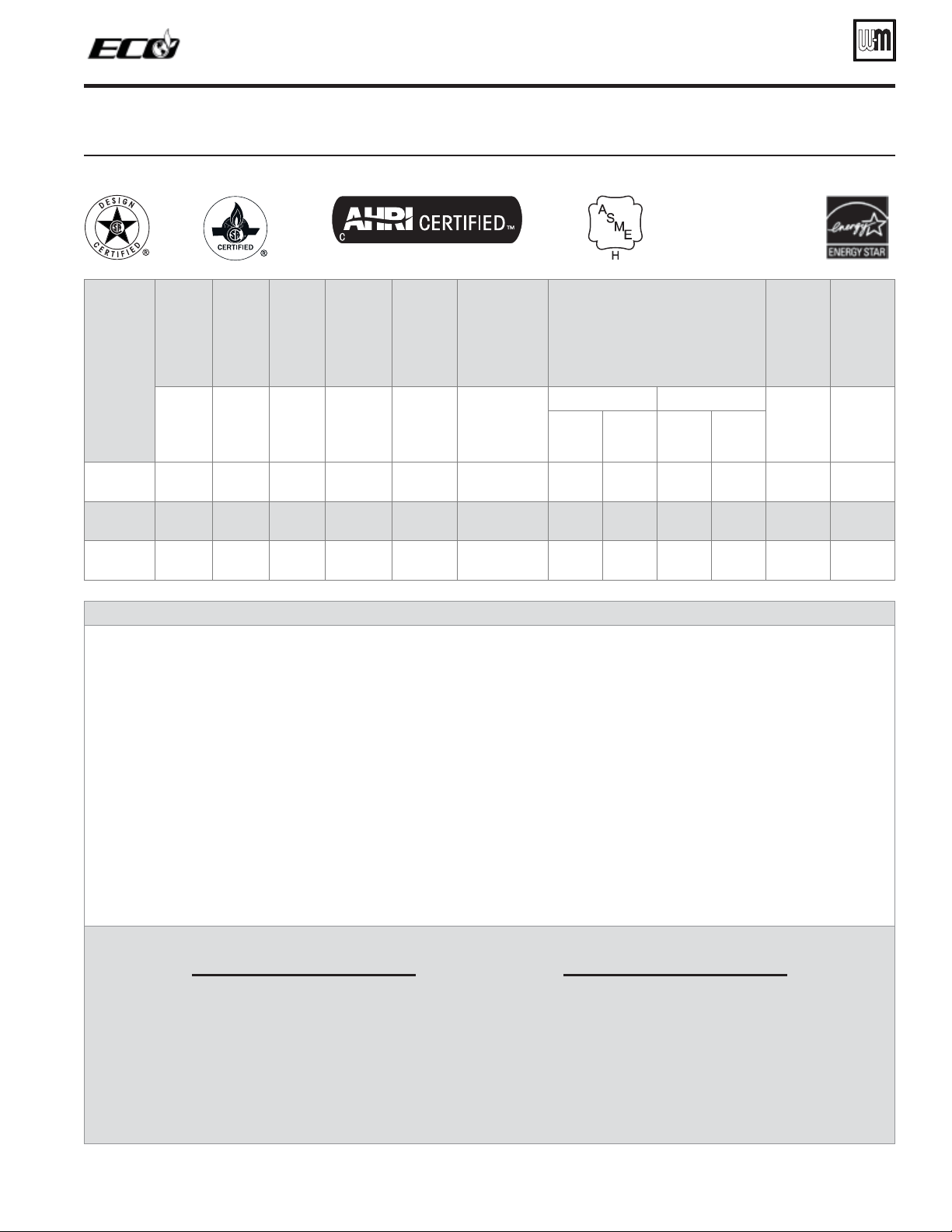
Ratings — ECO boilers
&IGURE Ratings and engineering data — ECO 70/110/155
DOE
Boiler
Model
ECO
CSA
Output /
DOE
Heating
capacity
CSA
Input
Net AHRI
water
rating
DOE
Seasonal
Efficiency
Boiler
Water
Content
Vent/
Comb. Air
Connection
Diameter
% Input derate vs vent length
(Values shown are at MAX vent/air
pipe length —
See Note 6)
$IRECT6ENT6ENTING/.,9
Shipping
Weight
Operating
Weight
Btuh
(Note 2)
Btuh
(Note 5)
Btuh
(Note 3)
AFUE, %
(Note 1)
Gallons
Inches
(Note 4)
Natural gas Propane
Pounds Pounds
2”
Vent/air
piping
3”
Vent/air
piping
2”
Vent/air
piping
3”
Vent/air
piping
70
65,000 70,000 57 95.2 2.54 3" PVC 12 % 5 % 12 % 5 % 117 110
110
101,000 110,000 88 95.0 2.54 3" PVC 15 % 5 % 15 % 5 % 117 110
155
143,000 155,000 124 95.1 3.22 3” PVC N/A 5 % N/A 5 % 130 125
Notes
1
As an Energy Star Partner, Weil-McLain
has determined that ECO boilers meet
the Energy Star guidelines for energy
efficiency.
NOTE: Adjusting boiler firing rate will
affect AFUE rating.
2 Based on standard test procedures
prescribed by the United States Depart-
ment of Energy. Ratings also referred to
as CSA Output.
NOTE that only DOE Heating Capacity
and AFUE are certified by AHRI. AFUE
is also know as Annual Fuel Utilization
Efficiency or Seasonal Efficiency.
3 Net AHRI ratings are based on net
installed radiation of sufficient quantity
for the requirements of the building
and nothing need be added for normal
piping and pickup. Ratings are based
on a piping and pickup allowance of
1.15. An additional allowance should
be made for unusual piping and pickup
loads.
4 ECO boilers must be direct-vented.
ECO boilers require special venting,
consistent with Category IV boiler. Use
only the vent materials and methods
specified in this manual.
ECO 70 or 110 vent/air pipes can be
either 2” or 3”
ECO 155 vent/air pipes must be 3”
All vent and air pipe elbows must
be sweep elbows, NOT short-radius
elbows.
5 Ratings shown are for sea level applica-
tions only. For altitudes from sea level
to 5,500 feet above sea level, the ECO
boiler requires no modifications and
automatically derates itself by approxi-
mately 4% per 1000 feet above sea level.
6 All of the boilers will automatically
de-rate as vent/air pipe length increases,
due to the pressure loss through the
piping. For vent/air pipe lengths less
than the maximum, the derate equals
the value above times vent length ÷ 100.
THE OUTDOOR SENSOR3500,)%$7)4(4(%"/),%2-534"%).34!,,%$5.,%33%8%-04%$"%,/7
IMPORTANT
In accordance with 3ECTIONOFTHE
%NERGY!CT
, this boiler is equipped
with a feature that saves energy by re-
ducing the boiler water temperature as
the heating load decreases. This feature
is equipped with an override which is
provided primarily to permit the use of
an external energy management system
that serves the same function.
4()3/6%22)$%-534./4"%53%$5.,%33!4,%!34/.%/&4(%
&/,,/7).'#/.$)4)/.3)3425%
s An external energy management system is installed that reduces the boiler water tem-
perature as the heating load decreases.
s This boiler is not used for any space heating.
s This boiler is part of a modular or multiple boiler system having a total input of 300,000
BTU/hr or greater.
s This boiler is equipped with a tankless coil (not applicable to ECO).
Part number 550-142-122/0513
119
TM
GAS-FIRED WATER BOILER — Boiler Manual
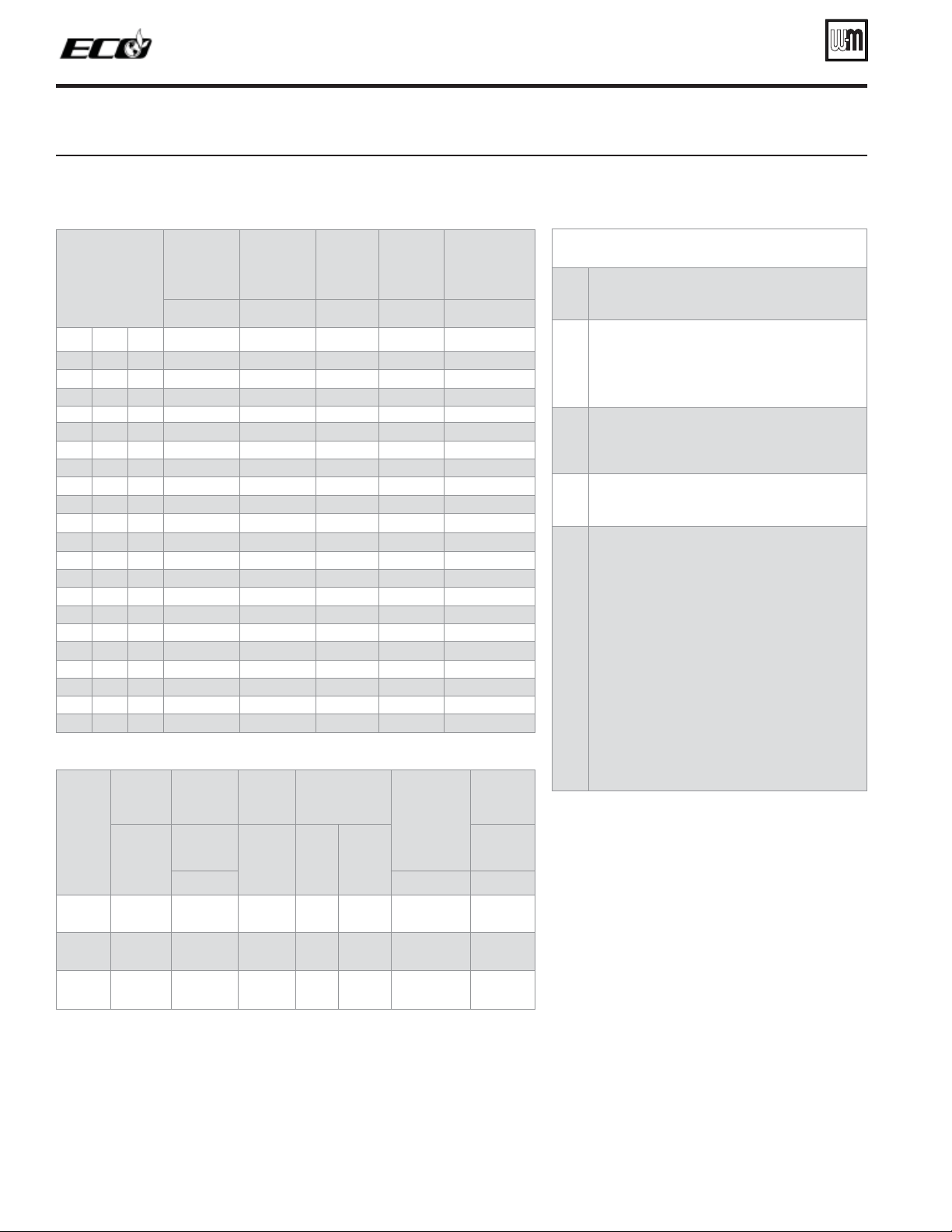
&IGURE Ratings and engineering data — multiple ECO boilers
Boilers in
SYSTEM
Model %#/
Total
)NPUT
/UTPUT
(EATING
CAPACITY
Boiler
(0
Net water
RATINGS
-ANIFOLDED
COMBUSTION
AIRDUCT
SIZE
Input,
MBH
Output,
MBH
- MBH
Square
inches
70 110 155
- Note 1 - Note 2 Figure 54, page 50
2 140 130 3.9 114 70
2 220 202 6.0 176 110
2 310 286 8.5 248 155
3 210 195 5.8 171 105
3 330 303 9.1 264 165
3 465 429 12.8 372 233
4 280 260 7.8 228 140
4 440 404 12.1 352 220
4 620 572 17.1 496 310
5 350 325 9.7 285 175
5 550 505 15.1 440 275
5 775 715 21.4 620 388
6 420 390 11.7 342 210
6 660 606 18.1 528 330
6 930 858 25.6 744 465
7 490 455 13.6 399 245
7 770 707 21.1 616 385
7 1085 1001 29.9 868 543
8 560 520 15.5 456 280
8 880 808 24.1 704 440
8 1240 1144 34.2 992 620
Boiler
Model
%#/
3HIPPING
WEIGHT
/PERATING
WEIGHT
Water
CONTENT
7ATERmOWRATE
PERBOILER
6ENTAIRPIPE
SIZE
(Provide a
separate
vent for each
boiler)
%LECTRICAL
SERVICE
REQUIRED
Pounds
per boiler
Pounds
per boiler
Gallons
per boiler
GPM
@ 20°F
rise
GPM
@ 40°F
rise
Amps
per boiler
Note 4 Note 5 Note 3
70
117 110
2.54 6.5 3.3 2” or 3” 15.0
110
117 110
2.54 10.0 5.0 2” or 3” 15.0
155
130 125
3.22 14.3 7.2 3” 15.0
Ratings — Multiple ECO boilers
Notes
1
Based on standard test procedures outlined by
DOE for individual boilers.
2
Net AHRI ratings are based on piping and
pickup allowance of 1.15.
Consult Weil-McLain Technical Services for
other allowances.
3
Total amp requirement includes up to three
circulators, not exceeding 2.2 amps per
circulator.
4
Operating weight is the total weight of the
boiler, including water.
5
ECO 70 or 110 vent/air pipes can be either 2”
or 3” pipe.
ECO 155 vent/air pipes must be 3”.
All of the boilers will automatically de-rate
as vent/air pipe length increases, due to
the pressure loss through the piping. See
Figure 122, page 119 for details.
All ECO installations require a separate
vent pipe and termination for each boiler.
6ENTPIPINGCANNOTBEMANIFOLDED. Install
and terminate vents as described in vent/air
installation instructions in this manual.
Combustion air piping can be individually
piped or manifolded. See Figure 54, page 50,
for manifolded air piping.
Part number 550-142-122/0513
120
TM
GAS-FIRED WATER BOILER — Boiler Manual
"OILER3TART5P$ATA
Boiler Model / Series ECO ________ / Series ____
Date installed ________________ CO
2
@: High fire ______% Low fire ______%
CP Number ____________ FUEL: Natural ____ LP ____ Btu Input ___________________ CO @: High fire ____ ppm Low fire ____ ppm
Flame signal on control display at high fire __________________ Flame signal on control display at low fire __________________
Was orifice changed? _________ Was gas valve throttle adjusted? ______ Natural gas input rate measured HIGH________ CFH / LOW________ CFH
%#/CONTROL3ET5P$ATA
"/),%23ETTINGS (%!43ETTINGS $(73ETTINGSIFINSTALLED
Boiler Model ECO ________ Supply Max °F Boiler Supply
°F
High Altitude Yes ____ NO ____ Supply Min °F
OD Reset Max °F
WWSD Temp °F OD Reset Min °F
Adjust Outdoor °F Mod On Diff °F On Diff °F
Mod Off Diff °F Off Diff °F
Min On Time minutes Max On Time minutes
Boost Interval minutes
Pre-pump Time: seconds Pre-pump Time: seconds
Post-pump Time: seconds Post-pump Time: seconds
Max Blower RPM RPM Max Blower RPM RPM
Min Blower RPM RPM Min Blower RPM RPM
#%24)&)%$4(!4: ❏ Installation instructions have been followed.
❏ Check-out sequence has been performed.
❏ Above information is certified to be correct.
❏ Information received and left with owner/maintenance person.
Installer
(Company) (Address) (Phone) (Installer's Signature)
Installation and Service Certificate
Part number 550-142-122/0513
121
TM
GAS-FIRED WATER BOILER — Boiler Manual
#USTOMER)NFO -AINTENANCE)NFO
Contact: Name:
Contractor: Phone:
Job name: Model:
City, state: CP#:
Distributor: Installed:
3YSTEM#OMPONENTS
"OILER3YSTEM0IPING$ETAILS0LEASE3KETCH
Near boiler pipe size:
DHW tank (yes/no):
DHW direct/system:
DHW model:
DHW pipe size:
DHW circulator model:
Is there air in system?:
$IAGNOSTIC%RRORS
Control fault:
Ignition retries:
Manual reset CNT:
Auto reset CNT:
3OFTWARE6ERSIONS
Display:
Main micro:
Second micro:
,OCKOUT(ISTORY ,OCKOUT(ISTORY ,OCKOUT(ISTORY
Fault Name: Fault Name: Fault Name:
Fault Type: Fault Type: Fault Type:
Fault Time: Fault Time: Fault Time:
Fault Date: Fault Date: Fault Date:
Status: Status: Status:
4EMPERATURES 4EMPERATURES 4EMPERATURES
Status: Status: Status:
Boiler out 1: Boiler out 1: Boiler out 1:
Boiler out 2: Boiler out 2: Boiler out 2:
Boiler in: Boiler in: Boiler in:
Flue 1: Flue 1: Flue 1:
Flue 2: Flue 2: Flue 2:
Outdoor: Outdoor: Outdoor:
)NPUTS )NPUTS )NPUTS
Status: Status: Status:
HEAT Input: HEAT Input: HEAT Input:
DHW Input: DHW Input: DHW Input:
Manual limit: Manual limit: Manual limit:
Auto limit: Auto limit: Auto limit:
Low WTR Cutoff: Low WTR Cutoff: Low WTR Cutoff:
Blower Speed: Blower Speed: Blower Speed:
Flame signal: Flame signal: Flame signal:
/UTPUTS /UTPUTS /UTPUTS
Status: Status: Status:
Gas valve: Gas valve: Gas valve:
Circulator HEAT: Circulator HEAT: Circulator HEAT:
Circulator
DHW: Circulator DHW: Circulator DHW:
Blower signal: Blower signal: Blower signal:
ECO Gas Boiler Data Collection Sheet
Part number 550-142-122/0513
122
TM
GAS-FIRED WATER BOILER — Boiler Manual

NOTES
Part number 550-142-122/0513
123
TM
GAS-FIRED WATER BOILER — Boiler Manual

TM
GAS-FIRED WATER BOILER — Boiler Manual
Part number 550-142-122/0513
124