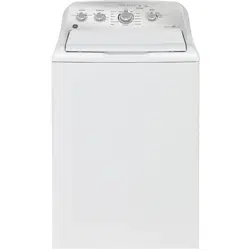
Washers
29-6395 02-21
SafetyInstructions
. . . . . . . . . . 2, 3
Operating Instructions
Care and Cleaning
of the Washer. . . . . . . . . . . . . . . . . . . . 13
Features . . . . . . . . . . . . . . . . . . . . . . . . . . 12
Loading and Using
the Washer . . . . . . . . . . . . . . . . . . . . . . 11
Operating instructions . . . . . . . . .4–10
Installation Instructions
. 14–18
Troubleshooting Tips
. . . . . 19–24
Consumer Support
Consumer Help Indicator . . . . . . . . . 10
Consumer Support. . . . . . . . . . . . . . . . 26
Parts and Accessories. . . . . . . . . . .3, 26
Warranty .... . . . .
. . . . . . . . . . . . . . . . . . 25
Printed in Mexico
Write the model and serial
numbers here:
Model # _____________
Serial # ______________
You can find
them under
the lid of the
washer.
Owner’s Manual &
Installation Instructions
English/Français/Español
GTW223
GTW331
GTW451
GTW490
GTW550
GTW580
233D2527P004 R.1
2
IMPORTANT SAFETY INFORMATION.
READ ALL INSTRUCTIONS BEFORE USING.
This is the safety alert symbol. This symbol alerts you to potential hazards that can kill you or hurt you and others. All safety
messages will follow the safety alert symbol and the word “DANGER”, “WARNING”, or “CAUTION”. These words are defined as:
Indicates a hazardous situation which, if not avoided, will result in death or serious injury.
Indicates a hazardous situation which, if not avoided, could result in death or serious injury.
Indicates a hazardous situation which, if not avoided, could result in minor or moderate injury.
DANGER
WARNING
CAUTION
IMPORTANT SAFETY INSTRUCTIONS
To reduce the risk of death, fire, explosion, electric shock, or injury to persons when using your appliance,
follow basic precautions, including the following:
Read all instructions before using the appliance.
DO NOT wash or dry articles that have been previously cleaned in, washed in, soaked in or spotted with gasoline, dry-
cleaning solvents, or other flammable or explosive substances, as they give off vapors that could ignite or explode.
DO NOT add gasoline, dry-cleaning solvents, or other flammable or explosive substances to the wash water. These
substances give off vapors that could ignite or explode.
Under certain conditions, hydrogen gas may be produced in a hot-water system that has not been used for 2 weeks
or more. HYDROGEN GAS IS EXPLOSIVE. If the hot water system has not been used for such a period, before using a
washing machine, turn on all hot-water faucets and let the water flow from each for several minutes. This will release
any accumulated hydrogen gas. As the gas is flammable, DO NOT smoke or use an open flame during this time.
DO NOT allow children to play on or in this appliance. Close supervision of children is necessary when this appliance is
used near children. Before the washer is removed from service or discarded, remove the door or lid. Failure to follow
these instructions may result in death or injury to persons.
DO NOT reach into the appliance if the tub or agitator is moving to prevent accidental entanglement.
DO NOT install or store this appliance where it will be exposed to the weather.
DO NOT tamper with controls, repair or replace any part of this appliance or attempt any servicing unless specifically
recommended in the user maintenance instructions or in published user repair instructions that you understand and
have the skills to carry out.
DO NOT operate this appliance if it is damaged, malfunctioning, partially disassembled, or has missing or broken parts
including a damaged cord or plug.
Unplug the appliance or turn off the circuit breaker before servicing. Pressing the Power button DOES NOT disconnect power.
See “Electrical Requirements” located in the Installation Instructions for grounding instructions.
SAVE THESE INSTRUCTIONS
WARNING
3
GEAppliances.ca
SAVE THESE INSTRUCTIONS
WHEN NOT IN USE
Turn off water faucets to minimize leakage if a break or
rupture should occur. Check the condition of the fill hoses;
GE recommends changing the hoses every 5 years.
Ensure that the hot water hose is connected to the “H”
valve and the cold water hose is connected to the “C”
valve.
Install or store where it will not be exposed to
temperatures below freezing or exposed to the weather,
which could cause permanent damage and invalidate the
warranty.
Properly ground washer to conform with all
governing codes and ordinances. Follow details
in Installation Instructions.
Ensure washer is properly leveled and washer legs are
adjusted such that unit is stable.
Optional drain hose extension recommended for
discharging heights from 60” - 96”.
Washers do not include supply hoses (only GTW223 model).
GE strongly recommends the use of factory specified
parts. A list of factory hoses available for purchase are
listed. These hoses are manufactured and tested to meet
GE specifications.
GE strongly recommends the use of new water supply
hoses. Hoses degrade over time and need to be replaced
every 5 years to reduce the risk of hose failures and water
damage.
Parts and Accessories
Order on-line at www.geappliances.ca today, 24 hours a
day or by phone at 1.800.661.1616 during normal business
hours.
Part Number
Accessory
WW01F01987 (2) Water supply hoses
PROPER INSTALLATION
This washer must be properly installed and located in accordance with the Installation Instructions before it is used.
Any time the washer is being started or restarts after the
washer lid has been opened and closed, the washer will
turn on the cold water valve for two short periods followed
by a 10 second pause before continuing.
If the lid is opened during this period, the washer will
pause. You will have to push the Start button again to
restart the cycle.
START-UP SEQUENCE
- Electrical Shock Hazard
WARNING
Plug into a grounded 3 prong outlet.
DO NOT remove ground prong.
DO NOT use an adapter.
DO NOT use an extension cord.
Failure to follow these instructions can result in death
or electrical shock.
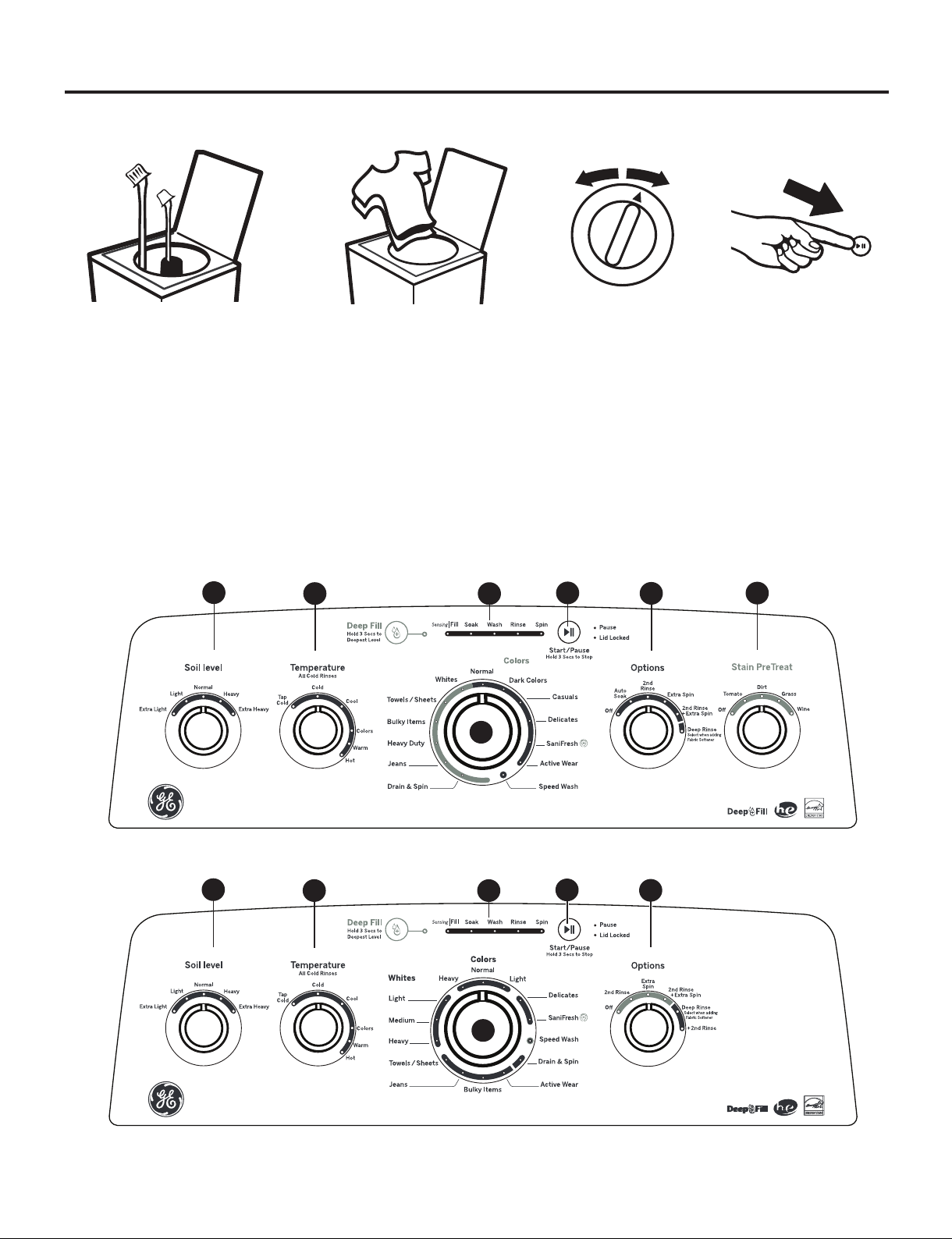
Throughout this manual, features and appearance may vary from your model.
4
Operating instructions.
Controls
dnuora smeti dda ylesooL •
agitator. Overloading may
negatively impact wash
performance. See page 11
for suggested loading
examples.
esolC • lid.
NOTE: Washer will not start
with lid open.
Step 2
Step 3
Step 4
Step 1
• Select wash cycle.
,snoitpo hsaw tceleS •
including Deep Rinse
option (Not all features
are on all models) when
using fabric softener.
• Select options.
• Press Start. renetfos cirbaf ddA • to the
fabric softener dispenser
(Not all features are on all
models); see page 12.
eht ddA • manufacturer’s
recommended amount of
detergent.
GE recommends
the use of High Efficiency
detergents such as
he
in your
energy efficient washer.
Place
detergent pods in the bottom
of the wash
basket before
adding clothes.
D
B
A
C
C
E
E
GTW580
D
GTW550
B
A
C
C
E
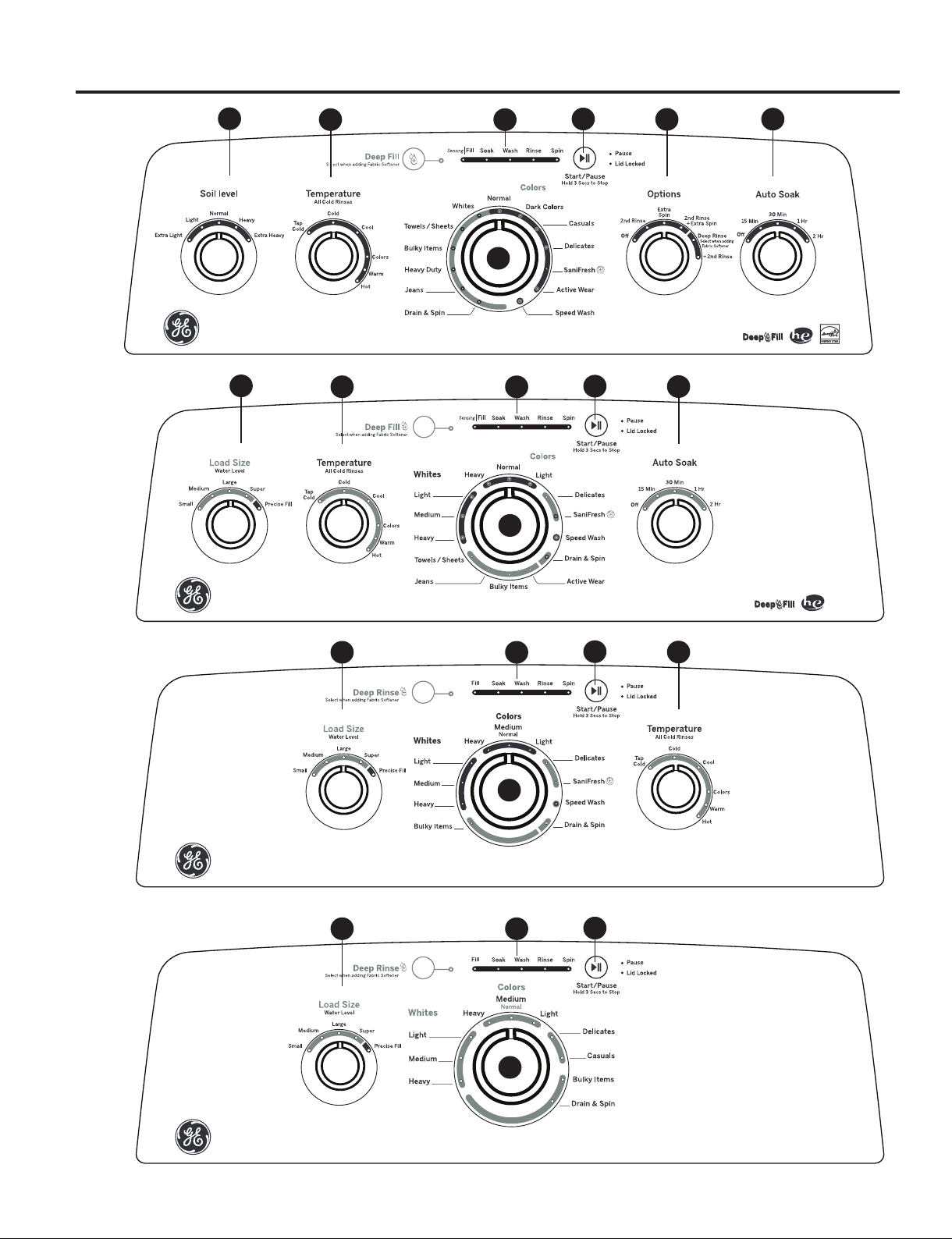
D
5
GEAppliances.ca
B
A
C
C
E
E
GTW490
D
B
A
C
C
E
GTW451
B
A
C
C
GTW331
D
GTW223
D
C
B
A
A
B
C
6
Operating instructions.
Start/Pause
Press Start to begin the cycle. NOTE: The lid must be closed for the washer to start the cycle. If the lid is closed, the lid will lock and the Lid
Locked light will illuminate.
Pressing Pause will unlock the lid (if locked at that time), pause the cycle and the Pause indicator light will blink.
To continue the cycle, press Start again. If machine is paused more than 24 hours, the cycle will be cancelled. If water remains in th
e
machine, select the Drain & Spin cycle to drain basket and spin water out of the washer basket.
Cycle Status Lights
Shows whether the washer is in the Fill, Soak, Wash, Rinse or Spin portion of the cycle.
If an out-of-balance condition is detected by the washer, the Spin light will blink during the remaining portion of the cycle and will
stay illuminated for a short time after cycle completion. When this occurs, the washer is taking actions to correct the out-of-balance
condition and complete the cycle normally. In some cases, the washer may not be able to balanc
e the load and spin up to full
speed. If you notice the load is more wet than normal at the end of the cycle, redistribute the load evenly in the wash basket and
run a Drain & Spin cycle.
Settings
Select settings for agitation (Soil) and water temperature (Temp).
NOTE: Longer Spin times typically reduce dryer time/energy usage (i.e. reduces total energy when using both a washer and a dryer).
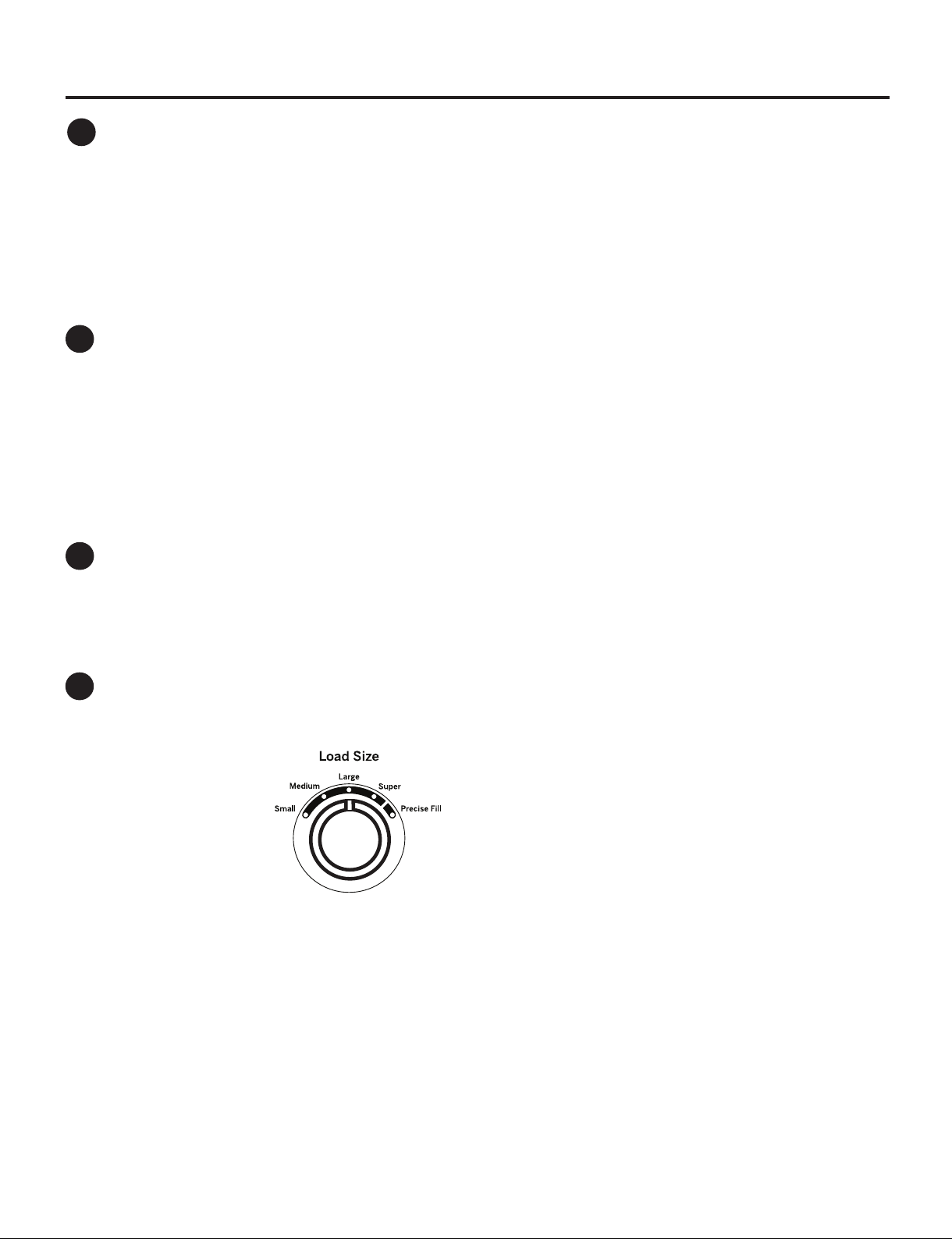
Load Size (Not all features are on all models)
Add he detergent to the bottom of the basket and fabric softener to the dispenser (Not all features are on all models) prior to loading clothes.
Loosely load items in the washer basket. Overloading may negatively impact wash performance. Adjust the load size accordingly.
Make the load selection:
Precise Fill (Not all features are on all models)
tceles ,ycneiciffe lamitpo dna ecnamrofrep tseb ,ecneinevnoc roF –
Precise Fill for models so equipped. This selection automatically provides the
correct amount of water suited to the size and type of load placed in the unit. Lid will be locked for the duration of the load sensing process,
which includes a series of short spins and a portion of the water fill.
tceles ,level retaw eht tceles yllaunam ot referp uoy fI – Small through Super. While Precise Fill is best for most loads and general washing, you
may want to manually select the load size for specialty items such as bulky, lightweight comforters or pillows, where you want to ensure a larger
water level is applied. Manual load size selections should be made for wet items placed in the washer, such as soaked towels or garments.
nehw retaw htiw llif ton lliw rehsaw ehT –
Precise Fill
is selected if the lid is opened. When the lid is closed the machine is able to
begin filling with water in order to sense the load size.
NOTE: This is a high-efficiency washing machine. This system requires less water while providing effective cleaning action. You may notice that the
water level is lower than on your previous washer. This is normal.
C

7
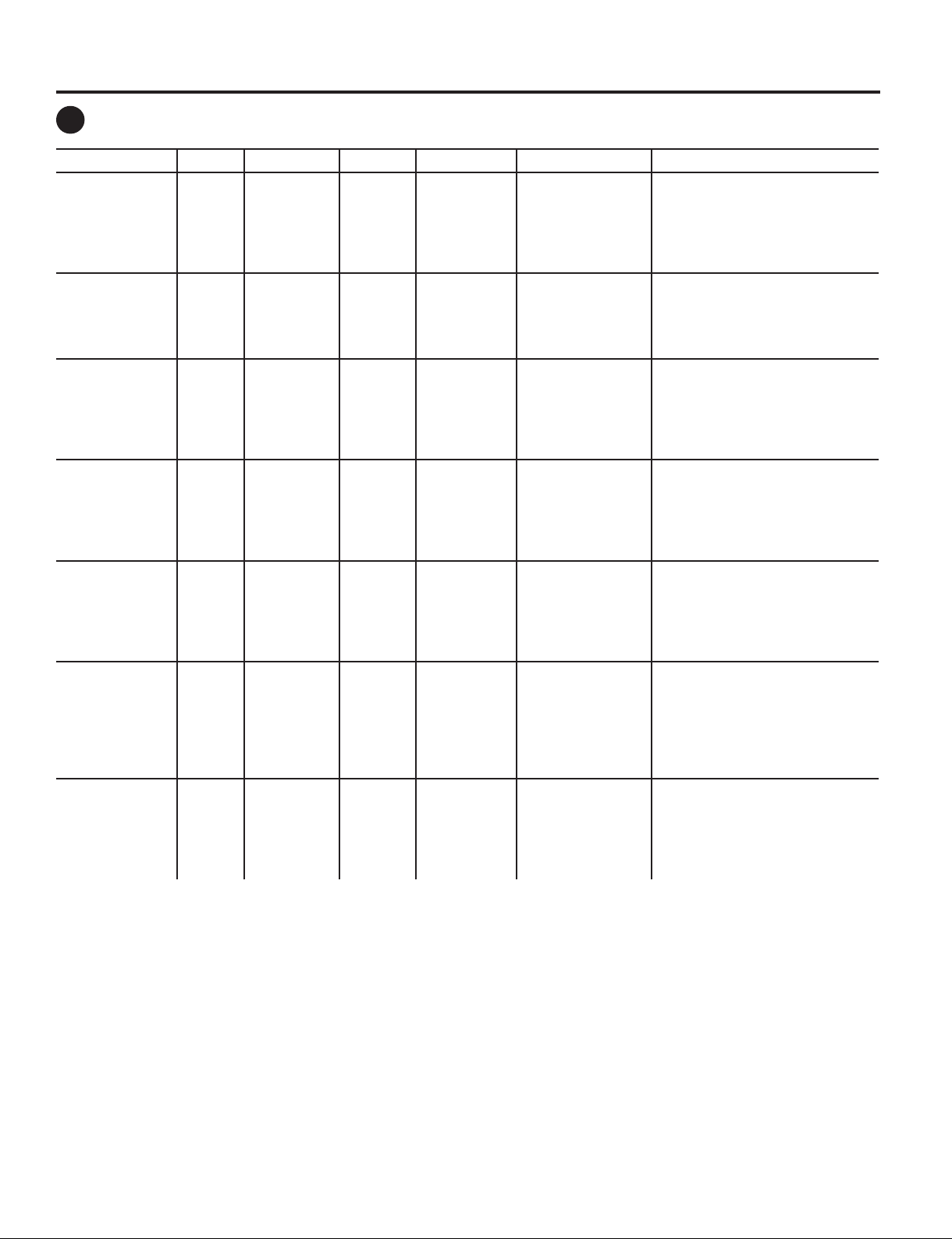
D Wash Cycles-Cycle Selector Knob
The wash cycle controls the type of washing process. The cycle selector knob can be turned in either direction. Turning the knob after
starting a cycle will stop the washer and change the cycle/options to the new selection. Press Start to begin the new cycle selection.
The chart below will help you match the items to be washed with the best wash cycle settings. For optimal performance, select the
cycle that most closely matches the items being washed.
Selections and options shown in bold are the recommended settings for that cycle.
Some cycles and options may not be available on some models.
GEAppliances.ca
Items to Wash Cycle Wash Temp Soil Level Spin Selection Options Available Cycle Details
Cycle for normal,
regular, or typical
use for washing
up to a full load
of normally soiled
cotton clothing.
Colors Hot
Warm
Colors
Cool
Cold
Tap Cold
Ex. Heavy
Heavy
Normal
Light
Ex. Light
Max/Extra
Normal
Stain PreTreat Guide
Auto Soak
Deep Rinse
2nd Rinse
Cycle for normal, regular, or typical
use for washing up to a full load
of normally soiled cotton clothing.
Choose the Heavy or Extra Heavy
soil level selection and Warm or
Hot water temperature selection as
appropriate for your clothes load
for a higher degree of cleaning.
Incorporates multi-stage fills and
wash periods to provide optimal
fabric care.
Dark colored
items, linens, and
mixed loads.
Dark
Colors
Hot
Warm
Colors
Cool
Cold
Tap Cold
Ex. Heavy
Heavy
Normal
Light
Ex. Light
Max/Extra
Normal
Stain PreTreat Guide
Deep Fill
Auto Soak
Deep Rinse
2nd Rinse
Lower wash temperatures, a shorter
wash period, and a deep fill rinse
(Not all features are on all models)
minimizes fading and spotting of dark
colored fabrics. Incorporates
multi-stage fills and wash periods
to provide optimal fabric care.
Casual clothes,
lightly soiled
office wear.
Casuals Hot
Warm
Colors
Cool
Cold
Tap Cold
Ex. Heavy
Heavy
Normal
Light
Ex. Light
Max/Extra
Normal
Stain PreTreat Guide
Deep Fill
Auto Soak
Deep Rinse
2nd Rinse
Wash period tailored to care for
casual clothes and office wear items.
Incorporates multi-stage fills and
wash periods to provide optimal fabric
care.
Lingerie and
special care
fabrics with light
soil.
Delicates Hot
Warm
Col
ors
Cool
Cold
Tap Cold
Ex. Heavy
Heavy
Normal
Light
Ex. Light
Max/Extra
Normal
Stain PreTreat Guide
Deep Fill
Auto Soak
Deep Rinse
2nd Rinse
Utilizes a unique “tri-pulse” extra
gentle agitate profile to provide
special care to delicate fabrics. It is
recommended to place small or ultra
delicate items in mesh bags before
washing.
Garments with a
high cotton content
and /or heat resis-
tant; for example,
towels, denim,
sheets, robes, etc.
SaniFresh
Hot Ex. Heavy
Heavy
Normal
Light
Ex. Light
Max/Extra
Auto Soak
Deep Rinse
2nd Rinse
The SaniFresh cycle is designed to
eliminate common bacteria, viruses
and germs on household linen.
This cycle is only effective if the hot
water connection is at a minimum
temperature of 119.84°F (48.8 ° C).
Medium to lightly
soiled athletic
wear items of
technical or
synthetic fabrics.
Active
Wear
(Not all
features
are on all
models)
Hot
Warm
Colors
Cool
Cold
Tap Cold
Ex. Heavy
Heavy
Normal
Light
Ex. Light
Max/Extra
Normal
Stain PreTreat Guide
Deep Fill
Auto Soak
Deep Rinse
2nd Rinse
Cycle designed for care of medium
to lightly soiled active wear, aththletic
wear, and technical fabrics.
Incorporates a multi stage wash
period with soak to effectively treat
body so
ils and odors. Use the Heavy
Duty cycle for heavily soiled sports
clothing constructed of sturdy fabric.
For waterproof, water-resistant items only use the Delicates cycle. DO NOT use other cycles for these items, for example: ski clothing,
diaper covers, bulky waterproof bed covers, umbrella covers, vehicle covers, sleeping bags, waterproof coats, etc).
· In other cycles different to the one recommended, when the basket turns, it is possible that water gets trapped in waterproof items
and clothing, which can cause abnormal vibration. Besides, the clothing moves upwards and may be expelled, this may result in injury
or damage to the washer, walls, floor, or clothing.
· DO NOT mix waterproof and non-waterproof items.
Normal
8
Operating instructions.
D Wash Cycles-Cycle Selector Knob - Continued
Items to Wash Cycle Wash Temp Soil Level Spin Selection Options Available Cycle Details
Small loads of
lightly soiled items
that are needed in
a hurry.
Speed
Wash
(Not all
features
are on all
models)
Hot
Warm
Colors
Cool
Cold
Tap Cold
Ex. Heavy
Heavy
Normal
Light
Ex. Light
Max/Extra
Normal
Stain PreTreat Guide
Deep Fill
Auto Soak
Deep Rinse
2nd Rinse
Utilizes an expedited wash period and
time saving continuous spray rinse to
clean small lightly soiled loads in the
fastest time possible.
Wet load of items.
For items that need
only to be rinsed,
use this cycle with
Deep Rinse option.
Drain &
Spin
Max/Extra
Normal
Deep Rinse
2nd Rinse
Utilizes a high speed spin to extract
water from wet items. For items that
need to be rinsed, select the Deep
Rinse and/or 2nd Rinse option when
using this cycle.
Jeans with
medium to light
soil. For heavily
soiled work jeans,
use the Heavy
Duty Cycle.
Jeans
(Not all
features
are on all
models)
Hot
Warm
Colors
Cool
Cold
Tap Co
ld
Ex. Heavy
Heavy
Normal
Light
Ex. Light
Max / Extra
Normal
Stain PreTreat Guide
Deep Fill
Auto Soak
Deep Rinse
2nd Rinse
Combines higher water levels, a
specially designed agitation profile,
and multi step wash and soak periods
to care for jeans with medium to
light soil. Use the Heavy Duty cycle
for heavily soiled work jeans.
Sturdy fabrics with
heavy to medium
soil.
Heavy
Duty
Hot
Warm
Colors
Cool
Cold
Tap Cold
Ex. Heavy
Heavy
Normal
Light
Ex. Light
Max / Extra
Normal
Stain PreTreat Guide
Deep Fill
Auto Soak
Deep Rinse
2nd Rinse
Incorporates multi-step wash and
soak periods combined with extended
wash periods to effectively clean
heavily to medium soiled sturdy
fabrics.
Non-waterproof
large coats, bead
spreads, mattress
covers, and similar
large bulky items
Bulky
Items
Hot
War
m
Colors
Cool
Cold
Tap Cold
Ex. Heavy
Heavy
Normal
Light
Ex. Light
Max / Extra
Normal
Stain PreTreat Guide
Deep Fill
Auto Soak
Deep Rinse
2nd Rinse
Provides a Deep Fill/max fill wash
water level to wash bulky items.
Also incorporates a Deep Fill rinse to
effectively rinse bulky items.
Towels.
Sheets.
Towels /
Sheets
(Not all
features
are on all
models)
Hot
Warm
Colors
Cool
Cold
Tap Cold
Ex. Heavy
Heavy
Normal
Light
Ex. Light
Max / Extra
Normal
Stain PreTreat Guide
Deep Fill
Auto Soak
Deep Rinse
2nd Rinse
Cycle designed washing towels or
sheets, using a higher water level
and a soak period to effectively
clean these items. It is recommended
that towels and sheets
be washed
separately for best care and
washing performance.
Whites and
household linens
Whites Hot
Warm
Colors
Cool
Cold
Tap Cold
Ex. Heavy
Heavy
Normal
Light
Ex. Light
Max / Extra
Normal
Stain PreTreat Guide
Deep Fill
Auto Soak
Deep Rinse
2nd Rinse
Cycle tailored to clean and brighten
your whites.
GEAppliances.ca
9
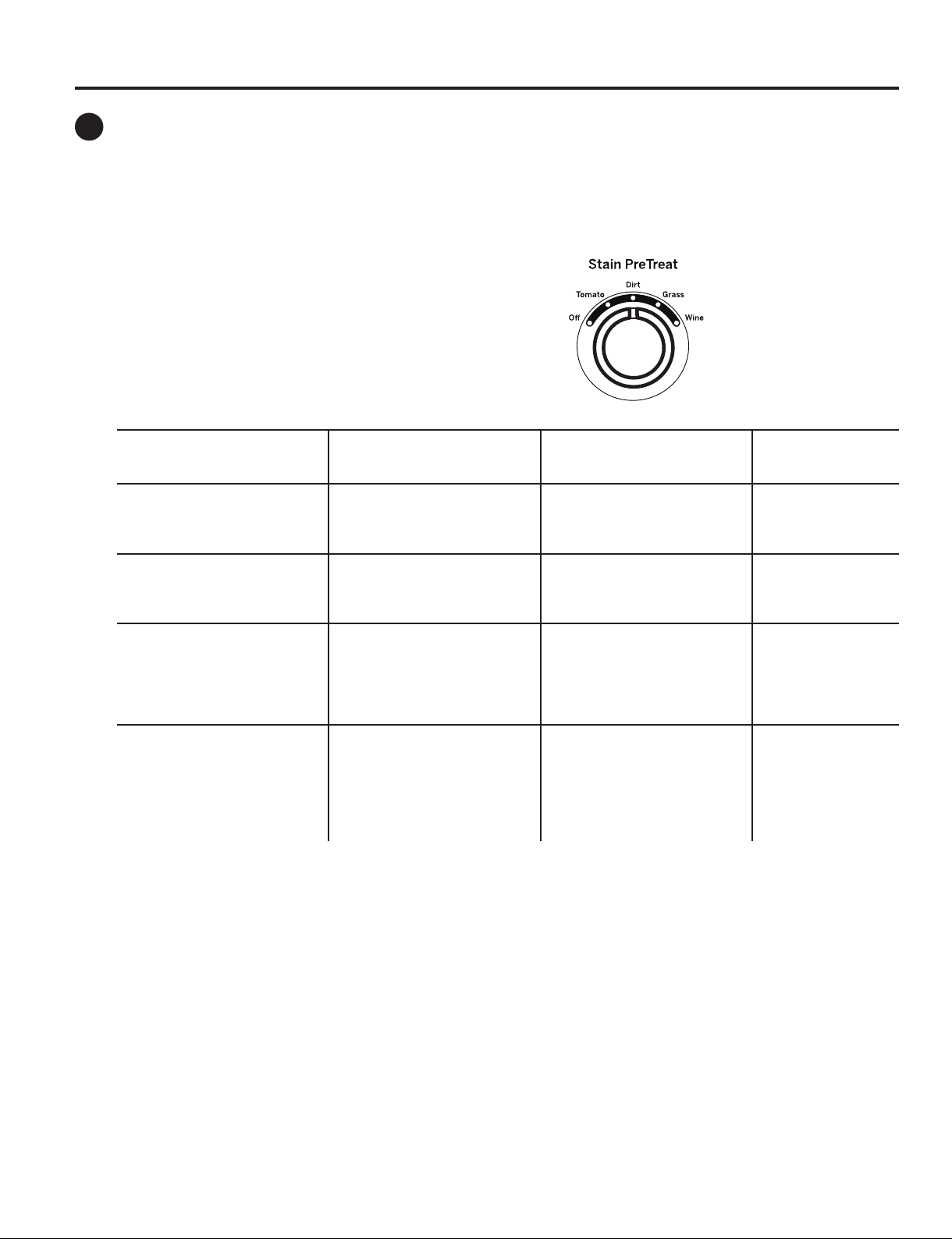
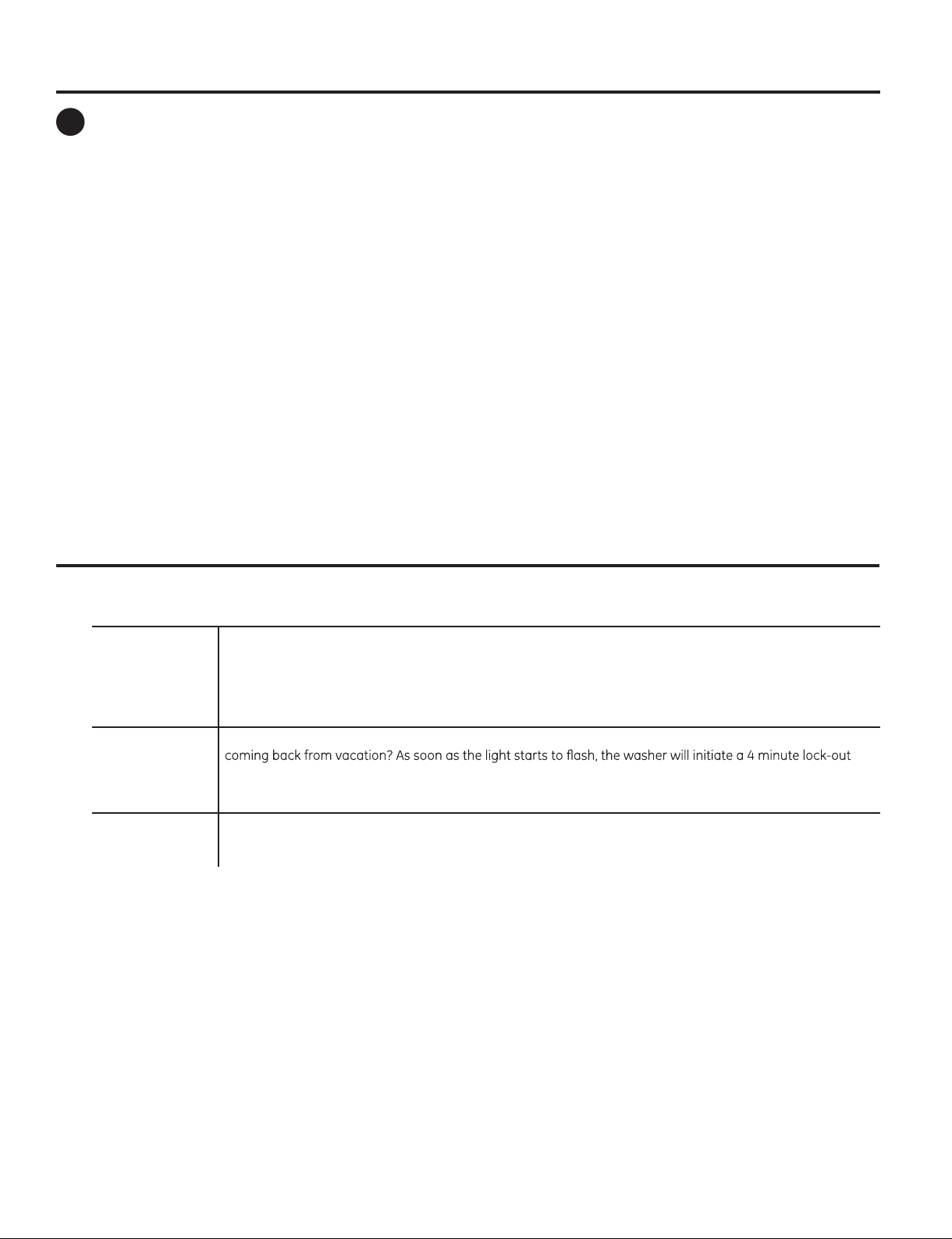
The Stain PreTreat feature allows you to indicate what stains are on the garments in your load. This feature incorporates a patent
pending treatment method. An initial water fill is performed at a temperature tailored to the stain type selected and to an amount
which enables a concentrated cleaning step. A stain scrubbing period, followed by an active soak, is conducted to effectively treat
the stain. Then additional water is added to the selected temperature and the wash phase is conducted for the cycle selected.
This feature can be applied to most wash cycles as described in the cycle guide.
To use Stain PreTreat:
1. Select the desired wash cycle.
2. Select the stain to be treated under the Stain PreTreat options.
Stain PreTreat Guide
Category
Recommended
Temperatures
Treatment/Wash
Stain
For best results,
before placing in
washer:
Tomato Cool/Warm Sauce
Catsup
Salsa
Pretreat with liquid
detergent or stain
remover product; rinse
with cool water.
Dirt Cool/Warm Dirt
Clay
Mud
Allow dirt to dry;
remove loose dirt
using a brush. Rinse
with cool water.
Grass Cold/Warm Grass
Lipstick
Chocolate
Gravy
Mayonnaise
BBQ Sauce
Pretreat with liquid
detergent or stain
remover product.
Brush lightly; rinse
with cold water.
Wine Cool/Warm Wine
Soda
Kool-Aid
Tea
Coffee
Juice
Beer
Pretreat with mixture
of Oxi product and
cool water. Add Oxi
product along with
detergent in the
washer.
• Recommended temperatures are optimal for stain removal performance; adjust temperature selection to suit load being washed.
• Ensure stain is completely removed after wash cycle and before placing in dryer; very tough stains may require a second treatment.
Cycle Options
E
Stain PreTreat (Not all features are on all models)
10
Operating instructions.
Select the Deep Fill feature for loads where extra water is needed.
Press the Deep Fill button once before starting the cycle to add an incremental amount of water to the wash load. Holding the Deep Fill
button for 3 seconds will provide the deepest fill level possible; this will increase cycle time due to the additional time it takes to fill the
washer.
To cancel the option if desired, press the Deep Fill button again.
NOTE: The Deep Fill button can also be pressed after the washer has completed filling and is in the wash phase if additional water is
desired. To stop the extra fill, press the Deep Fill button again and the water will stop.
Auto Soak
This option begins with a brief agitation, soaks for a specified period of time, then moves through the rest of the cycle automatically.
2nd Rinse
When you use extra detergent or bleach to clean heavily soiled clothes, use the 2nd Rinse option to better remove additional residues.
Extra Spin
Select to provide additional spin time, increasing energy efficiency through reducing drying times.
2nd Rinse + Extra Spin
Provides both a second rinse and an extra spin.
Deep Rinse
Set this option to provide a deep rinse or when using fabric softener. This option may change other settings (e.g. Spin may go to a higher
setting) to maximize performance.
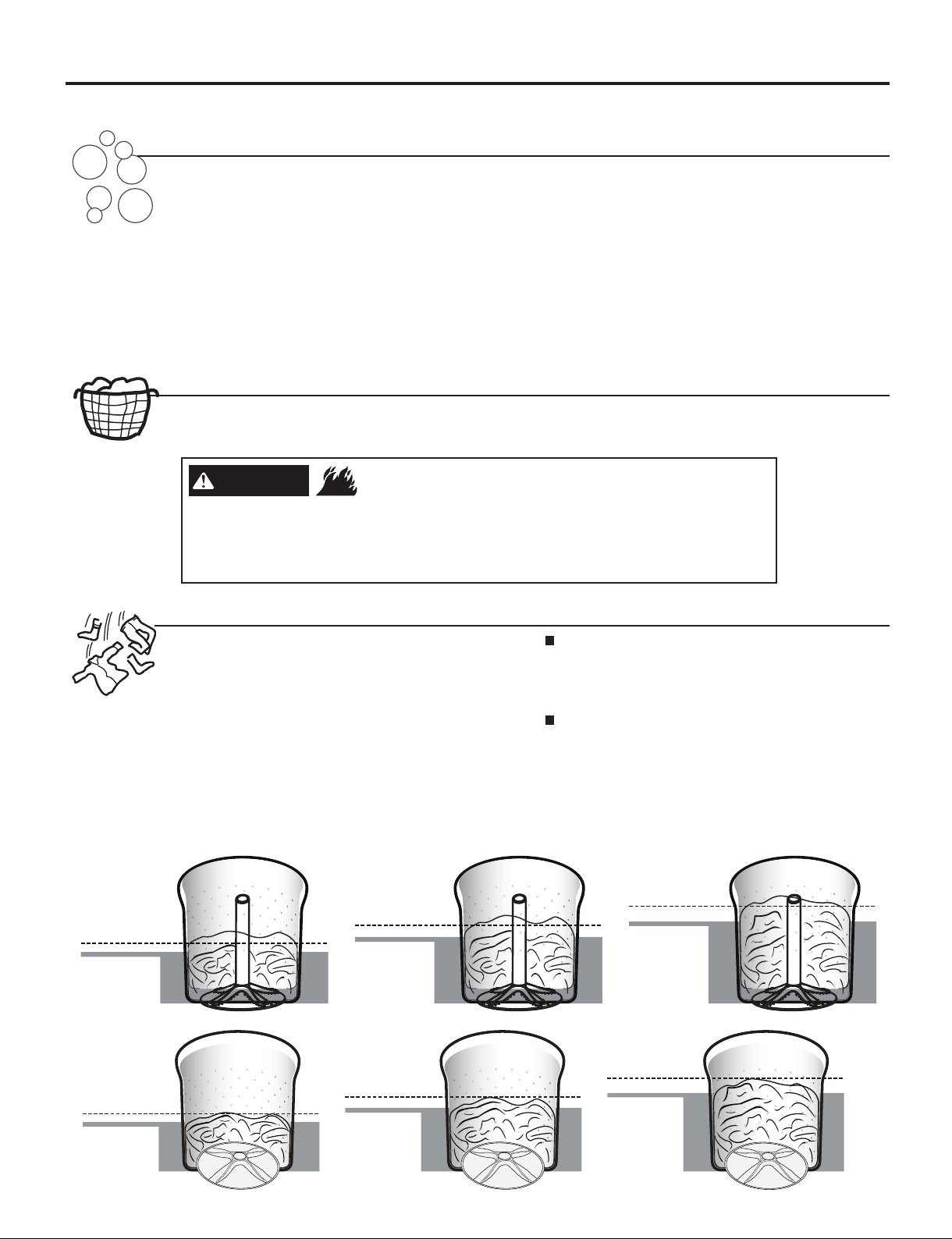
Consumer Help Indicator
Your washer is equipped with Consumer Help Indicator (CHI). CHI is our way to communicate a simple remedy for some situations
that you can perform without the need to call for service. The chart below describes the helpful lights you may notice flashing on
the display.
Spin light blinking If an out-of-balance condition is detected by the washer, the Spin light will blink during the remaining portion
of the cycle and will stay illuminated for a short time after cycle completion. When this occurs, the washer is
taking actions to correct the out-of-balance condition and complete the cycle normally. In some cases, the
washer may not be able to balance the load and spin up to full speed. If you notice the load is more wet
than normal at the end of the cycle, redistribute the load evenly in the wash basket and run a Drain & Spin
cycle.
Fill light (Water not
entering washer)
Check your house water supply. Did you forget to turn on one or both supply valves after installation or
period. The washer controls won’t respond/change during this time. After the 4 minutes, you can begin your
cycle again. If you try to bypass the lock-out period by unplugging the washer, the 4 minute timer will start
over again.
E
Cycle Options - Continued
(Not all features are on all models)
Deep Fill
Lid Locked light Lid Locked light will flash if 3 cycles have been started without opening the lid. The washer will not start
another cycle until the lid is opened. Try opening, then closing the lid and starting a new cycle. If the problem
persists, call 1 800 561 3344 for service.
11
GEAppliances.ca
Loading the Washer
Proper Use of Detergent
Sorting Wash Loads
Sort by
color (whites, lights, colors), soil level, fabric type (sturdy cottons,
easy
care,
delicates)
and whether the
fabric produces lint
(terry
cloth,
chenille)
or
collects
lint
(velveteen, corduroy). Wash lint pr
oducers
such
as
cotton
towels and socks separate
fr
om
lint collectors including
synthetic
garments and
dr
ess
pants.
Using
too
little or
too much
detergent is
a common
cause of laundry problems.
Use less
detergent
if
you
have soft water, a smaller
load
or
a
lightly soiled
load.
For spots,
apply
pre-treatment
to items as
recommended on the
product label. Application should
be made in the basket to prevent overspray which may
cause
the
coloring on the
lid or graphics to
fade.
Place
detergent pods
in
the bottom of the wash basket
before adding clothes.
GE recommends
the use of
High Efficiency detergents
such as
he
in
your energy efficient washer.
HE
detergents are formulated
to
work
with
low
water
wash
and
rinse systems.
HE detergents reduce
the oversudsing problems commonly associated with
regular detergents.
When
using high
efficiency
or
concentrated
detergents, consult
the
product
label
to determine
amount required
for optimum
performance.
Excessive
detergent will negatively impact wash performance.
Loading and using the washer.
Always follow fabric manufacturer’s care label when laundering.
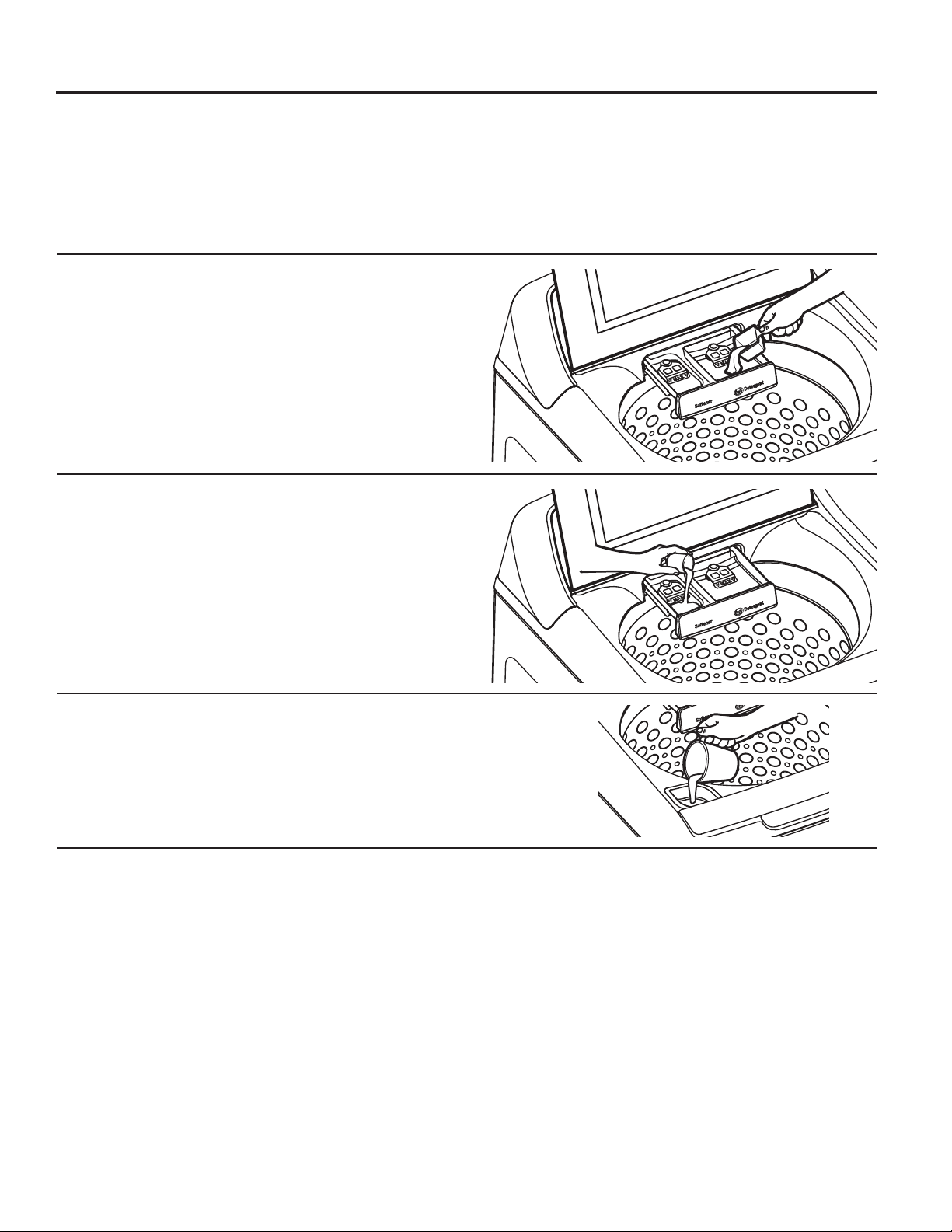
Load dry items loosely in the washer basket. For best
results, load items evenly and loosely around the
outside of the basket, filling in towards the center on
larger loads. To add items after washer has started,
press Start/Pause if the lid is locked; wait until the Lid
Lock indicator on the display is no longer illuminated
before attempting to open the lid. Lift the lid and
submerge additional items around the outside of
the basket. Close the lid and press Start to resume.
Adjust load size selection and/or use Deep Fill option if
necessary.
Do not place large items such as sheets, blankets
Do not put lawn or sofa cushions into the washer as
they are too big to move. Remove outer covers and
ONLY wash them.
Average Small Load
Clothes Level
Water Level
Average Medium Load
Clothes Level
Water Level
Clothes Level
Water Level
Average Large Load
** Washing system depends on the model.
Clothes Level
Water Level
Clothes Level
Water Level
Clothes Level
Water Level
- Fire Hazard
WARNING
Never place items in the washer that are dampened with gasoline or other flammable liquids.
No washer can completely remove oil.
Do not dry anything that has ever had any type of oil on it (including cooking oils).
Doing so so can result in death, explosion, or fire.
and towels across the Infusor (Not all features
are on all models).
Load them around the outside of the basket.
12
About washer features.
Automatic Load Sensing
This determines the correct agitate profile, agitate duration and amount of water suited to the size and type of load placed in the washer.
The washer will not start the wash cycle or fill with water if the lid is open. When the lid is closed the machine is able to begin filling with
water in order to sense the load size.
NOTE: Automatic Load Sensing initiates a spin at the beginning of the cycle and will take as much as 3 minutes to complete (significantly
shorter for smaller loads); this is normal operation.
NOTE: This is a high efficiency washing machine with Infusor wash action. This system requires less water while providing effective cleaning
action. You may notice that the water level is lower than on your previous washer. This is normal for an Infusor-equipped washer.
Liquid or powdered HE detergent should be added to the right
side of the dispenser drawer. Follow the detergent manufacturer’s
recommendations for the correct amount of detergent, based on
load size, taking care to add detergent to the right compartment.
Do not overfill or dilute detergent as this can result in additive being
dispensed prematurely in the wash cycle. Your option selections will
determine when detergent is automatically dispensed at its optimal
time in the wash cycle.
NOTE: Single-dose laundry packets should not be added to the
dispenser drawer, as they will not dispense properly. Put packets
in bottom of wash basket.
Detergent Dispenser
Liquid fabric softener should be added to the left side of the
dispenser drawer. Follow the liquid fabric softener manufacturer’s
recommendations for the correct amount of softener, based on
load size, taking care to add softener to the left compartment. Do
not overfill or dilute softener as this can result in additive being
dispensed prematurely in the wash cycle. Your option selections will
determine when liquid fabric softener is automatically dispensed at
its optimal time in the rinse cycle.
NOTE: Fabric softener crystals should not be added to the
dispenser drawer, as they will not dispense properly.
Liquid Fabric Softener Dispenser
Liquid chlorine bleach should be added through the bleach
dispenser in the front left corner. Follow bleach manufacturer’s
recommendations for the correct amount of liquid chlorine bleach
based on load size, taking care to not apply or spill it directly on
clothing.
NOTE: Do not use liquid chlorine bleach and laundry pretreatments
such as an Oxi product in the same wash load.
Liquid Bleach
Place laundry pretreatments, such as an Oxi product, directly in the
bottom of the wash basket before loading clothes.
NOTE: Do not use liquid chlorine bleach and laundry pretreatments
such as an Oxi product in the same wash load.
Pretreatment
13
About washer features.
This determines the correct agitate profile, agitate duration and amount of water suited to the size and type of load placed in the washer.
The washer will not start the wash cycle or fill with water if the lid is open. When the lid is closed the machine is able to begin filling with
water in order to sense the load size.
NOTE: Automatic Load Sensing initiates a spin at the beginning of the cycle and will take as much as 3 minutes to complete (significantly
shorter for smaller loads); this is normal operation.
NOTE: This is a high efficiency washing machine with agitator wash action. This system requires less water while providing effective cleaning
action. You may notice that the water level is lower than on your previous washer. This is normal for an agitator-equipped washer.
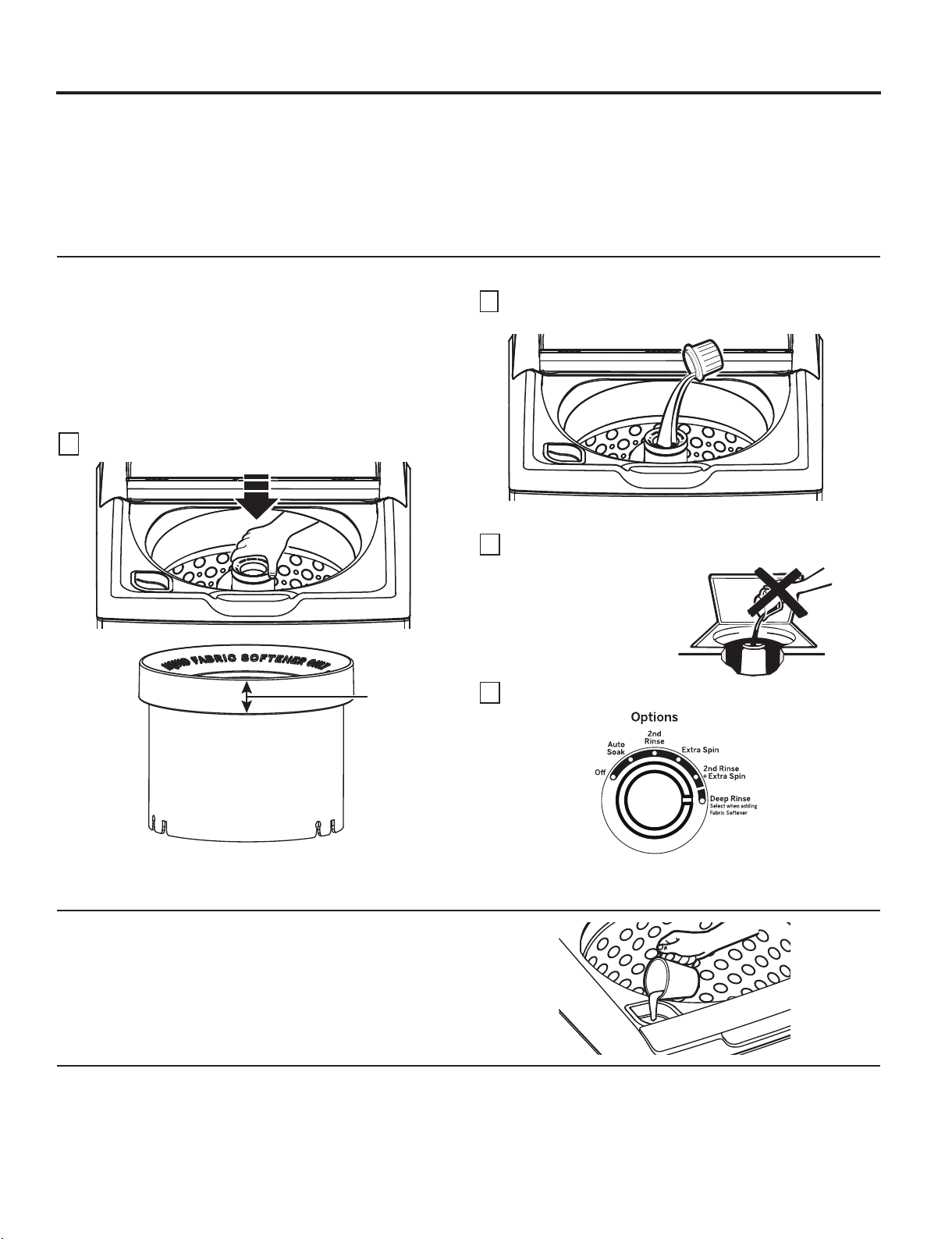
The agitator cap fits into the top of the agitator. If it accidentally comes
off, simply put it back on.
The fabric softener dispenser automatically releases liquid fabric
softener at the proper time during the cycle.
Do not stop the washer or raise the lid during the first spin. This will
cause the dispenser to empty too soon.
To use, follow these steps:
1
Make sure dispenser is securely attached to agitator.
2
gnisu ,resnepsid otni ruoP .renetfos cirbaf detulid diuqil ylno esU
amount recommended on package.
Never pour fabric softener directly on clothes. It may stain them.
3
.enil llif mumixam eht sehcaer ti litnu resnepsid ot retaw ddA
4
Select Deep Rinse option.
Note: Fabric softener may not dispense properly if the Deep Rinse
option is not selected.
Liquid chlorine bleach should be added through the bleach
dispenser in the front left corner. Follow bleach manufacturer’s
recommendations for the correct amount of liquid chlorine bleach
based on load size, taking care to not apply or spill it directly on
clothing.
NOTE: Do not use liquid chlorine bleach and laundry pretreatments
such as an Oxi product in the same wash load.
Liquid Bleach
Place laundry pretreatments, such as an Oxi product, directly in the
bottom of the wash basket before loading clothes.
NOTE: Do not use liquid chlorine bleach and laundry pretreatments
such as an Oxi product in the same wash load.
Pretreatment
ONLY this
portion of the
dispenser is
visible once
installed into
agitator
Do not pour anything into the agitator
if the agitator cap or dispenser is
removed.
Automatic Load Sensing (Not all features are on all models)
Liquid Fabric Softener Dispenser (Not all features are on all models)
On this model (GTW550) with no softener dispenser or
softener cup the instruction is - dilute the fabric softener in
water and pour in the mix right after the first spin.
Hoses connecting washer to faucet should be
replaced every 5 years.
Water Supply Hoses
Ask the service technician to remove water from
drain pump and hoses. Do not store the washer
where it will be exposed to the weather.
Moving and Storage
Be sure water supply is shut off at faucets. Drain
all water from hoses and water filter pump area if
weather will be below freezing.
Long Vacations
Care and cleaning of the washer.
GEAppliances.ca
Leave the lid open after washing to allow
moisture to evaporate. If you want to clean the
basket, use a clean soft cloth dampened with
liquid detergent; then rinse. (Do not use harsh or
gritty cleaners.)
14
Immediately wipe off any spills with a damp cloth.
Exterior of the Washer
Interior of the Washer
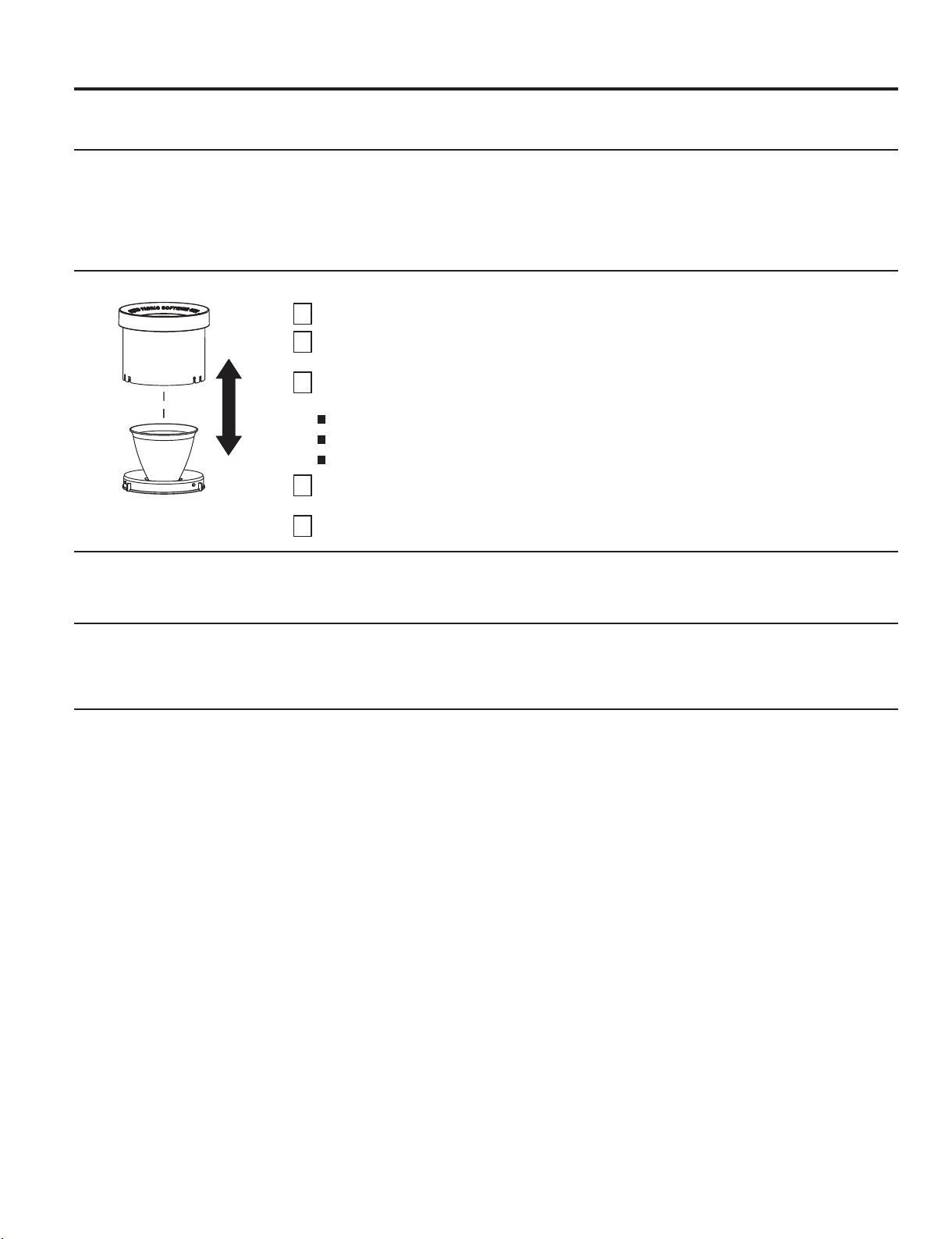
Separate for cleaning
1
Remove the dispenser from the top of the agitator.
2
Separate the dispenser cup from the cover by grasping the top and pushing down on the inside of
the cup with your fingers. Dispenser cup will pop free from the cover.
3
To clean the dispenser, soak both the dispenser cup and the dispenser cover in the following
solution:
1 US gallon (3.8 liters) warm water
1/4 cup (60 ml) heavy-duty liquid detergent
1 cup (240 ml) bleach
4
If necessary, loosen buildup with a clean, soft cloth after soaking. Do not use a stiff brush; you may
roughen the surface of the dispenser.
5
Rinse and reassemble dispenser. Place dispenser back on the agitator.
Cleaning the Fabric Softener Dispenser (Not all features are on all models)
Installation
Washer
Instructions
If you have any questions, call 1.800.561.3344
or
visit www.GEAppliances.ca
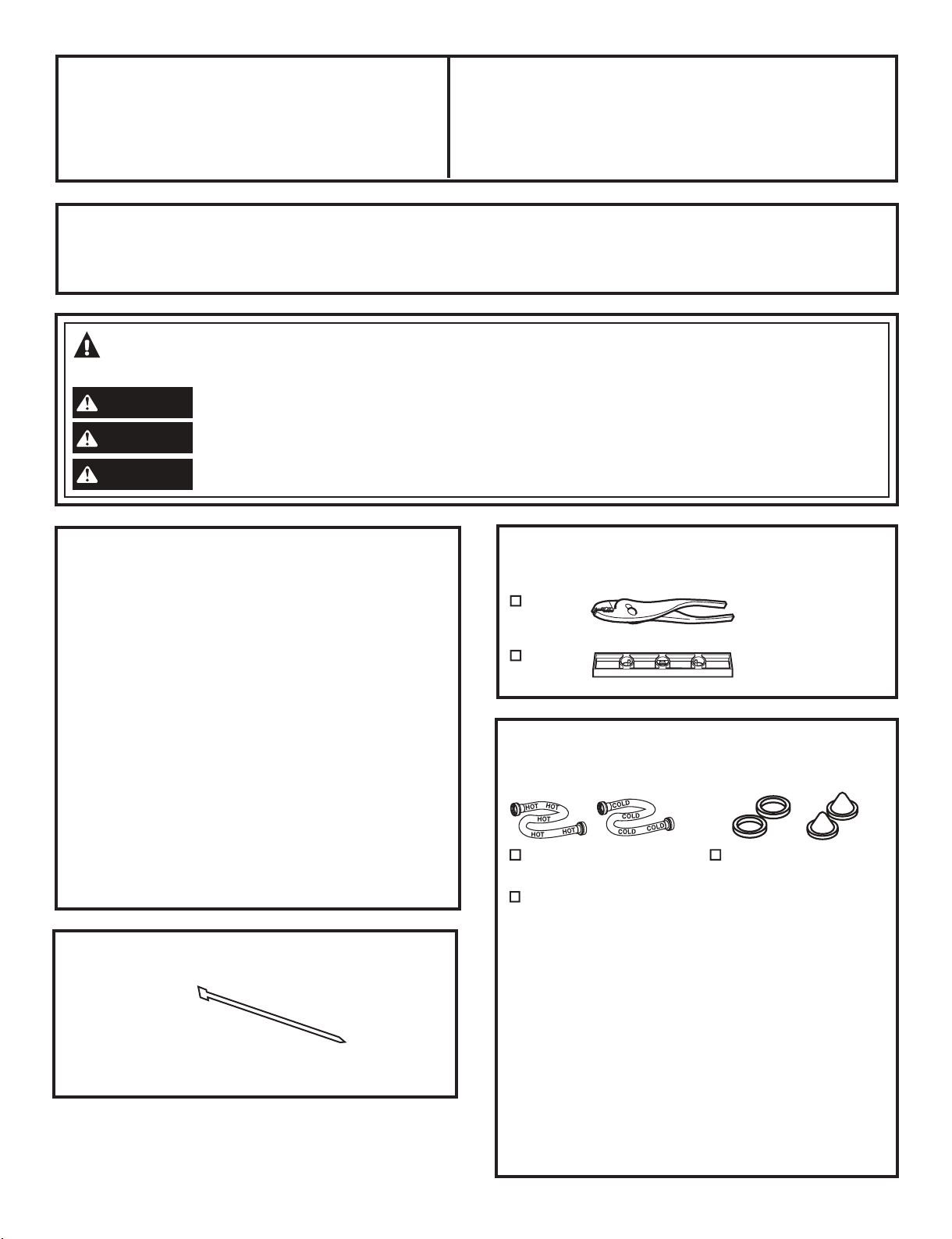
TOOLS REQUIRED FOR
WASHER INSTALLATION
Pliers
Level
PARTS REQUIRED
(Sold separately except model GTW220)
Water Hoses (2)
GE Parts and Accessories
This is the safety alert symbol. This symbol alerts you to potential hazards that can kill you or hurt you and others.
All safety messages will follow the safety alert symbol and the word “DANGER”, “WARNING”, or “CAUTION”. These
words are defined as:
Indicates a hazardous situation which, if not avoided, will result in death or serious injury.
Indicates a hazardous situation which, if not avoided, could result in death or serious injury.
Indicates a hazardous situation which, if not avoided, could result in minor or moderate injury.
DANGER
WARNING
CAUTION
15
Rubber Washers (2)
and Strainer Screens (2)
Drain Hose Extension (For discharge heights from 60" - 96"
NOTE: We strongly recommend the use of new water
supply hoses. Hoses degrade over time and need to be
replaced every 5 years to reduce the risk of hose failures
and water damage.
BEFORE YOU BEGIN
Read these instructions completely and carefully.
•
IMPORTANT –
Save these instructions
for local inspector’s use.
•
IMPORTANT – Observe all governing
codes and ordinances.
•
Note to Installer –
Be sure to leave these
instructions with the Consumer.
•
Note to Consumer –
Keep these instructions
for future reference.
• Skill level – Installation of this appliance requires
basic mechanical and electrical skills.
• Completion time – 1-3 hours
• Proper installation is the responsibility of the installer.
• Product failure due to improper installation is not
covered under the Warranty.
PARTS SUPPLIED
Cable Tie
Order on-line at GEApplianceparts.com today, 24 hours a day
or by phone at 1 800 661 1616 during normal business
hours.
WW01F01987 (2) Water supply hose
[Includes Water Supply Hose (1),
Rubber Washer (1),
Strainer Screen (1)].
Part Number Accessory
16
Installation Instructions
LOCATION OF YOUR WASHER
Do Not Install the Washer:
1. In an area exposed to dripping water or outside
weather conditions. The ambient temperature
should never be below 60°F (15.6°C) for proper
washer operation.
2. In an area where it will come in contact with curtains or
drapes.
3. On carpet. The floor MUST be a hard surface with
a maximum slope of 1/2
per foot (1.27 cm per
30 cm). To make sure the washer does not vibrate
or move, you may have to reinforce the floor.
NOTE: If floor is in poor condition, use 3/4 impregnated
plywood sheet solidly attached to existing floor covering.
IMPORTANT: Minimum Installation Clearances
- Alcove or Closet
• If your washer is approved for installation in an alcove
or closet, there will be a label on the back of the
machine describing requirements.
• Minimum clearance between washer and adjacent
walls or other surfaces: 0" either side, 2" front, 3"
rear. Vertical space from floor to overhead shelving,
cabinets, ceiling, etc. = 60".
• Closet doors must be louvered or otherwise ventilated
and require 60 square inches of opening near the top
of the door and 60 square inches near the bottom of
the door. If a dryer is located in the same closet, then
these areas must be doubled.
NOTE: The clearances stated on this label are minimums.
Consideration must be given to providing adequate
clearances for installing and servicing.
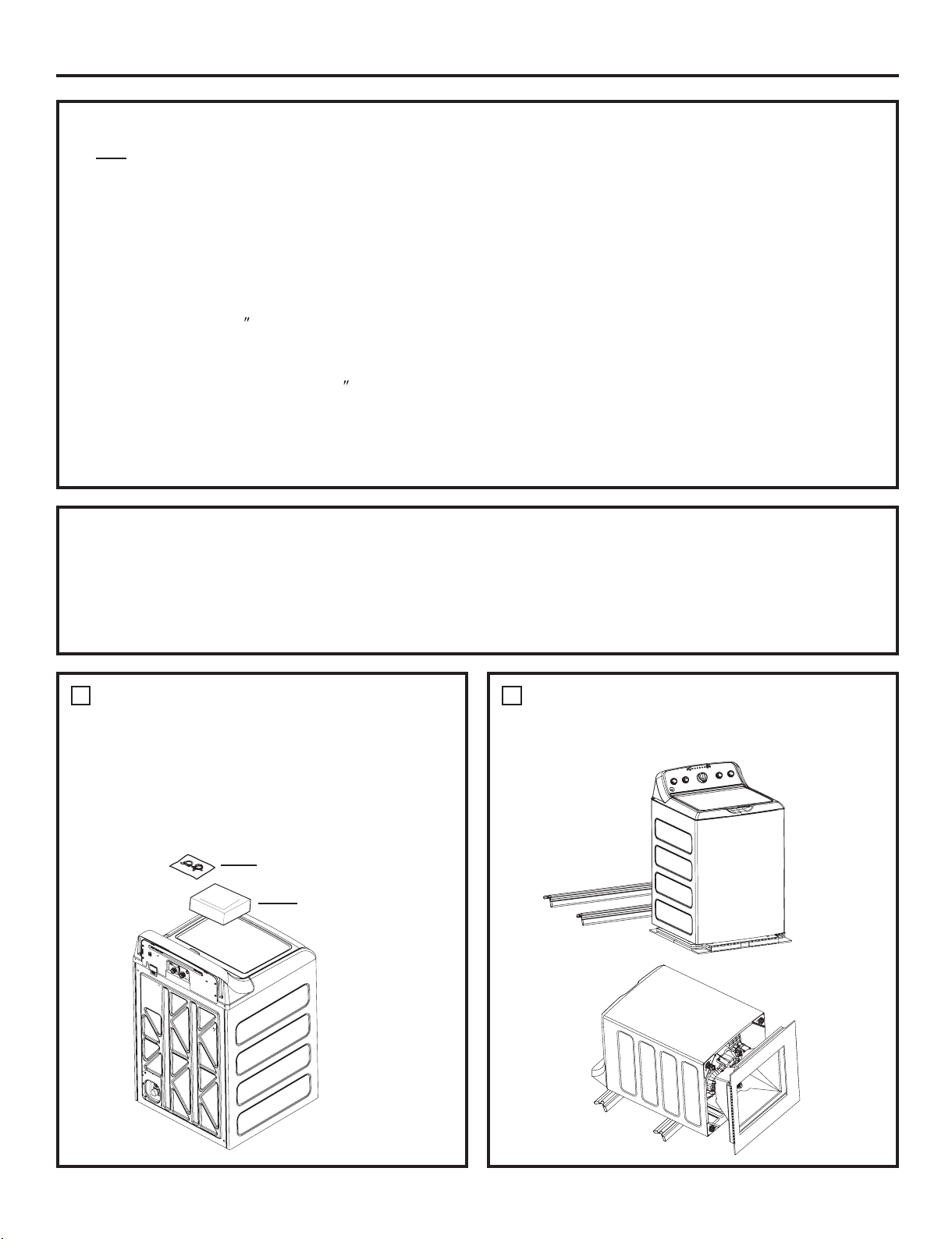
After the machine is in the home, remove outside packing
material/carton from washer.
Remove bag (containing cable tie, drain hose clip) and
Owner’s Reference Guide from tub.
.
NOTE: Leave foam shipping material inside tub opening to
hold tub in place during the rest of installation.
Bag
Leave shipping
material inside tub
1
UNPACKING THE WASHER
Remove base from unit by placing foot on side of base and
tipping unit back on corner post. Remove base and bring the
washer back upright.
2
REMOVE THE BASE
WATER SUPPLY REQUIREMENTS
WATER PRESSURE - Must be 20 psi minimum to 120 psi maximum.
WATER TEMPERATURE - Household water heater should be set to deliver water at 120° to 150°F (50° to 66°C) TO THE WASHER when
hot wash is selected.
SHUTOFF VALVES - Both hot and cold shutoff valves (faucets) should be supplied.
DRAIN - Water should be drained into standpipe. Discharge height MUST NOT BE LESS THAN 30 INCHES, and no more than 8 feet
above the base of the washer. Standpipe must be 1-1/2 inches minimum inside diameter and must be open to atmosphere.
Installation Instructions
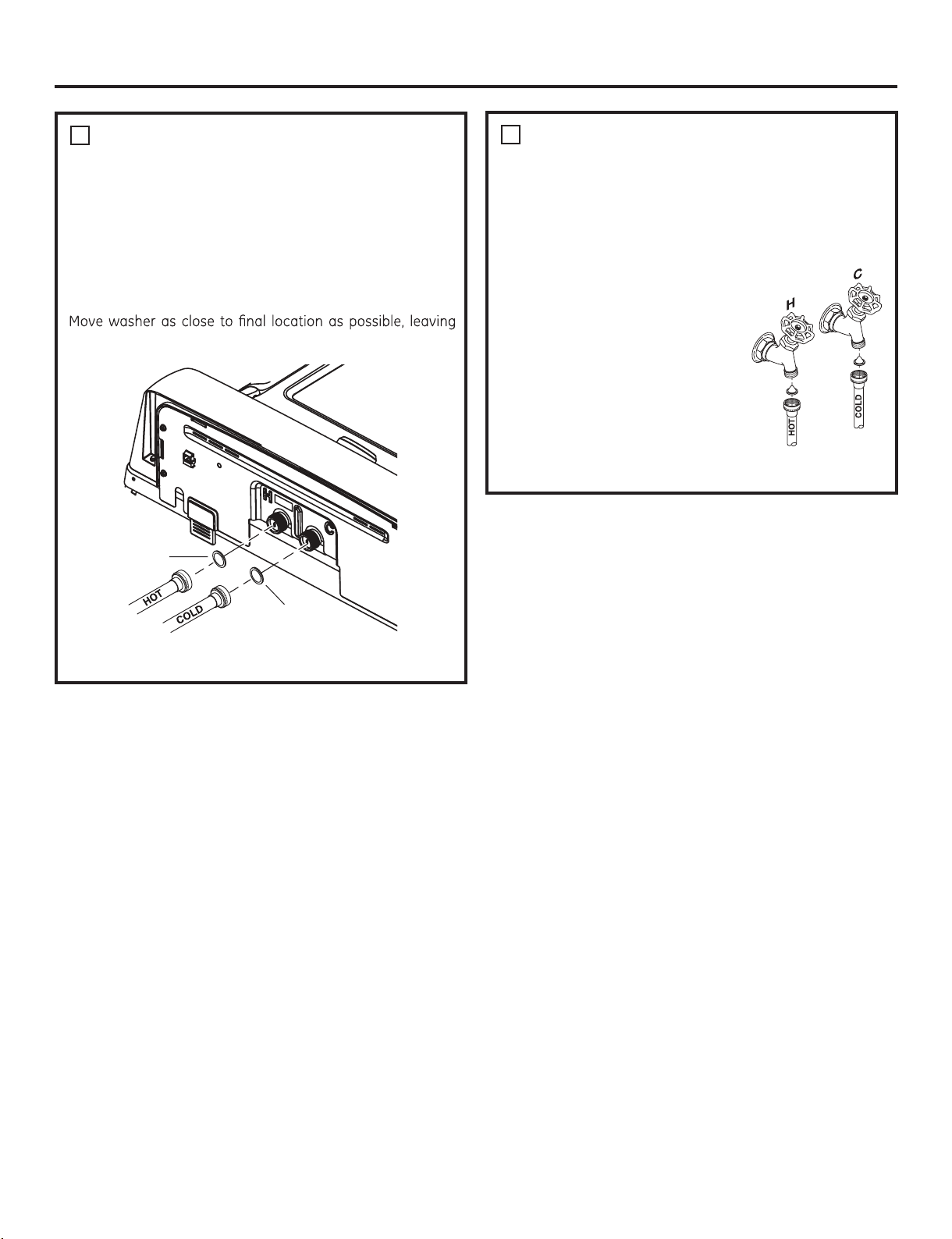
CONNECT WATER HOSES TO OUTLET
VALVES
Disconnect electrical cord before installing water hoses. If not
installed, install rubber washer in one end of hot water hose.
Thread hot water hose onto connection labeled H at top rear of
washer. Hand tighten
and use pliers to tighten hoses between
1/8 and 1/4 turn beyond hand-tight.
If not installed, install rubber washer in one end of cold water
hose C. Thread cold water hose onto connection labeled C at top
rear of washer. Hand tighten
and use pliers to tighten hoses
between 1/8 and 1/4 turn beyond hand-tight.
room for you to make water, drain, and electrical connections
to your home.
CONNECT WATER HOSES TO WASHER
Rubber
washer
Rubber
washer
Determine which is HOT water line before attaching water
hoses to faucets. Traditionally, HOT faucet is on left.
(If screen washers are not installed) With protruding part of
screen toward you, install strainer screen/rubber washer
into each of the free ends of two water hoses.
Connect hot water hose to hot water
outlet valve of your home. Hand
tighten and use pliers to tighten hoses
between 1/4 and 1/2 turn beyond
hand-tight. Open hot water valve.
Connect cold water hose to cold
water outlet valve of your home. Hand
tighten and use pliers to tighten hoses
between 1/4 and 1/2 turn beyond
hand-tight. Open cold water valve.
Check for leaks and drips at the hose
couplings. Tighten as necessary.
17
4
3
Installation Instructions
18
5
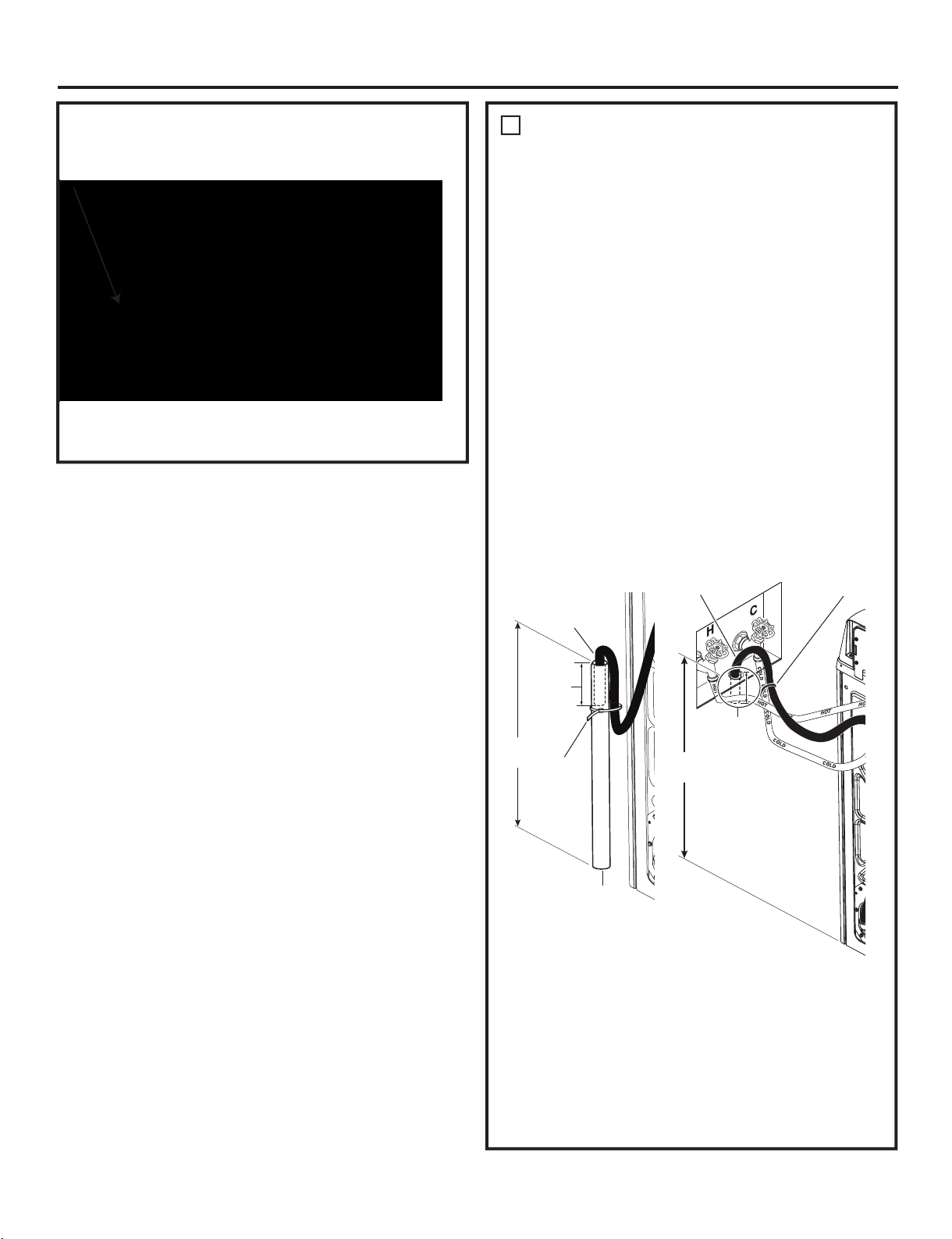
CONNECT TO DRAIN
The drain or standpipe must be capable of accepting a
discharge at a rate of 16 gal per minute. The drain height
must be 30” minimum and 96” maximum.
The standpipe diameter must be 1-1/2” minimum.
There MUST be an air gap around the drain hose in the
stand pipe. A snug fit can cause a siphoning action.
For a drain facility less than 33” high, the hose, coupling
and clamps provided in the machine must be used and,
in addition, a siphon break MUST be installed on the back
of the machine. Obtain and use a siphon break kit and
follow the instructions in the kit.
If water valves and drain are built into wall, fasten drain
hose to one of water hoses with cable tie provided
(ribbed side on inside). If your drains is a standpipe,
fasten drain hose to standpipe with cable tie provided.
NOTE: Placing the drain hose too far down the drain pipe
can cause a siphoning action. No more than 5" of
hose should be in the drain pipe. There must be an
air gap around the drain hose. A snug fit can also
cause a siphoning action.
Wall
5" Max.
insertion
into
drain
30"
Min.
Drain
hose
Cable
tie
30"
Min.
5" Max.
insertion
into
drain
Drain
hose
Cable
tie
Standpipe
Pull the drain hose out from top to proceed with
installation
Hose
Installation Instructions
ELECTRICAL REQUIREMENTS
- Fire Hazard
WARNING
Plug into a grounded 3-prong outlet.
DO NOT remove ground prong.
DO NOT use an adapter.
DO NOT use an extension cord.
Failure to follow these instructions can result in death,
fire or electrical shock.
CIRCUIT – Individual, properly polarized and grounded 15
or 20 amp circuit breaker or time-delay fuse.
POWER SUPPLY – 2 wire plus ground, 120 Volt, single
phase, 60 Hz, alternating current.
Outlet Receptacle – Properly grounded 3-prong
receptacle to be located so the power
cord is accessible when the washer
is in an installed position. If a 2-prong
receptacle is present, it is the owner’s
responsibility to have a licensed
electrician replace it with a properly
grounded 3-prong grounding type
receptacle.
Washer must be electrically grounded in accordance with
local codes and ordinances, or in the absence of local
codes, in accordance with the NATIONAL ELECTRICAL
CODE, ANSI/NFPA NO. 70 latest edition. Check with a
licensed electrician if you are not sure that the washer is
properly grounded.
If required by local codes, an external 18 gauge or larger
copper ground wire (not provided) may be added. Attach
to washer cabinet with a #10-16 x
1/2” sheet metal screw
(available at any hardware store) to rear of washer as
illustrated.
Mobile Home Installation:
Installation must conform to Standard for Mobile Homes,
ANSI A119.1 and National Mobile Home Construction and
Safety Standards Act of 1974 (PL93-383).
GROUNDING INSTRUCTIONS
This appliance must be grounded. In the event of
malfunction or breakdown, grounding will reduce the risk
of electric shock by providing a path of least resistance
for electric current. This appliance is equipped with
a cord having an equipment- grounding conductor
and a grounding plug. The plug must be plugged
into an appropriate outlet that is properly installed
and grounded in accordance with all local codes and
ordinances.
WARNING
Improper connection of the equipment-
grounding conductor can result in a risk
of electrical shock. Check with a qualified electrician, or
service representative or personnel, if you are in doubt as to
whether the appliance is properly grounded. DO NOT
modify the plug on the power supply cord. If it will not fit the
outlet, have a proper outlet installed by a qualified
electrician.
Attach ground
wire and ground
screw (obtain
locally)
Washer
back
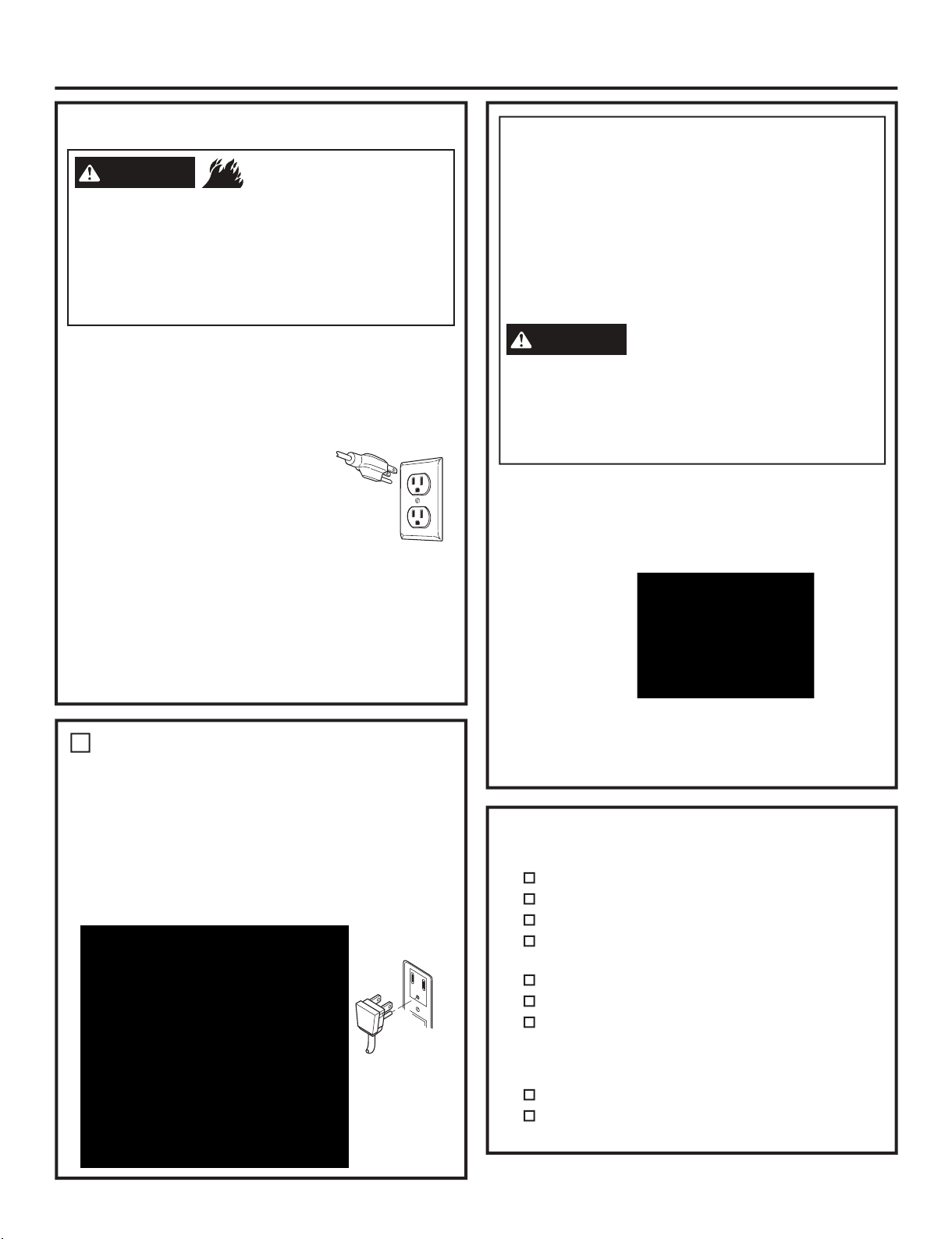
Insert plug of electrical cord into a 115V, 15- or 20-amp wall
receptacle. Move washer into final position. Place level on flat top
side edges of washer. Adjust all four leveling legs until
washer
is level left-to-right and front-to-back. Remove level.
Open tub lid. Remove and discard tub shipping material (see Step 1).
Remove plastic protector sheet from control panel face.
7
CONNECT POWER AND INSTALL
Before starting the washer, check to make sure:
Main power is turned on.
The washer is plugged in.
The water faucets are turned on.
The unit is level and all four leveling legs are firmly
on the floor.
The shipping foam and cardboard are removed.
The drain hose is properly tied up.
There are no leaks at the faucet, drain line
or washer.
Run the washer through a complete cycle.
Check for water leaks and proper operation.
Place these instructions in a location near the
washer for future reference.
FINAL CHECKLIST
19
Make sure large dial control (Not all features are on all
models) on washer is pushed in to the OFF position.
Save time and money! Review the charts on the following pages, or visit GEAppliances.ca. You may not need to call for service.
Before you call for service…Troubleshooting Tips
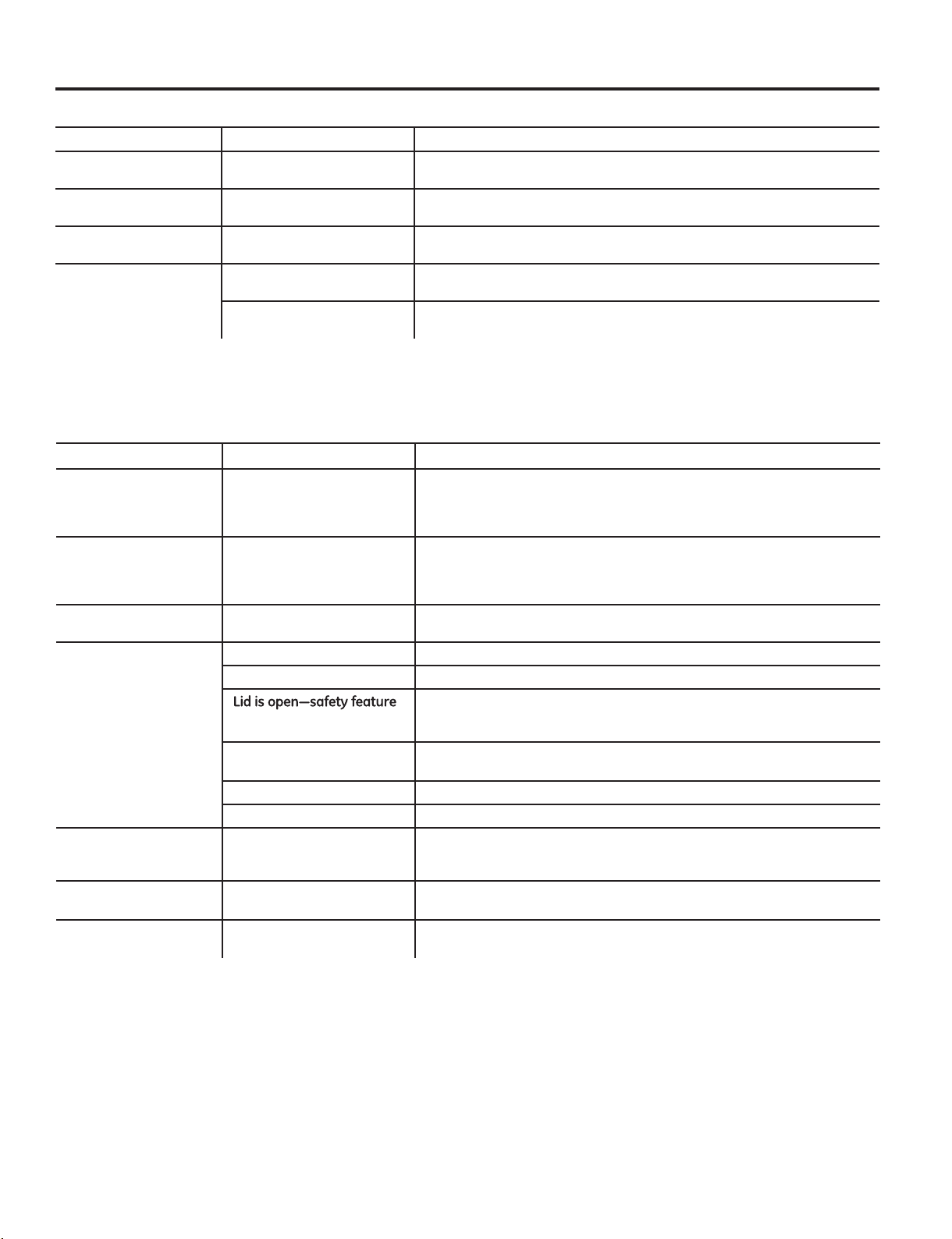
WATER Possible Causes What To Do
Normal dispenser
operation
It is normal for a small amount of water to remain in dispenser after the
cycle.
Short spray and delay
after pushing the Start
button
Lid was opened and closed
between cycle selection
and start
This is normal. See START-UP SEQUENCE in the Safety Instructions
section.
Water level seems low This is normal Water may not cover the top level of the clothes. This is normal for this
high efficiency washer.
Low water flow Water valve screens are
stopped up
Turn off the water source and remove the water connection hoses from
the upper back of the washer and the water faucets. Clean both the
hose screens (if so equipped) and the screens in the machine using a
brush or a toothpick. Reconnect the hoses and turn the water back on.
Check to ensure there are no leaks at the connections.
Water siphoning out
of washer
Drain standpipe is too
low or hose too far into
standpipe
The drain hose must exceed 32” height at some point between
the washer back and the drain pipe. Use anti-siphon clip. See the
Installation Instructions.
Too many suds Soft water Try less detergent.
Too much detergent Measure your detergent carefully. Use less soap if you have soft water, a
smaller load or a lightly soiled load.
Type of detergent
Switch to High Efficiency detergent such as
he
Water leaks Type of detergent
Swit
ch to High Efficiency detergent such as
he
Using too much detergent
in washer
Use less detergent. Use less soap if you have soft water, a smaller load
or a lightly soiled load.
Fill hoses or drain hose is
improperly connected
Make sure hose connections are tight at faucets and rubber washers
are installed. Make sure end of drain hose is correctly inserted in and
secured to drain facility.
Household drain clogged Check household plumbing. You may need to call a plumber.
Drain hose rubs on wall Make sure drain hose does not make contact with the wall. May cause
excessive wear on the hose.
Constant water pressure to
fill hoses at water source
Tighten hoses at the faucets.
Check condition of the fill hoses; they should be replaced every 5 years.
Water temperature
seems incorrect
Cooler water temperatures
provide improved energy
efficiency
New laundry detergents have been formulated to work with cooler
water temperatures without affecting wash performance.
Water supply is turned off
or improperly connected
Turn both hot and cold faucets fully on and make sure hoses are
connected to correct faucets. NOTE: Water valves are marked “H” and “C”.
Water valve screens are
stopped up
Turn off the water source and remove the water connection hoses from
the upper back of the
washer and the water faucets. Clean both the
hose screens (if so equipped) and the screens in the machine using a
brush or a toothpick. Reconnect the hoses and turn the water back on.
Check to ensure there are no leaks at the connections.
Cool/Cold Water when
selecting Hot
This is normal. The washer senses water temperature (Not all features
are on all models) and optimizes for best results. Cold water is added
periodically when hot is selected.
House water heater is not
set properly
Make sure house water heater is delivering water at 120°F–140°F
(48°C–60°C).
Small amount of water
remaining in dispenser
(Not all features are
on all models) at end
of cycle
20
21
Save time and money! Review the charts on the following pages, or visit GEAppliances.ca. You may not need to call for service.
Before you call for service…Troubleshooting Tips
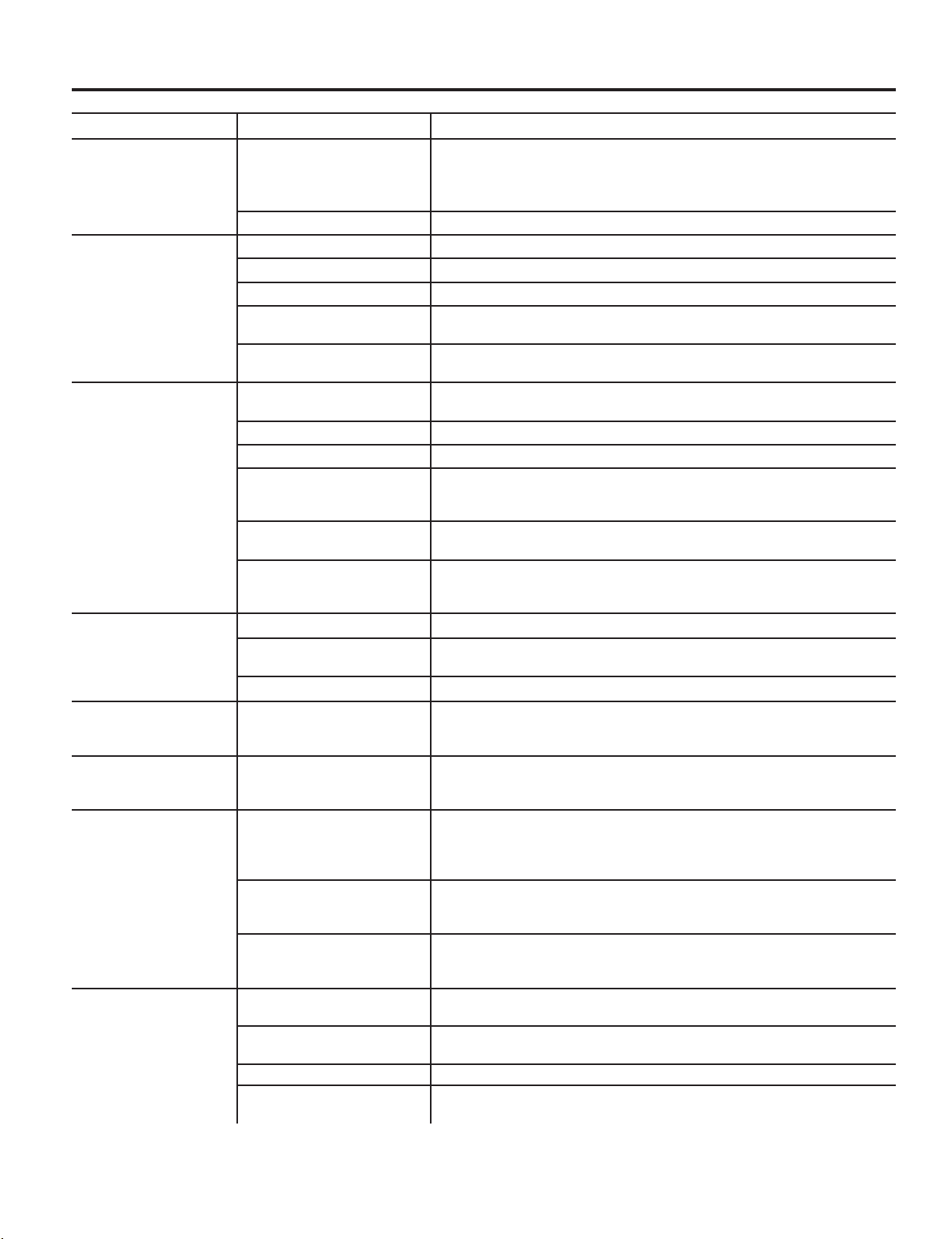
WATER Possible Causes What To Do
Water pumped out
before cycle is complete
Lid lifted or cycle was put
in pause for over 24 hours
Reset cycle.
Water won’t drain Drain hose is kinked or
improperly connected
Straighten drain hose and make sure washer is not sitting on it.
Top of drain outlet should be less than 6 ft (1.8 m) above floor.
Washer spins and pauses
at the beginning of cycles
This is normal The washer is sensing the load.
Washer pauses during
wash cycle
The Soak Option was
chosen
This is normal. The washer alternates between agitate and soak during
these cycles to get your clothes cleaner with less wear.
This is normal Many cycles incorporate as series of soaks within the agitation period to
get your clothes clean with less wear.
OPERATION Possible Causes What To Do
Residual powder in
dispenser or clogging
of dispensers (Not all
features are on all models)
dispensers (on some
models)
Wash water too cold or low
home water pressure
Select a warmer wash temperature if possible to improve dissolving of
detergent or use liquid detergent. Make sure siphon caps are free of debris
and fully pressed into position. Remove and clean tray if clogging occurs.
Laundry additives
dispensing too soon
(Dispensers on some
models)
Overfilling of dispensers Do not overfill or add water to dispenser. Select Deep Rinse option when
using fabric softener.
Washer pauses during
spin cycle
This is normal The washer may pause during the spin cycle to remove soapy water more
efficiently.
Washer won’t operate Washer is unplugged Make sure cord is plugged securely into a working outlet.
Water supply is turned off Turn both hot and cold faucets fully on.
prevents agitation and
spinning when lid is up
Close lid and press Start.
Circuit breaker/fuse is
tripped/blown
Check house circuit breakers/fuses. Replace fuses or reset breaker. Washer
should have a separate outlet.
Electronics need to be reset Unplug washer, wait 2 minutes, plug back in and press Start.
Start was not pressed Press Start.
Detergent packets
not dissolving
Laundry detergent packet
placed in dispenser
Laundry detergent packets should not be used in the dispensers.
They should only be added directly to the wash ba
sket following the
manufacturer’s directions.
Unexplained time and/
or settings changes
Changing options (Not all
features are on all models)
This is normal. Several options will change other options to maximize
washer performance.
Basket seems loose Basket moves or rotates
freely
Washer basket does not have a traditional brake. Washer basket will move
freely. This is normal.
PERFORMANCE
Possible Causes What To Do
Colored spots Incorrect use of fabric
softener
Check fabric softener package for instructions and follow directions for
using dispenser.
Make sure you have selected the Deep Rinse option.
Pretreat stain and rewash using Speed Wash cycle before drying.
Dye transfer Sort whites or lightly colored items from dark colors.
Grayed or yellowed
clothes
Detergent amount Be sure to follow detergent manufacturer’s directions.
Hard water Use a water condit
ioner or install a water softener.
Water is not hot enough Make sure water heater is delivering water at 120°F–140°F (48°C–60°C).
Washer is overloaded Loosely load clothes no higher than the top row of holes in the washer
basket. For best results, load items around the outside of the basket.
Dye transfer Sort clothes by color. If fabric label states wash separately, unstable dyes
may be indicated.
Lint or residue on
clothes
Clothes are air or line d
ried If you do not dry your clothes with a clothes dryer, your clothes may retain
more lint.
Incorrect sorting Separate lint producers from lint collectors.
Washing too long Wash small loads for a shorter time using Light Soil setting.
Detergent not dissolving
Rewash; next time:
Try a liquid detergent
Use warmer water temperature.
Overloading Loosely load clothes in the washer basket. For best results, load items
around the outside of the basket.
Incorrect use of fabric
softener
Check fabric softener package for instructions and follow directions for
using dispenser.
Make sure you have selected the Deep Rinse option.
Before you call for service…Troubleshooting Tips
Clothes too wet No spin selected Select a spin option.
Incorrect cycle selected Make sure the cycle selected matches the load you are washing. Some
fabrics will feel wetter when rinsed with cold water.
Wash load out of balance
Redistribute load in washer and run through Drain & Spin cycle.
Blinking Spin light or
Spin light on at end of
cycle
Out of balance condition
has been detected
Allow cycle to continue and finish.
If load is wet at the end of the cycle, even out load and run a Drain &
Spin cycle.
Pilling Result of normal wear on
poly-cotton blends
and fuzzy
fabrics
While this is not caused by the washer, you can slow the pilling process by
washing garments inside out.
Snags, holes, tears, rips
or excessive wear
Pins, snaps, hooks, sharp
buttons, belt buckles,
zippers and sharp objects
left in pockets
Fasten snaps, hooks, buttons and zippers.
Remove loose items like pins, objects in pockets and sharp buttons.
Turn knits (which snag easily) inside out.
Undiluted chlorine b
leach Check bleach package instructions for proper amount.
Never add undiluted bleach to wash or allow clothes to come in contact
with undiluted bleach.
Chemicals like hair bleach
or dye, permanent wave
solution
Rinse items that may have chemicals on them before washing.
Use Speed Wash cycle with Extra Rinse option.
Wrinkling Incorrect wash and dry
cycles
Match Cycle selection to the type of fabric you are washing (especially for
easy care loads).
I
mproper sorting Avoid mixing heavy items (like jeans) with light items (like blouses).
Try a fabric softener.
Overloading Loosely load clothes in the washer basket.
Repeated washing in water
that is too hot
Wash in warm or cold water.
22

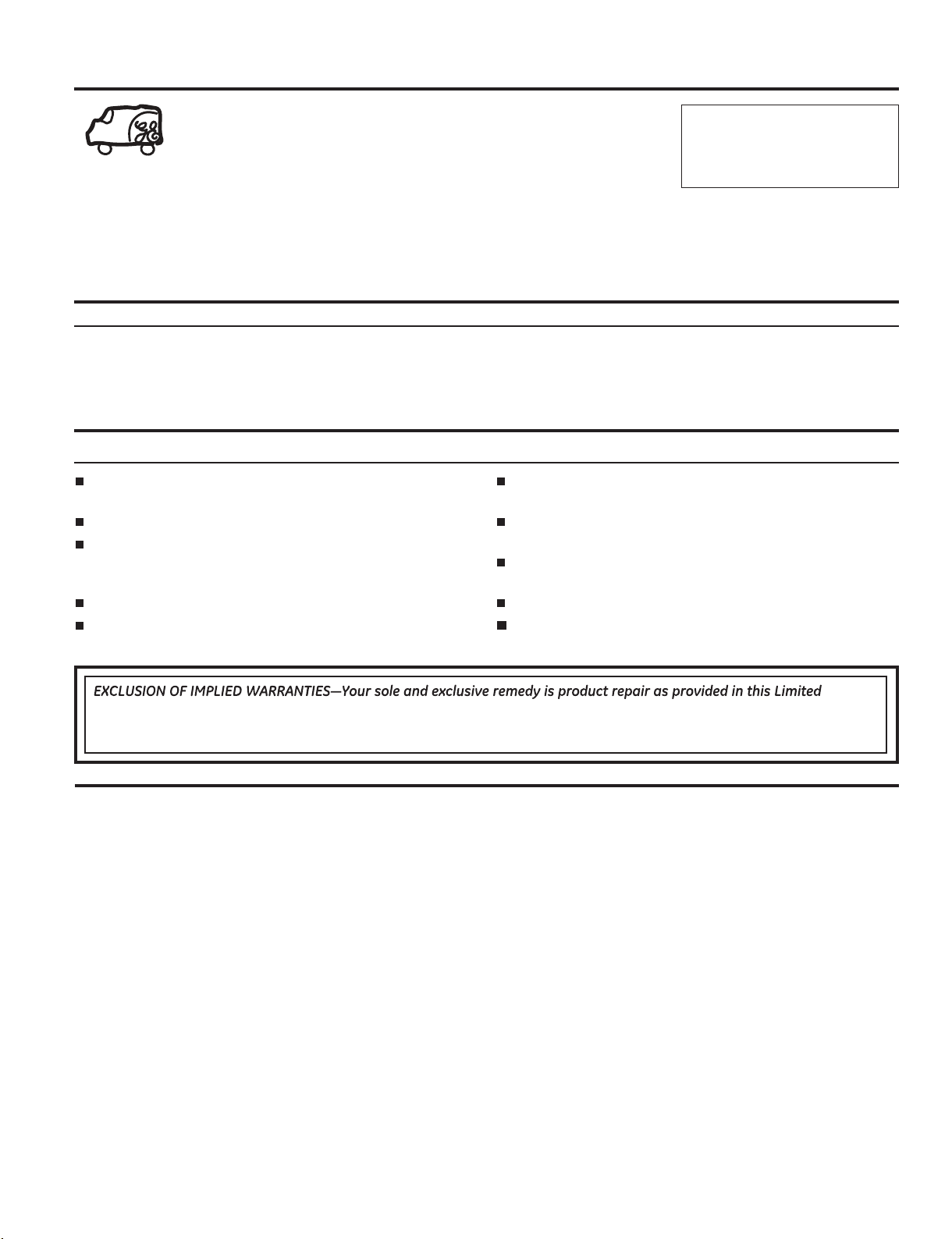
SOUNDSPossible Causes Reason
“Clicking” Shifter mechanism is
engaging or disengaging
The drive system will engage at the start of agitate and disengage when
agitate is complete. This occurs multiple times during the wash.
Back and forth
“swoosh”
Electric motor reversing
direction
This sound is the motor rotating back and forth to clean your laundry.
“Clicking” behind
Control during fill
Automatic Temperature
Control Valve
Two valves mix cold and hot water. The “clicking” is when either valve
turns on or off to raise or lower the fill water temperature.
Water flow changes
during fill
Automatic Temperature
Control Valve
Two valves mix cold and hot water. The “clicking” is when either valve
turns on or off to raise or lower the fill water temperature.
Motor sounds during
spin
Motor ramping up/down
during spin cycle
The motor will speed up incrementally during the spin cycle.
When spin is complete, it will coast until it stops.
“Humming” Water drain pump The drain pump will make a humming sound when pumping out water
after agitation stops and continue until spin is complete.
Drive motor The drive motor will make a “humming” sound during the wash and spin
phases of the cycle.
“Gurgling” Water drain pump When the pump starts drawing in air, It starts to gurgle. The washer should
then begin spinning and the sound will continue until it is done spinning.
Water “swishing”
Washing process
Water swishing while the unit is agitating is normal, especially with smaller
loads.
Washer rocking/
moving
Washer leveling legs
uneven
To level the washer, adjust the leveling legs by rotating the individual leg
in the proper direction for up or down.
“Squeaking” sound Washer not level and
rubbing on cabinet
To level the washer, adjust the leveling legs by rotating the individual leg
in the proper direction for up or down.
Before you call for service…Troubleshooting Tips
23
Service trips to your home to teach you how to use
the product.
Improper installation, delivery or maintenance.
Failure of the product if it is abused, misused, or
used for other than the intended purpose or used
commercially.
Replacement of house fuses or resetting of circuit breakers.
Products which are not defective or broken, or which are
working as described in the Owner’s Manual.
Damage to the product caused by accident, fire, floods
or acts of God.
Incidental or consequential damage caused by possible
defects with this appliance.
Defects or damage due to operation in freezing
temperatures.
Damage caused after delivery.
Product not accessible to provide required service.
What Is Not Covered:
GE Appliances Washer Warranty.
Warranty. Any implied warranties, including the implied warranties of merchantability or fitness for a particular purpose,
are limited to two years or the shortest period allowed by law.
Servicing your appliance may require the use of the onboard data port for diagnostics. This gives a GE
Factory Service technician the ability to quickly diagnose any issues with your appliance and helps GE
improve its products by providing GE with information on your appliance. If you do not want your appliance
data to be sent to GE, please advise your technician NOT to submit the data to GE at the time of service.
In Canada:
This warranty is extended to the original purchaser and any succeeding owner for products purchased in Canada for
home use within Canada. If the product is located in an area where service by a GE Authorized Servicer is not available,
you may be responsible for a trip charge or you may be required to bring the product to an Authorized GE Service location.
Some provinces do not allow the exclusion or limitation of incidental or consequential damages. This warranty gives you
specific legal rights, and you may also have other rights which vary from province to province. To know what your legal
rights are, consult your local or provincial consumer affairs office.
Warrantor: MC COMMERCIAL INC., BURLINGTON, ON L7R 5B6
All warranty service provided by our Factory Service Centers, or an
authorized Customer Care
®
technician. To schedule service, in
Canada, visit GEAppliances.ca or call 1.800.561.3344
Please have serial number and model number available when calling
for service.
Staple your receipt here.
Proof of the original purchase
date is needed to obtain
service under the warranty.
For The Period Of: We Will Replace:
One Year Any factory specified partof the washer which fails due to a defect in materials or workmanship.
From the date of the During this limited one year warranty, we will also provide, free of charge, all labor and related
original purchase service to replace the defective part.
*One year warranty only applies to Canada, for the rest of the countries one year warranty applies
*One year warranty only applies to Canada, for the rest of the countries one year warranty applies
24
Consumer Support.
GE Appliances Website
In Canada: GEAppliances.ca
Have a question or need assistance with your appliance? Try the GE Appliances Website 24 hours a day,
any day of the year! For greater convenience and faster service, you can now download Owner’s Manuals,
order parts or even schedule service on-line. In Canada: www.GEAppliances.ca
Schedule Service In Canada: GEAppliances.ca
Expert GE repair service is only one step away from your door. Get on-line and schedule your service at your
convenience any day of the year! Or call In Canada, 1.800.561.3344 during normal business hours.
Real Life Design Studio In Canada: GEAppliances.ca
all ages, sizes and capabilities. We recognize the need to design for a wide range of physical and mental abilities
and impairments. For details of GE’s Universal Design applications, including kitchen design ideas for people with
disabilities, check out our Website today. For the hearing impaired, please call 1-800-561-3344.
In Canada, contact: Manager, Consumer Relations, MC Commercial
Suite 310, 1 Factory Lane
Moncton, N.B. E1C 9M3
Extended Warranties In Canada: GEAppliances.ca
Parts and Accessories In Canada: GEAppliances.ca
Contact Us In Canada: GEAppliances.ca
Director, Consumer Relations, MC Commercial
Suite 310, 1 Factory Lane
Moncton, N.B. E1C 9M3
For questions on installation call 1-800-561-3344 (Canada).
Register Your Appliance In Canada: GEAppliances.ca
communication and prompt service under the terms of your warranty, should the need arise. You may also
mail in the pre-printed registration card included in the packing material. In Canada: www.GEAppliances.ca
Purchase a GE extended warranty and learn about special discounts that are available while your warranty is still
in effect. You can purchase it on-line anytime, or call 1-800-561-3344 during normal business hours. GE Consumer Home
Services will still be there after your warranty expires., consult your local listings for an extended warranty provider.
If you are not satisfied with the service you receive from GE, contact us on our Website with all the details
including your phone number, or write to:
25
You will find the nearest MC Commercial Service Center number in the yellow pages of your phone book.
Or call us at 1 800 661 1616

