NW-E503/E505/E507
Network Walkman
Portable IC
Audio Player
© 2005 Sony Corporation
2-632-969-11(1)
To go to the section you want to read, click the title
in the PDF Bookmarks, the title in the “Table of
Contents” of the Operating Instructions, or the page
in the sentences.
Operating Instructions
GB
2
WARNING
To prevent fire or shock hazard, do
not expose the unit to rain or
moisture.
Do not install the appliance in a confined
space, such as a bookcase or built-in
cabinet.
To prevent fire, do not cover the ventilation
of the apparatus with newspapers, table
cloths, curtains, etc. And don’t place lighted
candles on the apparatus.
To prevent fire or shock hazard, do not place
objects filled with liquids, such as vases, on
the apparatus.
Note on installation
If you use the unit at a place subject to static or
electrical noise, the track’s transferring information
may be corrupted. This would prevent successful
transferring authorization on your computer.
Disposal of Old Electrical &
Electronic Equipment (Applicable
in the European Union and other
European countries with separate
collection systems)
This symbol on the product or on
its packaging indicates that this
product shall not be treated as
household waste. Instead it shall be
handed over to the applicable
collection point for the recycling of
electrical and electronic equipment.
By ensuring this product is disposed of correctly,
you will help prevent potential negative
consequences for the environment and human
health, which could otherwise be caused by
inappropriate waste handling of this product. The
recycling of materials will help to conserve natural
resources. For more detailed information about
recycling of this product, please contact your local
city office, your household waste disposal service
or the shop where you purchased the product.
Applicable accessories: Headphones
For the customers
in the United States
Owner’s Record
The model number and the serial number are
located on the rear of the player (see page 8).
Record the serial number in the space provided
below.
Refer to them whenever you call your Sony dealer
regarding this product.
Model No.
Serial No.
INFORMATION:
This equipment has been tested and found to
comply with the limits for a Class B digital device,
pursuant to Part 15 of the FCC Rules. These limits
are designed to provide reasonable protection
against harmful interference in a residential
installation. This equipment generates, uses, and
can radiate radio frequency energy and, if not
installed and used in accordance with the
instructions, may cause harmful interference to
radio communications.
However, there is no guarantee that interference
will not occur in a particular installation. If this
equipment does cause harmful interference to radio
or television reception, which can be determined by
turning the equipment off and on, the user is
encouraged to try to correct the interference using
one or more of the following measures:
– Reorient or relocate the receiving antenna.
– Increase the separation between the equipment
and receiver.
– Connect the equipment into an outlet on a circuit
different from that to which the receiver is
connected.
– Consult the dealer or an experienced radio/TV
technician for help.
You are cautioned that any changes or
modifications not expressly approved in this
manual could void your authority to operate this
equipment.
If you have any questions about this product:
Visit: www.sony.com/walkmansupport
Contact: Sony Customer Information Services
Center at 1-(866)-456-7669
Write: Sony Customer Information Services Center
12451 Gateway Blvd.,
Fort Myers, FL33913

3
For the customers
in the Netherlands
Voor de Klanten in Nederland
Gooi de batterij niet weg maar
lever deze in als klein chemisch
afval (KCA).
Model NW-E505 and NW-E507
Declaration of Conformity
Trade Name: SONY
Model No.: NW-E505
NW-E507
Responsible Party: Sony Electronics Inc.
Address: 16450 W. Bernardo Dr,
San Diego, CA 92127
USA
Telephone Number: 858-942-2230
This device complies with Part 15 of the FCC
Rules. Operation is subject to the following two
conditions: (1) This device may not cause
harmful interference, and (2) this device must
accept any interference received, including
interference that may cause undesired operation.

4
This manual explains how to operate
your Network Walkman. For details on
how to use the SonicStage (supplied
software), refer to the SonicStage
operating instructions.
The SonicStage operating instructions
are installed with the SonicStage
software.
Notice for users
On the supplied software
• Copyright laws prohibit reproducing the software
or the manual accompanying it in whole or in
part, or renting the software without the
permission of the copyright holder.
• In no event will SONY be liable for any financial
damage, or loss of profits, including claims made
by third parties, arising out of the use of the
software supplied with this player.
• In the event a problem occurs with this software
as a result of defective manufacturing, SONY
will replace it.
However, SONY bears no other responsibility.
• The software provided with this player cannot be
used with equipment other than that which is so
designated.
• Please note that, due to continued efforts to
improve quality, the software specifications may
be changed without notice.
• Operation of this player with software other than
that provided is not covered by the warranty.
Program ©2001, 2002, 2003, 2004, 2005 Sony
Corporation
Documentation ©2005 Sony Corporation
“WALKMAN” is a registered trademark of Sony
Corporation to represent Headphone Stereo
products.
is a trademark of Sony
Corporation.
OpenMG and its logo are trademarks of Sony
Corporation.
SonicStage and SonicStage logo are trademarks or
registered trademarks of Sony Corporation.
ATRAC, ATRAC3, ATRAC3plus and their logos
are trademarks of Sony Corporation.
Microsoft, Windows and Windows Media are
trademarks or registered trademarks of Microsoft
Corporation in the United States and/or other
countries.
All other trademarks and registered trademarks are
trademarks or registered trademarks of their
respective holders.
In this manual,
TM
and ® marks are not specified.

5
Table of Contents
Overview ................................................... 6
What you can do with your Network
Walkman ........................................... 6
Other features ........................................ 7
Checking the package contents ................. 8
Locating controls ....................................... 9
Front side ............................................... 9
Rear side ................................................ 9
Display ................................................ 10
Basic Operations
Transferring audio files from
the computer to your Network Walkman/
Charging ........................................... 11
Listening to music with your Network
Walkman ........................................... 14
Searching for a song you want to
listen to (SEARCH) ........................ 15
Example of searching .......................... 16
Searching by artist name and
playing back the song ...................... 17
Searching by album name and
playing back the song ...................... 18
Searching by Group and playing back
the song ........................................... 19
On other operations ............................. 20
On the Group Control Mode ............... 20
Advanced Operations
Repeat mode ............................................ 21
Selecting the repeat mode ................... 21
Playing tracks repeatedly
(Track Repeat) ................................. 22
Playing a specified section repeatedly
(A-B Repeat) ................................... 23
Playing specified sentences repeatedly
(Sentence Repeat) ........................... 24
Setting the repeat count ....................... 25
Changing the display mode ..................... 26
Changing the display mode ................. 27
Selecting the display types
(Display Screen) .............................. 27
Adjusting the treble and bass
(Digital sound preset) ....................... 28
Selecting the Sound quality ................. 28
Adjusting the Sound quality ................ 29
Locking the controls (HOLD) ................. 30
Storing non-audio data ............................ 30
Adjusting the settings of your
Network Walkman
Adjusting the current time setting
(Date-Time) ...................................... 31
Limiting the volume (AVLS) ................... 32
Setting the volume using the preset
volume function (Volume Mode) ..... 33
Setting a volume level for preset mode
(Preset Volume) ............................... 33
Switching to manual mode
(Manual Volume) ............................ 34
Saving power consumption
(Power Save Mode) .......................... 35
Turning off the beep sound (Beep) .......... 36
Other functions
Formatting memory (Format) .................. 37
Changing the USB connection setting
(USB Bus Powered) ......................... 38
Displaying the player information
(Information) .................................... 39
FM Tuner
Listening to FM Radio ............................ 40
Switching to the FM tuner ................... 40
Presetting broadcast stations
automatically (FM Auto Preset) ...... 40
Selecting broadcast stations ................ 41
Preset Tuning ..................................... 42
Manual Tuning .................................. 42
Presetting desired broadcast stations ....... 43
To delete preset broadcast stations ...... 43
Other Information
Precautions .............................................. 44
When disposing of your Network
Walkman ........................................... 45
Troubleshooting ....................................... 46
To reset the player ............................... 46
What happened? .................................. 46
Messages ............................................. 50
Specifications .......................................... 52
Glossary ................................................... 54
Menu list .................................................. 56
Index ........................................................ 57
6
Overview
What you can do with your Network Walkman
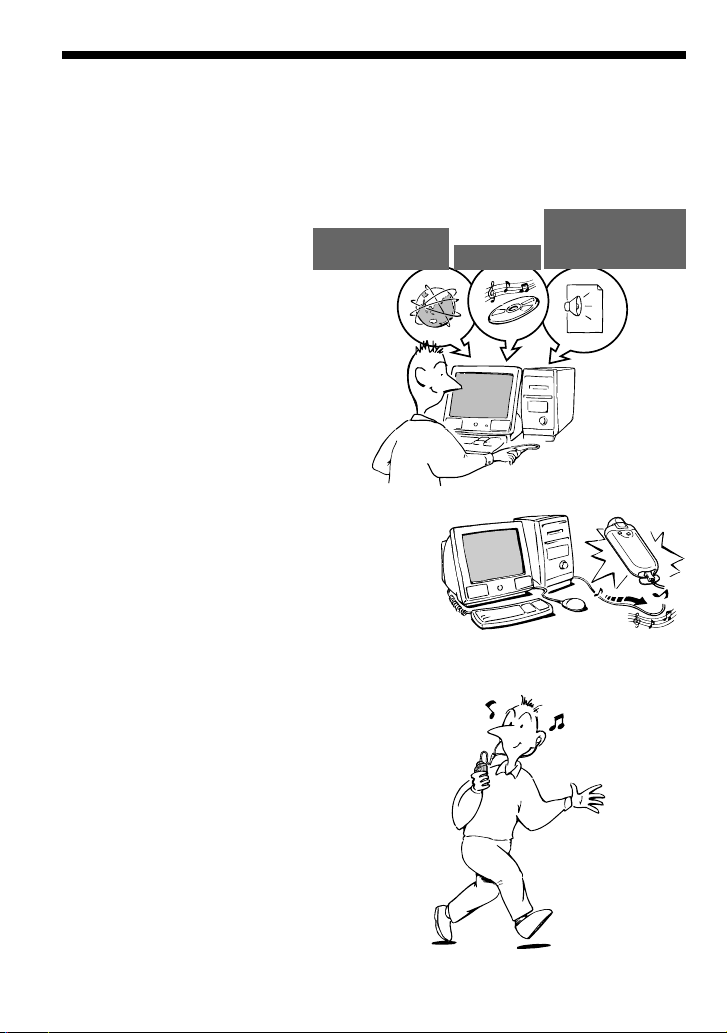
First, you need to install the “SonicStage” software into your computer. You can easily transfer
digital audio files from your computer to the built-in flash memory and carry it anywhere to
enjoy.
1 Store digital audio
files on your
computer.
2 Transfer files to your
Network Walkman.
3 Enjoy music with your
Network Walkman.
USB connection
Download the
latest audio
files!
Store favorite
songs!
EMD (Electric Music
Distribution) Services
Audio CDs
MP3, WAV and
Windows
®
Media
Format Audio Files

7
Other features
• Compact size, light weight, skip-proof operation and high portability.
• Continuous playback time with the rechargeable Lithium-Ion battery
Approximately 50*
1
hours
• Recording time*
2
NW-E503: 256MB built-in flash memory, more than 11 hours 40 minutes.
NW-E505: 512MB built-in flash memory, more than 23 hours 30 minutes.
NW-E507: 1GB built-in flash memory, more than 47 hours 00 minutes.
• The supplied SonicStage software enables you to record songs from audio CDs to the hard disk
of your computer using the ATRAC3plus format (high sound quality, high compression).
• MP3 audio files can be easily transferred to the Network Walkman using the SonicStage
software.
• Sentence Repeat: Useful function for learning a foreign language.
• High-speed data transfer using the dedicated USB cable.
• Organic EL display: song titles and artist names can be displayed.
• Search function: you can search songs to be played by artist, album, or group.
• FM tuner function.
• Storage function: you can store a variety of data as well as audio files.
*
1
Varies depending on the data format, power save setting, etc. In this case, the figure for the battery duration
is when continuously playing at 105kbps in ATRAC3 format and normal power save mode (page 35).
*
2
Varies depending on the bit rate, etc., when recording. In this case, the figure for the recordable time is for
recording at 48kbps ATRAC3plus format.
NOTES:
• The recorded music is limited to private use only. Use of the music beyond this limit requires permission
of the copyright holders.
• Sony is not responsible for incomplete recording/downloading or damaged data due to problems of the
Network Walkman or computer.
• Depending on the type of the text and characters, the text shown on the Network Walkman may not be
displayed properly on device. This is due to:
– The capability of the connected player.
– The player is not functioning normally.
– The ID3 TAG information for the track is written in the language or the character that is not supported
by the player.
8
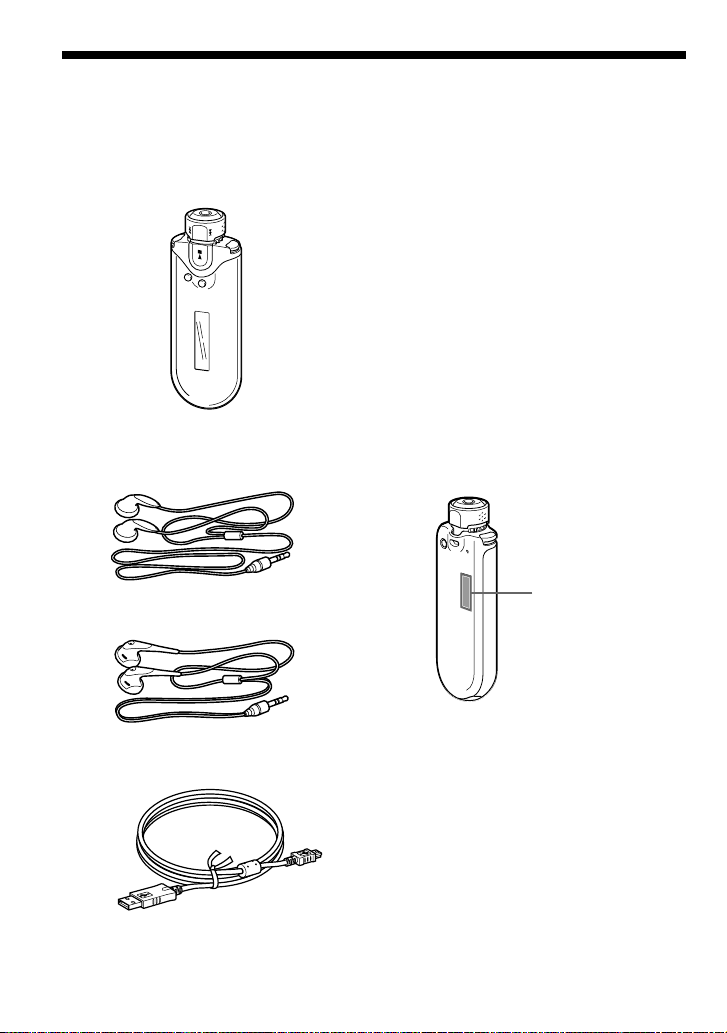
Please check the accessories in the package.
• Network Walkman (1)
• Headphones (1)
NW-E503
NW-E505/E507
• Dedicated USB cable (1)
Checking the package contents
Serial Number
• Extension headphone cord (NW-E505/
E507) (1)
• Carrying pouch (NW-E505/E507) (1)
• Clip (1)
• CD-ROM for the SonicStage software,
PDF file Operating Instructions, and PDF
file SonicStage Operating Instructions (1)
• Quick Start Guide
About the Serial Number
The serial number provided for your device
is required for customer registration. The
number is on the rear side of your Network
Walkman.
Record the serial number. Refer to it
whenever you call upon your Sony dealer
regarding this product.
The serial number can also be shown in the
menu screen (page 39).
9
Locating controls
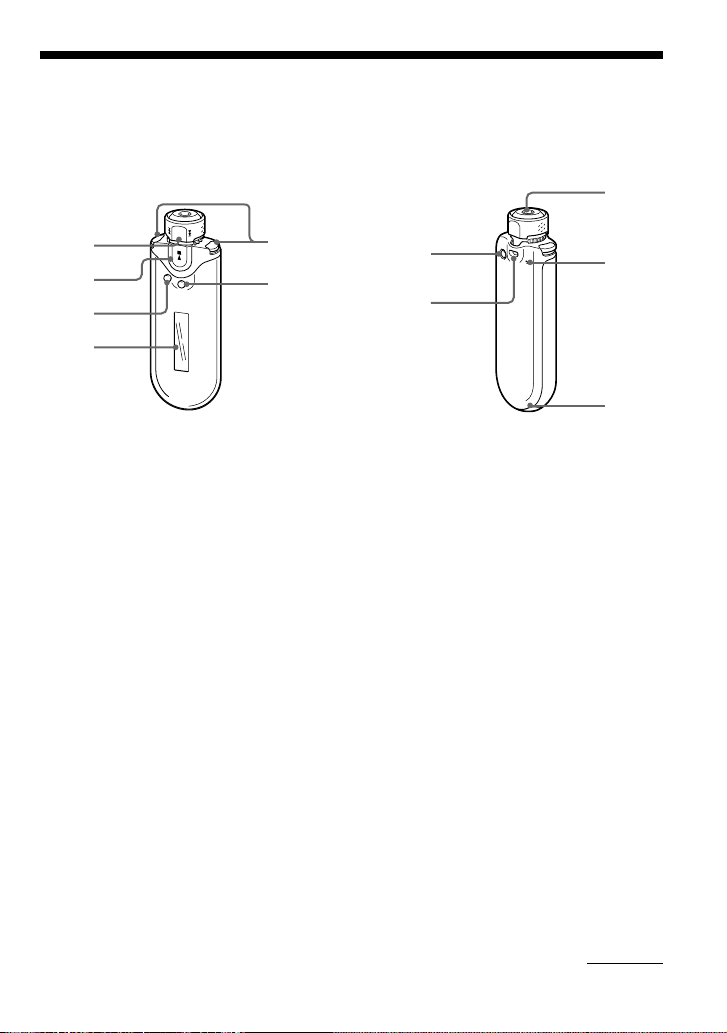
For details about each part, refer to the pages in parentheses.
Rear sideFront side
1
2
3
5
6
4
7
8
9
0
qa
1 Shuttle switch
(pages 17 to 22, 25, 27 to 39, 41, 43)
2 Nx button
(pages 14 to 25, 27 to 29, 31 to 39, 41,
43)
3 SEARCH/MENU button
(pages 15, 17 to 25, 27 to 29, 31 to 39,
41, 43)
4 Display (pages 10, 15, 22, 26, 40)
For details on the display and icons,
refer to page 10.
5 VOL (Volume) +/– button (pages 14,
33)
6 DISP/FM (Display/FM) button (pages
26 to 27, 40)
7 REPEAT/SOUND button
(pages 22 to 24, 28, 41)
8 Strap hole
9 Headphone jack (page 14)
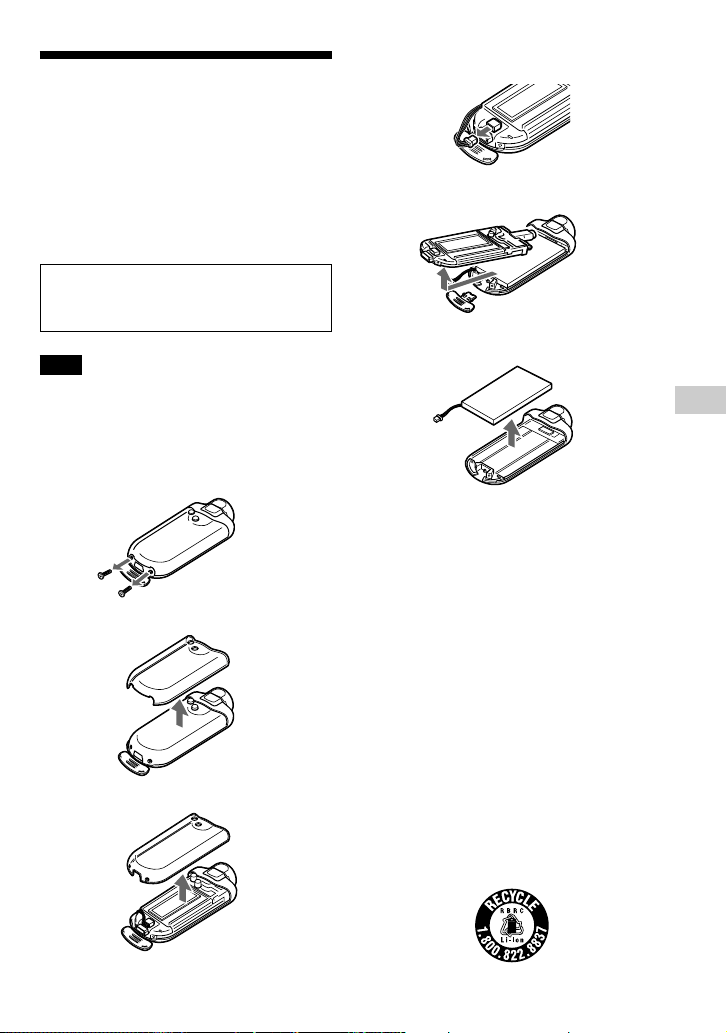
q; Reset button (page 46)
qa USB jack (page 12)
continued
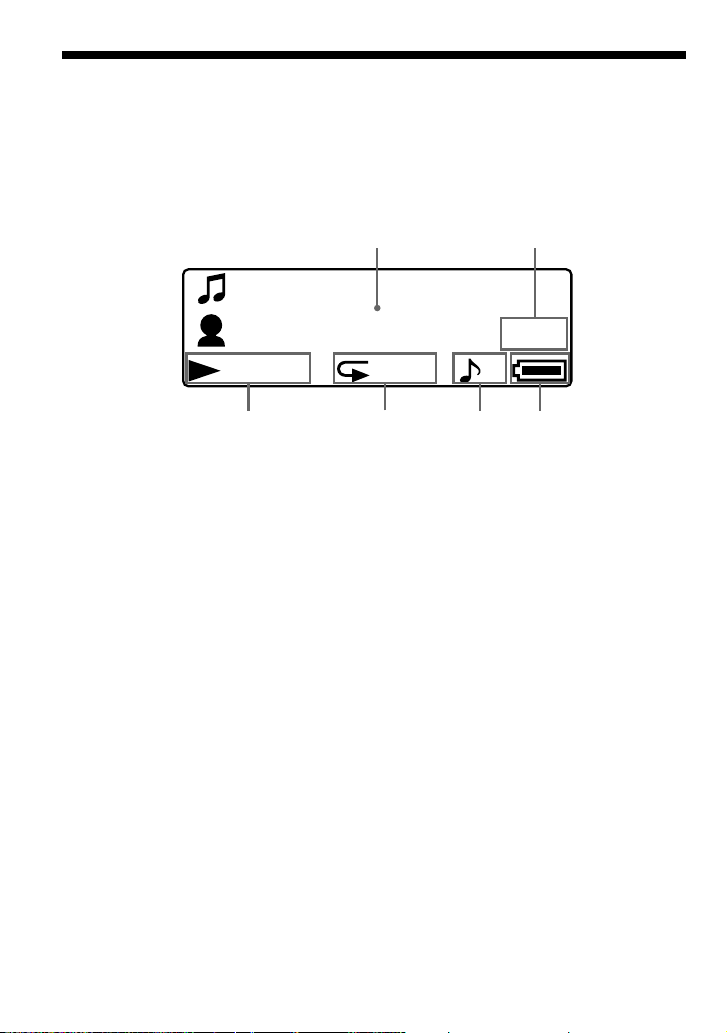
10
1
Text/graphic information display (pages
15, 22)
Displays album title, artist name, track
number, track name, current date and
time (pages 26 to 28, 31), MESSAGE
(page 50) and menu.
Press the DISP/FM (Display/FM) button
to switch the display mode (pages 26 to
28). Switch the display to Power Save or
Display OFF mode when you do not
operate the unit for a while (page 35).
2 Current track number/total track number
of the Play Range
The track number currently selected or
being played back and the total track
number of the current Play Range is
displayed.
3 Playing status indicator
Display current playback mode (N:
playback, x: stop) and elapsed time.
4 Repeat mode indication (page 22)
The current repeat mode icon is
displayed.
5 Digital sound preset indication
(pages 28 to 29)
The current digital sound preset is
displayed if set.
6 Remaining battery indication (pages 12
to 13)
The remaining battery power is
displayed.
z Tip
For information on the FM tuner display, see “FM
Tuner” (page 40).
Display
Artist
01:23
2
SHUF
Track 1
1/32
12
3546
Locating controls
11
Basic Operations
Basic Operations
Transferring audio files from the
computer to your Network Walkman/
Charging
Note
Before connecting your Network Walkman to the computer for the first time, be sure to
install the “SonicStage” software from the supplied CD-ROM in your computer. Even if the
SonicStage software is already installed, you need to install the SonicStage software supplied
with this Network Walkman before connecting your Network Walkman to the computer
(update programs may be available).
1 Install the SonicStage software in your computer using the supplied CD-ROM.
Follow step 1 only for the first time when you connect your Network Walkman to the
computer.
Refer to the Quick Start Guide.
Refer to the SonicStage operating instructions for details.
z Tip
The SonicStage operating instructions are installed with the SonicStage software in your computer.
2 Import audio files into the SonicStage software.
For details, refer to the SonicStage operating instructions.
continued
12
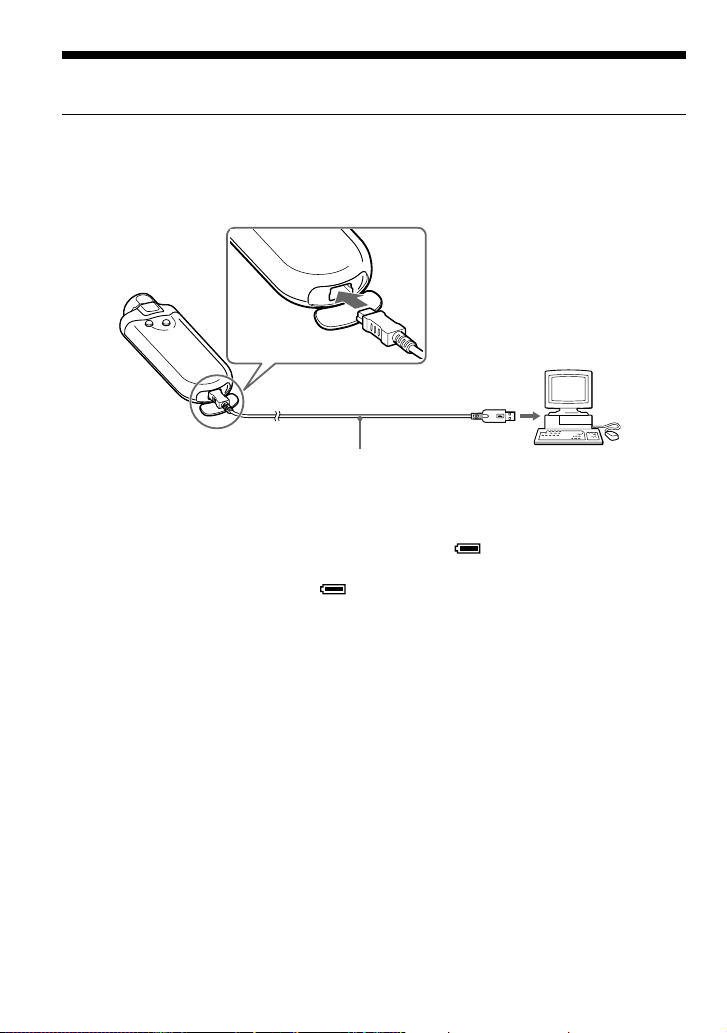
3 Connect your Network Walkman to your computer and charge it.
Connect the small connector of the dedicated USB cable to the USB jack on the Network
Walkman, then the large connector to a USB port on your computer.
“USB Connect” appears in the display.
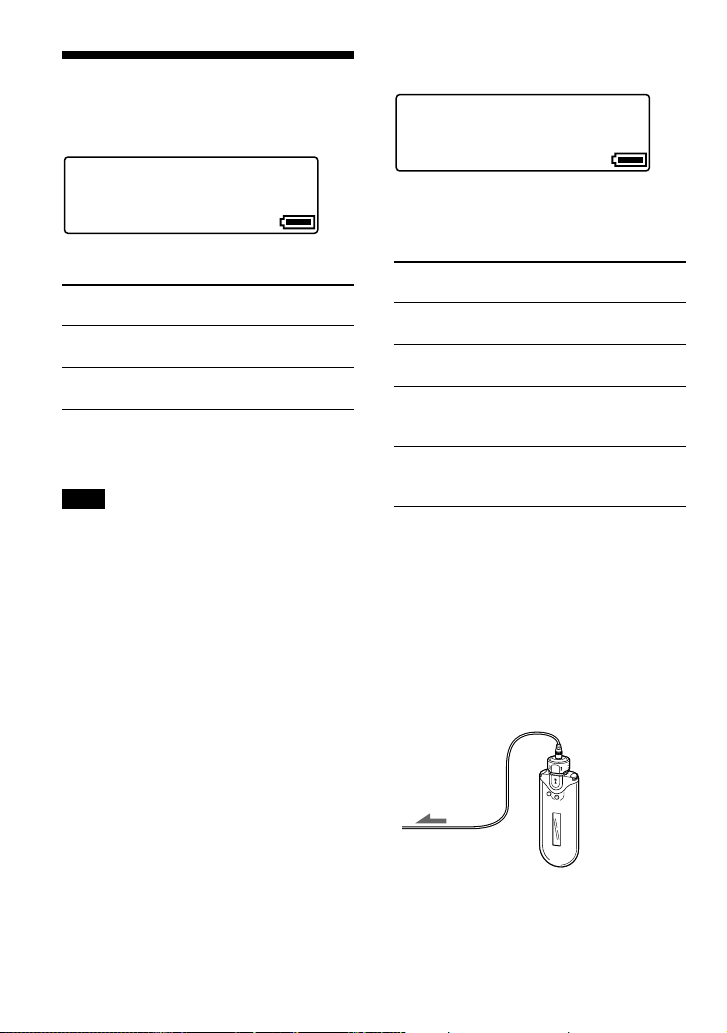
The Network Walkman is rechargeable when connected to a computer with the
dedicated USB cable
When the remaining battery indication of the display shows:
FULL
, charging is complete
(charging time is approx. 120 minutes*
1
).
Fully charge the Network Walkman (to
FULL
in the remaining battery indication of the display)
before using it for the first time.
*
1
This is the approximate charging time when the battery power is low and the “USB Bus Powered” setting
(page 38) is “High-power 500mA” under room temperature. The charging time will vary depending on
remaining battery power and battery condition. If the battery is charged in a low-temperature environment,
the charging time will be longer. It will also be longer if you transfer audio file(s) to your Network
Walkman while charging.
Battery duration
*
2
ATRAC3 format: Approximately 50 hours
ATRAC3plus format: Approximately 45 hours
MP3 format: Approximately 40 hours
FM radio reception: Approximately 22 hours
*
2
This is when the power save setting is normal (page 35). The battery duration will vary depending on
temperature and usage.
Transferring audio files from the computer to your Network Walkman/
Charging
Dedicated USB cable (supplied)
to a USB portto the USB jack
13
Basic Operations
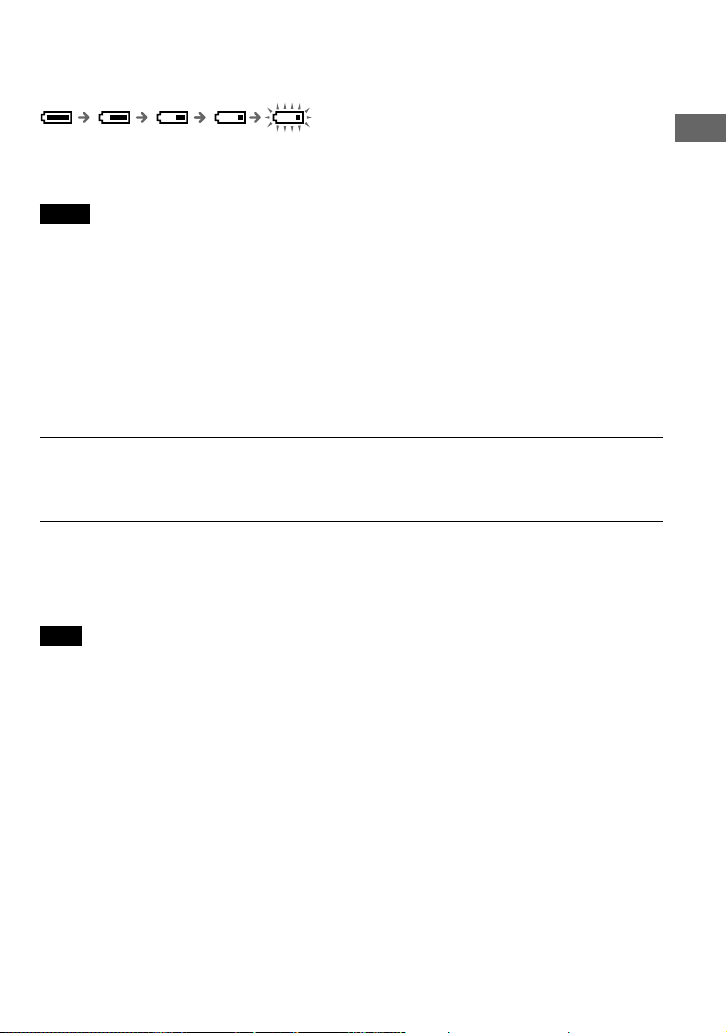
On the remaining battery indication
The battery icon in the display changes as shown below.
The battery power gets low as shown in the battery icon. If “LOW BATTERY” is displayed, you cannot play
back with the Network Walkman. In this case, charge the battery by connecting to your computer.
Notes
• Charge the battery in an ambient temperature of between 5 to 35ºC (67 to 95ºF).
• The icon above “USB Connect” in the display is animated while your Network Walkman accesses the
computer. Do not disconnect the USB cable when the icon is moving or the data being transferred may be
destroyed.
• Use of your Network Walkman with a USB hub or a USB extension cable is not guaranteed. Always connect
your Network Walkman to the computer directly using the dedicated USB cable.
• Some USB devices connected to the computer may interfere with the proper operation of your Network
Walkman.
• The control buttons on your Network Walkman are all disabled while it is connected to a computer.
• You can display the data stored in the built-in flash memory using Windows Explorer when your Network
Walkman is connected to the computer.
4 Transfer audio files to your Network Walkman.
For information on transferring audio files to the built-in flash memory, refer to the
SonicStage operating instructions.
z Tip
For information on transferring audio files back to the computer, refer to the SonicStage operating instructions
or online Help for the SonicStage software.
Note
If the USB cable is disconnected while data is being transferred, unnecessary data may be left in the Network
Walkman. In this case, transfer usable audio files (including non-audio data) back to your computer and format
(page 37) the Network Walkman.
14
Listening to music with your Network
Walkman
Charge the built-in rechargeable battery before use (page 12) and transfer audio files to your
Network Walkman.
Notes
• When using Network Walkman, be sure to disconnect it from the computer.
• For information on FM tuner operations, see “FM Tuner” (page 40).
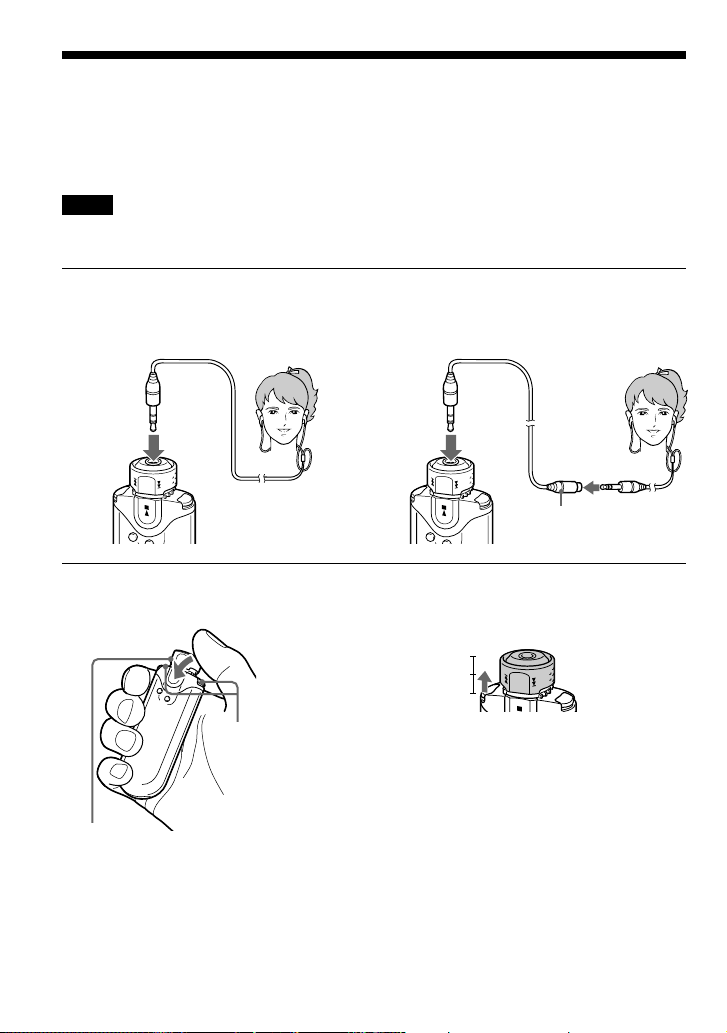
1 Connect the headphones.
If playback does not start
Make sure that the Shuttle switch is not set to
HOLD (page 30).
To stop playback
Press the Nx button.
To adjust the volume
The volume can be set in the Preset and Manual
(pages 33 to 34).
z Tip
You can switch the display to Power Save or
Display OFF mode when you do not operate the
unit for a while (page 35).
1 Press the Nx button.
2 Press the VOL
+/– button to
adjust the
volume.
Shuttle switch
2 Start playback.
to
headphone
jack
To use the headphones extension cord
(NW-E505/E507)
Connect until it clicks into place.
Extension
headphone cord
If the repeat mode (page 21) is not set,
playback stops automatically after the last
song is played.
to
headphone
jack
GROUP
Normal
HOLD
15
Basic Operations
All Track
*
Group
Album
Artist
Track3
Track2
Track1
Track3
Track2
Track1
Track3
Track2
Track1
Track3
Track2
Track1
Track3
Track2
Track1
Track3
Track2
Track1
Track3
Track2
Track1
Artist2
Artist1
All Artist
Album2
Album1
All Album
Album2
Album1
All Album
Group2
Group1
All Group
Searching for a song you want to listen to (SEARCH)
You can search for desired tracks to playback by the following 3 ways.
• Search by artist name (
Artist)
• Search by album name (
Album)
• Search by group* transferred from your computer with the SonicStage software (
Group)
* The audio files transferred from your computer with the SonicStage software are always grouped when
transferred to the built-in flash memory.
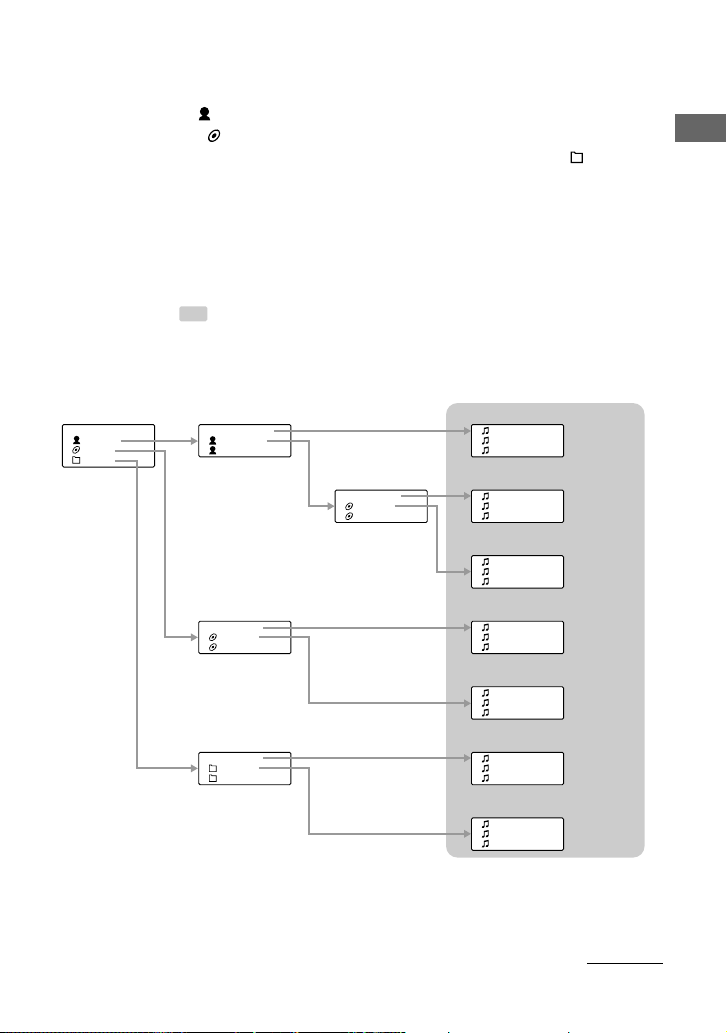
On the search flow and Play Range
Press the SEARCH/MENU button to display the search menu screen.
Proceed to the next stage by pressing the Nx button, and return to the previous stage by
pressing the SEARCH/MENU button on the search menu screen.
The searched songs (
as shown in the illustration below) become a Play Range (coverage of
playback). If you do not set the repeat mode (page 21), playback will stop automatically at the
end of the Play Range.
continued
Search menu screen
Artist list
Album list
Group list
Album list of
searched artist
Track list (Play Range)
All tracks (artist order)
All tracks of the selected artist
(album order)
Tracks in the selected album
All tracks (album order)
Tracks in the selected album
All tracks (group order)
Tracks in the selected group
* When you select “All Track”, all track lists are displayed and the Play Range will be “All”.
16
Listening to music with your Network Walkman
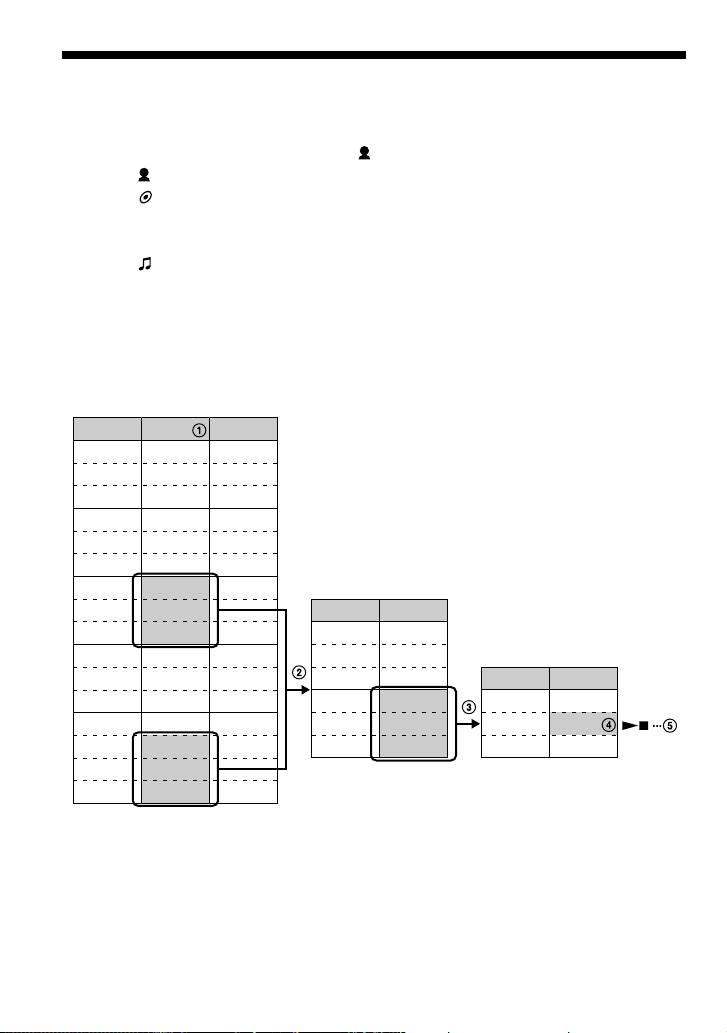
Example of searching
1 Display the search menu screen to select “ Artist”.
2 Select “
Artist B” from the artist list.
3 Select “
Album5” from the album list of Artist B.
The track list of Album5 is displayed.
In this case, the track list becomes the Play Range.
4 Select “
Track15” from the track list.
5 Press the Nx button.
Playback starts from Track15.
Playback will stop automatically at the end of Track16 (in this case, the end of the Play
Range).
Album Artist
…
Track
Album 1 Artist A Track01
Album 1 Artist A Track02
Album 1 Artist A Track03
Album 2 Artist A Track04
Album 2 Artist A Track05
Album 2 Artist A Track06
Album 3 Artist B Track07
Album 3 Artist B Track08
Album 3 Artist B Track09
Album 4 Artist C Track10
Album 4 Artist C Track11
Album 4 Artist D Track12
Album 5 Artist A Track13
Album 5 Artist B Track14
Album 5 Artist B Track15
Album 5 Artist B Track16
Artist Album
Artist B Album 3
Artist B Album 3
Artist B Album 3
Artist B Album 5
Artist B Album 5
Artist B Album 5
Album Track
Album 5 Track14
Album 5
Tra ck15
…
Album 5 Track16
All tracks in the built-in flash
memory
Album lists of Artist B
Tracks in Album 5
17
Basic Operations
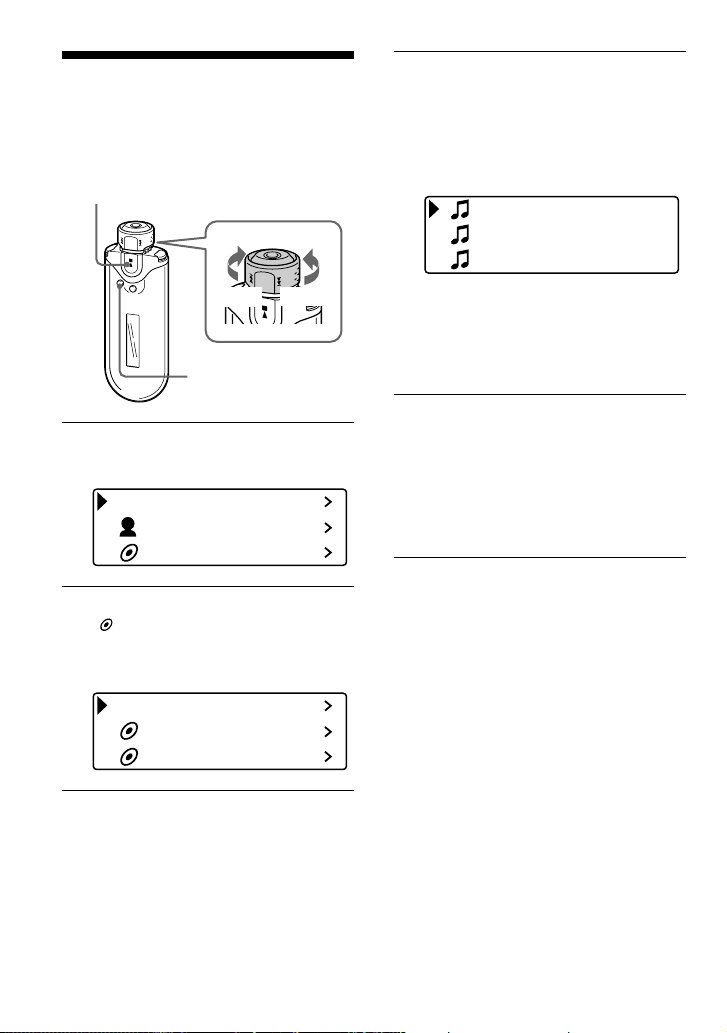
Searching by artist name
and playing back the song
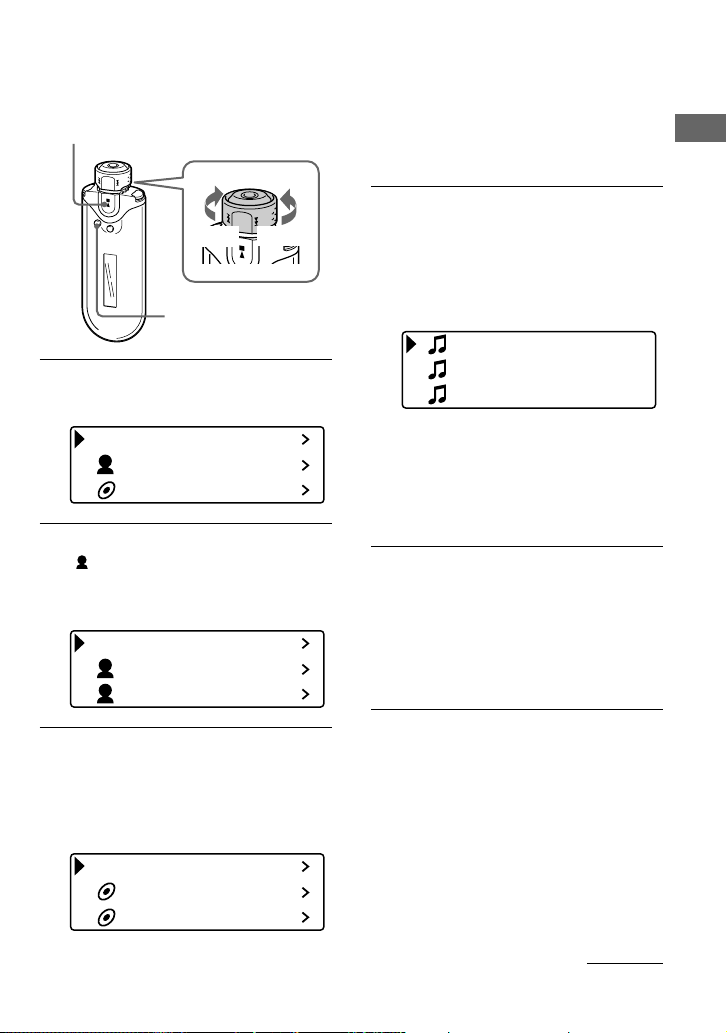
1 Press the SEARCH/MENU button.
The search menu screen is displayed.
All Track
Artist
Album
2 Rotate the Shuttle switch to select
“
Artist” and press the Nx
button to confirm.
The artist lists are displayed.
All Artist
Artist A
Artist B
3 Rotate the Shuttle switch to select
the desired artist and press the
Nx button to confirm.
The album lists for the selected artist are
displayed.
All Album
Album 1
Album 2
Nx button
SEARCH/
MENU button
Shuttle switch
to > to .
continued
z Tip
When you select “All Artist” at the top of the artist
list and confirm it by pressing the Nx button, all
track lists are displayed in order of artist name (the
tracks of the same artist are displayed in the album
order). The list displayed will be the Play Range.
Proceed to step 5 and start playback.
4 Rotate the Shuttle switch to select
the desired album and press the
Nx button to confirm.
The track lists of the selected artist’s
album are displayed. The list displayed
will be the Play Range.
Track 1
Track 2
Track 3
z Tip
When you select “All Album” at the top of the
album list and confirm it by pressing the Nx
button, all track lists of the artist selected in step 3
are displayed album order. The list displayed will
be the Play Range.
5 Rotate the Shuttle switch to select
the desired track and press the
Nx button to confirm.
The selected track will be played back.
If you do not set the repeat mode (page
21), the playback will stop automatically
at the end of the Play Range.
To return to the previous stage
Press the SEARCH/MENU button. The screen
returns to the playback screen by pressing the
SEARCH/MENU button while the first stage of the
search menu screen (the screen of step 1) is
displayed.
18
Nx button
SEARCH/
MENU button
Shuttle switch
to >
to .
Listening to music with your
Network Walkman
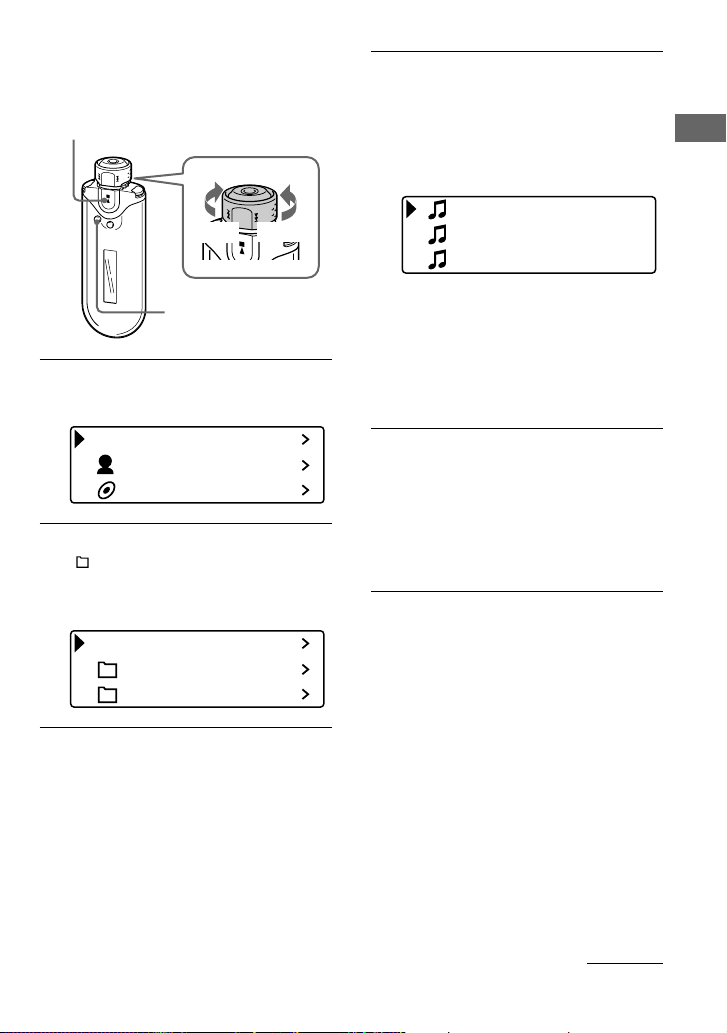
Searching by album name
and playing back the song
1 Press the SEARCH/MENU button.
The search menu screen is displayed.
All Track
Artist
Album
2 Rotate the Shuttle switch to select
“ Album” and press the Nx
button to confirm.
The album lists are displayed.
All Album
Album 1
Album 2
3 Rotate the Shuttle switch to select
the desired album and press the
Nx button to confirm.
The track lists of the selected album are
displayed. The list displayed will be the
Play Range.
Track 1
Track 2
Track 3
z Tip
When you select “All Album” at the top of the
album list and confirm it by pressing the Nx
button, all track lists are displayed in the album
order. The list displayed will be the Play Range.
4 Rotate the Shuttle switch to select
desired track and press the Nx
button to confirm.
The selected track will be played back.
If you do not set the repeat mode (page
21), the playback will stop automatically
at the end of the Play Range.
To return to the previous stage
Press the SEARCH/MENU button. The screen
returns to the playback screen by pressing the
SEARCH/MENU button while the first stage of the
search menu screen (the screen of step 1) is
displayed.
19
Basic Operations
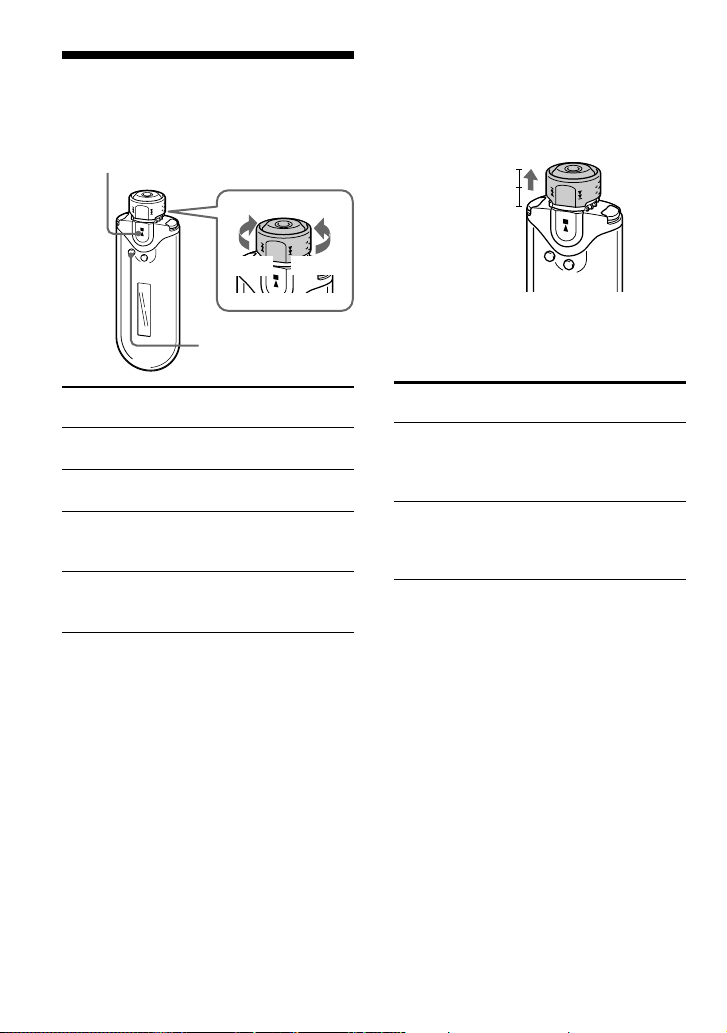
Searching by Group and
playing back the song
1 Press the SEARCH/MENU button.
The search menu screen is displayed.
All Track
Artist
Album
2 Rotate the Shuttle switch to select
“
Group” and press the Nx
button to confirm.
The Group lists are displayed.
All Group
Group 1
Group 2
3 Rotate the Shuttle switch to select
the desired Group and press the
Nx button to confirm.
The track lists of the selected Group are
displayed. The list displayed will be the
Play Range.
Track 1
Track 2
Track 3
z Tip
When you select “All Group” at the top of the
group list and confirm it by pressing the Nx
button, all track lists are displayed in the group
order (the group of transferred from your
computer). The list displayed will be the Play
Range.
4 Rotate the Shuttle switch to select
desired track and press the Nx
button to confirm.
The selected track will be played back.
If you do not set the repeat mode (page
21), the playback will stop automatically
at the end of the Play Range.
To return to the previous stage
Press the SEARCH/MENU button. The screen
returns to the playback screen by pressing the
SEARCH/MENU button while the first stage of the
search menu screen (the screen of step 1) is
displayed.
Nx button
SEARCH/
MENU button
Shuttle switch
to >
to .
continued
20
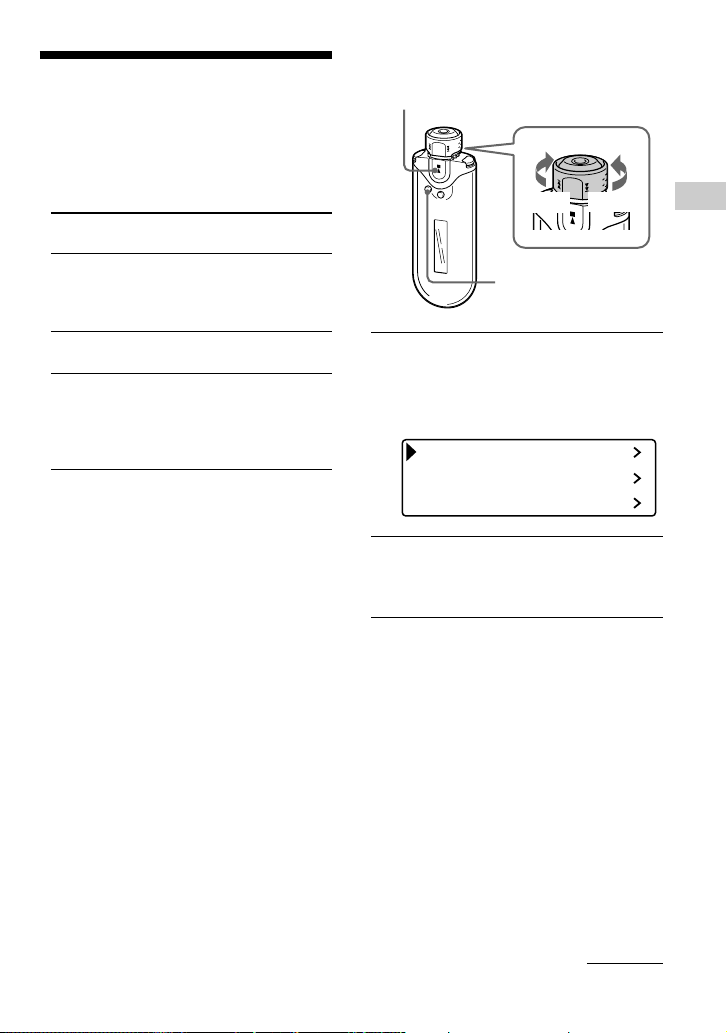
On the Group Control Mode
You can use the Group Control Mode by
setting the Shuttle switch to the GROUP
position.
You can skip to the beginning of the album
or group within the Play Range in the Group
Control Mode.
To
Skip to the beginning
of the next album/
group*
1
*
2
Skip to the beginning
of the current album/
group*
1
*
2
*
1
Skips to the beginning of the next (or the current)
album’s first track when the current Play Range
is the result of an album name or artist name
search. Skips to the beginning of the next (or the
current) group’s first track when the current Play
Range is the track list result of a “searching by
group” search.
*
2
Rotating and holding the Shuttle switch to >
(or .) while playback is stopped, makes
continuous skips to the beginning of the next (or
the current) album/group in the current Play
Range, and if held longer, continues to skip
through the next (or previous) album/group(s).
On other operations
To
Skip to the beginning
of the next track*
1
Skip to the beginning
of the current track*
1
Fast-forward*
2
Fast-rewind*
2
*
1
Rotating and holding the Shuttle switch to >
(or .) while playback is stopped, makes
continuous skips to the beginning of the next (or
the current) song, and if held longer, continues to
skip through the next (or previous) song(s).
*
2
The Fast-forward and fast-rewind speed becomes
gradually faster.
Shuttle switch
operation
Rotate the Shuttle
switch to >.
Rotate the Shuttle
switch to ..
Rotate the Shuttle
switch
to >
and hold
it.
Rotate the Shuttle
switch
to .
and hold
it.
Nx button
SEARCH/
MENU button
Shuttle switch
to >
to .
GROUP
Normal
HOLD
Shuttle switch
operation
Set the Shuttle switch
to the GROUP
position and rotate it to
>.
Set the Shuttle switch
to the GROUP
position and rotate it to
..
Listening to music with your
Network Walkman
Advanced Operations
21
B
Advanced Operations
Repeat mode
There are 3 types of repeat mode: Track
Repeat, A-B Repeat, and Sentence Repeat.
• Track Repeat (Track Rep)
This mode plays back tracks repeatedly in
the following 3 ways.
Track Repeat
mode
Repeat
Single Repeat
Shuffle Repeat
• A-B Repeat (A-B Rep)
This mode plays back the specified section
in a track repeatedly.
• Sentence Repeat (Sentence Rep)
This mode plays back voice data within a
specified section in a track repeatedly.
Selecting the repeat mode
1 Press and hold the SEARCH/
MENU button for half a second in
stop mode.
The menu screen is displayed.
Repeat Mode
Sound
Volume Mode
2 Rotate the Shuttle switch to select
“Repeat Mode>” and press the
Nx button to confirm.
Operation
All the songs in the Play
Range (coverage of
playback) are played back
repeatedly.
The current song is
played back repeatedly.
All the songs in the Play
Range (coverage of
playback) are played back
repeatedly in random
order.
Nx button
SEARCH/
MENU button
Shuttle switch
to >
to .
continued
22
Repeat mode
3 Rotate the Shuttle switch to select
a desired repeat mode and press
the Nx button to confirm.
Track Rep
A-B Rep
Sentence Rep
You can choose one mode among
“Track Rep”, “A-B Rep”, and “Sentence
Rep”.
You can operate each repeat mode you
selected, as refer to the below.
• Track Rep: see “Playing tracks
repeatedly (Track Repeat)”.
• A-B Rep: see “Playing a specified
section repeatedly (A-B Repeat)”.
• Sentence Rep: see “Playing specified
sentences repeatedly (Sentence
Repeat)”.
4 Press the SEARCH/MENU button
repeatedly to exit menu mode.
Notes
• The display automatically returns to the playback
screen if you do not operate any button for 60
seconds.
• When there are no audio files in the built-in flash
memory, you cannot set any repeat mode.
• When you connect the Network Walkman to your
computer, the selected repeat mode will be
canceled.
• When you change the Play Range, the selected
repeat mode will be canceled.
• You can only select repeat mode from stop mode.
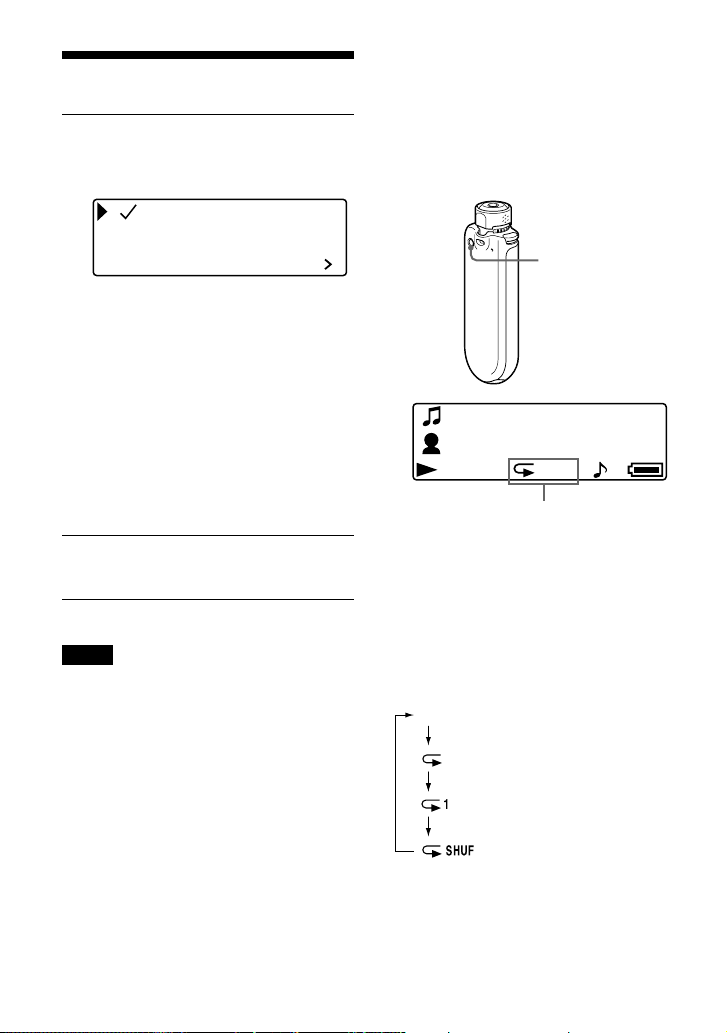
(Shuffle Repeat)
none (Normal play)
(Repeat)
(Single Repeat)
Playing tracks repeatedly
(Track Repeat)
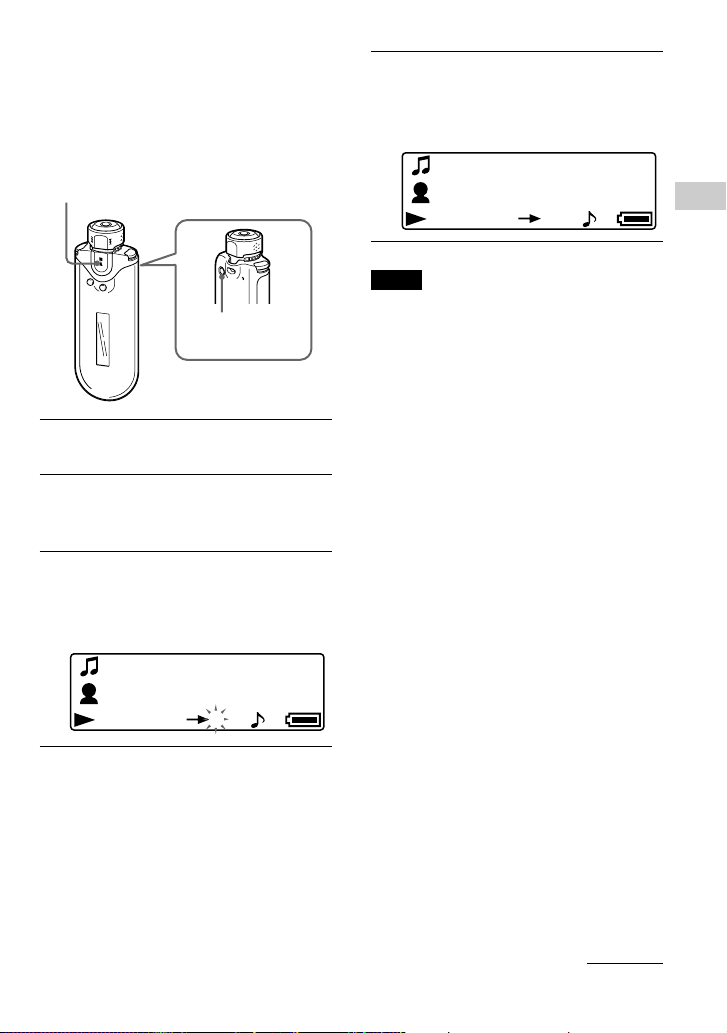
The Track Repeat mode is changed by
pressing the REPEAT/SOUND button. You
can check the current Track Repeat mode
with the icon of the display.
Select the Track Repeat mode
(Track Rep) first (page 21).
Then, press the REPEAT/SOUND
button repeatedly to select the
repeat mode you want.
Each press changes the Track Repeat icon as
follows:
Track Repeat icon
Artist
01:23
2
SHUF
1/32
Track 1
REPEAT/SOUND
button
Advanced Operations
23
Playing a specified section
repeatedly (A-B Repeat)
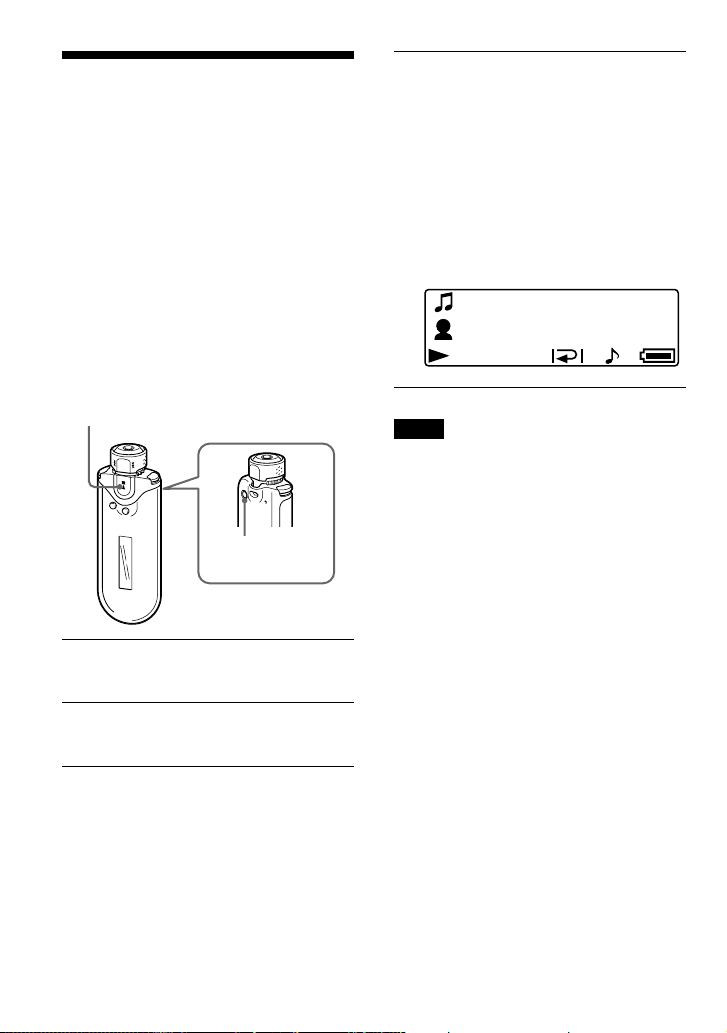
While playing a track, you can set the start
point (A) and end point (B) for a section you
wish to play repeatedly.
1 Select the A-B Repeat mode (A-B
Rep) (page 21).
2 Press the Nx button to start
playback.
“A t” blinks.
3 Press the REPEAT/SOUND button
to set the start point (A) while
playing back.
“A t” is displayed and “B” blinks.
01:23 A B
Track 1
Artist
2
1/32
4 Press the REPEAT/SOUND button
to set the end point (B).
“AtB” is displayed and the specified
section is played back repeatedly.
2
Artist
1/32
01:23
Track 1
AB
Notes
• You cannot set A-B Repeat for a section that
overlaps two or more tracks.
• If you do not set the end point (B), it is
automatically set at the end of the track.
• Rotating the Shuttle switch releases the already
set start point (A).
• Switching to the FM tuner releases the already set
start point (A).
To clear the start point (A) and end
point (B)
• Press the REPEAT/SOUND button during A-B
Repeat playback.
• Press the SEARCH/MENU button during A-B
Repeat playback.
• Set the Shuttle switch to the GROUP position to
select the Group Control Mode during A-B
Repeat playback.
• Select the previous or next track by rotating the
Shuttle switch during A-B Repeat playback.
(The A-B Repeat mode is not canceled.)
To cancel the A-B Repeat mode
Change the Repeat mode in the menu screen (page
21).
Nx button
REPEAT/SOUND
button
continued
24
Repeat mode
Playing specified
sentences repeatedly
(Sentence Repeat)
This function automatically detects voice
data between blank spaces (silent spaces) and
repeats the voice data for a set number of
counts. This is useful for language-learning
material which has no background music.
z Tip
The default repeat count setting is 2 times for one
sentence. But you can change the repeat count
setting. Refer to “Setting the repeat count” on page
25.
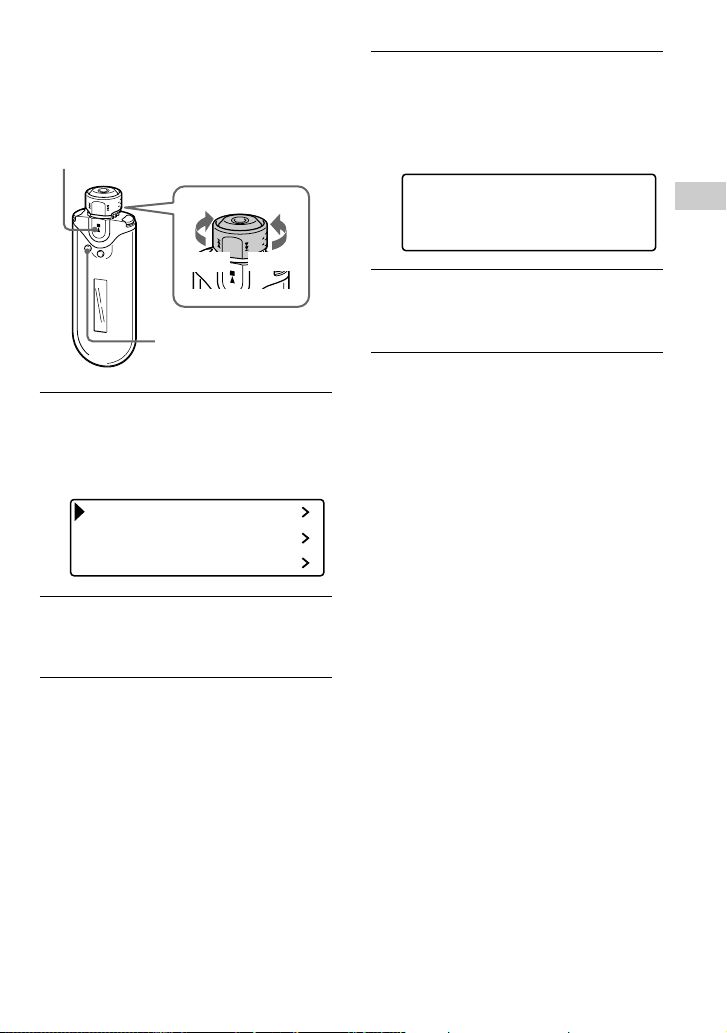
1 Select the Sentence Repeat mode
(Sentence Rep) (page 21).
2 Press the Nx button to start
playback.
3 Press the REPEAT/SOUND button
to place the setting point during
playback.
The Network Walkman detects the
speech up to the next blank space (silent
section) and repeats the spoken section
according to the repeat count you set
(page 25). For example, if you set the
repeat count to 3, you will hear each
spoken section 4 times- the first time
plus 3 repeats.
2
Artist
1/32
01:23
Track 1
Notes
•A spoken or silent section of less than 1 second
will not be detected.
• If a spoken section continues up to the very end
of a track (with no blank), then that point (end of
track) is regarded as the end of that spoken
section and it is repeated.
• Switching to the FM tuner during Sentence
Repeat releases the setting point.
To clear the setting point
• Press the REPEAT/SOUND button during
Sentence Repeat playback.
• Press the SEARCH/MENU button during
Sentence Repeat playback.
• Set the Shuttle switch to the GROUP position to
select the Group Control Mode during Sentence
Repeat playback.
• Select the previous or next track by rotating the
Shuttle switch during Sentence Repeat playback.
(The Sentence Repeat mode is not canceled.)
To cancel the Sentence Repeat mode
Change the Repeat mode in the menu screen (page
21).
Nx button
REPEAT/SOUND
button
Advanced Operations
25
Setting the repeat count
You can set the repeat counts (1-9) for each
sentence in Sentence Repeat mode (Sentence
Rep).
1 Press and hold the SEARCH/
MENU button for half a second in
stop mode.
The menu screen is displayed.
Repeat Mode
Sound
Volume Mode
2 Rotate the Shuttle switch to select
“Repeat Mode>” and press the
Nx button to confirm.
3 Rotate the Shuttle switch to select
“Sentence Rep” and press the
Nx button to confirm.
The value of “Repeat Count” is
displayed in [ ].
Repeat Count
[2]
4 Rotate the Shuttle switch to select
the desired repeat count and
press the Nx button to confirm.
To cancel the Menu mode
Press the SEARCH/MENU button to return the
screen to the previous stage. Press repeatedly to exit
menu mode.
Nx button
SEARCH/
MENU button
Shuttle switch
to >
to .
26
Changing the
display mode
You can view various information in the
display while the audio player is played or
stopped. Change the display mode by
pressing the DISP/FM (Display/FM) button.
There are 4 types of display, and you can set
the desired display in the Menu mode (page
27).
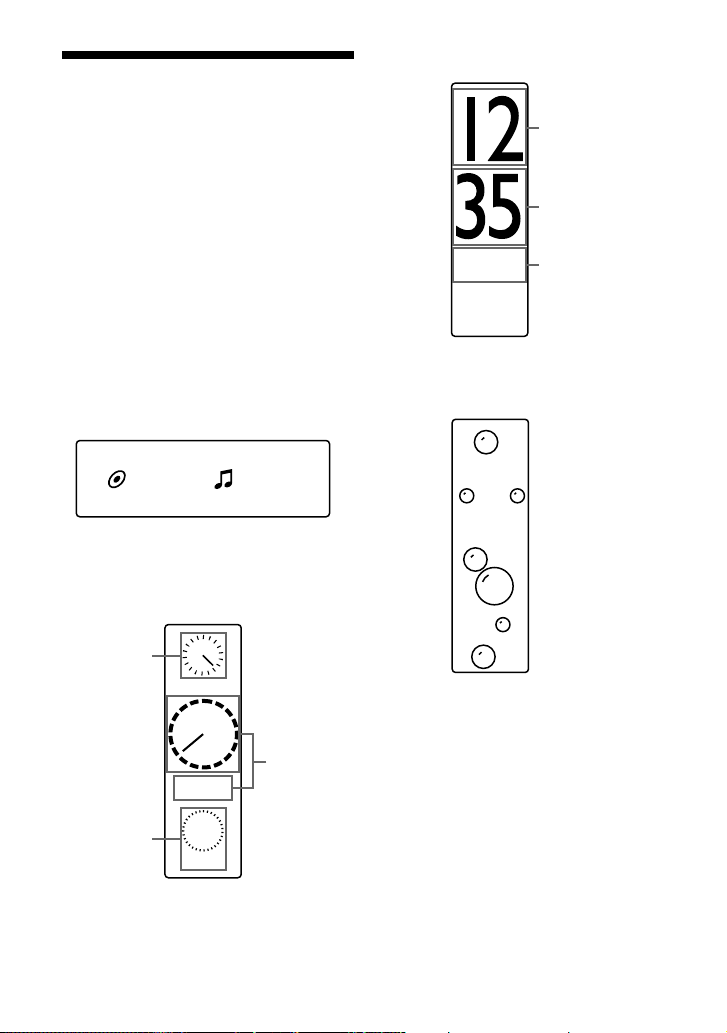
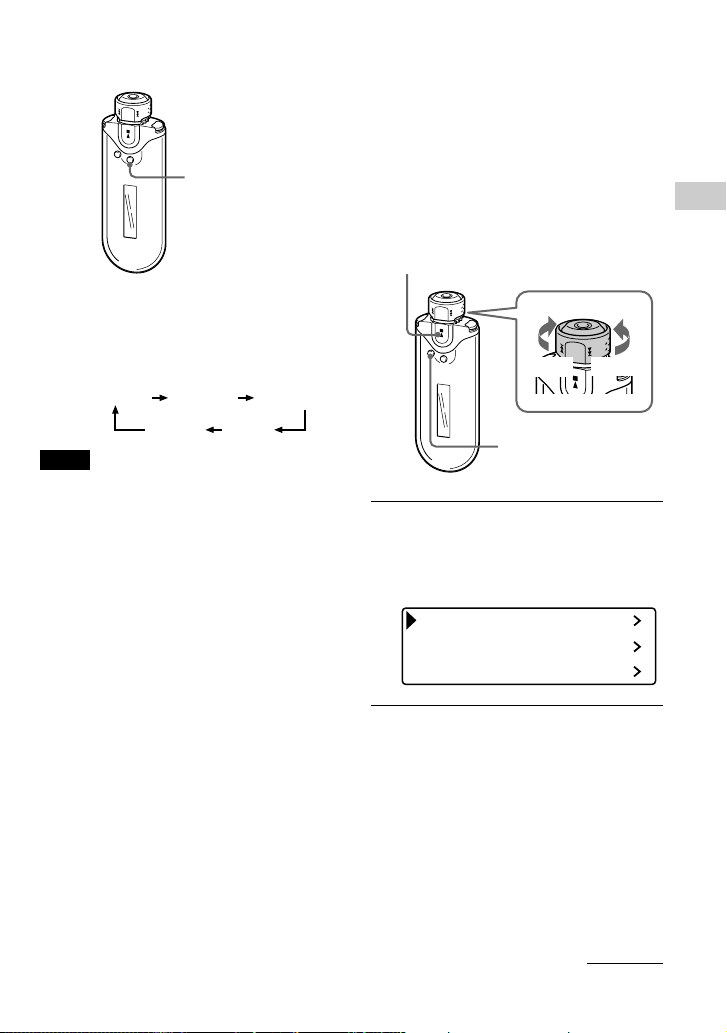
• Property: Displays the current Play Range,
the current album number/total album
number within the Play Range, the current
track number/total track number within the
Play Range, the CODEC (compression
type), and bit rate.
64
plus
All Artist
25/545
ATRAC3
35
/
980
kbps
• Lap Meter: Displays the current track
position within the Play Range, the elapsed
time, and the current volume level.
03:23
24
VOL
Current
volume
level
Elapsed time
Current
track
position
within the
Play Range
• Clock: Displays the current time and date.
2005
12/14
• Bubble: Displays animated bubbles.
Minute
Hour
Date
Advanced Operations
27
Selecting the display types
(Display Screen)
You can select whether or not to use each of
the 4 display types: “Property”, “Lap Meter”,
“Clock”, and “Bubble” by pressing the DISP/
FM (Display/FM) button.
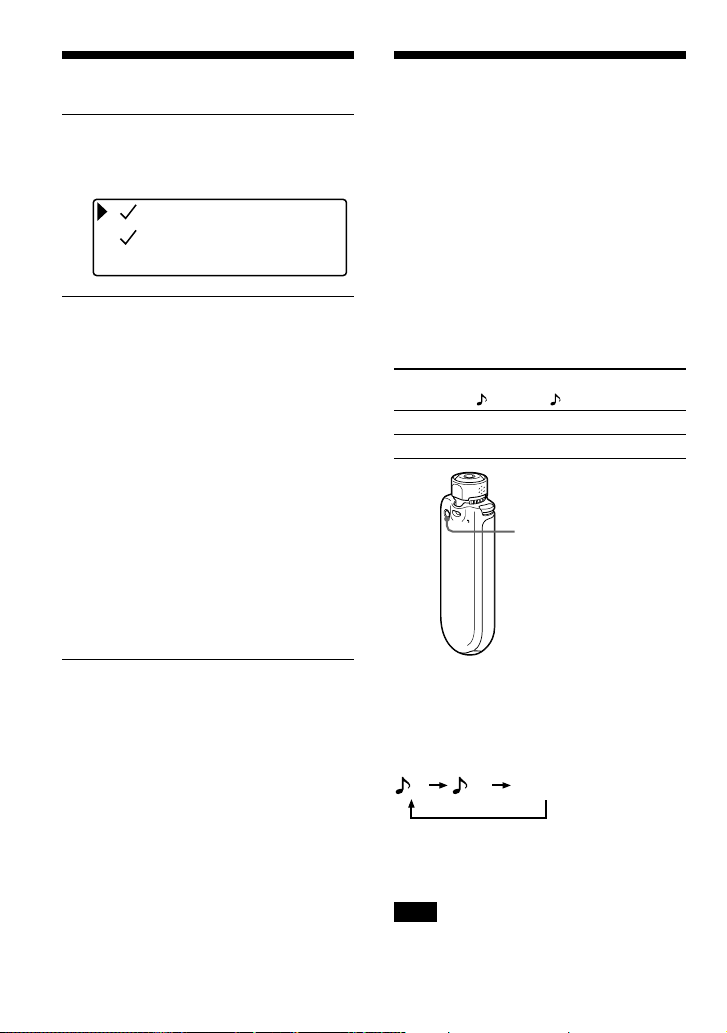
The display types can be displayed by
placing a check mark next to the setting.
1 Press and hold the SEARCH/
MENU button for half a second in
stop mode.
The menu screen is displayed.
Repeat Mode
Sound
Volume Mode
Nx button
SEARCH/
MENU button
Shuttle switch
to >
to .
Changing the display mode
Press the DISP/FM (Display/FM)
button while the audio player is
played or stopped.
Property Lap Meter
Bubble Clock
Notes
• The diagram above shows the order when all the
display types are set to on (has check mark) in the
Display Screen of the Menu mode. If some
display types are set to off (no check mark), they
will not be displayed.
• You cannot change the display mode while using
the FM tuner.
(normal display)
DISP/FM
(Display/FM)
button
continued
28
Adjusting the
treble and bass
(Digital sound
preset)
You can adjust the treble and bass. You can
preset two settings, which can be selected
while the audio player is played.
Selecting the Sound quality
Default settings
Sound Sound 1 Sound 2 Sound OFF
quality
( 1) ( 2)
(NORMAL SOUND)
Bass +1 +3 ±0
Treble ±0 ±0 ±0
Press and hold the REPEAT/
SOUND button for half a second.
The Sound quality setting is changed as
follows:
12
To return to the normal Sound quality
Select “Sound OFF (none)”.
Note
You cannot select the Sound quality while using the
FM tuner.
Sound OFF (none)
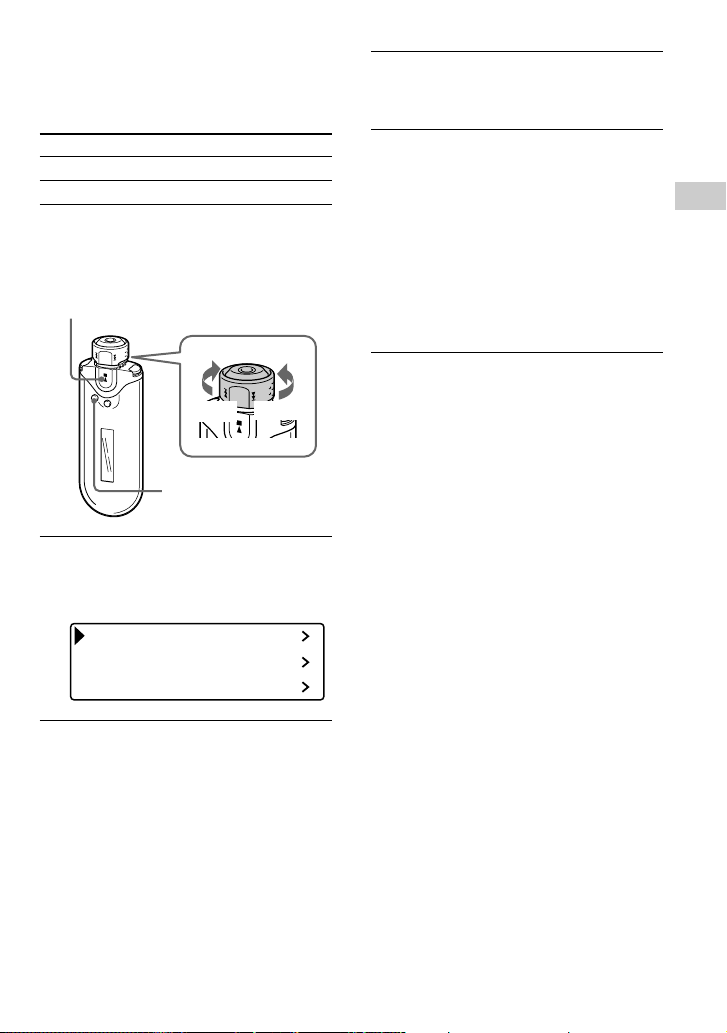
2 Rotate the Shuttle switch to select
“Display Screen>”, and press the
Nx button to confirm.
Property
Lap Meter
Clock
3 Set the check marks for
“Property”, “Lap Meter”, “Clock”,
and “Bubble” screen.
1 Rotate the Shuttle switch to select
“Property” and press the Nx
button to confirm.
2 Rotate the Shuttle switch to select
“Lap Meter” and press the Nx
button to confirm.
3 Rotate the Shuttle switch to select
“Clock” and press the Nx button
to confirm.
4 Rotate the Shuttle switch to select
“Bubble” and press the Nx button
to confirm.
If a check is already marked, the above
steps will uncheck it.
To cancel the Menu mode
Press the SEARCH/MENU button to return the
screen to the previous stage. Press repeatedly to exit
menu mode.
REPEAT/SOUND
button
Changing the display mode
Advanced Operations
29
2 Rotate the Shuttle switch to select
“Sound>” and press the Nx
button to confirm.
3 Set the tone for “Sound 1”.
1 Rotate the Shuttle switch to select
“Sound 1>” and press the Nx
button to confirm.
2 Rotate the Shuttle switch to adjust
“Bass” and press the Nx button to
confirm.
3 Rotate the Shuttle switch to adjust
“Treble” and press the Nx button
to confirm.
To adjust the “Sound 2” setting
Select “Sound 2>” in step 3.
To cancel the Menu mode
Press the SEARCH/MENU button to return the
screen to the previous stage. Press repeatedly to exit
menu mode.
Adjusting the Sound
quality
You can adjust the bass and treble.
Sound quality Emphasis level
Bass -4 to +3
Treble -4 to +3
You can preset the desired sound quality
settings as “Sound 1” and “Sound 2” and
select either one while playing music.
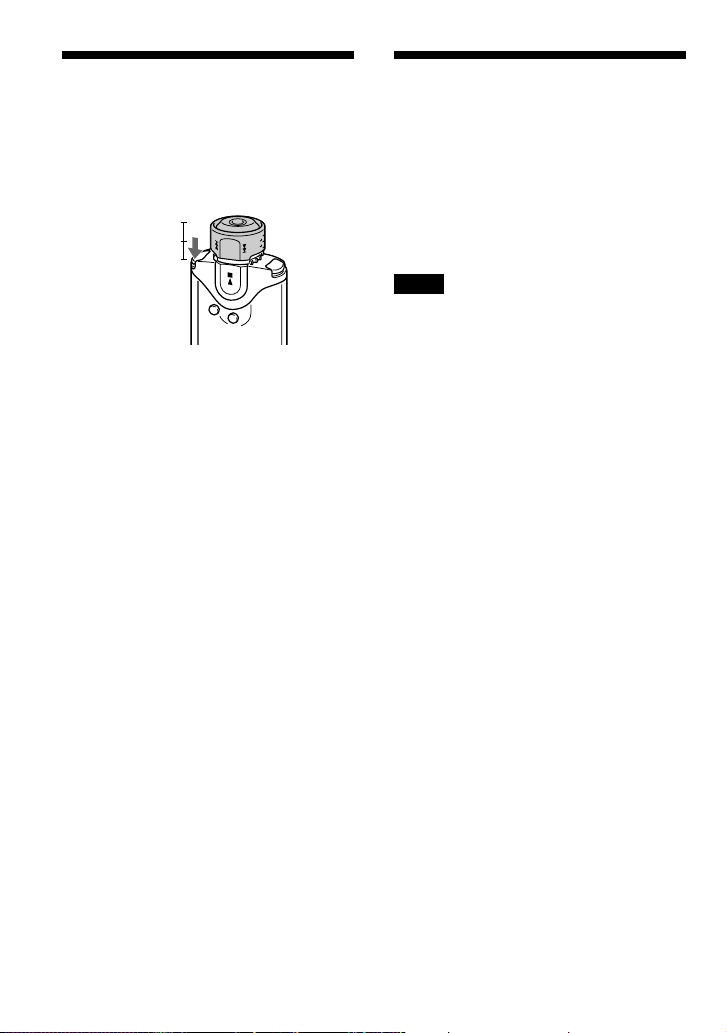
1 Press and hold the SEARCH/
MENU button for half a second.
The menu screen is displayed.
Repeat Mode
Sound
Volume Mode
Nx button
SEARCH/
MENU button
Shuttle switch
to >
to .
30
Storing non-audio
data
You can transfer data from the hard disk of
your computer to the built-in flash memory
using Windows Explorer.
The built-in flash memory is displayed in
Windows Explorer as an external drive (for
example: as the D drive).
Notes
• If you store a lot of non-audio data into the built-
in flash memory, the space for audio data is
reduced by the same amount.
• Do not edit any file in the [OMGAUDIO] folder
of the built-in flash memory on Windows
Explorer, as audio files will not play back.
Locking the
controls (HOLD)
You can protect your Network Walkman
against accidental operation by using the
HOLD function when carrying it.
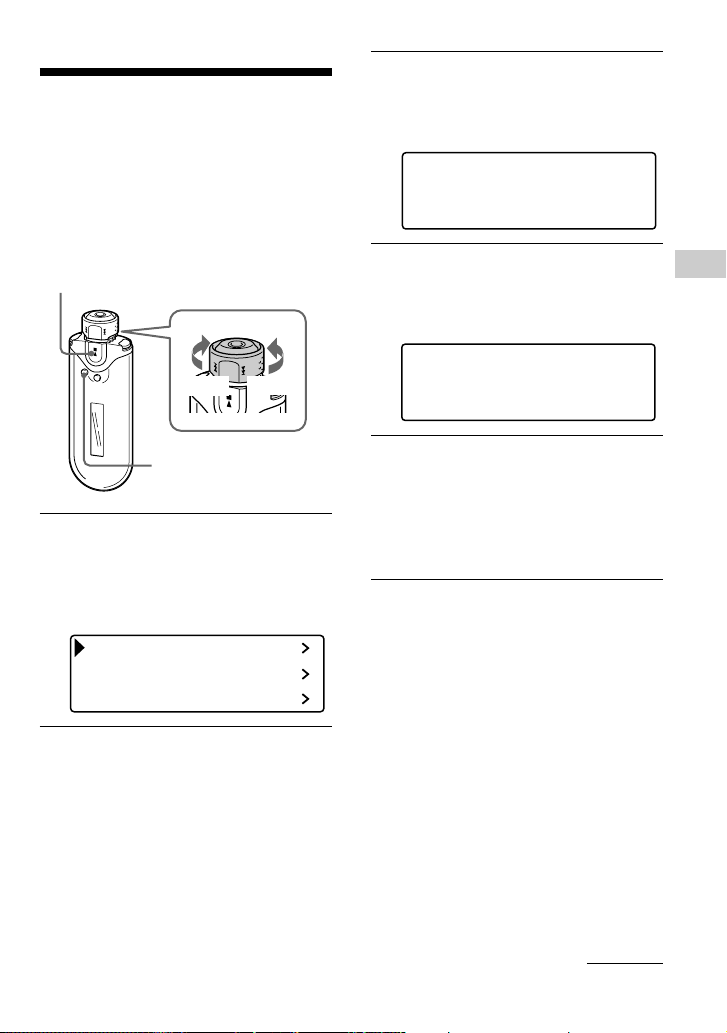
Push the Shuttle switch to the
HOLD position.
All operation buttons are disabled.
If you press buttons while the HOLD
function is activated, “HOLD” blinks in the
display.
To release the HOLD function
Set the Shuttle switch to the center (normal)
position.
GROUP
Normal
HOLD
31
Adjusting the settings of your Network Walkman
B
Adjusting the settings of
your Network Walkman
Adjusting the
current time
setting
(Date-Time)
You can set and display (except in FM tuner)
the current time.
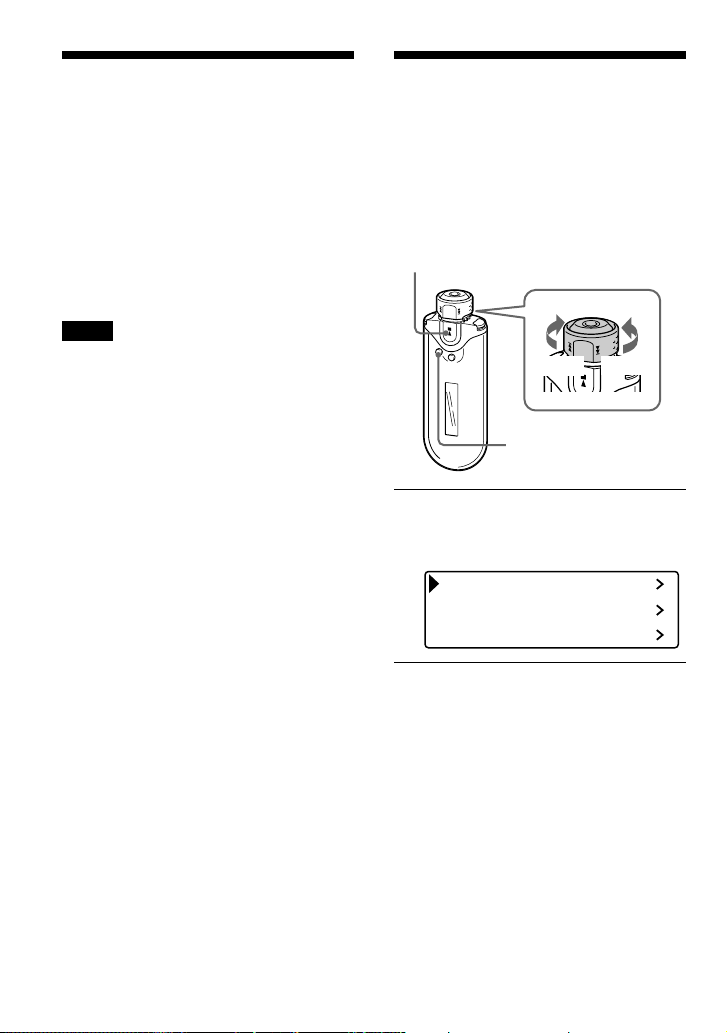
1 Press and hold the SEARCH/
MENU button for half a second
while the audio player is stopped
or receiving an FM signal.
The menu screen is displayed.
Repeat Mode
Sound
Volume Mode
2 Rotate the Shuttle switch to select
“Date-Time>” and press the Nx
button to confirm.
The year digit is displayed in [ ].
Y
[2005] 01 / 01 15 : 00
MDhm
3 Rotate the Shuttle switch to adjust
the “year” setting and press the
Nx button to confirm.
The month digit is displayed in [ ].
Y
2005 [01]/ 01 15 : 00
MDhm
4 As you did in step 3, adjust the
settings for “month”, “date”,
“hour”, and “minute”.
After rotating the Shuttle switch to
adjust the time and date setting, pressing
the Nx button to confirm.
Nx button
SEARCH/
MENU button
Shuttle switch
to >
to .
continued
32
Adjusting the current time setting
(Date-Time)
To cancel the Menu mode
Press the SEARCH/MENU button to return the
screen to the previous stage. Press repeatedly to exit
menu mode.
To display the current time
Press the DISP/FM (Display/FM) button repeatedly
until the “Clock” is displayed (page 26).
Note, however, when the “Clock” is set to off in the
Display Screen menu (page 27), you cannot display
the current time by the procedure above.
Notes
• You cannot change the display mode while using
the FM tuner.
• If the unit is not used for a long time, your
settings for date and time may need to be reset.
• If the current time is not set, the display for the
date and time will show “--”.
Limiting the
volume (AVLS)
You can set AVLS (Automatic Volume
Limiter System) to limit the maximum
volume to prevent auditory disturbance or
distraction. With AVLS, you can listen to
music at a comfortable volume level.
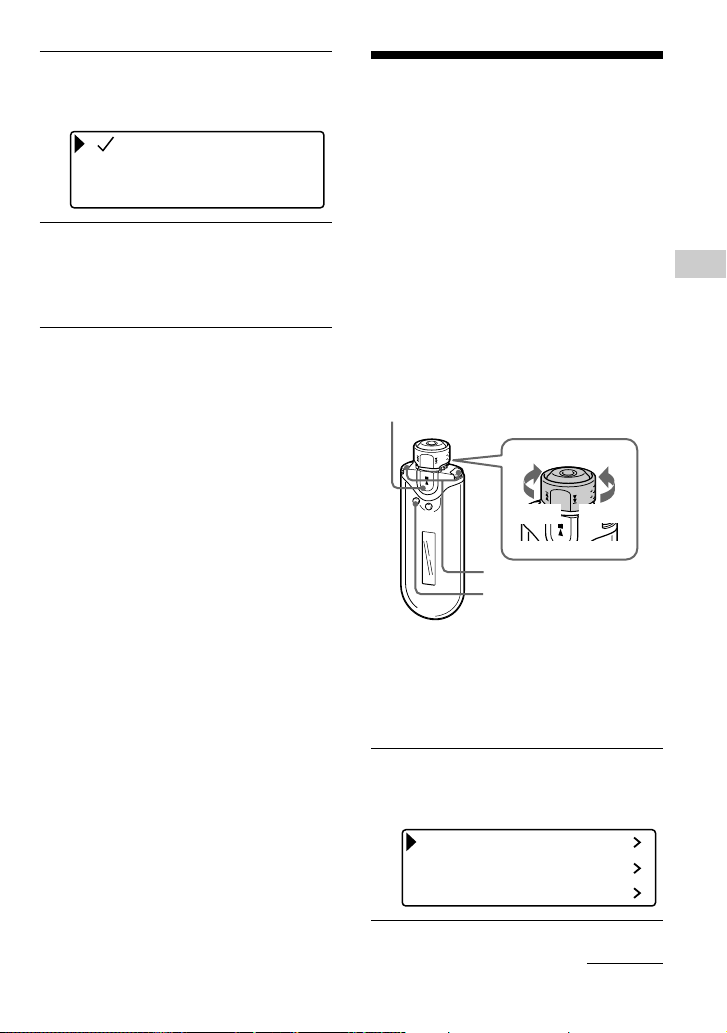
1 Press and hold the SEARCH/
MENU button for half a second.
The menu screen is displayed.
Repeat Mode
Sound
Volume Mode
Nx button
SEARCH/
MENU button
Shuttle switch
to >
to .
33
Adjusting the settings of your Network Walkman
2 Rotate the Shuttle switch to select
“AVLS>” and press the Nx
button to confirm.
AVLS ON
AVLS OFF
3 Rotate the Shuttle switch to select
“AVLS ON” and press the Nx
button to confirm.
The volume is kept at a moderate level.
To change the setting to “OFF”
Select “AVLS OFF” in step 3.
To cancel the Menu mode
Press the SEARCH/MENU button to return the
screen to the previous stage. Press repeatedly to exit
menu mode.
z Tip
“AVLS” is displayed by pressing the VOL +/–
button if the AVLS set to “ON”.
Setting the volume
using the preset
volume function
(Volume Mode)
There are two modes to adjust the volume
level.
Manual Volume:
Press the VOL +/– button to adjust the
volume level from 0 to 31.
Preset Volume:
Press the VOL +/– button to set the
volume level to any of 3 preset levels:
Low, Mid, or High.
Setting a volume level for
preset mode (Preset
Volume)
1 Press and hold the SEARCH/
MENU button for half a second.
The menu screen is displayed.
Repeat Mode
Sound
Volume Mode
Nx button
SEARCH/
MENU button
Shuttle switch
to > to .
VOL +/– button
continued
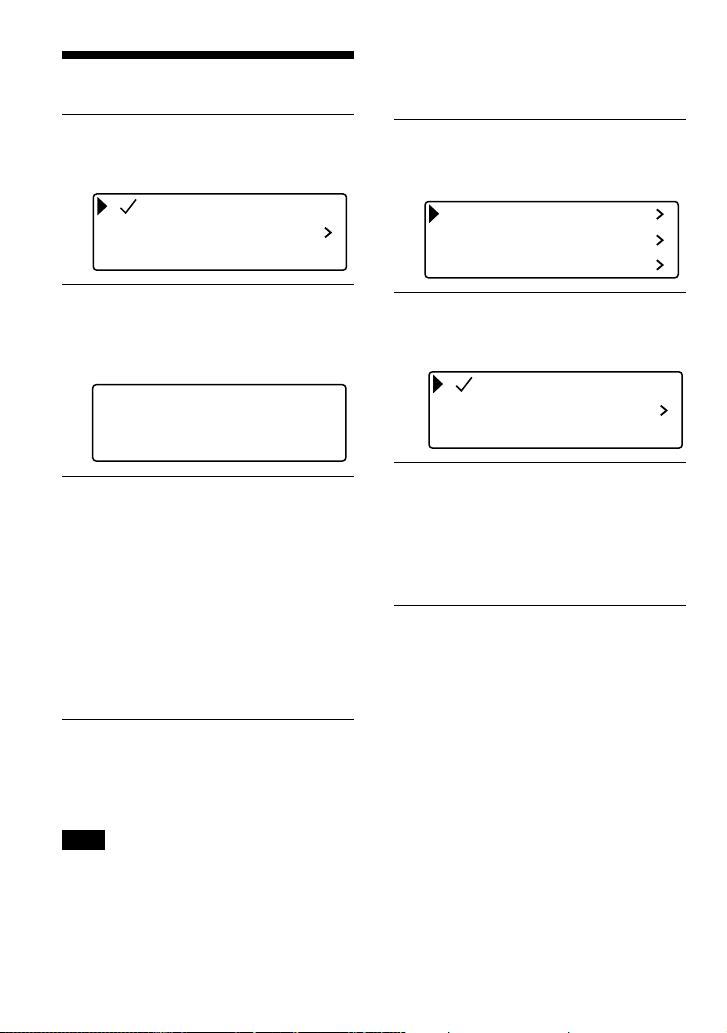
34
2 Rotate the Shuttle switch to select
“Volume Mode>” and press the
Nx button to confirm.
Manual Volume
Preset Volume
3 Rotate the Shuttle switch to select
“Preset Volume>” and press the
Nx button to confirm.
The value of “Low” is displayed in [ ].
Low Mid High
[ 5] 10 20
4 Set the volume levels for the 3
preset levels: Low, Mid, or High.
1 Rotate the Shuttle switch to select the
volume level for “Low” and press the
Nx button to confirm.
2 Rotate the Shuttle switch to select the
volume level for “Mid” and press the
Nx button to confirm.
3 Rotate the Shuttle switch to select the
volume level for “High” and press
the Nx button to confirm.
To cancel the Menu mode
Press the SEARCH/MENU button to return the
screen to the previous stage. Press repeatedly to exit
menu mode.
Note
If AVLS (page 32) is set, the actual volume may be
lower than the settings.
Releasing AVLS returns the volume to the preset
level.
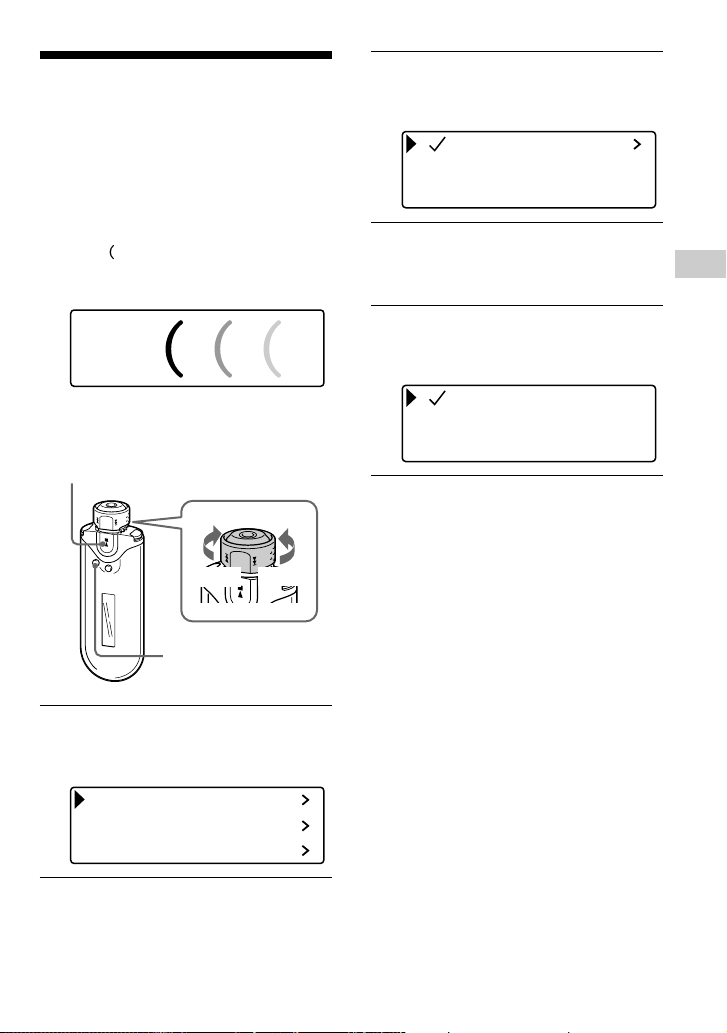
Switching to manual mode
(Manual Volume)
1 Press and hold the SEARCH/
MENU button for half a second.
The menu screen is displayed.
Repeat Mode
Sound
Volume Mode
2 Rotate the Shuttle switch to select
“Volume Mode>” and press the
Nx button to confirm.
Manual Volume
Preset Volume
3 Rotate the Shuttle switch to select
“Manual Volume” and press the
Nx button to confirm.
With this setting, you can adjust the
volume level by pressing the VOL +/–
button.
To cancel the Menu mode
Press the SEARCH/MENU button to return the
screen to the previous stage. Press repeatedly to exit
menu mode.
Setting the volume using the preset
volume function (Volume Mode)
35
Adjusting the settings of your Network Walkman
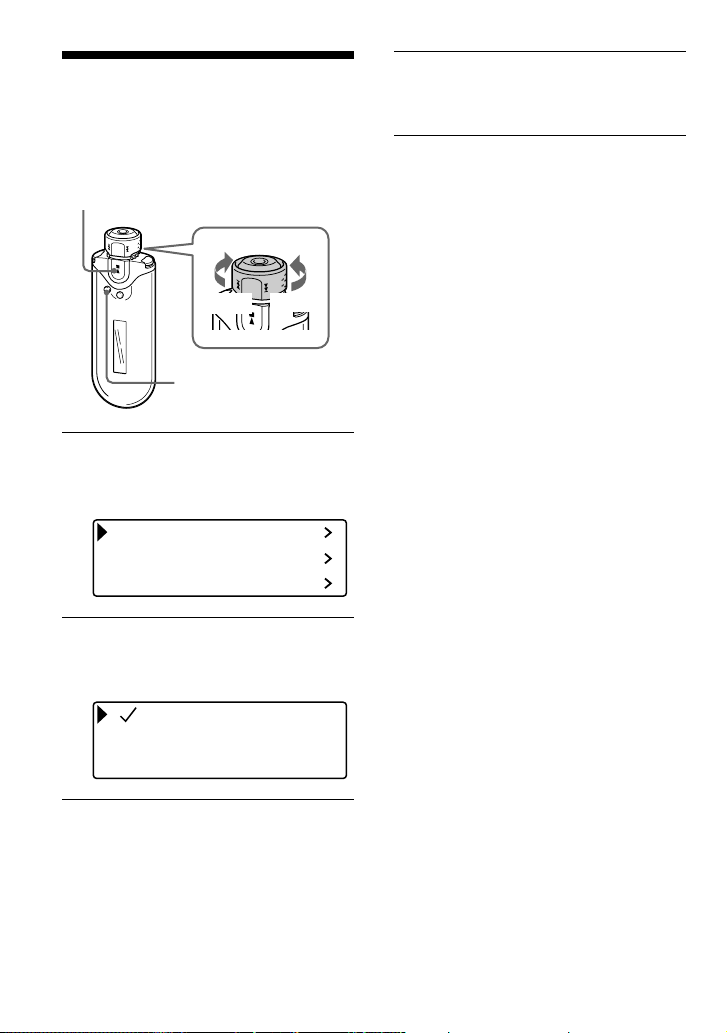
Saving power
consumption
(Power Save Mode)
You can set the Network Walkman to Power
Save mode to turn off the display
automatically when you do not operate the
unit for a while (15 seconds).
• Normal:
is animated while playing back
music or receiving an FM signal (Power
Save display).
• Super (Disp OFF): nothing in the display.
This setting uses the least battery
consumption.
1 Press and hold the SEARCH/
MENU button for half a second.
The menu screen is displayed.
Repeat Mode
Sound
Volume Mode
2 Rotate the Shuttle switch to select
“Power Save Mode>”, and press
the Nx button to confirm.
Save ON
Save OFF
3 Rotate the Shuttle switch to select
“Save ON>”, and press the Nx
button to confirm.
4 Rotate the Shuttle switch to select
the setting you want, and press
the Nx button to confirm.
Normal
Super
(Disp OFF
)
To set the Power Save mode to “OFF”
Select “Save OFF” in Step 3.
To cancel the Menu mode
Press the SEARCH/MENU button to return the
screen to the previous stage. Press repeatedly to exit
menu mode.
z Tip
The playback/FM tuner screen is always displayed
when the Power Save mode is set to “OFF”.
Nx button
SEARCH/
MENU button
Shuttle switch
to >
to .
36
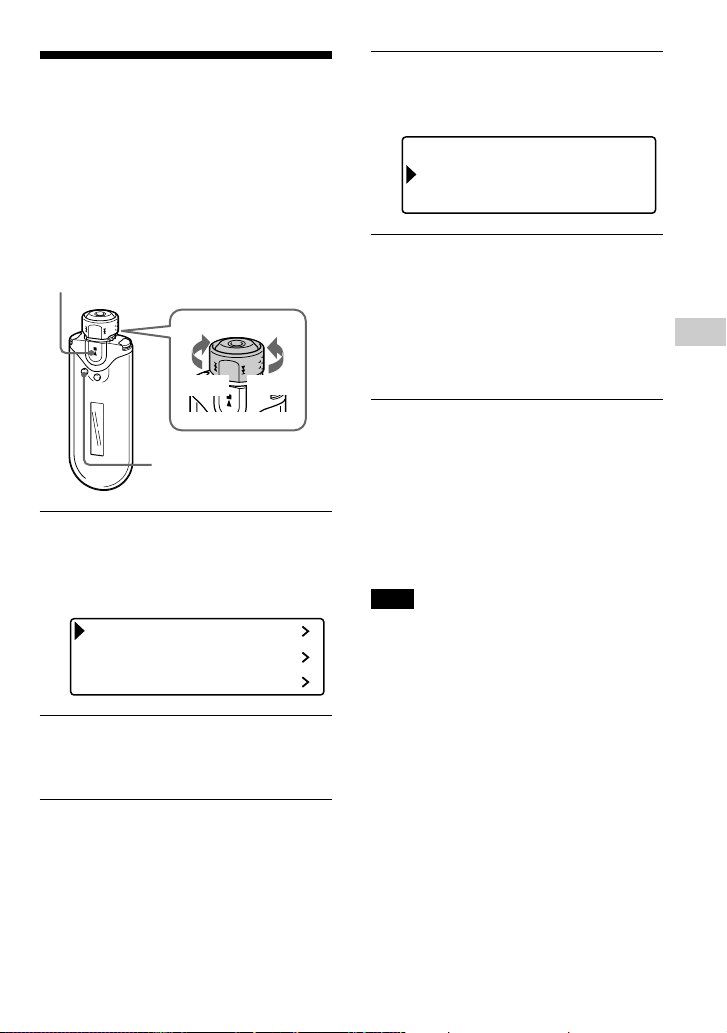
Tur ning off the
beep sound (Beep)
You can turn off the beep sounds of your
Network Walkman.
1 Press and hold the SEARCH/
MENU button for half a second.
The menu screen is displayed.
Repeat Mode
Sound
Volume Mode
2 Rotate the Shuttle switch to select
“Beep>” and press the Nx
button to confirm.
Beep ON
Beep OFF
3 Rotate the Shuttle switch to select
“Beep OFF”, and press the Nx
button to confirm.
To change the setting to “ON”
Select “Beep ON” in step 3.
To cancel the Menu mode
Press the SEARCH/MENU button to return the
screen to the previous stage. Press repeatedly to exit
menu mode.
Nx button
SEARCH/
MENU button
Shuttle switch
to >
to .
37
Other functions
B
Other functions
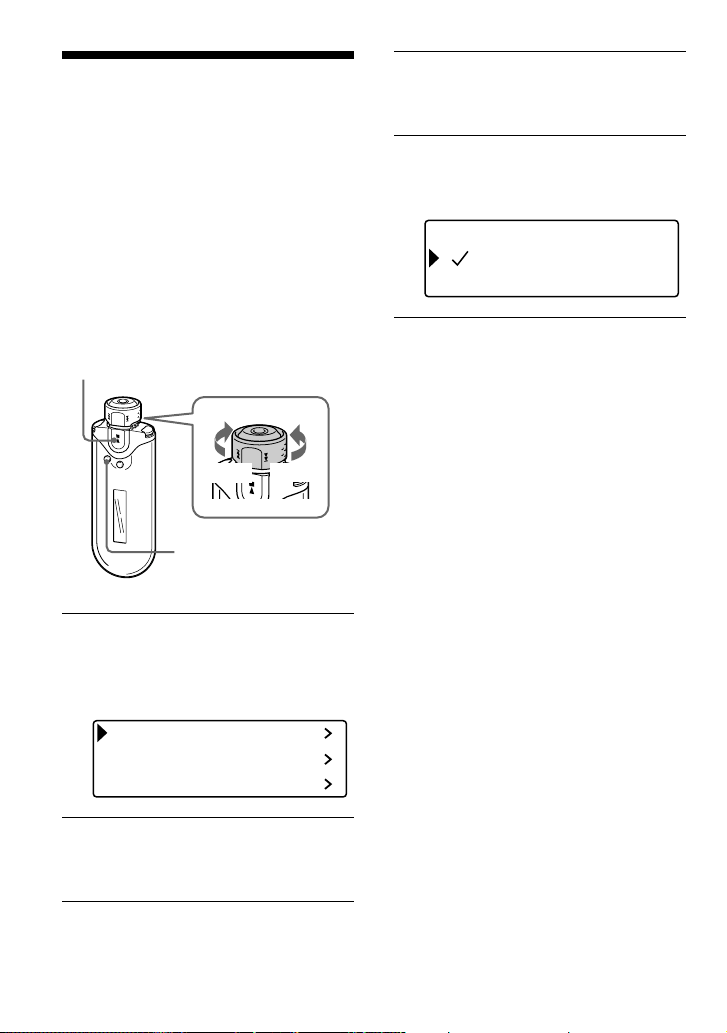
Formatting
memory (Format)
You can use your Network Walkman to
format the built-in flash memory.
If memory is formatted, all data previously
stored in the memory will be erased. Be sure
to verify the data stored in the memory prior
to formatting.
1 Press and hold the SEARCH/
MENU button for half a second in
stop mode.
The menu screen is displayed.
Repeat Mode
Sound
Volume Mode
2 Rotate the Shuttle switch to select
“Advanced Menu>”, and press the
Nx button to confirm.
3 Rotate the Shuttle switch to select
“Format>” and press the Nx
button to confirm.
Format OK?
OK
Cancel
4 Rotate the Shuttle switch to select
“OK” and press the Nx button to
confirm.
“Formatting...” blinks and start
formatting.
When formatting is complete,
“Complete” is displayed.
To cancel the Menu mode
Press the SEARCH/MENU button to return the
screen to the previous stage. Press repeatedly to exit
menu mode.
To cancel formatting
Rotate the Shuttle switch to select “Cancel” and
press the Nx button to confirm in step 4.
Note
You cannot format memory while playing music.
Nx button
SEARCH/
MENU button
Shuttle switch
to >
to .
38
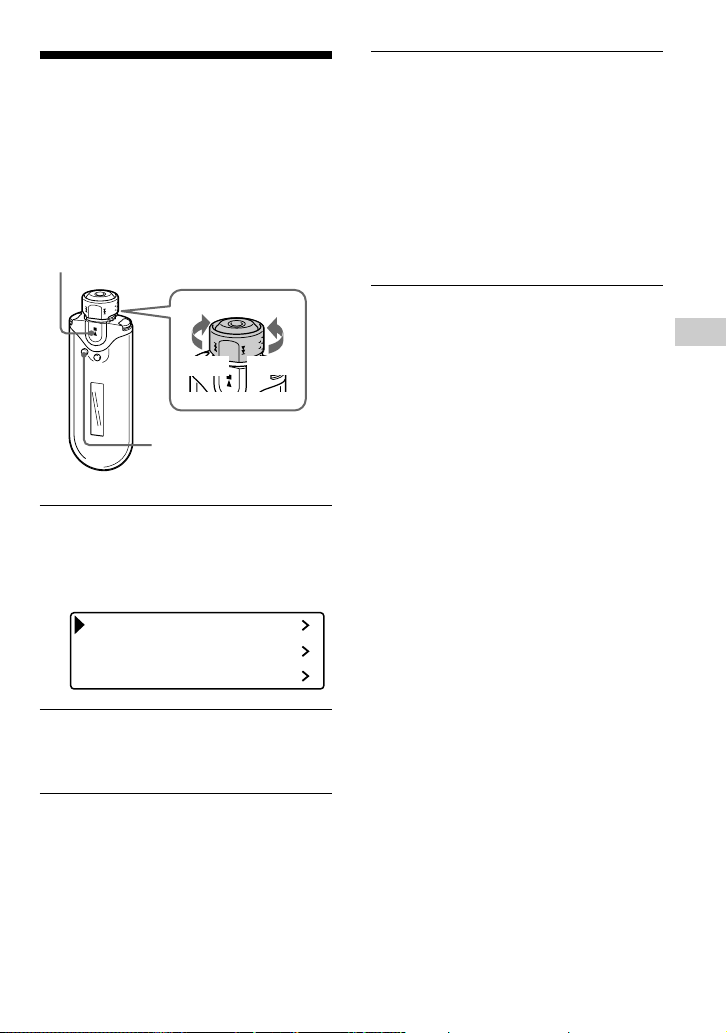
Changing the USB
connection setting
(USB Bus
Powered)
Depending on the computer you are using, if
the power supply is insufficient, incomplete
data transfer may occur from the computer to
your Network Walkman. In this case, setting
the USB connection (USB Bus Powered) to
“Low-power 100mA” may improve data
transfer.
1 Press and hold the SEARCH/
MENU button for half a second in
stop mode.
The menu screen is displayed.
Repeat Mode
Sound
Volume Mode
2 Rotate the Shuttle switch to select
“Advanced Menu>”, and press the
Nx button to confirm.
3 Rotate the Shuttle switch to select
“USB Bus Powered>”, and press
the Nx button to confirm.
4 Rotate the Shuttle switch to select
the setting you want and press the
Nx button to confirm.
USB Bus Powered
High-power500mA
Low-power 100mA
To cancel the Menu mode
Press the SEARCH/MENU button to return the
screen to the previous stage. Press repeatedly to exit
menu mode.
z Tips
• When you connect the Network Walkman to a
notebook computer, connect the notebook
computer to a power supply.
• The charging time will be longer if the “USB Bus
Powered” is set to “Low-power 100mA”.
Nx button
SEARCH/
MENU button
Shuttle switch
to >
to .
39
Other functions
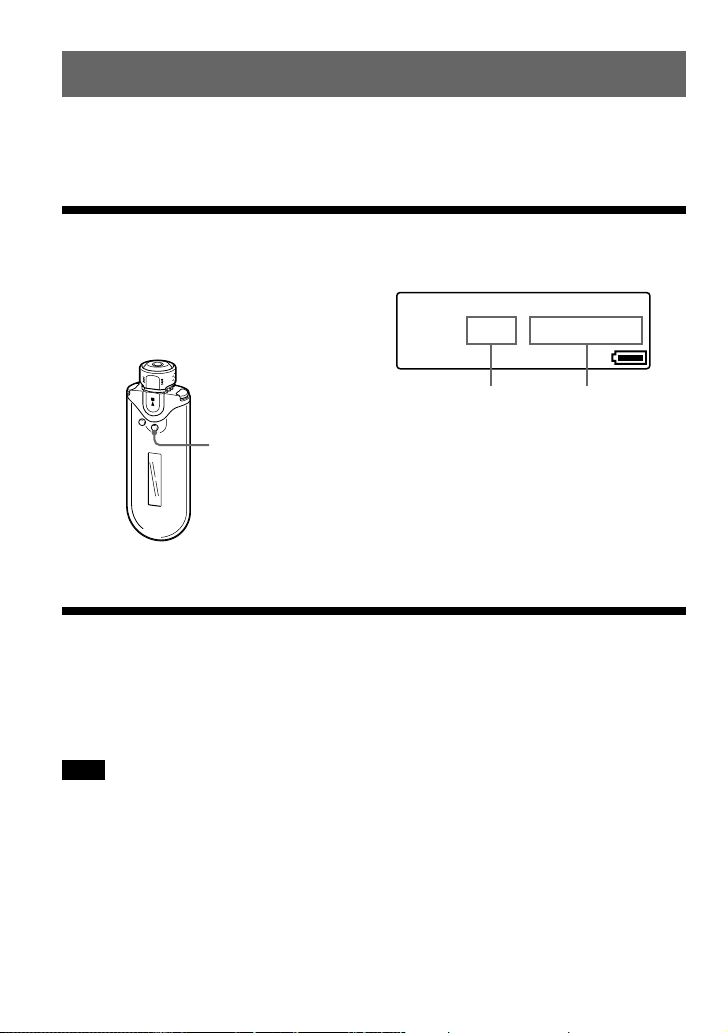
Displaying the
player information
(Information)
Information such as product name, built-in
flash memory capacity, serial number and
software version can be displayed.
1 Press and hold the SEARCH/
MENU button for half a second in
stop mode.
The menu screen is displayed.
Repeat Mode
Sound
Volume Mode
2 Rotate the Shuttle switch to select
“Advanced Menu>”, and press the
Nx button to confirm.
3 Rotate the Shuttle switch to select
“Information>”, and press the
Nx button to confirm.
Rotate the Shuttle switch to show the
following information.
1: product name
2: built-in flash memory capacity
3: serial number
4: software version
To cancel the Menu mode
Press the SEARCH/MENU button to return the
screen to the previous stage. Press repeatedly until
the normal screen is displayed.
Nx button
SEARCH/
MENU button
Shuttle switch
to >
to .
40
Listening to FM Radio
You can listen to FM radio. Charge the built-in rechargeable battery before using the Network
Walkman (page 12), and connect the headphones to the headphone jack.
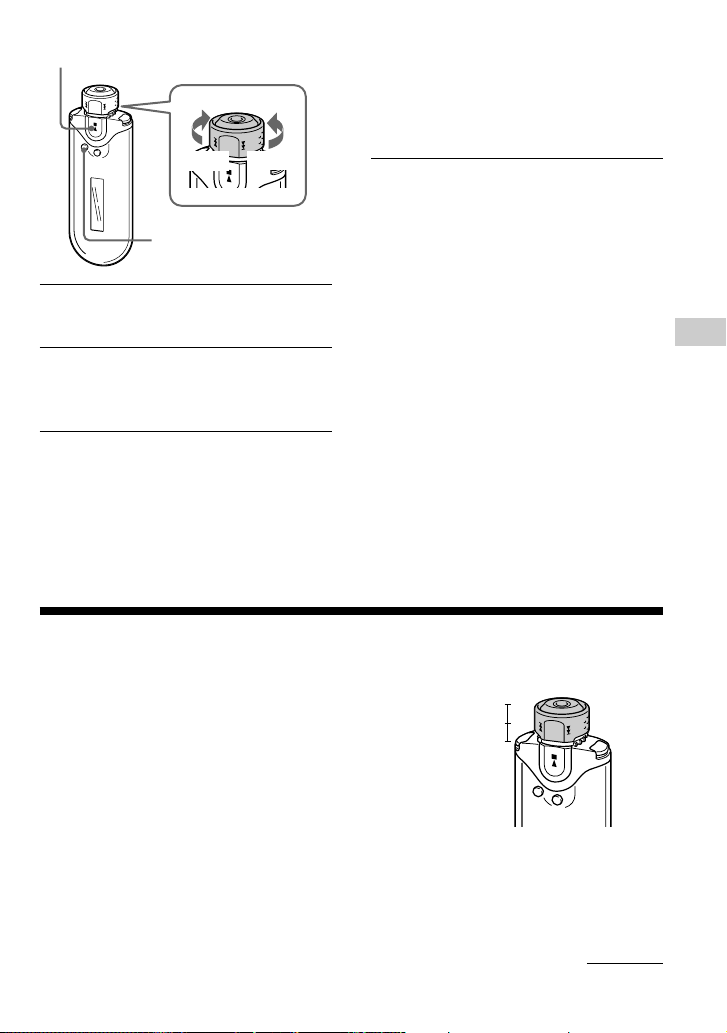
1 Switching to the FM tuner
Press and hold the DISP/FM (Display/FM)
button for half a second.
The FM tuner screen is displayed and FM
signals are received.
FM tuner display*
P01
DX
90.00
MHz
F
M
* The illustrated FM tuner display may be different
from your model.
To return to the audio player
Press the Nx button, or press and hold the DISP/
FM (Display/FM) button for half a second. The
Network Walkman returns to the audio player.
DISP/FM (Display/
FM) button
Preset number Frequency
2 Presetting broadcast stations
automatically (FM Auto Preset)
You can preset receivable broadcast stations (up to 30 stations) in your area automatically by
selecting “FM Auto Preset” in the menu screen. This is convenient when you use the FM tuner
for the first time or when you change to a new area.
Note
The FM Auto Preset operation will delete already preset broadcast stations.
B
FM Tuner
41
FM Tuner
1 Press and hold the SEARCH/
MENU button for half a second.
2 Rotate the Shuttle switch to select
“FM Auto Preset>”, and press the
Nx button to confirm.
3 Rotate the Shuttle switch to select
“OK”, and press the Nx button
to confirm.
The receivable broadcast stations will be
preset in order from low to high
frequency.
Nx button
SEARCH/
MENU button
Shuttle switch
to > to .
“Complete” is displayed when presetting
is complete. Then, press the SEARCH/
MENU button repeatedly to exit menu
mode; the first preset station will be
received.
To stop the presetting
Select “Cancel” in step 3 and press the Nx
button.
To cancel the Menu mode
Press the SEARCH/MENU button to return the
screen to the previous stage. Press repeatedly to exit
menu mode.
If several unnecessary stations are
received
If interference is prevalent and reception is too
strong, press the REPEAT/SOUND button to set to
“LOCAL”. Under normal conditions, press
REPEAT/SOUND button again to set to “DX”.
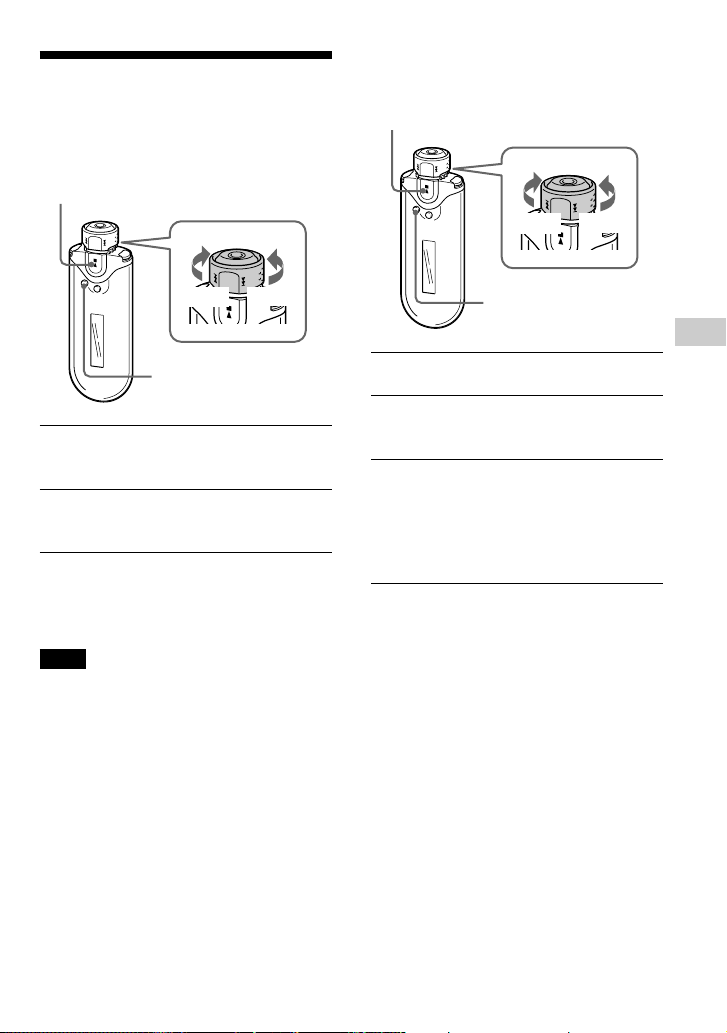
3 Selecting broadcast stations
There are 2 ways of selecting broadcast
stations:
• Preset Tuning: Set the Shuttle switch to
the center (Preset) position to select
broadcast stations in the preset number
order.
• Manual Tuning: Set the Shuttle switch to
the GROUP (Manual) position to select
broadcast stations by frequency.
GROUP (Manual)
Preset
Hold
continued
42
Preset Tuning
[P01]
90.00
MHz
F
M
DX
The preset number is displayed in [ ].
Listening to FM Radio
To
Select the next preset
number*
Select the previous
preset number*
Shuttle switch
operation
Rotate the Shuttle
switch to >.
Rotate the Shuttle
switch to ..
* The selecting speed becomes gradually faster by
rotating and holding the Shuttle switch to >
(or .).
Note
You cannot select broadcast stations if no preset
stations are entered.
Preset the receivable stations using “FM Auto
Preset” (page 40).
Manual Tuning
P01
[ 90.00
MHz
]
F
M
DX
The frequency is displayed in [ ]. When a
selected frequency is already preset, the
number is also displayed.
* Rotating and holding the Shuttle switch to >
(or .) for one second tunes in the next (or
previous) receivable broadcast station.
If interference is prevalent and reception is too
strong, press the REPEAT/SOUND button to set
to “LOCAL”. Under normal conditions, press
REPEAT/SOUND button again to set to “DX”.
Improving the reception
The headphones cord serves as the antenna, so
extend it as far as possible.
To
Select the next
frequency
Select the previous
frequency
Select the next
receivable broadcast
station*
Select the previous
receivable broadcast
station*
Shuttle switch
operation
Rotate the Shuttle
switch to >.
Rotate the Shuttle
switch to ..
Rotate and hold the
Shuttle switch to >
for a second.
Rotate and hold the
Shuttle switch to .
for a second.
43
FM Tuner
Presetting desired
broadcast stations
You can preset broadcast stations that “FM
Auto Preset” misses (page 40).
Nx button
SEARCH/
MENU button
Shuttle switch
to >
to .
1 Select the desired frequency by
Manual Tuning mode.
2 Press and hold the Nx button
for half a second.
z Tip
You can preset up to 30 stations (P01 to P30).
Note
The preset number is always sorted from low to
high frequency order.
To delete preset broadcast
stations
Nx button
SEARCH/
MENU button
Shuttle switch
to > to .
1 Select the desired frequency.
2 Press and hold the Nx button
for half a second.
3 Rotate the Shuttle switch to select
“OK”, and press the Nx button
to confirm.
The preset broadcast station is deleted
and the next one is displayed.

44
Precautions
On installation
• Never use your Network Walkman where it
will be subjected to extremes of light,
temperature, moisture, or vibration.
• Never leave the Network Walkman
exposed to high temperature, such as in a
car parked in the sun or under direct
sunlight.
On heat build-up
Heat may build up in your Network Walkman
while charging if it was used for an extended
period of time.
On the headphones
Road Safety
Do not use headphones while driving,
cycling, or operating any motorized vehicle.
It may create a traffic hazard and is illegal in
many areas. It can also be potentially
dangerous to play your Network Walkman at
a high volume while walking, especially at
pedestrian crossings. You should exercise
extreme caution or discontinue use in
potentially hazardous situations.
Preventing hearing damage
Avoid using the headphones at a high
volume. Hearing experts advise against
continuous, loud and extended play. If you
experience a ringing in your ears, reduce the
volume or discontinue use.
Caring for others
Keep the volume at a moderate level. This
will allow you to hear outside sounds and to
be considerate to the people around you.
B
Other Information
Warning
If there is lightning when you are using your
Network Walkman, take off the headphones
immediately.
On the use
• When using a strap, careful to avoid
hooking it on objects you pass by.
• Do not use the Network Walkman on an
aircraft.
On cleaning
• Clean your Network Walkman casing with
a soft cloth slightly moistened with water
or a mild detergent solution.
• Clean the headphone plug periodically.
Note
Do not use any type of abrasive pad, scouring
powder, or solvent such as alcohol or benzene as it
may mar the finish of the casing.
If you have any questions or problems
concerning your Network Walkman, please
consult your nearest Sony dealer.
45
Other Information
When disposing of
your Network
Walkman
This Network Walkman has a built-in
Lithium-Ion battery. When you dispose of
the Network Walkman, be sure to dispose of
it properly.
Certain countries may regulate disposal of the
battery used to power this product.
Please consult with your local authority.
Note
Never disassemble your Network Walkman except
when disposing of it.
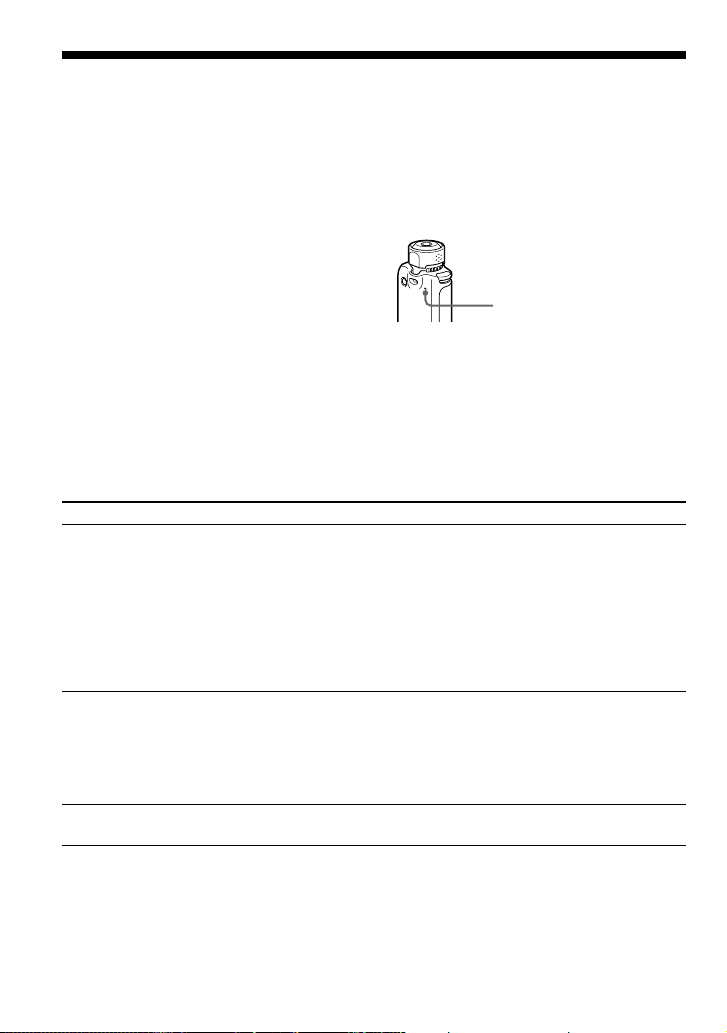
To remove the Lithium-Ion battery
1 Remove the screws using a Phillips
screwdriver.
2 Remove the cover A.
3 Remove the cover B.
4 Remove the connector.
5 Remove the board.
6 Remove the battery.
For the customers in the USA and
Canada
RECYCLING LITHIUM-ION
BATTERIES
Lithium-Ion batteries are recyclable.
You can help preserve our environment by
returning your used rechargeable batteries to
the collection and recycling location nearest
you.
For more information regarding recycling of
rechargeable batteries, call toll free 1-800-
822-8837, or visit http://www.rbrc.org/
Caution: Do not handle damaged or leaking
Lithium-Ion batteries.
46
Troubleshooting
If you experience any of the following difficulties while using your Network Walkman, use this
troubleshooting guide to help to remedy the problem prior to consulting a Sony dealer. Should
any problem persist, consult your nearest Sony dealer. If a problem occurs while connected to
your computer, also refer to “Troubleshooting” in the online help of the supplied software.
To reset the player
If your Network Walkman does not operate
normally, or if there is no sound, even after
checking the troubleshooting guide below,
press the reset button for more than one
second with a pointed tool.
z Tip
Any audio files stored in the memory will not be erased by pressing the reset button.
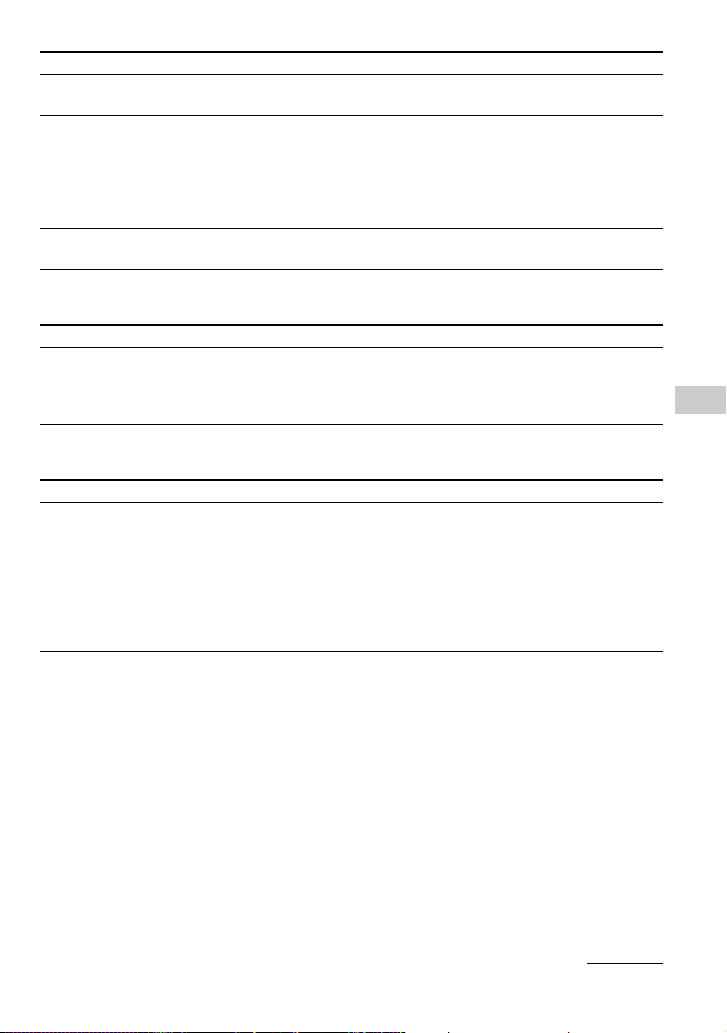
What happened?
On operating
Symptom
There is no sound.
Noise is generated.
Buttons do not work.
The transferred songs
cannot be found.
Cause/Remedy
• The volume level is set to zero.
c Turn the volume up (page 14).
• The headphone jack is not connected properly.
c Connect the headphone jack properly (page 14).
• The headphone plug is dirty.
c Clean the headphone plug with a soft dry cloth.
• No audio files are stored in the memory.
c If “NO DATA” is displayed, transfer audio file(s) from the
computer.
• The Shuttle switch is set to the HOLD position.
c Set the Shuttle switch to the center (normal) position (page 30).
• Your Network Walkman contains moisture condensation.
c Wait a few hours to let your Network Walkman dry.
• The remaining battery power is insufficient.
c Charge the battery (page 12).
• The Play Range is shortened.
c Select “All Track” in the search menu screen (page 15).
Reset button
47
Other Information
On the display window
Symptom
“s” is displayed for a title.
On charging the battery
Symptom
Battery life is short.
Cause/Remedy
Characters that cannot be displayed on your Network Walkman are
involved.
c Use the supplied SonicStage software to rename the title with
appropriate characters.
Cause/Remedy
• The operating temperature is below 5°C (67°F).
c Battery life becomes shorter due to the battery characteristics.
This is not malfunction.
• The battery is required to be replaced.
c Consult your near Sony dealer.
• Battery charging time is not enough.
c Charge the battery longer if the USB connection (USB Bus
Powered) is set to “Low-power 100mA” (page 38).
Symptom
The volume is not loud
enough.
There is no sound from the
right channel of the
headphones.
Playback has stopped
suddenly.
Cause/Remedy
The AVLS is enabled.
c Disable the AVLS (page 32).
• The headphone jack is not fully inserted.
c Connect the headphone jack fully (page 14).
• The extension headphone cord is not properly connected to the
headphone jack of your Network Walkman or the headphone cord
(NW-E505/E507).
c Connect them properly (page 14).
The remaining battery power is insufficient.
c Charge the battery (page 12).
continued

48
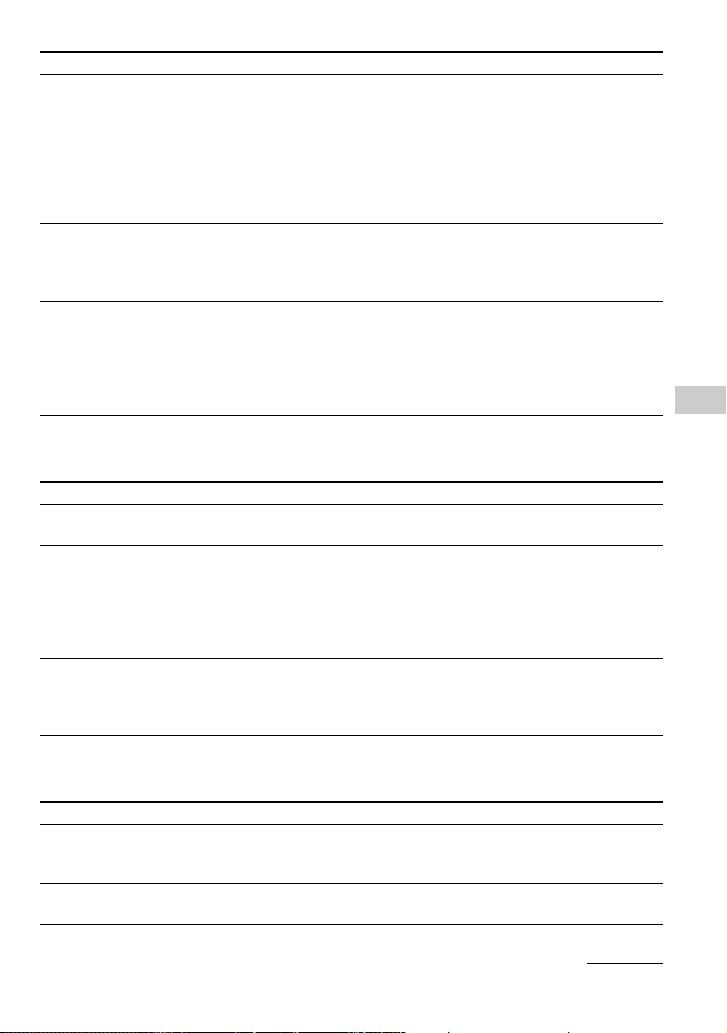
On the connection with the computer or supplied software
Symptom
The software cannot be
installed.
“USB Connect” is not
displayed when connected
to the computer with the
dedicated USB cable.
Your Network Walkman is
not recognized by the
computer when it is
connected to the computer.
A song(s) cannot be
transferred to your Network
Walkman.
Cause/Remedy
An operating system not compatible with the software is used.
c For details, refer to the SonicStage operating instructions.
• Please wait for authentication of the SonicStage software.
• Another application is running on the computer.
c Wait for a while and reconnect the USB cable. If the problem
persists, disconnect the USB cable, restart the computer, and then
reconnect the USB cable.
• The dedicated USB cable has disconnected.
c Connect the dedicated USB cable.
•A USB hub is used.
c Connecting via a USB hub is not guaranteed. Connect the
dedicated USB cable directly to the computer.
• The Network Walkman USB connection (USB Bus Powered) is set
to “High-power 500mA”.
c Set the “USB Bus Powered” to “Low-power 100mA” (page 38).
• The dedicate USB cable is disconnected.
c Connect the dedicated USB cable.
• The driver for the Network Walkman is not installed.
c Install the driver for the Network Walkman by installing the
SonicStage software on the supplied CD-ROM. The driver will
be installed together with SonicStage.
• The dedicated USB cable is not connected properly.
c Connect the USB cable properly.
• The free space of the built-in flash memory where you want to
transfer audio files to is insufficient.
c Transfer any unnecessary songs back to your computer to
increase free space.
• You have already transferred to 65,535 songs or 4,096 groups to the
built-in flash memory using the SonicStage software.
c You can transfer up to 65,535 songs, and 4,096 groups to the
built-in flash memory using SonicStage software. One group can
contain up to 999 songs.
• Audio files with a limited playing period or playing count may not
be transferred due to restrictions set by copyright holders. For details
on the settings of each audio file, contact the distributor.
Troubleshooting
49
Other Information
Symptom
The number of audio files
that can be transferred is
limited. (Available
recording time is short.)
Operation of the Network
Walkman becomes unstable
while it is connected to the
computer.
“Failed to authenticate
Device/Media” is displayed
on the computer screen
while connecting the
Network Walkman to the
computer.
On FM tuner
Symptom
You cannot hear the FM
broadcast well.
Reception is weak and
sound quality is poor.
The FM broadcast is
affected by interference.
Other
Symptom
There is no beep sound
when your Network
Walkman is operated.
Your Network Walkman
gets warm.
Cause/Remedy
• The free space of the built-in flash memory where you want to
transfer to is not enough for the size of audio files you wish to
transfer.
c Transfer any unnecessary audio files back to the computer to
increase free space.
• Non-audio data is stored in the built-in flash memory where you
want to transfer audio files to.
c Move non-audio data to the computer to increase free space.
USB hub or USB extension cable is used.
c Connecting via a USB hub or USB extension cable is not
guaranteed. Connect the dedicated USB cable directly to the
computer.
Your Network Walkman is not connected to the computer properly.
c Quit the SonicStage software and verify the connection of the
dedicated USB cable. Restart the SonicStage software.
Cause/Remedy
Beep is set to “Beep OFF”.
c In the menu mode, set “Beep” to “Beep ON” (page 36).
While charging, your Network Walkman may become slightly warm.
continued
Cause/Remedy
The receiving frequency is not fully tuned in.
c Select the frequency manually to improve reception (page 42).
• The radio signal is weak.
c Listen to the FM broadcast near a window since the signal may
be weak inside buildings or vehicles.
• The headphone cord does not extend enough.
c The headphone cord functions as an antenna. Extend the
headphone cord as far as possible.
An apparatus emitting radio signals, such as a mobile phone is being
used near your Network Walkman.
c When using such apparatus as mobile phones, keep them away from
your Network Walkman.

50
Messages
Follow the instructions below if an error message appears in the display.
Message
AVLS (blinks)
CANNOT PLAY
CHARGE ERROR
DATA ACCESS
ERROR
EXPIRED
FILE ERROR
HOLD
LOW BATTERY
Meaning
The volume level exceeds the rated
value while the AVLS is enabled.
• Your Network Walkman cannot
play certain files because of
incompatible formats.
• Transferring has been interrupted
forcefully.
The power supply is abnormal.
Accessing the built-in flash
memory.
A malfunction is detected.
The song is playback restricted by
the copyright holder.
• The file cannot be read.
• The file is not normal.
Your Network Walkman cannot be
operated because the Shuttle switch
is set to the HOLD position.
The battery is low.
Remedy
Turn the volume down or disable the
AVLS (page 32).
If the file cannot be played, you can erase
it from the built-in flash memory.
For details, refer to “To delete abnormal
data from the built-in flash memory”
(page 51).
Try using another computer.
Please wait for access to complete. This
message appears while the built-in flash
memory is initiating.
Please consult your nearest Sony dealer.
If song cannot be played, you can erase it
from the built-in flash memory.
For details, refer to “To delete abnormal
data from the built-in flash memory”
(page 51).
Transfer the normal audio file back to the
computer and then format your Network
Walkman. For details, refer to “To delete
abnormal data from the built-in flash
memory” on page 51.
To operate Network Walkman, set the
Shuttle switch to the center (normal)
position (page 30).
You must charge the battery (page 12).
Troubleshooting
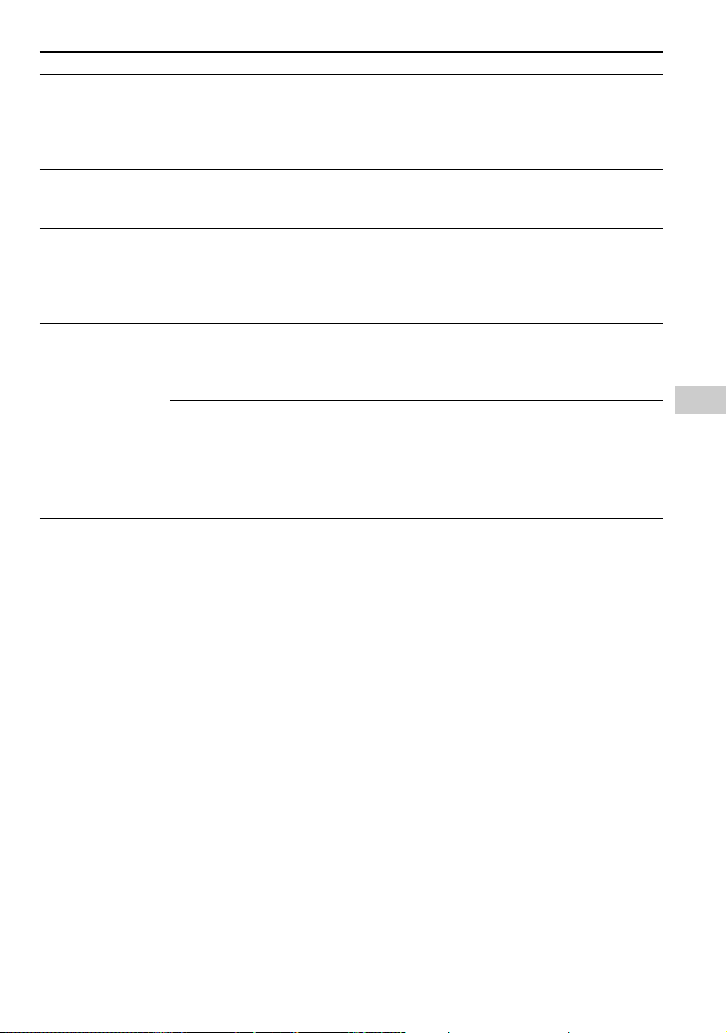
51
Other Information
To delete abnormal data from the built-in flash memory
If “CANNOT PLAY”, “EXPIRED”, “FILE ERROR”, or “MG ERROR” is displayed, there is a
problem with all or part of the data stored in the built-in flash memory.
Please follow the procedures below to erase data you cannot play.
1 Connect your Network Walkman to the computer, and start the SonicStage software.
2 If you have already specified the data with problems, erase the data from the Portable Player
window of the SonicStage software.
3 If the problem persists, transfer all data without problems back to the computer using the
SonicStage software while your Network Walkman is connected to the computer.
4 Disconnect your Network Walkman from the computer and then format the built-in flash
memory using the Format menu (page 37).
Message
MG ERROR
NO DATA
PRESET FULL
USB Connect
Meaning
An unauthorized distribution file is
detected for copyright protection.
There are no audio files in the
built-in flash memory.
30 broadcast stations are already
preset.
Your Network Walkman is
connected to a computer.
Icon animates from left to
right: Accesses to the built-in flash
memory is in progress.
Remedy
Transfer the normal audio file back to the
computer and then format your Network
Walkman. For details, refer to “To delete
abnormal data from the built-in flash
memory” on page 51.
If there are no audio files in the built-in
flash memory, use the SonicStage
software to transfer audio files.
You can preset up to 30 broadcast
stations. If you want to preset more
stations, delete unnecessary stations first
(page 43), then preset the stations you
want.
This is not a malfunction. You can
operate your Network Walkman using the
SonicStage, but you cannot operate the
controls on your Network Walkman.
Your Network Walkman is accessing to
the built-in flash memory. Wait until the
access completes. This message is
displayed when transferring data to the
built-in flash memory or formatting the
Network Walkman.

52
Sampling frequency
ATRAC3, ATRAC3plus, MP3: 44.1 kHz
Audio compression technology
Adaptive Transform Acoustic Coding3 (ATRAC3)
Adaptive Transform Acoustic Coding3plus
(ATRAC3plus)
MPEG1 Audio Layer-3 (MP3): 32 to 320 kbps,
variable bit rate-compliant
Frequency response
20 to 20,000 Hz (single signal measurement)
FM Frequency range
Overseas model: 76.0 to 108.0 MHz
Other models: 87.5 to 108.0 MHz
IF (FM)
225 kHz
Antenna
Headphone cord antenna
Interface
Headphone: Stereo mini
USB
Signal-to-noise ratio (S/N)
80 dB or more (excluding ATRAC3 66 kbps)
Dynamic range
85 dB or more (excluding ATRAC3 66 kbps)
Operating temperature
5˚C to 35˚C (67˚F to 95˚F)
Power source
• Built-in rechargeable lithium-ion battery
• USB power (from a computer through supplied
USB cable)
Specifications
Maximum recording time (Approx.)
ATRAC3plus
2 hr. 10 min. (256 kbps)
8 hr. 40 min. (64 kbps)
11 hr. 40 min. (48 kbps)
ATRAC3
4 hr. 10 min. (132 kbps)
5 hr. 20 min. (105 kbps)
8 hr. 30 min. (66 kbps)
NW-E503
ATRAC3plus
4 hr. 20 min. (256 kbps)
17 hr. 30 min. (64 kbps)
23 hr. 30 min. (48 kbps)
ATRAC3
8 hr. 30 min. (132 kbps)
10 hr. 40 min. (105 kbps)
17 hr. 00 min. (66 kbps)
NW-E505
MP3
2 hr. 10 min. (256 kbps)
4 hr. 20 min. (128 kbps)
MP3
4 hr. 20 min. (256 kbps)
8 hr. 50 min. (128 kbps)
ATRAC3plus
8 hr. 50 min. (256 kbps)
35 hr. 00 min. (64 kbps)
47 hr. 00 min. (48 kbps)
ATRAC3
17 hr. 00 min. (132 kbps)
21 hr. 40 min. (105 kbps)
34 hr. 10 min. (66 kbps)
NW-E507
MP3
8 hr. 50 min. (256 kbps)
17 hr. 40 min. (128 kbps)

53
Other Information
Battery life (continuous
playback)*
ATRAC3 format: Approximately 50 hours
(Playback at 105 kbps)
ATRAC3plus format: Approximately 45 hours
(Playback at 48 kbps)
MP3 format: Approximately 40 hours
(Playback at 128 kbps)
FM radio reception: Approximately 22 hours
* This is when the power save setting is normal
(page 35). The battery duration will vary
depending on temperature and usage.
Dimension
84.9 × 28.8 × 13.9 mm (3
3
/
8
× 1
3
/
16
×
9
/
16
inches)
(w/h/d, projecting parts not included)
Mass
Approx. 47 g (1.7 oz)
Supplied accessories
Headphones (1)
Dedicated USB cable (1)
Extension headphone cord (NW-E505/E507) (1)
Carrying pouch (NW-E505/E507) (1)
Clip (1)
CD-ROM for the SonicStage software, PDF file
Operating Instructions, and PDF file SonicStage
Operating Instructions (1)
Quick Start Guide
Design and specifications are subject to
change without notice.
US and foreign patents licensed from Dolby
Laboratories.

54
Glossary
MagicGate
Copyright protection technology that consists of authentication and encryption technology.
Authentication ensures that protected content is transferred only between compliant devices and
media, and that protected content is recorded and transferred in an encrypted format to prevent
unauthorized copying or playback.
Note
is terminology denoting the copyright protection system developed by Sony. It does not
guarantee conversion among other media.
OpenMG
Copyright protection technology that securely manages music content from the EMD/Audio CD
on a personal computer. Application software that is installed on the computer encrypts the
digital music content when recording on the hard drive. This allows you to enjoy music content
on the computer, but prevents unauthorized transmission of this content across a network (or
elsewhere). This PC copyright protection complies with “MagicGate”, and allows you to transfer
digital music content from a PC’s hard drive to a compliant device.
ATRAC3
ATRAC3, which stands for Adaptive Transform Acoustic Coding3, is audio compression
technology that satisfies the demand for high sound quality and high compression rates.
The ATRAC3 compression rate is approximately 10 times higher than that of the Audio CD,
resulting in an increased data capacity for the media.
ATRAC3plus
ATRAC3plus, which stands for Adaptive Transform Acoustic Coding3plus, is audio
compression technology that compresses data higher than ATRAC3. The ATRAC3plus is new
audio compression technology that enables equal or higher quality sound comparing to
ATRAC3.
Bit rate
Indicates the data amount per second. The rate is reflected in bps (bit per second).
64 kbps means 64,000 bits of information per second. If the bit rate is large, that means a large
amount of information is used to play music. Comparing music of the same format (e.g.,
ATRAC3plus), 64 kbps data offers better sound quality than 48 kbps data. However, audio files
in formats such as MP3 have different encoding methods, and thus sound quality cannot be
determined by simply comparing the bit rate.

55
Other Information
MP3
MP3, which stands for MPEG-1 Audio Layer-3, is a format standard for music file compression. It
was codified by the Motion Picture Experts Group, a working group of ISO (International
Organization for Standardization).
It compresses audio CD data to approximately one tenth its original size. Because the MP3 encoding
algorithm has been made publicly available, there are various encoders and decoders that are
compliant with this standard.

56
Display
(Menu mode)
Advanced
Menu>
x
x
Displayed when the audio player is stopped.
B
Displayed when the audio player is playing.
◊
Displayed when receiving FM Radio.
Purpose
Format>
(Formatting memory)
You can format the built-in
flash memory (page 37).
USB Bus Powered>
(USB connection setting)
You can select your desired
USB connection setting (page
38).
Information>
You can display information
such as product name, built-in
flash memory capacity, and
serial number (page 39).
Menu list
Press the SEARCH/MENU button for half a second to display the menu mode and
use the Shuttle switch (rotate to select) and the Nx button (to confirm) to
change the settings of your Network Walkman.
For details about each menu, refer to the pages in parentheses. The menu with a “>” mark will be
followed by a detailed-setting screen when you press the Nx button to confirm.
Display
(Menu mode)
Repeat
Mode>
x
Sound>
xB
(digital sound
preset)
FM Auto
Preset>
◊
(FM Auto
Preset)
Volume
Mode>
xB
◊
(preset volume)
AVLS>
xB
◊
(Automatic
Volume Limiter
System)
Beep>
xB
◊
(Operation
sounds setting)
Power Save
Mode>
xB
◊
(Power save
setting)
Display
Screen>
x
(Display type)
Date-Time>
x
◊
(Current time
setting)
Purpose
You can select your favorite
repeat mode (page 21).
You can preset your desired
sound quality (page 28).
You can preset the FM
broadcast stations
automatically (page 40).
You can preset your desired
volume (page 33).
You can limit the volume
level for comfortable
listening (page 32).
You can set to “ON” or
“OFF” (page 36).
You can select your desired
power save mode (page 35).
You can select your desired
display types (page 27).
You can set and display year/
month/day and current time
(page 31).
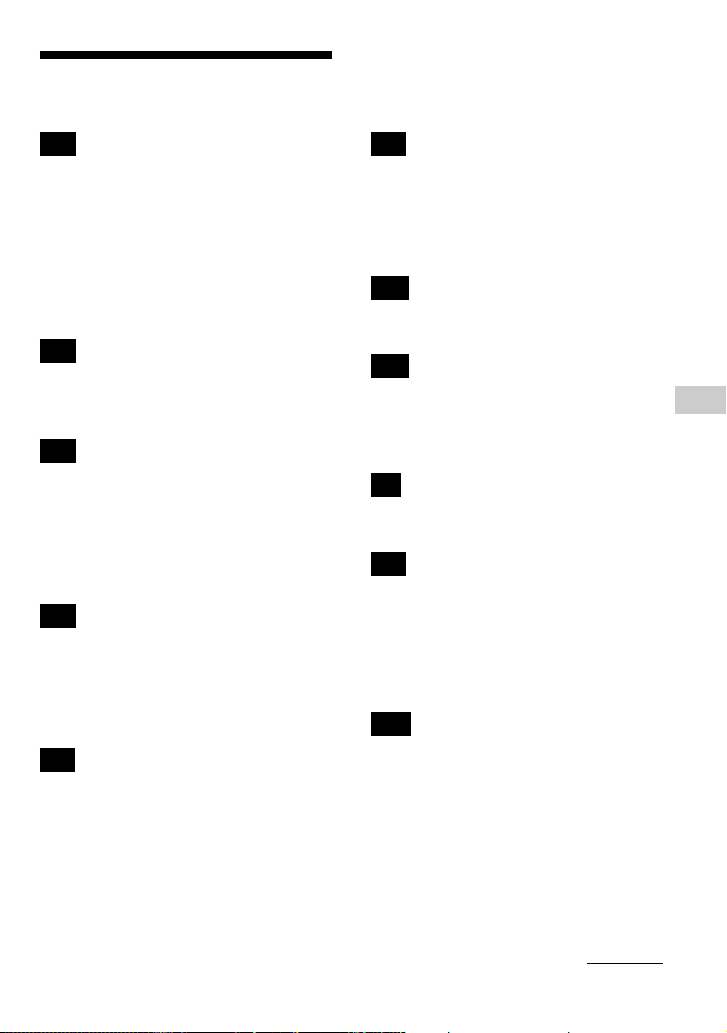
57
Other Information
A
A-B Repeat 23
Accessories 8
ATRAC3 54
ATRAC3plus 54
Audio CDs 6
AVLS (Limiting the volume)
32
B
Beep sound 36
Bit rate 54
C
CD (Audio CDs) 6
CD-ROM 8, 11
Charging 12
Clock 26, 31
Computer 6, 11, 12
D
Date-Time 31
Display 10, 15, 22, 26
Display mode 26
Download 6
E
EMD service 6
Explorer (Windows Explorer)
13, 30
Index
F
Fast-forward 20
Fast-rewind 20
FM 40
Formatting 37
G
Group 15, 19, 20
H
Headphones 8, 14, 44
HOLD function (Locking the controls)
30
I
Information 39
L
Limiting the volume (AVLS)
32
Listening 14
Locking the controls (HOLD function)
30
M
Menu list 56
MP3 6, 55
continued

58
O
OpenMG 54
P
Play Range 15-21
Playback 14
Power Save Mode 35
R
Radio 40
Remaining battery indication
13
Repeat 21
Repeat count 25
Reset 46
S
Search 15-19
SEARCH/MENU button 15-25, 27-29,
31-39
Sentence Repeat 24
Serial Number 8
Shuffle Repeat 21
Skip to the beginning of a track
20
SonicStage 11
Sound preset (Digital sound preset)
28
T
Time Setting 31
Track Repeat 22
Transferring 6, 11
Troubleshooting 46
Tuner 40
U
USB cable 12
USB connection setting (USB Bus Powered)
38
V
Volume 14, 33
W
WAV format 6
Windows Explorer 13, 30
Index

Sony Corporation