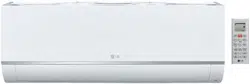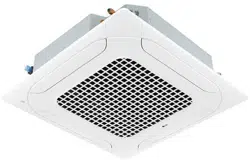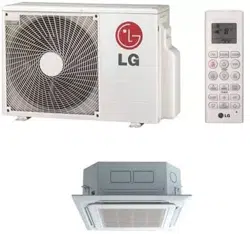
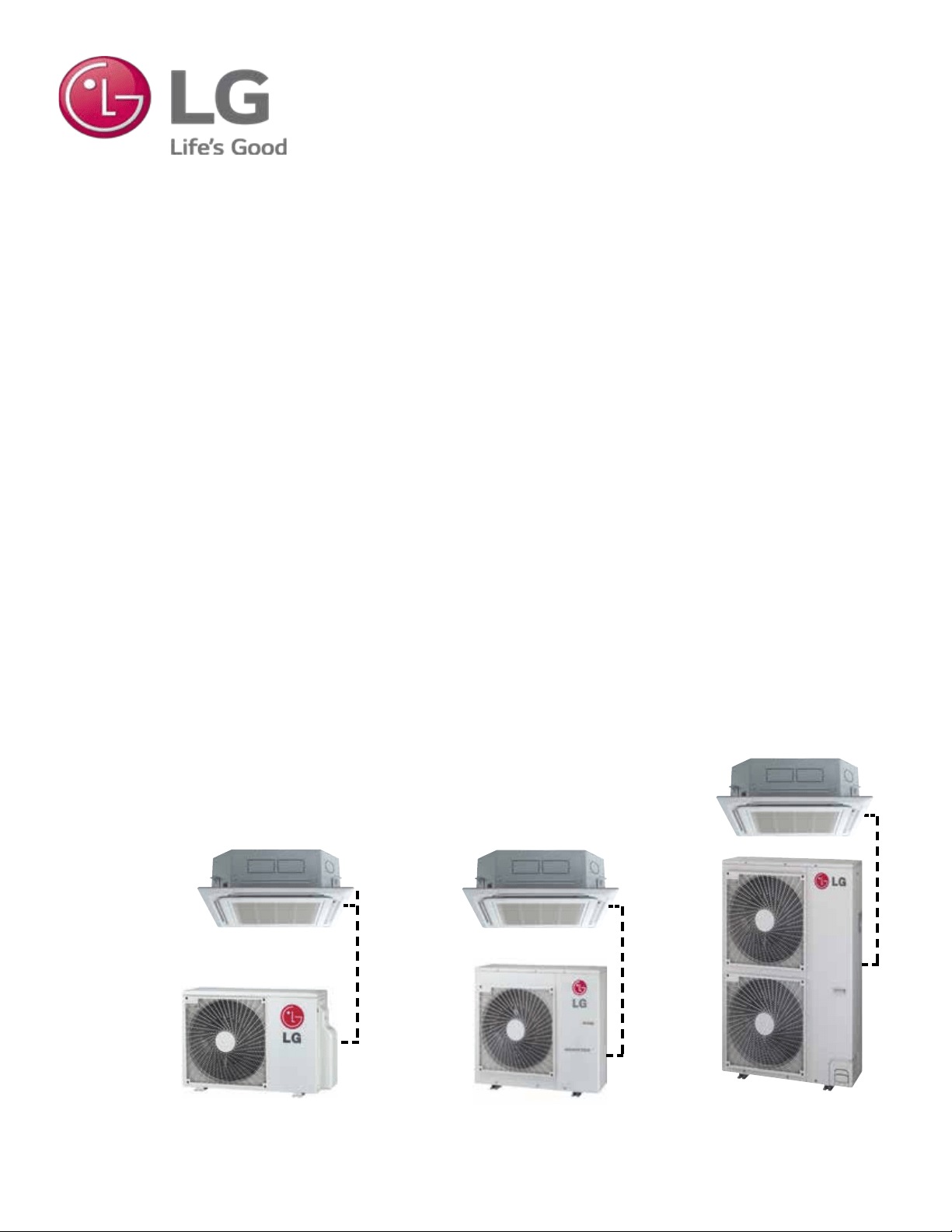
SINGLE-ZONE FOUR-WAY
CEILING-CASSETTE SYSTEM
ENGINEERING MANUAL
Single-Zone Four-Way
Ceiling Cassette
Heat Pump Systems
3/4 to 3-1/2 Tons
LC187HV (18,000 Btu/h)
LC247HV (24,000 Btu/h)
LC367HV (36,000 Btu/h)
LC427HV (42,000 Btu/h)
LC097HV4 (9,000 Btu/h)
LC127HV4 (12,000 Btu/h)

For continual product development, LG Electronics U.S.A., Inc., reserves the right to change specifications without notice.
© LG Electronics U.S.A., Inc.
PROPRIETARY DATA NOTICE
This document, as well as all reports, illustrations, data, information,
and other materials are the property of LG Electronics U.S.A., Inc., and are
disclosed by LG Electronics U.S.A., Inc. only in confidence.
This document is for design purposes only.
A summary list of safety precautions is on page 4.
For more technical materials such as submittals, catalogs, installation,
owner’s, and service manuals, visit www.lghvac.com.
About LG Electronics, Inc.
LG Electronics, Inc. is a global leader and technology innovator
in consumer electronics, mobile communications, and home
appliances. LG Electronics, Inc. comprises five business units—
Home Entertainment, Mobile Communications, Air Conditioning,
Business Solutions, and Home Appliance. LG is one of the world’s
leading producers of flat panel televisions, audio and video products,
mobile handsets, air conditioners, and washing machines. LG’s
commercial air conditioning business unit was established in 1968
and has built its lineup of residential and commercial products to
include VRF, Multi F, duct-free split systems, packaged terminal air
conditioners (PTACs), and room air conditioners. In 2011, the air
conditioning and energy solutions business unit grew to include LED
lighting and solar products. For more information, visit www.lg-dfs.
com.
Duct-Free Split Systems
LG HVAC systems offer a range of solutions that are cost efficient,
quiet and attractive. Duct-Free Split systems are “split” into indoor
and outdoor units, and provide a smart alternative to both central
HVAC and window-mounted air conditioners. These inverter heat
pump systems are available in a variety of configurations to suit
different cooling and heating situations. Installation by a qualified
HVAC contractor is safe and easy – little to no duct work or sheet
metal is required.
Inverter Systems
LG Single Zone Four-Way Ceiling Cassette air-source systems offer
the opportunity to minimize ductwork in the same configuration. The
system offers zoning without the need for zone damper systems.
The LG Single Zone Four-Way Ceiling Cassette system’s advanced
controls provide exceptional building dehumidification and tempera-
ture control, and can rapidly adapt system operating parameters
to the ever changing building load. The LG Single Zone Four-Way
Ceiling Cassette system is easy to design, install, and maintain.
The modular design allows occupants to control their environmental
condition, providing individualized control of the setpoint temperature
and allowing occupants to condition only the occupied zones.
Quality Commitment
LG is committed to the success of Duct-Free Split projects. We
provide industry leading technical support during installation and
commissioning. LG offers a variety of classes designed for installers
and servicers to ensure that every system installation is completed
successfully.
Classes are conducted at LG’s training centers and in field locations
at various times throughout the year and upon special request.
Due to our policy of continuous product innovation, some specications may change without notication.
©LG Electronics U.S.A., Inc., Englewood Cliffs, NJ. All rights reserved. “LG” is a registered trademark of LG Corp.
INTRODUCTION | 3
Introduction
TABLE OF CONTENTS
About LG Electronics, Inc. ............................................................................................................................................................................................. 3
Duct-Free Split (DFS) Systems ...................................................................................................................................................................................... 3
Unit Nomenclature .......................................................................................................................................................................................................... 9
Four-Way Ceiling Cassette System Data................................................................................................................................................................. 7-35
Product Features and Benets ..................................................................................................................................................................................... 8
General Data ........................................................................................................................................................................................................... 9-12
Electrical Data ............................................................................................................................................................................................................ 13
Dimensions ............................................................................................................................................................................................................ 14-19
Acoustic Data ........................................................................................................................................................................................................ 20-21
Air Velocity and Temperature Distribution .............................................................................................................................................................. 22-24
Refrigerant Flow Diagrams .................................................................................................................................................................................... 25-28
Wiring Diagrams .................................................................................................................................................................................................... 29-33
Accessories ........................................................................................................................................................................................................... 34-35
Performance Data .................................................................................................................................................................................................... 36-46
Cooling Capacity Tables ........................................................................................................................................................................................ 37-42
Heating Capacity Tables ........................................................................................................................................................................................ 43-45
Application Guidelines ............................................................................................................................................................................................ 47-62
Equipment Selection Procedure ............................................................................................................................................................................ 48-49
Building Ventilation Design Guide ......................................................................................................................................................................... 50-54
Placement Considerations ..................................................................................................................................................................................... 55-62
Refrigerant Piping Design & Layout Best Practices ............................................................................................................................................ 63-72
Design Guideline Summary ........................................................................................................................................................................................ 64
Selecting Field-Supplied Copper Tubing ............................................................................................................................................................... 65-66
Refrigerant Piping System Layout ......................................................................................................................................................................... 66-70
Piping Insulation ......................................................................................................................................................................................................... 71
Condensate Drain Piping ............................................................................................................................................................................................ 72
Electrical and Mechanical Specications ............................................................................................................................................................. 73-78
Electrical Connections ........................................................................................................................................................................................... 73-75
Mechanical Specications ..................................................................................................................................................................................... 77-78
Acronyms ...................................................................................................................................................................................................................... 79
TABLE OF SYMBOLS
DANGER
This symbol indicates an imminently hazardous situation which, if not avoided, will result in death or
serious injury.
WARNING
This symbol indicates a potentially hazardous situation which, if not avoided, could result in death or
serious injury.
CAUTION
This symbol indicates a potentially hazardous situation which, if not avoided, may result in minor or
moderate injury.
Note:
This symbol indicates situations that may result in equipment or property damage accidents only.
This symbol indicates an action that should not be performed.
Due to our policy of continuous product innovation, some specications may change without notication.
©LG Electronics U.S.A., Inc., Englewood Cliffs, NJ. All rights reserved. “LG” is a registered trademark of LG Corp.
4 | INTRODUCTION
Four-Way Ceiling Cassette System Engineering Manual

INTRODUCTION
“Architectural Appeal” on page 6
Convergence of Technological Innovation with Flexibility and Style
ARCHITECTURAL APPEAL
Single-Zone Four-Way Ceiling-
Cassette Systems
A four-way ceiling-cassette system provides a system designer an
edge to engineer a system with many user-adjustable settings. Four-
way ceiling cassette systems features a ceiling-recessed indoor unit
case and an off-white architectural grille (required; sold separately)
that is flush mounted, providing a clean look to the room. These sys-
tems are 208-230V/60Hz/1PH systems, available in nominal capaci-
ties of 3/4, 1, 1-1/2, 2, 3, and 3-1/2 tons, and are best suited in light
commercial applications or large, open spaces. The ceiling cassette
indoor unit is a useful alternative when wall space is limited.
Benefits of Four-Way Ceiling Cassette Systems
• Inverter technology
• Available in 9,000, 12,000, 18,000, 24,000, 36,000, 42,000 Btu/h
capacities
• All-season use—heat pump models for both cooling and
heating capabilities
• Operating ranges for 9,000 and 12,000 Btu/h outdoor units of
0°F to +118°F (DB) for cooling (Cooling range can be extended
from 0°F down to -4°F using the Low Ambient Wind Baffle Kit
[sold separately]); -4°F to +64°F (WB) for heating
• Operating ranges for 9,000 and 12,000 Btu/h indoor units of
57°F to 77°F (WB) for cooling; 59°F to 81°F (DB) for heating
• Indoor unit temperature setting range for 9,000 and 12,000 Btu/h
of 65°F to 86°F (DB) for cooling; 61°F to 86°F (WB) for heating
• Operating ranges for 18,000, 24,000, 36,000, 42,000 Btu/h
outdoor units of 5°F to +118°F (DB) for cooling; 0°F to +64°F
(WB) for heating
• Operating ranges for 18,000, 24,000, 36,000, 42,000 Btu/h
indoor units of 57°F to 77°F (WB) for cooling; 59°F to 81°F (DB)
for heating
• Indoor unit temperature setting range for 18,000, 24,000, 36,000,
and 42,000 Btu/h of 65°F to 86°F (DB) for cooling; 61°F to 86°F
(WB) for heating
• Quiet operation inside and outside
Inverter Technology
Inverter variable-speed compressors are also measurably quieter
and consume less energy than those in conventional air condi-
tioners. The Inverter compressor ramps up or down to match the
required room capacity and maintain the comfort level. When the
selected temperature is reached, the inverter compressor operates
at low speed to maintain that comfort level, thereby using less
energy.
Adaptable and Flexible
Four-way ceiling-cassette systems allow cooling or heating for a
single room without the need for extensive remodeling. Long refrig-
erant piping lengths allow for extra design flexibility in indoor unit
installation. These units may be used for a number of residential or
commercial environments such as:
• Older homes
• New home construction
• Office buildings
• Restaurants
• Hospitals / Medical facilities
• Schools
• Nursing homes
• Retail establishments
• Houses of worship
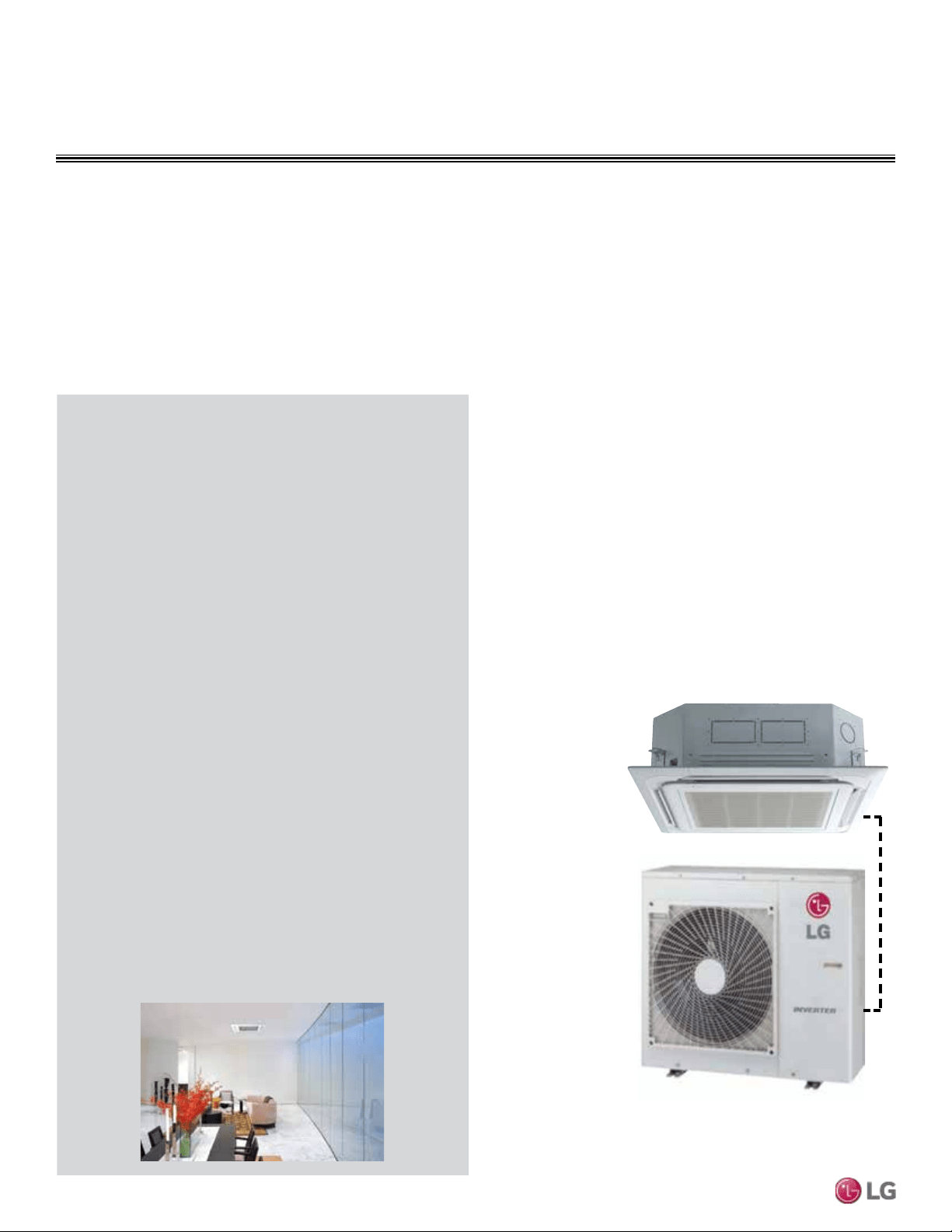
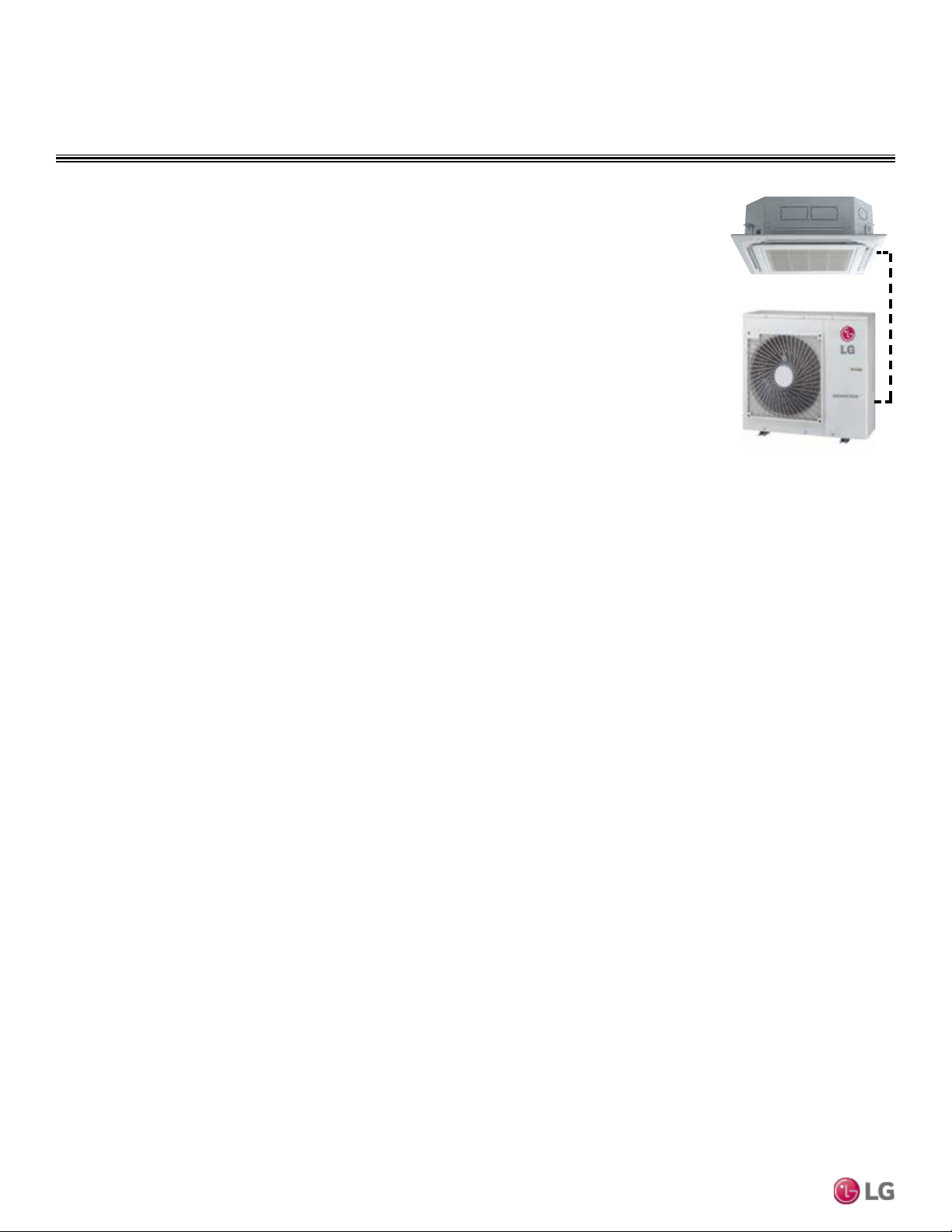
Figure 1: Four-Way Ceiling Cassette System.
Due to our policy of continuous product innovation, some specications may change without notication.
©LG Electronics U.S.A., Inc., Englewood Cliffs, NJ. All rights reserved. “LG” is a registered trademark of LG Corp.
6 | INTRODUCTION
Four-Way Ceiling Cassette System Engineering Manual

PRODUCT DATA
“Product Features and Benefits” on page 8
“Unit Nomenclature” on page 9
“General Data” on page 10
“Electrical Data” on page 13
“Dimensions” on page 14
“Acoustic Data” on page 20
“Air Velocity and Temperature Distribution” on page 22
“Refrigerant Flow Diagrams” on page 25
“Wiring Diagrams” on page 29
“Accessories” on page 34
Due to our policy of continuous product innovation, some specications may change without notication.
©LG Electronics U.S.A., Inc., Englewood Cliffs, NJ. All rights reserved. “LG” is a registered trademark of LG Corp.
8 | FOUR-WAY CASSETTE
Four-Way Ceiling Cassette System Engineering Manual
PRODUCT FEATURES AND BENEFITS
Four-Way Ceiling Cassette Systems
Single zone four-way ceiling cassette systems are equipped with
inverter components that offer superior load matching and long
piping installation. The product works for optimizing power consump-
tion in residential and small office buildings. Using a four-way ceiling
cassette indoor unit with custom temperature controls allow for
precise temperature settings in each zone of the building. Four-way
ceiling cassette indoor units allow flexibility in interior design and
complement any decor.
Lower Sound Levels
When outdoor units operate fully loaded, they have one of the qui-
etest sound levels in the industry, operating as low as 47 dB(A). To
promote a quiet, comfortable environment, four-way ceiling cassette
indoor units operate as low as 30 dB(A) at low speed. LG custom-
ers often ask if the outdoor unit is running after commissioning is
complete. All rotating components are soft-started using digitally
controlled inverters, which reduce undesirable noise caused by fans
and compressors cycling on and off.
Comfort Control at its Best
Tight temperature control through precise load matching. Unlike
traditional air conditioning control systems, which use thermostatic
controls to maintain room temperatures, LG inverters continuously
vary the indoor unit fan speed and refrigerant flow, indirectly pro-
viding lower and more consistent humidity levels in the conditioned
space.
The longer the indoor coil temperature is below the dewpoint of the
room in conjunction with air movement across the coil, the space
humidity level will vary little, compared to technologies that cycle
fans and compressors on and off multiple times per hour. The out-
door unit responds by varying the compressor speed and fan motors
as needed to maintain system operating pressure. As a result,
four-way ceiling cassette systems deliver precise space temperature
control.
Inverter Driven
The compressor is optimized to maximize compressor efficiency,
which reduces power consumption and monthly utility bills. This
inverter technology allows the LG four-way ceiling cassette out-
door unit to vary the compressor motor shaft speed and deliver an
appropriate amount of cooling to the indoor unit. Occupants remain
comfortable while utility costs are reduced.
Simplified Installation
The LG four-way ceiling cassette system simplifies and reduces
mechanical and control system design time. The designer no longer
has to be concerned with interconnecting chilled and condenser
water piping, complicated air distribution duct systems, matching
and selecting chillers, towers, pumps, coils, fans, air handlers, or
Variable Air Volume (VAV) boxes.
Operating Range
Four-way ceiling cassette systems are available in 9,000, 12,000,
18,000, 24,000, 36,000, and 42,000 Btu/h capacities.
9,000 and 12,000 Btu/h Operat-
ing Ranges
• Operating ranges for outdoor units
of 0°F to +118°F (DB) for cooling
(Cooling range can be extended
from 0°F down to -4°F using the
Low Ambient Wind Baffle Kit [sold
separately]); -4°F to +64°F (WB) for
heating.
• Operating ranges for indoor units of
57°F to 77°F (WB) for cooling; 59°F
to 81°F (DB) for heating.
• Indoor unit temperature setting
range of 65°F to 86°F (DB) for cool-
ing; 61°F to 86°F (WB) for heating.
18,000, 24,000, 36,000, and
42,000 Operating Ranges
• Operating ranges for outdoor units of 5°F to +118°F (DB) for
cooling; 0°F to +64°F (WB) for heating.
• Operating ranges for indoor units of 57°F to 77°F (WB) for cooling;
59°F to 81°F (DB) for heating.
• Indoor unit temperature setting range of 65°F to 86°F (DB) for
cooling; 61°F to 86°F (WB) for heating
Clean Finish
The four-way ceiling cassette indoor unit case is recessed, while
the off-white architectural grille (required, sold separately) is flush
mounted, providing a clean look to the room.
Heat Transfer Efficiency
Fin Design with GoldFin™ Coating
All four-way ceiling cassette outdoor units are provided with large
surface coils made of copper tubes with louvered aluminum fins
designed to maximize unit operating efficiency over a wide range of
ambient conditions. Standard from the factory, the LG outdoor coil
fin surface is coated with LG’s exclusive GoldFin™ anti-corrosive
coating designed to prevent natural surface corrosion of the alumi-
num fins. This maintains heat transfer properties of the coil for an
extended time. A hydrophilic coating is applied to the outdoor unit
coil fin surface over the GoldFin coating. This coating enhances the
development of heavier water droplets gathering on the fin surface.
As a result, the droplets roll off the fin surfaces, delaying the point
when frost forms on the coil surface during heating operation. This
coating also makes it possible to easily clean the outdoor unit coil
using a mild soap.
Other Features
• Inverter (Variable Speed)
Compressor
• Five fan speeds
• Auto restart
• Auto changeover
• Swirl Wind
• Internal condensate pump
included
• Precision Load Matching
• Follows AHRI 210/240
FOUR-WAY CASSETTE | 9
Product Data
Due to our policy of continuous product innovation, some specications may change without notication.
©LG Electronics U.S.A., Inc., Englewood Cliffs, NJ. All rights reserved. “LG” is a registered trademark of LG Corp.
UNIT NOMENCLATURE
A 090 H
System Type:
Style:
SV = High Efficiency Inverter
VP = Gallery
YV = Premier
EV = Mega
V = Standard Inverter
T = Thermostat Compatible
Nominal Capacity
(Nominal cooling capacity in Btu/h):
Frame Type:
A: Art Cool™
S: Standard
C: Four-Way Ceiling-Cassette
D: Ceiling-Concealed Duct (Low Static)
H: Ceiling-Concealed Duct (High Static)
V: Vertical-Horizontal Air Handling
L = LG
09 = 9,000
12 = 12,000
18 = 18,000
24 = 24,000
30 = 30,000
36 = 36,000
42 = 42,000
54 = 54,000
L SV 4N
N: Indoor Unit
U: Outdoor Unit
No N or U: System
H = Heat Pump
Generation:
Due to our policy of continuous product innovation, some specications may change without notication.
©LG Electronics U.S.A., Inc., Englewood Cliffs, NJ. All rights reserved. “LG” is a registered trademark of LG Corp.
10 | FOUR-WAY CASSETTE
Four-Way Ceiling Cassette System Engineering Manual
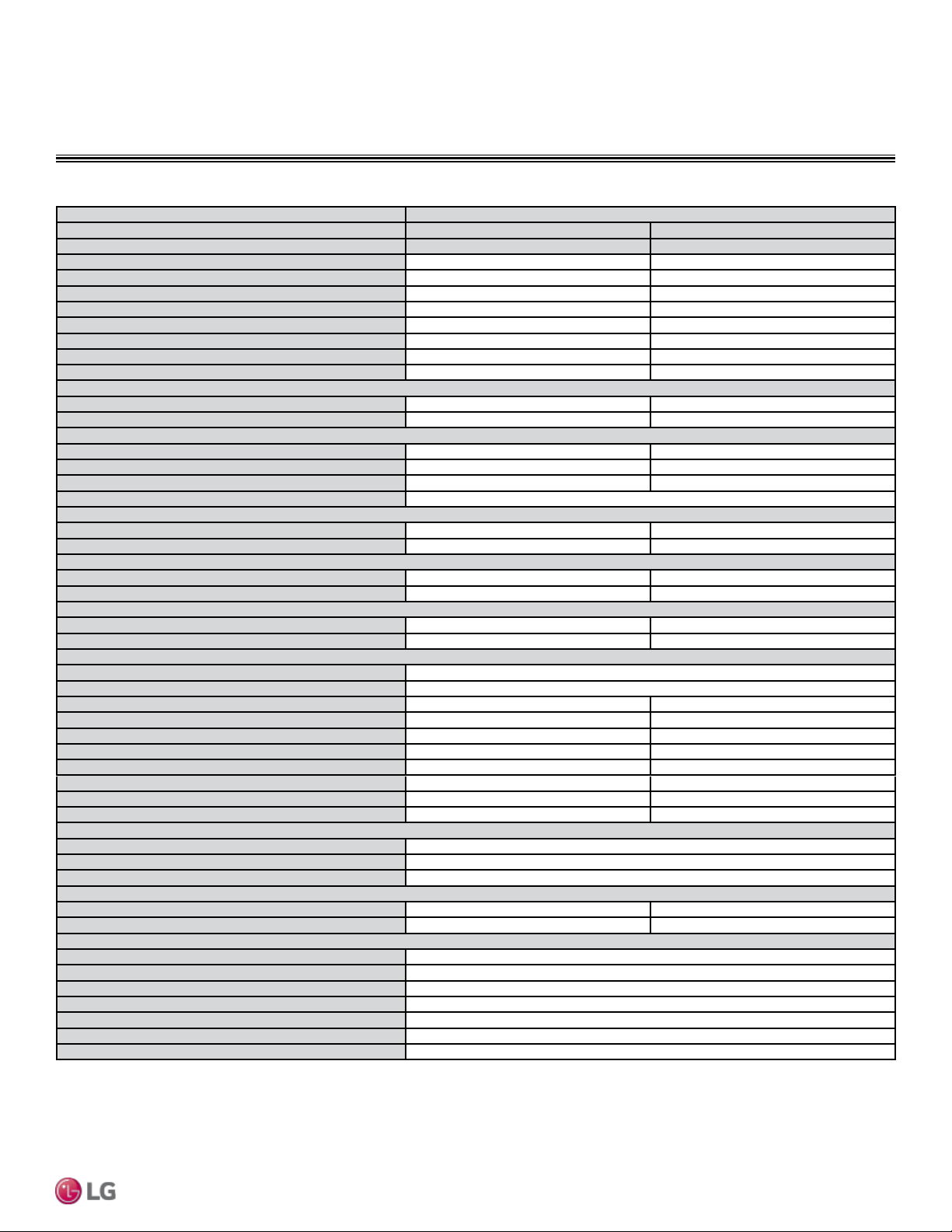
Outdoor Unit Model Indoor Unit Model Controller
LUU097HV
LUU127HV
LCN097HV4
LCN127HV4
PQWRHQ0FDB
LUU187HV
LUU247HV
LCN187HV
LCN247HV
PQWRHQ0FDB
LUU367HV
LUU427HV
LCN367HV
LCN427HV
PQWRHQ0FDB
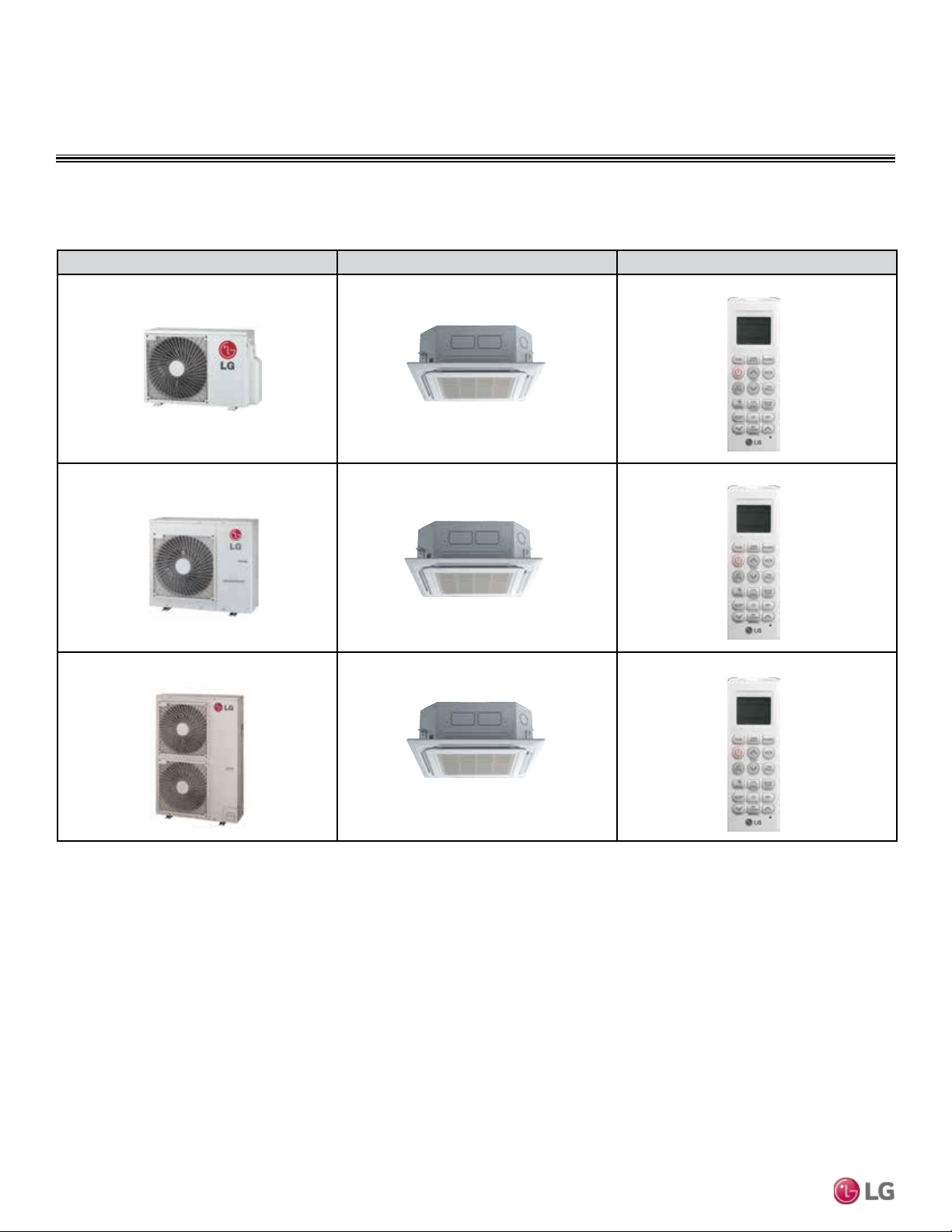
The following table shows the available outdoor and indoor unit, along with the factory provided controller.
Table 1: Four-Way Ceiling Cassette System Pairing Table
GENERAL DATA
Four-Way Ceiling Cassette Pairing Table
FOUR-WAY CASSETTE | 11
Product Data
Due to our policy of continuous product innovation, some specications may change without notication.
©LG Electronics U.S.A., Inc., Englewood Cliffs, NJ. All rights reserved. “LG” is a registered trademark of LG Corp.
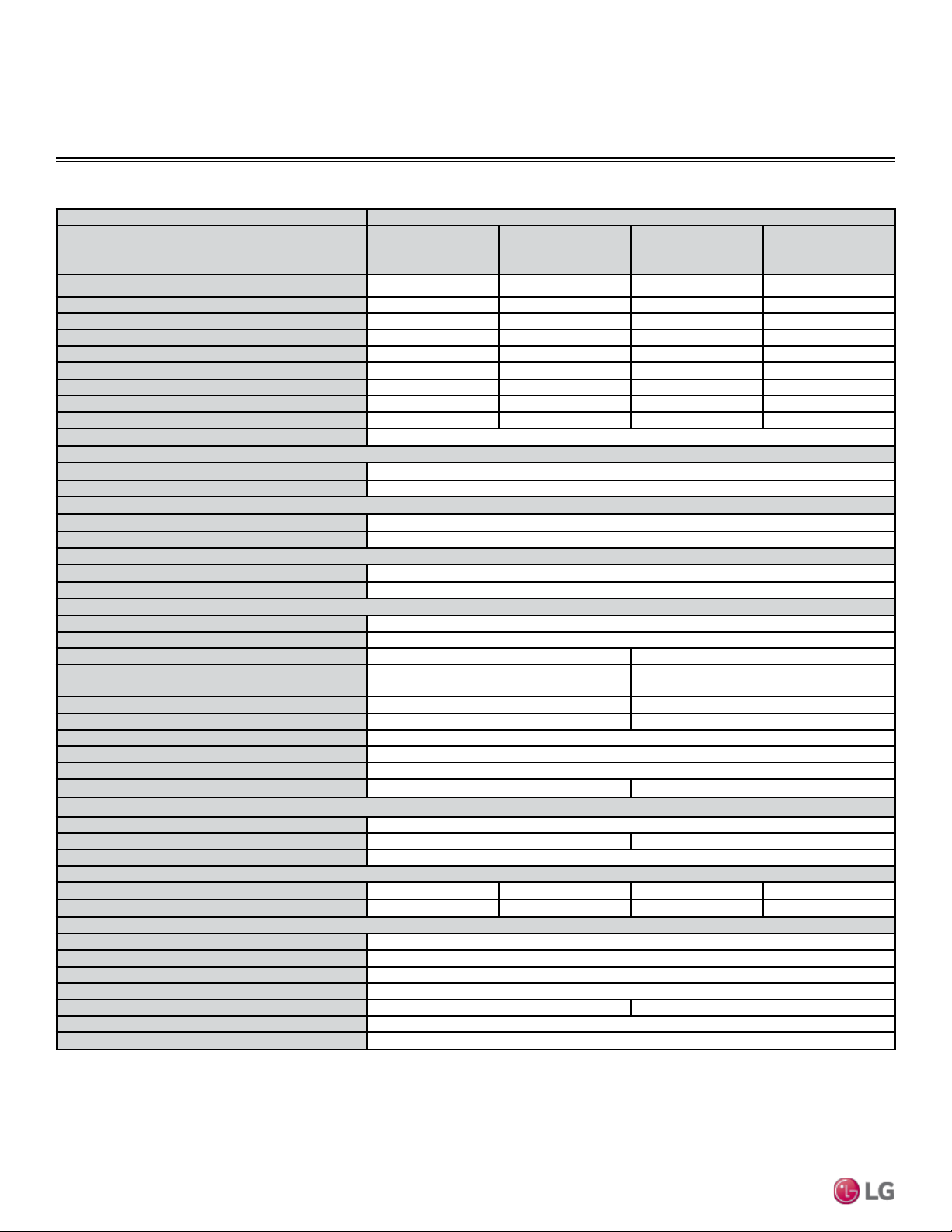
GENERAL DATA / SPECIFICATIONS
Type Single Zone Four-Way Ceiling Cassette
System (Model) (Indoor Unit / Outdoor Unit) LC097HV4 (LCN097HV4 / LUU097HV) LC127HV4 (LCN127HV4 / LUU127HV)
Ceiling Grille Model Number (Sold Separately) PT-QCHW0 / PT-UQC PT-QCHW0 / PT-UQC
Cooling Capacity (Min/Rated/Max) (Btu/h)
3,600 ~ 9,000 ~ 9,900 3,400 ~ 11,100 ~ 12,400
Cooling Power Input
1
(kW)
0.19 ~ 0.66 ~ 0.83 0.25 ~ 0.88 ~ 1.1
EER (OD 95°F)
13.65 12.6
SEER
20.2 19.4
Heating Capacity (Min/Rated/Max) (Btu/h)
4,400 ~ 11,000 ~ 12,100 2,800 ~ 14,000 ~ 15,500
Heating Power Input
1
(kW)
0.15 ~ 0.83 ~ 1.05 0.22 ~ 1.19 ~ 1.5
COP (OD 47°F)
3.88 3.44
HSPF
10.5 10.4
Rated Low Heating Capacity (Btu/h)
Outdoor 17°F (WB)/Indoor 70°F (DB)
7,000 9,100
Low COP (OD 17°F)
2.92 2.7
Maximum Heating Capacity (Btu/h)
Outdoor 17°F (WB)/Indoor 70°F (DB)
9,350 (85%) 11,900 (85%)
Outdoor 5°F (WB)/Indoor 70°F (DB)
8,250 (75%) 10,500 (75%)
Outdoor -4°F (WB)/Indoor 70°F (DB)
7,040 (64%) 8,960 (64%)
Power Supply V, Ø, Hz
2
208-230 / 1 / 60
Outdoor Unit Operating Range
Cooling (°F DB)
0 to +118
6
0 to +118
6
Heating (°F WB)
-4 to +64 -4 to +64
Indoor Unit Operating Range
Cooling (°F WB)
57 to 77 57 to 77
Heating (°F DB)
59 to 81 59 to 81
Indoor Temperature Setting Range
Cooling (°F DB)
65 to 86 65 to 86
Heating (°F WB)
61 to 86 61 to 86
Unit Data
Refrigerant Type
3
R410A
Refrigerant Control
EEV
Indoor Unit Sound Pressure Level dB(A) (H/M/L)
4
36 / 33 / 30 38 / 35 / 32
Outdoor Unit Sound Pressure Level dB(A) (Cool/Heat)
4
47 / 51 49 / 52
Indoor Unit Net / Shipping Weight (lbs.)
31 / 37 31 / 37
Outdoor Unit Net / Shipping Weight (lbs.)
82 / 89 82 / 89
Grille Net / Shipping Weight (lbs.)
7 / 9 7 / 9
Power Wiring / Communications Cable (No. x AWG)
2
4 x 18 4 x 18
Compressor (Type x Qty.)
Twin Rotary x 1 Twin Rotary x 1
Dehumidification Rate (pts./hr.)
1.6 2.47
Fan
Indoor Unit Type x Qty.
Turbo x 1
Outdoor Unit Type x Qty.
Axial x 1
Motor / Drive
Brushless Digitally Controller / Direct
Airflow Rate
Indoor Unit (H / M / L [CFM])
300 / 265 / 230 335 / 283 / 247
Outdoor Unit (CFM)
988 988
Piping
Liquid (in.)
1/4
Vapor (in.)
3/8
Indoor Unit Condensate Drain O.D. / I.D. (in.)
1-1/4 / 1
Additional Refrigerant Charge (oz./ft.)
0.22
Maximum Pipe Length (ft.)
66
Piping Length
5
(no additional refrigerant, ft.)
25
Maximum Elevation Difference (ft.)
49
Table 2: Four-Way Ceiling Cassette System General Data.
EEV: Electronic Expansion Valve, IDU: Indoor Unit, ODU: Outdoor Unit. This unit comes with a dry
helium charge.
This data is rated 0 ft above sea level, with 24.6 ft of refrigerant line per indoor unit and a 0 ft level
difference between outdoor and indoor units.
Cooling capacity rating obtained with air entering the indoor coil at 80ºF dry bulb (DB) and 67ºF wet bulb
(WB); and outdoor ambient conditions of 95ºF dry bulb (DB) and 75ºF wet bulb (WB).
Heating capacity rating obtained with air entering the indoor unit at 70ºF dry bulb (DB) and 60ºF wet
bulb (WB); and outdoor ambient conditions of 47ºF dry bulb (DB) and 43ºF wet bulb (WB).
1
Power Input is rated at high speed.
2
All power wiring/communication cables from ODU to IDU are field supplied and are to be minimum 18
AWG, 4-conductor, stranded, shielded or unshielded (if shielded, must be grounded to chassis at ODU
only), and must comply with applicable local and national codes.
3
Take appropriate actions at the end of HVAC equipment life to recover, recycle, reclaim or destroy R410A
refrigerant according to applicable regulations (40 CFR Part 82, Subpart F) under section 608 of CAA.
4
Sound pressure levels are tested in an anechoic chamber under ISO Standard 3745 and are the
same in both cooling and heating mode. These values can increase due to ambient conditions during
operation.
5
Piping lengths are equivalent.
6
Cooling range can be extended from 0°F down to -4°F using the Low Ambient Wind Baffle Kit (sold
separately).
Due to our policy of continuous product innovation, some specications may change without notication.
©LG Electronics U.S.A., Inc., Englewood Cliffs, NJ. All rights reserved. “LG” is a registered trademark of LG Corp.
12 | FOUR-WAY CASSETTE
Four-Way Ceiling Cassette System Engineering Manual
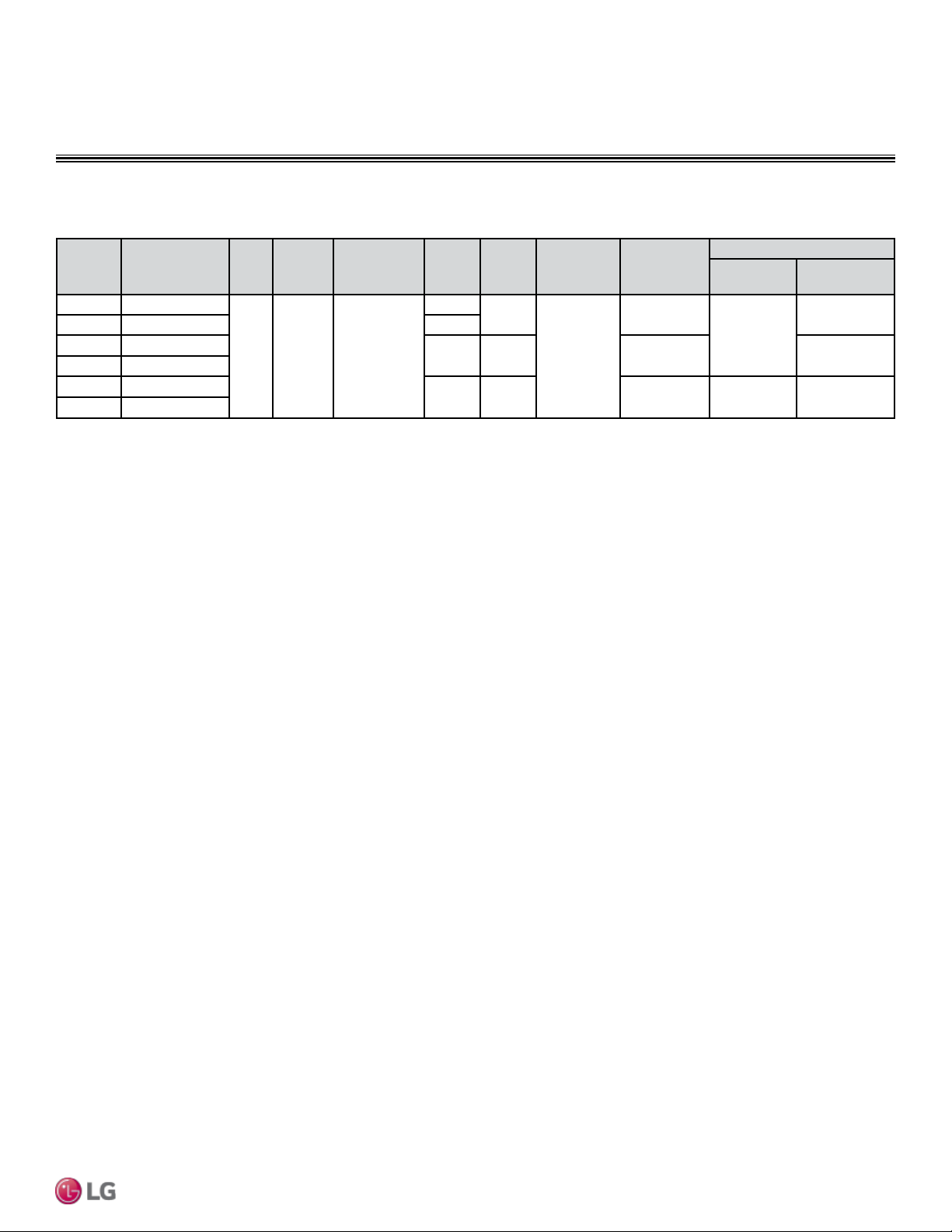
GENERAL DATA / SPECIFICATIONS
Type Single Zone Four-Way Ceiling Cassette
System (Model) (Indoor Unit / Outdoor Unit)
LC187HV
(LCN187HV /
LUU187HV)
LC247HV
(LCN247HV /
LUU247HV)
LC367HV
(LCN367HV /
LUU367HV)
LC427HV
(LCN427HV /
LUU427HV)
Ceiling Grille Model Number (Sold Separately)
PT-UMC1B / PT-UMC1 PT-UMC1B / PT-UMC1 PT-UMC1B / PT-UMC1 PT-UMC1B / PT-UMC1
Cooling Capacity (Min/Rated/Max) (Btu/h)
9,500~18,000~19,800 9,700~24,000~26,700 14,000~36,000~42,000 17,100~42,000~47,100
Cooling Power Input
1
(kW)
1.26 1.91 2.97 4.07
EER (OD 95°F)
15 12.6 13.5 10.3
SEER
20.0 17.0 19.0 17.0
Heating Capacity (Min/Rated/Max) (Btu/h)
9,300~20,000~22,000 10,900~27,000~30,000 14,500~40,000~45,000 17,100~47,000~52,600
Heating Power Input
1
(kW)
1.5 2.60 3.20 4.05
COP (OD 47°F)
- - - -
HSPF
10.1 9.7 9.5 8.6
Power Supply V, Ø, Hz
2
208-230 / 1 / 60
Outdoor Unit Operating Range
Cooling (°F DB)
5-118
Heating (°F WB)
0-64
Indoor Unit Operating Range
Cooling (°F WB)
57-77
Heating (°F DB)
59-81
Indoor Temperature Setting Range
Cooling (°F DB)
65-86
Heating (°F WB)
61-86
Unit Data
Refrigerant Type
3
R410A
Refrigerant Control
EEV
Indoor Unit Sound Pressure Level ±3 dB(A) (H/M/L)
4
38 / 36 / 34 46 / 44 / 43
Outdoor Unit Sound Pressure Level ±3 dB(A)
(Cool/Heat)
4
48 / 52 52 / 54
Indoor Unit Net / Shipping Weight (lbs.)
46 / 55 55 / 65
Outdoor Unit Net / Shipping Weight (lbs.)
133 / 148 203 / 227
Grille Net / Shipping Weight (lbs.)
11 / 20
Power Wiring / Communications Cable (No. x AWG)
2
4 x 18
Compressor (Type x Qty.)
Twin Rotary x 1
Dehumidification Rate (pts./hr.)
5.1 7.7
Fan
Indoor Unit Type x Qty.
Turbo x 1
Outdoor Unit Type x Qty.
Propeller x 1 Propeller x 2
Motor / Drive
Brushless Digitally Controller / Direct
Airflow Rate
Indoor Unit (Max. / H / M / L [CFM])
565/494/424 600/530/459 1,060/989/918 1,060/989/918
Outdoor Unit (CFM)
2,048 2,048 1,942 x 2 1,942 x 2
Piping
Liquid (in.)
3/8
Vapor (in.)
5/8
Indoor Unit Condensate Drain O.D. / I.D. (in.)
1-1/4 / 1
Additional Refrigerant Charge (oz./ft.)
0.43
Maximum Pipe Length (ft.)
164 246
Piping Length
5
(no additional refrigerant, ft.)
25
Maximum Elevation Difference (ft.)
98
Table 3: Four-Way Ceiling Cassette System General Data, continued.
EEV: Electronic Expansion Valve, IDU: Indoor Unit, ODU: Outdoor Unit. This unit comes with a dry
helium charge.
This data is rated 0 ft above sea level, with 24.6 ft of refrigerant line per indoor unit and a 0 ft level
difference between outdoor and indoor units.
Cooling capacity rating obtained with air entering the indoor coil at 80ºF dry bulb (DB) and 67ºF wet bulb
(WB); and outdoor ambient conditions of 95ºF dry bulb (DB) and 75ºF wet bulb (WB).
Heating capacity rating obtained with air entering the indoor unit at 70ºF dry bulb (DB) and 60ºF wet bulb
(WB); and outdoor ambient conditions of 47ºF dry bulb (DB) and 43ºF wet bulb (WB).
1
Power Input is rated at high speed.
2
All power wiring/communication cables from ODU to IDU are field supplied and are to be minimum 18
AWG, 4-conductor, stranded, shielded or unshielded (if shielded, must be grounded to chassis at ODU
only), and must comply with applicable local and national codes.
3
Take appropriate actions at the end of HVAC equipment life to recover, recycle, reclaim or destroy
R410A refrigerant according to applicable regulations (40 CFR Part 82, Subpart F) under section 608 of
CAA.
4
Sound pressure levels are tested in an anechoic chamber under ISO Standard 3745 and are the
same in both cooling and heating mode. These values can increase due to ambient conditions during
operation.
5
Piping lengths are equivalent.
FOUR-WAY CASSETTE | 13
Product Data
Due to our policy of continuous product innovation, some specications may change without notication.
©LG Electronics U.S.A., Inc., Englewood Cliffs, NJ. All rights reserved. “LG” is a registered trademark of LG Corp.
Nominal
Tons
Unit Model No. Hertz Voltage
Voltage
Range
(Min. to Max.)
MCA MOP
Compressor
Quantity
Compressor
Motor RLA
(Cooling)
Condenser Fan Motor(s)
Condenser
Fan Quantity.
Condenser Fan
Motor FLA
3/4 LUU097HV
60 208 - 230 187 - 253
11.9
15
1
9.0
1
0.25
1 LUU127HV 12.3
1-1/2 LUU187HV
18.1 30 13.5 0.6
2 LUU247HV
3 LUU367HV
24.5 40 18.0 2 0.6 x 2
3-1/2 LUU427HV
Voltage tolerance is ±10%.
Maximum allowable voltage unbalance is 2%.
RLA = Rated Load Amps.
MCA = Minimum Circuit Ampacity.
Maximum Overcurrent Protection (MOP) is calculated as follows:
(Largest motor FLA x 2.25) + (Sum of other motor FLA) rounded down
to the nearest standard fuse size.
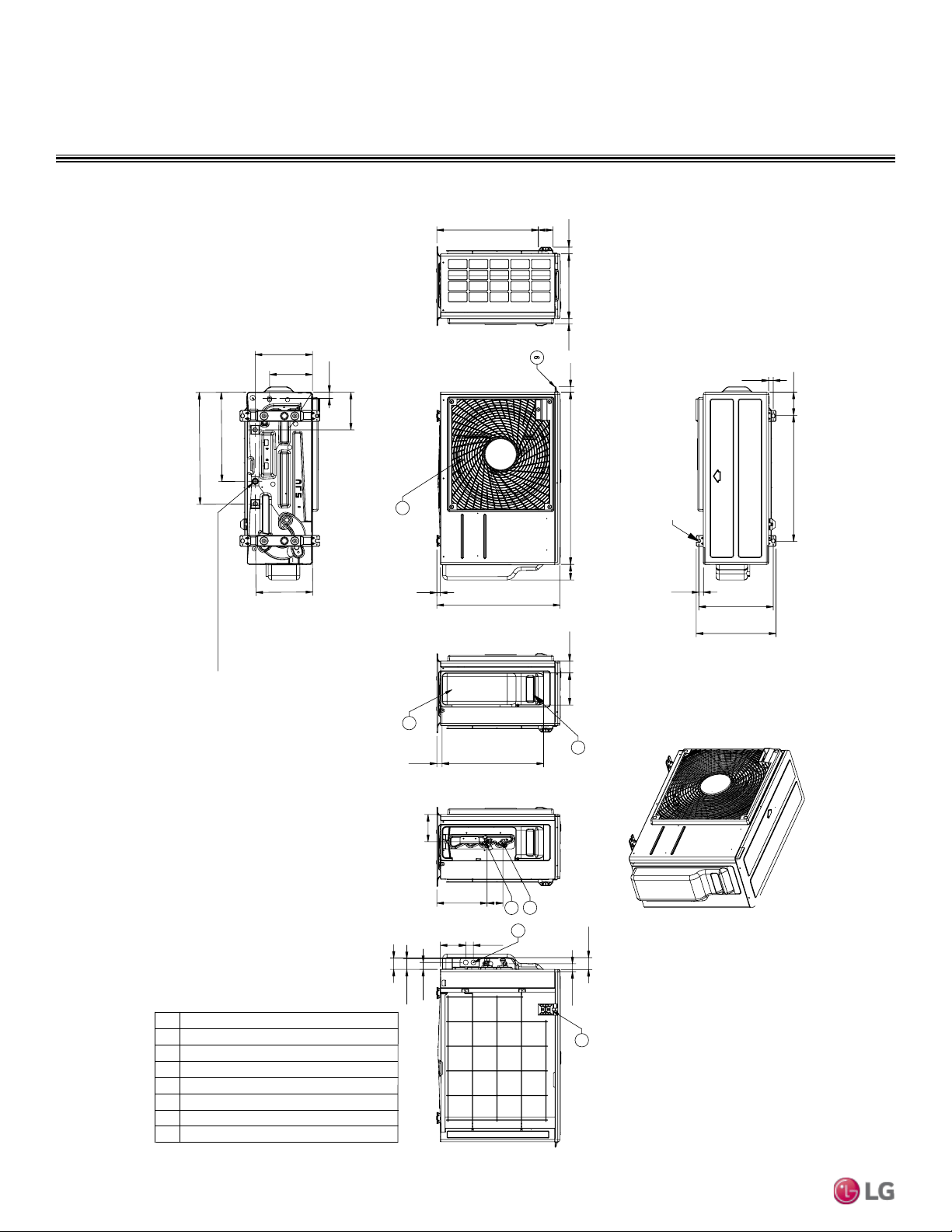
Table 4: Electrical Data.
Electrical Data
ELECTRICAL DATA
Due to our policy of continuous product innovation, some specications may change without notication.
©LG Electronics U.S.A., Inc., Englewood Cliffs, NJ. All rights reserved. “LG” is a registered trademark of LG Corp.
14 | FOUR-WAY CASSETTE
Four-Way Ceiling Cassette System Engineering Manual
OUTDOOR UNIT DIMENSIONS
LUU097HV, LUU127HV
4-3/32 22-3/16
13/16
12-31/32
13-29/32
13/16
4 Holes for Anchor Bolts (M 13/32)
3D View
1-3/16 11-11/32 31/32
2-9/16
17-11/16
15/16
21-15/32
30-5/16
2-23/32
5/8
2-3/32 5-21/32
6
2
3
4
5
7
1
17-11/1615/16
4-25/32
Side View
(Valve Cover Removed)
8-25/32
2-3/4
4-7/16 1-11/32
1-7/32
1-29/32
2
2-3/32
1-13/32
1-1/16
6-5/8
10
7-1/2
15-11/16
19-11/16
4 - LD.
Ф25/32 Holes for drain connection
9-29/32
Intake air temperature sensor cover
Handle
Conduit
Liquid pipe connection
Vapor pipe connection
Control cover & service valve cover
Air outlet
No. Part Name
1
2
3
4
5
6
7
[Unit: inch]
Figure 2: LUU097HV, LUU127HV Outdoor Unit Dimensions.
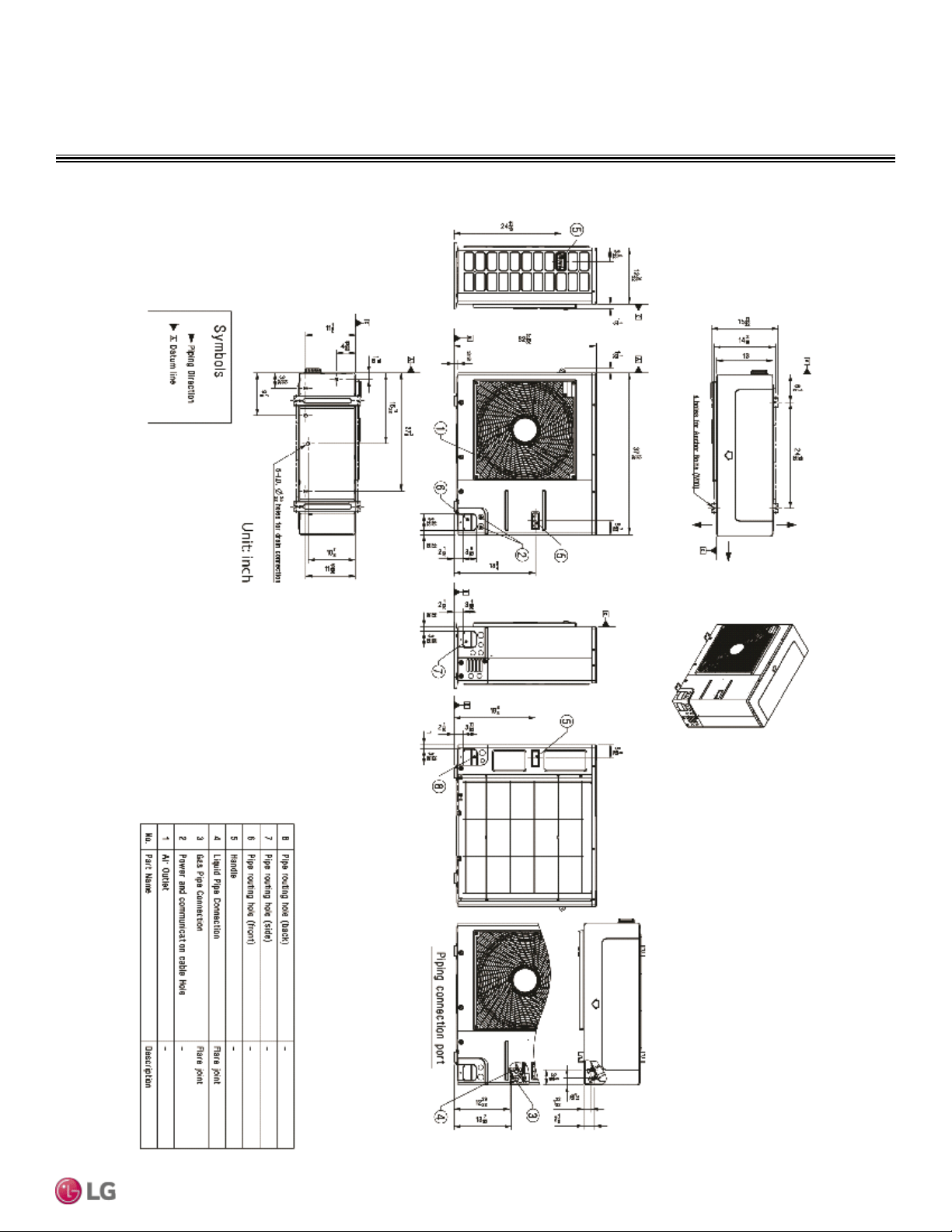
FOUR-WAY CASSETTE | 15
Product Data
Due to our policy of continuous product innovation, some specications may change without notication.
©LG Electronics U.S.A., Inc., Englewood Cliffs, NJ. All rights reserved. “LG” is a registered trademark of LG Corp.
OUTDOOR UNIT DIMENSIONS
LUU187HV, LUU247HV
Figure 3: LUU187HV, LUU247HV Outdoor Unit Dimensions.
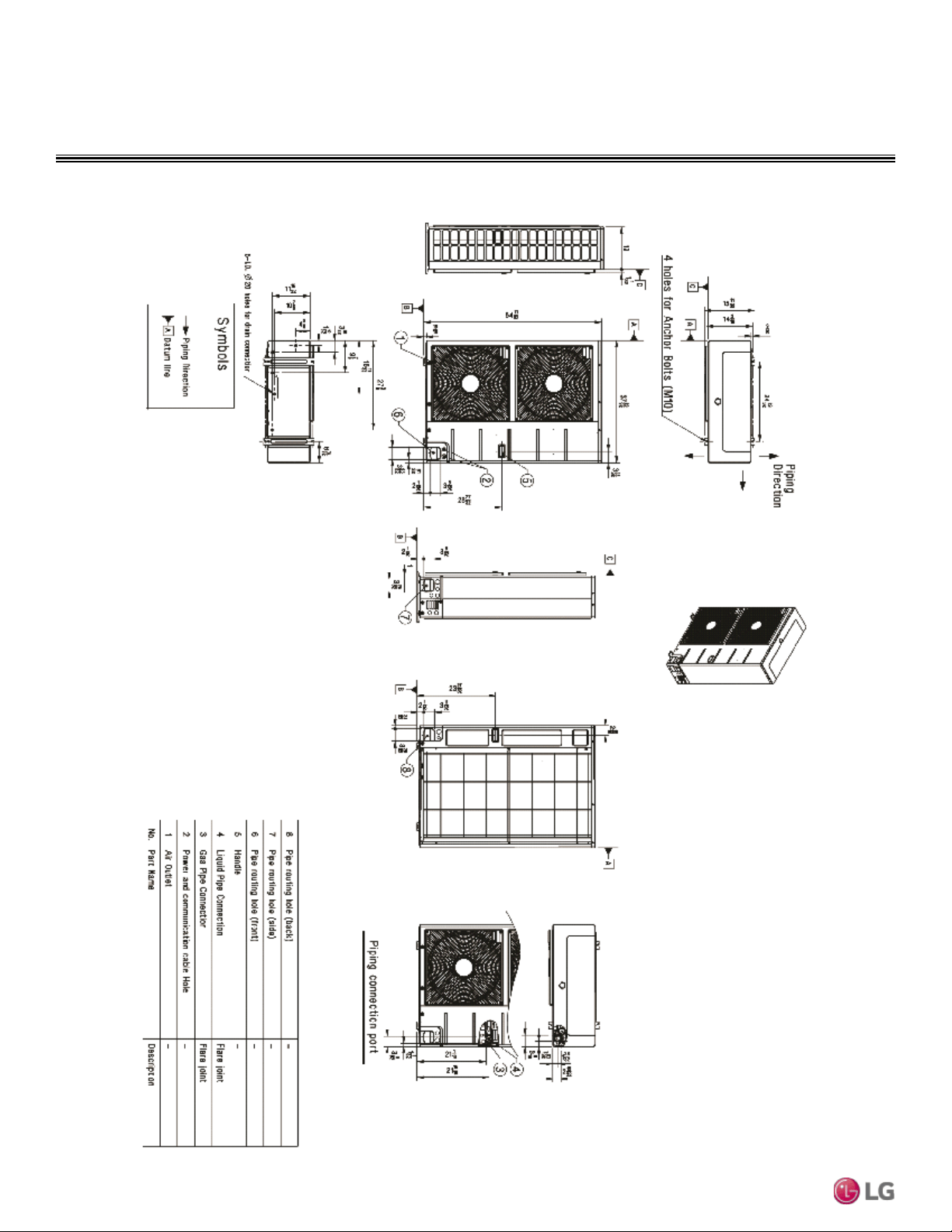
Due to our policy of continuous product innovation, some specications may change without notication.
©LG Electronics U.S.A., Inc., Englewood Cliffs, NJ. All rights reserved. “LG” is a registered trademark of LG Corp.
16 | FOUR-WAY CASSETTE
Four-Way Ceiling Cassette System Engineering Manual
OUTDOOR UNIT DIMENSIONS
LUU367HV, LUU427HV
Figure 4: LUU367HV, LUU427HV Outdoor Unit Dimensions.
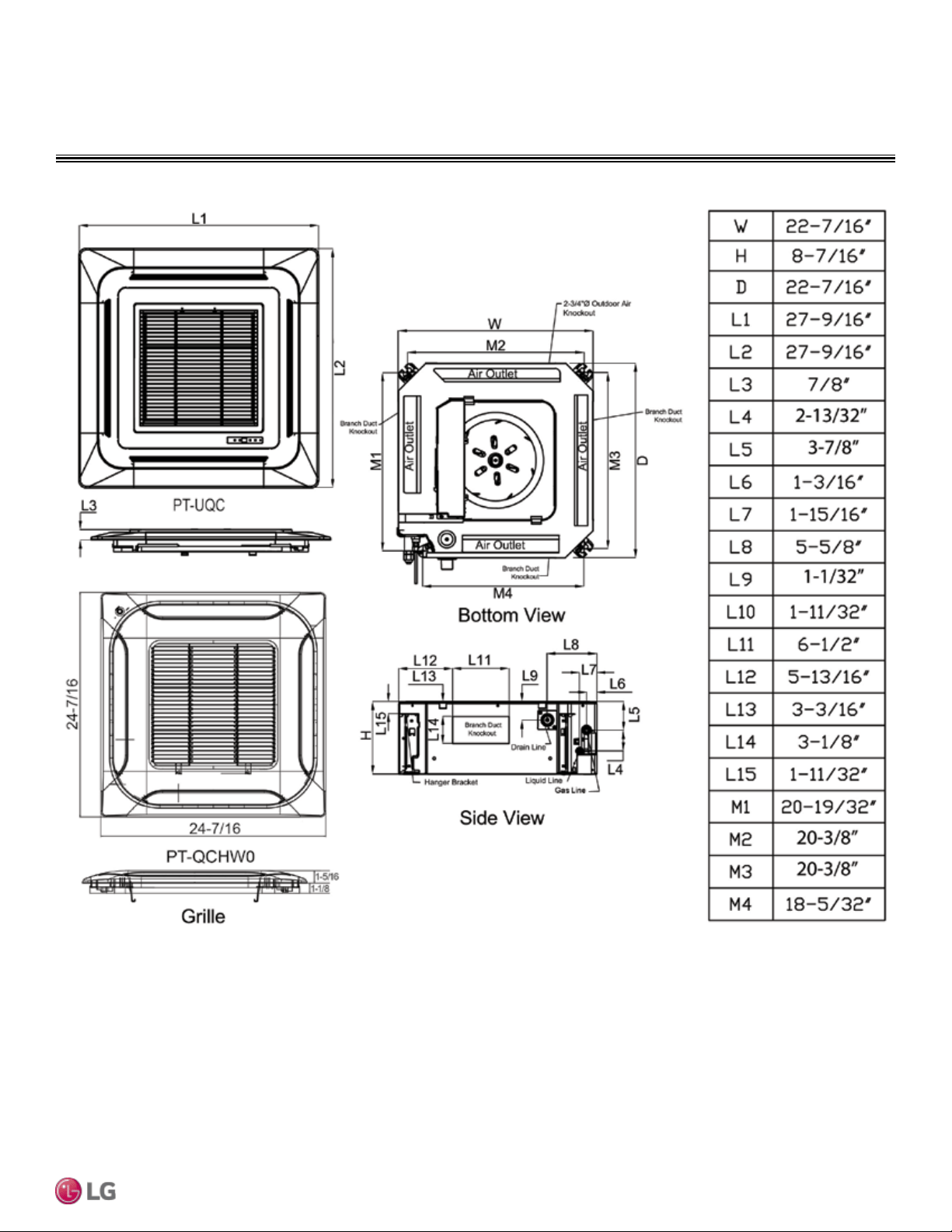
FOUR-WAY CASSETTE | 17
Product Data
Due to our policy of continuous product innovation, some specications may change without notication.
©LG Electronics U.S.A., Inc., Englewood Cliffs, NJ. All rights reserved. “LG” is a registered trademark of LG Corp.
INDOOR UNIT DIMENSIONS
LCN097HV4, LCN127HV4
Figure 5: LCN097HV4, LCN127HV4 Indoor Unit Dimensions.
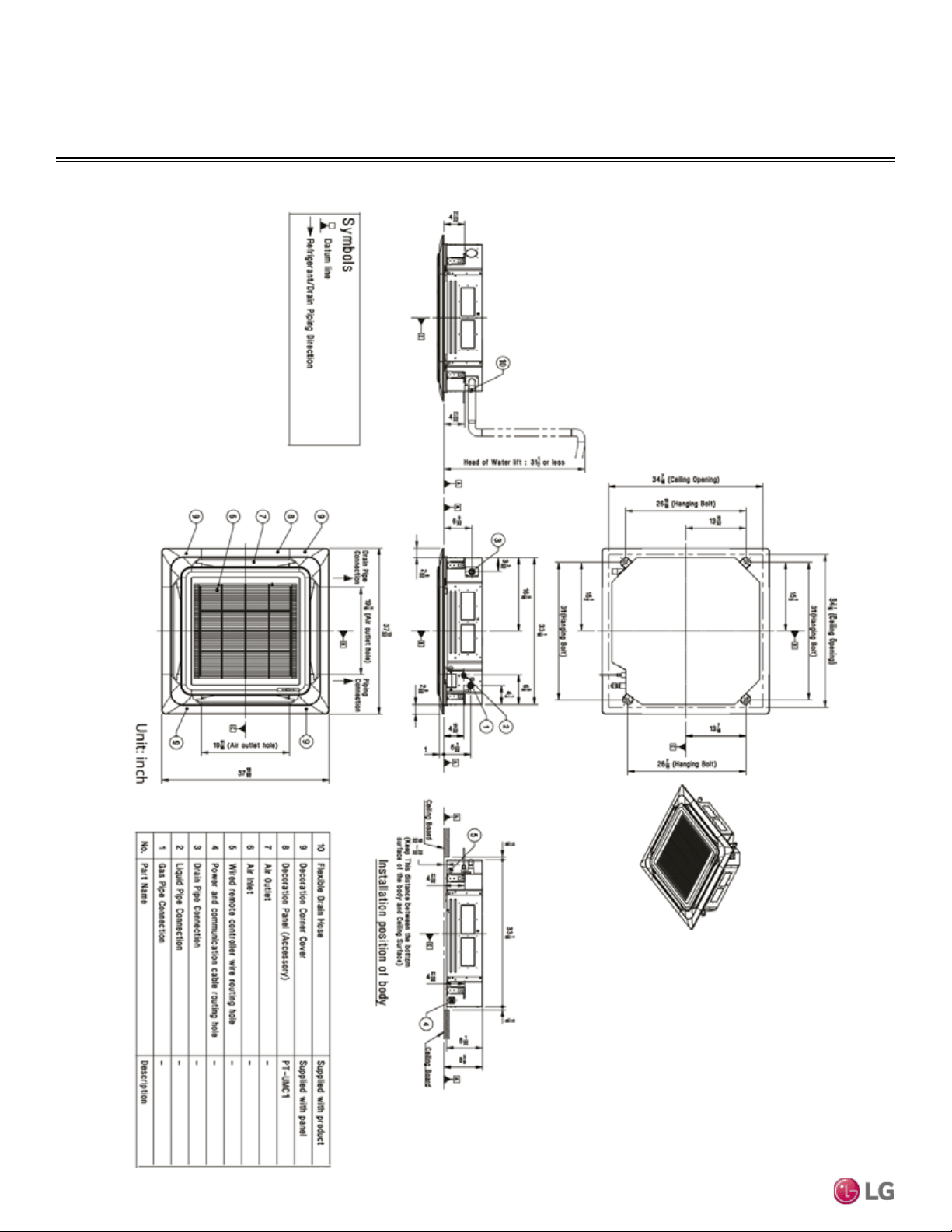
Due to our policy of continuous product innovation, some specications may change without notication.
©LG Electronics U.S.A., Inc., Englewood Cliffs, NJ. All rights reserved. “LG” is a registered trademark of LG Corp.
18 | FOUR-WAY CASSETTE
Four-Way Ceiling Cassette System Engineering Manual
Figure 6: LCN187HV, LCN247HV Indoor Unit Dimensions.
INDOOR UNIT DIMENSIONS
JobName/Location:
Tag#:
Date:
PONo.:
CeilingCassetteSingleZone
Page3of3DFS‐SB‐AC‐006‐US013E23
Forcontinualproductdevelopment,LGreservestherighttochangespecificati onswithoutnotice.
©LGElectronicsU.S.A.,Inc.,EnglewoodCliffs,NJ.Allrig htsreserved.“LGLife’sGood”isaregisteredtrademarkofLGCo rp./www.lghvac.com
IndoorUnit
(
IDU
)
‐LCN187HV
LCN187HV, LCN247HV
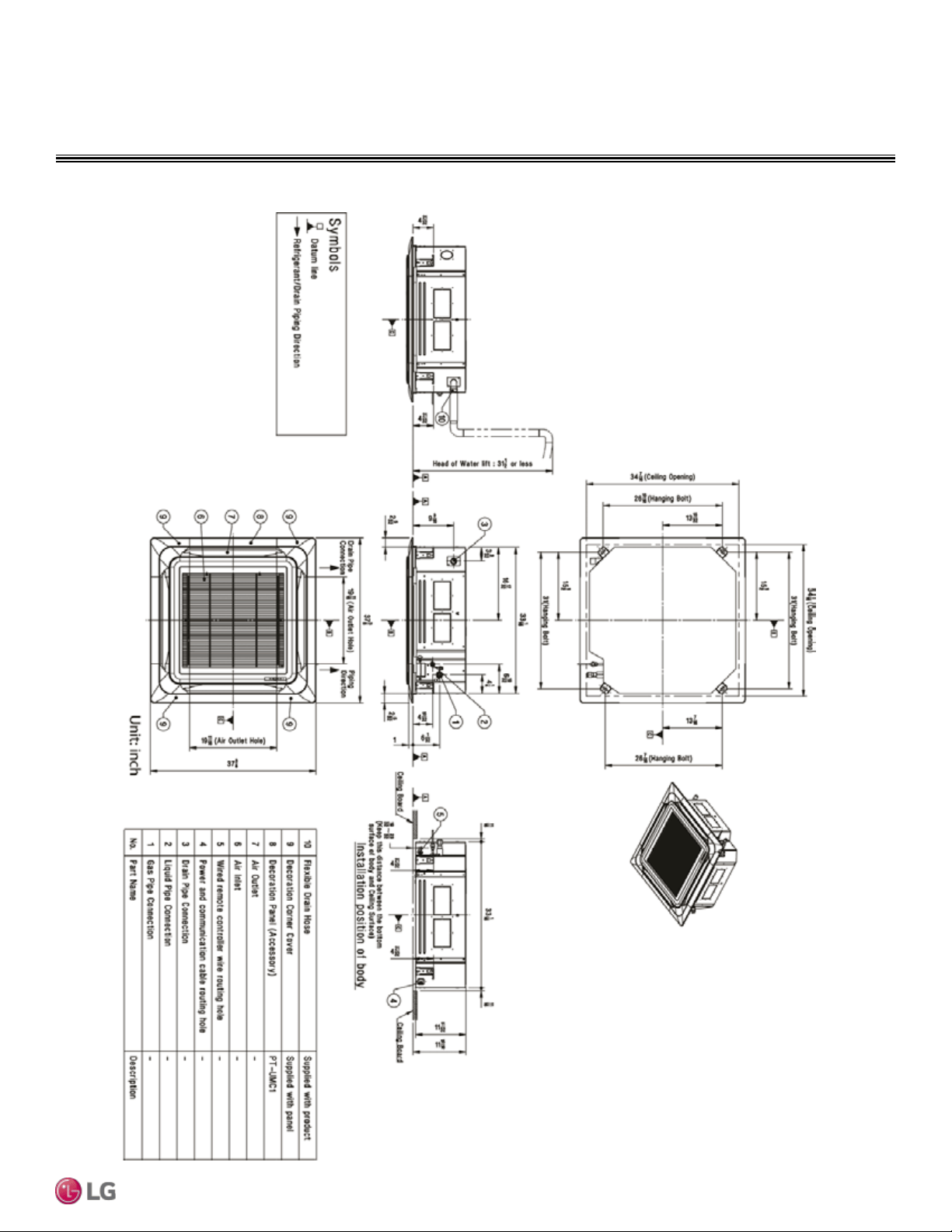
FOUR-WAY CASSETTE | 19
Product Data
Due to our policy of continuous product innovation, some specications may change without notication.
©LG Electronics U.S.A., Inc., Englewood Cliffs, NJ. All rights reserved. “LG” is a registered trademark of LG Corp.
Figure 7: LCN367HV, LCN427HV Indoor Unit Dimensions.
INDOOR UNIT DIMENSIONS
JobName/Location:
Tag#:
Date:
PONo.:
CeilingCassetteSingleZone
Page3of3DFS‐SB‐AC‐007‐US013E23
Forcontinualproductdevelopment,LGreservestherighttochangespecificationswithoutnotice.
©LGElectronicsU.S.A.,Inc.,Englewo odCliffs,NJ.Allrightsreserved.“LGLife’sGood ”isaregisteredtrademarkofLGCorp./www.lghvac.com
IndoorUnit
(
IDU
)
‐LCN367HV
LCN367HV, LCN427HV
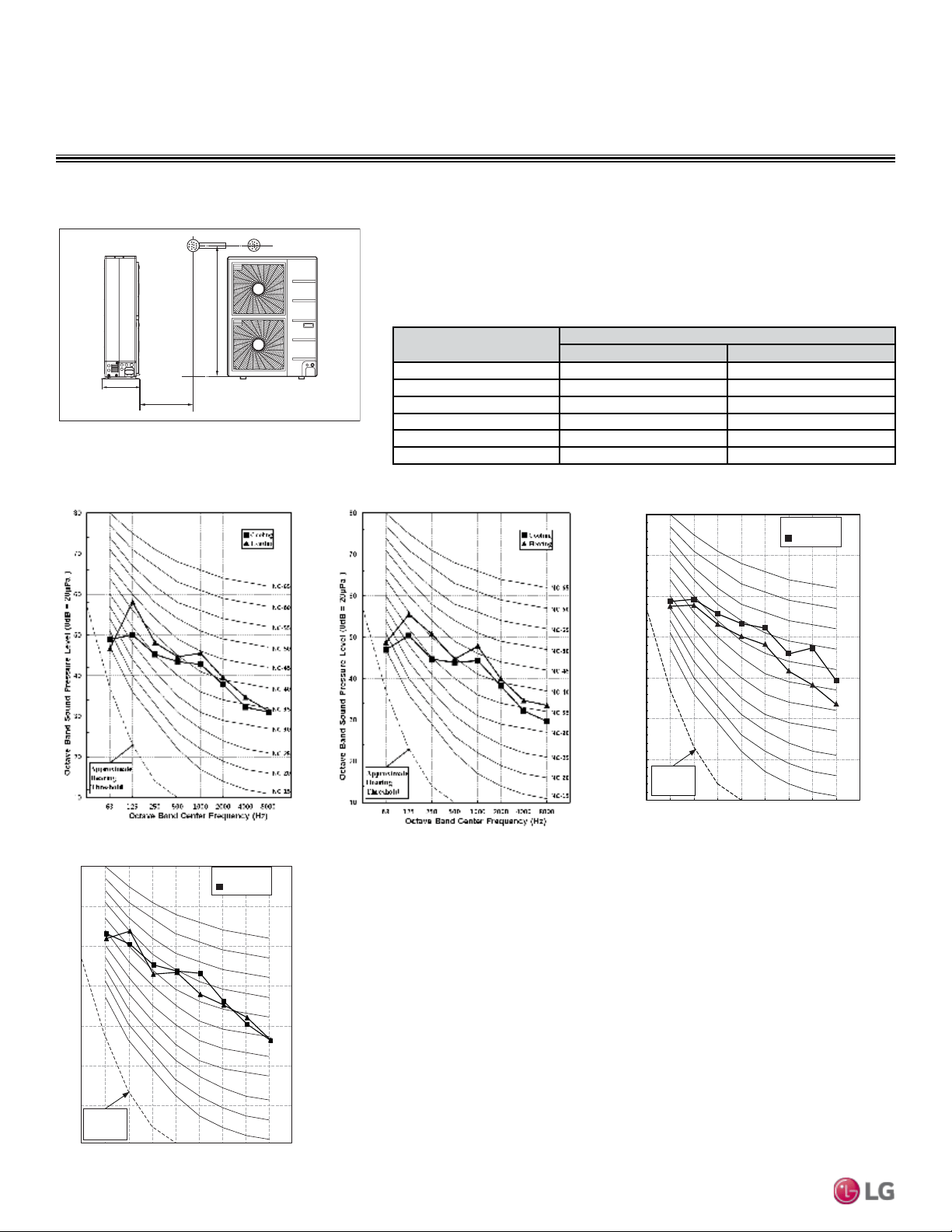
Due to our policy of continuous product innovation, some specications may change without notication.
©LG Electronics U.S.A., Inc., Englewood Cliffs, NJ. All rights reserved. “LG” is a registered trademark of LG Corp.
20 | FOUR-WAY CASSETTE
Four-Way Ceiling Cassette System Engineering Manual
ACOUSTIC DATA
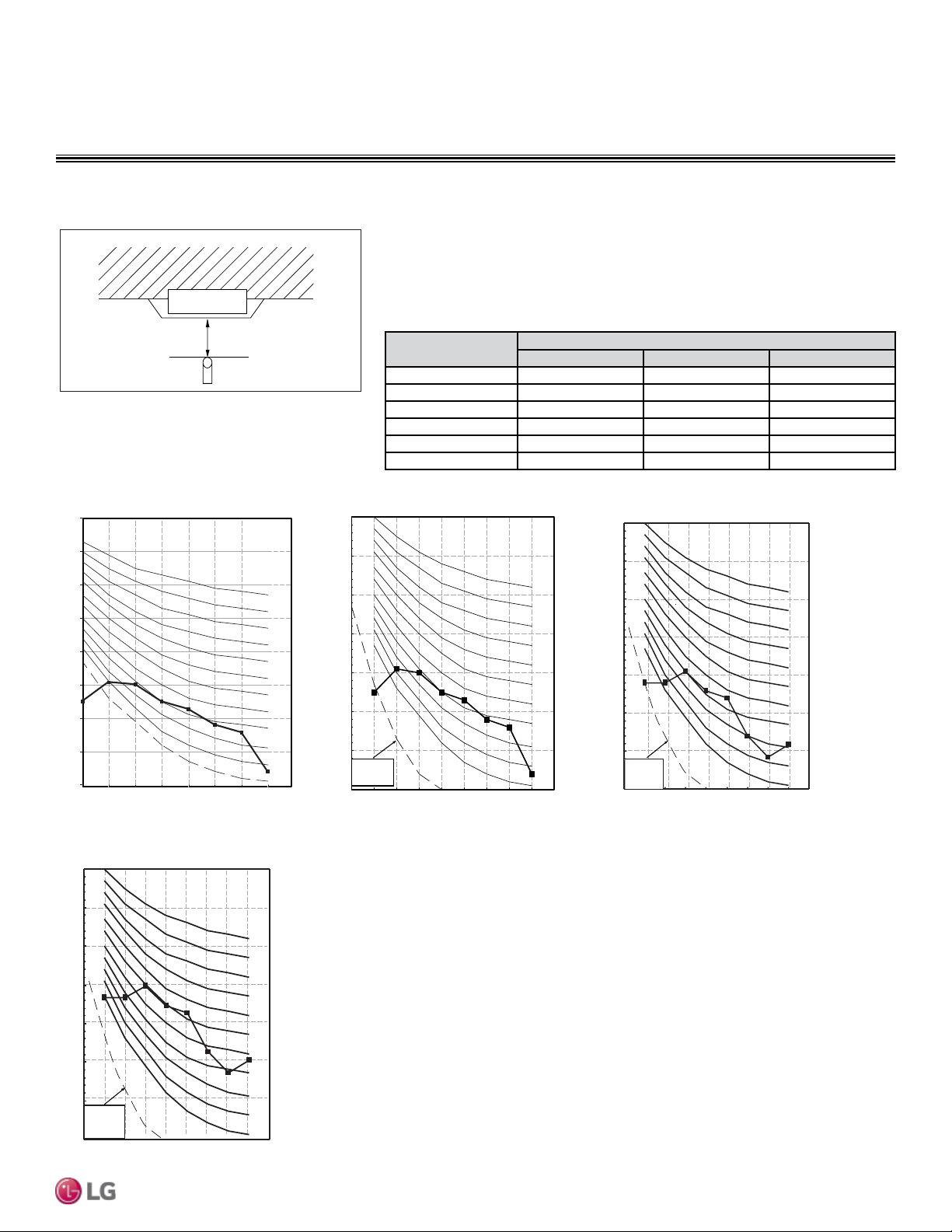
Outdoor Units
• Measurements taken with no attenuation and units operating at full load normal
operating condition.
• Sound level will vary depending on a range of factors such as construction (acous-
tic absorption coefficient) of particular area in which the equipment is installed.
• Sound power levels are measured in dB(A)±3.
• Tested in anechoic chamber per ISO Standard 3745.
Table 5: Four-Way Ceiling Cassette Outdoor Unit Sound Pressure Levels (dB[A]).
Model
Sound Pressure Levels (dB[A])
Cooling Heating
LUU097HV 47 51
LUU127HV 49 52
LUU187HV 48 52
LUU247HV 48 52
LUU367HV 52 54
LUU427HV 52 54
Figure 8: Four-Way Ceiling Cassette Outdoor Unit
Sound Pressure Level Measurement Location.
3.3 ft.
4.9 ft.
D
Figure 9: Four-Way Ceiling Cassette Outdoor Unit
Sound Pressure Level Diagrams.
LUU187HV, LUU247HV
LUU367HV, LUU427HV
Octave Band Center Frequency (Hz)
Octave Band Sound Pressure Level (0dB = 20μPa)
Octave Band Sound Pressure Level (0dB = 20μPa)
10
20
30
40
50
60
70
80
63 125 250 500 1000 2000 4000 8000
NC-15
NC-20
NC-25
NC-30
NC-35
NC-40
NC-45
NC-50
NC-55
NC-60
NC-65
Approximate
Hearing
Threshold
Octave Band Center Frequency (Hz)
10
20
30
40
50
60
70
80
63 125 250 500 1000 2000 4000 8000
NC-15
NC-20
NC-25
NC-30
NC-35
NC-40
NC-45
NC-50
NC-55
NC-60
NC-65
Approximate
Hearing
Threshold
▲ Cooling
Heating
▲ Cooling
Heating
LUU097HV
LUU127HV
LUU187HV, LUU247HV
LUU367HV, LUU427HV
Octave Band Center Frequency (Hz)
Octave Band Sound Pressure Level (0dB = 20μPa)
Octave Band Sound Pressure Level (0dB = 20μPa)
10
20
30
40
50
60
70
80
63 125 250 500 1000 2000 4000 8000
NC-15
NC-20
NC-25
NC-30
NC-35
NC-40
NC-45
NC-50
NC-55
NC-60
NC-65
Approximate
Hearing
Threshold
Octave Band Center Frequency (Hz)
10
20
30
40
50
60
70
80
63 125 250 500 1000 2000 4000 8000
NC-15
NC-20
NC-25
NC-30
NC-35
NC-40
NC-45
NC-50
NC-55
NC-60
NC-65
Approximate
Hearing
Threshold
▲ Cooling
Heating
▲ Cooling
Heating
FOUR-WAY CASSETTE | 21
Product Data
Due to our policy of continuous product innovation, some specications may change without notication.
©LG Electronics U.S.A., Inc., Englewood Cliffs, NJ. All rights reserved. “LG” is a registered trademark of LG Corp.
4.9 ft.
Ceiling
Microphone
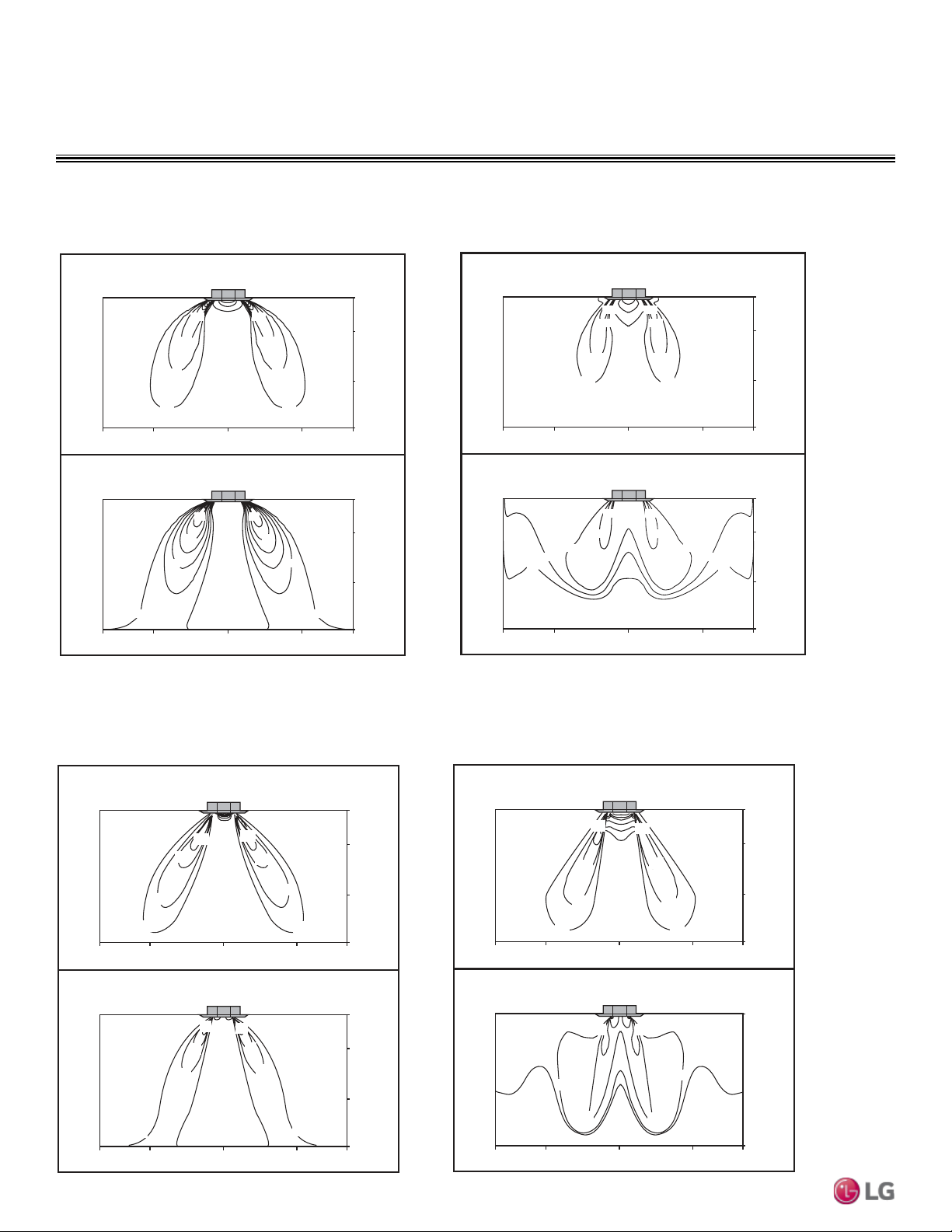
Figure 10: Indoor Unit Sound Pressure Level
Measurement Location.
• Measurements taken with no attenuation and units operating at full load normal
operating condition.
• Sound level will vary depending on a range of factors such as construction (acoustic
absorption coefficient) of particular area in which the equipment is installed.
• Sound power levels are measured in dB(A)±3.
• Tested in anechoic chamber per ISO Standard 3745.
Octave Band Center Frequency (Hz)
Octave Band Sound Pressure Level (0dB = 20μPa)
10
20
30
40
50
60
70
80
63 125 250 500 1000 2000 4000 8000
NC-15
NC-20
NC-25
NC-30
NC-35
NC-40
NC-45
NC-50
NC-55
NC-60
NC-65
Approximate
Hearing
Threshold
Octave Band Center Frequency (Hz)
Octave Band Sound Pressure Level (0dB = 20μPa)
10
20
30
40
50
60
70
80
63 125 250 500 1000 2000 4000 8000
NC-15
NC-20
NC-25
NC-30
NC-35
NC-40
NC-45
NC-50
NC-55
NC-60
NC-65
Approximate
Hearing
Threshold
LCN187HV, LCN247H
VLCN367HV, LCN427HV
Figure 11: Four-Way Ceiling Cassette Indoor Unit
Sound Pressure Level Diagrams.
Table 6: Four-Way Ceiling Cassette Indoor Unit Sound Pressure Levels (dB[A]).
Model
Sound Pressure Levels (dB[A])
H M L
LCN097HV4 36 33 30
LCN127HV4 38 35 32
LCN187HV 38 36 34
LCN247HV 38 36 34
LCN367HV 46 44 43
LCN427HV 46 44 43
ACOUSTIC DATA
Indoor Units
10
20
30
40
50
60
70
80
90
63 125 250 500 1000 2000 4000 8000
Octave Band Center Frequency (Hz)
NC-15
NC-70
NC-65
NC-60
NC-55
NC-50
NC-45
NC-40
NC-35
NC-30
NC-25
NC-20
Sound Pressure Level (dB re 20uPa)
LCN097HV4
Octave band center frequency (Hz)
Sound pressure level (0 dB = 20 µPa)
10
20
30
40
50
60
70
80
63 125 250 500 1000 2000 4000 8000
NC-15
NC-20
NC-25
NC-30
NC-35
NC-40
NC-45
NC-50
NC-55
NC-60
NC-65
Approximate
Hearing
Threshold
LCN127HV4
Octave Band Center Frequency (Hz)
Octave Band Sound Pressure Level (0dB = 20μPa)
10
20
30
40
50
60
70
80
63 125 250 500 1000 2000 4000 8000
NC-15
NC-20
NC-25
NC-30
NC-35
NC-40
NC-45
NC-50
NC-55
NC-60
NC-65
Approximate
Hearing
Threshold
Octave Band Center Frequency (Hz)
Octave Band Sound Pressure Level (0dB = 20μPa
)
10
20
30
40
50
60
70
80
63 125 250 500 1000 2000 4000 8000
NC-15
NC-20
NC-25
NC-30
NC-35
NC-40
NC-45
NC-50
NC-55
NC-60
NC-65
Approximate
Hearing
Threshold
LCN187HV, LCN247HVL
CN367HV, LCN427HV
Due to our policy of continuous product innovation, some specications may change without notication.
©LG Electronics U.S.A., Inc., Englewood Cliffs, NJ. All rights reserved. “LG” is a registered trademark of LG Corp.
22 | FOUR-WAY CASSETTE
Four-Way Ceiling Cassette System Engineering Manual
AIR VELOCITY AND TEMPERATURE DISTRIBUTION
Figure 12: LCN097HV4 Air Velocity and Temperature Distribution Charts.
Figure 13: LCN127HV4 Air Velocity and Temperature Distribution Charts.
Cooling Heating
Discharge angle: 40°
Air velocity [ft/s]
Temperature [°F]
9ft
7ft
3ft
0ft
0ft
5ft5ft8ft8ft0ft
9ft
7ft
3ft
0ft
5f
t5
ft8f
t8
ft0ft
9ft
7ft
3ft
5ft5ft8ft8ft0ft
0ft
9ft
7ft
3ft
5f
t5
ft8f
t8
ft0ft
6.66.6
4.94.9
3.33.3
1.61.6
6464
6868
7272
7575
Discharge angle: 50°
Air velocity [ft/s]
Temperature [°F]
6.66.6
4.94.9
3.33.3
1.61.6
9191
8686
8181
7575
7070
Cooling Heating
Discharge angle: 40°
Air velocity [ft/s]
Temperature [°F]
9ft
7ft
3ft
0ft
0ft
5ft5ft8ft8ft0ft
9ft
7ft
3ft
0ft
5f
t5ft8ft8ft0ft
9ft
7ft
3ft
5ft5ft8ft8ft0ft
0ft
9ft
7ft
3ft
5f
t5ft8ft8ft0ft
Discharge angle: 50°
Air velocity [ft/s]
Temperature [°F]
6.6
6.6
4.6
4.6
3.3
3.3
1.6
1.6
9191
81
81
75
75
75
6.6
6.6
4.6
4.6
3.3
3.3
1.6
1.6
64
64
68
72
72
68
75
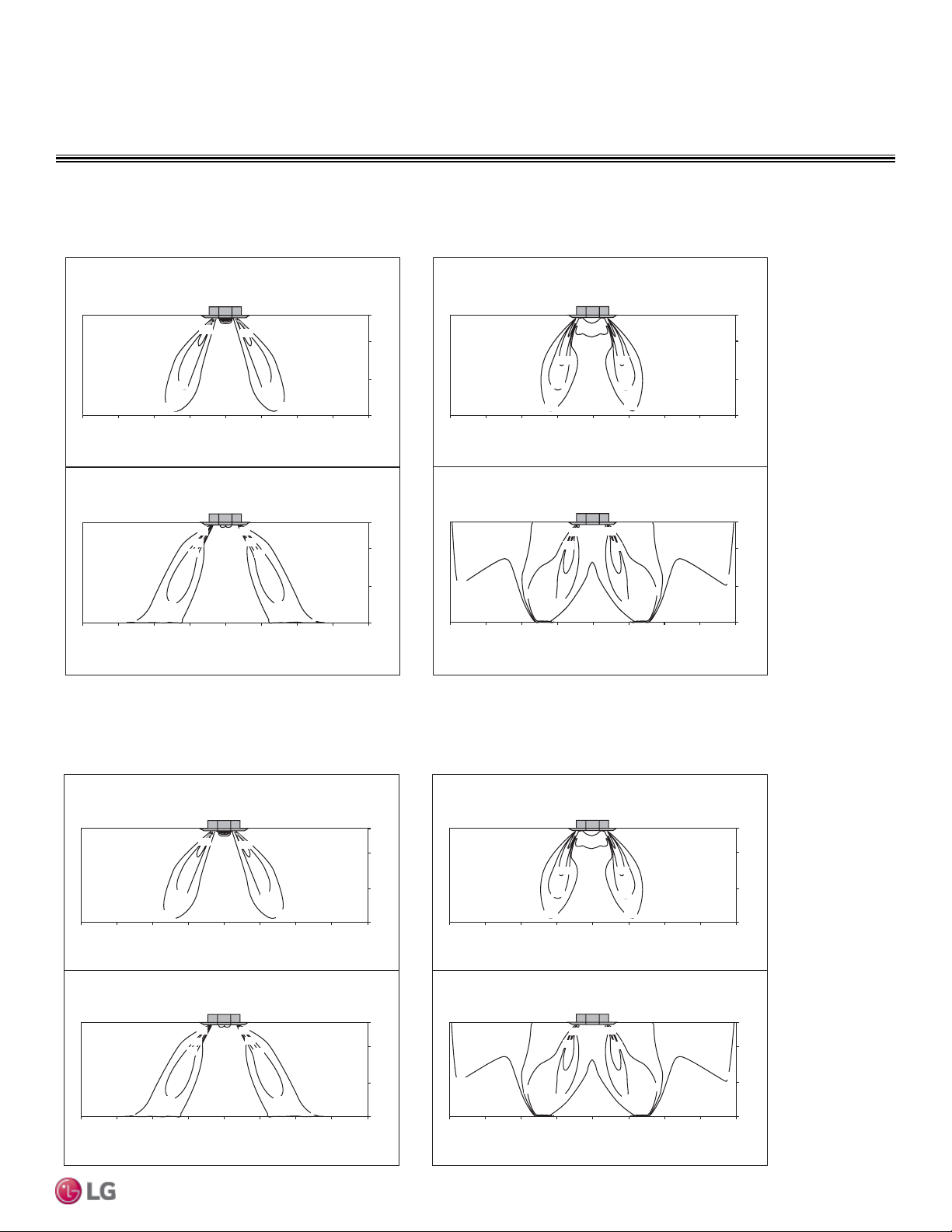
FOUR-WAY CASSETTE | 23
Product Data
Due to our policy of continuous product innovation, some specications may change without notication.
©LG Electronics U.S.A., Inc., Englewood Cliffs, NJ. All rights reserved. “LG” is a registered trademark of LG Corp.
Figure 14: LCN187HV Air Velocity and Temperature Distribution Charts.
Figure 15: LCN247HV Air Velocity and Temperature Distribution Charts.
Cooling Heating
Discharge angle: 40°
Air velocity [ft/s]
Temperature [°F]
9ft
7ft
3ft
0ft
13ft10ft10ft13ft7ft7ft3ft3ft 0ft
9ft
7ft
3ft
13ft10ft10ft13ft7ft7ft3ft3ft 0ft
9ft
7ft
3ft
0ft
13ft10ft10ft13ft7ft7ft3ft3ft 0ft
9ft
7ft
3ft
0ft
13ft10ft10ft13ft7ft7ft 3ft3ft0ft
6.6
6.6
4.6
4.6
3.3
3.3
Discharge angle: 50°
Air velocity [ft/s]
Temperature [°F]
91
91
86
86
81
81
75
75
72
72
75
75
6.6 6.6
3.3
3.3
1.6
1.6
68
6464
68
72
72
73
73
CoolingHeating
Discharge angle: 40°
Air velocity [ft/s]
Temperature [°F]
9ft
7ft
3ft
0ft
13ft10ft10ft13ft7ft7ft 3ft3ft0ft
9ft
7ft
3ft
13ft10ft10ft13ft7ft7ft 3ft3ft0ft
9ft
7ft
3ft
0ft
13ft10ft10ft13ft 7ft7ft3ft3ft 0ft
9ft
7ft
3ft
0ft
13ft10ft10ft13ft 7ft7ft3ft3ft0ft
6.6
6.6
4.6
4.6
3.3
3.3
Discharge angle: 50°
Air velocity [ft/s]
Temperature [°F]
91
91
86
86
81
81
75
75
72
72
75
75
6.6 6.6
3.3
3.3
1.6
1.6
68
6464
68
72
72
73
73
AIR VELOCITY AND TEMPERATURE DISTRIBUTION
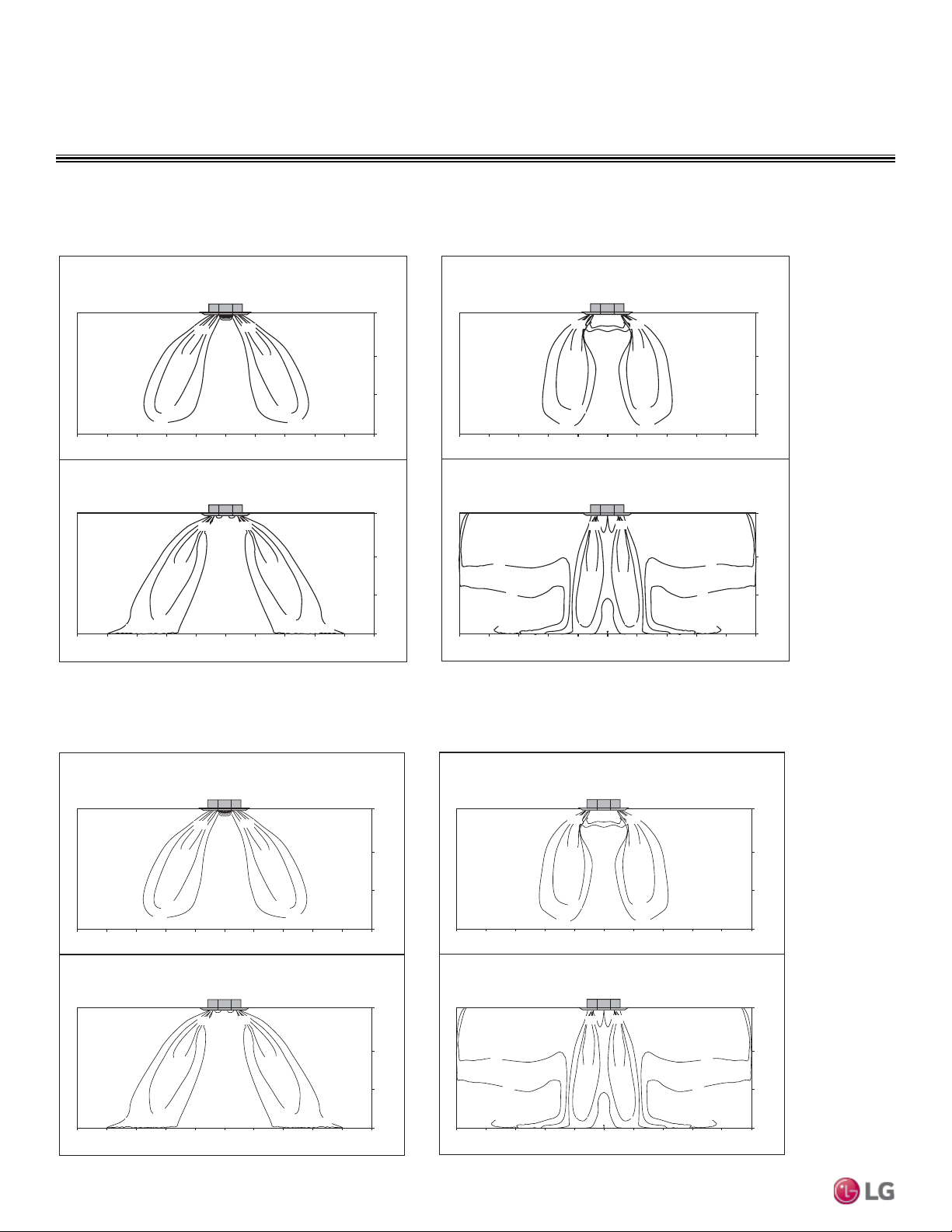
Due to our policy of continuous product innovation, some specications may change without notication.
©LG Electronics U.S.A., Inc., Englewood Cliffs, NJ. All rights reserved. “LG” is a registered trademark of LG Corp.
24 | FOUR-WAY CASSETTE
Four-Way Ceiling Cassette System Engineering Manual
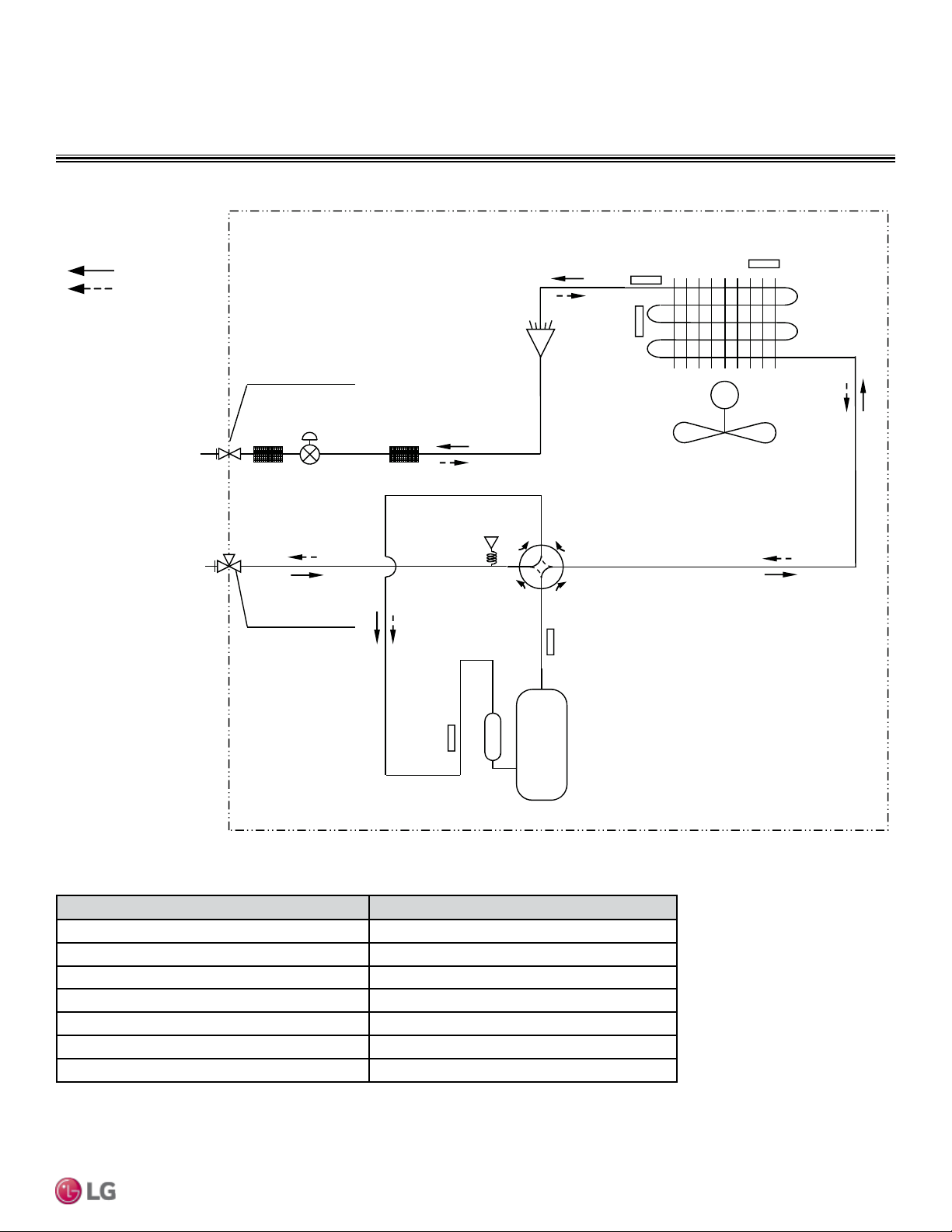
Figure 16: LCN367HV Air Velocity and Temperature Distribution Charts.
Figure 17: LCN427HV Air Velocity and Temperature Distribution Charts.
AIR VELOCITY AND TEMPERATURE DISTRIBUTION
Cooling Heating
Discharge angle: 40°
Air velocity [ft/s]
Temperature [°F]
13.1
13.1
9.8
9.8
6.6
6.6
3.3
3.3
Discharge angle: 50°
Air velocity [ft/s]
Temperature [°F]
10.5ft
0ft
13ft 16ft10ft16ft 7ft3ft3ft0ft
7ft
3ft
10ft 7ft13ft
10.5ft
13ft 16ft10ft16ft 7ft3ft3ft0ft
7ft
3ft
10ft 7ft13ft
10.5ft
13ft 16ft10ft16ft 7ft3ft3ft0ft
7ft
3ft
10ft 7ft13ft
10.5ft
13ft 16ft10ft16ft 7ft3ft3ft0ft
7ft
3ft
10ft 7ft13ft
75
91
91
75
81
81
86
86
72
72
13.113.1
9.8
9.8
6.6
6.6
3.3
3.3
64
64
68
68
72
72
75
75
Cooling Heating
Discharge angle: 40°
Air velocity [ft/s]
Temperature [°F]
13.1
13.1
9.8
9.8
6.6
6.6
3.3
3.3
Discharge angle: 50°
Air velocity [ft/s]
Temperature [°F]
10.5ft
0ft
13ft 16ft10ft16ft 7ft3ft3ft0ft
7ft
3ft
10ft 7ft13ft
10.5ft
13ft 16ft10ft16ft 7ft3ft3ft0ft
7ft
3ft
10ft 7ft13ft
10.5ft
13ft 16ft10ft16ft 7ft3ft3ft0ft
7ft
3ft
10ft 7ft13ft
10.5ft
13ft 16ft10ft16ft 7ft3ft3ft0ft
7ft
3ft
10ft7ft13ft
75
91
91
75
81
81
86
86
72
72
13.113.1
9.8
9.8
6.6
6.6
3.3
3.3
64
64
68
68
72
72
75
75
FOUR-WAY CASSETTE | 25
Product Data
Due to our policy of continuous product innovation, some specications may change without notication.
©LG Electronics U.S.A., Inc., Englewood Cliffs, NJ. All rights reserved. “LG” is a registered trademark of LG Corp.
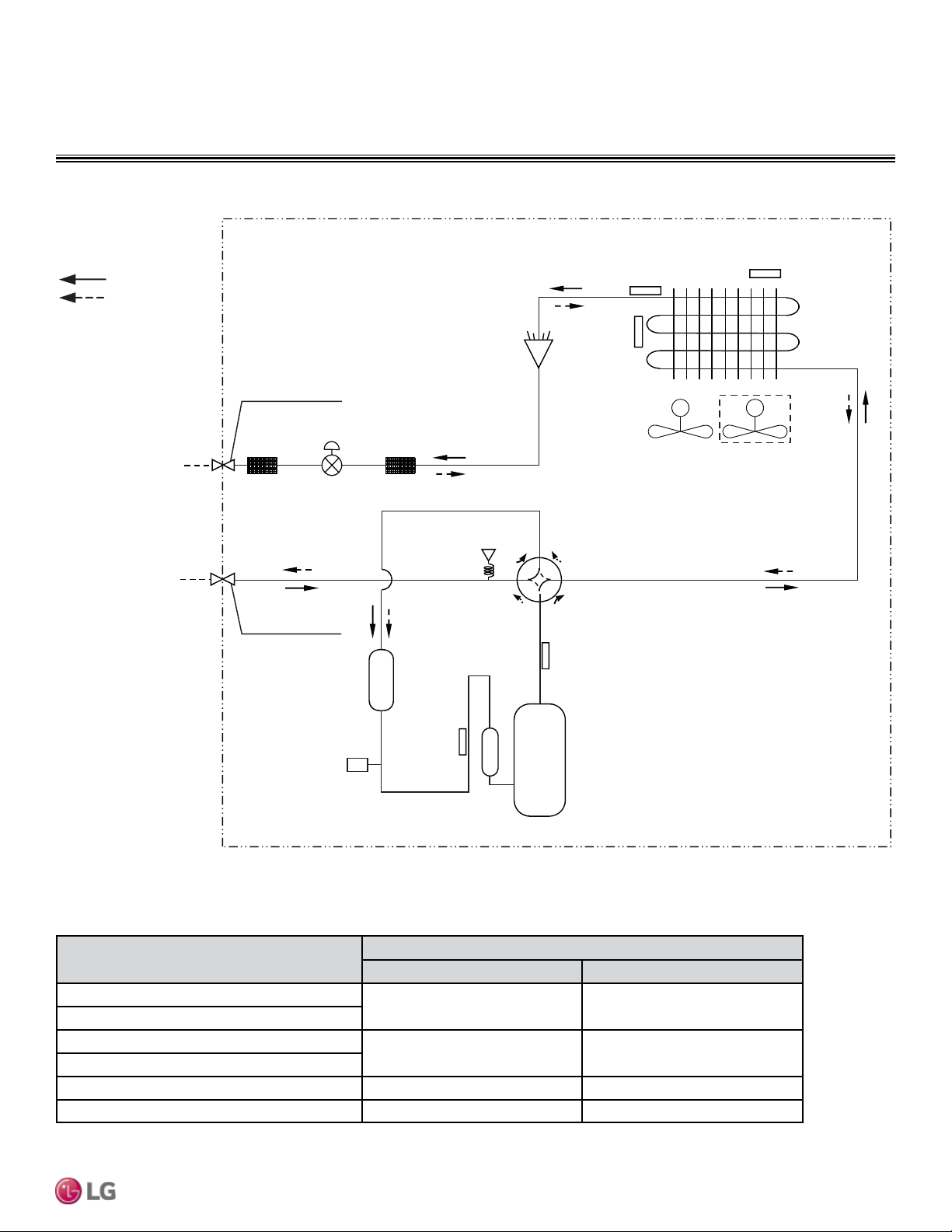
LUU097, 127HV
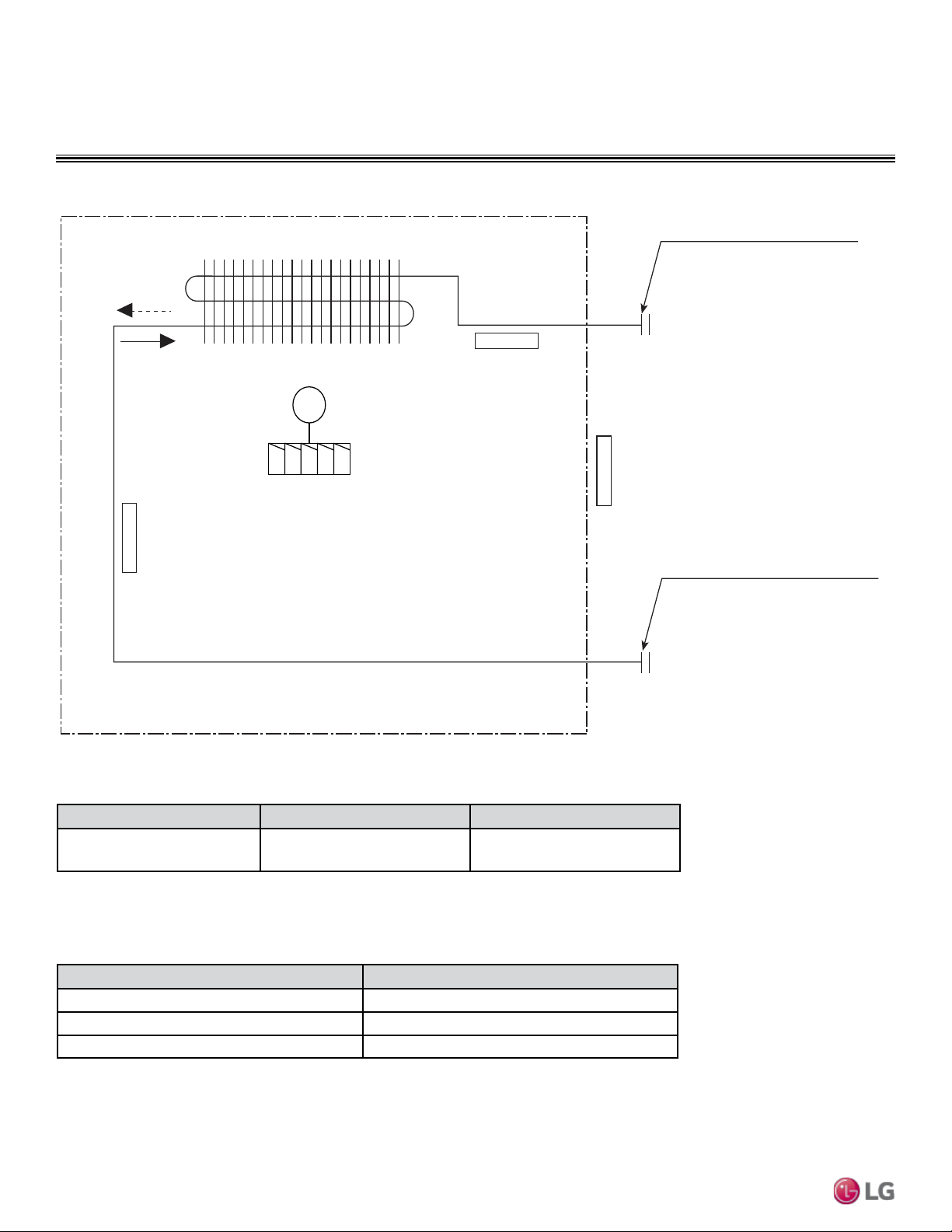
OUTDOOR UNIT REFRIGERANT FLOW DIAGRAM
Figure 18: LUU097, 127HV Refrigerant Flow Diagram.
Description PCB Connector
Condenser Inlet Temperature Thermistor CN-AIR
Condenser Outlet Temperature Thermistor CN-C_PIPE
Discharge Temperature Thermistor CN-DISCHARGE
Suction Temperature Thermistor CN-SUCTION
Condensing Temperature Thermistor CN-MID
High Pressure Sensor CN-H_PRESSURE
Electronic Expansion Valve CN-EEV_A
Table 7: LUU097-127HV Four-Way Ceiling Concealed Outdoor Unit Thermistor Details.
Refrigerant Flow
Cooling
Heating
M
High
Pressure
Sensor
4 way
Valve
Discharge
Temperature
Thermistor
Suction
Temperature
Thermistor
Inverter
Compressor
Electronic
Expansion
Valve
Strainer Strainer
Condenser Out
Temperature
Thermistor
Inlet Air
Temperature
Thermistor
1/4
Flare Connection
3/8
Flare Connection
Condensing
Temperature
Thermistor
Due to our policy of continuous product innovation, some specications may change without notication.
©LG Electronics U.S.A., Inc., Englewood Cliffs, NJ. All rights reserved. “LG” is a registered trademark of LG Corp.
26 | FOUR-WAY CASSETTE
Four-Way Ceiling Cassette System Engineering Manual
INDOOR UNIT REFRIGERANT FLOW DIAGRAM
LCN097, 127HV4
Figure 19: LCN097, 127HV4 Refrigerant Flow Diagram.
Table 8: Four-Way Ceiling Cassette Indoor Unit Refrigerant Pipe Connection Port Diameters.
Model No. Vapor (inch) Liquid (inch)
LCN097HV4, LCN127HV4 3/8 1/4
Table 9: Four-Way Ceiling Cassette Indoor Unit Thermistor Details.
Description (Based on Cooling Mode) PCB Connector
Indoor Air Temperature Thermistor CN-ROOM
Evaporator Inlet Temperature Thermistor CN-PIPE / IN
Evaporator Outlet Temperature Thermistor CN-PIPE / OUT
Heat exchanger
Gas pipe connection port
(flare connection)
Liquid pipe connection port
(flare connection)
Turbo fan
M
Cooling
Heating
Indoor Air
Temperature Thermistor
Evaporator Inlet
Temperature Thermistor
Evaporator Outlet
Temperature Thermistor
FOUR-WAY CASSETTE | 27
Product Data
Due to our policy of continuous product innovation, some specications may change without notication.
©LG Electronics U.S.A., Inc., Englewood Cliffs, NJ. All rights reserved. “LG” is a registered trademark of LG Corp.
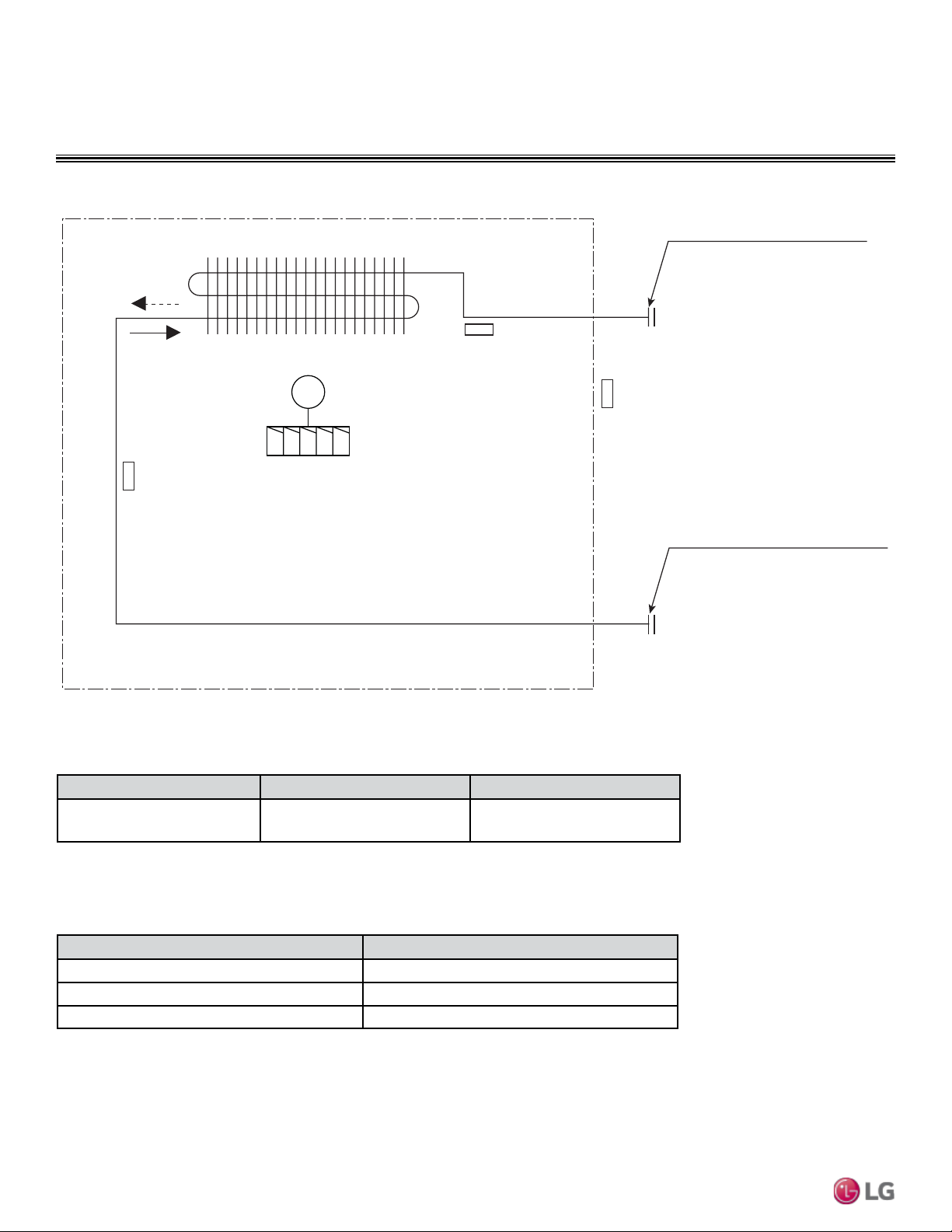
LUU187, 247, 367, 427HV
Description (Based on Cooling Mode)
PCB Connector
LUU247HV LUU367HV
Suction Temperature Thermistor
CN-TH3 CN-TH3
Discharge Temperature Thermistor
Condenser Outlet Temperature Thermistor
CN-TH2 CN-TH2
Outdoor Ambient Air Temperature Thermistor
Condenser Inlet Temperature Thermistor CN-TH4 CN-TH4
Pressure Sensor CN-TH1 P-SENSOR(H)
Table 10: LUU197~427 Four-Way Ceiling Concealed Outdoor Unit Thermistor Details.
OUTDOOR UNIT REFRIGERANT FLOW DIAGRAM
Refrigerant Flow
Cooling
Heating
MM
High Pressure
Sensor
4 way
36k/42k model only
Valve
Discharge
Temperature
Thermistor
Suction
Temperature
Fusible
Plug
Thermistor
Accumulator
Inverter
Compressor
Strainer Strainer
Condenser Out
Temperature
Thermistor
Outdoor Ambient Air
Temperature
Thermistor
Ø3/8
Flare Connection
Ø5/8
Flare Connection
Condensing
Temperature
Thermistor
Electronic
Expansion Valve
Liquid Side
Piping
Vapor Side
Piping
SVC
SVC
Figure 20: LUU187, 247, 367, 427HV Refrigerant Flow Diagram.
Due to our policy of continuous product innovation, some specications may change without notication.
©LG Electronics U.S.A., Inc., Englewood Cliffs, NJ. All rights reserved. “LG” is a registered trademark of LG Corp.
28 | FOUR-WAY CASSETTE
Four-Way Ceiling Cassette System Engineering Manual
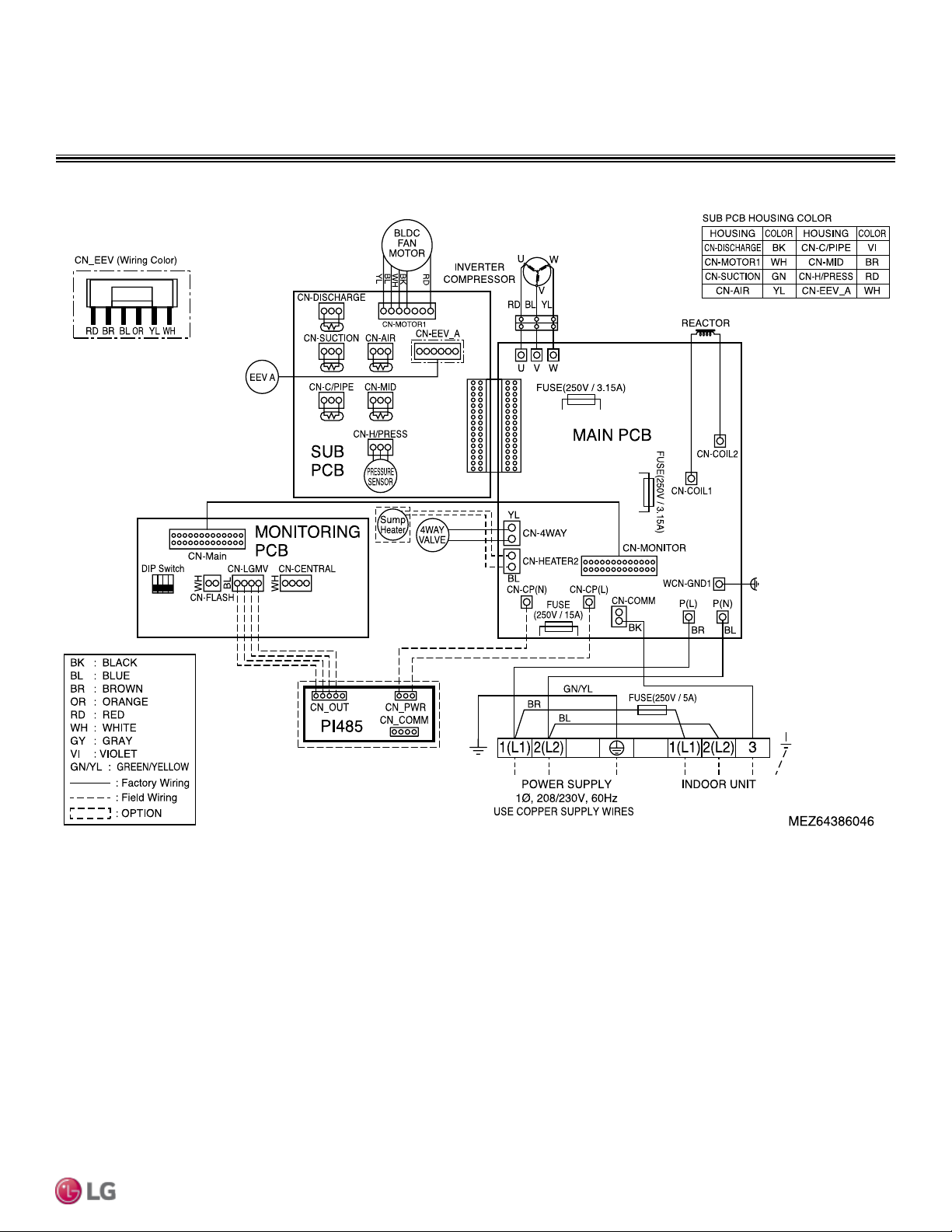
INDOOR UNIT REFRIGERANT FLOW DIAGRAM
Table 11: LCN187~427HV Four-Way Ceiling Cassette Indoor Unit Refrigerant Pipe Connection Port Diameters.
Model No. Vapor (inch) Liquid (inch)
LCN187HV, LC247HV,
LCN367HV, LC427HV
5/8 3/8
Table 12: LCN187~427HV Four-Way Ceiling Cassette Indoor Unit Thermistor Details.
Description (Based on Cooling Mode) PCB Connector
Indoor Air Temperature Thermistor CN-ROOM
Evaporator Inlet Temperature Thermistor CN-PIPE / IN
Evaporator Outlet Temperature Thermistor CN-PIPE / OUT
Heat exchanger
Gas pipe connection port
(flare connection)
Liquid pipe connection port
(flare connection)
Turbo fan
Cooling
Heating
M
Indoor Air
Temperature Thermistor
Evaporator Inlet
Temperature Thermistor
Evaporator Outlet
Temperature Thermistor
Figure 21: LCN187, 247, 367, 427HV Refrigerant Flow Diagram.
LCN187, 247, 367, 427HV
FOUR-WAY CASSETTE | 29
Product Data
Due to our policy of continuous product innovation, some specications may change without notication.
©LG Electronics U.S.A., Inc., Englewood Cliffs, NJ. All rights reserved. “LG” is a registered trademark of LG Corp.
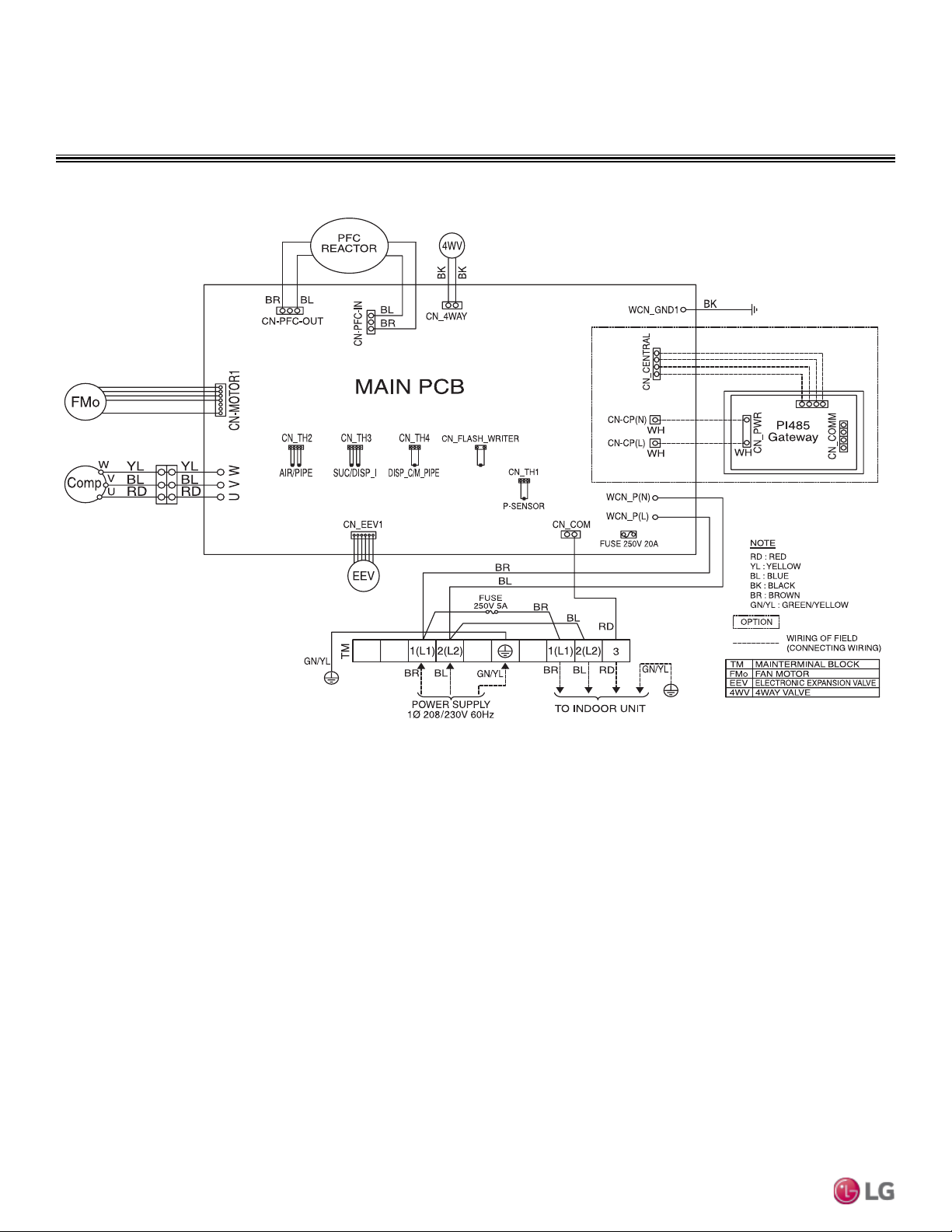
OUTDOOR UNIT WIRING DIAGRAM
LUU097HV and LUU127HV
Figure 22: Four-Way Ceiling Cassette LUU097HV and LUU127HV Outdoor Unit Wiring Diagram.
Due to our policy of continuous product innovation, some specications may change without notication.
©LG Electronics U.S.A., Inc., Englewood Cliffs, NJ. All rights reserved. “LG” is a registered trademark of LG Corp.
30 | FOUR-WAY CASSETTE
Four-Way Ceiling Cassette System Engineering Manual
OUTDOOR UNIT WIRING DIAGRAM
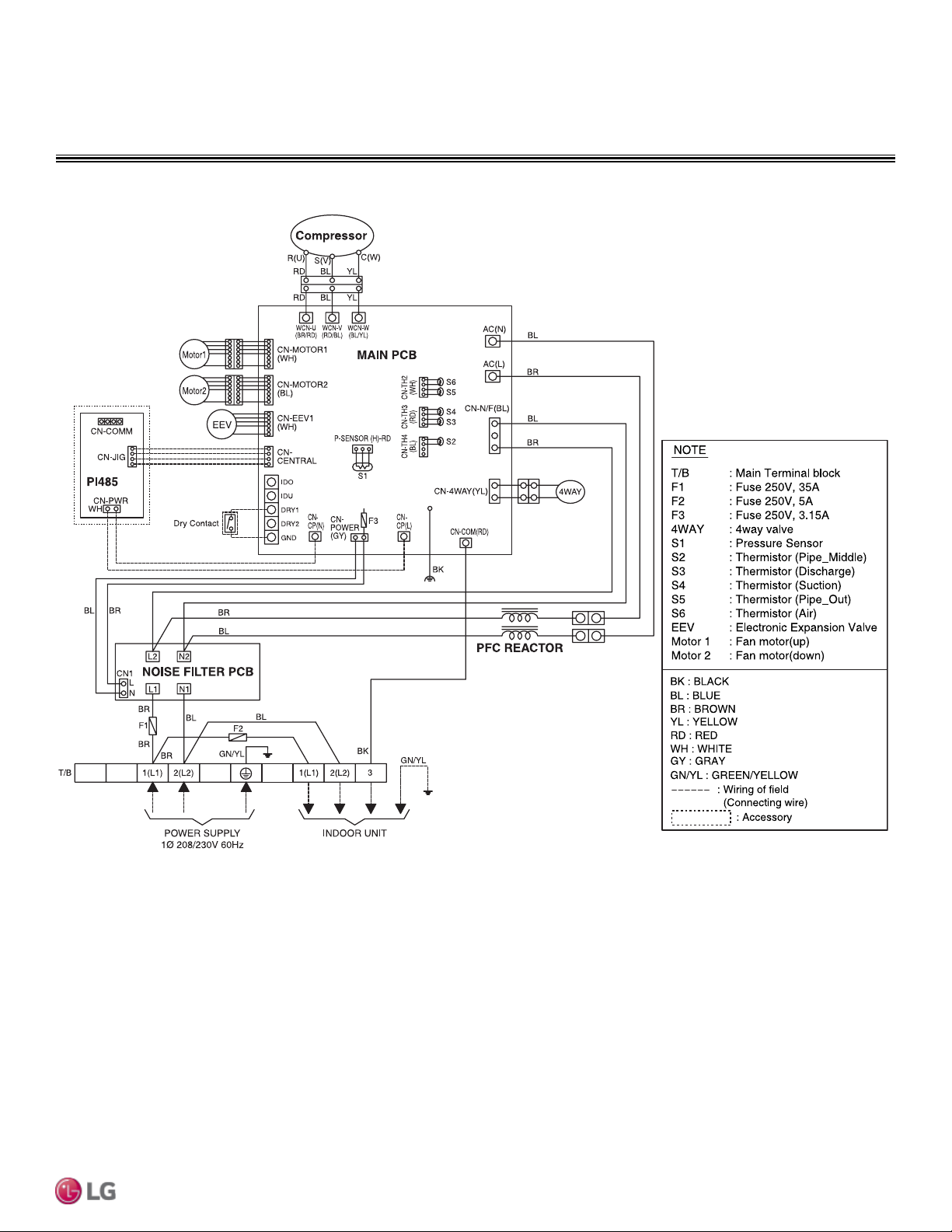
Figure 23: Four-Way Ceiling Cassette LUU187HV and LUU247HV Outdoor Unit Wiring Diagram.
LUU187HV and LUU247HV
FOUR-WAY CASSETTE | 31
Product Data
Due to our policy of continuous product innovation, some specications may change without notication.
©LG Electronics U.S.A., Inc., Englewood Cliffs, NJ. All rights reserved. “LG” is a registered trademark of LG Corp.
OUTDOOR UNIT WIRING DIAGRAM
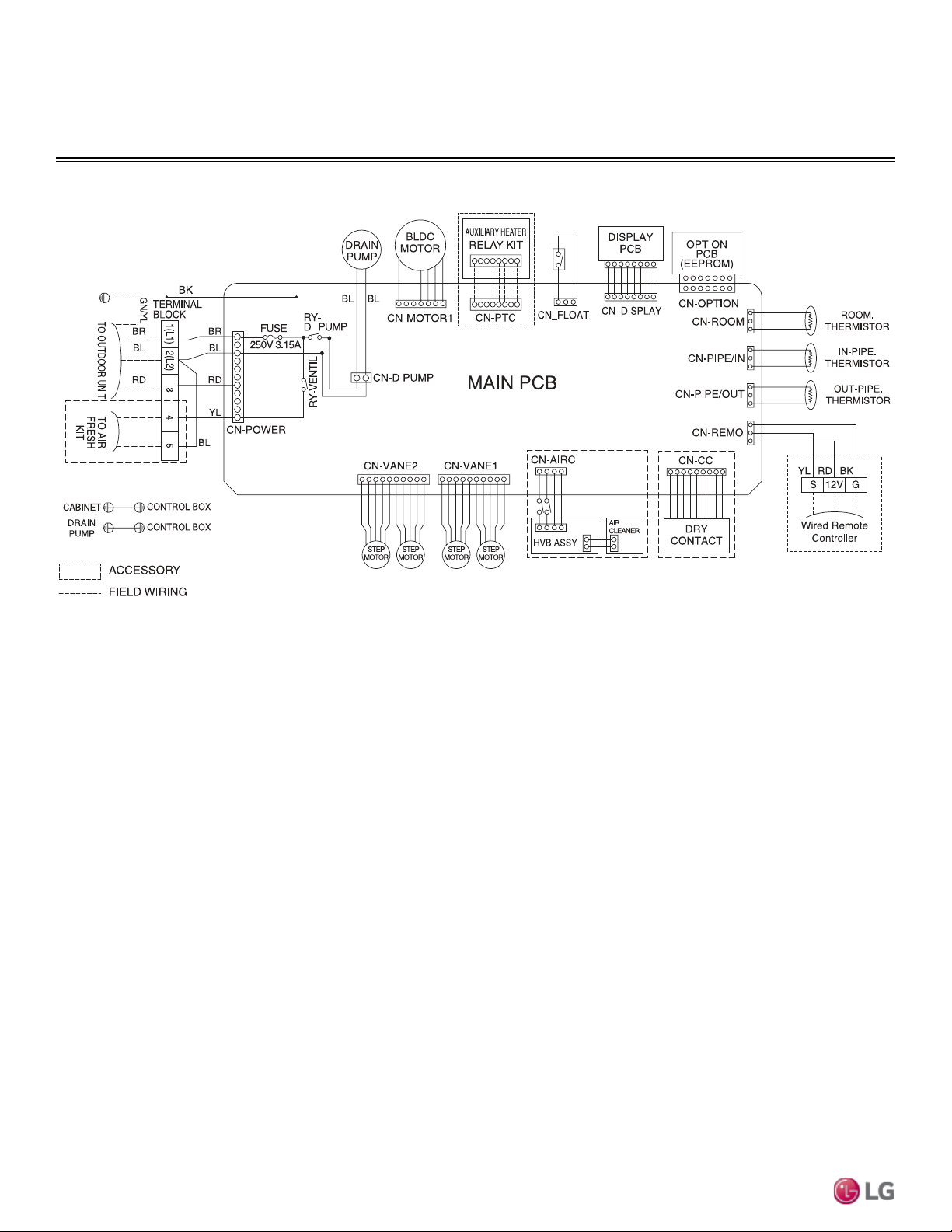
LUU367HV and LUU427HV
Figure 24: Four-Way Ceiling Cassette LUU367HV and LUU427HV Outdoor Unit Wiring Diagram.
Due to our policy of continuous product innovation, some specications may change without notication.
©LG Electronics U.S.A., Inc., Englewood Cliffs, NJ. All rights reserved. “LG” is a registered trademark of LG Corp.
32 | FOUR-WAY CASSETTE
Four-Way Ceiling Cassette System Engineering Manual
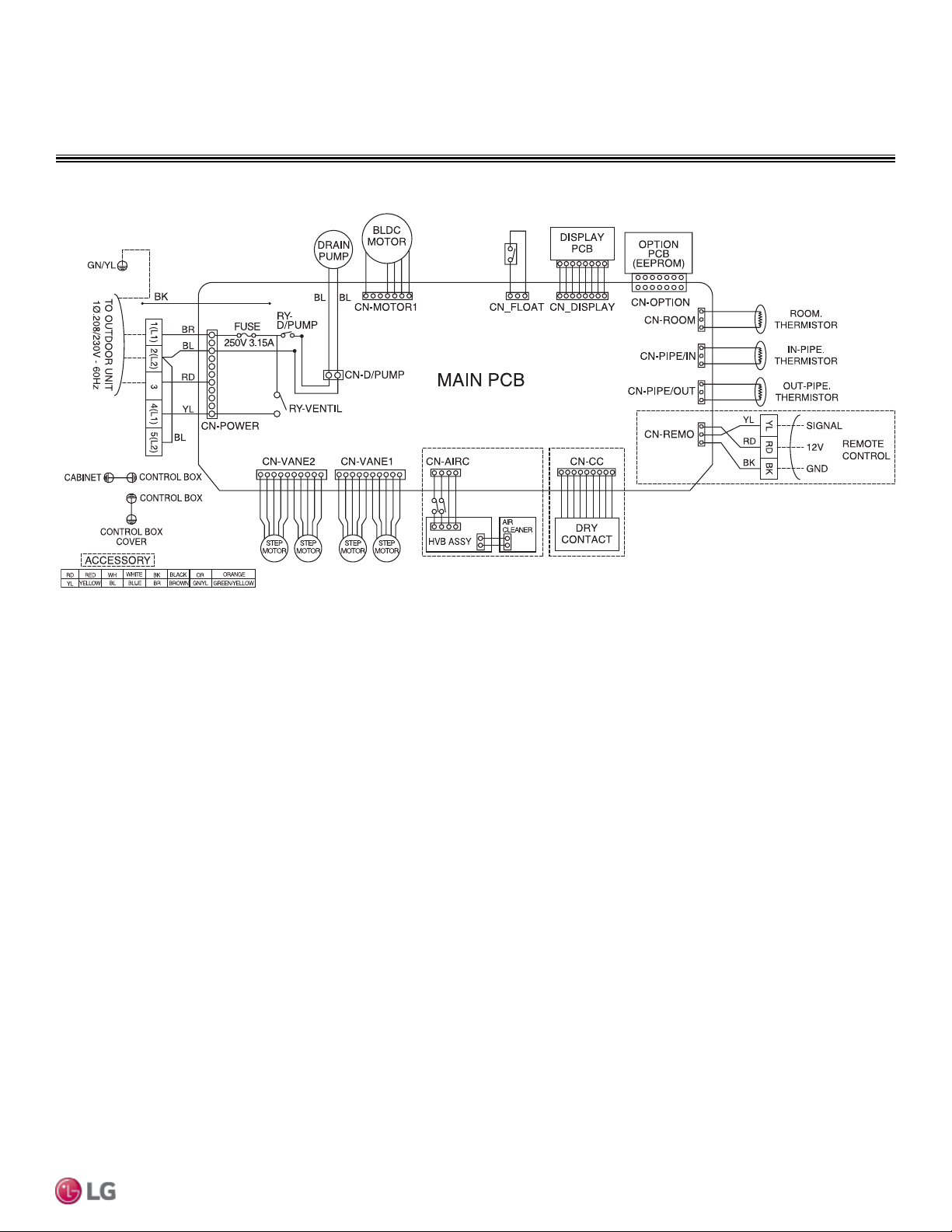
LCN097,127HV4
INDOOR UNIT WIRING DIAGRAM
Figure 25: Four-Way Ceiling Cassette LCN097, 127HV4 Indoor Unit Wiring Diagram.
FOUR-WAY CASSETTE | 33
Product Data
Due to our policy of continuous product innovation, some specications may change without notication.
©LG Electronics U.S.A., Inc., Englewood Cliffs, NJ. All rights reserved. “LG” is a registered trademark of LG Corp.
LCN187, 247, 367, 427HV
INDOOR UNIT WIRING DIAGRAM
Figure 26: Four-Way Ceiling Cassette LCN187, 247, 367, 427 HV Indoor Unit Wiring Diagram.
Due to our policy of continuous product innovation, some specications may change without notication.
©LG Electronics U.S.A., Inc., Englewood Cliffs, NJ. All rights reserved. “LG” is a registered trademark of LG Corp.
34 | FOUR-WAY CASSETTE
Four-Way Ceiling Cassette System Engineering Manual
ACCESSORIES
Functions, Controls, and Options
Table 13: Indoor Units—Functions, Controls and Options.
Indoor Unit Type Four-Way Ceiling-Cassette
Airow
Air supply outlets
4
Airflow direction control (up & down)
Auto
Auto swing (up and down)
√
Airflow steps (fan/cool/heat)
4 / 5 / 4
Chaos wind (auto wind)
√
Jet cool/heat
√ / -
Swirl wind
√
Plasma air purifier
√
Washable anti-fungal
1
√
Operation
Drain pump
√
E.S.P. control
2
o
High ceiling operation
2
o
Auto Elevation Grille
2
o
Hot Start
√
Self diagnostics
√
Soft Dry (dehumidification)
√
Auto changeover
√
Auto operation
√
Auto restart
√
Child lock
√
Forced operation
√
Group control – Requires the use of one Group Control Cable Kit
(PZCWRCG3) for every additional indoor unit
o
Sleep mode
√
Timer (on/off)
√
Weekly schedule
√
Two thermistor control
√
Controllers
7-Day programmable controller
o
2
Simple wired remote controller
o
2
Wireless LCD remote control
√
Dry contact
o
2
Dry contact (temperature setting)
o
2
Central control (LGAP)
o
2
1
Primary washable filters.
2
Requires wired zone controller.
√ = Standard feature
o = Unit option
Table 14: Four-Way Ceiling-Cassette Indoor Unit Accessories Overview.
Model No. Description
ZLABGP01A Low Ambient Wind Baffle for for 9 and 12k Capacities
PT-QCHW0
Ceiling Grilles for 9 and 12k Capacities
PT-UQC
PT-UMC1B
Ceiling Grilles for 18 ~ 42k Capacities
PT-UMC1
PTVK410+PTVK420
Ventilation Kit + Flange for All Capacities
(Must comply with applicable codes for fire isolation dampers.)
PTVK430 Flange for All Capacities
PTEGM0 Auto Elevation Kit for All Capacities
FOUR-WAY CASSETTE | 35
Product Data
Due to our policy of continuous product innovation, some specications may change without notication.
©LG Electronics U.S.A., Inc., Englewood Cliffs, NJ. All rights reserved. “LG” is a registered trademark of LG Corp.
• Actual inverter compressor speed
• Target inverter compressor speed
• Actual outdoor fan speed
• Target outdoor unit fan speed
• Actual superheat
• Inverter compressor current value
• Outdoor air temperature
• Actual high pressure/saturation temperature
• Actual low pressure/saturation temperature
• Suction temperature
• Inverter compressor discharge temperature
• Outdoor coil pipe temperature
• Liquid line pipe temperature
• Inverter compressor operation indicator
light
• Four-way reversing valve operation
indicator light
• Pressure graph showing actual low pres-
sure and actual high pressure levels
• Error code display
• Operating mode indicator
• Total number of connected indoor units (for
multi zone systems)
• Communication indicator lights
• Unit error code
• Indoor unit capacity
• Indoor unit operating mode
• Indoor unit fan speed
• Indoor unit room temperature
• Indoor unit inlet pipe temperature
• Indoor unit outlet pipe temperature
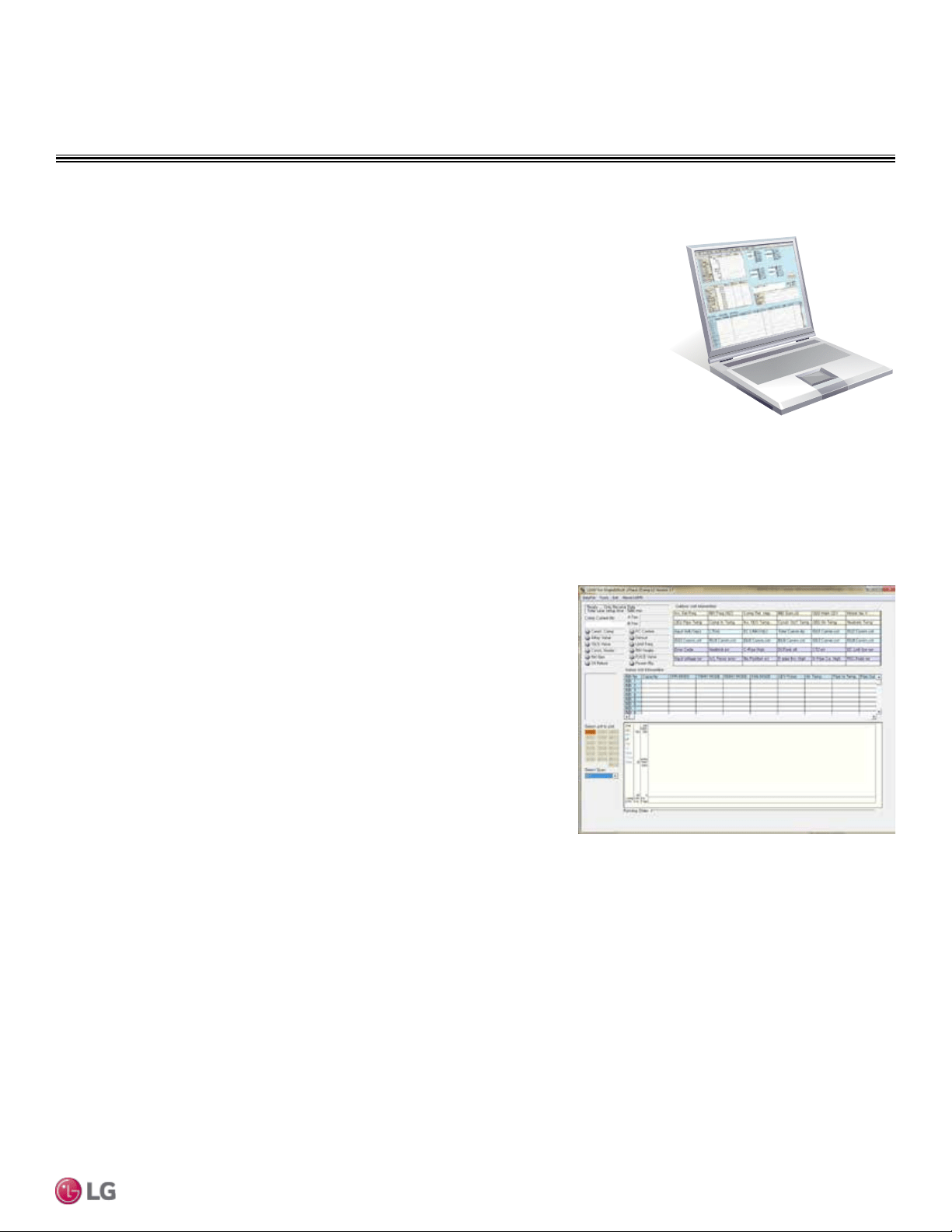
LG Monitoring View (LGMV) Diagnostic Software and Cable
LGMV software allows the service technician or commissioning agent to connect a comput-
er USB port to the outdoor unit main printed circuit board (PCB) using an accessory cable
without the need for a separate interface device. The main screen for LGMV allows the user
to view the following real time data on one screen:
Additional information that can be gathered from the main screen:
1. Graph: Graphic shows the following:
• Compressors showing actual speeds
• EEVs
• IDUs
• Low and high pressures
• Temperature sensors
• Four-way reversing valve
• Outdoor fans showing status and
speeds
2. Setting: Converts metric values to imperial values.
3. Making Data: Recording of real time data to a separate file created to be stored on
the user’s computer.
4. Loading Data: Recorded data from a saved “.CSV” file can be loaded to create an
LGMV session.
5. Electrical Data: The lower half of main screen is changed to show the following:
• Inverter compressor
- Amps
- Volts
- Power Hz
- Inverter control board fan Hz
The software is available in a high version with all of the features listed above. The low version has all features as the high version without
Target High Pressure and Target Low Pressure values shown on main screen.
In lieu of connecting to the ODU, user has the option to connect to IDU with the use of a USB to RS-485 connector kit. When connected
through IDU, user will not be able to record data.
This software can be used to both commission new systems and troubleshoot existing systems. LGMV data can be recorded to a “.CSV” file
and emailed to an LG representative to assist with diagnostic evaluations.
Recommended Minimum PC Configuration:
• CPU: Pentium
®
IV 1.6 GHz
• Operating System: Windows
®
NT/2000/XP/Vista
• Main Memory: 256 MB
• Hard Disk: 600 MB when operating
• Web Browser: Internet Explorer
®
5.0
Figure 27: MV Diagnostic Screen
ACCESSORIES
LGMV Diagnostic Software

“Cooling Capacity Data” on page 37
“Heating Capacity Data” on page 43
PERFORMANCE DATA
FOUR-WAY CASSETTE | 37
Product Data
Due to our policy of continuous product innovation, some specications may change without notication.
©LG Electronics U.S.A., Inc., Englewood Cliffs, NJ. All rights reserved. “LG” is a registered trademark of LG Corp.
PERFORMANCE DATA
Cooling Capacity Tables
Table 15: LC097HV4 System Cooling Capacity Table.
Model No. /
Nominal Capacity
(Btu/h)
Outdoor
Air Temp.
(°F DB)
Indoor Air Temp. °F DB / °F WB
68 / 57 73 / 61 77 / 64 80 / 67 86 / 72 90 / 75
TC SHC PI TC SHC PI TC SHC PI TC SHC PI TC SHC PI TC SHC PI
LC097HV4 /
9,000
-4 8.85 6.84 0.39 9.40 7.23 0.40 9.95 7.00 0.42 10.34 7.15 0.42 11.05 7.21 0.43 11.60 7.34 0.44
0 8.84 6.88 0.39 9.39 7.27 0.41 9.94 7.04 0.42 10.34 7.19 0.43 11.04 7.25 0.44 11.59 7.39 0.45
5 8.84 6.94 0.40 9.38 7.33 0.42 9.93 7.10 0.43 10.33 7.25 0.44 11.03 7.31 0.44 11.58 7.45 0.45
10 8.83 7.00 0.41 9.38 7.39 0.42 9.93 7.16 0.44 10.32 7.31 0.44 11.02 7.37 0.45 11.57 7.51 0.46
15 8.82 7.05 0.41 9.37 7.45 0.43 9.92 7.21 0.44 10.31 7.37 0.45 11.01 7.43 0.46 11.56 7.57 0.47
20 8.82 7.11 0.42 9.36 7.51 0.43 9.91 7.27 0.45 10.31 7.42 0.46 11.01 7.49 0.46 11.55 7.63 0.47
25 8.81 7.16 0.42 9.36 7.57 0.44 9.90 7.33 0.46 10.30 7.48 0.46 11.00 7.54 0.47 11.54 7.69 0.48
30 8.80 7.22 0.43 9.35 7.63 0.45 9.90 7.38 0.46 10.29 7.54 0.47 10.99 7.60 0.48 11.54 7.75 0.49
35 8.80 7.27 0.44 9.34 7.68 0.45 9.89 7.44 0.47 10.28 7.60 0.47 10.98 7.66 0.48 11.53 7.81 0.49
40 8.79 7.33 0.44 9.33 7.74 0.46 9.88 7.50 0.48 10.27 7.65 0.48 10.97 7.72 0.49 11.52 7.86 0.50
45 8.78 7.38 0.45 9.33 7.80 0.47 9.87 7.55 0.48 10.27 7.71 0.49 10.96 7.78 0.50 11.51 7.92 0.51
50 8.78 7.44 0.45 9.32 7.86 0.47 9.87 7.61 0.49 10.26 7.77 0.49 10.96 7.83 0.50 11.50 7.98 0.51
55 8.77 7.49 0.46 9.31 7.91 0.48 9.86 7.66 0.49 10.25 7.82 0.50 10.95 7.89 0.51 11.49 8.04 0.52
60 8.76 7.55 0.47 9.31 7.97 0.48 9.85 7.72 0.50 10.24 7.88 0.51 10.94 7.95 0.52 11.48 8.10 0.53
65 8.76 7.60 0.47 9.30 8.03 0.49 9.84 7.77 0.51 10.24 7.94 0.51 10.93 8.00 0.52 11.47 8.16 0.53
70 8.75 7.65 0.48 9.29 8.09 0.50 9.84 7.83 0.51 10.23 7.99 0.52 10.92 8.06 0.53 11.47 8.21 0.54
75 8.54 7.53 0.50 9.08 7.96 0.52 9.62 7.72 0.54 10.01 7.89 0.55 10.71 7.96 0.56 11.25 8.12 0.57
80 8.33 7.40 0.53 8.87 7.84 0.55 9.41 7.61 0.57 9.80 7.78 0.58 10.49 7.86 0.59 11.03 8.03 0.60
85 8.12 7.27 0.56 8.66 7.71 0.58 9.20 7.49 0.60 9.59 7.66 0.60 10.28 7.76 0.62 10.82 7.92 0.63
90 7.91 7.13 0.58 8.45
7.57 0.60 8.99 7.37 0.62 9.37 7.55 0.63 10.06 7.65 0.64 10.60 7.82 0.66
95 7.68 7.05 0.61 8.22 7.50 0.63 8.75 7.31 0.65 9.00 7.38 0.66 9.83 7.61 0.67 10.36 7.79 0.69
100 7.50 6.86 0.63 8.03 7.31 0.66 8.57 7.14 0.68 8.88 7.27 0.69 9.64 7.44 0.70 10.17 7.63 0.72
105 7.31 6.68 0.66 7.84 7.13 0.68 8.38 6.96 0.71 8.77 7.15 0.72 9.45 7.28 0.73 9.99 7.47 0.74
110 7.12 6.45 0.68 7.66 6.89 0.71 8.19 6.75 0.74 8.58 6.94 0.74 9.26 7.07 0.76 9.80 7.26 0.77
115 6.94 6.25 0.71 7.47 6.70 0.74 8.01 6.57 0.76 8.39 6.76 0.77 9.08 6.90 0.79 9.61 7.10 0.80
118 6.82 6.21 0.73 7.36 6.66 0.75 7.89 6.54 0.78 8.28 6.73 0.79 8.96 6.88 0.80 9.50 7.08 0.82
122 6.79 6.19 0.75 7.32 6.65 0.77 7.86 6.52 0.80 8.24 6.72 0.81 8.93 6.87 0.83 9.46 7.07 0.84
TC = Total Capacity (kBtu/h).
SHC: Sensible Heat Capacity (kBtu/h).
PI = Power input (KW). Power input (KW) includes compressor and fan(s).
Nominal capacity as rated 0 ft. above sea level and a 0 ft. level difference between outdoor and indoor
unit. Corresponding refrigerant piping length is accordance with standard length of each outdoor unit.
Nominal cooling capacity rating obtained with air entering the indoor unit at 80ºF dry bulb (DB) and 67ºF
wet bulb (WB), and outdoor ambient conditions of 95ºF dry bulb (DB) and 75ºF wet bulb (WB).
Cooling range can be extended from 0°F down to -4°F using the Low Ambient Wind Baffle Kit (sold
separately).
The shaded table rows indicate reference data. When operating at this temperature, these values can
be different if the system is not running consistently.
Due to our policy of continuous product innovation, some specications may change without notication.
©LG Electronics U.S.A., Inc., Englewood Cliffs, NJ. All rights reserved. “LG” is a registered trademark of LG Corp.
38 | FOUR-WAY CASSETTE
Four-Way Ceiling Cassette System Engineering Manual
Cooling Capacity Tables
PERFORMANCE DATA
Table 16: LC127HV4 System Cooling Capacity Table.
Model No. /
Nominal Capacity
(Btu/h)
Outdoor
Air Temp.
(°F DB)
Indoor Air Temp. °F DB / °F WB
68 / 57 73 / 61 77 / 64 80 / 67 86 / 72 90 / 75
TC SHC PI TC SHC PI TC SHC PI TC SHC PI TC SHC PI TC SHC PI
LC127HV4 /
12,000
-4 10.91 7.83 0.52 11.59 8.27 0.54 12.27 8.00 0.56 12.76 8.17 0.57 13.62 8.24 0.58 14.30 8.40 0.59
0 10.91 7.87 0.53 11.58 8.32 0.55 12.26 8.05 0.57 12.75 8.22 0.57 13.62 8.29 0.58 14.29 8.45 0.59
5 10.90 7.94 0.53 11.57 8.38 0.55 12.25 8.12 0.57 12.74 8.29 0.58 13.61 8.36 0.59 14.28 8.52 0.60
10 10.89 8.00 0.54 11.57 8.45 0.56 12.24 8.18 0.58 12.73 8.35 0.59 13.59 8.42 0.60 14.27 8.58 0.61
15 10.88 8.06 0.55 11.56 8.52 0.57 12.23 8.25 0.59 12.72 8.42 0.60 13.58 8.49 0.61 14.26 8.65 0.62
20 10.87 8.13 0.56 11.55 8.58 0.58 12.22 8.31 0.60 12.71 8.49 0.61 13.57 8.56 0.62 14.25 8.72 0.63
25 10.86 8.19 0.57 11.54 8.65 0.59 12.21 8.38 0.61 12.70 8.55 0.62 13.56 8.62 0.63 14.24 8.79 0.64
30 10.86 8.25 0.57 11.53 8.72 0.60 12.20 8.44 0.62 12.69 8.62 0.62 13.55 8.69 0.64 14.23 8.85 0.65
35 10.85 8.31 0.58 11.52 8.78 0.60 12.20 8.50 0.63 12.68 8.68 0.63 13.54 8.76 0.64 14.22 8.92 0.66
40 10.84 8.38 0.59 11.51 8.85 0.61 12.19 8.57 0.63 12.67 8.75 0.64 13.53 8.82 0.65 14.21 8.99 0.67
45 10.83 8.44 0.60 11.50 8.91 0.62 12.18 8.63 0.64 12.66 8.81 0.65 13.52 8.89 0.66 14.19 9.06 0.68
50 10.82 8.50 0.61 11.50 8.98 0.63 12.17 8.70 0.65 12.65 8.88 0.66 13.51 8.95 0.67 14.18 9.12 0.68
55 10.81 8.56 0.61 11.49 9.05 0.64 12.16 8.76 0.66 12.64 8.94 0.67 13.50 9.02 0.68 14.17 9.19 0.69
60 10.81 8.63 0.62 11.48 9.11 0.64 12.15 8.82 0.67 12.63 9.01 0.68 13.49 9.08 0.69 14.16 9.26 0.70
65 10.80 8.69 0.63 11.47 9.18 0.65 12.14 8.89 0.68 12.62 9.07 0.68 13.48 9.15 0.70 14.15 9.32 0.71
70 10.79 8.75 0.64 11.46 9.24 0.66 12.13 8.95 0.69 12.61 9.14 0.69 13.47 9.22 0.71 14.14 9.39 0.72
75 10.53 8.61 0.67 11.20 9.10 0.70 11.87 8.82 0.72 12.35 9.02 0.73 13.20 9.10 0.74 13.87 9.28 0.76
80 10.27 8.46 0.71 10.94 8.96 0.73 11.60 8.70 0.76 12.09 8.89 0.77 12.94 8.99 0.78 13.60 9.17 0.80
85 10.01 8.30 0.74 10.68 8.81 0.77 11.34 8.56 0.80 11.82 8.76 0.81 12.67 8.87 0.82 13.34 9.06 0.84
90 9.76 8.15 0.78 10.42
8.65 0.80 11.08 8.42 0.83 11.56 8.63 0.84 12.41 8.74 0.86 13.07 8.94 0.88
95 9.48 8.06 0.81 10.14 8.58 0.84 10.80 8.36 0.87 11.10 8.44 0.88 12.12 8.70 0.90 12.78 8.90 0.91
100 9.25 7.85 0.84 9.91 8.36 0.87 10.57 8.16 0.91 10.96 8.31 0.92 11.89 8.51 0.93 12.55 8.72 0.95
105 9.02 7.63 0.88 9.68 8.14 0.91 10.34 7.96 0.94 10.81 8.18 0.95 11.66 8.32 0.97 12.32 8.54 0.99
110 8.78 7.37 0.91 9.44 7.88 0.95 10.10 7.71 0.98 10.58 7.93 0.99 11.43 8.09 1.01 12.09 8.30 1.03
115 8.55 7.15 0.95 9.21 7.66 0.98 9.87 7.51 1.02 10.35 7.73 1.03 11.19 7.89 1.05 11.85 8.11 1.07
118 8.42 7.10 0.97 9.08 7.61 1.00 9.74 7.47 1.04 10.21 7.69 1.05 11.06 7.87 1.07 11.72 8.09 1.09
122 8.37 7.08 1.00 9.03 7.60 1.03 9.69 7.46 1.07 10.17 7.68 1.08 11.01 7.86 1.10 11.67 8.08 1.12
TC = Total Capacity (kBtu/h).
SHC: Sensible Heat Capacity (kBtu/h).
PI = Power input (KW). Power input (KW) includes compressor and fan(s).
Nominal capacity as rated 0 ft. above sea level and a 0 ft. level difference between outdoor and indoor
unit. Corresponding refrigerant piping length is accordance with standard length of each outdoor unit.
Nominal cooling capacity rating obtained with air entering the indoor unit at 80ºF dry bulb (DB) and 67ºF
wet bulb (WB), and outdoor ambient conditions of 95ºF dry bulb (DB) and 75ºF wet bulb (WB).
Cooling range can be extended from 0°F down to -4°F using the Low Ambient Wind Baffle Kit (sold
separately).
The shaded table rows indicate reference data. When operating at this temperature, these values can
be different if the system is not running consistently.
FOUR-WAY CASSETTE | 39
Product Data
Due to our policy of continuous product innovation, some specications may change without notication.
©LG Electronics U.S.A., Inc., Englewood Cliffs, NJ. All rights reserved. “LG” is a registered trademark of LG Corp.
PERFORMANCE DATA
Cooling Capacity Tables
Table 17: LC187HV System Cooling Capacity Table.
Model No. /
Nominal Capacity
(Btu/h)
Outdoor
Air Temp.
(°F DB)
Indoor Air Temp. °F DB / °F WB
68 / 57 73 / 61 77 / 64 80 / 67 86 / 72 90 / 75
TC SHC PI TC SHC PI TC SHC PI TC SHC PI TC SHC PI TC SHC PI
LC187HV /
18,000
5 17.83 14.43 0.50 18.94 15.24 0.68 20.04 15.69 0.74 20.84 15.07 0.75 22.26 15.19 0.75 23.37 15.48 0.75
10 17.80 14.53 0.52 18.91 15.35 0.70 20.02 15.80 0.76 20.81 15.18 0.77 22.23 15.30 0.77 23.33 15.59 0.77
15 17.78 14.64 0.53 18.88 15.46 0.72 19.99 15.92 0.78 20.78 15.29 0.79 22.20 15.42 0.79 23.30 15.71 0.79
20 17.75 14.74 0.54 18.86 15.57 0.74 19.96 16.03 0.80 20.75 15.40 0.81 22.16 15.53 0.81 23.27 15.82 0.81
25 17.73 14.85 0.56 18.83 15.68 0.76 19.93 16.14 0.82 20.72 15.50 0.83 22.13 15.63 0.83 23.23 15.93 0.83
30 17.70 14.95 0.57 18.80 15.79 0.78 19.90 16.26 0.84 20.69 15.61 0.85 22.10 15.74 0.85 23.20 16.04 0.85
35 17.68 15.05 0.59 18.77 15.90 0.80 19.87 16.37 0.86 20.66 15.72 0.87 22.07 15.85 0.88 23.17 16.15 0.87
40 17.65 15.16 0.60 18.75 16.01 0.81 19.84 16.48 0.88 20.63 15.83 0.90 22.04 15.96 0.90 23.13 16.26 0.89
45 17.63 15.26 0.61 18.72 16.12 0.83 19.81 16.59 0.90 20.60 15.94 0.92 22.00 16.07 0.92 23.10 16.37 0.92
50 17.60 15.36 0.63 18.69 16.23 0.85 19.79 16.70 0.92 20.57 16.04 0.94 21.97 16.18 0.94 23.06 16.48 0.94
55 17.57 15.46 0.64 18.67 16.33 0.87 19.76 16.81 0.94 20.55 16.15 0.96 21.94 16.28 0.96 23.03 16.59 0.96
60 17.55 15.56 0.66 18.64 16.44 0.89 19.73 16.92 0.96 20.52 16.25 0.98 21.91 16.39 0.98 23.00 16.70 0.98
65 17.52 15.66 0.67 18.61 16.55 0.91 19.70 17.03 0.98 20.49 16.36 1.00 21.88 16.50 1.00 22.96 16.81 1.00
70 17.50 15.77 0.69 18.58 16.65 0.93 19.67 17.14 1.01 20.46 16.47 1.02 21.84 16.60 1.02 22.93 16.92 1.02
75 17.08 15.51 0.73 18.16 16.40 0.96 19.24 16.90 1.03 20.03 16.25 1.05 21.41 16.40 1.06 22.50 16.73 1.07
80 16.66 15.24 0.77 17.74 16.14 0.99 18.82 16.66 1.06 19.60 16.02 1.08 20.98 16.20 1.10 22.06 16.53 1.11
85 16.24 14.96 0.88 17.32 15.87 1.07 18.40 16.40 1.14 19.17 15.78 1.16 20.55 15.98 1.18 21.63 16.32 1.20
90 15.82 14.68 0.99 16.90 15.59 1.16 17.97 16.13 1.21 18.75 15.54 1.23 20.12 15.75 1.26 21.20 16.11 1.28
95 15.37 14.53 1.09 16.44 15.45 1.24 17.51 16.01 1.28 18.00 15.20 1.26 19.65 15.67 1.32 20.72 16.04 1.35
100 14.99 14.14 1.14 16.06
15.06 1.26 17.13 15.63 1.29 17.77 14.96 1.28 19.28 15.33 1.32 20.35 15.71 1.35
105 14.62 13.75 1.20 15.69 14.68 1.28 16.76 15.25 1.30 17.53 14.73 1.30 18.90 15.00 1.32 19.97 15.38 1.35
110 14.24 13.28 1.16 15.32 14.20 1.21 16.39 14.77 1.21 17.16 14.29 1.21 18.53 14.57 1.22 19.60 14.96 1.24
115 13.87 12.88 1.05 14.94 13.80 1.06 16.01 14.38 1.03 16.79 13.93 1.02 18.15 14.22 1.02 19.22 14.62 1.04
118 13.10 12.28 0.93 14.13 13.17 0.91 15.16 13.74 0.87 15.90 13.31 0.85 17.21 13.61 0.85 18.24 14.00 0.87
122 12.84 12.07 0.89 13.86 12.95 0.86 14.87 13.52 0.82 15.60 13.10 0.80 16.90 13.40 0.79 17.91 13.79 0.81
TC = Total Capacity (kBtu/h).
SHC: Sensible Heat Capacity (kBtu/h).
PI = Power input (KW). Power input (KW) includes compressor and fan(s).
Nominal capacity as rated 0 ft. above sea level and a 0 ft. level difference between outdoor and indoor
unit. Corresponding refrigerant piping length is accordance with standard length of each outdoor unit.
Nominal cooling capacity rating obtained with air entering the indoor unit at 80ºF dry bulb (DB) and 67ºF
wet bulb (WB), and outdoor ambient conditions of 95ºF dry bulb (DB) and 75ºF wet bulb (WB).
The shaded table rows indicate reference data. When operating at this temperature, these values can
be different if the system is not running consistently.
Due to our policy of continuous product innovation, some specications may change without notication.
©LG Electronics U.S.A., Inc., Englewood Cliffs, NJ. All rights reserved. “LG” is a registered trademark of LG Corp.
40 | FOUR-WAY CASSETTE
Four-Way Ceiling Cassette System Engineering Manual
Model No. /
Nominal Capacity
(Btu/h)
Outdoor
Air Temp.
(°F DB)
Indoor Air Temp. °F DB / °F WB
68 / 57 73 / 61 77 / 64 80 / 67 86 / 72 90 / 75
TC SHC PI TC SHC PI TC SHC PI TC SHC PI TC SHC PI TC SHC PI
LC247HV /
24,000
5 23.77 17.54 0.76 25.25 18.53 1.03 26.73 19.07 1.12 27.79 18.32 1.13 29.68 18.47 1.14 31.15 18.82 1.13
10 23.74 17.67 0.78 25.21 18.66 1.06 26.69 19.21 1.15 27.75 18.45 1.17 29.64 18.61 1.17 31.11 18.96 1.17
15 23.70 17.80 0.80 25.18 18.80 1.09 26.65 19.35 1.18 27.71 18.58 1.20 29.59 18.74 1.20 31.07 19.10 1.20
20 23.67 17.92 0.83 25.14 18.93 1.12 26.61 19.49 1.21 27.67 18.72 1.23 29.55 18.88 1.23 31.02 19.23 1.23
25 23.64 18.05 0.85 25.10 19.07 1.15 26.57 19.63 1.24 27.63 18.85 1.26 29.51 19.01 1.26 30.98 19.37 1.26
30 23.60 18.17 0.87 25.07 19.20 1.18 26.53 19.76 1.27 27.59 18.98 1.29 29.47 19.14 1.30 30.93 19.50 1.29
35 23.57 18.30 0.89 25.03 19.33 1.21 26.50 19.90 1.31 27.55 19.11 1.33 29.42 19.27 1.33 30.89 19.64 1.32
40 23.53 18.43 0.91 25.00 19.46 1.23 26.46 20.04 1.34 27.51 19.24 1.36 29.38 19.41 1.36 30.84 19.77 1.36
45 23.50 18.55 0.93 24.96 19.60 1.26 26.42 20.17 1.37 27.47 19.37 1.39 29.34 19.54 1.39 30.80 19.91 1.39
50 23.47 18.67 0.95 24.92 19.73 1.29 26.38 20.31 1.40 27.43 19.50 1.42 29.30 19.67 1.42 30.75 20.04 1.42
55 23.43 18.80 0.97 24.89 19.86 1.32 26.34 20.44 1.43 27.39 19.63 1.45 29.25 19.80 1.45 30.71 20.17 1.45
60 23.40 18.92 1.00 24.85 19.99 1.35 26.30 20.58 1.46 27.35 19.76 1.48 29.21 19.93 1.49 30.66 20.31 1.48
65 23.36 19.05 1.02 24.81 20.12 1.38 26.27 20.71 1.49 27.31 19.89 1.52 29.17 20.06 1.52 30.62 20.44 1.52
70 23.33 19.17 1.04 24.78 20.25 1.41 26.23 20.84 1.52 27.27 20.02 1.55 29.13 20.19 1.55 30.57 20.57 1.55
75 22.77 18.85 1.11 24.21 19.94 1.45 25.66 20.55 1.57 26.70 19.75 1.59 28.55 19.94 1.61 29.99 20.34 1.62
80 22.21 18.53 1.17 23.65 19.63 1.50 25.09 20.25 1.61 26.13 19.48 1.64 27.97 19.69 1.66 29.42 20.10 1.68
85 21.65 18.19 1.33 23.09 19.30 1.63 24.53 19.93 1.72 25.57 19.19 1.75 27.40 19.43 1.78 28.84 19.84 1.81
90 21.09 17.85 1.49 22.53 18.96 1.76 23.96 19.61 1.84 25.00 18.90 1.87 26.83 19.15 1.91 28.27 19.59 1.94
95 20.49 17.66 1.65 21.92 18.79 1.87 23.35 19.46 1.94 24.00 18.48 1.91 26.20 19.05 2.00 27.63 19.50 2.04
100 19.99 17.19 1.73 21.42
18.31 1.91 22.85 19.00 1.96 23.69 18.19 1.94 25.70 18.64 2.00 27.13 19.10 2.04
105 19.49 16.71 1.82 20.92 17.84 1.95 22.35 18.54 1.97 23.38 17.91 1.97 25.20 18.23 2.00 26.63 18.70 2.04
110 18.99 16.14 1.76 20.42 17.26 1.84 21.85 17.96 1.83 22.88 17.37 1.83 24.70 17.71 1.85 26.13 18.19 1.89
115 18.49 15.66 1.58 19.92 16.78 1.60 21.35 17.49 1.56 22.38 16.93 1.54 24.20 17.29 1.55 25.63 17.77 1.58
118 17.47 14.93 1.40 18.84 16.01 1.38 20.21 16.70 1.32 21.20 16.18 1.29 22.95 16.54 1.29 24.32 17.02 1.32
122 17.12 14.68 1.34 18.48 15.75 1.31 19.83 16.44 1.24 20.80 15.93 1.21 22.53 16.29 1.20 23.88 16.76 1.23
Table 18: LC247HV System Cooling Capacity Table.
TC = Total Capacity (kBtu/h).
SHC: Sensible Heat Capacity (kBtu/h).
PI = Power input (KW). Power input (KW) includes compressor and fan(s).
Nominal capacity as rated 0 ft. above sea level and a 0 ft. level difference between outdoor and indoor
unit. Corresponding refrigerant piping length is accordance with standard length of each outdoor unit.
Nominal cooling capacity rating obtained with air entering the indoor unit at 80ºF dry bulb (DB) and 67ºF
wet bulb (WB), and outdoor ambient conditions of 95ºF dry bulb (DB) and 75ºF wet bulb (WB).
The shaded table rows indicate reference data. When operating at this temperature, these values can
be different if the system is not running consistently.
Cooling Capacity Tables
PERFORMANCE DATA
FOUR-WAY CASSETTE | 41
Product Data
Due to our policy of continuous product innovation, some specications may change without notication.
©LG Electronics U.S.A., Inc., Englewood Cliffs, NJ. All rights reserved. “LG” is a registered trademark of LG Corp.
PERFORMANCE DATA
Cooling Capacity Tables
Model No. /
Nominal Capacity
(Btu/h)
Outdoor
Air Temp.
(°F DB)
Indoor Air Temp. °F DB / °F WB
68 / 57 73 / 61 77 / 64 80 / 67 86 / 72 90 / 75
TC SHC PI TC SHC PI TC SHC PI TC SHC PI TC SHC PI TC SHC PI
LC367HV /
36,000
5 35.66 25.73 1.18 37.87 27.18 1.60 40.09 27.98 1.74 41.69 26.87 1.76 44.52 27.10 1.77 46.73 27.61 1.76
10 35.61 25.92 1.22 37.82 27.38 1.65 40.03 28.18 1.79 41.63 27.07 1.81 44.45 27.30 1.82 46.67 27.81 1.81
15 35.56 26.11 1.25 37.77 27.58 1.69 39.97 28.39 1.83 41.57 27.26 1.86 44.39 27.49 1.87 46.60 28.01 1.86
20 35.51 26.29 1.28 37.71 27.77 1.74 39.92 28.59 1.88 41.51 27.46 1.91 44.33 27.69 1.92 46.53 28.21 1.91
25 35.45 26.48 1.32 37.66 27.97 1.78 39.86 28.79 1.93 41.45 27.65 1.96 44.26 27.89 1.97 46.46 28.41 1.96
30 35.40 26.66 1.35 37.60 28.17 1.83 39.80 28.99 1.98 41.39 27.85 2.01 44.20 28.08 2.01 46.40 28.61 2.01
35 35.35 26.85 1.38 37.55 28.36 1.87 39.74 29.19 2.03 41.33 28.04 2.06 44.13 28.27 2.06 46.33 28.81 2.06
40 35.30 27.03 1.42 37.49 28.55 1.92 39.69 29.39 2.08 41.27 28.23 2.11 44.07 28.47 2.11 46.26 29.01 2.11
45 35.25 27.21 1.45 37.44 28.75 1.96 39.63 29.59 2.13 41.21 28.42 2.16 44.01 28.66 2.16 46.20 29.20 2.16
50 35.20 27.40 1.48 37.39 28.94 2.01 39.57 29.79 2.18 41.15 28.61 2.21 43.94 28.85 2.21 46.13 29.40 2.21
55 35.15 27.58 1.52 37.33 29.13 2.05 39.51 29.99 2.22 41.09 28.80 2.26 43.88 29.04 2.26 46.06 29.59 2.26
60 35.10 27.76 1.55 37.28 29.32 2.10 39.46 30.18 2.27 41.03 28.99 2.31 43.82 29.24 2.31 46.00 29.79 2.31
65 35.05 27.94 1.58 37.22 29.51 2.14 39.40 30.38 2.32 40.97 29.18 2.36 43.75 29.43 2.36 45.93 29.98 2.36
70 34.99 28.12 1.61 37.17 29.70 2.19 39.34 30.58 2.37 40.91 29.37 2.41 43.69 29.61 2.41 45.86 30.18 2.41
75 34.15 27.66 1.72 36.32 29.25 2.26 38.49 30.15 2.43 40.05 28.98 2.48 42.82 29.26 2.50 44.99 29.83 2.51
80 33.31 27.18 1.82 35.47 28.79 2.33 37.64 29.71 2.50 39.20 28.58 2.55 41.96 28.89 2.59 44.12 29.48 2.62
85 32.48 26.69 2.07 34.63 28.31 2.53 36.79 29.24 2.68 38.35 28.15 2.73 41.10 28.50 2.77 43.26 29.11 2.82
90 31.64 26.18 2.32 33.79 27.81 2.73 35.94 28.77 2.86 37.50 27.72 2.91 40.25 28.10 2.96 42.40 28.73 3.02
95 30.74 25.91 2.57 32.88 27.56 2.91 35.02 28.55 3.02 36.00 27.11 2.97 39.30 27.95 3.11 41.44 28.61 3.18
100 29.99 25.21 2.70 32.13
26.87 2.97 34.27 27.87 3.04 35.53 26.69 3.02 38.55 27.35 3.11 40.69 28.02 3.18
105 29.24 24.52 2.82 31.38 26.17 3.03 33.52 27.19 3.06 35.07 26.27 3.07 37.80 26.75 3.11 39.94 27.43 3.18
110 28.49 23.68 2.74 30.63 25.33 2.86 32.77 26.35 2.85 34.32 25.49 2.84 37.05 25.99 2.87 39.20 26.68 2.93
115 27.74 22.97 2.46 29.88 24.61 2.49 32.02 25.65 2.43 33.57 24.84 2.40 36.31 25.36 2.40 38.45 26.07 2.46
118 26.20 21.90 2.18 28.26 23.49 2.15 30.31 24.50 2.05 31.80 23.74 2.01 34.42 24.27 2.00 36.48 24.96 2.05
122 25.69 21.53 2.09 27.71 23.10 2.04 29.74 24.11 1.93 31.21 23.37 1.88 33.80 23.90 1.87 35.82 24.59 1.92
Table 19: LC367HV System Cooling Capacity Table.
TC = Total Capacity (kBtu/h).
SHC: Sensible Heat Capacity (kBtu/h).
PI = Power input (KW). Power input (KW) includes compressor and fan(s).
Nominal capacity as rated 0 ft. above sea level and a 0 ft. level difference between outdoor and indoor
unit. Corresponding refrigerant piping length is accordance with standard length of each outdoor unit.
Nominal cooling capacity rating obtained with air entering the indoor unit at 80ºF dry bulb (DB) and 67ºF
wet bulb (WB), and outdoor ambient conditions of 95ºF dry bulb (DB) and 75ºF wet bulb (WB).
The shaded table rows indicate reference data. When operating at this temperature, these values can
be different if the system is not running consistently.
Due to our policy of continuous product innovation, some specications may change without notication.
©LG Electronics U.S.A., Inc., Englewood Cliffs, NJ. All rights reserved. “LG” is a registered trademark of LG Corp.
42 | FOUR-WAY CASSETTE
Four-Way Ceiling Cassette System Engineering Manual
Cooling Capacity Tables
PERFORMANCE DATA
Model No. /
Nominal Capacity
(Btu/h)
Outdoor
Air Temp.
(°F DB)
Indoor Air Temp. °F DB / °F WB
68 / 57 73 / 61 77 / 64 80 / 67 86 / 72 90 / 75
TC SHC PI TC SHC PI TC SHC PI TC SHC PI TC SHC PI TC SHC PI
LC427HV /
42,000
5 41.60 30.30 1.62 44.19 32.00 2.20 46.77 32.94 2.38 48.64 31.64 2.42 51.94 31.91 2.42 54.52 32.51 2.42
10 41.54 30.52 1.67 44.12 32.24 2.26 46.70 33.18 2.45 48.57 31.87 2.49 51.86 32.14 2.49 54.44 32.75 2.48
15 41.48 30.74 1.71 44.06 32.47 2.32 46.64 33.42 2.51 48.50 32.10 2.55 51.79 32.37 2.56 54.36 32.98 2.55
20 41.42 30.96 1.76 44.00 32.70 2.38 46.57 33.66 2.58 48.43 32.33 2.62 51.71 32.60 2.63 54.29 33.22 2.62
25 41.36 31.18 1.80 43.93 32.93 2.45 46.50 33.90 2.65 48.36 32.56 2.69 51.64 32.83 2.69 54.21 33.45 2.69
30 41.30 31.39 1.85 43.87 33.16 2.51 46.43 34.14 2.71 48.29 32.79 2.76 51.57 33.06 2.76 54.13 33.69 2.75
35 41.24 31.61 1.89 43.81 33.39 2.57 46.37 34.37 2.78 48.22 33.01 2.82 51.49 33.29 2.83 54.05 33.92 2.82
40 41.18 31.83 1.94 43.74 33.62 2.63 46.30 34.61 2.85 48.15 33.24 2.89 51.42 33.52 2.90 53.97 34.15 2.89
45 41.13 32.04 1.99 43.68 33.85 2.69 46.23 34.84 2.91 48.08 33.46 2.96 51.34 33.75 2.96 53.90 34.38 2.96
50 41.07 32.26 2.03 43.62 34.07 2.75 46.17 35.08 2.98 48.01 33.69 3.03 51.27 33.97 3.03 53.82 34.62 3.03
55 41.01 32.47 2.08 43.55 34.30 2.82 46.10 35.31 3.05 47.94 33.91 3.10 51.19 34.20 3.10 53.74 34.85 3.09
60 40.95 32.68 2.12 43.49 34.53 2.88 46.03 35.54 3.11 47.87 34.13 3.16 51.12 34.42 3.17 53.66 35.07 3.16
65 40.89 32.90 2.17 43.43 34.75 2.94 45.97 35.77 3.18 47.80 34.36 3.23 51.04 34.65 3.24 53.58 35.30 3.23
70 40.83 33.11 2.21 43.36 34.97 3.00 45.90 36.00 3.25 47.73 34.58 3.30 50.97 34.87 3.30 53.50 35.53 3.30
75 39.84 32.56 2.36 42.37 34.44 3.10 44.90 35.50 3.34 46.73 34.12 3.39 49.96 34.45 3.42 52.49 35.13 3.44
80 38.86 32.01 2.50 41.39 33.90 3.19 43.91 34.98 3.42 45.73 33.65 3.49 48.95 34.01 3.54 51.48 34.72 3.59
85 37.89 31.42 2.84 40.41 33.33 3.47 42.92 34.43 3.67 44.74 33.15 3.74 47.96 33.55 3.80 50.47 34.28 3.86
90 36.91 30.83 3.18 39.43 32.75 3.74 41.94 33.88 3.92 43.75 32.64 3.98 46.96 33.08 4.06 49.47 33.83 4.14
95 35.86 30.51 3.52 38.36 32.45 3.99 40.85 33.62 4.14 42.00 31.92 4.07 45.85 32.91 4.27 48.35 33.68 4.35
100 34.98 29.69 3.69 37.48
31.63 4.07 39.98 32.81 4.17 41.46 31.43 4.14 44.98 32.20 4.27 47.47 32.99 4.35
105 34.11 28.87 3.87 36.61 30.82 4.15 39.11 32.02 4.19 40.91 30.93 4.21 44.10 31.49 4.26 46.60 32.30 4.36
110 33.24 27.88 3.76 35.74 29.82 3.92 38.23 31.03 3.91 40.04 30.01 3.89 43.23 30.60 3.93 45.73 31.41 4.02
115 32.37 27.05 3.38 34.86 28.98 3.41 37.36 30.20 3.33 39.17 29.24 3.29 42.36 29.87 3.30 44.86 30.70 3.37
118 30.57 25.78 2.99 32.97 27.65 2.94 35.36 28.85 2.81 37.10 27.95 2.75 40.16 28.57 2.74 42.56 29.39 2.81
122 29.97 25.35 2.86 32.33 27.20 2.79 34.70 28.39 2.64 36.41 27.51 2.57 39.43 28.14 2.56 41.79 28.95 2.63
Table 20: LC427HV System Cooling Capacity Table.
TC = Total Capacity (kBtu/h).
SHC: Sensible Heat Capacity (kBtu/h).
PI = Power input (KW). Power input (KW) includes compressor and fan(s).
Nominal capacity as rated 0 ft. above sea level and a 0 ft. level difference between outdoor and indoor
unit. Corresponding refrigerant piping length is accordance with standard length of each outdoor unit.
Nominal cooling capacity rating obtained with air entering the indoor unit at 80ºF dry bulb (DB) and 67ºF
wet bulb (WB), and outdoor ambient conditions of 95ºF dry bulb (DB) and 75ºF wet bulb (WB).
The shaded table rows indicate reference data. When operating at this temperature, these values can
be different if the system is not running consistently.
FOUR-WAY CASSETTE | 43
Product Data
Due to our policy of continuous product innovation, some specications may change without notication.
©LG Electronics U.S.A., Inc., Englewood Cliffs, NJ. All rights reserved. “LG” is a registered trademark of LG Corp.
PERFORMANCE DATA
Heating Capacity Tables
Table 21: LC097HV4 System Heating Capacity Table.
Table 22: LC127HV System Heating Capacity Table.
Model No. /
Nominal Capacity
(Btu/h)
Outdoor Air Temp. Indoor Air Temp. °F DB
°F DB °F WB
61 64 68 70 72 75
TC PI TC PI TC PI TC PI TC PI TC PI
LC097HV4 / 9,000
-4 -4.4 4.38 0.61 4.06 0.63 4.03 0.64 3.99 0.64 3.95 0.65 3.77 0.67
0 -0.4 5.22 0.62 4.91 0.64 4.84 0.65 4.77 0.65 4.71 0.66 4.51 0.68
5 4.5 6.22 0.63 5.93 0.65 5.79 0.66 5.70 0.67 5.62 0.68 5.39 0.70
10 9 6.89 0.63 6.61 0.66 6.43 0.67 6.32 0.68 6.23 0.69 5.98 0.71
17 15 7.63 0.65 7.36 0.67 7.13 0.69 7.00 0.70 6.90 0.71 6.63 0.73
20 19 8.07 0.66 7.82 0.68 7.55 0.70 7.41 0.71 7.30 0.72 7.02 0.74
25 23 8.82 0.67 8.56 0.69 8.26 0.72 8.10 0.73 7.98 0.74 7.68 0.76
30 28 9.57 0.69 9.28 0.71 8.96 0.73 8.79 0.75 8.66 0.76 8.34 0.78
35 32 10.33 0.71 10.00 0.73 9.66 0.75 9.48 0.77 9.35 0.78 9.01 0.80
40 36 10.85 0.73 10.55 0.75 10.21 0.78 10.04 0.79 9.89 0.81 9.54 0.83
45 41 11.51 0.75 11.24 0.78 10.91 0.80 10.72 0.82 10.58 0.83 10.20 0.86
47 43 11.77 0.77 11.51 0.79 11.18 0.82 11.00 0.83 10.85 0.84 10.46 0.87
50 46 11.81 0.76 11.57 0.78 11.28 0.81 11.12 0.82 10.99 0.83 10.62 0.85
55 51 11.87 0.75 11.67 0.77 11.45 0.79 11.32 0.80 11.22 0.81 10.89 0.82
60 56 11.92 0.74 11.77 0.76 11.62 0.77 11.53 0.78 11.45 0.78 11.15 0.80
63 59 11.96 0.74 11.83 0.75 11.73 0.76 11.65 0.77 11.58 0.77 11.31 0.78
68 64 11.99 0.73 11.89 0.74 11.83 0.75 11.77 0.75 11.72 0.76 11.48 0.76
TC = Total Capacity (kBtu/h).
PI = Power input (KW). Power input (KW) includes compressor and fan(s).
Nominal capacity as rated 0 ft. above sea level and a 0 ft. level difference between outdoor and indoor
unit. Corresponding refrigerant piping length is accordance with standard length of each outdoor unit.
Nominal heating capacity rating obtained with air entering the indoor unit at 70ºF dry bulb (DB) and
60ºF wet bulb (WB), and outdoor ambient conditions of 47ºF dry bulb (DB) and 43ºF wet bulb (WB).
Model No. /
Nominal Capacity
(Btu/h)
Outdoor Air Temp. Indoor Air Temp. °F DB
°F DB °F WB
61 64 68 70 72 75
TC PI TC PI TC PI TC PI TC PI TC PI
LC127HV4 / 12,000
-4 -4.4 6.04 0.83 5.61 0.86 5.56 0.87 5.50 0.88 5.44 0.88 5.20 0.92
0 -0.4 7.04 0.85 6.63 0.88 6.52 0.89 6.43 0.90 6.36 0.91 6.09 0.94
5 4.5 8.24 0.87 7.85 0.90 7.66 0.92 7.54 0.93 7.44 0.93 7.14 0.97
10 9 9.03 0.88 8.67 0.91 8.43 0.94 8.28 0.95 8.17 0.96 7.85 0.99
17 15 9.91 0.91 9.57 0.94 9.27 0.96 9.10 0.98 8.97 0.99 8.62 1.02
20 19 10.45 0.92 10.11 0.95 9.78 0.98 9.60 1.00 9.45 1.02 9.09 1.04
25 23 11.34 0.95 11.00 0.98 10.62 1.01 10.42 1.04 10.26 1.05 9.87 1.08
30 28 12.24 0.98 11.86 1.02 11.46 1.05 11.25 1.07 11.08 1.09 10.67 1.12
35 32 13.14 1.02 12.73 1.05 12.29 1.08 12.07 1.10 11.89 1.12 11.46 1.15
40 36 13.81 1.05 13.43 1.08 13.00 1.11 12.77 1.14 12.59 1.15 12.14 1.18
45 41 14.65 1.08 14.30 1.12 13.88 1.15 13.65 1.17 13.46 1.19 12.98 1.23
47 43 14.99 1.10 14.65 1.13 14.23 1.17 14.00 1.19 13.81 1.21 13.31 1.24
50 46 15.03 1.09 14.73 1.12 14.36 1.16 14.15 1.17 13.99 1.19 13.52 1.22
55 51 15.10 1.08 14.85 1.11 14.58 1.13 14.41 1.14 14.28 1.15 13.85 1.18
60 56 15.18 1.07 14.98 1.09 14.80 1.11 14.67 1.12 14.57 1.12 14.19 1.14
63 59 15.22 1.06 15.05 1.08 14.92 1.09 14.82 1.10 14.74 1.10 14.40 1.12
68 64 15.26 1.05 15.13 1.07 15.06 1.08 14.98 1.08 14.92 1.08 14.61 1.09
TC = Total Capacity (kBtu/h).
PI = Power input (KW). Power input (KW) includes compressor and fan(s).
Nominal capacity as rated 0 ft. above sea level and a 0 ft. level difference between outdoor and indoor
unit. Corresponding refrigerant piping length is accordance with standard length of each outdoor unit.
Nominal heating capacity rating obtained with air entering the indoor unit at 70ºF dry bulb (DB) and
60ºF wet bulb (WB), and outdoor ambient conditions of 47ºF dry bulb (DB) and 43ºF wet bulb (WB).
Due to our policy of continuous product innovation, some specications may change without notication.
©LG Electronics U.S.A., Inc., Englewood Cliffs, NJ. All rights reserved. “LG” is a registered trademark of LG Corp.
44 | FOUR-WAY CASSETTE
Four-Way Ceiling Cassette System Engineering Manual
Model No. /
Nominal Capacity
(Btu/h)
Outdoor Air Temp. Indoor Air Temp. °F DB
°F DB °F WB
61 64 68 70 72 75
TC PI TC PI TC PI TC PI TC PI TC PI
LC187HV / 18,000
0 -0.4 8.96 1.12 8.42 1.16 8.43 1.18 8.24 1.19 8.08 1.20 7.74 1.24
5 4.5 10.89 1.14 10.37 1.18 10.23 1.20 10.01 1.22 9.84 1.23 9.44 1.27
10 9 12.18 1.15 11.69 1.19 11.43 1.22 11.20 1.24 11.01 1.25 10.58 1.29
17 15 13.60 1.17 13.13 1.21 12.75 1.25 12.50 1.27 12.30 1.29 11.83 1.32
20 19 14.46 1.19 14.00 1.22 13.55 1.27 13.29 1.29 13.08 1.31 12.59 1.35
25 23 15.90 1.22 15.43 1.25 14.89 1.30 14.61 1.32 14.38 1.35 13.84 1.38
30 28 17.34 1.25 16.80 1.29 16.22 1.33 15.93 1.36 15.69 1.38 15.11 1.42
35 32 18.78 1.28 18.18 1.33 17.56 1.36 17.24 1.39 16.99 1.42 16.38 1.45
40 36 19.73 1.32 19.18 1.36 18.57 1.40 18.25 1.43 17.99 1.45 17.34 1.49
45 41 20.93 1.36 20.43 1.41 19.83 1.45 19.50 1.48 19.24 1.50 18.54 1.55
47 43 21.41 1.38 20.93 1.43 20.33 1.47 20.00 1.50 19.73 1.52 19.02 1.57
50 46 21.47 1.37 21.04 1.42 20.52 1.46 20.22 1.48 19.98 1.50 19.31 1.54
55 51 21.58 1.36 21.22 1.39 20.83 1.43 20.59 1.44 20.40 1.46 19.79 1.49
60 56 21.68 1.35 21.40 1.37 21.14 1.40 20.95 1.41 20.81 1.42 20.28 1.44
63 59 21.74 1.34 21.51 1.36 21.32 1.38 21.18 1.39 21.06 1.39 20.57 1.41
68 64 21.81 1.33 21.62 1.34 21.51 1.36 21.40 1.36 21.31 1.37 20.86 1.38
Table 23: LC187HV System Heating Capacity Table.
Table 24: LC247HV System Heating Capacity Table.
Model No. /
Nominal Capacity
(Btu/h)
Outdoor Air Temp. Indoor Air Temp. °F DB
°F DB °F WB
61 64 68 70 72 75
TC PI TC PI TC PI TC PI TC PI TC PI
LC247HV / 24,000
0 -0.4 15.86 1.74 14.97 1.81 14.92 1.83 14.59 1.85 14.32 1.86 13.72 1.93
5 4.5 17.72 1.80 16.91 1.86 16.65 1.90 16.30 1.92 16.01 1.94 15.37 2.00
10 9 18.97 1.85 18.21 1.91 17.80 1.96 17.44 1.98 17.15 2.01 16.48 2.07
17 15 20.35 1.91 19.64 1.97 19.07 2.04 18.70 2.07 18.40 2.10 17.69 2.16
20 19 21.18 1.96 20.50 2.02 19.84 2.09 19.46 2.13 19.16 2.16 18.43 2.22
25 23 22.57 2.04 21.90 2.10 21.14 2.18 20.74 2.22 20.42 2.26 19.65 2.32
30 28 23.96 2.13 23.22 2.20 22.42 2.27 22.01 2.32 21.68 2.36 20.88 2.42
35 32 25.35 2.22 24.54 2.30 23.71 2.36 23.28 2.41 22.94 2.46 22.11 2.52
40 36 26.64 2.28 25.89 2.36 25.07 2.43 24.63 2.48 24.29 2.52 23.41 2.59
45 41 28.26 2.37 27.58 2.44 26.77 2.52 26.32 2.57 25.97 2.60 25.02 2.68
47 43 28.90 2.40 28.26 2.48 27.45 2.56 27.00 2.60 26.64 2.64 25.67 2.71
50 46 28.99 2.38 28.40 2.45 27.70 2.52 27.30 2.56 26.98 2.59 26.07 2.66
55 51 29.13 2.36 28.65 2.42 28.12 2.47 27.79 2.50 27.54 2.52 26.72 2.58
60 56 29.27 2.33 28.89 2.38 28.53 2.42 28.29 2.44 28.09 2.45 27.38 2.49
63 59 29.35 2.32 29.03 2.35 28.78 2.39 28.59 2.40 28.43 2.41 27.77 2.44
68 64 29.44 2.30 29.18 2.33 29.04 2.36 28.89 2.36 28.77 2.37 28.17 2.39
TC = Total Capacity (kBtu/h).
PI = Power input (KW). Power input (KW) includes compressor and fan(s).
Nominal capacity as rated 0 ft. above sea level and a 0 ft. level difference between outdoor and indoor
unit. Corresponding refrigerant piping length is accordance with standard length of each outdoor unit.
Nominal heating capacity rating obtained with air entering the indoor unit at 70ºF dry bulb (DB) and
60ºF wet bulb (WB), and outdoor ambient conditions of 47ºF dry bulb (DB) and 43ºF wet bulb (WB).
TC = Total Capacity (kBtu/h).
PI = Power input (KW). Power input (KW) includes compressor and fan(s).
Nominal capacity as rated 0 ft. above sea level and a 0 ft. level difference between outdoor and indoor
unit. Corresponding refrigerant piping length is accordance with standard length of each outdoor unit.
Nominal heating capacity rating obtained with air entering the indoor unit at 70ºF dry bulb (DB) and
60ºF wet bulb (WB), and outdoor ambient conditions of 47ºF dry bulb (DB) and 43ºF wet bulb (WB).
PERFORMANCE DATA
Heating Capacity Tables
FOUR-WAY CASSETTE | 45
Product Data
Due to our policy of continuous product innovation, some specications may change without notication.
©LG Electronics U.S.A., Inc., Englewood Cliffs, NJ. All rights reserved. “LG” is a registered trademark of LG Corp.
Table 25: LC367HV System Heating Capacity Table.
Model No. /
Nominal Capacity
(Btu/h)
Outdoor Air Temp. Indoor Air Temp. °F DB
°F DB °F WB
61 64 68 70 72 75
TC PI TC PI TC PI TC PI TC PI TC PI
LC367HV / 36,000
0 -0.4 19.98 2.41 18.81 2.50 18.80 2.54 18.37 2.56 18.03 2.58 17.27 2.67
5 4.5 23.43 2.44 22.34 2.53 22.01 2.58 21.54 2.61 21.17 2.63 20.32 2.72
10 9 25.75 2.47 24.71 2.56 24.16 2.62 23.67 2.66 23.27 2.69 22.36 2.77
17 15 28.29 2.51 27.31 2.60 26.52 2.68 26.00 2.72 25.58 2.76 24.60 2.84
20 19 29.83 2.54 28.88 2.62 27.95 2.71 27.41 2.76 26.99 2.80 25.96 2.88
25 23 32.40 2.60 31.44 2.67 30.35 2.77 29.77 2.83 29.31 2.88 28.21 2.95
30 28 34.98 2.67 33.90 2.75 32.73 2.84 32.13 2.90 31.65 2.95 30.49 3.02
35 32 37.55 2.73 36.36 2.83 35.12 2.90 34.49 2.97 33.98 3.02 32.76 3.10
40 36 39.47 2.81 38.36 2.91 37.14 2.99 36.49 3.05 35.98 3.10 34.68 3.19
45 41 41.86 2.91 40.86 3.01 39.66 3.10 39.00 3.16 38.47 3.20 37.07 3.30
47 43 42.82 2.95 41.86 3.05 40.66 3.15 40.00 3.20 39.47 3.24 38.03 3.34
50 46 42.94 2.93 42.08 3.02 41.04 3.11 40.44 3.15 39.97 3.19 38.62 3.28
55 51 43.15 2.90 42.44 2.97 41.65 3.04 41.18 3.08 40.79 3.11 39.59 3.17
60 56 43.36 2.87 42.80 2.93 42.27 2.98 41.91 3.00 41.62 3.02 40.56 3.07
63 59 43.49 2.85 43.01 2.90 42.64 2.94 42.35 2.96 42.12 2.97 41.14 3.00
68 64 43.61 2.83 43.23 2.87 43.02 2.90 42.80 2.91 42.62 2.92 41.73 2.94
TC = Total Capacity (kBtu/h).
PI = Power input (KW). Power input (KW) includes compressor and fan(s).
Nominal capacity as rated 0 ft. above sea level and a 0 ft. level difference between outdoor and indoor
unit. Corresponding refrigerant piping length is accordance with standard length of each outdoor unit.
Nominal heating capacity rating obtained with air entering the indoor unit at 70ºF dry bulb (DB) and
60ºF wet bulb (WB), and outdoor ambient conditions of 47ºF dry bulb (DB) and 43ºF wet bulb (WB).
Table 26: LC427HV System Heating Capacity Table.
Model No. /
Nominal Capacity
(Btu/h)
Outdoor Air Temp. Indoor Air Temp. °F DB
°F DB °F WB
61 64 68 70 72 75
TC PI TC PI TC PI TC PI TC PI TC PI
LC427HV / 42,000
0 -0.4 21.92 2.60 20.62 2.70 20.64 2.74 20.17 2.76 19.79 2.78 18.95 2.88
5 4.5 26.29 2.70 25.06 2.79 24.69 2.85 24.17 2.88 23.75 2.91 22.79 3.01
10 9 29.21 2.79 28.03 2.89 27.41 2.96 26.85 3.00 26.40 3.03 25.36 3.13
17 15 32.42 2.91 31.30 3.01 30.40 3.10 29.80 3.15 29.32 3.19 28.20 3.28
20 19 34.37 2.99 33.28 3.09 32.21 3.19 31.59 3.25 31.09 3.30 29.91 3.39
25 23 37.62 3.14 36.50 3.23 35.23 3.35 34.57 3.42 34.03 3.47 32.75 3.57
30 28 40.87 3.30 39.61 3.41 38.25 3.51 37.55 3.59 36.98 3.65 35.63 3.74
35 32 44.13 3.46 42.72 3.58 41.27 3.67 40.53 3.76 39.93 3.83 38.49 3.92
40 36 46.38 3.56 45.07 3.68 43.64 3.79 42.88 3.86 42.28 3.93 40.74 4.03
45 41 49.19 3.68 48.01 3.81 46.60 3.93 45.82 4.00 45.20 4.05 43.56 4.17
47 43 50.31 3.73 49.19 3.86 47.78 3.98 47.00 4.05 46.38 4.10 44.69 4.23
50 46 50.46 3.71 49.44 3.82 48.22 3.93 47.52 3.99 46.96 4.04 45.37 4.15
55 51 50.70 3.67 49.86 3.76 48.94 3.85 48.38 3.90 47.93 3.93 46.51 4.01
60 56 50.95 3.63 50.29 3.70 49.67 3.77 49.24 3.80 48.90 3.82 47.65 3.88
63 59 51.10 3.61 50.54 3.67 50.10 3.72 49.76 3.74 49.49 3.76 48.34 3.80
68 64 51.25 3.59 50.80 3.63 50.54 3.67 50.29 3.68 50.08 3.69 49.03 3.72
TC = Total Capacity (kBtu/h).
PI = Power input (KW). Power input (KW) includes compressor and fan(s).
Nominal capacity as rated 0 ft. above sea level and a 0 ft. level difference between outdoor and indoor
unit. Corresponding refrigerant piping length is accordance with standard length of each outdoor unit.
Nominal heating capacity rating obtained with air entering the indoor unit at 70ºF dry bulb (DB) and
60ºF wet bulb (WB), and outdoor ambient conditions of 47ºF dry bulb (DB) and 43ºF wet bulb (WB).
PERFORMANCE DATA
Heating Capacity Tables

Due to our policy of continuous product innovation, some specications may change without notication.
©LG Electronics U.S.A., Inc., Englewood Cliffs, NJ. All rights reserved. “LG” is a registered trademark of LG Corp.
46 | FOUR-WAY CASSETTE
Four-Way Ceiling Cassette System Engineering Manual

“Equipment Selection Procedure” on page 48
“Building Ventilation Design Guide” on page 50
“Placement Considerations” on page 55
APPLICATION
GUIDELINES
Due to our policy of continuous product innovation, some specications may change without notication.
©LG Electronics U.S.A., Inc., Englewood Cliffs, NJ. All rights reserved. “LG” is a registered trademark of LG Corp.
48 | FOUR-WAY CASSETTE
Four-Way Ceiling Cassette System Engineering Manual
EQUIPMENT SELECTION PROCEDURE
Equivalent Piping Length for Piping Components
Table 27: 9,000 and 12,000 Btu/h Capacity Cassette System Cooling and Heating Capacity Coefcient Factors.
Component Size (Inches)
Elbow (ft.)
1/4 3/8 1/2 5/8 3/4 7/8 1 1-1/8 1-1/4 1-3/8 1-1/2 1-5/8 1-3/4 2-1/8
0.5 0.6 0.7 0.8 1.2 1.3 1.5 1.6 1.8 2.0 2.1 2.3 2.5 2.8
Cooling / Heating Correction Factors
For Four-Way Ceiling Cassette systems, calculate the equivalent length of the liquid line from the outdoor unit to the indoor unit. Also, deter-
mine the elevation difference of the indoor unit above or below the outdoor unit. Find corresponding cooling or heating capacity correction
factors as shown below. Multiply the correction factors by the cooling or heating capacity obtained from the capacity table using design
conditions. The result is the NET cooling or heating capacity.
Refrigerant Line Length Derates
For air-cooled systems, a capacity correction factor may have to be applied to account for the length of the system’s refrigerant pipe. Rate of
change in capacity due to increased piping lengths is shown below.
Table 28: 18,000 to 42,000 Btu/h Capacity Cassette System Cooling and Heating Capacity Coefcient Factors.
Table 29: Equivalent Piping Length for Elbows.
Altitude Correction Factor
The impact of air density must be considered on systems installed at a significant altitude above sea level, therefore, locally accepted alti-
tude correction factors must be applied.
Piping Length (ft.) 24.6 32.8 49.2 65.6 98.4 131.2 164.0 196.9 229.7 246.0
Cooling Capacity Coefficient Factor
Rate of Capacity
Change (%)
LC097HV4 (9,000 Btu/h) 100 99.7 99.2 98.7 - - - - - -
LC127HV4 (12,000 Btu/h) 100 99.7 99.2 98.7 - - - - - -
Heating Capacity Coefficient Factor
Rate of Capacity
Change (%)
LC097HV4 (9,000 Btu/h) 100 99.7 99.2 98.7 - - - - - -
LC127HV4 (12,000 Btu/h) 100 99.7 99.2 98.7 - - - - - -
Piping Length (ft.) 16.4 32.8 49.2 65.6 98.4 131.2 164.0 196.9 229.7 246.0
Cooling Capacity Coefficient Factor
Rate of Capacity
Change (%)
LC187HV (18,000 Btu/h) 100 99.3 97.9 96.6 93.8 91.1 88.4 - - -
LC247HV (24,000 Btu/h) 100 99.3 97.9 96.6 93.8 91.1 88.4 - - -
LC367HV (36,000 Btu/h) 100 99.3 97.9 96.6 93.8 91.1 88.4 85.6 82.9 81.5
LC427HV (42,000 Btu/h) 100 99.3 97.9 96.6 93.8 91.1 88.4 85.6 82.9 81.5
Heating Capacity Coefficient Factor
Rate of Capacity
Change (%)
LC187HV (18,000 Btu/h) 100 99.7 99.2 98.7 97.7 96.6 95.6 - - -
LC247HV (24,000 Btu/h) 100 99.7 99.2 98.7 97.7 96.6 95.6 - - -
LC367HV (36,000 Btu/h) 100 99.7 99.2 98.7 97.7 96.6 95.6 94.6 93.5 93.0
LC427HV (42,000 Btu/h) 100 99.7 99.2 98.7 97.7 96.6 95.6 94.6 93.5 93.0
Due to our policy of continuous product innovation, some specications may change without notication.
©LG Electronics U.S.A., Inc., Englewood Cliffs, NJ. All rights reserved. “LG” is a registered trademark of LG Corp.
FOUR-WAY CASSETTE | 49
Application Guidelines
EQUIPMENT SELECTION PROCEDURE
Table 30: Outdoor Unit Frost Accumulation Factor (Heating)
1
.
There will be a temporary reduction in capacity when frost / ice accumulates on the outside surface of the outdoor unit heat exchanger. The level
of capacity reduction depends on a number of factors, for example, outdoor temperature (°F DB), relative humidity (RH), and the amount of frost
present.
Entering DB (ºF)
19.4 23.0 26.6 32.0 37.4 41.0 44.6
Derate factor
0.98 0.95 0.93 0.86 0.93 0.96 1.0
1
At 85% outdoor air relative humidity.
The frost accumulation factor does not account for effects of snow accumulation restricting airflow
through the outdoor unit coil.
Defrost Correction Factor for Heating Operation
The outdoor unit heating capacity may need to be adjusted for frost accumulation on air-cooled systems. If design day conditions are below
the dewpoint of the surrounding air, frost may not be a problem and no correction factor is needed. In certain weather conditions, however,
frost may form and accumulate on the air-cooled outdoor unit coil and impact the coils ability to transfer heat. If significant frost accumulates
on the outdoor unit coil, a defrost algorithm will start automatically. The timing between defrost periods is determined by the system’s ability
to achieve a target head pressure value.
Capacity and AHRI ratings tables do not factor in capacity reduction when frost has accumulated on the condenser coil, nor during defrost
operation.
Integrated heating capacity values can be obtained using the formula:
A = B x C
Where:
A = Integrated Heating Capacity.
B = Value found in the Capacity Table.
C = Correction Factor for Frost Accumulation Factor (from Table 30).
Check the Indoor and Outdoor Unit Selection(s)
Compare the corrected cooling and heating capacities to the load calculations. Is each capacity sufficient for the zone it serves?
For each indoor unit, the corrected capacity must be at least equal to the total of the cooling design load (plus ventilation load, if applicable)
for the space(s) served by the indoor unit. For each indoor unit, the corrected capacity also must be at least equal to the total of the heating
design load (plus ventilation load, if applicable) for the space(s) and / or thermal zones served by the indoor unit.
The outdoor unit selected should be large enough to offset the total cooling load for all spaces it serves (account for ventilation air cooling
load if the ventilation air has not been pretreated to room neutral conditions). The outdoor unit should also be large enough to offset the total
heating load for all spaces it serves.
If the corrected heating capacity ratio exceeds 100%, reselect the equipment, or change the system design by moving some of the load to
another system.
• Understand the design safety factors.
• Reference load calculations for actual cooling and heating capac-
ities (applies in 99% of applications – consider total load when
latent load is greater than 30%).
• Verify that the sensible load of the zone is satisfied.
• Use caution when sizing to meet listed capacity specifications for
the scheduled manufacturer’s equipment.
If further system design assistance is needed, or you have a unique
application you would like to discuss, contact your LG sales rep.
1. Outdoor Unit Rated Capacity.
Q
odu(rated)
(From capacity tables).
2. Outdoor Unit Capacity at Ti, To Temperature.
Q
odu(Ti, To)
(From capacity tables).
3 Outdoor Unit Capacity Coefficient Factor.
F
(Ti, To)
= Q
odu(Ti, To)
/ Q
odu(rated)
4. Piping Correction Factor (From Capacity Coefficient
Factor Tables).
F
(length)
for each piping length
5. Individual Indoor Unit Combination Capacity.
Q
idu (combi)
= Q
odu(rated)
x Q
idu(rated)
/ Q
idu(rated-total)
6. Individual Indoor Unit Actual Capacity.
Q
idu (actual)
= Q
odu(combi)
x F
(Ti, To)
x F
(length, altitude)
System Sizing Check Formulas
Conclusions and Recommendations
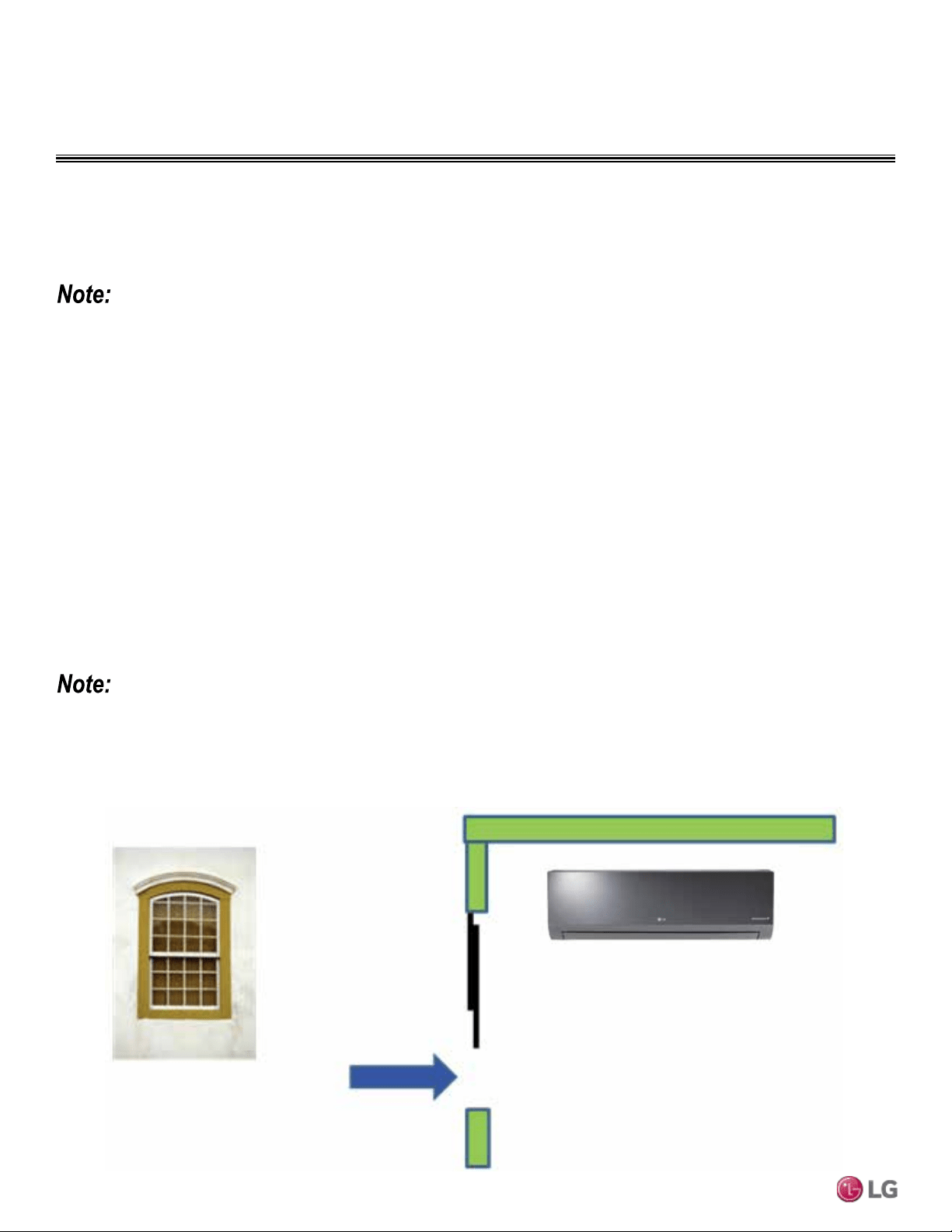
Due to our policy of continuous product innovation, some specications may change without notication.
©LG Electronics U.S.A., Inc., Englewood Cliffs, NJ. All rights reserved. “LG” is a registered trademark of LG Corp.
50 | FOUR-WAY CASSETTE
Four-Way Ceiling Cassette System Engineering Manual
ASHRAE Standards 62.1 and 62.2 (depending on if the building is residential or commercial), and local codes specify the minimum volume
of airflow that must be provided to an occupied space. Outdoor air is required to minimize adverse health effects, and it provides acceptable
indoor air quality for building occupants. Indoor units located within the zone typically require less airflow to condition the space. During the
design phase, refer to the airflow capabilities listed in the specification tables for each product. Choose the best method for the application
out of the five (5) ventilation options available.
Disclaimer
Although we believe that these building ventilation methods have been portrayed accurately, none of the methods have been tested, veried,
or evaluated by LG Electronics, U.S.A., Inc., In all cases, the designer, installer, and contractor should understand if the suggested method is
used, it is used at their own risk. LG Electronics U.S.A., Inc., takes no responsibility and offers no warranty express, implied, or statutory and
the implied warranties of merchantability and tness for a particular purpose are excluded should the building ventilation methods fail to perform
as stated or intended.
• For a complete copy of ASHRAE Standard 62.1 and 62.2, refer to the American Standard of Heating and Air Conditioning Engineers
(ASHRAE) website at www.ashrae.org.
Method 1: Natural Ventilation (Non-Ducted, Unconditioned Outdoor Air)
Natural ventilation devices, such as operable windows or louvers may be used to ventilate the building when local code permits. The open
area of a window or the free area of a louver must meet the minimum percentage of the net occupied floor area.
Advantages
• Occupants control the volume of the ventilation air manually.
• Useful for historic buildings that have no ceiling space available for
outdoor air ductwork.
• May be used with the full lineup of Duct-Free Split system indoor
units.
Disadvantages
• In some locations, it may be difficult to control humidity levels when
windows are open.
• Thermal comfort levels may be substandard when windows are
open.
• Indoor units may have to be oversized to account for the added
heating and cooling loads when windows are open.
• Provides outdoor air to perimeter spaces only. Additional mechan-
ical ventilation system may be required to satisfy requirements for
interior spaces.
• Outdoor air loads may be difficult to calculate since the quantity of
outdoor air is not regulated.
• May affect indoor unit proper operation when open.
Figure 28: Natural Ventilation (Non-Ducted, Unconditioned Outdoor Air).
BUILDING VENTILATION DESIGN GUIDE
Methodology illustrations are for examples only and do not depict actual
indoor units for the specic outdoor unit pairing. These are generic illus-
trations to show ventilation design only.
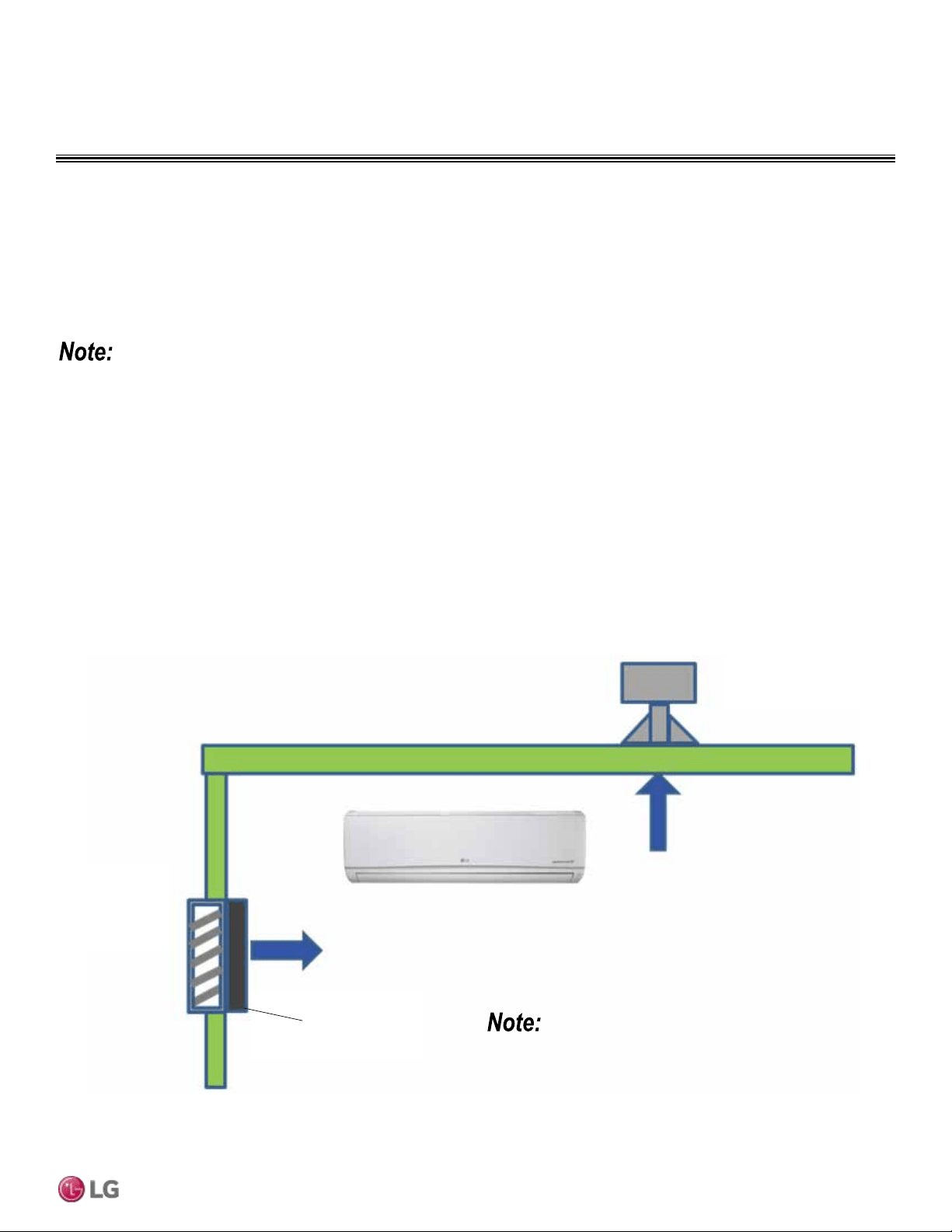
Due to our policy of continuous product innovation, some specications may change without notication.
©LG Electronics U.S.A., Inc., Englewood Cliffs, NJ. All rights reserved. “LG” is a registered trademark of LG Corp.
FOUR-WAY CASSETTE | 51
Application Guidelines
BUILDING VENTILATION DESIGN GUIDE
OA Wall
Louver
Damper
Roof Fan
Method 2: Unconditioned Outdoor Air (Non-Ducted, Fan Assisted Ventilation)
When approved by local codes, the fan assisted ventilation method uses exhaust fans to remove air from the building, and outdoor air is
drawn into occupied spaces through a wall louver or gravity roof intake hood. Supply fans can also be used to push the outdoor air into the
space and building positive pressure will vent the exhaust air through louvers or roof-mounted exhaust hoods. Outdoor air is neither cooled
nor heated before entering the building.
Advantages
• Outdoor air may be manually controlled by the occupant or auto-
matic controls may be installed to open/close outdoor air dampers
or to turn on/off ventilation fans.
• Useful for large open spaces like warehouses, garages, and
workshops.
• Outdoor air volume is a known quantity. Air loads may be easier to
calculate since fans will regulate the amount of outdoor air.
• May be used with the full lineup of Duct-Free Split system indoor
units.
This may result in loss of building pressurization control, increasing inltration loads with adverse effects.
Disadvantages
• In some locations of the country, it may be difficult to control
humidity levels while outdoor air louvers/hoods are opened.
• Thermal comfort levels may be substandard when louvers/hoods
are opened.
• Indoor units may have to be oversized to account for the added
heating/cooling loads when louvers/hoods are open.
• Hot, cold, and/or humid areas may be present if the outdoor air is
not evenly distributed to the different spaces.
Figure 29: Unconditioned Outdoor Air (Non-Ducted, Fan Assisted Ventilation).
Methodology illustrations are for examples only and do not depict actual
indoor units for the specic outdoor unit pairing. These are generic illus-
trations to show ventilation design only.
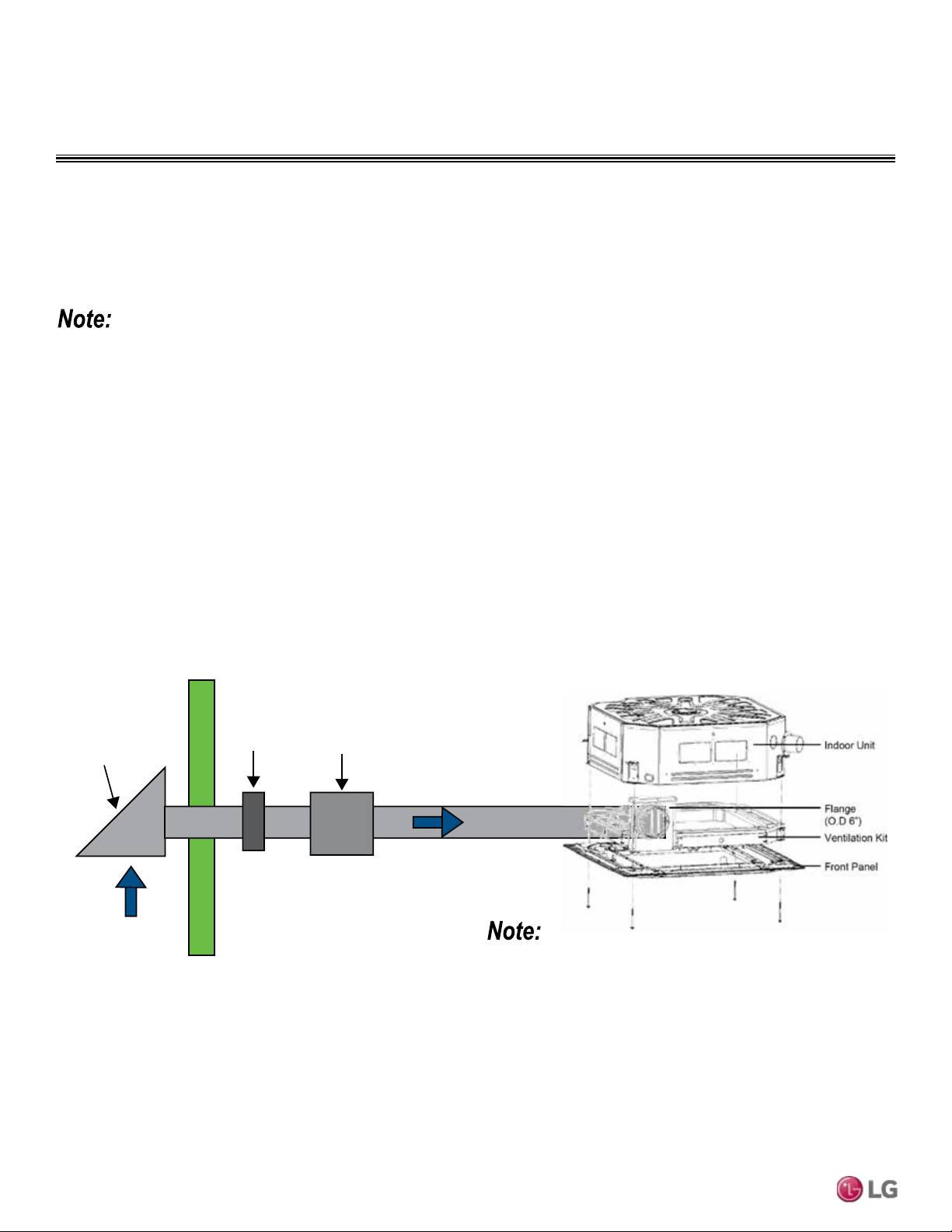
Due to our policy of continuous product innovation, some specications may change without notication.
©LG Electronics U.S.A., Inc., Englewood Cliffs, NJ. All rights reserved. “LG” is a registered trademark of LG Corp.
52 | FOUR-WAY CASSETTE
Four-Way Ceiling Cassette System Engineering Manual
Method 3: Unconditioned Outdoor Air Ducted to Indoor Units
Untreated outdoor air is channeled through a duct system that is piped to the return air duct on Duct-Free Split system ducted indoor units or
to the frame of Duct-Free Split system four-way cassettes.
Advantages
• May require less ductwork if indoor units are
placed near outdoor walls or a roof deck.
• Controls must be interlocked to shut off the
outdoor air supply fan when the space is
unoccupied.
• Third-party demand-control ventilation
controls may be installed to regulate outdoor
intake based on the CO
2
levels of the
occupied space.
Disadvantages
• Fan(s) will be required to push outdoor air to the indoor unit to overcome the additional
static pressure.
• Filter required to be added to the outdoor air duct.
• Ducted and four-way cassette models are the only indoor units that accept the connection
of an outdoor air duct to the unit case.
• In most cases, in lieu of using the factory mounted return-air thermistor on indoor units, a
remote wall temperature sensor or zone controller will be needed to provide an accurate
reading of the conditioned area temperature.
• Unconditioned outdoor air may affect indoor unit performance, which may necessitate
oversizing the indoor unit.
Outside air may ow backward through the return air-lter grille when the indoor unit fan speed slows or stops in response to changes in the
space load. This may result in captured particulate on the lter media being blown back into the conditioned space.
OA Wall Cap
Damper
Inline Fan
with Filter
Figure 30: Unconditioned Outdoor Air Ducted to Indoor Units.
BUILDING VENTILATION DESIGN GUIDE
Methodology illustrations are for examples only and do not depict actual
indoor units for the specic outdoor unit pairing. These are generic illus-
trations to show ventilation design only.
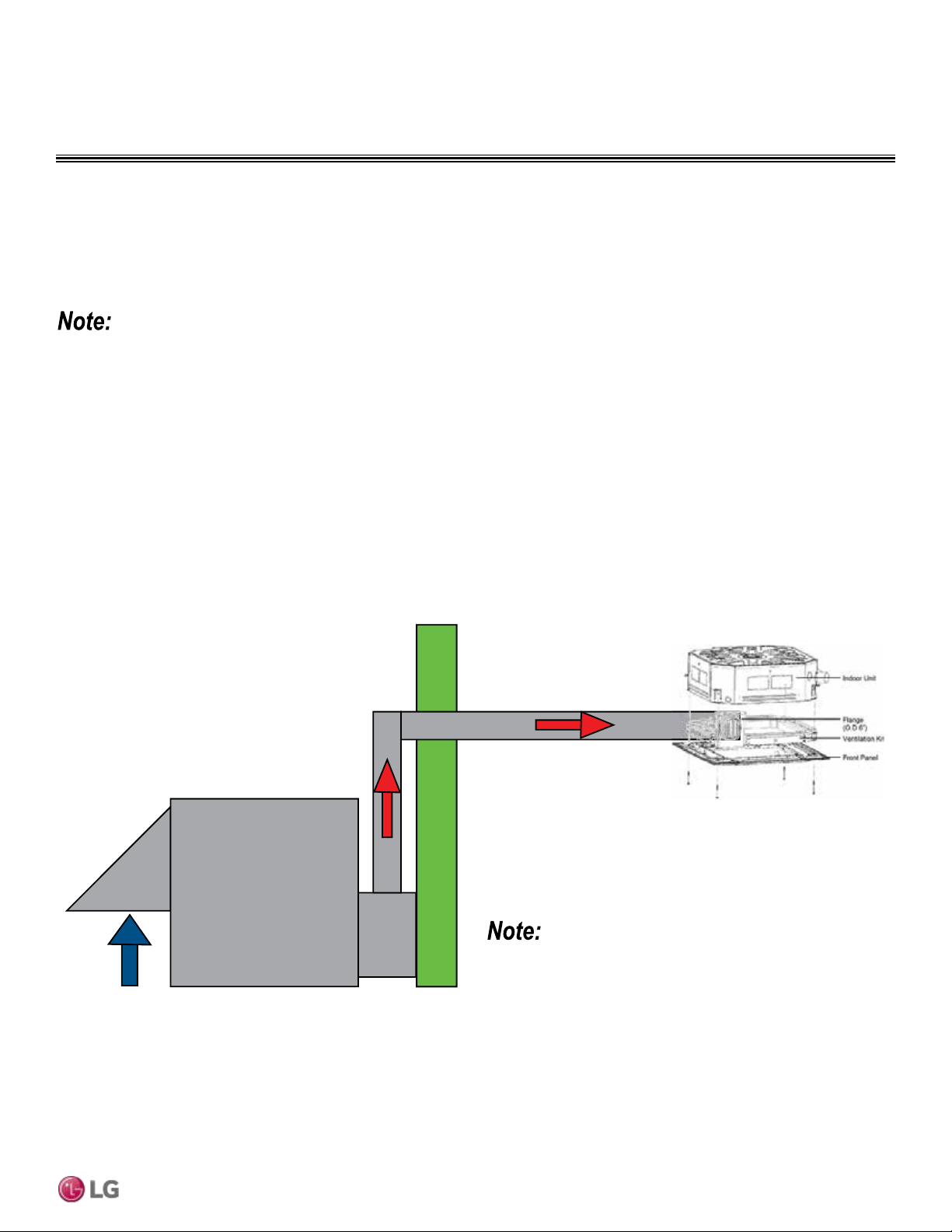
Due to our policy of continuous product innovation, some specications may change without notication.
©LG Electronics U.S.A., Inc., Englewood Cliffs, NJ. All rights reserved. “LG” is a registered trademark of LG Corp.
FOUR-WAY CASSETTE | 53
Application Guidelines
BUILDING VENTILATION DESIGN GUIDE
Method 4: Coupled Dedicated Outdoor Air (CDOA)
A separate, dedicated outdoor air system delivers air directly to a Duct-Free Split system indoor unit or to the return air duct system. After
mixing with the return air stream, ventilation air passes through the indoor unit and into the conditioned space. The pretreatment system is
capable of filtering, conditioning, and dehumidifying outdoor air to room neutral conditions.
Advantages
• Indoor unit capacity may not need to be
increased because of outdoor air.
• Fan and filter system is centralized to the
main outdoor air unit.
Disadvantages
• Ducted and four-way cassette indoor units are the only models designed for direct
connection of an outside air duct.
• Ceiling space is required for ductwork.
• Failure of outdoor air may impact indoor unit operation.
• In lieu of using the factory mounted return-air thermistor, a remote wall temperature
sensor or zone controller may be required to provide an accurate conditioned space
temperature reading.
Outside air may ow backward through the return air-lter grille when the indoor unit fan speed is reduced or stops when the space load is
satised. This may result in captured particulate on the lter media being blown back into the conditioned space.
Outdoor
Air Unit
Figure 31: Coupled Dedicated Outdoor Air (CDOA).
Methodology illustrations are for examples only and do not depict actual
indoor units for the specic outdoor unit pairing. These are generic illus-
trations to show ventilation design only.
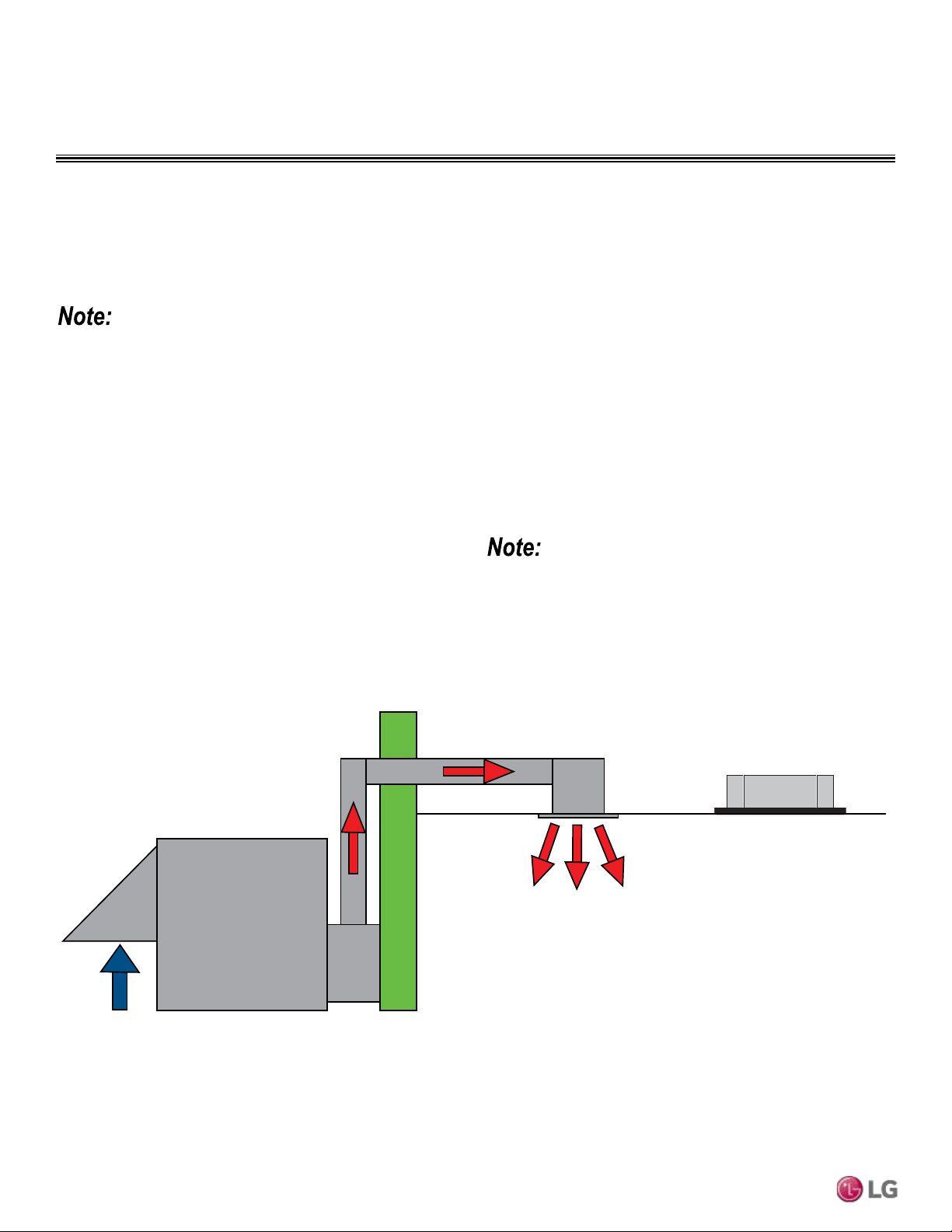
Due to our policy of continuous product innovation, some specications may change without notication.
©LG Electronics U.S.A., Inc., Englewood Cliffs, NJ. All rights reserved. “LG” is a registered trademark of LG Corp.
54 | FOUR-WAY CASSETTE
Four-Way Ceiling Cassette System Engineering Manual
Method 5: Decoupled Dedicated Outdoor Air System (DDOAS)
Provide a separate, dedicated outdoor-air system designed to filter, condition, and dehumidify ventilation air and deliver it directly to the
conditioned space through a separate register or grille. This approach requires a separate independent ventilation duct system not
associated with the Duct-Free Split system.
Advantages
• May be used with the full lineup of Duct-Free Split system indoor
units.
• The outdoor air unit may supply “neutral” air to the occupant space
even when the Duct-Free Split system indoor unit fan changes
speed or cycles on and off. DDOAS controls do not have to be
interlocked with the Duct-Free Split system.
• In lieu of installing localized smaller outside air treatment
equipment throughout the building, this method centralizes the
ventilation air source making service and filter changes easier and
less disruptive for the building occupants.
• Third-party demand control ventilation controls are more readily
accommodated.
Disadvantages
• Ceiling space is required to accommodate ductwork between the
outdoor air unit and ceiling diffusers.
LG recommends using the DDOAS method in all installations.
Outdoor
Air Unit
Indoor Unit s
Ceiling Diffuser
Indoor Unit
Figure 32: Decoupled Dedicated Outdoor Air System (DDOAS).
BUILDING VENTILATION DESIGN GUIDE
Methodology illustrations are for examples only and do not depict actual
indoor units for the specic outdoor unit pairing. These are generic illus-
trations to show ventilation design only.
Due to our policy of continuous product innovation, some specications may change without notication.
©LG Electronics U.S.A., Inc., Englewood Cliffs, NJ. All rights reserved. “LG” is a registered trademark of LG Corp.
FOUR-WAY CASSETTE | 55
Application Guidelines
PLACEMENT CONSIDERATIONS
Indoor Unit
Select a location for installing the indoor units that will meet the following conditions:
• Place the unit where air circulation will not be blocked.
• Locate the indoor unit in a location that is level, and where it can be easily connected to the outdoor unit.
• Place the unit in a location where condensation drainage can be conveniently routed away.
• Include enough space around the indoor unit so that it is accessible for maintenance and service purposes.
• Place the unit in a location where electrical noise / electromagnetic waves will not affect operation. Maintain proper distances between the
indoor units and electric wires, audio and visual appliances, breaker / circuit panels, etc. If the frequency signal of the appliance is unstable,
then install the indoor unit a minimum of ten (10) feet away, and run the power and transmission cables through a conduit.
• Place in an area that is level and with enough strength to bear the weight of the indoor unit(s).
Don’ts
• No obstacles to air circulation around the unit; keep proper distances from ceilings, doorways, floor, walls, etc.
• The unit should not be installed near a heat or steam source, or where considerable amounts of oil, iron powder, or flour are used.
• The unit should not be installed where sulfuric acid and flammable or corrosive gases are generated, vented into, or stored.
• Avoid installing the unit near high-frequency generators or near any equipment that generates an electromagnetic field (minimum 3-1/3 feet
away).
Installing in a High or Dropped Ceiling
High or dropped ceilings, often found in commercial buildings and offices, may cause a wide temperature differentiation. To countermeasure:
• Change the indoor unit mode selection to allow for higher ceilings (see table).
• Install an air circulator.
• Set the air discharge outlet so that heated air flows in a downward direction.
• Use a dual door system to protect the building gate or exit.
If the unit is installed near a body of water, certain components are at risk of being corroded. Appropriate anti-corrosion methods should be taken
for the unit and all components.
Ceiling Height Mode Selection
≤7-1/2 feet Low Ceiling
7-1/2 feet to 8-7/8 feet Standard
8-7/8 feet to 10-3/16 feet High Ceiling
10-3/16 feet to 11-13/16 feet Very High Ceiling
Table 31: Indoor Unit High Ceiling Mode Selection Options
(LCN097HV4, LCN127HV4, LCN187HV, LCN247HV).
Ceiling Height Mode Selection
≤8-7/8 feet Low Ceiling
8-7/8 feet to 10-1/2 feet Standard
10-1/2 feet to 11-13/16 feet High Ceiling
11-13/16 feet to 13-13/16 feet Very High Ceiling
Table 32: Indoor Unit High Ceiling Mode Selection Options (LCN367,
LCN427HV ).
The unit should not be installed where sulfuric acid and ammable or corrosive gases are generated, vented into, or stored. There is risk of
re, explosion, and physical injury or death.
Selecting the Best Location for the Indoor Unit
The unit may be damaged, may malfunction, and / or will not operate as designed if installed in any of the conditions listed.
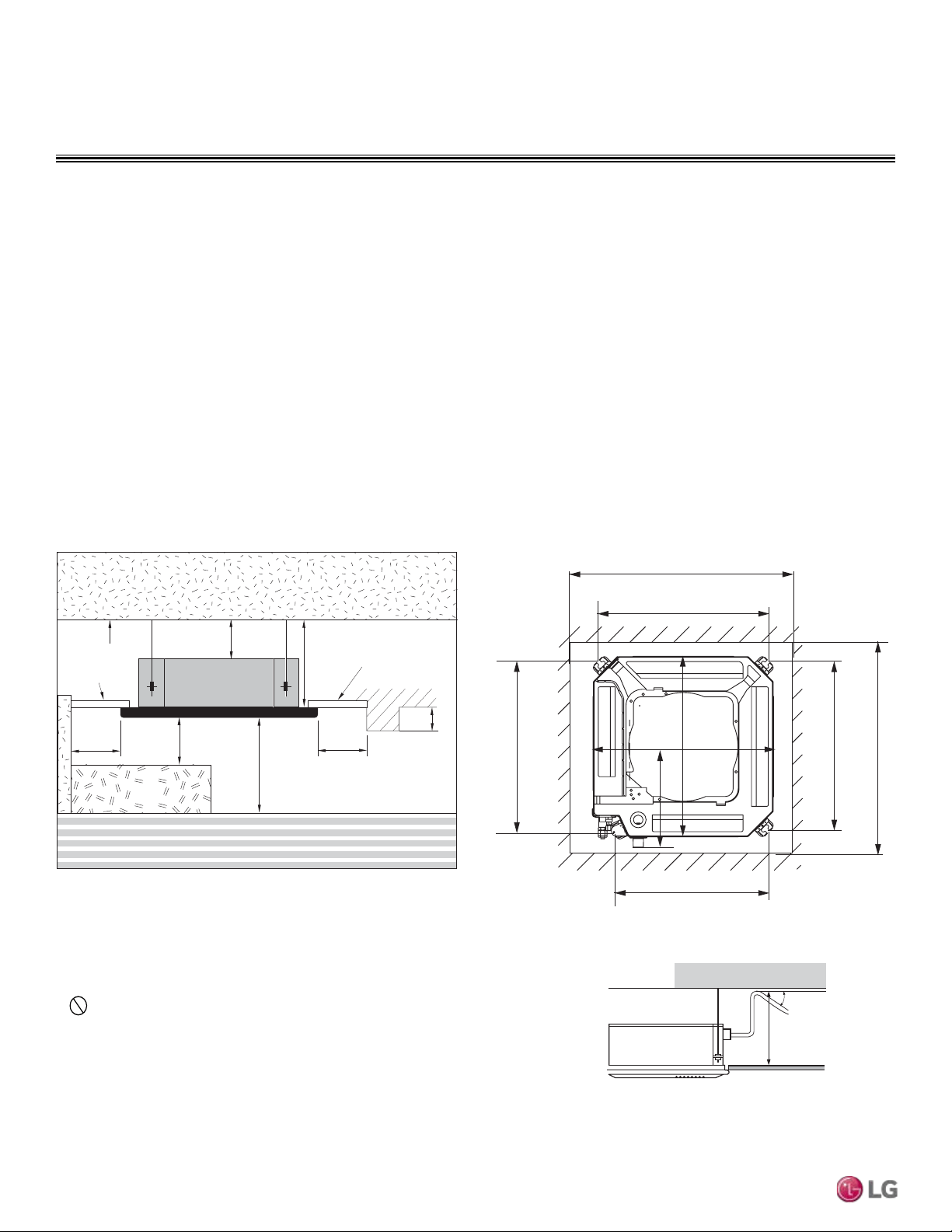
Due to our policy of continuous product innovation, some specications may change without notication.
©LG Electronics U.S.A., Inc., Englewood Cliffs, NJ. All rights reserved. “LG” is a registered trademark of LG Corp.
56 | FOUR-WAY CASSETTE
Four-Way Ceiling Cassette System Engineering Manual
Indoor Unit
PLACEMENT CONSIDERATIONS
Ceiling
Ceiling Tile
Ceiling Tile
Floor
≥13/32
≥11-13/16 inches
H = 6 feet to 12 feet
≥39-3/8 inches
≥19-11/16
≥19-11/16
≤11-13/16 inches
inches
inches
inches
Figure 33: Indoor Unit Clearance Requirements.
23-1/16 inches ~ 26 inches (Ceiling Opening)
20-3/8 inches
18-5/32 inches
20-3/8 inches
23-1/16 inches ~ 26 inches (Ceiling Opening)
20-19/32 inches
22-15/32 inches
Unit Size
22-15/32 inches
Unit Size
12-9/16 inches
Figure 34: Ceiling Opening Dimensions and Bolt Locations.
Installing the Drain System
• Drain piping must have downward gradient of at least 1/50 to 1/100; to prevent
reverse flow, slope should not be straight up and down.
• Do not damage the drain port on the indoor unit when connecting the field-sup-
plied drain piping.
• Drain piping specifications:
- Indoor Unit Drain Connection: 1-1/4 inch outside diameter.
- Field-Supplied Drain Piping: Polyvinyl chloride piping with 1-inch inside diameter
and pipe fittings.
1/50~
1/100
<27-1/2 inches (9k, 12k)
<31-1/2 inches (18k to 42k)
Figure 35: Indoor Unit Drain Piping.
Installing in an Area with High Humidity Levels
If the environment is prone to humidity levels of 80% or more (near the ocean, lakes, etc.) or where steam could collect in the plenum:
• Install additional insulation to the indoor unit (glass wool insulation >13/32 inches thick).
• Install additional insulation to the refrigerant piping (insulation >13/16 inches thick).
• Seal all gaps between the indoor unit and the ceiling tiles (make the area air tight) so that humidity does not transfer from the plenum to the
conditioned space. Also, add a ceiling grille for ventilation.
Installing in an Area Exposed to Unconditioned Air
In some installation applications, areas (floors, walls) in some rooms may be exposed to unconditioned air (room may be above or next to an
unheated garage or storeroom). To countermeasure:
• Verify that carpet is or will be installed (carpet may increase the temperature by three degrees).
• Add insulation between the floor joists.
• Install radiant heat or another type of heating system to the floor.
Due to our policy of continuous product innovation, some specications may change without notication.
©LG Electronics U.S.A., Inc., Englewood Cliffs, NJ. All rights reserved. “LG” is a registered trademark of LG Corp.
FOUR-WAY CASSETTE | 57
Application Guidelines
PLACEMENT CONSIDERATIONS
Outdoor Unit
When deciding on a location to place the outdoor unit, be sure to choose an area where run-off from defrost will not accumulate and freeze
on sidewalks or driveways which may create unsafe conditions.
CAUTION
Selecting the Best Location for the Outdoor Unit
To avoid the possibility of re, do not install the unit in an area where combustible gas may generate, ow, stagnate, or leak. Failure to do so will
cause serious bodily injury or death.
Install a fence to prevent vermin from crawling into the unit or unauthorized individuals from accessing it.
Do not install the unit in a location where
acidic solution and spray (sulfur) are often used as this may cause serious bodily injury or death.
Do not use the unit in environments where oil,
steam, or sulfuric gas are present as this may cause serious bodily injury or death.
Select a location for installing the outdoor unit that will meet the following conditions:
• Where the unit will not be subjected to direct thermal radiation from other heat sources, nor an area that would not expose the outdoor unit
to heat or steam like discharge from boiler stacks, chimneys, steam relief ports, other air conditioning units, kitchen vents, plumbing vents,
and other sources of extreme temperatures.
• Where operating sound from the unit will not disturb inhabitants of surrounding buildings.
• Where the unit will not be exposed to direct, strong winds.
• Where there is enough strength to bear the weight of the unit.
• Include space for drainage to ensure condensate flows properly out of the unit when it is in heating mode. Avoid placing the outdoor unit in
a low-lying area where water could accumulate.
• A location that allows for optimum air flow and is easily accessible for inspection, maintenance, and service.
• Where piping between the outdoor unit and indoor unit are within allowable limits.
• Where high-frequency electrical noise / electromagnetic waves will not affect operation.
The indoor unit may take longer to provide heat, or heating performance will be reduced in winter if the unit is installed:
1. In a narrow, shady location.
2. Near a location that has a lot of ground moisture.
3. In a highly humid environment.
4. In an area in which condensate does not drain properly.
Planning for Snow and Ice
In climates that experience snow buildup, place the unit on a raised platform to ensure proper condenser airflow. The raised support platform
must be high enough to allow the unit to remain above possible snow drifts. Mount the unit on a field-provided stand that is higher than the
maximum anticipated snowfall for the location. Design the mounting base to prevent snow accumulation on the platform in front or back of
the unit case. If necessary, provide a field fabricated hood to keep snow and ice and/or drifting snow from accumulating on the coil surfaces.
Use inlet and discharge duct or hoods to prevent snow or rain from accumulating on the fan inlet and outlet guards. Best practice prevents
snow from accumulating on top of the unit. Consider tie-down requirements in case of high winds or where required by local codes.
DANGER
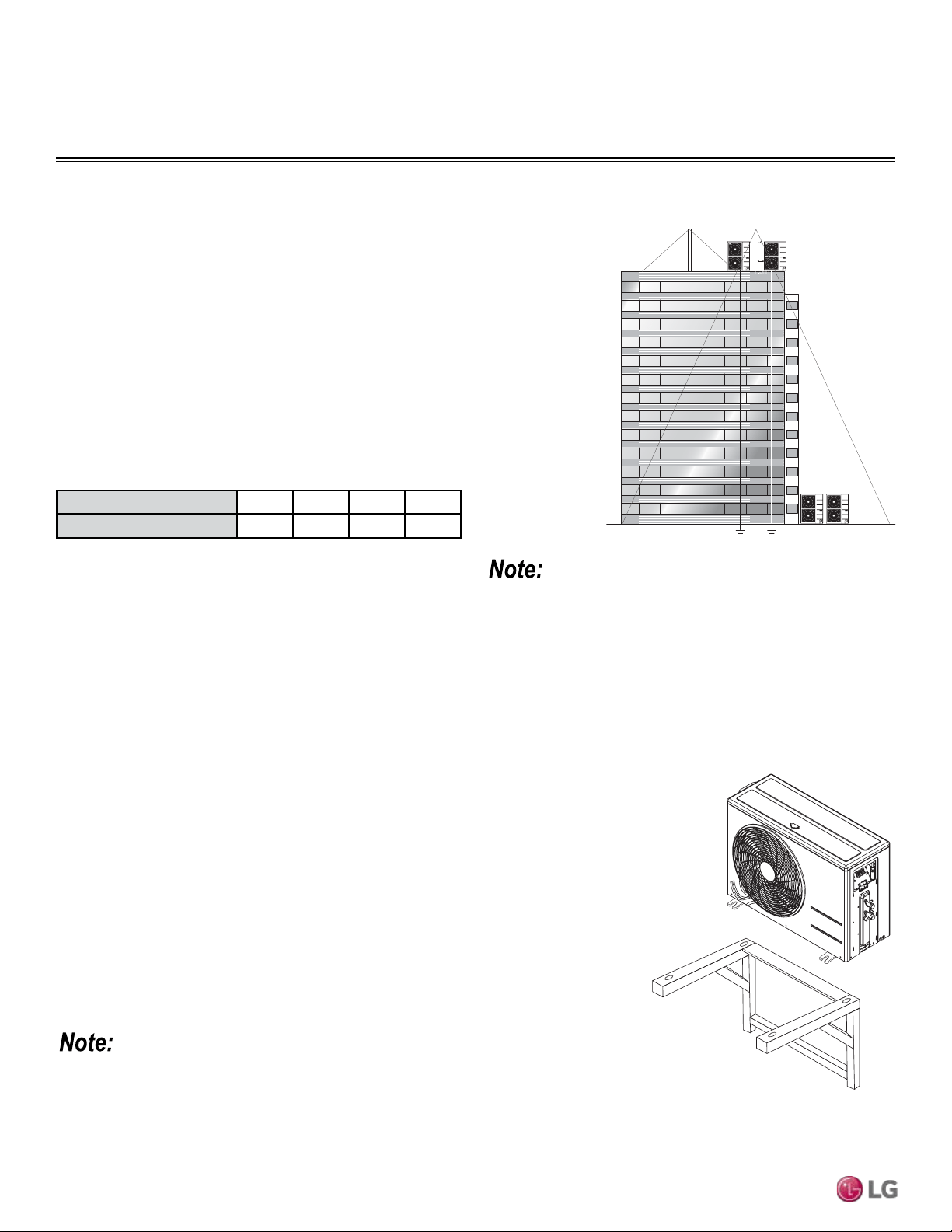
Due to our policy of continuous product innovation, some specications may change without notication.
©LG Electronics U.S.A., Inc., Englewood Cliffs, NJ. All rights reserved. “LG” is a registered trademark of LG Corp.
58 | FOUR-WAY CASSETTE
Four-Way Ceiling Cassette System Engineering Manual
Outdoor Unit
PLACEMENT CONSIDERATIONS
Tie-Downs / Wind Restraints and Lightening Protection
The strength of the Four-Way Ceiling Cassette system outdoor unit frame is adequate
to be used with field-provided wind restraint tie-downs.
Tie-Downs / Wind Restraints
• The strength of the roof must be checked before installing the outdoor units.
• If the installation site is prone to high winds or earthquakes, when installing on the
wall or roof, securely anchor the mounting base using a field-provided tie-down con-
figuration approved by a local professional engineer.
• The overall tie-down configuration must be approved by a local professional engineer.
Always refer to local code when using a wind restraint system.
Lightening Protection
• To protect the outdoor unit from lightning, it should be placed within the specified
lightning safety zone.
• Power cable and communication cable should be installed five (5)
feet away from lightning rod.
• A high-resistance ground system should be included to protect
against induced lightning or indirect strike.
Ground
Safe zone
Lightning rod
Protection Angle (25˚~55˚)
1.5m
5 feet
Lightning rod
Figure 36: Lightening Protection Diagram.
Table 33: Safety Zone Specications.
Building Height (feet)
66 98 148 197
Protection Angle (˚)
55 45 35 25
If the building does not include lightning protection, the outdoor unit
may be damaged from a lightening strike. Inform the customer of
this possibility in advance.
General Mounting
Securely attach the outdoor unit to a condenser pad, base rails, or other mounting platform
that is securely anchored to the ground or building structure. The underlying structure or
foundation must be designed to support the weight of the unit, and avoid placing the outdoor
unit in a low lying area where water may accumulate.
Attaching the Outdoor Unit to the Bracket
When installing the outdoor unit on a wall or roof top, anchor the mounting base securely
using nails or wire with regard to wind and earthquake or vibration.
Refer to installation manual, and follow the applicable local code for clearance, mounting,
anchor, and vibration attenuation requirements.
Figure 37: Bracket Mounting.
• All referenced materials are to be field-supplied.
• Images are not to scale.
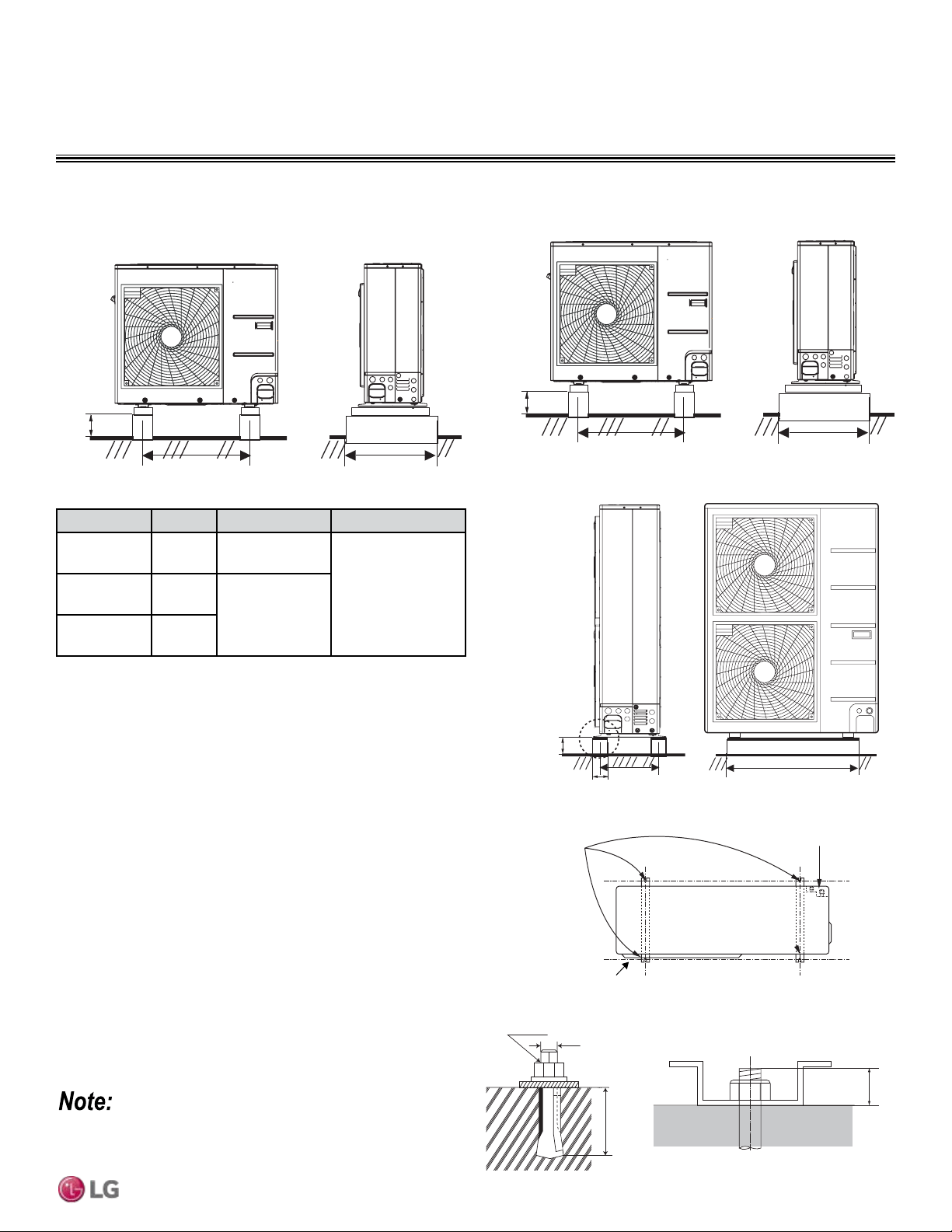
Due to our policy of continuous product innovation, some specications may change without notication.
©LG Electronics U.S.A., Inc., Englewood Cliffs, NJ. All rights reserved. “LG” is a registered trademark of LG Corp.
FOUR-WAY CASSETTE | 59
Application Guidelines
Bolt and
A
nti-vibration
Pad Placement
Refrigerant Piping
Connection Location
Foundation
Top of Outdoor Unit
(Looking Down)
Concrete Platform Specifications
• Concrete foundations should be made of one part cement, two
parts sand, and four parts gravel.
• The surface of the foundation should be finished with mortar with
rounded edges, and weatherproofed.
Figure 38: Bolting the LUU097HV and LUU127HV Outdoor Units to the
Platform (Appearance May Vary).
Minimum
7-7/8 inches
Minimum 24-13/32 inches
Minimum 15-3/4 inches
Figure 39: Bolting the LUU187HV and LUU247HV Outdoor Unit to the
Platform.
Outdoor Unit Bolt Type Concrete Height Bolt Depth
LUU097HV,
LUU127HV
M10-J
Minimum 3-15/16
inches
Minimum 2-3/8 inches
LUU187HV,
LUU247HV
M10-J
Minimum 7-7/8
inches
LUU367HV
LUU427HV
M10-J
Table 34: Outdoor Unit Foundation Specications.
Bolting the Outdoor Unit to the Platform
Bolting the Outdoor Unit to the Platform Procedure
When installing the outdoor unit onto a concrete or rigid mount, use
a bolt and nut.
1. Ensure that the concrete platform will not degrade easily, and has
enough strength to bear the weight of the unit.
2. Include an H-beam support. Firmly attach the corners, otherwise
the support will bend.
3. Use a hexagon nut.
4. Use anti-vibration material.
5. Include enough space around the concrete foundation for con-
densate drainage.
6. Seal all wiring and piping access holes to prevent bugs from
entering the unit.
• All referenced materials are to be field-supplied.
• Images are not to scale.
PLACEMENT CONSIDERATIONS
Outdoor Unit
Figure 40: Bolting the LUU367HV and LUU427HV Outdoor Unit to the
Platform.
Figure 41: Platform Mounting.
Minimum
3-15/16
inches
Minimum 22-3/16 inches
Minimum 14-19/32 inches
Figure 42: Close up of Bolt Attachment.
Minimum
7-7/8
7-7/8
Minimum
15-3/4
Minimum 24-13/32
Unit: Inch
M10
Anchor Bolt
2-3/8 ~ 4-3/32
25/32
Unit: Inch
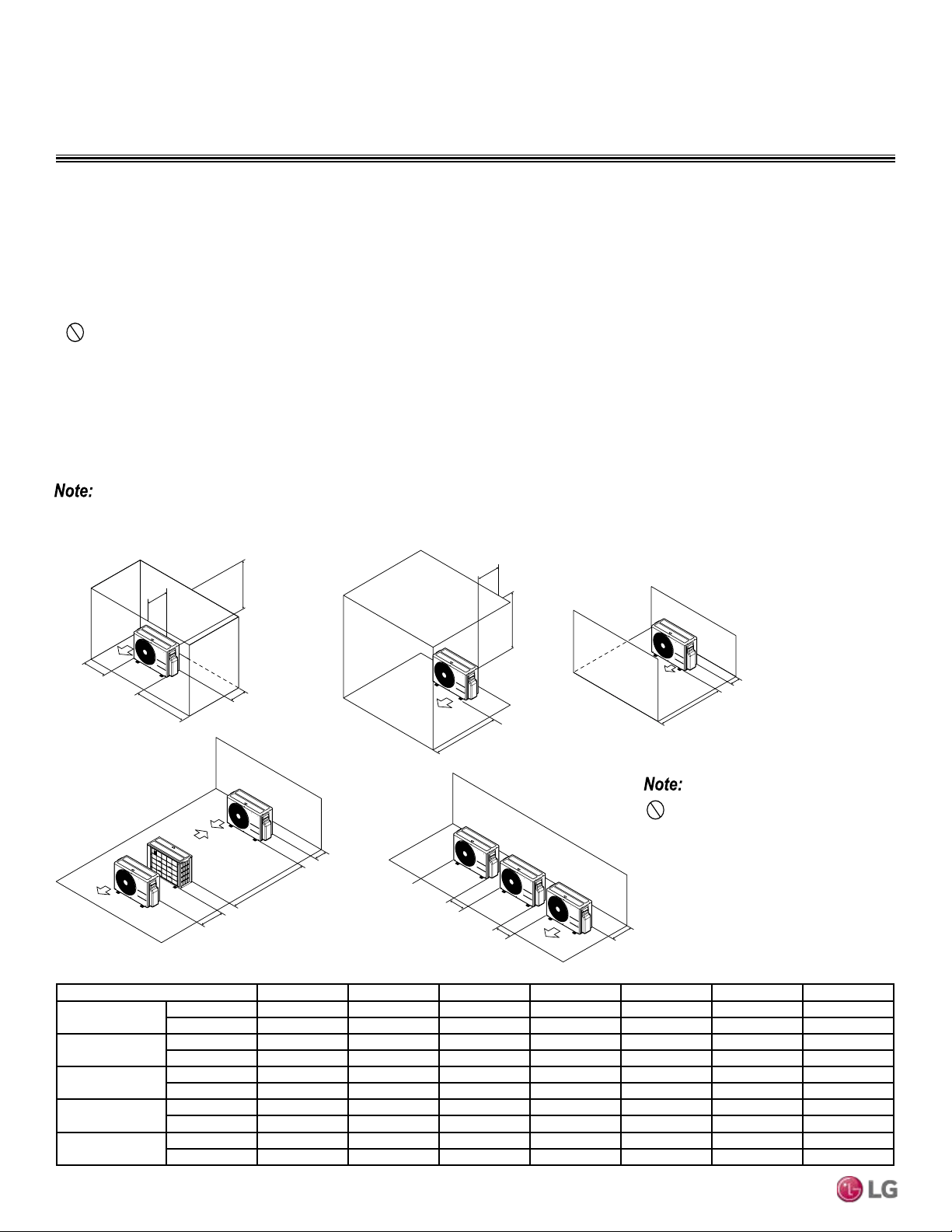
Due to our policy of continuous product innovation, some specications may change without notication.
©LG Electronics U.S.A., Inc., Englewood Cliffs, NJ. All rights reserved. “LG” is a registered trademark of LG Corp.
60 | FOUR-WAY CASSETTE
Four-Way Ceiling Cassette System Engineering Manual
Outdoor Unit
PLACEMENT CONSIDERATIONS
Outdoor Unit (9,000 to 24,000 Capacity) Service Access and Allowable Clearances
Specific clearance requirements in the diagram below are for (9,000 to 24,000 Btu/h capacities). Figure 43 shows the overall minimum clear-
ances that must be observed for safe operation and adequate airflow around the outdoor unit.
When placing the outdoor unit under an overhang, awning, sunroof or other “roof-like structure”, observe the clearance requirements (as
shown in Cases 1 and 2) for height in relation to the unit. To have successful service access to the outdoor unit, see Figure 43 for minimum
spacing. When installing multiple outdoor units, see Cases 4 and 5 for correct spacing requirements.
Figure 43: 9,000 to 24,000 Capacity Outdoor Unit Service Access and Allowable Clearances Diagram.
A
B
D
G
C
G
C
D
E
D
D
B
B
F
1/16 inch
20 inches or less
Case 1
Case 4
Case 2 Case 3
Case 5
20 inches or less
Unit: Inch A B C D E F G
Case 1
Standard 12 24 - 12 - - -
Minimum 4 10 - 4 - - 40
Case 2
Standard - - 20 - - - -
Minimum - - 14 - - - 40
Case 3
Standard - - 20 12 - - -
Minimum - - 14 4 - - -
Case 4
Standard - - - 12 24 - -
Minimum - - - 4 8 79 -
Case 5
Standard - 24 - 12 - - -
Minimum - 10 - 4 - - -
Table 35: 9,000 to 24,000 Outdoor Unit Service Access and Allowable Clearances Diagram Legend.
Do not place the unit where animals
and/or plants will be in the path of the warm
air, or where the warm air and/or noise will
disturb neighbors.
If the outdoor unit is installed between standard and minimum clearances, capacity decreases approximately 10%.
Minimum Allowable Clearance and Service Access Requirements
Proper clearance for the outdoor unit coil is critical for proper unit operation. When installing the outdoor unit, consider service, inlet and
outlet and minimum allowable space requirements as illustrated in the diagrams on the following pages.
• Include enough space for airflow and for service access. If installing multiple outdoor units, avoid placing the units where the discharge of
one unit will blow into the inlet side of an adjacent unit.
• If an awning is built over the unit to prevent direct sunlight or rain exposure, make sure that the discharge air of the outdoor unit isn’t
restricted.
• No obstacles to air circulation around the unit; keep proper distances from ceilings, fences, floor, walls, etc. (Install a fence to prevent
pests from damaging the unit or unauthorized individuals from accessing it.)
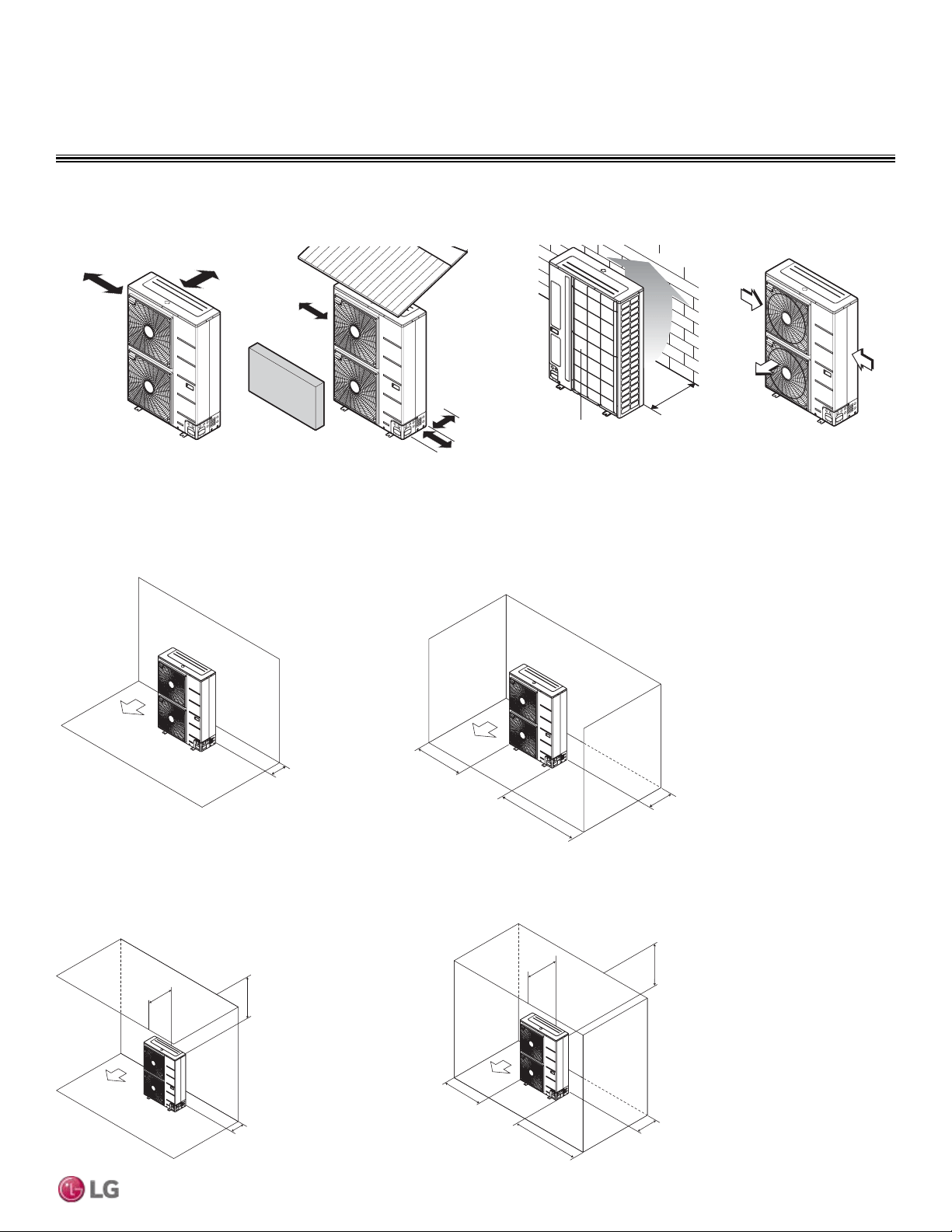
Due to our policy of continuous product innovation, some specications may change without notication.
©LG Electronics U.S.A., Inc., Englewood Cliffs, NJ. All rights reserved. “LG” is a registered trademark of LG Corp.
FOUR-WAY CASSETTE | 61
Application Guidelines
PLACEMENT CONSIDERATIONS
Outdoor Unit
Minimum 11-13/16
"
Minimum 19-11/16"
Minimum 39-3/8"
Minimum 11-13/16"
Maximum 19-11/16"
Minimum 11-13/16
"
Minimum 39-3/8"
Minimum 23-19/32"
Obstacles above and on the air intake side. Obstacles above, on the air intake side,
and on both left and right sides
Minimum 11-13/16
Air inlet grille
Blown
air
Strong
wind
Strong
wind
Minimum 11-13/16
Minimum 23-5/8
Sunroof
Fence or
obstacles
Minimum 11-13/16
Air inlet grille
Blown
air
Strong
wind
Strong
wind
Minimum 19-1/16
Fence or
obstacles
Unit: Inch
Minimum 11-13/16
Ensure that the space at the back of the outdoor unit is a minimum of 11-13/16 inches, and
include a minimum of 23-5/8 inches at the right side of the unit for service.
If the outdoor unit discharge side faces a wall, include a minimum of 19-11/16 inches
between the outdoor unit and the wall. Install the outdoor unit so that the discharge port is
set at a right angle to the wind direction.
Outdoor Unit (36,000 and 42,000 Btu/h Capacity) Service Access and Allowable Clearances
When installing the outdoor unit, consider service, inlet, and outlet, and minimum allowable space requirements as illustrated in the following
diagrams.
Clearance Requirements when Different Obstacles are Present (Unit: Inch).
Minimum 11-13/16"
Minimum 11-13/16"
Minimum 11-13/16"
Minimum 23-19/32"
Obstacle on the suction side only.
Obstacles on the suction side and
on both left and right sides.
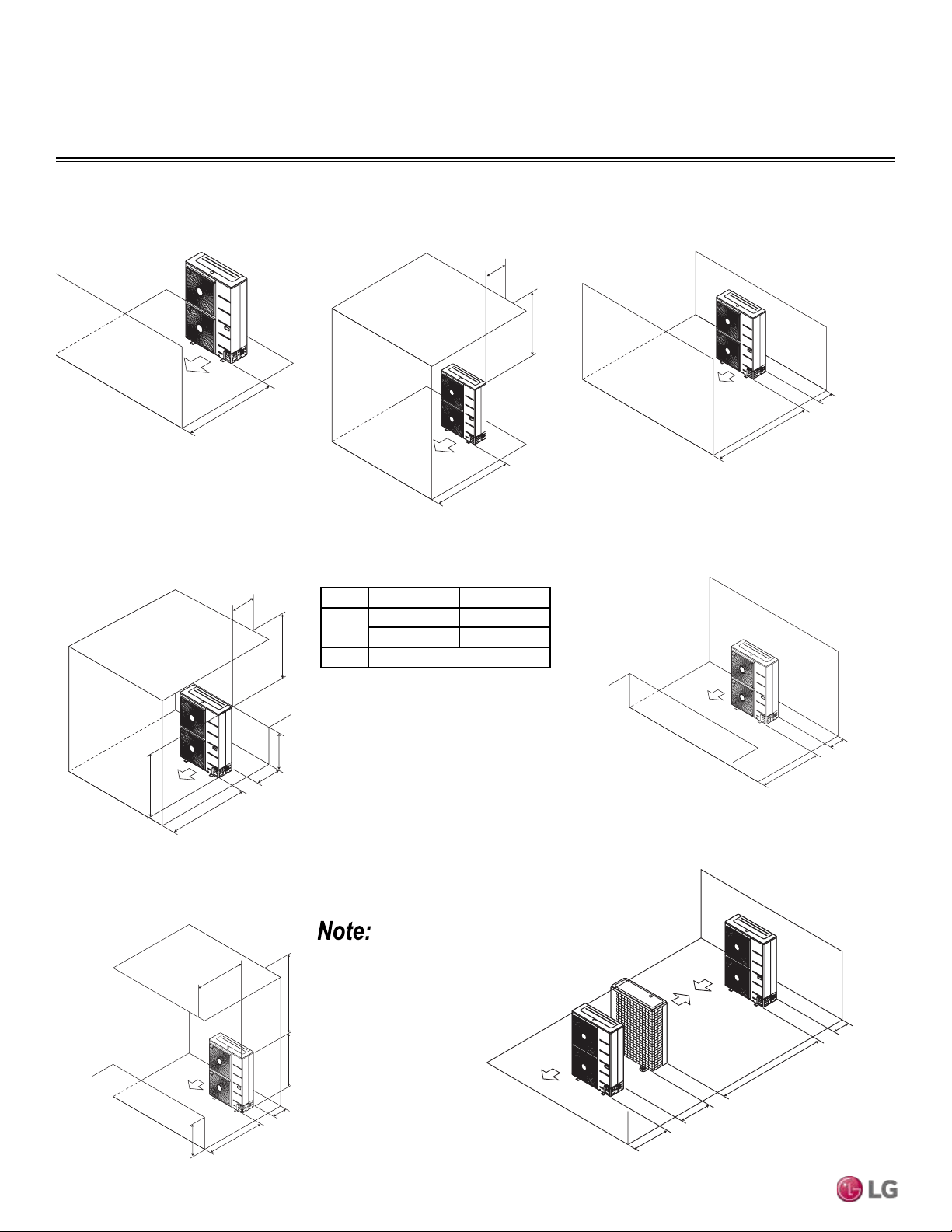
Due to our policy of continuous product innovation, some specications may change without notication.
©LG Electronics U.S.A., Inc., Englewood Cliffs, NJ. All rights reserved. “LG” is a registered trademark of LG Corp.
62 | FOUR-WAY CASSETTE
Four-Way Ceiling Cassette System Engineering Manual
PLACEMENT CONSIDERATIONS
Minimum 19-11/16
"
Minimum 19-11/16"
Minimum 19-11/16"
Minimum 39-3/8"
Obstacle just on the
air discharge side.
Obstacles above and on the
air discharge side.
Where there are obstacles on both suction
and discharge sides (discharge side obstacle
is higher than the outdoor unit).
Where there are obstacles above, and on both
suction and discharge sides (discharge side obstacle
is higher than the outdoor unit).
Maximum 19-11/16"
Minimum 11-13/16"
Minimum 39-3/8"
L
H
A
Minimum 19-11/16"
Minimum 11-13/16"
Where there are obstacles on both suction
and discharge sides (discharge side obstacle
is higher than the outdoor unit).
Where there are obstacles above, and on both
suction and discharge sides (discharge side obstacle
is higher than the outdoor unit).
Maximum 19-11/16"
Minimum 11-13/16
"
Minimum 39-3/8"
L
H
A
Minimum 19-11/16"
Minimum 11-13/16"
Table 36: Ratio among H, A, and L.
If a stand is necessary, it should be contained (not open
frame) to prevent the discharge air from short cycling.
L A
L
≤ H
0 < L ≤ 1/2 H 29-1/32 inches
1/2 H < L 39-3/8 inches
H < L
Set Stand as: L ≤ H
L
Minimum 39-3/8"
Minimum 39-3/8
"
Maximum 19-11/16"
Minimum 11-13/16"
Where there are obstacles on both suction
and discharge sides (discharge side obstacle
is lower than the outdoor unit).
Where there are obstacles above, and on both
suction and discharge sides (discharge side obstacle
is lower than the outdoor unit).
Minimum 19-11/16"
Minimum 11-13/16"
H
“L” should be lower than
“H”. If a stand is neces-
sary, it should be con-
tained (not open frame) to
prevent the discharge air
from short cycling.
Minimum 19-11/16"
Minimum 19-11/16"
Minimum 19-11/16"
Minimum 39-3/8"
Obstacle just on the
air discharge side.
Obstacles above and on the
air discharge side.
L
Minimum 39-3/8"
Minimum 39-3/8"
Maximum 19-11/16"
Minimum 11-13/16"
Where there are obstacles on both suction
and discharge sides (discharge side obstacle
is lower than the outdoor unit).
Where there are obstacles above, and on both
suction and discharge sides (discharge side obstacle
is lower than the outdoor unit).
Minimum 19-11/16"
Minimum 11-13/16"
H
Minimum 11-13/16"
Minimum 78-3/4"
Minimum 23-19/32"
Minimum 39-3/8"
Series installation
Outdoor Unit

REFRIGERANT PIPING
DESIGN & LAYOUT
BEST PRACTICES
“Refrigerant Piping Design” on page 64
"Selecting Field-Supplied Copper Tubing" on page 65
"Refrigerant Piping System Layout" on page 66
"Electrical Connections" on page 73
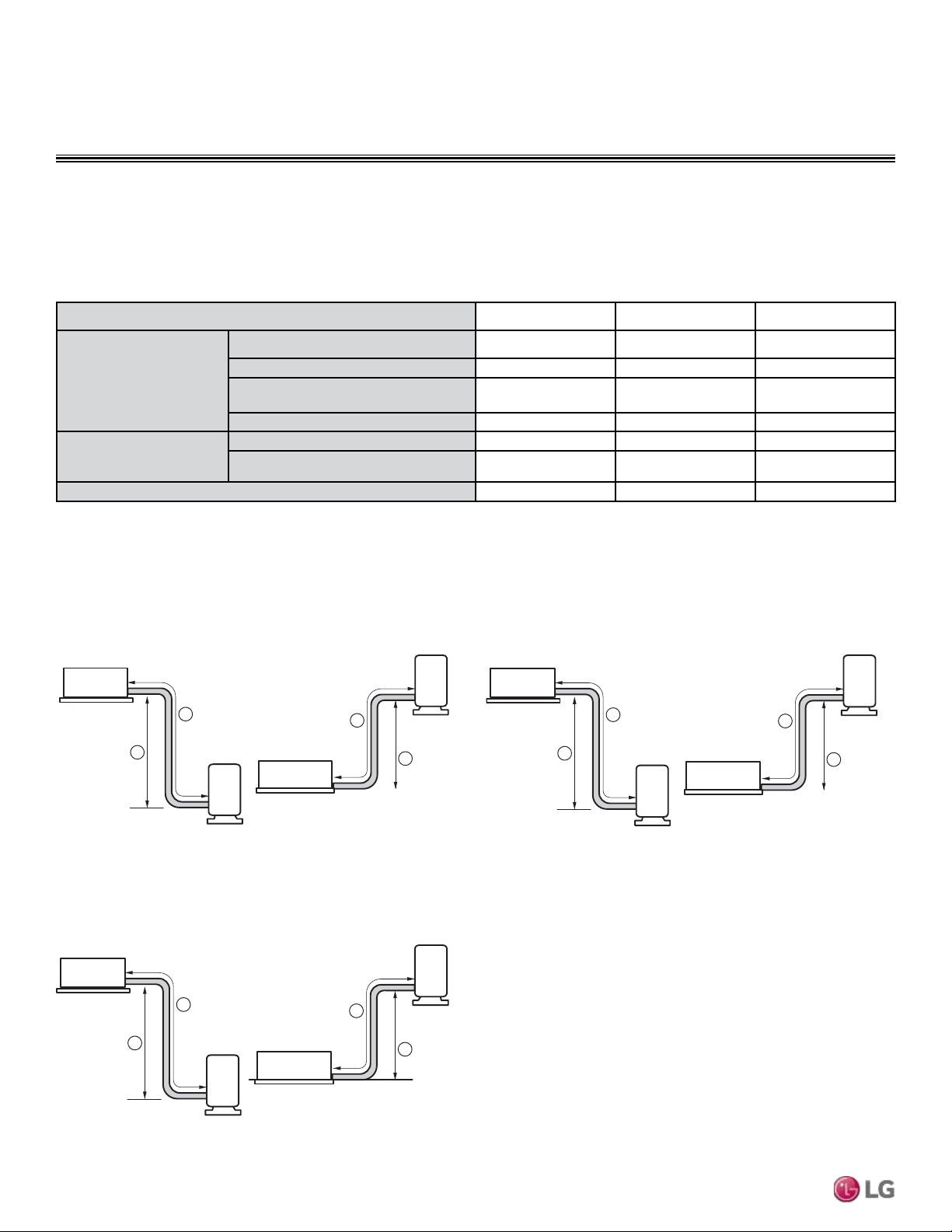
REFRIGERANT PIPING DESIGN
Design Guideline Summary
Device Connection Limitations
A single-zone four-way ceiling cassette system consists of one outdoor unit and one indoor unit. One of the most critical elements of a
single-zone four-way ceiling cassette system is the refrigerant piping. The table below lists pipe length limits that must be followed in the
design of a single-zone four-way ceiling cassette refrigerant pipe system.
Table 37: Single-Zone Four-Way Ceiling Cassette Refrigerant Piping System Limitations.
System Model Name
LC097HV4, LC127HV4 LC187HV, LC247HV LC367HV, LC427HV
Pipe Length
(ELF = Equivalent
Length of Pipe)
Longest total equivalent piping length
66 feet 164 feet 246 feet
Shortest total equivalent piping length
6.6 6.6 6.6
Distance between fittings and indoor or
outdoor units
≥20 inches ≥20 inches ≥20 inches
No additional refrigerant
24.6 feet 24.6 feet 24.6 feet
Elevation
(All Elevation Limitations are
Measured in Actual Feet)
If outdoor unit is above indoor unit
49 feet 98 feet 98 feet
If outdoor unit is below indoor unit
49 feet 98 feet 98 feet
Additional Refrigerant Needed (oz/ft)
0.22 0.43 0.43
DFS System Layout
Outdoor unit
Indoor unit
A
B
Outdoor unit
Indoor unit
A
B
98
98
164
Max Length = A
Max Elevation = B
164
Unit = Feet
Figure 44: Typical LC097HV4 and LC127HV4 System Layout. Figure 45: Typical LC187HV and LC247HV System Layout.
Outdoor unit
Indoor unit
A
B
Outdoor unit
Indoor unit
A
B
49
49
66
Max Length = A
Max Elevation = B
66
Unit = Feet
Outdoor unit
Indoor unit
A
B
Outdoor unit
Indoor unit
A
B
98
98
246
Max Length = A
Max Elevation = B
246
Unit = Feet
Figure 46: Typical LC347HV and LC427HV System Layout.
Due to our policy of continuous product innovation, some specications may change without notication.
©LG Electronics U.S.A., Inc., Englewood Cliffs, NJ. All rights reserved. “LG” is a registered trademark of LG Corp.
64 | FOUR-WAY CASSETTE
Four-Way Ceiling Cassette System Engineering Manual
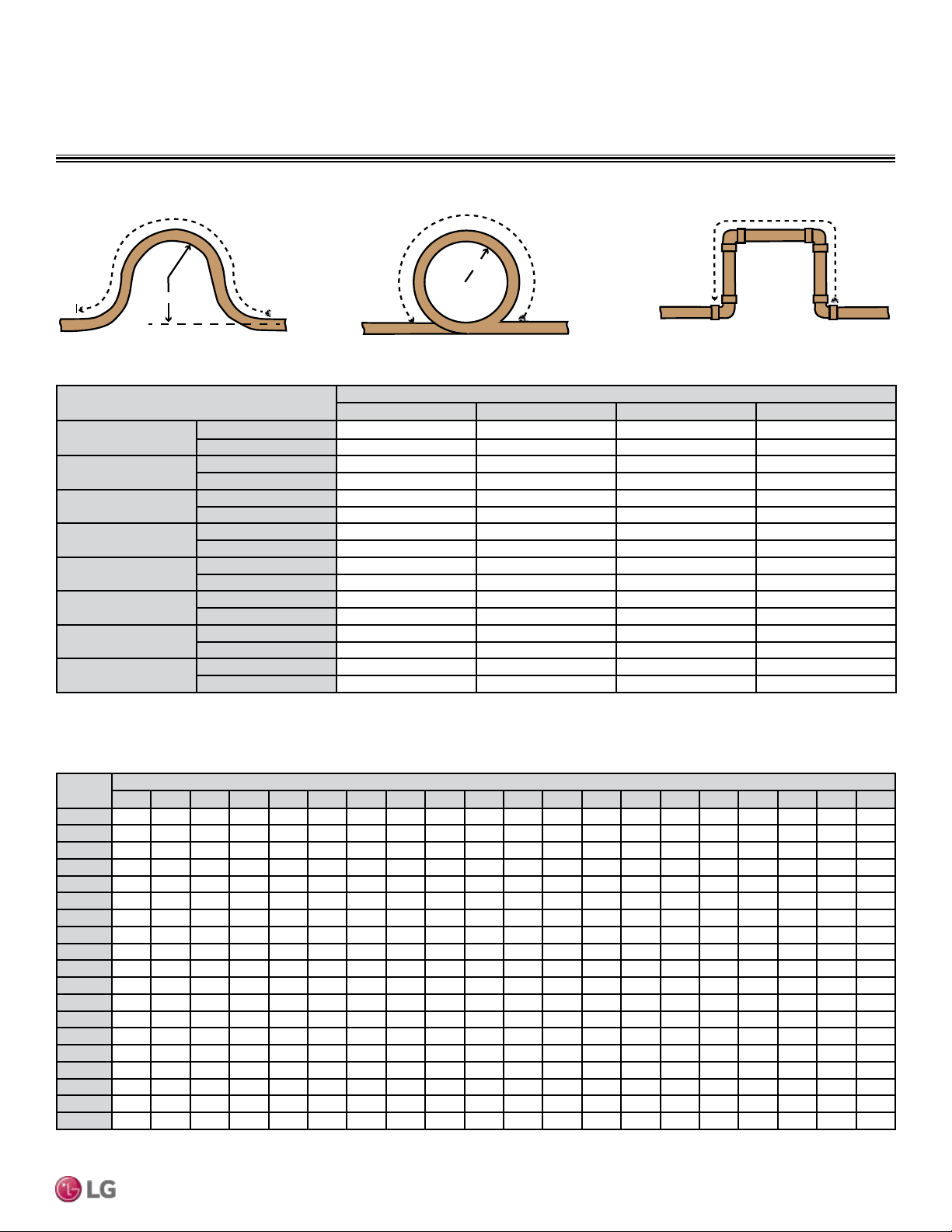
Large Tubing U-bend (>3/4 in.) Loop
Small Tubing U-bend (<3/4 in.)
Figure 47: Coiled Expansion Loops and Offsets.
R
L
L
R
L
Table 39: Radii of Coiled Expansion Loops and Developed Lengths of Expansion Offsets.
R
L
L
R
L
R
L
L
R
L
Anticipated Linear Expansion (LE) (inches)
Nominal Tube Size (OD) inches
1/4 3/8 1/2 3/4
1/2
R
1
6 7 8 9
L
2
38 44 50 59
1
R
1
9 10 11 13
L
2
54 63 70 83
1-1/2
R
1
11 12 14 16
L
2
66 77 86 101
2
R
1
12 14 16 19
L
2
77 89 99 117
2-1/2
R
1
14 16 18 21
L
2
86 99 111 131
3
R
1
15 17 19 23
L
2
94 109 122 143
3-1/2
R
1
16 19 21 25
L
2
102 117 131 155
4
R
1
17 20 22 26
L
2
109 126 140 166
1
R = Centerline Length of Pipe.
2
L = Centerline Minimum Radius (inches).
Selecting Field-Supplied Copper Tubing
REFRIGERANT PIPING DESIGN
Table 38: Linear Thermal Expansion of Copper Tubing in Inches.
Pipe
Length
1
Fluid Temperature °F
35° 40° 45° 50° 55° 60° 65° 70° 75° 80° 85° 90° 95° 100° 105° 110° 115° 120° 125° 130°
10
0.04 0.04 0.05 0.06 0.06 0.07 0.08 0.08 0.09 0.09 0.10 0.10 0.11 0.11 0.11 0.12 0.13 0.14 0.15 0.15
20
0.08 0.08 0.10 0.12 0.13 0.14 0.15 0.16 0.17 0.18 0.19 0.20 0.21 0.22 0.22 0.23 0.26 0.28 0.29 0.30
30
0.12 0.12 0.15 0.18 0.20 0.21 0.23 0.24 0.26 0.27 0.29 0.30 0.32 0.33 0.32 0.35 0.39 0.42 0.44 0.45
40
0.16 0.16 0.20 0.24 0.26 0.28 0.30 0.32 0.34 0.36 0.38 0.40 0.42 0.44 0.43 0.46 0.52 0.56 0.58 0.60
50
0.20 0.20 0.25 0.30 0.33 0.35 0.38 0.40 0.43 0.45 0.48 0.50 0.53 0.55 0.54 0.58 0.65 0.70 0.73 0.75
60
0.24 0.24 0.30 0.36 0.39 0.42 0.45 0.48 0.51 0.54 0.57 0.60 0.63 0.66 0.65 0.69 0.78 0.84 0.87 0.90
70
0.28 0.28 0.35 0.42 0.46 0.49 0.53 0.56 0.60 0.63 0.67 0.70 0.74 0.77 0.76 0.81 0.91 0.98 1.02 1.05
80
0.32 0.32 0.40 0.48 0.52 0.56 0.60 0.64 0.68 0.72 0.76 0.80 0.84 0.88 0.86 0.92 1.04 1.12 1.16 1.20
90
0.36 0.36 0.45 0.54 0.59 0.63 0.68 0.72 0.77 0.81 0.86 0.90 0.95 0.99 0.97 1.04 1.17 1.26 1.31 1.35
100
0.40 0.40 0.50 0.60 0.65 0.70 0.75 0.80 0.85 0.90 0.95 1.00 1.05 1.10 1.08 1.15 1.30 1.40 1.45 1.50
120
0.48 0.48 0.60 0.72 0.78 0.84 0.90 0.96 1.02 1.08 1.14 1.20 1.26 1.32 1.30 1.38 1.56 1.68 1.74 1.80
140
0.56 0.56 0.70 0.84 0.91 0.98 1.05 1.12 1.19 1.26 1.33 1.40 1.47 1.54 1.51 1.61 1.82 1.96 2.03 2.10
160
0.64 0.64 0.80 0.96 1.04 1.12 1.20 1.28 1.36 1.44 1.52 1.60 1.68 1.76 1.73 1.84 2.08 2.24 2.32 2.40
180
0.72 0.72 0.90 1.08 1.17 1.26 1.35 1.44 1.53 1.62 1.71 1.80 1.89 1.98 1.94 2.07 2.34 2.52 2.61 2.70
200
0.80 0.80 1.00 1.20 1.30 1.40 1.50 1.60 1.70 1.80 1.90 2.00 2.10 2.20 2.16 2.30 2.60 2.80 2.90 3.00
220
0.88 0.88 1.10 1.32 1.43 1.54 1.65 1.76 1.87 1.98 2.09 2.20 2.31 2.42 2.38 2.53 2.86 3.08 3.19 3.30
240
0.96 0.96 1.20 1.44 1.56 1.68 1.80 1.92 2.04 2.16 2.28 2.40 2.52 2.64 2.59 2.76 3.12 3.36 3.48 3.60
260
1.04 1.04 1.30 1.56 1.69 1.82 1.95 2.08 2.21 2.34 2.47 2.60 2.73 2.86 2.81 2.99 3.38 3.64 3.77 3.90
280
1.12 1.12 1.40 1.68 1.82 1.96 2.10 2.24 2.38 2.52 2.66 2.80 2.94 3.08 3.02 3.22 3.64 3.92 4.06 4.20
1
Pipe length baseline temperature = 0°F. "Expansion of Carbon, Copper and Stainless Steel Pipe," The Engineers' Toolbox, www.engineeringtoolbox.com.
Due to our policy of continuous product innovation, some specications may change without notication.
©LG Electronics U.S.A., Inc., Englewood Cliffs, NJ. All rights reserved. “LG” is a registered trademark of LG Corp.
FOUR-WAY CASSETTE | 65
Refrigerant Piping Design and Best Practices
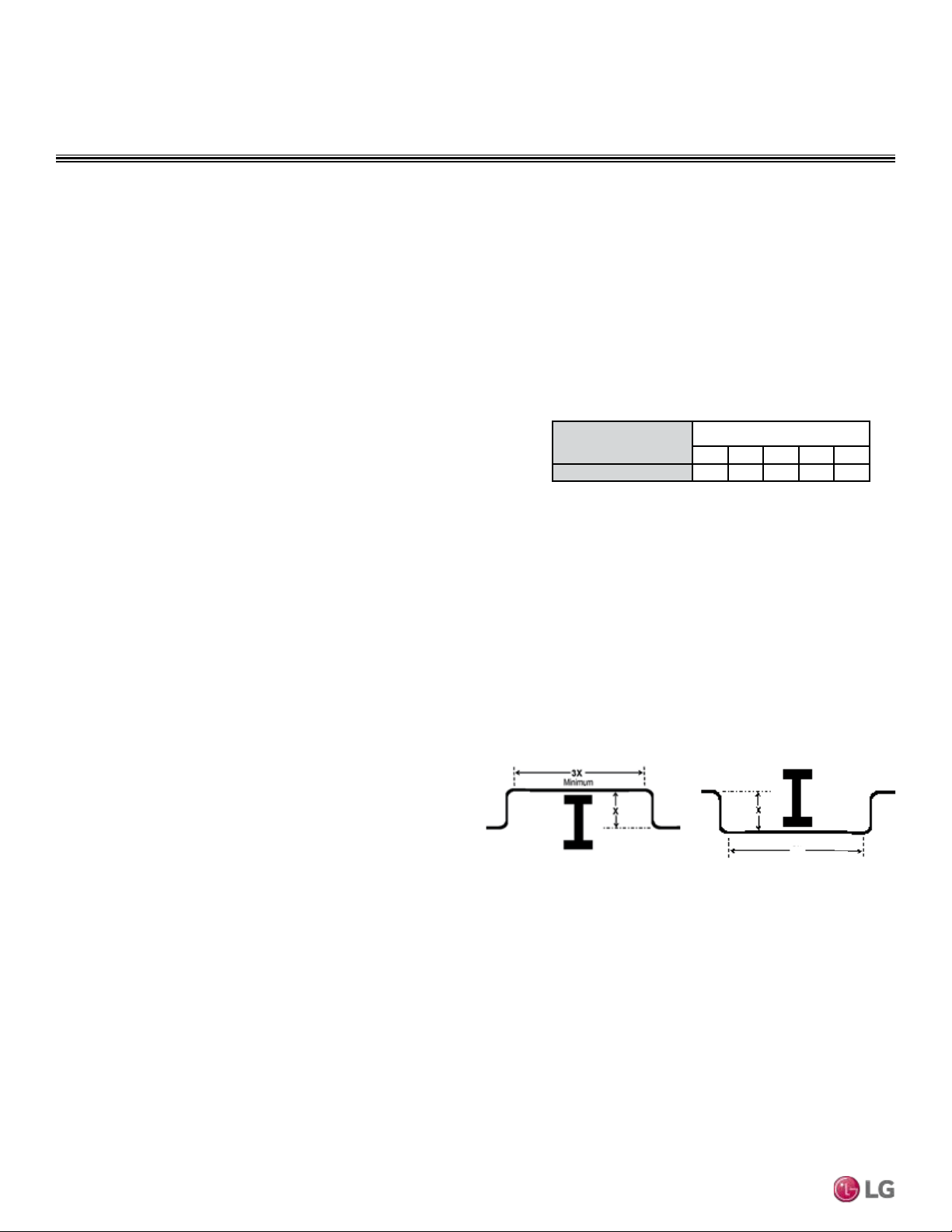
REFRIGERANT PIPING DESIGN
Definitions
Physical Pipe Length: Actual length of straight segment(s) of pipe.
Equivalent Pipe Length: Actual length of pipe plus equivalent lengths of long radius elbows, Y-branches, and valves.
1. Draft a one-line diagram of the proposed piping system connecting outdoor unit to indoor units. Follow the pipe limitations listed on page
64.
2. Calculate the physical length of each pipe segment and note it on the drawing.
3. Calculate the equivalent pipe length of each pipe segment.
Using Elbows
Field-supplied elbows are allowed as long as they are long radius and designed
for use with R410A refrigerant. The designer should be cautious with the quantity
and size of fittings used, and must account for the additional pressure losses in
equivalent pipe length calculation. The equivalent pipe length of each elbow must
be added to each pipe segment. See Table 40 for equivalent lengths.
Table 40: Equivalent Piping Length for Piping Components.
Layout Procedure
Component
Size (Inches)
1/4 3/8 1/2 5/8 3/4
Long Radius Elbow (ft.)
0.5 0.6 0.7 0.8 1.2
Field-Provided Isolation Ball Valves
It is acceptable to install field-supplied ball valves with Schrader ports at the indoor unit. Full-port isolation ball valves with Schrader ports
(positioned between valve and indoor unit) rated for use with R410A refrigerant should be used on both the liquid and vapor lines.
If valves are not installed and the indoor unit needs to be removed or repaired, the entire system must be shut down and evacuated. Position
valves with a minimum distance of three (3) to six (6) inches of pipe on either side of the valve. Valves must be easily accessible for service.
If necessary, install drywall access doors or removable ceiling panels, and position the valves to face the access door or ceiling panel open-
ing. Mount valves with adequate space between them to allow for placement of adequate pipe insulation around the valves. Recommended
best practice is to clearly label and document locations of all service valves. The equivalent pipe length of each ball valve must be added to
each pipe segment.
Figure 48: Installing Piping Above and Below an Obstacle.
Above an obstacle.
3X
Minimum
Below an obstacle.
Obstacles
When an obstacle, such as an I-beam or concrete T, is in the path
of the planned refrigerant pipe run, it is best practice to route the
pipe over the obstacle. If adequate space is not available to route
the insulated pipe over the obstacle, then route the pipe under the
obstacle. In either case, it is imperative the horizontal section of pipe
above or below the obstacle be a minimum of three (3) times greater
than the longest vertical rise (or fall) distance.
Selecting Field-Supplied Copper Tubing / Refrigerant Piping System Layout
In-line Refrigeration Components
Components such as oil traps, solenoid valves, filter-dryers, sight glasses, tee fittings, and other after-market accessories are not permitted
on the refrigerant piping system between the outdoor unit and the indoor unit. Single Zone air-source systems are provided with redundant
systems that assure oil is properly returned to the compressor. Sight-glasses and solenoid valves may cause vapor to form in the liquid
stream. Over time, dryers may deteriorate and introduce debris into the system. The designer and installer verify the refrigerant piping sys-
tem is free of traps, sagging pipes, sight glasses, filter dryers, etc.
Due to our policy of continuous product innovation, some specications may change without notication.
©LG Electronics U.S.A., Inc., Englewood Cliffs, NJ. All rights reserved. “LG” is a registered trademark of LG Corp.
66 | FOUR-WAY CASSETTE
Four-Way Ceiling Cassette System Engineering Manual
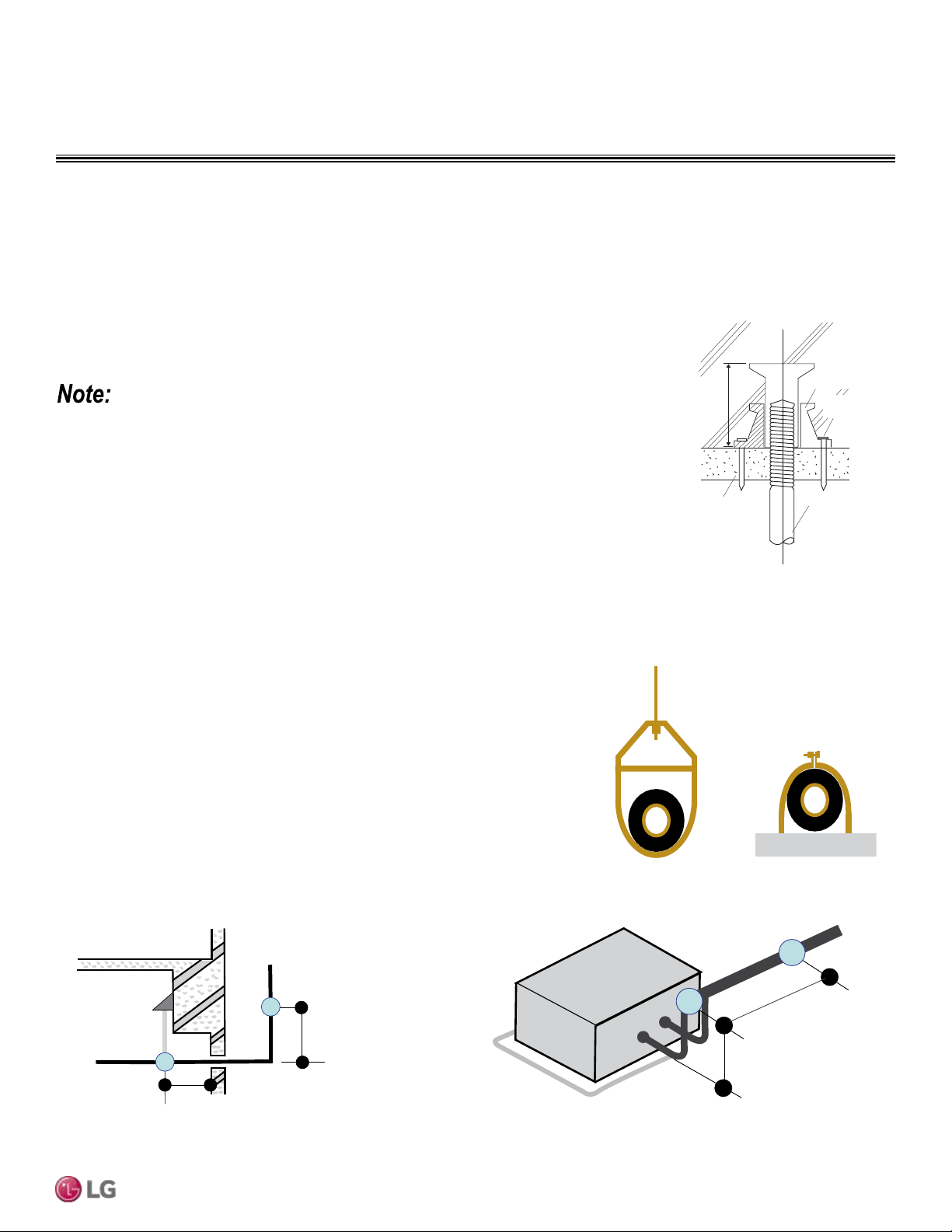
No Pipe Size Substitutions
Using a different size is prohibited and may result in a system malfunction or failure to work at all.
Refrigerant Piping System Layout
Pipe Supports
Pipe supports should never touch the pipe wall; supports shall be installed outside (around) the primary
pipe insulation jacket (see Figure 50). Insulate the pipe first because pipe supports shall be installed
outside (around) the primary pipe insulation jacket. Clevis hangers should be used with shields between
the hangers and insulation.
Field provided pipe supports should be designed to meet local codes. If allowed by code, use fiber straps
or split-ring hangers suspended from the ceiling on all-thread rods (fiber straps or split ring hangers can
be used as long as they do not compress the pipe insulation). Place a second layer of in-
sulation over the pipe insulation jacket to prevent chafing and compression of the primary
insulation within the confines of the support pipe clamp.
A properly installed pipe system will have sufficient supports to avoid pipes from sagging
during the life of the system. As necessary, place supports closer for segments where
potential sagging could occur. Maximum spacing of pipe supports must meet local codes.
If local codes do not specify pipe support spacing, pipe must be supported: Maximum of
five feet (5′) on center for straight segments of pipe up to 3/4" outside diameter size.
Wherever the pipe changes direction, place a hanger within twelve (12) inches on one side
and within twelve to nineteen (12 to 19) inches of the bend on the other side as shown in
Figure 51.
Figure 51: Typical Pipe Support Location—Change
in Pipe Direction.
Max. 12"
~ 12" – 19"
Figure 50: Pipe Hanger Details.
A
B
A + B ~ 12" – 19"
Figure 52: Pipe Support at Indoor Unit.
Figure 49: Installing an Insert Into a
Concrete Beam.
Inserts and Pipe Supports
Inserts
An insert can be installed into a floor or beam before the concrete sets so that fittings such as ducts,
pipes, or suspension bolts can be added at a later time. Decide where the inserts should be placed
before support installation.
A properly installed pipe system should be adequately supported to avoid pipe sagging. Sagging pipes
become oil traps that lead to equipment malfunction.
Concrete Beam
Insert
Suspension Bolt
Anti-vibration Material
Nail
INSTALLATION & LAYOUT BEST PRACTICES
Due to our policy of continuous product innovation, some specications may change without notication.
©LG Electronics U.S.A., Inc., Englewood Cliffs, NJ. All rights reserved. “LG” is a registered trademark of LG Corp.
FOUR-WAY CASSETTE | 67
Refrigerant Piping Design and Best Practices
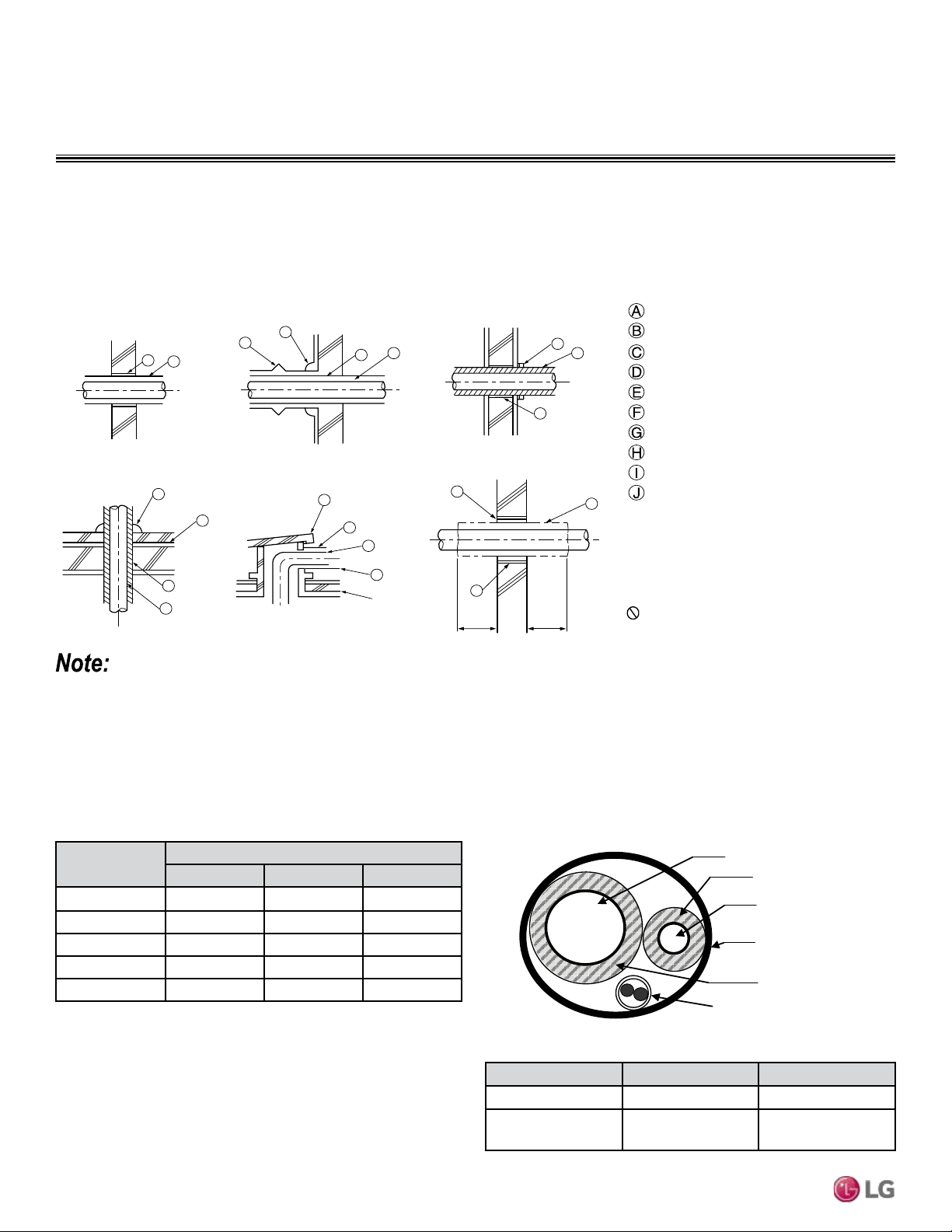
Refrigerant Piping System Layout
40 in40 in
A
B
D
F
G
B
G
D
B
H
I
J
A
E
B
I
A
B
D
C
Inside wall (concealed)
Floor (fire-resistance)
Area between fire-resistant
insulation and boundary wall
Roof pipe shaft
Outside wall
Outside wall (exposed)
Sleeve
Insulation
Lagging
Caulk
Band
Water-resistant layer
Sleeve with edge
Lagging
Mortar or other fire-resistant caulk
Fire-resistant insulation
When filling an access hole with mortar, cover the
area with steel plate so that the insulation will not
fall through. For this area, use fire-resistant
materials for both the insulation and cover.
( Do not use a vinyl cover.)
Pipe Sleeves at Penetrations
LG requires that all pipe penetrations through walls, floors, and pipes buried underground be properly insulated and routed through an ap-
propriate wall sleeve of sufficient size to prevent compression of refrigerant pipe insulation and free movement of the pipe within the sleeve.
Underground refrigerant pipe shall be routed inside a protective sleeve to prevent insulation deterioration.
Figure 53: Pipe Sleeve Options.
Diameter of penetrations shall be determined by pipe diameter plus the thickness of the insulation.
Underground Refrigerant Piping
Refrigerant pipe installed underground should be routed inside a vapor tight protective sleeve to prevent insulation deterioration and water
infiltration. Refrigerant pipe installed inside underground casing must be continuous without any joints. Underground refrigerant pipe must
be located at a level below the frost line.
Figure 54: Typical Arrangement of Refrigerant Pipe and Cable(s) in a
Utility Conduit.
Table 41: Utility Conduit Sizes.
1
OD pipe diameter in inches; Values in parenthesis () indicate OD of pipe with insulation jacket.
2
Diameter of pipe with insulation. Thickness of pipe insulation is typical. Actual required thickness may
vary based on surrounding ambient conditions and should be calculated and specified by the design
engineer.
3
Insulation thickness (value in parenthesis) = 3/8 inch.
4
Insulation thickness (value in parenthesis) = 1 inch.
5
Insulation thickness (value in parenthesis) = 3/4 inch.
Liquid Pipe
1
Vapor Pipe
1
1/2 (2.0
2,5
) 5/8 (2-1/8
2,5
) 3/4 (2-1/4
2,5
)
1/4 (1.0)
3
4 4 4
3/8 (1-1/8)
3
4 4 5
1/2 (1-1/2)
4
5 5 5
5/8 (1-5/8)
4
5 5 5
3/4 (1-3/4)
4
5 5 5
Table 42: Outdoor Unit Refrigerant Pipe Connections.
System Model No. Liquid Conn. (inches) Vapor Conn. (inches)
LC097HV, LC127HV 1/4 3/8
LC187HV, LC247HV,
LC367HV, LC427HV
3/8 5/8
Vapor Line
Liquid Line
Min. 18 Gauge
Cable
Power/Communication
Pi
p
e Sleeve
Insulation Material
Insulation
Material
INSTALLATION & LAYOUT BEST PRACTICES
Due to our policy of continuous product innovation, some specications may change without notication.
©LG Electronics U.S.A., Inc., Englewood Cliffs, NJ. All rights reserved. “LG” is a registered trademark of LG Corp.
68 | FOUR-WAY CASSETTE
Four-Way Ceiling Cassette System Engineering Manual
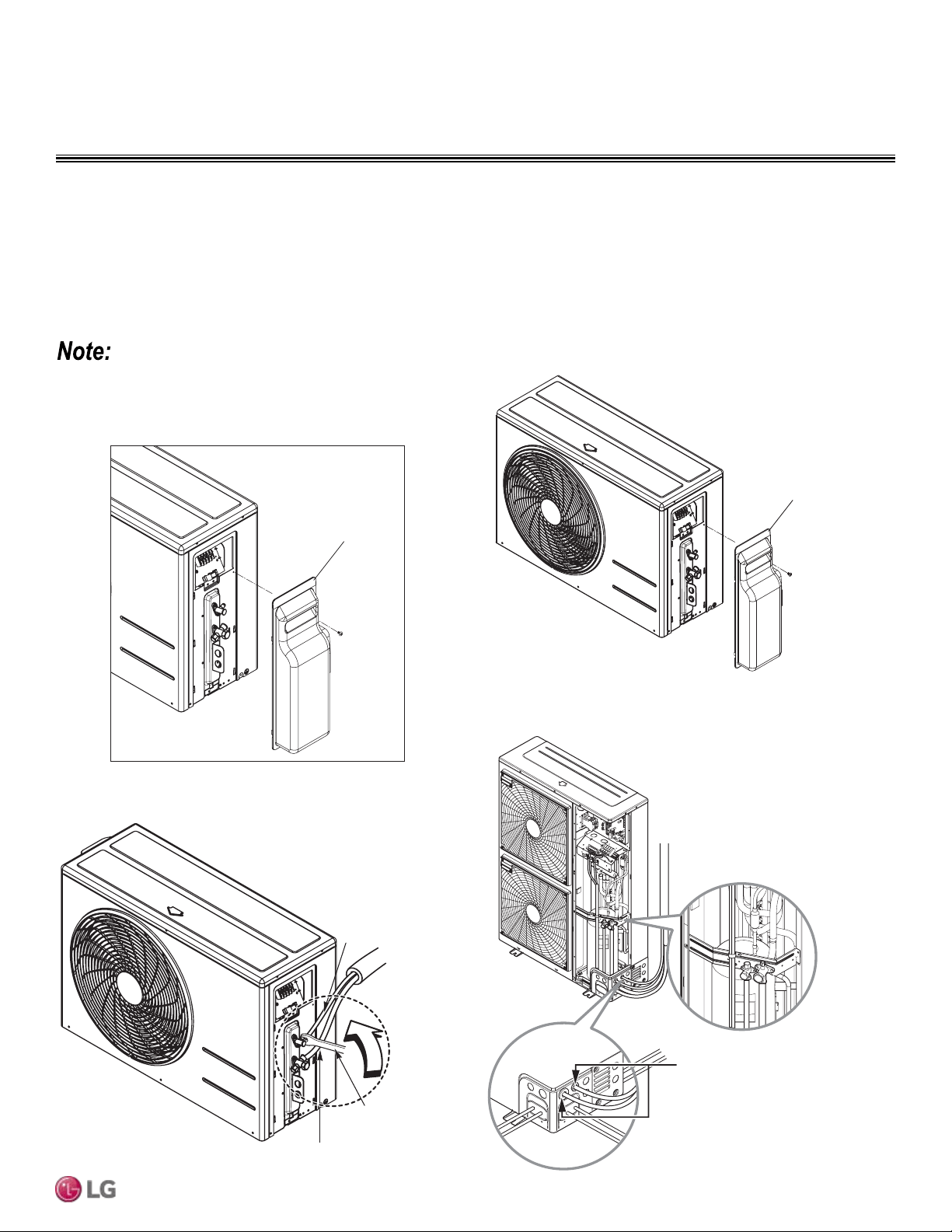
Piping can be installed
in one of four different
layouts.
Figure 55: Removing the Refrigerant Piping Connection Cover
(LUU097HV, LUU127HV).
Figure 56: Removing the Refrigerant Piping Connection Cover
(LUU187HV, LUU247HV).
Figure 57: LUU097HV, LUU127HV, LUU187HV, LUU247HV Refrigerant
Piping Connections.
Single Zone Cassette Outdoor Unit Connections
1. Remove the connection cover from the unit by loosening the screws.
2. Align the center of the refrigerant pipe and corresponding connection.
3. Place a couple of drops of refrigerant oil on the opening rim of the flare before assembling. Ensure you do not add any contaminants.
Tighten the flare nut initially by hand.
4. Finish tightening the flare nut with a torque wrench until the wrench clicks. See page 70 for torque information.
Outdoor unit
Gas side piping
(Bigger diameter)
Liquid side piping
(Smaller diameter)
Torque wrench
Connection cover
Figure 58: LUU367HV, LUU427HV Refrigerant Piping Connections.
Tubing cover
When tightening the are nut with a torque wrench, ensure the direction
for tightening follows the arrow on the wrench.
Refrigerant Piping System Layout
INSTALLATION & LAYOUT BEST PRACTICES
Due to our policy of continuous product innovation, some specications may change without notication.
©LG Electronics U.S.A., Inc., Englewood Cliffs, NJ. All rights reserved. “LG” is a registered trademark of LG Corp.
FOUR-WAY CASSETTE | 69
Refrigerant Piping Design and Best Practices
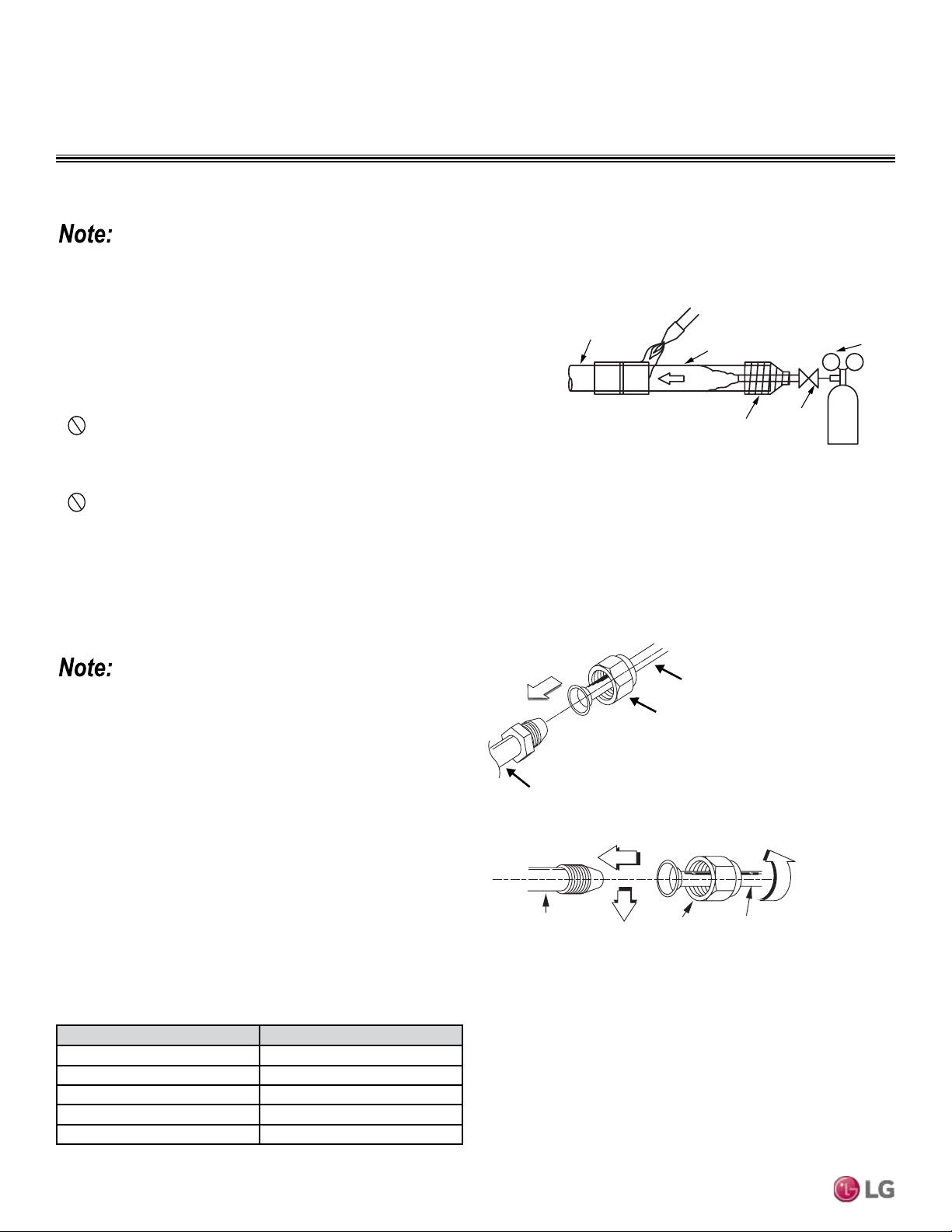
Refrigerant Piping System Layout
Brazing Practices
Pressure-reducing
Valve
Packless
Valve
Tape
Nitrogen
Pipe to
be brazed
Refrigerant
Piping
Figure 59: Refrigerant Pipe Brazing.
It is imperative to keep the piping system free of contaminants and debris such as copper burrs, slag, or carbon dust during installation.
Flare Connection Practices
1. Place a couple of drops of refrigerant oil on the opening rim
of the flare before assembling. Take care not to add any
contaminants.
2. Align the center of the refrigerant pipe and corresponding
connection and tighten the flare nut by hand.
3. Following the guidelines as outlined in Table 43 for the amount of
torque to use, tighten the flare nut with a torque wrench until the
wrench clicks.
4. When flare is sufficiently tightened and the system has been
tested for refrigerant leaks, wrap insulation around the
connection.
Indoor Unit
Piping
Field-Supplied
Piping
Flare Nut
• Improperly installed flare connections can lead to refrigerant
leaks.
• When tightening the flare unit with a torque wrench, ensure the
direction for tightening follows the arrow on the wrench.
Piping O.D. (in.) Torque (lbs. / ft.)
1/4 13-18
3/8 24.6-30.4
1/2 39.8-47.7
5/8 45.6-59.3
3/4 71.6-87.5
Indoor Unit Piping
Flare Nut
Field-Supplied
Piping
Figure 60: Flare Connection, Isometric View.
Figure 61: Flare Connection, Side View.
Table 43: Torque Wrench Tightening.
INSTALLATION & LAYOUT BEST PRACTICES
All joints are brazed in the field. Single Zone Cassette refrigeration system
components contain very small capillary tubes, small orifices, electronic expan-
sion valves, oil separators, and heat exchangers that can easily become blocked.
Proper system operation depends on the installer using best practices and utmost
care while assembling the piping system.
• While brazing, use a dry nitrogen purge operating at a minimum pressure of three
(3) psig and maintain a steady flow.
• Blow clean all pipe sections with dry nitrogen prior to assembly.
• Do not use a saw to cut pipe; use a tubing cutter. De-burr and clean all cuts
before assembly.
• Store pipe stock in a dry place. Keep pipe capped and clean.
• Use adapters to assemble different sizes of pipe.
• Do not use flux, soft solder, or anti-oxidant agents.
• Use a 15% silver phosphorous copper brazing alloy to avoid overheating and produce good flow.
• Protect isolation valves, electronic expansion valves, and other heat-sensitive control components from excessive heat with a wet rag or a
heat barrier spray product.
Due to our policy of continuous product innovation, some specications may change without notication.
©LG Electronics U.S.A., Inc., Englewood Cliffs, NJ. All rights reserved. “LG” is a registered trademark of LG Corp.
70 | FOUR-WAY CASSETTE
Four-Way Ceiling Cassette System Engineering Manual
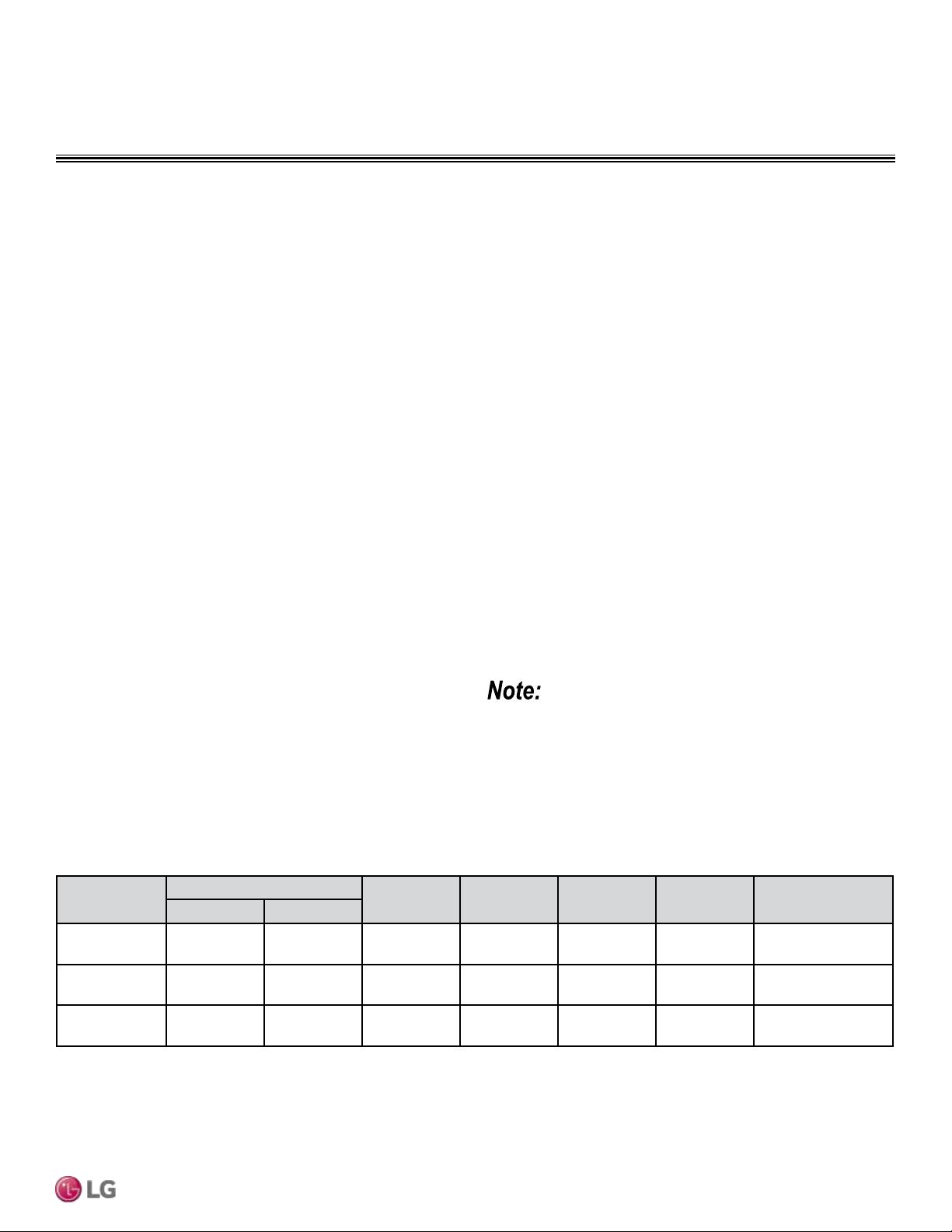
Charging
Each outdoor unit is factory charged (nameplate charge) for the
evaporator as well as a standard 25 ft line. Any time a line set is
used longer then the standard 25 ft line set length, the refrigerant
charge has to be adjusted.
You must adjust the charge based on how many feet of piping are
added based on 0.22 oz. of R410A per foot. The factory charge
accommodates pipe lengths up to the standard length without
requiring refrigerant removal.
Example: A 50 ft line set is used --
9 additional feet x 0.22 oz per ft = Add 1.98 oz
of R410A
If you are uncertain of the unit charge, reclaim, evacuate and weigh in
the correct charge using the unit nameplate (capacity) charge adjusting
for line sets longer than 24.6 or 41 ft. This will prevent any interruptions
to the functioning of the unit and possible damage.
Table 44: Charging Capacity.
Refrigerant Piping System Layout
INSTALLATION & LAYOUT BEST PRACTICES
Refrigerant Piping System Insulation
All refrigerant piping including connections, field-provided isolation ball valves, service valves, and elbows shall be completely insulated
using closed cell pipe insulation.
To prevent heat loss/heat gain through the refrigerant piping, all refrigerant piping including liquid lines and vapor lines shall be insulated sep-
arately. Insulation shall be a minimum 1/2″ thick, and thickness may need to be increased based on ambient conditions and local codes.
All insulation joints shall be glued with no air gaps. Insulation material shall fit snugly against the refrigeration pipe with no air space between
it and the pipe. Insulation passing through pipe hangers, inside conduit, and/or sleeves must not be compressed. Protect insulation inside
hangers and supports with a second layer. All pipe insulation exposed to the sun and outdoor elements shall be properly protected with PVC,
aluminum vapor barrier, or alternatively placed in a weather-resistant enclosure such as a pipe rack with a top cover; and meet local codes.
Pay special attention to insulating the pipes installed in the ceiling plenum.
The design engineer should perform calculations to determine if the factory-supplied insulation jackets are sufficient to meet local codes and
avoid sweating. Maximum refrigerant piping temperature is +227°F; minimum refrigerant piping temperature is -4°F. Add additional insulation
if necessary. Check the fit of the insulation jacket after the header fitting and all run-out pipes are installed. Mark all pipes at the point where
the insulation jacket ends. Remove the jacket. Install field provided insulation on the run-out and main trunk pipes first. Install the LG-pro-
vided insulation plugs on the ends of all unused header ports. Peel the adhesive glue protector slip from the insulation jacket and install the
clam-shell jacket over the fitting.
Capacity
(Btu/h)/Model
Pipe Size
Standard
Length (ft)
Max.
Elevation (ft)
Max.
Length (ft)
Min.
Length (ft)
Additional
Refrigerant (oz/ft)
Vapor Liquid
9k LC097HV4,
12k LC127HV4
3/8 1/4 24.6 49 66 6.6 0.22
18k LC187HV,
24k LC247HV
5/8 3/8 24.6 98.4 164 6.6 0.43
36k LH367HV,
42k LH427HV
5/8 3/8 24.6 98.4 246 6.6 0.43
Due to our policy of continuous product innovation, some specications may change without notication.
©LG Electronics U.S.A., Inc., Englewood Cliffs, NJ. All rights reserved. “LG” is a registered trademark of LG Corp.
FOUR-WAY CASSETTE | 71
Refrigerant Piping Design and Best Practices
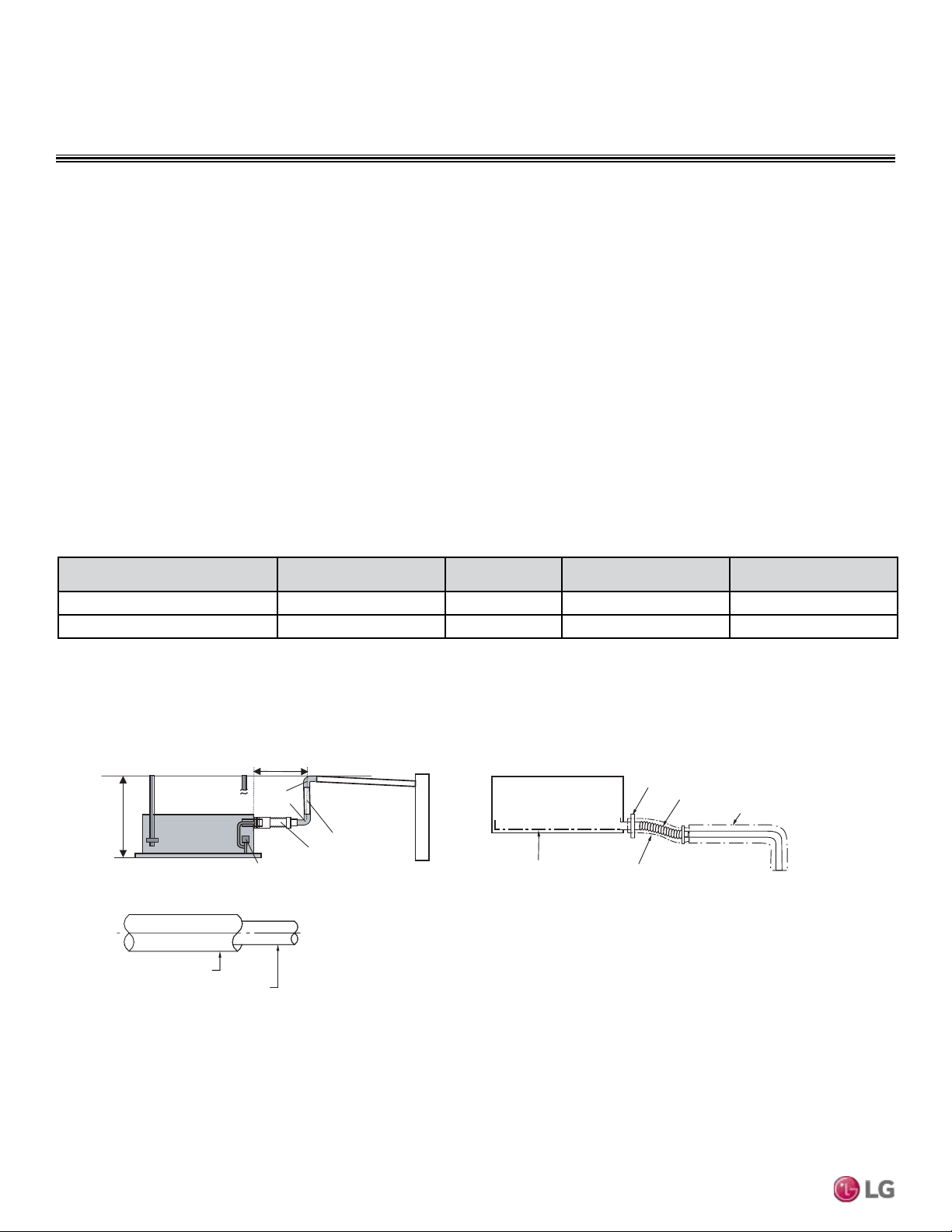
CONDENSATE DRAIN PIPING
Indoor Unit
Drain Pipe Dia. (inches)
(External / Internal)
Drain Pump Drain Lift Height (inches)
Amount of Drainage (gpm)
(at 0.4 inches high)
9k to 12k Ceiling Cassette 1-1/4 / 1 Standard 27-1/2 0.106
18k to 42 Ceiling Cassette 1-1/4 / 1 Standard 31-1/2 0.106
Condensate Drain Piping
Condensate drain piping should be constructed out of materials approved by local codes (generally PVC). Drain piping must have downward
gradient of at least 1/50 to 1/100; to prevent reverse flow, slope should not be straight up and down, and support hangers should be used at
3-5/16 to 5 foot intervals to keep the condensate drainage system stable.
The inside temperature of the drain piping can rise to about 50°F. When high temperature and humidity air touch the outside surface of the
drain pipe, condensation may form. To prevent condensation from forming, install polyethylene insulation 1/4 to 7/16 inches thick. Drain
piping must be properly insulated to prevent damage to the indoor unit and the ceiling.
Test the condensate drain piping system for leaks 24 hours after installation is complete. Use only water to test the drain piping.
Outdoor Units
See pages 57 to 62 for information in reference to outdoor unit placement and condensate drainage.
Indoor Units
The Four-Way Ceiling Cassette indoor units include a factory-installed drain pump. Depending on the location of the indoor unit, condensa-
tion can be drained directly to the outside of the building, or tied into a drainage piping system.
Table 45: Drain Piping Specications.
Figure 62: Condensate Drain Piping Trap.
Models with drain pump
Models without drain pump
Polyethylene insulation 10t
PVC drain pipe
Metal clamp
Drain pan
Thermal insulation(bend area)
Flexible drain hose
Thermal insulation (drain pipe area)
Flexible hose
Drain pump
PVC elbow
PVC
Max.
31-1/2 inches
11-13/16 inches or less
Common drain pipe
Due to our policy of continuous product innovation, some specications may change without notication.
©LG Electronics U.S.A., Inc., Englewood Cliffs, NJ. All rights reserved. “LG” is a registered trademark of LG Corp.
72 | FOUR-WAY CASSETTE
Four-Way Ceiling Cassette System Engineering Manual
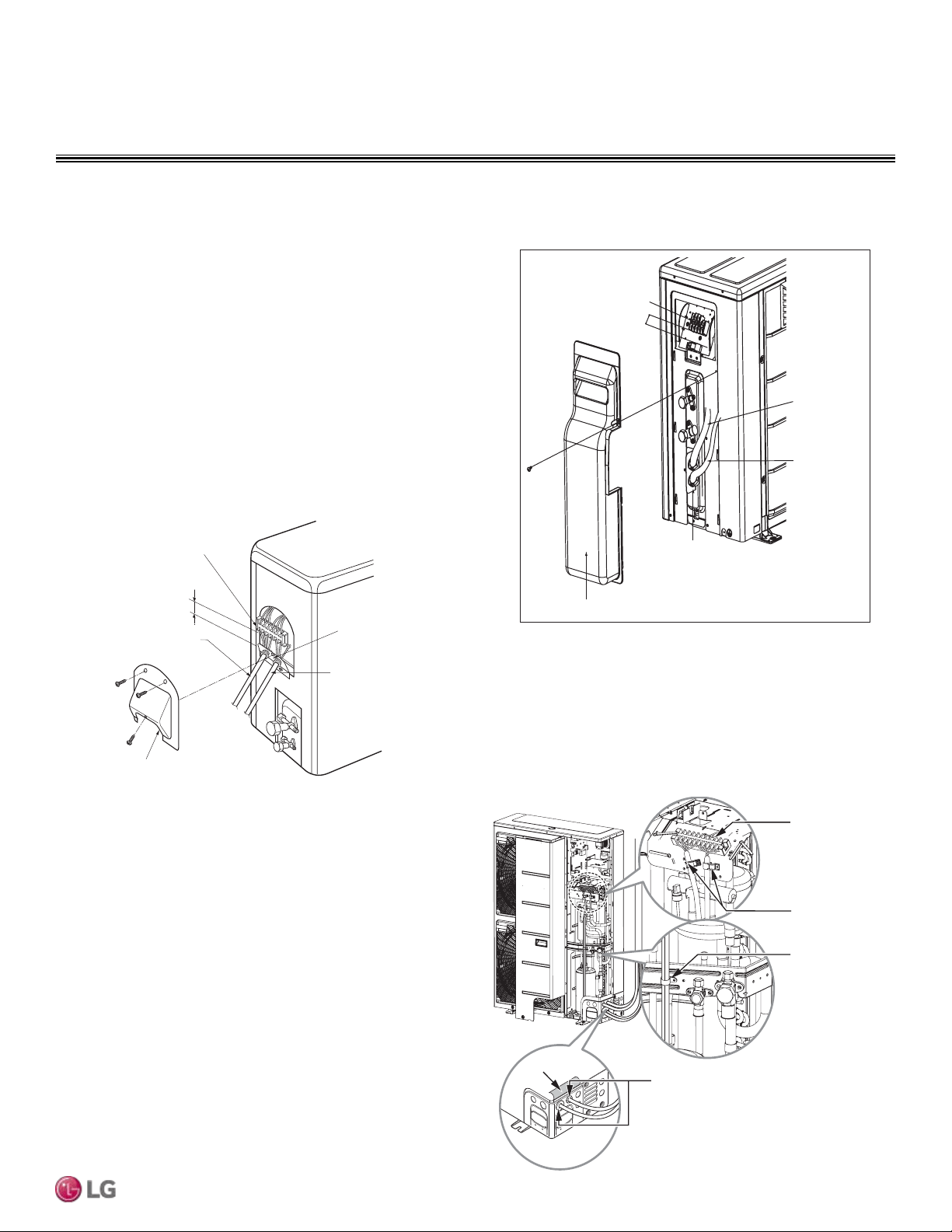
ELECTRICAL CONNECTIONS
LUU367HV, LUU427HV Outdoor Unit Connections
1. Remove the side panel.
2. Use the clamp to attach the wiring / cable.
LUU097HV, LUU127HV, LUU187HV, LUU247HV Outdoor
Unit Connections
1. Remove the cover from the unit by loosening the fastening
screws.
2. Take off the caps on the conduit panel.
3. Connect both the power supply and low voltage lines to the
corresponding terminals on the terminal block.
4. Be sure to ground the unit by following local codes.
5. Allow for enough length (add several inches) for each wiring.
6. Secure the cable with the cord clamp.
7. Secure conduit tubes with lock nuts.
8. Reattach the control cover to the original position with the fasten-
ing screws.
Figure 63: LUU097, 127HV Outdoor Unit Terminal Block Location.
Terminal block
Over 0.2”
Control cover
Conduit panel
Connecting
cable
Power supply
cord
Figure 64: LUU187, 247HV Outdoor Unit Terminal Block Location.
When connecting the power wiring /
communication cables, make sure
the rubber bushing is properly inserted
in the access holes after removing the insulation.
Insulation
Main
Terminal
Block
Clamps
Clamp
Figure 65: LUU367, 427HV Outdoor Unit Terminal Block Location.
Terminal Block
Connecting
Cable
Power
Supply
Cord
Conduit Panel
Tubing Cover
Over 0.2”
Outdoor Unit Power Wiring / Communications Cable Connections
Due to our policy of continuous product innovation, some specications may change without notication.
©LG Electronics U.S.A., Inc., Englewood Cliffs, NJ. All rights reserved. “LG” is a registered trademark of LG Corp.
FOUR-WAY CASSETTE | 73
Electrical Connections and Mechanical Specs
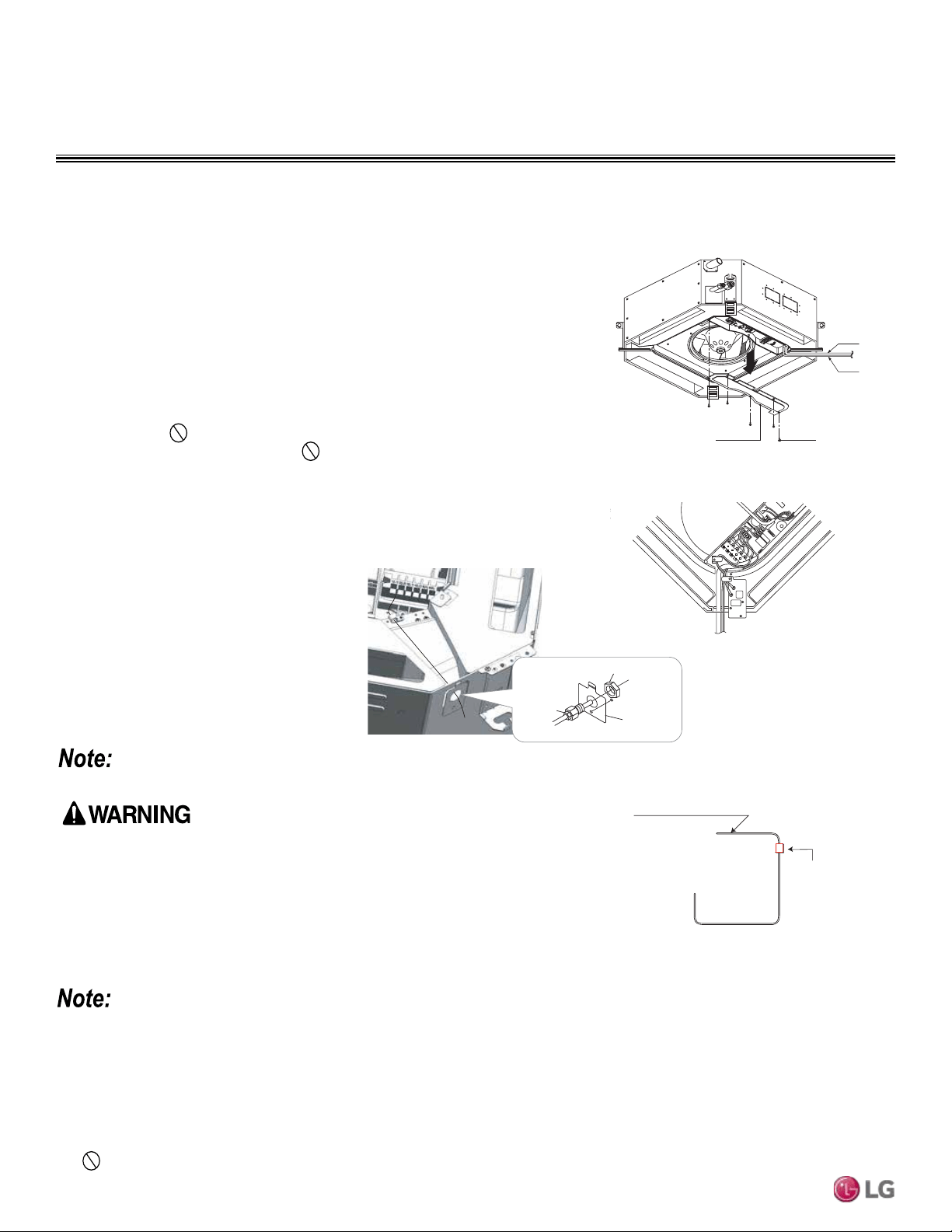
Always use a circuit breaker or time delay fuse when connecting electrical wiring to the unit.
Figure 66: Circuit Breaker/Time Delay Fuse
Connection.
Air
Conditioner
Main Power Source
Circuit Breaker
Use a circuit breaker
or time delay fuse
Cassette Indoor Unit Power Wiring / Communications Cable Connections
Lock Nut
Conduit
Mounting
Plate
Conduit
Wiring / Cable Connections
Power Wiring
Wired
Controller
Cable
Control Box Cover
Control Box
Cover Screws
1. To access the terminal block, open the control box cover.
2. Insert the power wiring / communications cable from the outdoor unit through the
sides of the indoor unit and control box. Pass the wiring through the designated
access holes to prevent damage. To prevent electromagnetic interference and
product malfunction, leave a space between the power wiring and communications
cable outside of the indoor unit. (For power wiring / communications cable between
the single zone outdoor unit and the indoor unit, use a four-conductor, stranded,
shielded or unshielded wire. If shielded, the wire must be grounded to the chassis at
the outdoor unit only.)
3. Connect each wire to its appropriate terminal on the indoor unit control board. Verify
that the color and terminal numbers from the outdoor unit wiring match the color and
terminal numbers on the indoor unit.
4. Neatly arrange power wiring / communications cable and secure with the appropriate
cable restraint. Do not apply force to the wiring connections when clamping.
5. Firmly reattach the control box cover. Do not catch the wiring in the electric box
cover. Make sure the cover firmly closes.
6. Fill in any gaps around the wiring access holes with sealant to prevent foreign parti-
cles from entering the indoor unit.
Figure 67: Power Wiring and Communications
Cable Connection Access.
Using a Conduit
1. Remove the rubber stopper on the indoor unit.
Pass the power wiring / communications cable
through the conduit, the conduit mounting
plate, and to / through the control panel of the
indoor unit.
2. Connect the power wiring / communications
cable to the indoor unit terminal block.
3. Screw the conduit mounting plate to the
indoor unit.
4. Tighten the conduit and the conduit mounting
plate together.
Figure 68: Cassette Indoor Unit Terminal
Block Location / Using a Conduit.
ELECTRICAL CONNECTIONS
• Separately wire the high and low voltage lines. There is a risk of electric shock, physical
injury, or death.
• Use heat-proof electrical wire capable of withstanding temperatures up to 167°F to avoid
wiring malfunction and electrical shock, which may cause physical injury or death.
• Ensure you connect the wire firmly. Loose wiring may cause unit malfunction, the wires to
burnout or the terminal to overheat and catch fire. There is a risk of electric shock, physical
injury or death.
• Use outdoor and waterproof connection cable rated up to 300V for the connection between the indoor and outdoor unit to avoid electrical
shock, which may cause physical injury or death.
• Separately wire the high and low voltage lines to avoid damage to unit.
• Use heat-proof electrical wire capable of withstanding temperatures up to 167°F to avoid damage to unit.
• Always use a circuit breaker or time delay fuse when connecting electrical wiring to the unit.
• Connect the wire firmly. Loose wiring may cause unit malfunction, the wires to burnout or the terminal to overheat and catch fire. There is
a risk of equipment malfunction or property damage.
• Use outdoor and waterproof connection cable rated up to 300V for the connection between the indoor and outdoor unit to avoid damage
to the unit.
• Comply with local codes while running wire from the indoor unit to the outdoor unit.
•
Do not allow wire to touch refrigerant tubing, the compressor or any moving parts since it can lead to mechanical failure.
Due to our policy of continuous product innovation, some specications may change without notication.
©LG Electronics U.S.A., Inc., Englewood Cliffs, NJ. All rights reserved. “LG” is a registered trademark of LG Corp.
74 | FOUR-WAY CASSETTE
Four-Way Ceiling Cassette System Engineering Manual
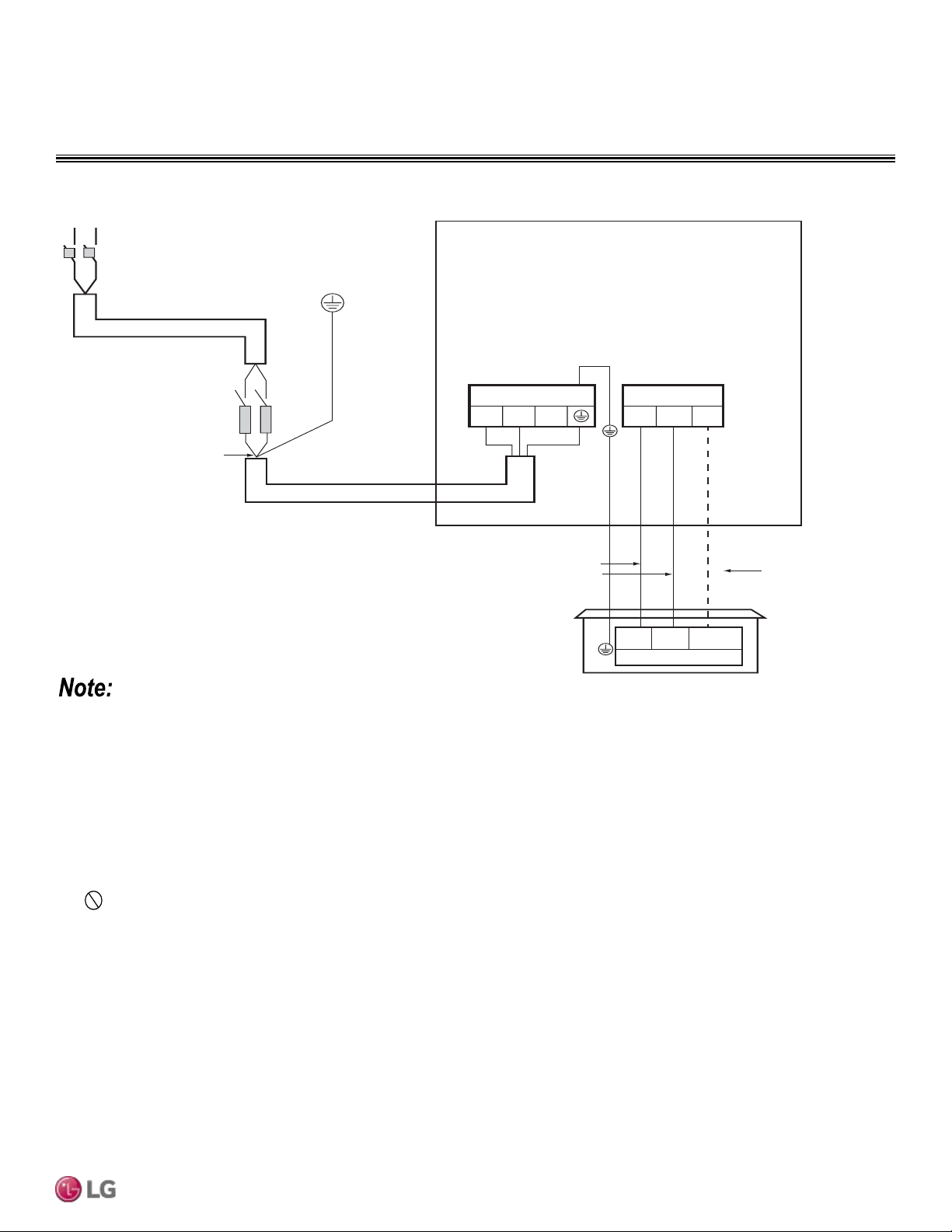
ELECTRICAL CONNECTIONS
Figure 69: Detailed Power / Communications System Schematic.
L
L
N
N
G
Power Supply
Main Switch
Circuit Breaker
Fuse
Power Wiring
(Including Ground)
Outdoor Unit
1(L1) 2(L2)
Terminal Block Outdoor
1(L1) 2(L2) 3
Terminal Block Outdoor
Communication
Cable
1(L1) 2(L2)
Terminal Block Indoor
3
Power
Wiring
Indoor Unit
• Power wiring and communications cable sizes must comply with applicable federal UL / ETL, state, and local codes.
• Separately wire the high and low voltage lines to avoid damage to unit.
• Local codes may require field-installed disconnect switches from outdoor unit to indoor unit.
• Use heat-proof electrical wire capable of withstanding temperatures up to 167°F to avoid damage to unit.
• Always use a circuit breaker or time delay fuse when connecting electrical wiring to the unit.
• Firmly connect the wire. Loose wiring may cause unit malfunction, the wires to burnout or the terminal to overheat and catch fire. There
is a risk of equipment malfunction or property damage.
• Use outdoor and waterproof connection cable rated up to 300V for the connection between the indoor and outdoor unit to avoid dam-
age to the unit.
• Comply with local codes while running wire from the indoor unit to the outdoor unit.
• Do not allow wire to touch refrigerant tubing, the compressor or any moving parts since it can lead to mechanical failure.
Due to our policy of continuous product innovation, some specications may change without notication.
©LG Electronics U.S.A., Inc., Englewood Cliffs, NJ. All rights reserved. “LG” is a registered trademark of LG Corp.
FOUR-WAY CASSETTE | 75
Electrical Connections and Mechanical Specs

TECHNICAL DATA
“Mechanical Specifications” on page 77
“Acronyms” on page 79
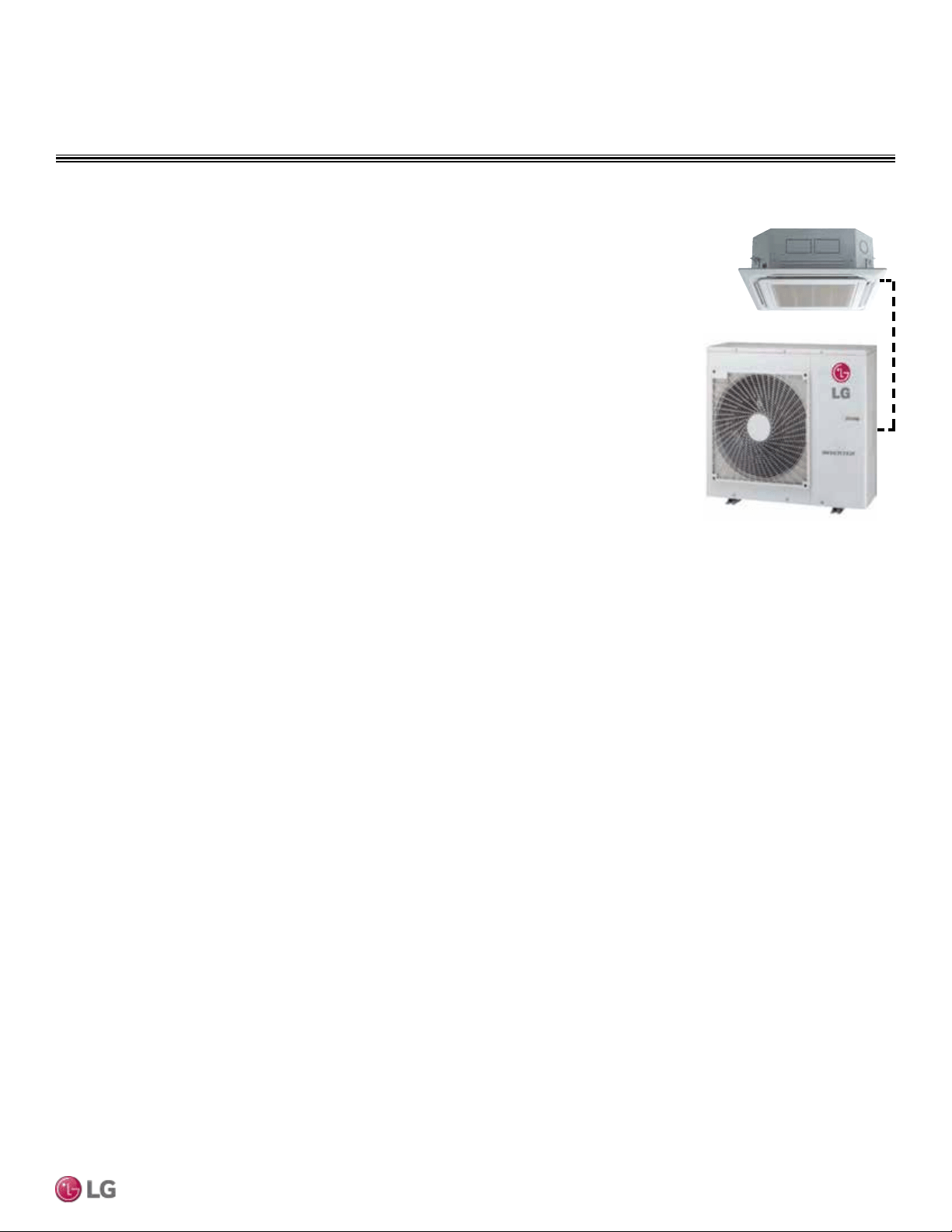
MECHANICAL SPECIFICATIONS
Four-Way Ceiling Cassette System
Figure 70: Four-Way Ceiling Cassette
System (LC187HV, LC247HV Models).
General
System
LG single zone four-way ceiling cassette system comprises of a sin-
gle frame outdoor unit connected to a single indoor unit with a single
refrigerant circuit. An LG single zone four-way ceiling cassette is a
DFS system that can operate in either cooling or heating mode. The
system is capable of changing mode within a maximum time of three
(3) minutes to ensure indoor temperature can be properly main-
tained. LG components are manufactured in a facility registered to
ISO 9001 and ISO 14001, which is a set of standards applying to en-
vironmental protection set by the International organization for Stan-
dardization (ISO). The system components comply with Underwriters
Laboratories (UL) 1995 Heating and Cooling Equipment Standard
for Safety and bear the Electrical Testing Laboratories (ETL) label.
Wiring in these units are in accordance with the national Electrical
Code (NEC). LG single zone four-way ceiling cassette systems have
published performance ratings certified by AHRI (Air-Conditioning,
Heating, and Refrigeration Institute) and are listed in the AHRI Stan-
dard 210/240 certified product directory.
Outdoor Unit
The outdoor units have sound levels not exceeding 54 dB(A) tested
in an anechoic chamber under ISO Standard 3745.
Indoor Unit
The indoor units have sound ratings no higher than 46 dB(A) as
tested per ISO Standard 3745.
Temperature Ranges
9,000 and 12,000 Btu/h Ceiling Cassette Operating Ranges
• Operating ranges for outdoor units of 0°F to +118°F (DB) for cool-
ing (Cooling range can be extended from 0°F down to -4°F using
the Low Ambient Wind Baffle Kit [sold separately]); -4°F to +64°F
(WB) for heating.
• Operating ranges for indoor units of 57°F to 77°F (WB) for cooling;
59°F to 81°F (DB) for heating.
• Indoor unit temperature setting range of 65°F to 86°F (DB) for
cooling; 61°F to 86°F (WB) for heating.
18,000, 24,000, 36,000, and 42,000 Btu/h Ceiling Cassette
Operating Ranges
• Operating ranges for outdoor units of 5°F to +118°F (DB) for cool-
ing; 0°F to +64°F (WB) for heating.
• Operating ranges for indoor units of 57°F to 77°F (WB) for cooling;
59°F to 81°F (DB) for heating.
• Indoor unit temperature setting range of 65°F to 86°F (DB) for
cooling; 61°F to 86°F (WB) for heating.
Casing / Frame
Outdoor Unit
The outdoor condensing unit case is constructed from pre-coated
metal (PCM) that has been tested in accordance with ASTM B-117
salt spray procedure for a
minimum of 1,000 hours.
Case has a removable panel
to allow access to major
internal components, and
legs to secure the unit during
installation.
Indoor Unit
The indoor unit case is con-
structed of a galvanized steel
plate designed to recess in
the ceiling, and has a surface
mounted concentric grille on
the bottom of the unit. Unit
has four supply air outlets
and one return air inlet. The
supply air outlet has four-
directional slot diffusers, each
equipped with an independent
oscillating motorized guide vane to change airflow direction. A guide
vane algorithm sequentially changes the predominant discharge
airflow direction in counterclockwise pattern, or can be used to lock
each guide vane independently in a field-adjusted fixed position.
The four vanes can be individually adjusted from the wired remote
controller to customize the airflow pattern for the conditioned space.
A setting in the cooling and heating modes can cycle the vanes up
and down for uniform / random air distribution.
A required architectural grille is sold as a separate required acces-
sory. The four-way grille is off-white acrylonitrile butadiene styrene
(ABS) polymeric resin with a tapered trim edge.
Refrigerant System
System is designed for use with R410A refrigerant, and consists of a
single refrigeration circuit. The refrigeration circuit is pressure-tested
at the factory and shipped with a holding charge of helium gas. The
outdoor unit is provided with factory installed components, includ-
ing a refrigerant strainer, accumulator, four-way reversing valve,
electronic expansion valve (EEV), high and low side charging ports,
service valves, and interconnecting piping. All refrigerant lines from
the outdoor unit to the indoor unit are field-installed and must be
insulated separately.
Compressors
The outdoor unit is equipped with one hermetically sealed, digitally
controlled, inverter-driven twin rotary compressor to modulate capac-
ity (variable from 20 to 100 Hz, modulate in 1 Hz increments). Teflon
coated bearings, overcurrent protection and vibration isolation are
integrated with the compressor.
Due to our policy of continuous product innovation, some specications may change without notication.
©LG Electronics U.S.A., Inc., Englewood Cliffs, NJ. All rights reserved. “LG” is a registered trademark of LG Corp.
FOUR-WAY CASSETTE | 77
Electrical Connections and Mechanical Specs
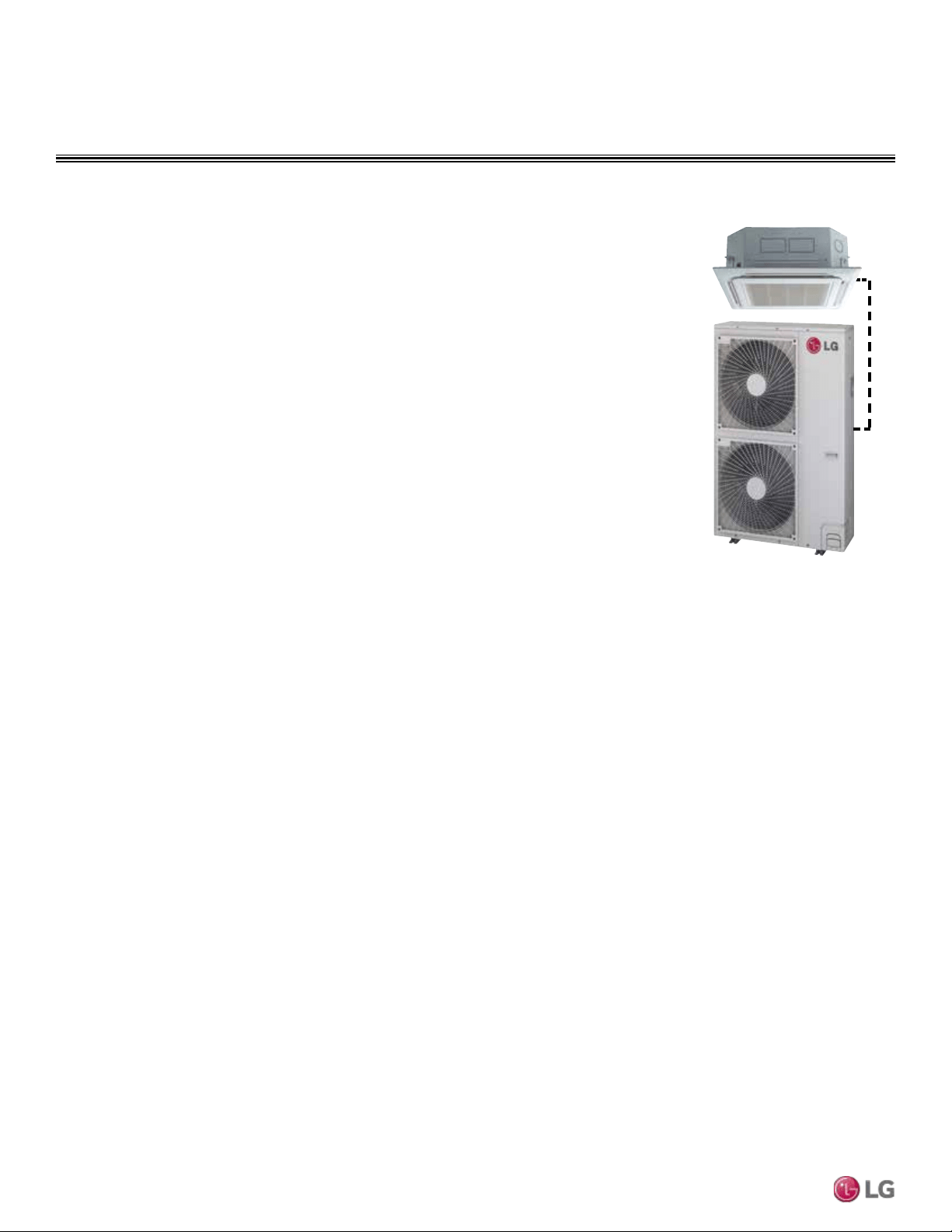
MECHANICAL SPECIFICATIONS
Four-Way Ceiling Cassette System
Figure 71: Four-Way Ceiling Cassette
System (LC367HV, LC427HV Models).
Coil
Outdoor Unit
Heat pump outdoor unit coils are made of nonferrous louvered
aluminum fins protected with an integral coil guard. The coil for each
outdoor unit has a minimum of 14 fins per inch (FPI); heat exchanger
has two rows. The coil fins have a factory applied corrosion resistant
GoldFin™ material with hydrophilic coating tested in accordance with
ASTM B-117 salt spray test procedure for a minimum of 1,000 hours.
Coils are factory tested to a pressure of 551 psig.
Indoor Unit
Indoor unit coils are factory built and are comprised of aluminum fins
mechanically bonded to copper tubing. Each indoor unit has a min-
imum of two rows of coils, which are pressure tested to 551 psig at
the factory. Each unit is provided with a factory installed condensate
drain pan below the coil.
Fans and Motors
Outdoor Unit
The 9,000 Btu/h (LUU097HV), 12,000 Btu/h (LUU127HV), 18,000
Btu/h (LUU187HV), and 24,000 Btu/h (LUU247HV) outdoor units
include one direct drive, variable speed axial / propeller type fan with
a horizontal air discharge; the 36,000 Btu/h (LUU367HV) and 42,000
Btu/h (LUU427HV) include two fans. Fan blades are made of Acry-
lonitrile Butadiene Styrene (ABS) material, and have a Brushless
Digitally Controlled (BLDC) fan motor. The fan motor has inherent
protection, permanently lubricated bearings, and variable speed with
a maximum speed up to 950 rpm. Raised guards are provided to limit
contact with moving parts.
Indoor Unit
All of the indoor units have a single, direct-drive, turbo fan manu-
factured of high-strength ABS HT-700 polymeric resin; the fans are
statically and dynamically balanced. The fan motor is brushless
digitally controlled (BLDC) with permanently lubricated and sealed
ball bearings. The fan / motor assembly is mounted on vibra-
tion-attenuating rubber grommets. Fan speed is controlled using a
microprocessor-based direct digital control algorithm that provides
pre-programmed, field-selectable fixed or auto fan speeds in the
Heating and Cooling modes.
The indoor fan has Low, Med, High, Power Cool and Auto settings
for Cooling mode; and has Low, Med, High, and Auto settings for
Heating mode. Auto setting adjusts the fan speed based on the
difference between the controller set-point and space temperature.
Air Filter -
Indoor Unit
Return air is filtered with a
factory-supplied, removable,
washable filter accessible
from the bottom of the unit.
Electrical
The system was designed to
operate using 208–230/60/1
power with voltage varianc-
es of ±10% and includes
overcurrent protection.
The indoor unit is powered
through the outdoor unit.
Controls
Indoor and outdoor units are
factory wired with necessary
electrical control compo-
nents, printed circuit boards, thermistors, sensors, terminal blocks,
and lugs for power wiring. Factory installed microprocessor controls
in the outdoor unit and indoor unit shall perform functions to efficient-
ly operate the single zone system, communicating via an 18 AWG
four stranded and shielded conductor power/transmission cable. Mi-
croprocessor-based algorithms provide component protection, soft-
start capability, refrigeration system pressure, temperature, defrost,
and ambient control. System can be operated through a handheld
wireless controller supplied with the four-way ceiling cassette indoor
unit.
Condensate Lift/Pump
The indoor unit is provided with a factory installed and wired conden-
sate lift/pump capable of providing a minimum 27-1/2 inch (9k and
12k indoor units) or minimum 31-1/2 inch (18k to 42k indoor units) lift
from the bottom surface of the unit. Drain pump has a safety switch
to shut off the indoor unit if the condensate rises too high in the drain
pan.
Due to our policy of continuous product innovation, some specications may change without notication.
©LG Electronics U.S.A., Inc., Englewood Cliffs, NJ. All rights reserved. “LG” is a registered trademark of LG Corp.
78 | FOUR-WAY CASSETTE
Four-Way Ceiling Cassette System Engineering Manual
ACRONYMS
Table 46: Table of Acronyms.
ABS
Acrylonitrile Butadiene Styrene
kW
Kilo Watts
AC
Air Conditioner
LED
Light Emitting Diode
ACP
Advanced Control Platform
LEED
Leadership in Energy and Environmental Design
ASHRAE
American Society of Heating, Refrigeration, and
Air-Conditioning Engineers
MBh
Thousands BTUs per hour
AWG
American Wire Gauge
MCA
Maximum Circuit Ampacity
BLDC
Brushless Digitally Controlled
MOP
Maximum overcurrent Protection
Btu/h
British Thermal Units per hour
MSC
Maximum Starting Current
BUS
Binary Unit System
NC
Noise Criterion (regarding Sound Pressure Levels)
CFM
Cubic Feet per Minute New Construction (LEED Related)
DB
Dry Bulb Normally Closed
dB(A)
Decibels with “A” frequency weighting
NEC
National Electrical Code
DDOAS
Decoupled Dedicated Outdoor Air System
No.
Number
DI
Digital Input
ODU
Outdoor Unit
DFS
Duct Free Split
PCB
Printed Circuit Board
DO
Digital output
PCM
Pre-Coated Metal
DPST
Double-Pole Single-Throw (switch)
PDI
Power Distribution Indicator
EEV
Electronic Expansion Valve
PI
Power Input
ELF
Equivalent Length in Feet
PR
Prerequisite (LEED Related)
ETL
Electronic Testing Laboratories
PVC
Polyvinyl Chloride
H/M/L
High/Medium/Low
SW or S/W
Switch
HIPS
High Impact Polystyrene
USB
Universal Serial BUS
HVAC
Heating,Ventilation and Air Conditioning
VAC
Voltage Alternating Current
ID
Innovations in Design (LEED Related)
VRF
Variable Refrigerant Flow
IDU
Indoor Unit
WB
Wet Bulb
ISO
International organization for Standardization
Due to our policy of continuous product innovation, some specications may change without notication.
©LG Electronics U.S.A., Inc., Englewood Cliffs, NJ. All rights reserved. “LG” is a registered trademark of LG Corp.
FOUR-WAY CASSETTE | 79
Electrical Connections and Mechanical Specs
EM_SZ_Cassette_7_16
Supersedes: DFS-EM-AC-001-US_014D02
20001747 ISO 9001: 2008
LG ELECTRONICS INC.
LG Electronics Commercial Products Support
1-888-865-3026 USA
Follow the prompts for commercial A/C products.
LG Electronics, U.S.A., Inc.
Commercial Air Conditioning Division
4300 North Point Parkway
Alpharetta, Georgia 30022
www.lg-dfs.com