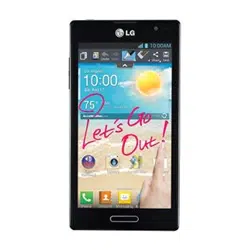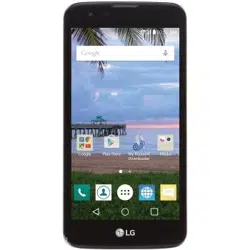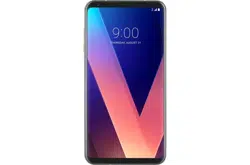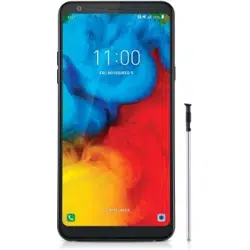
User Guide
All screen shots in this guide are simulated.
Actual displays and the color of the phone may vary.
Some of the contents in this manual may differ from your phone depending
on the software of the phone or your service provider.
www.lg.com
MFL68560601 (1.0)

1. WHAT THIS WARRANTY COVERS :
LG offers you a limited warranty that the enclosed
subscriber unit and its enclosed accessories will be free
from defects in material and workmanship, according to
the following terms and conditions:
1. The limited warranty for the product extends for TWELVE
(12) MONTHS beginning on the date of purchase of the
product with valid proof of purchase, or absent valid
proof of purchase, FIFTEEN (15) MONTHS from date of
manufacture as determined by the unit’s manufacture
date code.
2. The limited warranty extends only to the original
purchaser of the product and is not assignable or
transferable to any subsequent purchaser/end user.
3. This warranty is good only to the original purchaser of
the product during the warranty period as long as it is
in the U.S, including Alaska, Hawaii, U.S. Territories and
Canada.
4. The external housing and cosmetic parts shall be free of
defects at the time of shipment and, therefore, shall not
be covered under these limited warranty terms.
5. Upon request from LG, the consumer must provide
information to reasonably prove the date of purchase.
6. The customer shall bear the cost of shipping the product
to the Customer Service Department of LG. LG shall bear
the cost of shipping the product back to the consumer
after the completion of service under this limited
warranty.
2. WHAT THIS WARRANTY DOES NOT
COVER :
1. Defects or damages resulting from use of the product in
other than its normal and customary manner.
2. Defects or damages from abnormal use, abnormal
conditions, improper storage, exposure to moisture or
dampness, unauthorized modifications, unauthorized
connections, unauthorized repair, misuse, neglect, abuse,
accident, alteration, improper installation, or other acts
which are not the fault of LG, including damage caused
by shipping, blown fuses, spills of food or liquid.
3. Breakage or damage to antennas unless caused directly
by defects in material or workmanship.
4. That the Customer Service Department at LG was
not notified by consumer of the alleged defect or
malfunction of the product during the applicable limited
warranty period.
5. Products which have had the serial number removed or
made illegible.
6. This limited warranty is in lieu of all other warranties,
express or implied either in fact or by operations of
law, statutory or otherwise, including, but not limited
to any implied warranty of marketability or fitness for a
particular use.
7. Damage resulting from use of non-LG approved
accessories.
8. All plastic surfaces and all other externally exposed parts
that are scratched or damaged due to normal customer
use.
LIMITED WARRANTY STATEMENT

9. Products operated outside published maximum ratings.
10. Products used or obtained in a rental program.
11. Consumables (such as fuses).
3. WHAT LG WILL DO:
LG will, at its sole discretion, either repair, replace or
refund the purchase price of any unit that does not
conform to this limited warranty. LG may choose at its
discretion to use functionally equivalent reconditioned,
refurbished or new units or parts or any units. In
addition, LG will not re-install or back-up any data,
applications or software that you have added to your
phone. It is therefore recommended that you back-up
any such data or information prior to sending the unit to
LG to avoid the permanent loss of such information.
4. STATE LAW RIGHTS :
No other ex warranty is applicable to this product.
THE DURATION OF ANY IMPLIED WARRANTIES,
INCLUDING THE IMPLIED WARRANTY OF
MARKETABILITY, IS LIMITED TO THE DURATION OF
THE EXPRESS WARRANTY HEREIN. LG INFOCOMM
INC. SHALL NOT BE LIABLE FOR THE LOSS OF THE
USE OF THE PRODUCT, INCONVENIENCE, LOSS OR
ANY OTHER DAMAGES, DIRECT OR CONSEQUENTIAL,
ARISING OUT OF THE USE OF, OR INABILITY TO
USE, THIS PRODUCT OR FOR ANY BREACH OF ANY
EXPRESS OR IMPLIED WARRANTY, INCLUDING THE
IMPLIED WARRANTY OF MARKETABILITY APPLICABLE
TO THIS PRODUCT.
Some states do not allow the exclusive of limitation of
incidental or consequential damages or limitations on
how long an implied warranty lasts; so these limitations
or exclusions may not apply to you. This warranty gives
you specific legal rights and you may also have other
rights which vary from state to state.
5. HOW TO GET WARRANTY
SERVICE :
To obtain warranty service, please call or fax to the
following telephone numbers from anywhere in the
continental United States:
Tel. 1-800-793-8896 or Fax. 1-800-448-4026
Or visit www.lg.com.
Correspondence may also be mailed to:
LG Electronics MobileComm U.S.A., Inc.
201 James Record Road Huntsville, AL 35824
DO NOT RETURN YOUR PRODUCT TO THE ABOVE
ADDRESS.
Please call or write for the location of the LG authorized
service center nearest you and for the procedures for
obtaining warranty claims.

Table of Contents
Important Notice ..............................8
Your Phone ......................................13
Getting Started ...............................15
Installing the SIM card and battery ..15
Charging your phone .........................16
Inserting a microSD card...................17
Removing the microSD card..............18
Formatting the microSD card ............18
Switching between and exiting
applications .......................................18
Your Home screen .........................20
Touch screen tips ..............................20
Proximity sensor ................................20
Lock your phone ................................21
Quick Switch to Silent/Vibrate Mode 21
Home Screen Overview ...................22
Navigating Through the Home Screen
Canvases ...........................................22
Navigating Through the Sub-Menus 22
Customizing your Home screen.........22
Customizing apps icons on the Home
screen ................................................23
Creating Application Folders on the
Home screen .....................................24
Customizing the Apps screen............24
Home screen clean view ...................25
Notifications ......................................25
Entering text ......................................28
123 Mode ..........................................30
Entering Special Characters..............30
Google Account Setup ..................31
Creating your Google account...........31
Signing into your Google account .....31
Calls .................................................33
Making a call.....................................33
Calling your contacts.........................33
Answering and rejecting a call .........33
Adjusting the in-call volume .............33
Making a second call ........................34
Viewing your call logs .......................34
Call settings ......................................34
Contacts...........................................35
Searching for a contact .....................35
Adding a new contact .......................35
Favorite Contacts ..............................35
AT&T Address Book (AAB) ................36
Messaging/Email ...........................37
Messaging.........................................37
Email..................................................38

Social Networking ........................41
Adding an account to your phone .....41
Adding a social networking widget
on the Home screen ..........................41
Viewing and updating your status ...42
Syncing accounts on your phone ......42
Removing accounts on your phone ...42
Camera.............................................43
Getting to know the viewfinder ........43
Taking a photo ..................................44
Once you’ve taken the photo ............44
Using the advanced settings.............44
Viewing your saved photos ...............45
Setting a photo as the wallpaper .....46
Video Camera .................................47
Getting to know the viewfinder ........47
Recording a video..............................48
Using the advanced settings.............48
After recording a video .....................49
Watching your saved videos .............49
Adjusting the volume when viewing a
video ..................................................49
Dual recording ...................................50
Audio zoom........................................51
Tracking focus ...................................51
Live Zooming .....................................52
Multimedia......................................53
Gallery ...............................................53
Video Wiz ..........................................53
How to save music/video files to the
phone.................................................54
How to play music/video files on the
phone.................................................54
Playing a song ...................................54
Working with Playlists ......................55
To add a song to a playlist ................55
To remove a song from a playlist ......55
To rename a playlist ..........................55
To delete a playlist ............................55
Using SmartShare .............................56
Google Applications .....................57
About Google applications................57
Maps .................................................57
Searching For Locations and Places .57
Getting Directions .............................58
Play Store ..........................................58
Gmail .................................................58
Hangouts ...........................................59

Table of Contents
Utilities ............................................61
QSlide ................................................61
QuickMemo .......................................61
QuickRemote .....................................62
Setting the alarm ..............................63
Using the calculator ..........................63
Adding an event to your calendar .....64
Task Manager ....................................64
Tasks ..................................................64
Polaris Office 4 ..................................65
Voice Command ................................66
LG Tag+ ..............................................66
The Web ..........................................67
Browser .............................................67
Using options ....................................67
Adding bookmarks.............................68
Changing the Browser settings.........68
Settings............................................69
Networks tab.....................................69
Airplane mode ..................................69
Wi-Fi ..................................................69
Bluetooth ...........................................70
Data Manager ..................................72
Call ....................................................72
Share & connect................................73
NFC ....................................................73
Android Beam ...................................73
SmartShare Beam .............................74
Media Server.....................................74
Miracast ............................................74
Wireless storage ...............................75
Tethering & networks ........................75
Mobile Hotspot .................................75
Bluetooth tethering ...........................75
Help ...................................................76
Mobile networks ...............................76
Default SMS app ..............................76
VPN....................................................76
Sound tab ..........................................77
Sound profile .....................................77
Volumes ............................................77
Vibrate strength ................................77
Quiet time..........................................77
Phone ringtone .................................77
Smart ringtone .................................77
Ringtone with vibration.....................77
Incoming call vibration ......................77
Gentle vibration.................................77
Default notification sound ................78
Touch feedback & system ...............78
Display tab ........................................78
Home screen .....................................78

Lock screen........................................78
Brightness ........................................79
Screen timeout .................................79
Auto-rotate screen ...........................79
Daydream .........................................79
Font type ...........................................79
Font size ...........................................79
Smart screen ....................................80
Smart video ......................................80
Front touch key light .........................80
Home button LED ..............................80
Quick Cover ......................................80
General tab........................................80
Gestures ............................................80
One-handed operation ......................81
Storage ..............................................81
Battery ...............................................81
Apps ..................................................82
Tap & pay ..........................................82
Accounts & sync................................82
Location ............................................83
Security .............................................83
Language & input .............................84
Backup & reset ..................................84
Browser Bar.......................................85
QuickButton .......................................85
Date & time ......................................85
Accessibility ......................................85
PC connection....................................87
About phone ......................................88
LG On-Screen Phone .....................89
Software Update ............................91
Phone Software Update ....................91
LG Mobile Phone Software update
via Over-the-Air (OTA) .......................91
Trademarks .....................................92
Trademarks ........................................92
DivX Mobile.......................................92
Dolby Digital Plus .............................92
Q&A ..................................................93
Accessories ....................................94
For Your Safety ...............................95
Safety Guidelines ........................100

8
Please check to see if any problems you have
encountered with your phone are described
in this section before taking the phone in for
service or calling a service representative.
1. Phone Memory
In order to make more memory available, you
will have to manage your applications and
delete some data, such as applications or
messages.
Managing Applications
1 From the Home screen, tap the
Menu
Key
and tap
All settings > General tab
> Apps
.
2 Tap one of the available tabs at the top of
the screen and select the application you
want to uninstall.
3 Tap
Uninstall
and then tap
OK
to confirm
that you want to uninstall the desired
application.
2. Optimizing Battery Life
You can extend your battery's life between
charges by turning off features that you don't
need to run constantly in the background. You
can also monitor how applications and system
resources consume battery power.
To extend the life of your battery
- Turn off radio communications that you aren't
using, such as Wi-Fi, Bluetooth, or GPS.
Wi-Fi will be set to On the first time you use
your newly purchased phone.
- Lower screen brightness and set a shorter
screen timeout.
- Turn off automatic syncing for Gmail,
Calendar, Contacts, and other applications.
- Some applications you have downloaded may
cause your battery power to be reduced.
- While using downloaded applications, check
the battery charge level.
To view the battery charge level
1 From the Home screen, tap the Menu Key
and tap
All settings
> General tab
> Battery.
2 The battery status (charging or discharging)
and level are displayed on the screen.
To monitor and control what uses the
battery
1 From the Home screen, tap the
Menu Key
and tap
All settings
> General tab
>
Battery
.
Important Notice

9
2
Tap the battery icon.
3 A list all of the applications or services using
battery power from the greatest amount
of energy used to the least amount. You
can also use it to turn off applications or
services, if they are consuming too much
power. Tap any of the listed items for more
options.
3. Installing an Open Source
Operating System
Installing an open source operating system
on your phone and not using the operating
system provided by the manufacturer can
cause your phone to malfunction.
%
Warning
•
If you install and use an operating system
other than the one provided by the
manufacturer, your phone is no longer
covered by the warranty.
•
To protect your phone and personal data,
download applications only from trusted
sources, such as Play Store. If some
applications are not properly installed
on your phone, your phone may not work
properly- or serious errors may occur. You
will need to uninstall those applications
and all of its data and settings from the
phone.
4. Using Swipe, Face Unlock,
Pattern, PIN, or Password
Set Swipe, Face Unlock, Pattern, PIN, or
Password to secure your phone. To set the
screen lock, follow the process below.
From the Home screen, tap the
Menu Key
,
tap
Lock screen settings > Select
screen lock
and select a desired screen lock
from
None, Swipe, Face Unlock
,
Pattern
,
PIN and Password
.
%
NOTE
In case that you have trouble with Face Unlock,
you can unlock the screen a Backup Pattern
or PIN.
%
Warning
Take precautions when using an unlock
Pattern, PIN, or Password. It is very
important that you remember the screen
unlock information you set. You are allowed
5 attempts to enter your screen unlock
information. If you used up all 5 opportunities,
Important notice

10
you will have to wait 30 seconds to attempt
unlocking the phone again.
When you can’t recall your Unlock
Pattern, PIN, or Password:
If you logged into a Google account on
the phone and failed to use the correct
pattern 5 times, tap Forgot pattern? You
will be required to sign in with your Google
account and prompted to create a new
unlock pattern.
If you have set a backup PIN, you can
unlock the screen with keying in the backup
PIN.
If you haven’t created a Google account on
the phone or you forgot your PIN, Password,
and the backup PIN, you need to perform a
hard reset.
%
Caution
If you perform a hard reset, all user
applications and user data will be deleted.
Please remember to back up any important
data before performing a hard reset.
Read ALL steps before attempting.
1 Turn the phone off.
2 Press and hold V
olume Down Key
+
Power/Lock Key
at the same time.
3 Release the keys when the FACTORY HARD
RESET screen appears.
4 Read the warning and press the Power/
Lock Key
to confirm. Press the Volume
Keys
to cancel.
5 Press the Power/Lock Key
to confirm
once more or press the Volume Keys
to cancel.
6 Your device will perform a hard reset.
5. Using Safe Mode
Using Safe mode
To recover your phone when malfunctioning.
1 Turn off your phone and reboot. When you
see the AT&T booting animation press and
hold the Volume Down Key
until you
see the Home screen
.
OR
While the phone is on, press and hold
the Power/Lock Key
until the Phone
options menu is displayed. Then press and
hold Power off > OK. Your Home screen
Important notice

11
will then be displayed with the words "Safe
mode" in lower left corner.
2 From the Home screen, tap the
Menu Key
and tap All settings > General tab
> Apps.
3 Tap one of the available tabs at the top of
the screen and select the application you
wish to uninstall.
4 Tap Uninstall and OK to confirm.
5 After uninstalling the application, turn off
and reboot your phone.
6. Using a microSD Card
Pictures, music and video files can be saved to
external memory. Before saving these files to
external memory, you need to insert a microSD
card. If you have not inserted a microSD card,
you will not be able to save these items on
external memory.
%
Warning
Do not remove the microSD card without
unmounting it first. Otherwise, it may damage
the microSD card as well as your phone, and
the data stored on the microSD card may be
corrupted. To remove the microSD card safely,
from the Home screen, tap the
Menu Key
and tap
All settings
> General tab >
Storage
>
Unmount SD card
.
7.
Connecting your phone to a
computer via USB
1 Use the USB cable that was provided with
your phone to connect the phone to a USB
port on your computer. You'll receive a
notification that the USB is connected and
can see USB connection mode screen.
2 Tap Media sync (MTP) or Send images
(PTP) to confirm that you want to transfer files
between your phone and the computer.
When the phone is connected as USB storage,
you receive a notification. Your phone is
recognized as a device on your computer. You can
now copy files to and from the phone.
%
TIP
You can access your phone's storages including
the microSD card from your phone while
connected as USB storage. So you cannot use
applications that rely on the storages, such
as Music.
Important notice

12
8. Unlock screen when using
data connection
Your screen will go dark if untouched
for a period of time when using a data
connection. To turn on your LCD screen,
press the
Power/Lock Key
. To change the
length of time the screen takes to turn off, tap
the Menu Key > All settings > Display
tab > Screen timeout and select the desired
amount.
9. Internal antenna
Please hold the mobile phone straight up
as a regular phone.
While making/receiving calls or sending/
receiving data, try to avoid holding the lower
part of the phone where the antenna is
located. It may affect call quality.
10. When the screen freezes
If the phone does not respond to user
input or the screen freezes:
Press and hold the Power/Lock Key
for 10
seconds to reboot it.
11. Do not connect your phone
when you power on/off
your PC
Make sure to disconnect your phone from the
PC when powering your PC on or off as it might
result in PC errors.
Important notice
13
Your Phone
To turn on the phone, press and hold the Power/Lock Key on the right side of the phone for 3 seconds.
To turn off the phone, press the Power/Lock Key
on the right side of the phone for 3 seconds and tap
Power off and OK to confirm.
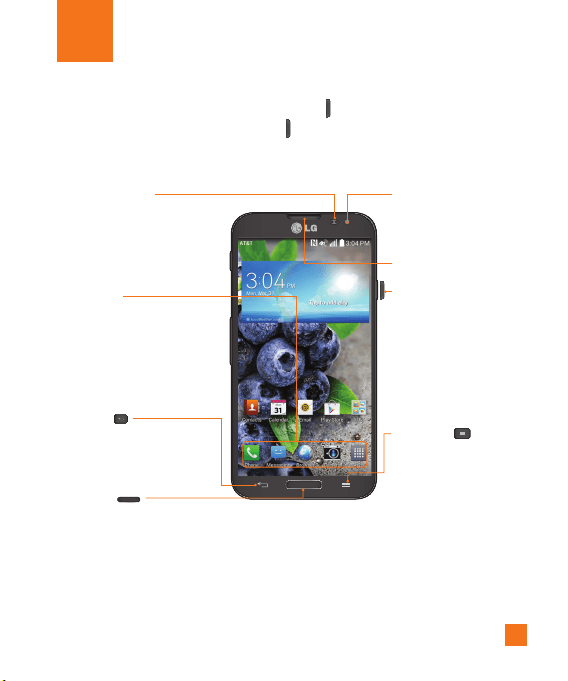
Front view
%
Warning
Placing a heavy object on the phone or sitting on it can damage its LCD and touch screen
functionalities. Do not cover the LCD’s proximity sensor with a protective film. This can
cause the sensor to malfunction.
Back Key
- Returns to the previous screen.
- Closes pop-up menus and dialog
boxes.
Home Key
- Returns to the Home screen from any screen.
- Press and hold to access your most recently
used applications.
Earpiece
Menu Key
- Displays available options for
the current screen or
application.
Proximity Sensor
- Senses proximity toward other
objects, such as your head
during a call, so that you do not
accidentally activate unwanted
features.
Power/Lock Key
- Press and hold to power on
and off, restart, enable or
disable Airplane mode, and
change the ringer type.
- Turns your screen on and
off and locks it.
Front Camera Lens
- Use to take a picture of
yourself or to video chat on
supported applications.
Quick Keys
- Gives you quick access to your
most used applications.
- To add an icon, drag and drop it
in the bar.
- To remove an icon, touch and hold
it and remove it from the bar.
14
Your Phone
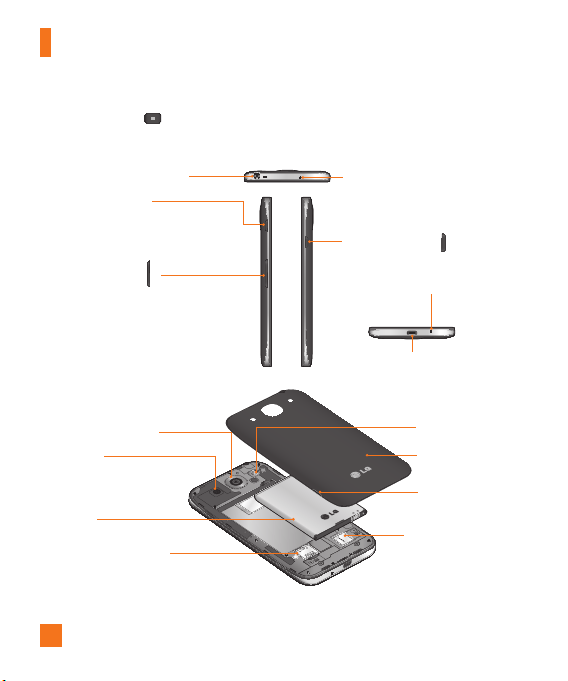
Rear view
Side view
3.5mm Headset Jack
QuickButton
- Press for quick access to your
favorite app. Default app is
QuickMemo.
Power/Lock Key
Microphone
Volume Keys
- Allows you to adjust the ringer
and media volumes, or to adjust
the in-call volume during a call.
- Press and hold the Volume Down
Key to switch to the silent mode.
Charger/Accessory Port
%
TIPS
- Tap the Menu Key
whenever you open an application to check what options are available.
Microphone
Back Camera Lens
Speaker
Battery
Micro SIM Card slot
LED Flash
Back Cover
Fingertip cutout
microSD Card Slot
%
Notice
The NFC antenna for this model is on the back cover.
15
Installing the SIM card and
battery
Before you can start exploring your new phone,
you’ll need to set it up. To insert the SIM card
and battery:
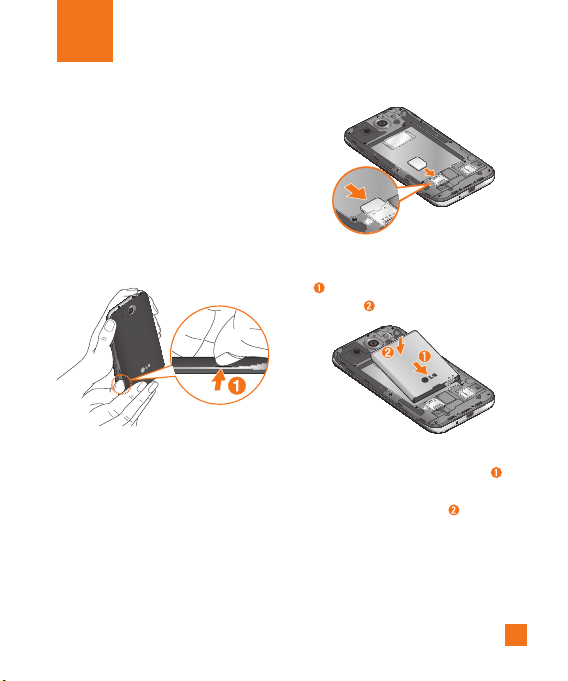
1 Hold the phone on your hand firmly. With
the other hand, lift the back cover using the
fingertip cutout located on the side of the
cover and remove it.
2 Slide the SIM card into the SIM card slot.
Make sure the gold contact area on the card
is facing downwards.
%
NOTE
Please insert the notched side of the SIM card
first. Refer to the image inscribed below the
SIM card slot.
3 Insert the battery into place by aligning the
gold contacts on the phone and the battery
and press the battery down until it clicks
into place .
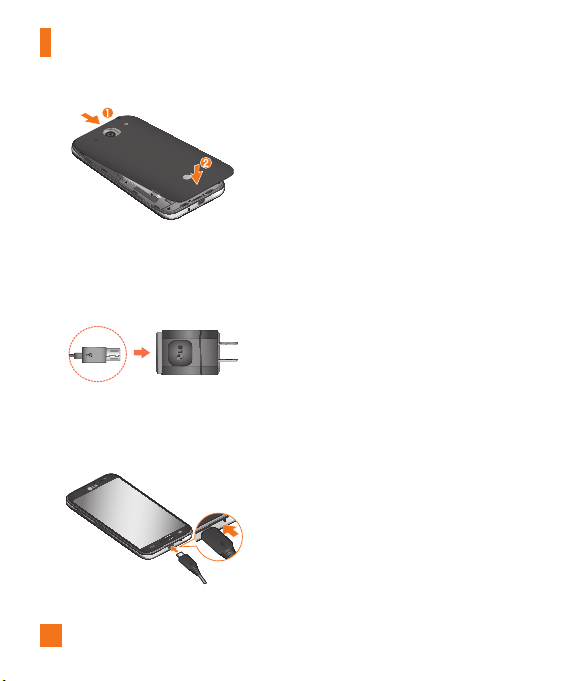
4 Replace the back cover of the phone .
Apply a steady downward pressure until the
back cover clicks into place .
Getting Started
16
Charging your phone
1 Connect the wall adapter and USB cable as
shown below. The USB symbol on the USB
cable should face toward you.
2 Plug the USB cable (as shown below) into
the phone's Charger/Accessory Port. Make
sure the USB symbol is facing upwards.
Always unplug the charger from the wall
socket after the phone is fully charged to
save unnecessary power consumption of
the charger.
%
NOTE
The battery must be fully charged initially
to improve battery lifetime.
%
NOTE
Your phone has an internal antenna. Be
careful not to scratch or damage this
rear area, as that will cause loss of
performance.
When the battery becomes fully discharged
and you connect the phone to a charger
, the
LED lights for the keys at the bottom of the
phone will blink. This is normal operation
for a completely discharged battery to
prevent overflowing current because the
phone is designed to provide reasonable
protection against damage to the battery.
Once the battery has enough charge, the
screen will turn on and display a battery
image.
Getting Started
17
Inserting a microSD card
%
NOTE
This device supports up to a 64GB microSD
card.
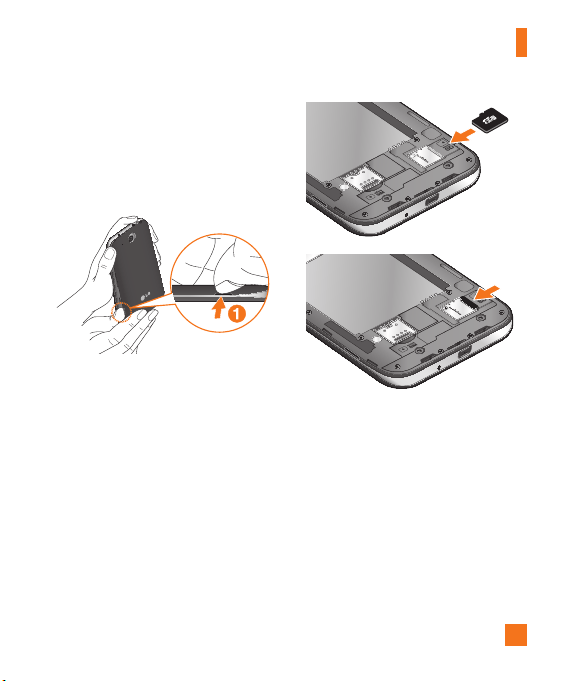
1 Remove the back cover.
2 Gently insert the microSD card into the slot.
Make sure the gold contact area is facing
downwards.
%
NOTE
Please insert the notched side of the
microSD card first. Refer to the image next
to the microSD card slot.
%
NOTE
Some downloaded applications store data
on the microSD card as well as on the
phone. Due to this feature, if you skip the
unmount procedure, it can cause an error
because information between the microSD
card and the phone is not accorded
properly. In the worst case, the microSD
card can be corrupted or damaged.
Getting Started

18
Removing the microSD card
To safely remove the microSD card from your
phone, you must first unmount it.
1 From the Home screen, tap the
Menu Key
and tap All settings > General tab >
Storage > Unmount SD card > OK.
2 Remove the back cover and gently pull the
microSD card from the slot.
%
Warning
Do not remove the microSD card without
unmounting it first. Otherwise, it may
damage the microSD card as well as your
phone, and the data stored on the microSD
card may be corrupted.
Formatting the microSD card
Your microSD card may already be formatted.
If it isn’t, you must format it before you can
use it.
%
NOTE
All files on the card are deleted when you
format the microSD card.
1 From the Home screen, tap the
Menu Key
and tap All settings
> General tab >
Storage
>
Unmount SD card > OK.
2 Tap
Erase SD card
twice.
3 If you set an unlock pattern, enter it and tap
Erase everything.
The card will then be
formatted and ready to use.
%
NOTE
If there is content on your microSD card,
the folder structure may be different after
formatting since all the files will have been
deleted.
Switching between and
exiting applications
Multi-tasking is easy with Android because
open applications keep running even when you
open another application. There is no need to
quit an application before opening another. Use
and switch among several open applications.
Android manages each application, stopping
and starting them as needed, to ensure that
idle applications don’t consume resources
unnecessarily.
Switching between applications
- Press and hold the Home Key
. A list of
recently used applications will be displayed.
Then tap the application you want to access.
- To remove an application from the list, swipe
the app preview to the left or right.
Getting Started

19
To stop/exit an application
1 From the Home screen, tap the
Menu Key
and tap All settings
> General tab
>
Apps.
2 Tap one of the tabs at the top of the
screen, choose the desired application
and tap
Force stop
(or Stop) to stop the
application.
Getting Started

20
Touch screen tips
With the touch of your finger, you can access
available applications, make menu selections, and
access data saved to your phone. The following
terms are used for describing the different
available actions using the touchscreen:
Tap -
A single finger tap selects items, links,
shortcuts and letters on the on-screen keyboard.
Touch and hold -
Touch and hold an item on
the screen by touching it and not lifting your
finger until an action occurs. For example, to
open a contact's available options, touch and
hold the contact in the Contacts list until the
context menu opens.
Drag -
Touch and hold an item for a moment
and then, without lifting your finger, move your
finger on the screen until you reach the target
position. You can drag items on the Home screen
to reposition them.
Swipe or slide -
To swipe or slide, quickly
move your finger across the surface of the
screen, without pausing when you first touch
it (so you don’t drag an item instead). For
example, you can slide the screen up or down
to scroll through a list, or browse through the
different Home screens by swiping from left to
right (and vice versa).
Double-tap -
Double-tap to zoom on a Web
page or a map. For example, quickly double-tap a
section of a Web page to adjust that section to fit
the width of the screen. You can also double-tap
to zoom in and out when using Maps.
Pinch-to-Zoom -
Use your index finger and
thumb in a pinch or spread motion to zoom in
or out when using the browser, Maps, Camera,
or browsing pictures.
Rotate the screen -
From many applications
and menus, the orientation of the screen adjusts
to the device's physical orientation.
%
NOTE
•
To select an item, tap the center of the icon.
•
Do not to press too hard; the touch screen is
sensitive enough to pick up a light, firm touch.
• Use the tip of your finger to tap the option
you want. Be careful not to tap any other
keys or icons.
Proximity sensor
When receiving and making calls, this sensor
automatically turns the backlight off and locks
the touch keypad by sensing when the phone
is near your ear. This extends battery life and
prevents the touch keypad from activating
unintentionally during calls.
Your Home screen

21
Lock your phone
When you are not using the phone,
press the
Power/Lock Key
to lock your phone.
This helps prevent accidental presses and saves
battery power.
Also, if you do not use the phone for a while, the
Home screen, or other screen you are viewing, is
automatically replaced with the lock screen after
30 seconds (depending on the screen timeout
settings) of inactivity to conserve the battery and
prevent pocket dialing.
To wake up your phone, press the
Power/
Lock Key
.
The lock screen will appear.
Swipe the screen in any direction to unlock.
The last screen you were working on opens.
%
NOTE
•
The automatic screen timeout can be
configured manually in Settings. To change
it, tap the
Menu Key
> All settings >
Display tab > Screen timeout.
• If there are any programs running when you
lock the phone, they may still be running in
lock mode. It is recommended that you exit
all programs before entering the lock mode
to avoid unnecessary charges (e.g., phone
call, web access and data communications).
Setting Swipe, Face Unlock, Pattern,
PIN, Password to unlock your phone
You can slide the screen without entering any
information, utilize facial recognition, draw your
own unlock Pattern or enter a PIN or Password to
add more security to your device. To set Swipe,
Face Unlock, Pattern, PIN, or Password, from the
Home screen tap the Menu Key
> Lock
screen settings > Select screen lock. Then
choose from Swipe, Face Unlock, Pattern,
PIN, or Password and enter the desired
information.
%
Caution
You are allowed 5 attempts to enter your
screen unlock information. If you used up all 5
opportunities, you will have to wait 30 seconds
to attempt unlocking the phone again.
Quick Switch to Silent/Vibrate
Mode
To quickly set your phone to silent or vibrate
mode, slide the Status Bar down and tap
until
or appears.
Your Home screen

22
Home Screen Overview
The main Home screen is the starting point
for many applications and functions, and it
allows you to add items like application icons,
shortcuts, folders or widgets to give you
instant access to information and applications.
This is the default page and accessible from
any menu by pressing
Home Key
.
On your Home screen, you can view menu
icons at the bottom of the screen. Menu icons
provide easy and one-touch access to the
functions you use the most.
Navigating Through the Home
Screen Canvases
Your phone has several Home screen canvases.
If you like, you can place different applications
on each of the Home screen canvases.
From the main Home screen canvas, swipe the
screen with your finger in either direction. The
main Home screen canvas is located in the
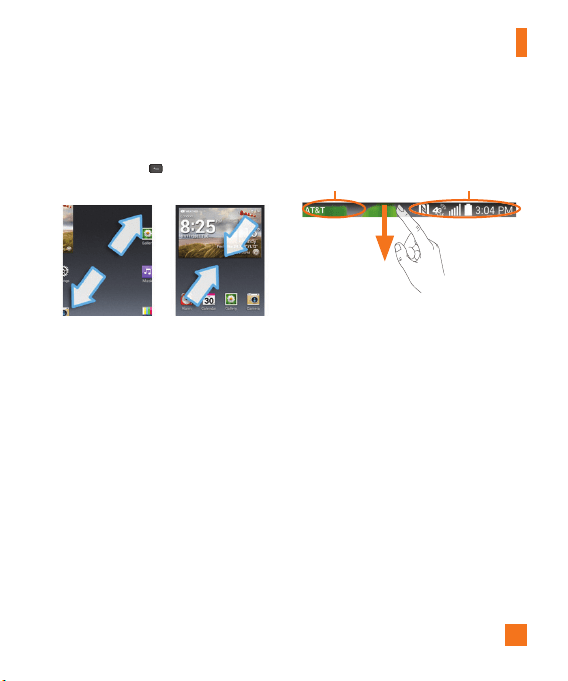
middle. To add more canvases, pinch in on the
Home screen and tap
.
You can also customize each canvas with
shortcuts, folders, and widgets, which are
shortcuts to your favorite applications.
%
NOTE
On the Home screen, you can view the Quick
Keys at the bottom of the screen. The Quick
Keys provide easy, one-touch access to the
functions you use the most.
Navigating Through the Sub-
Menus
Sub-menus are available when you are at
any Home screen or have selected a feature
or application such as Phone, Contacts,
Messaging or Internet.
1 Touch the Menu Key
. A sub-menu
displays at the bottom of the phone screen.
2 Tap an option.
Customizing your Home
screen
You can customize your Home screen by
adding quick access items, such as shortcuts
to an application, widgets, or changing the
wallpaper.
•
Apps
: Add shortcuts to applications on the
Home screen.
•
Widgets
: Add dynamically updating
widgets to your Home screen to allow quick
access to applications without opening the
full application
Your Home screen
23
•
Wallpapers
: Change the Home screen
wallpaper.
To add shortcuts to apps or widgets on
the Home screen:
1 Select a location (Home screen canvas) to
add an item by swiping the Home screen
from left to right or vice versa.
2 Touch and hold an empty part of the Home
screen.
3 Tap the type of item you want to add on the
screen:
Apps or Widgets
.
4 Tap the desired app or widget.
5 You will see a new icon on the Home screen.
To place it on a different canvas, touch and
hold it to drag it to the desired location and
release your finger from the screen.
%
TIP
To add a preloaded application or an application
you have downloaded from Play Store to the
Home screen, simply touch and hold the icon
you want in the Apps screen and drag it to the
desired Home screen canvas.
%
NOTE
If there is no available space on a particular
Home screen panel, you must delete or remove
an item before you can add another item. In
this case, you have the option of switching to
another Home screen panel.
To delete an application icon from the Home
screen, touch and hold the shortcut icon
or widget you want to delete and drag to
Remove
at the top of the screen.
When
changes to , lift your finger.
You cannot delete the preloaded applications.
(Only their icons can be deleted from the screen).
Customizing apps icons on the
Home screen
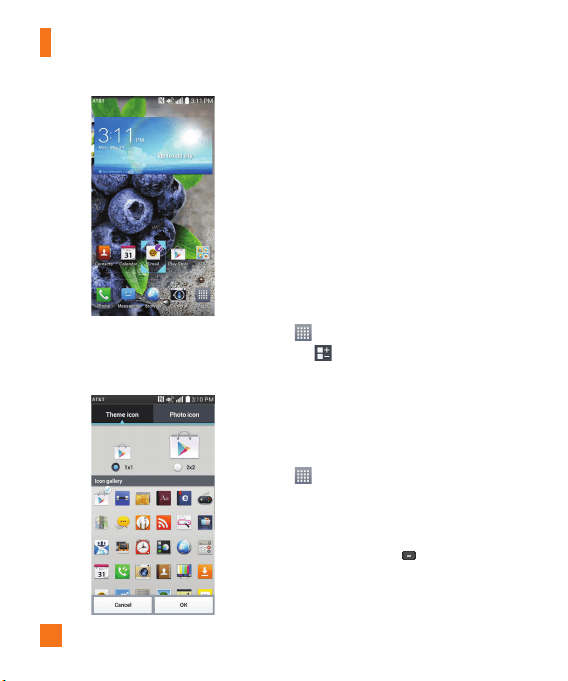
You can customize each application icon with
images from your Gallery.
1 Touch and hold an application icon until it’s
unlocked from its current position. Then
drop it on the screen. The editing icon
will appear in the upper right corner of the
application.
Your Home screen
24
2 Tap the application icon again and select the
desired icon design. Or tap Theme icon or
Photo icon to take a new picture or select a
picture from the Gallery.
Creating Application Folders
on the Home screen
You can create application folders to hold
similar applications if you wish.
On the Home screen
1 Touch and hold an icon to unlock it from its
positions. Then drag it over another icon and
release it.
2 A folder will be created.
On the Apps screen
1 From the Home screen, tap the Apps Key
to open the Apps screen.
2 Tap
, then touch and hold the desired
icon to release it from its position.
3 Drag the icon over another icon and release
it to create a folder
.
Customizing the Apps screen
1 From the Home screen, tap the Apps Key
.
2 Tap the Apps tab at the top of the screen
to go to the Apps screen, if it is not already
selected.
3 Touch the Menu Key
to customize the
Apps screen using View apps by, Show
large icons, App menu wallpaper, Hide/
Show apps.
Your Home screen
25
Home screen clean view
You can see the wallpaper without items on
the Home screen by pinching out. Pinch in or
tap the Back Key
to see applications and
widgets again.
Notifications
Notifications alert you to the arrival of new
messages, calendar events, and alarms, as
well as to ongoing events, such as video
downloads. From the Notifications panel,
you can view your phone’s current status and
pending notifications.
When a notification arrives, its icon appears
at the top of the screen. Icons for pending
notifications appear on the left, and system
icons showing things like Wi-Fi or battery
strength on the right.
%
NOTE
The available options may vary depending on
the region or service provider.
Notification icons System icons
Accessing notifications
Swipe the Status Bar down to open the
Notifications panel to access notifications. To
close the Notifications panel, swipe the bar at
the bottom of the screen upwards.
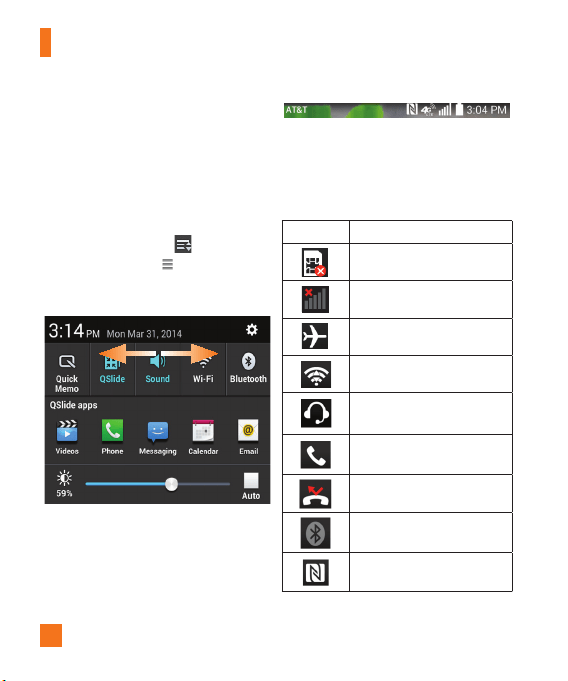
Quick Settings
Use the Quick Settings to easily toggle function
settings like Wi-Fi, manage display brightness
and more. To access the Quick Settings, swipe
the Status Bar down to open the Notifications
panel and select any of the available Quick
Setting apps at the top of the screen.
Your Home screen
26
Your Home screen
%
NOTE
Touch and hold an icon on the Quick Settings
menu to go directly to that setting's menu
screen.
To rearrange Quick Setting items on the
Notification panel
Open the Notifications panel, swipe the Quick
Settings to the left, and tap .
To rearrange items, drag to the desired
location. To add more icons, tap the checkmark
boxes next to the feature you want to add.
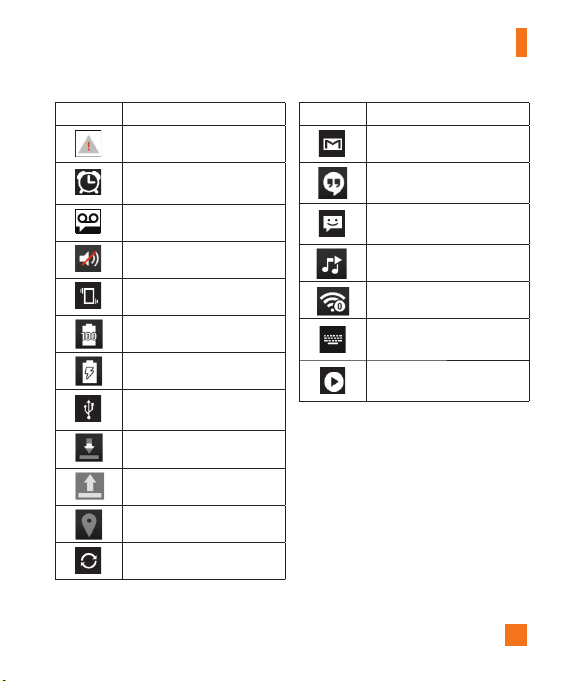
Indicator icons on the Status Bar
Indicator icons appear on the Status Bar at
the top of the screen to report missed calls,
new messages, calendar events, device status
and more.
The icons displayed at the top of the screen
provide information about the status of the
device. The icons listed in the table below are
some of the most common ones.
Icon Description
No SIM card inserted
No network signal available
Airplane mode is on
Connected to a Wi-Fi network
Wired headset (with mic)
connected
Call in progress
Missed call
Bluetooth is on
NFC is on
27
Your Home screen
Icon Description
System warning
An alarm is set
New voicemail available
Ringer is silenced
Vibrate mode is on
Battery fully charged
Battery is charging
Phone is connected to PC via
USB cable
Downloading data
Uploading data
GPS is on
Data is synchronizing
Icon Description
New Gmail message available
New Hangouts message
available
New text or multimedia
message
A song is currently playing
Mobile Hotspot
Choose input method
SmartShare music playing
28
Entering text
You can enter text using the on-screen
keyboard. The on-screen keyboard displays
automatically on the screen when you need to
enter text. To manually display the keyboard,
simply tap a text field where you want to
enter text.
There are two types of keyboards that you can
use:
Android keyboard (AOSP)
and
LG
keyboard.
To select the keyboard:
1 From the Home screen, tap the Menu
Key > All settings > General tab
> Language & input > Default (Under
KEYBOARD & INPUT METHODS).
2 Select the default keyboard between
Android keyboard (AOSP), LG
Keyboard and Google voice typing.
OR
1 While entering text, drag the Status Bar
down and tap Choose input method.
%
NOTE
Multiple text entry methods must be enabled
for this option to be available.
2 Select the desired input method from
Android keyboard (AOSP), LG
Keyboard (default) or Google voice
typing.
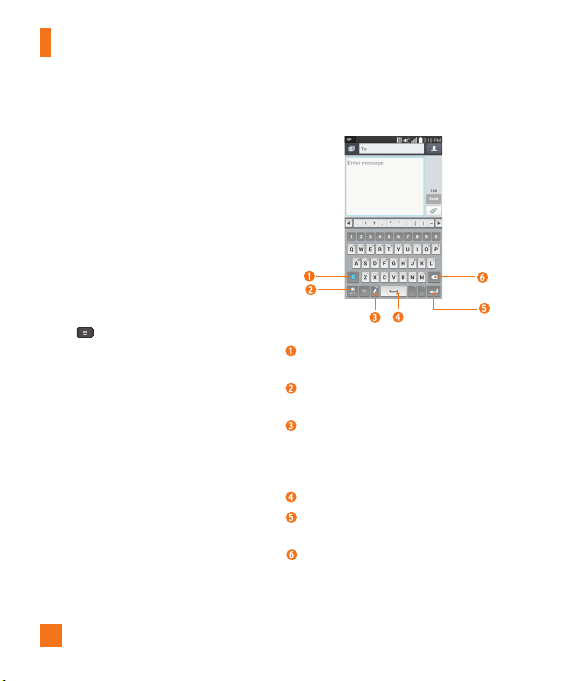
LG keyboard - Letters Entry
Shift Key - Tap once to capitalize the next
letter you type. Double-tap for all caps.
Number and Symbols - Tap to change
input to number and symbol entry.
Handwriting/Voice to Text/Settings Key
-
Tap to enter text by voice. Touch and hold
to enter text by handwriting or access the
keyboard settings.
Space Key - Tap to enter a space.
Enter Key - Tap to move the cursor to the
next line.
Delete Key - Tap to delete characters to
the left of the cursor.
Your Home screen
29
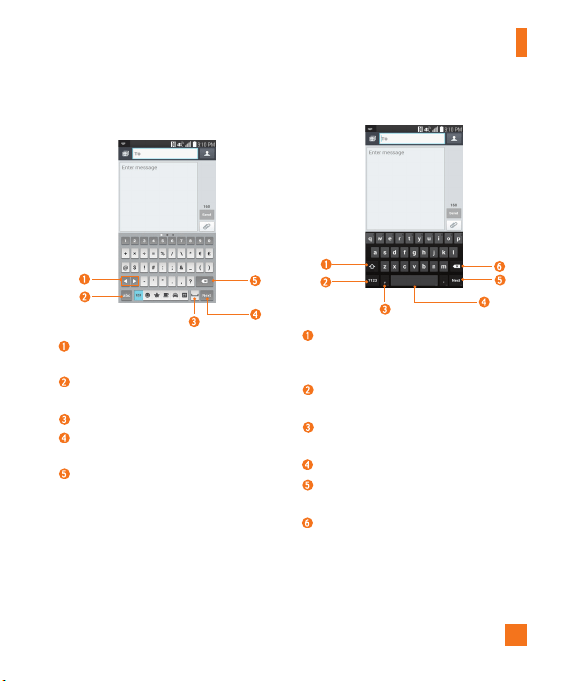
LG keyboard - Numbers and Symbols
Entry
Arrow Keys - Tap to display additional
symbols.
Letters Key - Tap to change input to
letters entry.
Space Key - Tap to enter a space.
Enter Key - Tap to move the cursor to
the next line.
Delete Key - Tap to delete characters to
the left of the cursor.
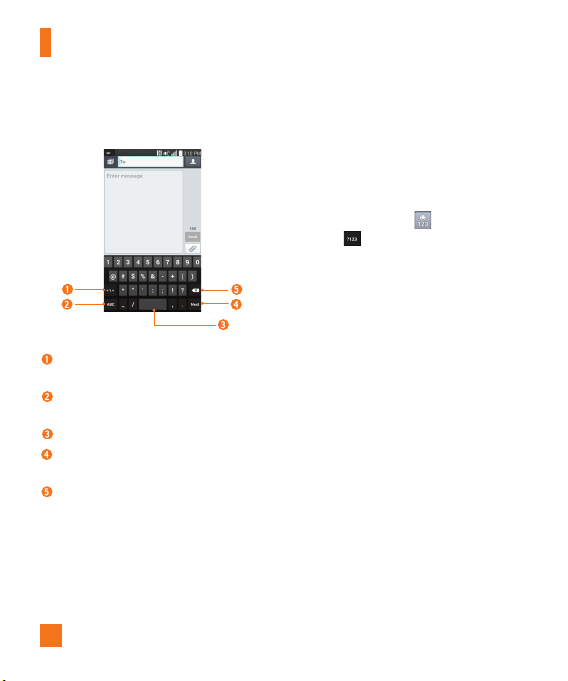
Android keyboard (AOSP) - Letters Entry
Shift Key - Tap once to capitalize the
next letter you type. Double-tap for all
caps.
Number and Symbols Key - Tap to
change input to number and symbol entry.
Settings Key - Touch and hold to set
various keyboard settings.
Space Key - Tap to enter a space.
Enter Key - Tap to move the cursor to
the next line.
Delete Key - Tap to delete characters to the
left of the cursor.
Your Home screen
30
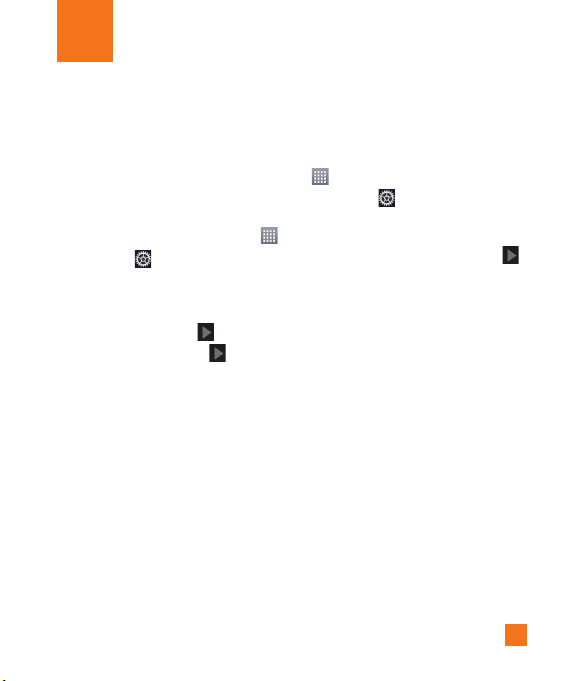
Android keyboard (AOSP) -
Numbers and Symbols Entry
Alt Key - Tap to enter additional
symbols.
Letters Key - Tap to change input to
letters entry.
Space Key - Tap to enter a space.
Enter Key - Tap to move the cursor to
the next line.
Delete Key - Tap to delete characters to
the left of the cursor.
123 Mode
This mode allows you to enter numbers in a
text message (a telephone number, for
example) more quickly. Tap the keys
corresponding to the required digits before
manually switching back to the appropriate
text entry mode by tapping
on the LG
Keyboard or
on the Android keyboard.
Entering Special Characters
The on-screen keyboard allows you to enter
special characters (e.g., “á”).
To enter a special character, press and hold the
desired key (press the “a” key for example).
After the special character appears, slide your
finger over it and lift it off it to enter it.
%
NOTE
A character at the top right or bottom right
corner of a key indicates that additional
characters are available by touching and
holding the key.
Your Home screen
31
The first time you open a Google application on
your phone, you will be required to sign in with
your existing Google account. If you do not
have a Google account, you will be prompted
to create one.
Creating your Google account
1 From the Home screen, tap the Apps Key .
2 Tap Settings > General tab >
Accounts & sync > Add account >
Google > New.
3 Tap a text field to open the keyboard and
enter your name. Then tap
.
4 Enter your username and tap
. Your
phone will communicate with Google servers
and check for username availability.
5 Enter and re-enter your password. Then
follow the instructions and enter the
required and optional information about
the account. Wait while the server creates
your account.
Signing into your Google
account
1 From the Home screen, tap the
Apps Key
.
2 Tap Settings
> General tab >
Accounts & sync > Add account >
Google > Existing.
3 Enter your email and password and tap
.
4 Read the disclaimer about signing in and
checkmark if you want to keep updated with
news and offers from Google Play. Then
tap OK.
5 After signing in, you can use Gmail and take
advantage of Google services on your phone.
6 Once you have set up your Google
account, your phone will be automatically
synchronized with your Google account on
the web. (Depending on your synchronization
settings.)
After signing in, your phone will sync with
your Google services, such as Gmail, Contacts,
Google Calendar, and Picasa photo albums.
You can also use Maps, download applications
from Play Store, back up your settings to
Google servers, and take advantage of other
Google services on your phone.
Google Account Setup

32
IMPORTANT
• Some applications, such as Calendar,
work only with the first Google Account
you add. If you plan to use more than one
Google Account with your phone, be sure
to sign into the one you want to use with
such applications first. When you sign in,
your contacts, Gmail messages, Calendar
events, and other information from these
applications and services on the web are
synchronized with your phone. If you don’t
sign into a Google Account during setup,
you will be prompted to sign in or to create
a Google Account the first time you start an
application that requires one, such as Gmail
or Play Store.
• If you have an enterprise account through
your company or other organization, your IT
department may have special instructions on
how to sign into that account.
Google Account Setup
33
Making a call
1 From the Home screen, tap the Phone Key
to open the keypad.
2 Enter the number on the keypad. To delete a
digit, tap the
Clear
Key .
3 Tap the
Call
Key to make a call.
4 To end a call, tap the
End
Key .
%
TIP
To enter “+” to make international calls,
touch and hold .
Calling your contacts
1 From the Home screen, tap Contacts to
open your contacts.
2 Scroll through the contact list or tap the
Search
contacts field and enter the first
letter(s) of the contact you want to call. You
can also tap the letters at the right side of
the screen.
3 In the list that is displayed, tap the contact
you want to call.
4 In the Contact Info screen, tap the phone
number you wish to call.
Answering and rejecting a
call
When the screen is locked
When your phone rings, swipe the
Answer
icon
in any direction to answer the
incoming call.
Swipe the
Decline
icon in any direction
to reject an incoming call.
When the screen is unlocked
When your phone rings, tap the
Answer
Key . Tap
Decline
Key to reject an
incoming call.
%
NOTE
Tap or swipe the Decline with message
Key if you want to send a message to the
caller. If the caller is unknown, the Decline
with message Key is not available.
Adjusting the in-call volume
To adjust the in-call volume during a call, use
the Volume Keys on the left side of the phone.
Calls
34
Making a second call
1 During your initial call, tap the Menu Key
and select Add call.
2 Dial the number or search your contacts.
3 Tap the
Call
Key
to connect the call.
4 Both calls will be displayed on the call
screen. Y
our initial call will be put on hold.
5 Tap the Call entry on the screen to toggle
between active calls or tap Merge calls
to merge the calls.
6 To end active calls, tap
the End Key
.
If there is no active call, it will end the call
on hold.
%
NOTE
You will be charged for each call you make.
Viewing your call logs
From the Home screen, tap the Phone Key
and the Call logs tab.
You can view a complete list of all dialed,
received, and missed voice calls.
%
TIP
Tap any single call log entry to view the
date, time, and duration of the call.
%
TIP
Tap the Menu Key , then tap Delete
all to delete all the recorded items or
Delete to delete individual or groups of
entries.
Call settings
You can configure phone call settings, such
as call forwarding, and other special features
offered by your carrier.
1 From the Home screen, tap the
Menu Key
and tap
All settings
.
2 Tap the Networks tab (if necessary) >
Call
.
3
Set any of the available options.
Calls
35
You can add contacts on your phone and
synchronize them with the contacts in your
Google Account or other accounts that
support syncing contacts.
Searching for a contact
1 From the Home screen, tap the Apps Key
and tap Contacts
to open your
contacts.
OR
From the Home screen, tap the Phone
Key > Contacts tab.
2 Tap the Search contacts field and enter
the contact name using the keypad. You
can also tap the letters at the right side
of the screen.
Adding a new contact
1 From the Home screen, tap the Phone
Key and enter the new contact’s
number. Tap the Menu Key >
Add to Contacts > New contact or
Update contact.
2 Tap
and select the account where you
want to add the new contact. Locations
depend on the type of accounts you have
added to your device.
%
NOTE
The entry fields varies depending on the
account.
3 If you want to add a picture to the new
contact, tap
. Choose from Take photo
or Select from Gallery. Then browse for
an image and select it.
4 Tap
to enter more specific name
information.
5 Enter the details about your contact.
6 Tap Save to save the contact entry
.
Favorite Contacts
You can classify frequently called contacts
as favorites.
To add a contact to your favorites
1 From the Home screen,
tap the Apps Key
and then Contacts
to open your
contacts.
2 Tap a contact to view its details.
3 Tap the star to the right of the contact’s
name. The star turns gold and the contact
is added to your favorites.
Contacts

36
To remove a contact from your favorites
list
1 From the Home screen,
tap the Apps Key
and then Contacts
.
2 Tap the Favorites tab.
3 Tap a contact to view its details.
4 Tap the gold star to the right of the
contact’
s name. The star turns grey
and the contact is removed from your
favorites.
AT&T Address Book (AAB)
AT&T Address Book (AAB) is an application
that automatically syncs your contacts to an
online address book for safekeeping! When
you first turn on the phone or change your SIM
card and tap Contacts, the AAB application is
displayed.
After signing up for this service, your
information is synced on a regular basis.
You can find more information on this service
and access your online address book at
www.att.com/addressbook. You can find
the synchronization menu for the service by
tapping the Menu Key
> All settings
> General tab > Accounts & sync > AT&T
Address Book.
Contacts
37
Messaging
Your phone combines text and multimedia
messaging into one intuitive, easy-to-use
menu.
Conversation view
Messages exchanged with another party are
displayed in chronological order so that you
can conveniently see an overview of your
conversation.
Sending a message
1 Tap Messaging on the Home screen,
then tap
to create a new message.
2 Enter a contact name or phone number
in the
To
field. As you enter the contact
name, matching contacts appear. You can
tap a suggested recipient. You can also add
multiple contacts.
%
NOTE
You will be charged for a text message for
every person you send the message to.
3 Tap the text field and start entering your
message.
4 Tap the
Menu Key
to open the
options menu. Choose from
any of the
available options.
5 Tap
Send
to send your message.
%
Warning
The 160-character limit may vary from
country to country depending on how the
text message is coded and the language
used in the message.
%
Warning
If an image, video, or audio file is added
to a text message, it will be automatically
converted into a multimedia message and
you will be charged accordingly.
%
NOTE
When you get a text message during a call,
there will be an audible notification.
Using smilies
Liven up your messages using smilies.
When writing a new message, tap the
Menu
Key
>
Insert smiley. You can also tap
and select an emoji category to enter
emojis.
Changing your message settings
Your phone's message settings are predefined,
so you can send messages immediately.
You can change the settings based on your
Messaging/Email

38
preferences.
From the Home screen, tap Messaging
> Menu Key
> Settings.
Email
You can use the
Email
application to read
email from providers other than Gmail. The
Email application supports the following
account types: POP3, IMAP and Microsoft
Exchange (for Enterprise users).
To open the Email application
From the Home screen, tap the Apps Key
> Email .
The first time you open the
Email
application,
a setup wizard opens to help you add an email
account.
Microsoft Exchange Email Account
Email address – Enter the account email
address.
Password – Enter the account password.
Server address – Enter the server address.
Domain – Enter the account domain (optional).
Username – Enter the account username.
Use secure connection (SSL) – Choose
whether or not to use SSL for Microsoft
Exchange.
Client certificate – If you check mark this,
you accept all SSL certificates regardless
public or private.
Other (POP3 & IMAP) Email
Account
Email address – Enter the account email
address.
Password – Enter the account password.
Incoming server settings
POP/IMAP server – Select protocol type,
either POP3 or IMAP.
Security type – Choose from Off, SSL, or TLS.
Port number – Normally each account’s
default number will be displayed.
Outgoing server settings
SMTP server – Enter the outgoing email
server address.
Security type – Choose from Off, SSL, or TLS.
Port number – Normally each account’s
default number will be displayed.
To open your Combined inbox
If you have configured email to send and
receive email from more than one account, you
can view all messages sent to all accounts in
your Combined inbox.
Open the Email application and touch
. Then touch Combined
Messaging/Email

39
inbox.
Messages in the Combined inbox are color
coded on the left, by account.
When a new email arrives in the Inbox, there
will be sound and/or vibration notification
(depending on your current sound and vibrate
settings).
Composing and Sending Email
1 In the Email application, tap Compose .
2 Enter an address for the message’s intended
recipient. As you enter text, matching
addresses will be offered from your
contacts. Separate multiple addresses with
commas.
3 Tap Cc/Bcc to copy or blind copy to other
contacts/email addresses.
4 Tap the text field and enter your message.
5 Tap Attach to attach the file you want to
send with your message.
6 Tap Send to send the message.
If you are not ready to send the message,
tap Save to save it in a Drafts folder. Touch
a message in the Drafts folder to resume
working on it. Your message will also be saved
as a draft if you touch the Back Key
before sending it.
Tap Cancel to abandon and delete a message,
including any saved drafts. If you are not
connected to a network, for example if you’re
working in airplane mode, the messages you
send are stored in your Outbox folder until
you’re connected to a network. If it contains
any pending messages, the Outbox will be
displayed on the Accounts screen.
%
NOTE
The messages sent using an Exchange account
will not be stored on the phone; they will be
stored on the Exchange server itself. If you
want to see your sent messages in the Sent
folder, you may need to open the Sent folder
and select Refresh from the options menu.
Working with Account Folders
Each account has Inbox, Outbox, Sent,
Drafts, Trash and Junk folders. Depending on
the features your account service provider
supports, you may have additional folders.
Messaging/Email
40
Messaging/Email
Adding and Editing Email Accounts
To add an email account
1 From the Home screen, tap the Apps Key
> Email .
2 Select the desired email provider.
If an email account is already set up, the
wizard is not activated automatically.
In this case, tap the Menu Key
>
Settings >
Add account.
To change account settings
1 Open the Email application.
2 Tap the Menu Key
> Settings.
3 Tap General settings to adjust the settings
that affect all accounts. Or tap an individual
account to adjust settings only for that
account.
To delete an email account
1 Open the Email application.
2 Tap the Menu Key
> Settings >
Menu Key
> Remove account.
3
Select the account(s) you want to delete
and tap Remove.
4 Tap Yes to confirm.

41
With your phone, you can enjoy social
networking and manage your micro-blog in
on-line communities. You can update your
current status, upload photos, and view your
friends’ status updates in real-time.
You can add your Facebook, Google+, and
Twitter accounts to your phone. If you don’t
have an account, you can visit their sites to
set one up.
%
NOTE
Additional costs may be incurred when
connecting and using online services.
Check your data charges with your network
provider.
Adding an account to your
phone
1 From the Home screen, tap the Menu Key
> All settings > General tab >
Accounts & sync.
2 Tap Add account.
3 Tap any social networking service you want
to use.
4 Enter your email address and password
that you set up for your social networking
account, then tap
Log in
.
Adding a social networking
widget on the Home screen
If you add a social networking widget on
your Home screen, the widget will show
your status when your phone receives
updates from the network.
You can also access the social community
directly by tapping the widget.
1 Touch and hold an empty spot on the Home
screen.
%
NOTE
If there is no available space on a particular
Home screen panel, you won't be able to
add any widget; you must delete or remove
an item before you can add another item. In
this case, you have the option of switching
to another Home screen panel.
2 Tap the Widgets tab and scroll to the right
or left until you see the social network you
want.
3 Tap the desired widget to add it to the Home
screen panel.
Social Networking

42
Viewing and updating your
status
1 Go to the Home screen panel where the
social networking widget is located. You can
see the current status of social applications
you set.
2 Tap the Status update icon or field to
update your status with comments or
upload pictures.
3 After entering comments and attachment
(if any), tap the Post icon.
%
TIP
You can use information about friends only
in your social network(s) or sync all data
to Contacts.
Syncing accounts on your
phone
You can sync information from your social
networking accounts with your Contacts and
other functions on your phone, if applicable.
1 From the Home screen, tap the
Menu Key
>
All settings
> General tab >
Accounts & sync
.
2 Checkmark Auto-sync data to activate
automatic synchronization.
3 Tap the account you want to sync.
4 Check the desired options, such as
Contacts.
A checkmark indicates that synchronization
has been enabled.
Removing accounts on your
phone
1 From the Home screen, tap the
Menu Key
>
All settings
> General tab >
Accounts & sync
.
2 Tap the account(s) you want to delete, then
Menu Key
>
Remove account
> OK.
Social Networking
43
Camera
Getting to know the viewfinder
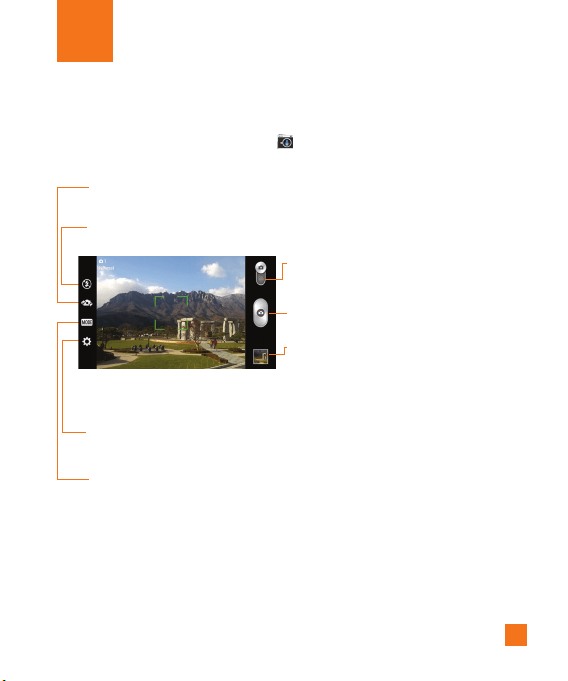
To open the Camera application, tap Camera on the Home screen.
Mode
– Allows you select the shot mode from Normal, Dynamic tone(HDR),
Panorama, VR panorama, Burst shot, Beauty shot, Dual camera, Time
catch shot, Intelligent auto, Sports and Night.
Settings
– Tap to open the settings menu. See
Using the advanced settings
on
page 44.
Mode Switch
– Touch and slide to switch
between Camera mode and
Video mode.
Capture
– Allows you to take a photo.
Gallery
– This enables you to access your
saved photos and videos within the
camera mode. Simply tap and your
Gallery will appear on the screen.
Swap camera
–
Allows you to swap between the rear camera lens and the front
camera lens.
Flash
–
Tap to turn the flash On, Off or set it to Auto.

44
Camera
Taking a photo
1 From the Home screen, tap Camera .
2 Holding the phone horizontally, point the
lens towards the subject you want to
photograph.
%
NOTE
To zoom in, press the Volume Keys or use
the pinch-to-zoom method.
3 A focus box will appear in the center
of the viewfinder screen. You can also
tap anywhere on the screen to focus on
that spot.
4 When the focus box turns green, the
camera has focused on your subject.
5 Tap Capture to take a picture.
Once you’ve taken the photo
Your captured photo will appear on the
screen if Auto review is set to On (refer to
Using the advanced settings). Otherwise,
tap the image preview at the bottom right
corner of the screen to view the picture.
Using the advanced settings
In the viewfinder, tap to open the
advanced options.
You can change the camera settings by
scrolling the list. After selecting the option,
tap the Back Key
.
Cheese shutter - Allows you to take a
picture by voice.
Brightness - Defines and controls of the
amount of sunlight entering the lens. Slide
the brightness indicator along the bar
towards “-” for a lower brightness video or
towards “+” for a higher brightness video.
Focus - Tap to select the focus mode.
Auto: Allows the camera to focus
automatically. (The camera continuously
focuses on the objects in the photo).
Manual: Allows you to set the focus
mode manually before taking a photo.
Face tracking: The camera detects and
focuses on human faces automatically.
Image size - Tap to set the size (in pixels)
of the picture you take. Select a pixel
value from the following options: 13M
(4160x3120), W10M (4160x2340), 8M
(3264x2448), 1M (1280x960).
ISO - Control the camera's sensitivity to
light. Choose from Auto, 800, 400, 200,
and 100.
White balance - The white balance
ensures any the white areas in your picture
are realistic. To enable your camera to
adjust the white balance correctly, you may
need to determine the light conditions.
Choose from Auto, Incandescent, Sunny,
Fluorescent, and Cloudy.
45
Camera
Color effect - Allows you to set a color
effect for the photo. Choose from None,
Mono, Sepia, and Negative.
Timer - The self-timer allows you to set a
delay after the shutter is pressed. Select
Off, 3 sec, 5 sec, or 10 sec. This is ideal if
you want to be included in a photo.
Auto review - If you set Auto review on,
it will automatically display the picture that
was just taken.
Geotagging - Activate to use your phone’s
location-based services. Take pictures
wherever you are and tag them with the
location. If you upload tagged pictures to a
blog that supports geotagging, you can see
the pictures displayed on a map.
%
NOTE
This function uses wireless networks.
Y
ou need to activate Google’s location
service.
From the Home screen, tap the
Menu Key
> All settings > General
tab > Location.
Shutter sound - adjust the sound the
shutter makes when taking a picture.
Volume key - Set how to use the volume
key. Choose from Capture or Zoom.
Storage - Allows you to choose where to
save your pictures. Choose from SD card
and Internal storage.
Help - Touch this whenever you want to
know how a function works. This icon will
provide you with a quick guide.
Reset - Restore all camera default
settings.
%
NOTE
•
When you exit the camera, some settings
will return to their defaults. Check the
camera settings before you take your
next photo.
• The settings menu is superimposed over
the viewfinder
, so when you change
elements of the image color or quality,
you will see a preview of the image
change behind the settings menu.
Viewing your saved photos
You can access your saved photos from
within the camera mode. Just tap the
image preview at the bottom of the camera
screen.
%
TIP
Flick left or right to view other photos or
videos.
Tap the screen to display other options
menus.
– Tap to share the photo using
SmartShare (turn on Wi-Fi if it’s not
already on).
– Tap to edit the photo.
– Tap to take a new photo.
– Tap to share the photo.

46
– Tap to delete the photo.
Menu Key
- Tap to access Set image
as, Move, Copy, Copy to Clip Tray,
Rename, Rotate left, Rotate right, Crop,
Slideshow, Add location and Details.
%
TIP
If you have a social networking account
and set it up on your phone, you can share
your photo with your social networking
community.
%
NOTE
Additional charges may apply when
multimedia messages are downloaded
while roaming.
Setting a photo as the wallpaper
1 Tap the photo you want to set as
wallpaper to open it.
2 Tap the Menu Key > Set image as
> Home screen wallpaper.
3 Crop the image as desired and tap OK.
Camera
47
Video Camera
Getting to know the viewfinder
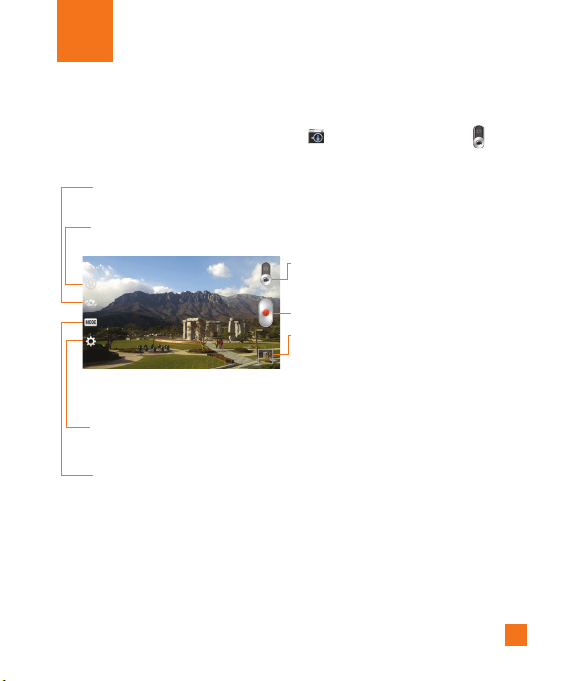
To open the Video Camera application, tap Camera on the Home screen and slide down.
Recording mode
- Allows you to change the recording mode to Normal, WDR
recording, Live effect, or Dual recording.
Settings
– Tap to open the settings menu. See
Using the advanced settings
on
page 48.
Mode Switch
– Touch and slide to switch
between Camera mode and
Video mode.
Record
– Allows you to start recording.
Gallery
– This enables you to access your
saved photos and videos from
within the video camera mode.
Simply tap and your Gallery will
appear on the screen.
%
TIP
When recording a video, place two fingers on the screen and pinch to use
the Zoom function.
Swap camera
– Allows you to swap between the rear camera lens and the
front camera lens.
Flash
–
Tap to turn the flash On, Off or set it to Auto.
48
Video Camera
Recording a video
1 From the Home screen, tap
Camera
and slide the
Mode Switch
button
down to change to Video mode. The Capture
icon will change to .
2 The video camera’s viewfinder will appear
on the screen.
3 Holding the phone horizontally, point the
lens towards the subject of the video.
4 Tap Record
once to start recording.
5 A timer showing the length of the video
is displayed at the top left corner of the
screen.
6 Tap Stop
to stop recording.
%
NOTE
Tap on the screen to take a picture
while you're recording. Tap
to pause
the recording.
Using the advanced settings
Using the viewfinder, tap
to open the
advanced options.
Adjust the video camera settings by scrolling
the list. After selecting the option, tap the
Back
Key
.
Audio zoom – Increases sound sensitivity
in zooming area and decreases noise when
recording.
Video size – Allows you to change the
video resolution to Full HD (1920x1080), HD
(1280x720), QVGA 320x240, QCIF 176x144
(MMS).
Brightness
– Defines and controls of
the amount of sunlight entering the lens.
Slide the brightness indicator along the bar
towards “-” for a lower brightness video or
towards “+” for a higher brightness video.
Anti-shaking - Allows you to reduces image
blur due to the movement of the subject of the
video or hand movement.
White balance
– The white balance ensures
any the white areas in your video are realistic.
To enable your camera to adjust the white
balance correctly, you may need to determine
the light conditions. Choose from
Auto
,
Incandescent
,
Sunny
,
Fluorescent
, and
Cloudy
.
Color effect - Allows you to set a color
effect for the photo. Choose from None,
Mono, Sepia, and Negative.
Auto review
– If you turn Auto review on,
it will automatically play the video you just
recorded.
49
Geotagging
– Activate to use your phone’s
location-based services. Take videos wherever
you are and tag them with the location. If you
upload tagged videos to a blog that supports
geotagging, you can see the videos displayed
on a map.
Volume key - Set how to use the volume
key. Choose from Record or Zoom.
Storage – Allows you to choose where to
save your pictures. Choose from SD card and
Internal storage.
Help - Touch this if you want to know how
this function works. This icon will provide
you with a quick guide.
Reset - Restore all video camera default
settings.
After recording a video
Touch the image preview at the bottom of the
screen to view the last video you recorded.
– Tap
to share your video using the
SmartShare function.
– Tap
to record another video
immediately.
– Tap to share the video.
– Tap
to delete the video.
Menu Key - Tap to access
Move
,
Copy, Trim, Rename
, and
Details
.
%
NOTE
Additional charges may apply when multimedia
messages are downloaded while roaming.
Watching your saved videos
1 In the viewfinder, tap the image preview at
the bottom of the camera screen.
2 Your Gallery will appear on the screen.
3 Tap a video to play it automatically.
Adjusting the volume when
viewing a video
To adjust the volume of a video while it is
playing, use the Volume Keys on the left side
of the phone.
Video Camera
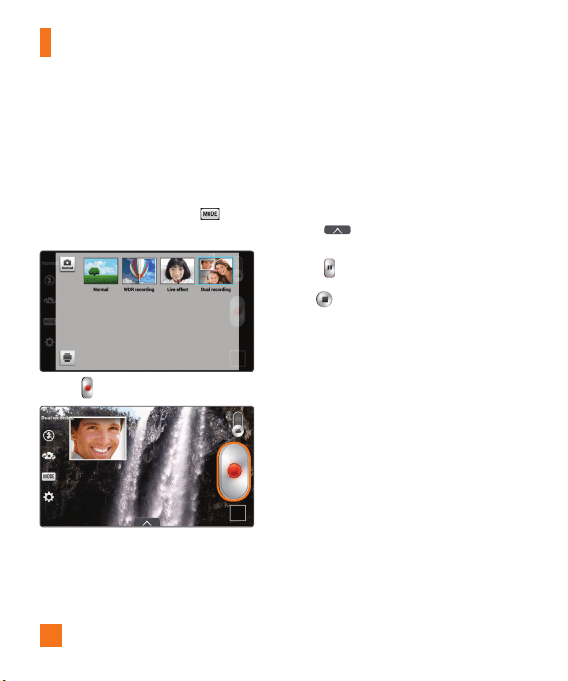
50
Dual recording
The Dual recording feature allows you to
record videos with the front and rear cameras
at the same time.
1 Open the Camera application.
2 Change to video mode and tap
> Dual
recording.
3 Touch to start dual recording.
%
NOTE
Drag the small screen to move it to your
desired location.
Touch and hold the small screen to
resize it.
Tap on the small screen to switch screens.
Tap to change small window's
frame.
Tap to pause while you're recording.
4 Tap
to stop recording.
Video Camera
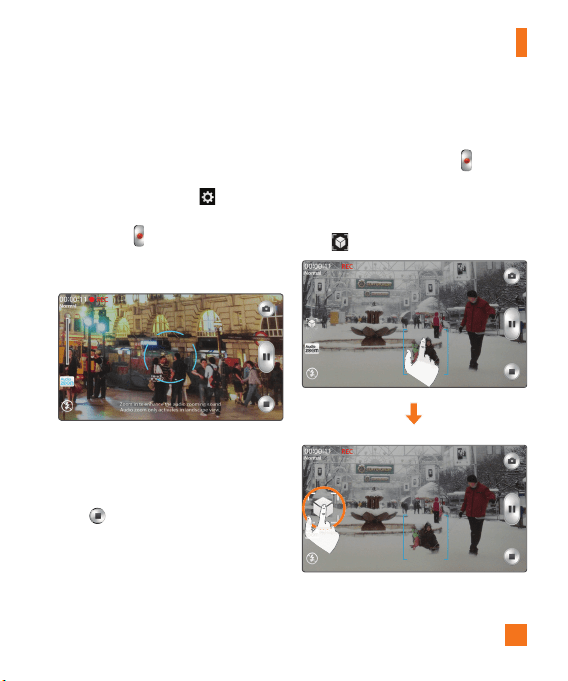
51
Audio zoom
Increase sound sensitivity in zooming area and
decrease noise when recording.
1 Open the Camera application.
2 Change to video mode, tap
>
Audio
zoom
> On.
3 Tap Record
to start recording.
4 Zoom in a certain area to increase sound
sensitivity and decrease noise.
%
NOTE
Available only in landscape view.
Do not cover the side microphones while
using this feature.
5 Tap
to stop recording.
Tracking focus
1 Open the Camera application.
2 Change to video mode and tap
to start
recording.
3 Tap on the subject in the preview screen
to track it.
4 Tap
to refine the focus.
Video Camera
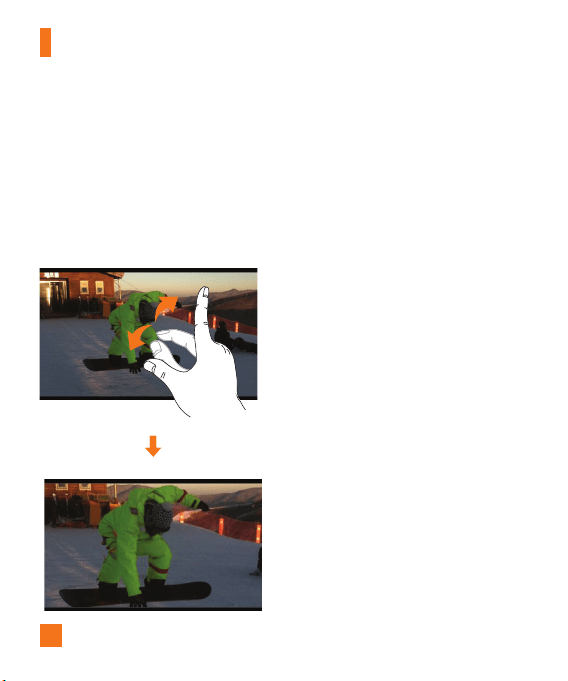
52
Live Zooming
Live Zooming allows you to zoom in or zoom
out on a portion of a video that is being played
to make the desired section appear larger or
smaller.
When viewing a video, use your index finger
and thumb in a pinching or spreading motion to
zoom in or out.
%
NOTE
While a video is playing, slide the left side
of the screen up or down to adjust the
screen brightness.
While a video is playing, slide right side
of the screen up or down to adjust the
screen volume.
While playing a video, slide the screen left
or right to rewind or fast-forward.
Do not press too hard; the touch screen
is sensitive enough to pick up a light, but
firm touch.
Video Camera
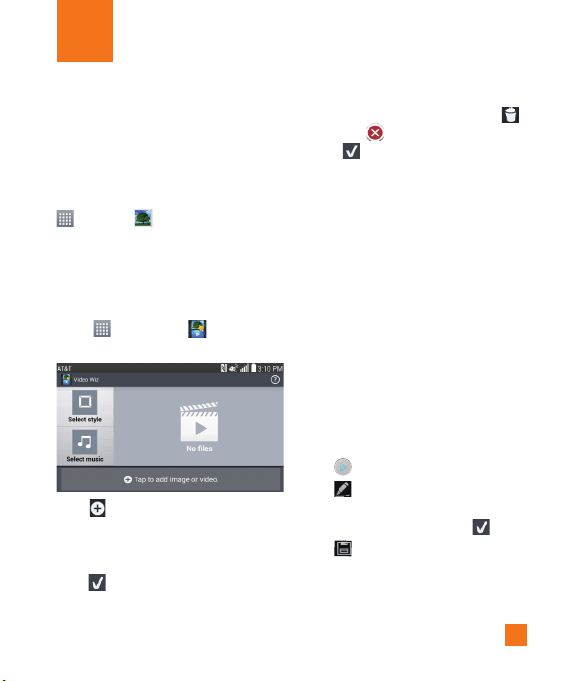
53
Multimedia
You can store multimedia files to a microSD
card or internal memory to have easy
access to all your image and video files.
Gallery
From the Home screen, tap the Apps Key
> Gallery .
Video Wiz
You can make your own movie using your
images, video, and music.
1 From the Home Screen, tap the Apps
Key > Video Wiz .
2 Read the brief introduction and tap OK.
3 Tap to add images and/or video to
your movie.
4 Tap the Image tab to add pictures and
the Video tab to add videos. Then
tap .
•
To remove images or videos, tap
and tap . When you are done,
tap .
•
To rearrange them, touch and hold an
image or video, then drag and drop it
to the desired position.
5 Tap Select style to select the desired
movie style.
•
Scroll through and select the style
you want. As you tap the desired
style, preview is displayed.
•
Tap OK.
6 Tap Select music to set the
background music.
•
Select Default for this style to use
the default music.
•
Tap Music track to use a song you
have saved on your device.
7 Tap
to play your movie.
8 Tap
to edit the video clip using
Text, Sticker or Magic spot.
•
After editing the video, tap .
9 Tap
to save the video.
54
%
NOTE
Tap to clear all edits.
Tap if you want to see help
information about the Video Wiz
application.
Music
Your phone has a music player that lets
you play all your favorite tracks. To access
the music player from the Home screen,
tap the Apps Key and tap Music .
How to save music/video files
to the phone
Connect your phone to the PC using
the USB cable.
You'll receive a notification that the USB
is connected and the USB connection type
prompt is displayed. Tap Media sync
(MTP) or Send images (PTP) and open
the folder you wish to view from your
computer.
Save music or video files from the
PC to the phone.
- You may copy or move files from the PC
to the phone's removable storage using
a card reader.
- If there is a video file with a subtitle file
(.smi file with the same name as the
video file), place them in the same folder
to display the subtitle automatically
when playing the video file.
- When downloading music or video files,
copyright must be secured. Please note
that a corrupted file or file with a wrong
extension may cause damage to the
phone.
How to play music/video files
on the phone
Playing music/video files
Locate the file you want in the Gallery or
Music applications and tap it to play it.
Playing a song
1 From the Home screen, tap the Apps
Key and tap Music .
2 Tap the Songs tab.
3 Tap the song you want to play.
4 Tap
to pause the song.
5 Tap
to skip to the next song.
6 Tap
to go back to the beginning of
the song. Tap twice to go back to
the previous song.
Multimedia

55
To change the volume while listening to
music, press the Volume Keys on the left
side of the phone.
Touch and hold a song to access the
following options: Play, Add to playlist,
Share, Set as ringtone, Delete,
Details, and Search.
Working with Playlists
You can create playlists to organize your
music files into sets of songs, which
you can play in the order you set or in a
shuffle.
To create a playlist
1 When viewing the library tap the
Playlists tab.
2 Tap the Menu Key
> New
playlist.
3 Enter a name for the playlist, then tap
OK.
4 Select the songs you want to add to the
playlist and tap Add. The new playlist is
added to the Playlists library.
To add a song to a playlist
Touch and hold a song and tap Add to
playlist. Then choose the name of the
playlist. You can also add the song that is
playing in the Playback screen by pressing
the Menu Key
then tapping Add to
playlist and selecting the desired playlist.
To remove a song from a
playlist
1 Open a playlist.
2 Touch and hold the song you want
to remove, then tap Remove from
playlist.
To rename a playlist
1 Open the Playlists library.
2 Touch and hold the playlist to display
the options menu, then tap Rename.
3 Enter the desired name and tap OK.
To delete a playlist
1 Open the Playlists library.
2 Touch and hold the playlist to display
the options menu, then tap Delete.
3 Tap Ye
s to confirm.
Multimedia

56
%
NOTE
Music file copyrights may be protected
by international treaties and national
copyright laws. Therefore, it may be
necessary to obtain permission or a
licence to reproduce or copy music. In
some countries, national laws prohibit
private copying of copyrighted material.
Before downloading or copying the file,
please check the national laws of the
relevant country concerning the use of
such material.
Using SmartShare
The SmartShare application uses
DLNA (Digital Living Network Alliance)
technology to share digital content
through a wireless network. Both Phones
must be DLNA certified to support this
feature.
Enjoy Content Via a Variety of Devices
You can share your phone's contents with
a variety of devices. Tap
to share the
contents using various apps, such as Gallery
and Music.
Playing / Sending
•
Play: You can play the contents via a TV, a
Bluetooth speaker, etc.
•
Beam: You can send the contents to
Bluetooth- and SmartShare Beam-enabled
devices.
•
SmartShare Beam: Allows for a fast
transfer of contents via Wi-Fi Direct.
%
NOTICE
Some DLNA enabled devices do not
support the DMS upload functionality
and will not upload files. A few types of
contents are not supported.
Multimedia
57
About Google applications
Google applications, including mobile
versions of Gmail, Hangouts, Google
Calendar, and Google Maps, are loaded
on your phone.
1 To set up a Google account, tap any
Google application, enter your user
name and password and sign in.
2 After signing in, your contacts, email,
and calendar in your Google account
will automatically synchronize with
your phone.
Maps
To open Google Maps and view
your location
1 From the Home screen, tap the Apps
Key and tap Maps .
2 Tap the My Location icon
on the
screen.
The map centers on a blue arrow that
indicates your location. A blue circle
around the arrow indicates that your
actual location is within the circle.
%
Tip
While viewing a map, tap the Menu Key
for the following options: Traffic,
Public transit, Bicycling, Satellite,
Google Earth, Settings, Help, Send
feedback, Tips and tricks.
To get an address and additional
information for a location
1 Touch and hold a location on the map.
A bar with the address and a thumbnail
from Street View (if available) appears
at the bottom of the page.
2 Tap the info bar to access additional
options.
Searching For Locations and
Places
You can search for a location and view it
on a map. You can also search for places
on the map that you're viewing.
To search for a location
1 While viewing a map, tap at the
bottom of the screen.
2 In the search box, enter the place
you're looking for
. You can enter an
address, a city, or a type of business or
Google Applications

58
establishment. For example, “theater in
New York”.
3 Tap the Search icon
on the
keyboard.
Markers with letter labels indicate
search matches on the map.
%
NOTE
Location information might be inaccurate if
GPS and Wi-Fi are turned off. Please make
sure that GPS and Wi-Fi are turned on.
Getting Directions
To get directions
1 While viewing a map, tap .
2 Enter a starting point in the top text
box and your destination in the bottom
text box.
Play Store
Play Store lets you browse through and
download thousands of fun and useful
applications and games. You can check
other users' comment regarding an
application or you can post your own
comments. If you install applications and
games from Play Store, they appear in
the phone's menu below the preloaded
applications, and you can find them by
scrolling down with your finger. You can
open downloaded applications from the
Play Store by swiping the left edge of the
screen towards to right, then selecting
My apps.
%
NOTE
To purchase a paid app, you’ll need to
set up a payment method with Google
Checkout™. You have the option to use a
credit card or charge to your carrier bill.
%
NOTE
When you want to exit a game or
application, use the Home Key or
Back Key , which will return you to
the Home screen. Or select Menu (or
Options) within the game or application
and select Exit. (Exit option may vary by
game/application). Ending applications
that continue to run in the background
(after going back to the Home screen)
will help conserve battery life and reduce
unwanted data usage.
Gmail
Gmail can be configured when you first
set up your phone. Depending on your
Google Applications
59
synchronization settings, Gmail on your
phone is automatically synchronized with
your Gmail account on the web.The inbox
conversations list is your default view.
Tap
to send or receive new email
and to synchronize your email with
your Gmail™ account on the web. Tap
the Menu Key for the following
additional options: Refresh, Label
settings, Settings, Send feedback,
and Help.
Compose
- Allows you to compose a
new message.
Search
- Allows you to search your
account.
Labels
- Allows you to view the
account's labels.
Refresh
- Allows you to refresh the
account to view new activity.
Hangouts
The Hangouts application lets you have
real-time text conversations with your
friends.
To open the Hangouts application
From the Home screen, tap the
Apps Key
> Hangouts .
To sign out of Hangouts
From the Home screen, tap the Menu
Key > Settings > tap the desired
account > Sign out.
Chatting with Friends
1 From the Home screen, tap the
Apps
Key
> Hangouts .
2 Tap
to view your contacts list. It
includes all of the Google Accounts
you've added.
•
Tap the name of the person in your
contacts list. If your friend is not yet on
Hangouts, you can invite your friend via
SMS.
OR
•
Tap the text field to enter a name, email,
or number.
3 Tap Message and then enter your
message.
4 Tap the Send
.
Hangouts chatting list
Touch and hold the friend in the chat
screen. You can set below options.
Tap to turn the notifications off.
Google Applications
60
Google Applications
Tap to archive the conversation.
Tap to delete the conversation.
Blocking your Friends
•
To block a friend from exchanging messages
with you, tap the friend in the chatting
list. Tap the
Menu Key
> People &
options. Then tap the block option.
•
To remove a friend from the blocked list,
from the chatting list, tap the
Menu Key
> Settings > tap the desired account >
Blocked people. Then tap Unblock next to
the person’s name.
Hangouts Settings
•
From the chatting list, tap the
Menu
Key
to choose from Set mood,
Invites, Snooze notifications, Archived
Hangouts, Settings, Send feedback,
and Help.
•
While chatting, tap the
Menu Key
to choose from People & options, New
group Hangout, Turn history off, Archive,
Delete, Send feedback, and Help.
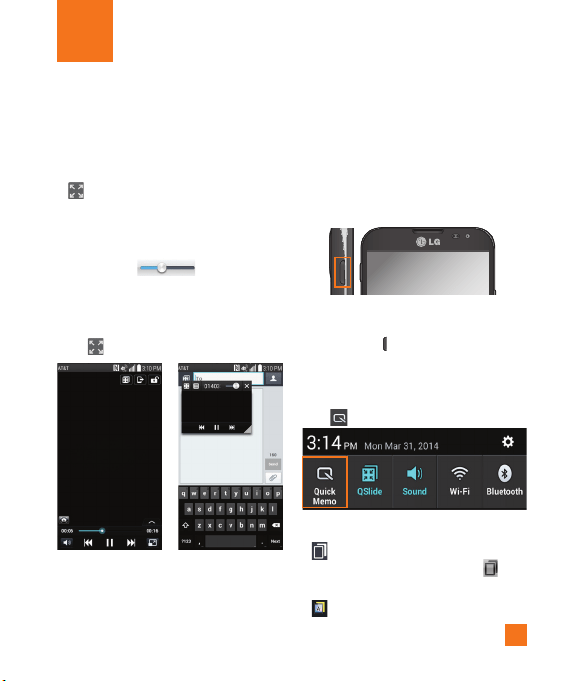
61
QSlide
The QSlide function enables an overlay on your
phone's display for easy multitasking.
1 While using an app that supports QSlide, tap
to access QSlide.
OR
Open the Notifications Panel and touch an
app from the QSlide apps section.
2 Use the slider
to adjust the
transparency of the overlay.
3 You can make a call, browse the web, or
choose other phone options.
4 Tap
to exit the QSlide function.
%
NOTE
The QSlide function can support up to two
windows at the same time.
QuickMemo
The QuickMemo feature allows you to create
memos and capture screen shots.
You can use QuickMemo to easily and
efficiently create memos during a call, with a
saved picture or on the current phone screen.
1 While viewing the screen you want to
capture and create a memo on, press the
QuickButton
to access the QuickMemo
feature.
OR
Touch and drag the Status Bar down and
tap .
2 Create a memo using the following options:
- Tap to keep the memo on top and
continue using the phone. Tap to
exit the overlay mode.
- Tap to select the type of background
Utilities
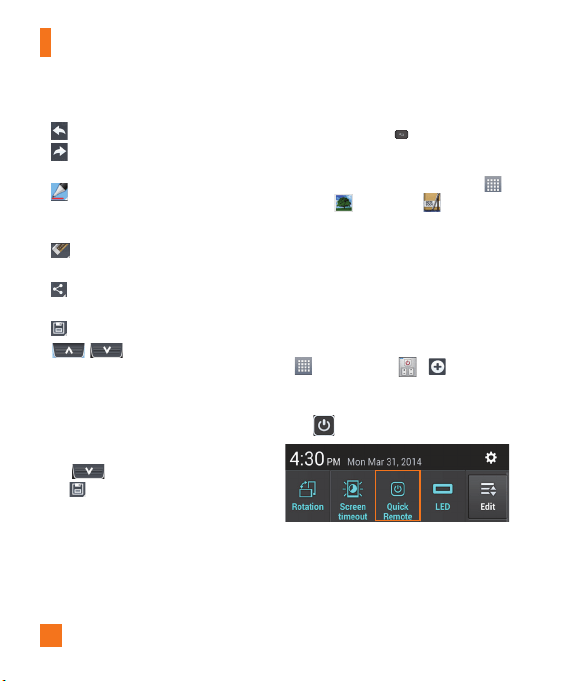
62
image you want to use.
- Tap to undo the most recent action.
- Tap to redo the most recently deleted
action.
- Tap to select the pen type and color.
You can also select the cropping tool to
crop the image.
- Tap to use the eraser to erase the
memo that you created.
- Tap to share the memo with others via
any of the available applications.
- Tap to save the memo you’ve created.
- Tap to hide or display the
toolbar.
%
NOTE
Please use a fingertip while using the
QuickMemo feature. Do not use your
fingernail.
3 Tap to show the Edit menu and
tap to save the current memo to the
Notebook or Gallery.
Discard QuickMemos:
Tap the Back Key
.
View the Saved Memo
From the Home screen tap the Apps Key
> Gallery
or Notebook and select
the QuickMemo album.
QuickRemote
QuickRemote turns your phone into a Universal
Remote for your home TV, cable box, audio
system, DVD/Blu-ray players, air conditioner
and projector.
1 From the Home screen, tap the Apps Key
> QuickRemote > .
OR
Touch and slide the Status Bar downwards and
touch
> ADD REMOTE.
Utilities
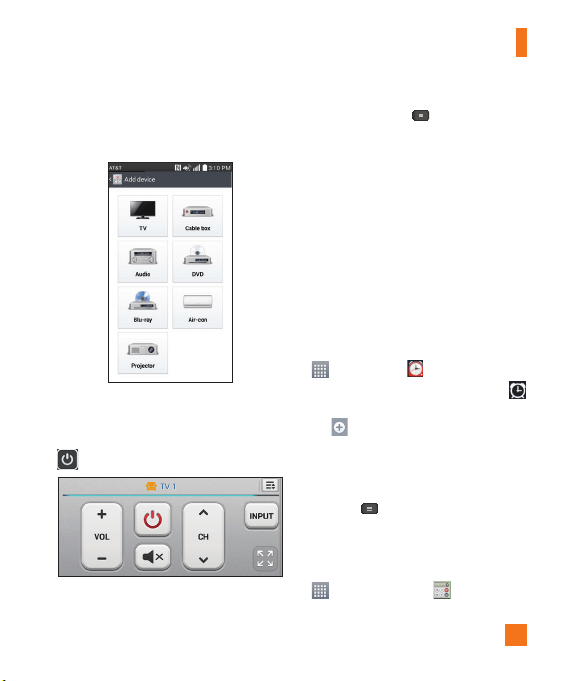
63
2 Select the type and brand of device,
then follow the on-screen instructions to
configure the device(s).
%
TIP
To quickly use the QuickRemote feature, touch
and slide the Status Bar downward and tap
on the Quick Settings bar to activate it.
Touch the
Menu Key
to select Magic
Remote setting, Move remote, Delete
device, Edit room, Settings, and Help.
%
NOTE
QuickRemote features an ordinary remote
control and infrared (IR) signals to operate
the same way. Therefore, be careful not to
cover the QuickRemote features when you
use an infrared sensor. This function may not
be supported depending on the model, the
manufacturer or service company.
Setting the alarm
1 From the Home screen, tap the
Apps Key
and tap
Clock .
2 To add a new alarm, tap the Alarms tab
tab (if necessary).
3 Tap
and set the alarm time.
4 Set
any desired options and tap
Save
.
%
NOTE
When viewing the alarms screen, tap the
Menu Key
to delete all alarms or
adjust the alarm settings.
Using the calculator
1 From the Home screen, tap the
Apps Key
and tap
Calculator
.
Utilities
64
2 Tap the number keys to enter numbers.
3 For simple calculations, tap the function you
want
, followed by .
Adding an event to your
calendar
%
NOTE
1 From the Home screen, tap the
Apps Key
and tap
Calendar
.
2 To view an event, tap the date. The events
occurring on that date are displayed below
the Calendar in Month view. Tap the event
to view its details. If you want to add an
event, tap
at the top right corner of the
Calendar.
3 Tap the
Event name
field and enter the
event name. Check the date and enter the
start and end time you want your event to
begin and finish.
4 Tap the
Location
field to enter the location.
5 To add a note to your event, tap the
Description
field and enter the details.
6 To repeat the event, set
REPEAT
and
REMINDERS
, if necessary.
7 Tap
Save
to save the event in the calendar.
A colored square in the calendar will mark
all days that have saved events. An alarm
will sound at the event start time if you
set it.
Changing your calendar view
1 From the Home screen, tap the
Apps Key
and tap
Calendar
.
2 At the top of the Calendar, tap
and
choose from Day, Week, Month
, Year
or Agenda
.
Task Manager
You can manage your applications using Task
Manager. You can easily check the number of
applications that are currently running and shut
down certain applications.
Tasks
This task can be synchronized with MS
Exchange account. You can create task, revise
it and delete it in MS Outlook or MS Office
Outlook Web Access.
To Synchronize MS Exchange
1 From the Home screen, tap the
Apps Key
> Settings
> General tab
.
2 Tap Accounts & sync > Add account.
3 Tap Microsoft Exchange to add your MS
Exchange account.
4 Make sure if you checkmark Sync T
asks.
Utilities

65
Polaris Office 4
With Polaris Office 4, you can view, create and
edit document files on your device. The loaded
files can be from microSD cards of your device,
or from downloaded email attachments.
The Polaris Office 4 application supports the
following file formats: txt, doc, docx, xls, xlsx,
ppt, pptx, pdf.
Create a New Document
1 From the Home screen, tap the
Apps Key
>
Polaris Office 4
.
2 Register your name and email address
on the Registration page if you would
like to do so.
3 Tap List view, Grid view, or Favorites
to search for saved documents.
4 Tap
to start a new document.
5 Tap a document type.
6 Enter contents in the document using the
tools at the top of the screen and the
on-screen keyboard.
7 When you're done working on the
document, tap
>
Save (or Save as to
enter a new document name) to save.
8 Enter the document name and tap Save.
9 Tap the Back Key
to exit.
View and edit a document on your
device
1 From the Home screen, tap the Apps Key
> Polaris Office 4 .
2 Tap List view, Grid view, or Favorites to
search for saved documents.
3 Tap the document that you want to view
or edit.
%
NOTE
You can also open an attachment in an email
by tapping the attachment in the message.
4 The document opens for you to view. If
you want to edit it, tap anywhere on the
document.
To move between pages or pan through
the document, scroll in the corresponding
direction.
To change the zoom level, simply pinch-to
zoom to achieve the zoom level you want.
Use the toolbar at the top of the screen
to edit the document (Word, Excel, or
PowerPoint file).
Tap
for the following additional menu
options :
Save
,
Save as, PDF Export,
Find & Replace, Page layout, Full
width view, Reflow text, Text-to-
speech and Share.
Utilities
66
5
When you're finished editing, tap
>
Save
. Then tap the
Back Key
to exit.
Polaris Office 4 toolbar
The Polaris Office 4 application has a toolbar
that appears automatically when you create
a document.
1 To display the toolbar in an existing
document, tap
.
2 Tap the Font, Paragraph, or Style tab
and choose the desired options.
3 To hide the tool options pop-up balloon,
tap
.
Voice Command
You can search for and dial a contact by
speaking, rather than by manually dialing a
contact or open installed applications.
To place a call by speaking
1 From the Home screen, tap the
Apps Key
>
Voice
Command
.
2 Say one of the following commands:
Call [Name or Phone Number]
Send Text [Name or Phone Number]
Redial
Open [App Name]
Play Music
Check [Item]
3 If Voice Command finds a match, it performs
the requested action, otherwise, it will
display options.
LG Tag+
LG Tag+ lets you customize NFC tags with
the settings you prefer.
1 From the Home screen, tap Apps Key >
LG Tag+ .
2 Tap .
3 Enter a name for the tag and tap OK.
4 Tap an action to add it to the tag and
configure the setting.
5 Then tap
to add more actions.
6 When you’re finished, tap Write on
NFC tag.
7 Hold your phone to a blank tag and the
tag will be written.
Utilities

67
The Web
Browser
The Browser gives you a fast, full-color world
of games, music, news, sports, entertainment,
and much more, right on your mobile phone.
%
NOTE
Additional charges apply when connecting
to these services and downloading content.
Check data charges with your network
provider.
Browser Toolbar
The Browser Toolbar at the bottom of the
screen enhances your mobile browsing
experience with contextual recommendations,
social applications and browser utilities.
We've included some buttons to get you
started and have made it easy to add more
buttons, move or remove them.
To display the Browser Toolbar, touch and
drag up
at the bottom of the screen.
Using options
Tap the Menu Key
to view the following
options:
New tab - Opens a new tab.
Bookmarks - Allows you to view, add, edit,
and delete your bookmarks.
Add to bookmarks - Allows you to bookmark
the current web page.
Homepage - Allows you to open the home
page.
Set as homepage - Allows you to set the
current web page as your home page.
History - Allows you to view the web pages
you've visited.
Share page - Allows you send the web
address (URL) of the web page to others.
Find on page - Allows you to search for text
on the web page.
Desktop view - Allows you to change the
current mobile page to a desktop page.
Save for offline reading - Allows you to save
the current page for offline reading.
Capture plus - Allows you to capture the
current web page from top to bottom without
cutting.
Settings - Opens the Browser settings.
Exit - Allows you to exit the browser.
%
TIP
To return to the previous web page, tap the
Back Key
.

68
Adding bookmarks
1 When viewing the page you want to
save, tap the Menu Key
> Add to
bookmarks.
2 Enter the desired information for Label,
Address, and Add to (location to save
bookmark) and tap OK.
Changing the Browser
settings
1 Open the Browser and tap the Menu Key
> Settings.
2 Set any of the available options.
The web
69
The Settings application contains most of the
tools for customizing and configuring your
phone. All of the settings in the Settings
application are described in this section.
To open the Settings application
- From the Home screen, tap the Apps
Key > Settings .
- From the Home screen, tap the Menu
Key
> All settings.
Networks tab
Airplane mode
Airplane mode allows you to quickly turn
off all wireless connections.
1 From the Home screen, tap the Menu
Key > All settings.
2 Select the Networks tab.
3 Tap the Airplane mode switch
to turn it on.
4 Tap the switch again to turn it off.
OR
1 Press and hold the Power/Lock Key
and tap Turn on Airplane mode.
2 Press and hold the Power/Lock Key
and tap Turn off Airplane mode to
turn it off.
Wi-Fi
To use Wi-Fi on your phone, you need
access to a wireless access point, or
"hotspot." Some access points are open
and you can simply connect to them.
Others are hidden or implement other
security features, so you must configure
your phone in order to connect to them.
Turn on Wi-Fi
From the Home Screen , open the
Notifications panel and tap to turn
Wi-Fi on. A blue colored icon indicates
that Wi-Fi is on.
OR
From the Home screen, tap the Menu
Key
and tap All settings >
Networks tab. Then tap the Wi-Fi
switch
to turn it on.
To connect to a Wi-Fi Network
Turn off Wi-Fi when you're not using it to
extend the life of your battery.
1 From the Home screen, tap the Menu
Key and tap All settings >
Networks tab > Wi-Fi.
2 Tap the Wi-Fi switch
to turn it on
and begin scanning for available Wi-Fi
networks.
Settings

70
- A list of available Wi-Fi networks will
be displayed. Secured networks are
indicated by a lock icon .
3 Tap a network to connect to it.
-
If the network is open, you are prompted
to confirm that you want to connect to
that network by tapping Connect.
- If the network is secured, you are
prompted to enter a password or
other credentials. (Ask your network
administrator for details).
- Tap the Menu Key
to access
additional options.
4 The Status Bar at the top of your screen
will display an icon that indicates your
Wi-Fi status.
%
TIP
If you are not in range of a Wi-Fi network
and use a network connection. Additional
data charges may apply.
%
NOTE
Access to the Internet and a wireless
router required. As an added convenience,
AT&T has shipped certain smartphones
with Wi-Fi enabled as a default setting.
Leaving Wi-Fi enabled when not
connected to a Wi-Fi network may affect
battery charge. Qualifying data plan
required.
%
NOTE
This device supports WEP, WPA/WPA2-
PSK and 802.1x EAP. (Some EAP methods
are not supported.) If your Wi-Fi service
provider or network administrator sets
encryption for network security
, enter the
key in the pop-up window. If encryption
is not set, this pop-up window will not
be shown. You can obtain the key from
your Wi-Fi service provider or network
administrator.
Bluetooth
Using Bluetooth
1 From the Home screen, tap the Menu
Key > All settings > Bluetooth,
then tap the Bluetooth switch to
turn on the Bluetooth functionality.
2 Tap Search for devices at the bottom
of the screen.
3 Tap the name of the device you wish
to pair with, and then tap Pair to pair
and connect.
%
TIP
Please consult documentation included
Settings

71
with Bluetooth device for information on
pairing mode and passcode (typically 0 0 0
0 – four zeroes).
How to send data from your phone
via Bluetooth
You can send data via Bluetooth by
running a corresponding application, not
from Bluetooth menu.
* Sending pictures: Open the Gallery
application and tap a picture. Then tap
> Bluetooth. Check if Bluetooth is
turned on and tap Search for devices.
Then tap the device you want to send
data to from the list.
* Sending contacts: Open the Contacts
application. Tap the contact you want
to share, then tap the Menu Key
>
Share > Bluetooth. Check if Bluetooth
is turned on and tap Search for
devices.Then tap the device you want
to send data to from the list.
* Sending multiple contacts: Open the
Contacts application. To select more
than one contact, tap the Menu Key
> Share. Tap the contacts you want
to send or tap Select all at the top
left corner of the screen. Tap Attach >
Bluetooth. Check if Bluetooth is turned
on and tap Search for devices. Then
tap the device you want to send data to
from the list.
* Connecting to FTP (Only the FTP
server is supported on this handset):
From the Home screen, tap the Menu
Key
> All settings > Networks
tab > Bluetooth. Make sure Bluetooth
is turned on. Tap the checkbox next to
your phone’s name to make the device
visible to other Bluetooth devices.
Then search for other devices. Find the
service you want and connect to the
FTP server.
%
TIP
The supported Bluetooth version is
Bluetooth 4.0 and certified by Bluetooth
SIG. It is compatible with other Bluetooth
SIG certified devices.
- If you want to search for this phone from
other devices,from the Home screen, tap
the Menu Key
> All settings >
Networks tab > Bluetooth. Make sure
Bluetooth is turned on. Tap the checkbox
next to your phone’s name to make the
device visible to other Bluetooth devices.
Settings

72
Being visible for 2 minutes is set by
default.
- To change the visibility time length,
tap the Menu Key
> Visibility
timeout. Choose from 2 minutes, 5
minutes, 1 hour, or Never time out.
- Supported profiles are HFP/HSP, A2DP,
AVRCP, OPP, FTP(Server) ,HID, PAN, MAP
and PBAP.
Data Manager
You can select whether to enable or
disable mobile data. You can check the
current data usage, set to enable/disable
mobile data, or set the mobile data limit.
Mobile data - Tap the switch
to
enable mobile data.
Limit mobile data usage - Checkmark to
set the mobile data usage limit.
Data usage cycle - Allows you to
change the data usage cycle to display in
the graph.
Call
Configure phone call settings such as call
forwarding and other special features
offered by your carrier.
Voicemail – Allows you to select your
carrier’s voicemail service.
Fixed dialing numbers – Turn on
and compile a list of numbers that can
be called from your phone. You’ll need
your PIN2, which is available from your
operator. Only numbers within the fixed
dial list can be called from your phone.
Caller ID - Allows you to choose how to
display your number in outgoing calls.
Incoming voice call pop-up – Displays
an incoming call popup when an app is
in use.
Call reject – Allows you to set call
rejection and manage the reject list.
Decline with message – When you
want to reject a call, you can send a quick
message instead. This is useful if you
need to reject a call during a meeting.
This menu allows you to manage the
messages you can send.
Privacy keeper – Hides the caller name
and number for an incoming call.
Auto answer – Sets the time before a
connected hands-free device automatically
answers an incoming call. Choose from
Disable, 1 second, 3 seconds, and 5
Settings
73
Settings
seconds.
Connection vibration – Vibrates your
phone when the other party answers
the call.
TTY mode - Allows you to activate TTY
mode.
Hearing aids - Allows you to turn on
hearing aid compatibility.
Noise suppression - Allows you to
suppress background noise during a call.
Power button ends call – Allows you
to end the call by pressing the Power/
Lock Key.
Call duration – View the duration of
calls including Last call, All calls, Dialled
calls and Received calls.
Sound settings - From this menu you can
control the sounds on the phone.
Additional settings – Allows you to
change the following settings:
Call forwarding: Allows you to set
the call forwarding options.
Call waiting: If call waiting is
activated, the handset will notify you
of an incoming call while you are on
a call (depending on your network
provider).
Share & connect
Allows you to transfer data and media
with other devices.
NFC
NFC (Near Field Communication) is a
wireless technology that enables data
transmission between two objects when
they are brought within a few inches of
each others. When you enable NFC on
your phone, your phone can exchange
data with other NFC-enabled devices
or read information from smart tags
embedded in posters, stickers, and other
products.
To turn on NFC:
1 From the Home screen, tap the Menu
Key > All settings.
2 Tap Share & connect and tap the NFC
switch
.
Android Beam
When this feature is turned on, you can
beam app content to another NFC-capable
device by holding the devices close
together. For example, you can beam
Browser pages, YouTube videos, contacts,
Polaris Office 4 files, and more. Just bring
74
the devices together (typically back to
back) and then touch your screen. The app
determines what gets beamed.
To activate Android Beam:
From the Home screen, tap the Menu
Key
> All settings > Share &
Connect > Android Beam .
%
NOTE
You must enable NFC to activate Android
Beam.
SmartShare Beam
Enable to receive files from LG phones.
When this feature is turned on, you can
receive files from LG phones.
To activate SmartShare Beam:
From the Home screen, tap the Menu
Key
> All settings > Share &
connect > SmartShare Beam. Then tap
the switch to activate SmartShare
Beam and set the desired options.
%
NOTE
You must enable Wi-Fi to activate
SmartShare Beam.
Media Server
Share media content with nearby devices
via DLNA.
1 From the Home screen, tap the Menu
Key > All settings > Networks
tab > Share & connect.
2 Tap Media sever and checkmark the
Content sharing checkbox to allow
nearby devices to access your content.
Miracast
You can mirror phone screen and sound
onto LG Miracast dongle or TV wirelessly.
1 From the Home screen, tap the Menu
Key > All settings.
2 Tap the Networks tab.
3 Tap Share & connect > Miracast.
4 Tap the switch
to turn on the
feature.
5 Turn on the Miracast feature on your TV
or connect to the LG Miracast dongle.
%
TIP
To start the Miracast feature quickly,
tap the Miracast icon in the Notification
Panel. While mirroring, Mobile Hotspot
cannot be used simultaneously.
Settings

75
Wireless storage
To manage files on your phone in the
computer or copy files to the phone from
the computer without a USB connection.
1 Make sure that the phone and computer
are connected to the same Wi-Fi
network.
2 From the Home screen, tap the Menu
Key
> All settings > Networks
tab > Share & connect > Wireless
storage > tap to activate the
feature.
3 Enter the URL shown on your phone in
the address bar of the browser on your
computer.
Tethering & networks
Allows you to configure mobile networks,
tethering, and VPNs.
Mobile Hotspot
You can also use your smartphone to
provide a mobile broadband connection
for up to 8 other devices. Create a hotspot
and share your connection. To create a
portable hotspot, from the Home screen,
tap the Menu Key > All settings >
Networks tab > Tethering & networks
> Mobile Hotspot. Then tap the Mobile
Hotspot switch
to activate the
feature. Tap Set up Mobile Hotspot to
change the SSID, password, security type,
and other hotspot options.
%
NOTE
Mobile Hotspots requires an appropriate
DataPro data plan. Devices connected to
your Mobile Hotspot use data from your
DataPro plan. Plans are not unlimited and
significant charges may be incurred if
the included data allowance is exceeded.
Performance may vary depending on the
number of devices connected and other
factors. If you do not use a password,
others will be able to use your Mobile
Hotspot connection.
Bluetooth tethering
Bluetooth tethering allows you to use
your smart phone to provide a mobile
broadband connection.
To share your connection via Bluetooth
tethering:
From the Home screen, tap the Menu
Key
> All settings > Networks tab
Settings

76
> Tethering & networks. Then tap the
Bluetooth tethering switch to turn
the function on.
%
NOTE
Bluetooth tethering can be activated only
when your smartphone is connected to
AT&T network.
Help
Tap to view help information on the
Mobile Hotspot and Bluetooth tethering
functions.
Mobile networks
You can set whether to enable or disable
data access on your phone.
Data enabled
Select whether to enable or disable data
access.
International data roaming
Select whether to enable or disable data
access while international roaming.
Access point names
You can select the access point name, add
a new APN, or reset to default.
Network operators
Allows you to select a network operator
(if necessary).
Default SMS app
This menu allows you to set your default
messaging app.
VPN
From your phone, you can add, set up, and
manage virtual private networks (VPNs)
that allow you to connect and access
resources inside a secured local network,
such as your corporate network.
Prepare Your Device for VPN
Connection
Depending on the type of VPN you are
using at work, you may be required to
enter your login credentials or install
security certificates before you can
connect to your company's local network.
You can get this information from your
network administrator. Before you can
initiate a VPN connection, you must set
the screen lock option (Pattern, PIN, or
Password only).
Settings
77
Add a VPN Connection
1 From the Home screen, tap the Menu
Key > All settings.
2 Select the Networks tab.
3 Tap T
ethering & Networks > VPN >
Basic VPN or LG VPN.
%
NOTE
You must change your screen lock before
you use credential storage. You can set a
pattern, PIN, or password.
4 Enter the VPN network according to the
security details you have obtained from
your network administrator.
5 When finished, tap Save.
Sound tab
Sound profile
Allows you to set the sound profile to
Sound, Vibrate only, or Silent.
Volumes
Adjust the phone's volume settings to suit
your needs and your environment.
Vibrate strength
Allows you to set the vibrate strength for
calls, notifications, and touch feedback.
Quiet time
Tap the Quiet time switch to
activate the feature and set times to turn
off all sounds except alarm and media.
Phone ringtone
Select the ringtone for incoming calls.
Smart ringtone
Select to automatically increase the
volume of the ringtone when outside
noise is loud.
Ringtone with vibration
Checkmark for vibration feedback for calls
and notifications.
Incoming call vibration
Allows you to choose the type of vibration
for incoming calls.
Gentle vibration
Gradually increases vibration up to the
current strength set.
Settings

78
Default notification sound
Select the ringtone for notifications such
as new messages receipt or calendar
events.
Touch feedback & system
Allows you to set dial pad touch tones,
touch sounds, screen lock sound, and
vibrate on touch.
Dial pad touch tones
Allows you to play tones when using
dial pad.
Touch sounds
Allows you to play sound when making
sceen selection.
Screen lock sound
Allows you to play sound when locking
and unlocking the screen
Vibrate on touch
Allows you to vibrate when pressing front
key and on certain UI interactions.
Display tab
Home screen
Wallpaper - Allows you to set the
wallpaper.
Screen swipe effect - Allows you to
select the type of effect to display when
you swipe from one Home screen canvas
to the next.
Allow Home screen looping - Allows
you to select the type of effect to display
when you swipe from one Home screen
canvas to the next.
Portrait view only - Select to display the
Home screen always in portrait view.
Home backup & restore - Select
to backup and restore app/widget
configurations and the theme.
Help - Touch to get information on using
the Home screen of your device.
Lock screen
Select screen lock - Select the desired
option to secure your phone from the
below.
None - No lock screen.
Swipe - Swipe any part of the screen
to unlock screen.
Face Unlock - Unlocks the screen
through facial recognition. Follow the
prompts. You are asked to select Pattern
and/or PIN as a backup.
Settings

79
Pattern - Allows you to set a pattern as
your screen lock. It's recommended that
you enter a backup PIN as well in case
you forget the pattern.
PIN - Enter a numeric PIN to unlock
the screen.
Password - Enter a password to unlock
the screen.
Screen swipe effect - Select the screen
effect you want to use when unlocking
the screen.
Wallpaper - Select the wallpaper to
display for your lock screen.
Shortcuts - Customize shortcuts on the
lock screen.
1 From the Home screen, tap the Menu
Key
> All settings > Display tab,
then tap the Lock screen > Shortcuts.
2 Tap the icon you want to replace and
select the app you want to replace it
with.
Owner info - Display the owner info on
the lock screen.
Lock timer - Allows you to set the
amount of time before the screen
automatically locks after the screen has
timed-out.
Power button instantly locks -
Checkmark to instantly lock the screen
when the Power/Lock Key
is pressed.
Brightness
Adjust the screen brightness by using the
slider. Tap Auto to set the brightness to
automatically change.
Screen timeout
Set the time delay before the screen
automatically turns off.
Auto-rotate screen
Set to switch orientation automatically
when you rotate the phone.
Daydream
Select the screensaver to display when
the phone is sleeping while docked and/
or charging.
Font type
Select the desired font type.
Font size
Select the desired font size.
Settings
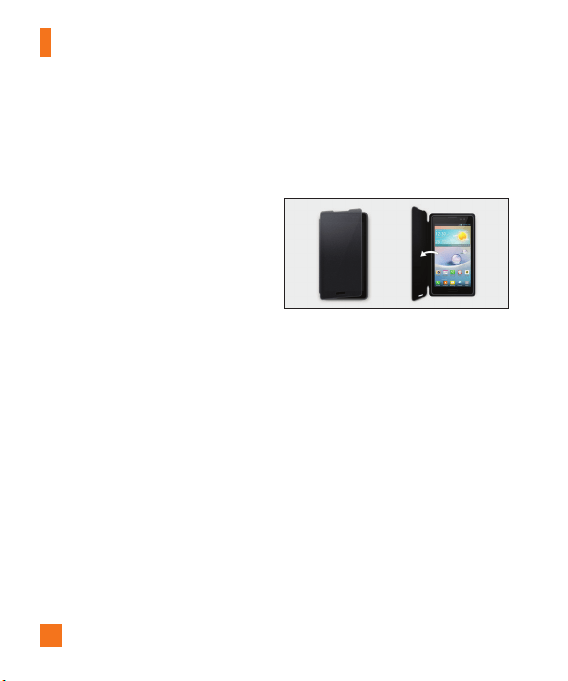
80
Smart screen
Checkmark this to keep screen on when
the phone detects your face looking at
the screen.
Smart video
Checkmark this to pause videos while
playing automatically when the phone
detects you are not looking at the screen.
Front touch key light
Tap to set the Front key light options.
Turn on front touch key light –
Checkmark this to set the the front keys
(Menu Key, Home Key, Back Key) are
turned on, when you use the device.
Front touch key light duration –
Select how long the front keys remain
backlit while the screen is turned on.
Home button LED
A multi-pattern color LED light appears
around the Home button depending on
item(s) you select. Select the item you
wish to apply LED lighting. You can
immediately note what kind of event has
occurred using the various LED colors such
as Battery charging, Incoming call, Alarm,
and Missed event.
Quick Cover
Allows you to activate the Quick Cover
feature, which turns the screen on or off.
This setting is for the Quick Cover (CCF-
210 model only). Other phone cases
are not supported. To lock your phone
automatically, activate the Quick Cover
feature and close the cover. To unlock the
phone, open the Quick Cover.
%
NOTE
This auto-function is available only when
your phone is set to unlock or swipe
mode.
General tab
Gestures
Silence incoming calls - Flip the device
to silence incoming calls.
Settings

81
Snooze or stop alarm - Flip the device
to snooze or stop the alarm.
Pause video - Flip the device to pause
the video.
Help - Touch to get information on using
the Gesture function of your device.
Motion sensor calibration - Improve
the accuracy of the tilt and speed of the
sensor.
One-handed operation
Allows you to adjust the position of the
dial keypad, LG keyboard, Message or lock
screen left or right side of the screen to
easily use it with one hand.
Dial keypad
Checkmark to adjust the position of the
dial keypad left or right.
LG keyboard
Checkmark to adjust the position of the LG
keyboard left or right.
Lock screen
Checkmark to adjust the position of the
the PIN entry left or right.
Help
Displays help information for each
available option.
Storage
INTERNAL STORAGE
You can monitor the used and available
internal memory in the device.
SD CARD
You can monitor the used and available
space in your microSD card.
Total space - Lists the total amount of
space on any microSD card installed in
your phone. It is divided by the type of
files stored.
Available - Displays the amount of
available space in your microSD card.
Mount/Unmount SD card - Tap to
mount/unmount the microSD card to/
from your phone so that you can view
and tranfer files, format the card or safely
remove it.
Erase SD card - Permanently erases
everything on the microSD card and
prepares it for use with your phone. You
must unmount the microSD card before
you can format it.
Battery
BATTERY INFORMATION
See how much battery power is used for
Settings

82
Settings
device activities. The battery level displays in
a percentage. The remaining time of use is
also displayed.
Battery percentage on status bar: Displays
the battery percentage on the Status Bar.
BATTERY SAVER
Battery saver
Tap the switch to turn this feature
on. Tap the switch again to turn it off. Tap
Battery saver for the following options.
Turn Battery saver on - Select the level
you want to turn on the Power saver.
BATTERY SAVING ITEMS
Checkmark each feature to turn off or
adjust when battery is low.
Auto-sync: Turns off Auto-sync.
Wi-Fi: Turns off Wi-Fi if data is not
in use.
Bluetooth: Turns off Bluetooth if not
connected.
Vibrate on touch: Turns off touch
feedback.
Brightness: Adjust the brightness.
Screen timeout: Adjust the screen
timeout.
Front touch key light: Adjust the front
key light timeout.
Home button LED: Turns off Home
button LED if not connected.
Help - Tap to access information about
the items that can be enabled/disabled
with the Battery saver feature.
Apps
You use the Applications settings menu
to view details about the applications
installed on your phone, manage their
data, force them to stop, and to set
whether you want to permit installation of
applications that you obtain from websites
and email. Tap the DOWNLOADED,
RUNNING or ALL tabs to view
information about your installed apps.
Tap & pay
When NFC is turned on, you can use the
Tap & pay feature to pay for items just
by touching your phone to a reader at a
register.
Accounts & sync
Use the Accounts & sync settings menu to
add, remove, and manage your Google
TM

83
and other supported accounts. You also
use these settings to control how and
whether all applications send, receive,
and sync data on their own schedules and
whether all applications can synchronize
user data automatically. Gmail
TM
,
Calendar, and other applications may also
have their own settings to control how
they synchronize data; see the sections on
those applications for details. Touch Add
account to add new account.
Location
Use the Location access menu to set your
preferences for using and sharing your
location when you search for information
and use location-based applications, such
as Maps. Tap the Location switch
to enable the location sources.
Security
Use the Security menu to configure how
to help secure your phone and its data.
ENCRYPTION
Encrypt phone - Allows to you encrypts
data on the phone for security. You will
be required to enter a PIN or password to
decrypt your phone each time you power
it on.
Encrypt SD card storage - Allows you
to encrypt SD card storage and keep data
unavailable for other devices.
SIM CARD LOCK
Set up SIM card lock - Allows you to
set if you want to require a PIN to use or,
if set, allows you to change the PIN.
PASSWORDS
Password typing visible - Checkmark to
briefly show each character of passwords
as you enter them so that you can see
what you enter.
PHONE ADMINISTRATION
Phone administrators - Add or remove
phone administrators.
Unknown sources - Allow installation of
non-Play Store applications.
Verify apps - Disallow or warn before
installation of apps that may cause harm.
CREDENTIAL STORAGE
Storage type - Allows you to see the
storage type for credential storage.
Trusted credentials - Checkmark to
allow applications to access your phone’s
encrypted store of secure certificates and
Settings

84
related passwords and other credentials.
You use credential storage to establish
some kinds of VPN and Wi-Fi connections.
If you have not set a password for the
secure credential storage, this setting is
dimmed.
Install from storage - Touch to install a
secure certificate from a microSD card.
Clear credentials - Deletes all secure
certificates and related credentials
and erases the secure storage's own
password, after prompting you to confirm
that you want to do this.
Language & input
Select the language for the text on your
phone and for configuring the on-screen
keyboard, including words that you’ve
added to its dictionary.
Language - Choose a language to use on
your phone.
Spelling correction - Allows spelling
correction when using the on-screen
keyboard.
Personal dictionary - Allows you to
view, edit, and add words to your personal
dictionary.
KEYBOARD & INPUT METHODS
Default - Allows you to select the default
keyboard type.
Checkmark the keyboard you want to
use from Android Keyboard (AOSP),
Google voice typing, and LG Keyboard.
Tap
to configure each keyboard’s
settings.
SPEECH
Voice Search - Touch to configure the
Voice Search settings.
Text-to-speech output - Touch to set the
preferred engine or general settings for
text-to-speech output.
MOUSE/TRACKPAD
Pointer speed - Adjust the pointer
speed.
Backup & reset
BACKUP & RESTORE
Back up my data - Back up app data,
Wi-Fi passwords, and other settings to
Google servers.
Backup account - Displays the accounts
that are currently being backed up.
Automatic restore - When reinstalling
Settings

85
an app, restore backed up settings and
data.
PERSONAL DATA
Factory data reset - Erases all data on
the phone, except as follows. In the event
of device failure or error, your device
may record in an error log information
about the device’s status at the time of
the error event. The information recorded
in the error log may include data about
application names and usage, cell phone
location and number, GPS status, memory
usage and other non-personal device
status information. This information is
stored on your phone, and can only be
accessed by LG if the phone is physically
returned to LG for repair and service The
error log information is used by LG only
to diagnose, repair, and improve LG’s
products and services.
Browser Bar
The Browser Bar at the bottom of the Browser
enhances your mobile browsing experience
with contextual recommendations, social
networking applications and browser utilities.
We've included some buttons to get you
started and have made it easy to add more
buttons, move or remove them. To display
the Browser Bar, touch and drag the
tab
upwards.
%
TIP
You must enable the Toolbar and Active
Browsers options to activate the Browser
Bar.
QuickButton
Select apps you wish to get quick access
to using QuickButton.
Date & time
Set your preferences for how the date and
time is displayed.
Accessibility
Use the Accessibility settings to configure
any accessibility plug-ins you have
installed on your phone.
%
NOTE
Requires additional plug-ins to become
selectable.
VISION
TalkBack - Allows you to set up the
TalkBack function which assists people
with impaired vision by providing verbal
Settings

86
feedback. Tap the switch the top
right corner of the screen to turn it on. Tap
Settings at the bottom of the screen to
adjust the TalkBack settings.
Large text - Checkmark to increase the
size of the text.
Invert colors - Increases the color
contrast for people with difficulty
perceiving color.
Color adjustment - Allows you to view
the screen with greater color contrast. Tap
the switch
at the top right corner
of the screen to turn it on. Then tap the
screen and drag across the screen in any
direction until you see the color contrast
you want to use.
Touch zoom - When this feature is
turned on, you can zoom in and out by
triple-tapping the screen.
Screen shades - Dims the screen's
backlight.
Text-to-speech output - Text-to-speech
output provides audible readout of
text, for example, the contents of text
messages, and the Caller ID for incoming
calls.
HEARING
Audio type - Choose from Mono and
Stereo.
Sound balance - To manually set the
audio route, move the slider on the mono
audio slide bar.
Captions - Allows customized caption
settings for those with hearing
impairments.
PHYSICAL AND MOTOR
Touch feedback time - Sets the touch
and hold delay (short, medium, or long).
Universal touch - Switch to toggle
between on and off. Universal touch can
replace all hardware buttons.
SYSTEM
Auto-rotate screen - Checkmark to
allow the device to rotate the screen
depnding on the device orientation
(portrait or landscape).
Read passwords - Checkmark so that
the device reads out passwords as you
enter them.
Power key ends call - Checkmark so
that you can end voice calls by pressing
Settings

87
the Power/Lock Key . When this option
is enabled, pressing the Power/Lock Key
during a call does not lock the screen.
Accessibility settings shortcut -
Turning this feature on allows you to
activate an accessibility feature by
pressing the Home Key
three (3)
times. Select an accessibility option to
use with this feature from Show all,
TalkBack, Invert color, Universal
touch, and Accessibility settings.
SERVICES
On-Screen Phone - Turns the On-Screen
Phone function on so that you can receive
Wi-Fi connection requests. Refer to page
89 for LG On-Screen Phone.
PC connection
Select USB connection method -
Opens a dialog box to choose the default
connection mode when connecting your
phone to a PC via USB. Choose from
Charge phone, Media sync (MTP),
Tethering, PC software, or Send
images (PTP).
Tethering
You can use your phone to provide
a data connection to a computer
by activating data tethering and
connecting them with a USB cable.
To tether your phone with your
computer using the USB
1 Connect your phone to your computer
with a USB cable.
2 The USB connection type prompt is
displayed. T
ap Tethering to confirm.
%
NOTE
Data Tethering requires an appropriate
DataPro data plan. Devices connected
by tethering use data from your DataPro
plan. Plans are not unlimited and
significant charges may be incurred
if the included data allowance is
exceeded. Performance may vary
depending on the number of devices
connected and other factors.
Ask upon connecting - Checkmark to
have the phone ask you to choose which
USB connection mode it should connect
with to a PC.
Help - Touch to get information on the
different types of USB connections.
Settings

88
LG SOFTWARE
On-Screen Phone - Turns the On-Screen
Phone function on so that you can receive
Wi-Fi connection requests. Refer to page
89 for LG On-Screen Phone.
Help - Displays help information for the
On-Screen Phone function.
About phone
View legal information, check phone
status and software versions, and perform
a software update.
Settings
89
LG SOFTWARE
On-Screen Phone allows you to view
your mobile phone screen from a PC via a
USB and Wi-Fi. You can also control your
mobile phone from your PC, using the
mouse or keyboard.
On-Screen Phone icons
Changes the On-Screen Phone
preferences.
Connects your mobile phone to your
PC, or disconnects it.
Minimizes the On-Screen Phone
window.
Maximizes the On-Screen Phone
window.
Exits the On-Screen Phone program.
On-Screen Phone features
- Real-time transfer and control:
Displays and controls your mobile phone
screen when connected to your PC.
- Mouse control: Allows you to control
your mobile phone by using the mouse to
click and drag on your PC screen.
- Text input with keyboard: Allows you
to compose a text message or note using
your computer keyboard.
- File transfer (mobile phone to PC):
Sends a file from your mobile phone (e.g.
Gallery, Video Player, Music and Polaris
Office) to your PC. Simply right-click on
the file and drag it to send it to your PC.
- File transfer (PC to mobile phone):
Sends files from your PC to your mobile
phone. Just select the files you wish to
transfer and drag and drop them into the
On-Screen Phone window. The sent files
are stored in the OSP folder.
%
NOTE
Please make sure that LG Home is the
default launcher.
- Real-time event notifications:
Prompts a pop-up to inform you of any
incoming calls or text messages, as well
as alarm and event notifications.
How to install On-Screen Phone
on your PC
Visit LG.com (http://www.lg.com/us).
Locate the search box in the upper right
corner and enter the model number. From
LG On-Screen Phone

90
the SUPPORT list, select your model.
Scroll down and select the OSP tab and
click on DOWNLOAD. When prompted,
select Run to install On-Screen Phone
on your PC.
How to connect your mobile phone
to your PC
On-Screen Phone provides, USB, and
Wi-Fi connection. Please follow the
instructions on the Connection Wizard of
the On-Screen Phone program.
%
NOTE
To use On-Screen Phone using Wi-Fi
connection, from the Home screen tap
the Menu Key > All settings
> General tab > PC connection >
On-Screen Phone checkbox is selected.
Please make sure that the battery may
run out more quickly due to the current
consumption if On-Screen Phone is
connected via Wi-Fi.
When you connect your mobile phone to
your PC via Mobile Hotspot and access
to the Internet on the PC, additional data
charges may be incurred depending on
your DataPro data plan.
Access to the Internet using Wi-Fi
networks may not work well depending on
the network's traffic. When you enlarge
the On-Screen Phone window, the display
on the screen might become slow.
To check the phone-to-PC
connection
Once the devices have been connected,
drag the Status Bar down to check the
On-Screen Phone connection status.
To disconnect your phone from
your PC
Click in the top left of the On-Screen
Phone window. Alternatively, drag the
Status Bar down and select On-Screen
Phone connected > OK.
LG On-Screen Phone

91
Phone Software Update
This feature allows you to update the
firmware of your phone to the latest
version conveniently from the internet
without the need to visit a service center.
For more information on how to use this
function, please visit:
http://update.lgmobile.com or
http://www.lg.com/common/ index.jsp.
As the mobile phone firmware update
requires the user’s full attention for the
duration of the update process, please
make sure to check all instructions and
notes that appear at each step before
proceeding. Please note that removing the
USB cable or battery during the upgrade
may seriously damage your mobile phone.
LG Mobile Phone Software
update via Over-the-Air (OTA)
This feature allows you to update the
firmware of your phone to the newer
version conveniently via OTA without
connecting the USB data cable. This
feature is only available if and when LG
makes the newer version of the firmware
available for your device.
First, you can check the software version
on your mobile phone:
From the Home screen, tap the Menu
Key
> All settings > General tab >
About phone > Software information.
To perform the phone software update,
from the Home screen, tap the Menu
Key
> All settings > General tab
> About phone > Software Update >
Update now.
%
NOTE
Your personal data—including information
about your Google account and any other
accounts, your system/application data
and settings, any downloaded applications
and your DRM licence —might be lost
in the process of updating your phone's
software. Therefore, LG recommends that
you back up your personal data before
updating your phone's software. LG does
not take responsibility for any loss of
personal data.
Software Update
92
Trademarks
Trademarks
• Copyright 2014 LG Electronics, Inc. All
rights reserved. LG and the LG logo are
registered trademarks of LG Group and
its related entities.
• Bluetooth
®
is a registered trademark of
the Bluetooth SIG, Inc. worldwide.
• Wi-Fi
®
, the Wi-Fi CERTIFIED logo,
and the Wi-Fi logo are registered
trademarks of the Wi-Fi Alliance.
• All other trademarks and copyrights are
the property of their respective owners.
DivX Mobile
ABOUT DIVX VIDEO: DivX
®
is a digital
video format created by DivX, LLC, a
subsidiary of Rovi Corporation. This is an
official DivX Certified
®
device that has
passed rigorous testing to verity that it
plays DivX video. Visit www.divx.com for
more information and software tools to
convert your files into DivX videos.
ABOUT DIVX VIDEO-ON-DEMAND:
This DivX Certified
®
device must be
registered in order to play purchased DivX
Video-on-Demand (VOD) movies. To obtain
your registration code, locate the DivX
VOD section in your device setup menu.
Go to vod.divx.com for more information
on how to complete your registration.
DivX Certified
®
to play DivX
®
video
up to HD 720p, including premium
content.
DivX
®
, DivX Certified
®
and associated
logos are trademarks of Rovi
Corporation or its subsidiaries and
are used under license.
%
NOTICE
Open Source Software
To obtain the corresponding source code
under GPL, LGPL, MPL and other open
source licences, please visit http://
opensource.lge.com. All referred licence
terms, disclaimers and notices are
available for download with the source
code.
• Wi-Fi
®
and Wi-Fi Protected Access
®
are
registered trademarks of the Wi-Fi
Alliance.
Dolby Digital Plus
Manufactured under license from Dolby
Laboratories. Dolby and the double-D
symbol are trademarks of Dolby
Laboratories.

93
Please check to see if any problems you have encountered with the phone are described in this
section before taking the phone in for a service or calling the Customer Service Center.
Q&A
Q
How do I view the list of outgoing calls,
incoming calls and missed calls?
A
Tap the Phone Key and tap the
Call
logs
tab.
Q
Why is the connection inconsistent or not
audible in certain areas?
A
When the frequency environment is
unstable in a certain area, connection may
be inconsistent and inaudible. Relocate to
another area and try again.
Q
Why is the connection inconsistent or abruptly
disconnects even when established?
A
When frequency is unstable or weak, or if
there are too many users, a connection may
be cut off even after it was established.
Please try again later or attempt again after
relocating to other areas.
Q
Why does the phone heat up?
A
The phone may get hot when there is a very
long call duration, when games are played
or even when surfing the Internet for a long
time. This has no effect upon the life of the
product or performance.
Q
Why does the battery run out so quickly
during normal use?
A
This may be due to the user environment, a
large number of calls or a weak signal.
Q
Why is no number dialed when an Address
Book entry is recalled?
A
Check that the number has been stored
correctly by using the Address book Search
feature. Re-store them, if necessary.
Q
The screen got frozen. How can I solve this
problem?
A
Press and hold the Power/Lock Key
for 10 seconds to turn it off. Then press and
hold the Power/Lock Key
again for 3
seconds to reboot the phone.

94
There are a variety of accessories available
for your mobile phone, some of which may be
sold separately. You can select these options
according to your personal communication
requirements. Visit your local AT&T store or
www.att.com/wirelessaccessories for specific
offerings.
%
NOTE
• Always use genuine LG accessories. Failure to
do this may invalidate your warranty.
• Accessories may be different in different
regions; please check with our regional service
company or agent for further enquiries.
Accessories

95
For Your Safety
Important Information
This user guide contains important
information on the use and operation
of this phone. Please read all the
information carefully for optimal
performance and to prevent any damage
to or misuse of the phone. Any changes
or modifications not expressly approved in
this user guide could void your warranty
for this equipment. Any changes or
modifications not expressly approved by
the manufacturer could void the user’s
authority to operate the equipment.
Before You Start
WARNING! This product contains
chemicals known to the State of
California to cause cancer and birth
defects or reproductive harm.
Wash
hands after handling.
Safety Instructions
WARNING! To reduce the possibility
of electric shock, do not expose your
phone to high humidity areas, such as the
bathroom, swimming pool, etc.
Always store your phone away from
heat. Never store your phone in settings
that may expose it to temperatures less
than 32°F or greater than 104°F, such
as outside during extreme weather
conditions or in your car on a hot day.
Exposure to excessive cold or heat will
result in malfunction, damage and/or
catastrophic failure.
Be careful when using your phone
near other electronic devices. RF
emissions from your mobile phone may
affect nearby in adequately shielded
electronic equipment. You should consult
with manufacturers of any personal
medical devices such as pacemakers
and hearing aides to determine if they
are susceptible to interference from your
mobile phone. Turn off your phone in a
medical facility or at a gas station. Never
place your phone in a microwave oven as
this will cause the battery to explode.
IMPORTANT! Please read the TIA
SAFETY INFORMATION before using your
phone.
Safety Information
Read these simple guidelines. Breaking
the rules may be dangerous or illegal.
Further detailed information is given in

96
For Your Safety
this user guide.
Do not disassemble this unit. Take it
to a qualified service technician when
repair work is required.
Keep away from electrical appliances
such as TVs, radios, and personal
computers.
The unit should be kept away from
heat sources such as radiators or
cookers.
Do not drop.
Do not subject this unit to mechanical
vibration or shock.
The coating of the phone may be
damaged if covered with wrap or vinyl
wrapper.
Use dry cloth to clean the exterior of
the unit. (Do not use solvent such as
benzene, thinner or alcohol.)
Do not subject this unit to excessive
smoke or dust.
Do not keep the phone next to credit
cards or transport tickets; it can affect
the information on the magnetic
strips.
Do not tap the screen with a sharp
object; otherwise, it may damage the
phone.
Do not expose the phone to liquid or
moisture.
Use the accessories like an earphone
cautiously. Do not tap the antenna
unnecessarily.
microSD card information and
care
The microSD card cannot be used for
recording copyright- protected data.
Keep the microSD card out of the
small children's reach.
Do not leave the microSD card in
extremely hot location.
Do not disassemble or modify the
microSD card.
FCC RF Exposure Information
WARNING! Read this information before
operating the phone.
In August 1996, the Federal
Communications Commission (FCC)
of the United States, with its action
in Report and Order FCC 96-326,
adopted an updated safety standard
for human exposure to radio frequency

97
For Your Safety
(RF) electromagnetic energy emitted
by FCC regulated transmitters. Those
guidelines are consistent with the safety
standard previously set by both U.S. and
international standards bodies.
The design of this phone complies with
the FCC guidelines and these international
standards.
CAUTION
Use only the supplied antenna. Use of
unauthorized antennas or modifications
could impair call quality, damage the
phone, void your warranty and/or result
in violation of FCC regulations. Do not
use the phone with a damaged antenna.
A damaged antenna could cause a minor
skin burn. Contact your local dealer for a
replacement antenna.
Body-worn Operation
This device was tested for typical body-
worn operations with the back of the
phone kept 0.39 inches (1cm) between
the user’s body and the back of the
phone. To comply with FCC RF exposure
requirements, a minimum separation
distance of 0.39 inches (1cm) must be
maintained between the user’s body and
the back of the phone. Third-party belt-
clips, holsters, and similar accessories
containing metallic components may not
be used. Body-
worn accessories that cannot maintain
0.39 inches (1cm) separation distance
between the user's body and the back
of the phone, and have not been tested
for typical body-worn operations may not
comply with FCC RF exposure limits and
should be avoided.
Part 15.19 statement
This device complies with part15 of FCC
rules.Operation is subject to the following
two conditions:
(1) This device may not cause harmful
interference.
(2) This device must accept any
interference received, including
interference that may cause undesired
operation.
Part 15.105 statement
This equipment has been tested and
found to comply with the limits for a class
B digital device, pursuant to Part 15 of
the FCC Rules. These limits are designed

98
For Your Safety
to provide reasonable protection against
harmful interference in a residential
installation. This equipment generates
uses and can radiate radio frequency
energy and, if not installed and used
in accordance with the instructions,
may cause harmful interference to
radio communications. However, there
is no guarantee that interference will
not occur in a particular installation.
If you experience interference with
reception (e.g.,television), determine if
this equipment is causing the harmful
interference by turning the equipment
off and then back on to see if the
interference is affected. If necessary, try
correcting the interference by one or more
of the following measures:
Reorient or relocate the receiving
antenna.
Increase the separation between the
equipment and receiver.
Connect the equipment into an outlet
on a circuit different from that to which
the receiver is connected.
Consult the dealer or an experienced
radio/TV technician for help.
Cautions for Battery
Do not disassemble or open crush, bend
or deform, puncture or shred.
Do not modify or remanufacture,
attempt to insert foreign objects into
the battery, immerse or expose to
water or other liquids, expose to fire,
explosion or other hazard.
Only use the battery for the system for
which it is specified.
Only use the battery with a charging
system that has been qualified with
the system per this standard. Use
of an unqualified battery or charger
may present a risk of fire, explosion,
leakage, or other hazard.
Battery usage by children should be
supervised.
Avoid dropping the phone. If the
phone is dropped, especially on a
hard surface, and the user suspects
damage, take it to a service center for
inspection.
Improper battery use may result in a
fire, explosion or other hazard.
For those host devices that utilize
a USB port as a charging source,

99
For Your Safety
the host device’s user manual shall
include a statement that the phone
shall only be connected to products
that bear the USB-IF logo or have
completed the USB-IF compliance
program.
Adapter (Charger) Cautions
Using the wrong battery charger could
damage your phone and void your
warranty.
The adapter or battery charger is
intended for indoor use only.
Do not expose the adapter or battery
charger to direct sunlight or use it in
places with high humidity, such as the
bathroom.
Avoid damage to your hearing
Damage to your hearing can occur
if you are exposed to loud sound for
long periods of time. We therefore
recommend that you do not turn on or
off the handset close to your ear. We
also recommend that music and call
volumes are set to a reasonable level.
If you are listening to music while
out and about, please ensure that the
volume is at a reasonable level so that
you are aware of your surroundings.
This is particularly imperative when
attempting to cross the street.
Wi-Fi Caution
This device is capable of operating in
802.11a/n mode. For 802.11a/n devices
operating in the frequency range of
5.15 – 5.25 GHz, they are restricted for
indoor operations to reduce any potential
harmful interference for Mobile Satellite
Services (MSS) in the US. WIFI Access
Points that are capable of allowing your
device to operate in 802.11a/n mode(5.15
– 5.25 GHz band) are optimized for indoor
use only.
If your WIFI network is capable of
operating in this mode, please restrict
your WIFI use indoors to not violate
federal regulations to protect Mobile
Satellite Services.

100
TIA Safety Information
Provided herein is the complete TIA
Safety Information for Wireless Handheld
phones. Inclusion of the text covering
Pacemakers, Hearing Aids, and Other
Medical Devices is required in the
owner’s manual for CTIA Certification.
Use of the remaining TIA language is
encouraged when appropriate.
Exposure to Radio Frequency
Signal
Your wireless handheld portable
telephone is a lowpower radio transmitter
and receiver. When it is ON, it receives
and also sends out radio frequency (RF)
signals.
In August, 1996, the Federal
Communications Commissions (FCC)
adopted RF exposure guidelines with
safety levels for handheld wireless
phones. Those guidelines are consistent
with the safety standards previously set
by both U.S. and international standards
bodies:
ANSI C95.1 (1992) *
NCRP Report 86 (1986)
ICNIRP (1996)
Those standards were based on
comprehensive and periodic evaluations
of the relevant scientific literature. For
example, over 120 scientists, engineers,
and physicians from universities,
government health agencies, and industry
reviewed the available body of research
to develop the ANSI Standard (C95.1).
* American National Standards Institute;
National Council on Radiation Protection
and Measurements; International
Commission on Non-Ionizing Radiation
Protection
The design of your phone complies with
the FCC guidelines (and those standards).
Antenna Care
Use only the supplied or an approved
replacement antenna. Unauthorized
antennas, modifications, or attachments
could damage the phone and may violate
FCC regulations.
Tips on Efficient Operation
For your phone to operate most efficiently:
Don’t touch the antenna unnecessarily
when the phone is in use. Contact with
Safety Guidelines

101
Safety Guidelines
the antenna affects call quality and may
cause the phone to operate at a higher
power level than otherwise needed.
Driving
Check the laws and regulations on the
use of wireless phones in the areas
where you drive and always obey them.
Also, if using your phone while driving,
please observe the following:
Give full attention to driving - driving
safely is your first responsibility;
Use hands-free operation, if available;
Pull off the road and park before
making or answering a call if driving
conditions or the law require it.
Electronic Devices
Most modern electronic equipment
is shielded from RF signals. However,
certain electronic equipment may not be
shielded against the RF signals from your
wireless phone.
Pacemakers
The Health Industry Manufacturers
Association recommends that a minimum
separation of six (6’) inches be maintained
between a handheld wireless phone
and a pacemaker to avoid potential
interference with the pacemaker.
These recommendations are consistent
with the independent research by and
recommendations of Wireless Technology
Research.
Persons with pacemakers:
Should ALWAYS keep the phone
more than six (6) inches from their
pacemaker when the phone is turned
ON;
Should not carry the phone in a breast
pocket;
Should use the ear opposite the
pacemaker to minimize the potential
for interference;
Should turn the phone OFF
immediately if there is any reason to
suspect that interference is taking
place.

102
Safety Guidelines
Hearing Aids
Some digital wireless phones may
interfere with some hearing aids. In the
event of such interference, you may want
to consult AT&T.
HAC
This phone has been tested and rated
for use with hearing aids for some of
the wireless technologies that it uses.
However, there may be some newer
wireless technologies used in this phone
that have not been tested yet for use with
hearing aids. It is important to try the
different features of this phone thoroughly
and in different locations, using your
hearing aid or cochlear implant, to
determine if you hear any interfering
noise. Consult your service provider
or the manufacturer of this phone for
information on hearing aid compatibility.
If you have questions about return or
exchange policies, consult your service
provider or phone retailer.
Other Medical Devices
If you use any other personal medical
device, consult the manufacturer of your
device to determine if they are adequately
shielded from external RF energy. Your
physician may be able to assist you in
obtaining this information.
Health Care Facilities
Turn your phone OFF in health care
facilities when any regulations posted
in these areas instruct you to do so.
Hospitals or health care facilities may
use equipment that could be sensitive to
external RF energy.
Vehicles
RF signals may affect improperly installed
or inadequately shielded electronic
systems in motor vehicles. Check with
the manufacturer or its representative
regarding your vehicle.
You should also consult the manufacturer
of any equipment that has been added to
your vehicle.
Posted Facilities
Turn your phone OFF in any facility where
posted notices so require.

103
Safety Guidelines
Aircraft
FCC regulations prohibit using your phone
while in the air. Turn your phone OFF
before boarding an aircraft.
Blasting Areas
To avoid interfering with blasting
operations, turn your phone OFF when in
a ‘blasting areas or in areas posted: ‘Turn
off two-way radio’. Obey all signs and
instructions.
Potentially Explosive Atmosphere
Turn your phone OFF when in any area
with a potentially explosive atmosphere
and obey all signs and instructions.
Sparks in such areas could cause an
explosion or fire resulting in bodily injury
or even death.
Areas with a potentially explosive
atmosphere are often, but not always,
marked clearly. Potential areas may
include: fueling areas (such as gasoline
stations); below deck on boats; fuel or
chemical transfer or storage facilities;
vehicles using liquefied petroleum gas
(such as propane or butane); areas where
the air contains chemicals or particles
(such as grain, dust, or metal powders);
and any other area where you would
normally be advised to turn off your
vehicle engine.
For Vehicles Equipped with an
Air Bag
An air bag inflates with great force.
DO NOT place objects, including either
installed or portable wireless equipment,
in the area over the air bag or in the
air bag deployment area. If in-vehicle
wireless equipment is improperly installed
and the air bag inflates, serious injury
could result.
Charger and Adapter Safety
The charger and adapter are intended
for indoor use only.
Battery Information and Care
Always unplug the charger from the
wall socket after the phone is fully
charged to save unnecessary power
consumption of the charger.
Please read the manual of specified
charger about charging method.
Do not damage the power cord by

104
Safety Guidelines
bending, twisting, or heating. Do not
use the plug if it is loose as it may
cause electric shock or fire.
Do not place any heavy items on the
power cord. Do not allow the power
cord to be crimped as it may cause
electric shock or fire.
Unplug the power cord prior to
cleaning your phone, and clean the
power plug pin when it’s dirty. When
using the power plug, ensure that it’s
firmly connected. If not, it may cause
excessive heat or fire. If you put your
phone in a pocket or bag without
covering the receptacle of the phone
(power plug pin), metallic articles
(such as a coin, paperclip or pen) may
short-circuit the phone. Always cover
the receptacle when not in use.
Recharge the battery after long
periods of non-use to maximize
battery life. Battery life will vary due
to usage pattern and environmental
conditions.
Never store your phone in temperature
less than -4°F or greater than 122°F.
Charge the battery in range of 0°C
~ 45°C.
Charging temperature range is
regulated between 0°C and 45°C.
Do not charge the battery out of
recommended temperature range.
Charging out of recommended range
might cause the generating heat or
serious damage of battery. And also,
it might cause the deterioration of
battery's characteristics and cycle life.
Do not use or leave the battery under
the blazing sun or in heated car by
sunshine.The battery may generate
heat, smoke or flame. And also, it
might cause the deterioration of
battery’s characteristics or cycle life.
The battery pack has protection circuit
to avoid the danger. Do not use nearby
the place where generates static
electricity more than 100V which gives
damage to the protection circuit. If
the protection circuit were broken,
the battery would generate smoke,
rupture or flame.
If the skin or cloth is smeared with
liquid from the battery, wash with
fresh water. It may cause the skin

105
Safety Guidelines
inflammation.
Please take your phone to an
authorized service center immediately
if this occurs.
Do not handle the phone with wet
hands while it is being charged. It may
cause an electric shock or seriously
damage your phone.
Do not place or answer calls while
charging the phone as it may short-
circuit the phone and/or cause electric
shock or fire.
The charger and adapter are intended
for indoor use only.
Talking on your phone for a long
period of time may reduce call quality
due to heat generated during use.
Explosion, Shock, and Fire
Hazards
Do not put your phone in a place
subject to excessive dust and keep the
minimum required distance between
the power cord and heat sources.
Unplug the power cord prior to
cleaning your phone, and clean the
power plug pin when it is dirty.
When using the power plug, ensure
that it is firmly connected. If it is not,
it may cause excessive heat or fire.
If you put your phone in a pocket or
bag without covering the receptacle of
the phone (power plug pin), metallic
articles (such as a coin, paperclip
or pen) may short-circuit the phone.
Always cover the receptacle when
not in use.
Do not short-circuit the battery.
Metallic articles such as a coin,
paperclip or pen in your pocket or bag
may short-circuit the + and – terminals
of the battery (metal strips on the
battery) upon moving. Short-circuit of
the terminal may damage the battery
and cause an explosion.
General Notice
Using a damaged battery or placing
a battery in your mouth may cause
serious injury.
Do not place items containing
magnetic components such as a
credit card, phone card, bank book or
subway ticket near your phone. The
magnetism of the phone may damage

106
Safety Guidelines
the data stored in the magnetic strip.
Talking on your phone for a long
period of time may reduce call quality
due to heat generated during use.
When the phone is not used for a long
period time, store it in a safe place
with the power cord unplugged.
Using the phone in proximity to
receiving equipment (i.e., TV or radio)
may cause interference to the phone.
Do not use the phone if the antenna
is damaged. If a damaged antenna
contacts skin, it may cause a slight
burn. Please contact an LG Authorized
Service Center to replace the
damaged antenna.
Do not immerse your phone in water.
If this happens, turn it off immediately
and remove the battery. If the phone
does not work, take it to an LG
Authorized Service Center.
Do not paint your phone.
The data saved in your phone might
be deleted due to careless use,
repair of the phone, or upgrade of
the software. Please backup your
important phone numbers. (Ring tones,
text messages, voice messages,
pictures, and videos could also be
deleted.) The manufacturer is not
liable for damage due to the loss of
data.
When you use the phone in public
places, set the ring tone to vibration
so as not to disturb others.
Do not turn your phone on or off when
putting it in your ear.
Your phone is an electronic device
that generates heat during normal
operation. Extremely prolonged,
direct skin contact in the absence of
adequate ventilation may result in
discomfort or minor burns. Therefore,
use care when handling your phone
during or immediately after operation.
Caution: Avoid potential
hearing loss.
Prolonged exposure to loud sounds
(including music) is the most common
cause of preventable hearing loss. Some
scientific research suggests that using
portable audio devices, such as portable
music players and cellular telephones, at
high volume settings for long durations

107
Safety Guidelines
may lead to permanent noise induced
hearing loss. This includes the use of
headphones (including headsets, earbuds
and Bluetooth
®
or other wireless devices).
Exposure to very loud sound has also
been associated in some studies
with tinnitus (a ringing in the ear),
hypersensitivity to sound and distorted
hearing. Individual susceptibility to noise-
induced hearing loss and other potential
hearing problems varies.
The amount of sound produced by a
portable audio device varies depending
on the nature of the sound, the device,
the device settings and the headphones.
You should follow some commonsense
recommendations when using any
portable audio device: 204 Safety
Set the volume in a quiet environment
and select the lowest volume at which
you can hear adequately.
When using headphones, turn the
volume down if you cannot hear the
people speaking near you or if the
person sitting next to you can hear
what you are listening to.
Do not turn the volume up to block
out noisy surroundings. If you
choose to listen to your portable
device in a noisy environment, use
noisecancelling headphones to block
out background environmental noise.
Limit the amount of time you listen.
As the volume increases, less time is
required before your hearing could be
affected.
Avoid using headphones after
exposure to extremely loud noises,
such as rock concerts, that might
cause temporary hearing loss.
Temporary hearing loss might cause
unsafe volumes to sound normal.
Do not listen at any volume that
causes you discomfort. If you
experience ringing in your ears, hear
muffled speech or experience any
temporary hearing difficulty after
listening to your portable audio
device, discontinue use and consult
your doctor.
You can obtain additional information on
this subject from the following sources:
Safety 205
American Academy of Audiology 11730
Plaza American Drive, Suite 300
Reston, VA 20190

108
Safety Guidelines
Voice: (800) 222-2336
Email: info@audiology.org
Internet: www.audiology.org
National Institute on Deafness and Other
Communication
Disorders
National Institutes of Health
31 Center Drive, MSC 2320
Bethesda, MD USA 20892-2320
Voice: (301) 496-7243
Email: [email protected]
Internet: http://www.nidcd.nih.gov/
health/hearing
National Institute for Occupational Safety
and Health Hubert H. Humphrey Bldg.
200 Independence Ave., SW Washington,
DC 20201 Voice: 1-800-35-NIOSH (1-800-
356-4674)
Internet: http://www.cdc.gov/niosh/
topics/noise/default.html
FDA Consumer Update
The U.S. Food and Drug Administration
Center for Devices and Radiological
Health Consumer Update on Mobile
Phones.
1. Do wireless phones pose a
health hazard?
The available scientific evidence does
not show that any health problems
are associated with using wireless
phones. There is no proof, however,
that wireless phones are absolutely
safe. Wireless phones emit low levels
of radiofrequency energy (RF) in the
microwave range while being used.
They also emit very low levels of RF
when in the Home screen. Whereas
high levels of RF can produce health
effects (by heating tissue), exposure
to low level RF that does not produce
heating effects causes no known
adverse health effects. Many studies
of low level RF exposures have not
found any biological effects. Some
studies have suggested that some
biological effects may occur, but such
findings have not been confirmed by
additional research. In some cases,
other researchers have had difficulty
in reproducing those studies, or in
determining the reasons for inconsistent

109
Safety Guidelines
results.
2. What is the FDA’s role
concerning the safety of
wireless phones?
Under the law, the FDA does not
review the safety of radiation-
emitting consumer products such
as wireless phones before they can
be sold, as it does with new drugs
or medical devices. However, the
agency has authority to take action if
wireless phones are shown to emit
radiofrequency energy (RF) at a level
that is hazardous to the user. In such
a case, the FDA could require the
manufacturers of wireless phones to
notify users of the health hazard and to
repair, replace, or recall the phones so
that the hazard no longer exists.
Although the existing scientific data
do not justify FDA regulatory actions,
the FDA has urged the wireless phone
industry to take a number of steps,
including the following:
Support needed research into possible
biological effects of RF of the type
emitted by wireless phones;
Design wireless phones in a way that
minimizes any RF exposure to the
user that is not necessary for device
function; and
Cooperate in providing users of
wireless phones with the best
possible information on possible
effects of wireless phone use on
human health.
The FDA belongs to an interagency
working group of the federal agencies
that have responsibility for different
aspects of RF safety to ensure
coordinated efforts at the federal level.
The following agencies belong to this
working group:
National Institute for Occupational
Safety and Health
Environmental Protection Agency
Occupational Safety and Health
Administration
National Telecommunications and
Information Administration
The National Institutes of Health
participates in some interagency
working
group activities, as well.

110
Safety Guidelines
The FDA shares regulatory
responsibilities for wireless phones
with the Federal Communications
Commission (FCC). All phones that are
sold in the United States must comply
with FCC safety guidelines that limit RF
exposure. The FCC relies on the FDA
and other health agencies for safety
questions about wireless phones.
The FCC also regulates the base
stations that the wireless phone
networks rely upon. While these base
stations operate at higher power than
do the wireless phones themselves, the
RF exposures that people get from these
base stations are typically thousands
of times lower than those they can get
from wireless phones. Base stations
are thus not the subject of the safety
questions discussed in this document.
3. What kinds of phones are the
subject of this update?
The term ‘wireless phone’ refers here to
handheld wireless phones with built-in
antennas, often called ‘cell’, ‘mobile’,
or ‘PCS’ phones. These types of
wireless phones can expose the user to
measurable radiofrequency energy (RF)
because of the short distance between
the phone and the user’s head. These
RF exposures are limited by FCC safety
guidelines that were developed with
the advice of the FDA and other federal
health and safety agencies. When the
phone is located at greater distances
from the user, the exposure to RF is
drastically lower because a person’s
RF exposure decreases rapidly with
increasing distance from the source.
The so-called ‘cordless phones,’ which
have a base unit connected to the
telephone wiring in a house, typically
operate at far lower power levels, and
thus produce RF exposures far below
the FCC safety limits.
4. What are the results of the
research done already?
The research done thus far has
produced conflicting results, and
many studies have suffered from
flaws in their research methods.
Animal experiments investigating the
effects of radiofrequency energy (RF)
exposures characteristic of wireless

111
Safety Guidelines
phones have yielded conflicting results
that often cannot be repeated in other
laboratories. A few animal studies,
however, have suggested that low
levels of RF could accelerate the
development of cancer in laboratory
animals. However, many of the
studies that showed increased tumor
development used animals that had
been genetically engineered or treated
with cancer causing chemicals so as
to be pre-disposed to develop cancer
in the absence of RF exposure. Other
studies exposed the animals to RF for
up to 22 hours per day. These conditions
are not similar to the conditions under
which people use wireless phones, so
we don’t know with certainty what the
results of such studies mean for human
health. Three large epidemiology studies
have been published since December
2000. Between them, the studies
investigated any possible association
between the use of wireless phones
and primary brain cancer, glioma,
meningioma, or acoustic neuroma,
tumors of the brain or salivary gland,
leukemia, or other cancers. None of the
studies demonstrated the existence of
any harmful health effects from wireless
phone RF exposures. However, none of
the studies can answer questions about
long-term exposures, since the average
period of phone use in these studies
was around three years.
5. What research is needed to
decide whether RF exposure
from wireless phones poses a
health risk?
A combination of laboratory studies
and epidemiological studies of people
actually using wireless phones would
provide some of the data that are
needed. Lifetime animal exposure
studies could be completed in a few
years. However, very large numbers of
animals would be needed to provide
reliable proof of a cancer promoting
effect if one exists. Epidemiological
studies can provide data that is directly
applicable to human populations, but
10 or more years follow-up may be
needed to provide answers about some
health effects, such as cancer. This is
because the interval between the time

112
Safety Guidelines
of exposure to a cancer-causing agent
and the time tumors develop - if they
do- may be many, many years. The
interpretation of epidemiological studies
is hampered by difficulties in measuring
actual RF exposure during day-to-day
use of wireless phones. Many factors
affect this measurement, such as the
angle at which the phone is held, or
which model of phone is used.
6. What is the FDA doing to find
out more about the possible
health effects of wireless
phone RF?
The FDA is working with the U.S.
National Toxicology Program and with
groups of investigators around the
world to ensure that high priority animal
studies are conducted to address
important questions about the effects of
exposure to radiofrequency energy (RF).
The FDA has been a leading participant
in the World Health Organization
International Electromagnetic Fields
(EMF) Project since its inception in
1996. An influential result of this
work has been the development of
a detailed agenda of research needs
that has driven the establishment of
new research programs around the
world. The project has also helped
develop a series of public information
documents on EMF issues. The FDA
and the Cellular Telecommunications
& Internet Association (CTIA) have
a formal Cooperative Research and
Development Agreement (CRADA)
to do research on wireless phone
safety. The FDA provides the scientific
oversight, obtaining input from experts
in government, industry, and academic
organizations. CTIA-funded research
is conducted through contracts with
independent investigators. The initial
research will include both laboratory
studies and studies of wireless phone
users. The CRADA will also include
a broad assessment of additional
research needs in the context of the
latest research developments around
the world.
7. How can I find out how
much radio frequency energy
exposure I can get by using
my wireless phone?
All phones sold in the United

113
Safety Guidelines
States must comply with Federal
Communications Commission (FCC)
guidelines that limit radio frequency
energy (RF) exposures. The FCC
established these guidelines in
consultation with the FDA and the other
federal health and safety agencies.
The FCC limit for RF exposure from
wireless telephones is set at a Specific
Absorption Rate (SAR) of 1.6 watts per
kilogram (1.6 W/kg). The FCC limit is
consistent with the safety standards
developed by the Institute of Electrical
and Electronic Engineering (IEEE) and
the National Council on Radiation
Protection and Measurement. The
exposure limit takes into consideration
the body’s ability to remove heat from
the tissues that absorb energy from
the wireless phone and is set well
below levels known to have effects.
Manufacturers of wireless phones
must report the RF exposure level for
each model of phone to the FCC. The
FCC website (http://www.fcc.gov/oet/
rfsafety) gives directions for locating
the FCC identification number on your
phone so you can find your phone’s RF
exposure level in the online listing.
8. What has the FDA done to
measure the radio frequency
energy coming from wireless
phones?
The Institute of Electrical and Electronic
Engineers (IEEE) is developing a
technical standard for measuring
the radio frequency energy (RF)
exposure from wireless phones
and other wireless handsets with
the participation and leadership of
FDA scientists and engineers. The
standard, ‘Recommended Practice for
Determining the Spatial- Peak Specific
Absorption Rate (SAR) in the Human
Body Due to Wireless Communications
Devices: Experimental Techniques,’
sets forth the first consistent test
methodology for measuring the rate
at which RF is deposited in the heads
of wireless phone users. The test
method uses a tissuesimulating model
of the human head. Standardized
SAR test methodology is expected
to greatly improve the consistency
of measurements made at different

114
Safety Guidelines
laboratories on the same phone. SAR
is the measurement of the amount
of energy absorbed in tissue, either
by the whole body or a small part of
the body. It is measured in watts/
kg (or milliwatts/g) of matter. This
measurement is used to determine
whether a wireless phone complies
with safety guidelines.
9. What steps can I take to
reduce my exposure to
radiofrequency energy from
my wireless phone?
If there is a risk from these products -
and at this point we do not know that
there is - it is probably very small. But
if you are concerned about avoiding
even potential risks, you can take a
few simple steps to minimize your
exposure to radiofrequency energy
(RF). Since time is a key factor in how
much exposure a person receives,
reducing the amount of time spent
using a wireless phone will reduce RF
exposure. If you must conduct extended
conversations by wireless phone every
day, you could place more distance
between your body and the source of
the RF, since the exposure level drops
off dramatically with distance. For
example, you could use a headset and
carry the wireless phone away from
your body or use a wireless phone
connected to a remote antenna. Again,
the scientific data do not demonstrate
that wireless phones are harmful.
But if you are concerned about the
RF exposure from these products, you
can use measures like those described
above to reduce your RF exposure from
wireless phone use.
10. What about children using
wireless phones?
The scientific evidence does not show
a danger to users of wireless phones,
including children and teenagers.
If you want to take steps to lower
exposure to radiofrequency energy
(RF), the measures described above
would apply to children and teenagers
using wireless phones. Reducing
the time of wireless phone use and
increasing the distance between the
user and the RF source will reduce

115
Safety Guidelines
RF exposure. Some groups sponsored
by other national governments have
advised that children be discouraged
from using wireless phones at all.
For example, the government in the
United Kingdom distributed leaflets
containing such a recommendation in
December 2000. They noted that no
evidence exists that using a wireless
phone causes brain tumors or other ill
effects. Their recommendation to limit
wireless phone use by children was
strictly precautionary; it was not based
on scientific evidence that any health
hazard exists.
11. What about wireless phone
interference with medical
equipment?
Radio frequency energy (RF) from
wireless phones can interact with
some electronic devices. For this
reason, the FDA helped develop a
detailed test method to measure
electromagnetic interference (EMI)
of implanted cardiac pacemakers
and defibrillators from wireless
telephones. This test method is now
part of a standard sponsored by the
Association for the Advancement of
Medical instrumentation (AAMI). The
final draft, a joint effort by the FDA,
medical device manufacturers, and
many other groups, was completed
in late 2000. This standard will allow
manufacturers to ensure that cardiac
pacemakers and defibrillators are safe
from wireless phone EMI. The FDA has
tested hearing aids for interference
from handheld wireless phones and
helped develop a voluntary standard
sponsored by the Institute of Electrical
and Electronic Engineers (IEEE). This
standard specifies test methods and
performance requirements for hearing
aids and wireless phones so that no
interference occurs when a person
uses a ‘compatible’ phone and a
‘compatible’ hearing aid at the same
time. This standard was approved by
the IEEE in 2000. The FDA continues
to monitor the use of wireless phones
for possible interactions with other
medical devices. Should harmful
interference be found to occur, the
FDA will conduct testing to assess the

116
Safety Guidelines
interference and work to resolve the
problem.
12. Where can I find additional
information?
For additional information, please refer
to the following resources:
FDA web page on wireless phones
(http://www.fda.gov, click on "C" in the
index and "Cell Phones")
Federal Communications Commission
(FCC) RF Safety Program
(http://www.fcc.gov/oet/rfsafety)
International Commission on Non-
lonizing Radiation Protection
(http://www.icnirp.de)
World Health Organization (WHO)
International EMF Project
(http://www.who.int/emf)
National Radiological Protection Board
(UK)
(http://www.hpa.org.uk/radiation/)
10 Driver Safety Tips
Your wireless phone gives you the
powerful ability to communicate by voice
almost anywhere, anytime. An important
responsibility accompanies the benefits
of wireless phones, one that every user
must uphold.
When operating a car, driving is your first
responsibility.
When using your wireless phone behind
the wheel of a car, practice good common
sense and remember the following tips:
1. Get to know your wireless phone and
its features such as speed dial and
redial. Carefully read your instruction
manual and learn to take advantage of
valuable features most phones offer,
including automatic redial and memory.
Also, work to memorize the phone
keypad so you can use the speed dial
function without taking your attention
off the road.
2. When available, use a hands-free
device. A number of hands-free
wireless phone accessories are readily
available today. Whether you choose
an installed mounted device for your
wireless phone or a speaker phone
accessory, take advantage of these
devices if available to you.
3. Make sure you place your wireless

117
Safety Guidelines
phone within easy reach and where
you can reach it without removing
your eyes from the road. If you get an
incoming call at an inconvenient time,
if possible, let your voicemail answer
it for you.
4. Suspend conversations during
hazardous driving conditions or
situations. Let the person you are
speaking with know you are driving; if
necessary, suspend the call in heavy
traffic or hazardous weather conditions.
Rain, sleet, snow and ice can be
hazardous, but so is heavy traffic. As a
driver, your first responsibility is to pay
attention to the road.
5. Do not take notes or look up phone
numbers while driving. If you are
reading an Address Book or business
card, or writing a “to-do” list while
driving a car, you are not watching
where you are going. It is common
sense. Don’t get caught in a dangerous
situation because you are reading or
writing and not paying attention to the
road or nearby vehicles.
6. Dial sensibly and assess the traffic; if
possible, place calls when you are not
moving or before pulling into traffic.
Try to plan your calls before you begin
your trip or attempt to coincide your
calls with times you may be stopped
at a stop sign, red light or otherwise
stationary. But if you need to dial while
driving, follow this simple tip— dial
only a few numbers, check the road
and your mirrors, then continue.
7. Do not engage in stressful or emotional
conversations that may be distracting.
Stressful or emotional conversations
and driving do not mix; they are
distracting and even dangerous when
you are behind the wheel of a car.
Make people you are talking with
aware you are driving and if necessary,
suspend conversations which have the
potential to divert your attention from
the road.
8. Use your wireless phone to call for
help. Your wireless phone is one of
the greatest tools you can own to
protect yourself and your family in
dangerous situations — with your
phone at your side, help is only three
numbers away. Dial 911 or other local
emergency number in the case of fire,

118
Safety Guidelines
traffic accident, road hazard or medical
emergency. Remember, it is a free call
on your wireless phone!
9. Use your wireless phone to help others
in emergencies. Your wireless phone
provides you a perfect opportunity to be
a “Good Samaritan” in your community.
If you see an auto accident, crime in
progress or other serious emergency
where lives are in danger, call 911 or
other local emergency number, as you
would want others to do for you.
10. Call roadside assistance or a special
wireless non-emergency assistance
number when necessary. Certain
situations you encounter while driving
may require attention, but are not
urgent enough to merit a call for
emergency services. But you can
still use your wireless phone to lend
a hand. If you see a broken-down
vehicle posing no serious hazard, a
broken traffic signal, a minor traffic
accident where no one appears
injured or a vehicle. You know to be
stolen, call roadside assistance or
other special non-emergency wireless
number. The above tips are meant as
general guidelines. Before deciding
to use your mobile device while
operating a vehicle, it is recommended
that you consult your applicable
jurisdiction’s local laws or other
regulations regarding such use. Such
laws or other regulations may prohibit
or otherwise restrict the manner in
which a driver may use his or her
phone while operating a vehicle.
For more information, please call to
888-901-SAFE, or visit our website
http://www.ctia.org.
Consumer Information on
SAR (Specific Absorption
Rate)
This model phone meets the government’s
requirements for exposure to radio waves.
Your wireless phone is a radio
transmitter and receiver. It is designed
and manufactured not to exceed the
emission limits for exposure to radio
frequency (RF) energy set by the Federal
Communications Commission (FCC) of the
U.S. Government. These limits are part of
comprehensive guidelines and establish

119
Safety Guidelines
permitted levels of RF energy for the
general population. The guidelines are
based on standards that were developed
by independent scientific organizations
through periodic and thorough evaluation
of scientific studies. The standards include
a substantial safety margin designed
to assure the safety of all persons,
regardless of age and health.
The exposure standard for wireless mobile
phones employs a unit of measurement
known as the Specific Absorption Rate,
or SAR. The SAR limit set by the FCC is
1.6 W/kg.* Tests for SAR are conducted
using standard operating positions
specified by the FCC with the phone
transmitting at its highest certified power
level in all tested frequency bands.
Although SAR is determined at the
highest certified power level, the actual
SAR level of the phone while operating
can be well below the maximum value.
Because the phone is designed to operate
at multiple power levels to use only the
power required to reach the network, in
general, the closer you are to a wireless
base station antenna, the lower the power
output.
Before a phone model is available for
sale to the public, it must be tested
and certified to the FCC that it does
not exceed the limit established by the
government-adopted requirement for
safe exposure. The tests are performed
in positions and locations (e.g., at the
ear and worn on the body) as required
by the FCC for each model. The highest
SAR value for this phone when tested
for use at the ear is 0.64 W/kg and when
worn on the body, as described in this
user’s manual, is 1.29 W/kg. (Body-worn
measurements differ among phones
models, depending upon available
accessories and FCC requirements.) While
there may be differences between SAR
levels of various phones and at various
positions, they all meet the government
requirement for safe exposure.
The FCC has granted an Equipment
Authorization for this model phone with
all reported SAR levels evaluated as in
compliance with the FCC RF emission
guidelines. SAR information on this model
phone is on file with the FCC and can be
found under the Display Grant section
of http://www.fcc.gov/oet/fccid after

120
Safety Guidelines
searching on FCC ID ZNFE980.
Additional information on Specific
Absorption Rates (SAR) can be found on
the Cellular Telecommunications Industry
Association (CTIA) website at http://
www.ctia.org
* In the United States and Canada, the
SAR limit for mobile phones used by the
public is 1.6 watts/kg (W/kg) averaged
over one gram of tissue. The standard
incorporates a substantial margin of
safety to give additional protection
for the public and to account for any
variations in measurements.
FCC Hearing-Aid
Compatibility (HAC)
Regulations for Wireless
Devices
On July 10, 2003, the U.S. Federal
Communications Commission (FCC) Report
and Order in WT Docket 01-309 modified
the exception of wireless phones under
the Hearing Aid Compatibility Act of
1988 (HAC Act) to require digital wireless
phones be compatible with hearing-aids.
The intent of the HAC Act is to ensure
reasonable access to telecommunications
services for persons with hearing
disabilities.
While some wireless phones are used
near some hearing devices (hearing aids
and cochlear implants), users may detect
a buzzing, humming, or whining noise.
Some hearing devices are more immune
than others to this interference noise,
and phones also vary in the amount of
interference they generate.
The wireless telephone industry has
developed a rating system for wireless
phones, to assist hearing device users to
find phones that may be compatible with
their hearing devices. Not all phones have
been rated. Phones that are rated have
the rating on their box or a label located
on the box.
The ratings are not guarantees. Results
will vary depending on the user’s hearing
device and hearing loss. If your hearing
device happens to be vulnerable to
interference, you may not be able to use
a rated phone successfully. Trying out the
phone with your hearing device is the
best way to evaluate it for your personal
121
Safety Guidelines
needs.
M-Ratings: Phones rated M3 or M4
meet FCC requirements and are likely
to generate less interference to hearing
devices than phones that are not labeled.
M4 is the better/higher of the two
ratings.
T-Ratings: Phones rated T3 or T4 meet
FCC requirements and are likely to
generate less interference to hearing
devices than phones that are not labeled.
T4 is the better/ higher of the two ratings.
Hearing devices may also be rated. Your
hearing device manufacturer or hearing
health professional may help you find
this rating. Higher ratings mean that the
hearing device is relatively immune to
interference noise. The hearing aid and
wireless phone rating values are then
added together. A sum of 5 is considered
acceptable for normal use. A sum of 6 is
considered for best use.
In the above example, if a hearing aid
meets the M2 level rating and the
wireless phone meets the M3 level rating,
the sum of the two values equal M5. This
should provide the hearing aid user with
“normal usage” while using their hearing
aid with the particular wireless phone.
“Normal usage” in this context is defined
as a signal quality that’s acceptable for
normal operation.
The M mark is intended to be synonymous
with the U mark. The T mark is intended
to be synonymous with the UT mark.
The M and T marks are recommended
by the Alliance for Telecommunications
Industries Solutions (ATIS). The U and UT
marks are referenced in Section 20.19
of the FCC Rules. The HAC rating and
measurement procedure are described in
the American National Standards Institute
(ANSI) C63.19 standard.
When you’re talking on a cell phone,
it’s recommended that you turn the BT
(Bluetooth) mode off for HAC.
For information about hearing aids and
digital wireless phones
Wireless Phones and Hearing Aid
Accessibility
http://www.accesswireless.org/Home.

122
Safety Guidelines
aspx
FCC Hearing Aid Compatibility and
Volume Control
http://www.fcc.gov/cgb/consumerfacts/
hac_wireless.html