WaveRunner
GP1200R
OWNER’S/OPERATOR’S
MANUAL
YAMAHA MOTOR CORPORATION, U.S.A.
LIT-18626-03-85●
●●
●
U.S.A.Edition
READ THIS MANUAL
CAREFULLY BEFORE
OPERATION!
Hyou-1.fm Page 1 Thursday, March 30, 2000 1:58 PM

Untitled2.fm Page 1 Thursday, March 30, 2000 2:32 PM
E
EJU00270a
TO THE OWNER
Thank you for choosing a Yamaha water
vehicle. This owner’s/operator’s manual con-
tains information you will need for proper
operation, maintenance, and care. A thor-
ough understanding of these simple instruc-
tions will help you to obtain maximum
enjoyment from your new Yamaha. If you
have any questions about the operation or
maintenance of your water vehicle, please
consult a Yamaha water vehicle dealer.
YAMAHA MOTOR CO., LTD.
Because Yamaha has a policy of continuing
product improvement, this product may not
be exactly as described in this owner’s/oper-
ator’s manual. Specifications are subject to
change without notice.
This manual should be considered a perma-
nent part of this water vehicle and should
remain with it even if the vehicle is subse-
quently sold.
IMPORTANT MANUAL
INFORMATION:
In this manual, information of particular
importance is distinguished in the following
ways:
The Safety Alert Symbol means
ATTENTION! BECOME ALERT!
YOUR SAFETY IS INVOLVED!
EWJ00043
WARNING
Failure to follow WARNING instructions
could result in severe injury or death
to
the machine operator, a bystander, or a
person inspecting or repairing the vehi-
cle.
ECJ00045
CAUTION:
A CAUTION indicates special precau-
tions that must be taken to avoid damage
to the vehicle.
N
O
TE:
A NOTE provides key information to make
procedures easier or clearer.
EJU00271a
WaveRunner GP1200R
OWNER’S/OPERATOR’S MANUAL
2000 by Yamaha Motor Co., Ltd.
1st Edition, January 2000
All rights reserved. Any reprinting
or unauthorized use without
the written permission of
Yamaha Motor Corporation,
U.S.A. is expressly prohibited.
Printed in U.S.A.
P/N LIT-18626-03-85
intro.fm Page 1 Thursday, March 30, 2000 2:01 PM

intro.fm Page 2 Thursday, March 30, 2000 2:01 PM
EJU00273
CONTENTS
E
READ THIS OWNER’S / OPERATOR’S MANUAL CAREFULLY
BEFORE OPERATING YOUR WATER VEHICLE.
GENERAL AND SAFETY INFORMATION
1
FEATURE AND FUNCTIONS
2
OPERATION AND RIDING
3
MAINTENANCE AND CARE
4
TROUBLESHOOTING AND
EMERGENCY PROCEDURE
5
INDEX
6
intro.fm Page 3 Thursday, March 30, 2000 2:01 PM

intro.fm Page 4 Thursday, March 30, 2000 2:01 PM

E
1
EJU00274
Chapter 1
GENERAL AND SAFETY
INFORMATION
IDENTIFICATION NUMBER
RECORDS
.............................................1-1
Primary identification (PRI-ID)
number...............................................1-1
Hull identification number (H.I.N).......1-1
Engine serial number.........................1-1
EMISSION CONTROL INFORMATION
1-2
IMPORTANT LABELS
..........................1-3
Location..............................................1-3
Labels.................................................1-4
SAFETY INFORMATION
.......................1-8
Limitations on who may operate the
vehicle................................................1-8
Cruising limitations.............................1-9
Operational requirements.................1-10
Hazard information...........................1-12
Water vehicle characteristics ...........1-13
RULES OF THE ROAD
.......................1-14
Steering and sailing rules and sound
signals..............................................1-14
Rules when encountering vessels....1-15
Other special situations....................1-16
TO GET MORE BOATING SAFETY
INFORMATION
....................................1-18
ENJOY YOUR WATER VEHICLE
RESPONSIBLY
...................................1-18
FUEL REQUIREMENTS
......................1-19
Gasoline (petrol)...............................1-19
Engine oil .........................................1-19
Chap1TOC.fm Page 1 Thursday, March 30, 2000 2:02 PM
1-1
E
EJU00275a
IDENTIFICATION NUMBER
RECORDS
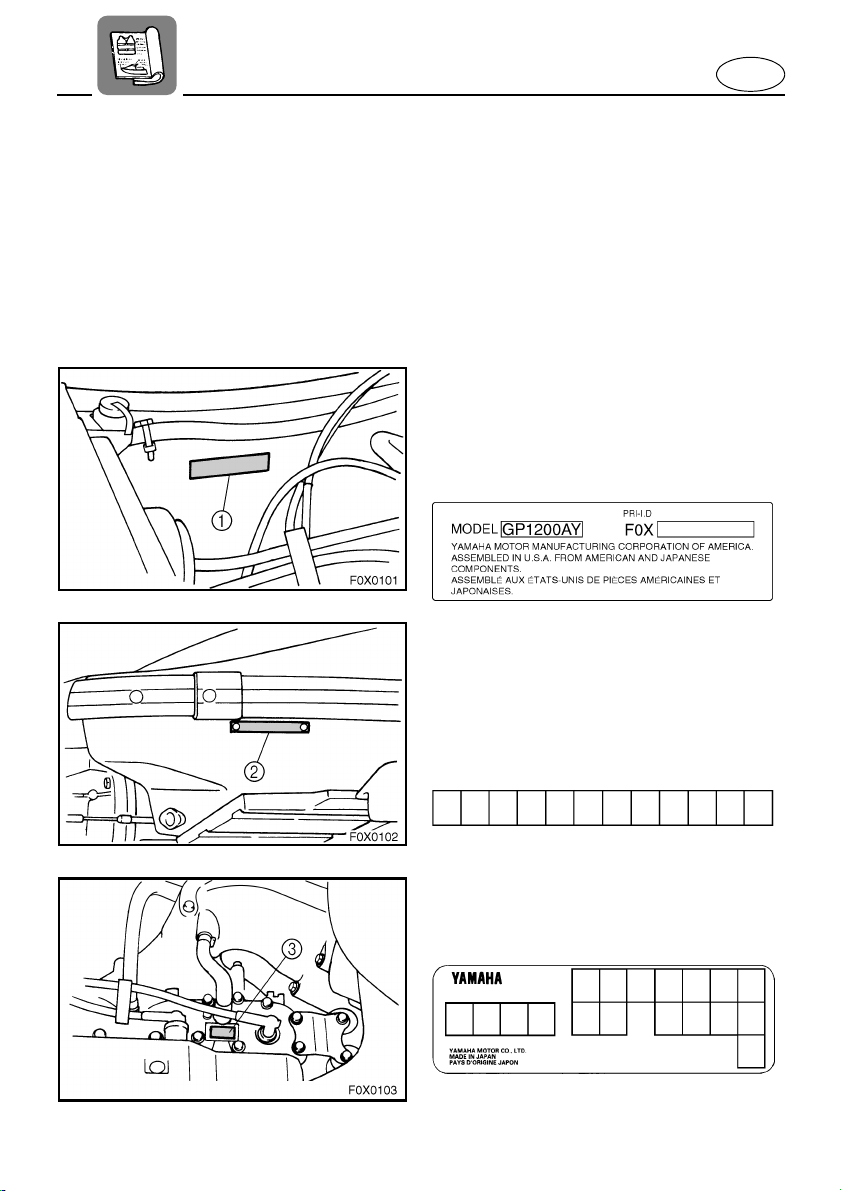
Record your Primary identification (PRI-ID)
number, Hull identification number (H.I.N)
and Engine serial number in the spaces pro-
vided, to assist you in ordering spare parts
from your Yamaha water vehicle dealer. Also
record and keep these ID numbers in a sep-
arate place in case your water vehicle is sto-
len.
EJU00276a
PRIMARY IDENTIFICATION (PRI-ID)
NUMBER
The PRI-ID number is stamped on a label
1
attached to the inside of the engine com-
partment.
EJU00286a
HULL IDENTIFICATION
NUMBER (H.I.N)
The H.I.N. is stamped on a plate
2
attached
to the full of the stern.
EJU00288a
ENGINE SERIAL NUMBER
The engine serial number is stamped on a
label
3
attached to the cylinder head.
Chap1.fm Page 1 Thursday, March 30, 2000 2:02 PM
1-2
E
EJU00631a
EMISSION CONTROL
INFORMATION
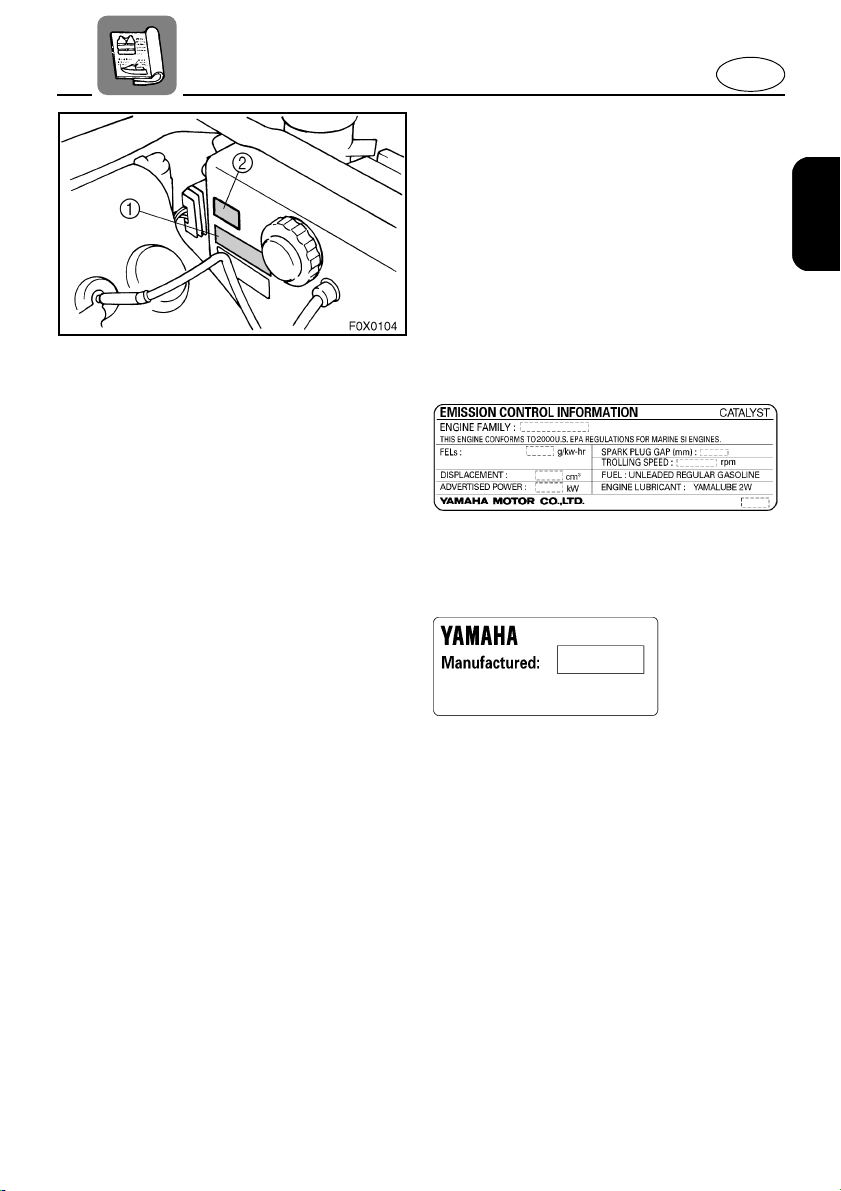
This engine conforms to 2000 U.S. Environ-
mental Protection Agency (EPA) regulation
for marine SI engines.
●
●●
● Approved label of Emission control
certificate
This label is attached to the electrical box.
1
Emission control information label
●
●●
● Manufactured date label
This label is attached to the electrical box.
2
Manufactured date label
Chap1.fm Page 2 Thursday, March 30, 2000 2:02 PM
1-3
E
EJU00293
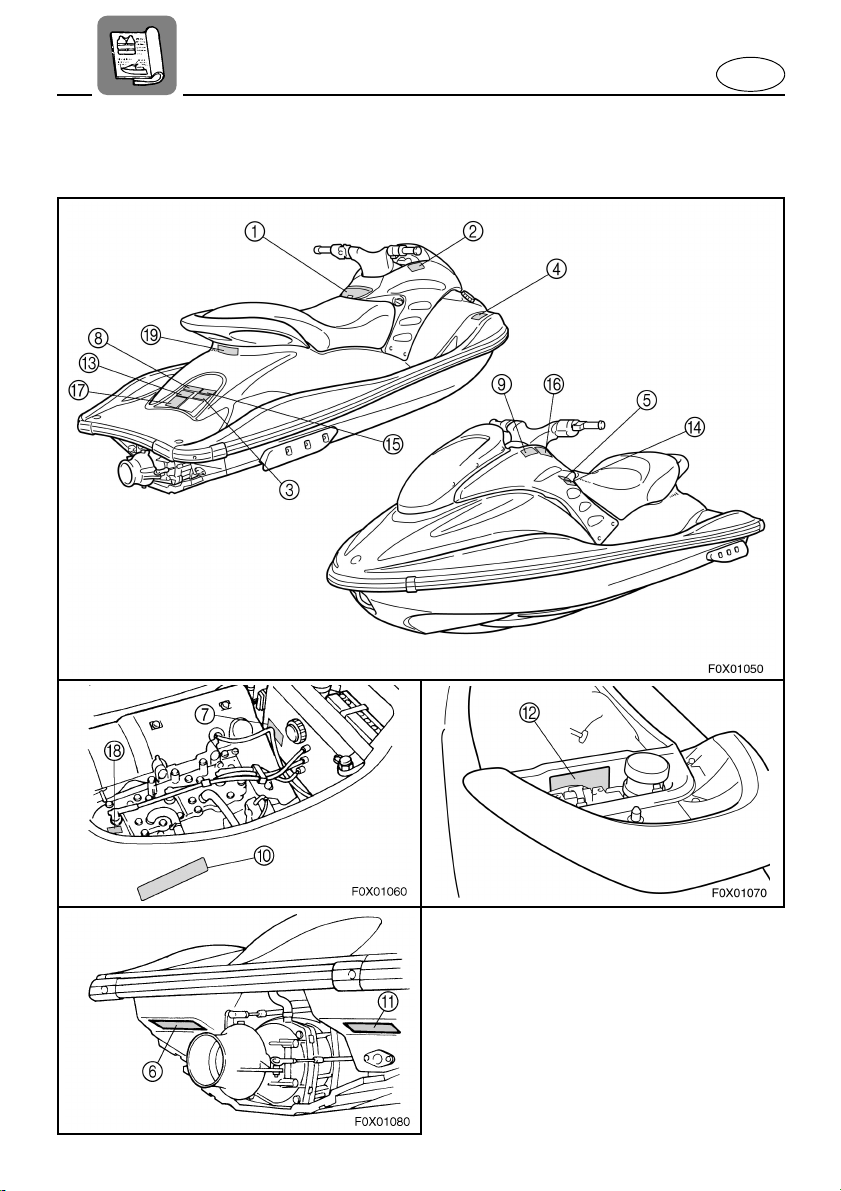
IMPORTANT LABELS
LOCATION
Chap1.fm Page 3 Thursday, March 30, 2000 2:02 PM
1-4
E
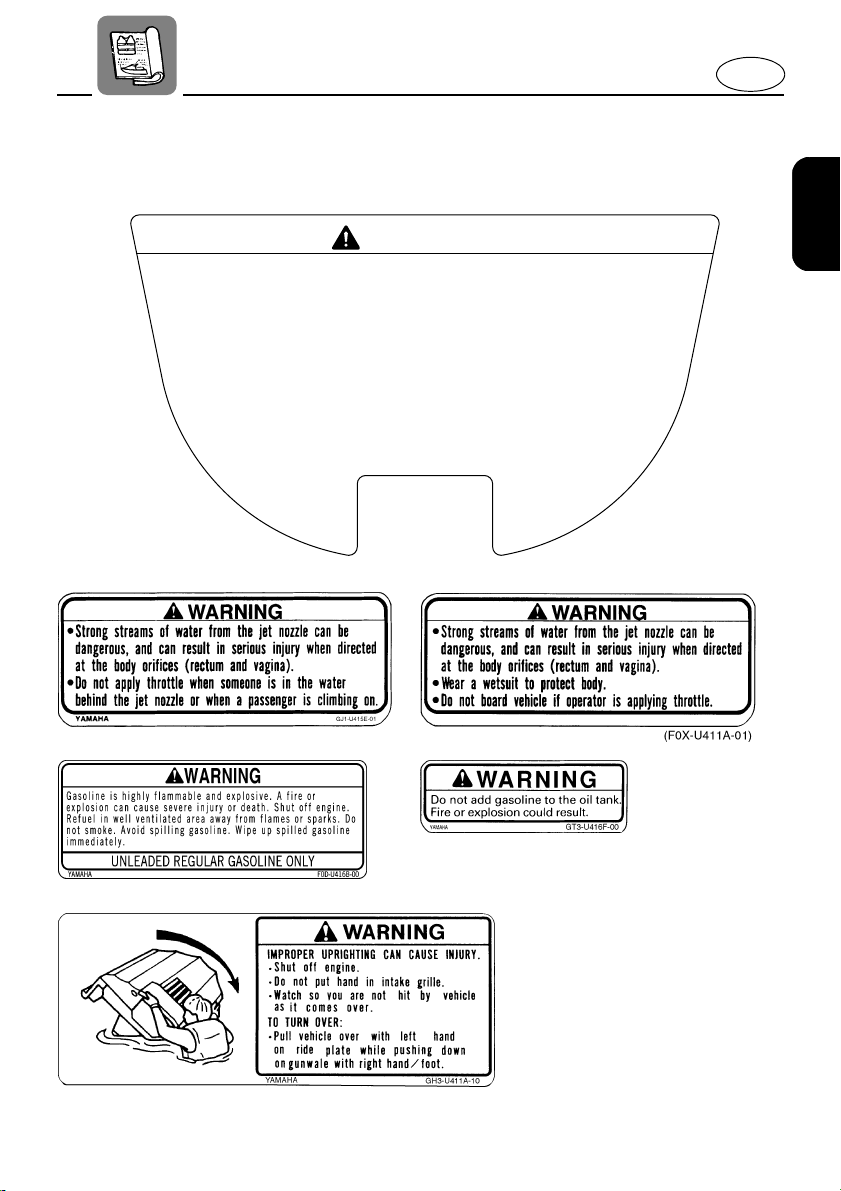
LABELS
Warning labels
· Read the Owner’s Manual, the Riding Practice Tips, the Riding Instructions
card, and all labels before operating.
· This vehicle is recommended only for operators 16 and older with valid
motor vehicle license. Adults must supervise use by minors. Check state
laws for minimum age requirements.
· Vehicle capacity: 1 operator and 1 passenger. Do not exceed 353 lb
(160 kg), including any cargo. Overloading can make the vehicle more
difficult to control, which can lead to an accident.
· Wear a USCG-approved personal flotation device.
· Wear a wetsuit to protect against injuries to orifices (rectum and
vagina) from strong streams of water from the jet nozzle, or from
impact with the water surface. A wetsuit also helps protect
against hypothermia and abrasions.
· Attach the engine stop switch lanyard to your left wrist
before operating.
· You must know and follow all federal,
state, and local boating laws.
· Never ride after drinking
alcohol or taking
drugs.
WARNING
SEVERE INJURY OR DEATH MAY RESULT IF YOU IGNORE ANY OF THE FOLLOWING.
· You need engine power to turn. Releasing throttle lever or shutting off
engine can cause you to hit an obstacle you are attempting to avoid.
· Check throttle and steering for proper operation before starting the engine.
Malfunctioning controls can cause accidents.
· Open the seat and the front storage compartment to ventilate fuel vapors
from the engine compartment before starting the engine. Do not start the
engine if there is a fuel leak or loose electrical connection.
· Do not operate in less than 2 ft (60 cm) of water.
· Keep a safe distance from swimmers, other watercraft, and obstructions.
· Never attempt jumps with this water vehicle.
· Do not travel far away without another watercraft or boat with you.
· Stop engine before removing debris from jet intake on bottom of
hull. Keep hands, feet, hair, and all other parts of your body and
clothing away from jet intake while engine is running.
· Passenger should firmly hold on to
the operator and place feet on the
footrest floor. Otherwise,
passenger could lose
balance and
fall.
YAMAHA F0X-U416C-02
1
2
45
6
3
Chap1.fm Page 4 Thursday, March 30, 2000 2:02 PM
1-5
E
7
8
9
0
Chap1.fm Page 5 Thursday, March 30, 2000 2:02 PM
1-6
E
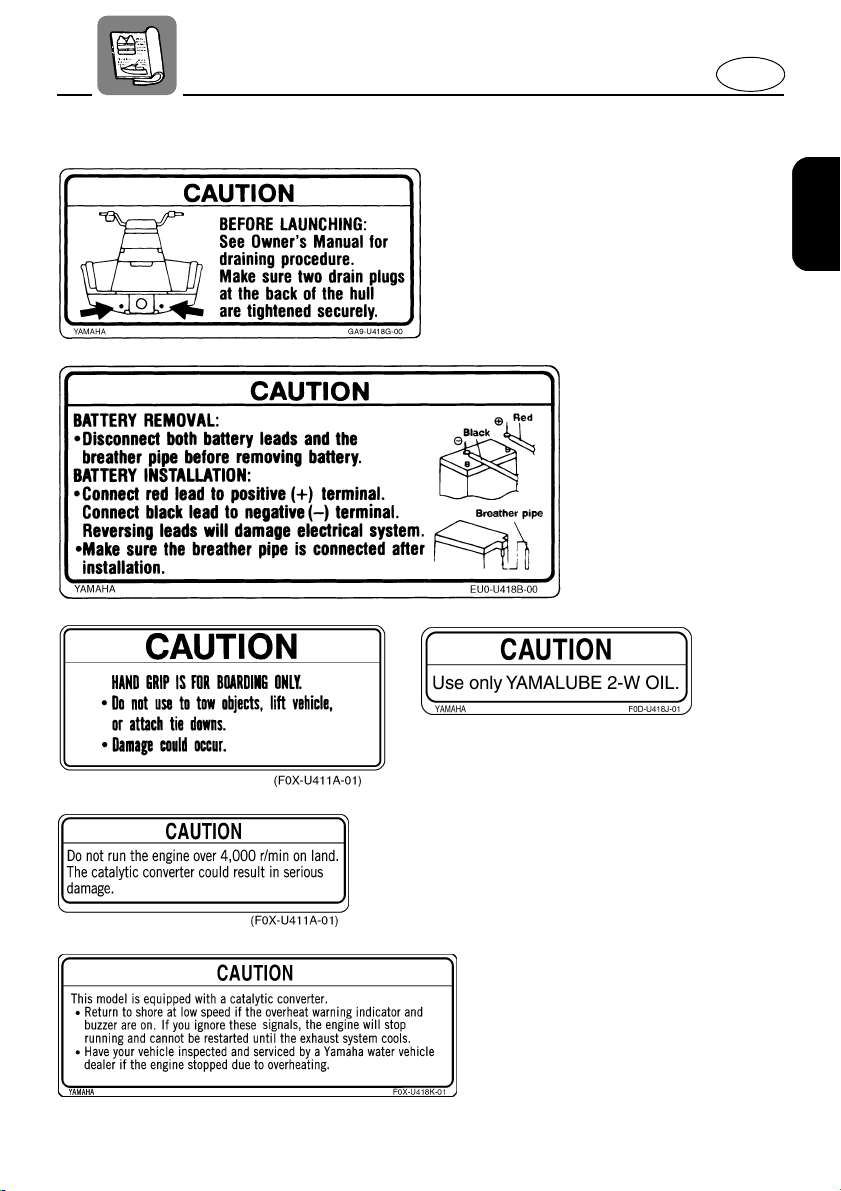
Caution labels
A
B
CD
E
F
Chap1.fm Page 6 Thursday, March 30, 2000 2:02 PM
1-7
E
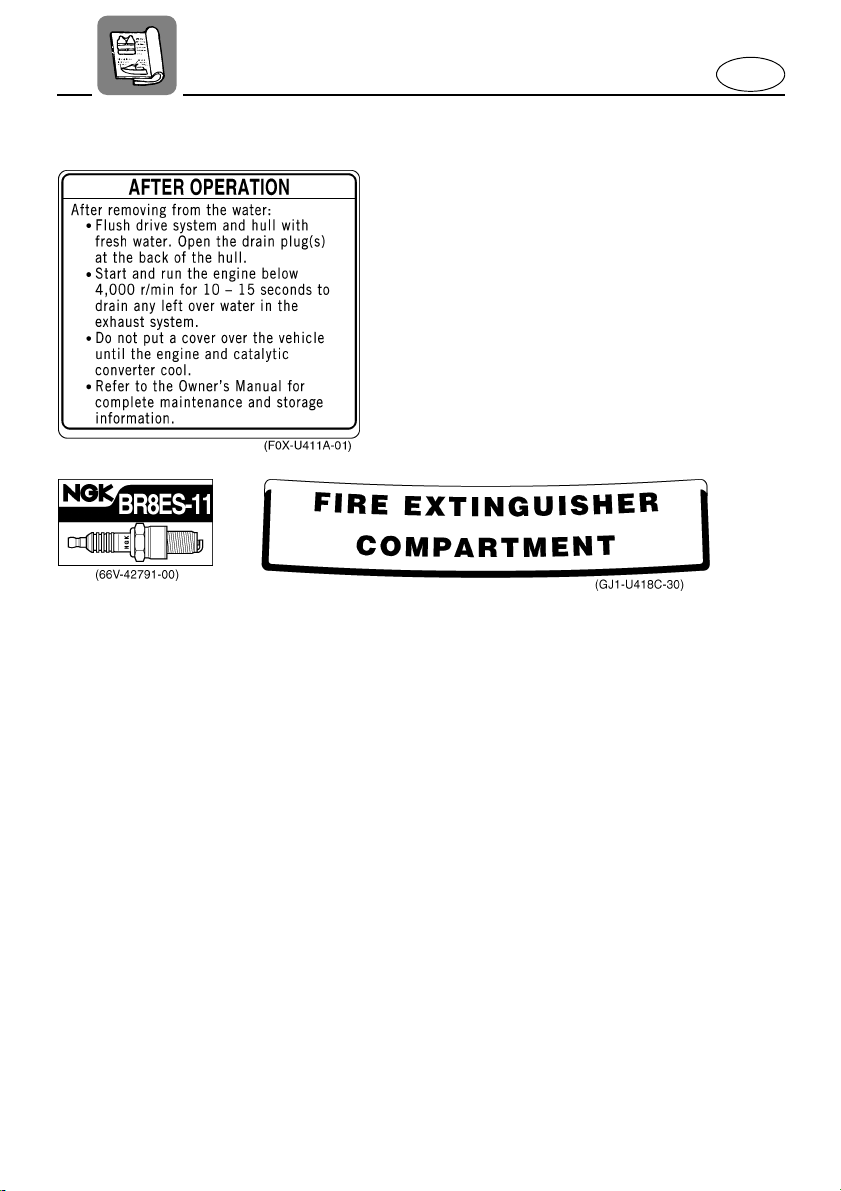
Other labels
G
H I
Chap1.fm Page 7 Thursday, March 30, 2000 2:02 PM
1-8
E
EJU00640a
SAFETY
INFORMATION
When you operate your water vehicle, you
must know and practice the following for
your safety:
●
●●
●
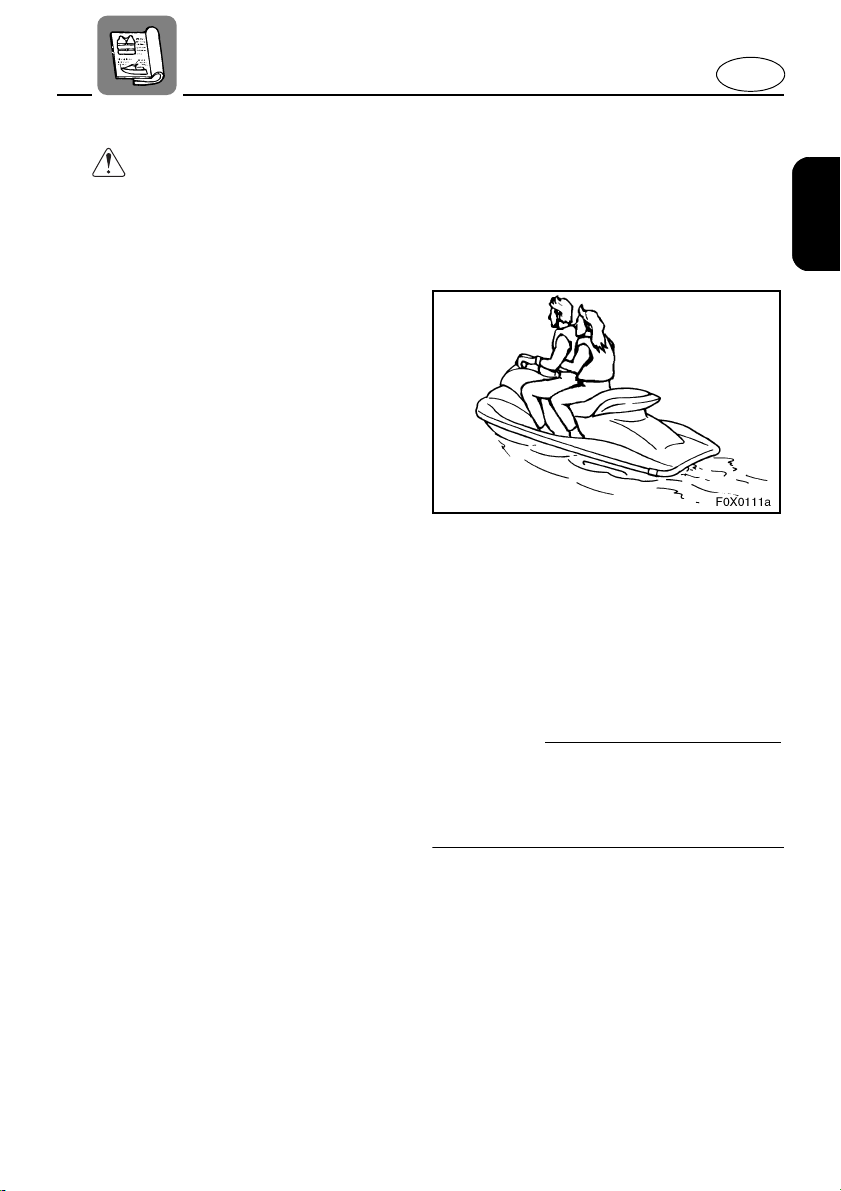
Before operating the vehicle, read this
owner’s/operator’s manual, the riding
practice tips, the riding instruction card
and all warning labels on the vehicle.
Reading these materials should give you
an understanding of the vehicle and its
operation.
Never allow anyone to operate this water
vehicle until they too have read this
owner’s/operator’s manual, the riding
practice tips, the riding instruction card
and all warning labels.
●
●●
●
This product emits exhaust gases which
contain carbon monoxide, a colorless,
odorless gas which may cause brain
damage or death when inhaled. Symp-
toms include nausea, dizziness, and
drowsiness. Operate the vehicle in an
open area.
EJU00304a
LIMITATIONS ON WHO MAY
OPERATE THE VEHICLE
●
●●
●
This water vehicle is recommended only
for operators 16 and older with a valid
motor vehicle license.
Even though a motor vehicle operator’s
license is not required for water vehicle
operation in most states, it is one indica-
tor that the operator has previously dem-
onstrated a reasonable degree of
maturity, responsibility, and good judg-
ment.
A responsible adult must supervise oper-
ation of this vehicle by minors.
Many states have minimum age and edu-
cation requirements. Always check states
and all applicable local boating laws that
apply to you before you operate the vehi-
cle.
●
●●
●
Your water vehicle is designed to carry
the operator and one passenger, as long
as the total weight does not exceed the
maximum load capacity.
●
●●
●
Never exceed the weight capacity nor
allow more than three persons (or two
persons with a skier) to ride this vehicle at
one time.
ATTENTION:
Maximum vehicle load capacity: 160 kg
(353 lb)
Includes weight of operator, passenger, and
any cargo.
●
●●
●
Do not try to ride with passenger until you
have considerable practice riding alone.
Operating with passenger requires more
skill. Take the time to become accus-
tomed to the handling characteristics of
the vehicle with passenger before trying
any difficult maneuvers.
Chap1.fm Page 8 Thursday, March 30, 2000 2:02 PM
1-9
E
EJU00613a
CRUISING LIMITATIONS
●
●●
●
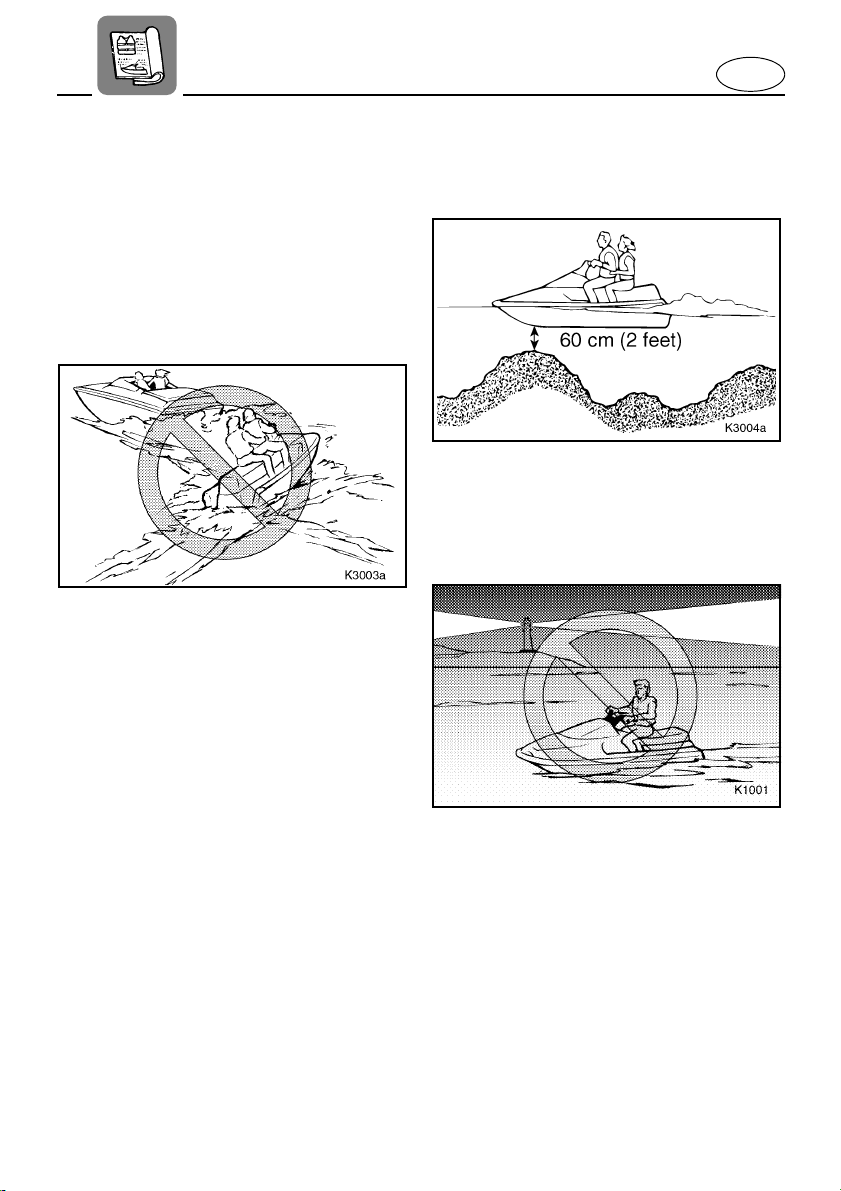
Do not jump boat wakes or follow another
boat or watercraft too closely. You
increase your risk of colliding with another
boat, which could result in severe injury or
death. Do not jump waves, wakes, or any
objects. You risk severe impact injuries.
Jumping can also cause damage to the
vehicle.
●
●●
●
Do not operate the vehicle in rough water,
bad weather or when visibility is poor; this
may lead to an accident causing injury or
death. Be alert to the possibility of
adverse weather. Take note of weather
forecasts and the prevailing weather con-
ditions before setting out on your water
vehicle.
●
●●
●
As with any water sport, you should not
ride your water vehicle without someone
else near by. If you ride further than swim-
ming distance from shore, you should be
accompanied by another boat or water-
craft. It’s good, common sense!
●
●●
●
Never ride in water that is less than 60 cm
(2 feet) deep. You increase your chance
of hitting an underwater obstacle. You
could be injured.
●
●●
●
Do not operate the vehicle after sunset or
before dawn. It is not equipped with light-
ing required for night operation. You risk
collision with another boat which could
cause injury or death.
●
●●
●
The maximum performance potential of
this watercraft is not suitable for all condi-
tions. Consider water conditions, weather,
boat traffic and other potential obstacles,
speed limits and other local laws, and
your abilities before attempting to travel at
higher speeds. Operate the watercraft no
faster than justified by these conditions.
Chap1.fm Page 9 Thursday, March 30, 2000 2:02 PM
1-10
E
EJU00618a
OPERATIONAL REQUIREMENTS
●
●●
●
Operating your water vehicle requires
skills acquired only through practice over
a period of time. Take the time to learn the
basic operating techniques well, before
attempting more difficult maneuvers.
●
●●
●
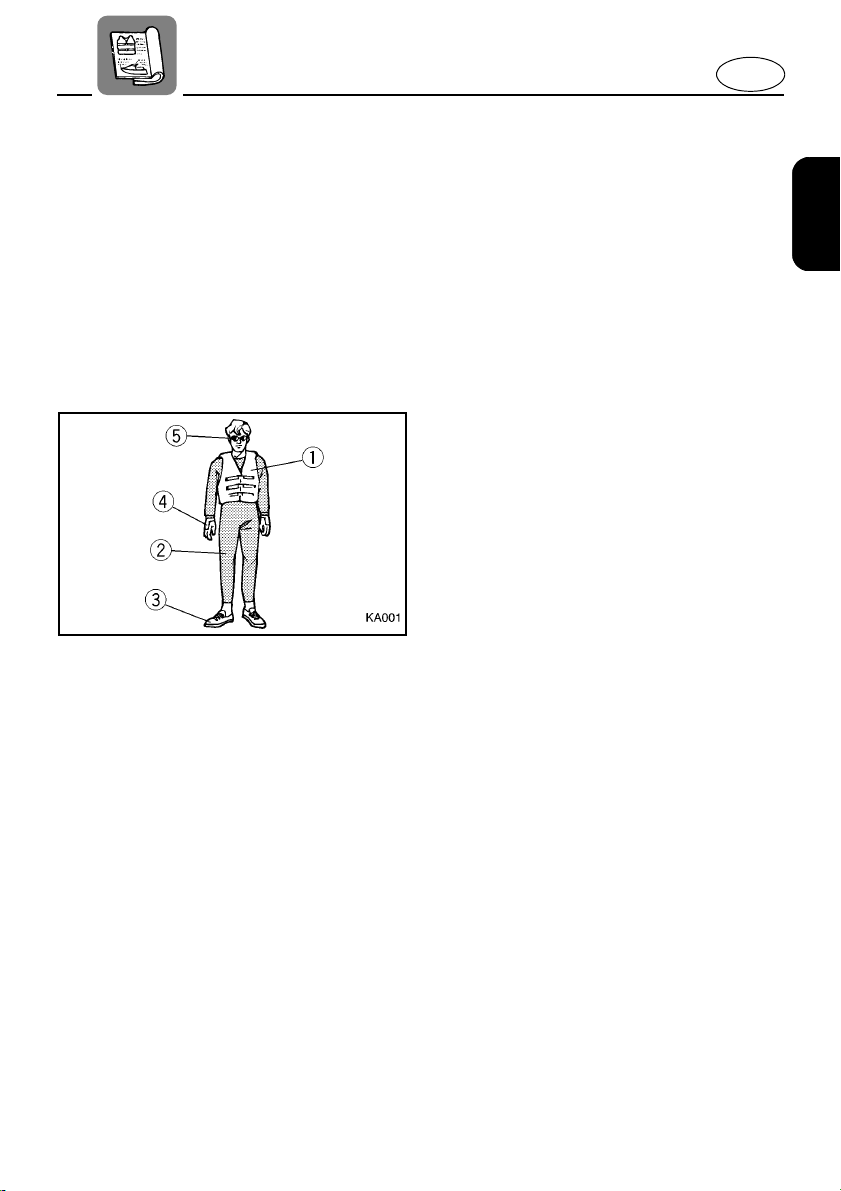
Both operator and passenger must
always wear a USCG (United States
Coast Guard) approved personal flotation
device (vest-type) because of the drown-
ing hazards associated with water sports.
1
USCG approved personal flotation device
2
Wet suit
3
Water shoes
4
Gloves
5
Eye protection
●
●●
●
Strong streams of water from the jet noz-
zle, or impact with the water surface can
be dangerous. Both operator and passen-
ger must wear wet suits. Normal swim-
ming attire may not adequately protect
you. A wet suit will help protect against
internal injuries to orifices (rectum and
vagina) from strong jet streams, and from
impact with the water surface. Wet suits
also help protect against hypothermia
(low body temperature) and abrasions.
●
●●
●
Both operator and passenger should wear
water shoes to help protect feet from
objects hidden under water. Wearing gloves
can also help protect hands from abrasions.
●
●●
●
Wind, water, and glare from the sun may
get in your eyes while you operate your
water vehicle, reducing your ability to see.
You may want to consider wearing eye
protection such as sunglasses or goggles
while riding. Some may find, however,
that eye protection obstructs or distorts
their vision, and distracts from operation.
Only you know the circumstances in
which you operate your water vehicle, so
only you can decide if the benefits of eye
protection outweigh the potential hazards.
●
●●
●
If you wear prescription lenses, consider
measures to secure them against loss while
riding. For example, some goggles are
designed to be worn over glasses or con-
tact lenses. Restraining straps for glasses
are also made which are designed to float if
your glasses should fall in the water.
●
●●
●
Helmets meeting Snell or DOT standards
are required for IJSBA-sanctioned races.
You must decide whether to wear a hel-
met while you ride recreationally. A hel-
met could help protect you in certain
kinds of accidents. You should also know
that a helmet could injure you in some
other riding conditions.
A helmet is designed to provide some
head protection. Although helmets cannot
protect against all foreseeable impacts, a
helmet might reduce your injuries in a col-
lision with a boat or other obstacles.
A helmet may have potential safety haz-
ards, as well. A helmet could catch the
water during a fall into the water. This is
commonly called “bucketing”. The result-
ing strain on your neck could cause chok-
ing, severe and permanent neck injuries,
or death. A helmet could also increase
the risk of an accident if it reduces your
vision or hearing, or if it distracts you or
increases your fatigue.
Chap1.fm Page 10 Thursday, March 30, 2000 2:02 PM
1-11
E
How should you decide if a helmet’s
potential safety benefits outweigh its
potential risks for you? Consider your par-
ticular riding conditions. Consider factors
such as your riding environment and your
riding style and ability. Also consider the
likelihood of traffic congestion, and the
water surface conditions. If you decide to
wear a helmet based upon your riding cir-
cumstances, choose one carefully. Look
for a helmet designed for personal water-
craft use, if possible. Consider a helmet
meeting Snell or DOT standards. If you
will be engaging in closed-course compe-
tition, follow the helmet requirements of
the sanctioning organization.
●
●●
●
NEVER ride the vehicle after consuming
alcohol or taking drugs.
●
●●
●
For reasons of safety and proper care,
always perform the pre-operation checks
on page 3-3 before riding.
●
●●
●
The operator and passenger should
always keep both feet on the footrest floor
when the vehicle is in motion. If you lift
your feet, you increase your chances of
losing your balance, and your feet could
hit objects outside the water vehicle. Do
not give a ride to a child whose feet can-
not reach the footrest floor.
Passenger should firmly hold on to the
operator.
●
●●
●
If you are pregnant or in poor health, ask
your doctor’s advice on whether it is safe
for you to ride this water vehicle.
●
●●
●
Do not attempt to modify this water vehi-
cle!
Modifications to your machine may
reduce safety and reliability, and may
make the vehicle unsafe or illegal for use.
●
●●
●
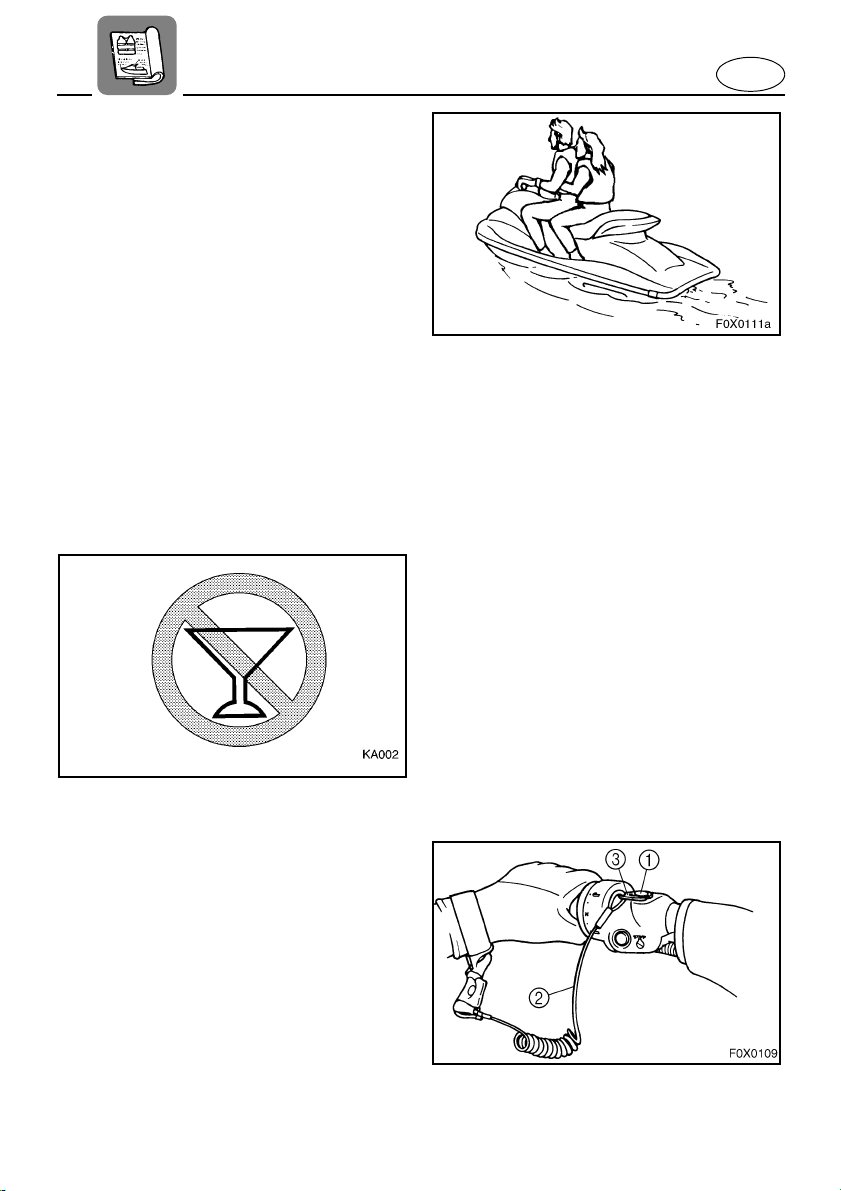
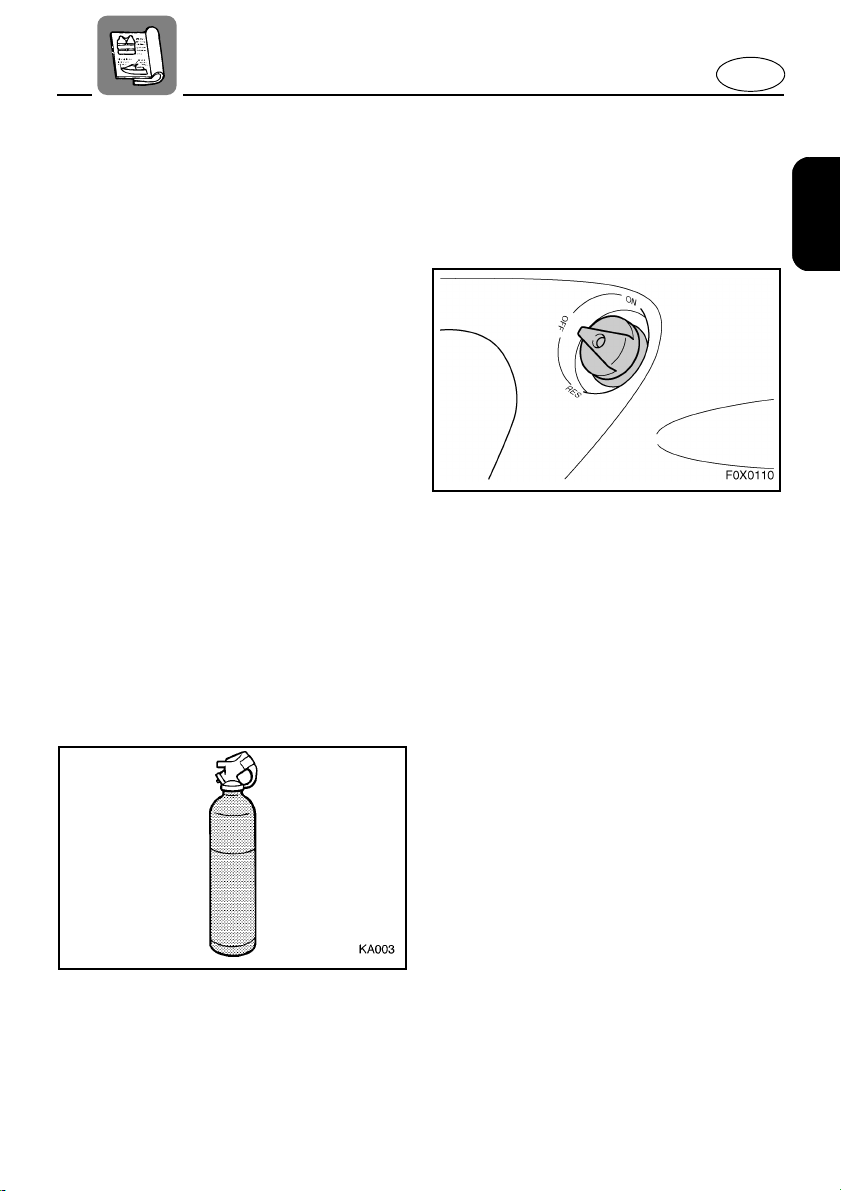
The operator should always attach the
engine stop switch lanyard (cable) to his
left wrist so that the engine will stop if the
operator falls off.
Be sure the lanyard is not wrapped
around the handlebar or tangled in the
controls which would prevent the lanyard
from pulling away.
●
●●
●
To prevent accidental starting of the
engine, always remove the lock-plate
from the engine stop lanyard switch when
the engine is not running.
1
Engine stop lanyard switch
2
Engine stop switch lanyard
3
Lock-plate
Chap1.fm Page 11 Thursday, March 30, 2000 2:02 PM
1-12
E
●
●●
●
Always watch carefully for swimmers.
Stay away from swimming areas. Swim-
mers are hard to see and you could acci-
dentally hit someone in the water.
●
●●
●
Avoid being hit by another boat! You
should always take the responsibility to
watch for traffic, other boaters may not be
watching for you. If they do not see you,
or you maneuver more quickly than other
boaters expect, you risk a collision.
Maintain a safe distance from other boats
or watercraft, and also watch for boat’s ski
ropes or fishing lines. Obey the “Rules of
the Road” (see page 1-15~1-18), and be
sure to check behind you before making a
turn.
●
●●
●
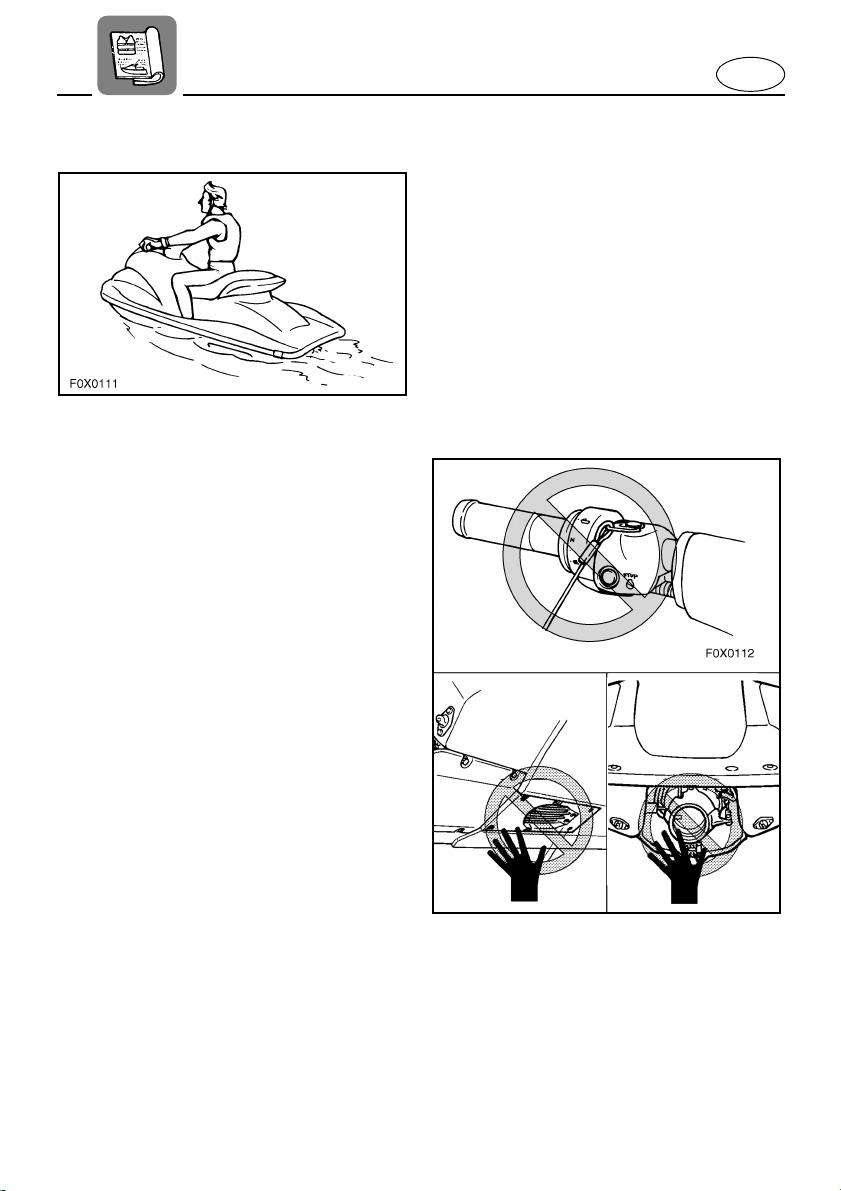
This water vehicle is included in the Class
A inboard boat classification of the
USCG. A water craft of this type MUST
carry a fire extinguisher of a B-1 classifi-
cation, with a capacity of two pounds or
more when navigating in waters under
USCG jurisdiction. In addition, most state
and local boating laws also require that
the carry a USCG-approved extinguisher
wherever it is operated.
EJU00313a
HAZARD INFORMATION
●
●●
●
When transporting or storing your water
vehicle, always place the fuel cock in the
“OFF” position. Otherwise, it is possible
for fuel to overflow from the carburetor.
●
●●
●
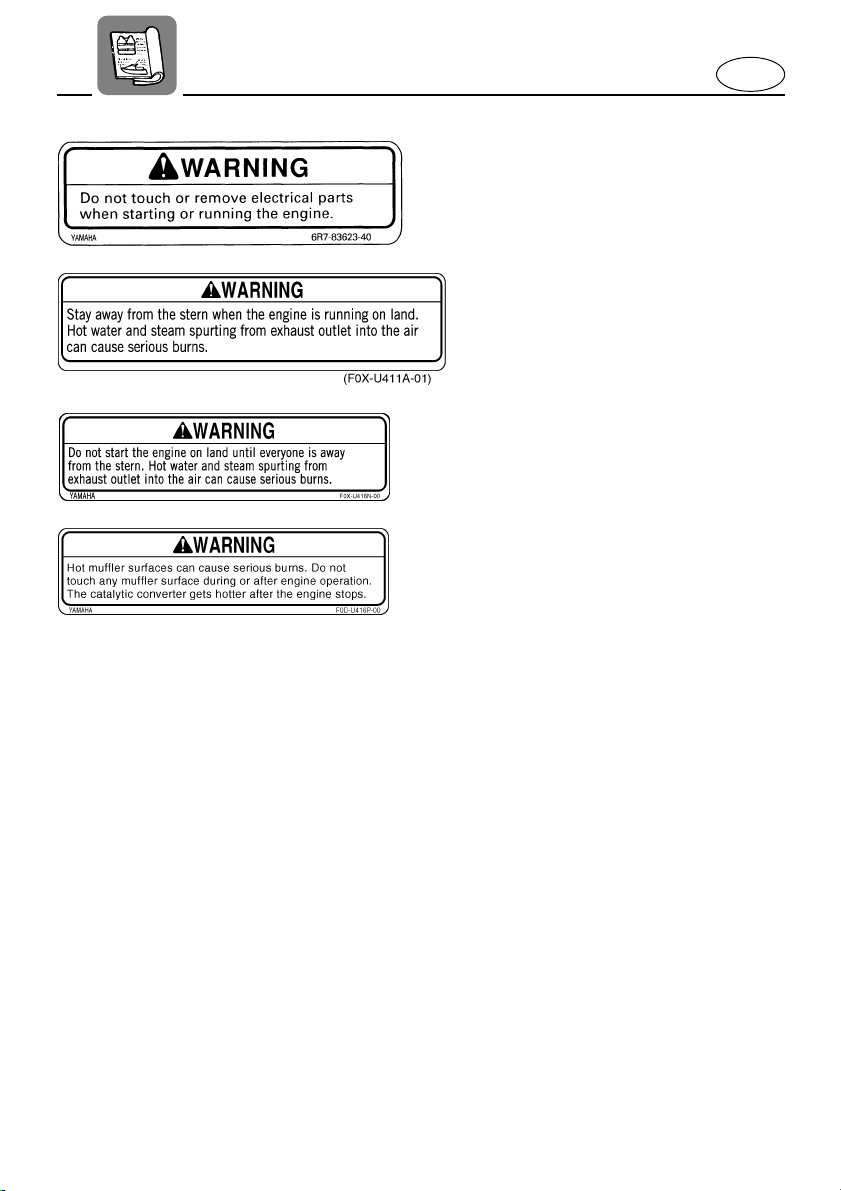
Do not start the engine on land until
everyone is away from the stern. Hot
water and steam spurting from exhaust
outlet into the air can cause serious
burns.
●
●●
●
Hot muffler surfaces can cause serious
burns. Do not touch any muffler surface
during or after operation. The catalytic
converter gets hotter after the engine
stops.
Chap1.fm Page 12 Thursday, March 30, 2000 2:02 PM
1-13
E
EJU00315a
WATER VEHICLE CHARACTERISTICS
●
●●
●
Jet thrust turns the vehicle. If you are
going faster than trolling speeds (the low-
est maneuvering speed), you must use
throttle to turn. If you release the throttle
completely, you cannot turn even if you
turn the handlebars. Practice turning in an
open area without obstructions until you
have a good feel for this maneuver.
●
●●
●
Yamaha water vehicles are water-jet pro-
pelled. The jet pump is directly connected
to the engine. This means that jet thrust
will produce some vehicle movement
whenever the engine is running. There is
no “neutral” position.
●
●●
●
Boats, including your water vehicle, do
not have brakes.
Release the throttle or stop the engine to
slow down. Remember, however, that you
have no steering control without throttle.
●
●●
●
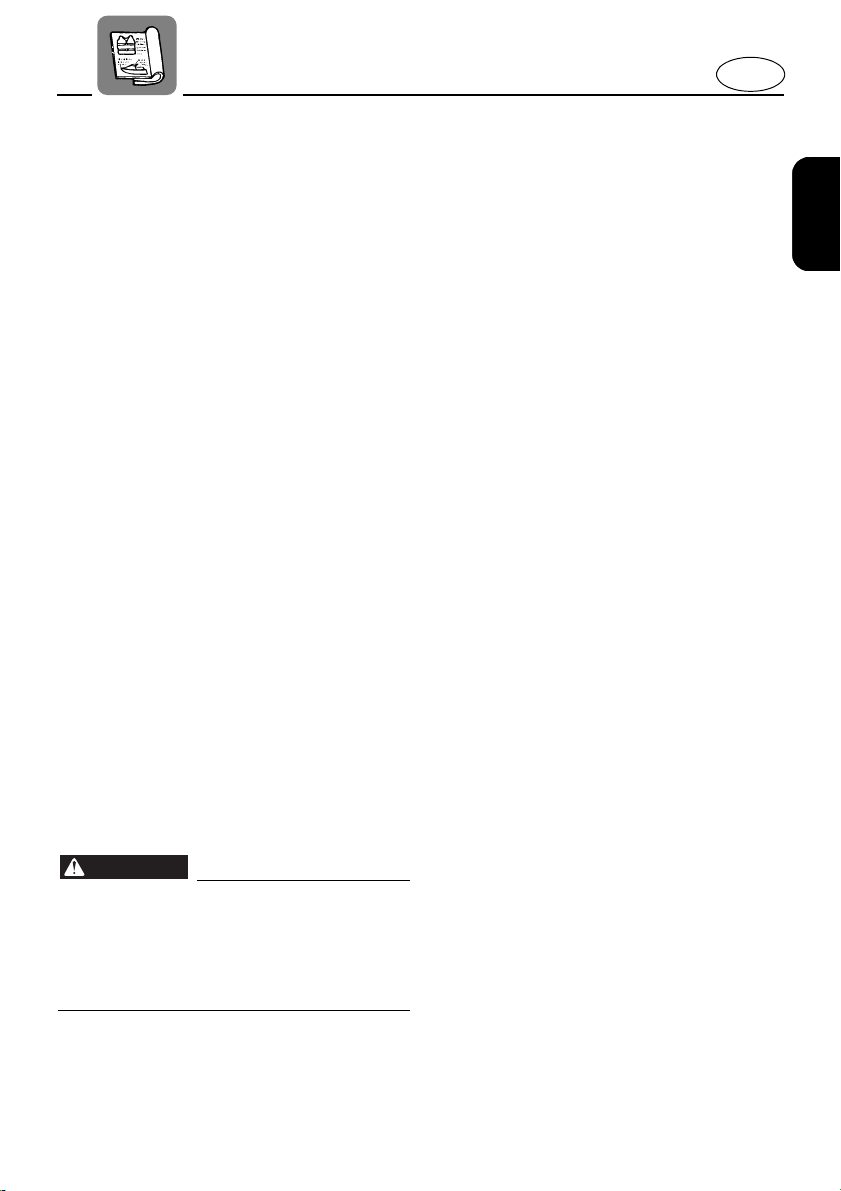
Keep hands, feet, hair, and all other parts
of your body and clothing away from jet
intake on the bottom of the hull while
engine is running because they could be
caught in the intake.
Stop the engine and remove the lock
plate from the engine stop lanyard switch
before removing any debris or weeds
which may have collected around the jet
intake.
Never insert any object in the jet pump
outlet. Severe injury or death could result
from coming in contact with the rotating
parts of the jet pump.
Chap1.fm Page 13 Thursday, March 30, 2000 2:02 PM
1-14
E
EJU00319a
RULES OF THE ROAD
Your Yamaha water vehicle is legally con-
sidered a power boat. Operation of this
water vehicle must be in accordance with
the rules and regulations governing the
waterway on which it is used.
Just as there are rules which apply when
you are driving on streets and highways,
there are waterway rules which apply when
you are riding your water vehicle. These
rules are used internationally, and are also
enforced by the USCG (United States Coast
Guard) and local agencies. You should be
aware of these rules, and follow them when-
ever you encounter another vessel on the
water.
Several sets of rules prevail according to
geographic location, but are all basically the
same as the International Rules of the
Road. The rules presented here in your
owner’s/operator’s manual are condensed,
and have been provided for your conve-
nience only. Consult your local USCG Auxil-
iary or Department of Motor Vehicles for a
complete set of rules governing the waters
in which you will be riding your water vehi-
cle.
WARNING
Do not operate the vehicle after sunset or
before dawn. It is not equipped with light-
ing required for night operation. You risk
collision with another boat which could
cause injury or death.
STEERING AND SAILING RULES
AND SOUND SIGNALS
Whenever two vessels on the water meet
one another, one vessel has the right-of-
way; it is called the “stand-on” vessel. The
vessel which does not have the right-of-way
is called the “give-way” or “burdened” ves-
sel. These rules determine which vessel has
the right-of-way, and what each vessel
should do.
Stand-On Vessel
The vessel with the right-of-way has the duty
to continue its course and speed, except to
avoid an immediate collision. When you
maintain your direction and speed, the other
vessel will be able to determine how best to
avoid you.
Give-Way Vessel
The vessel which does not have the right-of-
way has the duty to take positive and timely
action to stay out of the way of the Stand-On
vessel. Normally, you should not cross in
front of the vessel with the right-of-way. You
should slow down or change directions
briefly and pass behind the other vessel.
You should always move in such a way that
the operator of the other vessel can see
what you are doing.
“The General Prudential Rule”
This rule is called Rule 2 in the International
Rules and says,
‘In obeying and construing these rules due
regard shall be had to all dangers of naviga-
tion and collision, and to any special circum-
stances, which may render a departure from
the above rules necessary in order to avoid
immediate danger.
Chap1.fm Page 14 Thursday, March 30, 2000 2:02 PM
1-15
E
In other words, follow the standard rules
except when a collision will occur unless
both vessels try to avoid each other. If that is
the case, both vessels become “Give-Way”
vessels.
RULES WHEN ENCOUNTERING
VESSELS
There are three main situations which you
may encounter with other vessels which
could lead to a collision unless the Steering
Rules are followed:
Meeting
(you are approaching another ves-
sel head-on)
Crossing
(you are traveling across the other
vessel’s path)
Overtaking
(you are passing or being
passed by another vessel)
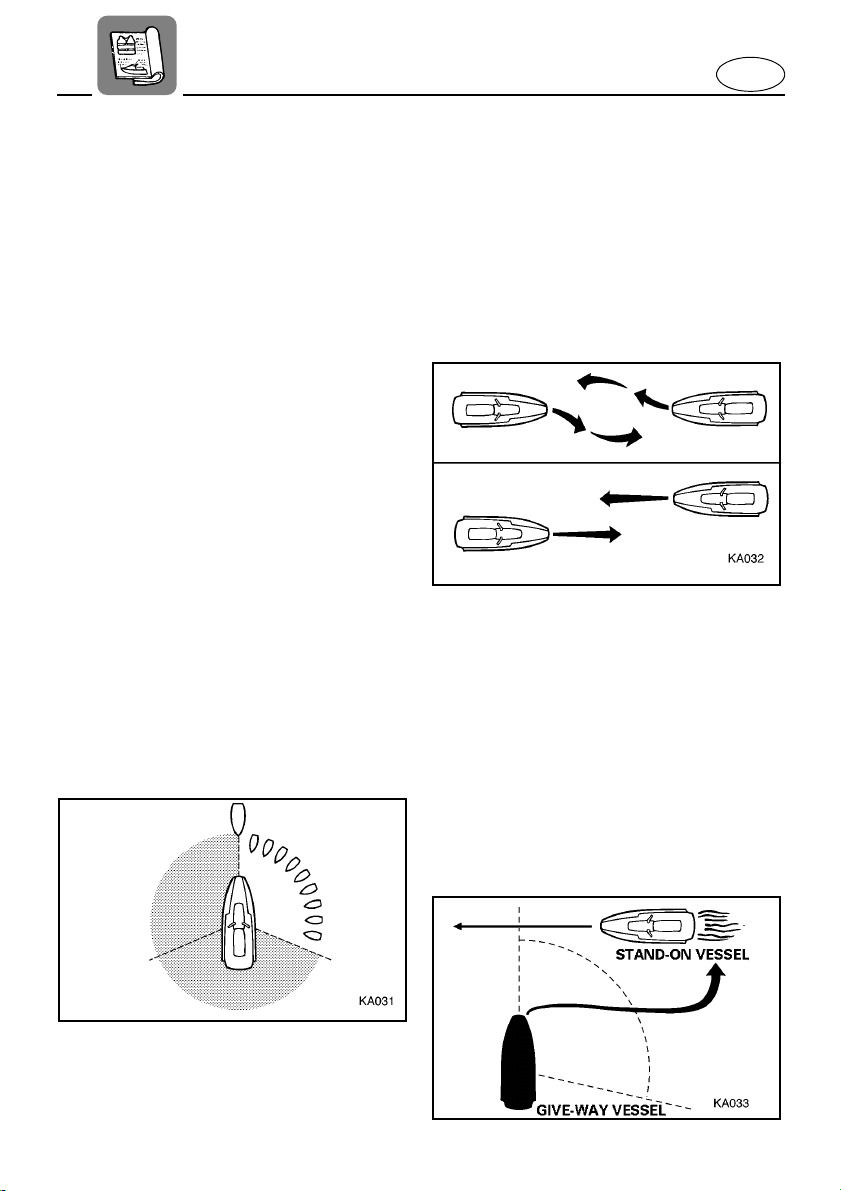
In the following illustration, your water vehi-
cle is in the center. You should give the right-
of-way to any vessels shown in the white
area (you are the Give-Way vessel). Any
vessels in the shaded area must yield to you
(they are the Give-Way vessels). Both you
and the meeting vessel must alter course to
avoid each other.
Meeting
If you are meeting another power vessel
head on, and are close enough to run the
risk of collision, neither of you has the right-
of-way! Both of you should alter course to
avoid an accident. You should keep the
other vessel on your port (left) side. This
rule does not apply if both of you will clear
one another if you continue on your set
course and speed.
Crossing
When two power driven vessels are crossing
each other’s path close enough to run the
risk of collision, the vessel which has the
other on the starboard (right) side must keep
out of the way of the other. If the other ves-
sel is on your right, you must keep out of its
way; you are the Give-Way vessel. If the
other vessel is on your port (left) side,
remember that you should maintain course
and direction, provided the other vessel
gives you the right-of-way as it should.
Chap1.fm Page 15 Thursday, March 30, 2000 2:02 PM

1-16
E
Overtaking
If you are passing another vessel, you are
the “Give-Way” vessel. This means that the
other vessel is expected to maintain its
course and speed. You must stay out of its
way until you are clear of it. Likewise, if
another vessel is passing you, you should
maintain your speed and direction so that
the other vessel can steer itself around you.
OTHER SPECIAL SITUATIONS
There are three other rules you should be
aware of when riding your water vehicle
around other vessels.
Narrow Channels and Bends
When navigating in narrow channels, you
should keep to the right when it is safe and
practical to do so. If the operator of a power-
driven vessel is preparing to go around a
bend that may obstruct the view of other
water vessels, the operator should sound a
prolonged blast on the whistle (4 to 6 sec-
onds). If another vessel is around the bend,
it too should sound the whistle. Even if no
reply is heard, however, the vessel should
still proceed around the bend with caution. If
you navigate such waters with your water
vehicle, you will need to carry a portable air
horn, available from local marine supply
stores.
Fishing Vessel Right-of-way
All vessels which are fishing with nets, lines
or trawls are considered to be “fishing ves-
sels” under the International Rules. Vessels
with trolling lines are not considered fishing
vessels. Fishing vessels have the right-of-
way regardless of position. Fishing vessels
cannot, however, impede the passage of
other vessels in narrow channels.
Sailing Vessel Right-of-Way
Sailing vessels should normally be given the
right-of-way. The exceptions to this are:
1. When the sailing vessel is overtaking
the power-driven vessel, the power-
driven vessel has the right-of-way.
2. Sailing vessels should keep clear of any
fishing vessel.
3. In a narrow channel, a sailing vessel
should not hamper the safe passage of
a power-driven vessel which can navi-
gate only in such a channel.
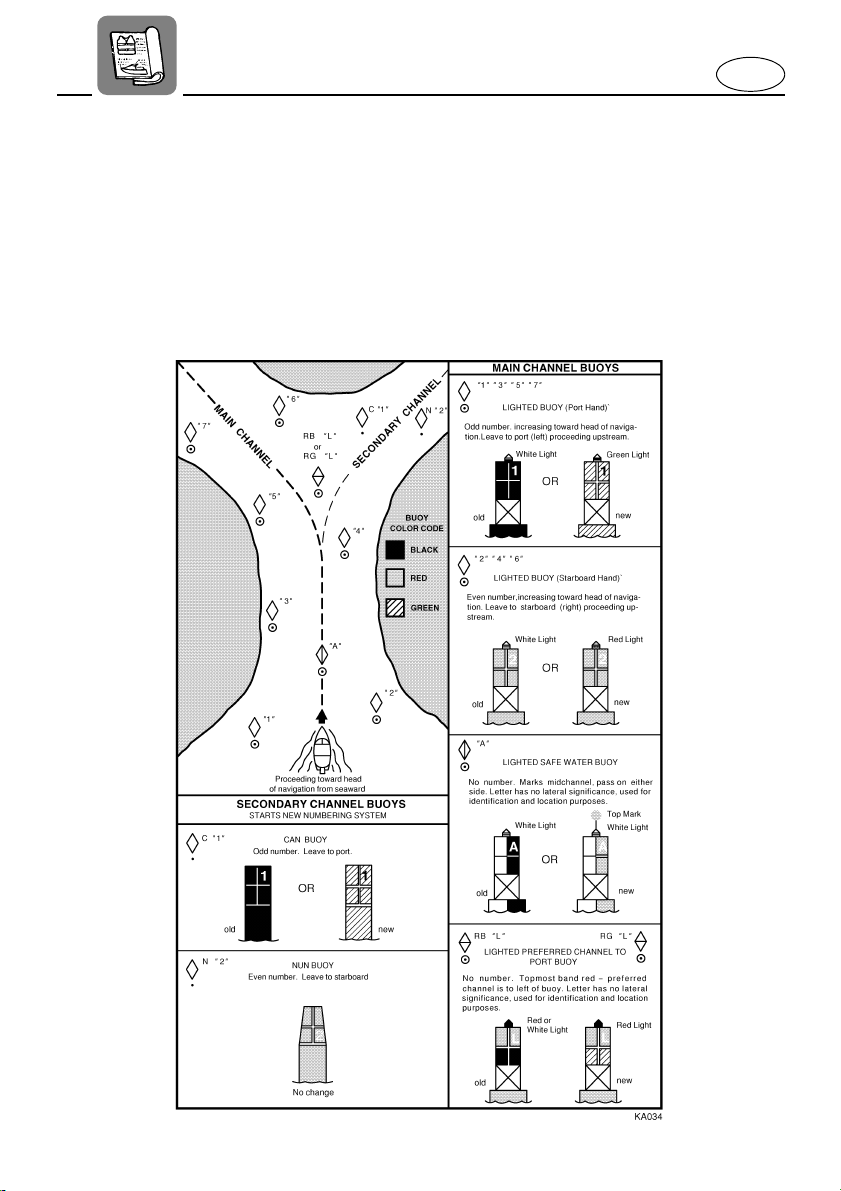
Reading Buoys And Other Markers
The waters of the United States are marked
for safe navigation by the lateral system of
buoyage. Simply put, buoys and markers
have an arrangement of shapes, colors,
numbers and lights to show which side of
the buoy a boater should pass on when nav-
igating in a particular direction. The mark-
ings on these buoys are oriented from the
perspective of being entered from seaward
(the boater is going towards the port). This
means that red buoys are passed on the
starboard (right) side when proceeding from
open water into port, and black buoys are to
port (left) side. When navigating out of port,
your position with respect to the buoys
should be reversed; red buoys should be to
port and black buoys to starboard.
Many bodies of water used by boaters are
entirely within the boundaries of a particular
state. The Uniform State Waterway Marking
System has been devised for these waters.
Chap1.fm Page 16 Thursday, March 30, 2000 2:02 PM
1-17
E
This system uses buoys and signs with dis-
tinctive shapes and colors to show regula-
tory or advisory information. These markers
are white with black letters and orange
boarders. They signify speed zones,
restricted areas, danger areas, and general
information.
Remember, markings may vary by geo-
graphic location. Always consult local boat-
ing authorities before riding your water
vehicle in unfamiliar waters.
Chap1.fm Page 17 Thursday, March 30, 2000 2:02 PM
1-18
E
EJU00320a
TO GET MORE BOATING
SAFETY INFORMATION
Be informed about boating safety. Additional
publications and information can be
obtained from many organizations, including
the following.
United States Coast Guard (USCG)
Consumer Affairs Staff (G-BC)
Office of Boating, Public, and Consumer
Affairs
U.S. Coast Guard Headquarters
Washington, D.C. 20593-0001
Boating Safety Hotline: 1-800-368-5647
Personal Watercraft Industry Association
(PWIA)
401 N. Michigan Ave.
Chicago, IL 60611
Personal Watercraft Riders Association
(PWRA)
401 N. Michigan Ave.
Chicago, IL 60611
EJU00322a
ENJOY YOUR WATER
VEHICLE RESPONSIBLY
●
●●
●
You share the areas you enjoy when
riding your water vehicle with others and
with nature. So your enjoyment includes a
responsibility to treat these other people
and nature with respect and courtesy.
●
●●
●
Whenever and wherever you ride, think of
yourself as the guest of those around you.
Remember, for example, that the sound of
your water vehicle may be music to you,
but it could be just noise to others. And
the exciting splash of your wake can
make waves others will not enjoy. Avoid
riding close to shoreline homes and
waterfowl nesting areas or other wildlife
areas, and keep a respectful distance
from fishermen, other boats, swimmers,
and populated beaches. When travel in
areas like these is unavoidable, ride
slowly and obey all laws.
●
●●
●
Remember that pollution can be harmful
to the environment. Do not refuel or add
oil where a spill could cause damage to
nature. Remove your water vehicle from
the water and move it away from the
shoreline before refueling. Keep your sur-
roundings pleasant for the people and
wildlife that share the waterways: do not
litter!
●
●●
●
When you ride responsibly, with respect
and courtesy for others, you help ensure
that our waterways stay open for the
enjoyment of a variety of recreational
opportunities.
Chap1.fm Page 18 Thursday, March 30, 2000 2:02 PM
1-19
E
EJU00323a
FUEL REQUIREMENTS
GASOLINE (PETROL)
WARNING
GASOLINE (PETROL) AND ITS VAPORS
ARE HIGHLY FLAMMABLE AND EXPLO-
SIVE!
●
●●
● Do not smoke when refueling, and
keep away from sparks, flames, or
other sources of ignition.
●
●●
● Stop the engine before refueling.
●
●●
● Refuel in a well-ventilated area. Do not
stand or sit on the vehicle while refuel-
ing in case of fire.
●
●●
● Take care not to spill gasoline (petrol).
If gasoline (petrol) spills, wipe it up
immediately with dry rags. Always
properly dispose of gasoline-soaked
rags.
●
●●
● Avoid overfilling the fuel tank. Stop fill-
ing when the fuel level just reaches the
bottom of the filler tube. Do not fill up
the filler tube because fuel expands as
it warms up and could overflow.
●
●●
● Tighten the filler cap securely after
refueling.
●
●●
● If you should swallow some gasoline
(petrol), inhale a lot of gasoline (petrol)
vapor, or get gasoline (petrol) in your
eyes, get immediate medical attention.
●
●●
● If any gasoline (petrol) spills onto your
skin, immediately wash with soap and
water. Change clothing if gasoline
(petrol) spills on it.
CAUTION:
●
●●
● Do not use leaded gasoline. Leaded
gasoline can seriously damage the
catalytic converter.
●
●●
● Use only fresh gasoline (petrol) that
has been stored in clean containers.
Gasohol
There are two types of gasohol: gasohol
containing ethanol and that containing meth-
anol. Gasohol containing ethanol can be
used if ethanol content does not exceed
10% and the fuel meets minimum octane
ratings. Gasohol containing methanol is not
recommended by Yamaha because it can
cause fuel system damage or engine perfor-
mance problems.
EJU00654a
ENGINE OIL
CAUTION:
Use only YAMALUBE 2-W oil. Using
another oil can seriously damage the cat-
alytic converter and other engine compo-
nents.
N
O
TE:
YAMALUBE 2-W is developed for this water
vehicle and available from a Yamaha water
vehicle dealer.
Recommended gasoline:
Unleaded regular gasoline with a
minimum octane rating of:
86 (Pump octane number)=(R+M)/2
90 (Research octane number)
Recommended engine oil:
YAMALUBE 2-W oil only
Chap1.fm Page 19 Thursday, March 30, 2000 2:02 PM
E
2
EJU00326
Chapter 2
FEATURES AND
FUNCTIONS
LOCATION OF MAIN COMPONENTS
.2-1
OPERATION OF CONTROLS AND
OTHER FUNCTIONS
.............................2-5
Seat....................................................2-5
Front hood..........................................2-6
Fuel filler cap......................................2-7
Oil filler cap ........................................2-7
Fuel cock............................................2-7
Engine stop switch.............................2-8
Engine stop lanyard switch ................2-8
Choke lever........................................2-9
Throttle lever......................................2-9
Engine start switch.............................2-9
Cooling water pilot outlet..................2-10
Steering............................................2-10
QSTS (Quick shift trim system)........2-11
Overheat warning system ................2-13
Exhaust temperature warning
system..............................................2-14
Handgrip...........................................2-16
Bow eye ...........................................2-16
Rope hole(s).....................................2-16
Multifunction information center.......2-17
Storage compartments.....................2-22
YAS
(Yamaha adjustable sponsons)........2-23
Chap2TOC.fm Page 1 Thursday, March 30, 2000 2:12 PM
2-1
E
EJU00327
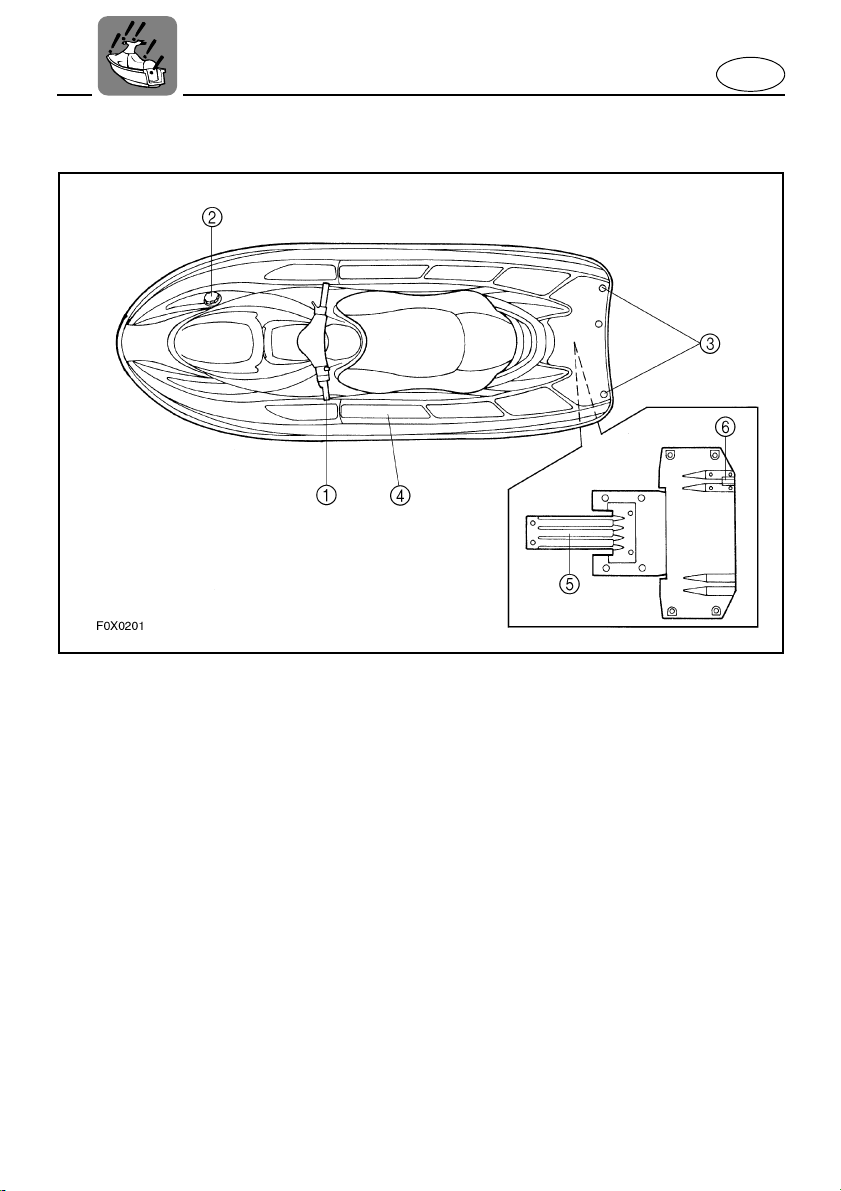
LOCATION OF MAIN COMPONENTS
1
Handlebars
Control steering direction
2
Fuel filler cap
Unscrew counterclockwise to add fuel
Tighten securely clockwise
3
Rope hole
Rope attachment point for transporting,
mooring
4
Footrest floor
To place feet for balance
5
Jet intake grille
Prevents debris from getting into the jet pump
6
Speed sensor
Chap2.fm Page 1 Thursday, March 30, 2000 2:14 PM
2-2
E
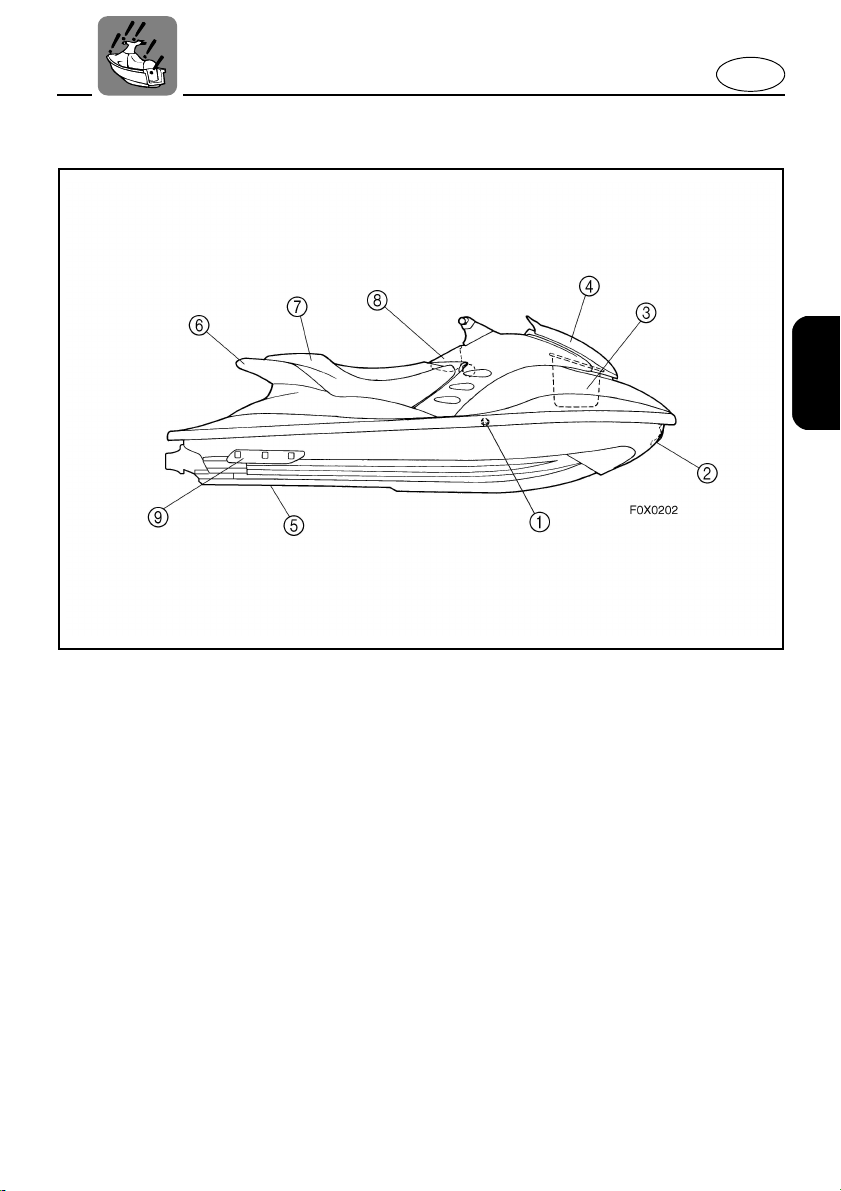
1
Cooling water pilot outlet
Check point of cooling water flowing
2
Bow eye
Rope attachment point for transporting,
mooring or towing the water vehicle in an
emergency
3
Front storage compartment
4
Front hood
5
Jet intake (Water intake)
Water inlet for jet stream
6
Hand grip
7
Seat
8
Glove compartment
9
YAS (Yamaha Adjustable Sponsons)
Chap2.fm Page 2 Thursday, March 30, 2000 2:14 PM
2-3
E
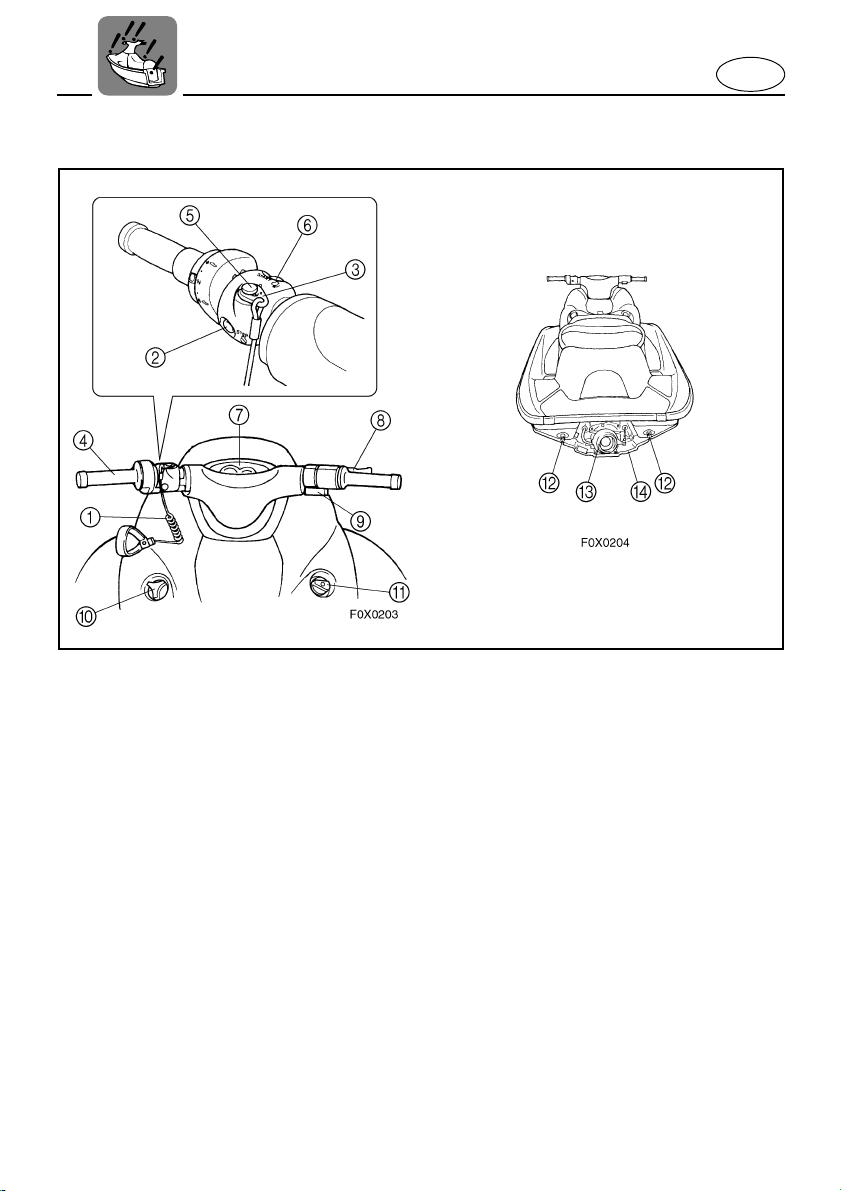
1
Engine stop switch lanyard (Cable)
By connecting to the engine stop lanyard
switch and operator will stop the engine if the
operator falls off the vehicle
2
Engine stop switch
Depress to stop the engine
3
Lock-plate
Insert the lock-plate in the engine stop lanyard
switch to allow the engine to be started
Remove the lock-plate to stop the engine or
prevent it from starting
4
Trim shifting grip
Controls thrust trim for different operating con-
ditions
5
Engine stop lanyard switch
Removing the lock-plate makes to stop the
engine and disable to start the engine
6
Engine start switch
Depress to start the engine
7
Multifunction information center
Shows vehicle speed, engine speed and some
other conditions on the vehicle
8
Throttle lever
Controls the engine speed when accelerating
and decelerate
9
Choke lever
0
Oil filler cap
A
Fuel cock
B
Drain plugs
Open to drain water in the bilge when the vehi-
cle is on land. Tighten securely before launch-
ing craft
C
Jet nozzle
Changes the direction of jet thrust according
to handlebar position to steer the vehicle
D
Ride plate
Chap2.fm Page 3 Thursday, March 30, 2000 2:14 PM
2-4
E
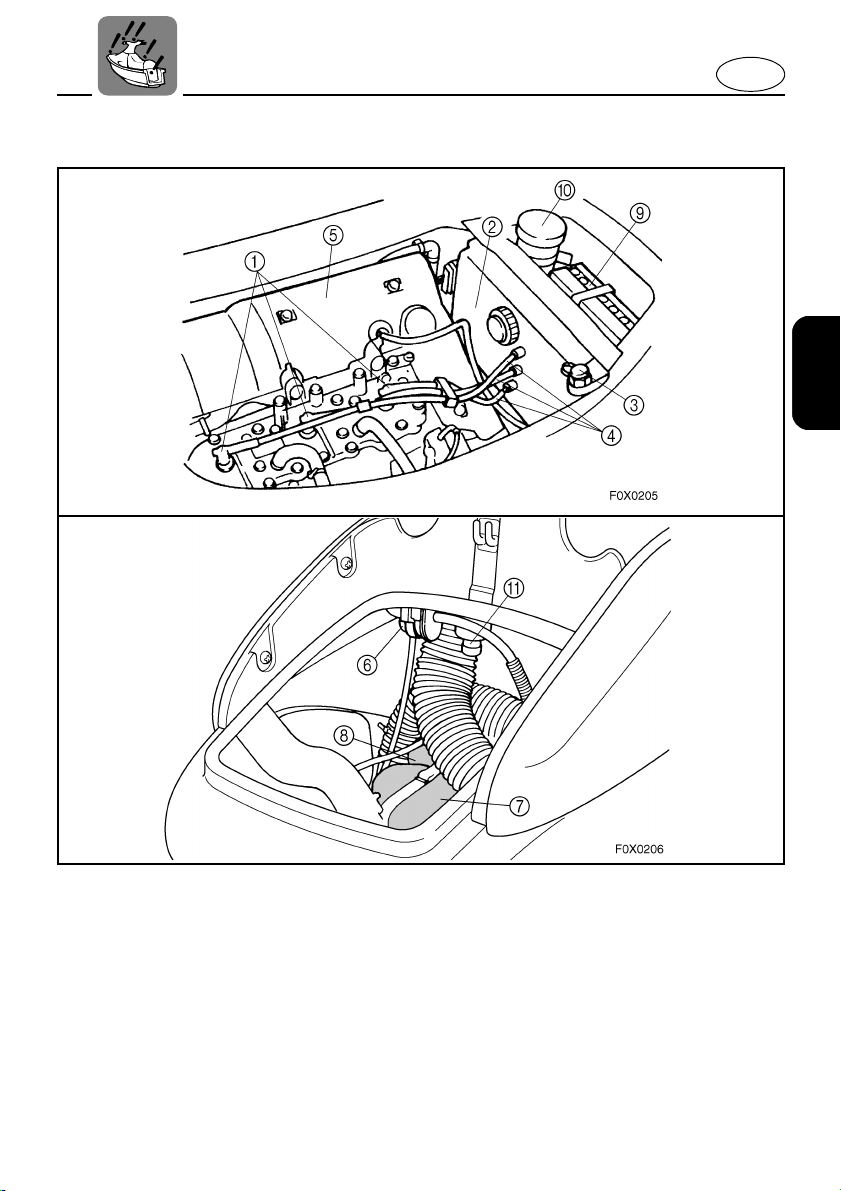
1
Spark plug / spark plug cap
2
Electrical box
Contains most electrical components in this
water resistant box
3
Flush hose connector
To flush the engine cooling water passages
4
High tension cord
Deliver electrical current to the spark plug
5
Muffler box
6
Fuel filter
Prevents dust contained in fuel from getting
into the carburetor
7
Fuel tank
8
Oil tank
9
Battery
0
Fire extinguisher container
A
Water separater
Chap2.fm Page 4 Thursday, March 30, 2000 2:14 PM
2-5
E
EJU00328
OPERATION OF CONTROLS
AND OTHER FUNCTIONS
EJU00714a
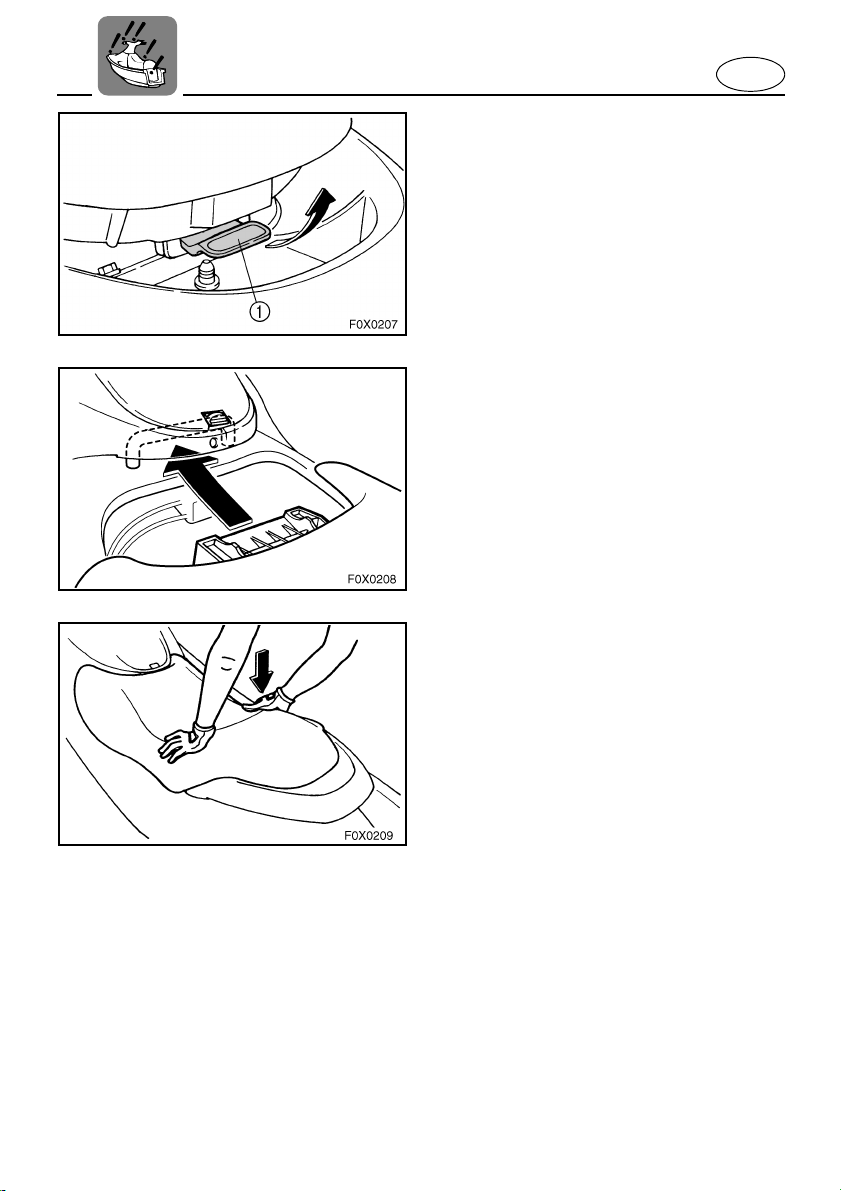
SEAT
There is a latch lever
1
at the rear of the
seat to remove the seat.
Removal
Pull the latch lever up, then lift the rear of the
seat, and pull back.
Installation
Position the seat on the deck so the front
projection of the seat fits into the stay on the
deck. Then push the rear of the seat down
until the seat latch locks securely.
Chap2.fm Page 5 Thursday, March 30, 2000 2:14 PM
2-6
E
EJU00703a
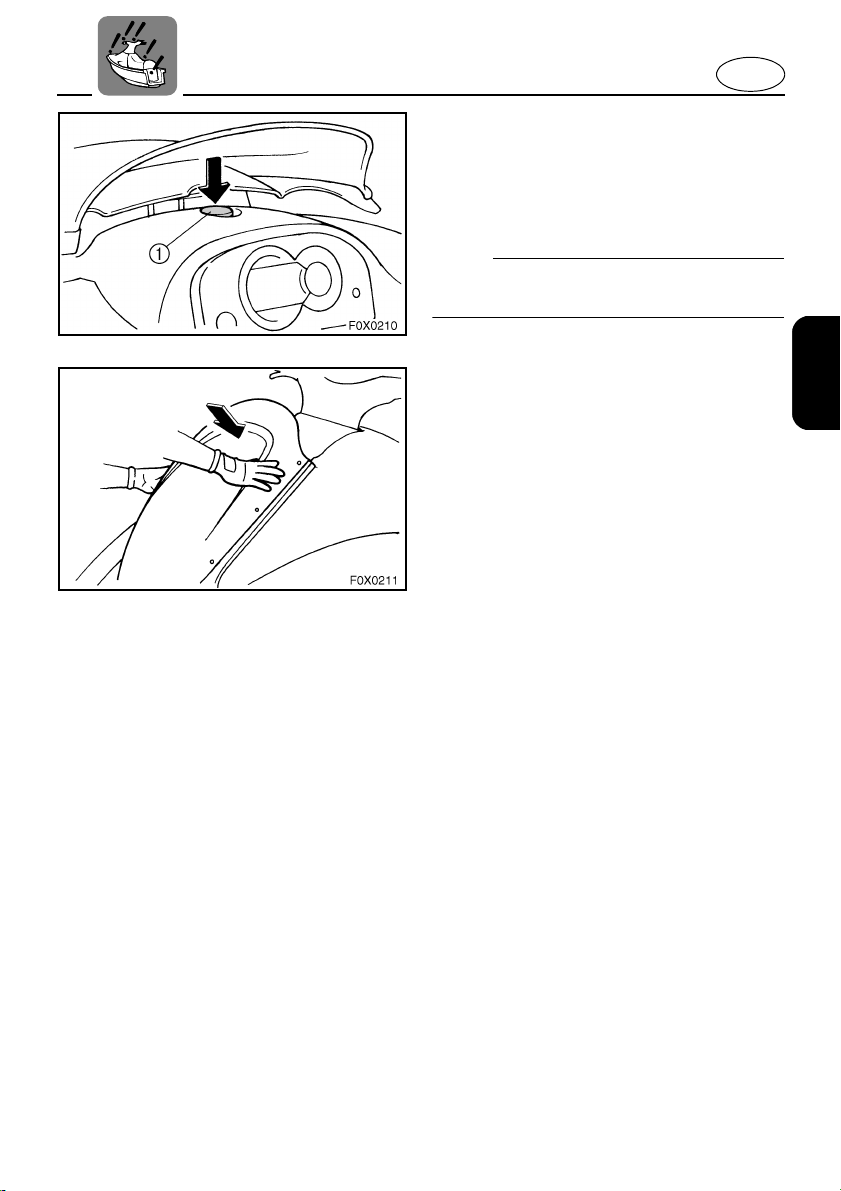
FRONT HOOD
The front hood is secured at the rear by one
latch. Push the latch button
1
to unlock the
hood and lift it to open.
N
O
TE:
Make sure the front hood is secured with the
latch before riding.
Chap2.fm Page 6 Thursday, March 30, 2000 2:14 PM
2-7
E
EJU00347a
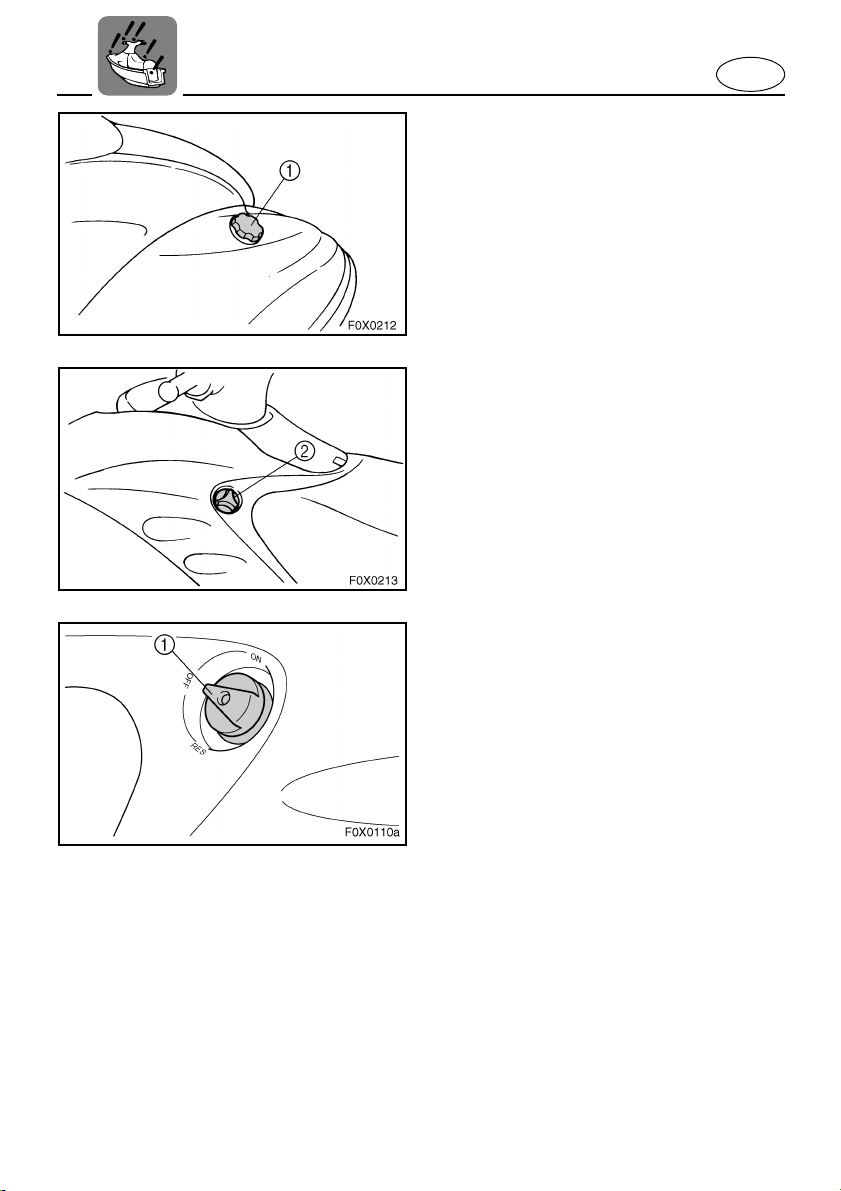
FUEL FILLER CAP
Turn the fuel filler cap
1
counterclockwise,
remove it and refill fuel.
Tighten the cap securely before operation.
OIL FILLER CAP
Turn the oil filler cap
2
counterclockwise,
remove it and refill oil.
Tighten the cap securely before operation.
EJU00704
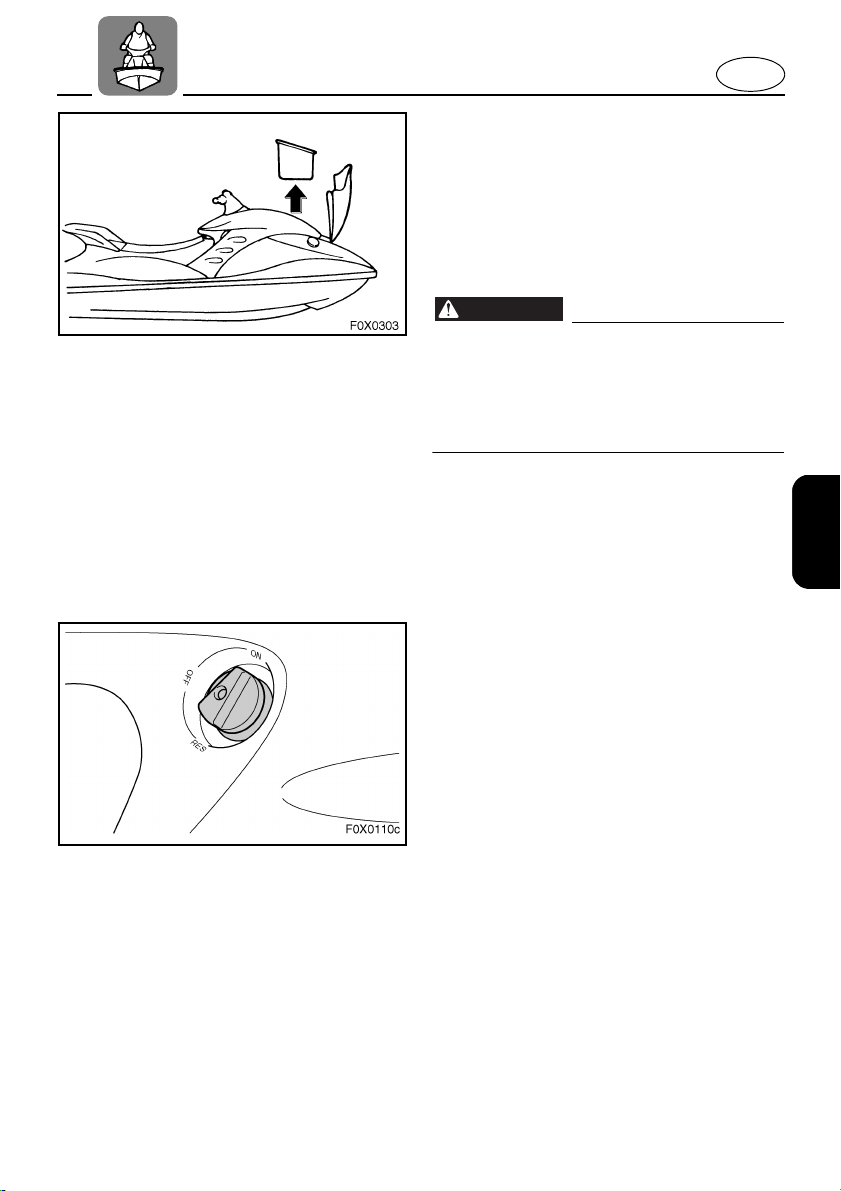
FUEL COCK
The fuel cock
1
supplies fuel from the fuel
tank to the carburetor.
The fuel cock has three positions;
OFF
With the knob in this position, fuel does not
flow. Always turn the knob to this position
when the engine is not running.
ON
With the knob in this position, fuel flows to
the carburetor. Normal running is done with
the knob in this position.
RES
If you run out of fuel in the
“ON”
position,
turn the knob to this position to be able to
continue for a short time.
Remember to FILL THE TANK AT THE
FIRST OPPORTUNITY.
After refueling, return the fuel cock knob to
the
“ON”
position for further riding.
Chap2.fm Page 7 Thursday, March 30, 2000 2:14 PM
2-8
E
EJU00705
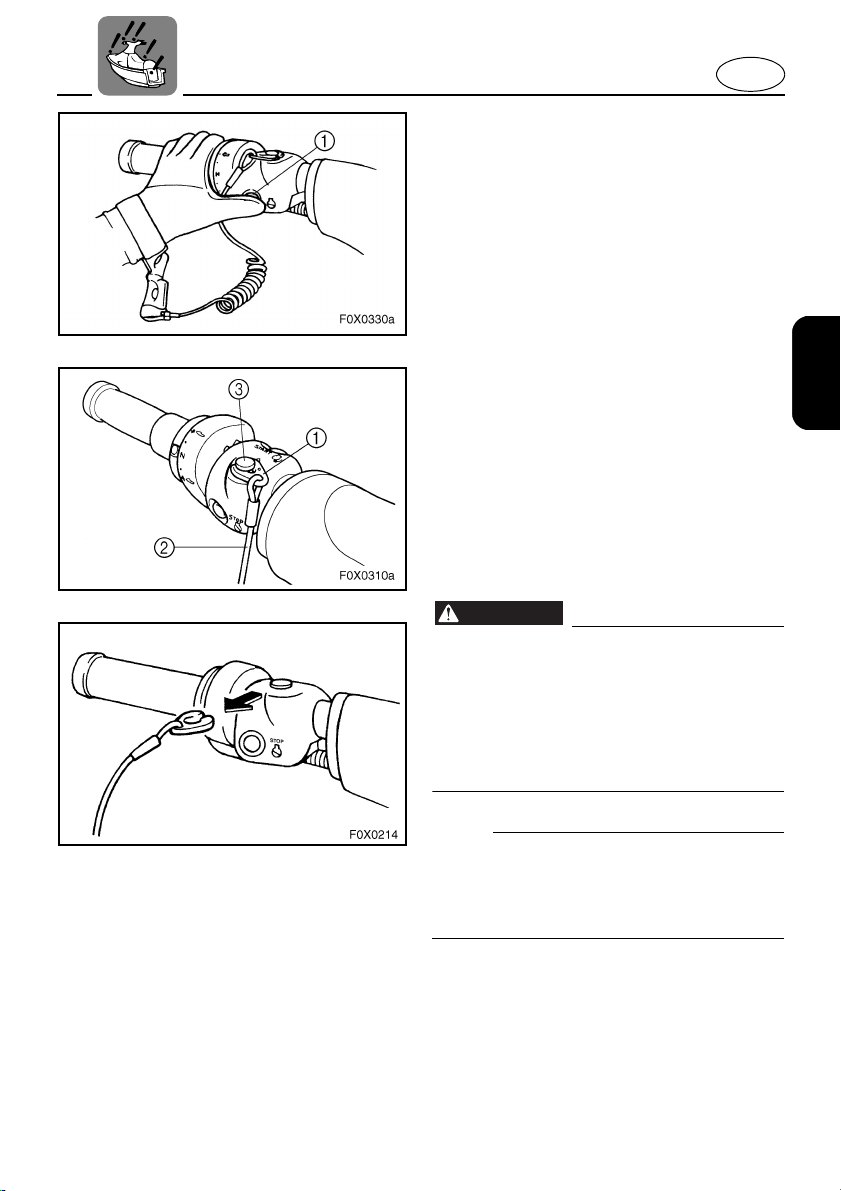
ENGINE STOP SWITCH
The engine can be stopped normally by
pressing the red button
1
.
EJU00706a
ENGINE STOP LANYARD SWITCH
The engine can be also stopped if you fall
off, or in case of an emergency, when the
lock plate
1
attached to the lanyard
2
is
pulled out from the engine stop lanyard
switch
3
.
Should the lock-plate be removed for any
reason, the engine stops by itself.
EWJ00048
WARNING
●
●●
● Always attach the engine stop switch
lanyard (cable) to your left wrist
BEFORE starting the engine.
●
●●
● To prevent accidental starting of the
engine, always remove the lock-plate
from the engine stop lanyard switch
when the engine is not running.
N
O
TE:
When the engine stop switch (red button) is
pushed without removing the lock-plate from
the engine stop lanyard switch, the engine
will stop.
Chap2.fm Page 8 Thursday, March 30, 2000 2:14 PM
2-9
E
EJU00350a
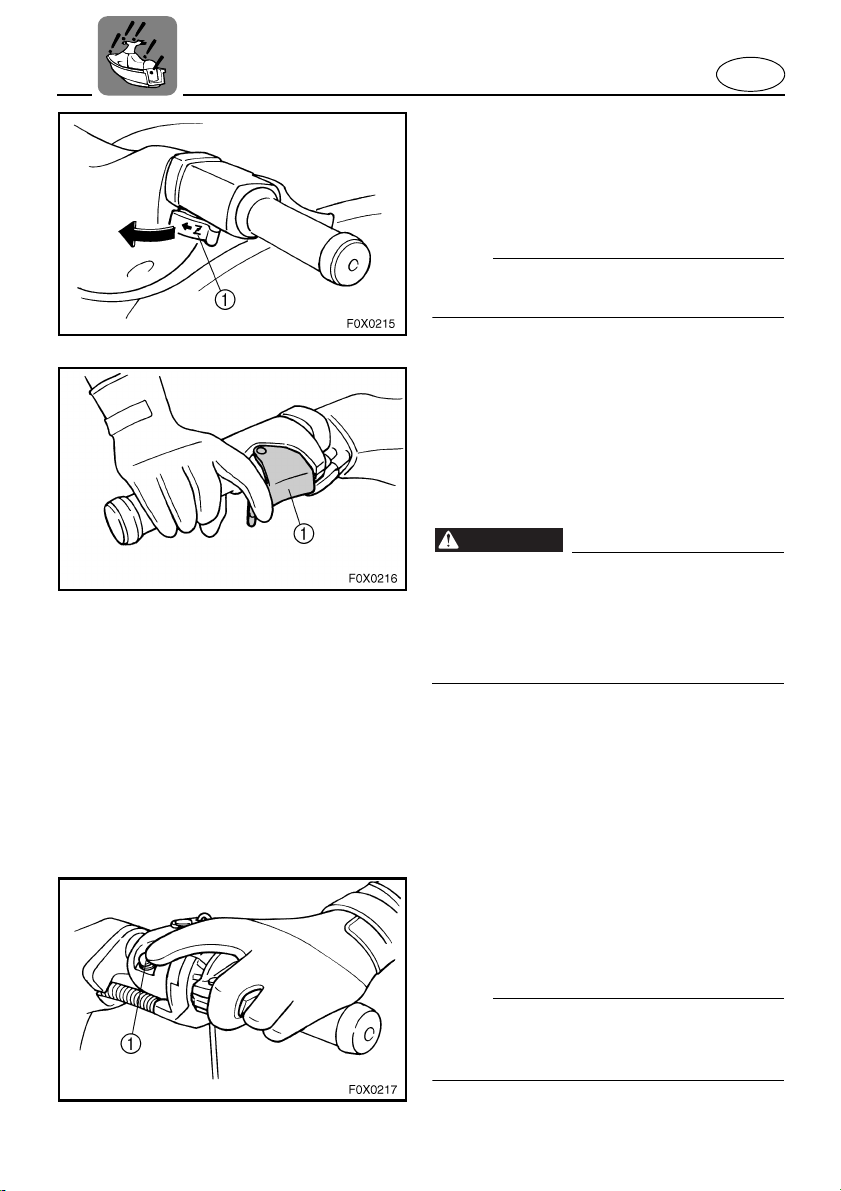
CHOKE LEVER
Turning the choke lever
1
fully on supplies
a rich air/fuel mixture required to start a cold
engine.
N
O
TE:
Refer to the “Starting the engine” section for
proper operation.
EJU00707a
THROTTLE LEVER
Squeezing the throttle lever
1
increases
engine speed. When the throttle lever is
released, it returns to its closed (idle) posi-
tion through the action of a return spring.
EWJ00049
WARNING
Before starting the engine, always check
the operation of the throttle lever. It
should move smoothly through its full
range of operation, and should spring
back to the idle position when released.
EJU00708a
ENGINE START SWITCH
You can start the engine by pushing the
green button
1
.
N
O
TE:
The engine will not start when the lock plate
is removed from the engine stop lanyard
switch. The starter motor will not turn.
Chap2.fm Page 9 Thursday, March 30, 2000 2:14 PM
2-10
E
EJU00709a
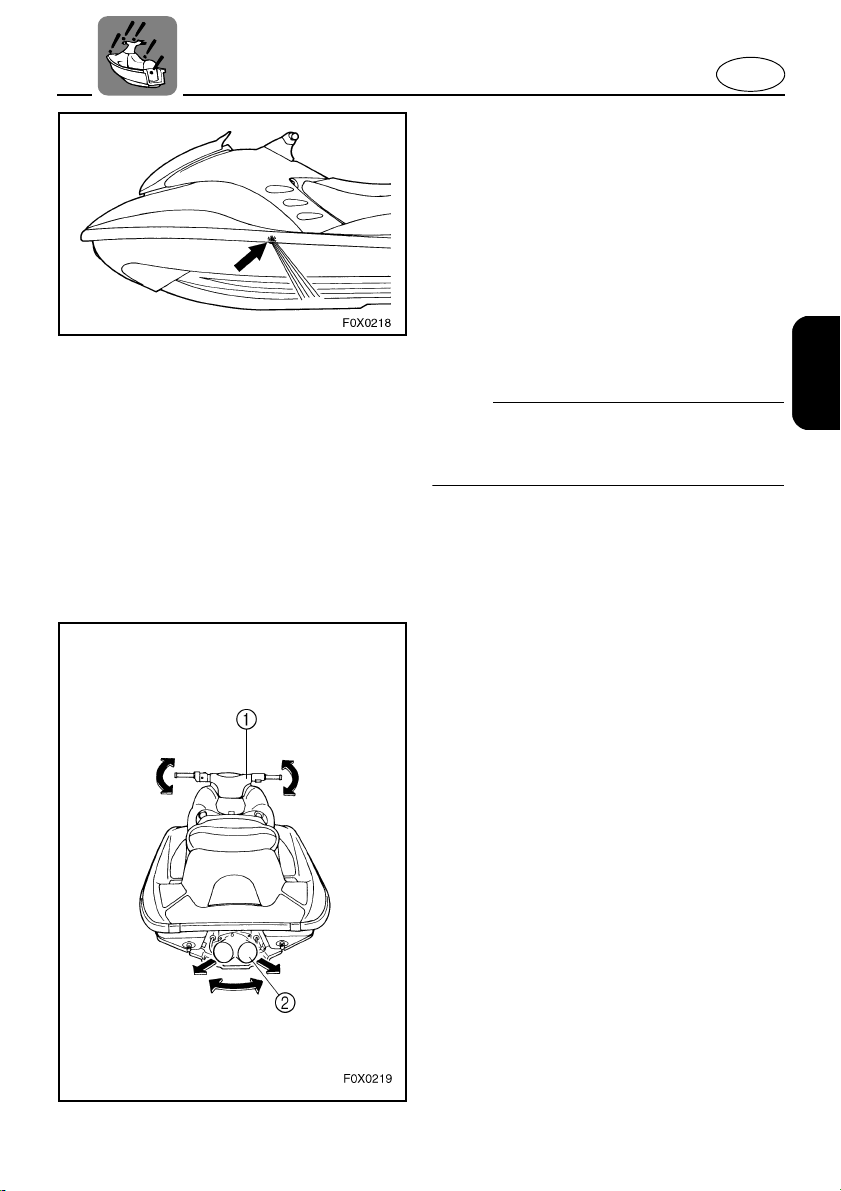
COOLING WATER PILOT OUTLET
This model is equipped with a cooling-water
pilot outlet(s) on the hull. Check that water
comes out of the outlet(s) while the engine
is running. If you do not see any water at the
outlet(s), cooling water may not be circulat-
ing in the engine.
In that case, stop the engine and check for
the cause (Refer to overheat warning sys-
tem).
N
O
TE:
If water cooling passages on the engine are
dry it will take about 20 seconds to reach
water at the outlet after starting.
EJU00356a
STEERING
Your water vehicle can be steered by turning
the handlebar
1
the same direction you
wish to travel, to the right or left. When the
handlebar is turned, the angle of the jet (out-
put) nozzle
2
at the stern is changed, and
the change in direction of the nozzle
changes the direction of the vehicle accord-
ingly. Therefore, because only the strength
of the jet-flow output can determine the
speed and direction of a turn, the throttle
must always be opened above idle when
attempting a turn, except at trolling speed.
Chap2.fm Page 10 Thursday, March 30, 2000 2:14 PM
2-11
E
EJU00360a
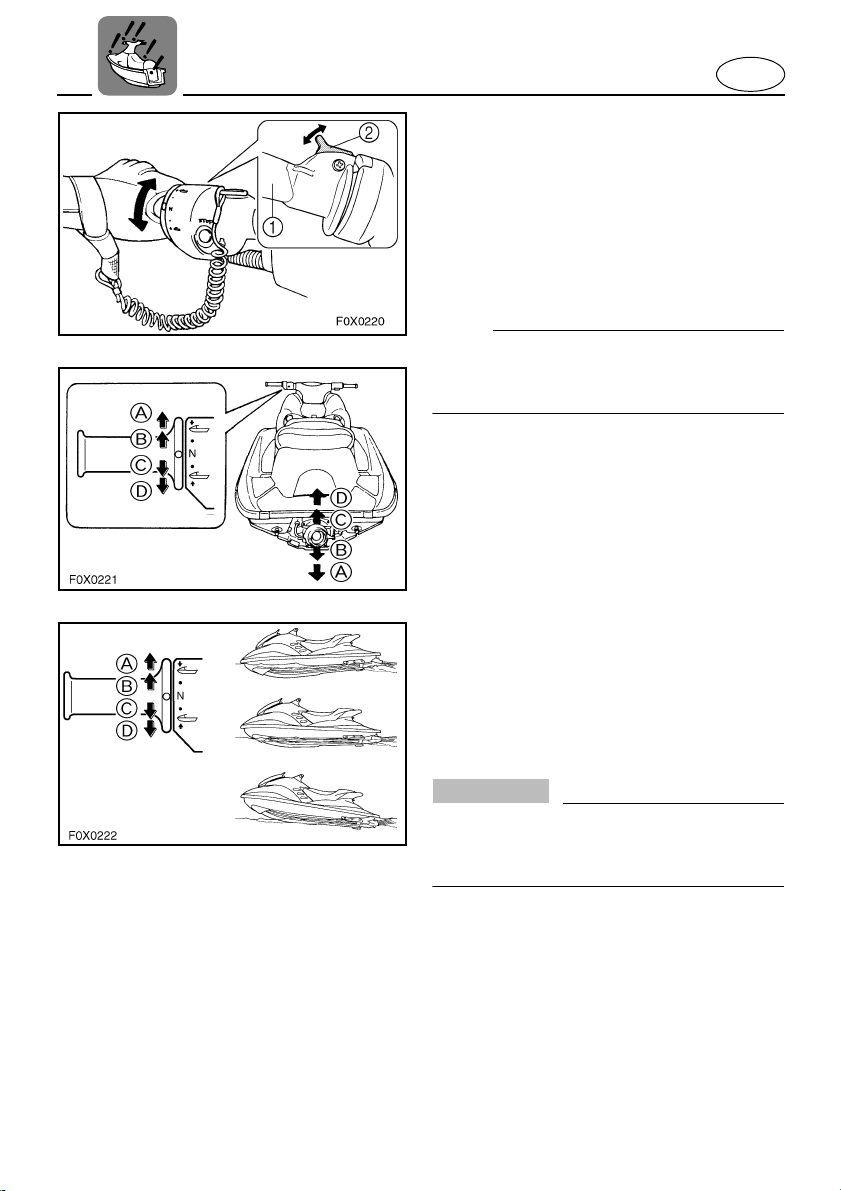
QSTS (Quick Shift Trim System)
The trim angle of your water vehicle can be
adjusted by operating the Q.S.T.S.
Operating the trim shifting grip
1
changes
the angle of the jet (output) nozzle at the
stern. The nozzle angle changes the trim
angle of the vehicle to one of five positions.
N
O
TE:
There are two positions
A
and
B
for bow
down, neutral “N”, and two positions
C
and
D
for bow up.
Changing the trim angle of the vehicle
1) Set the throttle lever to half open
(3,000 r/min) or less.
2) Squeeze and hold the shift lock lever
2
.
Then turn the trim shifting grip to the
desired position.
●
●●
●
Turning the grip to
A
or
B
from “N”:
Bow will go down while the vehicle is
on plane.
●
●●
●
Turning the grip to
C
or
D
from “N”:
Bow will go up while the vehicle is on
plane.
3) Release the shift lock lever to lock the
position.
ECJ00049
CAUTION:
Do not turn the trim shift grip while oper-
ating the vehicle at full throttle, otherwise
damage could occur to the Q.S.T.S.
The Neutral (“N”) shift position will provide
good performance for most conditions. To
enhance particular types of performance,
choose the one of the “Bow Down” or “Bow
Up” positions.
Chap2.fm Page 11 Thursday, March 30, 2000 2:14 PM

2-12
E
Shifting to “Bow Down”
“Bow Down” puts more of the bow in the
water. This gives the water vehicle more
“hook,” which enhances turning perfor-
mance. This position will also help the water
vehicle get up on plane more quickly. At
higher speeds, however, the water vehicle
will have greater tendency to “bow steer”
and follow waves and wakes in the water.
Fuel economy and maximum speed are also
reduced.
Shifting to “Bow Up”
“Bow Up” puts less of the bow in the water.
There is less water resistance, so straight-
ahead acceleration when on plane and top
speed are enhanced. In some conditions,
however, the vehicle may tend to “porpoise”
(hop in the water). If the vehicle is porpois-
ing, choose Neutral or Bow Down trim.
Chap2.fm Page 12 Thursday, March 30, 2000 2:14 PM
2-13
E
EJU00696a
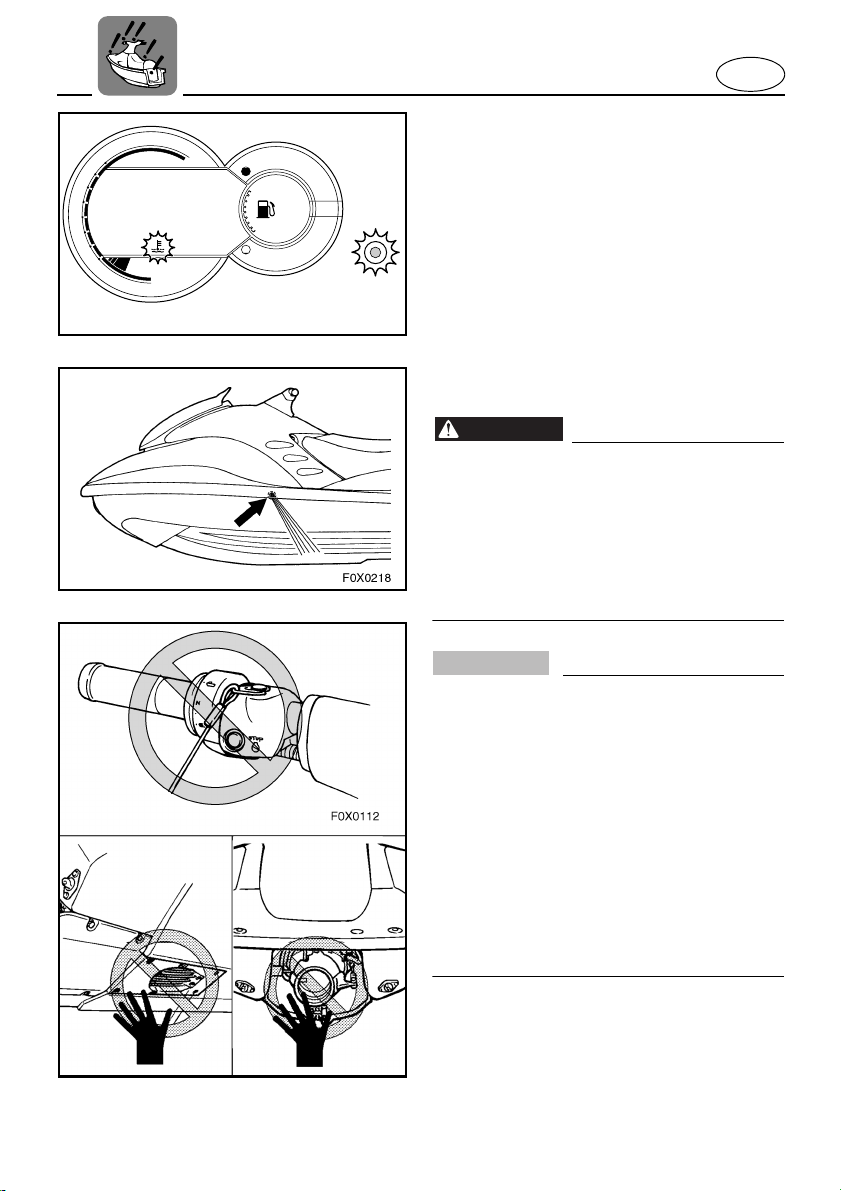
OVERHEAT WARNING SYSTEM
The engine has an overheat warning device.
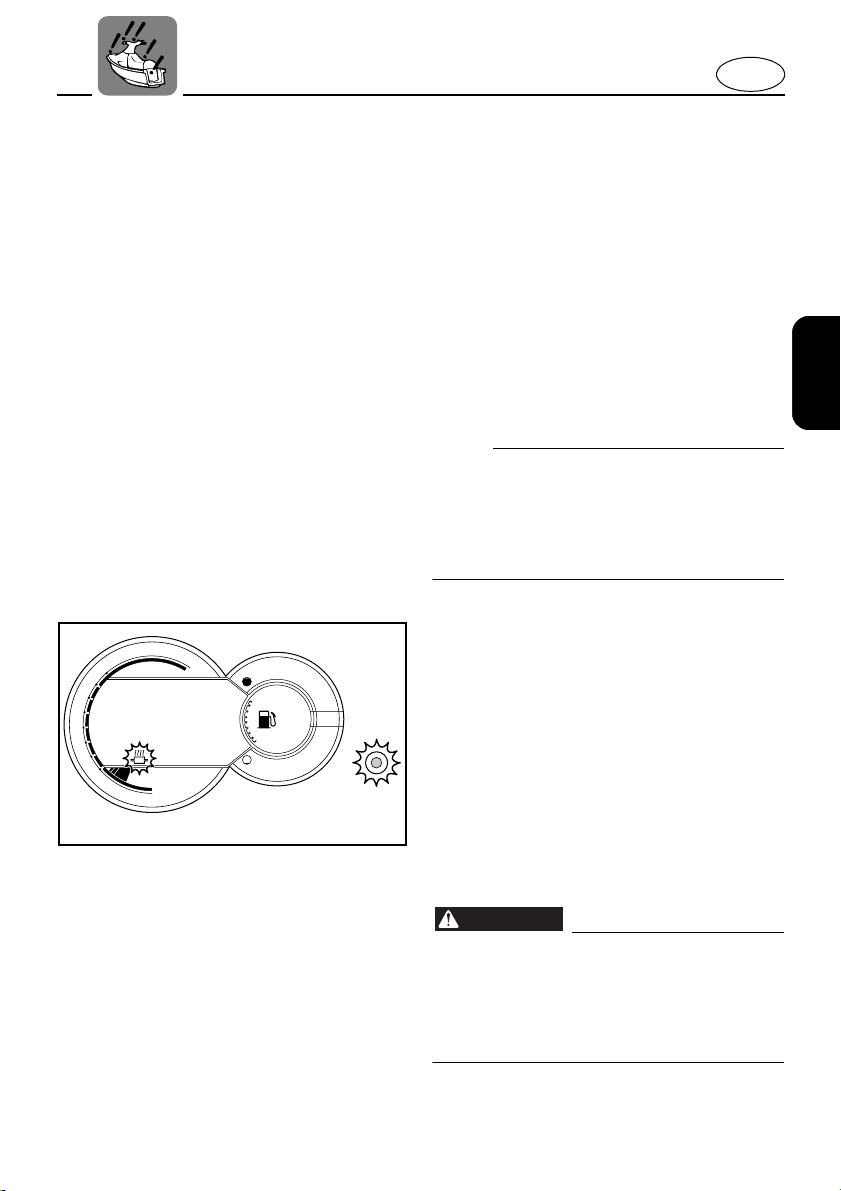
If the engine starts to overheat, the LED
warning lamp and water temparture symbol
begin to blink. Also, the buzzer sounds inter-
mittently. If this happens, reduce the engine
speed and return to beach at low speed. If
there is no water discharge at the cooling
water pilot outlet while the engine is running,
check the jet intake and impeller for clog-
ging.
EWJ00051a
WARNING
Before attempting to remove weeds or
debris from the jet intake or impeller
areas, shut off the engine and remove
the lock-plate from the engine stop lan-
yard switch. Severe injury or death could
result from coming in contact with the
rotating parts of the jet pump.
CAUTION:
This model is equipped with a catalytic
converter.
●
●●
● Return to shore at low speed if the LED
warning lamp and water temparture
symbol start blinking, and the buzzer
sounds intermittently. If you ignore
these signals, the engine will stop run-
ning and cannot be restarted until the
exhaust system cools.
●
●●
● Have your vehicle inspected and ser-
viced by a Yamaha water vehicle dealer
if the engine stopped due to overheat-
ing.
YAMAHA
8
7
6
5
4
3
2
1
MPH
FUEL
HOUR
x1000r/min
MULTI
DISPLAY
WARNING
F0X0235
Chap2.fm Page 13 Thursday, March 30, 2000 2:14 PM
2-14
E
If the initial overheat warning is ignored,
engine and exhaust system heat can
increase, particularly if the vehicle continues
to be operated at higher speed. If so, the
warning indicators and buzzer will change
from intermittent to constantly on and the
overheat system will stop ignition to the
engine to reduce the risk of severe over-
heating. The engine cannot be restarted
until it cools down, so it may be necessary to
have the vehicle towed back to the beach.
Refer to “Towing the Water Vehicle” on page
5-6.
N
O
TE:
●
●●
●
The buzzer stops sounding if the RESET
button is pressed.
●
●●
●
Ask a Yamaha water vehicle dealer to
inspect the vehicle if there is no apparent
reason for overheating.
EJU00697a
EXHAUST TEMPERATURE
WARNING SYSTEM
This engine has an exhaust temperature
warning device. If the exhaust temperature
gets too hot, the LED warning lamp and
exhaust temparture symbol begin to blink.
The buzzer also sounds intermittently. If this
happens, reduce engine speed and return to
the beach at low speed. Allow the exhaust
system to cool.
WARNING
Hot muffler surfaces can cause serious
burns. Do not touch any muffler surface
during or after engine operation. The cat-
alytic converter gets hotter after the
engine stops.
YAMAHA
8
7
6
5
4
3
2
1
MPH
FUEL
HOUR
x1000r/min
MULTI
DISPLAY
WARNING
F0X0236
Chap2.fm Page 14 Thursday, March 30, 2000 2:14 PM
2-15
E
CAUTION:
This model is equipped with a catalytic
converter. Return to shore at low speed
(below 4000 r/min) if the warning indica-
tors and buzzer are on. Have your vehicle
inspected and serviced by a Yamaha
water vehicle dealer if the engine
stopped due to overheating.
N
O
TE:
●
●●
●
The buzzer stops sounding if the RESET
button is pressed.
●
●●
●
Ask a Yamaha water vehicle dealer to
inspect the vehicle if there is no apparent
reason for overheating.
Chap2.fm Page 15 Thursday, March 30, 2000 2:14 PM
2-16
E
EJU00367a
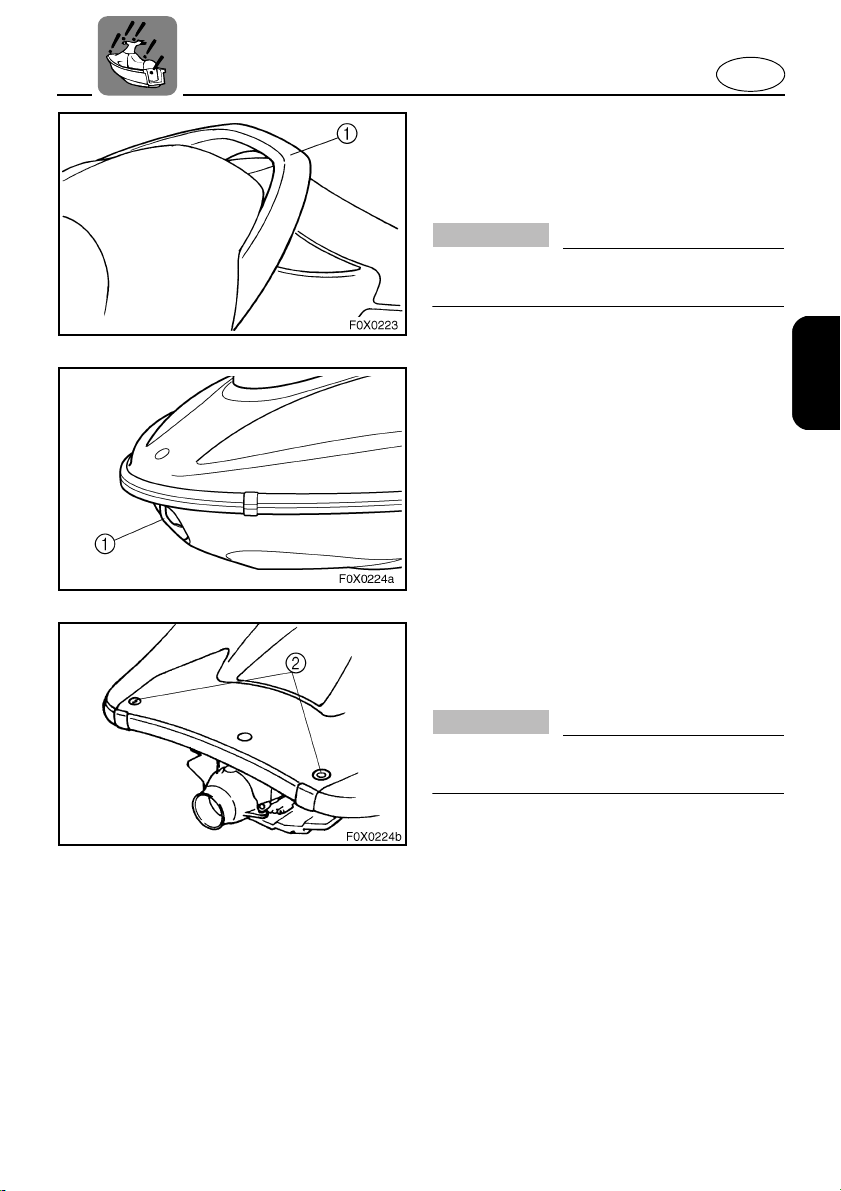
HANDGRIP
The handgrip
1
provides a handhold to use
while boarding the vehicle.
ECJ00051
CAUTION:
Do not use to tow objects, lift vehicle, or
attach tie downs. Damage could occur.
EJU00368a
BOW EYE
The bow eye
1
is designed for mooring or
towing the watercraft or securing it to a
trailer.
ROPE HOLE(S)
The rope hole(s)
2
is designed for mooring
the watercraft or securing it to a trailer.
ECJ00052a
CAUTION:
Do not use the rope hole(s) to lift the
vehicle. Damage could occur.
Chap2.fm Page 16 Thursday, March 30, 2000 2:14 PM
2-17
E
EJU00698a
MULTIFUNCTION INFORMATION
CENTER
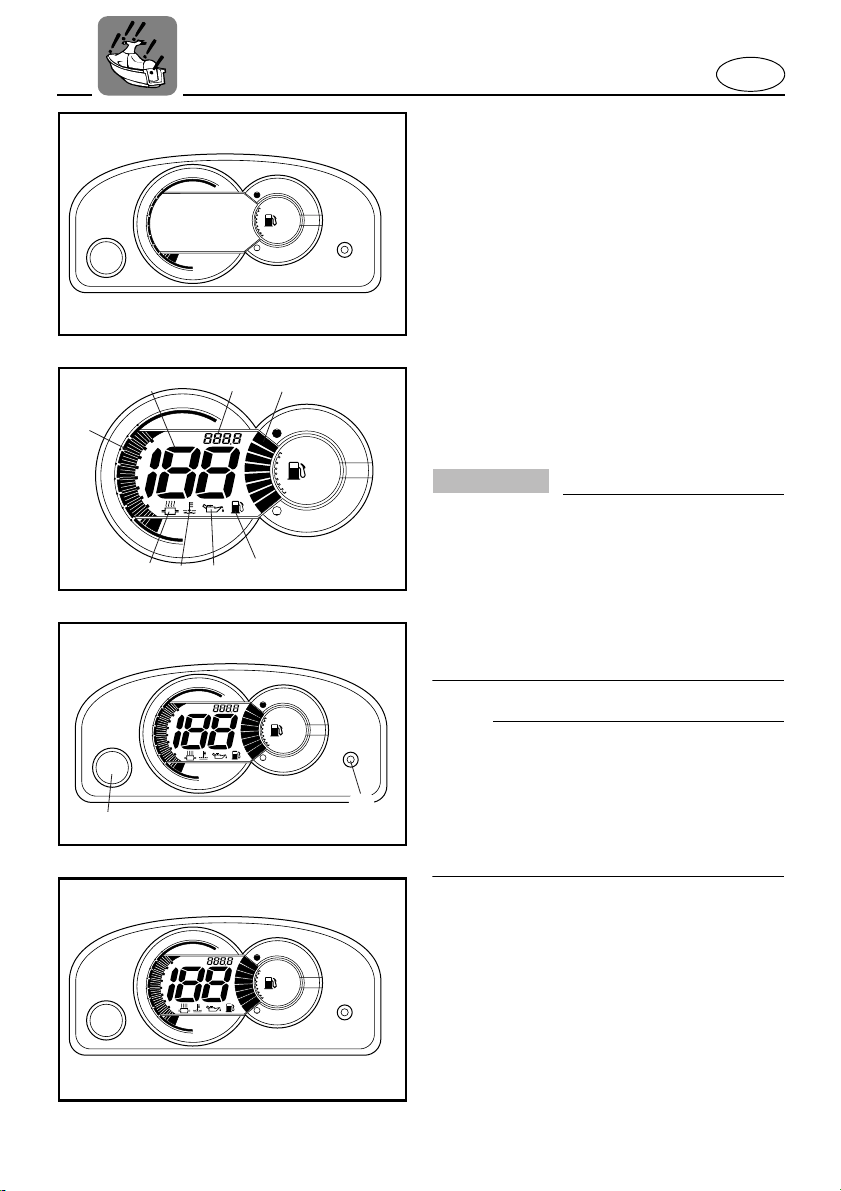
This meter contains following functions for
the help and convenience of operation.
1
Tachometer
2
Speedometer
3
Fuel meter
4
Hour meter
5
LED warning lamp
6
Exhaust temperature warning indicator
7
Oil warning indicator
8
Overheat warning indicator
9
Fuel warning indicator
0
Reset button
CAUTION:
●
●●
● Do not run the engine over 4,000 r/min
to check the meter for operation on
land. The engine could overheat or the
catalytic converter could result in seri-
ous damage.
●
●●
● Use the specified resistor-type spark
plug and cap, otherwise the meter may
function erratically.
N
O
TE:
All display light up and the buzzer sounds
twice after the engine starts. Then, the
meter will operate normally after few sec-
onds. The current display will continue to
operate for 30 seconds after the engine
stops.
RESET
WARNING
YAMAHA
8
7
6
5
4
3
2
1
MPH
FUEL
HOUR
x1000r/min
MULTI
DISPLAY
F0X0225a
F0X0226
YAMAHA
8
7
6
5
4
3
2
1
MPH
FUEL
HOUR
x1000r/min
MULTI
DISPLAY
1
2
3
4
6
7
8
9
RESET
WARNING
YAMAHA
8
7
6
5
4
3
2
1
MPH
FUEL
HOUR
x1000r/min
MULTI
DISPLAY
F0X0227
>
5
RESET
WARNING
YAMAHA
8
7
6
5
4
3
2
1
MPH
FUEL
HOUR
x1000r/min
MULTI
DISPLAY
F0X0225
Chap2.fm Page 17 Thursday, March 30, 2000 2:14 PM
2-18
E
EJU00383
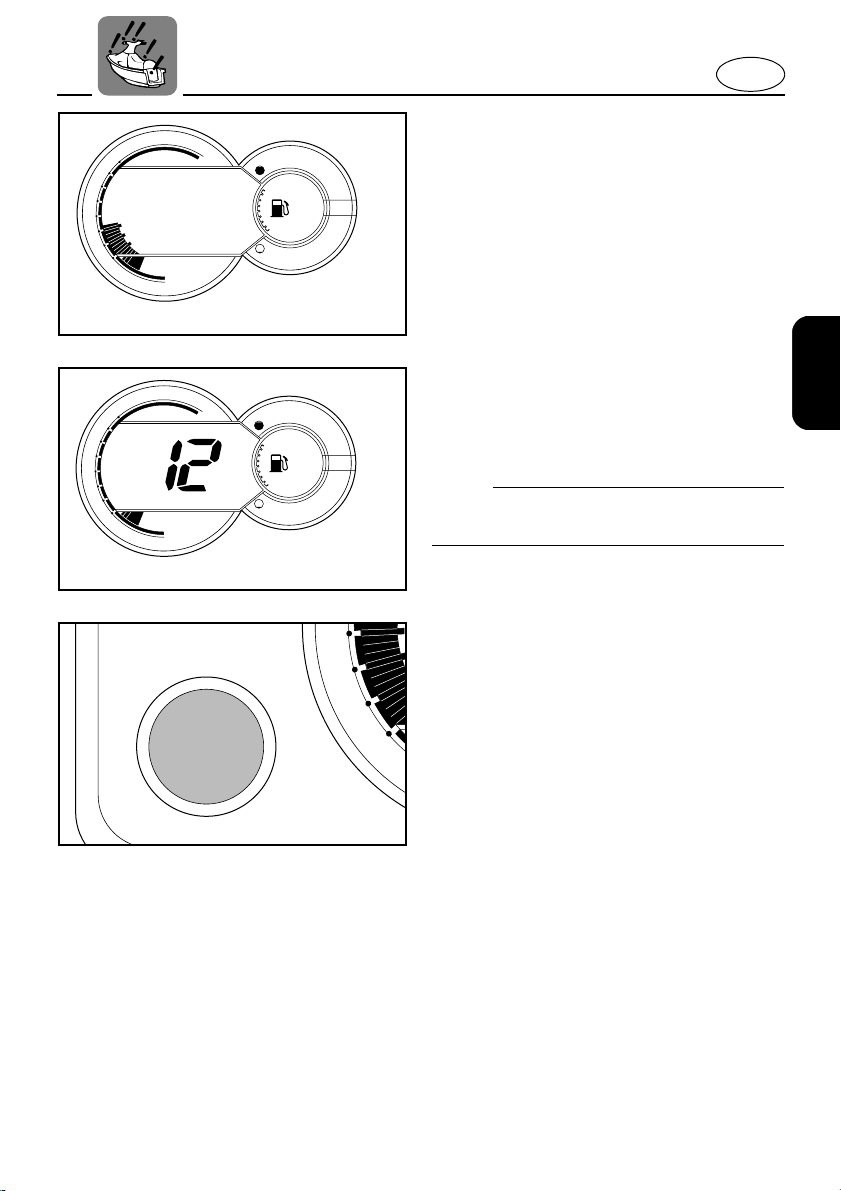
Tachometer
The engine speed (r/min) is displayed by seg-
ments. Each segment indicates a 250 r/min
increment.
EJU00384a
Speedometer
The meter shows the vehicle speed against
water.
N
O
TE:
If the speedometer malfunctions, “_ _” dis-
play will blink.
RESET button
Pushing the RESET button stops sounding
the buzzer.
YAMAHA
8
7
6
5
4
3
2
1
MPH
FUEL
HOUR
x1000r/min
MULTI
DISPLAY
F0X0228
YAMAHA
8
7
6
5
4
3
2
1
MPH
FUEL
HOUR
x1000r/min
MULTI
DISPLAY
F0X0229
F0X0230
RESET
4
3
2
1
Chap2.fm Page 18 Thursday, March 30, 2000 2:14 PM
2-19
E
YAMAHA
8
7
6
5
4
3
2
1
MPH
FUEL
HOUR
x1000r/min
MULTI
DISPLAY
F0X0232
EJU00386a
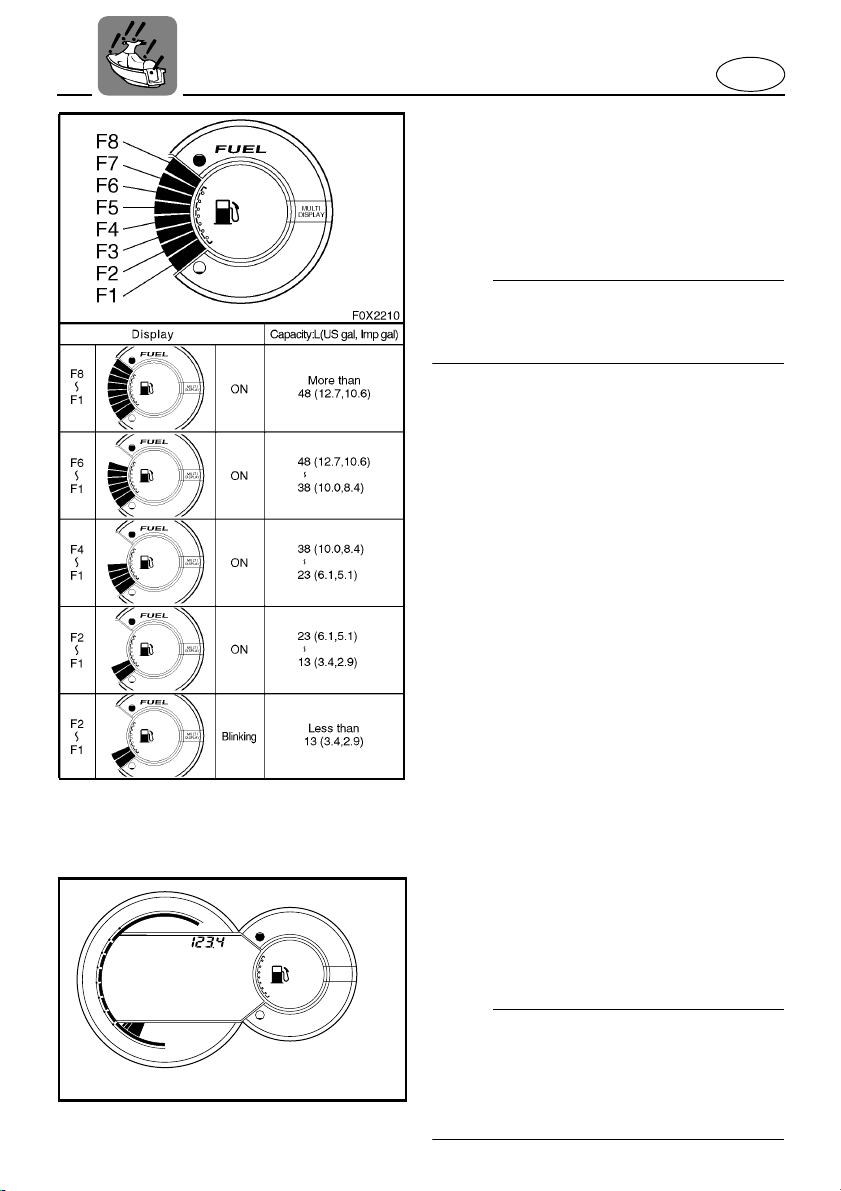
Fuel meter
The fuel meter is provided for convenient
fuel level checking while riding. The fuel
meter has eight segments which show the
amount of fuel remaining in the fuel tank.
N
O
TE:
The indication of the segments differs on
your operating condition. Use the meter as a
reference.
EJU00390a
Hour meter
The hour meter is provided to make it easy
to follow the maintenance schedule. The
meter shows the hours of engine operation
that have elapsed since the vehicle was
new.
N
O
TE:
●
●●
●
The elapsed time will be kept even if the
battery terminals have been discon-
nected.
●
●●
●
If the hour meter malfunctions, “____”
display and LED warning lamp will blink.
Chap2.fm Page 19 Thursday, March 30, 2000 2:14 PM
2-20
E
EJU00716a
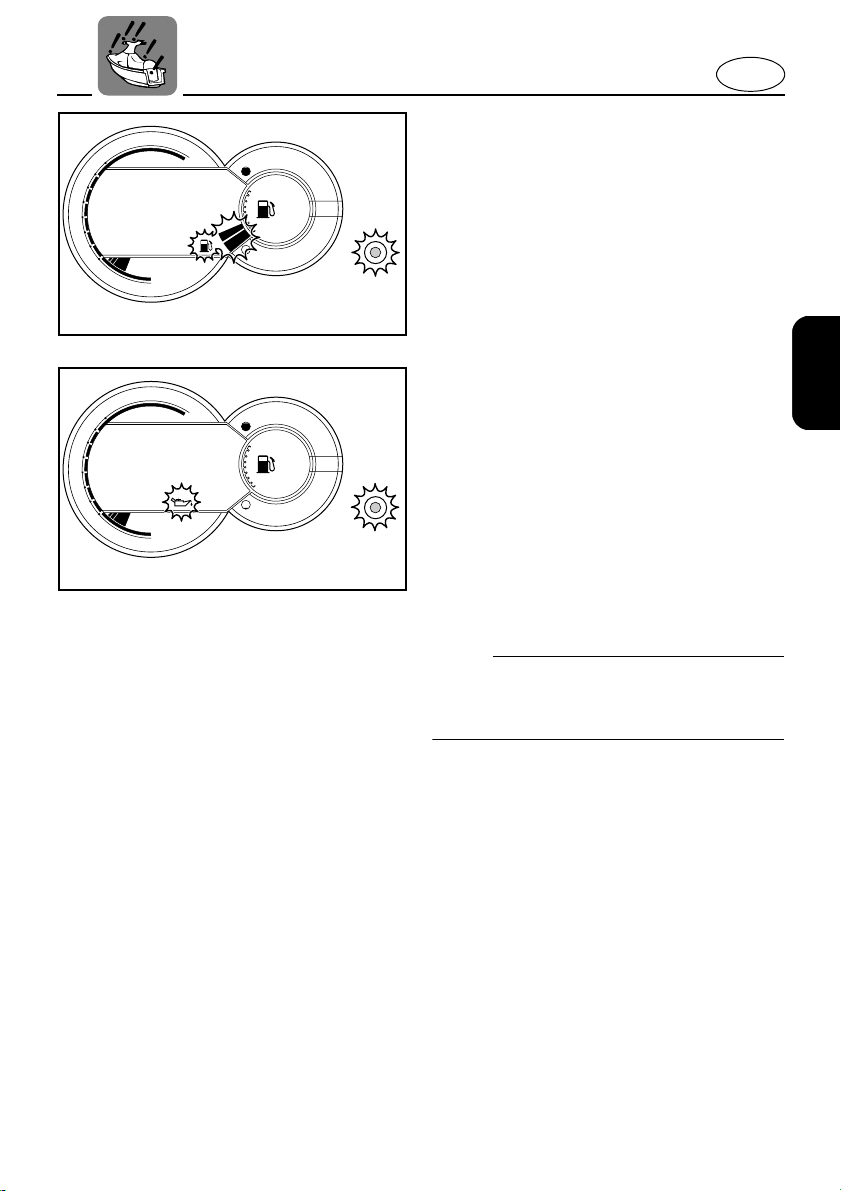
Fuel warning indicator
If the fuel remaining in the tank drops to
about 13 L (3.4 US gal, 2.9 lmp gal), the
lowest two fuel level segments, the fuel sym-
bol and LED warning lamp begin to blink.
The buzzer also starts sounding intermit-
tently.
The warning signals will be cleared when
the engine restarts after refilling fuel.
EJU00717a
Oil warning indicator
If the oil remaining in the tank drops to about
1.7 L (0.45 US gal, 0.37 lmp gal) or the oil
filter is clogged, the oil symbol and LED
warning lamp begin to blink. The buzzer also
starts sounding intermittently.
If the oil warning indicators begin to blink,
refill with engine oil as soon as possible.
The warning signals will be cleared when
the engine restarts after refilling engine oil.
N
O
TE:
If the warning indicators blink with adequate
oil in the tank, check the oil filter for clog-
ging.
YAMAHA
8
7
6
5
4
3
2
1
MPH
FUEL
HOUR
x1000r/min
MULTI
DISPLAY
WARNING
F0X0233
YAMAHA
8
7
6
5
4
3
2
1
MPH
FUEL
HOUR
x1000r/min
MULTI
DISPLAY
WARNING
F0X0234
Chap2.fm Page 20 Thursday, March 30, 2000 2:14 PM
2-21
E
EJU00718a
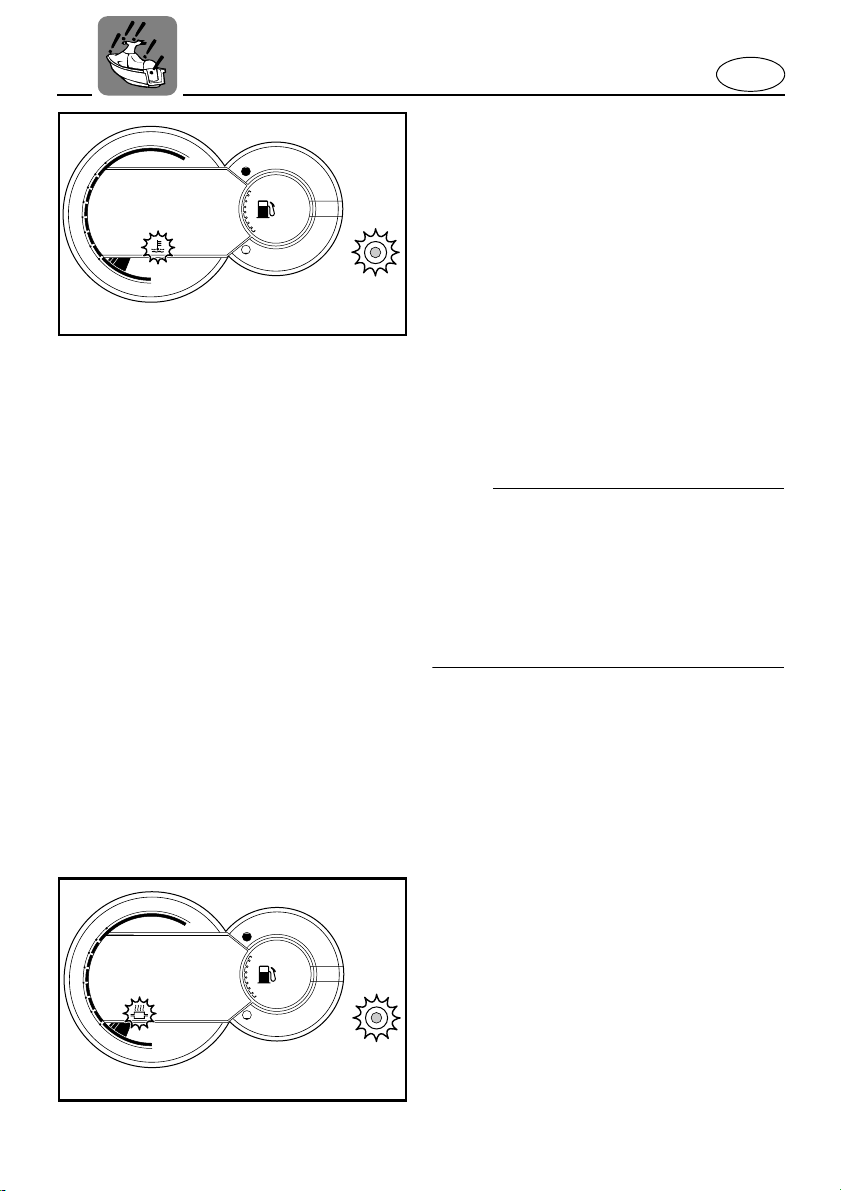
Overheat warning indicator
If the engine starts to overheat, the water
temparture symbol and LED warning lamp
begin to blink. The buzzer also starts sound-
ing intermittently.
If the engine continues to be operated at
higher speed after the warning system indi-
cators have come on intermittently, these
indicators will change to being on continu-
ously. Also, the engine will stop and the
buzzer will sound continuously. Refer to
“Overheat Warning System” on page 2-13.
The warning signals will be cleared when
the engine restarts after the engine cools.
N
O
TE:
When the warnings overlap each other, their
priority is as follows.
1. Final overheat
2. Fuel
3. Oil
4. Initial overheat
5. Exhaust temperature
EJU00720a
Exhaust temperature warning indicator
If the exhaust system becomes too hot, the
exhaust temperature symbol and LED warn-
ing lamp begine to blink. Also, the buzzer will
start sounding intermittently. Refer to
“Exhaust temperature warning system” on
page 2-14.
The warning signals will be cleared when the
engine restarts after the engine cools.
YAMAHA
8
7
6
5
4
3
2
1
MPH
FUEL
HOUR
x1000r/min
MULTI
DISPLAY
WARNING
F0X0235
YAMAHA
8
7
6
5
4
3
2
1
MPH
FUEL
HOUR
x1000r/min
MULTI
DISPLAY
WARNING
F0X0236
Chap2.fm Page 21 Thursday, March 30, 2000 2:14 PM
2-22
E
EJU00721a
STORAGE COMPARTMENTS
The storage compartment(s) is provided to
store the manuals, tools, and other equip-
ment for cruising.
Make sure all storage compartments are
firmly secured before riding.
N
O
TE:
The storage compartment(s) is not designed
to be waterproof. If you put the manuals in
the compartment(s), store them in a water-
proof bag to protect them from water dam-
age.
If your owner’s manual becomes damaged,
order a replacement from a Yamaha water
vehicle dealer.
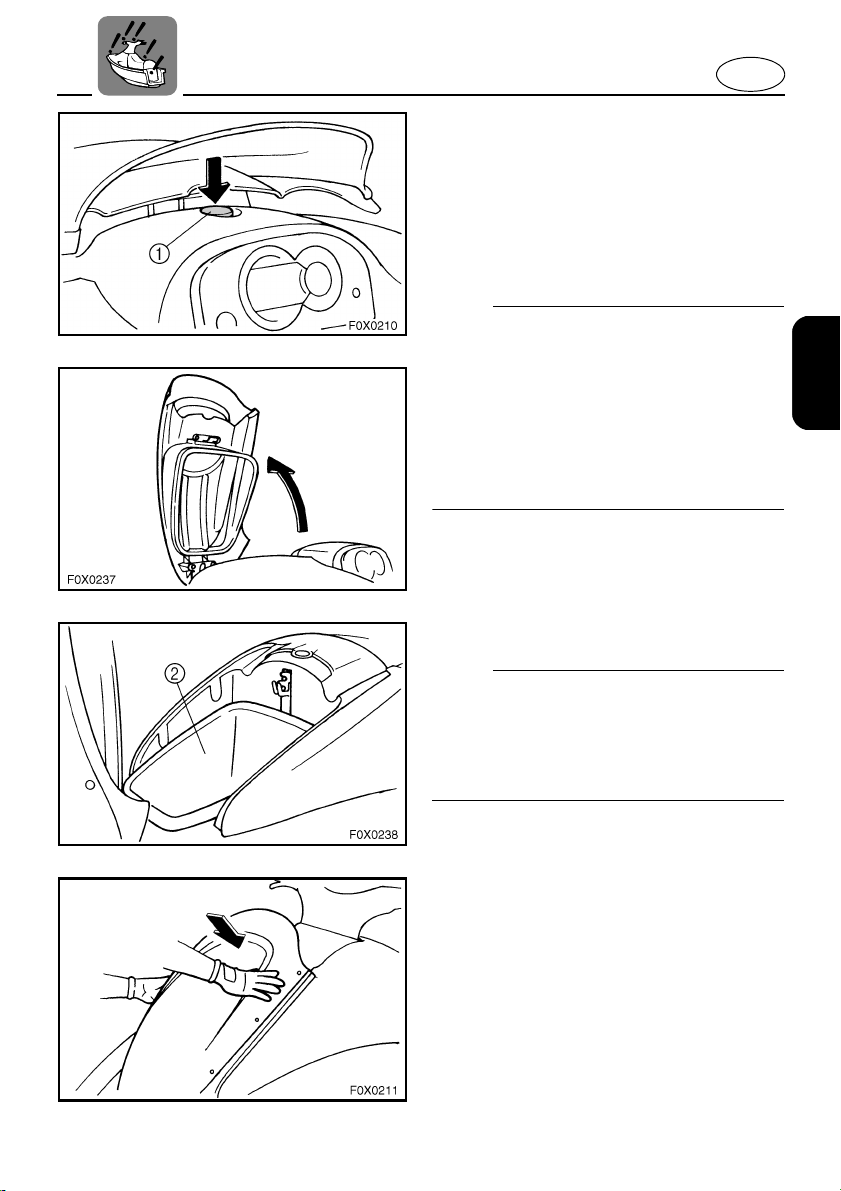
Front storage compartment
A front storage compartment is provided
under the front hood.
Push the latch button
1
to open the front
hood.
N
O
TE:
●
●●
●
Front storage compartment
2
Capacity: 16 L (4.2 US gal, 3.5 Imp gal)
Load limit: 5 kg (11 lb)
●
●●
●
The front storage compartment can be
removed to access the engine room.
Push down the rear of the front hood until it
locks securely.
Chap2.fm Page 22 Thursday, March 30, 2000 2:14 PM
2-23
E
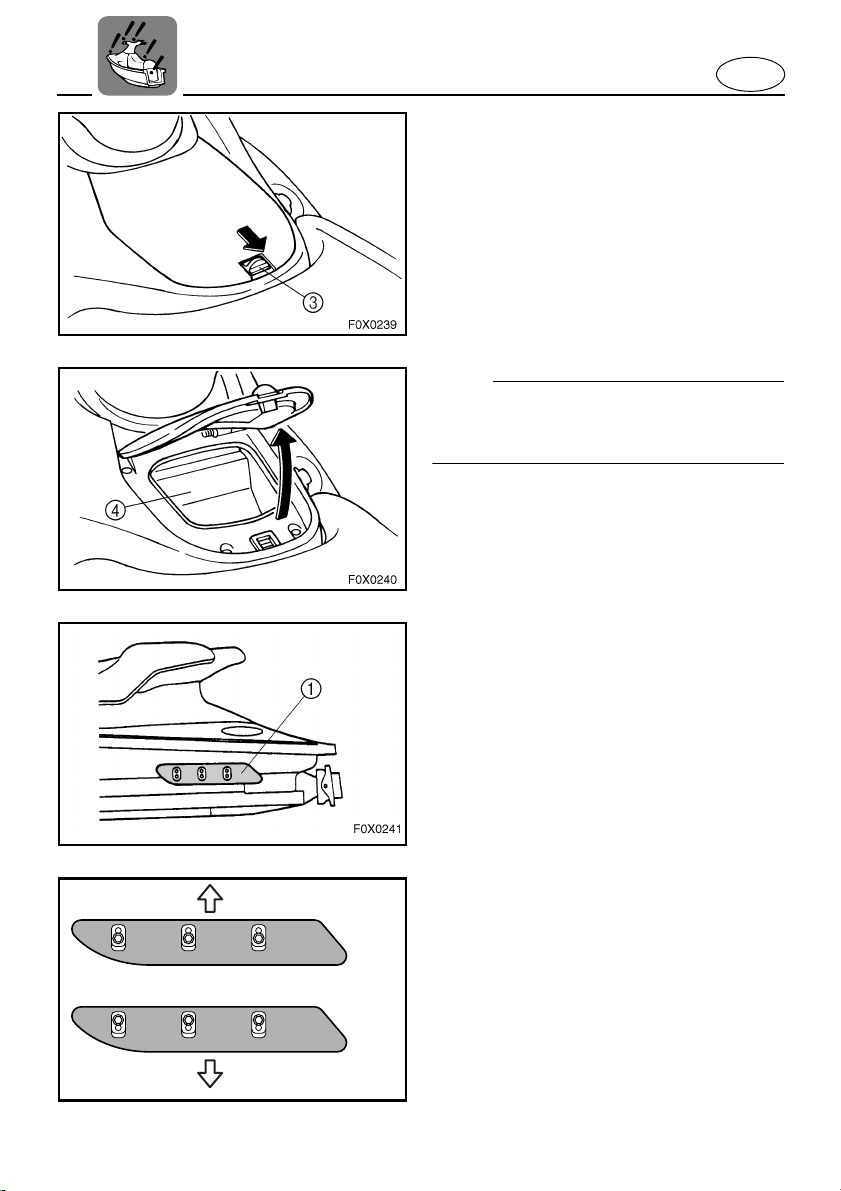
Grove compartment
A grove compartment is provided in front of
the seat. Slide the latch
3
to open the com-
partment lid. To close the lid, push it down
until it locks securely.
N
O
TE:
Grove compartment
4
Capacity: 2 L (0.53 US gal, 0.44 Imp gal)
Load limit: 1 kg (2.2 lb)
YAS (Yamaha Adjustable Sponsons)
The YAS
1
have adjustable positioning to
allow the operator to enhance either
straight-line performance or turning perfor-
mance according to the preference and
operating conditions.
●
●●
● Adjusting upward A
There will be less water resistance in this
position, so straight-ahead acceleration
when on plane and top speed will be
enhanced.
●
●●
● Adjusting downward B
This position will give the water vehicle more
“hook” which will enhance turning perfor-
mance.
A
B
F0X0242
Chap2.fm Page 23 Thursday, March 30, 2000 2:14 PM
E
3
EJU00410
Chapter 3
OPERATION AND
RIDING
FUEL AND ENGINE OIL FILLING
........3-1
Filling the fuel tank.............................3-1
Filling the oil tank ...............................3-2
PRE-OPERATION CHECKS
.................3-3
Check point........................................3-4
OPERATION
..........................................3-9
Break-in (running-in) procedure.........3-9
Starting the engine...........................3-11
Stopping the engine.........................3-13
RIDING YOUR WATER VEHICLE
......3-14
Getting to know your water vehicle..3-14
Learning to ride your water vehicle..3-14
Riding with passenger......................3-15
Starting.............................................3-16
Boarding and starting in deep
water ................................................3-17
Load limit..........................................3-19
Capsized water vehicle....................3-20
Turning.............................................3-21
Stopping...........................................3-22
Beaching..........................................3-23
Docking............................................3-23
Rough water operation.....................3-24
POST-OPERATION CHECKS
.............3-25
Transportation..................................3-27
Chap3TOC.fm Page 1 Thursday, March 30, 2000 2:16 PM
3-1
E
EJU00411a
FUEL AND ENGINE
OIL FILLING
This engine uses Yamaha’s oil injection sys-
tem, which provides superior lubrication by
ensuring the proper oil ratio for all operating
conditions. No fuel premixing is necessary
(except during break-in / running-in). Simply
pour fuel into the fuel tank and oil into the oil
tank.
EJU00722a
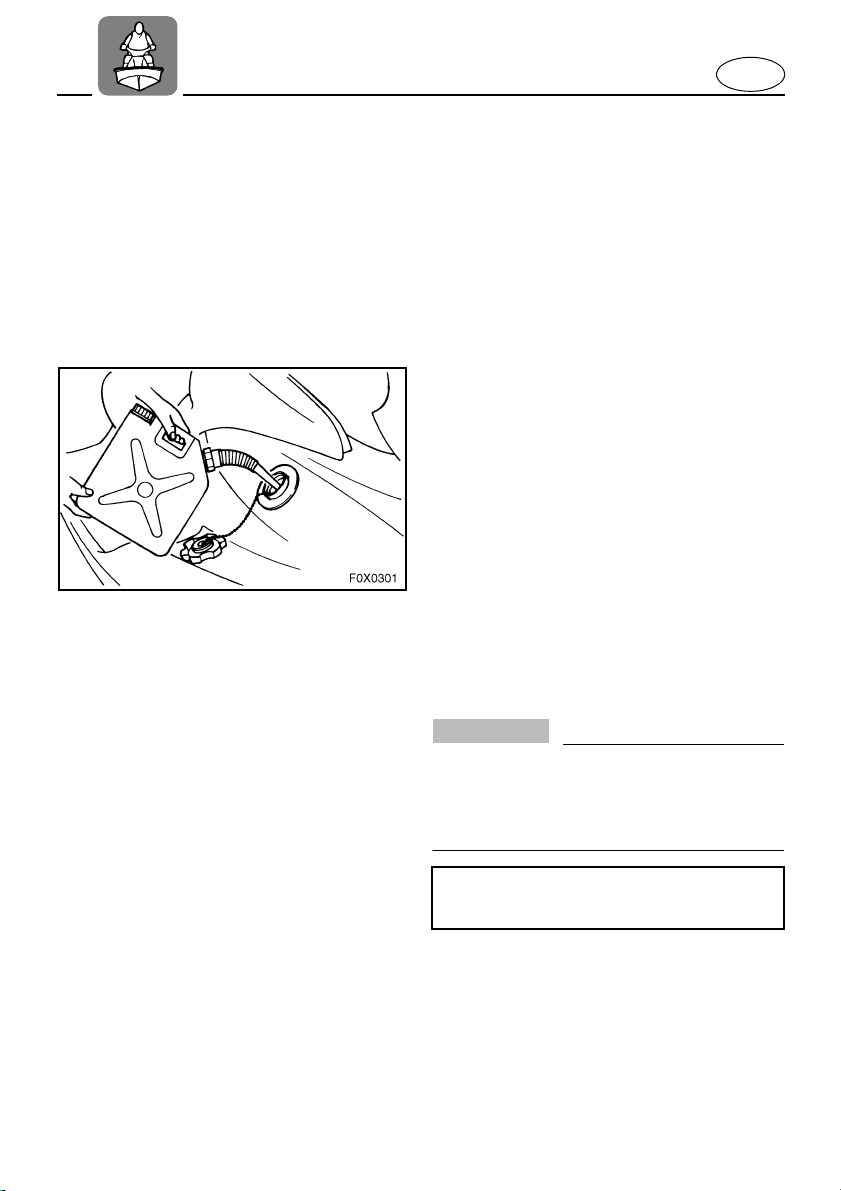
FILLING THE FUEL TANK
1) Open the front hood and remove the
front storage compartment, to check the
fuel level.
2) Remove the fuel filler cap, and slowly
add fuel to the fuel tank. Be careful not
to spill fuel or overfill the tank.
3) Stop filling when the fuel just reaches
the bottom of the filler tube on the fuel
tank. Do not fill into the filler tube,
because fuel could spill out.
ECJ00058
CAUTION:
Be careful when refueling. Avoid getting
water or other contaminants in the fuel
tank. Contaminated fuel can cause poor
running or engine damage.
Fuel tank capacity:
60 L (15.9 US gal, 13.2 Imp gal)
Chap3.fm Page 1 Thursday, March 30, 2000 2:17 PM
3-2
E
EJU00723a
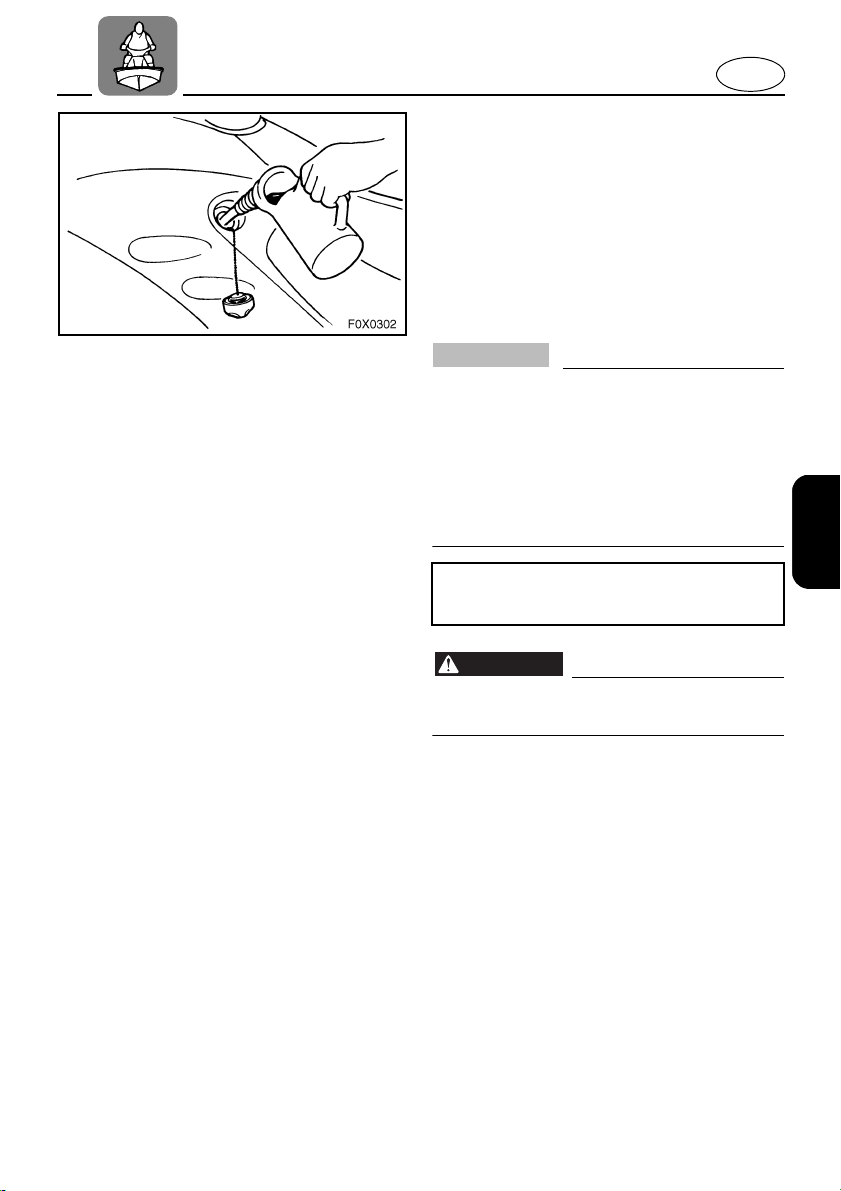
FILLING THE OIL TANK
1) Open the front hood and remove the
front storage compartment, and remove
the seat, so you can watch the oil level.
2) Remove the oil filler cap, and very
slowly add engine oil to the oil tank.
3) Stop pouring when the oil just reaches
the bottom of the filler tube.
ECJ00060
CAUTION:
Do not allow the oil tank to empty com-
pletely. The oil injection pump must be
bled to ensure proper oil flow after the
tank empties. Otherwise, engine damage
may occur. If bleeding of the oil pump is
necessary, take the water vehicle to your
nearest Yamaha dealer.
EWJ00052
WARNING
Oil in the bilge is a serious fire hazard.
Wipe up any spilled oil immediately.
Oil tank capacity:
5.5 L (1.45 US gal, 1.21 Imp gal)
Chap3.fm Page 2 Thursday, March 30, 2000 2:17 PM
3-3
E
EJU00422
PRE-OPERATION CHECKS
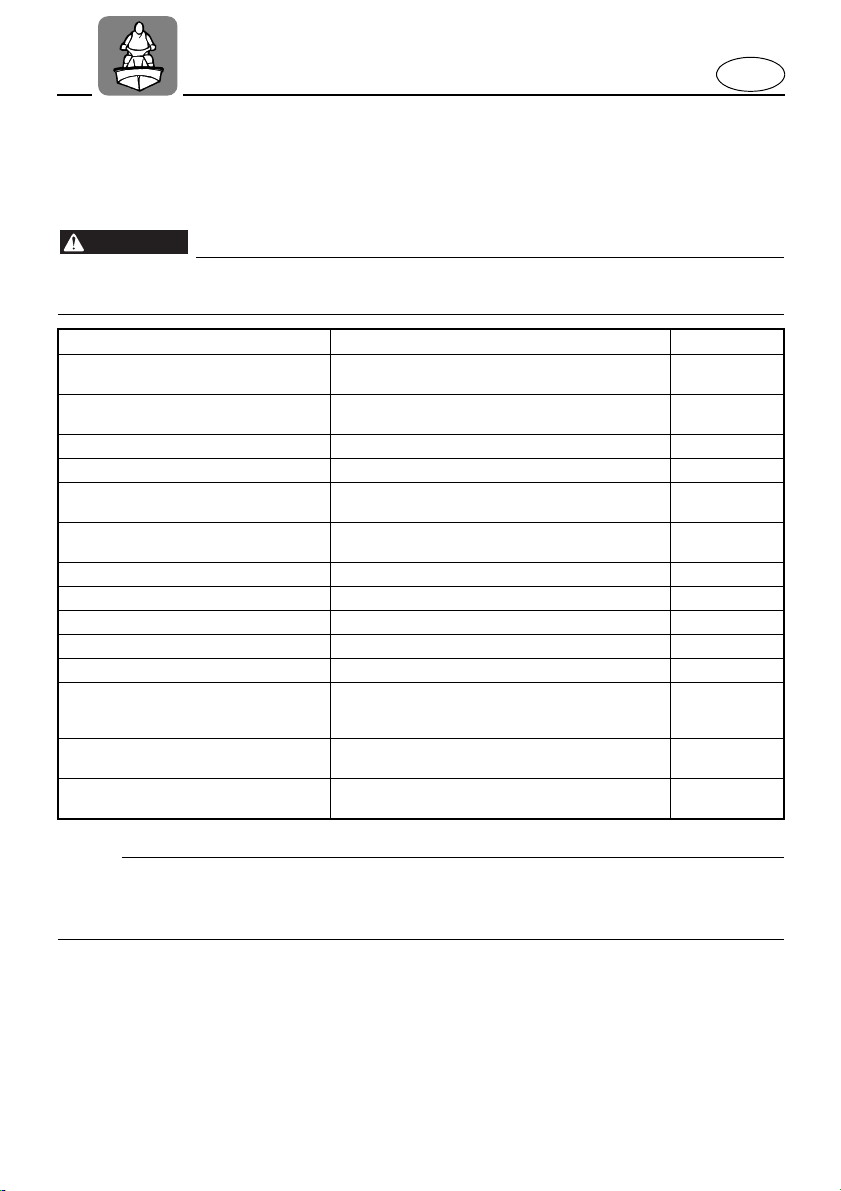
CHECK LIST
Before operating this water vehicle, perform the following checks:
WARNING
If any item in the pre-operation check is not working properly, have it inspected and
repaired before operating the vehicle. Otherwise an accident could occur.
N
O
TE:
Pre-operation checks should be made each time the vehicle is used. This procedure can be
accomplished thoroughly in a short time. The added safety and reliability the checks assure
is worth the time involved.
ITEM ROUTINE PAGE
ENGINE COMPARTMENT
Remove seat and front storage compartment, and
ventilate the engine compartment
3-4
BILGE
Check, and drain all water and fuel residue before
launching
3-5
THROTTLE Check for proper throttle operation 3-7
STEERING Check for proper steering operation 3-7
FUEL AND OIL
Check fuel and oil level, add as necessary
Check for leaks
3-4
BATTERY
Check fluid level and charge condition
Check the terminal securely
3-6
FRONT HOOD Check the front hood securely 2-6
SEAT Check that the seat is securely fastened to the deck 2-5
HULL/DECK Check the hull and deck for damage or cracks
JET (WATER) INTAKE Check that no debris is in the intake 3-7
FIRE EXTINGUISHER Check readiness of the extinguisher 3-6
SWITCHES
Check for proper operation of the starter, engine stop
switch and engine stop lanyard switch when the vehi-
cle is in the water
3-8
COOLING WATER PILOT OUTLET
Check that water comes out while the engine is run-
ning
3-8
MULTI FUNCTION INFORMATION CENTER
Check the meter for proper operation
Check there are no warning indications
3-8
Chap3.fm Page 3 Thursday, March 30, 2000 2:17 PM
3-4
E
EJU00725a
CHECK POINT
Engine compartment
Remove the seat, and the front storage
compartment after opening the front hood to
ventilate the engine compartment for a few
minutes to allow any fuel vapors to escape.
EWJ00053
WARNING
Failure to ventilate the engine compart-
ment to release fuel vapors could result
in fire or explosion. Do not start the
engine if you can smell fuel vapors in the
engine compartment.
EJU00427a
Fuel system
Check the fuel system.
Refer to page 4-9 “FUEL SYSTEM INSPEC-
TION” for correct procedure.
EJU00429a
Fuel and engine oil
1) Remove the fuel filler cap to release any
pressure which might have built up in
the tank because of fuel expansion.
2) Open the front hood and remove the
front storage compartment, and also
remove the seat.
Check the fuel and oil level in the tank
and add as necessary. (Refer to page 3-1
“FUEL AND ENGINE OIL FILLING”)
3) Turn the fuel cock to the “ON” position.
Chap3.fm Page 4 Thursday, March 30, 2000 2:17 PM
3-5
E
EJU00726
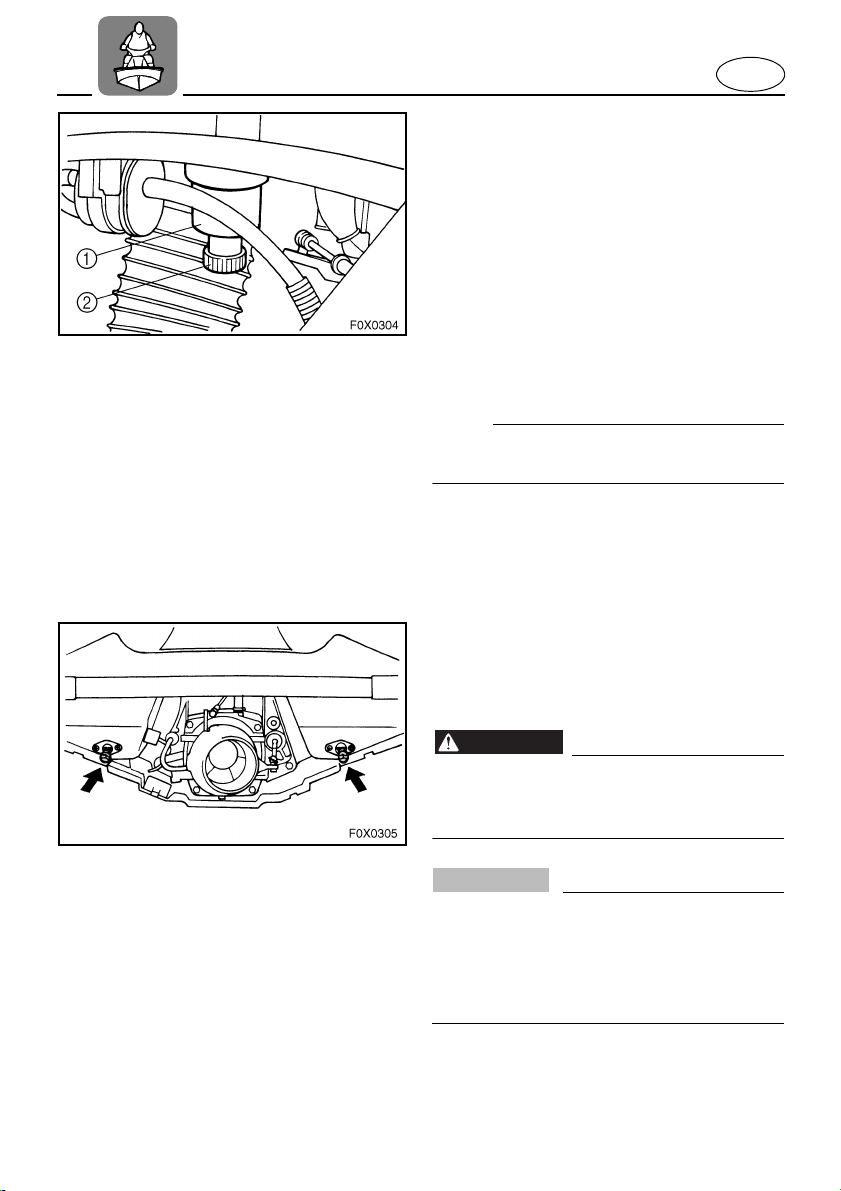
Water separator
1) Check the water separator
1
to see if
there is any water in the separator.
The water separator retains any water
entering through the fuel tank breather
pipe if the vehicle is capsized.
Normally, this water separator is empty
(no water).
2) If water remains in the water separator,
drain it by loosening the drain plug
2
.
Do not forget to tighten the drain plug.
N
O
TE:
The water separator is located in back of the
front storage compartment.
EJU00727a
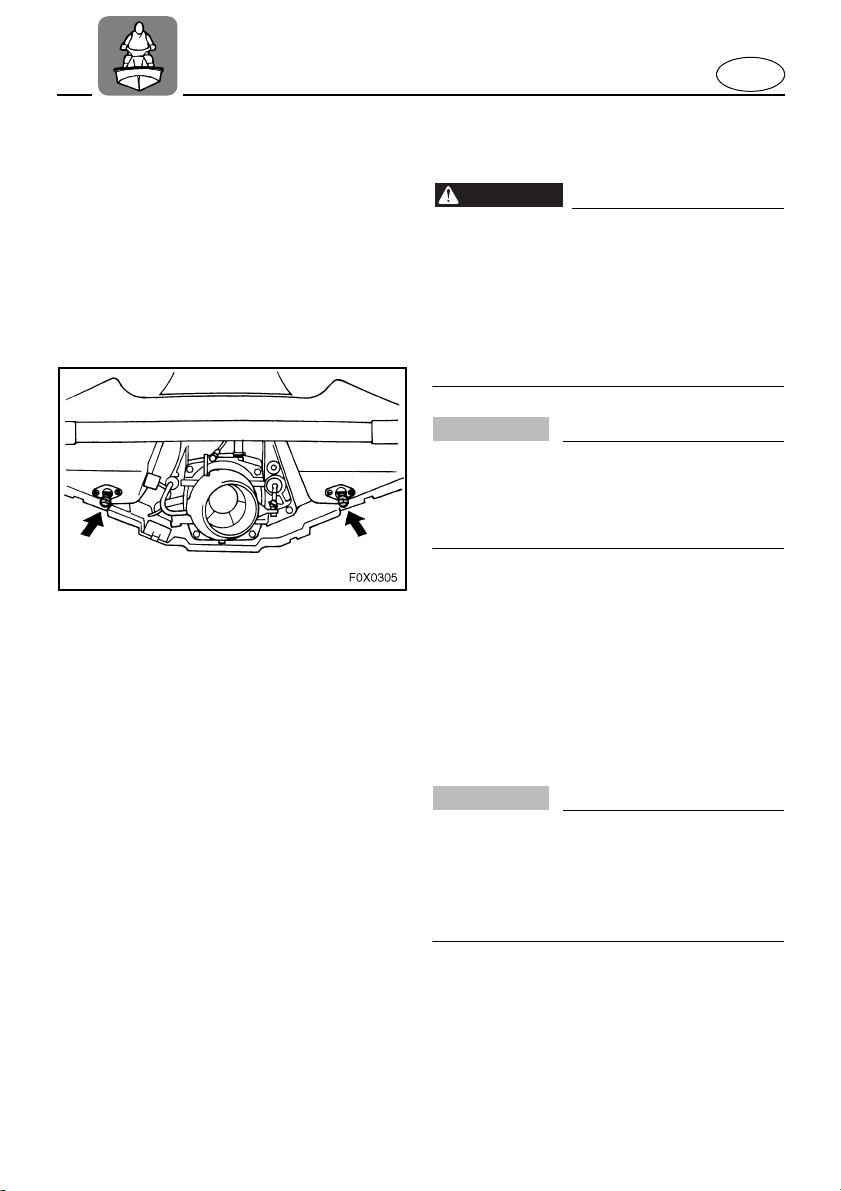
Bilge
Excessive water in the engine compartment
bilge can splash into the carburetor and
engine. This could cause engine damage. If
there is any moisture in the bilge, remove
the hull drain plugs and raise the bow. After
the water has drained, wipe the bilge with
dry rags. Reinstall the drain plugs securely.
EWJ00054
WARNING
Always properly dispose of gasoline
(petrol) soaked rags. They can spontane-
ously ignite.
ECJ00062
CAUTION:
Tighten two hull drain plugs securely
before launching the vehicle. Clean any
foreign material, such as dirt or sand,
from the threads before reinstalling the
drain plugs.
Chap3.fm Page 5 Thursday, March 30, 2000 2:17 PM
3-6
E
EJU00435a
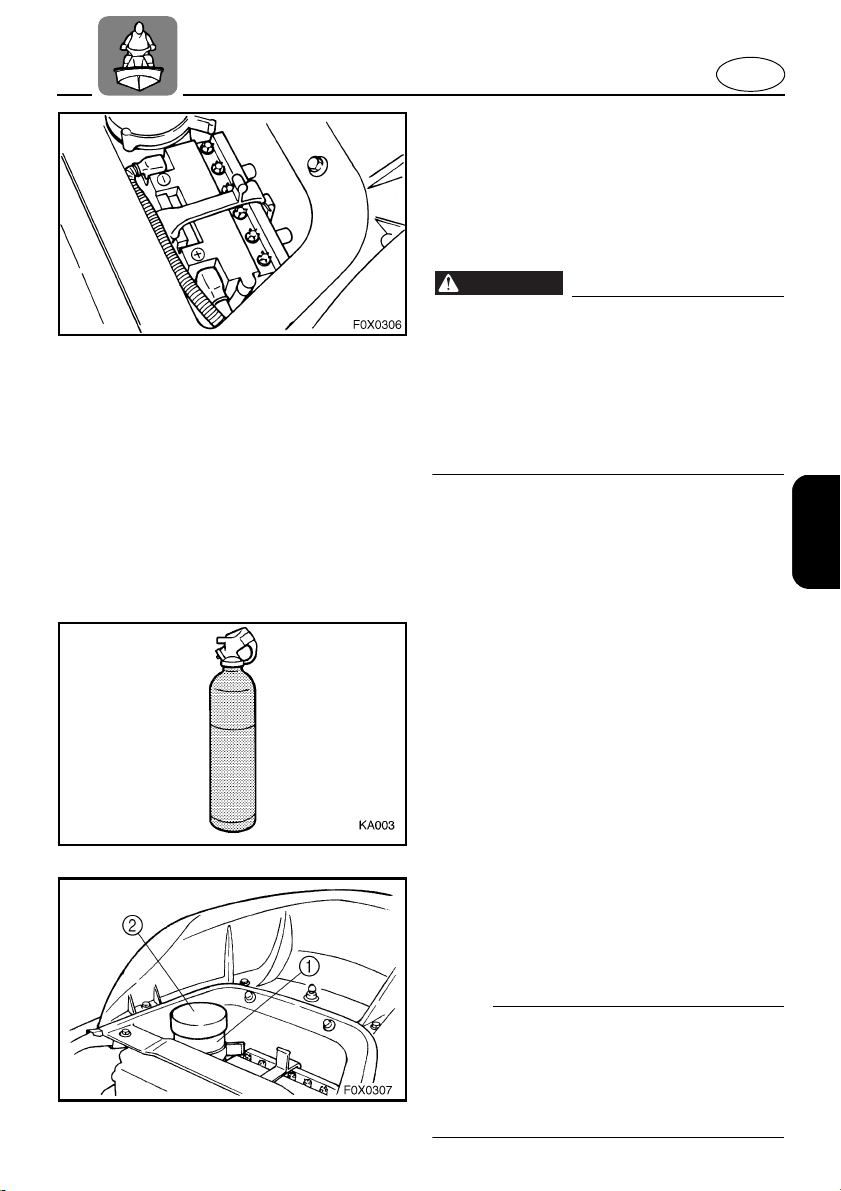
Battery
Check the battery condition and the battery
electrolyte level.
Check if the battery terminals are tightened
securely and that there is no erosion.
EWJ00055
WARNING
The battery must always be fully charged
and in good condition. Loss of battery
power may leave you stranded. Never
operate the water vehicle if the battery
does not have sufficient power to start
the engine or if it shows any other signs
of decreased power.
EJU00728a
Fire extinguisher
Make sure the fire extinguisher is aboard
and full. See the instructions supplied by the
fire extinguisher manufacturer to determine
proper indication of condition. Always keep
the extinguisher in the fire extinguisher con-
tainer.
Always carry a fire extinguisher on board.
The fire extinguisher container
1
is located
in the battery compartment. Remove the
seat and turn the fire extinguisher container
cap
2
counterclockwise to open it.
Reinstall the cap and tighten it securely after
inserting a fire extinguisher into the con-
tainer.
N
O
TE:
A fire extinguisher is not standard equip-
ment with this vehicle. If you do not have
one, contact your Yamaha Water Vehicle
dealer or a fire extinguisher dealer to obtain
one meeting the proper specifications.
Chap3.fm Page 6 Thursday, March 30, 2000 2:17 PM
3-7
E
EJU00447a
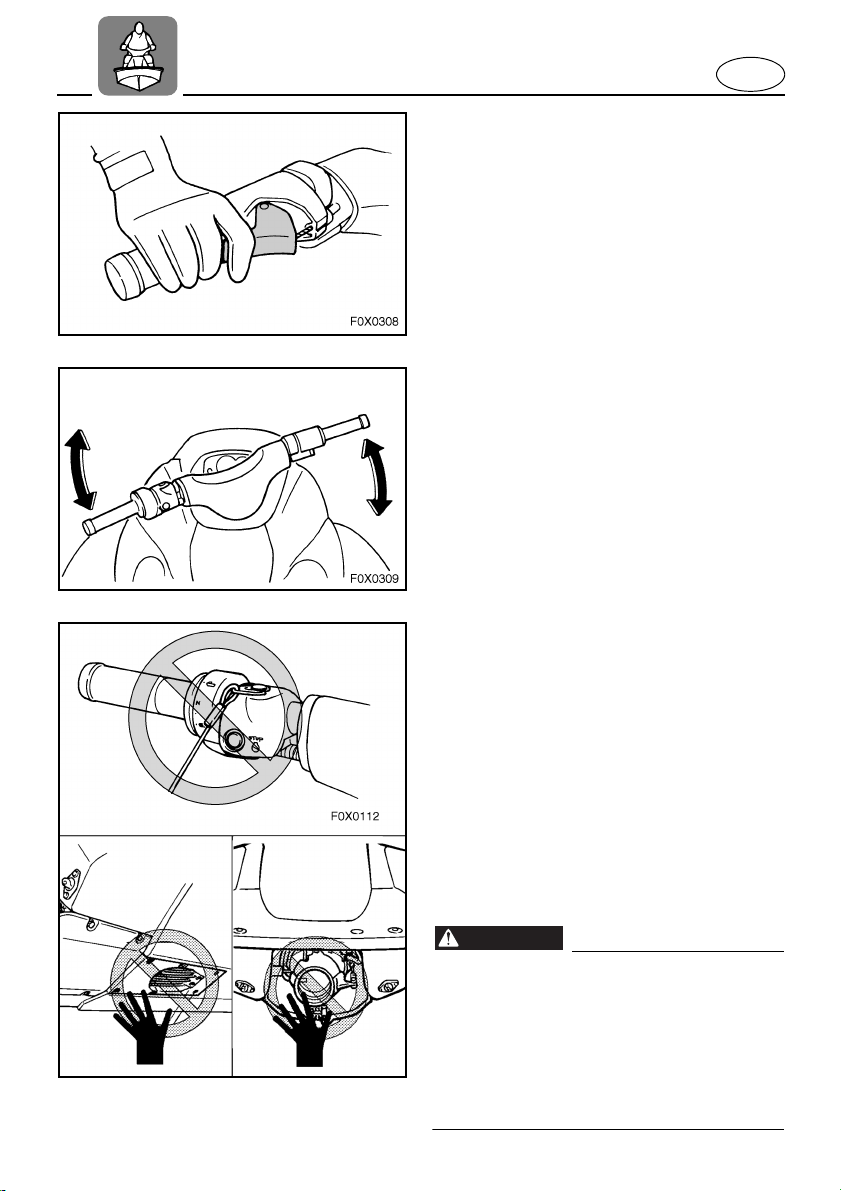
Throttle
Squeeze and release the throttle lever sev-
eral times to make sure there is no hesita-
tion in its travel. It should be smooth over the
complete range, and spring back to the idle
position on its own when released.
EJU00448a
Steering
Make sure the handlebar is not loose. Turn it
full-right and full-left to make sure operation
is smooth and unrestricted throughout the
whole range. Make sure the jet nozzle also
changes directions as the handlebar is
turned, and that there is no free play
between the handlebar and the jet nozzle.
EJU00451a
Jet intake
Carefully check the jet intake for weeds,
debris, or anything else that might restrict
the intake of water. If the intake is clogged,
cavitation could occur, reducing jet thrust,
and possibly damaging the jet pump parts.
In some cases, the engine may overheat
because of lack of cooling water, and dam-
age could result. Engine cooling water is fed
to the engine by the jet pump (see page
5-3).
EWJ00051
WARNING
Before attempting to remove weeds or
debris from the jet intake or impeller
areas, shut off the engine and remove
the lock-plate from the engine stop lan-
yard switch. Severe injury or death could
result from coming in contact with the
rotating parts of the jet pump.
Chap3.fm Page 7 Thursday, March 30, 2000 2:17 PM
3-8
E
RESET
WARNING
YAMAHA
8
7
6
5
4
3
2
1
MPH
FUEL
HOUR
x1000r/min
MULTI
DISPLAY
F0X0225
EJU00452a
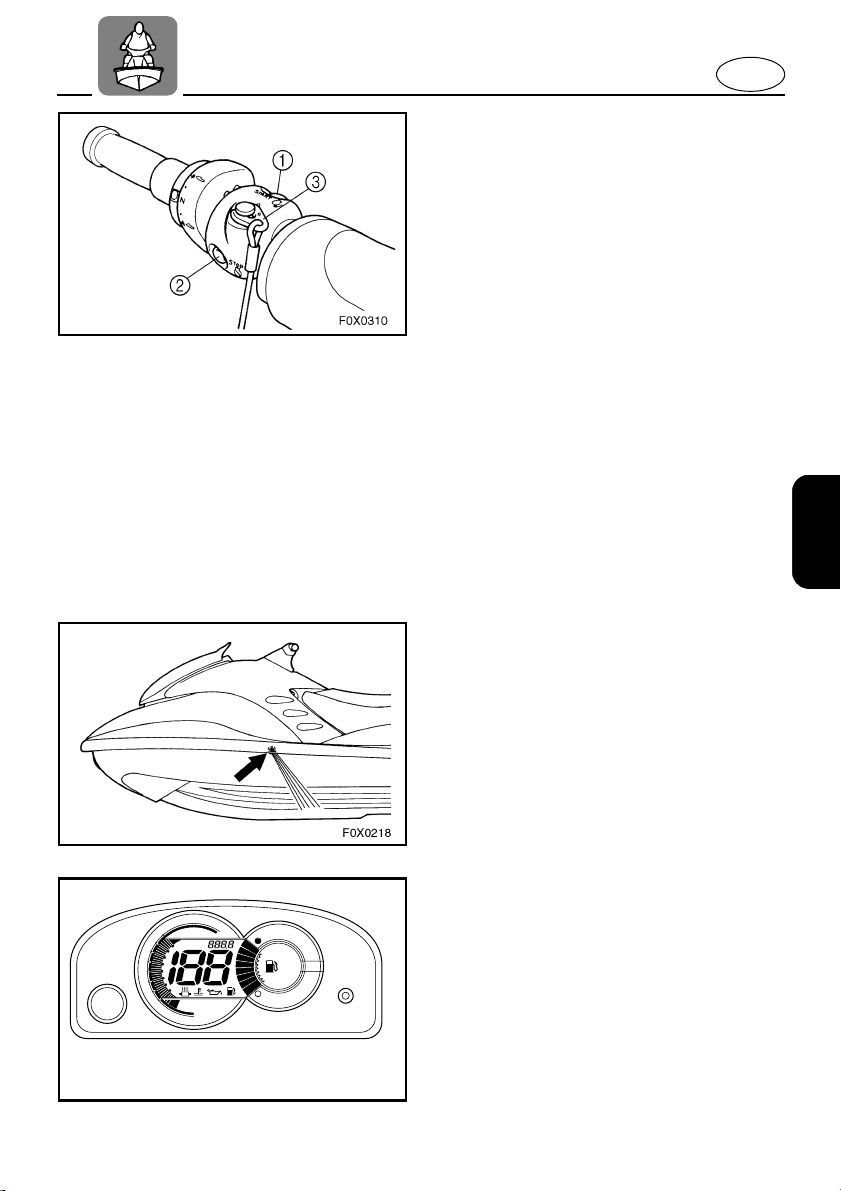
Switches
First, place the vehicle in the water to pro-
vide adequate engine cooling. Push the
engine start switch
1
and start the engine,
then push the engine stop switch
2
. Restart
the engine and pull the lanyard on your left
wrist to remove the lock-plate
3
from the
engine stop lanyard switch. Verify that the
engine stops immediately, when the engine
stop switch pushed or the lock-plate
removed from the engine stop lanyard
switch. Be sure the lanyard is in good condi-
tion with no frayed or broken parts. A dam-
aged lanyard must be replaced; it should
never be repaired or tied together.
EJU00453a
Cooling water pilot outlet
Check that cooling water comes out from the
outlet(s) while engine is running in the water.
EJU00454a
Multifunction information center
Check the proper operation of multifunction
information center. Refer to “MULTIFUNC-
TION INFORMATION CENTER” in Chapter
2 for correct meter operation.
Chap3.fm Page 8 Thursday, March 30, 2000 2:17 PM
3-9
E
EJU00455a
OPERATION
EWJ00057
WARNING
Before operating your water vehicle,
become familiar with all controls. Consult
your Yamaha water vehicle dealer about
any control or function you do not fully
understand. Failure to understand how
controls work could cause an accident or
prevent you from avoiding an accident.
ECJ00064
CAUTION:
Tighten two hull drain plugs securely
before launching the vehicle. Clean any for-
eign material, such as dirt or sand, from the
threads before reinstalling the drain plugs.
EJU00459a
BREAK-IN (RUNNING-IN)
PROCEDURE
The engine and other components require a
break-in (running-in) period to allow sur-
faces of moving parts to wear in evenly. This
ensures proper performance and promotes
longer component life.
ECJ00068
CAUTION:
During first tankful of operation, use
a 50 : 1 fuel premix (in addition to oil in
the oil tank). After break-in (running-in)
period, use straight gasoline (petrol) for
normal operation.
Chap3.fm Page 9 Thursday, March 30, 2000 2:17 PM
3-10
E
1) Launch the vehicle and start the engine.
EWJ00058
WARNING
Never ride in water that is less than
60 cm (2 feet) deep. You increase your
chance of hitting an underwater obsta-
cle. You could be injured. Operate at
higher speeds only in deep water free of
under water obstacles.
2) Run the engine at the lowest possible
speed for the first five minutes.
3) Gradually open the throttle and run the
engine at 5,000 r/min or less.
4) Continue operation at 5,000 r/min or
less until the first tankful of fuel has
been used up.
5) Fill the tank with a straight gasoline
(petrol), and proceed with normal opera-
tion.
ECJ00066
CAUTION:
Failure to follow the break-in (running-in)
procedure properly can result in severe
damage to the engine.
Chap3.fm Page 10 Thursday, March 30, 2000 2:17 PM
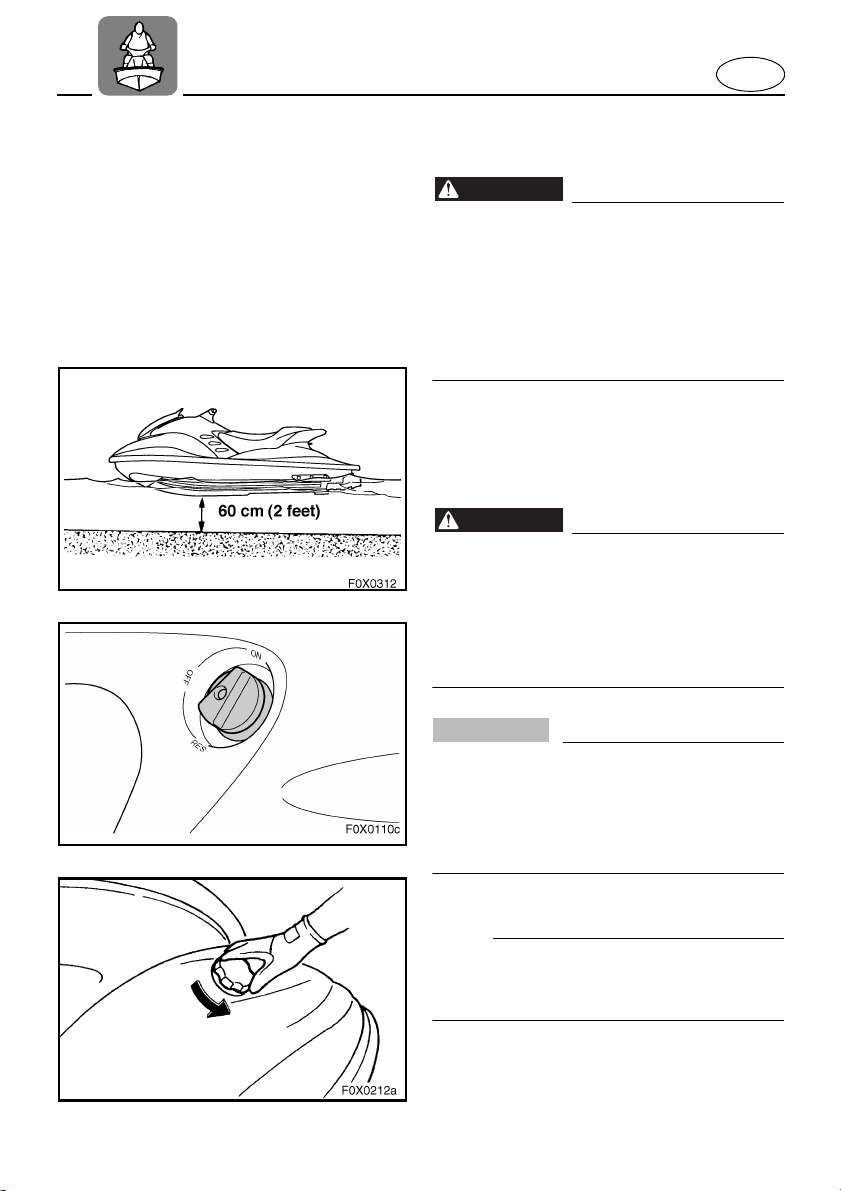
3-11
E
EJU00645a
STARTING THE ENGINE
WARNING
This product emits exhaust gases which
contain carbon monoxide, a colorless,
odorless gas which may cause brain
damage or death when inhaled. Symp-
toms include nausea, dizziness, and
drowsiness. Operate the vehicle in an
open area.
1) Always make sure the vehicle is
launched and used in waters that are
free from weeds and debris, and in
depths of at least 60 cm (2 feet).
WARNING
Never ride in water that is less than
60 cm (2 feet) deep. You increase your
chance of hitting an underwater obsta-
cle. You could be injured. Operate at
higher speeds only in deep water free of
under water obstacles.
CAUTION:
Never ride in water that is less than
60 cm (2 feet) deep. Pebbles or sand
could be sucked into the jet intake, caus-
ing impeller damage or engine overheat-
ing.
2) Turn the fuel cock to the “ON” position.
N
O
TE:
Before the first start-up, remove the fuel tank
filler cap to release any built-up pressure in
the tank because of fuel expansion.
Chap3.fm Page 11 Thursday, March 30, 2000 2:17 PM
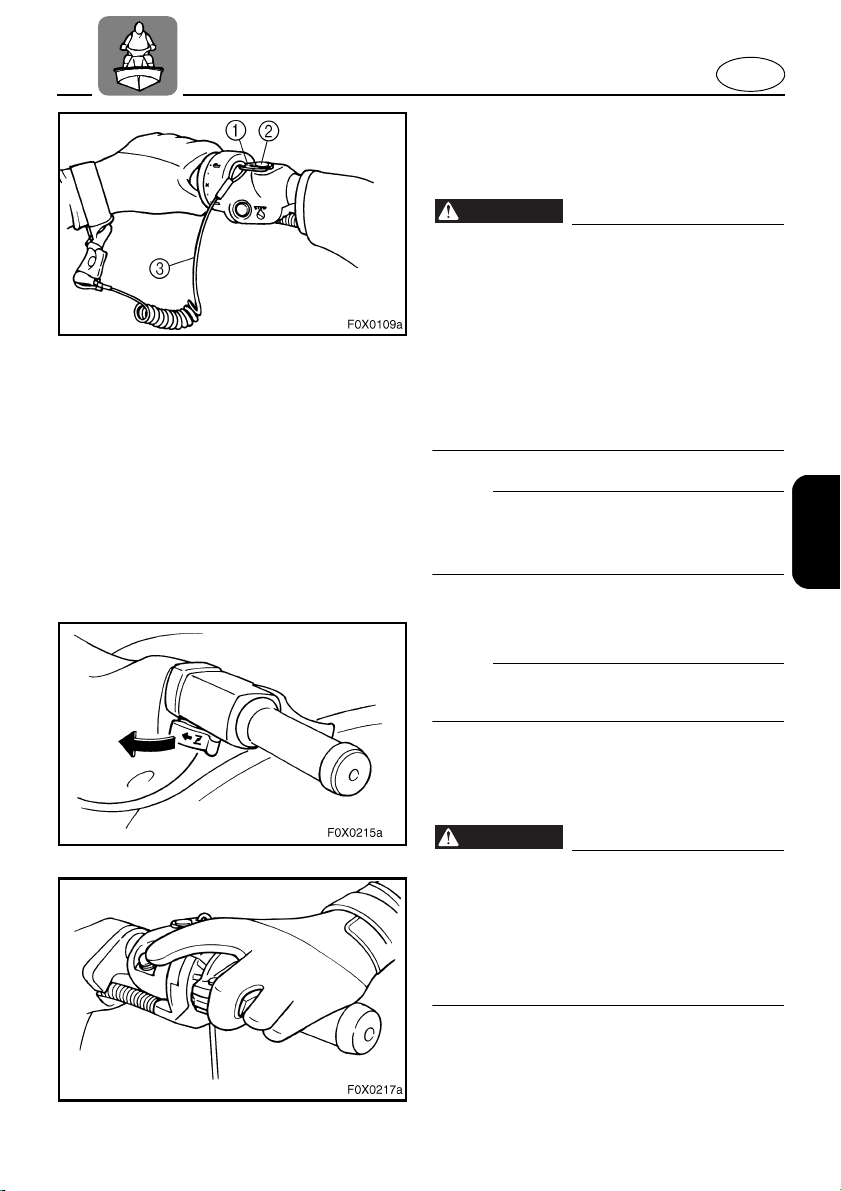
3-12
E
3) Attach the lock-plate
1
to the engine
stop lanyard switch
2
. Also attach the
lanyard
3
to your left wrist.
WARNING
Check that the lanyard is not frayed or
broken, wrapped around the handlebar,
or tangled in controls. If the operator
falls off, the vehicle could continue to run
and cause an accident. The operator and
passenger would also be unable to
reboard the vehicle, which increases the
chance of being hit by another boat and
the risk of the exposure.
N
O
TE:
It is not possible to start the engine with the
lock-plate removed from the engine stop
lanyard switch.
4) Turn the choke lever fully on to start a
cold engine.
N
O
TE:
The choke should not be used when the
engine is warm.
5) While lightly squeezing the throttle lever,
push the engine start switch (green but-
ton).
WARNING
On this water vehicle, the engine is con-
nected directly to the drive unit. Starting
the engine immediately generates some
thrust. Only enough throttle should be
applied to keep the engine at a fast
enough idle to stay running.
Chap3.fm Page 12 Thursday, March 30, 2000 2:17 PM
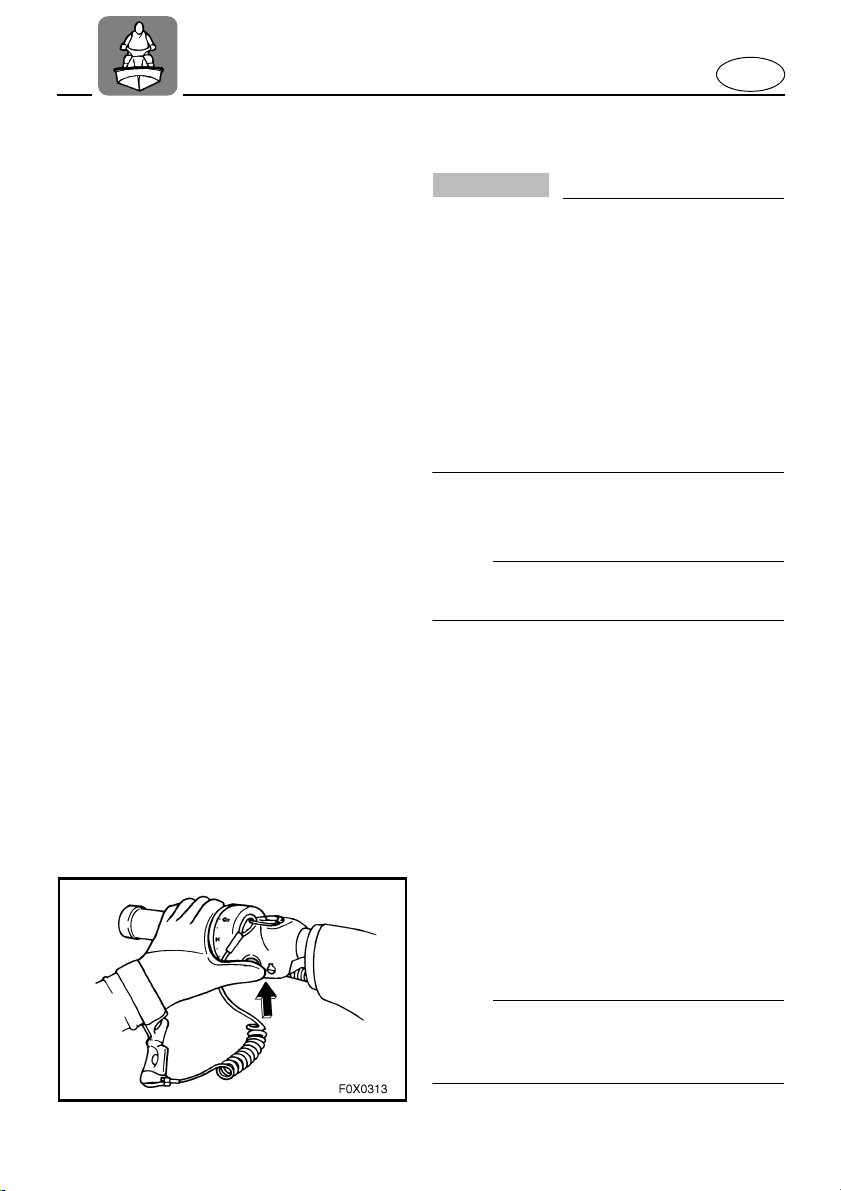
3-13
E
6) As soon as the engine starts to run,
release the starter button at once.
CAUTION:
● Never push the engine start switch
while the engine is running.
● Do not keep the starter motor running
for more than five seconds. The bat-
tery will be quickly discharged, and it
will be impossible to start the engine.
The starter motor may also be dam-
aged. If the engine does not start after
five seconds of cranking, release the
engine start switch. Wait at least
15 seconds before frying to start the
engine again.
7) After the engine has warmed up, return
the choke lever to its original position.
N
O
TE:
If the choke is left turned on, the engine will
stall.
EJU00463a
STOPPING THE ENGINE
Push the engine stop switch (red button)
with your left hand.
N
O
TE:
The engine can also be stopped by remov-
ing the lock-plate from the engine stop lan-
yard switch.
Chap3.fm Page 13 Thursday, March 30, 2000 2:17 PM

3-14
E
EJU00468a
RIDING YOUR WATER VEHICLE
GETTING TO KNOW YOUR WATER
VEHICLE
Riding your water vehicle requires skills
acquired through practice over a period of
time. Take the time to learn the basic tech-
niques well before attempting more difficult
maneuvers.
Riding your new water vehicle can be a very
enjoyable activity, providing you with hours
of pleasure. But it is essential to familiarize
yourself with the operation of the water vehi-
cle to achieve the skill necessary to enjoy
riding safely. Before you begin to ride be
sure you have read this owner’s/operator’s
manual completely and understand the
operation of the controls. Pay particular
attention to the safety information on pages
1-8 to 1-14. Read all caution and warning
labels on your water vehicle.
Also read the Riding Practice Tips booklet
supplied with your water vehicle.
Remember: Your water vehicle is designed
for one operator and one passenger only.
Never have more than three people on the
vehicle at any time.
EJU00474a
LEARNING TO RIDE YOUR WATER
VEHICLE
Before riding, always perform the pre-opera-
tion checks listed on page 3-3. The short
time spent checking the machine’s condition
will reward you with added safety and a
more reliable water vehicle.
Check state and local laws before operating
your water vehicle. Read the Boat Handling
Instructions issued by the USCG for basic
safe boating information.
Select a wide area to learn in, where visibil-
ity is good and other boat traffic is light.
Have someone in a boat accompany you if
operating far from shore. Keep the proper
distance from other boats and vehicles. Do
not ride where people are swimming.
Always attach the engine stop switch lan-
yard to your left wrist before operating.
You must always wear a USCG approved
personal flotation device.
Strong streams of water from the jet nozzle,
or impact with the water surface can be dan-
gerous. You must wear a wet suit. Normal
swimming attire may not adequately protect
you. A wet suit will help protect against inter-
nal injuries to orifices (rectum and vagina)
from strong jet streams, and from impact
with the water surface. Wet suits also help
protect against hypothermia (low body tem-
perature) and abrasions.
You should wear water shoes to help protect
feet from objects hidden under water. Wear-
ing gloves can also help protect hands from
abrasions.
Wind, water, and glare from the sun may get
in your eyes while you operate your water
vehicle, reducing your ability to see. You
may want to consider wearing eye protection
such as sunglasses or goggles while riding.
Some may find, however, that eye protection
obstructs or distorts their vision, and dis-
tracts from operation.
Only you know the circumstances in which
you operate your water vehicle, so only you
can decide if the benefits of eye protection
outweigh the potential hazards.
Chap3.fm Page 14 Thursday, March 30, 2000 2:17 PM
3-15
E
You should grip the handlebars firmly and
keep both feet on the footrest floor. Do not
attempt to ride with passenger until your
riding skills are fully developed.
EJU00482a
RIDING WITH PASSENGER
When two persons (including the operator)
are on board, the vehicle handles differently,
and is not as easy to maneuver, so operat-
ing it requires a higher degree of skill.
Before attempting to operate the vehicle
with passenger aboard, the operator must
practice enough riding alone to be able to
acquire the necessary skills.
The passenger must always wear USCG
approved personal flotation devices.
Strong streams of water from the jet nozzle,
or impact with the water surface can be dan-
gerous. Both operator and passenger must
wear wet suits. Normal swimming attire may
not adequately protect you. A wet suit will
help protect against internal injuries to ori-
fices (rectum and vagina) from strong jet
streams, and from impact with the water sur-
face. Wet suits also help protect against
hypothermia (low body temperature) and
abrasions.
Both operator and passenger should wear
water shoes to help protect feet from objects
hidden under water. Wearing gloves can
also help protect hands from abrasions.
Wind, water, and glare from the sun may get
in your eyes while you operate your water
vehicle, reducing your ability to see. You
may want to consider wearing eye protection
such as sunglasses or goggles while riding.
Some may find, however, that eye protection
obstructs or distorts their vision, and dis-
tracts from operation. Only you know the cir-
cumstances in which you operate your water
vehicle, so only you can decide if the bene-
fits of eye protection outweigh the potential
hazards.
Never exceed the weight capacity (160 kg,
353 lb) nor allow more than three person to
ride this water vehicle at one time.
The operator should grip the handlebars
firmly and keep both feet on the footrest
floor. Do not give a ride to a child whose feet
cannot reach the footrest floor. The passen-
ger should hold on firmly to the operator and
keep both feet on the footrest floor.
EWJ00063
WARNING
When passenger is on board, make sure
he/she is holding on firmly before you
start to accelerate.
Chap3.fm Page 15 Thursday, March 30, 2000 2:17 PM
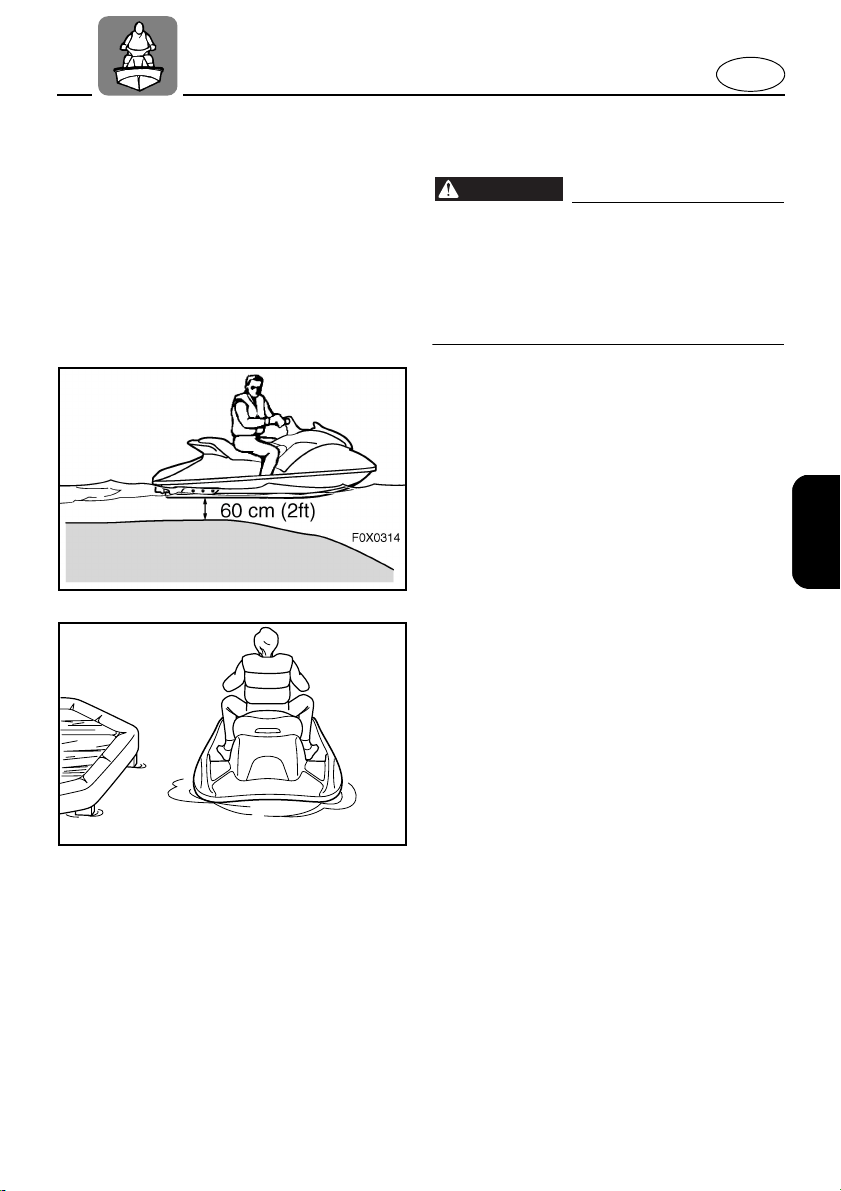
3-16
E
EJU00484
STARTING
WARNING
● There may be other water craft,
obstructions, or swimmers around
you. Check carefully before starting off
to avoid an accident.
● Practice getting on board in shallow
water before riding in deep water.
EJU00486a
Starting in shallow water
1) Do not start your water vehicle in less
than 60 cm (2 feet) of water. Put it in an
area that is deep enough, then board
the vehicle from the side or the rear.
2) Attach the lanyard to your left wrist, then
install the lock-plate on the lanyard to
the engine stop lanyard switch.
3) Grip the handlebars with both hands,
place both feet on the footrest floor, start
the engine, and start off.
Starting from a landing jetty
1) Board the vehicle from the side.
2) Attach the lanyard to your left wrist, then
install the lock-plate on the lanyard to
the engine stop lanyard switch.
3) Push the vehicle away from the jetty,
grip the handlebars with both hands,
place both feet on the footrest floor, start
the engine, and start off.
F0X0315
Chap3.fm Page 16 Thursday, March 30, 2000 2:17 PM
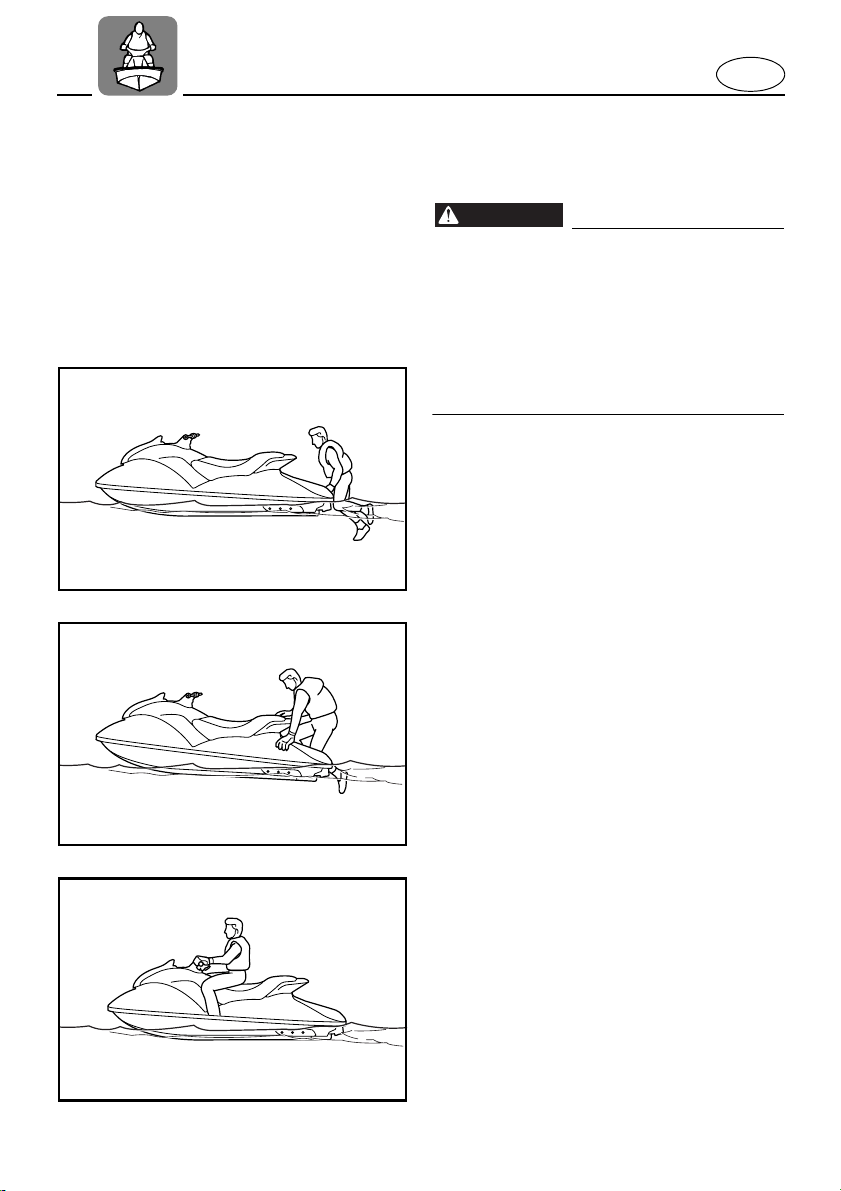
3-17
E
EJU00490a
BOARDING AND STARTING IN DEEP
WATER
EWJ00068
WARNING
● Operator and passenger should prac-
tice getting on board in shallow water
before riding in deep water. Reboard-
ing in deep water requires more skill.
● The fatigue and exposure that could
result after unsuccessful attempts to
get back on the vehicle may increase
the risk of injuries and drowning.
Solo
1) Swim to the rear of the vehicle and
place both hands on the footrest floor.
Pull yourself up on the floor and kneel
down grasping the hand grip.
2) Move to the seat and sit astride.
3) Attach the lanyard to your left wrist, then
install the lock-plate on the lanyard to
the engine stop lanyard switch.
4) Grip the handlebar firmly with both
hands, place both feet on the footrest
floor, start the engine, and start off.
F0X0316
F0X0317
F0X0318
Chap3.fm Page 17 Thursday, March 30, 2000 2:17 PM
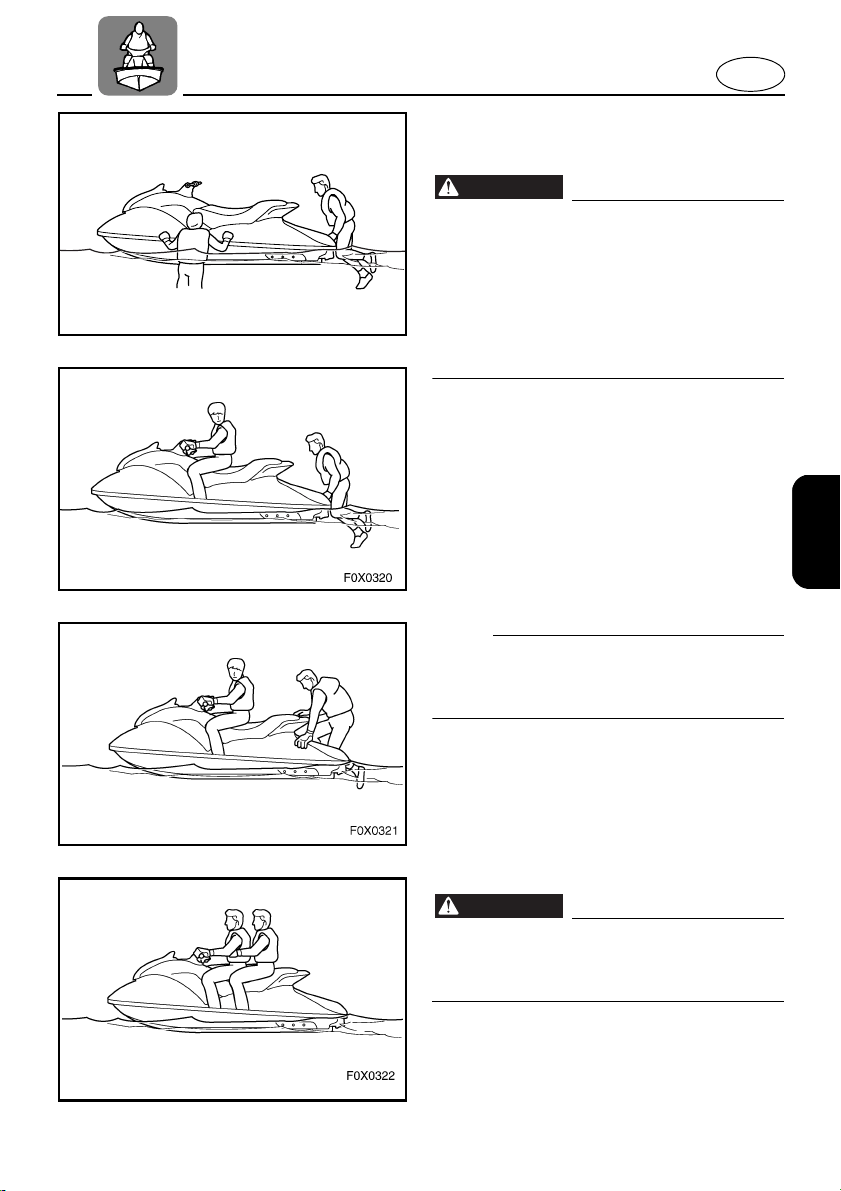
3-18
E
F0X0319
EJU00493a
With passenger
WARNING
Strong streams of water from the jet nozzle
can be dangerous, and can result in injury
when directed at body orifices (rectum and
vagina). Do not open the throttle until each
passenger is seated with feet on the floor
and is holding on to the person in front of
him or her.
1) Climb up on board as noted earlier, and
sit astride the seat. Attach the lanyard to
your left wrist, then install the lock-plate
on the lanyard to the engine stop lan-
yard switch.
2) The passenger should move to the rear
of the vehicle.
3) Let the passenger get on board and sit
on the seat.
N
O
TE:
When a passenger is getting on board, both
the operator and passenger should try to
balance the vehicle.
4) The operator should check to see that
the passenger has him/her feet on the
footrest floor and that passenger is hold-
ing on securely to the operator. Then
start the engine and accelerate to plan-
ing speed.
WARNING
Before starting off, make sure there are
no boats, obstructions, or swimmers
around you.
Chap3.fm Page 18 Thursday, March 30, 2000 2:17 PM
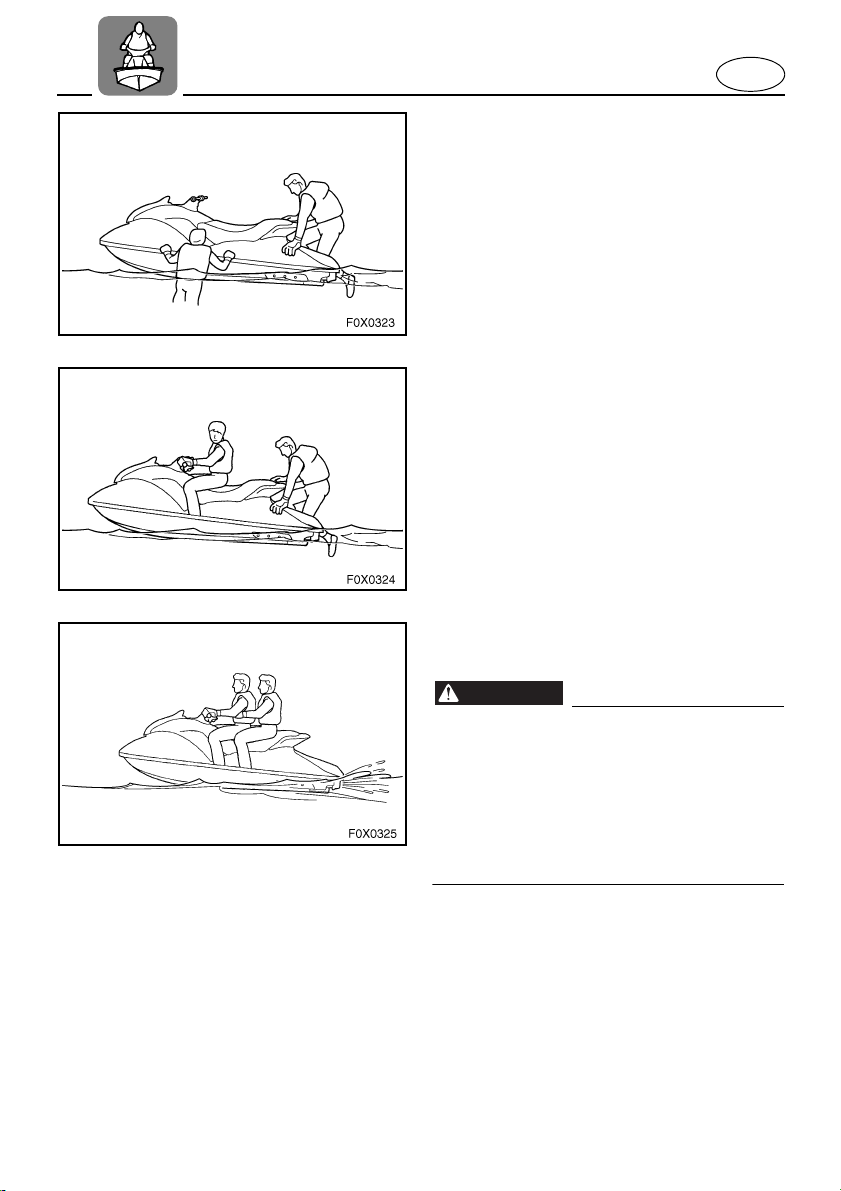
3-19
E
EJU00494a
LOAD LIMIT
The heavier the total weight of the operator
and passenger, the more difficult it will be to
balance the vehicle. It is not advisable to
ride the vehicle when the total weight
exceeds 160 kg (353 lb) including any
cargo.
If it is difficult to balance the vehicle at a
standstill, proceed as follows:
1) The passenger must steady the water
vehicle while the operator is boarding.
The operator pulls himself up onto the
footrest floor into a seating position,
then balances the vehicle.
2) Attach the lanyard to your left wrist, then
install the lock-plate on the lanyard to
the engine stop lanyard switch. Start the
engine and keep it at idle.
3) The passenger pulls himself up on the
floor kneels down grasping the hand-
grip, then crawls onto the seat as the
vehicle accelerates.
EWJ00070
WARNING
Strong streams of water from the jet noz-
zle can be dangerous, and can result in
injury when directed at body orifices
(rectum and vagina). Do not open the
throttle until each passenger is seated
with feet on the floor and is holding on to
the person in front of him or her.
4) The vehicle can now be accelerated to
planing speed, then the operator can
reduce the throttle to the desired run-
ning speed.
Chap3.fm Page 19 Thursday, March 30, 2000 2:17 PM
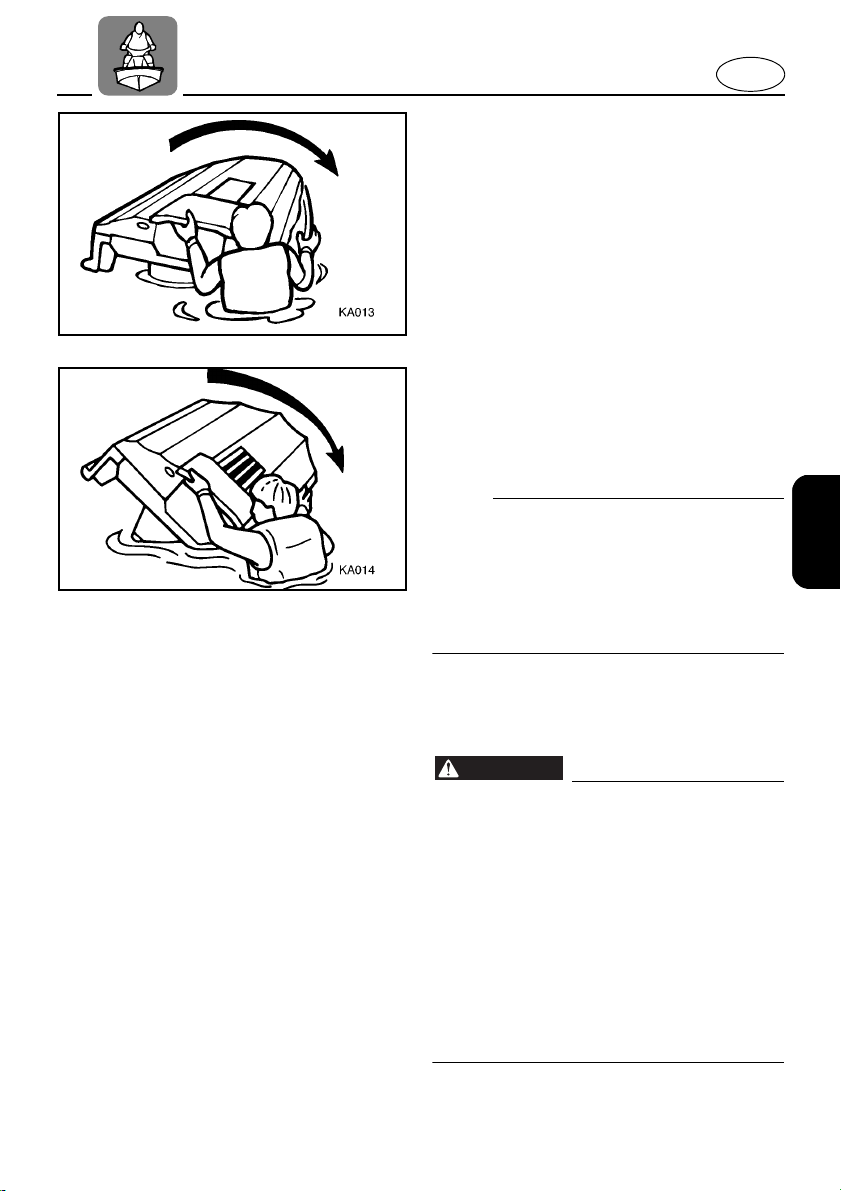
3-20
E
EJU00497a
CAPSIZED WATER VEHICLE
1) Turn off the engine by removing the
lock-plate from the engine stop lanyard
switch. The engine will overheat when
capsized because it has no water to
pump as coolant.
2) Swim to the rear side of the vehicle. Pull
the vehicle over clockwise with the left
hand on the ride plate while pushing
down on the gunwale with your right
hand/foot.
Do not turn the vehicle counterclock-
wise, or water may leak into the carbure-
tor and engine.
N
O
TE:
If the right side of the capsized vehicle (view
from rear of the vehicle) tilts upward, first tilt
the vehicle so the right side is down by
pressing down on the gunwale with your
weight. Then turn the vehicle over as
described.
3) Start the engine using normal proce-
dure, then head for shore to inspect
engine for water damage.
WARNING
IMPROPER UPRIGHTING CAN CAUSE
INJURY:
● Shut off the engine.
● Do not put your hand in the intake
grille.
● Watch so you are not hit by the vehicle
as it comes over.
TO TURN OVER:
● Pull the vehicle over with your left
hand on the ride plate while pushing
down on gunwale with your right hand/
foot.
Chap3.fm Page 20 Thursday, March 30, 2000 2:17 PM
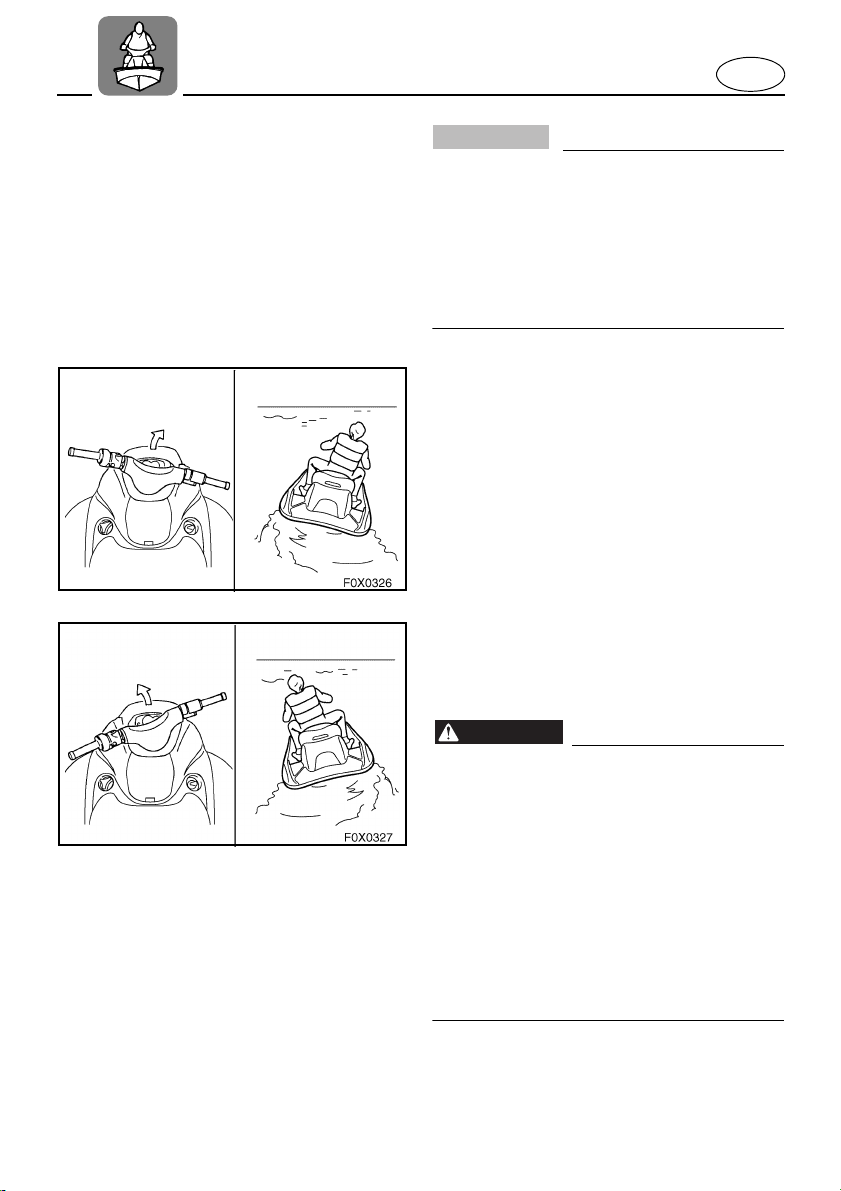
3-21
E
ECJ00071
CAUTION:
If the vehicle has been capsized for five
minutes or more, air may have entered
the oil injection system. Leave the engine
off, or operate only at trolling speeds, for
10 minutes after the vehicle has been put
right-side up. This will allow any air to
bleed off.
EJU00499a
TURNING
Throttle produces thrust from the jet pump.
Directional control is provided by opening
the throttle and turning the handlebars.
To make a turn at higher speed: Reduce
your speed, then turn the handlebars and
shift your weight in the desired direction,
and apply enough throttle to make your turn.
High thrust turns the vehicle sharply; low
thrust turns less sharply. Releasing the
throttle completely causes the vehicle to go
straight. TURNS CANNOT BE MADE WITH-
OUT APPLYING THROTTLE!
WARNING
● You need engine power to turn. Do not
release the throttle completely. Releas-
ing the throttle lever can cause you to
hit an obstacle you are attempting to
avoid. A collision could result in
severe injury or death.
● Make gradual turns at higher speeds
or slow down before turning. Sharp
turns at higher speeds may cause the
vehicle to slide sideways or spin. The
passenger and operator could be
thrown off suddenly and be injured.
Chap3.fm Page 21 Thursday, March 30, 2000 2:17 PM
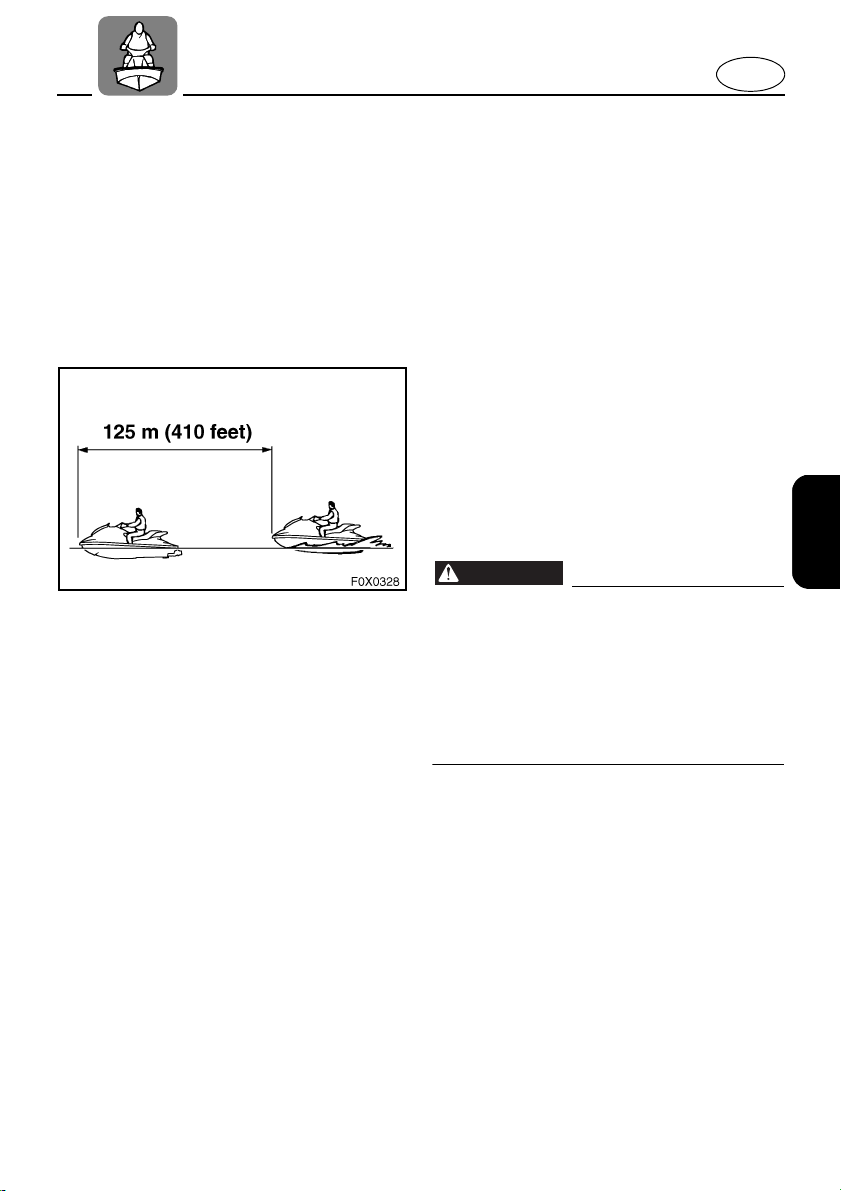
3-22
E
EJU00621a
STOPPING
The vehicle is not equipped with a separate
braking system.
It is stopped by water resistance when the
throttle lever is released. From full speed, the
vehicle stops in approximately 125 m
(410 feet) after the throttle is released and the
engine stopped. The stopping distance varies
depending on gross weight, water surface
conditions, and wind direction. The stated
stopping distance should be used for a refer-
ence. The watercraft slows down as soon as
the throttle lever is released, but will coast for a
distance before fully stopping. If you are not
sure you can stop in time before hitting an
obstacle, apply throttle and turn in another
direction.
WARNING
Allow adequate stopping distance. Failure
to begin slowing soon enough could cause
you to hit an obstacle you are approaching.
Do not shut off the engine when slowing
down in case you need engine power to
steer away from a boat or other obstacle
that comes into your path.
Chap3.fm Page 22 Thursday, March 30, 2000 2:17 PM

3-23
E
EJU00635a
BEACHING
1) Make sure no obstructions, boats or
swimmers are near the beach. Release
the throttle lever about 125 m (410 feet)
before the intended landing area.
2) Approach the beach slowly and stop the
engine before reaching landing point.
Remember: turning is impossible with
the engine stopped.
3) Get off the vehicle and pull it up on the
beach.
CAUTION:
Small pebbles, sand, seaweed, and other
debris can be ingested into the jet intake
and impair or damage the impeller.
Always stop the engine and get off
before beaching the vehicle.
EJU00505a
DOCKING
1) Make sure no obstructions, boats or
swimmers are close to the water vehicle.
Reduce speed about 125 m (410 feet)
away from the dock.
2) Slowly approach the dock and stop the
engine just before coming alongside it.
Chap3.fm Page 23 Thursday, March 30, 2000 2:17 PM
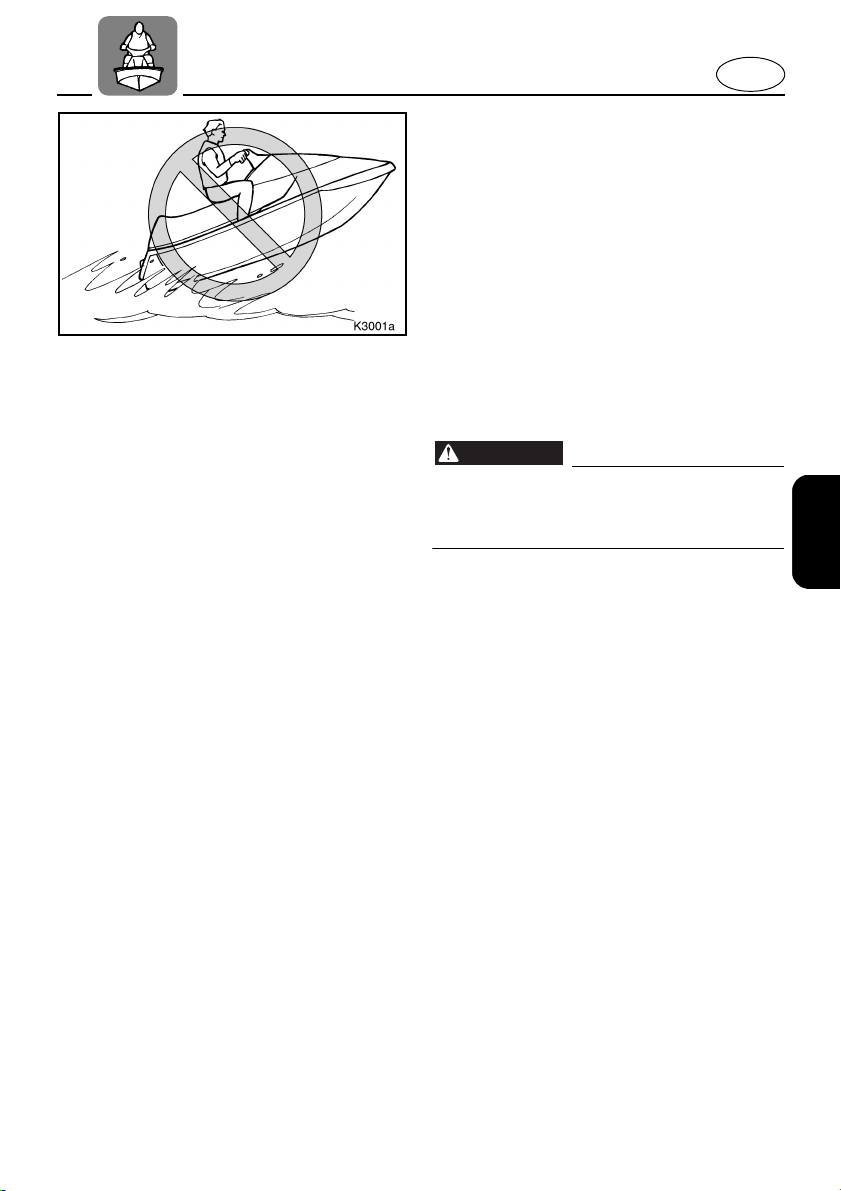
3-24
E
EJU00507
ROUGH WATER OPERATION
Operating in rough water or jumping waves
can crack the vehicle body or damage inter-
nal parts. The force of landing after jumping
can cause a strong impact on both the vehi-
cle and the operator. It is possible for the
operator to hit his chest or jaw on the vehicle
body or handlebars and be injured. Do not
ride with your chin right above the handlebar
or with your feet outside the vehicle. Avoid
riding in rough water or bad weather condi-
tions.
WARNING
Operating in rough water or jumping
waters can lead to injury. It may also
damage the vehicle.
Chap3.fm Page 24 Thursday, March 30, 2000 2:17 PM
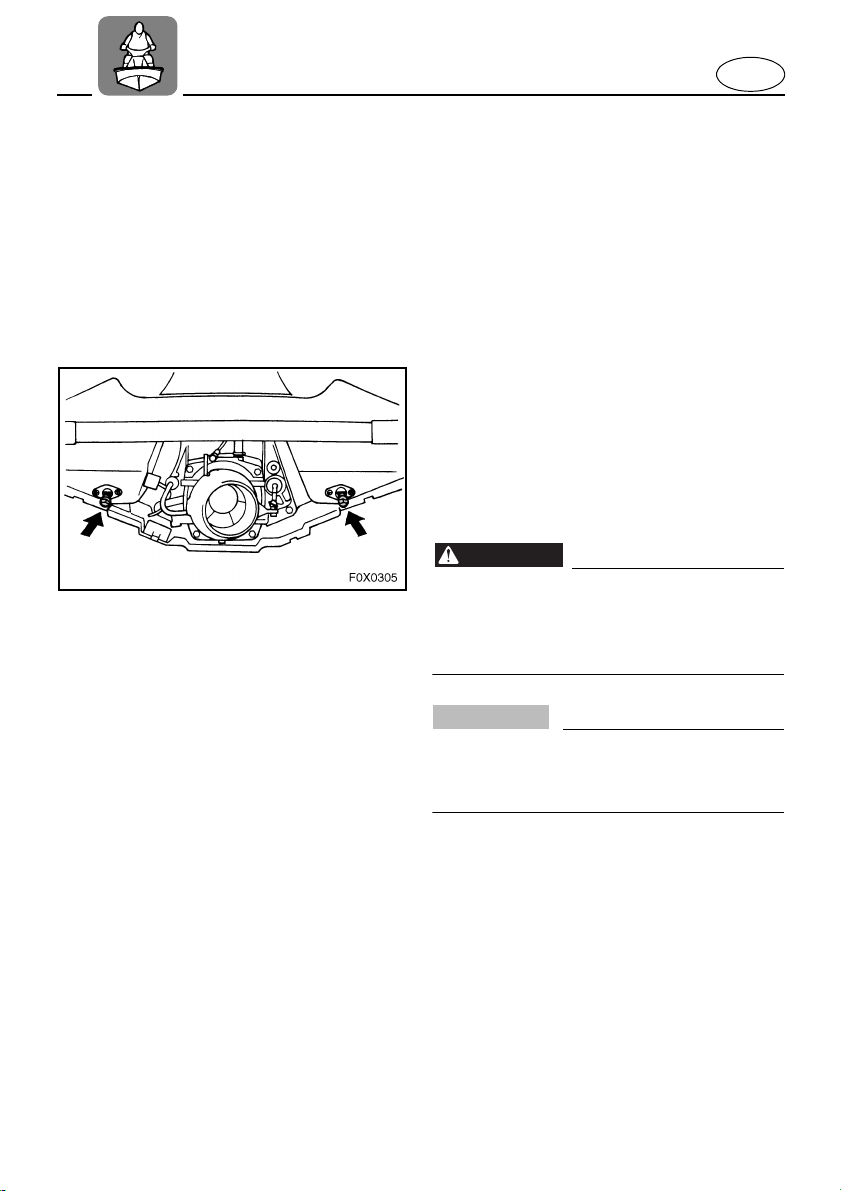
3-25
E
EJU00508a
POST-OPERATION CHECKS
1) After removing the vehicle from the
water, put the vehicle in the horizontal
position.
2) Flush the cooling system to prevent it
from clogging up with salt, sand, or dirt.
(Refer to page 4-1 for flushing the cool-
ing system procedure.)
3) Lubricate the internal components by
performing “LUBRICATION” at page
4-3, if storing the vehicle for more than a
week.
4) Drain residual water from the exhaust sys-
tem by running the engine at 4,000 r/min
for a period of 10 to 15 seconds.
WARNING
Stay away from the stern when the
engine is running on load. Hot water and
steam spurting from exhaust outlet into
the air can cause serious burns.
CAUTION:
Do not run the engine over 4,000 r/min on
land. The catalytic converter could result
in serious damage.
5) Wash down the hull, deck, handlebar
and drive unit with fresh water.
Chap3.fm Page 25 Thursday, March 30, 2000 2:17 PM
3-26
E
6) Remove two hull drain plugs and raise
the bow of the vehicle slightly. Allow any
water in the bilge to drain out.
Rinse the engine compartment with a
small amount of fresh water. Be careful
not to get water on the carburetor or
electrical components. After the water
has drained, wipe the bilge with dry
rags.
Reinstall two drain plugs securely.
N
O
TE:
This water vehicle is equipped with an auto-
matic bilge-draining device that removes
water from the engine compartment while
you are underway.
However, some residual water remains that
must be drained by removing two drain
plugs.
EWJ00054
WARNING
● Always properly dispose of gasoline
(petrol) soaked rags. They can sponta-
neously ignite.
● Do not spray flammable rust inhibitor
products on engine surfaces while the
engine is hot. The sprayed substance
or propellants could catch fire.
7) Spray a rust inhibitor, such as Yamaha
Silicone Protectant and Lubricant, on
metallic parts to minimize corrosion.
Chap3.fm Page 26 Thursday, March 30, 2000 2:17 PM
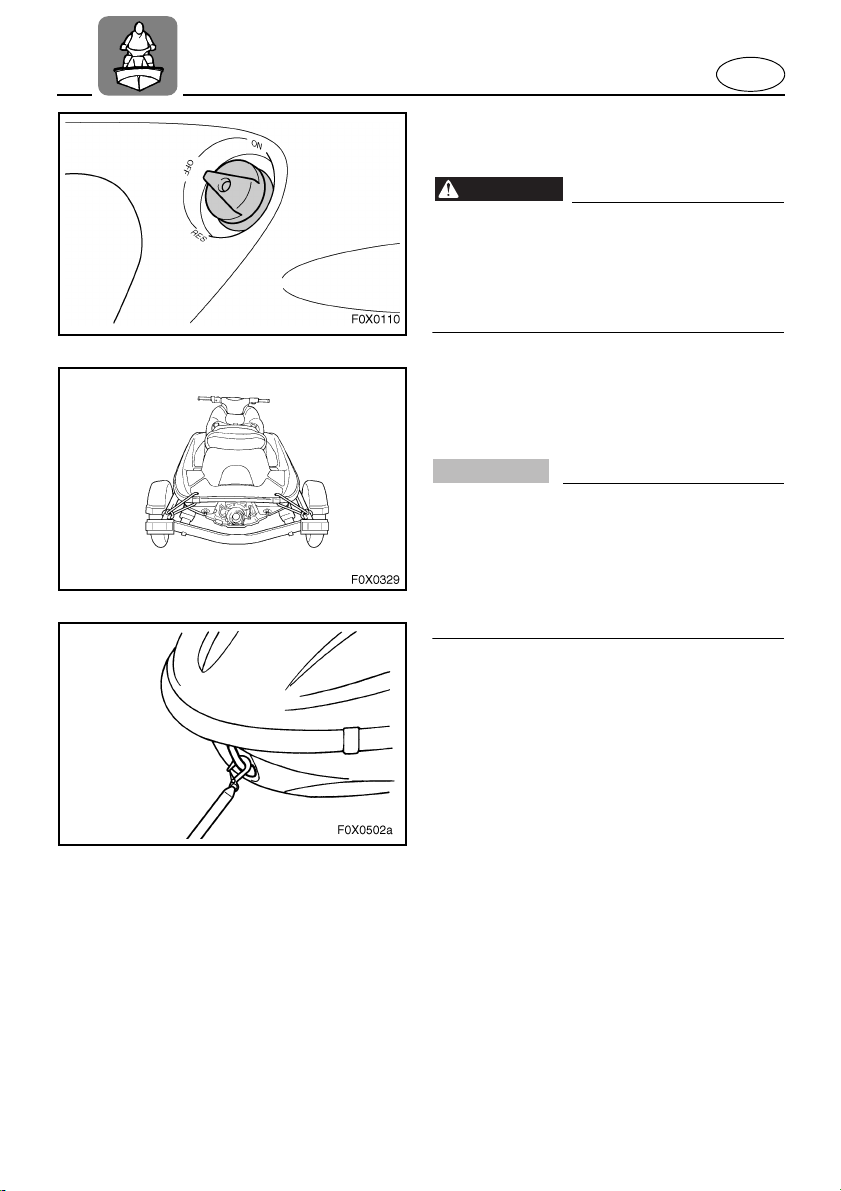
3-27
E
EJU00514a
TRANSPORTATION
WARNING
Always place the fuel cock in the “OFF”
position when transporting the vehicle.
Otherwise, fuel could leak out into the
engine or engine compartment, which
would create a fire hazard.
When transporting the vehicle on a trailer,
attach tie-downs to the bow eye and secure
the stern with ropes or tie downs through the
rope hole(s) on the aft deck.
ECJ00076
CAUTION:
Do not route ropes or tie downs over the
seat, as they may leave permanent marks
on the seat’s surface. Also wrap the
ropes or tie downs with towels or rags
where they touch the body of the vehicle
to avoid scratching or damage.
Chap3.fm Page 27 Thursday, March 30, 2000 2:17 PM
E
4
EJU00515
Chapter 4
MAINTENANCE AND
CARE
STORAGE
.............................................4-1
Flushing the cooling system...............4-1
Lubrication..........................................4-3
Fuel system........................................4-4
Battery................................................4-4
Cleaning.............................................4-5
ADJUSTMENT AND MAINTENANCE
..4-6
Owner’s / operator’s manual and tool
kit........................................................4-7
Periodic inspection chart....................4-8
Fuel system inspection.......................4-9
Fuel filter ..........................................4-10
Fuel tank ..........................................4-10
Oil injection system inspection.........4-11
STEERING CABLE INSPECTION
......4-12
Throttle cable inspection and
adjustment........................................4-12
QSTS (Quick shift trim system)
mechanism inspection......................4-13
Spark plug cleaning and adjustment 4-14
Lubrication points.............................4-15
Battery..............................................4-18
Carburetor adjustment .....................4-20
Replacing the fuse ...........................4-21
Bleeding the oil injection pump ........4-21
SPECIFICATIONS
...............................4-22
Chap4TOC.fm Page 1 Thursday, March 30, 2000 2:19 PM
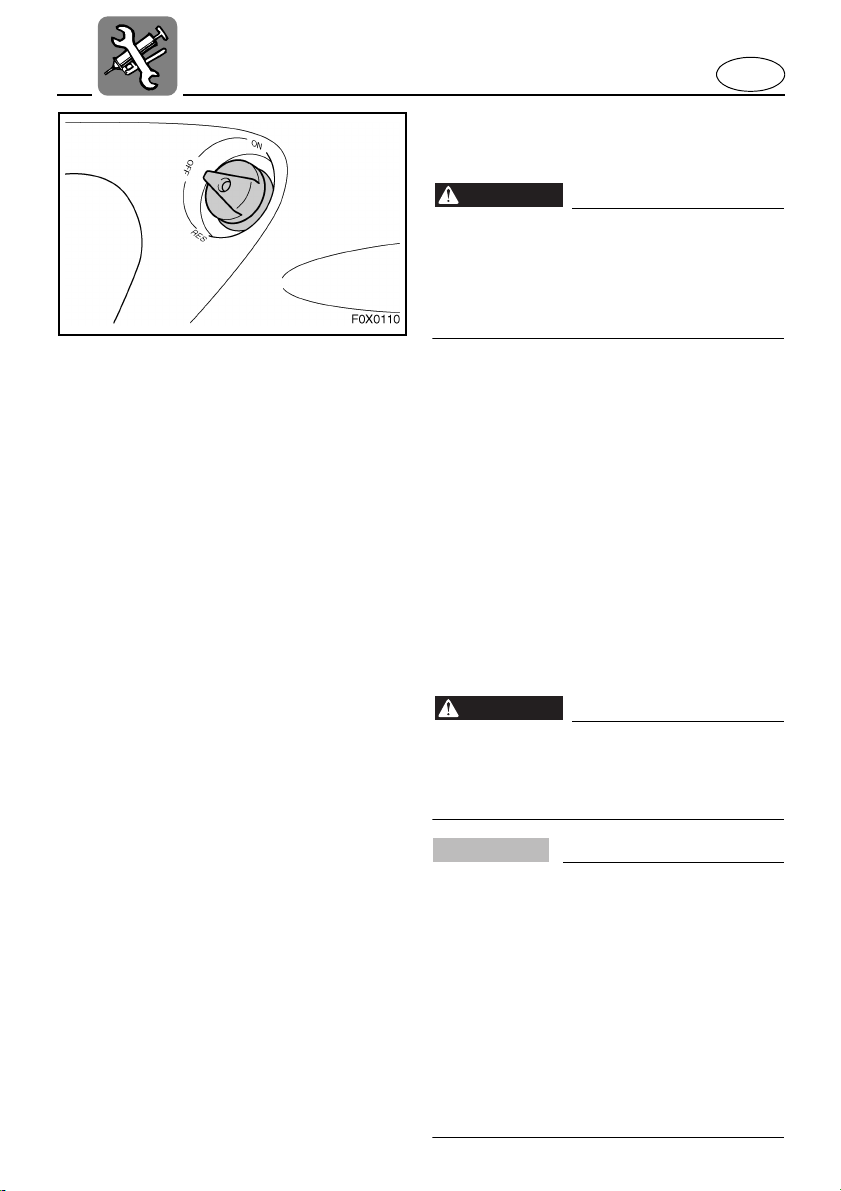
4-1
E
EJU00516a
STORAGE
EWJ00079
WARNING
Always place the fuel cock in the “OFF”
position when storing the vehicle. Other-
wise, fuel could leak out into the engine
or engine compartment, which would
create a fire hazard.
Storage for prolonged periods of time, such
as winter storage, requires preventative
maintenance to ensure against deteriora-
tion. It is advisable to have the water vehicle
serviced by an authorized Yamaha water
vehicle dealer prior to storage. However, the
following procedures can be performed by
the owner with a minimum of tools.
EJU00913a
FLUSHING THE COOLING SYSTEM
This is essential in order to prevent the cool-
ing system from being clogged with salt,
sand, or dirt.
WARNING
Stay away from the stern when the
engine is running on land. Hot water and
steam spurting from exhaust outlet into
the air can cause serious burns.
CAUTION:
●
●●
● Do not supply the water into the cool-
ing water passages when the engine is
not running. The water could flow back
through the muffler into the crankcase
causing severe engine damage.
●
●●
● Do not run the engine for more
15 seconds after the water supply has
been turned off to avoid engine over-
heat.
●
●●
● Do not run the engine over 4,000 r/min
on land. The catalytic converter could
result in serious damage.
Chap4.fm Page 1 Thursday, March 30, 2000 2:19 PM
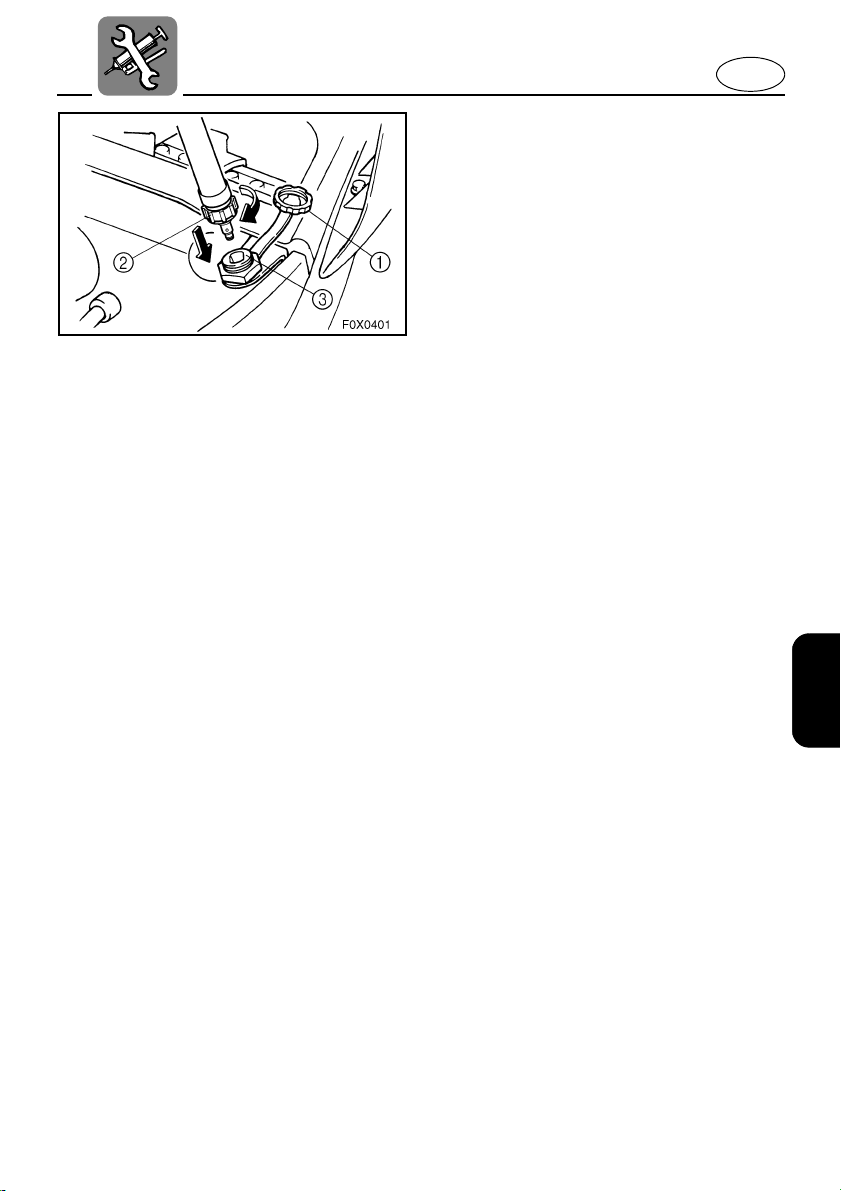
4-2
E
1) Put the vehicle without lowering the bow
on land.
2) Open the cap
1
. Press the flush kit gar-
den hose adapter
2
into the flush hose
connector
3
and turn it until it is
securely connected.
3) Connect both the garden hose adapter
and a water tap using a hose.
4) Start the engine. Then, immediately turn
on water supply until the water flows out
continually from the cooling water pilot
outlet.
5) Run the engine at an idle speed for
3 minutes watching engine condition.
If the engine stopped while flushing, turn
off water supply immediately. Repeat
above steps.
6) Turn off the water supply. Then, force
the remaining water out from the cooling
passages by running the engine at
4,000 r/min or less within 10 to
15 seconds.
7) Stop the engine.
8) Remove the garden hose adapter and
secure the cap.
Chap4.fm Page 2 Thursday, March 30, 2000 2:19 PM

4-3
E
EJU00528a
LUBRICATION
WARNING
Do not spray flammable rust inhibitor
products on engine surfaces while the
engine is hot. The sprayed substance or
propellants could catch fire.
1) Remove the spark plugs and pour
approximately one tablespoon of oil into
each cylinder.
2) Grease the spark plug threads and rein-
stall the spark plugs.
3) Crank the engine within 3 seconds
using the engine start switch.
4) Lubricate all cables such as the throttle,
choke, and steering cables.
N
O
TE:
Use a Yamaha Power Cable Luber and
Yamaha Lube-Zall to pressure lubricate the
cables and purge out any moisture between
the inner and outer cables.
5) Grease the areas of the water vehicle
specified in “Lubrication Points” in the
ADJUSTMENT AND MAINTENANCE
section.
Chap4.fm Page 3 Thursday, March 30, 2000 2:19 PM
4-4
E
EJU00528b
FUEL SYSTEM
WARNING
Gasoline is highly flammable and explo-
sive. A fire or explosion can cause
severe injury or death. Shut off the
engine. Do not smoke. Avoid spilling
gasoline.
1) Place the fuel cock in the OFF position.
2) Drain the fuel tank by using a siphon.
EJU00530a
BATTERY
1) When the vehicle is not to be used for a
month or more, remove the battery and
store it in a cool, dark place. Clean the
battery casing using fresh water. Clean
the battery terminals. Apply dielectric
grease or petroleum jelly to the battery
terminals and to all exposed connectors.
2) If the battery is to be stored for a longer
period, check the specific gravity of the
fluid at least once a month and recharge
the battery if it gets too low.
Specific gravity: 1.28 at 20°C (68°F)
Chap4.fm Page 4 Thursday, March 30, 2000 2:19 PM
4-5
E
EJU00531a
CLEANING
1) Wash down the hull, deck, handlebar,
and drive unit with fresh water.
2) Rinse the engine and bilge area with
fresh water. Drain off all water and wipe
up remaining moisture with clean, dry
rags.
3) Spray the engine’s exterior with Yamaha
Silicone Protectant and Lubricant.
WARNING
Do not spray flammable rust inhibitor
products on engine surfaces while the
engine is hot. The sprayed substance or
propellants could catch fire.
4) Wax the hull with a non-abrasive wax
such as Yamaha Silicone Wax.
5) Wipe all vinyl and rubber components,
such as the seat and engine compart-
ment seals, with a vinyl protectant such
as Yamaha Protectant.
Chap4.fm Page 5 Thursday, March 30, 2000 2:19 PM
4-6
E
EJU00962a
ADJUSTMENT AND
MAINTENANCE
Periodic inspection, adjustment and lubrication
will keep your water vehicle in the safest and
most efficient condition possible. Safety is an
obligation of the vehicle owner. The most impor-
tant points of vehicle inspection, adjustment and
lubrication are explained on the following pages.
See your Yamaha dealer for genuine Yamaha
replacement parts and optional accessories
designed for your watercraft. Remember that
failures which are the result of the installation
of parts or accessories which are not qualita-
tively equivalent to genuine Yamaha parts are
not covered by the limited warranty.
Maintenance, replacement, or repair of
the emission control devices and system
may be performed by any marine engine
repair establishment or individual. War-
ranty repair (emission or normal) how-
ever, must be performed at an authorized
Yamaha marine dealership.
WARNING
●
●●
● Be sure to turn off the engine when you
perform maintenance unless otherwise
specified. Otherwise, accident or injury
could result from unexpected operation,
moving parts, or electric shock. If the
owner is not familiar with machine ser-
vicing, this work should be done by a
Yamaha dealer or other qualified
mechanic. Improperly serviced compo-
nents could fail or stop operating cor-
rectly, which could result in an accident.
●
●●
● Modifications to this machine not
approved by Yamaha may cause loss of
performance or excessive noise, or ren-
der it unsafe for use. Consult a Yamaha
Water Vehicle dealer or other qualified
mechanic before attempting any changes.
Chap4.fm Page 6 Thursday, March 30, 2000 2:19 PM
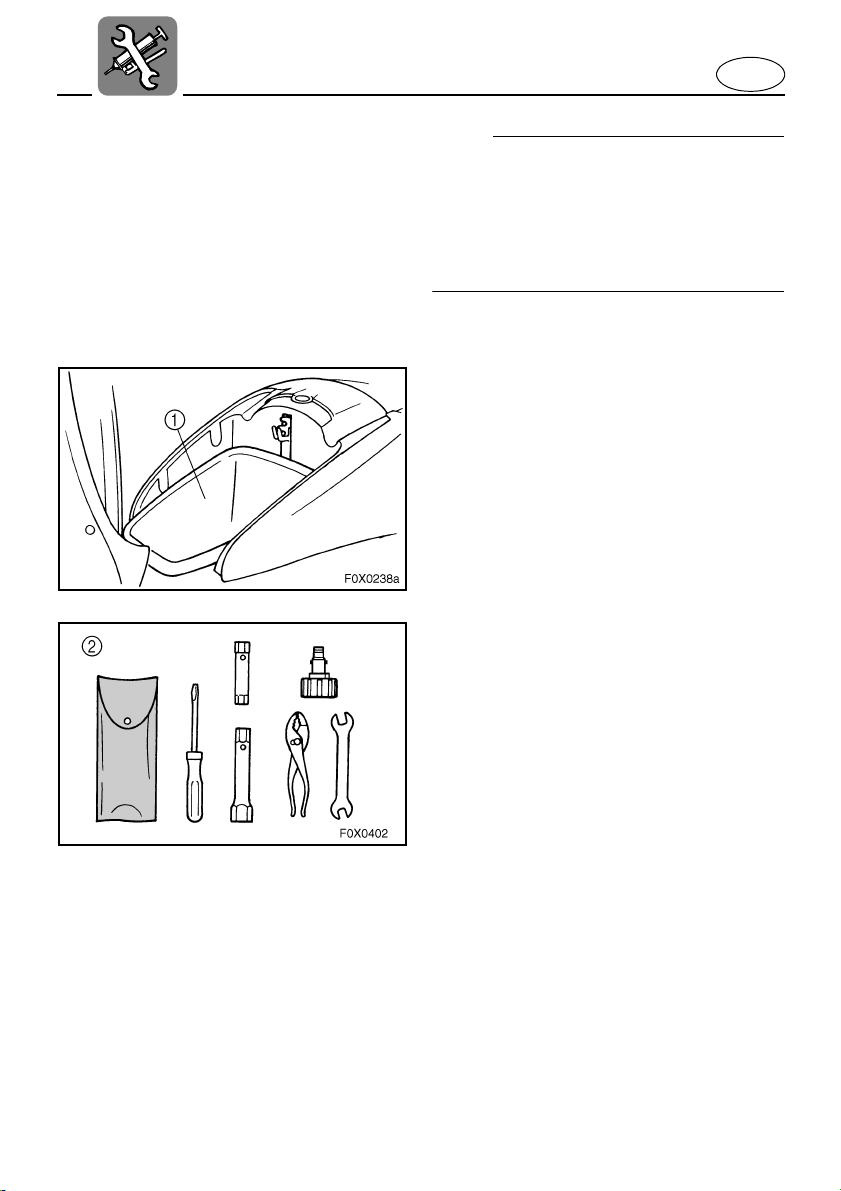
4-7
E
N
O
TE:
A service manual is available for purchase
through a Yamaha water vehicle dealer for
owners who have the mechanical skills,
tools, and other equipment necessary to
perform maintenance not covered by this
owner’s/operator’s manual.
OWNER’S / OPERATOR’S MANUAL
AND TOOL KIT
It is advisable always to carry the owner’s/
operator’s manual and tool kit with you
whenever you use the vehicle. For the con-
venience of the user, a storage space is pro-
vided on the vehicle. To protect these
materials from water, it would be a good
idea to put them in a waterproof bag.
The service information included in this
manual is intended to provide you, the
owner, with the necessary information for
completing your own preventive mainte-
nance and minor repairs. The tools provided
in the owner’s tool kit are sufficient for this
purpose, except that a torque wrench is also
necessary to properly tighten nuts and bolts.
1
Storage space for tool kit and Owner’s / Oper-
ator’s manual
2
Tool kit
Chap4.fm Page 7 Thursday, March 30, 2000 2:19 PM
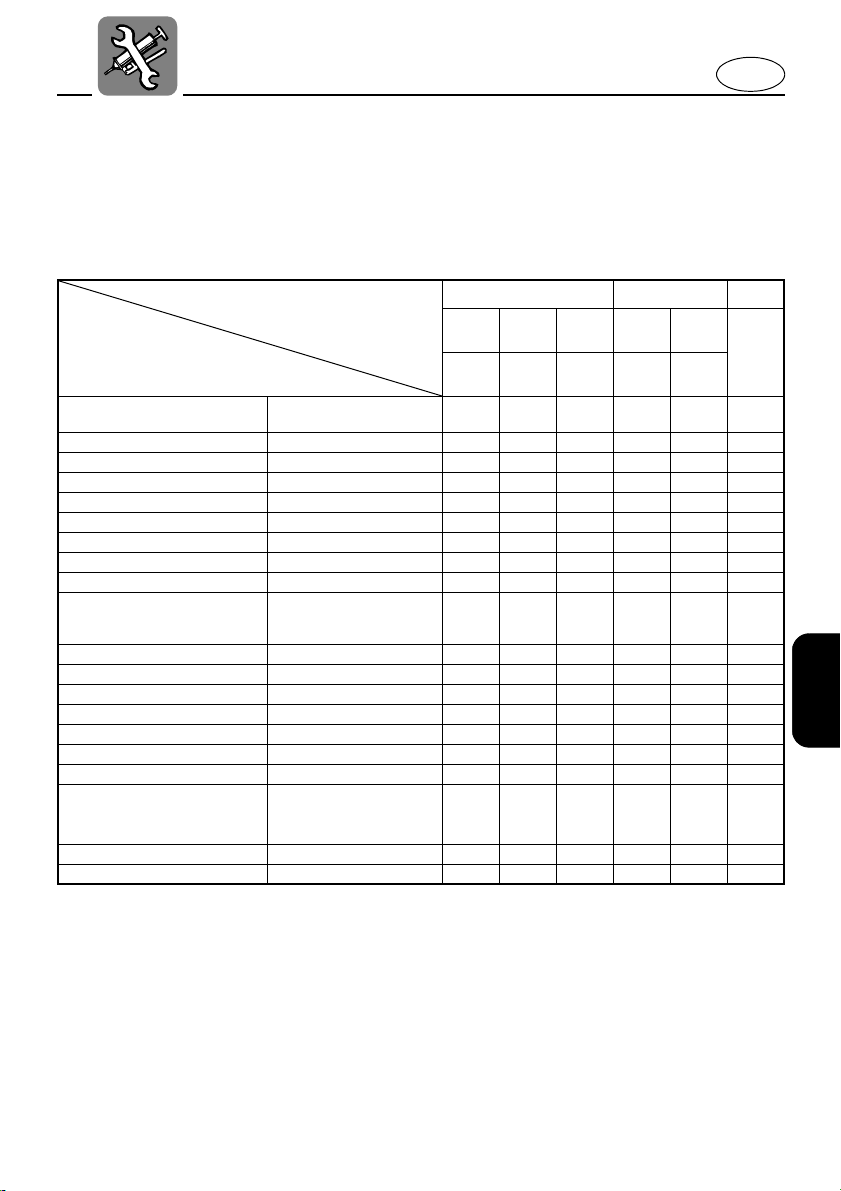
4-8
E
EJU00536a
PERIODIC INSPECTION CHART
Frequency of maintenance operations may be adjusted according to the operating condi-
tions, but the following table gives general guidelines.
The mark (
●
) indicates the checkups which you may do yourself.
The mark (
❍
) indicates work to be done by your Yamaha water vehicle dealer.
*1: Grease capacity: 33.0~35.0 cm
3
(1.11~1.18 oz.)
*2: Grease capacity: 6.0~8.0 cm
3
(0.20~0.27 oz.)
Initial Thereafter every Page
10
hours
50
hours
100
hours
100
hours
200
hours
3
months
6
months
6
months
12
months
Spark plug
Inspection/Cleaning
Adjustment
●●●●
4-14
Lubrication points Greasing
●●
4-15
Bearing housing Greasing
❍
*1
●
*2
●
*2 4-18
Fuel system Inspection
❍❍
4-9
Fuel filter Inspection/Replacement
❍❍
4-10
Fuel tank Inspection
❍
4-10
Oil injection system Inspection/Cleaning
❍❍
4-11
Trolling speed Adjustment
●●
4-20
Carburetor throttle shaft Inspection
❍❍
Cooling-water passages Cleaning/Flushing
●
(after
every
ride)
4-1
Bilge strainer Cleaning
●●●
Impeller Inspection
●●●
Steering cable Inspection
●●
4-12
QSTS mechanism Inspection
●●
4-13
Throttle cable Inspection/Adjustment
●●
4-12
Choke cable Inspection/Adjustment
●●
4-18
Drain plugs Inspection/Replacement
●
3-5
Battery Inspection
●
(Inspect
fluid level
before
every ride)
4-18
Rubber coupling Inspection
❍
Bolts and nuts Retightening
❍❍❍
Maintenance interval
Item
Chap4.fm Page 8 Thursday, March 30, 2000 2:19 PM
4-9
E
EJU00537a
FUEL SYSTEM INSPECTION
EWJ00084
WARNING
Gasoline is highly flammable and explo-
sive. A fire or explosion can cause
severe injury or death. Shut off the
engine. Do not smoke. Avoid spilling
gasoline. Do not drain the fuel while the
engine is hot.
Check the fuel system for leaks, cracks, or
malfunctions. If any problem is found, do the
necessary repair or replacement as
required. If repair is necessary, consult your
nearest Yamaha water vehicle dealer.
Checking points
●
●●
●
Check the carburetor(s) for leakage.
●
●●
●
Check the fuel pump(s) for leakage or
malfunction.
●
●●
●
Check the fuel tank for damage or cracks.
●
●●
●
Check the fuel hoses and joints for dam-
age, cracks or leakage.
●
●●
●
Check the fuel filter for clogging or dam-
age.
●
●●
●
Check the air vent for leakage or malfunc-
tion.
●
●●
●
Check water or dirt in the fuel tank.
●
●●
●
Check the fuel filler cap for damage.
EWJ00085
WARNING
Failure to check for and repair fuel leak-
age may result in fire or explosion.
Chap4.fm Page 9 Thursday, March 30, 2000 2:19 PM
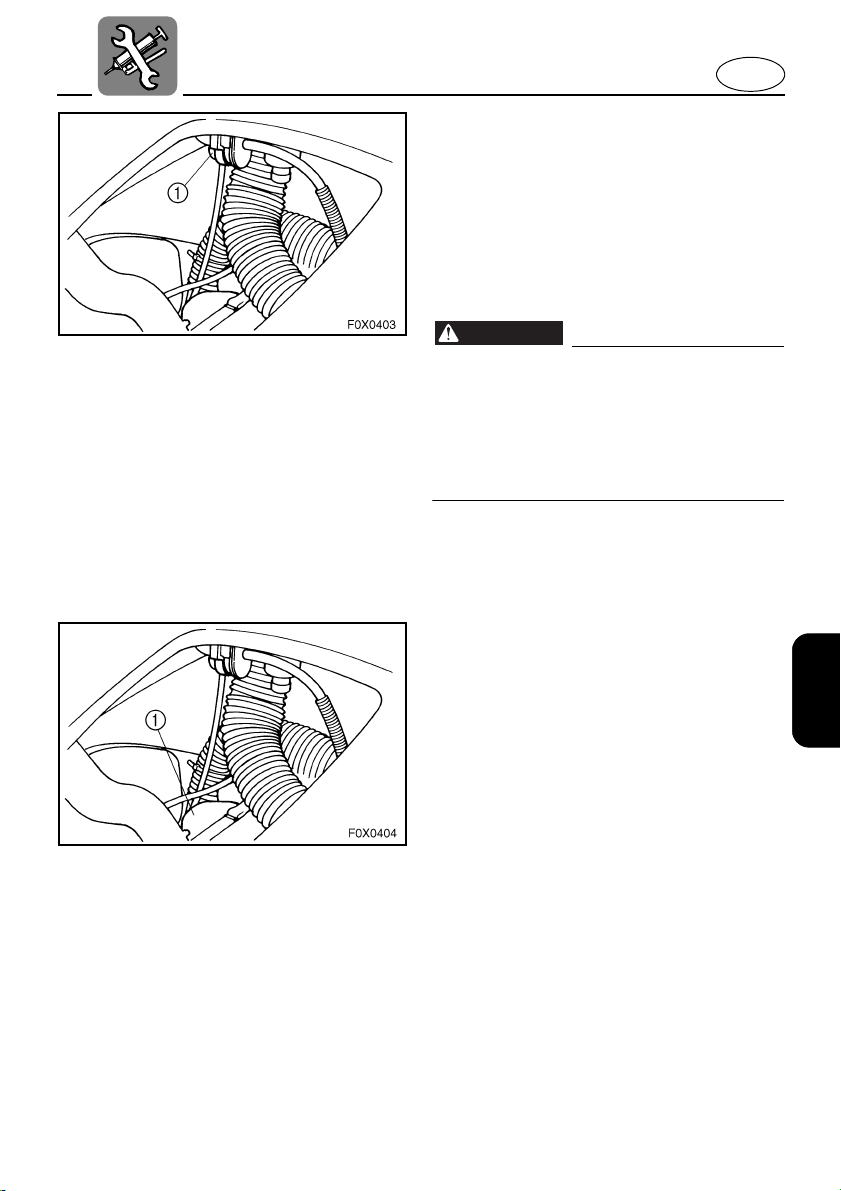
4-10
E
EJU00538a
FUEL FILTER
The fuel filter
1
is a one-piece, disposable
type. The filter should be replaced once a
year or after every 200 hours of operation,
or if water is found in the filter, take the vehi-
cle to your Yamaha water vehicle dealer if
fuel filter replacement is required.
EWJ00086
WARNING
Do not try to change the fuel filter your-
self. An incorrectly installed filter can
leak gasoline (petrol), which could lead
to fire or explosion. Take the vehicle to
your Yamaha water vehicle dealer for fuel
filter replacement.
EJU00540a
FUEL TANK
When the fuel tank
1
needs to be cleaned
or when any water is found in the fuel sys-
tem, take the vehicle to your Yamaha water
vehicle dealer for service.
Chap4.fm Page 10 Thursday, March 30, 2000 2:19 PM

4-11
E
EJU00544a
OIL INJECTION SYSTEM
INSPECTION
Check the oil injection system for leaks,
cracks, or malfunctions. If any problem is
found, do the necessary repair or replace-
ment as required. If repair is necessary, con-
sult your nearest Yamaha water vehicle
dealer.
Checking points
●
●●
●
Check the oil tank for damage or cracks.
●
●●
●
Check for water or dirt in the oil tank.
●
●●
●
Check the oil hose and joint for damage
or crack.
●
●●
●
Check the oil filter for clogging.
Oil tank
Check the oil tank for damage or cracks.
Check the oil hose and joint. When the oil
tank need to be cleaned, or when any water
or dirt is found in the oil tank, take the vehi-
cle to your Yamaha water vehicle dealer for
service.
Oil filter cleaning
The oil filter may be clogged if the oil warn-
ing indicator operates with sufficient oil in
the oil tank.
If so, take the vehicle to your Yamaha water
vehicle dealer to clean the oil filter.
Chap4.fm Page 11 Thursday, March 30, 2000 2:19 PM
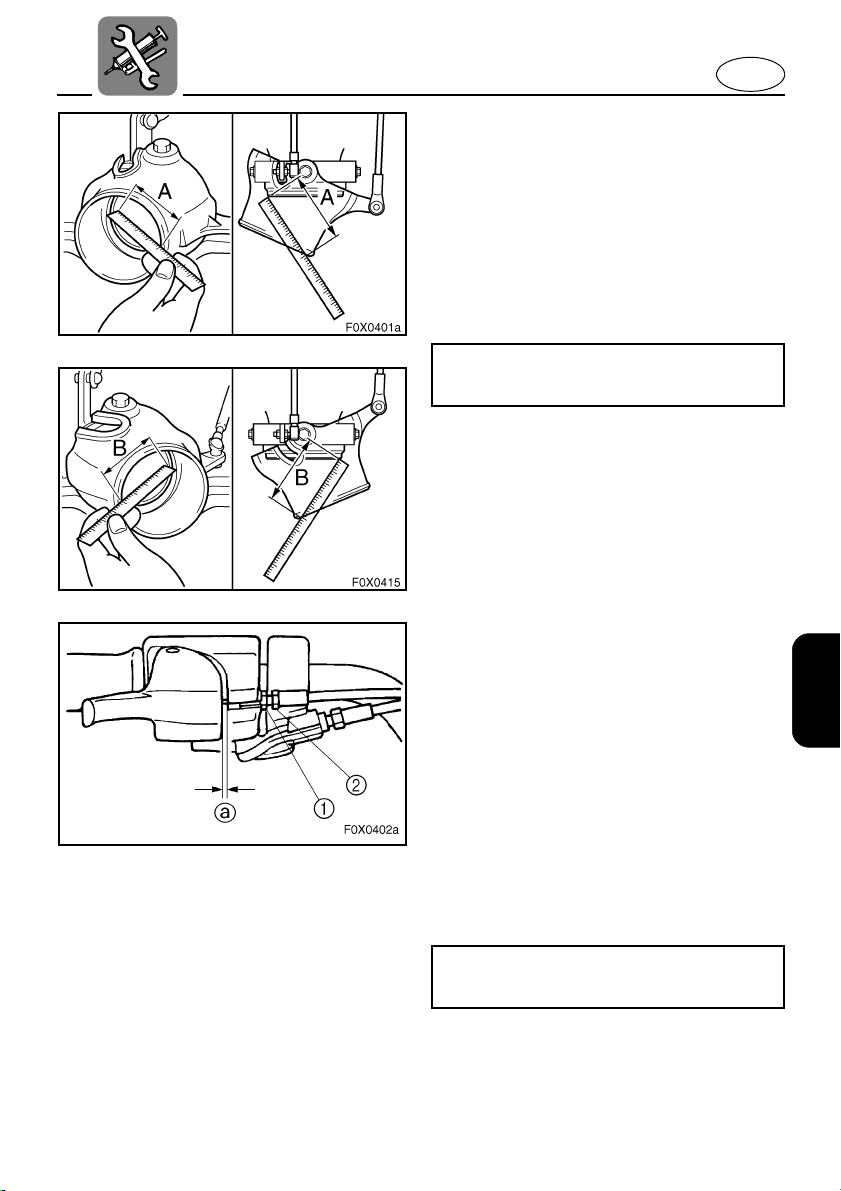
4-12
E
EJU00546a
STEERING CABLE INSPECTION
1) Check the smooth operation of the han-
dlebar and steering (jet) nozzle.
2) Turn the handlebar from lock to lock and
check that the differences of distance A
and B between the steering (jet) nozzle
and the reflector are within specification
on both right and left sides.
If steering is stiff or maladjusted, ask your
Yamaha water vehicle dealer to service it.
EJU00550a
THROTTLE CABLE INSPECTION
AND ADJUSTMENT
1) By squeezing or releasing the throttle
lever, check that it moves back to the set
position smoothly. If not, ask your
Yamaha water vehicle dealer for service.
2) Throttle lever free play should be within
specification. If it is not, adjust it by loos-
ening the lock nut
1
and turning the
adjuster
2
so that throttle lever free play
is within specification with the carburetor
at idle position.
Differences of A and B
Maximum 5 mm (0.20 in.)
Throttle lever play
a
:
4 ~ 7 mm (0.16 ~ 0.28 in)
Chap4.fm Page 12 Thursday, March 30, 2000 2:19 PM
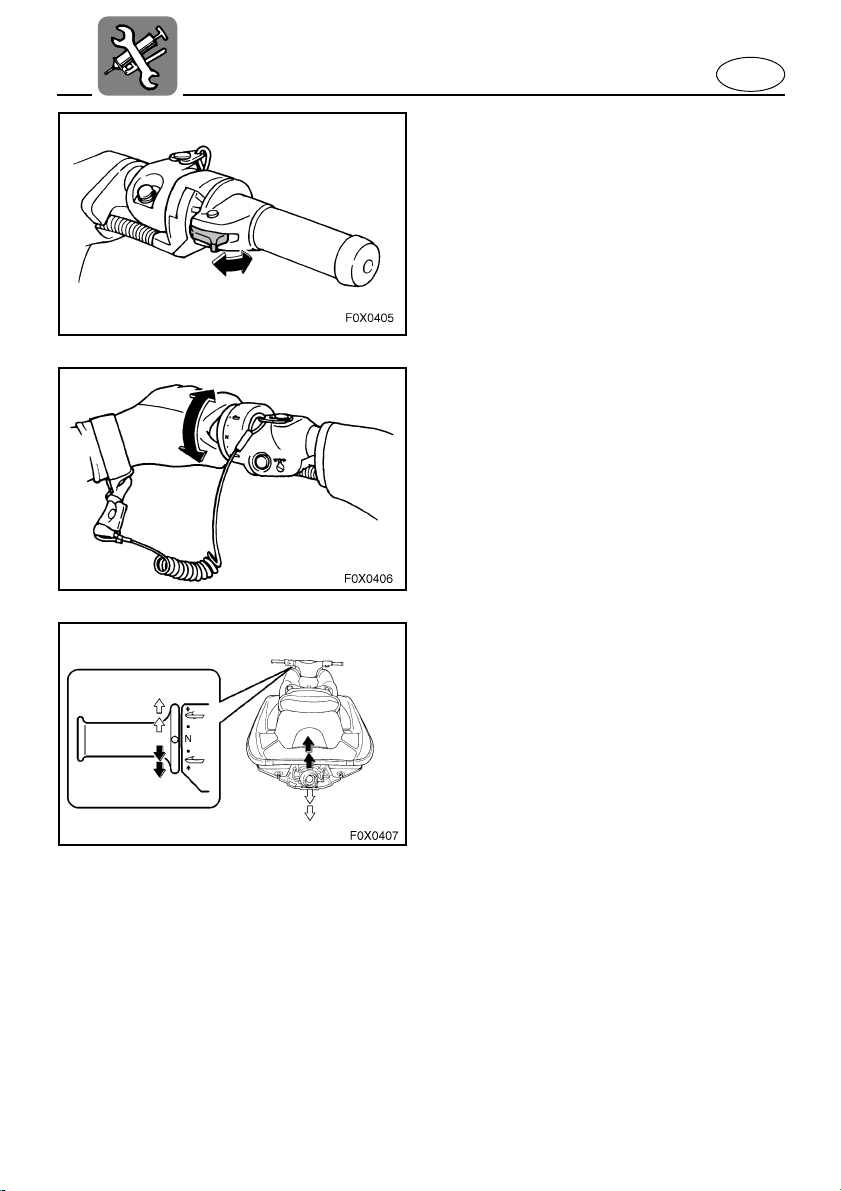
4-13
E
EJU00551a
QSTS (Quick Shift Trim System)
MECHANISM INSPECTION
1) Squeeze and release the shift lock lever.
It should move smoothly back to the lock
position. Check that the trim shifting grip
is locked with the lever released.
2) Squeeze and hold the lever. Check that
the grip turns smoothly.
3) Check that the angle of the output noz-
zle changes to up or down from the mid-
dle position when the grip is shifted from
neutral to bow-up or bow-down.
If the mechanism does not work properly,
ask your Yamaha water vehicle dealer to
service it.
Chap4.fm Page 13 Thursday, March 30, 2000 2:19 PM
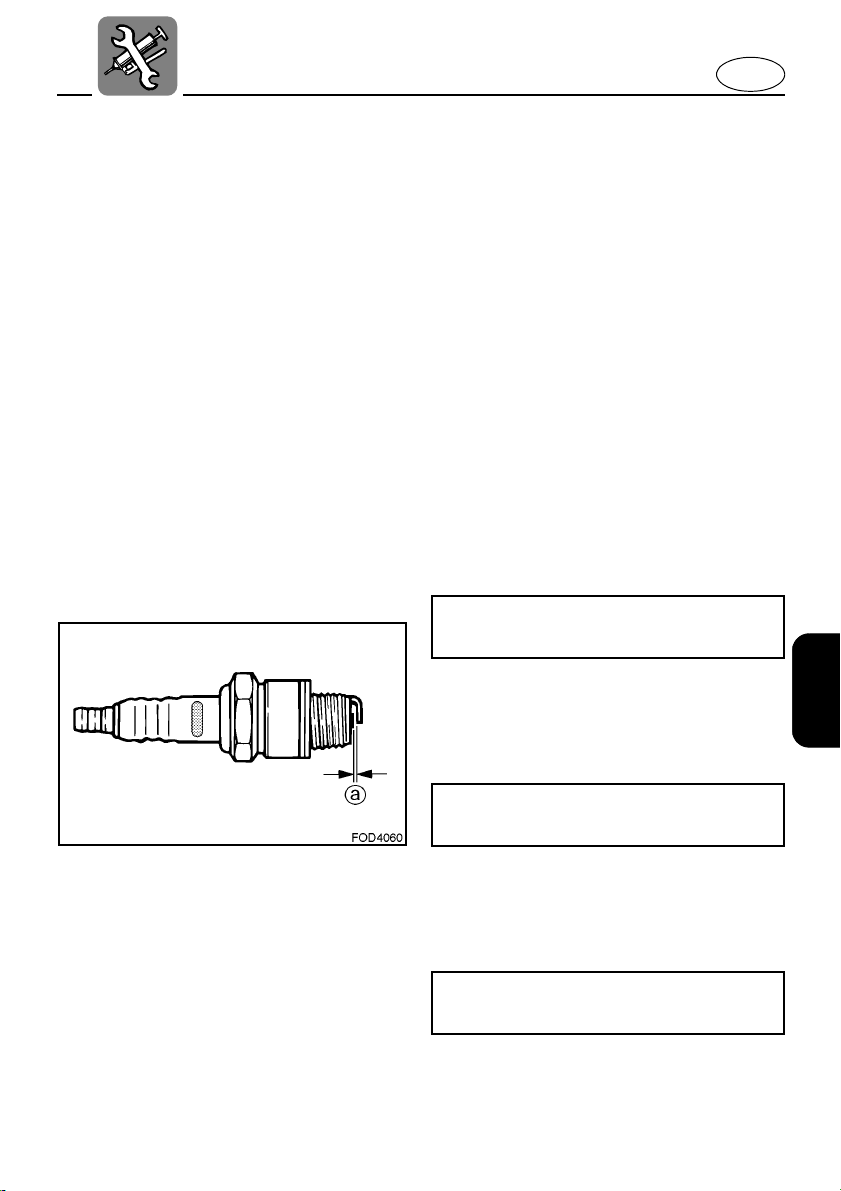
4-14
E
EJU00552a
SPARK PLUG CLEANING AND
ADJUSTMENT
The spark plug is an important engine com-
ponent and is easy to inspect. The condition
of the spark plug can indicate something
about the condition of the engine. For exam-
ple, if the center electrode porcelain is very
white, this could indicate an intake air leak
or carburetion problem in that cylinder. Do
not attempt to diagnose any problems your-
self. Instead, take the vehicle to a Yamaha
water vehicle dealer. You should periodically
remove and inspect the spark plug because
heat and deposits will cause the spark plug
to slowly break down and erode. If electrode
erosion becomes excessive, or if carbon and
other deposits are excessive, you should
replace the spark plug with another of the
correct type.
Before reinstalling the spark-plug, measure
the electrode gap with a wire thickness
gauge; adjust the gap to specification if nec-
essary.
When fitting the spark plug, always clean
the gasket surface. Wipe off any dirt from
the threads and screw in the spark plug to
the correct torque.
Standard spark plug:
BR8ES-11
Spark plug gap
a
:
1.0 ~ 1.1 mm (0.039 ~ 0.043 in)
Spark plug torque:
25 Nm (2.5 m
•
kg, 18 ft
•
lb)
Chap4.fm Page 14 Thursday, March 30, 2000 2:19 PM
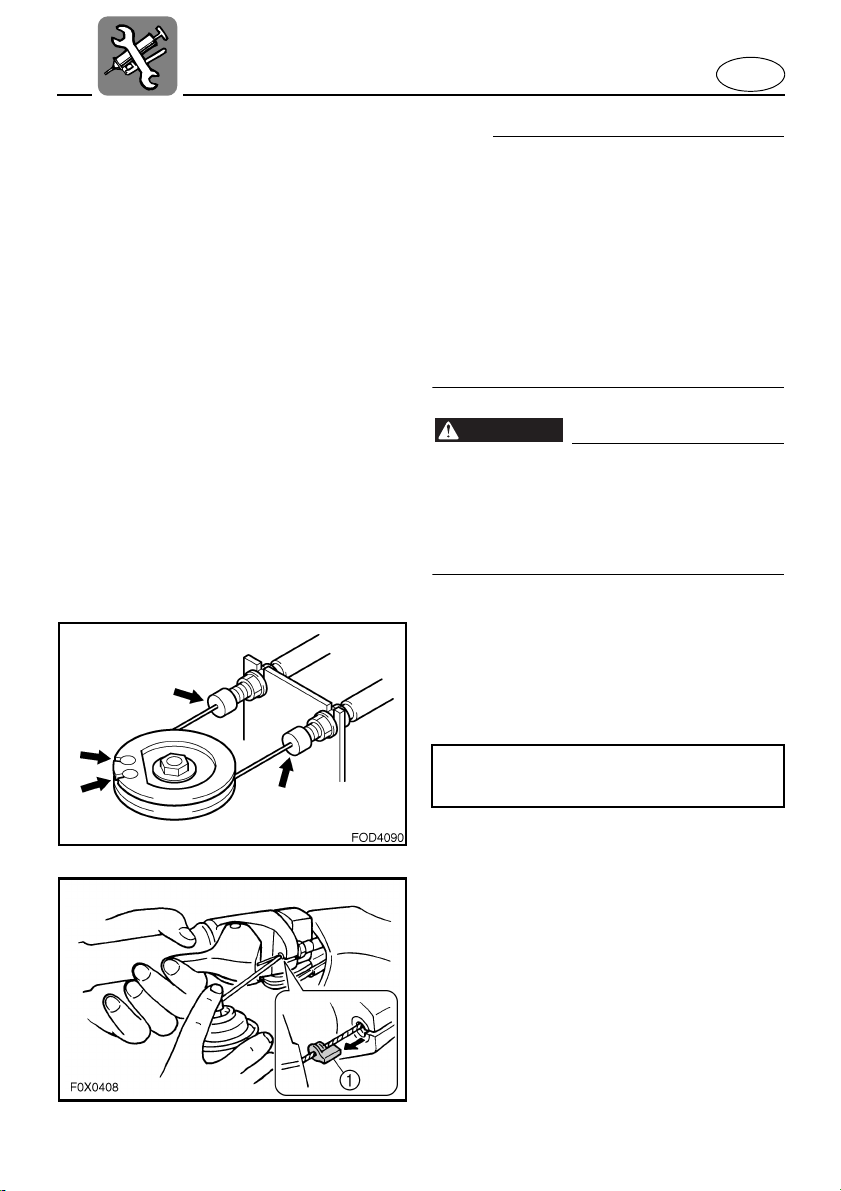
4-15
E
N
O
TE:
●
●●
●
Before installing the spark plug cap, be
sure to wipe off any water on the spark
plug or inside the cap. Push the spark
plug cap down until it clicks.
●
●●
●
If a torque wrench is not available when
fitting a new spark plug, good estimate of
the correct torque is 1/4 to 1/2 a turn past
finger-tight. Have the spark plug adjusted
to the correct torque as soon as possible
with a torque wrench.
EWJ00088
WARNING
When removing or installing a spark
plug, be careful not to damage the insu-
lator. A damaged insulator could allow
external sparks, which could lead to
explosion or fire.
EJU00553a
LUBRICATION POINTS
Coat the moving parts that are sliding or
rotating with the water resistant grease to
keep them move smoothly.
●
●●
●
Throttle cable (carburetor side)
●
●●
●
Oil pump cable
●
●●
●
Throttle cable (handlebar side)
Squeeze the throttle lever and remove the
seal
1
. Spray a rust-inhibitor into the outer
cable. Refit the seal securely.
Recommended water resistant grease:
Yamaha marine grease
Chap4.fm Page 15 Thursday, March 30, 2000 2:19 PM
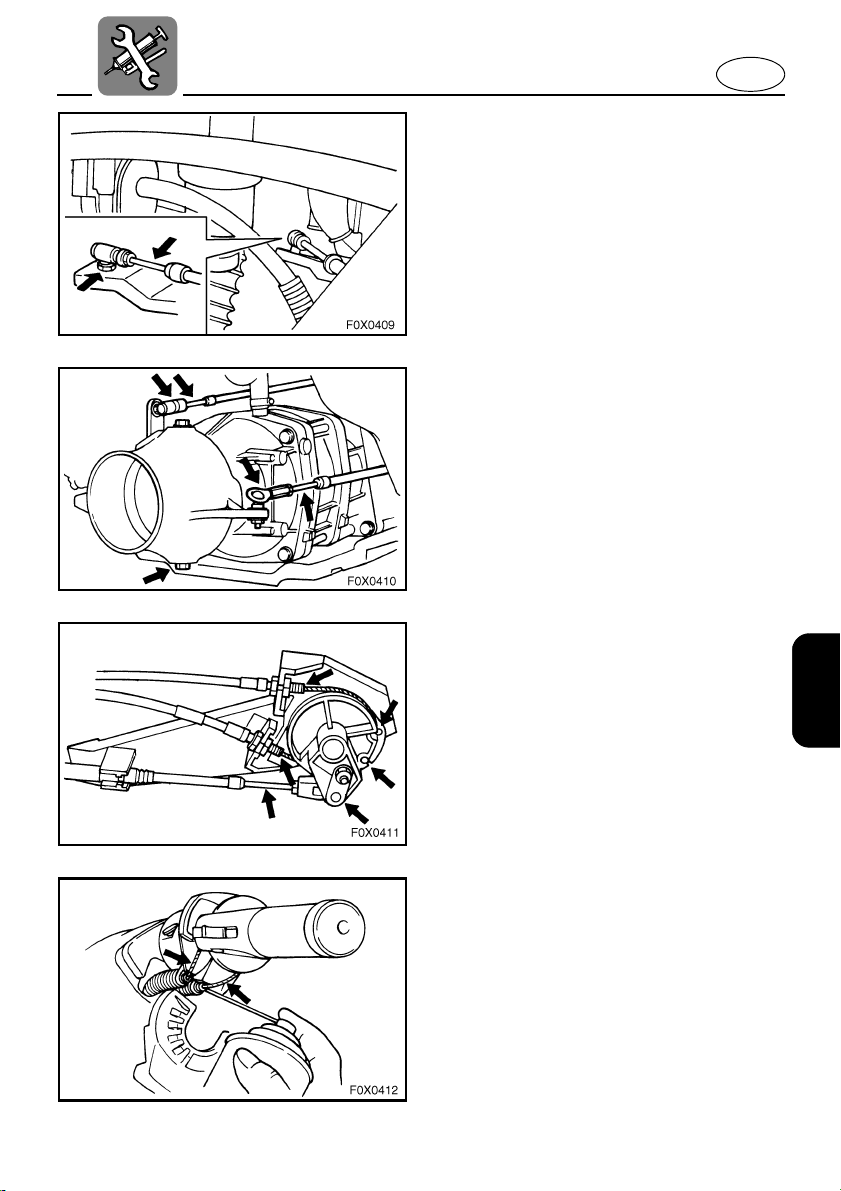
4-16
E
●
●●
●
Steering cable (handlebar side)
●
●●
●
Steering cable (nozzle side)
●
●●
●
Nozzle pivot shaft
●
●●
●
QSTS cable (nozzle side)
●
●●
●
QSTS cables (pulley side)
●
●●
●
QSTS cables (handlebar side)
Remove the QSTS cable housing. Spray a
rust-inhibitor into the outer cable.
Reinstall the QSTS cable housing.
Chap4.fm Page 16 Thursday, March 30, 2000 2:19 PM
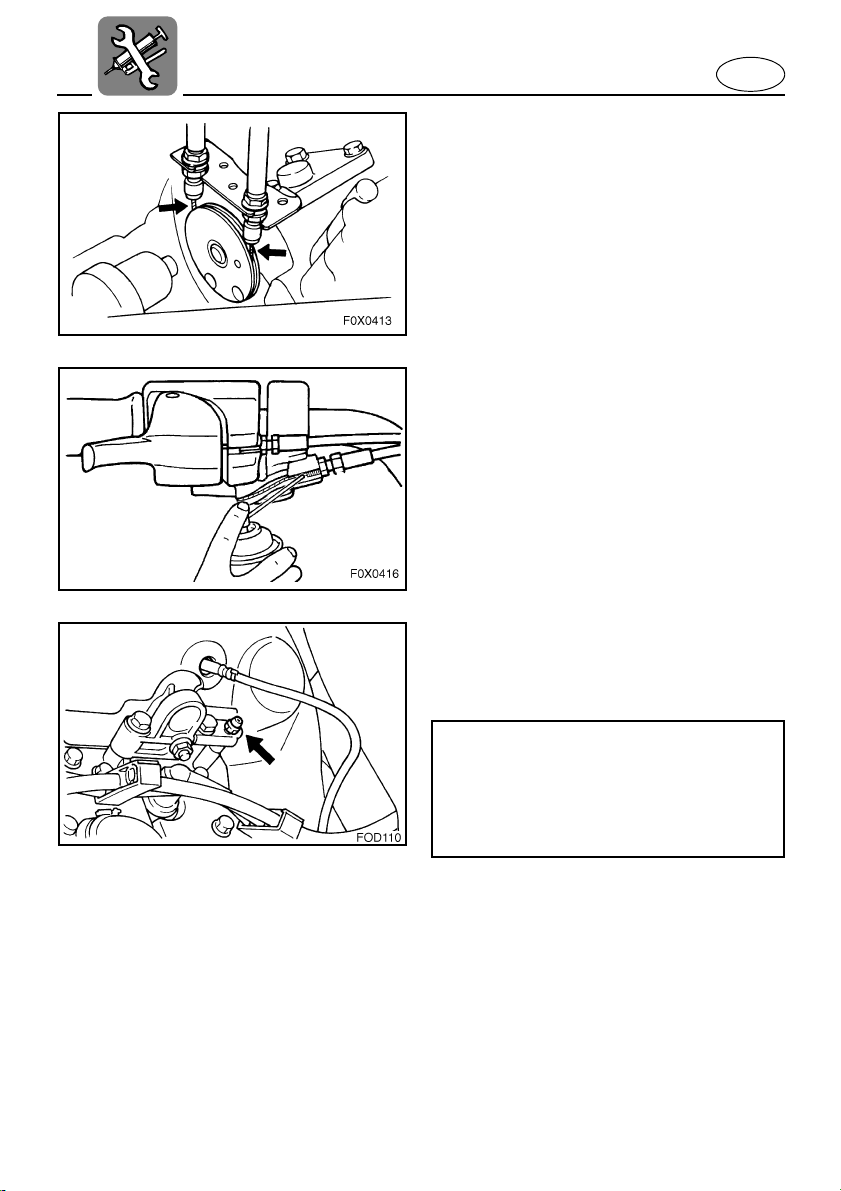
4-17
E
●
●●
●
YPVS cable
●
●●
●
Choke cable (handlebar side)
Spray the rust-inhibitor into the outer
cable.
EJU00566a
●
●●
●
Bearing housing grease nipple
Fill the bearing housing with the water resis-
tant grease through the grease nipple.
Grease capacity:
Initial 10 hours or 1 month:
33.0 ~ 35.0 cm
3
(1.11 ~ 1.18 oz.)
Every 100 hours or 6 months:
6.0 ~ 8.0 cm
3
(0.20 ~ 0.27 oz.)
Chap4.fm Page 17 Thursday, March 30, 2000 2:19 PM
4-18
E
EJU00572a
BATTERY
Check the level of the battery fluid and see if
the terminals are tight. Add distilled water if
the fluid level is low.
EWJ00089
WARNING
Battery electrolyte is poisonous and dan-
gerous. It contains sulfuric acid which
can cause severe burns. Avoid contact
with skin, eyes or clothing.
Antidote:
EXTERNAL-Flush with water. INTERNAL-
Drink large quantities of water or milk;
follow with milk of magnesia, beaten egg
or vegetable oil. Call physician immedi-
ately.
EYES: Flush with water for 15 minutes
and get prompt medical attention.
Batteries give off explosive gases. Keep
sparks, flame, cigarettes, etc. Well away.
If using or charging the battery in an
enclosed area, make sure it is well venti-
lated. Always shield eyes when working
near batteries.
KEEP OUT OF REACH OF CHILDREN.
ECJ00083
CAUTION:
Be careful not to place the battery on its
side.
When adding the battery fluid or recharg-
ing, be sure to bring it out of the battery
compartment.
When checking the battery, make sure
the breather pipe is connected to the bat-
tery and not pinched shut by any part of
the battery compartment.
Replenishing the battery fluid
A poorly maintained battery will deteriorate
quickly. The battery fluid should be checked
before every ride.
Chap4.fm Page 18 Thursday, March 30, 2000 2:19 PM
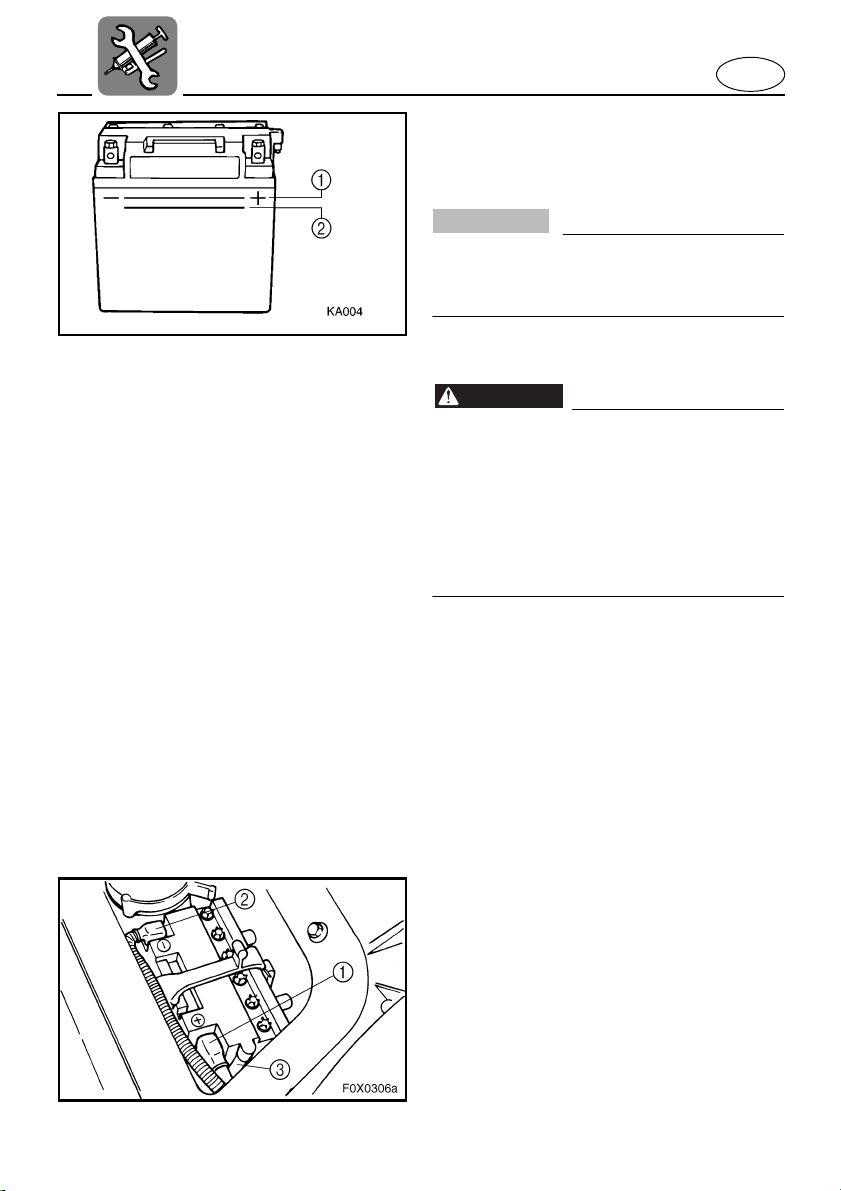
4-19
E
The level should be between the upper
1
and lower
2
level marks. If refilling is neces-
sary, use only distilled water.
ECJ00084
CAUTION:
Normal tap water contains minerals
which are harmful to a battery, therefore,
refill only with distilled water.
Recharging
EWJ00090
WARNING
●
●●
● When charging the battery keep it well
away from sparks and open flames, as
it gives off explosive gases.
●
●●
● When using a battery charger, connect
the battery to the charger before you
turn the charger on. This will prevent
sparking at the terminals which could
ignite battery gases.
1) Remove the caps from the cells. Add
distilled water if necessary to top up the
electrolyte to the proper level.
2) Connect the battery to a charger. Set
the charging rate at 1.9 amps, and
charge it for 10 hours.
Connecting the battery terminals
Always make sure the connections are cor-
rect when you insert the battery in the vehi-
cle. Make sure the breather pipe is properly
connected and that it is not damaged or
obstructed. Make sure the battery is
securely held in place.
1
Positive (
+
)
Red lead
2
Negative (
−
)
Black lead
3
Breather pipe
Chap4.fm Page 19 Thursday, March 30, 2000 2:19 PM
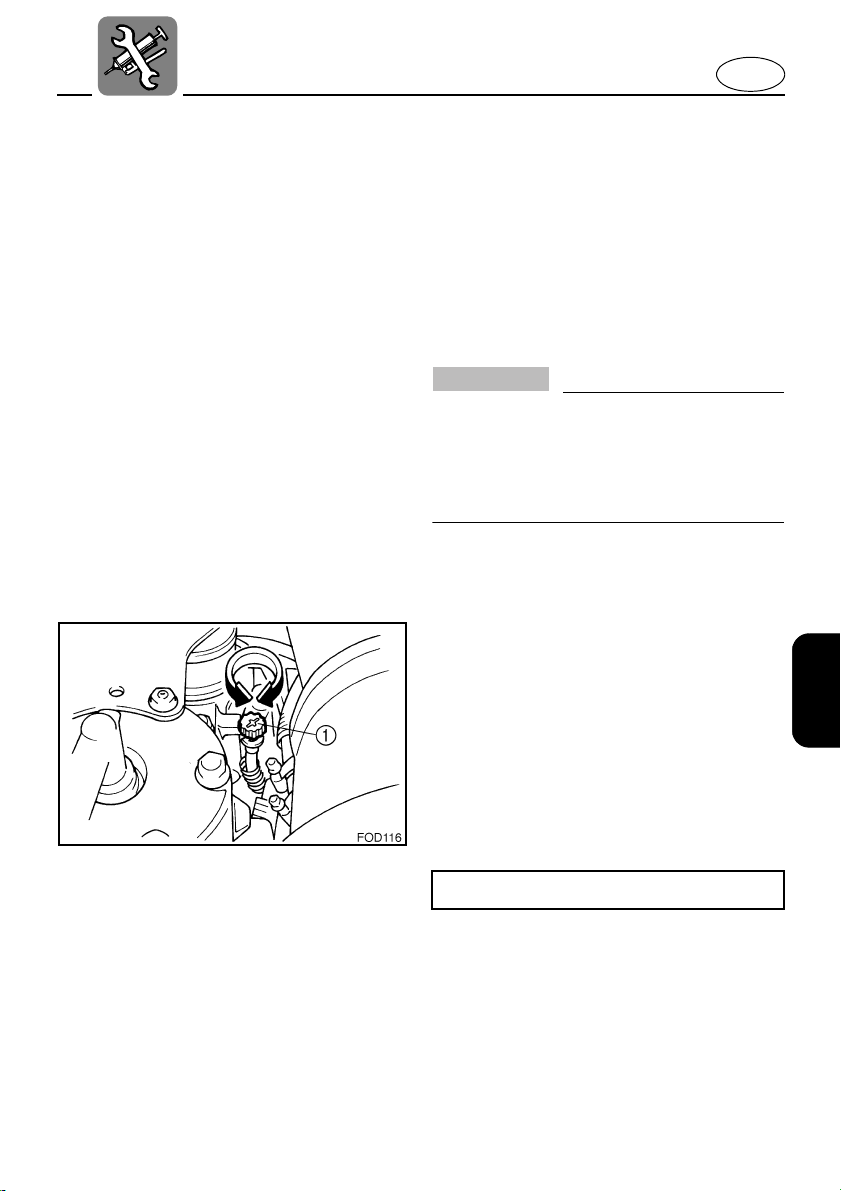
4-20
E
EJU00573a
CARBURETOR ADJUSTMENT
The carburetor is a vital part of the engine
and requires very sophisticated adjustment.
Most adjusting should be left to a Yamaha
water vehicle dealer who has the profes-
sional knowledge and experience to do so.
However, the following point may be ser-
viced by the owner as part of your usual
maintenance routine.
ECJ00085
CAUTION:
The carburetor was set at the Yamaha
factory after many tests. If the settings
are disturbed without having technical
knowledge, poor engine performance
and damage may result.
EJU00577a
Trolling speed
Place the vehicle afloat. Start the engine
and warm it up for one or two minutes. Using
a diagnostic tachometer or, if necessary, the
tachometer equipped to the vehicle, adjust
the engine trolling speed to specification.
Turn the throttle stop screw
1
clockwise to
increase engine speed or counterclockwise
to decrease engine speed.
Trolling speed: 1,300~1,400 r/min
Chap4.fm Page 20 Thursday, March 30, 2000 2:19 PM
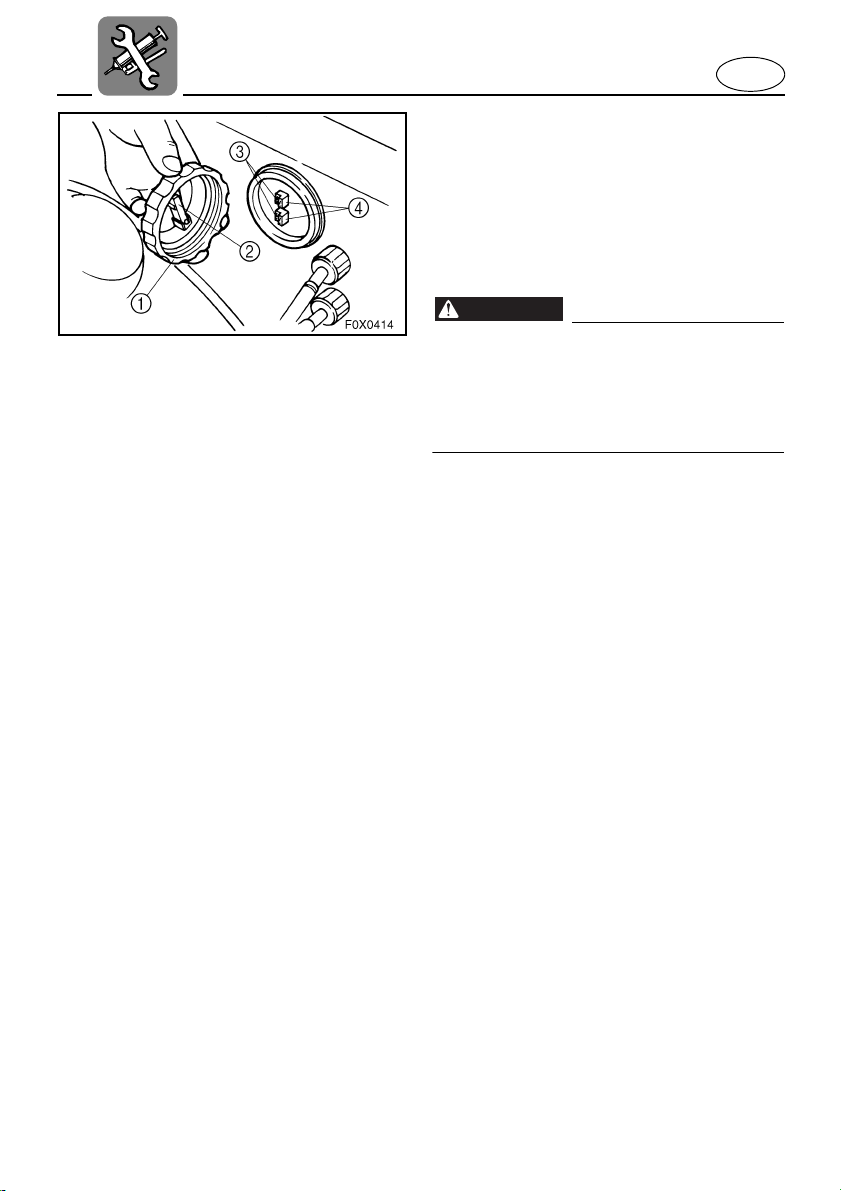
4-21
E
EJU00578a
REPLACING THE FUSE
The fuse(s) is located in the electrical box.
Remove the cap
1
by turning it counter-
clockwise. Remove the defective fuse
3
using the fuse puller
2
. Install the spare
fuse
4
of correct ampere.
EWJ00091
WARNING
Do not use fuses of higher amperage that
those recommended. Substitution of a
fuse of improper rating can cause exten-
sive electrical system damage and possi-
ble fire.
EJU00580
BLEEDING THE OIL INJECTION
PUMP
If the oil tank becomes completely empty or
any hose connected to oil pump has been
disconnected, the oil pump must be bled to
ensure proper oil flow.
If bleeding of the oil pump is necessary, take
the vehicle to your nearest Yamaha water
vehicle dealer.
Chap4.fm Page 21 Thursday, March 30, 2000 2:19 PM
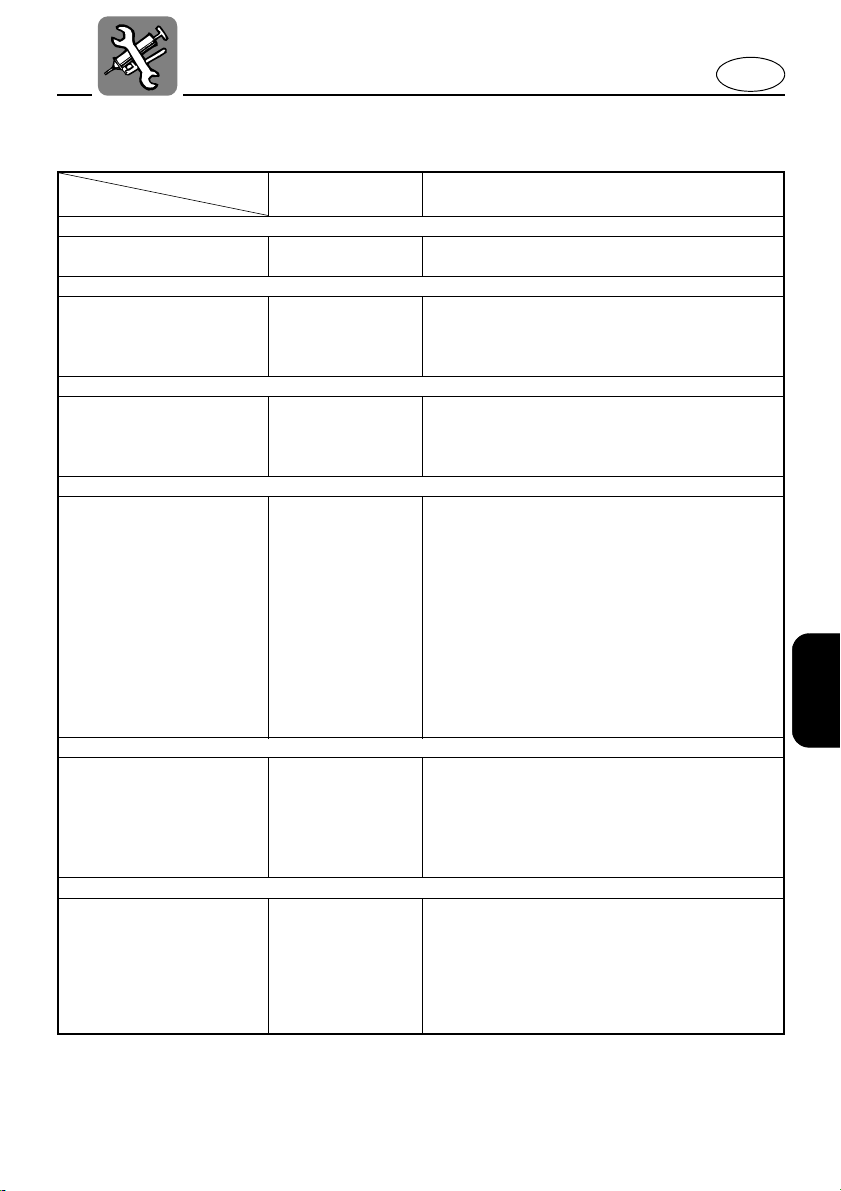
4-22
E
EJU00588
SPECIFICATIONS
*1: Pump Octane Number
*1: Research Octane Number
*2: YAMALUBE 2-W is developed for this water vehicle and available from a Yamaha water vehicle dealer.
*3: Includes reserve fuel capacity.
Model
Item
Unit GP1200R
VEHICLE CAPACITY
Maximum people on board Number of people 2
Maximum load capacity kg (lb) 160 (353)
DIMENSIONS
Length mm (in) 2,930 (115.4)
Width mm (in) 1,150 (45.3)
Height mm (in) 1,020 (40.2)
Dry weight kg (lb) 306 (675)
PERFORMANCE
Maximum output kW(PS) @ r/min 114.0 (155) @ 7,000
Maximum fuel consumption L/h (US gal/h, lmp gal/h) 64.0 (16.9, 14.1)
Cruising range/at full the throttle hr. 1.1
Trolling speed r/min 1,300~1,400
ENGINE
Engine type 2-stroke, L3
Displacement
cm
3
(cu.in)
1,176 (71.74)
Bore & stroke mm (in) 80.0 × 78.0 (3.15 × 3.07)
Compression ratio 5.9 : 1
Lubrication system Variable oil injection
Cooling system Water-cooled
Starting system Electric starter
Ignition system Digital CDI
Spark plug BR8ES-11 (NGK)
Spark plug gap mm (in) 1.0~1.1 (0.039~0.043)
Battery capacity V-AH 12-19
Charging system Flywheel magneto
DRIVE UNIT
Propulsion system Jet pump
Jet pump type Axial flow, single stage
Impeller rotation Counterclockwise
Transmission Direct drive from engine
Steering (nozzle) angle Degree 23
+ 23
Trim (nozzle) angle Degree -5, 0, 5, 10, 15
FUEL AND OIL
Recommended fuel Regular unleaded gasoline
Minimum fuel rating PON (*1)
RON (*1)
86
90
Recommended engine oil YAMALUBE 2-W (*2)
Fuel tank capacity L (US gal, lmp gal) 60 (15.9, 13.2) (*3)
Reserve fuel capacity L (US gal, lmp gal) 10 (2.6, 2.2)
Oil tank capacity L (US gal, lmp gal) 5.5 (1.45, 1.21)
Chap4.fm Page 22 Thursday, March 30, 2000 2:19 PM

E
– MEMO –
Chap4.fm Page 23 Thursday, March 30, 2000 2:19 PM

E
5
EJU00594
Chapter 5
TROUBLESHOOTING
AND EMERGENCY
PROCEDURE
TROUBLESHOOTING
...........................5-1
Troubleshooting chart ........................5-1
EMERGENCY PROCEDURES
..............5-3
Cleaning the jet intake and impeller...5-3
Connecting jumper cables..................5-4
Towing the water vehicle....................5-6
Submerged water vehicle...................5-7
Chap5TOC.fm Page 1 Thursday, March 30, 2000 2:21 PM
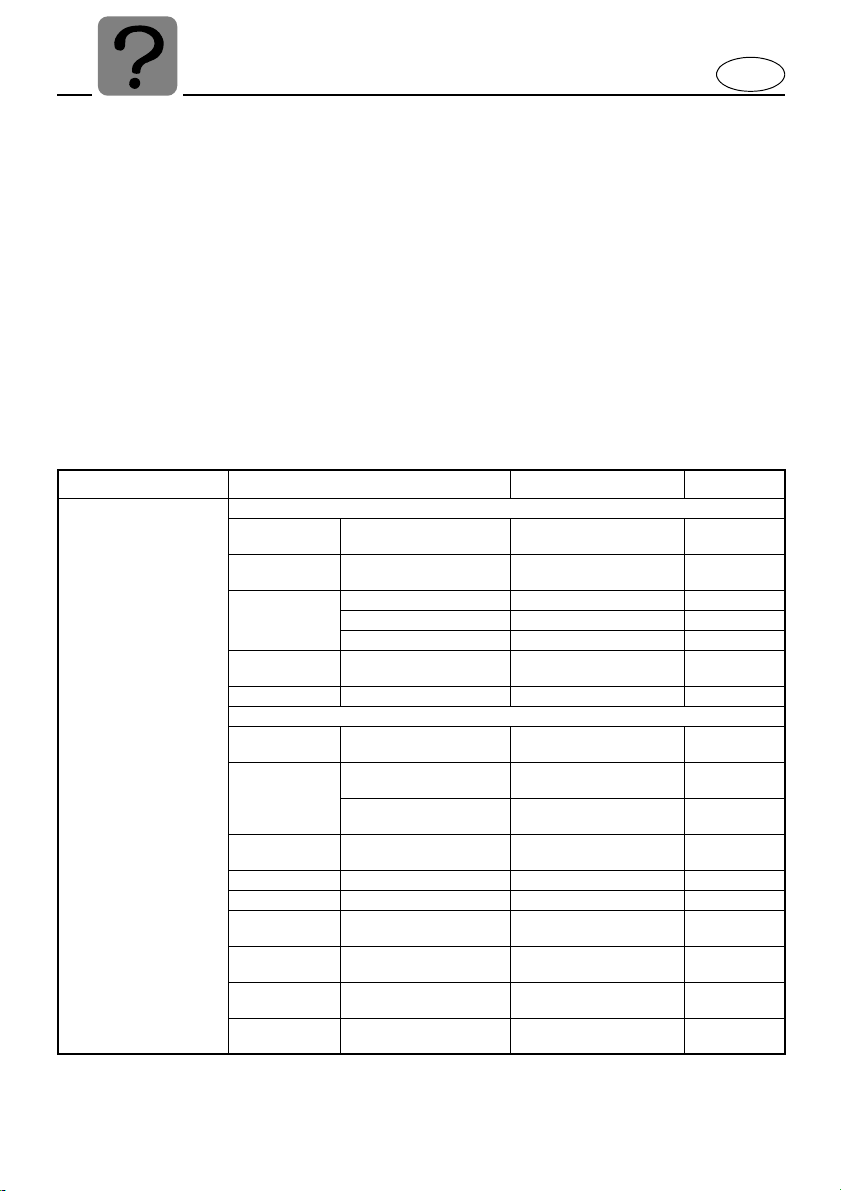
5-1
E
EJU00595a
TROUBLESHOOTING
If any trouble happens with your water vehicle, use this section to check for the possible
cause.
If you cannot find the cause, or if the procedure for replacement or repair is not described in
this owner’s/operator’s manual, ask your Yamaha water vehicle dealer or qualified mechanic
for the proper service.
The troubleshooting chart contains “TROUBLE”, “POSSIBLE CAUSE”, “REMEDY”, and
“REFER PAGE”.
Check the possible cause and remedy, and also the referred page for the maintenance
steps to solve the trouble.
EJU00596a
TROUBLESHOOTING CHART
TROUBLE POSSIBLE CAUSE REMEDY Refer Page
The engine does not
start
Starter motor does not turn over
●
Engine stop
lanyard switch
Lock-plate is removed
●
Install lock-place
2-8
●
Fuse Burned out
●
Replace the fuse and
check wiring
4-21
●
Battery
Run down
●
Recharge 4-18
Poor terminal connections
●
Tighten as required 4-18
Terminal is eroded
●
Clean
●
Starter motor
component
Faulty
●
Have a service at
Yamaha dealer
●
Micro-computer Overheat mode
●
Cool down engine 2-15
Starter motor turns over
●
Fuel cock
OFF position
●
Turn the fuel cock to
“ON”
2-7
●
Fuel
Empty
●
Refill as soon as
possible
3-1
Stale or contaminated
●
Have service at
Yamaha dealer
4-9
●
Fuel tank
Water or dust collected
●
Have service at
Yamaha dealer
4-10
●
Spark plug Fouled or defective
●
Clean or replace 4-14
●
Spark plug cap Not fitted or loose
●
Fit properly 4-14
●
Crankcase
Filled with water
●
Crank engine with plug
out until clean
5-7
●
Fuel filter
Clogged or water col-
lected
●
Have service at
Yamaha dealer
4-10
●
Choke
Choke lever automatically
return
●
Have service at Yamaha
dealer
4-18
●
Water temper-
ature sensor
Failed
●
Have service at
Yamaha dealer
2-15
Chap5.fm Page 1 Thursday, March 30, 2000 2:21 PM

5-2
E
The engine runs irregu-
larly or stalls
●
Fuel
Empty
●
Refill as soon as possi-
ble
3-1
Stale or contaminated
●
Have service at
Yamaha dealer
4-9
●
Choke Lever is turned fully on
●
Return to original position 2-9
●
Fuel Filter
Clogged or water col-
lected
●
Have service at
Yamaha dealer
4-10
●
Fuel tank
Water or dust collected
●
Have service at
Yamaha dealer
4-10
●
Spark plug
Fouled or defective
●
Replace 4-14
Incorrect heat range
●
Replace 4-14
Gap incorrect
●
Adjust 4-14
●
Spark plug cap
Loose
●
Fit properly 4-14
Cracked, torn, or damaged
●
Replace
●
Electrical
wiring
Loose connections
●
Tighten or connect
securely
●
Carburetor
Incorrect idle adjustment
●
Adjust idle 4-20
Clogged
●
Have service at
Yamaha dealer
Warning indicator /
symbol blinks or light
●
Fuel level Empty
●
Refill as soon as possible 3-1
●
Engine oil level
Empty
●
Refill immediately 3-2
Oil filter clogged
●
Clean 4-11
●
Engine over-
heat
Jet intake clogged
●
Clean 5-3
Water temperature sensor
is failed
●
Have service at
Yamaha dealer
2-13
●
Exhaust gas
temperature
Gas temperature is too
high
●
Cool down engine 2-14
The water vehicle
speeds too slow or
loses power
●
Cavitation
Jet intake clogged
●
Clean 5-3
Impeller damaged or worn
●
Have service at
Yamaha dealer
●
Engine overheat Jet intake clogged
●
Clean 5-3
●
Fuel Filter
Clogged
●
Have service at
Yamaha dealer
4-10
●
Spark plug
Fouled or defective
●
Replace 4-14
Incorrect heat range
●
Replace 4-14
Gap incorrect
●
Adjust 4-14
●
Spark plug caps Loose
●
Fit properly 4-14
●
Electrical
wiring
Loose connections
●
Tighten or connect
securely
●
Fuel
Stale or contaminated
●
Have service at
Yamaha dealer
4-10
●
Bilge
Water is accumulated in
the vehicles
●
Drain bilge 3-5
TROUBLE POSSIBLE CAUSE REMEDY Refer Page
Chap5.fm Page 2 Thursday, March 30, 2000 2:21 PM
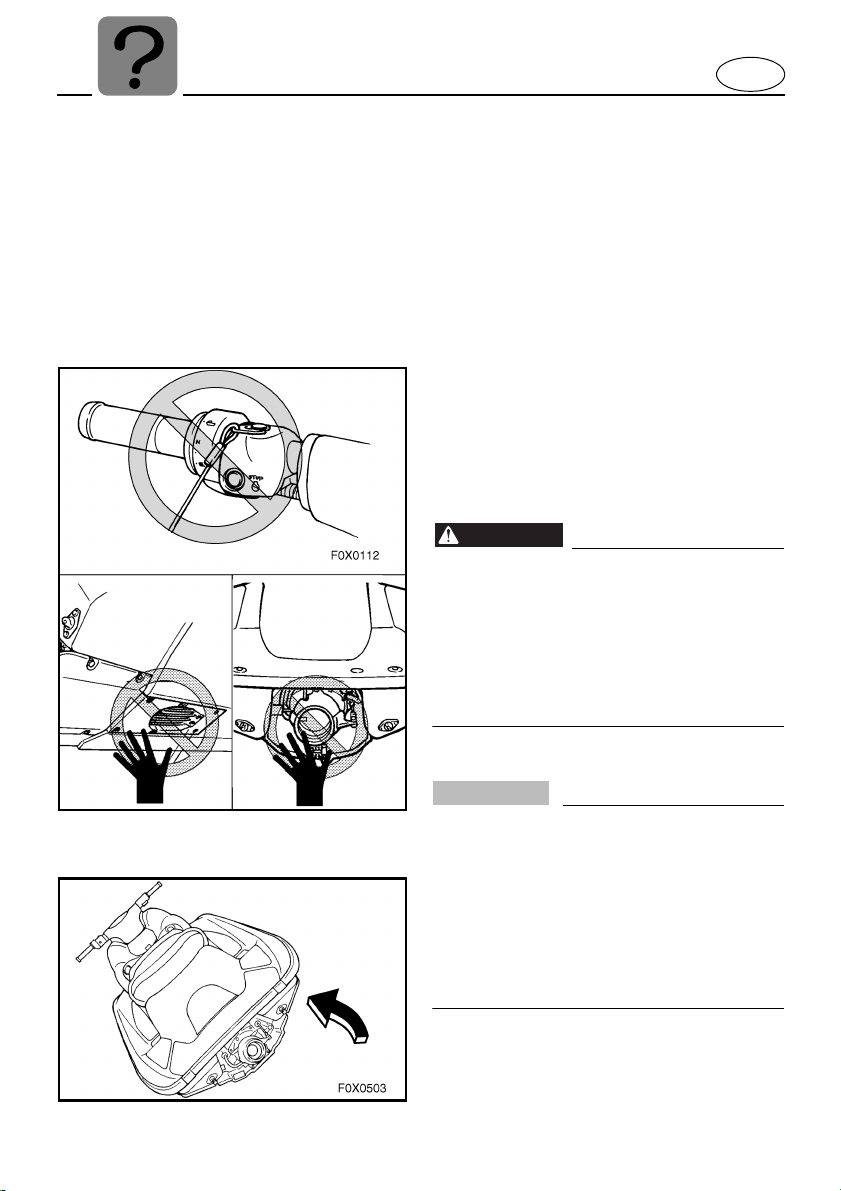
5-3
E
EJU00597
EMERGENCY PROCEDURES
EJU00598a
CLEANING THE JET INTAKE AND
IMPELLER
If weeds or debris get caught in the intake or
impeller, cavitation can occur, and though
the engine speed rises, forward thrust will
decrease. If this condition is allowed to con-
tinue, the engine will overheat and may
seize. If there is any sign that the jet intake
or impeller is clogged with weeds or debris,
beach the vehicle and check the intake and
impeller. Always stop the engine before
beaching the vehicle.
EWJ00051
WARNING
Before attempting to remove weeds or
debris from the jet intake or impeller
areas, shut off the engine and remove
the lock-plate from the engine stop lan-
yard switch. Severe injury or death could
result from coming in contact with the
rotating parts of the jet pump.
1) Turn the vehicle on its side as shown.
ECJ00089
CAUTION:
Place a suitable clean cloth or carpeting
underneath the vehicle to protect it from
abrasions and scratches, and always
turn the vehicle over on its port (left)
sides.
When turning the vehicle on its side,
support the front portion so the handle-
bars cannot be bent or damaged.
Chap5.fm Page 3 Thursday, March 30, 2000 2:21 PM
5-4
E
2) Remove any weeds or debris from
around the drive shaft, impeller, pump
housing, and steering nozzle.
If it is difficult to remove them, consult
your Yamaha water vehicle dealer.
ECJ00090
CAUTION:
Always avoid running your vehicle in
areas where weed growth is thick. If trav-
eling in weeded areas is unavoidable, run
the engine alternately at partial-throttle
and full-throttle. Weeds tend to accumu-
late more at a steady speed and at troll-
ing speed. If weeds clog the intake or
impeller area and cause cavitation, follow
the above cleaning procedure.
EJU00599
CONNECTING JUMPER CABLES
If the battery has run down, the engine can
be started using a 12-volt battery and
jumper cables.
EWJ00092
WARNING
Battery electrolyte is poisonous and dan-
gerous. It contains sulfuric acid which
can cause severe burns. Avoid contact
with skin, eyes or clothing.
Antidote:
EXTERNAL-Flush with water. INTERNAL-
Drink large quantities of water or milk;
follow with milk of magnesia, beaten egg,
or vegetable oil. Call physician immedi-
ately.
EYES-Flush with water for 15 minutes
and get prompt medical attention.
Batteries give off explosive gases. Keep
sparks, flame, cigarettes, etc. well away.
If using or charging the battery in an
enclosed area, make sure it is well venti-
lated. Always shield your eyes when
working near batteries.
KEEP OUT OF REACH OF CHILDREN.
Chap5.fm Page 4 Thursday, March 30, 2000 2:21 PM
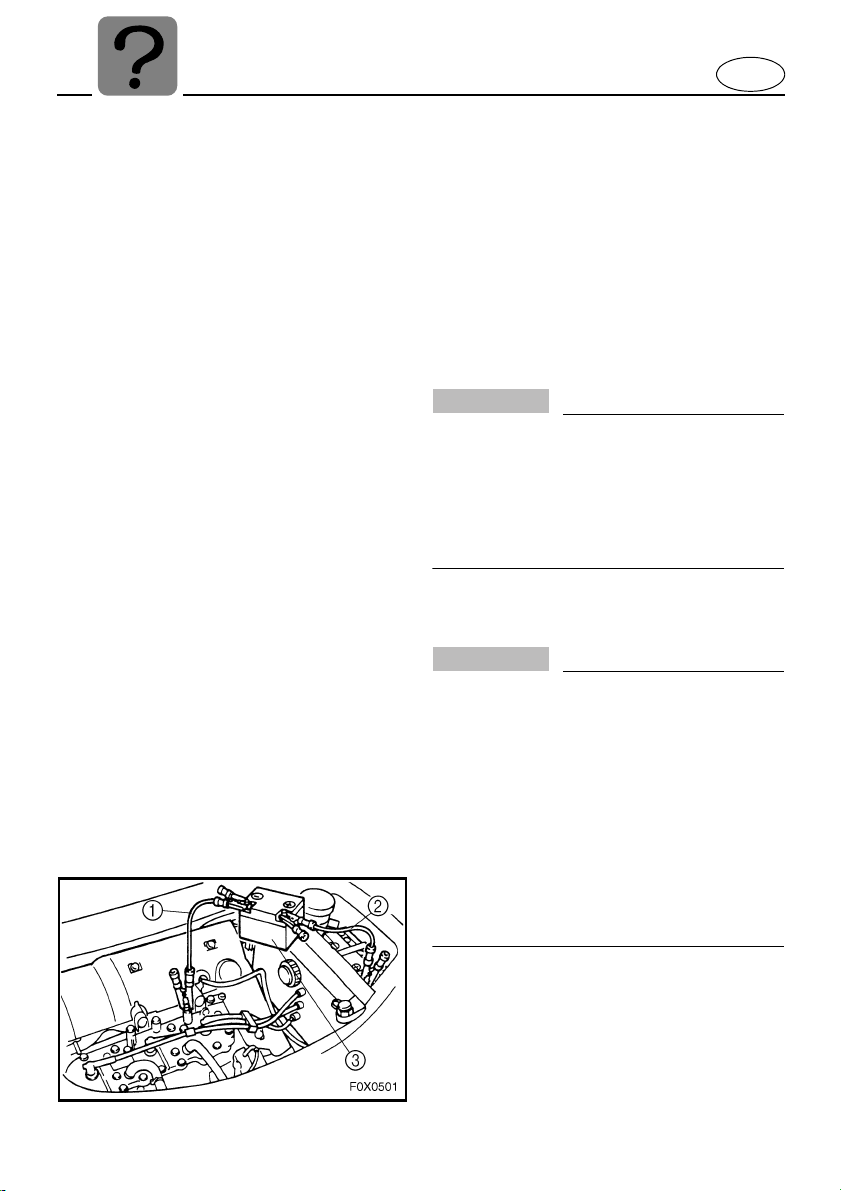
5-5
E
EJU00600a
To connect the jumper cables
1) Connect the positive (+) terminals of
both batteries with the positive (+)
jumper cable.
2) Connect one end of the negative (–)
jumper cable to the negative (–) terminal
of the booster battery.
3) Connect the other end of the negative
(–) cable to an unpainted bolt on the cyl-
inder head.
ECJ00091
CAUTION:
Do not connect the end of the jumper
cable to the negative (–) terminal on the
vehicle battery. Be sure all connections
are secure and correct before attempting
to start the engine. Any wrong connec-
tion may damage the electrical system.
4) Start the engine, then disconnect the
cables by reversing the above steps.
ECJ00092
CAUTION:
● Never push the engine start switch
while the engine is running.
● Do not keep the starter motor running
for more than five seconds. The bat-
tery will be quickly discharged, and it
will be impossible to start the engine.
The starter motor may also be dam-
aged. If the engine does not start after
five seconds of cranking, release the
engine start switch. Wait at least 15
seconds before frying to start the
engine again.
1
Negative (
−
) jumper cable
2
Positive (
+
) jumper cable
3
Booster battery
Chap5.fm Page 5 Thursday, March 30, 2000 2:21 PM
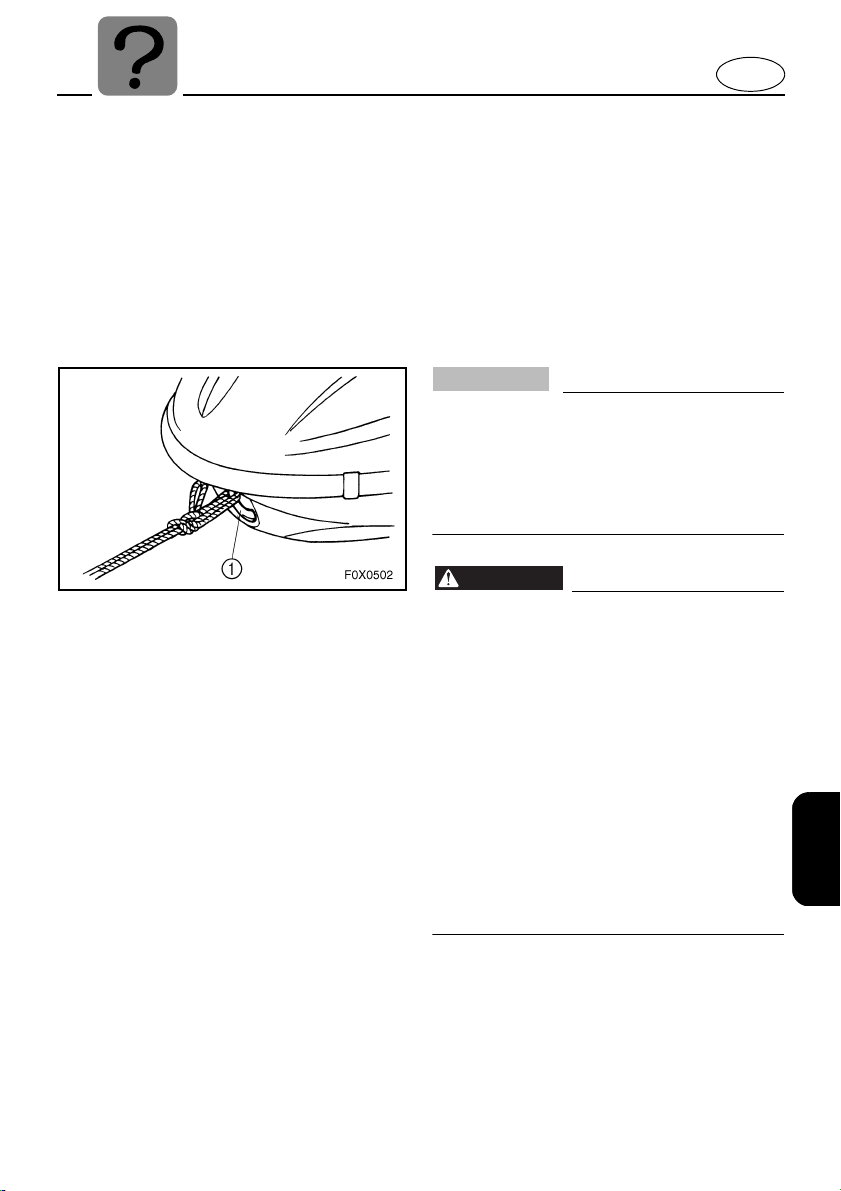
5-6
E
EJU00603a
TOWING THE WATER VEHICLE
If the vehicle becomes inoperative in the
water, it can be towed to shore. The bow
must be kept up out of the water during tow-
ing to prevent water from entering the
engine compartment.
If the vehicle must be towed in an emer-
gency using a tow rope, the operator should
ride the vehicle, holding onto the handlebar.
ECJ00094
CAUTION:
● Tow the water vehicle slowly; water
may enter the air intake and flood the
engine compartment if the vehicle is
towed too fast.
● Tow the vehicle using the bow eye 1
only.
EWJ00093
WARNING
If the vehicle is towed using a rope:
● The vehicle should only be towed in an
emergency. The towing rope should be
long enough so that the vehicle will
not collide with the towing boat when
slowing down. A good rule of thumb is
a tow rope which is three times the
combined length of the towing boat
and the vehicle. A shorter length of
rope can be used if the vehicle is
towed very slowly.
● The operator of the towing boat must
keep speed to a minimum and avoid
traffic or obstacles which could be a
hazard to the rider on the vehicle.
Chap5.fm Page 6 Thursday, March 30, 2000 2:21 PM

5-7
E
EJU00828
SUBMERGED WATER VEHICLE
If the vehicle is submerged or flooded with
water, follow the procedure below and con-
sult your Yamaha water vehicle dealer as
soon as possible. Failure to do so may result
in serious engine damage!
1) Beach the vehicle and remove all drain
plugs to drain the water from the engine
compartment.
2) Set the fuel cock to “OFF”.
3) Remove all spark plugs and dry them
with a cloth.
4) Without reinstalling the spark plugs,
crank the engine until all the water in the
cylinders has been drained.
5) Reinstall all drain plugs and the spark
plugs.
6) Set the fuel cock to “ON”.
7) Launch the vehicle into the water again
and run the engine for at least
10 minutes.
8) Turn the engine off. Set the fuel cock to
“OFF”.
9) Have your vehicle inspected by an
authorized Yamaha water vehicle dealer
as soon as possible.
Chap5.fm Page 7 Thursday, March 30, 2000 2:21 PM
E
6
EJU00608
Chapter 6
INDEX
INDEX
....................................................6-1
Chap6TOC.fm Page 1 Thursday, March 30, 2000 2:22 PM

6-1
E
EJU00609
INDEX
A
Adjustment and maintenance
................4-6
B
Battery
.................................3-6
,
4-4
,
4-18
Beaching
..............................................3-23
Bilge
.......................................................3-5
Bleeding the oil injection pump
............4-21
Boarding and starting in deep water
....3-17
Bow eye
...............................................2-16
Break-in (running-in) procedure
.............3-9
C
Capsized water vehicle
........................3-20
Carburetor adjustment
.........................4-20
Caution labels
........................................1-6
Changing the trim angle of the vehicle
..2-11
Check list
...............................................3-3
Check point
............................................3-4
Checking points
...........................4-9
,
4-11
Choke lever
............................................2-9
Cleaning
.................................................4-5
Cleaning the jet intake and impeller
.......5-3
Connecting jumper cables
.....................5-4
Connecting the battery terminals
.........4-19
Cooling water pilot outlet
.............2-10
,
3-8
Cruising limitations
.................................1-9
D
Docking
................................................3-23
E
Emergency procedures
..........................5-3
Emission control information
..................1-2
Engine compartment
..............................3-4
Engine oil
.............................................1-19
Engine serial number
.............................1-1
Engine start switch
.................................2-9
Engine stop lanyard switch
....................2-8
Engine stop switch
.................................2-8
Enjoy your water vehicle responsibly
...1-18
Exhaust temperature warning indicator
.2-21
Exhaust temperature warning system
...2-14
F
Filling the fuel tank
.................................3-1
Filling the oil tank
...................................3-2
Fire extinguisher
....................................3-6
Fishing vessel right-of-way
..................1-16
Flushing the cooling system
...................4-1
Front hood
..............................................2-6
Front storage compartment
..................2-22
Fuel and engine oil
.................................3-4
Fuel and engine oil filling
.......................3-1
Fuel cock
................................................2-7
Fuel filler cap
..........................................2-7
Fuel filter
..............................................4-10
Fuel meter
............................................2-19
Fuel requirements
................................1-19
Fuel system
....................................3-4
,
4-4
Fuel system inspection
..........................4-9
Fuel tank
..............................................4-10
Fuel warning indicator
..........................2-20
G
Gasohol
................................................1-19
Gasoline (petrol)
..................................1-19
Getting to know your water vehicle
......3-14
Give-way vessel
...................................1-14
Grove compartment
.............................2-23
H
Handgrip
..............................................2-16
Hazard information
...............................1-12
Hour meter
...........................................2-19
Hull identification number(H.I.N)
............1-1
I
Identification number records
.................1-1
Important labels
.....................................1-3
J
Jet intake
................................................3-7
L
Labels
....................................................1-4
Learning to ride your water vehicle
......3-14
Limitations on who may operate the
vehicle
....................................................1-8
Load limit
..............................................3-19
Location of main components
................2-1
Lubrication
.............................................4-3
Lubrication points
.................................4-15
M
Multifunction information center
...2-17
,
3-8
N
Narrow Channels and Bends
...............1-16
O
Oil filler cap
............................................2-7
Oil filter cleaning
..................................4-11
Oil injection system inspection
.............4-11
GP1200XIX.fm Page 1 Friday, March 31, 2000 2:53 PM

6-2
E
Oil tank
.................................................4-11
Oil warning indicator
............................2-20
Operation
...............................................3-9
Operation of controls and other
functions
................................................2-5
Operational requirements
....................1-10
Other labels
...........................................1-7
Other special situations
.......................1-16
Overheat warning indicator
..................2-21
Overheat warning system
....................2-13
Owner’s / operator’s manual and tool
kit
...........................................................4-7
P
Periodic inspection chart
........................4-8
Post-operation checks
.........................3-25
Pre-operation checks
.............................3-3
Primary identification (PRI-ID) number
..1-1
Q
QSTS (Quick Shift Trim System)
.........2-11
QSTS (Quick Shift Trim System)
mechanism inspection
.........................4-13
R
Reading buoys and other markers
.......1-16
Recharging
..........................................4-19
Replenishing the battery fluid
..............4-18
Reset button
........................................2-18
Riding with passenger
.........................3-15
Riding your water vehicle
.....................3-14
Rope hole(s)
........................................2-16
Rough water operation
........................3-24
Rules of the road
.................................1-14
Rules when encountering vessels
.......1-15
S
Safety information
..................................1-8
Sailing vessel right-of-way
...................1-16
Seat
.......................................................2-5
Shifting to “bow down”
.........................2-12
Shifting to “bow up”
..............................2-12
Solo
......................................................3-17
Spark plug cleaning and adjustment
....4-14
Specifications
.......................................4-22
Speedometer
.......................................2-18
Stand-on vessel
...................................1-14
Starting
................................................3-16
Starting from a landing jetty
.................3-16
Starting in shallow water
......................3-16
Starting the engine
...............................3-11
Steering
........................................2-10
,
3-7
Steering and sailing rules and sound
signals
..................................................1-14
Steering cable inspection
.....................4-12
Stopping
...............................................3-22
Stopping the engine
.............................3-13
Storage
..................................................4-1
Storage compartments
.........................2-22
Submerged water vehicle
......................5-7
Switches
.................................................3-8
T
Tachometer
..........................................2-18
Throttle
...................................................3-7
Throttle cable inspection and
adjustment
...........................................4-12
Throttle lever
..........................................2-9
To connect the jumper cables
................5-5
To get more boating safety information
..1-18
Towing the water vehicle
.......................5-6
Transportation
......................................3-27
Trolling speed
......................................4-20
Troubleshooting
.....................................5-1
Troubleshooting chart
............................5-1
Turning
.................................................3-21
W
Warning labels
.......................................1-4
Water separator
.....................................3-5
Water vehicle characteristics
...............1-13
With passenger
....................................3-18
Y
YAS (Yamaha adjustable sponsons)
...2-23
GP1200XIX.fm Page 2 Friday, March 31, 2000 2:53 PM

EJU00636
LIMITED WARRANTY
YAMAHA MOTOR CORPORATION, U.S.A.
WATER VEHICLE LIMITED WARRANTY
Yamaha Motor Corporation is proud of its heritage and reputation for producing products with high standards of quality and workman-
ship. Product excellence provides the cornerstone for our commitment to customer satisfaction. The Yamaha Water Vehicle Limited
Warranty is your assurance of this commitment.
This warranty provides you with protection against the expense of repairs for your water vehicle that are required as a result of defects
in materials or workmanship. When maintained and utilized in the prescribed manner, you can count on your Yamaha water vehicle to
provide reliable service.
This warranty provides you with specific coverage and notes your responsibilities in maintaining and operating your water vehicle.
Please take the time to read and become familiar with this warranty.
PERIOD OF WARRANTY.
Any new Yamaha water vehicle purchased for pleasure use from an authorized Yamaha water vehicle dealer
in the United States, will be warranted against defects in material or workmanship for a period of one (1) year from date of purchase,
subject to exclusions noted herein. Any Yamaha Water Vehicle purchased and utilized for commercial applications will be warranted for
a period of ninety [90] days from the date of purchase, subject to exclusions noted herein. Replacement parts used in warranty repairs
will be warranted for the balance of the applicable warranty period.
The warranty described here applies to water vehicles purchased and registered for use in the United States only. For warranty provi-
sions outside the United States, contact the particular country’s local Yamaha distributor.
OBTAINING REPAIRS UNDER WARRANTY.
During the period of warranty, any authorized Yamaha water vehicle dealer will, free of
charge, repair or replace, at Yamaha’s option, any parts adjudged defective by Yamaha due to faulty workmanship or material from the
factory. All parts replaced under warranty will become the property of Yamaha Motor Corporation, U.S.A.
CUSTOMER’S RESPONSIBILITY.
Under the terms of this warranty, the customer will be responsible for ensuring that the water vehi-
cle is properly operated, maintained, and stored as specified in the applicable Owner’s/Operator’s Manual.
The owner of the water vehicle shall give notice to an authorized Yamaha water vehicle dealer of any and all apparent defects within ten
[10] days of discovery and make the vehicle available at that time for inspection and repairs at the dealer’s place of business.
GENERAL EXCLUSIONS FROM WARRANTY.
This warranty will not cover the repair of damage if the damage is a result of abuse or
neglect of the product. Examples of abuse and neglect include, but are not limited to:
1. Racing or competition use, modification of original parts abnormal strain.
2. Lack of proper maintenance and off season storage as described in the Owner’s/Operator’s Manual, installation of parts or acces-
sories that are not equivalent in design and quality to genuine Yamaha parts.
3. Use of lubricants, oils, and fuel/oil mixtures that are not suitable for water vehicle motor use.
4. Damage as a result of accidents, collisions, contact with foreign materials, or submersion.
5. Growth of marine organisms on motor or hull surfaces.
6. Normal deterioration.
7. Gel coat stress cracks.
SPECIFIC PARTS EXCLUDED FROM WARRANTY.
Parts replaced due to normal wear or routine maintenance such as oil, spark plugs, fuel filters, impeller and liner, and anodes are not
covered by warranty. Charges for transporting the water vehicle to and from an authorized Yamaha water vehicle dealer are excluded
from warranty coverage.
TRANSFER OF WARRANTY.
Transfer of the warranty from the original purchaser to any subsequent purchaser is possible by having
the vehicle inspected by an authorized Yamaha water vehicle dealer and requesting the dealer to submit a change of registration to
Yamaha Motor Corporation. U.S.A. within ten [10] days of the transfer.
EMISSION CONTROL SYSTEM WARRANTY.
Yamaha warrants to the ultimate purchaser and each subsequent, that this engine is
designed, built, and equipped so as to conform at the time of sale with applicable regulations under section 213 of the Clean Air Act
and this engine is free from defects in materials and workmanship which cause said engine to fail to conform with applicable regula-
tions for one (1) year from date of purchase.
YAMAHA MOTOR CORPORATION, U.S.A. MAKES NO OTHER WARRANTY OF ANY KIND, EXPRESSED OR IMPLIED. ALL IMPLIED WAR-
RANTIES OF MERCHANTABILITY AND FITNESS FOR A PARTICULAR PURPOSE WHICH EXCEED THE OBLIGATIONS AND TIME LIM-
ITS STATED IN THIS WARRANTY ARE HEREBY DISCLAIMED BY YAMAHA MOTOR CORPORATION, U.S.A. AND EXCLUDED FROM
THIS WARRANTY.
SOME STATES DO NOT ALLOW LIMITATIONS ON HOW LONG AN IMPLIED WARRANTY LASTS, SO THE ABOVE LIMITATION MAY NOT
APPLY TO YOU. ALSO EXCLUDED FROM THIS WARRANTY ARE ANY INCIDENTAL OR CONSEQUENTIAL DAMAGES INCLUDING LOSS
OF USE. SOME STATES DO NOT ALLOW THE EXCLUSION OR LIMITATION OF INCIDENTAL OR CONSEQUENTIAL DAMAGES, SO THE
ABOVE EXCLUSION MAY NOT APPLY TO YOU.
Chap6.fm Page 5 Thursday, March 30, 2000 2:23 PM

THIS WARRANTY GIVES YOU SPECIFIC LEGAL RIGHTS, AND YOU MAY ALSO HAVE OTHER RIGHTS WHICH VARY FROM STATE TO
STATE.
YAMAHA MOTOR CORPORATION, U.S.A.
Post Office Box 6555
Cypress, California 90630
WARRANTY QUESTIONS AND ANSWERS
Q. What costs are my responsibility during the warranty period?
A. The customer’s responsibility includes all costs of normal maintenance services, non-warranty repairs, accident and collision dam-
ages.
Q. What are some examples of “abnormal” strain, neglect, or abuse?
A. These terms are general and overlap each other in areas. Specific examples include:
Running the water vehicle out of oil, operating the machine with a broken or damaged part which causes another part to fail, and so
on. If you have any specific questions on operation or maintenance, please contact your Yamaha water vehicle dealer for advice.
Q. Does the warranty cover incidental costs such as transportation due to a failure?
A. No. The warranty is limited to repair of the water vehicle itself.
Q. May I perform any or all of the recommended maintenance shown in the Owner’s/Operator’s Manual instead of having the dealer do
them?
A. Yes, if you are a qualified mechanic and follow the procedures specified in the Owner’s/Operator’s and Service Manual. We do rec-
ommend, however, that items requiring special or equipment be done by a Yamaha water vehicle dealer.
Q. Will the warranty be void or cancelled if I do not operate or maintain my new water vehicle exactly as specified in the Owner’s/Oper-
ator’s Manual?
A. No. The warranty on a new water vehicle cannot be “voided” or “cancelled”.
However, if a particular failure is caused by opera-
tion or maintenance other than as shown in the Owner’s/Operator’s
Manual, that failure may not be covered under war-
ranty.
Q. What responsibility does my dealer have under this warranty?
A. Each Yamaha water vehicle dealer is expected to:
1. Completely set up each new water vehicle before sale.
2. Explain the operation, maintenance, and warranty requirements to your satisfaction at the time of sale, and upon your request at
any later date. In addition, each Yamaha water vehicle dealer is held responsible for his setup, service and warranty repair work.
Q. Is the warranty transferable to second owners?
A. Yes. The remainder of the existing warranty can be transferred upon request. The unit has to be inspected and re-registered by an
authorized Yamaha water vehicle dealer for the policy to remain effective.
CUSTOMER SERVICE
If your water vehicle requires warranty service, you must take it to any authorized Yamaha water vehicle dealer within the continental
United States. Be sure to bring your warranty registration card or other valid proof of the original date of purchase. If a question or prob-
lem arises regarding warranty, first contact the owner of the dealership. Since all warranty matters are handled at the dealer level, this
person is in the best position to help you. If you are still not satisfied and require additional assistance, please write:
YAMAHA MOTOR CORPORATION U.S.A.
CUSTOMER RELATIONS DEPARTMENT
P.O. Box 6555
Cypress, California 90630
CHANGE OF ADDRESS
The federal government requires each manufacturer to maintain a complete, up-to-date list of all first purchasers against the possibility
of a safety-related defect and recall. This list is complied from the purchase registrations sent to Yamaha Motor Corporation, U.S.A. by
the selling dealer at the time of your purchase.
If you should move after you have purchased your new water vehicle, please advise us of your new address by sending a postcard list-
ing your Yamaha model name, engine number, dealer number [or dealer’s name] as it is shown on your warranty card, your name and
new mailing address.
Mail to:
YAMAHA MOTOR CORPORATION, U.S.A.
P.O. Box 6555
Cypress, California 90630
Attention: Warranty Department
This will ensure that Yamaha Motor Corporation, U.S.A. has an up-to-date registration record in accordance with federal law.
Chap6.fm Page 6 Thursday, March 30, 2000 2:23 PM

YAMAHA EXTENDED SERVICE (Y.E.S.)
Keep your Yamaha protected even after your warranty expires with genuine Yamaha Extended
Service (Y.E.S.).
●
●●
● Y.E.S. is designed and administered by Yamaha Motor Corporation to provide maximum owner
satisfaction. You get uninterrupted factory-backed coverage for extra peace of mind.
●
●●
● Y.E.S. is flexible. You choose the plan that is right for you: 12 months, 24 months, or 36 months
beyond your warranty period.
●
●●
● Y.E.S. is designed and administered by the same Yamaha people who handle your warranty
and it shows in the comprehensive coverage benefits. There are no mileage limitations. Cover-
age is not limited to “moving parts” or the “drive train” like many other plans. And Y.E.S. covers
manufacturing defects just like the warranty. See the sample contract at your Yamaha dealer to
see how comforting uninterrupted factory-backed protection can be.
●
●●
● You do not have to pay anything for covered repairs. There is no deductible to pay, and repairs
are not “pro-rated.” You do not have any “out-of-pocket” expenses for covered repairs.
●
●●
● In addition, Travel and Recreation Interruption Protection (TRIP) is included at no extra cost.
TRIP gives you up to $150 reimbursement per occurrence for any reasonable expenses you
incur because your Yamaha needs covered service: replacement vehicle rental, emergency
towing, phone calls, even food and lodging when you are away from home. This superb cover-
age goes into effect when you purchase Y.E.S., so it applies to any warranty repairs as well as
covered repairs during your entire Y.E.S. plan period.
●
●●
● Y.E.S. coverage is honored at any authorized Yamaha dealer nationwide.
●
●●
● Y.E.S. coverage is transferable to a new owner if you sell or trade-in. That can make your
Yamaha much more valuable!
This excellent Y.E.S. plan coverage is only available to Yamaha owners like you, and only while
your Yamaha is still within the Yamaha Limited Warranty period. So visit your authorized Yamaha
dealer to get all the facts. He can show you how easy it is to protect your investment with Yamaha
Extended Service.
We urge you to act now. You will get the excellent benefits of TRIP coverage right away, and you
will rest easy knowing you will have strong factory-backed protection even after your Yamaha
Limited Warranty expires. You can also save money: Y.E.S. costs less within the first 90 days
after you buy your Yamaha. See your dealer today!
A special note:
If visiting your dealer is not convenient, contact Yamaha with your Primary ID number (your engine
number). We will be happy to help you get the Y.E.S. coverage you need.
Yamaha Service Marketing
P.O. Box 6555
Cypress, CA 90630
(714) 761-7631
Chap6.fm Page 7 Thursday, March 30, 2000 2:23 PM

Untitled2.fm Page 1 Thursday, March 30, 2000 2:32 PM

Printed in U.S.A.
Jan. 2000—2.0
×
1 CR
F0X-F8199-10
(GP1200AY)
Printed on recycled paper
YAMAHA MOTOR CORPORATION, USA
Hyou-4.fm Page 1 Wednesday, April 5, 2000 9:36 PM