Operating instructions for Dishwasher
Getting Started
Appliance overview
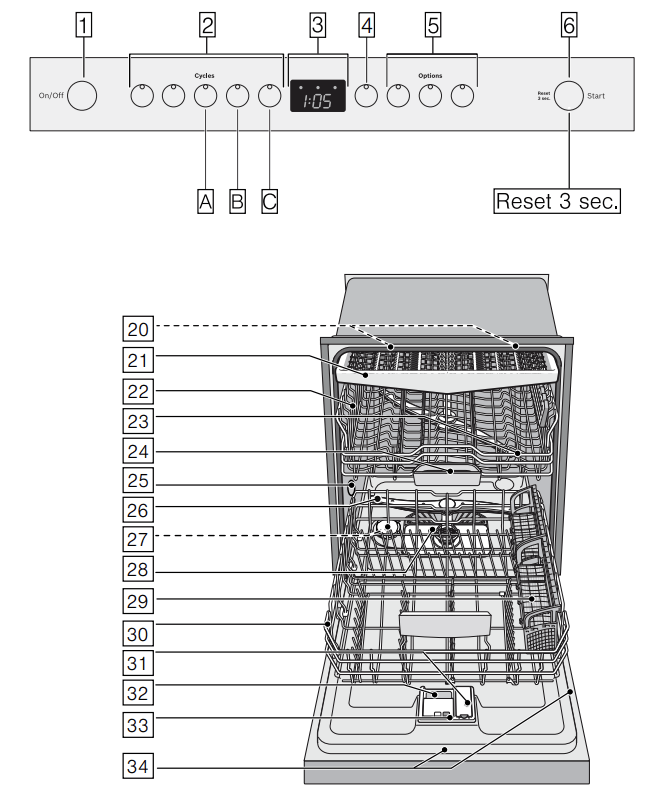
The dotted lines show optional features which may or may not be included with your dishwasher.
The numbers stated below refer to the overview images on the previous page of this manual.
Operating panel
 On/Off button
 Wash cycles
 Digital display
 Delay start button
 Wash cycle options
 Start button
Dishwasher interior components
 Interior light *
 Third rack
 Upper rack
 Upper spray arm
 Detergent tab tray
 Vent hole
 Lower spray arm
 Dispenser for special salt*
 Filters
 Silverware basket
 Lower rack
 Rinse aid dispenser
 Detergent dispenser
 Lock for detergent dispenser
 Rating plate
* optional feature which may or may not be included with your dishwasher.
Display indicators
| 0:00 |
Cycle time remaining |
| Clean |
Lights up when dishes are clean |
| Sanitize |
Lights up when sanitation requirements are met |
| Add Rinse Aid |
Lights up when rinse aid is low |
Menu overview
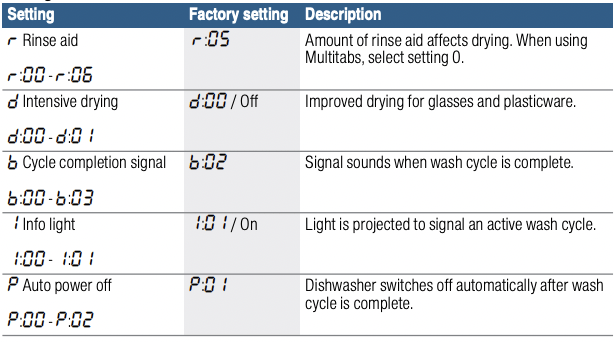
The dishwasher has been preset with certain settings for your convenience. You can change these factory settings.
Use the function keys  ,
,  and
and  to change the settings.
Rinse Aid
To achieve proper drying, always use a liquid rinse aid, even if your detergent contains a rinse aid or drying additive.
Note: The dishwasher indicates low rinse aid by turning on the Rinse Aid indicator on the display . If this indicator lights up, you need to refill the rinse aid dispenser by following the directions below.
Adding rinse aid
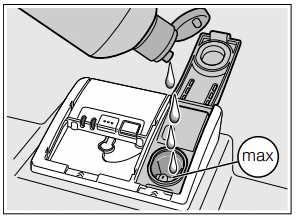
NOTICE To avoid oversudsing or clogging, do not overfill the rinse aid dispenser . Wipe up any spills with a damp cloth.
1. Open the rinse aid dispenser by pressing on the latch of the lid and pull it open.
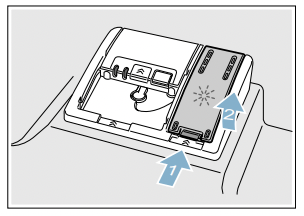
2. Add liquid rinse aid to the dispenser until it is full. Do not overfill.
3. Close the lid. Lid must be fully closed until it clicks in order to seal.
4. Wipe up any excess rinse aid that may have puddled when the dispenser reservoir is full.
The indicator light will go out a few moments after the dishwasher door is shut.
NOTICE Do not fill the rinse aid dispenser with detergent. Doing so will damage the dishwasher.
Setting the amount of rinse aid used
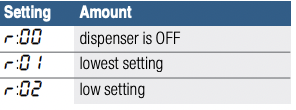
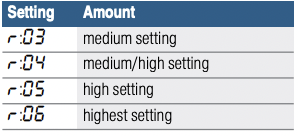
The amount of rinse aid dispensed can be set from  to
to  . The factory setting is
  .
.
You should only change the setting if streaks remain on the dishes (lower the amount), or if dishes are not getting dry enough (increase the amount).
- Open the door.
- Press the On/Off button .
- Hold down the function key and press the Start button until the display indicates
 (x can be any number). Release both buttons.
- Press the function key until the display shows .
- Press the function key to select the desired setting.
- Press the Start button to save the setting.
Turning off rinse aid indicator
Proceed as described in the section "Setting the amount of rinse aid used” and set value to. The rinse aid indicator is now turned off.
NOTICE
Using no rinse aid or setting the dispenser to may result in longer cycle times consuming more energy and water. The higher temperatures and longer cycle times can damage fine china or glassware.
Loading the Dishwasher
Dishware material
Note: Before using your dishwasher for the first time, check the information in this section. Some items are not dishwasher-safe and should be hand washed; others require special loading.
Recommended
| Aluminum |
Colored anodized aluminum may fade over time. Minerals in your water may cause the aluminum to darken or spot. This can usually be removed with a soap-filled steel wool pad. |
| China, Crystal, Stoneware |
Some hand-painted utensils may discolor, fade or spot. Hand wash these utensils. Position fragile glassware so that it will not topple over or come in contact with other utensils during the wash cycle. |
| Glass |
Milk glass may discolor or become yellow. |
| Non-stick Coatings |
Apply a light coating of vegetable oil to non-stick surfaces after drying. |
| Plastics |
Make sure the plasticware is dishwasher-safe. |
| Stainless Steel, Sterling Silver and Silver Plates |
Load these so they do not come in contact with other metals, stainless steel dishwasher tub walls or the inner door. |
Not Recommended
| Acrylic |
Crazing or small cracks throughout the acrylic, may occur. |
| AdhesiveJoined Pieces |
Adhesives that join materials such as plastic, wood, bone, steel, copper, tin, etc. may loosen. |
| Bone-Handled Utensils |
Handles may separate. |
| Iron |
Iron will rust. Hand wash and dry immediately. |
| Non-Dishware Items |
Your dishwasher is intended for use in cleaning ONLY standard household dishware and kitchenware. |
| Pewter, Brass, Bronze |
These items will tarnish. Hand wash and dry immediately. |
| Tin |
Tin will stain. Hand wash and dry immediately. |
| Wood |
Wooden bowls, wooden utensils and utensils with wooden handles can crack, warp and lose their finish. |
Loading the racks
For best dishwashing results, observe the following when loading the dishwasher:
■ Do not pre-wash items with loosely attached food soil.
■ Remove all food particles, bones, toothpicks and excessive grease.
■ Pre-treat items having burned-on, baked-on or starchy soils.
■ Load dishes in the dishwasher racks so the insides of bowls, pots and pans are facing the spray arms.
■ Avoid nesting and contact points between dishes.
■ Separate items of dissimilar metals. Use care to not block movement of the spray arms.
■ Only wash household dishware and kitchenware rated as dishwasher-safe. Refer to the Dishware Materials section for more information about dishware suitability.
NOTICE To avoid dishwasher damage, do not load the dishwasher with paper products, plastic bags, packing materials or anything other than normal, dishwasher safe dishware and kitchenware.
Loading the upper rack
Ensure items do not protrude through the bottom of the racks and block the spray arms.
Note: When pushing the upper rack into the dishwasher, push it until it stops against the back of the tub so the upper rack spray arm connects to the water supply at the back of the tub. Do not push racks in using the door.
Loading the lower rack
Place large items in the lower rack . Load pots, pans and bowls upside down. Do not block the vent hole with tall baking sheets.
Load these items on the right side of the dishwasher.
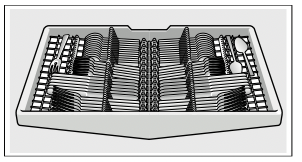
Recommended loading pattern
For daily, regular or typical use
12 place setting
Lower rack
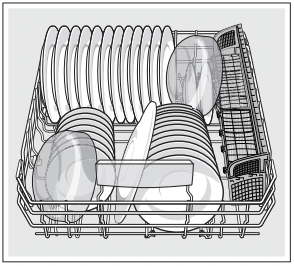
Upper rack
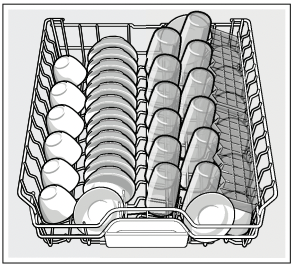
Note: Folding the cup shelves down will allow the cups to sit at an increased angle and reduce water pooling on cup bottoms.
Third rack
Additional loading pattern
10 place setting
Lower rack
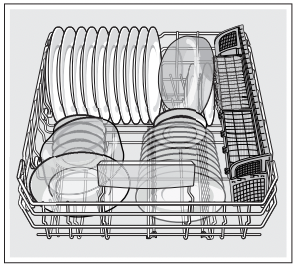
Upper rack
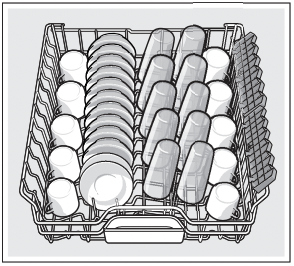
Note: Folding the cup shelves down will allow the cups to sit at an increased angle and reduce water pooling on cup bottoms.
Third rack
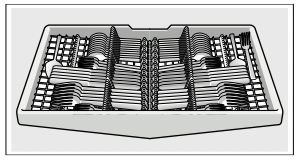
Loading the silverware basket
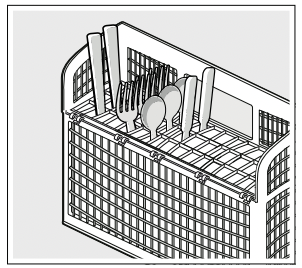
Place knives and sharp utensils with their handles up and forks and spoons with their handles down. If large or oddly-shaped items are loaded in the silverware basket, be sure they do not nest together.
WARNING RISK OF INJURY! The sharp points and edges of knives and other sharp utensils can cause serious injury. Load knives and other sharp utensils with edges down. Do not allow children to handle or play near knives and sharp utensils.
Long silverware basket
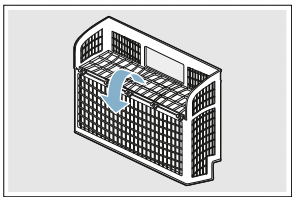
Note: The silverware basket lid may also be folded downward in order to leave the basket open.
This dishwasher is equipped with a silverware drawer that should accommodate most silverware loading needs.
However, if you are washing while the silverware drawer has been removed, or with excess silverware, a silverware basket is also included.
When loading the silverware basket you should avoid excessive contact points and nesting of similar items (allowing two spons to rest inside one another).
A good way to avoid excessive contact points is to load the silverware basket with the lids closed, inserting each piece of silverware into one of the individual slots as shown.
Unloading the dishwasher
When unloading the dishwasher, to prevent water from dripping onto dry dishes, unload the lower rack first. Next, unload the silverware basket followed by the upper rack , and then the third rack (if equipped).
Note: Dishes are more likely to chip when unloading before cooling.
Adjusting the height of the rack
If required, the height of the upper rack can be adjusted to create more space for taller utensils either in the upper or lower rack.
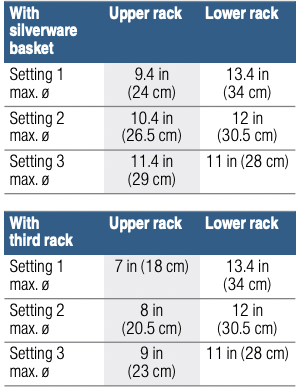
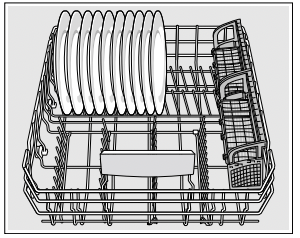
Arrange large plates up to a diameter of 13.4 in (34 cm) in the lower basket as illustrated.
RackMatic®
The height of the upper rack can be adjusted in 3 steps to create more space.
- Pull the upper rack out of the dishwasher until it stops.
- To lower the rack, push the RackMatic® lever inward.
- To raise the rack, hold the basket on the sides of the upper rack and lift it up.
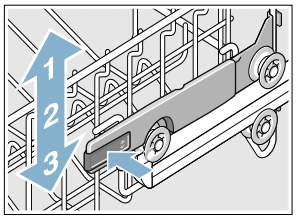
Note: Check spray arm for clearance after adjustment.
Removing/Installing third rack
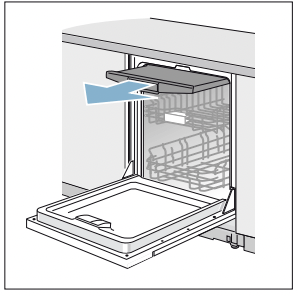
Removing third rack
- Pull out third rack all the way (1).
- Lift upper rollers over the stopper hooks of both rails (2).
- Pull third rack out forward and upward so the the holding hooks and the lower rollers of the rack slide over the stopper hooks of both rails (3).
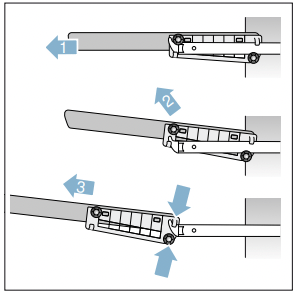
Installing third rack
- Pull out third rack rails all the way (1).
- Insert third rack at an angle. Make sure that the stopper hooks of both rails slide in between the holding hooks and the lower rollers of the third rack (2).
- Slide third rack in and lift the upper rollers over the front stopper hooks of both rails (3).
- Push in third rack (4).
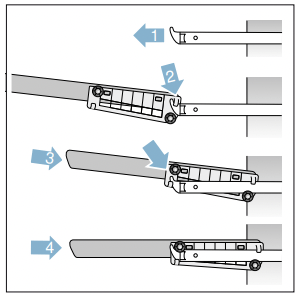
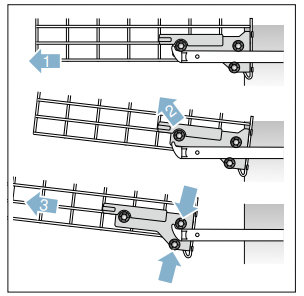
Removing/Installing upper rack with Rackmatic
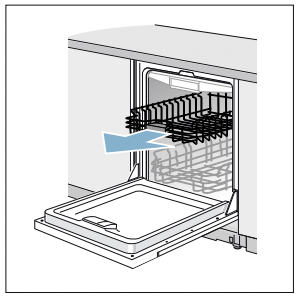
Removing upper rack
- Pull out upper rack all the way (1).
- Lift front rollers over the stopper hook of the rail (2).
- Pull out upper rack forwards and upwards so that the upper and lower rollers of the rack slide over the stopper hooks of both rails (3).
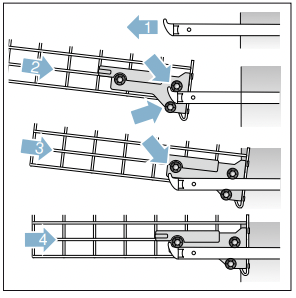
Installing upper rack
- Pull out upper rack rails all the way (1).
- Insert upper rack at an angle. Make sure that the stopper hooks of both rails slide in between the upper and lower rollers on the rear side of the rack (2).
- Slide upper rack in and lift the upper rollers over the front stopper hooks of both rails (3).
- Push in upper rack (4).
Detergent
Use only detergent specifically designed for dishwashers. For best results, use fresh powdered dishwashing detergent or detergent tabs.
NOTICE
To avoid dishwasher damage:
- Do not use hand dishwashing products in your dishwasher.
- Do not use too much detergent if your water is soft. Using too much detergent with soft water may cause etching in glassware and fine china.
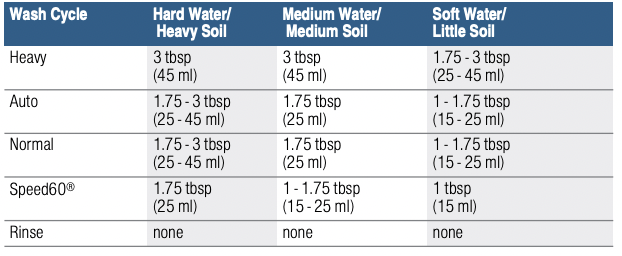
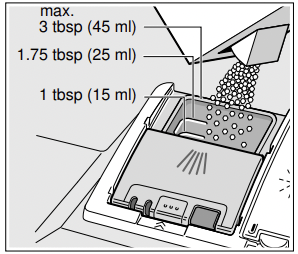
This dishwasher uses less water than most, therefore, less detergent is required. With soft water, 1 tablespoon (15 ml) of detergent will clean most loads. The detergent dispenser cup has lines that measure detergent to 1 tablespoon (15 ml) and 1.75 tablespoons (25 ml). 3 tablespoons (45 ml) of detergent will completely fill the detergent dispenser.
Note: If you do not know the hardness of your water supply, use 15 ml of detergent. Increase the amount if necessary to the least amount required to get your kitchenware clean.
Use the measuring lines in the detergent dispenser cup as a guide to measure the amount of detergent recommended in the following table.
Adding detergent
1. If the detergent dispenser is still closed, actuate the locking bar to open it.
Note: Make sure the detergent dispenser is dry and clear of detergent residue.
2. Pour detergent into the dry detergent dispenser only. Add detergent. Do not overfill the detergent dispenser.
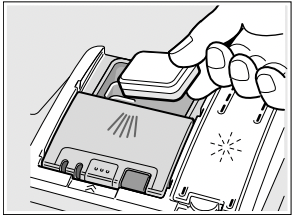
When using detergent tabs, lay them such that they do not come in contact with the cover, insert a detergent tab flat, not on its side.
Note: Do not place detergent tabs or utensils in the detergent tab tray . Place tabs or other detergent forms directly in the detergent dispenser .
Dosage: see manufacturer’s instructions on the packaging.
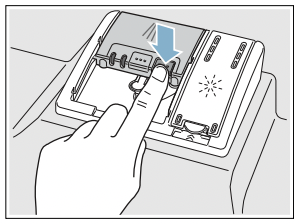
3. Close the lid by placing the finger on the lid as shown. Slide the lid closed and press down firmly until it clicks.
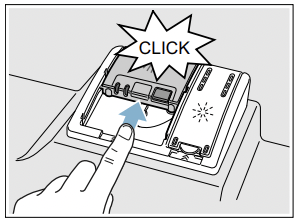
The detergent dispenser will open automatically at the ideal time for the set cycle. The powder or liquid detergent is distributed in the appliance and is dissolved, detergent tabs will fall into the detergent tab tray where it dissolves during the cycle.
Tip: If the dishware is only lightly soiled, slightly less than the indicated amount of detergent is usually adequate.
Dishwasher Cycles
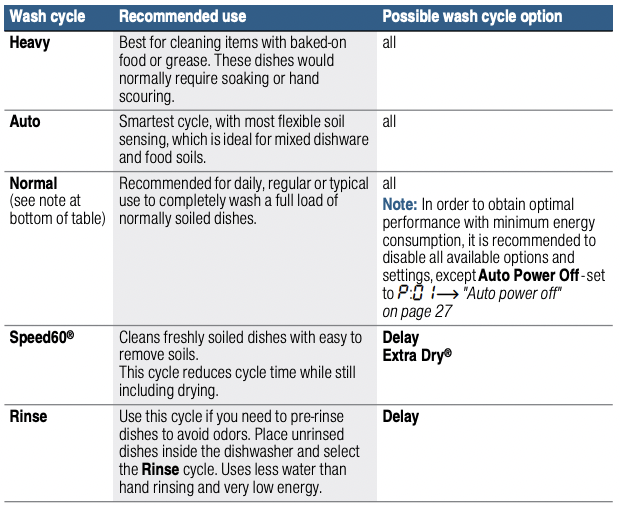
Note: The Energy Guide label was based on the Normal soil sensing cycle as follows: The unit was tested without any rinse aid (liquid) in the rinse aid dispenser . A single dose of detergent was inserted into the detergent dispenser, with no detergent being used in the prewash. The unit was not subjected to truncated testing per the definitions in the test procedure. We recommend that dish loads such as the one in the energy certification test have the rack position set in the highest position.
Dishwasher Cycle Options
Delay
Allows you to delay the start time of your dishwasher up to 24 hours.
Half Load
Can reduce water consumption when washing small, lightly soiled loads that fill approximately half of the dishwasher’s capacity.
Sanitize
Increases the temperatures and retains them for an extra long time to obtain a defined disinfecting performance. Continuous use of this function increases the hygiene status. This additional option is ideal for cleaning items such as chopping boards and baby bottles.
Using the Sanitize option may also improve drying. The cycle time and energy usage may be increased.
Extra Dry
Used in combination with a wash cycle (except Rinse), the Extra Dry option raises the temperature and extends the drying time to further enhance drying results and provide a brilliant shine. The energy usage may be increased.
Wash Cycle Information
To save energy, this dishwasher has EcoSense where the sensors in the dishwasher automatically adjust the cycle length, temperature and water changes based on the amount of food soil and the incoming water temperature. The “Smart Control” makes decisions that can cause the cycle time and water usage to adjust intermittently. Wash cycle times are based on 120°F (49° C) water supply. If your household water supply is different than 120°F (49°C), your dishwasher’s cycle times may be impacted.
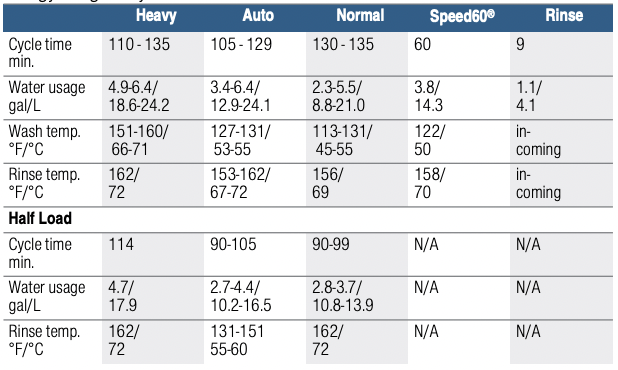
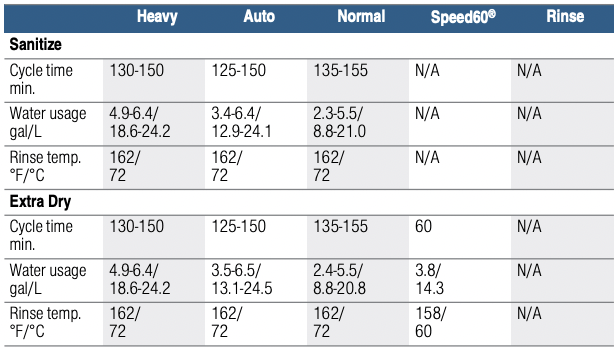
Note: Only sanitizing cycles have been designed to meet the requirements of Section 6 of the NSF/ANSI Standard for Residential Equipment for soil removal and sanitization efficacy. There is no intention, either directly or indirectly, to imply that all cycles have passed sanitization performance tests.
Operating the Dishwasher
Note: With hidden controls, the door must be opened before changing settings and closed after changing settings.
WARNING RISK OF INJURY! To avoid risk of injury, always use caution when opening the door during or following a wash cycle as hot water or steam may escape. Do not fully open the door until water noises have stopped and steam has subsided.
Protection against unintentional operation
Your dishwasher is equipped with a function that helps to prevent unintentional operation (e.g. by children).
After setting the dishwasher, the dishwasher door has to be closed within 4 seconds, otherwise the operation will be paused. There will be a signal on the control panel advising you to press the Start button again and close the door.
This function will be activated when:
- pressing Start to begin a wash cycle
- setting Delay time and pressing Start
- opening the door while Delay time is active
- opening the door during a wash cycle.
Note: This function cannot be deactivated.
AquaSensor
The AquaSensor is an optical measuring device which measures the cleanliness of the rinse water.
The AquaSensor is used according to the wash cycle. If the AquaSensor is active, “clean” rinse water can be transferred to the next rinse and water consumption can be reduced by 0.8–1-5 gal (3–6 liters). If the rinse water is not yet clear, the water is drained and is replaced with fresh water. In the automatic wash cycles the temperature and running time can also be adjusted to the degree of soiling.
Switching the appliance on
Turn the water supply on fully.
- Press the On/Off button .
- The AUTO wash cycle has been preset as a default whenever the appliance starts. This wash cycle remains selected if no other wash cycle button is pressed. Select any desired option.
- Press Start button . Wash cycle sequence starts.
Note: Your dishwasher is protected against unintentional operation. If the appliance door remains open for more than 4 seconds after pressing the Start button, the operation will be paused. Close the appliance door and press the Start button again.
Time display
When a wash cycle is selected the remaining wash cycle time is shown on the display .
The wash cycle time is determined during the wash cycle by the water temperature, the amount of dishes, as well as the degree of soiling and may vary (depending on the selected wash cycle).
Delay Start
You can delay the start of the cycle in one hour increments up to 24 hours.
 1 hour delay
 24 hours delay
To set Delay start:
- Open the door and press the On/Off button (. Select a cycle.
- Press the Delay button from the wash cycle options H until the displayed time corresponds with your requirements.
- Press the Start button P to activate Delay start.
To cancel Delay start:
- Open the door and press the Delay button until œ:‹‹ is indicated on the digital display 8.
- Press the Start button P to save setting.
Note: Your dishwasher is protected against unintentional operation. If the appliance door remains open for more than 4 seconds after pressing the Start button, the operation will be paused. Press the Start button again and close the appliance door.
Wash cycle end
The wash cycle has ended when the display reads  .
.
If the signal tone has been set, the wash cylce end is also indicated by a buzzer.
 Off
Off
 low
low
 medium
 loud
loud
To change the signal volume:
1. Open the door.
2. Press the On/Off button .
3. Hold down function key and press Start button until the display indicates (x can be any number). Release both buttons.
4. Press function key until the display shows .
5. Press function key . Each time the button is pressed the set value increases by one level; when it reaches the valuethe display jumps back to (off).
6. Press Start button to save the setting.
Auto power off
This setting determines the length of time the control panel stays illuminated after the cycle is complete. To save energy the recommended setting is
This setting can be adjusted from to 
 dishwasher does not turn off automatically
dishwasher turns off automatically after 1 minute
dishwasher turns off automatically after minutes (2 hours)
To change the setting:
1. Press the On/Off button .
2. Hold down the function key and press the Start button until the display indicates (x can be any number).
3. Release both buttons.
4. Press the function key until the display indicates  .
.
5. Press the function key until the display corresponds with your requirements.
6. Press the Start button .
Switching off the appliance
Short time after the end of the wash cycle:
- Open the door.
- Switch off On/Off button .
- Turn off water supply.
- Remove the utensils when they have cooled down.
WARNING RISK OF INJURY! To avoid risk of injury, always use caution when opening the door during or following a wash cycle as hot water or steam may escape. Do not fully open the door until water noises have stopped and steam has subsided.
Care and Maintenance
A regular inspection and maintenance of your machine will help to prevent faults. This saves time and prevents future problems.
Overall condition of the dishwasher
NOTICE
■ Never use a steam cleaner to clean your dishwasher. The manufacturer is not liable for any resulting damage.
■ Regularly wipe the front of the appliance with a damp cloth - water and a small amount of liquid soap is adequate. Do not use sponges as they could scratch the surfaces.
■ Do not use bleach-based wipes as they could damage the surface or printing.
■ Stainless steel appliances: To prevent corrosion, do not use sponges or chlorine based cleaners. Use a stainless steel polish to seal and protect the surface. Do not use chlorine based cleaners or wipes.
■ Clean the outer edges of the inside door panel regularly to remove debris that may collect from normal loading. If spots begin to appear on the stainless steel, make sure the rinse agent is full and functioning properly.
■ Clean the door seal regularly with a damp cloth to remove food particles that may collect from normal loading and cause odor. A soiled door seal may not seal properly
WARNING Use caution when removing parts for cleaning as some debris may be sharp.
Filters
The Bosch® filter system is designed to prevent the need to pre-rinse normally attached food soils from your dishes. Simply scrape leftover food soils off of dishware before loading. This process will conserve time, water and the energy require to heat your household water supply.
Your dishwasher filter system is designed to filter 100% of the water entering the spray arms to provide a continuous supply of clean water to remove food soils from your dishware.
Filter components
The filter system consists of three parts.
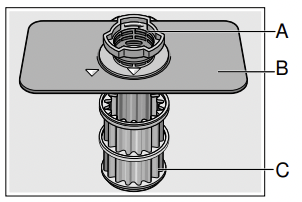
A Large Object Trap
Prevents objects that should not be placed in your dishwasher from damaging the dishwasher pump system or clogging your household drain.
B Flat Fine Filter
Prevents food particles from entering the wash chamber and directs particles toward the micro filter.
C Micro Filter
Directs the smallest of particles to the household plumbing drain.
Cleaning intervals
The filter system is designed to minimize maintenance while providing premium cleaning performance and minimum energy consumption.
Depending on use habits and water hardness, the filter system will require some maintenance to sustain premium cleaning performance.
Your filter system may need to be cleaned when:
- You notice food soils remaining on the filter system or objects trapped in the Large Object Trap.
- A drop in cleaning performance or a gritty film forms on the dishware.
When washing normally attached food soils that have been scraped before loading, in a household that runs the dishwasher every other day, your filter should be cleaned:
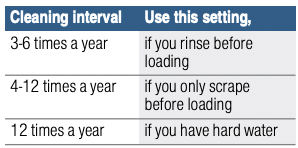
Note: Clean the filter after washing loads with large amounts of food soils or loads with a heavy starch content, like potatoes and pasta, to maintain optimal performance.
To check or clean the filter system:
1. Unscrew the Large Object Trap as illustrated and remove the entire filter system.
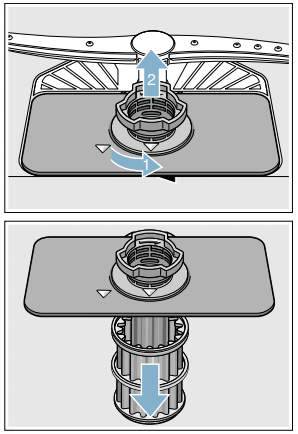
2. Remove any residue and clean filters by rinsing under running water. Note: do not use abrasive brushes or steel wool, etc., as they may damage the filter.
3. Reinstall the filter system in reverse sequence and lock into place by screwing the Large Object Trap until the marking arrows align.
Spray arms
Check spray arms , for grease and limescale deposits. If you find such deposits:
■ Fill detergent dispenser with detergent and start the appliance without utensils in the cycle with the highest rinsing temperature.  "Wash Cycle Information" on page 24
■ Clean the appliance with detergents/appliance cleaners which are particularly suitable for use with dishwashers.
■ Unscrew the upper spray arm and pull off the lower spray arm as shown. Inspect for deposits.
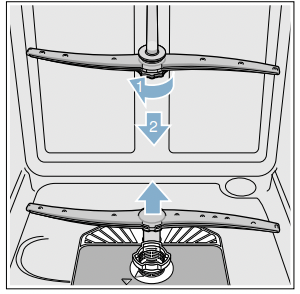
Drain pump
Large food remnants in the rinsing water not retained by the filters may block the waste water pump. In this case:
■ Disconnect the appliance from the power supply.
■ Remove the filters. "Filters" on page 30
■ Scoop out standing water - use a sponge if necessary.
■ Using a spoon, pry off the pump cover until it clicks, then grip the cover and pull upward until it resists and then pull forward.
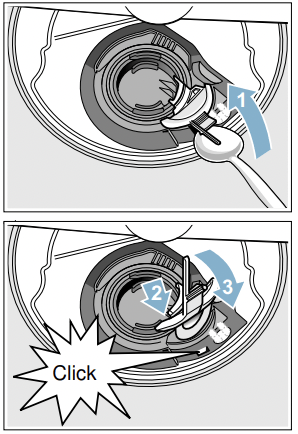
■ Check inner compartment and remove any foreign objects.
WARNING Use caution when removing parts for cleaning as some debris may be sharp.
■ Place cover in the original position, press down and engage.
■ Reinstall filters.
Note: The drain pump will not work properly if the drain pump cover is not snapped in completely until it clicks.
Preparing your unit for vacation
NOTICE Before leaving for vacation during warmer weather, besides turning off the main valve, also turn off water supply at the nearest point to the dishwasher. Do not leave soiled dishware in unit and leave door slightly open. During colder weather, please follow the instructions for winterizing your unit below.
Winterizing your unit
NOTICE If your dishwasher will be unused for a period of time in a location that experiences freezing temperatures (holiday home or through a vacation period), have your dishwasher winterized by a professional service.
Troubleshooting
Dishwashers may occasionally exhibit problems that are unrelated to a malfunction of the dishwasher itself.
The following information may help you with a dishwasher problem without involving a repair professional.
| Problem |
Cause |
Action |
Dishwasher does not start
|
Door may not be properly latched. |
Shut the door completely until you hear a click. |
| Dishwasher may not be turned on. |
Press the main power switch to turn dishwasher on. |
| Dishwasher not reset or previous cycle not completed. |
Reset the dishwasher. |
| Delay start engaged. |
Reset Delay start. "Delay Start" on page 27 |
| Interruption of electrical power supply to dishwasher or blown fuse. |
Check circuit breaker. |
| The door may have been closed without first selecting a cycle. |
Select a cycle and close the door. |
| Water supply may not be turned on. |
Check and turn on water supply. |
| Cycle does not resume after door is opened and closed during cycle. |
Door is opened longer than 4 seconds after a cycle has started. |
Press Start button again to resume cycle. |
Display does not illuminate
|
A fuse may have been blown or circuit breaker tripped. |
Check the fuse or circuit breaker box and replace the fuse or reset the breaker if necessary. |
|
Door not closed or latched.
Note: For models with controls on top of the door, the display only illuminates when the door is opened and controls are visible.
|
Ensure door is properly latched and completely closed. |
Dishwasher seems to run a long time
|
Incoming water is not warm enough. |
Before starting a cycle, run hot water faucet at the sink closest to the dishwasher. |
| Cycle time can vary due to soil and water conditions. |
Sensors in the dishwasher automatically increase the cycle time to ensure a good wash when heavy soil is detected. |
| Rinse aid dispenser is empty, or rinse aid setting has been set to “0”. |
Add rinse aid, or change rinse aid setting. |
|
Dishwasher connected to cold water supply.
Note: Check the typical wash cycle length. "Wash Cycle Information" on page 24
|
Verify dishwasher is connected to hot water supply plumbing. |
Dishes are not getting clean enough
|
Spray arm movement obstructed. |
Ensure that spray arm movement is not blocked by hand rotating spray arms , before starting cycle. |
| Spray arm nozzles clogged. |
Remove spray arms , and clean them. "Spray arms" on page 31 |
| Improper use of detergents. |
Increase or decrease detergent depending on the water hardness. |
| Filters could be clogged. |
Clean the filters . "Filter components" on page 30 |
| Dishes are nested or loaded too closely together. |
Rearrange load such that water spray can reach all items in the dishwasher. "Loading the Dishwasher" on page 13 |
| Selected wash cycle is not suitable for food soil conditions. |
Refer to Wash Cycle Information. "Wash Cycle Information" on page 24 |
| Streaks on glassware or residue on the dishes |
Incorrect rinse aid setting. |
Depending on the hardness of water, adjust the rinse agent dispenser . "Rinse Aid" on page 12 |
|
Dishes are not getting dry enough
Note: Plastic or Teflon do not typically dry as well as other items due to their inherent properties.
|
Rinse aid dispenser is empty or incorrect rinse aid amount is set. |
Add rinse aid or adjust setting - the use of rinse agent improves drying, use the Auto cycle, use the Sanitize option. |
| Improper loading of dishes. |
Rearrange load to ensure items are not nesting. "Loading the Dishwasher" on page 13
Note: Select models offer an extra heating option to improve drying performance.
|
|
Odor
Note: Water testing is done in the factory. Occasionally water may still appear in dishwasher at purchase which may create an odor.
|
Food debris is present at the bottom of the dishwasher. |
Remove the filters and clean them. "Care and Maintenance" on page 29 |
| Food particles are present near the door seal. |
"Care and Maintenance" on page 29 |
| Residual water is present at the bottom of the dishwasher |
Ensure the dishwasher has completely drained from the last cycle. |
| Drain hose is obstructed. |
Remove any obstructions from the drain hose by calling qualified personnel.
Note: If odor still persists, run the Normal/ Regular cycle until it flushes and interrupt the cycle and place an 8 oz. cup of distilled white vinegar solution on the upper rack and then finish the cycle.
|
Dishwasher not filling with water or “Check water supply” display lights up
|
Restriction in the water supply system. |
Ensure that the water supply valve (typically located under kitchen sink) is open and check that the water supply line has no kinks or clogs. |
| Previous wash cycle was not completed. |
"Operating the Dishwasher" on page 26 |
| Delay start is active. |
Cancel the delay start or wait until delay start time completes. |
| Household water supply turned off. |
Turn on water supply. |
| Fascia panel discolored or marked |
Abrasive cleaner used. |
Use mild detergents with soft damp cloth. |
| Noise during wash cycle |
Dishes may not be arranged properly. |
Water circulation sound is normal, but if you suspect items are banging into each other or into the spray arms, check optimal arrangement of dishes. "Loading the Dishwasher" on page 13 |
| Water leaks |
Suds. |
Using wrong type of detergent or overfilling the rinse aid dispenser results in suds and leaks - use only dishwasher detergents. If suds still persist, add one tablespoon of vegetable oil at the bottom of the dishwasher and run the desired cycle. |
| Door seal could be pulled away from track. |
Ensure the door seal is in the track. |
| Condensation vent is blocked. |
Ensure that condensation vent is not blocked. |
| Improper installation. |
Have proper installation verified by qualified personnel (water supply, drain system, leveling, plumbing). |
Tub stains
|
Stains on the dishwasher interior are due to water hardness. |
Concentrated lemon juice can reduce the build-up of hard water stains. Run Normal/Regular cycle until it flushes and interrupt the cycle and then place an 8 oz. cup of the concentrated lemon solution on the upper rack and finish the cycle. This can be done periodically to avoid build-up. |
| Silverware in contact with tub. |
Ensure that silverware does not make contact with the tub while running a cycle. |
Detergent dispenser cover will not shut
|
Improper operation of detergent cover. |
For instructions on opening and closing the dispenser "Detergent" on page 21 |
| Previous cycle was not finished or interrupted. |
"Operating the Dishwasher" on page 26 |
| Unable to select desired cycle |
Previous cycle not finished. |
"Operating the Dishwasher" on page 26 |