DESCRIPTION: OWNER’S MANUAL Part No. MFL33029613
MODEL DESCRIPTION:
Product: Gas Range Project: CAMARO PMG
Brand: LG Customer: LGEUS
PRINTING SPECIFICATION:
1. Trim Size (mm): 182 (W), 257 (H) 4. Printing Method: Off Set
2. Printing Color: Black 5. Bindery Type: Saddle Stitch
3. Paper Type: 6. Language: English & Spanish
- Cover: Revolucion (Wood-Free Paper) 7. Number of Pages: 76
- Content: Revolucion (Wood-Free Paper) 8. Number of Sheets: 38
NOTES:
1. The part should not contain prohibited substances (Pb, Cd, Hg, Cr+6, PBB, PBDE) and should comply
with standard LG (61)-A-9101.
The specification must be the same according to First Parts Approval (FPA).
Quality must not be modified.
PART NUMBER: MFL33029613 DATE: July 9th, 2015
LG Electronics Monterrey, México S.A. de C.V.

ENGLISH
ENGLISHENGLISH
www.lg.com
USER’S GUIDE
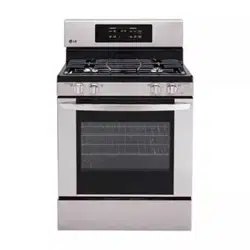
GAS RANGE
Please read this manual carefully before operating
your range and retain it for future reference.
LRG3021ST
ESPAÑOLENGLISH
MFL33029613 (REV.02 150709)
CONTENTS
1
IMPORTANT SAFETY INFORMATION
3 Basic Safety Precautions
3 What to Do if You Smell Gas
3~4 Anti-Tip Device
4~8 Safety Precautions
2
OPERATING INSTRUCTIONS
9 Parts and Features
10~11 Using the Gas Surface Burners
12 Control Panel
13~16 Using the Oven
17 Using the Clock and Timer
18~19 Using the Timed Baking Features
20~21 Special Features of Your Oven Control
22~23 Using the Self-Cleaning Oven
3
CARE AND CLEANING
24 Care and Cleaning
25 Burner Caps and Heads
26 Burner Grates
26 Cooktop Surface
27 Stainless Steel Surfaces
27 Oven Air Vents
27 Control Panel
27 Front Manifold Panel and Knobs
28 Oven Door
29 Oven Bottom
30 Oven Racks
30 Oven Light Replacement
31 Removing and Replacing the Storage Drawer
4
TROUBLESHOOTING
32~35 Before Calling for Service
5
WARRANTY
36 LG Gas Range Limited Warranty
36 Product Registration Information
THANK YOU!
Congratulations on your purchase and
welcome to the LG family. Your new LG Gas
Range combines precision cooking features
with simple operation and stylish design. By
following the operating and care instructions
in this manual, your range will provide you
with many years of reliable service.
2
IMPORTANT SAFETY INFORMATION
READ ALL INSTRUCTIONS BEFORE USE
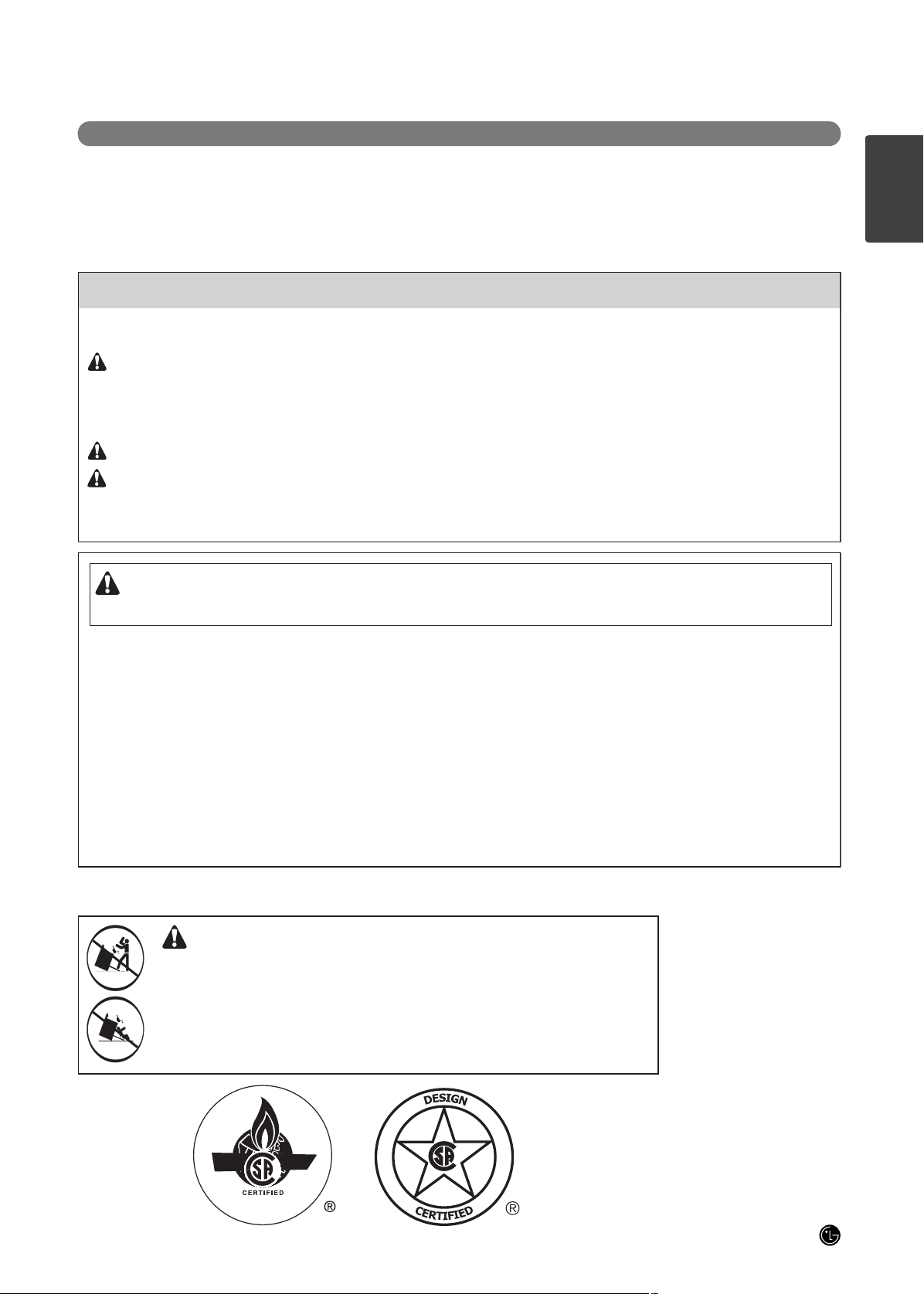
WARNING
• ALL RANGES CAN TIP
• INJURY TO PERSONS COULD RESULT
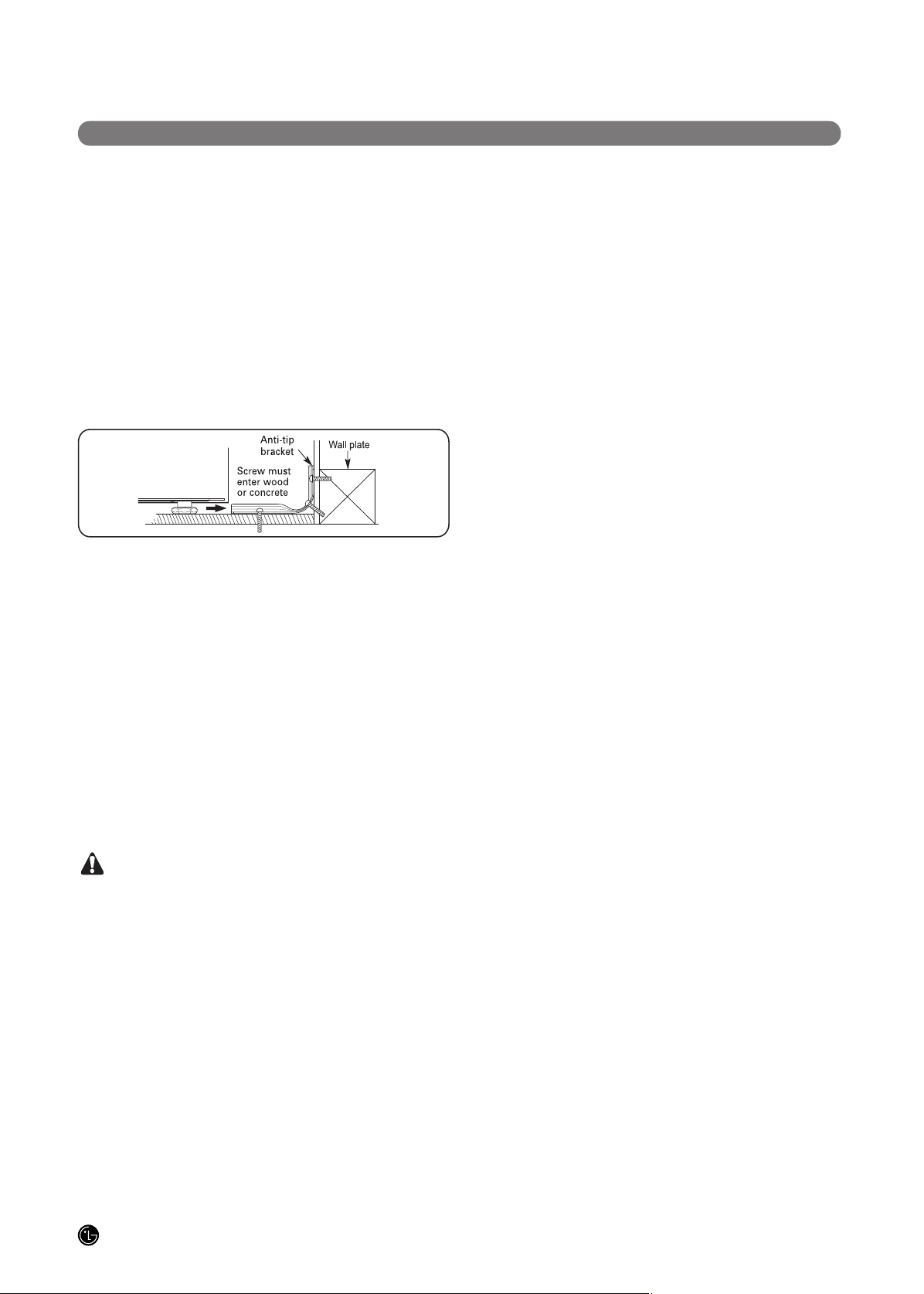
• INSTALL THE ANTI-TIP DEVICES PACKED WITH YOUR RANGE
• SEE THE INSTALLATION SECTION
ANTI-TIP DEVICE
Read and follow all instructions before using your oven to prevent the risk of fire, electric shock, personal injury,
or damage when using the range. This guide do not cover all possible conditions that may occur. Always contact
your service agent or manufacturer about problems that you do not understand.
WHAT TO DO IF YOU SMELL GAS
• Open windows.
•
DO NOT
try to light any appliance.
•
DO NOT
touch any electrical switch.
•
DO NOT
use any phone in your building.
• Immediately call your gas supplier from a neighbor’s phone. Follow the gas supplier’s instructions.
• If you cannot reach your gas supplier, call the fire department.
Installation and service must be performed by a qualified installer, service agency or the gas supplier.
WARNING:
If the information in this manual is not followed exactly, a fire or explosion may
result causing property damage, personal injury or death.
• DO NOT store or use gasoline or other flammable vapors and liquids in the vicinity of this or any other appliance.
Indicates a hazardous situation which, if not avoided, could result in serious injury or death.
This guide contains many important safety messages. Always read and obey all safety messages.
After reading this manual, please keep it in an easily accessible location.
This is the safety alert symbol. This symbol alerts you to potential hazards that can result in property
damage and/or serious bodily harm or death.
All safety messages will follow the safety alert symbol and either the word WARNING or CAUTION. These
words mean:
Indicates a hazardous situation which, if not avoided, could result in minor or moderate injury.
WARNING
BASIC SAFETY PRECAUTIONS
CAUTION
All safety messages will tell you what the potential hazard is, tell you how to reduce the chance of injury, and
tell you what can happen if the instructions are not followed.
3
ENGLISH
IMPORTANT SAFETY INFORMATION
READ ALL INSTRUCTIONS BEFORE USE
IMPORTANT SAFETY NOTICE
The Safe Drinking Water and Toxic Enforcement Act
requires the Governor of California to publish a list of
substances known to the state to cause birth defects or
other reproductive harm, and requires businesses to warn
customers of potential exposure to such substances.
Gas appliances can cause minor exposure to four of
these substances, namely benzene, carbon monoxide,
formaldehyde and soot, caused primarily by the imperfect
combustion of natural or LP gas.
Correctly adjusted burners, indicated by a bluish rather
than a yellow flame, will minimize imperfect combustion.
Exposure to these substances can be minimized by
opening windows or using a ventilation fan or hood.
SAFETY PRECAUTIONS
Have the installer show you the location of the range gas shut-off valve and how to shut it
off if necessary.
• Make sure your range is properly installed and grounded
by a qualified installer, according to the installation
instructions. Any adjustment and service should be
performed only by qualified gas range installers or
service technicians.
• Plug your range into a 120-volt grounded outlet only. Do
not remove the round grounding prong from the plug. If
in doubt about the grounding of the home electrical
system, it is your personal responsibility and obligation
to have an ungrounded outlet replaced with a properly
grounded, three-prong outlet in accordance with the
National Electrical Code. Do not use an extension cord
with this range.
• To prevent fire hazard or electrical shock, DO NOT use
an adapter plug, an extension cord, or remove the
grounding prong from the electrical power cord. Failure
to follow this warning can cause serious injury, fire or
death.
• To prevent poor air circulation, place the range out of
kitchen traffic path and out of drafty locations.
• DO NOT attempt to repair or replace any part of your
range unless it is specifically mentioned in this manual.
All other service should be referred to a qualified
technician.
• To prevent fire or smoke damage should the packaging
material ignite, make sure all packaging materials are
removed from the range before operating it.
• DO NOT step or sit on the door. Install the Anti-Tip
Bracket packed with range.
- The range could be tipped and injury might result from
spilled hot liquid, food, or the range itself.
- If the range is pulled away from the wall for cleaning,
service, or any other reason, ensure that the Anti-Tip
Device is properly reengaged when the range is pushed
back against the wall.
• To reduce the risk of tipping of the range, the range
must be secured by properly installing anti-tip devices.
• To check that the anti-tip bracket is properly installed:
Grasp the top rear edge of the range back guard and
carefully attempt to tilt it forward. Verify that the anti-tip
devices are engaged.
• Warming drawer or Storage drawer : Remove drawer
and visually inspect that the rear leveling leg is fully
inserted into the anti-tip bracket.
• Refer to the installation manual for proper anti-tip
bracket installation.
ANTI-TIP DEVICE
(continued)
•
WARNING:
This product contains chemicals known to the State of California to cause cancer. Wash hands after handling.
4
• Make sure your range is properly adjusted by a qualified
service technician or installer for the type of gas (natural
or LP) that is to be used. Your range can be converted
for use with either type of gas. See the installation
instructions.
• After using your range for a long time, high floor
temperatures may result and many floor coverings will
not withstand this kind of use.
Never install the range over vinyl tile or linoleum that
cannot withstand such type of use. Never install it
directly over interior kitchen carpeting.
• DO NOT leave children alone or unattended where a
range is hot or in operation. They could be seriously
burned.
• DO NOT let anyone climb, stand or hang on the oven
door, warming drawer or cooktop. They could damage
the range and even tip it over, causing severe personal
injury.
• NEVER wear loose fitting or hanging garments while
using the appliance. Be careful when reaching for items
placed in cabinets over the range. Flammable material
could be ignited if brought in contact with flame or hot
oven surfaces and may cause severe burns.
• DO NOT place flammable materials in an oven, a
warming drawer or near a cooktop.
• DO NOT place or use combustible materials such as
gasoline or other flammable vapors and liquids in the
vicinity of this or any other appliance.
• DO NOT allow cooking grease or other flammable
materials in or near the range.
• DO NOT use water on grease fires. Never touch a
flaming pan. Turn the controls off. Smother a flaming
pan on a surface burner by covering the pan completely
with a well-fitting lid, cookie sheet or flat tray. Use a
multi-purpose dry chemical or foam-type fire
extinguisher.
A grease fire can be put out by covering it with baking
soda or, if available, by using a multi-purpose dry
chemical or foam-type fire extinguisher.
Flame in the upper oven or lower oven drawer can be
smothered completely by closing the oven door or
drawer and turning the control to off or by using a multi-
purpose dry chemical or foam-type fire extinguisher.
• DO NOT use the oven or the drawer for storage.
• Let the burner grates and other surfaces cool before
touching them.
• NEVER block the vents (air holes) of the range. They
provide the air inlet and outlet that are necessary for the
range to operate properly with correct combustion. Air
openings are located at the rear of the cooktop, at the
top and bottom of the oven door, and at the bottom of
the range under the warming drawer.
• Large scratches or impacts to glass doors can lead to
broken or shattered glass.
• Stepping, leaning or sitting on the doors or drawers of
this range can result in serious injuries and also cause
damage to the range. Do not allow children to climb or
play around the range. The weight of a child on an open
door may cause the range to tip, resulting in serious
burns or other injury.
• Leak testing of the appliance shall be conducted
according to the manufacturer’s instructions.
IMPORTANT SAFETY INFORMATION
SAFETY PRECAUTIONS (continued)
WARNING:
NEVER use your range as
a space heater to heat or warm the room. Doing so
may result in carbon monoxide poisoning and
overheating of the oven.
CAUTION:
Items of interest to children
should not be placed in cabinets above a range or on
the backsplash of a range—children climbing on the
range to reach items could be seriously injured.
READ ALL INSTRUCTIONS BEFORE USE
WARNING:
These adjustments must
be done by a qualified service technician according to
the manufacturer’s instructions and all codes and
requirements of the authority having jurisdiction.
Failure to follow these instructions could result in
serious injury or property damage. The qualified
agency performing this work assumes responsibility for
the conversion.
5
ENGLISH
IMPORTANT SAFETY INFORMATION
READ ALL INSTRUCTIONS BEFORE USE
SURFACE BURNERS
• NEVER leave the surface burners unattended at high
flame settings. Boilovers cause smoking and greasy
spillovers that may catch on fire.
• Always turn knob to the “LITE” position when igniting
the top burners and make sure the burners have ignited.
• Control the top burner flame size so it does not extend
beyond the edge of the cookware. Excessive flame is
hazardous.
• Use only dry pot holders—moist or damp pot holders on
hot surfaces may result in burns from steam. Do not let
pot holders come near open flames when lifting
cookware. Do not use a towel or other bulky cloth
Instead of a pot holder.
• If using glass cookware, make sure it is designed for
top-of-range cooking.
• To prevent burns, ignition of flammable materials and
spillage, turn cookware handles toward the side or back
of the range without extending over adjacent burners.
• NEVER place any items on the cooktop. The hot air
from the vent may ignite flammable items and will
increase pressure in closed containers, which may
cause them to burst.
• Carefully watch foods being fried at a high flame setting.
• Always heat fat slowly, and watch as it heats.
• If frying combinations of oils and fats stir together before
heating.
• Use a deep fat thermometer if possible to prevent
overheating fat beyond the smoking point.
• Use the least possible amount of fat for effective shallow
or deep-fat frying. Filling the pan too full of fat can cause
spillovers when food is added.
• DO NOT flame foods on the cooktop.
• DO NOT use a wok on the surface burners if the wok
has a round metal ring that is placed over the burner
grate to support the wok. This ring acts as a heat trap,
which may damage the burner grate and burner head.
Also, it may cause the burner to work improperly. This
may cause a carbon monoxide level above that allowed
by current standards, resulting in a health hazard.
• Foods for frying should be as dry as possible. Frost or
moisture on foods can cause hot fat to bubble up and
over the sides of the pan.
• NEVER try to move a pan of hot fat, especially a deep
fat fryer. Wait until the fat is cool.
• DO NOT place plastic items on the cooktop—they may
melt if left too close to the vent.
• Keep all plastics away from the surface burners.
• To prevent burns, always be sure that the controls for all
burners are at the “OFF” position and all grates are
cool before attempting to remove them.
• If you smell gas, turn off the gas to the range and call a
qualified service technician. Never use an open flame to
locate a leak.
• Always turn knob to the “OFF” position before removing
cookware.
• DO NOT lift the cooktop. Lifting the cooktop can cause
damage and improper operation of the range.
• If range is located near a window, do not hang long
curtains that could blow over the surface burners and
catch on fire.
WARNING:
• If the top burner flame goes out, gas is still flowing to
the burner until the knob is turned to the “OFF”
position. Do not leave the burners “ON” unattended.
• Use proper pan size - DO NOT use pans that are
unstable or easily tipped. Select cookware having flat
bottoms large enough to cover burner grates. To
avoid spillovers, make sure cookware is large enough
to contain the food properly. This will both save
cleaning time and prevent hazardous accumulations
of food, since heavy spattering or spillovers left on
range can ignite. Use pans with handles that can be
easily grasped and remain cool.
6
IMPORTANT SAFETY INFORMATION
READ ALL INSTRUCTIONS BEFORE USE
SELF-CLEANING OVEN
• Make sure to wipe off excess spillage before self-
cleaning operation.
• DO NOT use oven cleaners. No commercial oven
cleaner or oven liner protective coating of any kind
should be used in or around any part of the oven.
Residue from oven cleaners will damage the inside of
the oven when the self-clean cycle is used.
• Oven racks and accessories should be removed from
the oven before self clean is started. Also remove any
items placed in the bottom drawer before starting a self
clean cycle.
• Clean only parts listed in this manual.
• DO NOT clean the door gasket. The door gasket is
necessary for a good seal. Care should be taken not to
rub, damage or move the gasket.
• If the self-cleaning mode malfunctions, turn the range off
and disconnect the power supply. Let it serviced by a
qualified technician.
COOK MEAT AND POULTRY THOROUGHLY
Cook meat and poultry thoroughly—meat to at least an
INTERNAL temperature of 160°F and poultry to at least
an INTERNAL temperature of 180°F.
To protect against foodborne illness, cook them to these
temperatures.
7
ENGLISH
IMPORTANT SAFETY INFORMATION
READ ALL INSTRUCTIONS BEFORE USE
OVEN
When opening the door of a hot oven, stand away from the range. The hot air and steam that escape
can cause burns to hands, face and eyes.
READ AND FOLLOW THIS SAFETY INFORMATION CAREFULLY.
SAVE THESE INSTRUCTIONS
• DO NOT heat closed food containers.
Pressure could increase and the container could burst,
causing an injury.
• DO NOT use aluminum foil anywhere in the oven except
as described in this manual.
Doing so could create a fire hazard or cause damage to
the range.
• DO NOT use the oven for a storage area.
Items stored in the oven can catch on fire.
• Keep the oven free from grease buildup.
• Insert the oven racks in the desired position while the
oven is cool.
• To prevent burns when removing food, slide racks out
until the stop engages, then remove food items. It is
also a precaution against burns from touching hot
surfaces of the door or oven walls.
• When placing or removing griddle always wear oven
mitts.
• When using cooking or roasting bags in the oven, follow
the manufacturer’s directions.
• Use only glass cookware that is recommended for use
in gas ovens.
• Always remove the broiler pan from the range after you
finish broiling. Grease left in the pan can catch fire if
oven is used without removing the grease from the
broiler pan.
• When broiling, if meat is too close to the flame, the fat
may ignite. To prevent excessive flare-ups, trim excess
fat.
• Make sure the broiler pan is in place correctly to
minimize the possibility of grease fires.
• If you should have a grease fire in the broiler pan, press
the “CLEAR OFF” pad, and keep the oven door closed
to contain fire until it burns out.
• For safety and better cooking performance, always bake
and broil with the oven door closed.
WARNING:
NEVER block any slots,
holes or passages in the oven bottom or cover an entire
rack with materials such as aluminum foil. Doing so
blocks air flow through the oven and may cause carbon
monoxide poisoning. Aluminum foil linings may also trap
heat, causing a fire hazard.
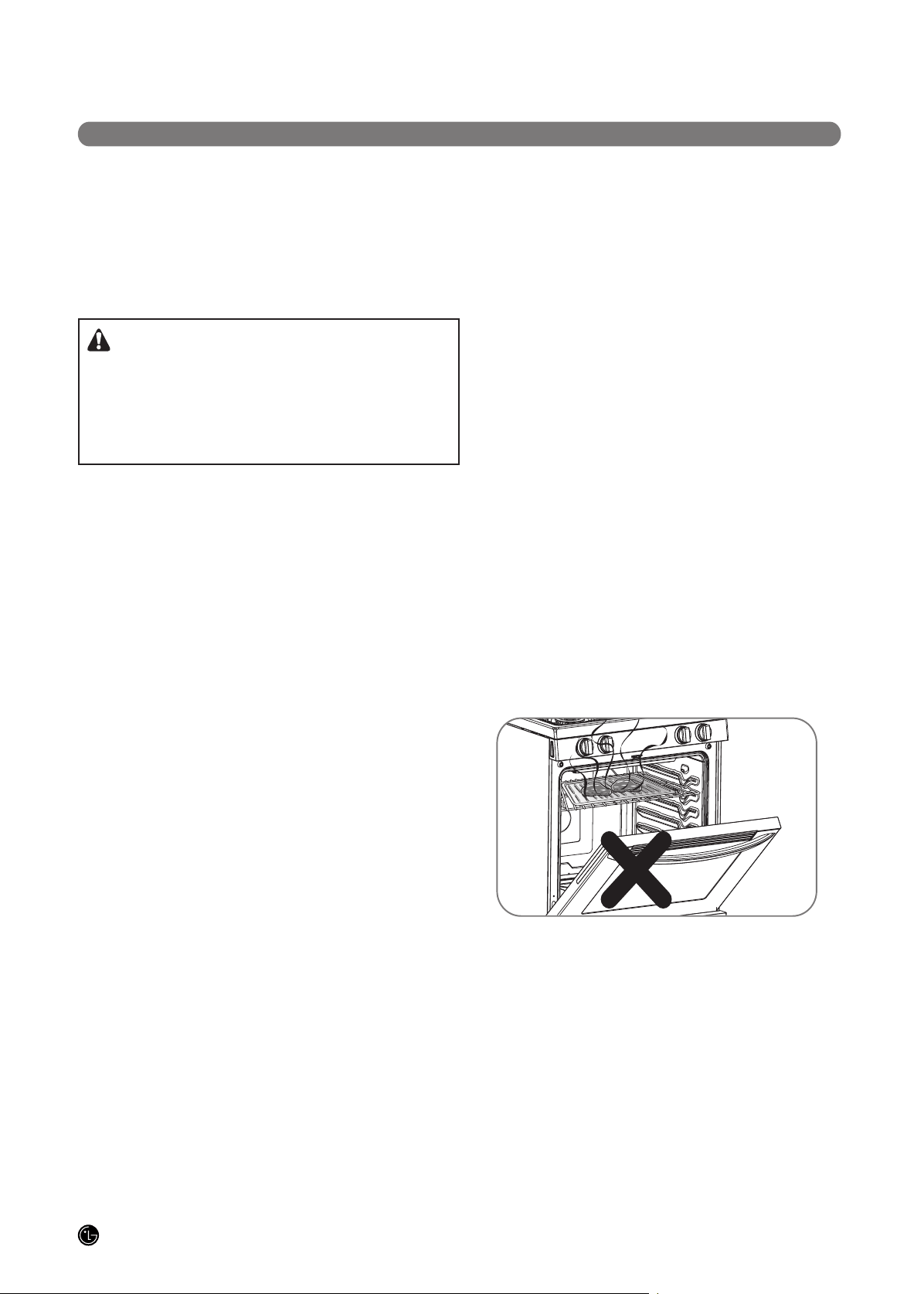
NOTE: Open door baking or broiling can cause damage
to the range’s knobs or valves.
DO NOT LEAVE THE OVEN DOOR OPEN DURING
COOKING OR COOL DOWN.
8
OPERATING INSTRUCTIONS
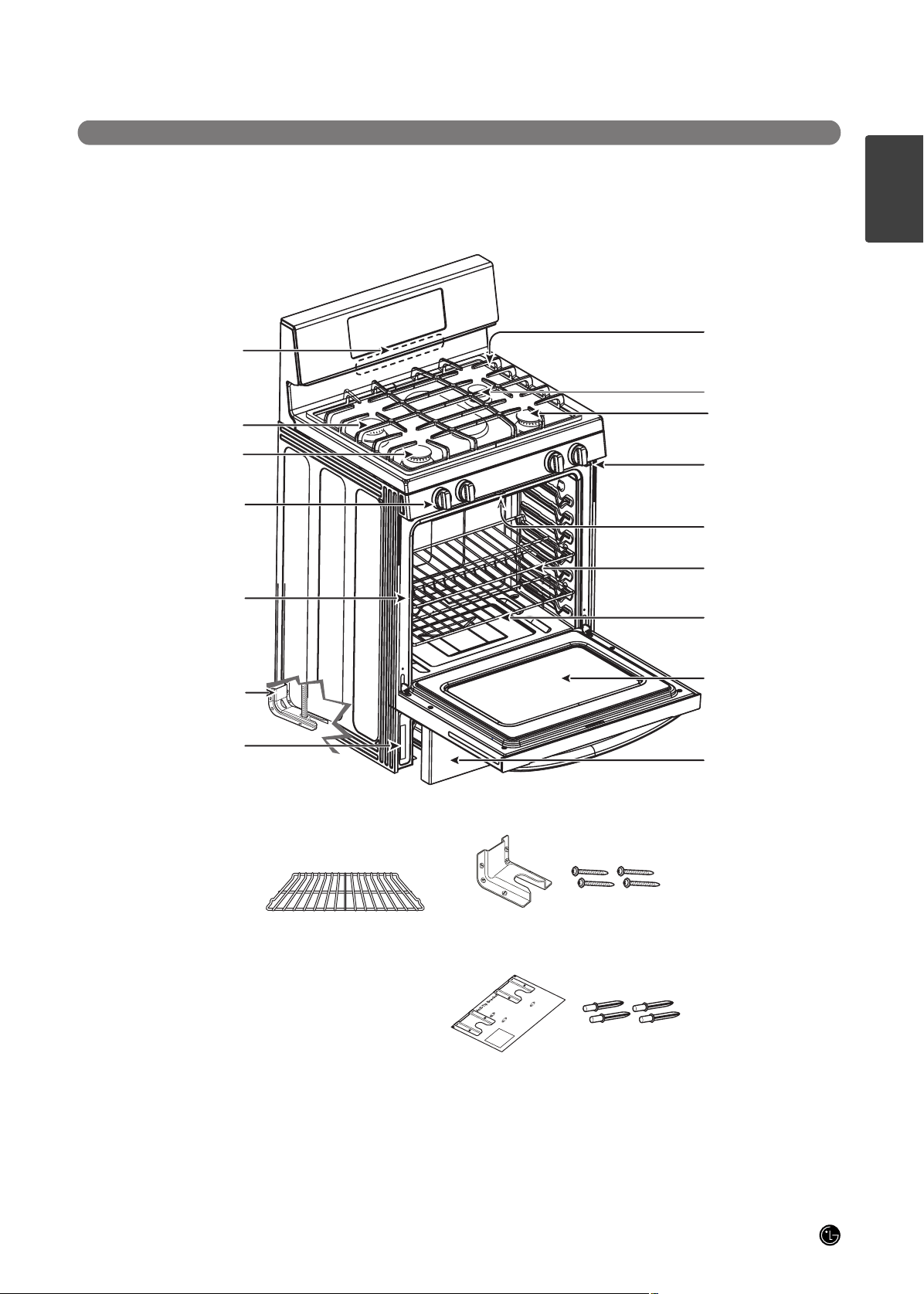
PARTS AND FEATURES
Template Anchors (4)
Screws (4)Anti-tipStandard racks (2)
Grates
Medium burner
Large burner
Knobs (4)
Door gasket
Anti-tip bracket
Model and serial
number plate
Storage drawer
Oven door
Oven vent
Small burner
Extra large burner
Automatic oven
light switch
Self clean latch
Standard rack
Standard rack
9
ENGLISH
OPERATING INSTRUCTIONS
USING THE GAS SURFACE BURNERS
Throughout this manual, features and appearance may vary from your model.
• Make sure all grates on the range are properly placed
before using any burner.
• Be sure the burners and grates are cooled down before
you place your hand, a pot holder, cleaning cloths or
other materials on them.
• Make sure all burners are in place.
• DO NOT operate the burner for an extended period of
time without cookware on the grate.
The finish on the grate may chip without cookware to
absorb the heat.
HOW TO LIGHT A GAS SURFACE BURNER
• Be sure all the surface
burners are placed in their
respective positions.
• Push the control knob in and
turn it to the “LITE” position.
• You will hear a little clicking
noise— the sound of the
electric
spark igniting the burner.
• To control the flame size, turn
the knob. If the knob stays at “LITE”, it will continue to
click.
• When turning a burner to “LITE”, all the burners spark.
Do not attempt to disassemble or clean around any
burner while another burner is on. An electric shock may
result, which could cause you to knock over hot
cookware.
IN CASE OF POWER FAILURE
In case of a power failure, you can light the gas surface
burners on your range with a match.
Hold a lit match to the burner, then push in and turn the
control knob to the “LITE” position. Use extreme caution
when lighting burners this way.
Surface burners in use when an electrical power failure
occurs will continue to operate normally.
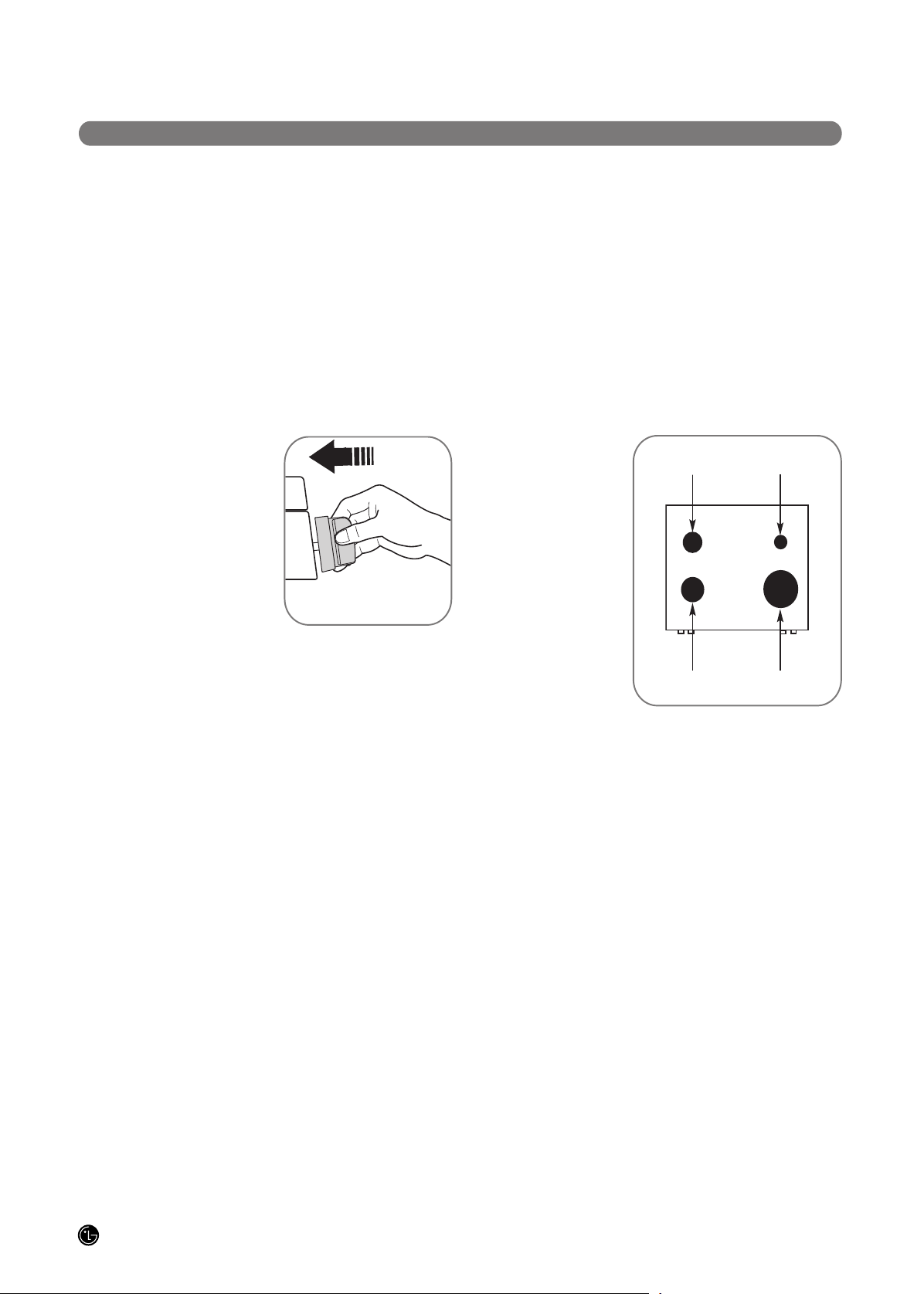
SEALED GAS BURNERS
Your gas range cooktop
has four sealed gas
burners. They offer
convenience, ease of
cleaning and flexibility to
be used in a wide range
of cooking applications.
The smallest burner is in
the right rear position.
This burner can be
turned down to a low
simmer setting.
It provides precise
cooking performance for
delicate foods such as
sauces or foods that require low heat for a long cooking
time.
The medium (Left rear) and the large (left front) burners
are the primary burners for most cooking.
These general-purpose burners can be turned down from
“HI” to “LO” to suit a wide range of cooking needs.
The extra large burner (right front) is the maximum output
burner. Like the other four burners, it can be turned down
from “HI” to “LO” for a wide range of cooking
applications.
This burner is also designed to quickly bring large
amounts of liquid to a boil. It can be used with cookware
10 inches or larger in diameter.
NOTE: The right front burner, by design, is raised up from
the cooktop. This is normal.
Push the control knob in and
turn it to the “LITE” position.
Medium
Large
Extra Large
Small
10
OPERATING INSTRUCTIONS
USING THE GAS SURFACE BURNERS
HOW TO SELECT FLAME SIZE
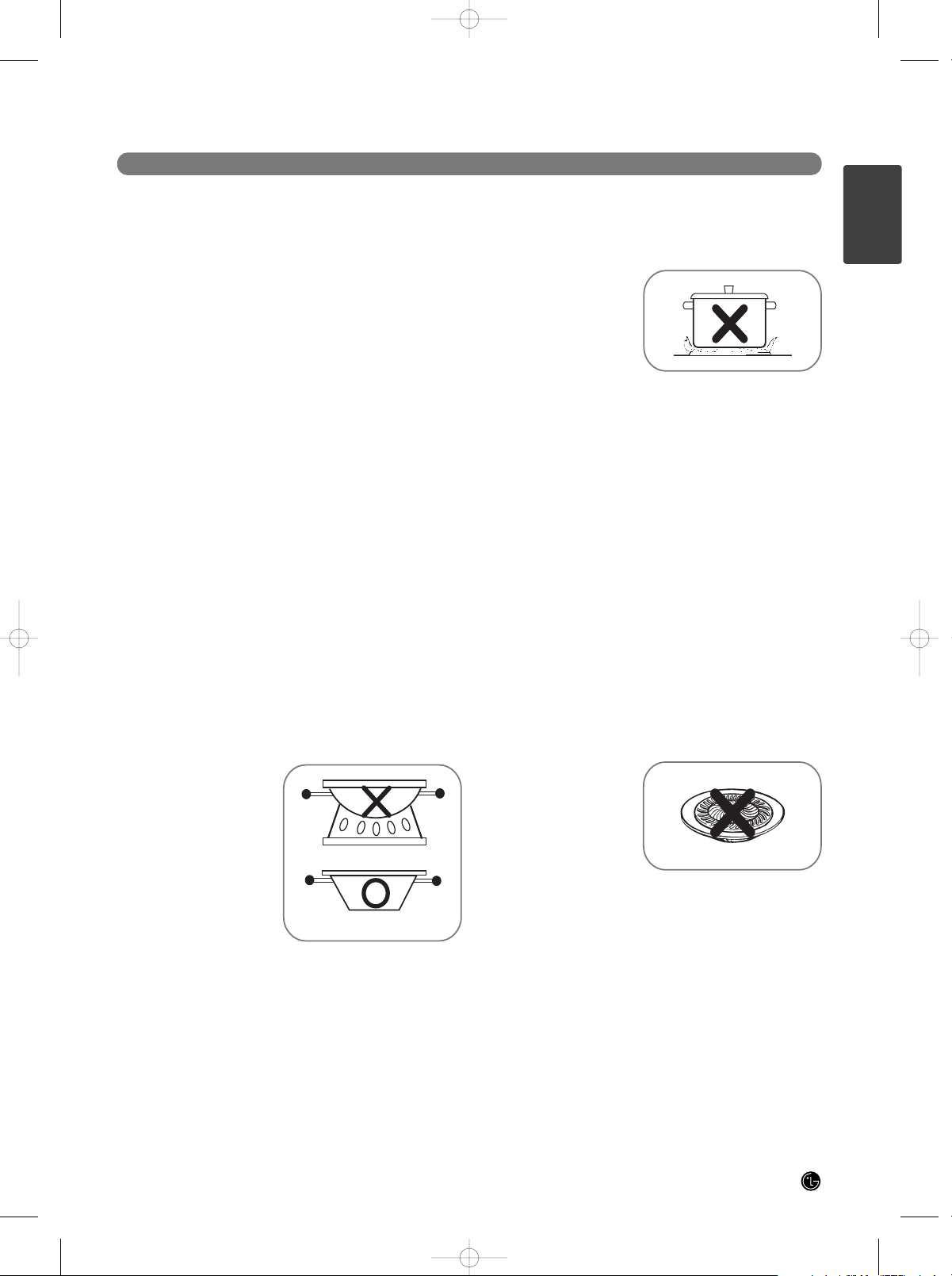
NEVER let the flames extend up the sides of the
cookware for safe handling of cookware.
Watch the flame, not the knob, as you reduce heat. When
fast heating is desired, the flame size on a gas burner
should match the cookware you are using.
Flames larger than the
bottom of the cookware will
not result in faster heating
of the cookware and could
be hazardous.
TOP-OF-RANGE COOKWARE
Aluminum: Medium-weight cookware is recommended
because it heats quickly and evenly. Most of the foods
brown evenly in an aluminum skillet. Use saucepans with
tightfitting lids when cooking with minimum amounts of
water.
Cast-Iron: If heated slowly, most skillets will give
satisfactory results.
Stainless Steel: This metal alone has poor heating
properties and is usually combined with copper,
aluminum or other metals for improved heat distribution.
Combination metal skillets usually work satisfactorily if
they are used with medium heat as the manufacturer
recommends.
Enamelware: Under some conditions, the enamel of
some cookware may melt. Follow cookware
manufacturer’s recommendations for cooking methods.
Glass: There are two types of glass cookware—those for
oven use only and those for top-ofrange cooking
(saucepans, coffee and teapots). Glass conducts heat
very slowly.
Heatproof Glass Ceramic: Can be used for either
surface or oven cooking. It conducts heat very slowly and
cools very slowly. Check cookware manufacturer’s
directions to be sure it can be used on gas ranges.
USING A WOK
DO NOT use a wok support
ring. Placing the ring over
the burner or grate may
cause the burner to work
improperly, resulting in
carbon monoxide levels
above allowable standards.
This can be hazardous to
your health.
Only a flat-bottomed wok
should be used.
We recommend that you use a 14-inch or smaller
flatbottomed wok. Make sure the wok bottom sits flat on
the grate. They are available at your local retail store.
STOVE-TOP GRILLS
DO NOT use stove top
grills on your surface
burners. If you use the
stove top grill on the
surface burner, it will
cause incomplete
combustion and can result
in exposure to carbon monoxide levels above allowable
current standards.
This can be hazardous to your health.
Use a flat-bottomed wok
11
ENGLISH
OPERATING INSTRUCTIONS
CONTROL PANEL
Throughout this manual, features and appearance may vary from your model.
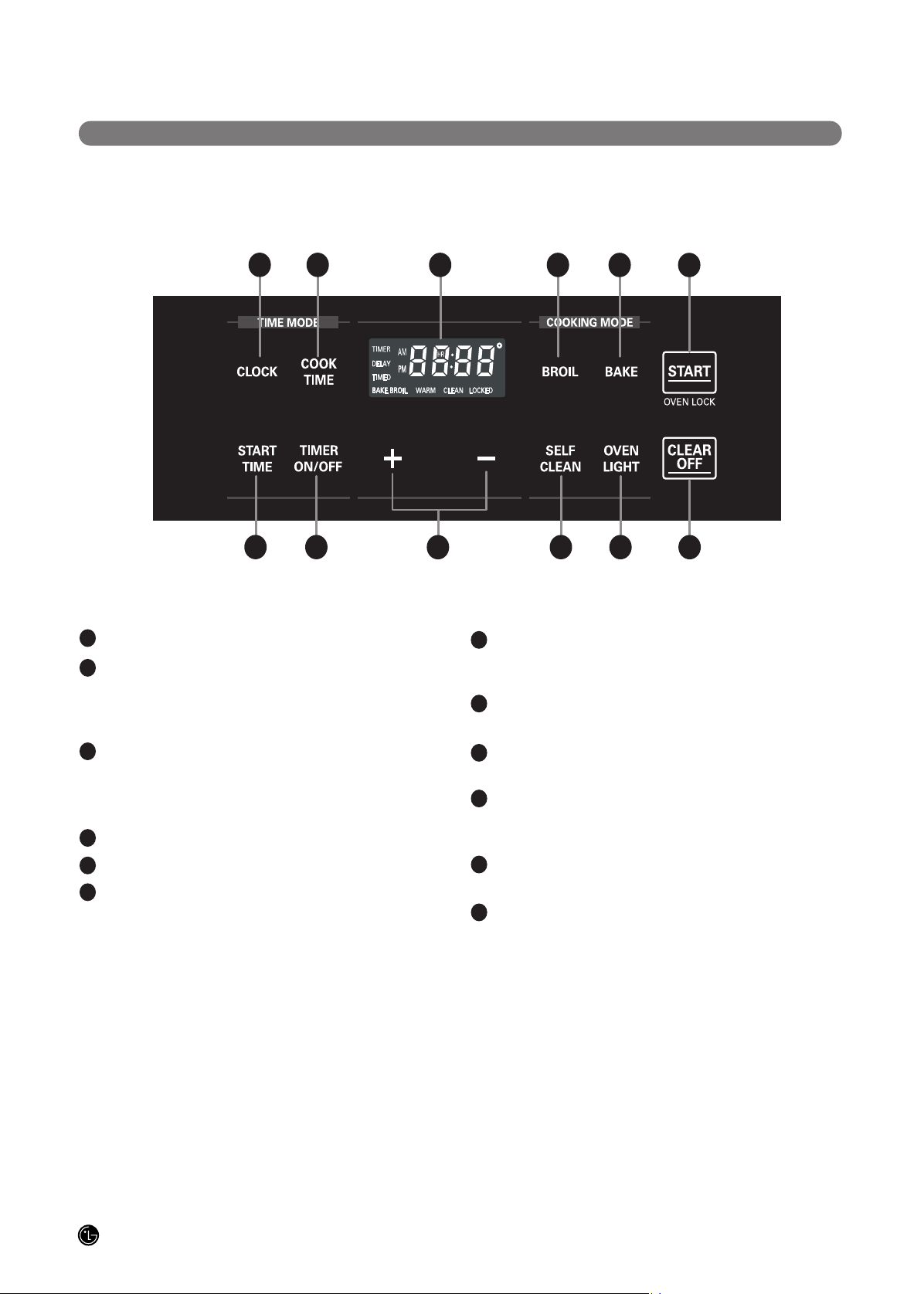
OVEN CONTROL, CLOCK, AND TIMER FEATURES
CLOCK Pad: Press before setting the time of day.
COOK TIME Pad: Press and then use the + and -
pads to set the amount of time you want your food to
cook. The oven will shut off when the cooking time
has run out.
Display: Shows the time of day, oven temperature,
whether the oven is in the bake, broil or self-cleaning
mode, and the times set for the timer or automatic
oven operations.
BROIL Pad: Press to select the broil function.
BAKE Pad: Press to select the bake function.
START Pad: Must be pressed to start any cooking or
cleaning function.
START TIME Pad: Use along with Bake, Cook Time,
and Self Clean pads to set the oven to start and stop
automatically at a time you set.
TIMER ON/OFF Pad: Press to select the timer
feature.
+/- Pad: Enters or changes time, oven temperature.
Sets HI or LO broil.
SELF CLEAN Pad: Press to select self-cleaning
function. See the using the Self-Cleaning Oven
section, page 22.
OVEN LIGHT Pad: Press to turn the oven light on or
off.
CLEAR OFF Pad: Press to cancel all oven operations
except the clock and timer.
NOTE:
If F– and a number appear in the display and the oven control signals, this
indicates a function error code.
See page 34.
Press the CLEAR OFF pad. Allow the oven to cool for one hour. Put the oven
back into operation.
If the function error code repeats, disconnect the power to the oven and call for
service.
If your oven was set for a timed oven operation and a power outage
occurred, the clock and all programmed functions must be reset.
The time of day will flash in the display when there has been a power
outage.
1
2
3
4
5
6
7
8
10
11
12
9
1
2
7
8
9
10
11
12
3
4
5
6
12

OPERATING INSTRUCTIONS
As your oven heats up, the temperature increase of the
air in the oven may cause water droplets to form on the
door glass. These droplets are harmless and will
evaporate as the oven continues to heat up.
ALUMINUM FOIL
NEVER cover the oven bottom with aluminum foil.
To use aluminum foil to catch a spillover, instead place a
small sheet of foil on a lower rack several inches below
the food.
NEVER entirely cover a rack with aluminum foil. This will
disturb the heat circulation and result in poor baking.
OVEN MOISTURE
USING THE OVEN
BEFORE YOU BEGIN
The oven has 7 rack positions for
various types of cooking.
To install a rack insert the curved
end of the rack into the desired
position and push all the way back.
To remove a rack pull out until the
rack stops, then tilt up and pull out.
POWER OUTAGE
CAUTION:
DO NOT attempt to operate the electric ignition oven
during an electrical power failure.
The oven or broiler can not be used during a power
outage.
If the oven is in use when a power failure occurs, the oven
burner shuts off and cannot be re-lit until power is
restored. Once power is restored you will need to restart
the oven or broil function.
OVEN LIGHT
The oven light automatically turns ON when
the door is opened. The oven light may also
be manually turned ON or OFF by pressing
the “OVEN LIGHT” pad.
NOTE :
• The oven light can not be turned on during a self clean
cycle. The oven light can not be turned on until the oven
temperature has cooled below 500˚F(260˚C) after a self
clean cycle is complete.
A
B
C
D
E
F
G
The oven has 7 rack
positions.
OVEN VENT
Your oven is vented though ducts at the center above the
burner grate. Do not block the oven vent when cooking to
allow for proper air flow. Do not touch vent openings or
nearby surfaces during the use of any cooking operation.
• DO NOT place plastic or
flammable items on the
cooktop—they may melt or ignite
if left too close to the vent.
• DO NOT place closed containers
on the cooktop. The pressure in
closed containers may increase,
which may cause them to burst.
• Metal items will become very hot
if they are left on the cooktop, and
could cause burns.
• Handles of pots and pans on the cooktop may become
hot if left too close to the vent.
Plastic items on the
cooktop may melt if left
too close to the vent.
CAUTION:
Always use potholders or
oven mitts when removing food or adjusting the
oven racks. Wait until the oven has completely
cooled if possible. Oven racks may be HOT and
may cause burns.
13
ENGLISH
OPERATING INSTRUCTIONS
USING THE OVEN
To avoid possible burns, place the racks in the desired position before you turn the oven on.
PREHEATING AND PAN PLACEMENT
Preheat the oven if the recipe calls for it. To preheat, set
the oven at the correct temperature. Preheating is
necessary when convection baking and for good results
when baking cakes, cookies, pastry and breads.
Baking results will be better if baking pans are centered in
the oven as much as possible. If baking with more than
one pan, place the pans so each has at least 1” to 1-1/2”
of air space around it.
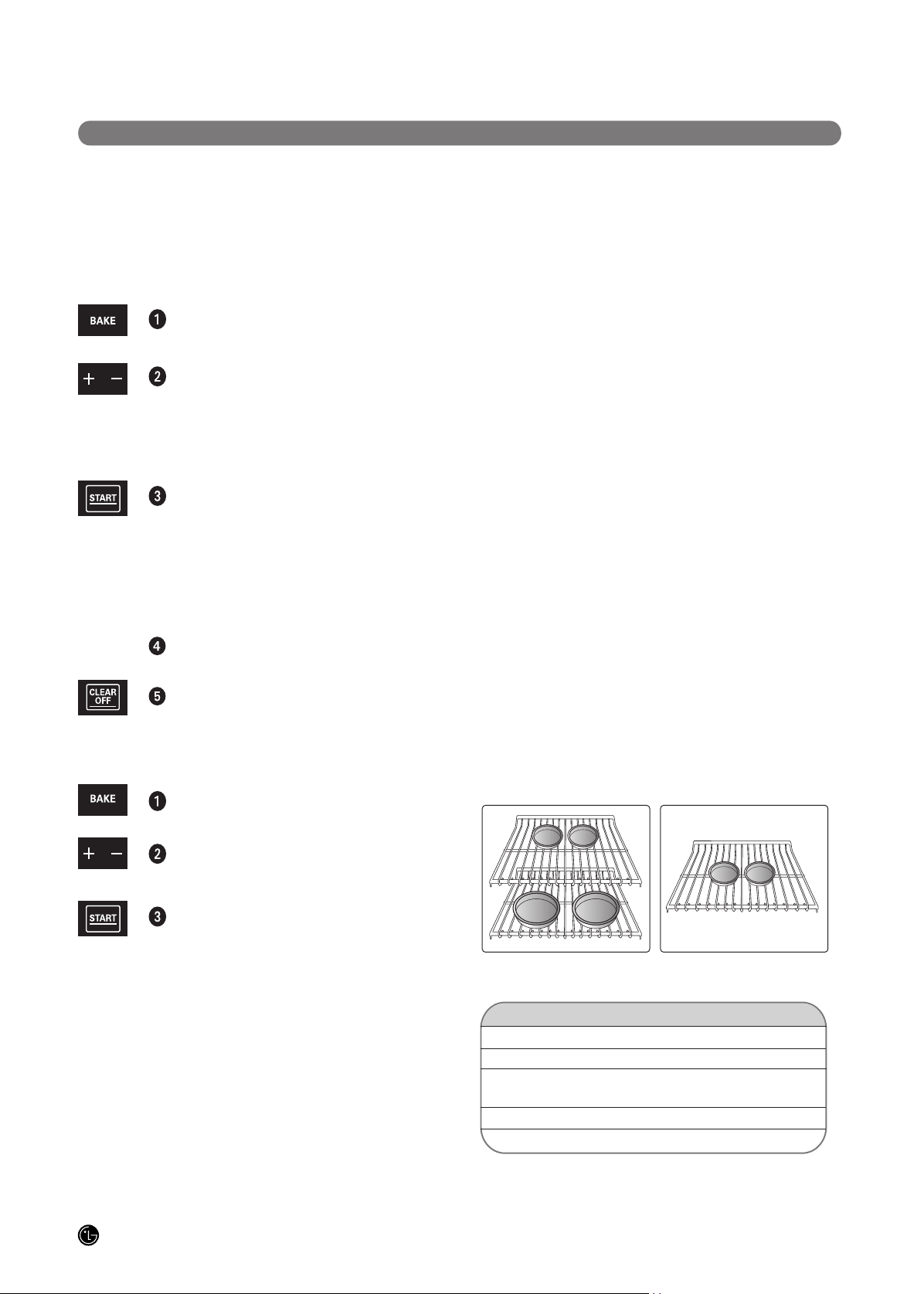
If cooking on multiple racks,place the oven racks in
positions C and E (For 2 racks) Place the cookware as
shown in Fig. 1, 2.
HOW TO SET THE OVEN FOR BAKING
Your oven is not designed for open-door cooking.
Press BAKE. 350° will appear in the
display and bake will flash.
Select the oven temperature.
Press or press and hold the + or - pads.
• Press the + pad to increase the
temperature.
• Press the - pad to decrease the
temperature.
Press START to accept the temperature
change
The word “BAKE” and 100° will be displayed. As the
oven heats up, the display will show the changing
temperature. After the oven has reached the desired
temperature, long beeps will sound 5 times and oven
lamp will flash.
Check food for doneness at minimum time
on recipe. Cook longer if necessary.
Press the “CLEAR OFF” pad when
cooking is complete.
To change the Bake Temperature while cooking
Press the Bake pad.
Then press the + or - pad until the desired
temperature is displayed.
Press START.
Type of Food Rack Position
Frozen pies (on cookie sheet)
Angel food cake, bundt or pound cakes
Biscuits, muffins, brownies, cookies,
cupcakes, layer cakes, pies
Casseroles
Roasting
B or C
C
D
D
A
BAKING TIP
THE TYPE OF MARGARINE WILL AFFECT BAKING
PERFORMANCE
Most recipes for baking have been developed using high
fat products such as butter or margarine (80% fat). If you
decrease the fat, the recipe may not give the same
results as with a higher fat product.
If cakes, pies, pastries, cookies or candies are made with
low fat spreads, it can result in recipe failure. The lower
the fat content of a spread product, the more noticeable
these differences become.
Federal standards require products labeled “margarine” to
contain at least 80% fat by weight. Low fat spreads, on
the other hand, contain less fat and more water. The high
moisture content of these spreads affects the texture and
flavor of baked goods. It can get best results with your old
favorite recipes to use margarine, butter or stick spreads
containing at least 70% vegetable oil.
Fig. 1 Fig. 2
14
OPERATING INSTRUCTIONS
Serve the food immediately, and place the pan outside
the oven to cool during the meal for easiest
cleaning.
Use LO Broil to cook foods such as poultry or thick cuts
of meat thoroughly without over-browning them.
NOTE:
• Some smoke may occur during broiling. This is
normal.
USING THE OVEN
HOW TO SET THE OVEN FOR BROILING
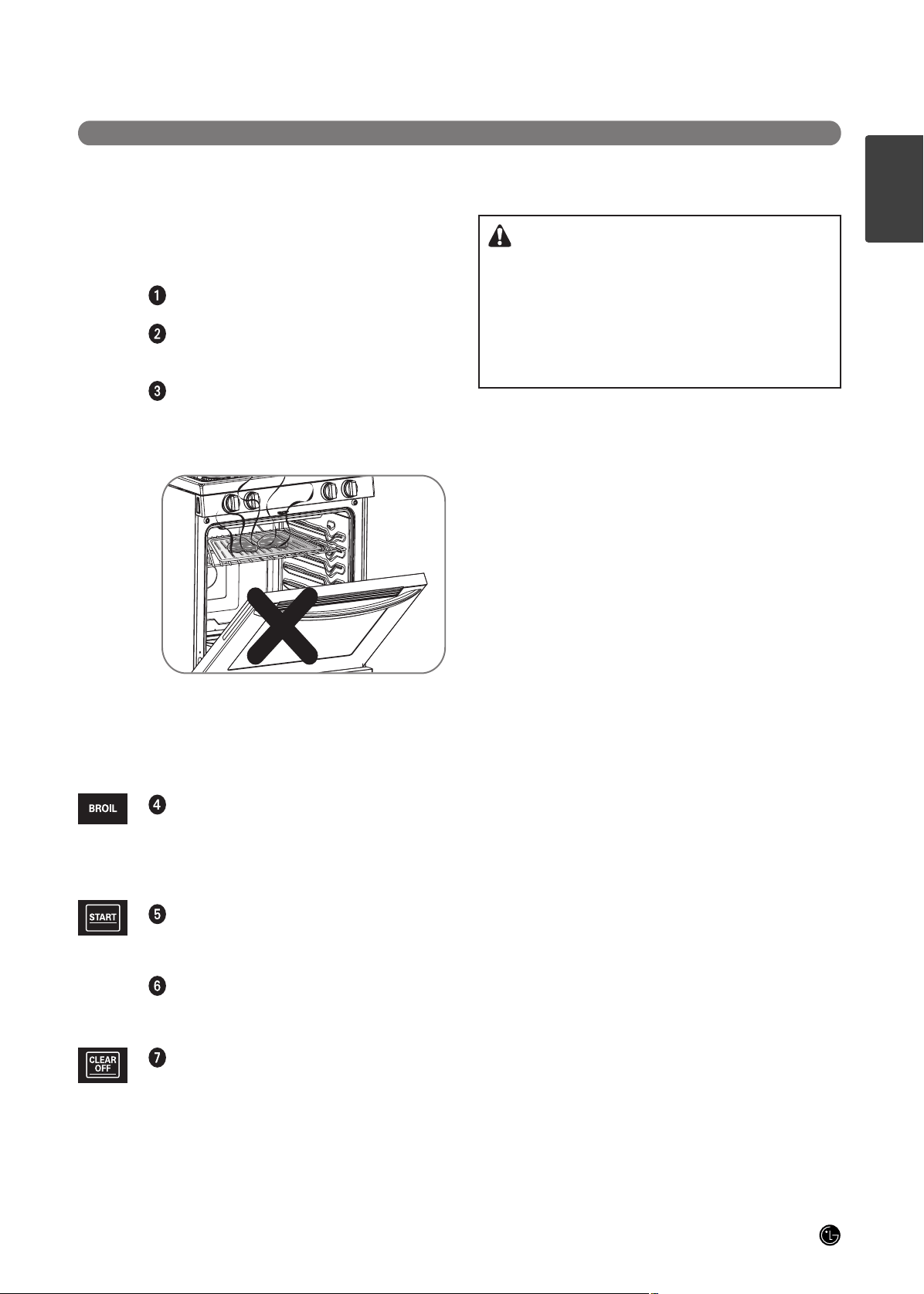
Your oven is designed for CLOSED DOOR broiling.
Place the food on the grid of the broiler pan.
Follow the suggested rack positions in the
Broiling Guide.
The oven door must be closed to begin
broiling.
The oven door must be closed during
broiling.
Press the BROIL pad once for Hi and twice
for Lo (or press BROIL and press the + or -
pad to scroll through the broil settings).
BROIL will flash.
Press the START pad. The oven will begin to
broil. BROIL will light in the display.
Broil on one side until the food is browned;
turn and cook on the other side.
To cancel broiling, or when broiling is
finished, press the CLEAR OFF pad.
NOTE: If the oven door remains open for
more than 15 seconds during broiling the
burner will shut off. The broil burner will
automatically come back on once the door
is closed.
CAUTION:
• DO NOT use the broiler pan without the grid.
• DO NOT cover the broil pan or grid with aluminum
foil. Exposed grease could ignite.
• To prevent food from contacting the broil burner and
to prevent grease splattering, do not use the
roasting rack when broiling.
15
ENGLISH
OPERATING INSTRUCTIONS
A
B
C
D
E
F
G
Your oven has 7 rack
positions.
USING THE OVEN
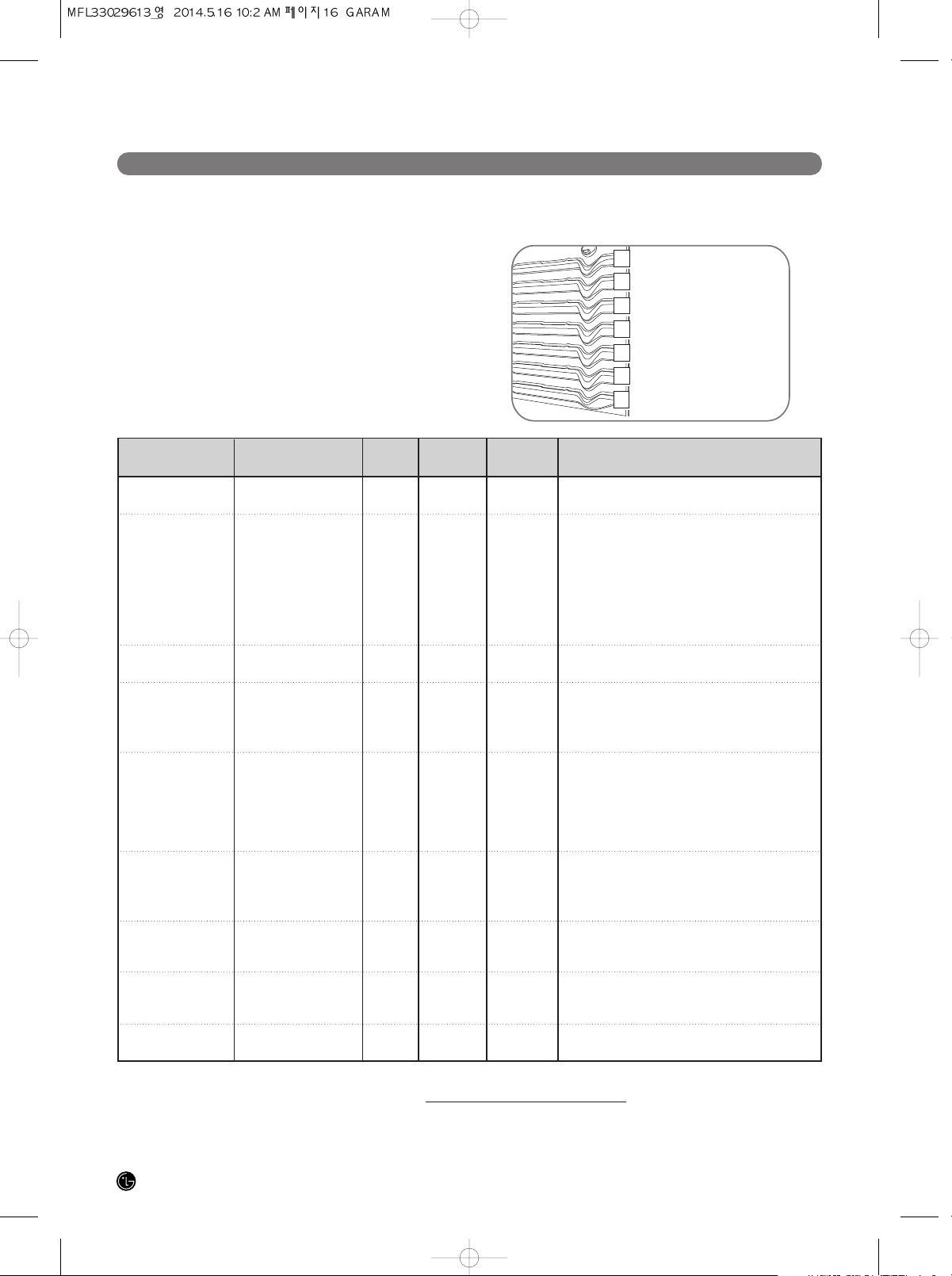
BROILING GUIDE
Broiling times will be affected by the size, weight,
thickness, starting temperature and your preference of
doneness.
This guide is based on meats at refrigerated
temperatures.
Food
Quantity and/or
Thickness
Rack
Position
*
First Side
Time (min.)
Second Side
Time (min.)
Comments
Ground Beef
Well Done
Beef Steaks
Rare
†
Medium
Well Done
Rare
†
Medium
Well Done
Bacon
Pork Chops
Well Done
Lamb Chops
Medium
Well Done
Medium
Well Done
Chicken
Lobster Tails
Fish Fillets
Ham Slices
(precooked)
Space evenly. Up to 8 patties may be broiled at
once.
Steaks less than 1” thick cook through before
browning.
Pan frying is recommended.
Slash fat.
Arrange in single layer.
Slash fat.
Slash fat.
Brush each side with melted butter.
Broil skin-side-down first.
Cut through back of shell. Spread open. Brush
with melted butter before broiling and after half
of broiling time.
Handle and turn very carefully. Brush with
lemon butter before and during cooking, if
desired. Preheat broiler to increase browning.
Increase time 5 to 10 minutes per side for 1
1
/
2
”
thick or home-cured ham.
1 lb. (4 patties)
1
/
2
to
3
/
4
” thick
1” thick
1 to 1
1
/
2
lb.
1
1
/
2
” thick
2 to 2
1
/
2
lb.
1
/
2
lb.
(about 8 thin slices)
2 (
1
/
2
” thick.)
2 (1” thick)
about 1 lb.
2 (1” thick) about
10 to 12 oz.
2 (1
1
/
2
” thick) about
1 lb
1 whole
2 to 2
1
/
2
lbs.,
split lengthwise
4 bone-in breasts
2–4
6 to 8 oz. each
1
/
4
to
1
/
2
” thick
1” thick
1
/
2
” thick
F
F
F
F
D
D
D
D
D
D
E
E
E
E
B
B
C
E
C
D
7~8
7
12
13
10
12-15
25
8
10
13
6
10
10
17
35-40
25-30
13–16
7~8
10
7
5-6
5
5-6
8-9
6-7
10-12
16–18
3
8
8~9
4–7
10
4-6
12-14
25
10-15
Do not turn
over.
6
5
4
† The U.S. Department of Agriculture says “Rare beef is popular, but you should know that cooking it to only 140˚F(60˚C). means
some food poisoning organisms may survive.” (Source: Safe Food Book, Your Kitchen Guide,
USDA Rev. June 1985.)
* See illustration for descri
p
tion of rack
p
ositions.
16
OPERATING INSTRUCTIONS
USING THE CLOCK AND TIMER
HOW TO SET THE CLOCK
The clock should be set to the correct time of day for the
automatic oven timing functions to work properly. The
time of day cannot be changed during cooking or self-
clean mode.
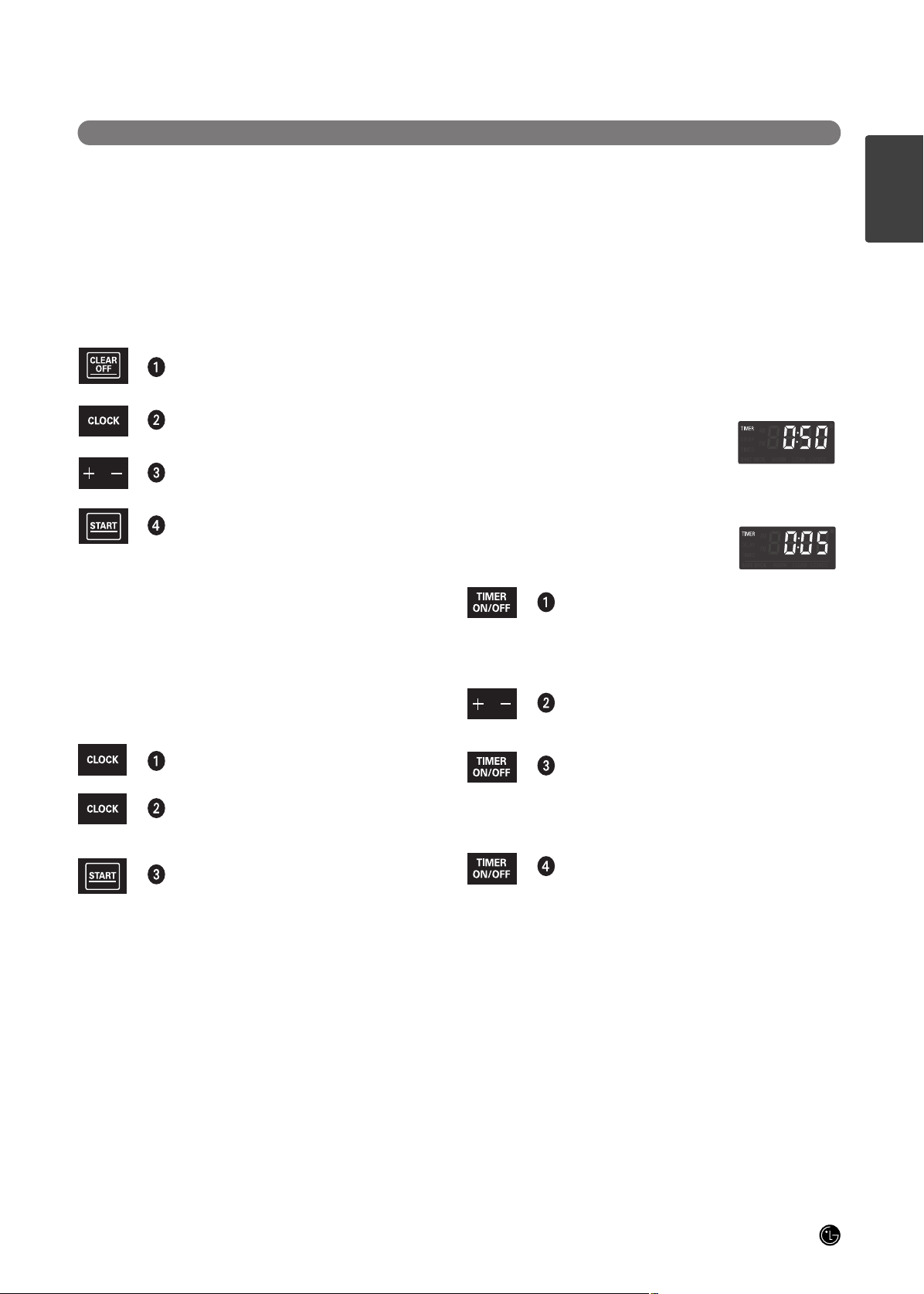
Press the CLEAR OFF pad.
Press the CLOCK pad.
Press the + or – pad to set the time of day.
Press the START pad.
The clock will be set, and the display will
reflect the change after a short delay.
Press the TIMER ON/OFF pad once to set
the time in minutes and seconds, OR press
the pad twice to set the time in hours and
minutes. TIMER will flash in the display.
Press the + or - pad until the desired time
appears in the display.
Press the TIMER ON/OFF pad to start the
countdown. TIMER will show in the display.
NOTE: If TIMER ON/OFF is not pressed, the
timer will return to the time of day.
When the timer reaches :00, End will show
in the display. The clock will sound with 3
beeps every 15 seconds until the TIMER
ON/OFF pad is pressed.
HOW TO SET THE TIMER
The TIMER ON/OFF serves as an extra timer in the
kitchen that will beep when the set time has run out. It
does not start or stop cooking or control oven operations.
The TIMER ON/OFF feature can be used during any of
the other oven control functions.
NOTE:
1. If you press TIMER ON/OFF once, it allows you to set
the time in minutes and seconds.
(For example: if you press 50,
it means 50 seconds.)
2. If you press TIMER ON/OFF twice, it allows you to set
the time in hours and minutes.
(For example: if you press 5,
it means 5 minutes.)
HOW TO CHANGE THE HOUR MODE ON
THE CLOCK (12 HR OR 24 HR)
Your control is set to use a 12 hour clock. If you would
prefer to have a 24 hour time clock, follow the steps
below.
Press the CLOCK pad for three seconds.
Press the CLOCK pad to switch between
the 12 hr clock and the 24 hr clock.
Press the START pad to accept the desired
change.
NOTE: If the remaining time is not in the display, recall
the remaining time by pressing the TIMER ON/OFF.
HOW TO CANCEL THE TIMER
Press the TIMER ON/OFF pad. The display will return to
the time of day.
POWER OUTAGE
If a flashing time is in the display, you have experienced a
power failure. You will need to reset the clock time.
Press the CLOCK pad once to reset. Enter the correct
time of day by pressing the + or - pads.
Press the START pad.
17
ENGLISH
OPERATING INSTRUCTIONS
USING THE TIMED BAKING FEATURES
NOTE:
DO NOT
leave foods that spoil easily – such as milk,
eggs, fish, stuffings, poultry and pork – more than 1 hour
before or after cooking. Room temperature promotes the
growth of harmful bacteria. Be sure that the oven light is off
because heat from the bulb will speed harmful bacteria
growth.
The oven will turn on immediately and cook for a selected length
of time. At the end of the cooking time, the oven will turn off
automatically.
Make sure the clock is set for the correct time of day.
IMPORTANT NOTE:
Place food in the oven after preheating if the recipe calls
for it. Preheating is so important for good results when
baking cakes, cookies, pastry, and breads. After the oven
has reached the desired temperature, long beeps will
sound 5 times and oven lamp will flash. Preheating will
take approximately 10~15 minutes.
When the Timed Bake finishes:
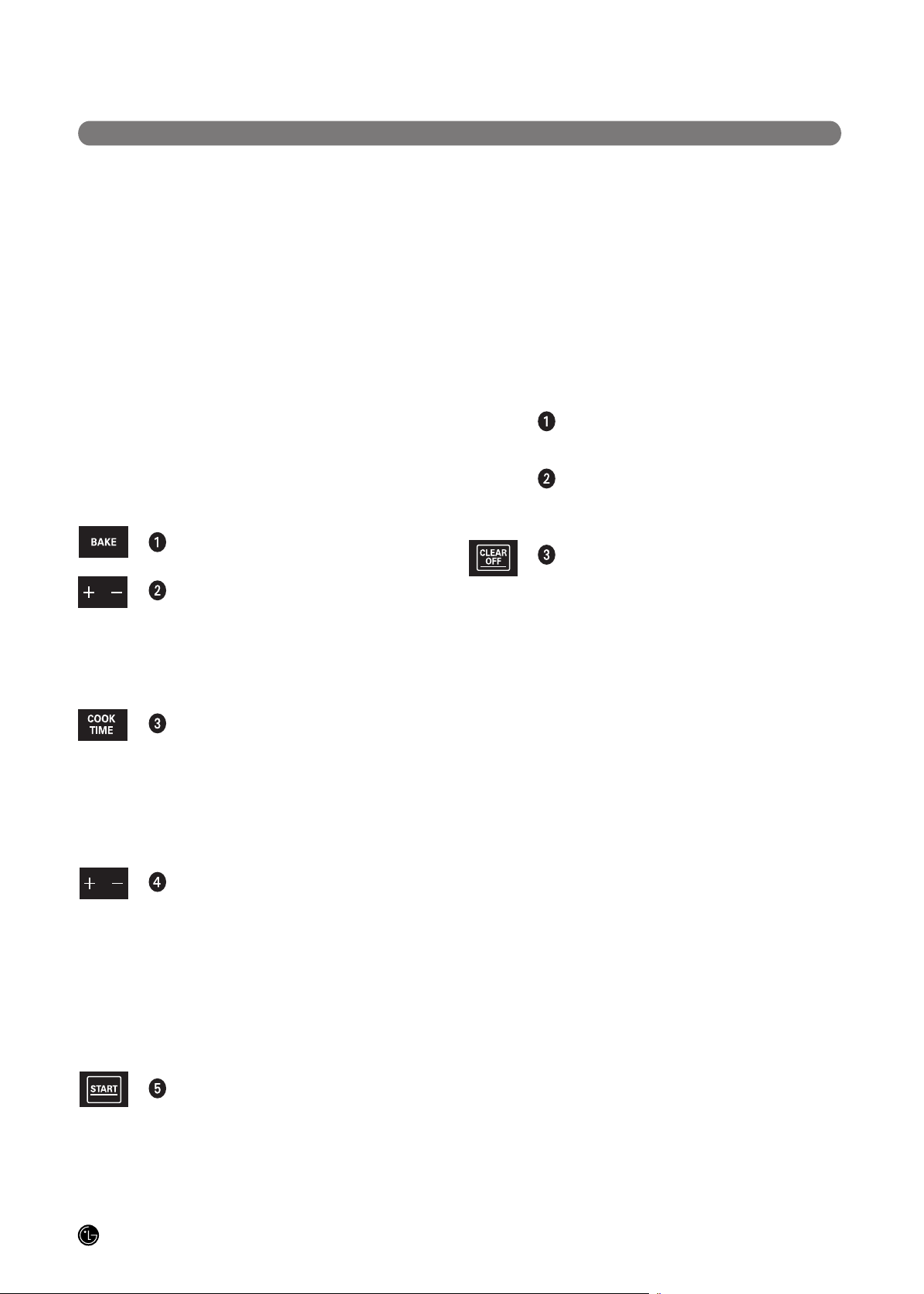
End will show in the display. The oven will
shut off automatically.
The control will continue to beep three
times every minute until the CLEAR OFF
pad is pressed.
Press the CLEAR OFF pad to clear the
display. Remove the food from the oven.
Remember, although the oven turns off
automatically, food left in the oven will
continue cooking after the oven turns off.
HOW TO SET AN IMMEDIATE START
AND AUTOMATIC STOP
Press the BAKE pad. 350° will appear in
the display and BAKE will flash.
Press or press and hold the + or - pad to
set the desired oven temperature.
• Press the + pad to increase the
temperature.
• Press the - pad to decrease the
temperature.
Press the COOK TIME pad.
• TIMED flashes.
• 0:00 lights in the display.
NOTE: If your recipe requires preheating, you
may need to add additional time to the length
of the cooking time.
Press the + or - pad to set the desired
length of cooking time, while TIMED is still
flashing.
NOTE: You can set the cooking time from 1
minute up to 11 hours and 59 minutes. The
cooking time that you entered will be shown in
the display. (If you select Cook Time first and
then adjust the Bake Temperature, the oven
temperature will be displayed instead.)
Press the START pad. BAKE will stop
flashing and will light in the display. The
display shows either the oven temperature
that you set or the baking time countdown.
18
OPERATING INSTRUCTIONS
USING THE TIMED BAKING FEATURES
(continued)
HOW TO SET A DELAYED START AND
AUTOMATIC STOP
The oven will turn on at the time of day you set, cook for
a specific length of time and then turn off automatically.
Be sure the clock shows the correct time of day. Arrange
the interior oven rack(s) and place the food in the oven.
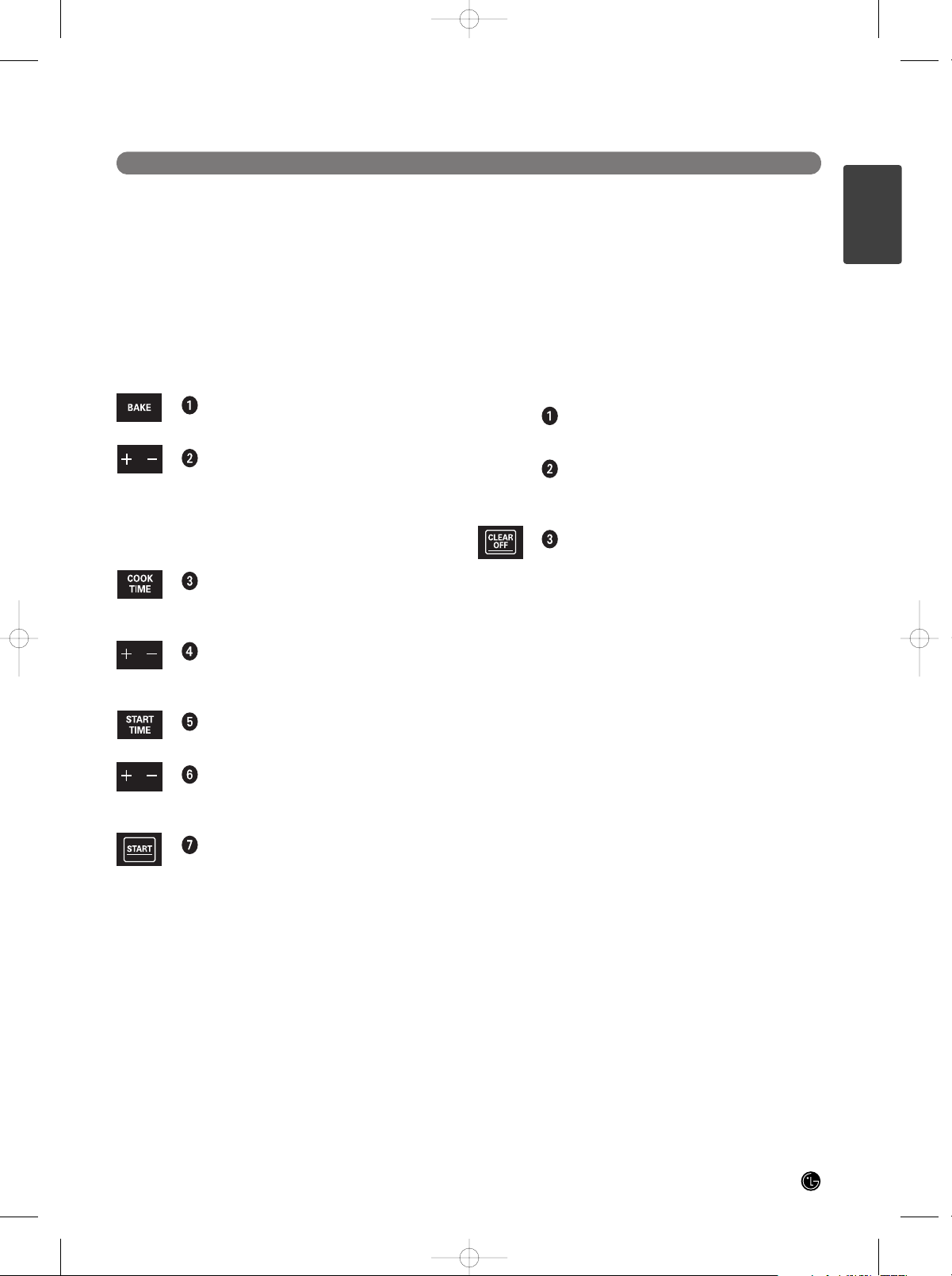
Press the BAKE pad. 350° will appear in
the display and BAKE will flash.
Press or press and hold the + or - pad to
set the desired oven temperature.
• Press the + pad to increase the
temperature.
• Press the - pad to decrease the
temperature.
Press the COOK TIME pad.
• TIMED flashes.
• 0:00 lights in the display.
Press the + or - pad to set the desired
length of cooking time, while TIMED is still
flashing.
Press the START TIME pad. DELAY will
start flashing.
While DELAY is still flashing, press the + or
- pad to set the time of day you want the
oven to turn on and start cooking.
Press the START pad. When the delay
time has expired, the oven will start.
• A short beep will sound once and DELAY
will turn off.
• When the oven turns on at the time of day
you have set, the display will show the
oven temperature until it reaches the
selected temperature, then it will display
the cooking time remaining.
NOTE: If you want to change the cook time, repeat steps
5~6 and press START.
NOTE: Cooking time can be set for any amount of time
from 1 minute to 11 hours and 59 minutes.
NOTE:
• Press CLEAR OFF to cancel the Delayed Timed Bake
feature at any time.
• If you would like to check the times you have set, press
the START TIME pad to check the start time you have
set or press the COOK TIME.
When the Delayed Timed Bake finishes:
End will show in the display. The oven will
shut off automatically.
The control will continue to beep three
times every minute until the CLEAR OFF
pad is pressed.
Press the CLEAR OFF pad to clear the
display. Remove the food from the oven.
Remember, although the oven turns off
automatically, food left in the oven will
continue cooking after the oven turns off.
19
ENGLISH
OPERATING INSTRUCTIONS
SPECIAL FEATURES OF YOUR OVEN CONTROL
Your new control has additional features that you may
choose to use. The following pages describe these
features and how you may activate them.
The special feature modes can only be activated while
the display is showing the time of day.
They remain in the control’s memory until the steps are
repeated.
When the display shows your choice, press the “START”
pad. The special features will remain in memory after a
power failure.
HOW TO ADJUST THE OVEN THERMOSTAT
You may find that your new oven cooks differently than
the one it replaced. Use your new oven for a few weeks
to become more familiar with it. If you still think your new
oven is too hot or too cold, you can adjust the thermostat
yourself.
DO NOT use thermometers, such as those found in
grocery stores, to check the temperature setting of your
oven. These thermometers may vary 20–40 degrees.
NOTE: This adjustment will not affect the broiling or the
self-cleaning temperatures. The adjustment will be
retained in memory after a power failure.
The oven temperature can be increased (+) or decreased
(-) as much as 35°F or 19°C.
To increase the oven temperature:
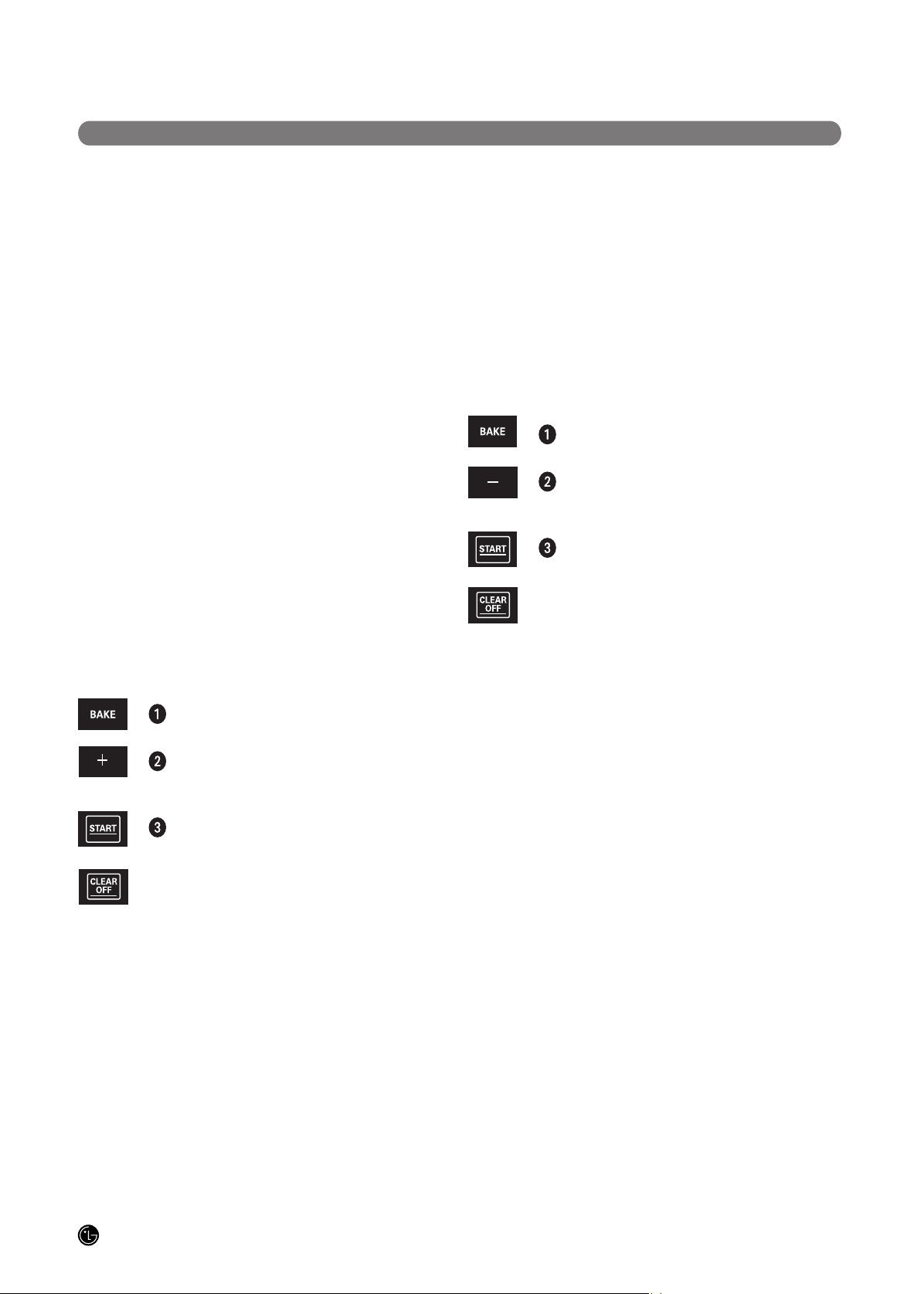
Press and hold BAKE for 3 seconds.
Using the + pad, enter the amount you wish
to increase the temperature.
Press the START pad to accept the
increased temperature. The display will
return to the time of day.
Press CLEAR OFF to reject the change if
necessary.
To decrease the oven temperature:
Press and hold BAKE for 3 seconds.
Using the - pad, enter the amount you wish
to decrease the temperature.
Press the START pad to accept the
decreased temperature. The display will
return to the time of day.
Press CLEAR OFF to reject the change if
necessary.
20
OPERATING INSTRUCTIONS
HOW TO SET PREHEATING ALARM LIGHT
ON/OFF
The interior oven light automatically turn on when the
oven door is opened.
When oven reaches set-temperature after preheat, the
oven notifies preheat-end by flashing oven lamp until the
door is opened.
You can activate or deactivate the smart oven light
feature. Default Setting is on.
Press and hold the TIMER ON/OFF pad for
three seconds. The display will show Opt.
Press the OVEN LIGHT pad to switch
between ON and OFF.
Press the START pad to accept the
change.
HOW TO ADJUST BEEPER VOLUME
The beeper volume feature allows you to adjust the
volumes to a more acceptable volume. There are four
possible volume levels, Hi, Med, Lo and Off.
Press and hold the TIMER ON/OFF pad for
three seconds. The Display will show Opt.
Press the - pad to toggle between the
various beeper volumes.
Press the START pad to accept the
change.
HOW TO SELECT FAHRENHEIT OR CELSIUS
TEMPERATURE
Your oven control is set to use the Fahrenheit
temperature range but you may change this to use the
Celsius temperature range.
Press and hold the TIMER ON/OFF for 3
seconds. The display will show Opt.
Press the + pad to switch between the F
and C settings.
Press the START pad to accept the
change.
SPECIAL FEATURES OF YOUR OVEN CONTROL
21
ENGLISH
OPERATING INSTRUCTIONS
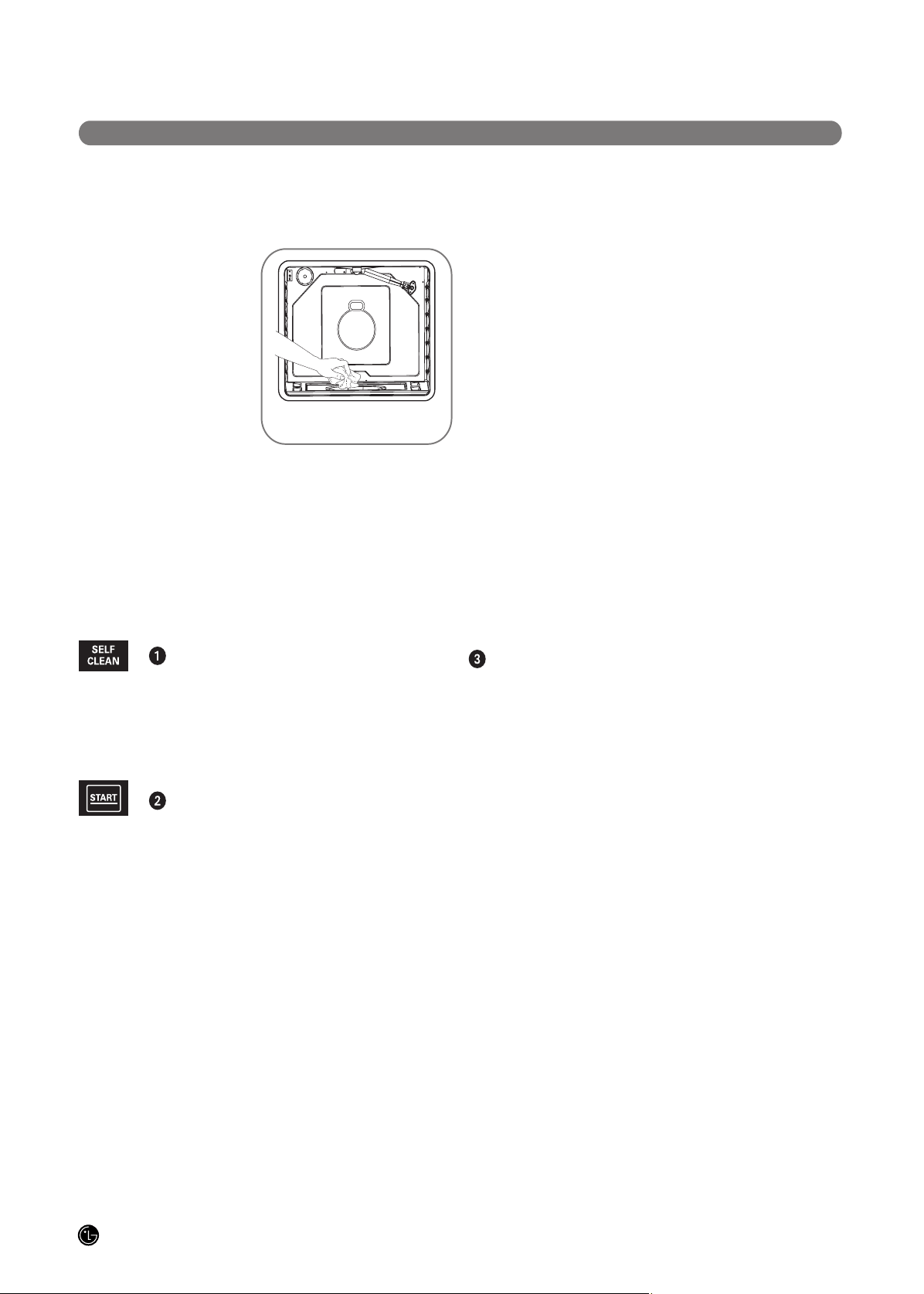
Press the “SELF CLEAN” pad once for a 3
hour cycle, twice for a 2 hour cycle or three
times for a 4 hour cycle.
A 3-hour self-clean is recommended for use
when cleaning small, contained spills. A
SELF CLEAN time of 4 hours is
recommended for heavily soiled ovens.
Press the “START” pad.
The door locks automatically. The display will show the
clean time remaining. It will not be possible to open the
oven door until the temperature drops below the lock
temperature and the DOOR LOCKED light goes off.
The oven shuts off automatically when the clean cycle is
complete.
When the DOOR LOCKED light is off, the door will
unlock automatically.
• The words DOOR LOCKED will flash and the oven
control will signal if you set the clean cycle and forget to
close the oven door.
• To stop a clean cycle, press the “CLEAR OFF” pad.
When the DOOR LOCKED light goes off indicating the
oven has cooled below the locking temperature, open
the door.
HOW TO SET THE OVEN FOR CLEANING
USING THE SELF-CLEANING OVEN
BEFORE A CLEAN CYCLE
When running a self clean
cycle, it is recommended
that a kitchen window be
opened or the use of
ventilation fan or hood be
used.
Remove the oven racks,
broiler pan, broiler grid, all
cookware and any
aluminum foil from the
oven—they cannot withstand
the high cleaning temperatures.
IMPORTANT: The health of some birds is extremely
sensitive to the fumes given off during the self-cleaning
cycle of any range. Move birds to another well ventilated
room.
NOTES:
• Soil on the front frame of the range and outside the
gasket on the door will need to be cleaned by hand.
Clean these areas with hot water, soap-filled scouring
pads or cleansers such as Soft Scrub. Rinse well with
clean water and dry.
• DO NOT clean the gasket. The fiberglass material of the
oven door gasket cannot withstand abrasion. It is
essential for the gasket to remain intact. If you notice it
becoming worn or frayed, replace it.
• Wipe up any heavy spillovers on the oven bottom.
• Make sure the oven light bulb cover is in place and the
oven light is off.
• Use caution when opening the oven after the self-clean
cycle has ended. The oven may still be hot.
Wipe up heavy soil on the
oven bottom.
22
OPERATING INSTRUCTIONS
USING THE SELF-CLEANING OVEN
The oven shuts off automatically when the clean cycle is
complete.
• When the DOOR LOCKED light is off, the door will
unlock automatically.
• The words DOOR LOCKED will flash and the oven
control will signal if you set the clean cycle and forget to
close the oven door.
• To stop a clean cycle, press the “CLEAR OFF” pad.
When the DOOR LOCKED light goes off indicating the
oven has cooled below the locking temperature, open
the door.
HOW TO DELAY THE START OF CLEANING
Make sure the clock shows the correct time of day.
Press the SELF CLEAN pad. Select the
desired amount of self-cleaning time by
pressing the SELF CLEAN pad.
Press the START TIME pad.
DELAY will begin flashing.
Press the + or - pad to enter the desired
start time, while DELAY is still flashing.
Touch START.
DELAY and CLEAN will remain on.
Self-Cleaning cycle will turn on
automatically at the set time.
The door locks automatically. The display will show the
start time. Self-Cleaning cycle will turn on automatically at
the set time. At that time the icon "DELAY" will go out. It
will not be possible to open the oven door until the
temperature drops below the lock temperature and the
DOOR LOCKED light goes off.
AFTER A CLEAN CYCLE
• You may notice some white ash in the oven. Wipe it up
with a damp cloth after the oven cools.
• If white spots remain, remove them with a soap-filled
scouring pad and rinse thoroughly with a vinegar and
water mixture.
• These deposits are usually a salt residue that cannot be
removed by the clean cycle.
• If the oven is not clean after one clean cycle, repeat the
cycle.
• You cannot set the oven for cooking until the oven is
cool enough for the door to unlock.
• While the oven is self-cleaning, you can press the
CLOCK pad to display the time of day. To return to the
clean countdown, press the COOK TIME pad.
• If the racks become hard to slide, apply a small amount
of vegetable oil or cooking oil to a paper towel and wipe
the edges of the oven racks with the paper towel.
The oven door must be closed and all controls set correctly for the cycle to work properly.
WARNING:
During the self-clean cycle, the outside of the appliance
can become very hot to the touch. Do not leave small
children unattended near the appliance.
CAUTION:
• DO NOT line the oven walls, oven racks, bottom or
any other part of the range with aluminum foil. Doing
so will stop heat distribution, produce poor baking
results and cause permanent damage to the oven
interior (aluminum foil will melt to the interior surface
of the oven).
• Use caution when opening the door after the self-
clean cycle is finished. The oven may still be VERY
HOT.
• The health of some birds is extremely sensitive to the
fumes given off during the self-cleaning cycle of any
range. Move birds to another well-ventilated room.
23
ENGLISH
CARE AND CLEANING
CARE AND CLEANING
Make sure electrical power is off and all surfaces are
cool before cleaning any part of the range.
If your range is pulled away from the wall for
cleaning, servicing or any reason, ensure that
the anti-tip device is re-engaged properly when
the range is pushed back against the wall.
Failure to take this precaution could result in
tipping of the range and cause injury.
The electrode of the spark igniter is exposed when the
burner head is removed. When turning a burner to
“LITE”, all the burners spark. Do not attempt to
disassemble or clean around any burner while another
burner is on. An electric shock may result.
Turn all controls OFF before removing the burner parts.
The burner grates, caps, and burner heads can be lifted
off, making them easy to clean.
The electrodes are not removable.
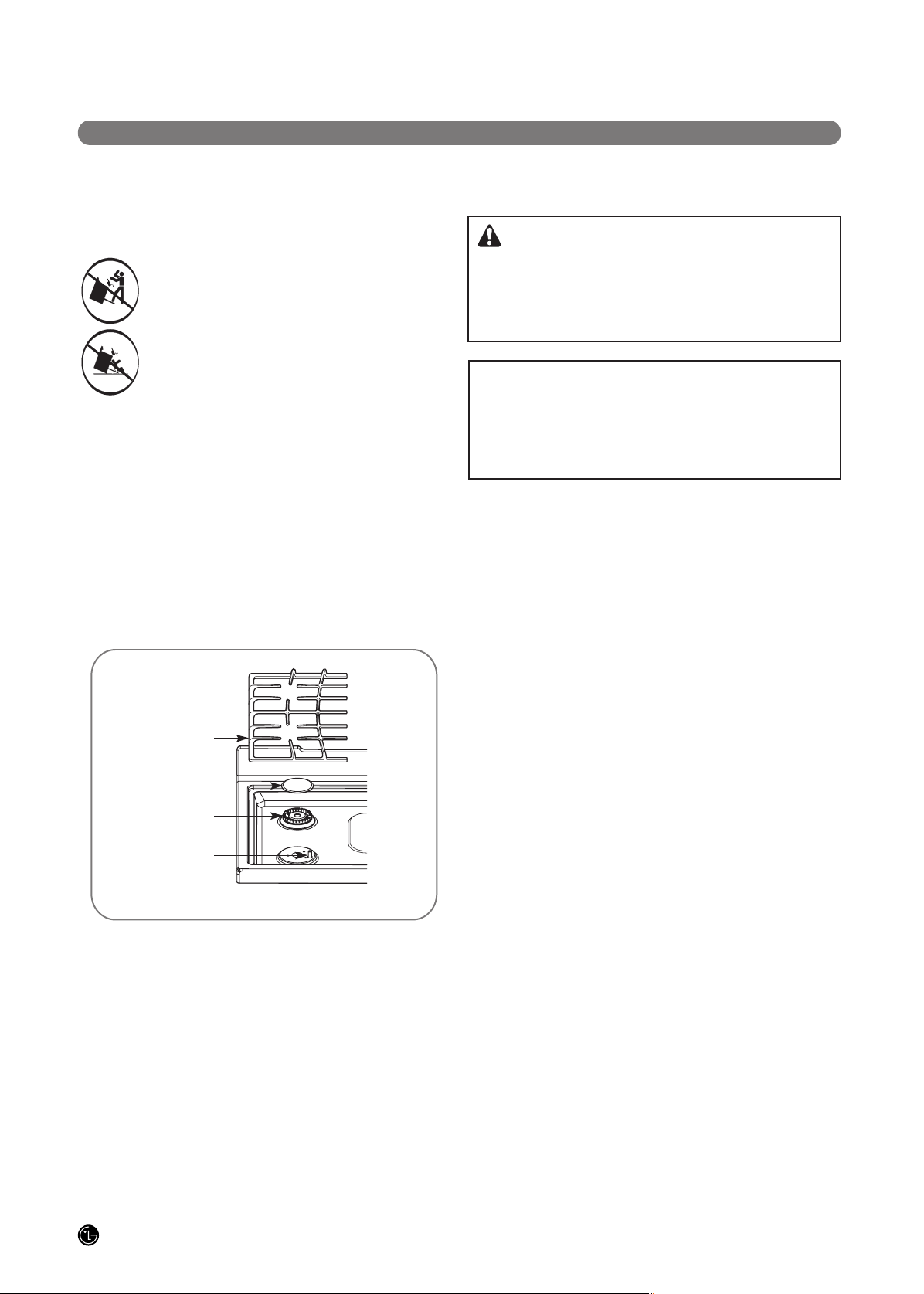
Burner Grate
Burner Cap
Electrode
Cooktop
Burner Head
SEALED BURNER ASSEMBLIES
CAUTION:
• DO NOT remove any parts from the cooktop until they
have completely cooled and are safe to handle.
• DO NOT operate the surface burners without all
burner parts and grates in place.
24
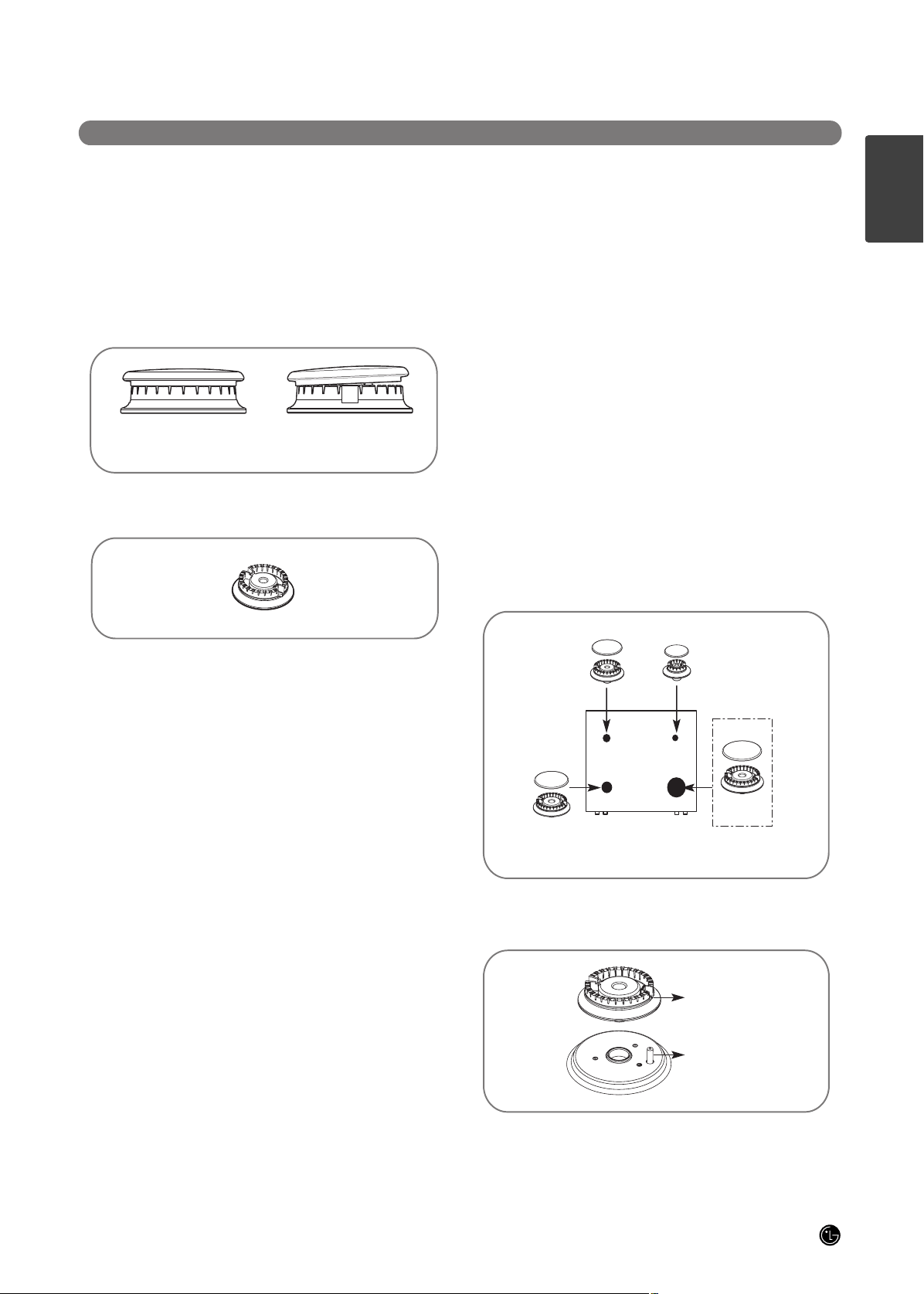
CARE AND CLEANING
BURNER CAPS AND HEADS
BURNER CAPS
Lift off when cool. Wash burner caps in hot, soapy water
and rinse with clean water. To remove burned on food
particles, you may scour with a plastic scouring pad.
AFTER CLEANING
Before replacing the burner caps and burner heads shake
out excess water and then dry them thoroughly.
REPLACEMENT
Replace burner heads and caps over the electrodes on
the cooktop, in the correct locations according to their
size.
Burner cap is
properly seated.
Burner cap is NOT
properly seated.
BURNER HEAD/CAP ASSEMBLY
The burner heads assembly are removable. Simply lift
them off the range for cleaning. For even and
unhampered flame, the slits in the burner heads must be
kept clean at all times. Clogged or dirty burner ports or
electrodes will not allow the burner to operate properly.
Any spill on or around an electrode must be carefully
cleaned. Take care to not hit an electrode with anything
hard or it could be damaged.
You should clean the burner caps and heads routinely,
especially after bad spillovers which could clog the
openings. Lift them off when they are cool.
If you want to remove burned-on food, soak the burner
heads in a solution of mild liquid detergent and hot water
for 20–30 minutes. For more stubborn stains, use a
toothbrush.
NOTES:
• DO NOT use steel wool or scouring powders to clean
the burners.
• Burners will not light if the cap is removed.
• DO NOT use bleach on product to clean.
Make sure the hole in the burner head is positioned over
the electrode.
Hole
Medium burner
head and cap
Large burner
head and cap
Small burner
head and cap
Extra large burner
head and cap
Electrode
25
ENGLISH
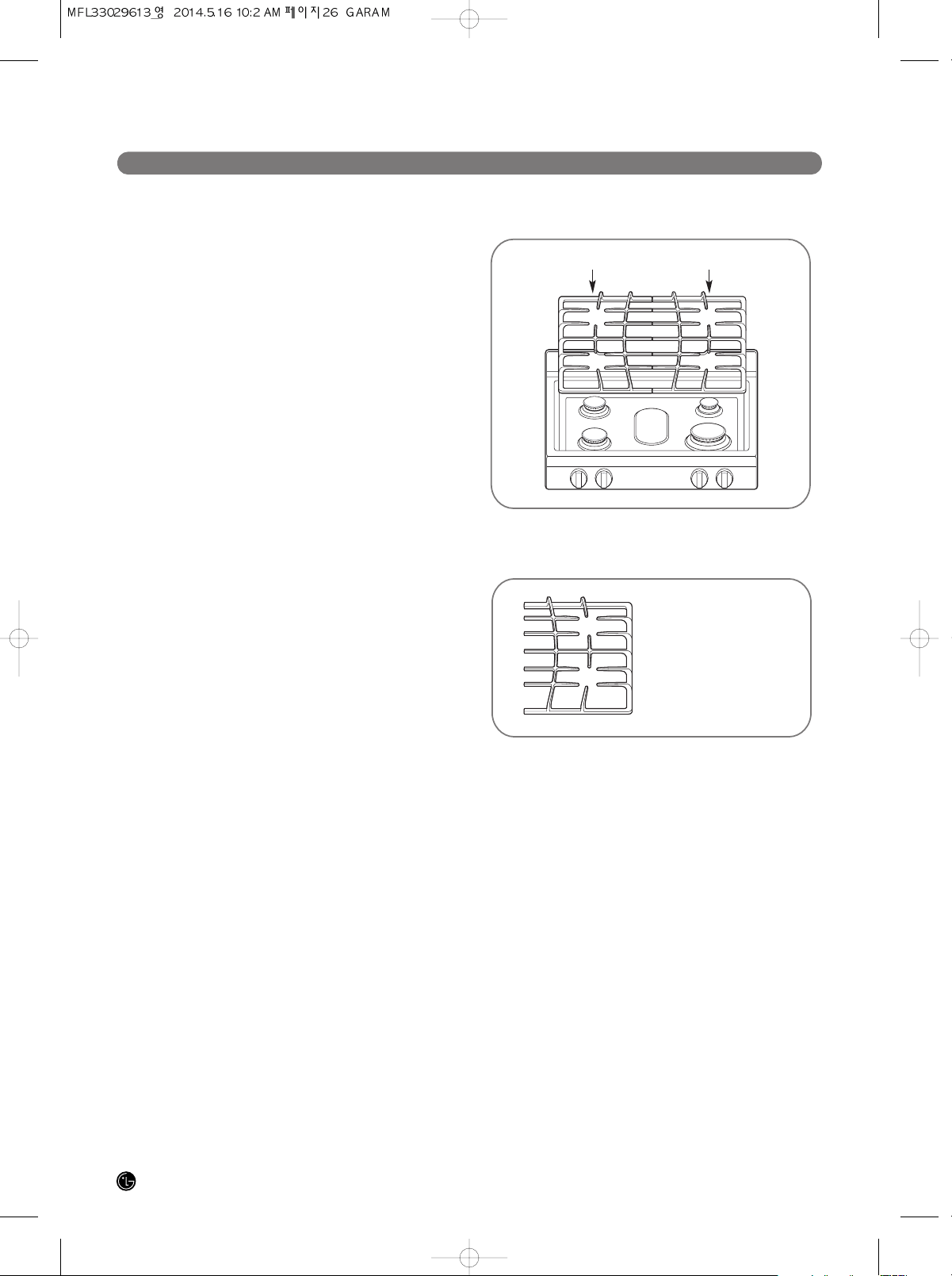
CARE AND CLEANING
BURNER GRATES
Your range has two professional-style grates.
For maximum stability, these grates should only be used
in their proper position; Both grates can be interchanged
left to right and front a back.
DO NOT operate a burner for an extended period of time
without cookware on the grate. The finish on the grate
may chip without cookware to absorb the heat.
Although they are durable, the grates will gradually lose
their shine, regardless of the best care you can give
them.
COOKTOP SURFACE
To avoid damaging the porcelain enamel surface of the
cooktop and to prevent it from becoming dull, clean up
spills right away. Foods with a lot of acid such as
tomatoes, sauerkraut, fruit juices, etc. or foods with high
sugar content could cause a dull spot if allowed to set.
Wash and rinse when the surface has cooled.
For other spills such as fat spatterings, etc., wash with
soap and water once the surface has cooled. Then rinse
and polish with a dry cloth.
NOTE: DO NOT lift the cooktop. Lifting the cooktop can
lead to damage and improper operation of the range.
CLEANING
Lift the grates out when they have cooled. They should be
washed regularly and, of course, after spillovers. Wash
them in hot, soapy water and rinse with clean water.
When replacing the grates, be sure they are positioned
securely over the burners. Replace the grates so that
continuous arcs are formed with the center ribs of both
grates. The grates are dishwasher safe.
NOTE: DO NOT clean the grates in a self-cleaning oven.
Appearance may vary. The
grates are dishwasher safe.
side grate side grate
26

CARE AND CLEANING
STAINLESS STEEL SURFACES
DO NOT use a steel wool pad; it will scratch the
surface.
To clean the stainless steel surface, use warm sudsy
water or a stainless steel cleaner or polish. Always wipe
the surface in the direction of the grain. Follow the
cleaner instructions for cleaning the stainless steel
surface.
To inquire about purchasing stainless steel appliance
cleaner or polish, or to find the location of a dealer
nearest you, please call our toll-free customer service
number:
1-800-243-0000
or visit our website at:
us.lgservice.com
OVEN AIR VENTS
DO NOT block the vents and air openings of the range.
They provide the air inlet and outlet that are necessary for
the range to operate properly with correct combustion.
Air openings are located at the rear of the cooktop, at the
top and bottom of the oven door, and at the bottom of the
range, under the warming drawer.
CONTROL PANEL
Clean up splatters with a damp cloth.
You may also use a glass cleaner.
Remove heavier soil with warm soapy water.
Do not use abrasives of any kind.
NOTE: To prevent activating the control panel during
cleaning, unplug the range.
FRONT MANIFOLD PANEL AND KNOBS
It’s better to clean the manifold panel after each use of
the oven. Use a damp cloth to clean or rinse. For
cleaning, use mild soap and water or a 50/50 solution of
vinegar and water. For rinsing, use clean water. Polish
dry with a soft cloth.
DO NOT use abrasive cleansers, strong liquid cleaners,
plastic scouring pads or oven cleaners on the manifold
panel—they will damage the finish.
DO NOT try to bend knobs by pulling them up or down or
by hanging a towel or other such loads.
This can damage the gas valve shaft.
The control knobs may be
removed for easier cleaning.
Make sure the knobs are in the
“OFF” positions and pull them
straight off the stems for
cleaning.
To replace the knobs, make
sure the knob has the “OFF” position centered at the top
and slide the knob directly onto the stem.
Surface burner knob
27
ENGLISH
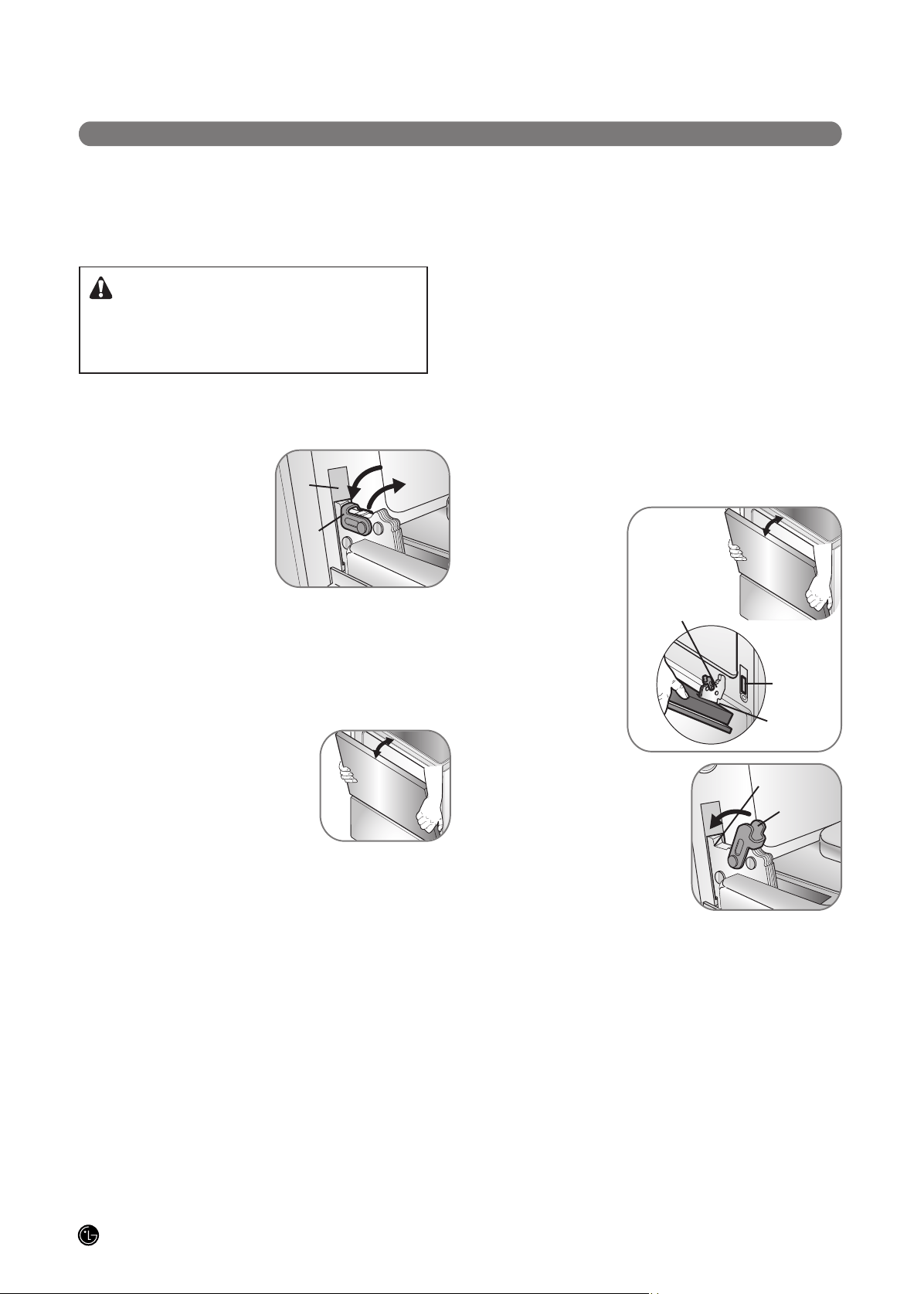
CARE AND CLEANING
OVEN DOOR
TO REMOVE THE DOOR
Step. 1
Open the door fully.
Step. 2
Pull the hinge locks down
toward the door frame to the
unlocked position.
Step. 3
Firmly grasp both sides of the door at the top.
Step. 4
Close door to the door removal
position, which is approximately 5
degrees.
Step. 5
Lift door up and out until the hinge arm
is clear of the slot.
Step. 1
Firmly grasp both sides of the door at the top.
Step. 2
With the door at the same angle as the removal position,
seat the indentation of the hinge arm into the bottom edge
of the hinge slot. The notch in the hinge arm must be fully
seated into the bottom of the slot.
Step. 3
Open the door fully. If
the door will not open
fully, the indentation is
not seated correctly in
the bottom edge of the
slot.
Step. 4
Push the hinge locks up
against the front frame
of the oven cavity to the locked
position.
Step. 5
Close the oven door.
The oven door is removable, but it is heavy. You may
need help removing and replacing the door.
TO CLEAN THE INSIDE OF THE DOOR
• DO NOT allow excess water to run into any holes or
slots in the door.
• Because the area inside the gasket in front of the cavity
is cleaned during the self clean cycle, you do not need
to clean this by hand.
• The area outside the gasket can be cleaned with a
soap-filled plastic scouring pad.
TO CLEAN THE OUTSIDE OF THE DOOR
• Use soap and water to thoroughly clean the top, sides
and front of the oven door. Rinse well. You may also use
a glass cleaner to clean the glass on the outside of the
door.
• Spillage of marinades, fruit juices, tomato sauces and
basting materials containing acids may cause
discoloration and should be wiped up immediately.
When the surface is cool, clean and rinse.
• DO NOT use oven cleaners, cleansing powders or harsh
abrasives on the outside of the door.
TO REPLACE THE DOOR
Slot
Hinge
lock
Lock
Unlock
about 5°
Hinge arm
Indentation
Bottom
edge of
slot
Hinge arm
Hinge lock
CAUTION:
• Be careful when removing and lifting the door.
• DO NOT lift the door by the handle.
- The door is very heavy.
about 5°
28

CARE AND CLEANING
OVEN BOTTOM
The oven bottom has a porcelain enamel finish.
To make cleaning easier, protect the oven bottom from
excessive spillovers by placing a cookie sheet on the rack
below the rack you are cooking on. This is especially
important when baking a fruit pie or other foods with a high
acid content. Hot fruit fillings or other foods with a lot of
acid (tomatoes, sauerkraut, sauces with vinegar or lemon
j
uice) may cause pitting and damage to the porcelain
enamel surface and should be wiped up right away.
DO NOT use aluminum foil on the bottom of the range. It
can damage the oven cavity and block the air flow of the
burner causing poor heat distribution.
To clean up spillovers, use soap and water, an abrasive
cleaner or soap-filled scouring pad. Rinse well to remove
any soap before self-cleaning.
29
ENGLISH
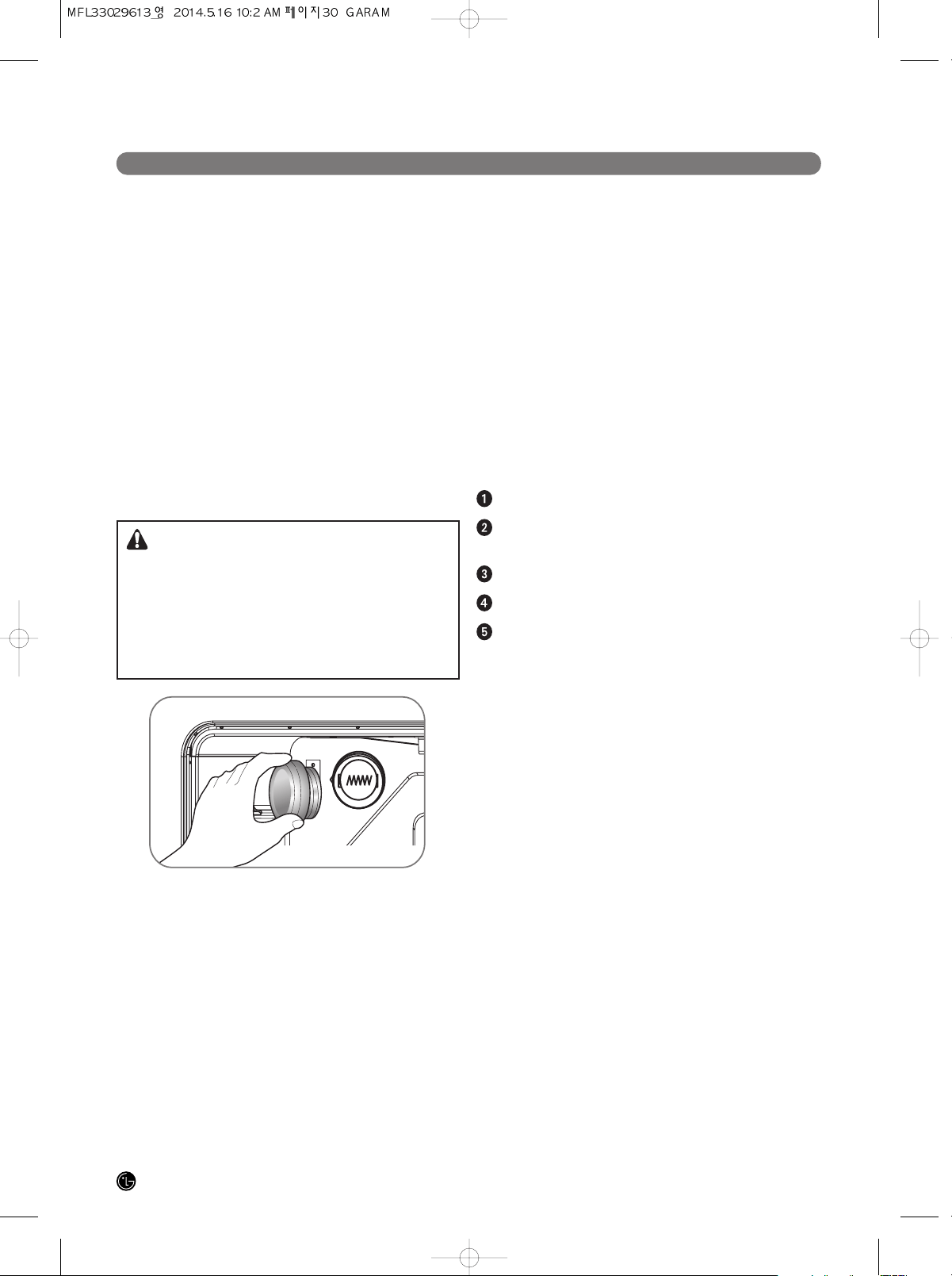
CARE AND CLEANING
OVEN RACKS
Your oven is equipped with nickel oven racks, remove
them from the oven before beginning the self-clean cycle.
To clean the oven racks, use an abrasive cleanser. After
cleaning, rinse the racks with clean water and dry with a
clean cloth. If the racks ever become hard to slide, wipe
the rack edges or oven rack supports with vegetable oil.
The oven light is a standard 40-watt appliance bulb. It will
come on when the oven door is open. When the oven
door is closed, thouch OVEN LIGHT to turn ON or OFF. It
will not work during the Self-Clean cycle.
OVEN LIGHT REPLACEMENT
WARNING
:
• Before replacing your oven light bulb,
DISCONNECT the electrical power to the range at
the main fuse or circuit breaker panel.
- Failure to do so can result in severe personal
injury,death or electrical shock.
• Make sure oven and bulb are cool completely.
TO REPLACE
• Make sure oven and bulb are cool.
Unplug range or disconnect power.
Turn the glass bulb cover in the back of the oven
counterclockwise to remove.
Turn bulb counterclockwise to remove from socket.
Replace bulb and bulb cover by turning clockwise.
Plug in range or reconnect power.
30
CARE AND CLEANING
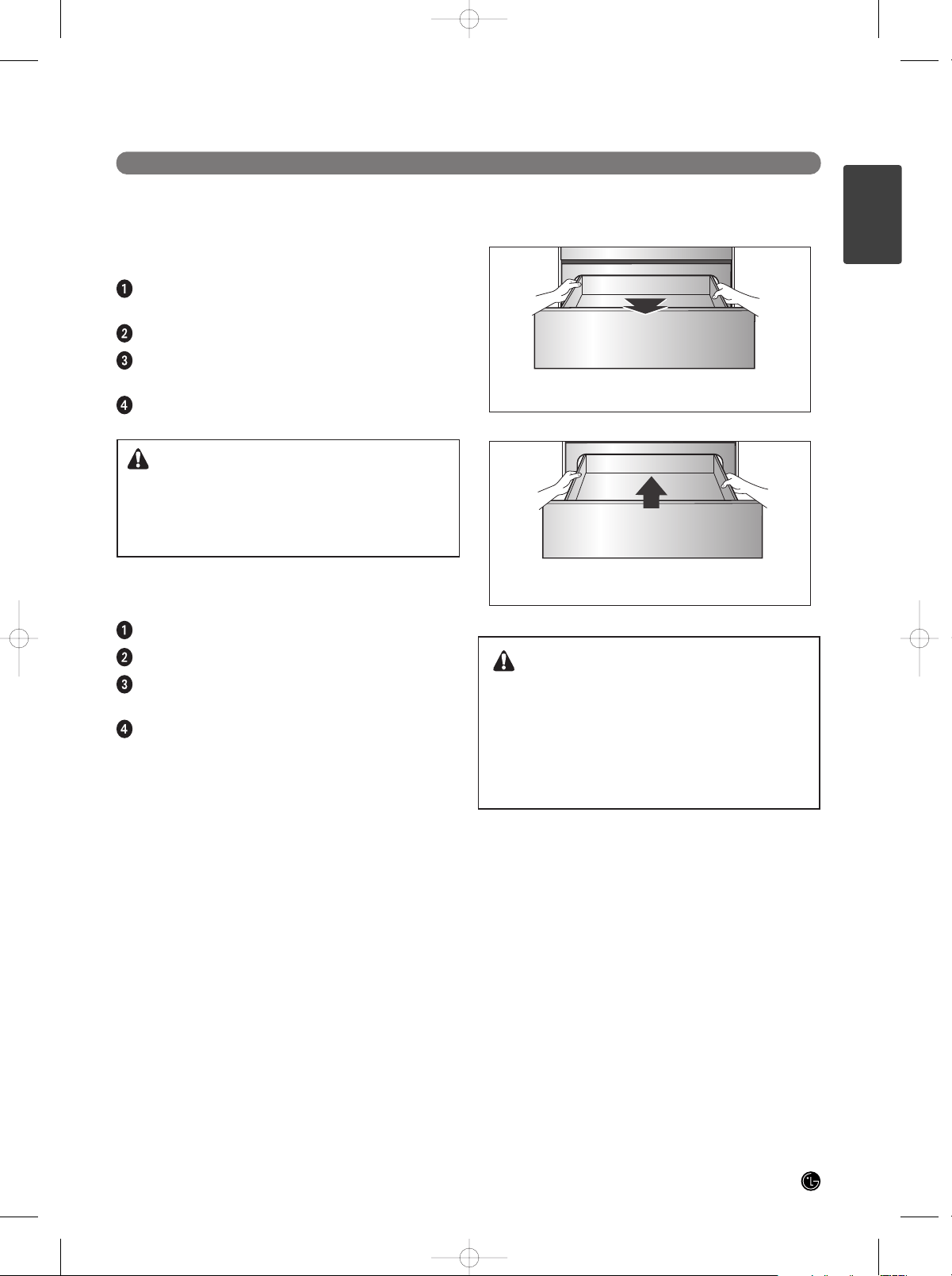
To Remove Storage Drawer:
CAUTION - Turn power OFF before removing the
storage drawer.
Pull the drawer out until it stops.
Lift the front of the drawer until the stops clear the
guides.
Remove the drawer.
To Replace the Storage Drawer:
Place the drawer rails on the guides.
Push the drawer back until it stops.
Lift the front of the drawer and push back until the
stops clear the guides.
Lower the front of the drawer and push back until it
closes.
REMOVING & REPLACING THE STORAGE DRAWER
Lift the front
Pull the drawer
• Turn the POWER OFF before removing the
Storage Drawer.
- Failure to do so can result in severe personal injury,
death, or electrical shock.
WARNING
WARNING
• DO NOT touch interior surfaces of oven between
door and drawer.
- During and after use, do not touch interior surfaces
of oven between door and drawer until they have
had sufficient time to cool.
- Failure to do so can result in severe personal injury
31
ENGLISH
TROUBLESHOOTING
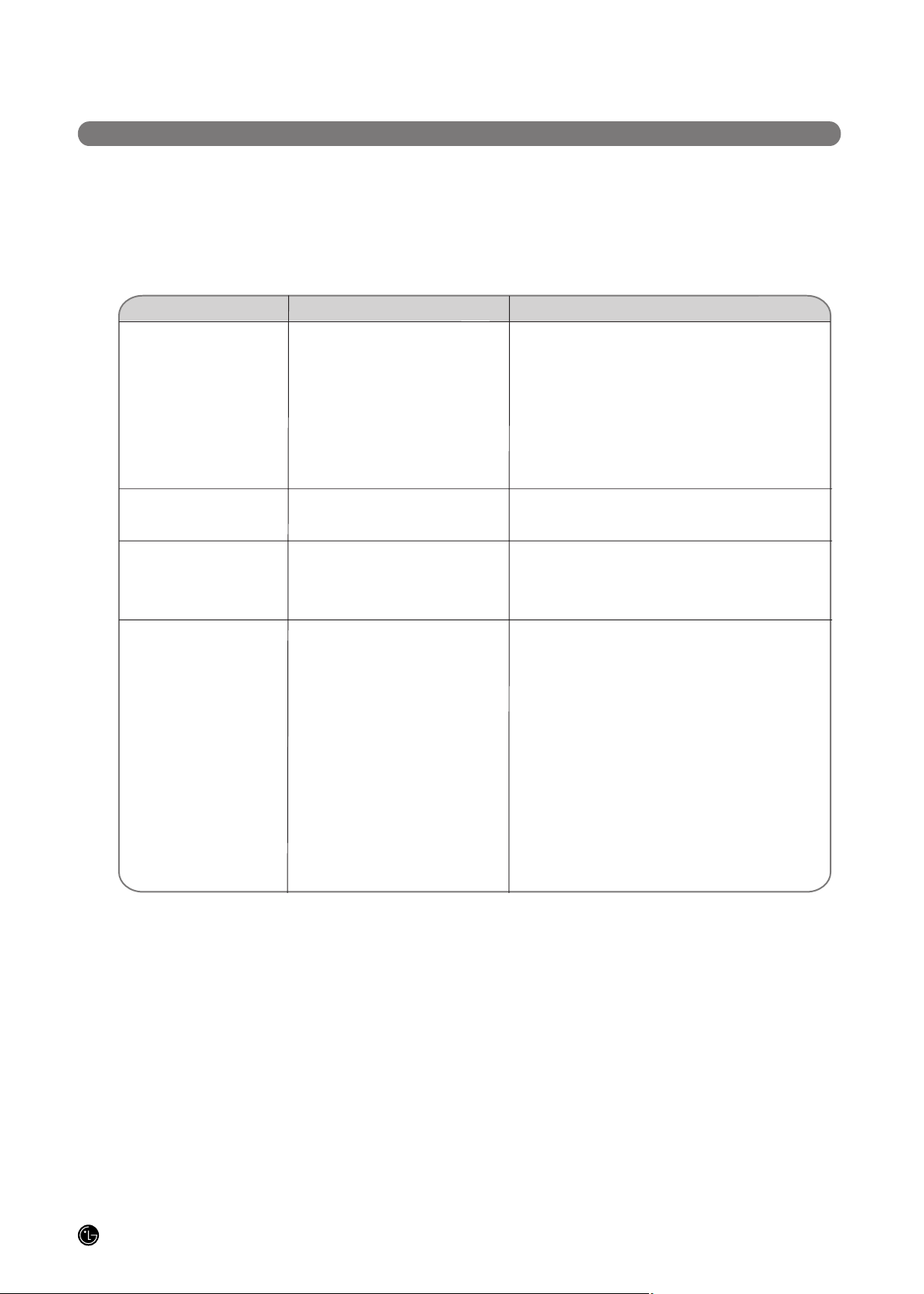
BEFORE CALLING FOR SERVICE
Before you call for service, review this list. It may save you time and expense. This list includes common occurrences
that are not the result of a defect in workmanship or materials.
open.
• Make sure that the oven gas shut-off valve is fully
Problem Possible Causes Solutions
Top burners do not
light or do not burn
evenly
Burner flames very
large or yellow
Surface burners light
but the oven does not
Food does not bake or
roast properly
• The plug on range is not completely
inserted in the electrical outlet.
• Burner slits on the side of the burner
may be clogged.
• Improper burner assembly.
• Improper air to gas proportion.
• The oven gas shut-off valve may
have accidentally been moved
during cleaning or moving.
• Improper oven controls setting.
• Incorrect rack position.
• Incorrect cookware or cookware of
improper size being used.
• Oven thermostat needs adjustment.
• Clock not set correctly.
• Aluminum foil used improperly in
the oven.
• Make sure the electrical plug is inserted into a live,
properly grounded outlet.
• Remove the burners and clean them. Check the
electrode area for burned-on food or grease. See the
“CARE AND CLEANING OF THE RANGE” section.
• Make sure the burner parts are installed correctly. See
the “CARE AND CLEANING OF THE RANGE” section.
• If range is connected to LP gas, contact the technician
who installed your range or made the conversion.
• See the “USING THE OVEN” section.
• See the “USING THE OVEN” section.
• See the “USING THE OVEN” section.
• See the “HOW TO ADJUST THE OVEN
THERMOSTAT” section.
• See the “USING THE CLOCK AND TIMER” section.
• See the “CARE AND CLEANING OF THE RANGE”
section.
32
TROUBLESHOOTING
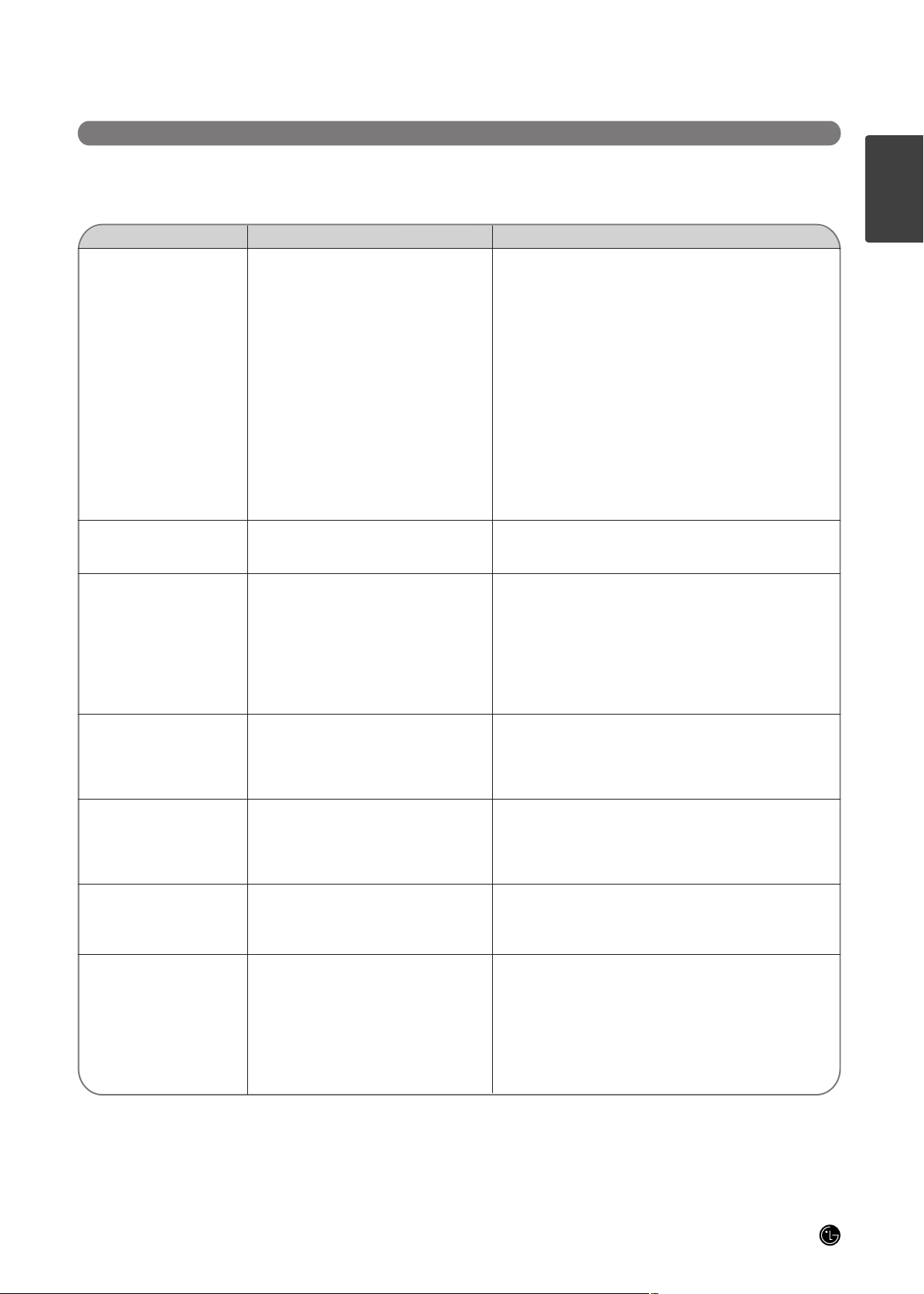
BEFORE CALLING FOR SERVICE
Problem Possible Causes Solutions
Food does not broil
properly in the oven
Oven temperature too
hot or too cold
Clock and timer does
not work
Oven light does not
work
Oven will not self-
clean
“Crackling” or
“popping” sound
Too much smoking
during a self clean
cycle.
• Improper oven controls setting.
• Oven door not closed.
• Incorrect rack position.
• Food being cooked in a hot pan.
• Cookware not suited for broiling.
• Aluminum foil used on the broiling
pan and grid has not been fitted
properly and slit as recommended.
• Oven thermostat needs adjustment.
• The plug on range is not completely
inserted in the electrical outlet.
• A fuse in your home may be blown
or the circuit breaker tripped.
• Improper oven controls setting.
• The light bulb is loose or defective.
• The plug on range is not completely
inserted in the electrical outlet.
• The oven temperature is too high to
set a self-clean operation.
• Improper oven controls setting.
• This is the sound of the metal heating
and cooling during both the cooking
and cleaning functions.
• Too much soil.
• Make sure you press the “BROIL HI/LO” pad.
• See the “USING THE OVEN” section.
• See the “BROILING GUIDE”.
• Use the broiling pan and grid that came with your
range. Make sure it is cool.
• Use the broiling pan and grid that came with your
range.
• See the “USING THE OVEN” section.
• See the “HOW TO ADJUST THE OVEN THERMOSTAT”
section.
• Make sure the electrical plug is inserted into a live,
properly grounded outlet.
• Replace the fuse or reset the circuit breaker.
• See the “USING THE CLOCK AND TIMER” section.
• Tighten or replace the bulb.
• Make sure the electrical plug is inserted into a live,
properly grounded outlet.
• Allow the range to cool to room temperature and reset
the controls.
• See the “USING THE SELF-CLEANING OVEN” section.
• This is normal.
• Press the “CLEAR OFF” pad. Open the windows to
get rid of smoke from the room. Wait until the DOOR
LOCKED light goes off. Wipe up the excess soil and
reset the clean cycle.
33
ENGLISH
TROUBLESHOOTING
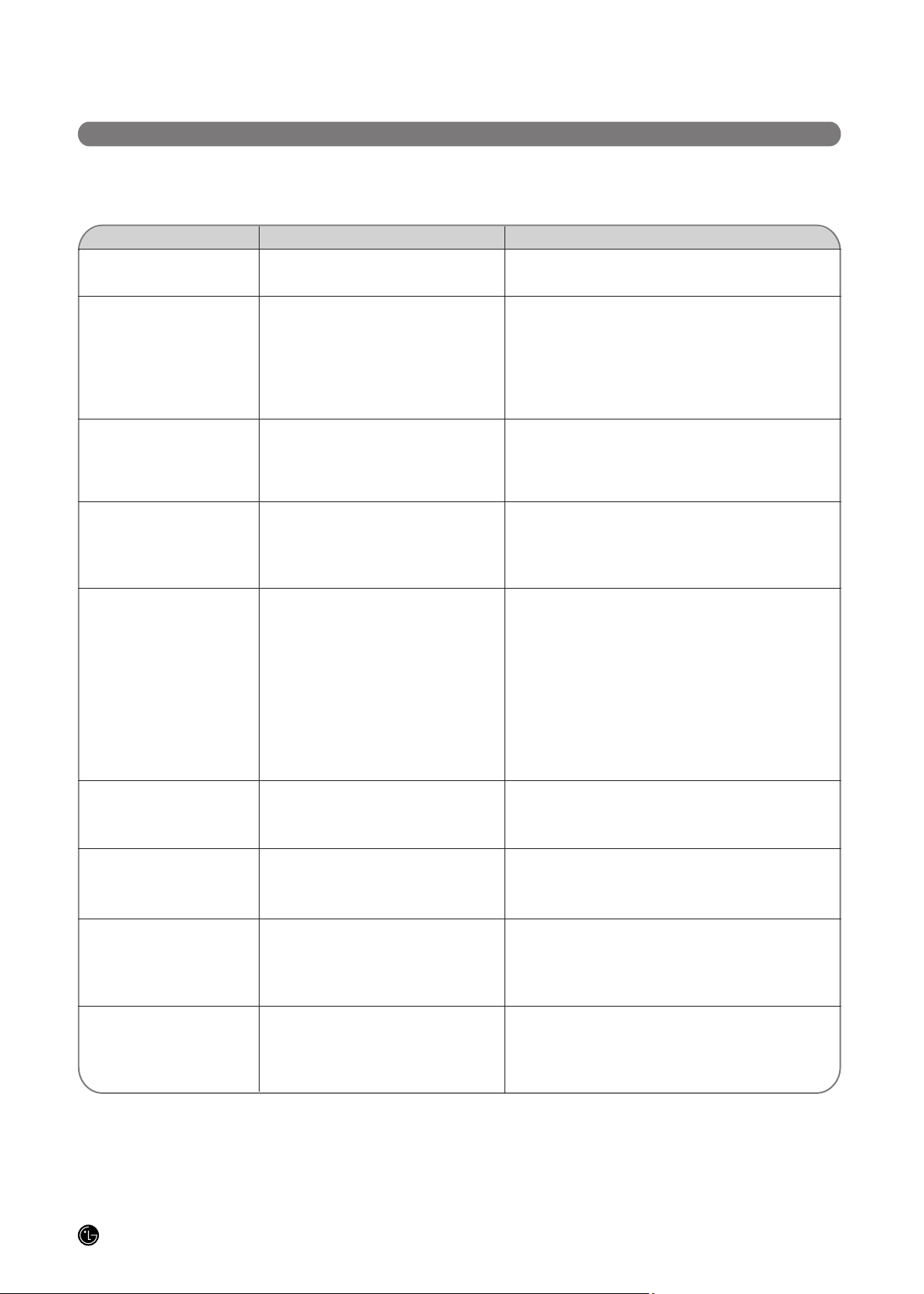
BEFORE CALLING FOR SERVICE
Problem Possible Causes Solutions
Broil or self-clean
doesn’t work
Oven not clean after a
self-clean cycle
“CLOSE DOOR TO
CONTINUE BROILING”
or “DOOR OPENED”
appears in the display
“DOOR LOCKED” light
is on when you want to
cook
Oven control beeps
and displays any F
code error.
Oven racks are
difficult to slide
Power outage, clock
flashes
“Burning” or “oily”
odor emitting from the
vent
Strong odor
• The oven temperature is too high.
• Improper oven controls setting.
• The oven was heavily soiled.
• The broil or self-clean cycle has been
selected but the door is not closed.
• The oven door is locked because the
temperature inside the oven has not
dropped below the locking
temperature.
• Display shows F3.
• Display shows F11.
• If the function code repeats.
• The oven racks were cleaned in a self-
clean cycle.
• Power outage or surge.
• This is normal in a new oven and will
disappear in time.
• An odor from the insulation around
the inside of the oven is normal for
the first few times the oven is used.
• Allow the oven to cool below locking temperature.
• This can take up to 1 hr after the cycle is complete.
• See the Using the “USING THE SELF-CLEANING
OVEN” section.
• Clean up heavy spillovers before beginning the self-
clean cycle. Heavily soiled ovens may need to self-
clean again or for a longer period of time.
• Close the oven door.
• Touch the “CLEAR OFF” pad. Allow the oven to
cool.
• Touch the “CLEAR OFF” pad. Allow the oven to
cool for one hour. Put the oven back into operation.
• Check the main gas shut-off valve or the oven gas
shut-off valve(see “Surface burners light but oven
burner does not” column).
• Disconnect all power to the range for 5 minutes and
then reconnect power. If the function error code
repeats, call for service.
• Apply a small amount of vegetable oil to a paper
towel and wipe the edges of the oven racks with the
paper towel. Do not use lubricant sprays.
• Reset the clock. If the oven was in use, you must
reset it by touching the “CLEAR OFF” pad, setting
the clock and resetting any cooking function.
• To speed the process, set a self-clean cycle for a
minimum of 3 hours. See the “USING THE SELF-
CLEANING OVEN” section.
• This is temporary.
34
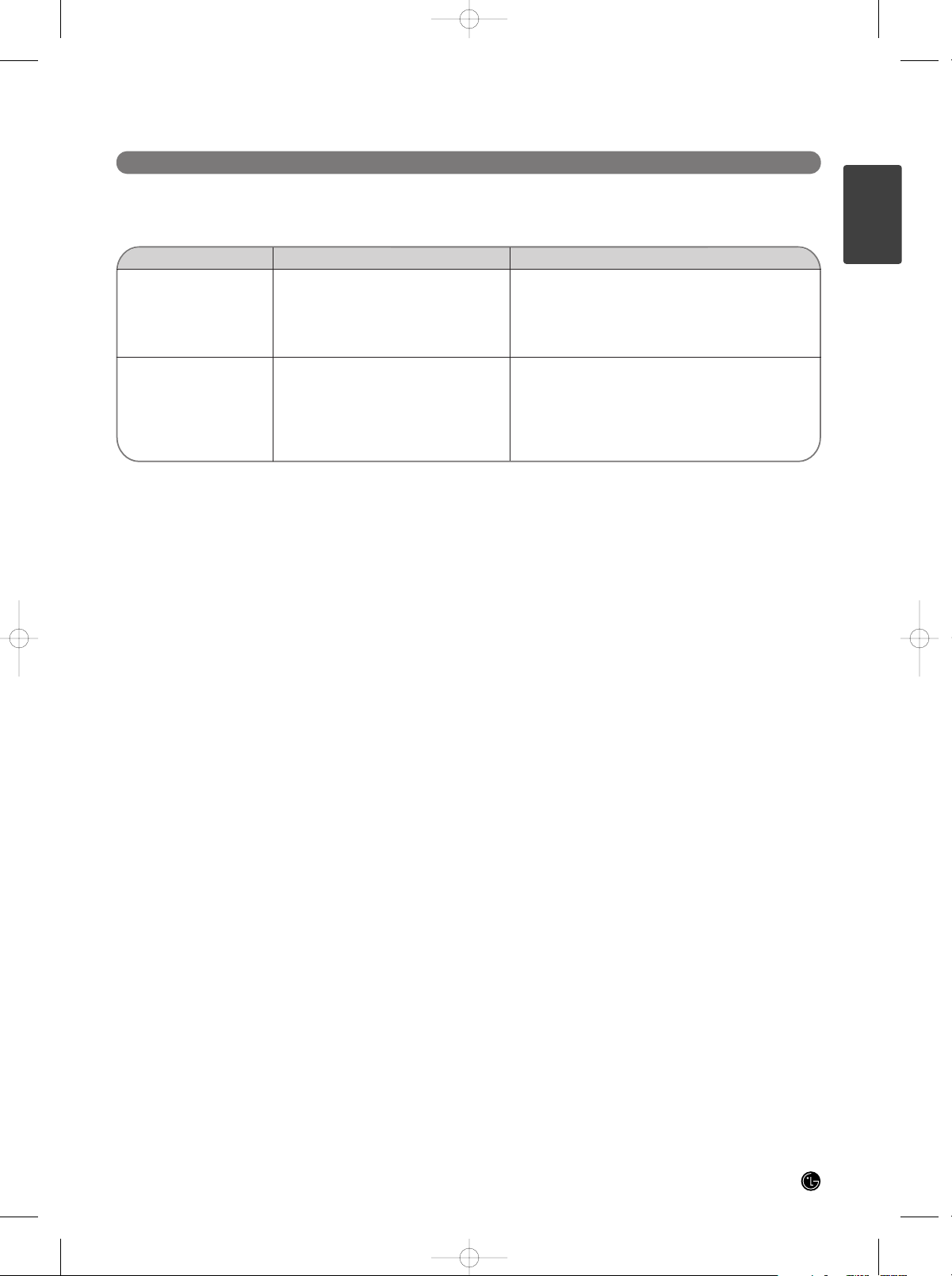
TROUBLESHOOTING
BEFORE CALLING FOR SERVICE
Problem Possible Causes Solutions
Drawer does not slide
smoothly or drags
Excessive
condensation in the
drawer
• The drawer is out of alignment.
• Drawer is over-loaded or the load is
unbalanced.
• Liquid in drawer.
• Uncovered foods.
• Temperature setting too high.
• Fully extend the drawer and push it all the way in.
See the CARE AND CLEANING section.
• Reduce weight. Redistribute drawer contents.
• Remove liquid.
• Cover food with lid or aluminum foil.
• Reduce temperature setting.
35
ENGLISH
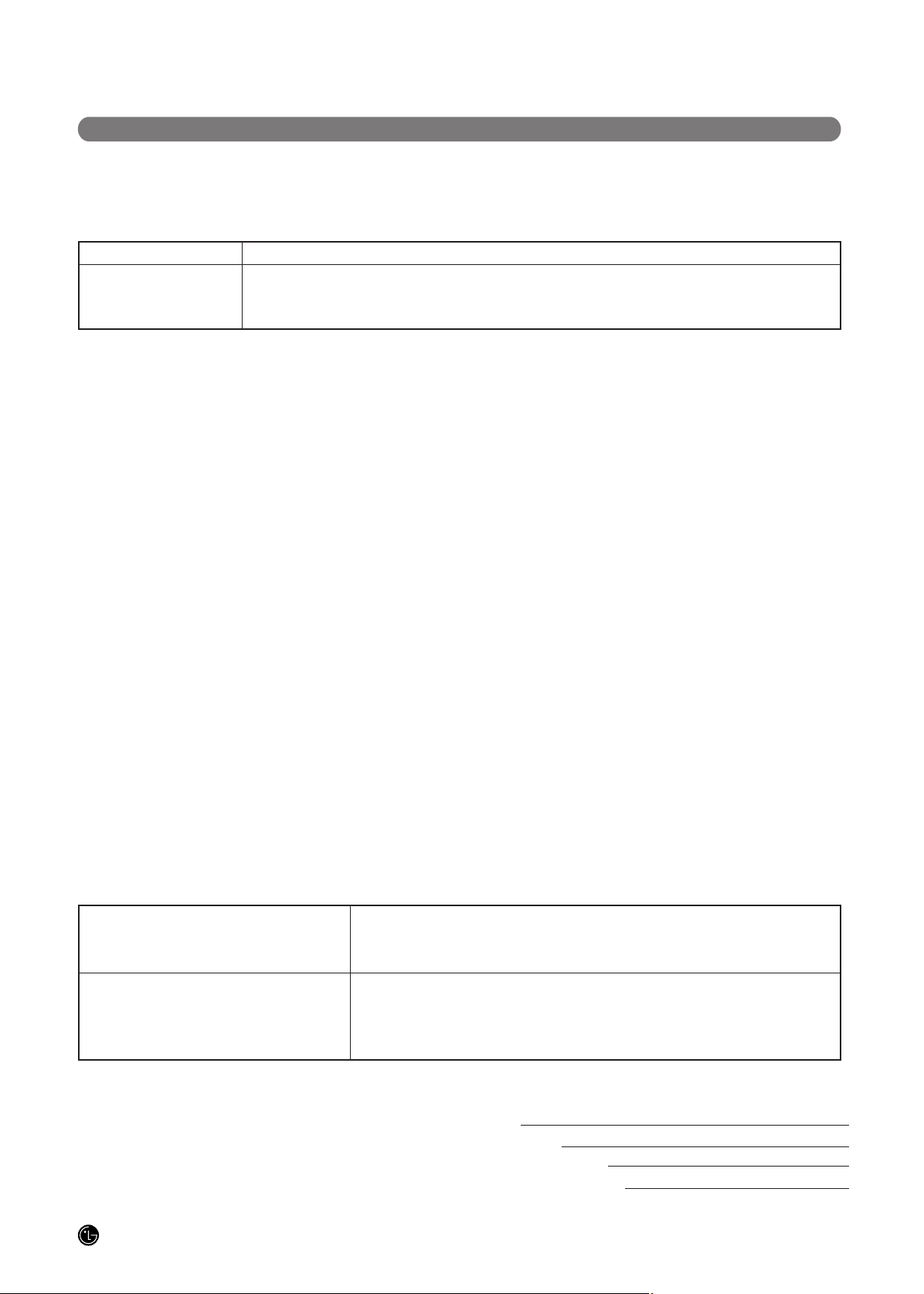
LG GAS RANGE LIMITED WARRANTY – USA
LG Electronics Inc. will repair or replace your product, at LG’s option, if it proves to be defective in material or
workmanship under normal use, during the warranty period set forth below, effective from the date of original
consumer purchase of the product. This limited warranty is good only to the original purchaser of the product and
effective only when used in U.S.A.
THIS WARRANTY IS IN LIEU OF ANY OTHER WARRANTIES, EXPRESS OR IMPLIED, INCLUDING
WITHOUT LIMITATION, ANY WARRANTY OF MERCHANTABILITY OR FITNESS FOR A
PARTICULAR PURPOSE. TO THE EXTENT ANY IMPLIED WARRANTY IS REQUIRED BY LAW, IT IS
LIMITED IN DURATION TO THE EXPRESS WARRANTY PERIOD ABOVE. LG WILL NOT BE LIABLE
FOR ANY CONSEQUENTIAL, INDIRECT, OR INCIDENTAL DAMAGES OF ANY KIND, INCLUDING
LOST REVENUES OR PROFITS, IN CONNECTION WITH THE PRODUCT. SOME STATES DO NOT
ALLOW LIMITATION ON HOW LONG AN IMPLIED WARRANTY LASTS OR THE EXCLUSION OF
INCIDENTAL OR CONSEQUENTIAL DAMAGES, SO THE ABOVE LIMITATIONS OR EXCLUSIONS
MAY NOT APPLY TO YOU.
THIS LIMITED WARRANTY DOES NOT APPLY TO:
1. Service calls to correct the installation of your appliance, to instruct you how to use your appliance, to replace
house fuses or correct house wiring, or to replace owner-accessible light bulbs.
2. Repairs when your appliance is used in other than normal, single-family household use.
3. Pickup and delivery. Your appliance is designed to be repairable in the home.
4. Damage resulting from accident, alteration, misuse, abuse, fire, flood, improper installation, acts of God, or use of
products not approved by LG Corporation.
5. Repairs to parts or systems resulting from unauthorized modifications made to the appliance.
6. Replacement parts or repair labour costs for units operated outside the united states.
7. Any labour costs during the limited warranty period.
This warranty is extended to the original purchaser for products purchased for home use within the USA. In Alaska, the
warranty excludes the cost of shipping or service calls to your home.
Some states do not allow the exclusion or limitation of incidental or consequential damages, so this exclusion or
limitation may not apply to you. This warranty gives you specific legal rights, and you may also have other rights which
vary from states to states. To know what your legal rights are, consult your local or state consumer affairs or your
state’s Attorney General.
CUSTOMER ASSISTANCE INFORMATION:
WARRANTY PERIOD:
One Year
From the date of the
original purchase
HOW SERVICE IS HANDLED:
Any part of the oven which fails due to a defect in materials or workmanship. During this
full one-year warranty, LG will also provide, free of charge, all labour and in-home
service to replace the defective part.
To Prove Warranty Coverage
Retain your Sales Receipt to prove date of purchase.
A copy of your Sales Receipt must be submitted at the time warranty
service is provided.
To Obtain Nearest Authorized
Service Center or Sales Dealer, or to
Obtain Product, Customer, or
Service Assistance
Call 1-800-243-0000 (Phone answered 24 hours - 365 days a year) and
choose the appropriate prompt from the menu; or visit our website at:
http://us.lgservice.com.
Product Registration Information
Model:
Serial Number:
Date of Purchase:
36

ENGLISHENGLISH
P/No.: MFL33029613
www.lg.com
GUÍA PARA EL USO
ESTUFA DE GAS
Lea detenidamente este manual antes de utilizar y
guárdelo como referencia para el futuro.
LRG3021ST
ESPAÑOL

CONTENIDO
1
INFORMACIÓN IMPORTANTE DE SEGURIDAD
3 Instrucciones Importantes de Seguridad.
3 Qué Hacer si Percibe Olor a Gas.
3~4 Dispositivo Antivuelco
4~8 Medidas de Seguridad
2
INSTRUCCIONES DE FUNCIONAMIENTO
9 Piezas y Funciones
10~11 Uso de Los Quemadores de Gas
12 Panel de Control
13~16 Uso del Horno
17 Uso del Reloj y el Temporizador
18~19 Uso de las Funciones de Horneado y por
Temporizador
20–21 Funciones Especiales de Control de su Horno
22–23 Uso de la Función de Autolimpieza del Horno
3
CUIDADO Y LIMPIEZA
24 Cuidado y Limpieza
25 Tapas y Cabezas de los Quemadores
26 Rejillas
26 Superficie de la Estufa
27 Superficies de Acero Inoxidable
27 Conductos de Ventilación de Aire del Horno
27 Panel de Control
27 Panel Frontal y Mandos Múltiples
28 Puerta del Horno
29 Base del Horno
30 Bandejas del Horno y Soportes de la Gaveta
30 Reemplazo de la Luz del Horno
31 Gaveta de Calentamiento Desmontable
4
SOLUCIÓN DE PROBLEMAS
32~35 Antes de Solicitar Asistencia Técnica
5
GARANTÍA
36 Garantía limitada de estufa de gas lg - ee.uu.
36 Información de registro del producto
¡GRACIAS!
Felicidades por su compra y bienvenido a
la familia LG.
Su nuevo estufa de gas LG combina
características de cocción de precisión,
con un uso fácil y un diseño elegante. Si
usted sigue las instrucciones de
funcionamiento y cuidados de este
manual, su estufa le proporcionara un
servicio eficaz durante muchos años.
2
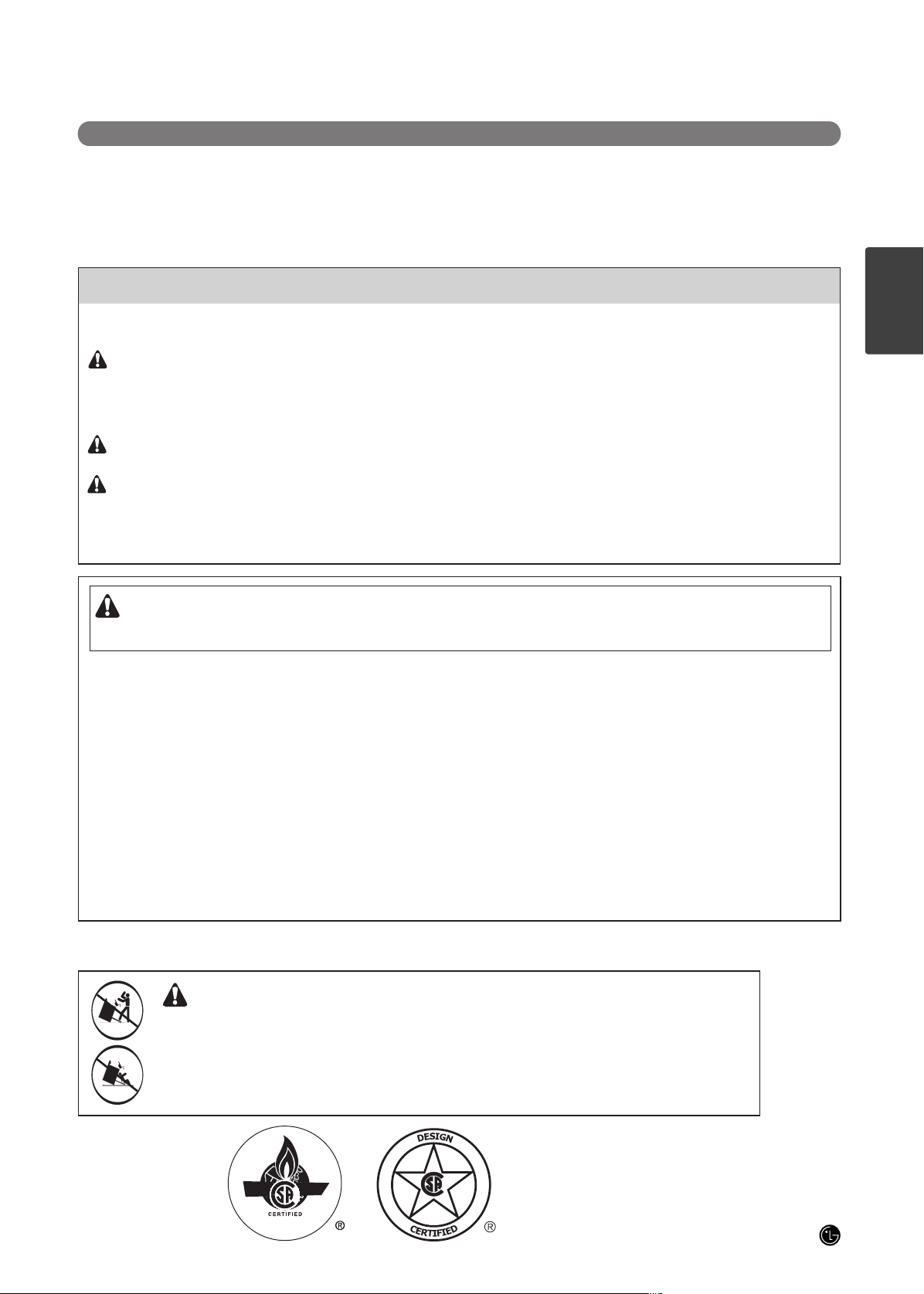
INFORMACIÓN IMPORTANTE DE SEGURIDAD
LEA TODAS LAS INSTRUCCIONES ANTES DE USAR LA UNIDAD
DISPOSITIVO ANTIVUELCO
Para evitar riesgos de incendio, choque eléctrico, lesiones físicas o daños durante el uso, lea y siga todas las
instrucciones antes de usar su horno. Esta guía no cubre todas las situaciones posibles. Contacte siempre con
su servicio técnico o fabricante en caso de problemas que no sepa resolver.
Este símbolo alerta de peligros o prácticas no seguras que podrían ocasionar lesiones físicas
graves o incluso la muerte.
Esta guía contiene muchos mensajes importantes de seguridad. Siempre lea y obedezca todos los mensajes
de seguridad. Después de leer este manual, guárdelo en un lugar accesible.
Este es el símbolo de alerta de seguridad. Este símbolo alerta de peligros potenciales que podrían provocar
lesiones personales o a terceros, e incluso la muerte.
Todos los mensajes de seguridad están precedidos por un símbolo de advertencia, “ADVERTENCIA” o
“PRECAUCIÓN”. Estas palabras significan:
Todos los mensajes de seguridad le dirán cual es el peligro potencial, le dirán cómo reducir las posibilidades de
lesiones, y le dirá lo que puede suceder si las instrucciones no son seguidas.
Este símbolo alerta de peligros o prácticas no seguras que podrían ocasionar lesiones físicas
o daños a la propiedad.
ADVERTENCIA
PRECAUCIONES BÁSICAS DE SEGURIDAD
PRECAUCIÓN
ADVERTENCIA
• TODAS LAS ESTUFAS DE GAS PUEDEN VOLCAR
• PUDIENDO OCASIONAR LESIONES FÍSICAS
• INSTALE LOS DISPOSITIVOS ANTIVUELCO INCLUIDOS EN SU ESTUFA DE GAS
• EXAMINE LA SECCIÓN DE INSTALACIÓN
QUÉ HACER SI PERCIBE OLOR A GAS
• Abra las ventanas.
• NO intente prender ningún electrodoméstico.
• NO toque ningún interruptor eléctrico.
• NO use ningún teléfono en su edificio.
• Llame inmediatamente a su distribuidor de gas desde el teléfono de un vecino. Siga las instrucciones
proporcionadas por el distribuidor de gas.
• Si le es imposible contactar con su distribuidor de gas, llame a los bomberos.
La instalación y mantenimiento deben realizarlas un instalador calificado, empresa de servicios o el
distribuidor de gas.
• NO almacene ni use gasolina u otros vapores y líquidos inflamables cerca de éste u otros electrodomésticos.
ADVERTENCIA
En caso de no seguir exactamente la información contenida en este manual,
podría producirse un incendio o explosión, provocando daños a la propiedad, lesiones físicas o peligro de muerte.
3
ESPAÑOL
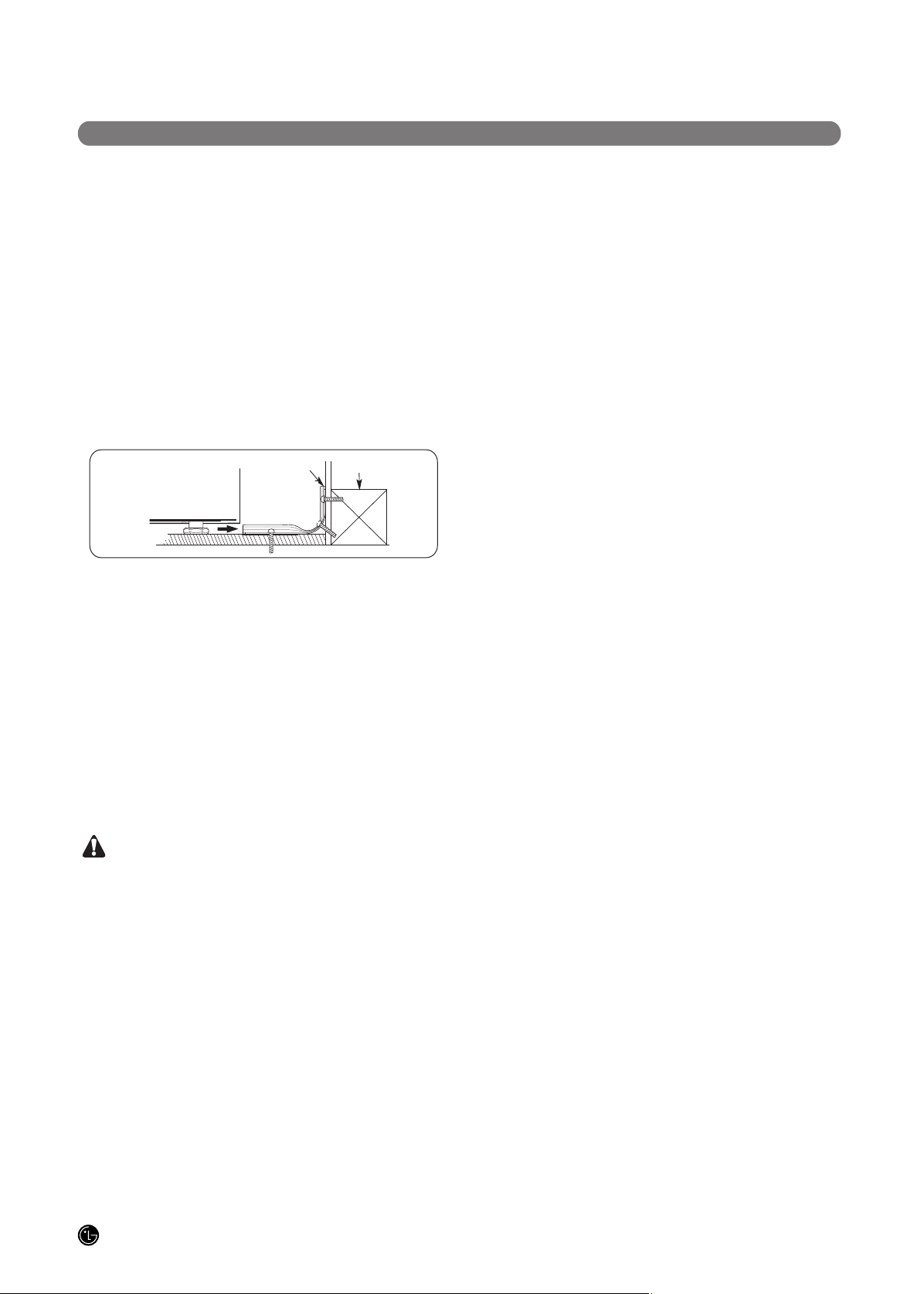
INFORMACIÓN IMPORTANTE DE SEGURIDAD
AVISO IMPORTANTE DE SEGURIDAD
La Ley de Safe Drinking Water and Toxic que el gobernador de
California publique una lista de las sustancias, conocidas por el
estado, que provoquen defectos congénitos u otros daños
reproductivos, y exige que los negocios adviertan a sus clientes
del peligro de una exposición potencial a tales sustancias.
Los electrodomésticos de gas pueden ocasionar exposiciones
menores a cuatro de estas sustancias, llamadas benceno,
monóxido de carbón, formaldehído y hollín, ocasionadas
principalmente por la combustión incompleta del gas natural o
combustibles LP.
Los quemadores bien ajustados, algo que se refleja mediante la
presencia de una llama azul en lugar de amarilla, reducirán al
mínimo una combustión incompleta.
La exposición a estas sustancias puede minimizarse ventilando
mediante la apertura de una ventana o la uso de un ventilador o
extractor.
MEDIDAS DE SEGURIDAD
Solicite que el instalador del muestre el emplazamiento de la válvula de corte de gas de la
estufa y cómo usarlo si fuese necesario.
• Solicite la realización de la instalación y conexión a tierra de su
estufa a un instalador calificado, de acuerdo con las
instrucciones de instalación. Cualquier ajuste o servicio de
mantenimiento debe ser realizado únicamente por instaladores
de estufas de gas o técnicos de servicio calificados.
• Enchufe su estufa de gas únicamente a una conexión de 120
voltios con toma de tierra. No elimine la toma de tierra del
tomacorriente. En caso de duda relacionada con la conexión a
tierra del sistema eléctrico de la vivienda, recae en usted la
responsabilidad y la obligación de reemplazar una toma de
pared sin conexión a tierra con una que disponga de ella,
conector de tres clavijas de acuerdo con el Código eléctrico
nacional. No use alargaderas con este electrodoméstico.
• Para evitar situaciones que generen peligro o choques
eléctricos. No use adaptadores, alargaderas ni elimine la
conexión a tierra del cable de alimentación. No acatar estas
advertencias puede provocar lesiones graves, incendios o
peligro de muerte.
• Instale la estufa de gas lejos del acceso habitual de niños y de
lugares con corrientes de aire para prevenir una circulación de
aire deficiente.
•NOintente reparar o reemplazar ninguna pieza de su estufa a
menos que esté recomendado específicamente en este
manual. El resto de las labores de reparación deben ser
dejadas en manos de un técnico calificado.
• Para prevenir daños por incendio o humos provocados por la
ignición del material de empaque, asegúrese de retirar todos
los materiales de empaque de la estufa de gas antes de
ponerla en funcionamiento.
LEA TODAS LAS INSTRUCCIONES ANTES DE USAR LA UNIDAD
• NO se apoye ni se siente sobre la puerta. Instale el soporte
antivuelco que viene incluido con la estufa de gas.
- La estufa de gas podría volcar, ocasionando lesiones por
derrames de líquidos o alimentos calientes, o producidas por el
propio electrodoméstico.
- Si se retira la estufa de gas de la pared para llevar a cabo
labores de limpieza, servicio o por cualquier otra razón,
asegúrese de volver a colocar correctamente el soporte
antivuelco al devolver el electrodoméstico a su posición original
contra la pared.
• Para reducir el riesgo de vuelco del horno, el electrodoméstico
debe asegurarse mediante la instalación correcta de los
dispositivos antivuelco.
• Para chequear la instalación correcta del soporte antivuelco:
sujete el borde superior de la parte de atrás del protector
posterior del horno e intente, con cuidado, inclinarlo hacia
delante. Chequee que los dispositivos antivuelco estén
colocados.
• Gaveta de calentamiento o gaveta de almacenaje: retire la
gaveta e inspeccione visualmente que el pie de nivelación
posterior esté introducido por completo en el soporte
antivuelco.
• Examine el manual de instalación para llevar a cabo un
montaje correcto del soporte antivuelco.
DISPOSITIVO ANTIVUELCO
(continuación)
Soporte
antivuelco
Placa de pared
El perno debe
anclarse en
madera u hormigón
•
ADVERTENCIA
Este producto contiene quimicos conocidos por el Estado de California de causar cáncer. Lávese las manos
después de manipular.
4
INFORMACIÓN IMPORTANTE DE SEGURIDAD
• Asegúrese de que su estufa de gas quede instalada
correctamente por un técnico de servicio o instalador
calificado para el tipo de gas (natural o LP) que va a
usarse. Su estufa puede adaptarse para su uso con
cualquier tipo de gas. Examine las instrucciones de
instalación.
• Tras el uso prolongado de una estufa de gas, pueden
producirse altas temperaturas en el piso y muchos
revestimientos no podrán resistir este tipo de uso. No
instale nunca una estufa de gas sobre baldosas de vinilo o
linóleo que no resistan dicho uso. No instalar nunca
directamente sobre la moqueta interior de la estufa.
• NO deje niños solos o desatendidos cuando la estufa de
gas esté caliente o en funcionamiento. Podrían sufrir
quemaduras graves.
• NO No permita que nadie se suba, se apoye o se
descuelgue de la puerta del horno, de la gaveta de
calentamiento o sobre la estufa. Podrían dañar la estufa de
gas e incluso volcarla y sufrir lesiones graves.
• NO vista prendas demasiado holgadas o poco ajustadas al
usar el electrodoméstico. Tenga cuidado al alcanzar
artículos almacenados en los armarios situados sobre la
estufa de gas. El material inflamable podría incendiarse al
ponerse en contacto con la llama o con superficies
calientes del horno y producir quemaduras graves.
• NO almacene materiales inflamables en el horno, gaveta
de calentamiento ni cerca de la estufa.
• NO almacene ni use materiales inflamables, gasolina u
otros vapores y líquidos inflamables cerca de éste u otros
electrodomésticos.
• NO deje aceite ni otros materiales inflamables acumulados
en la estufa de gas o en sus proximidades.
• NO use agua para sofocar incendios provocados por
grasas. Nunca toque una sartén en llamas. Apague los
controles. Sofoque la llama de una sartén que se
encuentra sobre un quemador, cubriendo por completo la
misma mediante una tapa apropiada, una bandeja para
galletas o plana. Use un extintor de incendios de producto
químico seco multiuso o de espuma. Las llamas de aceite
que salen de la sartén pueden apagarse cubriéndolas con
bicarbonato sódico o, si estuviera disponible, con un
extintor de incendios de producto químico seco multiuso o
de espuma.
• NO use el horno o el horno de calentamiento/horno inferior
(si está disponible) como espacio de almacenamiento.
• Deje que las rejillas y otras superficies calientes se enfríen
antes de tocarlas.
• NO bloquee nunca los orificios de ventilación (aberturas de
aire) de la estufa de gas. Proporcionan la entrada y salida
de aire necesaria para que la estufa de gas funcione con
una combustión adecuada. Las aberturas de aire están
situadas en la parte posterior de la estufa, en la parte
superior y en la base de la puerta del horno y en la base de
la estufa de gas, bajo la gaveta de calentamiento, o panel
inferior.
• Los grandes arañazos o impactos en las puertas de cristal
pueden provocar la rotura o destrucción del cristal.
• Subirse, apoyarse o sentarse sobre las puertas o cajones
de esta estufa de gas puede provocar lesiones graves y
daños a la misma. No permita que los niños se suban o
jueguen en las proximidades de la estufa de gas. El peso
de un niño sobre una puerta podría provocar que la estufa
se volcase, ocasionando quemaduras graves u otras
lesiones.
• La prueba de fugas del electrodoméstico deberá realizarse
según las instrucciones del fabricante.
MEDIDAS DE SEGURIDAD
(continuación)
ADVERTENCIA
NUNCA use este
electrodoméstico a modo de calefacción para calentar o
caldear la estancia. Hacerlo podría provocar
envenenamiento por monóxido de carbono y
sobrecalentamiento en la estufa.
PRECAUCIÓN
Los objetos que
atraigan la atención de los niños no deben colocarse en
los armarios situados sobre la estufa de gas ni sobre su
encimera: los niños se subirán a la estufa para
alcanzarlos, pudiendo sufrir lesiones graves.
LEA TODAS LAS INSTRUCCIONES ANTES DE USAR LA UNIDAD
ADVERTENCIA
Estos ajustes
deben ser realizados por un técnico de servicio calificado
cumpliendo las instrucciones del fabricante y todos los
códigos y exigencias de la autoridad competente. El
incumplimiento de estas instrucciones podría ocasionar
lesiones graves o daños a la propiedad. La empresa
cualificada que realice estas labores, asume la
responsabilidad por la adaptación.
5
ESPAÑOL
INFORMACIÓN IMPORTANTE DE SEGURIDAD
LEA TODAS LAS INSTRUCCIONES ANTES DE USAR LA UNIDAD
COCINANDO EN LA SUPERFICIE
• NUNCA deje desatendidos los quemadores en las
posiciones de llamas altas. Las salpicaduras pueden
causar humo y derrames de grasa que pueden
encenderse.
• Siempre use la posición LITE (encender) al encender los
quemadores de superficie y asegurarse de que hayan
encendido los quemadores.
• Ajuste el tamaño de la llama del quemador de superficie
para que no extienda sobre la extremidad de la cacerola.
Las llamas excesivas son peligrosas.
• Use sólo agarraderas secas—las agarraderas húmedas o
mojadas sobre superficies calientes pueden resultar en
quemaduras por el vapor. No deje que las agarraderas se
acerquena las llamas al levantar una cacerola. No use una
toalla u otro trapo abultado en vez de usar una agarradera
• Si usted usa recipientes de vidrio, asegúrese de que estén
diseñados para la cocción sobre la estufa.
• Para minimizar la posibilidad de quemaduras, el incendio
de materiales inflamables y derrames, coloque los mangos
hacia la parte de atrás de la estufa sin extenderlos sobre
los quemadores.
• NO deje artículos sobre la superficie de la estufa. El aire
caliente del respiradero puede hacer que los objetos
inflamables ardan y aumente la presión de los recipientes
cerrados, lo que puede originar que estallen.
• Vigile con atención los alimentos que se fríen en llama alta.
• Siempre caliente la grasa lentamente y obsérvela cuando
se calienta.
• Si al freír combina aceites y grasas, mézclelos bien antes
de calentarlos.
• Use un termómetro para freír con aceite cuando sea
posible para evitar sobre calentar la grasa y que eche
humo.
• Use la cantidad mínima de grasa para freír de una manera
más eficaz. Llenar el recipiente de grasa puede causar
salpicaduras al añadir alimentos.
• NO queme alimentos sobre la estufa.
• NO use ollas metálicas (tipo “wok”) en los modelos con
quemadores sellados si la olla metálica tiene anillo
metálico que se colca sobre la parrilla del quemador para
soportar la olla metálica. Este anillo actúa como trampa de
calor, lo cual puede dañar la parrilla del quemador y la
cabeza del quemador. También, puede causar que el
quemador funcione de manera inadecuada. Esto puede
causar que el nivel de monóxido de carbono sea superior a
los estándar actuales permitidos, resultando en un peligro
para la salud.
• Los alimentos para freír deben estar tan secos como sea
posible. La escarcha sobre los alimentos congelados o la
humedad sobre los alimentos frescos pueden provocar que
la grasa caliente burbujee y se salga por los lados del
recipiente
• NUNCA trate de mover una sartén de grasa caliente,
especialmente un freidor con bastante aceite. Espere hasta
que se enfríe el aceite.
• NO deje artículos de plástico sobre la superficie—se
pueden derretir si se dejan muy cerca del respiradero.
• Aleje todos los artículos de material plástico de los
quemadores de superficie.
• Para evitar la posibilidad de una quemadura, siempre
asegúrese de que los controles para todos los quemadores
estén apagados y que todas las parrillas de los
quemadores estén frías antes de tratar de quitarlas.
• Si huele a gas, y se ha asegurado ya de que los pilotos
están encendidos, apague el gas de la estufa y llame a un
técnico calificado. Nunca use una llama viva para
encontrar una fuga.
• Siempre apague los quemadores de superficie antes de
quitar una cacerola.
• NO levante la superficie de cocción. Levantar la superficie
de cocción puede provocar daños y un funcionamiento
inadecuado de la estufa.
• Si la estufa está localizada cerca de la ventana, no cuelgue
las cortinas largas que podrían ser llevadas por el viento
sobre los quemadores de superficie y crear un peligro de
incendio.
ADVERTENCIA :
• Si la llama del quemador superior se apaga, el gas
seguirá saliendo a través del quemador hasta que el
mando se gire hasta ajustarlo en la posición “OFF”. No
deje los quemadores desatendidos mientras se
encuentren ajustados en la posición “ON”.
• Use el tamaño correcto de recipiente. Evite usar los
recipientes que no son estables o se vuelcan fácilmente.
Seleccione los recipientes con fondo plano bastante
grandes para contener el alimento y evitar las
salpicaduras y derrames, y lo bastante grandes para
cubrir las parrillas de los quemadores. Esto ahorrará el
tiempo de limpieza e impedirá la acumulación peligrosa
de alimentos; las salpicaduras o los derrames dejados
sobre la estufa pueden arder. Use recipientes con
mangos que se pueden agarrar fácilmente y que se
mantengan fríos.
6

INFORMACIÓN IMPORTANTE DE SEGURIDAD
LEA TODAS LAS INSTRUCCIONES ANTES DE USAR LA UNIDAD
HORNO DE AUTO LIMPIEZA
• Asegúrese de limpiar las salpicaduras excesivas antes
de iniciar el ciclo de auto limpieza.
• NO use limpiadores para hornos. Ningún limpiador
comercial para hornos ni ningún revestimiento
protectivo de los bordes del horno de cualquier tipo se
debería usar dentro o alrededor de cualquier parte del
horno. El residuo de los limpiadores para hornos dañará
el interior del horno cuando se use el ciclo de auto
limpieza.
• Es necesario retirar las bandejas y los accesorios del
horno antes de iniciar el ciclo de autolimpieza. Retire
asimismo cualquier utensilio colocado en el cajón
inferior antes de iniciar un ciclo de autolimpieza.
• Limpie sólo las partes enumeradas en este Guía de
uso.
• NO limpie la junta de la puerta. La junta de la puerta es
esencial para un sello hermético. Tenga cuidado de no
frotar, dañar o mover la junta.
• Si el ciclo de auto limpieza tuviera un fallo, apague el
horno y desconecte la corriente eléctrica. Haga que un
técnico calificado lo revise.
COCINE MUY BIEN TODAS LAS CARNES
Cocine muy bien todas las carnes, incluyendo las carnes
de aves; las carnes de res, por ejemplo, deben cocinarse
a una temperatura INTERNA de por lo menos 160°F
(71°C) y las carnes de aves deben cocinarse a una
temperatura interna de por lo menos 180°F (82°C).
Por lo general, cocinar a estas temperaturas protege
contra las enfermedades que se transmiten a través de
los alimentos.
7
ESPAÑOL

INFORMACIÓN IMPORTANTE DE SEGURIDAD
LEA TODAS LAS INSTRUCCIONES ANTES DE USAR LA UNIDAD
HORNO
Permanezca apartado de la estufa al abrir la puerta de un horno caliente.
El aire caliente y el vapor de salida pueden provocar quemaduras en manos, cara y ojos.
LEA Y CUMPLA ATENTAMENTE ESTA INFORMACIÓN DE SEGURIDAD.
GUARDE ESTAS INSTRUCCIONES
• NO caliente envases de alimentos destapados. Se
podría acumular la presión y romper el envase,
provocando lesiones.
• NO use papel de aluminio en ningún lugar del horno
excepto en las partes descritas en este manual. Un mal
uso podría provocar peligro de incendio o daños en la
estufa de gas.
• NO use el horno como zona de almacenaje. Los objetos
almacenados en el horno pueden incendiarse.
• Mantenga el horno libre de acumulaciones de grasa.
• Coloque las bandejas en la posición que desee
mientras el horno permanece frío.
• Para evitar quemaduras al retirar alimentos, extraiga las
rejillas hasta el tope y, a continuación, retire los
alimentos. También supone una medida de prevención
para evitar quemaduras producidas al tocar superficies
calientes o la puerta o paredes del horno. La posición
más baja no está diseñada para deslizarse.
• Al colocar o extraer parrillas, use siempre guantes para
horno.
• Al usar bolsas de estufa o de asado en el horno, siga
las directrices del fabricante.
• Use sólo los utensilios de cristal recomendados para su
uso en hornos de gas.
• Retire siempre la parrilla de la estufa tan pronto como
termine de usarla. La grasa acumulada en la parrilla
puede comenzar a arder si se usa el horno sin eliminar
la grasa de la misma.
• Al usar la parrilla, si la carne está demasiado cerca de
la llama, la grasa podría comenzar a arder. Elimine el
exceso de grasa para prevenir llamas excesivas.
• Asegúrese de que la parrilla esté situada correctamente
en su lugar para reducir la posibilidad de fuego graso.
• Si se produjera un fuego graso en la parrilla, pulse el
botón CLEAR OFF y mantenga cerrada la puerta del
horno para contener el fuego hasta que se extinga.
• Por seguridad y un rendimiento de cocción adecuado,
hornee y ase a la parrilla siempre con la puerta del
horno cerrada.
NOTA: abrir la puerta durante el proceso de cocción o de
asado puede provocar daños en los controles o en las
perillas de su estufa..
NO DEJE LA PUERTA DEL HORNO ABIERTA
DURANTE LA COCCIÓN O EL PROCESO DE
ENFRIADO.
ADVERTENCIA:
NO cubra
NUNCA ninguna ranura, orificio o paso de la base del
horno ni cubra por completo una bandeja con materiales
como papel de aluminio.
Hacerlo bloquearía la circulación directa de aire al horno
y podría ocasionar envenenamiento por monóxido de
carbono. Los recubrimientos con papel de aluminio
también podrían calentarse, provocando peligro de
incendio.
8
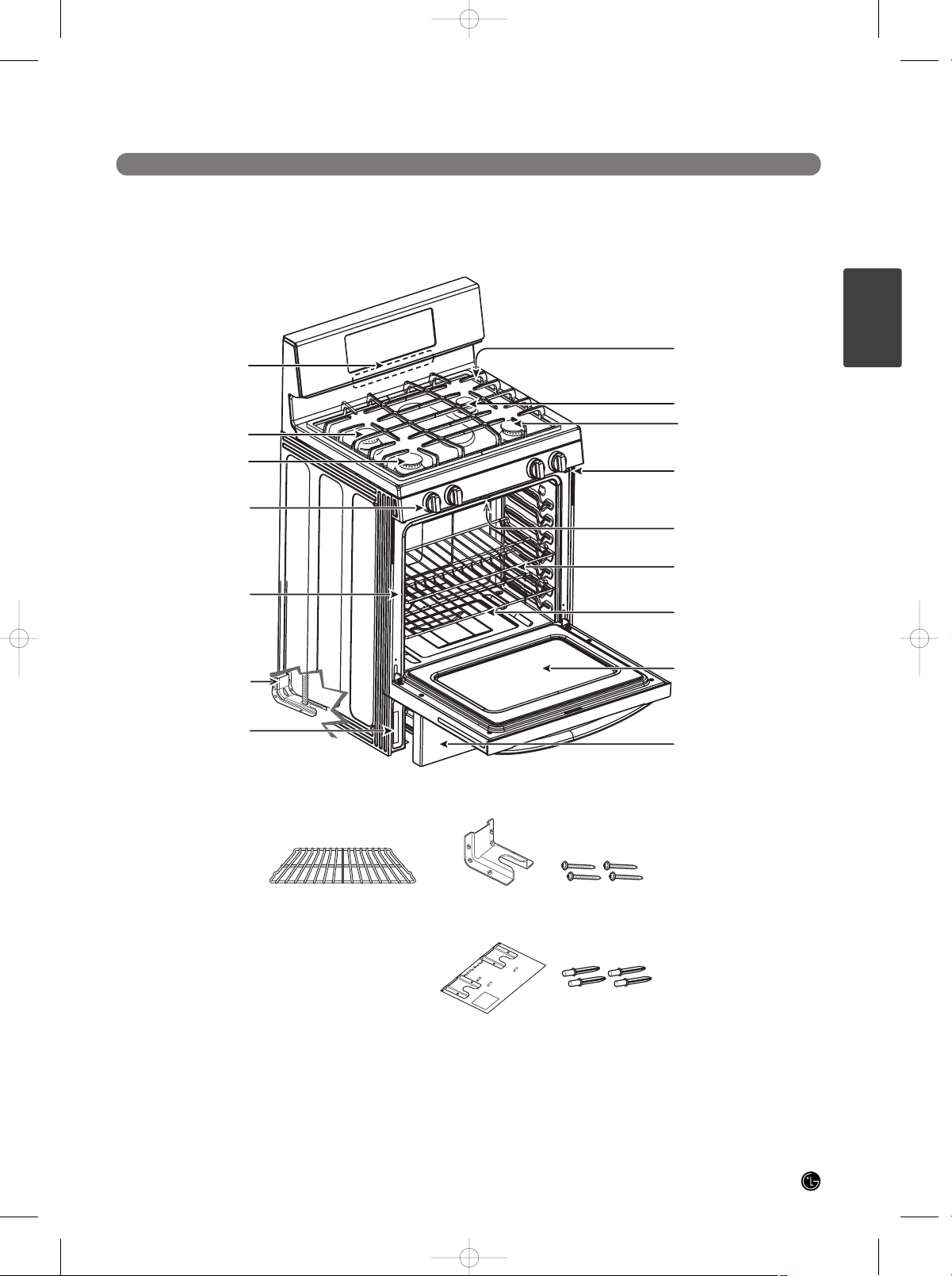
INFORMACIÓN IMPORTANTE DE SEGURIDAD
PIEZAS Y FUNCIONES
Quemador medio
Quemador grande
Mandos (4)
Junta de la puerta
Soporte antivuelco
Placa de número
de modelo y serie
Cajón de
almacenamiento
Puerta del horno
Ventilación del horno
Rejillas
Quemador pequeño
Quemador extragrande
Interruptor de luz
automática del horno
Seguro de autolimpieza
Rejilla estandar
Rejilla estandar
Rejilla estándar (2)
Plantilla
Fijaciones (4)
Tornillos (4)Antivuelco
9
ESPAÑOL
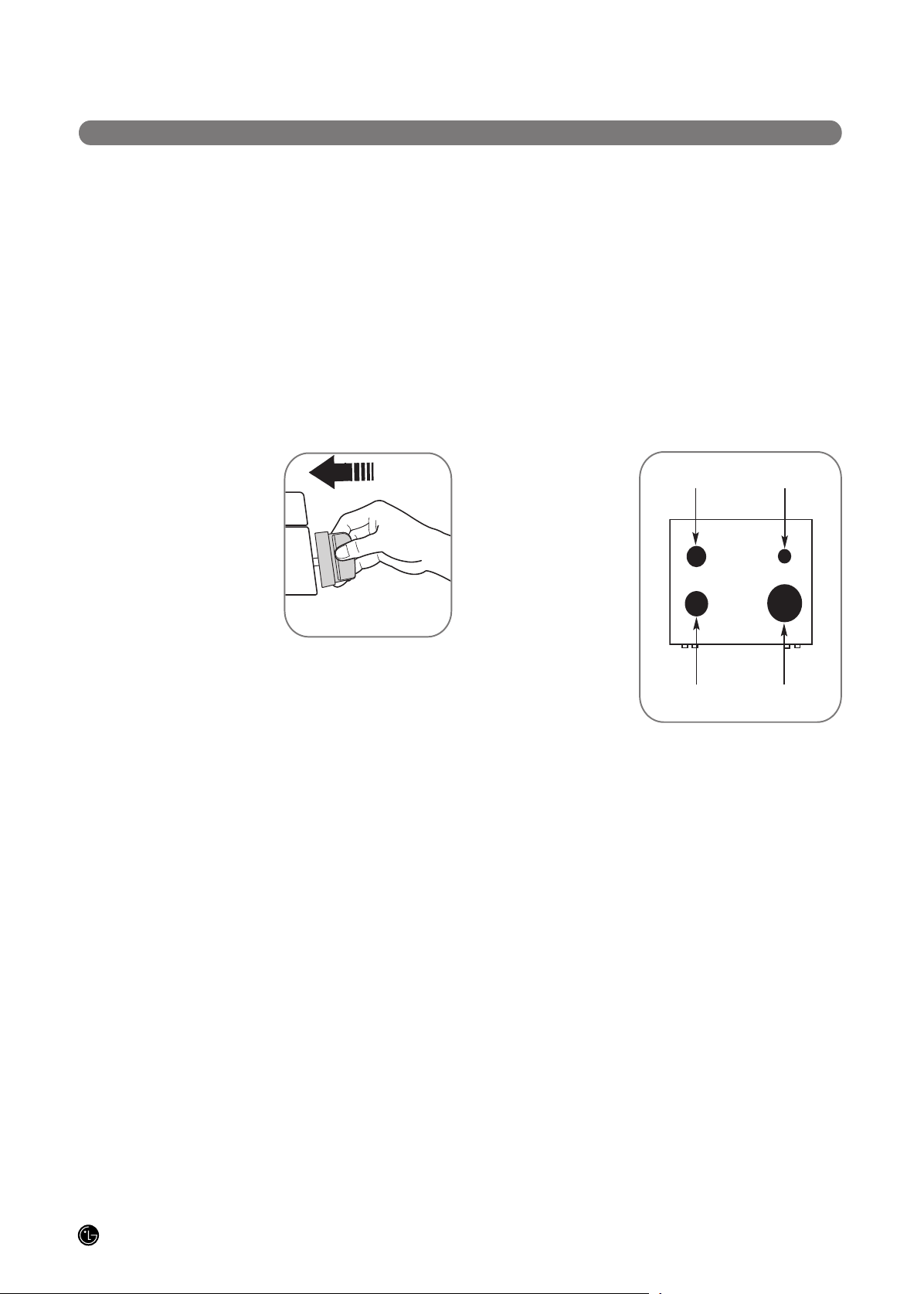
INSTRUCCIONES DE FUNCIONAMIENTO
USO DE LOS QUEMADORES DE GAS
Las funciones y aspecto reflejados en este manual podrían variar de los de su modelo concreto.
• Asegúrese de que todas las rejillas de la estufa de gas
estén correctamente colocadas antes de usar un
quemador.
• Asegúrese de que los quemadores y las rejillas se
enfríen antes tocarlos o colocar sobre ellos un guante
de estufa, paños de limpieza u otros materiales.
• Asegúrese de que todos los quemadores estén
colocados en su sitio.
• NO prenda el quemador durante largos períodos de
tiempo sin colocar una olla o sartén sobre la rejilla. El
acabado de la rejilla podría descascarillarse sin ninguna
olla o sartén que absorba el calor.
CÓMO PRENDER UN QUEMADOR DE GAS
• Asegúrese de que todos los
quemadores estén situados
en sus respectivas
posiciones.
• Pulse el mando de control y
gírelo hasta la posición LITE.
• Oirá un "clicking" suave: es
el sonido de la chispa
eléctrica prendiendo el
quemador.
• Gire el mando para ajustar el tamaño de la llama. Si el
mando permanece en la posición LITE, seguirá
sonando el “clic”.
• Al girar el mando de uno de los quemadores hasta la
posición LITE, se activarán las chispas de todos los
quemadores. No intente desmontar ni limpiar los
alrededores de ningún quemador mientras otro
permanezca prendido. Podría sufrir una choque
eléctrico que le hiciera golpear y tirar ollas o sartenes
calientes.
EN CASO DE FALLA ELÉCTRICA
En caso de que se produzca una falla eléctrica, puede
prender los quemadores de gas de su estufa con un
fósforo. Sitúe un fósforo prendido sobre el quemador y, a
continuación, pulse y gire el mando de control hasta la
posición LITE. Ponga especial atención al prender los
quemadores de esta forma. Al producirse una falla
eléctrica, los quemadores que están siendo usados
continuarán funcionando con normalidad.
QUEMADORES DE GAS SELLADOS
Su estufa dispone de
cuatro quemadores de
gas sellados.
Ofrecen la comodidad de
una fácil limpieza y
flexibilidad para usarlos
en una amplia gama de
aplicaciones de estufa. El
quemador mas pequeño
esta situado en la parte
posterior derecha.
Este quemador puede
ajustarse hasta una
posición de cocción baja.
Ofrecen una cocción
precisa para alimentos delicados como salsas o
alimentos que requieran cocinarse a fuego lento durante
largos períodos de tiempo.
Los quemadores medianos (posterior izquierdo) y
grandes (frontal izquierdo) son los que se usan para
cocinar la mayoría de las recetas.
Estos quemadores para uso habitual pueden bajarse
desde la posición HI a la posición LO para adaptarse a
una amplia gama de necesidades de cocción.
El quemador extra-grande (frontal derecho) es el
quemador que dispone de la máxima potencia.
Al igual que los otros cuatro quemadores, este puede
bajarse desde la posición HI hasta la posición LO para
adaptarse a una amplia gama de recetas.
Este quemador también está diseñado para hervir
rápidamente grandes cantidades de líquido.
Así también puede ser utilizado para ollas o sartenes de
10 o más pulgadas de diámetro.
NOTA: El quemador delantero derecho, por su diseño,
está elevado con respecto a la encimera. Es normal.
Pulse el mando de control y
gírelo hasta la posición LITE
Grande
Mediano
Extra-grande
Pequeño
10
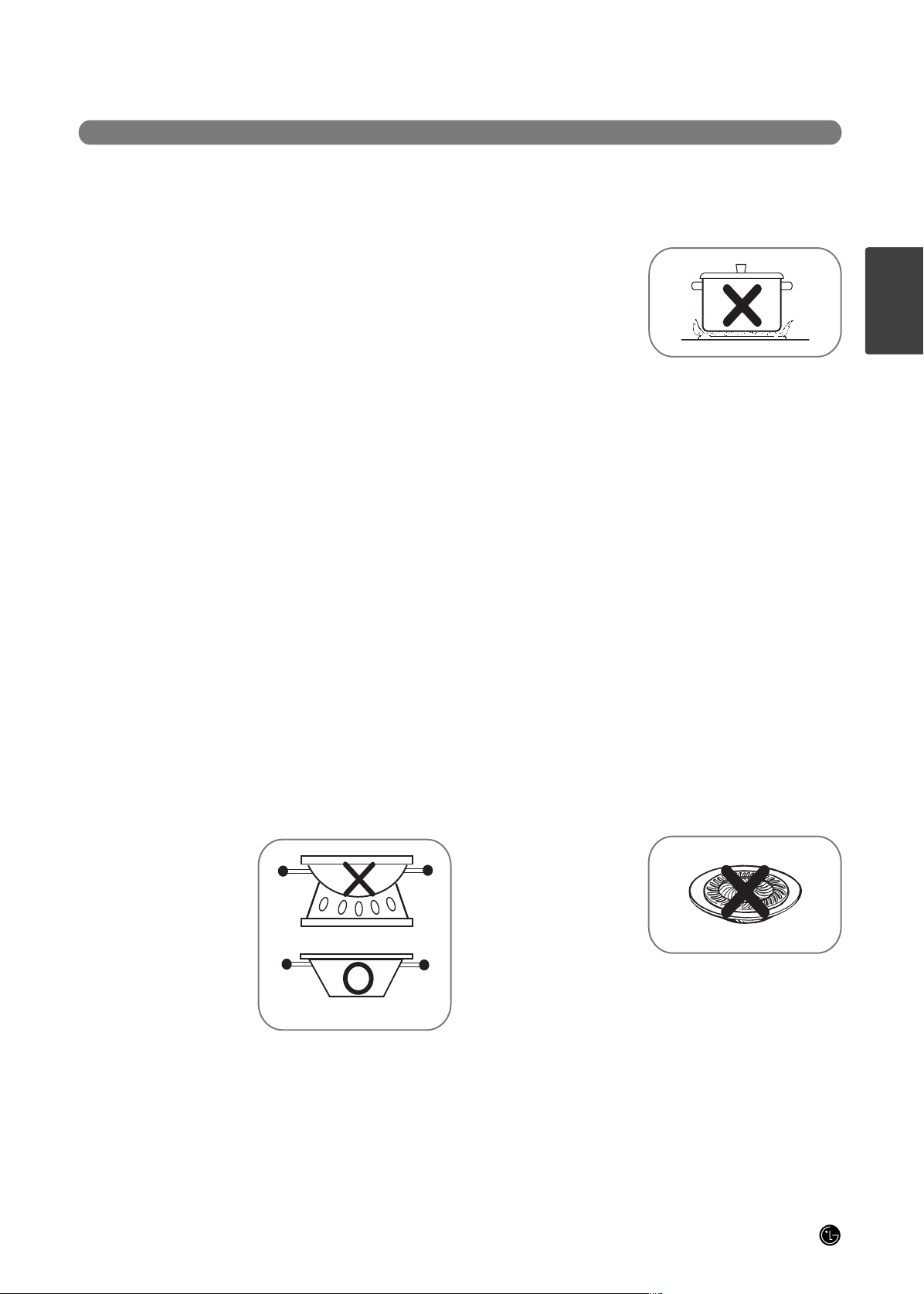
INSTRUCCIONES DE FUNCIONAMIENTO
USO DE LOS QUEMADORES DE GAS
CÓMO SELECCIONAR EL TAMAÑO DE LA LLAMA
Para usar con seguridad los utensilos de cocción,
nunca deje que la llama se extienda por fuera de los
bordes de los mismos.
Observe la llama, no el botón de control, al reducir el
calor. Calentar rápido, el tamaño de la llama de un
quemador de gas deberá equipararse con el utensilio que
esté usando.
Utilizar llamas de mayor
tamaño que el fondo de los
recipientes no los
calentará más rápido y
puede ser peligroso.
UTENSILIOS DE COCCIÓN PARA LA SUPERFICIE
Aluminio: Se recomienda el uso de utensilios de peso
mediano, ya que éstos distribuyen el calor rápidamente y
de manera uniforme. La mayoría de los alimentos se
dorarán de manera uniforme en una sartén de aluminio.
Use una cazuela con tapa ajustada cuando cocine con
una pequeña cantidad de agua.
Hierro fundido: La mayoría de las sartenes producirán
resultados satisfactorios si éstas se calientan con
lentitud.
Acero inoxidable: Este metal por sí mismo no es un
buen conductor del calor y generalmente se combina con
cobre, aluminio u otros metales para mejorar la
distribución del calor. Por lo general, las sartenes hechas
de metal combinado funcionan satisfactoriamente si se
usan sobre una llama de tamaño mediano como lo
recomienda el fabricante.
Utensilios de esmalte: El esmalte de algunos utensilios
pudiera derretirse bajo ciertas condiciones. Siga las
recomendaciones del fabricante de estos utensilios en
cuanto a los métodos de cocción.
Vidrio: Hay dos tipos de utensilios de cocción de vidrio,
aquéllos que se usan solamente en el horno y aquéllos
para cocinar sobre la superficie de cocción (cazuelas,
cafeteras y teteras). Los conductores de vidrio se
calientan con mucha lentitud.
Cerámica de vidrio resistente al calor: Puede usarse
para cocinar en la superficie o en el horno. Conduce el
calor muy lentamente y enfría también muy lentamente.
Consulte las instrucciones del fabricante para asegurarse
de que se puede usar en las estufas de gas.
NO UTILICE
NO utilice un wok de fondo
plano en un aro de
soporte. El colocar el aro
sobre la parrilla
delquemador pudiera
causar que el quemador
funcionara
inapropiadamente y esto
causaría niveles de
monóxido de carbono más
altos que los permitidos
por las normas actuales.
Esto podría ser peligroso para su salud.
Sólo se debe usar un wok de fondo plano.
Recomendamos que use un wok de fondo plano de 14
pulgadas o menor. Cerciórese de que el fondo del wok se
fije en la rejilla. Estas se pueden comprar en su tienda
minorista local.
ASADORES A LA PARRILLA
NO use los asadores a la
parrilla sobre los
quemadores sellados de
su estufa de gas. Si lo
hiciera, esto causaría una
combustión incompleta
del gas, exponiéndolo a
usted a niveles de monóxido de carbono más altos que
los permitidos por las normas.
Esto podría ser peligroso para su salud.
Usar un wok de fondo plano
11
ESPAÑOL
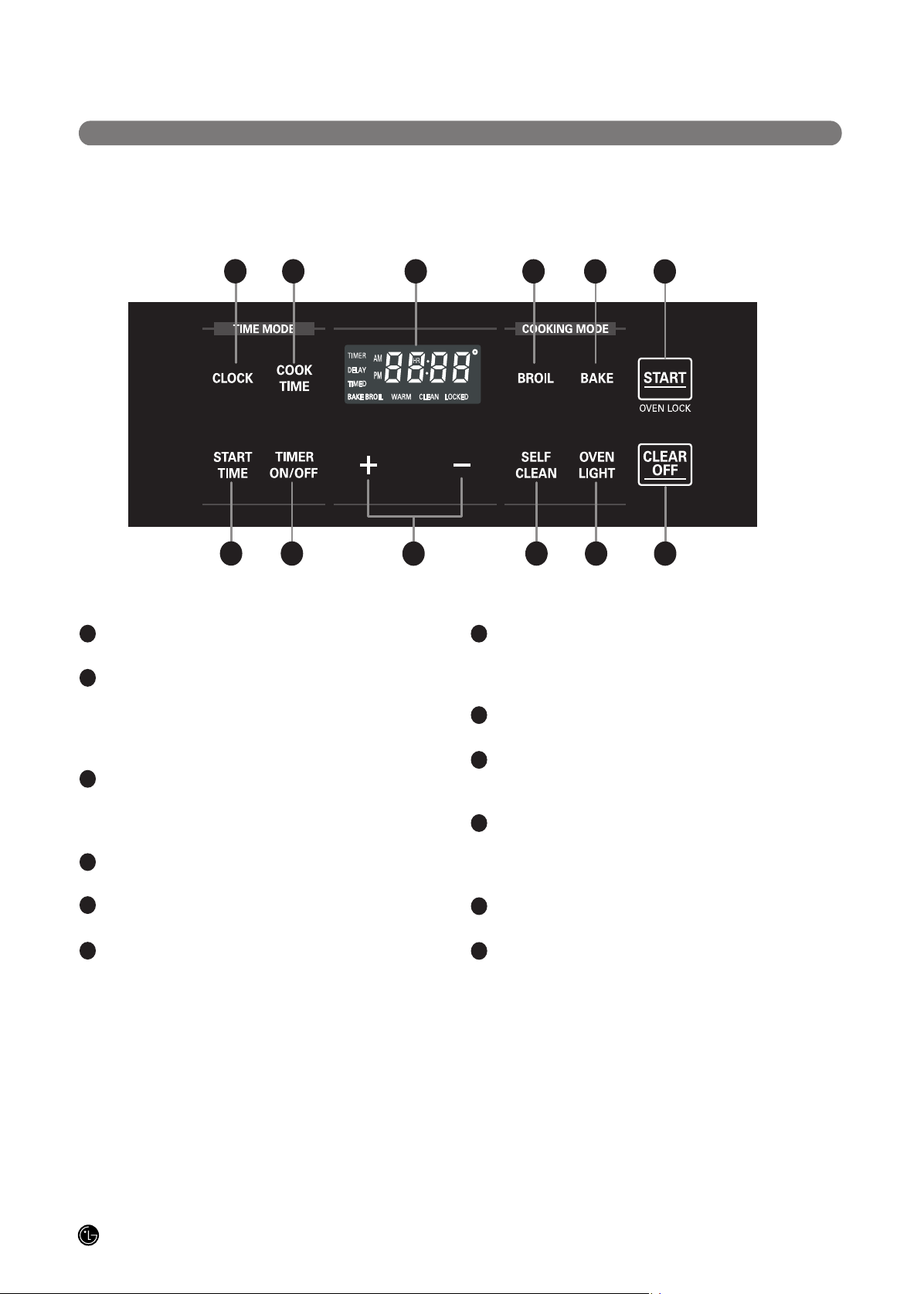
INSTRUCCIONES DE FUNCIONAMIENTO
PANEL DE CONTROL
Las funciones y aspecto reflejados en este manual podrían variar de los de su modelo concreto.
FUNCIONES DE CONTROL, RELOJ Y TEMPORIZADOR DEL HORNO
NOTA:
si aparece en pantalla el mensaje F- seguido por un número y las
señales de control del horno, esto indica un código de error de función.
Examine la página 34.
Pulse el botón CLEAR OFF. Permita que el horno se enfríe durante una
hora. Vuelva a poner en funcionamiento el horno. Si vuelve a aparecer el
código de error, desconecte el suministro eléctrico del horno y solicite
asistencia técnica.
Si ha ajustado en el horno una función con temporizador y se produce
un corte de suministro eléctrico, el reloj y todas las funciones
programadas deben ser reiniciados. La hora parpadeará en la pantalla
cuando se haya producido un corte de suministro eléctrico.
Botón CLOCK (Reloj): Púlselo antes de ajustar la
hora.
Botón COOK TIME (Tiempo de cocción): Presione y
después use los botones + y – para ajustar la cantidad
de tiempo que desee emplear en la cocción de sus
alimentos. El horno se apagara una vez transcurrido el
tiempo de cocción.
Pantalla: Muestra la hora, la temperatura del horno, si
el horno está en modo de horneado, parrilla o
autolimpieza, y el ajuste de tiempo para las funciones
de temporización o automáticas del horno.
Botón BROIL (Parrilla): Púlselo para escoger la
función de parrilla.
Botón BAKE (Horneado): Púlselo para escoger la
función de horneado.
Botón START (Inicio): Debe pulsarlo para iniciar
cualquier función de cocción o limpieza.
Botón START TIME (Tiempo de inicio): Úselo junto
con los botones BAKE, COOK TIME y SELF CLEAN
para ajustar el inicio y parada automáticos del horno
en el período de tiempo que usted establezca.
Botón TIMER ON/OFF (Temporizador act./Desac.):
Púlselo para escoger una función temporizada.
Botón +/-: Introduce o cambia el tiempo y la
temperatura del horno. Ajusta la parrilla en HI o LO
(alta o baja).
Botón SELF CLEAN (Limpieza automática):
Púlselo para escoger la función de limpieza
automática. Examine el uso de la función en la
sección Autolimpieza del horno de la página 22.
Botón OVEN LIGHT (Luz del horno): Púlselo para
apagar y prender la luz del horno.
Botón CLEAR OFF (Borrar apagar): Púlselo para
cancelar todas las funciones del horno excepto el reloj
y el temporizador.
1
2
3
4
5
6
7
8
10
11
12
9
1
2
7
8
9
10
11
12
3
4
5
6
12
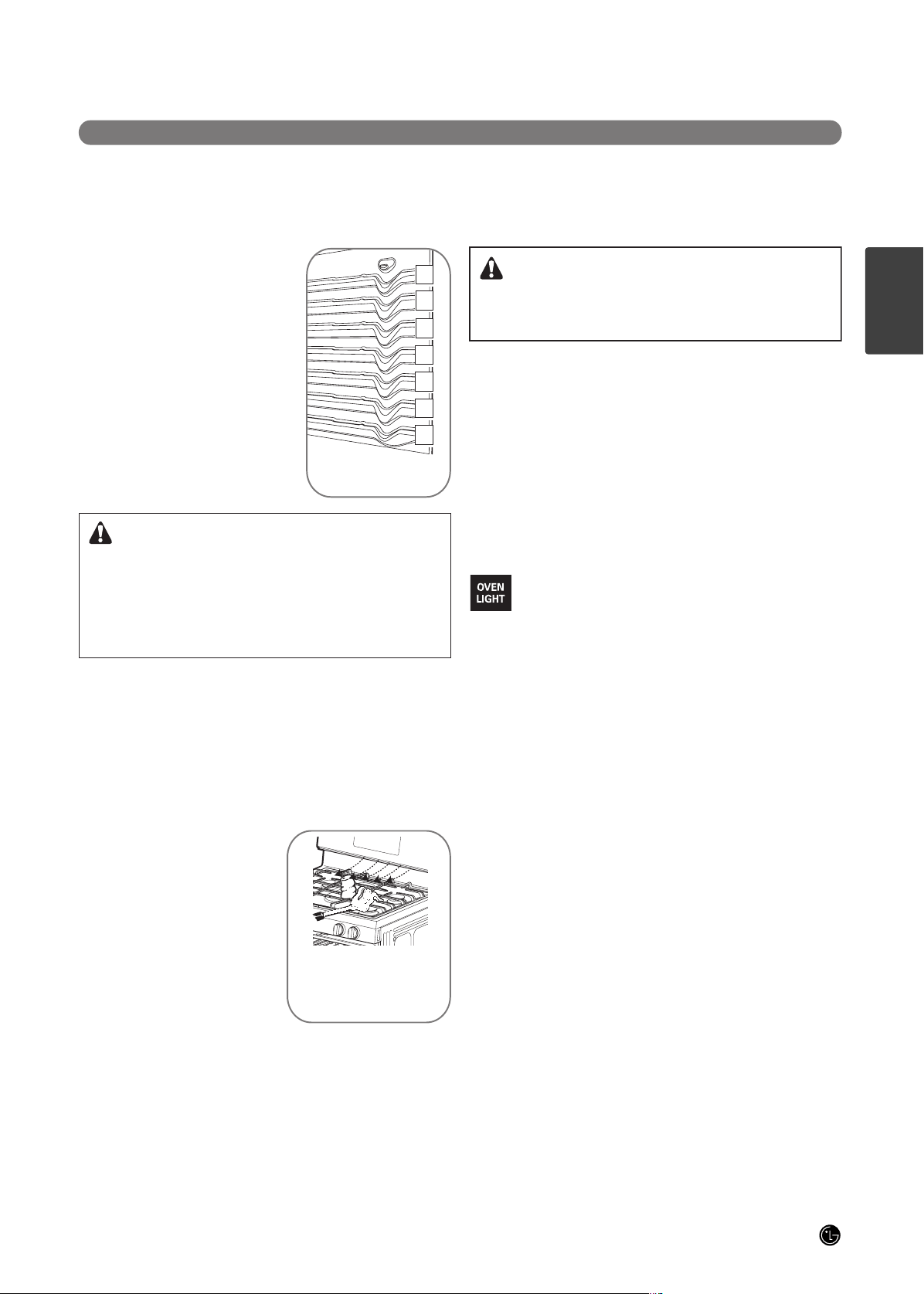
INSTRUCCIONES DE FUNCIONAMIENTO
Mientras el horno se calienta, el cambio de temperatura
del aire en el interior del horno podría generar la
formación de gotas de agua sobre el cristal de la puerta.
Estas gotas son inofensivas y se evaporarán a medida
que el horno siga calentándose.
PAPEL DE ALUMINIO
NUNCA cubra la base del horno con papel aluminio.
Para usar papel de aluminio para detener derrames,
coloque un pequeño trozo de papel de aluminio en una
bandeja inferior varias pulgadas bajo la comida.
NO cubra nunca por completo la bandeja con papel de
aluminio. Hacerlo obstruirá la circulación de aire caliente,
obteniendo resultados de horneado deficientes.
HUMEDAD DEL HORNO
USO DEL HORNO
ANTES DE COMENZAR
EL horno cuenta con 7 posiciones
de rejillas que permiten realizar
diversos tipos de cocción.
Para instalar una rejilla, inserte el
extremo curvado de la rejilla en la
posición deseada y presione para
deslizarla hasta el fondo.
Para quitar una rejilla, tire de ella
hasta que se detenga; luego,
inclínela hacia arriba y extráigala.
CORTE DEL SUMINISTRO ELÉCTRICO
PRECAUCIÓN:
NO intente usar el prendido eléctrico del horno durante
un corte de suministro eléctrico.
El horno o el grill no se podrán usar cuando haya una
interrupción en el suministro eléctrico.
Si el horno está en uso cuando se produzca un corte del
suministro eléctrico, el quemador del horno se apagará y
no podrá volver a prenderse hasta que se reanude el
suministro. Una vez restablecida la electricidad, tendrá
que poner de nuevo en marcha la función del horno o el
grill.
LUZ DEL HORNO
La luz del horno se prende automáticamente al
abrir la puerta. La luz del horno también puede
PRENDERSE o APAGARSE manualmente
pulsando el botón OVEN LIGHT.
NOTA :
• La luz del horno no se puede encender durante el ciclo
de autolimpieza.
Después de completar el ciclo de autolimpieza, la luz del
horno no se podrá encender hasta que el horno se haya
enfriado por debajo de 500 ˚F (260 ˚C).
A
B
C
D
E
F
G
El horno dispone de 7
posiciones para las bandejas.
VENTILACIÓN DEL HORNO
La ventilación del horno se realiza a través de los
conductos situados en la parte central, encima de la rejilla
del quemador. Para permitir un flujo de aire adecuado, no
bloquee la ventilación del horno cuando cocine. No toque
las aberturas de ventilación o las superficies circundantes
cuando el horno esté en funcionamiento.
• NO deje objetos de plástico o
inflamables sobre la estufa;
podrían derretirse si se dejan
demasiado próximos al
conducto de ventilación.
• NO deje envases cerrados
sobre la estufa. La presión de
los envases cerrados podría
aumentar, haciéndolos
estallar.
• Los objetos metálicos se
calentarán mucho si de dejan sobre la estufa, pudiendo
provocar quemaduras.
• Las asas de las ollas y sartenes que se encuentren
sobre la estufa podrían calentarse si se dejan
demasiado próximos al conducto de ventilación.
PRECAUCIÓN:
Use siempre
agarradores de estufa o guantes para horno al retirar
alimentos o ajustar las rejillas del horno. Si es posible,
espere hasta que el horno se enfríe por completo. Las
rejillas del horno podrían estar CALIENTES y provocar
quemaduras.
Los objetos de plástico sobre la
estufa podrían derretirse si se
dejan demasiado próximos a los
conductos de ventilación.
13
ESPAÑOL
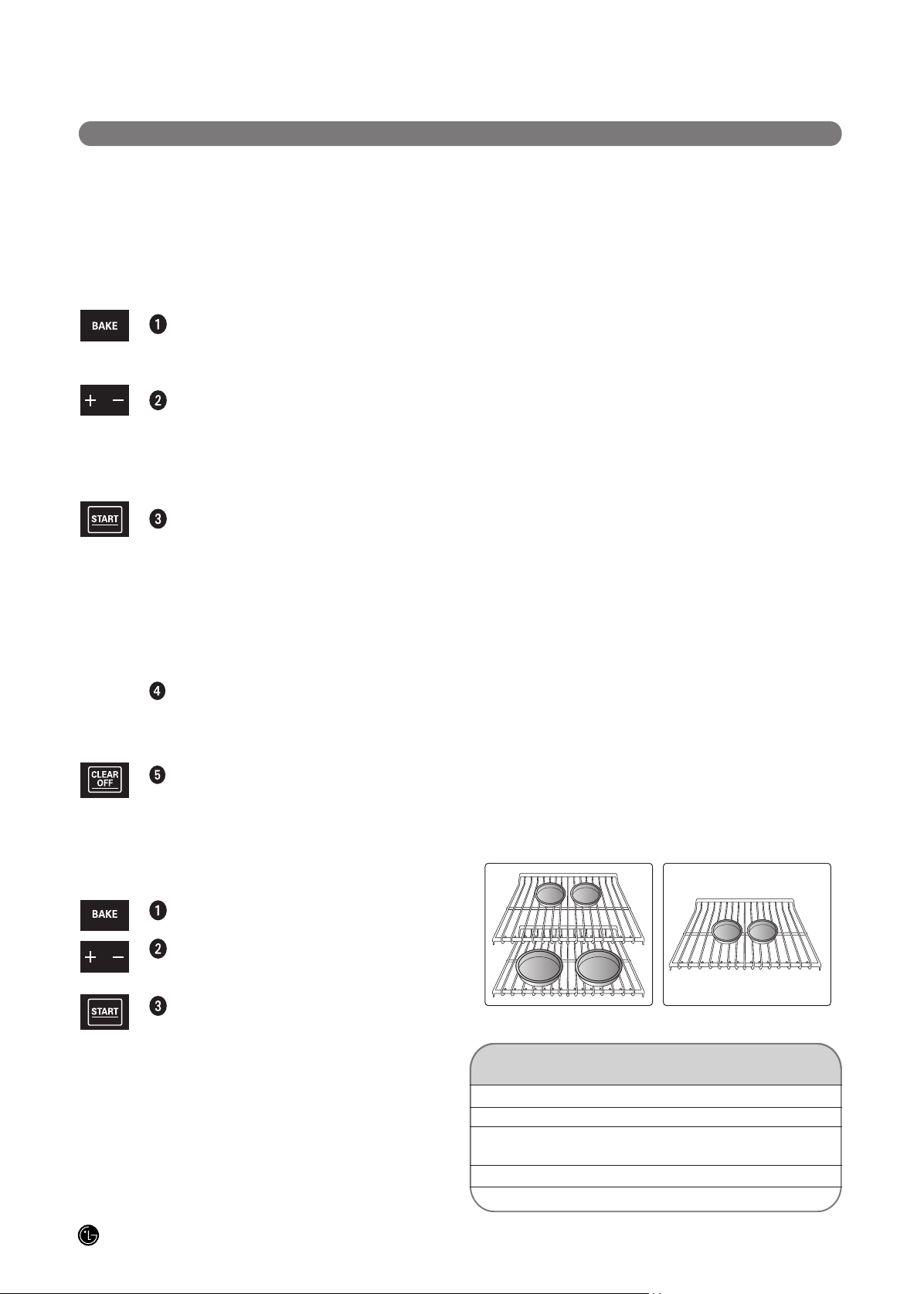
INSTRUCCIONES DE FUNCIONAMIENTO
USO DEL HORNO
Para evitar posibles quemaduras, introduzca las bandejas en la posición que desee antes de prender el horno.
PRECALENTAMIENTO Y COLOCACIÓN DE
OLLAS Y SARTENES
Precaliente el horno si la receta lo requiere. Para precalentar,
ajuste el horno a la temperatura correcta. El precalentamiento
es necesario al usar el horneado por convección y para obtener
unos buenos resultados al hornear tortas, galletas, repostería y
pan.
Los resultados de horneado serán mejores si los moldes
para hornear se centran en el horno. Si va a hornear con
más de una bandeja, colóquelas de modo que tengan un
espacio alrededor de por lo menos 1" a 1 -1/2".
Si va a cocinar con varias bandejas, coloque las bandejas
del horno en las posiciones C y E (para 2 bandejas).
Coloque los recipientes de cocción como puede verse en las
Fig. 1, 2.
SUGERENCIAS DE HORNEADO
EL TIPO DE MARGARINA AFECTARÁ AL
RENDIMIENTO DEL HORNEADO
La mayoría de las recetas para hornear han sido
elaboradas usando productos con alto contenido en
grasa como mantequilla o margarina (80% de grasa).
CÓMO AJUSTAR EL HORNO PARA HORNEAR
Su horno no está diseñado para cocinar con la puerta
abierta.
Pulse el botón BAKE. Aparecerá en la
pantalla 350° y parpadeará el indicador
BAKE.
Escoja la temperatura del horno.
Pulse o mantenga pulsado los botones + o –.
• Pulse el botón + para aumentar la
temperatura.
• Pulse el botón – para reducir la temperatura.
Pulse el botón START para aceptar el cambio
de temperatura.
Se mostrará en pantalla la palabra BAKE y 100 ˚. Mientras
el horno se calienta, la pantalla irá mostrando el cambio de
temperatura. Después de que el horno alcance la
temperatura deseada, se escuchará un bip prolongado 5
veces y después el indicador luminoso empezará a
parpadear.
Chequee si los alimentos están bien
cocinados al cumplirse el tiempo mínimo
indicado en la receta. Cocine durante más
tiempo si fuese necesario.
Pulse el botón CLEAR OFF al completarse la
cocción.
Para cambiar la temperatura de horneado
durante la cocción
Pulse el botón Bake.
A continuación, Pulse el botón + o – hasta
que se muestre la temperatura deseada.
Pulse el botón START.
Si reduce la grasa, podría no obtener los mismos resultados para la
receta que usando un producto con mayor contenido de grasa. Si
las tortas, pasteles, repostería, galletas o dulces se elaboran con
margarinas de bajo contenido en grasa, la receta podría no salir
bien. A menor contenido en grasa de una margarina o mantequilla,
más evidentes se hacen estas diferencias.
Los estándares federales exigen que los productos con la etiqueta
“margarina” contengan al menos un 80% de su peso en grasa. Las
margarinas y mantequillas bajas en grasa, por otro lado, contienen
menos grasa y más agua.
El contenido con altos niveles de humedad de estas margarinas y
mantequillas afecta a la textura y al sabor de los productos
horneados. Para obtener los mejores resultados usando sus
antiguas recetas favoritas, use margarina o mantequilla que
contenga al menos un 70% de aceite vegetal.
Tipo de alimento
Posición de la
bandeja
Tortas congeladas (en bandeja)
Bizcocho, bundt o pasteles
Bollería, bizcochos, brownies, galletas,
magdalenas, tortas por capas, pasteles
Estofados
Asado
B o C
C
D
D
A
Fig. 1 Fig. 2
14
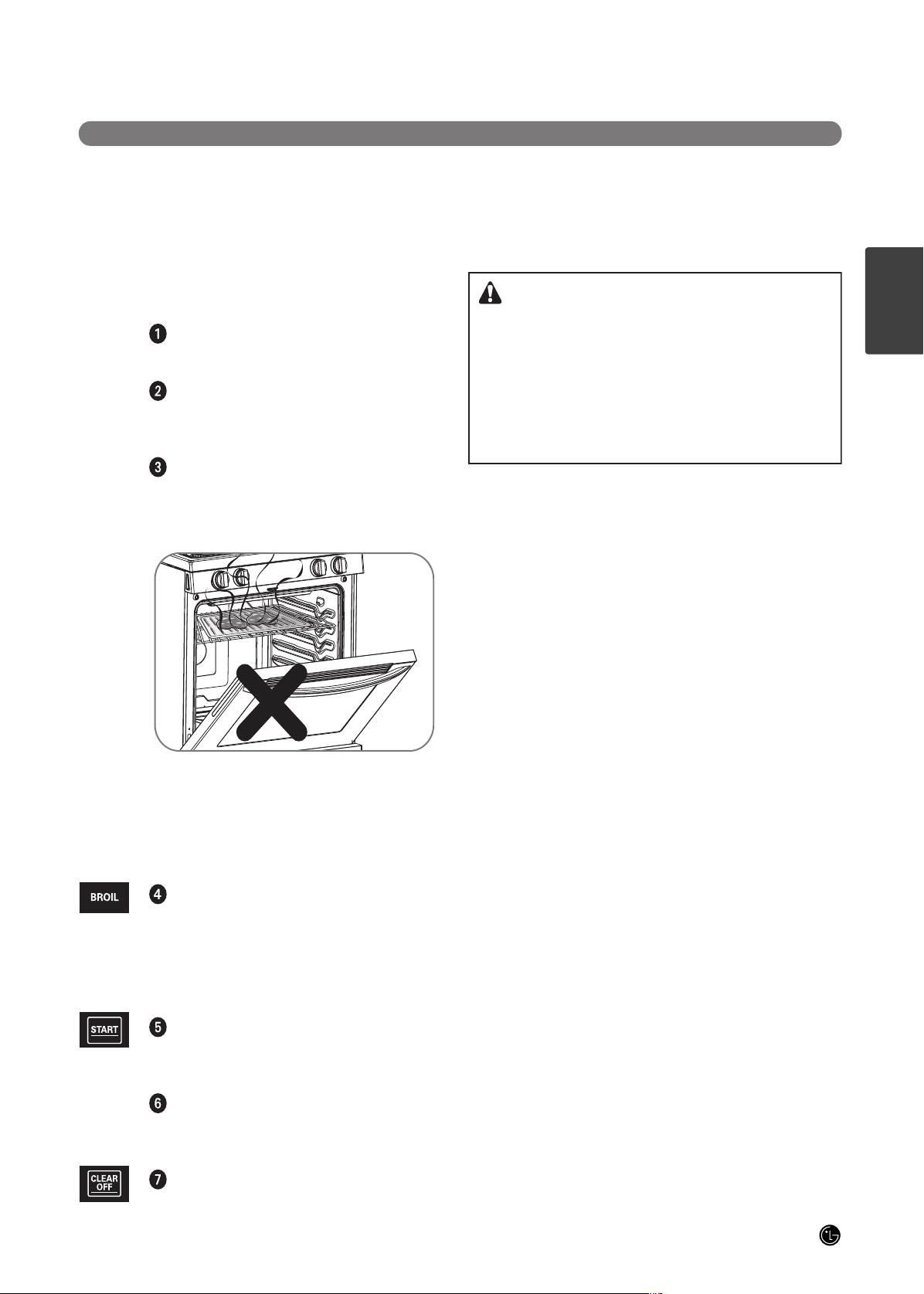
INSTRUCCIONES DE FUNCIONAMIENTO
Sirva la comida inmediatamente y deje la plancha fuera
del horno para enfriarse durante la comida y así facilitar
su limpieza.
Use el ajuste LO Broil de potencia baja para cocinar por
completo alimentos como aves o cortes gruesos de carne
sin dorarlos en exceso.
NOTA :
• Se puede producir un poco de humo durante el asado a
la parrilla. Esto se considera normal.
USO DEL HORNO
CÓMO AJUSTAR EL HORNO PARA ASAR A LA
PARRILLA
Su horno está diseñado para asar a la parrilla con la
PUERTA CERRADA.
Coloque la comida sobre la rejilla de la
parrilla en la plancha de la parrilla.
Cumpla con las posiciones recomendadas
para las rejillas en la guía de asado a la
parrilla.
La puerta del horno debe permanecer
cerrada para comenzar a asar.
La puerta del horno debe permanecer
cerrada durante el proceso de asado.
Presione una vez el botón de BROIL para
ajustar la parrilla a alta potencia o dos
veces para ajustar la parrilla a baja
potencia. BROIL parpadeara (o pulse Broil
y los botones + o – para desplazarse entre
los ajustes de la parrilla).
Presione el botón START. El horno
comenzará a asar a la parrilla. Se iluminará
BROIL en la pantalla.
Ase la comida a la parrilla por una cara
hasta que esté dorada, déle la vuelta y
cocínela por la otra cara.
Para cancelar el asado a la parrilla o si
dicha función ha finalizado, presione el
botón CLEAR OFF.
NOTA: Si la puerta permanece abierta
durante más de 15 segundos cuando se está
usando el grill, el quemador se apagará. El
quemador del grill volverá a encenderse
automáticamente cuando se cierre la puerta.
PRECAUCIÓN:
• NO use la plancha de la parrilla sin su complemento.
• NO cubra de la bandeja del grill o parrilla con papel
de aluminio. La grasa visible podría llegar a
quemarse.
• Para prevenir el contacto de los alimentos con el
quemador para asar y evitar que la grasa salpique, no
use la rejilla de asado al asar a la parrilla.
15
ESPAÑOL
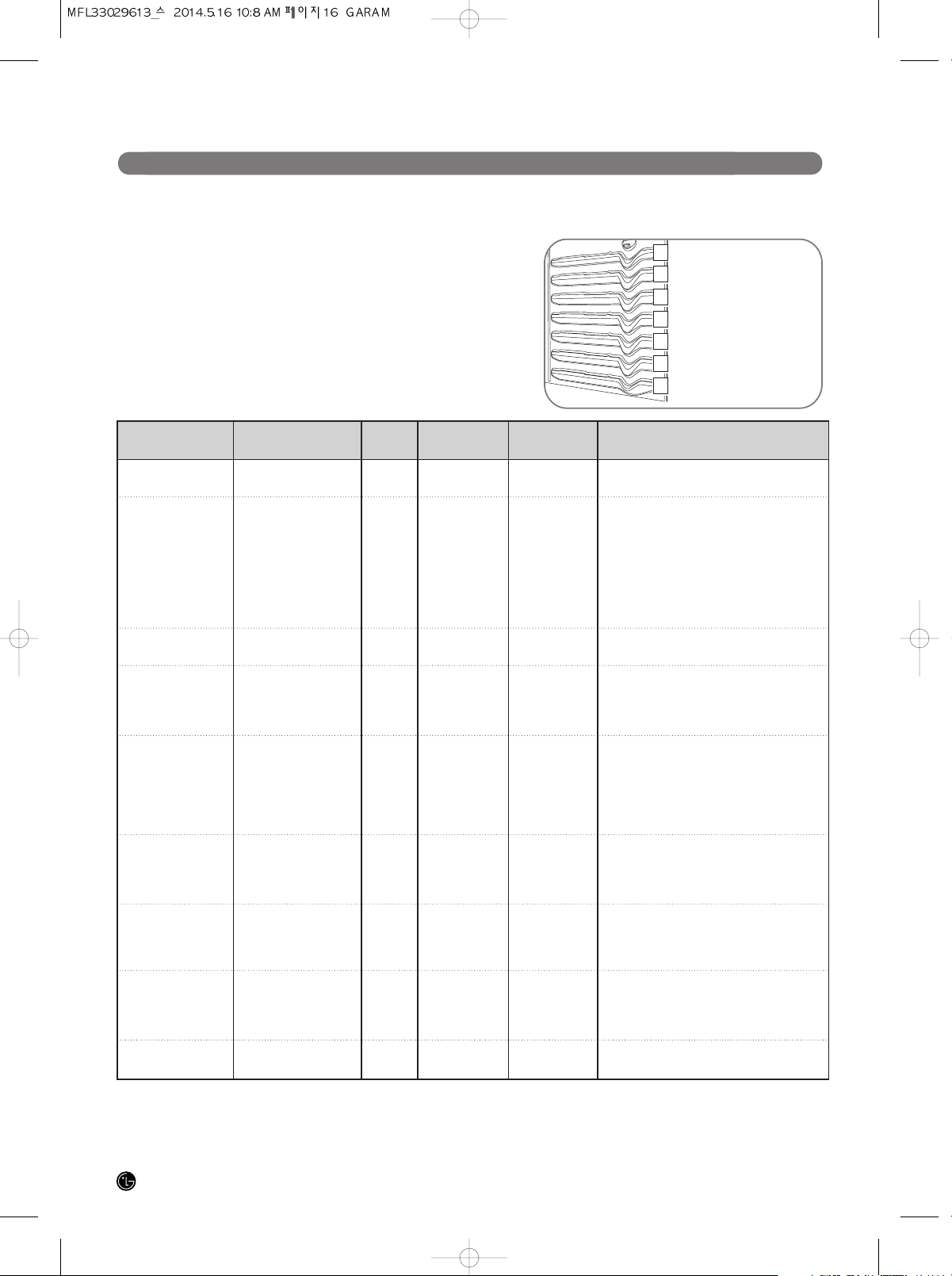
INSTRUCCIONES DE FUNCIONAMIENTO
A
B
C
D
E
F
G
El horno dispone de 7
posiciones para las
bandejas.
USO DEL HORNO
GUÍA DE ASADO A LA PARRILLA
El tamaño, peso, grosor, temperatura de inicio y sus preferencias
de cocción afectarán a los tiempos del asado a la parrilla.
La información recogida en esta guía tiene como base carnes a
temperaturas refrigeradas.
Alimento
Cantidad y/o
grosor
Bandeja
Posición
*
Tiempo para la
primera cara (min.)
Tiempo para la
segunda cara (min.)
Comentarios
Carne picada
Bien hecha
Filetes de ternera
Poco hecha
†
En su punto
Bien hecha
Poco hecha
†
En su punto
Bien hecha
Bacon
Chuletas de cerdo
Muy hechas
Chuletas de cordero
En su punto
Muy hechas
En su punto
Muy hechas
Pollo
Colas de langosta
Filetes de pescado
Lonchas de jamón
(precocido)
Espaciar uniformemente. Pueden asarse hasta
8 porciones a la parrilla al mismo tiempo.
Los filetes de menos de 1” de grosor, se
cocinan por dentro antes de dorarse.
Se recomienda freír.
Retire la grasa.
Colocar un una única capa.
Retire la grasa.
Retire la grasa.
Unte cada cara con mantequilla derretida.
Dorar primero con la cara con piel hacia abajo.
Corte la parte de atrás de la cáscara. Abrir
extendida. Unte con mantequilla derretida
antes de dorar y a la mitad del tiempo de
asado a la parrilla.
Manipule y voltee con mucho cuidado. Unte
con mantequilla de limón antes y durante la
cocción, si lo desea. Precaliente la parrilla para
dorar más los alimentos.
Aumente el tiempo entre 5 y 10 por cada cara
para grosores de 1
1
/
2
” o para jamón curado.
1 libra (4 porciones)
de
1
/
2
a
3
/
4
” de grosor
1” de grosor
de 1 a 1
1
/
2
libra.
1
1
/
2
” de grosor
de 2 a 2
1
/
2
libras.
1
/
2
libra
(8 lonchas delgadas aprox.)
2 (
1
/
2
” de espesor)
2 (1” de espesor)
1 libra aprox.
2 (1” de grosor) aprox.
de 10 a 12 onzas
2 (1
1
/
2
” de grosor) aprox.
1 libra
1 entero
de 2 a 2
1
/
2
libras,
corte longitudinal
4 pechugas con hueso
2–4
de 6 a 8 onzas cada una
de
1
/
4
a
1
/
2
” de espesor
1” de grosor
1
/
2
” de grosor
F
F
F
F
D
D
D
D
D
D
E
E
E
E
B
B
C
E
C
D
7~8
7
12
13
10
12-15
25
8
10
13
6
10
10
17
35-40
25-30
13–16
7~8
10
7
5-6
5
5-6
8-9
6-7
10-12
16–18
3
8
8~9
4–7
10
4-6
12-14
25
10-15
No dar la
vuelta.
6
5
4
† El Departamento de Agricultura de los EE.UU. aconseja: “La ternera poco hecha es muy popular, pero cocinar la carne sólo a
140˚F(60˚C) puede permitir que ciertos organismos responsables de intoxicaciones alimenticias sobrevivan. (Fuente: Safe Food
Book, Your Kitchen Guide, USDA Rev. junio de 1985.)
* Examine la ilustración para obtener la descripción de las posiciones de la bande
j
a.
16
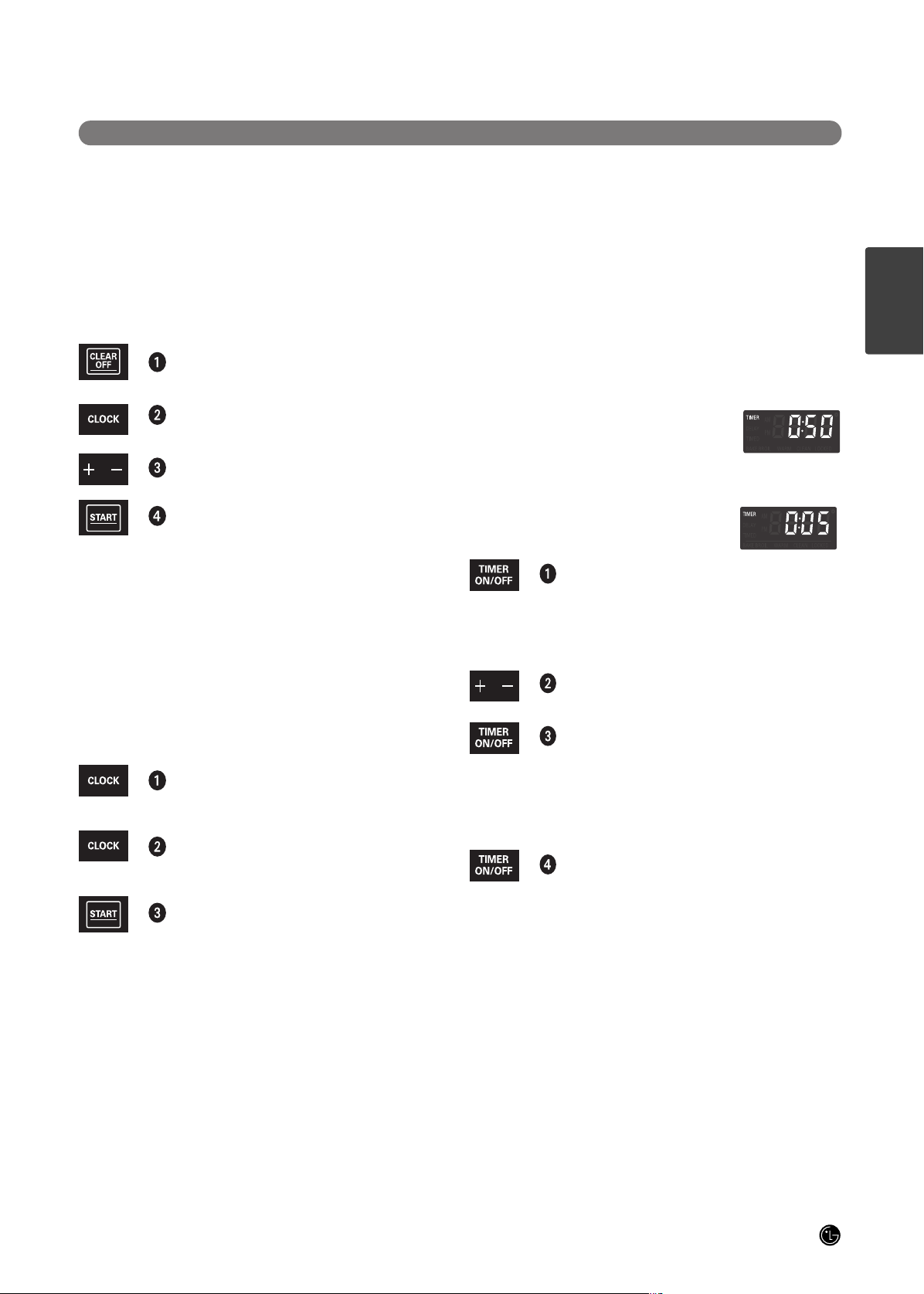
INSTRUCCIONES DE FUNCIONAMIENTO
USO DEL RELOJ Y EL TEMPORIZADOR
CÓMO AJUSTAR EL RELOJ
CÓMO CANCELAR EL TEMPORIZADOR
El reloj deberá ser ajustado a la hora correcta del día para
un buen funcionamiento del horno. La hora y el día no podrá
ser cambiador durante el proceso de cocinado o el modo de
autolimpieza.
Presione el botón CLEAR OFF.
Presione el botón CLOCK.
Presione el boton + o – para ajustar la hora..
Presione el boton START.
El reloj se establecerá, y la pantalla reflejará
el cambio después de un breve retraso
CÓMO CAMBIAR EL MODO DE HORA DEL
RELOJ (12 Ó 24 H)
Su pantalla de control está ajustada en el formato horario de
12 horas. Se prefiere disponer del formato horario de 24
horas, sigua los pasos expuestos a continuación.
Presione el botón CLOCK durante tres
segundos.
Presione el botón CLOCK para cambiar
entre 12 hr ó 24 hr.
Presione el botón START para aceptar el
cambio deseado.
La función TIMER ON/OFF sirve como un temporizador extra
en la cocina, que emite un aviso cuando el tiempo establecido
se ha agotado. Ésta función no inicia o detiene la cocción.
La función TIMER ON/OFF puede usarse durante cualquier
otra función de control del horno.
CÓMO AJUSTAR EL TEMPORIZADOR
Presione el botón TIMER ON/OFF una vez para
establecer el tiempo en minutos y segundos, o
presione el botón dos veces para establecer el
tiempo en horas y minutos. TIMER empezara a
parpadear en la pantalla.
Presione el botón + o – hasta que aparezca el
tiempo correcto en la pantalla.
Pulse el botón TIMER ON/OFF.
El tiempo comenzara a contar hacia atrás desde
5:00 y se mostrara el TEMPORIZADOR en
pantalla.
NOTA: Si no presiona TIMER ON/OFF, la pantalla
volverá a mostrar la hora.
Al agotarse el tiempo ajustado, la pantalla
mostrara el mensaje END. El reloj emitirá 3
avisos cada 15 segundos hasta que presione el
botón TIMER ON/OFF.
NOTA:
Si el tiempo restante no se indica en pantalla, consúltelo
pulsando el botón TIMER ON/OFF.
NOTA:
Si pulsa una vez el botón TIMER ON/OFF, la función le
permitirá ajustar el tiempo en minutos y segundo.
(Por ejemplo: si pulsa 50,
significa 50 segundos)
Si pulsa dos veces el botón TIMER ON/OFF, la función le
permitirá ajustar el tiempo en horas y minutos.
(Por ejemplo: si pulsa 5,
significa 5 minutos)
Pulse una vez TIMER ON/OFF. La pantalla volverá a
mostrar la hora.
FALLA DE ENERGÍA
Si en la pantalla aparece un parpadeo continuo, esta
experimentando una falla de energia. Tendra que reiniciar el
tiempo del reloj.
Presione la tecla CLOCK una vez para reiniciar.
Introduzca el tiempo correcto del dia presionando las teclas
+ o - . Presione la tecla de START cuando haya terminado
de introducir el tiempo.
17
ESPAÑOL
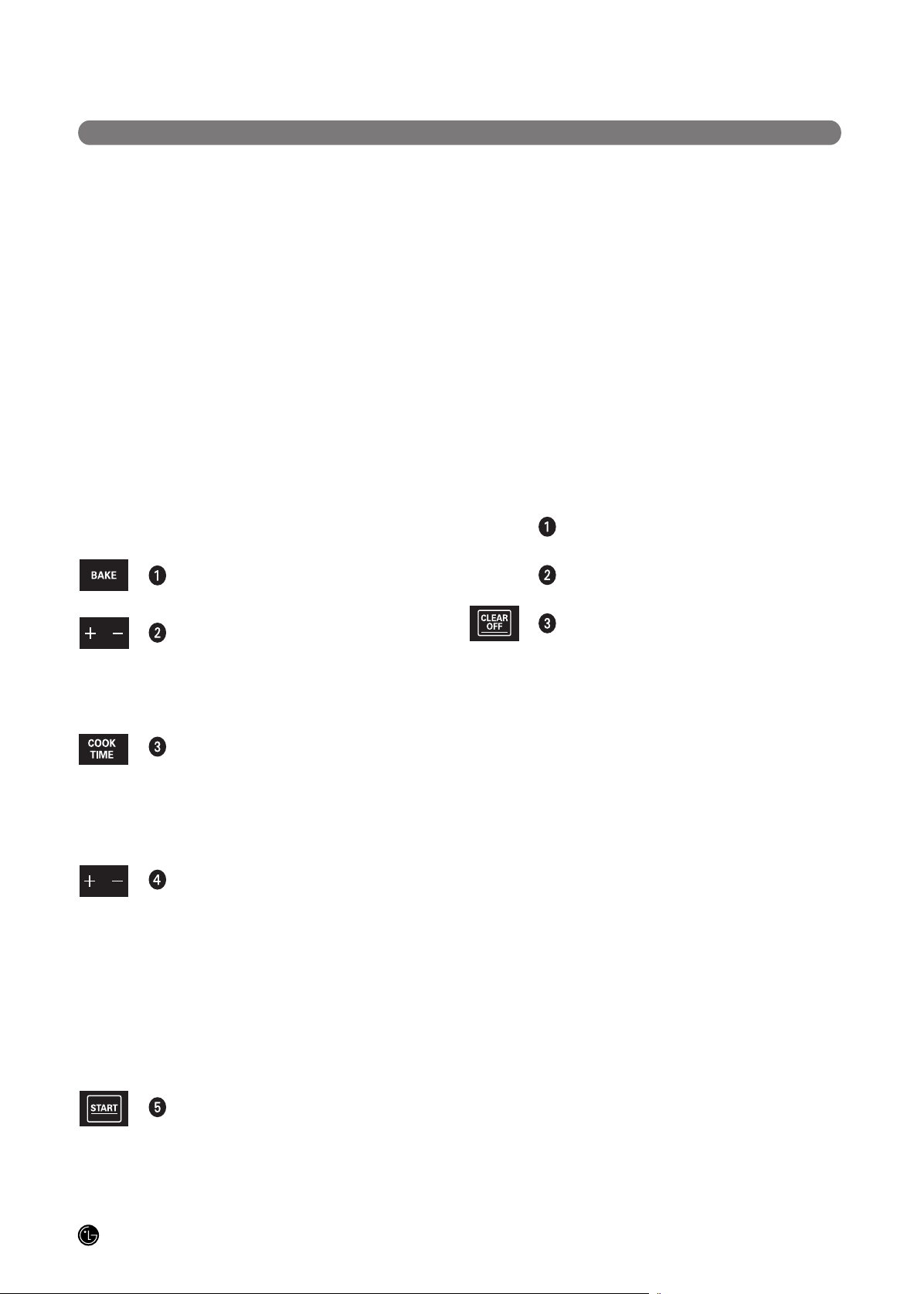
INSTRUCCIONES DE FUNCIONAMIENTO
USO DE LAS FUNCIONES DE HORNEADO Y POR
TEMPORIZADOR
NOTA: Es posible que los alimentos perecederos (como la
leche, huevos, pescado, rellenos, aves y cerdo) no puedan
permanecer sin refrigerar más de 1 hora antes o después de
la cocción. La temperatura ambiente propicia la aparición de
bacterias dañinas. Asegúrese de que la luz del horno esté
apagada, ya que el calor generado por el foco puede
acelerar la aparición de bacterias.
NOTA IMPORTANTE:
Coloque la comida en el horno tras el período de
precalentamiento si la receta así lo especifica.
El precalentamiento es muy importante para obtener unos
buenos resultados al hornear tortas, galletas, repostería y
pan. Una vez que el horno haya alcanzado la temperatura
deseada, sonarán 5 avisos largos y la lámpara del horno
parpadeará.
El proceso de precalentamiento tardará de 10 a 15 minutos
aproximadamente.
Al finalizar el horneado por temporizador:
Se mostrará en pantalla el mensaje End. El
horno se apagará automáticamente.
El control continuará emitiendo tres avisos
por minuto hasta que pulse CLEAR OFF.
Presionar el botón de CLEAR OFF para
borrar la pantalla. Remover la comida del
horno. Recuerde, aunque el horno se apaga
automáticamente, los alimentos que quedan
en el horno continuará cociéndose después
de que el horno se apague.
CÓMO AJUSTAR UN INICIO INMEDIATO Y
UNA PARADA AUTOMÁTICA
El horno se prendera inmediatamente y cocinara durante el
periodo de tiempo escogido. Al final del periodo de cocción,
el horno se apagara automáticamente.
Asegúrese de que el reloj esta puesto en hora.
Presione el botón BAKE. Aparecerá en la
pantalla 350 y parpadeará el indicador BAKE.
Presione o mantenga presionado los botones
+ o –, y escoja la temperatura del horno.
• Pulse el botón + para aumentar la
temperatura.
• Pulse el botón – para reducir la temperatura.
Presione el botón COOK TIME.
• TIMED parpadea.
• 0:00 se ilumina en la pantalla.
NOTA: Si su receta precisa precalentamiento,
podría necesitar añadir tiempo adicional al
cocinado.
Pulse el botón + o – para introducir el tiempo
de horneado deseado. Mientras TIMED aún
parpadea:
NOTA:
• El tiempo de horneado puede ajustarse desde
1 minuto hasta 11 horas y 59 minutos.
• Se mostrara en la pantalla el tiempo de
cocinado que se haya introducido. (Si escoge
antes el tiempo de cocción y a continuación
ajusta la temperatura de horneado, en su lugar
se mostrará la temperatura del horno).
Pulse el botón START.
BAKE dejará de parpadear y de iluminarse en
la pantalla. La pantalla muestra o la
temperatura del horno que haya ajustado o la
cuenta atrás del tiempo de horneado.
18
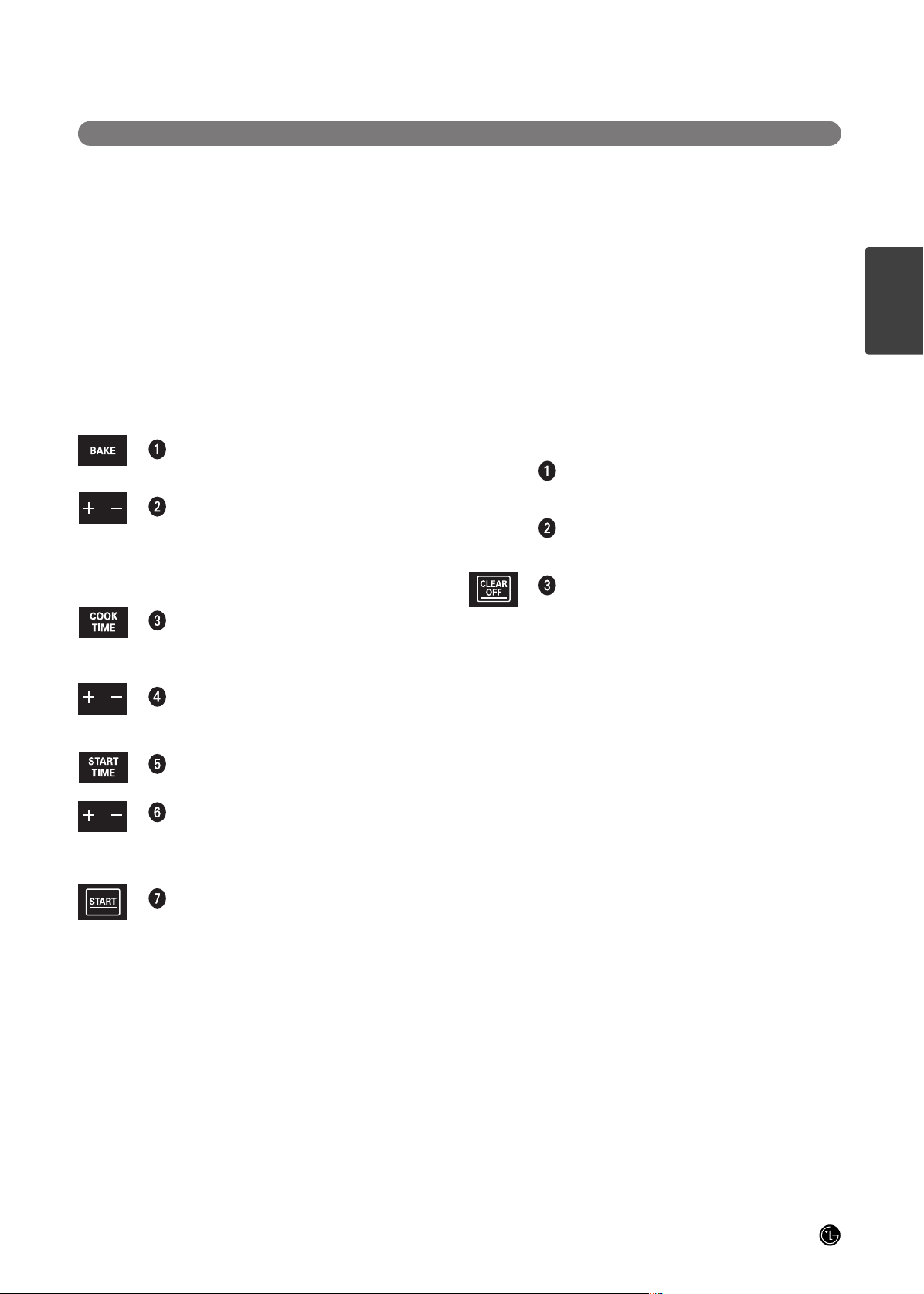
INSTRUCCIONES DE FUNCIONAMIENTO
USO DE LAS FUNCIONES DE HORNEADO Y POR
TEMPORIZADOR
(continuación)
NOTA:
• Pulse CLEAR OFF para cancelar la función de horneado
por temporizador retardado en cualquier momento.
• Si desea chequear los tiempos que ha ajustado, pulse el
botón START TIME para chequear el tiempo de retardo
ajustado o el botón COOK TIME para chequear la cantidad
de tiempo de cocinado ajustada.
Al agotarse el tiempo de horneado ajustado:
Se mostrará en pantalla el mensaje End.El
horno se apagará automáticamente.
La unidad continuará emitiendo tres avisos
por minuto hasta que pulse CLEAR OFF.
Presionar el botón de CLEAR OFF para
borrar la pantalla. Remover la comida del
horno.
Recuerde, aunque el horno se apaga
automáticamente, los alimentos que quedan
en el horno continuará cociéndose después
de que el horno se apague.
CÓMO AJUSTAR UN INICIO RETARDADO Y
UNA PARADA AUTOMÁTICA
El horno se prenderá a la hora establecida, cocinará durante
un período de tiempo específico y, a continuación, se
apagará automáticamente.
Asegúrese de que el reloj está en hora. Coloque la rejilla(s)
y los alimentos en el horno.
Presiona el botón BAKE. Aparecerá en la
pantalla 350° y parpadeara el indicador BAKE
Presiona o mantenga presionado los botones
+ o –, para escoger la temperatura del horno.
• Pulse el botón + para aumentar la
temperatura.
• Pulse el botón – para reducir la temperatura.
Pulse el botón COOK TIME.
• TIMED parpadea.
• 0:00 se ilumina en la pantalla.
Presionar el botón + o – para introducir el
tiempo de cocinado deseado mientras TIME
aun parpadea.
Presionar el botón START TIME.
DELAY estará a parpadear.
Mientras DEALY siga aun parpadea,
presionar el botón + o – para ajustar la hora
del día en que desea que el horno se
encienda y comience a cocinar.
Presione el botón START. Cuando el tiempo
de retardo se ha agotado el horno comenzará
a funcionar .
• Sonarán una vez y se apagará DELAY.
• Cuando el horno se prenda a la hora del día
que haya ajustado, la pantalla mostrará la
temperatura del horno hasta alcanzar la
escogida y, a continuación, se mostrará el
tiempo restante de cocinado.
NOTA: Si desea cambiar el tiempo de
cocción, repita los pasos 5~6 y pulse START.
NOTA: El tiempo de cocinar puede ajustarse para cualquier
cantidad de tiempo comprendida entre 1 minuto y 11 horas y
59 minutos.
19
ESPAÑOL
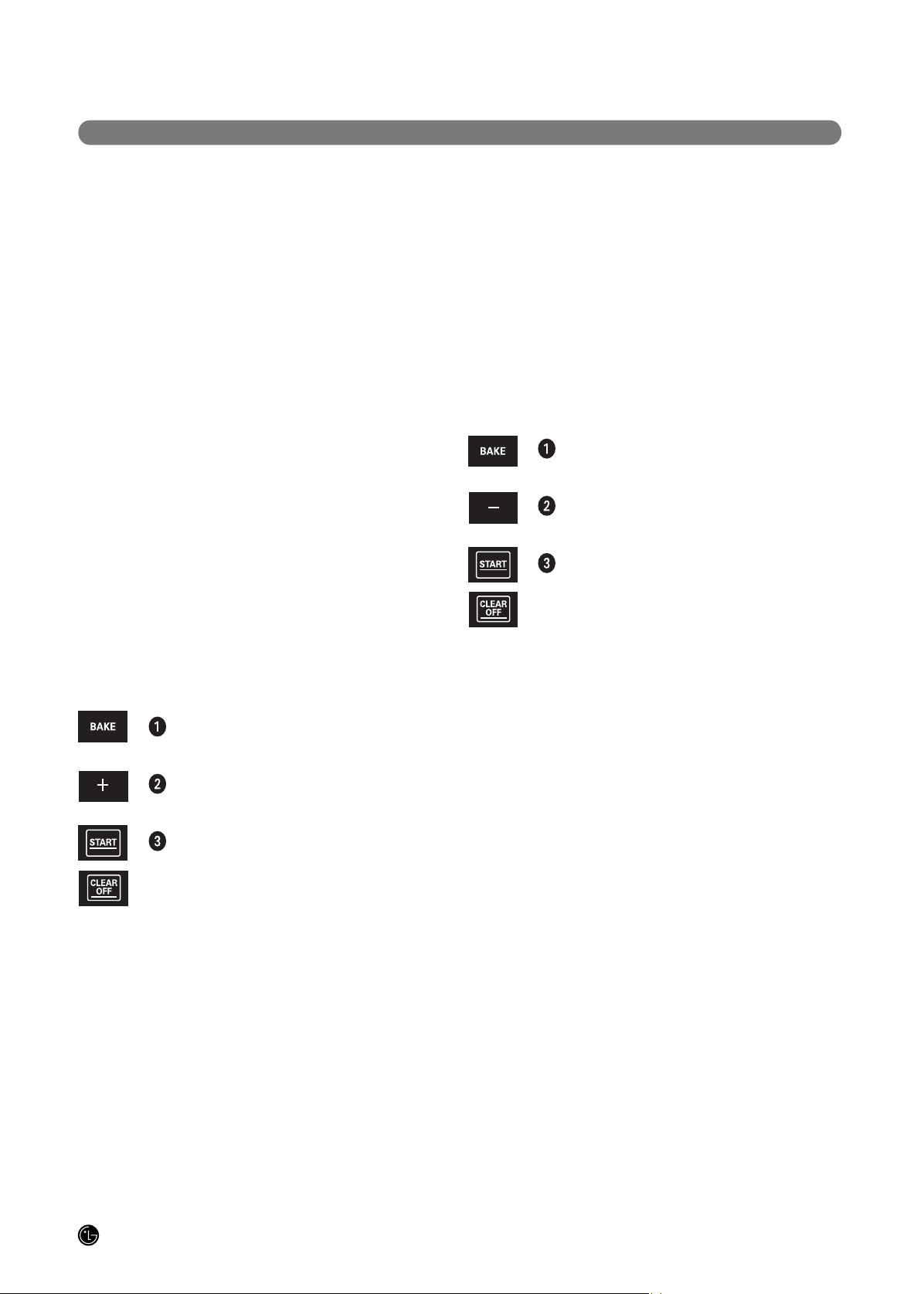
INSTRUCCIONES DE FUNCIONAMIENTO
CÓMO AJUSTAR EL TERMOSTATO DEL
HORNO
Es posible que considere que su nuevo horno estufa de
forma diferente al antiguo. Use su nuevo horno durante
varias semanas para familiarizarse con él. Si aún considera
que su nuevo horno está demasiado caliente o frío, puede
ajustar el termostato.
NO use los termómetros comercializados en supermercados
para chequear el ajuste de temperatura de su horno. Estos
termómetros podrían variar entre 20 y 40 grados.
NOTA: Este ajuste no afectará a las temperaturas de asado
a la parrilla ni de autolimpieza. El ajuste permanecerá en la
memoria tras un corte de suministro eléctrico.
La temperatura del horno puede aumentarse (+) o
reducirse (-) hasta 35˚F ó 19˚C.
Para aumentar la temperatura del horno:
Mantenga pulsado BAKE durante tres
segundos.
Usando el botón +, introduzca la cantidad
deseada para incrementar la temperatura.
Presione el botón START para aceptar el
incremento de temperatura y la pantalla
volverá a mostrar la hora.
Presione el botón CLEAR OFF para rechazar
el cambio si fuese necesario.
Para reducir la temperatura del horno:
Mantenga pulsado BAKE durante tres
segundos.
Usando el botón –, introduzca la cantidad
deseada para reducir la temperatura.
Presiona el botón START para aceptar el
cambio de temperatura y la pantalla volverá a
mostrar la hora.
Presione el botón CLEAR OFF para rechazar
el cambio si fuese necesario.
FUNCIONES ESPECIALES DE CONTROL DE SU HORNO
Su nuevo control dispone de funciones adicionales que
podrá usar si lo desea.
Las siguientes páginas describen estas funciones y cómo
activarlas.
Los modos de funciones especiales sólo pueden
activarse mientras la pantalla muestra la hora.
Permanecen en la memoria de control hasta que se
repitan los pasos.
Cuando la pantalla muestre su elección, pulse el botón
START.
Las funciones especiales permanecerán en la memoria
tras un corte de suministro eléctrico.
20
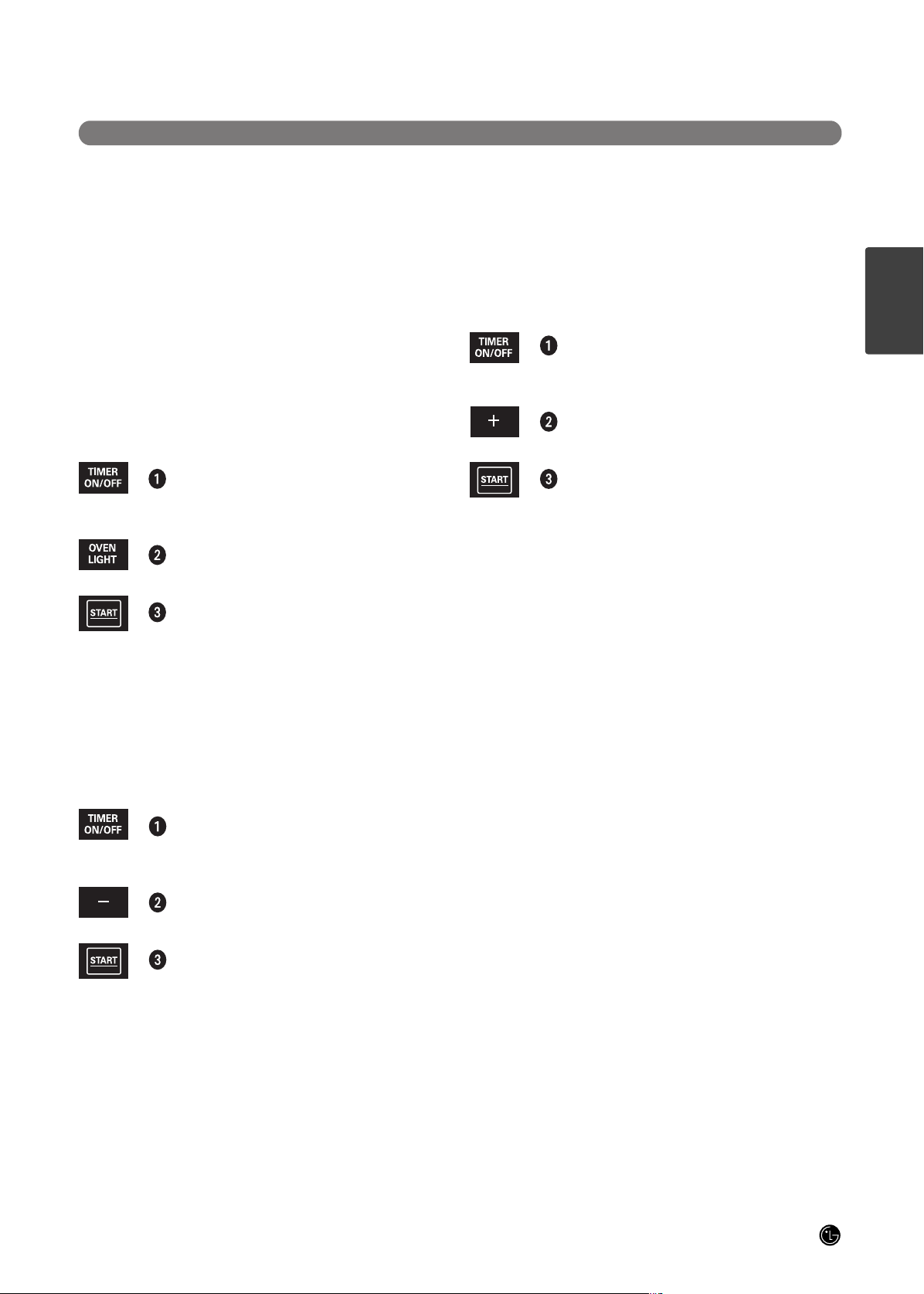
INSTRUCCIONES DE FUNCIONAMIENTO
CÓMO AJUSTAR LA ACTIVACIÓN/
DESACTIVACIÓN DE LA LUZ DE ALARMA DE
PRECALENTAMIENTO
La luz interior del horno se prende automáticamente al abrir
la puerta del mismo.
Al alcanzar la temperatura de ajuste tras el
precalentamiento, el horno notifica el fin del período de
precalentamiento haciendo parpadear la lámpara del horno
hasta que la puerta es abierta.
Puede activar o desactivar la función de luz inteligente del
horno. Se encuentra activada de forma predeterminada.
Mantenga pulsado el botón TIMER ON/OFF
durante tres segundos. La pantalla mostrará
Opt.
Presione el botón OVEN LIGHT para activar
o desactivar la función.
Presione el botón START para aceptar el
cambio.
CÓMO AJUSTAR EL VOLUMEN DE LOS
AVISOS
La función de volumen de los avisos le permitirá ajustar los
avisos a un volumen más aceptable. Existen cuatro niveles
posibles para el volumen: Alto, Medio, Bajo y desconectado.
Mantenga pulsado el botón TIMER ON/OFF
durante tres segundos.
La pantalla mostrará Opt.
Presione el botón – para alternar entre los
diferentes volúmenes de sonido.
Presione el botón START para aceptar el
cambio.
CÓMO ESCOGER LA TEMPERATURA EN
GRADOS FAHRENHEIT O CENTÍGRADOS
El control de su horno esta ajustado para usar temperaturas
en grados Fahrenheit, pero puede cambiarlos para usar en
grados Centígrados.
Mantenga pulsado el botón TIMER ON/OFF
durante tres segundos.
La pantalla mostrará Opt.
Presione el botón + para cambiar entre
grados F y C.
Presione el botón START para aceptar el
cambio.
FUNCIONES ESPECIALES DE CONTROL DE SU HORNO
21
ESPAÑOL
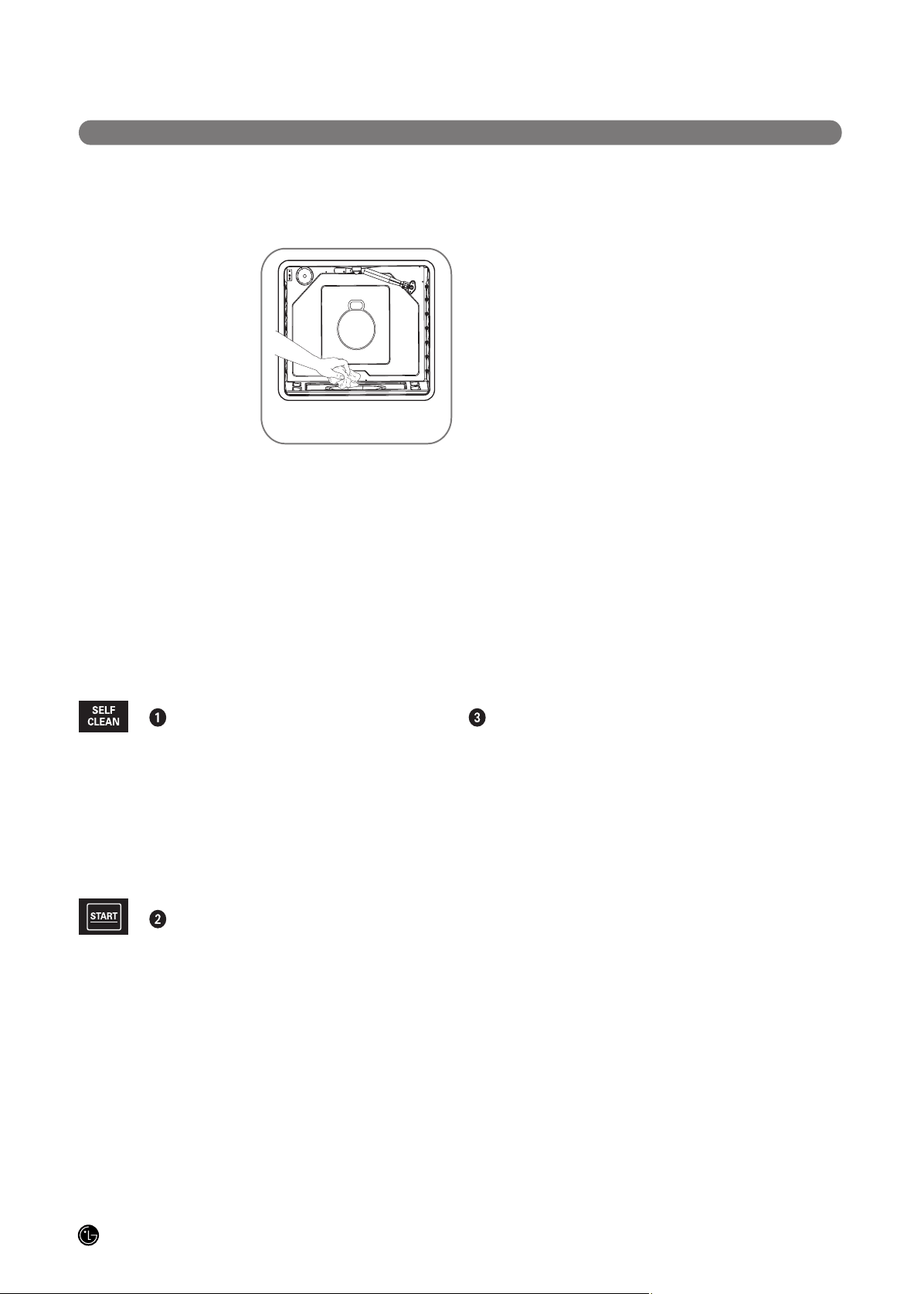
INSTRUCCIONES DE FUNCIONAMIENTO
Toque el mando SELF CLEAN una vez
para realizar el ciclo de 3 horas, dos veces
para el ciclo de 2 horas, o tres veces para
el ciclo de 4 horas.
Se recomienda usar un ciclo de
autolimpieza de 3 horas para realizar una
limpieza pequeña, para eliminar derrames.
Se recomienda usar un ciclo de
AUTOLIMPIEZA de 4 horas para eliminar
hornos excesivamente sucios.
Pulse el botón START.
La puerta se bloquea automáticamente. La pantalla
mostrará el tiempo restante de limpieza. No podrá abrir la
puerta del horno hasta que descienda por debajo de la
temperatura de desbloqueo y se apague la luz DOOR
LOCKED.
El horno se apaga automáticamente al finalizar el ciclo de
limpieza.
Al apagarse la luz DOOR LOCKED, la puerta se
desbloqueará automáticamente.
• El indicador DOOR LOCKED parpadeará y el control del
horno le indicará si ha ajustado el ciclo de limpieza
olvidando cerrar la puerta del horno.
• Para detener el ciclo de limpieza, pulse el botón CLEAR
OFF. Al apagarse la luz DOOR LOCKED, indicativa de
que el horno está por debajo de la temperatura de
bloqueo, abra la puerta.
CÓMO AJUSTAR EL HORNO PARA REALIZAR LA LIMPIEZA
USO DE LA FUNCIÓN DE AUTOLIMPIEZA DEL HORNO
ANTES DE REALIZAR UN CICLO DE LIMPIEZA
Cuando realice un ciclo de
autolimpieza, se
recomienda abrir la ventana
de la cocina o bien usar un
ventilador o la campana
extractora.
Extraiga del horno las
rejillas, plancha de la
parrilla, la parrilla, todos los
utensilios de estufa,
termómetros y papel de
aluminio: no podrán resistir las elevadas temperaturas del
ciclo de limpieza.
IMPORTANTE: La salud de algunos pájaros es
extremadamente sensible a los humos generados
durante el proceso de autolimpieza de algunos hornos.
Traslade los pájaros a una estancia bien ventilada.
NOTAS:
• La suciedad del marco frontal del horno y del exterior de
la junta de la puerta debe limpiarse a mano. Limpie
estas zonas con agua caliente, estropajos jabonosos o
limpiadores como Soft Scrub*. Enjuague bien con agua
limpia y seque.
• NO limpie la junta de la puerta. La fibra de vidrio de la
junta de la puerta del horno no es resistente a la
abrasión. Es imprescindible que la junta permanezca
intacta. Si advierte que está desgastada o
deshilachada, reemplácela.
• Limpie cualquier derrame grande de la base del horno.
• Asegúrese de que la cubierta del foco de la luz del
horno esté en su lugar y de que la luz del horno esté
apagada.
• Preste atención al abrir el horno cuando el ciclo de
autolimpieza haya terminado. El horno podría continuar
caliente.
Limpie fuerte las manchas
en la parte inferior de la cavidad
22
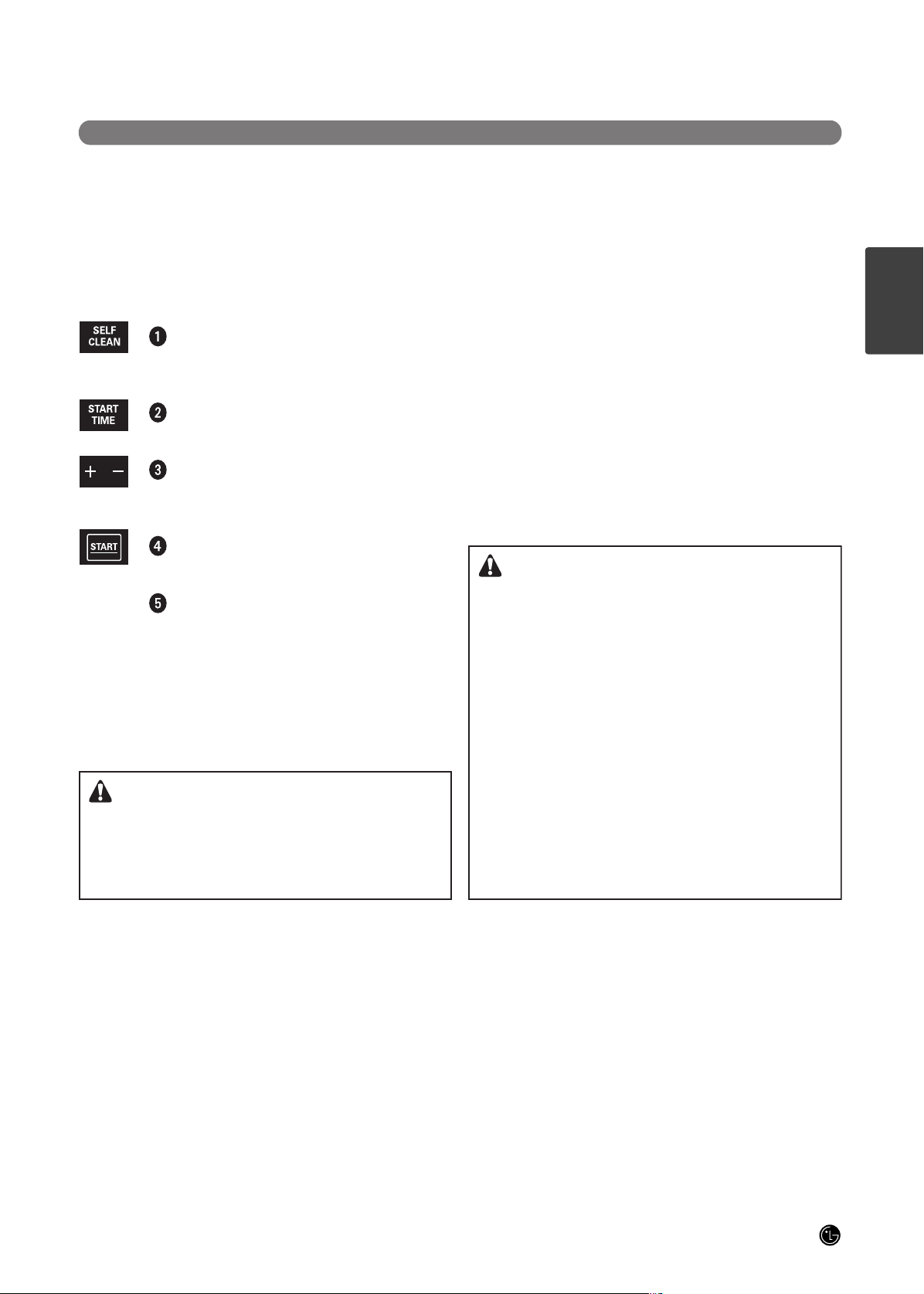
INSTRUCCIONES DE FUNCIONAMIENTO
USO DE LA FUNCIÓN DE AUTOLIMPIEZA DEL HORNO
El horno se apaga automáticamente al finalizar el ciclo de
limpieza.
• Al apagarse la luz DOOR LOCKED, la puerta se
desbloqueará automáticamente.
• El indicador DOOR LOCKED parpadeará y el control del
horno le indicará si ha ajustado el ciclo de limpieza
olvidando cerrar la puerta del horno.
• Para detener el ciclo de limpieza, pulse el botón CLEAR
OFF. Al apagarse la luz DOOR LOCKED, indicativa de que
el horno está por debajo de la temperatura de bloqueo,
abra la puerta.
CÓMO RETARDAR EL INICIO DE LA LIMPIEZA
Asegúrese de que el reloj está en hora.
Presionar el botón SELF CLEAN. Escoja el
periodo de autolimpieza deseado
presionando el botón SELF CLEAN.
Presione el botón START TIME.
DELAY empezara a parpadear.
Presione el botón + o – para introducir el
tiempo de inicio. Mientras DELAY aun
parpadea.
Presione el Botón START.
DELAY y CLEAN permanecerán activados.
El ciclo de autolimpieza se pondrá en marcha
automáticamente en el período ajustado.
La puerta se bloquea automáticamente.
La pantalla mostrará la hora de inicio. El ciclo de
autolimpieza se pondrá en marcha automáticamente a la
hora ajustada. A esa hora, el icono "DELAY" se apagará.
No podrá abrir la puerta del horno hasta que la temperatura
descienda por debajo del nivel de bloqueo.
TRAS REALIZAR UN CICLO DE LIMPIEZA
• Podría encontrar ceniza blanca en el horno. Límpiela con
un paño húmedo cuando el horno se enfríe.
• Si las manchas blancas permanecen, elimínelas con un
estropajo jabonoso y enjuague por completo con una
mezcla de agua y vinagre.
• Estos depósitos son, habitualmente, residuos de sal que
no pueden eliminarse mediante el ciclo de limpieza.
• Si el horno no está limpio tras un ciclo de limpieza, repítalo.
• No podrá cocinar con el horno hasta que se haya enfriado
lo suficiente como para que la puerta se desbloquee.
• Durante el ciclo de autolimpieza del horno, podrá pulsar el
botón CLOCK para examinar la hora. Para volver a la
cuenta atrás del ciclo de limpieza, pulse el botón COOK
TIME.
• Si las bandejas se volvieran difíciles de deslizar, aplique un
poco de aceite vegetal o aceite de estufa en un papel de
estufa y frote los bordes de las bandejas del horno con él.
La puerta del horno debe cerrarse y todos los controles ajustarse correctamente para que el ciclo se realice de forma
correcta.
ADVERTENCIA:
Durante el ciclo de autolimpieza, el exterior del
electrodoméstico puede alcanzar altas temperaturas al
tacto. NO deje a niños pequeños sin supervisión cerca del
electrodoméstico.
PRECAUCIÓN:
• NO recubra las paredes, las rejillas ni la base del horno,
ni ninguna otra parte de la estufa de gas con papel de
aluminio.
Hacerlo afectará la distribución del calor, produciendo
resultados deficientes en el proceso de cocción y
provocando daños permanentes en el interior del horno
(el papel de aluminio se derretirá en la superficie interior
del horno).
• Preste atención al abrir la puerta cuando el ciclo de
autolimpieza haya terminado. El horno podría continuar
A MUCHA TEMPERATURA.
• La salud de algunos pájaros es extremadamente
sensible a los humos generados durante el proceso de
autolimpieza de algunos hornos. Traslade los pájaros a
una estancia bien ventilada.
23
ESPAÑOL
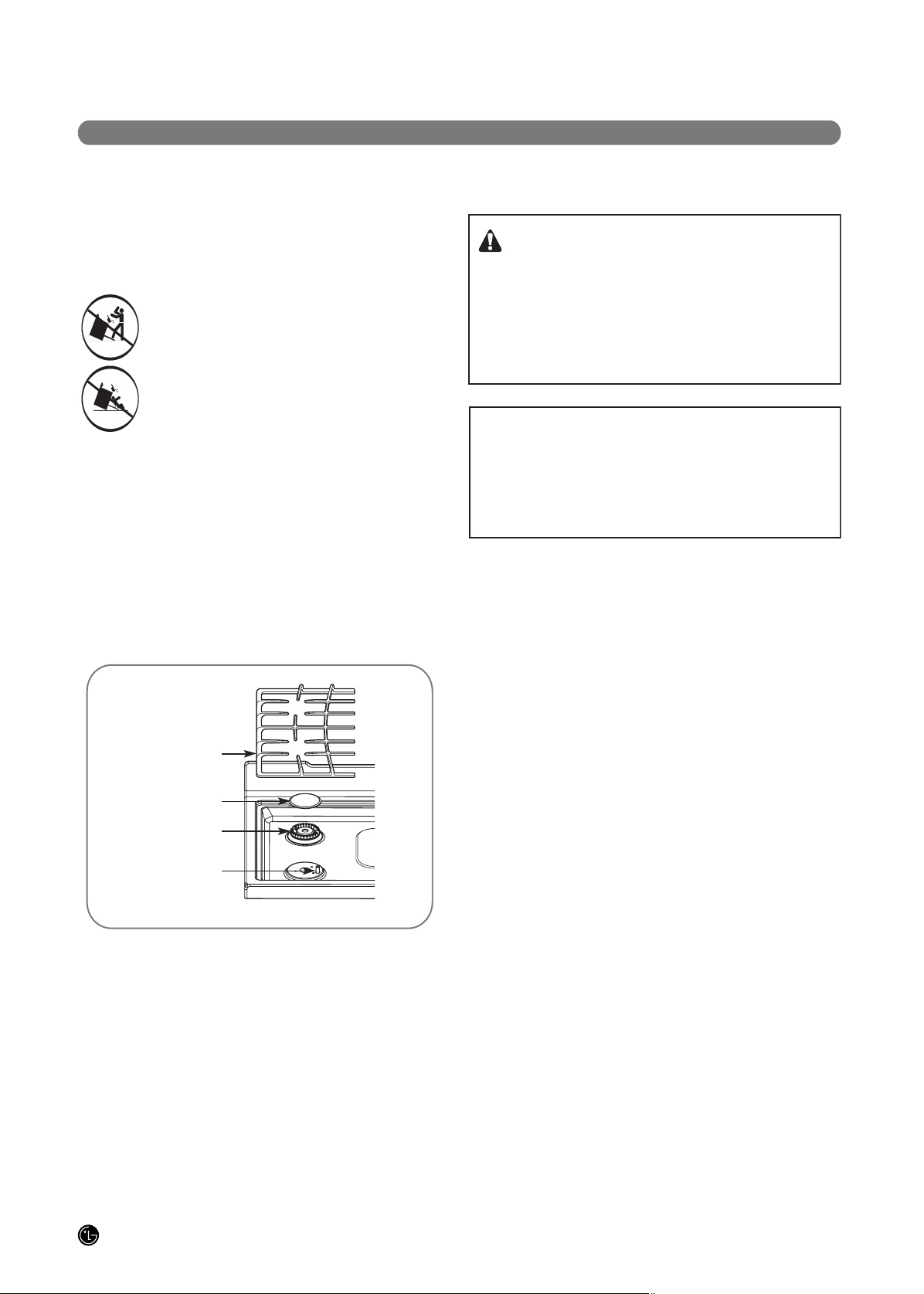
CUIDADO Y LIMPIEZA
CUIDADO Y LIMPIEZA
Asegúrese de que el suministro eléctrico esté
desconectado y de que todas las superficies estén
frías antes de proceder a la limpieza de cualquier
parte de la estufa de gas.
Si retira la estufa de gas para llevar a cabo
labores de limpieza, de servicio o por
cualquier otro motivo, asegúrese de volver a
instalar correctamente el dispositivo antivuelco
al volver a colocar la estufa en su sitio.
No hacerlo podría hacer que la estufa volcase
provocando lesiones.
El electrodo del generador de chispas queda expuesto al
desmontar la cabeza del quemador. Al girar el mando de
uno de los quemadores hasta la posición LITE, se
activarán las chispas de todos los quemadores. No
intente desmontar ni limpiar los alrededores de ningún
quemador mientras otro permanezca prendido.
Apague todos los mandos de control antes de desmontar
las piezas del quemador. Las rejillas, tapas y las cabezas
del quemador pueden desmontarse, haciendo más fácil
su limpieza. Los electrodos no son desmontables.
MONTAJE DE LOS QUEMADORES SELLADOS
PRECAUCIÓN:
• NO desmonte ninguna pieza de la estufa hasta que se
haya enfriado por completo y su manipulación sea
segura.
• NO ponga en funcionamiento los quemadores sin que
todas las piezas de los quemadores y las rejillas estén
en colocadas en su sitio.
Rejilla
Tapa del quemador
Electrodo
Cabeza del quemador
Estufa
24
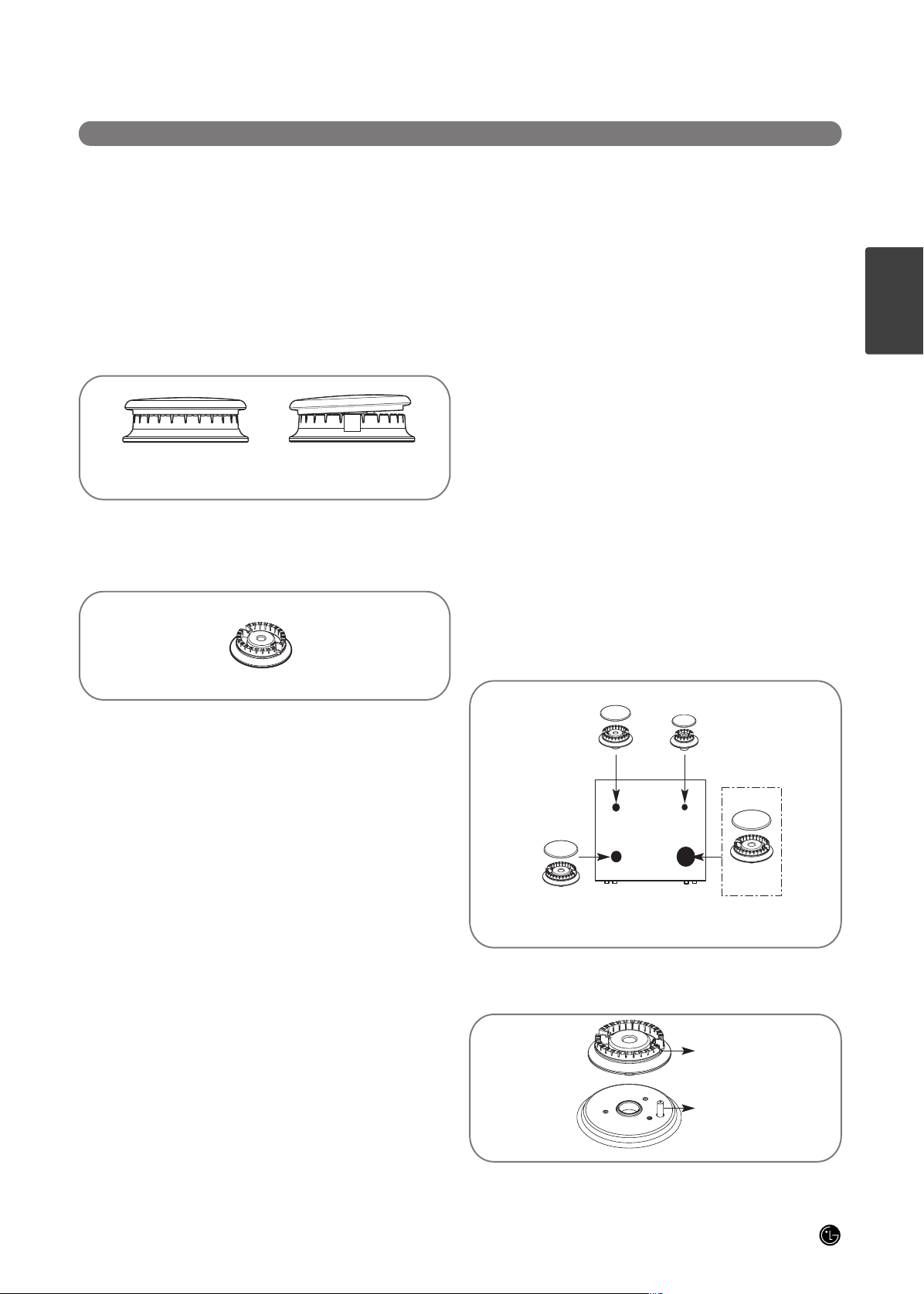
CUIDADO Y LIMPIEZA
TAPAS Y CABEZAS DE LOS QUEMADORES
TAPAS DE LOS QUEMADORES
Desmonte cuando estén fríos. Lave las tapas de los
quemadores en agua caliente y jabonosa y enjuague con
agua limpia. Puede restregar con un estropajo de plástico
para eliminar las partículas de comida quemadas.
TRAS LA LIMPIEZA
Antes de colocar las tapas y cabezas de los quemadores
en su sitio, sacuda el exceso de agua y séquelos por
completo.
MONTAJE
Vuelva a montar las cabezas y tapas de los quemadores
sobre los electrodos de la estufa en su posición correcta,
según su tamaño.
Tapa del quemador sellada
correctamente.
Tapa del quemador sellada
INCORRECTAMENTE.
ENSAMBLE DE LA CABEZA/TAPA DE LOS
QUEMADORES
El conjunto de los cabezales de quemadores es
desmontable.
Sencillamente desmóntelos extrayéndolos de la estufa de
gas para proceder a su limpieza. Los orificios situados en
las cabezas de los quemadores deben mantenerse
limpios en todo momento para obtener una llama
uniforme y libre de obstáculos. Unas tomas o electrodos
obstruidos o sucios no permitirán que los quemadores
funcionen correctamente. Cualquier derrame sobre o
alrededor de un electrodo debe limpiarse
cuidadosamente. Tenga cuidado de no golpear el
electrodo con ningún objeto duro o podría resultar
dañado.
Deberá limpiar las tapas y cabezas de los quemadores
de forma habitual, especialmente tras derrames
importantes que puedan obstruir las aperturas. Desmonte
cuando estén fríos.
Para eliminar los restos de comida quemados, sumerja
las cabezas de los quemadores en una solución de
detergente líquido suave y agua caliente durante 20 ó 30
minutos.
Para manchas resistentes, use un cepillo de dientes.
NOTAS:
• NO use estropajos metálicos o polvos abrasivos para
limpiar los quemadores.
• Los quemadores no se prenderán si la tapa está
desmontada.
• NO use blanqueador sobre el producto para limpiarlo.
Asegúrese de colocar el hueco de la cabeza del
quemador sobre el electrodo.
Hueco
Cabeza y tapa del
quemador mediano
Cabeza y tapa del
quemador grande
Cabeza y tapa
del quemador
pequeño
Cabeza y tapa del
quemador extra-grande
Electrodo
25
ESPAÑOL
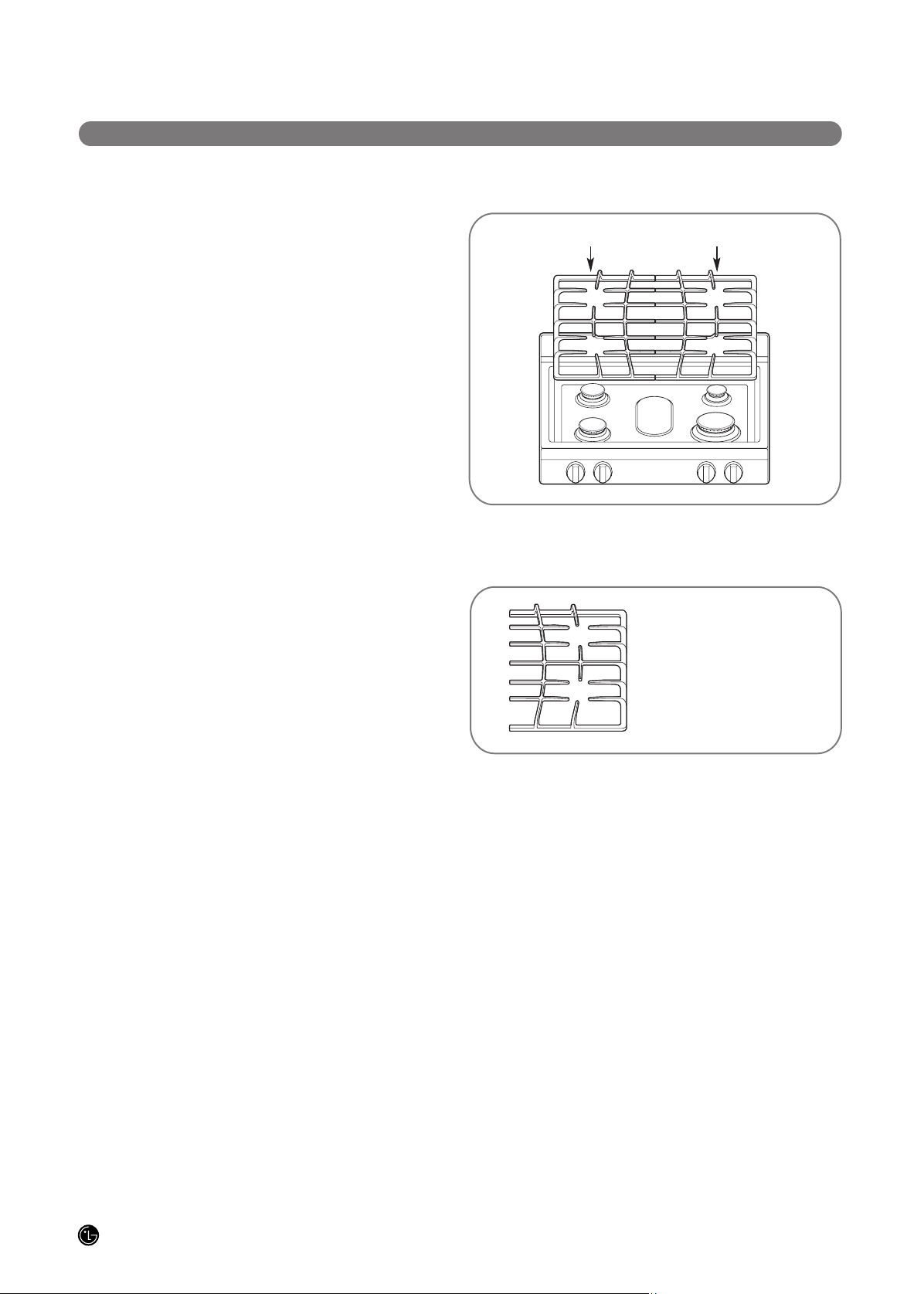
CUIDADO Y LIMPIEZA
REJILLAS
Su estufa de gas dispone de cuatro rejillas profesionales.
Para lograr la máxima estabilidad, estas rejillas deberán
usarse sólo en su posición correcta; las dos rejillas
pueden intercambiarse del lateral izquierdo al derecho
y de la parte frontal a la posterior.
NO prenda el quemador durante largos períodos de
tiempo sin colocar una olla o sartén sobre la rejilla. El
acabado de la rejilla podría descascarillarse sin ninguna
olla o sartén que absorba el calor.
Aunque son duraderas, las rejillas perderán
gradualmente su brillo aunque les aplique los mejores
cuidados.
SUPERFICIE DE LA ESTUFA
Para evitar daños en la superficie de esmalte de
porcelana de la estufa y prevenir la pérdida de brillo,
limpie los derrames que se produzcan rápidamente. Los
alimentos con alto índice de acidez (tomates, col
fermentada, zumos de fruta, etc.) o con un alto contenido
en azúcar pueden producir pérdidas de brillo puntuales si
no se eliminan los residuos. Cuando la superficie se haya
enfriado, lávela y enjuáguela.
Para eliminar otro tipo de derrames como salpicaduras
de aceite, etc., lave la superficie con agua y jabón
cuando se haya enfriado. Enjuague a continuación y
sáquele brillo con un paño seco.
NOTA: NO levante la placa de la estufa. Levantar la
placa de la estufa puede ocasionar daños o un
funcionamiento incorrecto.
LIMPIEZA
Desmonte cuando estén frías. Las rejillas deben
limpiarse con regularidad y, por su puesto, tras
producirse derrames. Lávelas en agua caliente y
jabonosa y enjuague con agua limpia. Al volver a colocar
las rejillas, asegúrese de que quedan ajustadas de forma
segura sobre los quemadores.
Vuelva a colocar las rejillas de tal forma que los arcos
continuos de los nervios centrales de éstas queden
integrados. Las rejillas se pueden lavar en el lavavajillas.
NOTA: NO limpie las rejillas usando la función de
autolimpieza de un horno.
El aspecto puede variar.
Las rejillas se pueden lavar en el
lavavajillas.
Rejilla lateral Rejilla lateral
26
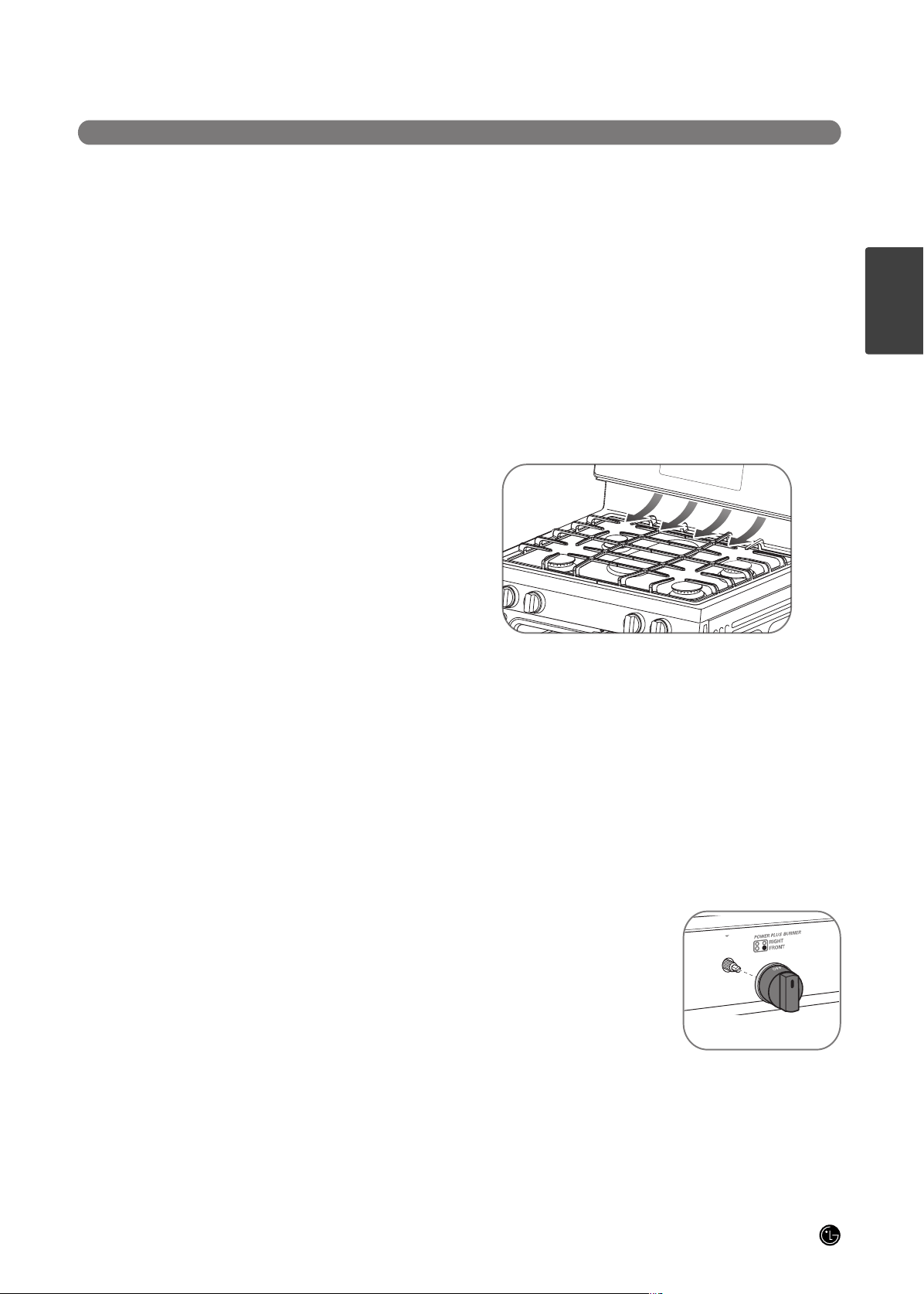
CUIDADO Y LIMPIEZA
SUPERFICIES DE ACERO INOXIDABLE
NO use estropajos metálicos: arañarán la superficie.
Para limpiar superficies de acero inoxidable, use agua
j
abonosa caliente o un limpiador o abrillantador para
acero inoxidable. Limpie siempre la superficie en la
dirección de la textura. Sigua las instrucciones del
limpiador para llevar a cabo la limpieza de la superficie
de acero inoxidable.
Para resolver dudas relativas a la compra de limpiadores
o abrillantadores para electrodomésticos de acero
inoxidable o para encontrar un distribuidor cercano,
póngase en contacto con nuestro número gratuito de
atención al cliente:
1-800-243-0000
o visite nuestra web:
us.lgservice.com
CONDUCTOS DE VENTILACIÓN DE AIRE DEL HORNO
NO bloquee nunca los orificios de ventilación (aberturas
de aire) de la estufa de gas.
Proporcionan la entrada y salida de aire necesarias para
que la estufa de gas funcione con una combustión
adecuada.
Las aberturas de aire están situadas en la parte posterior
de la estufa, en la parte superior y en la base de la puerta
del horno y en la base de la estufa de gas, bajo la gaveta
de calentamiento.
PANEL DE CONTROL
Limpie las salpicaduras con un paño húmedo.
También puede usar un limpiacristales.
Elimine la suciedad incrustada con agua caliente
j
abonosa.
No use abrasivos de ningún tipo.
NOTA: Para evitar activar el panel de control durante las
labores de limpieza, desenchufe la estufa de gas.
PANEL FRONTAL Y MANDOS MÚLTIPLES
Se recomienda limpiar el panel de control cada vez que
use el horno. Use un paño húmedo para limpiar y
enjuagar. Para limpiar, use un detergente suave y agua
en una solución 50/50 de vinagre y agua.Para enjuagar,
use agua limpia. Seque y dé brillo un paño suave.
NO use limpiadores abrasivos, limpiadores líquidos
fuertes, estropajos de plástico ni limpiadores para hornos
sobre el panel de control; podría dañar su acabado.
NO intente doblar los mandos tirando de ellos hacia
arriba o hacia abajo, ni colgando una toalla ni ningún otro
objeto pesado de ellos.
Hacerlo puede dañar el eje de la válvula de gas.
Los mandos de control pueden
desmontarse para facilitar la
limpieza.
Asegúrese de que los mandos
están en posición OFF y tire de
ellos en línea recta para
separarlos de su espiga y llevar
a cabo la limpieza.
Para volver a instalar los mandos, asegúrese de que su
posición OFF quede centrada en la parte superior y
deslice el mando dentro de su espiga.
Mando del quemador
27
ESPAÑOL
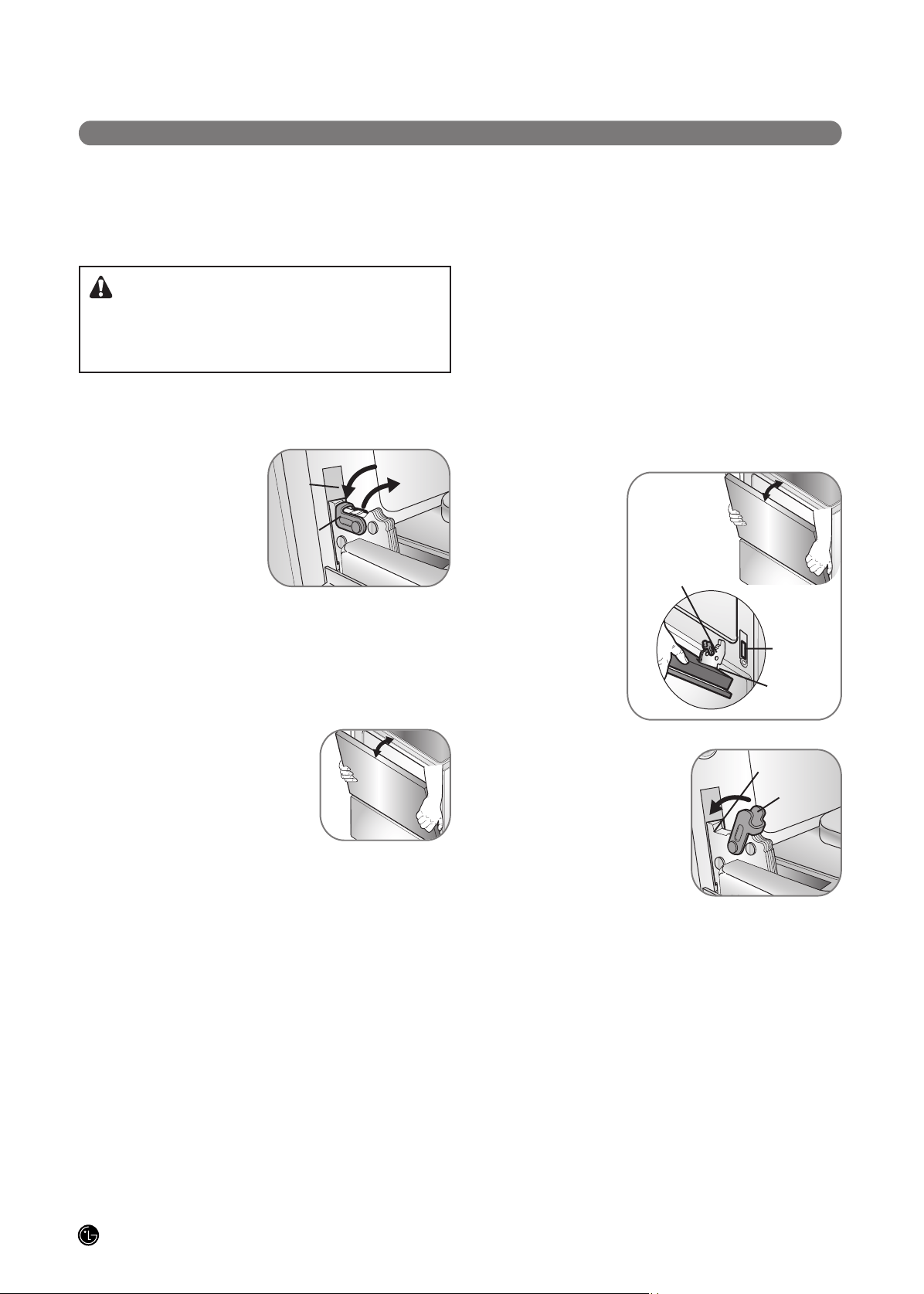
CUIDADO Y LIMPIEZA
5° aprox.
PUERTA DEL HORNO
PARA DESMONTAR LA PUERTA
Paso. 1
Abra la puerta por completo.
Paso. 2
Empuje los cierres de las
bisagras hacia abajo, en la
dirección del marco de la
puerta, en la posición de
desbloqueo.
Paso. 3
Sujete firmemente ambos lados de la puerta en la parte
superior.
Paso. 4
Cierre la puerta hasta la posición de
desmontaje de la puerta, a unos 5
grados aproximadamente.
Paso. 5
Levante la puerta hacia arriba y hacia fuera hasta que el
brazo de la bisagra quede liberado de la ranura.
Paso. 1
Sujete firmemente ambos lados de la puerta en la parte
superior.
Paso. 2
Con la puerta dispuesta en el mismo ángulo que en la
posición de desmontaje, asiente la indentación del brazo
de la bisagra dentro del borde de la base de la ranura de
la bisagra. La muesca en el brazo de la bisagra debe
estar asentada por completo dentro de la base de la
ranura.
Paso. 3
Abra la puerta por
completo. Si la puerta
no abre por completo, la
indentación no está
asentada correctamente
en la base del borde de
la ranura.
Paso. 4
Empuje los cierres de
las bisagras contra el
marco frontal de la cavidad del
horno, en su posición de bloqueo.
Paso. 5
Cierre la puerta del horno.
La puerta del horno es desmontable, pero pesada. Podría
necesitar ayuda para desmontar y montar la puerta.
PARA LIMPIAR EL INTERIOR DE LA PUERTA
• NO permita que se introduzca una cantidad excesiva de
agua dentro de los orificios y las ranuras de la puerta.
• Como la zona interior de la junta frontal de la cavidad se
limpia durante el ciclo de autolimpieza, no es necesario
limpiarla a mano.
• La zona exterior de la junta puede limpiarse con un
estropajo de plástico jabonoso.
PARA LIMPIAR EL EXTERIOR DE LA PUERTA
• Use jabón y agua para limpiar en profundidad la parte
superior, los laterales y el frontal de la puerta del horno.
Enjuagar bien. También podría necesitar un
limpiacristales para limpiar el exterior del cristal de la
puerta.
• Los derrames de marinados, zumos de fruta, salsas de
tomate y jugos para asados contienen ácidos que
podrían producir decoloración, por lo que deben
eliminarse de inmediato. Cuando la superficie se haya
enfriado, límpiela y enjuáguela.
• NO use limpiadores para horno, polvos limpiadores o
abrasivos fuertes en el exterior de la puerta.
PARA MONTAR LA PUERTA
Ranura
Cierre
de la
bisagra
Bloqueo
Desbloqueo
5° aprox.
Brazo de la
bisagra
Cierre de la
bisagra
PRECAUCIÓN:
• Tenga cuidado al desmontar y levantar la puerta.
• NO levante la puerta usando el tirador.
- La puerta es muy pesada.
Brazo de la bisagra
Indentation
Bottom
edge of
slot
28
CUIDADO Y LIMPIEZA
BASE DEL HORNO
La base del horno tiene un acabado de esmalte de
porcelana.
Para facilitar la limpieza, proteja la base del horno de
derrames excesivos colocando una bandeja para hornear
galletas en la bandeja situada bajo la que está usando
para cocinar.
Esto es particularmente importante al hornear tortas de
fruta u otros alimentos con altos contenidos de acidez.
Los rellenos de fruta caliente u otros alimentos con alto
contenido de acidez (como tomates, coles fermentadas y
salsas con vinagre o zumo de limón) podrían corroer y
dañar la superficie de porcelana esmaltada, por lo que
deben eliminarse de inmediato.
NO use papel de aluminio en la base de la estufa del
horno.
Hacerlo podría dañar la cavidad del horno.
También puede bloquear el flujo de aire de quemador
provocando una distribución deficiente del calor.
Para limpiar los derrames, use jabón y agua, un limpiador
abrasivo o un estropajo jabonoso.
Enjuague bien para eliminar cualquier resto de jabón
antes del ciclo de autolimpieza.
29
ESPAÑOL
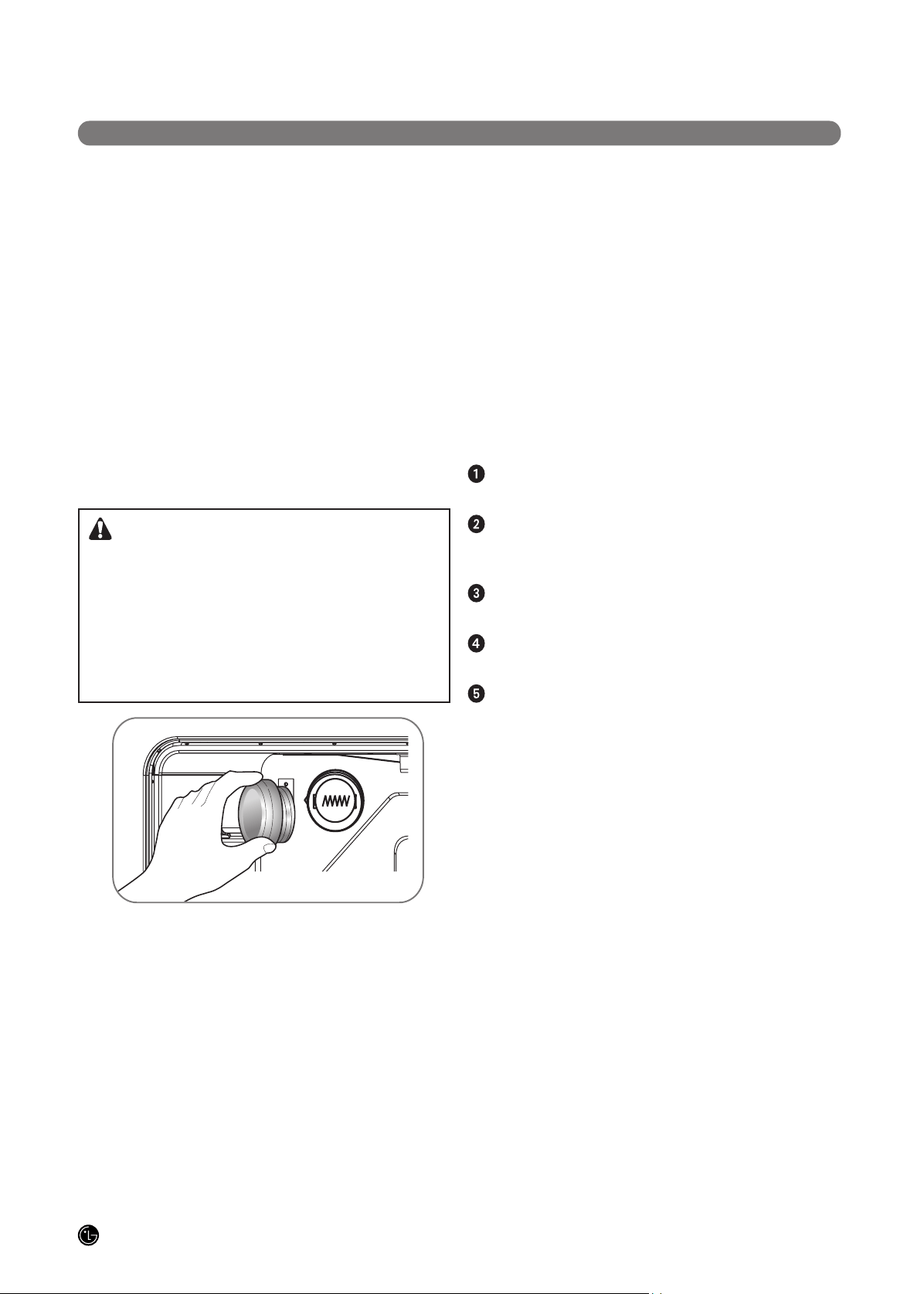
CUIDADO Y LIMPIEZA
BANDEJAS DEL HORNO
Su horno está equipado con bandejas de níquel, retírelas
del horno antes de que comience el ciclo de
autolimpieza.
Para limpiar las bandejas de níquel, use un limpiador
abrasivo.
Tras la limpieza, enjuague las bandejas con agua limpia y
séquelas con un paño limpio.
Siempre que las bandejas se vuelvan difíciles de deslizar,
limpie sus bordes o sus soporte en el horno con aceite
vegetal.
La luz del horno es un foco estándar de 40 vatios.
Esta se prende al abrir la puerta del horno.
Al cerrar la puerta del horno, pulse el botón OVEN LIGHT
para PRENDERLA o APAGARLA.
Ésta no funciona durante el ciclo de autolimpieza.
REEMPLAZO DE LA LUZ DEL HORNO
ADVERTENCIA:
• antes de reemplazar el foco de luz de su horno,
DESCONECTE el suministro eléctrico del mismo
en el panel del fusible principal o del disyuntor.
- No hacerlo puede provocar lesiones físicas graves,
choque eléctricos o incluso la muerte.
• Asegúrese de que el horno y el foco estén
completamente fríos.
PARA REEMPLAZAR
• Asegúrese de que el horno y el foco estén fríos.
Desenchufe el horno o desconecte el suministro
eléctrico.
Gire la cubierta de cristal de el foco situado en la parte
posterior del horno en sentido antihorario para
desmontarla.
Gire el foco en sentido antihorario para extraerla de su
soporte.
Vuelva a colocar el foco y su cubierta girándolas en
sentido horario.
Enchufe el horno o vuelva a conectar el suministro
eléctrico.
30
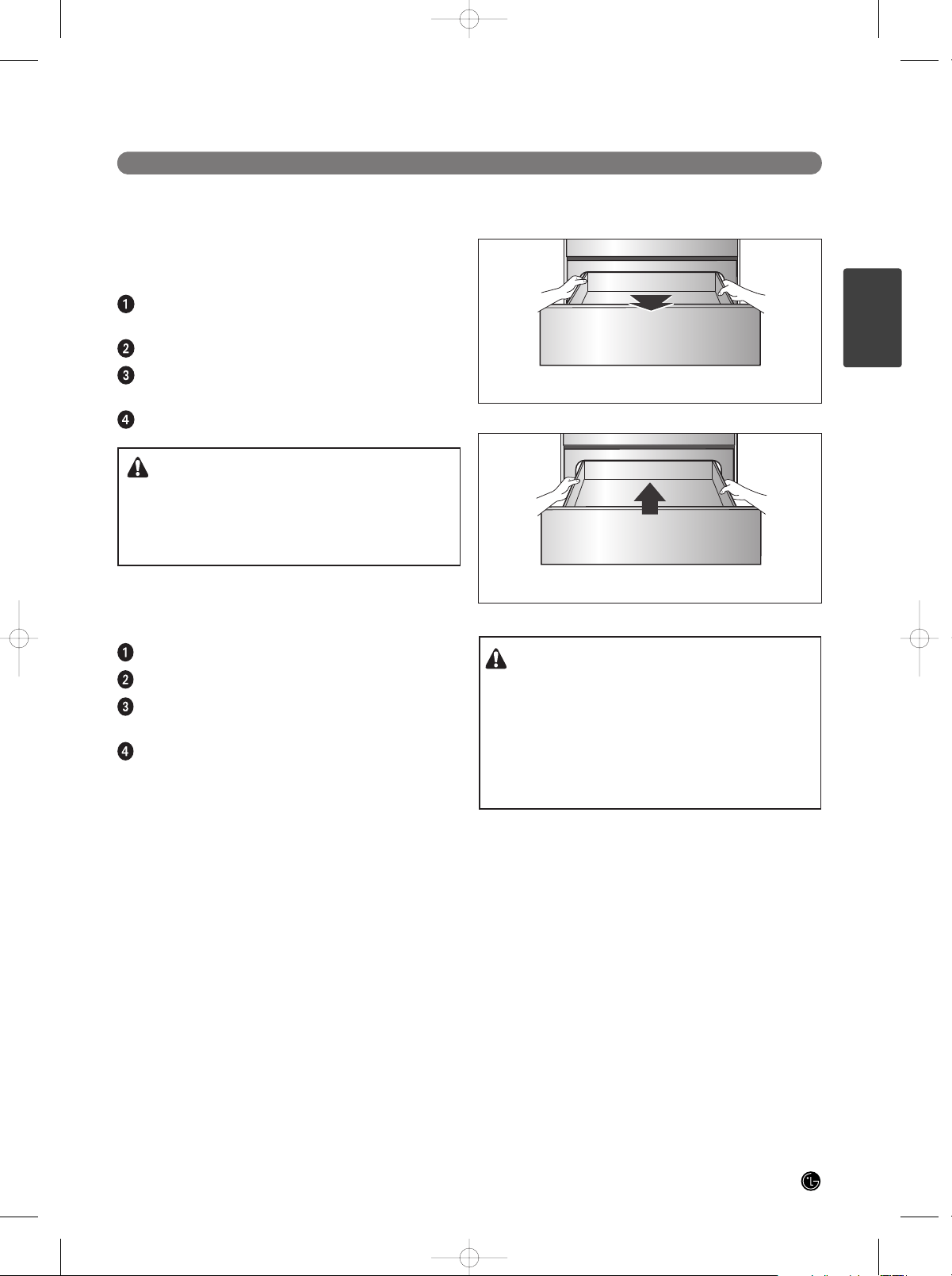
CUIDADO Y LIMPIEZA
Para desmontar la gaveta de
almacenaje:
PRECAUCIÓN - desconecte el suministro antes de
desmontar la gaveta de almacenaje.
Extraiga la gaveta hasta su tope.
Levante el frontal de la gaveta hasta que los topes
liberen las guías.
Retire la gaveta.
Para volver a montar la gaveta de
almacenaje:
Coloque los rieles de la gaveta sobre las guías.
Empuje la gaveta hasta su tope.
Levante el frontal de la gaveta y empújela hasta que
los topes liberen las guías.
Baje el frontal de la gaveta y empújela hasta que
cierre.
DESMONTAJE Y MONTAJE DE LA GAVETA DE ALMACENAJE
Levante el frontal
Tire de la gaveta
• DESCONECTE el suministro de energía antes de
desmontar la gaveta de almacenamiento.
- No hacerlo puede provocar lesiones físicas graves,
choques eléctricos o incluso la muerte.
ADVERTENCIA
• NO toque las superficies del horno entre la
puerta y el cajón.
- Durante y después de su uso, no toque las superficies
interiores del horno entre la puerta y el cajón hasta
que hayan tenido tiempo suficiente para enfriarse.
- De lo contrario, puede resultar en lesiones personales
ADVERTENCIA
graves.
31
ESPAÑOL
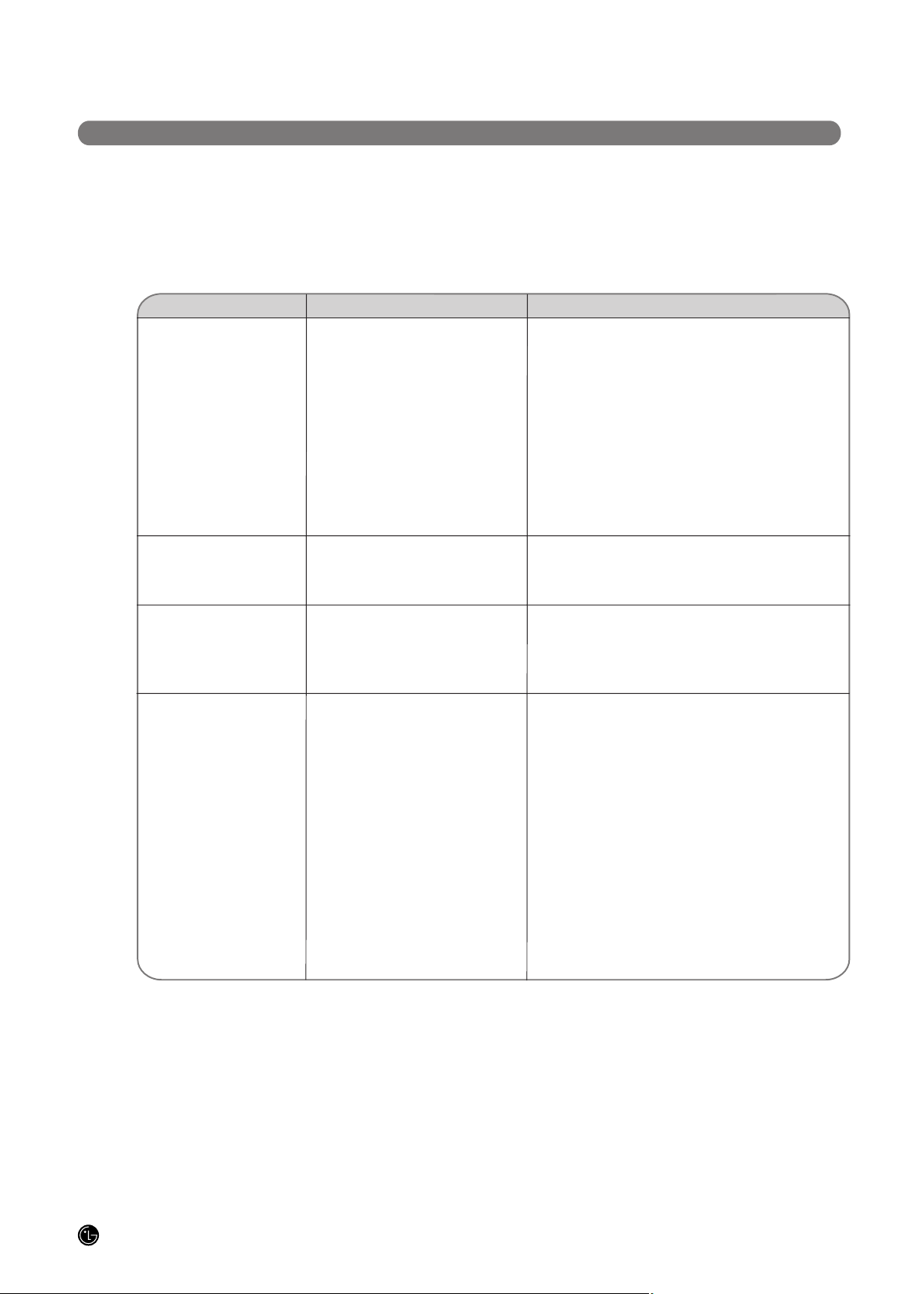
SOLUCIÓN DE PROBLEMAS
ANTES DE SOLICITAR ASISTENCIA TÉCNICA
Antes de llamar solicitando asistencia, repase esta lista. Esto le ahorrará tiempo y dinero. Esta lista contiene problemas comunes
que no son debidas a defectos en la mano de obra o materiales.
encuentre totalmente abierta.
• Asegúrese de que la válvula de cierre de gas del horno se
• Desmonte los quemadores y límpielos. Verifique la zona del
Problema Causas probables Soluciones
Los quemadores no se
prenden o sus llamas no
son uniformes.
Las llamas del quemador
son muy grandes o
amarillas
Los quemadores de la
superficie se prenden,
pero el del horno no
Los alimentos no se
hornean ni se asan
adecuadamente
• El tomacorriente del horno no está
introducido correctamente en la toma de
pared.
• Las ranuras del quemador situadas en
los laterales del mismo podrían estar
obstruidas.
• Montaje incorrecto del quemador.
• Proporción aire/gas incorrecta.
• La válvula de corte de gas del horno
podría haberse movido accidentalmente
durante las labores de limpieza o
desplazamiento.
• Los controles del horno están ajustados
incorrectamente.
• La bandeja está en posición incorrecta.
• Está usando utensilios de estufa
inadecuados o de un tamaño incorrecto.
• El termostato del horno precisa ajuste.
• El reloj no está en hora.
• Papel de aluminio usado incorrectamente
en el horno.
• Asegúrese de que el tomacorriente está conectado
correctamente a una toma de pared que disponga de
suministro eléctrico.
electrodo en busca de restos de alimentos o grasas
quemadas. Examine la sección CUIDADOS Y LIMPIEZA DE
LA ESTUFA DE GAS.
• Asegúrese de que las piezas del quemador estén instaladas
correctamente. Examine la sección CUIDADOS Y LIMPIEZA
DE LA ESTUFA DE GAS.
• Si la estufa de gas está conectada a un suministro de gas LP,
póngase en contacto con la persona que realizó la
instalación o su adaptación.
• Examine la sección USO DEL HORNO.
• Examine la sección USO DEL HORNO.
• Examine la sección USO DEL HORNO.
• Examine la sección CÓMO AJUSTAR EL TERMOSTATO DEL
HORNO.
• Examine la sección USO DEL RELOJ Y EL TEMPORIZADOR.
• Examine la sección CUIDADOS Y LIMPIEZA DE LA ESTUFA
DE GAS.
32
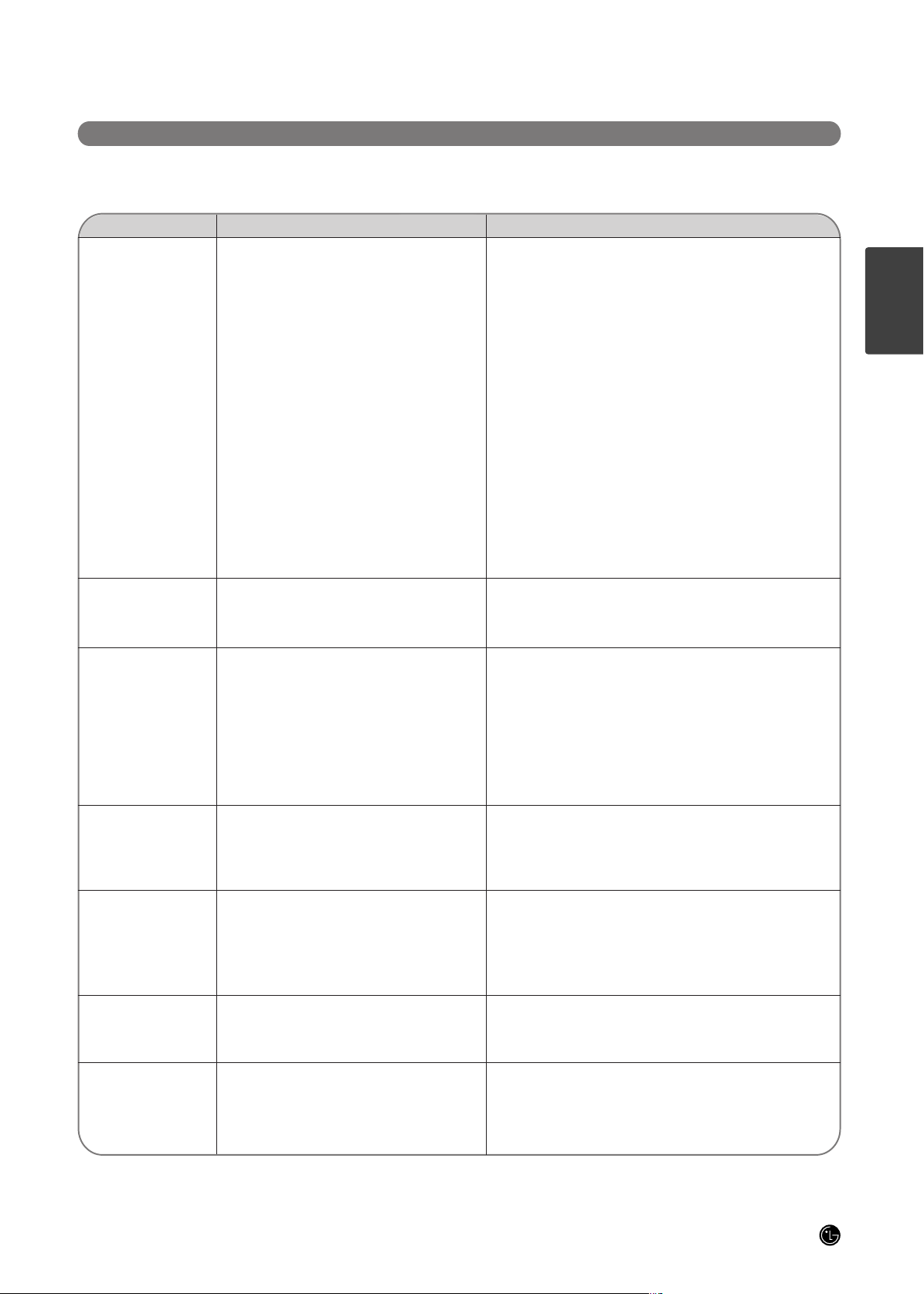
SOLUCIÓN DE PROBLEMAS
ANTES DE SOLICITAR ASISTENCIA TÉCNICA
Problema Causas probables Soluciones
Los alimentos no se
asan al fuego
directo como es se
debido
La temperature del
horno es demasiado
fría o caliente
La pantalla es
blanco o el
contador no
funciona
La luz del horno no
funciona
El ciclo de auto
limpieza del horno
no funciona
Sonido crujiente o
del del estallidos
Humo excesivo
durante un ciclo de
autolimpieza.
• Los controles del horno no están fijados bien.
• La puerta del horno no está cerrada.
• Se está usando la parrilla en una posición
incorrecta.
• Los alimentos se están cocinando en una
cazuela caliente.
• El papel de aluminio que se usó para cubrir la
rejilla de la bandeja del asador no se colocó
correctamente ni tampoco se hicieron las
ranuras según se recomienda.
• Los utensilios de cocina no son adecuados
para asar a la parrilla.
• El termostato necesita ajustes.
• El enchufe eléctrico no esté conectado
completemente en una toma de corriente.
• El interruptor automático del circuito de su
casa está trabado o se fundió un fusible.
• Los controles del horno no están
programados de manera correcta.
• La bombilla puede estar floja o fundida.
• El enchufe eléctrico no esté conectado
completemente en una toma de corriente.
• La temperatura del horno está muy alta para
programar la función de auto limpieza.
• Los controles del horno no se fijaron
adecuadamente.
• Este es el sonido del metal que se enfría y se
calienta tanto durante la cocción como
durante la limpieza.
• Quedó suciedad excesivo en el horno.
• Cerciórese que presione el botón BROIL HI/LO.
• Examine la sección USO DEL HORNO.
• See the GUÍA DE ASADO A LA PARRILLA.
• Use la bandeja para asar y rejilla que vinieron con su estufa.
Verifique que esté fría.
• Use the broiling pan and grid that came with your range.
• Examine la sección USO DEL HORNO.
• Examine la sección CÓMO AJUSTAR EL TERMOSTATO DEL
HORNO.
• Cerciórese de que el enchufe eléctrico esté conectado en
una toma de corriente activa.
• Reemplace el fusible o reinicialice el interruptor de circuitos.
• Examine la sección USO DEL RELOJ Y EL TEMPORIZADOR.
• Ajuste o cambie la bombilla.
• Cerciórese de que el enchufe eléctrico esté conectado en
una toma de corriente activa.
• Deje que la estufa se enfríe hasta alcanzar la temperatura
ambiente y vuelva a fijar los controles.
• See the USO DE LA FUNCIÓN DE AUTOLIMPIEZA DEL
HORNO.
• Esto es normal
• Presione el botón CLEAR OFF. Abra las ventanas para que
el humo salga de la estufa. Espere hasta que la luz LOCKED
DOOR se apague. Limpie el exceso de suciedad y
reinicialice el ciclo de limpieza.
33
ESPAÑOL
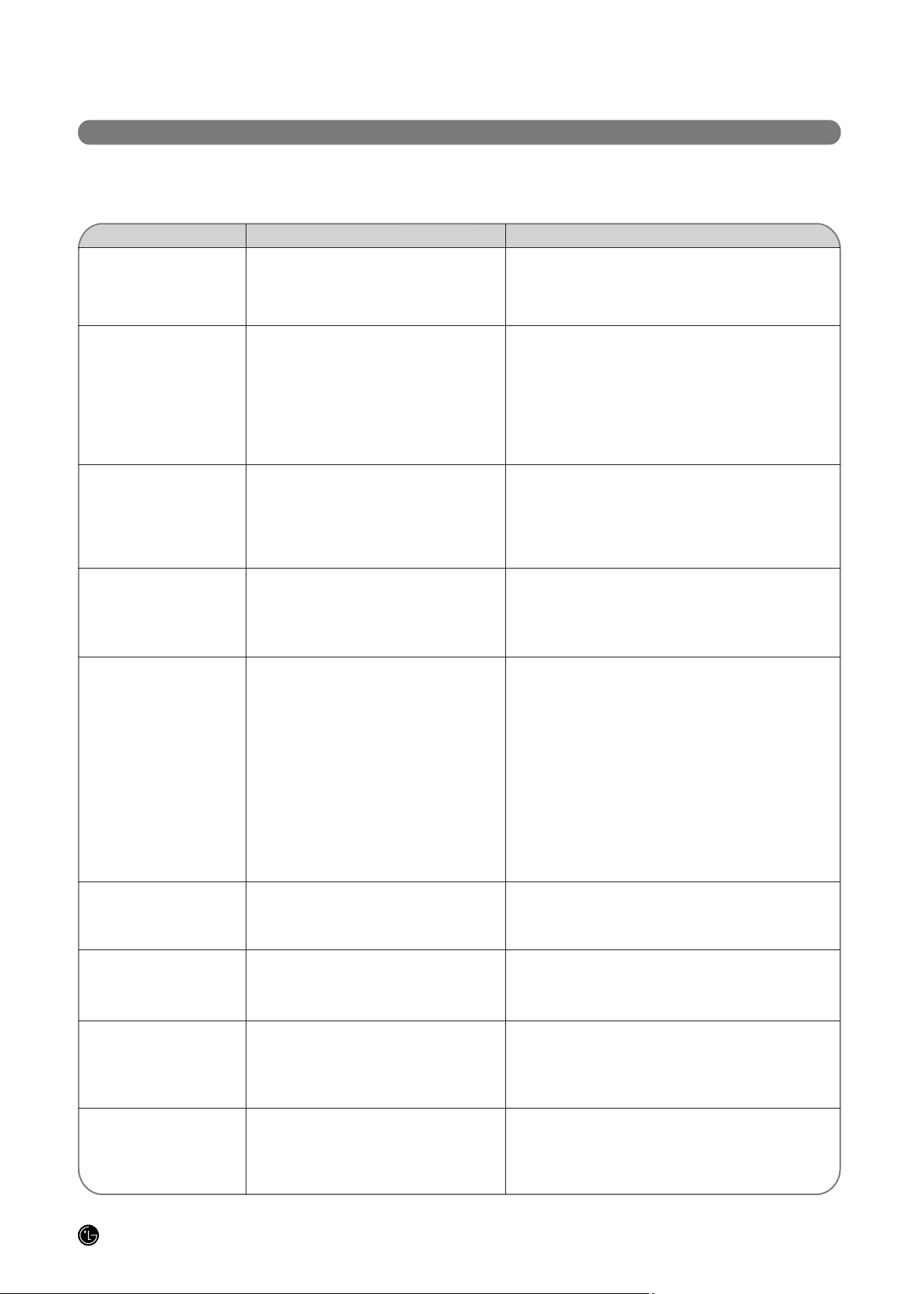
SOLUCIÓN DE PROBLEMAS
ANTES DE SOLICITAR ASISTENCIA TÉCNICA
Problema Causas probables Soluciones
La función de asar o de
autolimpieza no
funciona.
El horno no está limpio
tras un ciclo de limpieza
Aparece en pantalla el
indicador “CLOSE DOOR
TO CONTINUE
BROILING” o “DOOR
OPENED”
El indicador “DOOR
LOCKED“ está activo
cuando desea cocinar
Parpadea en pantalla el
indicador “F y un
número o letra”
Las bandejas del horno
se deslizan con
dificultad
Corte de suministro; el
reloj parpadea
El conducto de
ventilación emite olor a
“quemado” o a
“aceite”.
Olor fuerte
• El horno excesivamente caliente.
• Los controles del horno no están
ajustados correctamente.
• El horno estaba excesivamente sucio.
• Ha sido escogido el ciclo asado o de
autolimpieza, pero la puerta no está
cerrada.
• La puerta del horno está bloqueada
debido a que la temperatura interior del
horno no ha bajado por debajo de la
temperatura de desbloqueo.
• La pantalla muestra “F3”.
• La pantalla muestra “F11”.
• Si el código de función se repite.
• Las bandejas de níquel (si están
disponibles) se limpiaron mediante el
ciclo de autolimpieza.
• Corte de suministro o sobretensión.
• Esto se considera normal en un horno
nuevo e irá desapareciendo con el tiempo.
• La emisión de ciertos olores procedentes
del aislamiento en torno al interior del
horno se considera normal durante los
primeros usos.
• Permita que el horno se enfríe por debajo de la
temperatura de bloqueo.
• Puede tardar hasta una hora después de que termine el
ciclo.
• Examine la sección Uso de la autolimpieza del horno.
• Elimine el exceso de derrames antes de iniciar el ciclo
de limpieza. En los hornos sucios en exceso podría ser
necesario volver a realizar el proceso de autolimpieza o
prolongar el período de duración del mismo.
• Cierre la puerta del horno.
• Pulse el botón CLEAR OFF. Permita que el horno se
enfríe.
• Pulse el botón CLEAR OFF. Permita que el horno se
enfríe durante una hora. Vuelva a poner en
funcionamiento el horno.
• Chequee la válvula de corte de gas principal o la del
horno (examine la columna “Los quemadores de la
superficie se prenden pero el del horno no”).
• Desconecte el suministro de la estufa de gas durante 5
minutos y, a continuación, vuelva a conectarlo. Si el
código de error de la función se repite, solicite
asistencia técnica.
• Aplique una pequeña cantidad de aceite vegetal sobre
papel de estufa y limpie los bordes de las bandejas del
horno con el mismo. No utilice aerosoles lubricantes.
• Reinicie el reloj. Si el horno estaba usándose, deberá
reiniciarlo pulsando el botón CLEAR OFF, ajustar el
reloj y cualquier función de cocción.
• Para acelerar el proceso, ajuste el ciclo de autolimpieza
durante un período mínimo de 3 horas. Examine la
sección Uso de la autolimpieza del horno.
• Esto es temporal.
34
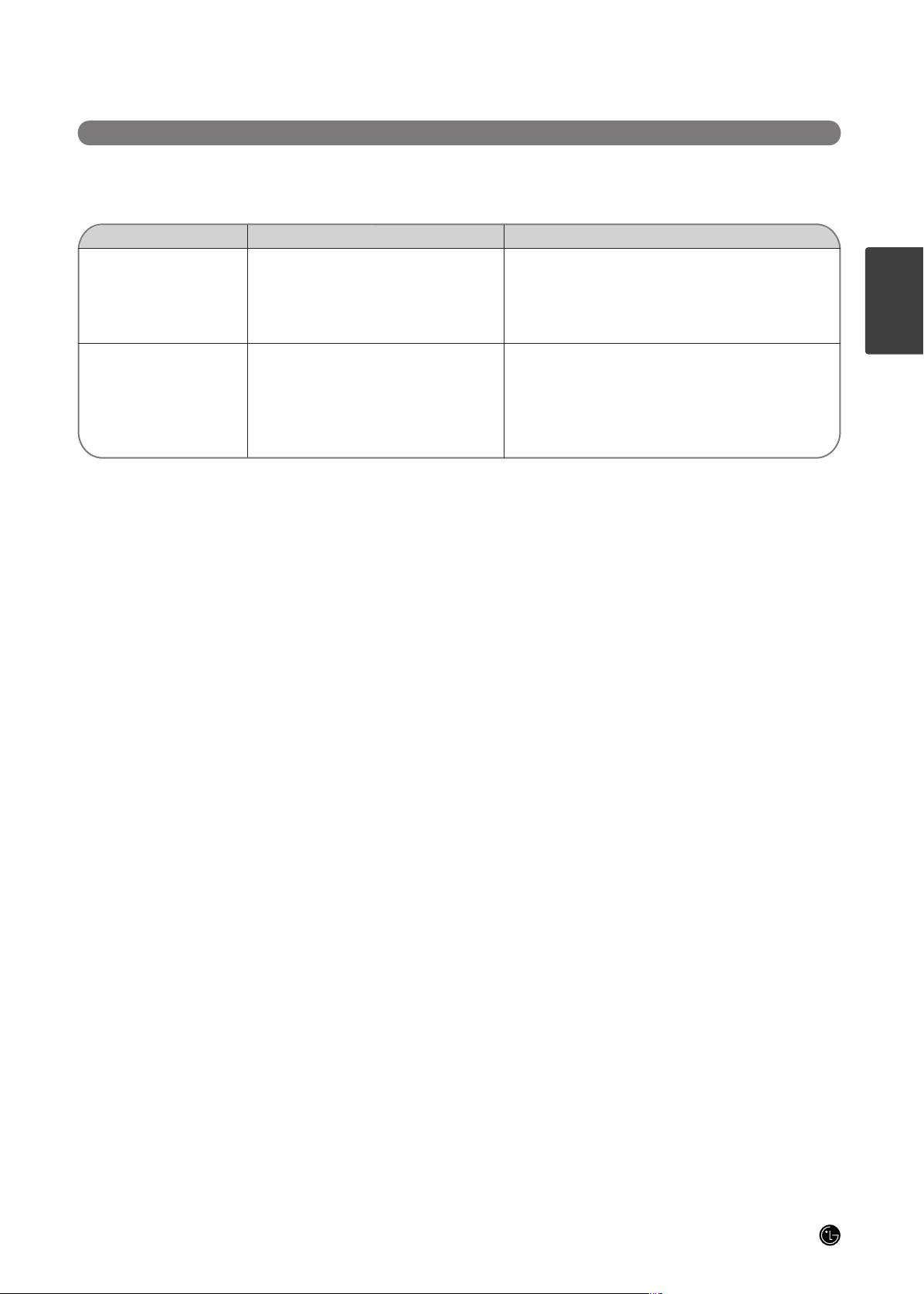
SOLUCIÓN DE PROBLEMAS
ANTES DE SOLICITAR ASISTENCIA TÉCNICA
Problema Causas probables Soluciones
La gaveta no desliza
suavemente o se atasca
Condensación excesiva
en la gaveta
• La gaveta está desalineada.
• La gaveta está cargada en exceso o de
forma no uniforme.
• Líquido en la gaveta.
• Alimentos destapados.
• Ajuste demasiado alto de temperatura.
• Saque la gaveta por completo y empújela de la misma
forma. Examine la sección Cuidado y Limpieza.
• Reduzca el peso. Redistribuya el contenido de la gaveta.
• Elimine el líquido.
• Cubra los alimentos con una tapa o papel de aluminio.
• Reduzca el ajuste de temperatura.
35
ESPAÑOL
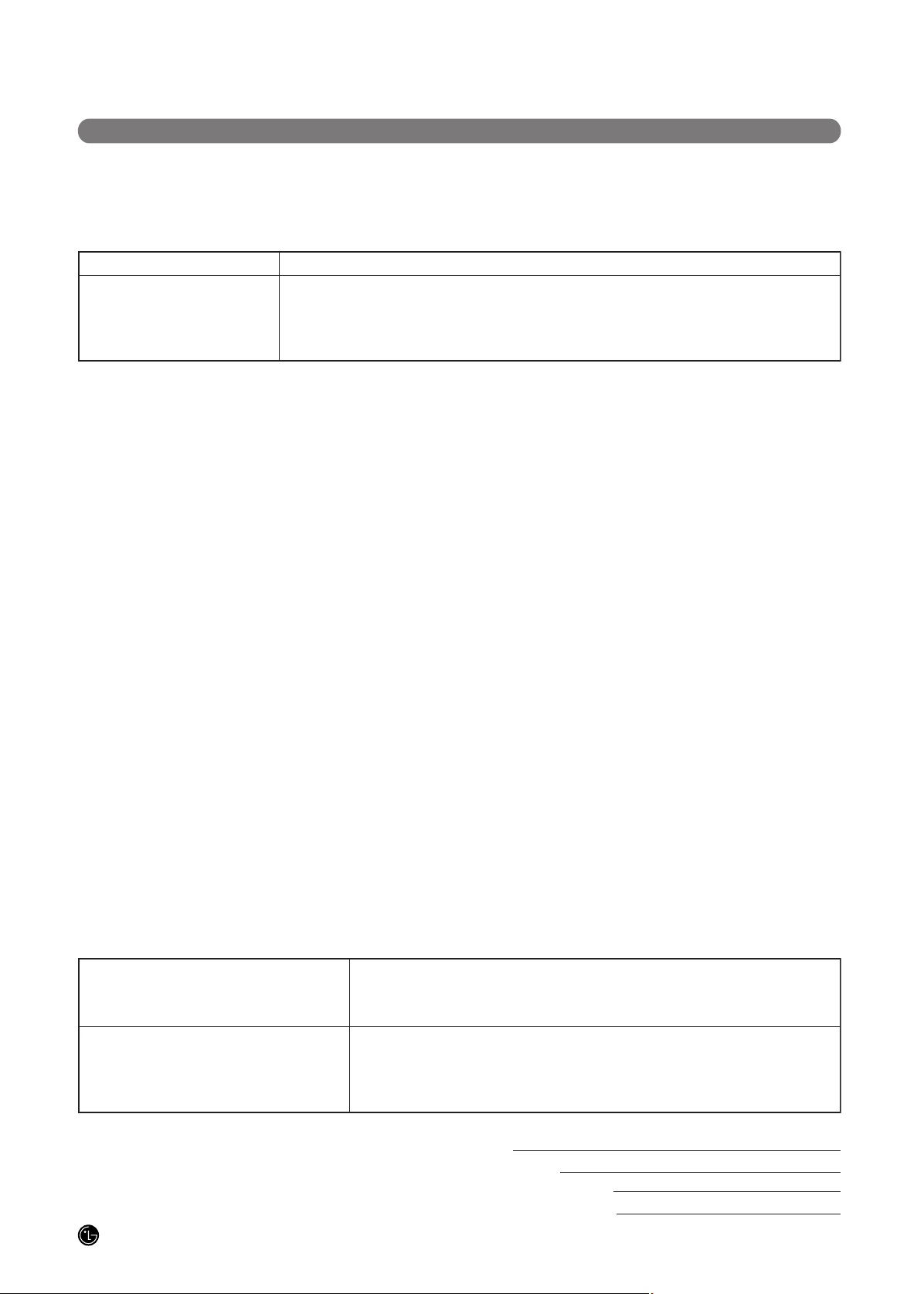
GARANT
Í
A LIMITADA DE ESTUFA DE GAS LG - EE.UU.
LG Electronics Inc. reparará o reemplazará su producto, a criterio de LG, si llegara a tener defectos en los materiales o
mano de obra bajo un uso normal, durante el período de garantía establecido a continuación, vigente desde la fecha
original de compra del producto por parte del consumidor. Esta garantía limitada solamente cubre al comprador
original del producto y tiene vigencia sólo cuando se utiliza en los EE.UU.
ESTA GARANTÍA REEMPLAZA CUALQUIER OTRA GARANTÍA, EXPRESA O IMPLÍCITA,
INCLUYENDO, SIN LIMITACIÓN, CUALQUIER GARANTÍA DE COMERCIABILIDAD O APTITUD
PARA UN OBJETIVO PARTICULAR. EN LA MEDIDA EN QUE CUALQUIER GARANTÍA IMPLICITA
SEA REQUERIDA POR LA LEY, SE LIMITA EN DURACIÓN AL PERÍODO DE GARANTÍA EXPRESO
ANTERIOR. LG NO SERÁ RESPONSABLE DE DAÑOS RESULTANTES, INDIRECTOS O
INCIDENTALES DE CUALQUIER NATURALEZA, INCLUYENDO, GANANCIAS O INGRESOS
PERDIDOS, EN CONEXIÓN CON EL PRODUCTO. ALGUNOS ESTADOS NO PERMITEN LA
LIMITACIÓN DE LA DURACIÓN DE UNA GARANTÍA IMPLÍCITA O LA EXCLUSIÓN DE DAÑOS
INCIDENTALES O RESULTANTES, Y POR LO TANTO LAS LIMITACIONES O EXCLUSIONES
ANTERIORES PUEDEN NO APLICARSE EN SU CASO.
ESTA GARANTÍA LIMITADA NO SE APLICA A:
1. Visitas a su hogar para corregir la instalación de su artefacto, para instruir al usuario sobre cómo utilizar su artefacto,
para cambiar fusibles o corregir el cableado del hogar, o para cambiar bombillas de luz accesibles para el usuario.
2. Reparaciones cuando su artefacto se utiliza en otro lugar que no sea un hogar unifamiliar.
3. Retiro y entrega. Su artefacto está diseñado para poder ser reparado en el hogar.
4. Daños provocados por accidentes, alteraciones, uso indebido, abuso, incendio, inundación, instalación inadecuada,
casos fortuitos o uso de productos no aprobados por la Corporación LG.
5. Reparación de piezas o sistemas provocados por modificaciones no autorizadas hechas al artefacto.
6. Costos de reemplazo de piezas o de mano de obra en reparaciones para unidades operadas fuera de los EE.UU.
7. Cualquier costo de mano de obra durante el período de garantía limitada.
Esta garantía se extiende al comprador original para productos adquiridos para uso doméstico dentro de los EE.UU.
En Alaska, la garantía excluye el costo de envío o visitas para efectuar arreglos en su hogar.
Algunos estados no permiten la exclusión o limitación de daños incidentales o resultantes, por lo tanto esta exclusión o
limitación puede no aplicarse en su caso. Esta garantía le otorga derechos legales específicos y usted puede contar con
otros derechos, que pueden variar de estado a estado. Para conocer sus derechos legales, consulte a su oficina del
consumidor local o estatal o al Fiscal General de su estado.
INFORMACIÓN DE ASISTENCIA AL CLIENTE:
PERÍODO DE GARANTÍA:
Un año
Desde la fecha de compra
original
CÓMO SE BRINDA EL SERVICIO:
Cualquier pieza del horno que falle debido a un defecto de los materiales o mano
de obra. Durante esta garantía total de un año, LG también ofrece, en forma
gratuita, la mano de obra y trabajos en el hogar para reemplazar la pieza
defectuosa.
Para probar la cobertura de la
garantía
Conserve el recibo de venta para probar la fecha de adquisición.
Debe enviarse una copia del recibo de venta en el momento en que se
brinda el servicio de garantía.
Para obtener el centro de atención
autorizado más cercano o vendedor,
o para obtener asistencia sobre el
producto, cliente o reparación
Llame al 1-800-243-0000 (Atención telefónica 24 horas - 365 días al
año) y seleccione el mensaje apropiado del menú; o visite nuestro sitio
Web: http://us.lgservice.com.
Información de registro del producto
Modelo:
Número de serie:
Fecha de compra:
36

Memo
37
ESPAÑOL

Memo
38

Memo
39
ESPAÑOL

Printed in Mexico
www.lg.com
Register your product Online!
LG Customer Information Center
1-800-243-0000
1-888-542-2623
USA, Consumer User
For inquires or comments, visit www.lg.com or call
CANADA

