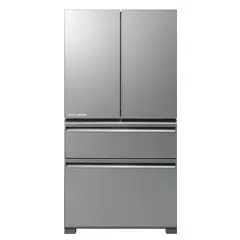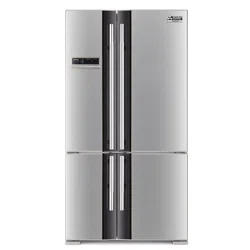
OPERATING INSTRUCTIONS
SERIES MODEL
MR-L650EH,
MR-L710EH
It is strongly recommended to use only lukewarm water and a soft cloth when cleaning.
Cleaning agents can cause cracking to the plastic components of your refrigerator.
Cleaning Instruction - Important!

This refrigerator is manufactured for refrigerating and freezing foods in general households. For industrial use,
please use a commercial refrigerator-freezer.
The photographs and illustrations contained in this manual are for the MR-L710EH. While the capacity and
dimensions of the MR-L710EH are different from the MR-L650EH the operation is the same.
The material names are indicated on the main plastic parts to facilitate recycling.
Function Overview
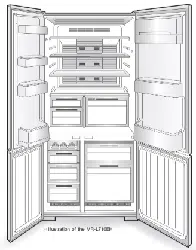
Illustration of the MR-L710EH

Vitamin Factory
The vitamins in vegetables
are boosted by the LED.
ECO MODE
Use when you want to save power.
When the temperature inside the refrigerator is
stable, the power-saving operation is performed
automatically.
When in troubleBefore Use Operation Cleaning
Contents
Safety Precautions
4 - 5
From Installation to Operation
6 - 7
Using Control Panel
8 - 9
Setting the Refrigerator and
Freezer compartment
1 0
Refrigerator Compartment
1 1 - 12
Freezer Compartment
1 3
Removing and Cleaning the Parts
1 4 - 1 5
Other lssues
1 6 - 1 7
Specifications
1 7
When in trouble
1 8 - 1 9
Page

4
When in troubleBefore Use Operation Cleaning
Service Call
Only use an outlet that meets the specified rating.
Cord facing down
Water prohibited
Prevent tipping
Never do
Never touch
Never attempt to
disassemble, repair
or alter
Never expose to
water
Never touch with
wet hands
Be sure to follow
the instructions
Be sure to remove
the power plug
from the socket
Danger and degree of
danger caused by improper
handling are categorized
and described by the
following indicators.
Meaning of symbols.
If an abnormality or
malfunction occurs,
stop operation
immediately and contact
the retail store where you
purchased the refrigerator
or MITSUBISHI ELECTRIC
SERVICE CENTRE
or Customer Service
representative.
Remove dust
Remove plug
Do not use
Prohibited
Prohibited
Wet hands
prohibited
Do not pack in
excessive amounts
of food. Do not pull
the shelves with
excessive force.
Food may fall out and
cause injury.
Prohibited
Do not touch food
or containers in the
freezer compartment
with wet hands.
Doing so may cause a
cold injury.
Wet hands
prohibited
Installation
Do not install the refrigerator outdoors
or in places exposed to water or
excessive humidity.
Water may cause
insulation failure,
resulting in an electric
shock or fire.
Page 6
Use a dedicated outlet for the power supply
that meets the rating specified on the rating
label. (The rating label is located on the
door-liner of the refrigerator compartment.)
Page 6
Anchor the refrigerator to a strong
wall or post to protect against damage
during earthquakes.
The refrigerator may tip
over and cause injury.
Pages 6 - 7
Insert the power plug with the cord
facing down, and fully insert
the prongs.
Inserting the plug upside-
down places stress on the
cord and may cause heat
generation or fire.
If the power cord is damaged, call our MITSUBISHI
ELECTRIC SERVICE CENTRE for the replacement.
If the power cord is damaged, purchase
a new cord from MITSUBISHI ELECTRIC
SERVICE CENTRE. Make sure that the
power cord is designed for this model.
Page 6
Power and power plug
Remove the power plug before
cleaning.
Otherwise an electric
shock or injury may
result.
Do not crush the power plug with the rear
of the refrigerator.
Do not damage the power cord.
Pressing, folding, bundling
or placing heavy objects on
the power cord may cause an
electric shock or fire.
Do not use damaged cords or plugs, or
loose sockets.
Doing so may cause an
electric shock or fire.
Do not pull the cord when unplugging
the power plug.
The cord may be
damaged, resulting in
electric shock or fire.
Remove dust periodically from the
power plug.
Dust may cause
insulation failure,
resulting in fire.
Do not plug in or out the power plug with
wet hands.
Doing so may cause an
electric shock.
Improper handling can result
in death or serious injury.
Warning
Improper handling can result
in personal injury or damage
to your house, household
furnishings, etc.
Caution
Installation and transportation
Anchor the refrigerator to a strong and level
floor by adjusting the adjustable supports.
Otherwise, the refrigerator may move and cause injury.
Pages 6 - 7
Install level
Use the transportation hand-holds
when transporting the refrigerator.
Holding other parts may result in injury.
Page 16
Use the hand-holds
Be careful not to damage the
floor or injure yourself when
moving the refrigerator.
Lay a protective sheet on the floor and move
the refrigerator slowly.
Use protective
material
Safety Precautions
Leave space
Leave space around the refrigerator.
If refrigerant leaks, it
may accumulate and
catch fire or explode.
Page 6

5
When in troubleBefore Use Operation Cleaning
Do not use
Water prohibited
Prohibited
Prohibited
Remove door seal
Dry Dispose properly
Remove plug
Do not disassemble
Prohibited
Romove and put back shelves property
Do not use
Operation
Do not place water containers on top
of the refrigerator.
Exposing electrical parts
to water may cause an
electric shock or fire.
Do not use electrical appliances inside
the refrigerator.
Do not place volatile, inflammable
objects inside the refrigerator.
Benzene, cosmetics
and hair dressing
products may catch
fire or explode.
Do not place objects on top of the
refrigerator.
Objects may fall when
the doors are opened or
closed and cause injury.
Do not store chemicals or scientific
specimens in the refrigerator.
Substances that require
strict control must not
be stored in household
refrigerators.
Do not hang from the door or handle.
Do not climb on an open door.
Do not apply a heavy load.
The refrigerator may tip
over and cause injury.
Do not wash with water or spill soup
or juice onto the refrigerator.
Water or other liquid may
cause an electric shock
or fire. Wipe off any
liquid immediately.
Do not use combustible sprays near
the refrigerator.
Sparks from an
electrical contact may
cause an ignition and
fire.
Do not use in a shed or garage.
Pet animals may damage the electrical
wiring and cause an electric shock or fire.
Malfunctions and long-term storage
If an abnormality occurs (such as a
burning odor), unplug the power plug
and stop the refrigerator operation.
Continuing to operate
with an abnormality may
cause an electric shock
or fire.
Do not disassemble, repair or alter.
Do not use while parts are damaged.
Doing so may cause
injury, electric shock
or fire.
If there is a possibility of a child getting
trapped in the refrigerator during storage,
pull out and remove
the door seal.
Children getting
trapped in refrigerators
is very dangerous.
When not using the refrigerator for a
long time, unplug the power plug and
open the doors to dry the refrigerator.
Contact the retail store or municipal
government for details about correct
refrigerator disposal.
Water prohibited
Prohibited
Do not storeProhibited
Do not store
Prohibited
Operation
Do not place
glass bottles
in the freezer
compartments.
The bottle may break
if the liquid inside
freezes, causing an
injury.
Do not store
Observe the following when opening
and closing the doors.
Do not open or close the doors when anothcr
person is touching the refrigerator.
Do not put your fingers on the top edge of
a drawer-type door while closing it.
Do not open or close the doors with excessive force.
(Food may fall out and cause injury.)
Be careful not to trap your fingers or any other part
of your body.
Be careful not hit a part of your body.
Do not trap your feet with bottom drawer.
(Danger of your toes caught by the drawer.)
Do not eat food
that is discolored
or has a bad odour.
Doing so may result in
food poisoning or illness.
Prohibited
Do not put
your hands or
feet under the
refrigerator.
The steel plates or other
parts may cause injury.
Do not touch
While cleaning the refrigerator, be sure
to remove the shelves (made of tempered
glass) and put them back properly
Or else, the falling or smashed shelf could
cause personal injuries.
Warning
Caution
When opening and closing the door,
be careful not to let it hit any
surrounding furniture.
There is a risk of injury and
damaged to the door or furniture.
Only use refrigerant specified
by the company.
See rating label inside Refrigerator
for refrigerant type.
This appliance is not intended for use by young
children or infirm persons unless they have been
adequately supervised by a responsible person
to ensure that they can use the appliance safely.
Young children should be supervised
to ensure that they do not play with
the appliance.
The refrigerant gas leaking
into the compartment with
sparks from an electrical
contact may cause fire and
explosion.
Ventilate
If the refrigerant circuit (pipe) is damaged,
do not touch the refrigerator and avoid
using flames. Open windows to ventilate.
If the refrigerant circuit
is damaged, contact
the retail store.
If the refrigerator is not dried sufficiently,
refrigerant may leak due to condenser
corrosion and cause a fire or explosion.
Improper disposal may cause
refrigerant leaks, resulting in a fire
or explosion if exposed to a flame.
Do not do
Do not damage the refrigerant circuit (piping)
of the refrigerator; do not drive in screws.
Because a flammable
refrigerant (gas) is used,
there is the danger of
igniting or explosion.

6
When in troubleBefore Use Operation Cleaning
Install the refrigerator at:
A place with good ventilation not
exposed to direct sunlight or hot air
To prevent a diminishing in cooling
performance and to reduce power costs.
A place with low humidity
To prevent rusting, electric shock and fire.
A strong and level place
To prevent vibration and noise, and ajar
or tilting doors.
If the refrigerator supports sink easily into the floor
material, lay a strong plate or board underneath.
(To prevent deformation or discoloration
due to the weight or heat.)
A place away from other devices
To prevent noise or video interference
with devices such as televisions.
A place with at least 3 cm of
space beside the left and right of
the refrigerator, 10 cm of space from
the top and 6 cm from the back.
To allow heat to dissipate from the sides,
top and the back of the refrigerator.
Use a dedicated outlet
Use a dedicated outlet for the power supply that meets the rating specified
on the rating label. (The rating label is located on the door-liner of the
refrigerator compartment.)
The refrigerator will not be damaged even if the power
is supplied soon after installation.
It takes a while for the refrigerator to cool, therefore
supply power as soon as possible.
Electrical Connections
Make sure this unit is properly grounded.
The refrigerator should always be plugged into its dedicated electrical outlet.
This will provide the best performance and prevent electrical circuits
from being overloaded and causing a fire.
Make sure that the electrical outlet provides the proper voltage.
Extension cords are not recommended.
If your refrigerator is installed in the high humidity location, not only
ground connection but also installation of the earth leakage breaker is
recommended.
If the power cord is damaged, purchase a new cord from
MITSUBISHI ELECTRIC SERVICE CENTRE.
Make sure that the power cord is designed for this model.
A qualified service person should only replace the power cord.
Installation
1
The outside of the refrigerator and the
rotating partition get hot.
Cooling takes time after turning
on the refrigerator.
Connect the power supply
*Connect power supply soon after installing the refrigerator
2
Warning
Using outlets that do not meet the specified rating
or plugging in too many leads into a single socket
can cause heat buildup or fire.
Rotating
partition
non-cooled food or ice cream.
them as soon as possible.
In the summer, it may take more than 24 hours.
Heat radiation causes
the temperature to rise to
about 50
o
C to 60
o
C when
operation is first started,
and during the summer. The
rotating partition may get hot
when heated by the heater.
When making ice for the first time
A gap of
at least 10 cm
A gap of
at least 6 cm
Dedicated
outlet that meets
the specified rating.
A gap of
at least 3 cm
Turn on the power of the
refrigerator as soon as
possible.
The refrigerator will not be
damaged even if you turn on
the power immediately after
the installation.
From Installation
to Operation
Warning
or the space around the refrigerator.
If refrigerant leaks, it may accumulate
and catch fire or explode.
Corrosion control treatment may be
required for the refrigerant circuit (pipe)
due to generation of corrosive gases.
Contact the retail store where you
purchased the refrigerator.
Use in hot spring areas

7
When in troubleBefore Use Operation Cleaning
Preventing ajar doors
Adjusting a tilted door or unevenness
If the door is still tilted after adjustment of the supports
Installing the support cover
While the freezer door is open
Insert the support cover horizontally
and fully, until it makes contact with
the rear side.
Support cover
The support cover is stored inside
the refrigerator compartment
at shipment.
4
Adjustment and anchoring
Turn the adjustable supports until they touch the floor and
the front casters are raised from the floor.
3
Adjust the supports to
make the refrigerator
level.
If the front of the
refrigerator is slightly
raised, the doors are
easier to close.
When installing the refrigerator in the corner of a room, one
of the rear supports may sink, causing the refrigerator to tilt.
If this happens, use a caster support or strong board for
adjustment.
(Normally, use a board with a thickness of about 2 to 3 mm.)
Readjust the adjustable supports as
shown in the figures below.
The right door tilts down
Raise the right side
Right Left
The left door tilts down
Support cover
The support covers are designed for the
left and right adjustable supports respectively.
Adjustable
support
Raise the left side
Rear support
Caster support or
strong board
If the installation
location is not level or
the supports sink after
a few days due to the
weight of the food,
the doors may appear
tilted.
Readjust the supports.
Adjustable
support
Flat-blade
screwdriver
Caster
Insert the blade of the screwdriver
Turn the adjustable supports
in the arrow direction until
they touch the floor.
Support cover
(To prevent vibration, noise, movement, and ajar doors)
Bottom front of refrigerator
If the supports are not
adjusted properly, the
refrigerator may move
and cause injury.
Caution
Prepare for earthquakes.
(for earthquake prone areas)
Strong belts
Warning
Thread 2 strong belts through the hand-holds on the top rear of the
refrigerator and anchor them to a strong location, such as wall or post.
To obtain the refrigerator tipping prevention belts.
The refrigerator may tip
over and cause injury.
The operation noise gets
louder immediately after
installation.
Immediately after instillation, when:
the weather is hot, the doors are
frequently opened or closed, or
any similar situation; the operation
noise will get louder because the
refrigerator will switch to high-speed
operation to cool with high power.
Although R600a refrigerants are combustible, the refrigerant
circuit is hermetically sealed and normally leaks will not occur.
Warning
Should the refrigerant circuit be damaged:
1. Do not use flames or electrical appliances nearby.
2. Open the windows to fully ventilate the room.
Then, contact the retail store where you purchased the refrigerator.
Do not damage the refrigerant
circuit (pipes) or drive screws into it.
Warning
If you notice a gas leak,
do not touch the refrigerator.
Open windows to ventilate.
Ventilate
Sparks from an electrical contact
may cause an explosion or fire.

8
When in troubleBefore Use Operation Cleaning
The control panel display light is normally turned off to save power.
To check a setting status, turn on the display by pressing any button on the control panel.
To set a section, press the relevant button when the control panel is illuminated.
The control display panel turns off after 30 seconds if there is no operation to save power.
* This display
example may
differ from the
actual display.
Setting display area
Setting of each section is displayed. Displayed temperature is the setting
value, hence it may different from the temperature within the refrigerator.
Section indication area
Selected compartment
is displayed.
ENERGY SAVING button
ECO MODE can be
selected.
RAPID COOL button
Rapid cooling mode can be
selected.
Page 10
Section selection and
temperature adjustment button
Temperature in the refrigerator
and freezer can be selected.
Page 10
ECO MODE
Use when you want to save power. When the
temperature inside the refrigerator is stable, the
power-saving operation is performed automatically.
(Operates with the freezer compartment
temperature set slightly higher.)
Setting ECO MODE
1
Press .
To cancel
1
Press to turn off .
ECO MODE
If ECO MODE is set, is displayed.
If switched to power saving operation while
ECO MODE is set, is displayed.
Tips for using the refrigerator wisely
Temperature settings
Setting each compartment to a relatively low
operation reduces the consumption of electricity.
Opening and closing compartment doors
The refrigerator consumes more electricity if you
open and close the compartment doors frequently
or leave the doors open for a long time.
ECO MODE
In this mode, the refrigerator automatically operates
in an energy saving fashion when the temperatures
are stable in the compartments. The refrigerator is
not set in this mode when newly installed.
Storing foods
Do not stuff the compartments with too much food
or do not place foods in manner to cover the cold
air outlets. Or else, cold air does not flow through
optimally in the compartments,causing the foods
to take time getting cool or frozen and increase
electric power consumption.
Using the Control Panel

9
When in troubleBefore Use Operation Cleaning
Child safety lock
Locks the control panel to prevent accidental button operations by children.
Setting the child safety lock
1
Press for about 3 seconds. (Until the buzzer sounds twice.)
lights up.
To cancel
1
Press for about 3 seconds. (Until the buzzer sounds twice.)
.
Even if the child safety lock is set, the compartment selection can be operated.
Reset the Settings
Returns the compartment selection, temperature control, ECO MODE, rapid cooling settings and temperature
fine adjustment mode to their initial condition (at the time of purchase). Use for example if you have
forgotten the settings.
Resetting
1
Press and at the simultaneously for about 3 seconds. (Until the buzzer sounds twice.)
The refrigerator is in the demonstration operation when the entire
display blinks 3 times in regular intervals, or the compartment display
and temperature control display blinks repeatedly in order.
The refrigerator does not cool in this mode.
Cancel the demonstration operation.
Page 16
If the control panel display blinks
The door alarm beep varies depending on how long the door
has been opened. See below for details.
The door alarm beeps when the refrigerator or freezer compartment
door is opened for more than 1 minute.
The compartment displays on the control panel blink in time
with the door alarm sounding.
Check for an ajar door or trapped food (Door packing, rear side of the drawer cases).
(Check at least once a month.)
If the alarm keeps sounding even after closing the doors, contact
the retail store where you purchased the refrigerator or MITSUBISHI
ELECTRIC SERVICE CENTRE.
About the door alarm
Door open time
1 minute 2 minutes 3 minutes 4 minutes
5 minutes or longer
Alarm
2 beeps 3 beeps 4 beeps
Continuous long
beeps
Continuous short
beeps

10
When in troubleBefore Use Operation Cleaning
Temperature control
Compartment
display
When cooling is
too strong
When cooling is
a little too strong Standard
*1
When you want to cool
a little more
When you want to
cool more
5
o
C 4
o
C 3
o
C 2
o
C 1
o
C
-16
o
C -17
o
C -18
o
C -19
o
C -20
o
C
*1: The setting at installation (at time of purchase).
To control the temperature more precisely
Page 17
Note
Before and after defrosting, the temperature inside the refrigerator may drop or rise temporarily.
To prevent food freezing in refrigerator compartment in the following kinds of situations, set the refrigerator compartment
temperature to "Mid Low" or "Low".
o
C or less
For example, after you have bought a
lot of food and you want to freeze them
quickly to preserve their freshness.
When should I use
?
You can use rapid cooling even when other food
is inside!
The operation sounds gets louder during rapid
cooling, because inner fans operate at high speed.
1
Press or to display the
compartment that you want to set.
The compartment display changes each time the button is pressed.
2
Repeatedly press or to set
the temperature.
The
display changes each time the button is
pressed.
* Display example
1
Press to turn off .
1
Press .
lights up.
stops automatically after about 2 hours.
(After stopping, goes off and the temperature reverts to
the set temperature automatically.)
* Display example
Rapid cooling
Stopping before the cooling ends
Setting the temperature in the refrigerator and freezer compartments
Setting the Refrigerator and
Freezer compartment

11
When in troubleBefore Use Operation Cleaning
With the door of the each compartment open
at an angle of less than around 15 degrees, the
door closes automatically.
The auto closer is not a function that automatically
closes the door that opens slightly.
The door may stop before closing completely if
you swing close the door too softly.
The amount of food inside the compartment may
affect the closing speed.
Auto closer (equipped in doors)
Garlic, dried fish, fermented foods, beef, takuan,
sardines, kimchi, chinese dumpling, etc.
Puddings, ice cream, potato, salad, tofu, rice, bread,
milk, cake, ice, etc.
A slight odours may remain.
Wrap food that have strong odours thoroughly before storage
A slight odours may remain.
Food that transfers odours easily
Food to which odours are easily transferred
Door pocket
(small)
Door pocket
Adjustable
pocket (small)
Tempered glass
shelf (large)
)
Bottle pocket
(small)
Utility case
(small)
Utility case
(large)
Bottle pocket
(large)
Adjustable
pocket (large)
Air outlets
Egg shelf
Tempered glass shelf (small)
Capsule door pocket
Vegetable case
Rotating partition
Interior light
Do not close the door
while the rotating partition
is turned up to the front.
rapidly with force, the rotating
partition may open to the front.
Open and close the doors slowly.
(Otherwise damage may result.)
Page 18
Page 9
Higher
humidity
Lower
humidity
Refrigerator Compartment
While cleaning the refrigerator, be sure to
remove the shelves (made of tempered
glass) and put them back properly.
Or else, the falling or smashed shelf could
cause personal injuries.
can be adjusted.
Tempered glass shelf
Vegetable case
Door pocket (large)
Adjustable pocket

1
2
2
1
1
2
O
n
l
y
w
i
t
h
M
R
-
L
6
5
0
E
H
O
n
l
y
w
i
t
h
M
R
-
L
7
1
0
E
H
O
n
l
y
w
i
t
h
M
R
-
L
71
0
E
H
12
When in troubleBefore Use Operation Cleaning
Do not leave food hanging
over shelves or pockets.
Do not place glass bottles
that cannot fit all the way
to the bottom at the front
of the bottle pocket.
The bottle may keep a door ajar,
or the bottle may break.
Do not close the door
while food is in front of
the Vegetable case or
Utility cases.
Fully stow away the
cases.
Do not attach a case that
you purchased separately
onto the outside of a pocket.
It may keep a door ajar and reduce
the cooling performance, or food
may fall and cause an injury or
damage to a case or lid.
Tips for energy saving
Idea for
energy
saving
Helpful
storage
hints
Set to ECO MODE for automatic
energy saving operation.
Page 8
Keep space
between items in
the refrigerator.
Be sure not to catch
food items, plastic
bags, power cord,
etc. in the door
when you close it.
Frost or dew build-up
that may cause decline in
cooling ability as a result
of even the slightest door
opening.
Water may also drip off.
Allow hot food
to cool before
storing.
Wipe wrap
Avoid opening the door
frequently or leaving the
door open for a long time.
Put items on the top shelf if you wish to cool sufficiently.
Egg holder or small organizing compartments.
By turning it over it can be used either way.
Refrigerator Compartment
(Continued)
Relocate the pockets
Page 15
Adjustable to 2 positions
Small Large
Adjustable pockets
Egg shelf

13
When in troubleBefore Use Operation Cleaning
Ice tray
Ice storage
box
Freezing case
(small)
Freezing case
(middle)
Freezing case
(large)
Do not place tall objects
in the lower freezing case.
Food or the slide case may
be damaged.
The door may not be closed.
15 cm height of plastic bottles for
freezing can be placed standing up
in the Freezing case (large).
The bottles intended to let freeze are suitable.
In many cases, they are displayed so.
If the door alarm sounds
Page 9
Freezer Compartment
Making ice cubes
1
Pour water into each of the section of the ice
tray up to the water line.
The ice cubes will not separate easily from the ice tray if you add too
much water.
2
Insert the tray completely into the ice tray holder.
3
Once the ice cubes are made, turn the lever to the
right until the ice cubes fall into the ice storage
box.

14
When in troubleBefore Use Operation Cleaning
How to cleanBefore cleaning
Step
2
Step
1
Remove the power plug
Wait at least 10 minutes before reinserting the power plug
into the socket.
If you insert the plug immediately, the mechanism will not
function.
Wipe with a soft cloth soaked in lukewarm water, or remove the parts and
(Wipe the control panel with a soft, dry cloth.)
For stubborn dirt, wipe using water mixed with a weak concentration of kitchen
only). In particular, be sure to wipe off oily dirt because leaving it may damage
Do not use following alkaline or low alkaline kitchen detergents,
alcohol, benzene, thinner, oil, acid, scrubbers, boiling water, or
Doing so may cause the plastic parts (such as the door
or damage or rust the doors or painted surfaces.
Failure to unplug
may result in an
electric shock.
Warning
How to remove the upper shelf
Lift the upper shelf with
both hands to take it out.
How to remove the middle and
lower shelves
Remove the middle and lower shelves
with both hands.
Reverse the steps to put
back the shelves.
fall off.
Tempered glass shelves
Open the door.
Slide out the ice tray and remove.
Draw the ice storage
case towards you
and remove.
Ice tray /
Ice storage box
Pull the case towards you. Hold
the end on your side and lift the
case.
Cases in the Freezer
compartment
Removing and Cleaning
the Parts
Illustration of the MR-L710EH

15
When in troubleBefore Use Operation Cleaning
After cleaning and periodically
Step
3
rinse with water.
detergent (neutral
the plastic parts.
scouring powder, powdered soap,
similar substances.
handles, caps and cases) to split,
Check the power plug and cord
For safety, clean periodically.
Unplug the power plug from the socket and check it.
Check for damage or abnormal heating on the power plug
and cord.
Remove any dust from the power plug and surrounding area,
and then wipe with a dry cloth.
Firmly insert the power plug into the socket.
If the power plug or
cord is damaged or dust
accumulates, it may cause
an electric shock or a fire.
Warning
Capsule door pocket
Dirty seal is easily
damaged and can cause
refrigerated air to leak.
Door seal
Door seal
Utility case
Fully pull out the slide case.
Lift the end on your side.
Vegetable case
Lift the end on your side to pull out the
Vegetable case.
*The ceiling shelf on the upper side of
cases cannot be removed.
Utility case / Vegetable case
LEDs in the refrigerator compartments and behind
of Vegetable case.
Contact the retail store at which you purchased this refrigerator
from or MITSUBISHI ELECTRIC SERVICE CENTRE.
Replacing lamps in compartments
Wipe with a soft dry cloth.
*
Do not use alcohol, benzene, steel wool or alkaline-base detergents.
They can cause the control panel to malfuction.
Control panel
Remove the support covers from the refrigerator.
Turn the adjustable supports to lift them from the floor and
move the refrigerator off the wall. Use protective materials so
as not to scratch the floor.
Wipe away all dust and soil from the rear of the refrigerator,
the wall and the floor. Wipe them clean. Air
circulation can cause dust to collect at the rear of
and on the floor under the refrigerator, creating
black soiled areas. Clean the area periodically as
it also contributes to energy saving.
Check the floor for a sign of water leaks from
the refrigerator.
The rear of the refrigerator and the floor
Do not put your hands, fingers or feet underneath the refrigerator.
Doing so can cause injury.
Caution
Soot, dirt
and dust
Alternately lift up the left and right sides (the pockets are securely
installed).
Pull towards you.
Be sure to install the Adjustable pocket and the bottle pocket
securely and correctly.
(Or else, the pocket may fall off, causing a personal injury.)
Adjustable pocket Bottle pocket
Lift the cover by
100 degrees.
Push the cover to one
side and remove it while
pushing in the rib of the
hinge cover with your finger.
Remove the cover
towards you.
Adjustable pocket / Bottle pocket
To return the parts, perform the removal procedures in reverse.

16
When in troubleBefore Use Operation Cleaning
ActionIssue
Minimize the frequency of opening the doors, and avoid adding more food.
Control panel settings other than the temperature settings may change. Check the settings. (Child safety lock rapid cooling,
etc.)
Remove support covers.
Raise the adjustable supports.
Lay protective material under the casters and rear supports to prevent floor damage.
Move the refrigerator to the forward and backward directions.
* Dragging in directions other than forward and backward may damage the floor.
Remove all stored food from inside the refrigerator.
Unplug the power plug, clean the interior of the refrigerator, and open the doors for 2 to 3 days to dry the inside.
* If the refrigerator is not dried sufficiently, it may cause mold, odors, or refrigerant (gas) leaks due to condenser corrosion.
Keep the doors of the refrigerator compartment open.
Press , and at the same time for about 5 seconds.
Make sure that there is no blinking of the display area for after a minute.
(If the display still blinks, the demonstration operation has not been canceled.)
A power outage occurs
To move the
refrigerator or change
its orientation
When not using the
refrigerator for a long
time
When the blinks rapidly (about
5 times per second) or the alarm cannot
be turned off
To transport the
refrigerator
(when moving house, etc.)
The refrigerator does not cool in this mode. Contact the retail store where you purchased
the refrigerator, or cancel the demonstration operation with the procedure below.
Page 7
Press and at the same time for about 3 seconds to stop the alarm.
An inspection is required. Contact the retail store where you purchased the refrigerator
or a MITSUBISHI ELECTRIC SERVICE CENTRE or Customer Service representative.
Contact the retail store where you purchased the refrigerator as soon as possible.
Alternatively, contact MITSUBISHI ELECTRIC SERVICE CENTRE.
To cancel the demonstration operation
Demonstration operation status
When the entire display blinks 3 times at a
certain interval even though you have not
operated any buttons
When the compartment displays and
temperature control displays on the control
panel blink in order
Empty any water or ice from the ice tray.
Wear protective gear (gloves).
Remove the support cover and raise the
adjustable supports.
Unplug the power plug.
Lay towels under the drainage port and the
lower rear edge of the refrigerator, and position a
container or tray with a height of about 3 cm on
the towels to collect the water.
* The towels prevent floor damage, and water from
being spilled on the floor.
Tilt the refrigerator slowly to the rear by about 30
degrees, and drain the water from the evaporation
tray via the drainage port on the lower rear side.
(The evaporation tray is not visible from the
outside.)
* Because the refrigerator is heavy, the work must be
performed by at least 2 people.
* The work must not be performed by small children or
people who are not capable of doing heavy work. Ask
a specialist transportation company.
4 or more people should hold the hand-holds on the
lower inside of the front and the upper side of the
rear, and carry the refrigerator slowly.
Do not lay down the refrigerator on its side.
(The compressor may be damaged.)
Drainage port
Front Lower
interior
Upper part of
back side
Front Lower interior
Other Issues

17
When in troubleBefore Use Operation Cleaning
To control the
temperature more
precisely
(Temperature fine
adjustment mode)
When the refrigerator or freezer compartment is selected,
you can control the temperature more precisely.
Setting the temperature fine adjustment mode
Performing the temperature fine adjustment
To cancel
The same operation as above.
Press or to
display the compartment
for which you want to
perform fine temperature
adjustment.
* The values on the right are approximate. The temperature may differ from the
values on the right, depending on factors such as the food storage condition and
how often the doors are opened.
This represents a blinking display.
This appliance is designed for
use in Australia, New Zealand
only and can not be used in
any other country.
No servicing is available outside
of Australia, New Zealand.
When temperature fine adjustment mode is set, the compartment
display blinks about every 10 seconds.
Press and
at the same time for about 3 seconds.
(Until the buzzer sounds twice.)
Example: To set the refrigerator compartment
0.6
o
C lower than the Low setting
Repeatedly press
or to perform
fine adjustment of the
temperature.
"REF" blinks
twice about every
10 seconds
blinks
High setting
Page 10
Medium setting
Page 10
About 0.3
o
C higher
than “High”
About 0.3
o
C lower
than “Mid”
About 0.6
o
C higher
than “High”
Medium high setting
Page 10
About 0.3
o
C higher
than “Mid”
Low medium setting
Page 10
About 0.6
o
C lower
than “Low”
About 0.3
o
C lower
than “Low”
Low setting
Page 10
Note 1:
Refrigerator or freezer
compartment
Specifications
UnitsAccesories
Model MR-L650EH MR-L710EH
Refrigerator Compartment
1
1
1
1
1
1
-
-
1
1
1
1
-
1
1
1
1
2
1
1
2
1
2
1
1
1
-
1
1
1
1
1
-
1
1
1
1
1
2
1
1
2
Tempered glass shelf (small)
Tempered glass shelf (large)
Utility case (small)
Utility case (large)
Vegetable case
Adjustable pocket
Door pocket (small)
Adjustable pocket (small)
Door pocket
Bottle pocket (small)
Capsule door pocket
Door pocket (large)
Adjustable pocket (large)
Egg shelf
Bottle pocket (large)
Ice tray
Ice storage box
Freezing case (small)
Freezing case (middle)
Freezing case (large)
Leg cover (Right and Left)
Freezer
Compartment
18
When in troubleBefore Use Operation Cleaning
The refrigerator does not cool
at all!
The control panel turns
off automatically!
Strong odours on the
food or ice!
The outer walls heat up!
The refrigerator takes time to cool when you first start using it.
Especially in the summer, it may take up to 24 hours for the inside to
be fully cooled.
Are the displays on the control panel blinking?
Demonstration operation:
Is the power plug disconnected or has the circuit breaker
tripped?
To save power, the display goes off
if there is no operation for about 30
seconds.
Have you placed food with strong
odours inside the refrigerator without
sealing in a container?
The outer walls heat up significantly (to about 50 to 60
o
C)
immediately after installation and in the summer. This is
because the heat discharging and condensation prevention
pipes are located on the sides and the top of the refrigerator.
They are required for cooling and the heat is not an abnormality.
The refrigerator compartment rotating partition also has a
condensation prevention heater that heats up.
A heat discharging fan is located at the bottom of
the refrigerator. Warm air may be blown from here.
First, check the items described in this section. If the problem persists, contact the retail store where you purchased
the refrigerator as soon as possible.
Frequently asked questions in the initial period and in summer
Questions about operation and handling
Page 8
Page 11
Page 16
Page 6
Problem Check Explanation and action
Does not cool well
Not much ice is
made
Ice melts
Is “Low” set as the temperature for the compartment?
Has enough time passed after installation?
Is heat discharging being blocked? Check there is
gap around the refrigerator and the refrigerator is not
exposed to direct sunlight.
Is the flow of cold air being blocked? Are the doors
being opened frequently, or is a door ajar?
Set the temperature to “Mid” or “High”.
It takes about 4 or 5 hours for the refrigerator to cool,
and up to about 24 hours in the summer to make ice.
Check that the refrigerator is installed correctly.
Check the quantity of food inside and ajar door.
Food freezes in
the refrigerator
compartment
Is the temperature on the control panel set to "High"?
Is food with a lot of moisture stored at the rear of the
shelf?
Is the surrounding temperature 5
o
C or less?
Set the temperature to "Mid". Note that in the rapid cooling
operation, the temperature inside the refrigerator drops temporarily.
Place drinks and food containing a lot of moisture,
such as tofu, vegetables and fruit, at the front.
Freezing is likely to be prevented when the temperature
settings of the refrigerator compartment and vegetable
compartment are set to “Low”.
Cannot adjust the
temperature
Is displayed?
Cancel the child safety lock.
Condensation
forms on the outer
walls and inside the
refrigerator
Frost forms in the
freezer compartment
Water drips onto the
floor
Are the doors being opened frequently, or is a door
ajar?
Is the humidity high, for example is it raining?
When moisture in the air cools, it forms frost or
condensation. Even when a door is open only slightly,
it can cause frost or condensation, or dripping onto
the floor.
Condensation may form temporarily. Wipe off with a
dry cloth. It is also easy for frost to form in the freezer
compartment. Minimize the time that the doors are open.
Doors open easily
Doors do not close
Is a door making contact with food or a case?
Is too much food packed inside?
Has food fallen behind a case in a drawer door, or is
the power cord or another object trapped between the
refrigerator and a door?
Is the refrigerator installed stably?
Are the adjustable supports making contact with the
floor?
Store food so that the door does not make contact
with objects when closed.
Remove any objects. Make sure that the door does not
trap objects such as food, power cords or plastic bags.
Lower the adjustable supports to raise the front side
slightly and make the doors easier to close.
Page 6
Pages 12
Page 9
Page 12
Page 7
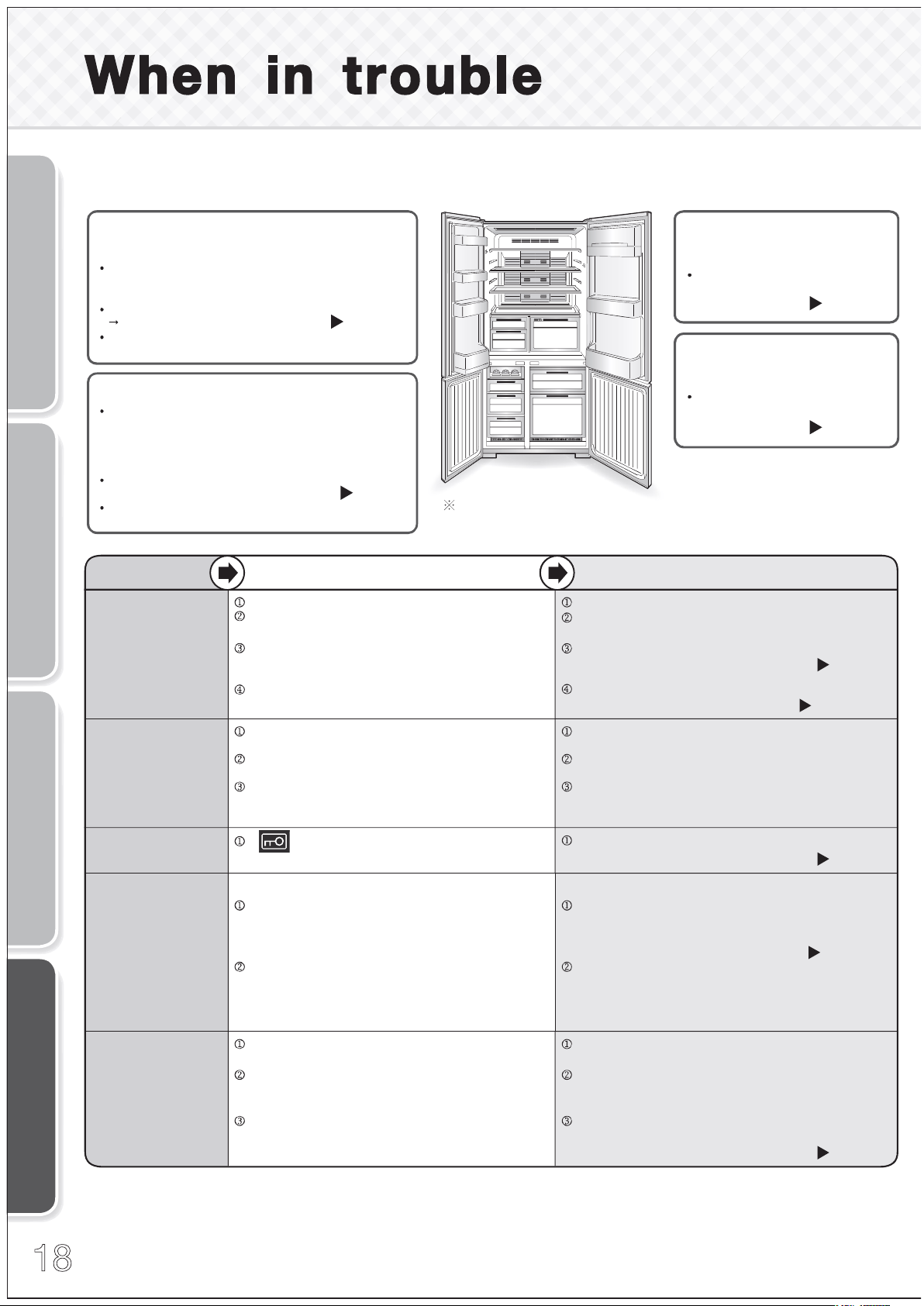
Illustration of the MR-L710EH

19
When in troubleBefore Use Operation Cleaning
Problem Check Explanation and action
Door alarm sounds
Is the door of the refrigerator or freezer compartments
open?
Is the rotating partition of the refrigerator compartment
turned up to the front?
Close the door. The alarm sounds at every minute
after the door is opened, and after 4 minutes it sounds
continuously.
If the alarm sounds even after closing the door, press the
ENERGY SAVING button and RAPID COOL button at the same
time for about 3 seconds to stop it. An inspection is required.
Contact the retail store where you purchased the refrigerator or
MITSUBISHI ELECTRIC SERVICE CENTRE.
Check the position of the rotating partition while the
doors are open.
Ice cube is small
or joined together
Has ice been stored inside for a long time?
If the ice is stored for a long time, ice cubes may stick
together or shrink.
(Due to a phenomenon called sublimation.)
Noise interferes
with televisions or
other devices
Is the refrigerator installed near to an electronic device
such as a television?
Is the power to the refrigerator supplied from a socket
near the entry hole of the antenna cable?
Install the refrigerator away from electronic devices such
as televisions.
We recommend using a dedicated power supply.
Loud noises
Annoying noise
These noises
are normal.
The noise gets louder suddenly or the tone changes.
A whistling sound is made after closing a door.
A hissing, bubbling or running water sound is made
sometimes.
A whipping or dripping sound is sometimes heard
from inside the refrigerator after a door is opened.
A buzzing sound is made sometimes.
Immediately after installation, when the weather is hot,
when the doors are frequently opened and closed, during
the rapid cooling operation, and in similar situations, the
refrigerator switches to high-speed operation and cools
with high power.
This is the sound of the fan motor starting.
This is the sound of the refrigerant (gas) flowing.
This is the creaking sound as warm air enters and
expands the plastic.
the air flow.
This is the operating sound of the damper as it adjusts
Pages 9, 16
Page 11
CAUTION
1. This appliance is designed for use in ambient temperature listed below.
The internal temperatures could be affected by such factors as the location of the refrigerating appliance, ambient
temperature and the frequency of door opening, and, if appropriate, a warning that the setting of any temperature
control device might have to be varied to allow for these factors.
2.
A rise in temperature of the frozen food during manual defrosting, maintenance or cleaning could shorten the storage life.
3. Food to be frozen is not to be placed in direct contact with food in storage and, if appropriate, that it could be
necessary to reduce the quantity to be frozen if freezing every day is anticipated.
4. The electrical power failure for 1-2 hour will only slightly effect the inside temperature. However, open & close of
the door results in the temperature loss. In case there is more than 24 hours electrical power failure, the food
should be taken out from the fridge.
5. In case you are leaving or there is no food in the fridge for more than 3 weeks, The fridge should be unplugged
and cleaned.
MODEL NAME AMBIENT TEMPERATURE RANGE CLIMATIC CLASS
MR-L650EH, L710EH-A 16
o
C ~ 43
o
C T
MR-L650EH, L710EH-NZ 16
o
C ~ 43
o
C T

NR79C155H01
New South Wales:
348 Victoria Road, Rydalmere NSW 2116 Phone: (02) 9684 7777, Fax: (02) 9898 1043
Queensland:
Da Vinci Business Park, Building 101, 2A Boronia Road, Brisbane Airport QLD 4008
Phone: (07) 3623 2000, Fax: (07) 3860 6761
South Australia / Northern Territory:
Suite 1, 224 Glen Osmond Road, Fullarton SA 5063 Phone: (08) 8338 1001, Fax: (08) 8338 0501
Western Australia:
Unit 5, 329 Collier Road, Bassendean WA 6054 Phone: (08) 9377 3400, Fax: (08) 9377 3499
Victoria / Tasmania:
Unit 5, 12 Compark Circuit Mulgrave VIC 3170 Phone: (03) 9535 7800, Fax: (03) 9535 7801
SOLE AGENT in Australia
MITSUBISHI ELECTRIC AUSTRALIA PTY LTD.
(Incorporated in New South Wales) ABN 58 001 215 792
Wellington Office (Head Office)
1 Parliament Street Lower Hutt PO Box 30772 Phone: (04) 560 9147, Fax: (04) 560 9133
Auckland Office
Unit 1, 4 Walls Road Penrose PO Box 12726 Phone: (09) 526 9347, Fax: (09) 526 9348
Christchurch Office
44 Halwyn Drive Hornby PO Box 16904 Phone: (03) 341 2837, Fax: (03) 341 2838
SOLE AGENT in New Zealand
BLACK DIAMOND TECHNOLOGIES LIMITED (BDT)
This refrigerator uses flammable foaming gas for
insulation.
Please deliver the unit to specialized industrial
waste dealer when you do away it.
Please follow the rules in your country.
The appliance is not intended for use by young
children or infirm persons without supervision.
Young children should be supervised to ensure
that they do not play with the appliance.
WARNING - Do not use mechanical devices
or other means to accelerate the defrosting
process, other than those recommended by the
manufacturer.
WARNING - Do not use electrical appliances
inside the food storage compartments of the
appliance, unless they are of the type
recommended by the manufacturer.
WARNING - Just in case of having damaged the
refrigerant circuit, do not use electric items or
fire equipment near by, and open the window
to ventilate the room. And contact the retail
store at which you purchased it or the following
MITSUBISHI ELECTRIC SERVICE CENTRE.
The refrigeration system behind and inside the
refrigerator contains refrigerant.
Do not allow any sharp objects to come into
contact with the refrigeration system.
The refrigerator contains flammable refrigerant
(R600a: isobutane).
The user manual should be handed over to any
person who would use or handle the refrigerator
whenever the refrigerator would be transferred
to another location and delivered to a recycling
plant.
Do not block the openings on the circumstances
of the refrigerator.
If an abnormality or malfunction occurs, stop operation immediately and contact the retail store where
you purchased the refrigerator or MITSUBISHI ELECTRIC SERVICE CENTRE or its service agent.
R600a Refrigerant Warning
NOTE: MITSUBISHI ELECTRIC AUSTRALIA PTY LTD. DO NOT ALLOW SERVICE
TO THE REFRIGERATION CIRCUIT OF THIS APPLIANCE.
This appliance contains a small quantity of R600a refrigerant which is flammable.
During transportation and installation, ensure that the tubing of the refrigerant circuit is not damaged.
Leaking refrigerant can ignite and may damage the eyes.
In the event any damage does occur, avoid exposure to open fires and any device which creates a spark.
Disconnect the appliance from the mains power.
Thoroughly ventilate the room in which the appliance is located for several minutes.
Notify Mitsubishi Electric Australia Pty Ltd. for necessary action and advice.
The room for installing the appliance must be at least 1 cubic metre per 8 grams of refrigerant.
The refrigerant quantity contained in this appliance is noted on the Rating Label of the appliance.
If your Mitsubishi Electric Refrigerator should require service, please contact Mitsubishi Electric Australia
Pty Ltd see back page of this user manual for contact details.