YARDMAX~
Q5
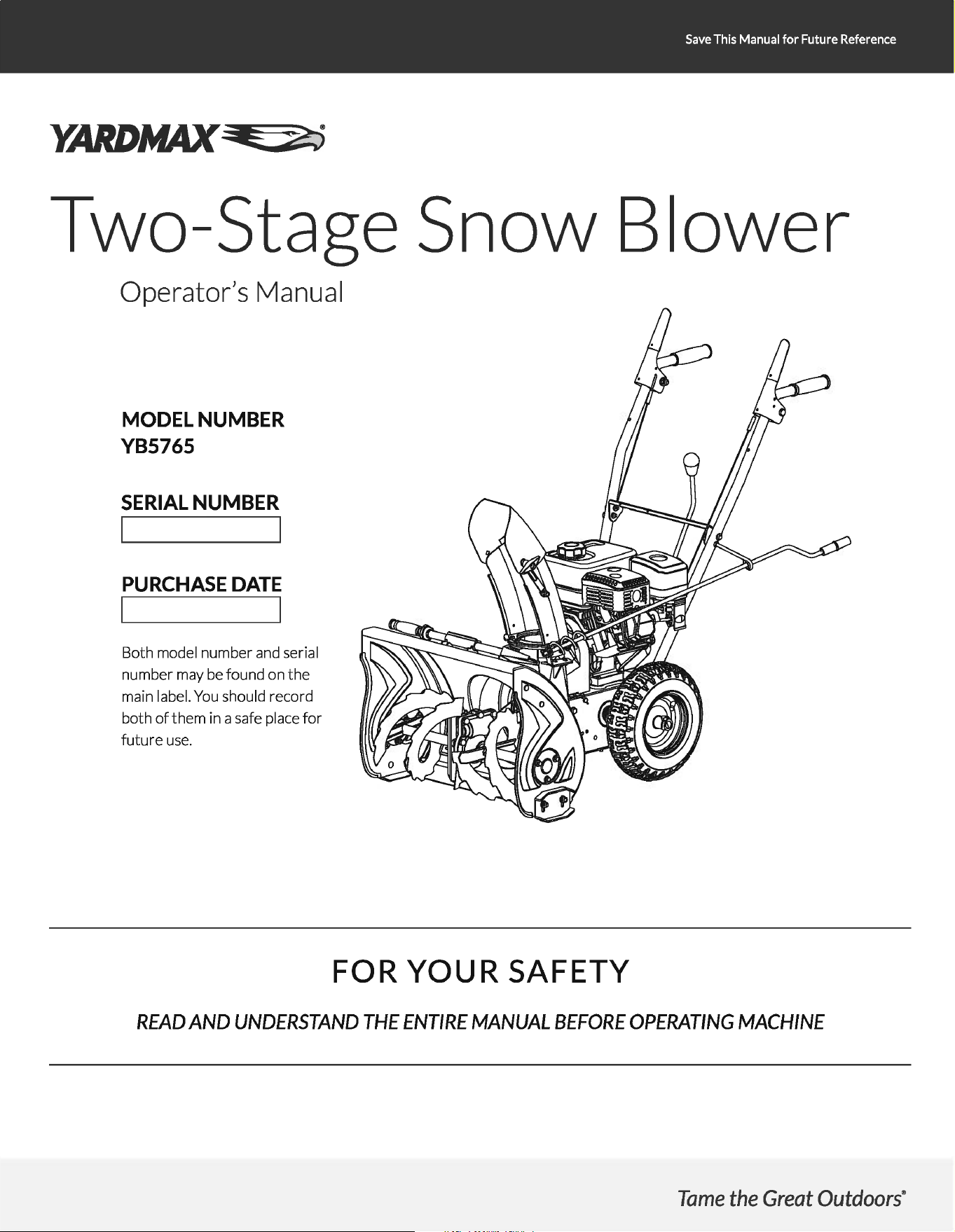
Two-Stage Snow Blower
Operator's Manual
MODEL
NUMBER
YB5765
SERIAL
NUMBER
PURCHASE DATE
I I
Both model number and serial
number may be found on the
main label.
You
should record
both
of
them in a safe place
for
future
use.
FOR
YOUR
SAFETY
READ
AND
UNDERSTAND
THE
ENTIRE
MANUAL
BEFORE
OPERATING
MACHINE
Tame
the
Great
Outdoors·
1
I
Your
new
YARDMAX®
snow
blower
offers
quality
construction,
and
is
easy and safe
to
operate.
With
proper
use
and
care,
it
is
designed
to
give you many years
of
dependable service.
Prepare
to
experience the durability
to
take
on
any
job
with
the
ease,
portability, and convenience
of
your
new
snow blower!
Discover
the YARDMAX Advantage
At
YARDMAX,
we
understand
that
land
ownership
definitely
has its privileges,
but
it
also comes
with
a
great
deal
of
responsibility.
When
duty
calls and you
need
to
respond, will you
have
what
it
takes
to
tame the
great outdoors?
When looking
for
outdoor power equipment
(OPE)
to
get
the job done right, at the right price, YARD MAX delivers
the perfect combination
of
performance
and
practicality.
YARD
MAX
has
a solution that's right
for
you.
MAX
Performance,
MAX
Value,
MAX
Support -
that's YARDMAX
..J
Backed by decades
of
proven manufacturing expertise
..J
Enhanced design features come standard
..J
Engineered
for
the best user experience
..J
Quality metal parts are
used
instead
of
plastic
..J
A robust warranty supports
all
products
..J
Budget-friendly prices
make
it
practical
YARDMAX~
Up
for
the
job?
YARDMAX
is.
TABLE
OF
CONTENTS
Introduction 1 Operation 18
Specifications
3
Maintenance 20
Symbols
4
Service
21
Safety
4
Storage
24
Contents
Supplied
7
Troubleshooting
25
Assembly
8
Parts
Diagram
27
Know
Your
Machine
13
Parts
List
29
Adjustment
16
Introduction
YB5765PM01-1612
Carefully
read
through this entire operator's manual
before using your new unit.
Pay
attention
to all
cautions
and
warnings.
This
unit
is
a gasoline engine driven snow blower.
It
is
perfect
for
tacking medium snowfall
-easily
able
to
cut
through snow
in
excess
of
a
foot
or
more.
It
is
easy and
safe
to
operate.
With
proper use
and
care,
it
should give
you many years
of
dependable service.
ENGINE
MANUAL
Please
refer
to
the
Engine Manufacturer's
owner/
operator's manual, packed separately
with
your unit,
for
more information.
EMISSION
CONTROL
SYSTEM
This equipment
or
its engine may include exhaust and
evaporative
emission
control
system
components
required
to
meet
U.S.
Environmental Protection Agency
(EPA)
and/or
California
Air
Resources Board (CARB)
regulations.
Tampering
with
emission
controls
and
components
by
unauthorized
personnel
may
result
in severe fines
or
penalties.
Emission
controls
and
components
can
only
be
adjusted
by
an
authorized
engine manufacturer's service center.
CALIFORNIA PROPOSITION 65 WARNING
Engine exhaust, some
of
its
constituents
and
certain
product components contain
or
emit chemicals known
to
the state
of
California
to
cause cancer
and
birth defects
or
other reproductive harm. For more information,
go
to
www.P65Warnjngs.ca.goy.
ENVIRONMENTAL
Recycle
unwanted materials instead
of
disposing
of
D#D~
them
as
waste.
All
tools,
hoses,
and
packaging
should
-
be
taken
to the local recycling center and
disposed
of
in
an
environmentally
safe
way.
YB5765PM01-1612
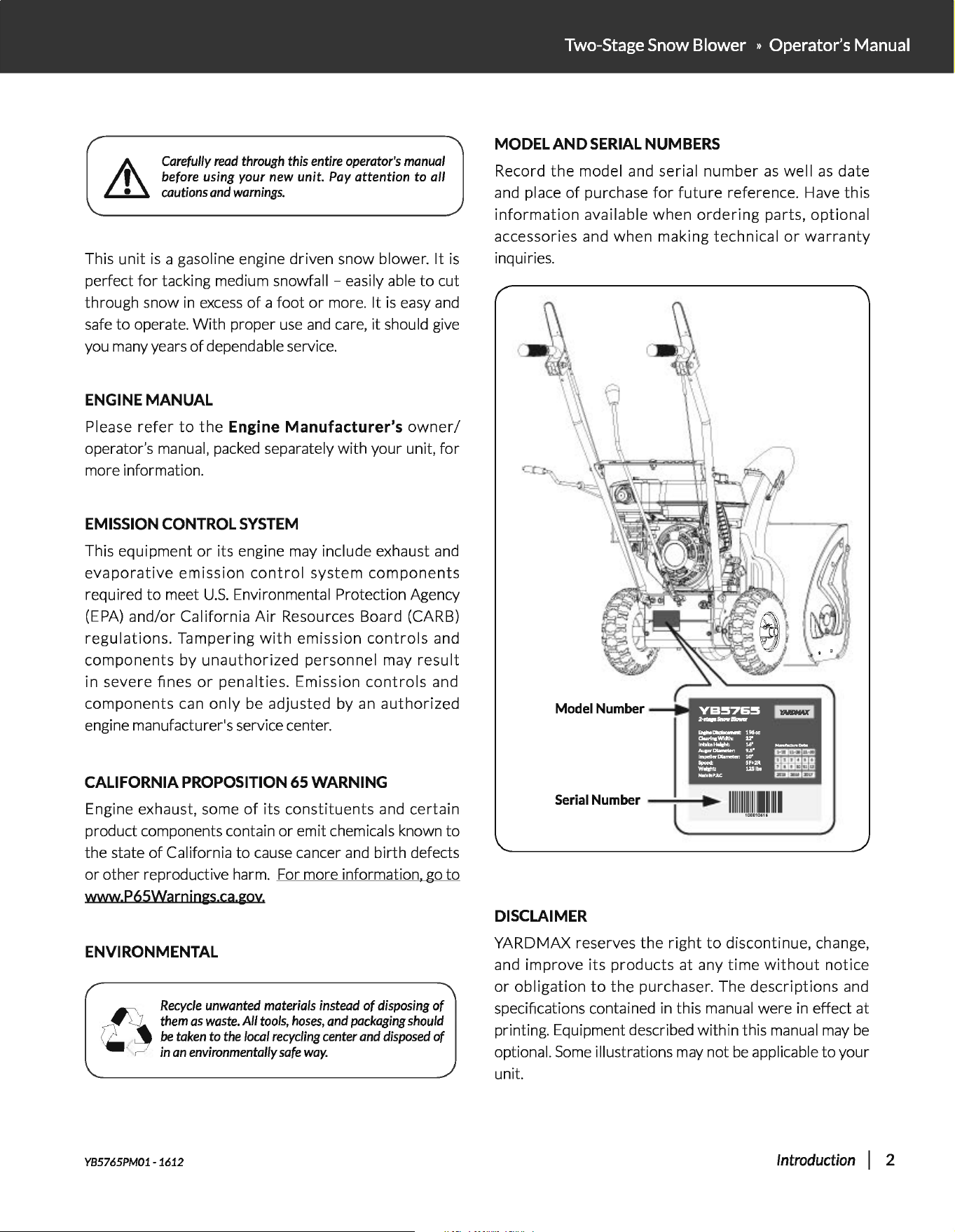
MODEL AND
SERIAL
NUMBERS
Record
the
model and serial
number
as
well
as
date
and place
of
purchase
for
future
reference. Have this
information
available
when
ordering
parts,
optional
accessories and
when
making
technical
or
warranty
inquiries.
DISCLAIMER
YARDMAX reserves
the
right
to
discontinue, change,
and
improve
its
products
at
any
time
without
notice
or
obligation
to
the
purchaser. The
descriptions
and
specifications contained in this manual were in effect at
printing. Equipment described within this manual may
be
optional.
Some
illustrations may not
be
applicable
to
your
unit.
Introduction
I 2
SUPPORT
Have questions about
your
YARD
MAX
equipment?
Call
us
at
847-327-0566
or
844-YARDMAX, email
us
or
contact
us
via your
favorite social media site.
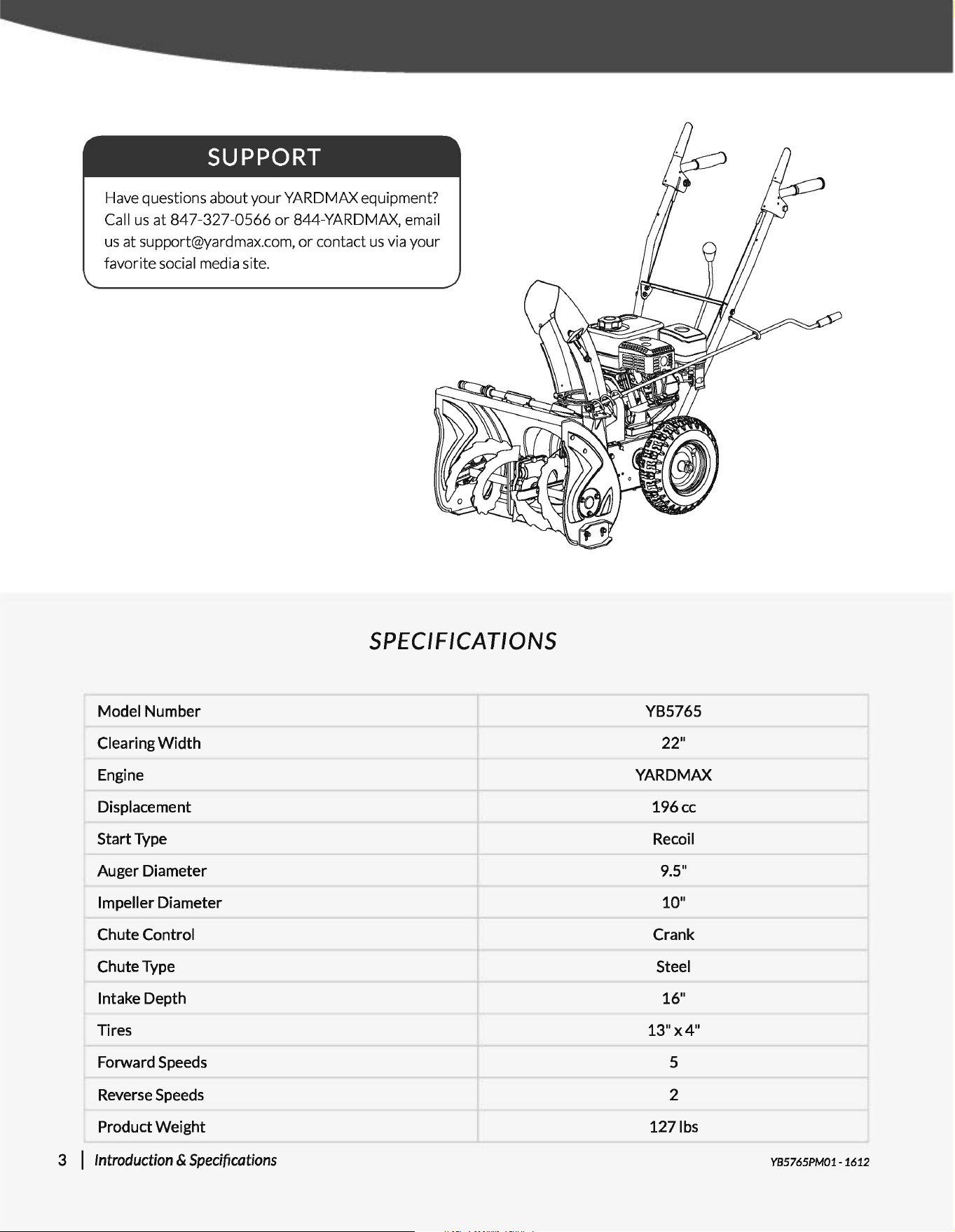
Model Number
Clearing
Width
Engine
Displacement
Start Type
Auger Diameter
Impeller Diamet
Chute Control
Chute Type
Intake Depth
Tires
Forward Speeds
Reverse Speeds
Product Weight
er
3 I Introduction & Specifications
SPEC/
FICATIONS
YB5765
22"
y,
;i\RDMAX
196cc
Recoil
9.5"
10"
Crank
Steel
16"
13"x4"
5
2
1271bs
YB5765PM01-1612
SYMBOLS
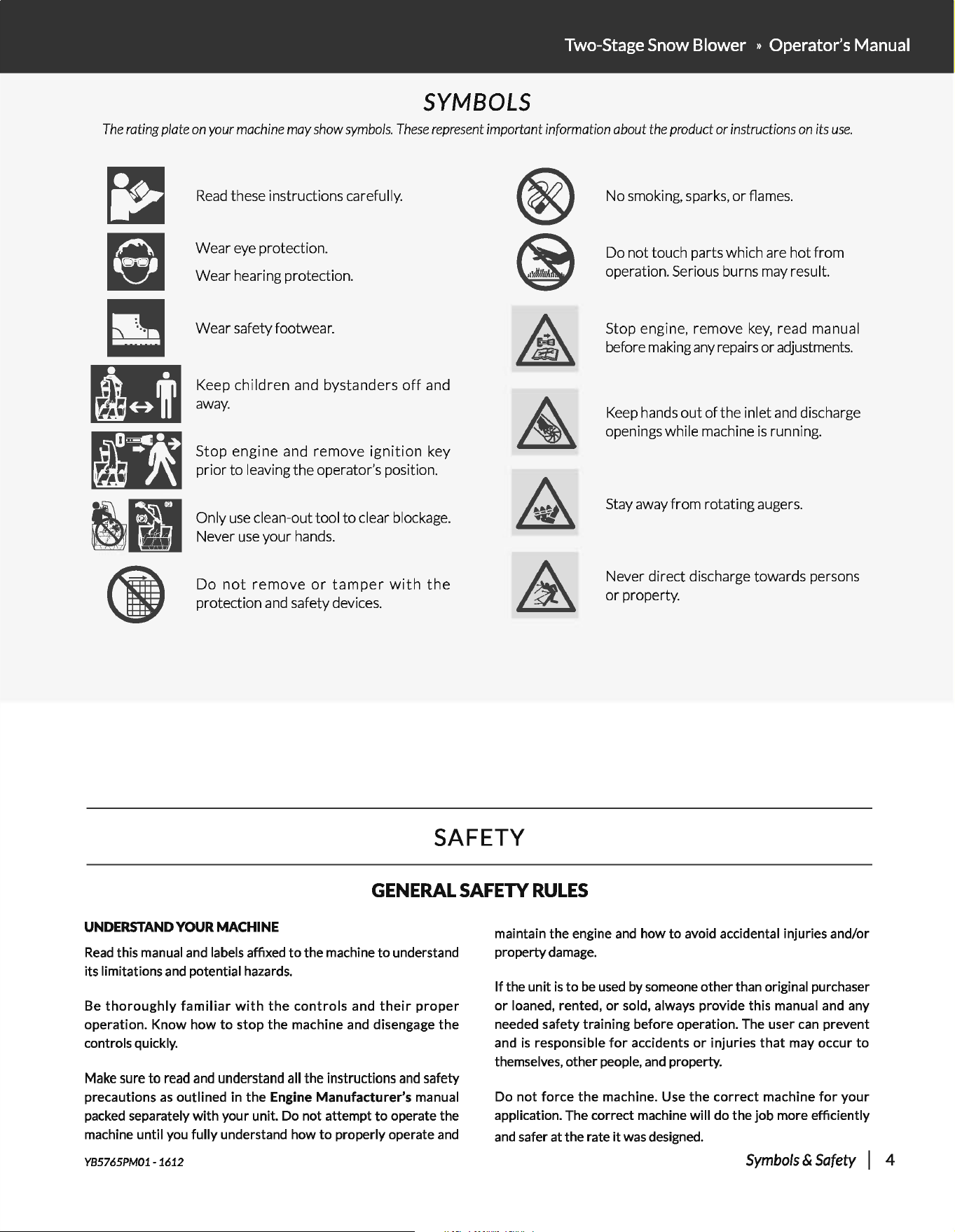
The
rating plate
on
your
machine
may
show
symbols.
These
represent
important information about
the
product
or
instructions
on
its
use.
Read
these instructions carefully.
Wear
eye protection.
Wear
hearing protection.
Wear
safety footwear.
Keep
children
and
bystanders
off
and
away.
Stop
engine
and
remove
ignition
key
prior
to
leaving the operator's position.
Only
use
clean-out tool
to
clear blockage.
Never
use
your
hands.
Do
not
remove
or
tamper
with
the
protection and safety devices.
No
smoking, sparks,
or
flames.
Do
not
touch parts which are hot from
operation. Serious burns may result.
Stop engine, remove
key,
read manual
before making any repairs
or
adjustments.
Keep hands
out
of
the inlet
and
discharge
openings while machine
is
running.
Stay away from rotating augers.
Never direct discharge towards persons
or
property.
SAFETY
GENERAL
SAFETY
RULES
UNDERSTAND
YOUR
MACHINE
Read
this manual
and
labels affixed
to
the machine
to
understand
its limitations
and
potential hazards.
Be
thoroughly
familiar
with
the
controls
and
their
proper
operation. Know how
to
stop
the
machine and disengage
the
controls quickly.
Make sure
to
read
and
understand all the instructions
and
safety
precautions
as
outlined in
the
Engine
Manufacturer's
manual
packed separately
with
your unit. Do not attempt
to
operate the
machine until you fully understand how
to
properly operate
and
YB5765PM01-1612
maintain the engine
and
how
to
avoid accidental injuries and/or
property
damage.
If
the unit
is
to
be
used
by someone other than original purchaser
or
loaned, rented,
or
sold, always provide this manual and any
needed safety training before operation. The user
can
prevent
and
is
responsible
for
accidents
or
injuries
that
may occur
to
themselves, other people,
and
property.
Do
not
force
the
machine. Use
the
correct
machine
for
your
application. The correct machine will do the job more efficiently
and
safer at the rate
it
was
designed.
Symbols
& Safety I 4
PERSONAL
SAFETY
Do
not
permit children
to
operate this machine
at
any time.
Keep children, pets, and
other
people
not
using
the
unit
away
from
the
work
area.
Be
alert
and shut
off
unit
if
anyone enters
work
area.
Keep
children under the watchful care
of
a responsible
adult.
Do
not
operate the machine while under the influence
of
drugs,
alcohol,
or
any medication
that
could affect your ability
to
use
it
properly.
Dress properly. Wear heavy long pants, boots,
and
gloves. Do not
wear loose clothing, short pants,
or
jewelry
of
any kind. Secure
long hair
so
it
is above shoulder level. Keep
your
hair, clothing,
and gloves away
from
moving parts. Loose clothes, jewelry,
or
long hair
can
be
caught in moving parts.
Protect eyes, face, and head
from
objects
that
may
be
thrown
from the unit. Always wear safety goggles
or
safety glasses
with
side shields when operating.
Wear appropriate hearing protection.
Always keep hands and feet away
from
all moving parts during
operation. Moving parts
can
cut
or
crush body parts.
Always keep hands
and
feet away from all pinch points.
Do not touch parts that might
be
hot from operation. Allow parts
to
cool
before attempting
to
maintain, adjust,
or
service.
Stay alert, watch
what
you are doing, and use common sense
when operating the machine.
Do
not
overreach. Do
not
operate the machine while barefoot
or
when wearing sandals
or
similar lightweight footwear.
Wear
protective
footwear
that
will
protect
your
feet
and
improve
your
footing
on
slippery
surfaces. Keep
proper
footing
and
balance at all times. This enables better control
of
the machine in
unexpected situations.
INSPECT
YOUR
MACHINE
Check your machine before starting it. Keep guards in place
and
in
working
order. Make sure all nuts, bolts, etc., are securely
tightened.
Never operate
the
machine when
it
is
in need
of
repair
or
is
in
poor mechanical condition. Replace damaged, missing,
or
failed
parts before using it. Check
for
fuel leaks. Keep the machine in
safe working condition.
Do
not
use
the machine
if
the engine's switch does not
turn
it
on
or
off. Any gasoline powered machine
that
can't
be
controlled
with
the engine switch
is
dangerous
and
must
be
replaced.
5 I Safety
Regularly check
to
see
that
keys and adjusting wrenches are
removed
from
the machine area before starting it. A wrench
or
a key
that
is
left
attached
to
a rotating part
of
the machine may
result in personal injury.
Avoid accidental starting.
Be
sure the engine's switch
is
off
before
transporting
the
machine
or
performing
any maintenance
or
service on the unit. Transporting
or
performing maintenance
or
service on a machine
with
its switch on invites accidents.
If
the
machine should
start
to
vibrate
abnormally,
stop
the
engine (motor)
and
check immediately
for
the
cause.
Vibration
is
generally a warning sign
of
trouble.
ENGINE
SAFETY
This machine is equipped
with
an
internal combustion engine.
Do
not
use
on
or
near any unimproved, forest covered,
or
brush
covered land unless the exhaust system
is
equipped
with
a spark
arrester meeting applicable local, state,
or
federal laws.
In
the
state
of
California, a spark
arrester
is required by law.
Other
states have similar laws. A spark arrester,
if
used, must
be
maintained in effective working order by the operator.
Never
start
or
run the engine inside a closed area. The exhaust
fumes are dangerous, containing carbon monoxide,
an
odorless
and
deadly
gas.
Operate
this
unit
only
in a
well-ventilated
outdoor area.
Do not tamper
with
the engine
to
run
it
at
excessive speeds. The
maximum engine speed is preset by
the
manufacturer
and is
within safety limits.
See
engine manual.
Keep a Class B
fire
extinguisher on hand when operating
this
snow blower in
dry
areas
as
a precautionary measure.
FUEL
SAFETY
Fuel
is
highly flammable, and its vapors can explode
if
ignited.
Take precautions when using
to
reduce
the
chance
of
serious
personal
injury.
When refilling
or
draining
the
fuel tank, use
an
approved fuel
storage container while in a clean, well-ventilated outdoor area.
Do
not
smoke,
or
allow sparks, open flames,
or
other
sources
of
ignition near
the
area
while
adding fuel
or
operating
the
unit.
Never fill the fuel tank indoors.
Keep grounded conductive objects, such
as
tools, away
from
exposed, live electrical parts
and
connections
to
avoid sparking
or
arcing. These events could ignite fumes
or
vapors.
Always stop the engine
and
allow
it
to
cool before filling the fuel
tank. Never remove the cap
of
the fuel tank
or
add
fuel while the
engine
is
running
or
when the engine
is
hot. Do
not
operate the
machine
with
known leaks in the fuel system.
YB5765PM01-1612
Loosen
the fuel tank
cap
slowly
to
relieve any pressure in the tank.
Never overfill
the
fuel tank. Fill
the
tank
to
no more than
1/2"
below the bottom
of
the filler neck
to
provide space
for
expansion
as
the heat
of
the engine
can
cause fuel
to
expand.
Replace
all fuel tank
and
container
caps
securely
and
wipe up spilled
fuel. Never operate the unit without the fuel
cap
securely in
place.
Avoid creating a source
of
ignition
for
spilled fuel.
If
fuel
is
spilled,
do
not
attempt
to
start
the
engine
but
move
the
machine away
from the area
of
spillage and avoid creating any source
of
ignition
until fuel vapors have dissipated.
When fuel
is
spilled on yourself
or
your
clothes, wash
your
skin
and change clothes immediately.
Store fuel in containers specifically designed and approved
for
this purpose.
Store fuel in a cool, well-ventilated area, safely away from sparks,
open flames,
or
other
sources
of
ignition.
Never
store
fuel
or
a machine
with
fuel
in
the
tank
inside a
building where fumes may reach a spark, open flame,
or
any
other
source
of
ignition,
such
as
a
water
heater, furnace,
or
clothes
dryer.
Allow
the engine
to
cool before storing in any enclosure.
SPECIFIC
SAFETY
RULES
Do
not
operate
without
wearing adequate
winter
outer
garments.
Do
not
use
the
machine on a roof.
Do
not
run
the
engine indoors, except when starting the engine
and
for
transporting the snow
thrower
in
or
out
of
the
building.
Open the outside doors; exhaust fumes are dangerous.
Always check overhead and side clearances
carefully
before
operation.
Always
be aware
of
traffic
when
operating
along
streets
or
curbs.
Thoroughly inspect the area
to
be
worked.
Keep
the working area
clean and free
of
toys, doormats, newspapers, sleds, boards, wires
and
other foreign objects, which could
be
tripped over
or
thrown by
the auger/impeller. Check
for
weak spots
on
docks,
ramps
or
floors.
Plan
your
snow-throwing
pattern
to
avoid discharge
toward
people
or
areas where property damage
can
occur.
Do
not
operate
near
drop-offs,
ditches,
or
embankments.
Machine can suddenly
turn
over
if
a wheel
is
over
the
edge
of
a
cliff
or
ditch,
or
if
an
edge
caves
in.
Keep all bystanders, children, and pets
at
least 75
feet
(23m)
away.
If
you are approached, stop
the
unit
immediately.
Use a grounded three-wire extension cord and receptacle
for
all
machines
with
electric
start
engines.
Check clutch and brake operation frequently. Adjust and service
as
required. All motion
of
drive wheels and auger/impeller must
stop quickly when control levers are released.
Let engine and machine adjust
to
outdoor
temperature
before
starting
to
clear snow.
YB5765PM01-1612
Stay alert
for
hidden hazards
or
traffic.
Do
not
overload machine capacity by attempting
to
clear snow at
too
fast
of
a rate.
Do
not
throw
snow any higher than necessary.
Adjust
auger housing
height
to
clear
gravel
or
crushed
rock
surfaces. Exercise extreme caution when operating.
Exercise
caution
to
avoid
slipping
or
falling, especially
when
operating in reverse. Never operate machine
at
high
transport
speeds on slippery surfaces. Always look down and behind before
and while backing.
Do
not
operate on steep slopes. Do
not
clear snow across
the
face
of
slopes. Keep all movement on slopes slow and gradual. Do
not
make sudden changes in speed
or
direction. Use a slow speed
to
avoid stops
or
shifts
on slopes. Avoid
starting
or
stopping
on a slope. Do
not
park
machine on a slope unless
absolutely
necessary. When parking on a slope, always block the wheels.
Disengage power
to
the
auger/impeller when transporting
or
not
in
use.
Disengage all control levers and stop engine before you leave the
operating position (behind
the
handles).
Wait
until
the
auger/
impeller comes
to
a complete stop before unclogging
the
chute
assembly, making any adjustments,
or
inspections.
Hand
contact
with
the
rotating
impeller
inside
the
discharge
chute
is
the most common cause
of
injury
associated
with
snow
throwers. Do
not
unclog chute assembly while engine
is
running.
Shut
off
engine and remain behind handles until all moving parts
have stopped
before
unclogging.
Never
put
your
hand
in
the
discharge
or
collector openings. Always use
the
clean-out
tool
provided
to
unclog the discharge opening.
Safety I 6
••
••
•
• ••••
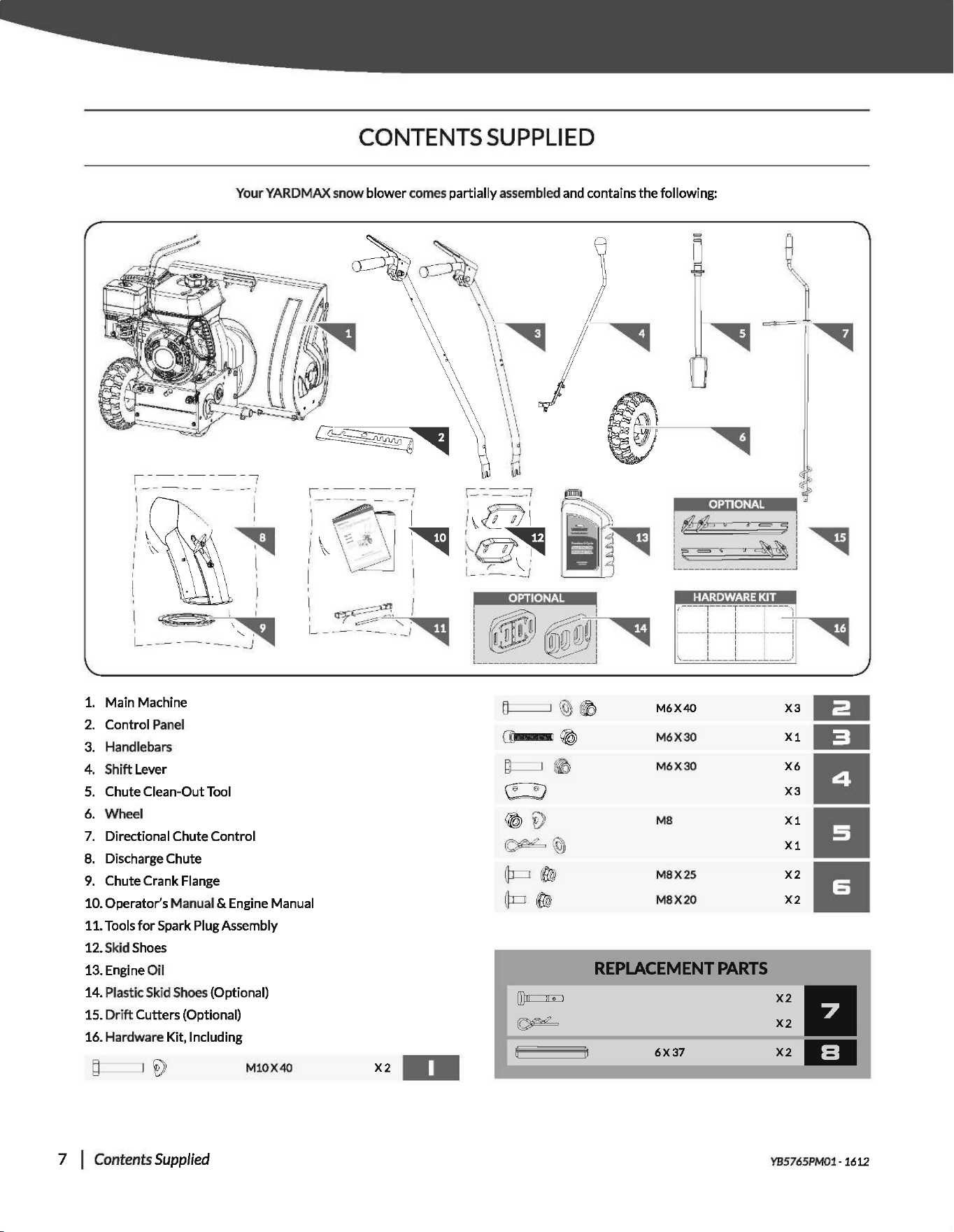
CONTENTS
SUPPLIED
Your YARD
MAX
snow
blower
comes
partially
assembled and contains
the
following:
~
-------
,
~
-
--
--
-
-
~I
I
I
~
I
1.
Main
Machine
2.
Control
Panel
3.
Handlebars
4.
Shift
Lever
5.
Chute Clean-Out Tool
6.
Wheel
7. Directional Chute
Control
8. Discharge
Chute
9. Chute Crank Flange
10. Operator's Manual & Engine Manual
11.
Tools
for
Spark Plug Assembly
12. Skid Shoes
13.
Engine
Oil
14. Plastic Skid Shoes (Optional)
15.
Drift
Cutters
(Optional)
16.
Hardware
Kit, Including
t~--0
- ----''
~
M10X40
X2
1111
7 I Contents Supplied
OPTIONAL
D
I
@)~
a-
~
~
~
r:::::!J
~VJ
~
@
(p:=:J®a
()D~
OPTIONAL
I
~
I
:
~
:
I I
I I
I
~
I
~~~
L
____________________
j
HARDWARE KIT
r
----~----T----
T
----.
,
: : : :
~
~
~---
1 I I I I
L----
L
----
L
----L----
1
I I I I I
I I I I I
I I I I I
1
-_
____
l
____
L
____
L
____
)
M6X40
X3
II•
M6X30
X1
•II
M6X30
X6
II
X3
MB
X1
II
X1
M8X25
X2
a
M8X20
X2
REPLACEMENT
PARTS
X2
X2
6X37
X2
YB5765PM01-1612
ASSEMBLY
This snow blower was partially assembled
at
the
factory.
To
assemble
your
machine
follow
the below instructions.
ENGINE
AIR
FILTER
COVER
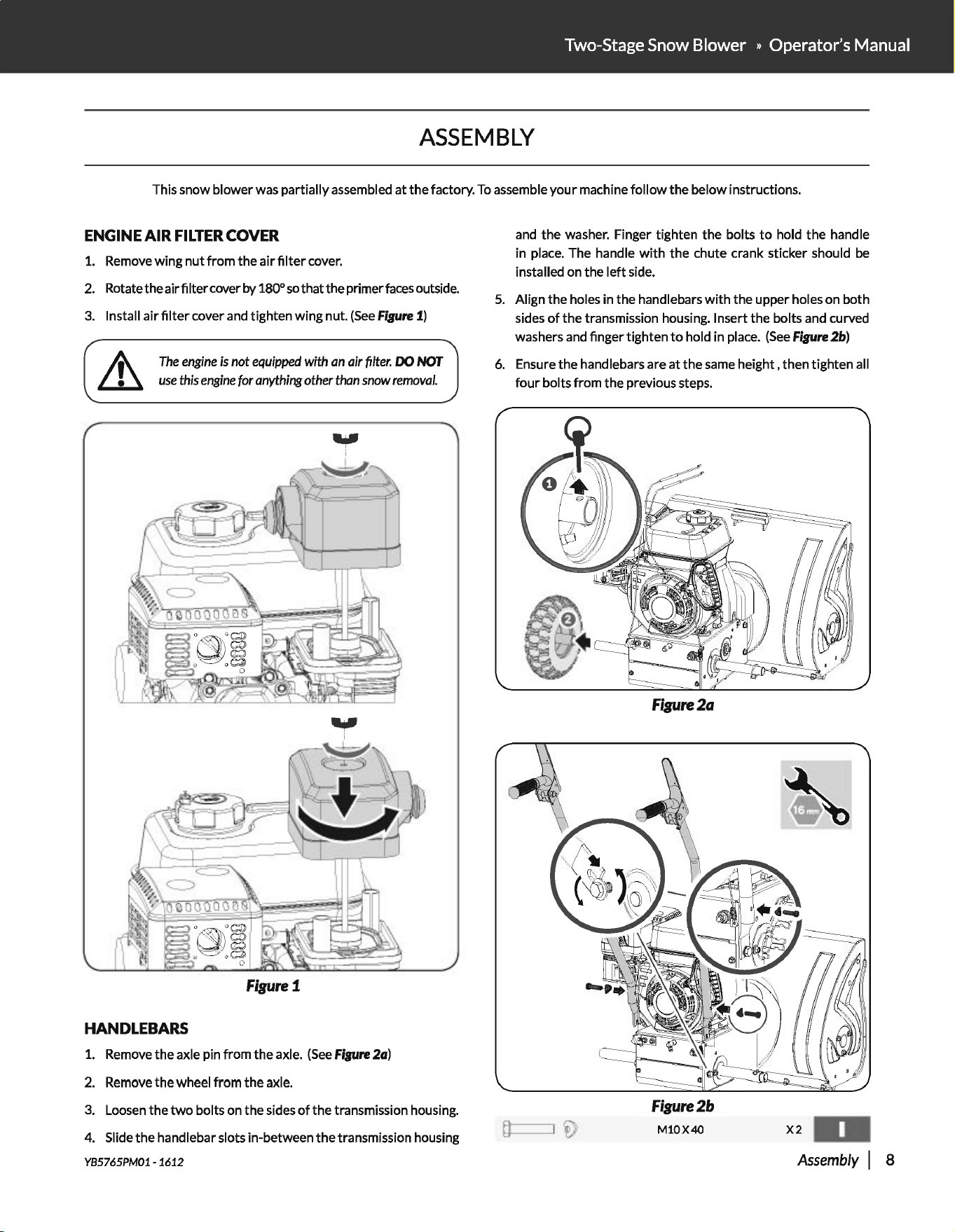
1. Remove wing
nut
from
the air
filter
cover.
2.
Rotate the air filter cover by 180°
so
thatthe
primer
faces
outside.
3.
Install air
filter
cover and tighten wing nut.
(See
fisure 1)
~
The
engine
is
not
equipped
with
an
air
(liter.
DO
NOT
Lll
use
this
engine
for
anything
other
than
snow
removal.
figure1
HANDLEBARS
1. Remove the axle pin
from
the axle.
(See
fipre
2a)
2.
Remove
the
wheel
from the
axle.
3.
Loosen the
two
bolts on the sides
of
the transmission housing.
4. Slide
the
handlebar slots in-between
the
transmission housing
YB5765PM01-1612
and the washer. Finger tighten the bolts
to
hold
the
handle
in place. The handle
with
the chute crank sticker should
be
installed on the
left
side.
5.
Align the holes in the handlebars
with
the upper holes on both
sides
of
the
transmission housing. Insert the bolts and curved
washers and finger tighten
to
hold in place.
(See
fisure
2b)
6.
Ensure the handlebars are
at
the
same height, then tighten all
four
bolts
from
the previous steps.
t-t-0 _ _jl v
figure2a
figure2b
M10X40
X2
1111
Assembly
I 8
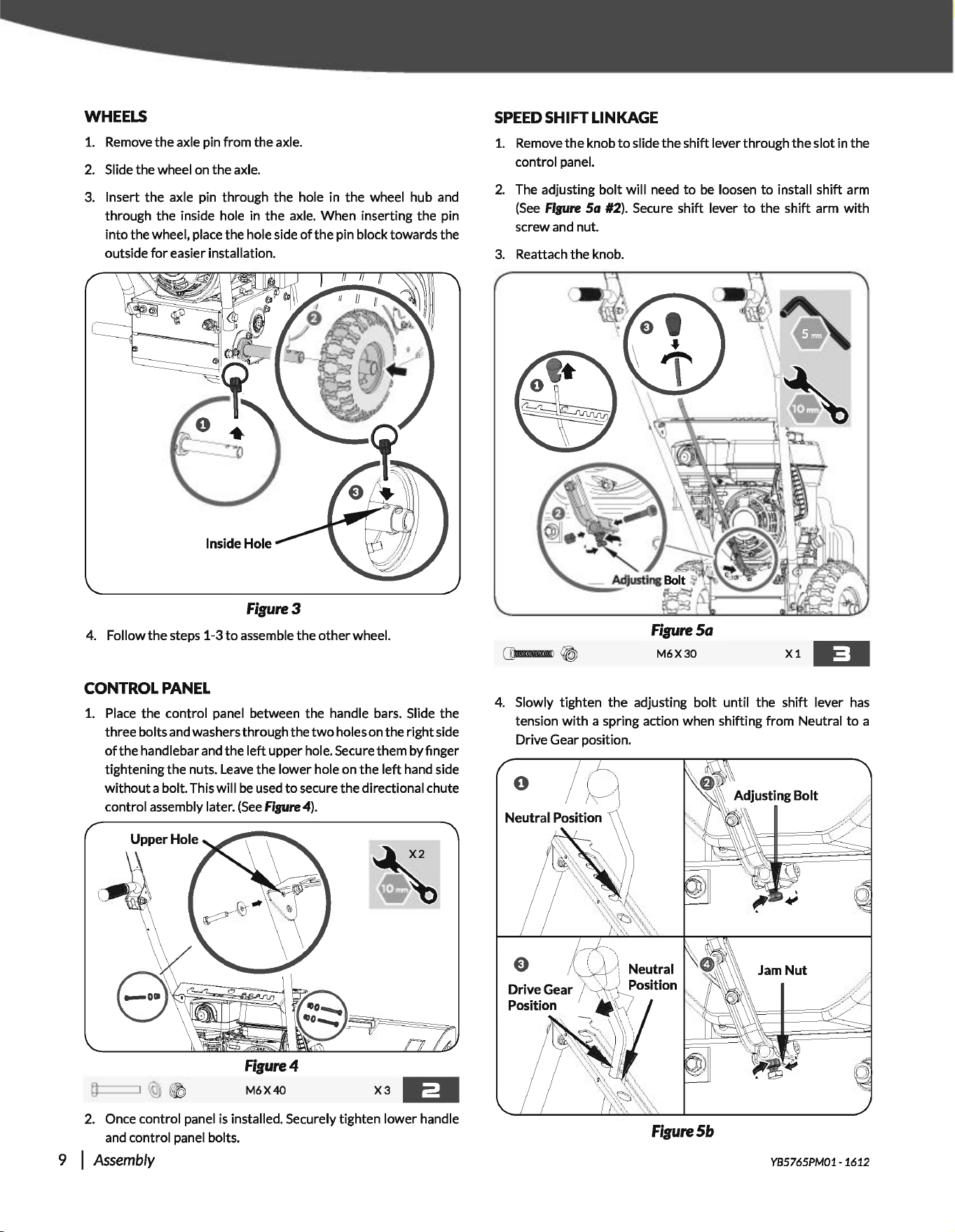
WHEELS
1.
Remove the axle pin from the axle.
2.
Slide the wheel on the axle.
3.
Insert the axle pin through the hole in the wheel hub
and
through the inside hole in the axle. When inserting the pin
into the wheel, place the hole side
of
the pin block towards the
outside
for
easier installation.
Inside
Hole
Figure3
4.
Follow the steps 1-3
to
assemble the other wheel.
CONTROL
PANEL
1.
Place
the control panel between the handle bars. Slide the
three bolts
and
washers through the
two
holes on the right side
ofthe
handlebar
and
the
left
upper hole. Secure them byfmger
tightening the nuts.
Leave
the lower hole on the left hand side
without
a bolt. This will
be
used
to
secure the directional chute
control assembly later.
(See
Fisure
4).
Figure4
M6X40
X3
------
2.
Once control panel
is
installed. Securely tighten lower handle
and
control panel bolts.
9 I
Assembly
SPEED
SHIFT
LINKAGE
1.
Remove the knob
to
slide the shift lever through the slot in the
control panel.
2.
The adjusting bolt will need
to
be
loosen
to
install shift arm
(See
Figure
Sa #2). Secure shift lever
to
the shift arm
with
screw and nut.
3.
Reattach the knob.
Figure
Sa
M6X30
X1
-=·
4. Slowly tighten the adjusting bolt until the shift lever
has
tension
with
a spring action when shifting from Neutral
to
a
Drive Gear position.
FigureSb
YB5765PM01-1612
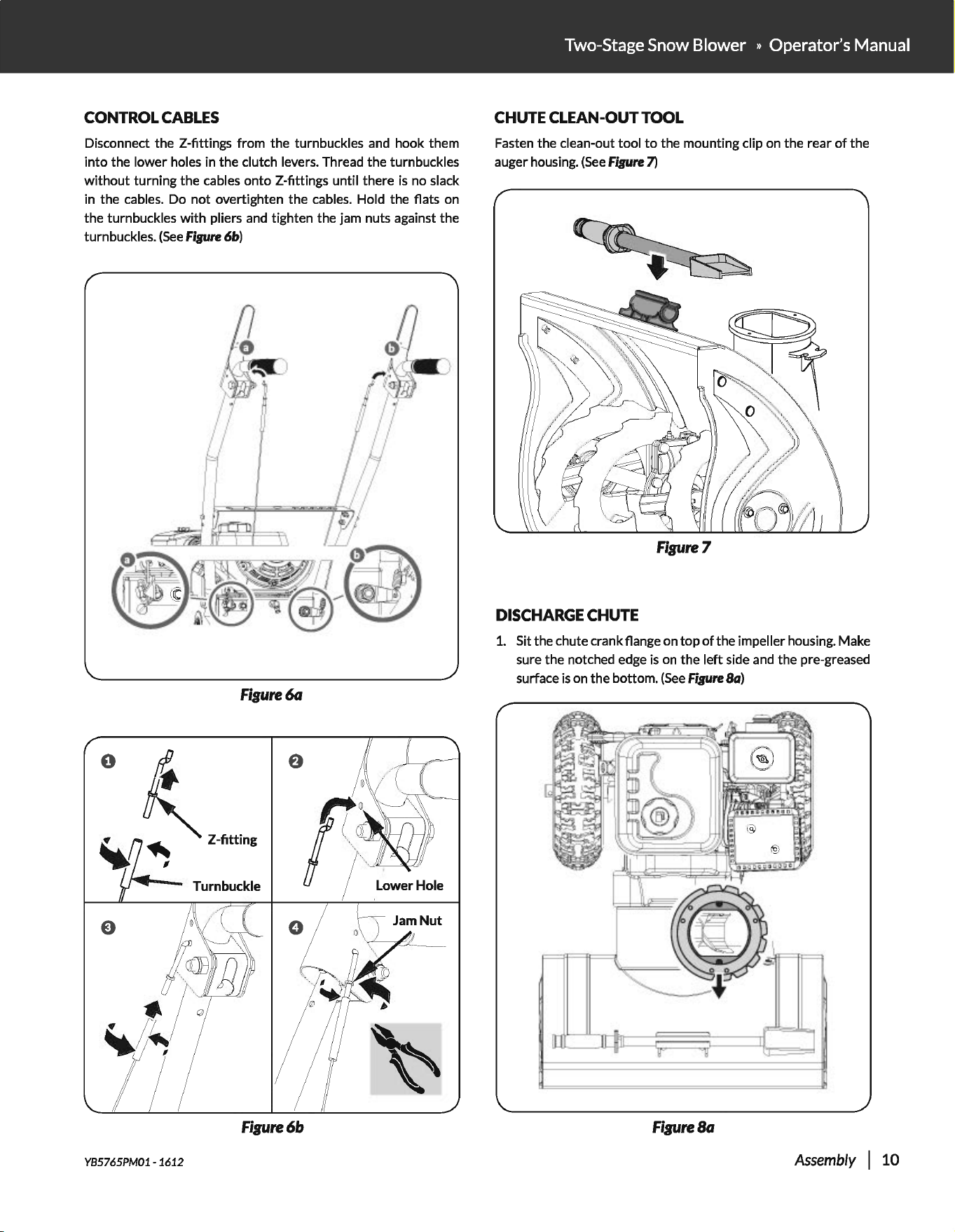
CONTROL
CABLES
Disconnect the Z-fittings from the turnbuckles
and
hook them
into the lower holes in the clutch levers. Thread the turnbuckles
without
turning the cables onto Z-fittings until there
is
no slack
in the cables. Do not overtighten the cables. Hold the flats on
the turnbuckles
with
pliers
and
tighten the jam nuts against the
turnbuckles.
(See
Figure
6b)
Figure6a
0
Lower
Hole
0
Figure6b
YB5765PM01-1612
CHUTE
CLEAN-OUT
TOOL
Fasten the clean-out tool
to
the mounting clip on the rear
of
the
auger housing.
(See
Fjsure
7)
Figure7
DISCHARGE
CHUTE
1.
Sit the chute crank flange on top
ofthe
impeller housing. Make
sure the notched edge
is
on the
left
side
and
the pre-greased
surface
is
on the bottom.
(See
fjsure
Sa)
Figure
Sa
Assembly
I 10
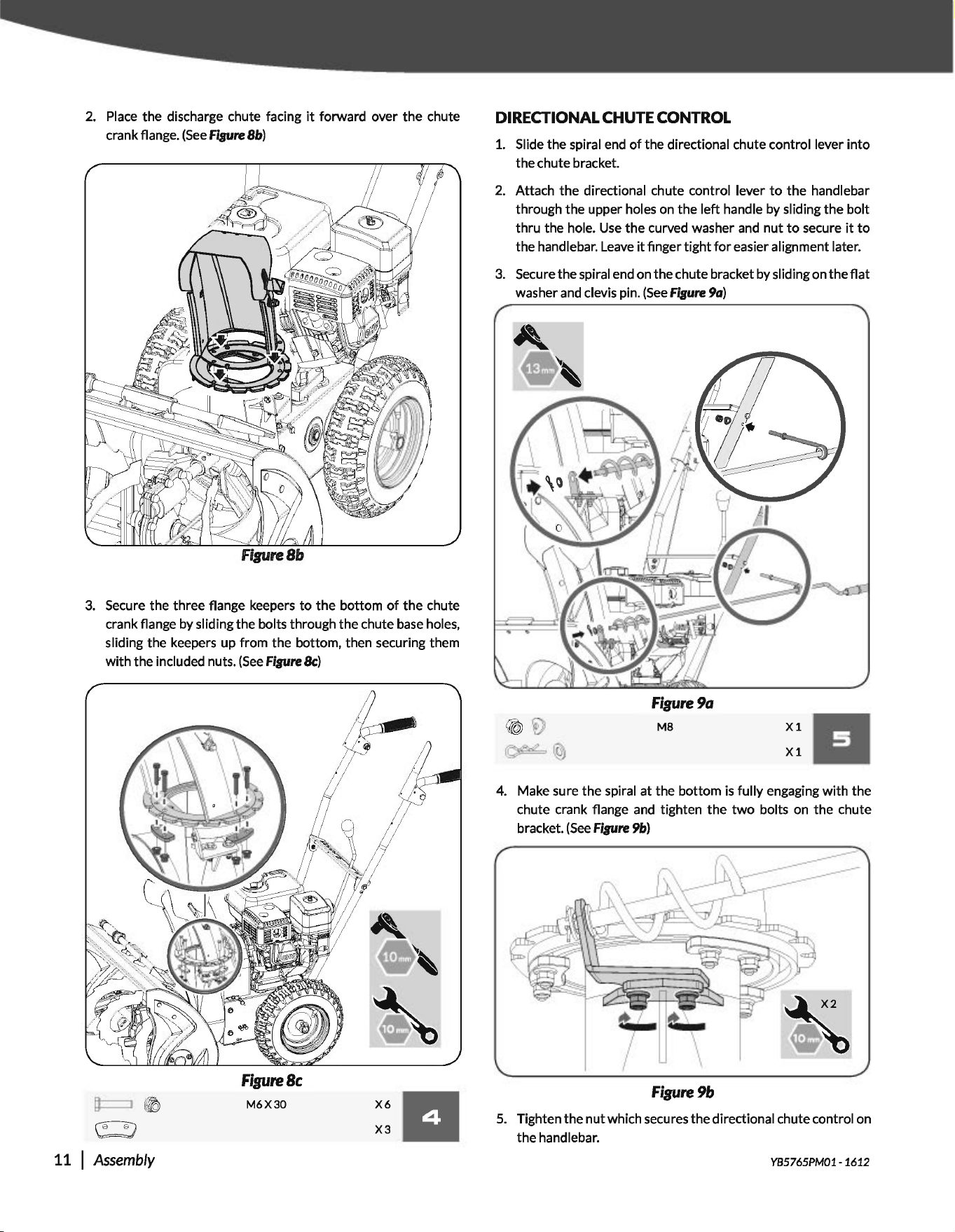
2.
Place
the discharge chute facing
it
forward over the chute
crank flange.
(See
Figure
Bb)
3.
Secure the three flange keepers
to
the bottom
of
the chute
crank flange by sliding the bolts through the chute
base
holes,
sliding the keepers up from the bottom, then securing them
with
the included nuts.
(See
Fipre
Be)
11 I
Assembly
Figure
Be
M6X30
X6
11
X3
DIRECTIONAL
CHUTE
CONTROL
1.
Slide the spiral end
of
the directional chute control lever into
the chute bracket.
2.
Attach the directional chute control lever
to
the handlebar
through the upper holes on the
left
handle by sliding the bolt
thru the hole.
Use
the curved washer
and
nut
to
secure
it
to
the handlebar.
Leave
it
finger
tight
for
easier alignment later.
3.
Secure the spiral end on the chute bracket by sliding on the
flat
washer
and
clevis pin.
(See
Figure
9d)
Figure9a
MB
Xl
ll
Xl
4. Make sure the spiral at the bottom
is
fully engaging
with
the
chute crank flange
and
tighten the
two
bolts on the chute
bracket.
(See
Fipre
9b)
Figure9b
5.
Tighten the nut which secures the directional chute control on
the handlebar.
YB5765PM01-1612
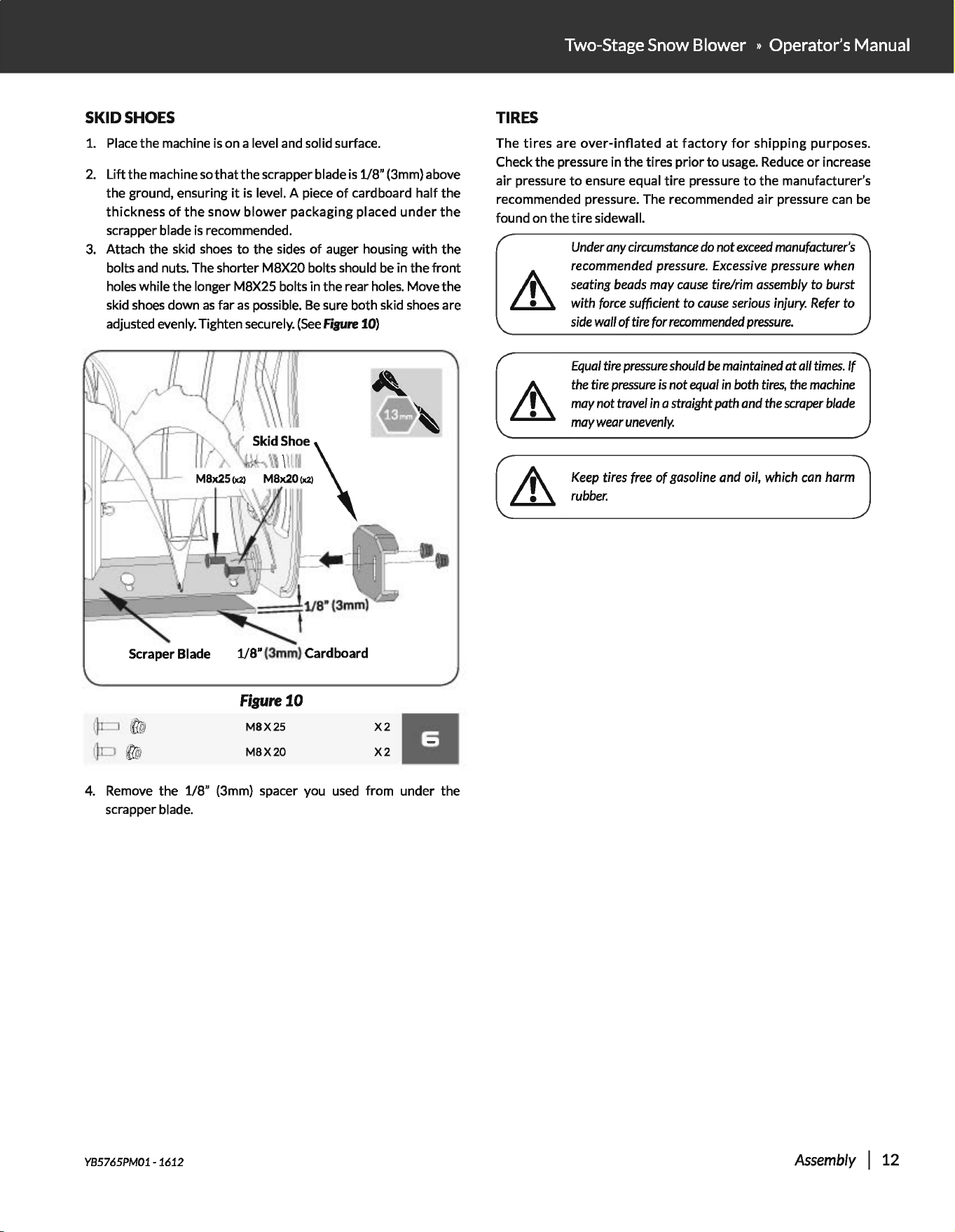
SKID
SHOES
1.
Place
the
machine
is
on a level and solid surface.
2.
Lift the machine
so
thatthe
scrapper blade
is
1/8"
(3mm) above
the ground, ensuring
it
is
level. A piece
of
cardboard half the
thickness
of
the
snow
blower
packaging placed
under
the
scrapper blade
is
recommended.
3.
Attach the skid shoes
to
the sides
of
auger housing
with
the
bolts and nuts. The shorter M8X20 bolts should
be
in the
front
holes while the longer M8X25 bolts in the rear holes. Move the
skid shoes down
as
far
as
possible.
Be
sure both skid
shoes
are
adjusted evenly. Tighten securely.
(See
fiBUre
10)
Scraper
Blade
1/8"
(3mm)
Cardboard
Figure
10
X2
11
X2
M8X25
M8X20
4. Remove the
1/8"
(3mm) spacer you
used
from under the
scrapper blade.
YB5765PM01-1612
TIRES
The
tires
are
over-inflated
at
factory
for
shipping purposes.
Check the pressure in the tires
prior
to
usage.
Reduce
or
increase
air pressure
to
ensure equal
tire
pressure
to
the
manufacturer's
recommended pressure. The recommended
air
pressure can be
found on the
tire
sidewall.
Under
any
circumstance
do
not
exceed
manufacturer's
recommended pressure.
Excessive
pressure when
seating
beads
may
cause
tire/rim assembly
to
burst
with
force
sufficient
to
cause
serious
injury.
Refer
to
side
wall
of
tire for
recommended
pressure.
Equal
tire
pressure
should
be
maintained
at
all
times.
If
the
tire
pressure
is
not
equal
in
both
tires,
the
machine
may
not
travel
in
a straight path and
the
scraper
blade
may
wear
unevenly.
Keep
tires
free
of
gasoline and oil, which
can
harm
rubber.
Assembly
I 12
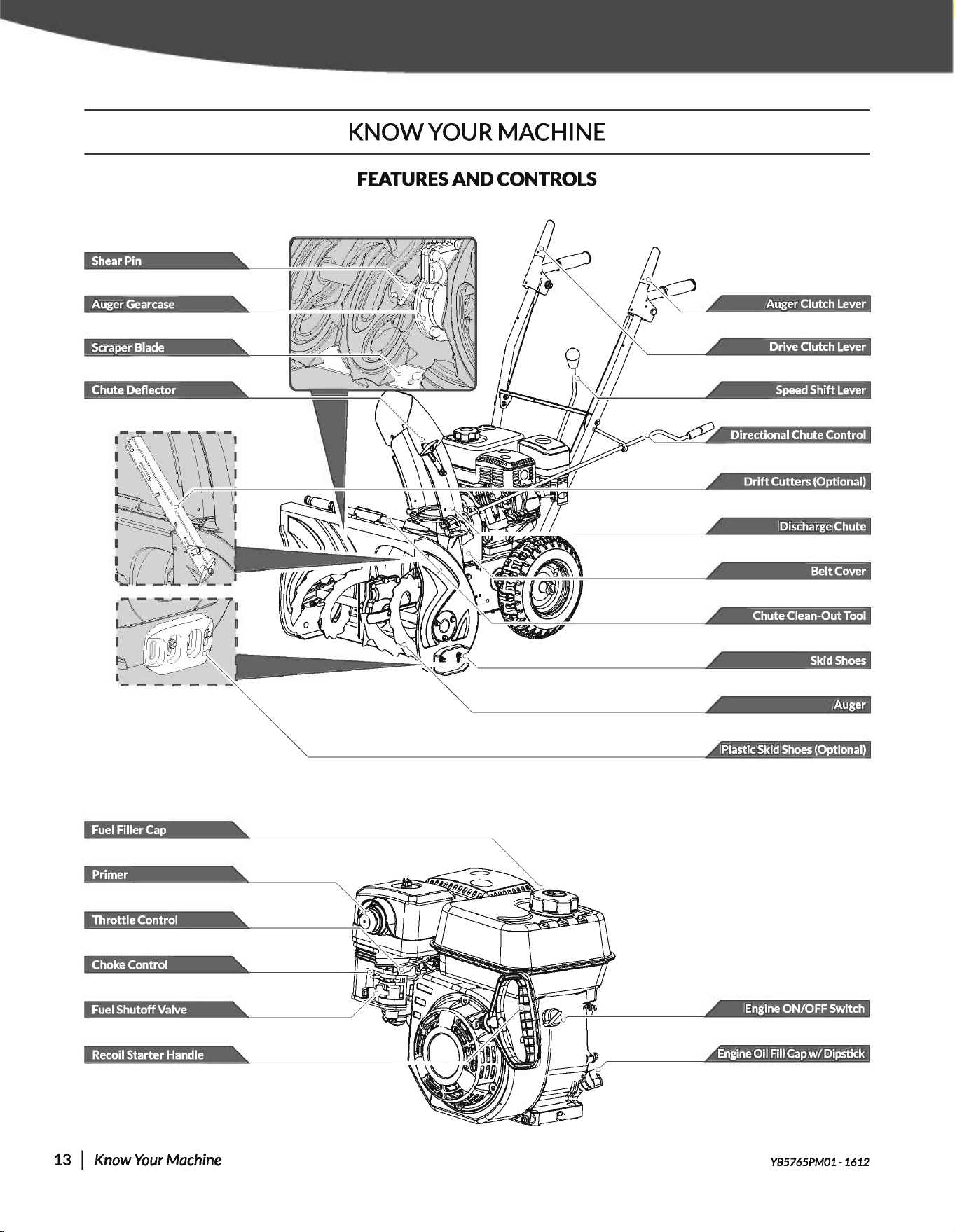
KNOW
YOUR MACHINE
FEATURES
AND
CONTROLS
Shear Pin
Drive Clutch Lever
Drift
Cutters (Optional)
Discharge Chute
:ffill3·0ii
Chute Clean-Out Tool
Auger
Throttle
Control
13 I
Know
Your
Machine YB5765PM01-1612
SPEED
SHIFT
LEVER
»
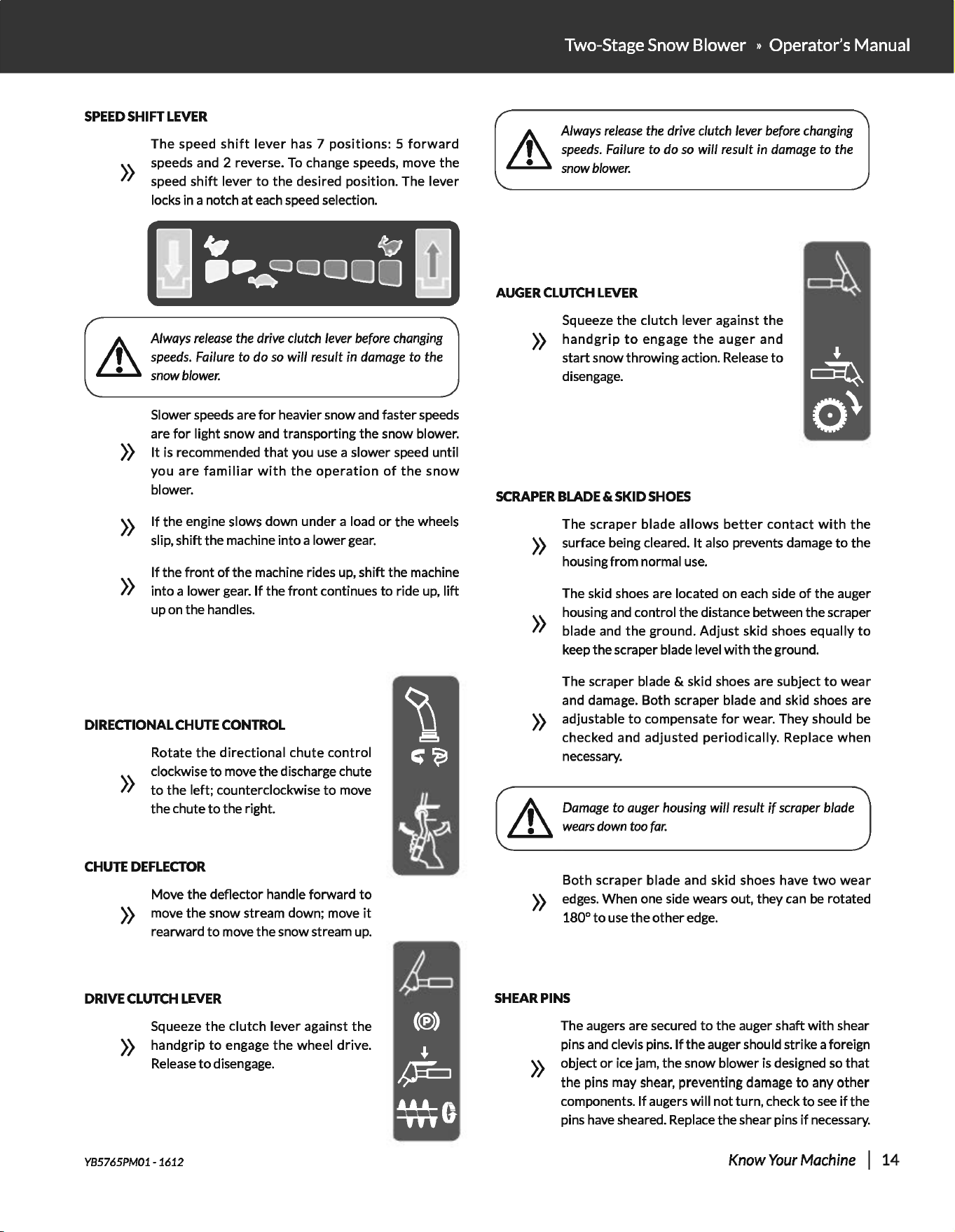
The speed
shift
lever
has 7
positions:
5
forward
speeds and 2 reverse.
To
change speeds, move
the
speed
shift
lever
to
the
desired position. The lever
locks in a notch
at
each
speed selection.
Always
release
the
drive clutch
lever
before
changing
speeds.
Failure to
do
so will result
in
damage
to
the
snow
blower.
Slower speeds are
for
heavier snow
and
faster speeds
are
for
light snow and transporting the snow blower.
))
It
is
recommended
that
you use a slower speed until
you
are
familiar
with
the
operation
of
the
snow
blower.
»
»
If
the engine slows down under a load
or
the wheels
slip, shift the machine into a lower gear.
If
the
front
of
the machine rides
up,
shift the machine
into a lower gear.
If
the
front
continues
to
ride
up,
lift
up on the handles.
DIRECTIONAL
CHUTE
CONTROL
»
Rotate
the
directional chute
control
clockwise
to
move the discharge chute
to
the left; counterclockwise
to
move
the chute
to
the right.
CHUTE
DEFLECTOR
Move the deflector handle forward
to
))
move the snow stream down; move
it
rearward
to
move the snow stream
up.
DRIVE
CLUTCH
LEVER
Squeeze
the
clutch lever against
the
))
handgrip
to
engage
the
wheel drive.
Release
to
disengage.
YB5765PM01·1612
Always
release
the
drive
clutch
lever
before
changing
speeds.
Failure to
do
so will result
in
damage
to
the
snowblower.
AUGER
CLUTCH
LEVER
»
Squeeze
the
clutch lever against
the
handgrip
to
engage
the
auger
and
start snow throwing action.
Release
to
disengage.
SCRAPER
BLADE
&
SKID
SHOES
»
»
The scraper blade allows
better
contact
with
the
surface being cleared.
It
also prevents damage
to
the
housing from normal
use.
The skid shoes are located on each side
of
the auger
housing
and
control the distance between the scraper
blade and
the
ground.
Adjust
skid shoes equally
to
keep the scraper blade level
with
the ground.
The scraper blade
& skid shoes are subject
to
wear
and damage. Both scraper blade and skid shoes are
))
adjustable
to
compensate
for
wear. They should
be
checked and adjusted periodically. Replace
when
necessary.
Damage
to
auger
housing
will result
if
scraper
blade
wears
down
too
far.
Both
scraper blade and skid shoes have
two
wear
))
edges.
When one side wears out, they
can
be
rotated
180°
to
use
the other edge.
SHEAR
PINS
»
The augers are secured
to
the auger shaft
with
shear
pins
and
clevis
pins.
If
the auger should strike a foreign
object
or
ice jam, the snow blower
is
designed
so
that
the
pins
may
shear,
preventing
damage
to
any
other
components.
If
augers will
not
turn, check
to
see
if
the
pins have sheared. Replace the shear pins
if
necessary.
Know
Your
Machine I
14
AUGER
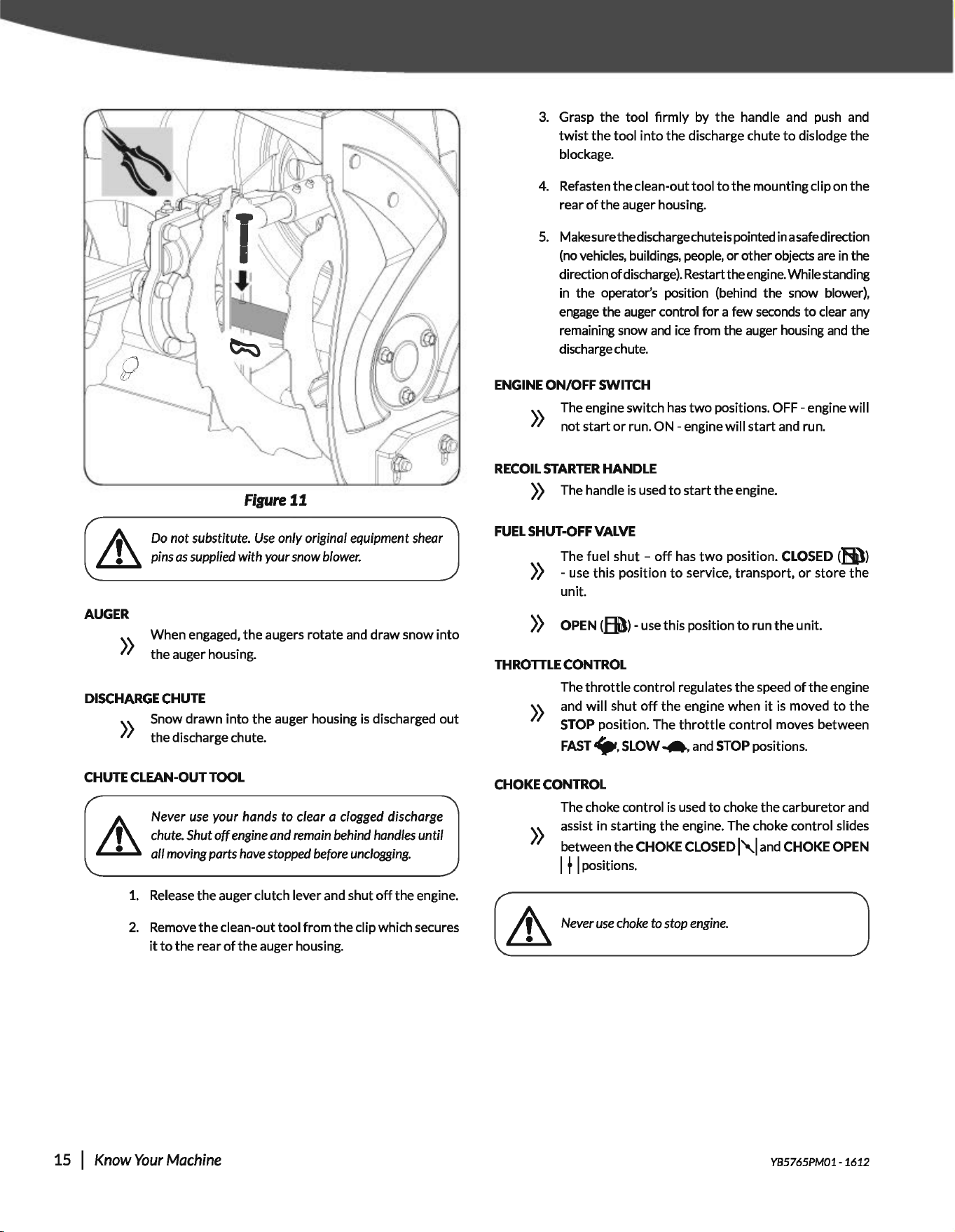
Figure11
Do
not
substitute.
Use
only original equipment
shear
pins
as
supplied
with
your
snow
blower.
))
When
engaged,
the
augers
rotate
and
draw
snow
into
the
auger housing.
DISCHARGE
CHUTE
»
Snow drawn
into
the
auger housing
is
discharged
out
the
discharge chute.
CHUTE
CLEAN-OUT TOOL
Never
use
your
hands
to clear a
clogged
discharge
chute.
Shut
off
engine
and
remain
behind
handles
until
all
moving
parts
have
stopped
before
unclogging.
1.
Release
the
auger clutch lever and shut
off
the
engine.
2.
Remove
the
clean-out
tool
from
the
clip which secures
it
to
the
rear
of
the
auger housing.
15 I
Know
Your
Machine
3. Grasp
the
tool
firmly
by
the
handle and push and
twist
the
tool
into
the
discharge chute
to
dislodge
the
blockage.
4. Refasten
the
clean-out
tool
to
the
mounting clip on
the
rear
of
the
auger housing.
5.
Makesurethedischargechute
is
pointed in a safe direction
(no vehicles, buildings, people,
or
other objects are in the
direction
of
discharge). Restart the engine. While standing
in the operator's position (behind the snow blower),
engage the auger control
for
a
few
seconds
to
clear any
remaining snow
and
ice from the auger housing and the
discharge chute.
ENGINE
ON/OFF SWITCH
))
The engine switch
has
two
positions. OFF- engine
will
not
start
or
run.
ON-
engine
will
start
and run.
RECOIL
STARTER
HANDLE
))
The handle is used
to
start
the
engine.
FUEL
SHUT-OFF
VALVE
»
The
fuel
shut
-
off
has
two
position.
CLOSED
(Sll
- use
this
position
to
service,
transport,
or
store
the
unit.
))
OPEN
(fa)-
use this position
to
run
the
unit.
THROTTLE
CONTROL
»
The
throttle
control regulates
the
speed
of
the
engine
and
will
shut
off
the
engine
when
it
is moved
to
the
STOP
position. The
throttle
control
moves between
FAST
••
SLOW.-,,
and
STOP
positions.
CHOKE
CONTROL
»
The choke control
is
used
to
choke
the
carburetor
and
assist in
starting
the
engine. The choke control slides
between
the
CHOKE
CLOSED
l"-1
and
CHOKE
OPEN
I f I positions.
.&.
Never
use
choke
to
stop
engine.
YB5765PM01-1612
ADJUSTMENT
SKID
SHOES
Position the skid shoes
based
on surface conditions.
For removal
of
snow in normal conditions, such
as
a paved
driveway
or
sidewalk, place skid shoes in
))
the
higher position
to
give a
1/8"
(3mm) clearance
between
the
scraper blade and
the
ground. Use a
middle
or
lower position when the area
to
be
cleared
is
uneven.
»
It
is
not
recommended
to
operate the snow
blower
on gravel as
it
can easily
pick
up
and
throw
by
the
impeller, causing personal
injury
or damage
to
the
snow blower and surrounding property.
If
you choose
to
operate the snow blower on a gravel
surface, use extra caution
and
keep the skid shoes in
position
for
maximum clearance between the ground
and
the scraper blade.
Always adjust skid shoes after adjusting scraper blade
to prevent premature wear to scraper blade
or damage
to auger housing.
))
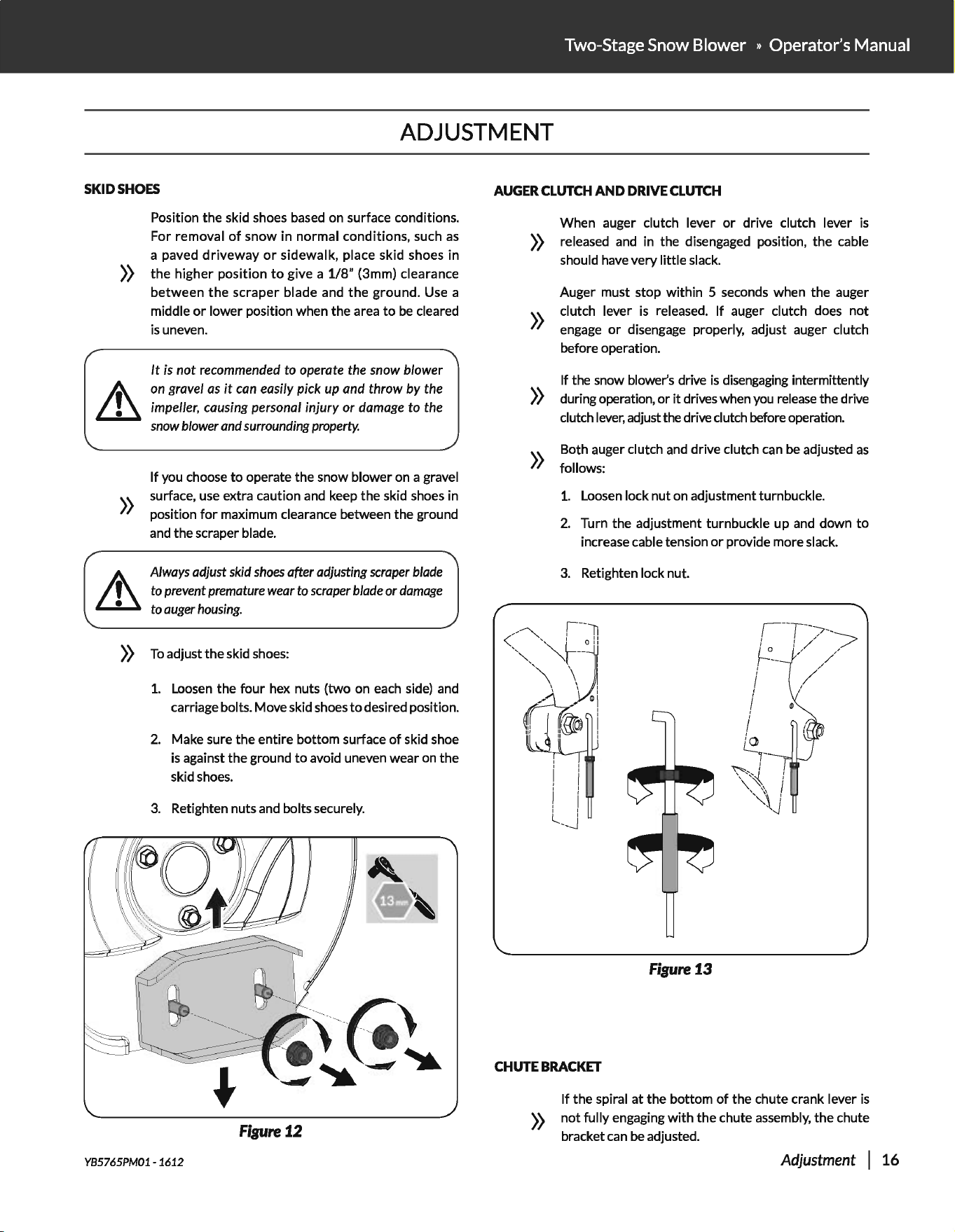
To
adjust the skid
shoes:
1.
Loosen
the four hex nuts (two on
each
side)
and
carriage bolts. Move skid shoes
to
desired position.
2.
Make sure the entire bottom surface
of
skid shoe
is
against the ground
to
avoid uneven wear
on
the
skid
shoes.
3.
Retighten nuts
and
bolts securely.
Figure
12
YB5765PM01-1612
AUGER
CLUTCH
AND
DRIVE
CLUTCH
When auger clutch lever
or
drive clutch lever
is
))
released
and
in the disengaged position, the cable
should have very little slack.
Auger must stop within 5 seconds when the auger
clutch lever
is
released.
If
auger clutch does not
))
engage
or
disengage properly, adjust auger clutch
before operation.
If
the snow blower's drive
is
disengaging intermittently
))
during operation,
or
it
drives when
you
release
the drive
clutch
lever,
adjust the drive clutch before operation.
\.\. Both auger clutch
and
drive clutch
can
be
adjusted
as
II
follows:
1.
Loosen lock nut on adjustment turnbuckle.
2.
Turn the adjustment turnbuckle up and down
to
increase cable tension
or
provide more slack.
3.
Retighten lock nut.
Figure
13
CHUTE
BRACKET
If
the spiral
at
the bottom
of
the chute crank lever
is
))
not
fully engaging
with
the chute assembly, the chute
bracket
can
be
adjusted.
Adjustment I 16
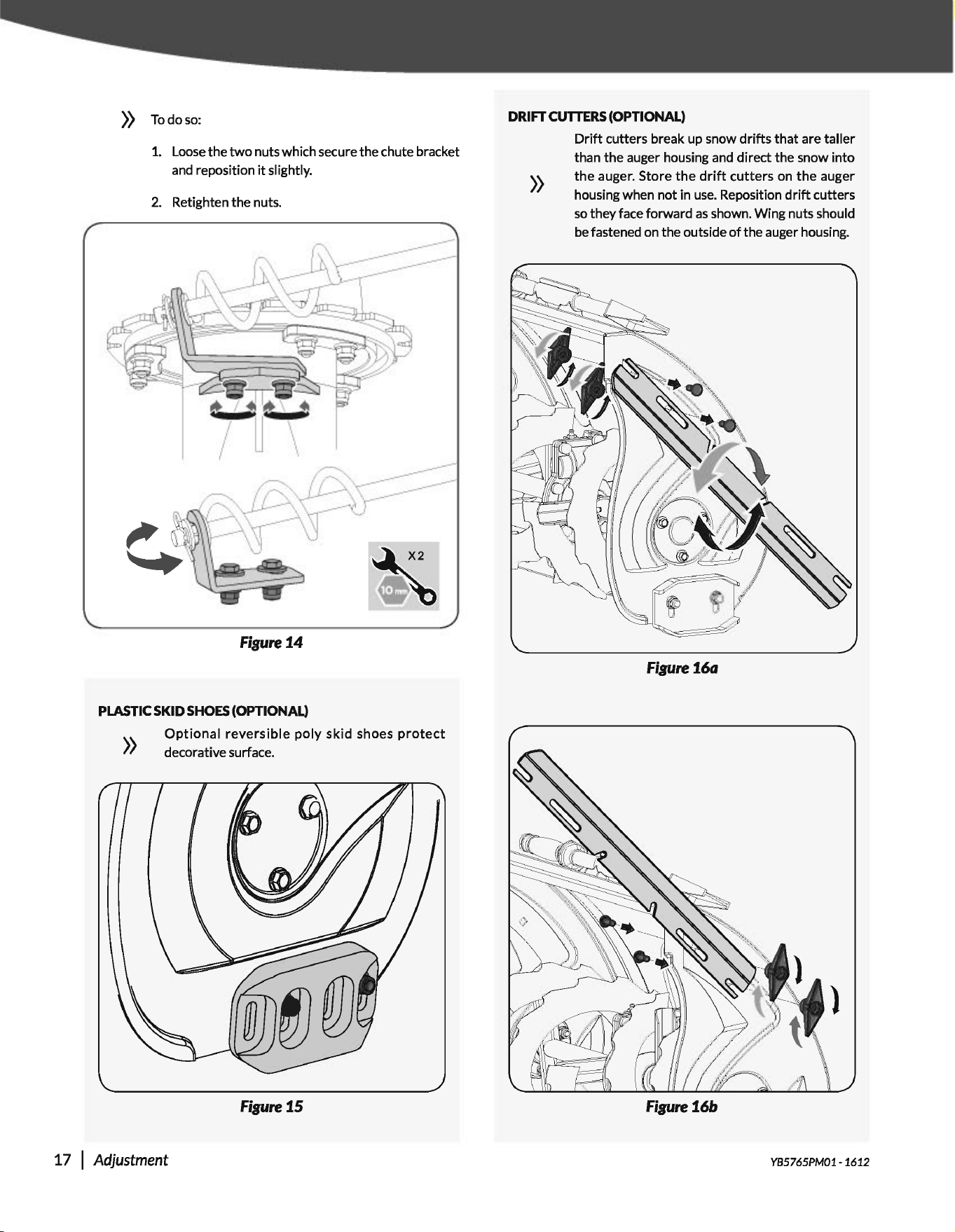
))
Todoso:
1.
Loose
the
two
nuts which secure the chute bracket
and
reposition
it
slightly.
2.
Retighten the nuts.
Figure
14
PLASTIC
SKID
SHOES
(OPTIONAL)
»
Optional
reversible
poly
skid shoes
protect
decorative surface.
Figure
15
17 I Adjustment
DRIFT
CUTTERS
(OPTIONAL)
»
Drift
cutters break up snow drifts that are taller
than the auger housing
and
direct the snow into
the
auger. Store the
drift
cutters on
the
auger
housing when not in
use.
Reposition
drift
cutters
so
they face forward
as
shown. Wing nuts should
be
fastened on the outside
of
the auger housing.
Figure
16a
Figure
16b
YB5765PM01-1612
OPERATION
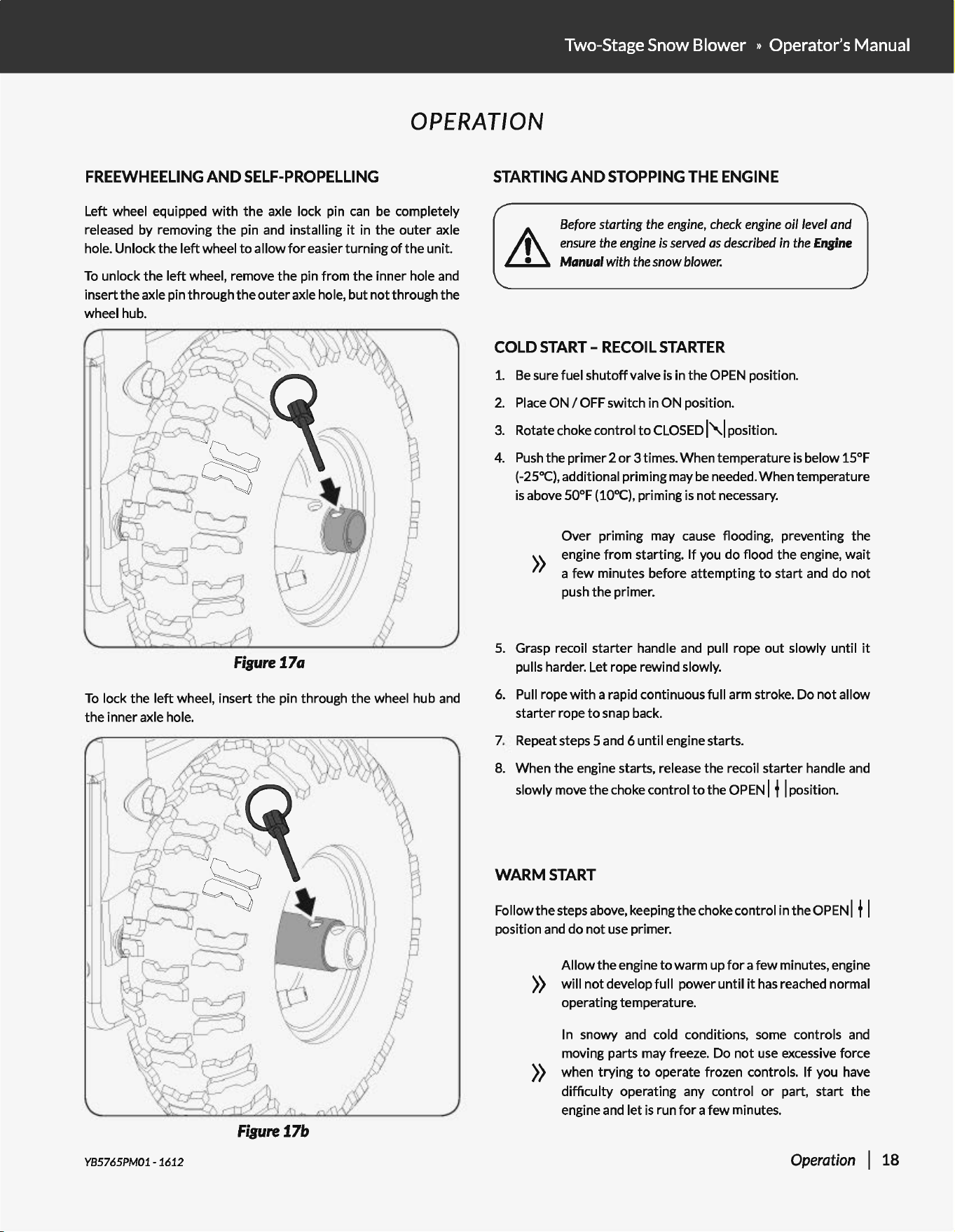
FREEWHEELING
AND
SELF-PROPELLING
Left wheel equipped
with
the axle lock pin
can
be
completely
released by removing the pin
and
installing
it
in the outer axle
hole. Unlock the
left
wheel
to
allow
for
easier turning
of
the unit.
To
unlock the
left
wheel, remove the pin from the inner hole
and
insert the axle pin through the
outer
axle hole, but not through the
wheel hub.
Figure17a
To
lock the
left
wheel, insert the pin through the wheel hub
and
the inner axle hole.
Figure
17b
YB5765PM01-1612
STARTING
AND
STOPPING
THE
ENGINE
Before
starting
the
engine,
check
engine
oil
level
and
ensure
the
engine
is
served
as
described
in
the
Engine
Manual
with
the
snow
blower.
COLDSTART-
RECOILSTARTER
1.
Be
sure fuel shutoff valve
is
in the
OPEN
position.
2.
Place
ON I OFF switch in ON position.
3.
Rotate choke control
to
CLOSED
l'-1
position.
4.
Push
the primer 2
or
3 times. When temperature
is
below 15°F
(-25°C), additional priming may
be
needed. When temperature
is
above 50°F (10°C), priming
is
not necessary.
Over priming may
cause flooding, preventing the
))
engine from starting.
If
you do flood the engine,
wait
a
few
minutes before attempting
to
start
and
do not
push the primer.
5.
Grasp recoil starter handle
and
pull rope
out
slowly until
it
pulls harder. Let rope rewind slowly.
6.
Pull rope
with
a rapid continuous full arm stroke. Do not allow
starter rope
to
snap back.
7.
Repeat steps 5
and
6 until engine starts.
8.
When the engine starts, release the recoil starter handle and
slowly move the choke control
to
the OPEN I f I position.
WARM
START
Follow the steps above, keeping the choke control in the OPEN I f I
position
and
do not use primer.
Allow the engine
to
warm up
for
a
few
minutes, engine
))
will not develop full power until
it
has
reached normal
operating temperature.
In snowy
and
cold conditions, some controls
and
moving parts may freeze. Do not
use
excessive force
))
when trying
to
operate frozen controls.
If
you have
difficulty operating any control
or
part, start the
engine
and
let
is
run
for
a
few
minutes.
Operation I 18
SNOW
BLOWING
TIPS
It
is
easier and more efficient
to
remove snow immediately
after
it
falls.
The best time
to
remove snow
is
the early morning.
At
this time
the
snow
is
usually
dry
and
has
not
been exposed
to
the
direct
sun
and warming temperatures.
Slightly overlap each successive path
to
ensure all snow will
be
removed.
For large areas,
start
in
the
middle and
throw
snow
to
each side,
so
snow
is
not
cleared more than once.
For extremely heavy snow, reduce the
width
of
snow removal by
overlapping previous path and moving slowly.
Throw
snow downwind whenever possible.
Keep engine clean and clear
of
snow during
use.
This will help air
flow
and extend engine life.
After
snow-throwing
is
completed, let the engine run
for
a
few
minutes
to
help
dry
off
the moisture on the engine and prevent
moving parts
from
freezing.
Engage
the auger
to
clear any
remaining snow from inside the housing. Rotate the discharge
chute
to
prevent
it
from freezing. Stop
the
engine,
wait
for
all
moving parts
to
stop, and remove all ice and snow from the snow
blower.
With
the engine off, pull the recoil starter handle several
times
to
prevent the recoil starter from freezing up.
19 I Operation
TRAVELING
To
travel
from
one
work
area
to
another:
1.
Set
throttle
to
slow
or
part-throttle
position.
2.
Press
down on handle bars enough
to
raise
front
of
unit
slightly
off
surface.
3.
Engage
drive clutch
without
engaging auger clutch.
TRANSPORT
Always shut off
engine,
remove
key,
and
close
fuel shut-
off
valve
when
transporting unit
on
a truck or trailer.
Do
not transport
machine
while
engine
is
running.
Use extra care when loading
or
unloading
unit
onto
trailer
or
truck.
Secure
unit
chassis
to
transport vehicle. Never secure from rods
or
linkages
that
could
be
damaged.
YB5765PM01-1612
MAINTENANCE
ENGINE
Refer
to
the Engine Operator's Manual.
AUGER
GEARBOX
The gearbox was filled
with
lubricant
to
the proper level
at
the
factory. Unless there
is
evidence
of
leakage
or
service
has
been
performed on the gearbox, no additional lubricant should
be
required.
If
lubricant
is
required,
use
GL-5
or
GL-6,
SAE85-95,
EP
gear oil lubricant. Do not
use
synthetic oil.
GENERAL
LUBRICATION
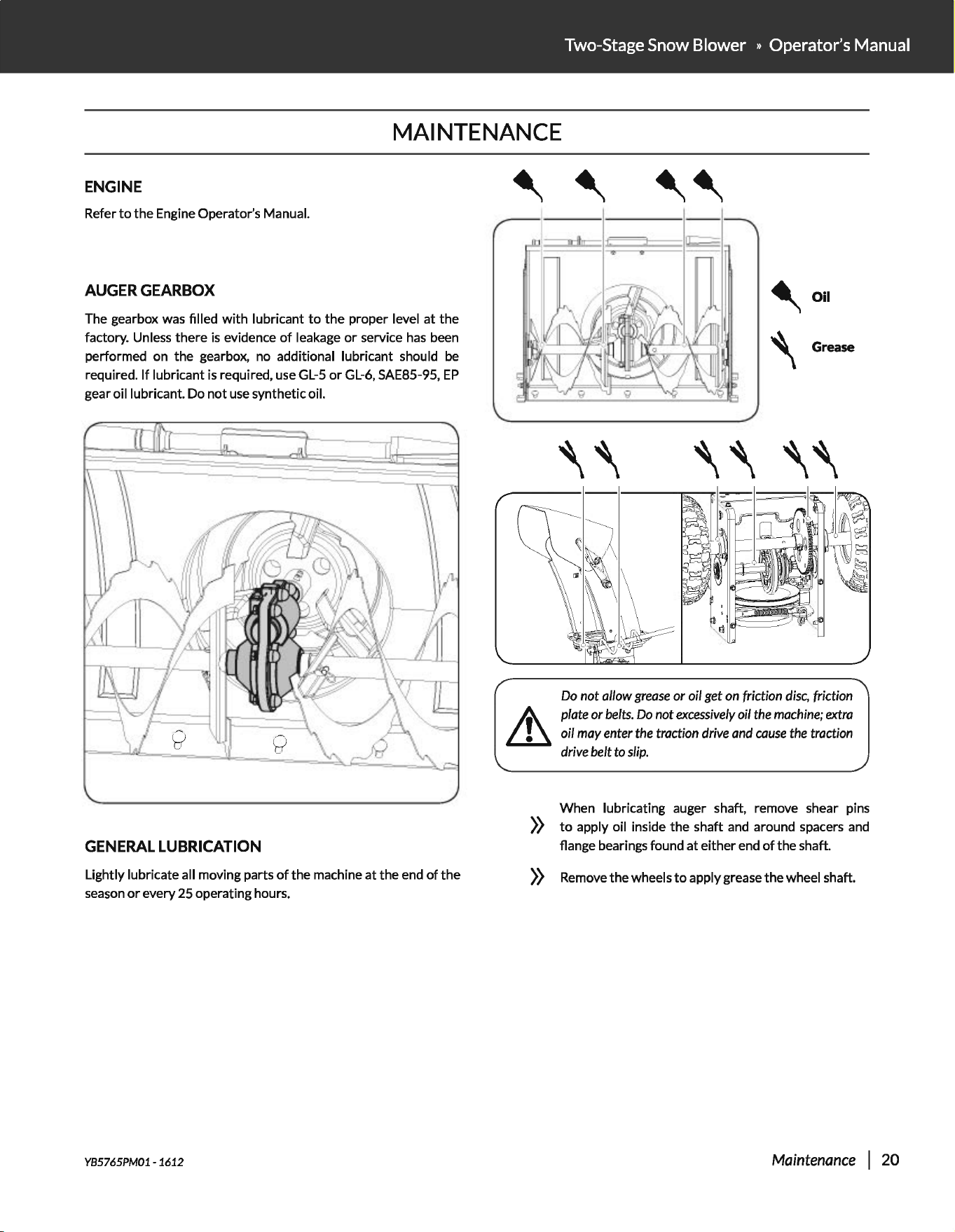
Lightly lubricate all moving parts
of
the machine
at
the end
of
the
season
or
every 25 operating hours.
YB5765PM01·1612
~Oil
\
Grease
Do
not allow
grease
or
oil get
on
friction
disc,
friction
plate
or
belts.
Do
not
excessively
oil
the
machine;
extra
oil
may
enter
the
traction drive
and
cause
the
traction
drive belt
to
slip.
When lubricating auger shaft, remove shear pins
))
to
apply oil inside the shaft
and
around spacers
and
flange bearings found
at
either end
of
the shaft.
))
Remove the wheels
to
apply grease the wheel shaft.
Maintenance I 20
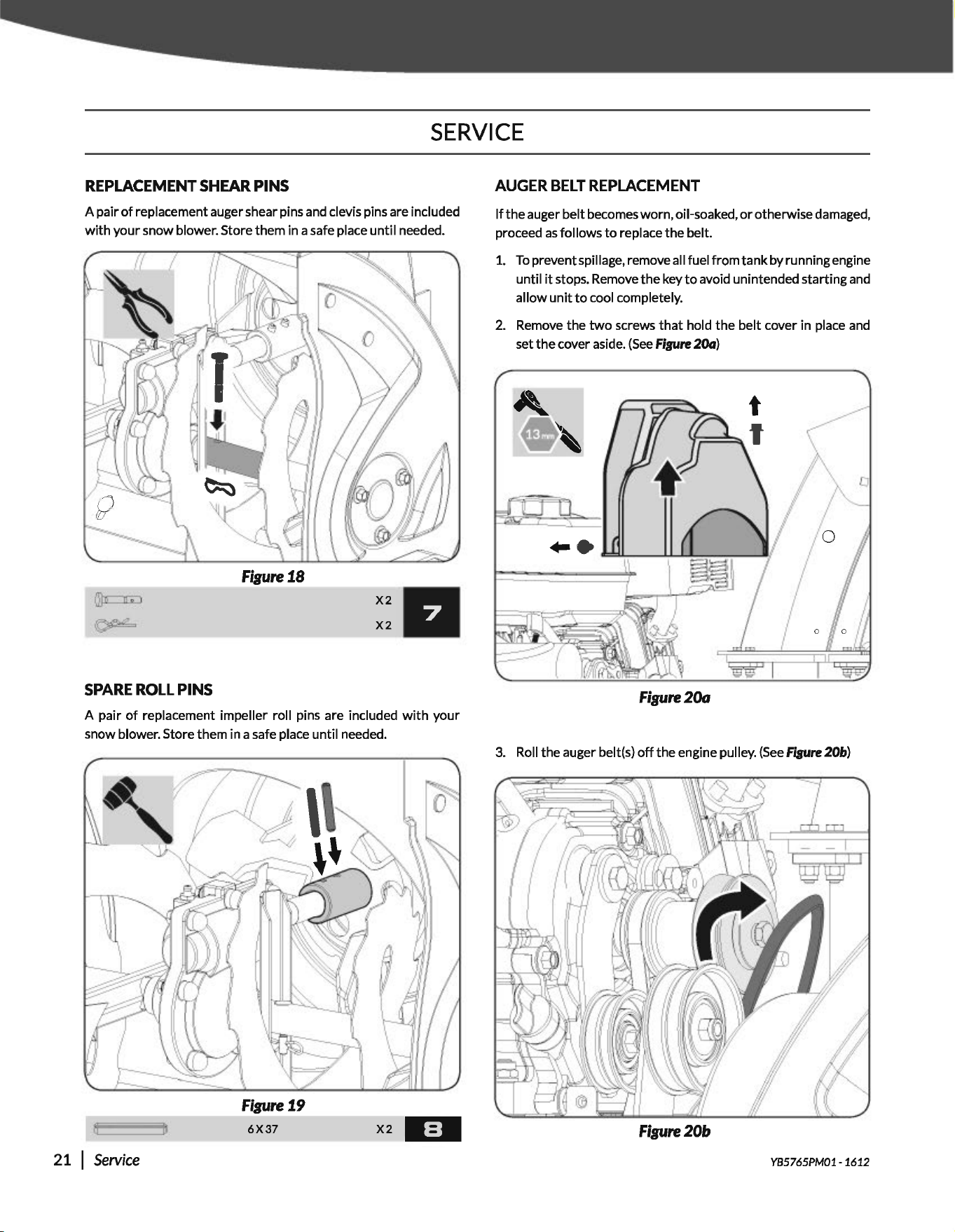
SERVICE
REPLACEMENT
SHEAR
PINS
A pair
of
replacement auger shear pins and clevis pins are included
with
your
snow blower. Store
them
in a safe place
until
needed.
Figure
18
X2
X2
SPARE
ROLL
PINS
A pair
of
replacement impeller roll pins are included
with
your
snow blower. Store
them
in a safe place until needed.
21 I
Service
Figure
19
6X37
X2
•=•
AUGER
BELT
REPLACEMENT
lfthe
auger
belt
becomes worn, oil-soaked,
or
otherwise damaged,
proceed
as
follows
to
replace
the
belt.
1.
To
prevent spillage, remove all fuel
from
tank
by running engine
until
it
stops. Remove
the
key
to
avoid unintended starting and
allow
unit
to
cool completely.
2. Remove
the
two
screws
that
hold
the
belt
cover in place and
set
the
cover aside.
(See
Figure
20G)
Figure20a
3. Roll
the
auger belt(s)
off
the
engine pulley.
(See
Figure
20b)
Figure20b
YB5765PM01-1612
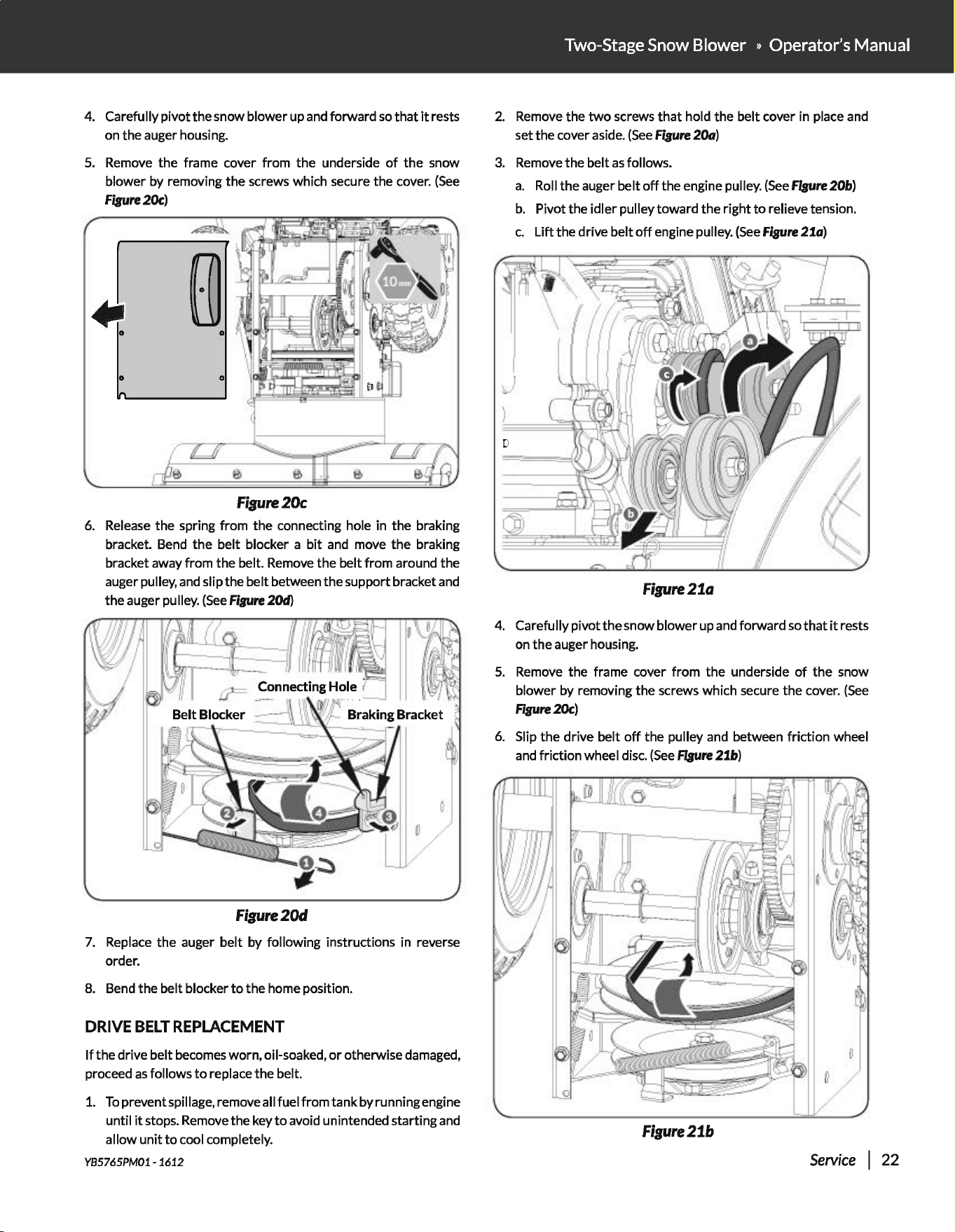
4. Carefully pivot the snow blower up
and
forward
so
that
it
rests
on the auger housing.
5.
Remove the frame cover from the underside
of
the snow
blower by removing the screws which secure the cover.
(See
figure20c)
0
0
Figure20c
6.
Release
the spring from the connecting hole in the braking
bracket. Bend the belt blocker a
bit
and
move the braking
bracket away from the belt. Remove the belt from around the
auger pulley,
and
slip the belt between the support bracket
and
the auger
pu
I
ley.
(See
figure 20d)
Figure20d
7.
Replace the auger belt by following instructions in reverse
order.
8.
Bend the belt blocker
to
the home position.
DRIVE
BELT
REPLACEMENT
If
the drive belt becomes worn, oil-soaked,
or
otherwise damaged,
proceed
as
follows
to
replace the belt.
1.
Topreventspillage,removeallfuelfromtankbyrunningengine
until
it
stops. Remove the key
to
avoid unintended starting
and
allow unit
to
cool completely.
YB5765PM01-1612
2.
Remove the
two
screws
that
hold the belt cover in place
and
set the cover aside.
(See
figure 20a)
3.
Remove the belt
as
follows.
a.
Roll the auger belt
off
the engine pulley.
(See
figure 20b)
b.
Pivot the idler pulley toward the right
to
relieve tension.
c.
Lift the drive belt
off
engine pulley.
(See
figure 21a)
Figure21a
4. Carefully pivot the snow blower up
and
forward
so
that
it
rests
on the auger housing.
5.
Remove the frame cover from the underside
of
the snow
blower by removing the screws which secure the cover.
(See
figure20c)
6.
Slip the drive belt
off
the pulley
and
between friction wheel
and
friction wheel disc.
(See
figure 21b)
Figure21b
Service
I 22
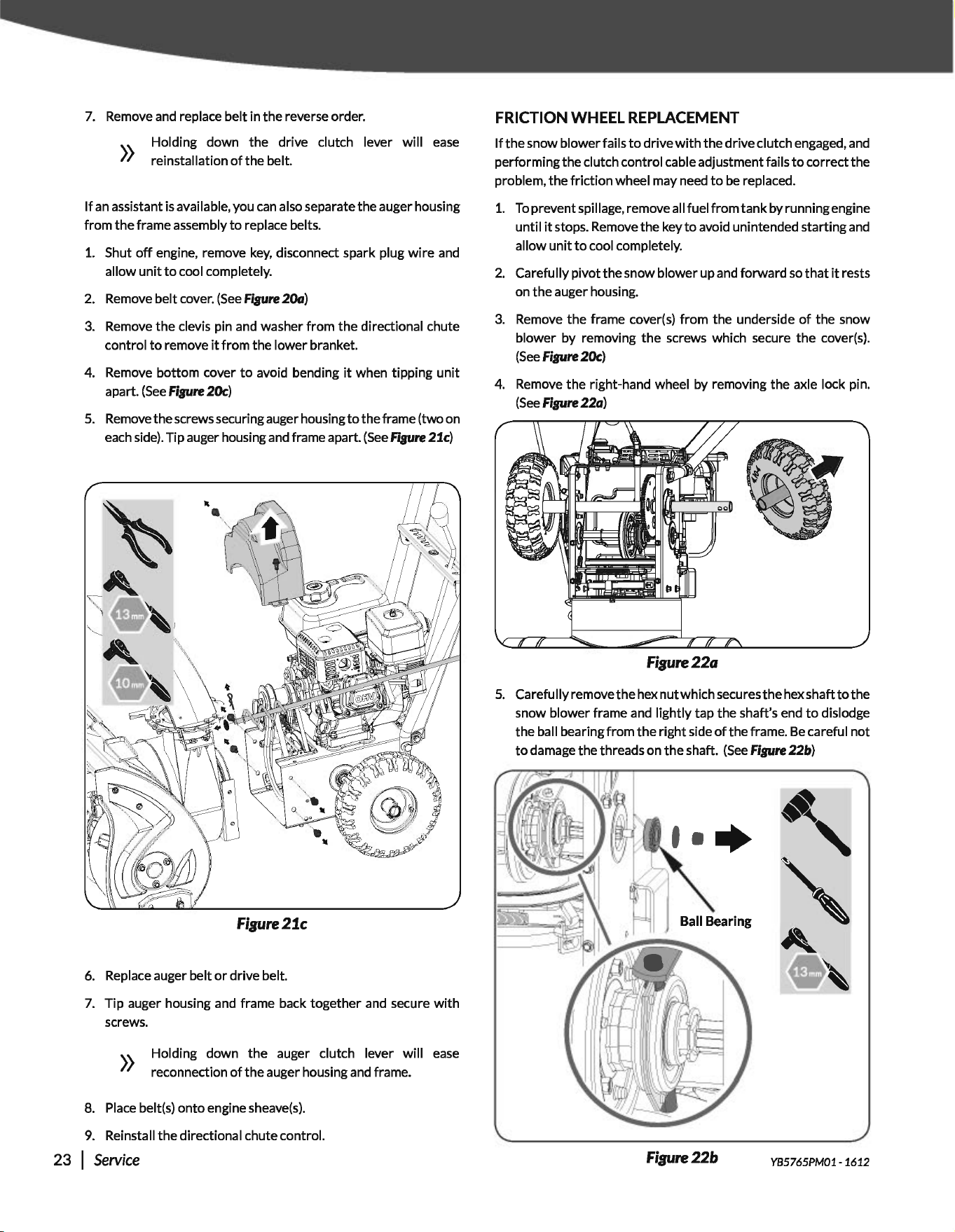
7.
Remove and replace belt in
the
reverse order.
Holding down the drive clutch lever will
ease
»
reinstallation
of
the belt.
If
an
assistant
is
available, you
can
also separate the auger housing
from the frame assembly
to
replace belts.
1.
Shut
off
engine, remove
key,
disconnect spark plug
wire
and
allow
unit
to
cool completely.
2.
Remove belt cover.
(See
Figure
20a)
3.
Remove the clevis pin and washer
from
the directional chute
control
to
remove
it
from
the lower branket.
4. Remove bottom cover
to
avoid bending
it
when tipping
unit
apart.
(See
Fipre
20c)
5.
Remove the screws securing auger housing
to
the frame (two on
each side). Tip auger housing and frame apart.
(See
Figure
21c)
Figure21c
6.
Replace auger belt
or
drive belt.
7.
Tip auger housing and frame back together and secure
with
screws.
»
Holding down the auger clutch lever will
ease
reconnection
of
the auger housing and frame.
8.
Place belt(s)
onto
engine sheave(s).
9.
Reinstall
the
directional chute control.
23 I
Service
FRICTION
WHEEL
REPLACEMENT
If
the
snow blower fails
to
drive
with
the drive clutch engaged, and
performing the clutch control cable adjustment fails
to
correct the
problem, the friction wheel may need
to
be
replaced.
1.
To
prevent spillage, remove all fuel
from
tank by running engine
until
it
stops. Remove the key
to
avoid unintended starting and
allow
unit
to
cool completely.
2.
Carefully pivot the snow blower up and forward
so
that
it
rests
on the auger housing.
3.
Remove the frame cover(s)
from
the underside
of
the snow
blower by removing the screws which secure
the
cover(s).
(See
Fipre
20c)
4. Remove
the
right-hand wheel by removing the axle lock pin.
(See
Fipre
22a)
Figure22a
5.
Carefully remove the hex
nut
which secures
the
hex shaft
to
the
snow blower frame and lightly tap the shaft's end
to
dislodge
the ball bearing
from
the right side
of
the frame.
Be
careful
not
to
damage the threads on the shaft.
(See
Fipre
22b)
Figure22b
YB5765PM01-1612
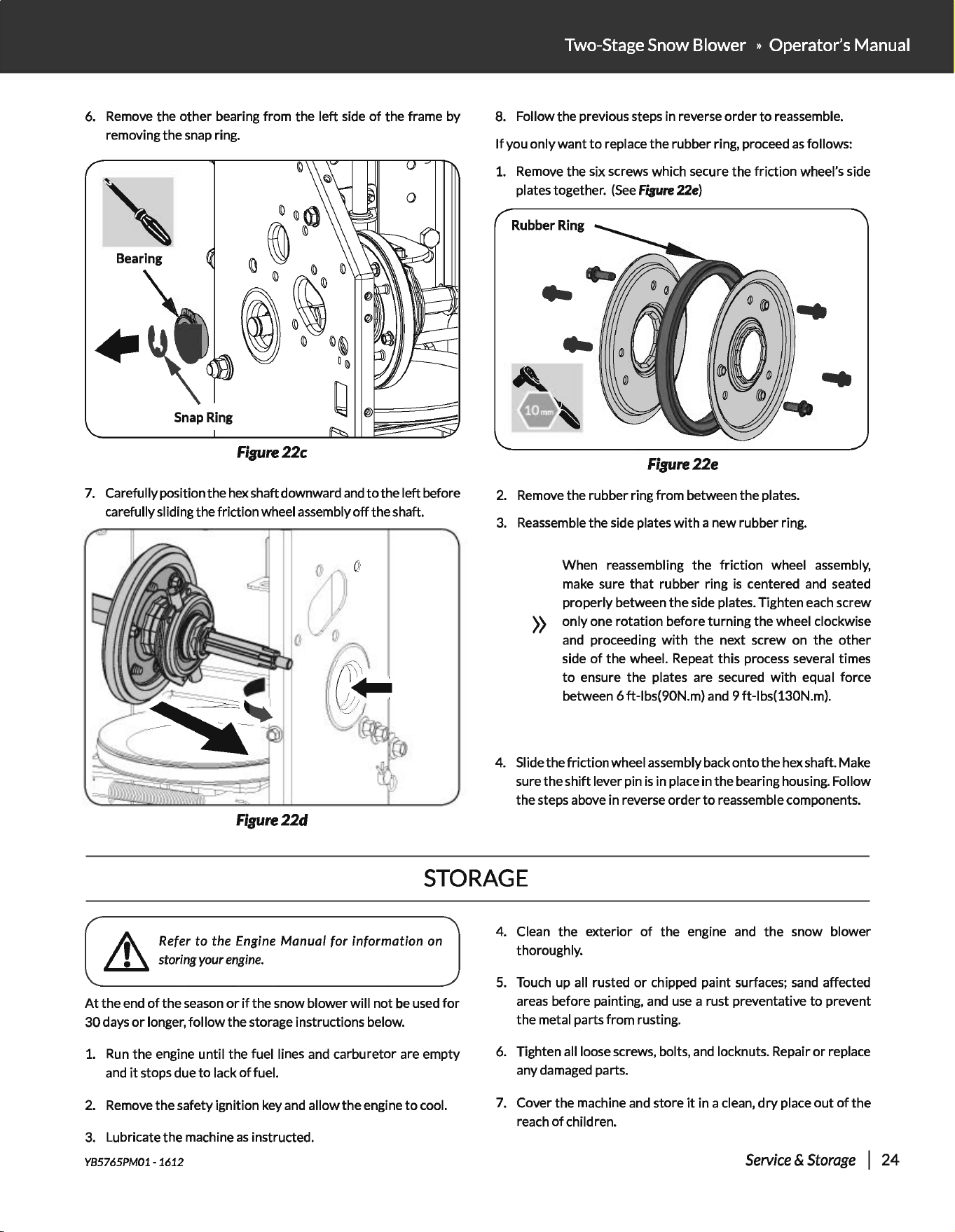
6.
Remove the other bearing from the
left
side
of
the frame by
removing the snap ring.
Snap
Ring
Figure22c
7.
Carefully position the hex shaft downward
and
to
the left before
carefully sliding the friction wheel assembly
off
the shaft.
Figure22d
8.
Follow the previous steps in reverse order
to
reassemble.
If
you only want
to
replace the rubber ring, proceed
as
follows:
1.
Remove the six screws which secure the friction wheel's side
plates together.
(See
figure
22e)
Rubber
Ring
..
Figure22e
2.
Remove the rubber ring from between the plates.
3.
Reassemble the side plates
with
a new rubber ring.
When reassembling the friction wheel assembly,
make sure
that
rubber ring
is
centered
and
seated
properly between the side plates. Tighten each screw
))
only one rotation before turning the wheel clockwise
and
proceeding
with
the next screw on the
other
side
of
the wheel. Repeat this process several times
to
ensure the plates are secured
with
equal force
between 6 ft-lbs(90N.m)
and
9 ft-lbs(130N.m).
4. Slide the friction wheel assembly back onto the hex shaft. Make
sure the shift lever pin
is
in place in the bearing housing. Follow
the steps above in reverse order
to
reassemble components.
STORAGE
~
Ref~r
to
the
E~gine
Manual
for
information
on
Lll
stormg your
engme.
At
the end
of
the
season
or
if
the snow blower will not
be
used
for
30 days
or
longer, follow the storage instructions below.
1.
Run
the engine until the fuel lines
and
carburetor are empty
and
it
stops due
to
lack offuel.
2.
Remove the safety ignition key
and
allow the engine
to
cool.
3.
Lubricate the machine
as
instructed.
YB5765PM01-1612
4. Clean the exterior
of
the engine
and
the snow blower
thoroughly.
5.
Touch up all rusted
or
chipped paint surfaces;
sand
affected
areas before painting,
and
use
a rust preventative
to
prevent
the metal parts from rusting.
6.
Tighten all loose screws, bolts,
and
locknuts. Repair
or
replace
any damaged parts.
7.
Cover the machine
and
store
it
in a clean,
dry
place
out
of
the
reach
of
children.
Service
&
Storage
I 24
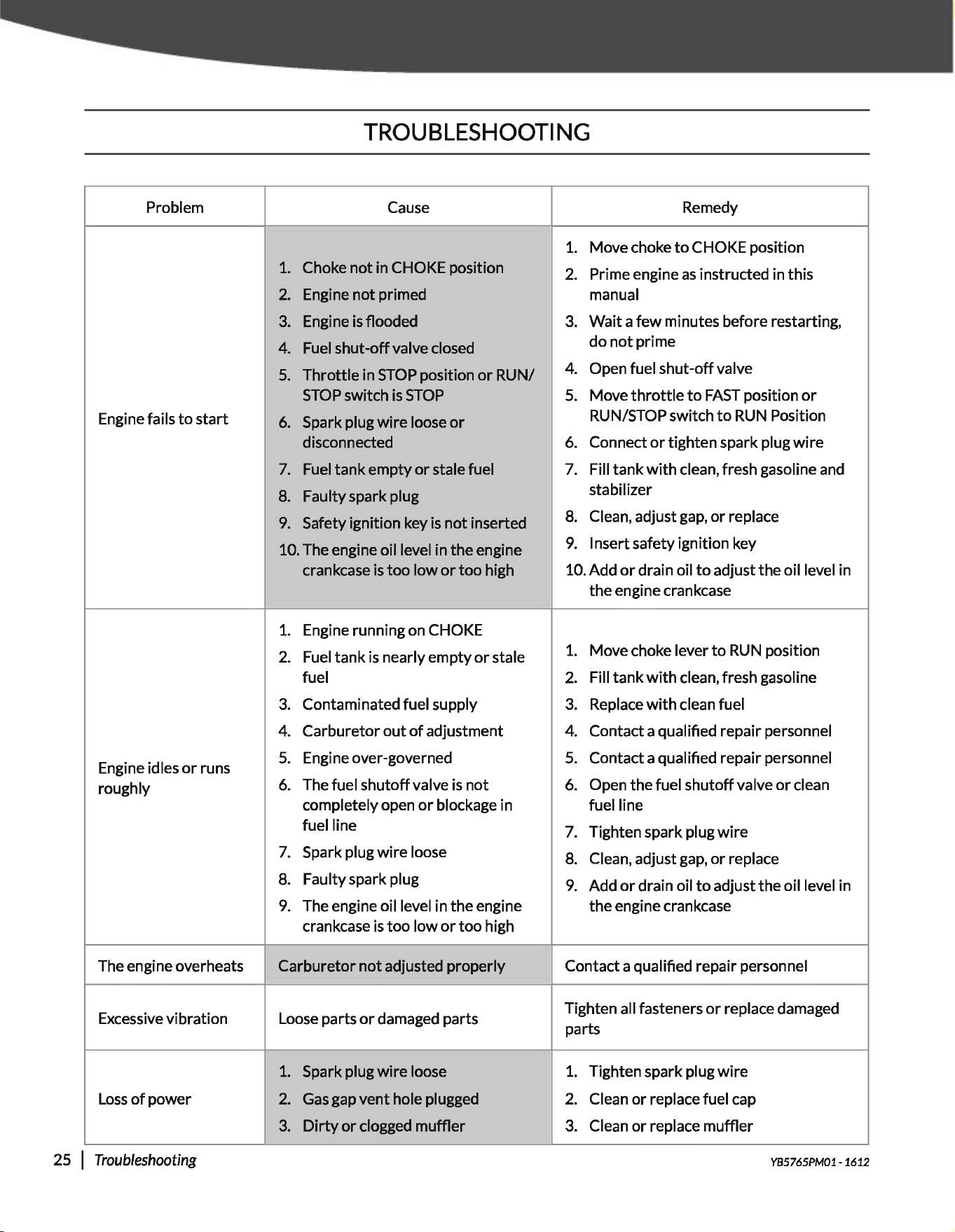
Problem
Engine fails
to
start
Engine idles
or
runs
roughly
The engine overheats
Excessive vibration
Loss
of
power
25 I
Troubleshooting
TROUBLESHOOTING
Cause
1.
Choke
not
in CHOKE position
2.
Engine
not
primed
3.
Engine
is
flooded
4.
Fuel
shut-off
valve closed
5.
Throttle
in
STOP
position
or
RUN/
STOP
switch is
STOP
6.
Spark plug
wire
loose
or
disconnected
7.
Fuel
tank
empty
or
stale fuel
8.
Faulty spark plug
9.
Safety ignition key
is
not
inserted
10. The engine oil level in
the
engine
crankcase
is
too
low
or
too
high
1.
Engine running on CHOKE
2.
Fuel
tank
is
nearly
empty
or
stale
fuel
3.
Contaminated fuel supply
4.
Carburetor
out
of
adjustment
5.
Engine over-governed
6.
The fuel
shutoff
valve
is
not
completely open
or
blockage in
fuel line
7.
Spark plug
wire
loose
8.
Faulty spark plug
9.
The engine oil level in
the
engine
crankcase
is
too
low
or
too
high
Carburetor
not
adjusted properly
Loose parts
or
damaged parts
1.
Spark plug
wire
loose
2.
Gas
gap
vent
hole plugged
3.
Dirty
or
clogged
muffler
Remedy
1.
Move choke
to
CHOKE position
2.
Prime engine
as
instructed in this
manual
3.
Wait
a
few
minutes before restarting,
do
not
prime
4.
Open fuel
shut-off
valve
5.
Move
throttle
to
FAST
position
or
RUN/STOP switch
to
RUN
Position
6.
Connect
or
tighten spark plug
wire
7.
Fill
tank
with
clean, fresh gasoline and
stabilizer
8.
Clean, adjust gap,
or
replace
9.
Insert safety ignition key
10. Add
or
drain oil
to
adjust
the
oil level in
the
engine crankcase
1.
Move choke lever
to
RUN
position
2.
Fill
tank
with
clean, fresh gasoline
3.
Replace
with
clean fuel
4.
Contact a qualified repair personnel
5.
Contact a qualified repair personnel
6.
Open
the
fuel
shutoff
valve
or
clean
fuel line
7.
Tighten spark plug
wire
8.
Clean, adjust gap,
or
replace
9.
Add
or
drain oil
to
adjust
the
oil level in
the
engine crankcase
Contact a qualified repair personnel
Tighten all fasteners
or
replace damaged
parts
1.
Tighten spark plug
wire
2.
Clean
or
replace fuel cap
3.
Clean
or
replace
muffler
YB5765PM01·1612
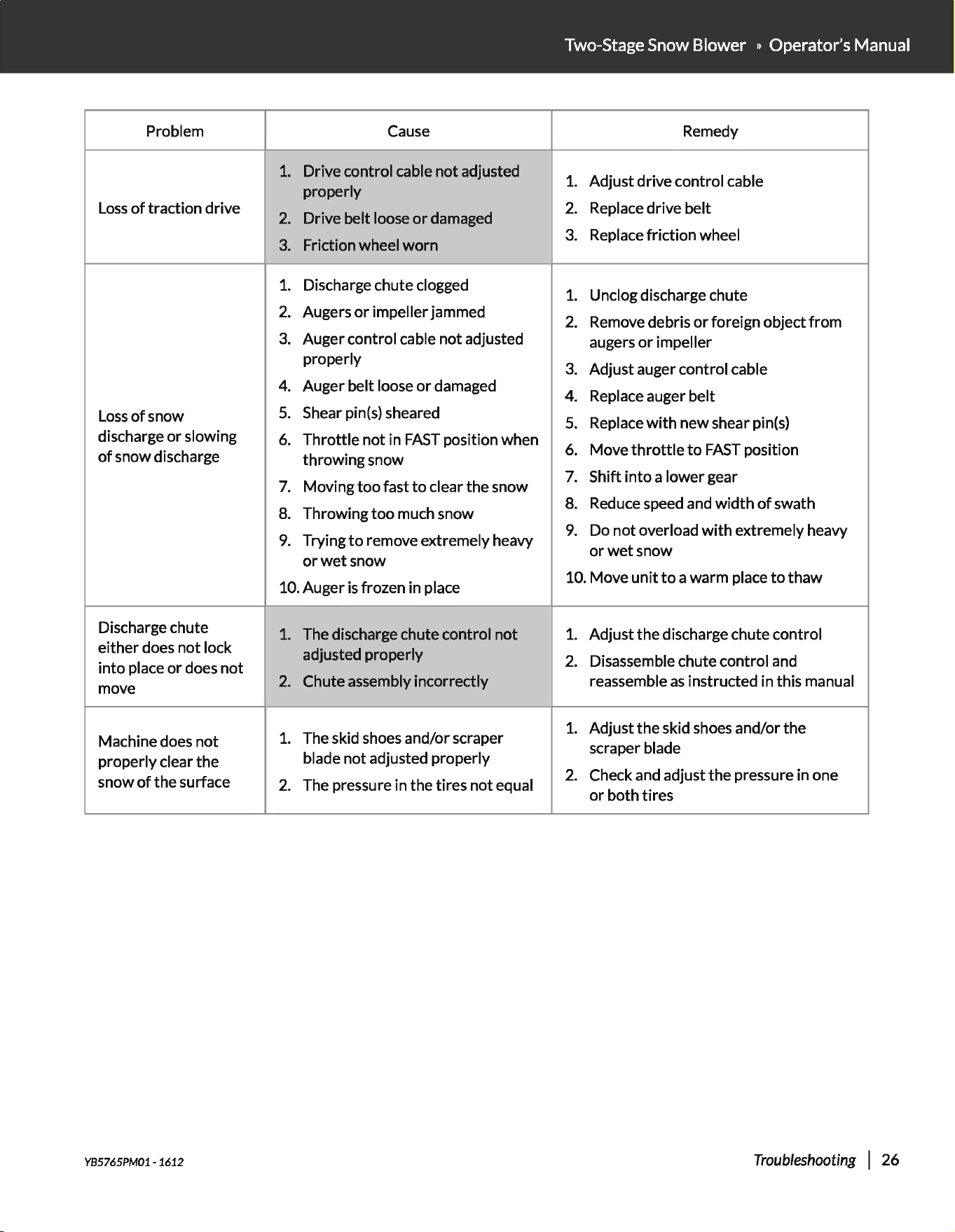
~
Problem
Loss
of
traction drive
Loss
of
snow
discharge
or
slowing
of
snow discharge
Discharge chute
either
does
not
lock
into
place
or
does
not
move
Machine does
not
properly clear
the
snow
of
the
surface
YB5765PM01·1612
I
Cause
1.
Drive control cable
not
adjusted
properly
2.
Drive belt loose
or
damaged
3.
Friction wheel
worn
1.
Discharge chute clogged
2.
Augers
or
impeller jammed
3.
Auger control cable
not
adjusted
properly
4.
Auger belt loose
or
damaged
5.
Shear pin(s) sheared
6.
Throttle
not
in
FAST
position when
throwing
snow
7.
Moving
too
fast
to
clear
the
snow
8. Throwing
too
much snow
9.
Trying
to
remove extremely heavy
or
wet
snow
10. Auger
is
frozen in place
1.
The discharge chute control
not
adjusted properly
2.
Chute assembly incorrectly
1.
The skid shoes and/or scraper
blade
not
adjusted properly
2.
The pressure in
the
tires
not
equal
I
Remedy
1.
Adjust drive control cable
2.
Replace drive belt
3.
Replace
friction
wheel
1.
Unclog discharge chute
2.
Remove debris
or
foreign object
from
augers
or
impeller
3.
Adjust auger control cable
4.
Replace auger
belt
5.
Replace
with
new
shear pin(s)
6.
Move
throttle
to
FAST
position
7.
Shift
into
a
lower
gear
8.
Reduce speed and
width
of
swath
9.
Do
not
overload
with
extremely heavy
or
wet
snow
10. Move
unit
to
a warm place
to
thaw
1.
Adjust
the
discharge chute control
2.
Disassemble chute control and
reassemble
as
instructed in this manual
1.
Adjust
the
skid shoes and/or
the
scraper blade
2.
Check and adjust
the
pressure in one
or
both tires
Troubleshooting
I 26
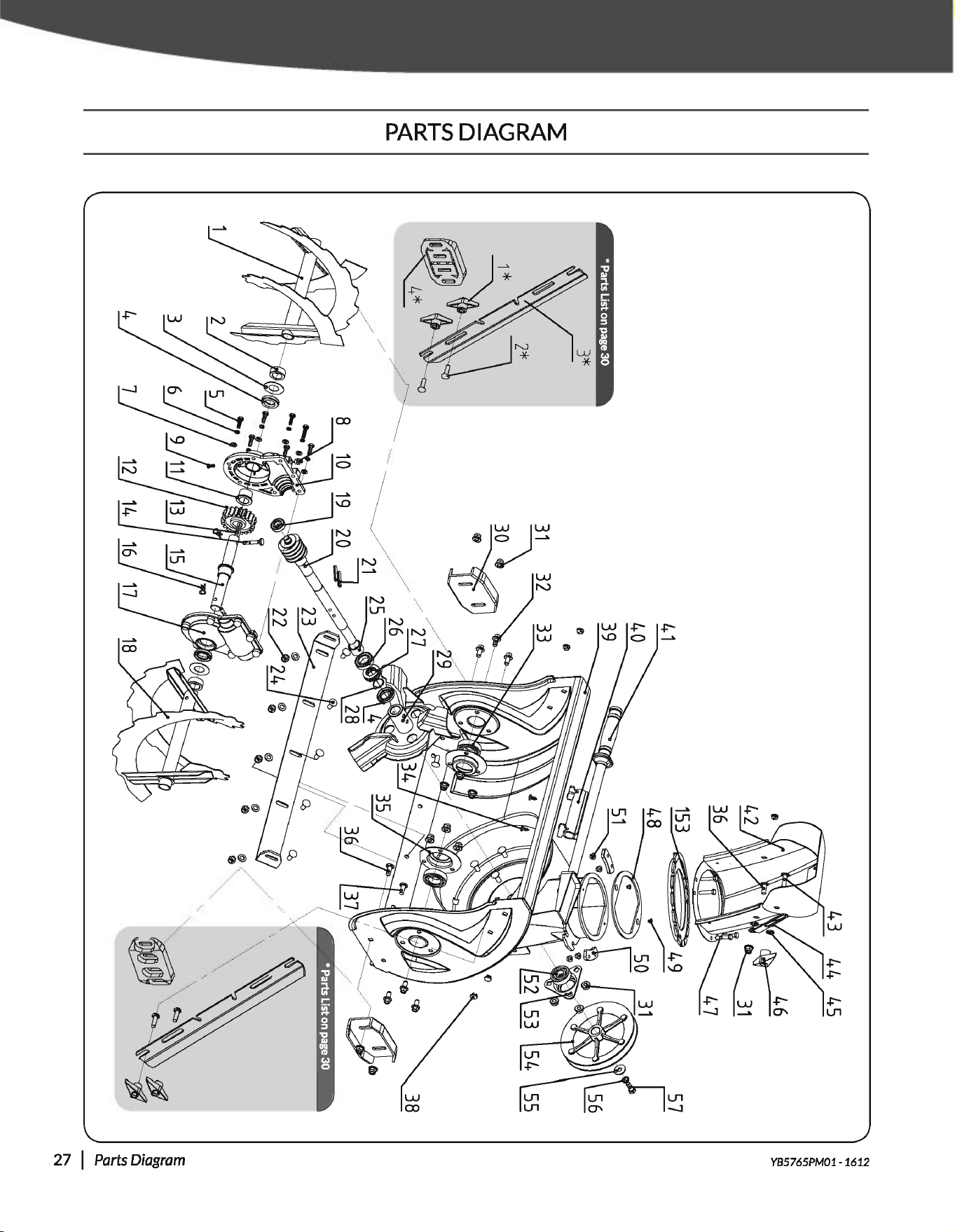
~
62
~
0
U')
~
~
• Parts List
on
page
30
I
31
32 33
~
(@v
•lll•~l:f~lt
57
('I
....
"()
....
i
~
li'l
~
E
e
~
a
t
~
.......
N
I
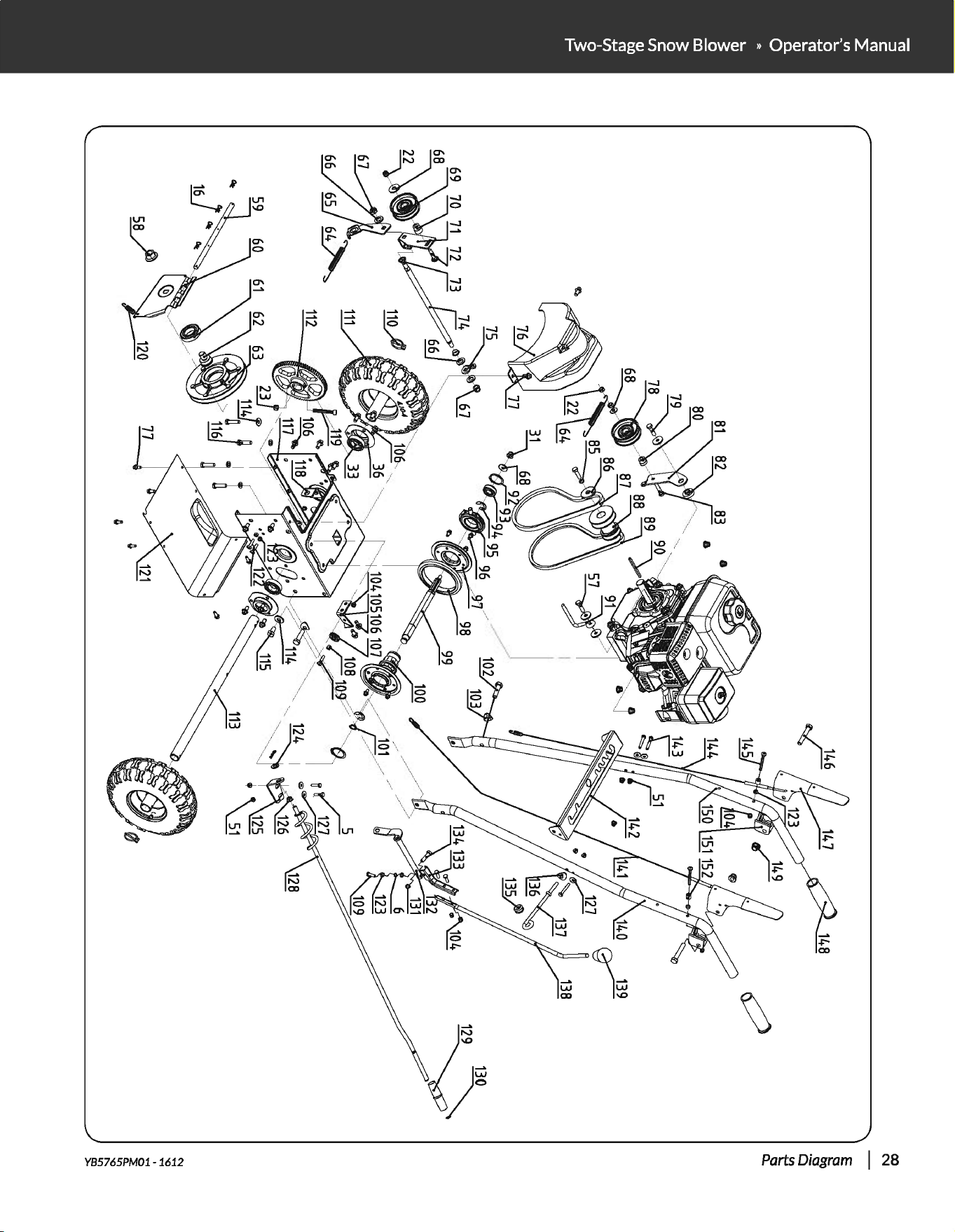
v
~
120
77
~
CX)
N
E
e
~
a
t
~
('\1
....
'()
....
....
~
~
l.l'l
~
I
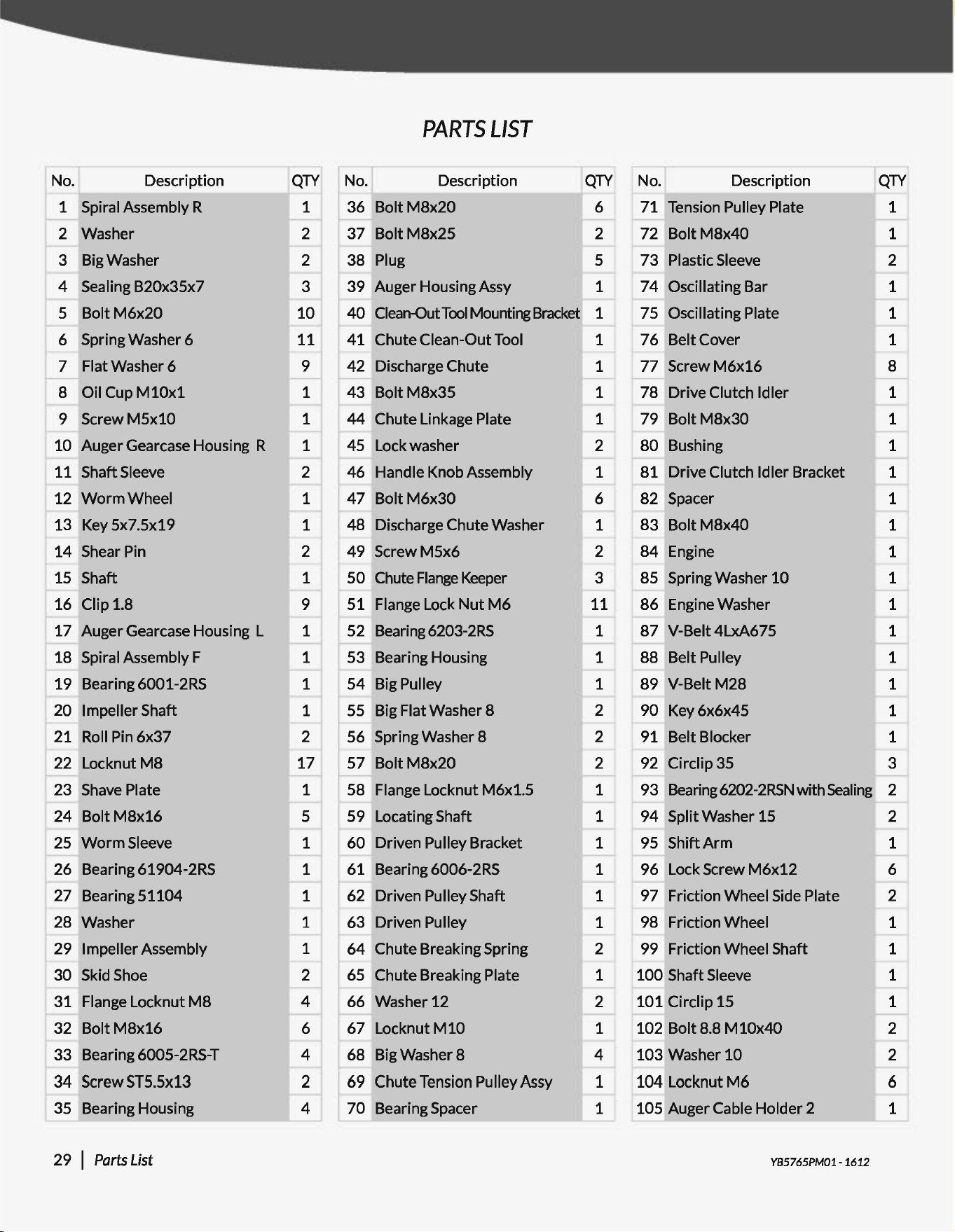
PARTS
LIST
No. Description
QTY
No. Description
QTY
No. Description
QTY
1 Spiral Assembly R 1
36
BoltM8x20
6
71 Tension Pulley Plate 1
2 Washer 2 37 Bolt M8x25 2 72 Bolt M8x40 1
3
Big Washer
2
38 Plug
5 73 Plastic
Sleeve
2
4
Sealing B20x35x7
3
39 Auger Housing Assy
1
74
Oscillating Bar
1
5
BoltM6x20
10
40
Clean-Out
Tool
Mounting
Bracket
1 75
Oscillating Plate
1
6
Spring Washer 6
11 41
Chute Clean-Out
Tool
1 76 Belt Cover 1
7 Flat Washer 6 9 42 Discharge Chute 1 77 ScrewM6x16
8
8
Oil Cup M10x1 1 43
BoltM8x35
1 78 Drive Clutch Idler 1
9 ScrewM5x10 1
44
Chute Linkage Plate
1 79
BoltM8x30
1
10
Auger Gearcase Housing R
1 45 Lock washer 2 80
Bushing
1
11 Shaft Sleeve 2 46
Handle Knob Assembly
1 81 Drive Clutch Idler Bracket 1
12 Worm Wheel 1
47
BoltM6x30
6 82
Spacer
1
13 Key 5x7.5x19
1 48
Discharge Chute Washer
1 83 Bolt M8x40 1
14
Shear
Pin
2
49
Screw M5x6 2
84
Engine 1
15 Shaft 1
50
Chute
Flange
Keeper
3
85 Spring Washer
10
1
16 Clip1.8 9 51 Flange Lock
Nut
M6
11 86 Engine Washer 1
17 AugerGearcase Housing L
1 52
Bearing6203-2RS
1
87 V-Belt 4LxA675
1
18 Spiral Assembly F
1 53
Bearing Housing
1
88 Belt Pulley
1
19 Bearing 6001-2RS
1 54
Big Pulley
1
89 V-Belt
M28
1
20
Impeller Shaft
1 55
Big Flat Washer 8
2 90
Key6x6x45
1
21 Roll Pin6x37 2 56 Spring Washer 8 2 91 Belt Blocker 1
22 Locknut
M8
17
57
BoltM8x20
2 92 Circlip 35
3
23
Shave
Plate 1
58
Flange Locknut M6x1.5 1 93
Bearing
6202-2RSN
with
Sealing
2
24 Bolt M8x16 5 59
Locating Shaft
1
94 Split Washer 15
2
25 Worm Sleeve 1 60
Driven Pulley Bracket
1 95 Shift Arm 1
26 Bearing61904-2RS
1 61
Bearing 6006-2RS
1 96 Lock Screw M6x12 6
27 Bearing 51104
1 62
Driven Pulley Shaft
1 97 Friction Wheel
Side
Plate 2
28 Washer 1
63
Driven Pulley 1 98 Friction Wheel 1
29 Impeller Assembly 1 64 Chute Breaking Spring 2 99 Friction Wheel Shaft 1
30 SkidShoe 2
65
Chute Breaking Plate 1 100 Shaft
Sleeve
1
31
Flange Locknut
M8
4 66 Washer 12 2
101 Circlip 15
1
32 Bolt M8x16 6 67 Locknut
M10
1 102 Bolt 8.8 M 10x40 2
33 Bearing 6005-2RS-T
4 68
Big WasherS
4 103 Washer
10
2
34 Screw ST5.5x13
2 69
Chute Tension Pulley Assy
1
104
Locknut
M6
6
35
Bearing Housing
4 70
Bearing Spacer
1
105 Auger Cable Holder 2
1
29
I
Parts
List
YB5765PM01-1612
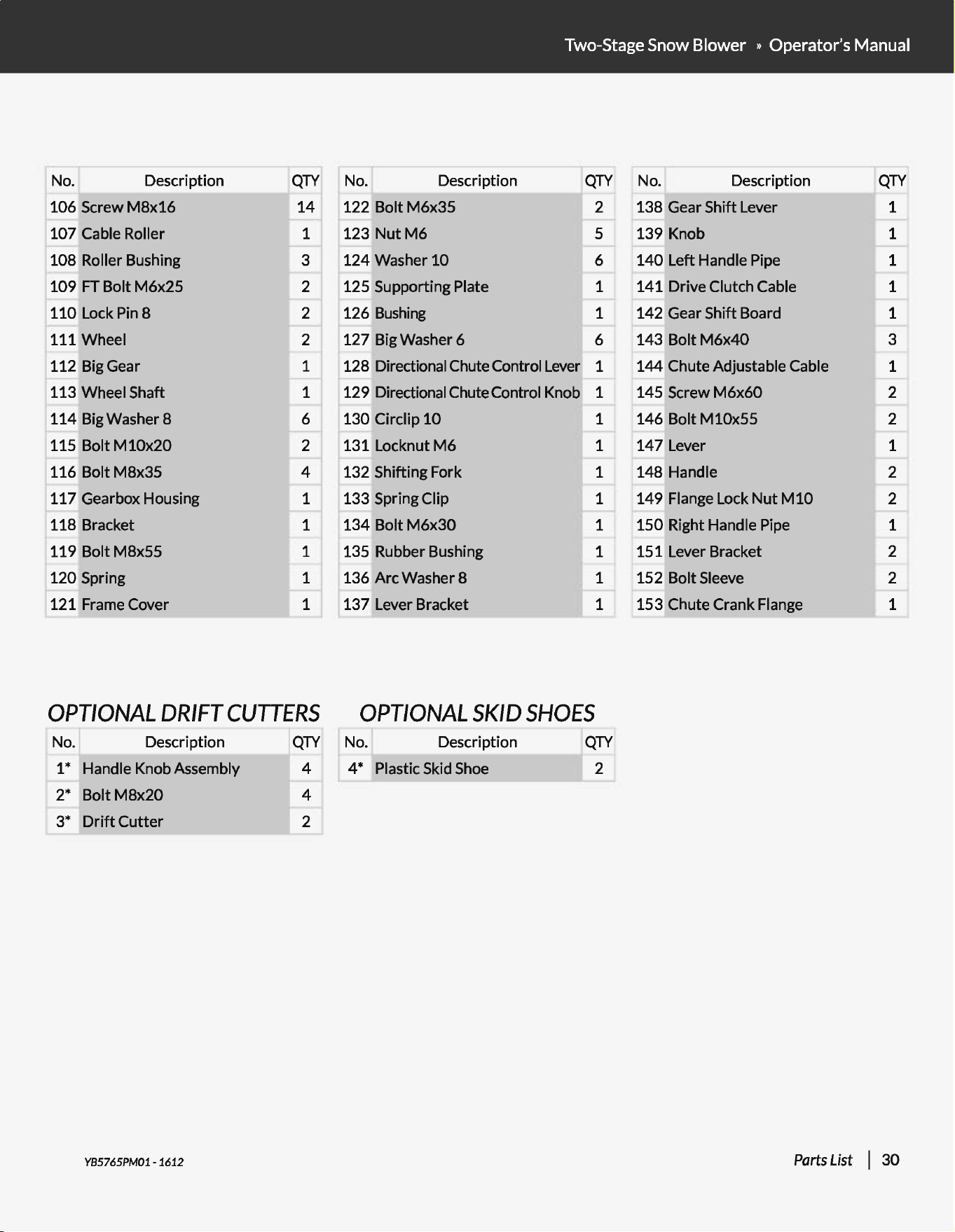
No. Description
QTY
No. Description
QTY
No. Description
QTY
106 Screw M8x16
14
122 Bolt M6x35 2 138 Gear Shift Lever 1
107 Cable Roller 1 123
NutM6
5 139 Knob 1
108 Roller Bushing
3 124 Washer
10
6
140 Left Handle Pipe
1
109
FT
Bolt M6x25 2
125 Supporting Plate
1 141 Drive Clutch Cable 1
110 Lock
Pin
8 2
126
Bushing
1 142 Gear Shift Board 1
111 Wheel 2
127 Big Washer 6
6 143 Bolt M6x40 3
112 BigGear 1 128 Directional Chute Control
Lever
1
144
Chute Adjustable Cable 1
113 Wheel Shaft 1 129 Directional Chute Control Knob 1 145 Screw M6x60 2
114 BigWasher8
6
130 Circlip
10
1 146 Bolt M10x55 2
115 Bolt M 10x20 2 131 Locknut
M6
1 147 Lever 1
116 Bolt M8x35 4
132 Shifting Fork
1 148 Handle 2
117 Gearbox Housing
1
133 Spring Clip
1
149 Flange Lock
Nut
M10
2
118 Bracket 1 134 Bolt M6x30 1
150 Right Handle Pipe
1
119 Bolt M8x55 1 135 Rubber Bushing 1 151 Lever Bracket 2
120 Spring 1 136 Arc Washer 8 1 152 Bolt Sleeve 2
121 Frame Cover 1 137 Lever Bracket 1 153 Chute Crank Flange 1
OPTIONAL
DRIFT
CUTTERS
OPTIONAL
SKID
SHOES
No. Description
QTY
No. Description
QTY
1* Handle Knob Assembly 4 4 * Plastic Skid
Shoe
2
2*
BoltM8x20
4
3*
Drift
Cutter 2
YB5765PM01-1612
Parts
List I 30