1
IMPORTANT SAFETY INSTRUCTIONS
1) SAVE THESE INSTRUCTIONS – This manual contains important safety and operating
instructions for battery charger model P/N 022-0258
2) Do not expose charger to rain or snow.
3) Use of an attachment not recommended or sold by the battery charger manufacturer may
result in a risk of fire, electric shock, or injury to persons.
4) To reduce risk of damage to electric plug and cord, pull by plug rather than cord when
disconnecting charger.
5) An extension cord should not be used unless absolutely necessary. Use of improper
extension cord could result in a risk of fire and electric shock. If an extension cord must
be used, make sure:
a) That pins on plug of extension cord are the same number, size, and shape as those of
plug on charger;
b) That extension cord is properly wired and in good electrical condition; and
c) That wire size is large enough for ac ampere rating of charger as specified in Table 1
6) Do not operate charger with damaged cord or plug – replace the cord or plug
immediately.
7) Do not operate charger if it has received a sharp blow, been dropped, or otherwise
damaged in any way; take it to a qualified serviceman.
8) Do not disassemble charger; take it to a qualified serviceman when service or repair is
required. Incorrect reassembly may result in a risk of electric shock or fire.
9) To reduce risk of electric shock, unplug charger from outlet before attempting any
maintenance or cleaning. Turning off controls will not reduce this risk.
10) WARNING – RISK OF EXPLOSIVE GASES.
a) WORKING IN VICINITY OF A BATTERY IS DANGEROUS. BATTERIES
GENERATE EXPLOSIVE GASES DURING NORMAL BATTERY OPERATION.
FOR THIS REASON, IT IS OF UTMOST IMPORTANCE THAT YOU FOLLOW THE
INSTRUCTIONS EACH TIME YOU USE THE CHARGER.
b) To reduce risk of battery explosion, follow these instructions and those published by
battery manufacturer and manufacturer of any equipment you intend to use in
vicinity of battery. Review cautionary marking on these products and on engine.
Deltran Battery Tender
12V 5Amp and 24V 2.5Amp Selectable Charger
For 12V Four Cell Lithium (LiFePO4) Batteries, 24V Eight Cell Lithium (LiFePO4) Batteries,
12V Six cell and 24V Twelve Cell Lead-Acid/AGM Batteries
TABLE 1
Length of Cord, Feet 25 50 100 150
AWG Size of Cord 18 18 18 16
P/N 392-0390-R0
2
11) PERSONAL PRECAUTIONS
a) Consider having someone close enough by to come to your aid when you work near
a battery.
b) Have plenty of fresh water and soap nearby in case battery acid contacts skin,
clothing, or eyes.
c) Wear complete eye protection and clothing protection. Avoid touching eyes while
working near battery.
d) If battery acid contacts skin or clothing, wash immediately with soap and water. If
acid enters eye, immediately flood eye with running cold water for at least 10
minutes and get medical attention immediately.
e) NEVER smoke or allow a spark or flame in vicinity of battery or engine.
f) Be extra cautious to reduce risk of dropping a metal tool onto battery. It might spark
or short-circuit battery or other electrical part that may cause explosion.
g) Remove personal metal items such as rings, bracelets, necklaces, and watches
when working with a battery. A battery can produce a short-circuit current high
enough to weld a ring or the like to metal, causing a severe burn.
h) Use charger for charging Lead-Acid/AGM/Lithium (LiFePO4) batteries only. It is
not intended to supply power to a low voltage electrical system. Do not use battery
charger for charging non-rechargeable batteries that are commonly used with home
appliances. These batteries may burst and cause injury to persons and damage to
property.
i) NEVER charge a frozen battery.
12) PREPARING TO CHARGE
a) If necessary, to remove battery from vehicle to charge, always remove grounded
terminal from battery first. Make sure all accessories in the vehicle are off, so as not
to cause an arc.
b) Be sure area around battery is well ventilated while battery is being charged.
c) Clean battery terminals. Be careful to keep corrosion from coming in contact with
eyes.
d) Add distilled water in each cell until battery acid reaches level specified by battery
manufacturer. Do not overfill. For a battery without removable cell caps, such as
valve regulated lead acid batteries, carefully follow manufacturer’s recharging
instructions.
e) Study all battery manufacturers specific precautions such as removing or not
removing cell caps while charging and recommended rates of charge.
f) Determine voltage of battery by referring to car owner’s manual and make sure that
output voltage selector switch is set at correct voltage. Do not use the battery
charger unless battery voltage matches the output voltage rating of the charger.
13) CHARGER LOCATION
a) Locate charger as far away from battery as dc cables permit.
b) Never place charger directly above battery being charged; gases from battery will
corrode and damage charger.
c) Never allow battery acid to drip on charger when reading electrolyte specific gravity
or filling battery.
d) Do not operate charger in a closed-in area or restrict ventilation in any way.
e) Do not set a battery on top of charger.
14) DC CONNECTION PRECAUTIONS
a) Connect and disconnect dc output clips only after setting any charger switches to
offposition and removing ac cord from electric outlet. Never allow clips to touch
each other.
b) Attach clips to battery and chassis as indicated in 15(e), 15(f), and 16(b) through
16(d).
3
15) FOLLOW THESE STEPS WHEN BATTERY IS INSTALLED IN VEHICLE. A SPARK
NEAR BATTERY MAY CAUSE BATTERY EXPLOSION. TO REDUCE RISK OF A
SPARK NEAR BATTERY:
a) Position ac and dc cords to reduce risk of damage by hood, door, or moving engine
part.
b) Stay clear of fan blades, belts, pulleys, and other parts that can cause injury to
persons.
c) Check polarity of battery posts. POSITIVE (POS, P, +) battery post usually has
larger diameter than NEGATIVE (NEG, N,–) post.
d) Determine which post of battery is grounded (connected) to the chassis. If negative
post is grounded to chassis (as in most vehicles), see (e). If positive post is
grounded to the chassis, see (f).
e) For negative-grounded vehicle, connect POSITIVE (RED) clip from battery charger
to POSITIVE (POS, P, +) ungrounded post of battery first. Then connect NEGATIVE
(BLACK) clip to vehicle chassis or engine block away from battery. Do not connect
clip to carburetor, fuel lines, or sheet-metal body parts. Connect to a heavy gage
metal part of the frame or engine block.
f) For positive-grounded vehicle, connect NEGATIVE (BLACK) clip from battery
charger to NEGATIVE (NEG, N, –) ungrounded post of battery first. Then connect
POSITIVE (RED) clip to vehicle chassis or engine block away from battery. Do not
connect clip to carburetor, fuel lines, or sheet-metal body parts. Connect to a heavy
gage metal part of the frame or engine block;
g) Connect charger AC supply cord to electric outlet; and
h) When disconnecting charger, turn switches to off, disconnect AC cord, remove clip
from vehicle chassis, and then remove clip from battery terminal.
i) See operating instructions for length of charge information.
16) FOLLOW THESE STEPS WHEN BATTERY IS OUTSIDE VEHICLE. A SPARK NEAR
THE BATTERY MAY CAUSE BATTERY EXPLOSION. TO REDUCE RISK OF A
SPARK NEAR BATTERY:
a) Check polarity of battery posts. POSITIVE (POS, P, +) battery post usually has a
larger diameter than NEGATIVE (NEG, N, –) post.
b) Attach at least a 24-inch-long 6-gauge (AWG) insulated battery cable to NEGATIVE
(NEG, N, –) battery post.
c) Connect POSITIVE (RED) charger clip to POSITIVE (POS, P, +) post of battery.
d) Position yourself and free end of cable as far away from battery as possible – then
connect NEGATIVE (BLACK) charger clip to free end of cable.
e) Do not face battery when making final connection.
f) When disconnecting charger, always do so in reverse sequence of connecting
procedure and break first connection while as far away from battery as practical.
g) A marine (boat) battery must be removed and charged on shore. To charge it on
board requires equipment specially designed for marine use.
4
GROUNDING AND AC POWER CORD CONNECTION INSTRUCTIONS –
Charger should be grounded to reduce risk of electric shock. Charger is equipped with an
electric cord having an equipment-grounding conductor and a grounding plug. The plug must
be plugged into an outlet that is properly installed and grounded in accordance with all local
codes and ordinances.
DANGER – Never alter AC cord or plug provided – if it will not fit outlet, have proper outlet
installed by a qualified electrician. Improper connection can result in a risk of an electric shock.
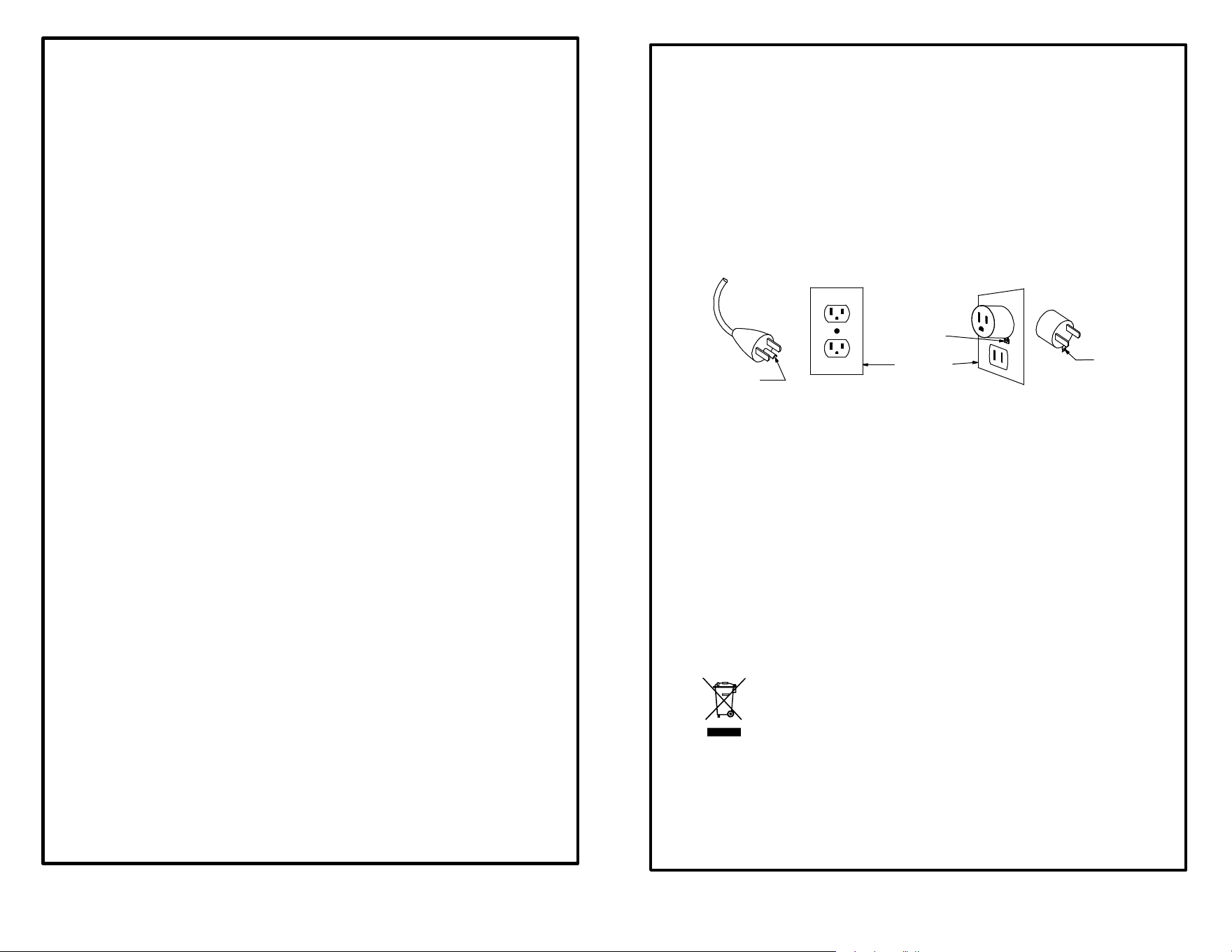
This battery charger is for use on a nominal 120-volt circuit, and has a grounding plug that
looks like the plug illustrated in sketch A in Figure 1. A temporary adapter, which looks like the
adapter illustrated in sketches B and C, may be used to connect this plug to a two-pole
receptacle as shown in sketch B if a properly grounded outlet is not available. The temporary
adapter should be used only until a properly grounded outlet can be installed by a qualified
electrician.
DANGER – Before using adapter as illustrated, be certain that center screw of outlet plate is
grounded. The green-colored rigid ear or lug extending from adapter must be connected to a
properly grounded outlet– make certain it is grounded. If necessary, replace original outlet
cover plate screw with a longer screw that will secure adapter ear or lug to outlet cover plate
and make ground connection to grounded outlet.
NOTE:
USE OF AN ADAPTER IS NOT ALLOWED IN CANADA. IF A GROUNDING TYPE
RECEPTACLE IS NOT AVAILABLE, DO NOT USE THIS APPLIANCE UNTIL THE
PROPER OUTLET IS INSTALLED BY A QUALIFIED ELECTRICIAN
This symbol indicates separate collection for electrical and
electronic equipment
Figure 1
GROUNDING
PIN
(A) (B) (C)
GROUNDING
MEANS
ADAPTER
METAL SCREW
COVER OF GROUNDED
OUTLET BOX
5
USER INSTRUCTIONS
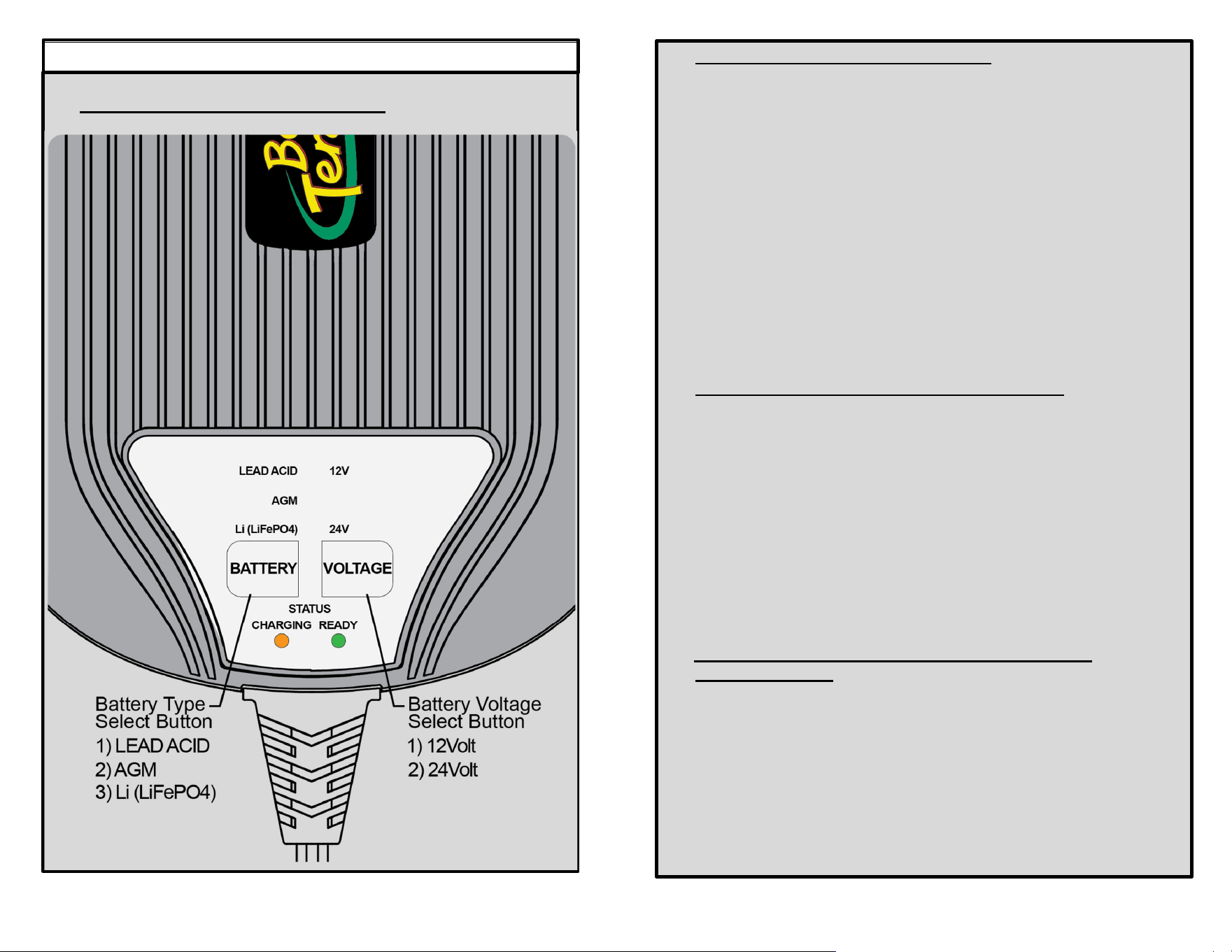
● Battery Charger Controls/Features
6
Battery Voltage Selection Button:
Change the Battery voltage from 12Volts to 24Volts by simply
pressing the “VOLTAGE” button
. The battery voltage can be
selected once the charger has AC power applied and before the
charger is connected to the battery.
Once the charger has AC power and is also connected to the battery
the voltage (12V or 24V) selection cannot be changed. To change
the mode, disconnect the battery from the charger.
If the AC power is interrupted the charger will resume charging at
the last battery voltage setting used.
The charger can also detect if the incorrect battery voltage has been
selected or if the battery is defective once the connection has been
made to the battery. The 12V or 24V symbol will flash preventing the
charge cycle from starting. In order to begin a new charge cycle,
reset the charger by disconnecting it from the AC supply as well as
the wrong or defective battery for 7-10 seconds. Reconnect the AC
supply and the charger will be ready for a new charge cycle.
Battery Type/Chemistry Selection Button:
Change the battery Type/chemistry from “LEAD ACID” to “AGM”, to
Li (LiFePO4) by simply pressing the “BATTERY” button.
The battery type must be selected once the charger has AC
power applied and before the charger is connected to the
battery.
Once the charger has AC power and is also connected to the battery
the battery type selection cannot be changed. In order to begin a
new charge cycle, reset the charger by disconnecting it from the AC
supply as well as the wrong or defective battery for 7-10 seconds.
Reconnect the AC supply and the charger will be ready for a new
charge cycle.
If the AC power is interrupted the charger will resume charging at
the last settings used.
● Automatic Lithium Iron Phosphate (LiFePO4)
Recovery Mode
If you try to charge a dead 12 or 24 Volt Lithium Iron Phosphate
battery (LiFePO4) with a very low voltage, 6 to 9 Volts (12V), or 12
to 16 Volts (24V) the charger will automatically switch into the
Recovery Mode. When in this mode the Amber CHARGING LED
will be solid and the Li (LiFePO4) symbol will flash. If successful and
once complete the charger will automatically switch back to the
normal charge cycle. There is a three (3) hour time limit for this
recovery process. If not successful the 12V or 24V symbol will start
flashing. It will continue this sequence until the charger is
disconnected from the AC source. If this happens there is a good
chance that the battery has already been damaged due to the low
voltage and cannot be recovered.

7
● AUTOMATIC CHARGING AND BATTERY STATUS
MONITORING: Battery Tender® chargers are completely automatic
and may be left connected to both AC power and to the battery that
it is charging for long periods of time. The charger output power,
voltage, and current depends on the condition of the battery it is
charging. Battery Tender
®
chargers have several STATUS LED
indicators that provide a visual means to determine the operating
mode of the charger and hence the condition of the battery
connected to the charger.
When AC power is first applied to the charger all of the LED’s will
illuminate for two to three seconds before starting the charge
sequence listed below once connected to a battery.
The two battery level STATES LED indicator lights are available to
determine whether the charger is operating in one of the four
primary charge modes:
1) Qualification/Initialization mode: The Monitor Circuit verifies
appropriate battery voltage levels and good electrical continuity
between the battery and the charger DC output.
2) Bulk mode (full charge, constant current, battery is 0% to 80%
charged)
3) Absorption mode (high constant voltage, battery is 80% to
100% charged).
4) Storage/float maintenance mode (low constant voltage,
battery is 100% to 103% charged).
When the battery is fully charged, the battery level status (READY)
Green LED indicator will turn solid green and the charger will switch
to a storage/float maintenance charge mode. The Battery Tender
®
charger will automatically monitor and maintain the battery at full
charge
● ATTENTION: The Battery Tender
®
CHARGER HAS A SPARK
FREE CIRCUITRY. The output alligator clips or ring terminals will
not spark when they are touched together. The Battery Tender
®
charger will not produce an output voltage until it senses at least 2
volts from a Lead Acid/AGM battery or 6 volts from a LiFePO4
battery. It must be connected to a battery with the correct polarity
before it will start charging a battery. Therefore, if you plug the AC
power cord into an AC power outlet, and if the output alligator clips
or ring terminals are not connected to a battery, and if you touch the
alligator clips or ring terminals together, there will be no electrical
spark.
NOTE:
THE OUTPUT CLIPS OR RING TERMINALS MUST BE CONNECTED
TO A BATTERY BEFORE THE CHARGER CAN PRODUCE AN
OUTPUT VOLTAGE.
8
● TIME REQUIRED TO CHARGE A BATTERY:
This Battery Tender
®
charges at a rate of 5.0 Amps or 2.5 Amp-
hours per hour. Therefore at 5.0 Amps a fully discharged 12V, 40
Amp-Hour battery will take approximately 6½ hours to recharge to
80% capacity.
● WORKING WITH A DEAD BATTERY OR A BATTERY WITH A
VERY LOW VOLTAGE:
If you try to charge a dead battery having a voltage below 2 volts,
the Battery Tender
®
charger will not start. An internal safety circuit
prevents the charger from generating any output voltage unless it
senses at least 2 volts at the charger output. In this situation, the
CHARGING amber LED will continue to flash, indicating that a
charge has not been initiated.
NOTE:
If a 12 Volt, Lead-Acid battery has an output voltage of less than 9
volts when it is at rest, when it is neither being charged nor
supplying electrical current to an external load, there is a good
chance that the battery is defective. As a frame of reference, a fully
charged 12-Volt, Lead-Acid battery will have a rest-state, no-load
voltage of approximately 12.9 volts. A fully discharged 12-Volt,
Lead-Acid battery will have a rest-state, no-load voltage of
approximately 11.4 volts. That means that a voltage change of only
1.5 volts represents the full range of charge 0% to 100% on a 12-
Volt, Lead-Acid battery. Depending on the manufacturer, and the
age of the battery, the specific voltages will vary by a few tenths of a
volt, but the 1.5-volt range will still be a good indicator of the battery
charge %.

9
● LED STATUS INDICATING LIGHTS: If the Amber light is not lit,
then the battery is not properly connected and/or the charger is
not plugged into AC power. The following describes light
operation:
AMBER LIGHT FLASHING (Amber) – The amber (CHARGING)
LED flashing indicates that the battery charger has AC power
available and that the microprocessor is functioning properly. If
the amber LED continues to flash, then either the battery voltage
is too low (less than 2 volts in the battery) or the output alligator
clips or ring terminals are not connected correctly.
ALTERNATING GREEN/AMBER (Amber LED & Green LED)
This indicates Reverse polarity connection to the battery.
The chargers safety timer has activated due the battery not
reaching its optimal voltage. The battery may be defective, take
the battery to the dealer to be tested.
AMBER LIGHT ON STEADY (Amber LED) – Whenever the
amber (CHARGING) LED is on steady, a battery is connected
properly and the charger is charging the battery. The amber LED
will remain on until the charger completes the charging stage.
GREEN LIGHT FLASHING (Green LED) – When the green
(READY) LED is flashing and the amber (CHARGING) LED is
solid the battery is greater than 80% charged and may be
removed from the charger and used if necessary. Whenever
possible, leave the battery on charge until the green light is
solid.
GREEN LIGHT ON STEADY (Green LED) – When the green
(READY) LED burns steady, the charge is complete and the
battery can be returned to service if necessary. It can also stay
connected to maintain the battery for an indefinite period of time.
10
Troubleshoot Guide:
1) If the charger does not turn on and none of the LED’s illuminate.
a. Check to make sure the AC outlet is supplying power by
plugging in a lamp, an appliance, or a voltage meter.
2) The green READY LED comes on immediately when charging a
discharged battery.
a. The battery is probably defective, take the battery to the
dealer to be tested.
3) When charging a battery the green READY LED never comes
on.
a. The battery may be defective, take the battery to the
dealer to be tested.
b. The battery has an excessive current draw, remove or
disconnect the battery from the equipment.
4) The amber LED continues to flash even with a connection to the
battery:
a. Check the fuse in the accessory cable.
b. The battery voltage is too low.
5) 12V symbol is flashing.
a. The battery is damaged or the incorrect battery voltage
has been selected.
6) 24V symbol is flashing.
a. The battery is damaged or the incorrect battery voltage
has been selected.
7) Amber & Green LED’s are toggling.
a. Reverse polarity connection to the battery.
b. The chargers safety timer has activated due the battery
not reaching its optimal voltage. The battery may be
defective, take the battery to the dealer to be tested.
11
Battery Charger Radio Frequency Warnings:
FCC WARNING
Title 47 Subpart, 15.105(b)
Note: This equipment has been tested and found to comply with the
limits for a class B digital device, pursuant to part 15 of the FCC Rules.
These limits are designed to provide reasonable protection against
harmful interference in residential installation. This equipment generates
uses and can radiate radio frequency energy and, if not installed and
used in accordance with the instructions, may cause harmful
interference to radio television reception, which can be determined by
tuning the equipment off and on, the user is encouraged to try to correct
the interference by one or more of the following measures:
- Reorient or relocate the receiving antenna.
- Increase the separation between the equipment and receiver.
- Connect the equipment into an outlet on a circuit different from
that to which the receiver is connected.
Consult the dealer or an experienced radio/TV technician for help
Canadian ICES-001: Industrial, Scientific, and Medical (ISM)
Radio Frequency Generators
This product has been tested with the listed standards and found to be
compliant with the Code of Industry Canada ES-001 and the
measurement Procedure according to CISPR 11.
CAN ICES-1/NMB-1
• Warranty:
This product is covered by a
2 Year general limited warranty
DISTRIBUTED BY:
DELTRAN USA LLC.
801 International Speedway Blvd.
Deland, Florida 32724
(386) 736-7900
12
INSTRUCTIONS IMPORTANTES CONCERNANT LA
SÉCURITÉ
CONSERVER CES INSTRUCTIONS. CE MANUEL
CONTIENT DES INSTRUCTIONS IMPORTANTES
CONCERNANT LA SÉCURITÉ ET LE
FONCTIONNEMENT.
1) IL EST DANGEREUX DE TRAVAILLER A PROXIMITÉ D’UNE BATTERIE
AU PLOMB. LES BATTERIES PRODUISENT DES GAZ EXPLOSIFS EN
SERVICE NORMAL. IL EST AUSSI IMPORTANT DE TOUJOURS
RELIRE LES INSTRUCTIONS AVANT D’UTILISER LE CHARGEUR ET
DE LES SUIVRE À LA LETTRE.
2) POUR RÉDUIRE LE RISQUE D’EXPLOSION, LIRE CES INSTRUCTIONS
ET CELLES QUI FIGURENT SUR LA BATTERIE.
3) NE JAMAIS FUMER PRÈS DE LA BATTERIE OU DU MOTEUR ET
ÉVITER TOUTE ÉTINCELLE OU FLAMME NUE À PROXIMITÉ DE CES
DERNIERS.
4) UTILISER CHARGEUR POUR RECHARGER UN PLOMB ACIDE OU AU
LITHIUM (LiFePO4) BATTERIE UNIQUEMENT. CE CHARGEUR N’EST
PAS CONÇU POUR ALIMENTER UN RÉSEAU ÉLECTRIQUE TRÈS
BASSE TENSION NI POUR CHARGER DES PILES SÈCHES. LE FAIT
D’UTILISER LE CHARGEUR POUR CHARGER DES PILES SÈCHES
POURRAIT ENTRAÎNER L’ÉCLATEMENT DES PILES ET CAUSER DES
BLESSURES OU DES DOMMAGES;
5) NE JAMAIS CHARGER UNE BATTERIE GELÉE.
6) S’IL EST NÉCESSAIRE DE RETIRER LA BATTERIE DU VÉHICULE
POUR LA CHARGER, TOUJOURS DÉBRANCHER LA BORNE DE MISE
À LA MASSE EN PREMIER. S’ASSURER QUE LE COURANT AUX
ACCESSOIRES DU VÉHICULE EST COUPÉ AFIN D’ÉVITER LA
FORMATION D’UN ARC.
7) PRENDRE CONNAISSANCE DES MESURES DE PRÉCAUTION
SPÉCIFIÉES PAR LE FABRICANT DE LA BATTERIE, P. EX., VÉRIFIER
S‘IL FAUT ENLEVER LES BOUCHONS DES CELLULES LORS DU
CHARGEMENT DE LA BATTERIE, ET LES TAUX DE CHARGEMENT
RECOMMANDÉS.
Battery Tender
®
Deltran Chargeur à selection
12 volts 5 ampères et 24 volts 2,5 ampères
Pour les batteries au lithium à quatre cellules (LiFePO4) de 12 volts, batteries au lithium à
huit cellules (LiFePO4) de 24 volts.
Batteries AGM/Plomb-acide à six cellules de 12 volts et
Plomb-acide/AGM à douze cellules de 24 volts

13
8) SI LE CHARGEUR COMPORTE UN SÉLECTEUR DE TENSION DE
SORTIE, CONSULTER LE MANUEL DE L’USAGER DE LA VOITURE
POUR DÉTERMINER LA TENSION DE LA BATTERIE ET POUR
S’ASSURER QUE LA TENSION DE SORTIE EST APPROPRIÉE. SI LE
CHARGEUR N’EST PAS MUNI D’UN SÉLECTEUR, NE PAS UTILISER
LE CHARGEUR À MOINS QUE LA TENSION DE LA BATTERIE NE SOIT
IDENTIQUE À LA TENSION DE SORTIE NOMINALE DU CHARGEUR.
9) NE JAMAIS PLACER LE CHARGEUR DIRECTEMENT SOUS LA
BATTERIE À CHARGER OU AU-DESSUS DE CETTE DERNIÈRE. LES
GAZ OU LES FLUIDES QUI S’ÉCHAPPENT DE LA BATTERIE
PEUVENT ENTRAÎNER LA CORROSION DU CHARGEUR OU
L’ENDOMMAGER. PLACER LE CHARGEUR AUSSI LOIN DE LA
BATTERIE QUE LES CABLES C.C. LE PERMETTENT.
10) NE PAS FAIRE FONCTIONNER LE CHARGEUR DANS UN ESPACE
CLOS ET/OU NE PAS GÊNER LA VENTILATION.METTRE LES
INTERRUPTEURS DU CHARGEUR HORS CIRCUIT ET RETIRER LE
CORDON C.A. DE LA PRISE AVANT DE METTRE ET D’ENLEVER LES
PINCES DU CORDON C.C. S’ASSURER QUE LES PINCES NE SE
TOUCHENT PAS.
11) SUIVRE LES ÉTAPES SUIVANTES LORSQUE LA BATTERIE SE
TROUVE DANS LE VÉHICULE. UNE ÉTINCELLE PRÈS DE LA
BATTERIE POURRAIT PROVOQUER L’EXPLOSION DE CETTE
DERNIÈRE. POUR RÉDUIRE LE RISQUE D’ÉTINCELLE À PROXIMITÉ
DE LA BATTERIE :
a. PLACER LES CORDONS C.A. ET C.C. DE MANIÈRE À ÉVITER
QU’ILS SOIENT ENDOMMAGÉS PAR LE CAPOT, UNE
PORTIÈRE OU LES PIÈCES EN MOUVEMENT DU MOTEUR ;
b. FAIRE ATTENTION AUX PALES, AUX COURROIES ET AUX
POULIES DU VENTILATEUR AINSI QU’À TOUTE AUTRE
PIÈCE SUSCEPTIBLE DE CAUSER DES BLESSURES ;
c. VÉRIFIER LA POLARITÉ DES BORNES DE LA BATTERIE. LE
DIAMÈTRE DE LA BORNE POSITIVE (POS, P, +) EST
GÉNÉRALEMENT SUPÉRIEUR À CELUI DE LA BORNE
NÉGATIVE (NÉG, N, –) ;
d. DÉTERMINER QUELLE BORNE EST MISE À LA MASSE
(RACCORDÉE AU CHÂSSIS). SI LA BORNE NÉGATIVE EST
RACCORDÉE AU CHÂSSIS (COMME DANS LA PLUPART DES
CAS), VOIR LE POINT (v). SI LA BORNE POSITIVE EST
RACCORDÉE AU CHÂSSIS, VOIR LE POINT (vi) ;
e. SI LA BORNE NÉGATIVE EST MISE À LA MASSE,
RACCORDER LA PINCE POSITIVE (ROUGE) DU CHARGEUR
À LA BORNE POSITIVE (POS, P, +) NON MISE À LA MASSE
DE LA BATTERIE. RACCORDER LA PINCE NÉGATIVE
(NOIRE) AU CHÂSSIS DU VÉHICULE OU AU MOTEUR, LOIN
DE LA BATTERIE. NE PAS RACCORDER LA PINCE AU
CARBURATEUR, AUX CANALISATIONS D’ESSENCE NI AUX
PIÈCES DE LA CARROSSERIE EN TÔLE. RACCORDER À UNE
PIÈCE DU CADRE OU DU MOTEUR EN TÔLE DE FORTE
ÉPAISSEUR ;
14
f. SI LA BORNE POSITIVE EST MISE À LA MASSE, RACCORDER
LA PINCE NÉGATIVE (NOIRE) DU CHARGEUR À LA BORNE
NÉGATIVE (NÉG, N, –) NON MISE À LA MASSE DE LA
BATTERIE. RACCORDER LA PINCE POSITIVE (ROUGE) AU
CHÂSSIS DU VÉHICULE OU AU MOTEUR, LOIN DE LA
BATTERIE. NE PAS RACCORDER LA PINCE AU
CARBURATEUR, AUX CANALISATIONS D’ESSENCE NI AUX
PIÈCES DE LA CARROSSERIE EN TÔLE. RACCORDER À UNE
PIÈCE DU CADRE OU DU MOTEUR EN TÔLE DE FORTE
ÉPAISSEUR ;
g. BRANCHER LE CORDON D’ALIMENTATION C.A. DU
CHARGEUR ;
h. POUR INTERROMPRE L’ALIMENTATION DU CHARGEUR,
METTRE LES INTERRUPTEURS HORS CIRCUIT, RETIRER LE
CORDON C.A. DE LA PRISE, ENLEVER LA PINCE
RACCORDÉE AU CHÂSSIS ET EN DERNIER LIEU CELLE
RACCORDÉE À LA BATTERIE.
12) SUIVRE LES ÉTAPES SUIVANTES LORSQUE LA BATTERIE EST À
L’EXTÉRIEUR DU VÉHICULE. UNE ÉTINCELLE PRÈS DE LA
BATTERIE POURRAIT PROVOQUER L’EXPLOSION DE CETTE
DERNIÈRE. POUR RÉDUIRE LE RISQUE D’ÉTINCELLE À
PROXIMITÉ DE LA BATTERIE :
a. VÉRIFIER LA POLARITÉ DES BORNES DE LA BATTERIE. LE
DIAMÈTRE DE LA BORNE POSITIVE (POS, P, +) EST
GÉNÉRALEMENT SUPÉRIEUR À CELUI DE LA BORNE
NÉGATIVE (NÉG, N, –) ;
b. RACCORDER UN CÂBLE DE BATTERIE ISOLÉ No 6 AWG
MESURANT AU MOINS 60 CM DE LONGUEUR À LA BORNE
NÉGATIVE (NÉG, N, –) ;
c. RACCORDER LA PINCE POSITIVE (ROUGE) À LA BORNE
POSITIVE (POS, P, +) DE LA BATTERIE ;
d. SE PLACER ET TENIR L’EXTRÉMITÉ LIBRE DU CÂBLE AUSSI
LOIN QUE POSSIBLE DE LA BATTERIE, PUIS RACCORDER
LA PINCE NÉGATIVE (NOIRE) DU CHARGEUR À
L’EXTRÉMITÉ LIBRE DU CÂBLE ;
e. NE PAS SE PLACER FACE À LA BATTERIE POUR
EFFECTUER LE DERNIER RACCORDEMENT ;
f. RACCORDER LE CORDON D’ALIMENTATION C.A. DU
CHARGEUR À LA PRISE ;
g. POUR INTERROMPRE L’ALIMENTATION DU CHARGEUR,
METTRE LES INTERRUPTEURS HORS CIRCUIT, RETIRER LE
CORDON C.A. DE LA PRISE, ENLEVER LA PINCE
RACCORDÉE AU CHÂSSIS ET EN DERNIER LIEU CELLE
RACCORDÉE À LA BATTERIE. SE PLACER AUSSI LOIN QUE
POSSIBLE DE LA BATTERIE POUR DÉFAIRE LA PREMIÈRE
CONNEXION.
13) L’UTILISATION D’UN ADAPTATEUR EST INTERDITE AU CANADA. SI
UNE PRISE DE COURANT AVEC MISE À LA TERRE N’EST PAS
DISPONIBLE EN FAIRE INSTALLER UNE PAR UN ÉLECTRICIEN
QUALIFIÉ AVANT D’UTILISER CET APPAREIL.
15
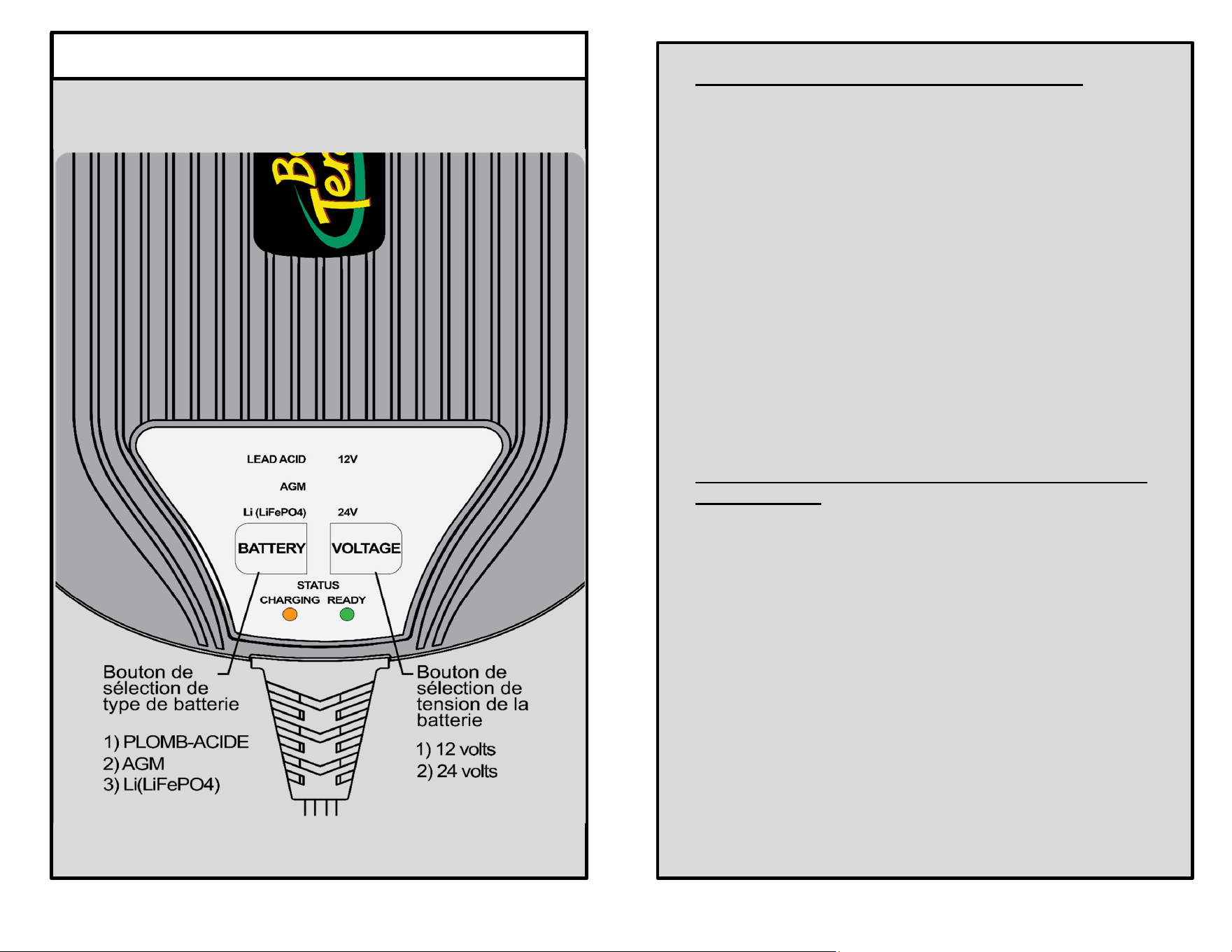
Battery Charger Controls/Features
• Commandes / caractéristiques du chargeur de batterie
GUIDE DE L'UTILISATEUR
16
Bouton de sélection de tension de batterie :
Il suffit d’appuyer sur le bouton « VOLTAGE » (Tension) pour
changer la tension de la batterie de 12 volts à 24 volts.
La tension
de batterie peut être sélectionnée une fois que l’alimentation
c.a. est appliquée au chargeur, et avant que le chargeur ne soit
connecté à la batterie.
Une fois que l’alimentation c.a. du chargeur est également
connectée à la batterie, la sélection de la tension (12V ou 24V) ne
peut plus être changée. Pour changer le mode, déconnecter la
batterie du chargeur.
Si l'alimentation c.a. est interrompue, le chargeur reprendra la
charge selon le dernier réglage de tension de batterie utilisé.
Le chargeur peut également détecter si une tension de batterie
incorrecte a été sélectionnée ou si la batterie est défectueuse une
fois que la batterie est connectée. Le symbole 12V ou 24V
clignotera en empêchant le cycle de charge de démarrer. Pour
commencer un nouveau cycle de charge, réinitialiser le chargeur en
le déconnectant de l'alimentation c.a, ainsi que la mauvaise batterie
ou la batterie défectueuse, pendant 7 à 10 secondes. Reconnecter
l'alimentation c.a. et le chargeur sera prêt pour un nouveau cycle de
charge.
Bouton de sélection de type/composition chimique
de la batterie :
Changer le type/la composition chimique de la batterie de « LEAD
ACID » (Plomb-acide) à « AGM », à Li (LiFePO4) en appuyant
simplement sur le bouton « BATTERY » (Batterie).
Le type de batterie doit être sélectionné une fois que
l’alimentation c.a. est appliquée au chargeur, et avant que le
chargeur ne soit connecté à la batterie.
Une fois que le chargeur a une alimentation c.a. et qu'il est
également connecté à la batterie, la sélection du type de batterie ne
peut plus être modifiée. Pour commencer un nouveau cycle de
charge, réinitialiser le chargeur en le déconnectant de l'alimentation
c.a, ainsi que la mauvaise batterie ou la batterie défectueuse,
pendant 7 à 10 secondes. Reconnecter l'alimentation c.a. et le
chargeur sera prêt pour un nouveau cycle de charge.
Si l'alimentation c.a. est interrompue, le chargeur reprendra la
charge selon les derniers réglages utilisés.
17
● Mode de récupération automatique de Lithium Fer
Phosphate (LiFePO4)
Si l’on tente de charger une batterie Lithium Fer Phosphate
(LiFePO4) de 12 ou 24 volts à plat avec une tension très basse, 6 à
9 volts (12V), ou 12 à 16 volts (24V), le chargeur passera
automatiquement en mode de récupération. Lorsqu’il est dans ce
mode, le voyant DEL DE CHARGE Ambre sera allumé en continu
et le symbole Li (LiFePO4) clignotera. Une fois la charge réussie et
terminée, le chargeur repasse automatiquement en cycle de charge
normal. Ce processus de récupération est limité à trois (3) heures.
Si le processus a échoué, le symbole 12V ou 24V commencera à
clignoter. Cette séquence continuera jusqu'au moment où le
chargeur sera déconnecté de la source d'alimentation c.a. Dans ce
cas, il y a de fortes chances que la batterie soit déjà endommagée à
cause de la basse tension et elle ne pourra pas être récupérée.
● CHARGE ET SURVEILLANCE AUTOMATIQUES DE L’ÉTAT DE
LA BATTERIE : Les chargeurs Battery Tender® sont entièrement
automatiques et peuvent être laissés branchés sur une alimentation
c. a. et à la batterie en cours de charge pendant de longues
périodes. La puissance, la tension et le courant de sortie du
chargeur dépendent de l'état de la batterie en cours de charge. Les
chargeurs Battery Tender
®
sont munis de plusieurs voyants DEL
STATUS (État) qui indiquent visuellement le mode de
fonctionnement du chargeur et par conséquent l'état de la batterie
qui est connectée au chargeur.
Lorsque l'alimentation c.a. est initialement appliquée au chargeur,
tous les voyants DEL s'allument pendant deux à trois secondes
avant de commencer la séquence de charge indiquée ci-dessous
une fois que le chargeur est connecté à une batterie.
Les deux voyant DEL STATUS (État) de niveau de la batterie sont
disponibles pour déterminer si le chargeur fonctionne dans l'un des
quatre modes de charge primaire :
1) Mode de qualification/d’initialisation : Le circuit de
surveillance vérifie les niveaux appropriés de tension de la
batterie et la bonne continuité électrique entre la batterie et la
sortie c.c. du chargeur.
2) Mode charge de masse (pleine charge, courant constant, la
batterie est chargée entre 0 et 80 %)
3) Mode d'absorption (tension élevée constante, la batterie est
chargée entre 80 et 100 %)
4) Mode de stockage/d'entretien flottant (basse tension
constante, la batterie est chargée entre 100 et 103 %).
Lorsque la batterie est entièrement chargée, le voyant DEL vert
(READY) (Prêt) d’état de charge de la batterie s'allumera en vert
continu et le chargeur passera en mode de charge de
stockage/entretien flottant. Le chargeur Battery Tender
®
surveille et
maintient automatiquement la batterie à pleine charge.
18
● ATTENTION : Le CHARGEUR Battery Tender
®
COMPREND UN
CIRCUIT SANS ÉTINCELLE. Les pinces crocodile ou les cosses à
anneau de sortie ne produisent pas d'étincelles lorsqu'elles se
touchent. Le chargeur Battery Tender
®
ne produit pas de tension de
sortie tant qu'il n'a pas détecté au moins 2 volts en provenance de la
batterie au plomb-acide/AGM ou 6 volts en provenance d’une
batterie LiFePO4. Il doit être connecté à une batterie avec la bonne
polarité avant qu'il ne puisse lancer la charge d'une batterie. Par
conséquent, si le cordon d'alimentation c.a. est branché dans une
prise d’alimentation c.a., et si les pinces crocodile de sortie ou les
cosses à anneau ne sont pas reliées à une batterie, et s’il arrivait
que les pinces crocodile ou les cosses à anneau se touchent, cela
ne génèrera pas d'étincelle électrique.
REMARQUE :
LES PINCES OU LES COSSES À ANNEAU DE SORTIE DOIVENT
ÊTRE CONNECTÉES À UNE BATTERIE POUR QUE LE CHARGEUR
PUISSE PRODUIRE UNE TENSION DE SORTIE.
● TEMPS NÉCESSAIRE POUR CHARGER UNE BATTERIE :
Ce Battery Tender® charge à un taux de 5,0 ampères ou 2,5
ampères par heure. Par conséquent, à 5,0 ampères, une batterie de
12 volts et de 40 ampères par heure entièrement déchargée prendra
environ 6 heures 1/2 pour se recharger à une capacité de 80 %.
● TRAVAILLER AVEC UNE BATTERIE À PLAT OU UNE BATTERIE
AYANT UNE TENSION TRÈS BASSE :
Le chargeur Battery Tender® ne démarrera pas si vous essayez de
charger une batterie à plat ayant une tension inférieure à 2 volts. Un
circuit de sécurité interne empêche le chargeur de générer une
tension de sortie quelconque s'il ne détecte pas au moins 2 volts à la
sortie du chargeur. Dans ce cas, le voyant DEL ambre CHARGING
(Charge) continuera à clignoter, indiquant ainsi qu'une charge n'a
pas été lancée.
REMARQUE :
Si une batterie au plomb-acide de 12 volts a une tension de sortie
de moins de 9 volts au repos, c'est-à-dire qu'elle n'est pas en cours
de charge ou qu'elle ne fournit aucun courant électrique à une
charge extérieure, il y a de bonnes chances que la batterie soit
défectueuse. Comme point de référence, une batterie au plomb-
acide de 12 volts complètement chargée aura une tension d'environ
12,9 volts au repos, sans charge. Une batterie au plomb-acide de
12 volts complètement déchargée aura une tension d'environ 11,4
volts au repos, sans charge. Cela signifie qu'un changement de
tension de seulement 1,5 volt représente la gamme complète de
charge de 0 % à 100 % sur une batterie au plomb-acide de 12 volts.
En fonction du fabricant et de l'âge de la batterie, les tensions
spécifiques varieront de quelques dixièmes de volt, mais la gamme
de 1,5 volt sera toujours un bon indicateur du pourcentage de
charge de la batterie.

19
● VOYANTS DEL D'ÉTAT : Si le voyant ambre ne s'allume pas,
cela signifie que la batterie n'est pas connectée correctement
et/ou que le chargeur n'est pas branché sur l’alimentation c.a.
Les voyants fonctionnent comme suit :
VOYANT AMBRE CLIGNOTANT (Ambre) – Le voyant DEL
ambre CHARGING (Charge) qui clignote indique qu’une
alimentation c.a. est disponible pour le chargeur de batterie et
que le microprocesseur fonctionne correctement. Si le voyant
DEL ambre continue à clignoter, soit la tension de la batterie est
trop faible (moins de 2 volts dans la batterie), soit les pinces
crocodile ou les cosses à anneau ne sont pas connectées
correctement.
VERT/AMBRE EN ALTERNANCE (voyant DEL ambre et
voyant DEL vert) Cela indique une connexion à polarité inverse
à la batterie.
La minuterie de sécurité des chargeurs s’est activée parce que
la batterie n’atteint pas sa tension optimale. La batterie est peut-
être défectueuse. L'amener chez le revendeur pour la faire
tester.
VOYANT AMBRE FIXE (Voyant DEL ambre) – Lorsque le
voyant DEL ambre (CHARGING) (Charge) reste allumé en
continu, cela signifie qu'une batterie est connectée correctement
et que le chargeur est en train de charger la batterie. Le voyant
DEL ambre restera allumé jusqu'à ce que le chargeur termine
l'étape de charge.
VOYANT VERT CLIGNOTANT (Voyant DEL vert) – Lorsque le
voyant DEL vert (READY) (Prêt) clignote et le voyant DEL
ambre (CHARGING) (Charge) est allumé en continu, le niveau
de charge de la batterie est supérieur à 80 %. La batterie peut
être déconnectée du chargeur et utilisée si nécessaire. Lorsque
possible, laisser la batterie en charge jusqu'à ce que le voyant
vert reste allumé en continu.
VOYANT VERT FIXE (Voyant DEL vert) – Lorsque le voyant
vert (READY) (Prêt) reste allumé en continu, la charge est
terminée et la batterie peut être utilisée si nécessaire. Elle peut
également rester connectée pour maintenir la batterie pendant
une période de temps indéfinie.
20
Guide de dépannage :
1) Si le chargeur ne se met pas en marche et aucun voyant DEL
ne s'allume.
a. Vérifier que la prise de courant c.a. fournit une
alimentation en branchant une lampe, un appareil ou un
tensiomètre.
2) Le voyant DEL vert READY (Prêt) s'allume immédiatement lors
du chargement d'une batterie déchargée.
a. La batterie est sans doute défectueuse et doit être
amenée chez le revendeur pour être testée.
3) Lors du chargement d'une batterie, le voyant DEL vert READY
(Prêt) ne s'allume jamais.
a. La batterie est peut-être défectueuse et doit être
amenée chez le revendeur pour être testée.
b. La batterie a une consommation électrique excessive.
Retirer ou déconnecter la batterie de l'équipement.
4) Le voyant DEL ambre continue à clignoter, même avec une
connexion à la batterie.
a. Vérifier le fusible sur le câble auxiliaire.
b. La tension de la batterie est trop basse
5) Le symbole 12V clignote.
a. La batterie est endommagée ou la tension de batterie
incorrecte a été sélectionnée.
6) Le symbole 24V clignote.
a. La batterie est endommagée ou la tension de batterie
incorrecte a été sélectionnée.
7) Les voyants DEL ambre et vert s'allument en alternance.
a. Connexion à polarité inverse à la batterie.
b. La minuterie de sécurité des chargeurs s’est activée
parce que la batterie n’atteint pas sa tension optimale.
La batterie est peut-être défectueuse et doit être
amenée chez le revendeur pour être testée.
21
Avertissements sur la radiofréquence du chargeur
de batterie :
AVERTISSEMENT DE LA FCC
Titre 47, sous-partie, 15.105(b)
Remarque : Cet équipement a été testé et a été jugé conforme aux
limites établies pour un dispositif numérique de classe B, conformément
à la section 15 de la réglementation FCC. Ces limites sont conçues pour
apporter une protection raisonnable contre les interférences nuisibles
dans le cadre d'une installation domestique. Cet équipement génère,
utilise, et peut émettre une énergie de radiofréquence et, s'il n'est pas
installé et utilisé conformément aux instructions, peut provoquer des
interférences nuisibles à la réception des ondes de radio télévision, ce
qui peut être déterminé en mettant l’appareil hors tension, puis sous
tension. L'utilisateur est invité à essayer de remédier à ces interférences
par une ou plusieurs des mesures suivantes :
- Réorienter ou déplacer l'antenne de réception.
- Augmenter la distance entre l'appareil et le récepteur.
- Connecter l'appareil sur une prise située sur un autre circuit que
celui sur lequel le récepteur est connecté.
Consulter le revendeur ou un technicien radio/télévision avéré pour
obtenir de l'aide.
ICES-001 canadien : Générateurs de radiofréquence
industriels, scientifiques et médicaux (ISM)
Ce produit a été testé selon les normes indiquées et jugé être conforme
au Code d’Industrie Canada ES-001 et à la procédure de mesure selon
la norme CISPR 11.
CAN ICES-1/NMB