
en-us
2
Further information and explanations are available online:
Table of contents
1 Microwave energy..................................................... 4
2 IMPORTANT SAFETY INSTRUCTIONS.................... 5
2.1 Safety definitions....................................................... 5
2.2 Microwave safety ...................................................... 5
2.3 Safe use.................................................................... 5
2.4 GROUNDING INSTRUCTIONS ................................ 6
2.5 TV / Radio interference ............................................. 6
2.6 Child safety ............................................................... 7
2.7 Cleaning safety ......................................................... 7
2.8 Cooking safety .......................................................... 7
2.9 In case of fire ............................................................ 8
2.10 Liquids .................................................................... 8
2.11 Cooking items ......................................................... 8
2.12 Cooking utensils...................................................... 9
2.13 Pacemakers.......................................................... 10
2.14 Proper installation and maintenance ..................... 10
2.15 State of California Proposition 65 Warnings .......... 10
3 Preventing material damage .................................. 11
3.1 General information................................................. 11
3.2 Microwave............................................................... 11
3.3 Core temperature probe.......................................... 11
4 Environmental protection and energy-saving ...... 12
4.1 Disposal of packaging ............................................. 12
4.2 Saving energy ......................................................... 12
5 Familiarizing yourself with your appliance ........... 12
5.1 Appliance ................................................................ 12
5.2 Oven cavity ............................................................. 12
5.3 Control elements..................................................... 13
5.4 Types of heating ..................................................... 16
5.5 Low power mode display......................................... 18
5.6 Cooling fan.............................................................. 19
5.7 Additional information.............................................. 19
5.8 Pop-up notifications................................................. 19
5.9 Quick guides ........................................................... 19
5.10 Automatic switch-off .............................................. 19
5.11 Proximity sensor ................................................... 19
5.12 Wipe protection ..................................................... 19
5.13 Door lock............................................................... 20
6 Accessories............................................................. 21
6.1 Other accessories ................................................... 21
6.2 Sliding accessories into the oven cavity .................. 21
6.3 Microwave utensil guide.......................................... 22
7 Before using for the first time ................................ 23
7.1 Initial use................................................................. 23
8 Basic Operation........................................................ 23
8.1 Switching on the appliance....................................... 23
8.2 Opening the appliance door ..................................... 23
8.3 Changing the type of heating.................................... 24
8.4 Changing the temperature........................................ 24
8.5 Displaying the current interior oven temperature ...... 24
8.6 Opening the appliance door automatically after
the cooking process ................................................. 24
8.7 Deactivating automatic appliance door opening ....... 25
8.8 Interrupting and continuing an operation .................. 25
8.9 Opening and closing the control center .................... 25
8.10 Switching the interior lighting on or off .................... 25
8.11 Switching off the appliance..................................... 25
8.12 Switching on the appliance after automatic shut-
off........................................................................... 25
8.13 Displaying information ............................................ 25
8.14 Displaying appliance information ............................ 25
8.15 Using the quick guides ........................................... 25
9 Microwave................................................................. 25
9.1 Microwave-safe cookware and accessories.............. 25
9.2 Testing cookware for microwave suitability............... 26
9.3 Microwave power level ............................................. 26
9.4 Setting the microwave .............................................. 26
9.5 Interrupting and continuing microwave operation ..... 26
10 Oven........................................................................ 27
10.1 Types of heating in oven mode............................... 27
10.2 Setting the type of heating and temperature........... 28
10.3 Add broiler.............................................................. 28
11 Combi-operation .................................................... 29
11.1 Setting combi-operation.......................................... 29
11.2 Removing the microwave operation ....................... 30
11.3 Switching from combi-operation to microwave
operation ................................................................ 30
12 Timer functions ...................................................... 30
12.1 Overview of the timer functions .............................. 30
12.2 Call up the timer menu ........................................... 30
12.3 Exiting the timer menu............................................ 30
12.4 Cooking time .......................................................... 30
12.5 Cooking time end ................................................... 31
12.6 Count-up cooking timer .......................................... 32
13 Child lock................................................................ 32
13.1 Activating the childproof lock .................................. 32
13.2 Deactivating the childproof lock .............................. 32

en-us
3
14 Programs ............................................................... 32
14.1 Automatic programs .............................................. 32
14.2 Recommended settings ........................................ 33
15 Favorites................................................................ 34
15.1 Creating the first favorites ..................................... 34
15.2 Selecting a favorite................................................ 35
15.3 Renaming a favorite .............................................. 35
15.4 Starting a favorite.................................................. 35
15.5 Changing a favorite............................................... 35
15.6 Deleting a favorite ................................................. 35
16 Core temperature sensor ..................................... 35
16.1 Inserting the core temperature probe into the
food....................................................................... 36
16.2 Turning the food.................................................... 36
16.3 Setting the core temperature probe....................... 37
16.4 Deleting the set core temperature ......................... 37
16.5 Changing the set core temperature ....................... 37
16.6 Core temperature guideline values........................ 37
16.7 Estimated cooking time ......................................... 38
17 HomeConnect® ................................................... 38
17.1 Setting upHomeConnect®................................... 38
17.2 HomeConnect® settings ...................................... 39
17.3 Starting functions with the HomeConnect® app
via manual Remote start ....................................... 39
17.4 Starting functions with the HomeConnect® app
via permanently activated Remote start ................ 39
17.5 Using the HomeConnect® app to change
settings ................................................................. 40
17.6 Switching the Wi-Fi on or off ................................. 40
17.7 Software update.................................................... 40
17.8 Data Protection ..................................................... 40
18 Basic settings........................................................ 41
18.1 Overview of the basic settings............................... 41
18.2 Changing the basic settings .................................. 46
19 Cleaning and maintenance................................... 46
19.1 Cleaning agents .................................................... 46
19.2 Microfiber cloth...................................................... 48
19.3 Removing the shelf supports................................. 48
19.4 Cleaning aid.......................................................... 48
19.5 Fitting the shelf supports ....................................... 49
19.6 Cleaning theaccessories ...................................... 49
19.7 Cleaning the glass floor......................................... 49
20 How it works.......................................................... 50
20.1 What is the best way to proceed? ......................... 50
20.2 General cooking tips ............................................. 50
21 Troubleshooting.................................................... 51
21.1 Power failure ......................................................... 52
21.2 Demo mode .......................................................... 52
22 Disposal................................................................. 52
22.1 Disposal of your old appliance .............................. 52
23 Customer Service................................................... 52
23.1 Model number (E-Nr.), production number (FD)
and consecutive numbering (Z-Nr.) ........................ 53
23.2 Rating plate location............................................... 53
24 Information regarding Free and Open Source
Software.................................................................. 53
25 STATEMENT OF LIMITED PRODUCT
WARRANTY ............................................................ 53
25.1 What this warranty covers & Who it applies to........ 53
25.2 How long the warranty lasts ................................... 54
25.3 Repair/replace as your exclusive remedy ............... 54
25.4 Out of warranty product.......................................... 54
25.5 Warranty exclusions ............................................... 54
25.6 Obtaining warranty service ..................................... 55
25.7 Product information ................................................ 55
en-us Microwave energy
4
Microwave energy
1 Microwave energy
Microwave energy
en-us
SAVE THESE INSTRUCTIONS. 5
WARNING - Read all instructions carefully before use.
These precautions will reduce the risk of burns, electric
shock, fire, injury to persons, or exposure to excessive
microwave energy. When using kitchen appliances, basic
safety precautions must be followed including those in the
following pages.
2.1 Safety definitions
Here you can find explanations of the safety signal words
used in this manual.
WARNING
This indicates that death or serious injuries may occur as
a result of non-observance of this warning.
CAUTION
This indicates that minor or moderate injuries may occur
as a result of non-observance of this warning.
NOTICE:
This indicates that damage to the appliance or property
may occur as a result of non-compliance with this
advisory.
Note:This alerts you to important information and/or tips.
2.2 Microwave safety
WARNING
When using electrical appliances basic safety
precautions should be followed, including the
following:
▶
Read all instructions before using the appliance.
▶
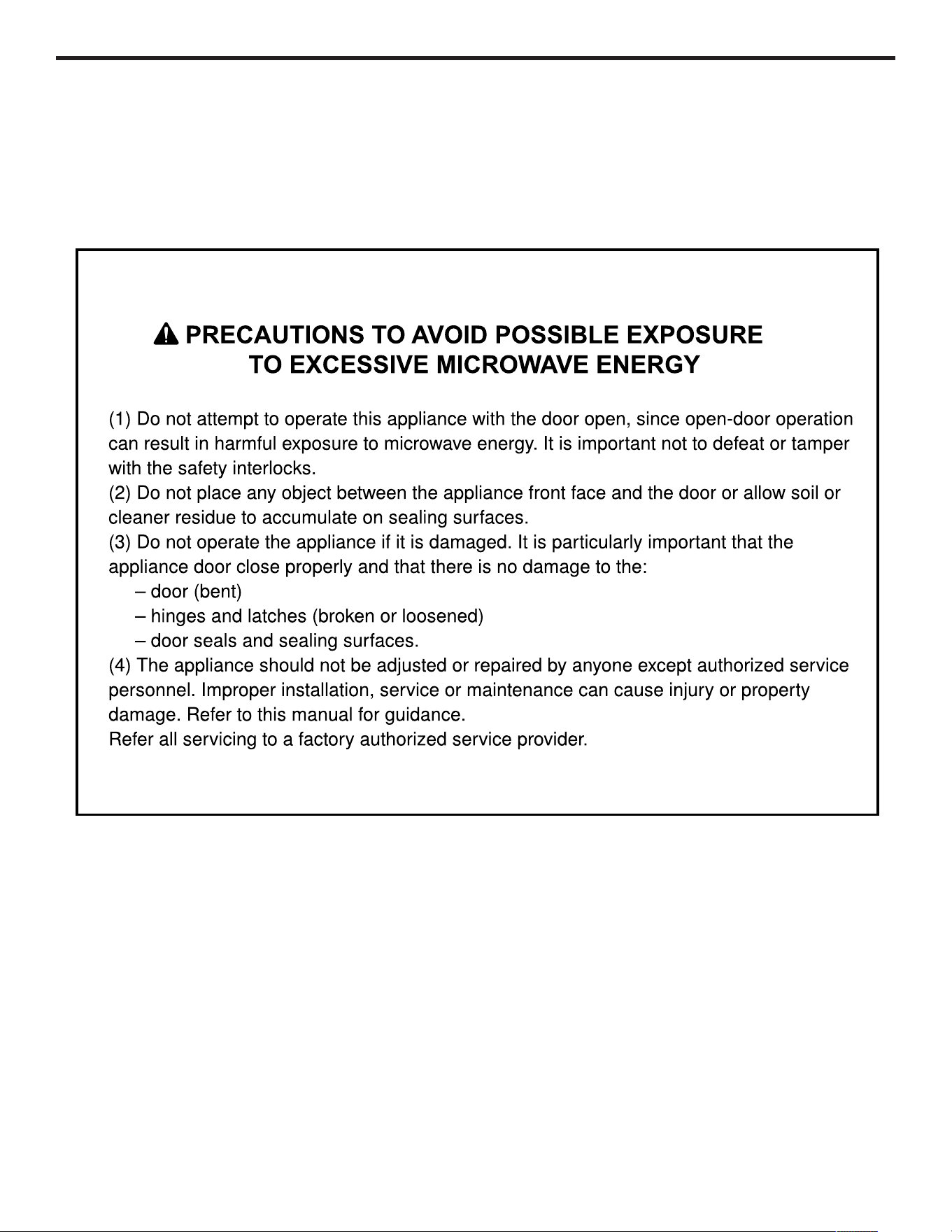
Read and follow the specific PRECAUTIONS TO
AVOID POSSIBLE EXPOSURE TO EXCESSIVE
MICROWAVE ENERGY found on →
Page4
▶
This appliance must be grounded. Connect only to
properly grounded outlet. See
→
"GROUNDING INSTRUCTIONS", Page6
.
▶
Install or locate this appliance only in accordance with
the provided installation instructions.
▶
Some products such as whole eggs and sealed
containers – for example, closed glass jars – are able
to explode and should not be heated in this appliance.
▶
Use this appliance only for its intended use as
described in the manual. Do not use corrosive
chemicals or vapors in this appliance. This type of
appliance is specifically designed to heat, cook, or dry
food. It is not designed for industrial or laboratory use.
▶
HOT CONTENTS CAN CAUSE SEVERE BURNS. DO
NOT ALLOW CHILDREN TO USE THE MICROWAVE.
Use caution when removing hot items.
▶
Do not operate this appliance if it has a damaged cord
or plug, if it is not working properly, or if it has been
damaged or dropped.
▶
This appliance should be serviced only by an
authorized service provider. Contact nearest authorized
service provider for examination, repair, or adjustment.
▶
Do not cover or block any vents or openings on the
appliance.
▶
Do not store this appliance outdoors. Do not use this
product near water – for example, near a kitchen sink,
in a wet basement, near a swimming pool, or similar
locations.
▶
Do not immerse cord or plug in water.
▶
Keep cord away from heated surface.
▶
Do not let cord hang over edge of table or counter.
▶
When cleaning surfaces of door and appliance that
come together on closing the door, use only mild, non-
abrasive soaps, or detergents applied with a sponge or
soft cloth. See door surface cleaning instructions.
→
"Cleaning and maintenance", Page46
2.3 Safe use
WARNING
If the information in this manual is not followed exactly, fire
or shock may result causing property damage or personal
injury.
This appliance is intended for normal family household
use only. It is not approved for outdoor use. See the
Statement of Limited Product Warranty. If you have any
questions, contact the manufacturer.
This appliance is intended to be used in household and
similar applications such as:
▶
staff kitchen areas in shops, offices and other working
environments;
▶
farm houses;
▶
by clients in hotels, motels and other residential type
environments;
▶
bed and breakfast type environments.
The microwave is intended for heating food and
beverages. Drying of food or clothing and heating of
warming pads, slippers, sponges, damp cloth and similar
may lead to risk of injury, ignition or fire.
IMPORTANT SAFETY INSTRUCTIONS
READ ALL INSTRUCTIONS BEFORE USING THE APPLIANCE

en-us
6 SAVE THESE INSTRUCTIONS.
WARNING
Do not operate the appliance when room humidity is
excessive.
WARNING
To reduce the risk of fire in the appliance cavity
▶
Do not overcook food. Carefully attend appliance when
paper, plastic, or other combustible materials are
placed inside the appliance to facilitate cooking.
▶
Remove wire twist-ties from paper or plastic bags
before placing the bag in the appliance.
▶
If material inside of the appliance should ignite, the
appliance door should be kept closed, the appliance
turned off, the power cord disconnected, or the power
shut off at the fuse or circuit breaker panel.
▶
Do not use the appliance cavity for storage purposes.
Do not leave paper products, cooking utensils, or food
in the appliance cavity when not in use.
WARNING
The light emitted by LED lights is very dazzling, and can
damage the eyes.
▶
Do not look directly into the switched-on LED lights for
longer than 100seconds.
▶
Do not look directly into the switched-on LED lights
using optical aids such as binoculars or a magnifying
glass.
WARNING
While cooking food items, small amounts of certain by-
products, such as particulate matter / soot, can be
released. To minimize exposure to these substances:
▶
Always ensure proper ventilation by using an
appropriate ventilation fan or hood vented to the
outside and/or an open window.
▶
Always operate the unit according to the instructions in
this manual.
WARNING
Overheated materials can cause fire or burns and may
produce potentially harmful smoke or fumes.
▶
To prevent overheating, turn ventilation hood ON when
heating grease, fats or frying using medium to high heat
settings.
▶
Avoid heating empty pots and pans.
▶
Do not allow pans to boil dry.
▶
Do not allow aluminum foil, plastic, paper, or cloth to
come in contact with a hot surface element, burner, or
grate.
2.4 GROUNDING INSTRUCTIONS
WARNING
This appliance must be grounded. Grounding reduces the
risk of electric shock by providing a safe pathway for
electric current in the event of a short circuit.
Improper grounding can result in a risk of electric shock.
▶
Consult a qualified electrician if grounding instructions
are not completely understood, or if doubt exists as to
whether the appliance is properly grounded.
▶
Do not use an extension cord. If the power supply cord
is too short, have a qualified electrician install an outlet
near the appliance.
This appliance must be connected to a grounded, metallic,
permanent wiring system, or an equipment grounding
conductor should be run with the circuit conductors and
connected to the equipment grounding terminal or lead on
the appliance.
▶
The models stated on the front cover are dual-rated,
designed to be connected to either 208 or 240VAC,
60Hz, four-wire or three-wire electrical system.
2.5 TV / Radio interference
Avoid TV and radio interference by following these
instructions.
This appliance generates and uses ISM frequency energy.
If not installed and used properly, in strict accordance with
the manufacturer’s instructions, it may cause interference
to radio and television reception. It has been type tested
and found to comply with limits for ISM equipment
pursuant to part 18 of FCC rules, which are designed to
provide reasonable protection against such interference in
a residential installation. However, there is no guarantee
that interference will not occur in a particular installation.
Turn the appliance on and off to determine if it causes
interference.
Try the following to correct the interference:
¡ Clean door and sealing surface of the appliance.
¡ Reorient the receiving antenna of the radio or
television.
¡ Relocate the appliance with respect to the receiver.
¡ Move the appliance away from the receiver.
¡ Plug the appliance into a different outlet so that the
appliance and the receiver are on different branch
circuits.
IMPORTANT SAFETY INSTRUCTIONS
READ ALL INSTRUCTIONS BEFORE USING THE APPLIANCE

en-us
SAVE THESE INSTRUCTIONS. 7
¡ The manufacturer is not responsible for any radio or TV
interference caused by unauthorized modification to
this appliance. It is the responsibility of the user to
correct such interference.
2.6 Child safety
WARNING
Children should be supervised to ensure that they do not
play with the appliance.
This appliance is not intended for use by persons
(including children) with reduced physical, sensory or
mental capabilities, or lack of experience and knowledge,
unless they have been given supervision or instruction
concerning use of the appliance by a person responsible
for their safety.
Do not allow children to use this appliance. Failure to do
so can result in burns or serious injury to children.
Children and pets should not be left alone or unattended
in the area where the appliance is in use. They should
never be allowed to play in its vicinity, whether or not the
appliance is in use.
WARNING
Do not allow anyone to climb, stand, lean, sit, or hang on
any part of an appliance, especially a door, warming
drawer, or storage drawer.
▶
This can damage the appliance, and the unit may tip
over, potentially causing severe injury.
2.7 Cleaning safety
Follow these safety instructions when cleaning your
appliance.
WARNING
Be sure the entire appliance has cooled and grease has
solidified before attempting to clean any part of the
appliance.
¡ When cleaning surfaces of door and appliance cavity
that come together on closing the door, use only mild,
non-abrasive soaps, or detergents applied with a
sponge or soft cloth. See door surface cleaning
instructions.
→
"Cleaning and maintenance", Page46
2.8 Cooking safety
CAUTION
To avoid personal injury or property damage, observe
the following:
▶
Do not leave the appliance unattended while in use.
▶
Do not store flammable material next to or in the
appliance.
▶
Do not operate the appliance while empty. This could
damage the appliance and result in a risk of fire.
▶
Do not store or use corrosive chemicals, vapors,
flammables or nonfood products in or near this
appliance. It is specifically designed for use when
heating or cooking food. The use of corrosive
chemicals in heating or cleaning will damage the
appliance and could result in injury.
▶
Do not dry clothes, newspapers or other materials in
the appliance. Do not use newspapers or paper bags
for cooking. Fire could result.
▶
Do not use recycled paper products unless labeled safe
for microwave use. They may contain impurities which
may cause sparks and result in fires when used.
▶
Always use potholders when removing items from the
appliance. The cooking container and the glass tray
can be hot even if the appliance is cool.
▶
Whenever possible, do not operate the ventilation
system during a cooktop fire. However, do not reach
through fire to turn it off.
▶
Do not mount over a sink.
▶
Do not store anything directly on top of the appliance
surface when the appliance is in operation.
▶
Oversized food or oversized metal utensils should not
be inserted in a microwave as they may create a fire or
risk of electric shock.
▶
Do not clean with metal scouring pads. Pieces can
break off the pad and touch electrical parts involving a
risk of electric shock.
▶
Do not use paper products when appliance is operated
in the toaster mode.
▶
Do not store any materials, other than manufacturer’s
recommended accessories, in this appliance when not
in use.
▶
Do not cover racks or any other part of the appliance
with metal foil. This will cause overheating of the
appliance.
IMPORTANT SAFETY INSTRUCTIONS
READ ALL INSTRUCTIONS BEFORE USING THE APPLIANCE
en-us
8 SAVE THESE INSTRUCTIONS.
2.9 In case of fire
WARNING
If smoke is observed, switch off or unplug the appliance
and keep the door closed in order to stifle any flames.
If materials inside an appliance should ignite:
¡ Keep the appliance door closed.
¡ Turn the appliance off.
¡ Unplug the appliance or shut off at fuse or circuit
breaker.
2.10 Liquids
WARNING
Liquids such as water, coffee, or tea are able to be
overheated beyond the boiling point without appearing to
be boiling. Visible bubbling or boiling when the container
is removed from the microwave is not always present.
THIS COULD RESULT IN VERY HOT LIQUID
SUDDENLY BOILING OVER WHEN THE CONTAINER
IS DISTURBED OR A SPOON OR OTHER UTENSIL IS
INSERTED INTO THE LIQUID.
▶
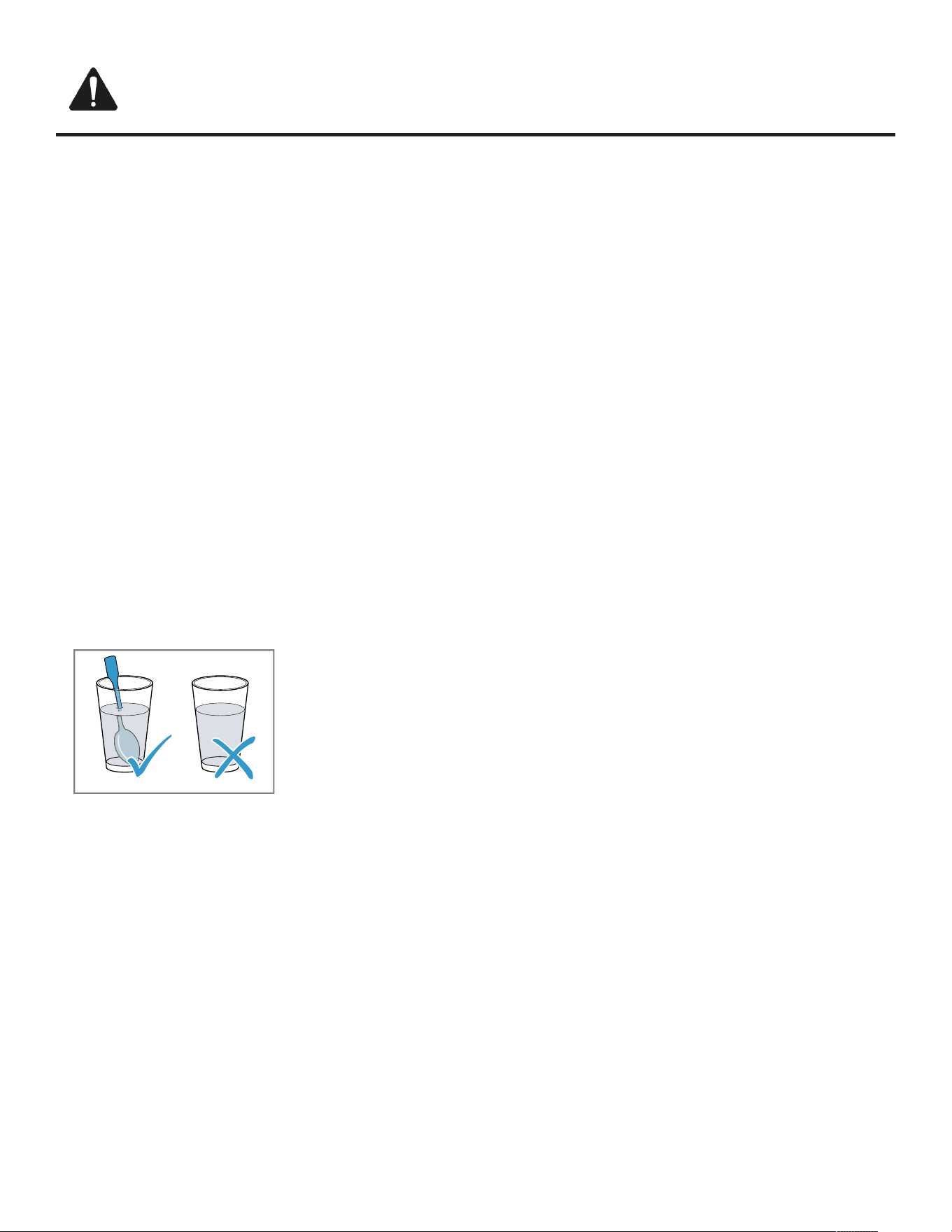
When heating liquids, always place a glass rod/spoon
in the container. This will prevent delayed boiling.
Microwave heating of beverages can result in delayed
eruptive boiling, therefore care must be taken when
handling the container.
CAUTION
Metal e.g. a spoon in a glass must be kept at least 1"
(25mm) from the appliance walls and the inside of the
door. Sparks could irreparably damage the glass on the
inside of the door.
Follow these recommendations when cooking with your
microwave:
¡ Take ready meals out of the packaging. They will heat
up more quickly and evenly in microwaveable
ovenware. The different components of the meal may
not require the same amount of time to heat up.
¡ Always cover the food. If you do not have a suitable
cover for your container, use a plate or special
microwave foil.
¡ Stir or turn the food several times during cooking.
Check the temperature.
¡ After heating, allow the food to stand for a further 2 to
5minutes so that it can achieve an even temperature.
¡ Always use an oven cloth or oven gloves when
removing plates from the appliance.
2.11 Cooking items
Follow these safety instructions when cooking food in your
microwave to avoid injury.
¡ Eggs:
– Eggs in their shell and whole hard-boiled eggs
should not be heated in the microwave since they
may explode, even after microwave heating has
ended.
– Reheating sliced hard-boiled eggs and cooking
scrambled eggs is safe.
¡ Popcorn:
– Use only popcorn in packages designed and labeled
for microwave use, or pop it in a microwave corn
popper.
– Follow popcorn manufacturers’ directions and use a
brand suitable for the wattage of your appliance.
– Do not continue to heat after popping has stopped.
Popcorn will scorch or burn.
– Do not leave the appliance unattended.
CAUTION
When using pre-packaged microwave popcorn, check
package weight before using the popcorn function.
▶
Set the appliance for the weight of the popcorn
package. If these instructions are not followed, popcorn
may not pop adequately or may ignite and cause fire.
¡ Foods with non-porous skins:
Potatoes, tomatoes, sweet potatoes, apples, whole
squash and sausages are examples of foods with
nonporous skins. These types of foods must be pierced
before cooking to prevent them from exploding.
¡ Baby food / Baby formula:
Do not heat baby bottles or food in a microwave. The
glass jar or the surface of food may appear warm while
the interior can burn the infant’s mouth and esophagus.
¡ Deep fat frying:
– Do not deep fat fry in the appliance. Oil can be
heated beyond ideal temperatures very quickly in a
microwave. Temperatures can climb high enough for
IMPORTANT SAFETY INSTRUCTIONS
READ ALL INSTRUCTIONS BEFORE USING THE APPLIANCE

en-us
SAVE THESE INSTRUCTIONS. 9
the cooking oils to reach their respective flash points
and burst into flames. The heated oil may bubble and
spatter causing possible damage to the appliance
and perhaps result in burns.
– Additionally, microwave–safe utensils may not be
able to withstand the temperature of the hot oil, and
could result in the utensil shattering, if it contains a
slight imperfection, scratch or chip.
¡ Home Canning / Drying foods / Small quantities of
foods:
– Do not use the microwave for home canning or
heating of any closed jar. Pressure will build up and
the jar may explode. In addition, the appliance
cannot maintain the food at the proper canning
temperature. Improperly canned food may spoil and
be dangerous to consume. Small quantities of food
or foods with low moisture content can dry out, burn
or catch on fire. Do not dry meats, herbs, fruits or
vegetables in your appliance.
– Proper cooking depends on time set and weight of
food. If you use a smaller portion than recommended
and cook at the time for the recommended portion,
fire could result.
¡ Browning dishes:
– Microwave browning dishes or grills are designed for
microwave cooking only. Preheating times vary
depending on the size of the browning dish and food
being cooked.
– Always follow instructions provided by the browning
dish or grill manufacturer.
– Do not preheat browning dishes more than
6minutes.
¡ Oven roasting bags:
– If an oven bag is used for microwave cooking,
prepare according to package directions.
– Do not use wire twist–ties to close bags, instead use
nylon ties, cotton string or a strip cut from the open
end of the bag. Make six ½" (12.7 mm) slits by
closure.
– Place the oven cooking bag in a dish slightly larger
than the food being cooked.
2.12 Cooking utensils
Only use utensils that are suitable for use in microwave
ovens.
CAUTION
Incorrect use of cooking utensils can result in injuries or
property damage.
▶
Only use utensils that are suitable for use in microwave
appliances. See also Microwave Utensil Guide
→
Page22
.
▶
Cooking utensils, the glass tray and racks get hot
during microwaving. Always use potholders when
removing items from the appliance. Allow the glass tray
and the metal racks (if used) to cool before handling.
▶
Metallic containers for food and beverages are not
allowed during microwave cooking.
▶
Do not use metal utensils, or dishes with metallic trim in
the appliance.
▶
When using aluminum foil in the appliance, allow at
least 1" (25mm) of space between foil and interior
appliance walls or door.
▶
The glass tray and the metal racks (if used) will get hot
during cooking. The cooking container and the glass
tray can be hot even if the appliance is cool.
▶
Never use paper, plastic, or other combustible
materials that are not intended for cooking.
▶
When cooking with paper, plastic, or other combustible
materials, follow manufacturer’s recommendations on
product use.
▶
When heating food in plastic or paper containers, keep
an eye on the appliance due to the possibility of
ignition.
▶
Do not use paper towels which contain nylon or
synthetic fibers. Heated synthetics could melt and
cause paper to ignite.
▶
Do not heat sealed containers or plastic bags in the
appliance. Food or liquid could expand quickly and
cause container or bag to break. Pierce or open
container or bag before cooking.
▶
Do not use regular cooking thermometers in the
appliance. Most cooking thermometers contain mercury
and may cause electrical arc, malfunction, or damage
to the appliance.
IMPORTANT SAFETY INSTRUCTIONS
READ ALL INSTRUCTIONS BEFORE USING THE APPLIANCE
en-us
10 SAVE THESE INSTRUCTIONS.
2.13 Pacemakers
CAUTION
To avoid pacemaker malfunction, consult physician or
pacemaker manufacturer about effects of microwave
energy on pacemaker.
2.14 Proper installation and maintenance
WARNING
This appliance must be mounted at a minimum height of
36" (914mm).
If the door or door seals are damaged, the oven must not
be operated until it has been repaired by a competent
person.
It is hazardous for anyone other than a competent person
to carry out any service or repair operation that involves
the removal of a cover which gives protection against
exposure to microwave energy.
The appliance should be cleaned regularly and any food
deposits removed. Failure to maintain the oven in a clean
condition could lead to deterioration of the surface that
could adversely affect the life of the appliance and
possibly result in a hazardous situation.
2.15 State of California Proposition 65
Warnings
This product may contain a chemical known to the State
of California, which can cause cancer or reproductive
harm. Therefore, the packaging of your product may bear
the following label as required by California:
IMPORTANT SAFETY INSTRUCTIONS
READ ALL INSTRUCTIONS BEFORE USING THE APPLIANCE
Preventing material damage en-us
11
Preventing material damage
3 Preventing material damage
Preventing material damage
3.1 General information
NOTICE:
Alcoholic vapors may catch fire in the hot cooking
compartment and cause permanent damage to the
appliance. The appliance door may spring open due to an
explosion and it may fall off. The door panels may shatter
and fragment. Due to the resulting negative pressure, the
cooking compartment may become considerably deformed
inwards.
▶
Do not heat spirits (≥ 15% vol.) when undiluted (e.g. for
marinating or pouring over food).
When the oven cavity is hot, any water inside it will create
steam. The change in temperature that occurs as a result
may cause damage.
▶
Never pour water into the oven cavity when it is still hot.
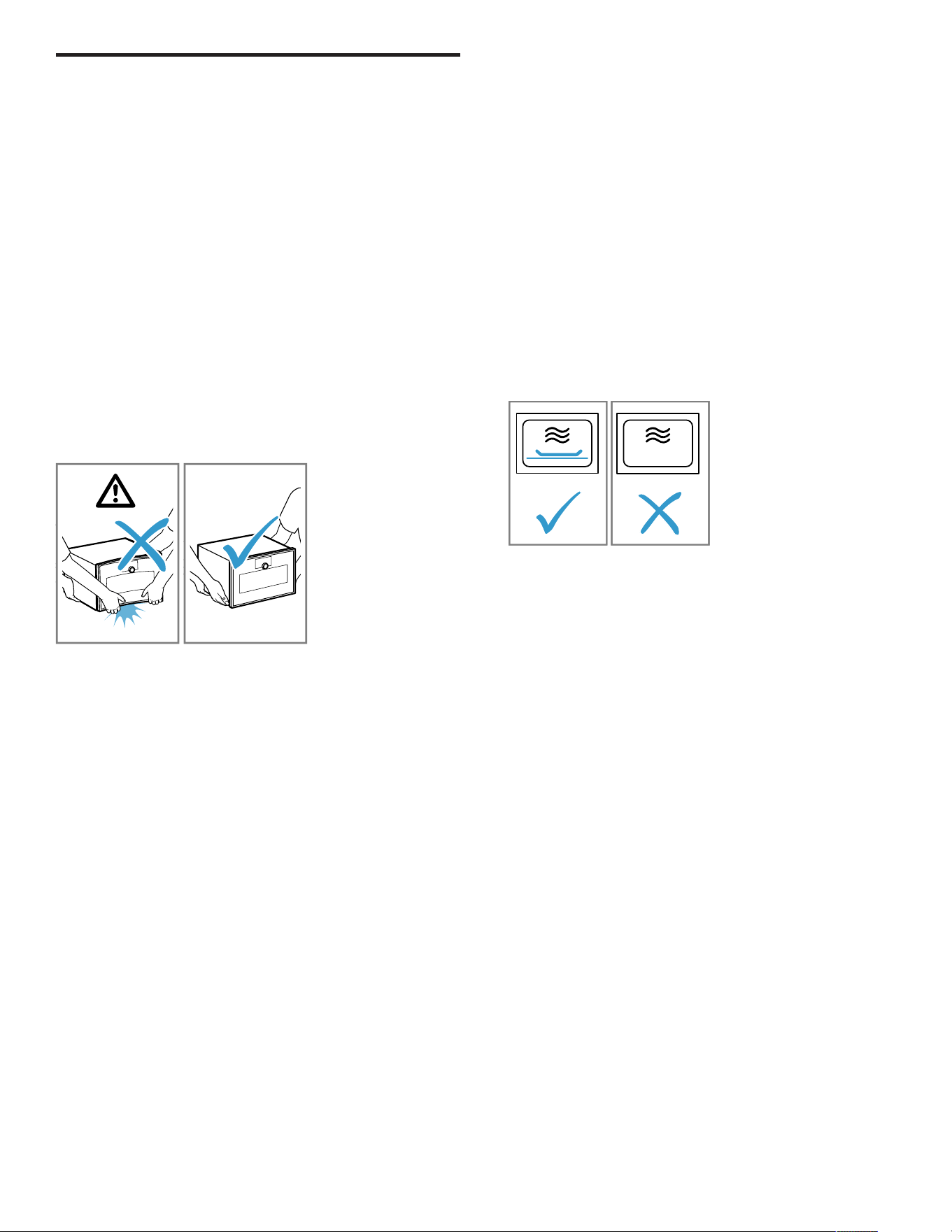
Carrying the appliance by the appliance frame may cause
it to bend. The appliance frame cannot support the weight
of the appliance.
▶
Do not lift the appliance using the appliance frame.
▶
Always lift the appliance at the casing.
The prolonged presence of moisture in the oven cavity
leads to corrosion.
▶
Always wipe away the condensation after cooking.
Always allow the oven cavity to cool down with the door
closed after cooking at high temperatures.
▶
Do not keep moist food in the closed oven cavity for
extended periods of time.
▶
Do not store food in the oven cavity.
▶
Do not trap anything in the appliance door.
If the seal is very dirty, the appliance door will no longer
close properly during operation. The fronts of adjacent
units could be damaged.
▶
Always keep the seal clean.
▶
Never operate the appliance if the seal is damaged or
missing.
Sitting or placing objects on the appliance door may
damage it.
▶
Do not place, hang or support objects on the appliance
door.
▶
Do not place any cookware or accessories on the
appliance door.
3.2 Microwave
Follow these instructions when using the microwave.
NOTICE:
Metal touching the wall of the cooking compartment will
cause sparks, which may damage the appliance or the
inner door pane.
▶
Metal (e.g. a spoon in a glass) must be kept at least
2cm from the cooking compartment walls and the
inside of the door.
Placing aluminum containers in the appliance may cause
sparks. They damage the appliance by producing sparks.
▶
Do not use aluminum containers in the appliance.
Operating the appliance without food in the cooking
compartment may lead to overloading.
▶
Do not switch on the microwave unless there is food
inside. The only exception to this rule is when
performing a short cookware test.
If you prepare several bags of microwave popcorn in
immediate succession at a microwave output level that is
too high, the cooking compartment may be damaged.
▶
Leave the appliance to cool down for several minutes
between each use.
▶
Never set a microwave output level that is too high.
▶
Use a maximum microwave output of 600 watts.
▶
Always place the popcorn bag on a glass plate or on the
cooking compartment floor.
Using unsuitable cookware may result in damage.
▶
When using the grill, the microwave combi-operation
mode or the hot air mode, only use cookware that can
withstand the high temperatures.
Loose knurled screws may cause sparks to form during
microwave operation. They damage the appliance by
producing sparks.
▶
Ensure that the knurled screws for installing the shelf
supports are screwed in tightly.
3.3 Core temperature probe
WARNING
An incorrect core temperature probe may damage the
insulation.
▶
Only use the core temperature probe that is suitable for
this appliance.
NOTICE:
You may damage the cable of the core temperature probe
with the appliance door.
▶
Do not trap the cable of the core temperature probe in
the appliance door.
en-us Environmental protection and energy-saving
12
The heat of the grill heating element may damage the core
temperature probe.
▶
Ensure that the distance between the grill heating
element and the core temperature probe and the cable
of the core temperature probe is a few centimeters. In
doing so, ensure that the meat can expand during the
cooking process.
Aggressive cleaning agents may damage the core
temperature probe.
▶
Do not clean the core temperature probe in the
dishwasher.
Environmental protection and energy-saving
4 Environmental protection and
energy-saving
Environmental protection and energy-saving
4.1 Disposal of packaging
The packaging materials are environmentally compatible
and can be recycled.
▶
Sort the individual components by type and dispose of
them separately.
4.2 Saving energy
If you follow these instructions, your appliance will use
less power.
Use dark-colored, black-coated or enameled baking tins.
a
These types of baking tin absorb the heat particularly
well.
Only preheat the appliance if the recipe or the
recommended settings tell you to do so.
a
Not preheating the appliance can reduce the energy
used.
When cooking multiple dishes, do so in succession or in
parallel.
a
The oven cavity is heated after cooking the first dish.
This reduces the cooking time for the following dishes.
Open the appliance door as little as possible during
operation.
a
This maintains the temperature in the oven cavity and
eliminates the need for the appliance to reheat.
If the cooking time is relatively long, you can switch the
appliance off 10minutes before the cooking time ends.
a
There will be enough residual heat to finish cooking the
dish.
Familiarizing yourself with your appliance
5 Familiarizing yourself with your
appliance
Familiarizing yourself with your appliance
This Use and Care Manual covers several models. Your
model may have some but not all of the features listed.
5.1 Appliance
Here you can find an overview of the parts of your
appliance.
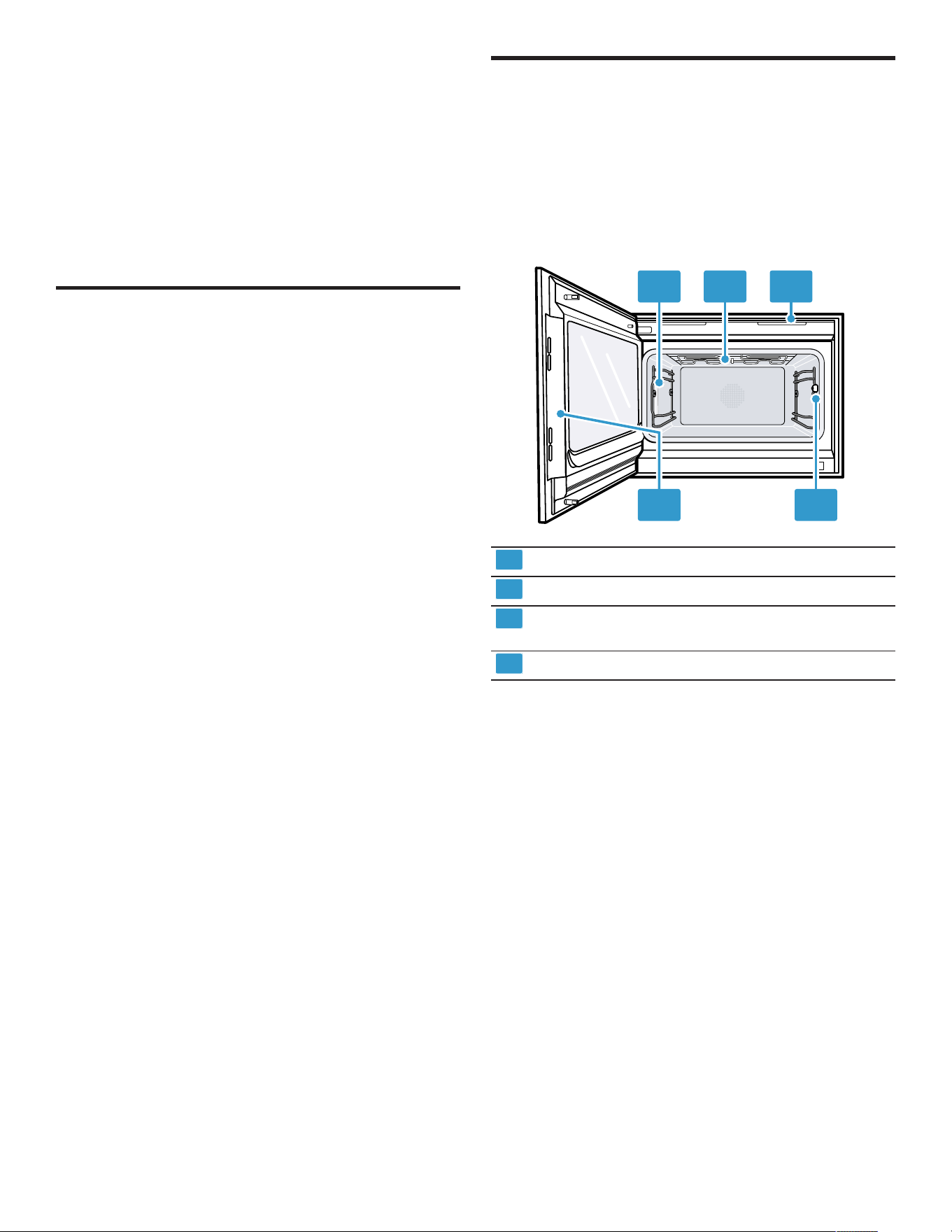
1 2 3
45
1
Interior lighting
2
Grill element
4
Connection socket for core temperature probe
→
Page35
5
Intended area for opening the door
5.2 Oven cavity
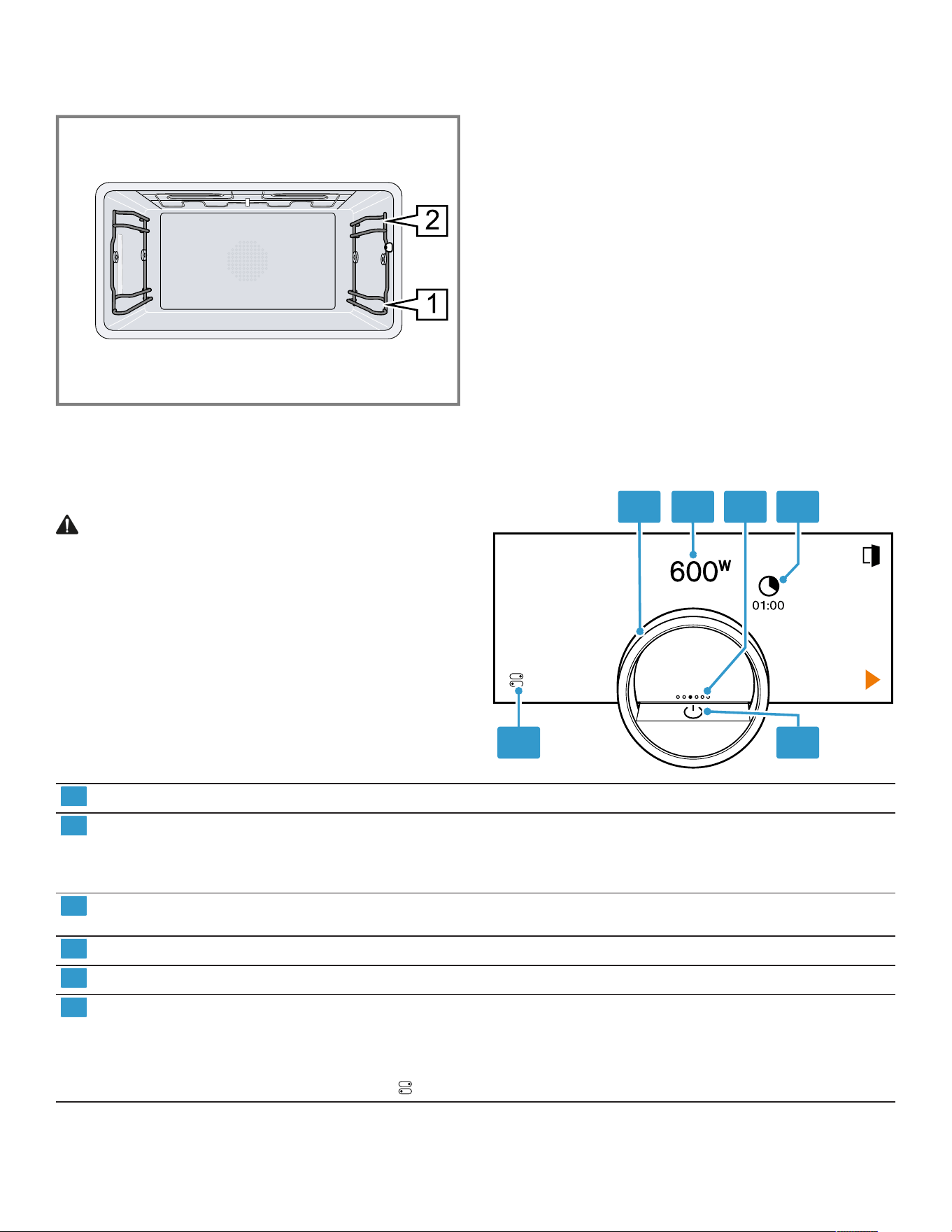
The oven cavity has two shelf levels. Count the shelf
levels from the bottom up.
NOTICE:
The accessories may tip.
▶
Do not push the accessories between the shelf
positions.
Use shelf level 1 for deeper baking tins.
You can also remove the shelf supports →
Page48
and
cook on the oven cavity floor.
Familiarizing yourself with your appliance en-us
13
The oven cavity floor is particularly suitable for microwave
operation. The microwave output is best on the oven
cavity floor. Only use microwave-safe cookware.
Interior lighting
When you open the appliance door, the interior lighting
switches on. If the appliance door remains open for longer
than around 3minutes, the interior lighting switches off.
WARNING
The light emitted by LED lights is very dazzling, and can
damage the eyes (risk group 1).
▶
Do not look directly into the switched on LED lights for
longer than 100seconds.
You can also switch on the interior lighting when the
appliance is in low power mode.
After approximately 20minutes, the appliance switches
the interior lighting off.
When you switch on the appliance, the appliance switches
the interior lighting on.
→
"Switching the interior lighting on or off", Page25
In most operating modes, the appliance keeps the interior
lighting switched on.
You can specify whether the appliance will switch the
interior lighting on during operation in the basic settings
→
Page41
. If you select the "Manual" setting in the basic
settings, the appliance does not switch on the interior
lighting automatically but you can switch on the interior
lighting when required. After approximately 20seconds,
the appliance switches the interior lighting off.
Condensation
Condensation can occur in the cooking compartment and
on the appliance door when cooking. Condensation is
normal and does not adversely affect appliance operation.
Wipe away the condensation after cooking.
5.3 Control elements
You can use the control panel to configure all functions of
your appliance and to obtain information about the
operating status.
On certain models, specific details may differ from those
pictured.
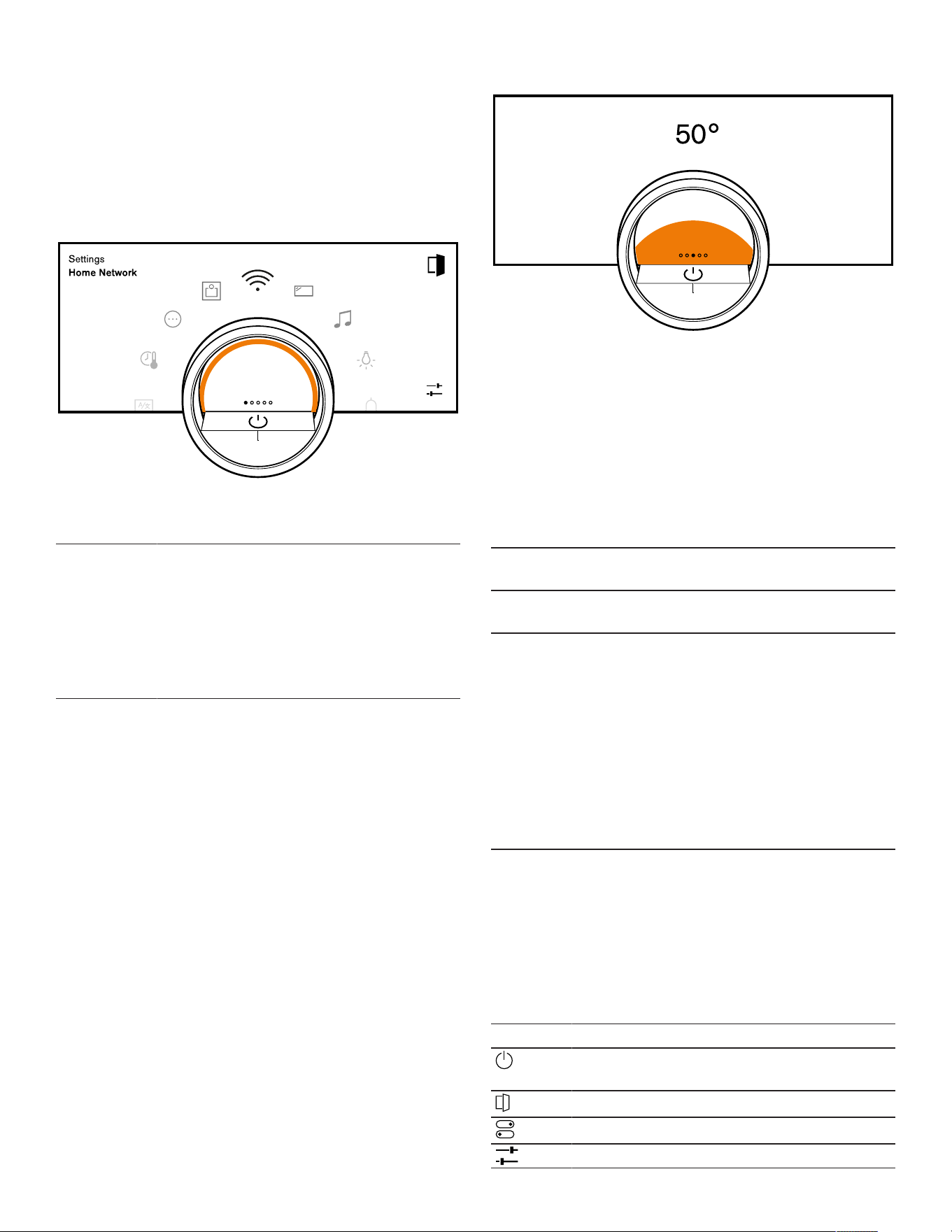
1 2 3 4
56
1
Control ring Use the control ring to change the selection.
2
12 o'clock position The 12 o'clock position shows the value that is currently selected for a
function, which you can change using the control ring. If required, press on
another function, e.g. on the temperature or cooking time, to position this at
the 12 o'clock position.
3
Position indicator The filled point on the display in the middle of the control ring shows the
current horizontal navigation position between the appliance displays.
4
Symbols Show settings, and start or end functions.
5
On/off button Switch the appliance on and off.
6
Status line The status line shows the current status of functions or appliance
components, e.g.:
¡ HomeConnect® connection status
¡ Child lock
Press to open the control center →
Page16
.
en-us Familiarizing yourself with your appliance
14
Control ring
Operation using the control ring is only possible when the
appliance is switched on. You can use the control ring to
navigate through the ring menus or the list menus and
select settings.
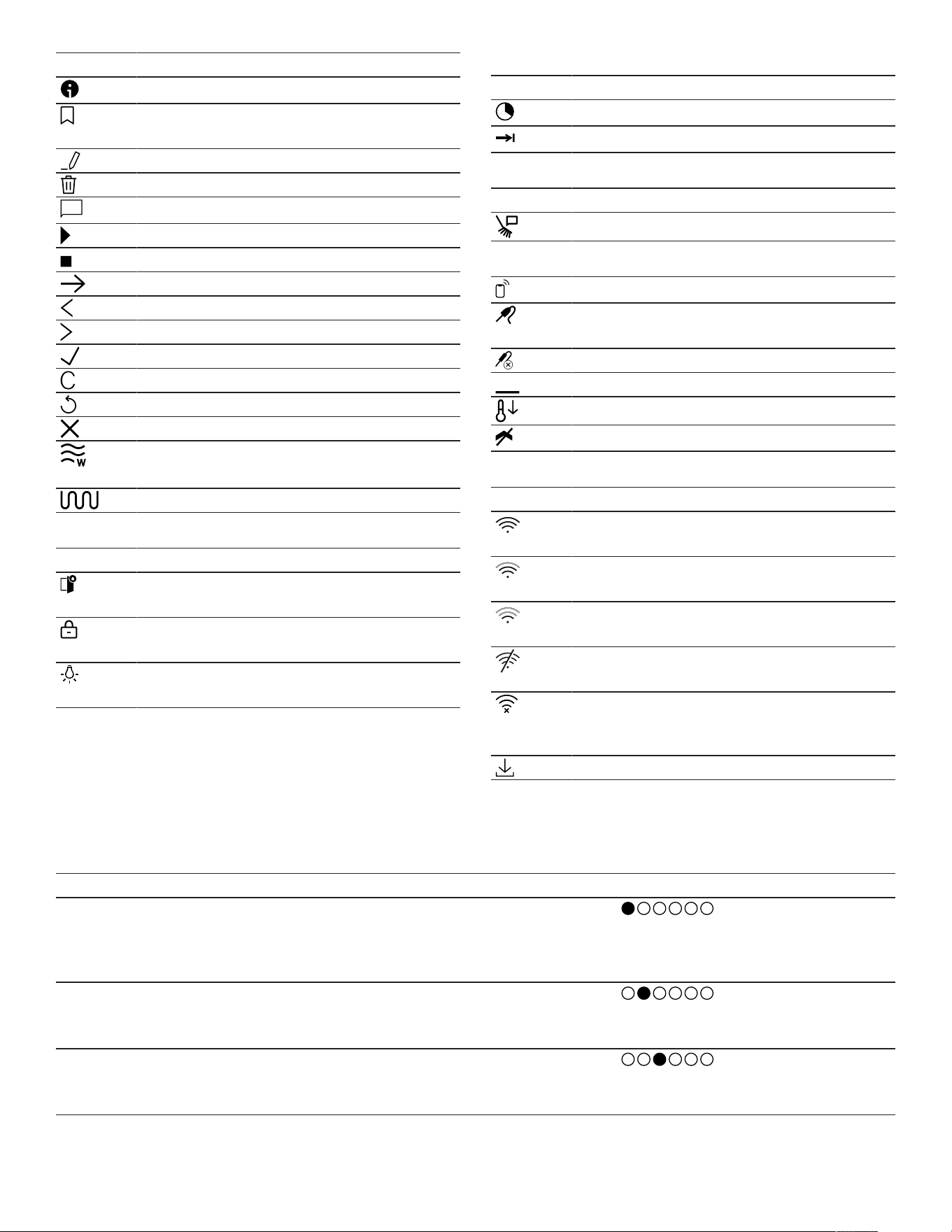
When you touch the control ring, the display shows a ring
in orange behind the control ring.
While operating the appliance, you can only use the
control ring if you first select a function on the display.
Turn Navigate in ring menus and list menus:
¡ Turn the control ring to the right to
increase the values.
¡ Turn the control ring to the left to
decrease the values.
¡ Turn the control ring to the right or left
quickly to change the values in larger
increments.
You can set how the control ring behaves in the basic
settings →
Page41
. In the "Standard" setting, press on
the required function on the display and use the control
ring to change the value of the function.
In the "Quick selection" setting, use the control ring, which
is at the 12 o'clock position, to directly change the values
for the function.
Process visualization
For process visualization, the appliance shows a section
of a circle in orange behind the control ring.
The appliance shows the section of a circle in orange
behind the control ring under the following conditions:
¡ A cooking time is set.
¡ A core temperature is set for the core temperature
probe.
The section of the circle in orange becomes larger the
longer the timer runs or the closer the core temperature of
the food approaches the set core temperature.
If no cooking time and no core temperature are set, the
section of the circle pulsates in orange.
Display
The display shows the selected settings and setting
options, as well as messages about the appliance's
operating status.
Press Selects or confirms the
procedure or function
Press and hold Displays additional
information
Swipe horizontally Navigates between
appliance displays
For example, in the
"Microwave" appliance
display, swipe to the left or
right
Note:You can only use the
function if you are in an
appliance display
→
Page15
and no
program is running.
Note:If no display language is available in your national
language, select a display language that is available, e.g.
English.
Symbols
Use the symbols to start or stop functions, or to navigate
in the appliance menu.
Operation
Symbol Function
Switch the appliance on or off at the control
ring
Opening the appliance door →
Page23
Open the control center →
Page25
Edit settings
Familiarizing yourself with your appliance en-us
15
Symbol Function
Call up additional information →
Page25
Save a favorite
→
"Favorites", Page34
Edit a favorite
Deleting a favorite
Tip for calling up programs →
Page32
Start
Pause or stop
Switch to the next step
Back or accept settings
Next
Confirm
Delete
Reset
Cancel
Adding →
Page29
or deleting microwave
operation →
Page30
Turning on the broiler
Symbols in the control center
Symbol Function
Opening the appliance door automatically
after the cooking process →
Page24
Activate or deactivate the child lock
→
Page32
Switch the interior lighting on or off
→
Page25
Timer functions
Symbol Function
Call up the timer menu →
Page30
Delaying the cooking time end →
Page31
Cleaning and maintenance
Symbol Function
Cleaning aid →
Page48
Status
Remote start →
Page39
Core temperature probe is inserted
→
"Core temperature sensor", Page35
Core temperature probe is missing
Status display for the heating process
Display of a cooling process
Appliance is in demo mode →
Page52
Status in the control center
Symbol Function
Connection to the router:
Strong→
"HomeConnect® ", Page38
Connection to the router:
OK→
"HomeConnect® ", Page38
Connection to the router:
Weak→
"HomeConnect® ", Page38
No connection to the
router.→
"HomeConnect® ", Page38
Appliance connected to the router. No
connection to the Home Connect
server.→
"HomeConnect® ", Page38
Software update status
Appliance displays
You can find an overview of the appliance displays here.
Appliance displays Usage Navigation symbol
Settings ¡ Adjusting the basic settings
→
Page41
¡ Adjusting the HomeConnect®
settings →
Page38
Modes & Service ¡ Starting the cleaning aid
→
Page48
¡ Starting the quick guide →
Page25
Microwave Setting the microwave output
→
Page26
and cooking time
→
Page30
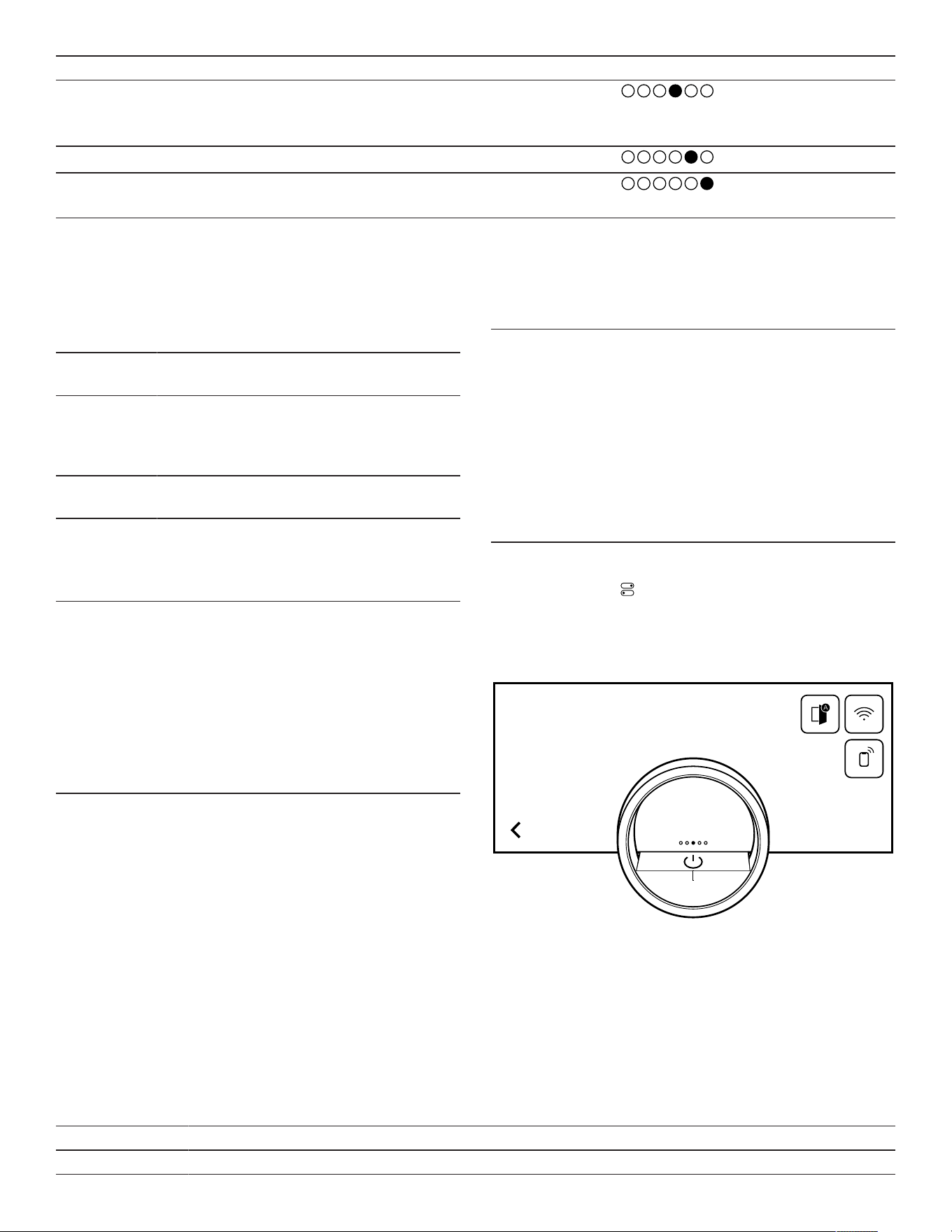
en-us Familiarizing yourself with your appliance
16
Appliance displays Usage Navigation symbol
"Manual" (oven mode, combi-
operation)
Setting the type of heating, microwave
activation →
Page26
and cooking
time →
Page30
Favorites
Calling up favorites →
Page34
Programs Calling up automatic programs and
recommended settings →
Page32
Tip:In the basic settings →
Page41
, you can set which
appliance menu your appliance starts in.
Colors
The different colors are used to guide the user in the
relevant setting situations.
Red ¡ Error messages for which you may
need the help of customer service.
Orange ¡ Information that you must observe so
that you can continue to use your
appliance
¡ Symbols for starting and stopping
White ¡ Information
¡ Additional information
Appearance
Depending on the situation, the appearance of symbols,
values or the entire display changes.
Zooming in ring menus and
list menus
When you use the control
ring to select a list entry in a
list menu, the display
enlarges this list entry and
displays it as underlined.
When you use the control
ring to select a value in a
ring menu, the display
shows this value enlarged
in the 12 o'clock position.
Zoom at end of cooking or
core temperature probe
A few minutes before the
cooking process ends, the
appliance shows the
remaining cooking time
enlarged in the center of
the display.
As soon as the current core
temperature is just a few
degrees below the set
value, the display shows
the current core
temperature enlarged.
All other displays are
hidden.
Pared-down display If the appliance does not
detect a user in the
immediate vicinity, the
appliance reduces the
amount of information
shown on the display and
only the most important
information remains. This
function is preset. You can
change the setting in the
basic settings →
Page41
.
Control center
The control center provides you with access to functions
that are only visible in the status bar via symbols. You can
activate or deactivate functions in the control center.
On the left-hand side, the display shows the symbols and
texts with information on the current status of the
appliance. On the right-hand side, the display shows the
touch fields of the control center.
5.4 Types of heating
Here you can find an overview of the functions. You will find recommendations for using the types of heating.
Microwave function
Symbols Function Performance Use
90 Microwave 90W Defrost delicate foods.
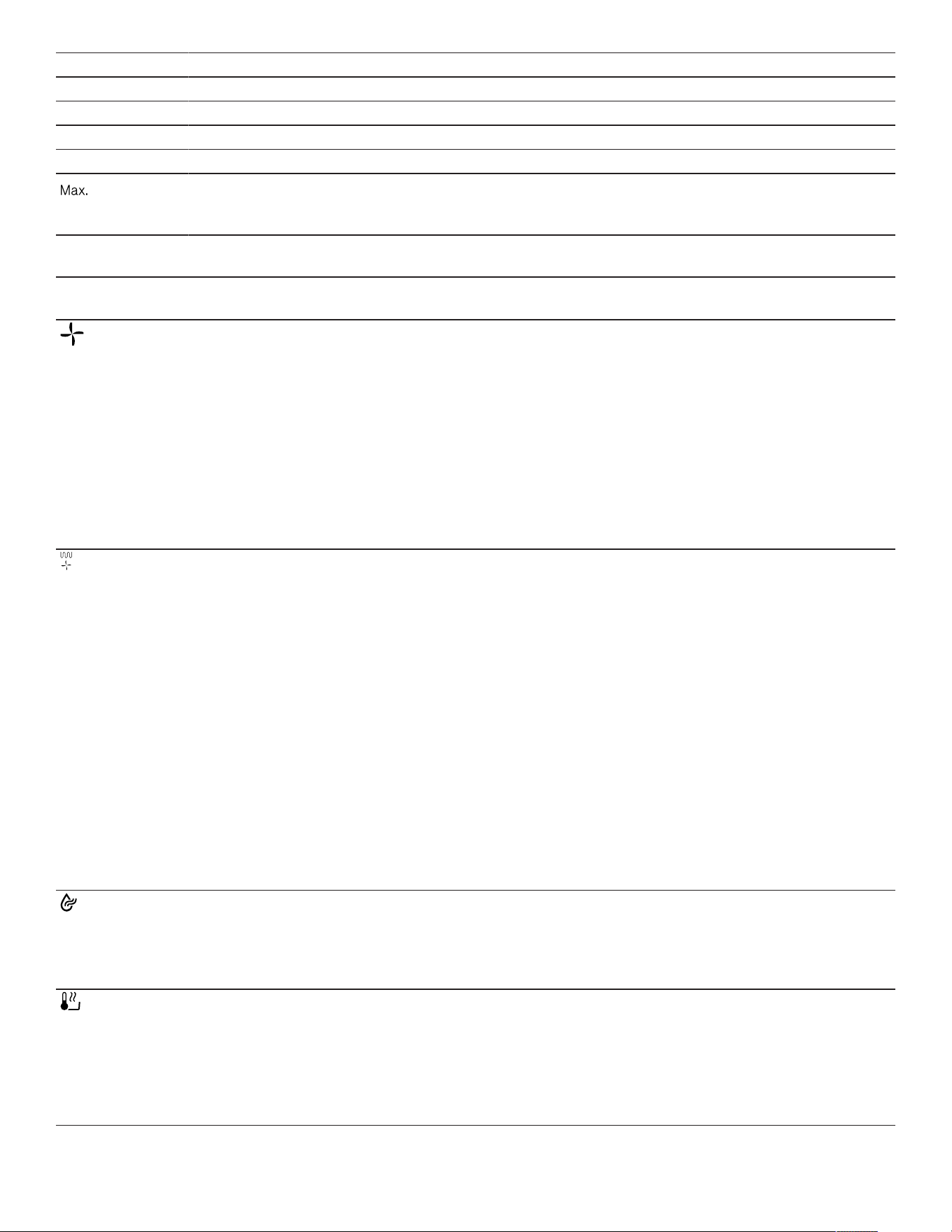
Familiarizing yourself with your appliance en-us
17
Symbols Function Performance Use
180 Microwave 180W Defrost foods.
360 Microwave 360W Defrost foods or cook gently.
450 Microwave 450W Cook foods or warm up gently.
600 Microwave 600W Cook foods or warm up.
Microwave 1000W Quickly heat liquids
When the appliance is cold, full microwave
output of 1000W is available.
Oven functions
Symbols Function/type of
heating
Temperature/setting Performance Use
Convection 86-445°F
(30-230°C)
The heat arises from the
back wall of the cooking
compartment and is
distributed quickly and
evenly by the fan. For
cooking on one or two levels
with an extremely short
preheating time. For moist
cakes, cookies, bakes. To
reduce the cooking time, the
microwave can be switched
on.
Broil + circulated air 86-445°F
(30-230°C)
For au gratin dishes at the
end of the cooking time at
445°F (230°C). For grilling
vegetable skewers and
shrimp skewers at 355°F
(180°C).
Extremely intensive heat
from above, which is
distributed quickly and
evenly by the fan.
Guarantees that a crust is
formed with simultaneous
all-round heating. For meat,
poultry, fish, vegetable
skewers. No preheating is
required. To reduce the
cooking time, the microwave
can be switched on.
Drying 86-176°F
(30-80°C)
For drying thin slices of fruit
or vegetables or herbs.
Moisture is actively extracted
from the cooking
compartment.
Low-temperature
cooking
86-194°F
(30-90°C)
90W Slow and gentle cooking of
meat for a particularly tender
result. Hot air is combined
with a low microwave output
in order to reduce the
cooking time. Briefly sear
meat before cooking.
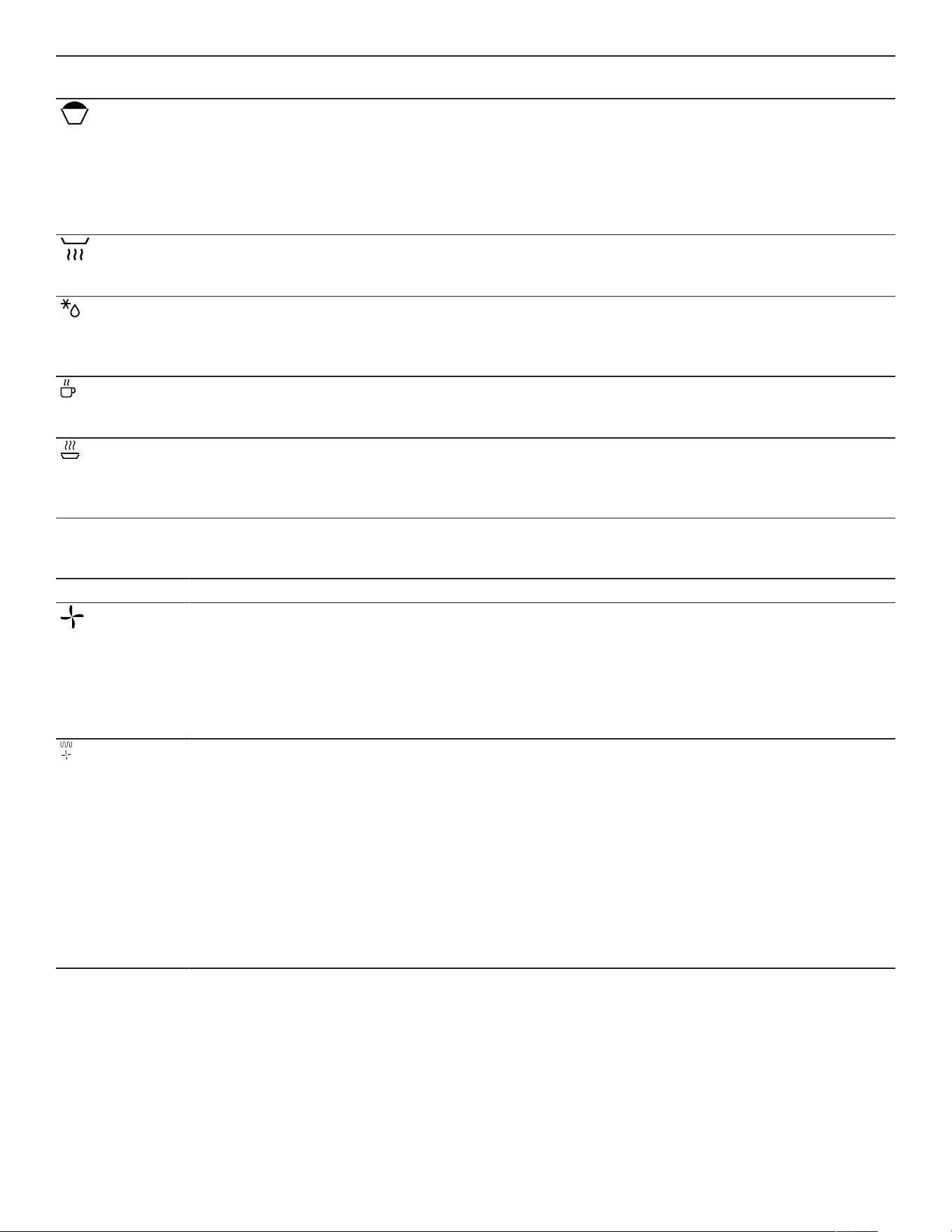
en-us Familiarizing yourself with your appliance
18
Symbols Function/type of
heating
Temperature/setting Performance Use
Dough proofing 86-122°F
(30-120°C)
Optimal temperature range
for proving dough batches
and pieces of dough. For
yeast dough and sourdough.
The optimal temperature
setting for yeast dough is
100°F (38°C).
Keeping warm 50W Optimal microwave output
for keeping food warm
without it drying out.
Defrosting 90-360W Optimal microwave output
range for quickly and gently
defrosting frozen food. Use
90W for delicate foods.
Warming up
beverages
max. Optimal microwave output
for quickly heating liquids
such as water and milk.
Reheat meals 360-600W
Default power 360W
Optimal microwave output
range for heating up cooked
meals, such as plated meals,
bakes and soups.
MicroCombi function
You can add the microwave function for the following types of heating.
Symbols Function Temperature/setting Use
Convection 86-445°F
(30-230°C)
The heat arises from the back wall of the
cooking compartment and is distributed
quickly and evenly by the fan. For cooking
on one or two levels with an extremely
short preheating time. For moist cakes,
cookies, bakes. To reduce the cooking
time, the microwave can be switched on.
Broil + circulated air 86-445°F
(30-230°C)
For au gratin dishes at the end of the
cooking time at 445°F (230°C). For
grilling vegetable skewers and shrimp
skewers at 355°F (180°C).
Extremely intensive heat from above, which
is distributed quickly and evenly by the fan.
Guarantees that a crust is formed with
simultaneous all-round heating. For meat,
poultry, fish, vegetable skewers. No
preheating is required. To reduce the
cooking time, the microwave can be
switched on.
5.5 Low power mode display
The appliance has different displays in low power mode.
The displays depend on whether or not the appliance
detects a user.
On the display without user detection, the appliance is
switched off and the display is black. The appliance
switches to low power mode without user detection if,
when the appliance is switched on, you do not implement
any settings for approx. 20minutes or approx. 20minutes
after the appliance has completed a heating process.
If the proximity sensor detects a user or if you touch the
control ring or press on the display, the appliance switches
to low power mode with user detection.
In low power mode with user detection, the display shows
the door opening symbol and the status bar. In the basic
settings →
Page41
, you can select whether the display
also shows the GAGGENAU logo.
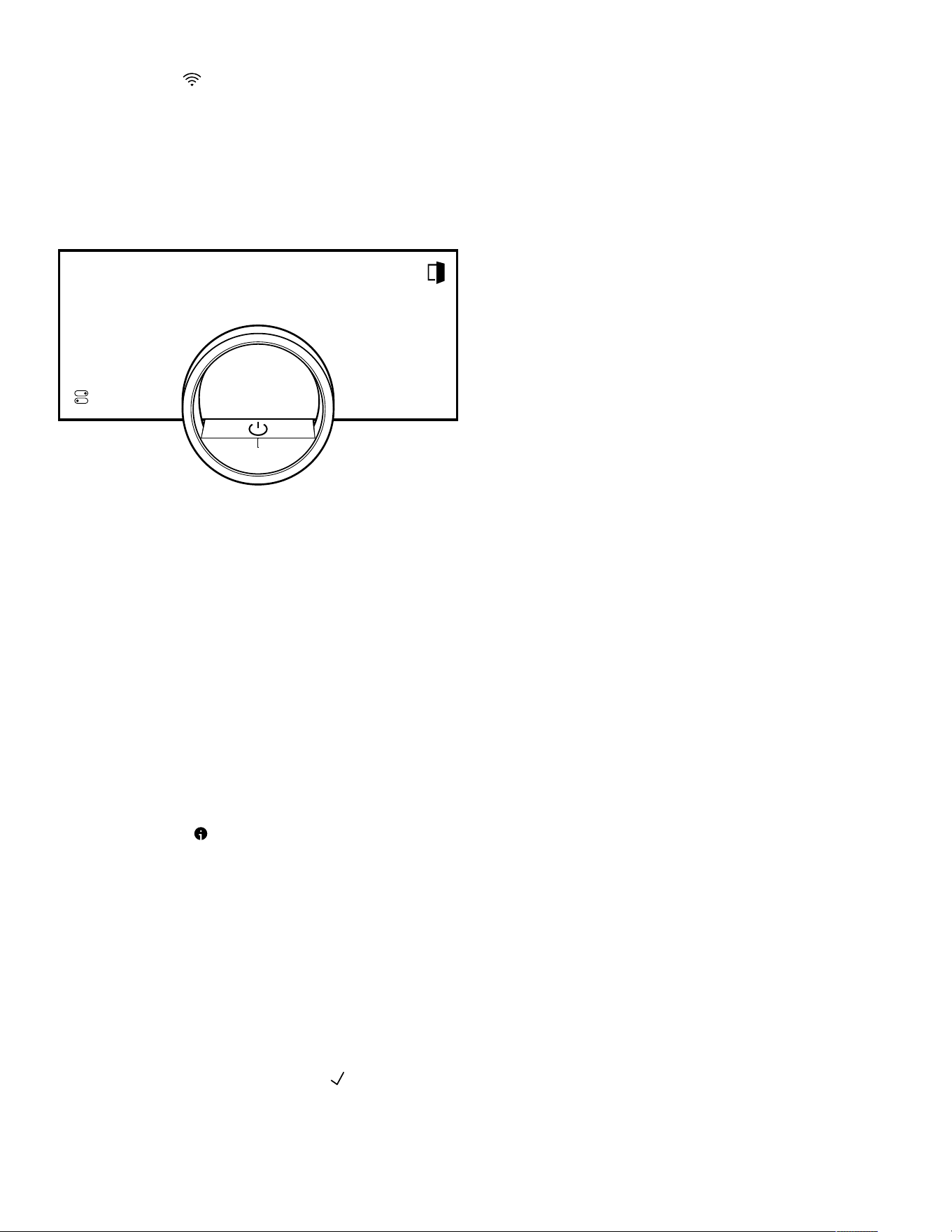
Familiarizing yourself with your appliance en-us
19
If the appliance is connected to the HomeConnect® app,
the display shows .
→
"HomeConnect® ", Page38
The user detection distance depends on the selected
basic settings.
In low power mode with user detection, the display
brightness is reduced. The brightness of the display
depends on the viewing angle.
5.6 Cooling fan
The cooling fan switches on when the appliance is in
operation. The hot air escapes above the door.
After removing your food from the appliance, keep the
door closed until the appliance has cooled down. The
appliance door must not be left half open as this may
damage adjacent kitchen units. The cooling fan continues
running for a certain period of time after the appliance has
stopped heating and then it switches itself off
automatically.
Do not cover the ventilation slots. Otherwise, the
appliance may overheat.
5.7 Additional information
If required, you can display additional information.
When you press on , the display shows additional
information about the current function.
When you press and hold certain symbols or values, the
display shows additional information about the current
function. Additional information is available for all symbols
that are arranged around the control ring, e.g. information
about the set type of heating or current interior oven
temperature.
In the basic settings →
Page41
, you can activate or
deactivate the "Info-i" function.
The appliance also occasionally displays important
information about safety and the operating status
automatically. These messages disappear automatically
after a few seconds, or when you press to confirm the
message.
For messages about HomeConnect®, the appliance also
displays the HomeConnect® status.
→
"HomeConnect® ", Page38
5.8 Pop-up notifications
Pop-up notifications contain explanations about current
functions.
In the basic settings →
Page41
, you can activate or
deactivate the "Pop-up hints" function.
5.9 Quick guides
Your appliance comes with a quick guide to help you with
various topics.
5.10 Automatic switch-off
For your protection, the appliance is equipped with an
automatic shut-off function. The appliance switches off
every heating process after a certain period of time if you
do not operate the appliance or program a cooking time
during this time. For types of heating without the
microwave, the appliance switches off the heating process
after 12hours, and for types of heating with the
microwave, after 90minutes. If you use the maximum
microwave output level, the appliance switches off the
heating process after 30minutes. The display shows a
message.
If you set a cooking time, you can use the appliance for
longer.
If you set a cooking time, you can operate the appliance in
the "Convection", "Broil + circulated air", "Low-temperature
cooking" or "Dough proofing" type of heating for a
maximum of 24hours. With the "Drying" type of heating,
you can operate the appliance for a maximum of 72hours.
When programming with the "Sabbath mode" function, the
appliance switches off after up to 74hours.
5.11 Proximity sensor
Your appliance detects whether you are in front of the
appliance or moving towards it. Your appliance disregards
if you are passing in front of it.
If you do not remain in the detection zone for the
appliance when it is switched on, the appliance reduces
the display to what is essential.
Note:You can set the distance at which the appliance can
detect you in the basic settings. To ensure that the
proximity sensor optimally detects the user, set the
installation height of the appliance's upper edge in the
basic settings →
Page41
.
5.12 Wipe protection
Your appliance detects if you would like to clean the
display or navigate between the appliance displays. The
appliance locks the operation via the display and the
control ring for a short time.
Press the display to return to the operation.

en-us Familiarizing yourself with your appliance
20
5.13 Door lock
The "Door lock" function prevents the appliance door from
being opened accidentally. This is particularly useful when
installing the appliance under the countertop.
In the basic settings →
Page41
, you can activate or
deactivate the "Door lock" function. When you activate the
function and press , the display shows a slide control
instead of the symbol.
→
"Opening the appliance door", Page23
Accessories en-us
21
Accessories
6 Accessories
Accessories
Only use genuine accessories. These are designed
especially for your appliance.
The accessories supplied may differ depending on the
appliance model.
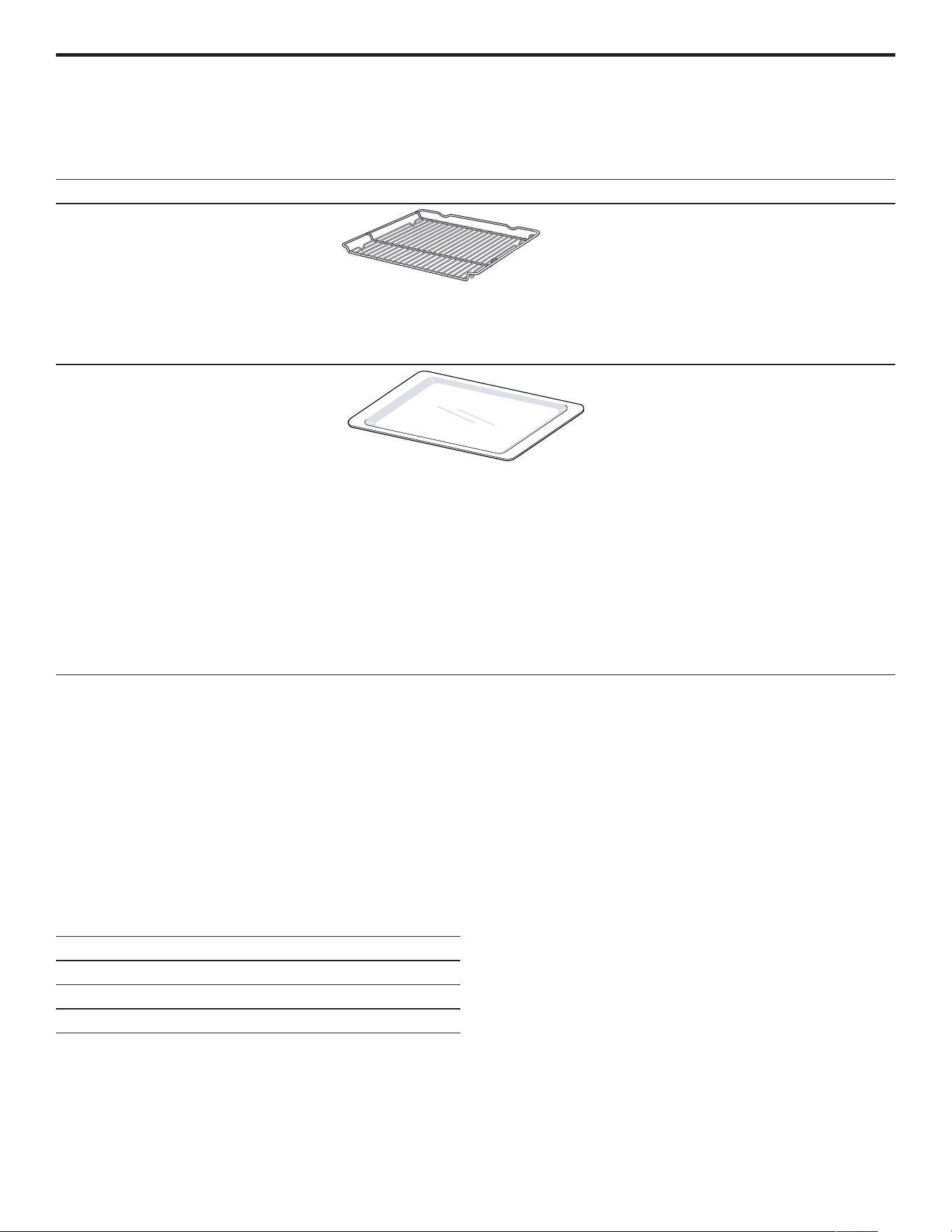
Accessories Use
Wire rack ¡ Cookware
¡ Cake tins
¡ Broiled items
¡ Frozen meals
¡ Microwave-safe
Tip:You can pull the wire rack ⅔ of
the way out without it tipping. You can
therefore remove dishes more easily.
Glass tray ¡ Large roasts
¡ Moist cakes
¡ Bakes
¡ Gratins
¡ Splash guard when broiling directly
on the wire rack
When broiling, slide the glass tray in
at level1.
¡ Microwave-safe
Tip:You can use the glass tray as a
setdown area during microwave
operation.
When the appliance is in microwave-
only mode, you can also place the
glass tray on the cooking compartment
floor.
6.1 Other accessories
You can purchase other accessories from our Customer
Service, specialist retailers or online.
You will find a comprehensive range of products for your
appliance in our brochures and online:
www.gaggenau.com
Accessories are appliance-specific. When purchasing,
always check for compatibility with your appliance model
number (E-Nr).
You can find out which accessories are available for your
appliance in our online shop or from our Customer
Service.
Other accessories Order number
Core temperature sensor BA010050
Glass tray BA046118
Wire rack BA036166
6.2 Sliding accessories into the oven cavity
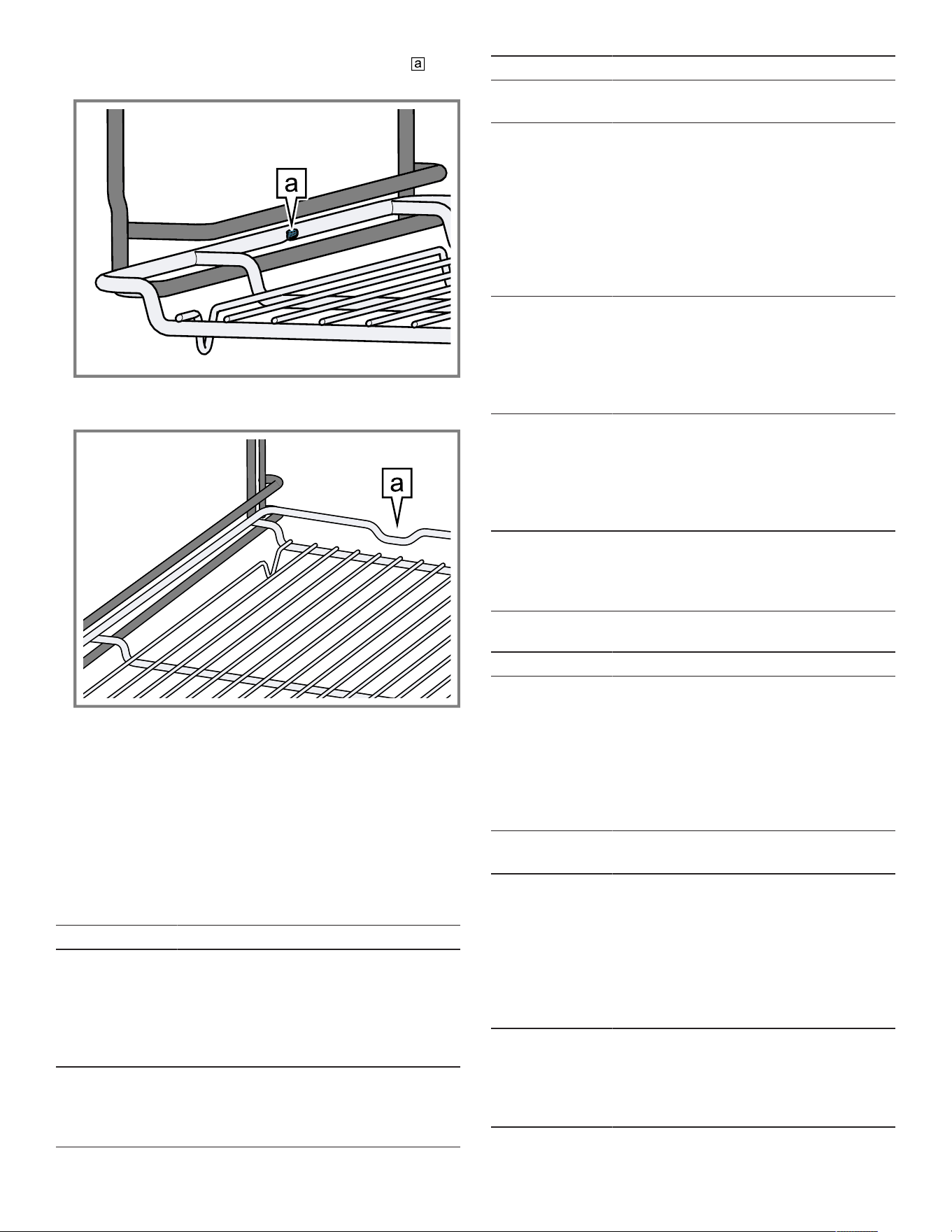
The wire rack is equipped with a locking function. For the
tilt protection to work correctly, always insert the wire rack
into the oven cavity the right way round.
NOTICE:
The accessories may tip.
▶
Do not push the accessories between the shelf
positions.
en-us Accessories
22
1. When inserting the wire rack, ensure that the lug is
facing downwards.
2. Ensure that the safety bracket on the wire rack is
located at the rear and is facing upwards.
Note:To completely pull out the wire rack, lift it up slightly
and pull it out with both hands.
Remove any accessories that you do not require from the
oven cavity.
6.3 Microwave utensil guide
Read here to see if your cooking utensils are suitable to
be used in the microwave.
Suitable ovenware
Ovenware Examples
Heat-resistant
glass, glass
ceramic and
earthenware
Utility dishes, loaf dishes, pie plates,
cake plates, liquid measuring cups,
casseroles and bowls without metallic
trim, such as Pyrex
®
, Anchor
Hocking™, Corning Ware
®
, Emile
Henry, etc.
1
1
These marks are registered trademarks of their
respective owners. All other trademarks are
trademarks of BSH Home Appliances Corporation or its
affiliated companies.
Ovenware Examples
China Bowls, cups, serving plates and platters
without metallic trim.
Plastic films
and wraps
Plastic wrap, as a cover:
¡ Lay the plastic wrap loosely over the
dish and press it to the sides.
¡ Vent plastic wrap by turning back
one edge slightly to allow excess
steam to escape.
¡ The dish should be deep enough so
that the plastic wrap will not touch
the food.
Microwave-safe
plastics
Microwave-safe plastic dishes, cups,
semi-rigid freezer containers and
plastic bags for short cooking times.
Use these with care because the
plastic may soften from the heat of the
food.
Paper products Paper towels, wax paper, parchment
paper, paper napkins and paper plates
with no metallic trim or design.
Refer to the manufacturers label for
any special instructions for use in the
microwave.
1
These marks are registered trademarks of their
respective owners. All other trademarks are
trademarks of BSH Home Appliances Corporation or its
affiliated companies.
Unsuitable ovenware
Ovenware Examples
Metal utensils
and cookware
Avoid metal in the appliance cavity:
¡ Metal shields the food from
microwave energy and produces
uneven cooking.
¡ Also avoid metal skewers,
thermometers or foil trays.
¡ Metal utensils can cause arcing,
which can damage your microwave.
Metal
decoration
Bowls, cups, serving plates and platters
with metallic trim.
Aluminum foil Avoid large sheets of aluminum foil
because they hinder cooking and may
cause harmful arcing.
Use small pieces of foil to shield poultry
legs and wings.
Keep ALL aluminum foil at least 1"
(25mm) from the side walls of the
appliance cavity and appliance door.
Wood Wooden bowls and boards will dry out
and may split or crack when you use
them in the microwave.
Baskets made of wood will react in the
same way.
Before using for the first time en-us
23
Ovenware Examples
Tightly covered
cookware
Let steam escape:
¡ Be sure to leave openings for steam
to escape from covered cookware.
¡ Pierce plastic pouches of vegetables
or other food items before cooking.
¡ Tightly closed pouches may explode.
Brown paper Avoid using brown paper bags. They
absorb heat and can burn.
Flawed or
chipped
cooking utensils
Cracked, flawed or chipped utensils
may break in the appliance.
Metal twist ties Remove metal twist ties from plastic or
paper bags. They become hot and
could cause a fire.
Testing ovenware for microwave suitability
Perform the following test if you are unsure whether your
ovenware is suitable for use in the microwave. Do not turn
on the microwave unless there is food inside. This
ovenware test is the only exception to this rule.
1. Heat the empty ovenware at maximum power for ½ to
1minute.
2. Check the temperature occasionally during that time.
a The ovenware should still be cold or warm to the touch.
a The ovenware is unsuitable if it becomes hot or if
sparks are generated.
Before using for the first time
7 Before using for the first time
Before using for the first time
Apply the initial configuration settings. Clean the appliance
and the accessories.
7.1 Initial use
Implement the settings for initial use before using your
appliance.
First read the information under Safety.
The appliance must be installed and connected.
After connecting to the power supply, the appliance shows
the "Initialization" display.
The appliance shows the "Initialization" display when it is
first switched on after being connected to the power
supply, if the initial start-up has not been completed
successfully or the appliance has been restored to the
factory settings.
Implement the following settings:
¡ Setting the language
¡ Activating HomeConnect®
¡ Set the temperature unit
¡ Set the weight unit
¡ Setting the time format
¡ Set the time
You can retroactively change all of the settings in the
basic settings →
Page41
.
Follow the instructions in the display. The display guides
you through the initial settings.
Setting the language and implementing the
remaining settings
1. Press .
a The display shows the preset language.
2. Use the control ring to select the required display
language.
3. Press to confirm.
4. Press .
5. Implement the remaining settings.
a The display shows the appliance display that is selected
in the basic settings →
Page41
as the start screen.
Cleaning theaccessories
▶
Before first use, clean the accessories thoroughly using
hot soapy water and a soft cloth.
Heating up the appliance
1. Ensure that there is no leftover packaging in the oven
cavity.
2. Remove any accessories from the oven cavity.
3. To eliminate the new-appliance smell, heat up the
empty appliance with the door closed.
The ideal setting for heating is 230°C for one hour
without microwave output.
4. Clean the appliance interior.
Basic Operation
8 Basic Operation
Basic Operation
8.1 Switching on the appliance
1.
To exit low power mode →
Page18
, press on the
appliance's control ring or in the HomeConnect®app.
a The display shows the microwave mode with microwave
setting and a symbol for the cooking time.
a The appliance switches the interior lighting on.
a lights up orange.
2. Set the microwave output and cooking time.
Tip:In the basic settings →
Page41
, you can specify
which appliance display appears on the display after the
appliance is switched on and whether you want the interior
lighting to switch on.
Note:If you do not implement any settings for an
extended period, the display shows the appliance display
that is selected in the basic settings →
Page41
as the
start screen, and then the low power mode display.
8.2 Opening the appliance door
WARNING
The inside of the appliance door becomes very hot during
operation.
▶
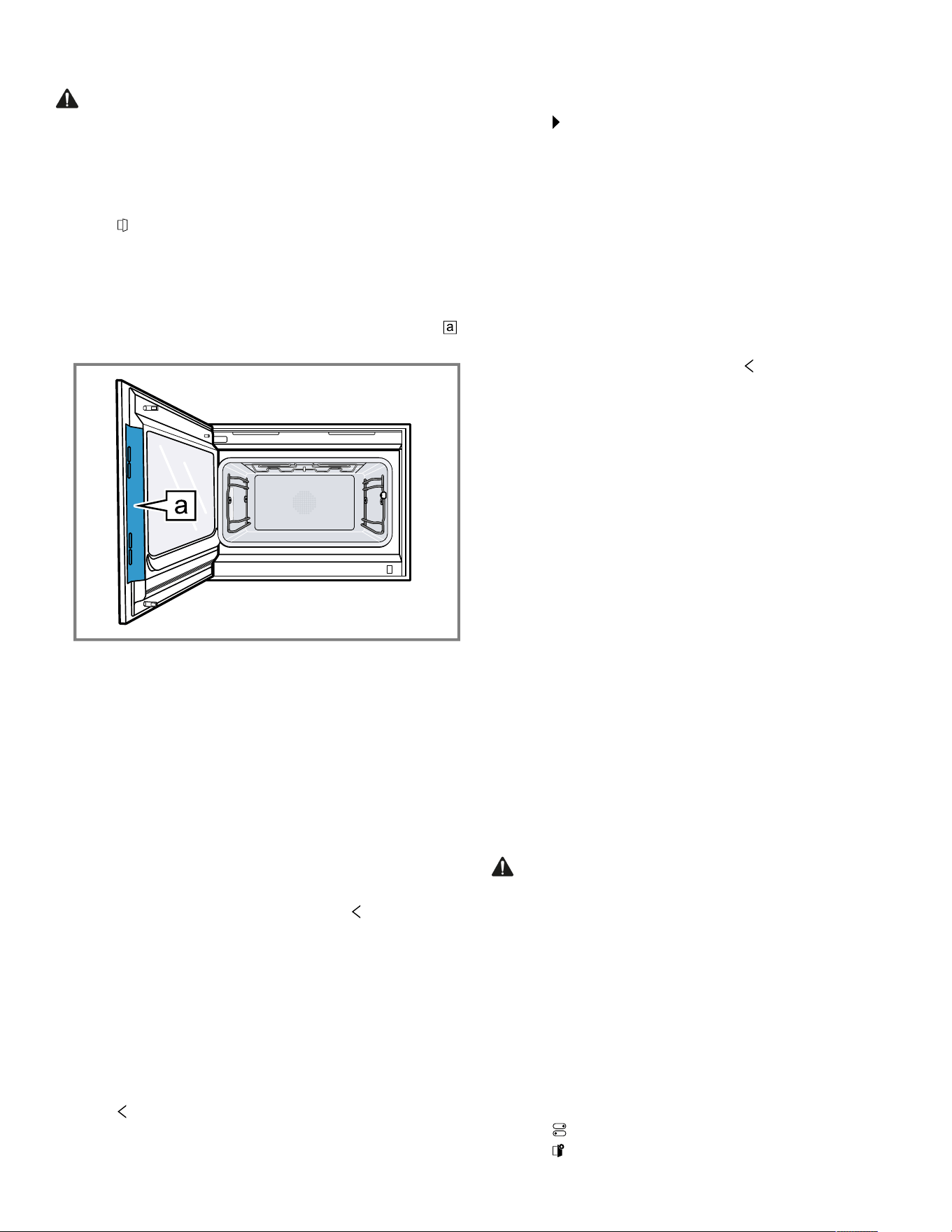
During or after operation of the appliance, only touch
the appliance door at the surface intended for this on
the side.
en-us Basic Operation
24
▶
Always open the appliance door as far as it will go.
WARNING
Hot steam may escape when you open the appliance
door. Steam may not be visible, depending on the
temperature.
▶
Open the appliance door carefully.
▶
Keep children away from the appliance.
1. Press .
‒ If the "Door lock" function is activated in the basic
settings →
Page41
, move the slide control to the
other end.
a The appliance door opens automatically.
2. Only touch the appliance door at the designated area
and open it fully.
Tip:In the control center, you can set that the appliance
door opens automatically after the current cooking
process.
→
"Opening the appliance door automatically after the
cooking process", Page24
8.3 Changing the type of heating
1. If required, swipe from right to left to switch from the
"Microwave" appliance display oven mode →
Page27
.
2. Press the current symbol for the type of heating.
3. Use the control ring to select the required type of
heating.
4. Press on the selected type of heating or , or wait a few
seconds.
a The display shows the selected type of heating, the
default temperature, and, for some types of heating, the
preset cooking time.
a If you have previously used the type of heating, the
display shows the last temperature that you used.
5.
If required, change the temperature. →
Page24
6. If the display shows a notification window, follow the
instructions in the notification window.
7. Press to switch to the overview of oven mode.
If you do not use the appliance for an extended period,
the display returns to the previously stored appliance
display.
8. Press to start the operation.
8.4 Changing the temperature
Note:You can change the temperature during operation.
Requirement:The type of heating is selected.
→
"Changing the type of heating", Page24
1. Press the temperature displayed.
2. Use the control ring to select the desired temperature.
a The display shows the temperatures that are available
for the selected type of heating.
3. To change the previously stored appliance display,
press the required temperature or .
If you do not use the appliance for an extended period,
the display returns to the previously stored appliance
display.
a The display shows the selected temperature.
Note:Once the operation has started, the display shows a
progress bar below the selected temperature if the
changed temperature is more than 20°C higher than the
previous temperature.
8.5 Displaying the current interior oven
temperature
▶
Press and hold the set temperature.
a The display shows the current interior oven
temperature.
Note:During continuous operation after heating up, slight
temperature fluctuations are normal.
8.6 Opening the appliance door
automatically after the cooking process
The "automatic door opening" function at the end of the
cooking process is only valid for the current cooking
process.
WARNING
The appliance and its parts that can be touched become
hot during use.
▶
Young children under 8 years of age must be kept away
from the appliance.
▶
Ensure that young children are not in the vicinity of the
appliance when the appliance door opens automatically.
Note:Use the "automatic door opening" function at the
end of the cooking process only if required to prevent the
food from being overcooked or burning.
In order to reduce the amount of moisture deposited on
the unit fronts, open the appliance door fully after the
cooking time has elapsed if possible.
1. Press .
2. Press .

Microwave en-us
25
a The display shows .
a The appliance opens the appliance door automatically
after the current cooking process with a set cooking
time end or set core temperature.
Note:The appliance door also opens when the child lock
→
Page32
is activated or the door lock →
Page20
is
activated.
8.7 Deactivating automatic appliance door
opening
1. Press .
2. Press .
a The display shows .
a Automatic appliance door opening after the cooking
process is deactivated.
8.8 Interrupting and continuing an operation
1. To interrupt the operation, press .
2. To continue the operation, press .
8.9 Opening and closing the control center
1. Press to open the control center.
a The appliance shows a description above the functions
currently active.
2. To activate or deactivate a function as required, press
the symbol for the function.
3. Press to close the control center.
a A pop-up message →
Page19
tells you if a function has
been activated.
8.10 Switching the interior lighting on or off
1. Press .
2. Press .
8.11 Switching off the appliance
▶
Press on the control ring.
a The appliance switches to low power mode.
8.12 Switching on the appliance after
automatic shut-off
Requirement:After prolonged operation, the automatic
shut-off →
Page19
switches off the appliance.
▶
Press on the control ring.
8.13 Displaying information
▶
Press .
a The appliance displays information about the selected
function.
→
"Additional information", Page19
8.14 Displaying appliance information
1. Swipe repeatedly from left to right until the display
shows "Modes & Service".
a The display shows the available functions in a list menu.
2. Use the control ring to select the "Appliance
information" function.
3. Press "Appliance information".
a The display shows the appliance information, e.g. the E-
number and the serial number.
4. Press to exit the display.
8.15 Using the quick guides
1. Select the "Modes & Service" appliance display.
→
"Appliance displays", Page15
2. Use the control ring to select "Quick guide", then
release the control ring.
3. Select the required quick guide and view it.
Microwave
9 Microwave
Microwave
You can use the microwave to cook, heat up or defrost
food very quickly. The microwave can be used on its own
or in combination with a type of heating.
9.1 Microwave-safe cookware and
accessories
To heat food evenly and avoid damaging your appliance, it
is important to use the right cookware and accessories.
Note:Read the manufacturer's instructions before using
any cookware in the microwave. If in doubt, carry out a
cookware test.
Microwave-safe
Cookware and
accessories
Justification
Cookware made from heat-
resistant, microwave-safe
material:
¡ Glass
¡ Glass ceramic
¡ Porcelain
¡ Temperature-resistant
plastic
¡ Fully glazed ceramic
without cracks
These materials allow
microwaves to pass
through. Microwaves do not
damage heat-resistant
cookware.
Metal flatware Note:You can use metal
flatware, e.g. place a spoon
in a glass, to prevent
delayed boiling.

en-us Microwave
26
NOTICE:
Metal touching the wall of the cooking compartment will
cause sparks, which may damage the appliance or the
inner door pane.
▶
Metal (e.g. a spoon in a glass) must be kept at least
2cm from the cooking compartment walls and the
inside of the door.
Not microwave-safe
Cookware and
accessories
Justification
Metal cookware Metal does not allow
microwaves to pass
through. The food hardly
heats up.
Cookware with gold or
silver decoration
Microwaves can damage
gold and silver decoration.
Tip:You can only use this
kind of cookware if the
manufacturer guarantees
that it is microwave-safe.
9.2 Testing cookware for microwave
suitability
Test cookware to see whether it is suitable for microwave
use. Testing cookware is the only time the appliance
should be operated in microwave mode without any food
inside.
WARNING
The accessible parts of the appliance become hot during
operation.
▶
Never touch these hot parts.
▶
Keep children away from the appliance.
1. Place the empty cookware in the cooking compartment.
2. Set the appliance to the maximum microwave output
setting for 30 seconds to 1 minute.
3. Start the operation.
4. Check the cookware several times:
– If the cookware is cold or warm to the touch, it is
suitable for microwave use.
– If the cookware becomes hot or sparks are created,
stop the cookware test. The cookware is not
microwave-safe.
9.3 Microwave power level
This is where you can find an overview of the different
microwave output levels and recommendations on when
to use them.
Microwave power
level
Use
90W Defrost delicate foods.
180W Defrost foods.
360W Defrost foods or cook gently.
Microwave power
level
Use
450W Cook foods or warm up gently.
600W Cook foods or warm up.
max. Quickly heat liquids
Notes
¡
You can set the microwave output levels for a specific
cooking time:
– The "Max." microwave output level for 30 minutes
– 90W, 180W, 360W, 450W and 600W for
90minutes
¡ The maximum setting is for heating liquids. To protect
the appliance, it reduces the maximum microwave
output level after some time. Full power is made
available again after a cooling period. During operation,
the display shows the current microwave output levels.
9.4 Setting the microwave
1. To set the microwave output level, turn the control ring
or press the required microwave output level.
2. To switch to the "Microwave" appliance display, press .
a The display shows the selected microwave output level.
3.
If required, set the cooking time →
Page30
.
4.
If required, move the cooking time end →
Page31
to a
later time.
5. Press .
a The operation begins. You can see the cooking time
counting down.
a A signal tone sounds once the cooking time has
elapsed. Press or open the appliance door to end the
signal early.
a The operation has finished.
Notes
¡ If you open the appliance door during cooking, the
microwave operation stops. To continue the operation,
close the appliance door and press . If you select the
"On" setting in the basic settings for the "Microwave
automatic resume" function, the appliance automatically
continues operation.
¡ You can change the microwave output or temperature
at any time. Press to start.
9.5 Interrupting and continuing microwave
operation
▶
Press .
a The display shows the remaining cooking time and the
selected microwave output level.
Oven en-us
27
Oven
10 Oven
Oven
Your appliance has an oven mode.
10.1 Types of heating in oven mode
In oven mode, you can set different types of heating.
Symbols Function/type of
heating
Temperature/setting Performance Use
Convection 86-445°F
(30-230°C)
The heat arises from the
back wall of the cooking
compartment and is
distributed quickly and
evenly by the fan. For
cooking on one or two levels
with an extremely short
preheating time. For moist
cakes, cookies, bakes. To
reduce the cooking time, the
microwave can be switched
on.
Broil + circulated air 86-445°F
(30-230°C)
For au gratin dishes at the
end of the cooking time at
445°F (230°C). For grilling
vegetable skewers and
shrimp skewers at 355°F
(180°C).
Extremely intensive heat
from above, which is
distributed quickly and
evenly by the fan.
Guarantees that a crust is
formed with simultaneous
all-round heating. For meat,
poultry, fish, vegetable
skewers. No preheating is
required. To reduce the
cooking time, the microwave
can be switched on.
Drying 86-176°F
(30-80°C)
For drying thin slices of fruit
or vegetables or herbs.
Moisture is actively extracted
from the cooking
compartment.
Low-temperature
cooking
86-194°F
(30-90°C)
90W Slow and gentle cooking of
meat for a particularly tender
result. Hot air is combined
with a low microwave output
in order to reduce the
cooking time. Briefly sear
meat before cooking.
en-us Oven
28
Symbols Function/type of
heating
Temperature/setting Performance Use
Dough proofing 86-122°F
(30-120°C)
Optimal temperature range
for proving dough batches
and pieces of dough. For
yeast dough and sourdough.
The optimal temperature
setting for yeast dough is
100°F (38°C).
Keeping warm 50W Optimal microwave output
for keeping food warm
without it drying out.
Defrosting 90-360W Optimal microwave output
range for quickly and gently
defrosting frozen food. Use
90W for delicate foods.
Warming up
beverages
max. Optimal microwave output
for quickly heating liquids
such as water and milk.
Reheat meals 360-600W
Default power 360W
Optimal microwave output
range for heating up cooked
meals, such as plated meals,
bakes and soups.
10.2 Setting the type of heating and
temperature
1. If required, swipe from right to left to switch from the
"Microwave" appliance display oven mode →
Page27
.
2. Press the current symbol for the type of heating.
3. Use the control ring to select the required type of
heating.
4. Press on the selected type of heating or , or wait a few
seconds.
a The display shows the selected type of heating, the
default temperature, and, for some types of heating, the
preset cooking time.
a If you have previously used the type of heating, the
display shows the last temperature that you used.
5. Set the required temperature if necessary.
‒ Press the temperature displayed.
‒ Use the control ring to select the desired
temperature.
‒ Press the desired temperature.
If you do not use the appliance for an extended period,
the display returns to the previously stored appliance
display.
6. If the display shows a notification window, follow the
instructions in the notification window.
7.
If required, set the cooking time →
Page30
or the core
temperature →
Page35
.
8.
If required, move the cooking time end →
Page31
to a
later time.
9. To switch to the previous appliance display, press .
If you do not use the appliance for an extended period,
the appliance returns to the previously stored appliance
display.
10.Press to start the operation.
Interrupting and continuing an operation
1. To interrupt the operation, press .
2. To continue the operation, press .
10.3 Add broiler
You can brown or gratinate your food using the broiler.
The function "Add broiler" is available for the heating mode
"Convection", when the temperature in the oven cavity is
higher than 300°F (150°C).
After around 4minutes, the appliance switches the broiler
off. If required, you can switch the broiler on again.
Turning on the broiler
NOTICE:
Temperatures above 480°F (250°C) damage the core
temperature probe.
▶
If you use the core temperature probe, never place the
food on the top shelf level.
1. Use the control ring to select the "Convection" type of
heating for the broiler.
2. Press .
a lights up.
a The appliance switches the grill off for approx. 3
minutes.
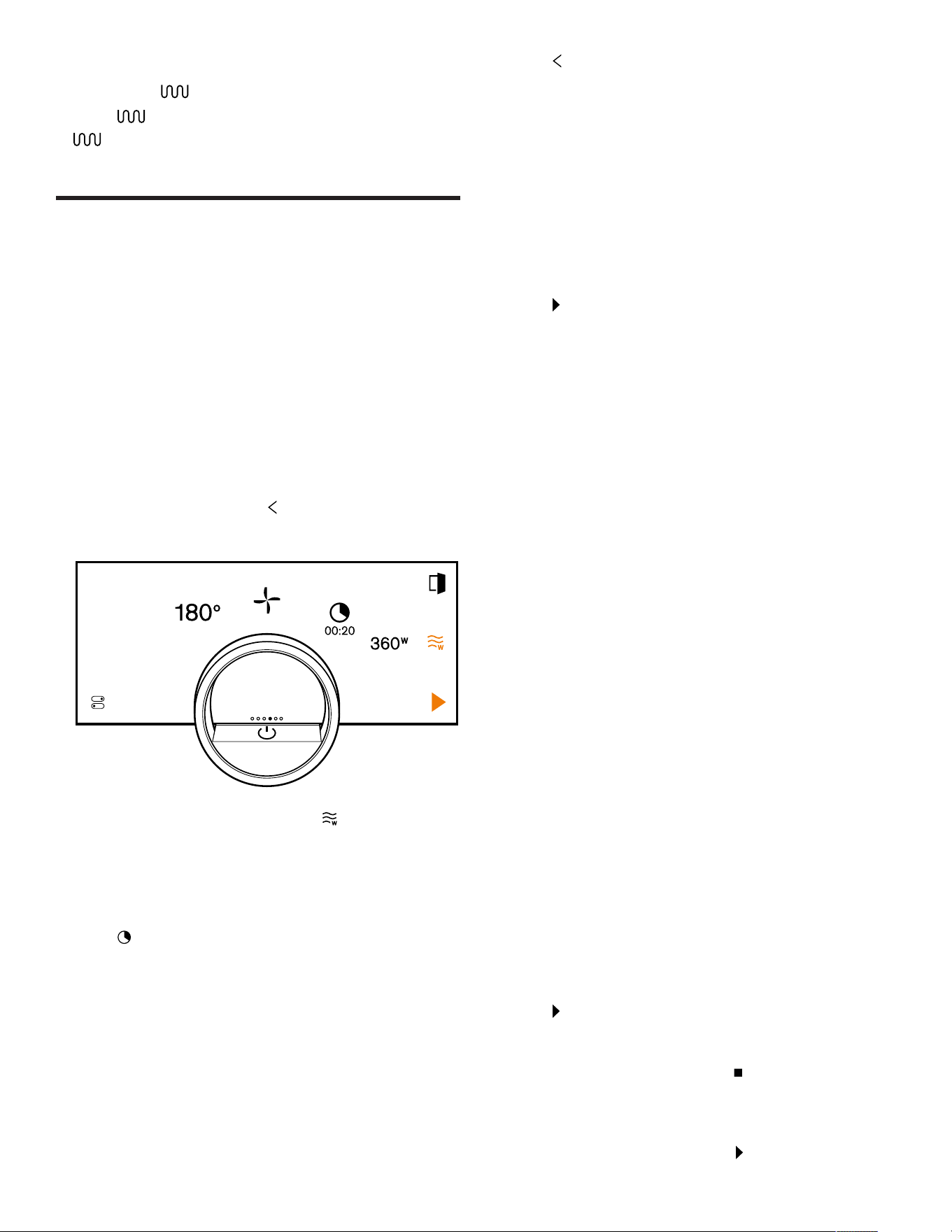
Combi-operation en-us
29
Deactivating the broiler
Requirement: lights up orange.
▶
Press .
a lights up white.
a The broiler is deactivated.
Combi-operation
11 Combi-operation
Combi-operation
To reduce the cooking time and brown your meals, you
can use the "Convection" or "Broil + circulated air" types of
heating in combination with a microwave output.
Note:You can switch on microwave output settings up to
450W.
The appliance reduces the maximum microwave output
level after a longer period of operation. The maximum
power output is made available again after a certain
cooling period.
11.1 Setting combi-operation
1. Use the control ring to select the "Convection" or "Broil
+ circulated air" type of heating.
2. Press the type of heating or .
3. Add a microwave output level using .
You can also add microwave operation while a heating
process is active.
a The display shows the preset microwave output level for
the selected type of oven heating and a preset cooking
time.
4. Press .
a The display shows h : min for hours and minutes.
5. Press on the desired value for the cooking time
→
Page30
and change the value using the control
ring.
‒ Turn the control ring slowly to change the value in
smaller increments.
‒ Turn the control ring quickly to change the value in
greater increments.
The maximum possible cooking time depends on the
type of heating.
6. Press or press on the selected cooking time to switch
to the previously stored appliance display.
If you do not use the appliance for an extended period,
the appliance saves the settings and the display returns
to the previously stored appliance display.
7. Press on the required microwave output level and use
the control ring to select the required microwave output.
If you do not use the appliance for an extended period,
the display returns to the previously stored appliance
display.
8.
Set the cooking time →
Page30
or the core
temperature →
Page35
.
9. Press .
a The operation begins. You can see the cooking time
counting down.
a A signal tone sounds once the cooking time has
elapsed.
a After a certain period of time without any further
operation, the appliance ends the signal tone. You can
set the duration of the signal tone in the basic settings
→
Page41
.
a The operation has finished.
a After around 1minute, the appliance displays the
previously set temperature, the type of heating, cooking
time, microwave output and the time elapsed since the
end of operation.
10.Press on the display to end the additional cooking time
timer.
Note:If there is no further operation following the signal
tone, the display shows the "Downtime timer" function with
the + symbol. The display shows how much time has
elapsed since the cooking time ended. After approx.
20minutes without any further operation, the appliance
switches to low power mode.
Changing settings
1. To change the type of heating, press on the type of
heating and use the control ring to select a different
type of heating.
If you select a type of heating for which combi-operation
is not available, the appliance switches to oven mode.
2. To change the temperature, press on the temperature
and use the control ring to select a different
temperature.
3. To change the microwave output, press on the
microwave output and use the control ring to select a
different microwave output.
4.
Change the cooking time →
Page30
.
5. Press to start.
Interrupting and continuing an operation
1. To interrupt the operation, press .
a The display shows the temperature, the type of heating,
and the cooking time. In combi-operation, the display
also shows the microwave output setting.
2. To continue the operation, press .
en-us Timer functions
30
Note:The fan may also continue to run when the door is
open. This is normal.
11.2 Removing the microwave operation
Requirement:The "Convection" or "Broil + circulated air"
type of heating is selected.
▶
Press .
You can also delete the microwave operation while a
heating process is active.
a The display shows the type of heating and the preset
cooking time for the type of heating.
a The display shows .
11.3 Switching from combi-operation to
microwave operation
1. To interrupt the operation, press .
2. Swipe repeatedly from left to right until the display
shows the possible settings for microwave operation.
Timer functions
12 Timer functions
Timer functions
Your appliance has different timer functions, with which
you can control its operation.
12.1 Overview of the timer functions
Use to select the different timer functions.
Timer function Usage
Cooking time
Cooking time end
A cooking time or cooking time end can only be set in
combination with a type of heating.
The "Cooking time" and "Core temperature probe"
functions are not available at the same time.
12.2 Call up the timer menu
▶
Press .
a Depending on the set type of heating, the display shows
min and s for minutes and seconds, or h and min for
hours and minutes.
a The display shows the display for the minutes enlarged
in the 12 o'clock position.
12.3 Exiting the timer menu
▶
Press or press on the selected cooking time to switch
to the previously stored appliance display.
a The timer menu is closed.
12.4 Cooking time
When you set the cooking time for your food, the
appliance automatically switches off after this time. The
maximum possible cooking time depends on the set type
of heating.
Depending on the type of heating, you can set a cooking
time of 1minute to 30minutes, 90minutes or 24hours.
For the "Drying" type of heating, the maximum cooking
time is 72hours.
You can change the type of heating and temperature while
the cooking time counts down.
Setting the cooking time
Requirement:No core temperature is set. You cannot
use the "Cooking time" and "Core temperature probe"
functions at the same time.
1. Place the food in the oven cavity.
2. Press .
a Depending on the type of heating, the display shows
min : s for minutes and seconds or h : min for hours and
minutes.
3. Press the required value and use the control ring to
change the value.
‒ Turn the control ring slowly to change the value in
smaller increments.
‒ Turn the control ring quickly to change the value in
greater increments.
The maximum possible cooking time depends on the
type of heating.
a The appliance automatically calculates the time for the
cooking time end.
4. Press or press on the selected cooking time to switch
to the previously stored appliance display.
If you do not use the appliance for an extended period,
the appliance saves the settings and the display returns
to the previously stored appliance display.
a If the appliance is in operation, the appliance shows the
temperature or microwave output, the operating mode
and the remaining cooking time.
a For a cooking time of more than 59minutes, the display
uses the format h : min for hours and minutes.
a For a cooking time of less than 60minutes and
depending on the type of heating set, the display uses
the format min : s for minutes and seconds.
a 3minutes before the end of the cooking time, the
display zooms in on the remaining cooking time.
a After the cooking time has elapsed, the display shows
00:00 and a signal tone sounds.
5. Turn the control ring or open the appliance door.
The appliance door opens automatically if you have
activated this function.
→
"Opening the appliance door automatically after the
cooking process", Page24
a The signal tone stops.

Timer functions en-us
31
Note:If there is no further operation following the signal
tone, the display shows the "Downtime timer" function with
the + symbol. The display shows how much time has
elapsed since the cooking time ended. After approx.
20minutes without any further operation, the appliance
switches to low power mode.
Changing the cooking time
For types of heating that require a cooking time, you can
change the cooking time. For types of heating that do not
require a cooking time, you can either change or delete
the cooking time.
Requirement:You have set a type of heating.
1. Press .
a Depending on the type of heating, the display shows
min : s for minutes and seconds or h : min for hours and
minutes.
2. Press the required value and use to delete the value,
or use the control ring to change the value.
‒ Turn the control ring slowly to change the value in
smaller increments.
‒ Turn the control ring quickly to change the value in
greater increments.
For types of heating that require a cooking time, do not
delete the cooking time but reset it to the preset cooking
time using .
The maximum possible cooking time depends on the
type of heating.
a The appliance automatically calculates the time for the
cooking time end.
3. Press or press on the selected cooking time to switch
to the previously stored appliance display.
If you do not use the appliance for an extended period,
the display returns to the previously stored appliance
display.
a The display shows the temperature or microwave
output, the operating mode, the remaining cooking time,
and the cooking time end.
Deleting or resetting the cooking time
Note:For types of heating that require a cooking time, do
not delete the cooking time.
For types of heating that do not require a cooking time, in
the "Manual" (oven mode) appliance display, you can
double-click on the cooking time in order to delete the
cooking time without switching to the timer settings.
1. Press .
a Depending on the type of heating, the display shows
min : s for minutes and seconds or h : min for hours and
minutes.
2. Press the required value and use to delete the value.
a The display shows --:--.
3. Press or press on the selected cooking time to switch
to the previously stored appliance display.
If you do not use the appliance for an extended period,
the display returns to the previously stored appliance
display.
a The display does not show a cooking time.
12.5 Cooking time end
As soon as you set a cooking time, the display shows the
cooking time end. You can delay the cooking time end by
a maximum of 12 hours.
For example, if you set a cooking time of 90minutes at 10
a.m., you can delay the end of the cooking time so that the
cooking process ends at 11.30 p.m. at the latest.
For the "Drying" type of heating, the maximum cooking
time is 72hours.
Bear in mind that food which spoils easily should not be
left in the appliance for too long.
Delaying the cooking time end
Requirement:No core temperature is set. You cannot
use the "Cooking time" and "Core temperature probe"
functions at the same time.
1. Place the food in the oven cavity.
2. Press .
a Depending on the type of heating, the display shows
min : s for minutes and seconds or h : min for hours and
minutes.
3.
Set the cooking time. →
Page30
a The appliance automatically calculates the time for the
cooking time end.
4. Press or press on the selected cooking time to switch
to the previously stored appliance display.
If you do not use the appliance for an extended period,
the display returns to the previously stored appliance
display.
5. Press on the cooking time end.
6. Use the control ring to set the required cooking time
end.
7. Press .
a The appliance switches to standby.
a The display shows the temperature or microwave
output, the operating mode, and the cooking time end.
a If the end of cooking time is one or more days in the
future, the display shows "+1d".
a The appliance starts at the calculated time and
automatically switches off once the cooking time has
elapsed.
a After the cooking time has elapsed, the display shows
00:00 and a signal tone sounds.
8. Turn the control ring or open the appliance door.
The appliance door opens automatically if you have
activated this function.
→
"Opening the appliance door automatically after the
cooking process", Page24
a The signal tone stops.

en-us Child lock
32
Note:If there is no further operation following the signal
tone, the display shows the "Downtime timer" function with
the + symbol. The display shows how much time has
elapsed since the cooking time ended. After approx.
20minutes without any further operation, the appliance
switches to low power mode.
Resetting the delay of the cooking time end
Note:In the "Microwave" appliance display or in the
"Manual" (oven mode) appliance display, double-click on
the cooking time end in order to reset the delay of the
cooking time end without switching to the timer settings.
Requirement:You have used the control ring to manually
set the cooking time end.
1. Press .
2. To reset the delay of the cooking time, press .
a The appliance calculates the cooking time end based
on the cooking time.
a The display shows the cooking time end.
3. Press or press on the cooking time end to switch to
the previously stored appliance display.
If you do not use the appliance for an extended period,
the display returns to the previously stored appliance
display.
12.6 Count-up cooking timer
If no cooking time is set, the display shows the time that
has elapsed since the start of the process.
In the basic settings, you can switch the "Count-up
cooking timer" function on or off.
Reset Count-up cooking timer
1. Press and hold .
2. Press .
a The "Count-up cooking timer" function is reset.
Child lock
13 Child lock
Child lock
Activate the "Child lock" function so that children cannot
accidentally switch the appliance on or change the
settings.
If the child lock is activated, operation via the display and
the control ring is not possible.
If the child lock is activated and the power fails, the child
lock can be deactivated when the power comes back on.
You can activate the child lock even during operation.
13.1 Activating the childproof lock
Requirement:In the basic settings →
Page41
, the
option "On" is set for the "Display child lock" function.
1. Press .
2. Press .
a The display shows .
a The "Child lock" function is activated.
13.2 Deactivating the childproof lock
1. Press and hold for approximately 2seconds.
a The "Child lock" function is deactivated.
2. Set the appliance as normal.
Programs
14 Programs
Programs
The "Programs" appliance display includes the automatic
programs and recommended settings.
14.1 Automatic programs
You can use the "Automatic programs" function to cook a
wide variety of food. The appliance will choose the optimal
setting for you.
In automatic programs, the appliance defines the optimal
settings after you enter the weight and required cooking
result, for example. The automatic programs are labeled
with a checkmark in the overview list.
You can find information about the accessories or shelf
levels in the tip for the respective program.
Note:In the basic settings →
Page41
, you can filter
automatic programs, e.g. with the following filters
"Vegetarian" or "No meat & poultry".
Information about the settings for the automatic
programs
Observe the instructions for the settings of the automatic
programs.
¡ The cooking result depends on the quality of the food
and the size and type of cookware. For an optimal
cooking result, only use food that is in good condition
and meat that is chilled to refrigerator temperature. For
frozen food, use food straight out of the freezer only.
¡ The food is divided into categories. One or more dishes
are listed for each category. The display shows the last
selected meal.
¡ For some dishes, the appliance asks you to enter, for
example, the weight, the desired level of browning, the
thickness of the food or the cooking level of the food.
¡ For some food, preheat the empty cooking
compartment for an optimal cooking result. Place the
food in the cooking compartment once the preheating is
complete and a message appears in the display.
¡ The appliance displays the selected settings next time
as a suggestion.
¡ For some programs, you need the core temperature
probe. Use the core temperature probe →
Page35
for
these programs.
¡ To achieve good results, the cooking compartment must
not be too hot for the type of food you have selected. If
the cooking compartment is too hot, the display shows a
corresponding notification. Allow the appliance to cool
and then try again.

Programs en-us
33
Selecting an automatic program
1. Swipe repeatedly from right to left until the display
shows "Programs".
a The display shows the first program in the "Vegetables"
category or the last set automatic program.
a The display shows the preselected values for the
program or the last set values.
a The display shows a tip and symbols for the Favorites
→
Page34
category and for the program start.
2. Use the control ring to select the required meal, and
press on the required meal.
a The display shows the name of the selected dish and
the corresponding values.
Changing category
1. Press the symbol for the category.
a The display shows the available categories in the ring
menu.
2. Select the required category with the control ring.
3. Press or press the category in order to confirm the
selection.
a The display shows the first dish in the selected category
and the corresponding values.
Changing the program
1. Press on the name of a dish or navigate through the list
of dishes in the menu with the control ring.
2. Press the required dish.
a The display shows the name of the selected dish and
the corresponding settings.
3. Press the setting.
4. Use the control ring to change the setting and press on
the required setting.
Not all settings can be changed.
You cannot change the type of heating.
5. Press .
a The display shows the name of the selected dish and
the corresponding settings.
6. Press .
a The display shows information about the accessories
and preparation.
7. Follow the information on the display.
Starting the automatic program
▶
Press .
a Once the cooking time has elapsed, a signal tone
sounds.
a The appliance stops heating.
Note:If you open the appliance door during an automatic
program, this affects the cooking result. Do not open the
appliance door, or only open it briefly. The appliance
interrupts the automatic program and continues to run
when you close the appliance door.
Extending the cooking time
If you are still not satisfied with the cooking result, you can
increase the cooking time again.
1. Press 00.00.
2. Select the required cooking time.
3. Press to confirm.
Canceling the automatic program
Note:Once you have started the automatic program, you
can no longer change the settings.
▶
Press .
a The appliance ends the automatic program.
Saving a program as a favorite
You can save a program as a favorite at the start or end of
an automatic program.
1. Press .
a The display shows the "Favorites" appliance display.
2. Press .
3. Use the keyboard to enter a name.
4. Press .
You can only change the settings for a saved favorite
via the HomeConnect® app.
14.2 Recommended settings
With recommended settings, the appliance specifies the
optimal type of heating.
The recommended settings are not labeled with a
checkmark in the overview list.
If a weight is specified in the tip, the recommended
temperature and the cooking time relate to this weight
specification. You can adapt the temperature and cooking
time within the available ranges.
You can find information about the accessories or shelf
levels in the tip for the respective program.
Information on the recommended settings
Observe the information on the recommended settings.
¡ The cooking result depends on the quality of the food
and the size and type of cookware. For an optimal
cooking result, only use food that is in good condition
and meat that is chilled to refrigerator temperature. For
frozen food, use food straight out of the freezer only.
¡ The food is divided into categories. One or more dishes
are listed for each category. The display shows the last
selected meal.
¡ With the recommended settings, the appliance specifies
the type of heating.
¡ You can change the temperature and the cooking time
in the specified areas.
¡ For some food, preheat the empty cooking
compartment for an optimal cooking result. Place the
food in the cooking compartment once the preheating is
complete and a message appears in the display.

en-us Favorites
34
¡ The appliance displays the selected settings next time
as a suggestion.
¡ To achieve good results, the cooking compartment must
not be too hot for the type of food you have selected. If
the cooking compartment is too hot, the display shows a
corresponding notification. Allow the appliance to cool
and then try again.
Selecting a recommended setting
1. Swipe repeatedly from right to left until the display
shows "Programs".
a The display shows the first program in the "Vegetables"
category or the last set automatic program.
a The display shows the preselected values for the
program or the last set values.
a The display shows a tip and symbols for the Favorites
→
Page34
category and for the program start.
2. Use the control ring to select the required meal, and
press on the required meal.
a The display shows the name of the selected dish and
the corresponding values.
Changing category
1. Press the symbol for the category.
a The display shows the available categories in the ring
menu.
2. Select the required category with the control ring.
3. Press or press the category in order to confirm the
selection.
a The display shows the first dish in the selected category
and the corresponding values.
Changing the program
1. Press on the name of a dish or navigate through the list
of dishes in the menu with the control ring.
2. Press the required dish.
a The display shows the name of the selected dish and
the corresponding settings.
3. Press the setting.
4. Use the control ring to change the setting and press on
the required setting.
Not all settings can be changed.
You cannot change the type of heating.
5. Press .
a The display shows the name of the selected dish and
the corresponding settings.
6. Press .
a The display shows information about the accessories
and preparation.
7. Follow the information on the display.
Starting a recommended setting
▶
Press .
a Once the cooking time has elapsed, a signal tone
sounds.
a The appliance stops heating.
Note:If you open the appliance door when a
recommended setting is running, this affects the cooking
result. Do not open the appliance door, or only open it
briefly. The appliance interrupts the recommended setting
and continues to run when you close the appliance door.
Extending the cooking time
If you are still not satisfied with the cooking result, you can
increase the cooking time again.
1. Press 00.00.
2. Select the required cooking time.
3. Press to confirm.
Changing a recommended setting
Note:Once you have started the recommended setting,
you can change the settings.
1. Press on the recommended setting.
2. Change the desired settings.
Saving a program as a favorite
You can save a program as a favorite at the start or end of
a recommended setting.
Requirements
¡ The temperature and type of heating are set.
¡ The cooking time or core temperature is set.
1. Press .
a The display shows the "Favorites" appliance display.
2. Press .
3. Use the keyboard to enter a name.
4. Press .
You can only change the settings for a saved
"Favorites" via the HomeConnect® app.
Favorites
15 Favorites
Favorites
In the "Favorites" appliance display, you can save
preferred automatic programs, recommended settings or
combinations of type of heating, temperature, core
temperature or cooking time. The appliance adopts the
selected settings, such as microwave output, temperature,
cooking time, weight or level of browning for the favorites.
You can individually select the names for the favorites.
You can use the HomeConnect® app to change the
saved settings for the favorite or the order of the favorites.
After starting the favorite, you can change the settings.
→
"Changing a favorite", Page35
15.1 Creating the first favorites
Note:You can save a food as a favorite at the beginning
or end of an automatic program or a setting
recommendation.
Requirement:The settings for the favorites are selected
or a heating process ends.

Core temperature sensor en-us
35
1. Press .
a The display shows the "Favorites" appliance display.
2. Press .
3. Use the keyboard to enter a name.
4. Press .
15.2 Selecting a favorite
1. Swipe repeatedly from right to left until the display
shows "Favorites".
→
"Appliance displays", Page15
2. Use the control ring to select the desired favorite.
3. Press the favorite.
15.3 Renaming a favorite
Requirement:The favorite has been selected.
→
"Selecting a favorite", Page35
1. Press .
2. Enter the name for the favorite.
3. Press to confirm.
15.4 Starting a favorite
Requirement:The favorite has been selected.
→
"Selecting a favorite", Page35
▶
Press to start.
15.5 Changing a favorite
Requirements
¡ The favorite has been selected.
→
"Selecting a favorite", Page35
¡ The favorite is stopped.
1. Change the selected settings, e.g. the temperature, the
type of heating, or the cooking time.
The "Add broiler" function is unavailable.
The "Automatic door opening at end of process"
function is available.
2. Press .
3. Press to start.
a The operation starts with the changed settings.
Note:The appliance does not save the changed settings
in the selected favorite. If you select the favorite again, the
settings match the settings when the favorite was created.
You can use the HomeConnect® app to change the
settings for the favorites.
15.6 Deleting a favorite
Requirement:The favorite has been selected.
→
"Selecting a favorite", Page35
1. Press .
2. Press to confirm.
Core temperature sensor
16 Core temperature sensor
Core temperature sensor
The core temperature probe makes it possible to cook with
exact precision. The core temperature probe measures
the temperature at 3 measuring points inside the food.
When the required core temperature is reached, the
appliance automatically switches off, ensuring that all food
is cooked perfectly.
WARNING
The oven cavity and the core temperature probe become
very hot.
▶
Use oven gloves when inserting and removing the core
temperature probe.
NOTICE:
Temperatures above 480°F (250°C) damage the core
temperature probe.
▶
Only use the core temperature probe in your appliance
at a maximum temperature of 445°F (230°C).
▶
Do not use the core temperature probe with the "Broil"
type of heating.
▶
Before using the "Broil" type of heating, remove the
core temperature probe from the cooking compartment.
▶
When using the core temperature probe with
the"Broil+circulated air" type of heating, set the
temperature to a maximum of 480°F (250°C).
WARNING
An incorrect core temperature probe may damage the
insulation.
▶
Only use the core temperature probe that is suitable for
this appliance.
NOTICE:
Aggressive cleaning agents may damage the core
temperature probe.
▶
Do not clean the core temperature probe in the
dishwasher.
WARNING
The core temperature probe is sharp.
▶
Handle the core temperature probe with care.
Only use the core temperature probe that is suitable for
this appliance. The core temperature probe →
Page21
is
available as a spare part from customer service or the
online shop. You can also use the core temperature probe
for the Gaggenau oven or the combi-steam oven in the
same series.
If you use the core temperature probe, never place the
food on the top shelf level.
After use, always remove the core temperature probe from
the cooking compartment. Never store the core
temperature probe in the cooking compartment.
After each use, clean the core temperature probe with a
damp cloth.
The measurable range is 60-212°F (15°C to 100°C).
Outside of the measurable range, the display shows
"<60F (15°C)" or ">212F (100°C)" for the current core
temperature.
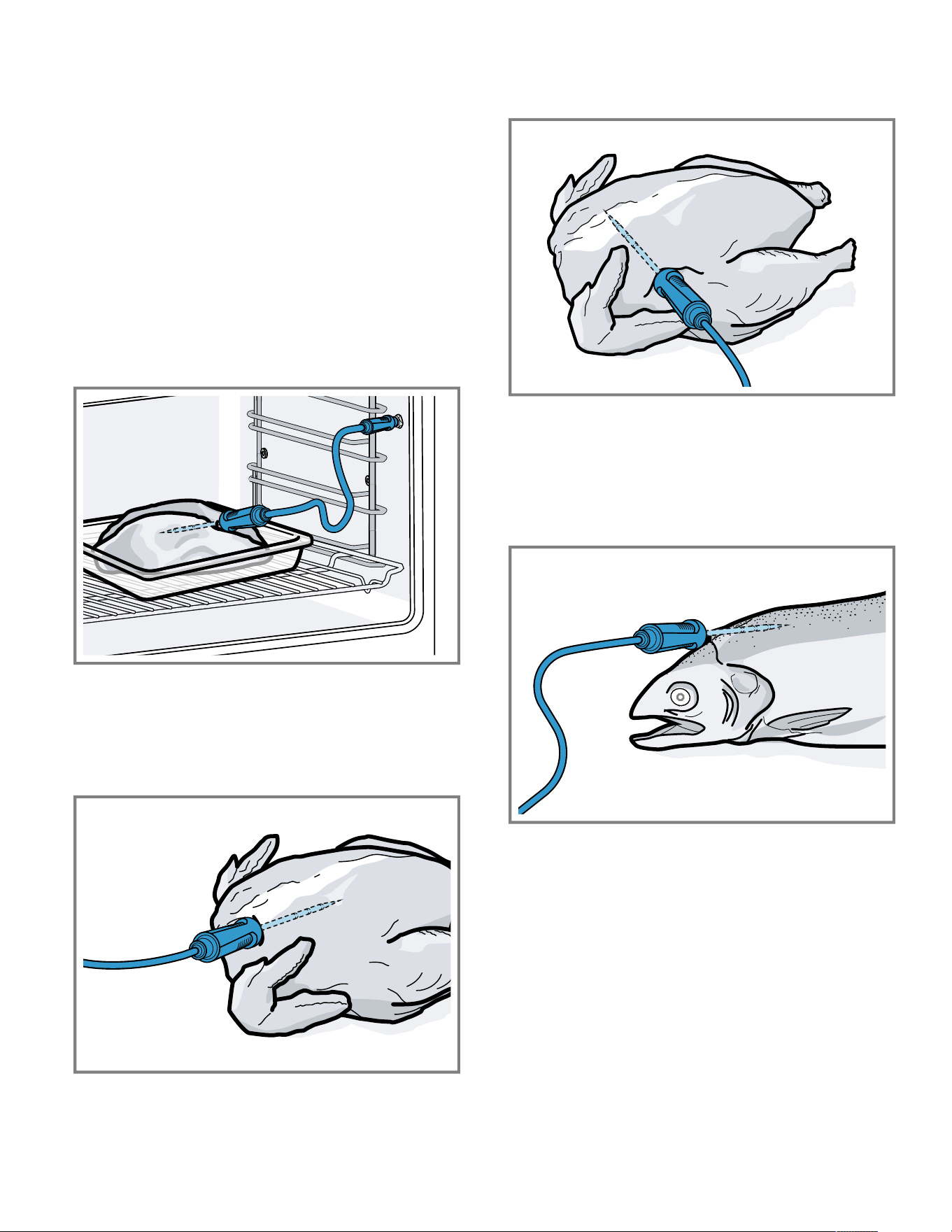
en-us Core temperature sensor
36
If you leave food in the cooking compartment for some
time after cooking, the core temperature will continue to
rise somewhat due to the residual heat in the cooking
compartment.
16.1 Inserting the core temperature probe
into the food
1. Insert the core temperature probe fully into the food.
2. Do not insert the core temperature probe into the fat.
3. Ensure that the core temperature probe is not touching
any cookware or any bones.
4. Place the food in the oven cavity.
Inserting the core temperature probe into meat
1. Insert the core temperature probe at the thickest point
on the side as far as it will go into the meat.
2. If there is more than one piece of meat, insert the core
temperature probe into the middle of the thickest piece.
Inserting the core temperature probe into poultry
1. Insert the core temperature probe as far as it will go into
the thickest point in the breast.
2. Depending on its composition, insert the core
temperature probe into the poultry crossways or
lengthways.
3. With poultry, ensure that the tip of the core temperature
probe does not protrude into the cavity in the middle of
the bird.
Inserting the core temperature probe into fish
1. Insert the core temperature probe behind the head as
far as it will go towards the spine.
2. Place the whole fish onto the wire rack and prop it up in
the swimming position using half a potato.
16.2 Turning the food
1. Do not pull out the core temperature probe when turning
the food.
2. Turn the food.
3. Once you have turned the food, check that the core
temperature probe is correctly positioned in the food.

Core temperature sensor en-us
37
16.3 Setting the core temperature probe
NOTICE:
The heat of the grill heating element may damage the core
temperature probe.
▶
Ensure that the distance between the grill heating
element and the core temperature probe and the cable
of the core temperature probe is a few centimeters. In
doing so, ensure that the meat can expand during the
cooking process.
You may damage the cable of the core temperature probe
with the appliance door.
▶
Do not trap the cable of the core temperature probe in
the appliance door.
Requirement:A cooking time end is not set. The cooking
time end and core temperature probe functions are not
available at the same time.
1. Slide the food into the oven cavity with the core
temperature probe inserted.
2. Insert the core temperature probe into the socket in the
oven cavity.
3. Close the appliance door.
a The display shows the current interior oven temperature
and the symbol for the core temperature probe .
4. Select the required type of heating and interior oven
temperature using the control ring.
5. Press .
6. Use the control ring to select the required core
temperature →
Page37
.
‒ Ensure that the set core temperature is higher than
the current core temperature.
You can change the set core temperature at any time.
7. The set core temperature can be cleared and reset as
needed using or the control ring.
8. Press or press the set core temperature.
9. Press .
a The appliance heats up using the set type of heating.
a Once you have set the core temperature, the display
shows the type of heating and the current core
temperature.
a Once you have set the core temperature, the display
shows the type of heating and switches between
displaying the estimated time →
Page38
until the core
temperature is reached and the current and set core
temperature.
a If the current core temperature is 9°F (5°C) below the
set core temperature, the display shows the current and
set core temperature as enlarged.
a Once the core temperature for the food has been
reached, the display shows the required core
temperature alongside the set core temperature and a
signal sounds.
a The appliance ends the cooking process automatically.
Note:If you do not continue to operate the appliance after
the signal tone, the display shows how much time has
elapsed since the food reached the core temperature.
Once you start operating the appliance again, the
appliance clears the time display. After around 20minutes
without any further operation, the appliance switches to
low power mode.
16.4 Deleting the set core temperature
▶
In the "Microwave" or "Manual" (oven mode) appliance
display, double-click on the temperature.
→
"Appliance displays", Page15
a The display shows the current core temperature.
16.5 Changing the set core temperature
1. Press .
2. Change the set core temperature using the control ring.
Once the display shows the set core temperature
enlarged in the 12 o'clock position, you can change the
set core temperature directly using the control ring.
16.6 Core temperature guideline values
The following overview provides you with guideline values
for the core temperature. The guideline values depend on
the quality and composition of the food.
Only use fresh food that has not been frozen. For hygiene
reasons, ensure that critical foods such as fish and game
reach a core temperature of at least 140-160°F
(62-70°C) and poultry and minced meat 180-195°F
(80-90°C).
Food Core temperature
guideline value in °F (°C)
Beef
Sirloin, fillet of beef,
entrecôte, roast beef, rare
116-131 (47-55)
Sirloin, fillet of beef,
entrecôte, roast beef,
medium rare
133-145 (56-63)
Sirloin, fillet of beef,
entrecôte, roast beef,
medium
147-158 (64-70)
Sirloin, fillet of beef,
entrecôte, roast beef, well
done
160-167 (71-75)
Pork
Joint of pork 167-176 (75-80)
Loin of pork, medium rare 149-158 (65-70)
Loin of pork, medium 160-167 (71-75)
Pork loin, well done 169-176 (76-80)
Meatloaf 185 (85)
Fillet of pork, medium rare 149-158 (65-70)
Fillet of pork, medium 160-167 (71-75)

en-us HomeConnect®
38
Food Core temperature
guideline value in °F (°C)
Veal
Joint of veal, well done 167-176 (75-80)
Breast of veal, stuffed, well
done
167-176 (75-80)
Saddle of veal, medium 147-158 (64-70)
Saddle of veal, well done 160-167 (71-75)
Fillet of veal, rare 120-131 (50-55)
Fillet of veal, medium rare 133-145 (56-63)
Fillet of veal, medium 147-158 (64-70)
Fillet of veal, well done 160-167 (71-75)
Game
Saddle of venison 140-158 (60-70)
Leg of venison 158-167 (70-75)
Venison loin steaks 149-158 (65-70)
Saddle of hare, saddle of
rabbit
149-158 (65-70)
Poultry
Chicken 194 (90)
Guinea fowl 176-185 (80-85)
Goose, turkey, duck 185-194 (85-90)
Duck breast, medium rare 131-140 (55-60)
Duck breast, medium 141-158 (61-70)
Duck breast, well done 160-176 (71-80)
Ostrich steak 140-149 (60-65)
Lamb
Leg of lamb, medium 149-156 (65-69)
Leg of lamb, well done 158-176 (70-80)
Saddle of lamb, medium
rare
131-140 (55-60)
Saddle of lamb, medium 141-147 (61-64)
Saddle of lamb, well done 149-167 (65-75)
Mutton
Leg of mutton, medium rare 158-176 (70-75)
Leg of mutton, medium 169-176 (76-80)
Leg of mutton, well done 178-185 (81-85)
Saddle of mutton, medium 158-176 (70-75)
Saddle of mutton, well done 169-176 (76-80)
Fish
Fillet, whole, medium 136-147 (58-64)
Fillet, whole, well done 149-154 (65-68)
Terrine 144-149 (62-65)
Other
Bread 205 (96)
Pâté 162-167 (72-75)
Terrine 158-176 (70-75)
Food Core temperature
guideline value in °F (°C)
Foie gras 113-140 (45-60)
Reheating food 167 (75)
16.7 Estimated cooking time
After preheating, if the appliance has a temperature
setting above 250°F (120°C) and the core temperature
probe is inserted, the display shows an estimated cooking
time a few minutes into the cooking time. The appliance
continuously updates the estimated cooking time.
The estimated cooking time is only available if you
connect your appliance to the HomeConnect® app.
The longer the cooking process lasts, the more precise the
estimated cooking time becomes. Do not open the
appliance door; this distorts the estimated cooking time.
The display shows the estimated cooking time in manual
operation and in the automatic program.
To display the current core temperature, press on the set
core temperature.
HomeConnect®
17 HomeConnect®
HomeConnect®
This appliance is network-capable. Connecting your
appliance to a mobile device lets you control its functions
via the HomeConnect® app, adjust its basic settings and
monitor its operating status.
The HomeConnect® services are not available in every
country. The availability of the HomeConnect® function
depends on the availability of the HomeConnect®
services in your country. You can find information on this
at: www.home-connect.com.
The HomeConnect® app guides you through the entire
registration process. Follow the instructions, noting the
information in the HomeConnect® app.
Notes
¡ Note the safety information in this instruction manual
and ensure that it is also observed when operating the
appliance using the HomeConnect® app.
¡ Operating the appliance on the appliance itself always
takes priority. It is not possible to operate the appliance
using the HomeConnect® app during this time.
¡ In networked standby mode, the appliance requires a
maximum of 2watts.
17.1 Setting upHomeConnect®
Requirements
¡ The appliance is connected to the power supply and is
switched on.
¡ You have a mobile device with a current version of the
iOS or Android operating system, e.g. a smartphone.
¡ The appliance receives signals from the WLAN home
network (Wi-Fi) at its installation location.
¡ The mobile device and the appliance are within range of
your home network's Wi-Fi signal.

HomeConnect® en-us
39
1. Scan the following QR code.
You can install the HomeConnect® app and connect
your appliance via the QR code.
2. Follow the instructions in the HomeConnect® app.
17.2 HomeConnect® settings
You can adjust the home network settings in your
appliance's basic settings.
Which settings the display shows will depend on whether
HomeConnect® has been set up and whether the
appliance is connected to your home network.
You can switch the network connection on or off as
required. The network information is retained after the
appliance is switched off. After switching on the appliance,
wait for a few seconds until it reconnects to the home
network.
The display uses different symbols to show the connection
strength to the router.
Note:In networked standby mode, the appliance requires
a maximum of 2W.
You can use the HomeConnect® app to access the
appliance's functions. If you select the "Off (monitoring
only)" setting in the basic settings →
Page41
for "Remote
start", the HomeConnect® app only shows the
appliance's operating status and you can configure the
settings.
If you select the "Permanent" setting in the basic settings
→
Page41
for "Remote start", you can start and operate
your appliance at any time without any prior approval on
the appliance.
If you select the "Manual" setting in the basic settings
→
Page41
for "Remote start", the appliance requires
approval in the control center in order to start a function.
In the basic settings →
Page41
, you can use "Network
information" to display the network information.
In the basic settings →
Page41
, you can use "Network
credentials reset" to delete all network access data from
the appliance at any time.
17.3 Starting functions with the
HomeConnect® app via manual
Remote start
You can use the HomeConnect® app to set the appliance
remotely via the "Remote start" function. If you select the
"Manual" setting in the basic settings for "Remote start",
the appliance requires approval in the control center in
order to start a function.
WARNING
Combustible objects that are left in the cooking
compartment may catch fire.
▶
Never store combustible objects in the cooking
compartment.
▶
If smoke is emitted, the appliance must be switched off
or the fuse must be switched off and the door must be
held closed in order to stifle any flames.
Requirements
¡ The appliance is connected to the home network and to
the HomeConnect®app.
¡ To start a function, the "Manual" setting is selected in
the basic settings for "Remote start".
1. To activate manual remote start, press and then .
2. Configure a setting in the HomeConnect®app and
send it to the appliance.
3. Start a function.
Note:If you open the appliance door more than
15minutes after activating remote start or after the
operation ends, the appliance deactivates the manual
remote start.
24hours after activating remote start, the appliance
deactivates the manual remote start.
17.4 Starting functions with the
HomeConnect® app via permanently
activated Remote start
You can use the HomeConnect® app to set and start the
appliance remotely via the "Remote start" function. If you
select the "Permanent" setting in the basic settings for
"Remote start", the appliance does not require approval in
the control center in order to start a function.
WARNING
Combustible objects that are left in the cooking
compartment may catch fire.
▶
Never store combustible objects in the cooking
compartment.
▶
If smoke is emitted, the appliance must be switched off
or the fuse must be switched off and the door must be
held closed in order to stifle any flames.
Requirements
¡ The appliance is connected to the home network and to
the HomeConnect®app.
¡ To start a function, the "Permanent" setting is selected
in the basic settings for "Remote start".

en-us HomeConnect®
40
1. Configure a setting in the HomeConnect®app and
send it to the appliance.
2. Start a function.
17.5 Using the HomeConnect® app to
change settings
You can use the HomeConnect® app to set the appliance
remotely.
WARNING
Combustible objects that are left in the cooking
compartment may catch fire.
▶
Never store combustible objects in the cooking
compartment.
▶
If smoke is emitted, the appliance must be switched off
or the fuse must be switched off and the door must be
held closed in order to stifle any flames.
Requirement:The appliance is connected to the home
network and to the HomeConnect®app.
▶
Configure a setting in the HomeConnect®app and
send it to the appliance.
17.6 Switching the Wi-Fi on or off
Requirement:The "On" and "Off" settings are only
available if a connection to the HomeConnect® server
has been established.
1. Press in the status line.
2. Press in the control center.
3. Press the desired setting.
4. If required, use to switch to "Settings".
17.7 Software update
Your appliance's software can be updated using the
software update function, e.g. for the purposes of
optimization, troubleshooting or security updates.
To do this, you must be a registered
HomeConnect®user, have installed the app on your
mobile device and be connected to the
HomeConnect®server.
As soon as a software update is available, you will be
informed via the HomeConnect®app and will be able to
start the software update via the app. Once the update
has been successfully downloaded, you can start installing
it via the HomeConnect®app if you are in your home
network (Wi-Fi). The HomeConnect®app informs you
once the installation is successful.
Notes
¡
The software update consists of two steps.
– The first step is the download.
– The second step is the installation on your appliance.
¡ You can continue to use your appliance as normal while
updates are downloading. Depending on your personal
settings in the app, software updates can also be set to
download automatically.
¡ Installation takes a few minutes. You cannot use your
appliance during installation.
¡ We recommend that you install security updates as
soon as possible.
17.8 Data Protection
Please read this information on data protection.
The first time your appliance is registered on a home
network connected to the Internet, your appliance
transmits the following types of data to the
HomeConnect® server (initial registration):
¡ Unique appliance identification (consisting of appliance
codes as well as the MAC address of the installed Wi-Fi
communication module).
¡ Security certificate of the Wi-Fi communication module
(to ensure a secure data connection).
¡ The current software and hardware version of your
home appliance.
¡ Status of any previous reset to factory settings.
This initial registration prepares the HomeConnect®
functions for use and is only required when you want to
use the HomeConnect® functions for the first time.
Note:Please note that the HomeConnect® functions can
only be used in conjunction with the HomeConnect® app.
Information on data protection can be retrieved in the
HomeConnect® app.

Basic settings en-us
41
Basic settings
18 Basic settings
Basic settings
You can configure the basic settings for your appliance to meet your needs.
18.1 Overview of the basic settings
Here you can find an overview of the basic settings and factory settings. The basic settings depend on the features of
your appliance.
Symbol Basic setting Setting Selection Use
Wi-Fi Wi-Fi ¡ On
¡ Off
1
Switching the Wi-Fi on
or off
Note:The On and Off
settings are only
available if a
connection to the
HomeConnect®
server has been
established.
All settings are
retained after the
appliance is switched
off.
Switch on the Wi-Fi in
order to allow the
appliance to be
controlled via the app
and to use additional
appliance functions.
HomeConnect®
assistant
¡ During the initial
connection to the
HomeConnect®
app: "Start"
¡ If you have already
connected
successfully to the
HomeConnect®
app: "Connect now"
Setting
upHomeConnect®
→
Page38
Remote start ¡ Off (monitoring only)
¡ Manual
1
¡ Permanent
Note:The settings are
only available if you
have selected the "On"
setting for Wi-Fi.
Setting "Remote start"
→
"Starting functions
with the
HomeConnect® app
via manual Remote
start", Page39
Network information ¡ MAC address
¡ Wi-Fi SSID
¡ IPv4 address
¡ IPv6 address
Note:The settings are
only available if you
have selected the "On"
setting for Wi-Fi.
Displaying "Network
information"
1
Factory setting (may vary according to model)

en-us Basic settings
42
Symbol Basic setting Setting Selection Use
Network credentials
reset
¡ Confirm
The connections are
reset. The appliance
deletes saved network
access data.
Note:The settings are
only available if you
have selected the "On"
setting for Wi-Fi.
Reset the network
access data
Display Brightness ¡ 1
¡ 2
¡ 3
¡ 4
1
¡ 5
¡ 6
Sets the brightness in
increments
Distant view ¡ "On"
1
: The display
shows less content
if you are at a
greater distance.
¡ "Off": The display
always shows the
same content.
Switch the remote
view on or off
Screen in off-mode ¡ GAGGENAU
logo"displayed on
approach"
1
¡ None
Sets the low power
mode display
→
Page18
Ring behavior ¡ "Standard": Press
the required
function and use the
control ring to
change the function
¡ "Quick selection"
1
:
Use the control ring
to change the
function located
above the control
ring
Set the control ring
behavior
Display child lock ¡ "On"
1
: The symbol
for the "Display
child lock" function
is only visible in the
status line if the
"Display child lock"
function is active.
Control ring and
touch fields are
locked.
¡ "Off": The "Display
child lock" function
cannot be activated.
Displays or hides the
symbol for the child
lock →
Page32
in the
control center
1
Factory setting (may vary according to model)
Basic settings en-us
43
Symbol Basic setting Setting Selection Use
Door lock ¡ Activated
¡ Off
1
Activates or
deactivates the door
lock
Note:The door lock
→
Page20
prevents
the appliance door
from being opened
accidentally. This is
particularly useful
when installing the
appliance under the
countertop.
Display alignment ¡ Vertical
1
¡ Horizontal
Aligns the display
horizontally or
vertically depending
on the appliance's
installation position or
the user's body size
Sounds Switch-on/switch-off
sounds
¡ Quiet
¡ Standard
1
¡ Loud
Set the volume of the
on/off tones
Notification sounds ¡ Off
¡ Quiet
¡ Standard
1
¡ Loud
Set the volume of the
notification tones
Note:The notification
tones for the warnings
and error messages
always remain
switched on.
Process sounds Volume
¡ Off
¡ Quiet
¡ Standard
1
¡ Loud
"Repetitions":
¡ 1x
¡ "10 s": The
appliance emits the
signal tone
repeatedly for
10seconds.
¡ "30 s"
1
: The
appliance emits the
signal tone
repeatedly for
30seconds.
¡ "3 min": The
appliance emits the
signal tone
repeatedly for
3minutes.
"Preheating signal":
¡ "On"
1
¡ Off
¡ Set the volume of
the process tones
¡ Sets the desired
maximum duration
of the process tones
¡ Activates or
deactivates the
process tone
following preheating
1
Factory setting (may vary according to model)
en-us Basic settings
44
Symbol Basic setting Setting Selection Use
Visual feedback ¡ On
¡ Off
1
Switches the pulsating
light for program end,
notifications or error
messages on or off
Volume reduction ¡ "On": Lowers the
volume for all tones
to a certain volume
level in a defined
period
¡ "Reduced": Lowers
the volume for all
tones to the "Quiet"
volume level in a
defined period and
switches off the
tones for cleaning
¡ "Off"
1
: Switches off
all tones in a
defined period
Start time
¡ "22h"
1
End time
¡ "7h"
1
Sets the lowering of
the volume
Note:The signal
tones for warnings,
error messages, and
switching on and
switching off always
remain switched on.
Interior lighting Brightness ¡ Dark
¡ Standard
1
¡ Bright
Sets the brightness of
the interior lighting
Activation ¡ Automatic
1
¡ Manual
Switches the interior
lighting on
automatically or
manually
Light interaction ¡ On
1
¡ Off
Sets the light
interaction
Note:If you are
outside of the range
that the appliance
recognizes, the
appliance reduces the
interior lighting to what
is essential.
Notifications Info-i ¡ On
1
¡ Off
Display or hide
additional information
Tip:If you press ,
the display shows
additional information
→
Page19
. If you
switch off the function,
the display does not
show any symbol or
any additional
information.
Pop-up hints ¡ On
1
¡ Off
Displays or hides pop-
up notifications
→
Page19
1
Factory setting (may vary according to model)
Basic settings en-us
45
Symbol Basic setting Setting Selection Use
Hidden notifications Restore Displays hidden
notifications again
Language - ¡ German
¡ French
¡ [...]
¡ English
1
Setting the language
Time and units Time ¡ Time
1
¡ "Automatic": Select
the "Automatic"
option if your
appliance is
connected to
HomeConnect®.
Set the time
Time format ¡ 12
¡ 24
1
Set the time format
Temperature unit ¡ °C
1
¡ °F
Set the temperature
unit
Weight unit ¡ "Metric": "g/kg"
¡ "Imperial": "oz/lb"
Set the weight unit
Advanced Demo mode ¡ On
¡ Off
1
Activates or
deactivates demo
mode
Note:The setting is
only available in the
first 3minutes after
connecting to the
power supply.
Factory settings ¡ Restore Resets the appliance
to the factory settings
Note:The appliance
starts the initialization.
The display asks you
to specify settings that
the appliance installer
has implemented.
Appliance Start screen ¡ Microwave
1
¡ Manual
¡ Favorites
¡ Programs
Select a display that
shows the display after
switching on
"Manual" corresponds
to oven mode.
Food preference ¡ Off
1
¡ Vegetarian
¡ No meat & poultry
¡ No fish & seafood
¡ No pork
¡ Kosher
Selects the preferred
food for automatic
programs and
recommended settings
Microwave automatic
resume
¡ On
¡ Off
1
If the door is opened
while the microwave is
operating, the
appliance restarts
automatically as soon
as the door is closed
again.
1
Factory setting (may vary according to model)
en-us Cleaning and maintenance
46
Symbol Basic setting Setting Selection Use
Count-up cooking
timer
¡ On
1
¡ Off
Sets the total cooking
time timer
Note:The running
cooking time is
automatically counted
up if no cooking time
has been stored.
User detection "Behavior":
¡ Automatic
¡ "Below 3' 11'' (1.2
m)"- "Below 4'' (0.1
m)"
"Installation height":
¡ Under 91.4 cm/36"
¡ Between 91.4 cm/
36" and 150 cm/59"
1
¡ Over 150 cm/59''
¡ Sets the distance
from which the
proximity sensor
detects the user
¡ Set the appliance's
installation height
Note:To ensure that
the proximity sensor
optimally detects the
user, store the
installation height of
the appliance's upper
edge.
Introduction to the
appliance
Start Start the appliance
introduction
Note:The appliance
introduction contains a
short description of the
basic functions.
1
Factory setting (may vary according to model)
18.2 Changing the basic settings
1. Swipe repeatedly from left to right until the display
shows Basic settings →
Page41
.
a The display shows the symbols for the available
settings in a ring menu.
2. Use the control ring to select the required basic setting.
3. Press the required basic setting.
a The display shows the settings for the selected basic
setting.
4. Depending on the selected basic setting, use the control
ring to select the setting, or press the required setting.
‒ With a list menu, ensure that the required setting is
above the horizontal line.
5. Use to activate the setting or use the control ring to
select the setting option, and press the setting.
6. If required, use to switch to the previous view.
Cleaning and maintenance
19 Cleaning and maintenance
Cleaning and maintenance
Note:The Statement of Limited Product Warranty covers
defects in materials and workmanship. Cleaning and
maintenance is not covered by the warranty and a charge
will apply. See the Statement of Limited Product Warranty
for more details.
19.1 Cleaning agents
To avoid damaging the various surfaces on the appliance,
do not use any unsuitable cleaning agents.
WARNING
Moisture intrusion may cause an electric shock.
▶
Do not use any steam cleaners or high-pressure
cleaners to clean the appliance.
WARNING
The appliance and its parts that can be touched become
hot during use.
▶
Caution should be exercised here in order to avoid
touching heating elements.
▶
Young children under 8 years of age must be kept away
from the appliance.
WARNING
Scratched glass in the appliance door may develop into a
crack.
▶
Do not use any harsh or abrasive cleaners or sharp
metal scrapers to clean the glass on the appliance door,
as they may scratch the surface.
NOTICE:
Unsuitable cleaning agents damage the surfaces of the
appliance.
▶
Do not use harsh or abrasive cleaning agents.

Cleaning and maintenance en-us
47
▶
Do not use cleaning agents with a high alcohol content.
▶
Do not use hard scouring pads or cleaning sponges.
▶
Do not use any special cleaners for cleaning the
appliance while it is hot.
▶
Only use glass cleaners, glass scrapers or stainless
steel care products if recommended in the cleaning
instructions for the relevant part.
Salt contained in new sponge cloths may damage
surfaces.
▶
Wash new sponge cloths thoroughly before use.
Using oven cleaner in a hot oven cavity damages the
stainless steel surfaces.
▶
Never use oven cleaner in the oven cavity when it is still
warm.
▶
Remove all food remnants from the oven cavity and the
appliance door before you next heat up the appliance.
WARNING
Loose food remnants, fat and meat juices may catch fire.
▶
Before using the appliance, remove the worst of the
food residues and remnants from the oven cavity,
heating elements and accessories.
Suitable cleaning agents
Only use cleaning agents that are suitable for the different surfaces on your appliance.
Appliance door
Area Suitable cleaning agents Information
Door pane ¡ Glass cleaner Do not use a glass scraper.
Clean it using a soft cloth or a microfiber cloth.
Control ring ¡ Soapy water Clean with a slightly damp soft cloth.
Do not spray with any cleaning agent.
Cooking compartment
Area Suitable cleaning agents Information
Oven cavity inner
walls
¡ Hot soapy water Clean with a dishcloth and dry with a soft cloth.
Stainless steel cleaner that is suitable for the appliance can be obtained
from customer service or online.
To prevent corrosion, remove any patches of limescale, grease, starch
or albumin (e.g. egg white) from stainless steel surfaces immediately.
Corrosion may form under such stains.
Do not use oven spray or other aggressive oven cleaners or abrasive
materials. Scouring pads, rough sponges and pan cleaners are
unsuitable. These items scratch the surface.
Always dry the cooking compartment after cleaning.
Note:Undissolved detergent causes patches to appear when heating
up and these patches cannot be removed. Thoroughly remove residues
from detergents or care products using clean water before drying the
oven cavity.
Tip:To eliminate unpleasant odors, heat up a cup of water with a few
drops of lemon juice for 1 to 2minutes at the maximum microwave
output setting. Always place a spoon in the container to prevent
delayed boiling.
Very dirty oven
cavity
¡ Cleaning aid
The cleaning aid →
Page48
program removes stubborn dirt.
Broiler ¡ Hot soapy water Clean with a dish cloth or sponge, and dry with a soft cloth.
Glass cover for the
oven cavity light
¡ Hot soapy water Clean with a dish cloth.
Glass floor ¡ Hot soapy water
¡ Glass cleaner
Do not use a glass scraper.
Clean with a soft dish cloth and dry with a soft cloth.
Shelf support ¡ Hot soapy water Note:If required, remove the shelf supports for cleaning.
→
"Removing the shelf supports", Page48
In the event of heavy soiling, leave to soak and use a brush.
Do not clean in the dishwasher.
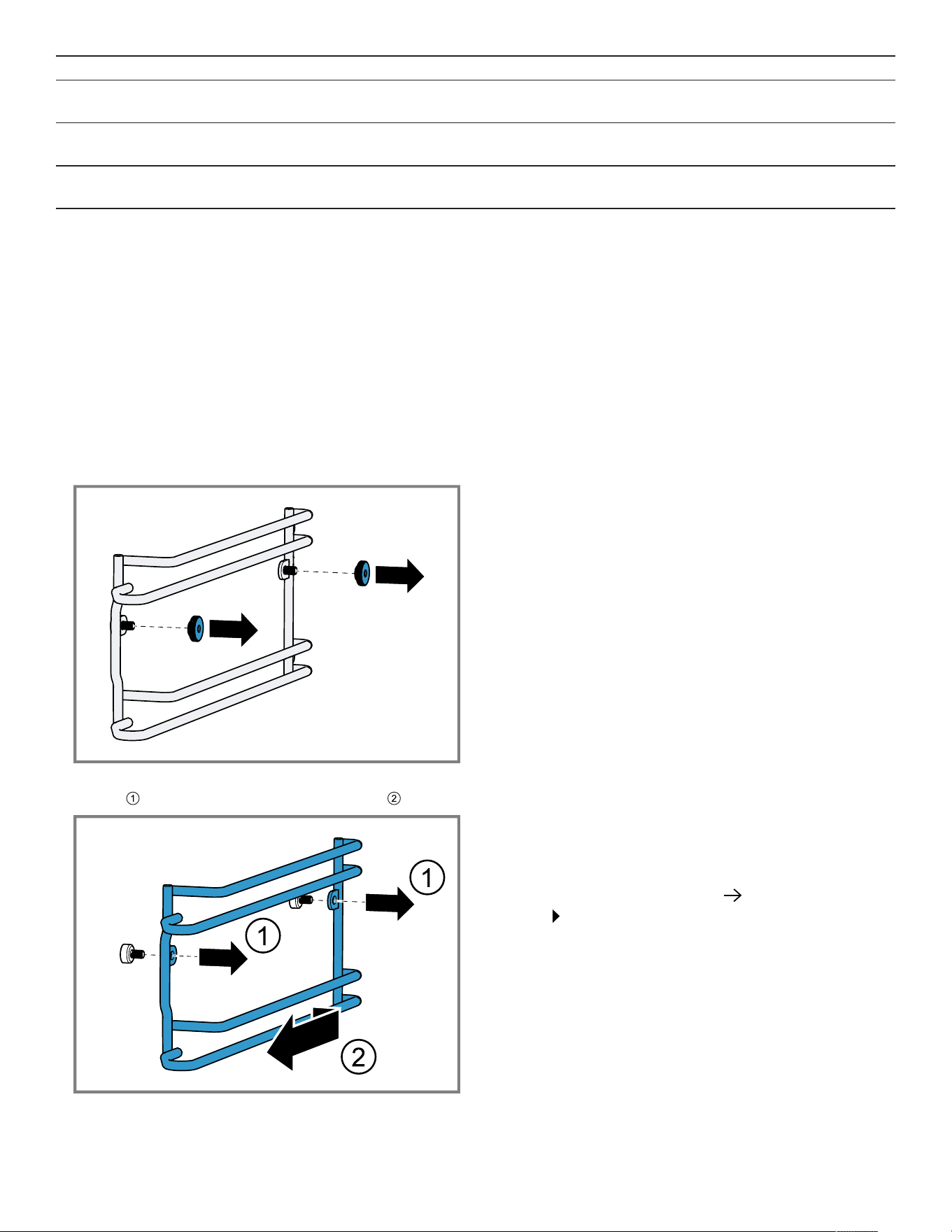
en-us Cleaning and maintenance
48
Area Suitable cleaning agents Information
Wire rack ¡ Hot soapy water In the event of heavy soiling, leave to soak and use a brush.
Do not clean in the dishwasher.
Glass tray ¡ Dishwasher
¡ Hot soapy water
Soak burned-on residues and remove with a brush.
Core temperature
probe
¡ Hot soapy water Wipe with a damp cloth
Do not clean in the dishwasher.
19.2 Microfiber cloth
The honeycomb microfiber cloth is especially suitable for
cleaning easily damaged surfaces, such as glass, glass
ceramic, stainless steel or aluminum. The microfiber cloth
removes liquid and greasy deposits in one go.
The microfiber cloth can be obtained from customer
service or from the online shop.
19.3 Removing the shelf supports
1. Place a dishcloth in the oven cavity to protect the
stainless steel from scratches.
2. Undo the knurled nuts.
3. Lift the shelf supports slightly sideways away from the
screws and pull them out towards the front .
4. Clean the shelf supports with hot soapy water.
19.4 Cleaning aid
The cleaning aid loosens stubborn dirt in the cooking
compartment and makes cleaning easier.
Always allow the cleaning aid to run to the end. You
cannot cancel the cleaning aid.
Preparing the cleaning aid
Requirement:The interior oven temperature is below
40°C.
1. Remove all accessories from the oven cavity.
2. Remove the shelf supports from the cooking
compartment. →
Page48
3. Clean the accessories and side shelf supports
separately.
4. Wipe out any coarse dirt.
5. Apply a cleaning agent to dirty surfaces in the cooking
compartment.
6. Place a microwave-safe dish with a drop of dishwashing
liquid and 200ml of water in the middle of the cooking
compartment.
7. Place a spoon in the dish to prevent delayed boiling.
8. Close the appliance door.
Starting the cleaning aid
Note:The appliance will take you through the necessary
steps.
1. Swipe repeatedly from left to right until the display
shows "Modes & Service".
a The display shows the available functions in a list menu.
2. Use the control ring to select the "Cleaning aid"
function.
3. Press the "Cleaning aid" list item.
4. Switch to the next window with .
5. Press to start.
a The cleaning time counts down.
a The light in the oven cavity remains switched off.
a An audible signal will sound once the cleaning time has
elapsed.
a The display shows a message.
6. Wipe out the oven cavity.
7. Wipe the oven cavity dry with a soft cloth.
8. Before using the oven again, remove any detergent
residue from the oven cavity.
9. Leave the cooking compartment to dry with the door
open.
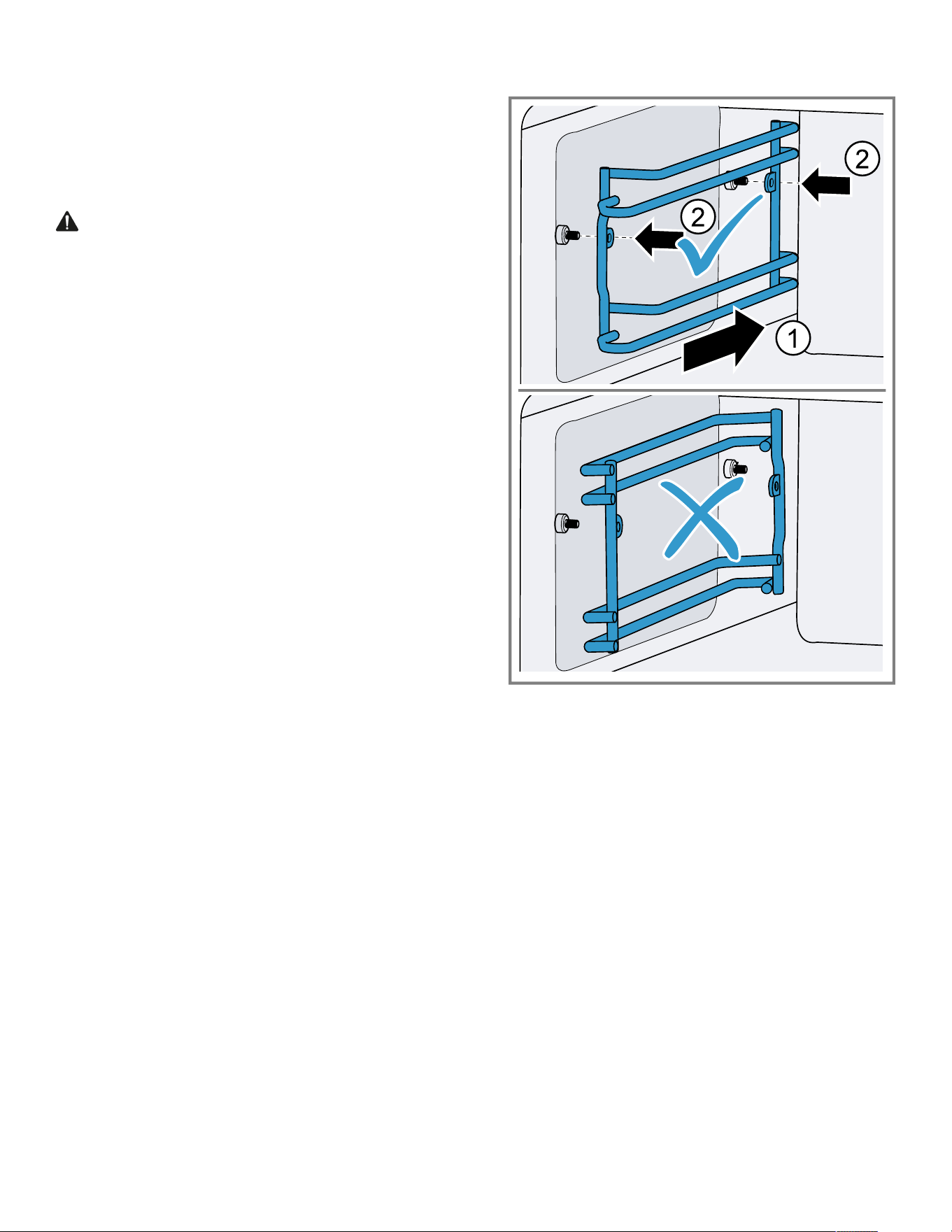
Cleaning and maintenance en-us
49
10.
Fit the shelf supports. →
Page49
→
"Fitting the shelf
supports", Page49
Note:If the cleaning aid was canceled due to a power cut,
it must be restarted before using the oven again in order to
remove any detergent residues from the appliance.
19.5 Fitting the shelf supports
WARNING
Loose knurled screws can become very hot during
operation.
▶
Ensure that the knurled screws for installing the shelf
supports are screwed in tightly.
NOTICE:
Loose knurled screws may cause sparks to form during
microwave operation. They damage the appliance by
producing sparks.
▶
Ensure that the knurled screws for installing the shelf
supports are screwed in tightly.
Incorrect spare parts may lead to corrosion in the oven
cavity.
▶
Only use the original knurled nuts.
1. Fit the shelf supports on the correct side of the cooking
compartment.
The shelf supports for the left and right side of the
cooking compartment are different.
2. Tighten the knurled nuts.
Note:If you lose a knurled nut, you can order this as a
spare part from our customer service.
19.6 Cleaning theaccessories
1.
Read the information on cleaning products. →
Page46
2. Soften baked-on food remnants with a damp dish cloth
and hot soapy water.
3. Clean the accessory with hot soapy water and a soft
dish cloth or a scrubbing brush.
4. Clean the wire rack.
Use oven cleaner to remove very heavy soiling.
5. Dry with a soft cloth.
19.7 Cleaning the glass floor
1.
Read the information on cleaning products. →
Page46
2. Clean the glass floor with hot detergent solution or a
glass cleaner and a soft dish cloth.
Do not use a glass scraper.
3. Dry with a soft cloth.

en-us How it works
50
How it works
20 How it works
How it works
Here, you can find the ideal settings for various dishes as
well as the best accessories and cookware. We have
perfectly tailored these recommendations to your
appliance.
20.1 What is the best way to proceed?
Tip
Cooking tips
¡ The recommended settings always apply to the cooking
compartment when it is cold and empty.
¡ The times specified in the overviews are intended as a
guide only. They depend on the quality and composition
of the food.
WARNING
Foods with peel or skin may burst or explode during
heating, or even afterwards.
▶
Never cook eggs in their shells or heat hard-boiled eggs
in their shells.
▶
Never cook shellfish or crustaceans.
▶
Always prick the yolk of eggs before microwaving.
▶
The skin of foods that have a peel or skin, such as
apples, tomatoes, potatoes and sausages, may burst.
Before heating, prick the peel or skin.
NOTICE:
Acidic food may damage the wire rack.
▶
Do not place acidic food, such as fruit or food with an
acidic marinade directly on the wire rack.
Note:Information for those allergic to nickel
In rare cases, small amounts of nickel may pass into the
food.
1. Before using the appliance, remove all unnecessary
cookware from the cooking compartment.
2. Select the required food from the recommended
settings.
3. Place the food in suitable cookware.
4. Place the cookware in the middle on the cooking
compartment floor.
The food will then absorb the microwaves from all sides.
5. Use the recommended settings when configuring the
appliance settings.
Set the shorter cooking time first. If necessary, increase
the cooking time.
6. Use a pot-holder when taking hot cookware out of the
cooking compartment.
20.2 General cooking tips
Take note of the following information when cooking all
types of food.
¡ The cooking times specified are intended as a guide.
The actual cooking time depends on the quality and
temperature of the food before cooking, as well as its
weight and thickness.
¡ Use the cookware specified. If you use other cookware,
cooking times may be longer or shorter.
¡ Always use plates, baking tins or ovenproof dishes with
the wire rack.
¡ If you have not made a particular dish before, start with
the shortest specified time. If required, you can continue
to cook the food.
¡ Open the oven cavity door on the preheated oven for a
short time only and quickly place your food inside the
appliance.
¡ When defrosting, dough proving and reheating, you can
use up to 2 rack levels at a time (rack levels 1 and 2).
The specified cooking times may need to be extended
for large quantities of food.
¡ If you are baking on just one level, use level 1.
¡ Ensure that the food does not lie against the oven cavity
or the back panel.
¡ When cooking at temperatures up to 210°F (100°C),
no preheating is necessary. Place the food in the cold
oven cavity and then switch on the appliance.
Preheating is only necessary for the "Hot air" type of
heating and temperatures above 210°F (100°C).
Troubleshooting en-us
51
Troubleshooting
21 Troubleshooting
Troubleshooting
You can eliminate minor issues on your appliance
yourself. Please read the information on eliminating issues
before contacting Customer Service. This may avoid
unnecessary repair visits.
WARNING
To avoid risk of injury from improper repairs, observe the
following.
▶
Only qualified technicians or authorized service
providers should perform repairs.
▶
If the power cord of this appliance becomes damaged, it
must be replaced by the manufacturer, the
manufacturer's Customer Service, or an authorized
service provider in order to prevent injury.
▶
Only genuine spare parts may be used to repair the
appliance.
▶
If the appliance has an issue, call Customer Service.
Issue Cause and troubleshooting
The appliance is not working. The plug for the power cord is not plugged in.
▶
Connect the appliance to the power supply.
The circuit breaker in the circuit breaker panel has tripped.
▶
Check the breaker panel.
There has been a power failure.
▶
Check whether the lighting in your kitchen or other appliances in the room are
working.
Operational fault
1. Switch off the fuse in the fuse box.
2. Switch the fuse on after approx. 10seconds.
3. If the malfunction occurs again, call customer service.
The appliance does not start. The appliance door is not fully closed.
▶
Close the appliance door.
The appliance cannot be started
via the HomeConnect® app.
The appliance is not connected to the HomeConnect® app.
▶
Start the connection between the appliance and the HomeConnect® app.
→
"Setting upHomeConnect®", Page38
The appliance is connected to the HomeConnect® app but the remote control
function is not activated.
▶
Activate the remote control function in the Home Connect settings →
Page39
.
Food takes longer than usual to
heat up.
The microwave output is set too low.
▶
Set a higher microwave output. →
Page26
A larger amount than usual has been placed in the appliance.
▶
Set a longer cooking time.
You need double the time when you have double the amount.
The food is colder than usual.
▶
Turn or stir the food from time to time during cooking.
The appliance is not working. The
display does not respond. The
display shows the symbol for the
childproof lock .
Childproof lock is activated.
▶
Deactivate the childproof lock. →
Page32
The appliance automatically
switches off.
Safety switch-off function: No operation for more than 12hours.
1. Press to confirm the message.
2. Switch off the appliance.
The appliance does not heat up;
the display shows the symbol for
the demo mode .
The appliance is in demo mode.
▶
Deactivate the demo mode in the basic settings →
Page41
.
en-us Disposal
52
Issue Cause and troubleshooting
The lighting does not work. The lighting is defective.
▶
Call
→
"Customer Service", Page52
.
Issue Cause and troubleshooting
The display shows the error
message "Exx".
An error occurred.
1. If the display shows an error message, press .
a If the display no longer shows the error message, it was a one-off problem.
2. If the display continues to show or repeatedly shows the error message, contact
customer service →
Page52
and provide them with the error code.
Display shows "Initialization". The initial start-up was not completed successfully.
▶
Carry out initial start-up.
→
"Initial use", Page23
The appliance's factory settings were restored.
▶
Carry out initial start-up.
→
"Initial use", Page23
Demo mode was activated during initial start-up and has now been deactivated.
▶
Carry out initial start-up.
→
"Initial use", Page23
21.1 Power failure
Your appliance can bridge a power failure of a few
seconds. The operation continues.
If the power failure lasts longer and the appliance was
operating, the display shows a message. The operation is
interrupted.
Switch the appliance back on again after a power failure
1. Press . 2. Switch theappliance back on again as usual.
21.2 Demo mode
If the display shows , demo mode is activated. The
appliance does not heat up.
Deactivating demo mode
1. To briefly disconnect the appliance from the mains,
switch off the household fuse or the circuit breaker in
the fuse box.
2. Deactivate demo mode within 3minutes in the basic
settings →
Page41
.
Disposal
22 Disposal
Disposal
22.1 Disposal of your old appliance
Environmentally compatible disposal allows valuable raw
materials to be recycled.
▶
Dispose of the appliance in an environmentally
responsible manner.
Information about current disposal methods can be
obtained from your specialist dealer or local authority.
Customer Service
23 Customer Service
Customer Service
With any warranty repair, we will make sure your
appliance is repaired by an authorized service provider
using genuine replacement parts. We use only genuine
replacement parts for all repairs.
Detailed information on the warranty period and terms of
warranty can be found in the Statement of Limited Product
Warranty, from your retailer, or on our website.
If you contact Customer Service, you will need the model
number (E-Nr.), the production number (FD) and the
consecutive numbering (Z-Nr.) of your appliance.
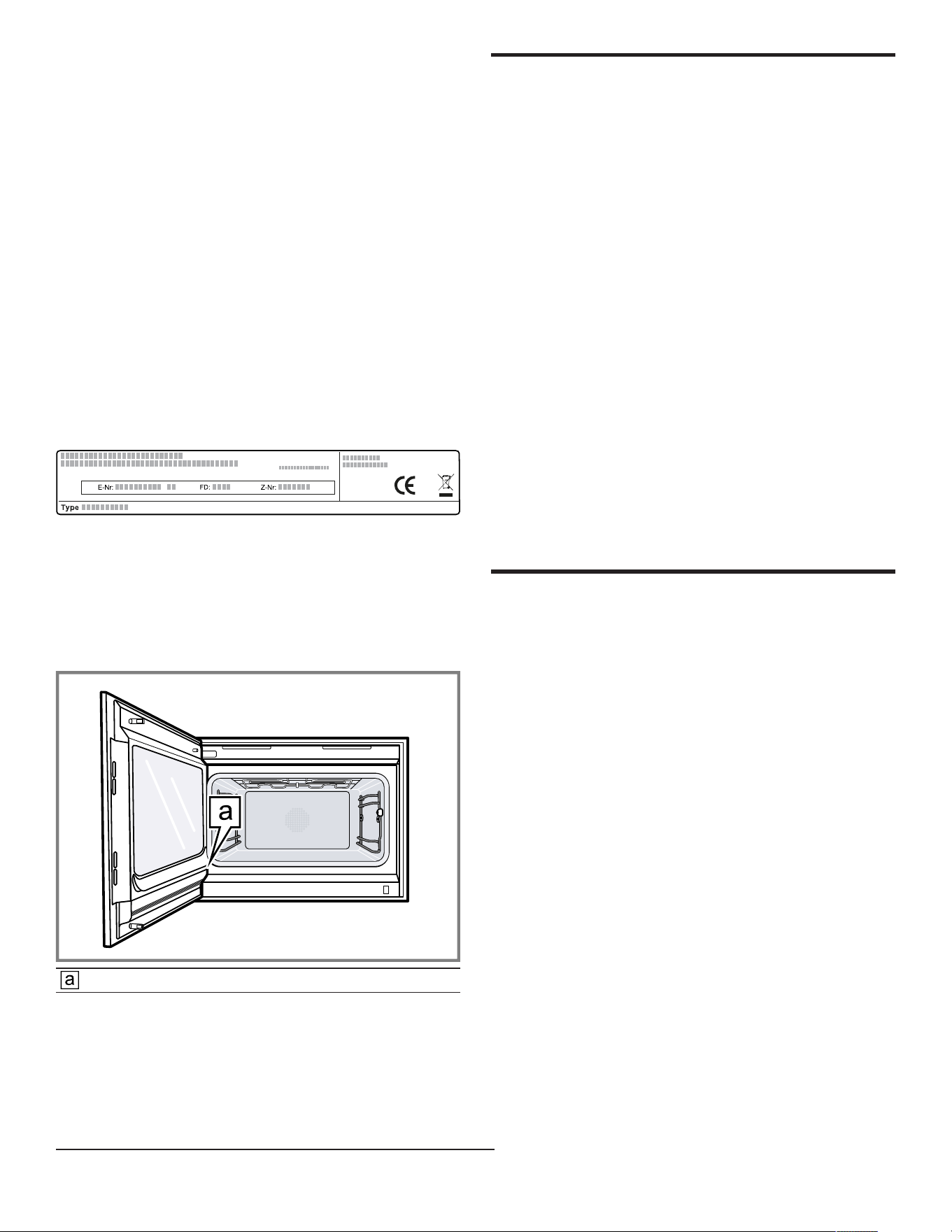
Information regarding Free and Open Source Software en-us
53
The LED light sources are available as a spare part and
should only be replaced by an authorized service provider.
USA:
1-877-442-4436
www.gaggenau.com
www.gaggenau.com/us/appliances/eshop
CA:
1-877-442-4436
www.gaggenau.com
www.gaggenau.ca
For assistance with connecting to HomeConnect®, you
can also view instructions here:
www.home-connect.com/us/en/help-support/set-up
23.1 Model number (E-Nr.), production
number (FD) and consecutive
numbering (Z-Nr.)
You can find the model number (E-Nr.), the production
number (FD) and the consecutive numbering (Z-Nr.) on
the appliance's rating plate.
Making a note of your appliance's details and the
Customer Service telephone number will enable you to
find them again quickly.
23.2 Rating plate location
The rating plate is located at the door frame close to the
lower door hinge.
Rating plate
Information regarding Free and Open Source Software
24 Information regarding Free and
Open Source Software
Information regarding Free and Open Source Software
This product includes software components that are
licensed by the copyright holders as free or open source
software.
The applicable license information is stored on your home
appliance. You can also access the applicable license
information via your HomeConnect® app: "Profile ->
Legal information -> License Information".
1
You can also
download the license information on the brand product
website. (Please search on the product website for your
appliance model and additional documents). Alternatively,
you can request the relevant information from
[email protected] or BSH Hausgeräte GmbH, Carl-
Wery-Str. 34, 81739 Munich, Germany.
The relevant source code will be made available to you on
request.
Please send your request to [email protected] or
BSH Hausgeräte GmbH, Carl-Wery-Str.34, 81739 Munich,
Germany.
Subject: „OSSREQUEST“
The cost of performing your request will be charged to
you. This offer is valid for three years from the date of
purchase or at least as long as we offer support and spare
parts for the relevant appliance.
STATEMENT OF LIMITED PRODUCT WARRANTY
25 STATEMENT OF LIMITED
PRODUCT WARRANTY
STATEMENT OF LIMITED PRODUCT WARRANTY
25.1 What this warranty covers & Who it
applies to
The limited warranty provided by BSH Home Appliances
(“Gaggenau“) in this Statement of Limited Product
Warranty applies only to the Gaggenau appliance sold to
you (“Product“), provided that the Product was purchased:
¡ For your normal, household (non-commercial) use, and
has in fact at all times only been used for normal
household purposes.
¡ New at retail from a BSH authorized dealer or directly
from BSH (not a display, "as is", or previously returned
model), and not for resale, or commercial use.
¡ Within the United States or Canada, and has at all times
remained within the country of original purchase.
The warranties stated herein apply to the original
purchaser of the product warranted herein and to each
succeeding owner of the product purchased for ordinary
home use during the term of the warranty.
Please make sure to register your Product; while not
necessary to effectuate warranty coverage, it is the best
way for Gaggenau to notify you in the unlikely event of a
safety notice or product recall.
1
Depending on the appliance specifications

en-us STATEMENT OF LIMITED PRODUCT WARRANTY
54
25.2 How long the warranty lasts
Gaggenau warrants that the Product is free from defects in
materials and workmanship for a period of seven hundred
and thirty (730) days from the date of the original delivery.
The foregoing timeline begins to run upon the date of
original delivery, and shall not be stalled, tolled, extended,
or suspended, for any reason whatsoever. This Product is
also warranted to be free from cosmetic defects in
material and workmanship (such as scratches of stainless
steel, paint/porcelain blemishes, chips, dents, or other
damage to the finish) of the Product, for a period of sixty
(60) days from the date of delivery or closing date for new
construction. This cosmetic warranty excludes slight color
variations due to inherent differences in painted and
porcelain parts, as well as differences caused by kitchen
lighting, product location, or other similar factors. This
cosmetic warranty specifically excludes any display, floor,
“As Is”, or “B” stock appliances.
25.3 Repair/replace as your exclusive
remedy
During this warranty period, Gaggenau or one of its
authorized service providers will repair your Product
without charge to you (subject to certain limitations stated
herein) if your Product proves to have been manufactured
with a defect in materials or workmanship. If reasonable
attempts to repair the Product have been made without
success, then Gaggenau will replace your Product
(upgraded models may be available to you, in Gaggenau's
sole discretion, for an additional charge). Nothing in this
warranty requires damaged or defective parts to be
replaced with parts of a different type or design than the
original parts. All removed parts and components shall
become the property of Gaggenau at its sole option. All
replaced and/or repaired parts shall assume the identity of
the original part for purposes of this warranty and this
warranty shall not be extended with respect to such parts.
Gaggenau's sole liability and responsibility hereunder is to
repair manufacturer-defective Product only, using a
Gaggenau authorized service provider during normal
business hours. For safety and property damage
concerns, Gaggenau highly recommends that you do not
attempt to repair the Product yourself, or use a non-
authorized service provider; Gaggenau will have no
responsibility or liability for damage resulting from repairs
or work performed by a non-authorized service provider.
Authorized service providers are those persons or
companies that have been specially trained on Gaggenau
products, and who possess, in Gaggenau's opinion, a
superior reputation for customer service and technical
ability (note that they are independent entities and are not
agents, partners, affiliates or representatives of
Gaggenau). Nevertheless, taking your product to be
serviced by a repair shop that is not affiliated with or an
authorized dealer of Gaggenau will not void this warranty.
Also, using third-party parts will not void this warranty.
Notwithstanding the foregoing, Gaggenau will not incur
any liability, or have responsibility, for the Product if it is
located in a remote area (more than 100 miles from an
authorized service provider) or is reasonably inaccessible,
hazardous, threatening, or treacherous locale,
surroundings, or environment; in any such event, if you
request, Gaggenau would still pay for labor and parts and
ship the parts to the nearest authorized service provider,
but you would still be fully liable and responsible for any
travel time or other special charges by the service
company, assuming they agree to make the service call.
Further, to the extent you have installed the Product in a
difficult-to-access location or have otherwise installed
temporary or permanent fixtures that create barriers to
accessing or removing the Product, Gaggenau will not
incur any liability for, or have responsibility, for work or
costs associated with moving the Product or otherwise
creating access to the Product in order to repair or replace
it. All such costs shall be your sole responsibility.
25.4 Out of warranty product
Gaggenau is under no obligation, at law or otherwise, to
provide you with any concessions, including repairs,
prorates, or Product replacement, once this warranty has
expired.
25.5 Warranty exclusions
The warranty coverage described herein excludes all
defects or damage that are not the direct fault of
Gaggenau, including without limitation, one or more of the
following:
¡ Use of the Product in anything other than its normal,
customary and intended manner (including without
limitation, any form of commercial use, use or storage of
an indoor product outdoors, use of the Product in
conjunction with air or water-going vessels).
¡ Any party's willful misconduct, negligence, misuse,
abuse, accidents, neglect, improper operation, failure to
maintain, improper or negligent installation, tampering,
failure to follow operating instructions, mishandling,
unauthorized service (including selfperformed "fixing" or
exploration of the appliance's internal workings).
¡ Adjustment, alteration or modification of any kind.
¡ A failure to comply with any applicable state, local, city,
or county electrical, plumbing and/or building codes,
regulations, or laws, including failure to install the
product in strict conformity with local fire and building
codes and regulations.
¡ Ordinary wear and tear, spills of food, liquid, grease
accumulations, or other substances that accumulate on,
in, or around the Product.
¡ Any external, elemental and/or environmental forces
and factors, including without limitation, rain, wind,
sand, floods, fires, mud slides, freezing temperatures,
excessive moisture or extended exposure to humidity,
lightning, power surges, structural failures surrounding
the appliance, and acts of God.
¡ Service calls to correct the installation of your Product,
to instruct you how to use your Product, to replace
house fuses or correct house wiring or plumbing.

STATEMENT OF LIMITED PRODUCT WARRANTY en-us
55
¡ Removal and replacement of trim or decorative panels
that interfere with servicing the Product.
¡ Damage or defects caused by labor or parts installed by
any non-authorized service provider, unless approved
by Gaggenau before service is performed.
In no event shall Gaggenau have any liability or
responsibility whatsoever for damage to surrounding
property, including cabinetry, floors, ceilings, and other
structures or objects around the Product. Also excluded
from this warranty are Products, on which the serial
numbers have been altered, defaced, or removed; service
visits to teach you how to use the Product, or visits where
there is nothing wrong with the Product; correction of
installation problems (you are solely responsible for any
structure and setting for the Product, including all
electrical, plumbing or other connecting facilities, for
proper foundation/flooring, and for any alterations
including without limitation cabinetry, walls, floors,
shelving, etc.); and resetting of breakers or fuses.
TO THE EXTENT ALLOWED BY LAW, THIS WARRANTY
SETS OUT YOUR EXCLUSIVE REMEDIES WITH
RESPECT TO PRODUCT, WHETHER THE CLAIM
ARISES IN CONTRACT OR TORT (INCLUDING STRICT
LIABILITY, OR NEGLIGENCE) OR OTHERWISE. THIS
WARRANTY IS IN LIEU OF ALL OTHER WARRANTIES,
WHETHER EXPRESS OR IMPLIED. ANY WARRANTY
IMPLIED BY LAW, WHETHER FOR MERCHANTABILITY
OR FITNESS FOR A PARTICULAR PURPOSE, OR
OTHERWISE, SHALL BE EFFECTIVE ONLY FOR THE
PERIOD THAT THIS EXPRESS LIMITED WARRANTY IS
EFFECTIVE. IN NO EVENT WILL THE MANUFACTURER
BE LIABLE FOR CONSEQUENTIAL, SPECIAL,
INCIDENTAL, INDIRECT, "BUSINESS LOSS", AND/OR
PUNITIVE DAMAGES, LOSSES, OR EXPENSES,
INCLUDING WITHOUT LIMITATION TIME AWAY FROM
WORK, HOTELS AND/OR RESTAURANT MEALS,
REMODELLING EXPENSES IN EXCESS OF DIRECT
DAMAGES WHICH ARE DEFINITIVELY CAUSED
EXCLUSIVELY BY GAGGENAU, OR OTHERWISE.
SOME STATES DO NOT ALLOW THE EXCLUSION OR
LIMITATION OF INCIDENTAL OR CONSEQUENTIAL
DAMAGES, AND SOME STATES DO NOT ALLOW
LIMITATIONS ON HOW LONG AN IMPLIED WARRANTY
LASTS, SO THE ABOVE EXCLUSIONS OR
LIMITATIONS MAY NOT APPLY TO YOU. THIS
WARRANTY GIVES YOU SPECIFIC LEGAL RIGHTS,
AND YOU MAY ALSO HAVE OTHER RIGHTS WHICH
VARY FROM STATE TO STATE.
No attempt to alter, modify or amend this warranty shall be
effective unless authorized in writing by an officer of BSH.
25.6 Obtaining warranty service
To obtain warranty service for your product, you should
contact Gaggenau Customer Support at 1-877-442-4436
to schedule a repair.
25.7 Product information
For handy reference, copy the information below from the
rating plate. Keep your invoice and/or delivery documents
for warranty validation.
Model number (E-Nr.)
Production number
(FD)
Date of delivery

BSH Home Appliances Corporation
1901 Main Street, Suite 600
Irvine, CA 92614
USA
www.gaggenau.com
1-877-442-4436
© 2025 BSH Home Appliances Corporation
*9001954909*
9001954909 en-us (051022)