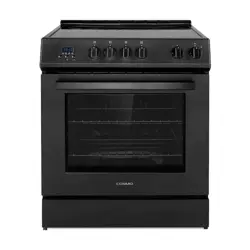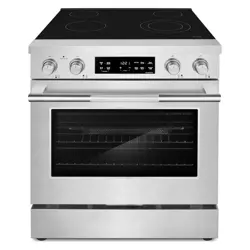
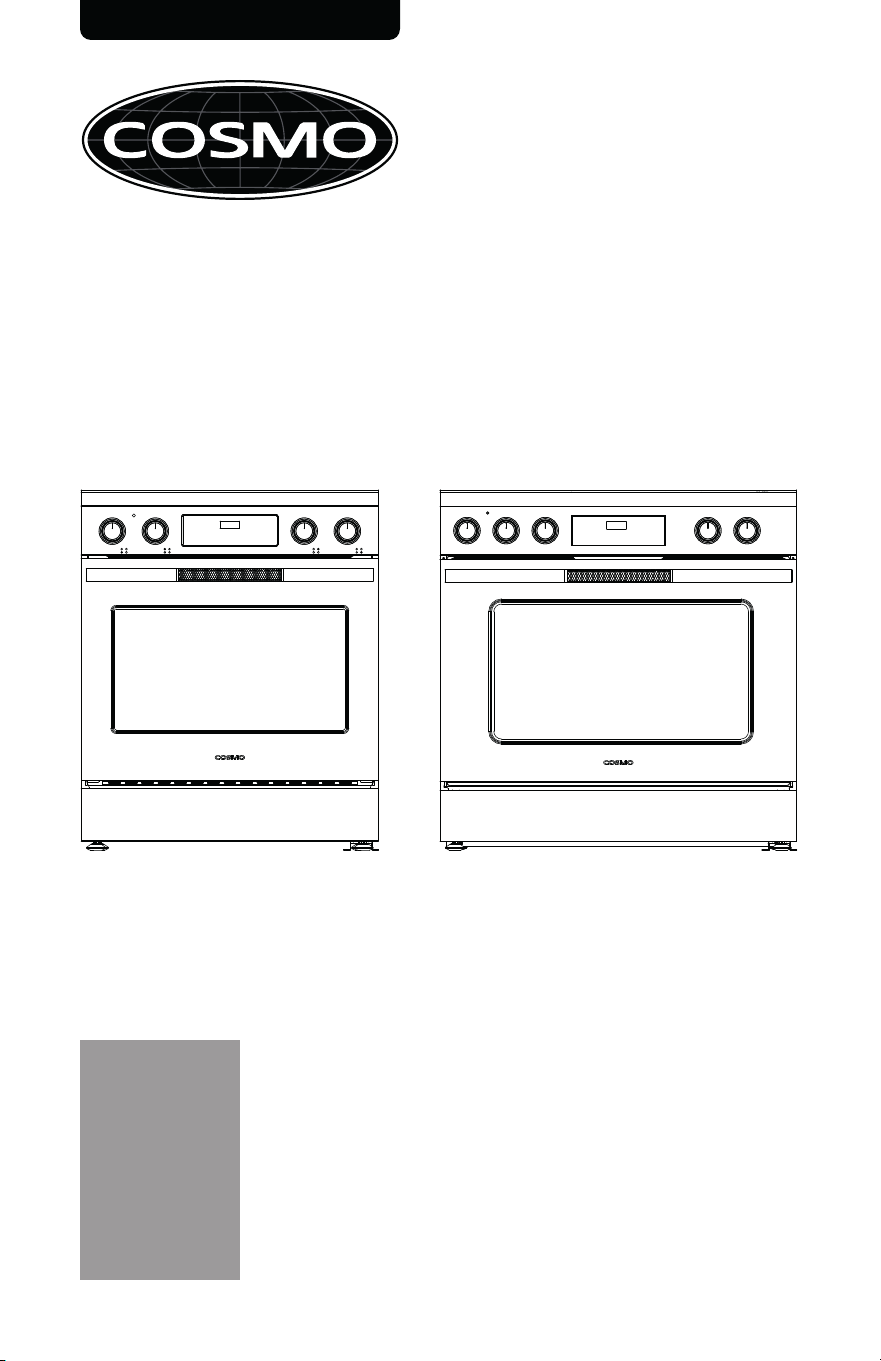
RANGE
COS-RES304SS
USER MANUAL
READ AND SAVE THESE INSTRUCTIONS.
FOR RESIDENTIAL USE ONLY.
PLEASE LEAVE THESE INSTRUCTIONS WITH THIS UNIT FOR
THE OWNER.
PLEASE RETAIN THESE INSTRUCTIONS FOR FUTURE
REFERENCE.
IMPORTANT:
INSTALLER:
OWNER:
SLIDE-IN ELECTRIC RANGE
COS-RES365SS
Rev.25.07
2
THANK YOU FOR YOUR PURCHASE
Thank you for your purchase. We know that you have many brands and
products to choose from and we are honored to know that you have decided
to take one of our products into your home and hope that you enjoy it.
COSMO Appliances are designed according to the strictest safety and
performance standard for the North American market. We follow the most
advanced manufacturing philosophy. Each appliance leaves the factory after
thorough quality inspection and testing. Our distributors and our service
partners are ready to answer any questions you may have regarding how to
install, use and care for your products. We hope that this manual will help you
learn to use the product in the safest and most effective manner.
Before using this product, please read through this manual carefully. Keep
this user manual in a safe place for future reference. Please ensure that other
persons using this product are familiar with these instructions as well.
If you have any questions or concerns, please contact the dealer from whom you
purchased the product, or contact our Customer Support at:
1-888-784-3108
Reach us online at:
www.cosmoappliances.com

3
TABLE OF CONTENTS
Range Safety .................................................................................................... 5
Anti-Tip Device ....................................................................................................... 7
Important Safety Instructions .............................................................................. 8
Overview .......................................................................................................... 13
Range Layout ......................................................................................................... 13
Accessories Included ............................................................................................ 15
Operation ........................................................................................................ 16
Control Panel ......................................................................................................... 16
Features .................................................................................................................. 18
Clock ................................................................................................................ 18
Timer ................................................................................................................ 19
Oven Light ..................................................................................................... 20
Oven Control Lock ........................................................................................ 20
Oven Settings ................................................................................................. 21
Cook Time ...................................................................................................... 22
Delay Start ..................................................................................................... 24
Cooktop ................................................................................................................. 26
Before Using the Cooktop .......................................................................... 26
Cooking Areas .............................................................................................. 27
Hot Surface Indicator .................................................................................. 29
Using the Cooktop Elements ...................................................................... 29
In Case of Power Failure ............................................................................. 30
Using the Proper Cookware ........................................................................ 31
Oven ....................................................................................................................... 33
Before Using the Oven ................................................................................ 33
Before Using the Oven for the First Time ................................................. 34
Oven Vent ...................................................................................................... 34
Oven Door ..................................................................................................... 35
Using Oven Racks ......................................................................................... 35
Preheating ..................................................................................................... 37
Minimum & Maximum Default Settings ................................................... 38

4
Bake ................................................................................................................ 39
Convection Bake ......................................................................................... 40
Air Fry ............................................................................................................. 42
Broil ................................................................................................................. 43
Keep Warm ................................................................................................... 45
Tips and Techniques .................................................................................... 46
Range Care and Maintenance ....................................................................... 49
Manual Cleaning ................................................................................................. 49
Steam Clean .......................................................................................................... 55
Troubleshooting ............................................................................................. 58
Before Calling for Service ................................................................................... 58
Error Codes ............................................................................................................ 63
Limited Warranty ........................................................................................... 64
5
RANGE SAFETY
Read All Instructions Before Using the Appliance
Your safety and the safety of others are very important.
We have provided many important safety messages in this manual and on
your appliance. Always read and obey all safety messages.
WARNING
CAUTION
This is the safety alert symbol.
This symbol alerts you to potential hazards that
can kill or hurt you and others.
All safety messages will follow the safety alert
symbol and either the word "WARNING" or
"CAUTION." These words mean:
You can be killed or seriously injured if you don't
follow instructions.
A potentially hazardous situation which, if not
avoided, could result in minor or moderate injury.
All safety messages will tell you what the potential hazard is, tell you how
to reduce the chance of injury, and tell you what can happen if the
instructions are not followed.
California Proposition 65 Warning
WARNING: Cancer and Reproductive Harm - www.P65Warnings.ca.gov.
6
WARNING
• This appliance is intended for normal residential use. It is not approved
for commercial use, outdoor installation, or any other application not
specifically allowed by this manual.
• This appliance requires connection to a 3-prong or 4-prong, 240VAC
single-phase (split-phase), 60Hz grounded electrical source dedicated
to the appliance. When installed, appliance must be electrically
grounded in accordance with local codes or, in the absence of local
codes, with the National Electrical Code, NFPA 70 or the Canadian
Electric Code, CSA C22.1-02.
• Proper installation is the responsibility of the installer. Any adjustment
and service should be performed only by qualified oven installers or
service technicians. The manufacturer is not responsible for any injury or
damage that may result from incorrect or defective installation by
unauthorized personnel.
• Product failure due to improper installation is not covered under
warranty.
• Do not use a steam cleaner to clean the appliance.
• This appliance is not intended to be operated with separate remote
control system.
7
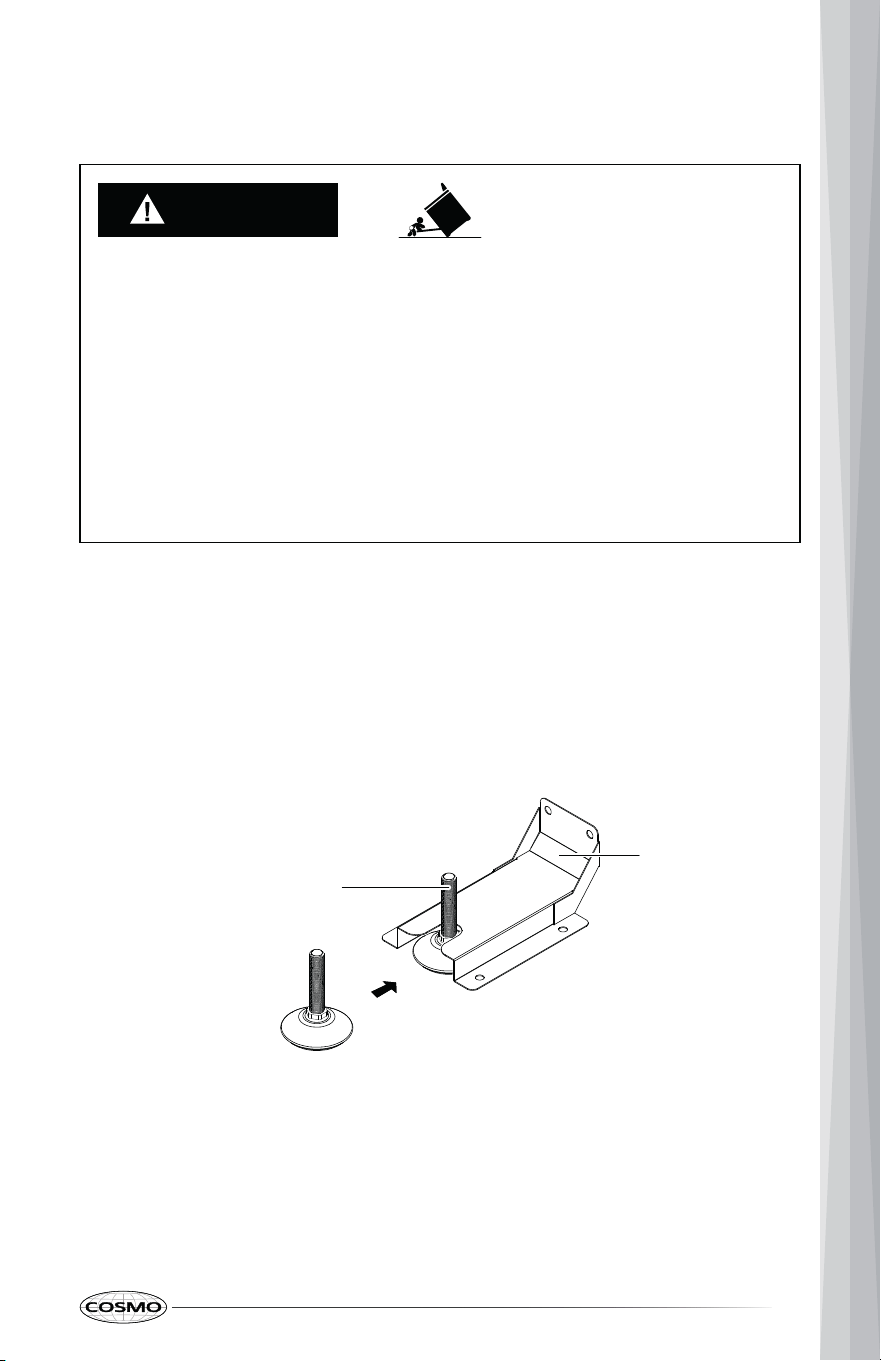
ANTI-TIP DEVICE
WARNING
Tip Over Hazard
Making sure the anti-tip bracket is installed:
• Slide range forward.
• Look for the anti-tip bracket securely attached to floor or wall.
• Slide range back and make sure rear range foot is under anti-tip bracket.
• A child or adult can tip the range and be killed.
• Install anti-tip bracket to floor or wall per installation instructions.
• Slide range back so rear range foot is engaged in the slot of the anti-tip
bracket.
• Re-engage anti-tip bracket if range is moved.
• Do not operate range without anti-tip bracket installed and engaged.
• Failure to follow these instructions can result in death or serious burns to
children and adults.
Rear range foot
Anti-tip bracket
8
IMPORTANT SAFETY INSTRUCTIONS
WARNING: To reduce the risk of fire, electrical shock, injury to persons, or
damage when using the range, follow basic precautions, including the
following:
• WARNING: TO REDUCE THE RISK OF TIPPING OF THE RANGE, THE
RANGE MUST BE SECURED BY PROPERLY INSTALLED ANTI-TIP DEVICES.
TO CHECK IF THE DEVICES ARE INSTALLED PROPERLY, SLIDE RANGE
COMPLETELY FORWARD, LOOK FOR ANTI-TIP BRACKET SECURELY
ATTACHED TO THE FLOOR OR WALL, AND SLIDE RANGE BACK SO THE
REAR RANGE FOOT IS UNDER ANTI-TIP BRACKET.
• CAUTION: Do not store items of interest to children in cabinets above a
range or on the back guard of a range – children climbing on the range
to reach items could be seriously injured.
• Do Not Leave Children Alone – Children should not be left alone or
unattended in area where range is in use. They should never be allowed
to sit or stand on any part of the appliance.
• Never use your appliance for warming or heating the room.
• Use this appliance only for its intended purpose as described in this
manual.
• Proper Installation – The appliance, when installed, must be electrically
grounded in accordance with local codes, or in the absence of local
codes, with the National Electrical Code, ANSI/NFPA 70 or the
Canadian Electrical Code, CSA C22.1-02. In Canada, the appliance must
be electrically grounded in accordance with Canadian Electrical Code.
Be sure your appliance is properly installed and grounded by a
qualified technician.
• User Servicing – Do not repair or replace any part of the range unless
specifically recommended in the manual. All other servicing should be
referred to a qualified technician.
• Before performing any service, unplug the range or disconnect the
power supply at the household distribution panel by removing the fuse
or switching off the circuit breaker.
• Do Not Use Water on Grease Fires – Smother fire or flame or use dry
chemical or foam-type extinguisher.
READ AND SAVE THESE INSTRUCTIONS
9
IMPORTANT SAFETY INSTRUCTIONS
• If there is a fire in the oven during baking, smother the fire by closing
the oven door and turning the oven off or by using a multi-purpose dry
chemical or foam-type fire extinguisher.
• Do not use any type of foil or liner to cover the oven bottom or
anywhere in the oven, except as described in this manual. Oven liners
can trap heat or melt, resulting in damage to the product and risk of
shock, smoke or fire.
• Use Only Dry Potholders – Moist or damp potholders on hot surfaces
may result in burns from steam. Do not let potholder touch hot heating
elements. Do not use a towel or other bulky cloth.
• DO NOT TOUCH SURFACE UNITS OR AREAS NEAR UNITS – Surface units
may be hot even though they are dark in color. Areas near surface units
may become hot enough to cause burns. During and after use, do not
touch, or let clothing or other flammable materials contact surface units
or areas near units until they have had sufficient time to cool. Among
these areas are the coil elements, the cooktop, and surfaces facing the
cooktop.
• DO NOT TOUCH HEATING ELEMENTS OR INTERIOR SURFACES OF OVEN
– Heating elements may be hot even though they are dark in color.
Interior surfaces of an oven become hot enough to cause burns. During
and after use, do not touch, or let clothing or other flammable materials
contact heating elements or interior surfaces of oven until they have
had sufficient time to cool. Other surfaces of the appliance may
become hot enough to cause burns – among these surfaces are oven
vent openings and surfaces near these openings, oven doors, and
windows of oven doors.
• Do Not Cook on Broken Cooktop – If cooktop should break, cleaning
solutions and spillovers may penetrate the broken cooktop and create a
risk of electric shock. Contact a qualified technician immediately.
• Avoid scratching or impacting glass doors, cooktops, or control panels.
The cooktop can be scratched with items such as knives, sharp
instruments, rings or other jewelry, and rivets on clothing. Doing so may
lead to glass breakage.
• Never Leave Surface Units Unattended at High Heat Settings – Boilover
causes smoking and greasy spillovers that may ignite.
READ AND SAVE THESE INSTRUCTIONS
10
IMPORTANT SAFETY INSTRUCTIONS
• Do Not Heat Unopened Food Containers – Build-up of pressure may
cause container to burst and result in injury.
• Wear Proper Apparel – Loose-fitting or hanging garments should never
be worn while using the appliance.
• Use Proper Pan Size – This appliance is equipped with one or more
surface units of different size. Select utensils having flat bottoms large
enough to cover the surface unit heating element. The use of
undersized utensils will expose a portion of the heating element to
direct contact and may result in ignition of clothing. Proper relationship
of utensil to heating element will also improve efficiency.
• Glazed Cooking Utensils – Only certain types of glass, glass/ceramic,
ceramic, earthenware, or other glazed utensils are suitable for range-
top service without breaking due to the sudden change in temperature.
• Utensil Handles Should Be Turned Inward and Not Extend Over
Adjacent Surface Units – To reduce the risk of burns, ignition of
flammable materials, and spillage due to unintentional contact with the
utensil, the handle of a utensil should be positioned so that it is turned
inward, and does not extend over adjacent surface units.
• If power is lost to an electric cooktop with knob surface unit controls
while a surface unit is ON, the surface unit will turn back on as soon as
power is restored. In the event of power loss, failure to turn all surface
unit knobs to the OFF position may result in ignition of items on or near
the cooktop, leading to serious injury or death.
• Do not place or store items that can melt or catch fire on the glass
cooktop, even when it is not being used. If the cooktop is inadvertently
turned on, they may ignite. Heat from the cooktop or oven vent after it
is turned off may cause them to ignite also.
• Use Care When Opening Door – Let hot air or steam escape before
removing or replacing food.
• Never broil with door open. Open-door broiling is not permitted due to
overheating of control knobs.
• Care must be taken to prevent aluminum foil and meat probes from
contacting heating elements.
READ AND SAVE THESE INSTRUCTIONS
11
IMPORTANT SAFETY INSTRUCTIONS
• Placement of Oven Racks – Always place oven racks in desired location
while oven is cool. If rack must be moved while oven is hot, do not let
potholder contact hot heating element in oven.
• Injuries may result from misuse of appliance doors or drawers such as
stepping, leaning, or sitting on the doors or drawers.
• Storage in or on Appliance – Flammable materials should not be stored
in an oven or near surface units.
• This appliance is not intended for storage.
• Maintenance – Keep range area clear and free from combustible
materials, gasoline, and other flammable vapors and liquids.
• Do not let cooking grease or other flammable materials accumulate in
or near the range. Grease in the oven or on the cooktop may ignite.
• Keep Oven Vent Ducts Unobstructed.
• Clean Cooktop With Caution – If a wet sponge or cloth is used to wipe
spills on a hot cooking area, be careful to avoid steam burn. Some
cleaners can produce noxious fumes if applied to a hot surface.
• Use care when touching the cooktop. The glass surface of the cooktop
will retain heat after the controls have been turned off.
• Do Not Soak Removable Heating Elements – Heating elements should
never be immersed in water.
• Do Not Clean Door Gasket – The door gasket is essential for a good
seal. Care should be taken not to rub, damage, or move the gasket.
• Do Not Use Oven Cleaners – No commercial oven cleaner or oven liner
protective coating of any kind should be used in or around any part of
the oven.
• Clean Only Parts Listed in Manual.
• Do not use replacement parts that have not been recommended by the
manufacturer (e.g. parts made at home using a 3D printer).
• Proper Disposal of Your Appliance – Dispose of or recycle your
appliance in accordance with Federal and Local Regulations. Contact
your local authorities for the environmentally safe disposal or recycling
of your appliance.
READ AND SAVE THESE INSTRUCTIONS
12
IMPORTANT SAFETY INSTRUCTIONS
For units with ventilating hood
• Clean Ventilating Hoods Frequently – Grease should not be allowed to
accumulate on hood or filter.
• When flaming foods under the vent hood, turn the fan on.
For self-cleaning ranges
• Before Self-Cleaning the Oven – Remove broiler pan and other utensils.
Wipe off all excessive spillage before initiating the cleaning cycle.
• Wait for the oven to cool before removing contents and cleaning the
oven.
• In the event of ignition inside the oven during self-clean, turn off the
oven and wait for the fire to extinguish. DO NOT FORCE THE DOOR
OPEN. Introduction of fresh air at Self Clean temperatures may lead to
a burst of flame from the oven.
• If the self-cleaning mode malfunctions, keep door closed, turn off the
appliance, disconnect the circuit at the circuit breaker box, and contact
a qualified service provider for repairs.
• Some birds are extremely sensitive to the fumes produced during a self-
clean cycle. Move birds to another well-ventilated room.
READ AND SAVE THESE INSTRUCTIONS
13
OVERVIEW
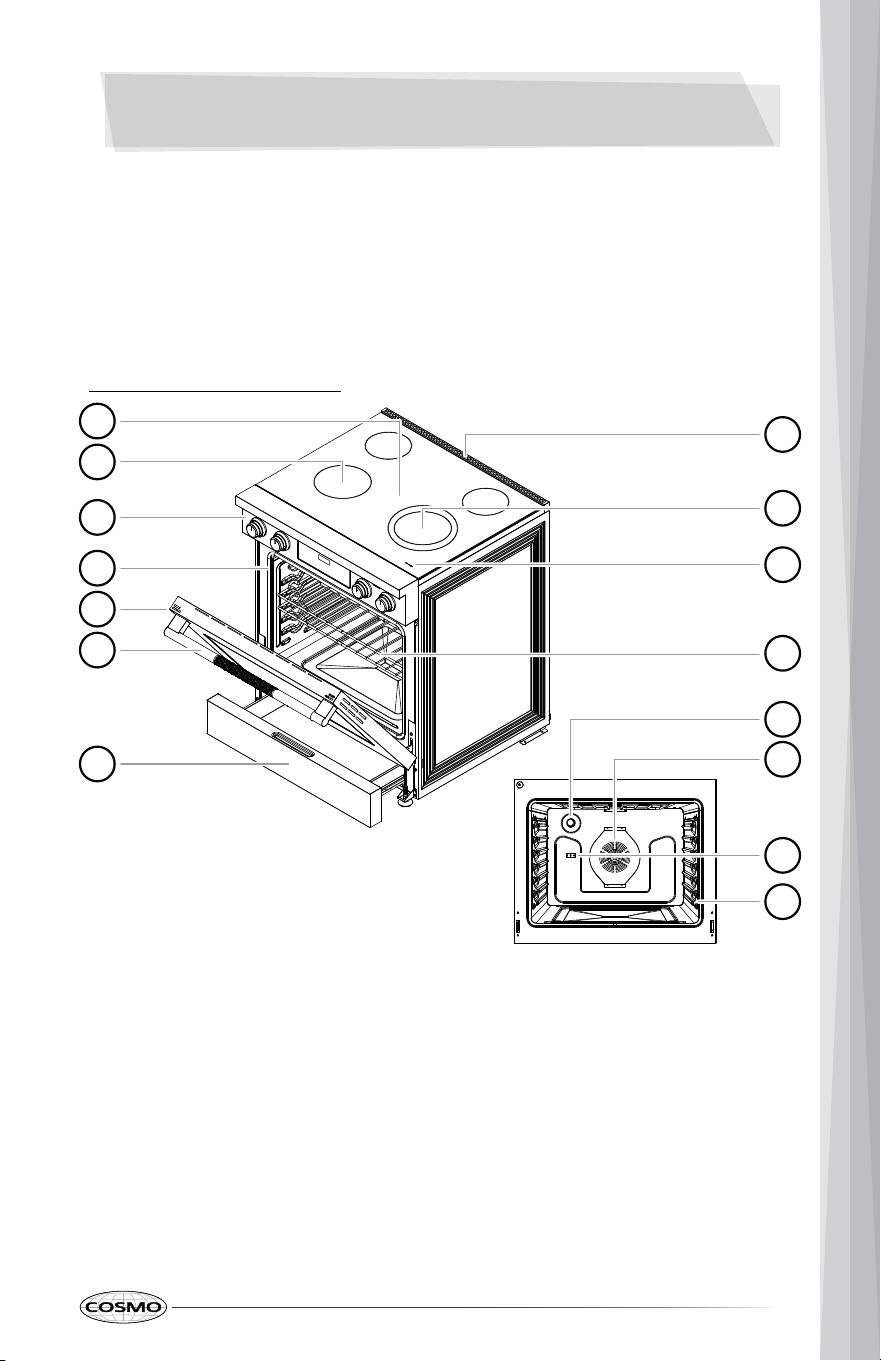
RANGE LAYOUT
The range you have purchased may have some or all of the items listed. The
locations and appearances of the features shown here may not match those
of your model.
08. Oven vent
09. Surface heating element (dual)
10. Hot surface indicator
11. Oven rack
12. Oven light
13. Convection fan
14. Temperature sensor
15. Rack position
30" Model: COS-RES304SS
01
02
03
04
05
06
07
08
10
11
14
12
13
15
09
01. Glass-ceramic cooktop
02. Surface heating elemen t (single)
03. Control panel
04. Door gasket
05. Oven door
06. Oven door handle
07. Storage drawer
14
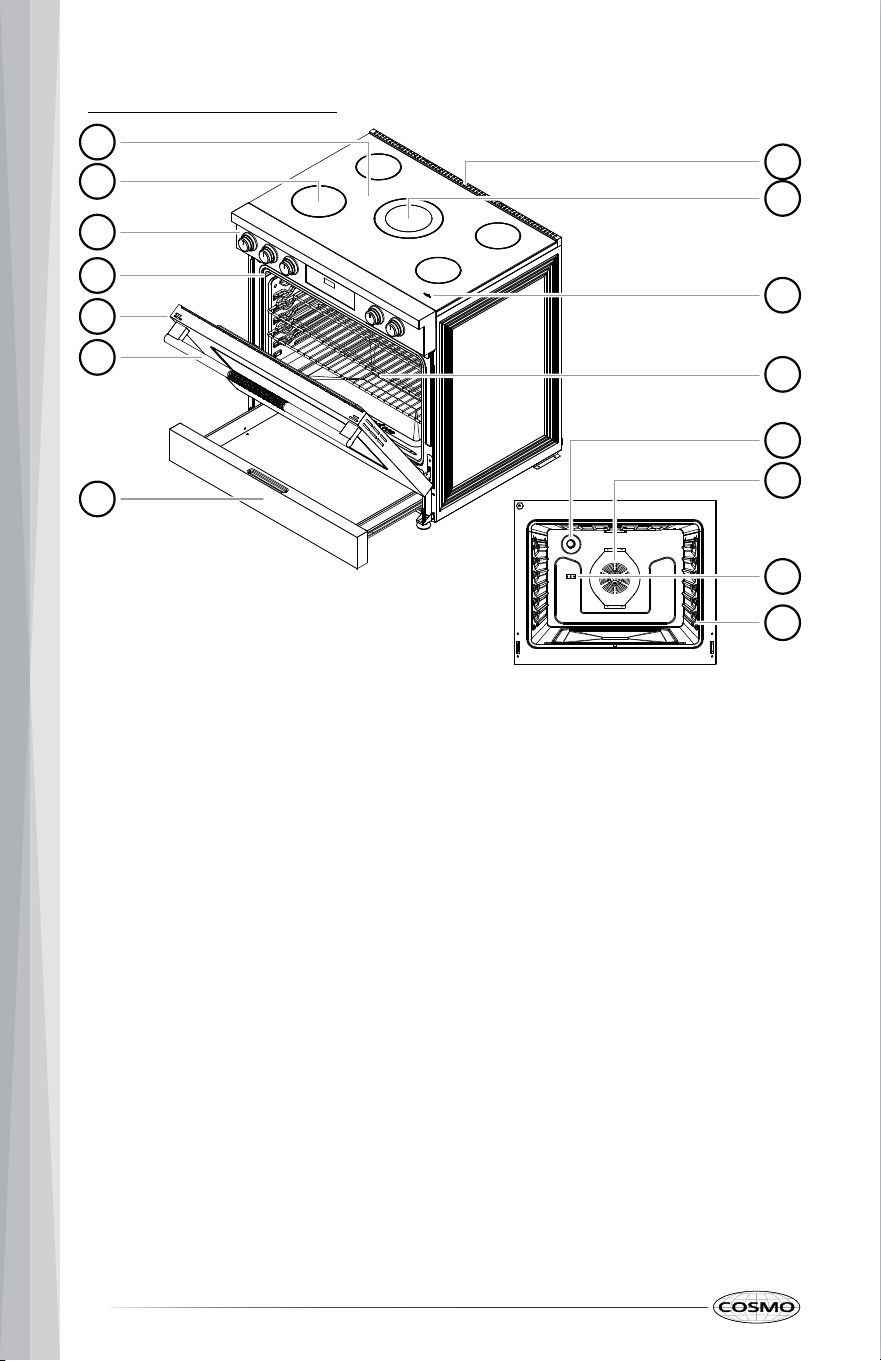
01. Glass--ceramic cooktop
02. Surface heating element (single)
03. Control panel
04. Door gasket
05. Oven door
06. Oven door handle
07. Storage drawer
08. Oven vent
09. Surface heating element (dual)
10. Hot surface indicator
11. Oven rack
12. Oven light
13. Convection fan
14. Temperature sensor
15. Rack position
36" Model: COS-RES365SS
01
02
03
04
05
06
07
08
10
11
14
12
13
15
09
15
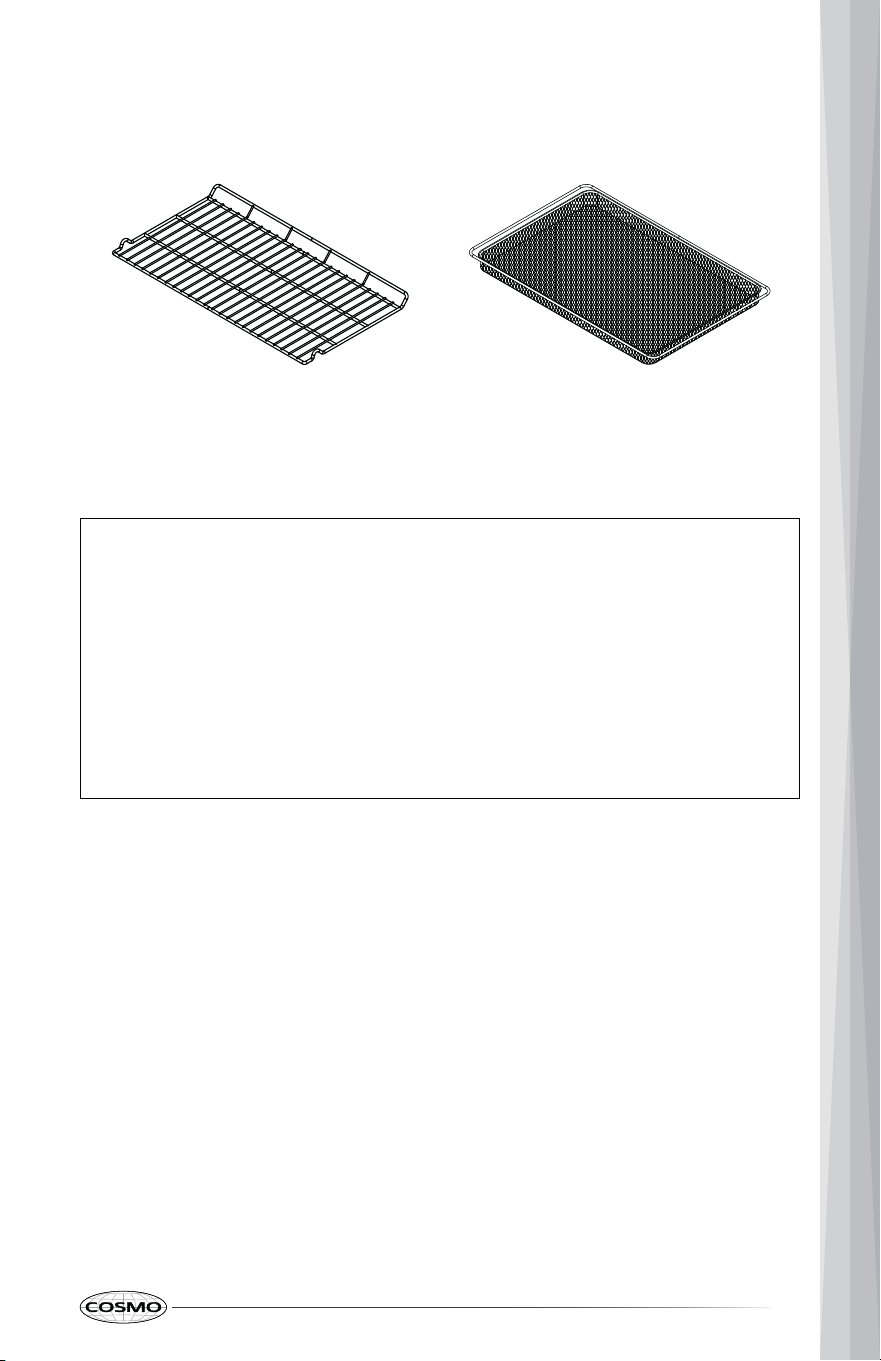
ACCESSORIES INCLUDED
Oven racks (2)
Note:
• Reference the contact information at the end of this manual and
contact customer service if any accessories are missing.
• To purchase replacement parts or any other accessories, please visit
www.cosmoappliances.com or reference the contact information at the
end of this manual.
• The images in this guide may be different from the actual components
and accessories, which are subject to change by the manufacturer
without prior notice for product improvement purposes.
Air fry tray
16
OPERATION
30" Model: COS-RES304SS
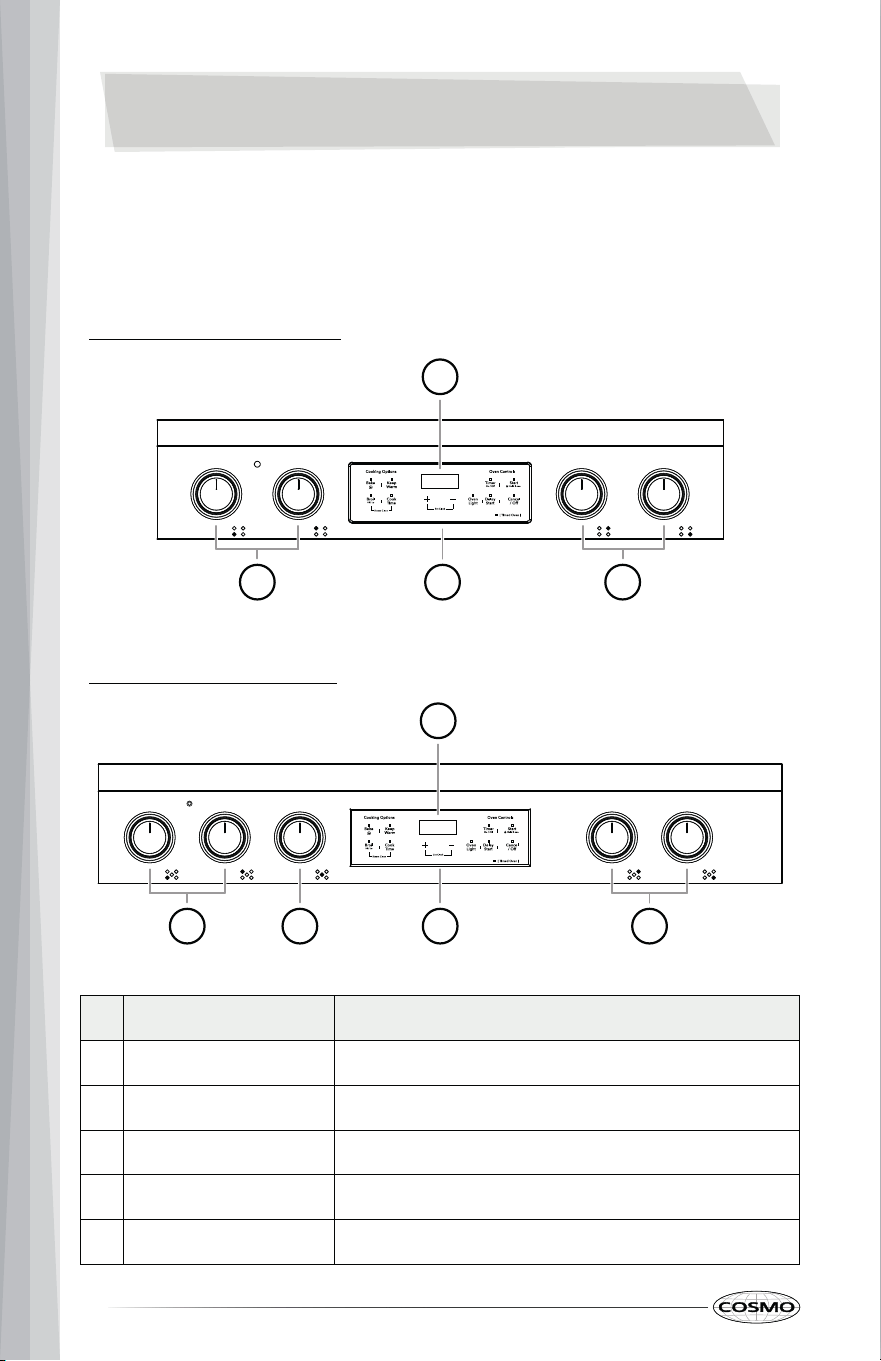
CONTROL PANEL
The appearance of the knobs may vary from what is shown below.
36" Model: COS-RES365SS
# Name Description
01
02 Cooktop elements To turn the left elements on and off.
03 Cooktop element To turn the middle element on and off.
04
Display To show the time and provide oven status.
Oven/Timer controls
05
To turn the oven functions or timer on and off.
Cooktop elements To turn the right elements on and off.
02 04
01
02 03 0504
01
05
17
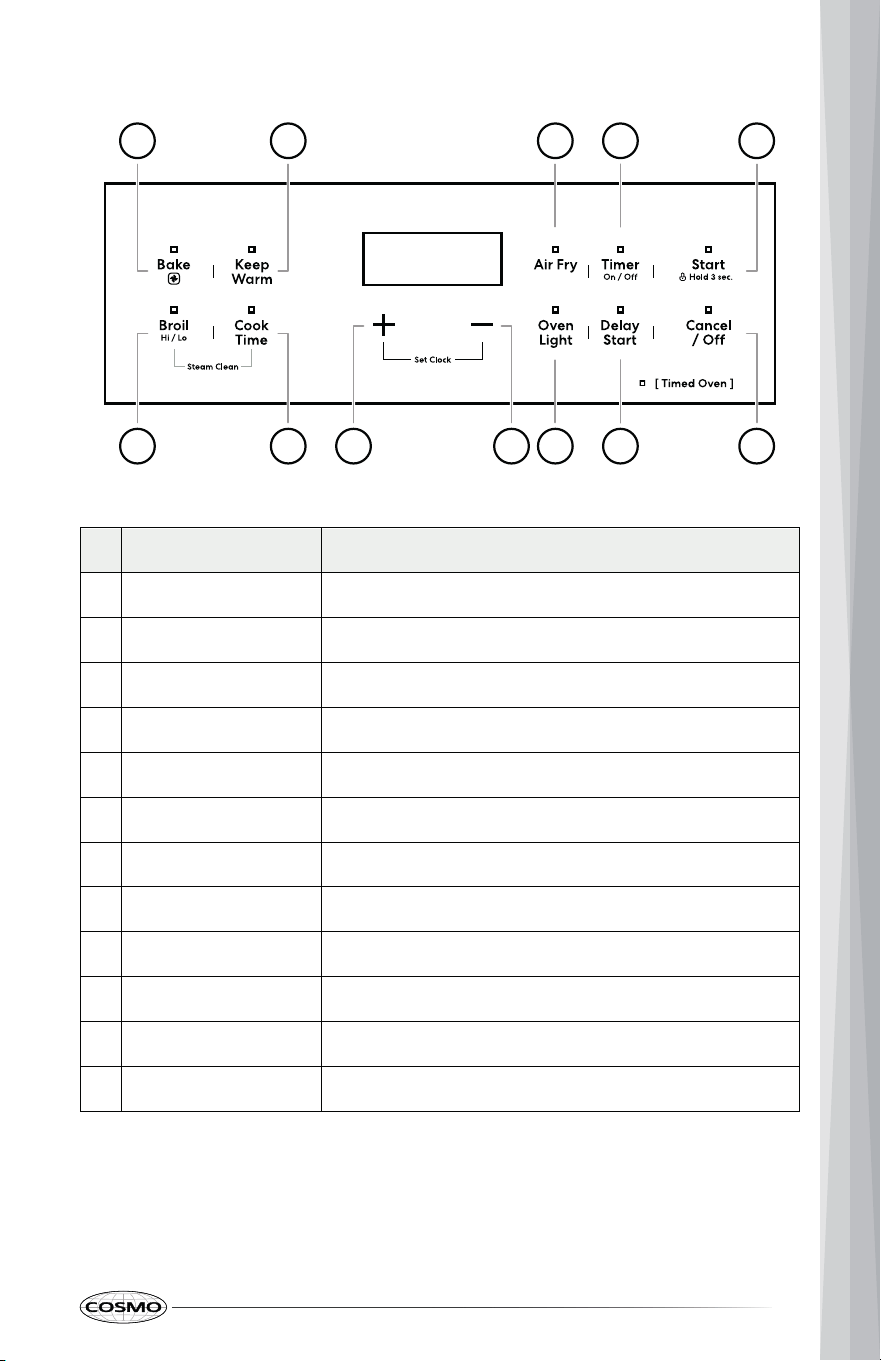
OVEN CONTROLS
# Name Description
06 Bake
07 Keep Warm
To select the Bake or Convection Bake function.
08
To select the Keep Warm function.
Broil
09
To select the Hi Broil or Lo Broil function.
Cook Time
10 +
To set the length of the cook time.
11 -
To increase temperature and all times.
12
To decrease temperature and all times.
Air Fry
13
To select the Air Fry function.
Timer
14
To set or cancel the timer.
Oven Light
15
To turn the oven light on and off.
Delay Start
16
To set the length of the delay time.
Start
17
To start all functions of the oven.
Cancel/Off To stop oven functions or cancel settings.
0908 1110 14 15 17
07
06
16
12 13
18
Setting the Clock
FEATURES
CLOCK
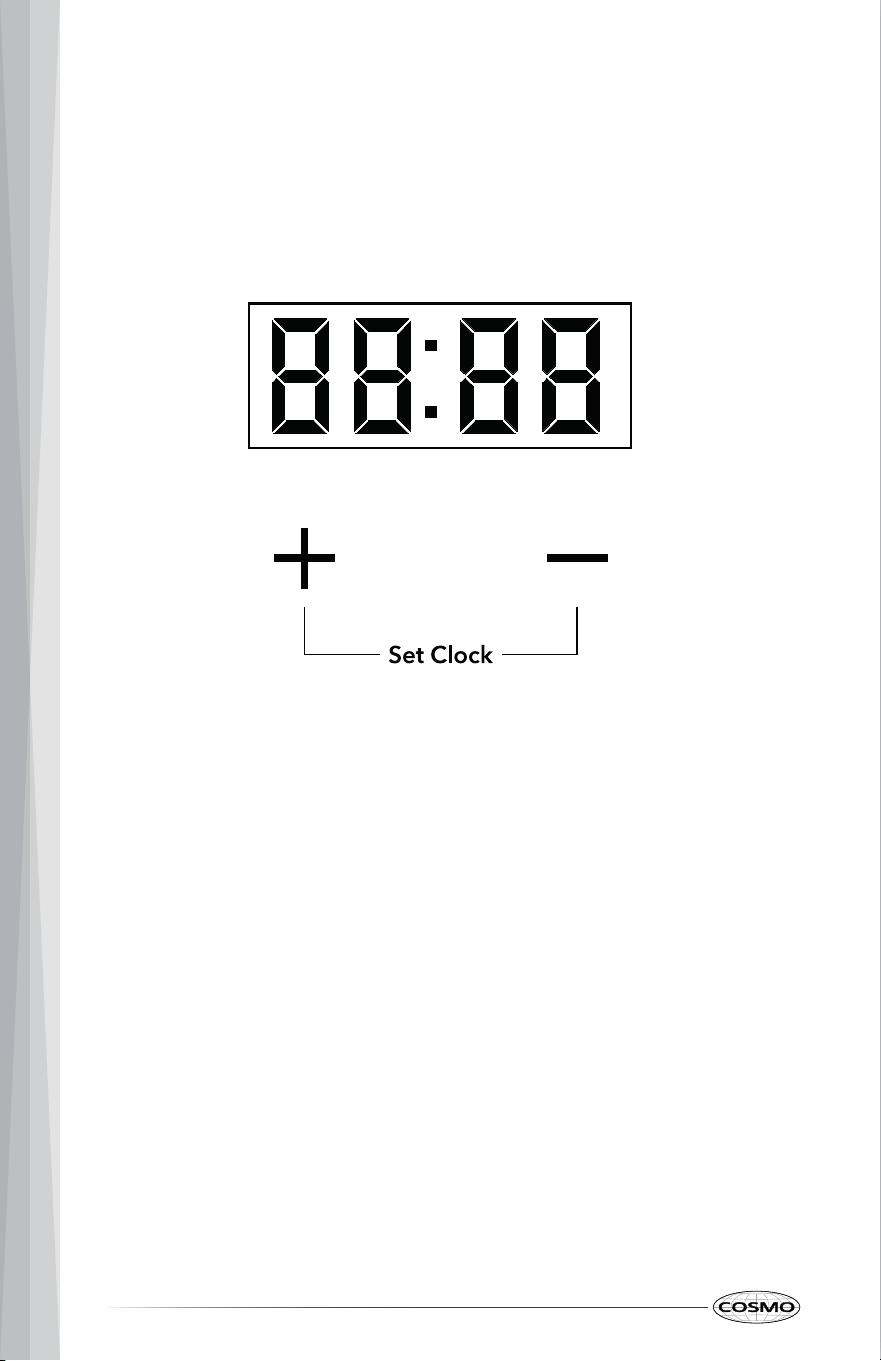
The digital clock displays the time of day when the oven is not in use. The
control is set to use a 12-hour clock.
Changing the Hour Mode
1. Press + and - at the same time.
The current clock flashes in the display.
2. Press/hold + or - to adjust the clock.
3. Press Start to confirm and start the clock.
1. Press and hold + and - at the same time for 3 seconds to toggle and
select 12-hour or 24-hour clock.
The display will show the selected hour mode 12H or 24H for 3 seconds.

19
TIMER
The timer serves as an extra timer in the kitchen that beeps when the set time
has run out. It does not start or stop cooking. The timer feature can be used
during any of the other oven control functions.
Setting the Timer (Up to 24 Hours)
1. Press Timer On/Off once.
"0:00" appears and flashes in the display.
2. Press/hold + or - to set the length of time.
3. Press Timer On/Off to start the timer.
The remaining time countdown appears in the display for a few seconds
before the clock returns.
Note:
• Timer indicator light above Timer On/Off flashes, indicating a
timer is counting down.
• Pressing Timer On/Off will recall the remaining time in the display
for a few seconds.
• For remaining time less than a minute, the display shows MM:SS
(minutes:seconds); for remaining time over a minute, the display
shows HH:MM (hours:minutes).
4. When the set time runs out, "00:00" flashes in the display and the
indicator tone sounds for about 20 seconds. Press Cancel/Off to cancel
the tone early.
Changing the Timer
1. Press Timer On/Off once.
The remaining time will flash in the display for a few seconds.
2. While the remaining time is flashing, press/hold + or - to set the new
length of time.
20
3. Press Timer On/Off to start the timer.
Canceling the Timer
1. Press and hold Timer On/Off for 3 seconds or until the timer indicator
light turns off.
Note:
• Pressing Cancel/Off will not cancel the current timer, but will cancel
any oven cooking modes in progress.
OVEN LIGHT
The interior oven light automatically turns on and off when the door is opened
and closed.
1. Press Oven Light to manually turn the oven light on or off.
OVEN CONTROL LOCK
The Oven Control Lock feature locks most of the oven controls. The Timer,
Oven Light, Start, and Cancel/Off are the only usable pads when the lock is
activated.
1. To activate the oven control lock, press and hold Start for 3 seconds.
2. To deactivate the oven control lock, press and hold Start for 3 seconds.
21
OVEN SETTINGS
The oven settings can be accessed while the oven is idle and the display is
showing the time of day. The settings remain in the control’s memory after a
power failure or until changed.
Available oven settings:
• Adjusting the Oven Thermostat - calibrate the oven temperature
• Selecting Fahrenheit or Celsius - switch the temperature scale
Adjusting the Oven Thermostat
This oven may cook differently than the one it replaced. Use the oven for a
few weeks to become more familiar with it before adjusting the thermostat
settings.
Do not use thermometers, such as those found in grocery stores, to check the
temperature setting of your oven. These thermometers may vary 20°F – 40°F.
Note:
• The thermostat adjustment will affect Bake, Convection Bake, Broil
(Hi/Lo), Keep Warm, and Air Fry. This adjustment will not affect Steam
Clean.
• The adjustment will be retained in memory after a power failure.
• The ov
en temperature can be increased (+) or decreased (-) as much as
35°F (19°C).
1. Press and hold Bake and Broil at the same time for 3 seconds while the
oven is idle.
2. Press/hold + or - to set the desired temperature adjustment.
Examples:
• 15 raises the oven temperature by 15 degrees
• -15 lowers the oven temperature by 15 degrees
3. Press Start to accept the change.
22
Selecting Fahrenheit or Celsius
The oven is set to display the Fahrenheit temperature scale. Follow these
instructions to set the display to either the Celsius or Fahrenheit scales.
1. Press and hold Bake for 3 seconds to toggle and select F (Fahrenheit) or C
(Celsius).
The display will show the selected temperature scale F or C for 3 seconds.
COOK TIME
Set the oven to cook for a specific length of time and turn off automatically at
the end of the cooking time.
CAUTION
Food Poisoning Hazard
• Do not let food sit in oven more than one hour before or after cooking.
• Foods that can easily spoil such as milk, eggs, fish, meat or poultry,
should be chilled in the refrigerator first. Even when chilled, they should
not stand in the oven for more than 1 hour before cooking begins, and
should be removed promptly when finished cooking. Consuming spoiled
food can result in food poisoning or sickness.
Setting a Timed Cook
For example, to Bake at 375°F for 30 minutes.
1. Adjust oven rack levels as needed.
2. Press Bake to select Bake mode
3. Press/hold + or - to set the bake temperature to 375°F.
4. Press Cook Time.
23
Note:
• Cook Time can only be used with the Bake, Convection Bake, and
Air Fry modes.
5. Press/hold + or - to set the cooking time to 0:30.
6. Press Start.
The oven starts to preheat and PRE appears in the display. Keep the oven
door closed, and wait for the oven to preheat to the set temperature.
Note:
• The Timed Oven indicator lights up on the control panel, indicating
an automatic oven is set.
• When the preheat has completed, the set temperature appears in
the display and the indicator tone sounds for a few seconds. The
cooking time countdown starts.
7. Place the food in the oven.
The oven will continue to cook for the set amount of time and then turn
off automatically.
8. When the cooking time has elapsed, END shows in the display. The cook
end indicator tone sounds until Cancel/Off or any pad is pressed. Remove
the food from the oven.
Changing the Cook Time during Cooking
For example, to change the cook time to 1 hour during cooking.
1. Press Cook Time.
2. Press/hold + or - to change the cooking time to 1:00.
3. Press Start to accept the change.
24
Changing the Temperature during Cooking
For example, to change the bake temperature to 300°F.
1. Press Bake.
2. Press/hold + or - to change the bake temperature to 300°F.
3. Press Start to accept the change.
DELAY START
Set the oven to turn on automatically after a specific length of time. With both
Delay Start and Cook Time set, the oven automatically turns on after a
specific length of time and turns off after a selected length of cooking time.
CAUTION
Food Poisoning Hazard
• Do not let food sit in oven more than one hour before or after cooking.
• Foods that can easily spoil such as milk, eggs, fish, meat or poultry,
should be chilled in the refrigerator first. Even when chilled, they should
not stand in the oven for more than 1 hour before cooking begins, and
should be removed promptly when finished cooking. Consuming spoiled
food can result in food poisoning or sickness.
Setting a Delayed Timed Cook
For example, to Bake at 375°F for 30 minutes and delay the start of baking by
45 minutes.
1. Adjust oven rack levels as needed.
2. Press Bake to select Bake mode.
25
3. Press/hold + or - to set the bake temperature to 375°F.
4. Press Cook Time.
Note:
• Cook Time can only be used with the Bake, Convection Bake, and
Air Fry modes.
5. Press/hold + or - to set the cooking time to 0:30.
6. Press Delay Start.
7. Press/hold + or - to set the delaying time to 0:45.
8. Press Start to confirm.
Note:
• The Timed Oven indicator lights up on the control panel, indicating
an automatic oven is set.
• When the delaying time has elapsed, the oven automatically turns
on and starts to preheat. After preheating, the oven will continue to
cook for the set amount of time and then turn off automatically.
9. When the cooking time has elapsed, END shows in the display. The cook
end indicator tone sounds until Cancel/Off or any pad is pressed. Remove
the food from the oven.
26
COOKTOP
BEFORE USING THE COOKTOP
Read all instructions before using.
WARNING
• Do not cook on a broken cooktop. If the cooktop is broken, cleaning
solutions and spillovers may penetrate the broken cooktop and create a
risk of electric shock. Contact a qualified technician immediately.
• Do not place or store items that can melt or catch fire on the glass
cooktop, even when it is not being used.
• Never leave surface units unattended at high heat settings. Boilovers
cause smoking and greasy spills that may catch on fire.
• Keep flammable items away from the cooktop.
• Turn off all controls when done cooking.
• Turn cookware handles inward and not extend over adjacent surface
units to reduce the risk of burns, ignition of flammable materials, and
spillage due to unintentional contact with the cookware.
• Always place the pan in the center of the surface unit you are cooking
on. Proper contact of cookware to heating element also will improve
efficiency.
• Clean cooktop with caution. If a wet sponge or cloth is used to wipe
spills on a hot cooking area, be careful to avoid steam burn. Some
cleaners can produce noxious fumes if applied to a hot surface.
27
CAUTION
• Never cook directly on the glass. Always use cookware.
• Do not use the glass cooktop surface as a cutting board.
• Do not slide metal or glass across the cooktop surface. Cookware with
rough or uneven bottoms can mark or scratch the cooktop surface.
• Do not place sealed containers on the cooktop.
• Do not place aluminum foil or plastic items such as salt and pepper
shakers, spoon holders, or plastic wrappings or any other material on
the range when it is in use.
• Do not turn surface units on before placing cookware.
• Always turn the surface units off before removing cookware.
• The surface element may appear to have cooled after it has been
turned off. The element may still be hot and touching the element
before it has cooled sufficiently can cause burns.
• Only certain types of glass, glass-ceramic, ceramic, earthenware, or
other glazed cookware are suitable for range-top service without
breaking due to the sudden change in temperature.
• Choose proper heating element size. For smaller pots and pans, use the
smaller heating elements. For larger pots and pans, use the larger
heating elements. Select pans that have flat bottoms large enough to
cover the heating elements. Using undersized pans exposes a portion of
the heating element to direct contact and may result in clothing
burning.
• Immediately clean spills on the cooking area to prevent a tough
cleaning chore later.
• Do not use a steel-wool pad or scrub pad or abrasive cleaning pads.
They can scratch the surface.
COOKING AREAS
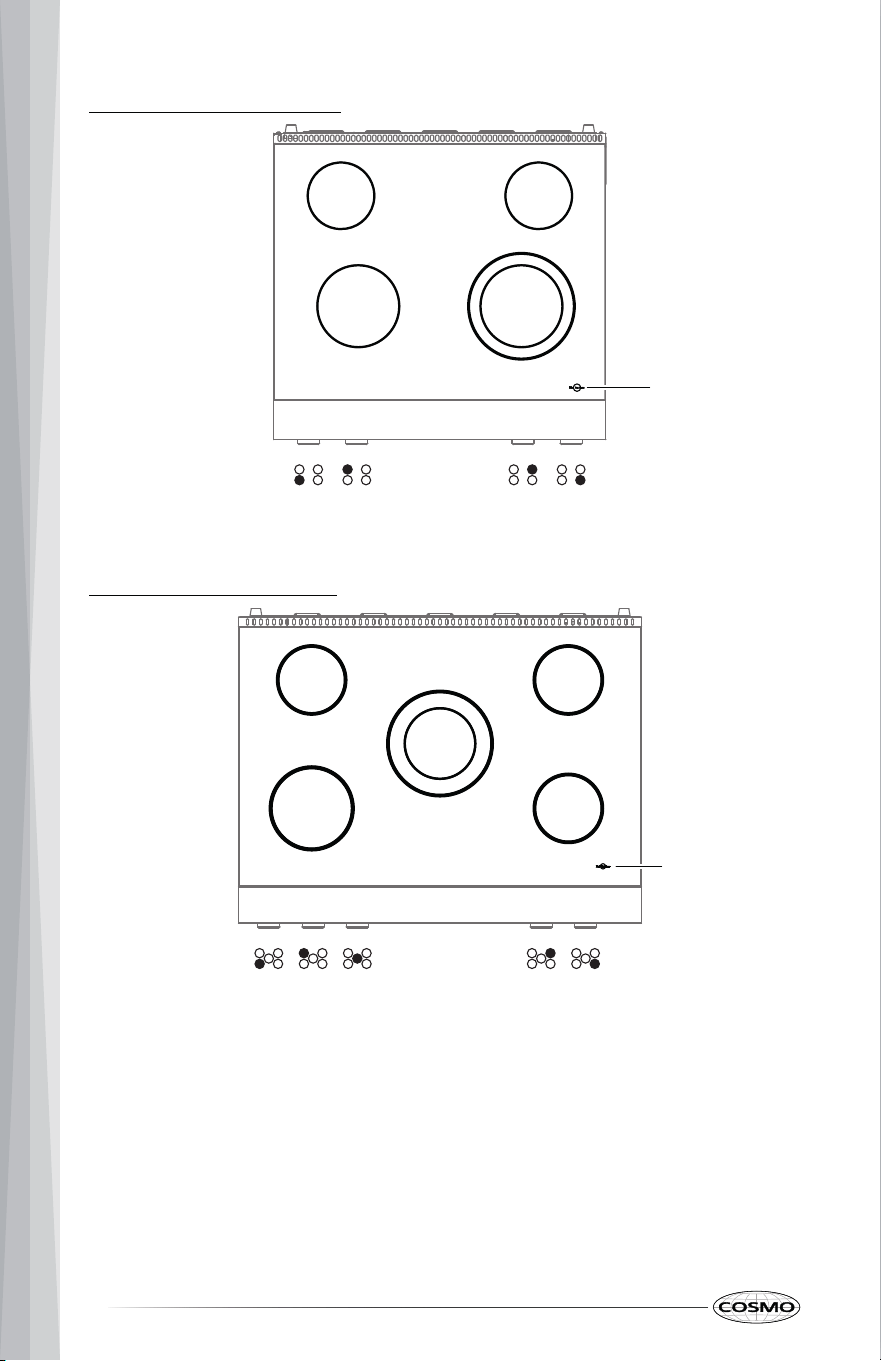
The cooking areas on your range are identified by permanent circles on the
glass cooktop surface.
When a control is turned on, a glow can be seen through the glass cooktop
surface.
For the most efficient cooking, fit the pan size to the element size. Pans should
not extend more than 1/2" to 1" (1.3 cm to 2.5 cm) beyond the cooking area.
28
30" Model: COS-RES304SS
36" Model: COS-RES365SS
2100 W 1800 W
1200 W 1200 W
3000 W
Hot surface
indicator light
2100 W 3000 W
1200 W 1200 W
Hot surface
indicator light
29
Note:
HOT SURFACE INDICATOR
The hot surface indicator light glows and indicates that one or more cooktop
elements are still hot. When the hot surface indicator turns off, the glass
surface may still feel slightly hot to touch.
USING THE COOKTOP ELEMENTS
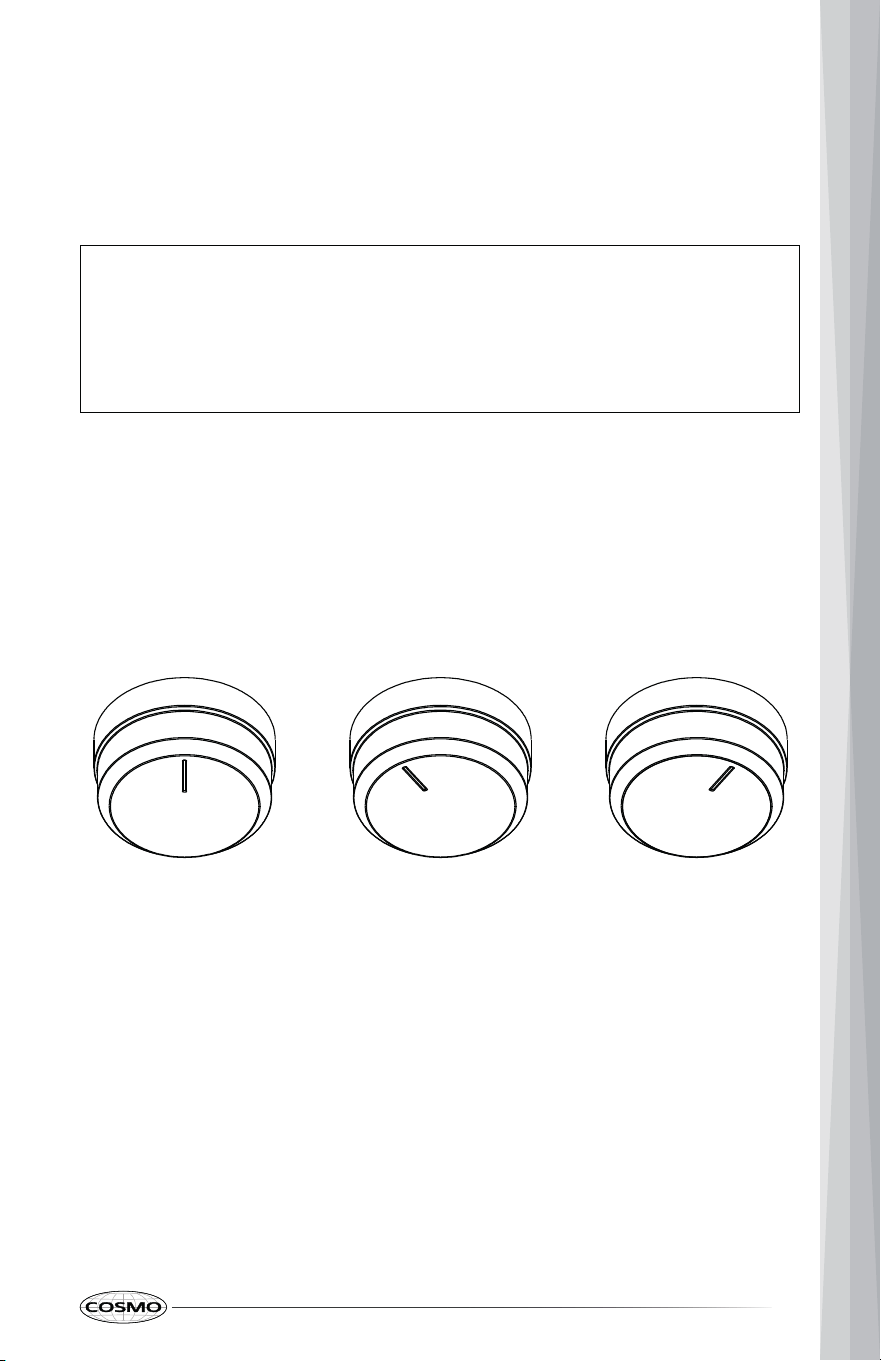
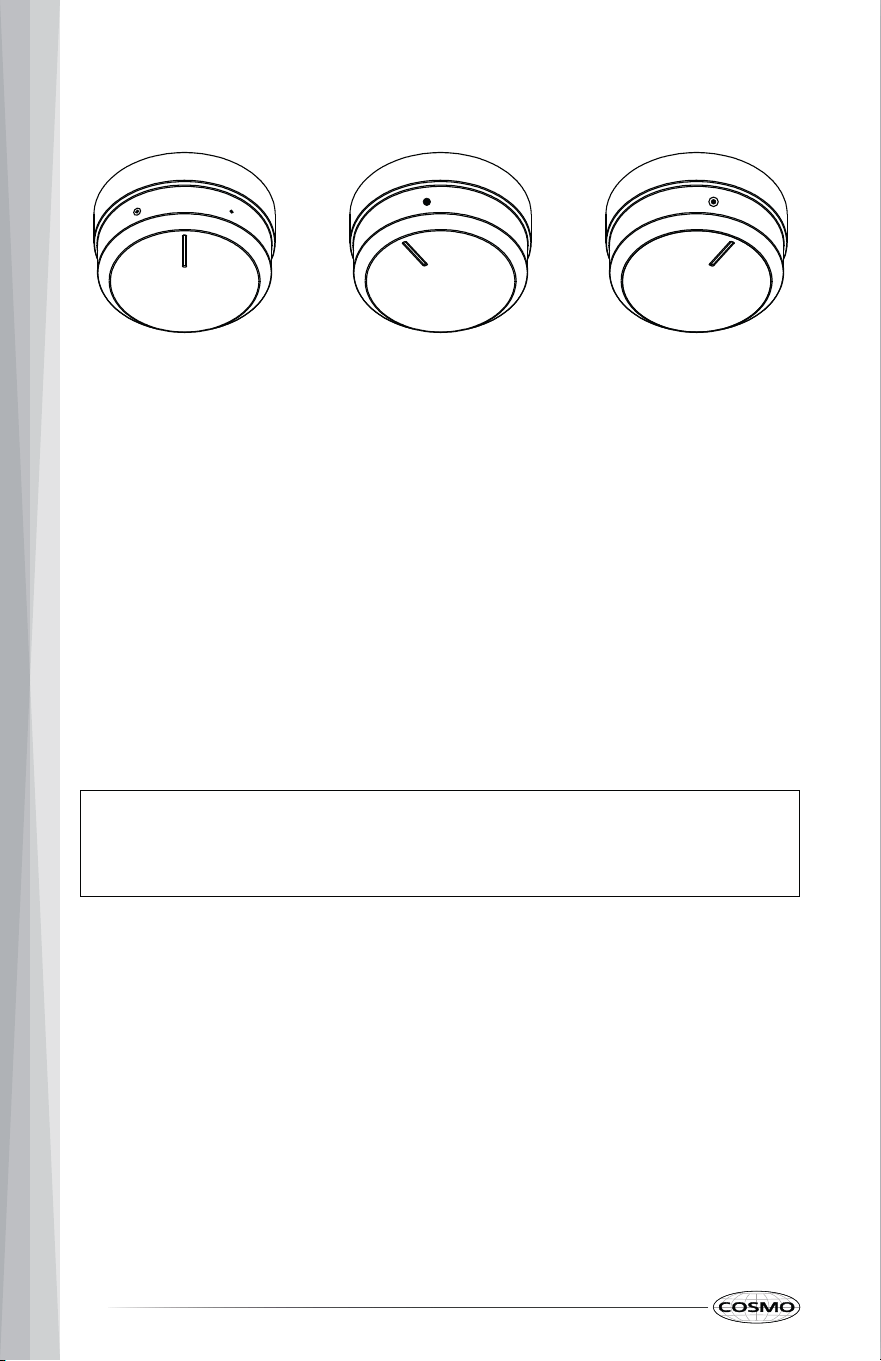
Turning on a Single Element
OFF position HI position LO position
• The hot surface indicator light glows 30 seconds after an element is
turned on or when the surface temperature reaches 150°F (65°C).
• The hot surface indicator light remains on after the element is turned
off and until the surface has cooled to approximately 150°F (65°C).
1. Select a single element, and find its control knob.
2. Push the control knob in and turn it in either direction to the desired
setting.
3. To turn off an element, turn the control knob to the OFF position.
L
O
H
I
O
F
F
O
F
F
H
I
O
F
F
L
O
30
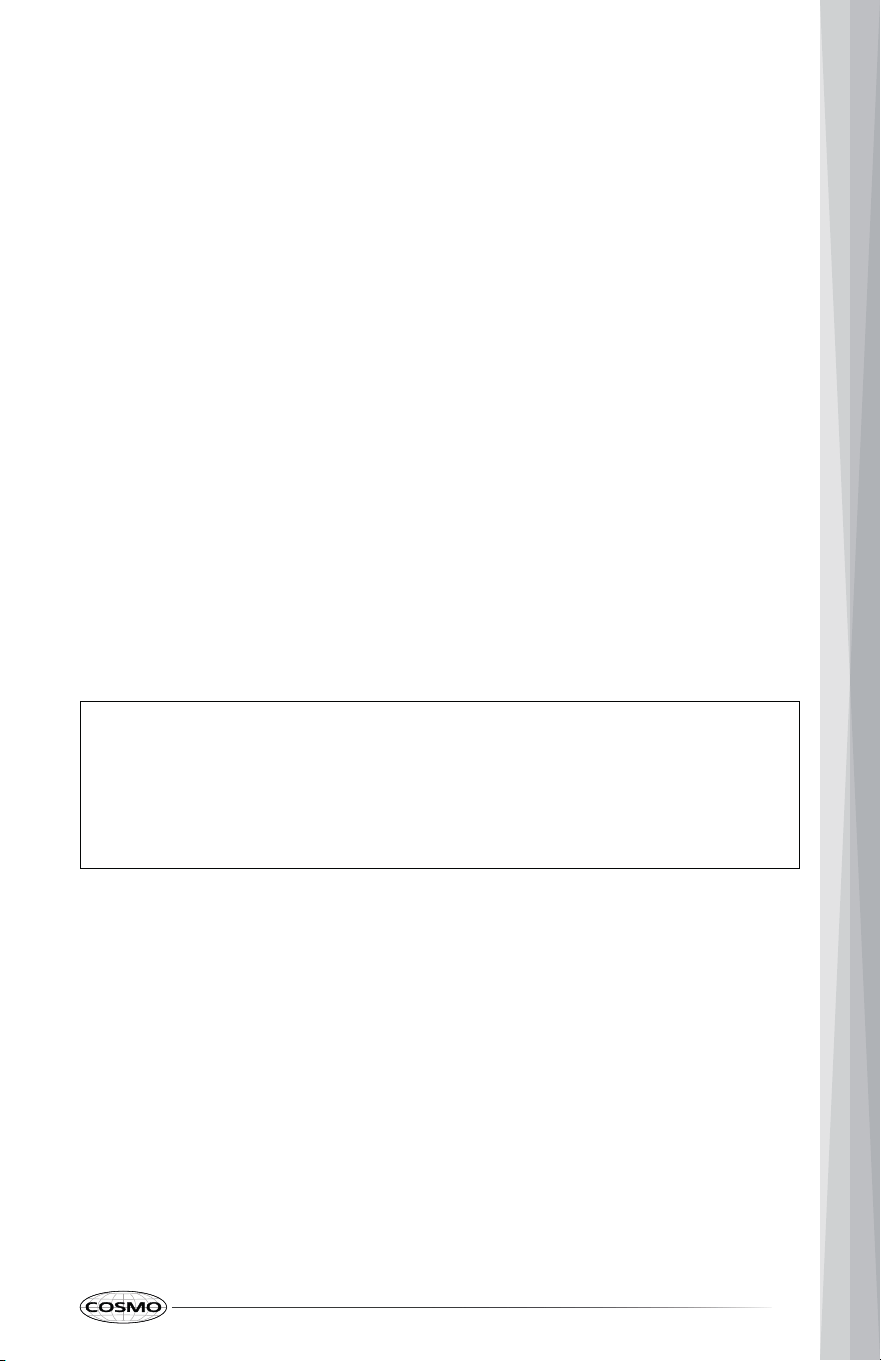
Turning on a Dual Element
OFF position Single element
HI position
Dual element
HI position
Note:
• It is normal for the cooktop elements to cycle on and off during cooking,
even on higher settings.
1. Select a dual element, and find its control knob.
2. Push the control knob in and turn it in either direction to use element as a
single element or a dual element.
• Single: Turn the knob counterclockwise.
• Dual: Turn the knob clockwise
3. To turn off an element, turn the control knob to the OFF position.
IN CASE OF POWER FAILURE
The electric cooktop and oven cannot be used during a power outage.
If power is lost while a cooktop element is on, the cooktop element will turn
back on as soon as power is restored.
In the event of power loss, failure to turn all cooktop element knobs to the OFF
position may result in ignition of items on or near the cooktop, leading to
serious injury or death.
H
I
H
I
O
F
F
O
F
F
H
I
O
F
F
H
I
31
USING THE PROPER COOKWARE
The size and type of cookware will influence the settings needed for the best
cooking results. Cookware should have flat bottoms that make good contact
with the entire surface heating element, and should not extend more than 1/2"
to 1" (1.3 cm to 2.5 cm) beyond the cooking area for the most efficient cooking.
Using the correct cookware can prevent many problems, such as uneven
cooking or extended cooking times.
Cookware Recommendations
• Flat bottom and straight sides
• Heavy-gauge pans
• Pan sizes that match the amount of food to be prepared and the size of
the surface element
• Weight of handle does not tilt pan.
• Pan is well balanced
• Tight-fitting lids
• Flat bottom woks
Note:
• Do not use woks that have support rings. This type of wok will not heat
on glass surface elements.
• Do not use foil or foil-type containers. Foil may melt onto the glass. Do
not use the cooktop if metal has melted on it.

32
Choosing Cookware
The cookware material determines how evenly and quickly heat is transferred
from the surface element to the pan bottom.
Recommended
• Aluminum - Excellent heat conductor. Some types of food will cause it to
darken (anodized aluminum cookware resists staining and pitting). If
aluminum pans slide across the ceramic cooktop, they may leave metal
marks which will resemble scratches. Remove these marks immediately.
Because of its low melting point, thin weight aluminum should not be
used.
• Copper - Excellent heat conductor but discolors easily. May leave metal
marks on glass-ceramic (see Aluminum above). Do not let these pots boil
dry. Overheated metal can bond to glass cooktops. An overheated
copper bottom pot will leave a residue that will permanently stain the
cooktop if not removed immediately.
• Stainless Steel - Slow heat conductor with uneven cooking results. Is
durable, easy to clean and resists staining.
• Enamel (painted) on Cast Iron - Bottom of pan must be smooth coated
and smooth.
Not Recommended
• Enamel (painted) on Steel - Heating empty pans can cause permanent
damage to cooktop glass. The enamel can melt and bond to the ceramic
cooktop.
• Cast Iron - A poor heat conductor, slow to absorb heat but retains heat
very well. Will scratch the glass surface. Not recommended unless
designed specifically for use on ceramic cooktops.
• Glass-ceramic - Slow heat conductor. Poor performance, and will scratch
the glass surface.
• Stoneware - Poor performance, and may scratch the glass surface.
33
OVEN
BEFORE USING THE OVEN
Read the instructions for each feature and cooking mode in this manual
carefully before using the oven.
CAUTION
• Do not use any type of foil or oven liner to cover the oven bottom. These
items can trap heat or melt, resulting in damage to the product and risk
of shock, smoke or fire. Damage from improper use of these items is not
covered by the product warranty.
• Foil may be used to catch spills by placing a sheet on a lower rack,
several inches below the food. Do not use more foil than necessary and
never entirely cover an oven rack with aluminum foil. Keep foil at least
1-1/2" (3.8 cm) from oven walls to prevent poor heat circulation.
• Do not cover the slotted grid of the 2-piece broiler pan with aluminum
foil. This will catch the grease and could cause fire.
• Do not use plastic wrap or wax paper in the oven.
• Do not place food, water, ice, or any dish or tray directly on the oven
floor, as this will irreversibly damage the enamel surface.
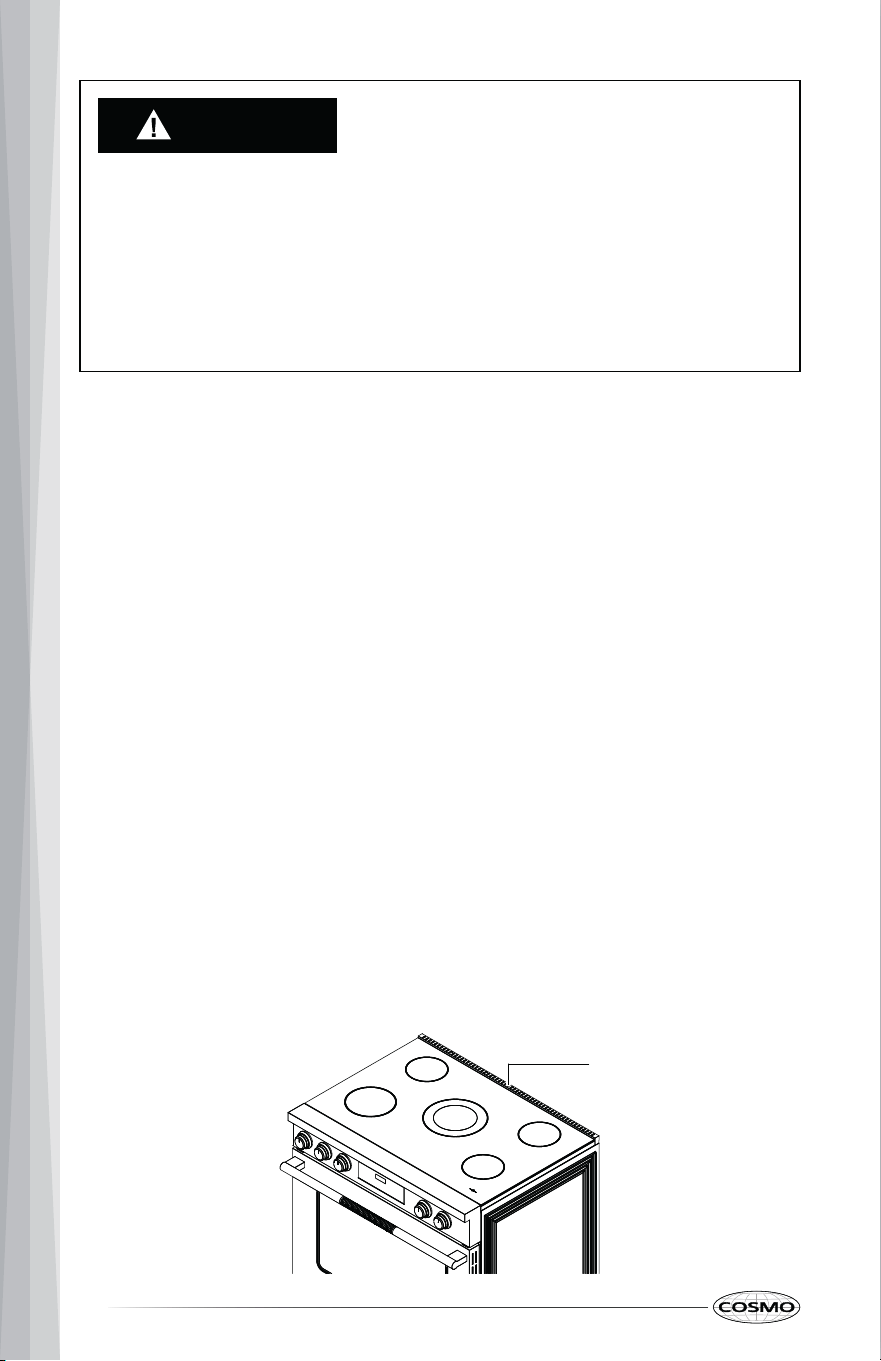
• Do not block, touch or place items around the oven vent during cooking.
Your oven is vented through ducts at the center above the rear cooktop.
Do not block the oven vent when cooking to allow for proper air flow.
• The oven and broiler cannot be used during a power outage. If the oven
is in use when a power failure occurs, the oven heating element shuts
off and cannot be used until power is restored. Once power is restored,
you will need to reset the oven (or Broil mode).
• As the oven heats up, the heated air in the oven may cause
condensation to appear on the oven door glass. These water drops are
harmless and will evaporate as the oven continues to heat up.
34
CAUTION
Food Poisoning Hazard
• Do not let food sit in oven more than one hour before or after cooking.
• Foods that can easily spoil such as milk, eggs, fish, meat or poultry,
should be chilled in the refrigerator first. Even when chilled, they should
not stand in the oven for more than 1 hour before cooking begins, and
should be removed promptly when finished cooking. Consuming spoiled
food can result in food poisoning or sickness.
BEFORE USING THE OVEN FOR THE FIRST TIME
Start the oven in Bake mode at the highest available temperature setting.
Allow oven to run for 1 hour to remove any dust or impurities. There will be a
distinctive odor - this is normal. Ensure your kitchen is well ventilated during
this conditioning period.
OVEN VENT
Areas near the vent may become hot during operation and may cause burns.
Avoid placing plastics near the vent as heat may distort or melt the plastic.
Do not block the vents (air openings) of the range. They provide the air inlet
and outlet that are necessary for the range to keep cool and operate properly
with correct combustion.
It is normal for steam to be visible when cooking foods with high moisture
content.
Oven vent
35
OVEN DOOR
Oven heating elements and, if in operation, convection fan will temporarily
shut off any time door is opened, and will resume when door is closed within 3
minutes.
Note:
To avoid oven door glass breakage:
USING OVEN RACKS
The racks have a turned-up back edge that prevents them from being pulled
out of the oven cavity.
CAUTION
• Do not leave the door open any longer than necessary. If the door is left
open too long for over 3 minutes, the cooking mode will be
automatically cancelled.
• Do not close the oven door if the racks are not fully inserted into the oven
cavity or if bakeware extends past the front edge of an oven rack.
• Do not set objects on the glass surface of the oven door.
• Do not hit glass surfaces with bakeware or other objects.
• Do not wipe down glass surfaces until the oven has completely cooled.
• Replace oven racks before turning the oven on to prevent burns.
• Do not cover the racks with aluminum foil, or any other material, or
place anything on the bottom of the oven. Doing so will result in poor
baking and may damage the oven bottom.
• Only arrange oven racks when the oven is cool.
36
6
5
4
3
2
1
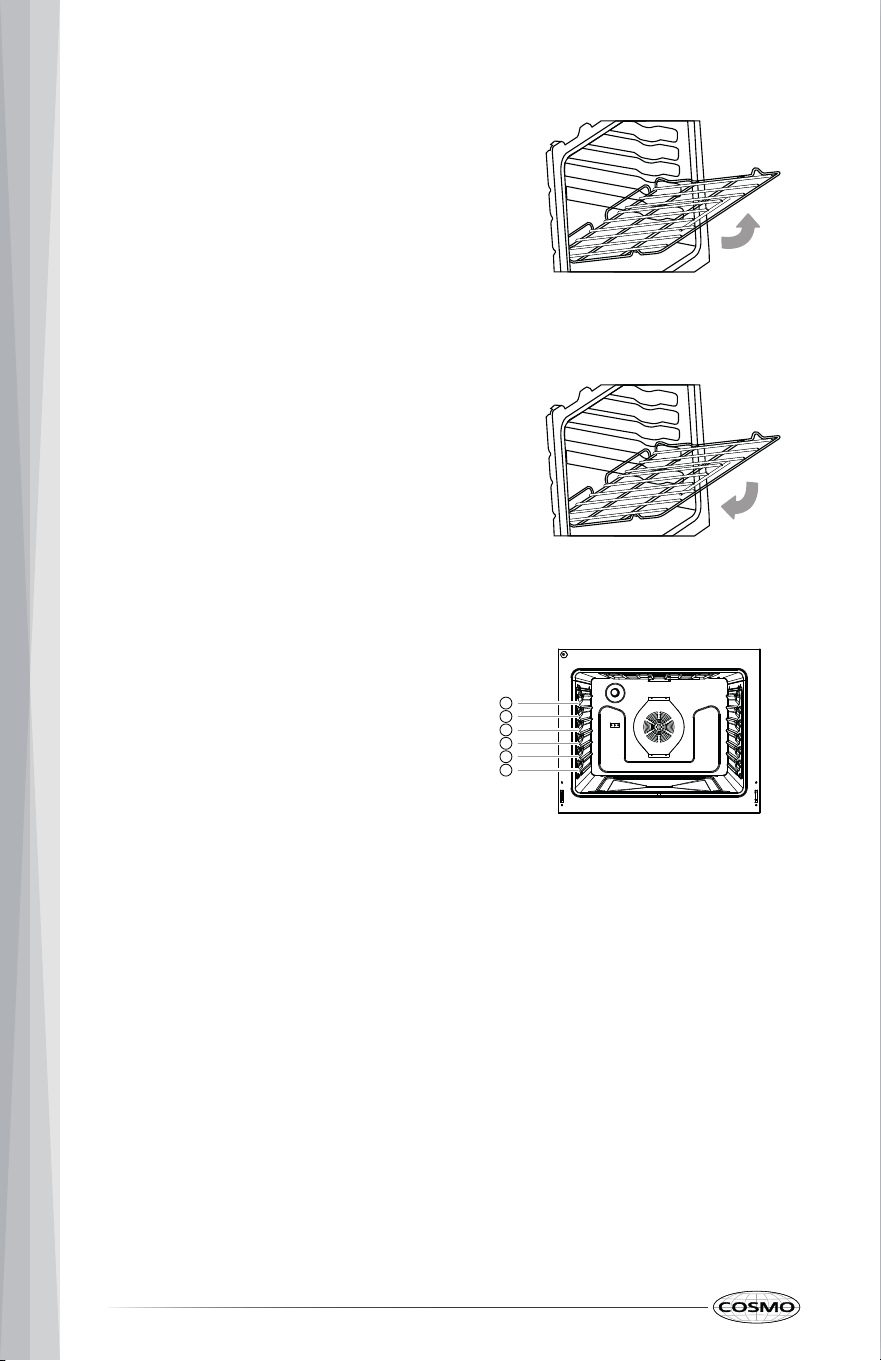
Removing Racks
Replacing Racks
1. Pull the rack straight out until it
stops.
2. Lift up the front of the rack and
pull it out.
1. Place the end of the rack on the
support.
2. Tilt the front end up and push the
rack in.
Broiling performs best with the food close to the broil heating element -
typically rack position #5 or #6.
Rack Positions
For best cooking results, adjust rack so
food is placed at the center of the
oven. For most foods this will be rack
position #3 or #4. For larger foods like
roasts and turkey, move the rack
position down to #2 or #1 to keep the
food centered in the oven.
When using multiple racks
simultaneously, try to space the food
out around the oven center (rack
positions #3 and #5 or #2 and #4 for
two racks).
37
PREHEATING
Preheating is generally desirable, although not absolutely necessary in all
circumstances.
• For oven modes that utilizes preheat, the control will automatically enter
preheat mode and show "PRE" after Start is pressed to turn on the oven.
– Once the set temperature is reached, an indicator tone will sound for
a few seconds to alert the user that preheat is complete.
• Broil and Warm modes do not utilizes preheat, the control will show Hi or
Lo for Broil and 175°F (79°C) for Warm after Start is pressed to turn on the
oven.
Note:
• It is normal for the convection fan to operate during preheating of
various baking modes.
Some foods are more robust and may have acceptable results without
preheating. These foods include large pieces of meat (whole roasts, hams, or
poultry) where the total cooking time is much longer than the time required to
preheat. These foods also include frozen potato products and frozen
processed dinners that, by their nature and design, are more robust to baking
variations. More delicate foods, such breads (including cakes, cookies,
pastries, and pizzas), desserts, soufflés, etc. will likely not have acceptable
results without proper preheating.
38
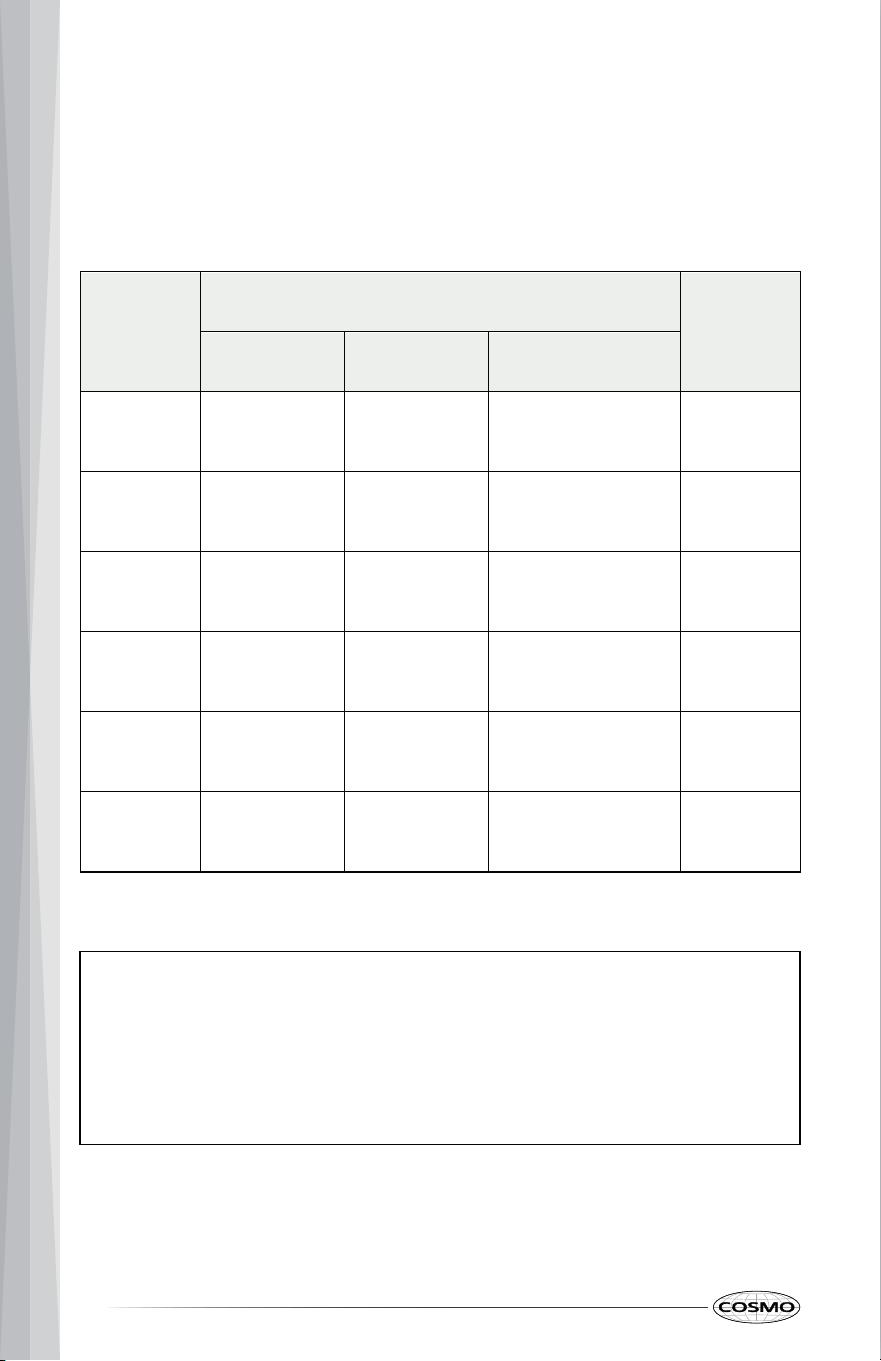
MINIMUM & MAXIMUM DEFAULT SETTINGS
The various baking modes (Bake, Conv Bake, and Air Fry) have a 10-hour time
limit, after which the control will automatically end the baking mode. Broil
and Keep Warm modes have a 3-hour time limit. If desired, these modes can
be restarted after the time limit expires.
Cooking
Mode
Temperature
Maximum
Cook Time
(hh:mm)
Minimum Maximum Default/Target
Bake 175°F (79°C) 550°F (288°C) 350°F (176°C) 10:00
Conv Bake 175°F (79°C) 550°F (288°C) 350°F (176°C) 10:00
Air Fry 175°F (79°C) 550°F (288°C) 425°F (218°C) 10:00
Broil - -
Hi: 550°F (288°C)
Lo: 400°F (204°C)
03:00
Keep
Warm
- - 175°F (79°C) 03:00
Steam
Clean
- - 150°F (66°C) 00:25
Note:
• Once the oven reaches the default or set temperature, the oven pauses
heating temporarily. The oven heating cycle will automatically resume
to maintain the set temperature.
• Because the oven temperature cycles, an oven thermometer placed in
the oven cavity may not show the same set temperature on the oven.
39
BAKE
The Bake mode uses heat from the lower heating element to cook food. This
mode works best with food placed on a single rack. Always preheat the oven
first and place food centrally near the middle racks.
Setting the Bake Mode
For example, to Bake at 375°F.
1. Adjust oven rack levels as needed.
2. Press Bake once to select Bake mode.
3. Press/hold + or - to set the bake temperature to 375°F.
4. Press Start.
--:-- appears in the display, prompting for cooking time to be entered.
5. (Optional) Press/hold + or - to set the desired cooking time.
6. Press Start.
The oven starts to preheat, and PRE appears in the display. Keep the oven
door closed, and wait for the oven to preheat to the set temperature.
Note:
• If the oven door is opened at the time Start is pressed, the oven will
turn on when the oven door is closed.
• When the preheat has completed, the set temperature appears in
the display and the indicator tone sounds for a few seconds. If a
cooking time is set, the countdown will start.
7. Place the food in the oven.
40
Note:
• Do not leave the door open any longer than necessary when
placing food. If the door is left open too long for over 3 minutes, the
cooking mode will be automatically cancelled.
8. Press Cancel/Off when cooking is finished, and remove the food from the
oven.
Note:
• Baking time and temperature will vary depending on the
characteristics, size, and shape of the baking pan used.
• Check for food doneness at the minimum recipe time.
• Use metal bakeware (with or without a nonstick finish), heatproof glass-
ceramic, ceramic or other bakeware recommended for oven use.
• Dark metal pans or nonstick coatings will cook food faster with more
browning. Insulated bakeware will slightly lengthen the cooking time for
most foods.
CONVECTION BAKE
The Convection Bake mode uses heat from the lower heating element and air
movement from the convection fan to enhance cooking efficiency and
evenness across multiple racks. Always preheat the oven first. Baking times
may be slightly longer for multiple racks than what would be expected for a
single rack.
Setting the Convection Bake Mode
For example, to Convection Bake at 375°F.
1. Adjust oven rack levels as needed.
2. Press Bake twice to select Convection Bake mode.
The indicator light above Bake flashes.
41
3. Press/hold + or - to set the bake temperature to 375°F.
4. Press Start.
--:-- appears in the display, prompting for cooking time to be entered.
5. (Optional) Press/hold + or - to set the desired cooking time.
6. Press Start.
The oven starts to preheat, and PRE appears in the display. Keep the oven
door closed, and wait for the oven to preheat to the set temperature.
Note:
• If the oven door is opened at the time Start is pressed, the oven will
turn on when the oven door is closed.
• When the preheat has completed, the set temperature appears in
the display and the indicator tone sounds for a few seconds. If a
cooking time is set, the countdown will start.
7. Place the food in the oven.
Note:
• Do not leave the door open any longer than necessary when
placing food. If the door is left open too long for over 3 minutes, the
cooking mode will be automatically cancelled.
8. Press Cancel/Off when cooking is finished, and remove the food from the
oven.

42
Note:
• The oven fan runs while convection baking.
• Use Convection Bake for faster and more even multiple-rack cooking of
pastries, cookies, muffins, biscuits, and breads of all kinds.
• Place the oven racks in positions suggested in the "Tips and Techniques"
section.
• Bake cookies and biscuits on pans with no sides or very low sides to
allow heated air to circulate around the food. Food baked on pans with
a dark finish will cook faster.
AIR FRY
The Air Fry mode uses heat from the upper and lower heating elements and
hot air movement from the convection fan to circulate hot air inside the oven.
This mode is specially designed for oil-free frying, and to produce foods with a
crispier exterior than traditional oven cooking. The Air Fry mode is intended
for single rack cooking only. Always preheat the oven first and place food
centrally near the middle racks.
Setting the Air Fry Mode
For example, to Air Fry at 400°F.
1. Adjust oven rack levels as needed.
2. Press Air Fry to select Air Fry mode.
3. Press/hold + or - to set the air fry temperature to 400°F.
4. Press Start.
--:-- appears in the display, prompting for cooking time to be entered.
5. (Optional) Press/hold + or - to set the desired cooking time.
43
6. Press Start.
The oven starts to preheat, and PRE appears in the display. Keep the oven
door closed, and wait for the oven to preheat to the set temperature.
Note:
• If the oven door is opened at the time Start is pressed, the oven will
turn on when the oven door is closed.
• When the preheat has completed, the set temperature appears in
the display and the indicator tone sounds for a few seconds. If a
cooking time is set, the countdown will start.
7. Place the food in the oven.
Note:
• Do not leave the door open any longer than necessary when
placing food. If the door is left open too long for over 3 minutes, the
cooking mode will be automatically cancelled.
8. Press Cancel/Off when cooking is finished, and remove the food from the
oven.
Note:
• The oven fan runs while air frying.
• Use the air fry tray provided or pans with low sides or no sides for better
air flow over foods.
BROIL
The Broil mode uses intense heat from the upper heating element to sear
foods. This mode works best for tender cuts of meat, fish, and thinly cut
vegetables, and is ideal for toasting, melting cheese, browning and searing
surface. Food should be placed near the upper racks, and should not be
cooked for too long on each side of the food.
44
Setting the Broil Mode
1. Adjust oven rack levels as needed.
2. Press Broil once to select Hi Broil or twice to select Lo Broil.
3. Press Start.
The oven starts to preheat, and HI or LO remains in the display. Keep the
oven door closed.
Note:
• If the oven door is opened at the time Start is pressed, the oven will
turn on when the oven door is closed.
4. Place the food in the oven after preheating for 5 - 10 minutes.
Note:
• Do not leave the door open any longer than necessary when
placing food. If the door is left open too long for over 3 minutes, the
cooking mode will be automatically cancelled.
5. Press Cancel/Off when cooking is finished, and remove the food from the
oven.
Note:
• The oven of this range is designed for closed-door broiling. Opening the
door turns off the broil heating element during broiling. If the door is
not closed, the Broil mode will ultimately cancel itself.
• The broil heating element is very powerful. Follow recipe directions and
monitor food closely to reduce risk of burning food.
• Always use a broiler pan and grid for excess fat and grease drainage.
This will help to reduce splatter, smoke, and flare-ups. Do not use a
broiler pan without a grid. Oil can cause a grease fire.
• Do not cover the grid and broiler pan with aluminum foil. Doing so will
cause a fire.
45
KEEP WARM
The Keep Warm mode uses heat from the lower heating element to maintain
oven temperature at around 175°F (79°C). It will keep cooked food warm for
serving up to 3 hours after cooking has finished. Cover foods that need to
remain moist and do not cover foods that should be crisp. Preheating is not
required.
Setting the Keep Warm Mode
1. Adjust oven rack levels as needed.
2. Place the hot food in the oven.
3. Press Keep Warm to select Keep Warm mode.
4. Press Start.
The oven starts to preheat, and 175F (79°C) remains in the display. Keep
the oven door closed.
Note:
• If the oven door is opened when Start is pressed, the oven will turn
on when the oven door is closed.
5. Press Cancel/Off when warming is finished, and remove the food from
the oven.
Note:
• Do not use to Warm mode to heat cold food. Always start with hot food.
• It is recommended that food not be kept warm for more than 2 hours.
• The warm mode is intended to keep food warm. Do not use it to cool
food down.
• Avoid opening the oven door more than necessary during use. If the
door is left open too long for over 3 minutes, the cooking mode will be
automatically cancelled.

46
TIPS AND TECHNIQUES
Bake
Baking is cooking with heated air. The lower element in the oven is used to
heat the air but no fan is used to circulate the heat.
Follow the recipe or convenience food directions for baking temperature, time
and rack position. Baking time will vary with the temperature of ingredients
and the size, shape and finish of the baking utensil.
• For best results, bake food on a single rack with at least 1" - 1½" (2.5 - 3
cm) space between utensils and oven walls.
• Use one rack when selecting the bake mode.
• Check for doneness at the minimum time.
• Use metal bakeware (with or without a non-stick finish), heatproof glass,
glass-ceramic, pottery or other utensils suitable for the oven.
• When using heatproof glass, reduce temperature by 25°F (15°C) from
recommended temperature.
• Use baking sheets with or without sides or jelly roll pans.
• Dark metal pans or nonstick coatings will cook faster with more browning.
Insulated bakeware will slightly lengthen the cooking time for most foods.
• Do not use aluminum foil or disposable aluminum trays to line any part of
the oven. Foil is an excellent heat insulator and heat will be trapped
beneath it. This will alter the cooking performance and can damage the
finish of the oven.
• Avoid using the opened door as a shelf to place pans.
• See Troubleshooting for tips on solving Oven Problems.
47
Convection Bake
Convection Bake uses heat from the lower heating element and air movement
from the convection fan to enhance cooking efficiency and evenness across
multiple racks. Reduce recipe baking temperatures by 25°F (15°C).
• For best results, foods should be cooked uncovered, in low-sided pans to
take advantage of the forced air circulation. Use shiny aluminum pans for
best results unless otherwise specified.
• Heatproof glass or ceramic can be used. Reduce temperature by another
25°F (15°C) when using heatproof glass dishes for a total reduction of
50°F (30°C).
• Dark metal pans may be used. Note that food may brown faster when
using dark metal bake ware.
• The number of racks used is determined by the height of the food to be
cooked.
• Baked items, for the most part, cook extremely well in convection. Don’t
try to convert recipes such as custards, quiches, pumpkin pie, or
cheesecakes, which do not benefit from the convection-heating process.
Use the regular Bake mode for these foods.
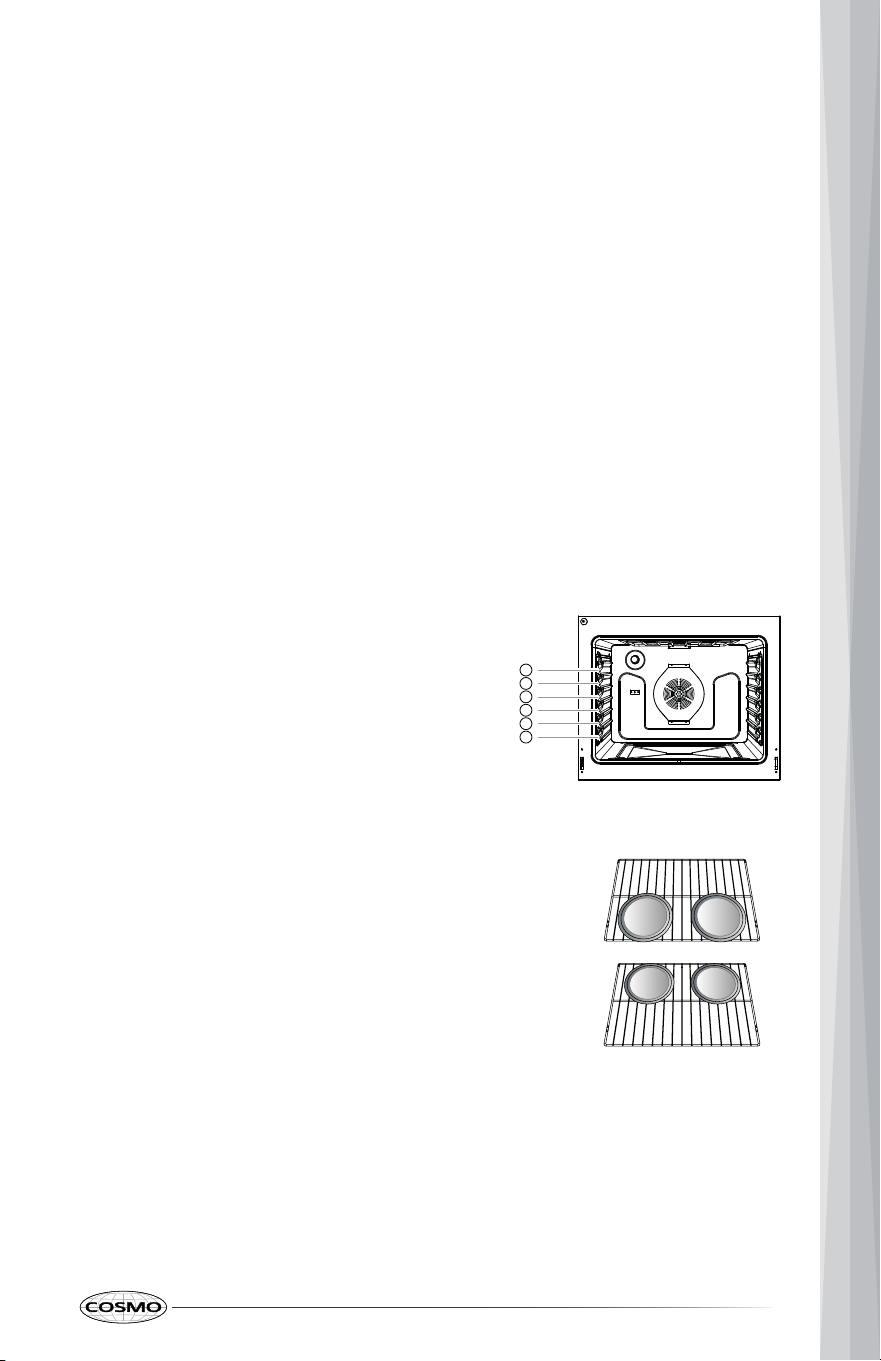
• Multiple rack cooking for oven meals is
done on rack positions 1, 2, 3, 4, 5, and
6. All six racks can be used for cookies,
biscuits and appetizers.
– 2 Rack baking: Use positions 3 and
5 or 2 and 4.
– 3 rack baking: Use positions 2, 3,
and 4 or 1, 3, and 5 or 2, 4, and 6.
– When baking four cake layers at
the same time, stagger pans so
that one pan is not directly above
another. For best results, place
cakes on front of upper rack and
back of lower rack (See graphic at
right). Allow 1" - 1 ½" (2.5 - 3cm) air
space around pans.
• Converting your own recipe can be easy. Choose a recipe that will work
well in convection.
• Reduce the temperature and cooking time if necessary. It may take some
trial and error to achieve a perfect result. Keep track of your technique for
the next time you want to prepare the recipe using convection.
• See Troubleshooting for tips to Solving Baking and Roasting Problems.
Front
Placement
Rear
Placement
6
5
4
3
2
1

48
Foods recommended for convection bake mode:
Appetizers, Biscuits, Cakes, Casseroles, Coffee Beans, Cookies (2 to 4 racks),
Cream Puffs, Popovers, Yeast Breads, One-Dish Entrées, Oven Meals (rack
positions 3 and 4), and Air Leavened Foods (Soufflés, Meringue, Meringue-
Topped Desserts, Angel Food Cakes, Chiffon Cakes).
Air Fry
The Air Fry mode uses heat from the upper and lower heating elements and
air movement from the fans to circulate hot air inside the oven and to
produce foods with a crispier exterior than traditional oven cooking.
• For best results, use the provided air fry tray and position oven rack so
that food is placed centrally near the middle racks.
• If you don't have the air fry tray, place food on a wire rack inside a foil-
lined broiler pan or on a dark baking pan with low sides or no sides fo r
better air flow over foods.
• Spread the food out evenly in a single layer. Check food often and shak e
it or turn it over for crisper results.
• If desired, spray the baking tray or air fry tray with a pan spray. Use an oi l
that can be heated to a high temperature before smoking, such as
avocado, grapeseed, peanut or sunflower oil.
• Place a foil-lined baking tray on the bottom rack to catch the oil fallin g
from the food. For high fat foods like chicken wings, add a few sheets o f
parchment paper to absorb the fat.
• Foods high in fat will smoke when using the Air Fry mode. Turn on your
exhaust hood at a high fan setting or open a window to make sure t he
kitchen is well-ventilated.
• Prepared frozen foods may cook faster with the Air Fry mode than state d
on the package. Reduce the cooking time by about 20 percent, chec k
food early, and adjust cooking time as needed.
Broil
The Broil mode uses intense heat from the upper heating element to sear
foods. The size, weight, thickness, starting temperature, and your preference
of doneness will affect broiling times.
• For best results when broiling, use a pan designed for broiling.
• Preheat the oven for about 5 minutes before placing food in the oven.
49
RANGE CARE AND MAINTENANCE
MANUAL CLEANING
IMPORTANT: Before cleaning, make sure all controls are off and the oven and
cooktop are cool. Always follow label instructions on cleaning products. Soap,
water and a soft cloth or sponge are suggested first unless otherwise noted.
Do not use abrasive cleaning products.
Note:
• Do not clean the oven door gasket. The material of the gasket cannot
withstand abrasion. It is essential for the gasket to remain intact. If you
notice it becoming worn or frayed, replace it.
• Re-engage the anti-tip bracket if range is moved.
GLASS-CERAMIC COOKTOP
• Before using the cooktop for the first time, clean it with a ceramic cooktop
cleaner. This helps protect the top and makes cleanup easier.
• Regular use of ceramic cooktop cleaner will help keep the cooktop
looking new.
• If any sugar or food containing sugar spills, or plastic or foil melts on the
cooktop, remove the material IMMEDIATELY with a metal razor scraper
while the cooking surface is still hot to avoid the risk of damage to the
glass-ceramic surface. When used correctly, the scraper will not damage
the cooktop surface.
• For your safety, please use an oven mitt or pot holder while scraping the
hot cooking surface.
• If water or food containing water spills, remove the spill IMMEDIATELY
with a dry paper towel.
• Do not use scrub pads or abrasive cleaning pads. They may damage your
cooktop surface.
50
Cleaning Method:
• Use ceramic cooktop cleaner on the glass cooktop. Other creams may not
be as effective or may scratch, damage or stain the cooktop surface.
• Use a paper towel or non-scratch cleaning pad to clean the entire
cooktop surface.
• Rinse with clear water and use a dry cloth or paper towel to remove all
cleaning residue.
Note:
• Any damage or failure of the product resulting from the items
below may not be covered under the Limited Warranty.
- Sugary spillovers (such as preserves, ketchup, tomato sauce,
jellies, fudge, candy, syrups, or chocolate) or melted plastics
can cause pitting on the surface of your cooktop.
- If food or water containing calcium (such as baking powder,
wine, milk, spinach, or broccoli) is spilled on the cooktop, it can
permanently stain or discolor the surface.
BURNED-ON RESIDUE
• Allow the cooktop to cool.
• For additional protection, after all residue has been removed, polish the
entire surface with ceramic cooktop cleaner and a paper towel.
Cleaning Methods:
• Spread a few drops of ceramic cooktop cleaner on the entire burned
residue area. Using a non-scratch cleaning pad for ceramic cooktops, rub
the residue area, applying pressure as needed. Leave the cleaner on for
10 minutes before rinsing it off.
• Rinse with clear water and wipe the cooktop surface with a clean, dry
paper towel. If any residue remains, repeat the steps listed above as
needed.
Note:
• Damage to your glass surface may occur if you use scrub pads
other than those recommended.
51
HEAVY BURNED-ON RESIDUE
• Allow the cooktop to cool.
• For additional protection, after all residue has been removed, polish the
entire surface with ceramic cooktop cleaner and a paper towel.
Cleaning Methods:
• While the cooktop is still warm, use a single-edge razor blade scraper at
approximately a 30° to 45° angle against the glass surface and scrape
the soil. It will be necessary to apply pressure to the razor scraper in order
to remove the residue.
• When the cooking surface is completely cooled, spread a few drops of
ceramic cooktop cleaner on the entire burned residue area. Using a non-
scratch cleaning pad for ceramic cooktops, rub the residue area, applying
pressure as needed. Leave the cleaner on for 10 minutes before rinsing it
off.
• Rinse with clear water and wipe the cooktop surface with a clean, dry
paper towel.
Note:
• Do not use a dull or nicked blade.
METAL MARKS AND SCRATCHES
• Cookware with rough or uneven bottoms can mark or scratch the cooktop
surface. Carefully check the bottom of pans.
• Do not slide metal or glass across the cooktop surface.
• Do not use cookware with any dirt build-up on the bottom.
• Always clean the cooktop surface before cooking.
• Be careful not to place aluminum baking sheets or aluminum frozen
entrée containers on a hot cooktop surface. It will leave shinny dots or
markings on the cooktop surface. These markings are permanent and
cannot be cleaned off.
52
Cleaning Methods:
• Be careful not to slide pots and pans across your cooktop. It will leave
metal markings on the cooktop surface. These marks are removable using
the ceramic cooktop cleaner with a non-scratch cleaning pad for ceramic
cooktops.
• If pots with a thin overlay of aluminum or copper are allowed to boil dry,
the overlay may leave black discoloration on the cooktop. This should be
removed immediately before heating again or the discoloration may be
permanent.
EXTERIOR STAINLESS STEEL
• Rub in direction of grain to avoid damaging.
Cleaning Methods:
• Liquid detergent or all-purpose cleaner: Rinse well with clean water and
dry with soft, lint-free cloth.
• Stainless Steel Cleaner and Polish. Vinegar for hard water spots.
Note:
• Do not use soap-filled scouring pads, abrasive cleaners, cooktop
polishing cream, steel-wool pads, gritty washcloths or some paper
towels. Damage may occur, even with one-time or limited use.
COOKTOP CONTROL KNOBS
• Pull knobs straight away from control panel to remove.
• When replacing knobs, make sure knobs are in the OFF position.
Cleaning Method:
• Wash with soap and water.
Note:
• Do not use steel wool, abrasive cleansers or oven cleaner. Do not
soak knobs.
53
CONTROL PANEL
• It’s a good idea to wipe the control panel after each use.
• Disconnect power to the unit before cleaning if needed.
Cleaning Method:
• Glass cleaner and soft cloth or sponge: Apply glass cleaner to soft cloth or
sponge, not directly on panel.
• Clean up splatters with a damp cloth.
Note:
• Do not use abrasive cleaners, steel-wool pads, gritty washcloths or
some paper towels. Damage may occur.
OVEN DOOR
• Do not immerse the door in water.
• Do not spray water or glass cleaner on the door vents.
• Do not use oven cleaners, cleaning powders, or harsh abrasive cleaning
materials on the outside of the oven door.
• Do not clean the oven door gasket.
Cleaning Method:
• Glass cleaner and paper towels or nonabrasive plastic scrubbing pad:
Apply glass cleaner to soft cloth or sponge, not directly on panel.
OVEN RACKS
• All racks can be washed with warm, soapy water.
Cleaning Method:
• Clean with warm, soapy water, and use steel-wool pad if necessary.
• Rinse with clean water and dry.
54
OVEN CAVITY
• Food spills should be cleaned when oven cools. At high temperatures,
foods react with porcelain, so staining, etching, pitting or faint white
spots can result.
Cleaning Method:
• Mild detergent and warm water.
Note:
• Do not use oven cleaners.
• To better reach and clean the oven cavity, detach the oven door
from the range. See "Removing/Assembling Oven Door" section in
the Installation Instructions manual.
STORAGE DRAWER
• Fully open the drawer and empty the drawer before cleaning.
Cleaning Method:
• Clean with warm water, and use a damp cloth or sponge.
Note:
• Do not use scrub pads or abrasive cleaning pads.
• Most cleaning can be done with the drawer in place; however, the
drawer may be removed if further cleaning is needed. See
"Removing/Assembling Storage Drawer" section in the Installation
Instructions manual.
55
STEAM CLEAN
The Steam Clean feature is designed to use water and a low oven
temperature to generate steam to warm the oven interior surfaces and loosen
light soils before hand-cleaning.
CAUTION
Burn Hazard
• Do not leave small children unattended near the appliance during the
cleaning cycle. The outside of the range can become hot to the touch.
• During the cleaning cycle, the oven becomes hot enough to cause
burns. Wait until the cycle is over before wiping the inside surface of the
oven. Failure to do so may result in burns.
• Oven surfaces may be hot after the cleaning cycle. Use caution and
wear rubber gloves while cleaning to prevent burns.
• Hot surfaces may create hot steam in wet sponge or cloth while
cleaning. If steam is evident when wiping out oven, wait until oven has
cooled slightly.
BEFORE STARTING STEAM CLEAN
• Allow the oven to cool to room temperature before starting. If your oven
cavity is above 150°F (65°C), HOT will appear in the display when you
attempt to select Steam Clean mode.
• Remove all items from the oven, including oven racks.
• Wipe any heavy spillovers or excess debris. Scrape off and remove any
burnt-on debris with a plastic scraper. (Suggested plastic scrapers
includes hard plastic spatula, plastic pan scraper, plastic paint scraper,
and old credit card.)
• The range should be level to ensure that the bottom surface of the oven
cavity is entirely covered by water at the beginning of Steam Clean.
• For best results, use distilled or filtered water. Tap water may leave
mineral deposits on the surfaces.
• For improved softening of tough stains, spray inside surfaces with water
spray bottle or wipe surfaces with a wet sponge before starting.
56
SETTING STEAM CLEAN
Start with oven at room temperature.
1. Remove oven racks and accessories from the oven.
2. Scrape off and remove any burnt-on debris with a plastic scraper.
3. Pour 10 oz or 300 ml of water onto the bottom center of the oven cavity.
The indentation on the oven bottom should be fully covered to submerge
all soils.
Note:
• For improved softening of tough stains on the walls and in the
corners of the oven, wipe inside surfaces with a wet sponge.
4. Close the oven door.
5. Press and hold Broil and Cook Time at the same time to select Steam
Clean mode.
Note:
• If your oven cavity is above 150°F (65°C), HOT will appear in the
display and prevent Steam Clean mode to be selected.
6. Press Start.
The Steam Clean cycle will run for 25 minutes by default. Keep the oven
door closed.
Note:
• If the oven door is opened at the time Start is pressed, the oven will
turn on when the oven door is closed.
• Press Cancel/Off to cancel Steam Clean at any time.

57
7. After the Steam Clean cycle, soak up any remaining water and clean the
oven cavity immediately by scrubbing with a soft, damp, non-abrasive
sponge or cloth. Place a towel on the floor in front of the oven to capture
any water that may spill out during hand-cleaning.
Note:
• Place a towel on the floor in front of the oven to capture any water
that may spill out during hand-cleaning.
8. If some light soils remain, repeat the above steps, making sure to
thoroughly soak the soiled areas. Once the oven cavity is cleaned, wipe
any excess water with a clean dry towel.
9. Replace racks and any other accessories.
58
TROUBLESHOOTING
BEFORE CALLING FOR SERVICE
First try the solutions suggested here to possibly avoid the cost of a service
call.
COOKTOP PROBLEMS
Problem Possible Cause Solution
Surface units
do not turn on
There is no power
to the range.
Make sure electrical plug is plugged
into a live, properly grounded
outlet. Replace the fuse or reset the
circuit breaker.
Cooktop controls
improperly set.
Check to see the correct control is
set for the surface unit you are
using.
Excessive heat
around
cookware on
cooktop
The cookware is not
the proper size for
the element or
burner.
Use cookware with a bottom
surface approximately the same
size as the cooking area, element, or
surface burner. Cookware should
not extend more than 1" (2.5 cm)
outside the cooking area. Adjust the
power level or burner flame
appropriately.
Frequent
cycling on and
off of surface
units
The element cycle
on and off to
maintain the heat
setting.
This is normal even when the
element is on the highest setting.
Surface unit
stops glowing
when changed
to a lower
setting
The unit is still on
and hot.
This is normal.
59
Problem Possible Cause Solution
Cooking results
are not what
expected
Using incorrect
cookware.
See "Using the Proper Cookware" in
the "Operation" section.
The control knob is
not set to the
proper heat level.
See "Using the Cooktop Elements" in
the "Operation" section.
Unable to
maintain a
rolling boil or
will not cook
fast enough
Using improper
cookware.
Use pans with flat bottoms and that
match the diameter of the cooktop
element selected. See "Using the
Proper Cookware" in the
"Operation" section.
Using large
cookware without
lid.
Large pots and pans can lose a lot
of heat from the top. Cover pot or
pan with a lid to retain heat better.
Areas of
discoloration
on the cooktop
Food spillovers not
cleaned before
next use.
See "Cleaning" in the "Range Care
and Maintenance" section.
Cooktop is not
cleaned
thoroughly.
See "Cleaning" in the "Range Care
and Maintenance" section.
Mineral deposits
from water and
food.
Remove using a glass-ceramic
cooktop cleaning crème. Use
cookware with clean, dry bottoms.
Scratches or
abrasions on
cooktop surface
Coarse particles
such as salt or sand
between cooktop
and utensils can
cause scratches.
Be sure the cooktop surface and
bottoms of utensils are clean before
using. Small scratches do not affect
cooking and will become less visible
with time.
Cookware with
rough bottom has
been used.
Use smooth, flat-bottomed
cookware.
Cleaning materials
not recommended
for glass-ceramic
cooktop have been
used.
See "Cleaning" in the "Range Care
and Maintenance" section.
60
Problem Possible Cause Solution
Metal marks Scraping of metal
utensils on cooktop
surface.
Do not slide metal utensils on
cooktop surface. Use a glass-
ceramic cooktop cleaning crème to
remove the marks. See "Cleaning" in
the "Range Care and Maintenance"
section.
Brown streaks
or specks
Boilovers are
cooked onto
surface.
Use a blade scraper to remove soil.
See "Cleaning" in the "Range Care
and Maintenance" section.
OVEN PROBLEMS
Problem Possible Cause Solution
Strong odor
when using new
oven
Manufacturing
protective coating
on the oven
surfaces.
This is normal with a new range and
will disappear after a few uses.
Packaging
materials exist.
Double-check that all packaging
has been removed from the
appliance - check around door sides
and inside drawer.
Oven is not
heating
No power to the
range.
Check the circuit breaker or fuse box
to your house. Make sure there is
proper electrical power to the oven.
Oven control not
turned on.
Make sure the oven temperature
has been selected.
Oven is taking
too long to
cook
All ovens operate
slightly differently
from each other.
Adjust oven calibration upwards to
make oven cook faster. See "Oven
Settings" in the "Operation" section.
Food is
overcooked
All ovens operate
slightly differently
from each other.
Adjust oven calibration downwards
to reduce overcooking. See "Oven
Settings" in the "Operation" section.
61
Problem Possible Cause Solution
Oven is not
cooking evenly
Not using the
correct bakeware
or oven rack
position.
Refer to "Using Oven Racks" in the
"Operation" section and the
recommended rack position for the
cooking modes. Always reduce
recipe temperature by 25°F (15°C)
when baking with Convention Bake
mode.
Recipe may perform better at a
different rack position. Try moving
the food down a rack position to
make the bottom darker. Try
moving food up a rack position to
make the top darker.
Cooling fan
continues to run
after oven is
turned off
The electronic
components have
not yet cooled
sufficiently.
The fan will turn off automatically
when the electronic components
have cooled sufficiently.
Oven display
stays Off
Power interruption. Turn off power at the main power
supply (fuse or breaker box). Turn
breaker back on. If condition
persists, call for service.
Oven display is
on but will not
respond
System error.
Resetting the power at the breaker
box can usually reset the oven
control and clear response issues.
Oven light is
not working
properly
Light bulb loose or
burned-out.
Reinsert or replace the light bulb.
Touching the bulb with fingers may
cause the bulb to burn out.
Oven light
stays on
Door is not closing
completely
Check for obstruction in oven door.
Check to see if hinge is bent or door
switch broken.
Cannot remove
lens cover
Soil build-up
around the lens
cover.
Wipe lens cover area with a clean,
dry towel prior to attempting to
remove the lens cover.
Clock and timer
are not working
properly
No power to the
range.
Check the circuit breaker or fuse box
to your house. Make sure there is
proper electrical power to the oven.
62
Problem Possible Cause Solution
Excessive
Moisture on
door glass
Condensation from
cooking foods with
high moisture
content.
This is normal. Condensation will
evaporate as oven heats up.
Convection Bake and Convection
Roast will eliminate any moisture in
the oven.
Porcelain Chips
Porcelain interior is
chipped by oven
racks
When removing and replacing oven
racks, always tilt racks upward and
do not force them to avoid chipping
the porcelain.
"E" and a
number
appears in
display
System error
detected.
This is an error code. Press
Cancel/Off to clear the display and
stop the beeping. If necessary, reset
oven power at the circuit breaker. If
error code remains or repeats, write
down error code and contact a
qualified service provider for
repairs.
DRAWER PROBLEMS
Problem Possible Cause Solution
Drawer does
not slide
smoothly or
drags
The drawer is out of
alignment
Fully extend the drawer and push it
all the way back in.
The drawer is
overloaded or the
load is unbalanced
Reduce load weight.
Redistribute drawer loads.
63
ERROR CODES
Error Code Description
F1E1 System communication failure.
F3E1 Oven cavity sensor circuit error (open/short).
F3E2 Problem with the oven temperature sensor receptacle on
PCB.
F3E3 Oven is not heating after a cooking mode has started for
15 minutes.
F6E5 Oven temperature has exceeded 649°F (343°C) preset
maximum threshold.
64
LIMITED WARRANTY
WARRANTY AND SERVICE
To receive warranty service, your product must be registered. To register and
review full warranty details, visit:
www.cosmoappliances.com/warranty
Scan to Register
CUSTOMER SUPPORT
To contact customer service for assistance, visit:
www.cosmoappliances.com/chat
Scan to Contact
65
Correct disposal of this product:
This marking indicates that this appliance should not be
disposed with other household wastes. To prevent
possible harm to the environment or human health from
uncontrolled waste disposal, recycle it responsibly to
promote the sustainable reuse of material resources.
IMPORTANT
Do Not Return This Product to The Store
If you have a problem with this product, please contact Customer Support at
+1 (626) 800-4288
Dated proof of purchase, model #, and serial # required for warranty service.
IMPORTANT
Ne pas Réexpédier ce Produit au Magasin
Pour tout problème concernant ce produit, veuillez contacter le service des
consommateurs Customer Support au
+1 (626) 800-4288
Une preuve d’achat datee est requise pour beneficier de la garantie.
IMPORTANTE
No regrese este producto a la tienda
Si tiene algún problema con este producto, por favor contacte el ayuda al
cliente al
+1 (626) 800-4288
(Válido solo en E.U.A.)
Necesita una prueba de de compra fechada, número de modelo y de serie
para el servicio de la garantía.
MEMO

MEMO