INSTALLATION INSTRUCTIONS
CARE AND USE MANUAL FOR:
UNDER CABINET RANGE HOODS
Models covered by this instructions:
SUF6
*** BEFORE INSTALLATION ***
ENSURE THERE IS NO VISIBLE OR HIDDEN DAMAGE SUSTAINED DURING
SHIPPING
*** SHIPPING DAMAGE ***
MUST BE REPORTED WITHIN 5 DAYS OF RECEIPT
2
1
5
3
2
6
4
3
7
11
8
10
12
9

WARNING
Thank you for purchasing a Sirius Range Hood.
Please read all the instructions in this manual before in-
stalling the appliance.
Save these instructions for future reference.
Only use this appliance as an exhaust ventilation system for the removal of coo-
king vapors. DO NOT use to expel ammable substances or any other materials
or vapors.
The installation procedures in this manual are intended for qualied installers, ser-
vice technicians or persons with similar qualied background.
DO NOT attempt to install this appliance yourself.
Ensure that electrical power is turned off at source before commencing installation.
All electrical wiring must be properly installed, insulated and grounded and conform
to all applicable codes and standards.
Make sure all existing duct work is clean of grease build up, or duct work should be
replaced, if necessary, to avoid the possibility of a grease re. Check all joints on
ductwork to ensure proper connection and all joints should be properly taped. Be
careful when cutting through ceilings or walls not to damage any hidden pipes or
electrical wiring. Ensure your kitchen has sufcient air return vents to replace the
exhausted air.
The minimum distance between the cooker surface and the inferior part of the co-
oker hood must be of 650 mm.
Fan ducts should always be vented to the outside of your home and never into
spaces within walls, ceilings, lofts or attics. Only use rigid, smooth steel for ducting.
The exhaust point of the blower requires a 6” round connection.
4

TABLE OF CONTENTS
BEFORE YOU BEGIN 6
DUCTING 6
External Venting Requirements 6
Duct Run Calculation 7
ELECTRICAL 7
Electrical Supply 7
INSTALLATION 8
Connecting Electricity and Ducting 8
Re-Circulating Requirements 8
OPERATING PROCEDURES 9
General Advice 9
Functions 9
MAINTENANCE 10
Cleaning the Filter 10
Cleaning the Hood 10
Replace led lamp 10
WARRANTY 11
5

BEFORE YOU BEGIN: It is advisable to test
run the range hood before installation.
BEFORE STARTING – please read this
entire document and ensure you are fully
conversant with the require-ments and li-
mitations. These units weigh approximately
125lbs and therefore require a minimum of
two people to install.
BEFORE YOU BEGIN
The manufacturer declines all responsibility
in the event of failure to observe the instruc-
tions given here for installation, maintenan-
ce and suitable operation of the product.
The manufacturer further declines all re-
sponsibility for injury due to negligence and
the warranty of the unit automatically ex-
pires due to improper maintenance and/or
installation.
Always, wherever reduce the number of
transitions and turns with as few sharp an-
gles as possible.
Two staggered 45 degree angles are better
than one 90 degree. Make these turns as
far away from the motor exhaust as possible,
with as much space between each bend.
DUCTING
(Not applicable if the range hood is used in
re-circuling model).
WARNING: Do not vent this appliance into
any other ductwork, spaces between walls,
ceilings, attics, garages or any other con-
ned space.
External Venting Requirements.
When planning new ductwork, always look
for the most direct route to the outside. Ven-
ting can be done through the roof or directly
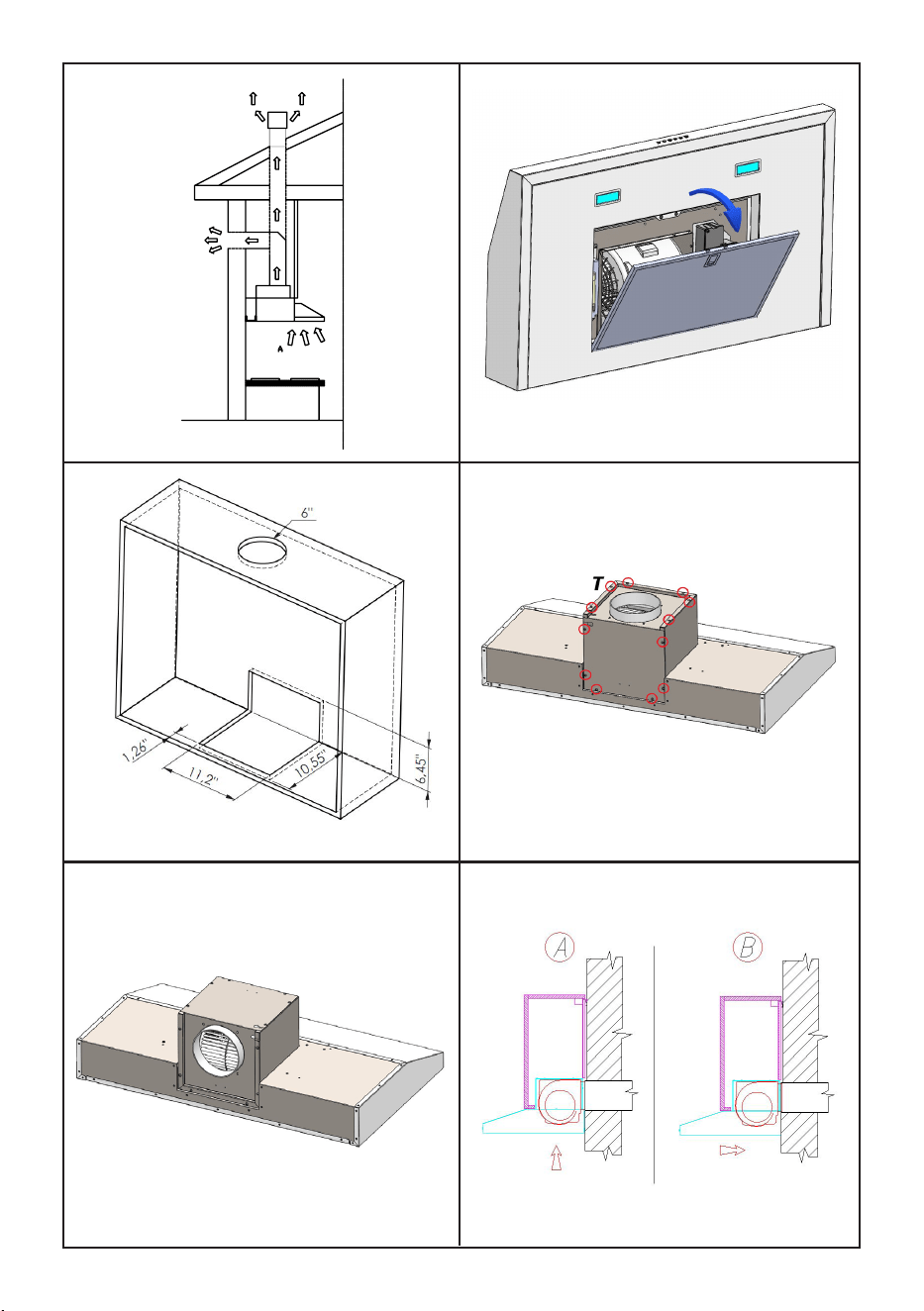
through the back outside wall. (See Figure
1).
Only use rigid type metal ducting (plastic
ducting is generally not permit-ted by code).
Flexible ducting could restrict airow by up to
50%. Always fasten connections with sheet
metal screws and tape all joints with certied
Silver Tape or Duct Tape.
Do not use screws to fasten ductwork to
the hood, only use tape as the screws will
stop the dampers from opening and your
hood will not work. This hood requires a 6”
round duct outlet. You can increase the duct
size of the duct run but never decrease it.
Use the shortest and most direct route pos-
sible.
6
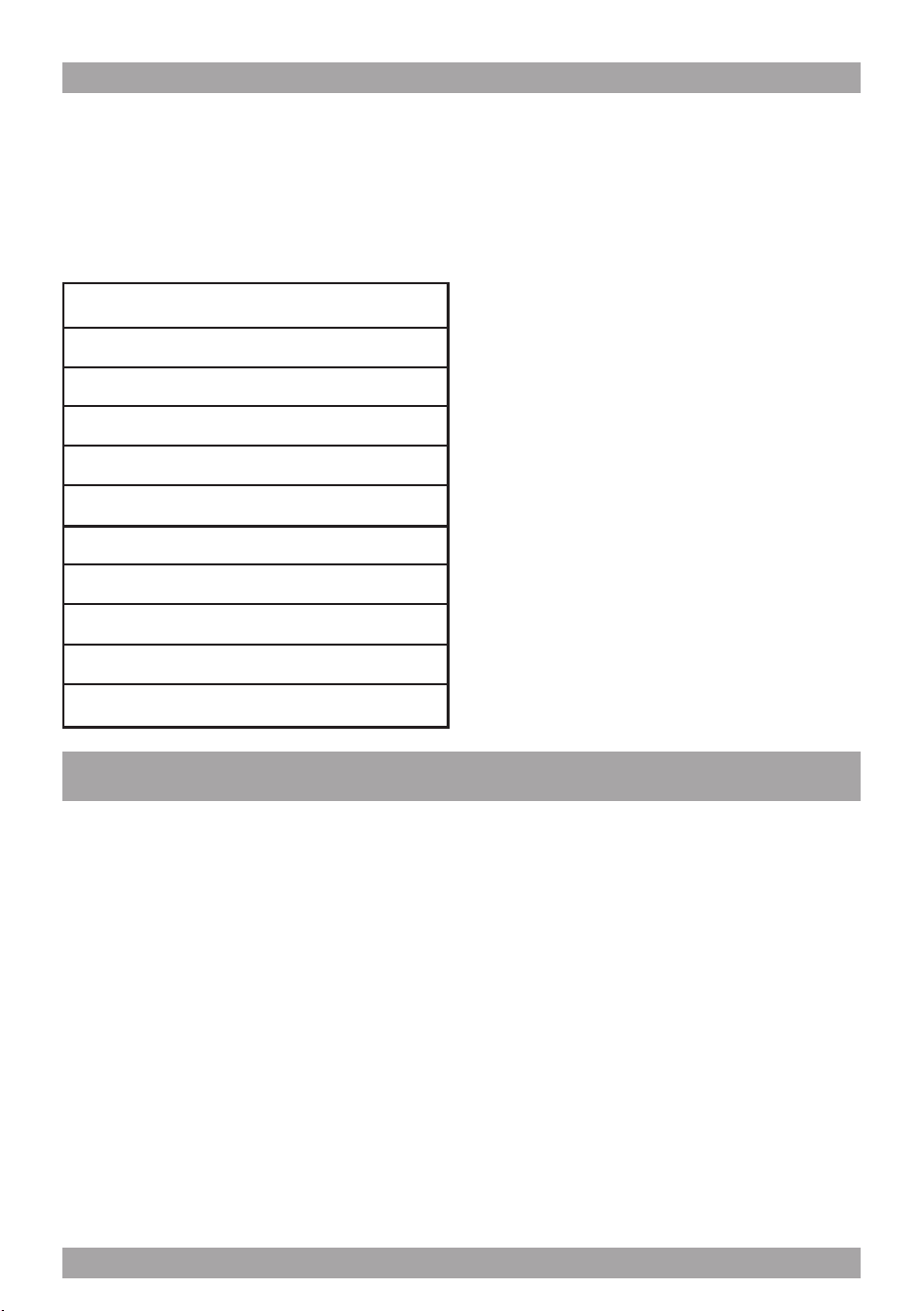
Duct Run Calculation
The maximum duct run before effecting the
performance of the hood is 100’. Calculate
your duct run by measuring linear feet and
adding the elbows, transitions and caps ba-
sed on the table alongside.
Maximum Run
6” or 3 1/4 x 10” duct 100 FT
Deduct
Each 90 elbow used 15FT
Each 45 elbow used 9FT
Each 6” or 3 1/4 x 10” duct
Transition used 1FT
Each 3’1/4 x 10” to 6”
Transition used 5FT
Side Wall with damper 30FT
Roof Cap 30FT
Electrical Supply.
This range hood requires a 120V, 60Hz sup-
ply and draws a maximum of 3 amps. The
electrical supply to the range hood should be
at least 17” from the underside of the instal-
led range hood.
For a typical installation, where the undersi-
de of the range hood will be 30” above the
counter top and the counter top is 36” above
the oor level, the electrical supply should be
76”” above oor level and no further than 3”
to the right (as you face the wall) of the cen-
tral axis of the range hood.
ELECTRICAL
WARNING: All electrical work must be
performed by a qualied electrician.
Please ensure that the appropriate electrical
codes or prevailing local building codes and
ordinances are adhered to.
Ensure that the electricity supply is discon-
nected at source. Do not use an extension
cord or adapter plug with this appliance.
This appliance must be grounded. Connect
to a properly grounded branch circuit, pro-
tected by a 15 amp circuit breaker.
The ducting connection to the hood must
be in line with the central vertical axis of the
range hood 1” away from the back wall on
which the hood is to be mounted. Range
hoods may interrupt the proper ow of com-
bustion gases from replaces, gas furnaces
and gas water heaters. To minimize the risk
of drawing these lethal gases back into the
home, please follow the heating equipment
manufacturers safety standards and guide-
lines carefully.
Refer to NFPA and ASHRAE for additional
information.
7

INSTALLATION - SUF6
Before installing the appliance, in order not
to damage the appliance itself, the metal
grease lter should be removed by
pushing the special lter handle toward the
back side of the cooker hood and turning
it downwards so to unfasten it from its slot
(refer to gure 2).
Make a cut-out on the bottom of the cabinet
to hold the appliance by using the drilling
jig provided. This opening must be 10,55”
x 11,2” x 6,45” and at a distance of 1,26”
from the front edge of the cabinet (refer to
gure 3).
The hoods can be installed with the air out-
let venting upwards or backwards.
In upwards venting applications make a
round cut-out on the upper part of the cabi-
net measuring Ø6” as gure 3.
In backwards venting applications turn the
motor assembly box as shown in gure 4 - 5
by unscrewing the screws “T”
and turning the motor assembly box having
the air outlet venting backwards.
Fix it with the screws previously removed.
Insert the built-in unit in the hole made
in the cabinet (refer gure 3).
The air outlet pipe, in the case of a fan orien-
ted towards the rear of the product, must be
ush with the surface on which the lower
part of the hood will come into contact (refer
gure 6).
Install the appliance with appropriate
screws, according to the thickness of the
board. The base of the cabinet must be from
0.4” to 1” thick (refer to gure 7-8).
Connecting Electricity and Ducting.
Please refer to the Electrical Supply section
on page 2 for the required location of the
electrical supply.
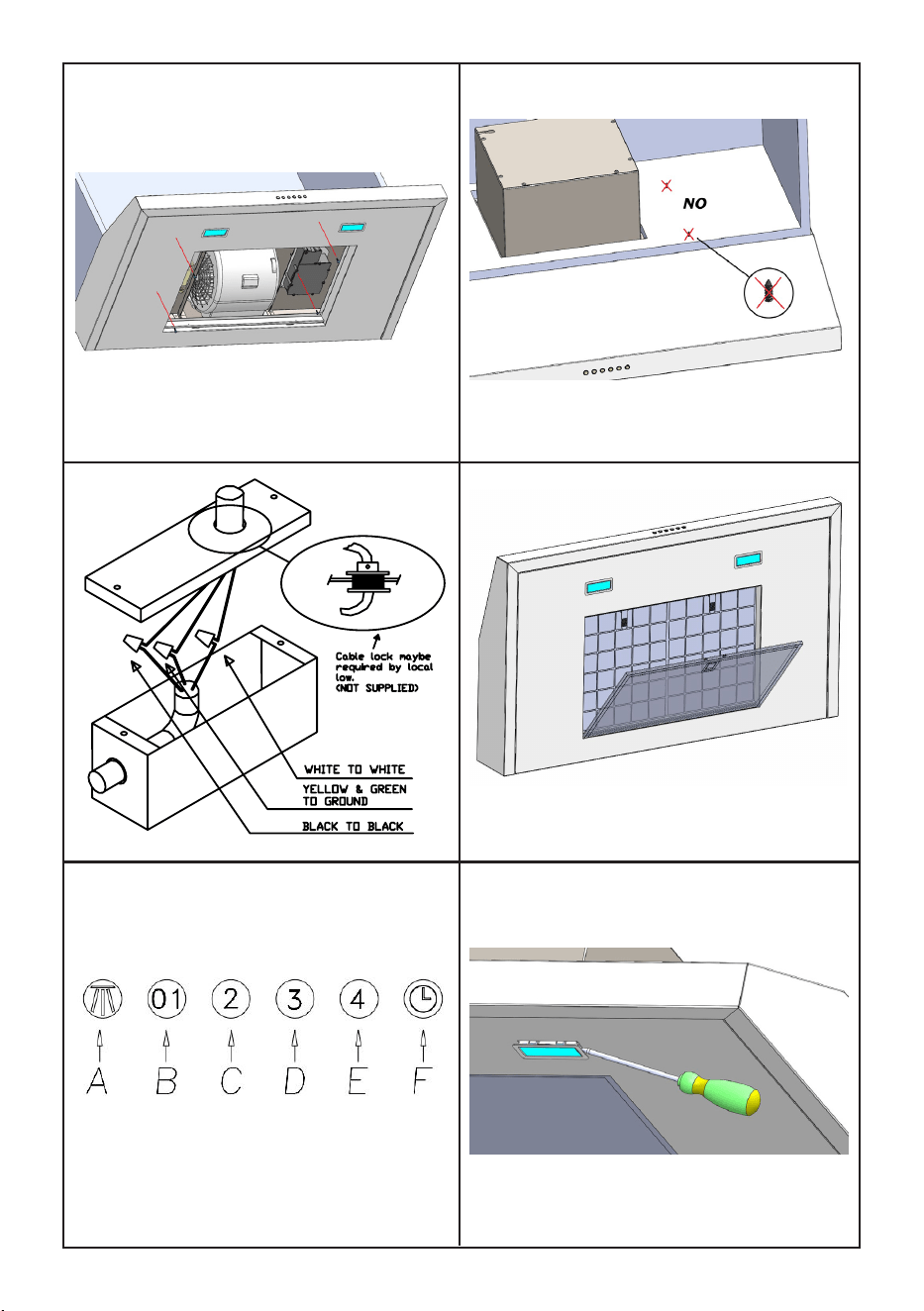
CAUTION: Make sure the power is turned off
at source. Make electrical connections (refer
to Figure 9).
Ensure that the plastic aps at the exhaust
outlet for the fan move freely and have not
become jammed or stuck.
Connect the appropriate length of ducting
to the fan exhaust point and join up with the
ducting to the exte-rior.
Do not x the ducting to the range hood
exhaust outlet with screws-use duct tape.
Use duct tape on all joints.
Re-Circulating Requirements.
If the unit is to be used in the re-circulating
mode, t the carbon lter after the installation
is complete (refer to Figure 10).
The carbon lter ts in behind the aluminium
grease lter. Ensure that the plastic tabs on
the carbon lter are facing outwards other-
wise it will be difcult to remove it later for
replacement.
A short length of ductwork must be con-
nected from the exhaust outlet on the fan
to wherever the air is to be exhausted. Al-
low sufcient space to connect the ductwork
to the top of the exhaust outlet on the fan
housing. Do not x the ducting to the range
hood exhaust outlet with screws, use duct
tape. Duct tape should be used on all joints.
8
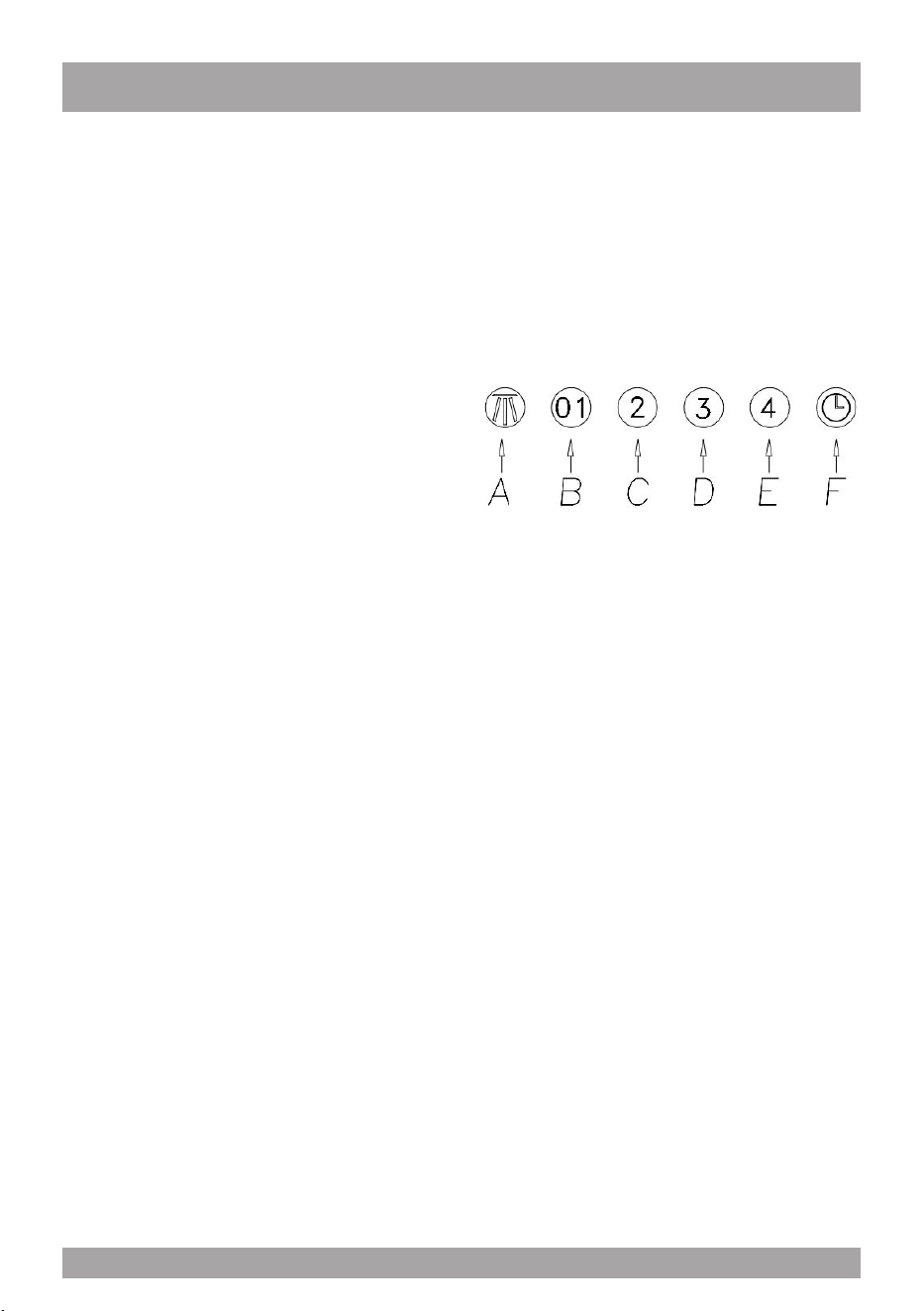
FUNCTION
SUF6 (Fig.11)
A: Light ON/OFF button
B: Blower Speed 1 (low) or OFF
C: Blower Speed 2 (medium)
D: Blower Speed 3 (high)
E: Blower Speed 4 (intensive)
F: 10 Minute Timer
OPERATING PROCEDURES
Read all the instructions before operating
the appliance. Save these instructions for
future reference.
General Advice.
Ensure that the grease lters are in place.
Without these components, operating blo-
wers could catch on to hair, ngers and lo-
ose clothing. Keep fan, lters and surfaces
clean of grease and fat. Always turn hood
fan ON when cooking. NEVER leave coo-
king unattended.
NEVER dispose cigarette ashes, ignitable
substances or any foreign objects into blo-
wers.
Cooking that generates ame is not recom-
mended as this hood is equipped with a
thermal overload that will shut down the mo-
tor if it senses excessive heat. When frying,
oil in the pan can easily overheat and igni-
te. Heat oil slowly in an appropriately sized
pot (covering the entire burner) to reduce
the risk of boiling over and burning.
In the event of a range top grease re, ob-
serve the following:
Switch OFF the range hood. Turn off the
cook top then smother ames with a close
tting lid, cookie sheet or other metal tray. If
the ames do not go out immediately.
EVACUATE AND CALL THE FIRE DE-
PARTMENT.
Never pick up a aming pan – you may be
burned. DO NOT USE WATER including
wet dishcloths or towels, as a violent steam
explosion may occur.
g. 11
Generally, the grease lter should be wa-
shed on a regular basis to avoid grease lter
res.
The blower should be turned on for approxi-
mately 5 minutes before cooking in order to
establish air currents upward through the
hood. Use the low speeds for normal use
and the higher speeds for strong odors and
fumes.
9

On the surfaces that are exposed directly to
heat from the cook-top, it is advisable to cle-
an these regularly to avoid the deposits from
becoming baked on.
Do not use abrasive cleaning agents as the-
se will destroy the brushed nish.
Replace the led lamp SUF6
Before replacing the led lamp switch off the
appliance using appropriate tools and then
remove the led lamp from its slot (Fig. 12).
Take out the led lamp from its connector and
replace it with an another one with similar
characteristics.
To nd the correct led lamp please check on
the replacement part list.
If the supply cord is damaged, it must be
replaced by the manufacturer or its service
agent or a similarly qualied person in order
to avoid a hazard.
MAINTENANCE
The range hood should provide many years
of trouble free use provided it is properly
maintained. Be sure the lights are cool befo-
re cleaning the hood – they are halogen and
become extremely hot.
Cleaning the Filter.
The aluminium mesh lters should be wa-
shed by hand or in the dishwasher as re-
quired. Damaged and worn lters must be
replaced immediately. (Do not operate blo-
wer when lters have been removed). Allow
lters to dry before replacing them, otherwi-
se water will be drawn into the blower.
If a carbon lter has been tted, this must be
replaced every 6 months as a minimum, de-
pending on usage and type of cooking that
is performed.
It is suggested that a spare set of carbon
lters is kept on hand. These can be ordered
from the supplier of your range hood.
Cleaning the Hood.
The outside and interior of your hood should
be wiped regularly with a clean, damp cloth
and mild household dish detergent or degre-
aser.
Use a good quality non-abrasive foaming
type stainless steel cleaner for exterior sur-
faces.
Follow the manufacturers directions. Gene-
rally the foam is sprayed onto a clean dry
cloth and then applied to the stainless steel.
Allow the foam to react on the surface for
a few minutes and then wipe with a clean
dry cloth.
10

Three Year Limited Warranty
YOU MUST REGISTER THE PURCHASE OF YOUR PRODUCT ON LINE AT
www.siriuscappe.com/usa/warranty.htm TO CONVALIDATE YOUR WARRANTY.
YOU CAN FIND THE DATA OF YOUR HOODS ON A LABEL INSIDE THE HOOD. JUST REMOVE
THE GREASE FILTER TO READ IT.
Sirius S.P.A.
Zona industriale Berbentina 6/A
60041 SASSOFERRATO (AN)
ITALY
Register Online! www.siriuscappe.com/usa/warranty.htm
WARRANTY SERVICE
To qualify for warranty service, you must notify Sirius After sale service at the email address
stated below or call toll free USA 1-877-474-8770 and provide the model number, description
of the fault or defect and original date of purchase. Sirius reserves the right to request proof
of original purchase. Sirius will at its sole option and discretion replace products that arrive
damaged through shipping, provided shipping damage is reported as stated above WITHIN 5
BUSINESS DAYS OF RECEIPT of the shipped product or products.
ONE YEAR SERVICE REPAIR WARRANTY:
During the rst year from date of original purchase, Sirius will, at its option, repair or replace, without
charge, any product or part which is found to be defective under normal use and service.
THREE YEAR PARTS WARRANTY:
For three years from date of purchase, Sirius will provide free of charge, non-consumable replacement
parts which are found to be defective under normal use and service.
WHO IS COVERED:
Sirius warrants to the original consumer purchaser of its products that such products will be free from
defects in materials and workmanship for a period of three years from the original date of purchase.
There are no other warranties, express or implied, including, but not limited to, implied warranties of
merchantability or tness for a particular purpose or application.
WHAT IS NOT COVERED:
This warranty does not extend to lters, lamps, batteries, ducts and ductwork components. This war-
ranty does not cover normal maintenance and service or products or parts which have been subject to
misuse, negligence, accident, improper maintenance or repair, faulty installation or installation contrary
to recommended installation instructions. The warranty on glass screens is limited to manufacturing
defects only and expressly excludes cracks and breakages as a result of faulty installation.
Labor and
associated costs associated directly with removal and re-installation are expressly excluded.
The duration of any implied warranty is limited to the three year period as specied for the express
warranty. Some states and provinces do not allow limitation on how long an implied warranty lasts, so
the above limitation may not apply to you.
Sirius after sale service
Telephone (toll free): 1-877-474-8770
Email: [email protected]