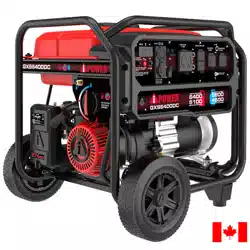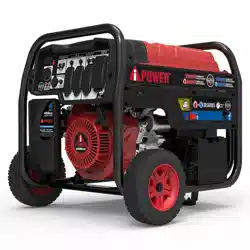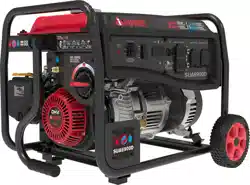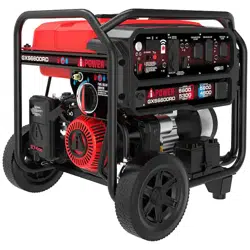
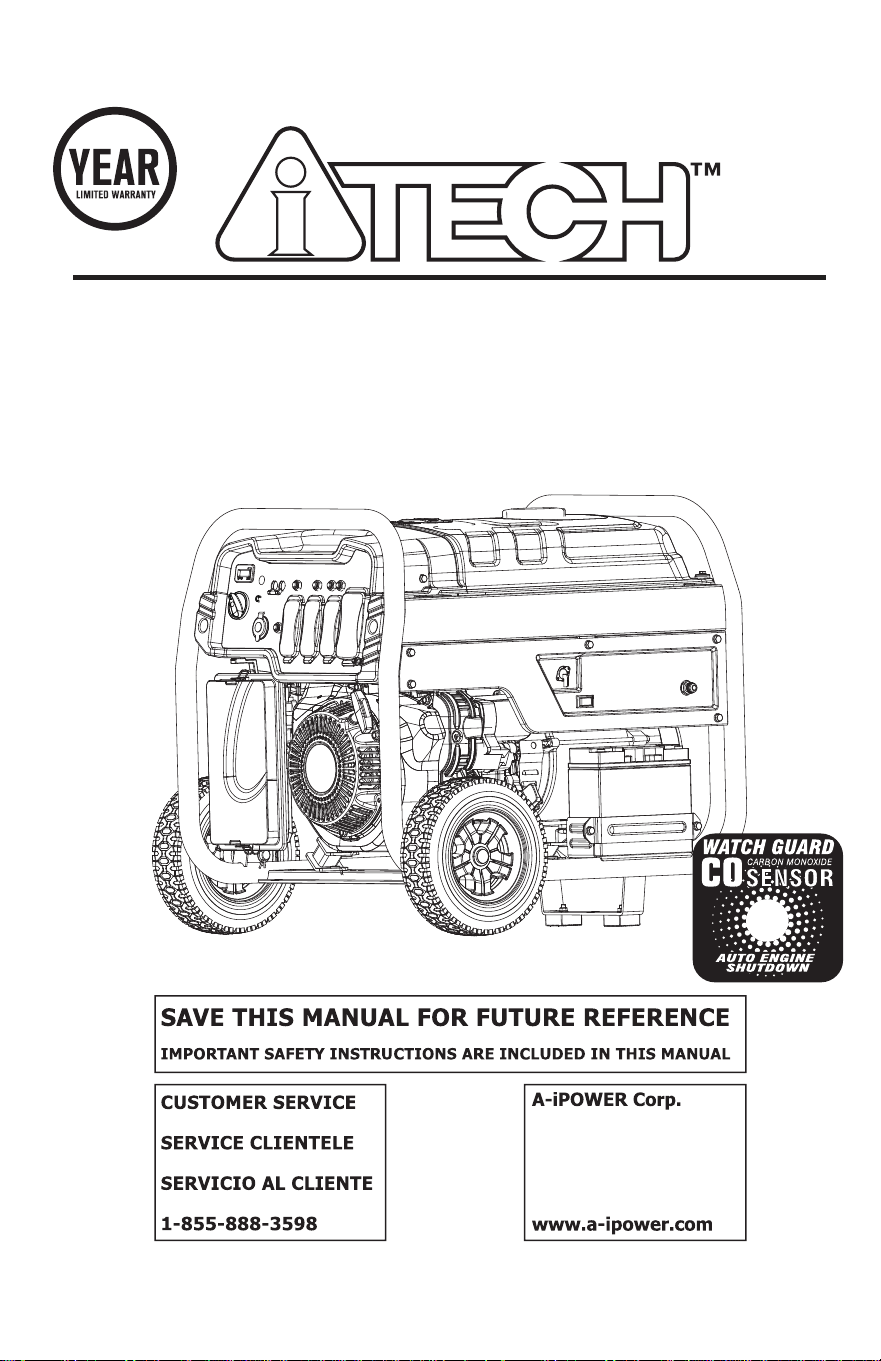
Generator Operator’s Manual
2
10887 Commerce
Way Unit A Fontana
CA 92337
AT10-260001/AT10-212001

SPECIFICATIONS
Model
Frequency
Rated power
Max. power
AC Voltage
Phase
Fuel capacity
Oil capacity
Run time@100% load
Engine model
Displacement
Max. output
Start system
Dimensions
Net weight
AT10-212001
60Hz
9000W (Gas)
8100W (LPG)
12000W (Gas)
10800W (LPG)
120V/240V
Single
25L
1.1L
8.5h
SC460L
459cc
16.0HP/3600rpm
Recoil/E-start
815x545x595mm
106kgs
AT10-260001
60Hz
5500W (Gas.)
5000W (LPG)
6000W (Gas.)
5500W (LPG)
120V/240V
Single
15L
1.0L
5.0h
SV320L
322cc
11.7HP/3600rpm
Recoil/E-start
625x490x577mm
71kgs
3
TABLE OF CONTENTS
17
20 For Gasoline
23 For LPG
18
18
19
19
19
19
9 Co Sensor Instructions
14
15
TABLE OF CONTENTS
4
Operation
Using Electric Power
AC Application
Stopping the Generator
Stopping the Generator
Oil Sensor
Maintenance
Transporting
Storage
Warranty
32
31
30
30
27
27
28
28
28
28
28
29
29
26
26
25
25

Using the Operator’s manual
The operating manual is an important part of your generator. It
should be read thoroughly before initial use, and referred to often
to make sure adequate safety and service concerns are being
addressed.
Reading the owner’s manual thoroughly will help avoid any personal
injury or damage to your machine. By knowing how best to operate
this machine you will be better positioned to show others who may
also operate the unit.
This manual is written to take you from the safety requirements
to the operating functions of your machine. You can refer back to
the manual at any time to help troubleshoot any specific operating
functions, so store it with the machine at all times.
Attention: Read through the complete
manual prior to the initial use of your
generator.
INTRODUCTION
5
6
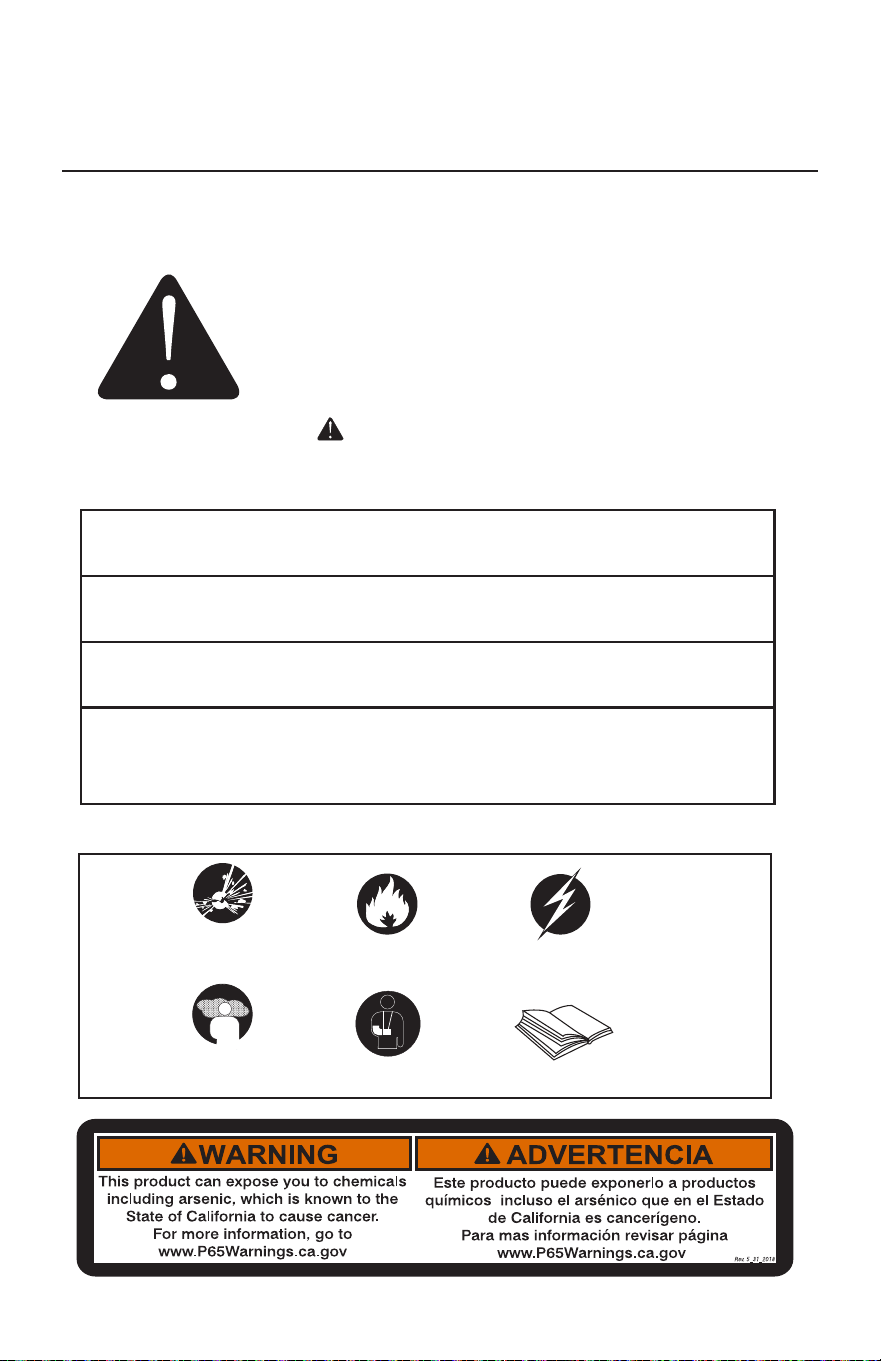
The safety alert symbol ( ) is used with a signal word (DANGER,
CAUTION, WARNING), a symbol and/or a safety message to alert
you to hazards.
DANGER indicates a hazard which, if not avoided, will result in
death or serious injury.
WARNING indicates a hazard which, if not avoided, could result
in death or serious injury.
CAUTION indicates a hazard which, if not avoided, might result
in minor or moderate injury.
NOTICE indicates a situation that could result in equipment
damage. Follow safety messages to avoid or reduce the risk of
injury or death.
Hazard Symbols and Meanings
Save these Instructions
Safety Rules
This is the safety alert symbol. It is used
to alert you to potential personal injury
hazards. Obey all safety messages that
follow this symbol to avoid possible
injury or death.
EXPLOSION
KICKBACK READ MANUAL
FIRE ELECTRIC SHOCK
TOXIC FUMES
SAFETY
7
SAFETY
7a
SAFETY
7b
SAFETY
7c
SAFETY
7d
SAFETY
7e
SAFETY

8
WARNING
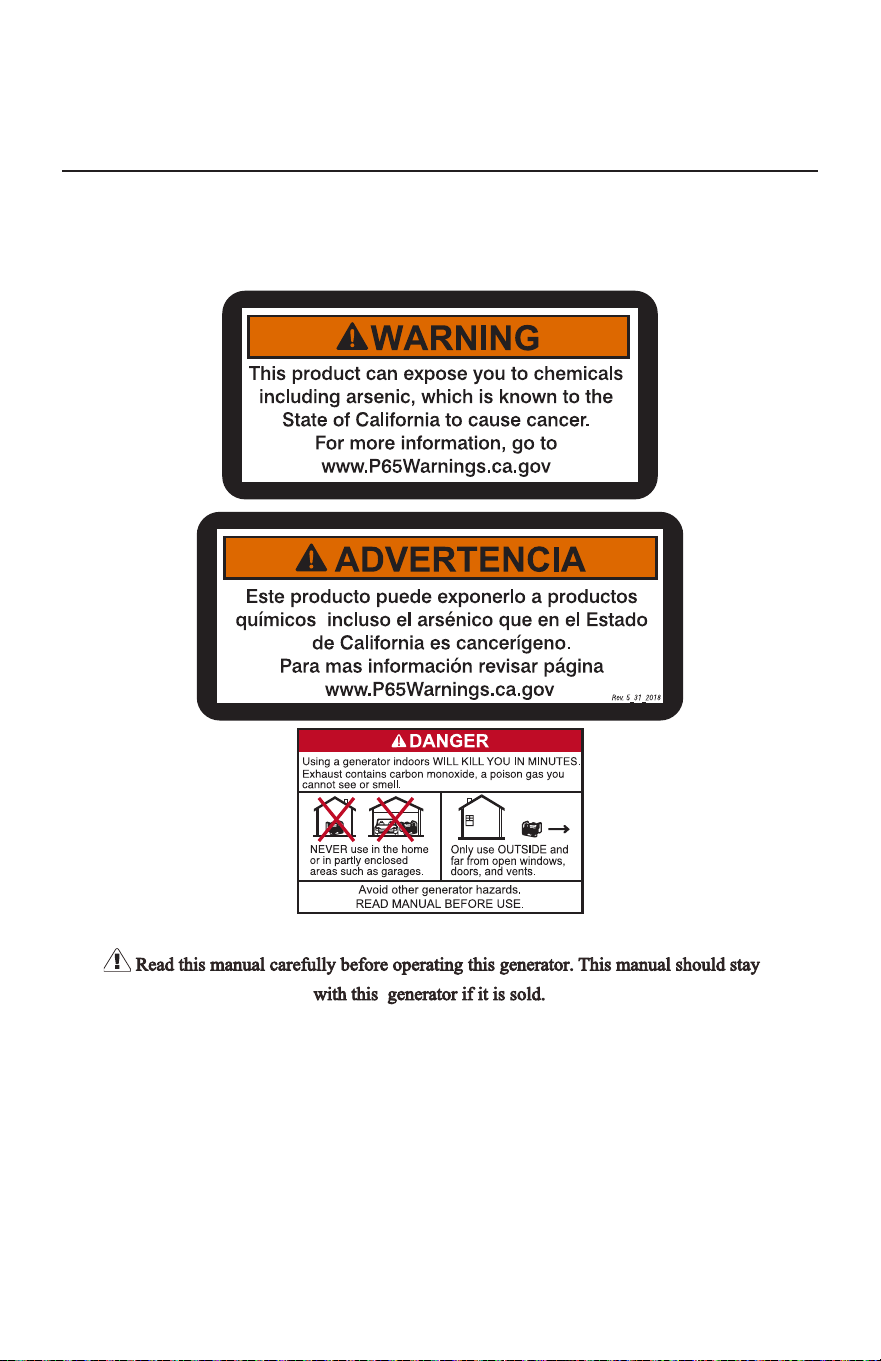
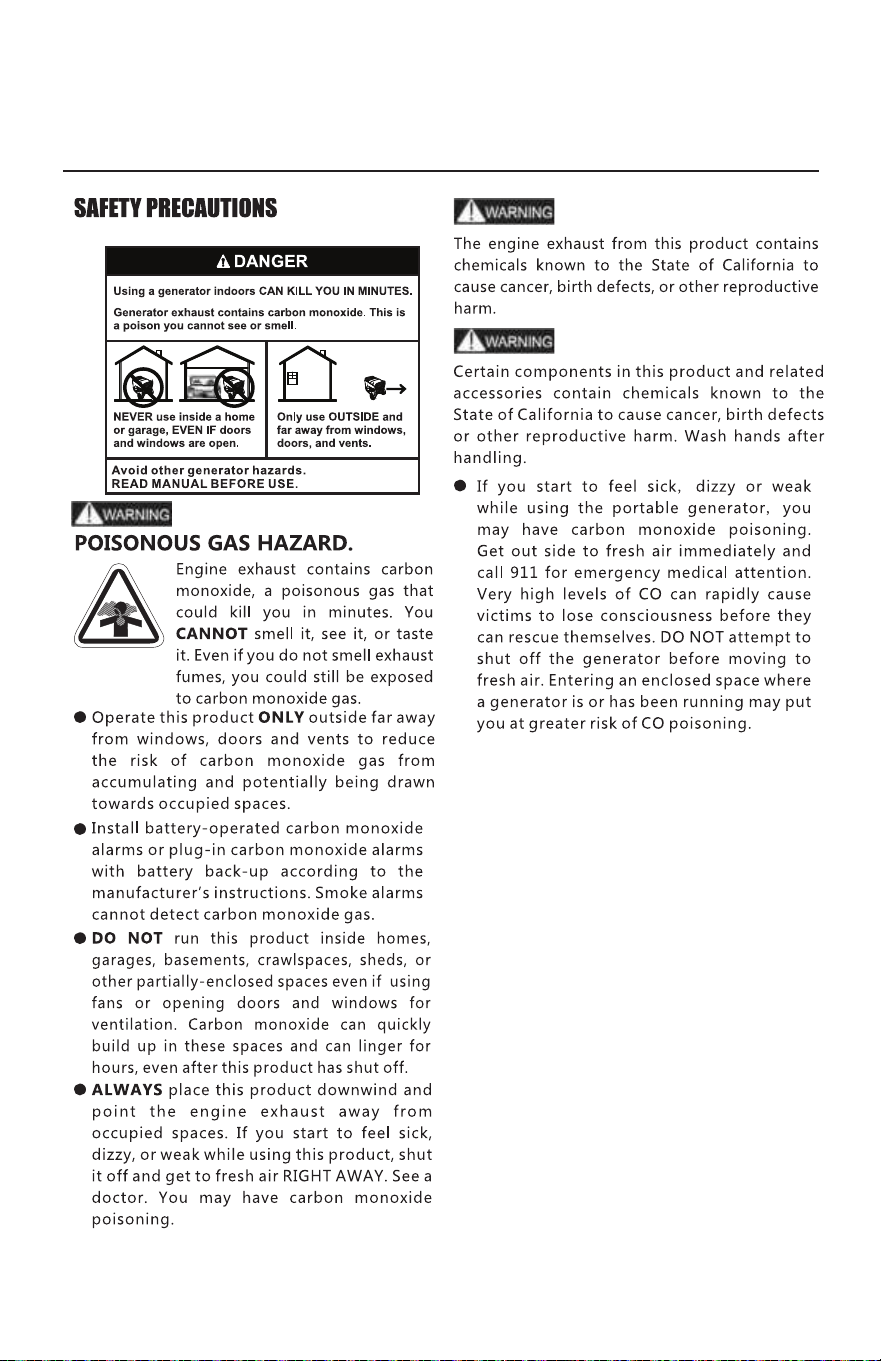
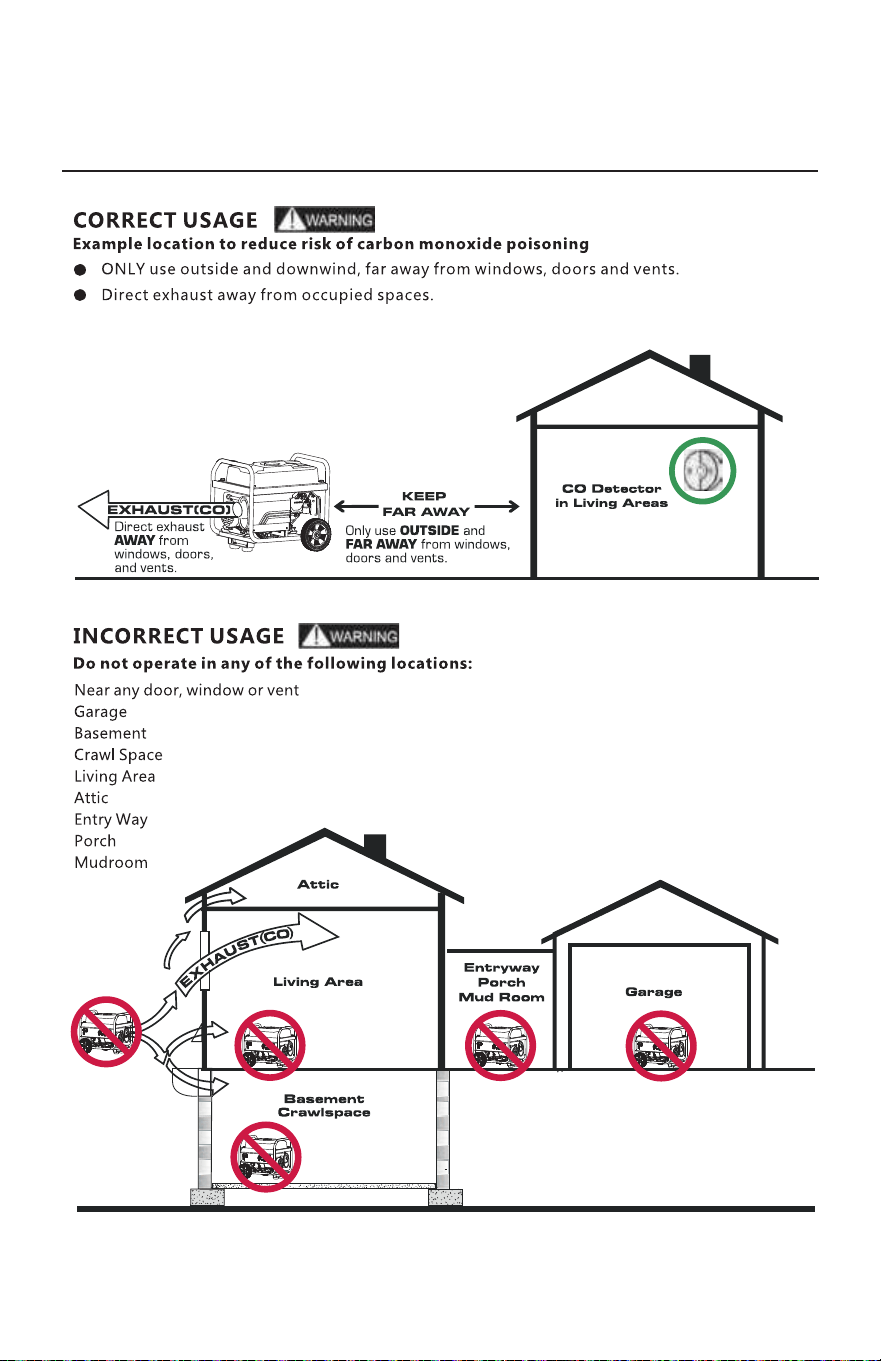
Generator exhaust contains carbon monoxide,
a poisonous gas that can kill you.
You CANNOT smell or see this gas.
• Use the generator outdoors, away from open windows, vents,
or doors that could allow the carbon monoxide gas to come
indoors. Keep the generator at least 1 meter (3 feet) away from
any structure or building during use.
• NEVER use a generator indoors, including in homes, garages,
basements, crawl spaces, and other enclosed or partiallyenclosed
areas, even with ventilation. Opening doors and
windows or using fans will not prevent carbon monoxide buildup
in the home.
• NEVER use a generator in enclosed or partially-enclosed spaces.
Generators can produce high levels of carbon monoxide very
quickly. When you use a portable generator, remember that you
cannot smell or see carbon monoxide. Even if you can’t smell
exhaust fumes, you may still be exposed to carbon monoxide.
• NEVER operate the generator in an explosive atmosphere, near
combustible materials or where ventilation is not sufficient to
carry away exhaust fumes. Exhaust fumes can cause serious
injury or death.
• If you start to feel sick, dizzy, or weak while using a generator,
get to fresh air RIGHT AWAY. DO NOT DELAY. The carbon
monoxide from generators can rapidly lead to full incapacitation
and death.
• If you experience serious symptoms, get medical attention
immediately. Inform medical staff that carbon monoxide
poisoning is suspected. If you experienced symptoms while
indoors, have someone call the fire department to determine
when it is safe to re-enter the building.
SAFETY
9
SAFETY
ANYONE using or servicing this generator must read, understand, and
follow all safety and operation instructions provided in the product manual.
Failure to closely follow these instructions can result in circumstances
leading to death,
WARNING
IMPORTANT OPERATING INSTRUCTIONS
NOTICE
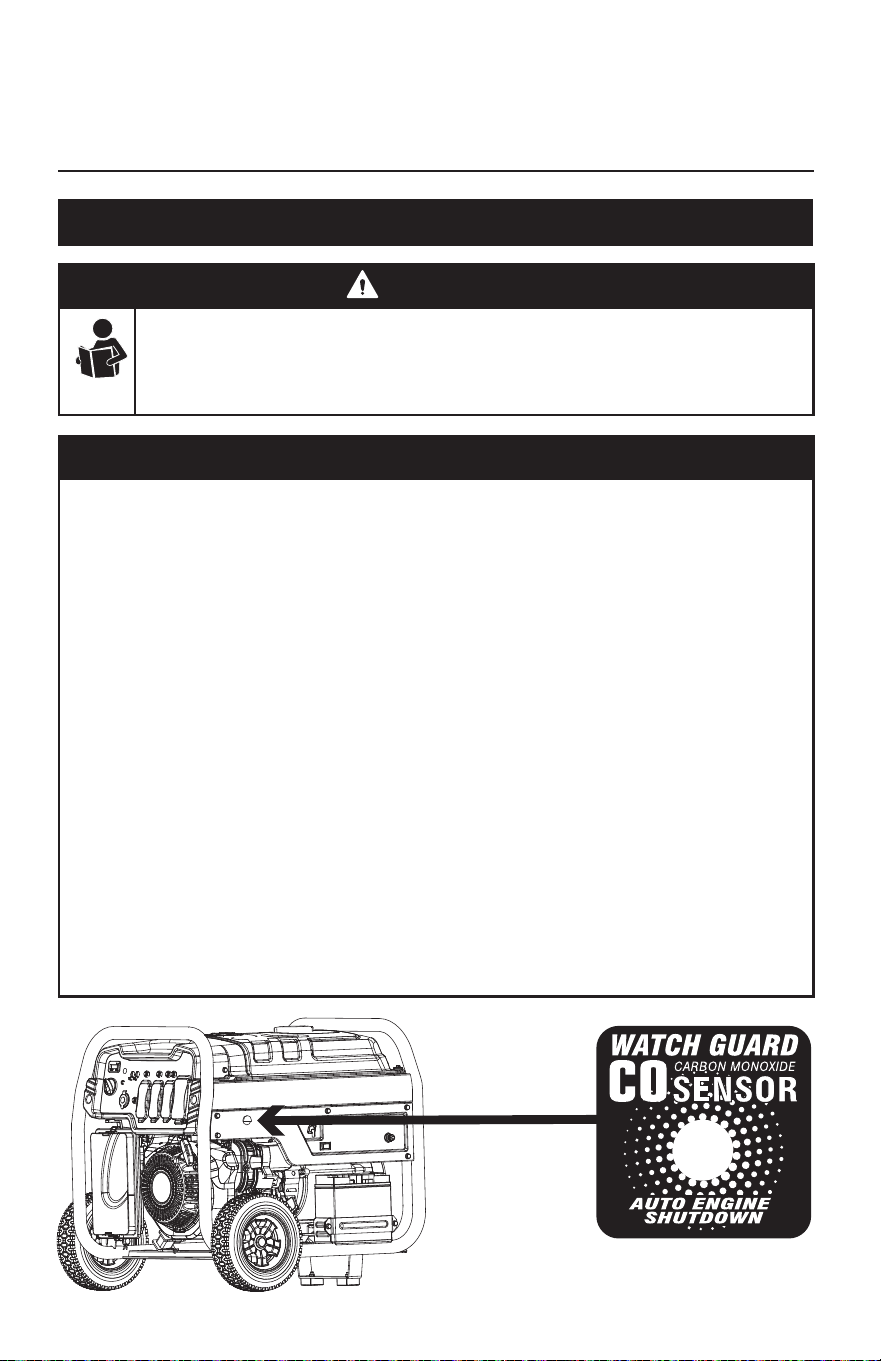
Safety is our priority. As a result, your generator is equipped with a carbon
monoxide (CO) sensor for your protection called WATCH GUARD. You will find
this WATCH GUARD sensor on the side of your generator next to the fuel valve.
It’s purpose is to monitor surrounding environment for unsafe levels of carbon
monoxide - a poisonous gas you cannot see or smell but may cause harm or kill
you in minutes. This sensor is equipped with LED indicator light which will
communicate the current state of generator based on these surroundings. Please
read and understand this important information and be aware - if CO is detected,
your generator will shut down automatically, not allowing you to restart generator
until unsafe levels dissipate.
Status Level I: Rapid flashing of the LED light indicates system shutdown due
to unsafe levels of CO detection in area.
Status Level II: Slow flashing of LED light indicates system had shutdown due
to unsafe levels but is now safe to operate. Slow flashing of
LED light will remain for 5 minutes after initial alarm.
Status Level III: No LED indicator light indicates normal operation.
Note: Do Not Tamper or Disconnect the CO Sensor on the generator.
10
SAFETY
WARNING
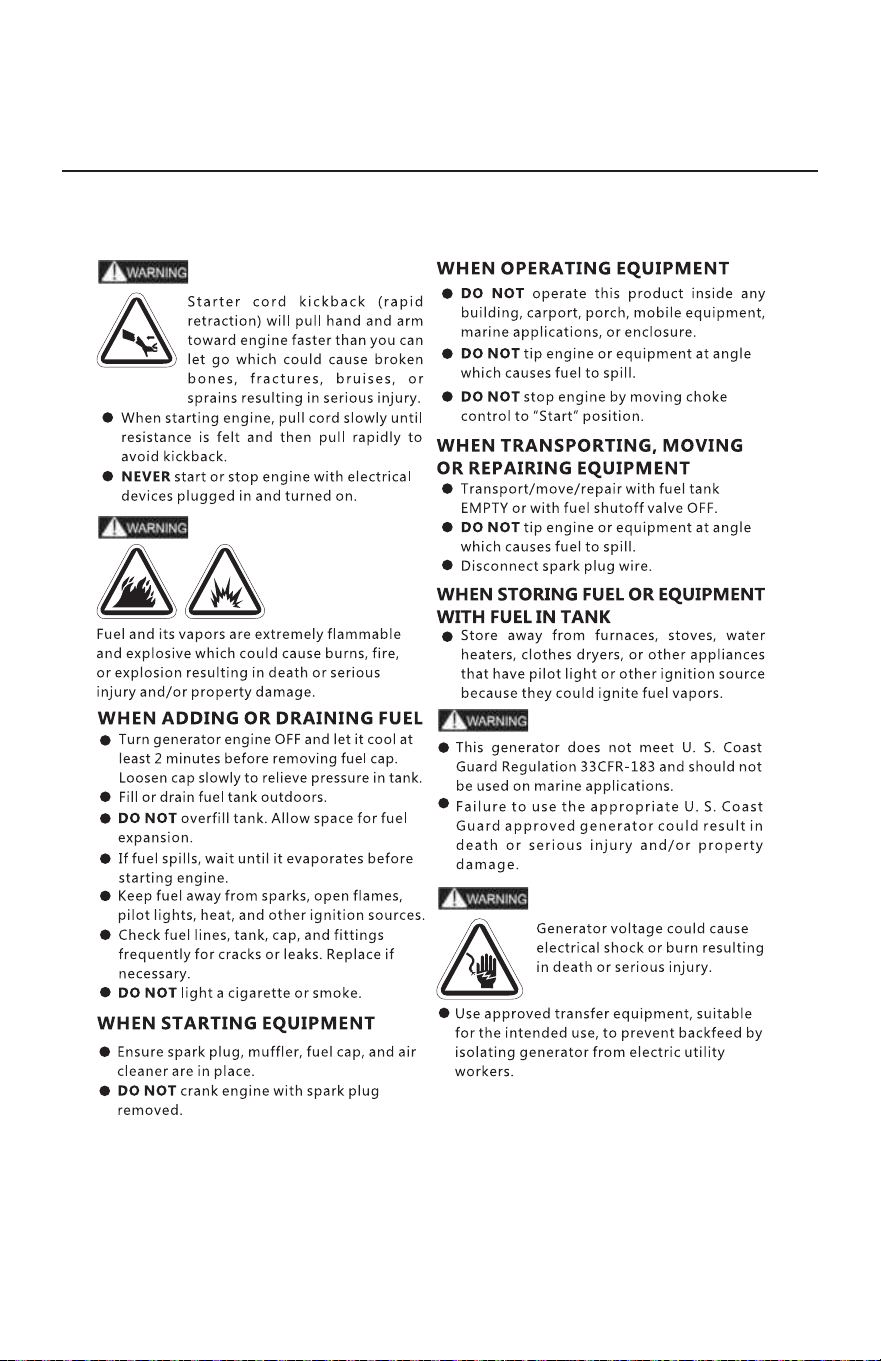
Fuel and its vapors are extremely flammable and
explosive.
Fire or explosion can cause severe burns or death.
When Adding or Draining Fuel
• Observe all safety regulations for the safe handling of fuel.
Handle fuel in safety containers. If the container does not have
a spout, use a funnel.
Do not overfill the fuel tank, leave room for the fuel to expand.
Do not refill fuel tank while the engine is running. Before
refueling the generator, turn it off and let it cool down. Gasoline
spilled on hot engine parts could ignite.
Fill the tank only on an area of bare ground. While fueling the
tank, keep heat, sparks and open flame away. Carefully clean up
any spilled fuel before starting engine.
Always fill fuel tank in an area with plenty of ventilation to avoid
inhaling dangerous fumes.
NEVER store fuel for your generator in the home. Gasoline,
propane, kerosene, and other flammable liquids should be
stored outside of living areas in properly-labeled, non-glass
safety containers. Do not store them near a fuel-burning
appliance, such as a natural gas water heater in a garage. If the
fuel is spilled or the container is not sealed properly, invisible
vapors from the fuel can travel along the ground and can be
ignited by the appliance’s pilot light or by arcing from electric
switches in the appliance.
•
•
•
•
•
WARNING
Starter cord kickback (rapid retraction) will pull
hand and arm toward engine faster than you can
let go which could cause broken bones, fractures,
bruises, or sprains resulting in serious injury.
• When starting the engine, pull cord slowly until resistance is felt
and then pull rapidly to avoid kickback.
• NEVER start or stop engine with electrical devices plugged in
and turned on.
11
SAFETY
DANGER
Improper grounding can result in a risk of
electrocution. Check with a qualified electrician for
your local requirements if you are in doubt as to
whether the unit is properly grounded.
• This generator is equipped with a grounding terminal for added
protection. Using the ground path from the generator to an
external ground source as instructed in the section labeled
“Grounding Instructions” in the Preparation section of this
manual can be necessary. Please consult a qualified electrician
for local regulations.
The generator is a potential source of electrical shock if not
kept dry.
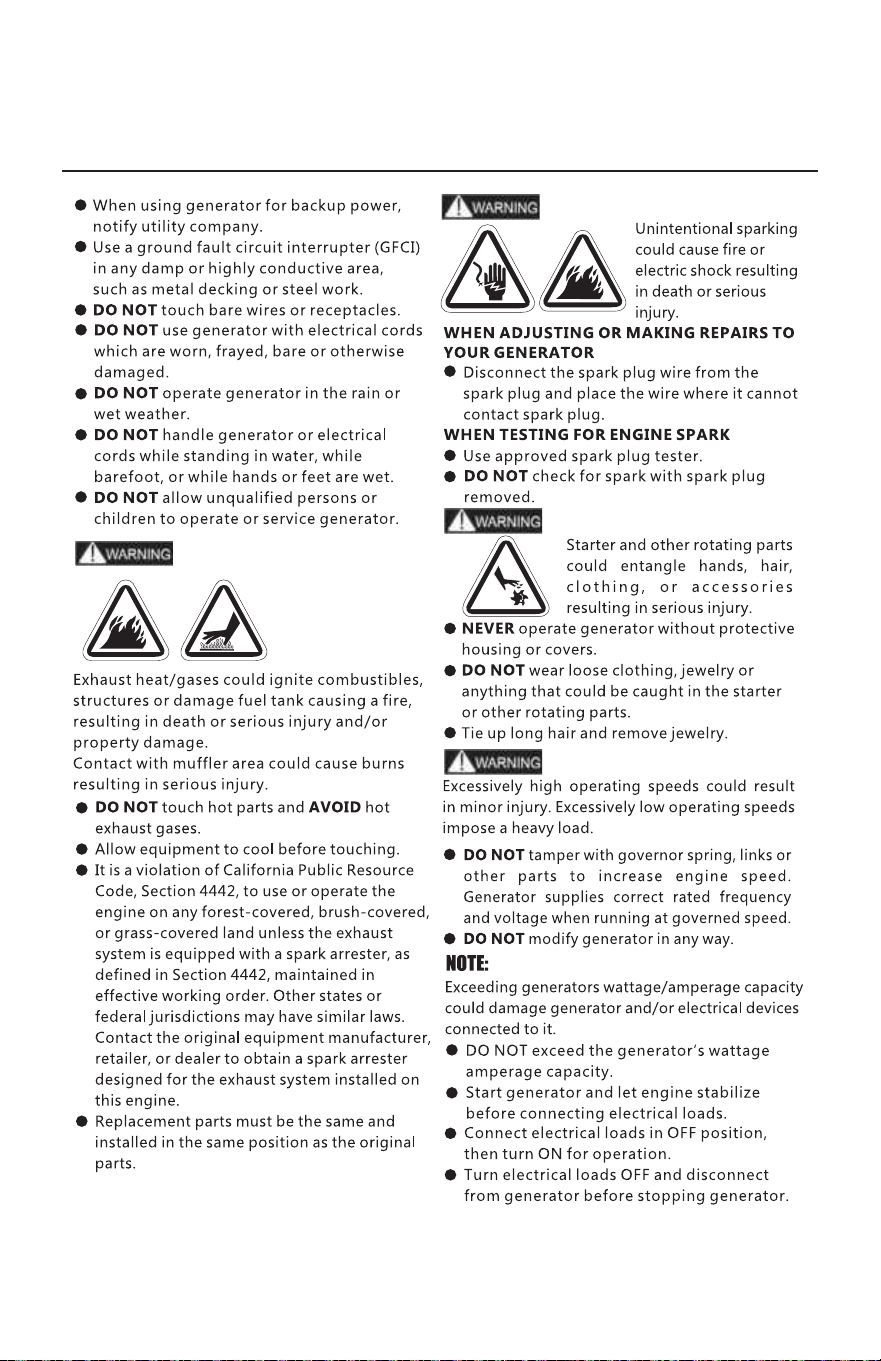
Keep the generator dry and do not use in rain or wet conditions.
To protect from moisture, operate it on a dry surface under
an open, canopy-like structure. Dry your hands if wet before
touching the generator.
Plug appliances directly into the generator. Or, use a heavy duty,
outdoor-rated extension cord that is rated (in watts or amps) at
least equal to the sum of the connected appliance loads. Check
that the entire cord is free of cuts or tears and that the plug has
all three prongs,especially a grounding pin.
NEVER try to power the house wiring by plugging the generator
into a wall outlet, a practice known as “back feeding”. This is an
extremely dangerous practice that presents an electrocution
risk to utility workers and neighbors served by the same utility
transformer. It also bypasses some of the built-in household
circuit protection devices. If you must connect the generator
to the house wiring to power appliances, have a qualified
electrician install the appropriate equipment in accordance
with local electrical codes.
•
•
•
•
This product has been designed with internal grounding or
floating bonded neutral. If it should malfunction or breakdown,
grounding provides a path of least resistance for electric current
to reduce the risk of electric shock.

12
• Do not enclose the generator or cover it. The generator may
become overheated if it is enclosed. If generator has been covered
to protect if from the weather during non use, be sure to remove
it and keep it well away from the area during generator use.
Operate the generator on a level surface. It is not necessary to
prepare a special foundation for the generator. However, the
generator will vibrate on an irregular surface, so choose a level
place. If the generator is tilted or moved during operation, fuel
may spill and/or the generator may tip over, causing a hazardous
situation. Proper lubrication cannot be expected if the generator
is operated on a steep incline or slope. In such a case, piston
seizure may occur even if the oil is above the upper level.
Pay attention to the wiring or extension cords from the generator
to the connected device. If the wire is under the generator or in
contact with vibrating part, it may break and possibly cause a fire,
generator burnout, or electric shock hazard. Replace damaged or
worn cords immediately.
Do not operate in rain, in wet or damp conditions, or with wet
hands. The operator may suffer severe electric shock if the
generator is wet due to rain or snow. If wet, wipe and dry it well
before starting. Do not pour water directly over the generator,
nor wash it with water.
Be extremely careful that all necessary electrical grounding
procedures are followed during each and every use. Failure to do
so can be fatal.
DO NOT smoke while charging a battery. The battery emits
flammable hydrogen gas, which can explode if exposed to
electric arcing or open flame. Keep the area well ventilated and
keep open flames / sparks away when charging a battery.
The engine becomes extremely hot during and for some time after
operation. Keep combustible materials well away from generator
area. Be very careful not to touch any parts of the hot engine
especially the muffler area or serious burns may result.
•
•
•
•
•
•
Important Safety Instructions
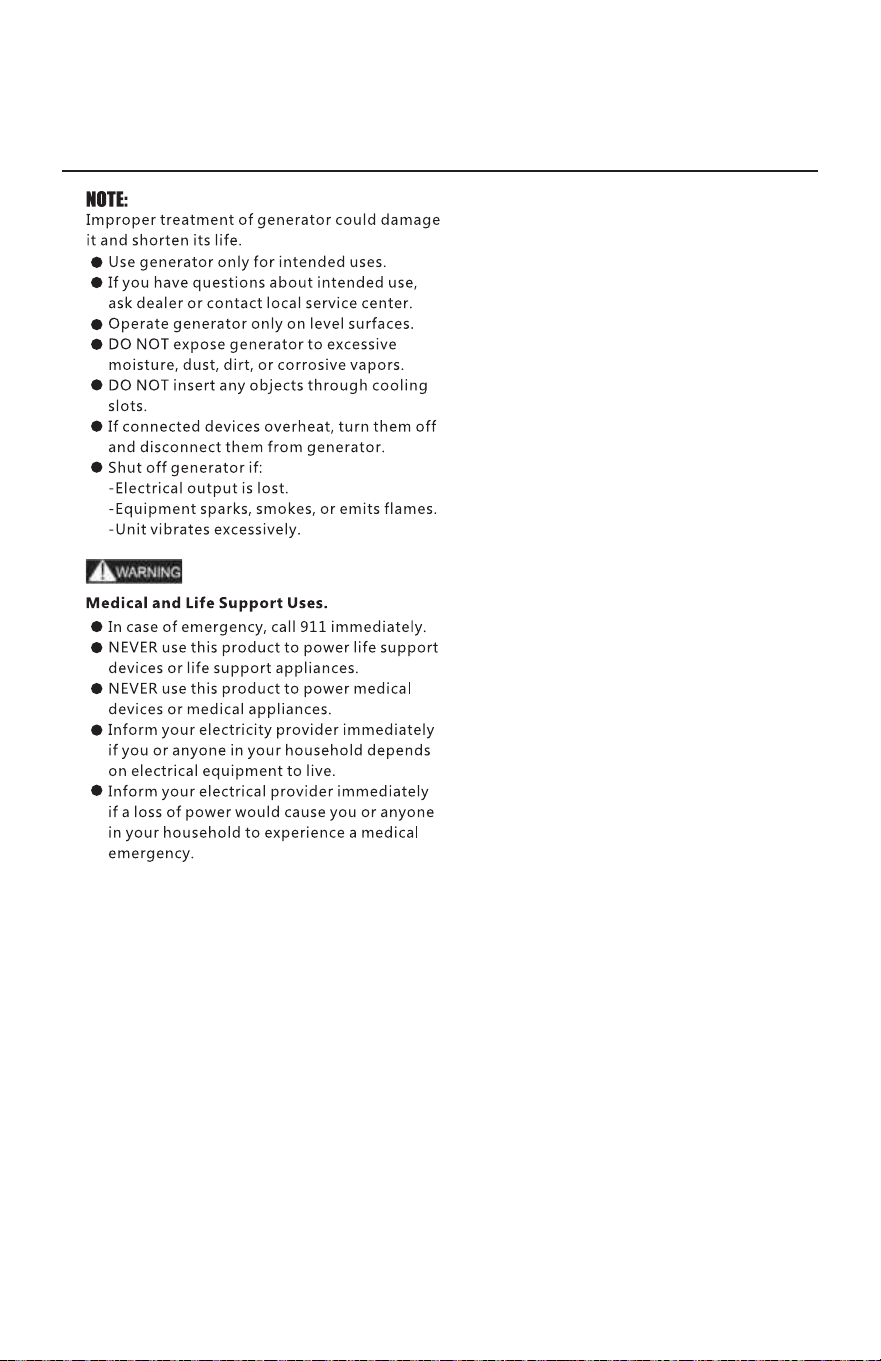
WARNING
To reduce the risk of injury, read this operator’s
manual completely before using.
When using this product, the following basic
precautions should always be followed.
SAFETY

13
SAFETY
• Keep children and all bystanders at a safe distance from work
area.
It is absolutely essential that you know the safe and proper use of
the power tool or appliance that you intend to use. All operators
must read, understand and follow the tool / appliance owners
manual. Tool and appliance applications and limitations must be
understood. Follow all directions given on labels and warnings.
Keep all instruction manuals and literature in a safe place for
future reference.
Always switch off generator’s AC circuit breaker and disconnect
tools or appliances when not in use, before servicing, adjusting,
or installing accessories and attachments.
Make sure the engine is stopped before starting any maintenance,
servicing or repair.
•
•
•
NOTE:
Ensure maintenance and repair of the generator are performed by
properly trained personnel only.
SAVE THESE INSTRUCTIONS
14
ASSEMBLY
ASSEMBLY
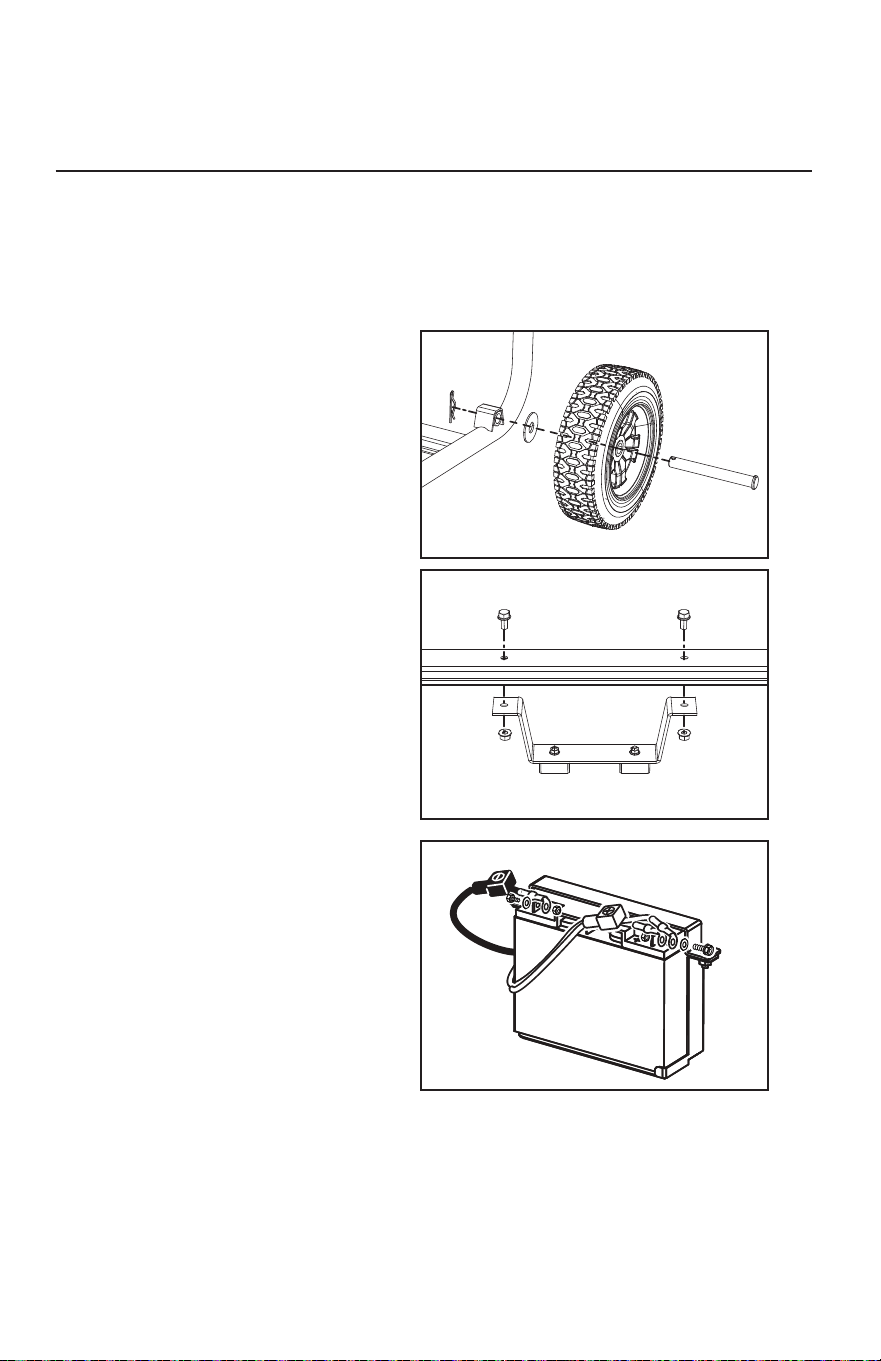
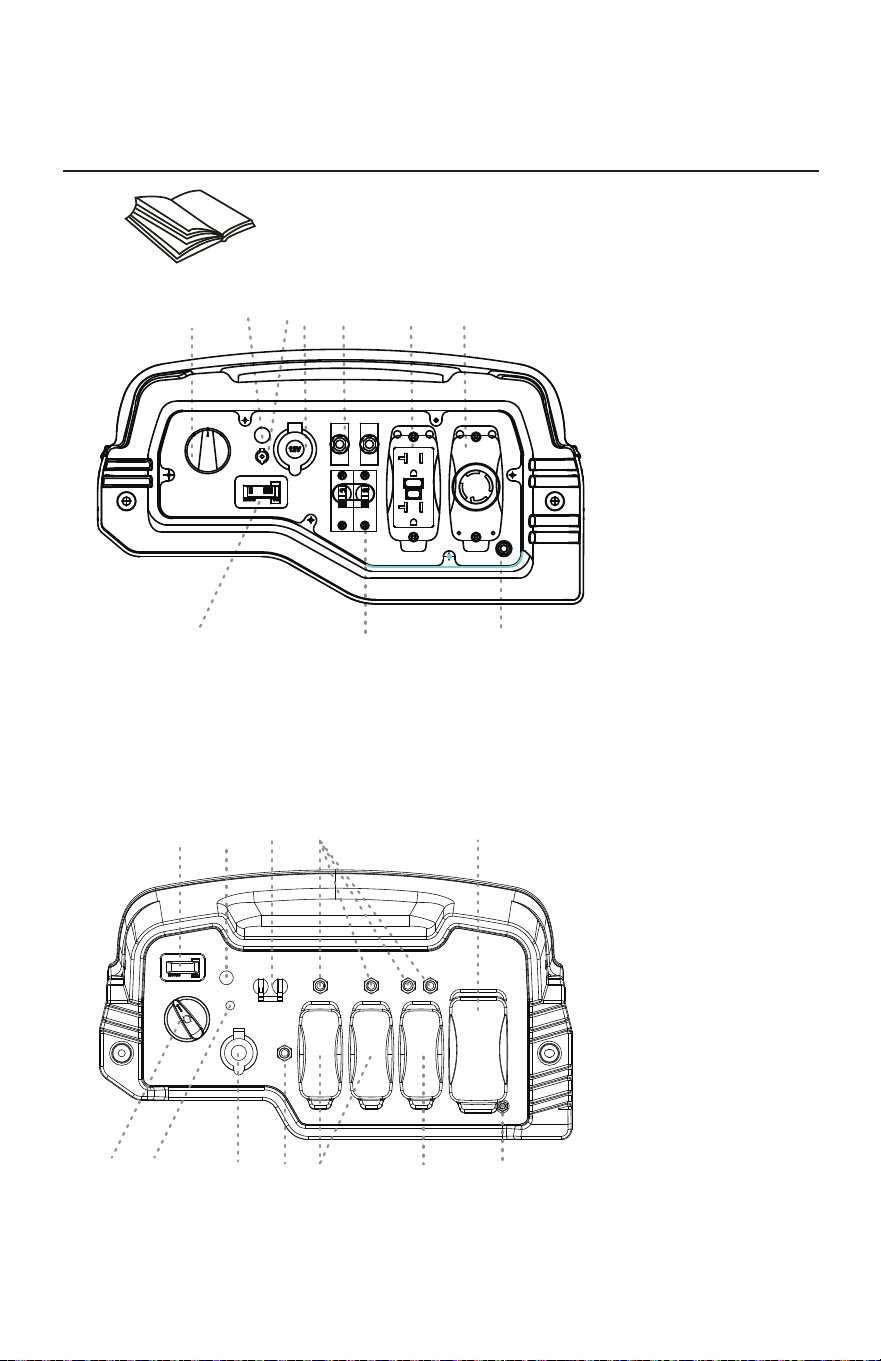
Assembling the Accessory Kit
NOTE: The wheels are not intended for over-the-road use.
1. Installing the wheels
• Slide the axle through the hole
in the center of the wheel.
Slide a washer onto the axle,
then slide the axle into the
wheel mounting hole as shown.
Insert hitch pin to secure.
•
•
2. Installing the feet
•
•
Insert bolts through the foot
bracket and holes in the
generator frame as shown.
Thread lock nuts onto bolts
and tighten one full turn past
snug.
3. CONNECTING BATTERY
• Connect the red wires to the
positive (+) terminal first, then
connect the black wire to the
negative (-) terminal. Make sure
all connections are tight.
• Cover the terminals with the
rubber covers.
15
Read this operator’s manual and safety
rules before operating your generator.
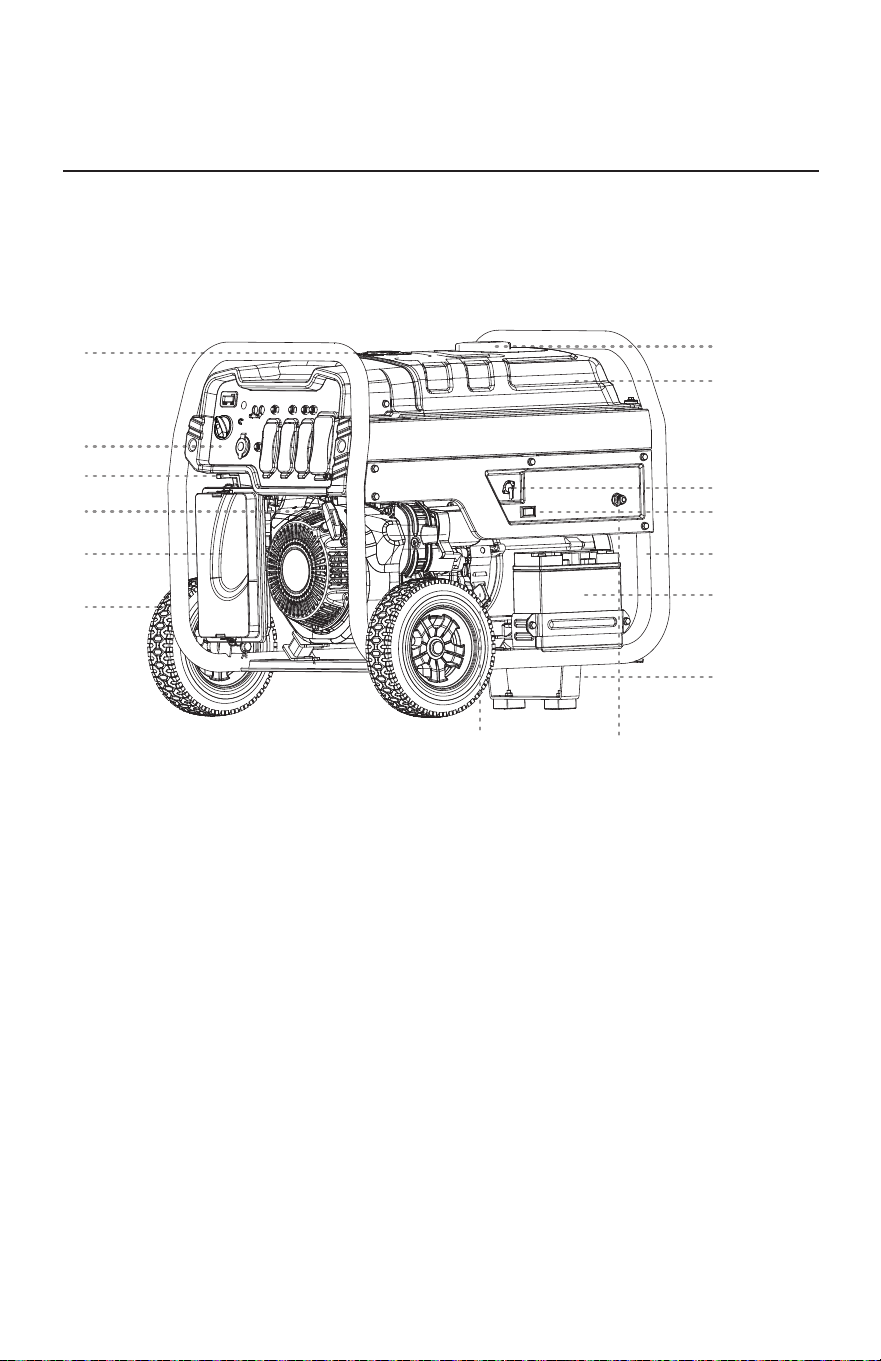
GENERATOR COMPONENTS
b.
h. i. j. k. l.g.
c. d. e.
a. Hourmeter
b. Low Oil Alert
c. AC Breaker
d. Circuit Breakers
e. 50A Socket
f. Engine Switch
g. Battery
“Intelli Charge” Port
h. DC 12V
i. DC Circuit Breaker
j. 20A Socket
k. 30A Socket
l. Ground Terminal
a.
f.
AT10-260001
AT10-212001
a. Electric Start
b. Low Oil Alert
c. Battery Charge
d. DC 12V
e. Circuit Breaker
f. 20A Socket
g. 30A Socket
h. Hourmeter
i. Circuit Breakers
j. Ground Terminal
h. i. j.
b.
c.
d. g.a. e. f.
16
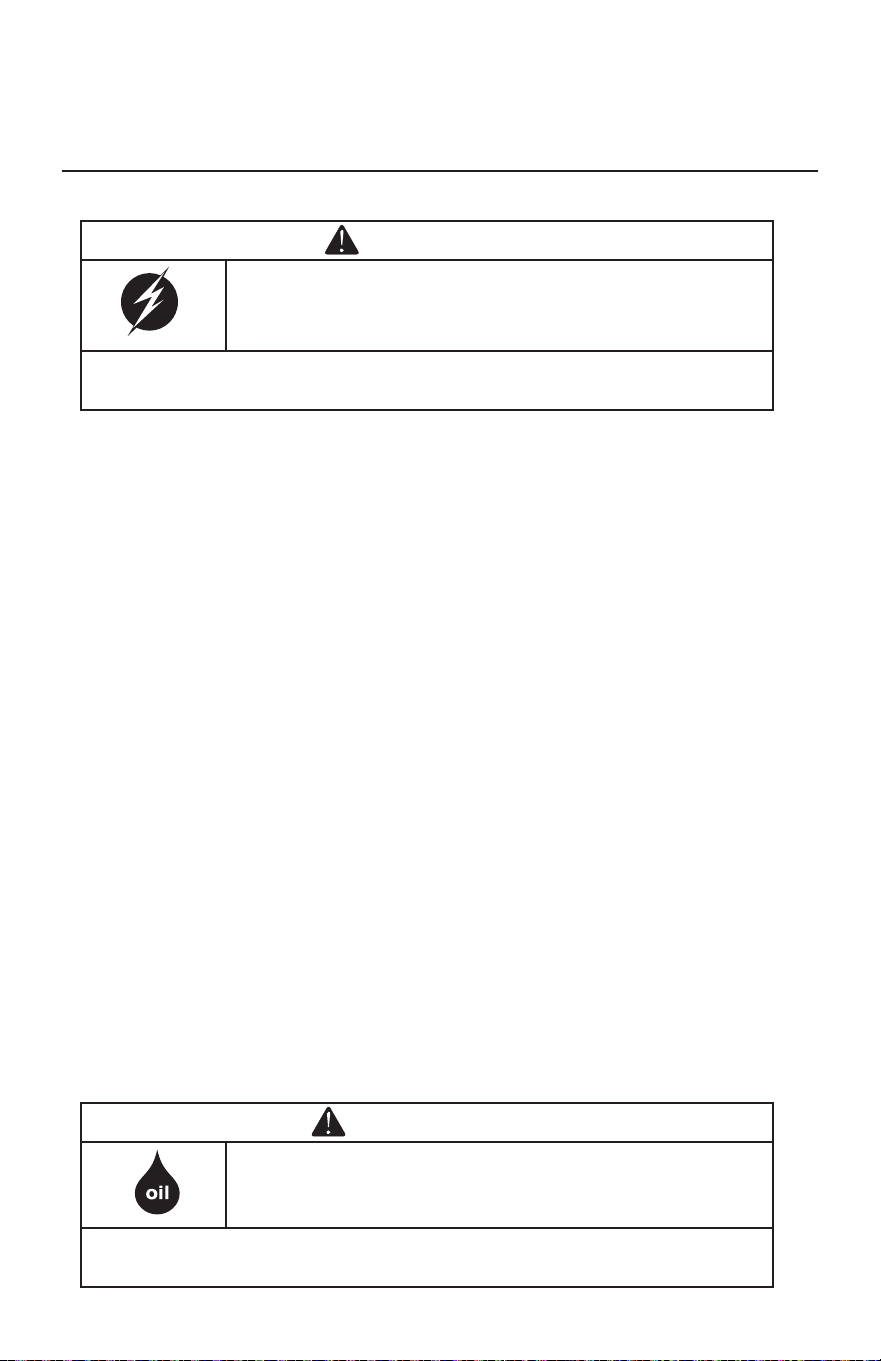
1.
2.
3.
4.
5.
6.
11.
13.
12.
14.
15.
10.
9.
8.
7.
1. Fuel Gauge
2. Control panel
3. Choke Lever
4. Recoil Starter
5. Air Filter
6. Wheel
7. Fuel Tank Cap
8. Fuel Tank
9. Fuel Valve
10. Fuel Source Switch
11. Handle
12. Battery
13. Foot
14. LPG Connector
15. Oil Fill Cap/Dipstick
GENERATOR COMPONENTS
17
Grounding Instructions
The ground terminal on the frame can be used to connect the
generator to a suitable ground source. The ground path should be
made with #8 size wire. Connect the grounding wire securely to
the ground terminal. Connect the other end of the wire securely to
a suitable ground source.
A metal underground water pipe in direct contact with the earth
for at least 10 feet can be used as a grounding source. If a pipe is
unavailable, an 8 foot length of pipe or rod may be used as the
ground source. The pipe should be 3/4” diameter or larger and the
outer surface must be noncorrosive. If a steel or iron rod is used
it should be at least 5/8” diameter and if a nonferrous rod is used
it should be at least 1/2” diameter and be listed as material for
grounding. Drive the rod or pipe to a depth of 8’. If a rock bottom
is encountered less than 4’ down, bury the rod or pipe in a trench.
All electrical tools and appliances operated from this generator,
must be properly grounded by use of a third wire or be “Double
Insulated”.
It is recommended to:
1. Use electrical devices with approved grounded extension cords.
2. Use an extension cord with a 3 hole receptacle and a 3 prong plug
at the opposite ends to ensure continuity of the ground protection
from the generator to appliance.
We strongly recommend that all applicable regulations relating to
grounding specifications be checked and followed.
DANGER
Improper connection of the equipment grounding
conductor can result in a risk of electrocution.
Check with a qualified electrician if you are in doubt as to
whether the unit is properly grounded for your local regulations.
PREPARING THE GENERATOR
WARNING
Always check the level of the engine oil prior to
starting the generator.
• Failure to do so could cause the engine to seize if the oil is low
or empty.
18
Engine Oil
Before checking or refilling oil, be sure generator is located on
stable and level surface with engine stopped.
1. Remove oil dipstick
and check the
engine oil level.
2. If oil level is below
the lower level line,
refill with suitable
oil to upper level
line. Do not screw
in the oil dipstick
when checking oil
level. Do not over fill.
3. Change oil if contaminated.
4. Check engine oil level before starting each time thereafter.
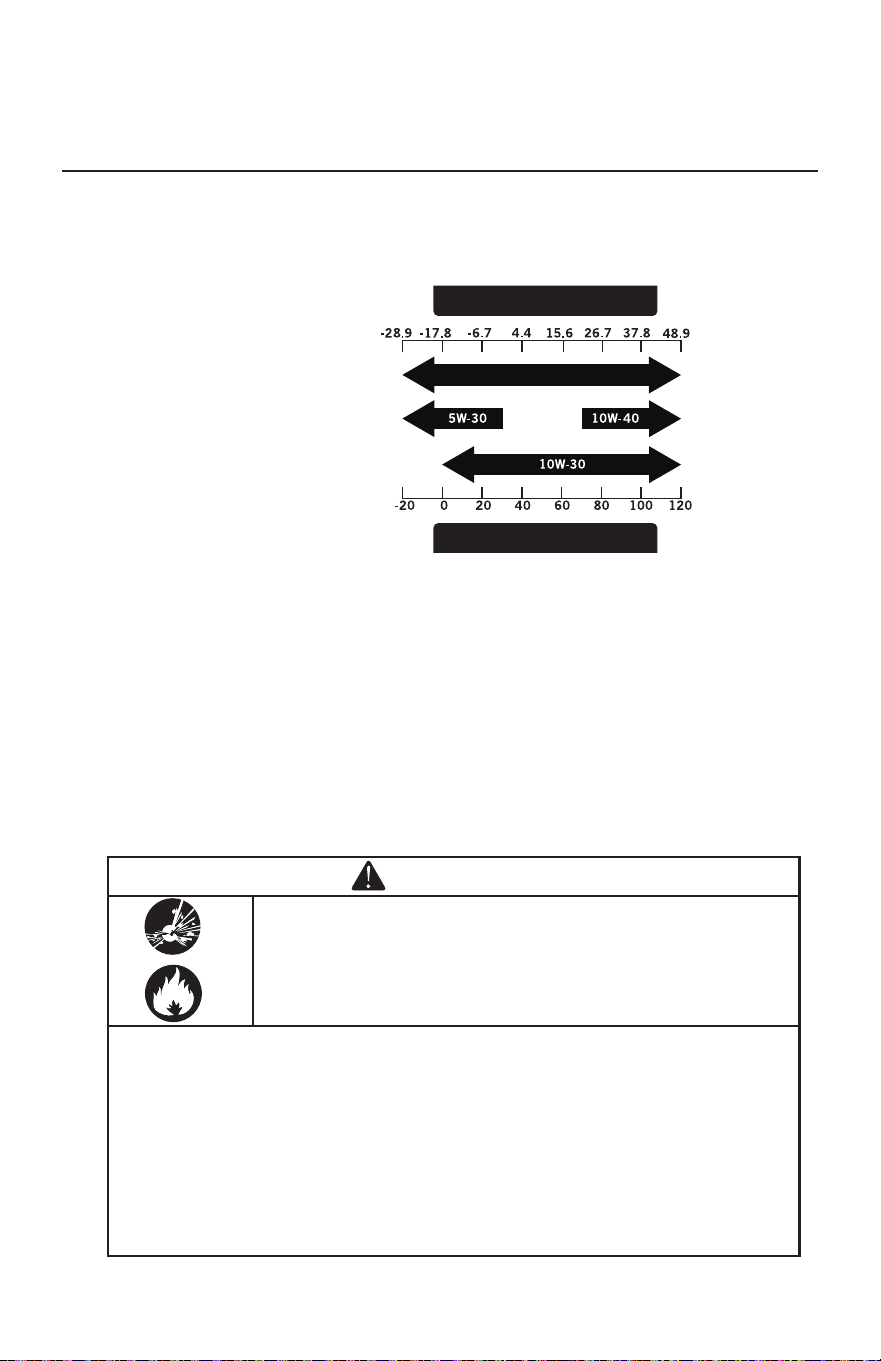
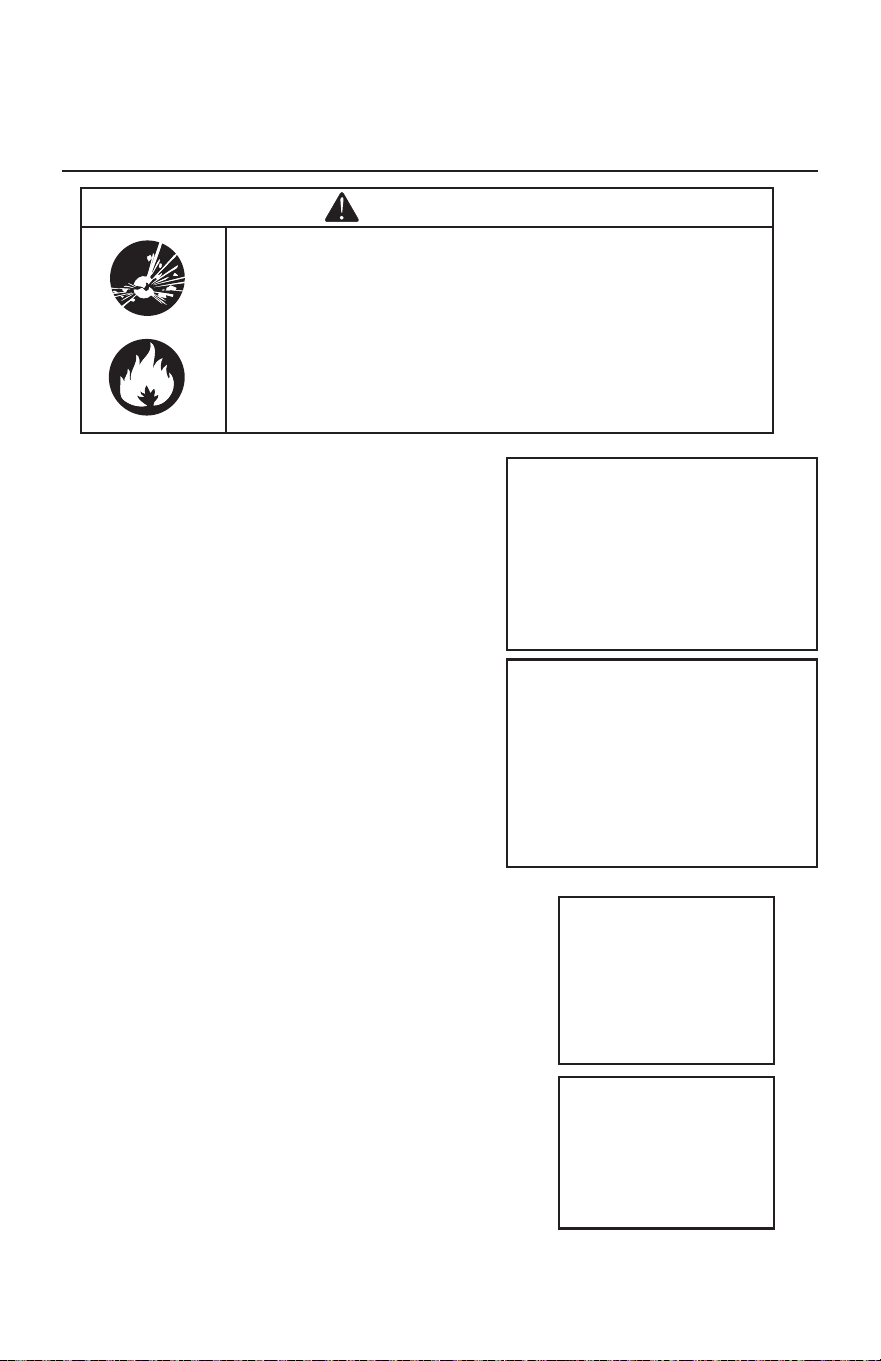
Use no special additives. Select the oil’s viscosity grade according
to the expected operating temperature (also see chart).
Above 40°F, use SAE 30
Below 40°F and down to 1ºF, use lOW-30
Below 10°F, use synthetic 5W-30
Fueling
WARNING
Gasoline is extremely flammable and its vapors
can explode if ignited.
• DO NOT refuel while smoking or near open flame or other
such potential fire hazards.
• Store gasoline only in approved containers, in well ventilated,
unoccupied buildings and away from sparks or flames.
• DO NOT fill the tank while the engine is hot or running, since
spilled fuel could ignite if it comes in contact with hot parts or
sparks from ignition.
• DO NOT start the engine near spilled fuel.
• N EVER use gasoline as a cleaning agent.
PRE-OPERATION CHECKLIST
Full Synthetic 5W-30
Degrees Celsiusº(Outside)
Degrees Fahrenheitº(Outside)
19
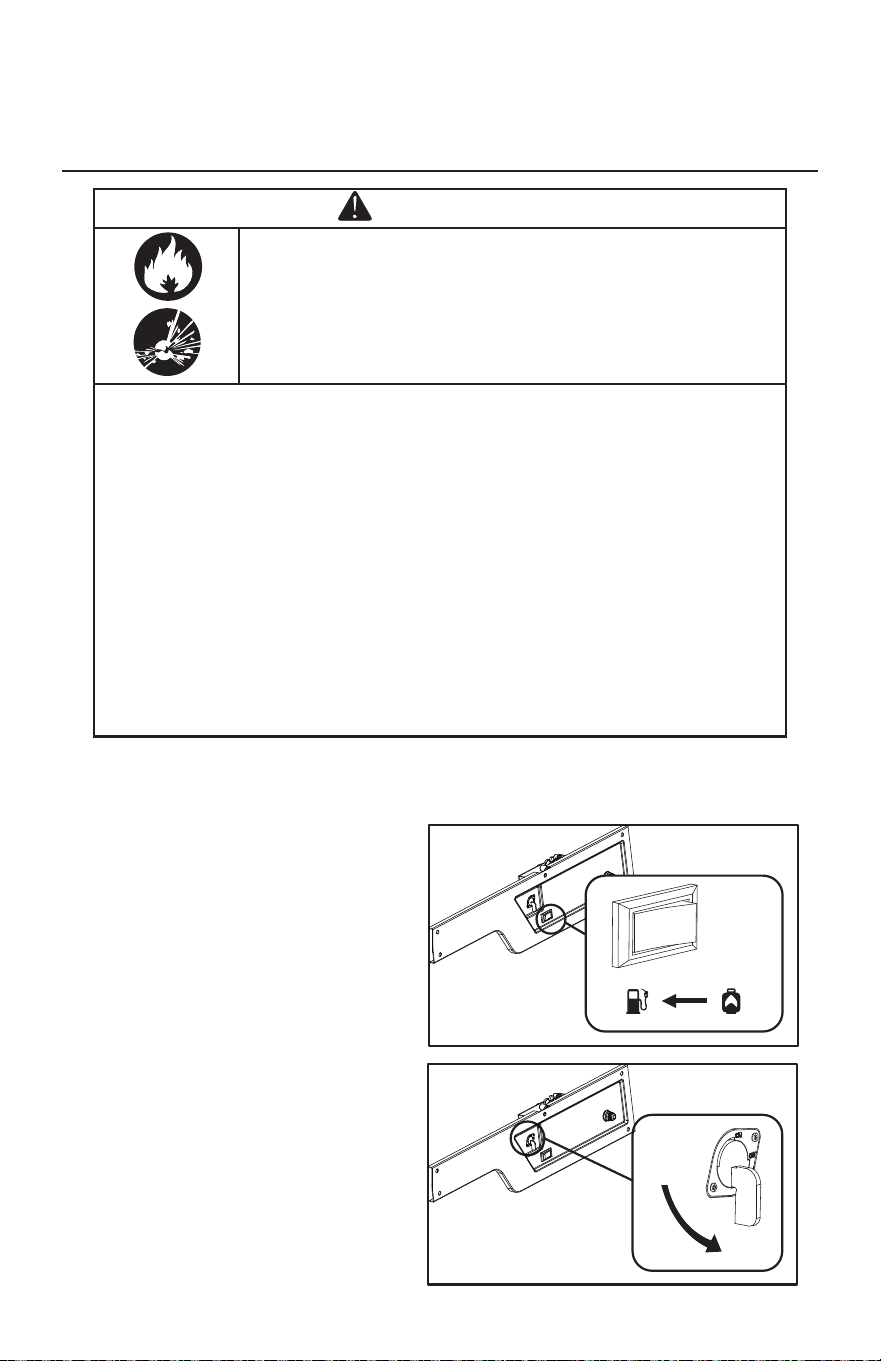
1. If fuel level is low, refill with unleaded
automotive gasoline.
Check fuel gauge while filling.
When using the generator for the
first time or stopping due to the fuel
running out, pull the recoil handle
several times after filling the tank.
2.
3.
General Recommendations
• Purchase gasoline in small quantities
and store in clean, approved
containers.
To minimize gum deposits in your fuel
system and to insure easy starting,
do not use gasoline left over from the
previous season.
Do not add oil to the gasoline.
Consider adding fuel stabilizer before
running or starting the generator.
•
•
•
Fuel Type
• For best results use only clean, fresh,
unleaded gasoline. Do not use any fuel
with more than 10% added ethanol, and
never use E85 fuel.
Do not mix oil with gasoline.•
WARNING
DO NOT overfill the tank, leave room for the fuel
to expand. If the fuel tank is over filled, fuel can
overflow onto a hot engine and cause a FIRE or
EXPLOSION. If fuel spills, wait until it evaporates
before starting engine. Check fuel lines, tank, cap
and fittings frequently for cracks or leaks. Replace
if necessary.
Check Component Parts
Check following items before starting engine:
1. Fuel leakage from fuel hose, etc.
2. Bolts and nuts for looseness.
3. Components for damage or breakage.
4. Generator not resting on or against any
adjacent wiring.
PRE-OPERATION CHECKLIST
Fuel gauge
Fuel tank cap
Max cap mark (red)
PULL
FUEL
GAUGE
EMPTY
20
STARTING YOUR GENERATOR
WARNING
Keep area clear of flammables or other hazardous
materials.
• Keep generator at least 3ft (1m) away from buildings or other
structures. Keep at least 5ft (152cm) of clearance on all sides
of generator including overhead.
• Only operate generators in a dry, well ventilated area.
• Keep exhaust pipe clear of foreign objects.
• Keep generator away from open flame. No Smoking!
• Keep generator on a stable and level surface.
• Do not block generator air vents with paper or other material.
• Do not touch hot part and avoid hot exhaust gases.
• Contact the original equipment manufacturer, retailer, or
dealer to obtain a spark arrester designed for the exhaust
system installed on this engine.
• Replacement parts must be the same and installed in the same
position as the original parts.
PRE-OPERATION CHECKLIST
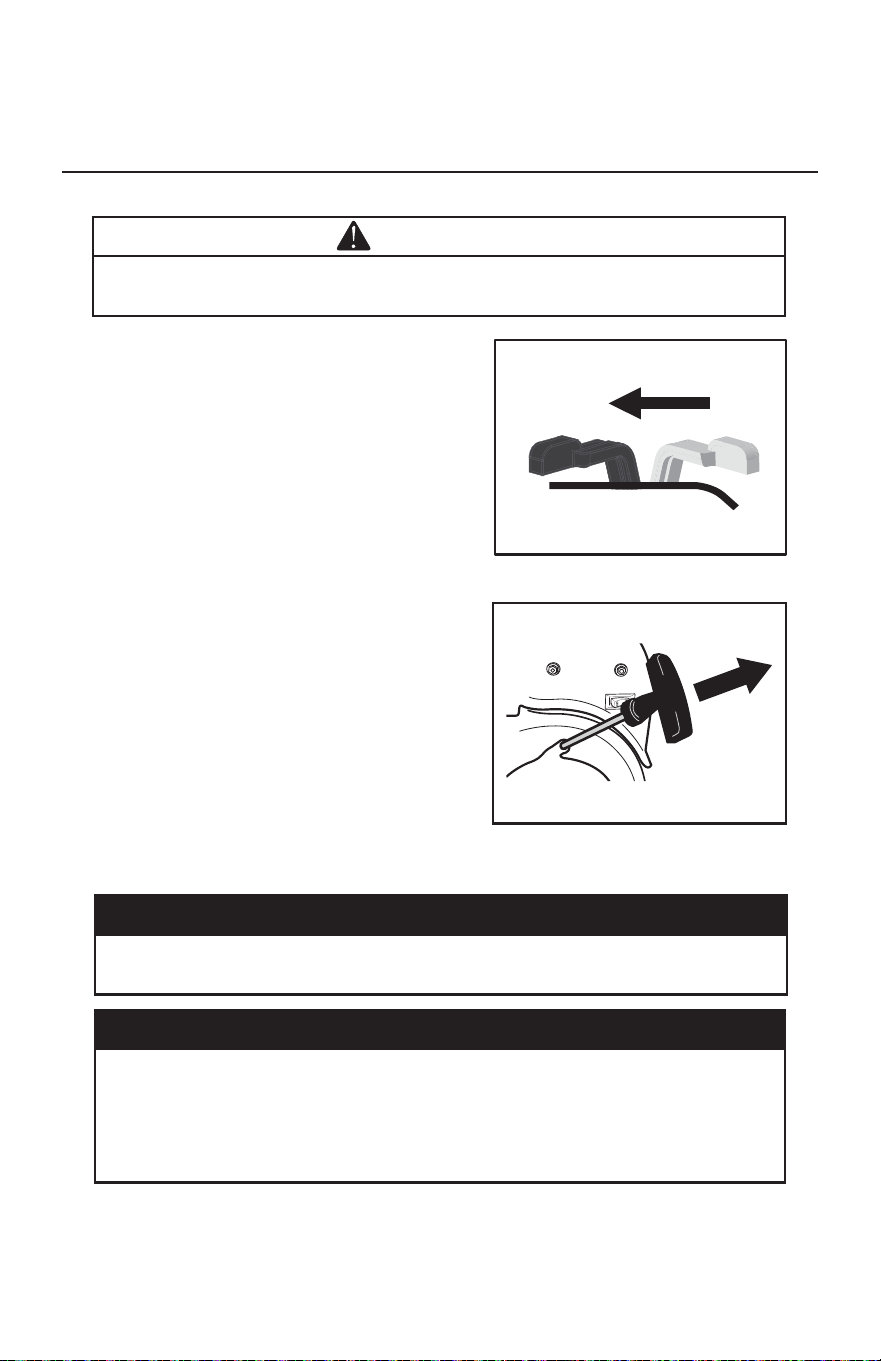
When using gasoline, Turn the
fuel source switch to the “GAS”
position and turn the fuel valve
to the “ON” position
1-1. For Gasoline
LPG
FUEL
SOURCE
GAS
ON
OFF
21
STARTING YOUR GENERATOR
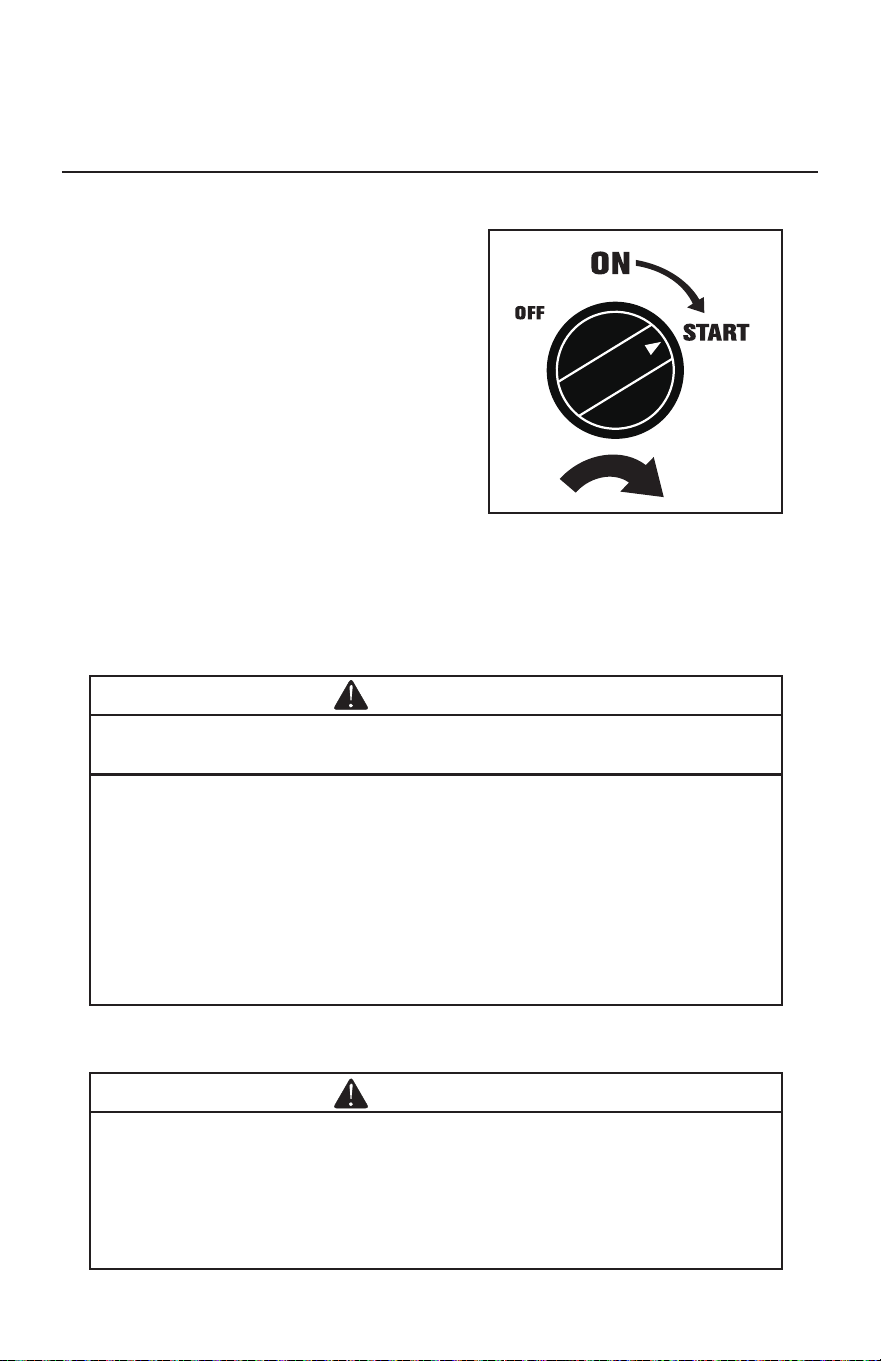
1. Make sure all appliances are
disconnected from the generator.
2. Move engine choke lever to the
“START” position.
3. For recoil start, firmly grasp the recoil
handle and pull slowly until increased
resistance is felt. Pull rapidly up and
away.
4. When engine starts, move choke
lever to 1/2-CHOKE position until
engine runs smoothly and then
fully into “RUN” position. If engine
falters, move choke back out to
1/2-CHOKE position until engine
runs smoothly and then fully into
“ON” position.
Recoil Start
CAUTION
When starting the engine with the recoil start, set the toggle
switch in the “ON” position before pulling the starter handle.
NOTICE
If engine fires, but does not continue to run, move choke
lever to the “START” position and repeat starting instructions.
NOTICE
If engine fails to start after 3 pulls, or if unit shuts down during
operation, make sure unit is on a level surface and check for
proper oil level in crankcase. This unit may be equipped with a
low oil protection device. If so, oil must be checked at proper
level for engine to start and run.
START RUN
CHOKE LEVER
22
STARTING YOUR GENERATOR
Electric Start
1. Make sure all appliances are
disconnected from the generator.
2. Turn the choke lever to the
“START” position. (When the
engine is warm or temperature is
high, start engine with the choke
lever in the “RUN” position).
3. Set the engine switch to the
middle “ON” position. Press and
hold the toggle to the “START”
position to engage the starter.
Release, set switch to
the “ON” position when engine is
running.
To prolong the life of starter components, DO NOT hold switch in
“START” position for more than 15 seconds, and pause for at least 1
minute between starting attempts.
CAUTION
Do not connect appliances with defective power cords and/or
plugs.
• Be sure appliances are not connected to generator when
starting up. Starting the generator with an appliance connected
could result in damage to the generator and/or appliances and
personal injury.
• DO NOT turn the starting motor over 5 seconds continuously.
If the engine fails to start, return the engine switch to the “ON”
position and wait about 10 seconds and then start again.
• DO NOT press the engine switch to the “START” position when
the engine is running to prevent damage of starting motor.
CAUTION
• Do not overload the generator.
• Do not overload individual panel receptacles. These outlets
are protected against overload with push-to-reset-type circuit
breakers. If amperage rating of any circuit breaker is exceeded,
that breaker opens and the electrical output to that receptacle
is lost.
23
STARTING YOUR GENERATOR
•
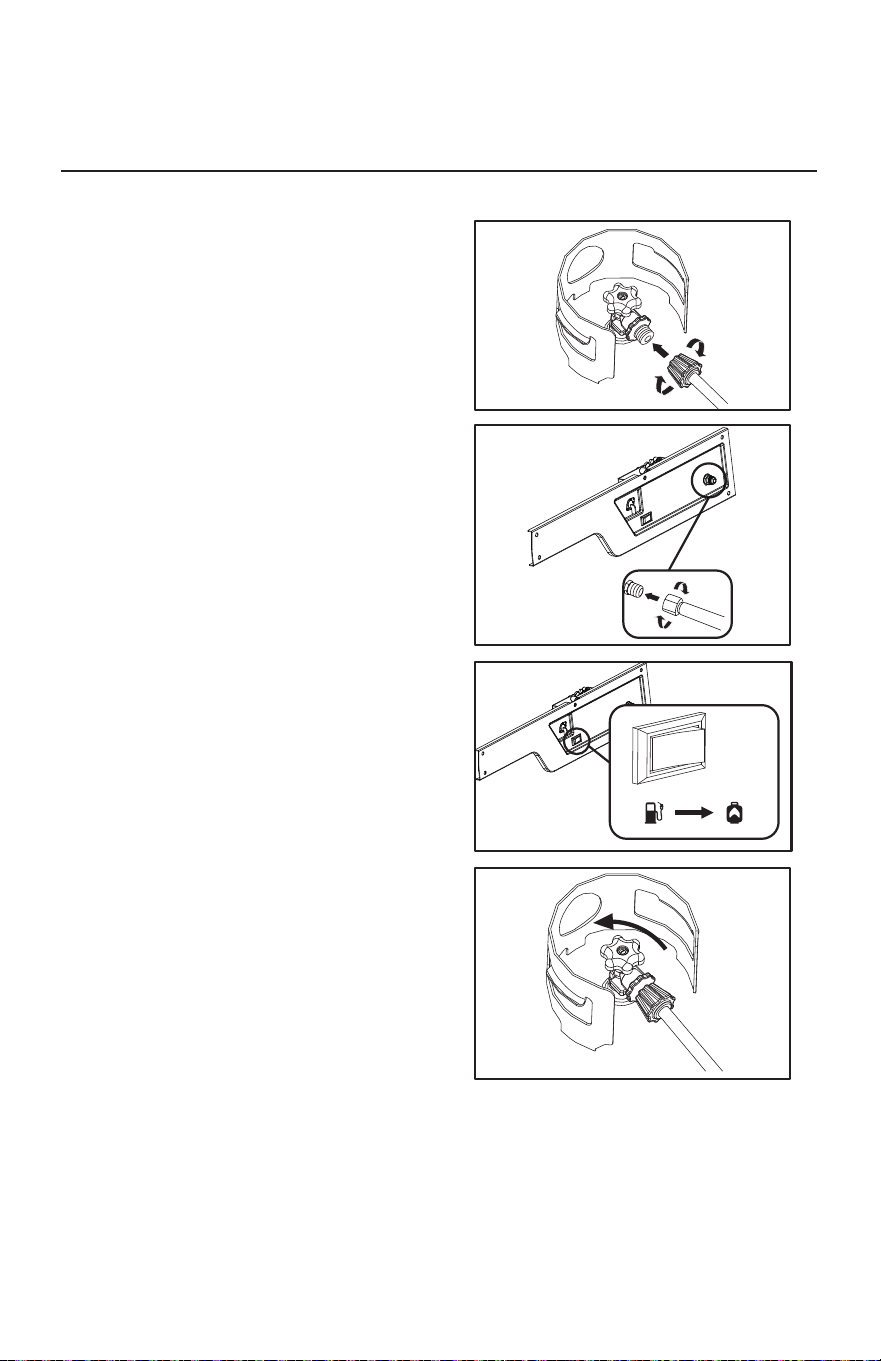
Connect the LPG gas hose to the
propane fuel source.
•
Connect the small end of the LPG gas
hose to the LPG regulator on the
generator and then snug with a
wrench to prevent leakage.
•
Turn the fuel source switch to the
“LPG” position.
•
Rotate the LPG valve to open the LPG.
1-2. For LPG
LPG
FUEL
SOURCE
GAS
24
STARTING YOUR GENERATOR
Electric Start
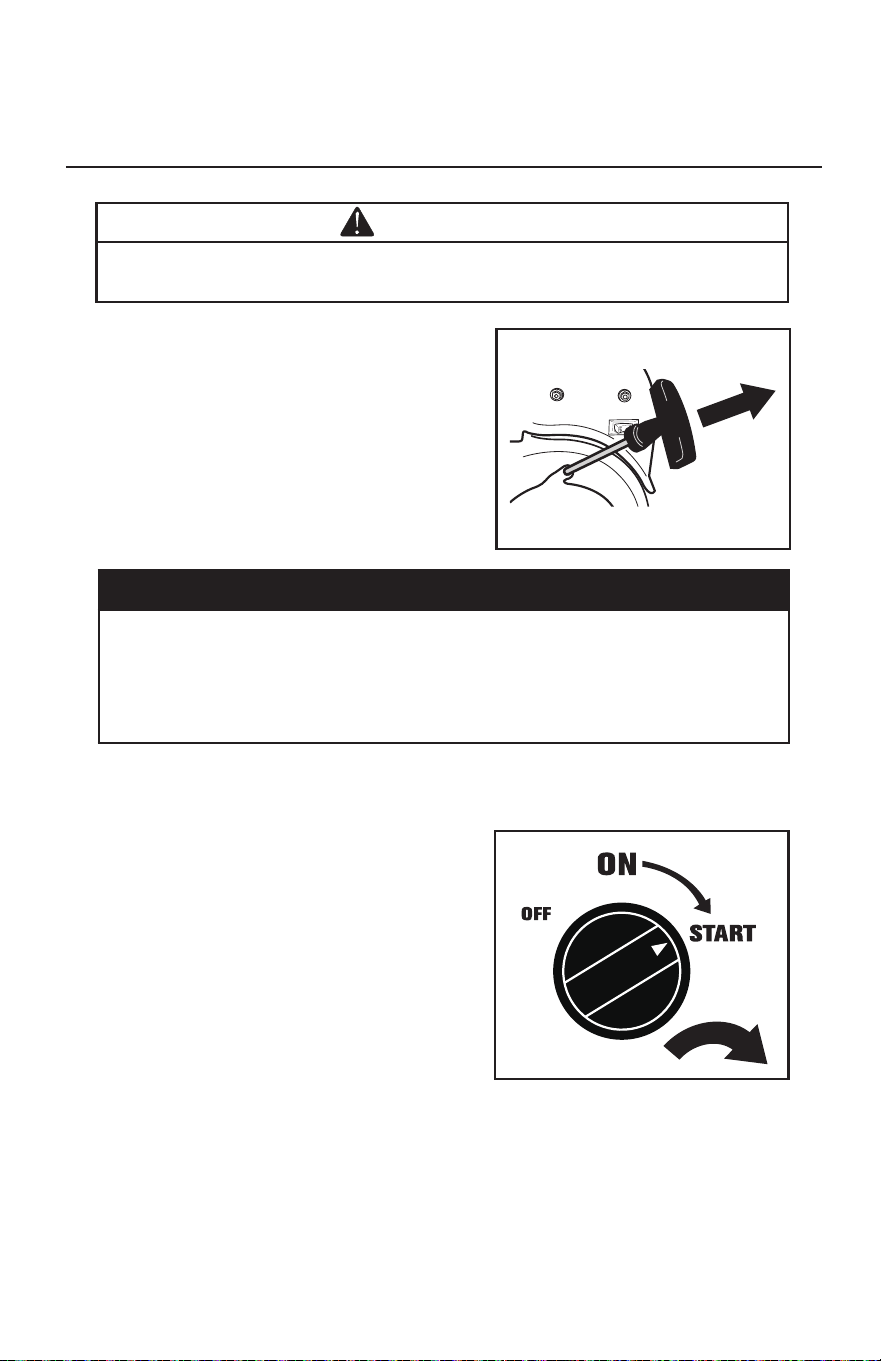
1. Make sure all appliances are
disconnected from the generator.
2. Set the engine switch to the
middle “ON” position. Press and
hold the toggle to the “START”
position to engage the starter.
Release, set switch to
the “ON” position when engine is
running.
To prolong the life of starter components, DO NOT hold switch in
“START” position for more than 15 seconds, and pause for at least 1
minute between starting attempts.
1. Make sure all appliances are
disconnected from the generator.
2. For recoil start, firmly grasp the recoil
handle and pull slowly until increased
resistance is felt. Pull rapidly up and
away.
Recoil Start
CAUTION
When starting the engine with the recoil start, set the toggle
switch in the “ON” position before pulling the starter handle.
NOTICE
If engine fails to start after 3 pulls, or if unit shuts down during
operation, make sure unit is on a level surface and check for
proper oil level in crankcase. This unit may be equipped with a
low oil protection device. If so, oil must be checked at proper
level for engine to start and run.
25
Using Electric Power
Connecting Electrical Loads
1. Let engine run stable and warm up for a few minutes after starting.
2. Plug in and turn on the electrical loads.
Wattage Information
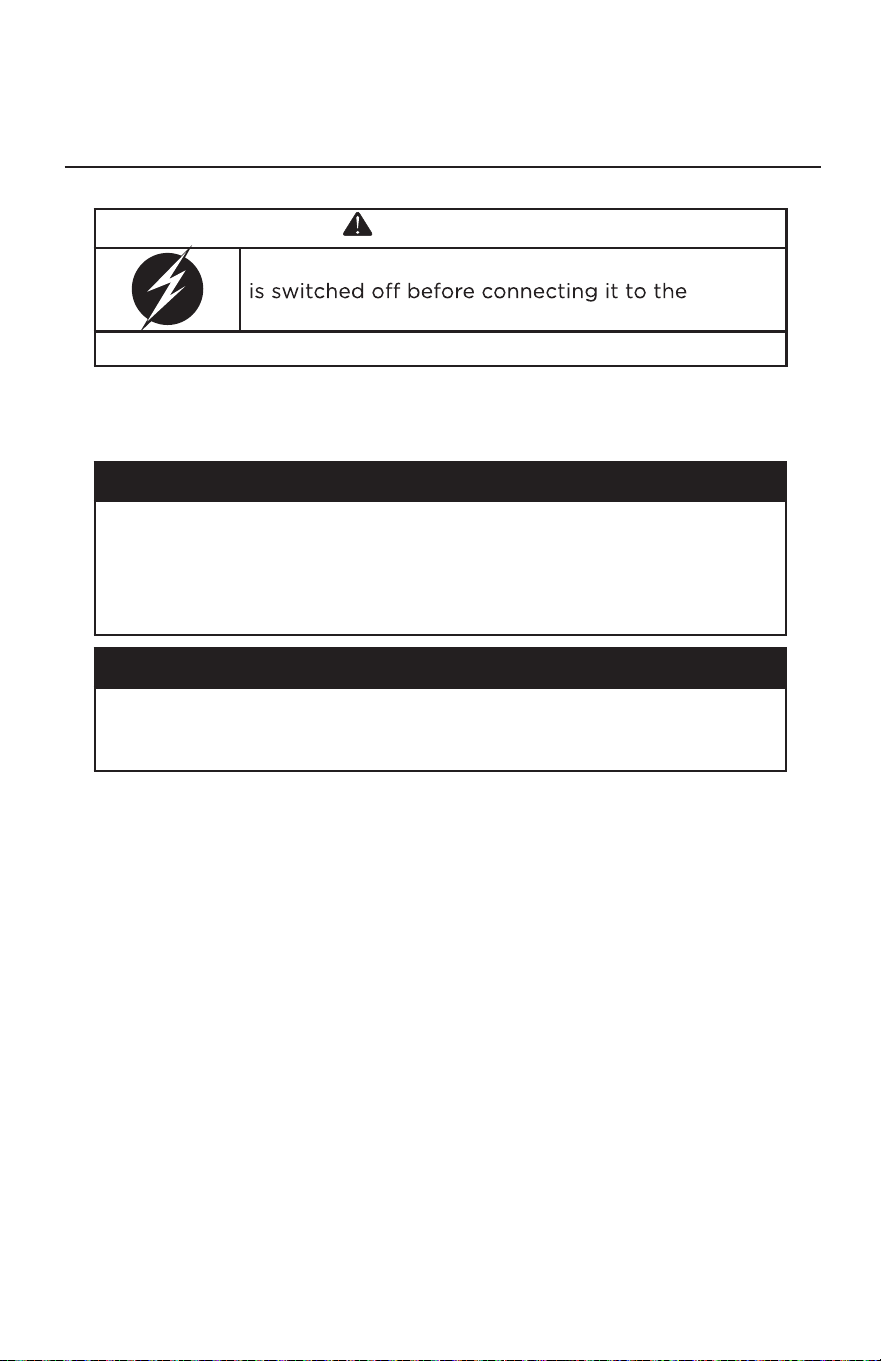
WARNING
Risk of electrocution. Make sure that the appliance
generator.
• DO NOT move the generator while it is running.
NOTICE
• Start generator and let engine stabilize before connecting
electrical loads. Connect electrical loads in OFF position then
turn ON for operation.
Turn electrical loads OFF and disconnect from generator before
stopping generator.
•
NOTICE
DO NOT exceed the generator’s wattage/amperage capacity.
Exceeding generators wattage/amperage capacity could
damage generator and/or electrical devices connected to it.
OPERATION
Some appliances need a “surge” of energy when starting. This
means that the amount of electrical power needed to start the
appliance may exceed the amount needed to maintain its use.
Electrical appliances and tools normally come with a label
indicating voltage, cycles / Hz, amperage (amps) and electrical
power needed to run the appliance or tool.
Check with your nearest dealer or service provider with questions
regarding power surge of certain appliances or power tools.
Electrical loads such as incandescent lamps and hot plates
require the same wattage to start as is needed to maintain use.
Loads such as fluorescent lamps require 1.2 to 2 times the
indicated wattage during start-up.
Loads for mercury lamps require 2 to 3 times the indicated
wattage during start-up.
Electrical motors require a large starting current. Power
requirements depend on the type of motor and its use. Once
enough “surge” is attained to start the motor, the appliance will
require only 30% to 50% of the wattage to continue running.
•
•
•
•
26
OPERATION/
STOPPING THE GENERATOR
• Most electrical tools require 1.2 to 3 times their wattage for
running under load during use. For example, a 5000 watt
generator can power a 1800 to 4000 watt electrical tool.
• Loads such as submersible pumps and air compressors require
a very large force to start. They need 3 to 5 times the normal
running wattage in order to start. For example, a 5000 watt
generator would only be able to drive a 1000 to 7000 watt
pump.
CAUTION
the appliance or tool immediately to avoid equipment damage.
Always check the requirements of the tool or appliance being
used compared to the rated output of the generator.
Stopping The Generator
1.
the cord from receptacle of the generator.
2. Allow the engine several minutes to cool down and to stabilize
the internal temperatures of the engine and generator before
stopping.
3. Push the engine switch to the OFF position.
Oil Sensor
The oil sensor detects a drop in oil level in the crankcase and
automatically stops the engine when the oil level drops below a
predetermined level.
The engine is equipped with a low oil level sensor that shuts down
the engine automatically when the oil level drops below a specified
level. If the engine shuts down by itself and the fuel tank has enough
gasoline, check the engine oil level.
CAUTION
DO NOT remove oil sensor probe when refilling with oil.
High Altitude
At altitudes over 5,000 feet (1524 meters), a minimum 85 octane
/ 85 (89 RON) of gasoline is acceptable. For the emissions to
be compliant, a high altitude adjustment is required. Operation
without this adjustment will cause decreased performance,
increased fuel consumption, and increased emissions. See an
authorized dealer for high altitude adjustment information.
Operation of the engine at altitudes below 2,500 feet (762
meters) with the high altitude kit is not recommended.
Remove oil filler cap on the opposite side of carburetor.
27
NOTE: It is recommended to use ear protection when
performing operation, maintenance and repair of the generator.
Maintenance, replacement or repair of the emission control
devices and systems must be performed by an authorized service
provider.
First 5 hours: change engine oil.
Every 8 hours or daily: clean debris, check engine oil level.
Every 25 hours or yearly: clean engine air filter.
Every 50 hours or yearly: change engine oil.
Yearly: replace engine air filter, service fuel valve, service spark
Generator Maintenance
Generator maintenance consists of keeping the unit clean and
dry. Operate and store the unit in a clean dry environment where
it will not be exposed to excessive dust, dirt, moisture or any
corrosive vapors. Cooling air slots in the generator must not
become clogged with snow, leaves, or any other foreign material.
Check the cleanliness of the generator frequently and clean when
dust, dirt, oil, moisture or other foreign substances are visible on
its exterior surface.
Maintenance Schedule
CAUTION
Make sure the engine is stopped before starting any
maintenance, servicing or repair.
MAINTENANCE
CAUTION
Never insert any object or tool though the air cooling slots, even
if the engine is not running.
DANGER
When working on the generator, always disconnect spark plug
wire from spark plug and keep wire away from spark plug.
WARNING
DO NOT use a garden hose to clean generator. Water can enter
the engine fuel system and cause problems. In addition, if water
enters the generator though cooling air slots, some water will
be retained in voids and crevices of the rotor and stator winding
insulation. Water and dirt buildup on the generator internal
windings will eventually decrease the insulation resistance of
these windings.
28
Changing Engine Oil
Change oil after the first 8 hours of operation. Thereafter it should
be changed every 50 hours.
1. Drain oil by removing the drain plug and the oil filler cap while
the engine is warm.
2. Reinstall the drain plug and fill the engine with oil until it
reaches the upper level on the oil filler cap.
3. Dispose of used oil according to local zoning or environmental
regulations.
Servicing The Air Filter
Maintaining the air filter in proper condition is very important.
Dirt induced through improperly installed, improperly serviced
or inadequate elements damages and wears out engines. Always
keep the element clean. Never run the generator without the air
filter.
1. Remove air filter cover.
2. Wash in soapy water. Squeeze filter dry in clean cloth (do not
twist).
3. You may wish to drop a bit of engine-oil to avoid ice blockage
during winter season.
4. Clean air filter cover before re-installing it.
Cleaning and Gapping Spark Plug
If the plug is contaminated with carbon, remove the carbon using
a plug cleaner or wire brush. Use F6TC, BPR4ES or Champion
RN14YC.
• Adjust the electrode gap to 0.70 to 0.80 mm (0.028-0.031 in).
• Install the correctly gapped spark plug into the cylinder head
and torque to 15 ft/lbs.
Cleaning Fuel Strainer
Dirt and water in the fuel are removed by the fuel strainer.
1. Remove the strainer cup and throw away water and dirt.
2. Clean the screen and strainer cup with gasoline.
3. Tightly fasten the cup to main body, making sure to avoid fuel
leak.
Periodic Operation and Inspection :
When using the generator as emergency electric power source,
periodic operation and inspection are needed.
Fuel (gasoline) and engine oil will deteriorate with time, and
engine operation and /or failure.
MAINTENANCE
29
MAINTENANCE
CAUTION
spark arrester.
Spark Arrester
The spark arrester must be cleaned regularly to keep it
functioning as designed. A clogged spark arrester:
• Prevents the flow of exhaust gas
• Reduces engine output
• Increases fuel consumption
Clean The Spark Arrester Screen
1.
down completely before servicing spark arrestor (located on
2. Remove the clamp and spark arrestor screen.
3. Clean the spark arrestor screen with a small wire brush.
4. Replace the spark arrestor if it is damaged.
5. Installation of the spark arrestor screen is the reverse of the
removal.
CAUTION
Since the fuel (gasoline) will deteriorate with time, replace fuel
(gasoline) with fresh fuel periodically; every three months or
add a fuel stabilizer.
Valve Clearance
After the first 50 hours of operation, check the valve clearance in
the engine and adjust if necessary.
Important: If feeling uncomfortable about doing this procedure or
the proper tools are not available, please take the generator to
the nearest service center to have the valve clearance adjusted.
This is a very important step to ensure longest life for the engine.
Transporting
When transporting the generator, make sure that the fuel (gasoline)
is drained from the tank.
30
WARNING
To prevent fuel spillage due to the vibration and
impact, never transport the generator with fuel
(gasoline) in the tank. Secure the tank cap.
To avoid the risk of the gasoline flammability,
never leave the generator in an area exposed to
direct sunlight or high temperatures for a long
period time.
Keep the fuel in an approved storage tank when transporting.
1. Turn the engine switch to the STOP position.
2. Drain the fuel from the tank.
3. Tighten the tank cap.
CAUTION
DO NOT place any heavy objects on the generator.
Select and place the generator in the proper position of the
transport vehicle so that the generator will not move or fall
down. Secure the generator if necessary.
TRANSPORTING
Preparation for Storage
The generator should be started at least once every seven days and
be allowed to run at least 30 minutes. If this cannot be done and
the unit must be stored for more than 30 days, use the following
information as a guide to prepare it for storage:
1. Drain fuel from fuel tank carefully by disconnecting the fuel line.
Gasoline left in the fuel tank will eventually deteriorate making
2. Remove the drain screw of the carburetor.
3. Change engine oil.
4. Check for loose bolts and screws, tighten them if necessary.
5. Clean generator thoroughly with clean cloth. NEVER USE WATER
TO CLEAN GENERATOR.
6. Pull recoil starter handle until resistance is felt, leaving handle in
that position.
7. Store generator in a well ventilated, low humidity area.
• Do not store gasoline from one season to another.
• Replace the gasoline can if it starts to rust. Rust and/or dirt in the
gasoline will cause problems with the carburetor and fuel system.
• If possible, store the unit indoors and cover it to give protection
from dust and dirt. BE SURE TO EMPTY THE FUEL TANK.
31
DANGER
NEVER store engine with fuel in tank indoors or in enclosed,
poorly ventilated areas where fumes may reach an open flame,
spark or pilot light as on a furnace, water heater, clothes dryer or
other gas appliance. Drain fuel into approved container outdoors,
away from open flame. Be sure engine is cool. Do not smoke.
CAUTION
Avoid spray from spark plug holes when cranking engine.
STORAGE
• If it is not practical to empty the fuel tank and the unit is to be stored for
some time, use a commercially available fuel stabilizer added to the gasoline
to increase the life of the gasoline.
• Cover the unit with a suitable protective cover that does not retain moisture.
It is important to avoid gum deposits from forming in essential fuel system parts
such as the carburetor, fuel hose or tank during storage. Also, experience indicates
that alcohol-blended fuels (gasohol, ethanol or methanol) can attract moisture,
which leads to separation and formation of acids storage. Acidic gas can damage
the fuel system of an engine while in storage. To avoid engine problems, the
fuel system should be emptied before storage of 30 days or longer, as follows:
1. Remove all gasoline from the fuel tank.
2. Start and run engine until engine stops from lack of fuel.
3. While engine is still warm, drain oil
from crankcase. Refill with recommended
grade.
4. Remove spark plugs and pour about 1/2 ounce (15 ml) of engine oil the
cylinders. Cover spark plug hole with rag. Pull the recoil starter a couple times
to lubricate the piston rings and cylinder bore.
5. Install and tighten spark plugs. Do not connect spark plug wires.
6. Clean the generator outer surfaces. Check that cooling air slots and openings
on generator are open and unobstructed.
7. Store the unit in clean, dry place.
8. Do not store gasoline from one season to another.
9. Replace the gasoline can if it start to rust. Rust and/or dirt in the gasoline will
cause problems with the carburetor and fuel system.
10. If possible, store the unit indoors and cover it to give protection from dust
and dirt. BE SURE TO EMPTY THE FUEL TANK.
11. If it is not practical to empty the fuel tank and the unit is to be stored for
some time, use a commercially available fuel stabilizer added to the gasoline
to increase the life of the gasoline.
12. Cover the unit with a suitable protective cover that does not retain moisture.

32
A-iPower Corp.
LIMITED WARRANTY
KEEP YOUR RECEIPT. Proof of purchase will be required to substantiate any warranty claim.
WHAT IS COVERED:A-iPower Corp. warrants to the original retail purchaser in the United States
of America, or Canada that this product is free of defects in material and workmanship and agrees,
at A-iPower Corp’s direction, to either repair, provide replacement parts for, or replace (without
charge for parts or labor) any product or component with a material defect for a period of 2 years
from the date of purchase, except as limited below. Warranty service and replacement parts are
warranted only for the duration of the warranty on the original product. All replaced parts or products
become a property of A-iPower Corp.
This product is also covered by an Emissions Control System Warranty which is separate
from and
in addition to the warranty.
Warranty
A-iPower Limited Warranty – 2 Years Residential and 1 Year Commercial
2 year Residential warranty applies as follow: 1
st
year Parts & Labor / 2
nd
year Parts ONLY
1 year Commercial or 1,000 Hours
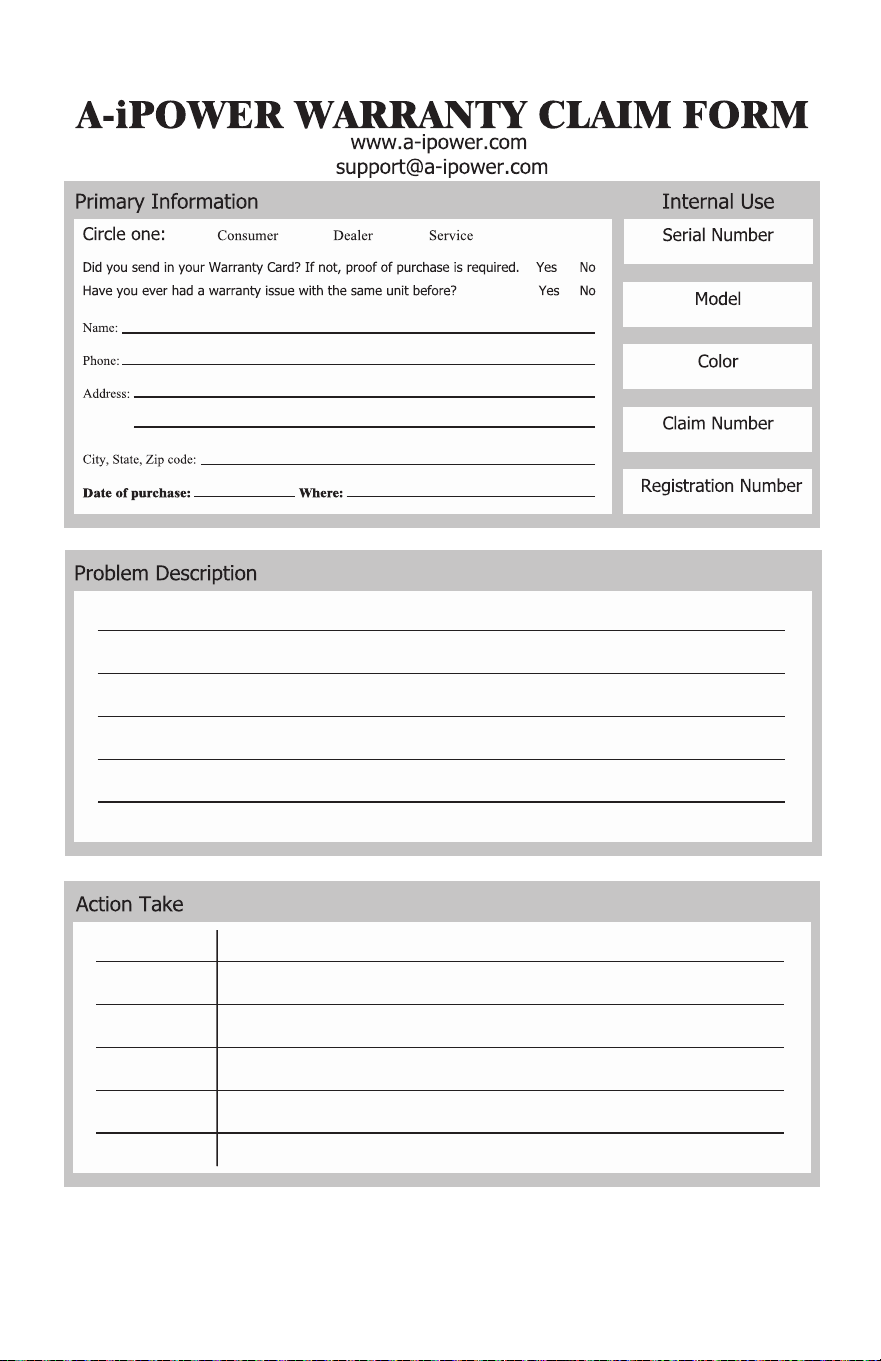
Thank you for choosing A-iPower products. To ensure proper registration of your product
warranty, please submit your warranty registration along with proof of purchase within 10 days
of the date of purchase, this can be done by
a) Completing the Warranty Registration form at the back of this manual and mailing to:
A-IPOWER CORP
10887 COMMERCE WAY UNIT A
FONTANA CA 92337 USA
b) Visit us at
www.a-ipower.com
and click the product registration icon
Warranty Term
A-iPower will provide warranty for any of its products purchased through any authorized A-
iPower dealer in North America to the original purchaser and will be warranted against defects
in material or workmanship for a period of two (2) years for Consumer use from date of
purchase, subject to exclusions noted herein. Commercial and Rental applications are
warranted for a period of one (1) year from date of purchase.
“Consumer Use” – residential household use by a retail consumer
“Commercial Use” – all other use – commercial , business, industrial, or rental purpose
How to Obtain Warranty Service
Please call our Customer Service Dept. 855-888-3598 or e-mail to support@a-ipower.com
Please have necessary information available – Model Number, Serial Number, Proof of
Purchase

33
A-iPower Corp.
DO NOT RETURN THE PRODUCT TO THE PLACE OF PURCHASE
A-iPower Customer Service Dept will assist with all product related questions and will help
troubleshoot issues and will send any replacement parts as necessary while product is within
the warranty period at no charge. If the issue cannot be resolved then A-iPower Customer
Service Dept at its discretion determine and authorize diagnosis and repair through one of its
authorized Service Centers. A-iPower Corp at its discretion may choose to provide replace of
part, component, or product.
Service or replacement of parts at any unauthorized repair facility without prior authorization will
not be covered by this warranty.
Warranty Exclusions
This warranty does not cover the following
Regular wear and maintenance – this warranty will not cover repair when normal use has
exhausted the lifetime of a part(s) or engine
Installation and Maintenance - this warranty does not cover improper or unauthorized assembly,
alteration, modification or any other damage resulting from misuse or neglect.
Normal maintenance parts - this warranty does not cover spark plugs, air filters, adjustments, or
other related service due to obstructions and other build ups resulting from improper
maintenance
Additional exclusions – this warranty does not cover wearable parts such as filers, spark plugs ,
o-rings, batteries etc. It does not cover any cosmetic defects such as scratches to paint, decals
etc. It does not cover any damage resulting from use of non-original manufacturer’s parts, use
of aftermarket parts. It does not cover any failures due to acts of God and other force majeure
events beyond the control of the manufacturer.
Warranty limits and Implications and Consequential Damages
A-iPower is not obligated to cover any loss of time, use of product, freight cost, or any other
incidental or consequential claim from the use of this product. This warranty is in Lieu of all
other warranties, express or implied
This warranty gives you specific legal rights which vary from state to state.

34
A-iPower Corp.
MERCHANDISE RETURN GUIDELINES
• All products must be returned in original or equivalent packaging. Improperly packaged
returns will not be accepted.
• Must have adequate packing for transportation
• Federal Law requires that all machines that utilize gasoline, oil, or other flammable liquids
must be drained Completely & Thoroughly prior to shipment.
• Gas caps and oil plugs must be left off for 24 hours prior to shipping. Please note: liability
for this violation of the law resides with the sender of the shipment.
• Return to address provided in return authorization, using the parcel service required. Units
returned without authorization will not be honored.
• Please Note: Refunds will not be granted for items that have been modified or damaged by
abuse or usage not in accordance with product instructions.




If you need assistance with the assembly
or operation of your generator please call
1-855-888-3598
or visit our website at:
http://www.a-ipower.com
32082-03088-00
A-iPower Corp. 10887 Commerce Way Unit A Fontana, CA 92337 USA