
Technical Support and E-Warranty Certificate www.vevor.com/support
LIQUID NITROGEN CONTAINER
USER MANUAL
We continue to be committed to provide you tools with competitive price.
"Save Half", "Half Price" or any other similar expressions used by us only represents an
estimate of savings you might benefit from buying certain tools with us compared to the major
top brands and does not necessarily mean to cover all categories of tools offered by us. You
are kindly reminded to verify carefully when you are placing an order with us if you are
actually saving half in comparison with the top major brands.

- 1 -
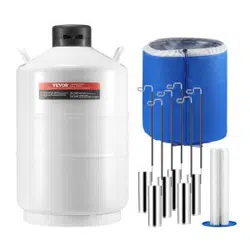
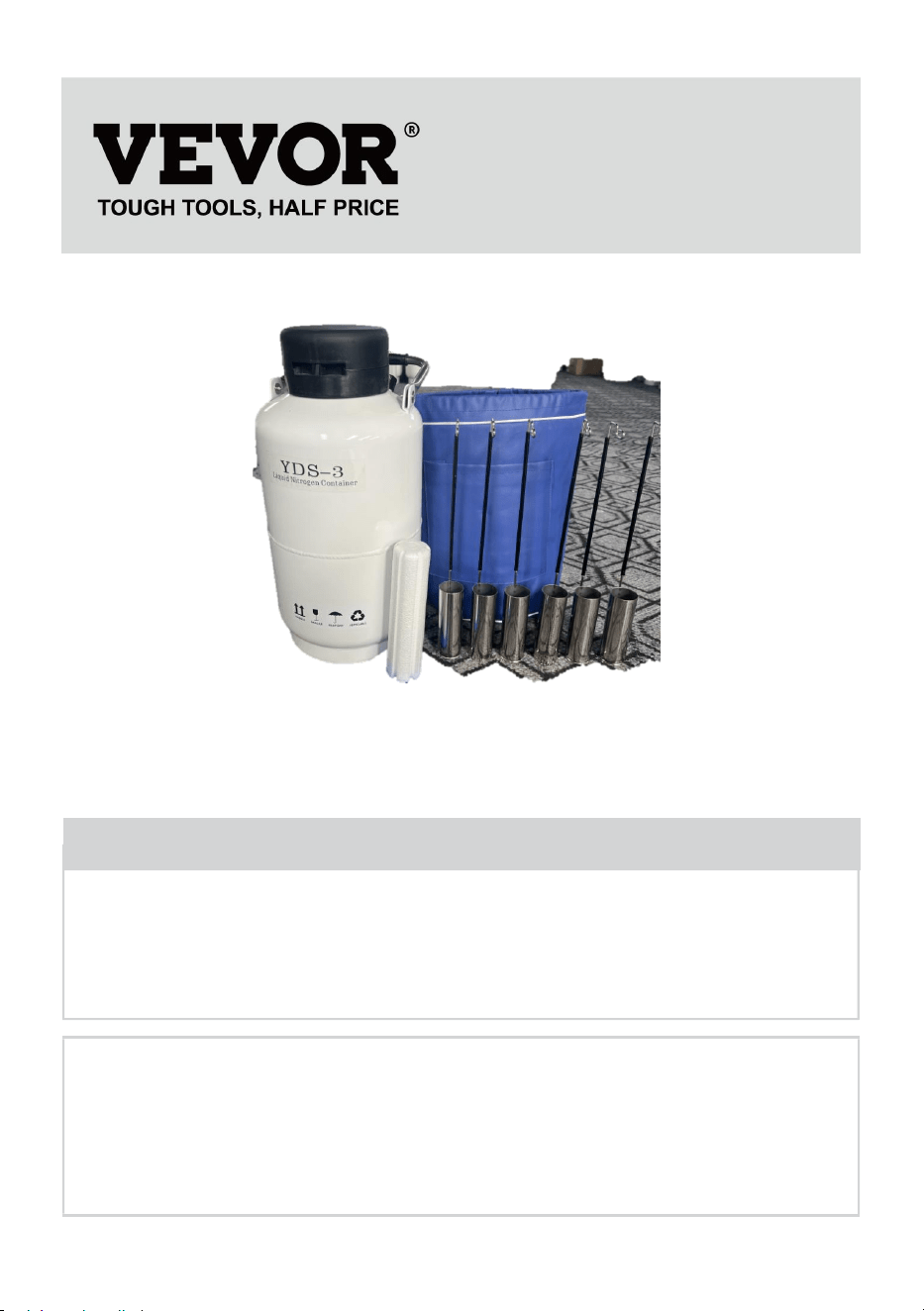
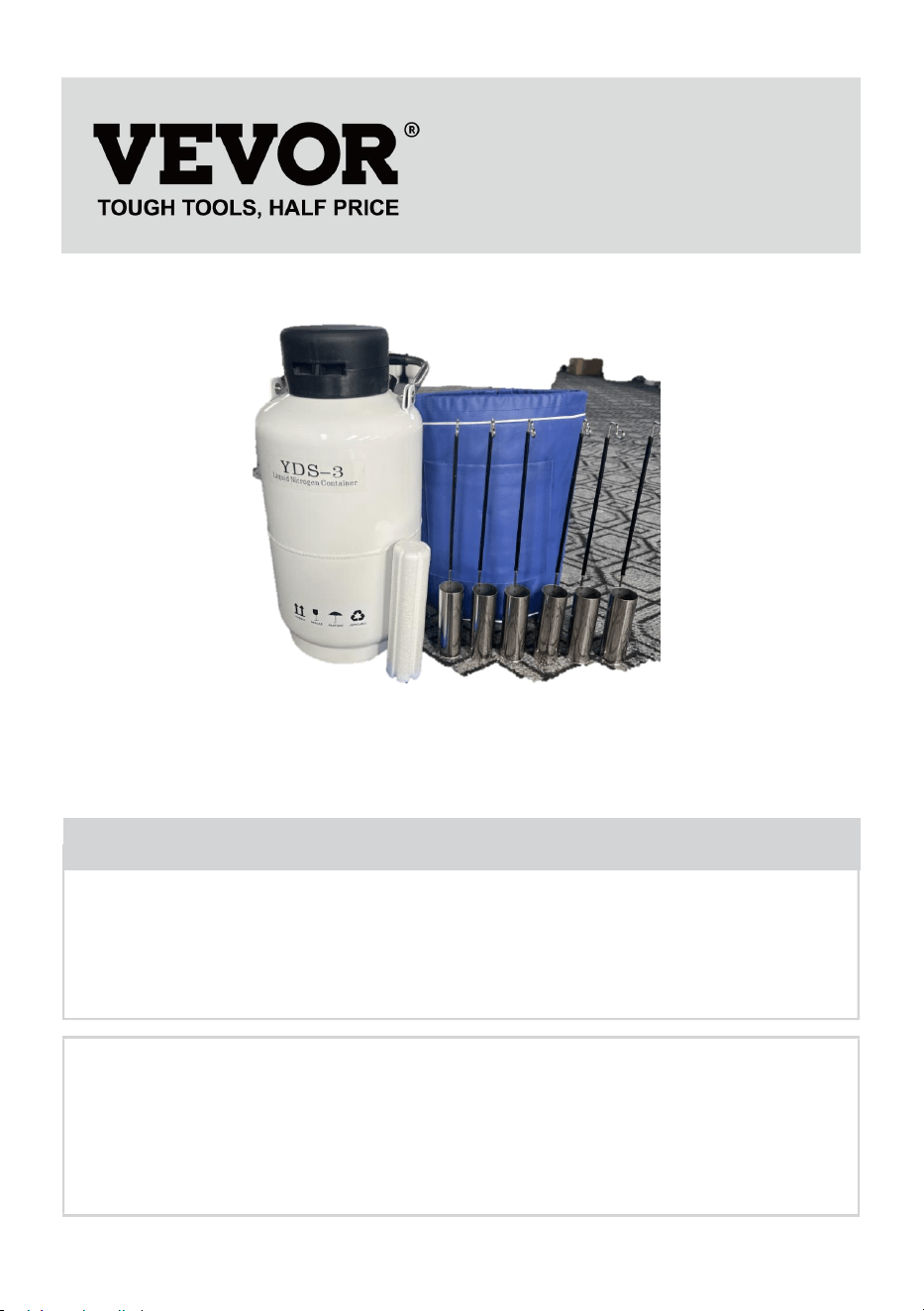
MODEL: YDS-3/YDS-6/YDS-10/YDS-20/YDS-30
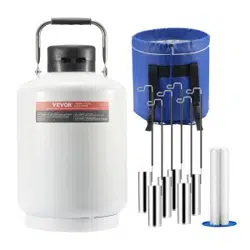
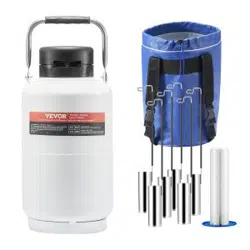
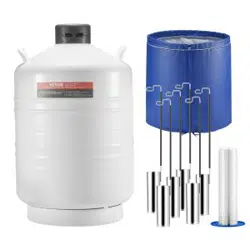
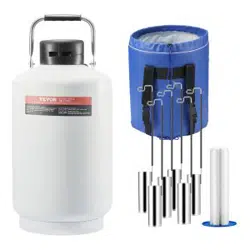
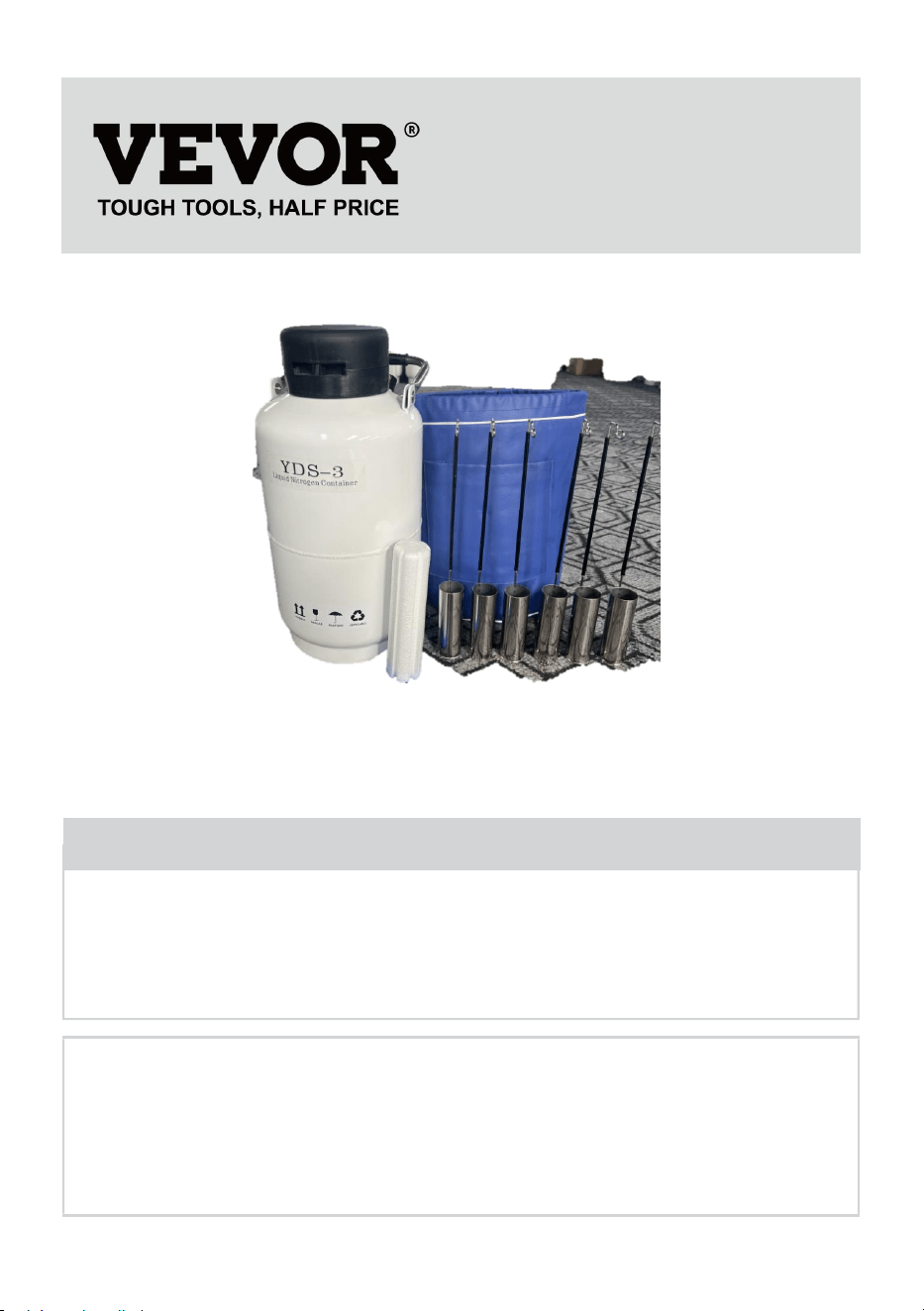
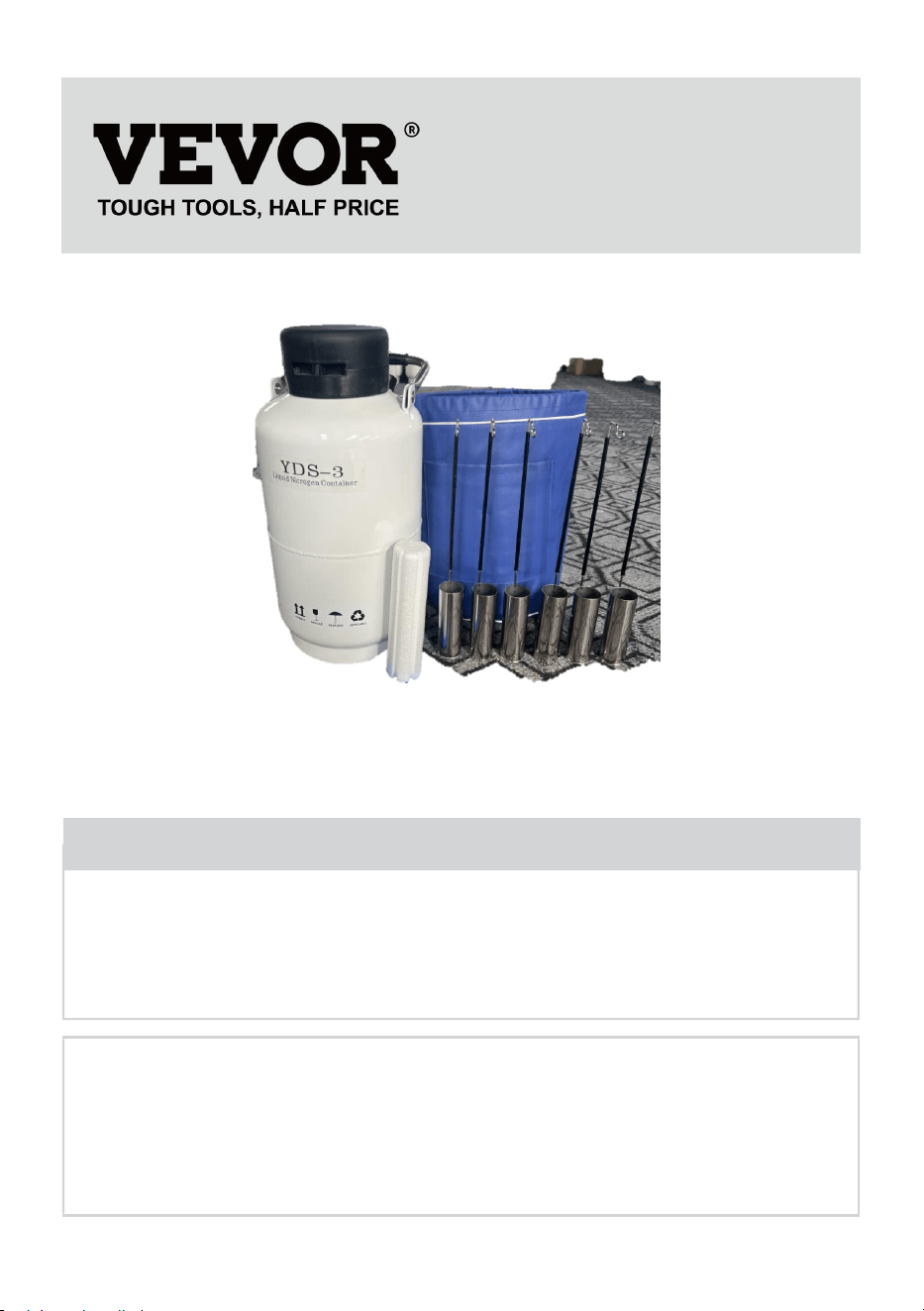
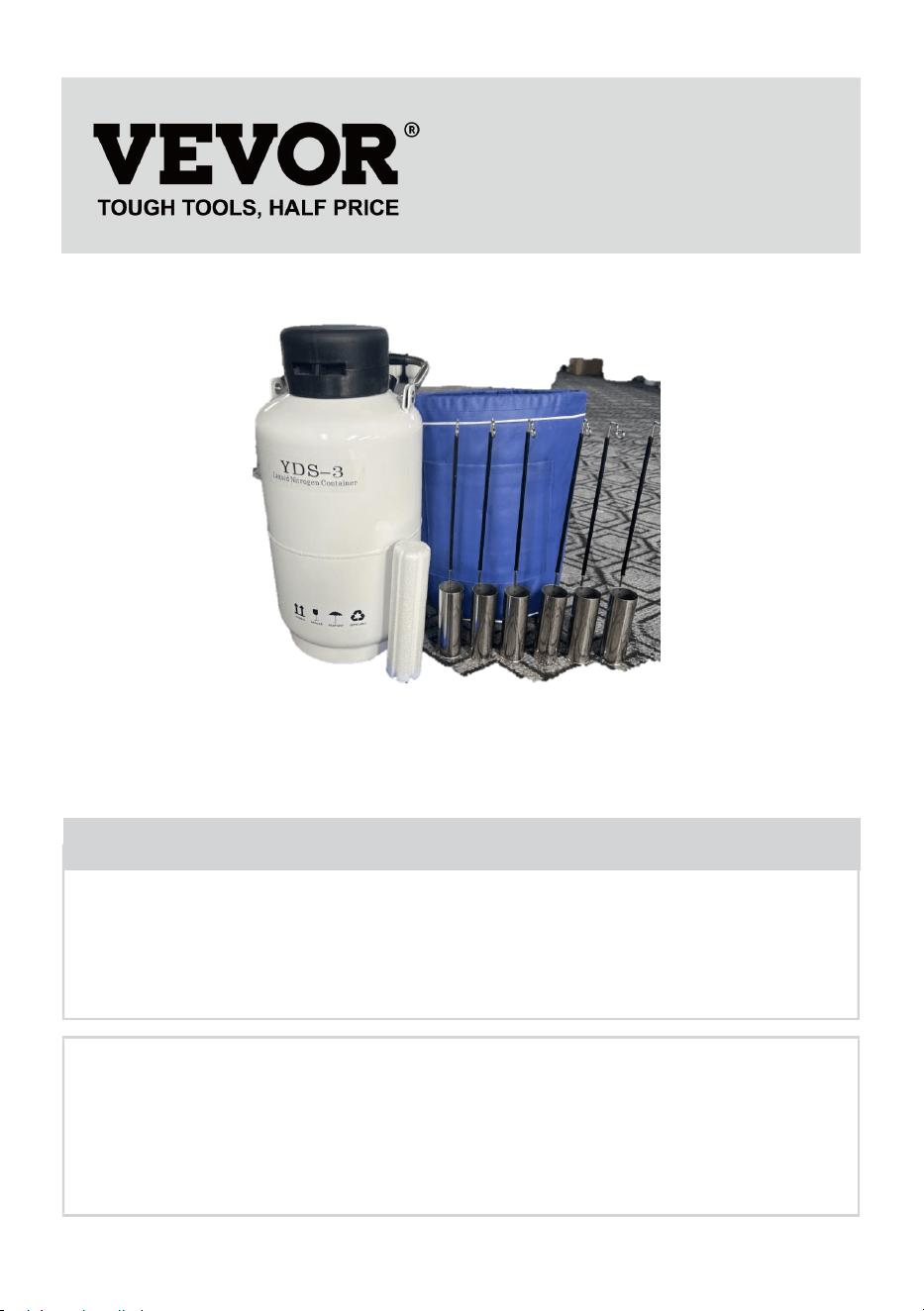
Photo for reference
Have product questions? Need technical support? Please feel free to
contact us:
Technical Support and E-Warranty Certificate
www.vevor.com/support
NEED HELP? CONTACT US!
This is the original instruction, please read all manual instructions
carefully before operating. VEVOR reserves a clear interpretation of our
user manual. The appearance of the product shall be subject to the
product you received. Please forgive us that we won't inform you again if
there are any technology or software updates on our product.
LIQUID NITROGEN
CONTAINER

- 2 -
SAFETY INSTRUCTION AND PRECAUTIONS
WARNING:
1. The liquid nitrogen tank should be placed in a well ventilated and cool
place, avoiding direct sunlight
2. It is strictly prohibited to use in rainy or humid environments to avoid
frosting and freezing of neck tubes, plugs, and other accessories;
3. It is strictly prohibited to tilt, lay horizontally, invert, pile up, collide and
other behaviors. During use, it should be handled gently and always kept
upright
4. Do not open the vacuum nozzle of the container. Once the vacuum
nozzle is damaged, it will immediately cause vacuum failure;
5. Use professional protective equipment. When operating liquid nitrogen,
antifreeze gloves, goggles, and protective clothing should be worn to
prevent frostbite.
Product brief instruction:
Used for storing semen/embryos/cells/dry ice/metal materials in laboratory,
medical, farm, beauty and other fields.The liquid nitrogen biological containers
produced by our company have the characteristics of reasonable structure, easy
portability, and good refrigeration performance. They can be used in animal
husbandry, medical research departments for long-term low-temperature storage
and transportation of livestock, frozen semen, vaccines, cells, microorganisms, etc.
using liquid nitrogen (-196 ℃) as refrigerant. They can also be applied in industries
such as national defense, scientific research, machinery, electronics, metallurgy,
energy, catering, beauty, etc.
- 3 -
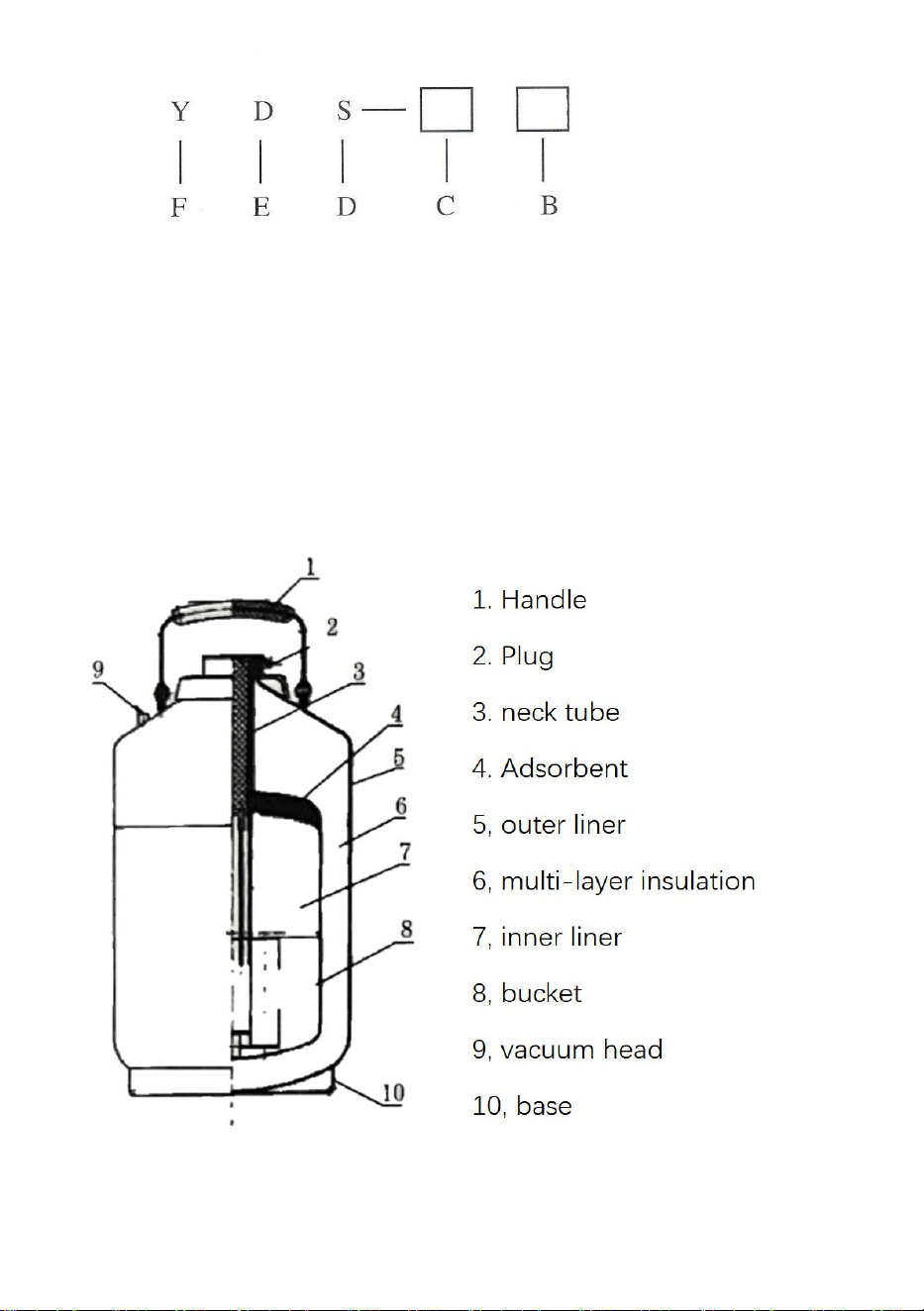
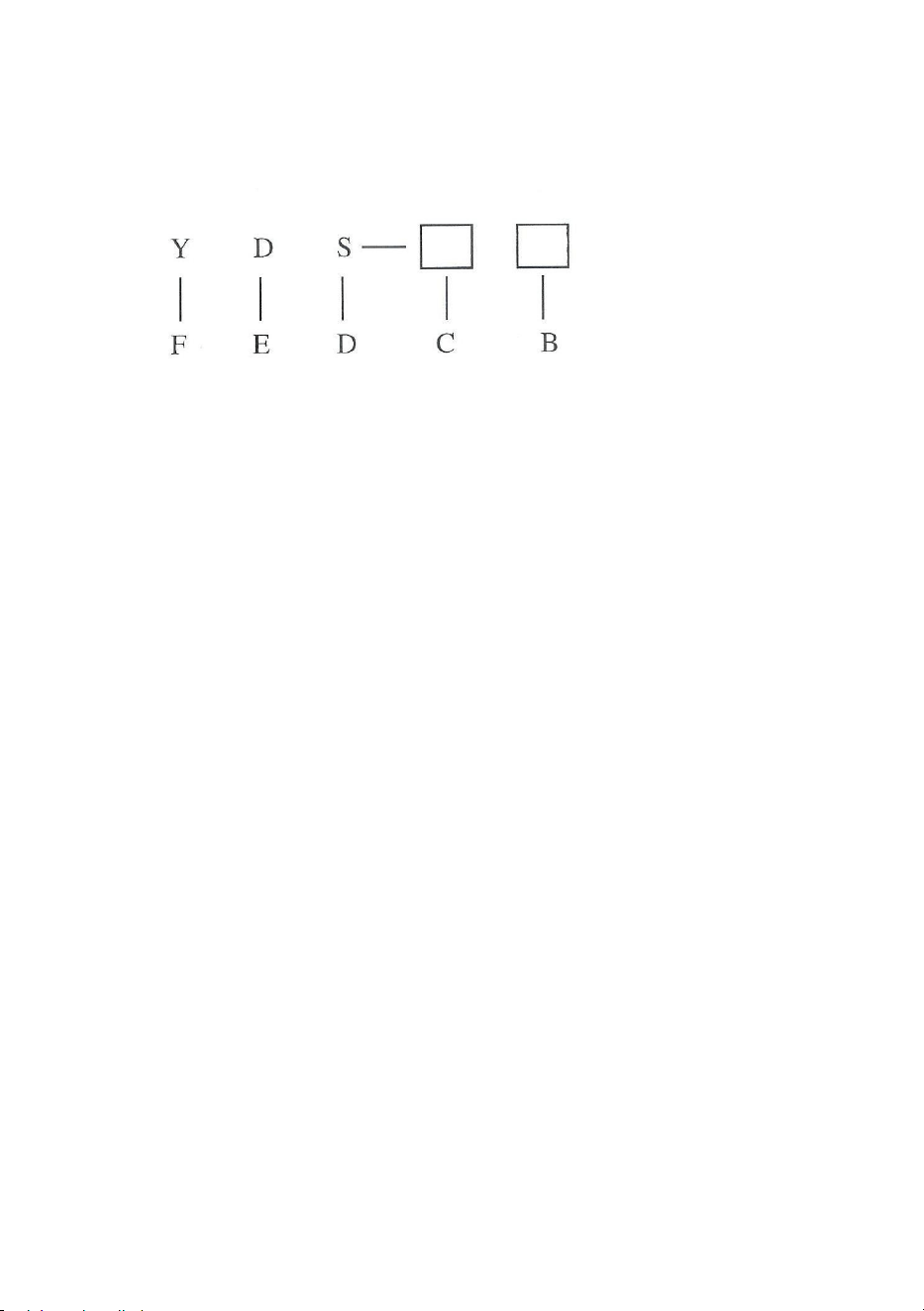
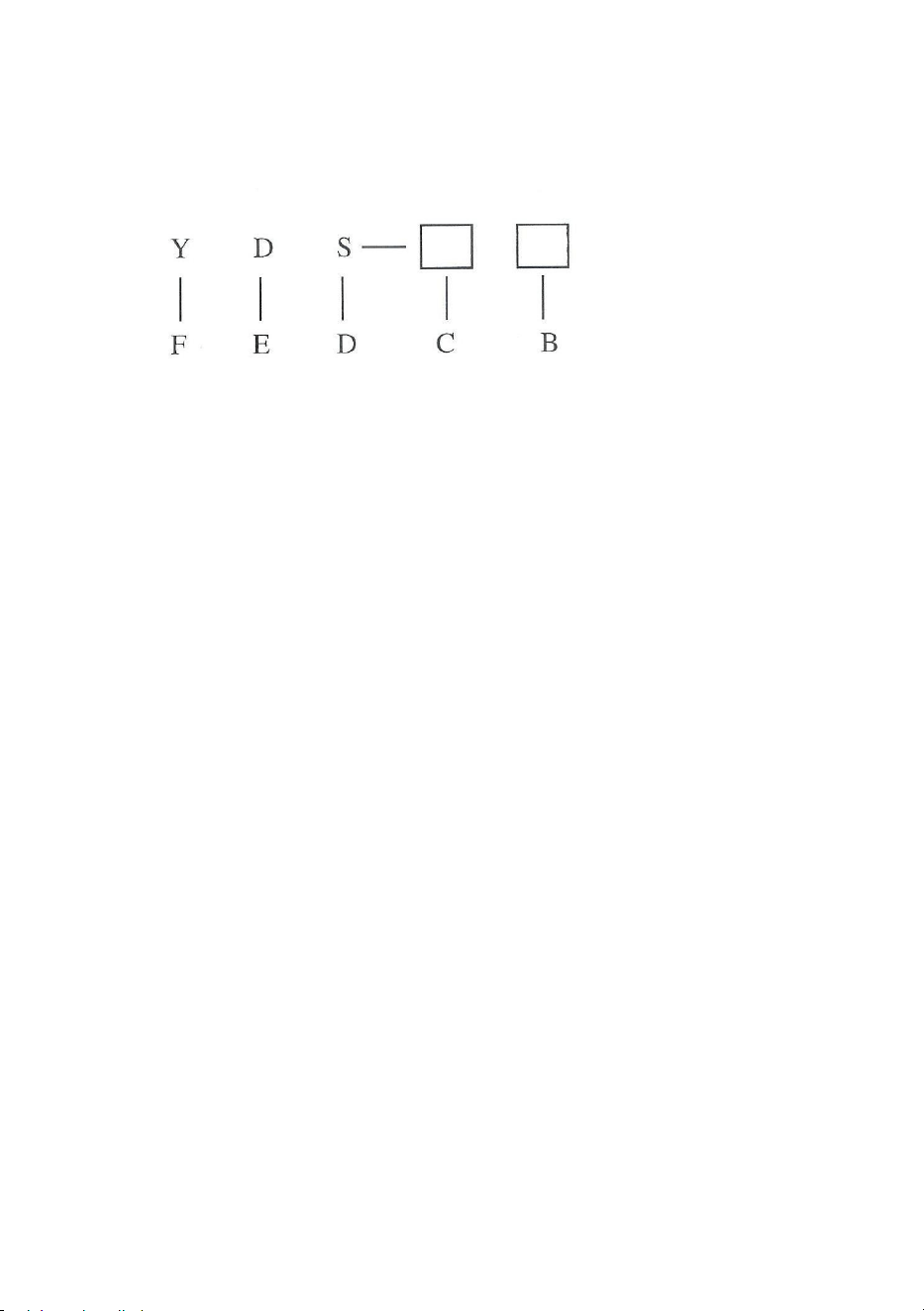
Instruction for the Container Model
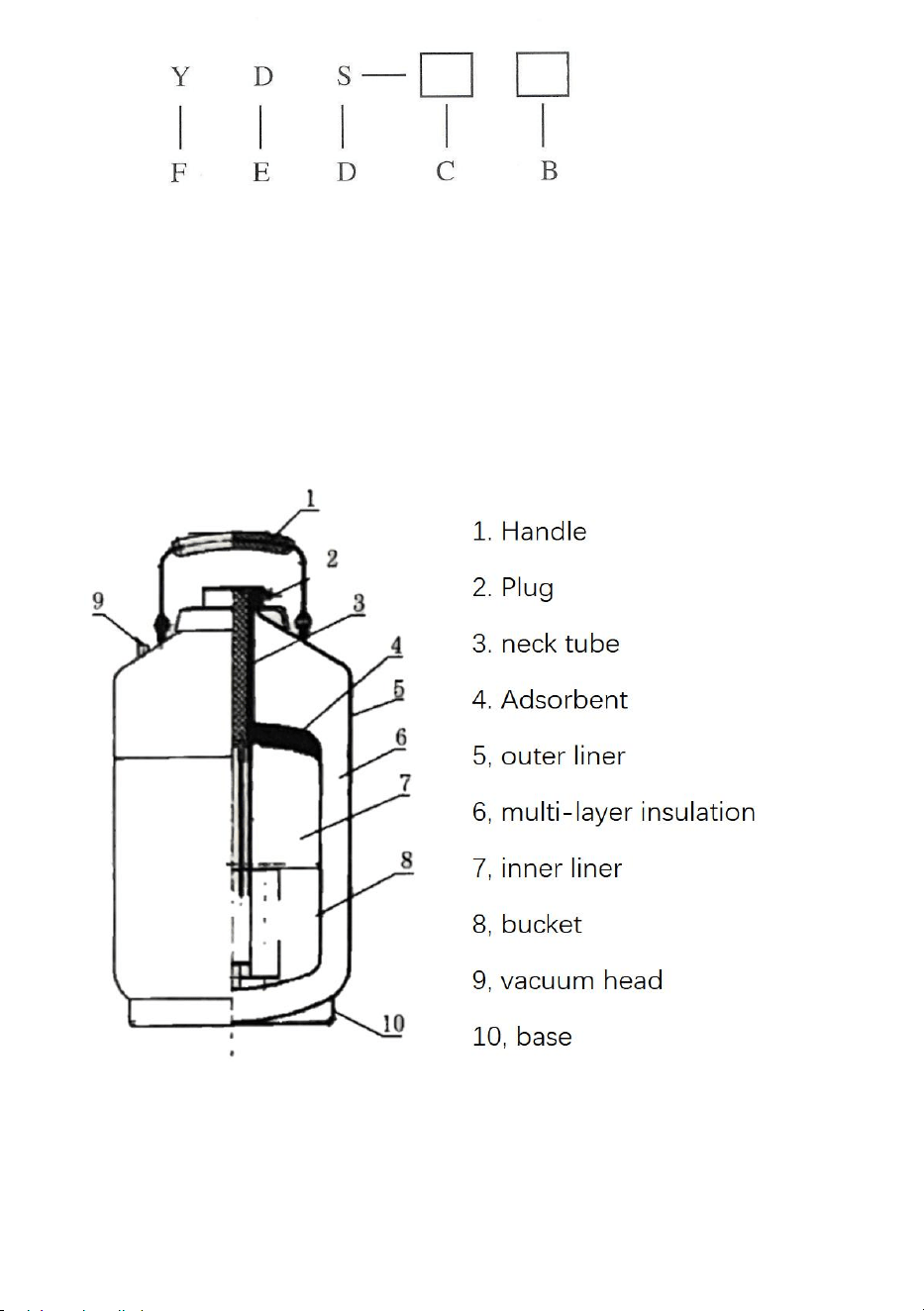
B”.Diameter (mm) ,size is not marked it is 50mm.
“C”. Nominal volume of container
"D" means nitrogen
"S" means biological
"Y" means liquid
For example: YDS-30 means volume 30L, Dia.50mm, liquid nitrogen biological
container.
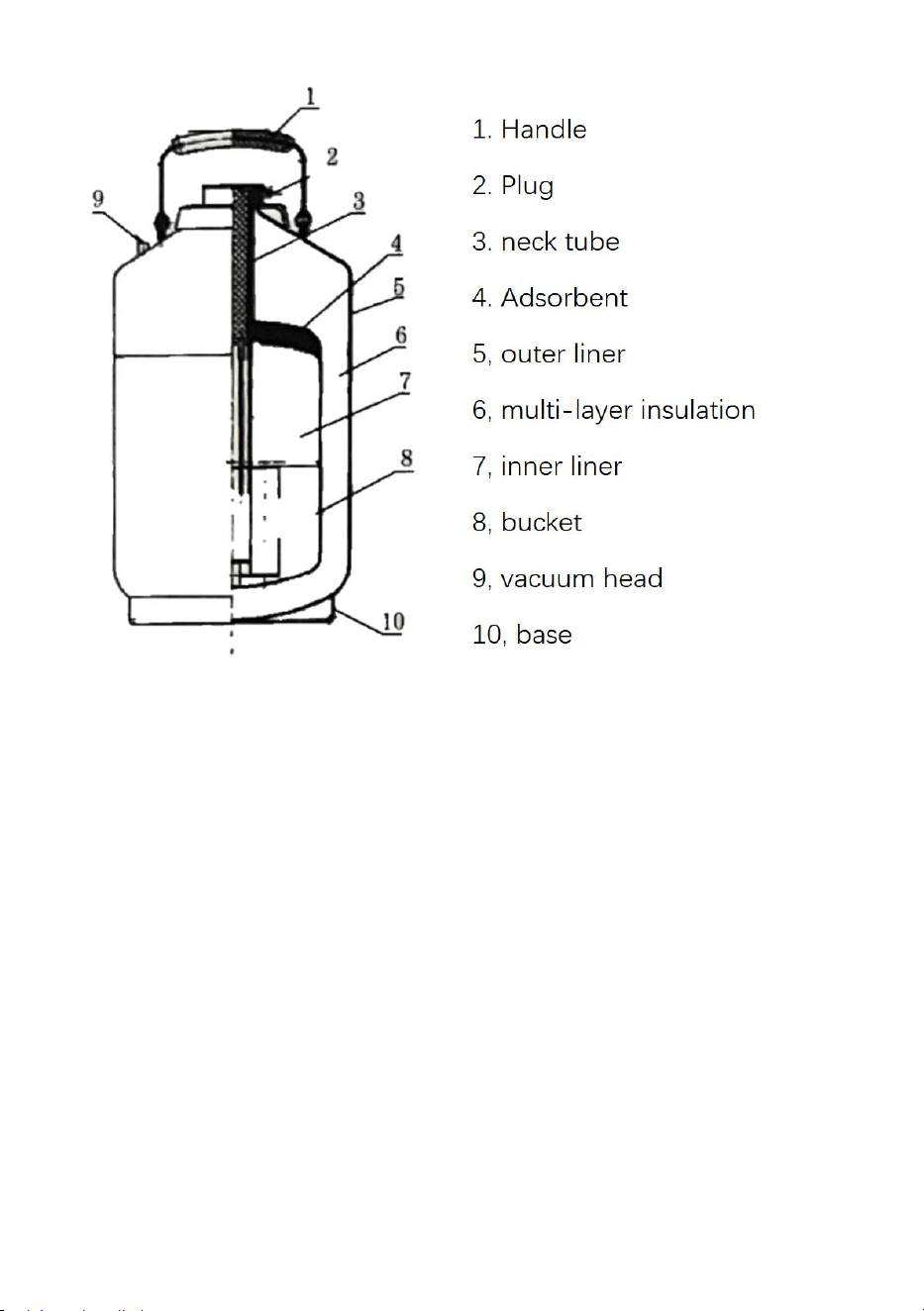
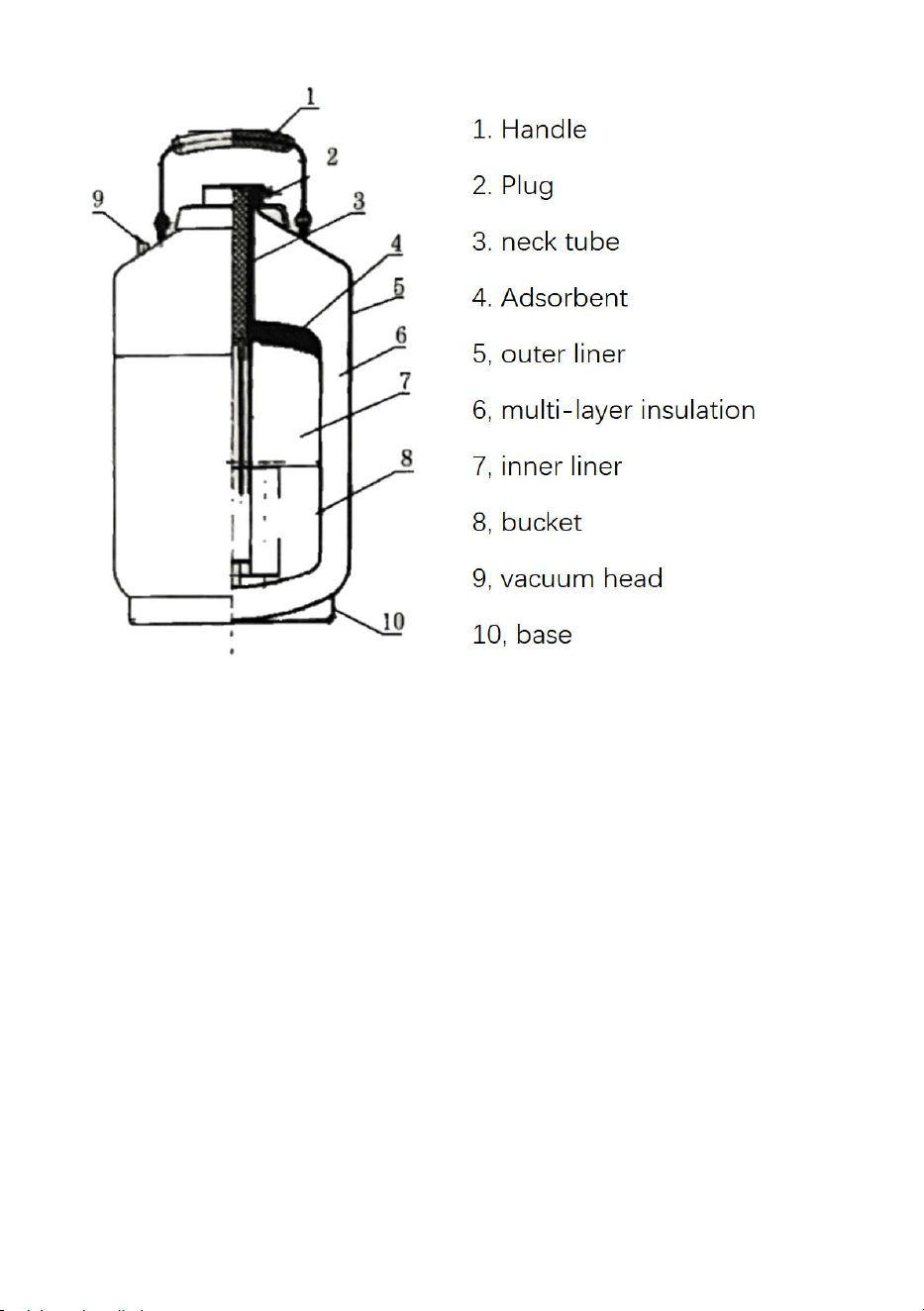
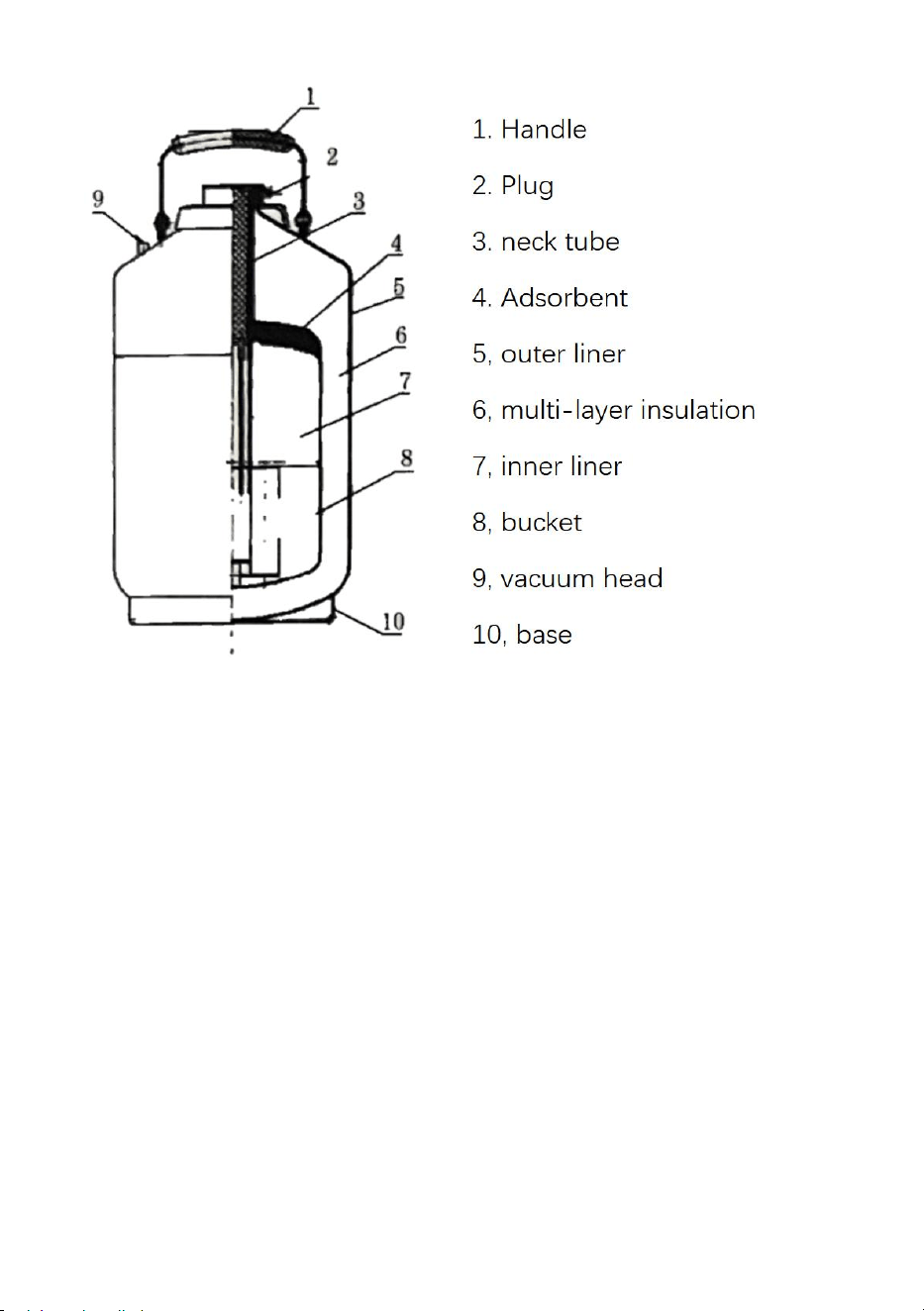
Product structure
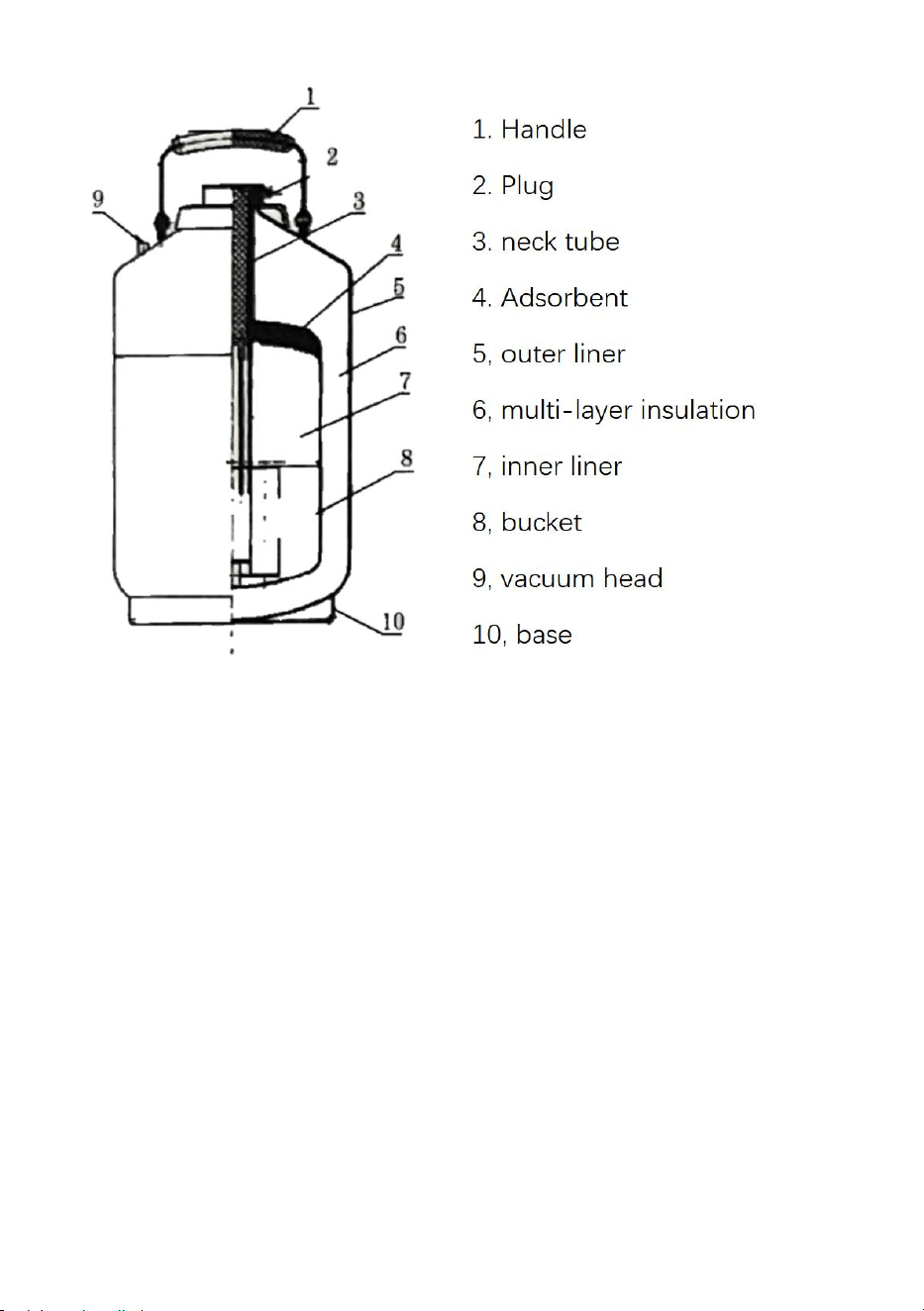
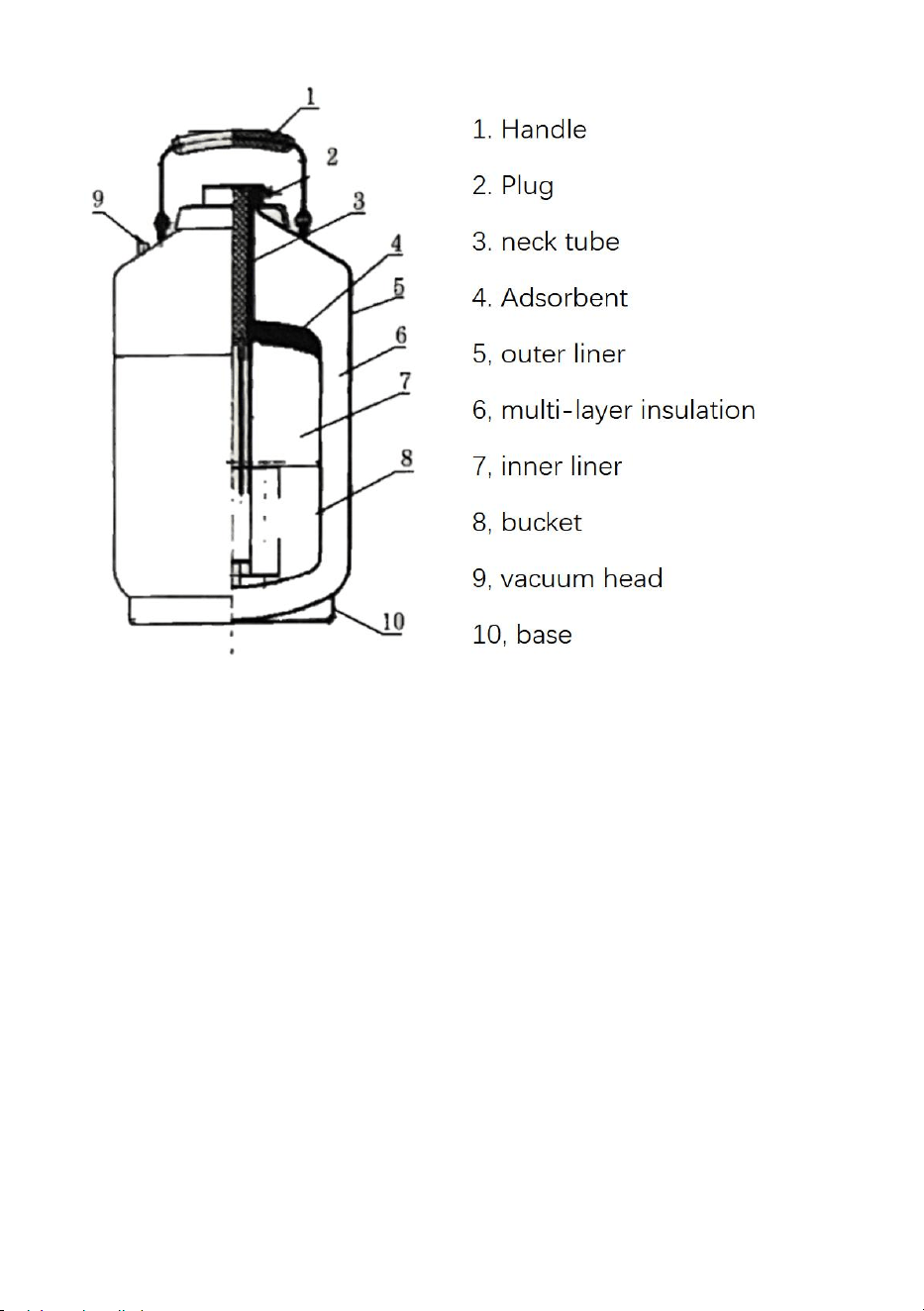
1. As shown in the figure, the container consists of an inner liner, an outer liner, a
bucket, and a neck tube connecting the inner and outer liners. The inner and outer

- 4 -
liners are made of high-strength aviation aluminum alloy, which is sturdy and
durable,
2. There is a high vacuum between the inner and outer tanks, and the vacuum film
is equipped with multiple layers of imported insulation materials, thus having good
refrigeration performance
3. The neck plug is made of non-toxic polyurethane with good insulation. It has a
dual function of reducing liquid nitrogen evaporation and fixing the lifting cylinder.
4. The neck tube is made of glass reinforced compounds, which have extremely
low thermal conductivity and can control the external heat entering from the neck
tube to a minimum.
5. Gas adsorbents are installed in the vacuum area, which can adsorb gases
emitted by metals or other substances in the true cavity, thereby maintaining a
high vacuum for a long time.
6. Place the container in liquid nitrogen to store frozen items. The upper part is
fixed by the small groove of the neck plug and the notch of the scoring plate,
ensuring stable and reliable transportation
7. Bucket needs to be rotated 180 degrees to be drawn out.
Liquid nitrogen Container model
Product
model
Capacity
L
Caliber
mm
Outer
diameter
mm
Height
mm
Static
liquid
nitrogen
storage
period
Bucket
Qty
Outer
diameter
Height
≤
≥
pcs
mm
mm
YDS-3
3
50
224
450
30
6
36
120
YDS-6
6
50
304
500
60
6
36
120
YDS-10
10
50
304
550
100
6
36
120
YDS-20
20
50
384
640
175
6
38
276
YDS-30
30
50
438
700
270
6
38
276

- 5 -
Note 1: The static liquid nitrogen storage period of the product is tested using the
weighing method.
Note 2: In the product model column, B represents a container with support at the
bottom or side of the inner liner, which is resistant to tipping and transportation
Note 3: "_" in the delivery column indicates that the product can be delivered
according to user requirements. Please confirm and indicate whether to simplify
when signing the order contract with the user
Note 4: Due to technological improvements, some data may have some
modifications.
Usage notice
Before using the product, users should open the box and inspect the appearance
quality of the product. If any defects are found in the appearance of the container,
they should return this information to our company's sales department (contact
information can be found on the back cover) within 5 working days after receiving
the product. The agent and distributor units should follow the relevant terms of the
agreement.
1. The container can only be used to fill liquid nitrogen, and it is not recommended
to fill other liquid gases or liquid oxygen.
2. Liquid nitrogen is an ultra-low temperature liquid (-196 ℃) that can cause skin
frostbite if splashed onto the skin. Therefore, when filling and removing liquid
nitrogen, warm gloves should be worn and not bare feet or slippers to avoid
splashing and injuring people.
3. Only the neck plug that matches the factory can be used to seal the tank mouth,
and other plugs cannot be used as substitutes, let alone sealed plugs, to avoid
damage to the container caused by the continuous evaporation of liquid nitrogen
and the increase in nitrogen pressure.
4. When checking the liquid level inside the container, a solid plastic or wooden
rod should be inserted into the bottom and taken out after 5-10 seconds. The

- 6 -
length of frost formation is the liquid level height, and hollow rods or plastic tubes
should not be used.
5. Although nitrogen is a odorless, odorless, and non-toxic gas, in poorly ventilated
conditions, the evaporated nitrogen can cause an increase in the amount of
nitrogen in indoor air and a relative decrease in oxygen content, posing a risk of
suffocation to the human body. Therefore, in the storage and operation points of
liquid nitrogen biological containers, indoor ventilation should be strengthened to
maintain fresh air.
6. Always operate the tank will cause the storage time reduce faster.
7. The neck tube is the channel for the inlet and outlet of liquid nitrogen and frozen
items, and should be used with caution. If the neck tube breaks, the container
cannot be repaired.
8. The vacuum sealing joint of the container is a key component to maintain the
vacuum of the container inter layer. Once damaged, it will immediately cause the
vacuum of the container inter layer to deteriorate and the product cannot continue
to be used. Therefore, users are not allowed to open the vacuum sealing joint of
the container without authorization.
Maintenance and upkeep
1. When putting in and taking out frozen items, try to keep the opening time of the
can as short as possible to reduce liquid nitrogen loss, and do not completely lift
out the lifting cylinder to avoid affecting the storage effect of the items.
2. Strictly prevent excessive impact and collision. Due to the high vacuum state of
the tank, the outer liner will withstand the contrast of the surrounding atmosphere.
Therefore, the container (outer liner) will not produce a depression during
excessive impact and collision. If the evaporation does not increase significantly
after the depression, it can still be used. If the evaporation performance
deteriorates, the container cannot be repaired.
3. Regularly check the weight of the container and promptly understand how
many days liquid nitrogen can still be used. When the amount of liquid nitrogen is
less than one-third of the total capacity, replenish it immediately to prevent the
storage items from necrotizing.
4. During the use of the container, due to the impurity of liquid nitrogen, water will
gradually accumulate in the inner tank. At the same time, the multiplication of

- 7 -
bacteria will reduce the fertilization rate of semen. Therefore, it is recommended to
wash the container with warm water at 40-50℃ 1-2 times a year.
Liquid nitrogen static daily evaporation test
1. The static liquid nitrogen storage period of the product is tested using the
weighing method.
2. The test should be conducted in an ambient temperature of 20 ℃ (± 5 ℃), and
cannot be conducted in a directly ventilated area.
3. The test should fill more than half of the container with liquid nitrogen, let it stand
for 48 hours, and weigh (A) grams for the first time. After 3 days, weigh (B) grams
for the first time. Calculate the evaporation rate Q according to the following
formula:
Q=(A-B)/3 (grams/day)
If it needs to be expressed in terms of volume (liters), use the following formula to
convert: D=Q/808 (liters/day)
- 8 -
Manufacturer:Shanghaimuxinmuyeyouxiangongsi
Address: Shuangchenglu 803nong11hao1602A-1609shi, baoshanqu,
shanghai 200000 CN.
Imported to AUS: SIHAO PTY LTD. 1 ROKEVA STREETEASTWOOD
NSW 2122 Australia
Imported to USA: Sanven Technology Ltd. Suite 250, 9166 Anaheim
Place, Rancho Cucamonga, CA 91730
REP
EC
E-CrossStu GmbH
Mainzer Landstr.69, 60329 Frankfurt am Main.
REP
UK
YH CONSULTING LIMITED.
C/O YH Consulting Limited Office 147, Centurion House,
London Road, Staines-upon-Thames, Surrey, TW18 4AX



Wsparcie techniczne i certyfikat e-gwarancji www.vevor.com/support
POJEMNIK NA CIEKŁY AZOT
INSTRUKCJA OBSŁUGI
We continue to be committed to provide you tools with competitive price.
"Save Half", "Half Price" or any other similar expressions used by us only represents an
estimate of savings you might benefit from buying certain tools with us compared to the major
top brands and does not necessarily mean to cover all categories of tools offered by us. You
are kindly reminded to verify carefully when you are placing an order with us if you are
actually saving half in comparison with the top major brands.

- 1 -
MODEL: YDS- 3/ YDS- 6/ YDS- 10/ YDS- 20/ YDS- 30
Zdjęcie w celach informacyjnych
Have product questions? Need technical support? Please feel free to
contact us:
Technical Support and E-Warranty Certificate
www.vevor.com/support
NEED HELP? CONTACT US!
This is the original instruction, please read all manual instructions
carefully before operating. VEVOR reserves a clear interpretation of our
user manual. The appearance of the product shall be subject to the
product you received. Please forgive us that we won't inform you again if
there are any technology or software updates on our product.
LIQUID NITROGEN
CONTAINER

- 2 -
SAFETY INSTRUCTION AND PRECAUTIONS
OSTRZEŻENIE:
1. Zbiornik z ciekłym azotem należy umieścić w dobrze wentylowanym i
chłodnym miejscu, unikając bezpośredniego światła słonecznego
2. Surowo zabrania się używania w deszczowym lub wilgotnym
środowisku, aby uniknąć oszronienia i zamarznięcia szyjek, zatyczek i
innych akcesoriów;
3. Zabronione jest przechylanie, układanie poziome, przewracanie,
spiętrzanie, zderzanie się i inne zachowania. Podczas użytkowania należy
się z nim obchodzić delikatnie i zawsze trzymać go w pozycji pionowej
4. Nie otwieraj dyszy próżniowej pojemnika. Uszkodzenie dyszy
próżniowej powoduje natychmiastową awarię próżni;
8. Stosuj profesjonalny sprzęt ochronny. Podczas pracy z ciekłym azotem
należy nosić rękawice przeciw zamarzaniu, okulary i odzież ochronną, aby
zapobiec odmrożeniom.
Krótka instrukcja produktu :
Służy do przechowywania nasienia/zarodków/komórek/suchego
lodu/materiałów metalowych w laboratoriach, medycynie, gospodarstwie,
kosmetyce i innych dziedzinach. Pojemniki biologiczne na ciekły azot
produkowane przez naszą firmę charakteryzują się rozsądną strukturą, łatwością
przenoszenia i dobrą wydajnością chłodniczą. Można je stosować w hodowli
zwierząt, działach badań medycznych do długotrwałego przechowywania i
transportu zwierząt gospodarskich w niskich temperaturach, mrożonego nasienia,
szczepionek, komórek, mikroorganizmów itp., wykorzystując ciekły azot (-196 ℃)
jako czynnik chłodniczy. Można je również zastosować w takich branżach jak

- 3 -
obrona narodowa, badania naukowe, maszynowy, elektronika, hutnictwo,
energetyka, gastronomia, uroda itp.
Instrukcja dla modelu kontenera
B". Średnica (mm), rozmiar nie jest oznaczony, wynosi 50 mm.
"C". Nominalna objętość pojemnika
„D” oznacza azot
„S” oznacza biologiczny
„Y” oznacza ciecz
Na przykład: YDS-3 0 oznacza pojemność 3 0 L, średnica 50 mm, pojemnik
biologiczny na ciekły azot.
Struktura produktu
- 4 -
1. Jak pokazano na rysunku, pojemnik składa się z wewnętrznej i zewnętrznej
wykładziny, wiadra i szyjki łączącej wewnętrzną i zewnętrzną wykładzinę.
Wewnętrzne i zewnętrzne wkładki wykonane są z wytrzymałego stopu aluminium
lotniczego, który jest wytrzymały i trwały,
2. Pomiędzy zbiornikiem wewnętrznym i zewnętrznym panuje wysoka próżnia, a
folia próżniowa jest wyposażona w wiele warstw importowanych materiałów
izolacyjnych, dzięki czemu ma dobrą wydajność chłodniczą
3. Zatyczka na szyję wykonana jest z nietoksycznego poliuretanu z dobrą izolacją.
Ma podwójną funkcję: zmniejsza parowanie ciekłego azotu i mocuje cylinder
podnoszący.
4. Rurka szyjki wykonana jest ze wzmocnionych włóknem szklanym materiałów,
które mają wyjątkowo niską przewodność cieplną i mogą kontrolować do minimum
ciepło zewnętrzne dochodzące z szyjki.
5. W obszarze próżni instalowane są adsorbenty gazu, które mogą adsorbować
gazy wydzielane przez metale lub inne substancje w prawdziwej wnęce,
utrzymując w ten sposób wysoką próżnię przez długi czas.

- 5 -
9. Aby przechowywać zamrożone produkty, umieść pojemnik w ciekłym azocie.
Górna część jest mocowana za pomocą małego rowka zatyczki szyjnej i wycięcia
płytki podcinającej, zapewniając stabilny i niezawodny transport
10. Wiaderko aby go wyciągnąć, należy go obrócić o 180 stopni .
Model pojemnika na ciekły azot
Model
produ
ktu
Pojemn
ość l
Kalib
er
mm
Średnic
a
zewnętr
zna
mm
Wysok
ość
mm
Okres
przechowyw
ania
statycznego
ciekłego
azotu
Wiaderko
Ilo
ść
Średnic
a
zewnętr
zna
Wysok
ość
≤
≥
szt
mm
mm
YDS-
3
3
50
224
450
30
6
36
120
YDS-
6
6
50
304
500
60
6
36
120
YDS-
10
10
50
304
550
100
6
36
120
YDS-
20
20
50
384
640
175
6
38
276
YDS-
30
30
50
438
700
270
6
38
276
Uwaga 1: Okres przechowywania statycznego ciekłego azotu produktu bada się
metodą ważenia.
Uwaga 2: W kolumnie modelu produktu B oznacza pojemnik z podparciem na dnie
lub z boku wykładziny wewnętrznej, który jest odporny na przewrócenie się i
transport

- 6 -
Uwaga 3: „_” w kolumnie Dostawa oznacza, że produkt może zostać dostarczony
zgodnie z wymaganiami użytkownika. Proszę potwierdzić i wskazać czy uprościć
przy podpisywaniu umowy zamówienia z użytkownikiem
Uwaga 4: Ze względu na ulepszenia technologiczne niektóre dane mogą ulec
pewnym modyfikacjom.
Uwaga dotycząca użytkowania
Przed użyciem produktu użytkownik powinien otworzyć opakowanie i sprawdzić
jakość wyglądu produktu. W przypadku stwierdzenia jakichkolwiek wad w
wyglądzie pojemnika należy zwrócić tę informację do działu handlowego naszej
firmy (dane kontaktowe znajdują się na tylnej okładce) w ciągu 5 dni roboczych od
otrzymania produktu. Jednostki agentowe i dystrybutorskie powinny przestrzegać
odpowiednich warunków umowy.
1. Pojemnik może być używany wyłącznie do napełniania ciekłym azotem i nie
zaleca się napełniania innymi ciekłymi gazami lub ciekłym tlenem.
2. Ciekły azot to ciecz o bardzo niskiej temperaturze (-196 ℃), która w przypadku
rozpryskania się na skórę może spowodować odmrożenia skóry. Dlatego podczas
napełniania i usuwania ciekłego azotu należy nosić ciepłe rękawiczki, a nie bose
stopy lub kapcie, aby uniknąć ochlapania i zranienia ludzi.
3. Do uszczelnienia otworu zbiornika można używać wyłącznie korka szyjnego
pasującego fabrycznie, a inne korki nie mogą być stosowane jako zamienniki, nie
mówiąc już o korkach uszczelnionych, aby uniknąć uszkodzenia pojemnika
spowodowanego ciągłym parowaniem ciekłego azotu i wzrost ciśnienia azotu.
4 . Sprawdzając poziom płynu wewnątrz pojemnika, należy wbić w dno solidny
plastikowy lub drewniany pręt i wyjąć go po 5-10 sekundach. Długość tworzenia
się szronu jest równa wysokości poziomu cieczy i nie należy stosować pustych
prętów ani rurek z tworzywa sztucznego.
5 . Mimo, że azot jest gazem bezwonnym, bezwonnym i nietoksycznym, w
warunkach słabo wentylowanych odparowany azot może powodować wzrost ilości
azotu w powietrzu w pomieszczeniach i względny spadek zawartości tlenu,
stwarzając ryzyko uduszenia człowieka ciało. Dlatego w miejscach

- 7 -
przechowywania i eksploatacji pojemników biologicznych z ciekłym azotem należy
wzmocnić wentylację pomieszczeń, aby utrzymać świeże powietrze.
6. Zawsze uruchamiaj zbiornik, co spowoduje szybsze skrócenie czasu
przechowywania.
7. Rurka szyjna jest kanałem wlotowym i wylotowym ciekłego azotu oraz
zamrożonych produktów i należy jej używać ostrożnie. Jeżeli rurka szyjkowa
pęknie, pojemnika nie będzie można naprawić.
8. Próżniowe złącze uszczelniające pojemnika jest kluczowym elementem
zapewniającym utrzymanie próżni wewnątrz pojemnika warstwa. Po uszkodzeniu
natychmiast spowoduje to podciśnienie w pojemniku warstwa ulegnie zniszczeniu
i produkt nie będzie mógł być dalej używany. Dlatego też użytkownikom nie wolno
otwierać złącza próżniowego pojemnika bez zezwolenia.
Konserwacja i utrzymanie
4. Podczas wkładania i wyjmowania zamrożonych produktów staraj się, aby czas
otwarcia puszki był jak najkrótszy, aby zmniejszyć utratę ciekłego azotu i nie
podnoś całkowicie cylindra podnoszącego, aby uniknąć wpływu na efekt
przechowywania produktów.
5. Ściśle zapobiegaj nadmiernym uderzeniom i kolizjom. Ze względu na wysoką
próżnię w zbiorniku, zewnętrzna wykładzina wytrzyma kontrast otaczającej
atmosfery. Dlatego pojemnik (wkładka zewnętrzna) nie będzie powodować
zagłębienia podczas nadmiernego uderzenia i kolizji. Jeśli po depresji parowanie
nie wzrosło znacząco, można go nadal używać. Jeżeli wydajność parowania
ulegnie pogorszeniu, naprawa zbiornika nie będzie możliwa.
6. Regularnie sprawdzaj wagę pojemnika i szybko dowiedz się, ile dni można
jeszcze używać ciekłego azotu. Gdy ilość ciekłego azotu spadnie poniżej jednej
trzeciej całkowitej pojemności, należy go natychmiast uzupełnić, aby zapobiec
martwicy przechowywanych przedmiotów.
4. W trakcie użytkowania pojemnika, na skutek zanieczyszczenia ciekłym azotem,
w zbiorniku wewnętrznym stopniowo będzie gromadzić się woda. Jednocześnie
namnażanie się bakterii zmniejszy współczynnik zapłodnienia nasienia. Dlatego
zaleca się mycie pojemnika ciepłą wodą o temperaturze 40-50℃ 1-2 razy w roku.

- 8 -
Codzienny statyczny test parowania ciekłego azotu
1. Okres przechowywania statycznego ciekłego azotu produktu bada się metodą
ważenia.
2. Badanie należy przeprowadzić w temperaturze otoczenia 20℃ (± 5℃) i nie
można go przeprowadzać w pomieszczeniu bezpośrednio wentylowanym.
3. Do testu należy napełnić ponad połowę pojemnika ciekłym azotem, odstawić na
48 godzin i po raz pierwszy zważyć (A) gramy. Po 3 dniach zważ (B) gramów po
raz pierwszy. Oblicz szybkość parowania Q według następującego wzoru:
Q=(AB)/3 (gramów/dzień)
Jeżeli konieczne jest wyrażenie objętości (litry), do przeliczenia należy
zastosować następujący wzór: D=Q/808 (litry/dzień)
Producent : Shanghaimuxinmuyeyouxiangongsi
Adres: Shuangchenglu 803nong11hao1602A-1609shi, baoshanqu,
szanghaj 200000 CN.
Import do AUS: SIHAO PTY LTD. 1 ROKEVA STREETEASTWOOD NSW
2122 Australia
- 9 -
Import do USA: Sanven Technology Ltd. Suite 250, 9166 Anaheim
Place, Rancho Cucamonga, Kalifornia 91730
REP
EC
E-CrossStu GmbH
Mainzer Landstr.69, 60329 Frankfurt am Main.
REP
UK
YH CONSULTING LIMITED.
C/O YH Consulting Limited Office 147, Centurion House,
London Road, Staines-upon-Thames, Surrey, TW18 4AX



Technischer Support und E-Garantie-Zertifikat www.vevor.com/support
FLÜSSIGSTICKSTOFFBEHÄLTER
BENUTZERHANDBUCH
We continue to be committed to provide you tools with competitive price.
"Save Half", "Half Price" or any other similar expressions used by us only represents an
estimate of savings you might benefit from buying certain tools with us compared to the major
top brands and does not necessarily mean to cover all categories of tools offered by us. You
are kindly reminded to verify carefully when you are placing an order with us if you are
actually saving half in comparison with the top major brands.

- 1 -
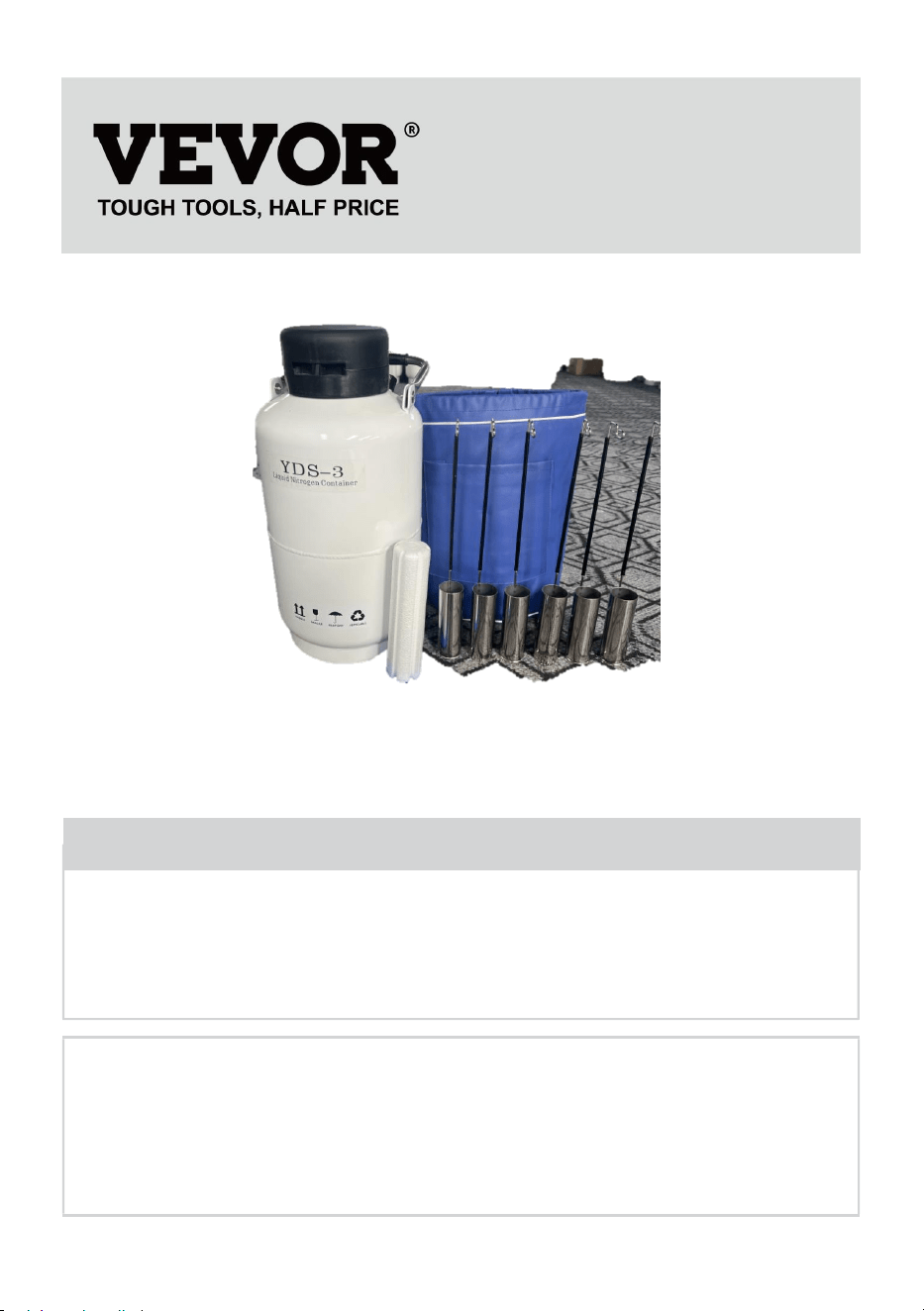
MODELL: YDS- 3/ YDS- 6/ YDS- 10/ YDS- 20/ YDS- 30
Foto als Referenz
Have product questions? Need technical support? Please feel free to
contact us:
Technical Support and E-Warranty Certificate
www.vevor.com/support
NEED HELP? CONTACT US!
This is the original instruction, please read all manual instructions
carefully before operating. VEVOR reserves a clear interpretation of our
user manual. The appearance of the product shall be subject to the
product you received. Please forgive us that we won't inform you again if
there are any technology or software updates on our product.
LIQUID NITROGEN
CONTAINER

- 2 -
SAFETY INSTRUCTION AND PRECAUTIONS
WARNUNG:
1. Der Flüssigstickstofftank sollte an einem gut belüfteten und kühlen Ort
aufgestellt werden und direkte Sonneneinstrahlung vermeiden
2. Die Verwendung in regnerischen oder feuchten Umgebungen ist
strengstens untersagt, um ein Vereisen oder Einfrieren von Halsrohren,
Steckern und anderem Zubehör zu vermeiden.
3. Kippen, horizontales Verlegen, Umdrehen, Aufstapeln,
Zusammenstoßen und andere Verhaltensweisen sind strengstens
verboten. Während des Gebrauchs sollte es vorsichtig behandelt und
immer aufrecht gehalten werden.
4. Öffnen Sie nicht die Vakuumdüse des Behälters. Sobald die
Vakuumdüse beschädigt ist, führt dies sofort zu einem Vakuumausfall.
11. Verwenden Sie professionelle Schutzausrüstung. Beim Umgang mit
flüssigem Stickstoff sollten Frostschutzhandschuhe, Schutzbrille und
Schutzkleidung getragen werden, um Erfrierungen zu vermeiden.
Kurzanleitung zum Produkt :
Wird zur Lagerung von
Samen/Embryonen/Zellen/Trockeneis/Metallmaterialien in Labor-,
Medizin-, Landwirtschafts-, Schönheits- und anderen Bereichen verwendet.
Die von unserem Unternehmen hergestellten biologischen
Flüssigstickstoffbehälter zeichnen sich durch eine angemessene Struktur,
einfache Tragbarkeit und eine gute Kühlleistung aus. Sie können in der Tierhaltung
und in medizinischen Forschungsabteilungen für die Langzeitlagerung und den
Transport von Nutztieren, gefrorenem Sperma, Impfstoffen, Zellen,
Mikroorganismen usw. bei niedrigen Temperaturen unter Verwendung von

- 3 -
flüssigem Stickstoff (-196 °C) als Kältemittel eingesetzt werden. Sie können auch
in Branchen wie Landesverteidigung, wissenschaftliche Forschung,
Maschinenbau, Elektronik, Metallurgie, Energie, Gastronomie, Schönheit usw.
eingesetzt werden.
Anleitung zum Containermodell
B". Durchmesser (mm), Größe ist nicht angegeben, es beträgt 50 mm.
"C". Nennvolumen des Behälters
„D“ bedeutet Stickstoff
„S“ steht für biologisch
"Y" steht für Flüssigkeit
Beispiel: YDS-30 bedeutet Volumen 3,0 l , Durchmesser 50 mm, biologischer
Behälter mit flüssigem Stickstoff.
Produktstruktur
- 4 -
1. Wie in der Abbildung gezeigt, besteht der Behälter aus einer Innenauskleidung,
einer Außenauskleidung, einem Eimer und einem Halsrohr, das die Innen- und
Außenauskleidung verbindet. Die Innen- und Außenauskleidung bestehen aus
einer hochfesten Luftfahrtaluminiumlegierung, die robust und langlebig ist.
2. Zwischen dem Innen- und Außentank herrscht ein Hochvakuum, und die
Vakuumfolie ist mit mehreren Schichten importierter Isoliermaterialien ausgestattet,
wodurch eine gute Kühlleistung erzielt wird
3. Der Halsstopfen besteht aus ungiftigem Polyurethan mit guter Isolierung. Er hat
die Doppelfunktion, die Verdunstung von flüssigem Stickstoff zu reduzieren und
den Hubzylinder zu fixieren.
4. Das Halsrohr besteht aus glasfaserverstärkten Verbindungen, die eine extrem
niedrige Wärmeleitfähigkeit aufweisen und den externen Wärmeeintrag vom
Halsrohr auf ein Minimum beschränken können.
5. Im Vakuumbereich sind Gasadsorbentien installiert, die von Metallen oder
anderen Substanzen abgegebene Gase im eigentlichen Hohlraum adsorbieren
und so über lange Zeit ein Hochvakuum aufrechterhalten können.

- 5 -
12. Stellen Sie den Behälter in flüssigen Stickstoff, um gefrorene Lebensmittel
aufzubewahren. Der obere Teil wird durch die kleine Nut des Halsstopfens und die
Kerbe der Rillplatte fixiert und gewährleistet so einen stabilen und zuverlässigen
Transport
13. Eimer muss zum Herausziehen um 180 Grad gedreht werden.
Behälter für flüssigen Stickstoff 3D -Modell
Produktm
odell
Kapaz
ität L
Kali
ber
mm
Außendurch
messer
mm
Hö
he
mm
Statisch
e
Lagerd
auer für
flüssige
n
Sticksto
ff
Eimer
Men
ge
Außendurch
messer
Hö
he
≤
≥
Stck
mm
mm
YDS-3
3
50
224
45
0
30
6
36
12
0
YDS-6
6
50
304
50
0
60
6
36
12
0
YDS-10
10
50
304
55
0
100
6
36
12
0
YDS-20
20
50
384
64
0
175
6
38
27
6
YDS-30
30
50
438
70
0
270
6
38
27
6
Hinweis 1: Die statische Lagerdauer des Produkts in flüssigem Stickstoff wird
mithilfe der Wiegemethode getestet.
Hinweis 2: In der Spalte „Produktmodell“ steht B für einen Behälter mit Stütze am
Boden oder an der Seite der Innenauskleidung, der gegen Kippen und Transport
beständig ist.

- 6 -
Hinweis 3: „_“ in der Lieferspalte zeigt an, dass das Produkt gemäß den
Benutzeranforderungen geliefert werden kann. Bitte bestätigen Sie und geben Sie
an, ob bei der Unterzeichnung des Bestellvertrags mit dem Benutzer vereinfacht
werden soll
Hinweis 4: Aufgrund technologischer Verbesserungen können sich einige Daten
geringfügig ändern.
Nutzungshinweis
Vor der Verwendung des Produkts sollten Benutzer die Verpackung öffnen und
das Erscheinungsbild des Produkts überprüfen. Sollten Mängel im Aussehen des
Behälters festgestellt werden, sollten diese Informationen innerhalb von 5
Arbeitstagen nach Erhalt des Produkts an die Vertriebsabteilung unseres
Unternehmens (Kontaktinformationen finden Sie auf der Rückseite)
zurückgesendet werden. Die Vertreter- und Vertriebseinheiten sollten die
relevanten Bedingungen der Vereinbarung befolgen.
1. Der Behälter kann nur zum Einfüllen von flüssigem Stickstoff verwendet werden.
Es wird nicht empfohlen, andere Flüssiggase oder flüssigen Sauerstoff
einzufüllen.
2. Flüssiger Stickstoff ist eine Flüssigkeit mit extrem niedriger Temperatur
(-196 °C), die bei Spritzern auf die Haut Erfrierungen der Haut verursachen kann.
Daher sollten beim Einfüllen und Entnehmen von flüssigem Stickstoff warme
Handschuhe und keine nackten Füße oder Hausschuhe getragen werden, um
Spritzer und Verletzungen von Personen zu vermeiden.
3. Zum Abdichten der Tankmündung darf nur der werkseitig passende Halsstopfen
verwendet werden. Andere Stopfen, geschweige denn versiegelte Stopfen,
können nicht als Ersatz verwendet werden, um Schäden am Behälter durch die
kontinuierliche Verdampfung von flüssigem Stickstoff zu vermeiden Anstieg des
Stickstoffdrucks.
4 . Um den Flüssigkeitsstand im Behälter zu überprüfen, sollte ein stabiler
Kunststoff- oder Holzstab in den Boden eingeführt und nach 5-10 Sekunden
herausgenommen werden. Die Länge der Frostbildung entspricht der Höhe des

- 7 -
Flüssigkeitsspiegels. Hohlstäbe oder Kunststoffrohre sollten nicht verwendet
werden.
5. Obwohl Stickstoff ein geruchloses, geruchloses und ungiftiges Gas ist, kann der
verdampfte Stickstoff bei schlechter Belüftung zu einem Anstieg des
Stickstoffgehalts in der Raumluft und einem relativen Rückgang des
Sauerstoffgehalts führen, was eine Erstickungsgefahr für den menschlichen
Körper darstellt. Daher sollte an den Lager- und Betriebspunkten von biologischen
Behältern mit flüssigem Stickstoff die Raumbelüftung verstärkt werden, um
Frischluft zu erhalten.
6. Wenn Sie den Tank ständig betreiben, verkürzt sich die Lagerzeit schneller.
7. Das Halsrohr ist der Kanal für den Einlass und Auslass von flüssigem Stickstoff
und gefrorenen Gegenständen und sollte mit Vorsicht verwendet werden. Wenn
das Halsrohr bricht, kann der Behälter nicht repariert werden.
8. Die Vakuumdichtungsverbindung des Behälters ist eine Schlüsselkomponente
zur Aufrechterhaltung des Vakuums im Behälter Schicht. Sobald es beschädigt ist,
entsteht sofort ein Vakuum im Behälter Die Schicht wird beschädigt und das
Produkt kann nicht weiter verwendet werden. Daher ist es Benutzern nicht
gestattet, die Vakuumdichtung des Behälters unbefugt zu öffnen.
Wartung und Instandhaltung
7. Versuchen Sie beim Ein- und Herausnehmen von Tiefkühlgütern, die
Öffnungszeit der Dose so kurz wie möglich zu halten, um den Verlust von
flüssigem Stickstoff zu reduzieren, und heben Sie den Hubzylinder nicht
vollständig heraus, um die Lagerwirkung der Gegenstände nicht zu
beeinträchtigen.
8. Vermeiden Sie unbedingt übermäßige Stöße und Kollisionen. Aufgrund des
Hochvakuumzustands des Tanks hält die Außenauskleidung dem Kontrast der
umgebenden Atmosphäre stand. Daher erzeugt der Behälter (Außenauskleidung)
bei übermäßigen Stößen und Kollisionen keinen Unterdruck. Wenn die
Verdunstung nach dem Unterdruck nicht deutlich zunimmt, kann der Behälter
weiterhin verwendet werden. Wenn die Verdunstungsleistung nachlässt, kann der
Behälter nicht repariert werden.
9. Überprüfen Sie regelmäßig das Gewicht des Behälters und stellen Sie sofort
fest, wie viele Tage flüssiger Stickstoff noch verwendet werden kann. Wenn die

- 8 -
Menge an flüssigem Stickstoff weniger als ein Drittel der Gesamtkapazität beträgt,
füllen Sie ihn sofort nach, um eine Nekrotisierung der Lagergegenstände zu
verhindern.
4. Während der Verwendung des Behälters sammelt sich aufgrund der
Verunreinigung von flüssigem Stickstoff nach und nach Wasser im Innentank an.
Gleichzeitig verringert sich durch die Vermehrung der Bakterien die
Befruchtungsrate der Samenflüssigkeit. Daher wird empfohlen, den Behälter 1–2
Mal im Jahr mit warmem Wasser bei 40–50 °C zu waschen.
Statischer täglicher Verdunstungstest mit flüssigem
Stickstoff
1. Die statische Lagerdauer des Produkts in flüssigem Stickstoff wird mit der
Wiegemethode getestet.
2. Der Test sollte bei einer Umgebungstemperatur von 20 °C (± 5 °C) durchgeführt
werden und kann nicht in einem direkt belüfteten Bereich durchgeführt werden.
3. Der Test sollte mehr als die Hälfte des Behälters mit flüssigem Stickstoff füllen,
ihn 48 Stunden lang stehen lassen und zum ersten Mal (A) Gramm wiegen.
Wiegen Sie nach 3 Tagen zum ersten Mal (B) Gramm. Berechnen Sie die
Verdunstungsrate Q nach folgender Formel:
Q=(AB)/3 (Gramm/Tag)
Wenn es in Volumen (Liter) ausgedrückt werden muss, verwenden Sie zur
Umrechnung die folgende Formel: D=Q/808 (Liter/Tag)
- 9 -
Hersteller : Shanghaimuxinmuyeyouxiangongsi
Adresse: Shuangchenglu 803nong11hao1602A-1609shi, baoshanqu,
Shanghai 200000 CN.
Importiert nach AUS: SIHAO PTY LTD. 1 ROKEVA STREETEASTWOOD
NSW 2122 Australien
In die USA importiert: Sanven Technology Ltd. Suite 250, 9166 Anaheim
Place, Rancho Cucamonga, CA 91730
REP
EC
E-CrossStu GmbH
Mainzer Landstr.69, 60329 Frankfurt am Main.
REP
UK
YH CONSULTING LIMITED.
C/O YH Consulting Limited Office 147, Centurion House,
London Road, Staines-upon-Thames, Surrey, TW18 4AX

- 10 -



Assistance technique et certificat de garantie électronique www.vevor.com/support
CONTENEUR D'AZOTE LIQUIDE
MANUEL DE L'UTILISATEUR
We continue to be committed to provide you tools with competitive price.
"Save Half", "Half Price" or any other similar expressions used by us only represents an
estimate of savings you might benefit from buying certain tools with us compared to the major
top brands and does not necessarily mean to cover all categories of tools offered by us. You
are kindly reminded to verify carefully when you are placing an order with us if you are
actually saving half in comparison with the top major brands.

- 1 -
MODÈLE: YDS- 3/ YDS- 6/ YDS -10/ YDS- 20/ YDS- 30
Photo pour référence
Have product questions? Need technical support? Please feel free to
contact us:
Technical Support and E-Warranty Certificate
www.vevor.com/support
NEED HELP? CONTACT US!
This is the original instruction, please read all manual instructions
carefully before operating. VEVOR reserves a clear interpretation of our
user manual. The appearance of the product shall be subject to the
product you received. Please forgive us that we won't inform you again if
there are any technology or software updates on our product.
LIQUID NITROGEN
CONTAINER

- 2 -
SAFETY INSTRUCTION AND PRECAUTIONS
AVERTISSEMENT:
1. Le réservoir d'azote liquide doit être placé dans un endroit bien ventilé et
frais, en évitant la lumière directe du soleil.
2. Il est strictement interdit d'utiliser dans des environnements pluvieux ou
humides pour éviter le givrage et le gel des tubes de cou, des bouchons et
autres accessoires ;
3. Il est strictement interdit de s'incliner, de s'allonger horizontalement, de
s'inverser, de s'empiler, d'entrer en collision et d'autres comportements.
Pendant l'utilisation, il doit être manipulé avec précaution et toujours
maintenu droit
4. N'ouvrez pas la buse d'aspiration du récipient. Une fois que la buse
d'aspiration est endommagée, cela entraînera immédiatement une panne
d'aspiration ;
14. Utilisez un équipement de protection professionnel. Lors de l'utilisation
de l'azote liquide, des gants antigel, des lunettes et des vêtements de
protection doivent être portés pour éviter les engelures.
Instructions succinctes du produit :
Utilisé pour stocker le sperme/embryons/cellules/glace
carbonique/matériaux métalliques en laboratoire, médical, agricole, de
beauté et autres domaines. Les conteneurs biologiques d'azote liquide produits
par notre société présentent les caractéristiques d'une structure raisonnable,
d'une portabilité facile et de bonnes performances de réfrigération. Ils peuvent être
utilisés dans l'élevage, les départements de recherche médicale pour le stockage
et le transport à long terme à basse température du bétail, du sperme congelé,
des vaccins, des cellules, des micro-organismes, etc. en utilisant de l'azote liquide
- 3 -
(-196 ℃) comme réfrigérant. Ils peuvent également être appliqués dans des
secteurs tels que la défense nationale, la recherche scientifique, les machines,
l'électronique, la métallurgie, l'énergie, la restauration, la beauté, etc.
Instruction pour le modèle de conteneur
B”. Diamètre (mm), la taille n'est pas marquée, elle est de 50 mm.
"C". Volume nominal du conteneur
"D" signifie azote
"S" signifie biologique
"Y" signifie liquide
Par exemple : YDS-3 0 signifie volume 3 0 L, Dia.50mm, récipient biologique
d'azote liquide.
La structure du produit
- 4 -
1. Comme le montre la figure, le conteneur se compose d'un revêtement intérieur,
d'un revêtement extérieur, d'un seau et d'un tube de col reliant les revêtements
intérieur et extérieur. Les doublures intérieures et extérieures sont fabriquées en
alliage d'aluminium aéronautique à haute résistance, robuste et durable.
2. Il existe un vide poussé entre les réservoirs intérieur et extérieur et le film sous
vide est équipé de plusieurs couches de matériaux isolants importés, offrant ainsi
de bonnes performances de réfrigération.
3. Le bouchon de cou est en polyuréthane non toxique avec une bonne isolation. Il
a une double fonction : réduire l’évaporation de l’azote liquide et fixer le vérin de
levage.
4. Le tube de col est constitué de composés renforcés de verre, qui ont une
conductivité thermique extrêmement faible et peuvent contrôler au minimum la
chaleur externe entrant par le tube de col.
5. Des adsorbants de gaz sont installés dans la zone de vide, qui peuvent
adsorber les gaz émis par les métaux ou d'autres substances dans la véritable
cavité, maintenant ainsi un vide poussé pendant une longue période.

- 5 -
15. Placez le récipient dans de l'azote liquide pour conserver les articles congelés.
La partie supérieure est fixée par la petite rainure du bouchon de col et l'encoche
de la plaque inciseur, assurant un transport stable et fiable
16. Seau doit être tourné à 180 degrés pour être retiré.
Modèle de conteneur d'azote liquide
Modèl
e du
produit
Capacit
é L
Calibr
e
mm
Diamètr
e
extérieu
r
mm
Hauteu
r
mm
Période
de
stockag
e de
l'azote
liquide
statique
Seau
Quantit
é
Diamètr
e
extérieu
r
Hauteu
r
≤
≥
pièces
mm
mm
YDS-3
3
50
224
450
30
6
36
120
YDS-6
6
50
304
500
60
6
36
120
YDS-1
0
dix
50
304
550
100
6
36
120
YDS-2
0
20
50
384
640
175
6
38
276
YDS-3
0
30
50
438
700
270
6
38
276
Remarque 1 : La durée de stockage statique de l'azote liquide du produit est
testée à l'aide de la méthode de pesée.
Remarque 2 : Dans la colonne du modèle de produit, B représente un conteneur
avec support au fond ou sur le côté du revêtement intérieur, qui résiste au
basculement et au transport.

- 6 -
Remarque 3 : "_" dans la colonne de livraison indique que le produit peut être livré
selon les besoins de l'utilisateur. Veuillez confirmer et indiquer s'il faut simplifier
lors de la signature du contrat de commande avec l'utilisateur
Note 4 : En raison des améliorations technologiques, certaines données peuvent
subir quelques modifications.
Avis d'utilisation
Avant d'utiliser le produit, les utilisateurs doivent ouvrir la boîte et inspecter la
qualité de l'apparence du produit. Si des défauts sont constatés dans l'apparence
du conteneur, ils doivent retourner ces informations au service commercial de
notre société (les coordonnées se trouvent au dos de la couverture) dans les 5
jours ouvrables suivant la réception du produit. Les unités d'agent et de
distributeur doivent suivre les termes pertinents de l'accord.
1. Le récipient ne peut être utilisé que pour remplir d'azote liquide, et il n'est pas
recommandé de remplir d'autres gaz liquides ou d'oxygène liquide.
2. L'azote liquide est un liquide à très basse température (-196 ℃) qui peut
provoquer des engelures cutanées s'il est éclaboussé sur la peau. Par conséquent,
lors du remplissage et du retrait de l'azote liquide, il convient de porter des gants
chauds et non des pieds nus ou des pantoufles pour éviter les éclaboussures et
les blessures.
3. Seul le bouchon de col correspondant à l'usine peut être utilisé pour sceller
l'embouchure du réservoir, et d'autres bouchons ne peuvent pas être utilisés
comme substituts, encore moins des bouchons scellés, pour éviter d'endommager
le récipient causé par l'évaporation continue de l'azote liquide et le augmentation
de la pression de l'azote.
4 . Lors de la vérification du niveau de liquide à l'intérieur du récipient, une tige en
plastique solide ou en bois doit être insérée dans le fond et retirée après 5 à 10
secondes. La longueur de formation du givre correspond à la hauteur du niveau de
liquide, et des tiges creuses ou des tubes en plastique ne doivent pas être utilisés.
5 . Bien que l'azote soit un gaz inodore, inodore et non toxique, dans des
conditions mal ventilées, l'azote évaporé peut provoquer une augmentation de la

- 7 -
quantité d'azote dans l'air intérieur et une diminution relative de la teneur en
oxygène, posant un risque d'étouffement pour l'homme. corps. Par conséquent,
dans les points de stockage et d’exploitation des conteneurs biologiques d’azote
liquide, la ventilation intérieure doit être renforcée pour maintenir l’air frais.
6. Faites toujours fonctionner le réservoir, ce qui entraînera une réduction plus
rapide du temps de stockage.
7. Le tube cervical est le canal d'entrée et de sortie de l'azote liquide et des articles
congelés et doit être utilisé avec prudence. Si le tube du col se brise, le récipient
ne peut pas être réparé.
8. Le joint d'étanchéité sous vide du conteneur est un élément clé pour maintenir
le vide entre le conteneur. couche. Une fois endommagé, il provoquera
immédiatement le vide du conteneur entre couche se détériore et le produit ne
peut plus être utilisé. Par conséquent, les utilisateurs ne sont pas autorisés à
ouvrir le joint de mise sous vide du conteneur sans autorisation.
Entretien et maintenance
10. Lors de l'insertion et du retrait d'articles congelés, essayez de maintenir le
temps d'ouverture de la boîte aussi court que possible pour réduire la perte
d'azote liquide, et ne soulevez pas complètement le vérin de levage pour éviter
d'affecter l'effet de stockage des articles.
11. Empêchez strictement les impacts excessifs et les collisions. En raison de
l’état de vide poussé du réservoir, le revêtement extérieur résistera au contraste
de l’atmosphère environnante. Par conséquent, le conteneur (revêtement
extérieur) ne produira pas de dépression en cas d’impact excessif ou de collision.
Si l’évaporation n’augmente pas de manière significative après la dépression, elle
peut toujours être utilisée. Si les performances d'évaporation se détériorent, le
conteneur ne peut pas être réparé.
12. Vérifiez régulièrement le poids du récipient et comprenez rapidement combien
de jours l'azote liquide peut encore être utilisé. Lorsque la quantité d'azote liquide
est inférieure au tiers de la capacité totale, remplissez-la immédiatement pour
éviter la nécrosation des éléments stockés.
4. Lors de l'utilisation du récipient, en raison de l'impureté de l'azote liquide, l'eau
s'accumulera progressivement dans le réservoir intérieur. Dans le même temps, la
multiplication des bactéries va réduire le taux de fécondation du sperme. Par

- 8 -
conséquent, il est recommandé de laver le récipient avec de l'eau tiède à 40-50 ℃
1 à 2 fois par an.
Test d'évaporation statique quotidien de l'azote liquide
1. La durée de stockage statique de l’azote liquide du produit est testée à l’aide de
la méthode de pesée.
2. Le test doit être effectué à une température ambiante de 20 ℃ (± 5 ℃) et ne
peut pas être effectué dans une zone directement ventilée.
3. Le test doit remplir plus de la moitié du récipient avec de l'azote liquide, laisser
reposer pendant 48 heures et peser (A) grammes pour la première fois. Après 3
jours, pesez (B) grammes pour la première fois. Calculez le taux d'évaporation Q
selon la formule suivante :
Q=(AB)/3 (grammes/jour)
S'il doit être exprimé en termes de volume (litres), utilisez la formule suivante pour
convertir : D=Q/808 (litres/jour)
- 9 -
Fabricant : Shanghaimuxinmuyeyouxiangongsi
Adresse : Shuangchenglu 803nong11hao1602A-1609shi, baoshanqu,
shanghai 200000 CN.
Importé en Australie : SIHAO PTY LTD. 1 ROKEVA STREETASTWOOD
NSW 2122 Australie
Importé aux États-Unis : Sanven Technology Ltd. Suite 250, 9166
Anaheim
Lieu, Rancho Cucamonga, CA 91730
REP
EC
E-CrossStu GmbH
Mainzer Landstr.69, 60329 Frankfurt am Main.
REP
UK
YH CONSULTING LIMITED.
C/O YH Consulting Limited Office 147, Centurion House,
London Road, Staines-upon-Thames, Surrey, TW18 4AX

- 10 -



Technische ondersteuning en e-garantiecertificaat www.vevor.com/support
VLOEIBARE STIKSTOFCONTAINER
HANDLEIDING
We continue to be committed to provide you tools with competitive price.
"Save Half", "Half Price" or any other similar expressions used by us only represents an
estimate of savings you might benefit from buying certain tools with us compared to the major
top brands and does not necessarily mean to cover all categories of tools offered by us. You
are kindly reminded to verify carefully when you are placing an order with us if you are
actually saving half in comparison with the top major brands.

- 1 -
MODEL: YDS- 3/ YDS- 6/ YDS- 10/ YDS- 20/ YDS- 30
Foto ter referentie
Have product questions? Need technical support? Please feel free to
contact us:
Technical Support and E-Warranty Certificate
www.vevor.com/support
NEED HELP? CONTACT US!
This is the original instruction, please read all manual instructions
carefully before operating. VEVOR reserves a clear interpretation of our
user manual. The appearance of the product shall be subject to the
product you received. Please forgive us that we won't inform you again if
there are any technology or software updates on our product.
LIQUID NITROGEN
CONTAINER

- 2 -
SAFETY INSTRUCTION AND PRECAUTIONS
WAARSCHUWING:
1. De tank voor vloeibare stikstof moet op een goed geventileerde en koele
plaats worden geplaatst, waarbij direct zonlicht wordt vermeden
2. Het is ten strengste verboden om in regenachtige of vochtige
omgevingen te gebruiken om bevriezing en bevriezing van nekbuizen,
pluggen en andere accessoires te voorkomen;
3. Het is ten strengste verboden om te kantelen, horizontaal te liggen, om
te keren, op te stapelen, te botsen en ander gedrag te vertonen. Tijdens
gebruik moet er voorzichtig mee worden omgegaan en moet het altijd
rechtop worden bewaard
4. Open het vacuümmondstuk van de container niet. Zodra het
vacuümmondstuk beschadigd is, zal dit onmiddellijk een vacuümstoring
veroorzaken;
17. Gebruik professionele beschermingsmiddelen. Bij het gebruik van
vloeibare stikstof moeten antivrieshandschoenen, een veiligheidsbril en
beschermende kleding worden gedragen om bevriezing te voorkomen.
Product korte instructie :
Gebruikt voor het opslaan van
sperma/embryo's/cellen/droogijs/metaalmaterialen in laboratoria,
medische, boerderij-, schoonheids- en andere gebieden. De biologische
containers met vloeibare stikstof die door ons bedrijf worden geproduceerd,
hebben de kenmerken van een redelijke structuur, gemakkelijke draagbaarheid en
goede koelprestaties. Ze kunnen worden gebruikt in de veehouderij en medische
onderzoeksafdelingen voor langdurige opslag en transport bij lage temperaturen
van vee, bevroren sperma, vaccins, cellen, micro-organismen, enz., waarbij
- 3 -
vloeibare stikstof (-196 ℃) als koelmiddel wordt gebruikt. Ze kunnen ook worden
toegepast in sectoren zoals de nationale defensie, wetenschappelijk onderzoek,
machines, elektronica, metallurgie, energie, catering, schoonheid, enz.
Instructie voor het containermodel
B". Diameter (mm), maat is niet gemarkeerd, deze is 50 mm.
"C". Nominaal volume van de container
"D" betekent stikstof
"S" betekent biologisch
"Y" betekent vloeistof
Bijvoorbeeld: YDS-3 0 betekent volume 3 0 L, Dia.50mm, biologische container
met vloeibare stikstof.
Product structuur
- 4 -
1. Zoals weergegeven in de afbeelding bestaat de container uit een binnenvoering,
een buitenvoering, een emmer en een nekbuis die de binnen- en buitenvoering
met elkaar verbindt. De binnen- en buitenvoeringen zijn gemaakt van een zeer
sterke luchtvaartaluminiumlegering, die stevig en duurzaam is.
2. Er is een hoog vacuüm tussen de binnen- en buitentanks en de vacuümfilm is
uitgerust met meerdere lagen geïmporteerde isolatiematerialen, waardoor goede
koelprestaties worden geleverd
3. De nekplug is gemaakt van niet-giftig polyurethaan met goede isolatie. Het heeft
een dubbele functie: het verminderen van de verdamping van vloeibare stikstof en
het fixeren van de hefcilinder.
4. De nekbuis is gemaakt van glasvezelversterkte verbindingen, die een extreem
lage thermische geleidbaarheid hebben en de externe warmte die uit de nekbuis
binnenkomt tot een minimum kunnen beperken.
5. In het vacuümgebied worden gasadsorbentia geïnstalleerd, die gassen kunnen
adsorberen die worden uitgestoten door metalen of andere stoffen in de echte
holte, waardoor een hoog vacuüm lange tijd wordt gehandhaafd.

- 5 -
18. Plaats de container in vloeibare stikstof om bevroren artikelen te bewaren. Het
bovenste deel wordt vastgezet door de kleine groef van de nekplug en de inkeping
van de scoreplaat, waardoor een stabiel en betrouwbaar transport wordt
gegarandeerd
19. Emmer moet 180 graden worden gedraaid om uitgetrokken te worden.
Vloeibare stikstof Containermodel
Produ
ct
Model
Capacit
eit L
Kalib
er
mm
Buitendiam
eter
mm
Hoog
te
mm
Statische
opslagperi
ode van
vloeibare
stikstof
Emmer
Aant
al
Buitens
te
diamet
er
Hoog
te
≤
≥
stuk
s
mm
mm
YDS-
3
3
50
224
450
30
6
36
120
YDS-
6
6
50
304
500
60
6
36
120
YDS-
10
10
50
304
550
100
6
36
120
YDS-
20
20
50
384
640
175
6
38
276
YDS-
30
30
50
438
700
270
6
38
276
Opmerking 1: De statische opslagperiode van vloeibare stikstof van het product
wordt getest met behulp van de weegmethode.
Opmerking 2: In de productmodelkolom vertegenwoordigt B een container met
steun aan de onderkant of zijkant van de binnenvoering, die bestand is tegen
kantelen en transport

- 6 -
Opmerking 3: "_" in de leveringskolom geeft aan dat het product kan worden
geleverd volgens de wensen van de gebruiker. Bevestig en geef aan of u de
ondertekening van het bestelcontract met de gebruiker wilt vereenvoudigen
Opmerking 4: Als gevolg van technologische verbeteringen kunnen sommige
gegevens enkele wijzigingen ondergaan.
Gebruiksmelding
Voordat gebruikers het product gebruiken, moeten ze de doos openen en de
uiterlijke kwaliteit van het product inspecteren. Als er gebreken worden
geconstateerd in het uiterlijk van de verpakking, moeten ze deze informatie binnen
5 werkdagen na ontvangst van het product terugsturen naar de verkoopafdeling
van ons bedrijf (contactgegevens vindt u op de achterkant). De agenten- en
distributeurseenheden moeten de relevante voorwaarden van de overeenkomst
naleven.
1. De container kan alleen worden gebruikt voor het vullen van vloeibare stikstof
en het wordt niet aanbevolen om andere vloeibare gassen of vloeibare zuurstof te
vullen.
2. Vloeibare stikstof is een vloeistof met een ultralage temperatuur (-196 ℃) die
bevriezing van de huid kan veroorzaken als deze op de huid spat. Daarom moeten
bij het vullen en verwijderen van vloeibare stikstof warme handschoenen worden
gedragen en geen blote voeten of pantoffels om spatten en letsel te voorkomen.
3. Alleen de nekplug die overeenkomt met de fabriek kan worden gebruikt om de
tankmond af te dichten, en andere pluggen kunnen niet worden gebruikt als
vervanging, laat staan afgedichte pluggen, om schade aan de container te
voorkomen die wordt veroorzaakt door de voortdurende verdamping van vloeibare
stikstof en de verhoging van de stikstofdruk.
4 . Bij het controleren van het vloeistofniveau in de container moet een stevige
plastic of houten staaf in de bodem worden gestoken en na 5-10 seconden worden
verwijderd. De lengte van de rijpvorming is de hoogte van het vloeistofniveau, en
holle staven of plastic buizen mogen niet worden gebruikt.

- 7 -
5 . Hoewel stikstof een reukloos, geurloos en niet-giftig gas is, kan de verdampte
stikstof in slecht geventileerde omstandigheden een toename van de hoeveelheid
stikstof in de binnenlucht en een relatieve afname van het zuurstofgehalte
veroorzaken, waardoor er gevaar voor verstikking voor de mens ontstaat. lichaam.
Daarom moet op de opslag- en gebruikspunten van biologische containers met
vloeibare stikstof de binnenventilatie worden versterkt om frisse lucht te
behouden.
6. Bedien de tank altijd, hierdoor wordt de opslagtijd sneller verkort.
7. De nekbuis is het kanaal voor de inlaat en uitlaat van vloeibare stikstof en
bevroren artikelen en moet met voorzichtigheid worden gebruikt. Als de nekbuis
breekt, kan de container niet worden gerepareerd.
8. De vacuümafdichting van de container is een belangrijk onderdeel om het
vacuüm van de container intern te behouden laag. Eenmaal beschadigd, zal dit
onmiddellijk het vacuüm van de container veroorzaken laag verslechtert en het
product kan niet meer worden gebruikt. Daarom mogen gebruikers de
vacuümafsluitverbinding van de container niet zonder toestemming openen.
Onderhoud en onderhoud
13. Probeer bij het in- en uitnemen van bevroren artikelen de openingstijd van het
blik zo kort mogelijk te houden om het verlies van vloeibare stikstof te verminderen,
en til de hefcilinder niet volledig uit om te voorkomen dat het opslageffect van de
artikelen wordt beïnvloed.
14. Voorkom strikt overmatige impact en botsingen. Vanwege de hoge
vacuümtoestand van de tank is de buitenbekleding bestand tegen het contrast van
de omringende atmosfeer. Daarom zal de container (buitenbekleding) geen
depressie veroorzaken tijdens overmatige impact en botsing. Als de verdamping
na de depressie niet significant toeneemt, kan deze nog steeds worden gebruikt.
Als de verdampingsprestaties verslechteren, kan de container niet worden
gerepareerd.
15. Controleer regelmatig het gewicht van de container en begrijp meteen
hoeveel dagen vloeibare stikstof nog kan worden gebruikt. Wanneer de
hoeveelheid vloeibare stikstof minder dan een derde van de totale capaciteit
bedraagt, moet u deze onmiddellijk aanvullen om te voorkomen dat de
opslagartikelen necrotiseren.

- 8 -
4. Tijdens het gebruik van de container zal er, vanwege de onzuiverheid van
vloeibare stikstof, zich geleidelijk water ophopen in de binnentank. Tegelijkertijd
zal de vermenigvuldiging van bacteriën de bevruchtingssnelheid van sperma
verminderen. Daarom wordt aanbevolen om de container 1-2 keer per jaar te
wassen met warm water op 40-50℃.
Statische dagelijkse verdampingstest met vloeibare
stikstof
1. De statische opslagduur van vloeibare stikstof van het product wordt getest met
behulp van de weegmethode.
2. De test moet worden uitgevoerd bij een omgevingstemperatuur van 20 ℃ (±
5 ℃) en kan niet worden uitgevoerd in een direct geventileerde ruimte.
3. De test moet meer dan de helft van de container vullen met vloeibare stikstof,
deze 48 uur laten staan en voor de eerste keer (A) gram wegen. Weeg na 3 dagen
voor de eerste keer (B) gram. Bereken de verdampingssnelheid Q volgens de
volgende formule:
Q=(AB)/3 (gram/dag)
Als het moet worden uitgedrukt in termen van volume (liter), gebruik dan de
volgende formule om om te rekenen: D=Q/808 (liter/dag)
- 9 -
Fabrikant : Shanghaimuxinmuyeyouxiangongsi
Adres: Shuangchenglu 803nong11hao1602A-1609shi, baoshanqu,
shanghai 200000 CN.
Geïmporteerd naar AUS: SIHAO PTY LTD. 1 ROKEVA
STREETEASTWOOD NSW 2122 Australië
Geïmporteerd in de VS: Sanven Technology Ltd. Suite 250, 9166
Anaheim
Plaats, Rancho Cucamonga, CA 91730
REP
EC
E-CrossStu GmbH
Mainzer Landstr.69, 60329 Frankfurt am Main.
REP
UK
YH CONSULTING LIMITED.
C/O YH Consulting Limited Office 147, Centurion House,
London Road, Staines-upon-Thames, Surrey, TW18 4AX

- 10 -



Teknisk support och e-garanticertifikat www.vevor.com/support
BEHÅLLARE FÖR FLYTANDE KVÄVE
ANVÄNDARMANUAL
We continue to be committed to provide you tools with competitive price.
"Save Half", "Half Price" or any other similar expressions used by us only represents an
estimate of savings you might benefit from buying certain tools with us compared to the major
top brands and does not necessarily mean to cover all categories of tools offered by us. You
are kindly reminded to verify carefully when you are placing an order with us if you are
actually saving half in comparison with the top major brands.

- 1 -
MODELL: YDS- 3/ YDS- 6/ YDS- 10/ YDS- 20/ YDS- 30
Foto för referens
Have product questions? Need technical support? Please feel free to
contact us:
Technical Support and E-Warranty Certificate
www.vevor.com/support
NEED HELP? CONTACT US!
This is the original instruction, please read all manual instructions
carefully before operating. VEVOR reserves a clear interpretation of our
user manual. The appearance of the product shall be subject to the
product you received. Please forgive us that we won't inform you again if
there are any technology or software updates on our product.
LIQUID NITROGEN
CONTAINER

- 2 -
SAFETY INSTRUCTION AND PRECAUTIONS
VARNING:
1. Tanken med flytande kväve bör placeras på en väl ventilerad och sval
plats, undvik direkt solljus
2. Det är strängt förbjudet att använda i regniga eller fuktiga miljöer för att
undvika frosting och frysning av halsrör, pluggar och andra tillbehör;
3. Det är strängt förbjudet att luta, lägga horisontellt, vända, stapla upp,
kollidera och andra beteenden. Under användning ska den hanteras
varsamt och alltid hållas upprätt
4. Öppna inte behållarens vakuummunstycke. När vakuummunstycket är
skadat kommer det omedelbart att orsaka vakuumfel;
20. Använd professionell skyddsutrustning. Vid användning av flytande
kväve bör frostskyddshandskar, skyddsglasögon och skyddskläder bäras
för att förhindra frostskador.
Kort produktinstruktion :
Används för att lagra sperma/embryon/celler/torris/metallmaterial inom
laboratorie-, medicin-, gårds-, skönhets- och andra områden. De biologiska
behållarna för flytande kväve som produceras av vårt företag har egenskaperna
för rimlig struktur, enkel portabilitet och bra kylprestanda. De kan användas inom
djurhållning, medicinska forskningsavdelningar för långvarig lågtemperaturlagring
och transport av boskap, fryst sperma, vacciner, celler, mikroorganismer etc. med
flytande kväve (-196 ℃) som köldmedium. De kan också tillämpas inom industrier
som nationellt försvar, vetenskaplig forskning, maskiner, elektronik, metallurgi,
energi, catering, skönhet, etc.
Instruktion för containermodellen
- 3 -
B”. Diameter (mm), storleken är inte markerad den är 50 mm.
"C". Behållarens nominella volym
"D" betyder kväve
"S" betyder biologiskt
"Y" betyder vätska
Till exempel: YDS-3 0 betyder volym 3 0 L, Dia.50mm, biologisk behållare för
flytande kväve.
Produktstruktur
1. Som visas i figuren består behållaren av ett innerfoder, ett yttre foder, en hink
och ett halsrör som förbinder de inre och yttre fodren. De inre och yttre fodren är
gjorda av höghållfast flygaluminiumlegering, som är robust och hållbar,
2. Det finns ett högt vakuum mellan de inre och yttre tankarna, och vakuumfilmen

- 4 -
är utrustad med flera lager av importerade isoleringsmaterial, vilket har bra
kylprestanda
3. Halspluggen är gjord av giftfri polyuretan med bra isolering. Den har en dubbel
funktion för att minska avdunstning av flytande kväve och fixera lyftcylindern.
4. Halsröret är tillverkat av glasförstärkta föreningar, som har extremt låg
värmeledningsförmåga och kan kontrollera den externa värmen som kommer in
från halsröret till ett minimum.
5. Gasadsorbenter är installerade i vakuumområdet, som kan adsorbera gaser
som avges av metaller eller andra ämnen i den verkliga kaviteten och därigenom
upprätthålla ett högt vakuum under lång tid.
21. Placera behållaren i flytande kväve för att lagra frysta föremål. Den övre delen
är fixerad av det lilla spåret på halspluggen och skåran på skårplattan, vilket
säkerställer stabil och pålitlig transport
22. Hink måste vridas 180 grader för att dras ut.
Behållare modell för flytande kväve
Produktmod
ell
Kapacit
et L
Kalib
er
mm
Ytterdiame
ter
mm
Höj
d
mm
Statisk
lagringsperi
od för
flytande
kväve
Hink
Ant
al
Yttre
diamet
er
Höj
d
≤
≥
st
mm
mm
YDS-3
3
50
224
450
30
6
36
120
YDS-6
6
50
304
500
60
6
36
120
YDS-10
10
50
304
550
100
6
36
120
YDS-20
20
50
384
640
175
6
38
276
YDS-30
30
50
438
700
270
6
38
276
Anmärkning 1: Den statiska lagringsperioden för flytande kväve för produkten
testas med hjälp av vägningsmetoden.

- 5 -
Not 2: I produktmodellkolumnen representerar B en behållare med stöd i botten
eller sidan av innerfodret, som är motståndskraftig mot tippning och transport
Anmärkning 3: "_" i leveranskolumnen anger att produkten kan levereras enligt
användarkrav. Vänligen bekräfta och ange om du vill förenkla när du undertecknar
beställningsavtalet med användaren
Anmärkning 4: På grund av tekniska förbättringar kan vissa data ha vissa
ändringar.
Användningsmeddelande
Innan du använder produkten bör användare öppna lådan och inspektera
produktens utseende. Om några defekter upptäcks i förpackningens utseende bör
de returnera denna information till vårt företags försäljningsavdelning
(kontaktinformation finns på baksidan) inom 5 arbetsdagar efter mottagandet av
produkten. Agent- och distributörsenheterna bör följa de relevanta villkoren i
avtalet.
1. Behållaren kan endast användas för att fylla flytande kväve, och det
rekommenderas inte att fylla på andra flytande gaser eller flytande syre.
2. Flytande kväve är en vätska med ultralåg temperatur (-196 ℃) som kan orsaka
köldskador på huden om den stänks på huden. Därför bör varma handskar
användas vid fyllning och borttagning av flytande kväve och inte bara fötter eller
tofflor för att undvika stänk och skada personer.
3. Endast den halsplugg som matchar fabriken kan användas för att täta tankens
mynning, och andra pluggar kan inte användas som ersättning, än mindre
förseglade pluggar, för att undvika skador på behållaren orsakade av kontinuerlig
avdunstning av flytande kväve och ökning av kvävetrycket.
4 . Vid kontroll av vätskenivån inuti behållaren ska en solid plast- eller trästav
sättas in i botten och tas ut efter 5-10 sekunder. Längden på frostbildningen är
vätskenivåhöjden och ihåliga stavar eller plaströr bör inte användas.
5 . Även om kväve är en luktfri, luktfri och ogiftig gas, kan det avdunstade kvävet
under dåligt ventilerade förhållanden orsaka en ökning av mängden kväve i
inomhusluften och en relativ minskning av syrehalten, vilket utgör en risk för

- 6 -
kvävning för människan. kropp. Därför bör inomhusventilationen stärkas i
förvarings- och driftpunkterna för biologiska behållare med flytande kväve för att
upprätthålla frisk luft.
6. Använd alltid tanken så att lagringstiden minskar snabbare.
7. Halsröret är kanalen för inlopp och utlopp av flytande kväve och frysta föremål,
och bör användas med försiktighet. Om halsröret går sönder kan behållaren inte
repareras.
8. Behållarens vakuumförseglingsfog är en nyckelkomponent för att upprätthålla
vakuumet i behållaren. lager. När den är skadad kommer den omedelbart att
orsaka vakuumet i behållaren skiktet försämras och produkten kan inte fortsätta att
användas. Därför får användare inte öppna behållarens vakuumförslutning utan
tillstånd.
Underhåll och skötsel
16. När du sätter i och tar ut frysta föremål, försök att hålla öppningstiden för
burken så kort som möjligt för att minska förlusten av flytande kväve, och lyft inte
ut lyftcylindern helt för att undvika att påverka föremålens lagringseffekt.
17. Förhindra strikt överdriven stöt och kollision. På grund av tankens höga
vakuumtillstånd kommer det yttre fodret att motstå kontrasten från den omgivande
atmosfären. Därför kommer behållaren (yttre fodret) inte att producera en
fördjupning vid överdriven stöt och kollision. Om avdunstningen inte ökar
nämnvärt efter depressionen kan den ändå användas. Om avdunstningen
försämras kan behållaren inte repareras.
18. Kontrollera regelbundet vikten på behållaren och förstå omedelbart hur många
dagar flytande kväve fortfarande kan användas. När mängden flytande kväve är
mindre än en tredjedel av den totala kapaciteten, fyll på omedelbart för att
förhindra att förvaringsartiklarna nekrotiserar.
4. Under användningen av behållaren, på grund av föroreningen av flytande kväve,
kommer vatten gradvis att samlas i den inre tanken. Samtidigt kommer
förökningen av bakterier att minska spermans befruktningshastighet. Därför
rekommenderas det att tvätta behållaren med varmt vatten vid 40-50 ℃ 1-2
gånger om året.

- 7 -
Statisk daglig avdunstning av flytande kväve
1. Den statiska lagringsperioden för flytande kväve för produkten testas med hjälp
av vägningsmetoden.
2. Testet bör utföras i en omgivningstemperatur på 20 ℃ (± 5 ℃), och kan inte
utföras i ett direkt ventilerat utrymme.
3. Testet ska fylla mer än hälften av behållaren med flytande kväve, låta den stå i
48 timmar och väga (A) gram för första gången. Efter 3 dagar, väg (B) gram för
första gången. Beräkna avdunstningshastigheten Q enligt följande formel:
Q=(AB)/3 (gram/dag)
Om det behöver uttryckas i termer av volym (liter), använd följande formel för att
konvertera: D=Q/808 (liter/dag)
Tillverkare : Shanghaimuxinmuyeyouxiangongsi
Adress: Shuangchenglu 803nong11hao1602A-1609shi, baoshanqu,
shanghai 200000 CN.
Importerad till AUS: SIHAO PTY LTD. 1 ROKEVA STREETEASTWOOD
NSW 2122 Australien
- 8 -
Importerad till USA: Sanven Technology Ltd. Suite 250, 9166 Anaheim
Place, Rancho Cucamonga, CA 91730
REP
EC
E-CrossStu GmbH
Mainzer Landstr.69, 60329 Frankfurt am Main.
REP
UK
YH CONSULTING LIMITED.
C/O YH Consulting Limited Office 147, Centurion House,
London Road, Staines-upon-Thames, Surrey, TW18 4AX



Soporte técnico y certificado de garantía electrónica www.vevor.com/support
CONTENEDOR DE NITRÓGENO LÍQUIDO
MANUAL DE USUARIO
We continue to be committed to provide you tools with competitive price.
"Save Half", "Half Price" or any other similar expressions used by us only represents an
estimate of savings you might benefit from buying certain tools with us compared to the major
top brands and does not necessarily mean to cover all categories of tools offered by us. You
are kindly reminded to verify carefully when you are placing an order with us if you are
actually saving half in comparison with the top major brands.

- 1 -
MODELO: YDS- 3/ YDS- 6/ YDS- 10/ YDS- 20/ YDS- 30
Foto como referencia
Have product questions? Need technical support? Please feel free to
contact us:
Technical Support and E-Warranty Certificate
www.vevor.com/support
NEED HELP? CONTACT US!
This is the original instruction, please read all manual instructions
carefully before operating. VEVOR reserves a clear interpretation of our
user manual. The appearance of the product shall be subject to the
product you received. Please forgive us that we won't inform you again if
there are any technology or software updates on our product.
LIQUID NITROGEN
CONTAINER

- 2 -
SAFETY INSTRUCTION AND PRECAUTIONS
ADVERTENCIA:
1. El tanque de nitrógeno líquido debe colocarse en un lugar fresco y bien
ventilado, evitando la luz solar directa.
2. Está estrictamente prohibido su uso en ambientes lluviosos o húmedos
para evitar la formación de escarcha y congelación de los tubos del cuello,
tapones y otros accesorios;
3. Está estrictamente prohibido inclinar, colocar horizontalmente, invertir,
amontonar, chocar y otros comportamientos. Durante su uso, debe
manipularse con cuidado y mantenerse siempre en posición vertical.
4. No abra la boquilla de aspiración del recipiente. Una vez que la boquilla
de la aspiradora esté dañada, provocará inmediatamente una falla en la
aspiradora;
23. Utilice equipo de protección profesional. Al operar con nitrógeno
líquido, se deben usar guantes anticongelantes, gafas protectoras y ropa
protectora para evitar la congelación.
Breve instrucción del producto :
Se utiliza para almacenar semen/embriones/células/hielo seco/materiales
metálicos en laboratorio, medicina, granja, belleza y otros campos. Los
contenedores biológicos de nitrógeno líquido producidos por nuestra empresa
tienen las características de estructura razonable, fácil portabilidad y buen
rendimiento de refrigeración. Se pueden utilizar en cría de animales,
departamentos de investigación médica para el almacenamiento y transporte a
baja temperatura a largo plazo de ganado, semen congelado, vacunas, células,
microorganismos, etc. utilizando nitrógeno líquido (-196 ℃) como refrigerante.

- 3 -
También se pueden aplicar en industrias como defensa nacional, investigación
científica, maquinaria, electrónica, metalurgia, energía, restauración, belleza, etc.
Instrucción para el modelo de contenedor
B". Diámetro (mm), el tamaño no está marcado, es de 50 mm.
"C". Volumen nominal del contenedor
"D" significa nitrógeno
"S" significa biológico
"Y" significa líquido
Por ejemplo: YDS-3 0 significa volumen 3 0 L, diámetro 50 mm, contenedor
biológico de nitrógeno líquido.
Estructura del producto
- 4 -
1. Como se muestra en la figura, el contenedor consta de un revestimiento interior,
un revestimiento exterior, un cubo y un tubo de cuello que conecta los
revestimientos interior y exterior. Los revestimientos interior y exterior están
hechos de aleación de aluminio de aviación de alta resistencia, que es resistente y
duradera.
2. Hay un alto vacío entre los tanques interior y exterior, y la película de vacío está
equipada con múltiples capas de materiales aislantes importados, lo que tiene un
buen rendimiento de refrigeración.
3. El tapón para el cuello está hecho de poliuretano no tóxico con buen
aislamiento. Tiene la doble función de reducir la evaporación del nitrógeno líquido
y fijar el cilindro de elevación.
4. El tubo del cuello está hecho de compuestos reforzados con vidrio, que tienen
una conductividad térmica extremadamente baja y pueden controlar al mínimo el
calor externo que ingresa desde el tubo del cuello.
5. Se instalan adsorbentes de gas en el área de vacío, que pueden adsorber
gases emitidos por metales u otras sustancias en la cavidad verdadera,

- 5 -
manteniendo así un alto vacío durante mucho tiempo.
24. Coloque el recipiente en nitrógeno líquido para almacenar productos
congelados. La parte superior se fija mediante la pequeña ranura del tapón del
cuello y la muesca de la placa incisora, lo que garantiza un transporte estable y
fiable.
25. Balde debe girarse 180 grados para poder extraerse.
Modelo de contenedor de nitrógeno líquido
Model
o del
Produ
cto
Capacid
ad L
Calib
re
mm
Diámet
ro
exterio
r
mm
Altu
ra
mm
Período de
almacenami
ento de
nitrógeno
líquido
estático
Balde
Cantid
ad
Diámetr
o
externo
Altura
≤
≥
piezas
milímetr
os
milímetr
os
YDS-3
3
50
224
450
30
6
36
120
YDS-6
6
50
304
500
60
6
36
120
YDS-1
0
10
50
304
550
100
6
36
120
YDS-2
0
20
50
384
640
175
6
38
276
YDS-3
0
30
50
438
700
270
6
38
276
Nota 1: El período de almacenamiento de nitrógeno líquido estático del producto
se prueba mediante el método de pesaje.
Nota 2: En la columna del modelo de producto, B representa un contenedor con
soporte en la parte inferior o lateral del revestimiento interior, que es resistente al
vuelco y al transporte.

- 6 -
Nota 3: "_" en la columna de entrega indica que el producto se puede entregar de
acuerdo con los requisitos del usuario. Confirme e indique si desea simplificar al
firmar el contrato de pedido con el usuario.
Nota 4: Debido a mejoras tecnológicas, algunos datos pueden tener algunas
modificaciones.
Aviso de uso
Antes de usar el producto, los usuarios deben abrir la caja e inspeccionar la
calidad de la apariencia del producto. Si se encuentra algún defecto en la
apariencia del contenedor, deberán devolver esta información al departamento de
ventas de nuestra empresa (la información de contacto se puede encontrar en la
contraportada) dentro de los 5 días hábiles posteriores a la recepción del producto.
Las unidades de agente y distribuidor deben seguir los términos pertinentes del
acuerdo.
1. El contenedor solo se puede utilizar para llenar nitrógeno líquido y no se
recomienda llenar otros gases líquidos u oxígeno líquido.
2. El nitrógeno líquido es un líquido de temperatura ultrabaja (-196 ℃) que puede
provocar congelación de la piel si se salpica sobre la piel. Por lo tanto, al llenar y
extraer nitrógeno líquido se deben usar guantes calientes y no pies descalzos ni
pantuflas para evitar salpicaduras y lesiones a las personas.
3. Para sellar la boca del tanque sólo se puede utilizar el tapón de cuello que
coincida con el de fábrica, no pudiendo utilizarse otros tapones como sustitutos, y
mucho menos tapones sellados, para evitar daños al recipiente provocados por la
continua evaporación del nitrógeno líquido y la aumento de la presión del
nitrógeno.
4 . Al comprobar el nivel de líquido dentro del recipiente, se debe insertar una
varilla de madera o plástico sólido en el fondo y sacarla después de 5 a 10
segundos. La duración de la formación de escarcha es la altura del nivel del
líquido y no se deben utilizar varillas huecas ni tubos de plástico.
5 . Aunque el nitrógeno es un gas inodoro, inodoro y no tóxico, en condiciones de
mala ventilación, el nitrógeno evaporado puede provocar un aumento de la

- 7 -
cantidad de nitrógeno en el aire interior y una disminución relativa del contenido
de oxígeno, lo que supone un riesgo de asfixia para el ser humano. cuerpo. Por lo
tanto, en los puntos de almacenamiento y operación de contenedores biológicos
de nitrógeno líquido se debe reforzar la ventilación interior para mantener el aire
fresco.
6. Siempre operar el tanque hará que el tiempo de almacenamiento se reduzca
más rápido.
7. El tubo de cuello es el canal para la entrada y salida de nitrógeno líquido y
artículos congelados, y debe usarse con precaución. Si el tubo del cuello se
rompe, el contenedor no se puede reparar.
8. La junta de sellado al vacío del contenedor es un componente clave para
mantener el vacío del contenedor entre capa. Una vez dañado, provocará
inmediatamente que el vacío del contenedor se interponga. la capa se deteriore y
el producto no pueda seguir utilizándose. Por lo tanto, los usuarios no pueden
abrir la junta de sellado al vacío del contenedor sin autorización.
Mantenimiento y conservación
19. Al introducir y sacar artículos congelados, trate de mantener el tiempo de
apertura de la lata lo más corto posible para reducir la pérdida de nitrógeno líquido
y no levante completamente el cilindro de elevación para evitar afectar el efecto
de almacenamiento de los artículos.
20. Evite estrictamente impactos y colisiones excesivos. Debido al alto vacío del
tanque, el revestimiento exterior resistirá el contraste de la atmósfera circundante.
Por lo tanto, el contenedor (revestimiento exterior) no producirá una depresión
durante un impacto y colisión excesivos. Si la evaporación no aumenta
significativamente después de la depresión, aún se puede utilizar. Si el
rendimiento de la evaporación se deteriora, el contenedor no se puede reparar.
21. Compruebe periódicamente el peso del recipiente y comprenda rápidamente
cuántos días aún se puede utilizar nitrógeno líquido. Cuando la cantidad de
nitrógeno líquido sea inferior a un tercio de la capacidad total, rellénelo
inmediatamente para evitar que los elementos almacenados se necrosen.
4. Durante el uso del recipiente, debido a la impureza del nitrógeno líquido, el
agua se acumulará gradualmente en el tanque interior. Al mismo tiempo, la

- 8 -
multiplicación de bacterias reducirá la tasa de fertilización del semen. Por lo tanto,
se recomienda lavar el recipiente con agua tibia a 40-50 ℃ 1-2 veces al año.
Prueba estática de evaporación diaria de nitrógeno
líquido.
1. El período de almacenamiento de nitrógeno líquido estático del producto se
prueba mediante el método de pesaje.
2. La prueba debe realizarse a una temperatura ambiente de 20 ℃ (± 5 ℃) y no
puede realizarse en un área con ventilación directa.
3. La prueba debe llenar más de la mitad del recipiente con nitrógeno líquido,
dejar reposar 48 horas y pesar (A) gramos por primera vez. Después de 3 días,
pese (B) gramos por primera vez. Calcule la tasa de evaporación Q según la
siguiente fórmula:
Q=(AB)/3 (gramos/día)
Si necesita expresarse en términos de volumen (litros), utilice la siguiente fórmula
para convertir: D=Q/808 (litros/día)
- 9 -
Fabricante : Shanghaimuxinmuyeyouxiangongsi
Dirección: Shuangchenglu 803nong11hao1602A-1609shi, baoshanqu,
shanghai 200000 CN.
Importado a AUS: SIHAO PTY LTD. 1 ROKEVA STREET ASTWOOD
NSW 2122 Australia
Importado a EE. UU.: Sanven Technology Ltd. Suite 250, 9166 Anaheim
Lugar, Rancho Cucamonga, CA 91730
REP
EC
E-CrossStu GmbH
Mainzer Landstr.69, 60329 Frankfurt am Main.
REP
UK
YH CONSULTING LIMITED.
C/O YH Consulting Limited Office 147, Centurion House,
London Road, Staines-upon-Thames, Surrey, TW18 4AX

- 10 -



Supporto tecnico e certificato di garanzia elettronica www.vevor.com/support
CONTENITORE PER AZOTO LIQUIDO
MANUALE D'USO
We continue to be committed to provide you tools with competitive price.
"Save Half", "Half Price" or any other similar expressions used by us only represents an
estimate of savings you might benefit from buying certain tools with us compared to the major
top brands and does not necessarily mean to cover all categories of tools offered by us. You
are kindly reminded to verify carefully when you are placing an order with us if you are
actually saving half in comparison with the top major brands.

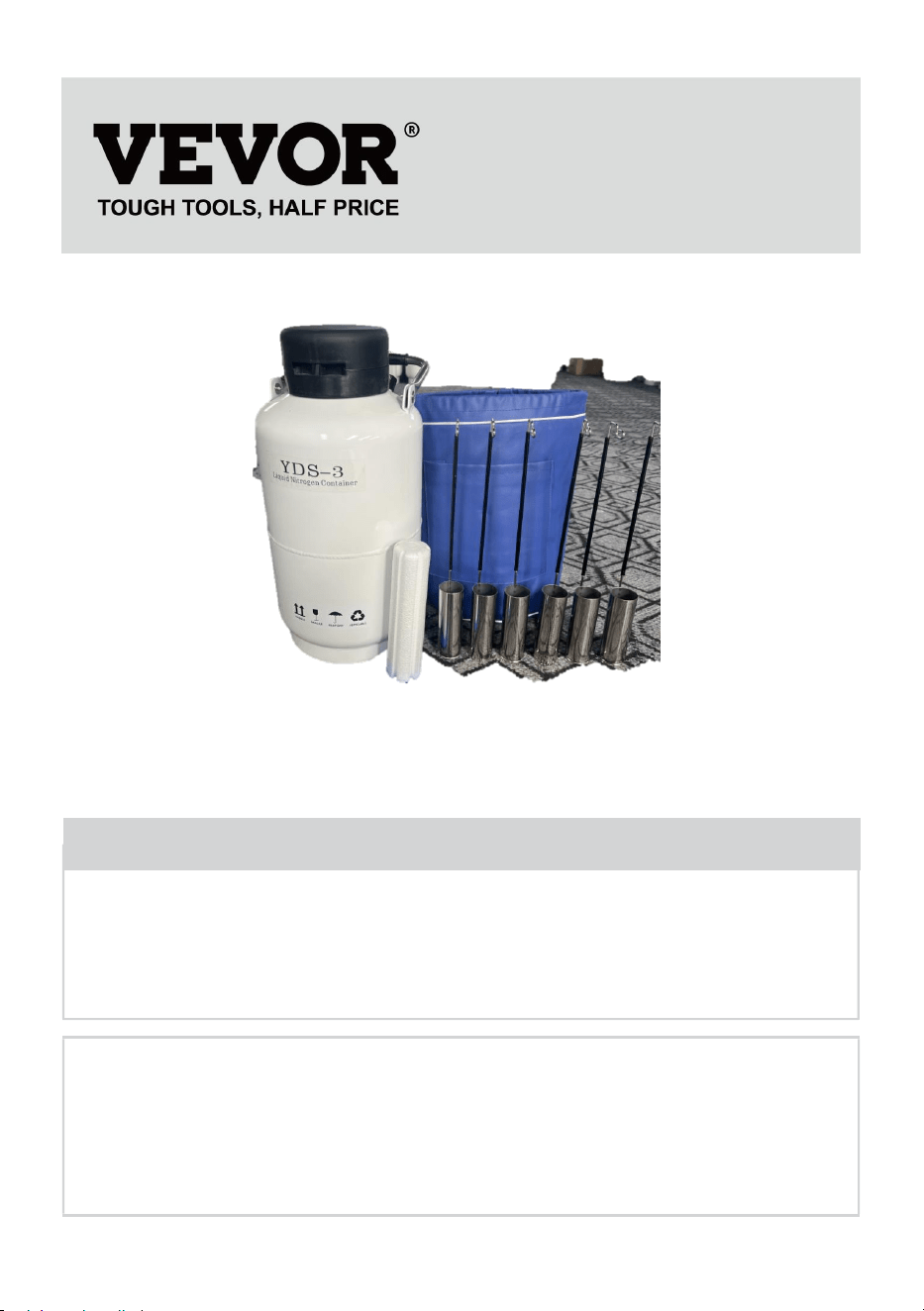
- 1 -
MODELLO: YDS- 3/ YDS- 6/ YDS- 10/ YDS- 20/ YDS- 30
Foto per riferimento
Have product questions? Need technical support? Please feel free to
contact us:
Technical Support and E-Warranty Certificate
www.vevor.com/support
NEED HELP? CONTACT US!
This is the original instruction, please read all manual instructions
carefully before operating. VEVOR reserves a clear interpretation of our
user manual. The appearance of the product shall be subject to the
product you received. Please forgive us that we won't inform you again if
there are any technology or software updates on our product.
LIQUID NITROGEN
CONTAINER

- 2 -
SAFETY INSTRUCTION AND PRECAUTIONS
AVVERTIMENTO:
1. Il serbatoio di azoto liquido deve essere collocato in un luogo fresco e
ben ventilato, evitando la luce solare diretta
2. È severamente vietato l'uso in ambienti piovosi o umidi per evitare la
formazione di ghiaccio e congelamento di tubi del collo, tappi e altri
accessori;
3. È severamente vietato inclinarsi, distendersi in orizzontale, capovolgersi,
ammassarsi, scontrarsi ed altri comportamenti. Durante l'uso, maneggiarlo
con delicatezza e mantenerlo sempre in posizione verticale
4. Non aprire l'ugello di aspirazione del contenitore. Una volta danneggiato,
l'ugello del vuoto causerà immediatamente un guasto del vuoto;
26. Utilizzare dispositivi di protezione professionali. Quando si utilizza
l'azoto liquido, indossare guanti antigelo, occhiali e indumenti protettivi per
prevenire il congelamento.
Breve istruzione del prodotto :
Utilizzato per conservare sperma/embrioni/cellule/ghiaccio secco/materiali
metallici in laboratorio, medicina, fattoria, bellezza e altri campi. I contenitori
biologici di azoto liquido prodotti dalla nostra azienda hanno le caratteristiche di
struttura ragionevole, facile trasportabilità e buone prestazioni di refrigerazione.
Possono essere utilizzati nella zootecnia, nei dipartimenti di ricerca medica per lo
stoccaggio a lungo termine a bassa temperatura e il trasporto di bestiame, sperma
congelato, vaccini, cellule, microrganismi, ecc. utilizzando azoto liquido (-196 ℃)
come refrigerante. Possono essere applicati anche in settori quali la difesa
nazionale, la ricerca scientifica, i macchinari, l'elettronica, la metallurgia, l'energia,
la ristorazione, la bellezza, ecc.
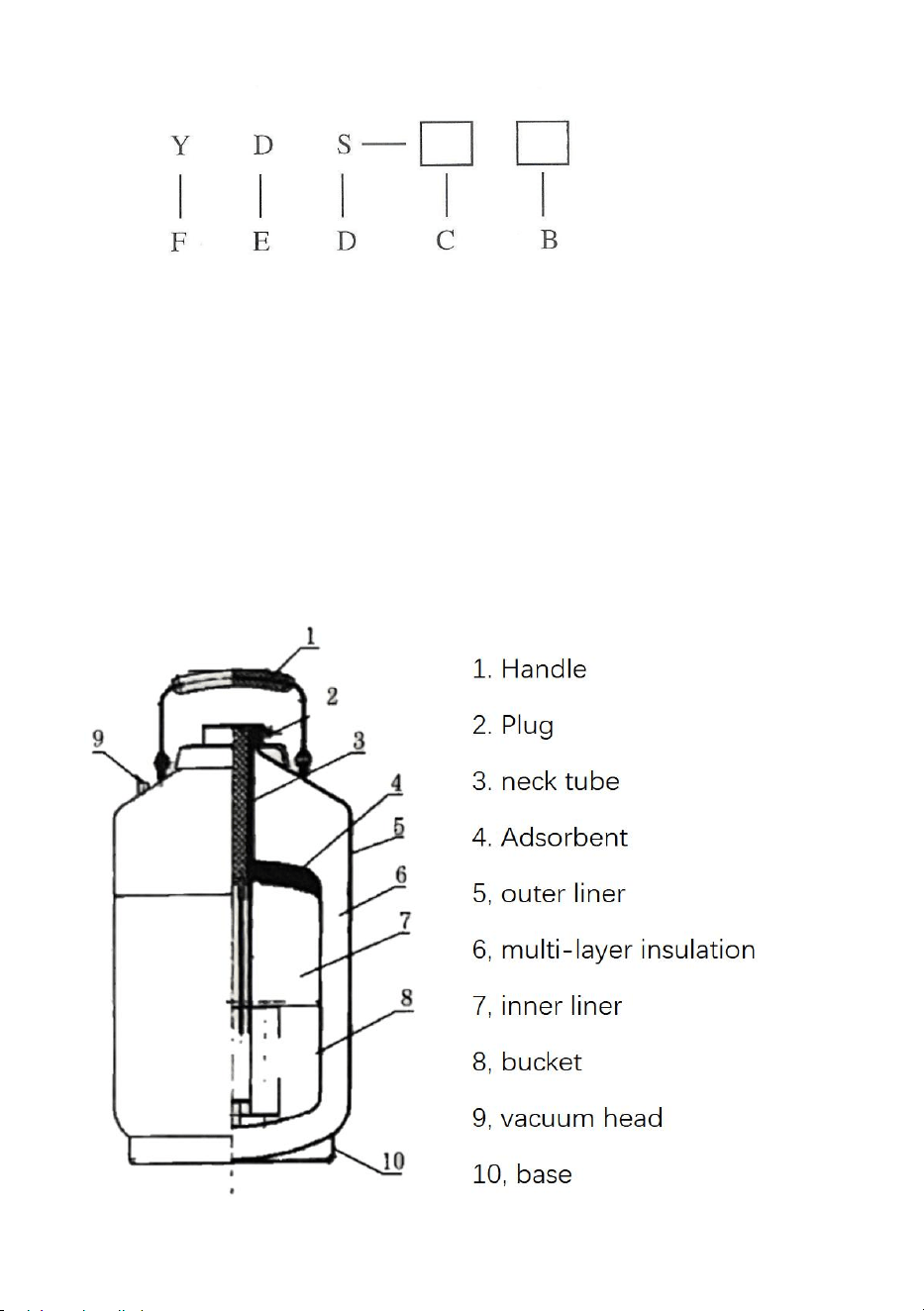
- 3 -
Istruzioni per il modello del contenitore
B". Diametro (mm), la dimensione non è contrassegnata è 50 mm.
"C". Volume nominale del contenitore
"D" significa azoto
"S" significa biologico
"Y" significa liquido
Ad esempio: YDS-3 0 significa volume 3 0 L, diametro 50 mm, contenitore
biologico di azoto liquido.
Struttura del prodotto

- 4 -
1. Come mostrato nella figura, il contenitore è costituito da un rivestimento interno,
un rivestimento esterno, un secchio e un tubo di collo che collega i rivestimenti
interno ed esterno. I rivestimenti interni ed esterni sono realizzati in lega di
alluminio aeronautico ad alta resistenza, robusta e durevole,
2. C'è un vuoto elevato tra i serbatoi interno ed esterno e la pellicola sottovuoto è
dotata di più strati di materiali isolanti importati, con buone prestazioni di
refrigerazione
3. Il tappo per il collo è realizzato in poliuretano atossico con buon isolamento. Ha
la duplice funzione di ridurre l'evaporazione dell'azoto liquido e di fissare il cilindro
di sollevamento.
4. Il tubo del collo è realizzato con composti rinforzati con vetro, che hanno una
conduttività termica estremamente bassa e possono controllare al minimo il calore
esterno che entra dal tubo del collo.
5. Nell'area del vuoto sono installati degli adsorbenti di gas che possono assorbire
i gas emessi da metalli o altre sostanze nella cavità vera e propria, mantenendo
così a lungo un vuoto spinto.
27. Collocare il contenitore in azoto liquido per conservare gli alimenti congelati.
La parte superiore è fissata dalla piccola scanalatura del tappo del collo e dalla
tacca della piastra di incisione, garantendo un trasporto stabile e affidabile
28. Secchio deve essere ruotato di 180 gradi per essere estratto.
Modello di contenitore per azoto liquido
Modell
o di
prodott
o
Capacit
à L
Calibrom
m
Diametr
o
esterno
mm
Altezz
a
mm
Periodo di
conservazio
ne statica
dell'azoto
liquido
Secchio
Qt
à
Diametr
o
esterno
Altezz
a
≤
≥
pz
mm
mm
YDS-3
3
50
224
450
30
6
36
120
YDS-6
6
50
304
500
60
6
36
120
YDS-1
10
50
304
550
100
6
36
120

- 5 -
0
YDS-2
0
20
50
384
640
175
6
38
276
YDS-3
0
30
50
438
700
270
6
38
276
Nota 1: il periodo di conservazione statica del prodotto in azoto liquido viene
testato utilizzando il metodo di pesatura.
Nota 2: nella colonna del modello del prodotto, B rappresenta un contenitore con
supporto sul fondo o sul lato del rivestimento interno, resistente al ribaltamento e
al trasporto
Nota 3: "_" nella colonna consegna indica che il prodotto può essere consegnato
in base alle esigenze dell'utente. Si prega di confermare e indicare se semplificare
al momento della sottoscrizione del contratto d'ordine con l'utente
Nota 4: A causa dei miglioramenti tecnologici, alcuni dati potrebbero subire delle
modifiche.
Avviso sull'uso
Prima di utilizzare il prodotto, gli utenti devono aprire la scatola e ispezionare la
qualità estetica del prodotto. Se si riscontrano difetti nell'aspetto del contenitore, è
necessario restituire queste informazioni al reparto vendite della nostra azienda (le
informazioni di contatto si trovano sul retro della copertina) entro 5 giorni lavorativi
dalla ricezione del prodotto. Le unità agente e distributore dovrebbero seguire i
termini pertinenti dell'accordo.
1. Il contenitore può essere utilizzato solo per riempire azoto liquido e non è
consigliabile riempire altri gas liquidi o ossigeno liquido.
2. L'azoto liquido è un liquido a temperatura ultrabassa (-196 ℃) che può causare
congelamento se spruzzato sulla pelle. Pertanto, durante il riempimento e la
rimozione dell'azoto liquido, indossare guanti caldi e non piedi nudi o pantofole per
evitare schizzi e lesioni alle persone.

- 6 -
3. Per sigillare l'imboccatura del serbatoio è possibile utilizzare solo il tappo sul
collo corrispondente alla fabbrica e non è possibile utilizzare altri tappi come
sostituti, per non parlare dei tappi sigillati, per evitare danni al contenitore causati
dalla continua evaporazione dell'azoto liquido e dal aumento della pressione
dell’azoto.
4 . Quando si controlla il livello del liquido all'interno del contenitore, è necessario
inserire sul fondo un'asta di plastica solida o di legno ed estrarla dopo 5-10
secondi. La durata della formazione di brina corrisponde all'altezza del livello del
liquido e non devono essere utilizzate aste cave o tubi di plastica.
5 . Sebbene l'azoto sia un gas inodore, inodore e non tossico, in condizioni
scarsamente ventilate, l'azoto evaporato può causare un aumento della quantità di
azoto nell'aria interna e una relativa diminuzione del contenuto di ossigeno, con
rischio di soffocamento per l'essere umano. corpo. Pertanto, nei punti di
stoccaggio e funzionamento dei contenitori biologici di azoto liquido, la
ventilazione interna dovrebbe essere rafforzata per mantenere l'aria fresca.
6. Utilizzare sempre il serbatoio per ridurre più rapidamente il tempo di
conservazione.
7. Il tubo del collo è il canale per l'ingresso e l'uscita dell'azoto liquido e degli
alimenti congelati e deve essere utilizzato con cautela. Se il tubo del collo si rompe,
il contenitore non può essere riparato.
8. Il giunto di sigillatura del vuoto del contenitore è un componente chiave per
mantenere il vuoto all'interno del contenitore strato. Una volta danneggiato,
causerà immediatamente il vuoto all'interno del contenitore strato deteriorarsi e il
prodotto non può più essere utilizzato. Pertanto agli utenti non è consentito aprire
la giuntura di chiusura sottovuoto del contenitore senza autorizzazione.
Manutenzione e manutenzione
22. Quando si inseriscono ed estraggono prodotti congelati, cercare di mantenere
il tempo di apertura del contenitore il più breve possibile per ridurre la perdita di
azoto liquido e non sollevare completamente il cilindro di sollevamento per evitare
di compromettere l'effetto di conservazione degli articoli.
23. Evitare rigorosamente impatti e collisioni eccessivi. A causa dello stato di alto
vuoto del serbatoio, il rivestimento esterno resisterà al contrasto dell'atmosfera
circostante. Pertanto, il contenitore (rivestimento esterno) non produrrà

- 7 -
depressione in caso di impatto e collisione eccessivi. Se l'evaporazione non
aumenta in modo significativo dopo la depressione, può ancora essere utilizzata.
Se le prestazioni di evaporazione peggiorano, il contenitore non può essere
riparato.
24. Controlla regolarmente il peso del contenitore e capisci tempestivamente per
quanti giorni è ancora possibile utilizzare l'azoto liquido. Quando la quantità di
azoto liquido è inferiore a un terzo della capacità totale, rifornirla immediatamente
per evitare la necrotizzazione degli elementi conservati.
4. Durante l'utilizzo del contenitore, a causa delle impurità dell'azoto liquido,
l'acqua si accumulerà gradualmente nel serbatoio interno. Allo stesso tempo, la
moltiplicazione dei batteri ridurrà il tasso di fecondazione del seme. Pertanto, si
consiglia di lavare il contenitore con acqua tiepida a 40-50℃ 1-2 volte l'anno.
Test di evaporazione statica giornaliera dell'azoto
liquido
1. Il periodo di conservazione statica del prodotto in azoto liquido viene testato
utilizzando il metodo di pesatura.
2. Il test deve essere condotto a una temperatura ambiente di 20 ℃ (± 5 ℃) e non
può essere condotto in un'area direttamente ventilata.
3. Il test deve riempire più della metà del contenitore con azoto liquido, lasciarlo
riposare per 48 ore e pesare (A) grammi per la prima volta. Dopo 3 giorni, pesare
(B) grammi per la prima volta. Calcolare il tasso di evaporazione Q secondo la
seguente formula:
Q=(AB)/3 (grammi/giorno)
Se deve essere espresso in termini di volume (litri), utilizzare la seguente formula
per la conversione: D=Q/808 (litri/giorno)
- 8 -
Produttore : Shanghaimuxinmuyeyouxiangongsi
Indirizzo: Shuangchenglu 803nong11hao1602A-1609shi, baoshanqu,
shanghai 200000 CN.
Importato in AUS: SIHAO PTY LTD. 1 ROKEVA STREETEASTWOOD
NSW 2122 Australia
Importato negli Stati Uniti: Sanven Technology Ltd. Suite 250, 9166
Anaheim
Luogo, Rancho Cucamonga, CA 91730
REP
EC
E-CrossStu GmbH
Mainzer Landstr.69, 60329 Frankfurt am Main.
REP
UK
YH CONSULTING LIMITED.
C/O YH Consulting Limited Office 147, Centurion House,
London Road, Staines-upon-Thames, Surrey, TW18 4AX

- 9 -