1
F33 Series
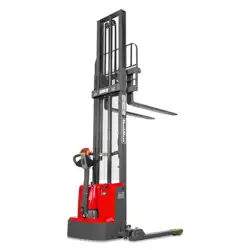
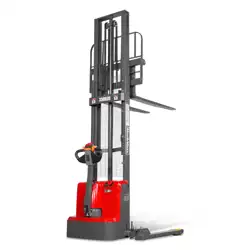
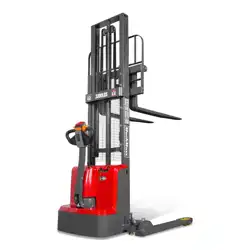
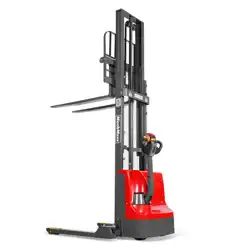
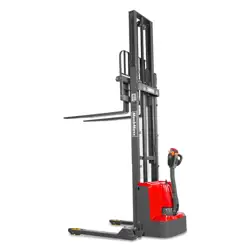
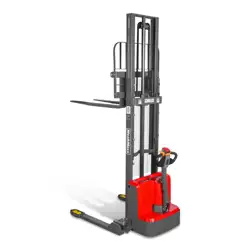
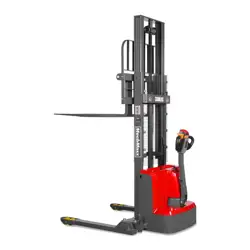
Electric Pallet Stacker
Maintenance & Use Instruction
Warning! Please read this manual carefully before
using this device.
Warning! Do not enable this function when all
components are not fully installed with this device.

2
Content
1.The General Introduction............................................................................................. 3
2. Proper use ........................................................................................................................ 4
3.Introduce of the product .............................................................................................. 5
3.1Product overview . ............................................................................................................ 5
3.2Model parameters ............................................................................................................. 5
4. A Schematic diagram of the manipulation mechanism .................................... 7
5. Operating principle ....................................................................................................... 8
5.1Running system .................................................................................................................. 8
5.2 Steering system ................................................................................................................. 8
5.3 Brake structure and brake schematic diagram. ................................................... 8
5.4 Operating System ........................................................................................................... 10
5.5 Electric System ................................................................................................................ 10
5.6 Hydraulic principle ........................................................................................................ 10
6. Electrical schematic diagram .................................................................................. 11
7. Hydraulic Scheme ....................................................................................................... 12
8.Operating Instruction ................................................................................................. 13
8.1 Start, run and parking: ................................................................................................. 13
8.2The using of emergency power safety switch ...................................................... 13
8.3 The use of Horn and reversing Horn ...................................................................... 14
8.4 Battery capacity indicator ........................................................................................... 14
8.5Operation ............................................................................................................................ 14
9.Maintenance and care instructions ....................................................................... 15
10.Safety Caution ............................................................................................................. 22
10.1 General rule ................................................................................................................... 22
10.2 Storage and transportation...................................................................................... 22
10.3 Check before using ...................................................................................................... 23
10.4Safety operation regulation ...................................................................................... 23
11.Service Manual ........................................................................................................... 27
3
1.The General Introduction
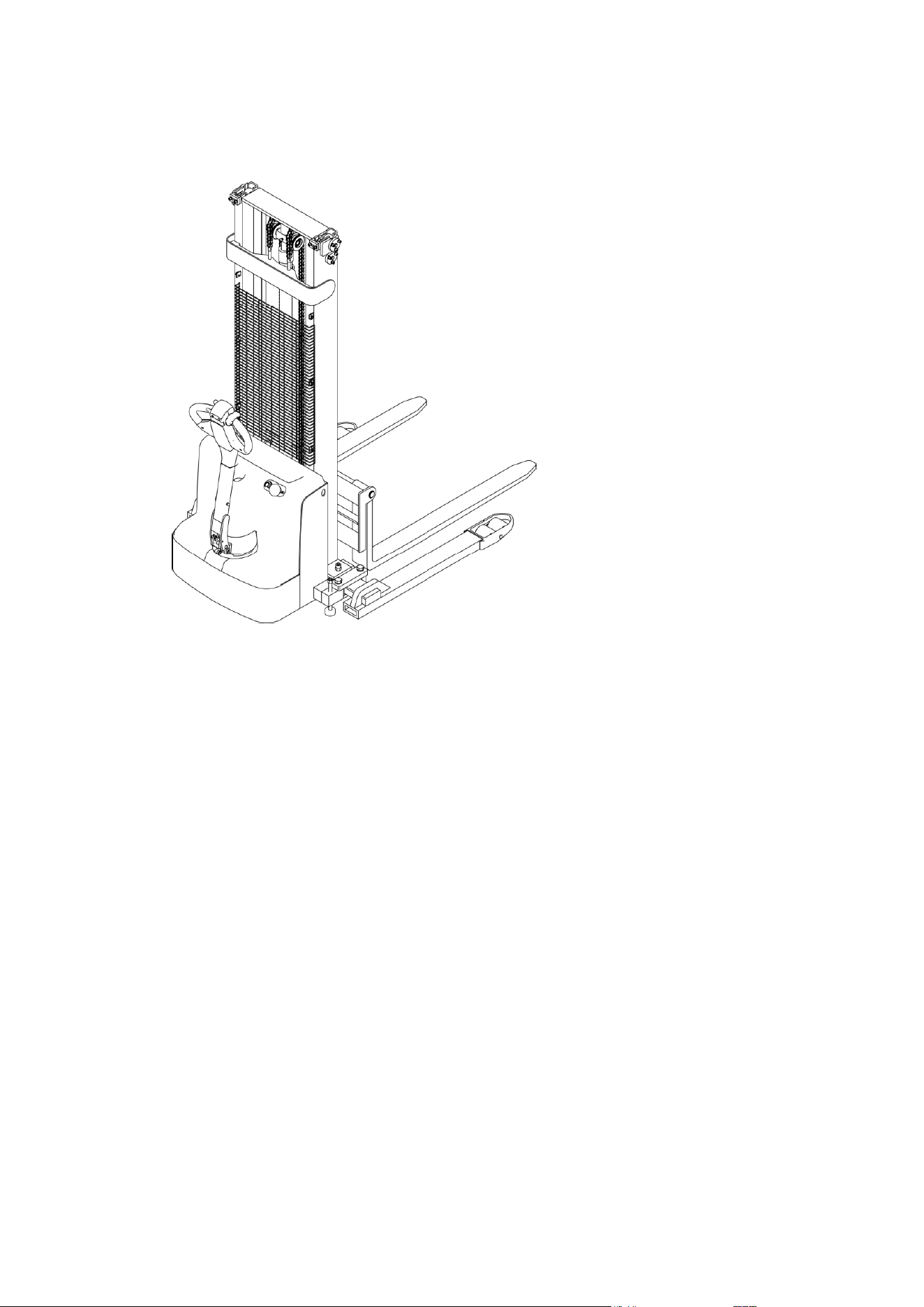
F33 type Electric stacker, The stacker adopts advanced structure such as
wide-field lifting system and new DC controller, and is equipped with
high-quality motor, traction battery and high-power pumping station motor.
Then it has the characteristics of superior performance, convenient operation,
wide field of view, flexible steering, reliable braking, good power, low noise, no
pollution, and beautiful appearance.
The device is suitable for Stacking & Handling cargo on firm, flat floors
The service environment:
a. Altitude does not exceed 1200m;
b. Indoor room temperature at +5℃ to +40℃ ;
c. When environment temperature at +40℃, the relative humidity can’t over
50%, at low temperature, allow bigger relative humidity
d. Firm, Flat ground .
e. It is forbidden to use this car in corrosive environment such as flammable
and explosive or acid base

4
2. Proper use
Please using the electric Electric Stacker according to this specification.
This is a walkie, type electric stacker with autonomous control, lifting and
lowering is controlled by the handle button.
Improper use can cause personal injury or machine damage. Operators or
operating companies need to ensure proper using,
The Truck needs to be used on a firm, flat, intact surface and suitable surface,
The truck is designed for indoor use at room temperature from+5°C to +40°C
Use under light load without using permanent barriers or pits, It is
forbidden to operate on the slops. During Operation, The goods must be placed
approximately at the center of the truck’s load center.
Lifting or Carrying people is strictly prohibited, If carried goods. The goods
must fall on the lifting point.
It is prohibited to use this truck on lifting or loading ramps.
The rated capacity is marked on the capacity label or nameplate. And the
operator must pay attention to the warming signs and safty instructions.
Operating lighting must be at lest 50LUX
Modification
Any modification that may affect the truck rated capacity, stability, or safety
operations must be approved in advance by the Truck’s original manufacturer or
Its authorized Manufacturer or its successor. This includes the effects of changes
such as Braking, steering, Visibility, and the addition of removable accessories.
After the manufacturer or its successor approves the modification or change, The
capacity name plate, Label, identification marks, operation and maintenance
manual must be changed accordingly
Truck damage caused by not following Instruction will lose its warranty.
5
3.Introduce of the product
3.1Product overview .
This specification is for F33 series 1.5T Electric stacker(follow as truck).
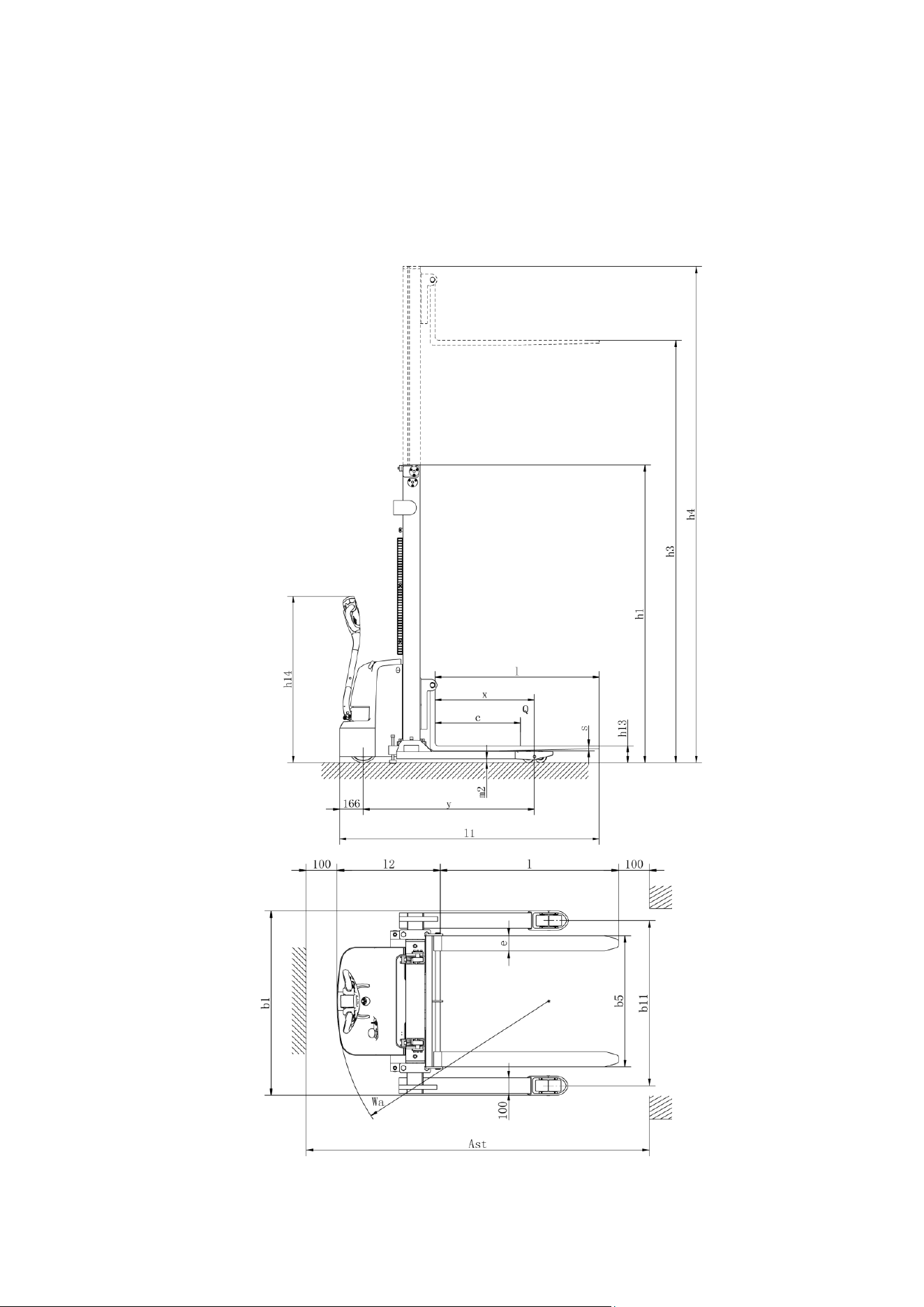
3.2Model parameters

6
Model
F33-98S
F33-118S
F33-138S
Drive
Battery
Mode of operation0
Pedestrian
Rated load capacity
Q (lbs)
3300
Load center distance
c (in)
23.6
Front suspension
x (in)
27.5
Wheel base
y (in)
47.3
Service weight (including battery)
Lbs
1420
1450
1480
Tire type
Polyurethane(PU)
Drive wheel size
Φ×
w(in)
Φ
8.3
×
2.8
Bearing wheel size
Φ×
w(in)
Φ
3.2
×
2.8
No of Driving wheel,/Bearing wheel(X=Driving
wheel)
1x+1/04
Wheel base, bearing end
b11(in)
40.3-56.1
Minimum gantry height
h1 (in)
72
81.9
91.7
Lift Height
h3 (in)
98.4
118.1
136.2
Maximum gantry height
h4 (in)
120
139.7
159.4
Height of handle in drive position min/max
h14(in)
26.8/45.9
Lowered fork height
h13(in)
2.6
Overall length
l1(in)
74.7
Body length
l2 (in)
26.3
Adjustable legs
b1/
b2(in)
45.2-61
Fork size
s/e/l (in)
1.4/3.9/45.3
Overall fork width
b5 (in)
8.3-33.5
Ground clearance at wheelbase center
m2(in)
1
Channel Width: 1000x1200 pallet (1200 Cross)
Ast (in)
88
Channel Width: 800x1200 pallet (1200 placed along
the fork)
Ast (in)
87
Turning radius
Wa (in)
55
Walking speed, laden/unladen
(mph)
2.5/2.6
Lift speed, laden/unladen
(mm/s)
92/136
Lowering speed, laden/unladen
(mm/s)
112/98
Maximum gradeability, laden/unladen
(%)
6/8
Brake type
electromagnetic brake
Drive motor power
(kW)
0.75
Lift motor power
(kW)
2.2
Battery voltage / capacity
(V/Ah)
24/60 Li-ion
Battery weight (
±
5%)
(lbs)
2
×
60
Driver control type
DC speed control
Noise level
(dB(A))
≤
70
Steering type
Mechanical steering
7
4.A Schematic diagram of the manipulation mechanism
The Truck with battery as power producer and controlled by electrical and
hydraulic, trucks can do some actions like walking, turning, pallet fork lift, etc.
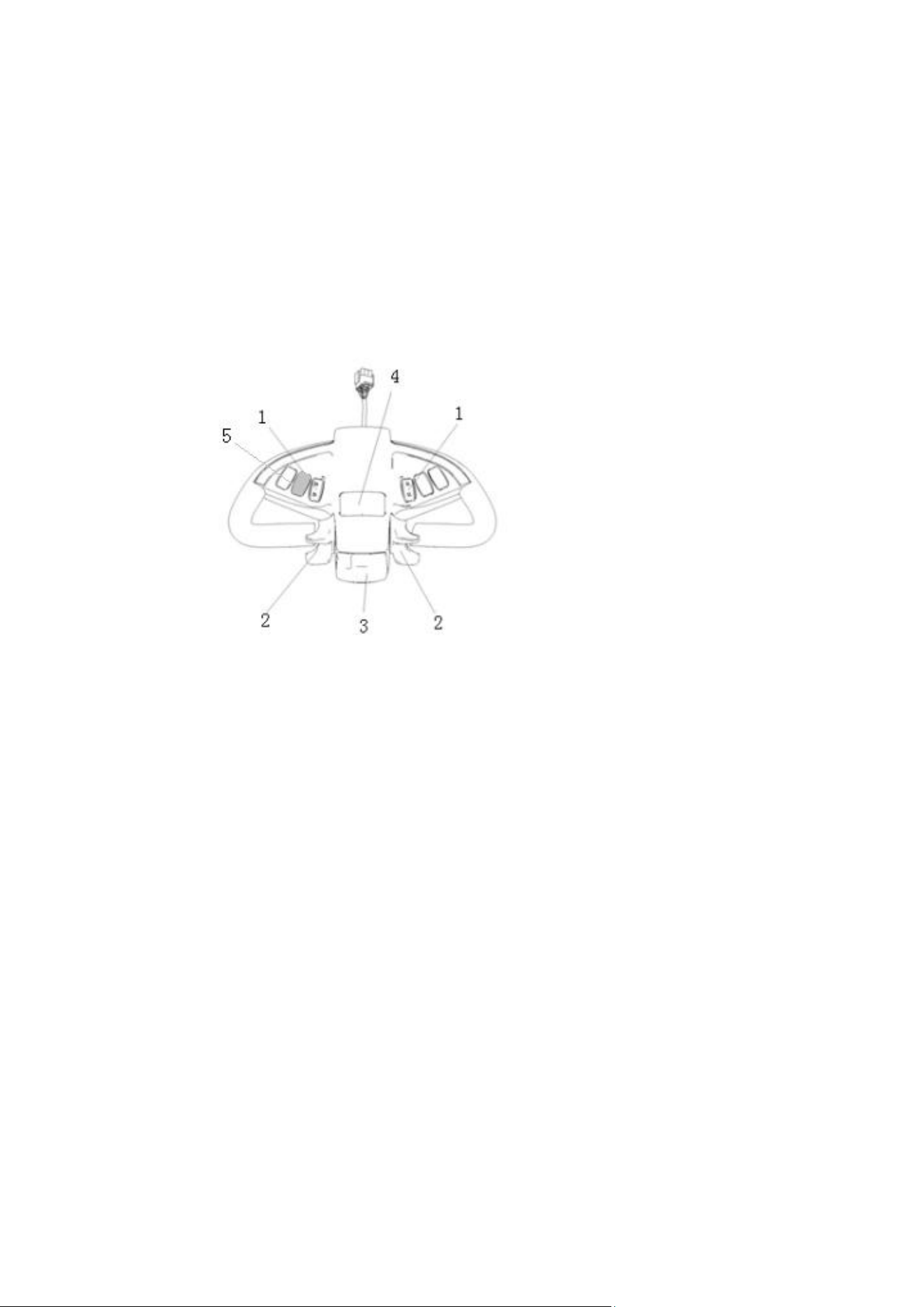
Operating mechanism diagram:
1.Up/Down Button 2.Driving Knob 3.Emergency stop switch
4.Horn Button 5.Electricity meter

8
5. Operating principle
5.1Running system
Stacker use battery as the power source through controlling DC motor on the
driving wheel to fulfill the function of walking, DC motor convert the high speed
low torque to low speed high torque through gearbox, being implemented by
driving wheel. The speed of walking is controlled by accelerator .
In general, every 1000 hours change the lubricating oil in the gearbox.
During usage, if any noise coming from gearbox, please stop the stacker and
check, to judge whether bearing or gear have some problem.
5.2 Steering system
The steering of the stacker is driven by the operating handle through the
handlebar to drive the motor for steering.
5.3 Brake structure and brake schematic diagram.
Braking performance depends on road conditions and vehicle load conditions.
5.3.1The brake function can be activated by the following ways:
⚫ Turn the travel switch (2) to "0" position or release the switch to make truck
brake until it stops.
⚫ With the driving switch (2) moving directly from one driving direction to the
opposite direction, the vehicle regenerates the brake until it begins to move
in the opposite direction.
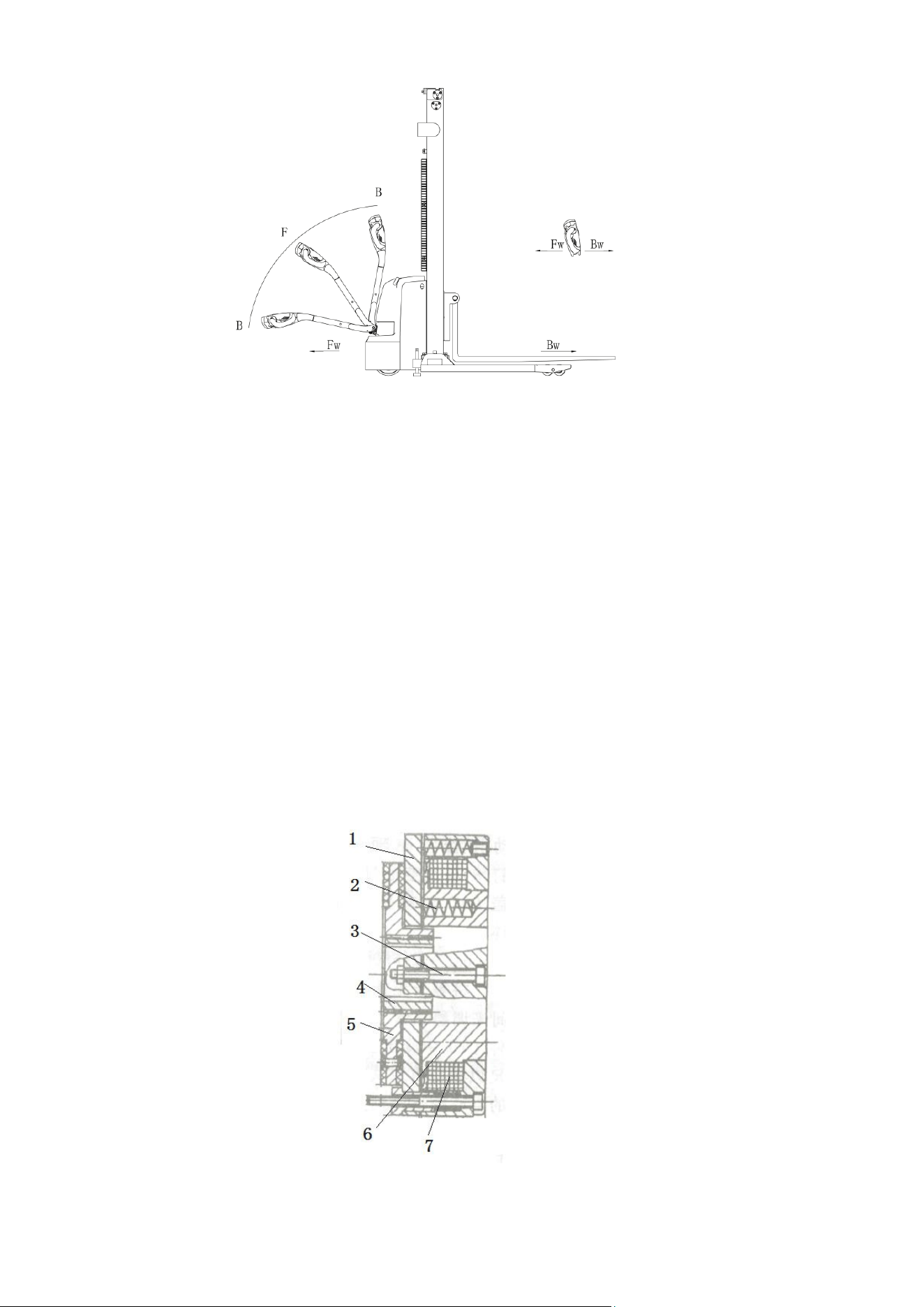
⚫ The handle moves up and down to the braking area (' B ') and the truck
brakes.If the handle is released, the handle automatically moves to the upper
braking area (' B ') and the truck stops until it stops.
Emergency Reverse button (3) can prevent the operator will be squeezed, when
trucks are driven towards (' Fw) encounters an obstacle, body touch belly to slow
down or start to switch truck (' Bw) driven a short distance, then stop.If the
handle is in the operating area and the truck is not moving, please consider that
this is still working.
9
5.3.2Braking operation principle:
As follow picture:The brake constitute by magnetic yoke 6, magnet exciting
coil, 7, the spring 2, the brake disc 5, the armature 1, the gear sleeve 4, the
mounting screw 3, And so on. The brake is mounted on the end cap of the motor and
the mounting screw is adjusted to the specified air gap value.
When magnet exciting coil 7 for brake on power,The coil generates a
magnetic field to to attract the armature 1 to the yoke assembly 6, and the
armature 1 is disengaged (released) from the brake disc 5.At this time, the motor
drive shaft is normally started and operated with the brake disc 5. When the
magnet exciting coil 7 is de-energized, the magnetic flux disappears, the armature
1 is released, and the spring 2 is pressed against the armature 1, and the friction
plate on the brake disc is pressed to generate frictional force for braking
purposes.
Brake schematic

10
5.4 Operating System
The main working body of a moving truck is a cargo fork, which relies on a fork
to carry the pallet or cargo for transport and short distance transportation. The
expansion of the cylinder is realized by the control of the operating handle, and
the pressure oil is provided by the pumping station.
A descending valve is installed in the circuit of the lifting cylinder to slow down
the speed at which the fork falls, and the safety drop effect is achieved
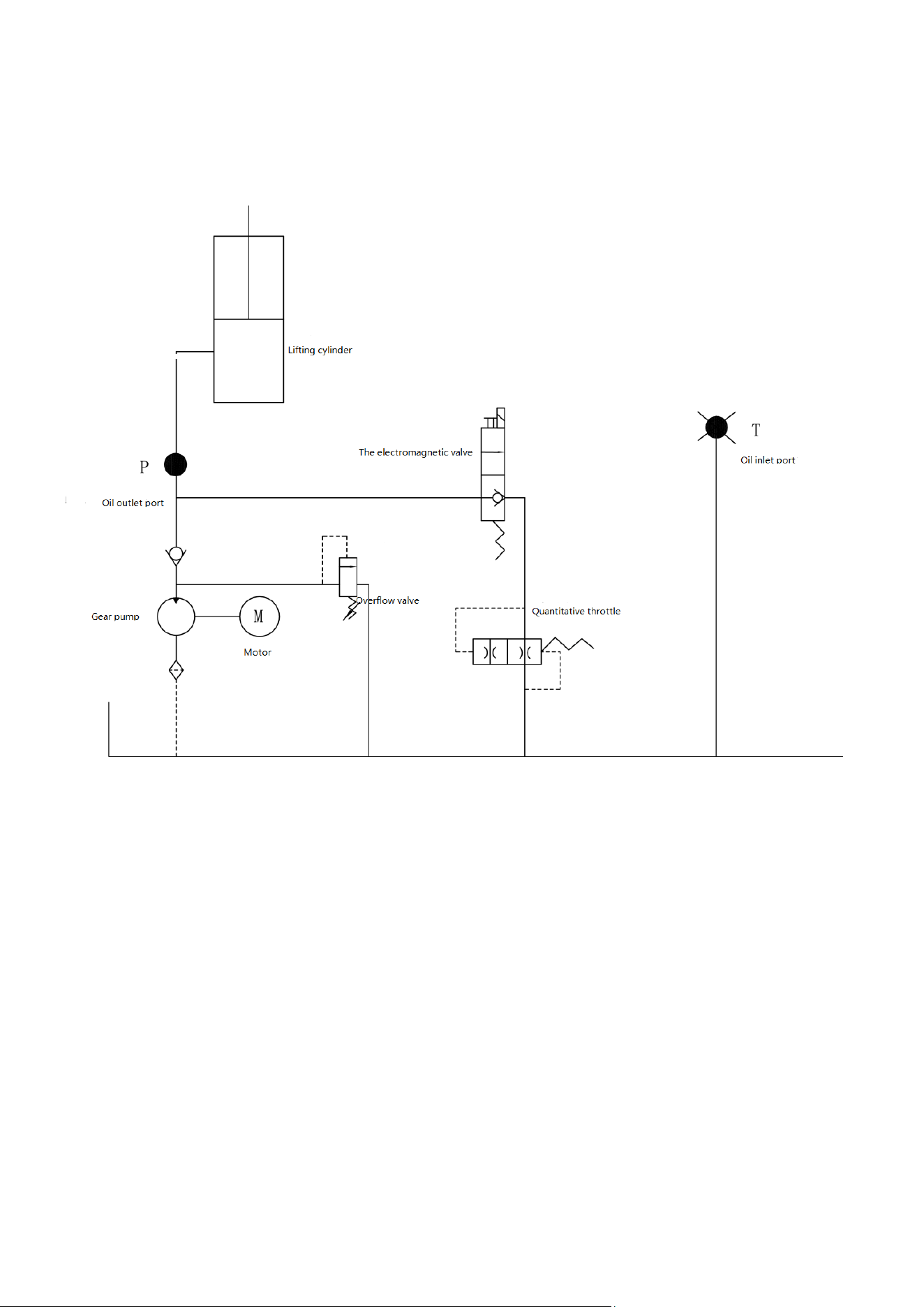
5.5 Electric System
The electrical system includes walking and operation control. The truck use DC
electric control assembly.
The meter has a battery indicator. When the battery power is too low, the
electric meter will cut off the starting control line of the oil pump motor. The
moving truck can only walk without lifting the fork, and the stacker should be
charged immediately.
The motor of oil pump is the DC motor for 5 minutes, so the pump motor is not
suitable for long running. That is, the lifting movement should have time interval,
can not continuously carry on, otherwise would make the motor heating, even
burn.
Special note: when the truck is used for a long time, the starter of the oil pump
motor may fail, and it can't be broken after being sucked or closed. The latter is
not throw control handle, the oil pump motor is kept in the rotation, should
immediately stop at this moment, to cut off the power supply (unplug battery
plug-in), make the oil pump motor stop running, and promptly replace the
starter.
5.6 Hydraulic principle
The oil pump motor drives the gear pump to provide hydraulic power,lifting oil
cylinder is responsible of fork’s lifting and lowering,The control of the lift oil
road is controlled by the buttons on the operating handle,The lifting action is
controlled by a single action oil circuit on the valve block.This model of the
hydraulic system pressure can only be adjusted on the valve block, has been
debugging good, before they go out after they leave the our company after-sales
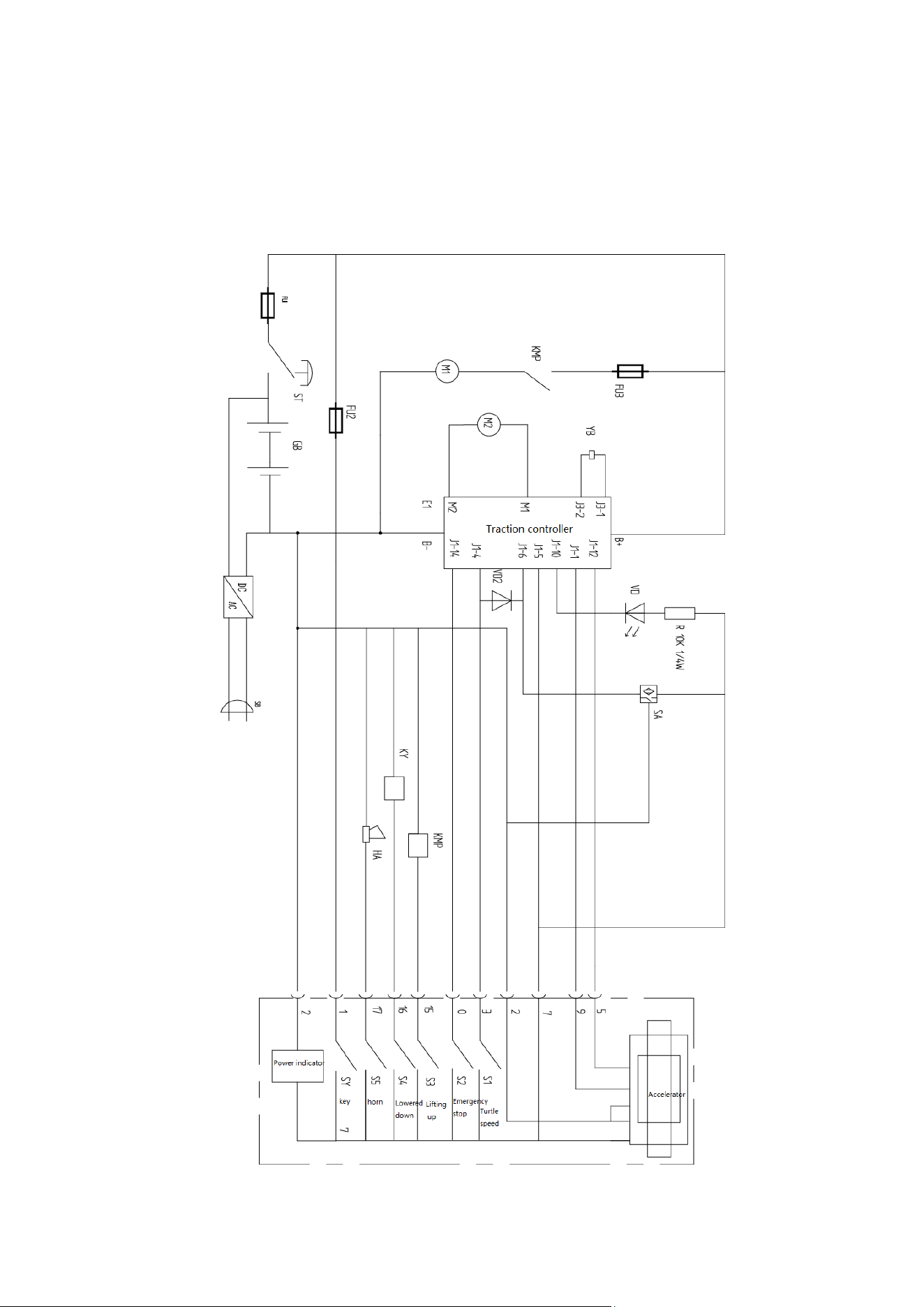
11
personnel or professional maintenance personnel are strictly forbidden to adjust
themselves, so as to avoid safety accident.
6. Electrical schematic diagram
12
7. Hydraulic Scheme

13
8.Operating Instruction
Before operation, please familiarize yourself with the functions of the switches
and buttons on the dashboard.
8.1 Start, run and parking:
○
1 Insert the key into the key switch, turn to the right, the emergency power
safety switch clockwise reset, gently open the control circuit.
○
2 The fork rises from the ground about 10 cm.
○
3 Slowly turn on the travel switch until the required speed.
○
4 In the process of operation, forklift exception occurs fault, need to quickly
cut off power supply, please press the red emergency power switch.
○
5 When the forklift is turning, you should reduce the speed and, if possible,
try not to make sharp turns.
○
6 Forklift truck carrying gradability is 10%, so the uphill slope need to
understand the situation, when climbing the forklift must accelerator pedal
pressed down as far as possible, the maximum climbing force can be achieved.
○
7 When the stacker stops, Lowered the fork to the lowest position, press
the safety switch, and pull out the key.
8.2The using of emergency power safety switch
If the forklift is out of control during driving, or if it is smoked or burnt
during use, please press the emergency switch on the forklift seat cover and the
power will be cut off. Find out the cause and clear the fault before you can open it.
The method of opening is as follows: the emergency power-off safety switch is
rotated in the direction indicated by the arrow above the button, and the opening
is completed.

14
The button of the emergency power off switch is a plastic piece. When
pressing down or rotating up, do not use excessive force to avoid damage to the
switch.
8.3 The use of Horn and reversing Horn
For the safety of driving, vehicle equipped with Horn. To remind others
when driving, press the horn button in the middle of operating handle and the
horn will ring to warn pedestrians.
8.4 Battery capacity indicator
The battery capacity of the forklift truck on the dashboard has capacity
display function.
8.5Operation
(1)How to carry goods
Will truck slowly drive to the front of the need to carry items, insert the
pallet fork and move forward slowly, when the goods completely inserted into
the goods after parking, control handle upgrade button, the heavy lifting to a
certain height, back slowly, don't touch the adjacent goods, when the weight
zone is put out the goods, and then walk handling.
(2)How to place the goods
When moving the goods close to the area of the goods, it will slow down.
When the moving truck is in a straight line with the goods, then the moving truck
will slowly move forward to the loading area to stop. Slowly press the down
button, and once the load is held, the fork will be lowered to the hollow position.
When the fork is pulled out of the weight, the back position will be confirmed
without any obstacle. Wait for the fork to leave the weight completely before
carrying on a round of handling.

15
9.Maintenance and care instructions
The spare parts of the truck is not allowed to change without permission. All
parts supplied by the original manufacturer are subject to strict quality
inspection. To ensure the safety and reliability of the vehicle, please use the
original parts. Replacement parts, including all oils, must be collected and
processed in accordance with local environmental and health laws and
regulations.
9.1 Repair and Maintenance
Maintenance technician: The maintenance and service should only be
performed by special personnel trained by the manufacturer. After the
technician sent by after-sales department of the manufacturer completed
maintenance and servicing work, they should sign on the service log.
Cleaning Operation: Flammable liquid can not be used for cleaning the stacker.
Before cleaning, take safety precautions to prevent electric sparks (e.g. sparks
caused by short circuit). When operating the accumulator, connectors on it must
be disconnected. Use soft air suction or compressed air, non-conductive and
anti-static brushes to clean electric and electronic components.
Operation of Electric System: Operation on the electric system should only be
performed by specially trained personnel. Before performing any operation on
the electric system, precautions must be made to prevent electric shock. When
operating the accumulator, connectors on it must be disconnected.
Installation: When repairing or replacing hydraulic components, electric and
electronic components, make sure to install them back to their original positions.
Wheels: Quality of the wheels has significant effect on stability and driving
performance of the truck. Modification on wheels can be performed only with
the approval from the manufacturer. When replacing wheels, ensure that the
truck is levelled as delivery state(wheels must be replaced in pairs, i.e. replace
right wheel together with left one).
Lifting chain and rollers: Chain and rollers will be worn quickly without good
lubrication. Perform periodic lubrication according to following maintenance
table. Shorten the lubrication period under adverse operation conditions (such
as in dusty and hot environment).

16
Lifting the chain and rollers: If there is no good lubrication, the chains and
rollers will wear out quickly. It must be periodically lubricated according to the
requirements of the following maintenance table. In harsh working conditions
(such as dust, high temperature), the lubrication cycle should be shortened.
Hydraulic oil pipe: The oil pipe must be changed every 6 years. When change
the hydraulic assembled parts, the oil pipe should be also changed.
9.2 Routine Maintenance
9.2.1 check the condition of each pole, cable and protective cover of the
accumulator.
9.2.2 check whether the battery box is secure.
9.2.3 check whether the vehicle is oiled.
9.2.4 check the situation of fork, oil pipe and horn.
9.2.5 check the braking condition.
9.2.6 check the wear condition of driving wheel, load wheel and so on.
9.3 Professional Maintenance Manual
It is very important for safe operation of the truck to perform overall professional
maintenance. Failure in performing maintenance according to specified interval may
cause malfunction of the truck, and potential risk to human and equipment.
Maintenance periods listed in this manual apply to single shift a day under normal
operation conditions. If using in dusty environment, the ambient temperature varies
remarkably or in multi-shift situation, the maintenance period has to be shortened.
Maintain the truck according to following maintenance list. Maintenance periods are
as follows:
W1 = Every 50 work hours, but at least once a week.
M3 = Every 250 work hours, but at least once every three months
M6 = Every 500 work hours, but at least once every six months
M12 = Every 2000 work hours, but at least once every 12 months
Additional operations should be performed in trial run period:
(In initial 50 – 100 working hours or after two months)

17
— Check the nuts on the wheels, and tighten them if necessary.
— Check the hydraulic components for leakage, and tighten them if necessary.
—Replace the hydraulic filter.

18
Time interval(Month)●
W
A
B
C
Brake
1.1
Check the air gap of the electromagnetic brake
●
Electrical
system
2.1
Check the operation switch to show the function of the
device and components
●
2.2
Check alarm system and safety device
●
2.3
Check the cable for damage and the terminal is secure
●
2.4
Check the function of the micro switch setting
●
2.5
Check controller and EPS controller
●
2.6
Cable and motor fixing
●
Power
supply
3.1
By observing the battery
●
3.2
Visual inspection of battery charging plug
●
3.3
Check if the connection of the battery cable is tight, and if
necessary, apply the electrode with grease.
●
Driving
system
4.1
Check the gearbox for abnormal noise
●
4.2
Check the running mechanism and grease, check the reset
function of the operating handle
●
4.3
Check the drive wheel and bearing wheels for wear and
damage
●
4.4
Check wheel bearings and fixing conditions
●
Whole
frame
5.1
Check if the frame is damaged
●
5.2
Check if the sign is complete
●
5.3
Check the fixing of the mast
●
Hydraulic
movement
6.1
Check the function of the hydraulic system
●
6.2
Check hoses, pipes and connections for tightness, sealing and
damage
●
6.3
Check the cylinder and piston for damage, sealing and fixing
●
6.4
Check the load chain settings and re-tension if necessary
●
6.5
Visually inspect the mast rollers and check the wear on the
roller faces
●
6.6
Check the forks and load handlers for wear and loss
●
6.7
Check the tank for oil level
●
6.8
Update hydraulic oil
●
Maintain list

19
9.4 battery maintenance, charging and maintenance.
Any operation of the battery must be guaranteed to stop the vehicle and put it in
a safe position.
9.4.1 maintenance personnel.
Battery charging, maintenance and replacement must be operated by qualified
professionals. You must carefully read the manual, supply preparation and
charging requirements before preparing for the operation.
9.4.2 Fire protection measures.
Smoking and open fire are strictly prohibited when operating the battery.
Storage battery and charge must be kept away from combustible materials, at
least 2 meters above the distance, the place of storage battery must be well
ventilated and equipped with fire-fighting facilities.
9.4.3Maintenance of the Accumulator
1) Keep the nuts on every battery cell dry and clean. Tighten every terminal and
cable end, and brush them with grease to prevent corrosion. Naked cable ends
and terminal posts should be covered with a skid-proof insulating cover.
2) Every two cells should be well-connected. Check the nuts on each pole, if loose,
tighten the nuts.
3) Keep the surfaces of accumulator clean and dry.
4) Over recharging and over discharging should be avoided, and fast charging
and insufficient recharging are also not allowed. Otherwise life span of the
accumulator may be affected.
5) Do not put conductive objects including metal tools on the accumulator, or
short circuit or even explosion may be caused.
6) Never spill any hazardous liquid or solid material on surfaces of the
accumulator. When using a densimeter or a thermometer, make sure the surface
is clean and clear.
7) Recharge the discharged accumulator in time. Delayed recharging may
damage the accumulator. Do not delay recharging more than 24 hours.
Recharging of the accumulator may not work outdoors in cold weather. In this
case, move it indoors to perform recharging.

20
8) If the accumulator will not be in use for a long time, it should be recharged and
discharged once every month and it should be fully recharged every time.
9) If individual cell fails, identify the cause and repair the cell immediately.
Replace the cell when it cannot be repaired.
10) The site for recharging should be well ventilated. It is prohibited to smoke or
use open fire, avoiding the risk of hydrogen explosion.
11) The weight and dimensions of the accumulator have remarkable effect on
stability of the stacker. Therefore do not modify the type of accumulator without
approval from the manufacturer.
12) Never discharge in large current, for example, performs travelling and lifting
simultaneously.
9.4.4 Disposal of used batteries.
Scrap battery must be carried out in accordance with the relevant laws and
regulations in region recycling, storage provisions stipulated by the
environmental protection area or waste treatment area, and the work must be
conducted by qualified professional company.
9.4.5 Specification of the accumulator
Uninsulated terminal poles on the accumulator should be protected with an
insulated cover. When connecting the accumulator and socket, make sure to stop
the device and put the switch at position “0”. When replace or install the
accumulator, make sure the accumulator is fixed securely in battery box.
9.4.6 Storage, transportation and installation of the accumulator
The device must be parked on the level ground steadily. To prevent short circuit,
naked cable ends and the terminal posts should be covered with insulated covers.
When pulling out the accumulator, properly arrange removed accumulator's
connectors and cables without blocking access of the accumulator.
9.4.7 Battery power indicator
Battery power display table: ten article showing represent 100% of the battery.
With the consumption of battery capacity, the glowing article shows will be from
top to down.

21
The color of LED show the different states:
Name
LED Color
Parameter
value
The standard battery
remaining power
Green
70-100%
Orange
30-60%
Red blinking
0-20%
Battery discharge on 70%, red lamp will blinking “Energy storage”.
Battery discharge on 80%, two lamp will blinking “run out of battery”, Need to
charge the accumulator.
9.4.8 Charging
Read the instruction manual carefully before recharging.
When charging, make sure that no metal objects are placed on the battery. Before
starting the charging operation, check all cable and plug connections for obvious
defects. All safety instructions such as battery replenishment regulations and
battery charging preparation must be strictly observed
During the charging process, the battery and battery charging room should be
well ventilated to ensure safe charging.
Before connecting or disconnecting the charger, make sure the charger is not in
the circuit state.
To ensure safe operation, the vehicle must be fitted with a protective cover
before use.
Personnel should be as far away as possible from the battery to avoid danger

22
10.Safety Caution
10.1 General rule
10.1.1 The operator must have a forklift operation qualification which proved by
the relevant departments of the training before driving truck..
10.1.2 The operator must read the instructions before use all of the content,
after fully understand operation method can drive Truck.
10.1.3 truck must not carry passengers..
10.1.4 Operators should pay special attention to when homework operating
environment, including other people nearby and fixed object.
10.1.5 Without the manufacturer's approval, shall not modify, add or remove
tractor parts, lest affect performance of tractor.
10.2 Storage and transportation
10.2.1 Use container or car to transport the truck should pay attention to at the
time of shipment:
○
1 Front and rear wheels with wedge, begin to pull up the parking system,
prevent sliding in the process of transportation;
○
2 Using the lasso, not placed in the weak structure of the truck;
○
3 When transporting in a stacker, take care to keep the center of gravity of
the stacker in the middle of the forks.
○
4 During Transportation, remove the Trailer and fix the tractor with a
dedicated strap for lifting according to the figure below.

23
10.2.2 When Truck doesn't work, should be parked in a dry ventilated cleaning
warehouse, prevent weathered.
And please note:
○
1 Turn off the Electrical lock and make the safety switch off,unplug the
power plug
○
2 Begin to pull up the parking system, front and rear wheels with block
mat;;
○
3 Such as discontinued for a long time, battery should be added once every
15 day electricity.
10.3 Check before using
10.3.1 New car if there is any damage in transportation, please don't be put into
use, and promptly get in touch with the supplier, do proper processing.
10.3.2 New cars in the factory run parts has been filling lubricating oil.
10.3.3 Truck equipped with battery. The battery is charged before leaving
factory. If leaving the factory for a long time, may the battery is low. Before use
should pay attention to electricity meter shows that when the electricity meter
display to the last two warning, must charge at once.
10.4Safety operation regulation
10.4.1Requirement for operator: The Truck must be operated by a trained
operator, He can perform and operation demonstration on the user to move and
mainpulate the cargo, and can clearly guide the user how to operate the forklift.
10.4.2 Operator’s rights, obligations and responsibilities:Has been trained
by the operation of the vehicle, the driver must be clear of his rights and
obligations; and he is familiar with the contents of the relevant operating
instructions. If the vehicle is pedestrian type, the driver must also wear safety
boots.

24
10.4.3 Prohibit unauthorized person to operate:The operator is
responsible for the vehicle, he need to prohibit unauthorized person to operate.
Transport or lift person is also forbidden.
10.4.4 Malfunctions and defects:If the vehicle has any malfunctions or
defects, need to inform administrator, If the vehicle cannot be safely operated
(e.g.: wheel wear or brake failure), then it must stop using until it is fully
repaired.
10.4.5 Safe operation and environmental protection:inspection and
maintenance must be performed in accordance with the time intervals on the
maintenance list.
Parts of the vehicle cannot be changed without any permission, especially safety
devices. The operating speed of the truck is not allowed to change.
All original spare parts have been verified by quality assurance department. To
ensure the safety and reliability of the operation of the truck must use only the
manufacturer's spare parts. The old parts, such as oils and fuels must be handled
in accordance with the relevant environmental protection rules.
10.4.6 Hazardous area: Hazardous area usually refers to the following range:
vehicle or its load lifting devices (e.g. fork or accessories) is dangerous for
personnel when running or lifting movements, or the ongoing regional transport
loads. Typically, this range extends to the load or truck accessories landing area.
Unauthorized personnel must be asked to leave the dangerous zone. As long as
the situation might cause some kind of damage, the driver must give a warning, if
the driver asked the person to leave but did not leave the hazardous zone, the
driver must immediately stop the vehicle.
10.4.7 High-risk environment:Working in high-risk environment, operator
must have a special design to be protected.
The vehicle was not specially designed for the high-risk environment.

25
10.4.8 Safety devices and warning signs: Safety devices, warning signs and
warning notes described in the previous operating instructions must be taken
seriously enough.
10.4.9Driving in public places: the vehicle is forbidden to drive in public places
expect in specified special areas.
10.4.10Distance between truck: keep an appropriate distance, avoid the front
vehicle suddenly stop.
10.4.11headroom: When the headroom is below the cargo or mast, it is
forbidden to use the vehicle.
10.4.12Using in the elevator and loading platform maneuvering: if there is
sufficient loading capacity, won’t affect the operation of the vehicle, and being
agreed by the operator of the vehicle, then the elevator and loading platform can
be used for vehicle transport. Before entering the elevator or loading station,
operator must personally identify. The goods must be placed in front and occupy
an appropriate place, to avoid touching the wall of the elevate when the vehicle
enters the elevator. When personnel and vehicles take the elevator together,
person can enter only after the vehicle has safely entered, and person must leave
before the vehicle.
10.4.13 Driving aisle and working area: The vehicle must be operated on the
specified aisle, all non-related person must leave the work area, and cargo should
be stacked in designated places.
10.4.14 Operation Management:Driving speed must be adapted to local
conditions. When through the corners, narrow passage, swing doors and closed
place, speed must be slowed down. Drivers must be able to visually an adequate
braking distance between vehicle and the front vehicle, and he must remain in
control of his vehicle. Sudden stop (unless urgent needs), rapid U-turn, chased
each other in the Aisle is not allowed. Do not pry out of the body to operate the
vehicle.

26
10.4.15 Visibility: The driver must look attentively at the direction of driving, to
ensure the front situation is clearly visible. When the vehicle is backing off, if the
carriage of goods block the line of sight, a second person walk in front of the
vehicle to give appropriate guidance and warnings is necessary.
10.4.16 Pass through the ramp: Only a known ramp which should be clean,
non-slip, and with the vehicle technical availability was allowed to go through.
The goods on the forks must face uphill. It is forbidden to turn back, move
diagonally or park on the ramp. The operator must slow down when going
through the ramp, and prepare to brake at any time.
10.4.17 Load capability on ground: when the vehicle is in operation, make sure
the load pressure of the body weight or wheels on the ground does not exceed
the load capacity of the ground.
10.4.18 Vehicle Change: Any possible changes or modifications for rated load,
stability or safe operation of the vehicle, must obtain prior written approval from
origin manufacturers or its successor. After vehicle manufacturer check and
approve the changes, nameplates, labels and markings of Operation and
Maintenance Manual must be modified as well.

27
11.Service Manual
11.1 Troubleshooting
Fault
Cause
Treatment
The truck can't move
The battery connector is not connected
Check the battery connector,connected if
necessary
Electric lock switch on “OFF” position
Electric lock switch turn to “0”position
Emergency Stop Switch not open
Open the Emergency stop switch
Battery power runs out
Check the battery charge,If it is necessary
to recharge
The vehicle being charge
Interrupt charging process
The fuse is damaged
Check the fuse
Goods can’t be lifted
up
The vehicle is not operating
Handle according to the treatment
method listed in Vehicles cannot move”
Low hydraulic oil level
Check hydraulic oil
The fuse is damaged
Check the fuse
Overloading
Pay attention to the rated capacity
The Up switch is in bad contact or
damaged
Check up switch and replace if
necessary
Goods can’t be
lowered down
Dirty oil blocks control valve
Check hydraulic oil and clean control
valve,replace the oil if necessary
The solenoid valve for lowering is
not opened or is damaged
Check or replace the valve for
lowering
Can’t stop when lifting
Lifting micro switch is damaged
Cu off the power and replace lifting
micro switch
Moving in one
direction
The sensitive switch and the
connecting cable are not well-contacted.
Check the sensitive switch in control
lever and the connecting cable.
The vehicle travels
The related cable are not
Check the battery indicator light and

28
very slow
well-connected
related cable
The car suddenly
started
Controller is damaged.
Change the controller
The handle which control the forward
or back is no reset.
Repair or change
If above steps still can not solve problems, please contact after-sales service
department of the manufacturer and have the problems solved by specially
trained technicians.
11.2 Preparation before repair
To prevent possible accidents during maintenance and repair work, following
preparations must be done:
— Park the device safely.
— Press the emergency stop switch and disconnect the connectors on
accumulator.
11.3Check the amount of hydraulic oil
— A vehicle ready for repair or maintenance.
— Open the electrical box cover.
— Check the amount of hydraulic oil in the tank.
When checking the hydraulic oil level, the fork and mast must be lowered to
the lowest position.
11.4 Complete repair, the preparation before using
Use the device only after following operations have been completed.
— Clean the vehicle
— Check the brake.
— Check the emergency stop switch.
— Check the horn.
Several electromagnetic brake tests need perform immediately after the
test