Product Overview
Product Introduction
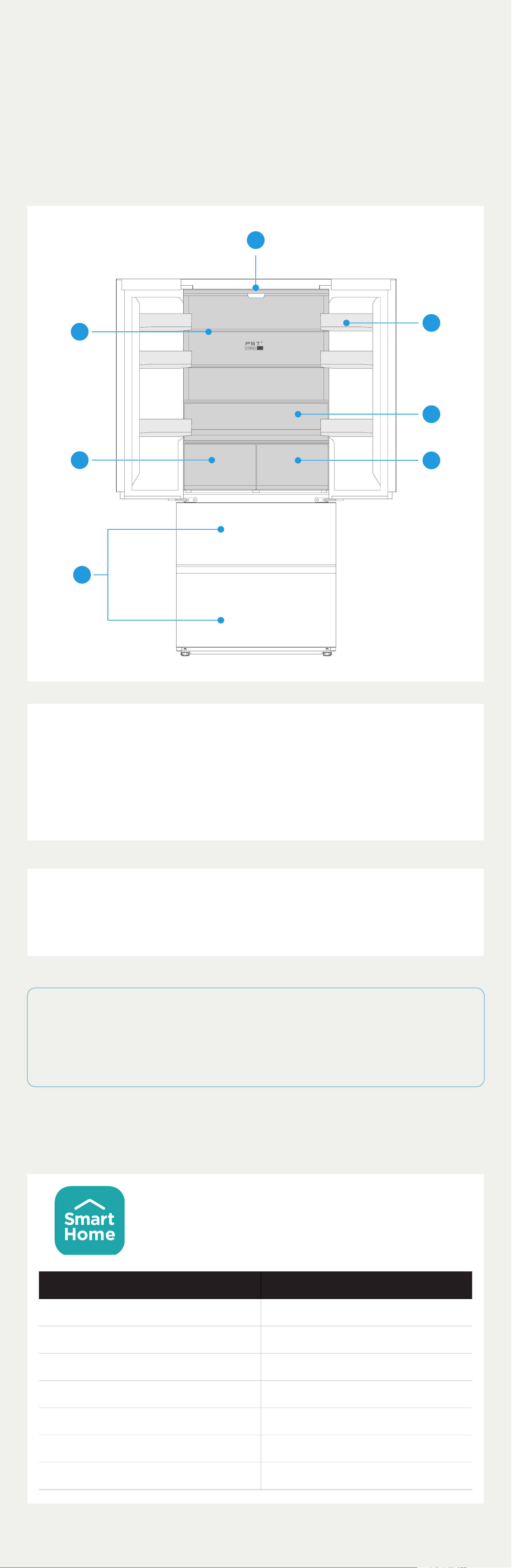
1
5
2
7
6
3
4
1 LED Light 2 Shelf
3 Variable Temperature Drawer 4 Freezer Drawer
5 Fridge Door Bin 6 Fruit & Vegetable Drawer
7 Fresh Drawer
• For the most ecient use of energy, please keep the all internal
items such as trays, drawers, shelves and ice cube box on the
position supplied by manufacturer.
• | Attention
Dierences: Due to technical changes and dierent models, some
of the illustrations in this manual may dier from your model.
Technical Parameters
Wireless network module MWB-S-WB01
Standard IEEE 802.11b/g/n
Antenna Type Printed PCB antenna
Frequency Band 2400-2483.5 MHz
Operating Temperature 0 °C - 85 °C /32 °F - 185 °F
Operation Humidity: 10% - 85%
Maximum Transmission Power <20 dBm
Power Input DC5V/500mA

Product Installation
Space requirement diagram
To ensure the normal operation of the refrigerator, enough space
shall be reserved around the refrigerator to maintain air circulation.
A distance greater than or equal to 8mm shall be reserved at the
top of the refrigerator, and a distance greater than or equal to 5mm
shall be reserved on both sides.
w
h
Distance from
the top 8 mm
and above
Distance from
the side 5 mm
and above
C
C1
120°
E
D
A
B
90°
F
G
A B C C1 D E F G
753 1910 600 540 910 1150 753 944
Notice: All dimensions in mm
Leveling feet
• To avoid vibration, the appliance must be leveled.
• If required, adjust the leveling feet to compensate for the uneven
floor.
• The front should be slightly higher than the rear to aid in door closing.
• Leveling feet can be turned easily by tipping the cabinet slightly.
• Turn the leveling feet counter clockwise to raise the unit, clockwise
to lower it.
Aligning the Doors
Tools to be provided by the user
Pliers
Shaft
sleeve
Pliers
Fastener-ring
Lower hinge
Connecting the appliance
After installing the product, please let it stay
for more than 2 hours before turning on the
power, otherwise it will lead to a decrease
in cooling capacity or a damage to the
product.
Allow the appliance to run empty for 24
hours so the compartment can cool to the
appropriate temperature.
2 h
• | CAUTION
The refrigerator should always be plugged into its own individual
electrical outlet which has a voltage rating that matches the rating
plate.
WARNING: When positioning the appliance, ensure the supply cord
is not trapped or damaged.
Ambient Temperature
Depending on the climate class, this refrigerator is intended to
be used at an ambient temperature range as specified in the
following table.
The product may not operate properly at temperatures outside
of the specific range.
You can find the climate class on the product label.
Climate Class Ambient Temperature
SN +10 °C to +32 °C
N +16 °C to +32 °C
ST +16 °C to +38 °C
T +16 °C to +43 °C
If you have any doubts regarding installation, please turn
to the vendor, to our customer service or to the nearest
Authorised Service Centre.
• | Tips
The cooling performance and power consumption of the
door-opening frequency, and the location of the refrigerator. We
recommend adjusting the temperature settings as appropriate.

Product Operation
Control panel
1
3
4 5
2
A B
C
D
E
F
G
Icons
1 Refrigerator Icon
2 Freezer icon
3 Wireless network icon
4 Temperature display icon
5 Lock and unlock icon
Buttons
A Temperature-down button
B Temperature-up button
C Temperature zone selection
D Mode selection button
E Variable temperature selection
F Wireless network button
G Lock and unlock button
• | Attention
Differences: Due to technical changes and different models, some of the
illustrations in this manual may differ from your model.
Operation Instruction
a |
Unlock and lock
• In the locked state, press and hold the [Lock/Unlock] button for
3s to enter the unlocked state, and the unlock buzzer will sound.
In the unlocked state, press and hold the [Lock/Unlock] button for
3s to enter the locked state, and the lock buzzer will sound.
b |
Refrigerator Chamber Temperature Setting
Press the temperature zone selection button, and the refrigeration
temperature zone indicator lights up. You can press “ ” or “ ” ”
button to adjust the temperature of the refrigerator chamber.
c |
Freezer Chamber Temperature Setting
Press the temperature zone selection button, and the freezer
temperature zone indicator lights up. You can press “ ” or “ ”
button to adjust the temperature of the freezer chamber.
d |
Refrigeration OFF/ON
Press the [Temperature Zone Selection] button to select the
refrigeration temperature zone (indicated by the illuminated
refrigeration zone indicator light), and then press and hold the
[Temperature Zone Selection] button. When the temperature display
shows “--”, it indicates that the refrigeration temperature zone has
been closed, and the setting will take effect after locking
.
When the refrigeration temperature zone is closed, press the
[Temperature Zone Selection] button to select the refrigeration
temperature zone, and then press and hold the [Temperature Zone
Selection] button. When the temperature returns to normal display,
it means that the refrigeration temperature zone is activated, and the
setting will take effect after locking.
e |
Door Opening Alarm
When the refrigerator’s refrigerator door remains open continuously
for 120 seconds, the refrigerator emits a brief alarm sound to signal
that the door is not closed. Please promptly close the door or press
any key on the display screen to silence the alarm.
f |
Quick Cooling/Quick Freezing Mode Setting
After unlocking, press the [Mode Selection Function] button to cycle
through the following modes in a continuous loop.
When refrigeration is turned off, the mode will cycle through the
following modes in a continuous loop.
g |
Variable Temperature Function Setting
After unlocking, click the [Variable Temperature Function] button,
and the display area (fruits and vegetables, beverage, meat) will light
up in a cycle. Select the corresponding mode, which will take effect
after locking.
• | Attention
The super freeze function is designed to maintain the nutritional value of
the food in the freezer. It can freeze the food in the shortest time. If a large
amount of food is frozen at one time, it is recommended that the user turn
on the super freeze function and put the food in. At this time, the freezing
speed of the freezer compartment is increased, which can quickly freeze
the food, effectively lock the nutrition of the food, and facilitate storage.
The optimal temperature setting for food storage: Fridge: 4°C (39°F);
Freezer: -18°C (-0.4°F)
h |
Fault indication
The following warnings appearing on the control panel indicate
corresponding faults of the refrigerator. Though the refrigerator may
still have refrigerator and freezing function with the following faults,
the user shall contact a maintenance specialist for maintenance, so as
to ensure normal use of the refrigerator.
Fault Code Fault Description
E1 The temperature sensor in the refrigerating chamber fault
E2 The temperature sensor in the freezer chamber fault
E3 Variable temperature chamber temperature sensor fault
E5 The defrosting sensor in the freezer chamber fault
E6
The communication between display board and main
control board fault
E7 The ambient temperature sensor fault
EH The ambient humidity sensor fault
i |
Changing the light
Any replacement or maintenance of the LED lamps is intended to
be made by the manufacturer, its service agent or similar qualified
person.
• | Attention
This product contains a light source of energy efficiency class (F).

Maintenance Tips
Overall cleaning
•
Disconnect the appliance from the electrical supply before
undertaking any routine maintenance. Allow at least 5 minutes
before restarting the appliance, as frequent starting may
damage the compressor.
•
Do not use mechanical devices or other means to accelerate
the defrosting process, other than those recommended by the
manufacturer.
•
Do not try to repair, disassemble or modify the appliance by
yourself. In case of repair please contact our customer service.
•
Eliminate the dust on the back of the unit at least once in
the year to avoid hazard by fire, as well as increased energy
consumption.
•
Check the door gasket regularly to make sure there are no
debris. Clean the door gasket with a soft cloth dampened with
soapy water or diluted detergent.
•
The interior of the product should be cleaned regularly to
avoid odor.
•
Use a soft cloth or sponge to clean the inside of the product,
with two tablespoons of baking soda and a quart of warm
water. Then rinse with water and wipe clean. After cleaning,
open the door and let it dry naturally before turning on the
power.
•
For areas that are dicult to clean in the product (such as
narrow sandwiches, gaps or corners), it is recommended to
wipe them regularly with a soft rag, soft brush, etc. and when
necessary, combined with some auxiliary tools (such as thin
sticks) to ensure no contaminants or bacterials accumulation
in these areas.
•
Wipe the outer surface of the product with a soft cloth
dampened with soapy water, detergent, etc., and then wipe
dry.
•
Do not use hard brushes, clean steel balls, wire brushes,
abrasives (such as toothpastes), organic solvents (such as
alcohol, acetone, Isoamyl acetate, etc.), boiling water, acid
or alkaline items, which may damage the fridge surface and
interior. Boiling water and organic solvents such as benzene
may deform or damage plastic parts.
•
Do not rinse directly with water or
other liquids during cleaning to avoid
short circuits or aect electrical
insulation after immersion.
• | Notes:
The appliance shall run continuously once it is started. Generally, the
operation of the appliance shall not be interrupted;otherwise the service
life may be impaired
Defrosting
Although this appliance automatically defrosts, a layer of frost may
occur on the freezer compartment’s interior walls if the freezer door
is opened frequently or kept open too long. If the frost is too thick,
choose a time when the supply of food stocks are low and proceed
as follows:
1.
Remove existing food and accessories baskets, unplug the
appliance from the mains power and leave the doors open.
Ventilate the room thoroughly to accelerate the thawing
process.
2.
When defrosting is completed, clean your freezer as described
above.
• | CAUTION!
Don’t use sharp objects to remove frost from the freezer. Only after the
interior completely dry should the appliance be switched back on and
plugged back into the mains socket
Cleaning of door tray
According to the direction arrow in
the figure below, use both hands to
squeeze the tray, and push it upward,
then you can take it out.
After washing the tray having been
taken out, you can adjust its installing
height in accordance with your
requirement.
Cleaning of glass shelf
As the innermost part of the
refrigerator liner where contacting the
shelves has a backstop, you shall raise
the shelves upward, then you can be
able to take it out.
Adjust or clean the shelves according
to your requirement.
Cleaning the vegetable drawer
Remove the contents of the drawer.
Hold the handle of the vegetable
drawer and pull it out completely until
it stops.
Lift the vegetable drawer up and
remove it by pulling it out.
• | Notes:
Differences: Due to technical changes and different models, some of the
illustrations in this manual may differ from your model.
Troubleshooting
You may try to solve the following simple problems by yourself.
If them cannot be solved, please contact the after-sales
department.
Failed
operation
• Check whether the appliance is connected to power
or whether the plug is in well contact
• Check whether the voltage is too low
• Check whether there is a power failure or partial
circuits have tripped
Odor
• Odorous foods shall be tightly wrapped
• Check whether there is any rotten food
• Clean the inside of the refrigerator
Long-time
operation of
the compressor
• Long operation of the refrigerator is normal in
summer
• when the ambient temperature is high It is not
suggestible having too much food in the appliance at
the same time
• Food shall get cool before being put into the
appliance
• The doors are opened too frequently
Light fails to
get lit
• Check whether the refrigerator is connected to power
supply and whether the illuminating light is damaged
• Have the light replaced by a specialist
Door can not
be properly
closed
• The door is stuck by food packages Too much food is
placed
• The refrigerator is tiltedr.
Loud noises
• Check whether the floor is level and whether the
refrigerator is placed stably
• Check whether accessories are placed at proper
locations
Door seal fails
to be tight
• Remove foreign matters on the door seal
• Heat the door seal and then cool it for restoration
• (or blow it with an electrical drier or use a hot towel
for heating)
Water pan
overflows
• There is too much food in the chamber or food stored
contains too much water,resulting in heavy defrosting
• The doors are not closed properly, resulting in
frosting due to entry of air and increased water due
to defrosting
Hot housing
• Heat dissipation of the built-in condenser via the
housing, which is normal When housing becomes
hot due to high ambient temperature, storage of too
much food or shutdown of the compressor is shut
down, provide sound ventilation to facilitate heat
dissipation
Surface
condensation
• Condensation on the exterior surface and door
seals of the refrigerator is normal when the ambient
humidity is too high. Just wipe the condensate with a
clean towel.
Abnormal noise
• Buzz: The compressor may produce buzzes during
operation, and the buzzes are loud particularly upon
start or stop. This is normal.
• Creak: Refrigerant flowing inside of the appliance
may produce creak, which is normal.
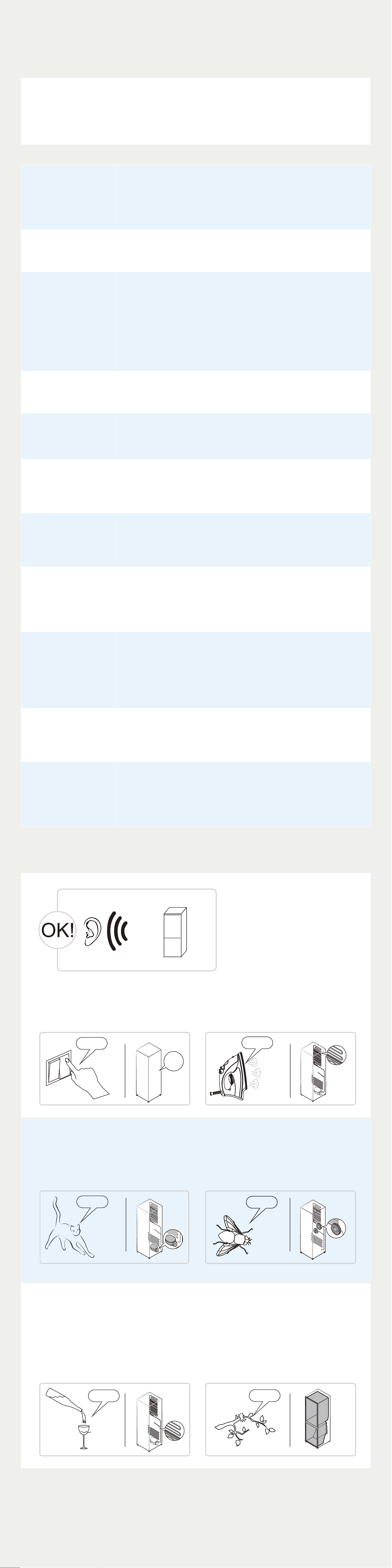
Do you hear these abnormal sounds as below? Usually these sounds
are normal.
S
S
SRR
R
!
HISSS!
BLUBB!
C
L
IC
K
!
BRRR!
CRA
CK!
CLICK: Some electrical parts in
the refrigerator, such as electric
valve will make this noise when
working. This is normal.
HISSS: When the refrigerant
flows into the evaporator, it will
make this noise. This is normal.
CLICK!
CLICK!
HISSS!
HISSS!
BRRR: The compressor will make
this noise when working, and the
buzzes are loud particularly upon
start or stop. This is normal.
SSSRRR: The fan motor in the No
frost refrigerator will make this
noise when working. This is normal.
BRRR!
BRRR!
SSSRRR!
SSSRRR!
SSSRRR!
SSSRRR!
BLUBB: Refrigerant flowing
through the pipes in the
refrigerator will make this noise.
This is normal.
CRACK: Cracking sound or broken
ice sound: the overall structure of
the refrigerator, air duct frost will
be with the thermal expansion
and contraction of the expansion
sound, these are also normal
physical phenomenon.
BLUBB!
BLUBB!
CRACK!
CRACK!

Tips & Tricks
Storing food
Freezer compartment
The freezer compartment is designated for the low-temperature
freezing of food, long-term storage of frozen food, and for the
production of ice cubes.
Do not put fresh and frozen food next to each other. The frozen food
may thaw.
When freezing large amounts of fresh food (such as meat, fish or
chopped meat), please divide them into several small pieces before
putting in, so that they can be quickly frozen and pick up easily.
Abide by the storage times recommended by food manufacturers on
the packages, there is no information on the packaging, food should
not be stored frozen for longer than three months from the date of
purchase.
When purchasing frozen food, make sure that it was frozen at a
suitable temperature and that the packaging is not damaged.
Frozen food should be kept in suitable individual packages to ensure
that adjacent food cannot be contaminated. Consume thawed and
defrosted foods immediately, do not refreeze them.
In case of prolonged power failure or malfunction of the appliance,
remove the stored frozen food and check whether they are still edible,
then store them in a suciently cool place or in another appliance.
To defrost food, remove it from the freezer and let it defrost at room
temperature or in the refrigerator. To defrost food quickly, you can use
the defrost function on your microwave, for example.
If you only want to defrost part of a pack, remove the portion you
need and immediately close the rest of the pack. In this way, you will
avoid “freezer burn” and will reduce ice formation on the remaining
foods.
Refrigerator compartment
The Refrigerator compartment is the ideal storage location for ready
meals, cakes and pastries, preserved food, condensed milk, milk,
cheese, spreads, sauces, dips and eggs.
The freshness at point of purchase is important for the shelf-life of your
food. In principle, the fresher the produce when placed in the crisper
drawers, the longer it stays fresh. Therefore, when buying food, always
pay attention to the degree of freshness.
Never put warm foods in the fridge compartment. These should first
cool down at room temperature and then be placed so as to ensure
adequate air circulation in the fridge compartment.
Meat and clean fish (packed in a package or plastic foil) can be placed
in the fridge compartment, which can be used in 1–2 days.
Fruit and vegetables without packaging can be placed in the part
designated for fresh fruit and vegetables
.
• | Notes:
Storage of too much food during operation after the initial connection to
power may adversely affect the freezing effect of the refrigerator.
Storage times and temperature
Note: Overlong storage or storage at inappropriate freezing
temperature may cause a quality loss or spoiled foods, which causes
food waste, is inedible and may cause food poisoning. The minimum
temperature in most cases should be -18°C or colder. Follow the
maximum recommended storage times below:
•
Stew, ice cream, sausages, bread: 2-6 months.
•
Fish, shrimp, lamb, meat: 4-8 months.
•
Vegetables, fruits, poultry, beef: 6-12 months.
Tips for energy saving
Do not place the appliance near cookers, radiators or other heat sources.
If the ambient temperature is high, the compressor will run more frequently
and for longer, resulting in increased energy consumption.
Ensure that there is sucient ventilation at the base of the appliance, on
the sides of the appliance and at the back of the appliance.
Please also observe the spacing dimensions in the chapter “Installation”.
An evenly filled refrigerator/freezer compartment contributes to optimal
energy use.
Allow warm food to cool before placing it in the refrigerator/freezer
compartment. Food that has already cooled down increases energy
eciency.
Allow frozen food to defrost in the refrigeration compartment The coldness
of the frozen food reduces the energy consumption in the refrigerator
compartment and thus increases the energy eciency.
Setting the temperature no colder than necessary contributes to optimal
energy use.
The door gaskets of your appliance must be perfectly intact so that
the doors close properly and energy consumption is not increased
unnecessarily.
Coldest zone in the
refrigerator
OPTIONAL: OK-temperature indicator
The OK-temperature indicator can be used to determine temperatures
below +4°C. Gradually reduce the temperature if the sign does not
indicate “OK”.
To ensure the temperature in this area, do not change the positioning
of the shelf. Inforced air refrigerators (equipped with a fan or No Frost
models),the symbol of the coldest zone is not represented because
the temperature inside is homogeneous.
Temperature indicator setting
To help you set your refrigerator well, it is equipped with a temperature
indicator that will monitor the average temperature in the coldest
zone.
WARNING: This indicator is intended to work only with your
refrigerator, do not use it in another refrigerator (in fact, the coldest
zone is not the same), or for any other use.
Checking the temperature in the coldest zone
With the temperature indicator, you can check regularly that the
temperature of the coldest zone is correct. Indeed, the internal
temperature of the refrigerator depends on several factors such as the
ambient temperature of the room, the amount of food stored and the
frequency of door opening. Take these factors into consideration when
setting the device.
When the indicator shows « OK », this means that your thermostat is
well adjusted and the internal temperature correct.
If the indicator of temperature turns WHITE, this means that the
temperature is too high; in this case, increase the refrigerator
temperature control setting and wait for 12 hours before performing
a new visual inspection of the indicator. When fresh food has been
introduced or the door has been left open, it is possible for the
indicator of temperature to turn WHITE after a while.