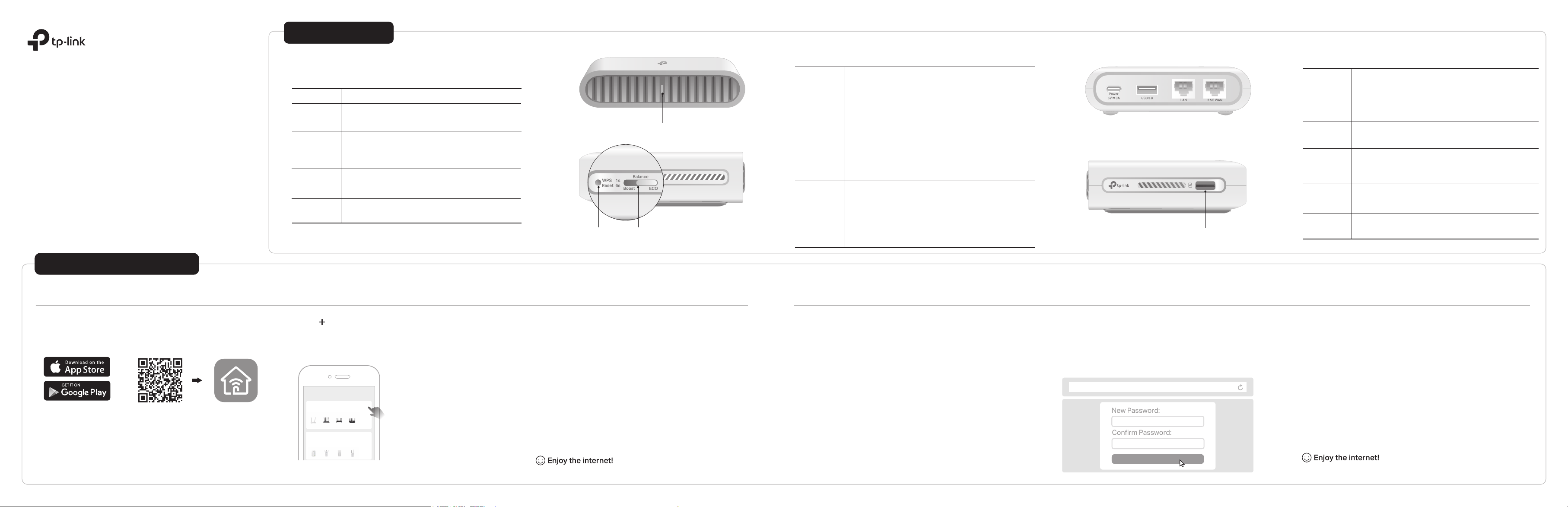
Button Description
This switch is used to change the power-saving
mode of the router.
• Boost Mode: Favors wireless range and transmis-
sion speed but may increase energy consumption
and raise the device temperature.
• Balance Mode: Automatically balances wireless
range and transmission speed while considering
energy consumption and device temperature.
• ECO Mode: Saves energy and lowers device
temperature by reducing the device’s wireless range
and transmission speed.
Press the button for 1 second and immediately
press the WPS button on your client to start the
WPS process.
Press and hold the button for about 6 seconds until
the LED blinks red to reset the router to its factory
default settings.
WPS/Reset
Button
ECO Mode
Switch
Interface Description
As a WAN port (by default): For connecting it to your
modem, the Ethernet outlet, or for other internet
services.
As a LAN port (need to set manually): For connecting
your PC or other wired devices to the router.
For connecting your PC or other wired devices to the
router.
Use this USB 3.0 port to connect your 3G/4G/5G
USB modem, mobile device, or USB storage device
to the router.
This port is used to connect the USB-C charger
provided in the package.
For inserting your microSD card into the router.
2.5 Gbps
WAN Port
1 Gbps
LAN Port
USB 3.0
Port
Power Port
microSD
Card Slot
IndicationStatus
The router has started up but is disconnected from
the internet.
Solid Red
Blinking Red
The router is being reset. Do not power o your
router.
LED Indication
Blinking Blue
The router is starting up / being upgraded /
establishing the WPS connection.
The router is connected to the internet or the main
network, or the WPS connection is successfully
established.
Solid Blue
Appearance
Set Up Your Router
©2025 TP-Link 7106511594 REV1.0.1
Images may dier from your actual product.
Wi-Fi 6 Portable Router
Quick Installation Guide
microSD Card Slot
LED
ECO Mode SwitchWPS/Reset Button
4. Launch a web browser and enter http://tplinkwifi.net
or http://192.168.0.1 in the address bar. Create a
password to log in.
http://tplinkwi.net
New Password:
Let’s Get Started
Conrm Password:
1. Power on the router.
2. Wait until the router’s LED turns solid (blue or red) before
moving on.
3. Connect your device to the router (wireless or wired).
• Wireless: Connect your device to the router’s Wi-Fi. The
default wireless network names (SSIDs) and wireless
password are printed on both the Wi-Fi info card and the
label at the bottom of the router.
• Wired: Turn o the Wi-Fi on your device and connect to
the LAN port of the router with an Ethernet cable.
Method ONE: Via the Tether App
1. Download the Tether app via Apple Store or Google Play,
or simply scan the QR code.
Scan for Tether Tether
or
2. Open the Tether app and log in with your TP-Link ID.
Note: If you don’t have an account, create one first.
4. Choose how you would like to connect your router to the
internet. Then follow the steps to complete the setup.
• Connect via Ethernet: The router gets internet via an
Ethernet cable connected to the existing wired network.
• Connect via Wi-Fi: The router gets internet via an existing
public Wi-Fi and turns it into a private network.
• Connect via Mobile USB: The router gets internet via a
USB cable connected to a mobile device (with a SIM card
inserted).
• Connect via USB Modem: The router gets internet from a
USB modem (with a SIM card inserted).
5. Choose how you would like to connect your router to the
internet. Then follow the steps to complete the setup.
• Connect via Ethernet: The router gets internet via an Ethernet
cable connected to the existing wired network.
• Connect via Wi-Fi: The router gets internet via an existing
public Wi-Fi and turns it into a private network.
• Connect via Mobile USB: The router gets internet via a USB
cable connected to a mobile device (with a SIM card inserted).
• Connect via USB Modem: The router gets internet from a
USB modem (with a SIM card inserted).
Note: If the login window does not appear, please refer to
Q1 of Need Help? in this guide.
Method TWO: Via a Web Browser
To enjoy a more complete service from TP-Link, bind your TP-Link ID to
the router.
To enjoy a more complete service from TP-Link, bind your TP-Link ID to
the router.
3. Tap the button in the Tether app and select Add a Router.
Note: Due to Tether app updates, your actual user interface and
pathway may differ from those depicted here.
Note: If you want to use it in Access Point/Extender Mode, go to More >
Operation Modes to switch the mode as needed. For Client Mode, follow
Method TWO to switch the mode on the web page.
Note: If you want to use it in Access Point/Extender/Client Mode,
exit the quick setup, and click Change Mode on top of the page,
then select the mode as needed.
*Router network mode
compatibility in the Tether
app may vary between app
versions.
Add Device
Create a new Wi-Fi network.
Add a Router
Extend your existing wireless network
with a range extender.
Add a Range Extender
>
>
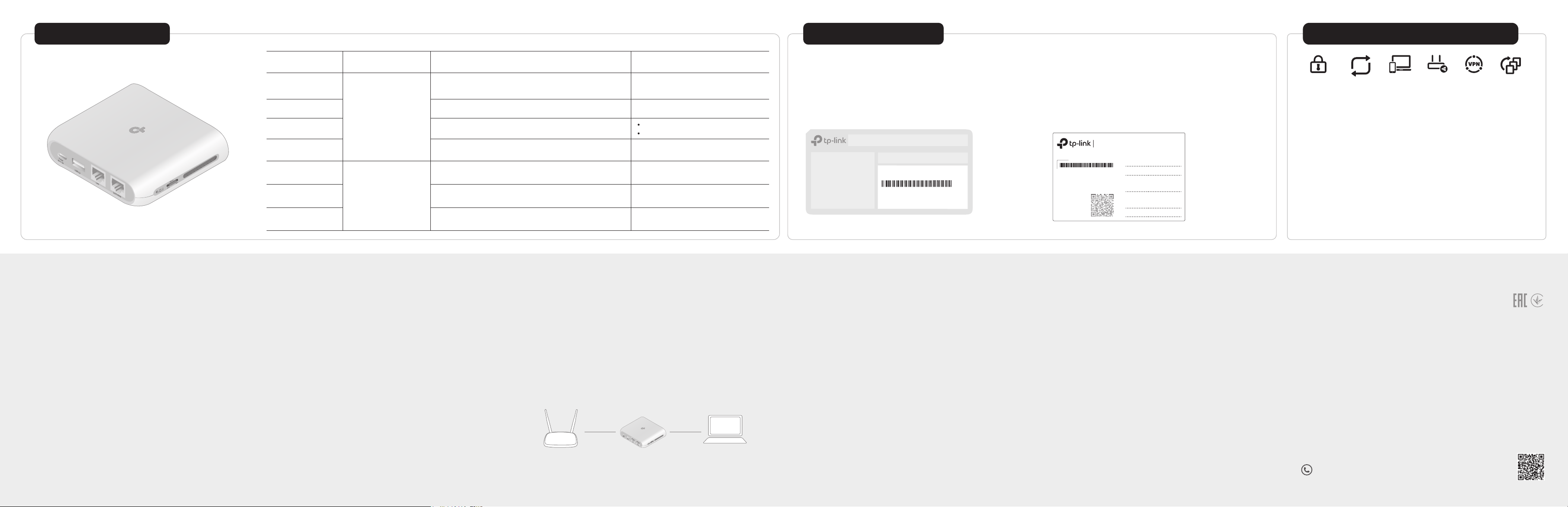
A Wi-Fi info card is included in the package.
When you set new SSIDs, Wi-Fi passwords, login
account info, and more, please write them down on the
card for convenient management.
The router supports VPN Server and VPN Client.
By setting up a VPN Client, the device connected to the router
can directly access the VPN server for remote oce and
cross-regional access. At the same time, your personal
information is encrypted and protected.
With VPN Server, external devices can access the VPN server,
including remote desktops, NAS, printers, cameras, and other
devices in the home network.
• Setup via Tether: Go to More > Advanced Setttings > VPN
Server/VPN Client.
• Setup via Web: Log in to the web management page of the
router and go to Advanced > VPN Server/VPN Client.
Model: Archer AX3000
AX3000 Gigabit Wi-Fi Router
Wireless Password/PIN:XXXXXXXX
SSID:TP-Link_XXXX
SSID:TP-Link_XXXX_5G
The default wireless network names (SSIDs) and
wireless password are printed on the label at the
bottom of the router.
Your Wi-Fi Names (SSIDs):
Your Login Account:
Your Wi-Fi Password:
Default SSIDs and Password
Wi-Fi Info Card
SSID: TP-Link_XXXX
SSID: TP-Link_XXXX_5G
Wireless Password/PIN: XXXXXXXX
Scan to join the
default Wi-Fi network
Recommended
Scenarios
I Want to...
Network
Mode
At Home
(e.g., home, oce, etc.)
Hotspot
Turn an existing public Wi-Fi into a private network
(wired and wireless).
Access Point
Range Extender
Client
Expand an existing Wi-Fi network for better Wi-Fi
coverage.
Connect a wired-only device, such as a smart TV, media
player, or game console, to a Wi-Fi network.
Turn an existing wired-only network into a wireless
network.
During Travel
(e.g., hotel, airport, cafe,
cruise ship, RV, camp,
etc.)
3G/4G/5G USB Modem
Share the internet with more wireless devices when the
wired network is limited to one device at a time.
Share a 3G/4G/5G USB modem’s data with other devices.
USB Tethering
Share a mobile device’s cellular data with other devices.
Router
(Default Mode)
Requirements
A USB cable.
An existing wired network provided by
a modem or other network device.
A 3G/4G/5G USB modem
(with a SIM
card inserted)
.
A mobile device
(with a SIM card inserted).
A public Wi-Fi.
An existing wired network provided
by a router, switch, etc.
An existing Wi-Fi network.
An existing Wi-Fi network.
Network Modes Wi-Fi Information
Secure Surng with VPN Encryption
For technical support, replacement services, user guides, and other
information, please visit https://www.tp-link.com/support, or simply
scan the QR code.
Safety Information
• Keep the device away from water, re, humidity or hot environments.
• Do not attempt to disassemble, repair, or modify the device. If you need
service, please contact us.
• Do not use damaged charger or USB cable to charge the device.
• Do not use any other chargers than those recommended.
• Do not use the device where wireless devices are not allowed.
• Adapter shall be installed near the equipment and shall be easily
accessible.
Please read and follow the above safety information when operating the
device. We cannot guarantee that no accidents or damage will occur due to
improper use of the device. Please use this product with care and operate at
your own risk.
TP-Link hereby declares that the device is in compliance with the essential
requirements and other relevant provisions of directives 2014/53/EU, 2009/125/EC,
2011 /65/EU and (EU) 2015/863.
The original EU Declaration of Conformity may be found at
https://www.tp-link.com/en/support/ce
TP-Link hereby declares that the device is in compliance with the essential
requirements and other relevant provisions of the Radio Equipment Regulations 2017.
The original UK Declaration of Conformity may be found at
https://www.tp-link.com/support/ukca
Frequently Asked Questions (FAQ)
Q1. What should I do if I can’t access the web management page?
• Reboot your router and try again.
• If the computer is set to a static IP, change its settings to obtain
an IP address automatically.
• Verify that http://tplinkwi.net is correctly entered in the web
browser. Alternatively, enter http://192.168.0.1,
http://192.168.1.1 or 192.168.0.254 (for RE/Client modes) in
the web browser.
• Use another web browser and try again.
• Disable and enable the network adapter in use.
Q2. What should I do if I forget the router’s web management
password?
• If you are using a TP-Link ID to log in, click Forgot Password?
on the login page and then follow the instructions to reset it.
• Alternatively, refer to FAQ > Q3 to reset the router. Then visit
http://tplinkwi.net to create a new login password.
Q3. How do I restore the router to its factory default settings?
• With the router powered on, press and hold the Reset button
for 6 seconds until the LED blinks red to restore the factory
default settings.
Q6. What should I do if my wireless signal is unstable or too weak?
It may be caused by too much interference.
• Set your wireless channel to a dierent one.
• Choose a location with fewer obstacles that may block the signal
between the portable router and the main AP. An open corridor or a
spacious location is ideal.
• Move the router to a new location away from Bluetooth devices and
other household electronics, such as cordless phones, microwaves,
and baby monitors, to minimize signal interference.
• In Range Extender mode, the ideal location to place the router is
halfway between your main AP and the Wi-Fi dead zone. If that is not
possible, place the router closer to your main AP to ensure stable
performance.
Q7. What should I do if I cannot enter the captive portal when the router
is set to Hotspot mode?
• If the portal login page didn't open during the Quick Setup process,
connect your smartphone or computer to the router, then open any
website, and you will be redirected to the portal login page.
• If some public hotspots limit the number of devices each customer
can access by MAC address, do the following:
1. Connect a smartphone to the public hotspot’s Wi-Fi. Find the
smartphone’s MAC address on its Wi-Fi list, and write the MAC
address down.
2. Log in to the web management page of the router and go to
Advanced > Network > Internet > Router MAC Address. Select Use
Custom MAC Address, enter the MAC address that your smartphone
uses to connect to the public hotspot’s Wi-Fi, and click SAVE.
Q8. What should I do if I want to change the router’s network mode?
1. Log in to the web management page of the router and go to
Advanced > System > Operation Mode or click Change Mode on top
of the page.
2. Select your desired network mode, and click SAVE. Then follow the
instructions to complete the settings.
Q4. What should I do if there is no internet access?
• Check if the internet is working normally by connecting a
computer/phone directly to the current network. If it is not, contact
your internet service provider. If you’re in a hotel room or on a trade
show, the internet may be limited and requires that you authenticate
for the service or purchase the internet access.
• If you are using a cable modem, power o your modem for about 5
minutes, then power it on and check the internet. If your modem has
more than one Ethernet port, keep other ports unconnected.
• Log in to the web management page, and go to the Network Map
page to check whether the internet IP address is valid or not. If it’s
valid, go to Advanced > Network > Internet, click Advanced Settings,
select Use the Following DNS Addresses, set the primary DNS to
8.8.8.8, and set the secondary DNS to 8.8.4.4. If it is not, check the
hardware connection or contact your internet service provider.
Q5. What should I do if I forget my Wi-Fi password?
• If you have not changed the default wireless password, it can be found
on the label of the router.
• Connect a computer directly to the LAN port of the router using an
Ethernet cable. Log in to the router’s web management page at
http://tplinkwi.net, and go to the Wireless page to retrieve or reset
your wireless password.
More
Devices
Remote
Network
Auto
Connect
Two
Functions
Encryption
Access
Better
Adaptability
QR Code
Example Only