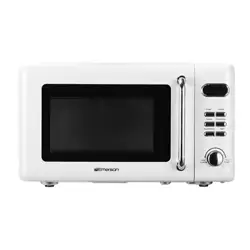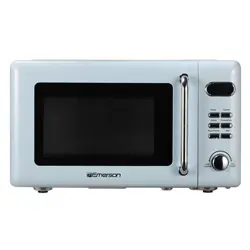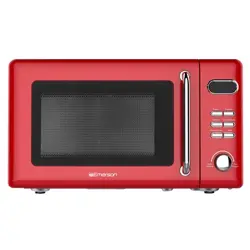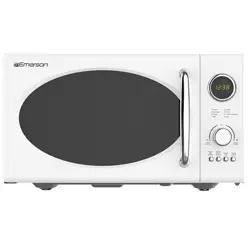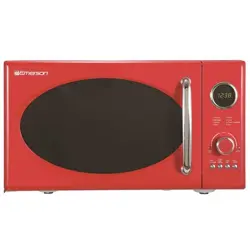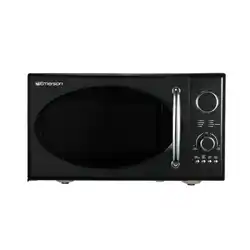

800
W MICROWAVE OVEN
AND 1000W GRILL
OWNER’S MANUAL
MWRG0901BK
Visit our web site at “www.emersonradio.com”
UNAUTHORIZED MODIFICATIONS TO THIS DEVICE COULD VOID MANUFACTURER'S WARRANTY.
EN
2
PRECAUTIONS TO AVOID POSSIBLE
EXPOSURE TO EXCESSIVE
MICROWAVE ENERGY
(a) Do NOT attempt to operate this oven with the door open since open-door operation can
result in harmful exposure to microwave energy.
It is important not to defeat or tamper with the safety interlocks.
(b) Do NOT place any object between the oven front face and the door or allow soil or cleaner
residue to accumulate on sealing surfaces. Wipe the sealing area frequently with a mild
detergent, rinse and wipe dry. Never use abrasive powders or pads.
(c) Do NOT operate the oven if it is damaged.
It is particularly important that the oven door close properly and that there is no damage to
the: (1) Door (bent), (2) Hinges and Latches (broken or loosened), (3) Door seals and sealing
surfaces.
(d) The oven should not be adjusted or repaired by anyone except properly qualified service
personnel.
(e) For more safety tips, visit following FDA website:
https://www.fda.gov/consumers/consumer-updates/5-tips-using-your-microwave-oven-safely
Precautions to Avoid Possible Exposure to
Excessive Microwave Energy
2
Child Lock
17
Important Safety Instructions
3
Cooking Guide
18
Safety Precaution
4
The Principles of Microwave Cooking
18
Food Characteristics
18
Federal Communications Commission
Radio Frequency Interference Statement
6
Microwave Techniques
18
Grounding Instructions
7
Hot Snacks and Appetizers
19
Installation
7
Seafood
19
Care of Your Microwave Oven
8
Meats
20
How to Use Your Microwave Oven Safely
10
Poultry
20
Location of Controls
11
Eggs & Cheese
21
Operation
12
Soup
22
Setting the Clock
12
Vegetables
22
Auto Cook by Time/Weight
12
Casseroles
23
Auto Reminder
12
Sauces
23
Power Levels (Microwave)
12
Sandwiches
23
Cooking in One Stage
13
Pasta and Grains
24
Grill/Combo
13
Cereals
24
Defrost
14
Convenience Foods
24
Auto Cook
14
Desserts
25
Auto Cook Menu Chart
15
Specifications
26
Preset Cook
15
Before You Call for Service
26
Multi-Sequence Cook
16
Limited Warranty
27
CONTENTS

EN
3
FOR HOUSEHOLD USE ONLY.
SAVE THESE INSTRUCTIONS
When using electrical appliances basic safety precautions should
be followed, including the following:
WARNING – To reduce the risk of burns, electric shock, fire, injury to
persons, or exposure to excessive microwave energy:
1.
Read all instructions before using this appliance.
2.
Read and follow the specific "PRECAUTIONS TO AVOID
POSSIBLE EXPOSURE TO EXCESSIVE MICROWAVE
ENERGY"
section.
3.
This appliance must be grounded. Connect only to properly grounded
outlet. See
"GROUNDING INSTRUCTIONS" section.
4.
Install or locate this appliance only in accordance with the provided
installation instructions.
5.
Some products such as whole eggs and sealed containers (for
example, closed glass jars) may explode and should not be heated in
this oven.
6.
Use this appliance only for its intended use as described in this manual.
Do NOT use corrosive chemicals or vapors in this appliance. This type
of oven is specifically designed to heat, cook, or dry food. It is not
designed for industrial or laboratory use.
7.
As with any appliance, close supervision is necessary when used by
children.
8.
Do NOT operate this appliance if it has a damaged cord or plug, if it is
not working properly, or if it has been damaged or dropped.
9.
This appliance should be serviced only by qualified service personnel.
Contact the nearest authorized service facility for examination, repair,
or adjustment.
10.
Do NOT cover or block any openings on this appliance.
11.
Do NOT store or use
this
appliance
outdoors.
Do NOT use this product
near water, for example, near a kitchen sink, in a wet basement, or near a
swimming pool, or similar locations.
12.
Do NOT immerse cord or plug in water.
13.
Keep cord away from heated surfaces.
14.
Do NOT let cord hang over edge of table or counter.
15.
When cleaning surfaces of door and oven that come together when
closing the door, use only mild, non-abrasive soaps, or detergents
applied with a sponge or soft cloth.
16.
To reduce the risk of fire in the oven cavity:
IMPORTANT SAFETY INSTRUCTIONS

EN
4
(a) Do NOT overcook food. Carefully attend appliance if paper, plastic,
or other combustible materials are placed inside the oven to
facilitate cooking.
(b) Remove wire twist-ties from paper or plastic bags before placing
bag in oven.
(c) If materials inside the oven ignite, keep oven door closed, turn oven
off, and disconnect the power cord, or shut off power at the fuse or
circuit breaker panel.
(d) Do NOT use the cavity for storage purposes. Do NOT leave paper
products, cooking utensils, or food in the cavity when not in use.
17.
Do NOT use this microwave oven to heat corrosive chemicals (for
example, sulfides and chlorides). Vapors from such corrosive
chemicals may interact with the contact and springs of the safety
interlock switches, thereby rendering them inoperable.
18.
Keep the spatter shield (waveguide cover) clean at all times. Wipe the
oven interior with a soft damp cloth after each use. If you leave grease
or fat anywhere in the cavity it may overheat, smoke or even catch fire
when next using the oven.
19.
Liquids, such as water, coffee, or tea are able to be overheated beyond
the boiling point without appearing to be boiling due to surface tension
of the liquid. Visible bubbling or boiling when the container is removed
from the microwave oven is not always present. THIS COULD
RESULT IN VERY HOT LIQUIDS SUDDENLY BOILING OVER WHEN
THE CONTAINER IS DISTURBED OR A UTENSIL IS INSERTED
INTO THE LIQUID. To reduce the risk of injury to persons:
1. Do NOT overheat the liquid.
2. Stir the liquid both before and halfway through heating it.
3. Do NOT use straight-sided containers with narrow necks.
4. After heating, allow the container to stand in the microwave oven
for a short time before removing the container.
5. Use extreme care when inserting a spoon or other utensil into the
container.
General Use
1. Do NOT attempt to tamper with or make any adjustments or repairs to door,
control panel or any other part of the oven. Do NOT remove outer panel
from oven. Repairs should only be done by qualified service personnel.
2. Do NOT operate the oven empty. The microwave energy will reflect
continuously throughout the oven if no food or water is present to absorb
energy.
3. If a fire occurs in the oven, touch the Pause/Cancel button and LEAVE THE
DOOR CLOSED. Disconnect the power cord, or shut off power at the fuse
SAFETY PRECAUTIONS
EN
5
or circuit breaker panel.
4. Do NOT attempt to dry clothes, newspapers or other materials in the oven.
They may catch on fire.
5. Do NOT use recycled paper products. Recycled paper towels, napkins and
waxed paper can contain metal flecks which may cause arcing or ignite.
Paper products containing nylon or nylon filaments should be avoided, as
they may ignite.
6. Some styrofoam trays (like those that meat is packaged on) have a thin
strip of metal embedded on the bottom. When microwaved, the metal can
burn the floor of the oven or ignite a paper towel.
7. Avoid inserting nails, wire, etc. through any holes in the unit during
operation. Never insert a wire, nail or any other metal objects through the
holes on the cavity or any other holes or gaps, because such objects
may cause electric shock and microwave leakage.
8. This appliance is not intended for use by persons (including children) with
reduced physical, sensory or mental capabilities, or lack of experience and
knowledge, unless they have been given supervision or instruction
concerning use of the appliance by a person responsible for their safety.
9. The appliances are not intended to be operated by means of an external
timer or separate remote-control system.
10. The temperature of accessible surfaces may be high when the
appliance is operating.
CAUTION: HOT SURFACE
Utensils
1. METAL CONTAINERS or dishes with metallic rims should not be used.
Arcing may occur.
2. METAL TWIST-TIES may not be used in the microwave oven.
3. Do NOT use SEALED JARS or NARROW NECK bottles for cooking or
reheating. They may shatter.
4. Do NOT use CONVENTIONAL THERMOMETERS in the microwave oven.
They may cause arcing.
5. Remove PLASTIC STORE WRAPS before cooking or defrosting foods in the
oven.
6. For FURTHER INFORMATION on proper cooking utensils, refer to the
COOKING GUIDE section.
Food
1. Never use your microwave oven for HOME CANNING. The oven is not
designed to permit proper canning. Improperly canned food may spoil and
be dangerous to consume.
2. COOKING TIMES given in the cooking guide are approximate. Factors that

EN
6
may affect cooking are starting temperature, altitude, volume, size and shape
of food and utensils used. As you become familiar with the oven, you will be
able to adjust for these factors.
3. It is better to UNDERCOOK RATHER THAN OVERCOOK foods. If food is
undercooked, it can always be returned to the oven for further cooking. If
food is overcooked, nothing can be done. Always start with minimum cooking
times.
4. SMALL QUANTITIES of food or foods with LOW MOISTURE content can
burn, dry out or catch on fire if cooked too long.
5. Do NOT boil eggs in their shell. Pressure may build up and the eggs may
explode.
6. Potatoes, apples, egg yolks, whole acorn squash and sausage are some
examples of foods with NONPOROUS SKINS. These must be pierced before
cooking to prevent bursting.
7. POPCORN must be popped in a microwave corn popper. Microwave popped
corn produces a lower yield than conventional popping. Do NOT use oven for
popcorn unless popped in a microwave approved popcorn utensil or unless
it’s commercially packaged and recommended especially for microwave
ovens. Do NOT use oil unless specified by the manufacturer.
8. Do NOT attempt to deep fat fry in your oven.
9. HEATED LIQUIDS can ERUPT if not mixed with air. Do NOT heat liquids in
your microwave oven without first stirring.
10. Do NOT use paper towels to cover food as they can ignite.
WARNING: This equipment generates and uses ISM frequency energy
and if not installed and used properly, in strict accordance with the
manufacturer's instructions, may cause interference to radio and television
reception.
It has been type-tested and found to comply with limits for an ISM
Equipment pursuant to part 18 of FCC Rules, which are designed to
provide reasonable protection against such interference in a residential
installation.
However, there is no guarantee that interference will not occur in a particular
installation. If this equipment Does cause interference to radio or television
reception, which can be determined by turning the equipment off and on,
the user is encouraged to try to correct the interference by one or more of
the following:
* Reorient the receiving antenna of radio or television.
* Relocate the Microwave oven with respect to the receiver.
* Move the microwave oven away from the receiver.
FEDERAL COMMUNICATIONS COMMISSION RADIO
FREQUENCY INTERFERENCE STATEMENT
EN
7
* Plug the microwave oven into a different outlet so that microwave
oven and receiver are on different branch circuits.
THE MANUFACTURER is not responsible for any radio or TV interference
caused by UNAUTHORIZED MODIFICATION to this microwave oven. It is
the responsibility of the user to correct such interference.
ARCING
If you see arcing, press the “Pause/Cancel” button and correct the problem.
Arcing is the microwave term for sparks in the oven.
Arcing is caused by:
* Metal or foil touching the side of the oven.
* Foil not molded to food (upturned edges act like antennas).
* Metal, such as twist-ties, poultry pins, or gold rimmed dishes, in the
microwave.
* Recycled paper towels containing small metal pieces being used in
the microwaves.
* Burnt (carbonized) food residue or grease spattered inside of
cabinet.
DO NOT LEAVE OVEN UNATTENDED WHILE COOKING!
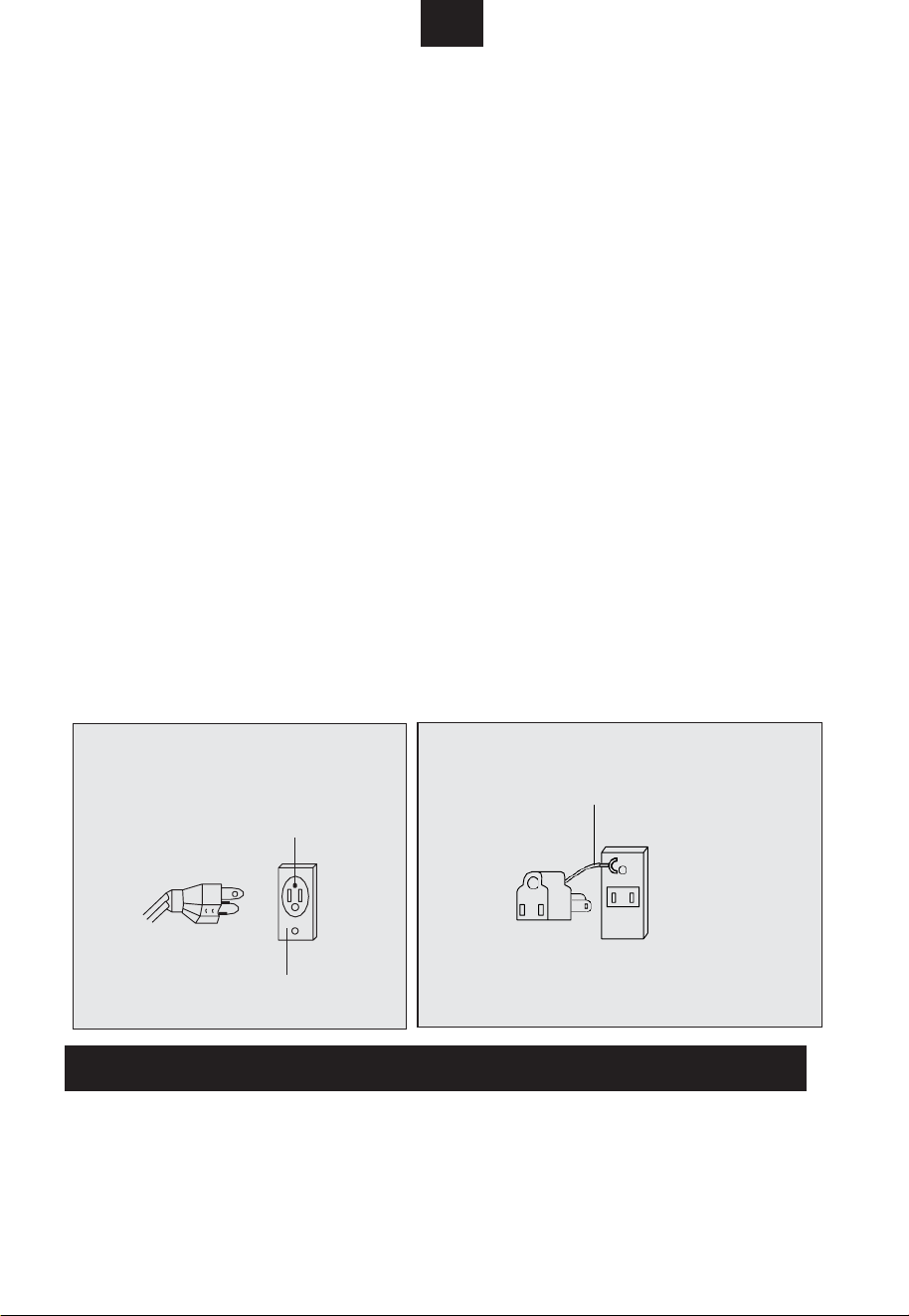
This appliance must be grounded. In the event of an electrical short
circuit, grounding reduces the risk of electric shock by providing an
escape wire for the electric current. This appliance is equipped with a
cord having a grounding wire with a grounding plug. The plug must be
inserted into an outlet that is properly installed and grounded.
1. Steady, flat location: When positioning the microwave oven, it should
be set on a steady, flat surface.
2. Ventilation: DO NOT BLOCK AIR VENTS. If they are blocked during
operation, the oven may overheat and eventually cause oven failure. For
proper ventilation, KEEP THREE INCHES OF SPACE BETWEEN THE
OVENS TOP, SIDES, REAR AND THE AREA WHERE THE UNIT IS TO
BE INSTALLED.
GROUNDING INSTRUCTIONS
INSTALLATION
WARNING: Improper use of the grounding plug can result in a risk of electric shock. Consult a
qualified electrician or service personnel if the grounding instructions are not completely understood,
or if Doubt exists as to whether the appliance is properly grounded.
If it is necessary to use an extension cord, use only a three wire extension cord that has a three
blade grounding plug, and a three slot receptacle that will accept the plug on the appliance. The
marked rating of the extension cord should be equal to or greater than the electrical rating of the
appliance.
EN
8
3. Radio and TV reception: Poor television reception and radio
interference may result if the oven is located close to a TV, radio,
antenna, or antenna wire. Position the oven as far from them as possible.
4. Temperature and moisture: Keep the oven away from hot air, steam
or splashing liquids when choosing a place to locate it, otherwise, the
unit’s operation may be adversely affected, causing it to break down.
5. Power supply:
* Check your local power source. This microwave oven requires a 120V,
60Hz ,15Amp power supply.
* Use a receptacle that will accept the ground prong.
(a) A short power supply cord is provided to reduce the risks resulting
from becoming entangled in or tripping over a longer cord.
(b) Longer cord sets or extension cords are available and may be used
if care is exercised in their use.
(c) If a long cord or extension cord is used, (1) the marked electrical
rating of the cord set or extension cord should be at least as great
as the electrical rating of the appliance, (2) the extension cord must
be a grounding-type 3-wire cord, and (3) the longer cord should be
arranged so that it will not drape over the counter top or tabletop
where it can be pulled on by children or tripped over unintentionally.
6. Examine the oven for any damage such as: Dents, a misaligned door,
broken door or a dent in the cavity. If any of the above are visible, DO
NOT INSTALL THE UNIT. Notify the dealer immediately.
1. Disconnect the AC plug from the outlet before cleaning.
2. The oven should be cleaned regularly and have any food scraps
removed.
3. Keep the inside of the oven clean. When food spatters or spilled liquids
adhere to oven walls, wipe with a damp cloth. Mild detergent may be
used if the oven gets very dirty. The use of harsh detergent or abrasives
When using a 3-pronged plug
3-pronged
Receptacle
3-pronged
plug
Receptacle
Box Cover
When using a grounding adapter, make sure the
receptacle box is fully grounded.
Grounding Lead
Screw
Receptacle
Grounding
Receptacle
Adapter
Box Cover
CARE OF YOUR MICROWAVE OVEN
EN
9
is not recommended.
4. The outside oven surface should be cleaned with soap and water. Then
wiped dry with a soft cloth. To prevent damage to the operating parts
inside the oven, water should not be allowed to seep into the ventilation
slots. If the Control Panel becomes dirty or wet, clean with a soft, dry
cloth. Do NOT use harsh detergents or abrasives on Control Panel.
5. If steam accumulates on both sides of the oven door, wipe with a soft
cloth. This may occur when
the microwave oven is
operated under high humidity
conditions and this is not an
indication of a malfunction in
the unit.
6. It is occasionally necessary to
remove the glass tray for
cleaning. Wash the tray in warm, sudsy water or in a dishwasher.
7. The roller guide and oven cavity floor should be cleaned regularly to
avoid excessive noise. Simply wipe the bottom surface of the oven with
mild detergent water or window cleaner and dry. The roller guide may
be washed in mild, sudsy water or in the dishwasher.
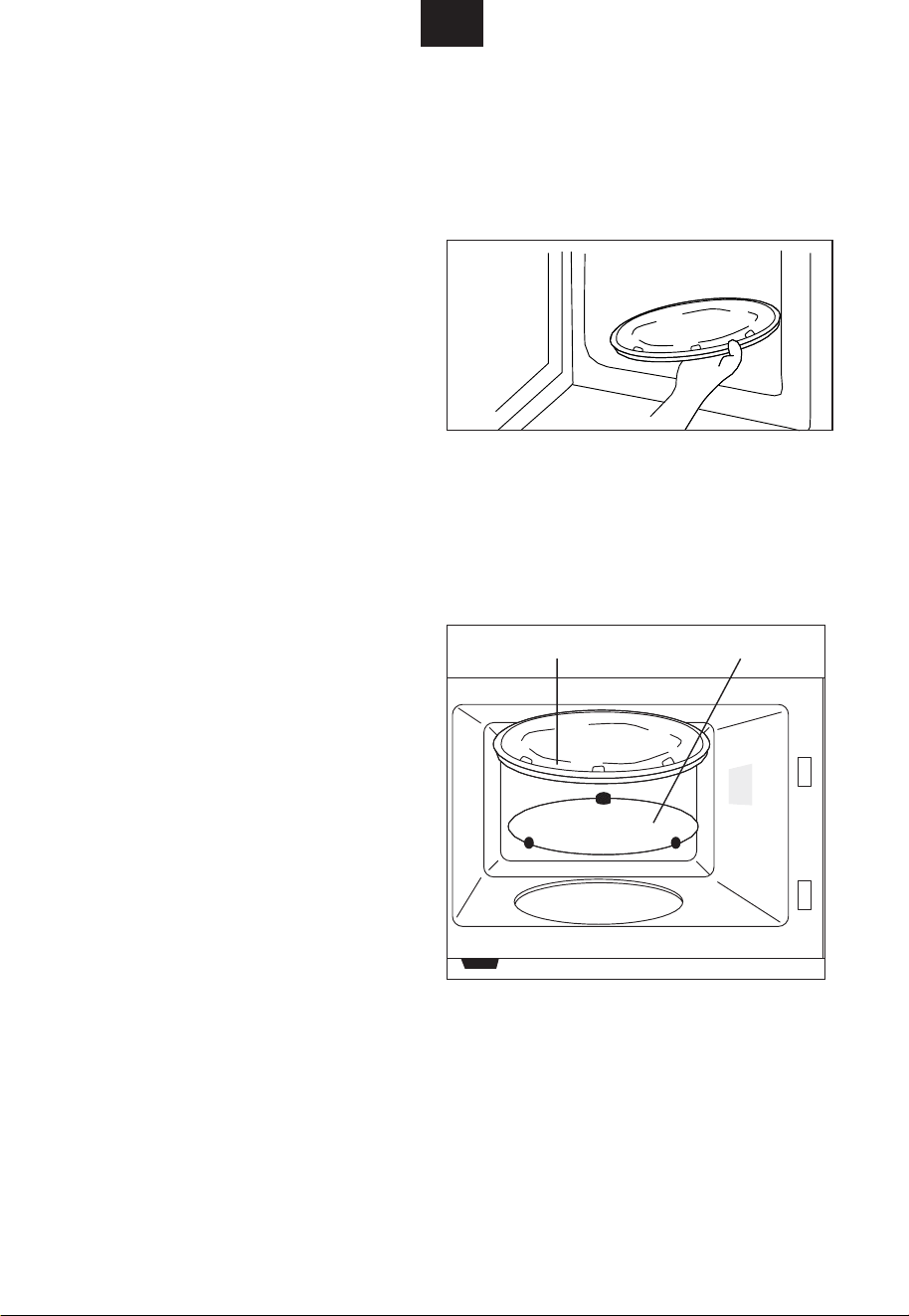
Roller Guide
1. The ROLLER GUIDE and
oven floor should be cleaned
frequently to prevent
excessive noise.
2. The ROLLER GUIDE MUST
ALWAYS be used for
cooking together with the
Glass Tray.
Glass Tray
1. Do NOT operate the oven
without the Glass Tray in
place.
2. Do NOT use any other Glass
Tray with this oven.
3. If the Glass Tray is hot, ALLOW IT TO COOL before cleaning it or
placing in water.
4. Do NOT cook directly on the Glass Tray.
Glass Tray
Roller Guide

EN
10
Although your oven is provided with safety features, it is important to
observe the following:
a) It is important not to defeat or tamper with safety interlocks.
b) Do NOT place any object between the oven face and the door or allow residue
to accumulate on sealing surfaces. Wipe the sealing area frequently with a
mild detergent, rinse and wipe dry. Never use abrasive powders or pads.
c) When opened, the door must not be subjected to strain, for example, a child
hanging on an open door or any load which could cause the oven to fall
forward and cause injury and damage to the door. Do NOT operate the oven
if it is damaged, until it has been repaired by a qualified person. It is
particularly important that the oven door close properly and that there is no
damage to the following:
(1) Door (bent), (2) Hinges and Latches (broken or loosened), (3) Door seals
and sealing surfaces.
d) The oven should not be adjusted or repaired by anyone except properly
qualified service personnel.
NT
HOW TO USE YOUR MICROWAVE OVEN SAFELY
EN
11
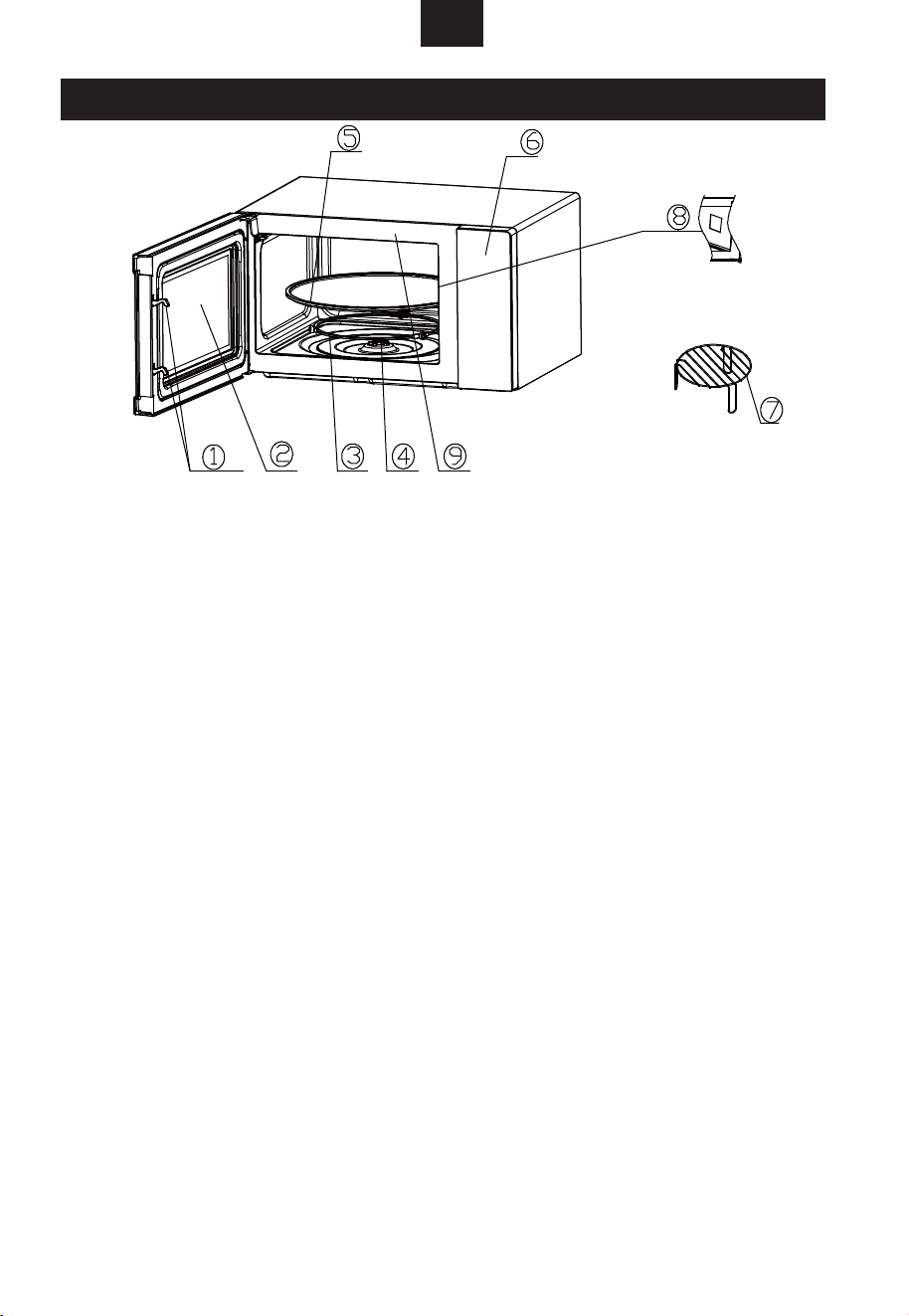
1. Door Latches – When the door is closed, they will automatically lock shut. If
the door is opened while the oven is operating, the magnetron will
automatically shut off.
2. Door Screen – Allows viewing of food. The screen is designed so that light
can pass through, but not the microwaves.
3. Roller Guide – Supports the glass cooking
tray. Must always be in proper position before
operating the oven.
4. Rotating Axis/Coupler – The glass cooking
tray (turntable) sits on the axis, which coupled
with the motor underneath to rotate the glass
cooking tray.
5. Glass Cooking Tray (Turntable) – Made of
special heat resistant glass. The tray must
always be in proper position before operating
the oven. Do NOT cook food directly on the
tray.
6. Control Panel - It includes four control buttons:
“Power/Grill/Combo”, “Preset/Clock/Defrost”,
“Instant Start” and ”Pause/Cancel”, and one
“Auto Cooking/Time Weight” control knob and a
Display:
(a) Power Button – Used to set a power level.
(b) Instant Start Button – Used to start
cooking time or menu program. It
automatically starts cooking for 30 seconds
and increases +30 seconds whenever you
press the button (all the way up to 60:00
minutes or one hour)
LOCATION OF CONTROLS

EN
12
(c) Preset/Clock/Defrost Button – Used to preset cooking start time,
clock time and defrosting time by weight.
(d) Pause/Cancel Button – Used to stop and/or clear a cooking
program.
(e) Auto Cooking/Time Weight Knob – Turn the knob to increase or
decrease the cooking time and food weight. Eight Auto Cooking
menus (1~8) can be scrolled through with the knob as well.
(f) Display
7. Grill Rack — Use to place the roasting food on it.
8. Spatter Shield (Waveguide Cover) (Do NOT remove) – Protects the
microwave outlet from splashes of cooking foods.
9. Heating Elements – Used for Grill/Combo cooking.
1. SETTING THE CLOCK
After the unit is connected, the display shows 88:88 and flashes two times. The
display then shows 1:00 and stops flashing.
To set the time, press the “Clock” button for 3 seconds to enter clock setting
mode. Turn the Time knob to set the Hour. Press the Clock button and turn the
Time knob to set the Minutes. Press the Clock button again to confirm and
complete the setting.
2. AUTO COOK BY TIME / WEIGHT
When setting a cooking program, turn the Auto Cooking / Time / Weight knob
to increase or decrease the cooking time and food weight. In standby mode,
various Auto Cook Menus (1~8) can be scrolled through and selected by turning
the knob.
3. PAUSE/CANCEL
Press the Pause/Cancel button to cancel the set microwave power, cooking or
defrosting program.
During cooking: press once to stop oven operation, press twice to cancel
cooking programs. Always press the PAUSE/CANCEL button before
opening the door.
4. AUTO REMINDER
When the cooking or defrosting process is completed, the oven beeps 3 times
and the display shows ‘End’.
5. POWER LEVELS (MICROWAVE)
Five microwave power levels are available, to change the power level, press the
Power button repeatedly as displayed.
OPERATION
EN
13
100P 100% power level (Applicable for quick and thorough cooking)
80P 80% power level (Applicable for medium express cooking)
50P 50% power level (Applicable for steaming food)
30P 30% power level (Applicable for defrosting food)
10P 10% power level (Applicable for keeping warm)
6. COOKING IN ONE STAGE
After the desired power level selected, turn the Time knob to set the desired
cooking time. The maximum cooking time is 60 minutes. Press the Start button
to start cooking. The oven will beep when completed.
* Never use the grill rack for microwave cooking.
* Never operate a microwave oven while empty.
* To stop cooking or clear a cooking program, simply press the
Pause/Cancel button once to stop cooking, or twice to cancel a cooking
program to avoid undesired operation next time.
* At the maximum microwave power, the oven will automatically lower the
power after a certain time of cooking to lengthen the service life.
7. GRILL/COMBO
There are three modes of Grill: G., C.1 and C.2. They are grill, combination 1
of grill and microwave cooking and combination 2 of grill and microwave
cooking. Press the POWER/Grill/COMBI button continuously, LED cycles to
show 100P — 80P — 50P — 30P — 10P— G.— C.1— C.2— 100P. When
the desired function is selected, turn the knob to select the required working
time, and press the INSTANT/START button to work with the selected time
program.
G.
Grill, the heating element will be energized during operation
time. Which is applicable for rolling thin meats or pork,
sausage, chicken wing as good brown color can be obtained
EN
14
C.1
Combination of grill and microwave cooking. 30% microwave
and 70% grill. Microwave works for 10s and Grill works for
23s.
C.2
Combination of grill and microwave cooking. 55% microwave
and 45% grill. Microwave works for 18s and Grill works for
15s.
In Grill mode, all oven parts including the heating elements, as well as the grill
rack and cooking containers, may become very hot. Use it with caution when
removing any item from the oven. Use heavy potholders or oven mitts to
PREVENT BURNS.
8. DEFROST
In the standby mode, press the DEFROST button, and the screen displays
"dEF". Then turn the WEIGHT knob to select the meat weight. The weight
range you can select is from 4 to 100oz. After selecting the weight, press the
INSTANT/START button to start the defrosting program.
Below is some food defrosting time advice:
dEF For defrosting, the weight range from 4 to 100oz.
a. It is necessary to turn over the food during operation to obtain uniform
effect.
b. Usually defrosting will need longer time than that of cooking the food.
c. If the food can be cut by knife, the defrosting process can be considered
completed.
d. Microwave penetrates around 4cm into most food.
e. Defrosted food should be consumed as soon as possible. It is NOT
recommended to refreeze defrosted food.
9. AUTO COOK
There are eight automatic menus, in the standby mode, turn the AUTO
COOKING knob, and the display screen will display 1, 2... 8 in cycles. After
selecting the desired menu, press the ENTER button of the knob once to
enter the weight selection mode, and then turn the WEIGHT knob to select
the weight of the menu. After selecting the weight, press the INSTANT
START button to start the menu program.
EN
15
Display Food/Type Method
1 Popcorn The optional weights are 1.75oz, 3.0oz and 3.5oz.
2 Potato
The optional weights are 9.0oz, 18.0oz and
27.0oz.
3 Beverage
The optional weights are 1 cup, 2 cups or 3 cups,
each one about 8oz.
4 Pizza The optional weights are 4.0oz, 8.0oz and 14.0oz.
5 Reheat
The optional weights are 7.0oz, 14.0oz, 21.0oz,
28.0oz and 35.0oz.
6
Frozen
Vegetable
The optional weights are 4.0oz, 8.0oz and 16.0oz.
7 Meat
The optional weights are 7.0oz, 14.0oz, 21.0oz,
28.0oz and 35.0oz.
8 Soup
The optional weights are 4.0oz, 8.0oz, 12.0oz and
16.0oz.
a. The temperature of food before cooking would be 20-25℃. Higher or lower
temperature of the food before cooking would require increase or decrease of
cooking time.
b. The temperature, weight and shape of food will largely influence the cooking
effect. If any deviation has been found to the factor noted on above menu, you
can adjust the cooking time for best result.
10. PRESET COOK
If you do not want the menu to start immediately, you can preset the cooking
menu and time, and the preset menu and time will start automatically at your
set time. The operation method is as follows:
Example: Now it is 11:30 Clock, if you want the microwave oven
can automatically start cooking with 100P microwave power for 9
minutes and 30 seconds at 12:50. Use the following steps:
EN
16
Steps Display
1 Press the Power to select 100P 100P
2
Turn Auto Cooking /Time. Weight knob to set
cooking time
9:30
3
Press and hold down the Preset button for three
seconds
4
Set hours by turning
Auto Cooking /Time. Weight
knob
12:00
5 Press the Preset button to enter the setting minute
6
Set minutes by turning Auto Cooking /Time. Weight
knob
12:50
7 Press the Preset button to complete the setting
11. MULTI-SEQUENCE COOKING
Some recipes may require different power level or cooking time to get a better
cooking result. You can personalize a cook menu as follows:
Example: You want to cook the food with 100P microwave for 3
minutes then 30P for 9 minutes. There is a 2 sequence setting.
Steps Display
1
100P microwave for 3 min.
1.1
Press the Power button to select power level. 100P
1.2
Turn the Auto Cooking /Time. Weight knob to
set cooking time.
3:00
2
30P for 9 min.
2.1
Press the Power button to select desired power
level
30P
2.2
Turn the Auto Cooking /Time. Weight knob to
set cooking time.
9:00
3
Start cooking by pressing the Instant Start
button
(1) When the 100P power level cooking stage is completed, it will

EN
17
automatically enter the next cooking stage.
(2) The program set up each time cannot exceed 2 stages at most.
12. CHILD LOCK
The Child Lock prevents unwanted oven operation by small children.
The oven can be set so that the control panel is deactivated or locked.
(1) TO ACTIVATE: Press and hold the Pause/Cancel button for three
seconds.
(2) TO DEACTIVATE: Press and hold the Pause/Cancel button for three
seconds.
EN
18
THE PRINCIPLES OF MICROWAVE COOKING
Microwaves are a form of high frequency radio waves similar to those used by a radio including AM,
FM and CB. Electricity is converted into microwave energy by the magnetron tube. From the
magnetron tube, microwave energy is transmitted to the oven where it is reflected, transmitted and
absorbed by the food.
Reflection: Microwaves are reflected by metal just as a ball is bounced off of a wall. For this reason, metal
utensils are not suitable for use in the microwave. A combination of stationary interior walls and a rotating
metal turntable or stirrer fan helps assure that the microwaves are well distributed within the oven cavity to
produce even cooking.
Transmission: Microwaves pass through some materials such as paper, glass and plastic much like sunlight
shining through a window. Because these substances do not absorb or reflect the microwave energy, they are
ideal materials for microwave oven cooking containers.
Absorption: During cooking, microwaves will be absorbed by food. They penetrate to a depth of about 3/4 to
1 1/2 inches. Microwave energy activates the molecules in the food (especially water, fat and sugar), and heat
is produced. If you vigorously rub your hands together, you will feel heat produced by friction. The internal
cooking of larger foods is done by conduction as the heat which is produced by friction is conducted to the
middle of the food. Foods also continue to cook by conduction during standing time.
FOOD CHARACTERISTICS
Quantity: The amount of food placed in a microwave oven has a direct effect on the cooking time. Small
amounts of food or liquid require less cooking time than larger amounts of the same substance. As quantity
increases, concentration decreases.
Size: Small pieces cook faster than large ones. To speed cooking, cut pieces smaller than two inches (5 cm),
so microwaves can penetrate to the middle from all sides. Pieces which are similar in size and shape cook
more evenly.
Shape: Many foods are uneven, like a chicken, ribs or broccoli. The thin parts will cook faster than the thick
parts, while uniformly thick foods cook evenly. To compensate for irregular shapes, place thin pieces toward
the center of the dish and thicker pieces toward the edge of the dish.
Starting Temperature: Frozen or refrigerated foods take longer to cook than foods at room temperature.
Bone and Fat: Because bones conduct heat, the side of the meat the bone is on will cook first, while boneless
cuts cook slower but more evenly. Fat attracts microwaves. The middle of these foods is cooked by heat
conduction.
Moisture Content: Microwaves are attracted by moisture. Naturally moist foods absorb microwaves better
than dry ones. Add a minimum of liquid to moist foods, as excess water slows cooking.
Density: The density of food determines how easily the microwaves can penetrate and how quickly it will cook.
Porous foods, like chopped beef or mashed potatoes, microwave faster than dense ones like steak or whole
potatoes.
Piercing: Steam builds up pressure in foods which are tightly covered by a skin or membrane. Pierce potatoes,
egg yolks and chicken livers to prevent bursting.
MICROWAVE TECHNIQUES
Stirring: Stir foods from outside to center of dish once or twice during cooking to equalize heat and speed
microwaving. Foods will not burn or stick, so there’s no need to stir constantly as you do in conventional
cooking.
Arrangement: Arrange foods with thin or delicate ends, like drumsticks or asparagus spears, with the thick or
tougher portions to the outside of the dish. The parts which need more cooking will receive more energy, so food
will microwave evenly.
Spacing: Individual foods, such as baked potatoes and cupcakes will cook more evenly if placed in the oven an
equal distance apart. When possible, arrange foods in a circular pattern. Similarly, when placing foods in a baking
dish, arrange around the outside of the dish, not lined up next to each other. Food should not be stacked on
top of each other.
Rearrangement: Rearrange overlapping areas, like tails of long fish fillets, from top to bottom, and closely packed
pieces, like meatballs, from the outside to the center of the dish.
Standing Time: Standing time is especially important in microwave cooking. Microwave energy creates heat in
the outer layers of the food. As a result of normal conduction, the food continues to cook for a few minutes after
removal from the oven. Letting roasts, large whole vegetables, casseroles and cakes stand to finish cooking
allows the middles to cook completely without overcooking, drying or toughening the outsides.
COOKING GUIDE
EN
19
Covering: Covering speeds cooking time, retains moisture, tenderizes, insures even cooking and prevents
spattering. Casserole lids or plastic wrap are used for a tighter seal. Vent plastic by turning back one edge at the
side of dish to form a narrow slot where excess steam can escape. Various degrees of moisture retention are
also obtained by using wax paper or microwave-safe paper towels.
Browning: Microwave energy cooks some foods so quickly that the fats and sugars within the food do not have
time to caramelize and give a "browned" appearance. Browning agents do not affect the quality of microwaved
foods, but can add color and flavor. For meats and poultry, use bouquet sauce diluted with water or melted butter,
soy, Worcestershire, barbecue or steak sauce, a sprinkling of paprika or dry gravy mix; jelly glaze or crumb
coating. Frosting and topping finish cakes and breads. Top casseroles at the end of microwaving with grated
cheese or crumbs.
HOT SNACKS AND APPETIZERS
Hot appetizers can be prepared very quickly in the microwave oven.
Many appetizers may be cooked on the serving platter, provided the platter does not have metal trim. A time
saving tip – prepare these foods ahead of time, refrigerate or freeze, and refresh in the oven at serving time.
A plate of appetizers will take only seconds to refresh.
Cheese melts very rapidly and will toughen if overcooked, so watch foods combined with cheese closely so
that overcooking will not occur. As soon as cheese starts to bubble, cooking is completed.
Appetizers tha
t have a crisp pastry exterior are best prepared in a conventional oven.
To prepare appetizers wrapped in bacon, it will be necessary to precook the bacon and then wrap around the
foods. Oysters wrapped in bacon are easier to prepare in the broiler of your conventional oven.
Seafood mixtures can be prepared in serving shells as microwave energy will pass through the seafood shells
without heating. Aluminum foil should not be used for shells.
If spreads are placed on crackers, care should be taken not to overcook as moisture from the food will cause
crackers to become soggy. Crackers used for spreads should be very dry and crisp. This helps avoid
sogginess. Heat only until spread is at serving temperature.
The time required to heat all appetizers will depend on the amount of food, and the number and the type of
dish selected. Remember the food will become very hot even if the dish is cool. Cheese mixtures retain heat
longer when heated with microwave energy.
SEAFOOD
Guide for Cooking Seafood
Microwaving is one of the easiest and most efficient ways of preparing fish and seafood, which stay delicate
and tender with quick, moist cooking. Overcooking dries out and toughens seafood, so you should check it
after the minimum time. If thick pieces like fish steaks or lobster tails are done on the outside, but still slightly
translucent in the middle, let them stand for a few minutes; internal heat will complete the cooking.
Food
Power
Level
Cooking Time
Standing
Time
Special Notes
Whole Fish
(1 lb. to 1 1/2 lbs.)
100
7 - 8 min.
5 min.
Turn over after half the time.
Fish Fillet
(1 lb.)
100
6 - 7 min.
4 - 5 min.
Turn over after half the time.
Fish Steak
1 inch thick
( 1 lb.)
100 5 - 6 min. 5 - 6 min. Turn over after half the time.
Cover with microwaveable cover.
Some Foods Do Not Microwave Well
Eggs in Shells and hard boiled eggs can burst.
Pancakes do not crust, but they reheat well. Fully-prepared, frozen pancakes are available for
microwaving.
Deep Fat Frying can cause burns.
Bottles with narrow necks may shatter if heated.
Pop Popcorn only in special microwave poppers. Do NOT use oil unless specified by the manufacturer, or
heat longer than recommended. Never pop popcorn in paper bags or glass utensils or directly on the glass
tray.
EN
20
Shrimp
(1 lb.)
100
3 - 4 min.
5 min.
Rearrange once during cooking.
Cover with microwaveable cover.
Sea Scallops
(1 lb.)
80 7 - 8 min. 5 min. Rearrange once during cooking.
Cover with microwaveable cover.
MEATS
Guide for Cooking Meats
Roasts, chops, hamburgers and small cuts of tender meat cook beautifully in the microwave oven. Most roasts
can be cooked rare, medium rare or even well done in less than one hour. Less tender cuts of meat such as
pot roast can be simmered fork-tender in a sauce or gravy. Tough cuts that require slow cooking will do better
in a conventional oven. A large piece of meat, especially if the shape is uneven, should be turned over
occasionally for uniform roasting.
Meat
Power
Level
Cooking Time
(per lb)
Standing
Time
Special Notes
Beef Roast
Rare
80
6 - 8 min.
5 - 7 min.
Medium
80
8 - 10 min.
10 - 15 min.
Turn over after half the time.
Well
80
10 - 12 min.
10 - 15 min.
Pork Roast
Bone-in
80
13 - 16 min.
10 min.
Cover with microwaveable cover.
Boneless
80
17 - 19 min.
10 - 15 min.
Turn over after half the time.
Lamb Roast
Bone-in Medium 80
Well 80
Boneless Medium 80
Well 80
7 - 9 min.
10 - 12 min.
9 - 11 min.
12 - 14 min.
10 - 12 min.
10 - 15 min.
10 - 12 min.
10 - 15 min.
Turn over after half the time.
Beef Patties (3
2 patties
1/2 oz) each
100 3 - 5 min.
5 - 7 min.
Turn over and rearrange after
4 patties
100
4 - 6 min.
5 - 7 min.
half the time.
Meat Loaf
(2 lbs.)
100
18 - 20 min.
10 - 12 min.
Cover with microwaveable cover.
Bacon
Slices (4 strips)
(1 slice; weight:
100
6 - 7 min.
—
Cover with microwaveable cover.
1 oz., length: 11 in.)
Ham
Slices (1 in. thick)
80 6 - 7 min. 5 - 7 min. Cover with microwaveable cover.
4 slices
POULTRY (To obtain a browned skin result – please see instructions for GRILL/COMBI cooking)
Guide for Cooking Poultry
Chicken is one of the most popular foods and microwaving chicken is one of the best uses of your microwave
oven. Chicken stays juicy and tender in the microwave oven. However, juiciness prevents browning because
chicken crisps and browns only when the skin dries out enough to change color. Standing time is important,
because it allows the interior to finish cooking without toughening the delicate breast meat.
Poultry
Power Cooking Time Standing Special Notes
Level (per lb.)
Time
Chicken whole
100
8 - 10 min.
10 - 15 min.
Place breast side up on
roasting rack. Let stand,
Chicken cut up 100 8 - 9 min. 7 - 10 min.
covered, before serving.
Turkey
80
9 - 11 min.
10 -15 min.
Cornish Hens
100
9 - 11 min.
7 - 10 min.
EN
21
Turkey Breast
80
9 - 10 min.
5 - 7 min.
Rearrange once during cooking.
Cover with microwaveable cover.
EGGS & CHEESE
Guide for Cooking Eggs & Cheese
• CHEESE
Cheese melts quickly and smoothly. When serving cheese as an appetizer, flavor is at peak when served at
room temperature. Use a low power level for melting. Cheese melts best when shredded and heated with
milk or other liquids. Stir cheese mixtures several times for even heating.
• EGGS
Eggs cook differently by microwave. The high fat content of egg yolks absorbs energy, so yolks cook faster
than whites. It's easy to poach eggs in a microwave oven, but if you want soft yolks, remove eggs from the
oven before whites are completely cooked. A brief standing time allows whites to set without overcooking
yolks. Check eggs for completion of cooking early, they toughen when overcooked.
When eggs and yolks are mixed together for omelets, scrambled eggs or custards, they cook more evenly
and need less stirring than during conventional cooking methods.
Do not try to cook eggs in the shell. Steam can build up inside the shells, causing them to burst.
Scrambled Eggs
6 2 Tbsp. 4 Tbsp. 3 - 4 min.
Cook as directed in chart, breaking up
and stirring eggs twice. Let stand,
covered, before serving.
Poached Eggs
Eggs Water Cook Water Cook Eggs Standing Procedure
on Power 100 on Power 80
Time
1 1 1/2 cups
4 - 6 min. 1 min. 2 min.
2 1 1/2 cups
4 - 6 min. 1 1/2 - 2 min. 2 min.
4 2 cups 6 - 7 min. 2 1/2 - 3 min. 2 min.
Place water into medium casserole. Cook
at High until boiling. Break eggs, one at a
time, into separate dish, pierce yolk once
with wooden pick and slip egg carefully into
hot water, cook as directed in chart.
Eggs
Butter
Milk or
Water
Cook on
Power 100
Procedure
2
1 Tbsp.
2 Tbsp.
1 - 2 min.
Place butter in small casserole and melt.
4
1 Tbsp.
2 Tbsp.
2 - 3 min.
Add eggs and milk, scrambling with fork.
22
SOUPS
Guide for Cooking Soups
Satisfy appetites with savory soups prepared in your microwave oven. Adapt your favorites by using similar
cooking times and techniques.
Food
Power
Level
Cooking Time
Standing
Time
Special Notes
Canned Condensed
Cream style, Bean, Pea
or Mushroom (10 1/2 -
11 1/2 oz)
With Water
100
5 - 6 min.
2 - 3 min.
Stir halfway through
With Milk
80
6 - 7 min.
2 - 3 min.
cooking time. Cover with
microwaveable cover.
Dry Soup Mix
100
then
6 - 8 min.
2 - 3 min.
Add water. Cover with
microwaveable cover.
1 envelope (10 1/2 oz.)
50
3 - 4 min.
Stir twice.
Broth (10 1/2 oz.)
100
5 - 6 min.
2 - 3 min.
Stir twice. Cover with
microwaveable cover.
VEGETABLES
Guide for Cooking Fresh Vegetables
Nutrition research indicates that many microwaved vegetables and fruits lose less water soluble vitamin C than
when cooked conventionally. This is due to shorter cooking time and to the fact that less cooking water is needed
when microwaving fruits and vegetables. Best of all, vegetables keep their fresh color, texture and flavor.
Vegetables should be microwaved covered with vented plastic wrap or a casserole lid. Vegetables cooked in
their skins, such as potatoes, are already so tightly covered that they should be pricked with a fork before cooking
in order to release excess steam. To assure even cooking, vegetables should be cut in uniform pieces and stirred
during the cooking time. Always add salt to water before adding vegetables. Reduce time a minute or two for
crisp-tender texture. Increase time for very soft texture. Remember to allow standing time of two to five minutes
after cooking because, as most foods do, vegetables will continue to cook after they are removed from the
microwave oven.
Food
Water
Amount
Cook on
Power 100
Standing
Time
Special Notes
Asparagus
Spears (1 lb.)
1/4 cup
7 - 8 min.
2 min.
Medium Casserole. Rearrange
Cuts (1 lb.)
1/2 cup
7 - 8 min.
2 min.
once.
Fresh green beans (1/2 lb.) 1/4 cup 6 - 7 min. 2 min. Stir twice.
Frozen green beans (1/2 lb.)
2 Tbsp.
7 1/2 - 8 1/2 min.
2 min.
Stir twice.
Green Peas (2 cups) 1/4 cup 6 - 7 min. 2 min. Small casserole. Stir twice.
Broccoli (2 cups)
1/4 cup
6 - 7 min.
2 min.
Medium casserole.
Rearrange once during cooking.
Brussels Sprouts (1 lb.)
1/4 cup
8 - 9 1/2 min.
2 - 3 min.
Medium casserole. Stir once.
Cabbage (1 lb.)
1/4 cup
7 - 8 min.
2 - 5 min.
Rearrange once during cooking.
Cauliflower pieces (1 head) 1/4 cup 8 - 9 min. 2 - 5 min. Cover with microwaveable cover.
Stir once.
Mushroom slices (1/2 lb.)
2 Tbsp.
5 - 6 min.
2 - 3 min.
Small casserole. Stir once.
23
CASSEROLES
Casseroles may require occasional stirring to distribute heat. They cook more evenly when made with
ingredients of similar size and shape. Because of their shorter cooking time, casseroles cooked in the microwave
oven generally need less liquid. Casseroles with cream and cheese sauces, or meats which need slower cooking
to tenderize, cook best on power level 40.
When cooking a favorite casserole, make two and freeze the second for future use. Line a casserole or baking
dish with plastic wrap. Transfer the cooked food to the lined container and freeze. As soon as the food is frozen
in the shape of the dish, remove it and wrap with freezer paper. Later it can be unwrapped and returned to the
container for defrosting and heating.
Dry Casserole Mixtures
Many prepared box type casseroles are available on the grocery shelves. Many have freeze dried foods or
evaporated foods included. Cooking periods are so short there may not be time for the foods to absorb the
moisture sufficiently and reconstitute the foods. To prepare this type, boil the amount of water recommended on
the package. Add the noodles (when included), cover and cook for approximately 10 minutes. Allow noodles to
stand covered for an additional 10 minutes, rinse with warm water and drain. Then follow package directions for
preparing the mix. Reheat four to six minutes before serving.
SAUCES
Guide for Cooking Sauces
Sauces boil over rapidly, especially those that contain milk. As soon as the door is opened, cooking stops. If
ingredients are not taken directly from the refrigerator, cooking time will be less than given in the recipe. Stir
sauce quickly, about every 30 seconds to eliminate lumps. Be sure to use a container twice the size of the
amount of liquid to prevent boiling over.
A wooden spoon may be left in the dish while sauce is cooking for easy stirring. If sauce is stirred slowly, cooking
time may require about 15 seconds longer. If desired, a one-quart glass measure may be used to prepare some
sauces.
Brown Gravy
Amount
Fat from
Drippings
Flour
Liquid or
Drippings
Cook on
Power 100
Special Notes
1 cup, thin 1 Tbsp
1
Tbsp
1 cup
2 1/2 - 3 1/2
min.
Cook on Full power as
directed or until thickened,
stirring once.
Let stand, covered, before
serving.
med. 1 Tbsp
1
Tbsp
1 cup 3 - 4 min.
thick 1 Tbsp
1
Tbsp
1 cup 3 - 4 min.
White Sauce
Amount Butter Flour Milk Cook Cook Special Notes
Butter Sauce
1 cup, thin 1 Tbsp 1 Tbsp 1 cup 30 sec.
2 1/2-3 1/2 min.
Cook on Full power as directed
med. 2 Tbsp 2 Tbsp 1 cup 1 min. 2 1/2-3 1/2 min.
or until thickened, stirring once.
thick 3 Tbsp 3 Tbsp 1 cup 1 min. 3 - 4 min.
Let stand, covered, before serving.
.
SANDWICHES, INCLUDING HAMBURGERS AND HOT DOGS
Guide for Heating Sandwiches
Sandwiches heat very quickly because, being porous, they have a low density. Since the filling is usually more
dense than the bread or rolls, the filling determines the heating time. Surprisingly, the filling will always be
hotter than the bread feels. Care must be taken not to overcook as the bread will become tough. Use several
thin slices of meat. Thin slices heat more quickly and are better than one thick slice. The slow heating thick slice
often causes the bread to overcook before the meat is hot. Sandwiches may be placed on a paper plate, napkin
or paper towel to be warmed. The sandwich should be covered with a microwave-safe paper towel. Remove
wrapping immediately after warming. Already-baked frozen breads and rolls may be used for sandwiches. The
filling, however, should be thawed first. Toasted bread is fine for sandwiches and provides a firm base. The toast
is warmed only; no further browning occurs.
EN
COOKING GUIDE
(
CONTINUED
)
24
Food
Amount
Cook
on Power 100
Special Notes
Sandwich
1
1 min.
(6 oz.)
2
1 1/2 - 2 min.
Place on microwaveable plate.
4
3 - 4 min.
Hamburger
1
1 min.
Cover with microwaveable cover.
(4 oz.)
4
3 - 4 min.
Hot Dog
(2 oz.)
4
1 1/2 - 2 min.
Cover with microwave-safe
paper towel.
Sloppy Joe
4
4 min.
Place on microwaveable plate.
PASTA & GRAINS
Guide for Cooking Pasta and Grains
Raw long grain rice takes time to rehydrate. Microwaving time is a little shorter than conventional, but the
greatest advantage is the ease with which you can prepare fluffy rice without sticking or burning. Cooked rice
and pasta reheat easily in the microwave oven without loss of flavor or texture. No extra water is needed to
prevent sticking or drying, so there's no danger of overcooking rice and pasta or thinning sauces.
Food
Hot
Water
Salt
Oil or
Butter
Power
Level
Cooking
Time
Standing
Time
Pasta (8 oz)
Egg Noodles
4 cups
1 tsp.
1 Tbsp.
100
6 1/2 - 7 1/2 min.
2 - 5 min.
Macaroni
4 cups
1 tsp.
1 Tbsp.
100
8 - 10 min.
2 - 5 min.
Spaghetti
4 cups
1 tsp.
1 Tbsp.
100
8 - 10 min.
2 - 5 min.
Lasagna Noodles
4 cups
1 tsp.
1 Tbsp.
100
12 - 14 min.
2 - 5 min.
Rice, Long Grain
White Rice (1 cup) 2 cups 1 tsp. 1 tsp.
100
then
80
6 - 7 min.
10 - 13 min.
5 - 7 min.
Brown Rice (1 cup) 2 cups 1/2 tsp. 1 tsp.
100
then
80
6 - 7 min.
23 - 28 min.
5 - 7 min.
CEREALS
Microwaveable hot cereals can be cooked directly in the cereal bowl and make cleaning up easy.
CONVENIENCE FOODS
Frozen Foods
A large variety of frozen foods, special dishes and dinners are available and the selections continue to
increase. The market is changing rapidly, therefore it is impossible to list the foods and types available and
recommend cooking procedures. In this book we can only give general directions to assist you.
T.V. Dinners
To prepare a T.V. dinner, follow the maker’s instructions for use with microwave ovens. To cook a T.V. dinner
will require approximately five to seven minutes for the food to thaw and heat to serving temperature
(depending on the types of food). Allow plastic wrap to remain over the dish for two minutes to allow heat to
equalize. Dinners that contain mashed potatoes have presented a bit of a problem due to the large compact
mass of this particular food. You may want to remove about half the mashed potatoes after defrosting is
started, then spread the remaining potatoes over the individual section of the tray. Heat the removed mashed
potatoes in an individual dish. For foods that should be crisp when cooking is completed, remove the plastic
wrap and use the broiler of a conventional oven to crisp the food.

25
Individual Frozen Foods
These may be commercially prepared or frozen at home. Place the container of frozen food in the
oven and heat only until the food starts to defrost and can be removed easily. Empty contents into a
casserole or serving dish and continue to defrost and heat. Do not heat foods in deep foil containers.
To crisp and brown special toppings, use the broiler of a conventional oven. If allowed to heat to
serving temperature in a plastic container, the container will warp or melt from the high heat of food.
Frozen Foods in Cooking Pouches or Boilable Bags
To prepare these foods, slit the plastic bag. An X-type cut will help remove the food at the end of
cooking time. Place the cut side down on a serving dish (with no metal trim). Heat foods other than
vegetables for about three minutes. Frozen vegetables require about eight to nine and a half
minutes of cooking time. Allow the pouch bag to remain over the food for about two minutes to allow
time for the heat to equalize. Foods prepared in cheese or white sauce should be removed from the
pouch and placed in a glass casserole dish and stirred to prevent overcooking of the sauce around
the edges of the dish.
Complete Meals from Table Leftovers
Complete meals from leftovers can be prepared in advance. Foods can be frozen and ready for quick
heating in the oven at any time. Choose foods suitable for freezing and put serving portions on paper,
glass or china (no metal trim) plates. Wrap with recommended freezer paper and freeze quickly. When
apportioning the servings of food on the plate, use approximately the same amount of each kind of food for
more even heating. Mashed potatoes will heat quicker if spread slightly and hollowed, with a pat of butter in
the center. To prevent small pieces of vegetables, corn, peas, etc., from dehydrating during heating,
mound well near the center of the plate.
DESSERTS
There's always time to make dessert with a microwave oven. Fruit desserts have a remarkably fresh
flavor and texture. Microwaved cakes are higher and more tender than conventionally baked; since cakes
are usually frosted, browning is unimportant. Microwaved pie crusts are exceptionally tender and flaky,
while delicate custards and puddings are easy to prepare.
Guide for Cooking Cakes
Food
Power
Level
Cooking Time
Standing
Time
Special Notes
Cake, round
100
4 - 6 min.
2 - 5 min.
Pour into greased and wax
(Mixed9 inch)
80
5 - 7 min.
paper lined cake dish.
Ring or Angel Food Cake
80
6 - 7 min.
2 - 5 min.
Cover with wax paper.
Muffin (6 muffins)
40
5 - 7 min.
2 - 5 min.
Rearrange once.
Custard (6 servings)
40
11 - 13 min.
5 - 7 min.
Rearrange once.
Baking
•
Bar cookies work best. Greasing or lining of the microwaveable baking dish is optional.
•
If insufficient browning disturbs you, frost, glaze or add food coloring to white or yellow batters.
•
A microwaveable cookie sheet can be made by covering cardboard with waxed paper.
•
Round glass baking dishes, and fluted or smooth microwaveable ring molds work best for cakes. You can
make a microwaveable ring mold of your own by placing a medium-size glass in the center of a round glass
baking dish.
•
Because your cakes will rise higher in microwave cooking, never fill microwaveable cake pans more than
half full.
•
Reduce baking powder and soda by approximately one-fourth when converting a conventional recipe.
•
Fill paper-lined muffin cups to only half full which allows for muffins to rise more than normal.
•
You can prepare your own "brown 'n serve" breads and rolls by baking them ahead of time in the microwave
oven. Then, place them in a conventional oven to brown prior to serving.
•
Breads and rolls should be reheated to the point where they are warm to the touch. Overheating or
overcooking makes bread tough and rubbery.
•
When making yeast bread in a microwave oven, choose a recipe with cornmeal, whole wheat flour, or rye
flour to achieve a richer color.
26
SPECIFICATIONS
Item
Rating Specification
Power Supply
120V~ 60Hz
Power Consumption
1200W (10A) [Microwave & Grill)
Output Power
800W (Microwave) 1000W (Grill)
Oven Capacity
0.9 cubic feet
Outside Dimensions
19.0 (W) x 14.8 (D) x 11.1 (H) inches
Net Weight
28.2 lb
BEFORE
YOU
CALL
FOR
SERVICE
Refer to the following checklist before you call for
service. If the oven Does not work:
1.
Check that the power cord is securely plugged in.
2.
Check that the door is firmly closed.
3.
Check that the cooking time is set.
4.
Check for a blown circuit fuse or tripped main circuit breaker in your house.
5.
Check that the Child Lock feature is not engaged.
If there is sparking in the cavity:
Check the containers, dishes or utensils in the oven and make sure they are not metal or have metal
trim.
EN
Emerson Radio Corp.
Consumer Affairs Dept.
959 Route 46 East
Suite 210, 2
nd
Floor
Parsippany, NJ 07054
27
LIMITED WARRANTY
Emerson Radio Corp. warrants this product to be free from manufacturing defects in original material, including
original parts, and workmanship under normal home use and conditions (“manufacturing defect”) for a period of
one (1) year from date of original purchase in, and if used in the United States. Should service be necessary under
this warranty, Emerson will provide the following at our Return Repair Facility provided the manufacturing defect is
verified along with the date of purchase:
∗
Repair service for one (1) year from date of original purchase at no charge for labor and parts.
∗
Replacement of a defective magnetron for seven (7) years from date of original purchase (labor not included after
initial twelve (12) months).
To Receive Authorization to Return a Defective Item, please contact Emerson Customer Service at
1-800-898-9020. Have your Model number, Serial Number and dated Proof of Purchase with you when you call.
In the event the product must be returned to Emerson:
∗
Pack the unit in a well-padded heavy corrugated box. Please insure the item is well padded to avoid damage
while in transit back to our facility. If the item incurs damage, it will NOT be replaced and the consumer will be
responsible for return freight costs to receive their same unit back.
∗
Enclose your check or money order payable to Emerson Radio in the amount of $15 to cover return shipping
and handling costs.
∗
Enclose a note with your name, address, phone number, Return Authorization number and brief reason for
returning the unit.
∗
Enclose a copy of your proof of purchase (warranty service will not be provided without dated proof of
purchase).
∗
Ship the unit prepaid via UPS or parcel post (SHIP INSURED and obtain a tracking number).
NOTE:
This warranty Does not cover:
(a) Damage to equipment not properly connected to the product.
(b) Cost incurred in the shipping of the product to and from Emerson’s Return Facility.
(c) Damage or improper operation of unit caused by customer abuse, misuse, negligence or failure to follow
operating instructions (including cleaning instructions) provided with the product.
(d) Ordinary adjustments to the product which can be performed by customer as outlined in the owner’s manual.
(e) Products not purchased in the United States.
(f) Damage to product if used outside the United States.
THIS WARRANTY IS NON-TRANSFERABLE AND APPLIES ONLY TO THE ORIGINAL PURCHASER AND
DOES NOT EXTEND TO SUBSEQUENT OWNERS OF THE PRODUCT. ANY APPLICABLE IMPLIED
WARRANTIES, INCLUDING THE WARRANTY OF MERCHANTABILITY, ARE LIMITED IN DURATION TO A
PERIOD OF THE EXPRESSED WARRANTY AS PROVIDED HEREIN BEGINNING WITH THE DATE OF
ORIGINAL PURCHASE AT RETAIL AND NO WARRANTIES, WHETHER EXPRESSED OR IMPLIED, SHALL
APPLY TO THE PRODUCT THEREAFTER. EMERSON MAKES NO WARRANTY AS TO THE FITNESS OF THE
PRODUCT FOR ANY PARTICULAR PURPOSE OR USE.
THE EXTENT OF EMERSON RADIO CORP’S LIABILITY UNDER THIS LIMITED WARRANTY IS THE REPAIR
OR REPLACEMENT PROVIDED ABOVE AND, IN NO EVENT, SHALL EMERSON RADIO CORP’S LIABILITY
EXCEED THE PURCHASE PRICE PAID BY THE PURCHASER OF THE PRODUCT. UNDER NO
CIRCUMSTANCES SHALL EMERSON RADIO CORP. BE LIABLE FOR ANY LOSS, DIRECT, INDIRECT,
INCIDENTAL, SPECIAL, OR CONSEQUENTIAL DAMAGE ARISING OUT OF OR IN CONNECTION WITH THE
USE OF THIS PRODUCT. THIS WARRANTY IS VALID ONLY IN THE UNITED STATES OF AMERICA.
THIS WARRANTY GIVES YOU SPECIFIC LEGAL RIGHTS. HOWEVER, YOU MAY HAVE OTHER RIGHTS
WHICH MAY VARY FROM STATE TO STATE. SOME STATES DO NOT ALLOW LIMITATIONS ON IMPLIED
WARRANTIES OR EXCLUSION OF CONSEQUENTIAL DAMAGE, THEREFORE THESE RESTRICTIONS MAY
NOT APPLY TO YOU.
15-01-1402M
The serial number can be found on the back cabinet. We suggest that you record the serial number of your unit in
the space below for future reference.
Model Number:
MWRG0901BK
Serial Number:
EN
PART NO.: MWRG0901BK-20230206-00
EN