Instruction Manual
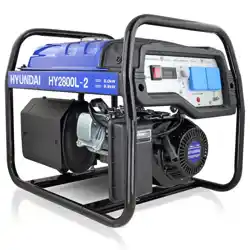
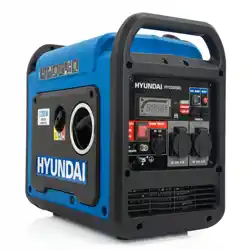
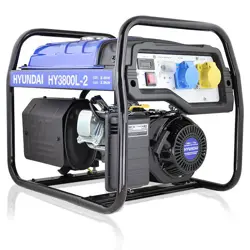
OPEN FRAME PETROL GENERATOR
HY2800L-2, HY3800L-2, HY3800LEK-2, HY7000LEK-2,
HY9000LEK-2, HY10000LEK-2
WARNING: Read the instructions carefully before use.

Page 2

CONTENTS
PAGE N
°
1
5
1.
SAFETY
4-
8
2.
UNPACKING & ASSEMBLY
8
-
9
3.
PARTS LOCATIONS
10
4.
PREPARATION FOR USE
11-12
5.
STARTING & STOPPING MACHINE
13 -16
6.
MAINTENANCE
17-20
7.
STORAGE & TRANSPORTATION
21
8.
SPECIFICATION
22
9.
RECYCLING & PRODUCT DISPOSAL
23
10.
DECLARATIONS of CONFORMITY
24-25
11.
CONTACT DETAILS
26
12.
MANUAL UPDATES
26
13.
WARRANTY
26
C
Page 3
1. SAFETY
1.1. General safety notes.
1.1.1. The operator of the machine is responsible for, and has a duty of care
in making sure that the machine is operated safely and in accordance
with the instrucons in this user manual. Keep the manual safe and pass
it on if the machine is loaned or sold to another user.
1.1.2. Please note the following safety points.
1.1.2.1. The machine should never be left it in a condion which would allow
an untrained or unauthorised person/s to operate this machine.
1.1.2.1.1. All due care and diligence should be taken by the
operator for the safety of, and with regard to, those around
whilst using the machine.
1.1.2.1.2.
Some or all of the following -warning signs, symbols
and/or PPE pictograms may appear throughout this manual.
You MUST adhere to their warning/s. Failure to do so may
result in personal injury to yourself or those around you.
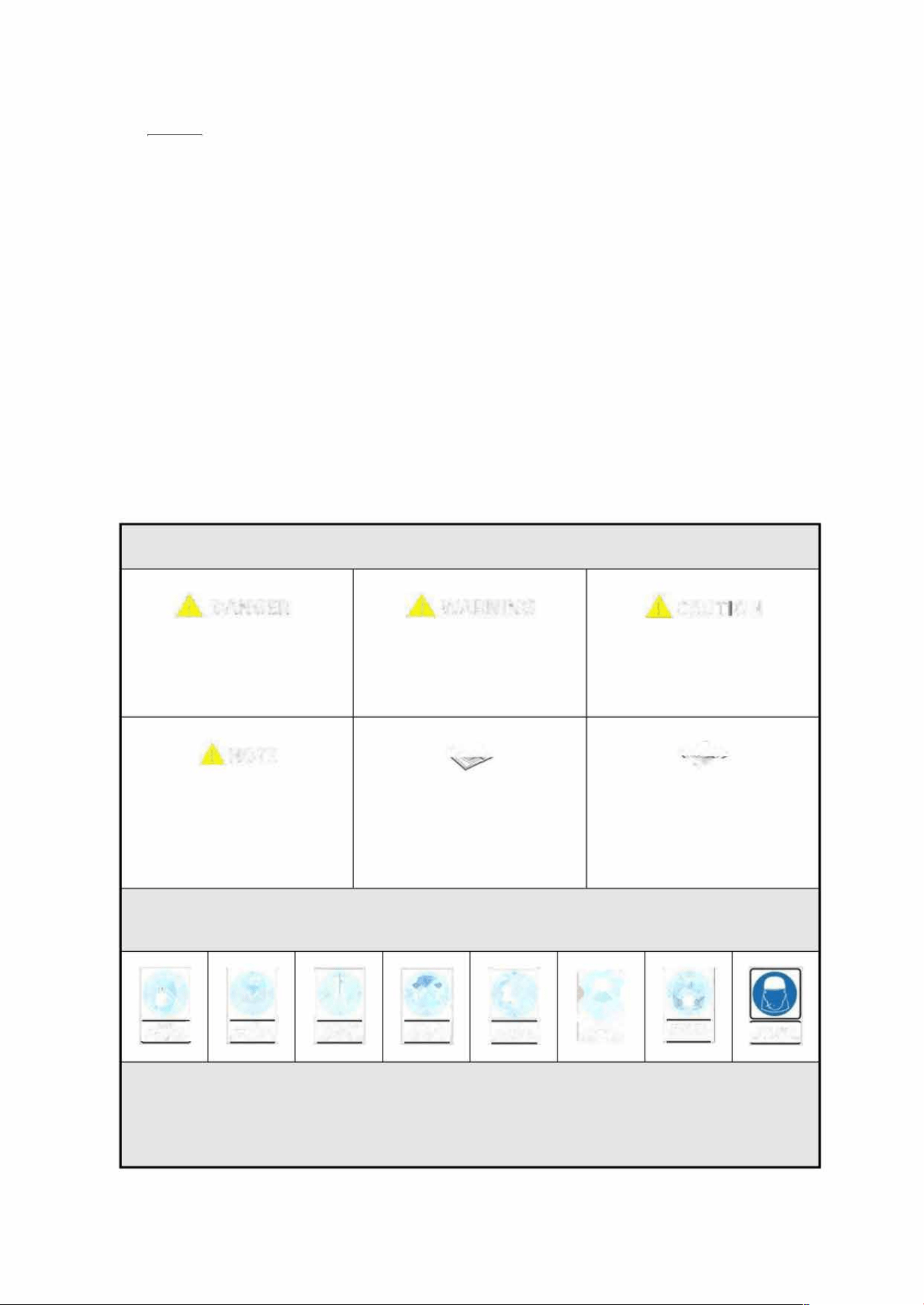
The FOLLOWING safety notes will help avoid or reduce risk of injury or death.
DANGER
WARNING
UTON
Indicates a hazard, which, if Indicates a hazard, which, if
Indicates a hazard which, if
not avoided, could result in not avoided, could result in
not avoided, might result in
serious injury or death.
serious injury.
minor or moderate injury.
&NOTE
�
�
�
Indicates a situation that
READ and keep the manual
You MUST fully read
could easily result in
safe and pass it on if the
instructions to make sure
equipment damage.
machine is loaned or sold
you use and operate
to another user.
machine safely.
Appropriate Personal Protective Equipment (PPE)
MUST be worn at all times when machine is in use or being repaired.
a
-
m
g
�
�
I .
l==I
l�I
l�I
l�I �
Jw��1
I
fAC,I
KN
TH�
ALWAYS keep the working area clear of non-essenal people to include, but not
limited to, children, the elderly and vulnerable persons.
NEVER ALLOW an untrained person to use this machine.
Page 4
1.2. Carbon monoxide.
1.2.1. Carbon monoxide is a colourless and odourless gas. Inhaling this gas can cause
death as well as serious long term health problems such as brain damage.
1.2.2. The symptoms of carbon monoxide poisoning can include but are not limited
to the following;
Headaches, dizziness, nausea, breathlessness,
collapsing or loss of consciousness.
1.2.2.1. Carbon monoxide poisoning symptoms are similar to flu, food
poisoning, viral infecons and simply redness. It is quite common for
people to mistake this very dangerous poisoning for something else.
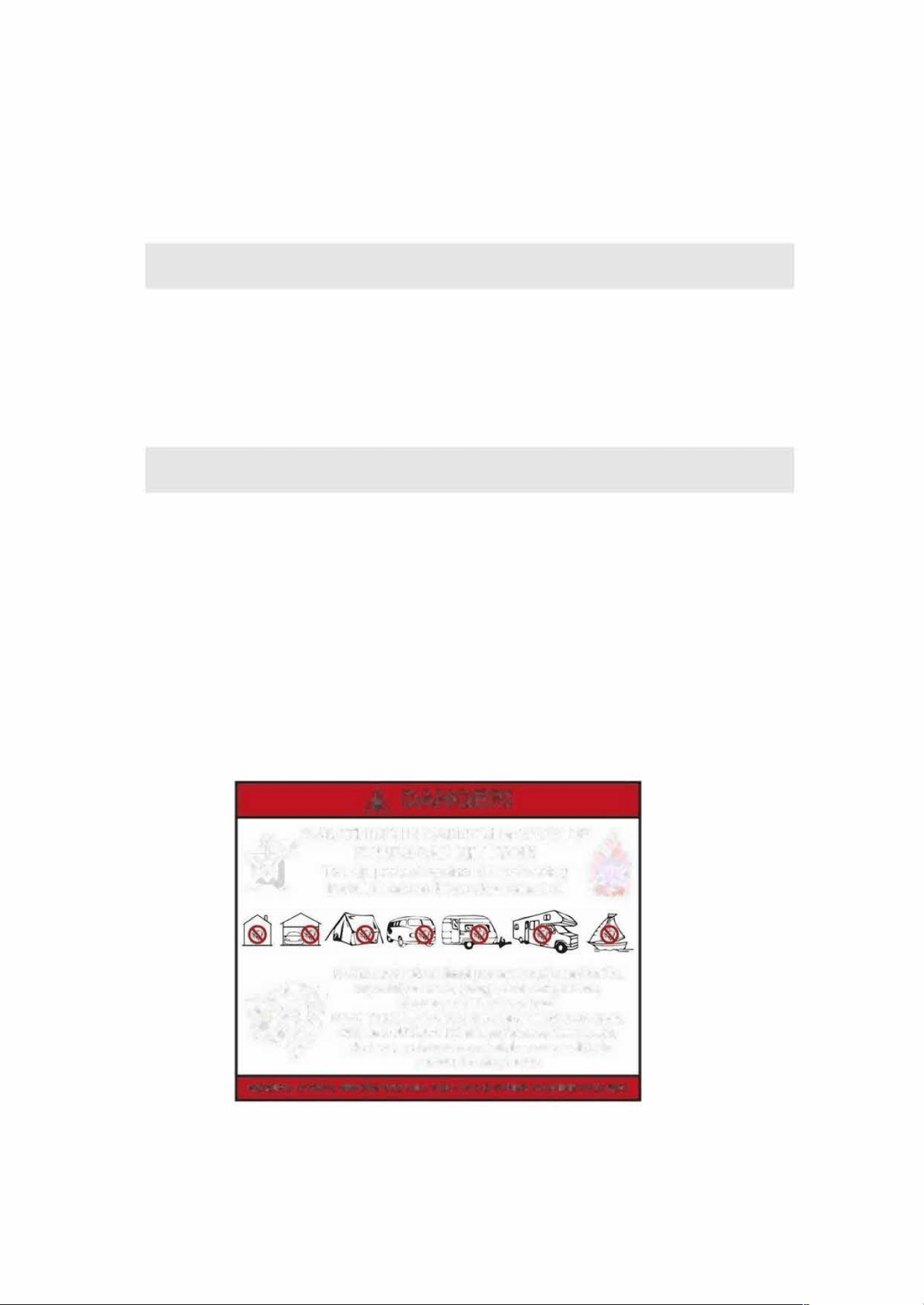
1.2.2.2. To avoid carbon monoxide poisoning DO NOT use Petrol/Diesel
powered equipment inside any of the following;
Home, garage, tent, camper van, mobile home,
caravan or boat.
This list is not exhausve and if you are in any doubt contact your dealer.
1.2.3. If you think you have or someone around you has been aected by carbon
monoxide poisoning;
1.2.3.1. Get them fresh air immediately, by leaving the aected area or by
opening doors and windows. If safe and praccal to do so make sure that
the machine is turned o. DO NOT enter a room you suspect of having
carbon monoxide present - instead call the emergency services.
1.2.3.2. Contact a doctor immediately or go to hospital - let them know that you
suspect carbon monoxide poisoning.
1.2.4.
DO NOT use in an enclosed area or a moving vehicle.
A DANGER!
BREATHING IN CARBON MONOXIDE
'
.
FUMES CAN KILL YOU!
•
help protect against CO poisoning
e
m install a Carbon Monoxide detector. •�.,
NER use Petrol/Diesel powered equipment inside,
•
pecially a home, garage, tent, camper-van,
caravan, motorhome or boat.
EN if doo, windows, vents and hatches are open.
Only use OUTDRS and as far away om doors,
windows, vents and open hatches as poible to
prevent inhaling fumes.
RDING NUAL BEFORE USE WILL HELP AVOID OTHER CHINE RDS.
Page 5
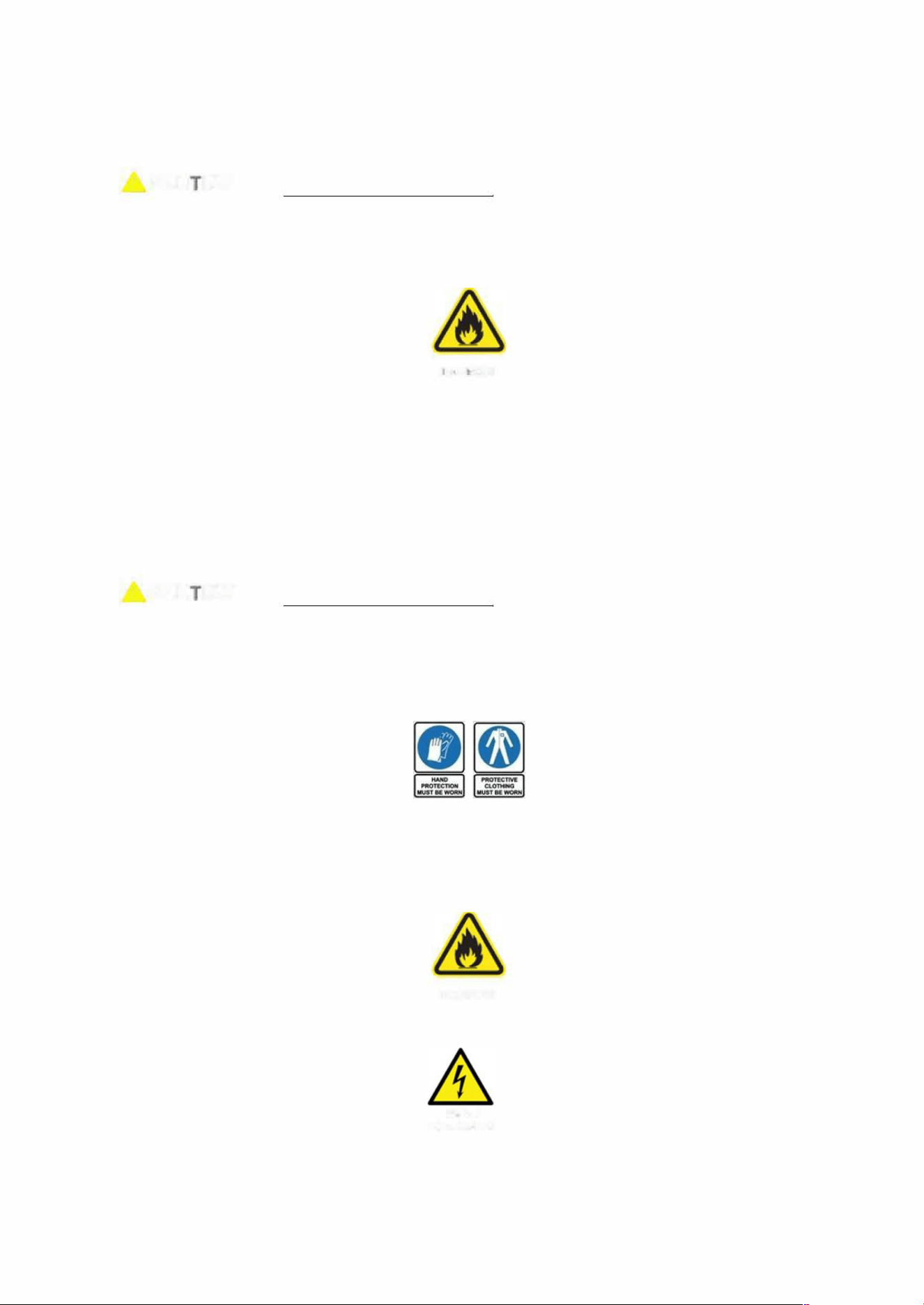
1.3. General fuel safety.
U ION
ALL FUELS ARE FLAMMABLE
1.3.1. Fire hazard - keep fuel away from all sources of ignion for example
heaters, lamps, sparks from grinding or welding.
Fire Hazard
1.3.2. DO NOT carry out hot work on tanks that have contained fuel it
is extremely dangerous.
1.3.3. ALWAYS keep work area clean and dy.
1.3.4.ALWAYS clean up all spills promptly using correct methods i.e.
absorbent granules and a lidded bin.
1.3.5. ALWAYS dispose of waste fuels correctly.
1.4. Fueling/De-fueling (where applicable).
U ION
ALL FUELS ARE FLAMMABLE
1.4.1. ALWAYS fuel and defuel in a well-venlated area outside of buildings.
1.4.2.ALWAYS wear correct, suitable and t for purpose Personal Protecve
Equipment (PPE), suggested items are but not limited to safety gloves
and overalls.
1.4.3.
When fueling/de-fueling ALWAYS avoid inhaling fumes
1.4.4.
When de-fueling ALWAYS use a propriety fuel retriever.
1.4.5.
ALWAYS carry fuel in the correct and clearly marked container.
1.5. Electrical safety.
Fire Hazard
Risk of
electric shk
1.5.1.
Electricity can kill - NEVER work on LIVE/ENERGISED equipment.
Page 6

1.5.2. Prior to carrying out any maintenance work you MUST Idenfy electrical
isolaon methods and isolate all electrical supplies,
1.5.3.Prior to use and with all electrical supplies isolated You MUST check all
electrical cables, plugs and connecons for the following;
1.5.3.1. Are intact and have no signs of damage, to include but not limited to
bare wires, chafng, cuts and loose wiring.
1.5.3.2. If there are any signs of damage, the damaged item MUST be taken
out of service unl the damage has been repaired by an electrically
competent person.
1.5.3.3. All trailing cables should be routed so as not to cause any kind of trip
hazard.
1.5.3.4. NEVER work on or near electricity with wet hands, wet clothing, and
wet gloves.
1.6. Baeries (Not ed on HY2800L-2/
&
HY3800L-2 models) .
.
.
Corrosive
1.6.1. Baeries present a risk if they become damaged by the possible leaking of
electrolyte. This electrolyte is an acid and can cause serious burn injuries. Care
should be taken when working on or near them. NOTE the electrolyte may be
in liquid or gel form.
1.6.2. Should you come into contact with electrolyte you should;
1.6.2.1. Remove all clothing contaminated with electrolyte. If you cannot
remove then saturate in water.
1.6.2.2. Get medical assistance as soon as possible. You must advise the
medical sta of the type acid.
1.6.2.2.1.
Lead/acid battery= dilute sulphuric acid
1.6.2.2.2. Nickel/cadmium= potassium hydroxide alkali electrolyte.
1.6.2.3. Use fresh running water to wash o excess electrolyte, continue this
until medical assistance arrives. Make sure that you do not wash the
electrolyte to another part of the face or body.
1.6.2.4. If electrolyte comes into contact with Eyes the electrolyte needs to be
immediately washed away with large amounts of water. Make sure that you
do not wash the electrolyte to another part of the face or body.
1.6.3.Gasses from charging batteries are highly flammable and great care should
be taken to charge in well ventilated areas.
1.6.4.There is an explosion risk if the baery terminals are short circuited, when
connecng/dis-connecng ALWAYS exercise great care so that the terminals
or baery leads are NOT allowed to touch and cause a spark. ALWAYS use
suitable insulated tools.
Risk of
explosi
Page 7

1.7. Noise.
1.7.1.The operang noise of the machine can damage your hearing. Wear hearing
protecon such as earplugs or ear defenders to protect your hearing. Long
term and regular users are advised to have hearing checked regularly. Be
especially vigilant and cauous when wearing hearing protecon because your
ability to hear alarm warnings will be reduced.
1.7.2. Noise emissions for this equipment is unavoidable. Carry out noisy work at
approved mes and for certain periods. Limit the working me to a minimum.
For your personal protecon and protecon of people working nearby it is also
advisable for them to wear hearing protecon.
1.7.3.See CERTIFICATE of CONFORMITY secon for Outdoor Noise declaraon of
conformity.
2. UNPACKING & ASSEMBLY
2.1. Unpacking.
2.1.1.
Place the carton on a rm flat surface.
2.1.2.
Remove everything from the carton except the generator.
2.1.3.
Open the carton by carefully cung the carton down each corner, being
careful not to cut the machine.
2.1.4.
Leave the generator on the carton while you install the wheel kit.
N.B. The HY2800L-2/HY3800L-2 versions DO NOT come with wheel kits.
2.2. Packing contents.
2.2.1.
Owner's manual - quantity 1.
2.2.2.
Wheels - quantity 2.
2.2.3.
Handle assembly - quantity 1.
2.2.4.
Wheel axle - quantity 2.
2.2.5.
Hardware bag comprising of;
2.2.5.1.
Spark plug socket - quantity 1.
2.2.5.2.
Socket bar- quantity 1.
N.B. The above packaging contents in this manual are for reference only and do not
represent for any specic model.
2.3. Assembly.
2.3.1.
The generator requires some assembly prior to first use.
2.3.2.
The wheels are designed to give improved the portability.
Page 8
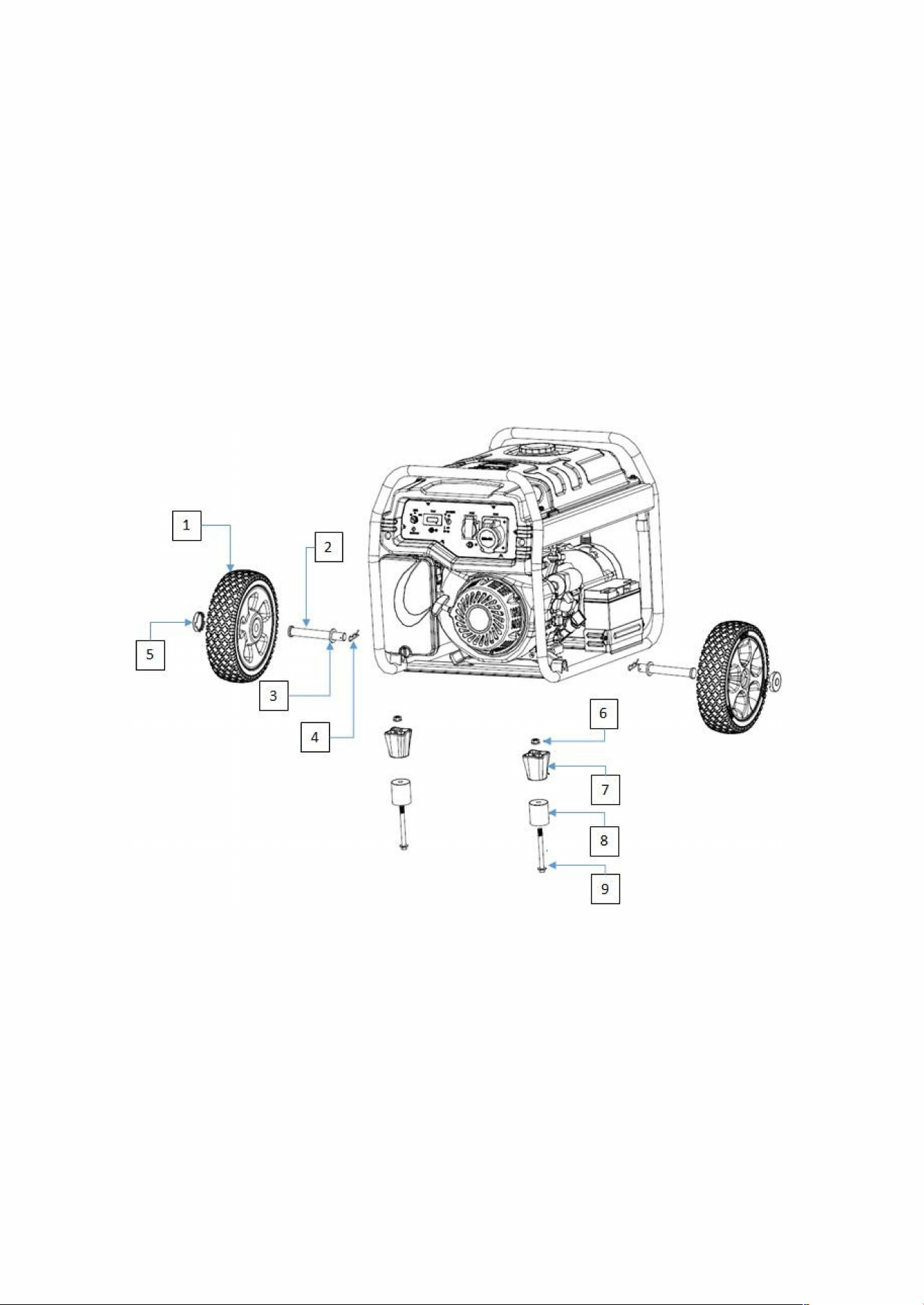
2.3.3.1.
2.3.3.2.
N.B. The wheels are NOT intended for on road use.
2.3.3. To install the wheels.
Slide the axle (2) through the wheel (1) from the outside then pass the
axle through the flat washer (3) and through the frame.
Once axle is passed through the frame put the 'P' clip (4) through the axle
hole.
2.3.4. To fit the rubber feet.
2.3.4.1.
Pass the bolt (9) through the rubber pad (8) and support (7).
2.3.4.2.
Pass the end of the M8 bolt (9) through the frame and secure it in place
with the M8 nut (6).
Page 9
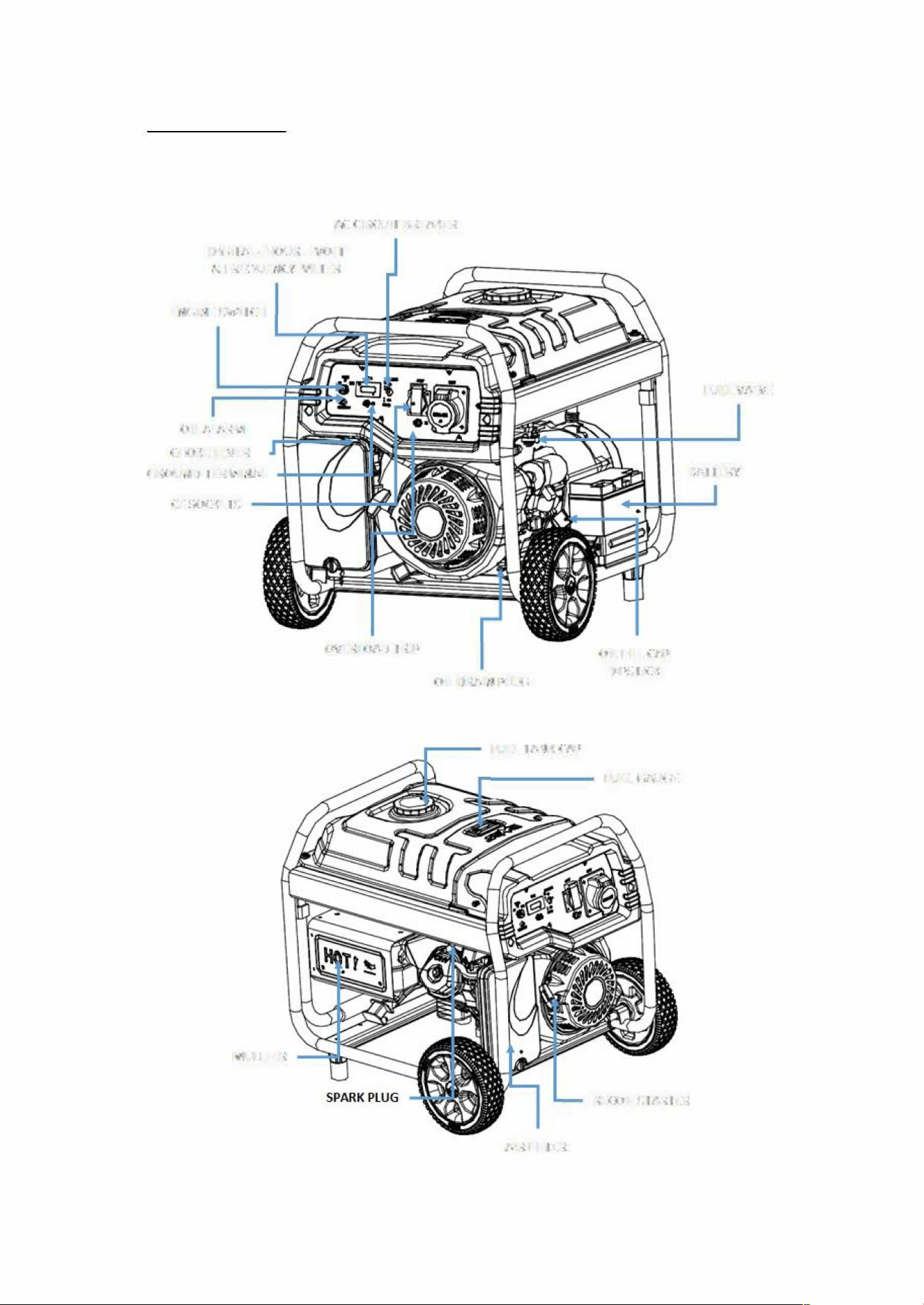
3. PARTS LOCATIONS
3.1. Generic locaons - locaons may vary slightly between models.
A GRCUll BREAKER
DIGllAL - HOUR - VOLl
& FREQUENCY METER
ENGINE SWffCH
OILARM
CHOKE LEVER
GROUND lERMINAL
CE SOCKHS
MUFFLER
OVERWAD TRIP
OIL DRAIN PLUG
FUEL TANK C
AIR FILTER
Page 10
OIL FILL CAP
DIPSTICK
FUEL GAUGE
FUEL VALVE
BAERY
REGOIL STARlER
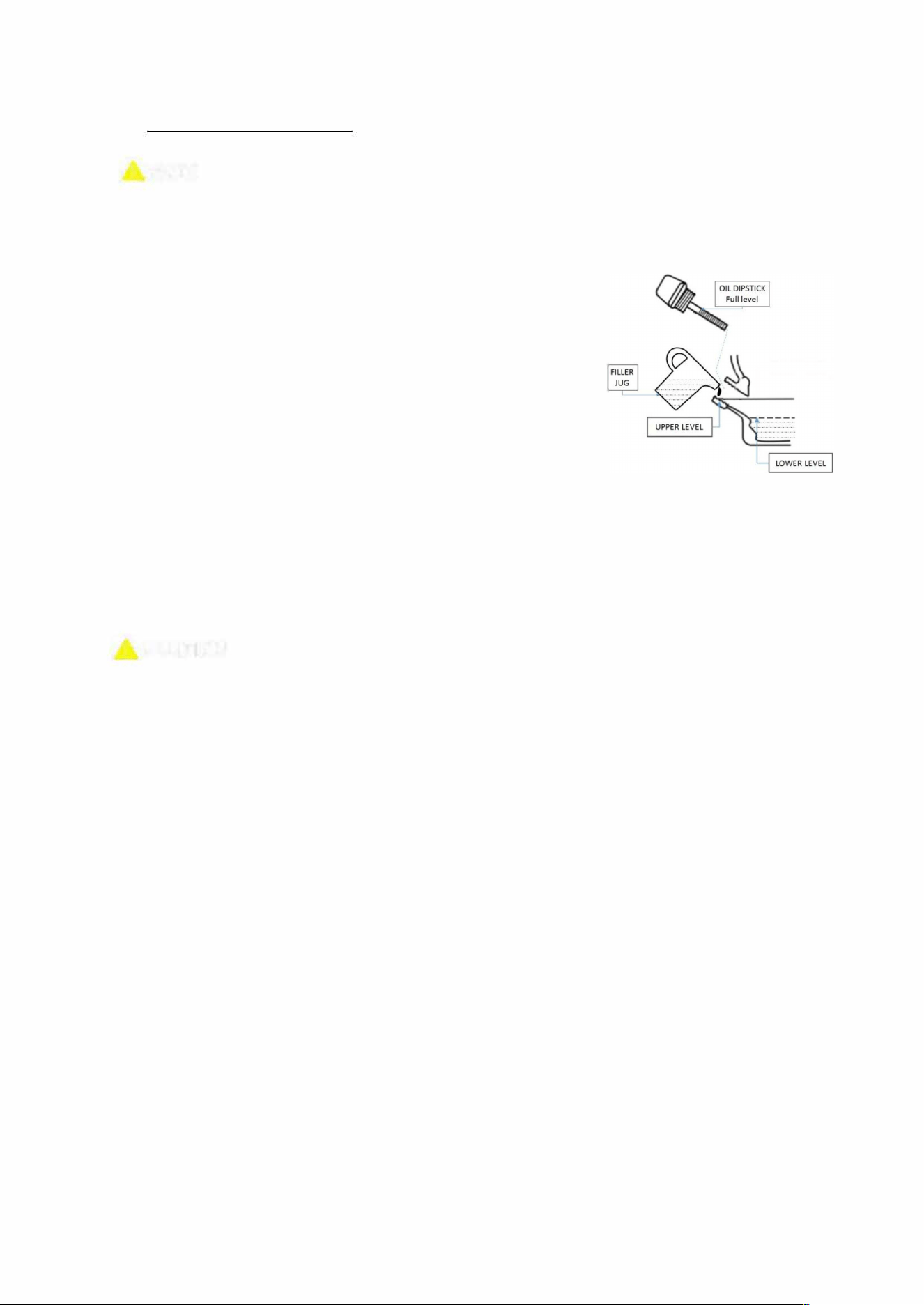
4. PREPARATION BEFORE USE
&NOTE
The machine is shipped without oil - You MUST add oil before using this machine.
4.1. Oil type - SAE15W40.
4.2. Adding oil.
4.2.1.
Place the generator on a flat, level surface.
4.2.2.
Clean area around oil filler and remove oil cap and
dipsck. Wipe the dipsck clean.
4.2.3.
Slowly fill the engine with oil through the oil
filler unl it reaches the upper thread of the
ller hole or to the full mark on the dipsck.
4.2.4.
Stop lling occasionally to check oil level. DO
NOT over ll.
4.2.5.
Ret the oil ller cap and make sure the cap is ghtened.
4.2.6.
You MUST check engine oil level before starng every session.
4.3. Fuel type Unleaded Petrol.
4.4. Adding fuel.
UTION
Do not overll the fuel tank you MUST allow space for fuel expansion. If the fuel tank is
overfilled, fuel can overflow onto a HOT engine and cause FIRE and/or EXPLOSION. If fuel
does spill, wait until it evaporates before starting engine. Check fuel lines, tank, cap and
tngs frequently for cracks or leaks. Replace as required.
4.4.1.
DO NOT light cigarettes or smoke when lling the fuel tank. Fuel is
highly FLAMMABLE and it's vapours are EXPLOSIVE.
4.4.2.
NEVER fill fuel tank when engine is running or hot. Turn generator engine OFF
and allow engine to cool entirely before lling fuel tank.
4.4.3.
Avoid spilling petrol onto HOT engine.
4.4.4.
Keep fuel away from sparks, open flames, pilot lights, heat, and other sources
of ignition.
4.4.5.
DO NOT mix oil with petrol.
4.4.6. Once fueling has finished refit the fuel cap and fully ghten. Wipe up any
spilled fuel before starng machine.
Page 11
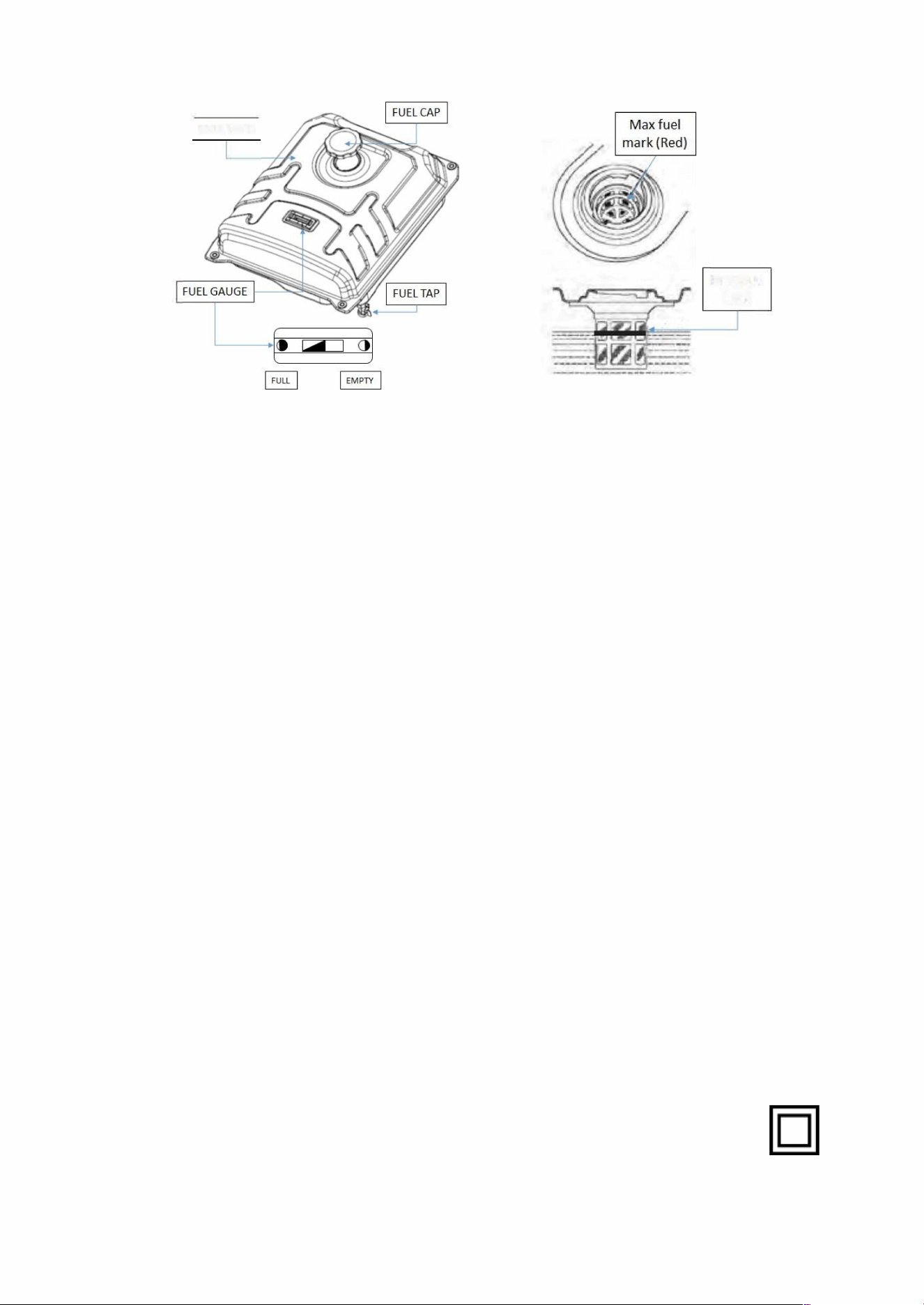
I FUEL NK I
Max fuel
level
4.4.7.
IMPORTANT: To prevent gum deposits from forming in fuel system parts such
as the carburetor, fuel hose or tank during storage. Alcohol-blended fuels
(called gasohol), ethanol or methanol can aract moisture, which leads to
separaon and formaon of acids during storage. Acidic gas can damage the
fuel system. Fuel should be emped before storage for 30 days or longer. See
the "Storage" secon. NEVER use engine or carburetor cleaner products in the
fuel tank as permanent damage may occur.
4.5. Grounding (Earthing) the generator.
4.5.1.
The Requirement for Electrical Installaons BS 7971:2008 requires that the
frame and external electrically conducve part of this generator be properly
connected to an approved earth ground.
4.5.2.
Proper grounding of the generator will help prevent electric shock in the
event of ground fault condition in the generator or in connected electrical
devices.
4.5.3.
Proper grounding also helps dissipate static electricity, which often builds up in
ungrounded devices.
4.6. Floating earth portable generator use.
4.6.1. This range of generators adopt a floating earth conguration which means that
the Neutral of the alternator is not connected to the Earth of the machine.
4.6.2. It is therefore IMPORTANT that you ONLY use the generator to supply
equipment in the following combinations.
4.6.2.1. One or more of CLASS II equipment
4.6.2.2.
Only ONE item of Class I equipment
4.6.2.3. One or more of CLASS II equipment and only ONE item of Class I
equipment.
4.6.3. CLASS I equipment has a GREEN/YELLOW earth wire connected inside the plug.
4.6.4. CLASS II equipment DOES NOT have GREEN/YELLOW earth wire connected
inside the plug.
4.6.5. CLASS II equipment will have the following symbol embossed or
printed on the casing.
Page 12
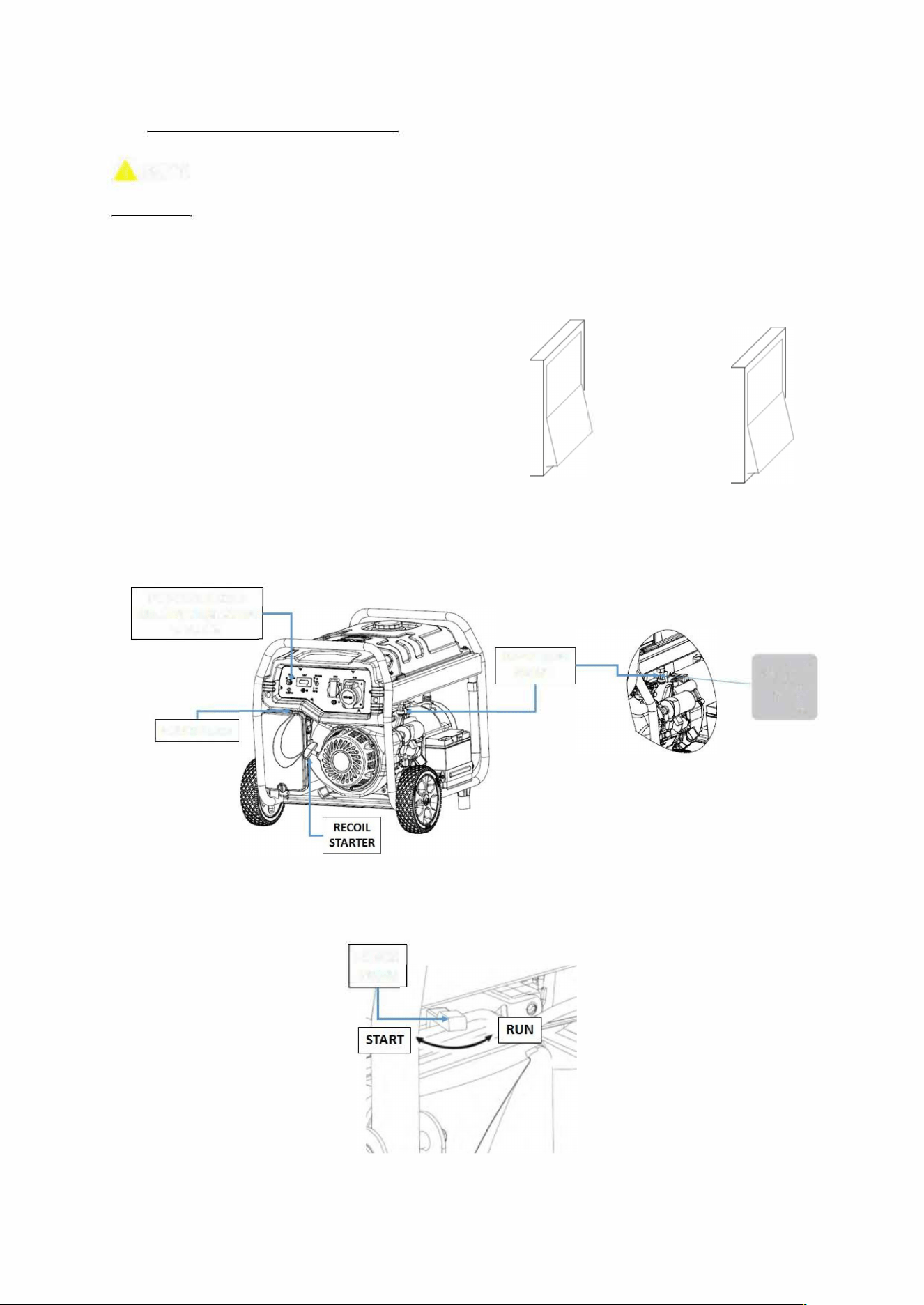
5.
STARTING & STOPPING MACHINE
NOTE
WARNING
NEVER start or stop engine with electrical devices plugged into the power
outlets and devices turned on. Unplug all electrical loads from the unit's power
outlets, or make sure that the main breaker is OFF (down) posion, before starng
the engine.
5.1. Starng the engine - Recoil start.
5.1.1. On HY2800L-2/HY3800L-2
models press the engine switch (2
posion switch) to ON posion, on
HY3800LEK-2, HY7000LEK-2,
HY9000LEK-2 & HYl0000LEK-2 models
press the engine switch (3 posion
switch) to ON then to START posion.
HY28l-2/HY38l-2 models
HY38LEK-2, HY7LEK-2, HY9000LEK-2 &
HYtLEK-2 models
5.1.2.
Turn the fuel tap to the ON posion.
ON/OFF SWITCH or
KEYSWITCH depending
on model
CHOKE LEVER
ON
OFF
ENGINE FUEL
SWITCH
5.1.3.
Move the engine choke lever to the START position.
CHOKE
LEVER
Page 13
SRT
ON
OFF
�
�
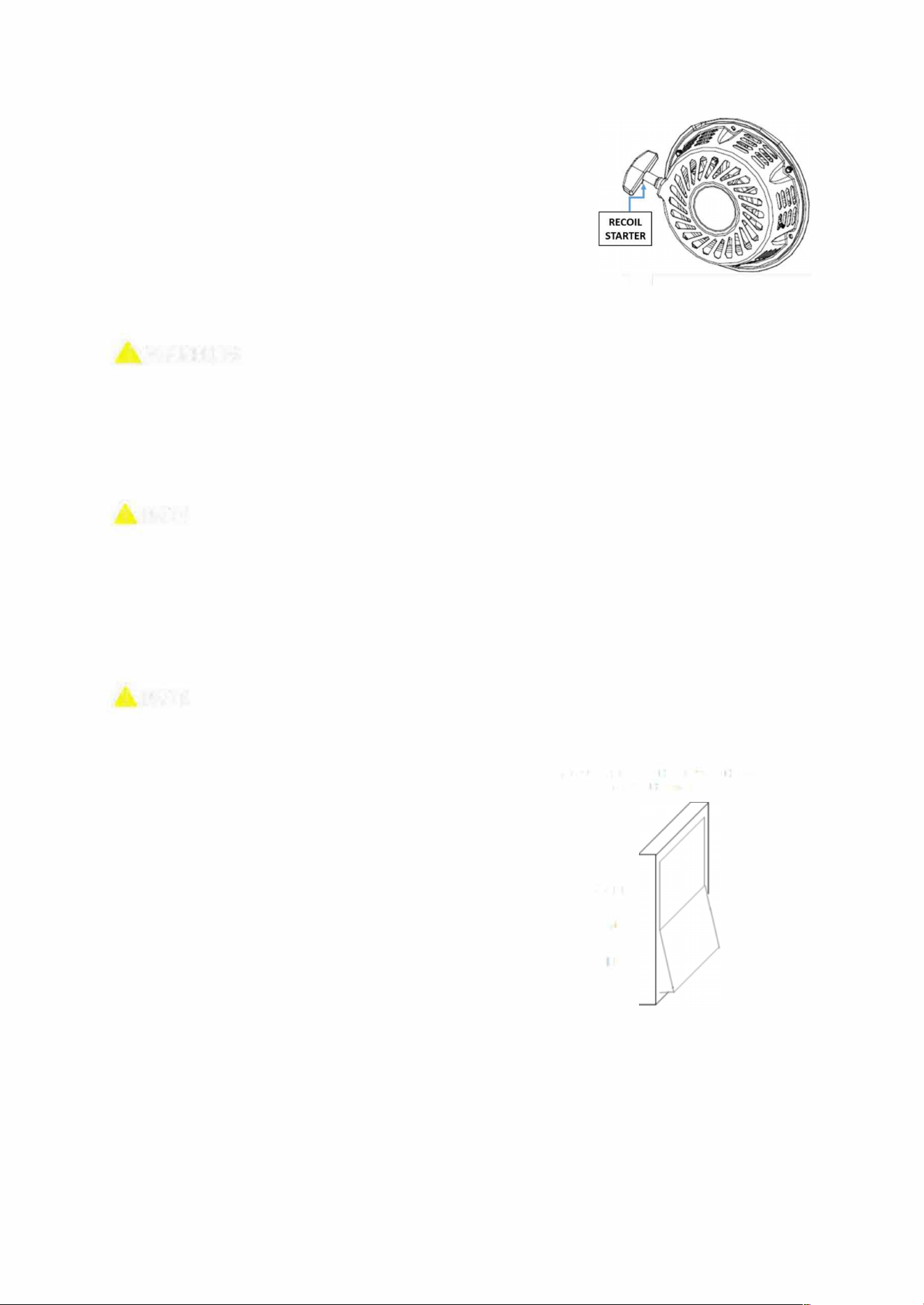
5.1.4.
For recoil start, rmly grasp the recoil handle
and pull slowly unl increased resistance is felt.
Then pull rapidly up and away.
5.1.5. When the engine starts, move choke lever to the
½ - choke posion ll engine runs smoothly and
then to RUN posion. If engine falters, move
the choke lever back to½ - choke posion unl
engine runs smoothly and then fully RUN
posion again.
WARNING
Starter cord kickback (rapid retracon) will pull hand and arm toward engine faster than you
can let go which could cause broken bones, fractures, bruises, or sprains resulng in serious
injury. When starng engine, pull cord slowly unl resistance is felt and then pull rapidly to
avoid kickback. NEVER wrap the starter cord around your hand.
NOTE
If engine fails to start aer 3 pulls, or if unit shuts down during operaon. Make
sure the unit is on a flat level surface and check for proper oil level in crankcase. This
engine is equipped with a low oil level protecon device.
5.2. For electric start.
NOTE
If battery is discharged or unavailable, use manual starting instructions as above.
5.2.1.
Follow steps 5.1.1. To 5.1.3.
5.2.2.
Press and hold the switch at
the "START" position until
generator starts.
HY38LEK-2, HY7LEK-2, HY9LEK-2 &
HYlLEK-2 models
SRT
ON
OFF
5.2.3.
To prolong the life of starter motor and starter components, DO NOT press
the start switch in the "START" posion for more than 5 seconds, you MUST
then pause for at least 1 minute between starng aempts.
5.2.4.
When the engine starts, move the choke lever to½ - choke posion ll engine
runs smoothly and then to RUN posion. If the engine falters, move the
choke lever back to½ - choke posion unl engine runs smoothly and then
fully RUN posion again.
Page 14

WARNING
Exhaust system heat and/or gases could ignite combusble, structures or damage the fuel
tank causing a re, resulng in death, serious injury and/or property damage. Contact with
muer area could cause burn resulng in serious injury.
DO NOT touch hot part and AVOID hot exhaust gases.
You MUST allow the equipment to cool before touching.
Keep at least 5 feet (152 cm) of clearance on all sides of generator including overhead.
IMPORTANT
DO NOT overload the generator. DO NOT overload individual output sockets.
These outlet sockets are protected against overload with push-to-reset-type circuit
breakers. If current rang of any circuit breaker is exceeded, that breaker will open and the
electrical output to that socket will be lost.
5.3. Connecng electrical loads.
5.3.1.
Let the engine run unl the rpm is stable and has been allowed to warm up for a
few minutes after starng.
5.3.1.1. Then plug in and turn on the electrical loads.
5.3.1.2. Add up the rated was (or amps) of all loads to be connected
at one me. This total should not be greater than;
5.3.1.2.1.
The circuit breaker rang of the output socket supplying the power
or,
5.3.1.2.2.
NOTE
The rated waage/current capacity of the generator.
Connect all electrical loads in the OFF position then turn ON for operation.
Turn all electrical loads OFF and disconnect from generator before stopping generator. #
Exceeding generators wattage/current capacity could damage generator and/or electrical
devices connected to it.
DO NOT exceed the generator's wattage/current capacity.
# Failure to disconnect the electrical load before switching the generator OFF may
damage the AVR.
5.4. Overloading.
5.4.1.
Overloading a generator in excess of its rated wattage capacity can result in
damage to the generator and to connected electrical devices.
5.4.2. Observe the following to prevent overloading of the unit;
5.4.2.1.
Add up the total waage of all electrical devices to be connected at one
me. This total should NOT be greater than the generator's waage
5.4.2.2.
capacity.
The rated waage of lights can be taken from light bulbs. The rated
waage of tools, appliances and motors can usually be found on a data
label or decal afxed to the devices. If the appliance, tool or motor does
not give waage, mulply volts mes ampere rang to determine was
(volts x amps= was).
Page 15

5.4.2.3.
5.4.2.3.1.
5.4.2.3.2.
Some electrical inducon motors, require about three mes more power
for starng than for running. This surge of power only lasts a few seconds
when starng. You MUST make sure you allow for high starng waage
when selecng electrical devices to connect to the generator;
Calculate the was needed to start the largest motor.
Add to that figure the running was of all other connected
loads. Start the largest motor first and only one motor at a me.
5.5. Stopping the engine.
5.5.1.
Switch o all loads then unplug them from the generator outlet sockets.
NEVER start or stop the engine with electrical devices plugged in and
turned on. Switch the main breaker down (OFF).
5.5.2.
Let the engine run with no-load for several minutes to stabilise the internal
temperatures of engine and generator.
5.5.3.
Move the engine switch to the OFF posion,
5.5.4.
Close the fuel valve.
5.6. Low oil level system shutdown.
5.6.1.
The engine is equipped with a low oil level sensor that shuts down the engine
automacally when the oil level drops below a specied level.
5.6.2. If the engine shuts down by itself and the fuel tank has enough petrol, check
the engine oil level. Engine oil level should be checked daily.
5.7. High altude.
5.7.1.
To remain emissions compliant at high altude (altudes over 5,000 feet or
1524 meters) adjustment is required. This adjustment will cause decreased
performance, increased fuel consumption, and increased emissions. Contact
your dealer for high altitude adjustment information.
5.7.2. Operation of the engine at altitudes below 2,500 feet or 762 meters with the
high altitude kit is not recommended.
Page 16

6. MAINTENANCE
6.1. Follow the maintenance intervals shown below. More frequent service is required
when operang in adverse condions.
MAINTENANCE SCHEDULE
Aer rst 10 hours
Change the engine oil - use SAE15W40
Clean the machine
Every 8 hours or Daily
Check the engine oil level
Every 25 hours or Yearly
Clean the engine air lter
Every 100 hours oR Yearly
Change the engine oil - use SAE15W40
Replace the engine air lter
Service the fuel valve
Yearly
Service the spark plug
Check the muer and the spark arrester
Clean the cooling system
6.2. General recommendaons.
6.2.1.
The warranty of the generator does not cover items that have been subjected to
operator abuse or negligence. To receive full value from the warranty, the
operator must maintain the generator as instructed in this manual. Some
adjustments will need to be made periodically to properly maintain the generator.
6.2.2.
All adjustments in the Maintenance secon of this manual should be made at
least once each season. Follow the requirements in the "Maintenance Schedule".
IMPORTANT
Once a year replace the spark plug and the air lter. A new spark plug and a clean
air filter helps the engine run better and last longer.
6.2.3. Generator maintenance.
6.2.3.1.
Generator maintenance consists of keeping the unit clean and dry. Operate
and store the unit in a clean dry environment where it will not be exposed to
excessive dust, dirt, moisture or any corrosive vapors. Cooling air slots in the
generator must not become clogged with snow, leaves, or any other foreign
material. DO NOT use the machine where it can become exposed to rain,
snow, sleet or any other type of moisture.
6.2.3.2.
Check the cleanliness of the generator frequently and clean when dust, dirt,
oil, moisture or other foreign substances are visible on its exterior surface.
UTION
Never insert a nger, object or tool through the air cooling slots, even if the engine is not running.
NOTE
DO NOT use a garden hose or pressure washer to clean the generator. Water can enter the
engine fuel system and cause problems. In addition, if water enters the generator though
Page 17
the cooling air slots, some water will be retained in voids and crevices of the rotor and stator
winding insulaon which can cause electrical shorts circuits and damage the alternator. Water
and dirt build up on the generator internal windings will eventually decrease the insulaon
resistance of these windings.
6.2.4. Cleaning the external of the generator.
6.2.4.1.
Use a damp cloth to wipe the exterior surfaces.
6.2.4.2.
A so, bristle brush may be used to remove dirt, oil etc.
6.2.4.3.
A vacuum cleaner may be used to pick up loose dirt and debris.
6.2.4.4.
Low pressure air (not to exceed 25 psi) may be used to blow away dirt.
6.2.4.5.
Check cooling air slots and openings on the generator. These openings must
be kept clean and unobstructed.
6.3. Engine Maintenance.
WARNI G
When working on the generator, you MUST always disconnect the spark plug HT cable from the
spark plug and keep the cable away from the spark plug. The fuel tap should also be in the OFF
posion.
6.4. Oil change.
UTION
Hot oil may cause burns. Allow engine to cool before draining oil. Avoid prolonged or repeated
skin exposure to used oil. Thoroughly wash exposed areas with soap.
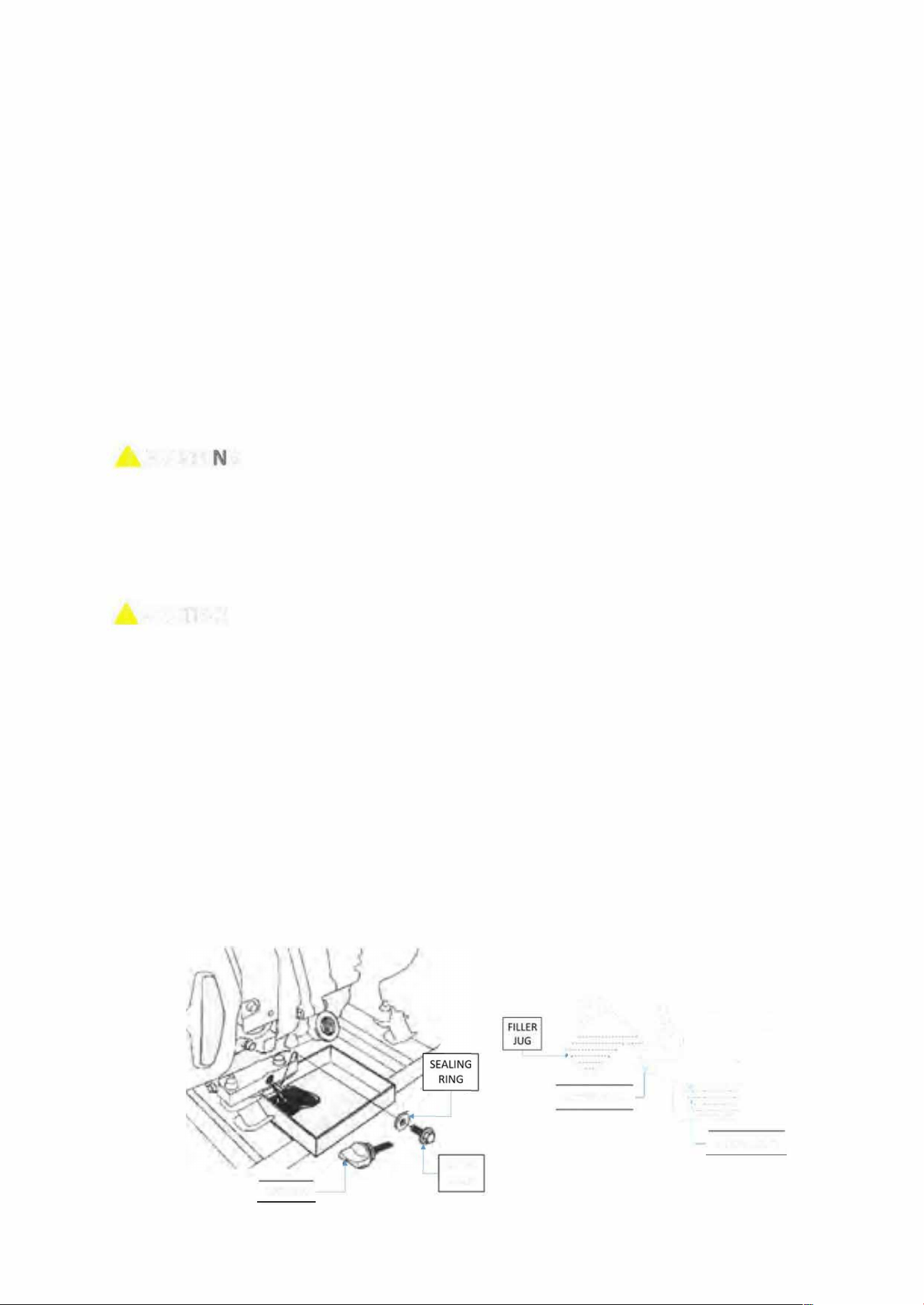
6.4.1.
Before starng you MUST allow the engine to cool down slightly. While the engine is
cooling down;
6.4.1.1.
Clean area around oil drain plug.
6.4.1.2. Remove oil drain plug and dipstick from the engine to drain oil completely
into a suitable container.
6.4.1.3.
When oil has completely drained, ret the oil drain plug and fully ghten.
6.4.1.4.
Fill the engine with recommended oil. SA15W40
6.4.1.5.
Wipe up any spilled oil.
6.4.1.6.
6.4.1.7.
Dispose of used oil at a proper collecon center.
Refit the dipstick.
��
I
UPPERLEVEL �
I DIPSTICK I
DRAIN
PLUG
Page 18
l
I
LOWER LEVEL I
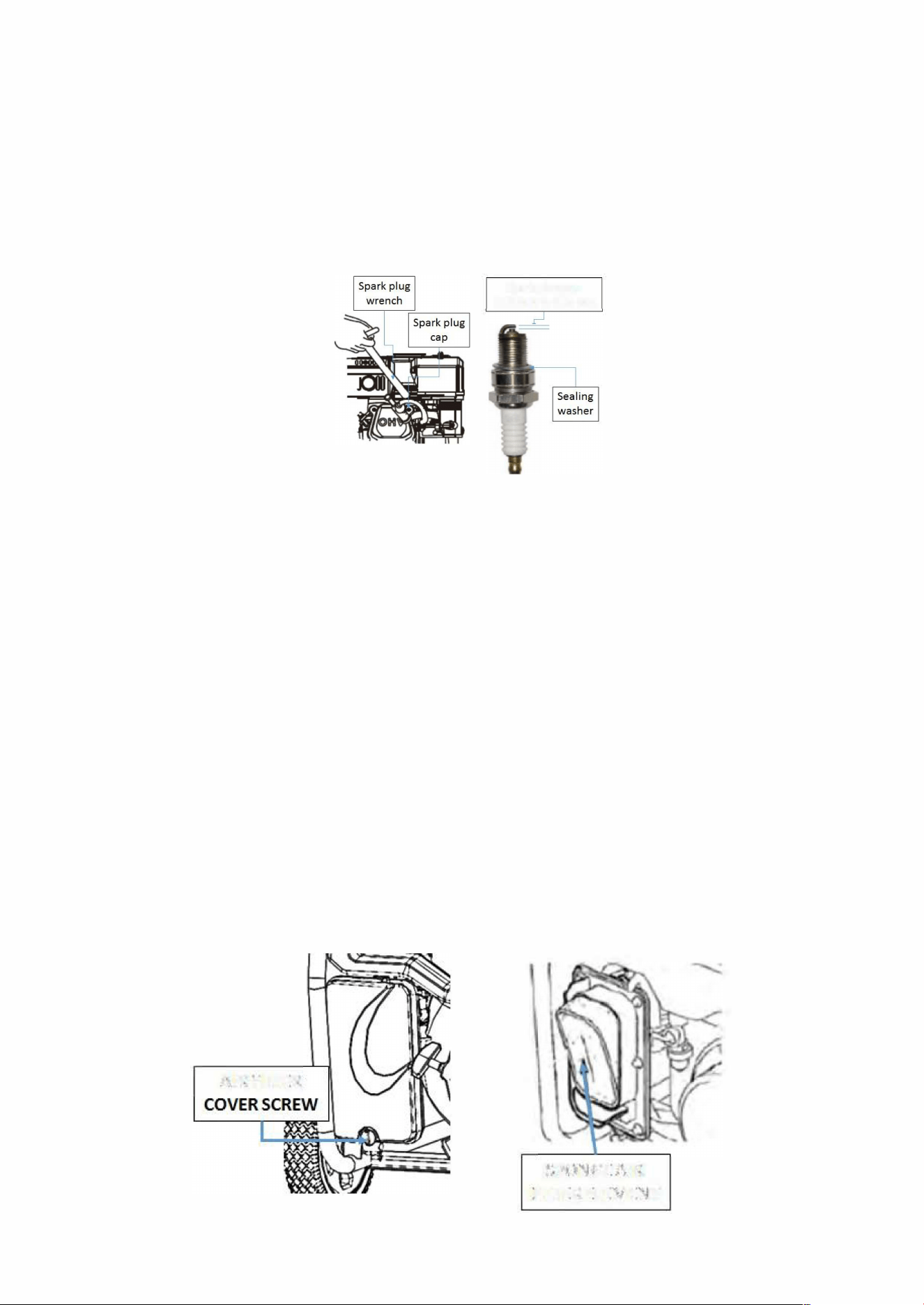
6.4.2. Spark plug replacement.
6.4.2.1.
Use spark plug F6TC, BPR4ES or Champion RN14YC. Replace the plug once
6.4.2.2.
6.4.2.3.
6.4.2.4.
each year. This will help the engine to start easier and run beer.
Stop the engine and remove the HT lead from the spark plug.
Clean the area around the spark plug and remove it from the cylinder head.
Set the spark plug's gap to 0. 70-0.80 mm (0.028-0.0 31 in.). Install the
correctly gapped spark plug into the cylinder head and torque to lS/lbs.
Spark plug gap
0.70 mm to 0.80 mm
6.4.3. Spark arrestor service.# Spark arrester tment may vary model to model.
6.4.3.1.
Shut o generator and allow the engine and muer to cool down
6.4.3.2.
6.4.3.3.
6.4.3.4.
6.4.3.5.
completely before servicing spark arrestor (located on the back of the
muer).
Remove the clamp and spark arrestor screen.
Clean the spark arrestor screen with a small wire brush.
Replace the spark arrestor if it is damaged.
Ret the spark arrestor.
6.4.4. Air lter service.
6.4.4.1.
The engine will not run properly and may be damaged if using a dirty air
6.4.4.2.
6.4.4.3.
6.4.4.4.
6.4.4.5.
6.4.4.6.
lter. Replace the air lter once a year. Clean or replace more often if
operating under dusty conditions.
Undo air filter cover screw and remove air lter cover.
Remove sponge lter element.
Wash lter element in soapy water. Squeeze lter dry in clean cloth (DO NOT
TWIST).
Clean air lter cover before re-installing it.
Put a drop of engine oil onto sponge lter element this will help avoid ice
blocking it during winter season.
AIR FILTER
Page 19
SPONGE AIR
FILTER ELEMENT

6.4.5. Valve clearances.
IMPORTANT
If you are not competent to carry out this procedure or the proper tools are not
available. We advise that you take the generator to your dealer to have the valve clearance
adjusted. This is a very important step to ensure longest life for the engine.
6.4.5.1.
Aer the rst 50 hours of operaon, check the valve clearance in the engine
and adjust if necessary.
6.4.6. General.
6.4.6.1.
The generator should be started at least once every seven days and be
allowed to run for at least 30 minutes. If this cannot be done and the unit
must be stored for more than 30 days, use the following informaon as a
guide to prepare it for storage .
WARNING
NEVER store engine with fuel in tank indoors or in enclosed, poorly venlated areas where
fumes may reach an open flame, spark or pilot light as on a furnace, water heater, clothes dryer
or other gas appliance.
WARNING
Drain the fuel into an approved container outdoors, away from open flame. Make sure that the
engine is cool. DO NOT smoke in the vicinity. NEVER cover the generator while the engine and
exhaust areas are HOT.
6.4.7.
DO NOT store petrol from one season to another.
6.4.8.
Replace the petrol container if it starts to rust. Rust and/or dirt in the petrol
will cause problems with the carburetor and fuel system.
6.4.9.
If possible, store the unit indoors and cover it to give it protecon from dust
and dirt.
6.4.10. Make sure that you empty the fuel tank.
6.4.11. If it is not praccal to empty the fuel tank and the unit is to be stored for some
me, use a commercially available fuel stabilizer added to the petrol to
increase the life of the petrol.
6.4.12. Cover the unit with a suitable protecve cover that does not retain moisture.
Page 20

7. STORAGE & TRANSPORTATION
7.1. Storage.
7.1.1.
It is important to avoid gum deposits from forming in essenal fuel system parts
such as the carburetor, fuel hose or tank during storage. Also, experience
indicates that alcohol-blended fuels (called gasohol, ethanol or methanol) can
aract moisture, which leads to separaon and formaon of acids storage. Acidic
gas can damage the fuel system of an engine while in storage.
7.1.2.
To avoid engine problems, the fuel system should be emped before storage of
30 days or longer, empty fuel system as follows;
7.1.2.1.
Remove all petrol from the fuel tank.
7.1.2.2.
Start and run engine unl engine stops from lack of fuel.
7.1.2.3.While engine is sll warm, drain oil from crankcase. Rell with
recommended grade engine oil - SAE15W40.
7.1.2.4. Remove the spark plug HT lead and spark plug and pour about 1/2 ounce (15
ml) of engine oil into the cylinder. Cover the spark plug hole with rag. Pull
the recoil starter a couple mes to lubricate the piston rings and cylinder
bore.
7.1.2.5. Install and ghten the spark plug. Do not re-connect spark plug HT lead.
7.1.3.
Clean the generator outer surfaces.
7.1.4.
Check that cooling air slots and openings on generator are clear of any obstrucons.
7.1.5.
Store the unit in a clean dry, dust and dirt free place which is clear of any
flammable and combusble materials.
7.2. Transportaon.
7.2.1.
To avoid burn injuries you MUST allow the machine to cool fully when moving
from one locaon to another. DO NOT move machine whilst it is sll hot.
7.2.2.
You MUST drain the fuel tank before moving in a vehicle. Turn the fuel tap to
the OFF position.
7.2.3.
To avoid injury or damage to the machine you MUST secure it whilst it is being
transported in a vehicle.
7.2.4. DO NOT use in an enclosed area or a moving vehicle.
Page 21
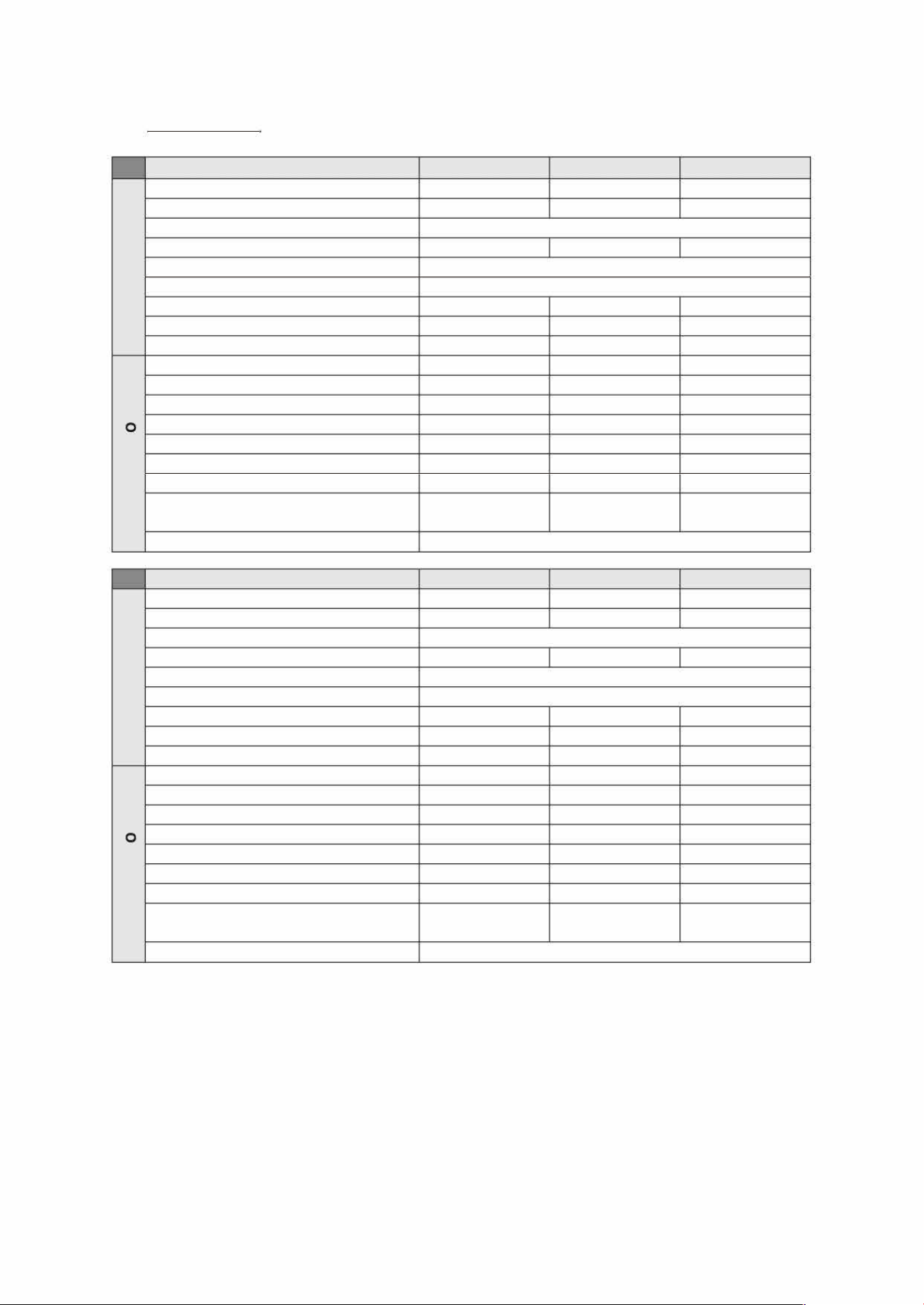
8. SPECIFICATION
MODEL
HV2800L-2
HV3800L-2
HV3800LEK-2
Engine-hp
6.5
7 7
Displacement -cc
196 208 208
Engine speed - rpm
3000
w
Fuel tank capacity -I
15 15 15
z
�
Fuel type
Straight unleaded petrol
z
Oil type
SAE15W40
w
Oil capacity - ml
600 600 600
Start method/s
Recoil Recoil Recoil/Electric
Baery size -volts
N/A N/A
12
Frequency -hz
50 50
50
Voltage/s
230
115/230 115/230
Connuous power -kw
2.0 2.8 2.8
Max power -kw
2.2 3.2 3.2
�
Run me on full load - hours
9.5
9.5
9.5
w
Run me on ½ load - hours
12.5
13.5 13.5
z
w
Sound level -dB (A)
96 96
96
Outlet sockets -quanty/amp/type
2 X 13A 230v
1 X 16A230v 1 X 16A230v
1 X 16A 115v 1 X 16A 115v
Digital meter
Hours/Volts/Frequency
MODEL
HV7000LEK-2 HY9000LEK-2 HYl0000LEK-2
Engine-hp
13
14
16
Displacement -cc 389
420
459
Engine speed - rpm
3000
w
Fuel tank capacity-I
25 25
25
z
�
Fuel type
Straight unleaded petrol
z
Oil type
SAE15W40
w
Oil capacity - ml
1100 1100 1100
Start method/s
Recoil/Electric Recoil/Electric Recoil/Electric
Baery size -volts
12 12 12
Frequency -hz
50 50 50
Voltage/s
115/230 115/230 115/230
Connuous power -kw
5.0 6.5
7.5
Max power -kw
5.5
7.0
8.0
�
Run me on full load - hours
7.8
6.2
6.4
w
Run me on ½ load - hours
13.5
11.2
11.5
z
w
Sound level -dB (A)
97
97
97
Outlet sockets -quanty/amp/type
2 X 16A 115v 2 X 16A 115v 2 X 16A 115v
1 X 32A 230v 1 X 32A230v 1 X 32A230v
Digital meter
Hours/Volts/Frequency
Page 22

9.
RECYCLING & PRODUCT DISPOSAL
9.1. We do not oer a takeback scheme for the recovery of Waste Electrical Electronic
Equipment (WEEE) & Baeries instead the responsibility to dispose of WEEE and or
Baeries is passed onto you by us. So when it becomes necessary to dispose of
your machine you must take it to your local Civic Amenity Site. For further
informaon please contact your Local Authority for disposal advice.
9.2. You MUST make sure that all unused oil and fuel is disposed of correctly either
beforehand or at your local Civic Amenity Site. Under NO circumstance must any
oil and fuel be put down any drains.
9.3. Waste Electrical Electronic Equipment (WEEE) recycling.
9.3.1.
Certain products contain WEEE waste which should not be disposed
of in your domesc waste.
9.3.2. You MUST recycle WEEE in accordance with your local authority or
recycling centre.
9.4. Baery recycling, certain products contain baeries which should not be
disposed of in your domesc waste.
9.4.1. You MUST recycle baeries in accordance with your local authority
or recycling centre.
9.5. Unwanted packaging materials should be sorted and taken to a recycling centre so
it can be disposed of in a manner which is compable with the environment.
9.6. The following symbol means that you should 'Reduce -Reuse -Recycle'.
9.7. We are a Member of the VALPAK Naonal Compliance scheme and our
registraon number is RM08660
9.8. For further information about disposal please contact your Local Authority.
9.9. You can also get more advice and guidance about recycling at the following
website http://www.recycle-more.co.uk
9.10.
Should you pass this product onto another user either sold or
loaned you MUST pass on this user manual. This will make sure that all
other users can use and maintain the machine safely.
Page 23

CE Declaraon of Conformity
In accordance with EN ISO 17050-1 :2010
We
Company name:
Postal address:
Postcode:
City:
Telephone number:
E-Mail address:
Genpower Ltd
Isaac Way, Pembroke Dock
SA72 4RW
Pembrokeshire
01646 687 880
Declare that the DoC is issued under our sole responsibility and belongs to the following product:
Model/Product: HY2800L-2, HY3800L-2, HY3800LEK-2, HY9000LEK-2, HYl0000LEK-2
Descripon Open Frame Petrol Generator
Object of the declaraon (idencaon of apparatus allowing traceability; it may include a colour image of sucient
clarity where necessary for the idencaon of the apparatus):
See Below
The object of the declaraon described above is in conformity with the relevant Union harmonisaon legislaon:
CE-MD direcve : (2006/42/EC)
2011/65/EU+(EU)2015/863
2000/14/EC Noise Emissions Direcve REACH SVHC 224
2004/108/EC Electromagnec Compability Direcve 2006/95/EC Low Voltage Direcve
EURO V : (EU) 2016/1628
97/68/EC Non Road Mobile Machinery Direcve
The following harmonised standards and technical specicaons have been applied:
Title, Date of standard/specicaon:
EN ISO 8528-13:2016
EN 60204-1:2018
EN ISO 12100:2010
EN 55012:2007+Al:2009
EN IEC 61000-6-1:2019
Signed for and on behalf of:
Genpower Ltd
01/12/2022
Roland Llewellin,
Managing Director
Page 24

UKCA Declaraon of Conformity
We
Company name:
Postal address:
Postcode:
City:
Telephone number:
E-Mail address:
In accordance with EN ISO 17050-1 :2010
Genpower Ltd
Isaac Way, Pembroke Dock
SA72 4RW
Pembrokeshire
01646 687 880
declare that the DoC is issued under our sole responsibility and belongs to the following product:
Model/Product: HY2800L-2, HY3800L-2, HY3800LEK-2, HY9000LEK-2, HYl0000LEK-2
Descripon Open Frame Petrol Generator
Object of the declaraon (idencaon of apparatus allowing traceability; it may include a colour image of sucient
clarity where necessary for the idencaon of the apparatus):
See Below
UK
CA
The object of the declaraon described above is in conformity with the relevant Union harmonisaon legislaon:
2008 (S.I. 2008/1597) Machinery Direcve
2000/14/EC Noise Emissions Direcve
Electromagnec Compability Regulaons 2016 (SI 2016
No. 1091)
EURO V : (EU) 2016/1628
2011/65/EU+(EU)2015/863
REACH SVHC 224
The following harmonised standards and technical specicaons have been applied:
Title, Date of standard/specicaon:
BS EN ISO 8528-13:2016 , EN 60204-1:2018 , EN ISO
12100:2010
EN 55012:2007+Al:2009
EN IEC 61000-6-1:2019
Signed for and on behalf of:
Genpower Ltd
01/12/2022
Roland Llewellin,
Managing Director
Page 25

11. CONTACT DETAILS
11.1.
POSTAL ADDRESS
Genpower Ltd, Isaac Way, London Road,
Pembroke Dock, Pembrokeshire, SA72
4RW. UK.
11.2. TELEPHONE
+44 (O) 1646 687880
11.3. FAX
+44 (O) 1646 686198
11.4.
TECHNICAL E-MAIL
11.5. WEBSITE
www.hyundaipowerproducts.co.uk
12. MANUAL UPDATES
12.1.
Our manuals are constantly being reviewed and updated. However if
should you nd an error, omission or something you nd unclear please contact
your dealer for assistance.
12.2.
Our latest manuals are also placed online.
12.3.
We reserve the right to make any modicaons without prior
noce whenever necessary.
13. WARRANTY
13.1
Proof of purchase will be required before you make a warranty claim.
Full warranty terms and conditions can be found on the HYUNDAI POWER
PRODUCTS website:
www.hyundaipowerproducts.co.uk
Page 26

Page 27

For Inquiries, Please Contact:
GENPOWER LTD
Isaac Way, London Road,
Pembroke Dock, UK, SA72 4RW.
T: +44 (0) 1646 687 880
E: info@hyundaipowerproducts.co.uk
www.hyundaipowerproducts.co.uk
Imported / Distributed by Genpower Ltd for
the United Kingdom & Ireland
Licensed by Hyundai Corporation Holdings, Korea