SCAN HERE
For your hands-on
interactive guide.
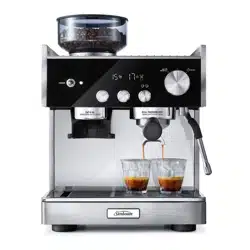
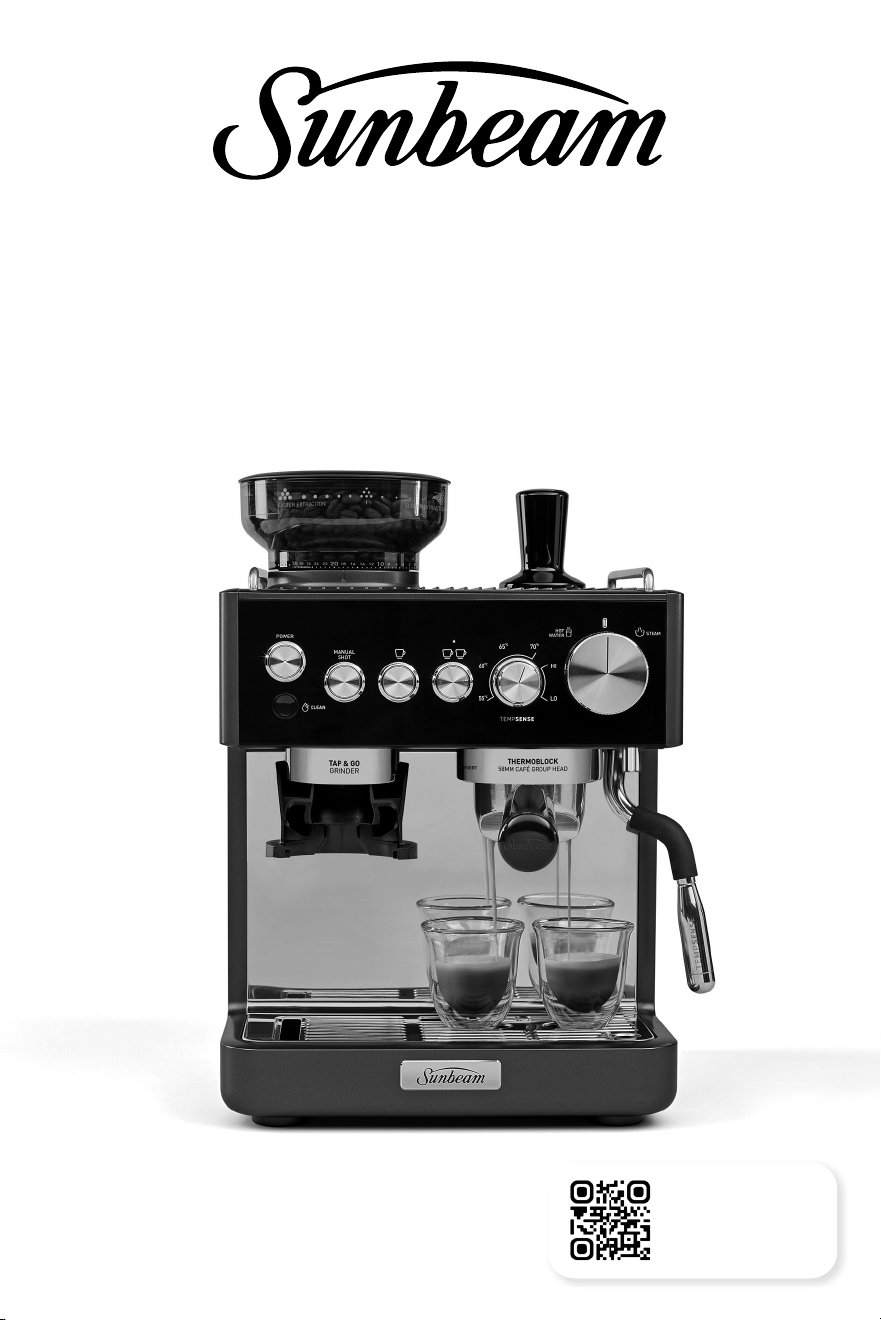
Origins Sense Espresso Machine
User Guide
EMM6500GR

2
Sunbeam’s Safety Precautions
SAFETY PRECAUTIONS FOR YOUR SUNBEAM
ESPRESSO MACHINE
• Read carefully and save all the instructions
provided with an appliance.
• Do not remove the Group Handle during the
espresso pour or water flow as the unit is under
pressure. Removing the Group Handle during
either of these operations can lead to a scalding
or injury.
• The Steam & Hot Water Wand becomes very hot
during texturing milk and water flow. This may
cause burns in case of contact, therefore avoid
any direct contact with the wand.
• Always disconnect the plug from the power outlet
prior to cleaning the espresso machine or if there
is any problem during the coffee making process.
• Do not place hands directly under the steam,
hot water or espresso pour as this can lead to a
scalding or injury.
• The temperature of accessible surfaces may be
high when the appliance is operating. Even after
use, the heating element surface is subject to
residual heat after use.
• Do not use an appliance for any purpose other
than its intended use. Injury could occur from
misuse
Contents
2 - 3 Sunbeam’s safety precautions
4 - 7 Features of your Origins Sense Espresso Machine
8 Before first use
9 - 11 Quick coffee making guide
12 Espresso Extraction guide
13 - 19 Troubleshooting guide
20 - 22 Tips for grinding, tamping & brewing
22 Tips for brewing
23 - 25 Tips for milk texturing
26 - 29 Fine tuning your espresso
29 Low water and empty tank
30 - 33 Care and cleaning – espresso machine
34 - 36 Care and cleaning – grinder
37 - 39 Descaling cycle – espresso machine
40 Accessories available for purchase
41 Additional Info
42 - 43 Notes

3
Sunbeam’s Safety Precautions
• CAUTION: To prevent damage to the appliance
do not use alkaline cleaning agents when
cleaning, use a soft cloth and mild detergent.
• Do not immerse the appliance or power cord
and plug in water or any other liquid. Wash the
following 10 parts in warm water with a mild
detergent; milk jug, drip tray grille, one cup and
two cup filter baskets, group handle, drip tray,
tamper, top burr, bean hopper and water reservoir.
Rinse and dry each part thoroughly before
replacing. Wipe the steam wand with a damp
cloth. See Care & Cleaning section for full details.
• This appliance is intended to be used in
household and similar applications such as: staff
kitchen areas in shops, offices and other working
environments; farm houses; by clients in hotels,
motels and other residential type environments;
bed and breakfast type environments.
• This appliance shall not be used by children.
• Appliances can be used by persons with reduced
physical, sensory or mental capabilities or lack of
experience and knowledge if they have been given
supervision or instruction concerning use of the
appliance in a safe way and if they understand
the hazards involved.
• Cleaning and maintenance shall not be made by
children without supervision. Keep the appliance
and its cord out of the reach of children. Children
shall be supervised to ensure that they do not
play with the appliance.
• Always place the unit on a flat, level surface.
• Do not operate without water in reservoir. Fill
reservoir with only clean and cold water. Observe
the maximum filling volume is 1.8 litres.
• Do not allow the Power Cord to come into contact
with the hot parts of the espresso machine,
including the Cup Warming Plate and the Steam
and Hot Water Wand.
• Do not operate this appliance with a damaged
cord or plug or if the appliance has been
damaged in any manner. If the supply cord
is damaged it must be replaced by the
manufacturer, its service agent or similarly
qualified persons in order to avoid a hazard.
• Appliances are not intended to be operated by
means of an external timer or separate remote
control system.
• Always turn the power off at the power outlet
before you insert or remove a plug. Remove by
grasping the plug - do not pull on the cord.
• Turn the power off and remove the plug when the
appliance is not in use and before assembling,
disassembling or cleaning.
• Always use your appliance from a power outlet of
the voltage (A.C. only) marked on the appliance.
• Never leave an appliance unattended while in use.
• Do not use an appliance for any purpose other
than its intended use.
• Do not place an appliance on or near a hot gas
flame, electric element or on a heated oven.
• Do not place on top of any other appliance.
• Do not let the power cord of an appliance hang
over the edge of a table or bench top or touch
any hot surface.
• The coffee-maker shall not be placed in a cabinet
when in use.
• Do not use any accessory not recommended by
the manufacturer as this may result in injury or
damage to the appliance.
If you have any concerns regarding the performance
and use of your appliance, please visit the Sunbeam
Website or contact Sunbeam Consumer Care -
details are on the back page. Ensure the above
safety precautions are understood.
4
A
B
C
I
J
K
L
F
D
E
G
H
Features of your Origins Sense Espresso Machine
M
5
N
O
P
Features of your Origins Sense Espresso Machine
S
W
T
QR
V
U
6
14a4b4c
3a 3b 3c
Features of your Origins Sense Espresso Machine
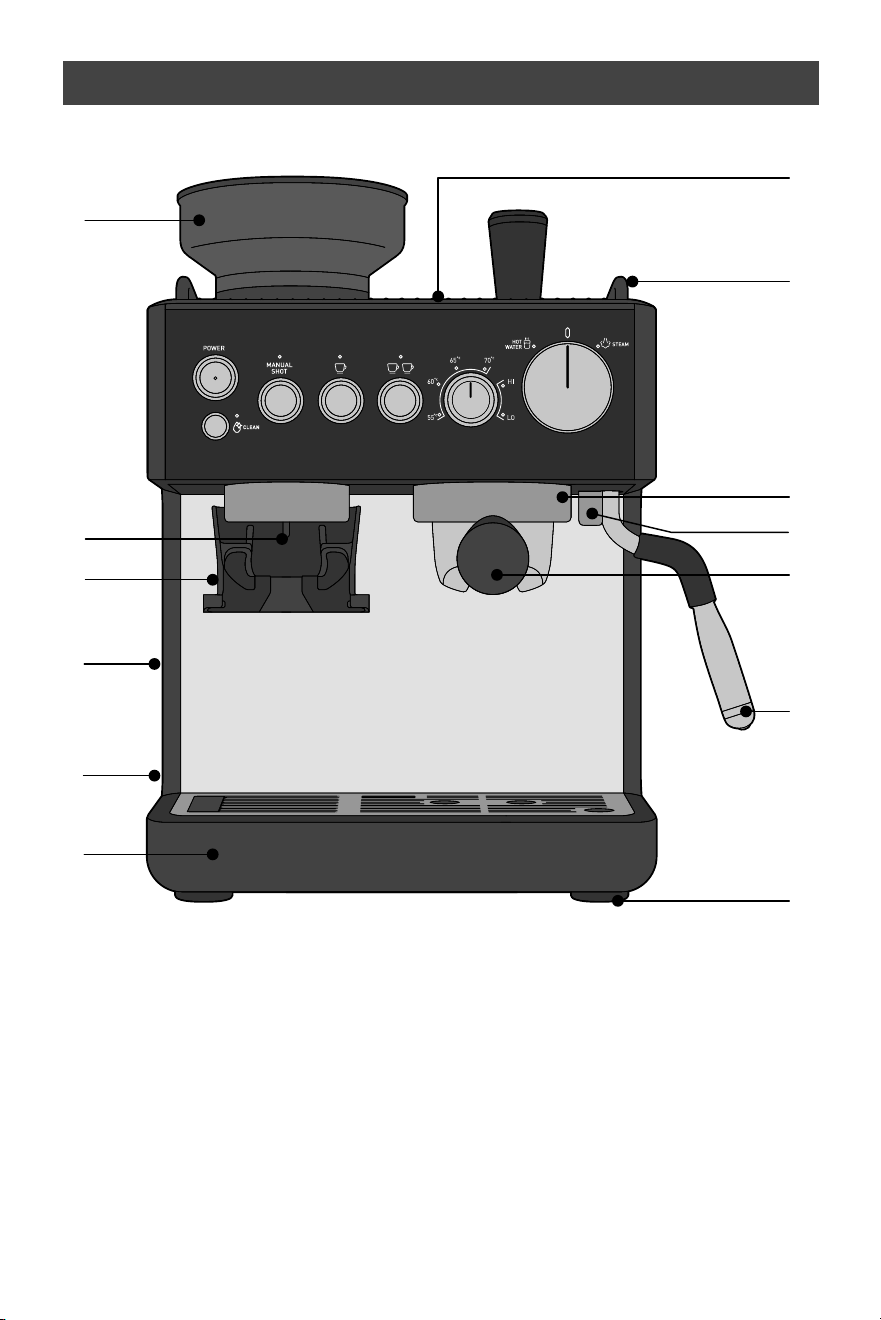
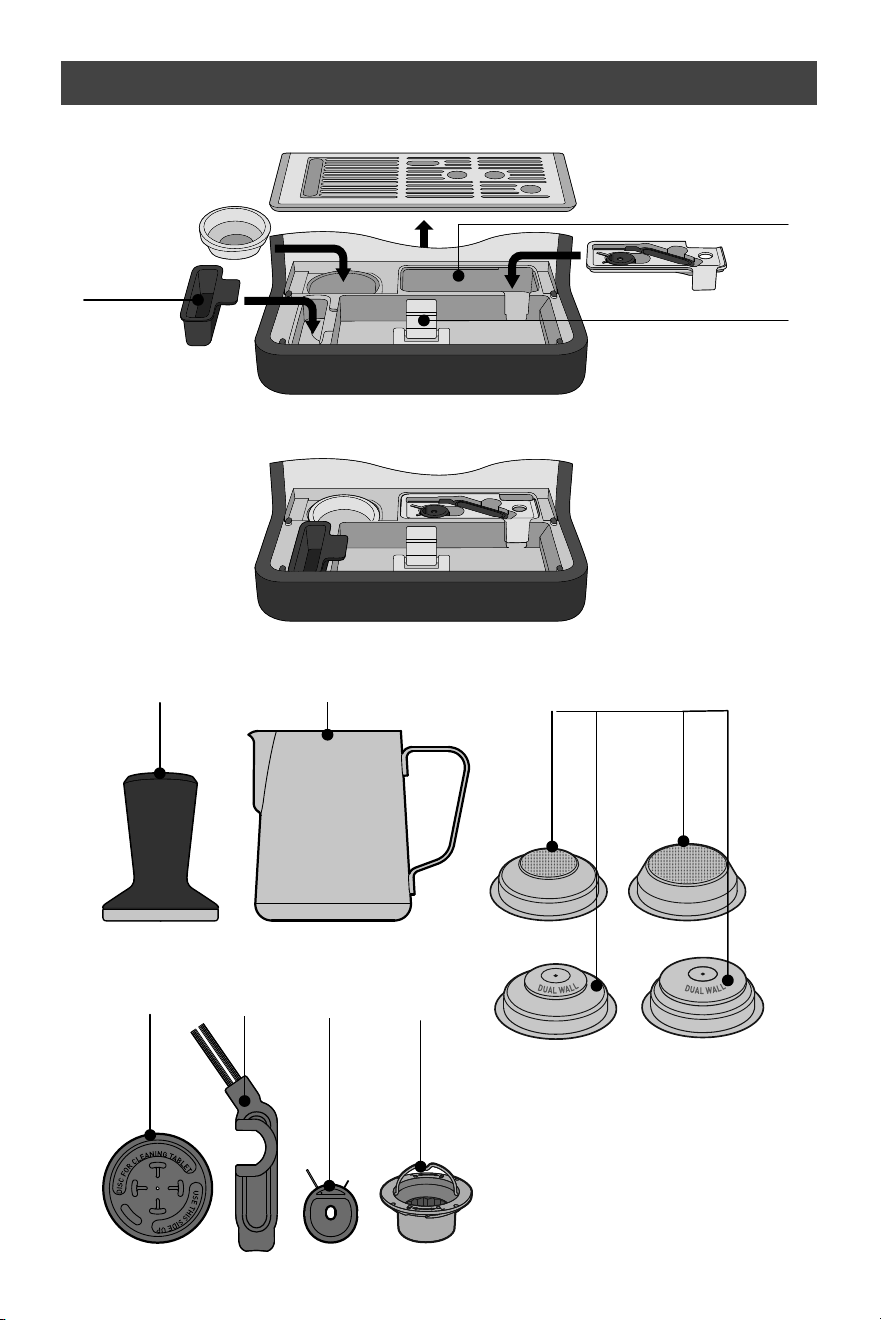
A. Removable Bean Hopper
B. Illuminated Grind Area
C. Tap & Go™ Grinds Cradle
D. Removable 1.8L Water Reservoir
E. ‘Stuff box’ Cord Storage – push cord
inside unit to reduce length
F. Removable Drip Tray, Grille & Grind Bin
G. Warming Plate
H. Stainless Steel Top Bars
Note: The Stainless Steel bars are not
handles and should not be used to lift or
move the machine.
I. 58mm Commercial Size Group Head
J. 58mm Commercial Size Group Handle
Important: When not being used, we
recommend not to leave the Group Handle
inserted into the Group Head, as this will
reduce the life of the Silicone Seal.
K. Temperature sensing Steam Wand
L. Non-slip Feet
M. Hot Water Tap
N. Removable Grinds Bin
O. Accessories Storage Tray
P. Drip Tray ‘full’ float indicator
Important: When indicator becomes
visible through the Drip Tray Grille then
remove and empty water.
Q. Premium Tamper
R. Milk Jug
S. One & Two Cup Single and Dual Wall
Filters
Note: Single Wall Filters are best
used with freshly ground coffee.
T. Silicone cleaning disc
U. Cleaning brush (fitted inside Accessory
Storage Tray)
Note: Can be used to unscrew Steam
Tip
V. Cleaning Pin (fitted inside Accessory
Storage Tray)
W. Removable Top Burr
2
5
34
6
5a

7
Features of your Origins Sense Espresso Machine
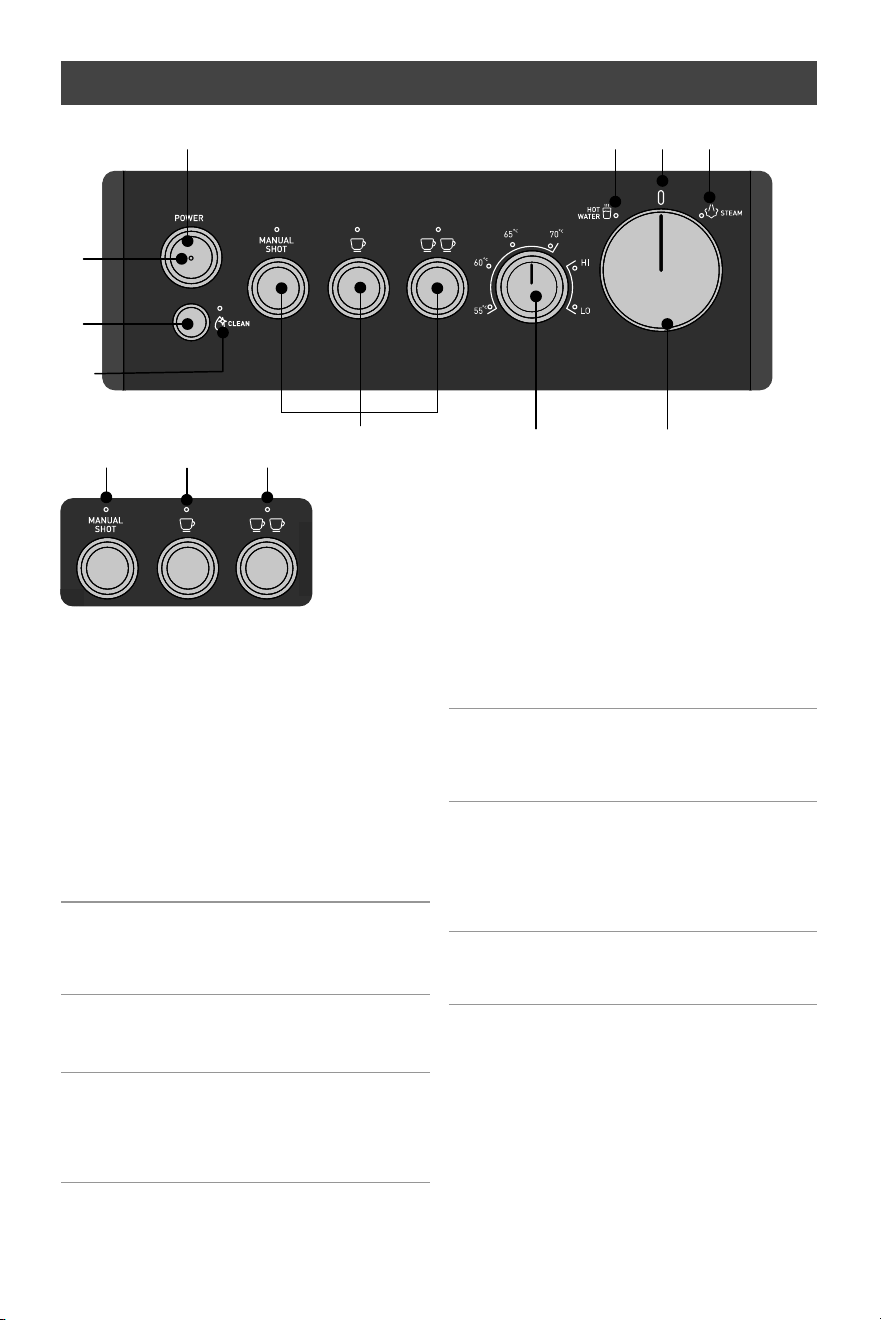
1. Power on Button
2. Power on Indicator
Illuminates whenever the unit is
turned on, illumination will pulse
during heat-up.
3. Espresso Extraction Buttons
All three icons will illuminate when
machine is ready for a selection
to be made. When the button
is pressed the icon will remain
illuminated and the other icons will
go out.
3a. Manual Shot Button
Press to start and stop the
manual dose of your espresso.
3b. ONE CUP Button
Press for a perfectly dosed
single espresso shot.
3c. TWO CUP Button
Press for a perfectly dosed
double espresso shot.
4. Hot Water and Steam Selection Dial
Rotate to select the appropriate
function.
4a. Hot Water Icon
Illuminates when Hot Water is
being dispensed.
4b. Alert Indicator
Illuminates when the water in
the reservoir needs topping up
and flashes when the unit has
run out of water. Pulses when
dial needs moving back to the
vertical position.
4c. Steam Icon
Illuminates when steam is being
dispensed.
5. Clean and Descale Button
Press and hold to activate the
Descale function, and press twice
quickly to activate the Clean
function.
5a. Clean Icon
Illuminates when the cleaning
cycle needs to be performed
and flashes when the machine
needs descaling.
6. Steam adjustment dial
•
Allows adjustment to
pre-programmed temperatures.
•
Allows selection of Hi and Lo
Manual steam rates.
8
Before First Use
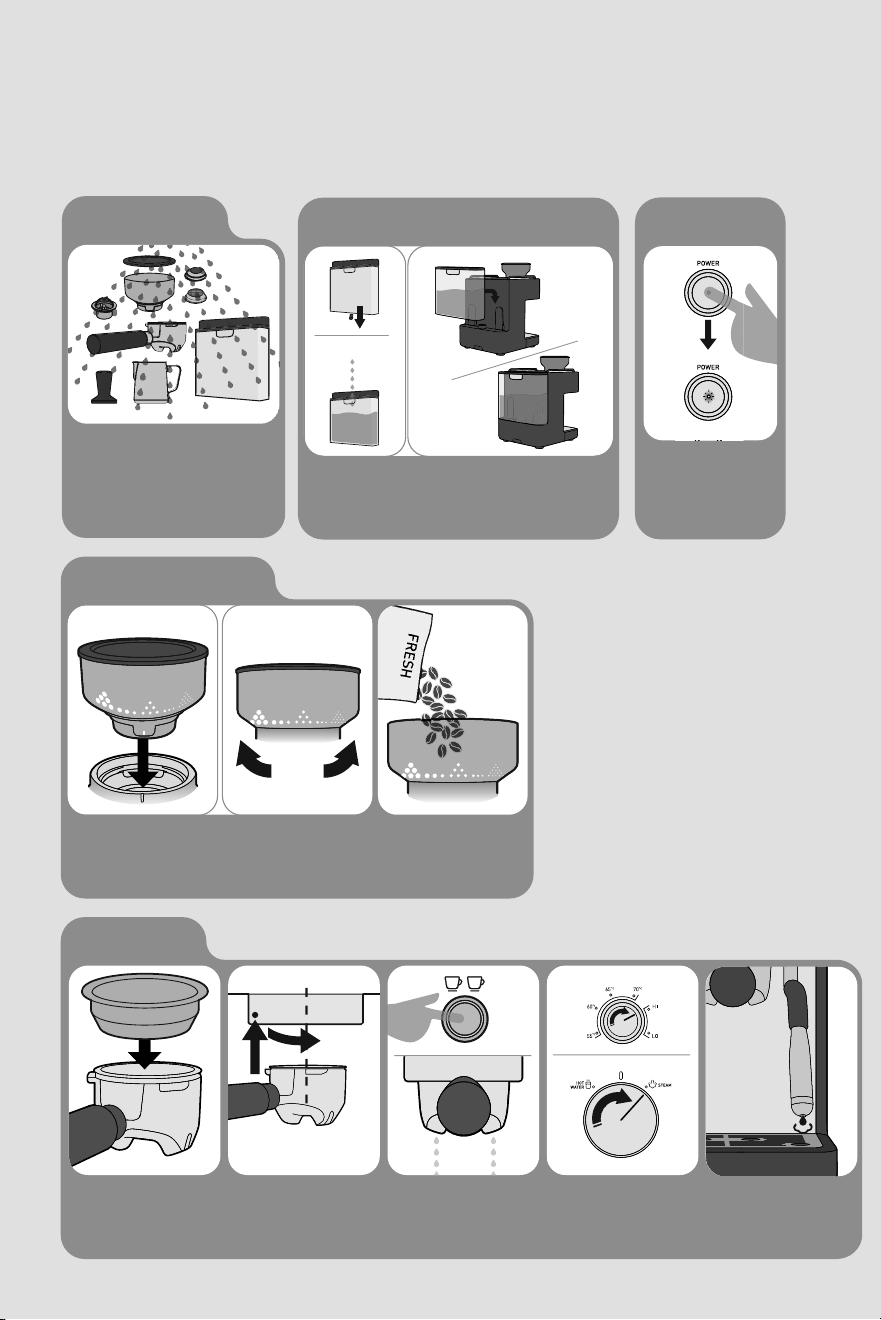
Use below information to help with the fi rst time set up.
1. Wash & Dry Parts
4. Insert & Set Bean Hopper
5. Prime Machine
2. Remove Red Plug, and set up Water Reservoir
1. ALIGN & INSERT 2. TURN TO SET
3. Start Up
Wash the Milk Jug, Filter Baskets, Group
Handle, Bean Hopper, Top Burr, Tamper
and Water Reservoir in warm water with a
mild detergent. Rinse and allow thorough
air drying.
Insert & turn Hopper to set
Grind Setting.
As a starting point try Grind
Setting 15.
Insert Two Cup Filter Basket
into Group Handle.
Insert Group Handle into Group
Head, turn to centre.
Press TWO CUP BUTTON.
Allow water to run through
until it stops.
Turn Steam Adjustment Dial to
‘Hi’. Turn DIAL to STEAM and
run for 20 sec.
TWO CUP
FRESH
GRIND
SETTING
INSERT
2. TURN
1. ALIGN & INSERT
Fill with roasted coffee beans.
Remove the red plug at the bottom of the water reservoir and
safely discard. Fill reservoir with water and install.
Note: For further Grind Setting adjustment see Extraction Guide.
Plug in at socket. Press the
power button. The indicator
light will pulse during
heat up.
8
9
Quick Coffee Making Guide
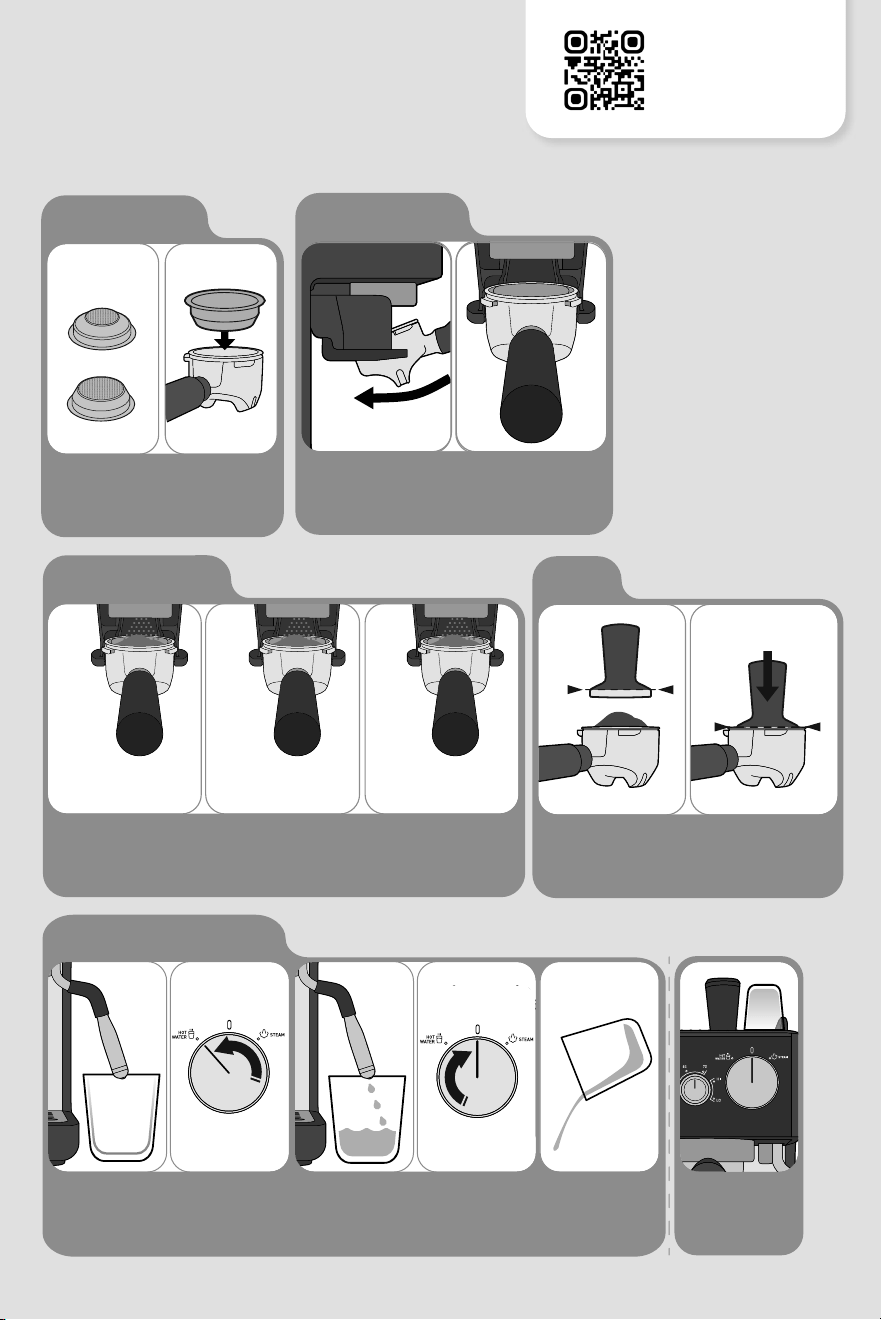
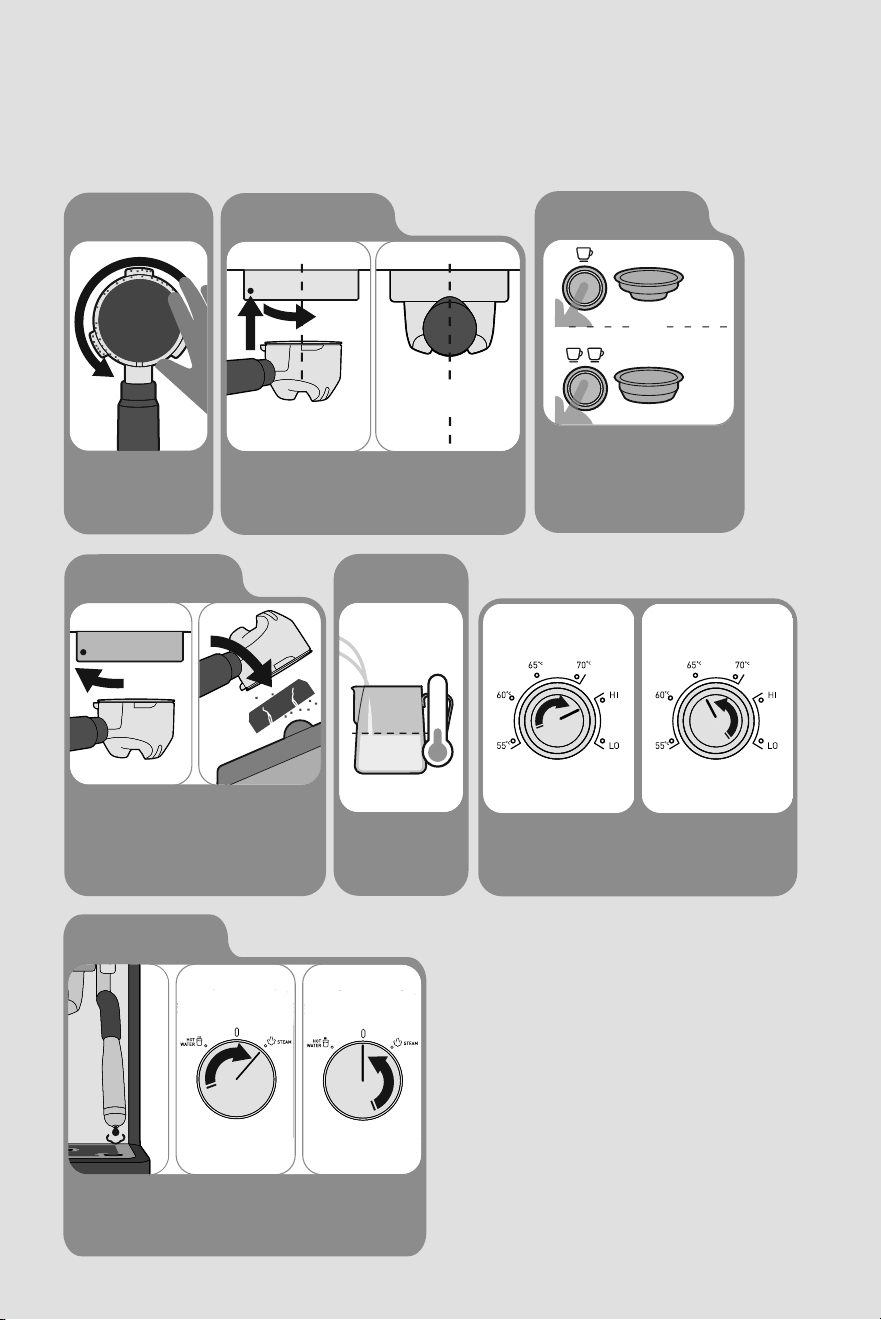
Use below guide to help you make your fi rst cup of coffee.
1. Select Filter
3. Activating the Grinder
5. Warm Cup
4. Tamp
2. Insert Group Handle
If using freshly ground coffee select the One
Cup or Two Cup single wall filter. Move to
Step 2.
Tap downwards on the Group Handle once for a single shot, tap again for a double shot, and tap
a third time to cancel. The grinder will start automatically and stop once the correct amount of
grounds have been dispensed. To top up or manually dispense grounds push downwards and hold.
To adjust grounds dispense volume, refer to later in the manual.
One cup target is 13g of coffee grounds
Two cup target is 19.5g of coffee grounds
Evenly tamp (press) grinds to level indicated.
Place cup on benchtop and position
Steam Wand. Turn DIAL to HOT WATER.
Empty cup after 20-30
seconds.
Cup can be warmed on
the top of the machine
when it is ON.
Quarter fill cup with hot water.
Return DIAL to vertical position.
Insert Group Handle into
Grinding Cradle.
Group Handle will sit flat,
unsupported, in the Grinding
Cradle.
ONE CUP
SLIDE IN
FROM ABOVE
FRESHLY GROUND
COFFEE
TWO CUP
MANUAL
PUSH DOWN
& HOLD
TAMP FORCE
10-15KG
1X TAP
SINGLE
SHOT
2X TAP
DOUBLE
SHOT
SCAN HERE
For your hands-on
interactive guide.
9
10
삵%
CENTRE
Quick Coffee Making Guide
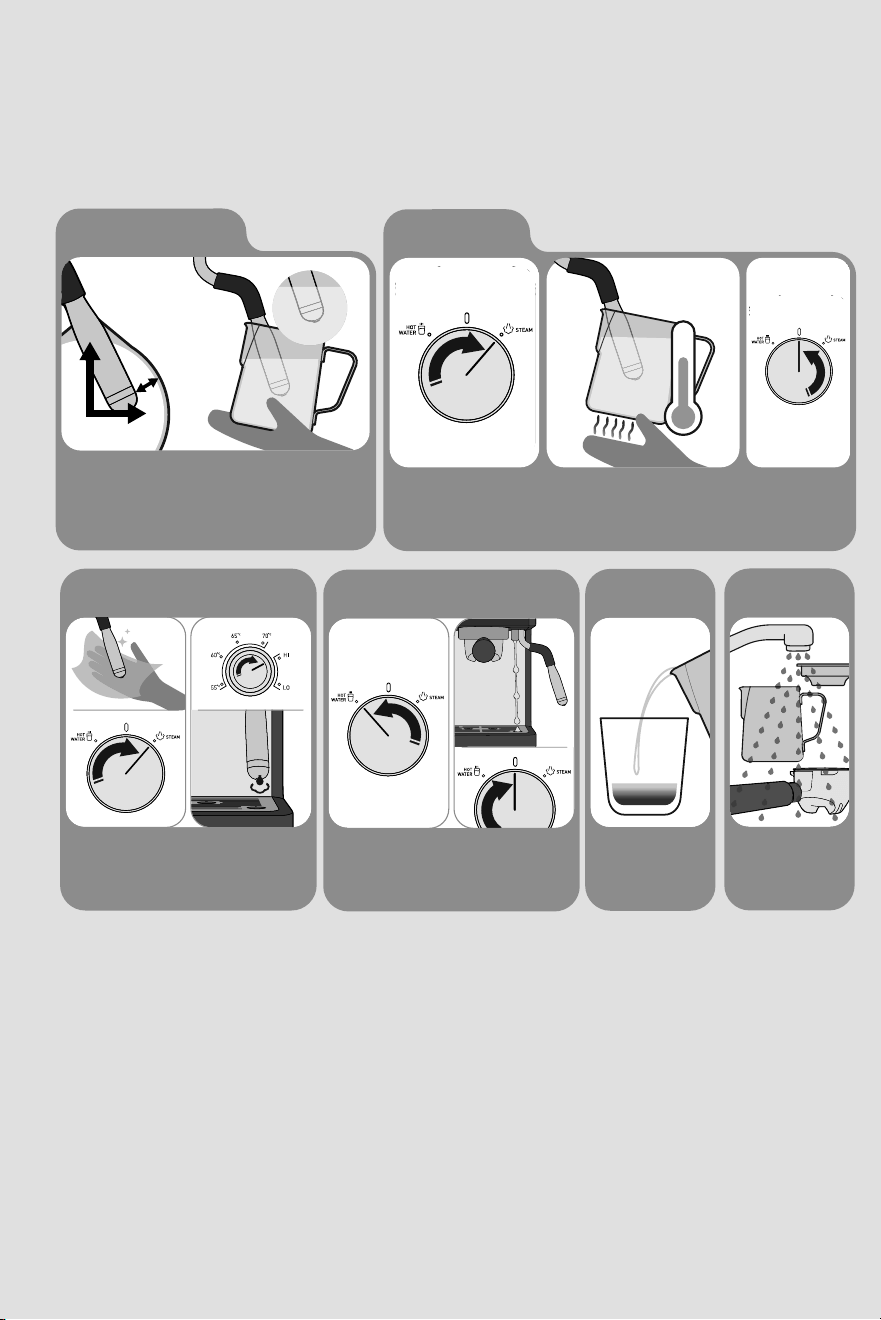
9. Remove Coffee Cake
10. Prep Milk Jug
Turn Group Handle and
remove from Group
Head.
Tip: For cleaner removal of the coffee cake, leave
handle to rest on the tray for a few seconds so the
excess water of the cake is absorbed.
Remove spent (used)
coffee cake from Group
Handle.
Fill Milk Jug with cold
milk just below the
bottom of the spout.
Ensure the wand is
pointing down as
a small amount of
water may come out.
Turn dial clockwise to
dispense steam.
Return dial to vertical
position to stop steam.
FILL
MAX
6. Wipe Edge 7. Insert Group Handle
Wipe away any excess
coffee grounds to clear
edges.
Keep Group Handle flat,
align, insert & turn handle
to the right.
Group Handle should be in
the centre position.
INSERT
2. TURN
1. ALIGN & INSERT
Note: These are the most common settings, please refer to the
Tips for milk texturing section on page 25.
To manual steam turn dial to HI. To auto steam turn dial to 65.
11. Before Texturing Milk
OR
8. Espresso Extraction
Press either: One Cup Button or Two
Cup Button. Pressing the button a
second time will stop dispense. Press
the manual button for continous water
dispense.
ONE CUP
TWO CUP
= 30ml
= 60ml
10
11
삵%
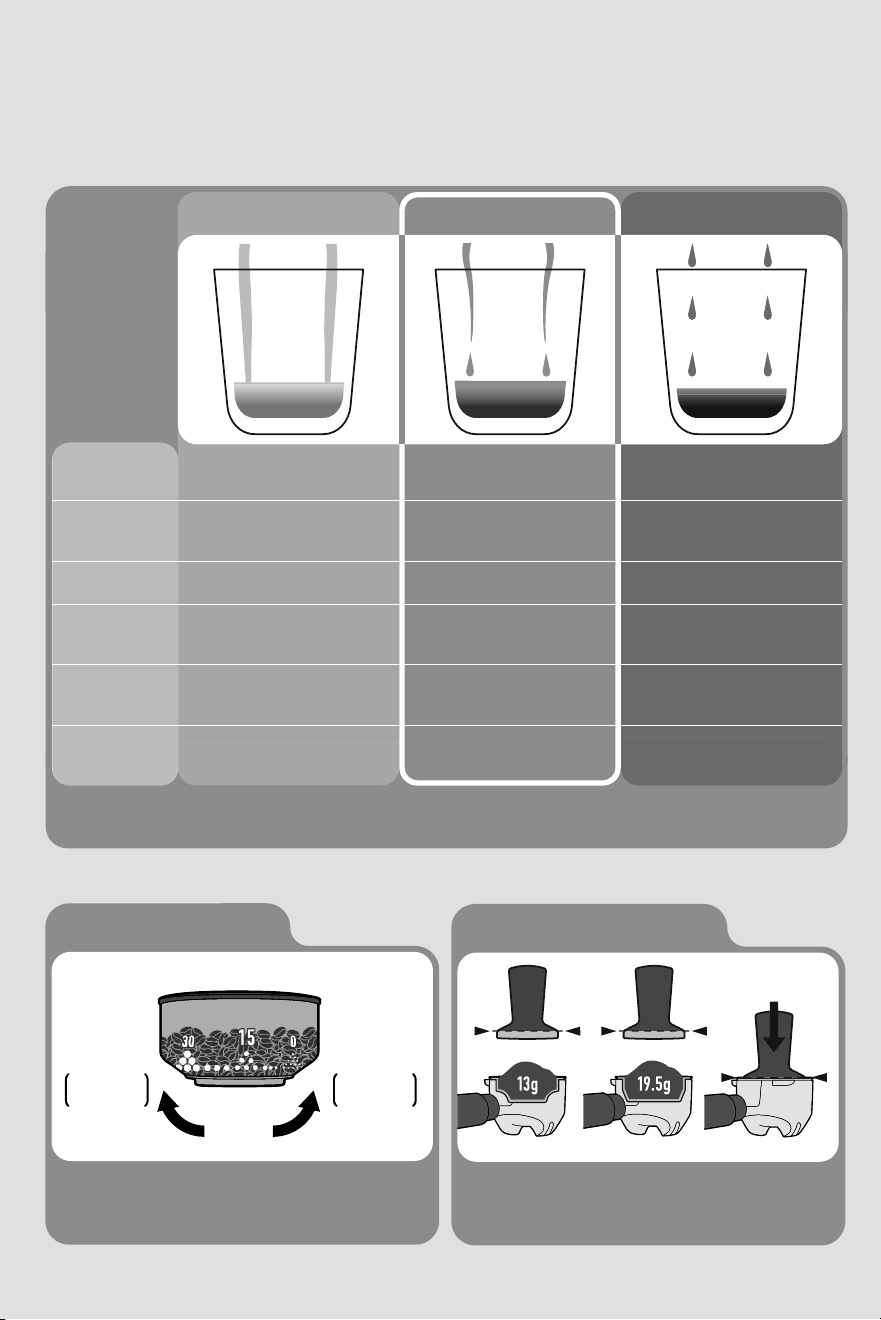
14. Purge & Clean Steam Wand Optional: Add Hot Water if required
15. Pour Milk
16. Clean Up
Wipe Steam Wand & Tip with a damp cloth. Turn
Steam Adjustment Dial to HI.
Turn dial to STEAM for 1-2secs. Return DIAL to
vertical position.
Turn dial to HOT WATER, water will be dispensed
from the Hot Water Tap. Return DIAL to vertical to
stop dispense.
Pour milk in one
steady motion.
Wash parts with
warm water.
Quick Coffee Making Guide
12. Position Steam Wand 13. Milk Texturing
Insert Steam Wand Arm at the 12 o’clock position, resting the
arm in the spout of the Milk Jug. The Steam Wand Tip should sit
at the 3 o’clock position, a finger width distance from the edge
of the Milk Jug. The Steam Wand Tip should sit just below the
surface of the milk.
When you are in position, turn
DIAL back to STEAM position
to start texturing milk.
The milk is ready when Milk Jug base
is too hot to touch for 3 secs. If the
auto-off feature was used, the steam will
automatically stop when the selected
temperature is reached.
Return DIAL to vertical
position.
FINGER
WIDTH
11
12
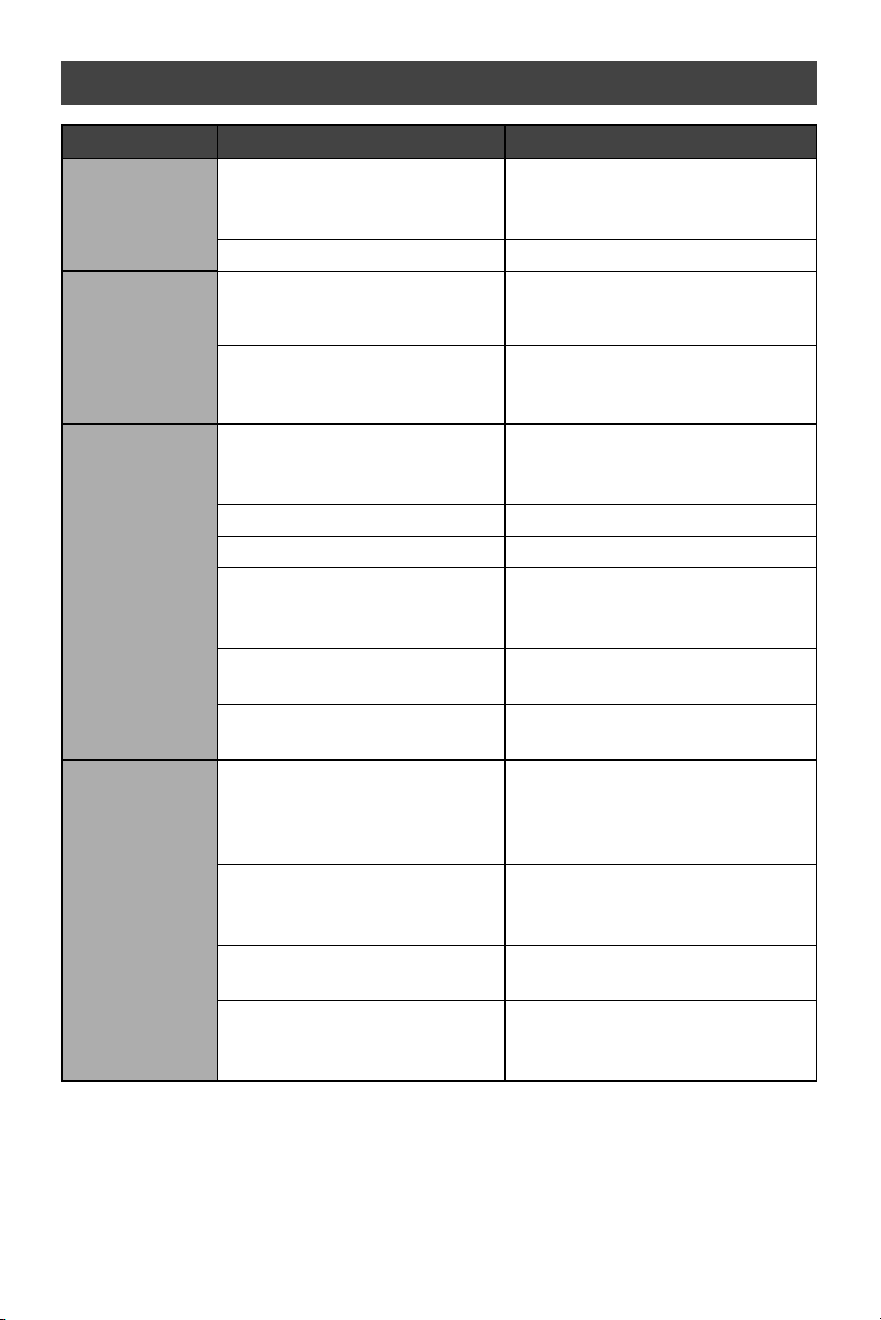
Espresso Extraction Guide
This guide will help to improve espresso extraction, to achieve great tasting coffee, every time.
Under Extraction
Pour^
Colour
Taste
Grind Size^^
Dosage
Tamp
Optimum Extraction Over Extraction
^ Ensure coffee beans are fresh.
^^ Old coffee beans no matter the Grind Setting will have a fast extraction and will produce an under extracted tasting espresso.
Extraction too fast
Pours for under 15 sec
Steady-flow extraction
Pours for 20-30 sec
Extraction too slow
Pours for over 35 sec
Pale brown
Crema-light brown
Rich caramel
Crema-dark golden
Very dark brown
Crema-dark brown
Sour, acidic, watery
Rich, sweet, vibrant
Bitter, dry, grainy
Too coarse
Use a finer grind
Just right
Too fine
Use a coarser grind
Not enough grinds
Use more grinds
One cup = target 13g
Two cup = target 19.5g
Too many grinds
Use less grinds
Not enough tamp force
Tamp firmer
Just right-firm force
10-15Kg of force
Too much tamp force
Tamp lighter
New Burrs are bedding in during the first few uses. The Grind Setting may
require incremental adjustments before you reach your optimum espresso
extraction.
It is normal for the correct dose of coffee grinds to appear overfilled in the
Filter Basket before tamping. Evenly tamp (press) coffee grinds to the level
indicated.
17. Adjust Grind to Improve Extraction 18. Consistent Grind Dosage & Tamp Force
TURN
ANTI-CLOCKWISE
FOR
COASER GRIND
FASTER
EXTRACTION
TURN
CLOCKWISE
FOR
FINER GRIND
SLOWER
EXTRACTION
ONE CUP
TWO CUP
TAMP FORCE
10-15KG
GRIND
SETTING
12
13
Troubleshooting guide
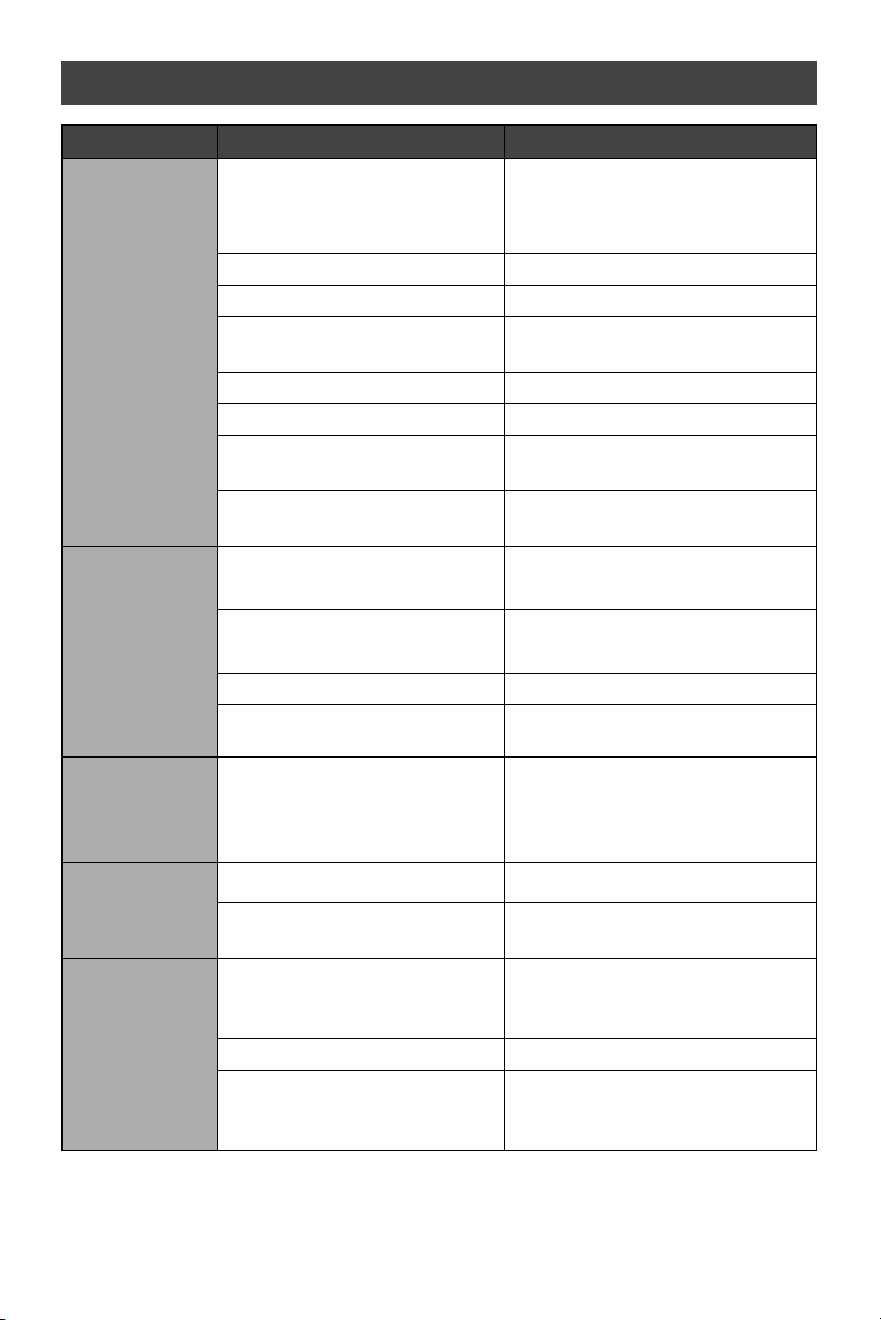
PROBLEM Possible cause What to do
Group Handle
is tight to turn
in the Group
Head
The Group Head Silicone Seal is
new and needs bedding in.
Keep using. This Seal will bed in during
the first few uses and become easier
to turn.
Too many coffee grinds used. Fill with less coffee grinds.
Group Handle
is loose
or comes
off during
espresso
extraction
Group Handle is not attached
correctly or has not been tightened
sufficiently.
Ensure all three tabs of the Group
Handle are fully inserted into the Group
Head and rotated to the centre position.
No Filter Basket inserted in the
Group Handle.
Ensure a Filter Basket is inserted into
the Group Handle before using in the
Group Head.
Espresso
squirts or
trickles down
the side of
the Group
Head during
extraction
Coffee grind is too fine and is
stopping the flow of water through
the grounds.
Change grinder to a coarser Grind
Setting.
Too many coffee grinds used. Fill with less coffee grinds.
Coffee grinds tamped too hard. Apply less force during tamping.
Top edge of Filter Basket has not
been cleaned of loose coffee grinds.
Wipe around top edge of the Filter
Basket before inserting into Group Head.
See Coffee Making Guide.
Group Head inside rim, Silicone Seal
or Shower Head is dirty.
Clean the parts with the Cleaning Brush
and damp cloth.
Group Head Silicone Seal is damaged
or worn.
Contact Customer Care.
Espresso is too
cold
Coffee beans being stored in the
fridge or freezer.
Ideally store coffee beans in their original
bag and place in a cool dark cupboard.
Alternatively, store coffee beans in a dry,
airtight container.
Custom extraction temperature being
used.
Use the default 92°C extraction
temperature. See Customisable -
Extraction Temperature.
Cup or glass was cold prior to
espresso pour.
Pour hot water from the Hot Water Tap
into the cup before extracting espresso.
Group Head or Handle not warmed
before use.
Hold the Group Handle under the Group
Head and press the ONE CUP BUTTON.
Allow water to run through.
14
Troubleshooting guide
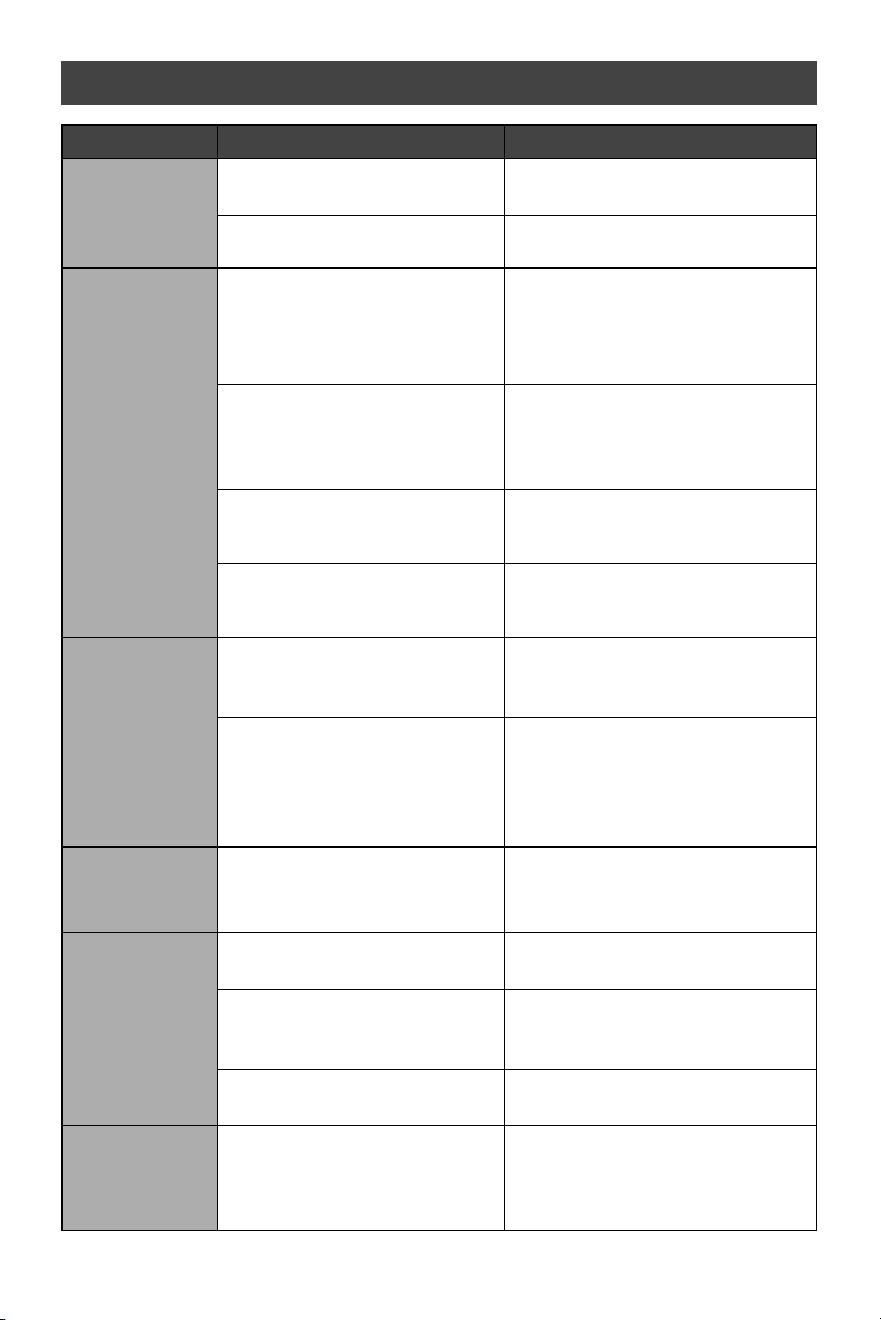
PROBLEM Possible cause What to do
No espresso
pours or
pours out in
drips (over
extracted)
No water in the Water Reservoir.
Fill reservoir with water. Prime water
through the Group Head, press the
ONE CUP BUTTON. Allow water to run
through.
Coffee grind is too fine. Change to a coarser Grind Setting.
Too many coffee grinds used. Fill with less coffee grinds.
Coffee grinds tamped (compacted)
too hard.
Apply less force during tamping.
Custom shot volume being used. Reset to the default shot volumes.
The Filter Basket is blocked. See Care & Cleaning.
Group Head is dirty. A Cleaning Cycle is required. See
Cleaning Cycle.
Group Head is blocked. A Descaling Cycle is required. See
Descaling Cycle.
Espresso
does not have
any crema,
or crema is
thin (Under
Extracted)
Coffee beans are old or dry.
Use freshly roasted coffee beans.
Coffee grinds too coarse. Change to a finer Grind Setting.
Not enough coffee grinds used. Fill with more coffee grinds.
Grinds not tamped (compacted)
enough.
Tamp more firmly. See Espresso
Extraction Guide section.
Espresso shot
volume too
much or too
little
Custom shot volumes being used. Restore to default shot volumes or
change your custom shot volume(s). See
Customisable - Grinder Time Adjustment
section.
Espresso
tastes bitter
Type of coffee beans being used. Try different brands of coffee beans.
Espresso has been over extracted. See problems earlier in this table on
under extraction.
Spent (used)
coffee cake is
wet
A little water will remain on top of the
used coffee cake.
Rest Group Handle on the Drip Tray for 5
sec to allow the water to dissipate before
disposing cake.
Too many coffee grinds used. Fill with less coffee grinds.
Dual Wall Filter Baskets being used. Dual Wall Filter Baskets will keep the
coffee cake wetter than Single Wall Filter
Baskets.
15
Troubleshooting guide
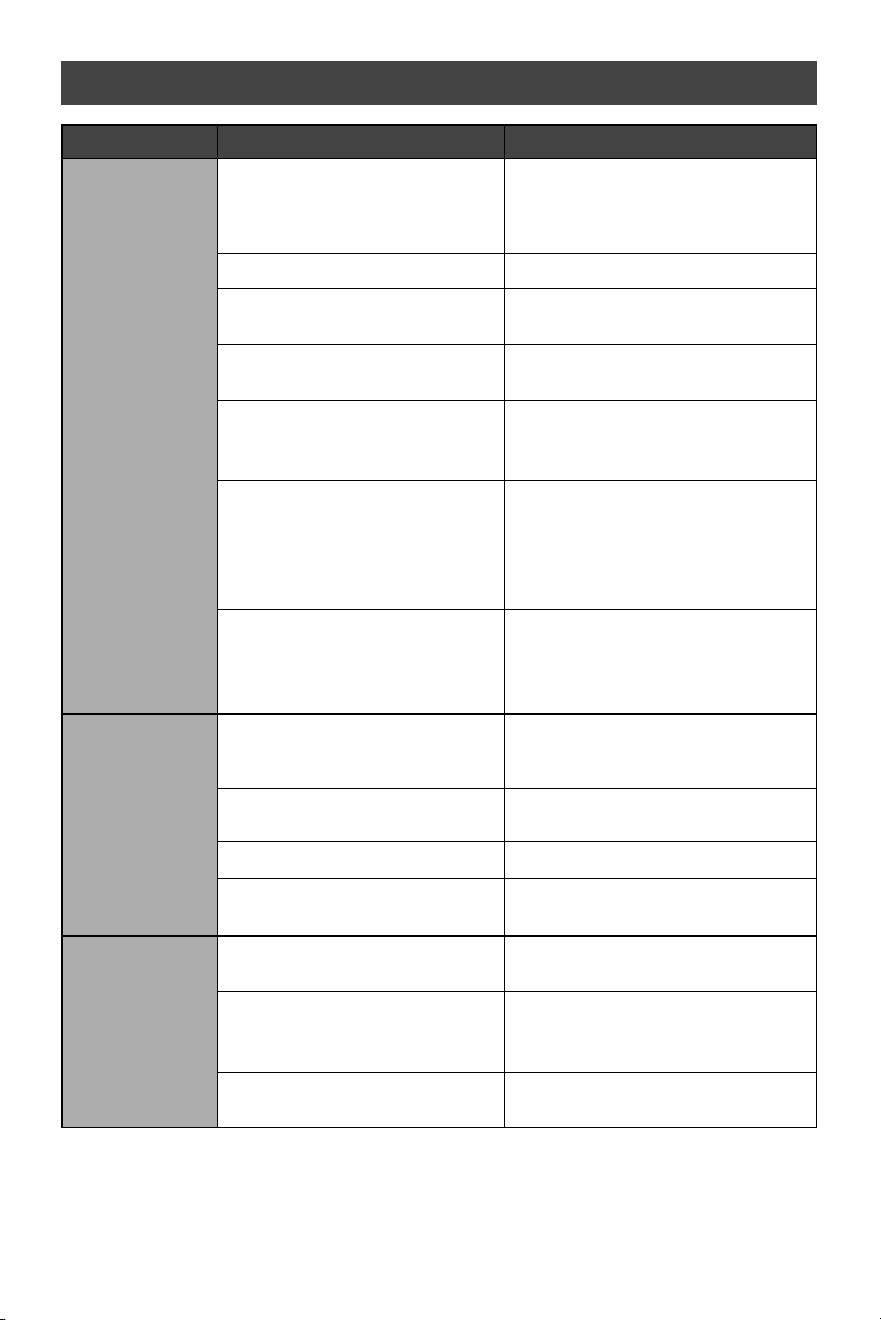
PROBLEM Possible cause What to do
Espresso
pours into cup
unevenly
Uneven tamping.
Ensure coffee grinds are tamped
evenly.
Obstruction in the Group Head or
Handle.
Check there is nothing obstructing the
Group Head or Handle & clean.
Pump makes
an unusual
noise
No water in the reservoir, and the
pump is ‘dry’.
Fill reservoir with water, then press the
one cup button to prime unit before
brewing espresso. The pump noise will
decrease once water is flowing through
the system.
Water Reservoir is not correctly
positioned.
Insert the Water Reservoir into the
back of the unit, then press the one cup
button to prime unit before brewing
espresso.
Red Plug from the packaging may
still be inserted (the low water alert
will be illuminated).
Remove the red packaging plug found
at the base of the Water Reservoir.
New Flow Profiles has been
selected.
Different Flow Profiles make different
noises at the start of an espresso
extraction.
Water around
Drip Tray area
or on benchtop
Water overflowing from Drip Tray. Empty if the red Water Level Indicator
appears through the Drip Tray Stainless
Steel Grille.
Drip Dray not present, or not fully
inserted when Thermoblock is auto
purging.
Always keep the Drip Tray in place
during brewing espresso as water will be
purged into the drip tray under certain,
normal operation circumstances -
notably after Steaming.
Milky coffee is
too cold
Milk may not be heated enough. Ensure that milk is heated properly
during texturing. See Tips for Milk
Texturing.
No steam from
the Steam
Wand
Steam Wand Tip is blocked. See Care & Cleaning for cleaning
methods.
No water in the Water Reservoir. Fill reservoir with water. Run hot water
through the Steam Wand to ensure
water flows.
Espresso Machine has scale build up. A Descaling Cycle is required. See
Descaling Cycle.
Steam Wand
making a
screeching
noise
Steam Wand Tip is too deep. Lower Milk Jug. Ensure the Steam Wand
Tip is positioned correctly (just below
milk surface) when texturing. See Tip for
Milk Texturing.
16
Troubleshooting guide
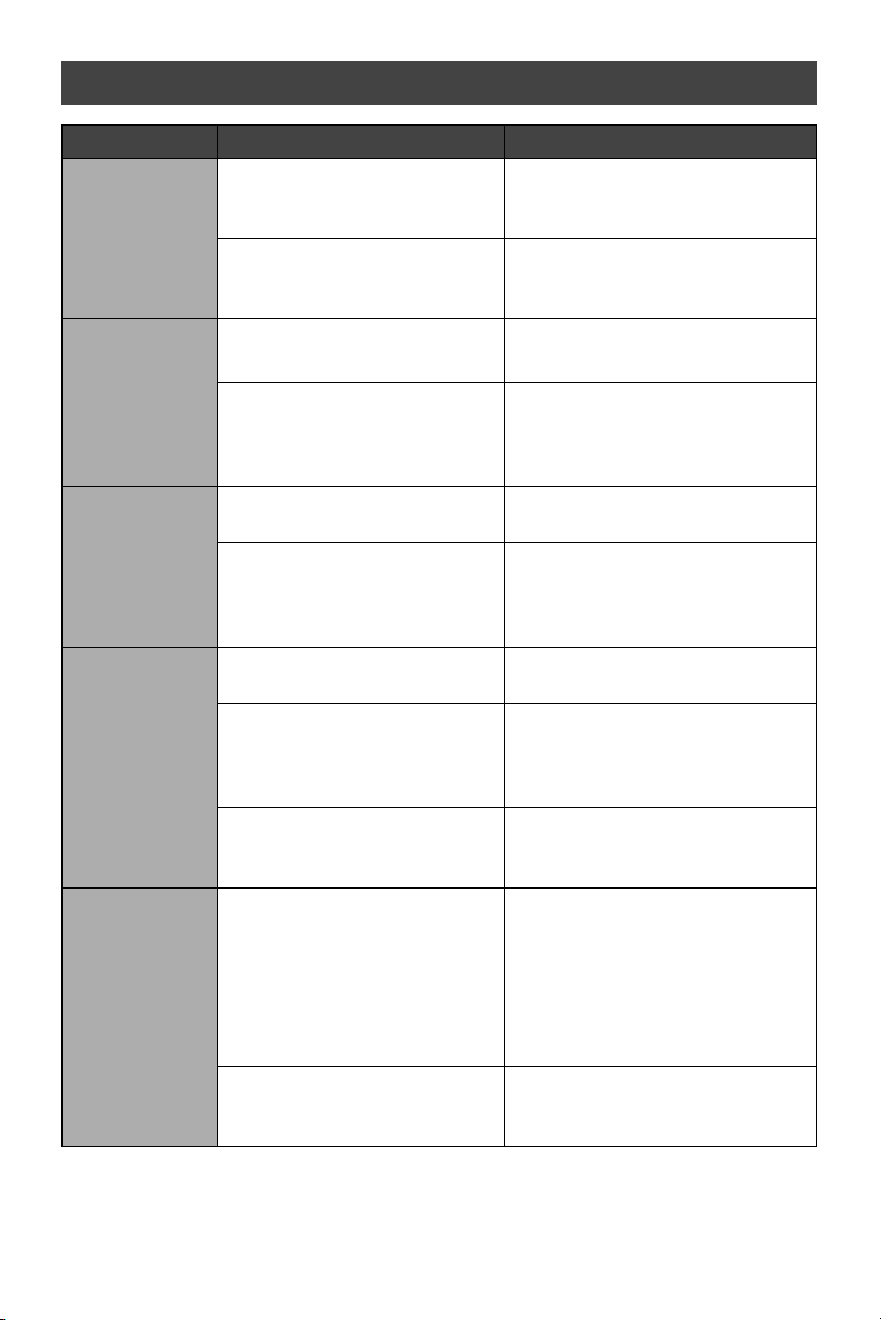
PROBLEM Possible cause What to do
Not enough
foam when
texturing
Steam wand tip is wrongly
positioned in milk jug.
Ensure the Steam Wand Tip is
positioned correctly (just below milk
surface) when texturing. See Tips for
Milk Texturing.
Milk is not fresh. Ensure the milk being used is fresh.
Milk temperature is too warm. Ensure you start texturing with milk that
is around 4°C.
Type of Milk Jug being used. For best texturing results use a chilled
Stainless Steel Milk Jug.
Milk has been boiled. Start again with fresh, chilled milk. Heat
until the Milk Jug can only be held for
approximately 3 seconds, 60-65°C.
The milk is making bubbles rather
than microfoam.
Ensure the Steam Wand Tip is positioned
correctly when texturing. Tap the Jug on
the benchtop when finished to release
trapped air bubbles. See Tip for Milk
Texturing.
Milk is not taking in enough air. Keep the Steam Wand Tip just under
the surface of the milk. This will help
introduce air into the milk to create
microfoam.
Optimum
Grind Setting
is producing
an under
extracted
espresso
New Burrs are bedding in. This is
normal for the first few uses.
Turn the Bean Hopper clockwise in
small increments to a finer Grind, or
repeat the ‘Dial In’ procedure.
Beans are losing freshness. Adjust to a finer setting to keep an
optimum espresso extraction.
Not enough coffee grinds used. Fill with more coffee grinds.
Grinds not tamped (compacted)
enough.
Tamp more firmly. See Espresso
Extraction Guide section.
No coffee
grinds coming
from the
Grinder Outlet
No coffee beans in the Bean Hopper. Fill the Bean Hopper with freshly roasted
coffee beans.
Hopper is not fully installed and gates
are not fully open.
Turn the Bean Hopper in a clockwise
direction. At Grind Setting 30, Hopper
Gates are then fully open.
The Grind Chamber or Outlet is
blocked.
Grinder needs cleaning. See Care &
Cleaning.
17
Troubleshooting guide
PROBLEM Possible cause What to do
Coffee grinds
are coarse
when on a fine
Grind Setting
Grind Setting not correct. Adjust the Grind Settings by turning
the Bean Hopper. See Tip for Grinding,
Tamping & Brewing.
Top Burr not seated correctly. Coffee
beans or grinds are caught around &
under the Top Burr.
Top Burr needs cleaning. See Care &
Cleaning.
Espresso
is under
extracted even
with a fine
coffee grind
Not enough coffee grinds used.
Fill with more coffee grinds.
Beans are too old. Use freshly roasted beans. Old coffee
beans, no matter the Grind Setting, will
have a fast extraction and will produce
an under extracted tasting espresso.
Grind Setting
cannot be
adjusted
The Bean Hopper is not seated
correctly.
Remove the Bean Hopper & reinstall.
Coffee beans or grinds are caught
around the Top Burr or Grinder
Collar.
Remove the Bean Hopper & Top Burr.
Use the Cleaning Brush or Vacuum
Cleaner as necessary to clear loose
coffee beans or grinds.
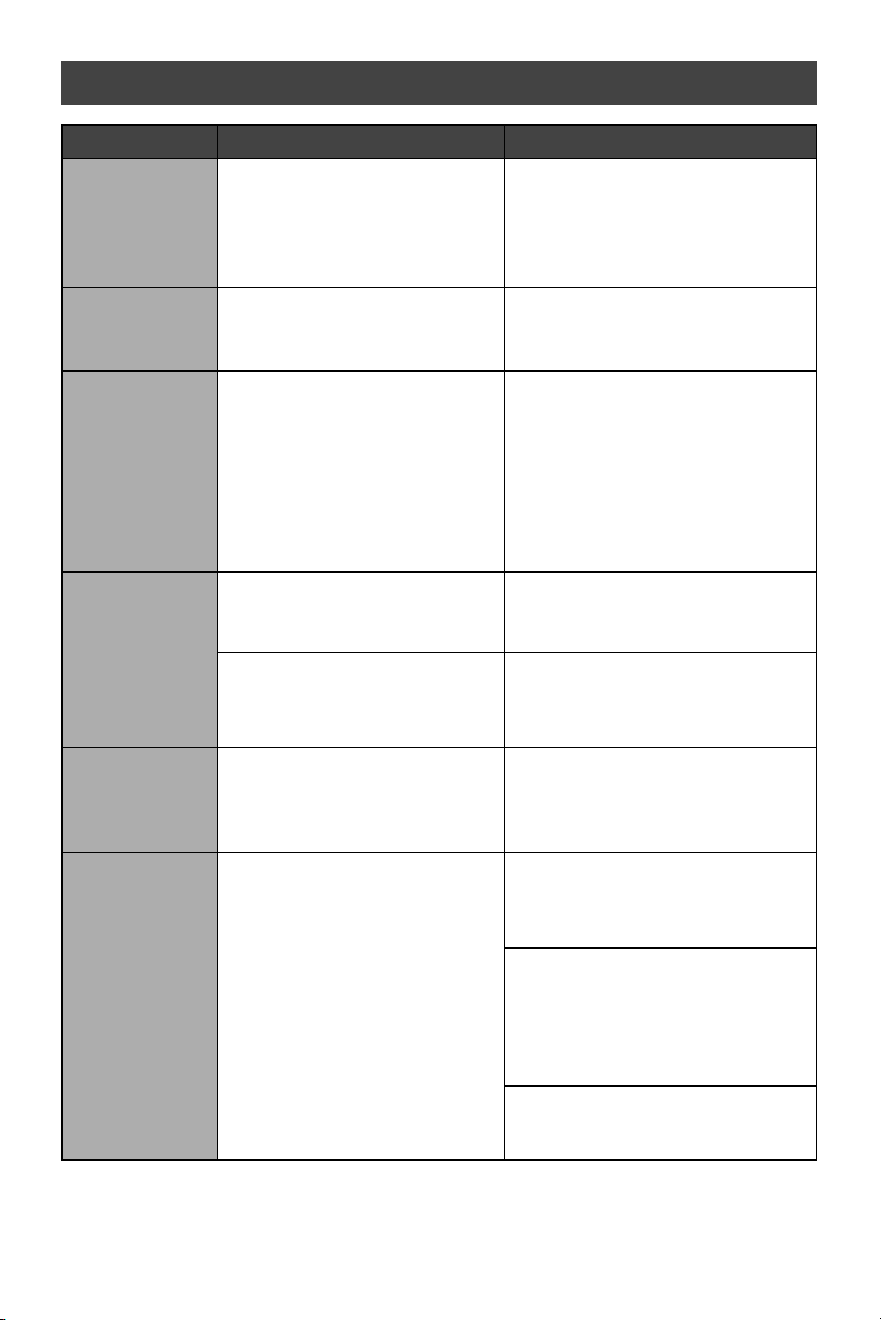
Bean Hopper
cannot be
locked into
position
Grinder Collar not aligned to the Top
Cover.
Ensure markings on Top Cover and
Grinder are lined up.
Coffee beans or grinds are caught in
the Top Burr or Grinder Collar.
Remove the Bean Hopper & Top Burr.
Use the Cleaning Brush or Vacuum
Cleaner as necessary to clear loose
coffee beans or grinds.
The Top Burr is not seated correctly. Make sure the Top Burr is correctly
aligned and that the handle is folded
down.
Top Burr does
not sit in the
Grinder Collar
correctly
Coffee beans or grinds are caught
around & under the Top Burr.
Remove the Top Burr and replace the
Bean Hopper. Hold the Bean Hopper
down with your hand, do not turn. Insert
the Group Handle into the Grinding
Cradle and push down to activate the
Grinder. The coffee grinds will fall out
the Grind Outlet.
The Top Burr is not seated correctly. Make sure the Top Burr is correctly
aligned and that the handle is folded
down.
18
Troubleshooting guide
PROBLEM Possible cause What to do
Grinder burrs
have small
spots and
marks
These are part of the hardening
process (for extra-long life). These
marks do not affect the performance
of the Grinder or the taste of the
espresso.
No action needed.
Espresso
Machine turns
itself off
Your Espresso machine will go into
Standby mode after 20 minutes to
conserve power.
Press the Power On Button to
reactivate your machine.
Grinder will
not operate
after a large
amount of
grinding,
and button
illumination is
flashing
Your grinder has overheated. Wait for 6 minutes, once the auto-cool
down cycle has finished your machine
will be ready to use again.
Machine beeps
when trying
to use the
grinder
If the 3 main button illumination
is also flashing then grinder has
overheated.
Wait for 6 minutes, once the auto-cool
down cycle has finished your machine
will be ready to use again.
If the button illumination is not
flashing, and it is the first use after
installing the hopper, then the bean
hopper is not correctly installed.
Correctly install the Bean Hopper.
Not all lights
illuminate
when the unit
is switched on
When switched on initially the unit
will enter a warm-up mode, during
this time the power-on light will
pulse.
Wait until the unit is warmed up, the
power light will stop pulsing, and the
display will illuminate.
Dispensed
quantity of
grinds is too
much or too
little
The factory grinder settings do not
match your personal preferences.
The grinder can be stopped at any time
during the grinding process by tapping
once downwards on the Group Handle
if over dispensing.
If the grind dispense amount is too
small, the quantity of grinds in the
portafilter can be topped up by pushing
down on the Group Handle to manually
activate the grinder. Release the
handle when grind amount is correct.
The grinder dispense volume can be
customised to your requirements, see
‘Fine tuning your espresso’ section.
19
Troubleshooting guide
PROBLEM Possible cause What to do
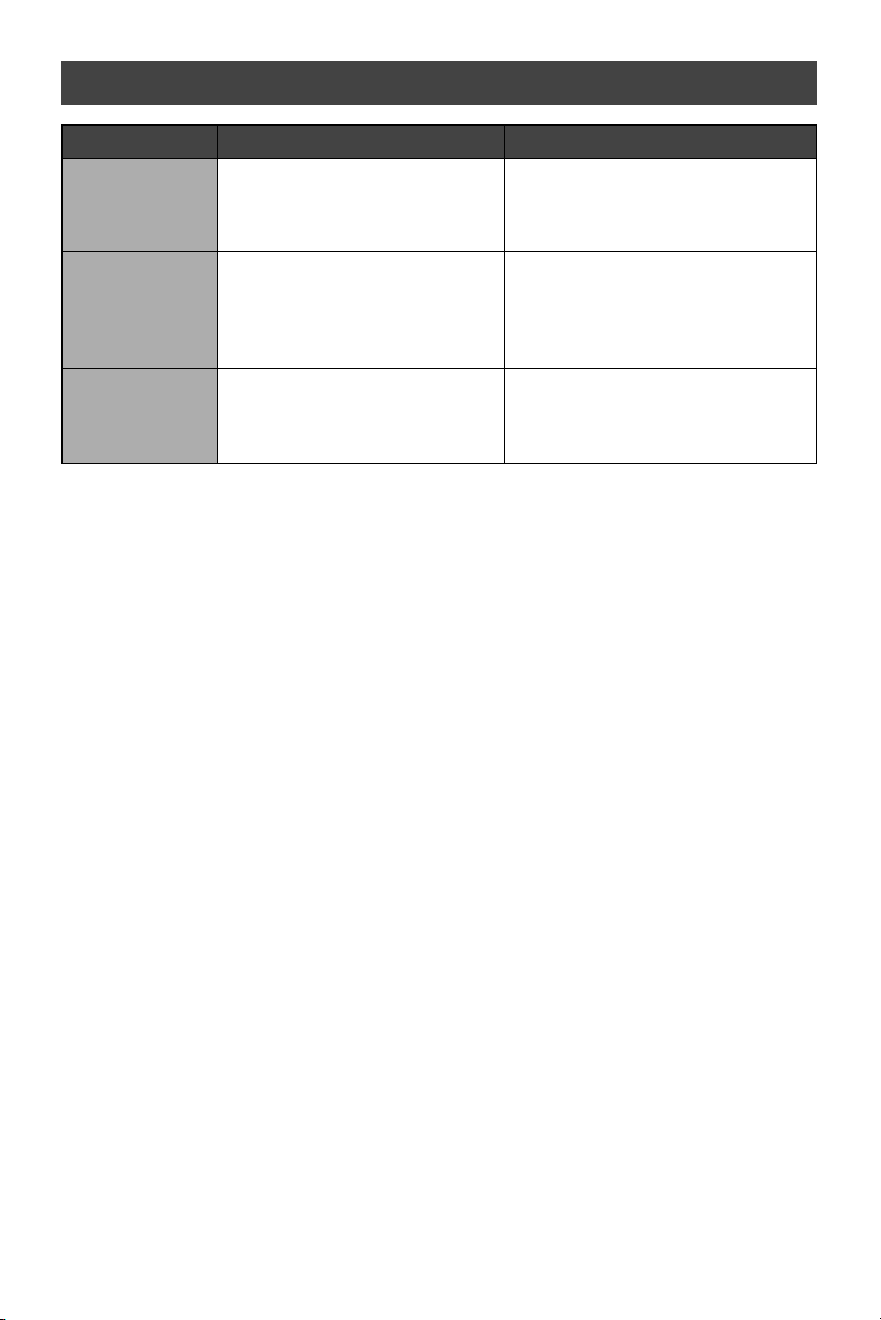
Alert Indicator
is pulsing
The Main Dial needs returning to the
12 o’clock position.
Rotate the Main Dial back to the 12
o’clock position.
Alert Indicator
is flashing
The water tank will have run dry,
the machine will also have beeped
x3 when this occurred, and the
pump will have stopped operating.
Refill the water tank ensuring the level
goes above the minimum fill level.
Press the single brew button to prime
the water system ahead of brewing
your next Espresso.
Alert Indicator
is permanently
illuminated
The water level in the tank has
dropped below the minimum fill
level, the machine will have beeped
when this occurred.
Refill the water tank ensuring the level
goes above the minimum fill level.
20
‘Dialling In’
To make the perfect Espresso, Baristas
perform an operation called ‘dialling in’
and this is performed whenever a variable
is changed, such as a new bag of beans are
used, and is often performed at the start of
each day.
The dialling in process is not complicated,
however it may take a number of iterations
to identify your optimum grind setting and
your perfect espresso.
We strongly recommend that you ‘dial in’
your Origins Sense Espresso Machine to
make perfect Espresso, however this may
need a little patience as it is something
that you are unlikely to get right first time.
There are 3 key variables to control when
dialling in your machine:
1. Amount of coffee grounds - Your Origins
Sense Espresso Machine will ensure
this remains consistent espresso to
espresso as it will automatically dose
the same amount of grounds shot after
shot.
2. Tamp force – best results can be
achieved using a manual tamp, but a
little practice is necessary to apply the
same force every time. Try using your
kitchen scales, pushing down to reliably
apply 10-15kg force.
3. Coffee grind size – this is the variable
we will adjust when ‘dialling in’.
To ‘dial in’ your machine follow these
steps:
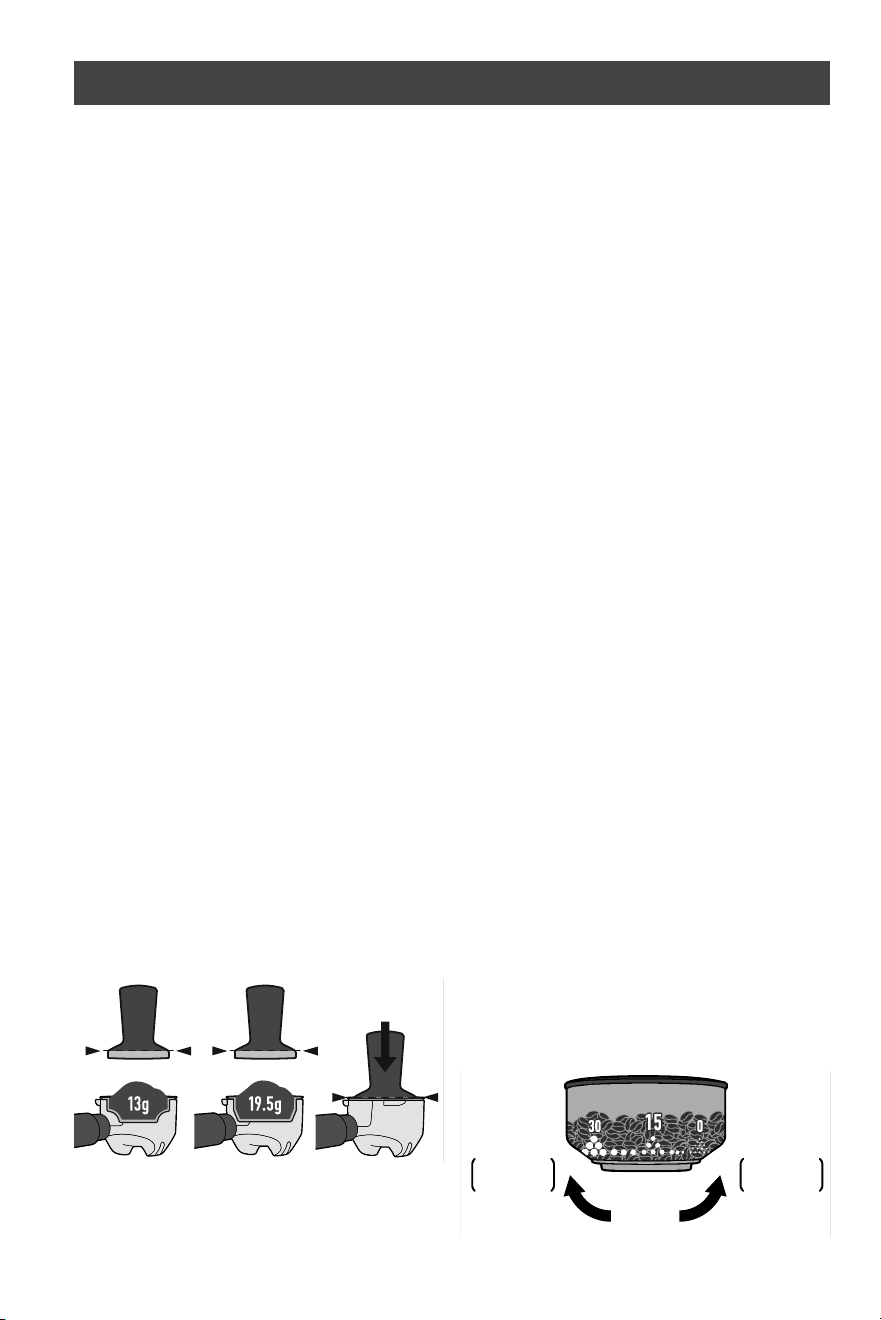
1. Set your grinder to setting 15.
2. Install the Two Cup filter basket in the
Group Handle.
3. Push down on the Group Handle and
hold, to manually grind the beans.
4. Dispense 19.5g of grounds into the
basket, if possible use kitchen scales to
accurately measure, adding or removing
grounds as necessary.
5. Tamp the grounds.
6. Install the Group Handle into the Group
Head.
7. Press the Two Cup button, and time the
extraction period. You are aiming for the
total brew cycle to be between 20-30s.
8. If the extraction takes longer the grind
is too fine. If the extraction is shorter
then the grind is too coarse. Adjust the
grind size up or down as needed, and
make repeat double shots, until the
extraction period is with 20-30s.
9 . When you brew an espresso in 20-30s,
then you have identified the correct
grinder setting for your specific machine
and beans.
10. Keeping the machine on the correct
grinder setting (i.e. setting 21), follow
the Grinder Time Adjustment on the
next page to set the correct dispense
weight of grounds
Tips for grinding, tamping & brewing
ONE CUP
TWO CUP
TAMP FORCE
10-15KG
TURN
ANTI-CLOCKWISE
FOR
COASER GRIND
FASTER
EXTRACTION
TURN
CLOCKWISE
FOR
FINER GRIND
SLOWER
EXTRACTION
GRIND
SETTING
21
Espresso dialling in optimisation examples
Example 1. Grinding a double espresso.
The extraction finishes dispensing in
15s. The water is flowing through the
grinds too easily, and the coffee will be
under extracted and light in colour.
- Reduce the grind size to a finer
setting, and tamp with the same
pressure. When the coffee dispenses
in 20-30s the espresso will be
perfectly extracted.
Example 2. Grinding a double espresso.
The extraction finishes dispensing in
45s. The water is struggling to pass
through the grounds, and coffee drips
slowly from the Group Handle. The
coffee will be over extracted and very
dark in colour.
- Increase the grind size to a coarser
setting and tamp with the same
pressure. When the coffee dispenses
in 25-30s the espresso will be
perfectly extracted.
Customisable – Grinder Time
Adjustments
Your machine will come from the factory
preprogrammed to dispense the following
weight of coffee grounds for an ‘average’
bean:
- Single shot 13g at setting 15
- Double shot 19.5g at setting 15
Due to a number of reasons, such as the
type of coffee bean, it may be that you want
to adjust the factory settings. You may find
that if you want a finer or course grind size,
then you also need to adjust the grind time
duration to ensure a consistent dispense.
Note: If you want to add a small amount
of extra grounds to your shot, you
don’t have to adjust your settings as
described below, you can simply top
up the grinds in your Group Handle
using the manual grind function on the
grinder (push the Group Handle down,
and hold).
Tip: Using scales place the correct weight
of grounds into the filter basket using a
spoon. Note what this looks like. This will
help you judge when to stop the grinder.
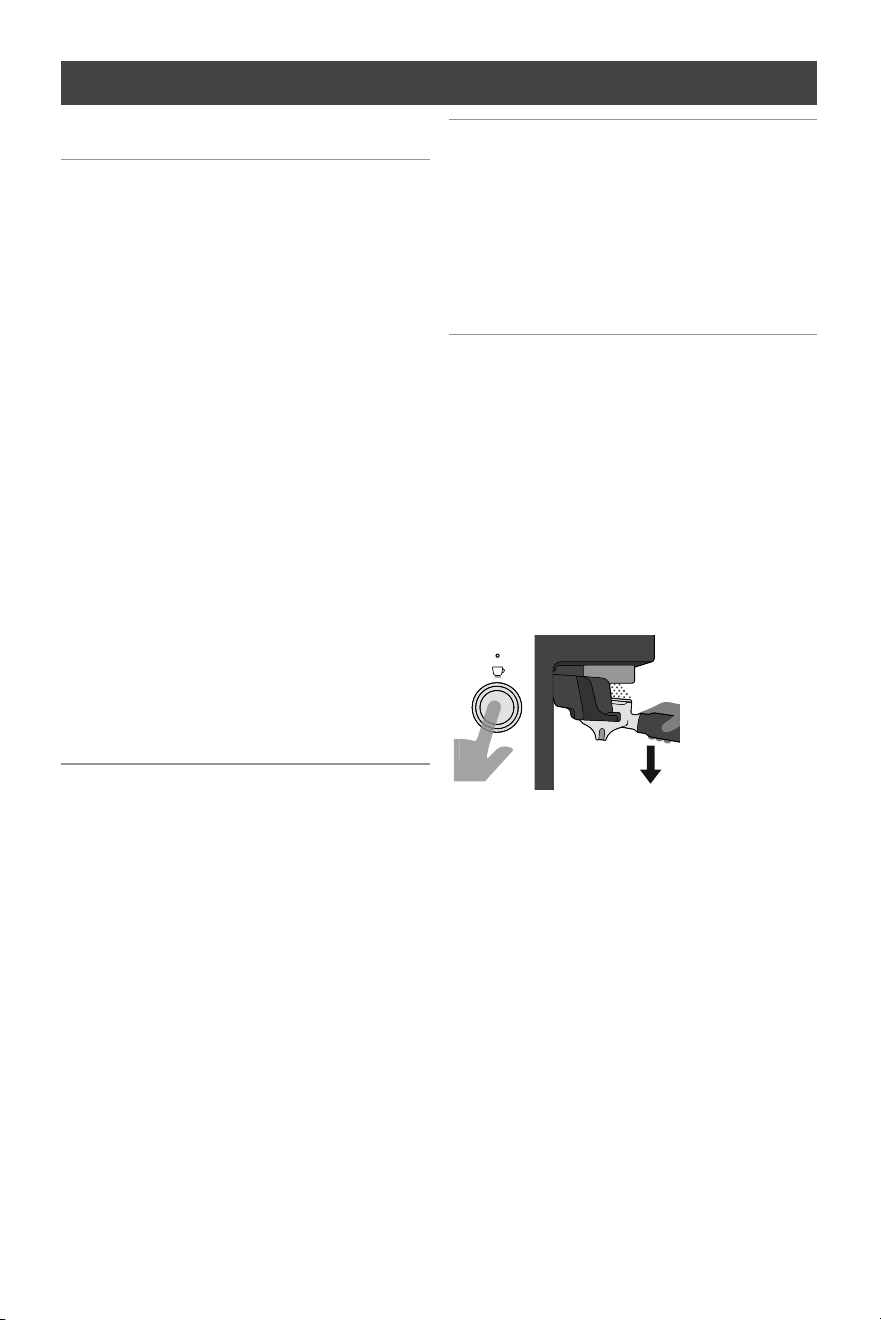
To adjust the Single shot grinds dispense
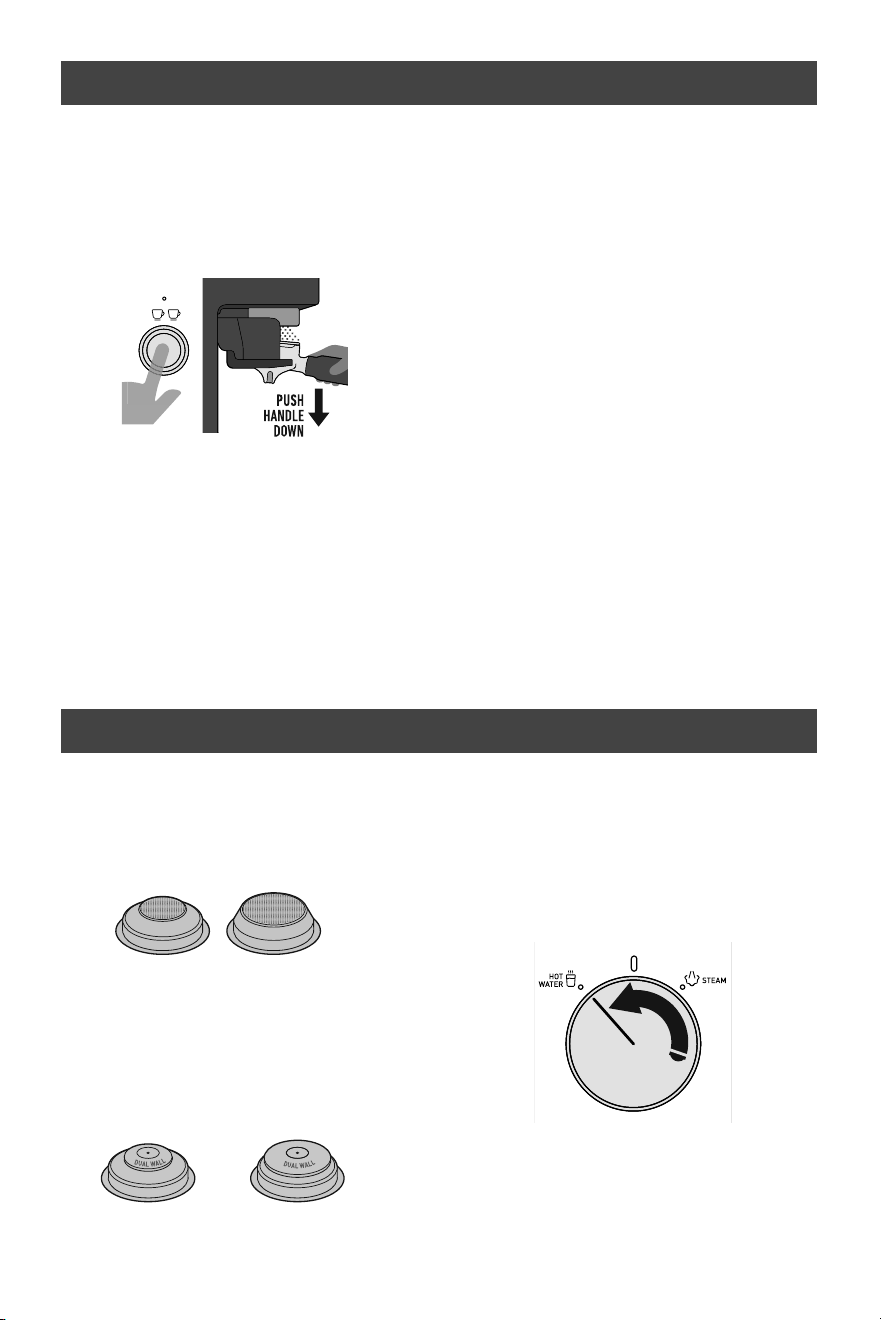
- Starting from the READY state, press and
hold the One Cup brew buttons at the
same time as pushing down on the Group
Handle for 3 seconds.
PUSH
HANDLE
DOWN
- The single shot indicator will begin to
pulse.
- Tap down on the Group Handle and the
grinder will start.
- When the desired amount of grounds have
been dispensed, tap the Group Handle a
second time to stop the dispense.
- The updated dispense for the Single Shot
setting will be automatically saved.
- Double check the amount of coffee
dispensed is correct by weighing.
Tips for grinding, tamping & brewing
22
Filter Baskets
• Single Wall filters work with freshly
ground coffee grinds.
• Dual Wall filters enhance the crema of
your coffee when using pre-ground or
older coffee. The dual walls increase the
pressure inside the group handle during
the extraction process.
ONE CUP
TWO CUP
Hot Water
If wanting to make a long espresso-based
drink, you can add extra hot water using
the Hot Water Tap, simply rotate the dial
anticlockwise and hot water is dispensed
from the Tap.
To stop the water flow simply return the
dial back to the vertical position.
Tips for Brewing
ONE CUP
TWO CUP
To adjust the Double shot grinds dispense
- Starting from the READY state, press
and hold the Two Cup brew button at the
same time as pushing down on the Group
Handle for 3 seconds.
- The double shot indicator will begin to
pulse.
- Tap down on the Group Handle and the
grinder will start.
- When the desired amount of grounds
have been dispensed, tap the Group
Handle a second time to stop the
dispense.
- The updated dispense for the Double Shot
setting will be automatically saved.
- Double check the amount of coffee
dispensed is correct by weighing.
Restore grind dispense to factory settings:
- Press and hold the Manual (3a), One
Cup (3b) and Two Cup shot buttons (3c)
simultaneously for 4 seconds.
- The machine will beep x 1 for 1s and
the Manual, Single and Double shot
indicators will flash once simultaneously
at 0.5Hz.
- The machine will return to the Ready
State. Factory defaults will now be reset.
Tips for grinding, tamping & brewing
23
Milk texturing is the steaming of milk.
Key Elements of Textured Milk
Milk that has been textured correctly has
a thick, rich microfoam with a silky sheen.
Texturing involves both heating and aerating
milk using steam. Vital elements include
positioning of the Steam Wand, when to
adjust the Milk Jug position and reaching the
correct temperature. Use the below steps to
help you create café-style microfoam.
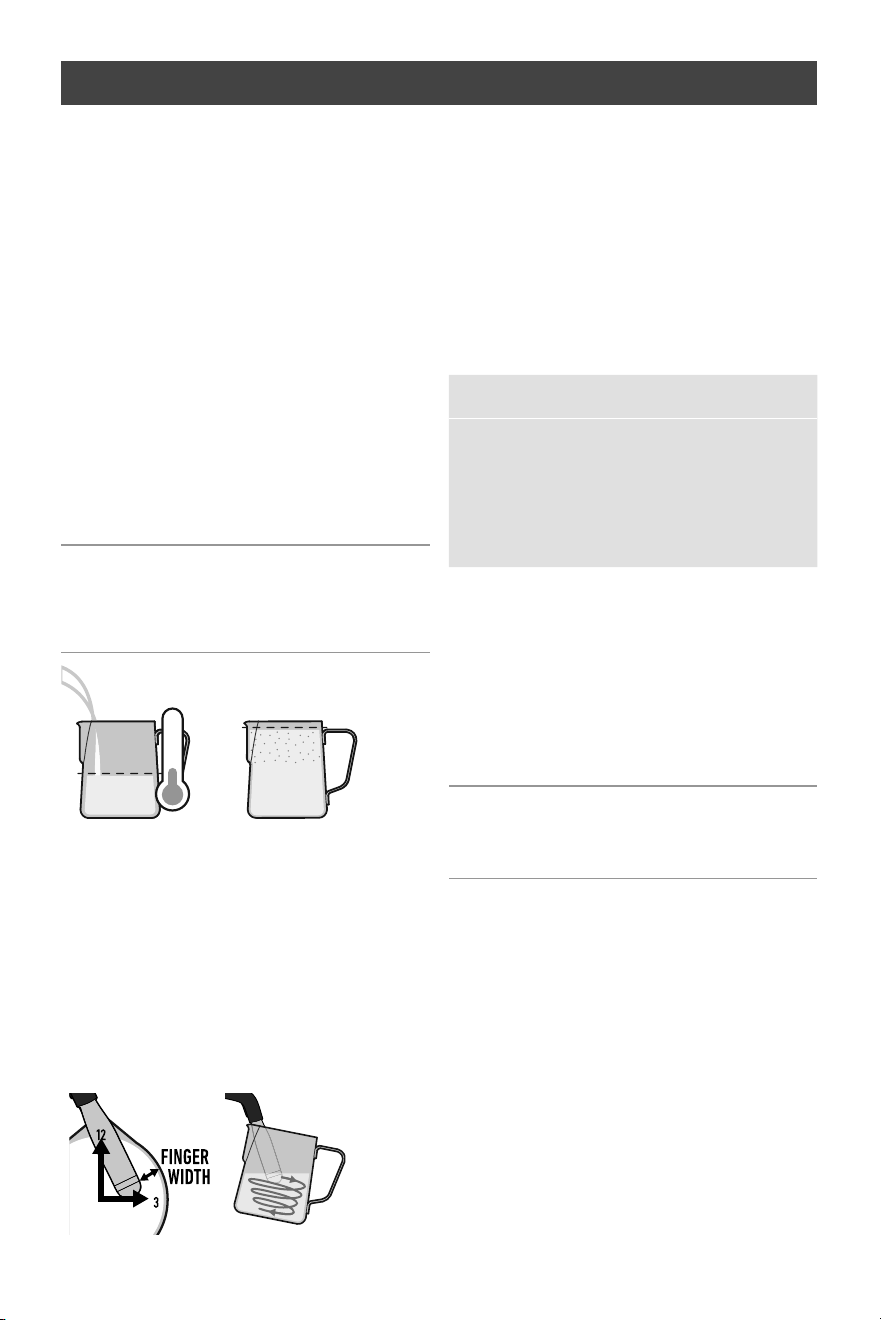
1. Fill Milk Jug
Add cold milk around 4°C into a chilled
clean Stainless Steel Jug. Fill to the
bottom of the spout.
Note: The volume of milk will increase
or ’stretch’ during texturing, so don’t
overfill the Jug.
FILL
MAX
FINISHED
MAX
4°C
2. Position the Jug
Place the Steam Wand Arm in the Jug spout
at the 12 o’clock position, with the Steam
Wand Tip in the milk at the 3 o’clock position,
a finger width away from the edge of the
Jug. Keep Steam Wand Tip just under the
surface of the milk. Turn DIAL back to STEAM
position to start texturing. A whirlpool action
should be created in the Jug.
3. Sound
How air is introduced to the milk
determines the consistency of the foam. If
large gulps of air are added to the milk, the
foam will have large bubbles. Introducing
air to the milk in a controlled, gentle
fashion indicated by a gentle hissing sound,
will ensure the milk has fine aerated
microfoam.
Barista Tip: Milk Texturing Sounds
Gurgling - Tip not deep enough,
raise the Jug.
Smooth Hissing - Just right for latte.
Screeching - Tip too deep, lower Jug.
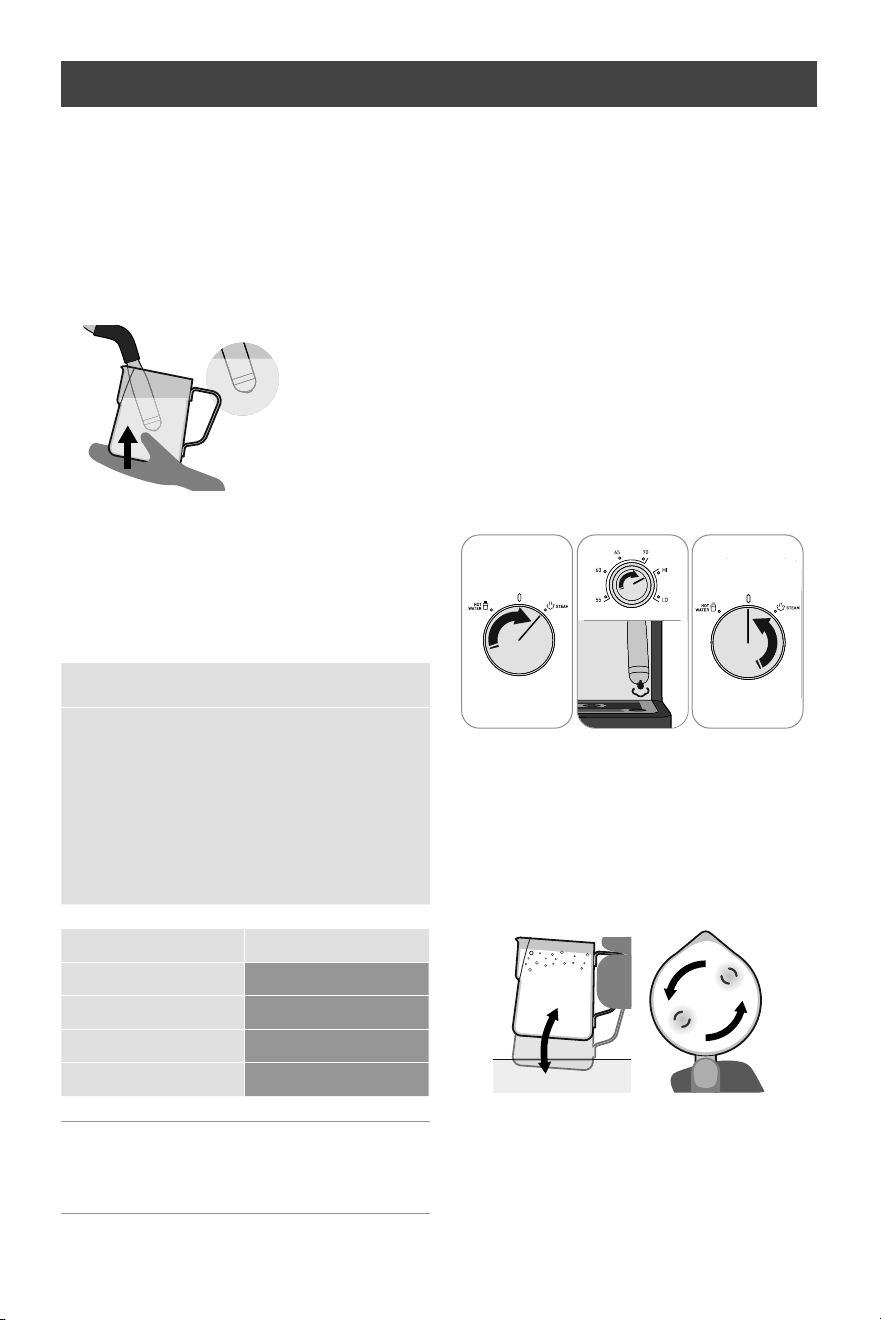
4. Keeping Steam Tip Position
As the steam heats & textures the milk,
the milk will stretch causing the level of
the milk in the Jug to rise. As this happens
follow the level of the milk by lowering
the Jug, keeping the Steam Wand Tip just
below the surface.
Note: Some adjustments to technique
will be required when using non-dairy
milk.
5. Amount of Foam
Create the amount of microfoam you
want. Cappuccinos traditionally have more
microfoam than flat whites.
Tips for milk texturing
24
6. Immerse Tip
After creating the desired amount of foam,
immerse the Steam Wand half depth way
into the milk. This heats all the milk and
pulls in milk instead of air. This ensures
the milk & foam are blended together,
making it denser & smoother.
7. Correct Temperature
An indication of reaching correct milk
temperature is when the Milk Jug base
can only be touched comfortably for
approximately 3 seconds.
Barista Tip: Milk Temperature
Under - If not heated long enough, it
will be warm with little texture.
Optimum - See below table.
Over - If heated for too long it will start
to boil around 72°C and will have
a burnt taste with all texture lost.
Milk
Temperature
Oat and Soy 55-60°C
Almond 55-65°C
Dairy Full/Skim 60-65°C
Coconut 65-70°C
Note: Above recommendations might
vary from one milk brand to another and
depending on your taste preference.
8. Wipe Steam Wand
Wipe the Steam Wand Arm & Tip with
a clean damp cloth to remove any milk
residue.
9. Purging the Steam Wand
When correct milk temperature has been
reached, turn the DIAL to the vertical
position and remove the Jug from the
Steam Wand. Place Milk Jug to one side.
Place the Steam Wand over the Drip Tray.
Turn the DIAL to the steam position for a
few seconds, then return the DIAL to the
vertical position. This will remove any milk
that has been sucked into the Steam Wand
Tip.
10. Tap & Swirl the Jug
Gently tapping the Jug on the benchtop
helps to release larger trapped air bubbles.
Swirling helps the milk & froth to combine
for an even consistency and a silky
appearance.
11. The Finishing Touches
Pour from the Milk Jug into your cup in one
steady motion.
Tips for milk texturing
25
Tips for milk texturing
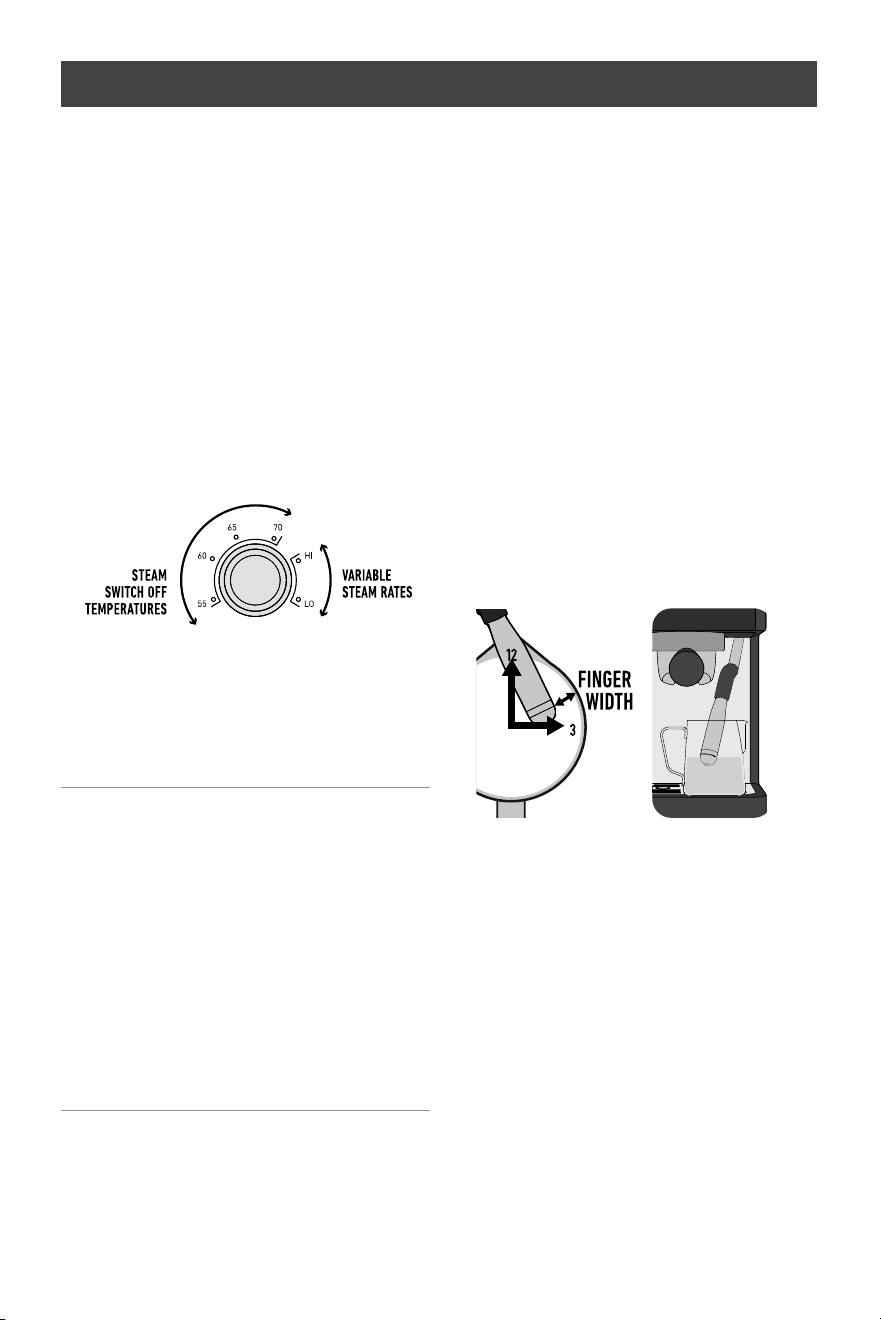
Smart Steam – Steam Adjustment Dial
Your Origins Sense Espresso Machine
comes with a Steam Adjustment Dial,
rotating the dial allows the selection of:
1. Automatic milk temperature switch
off; to automatically switch the steam
flow off at a preselected temperature
(between 55 and 70 degrees C).
2. Variable steam rates; adjusts the steam
flow from the wand between high and
low steam flow, to allow fine control of
your milk frothing
Once the Steam Adjustment selection has
been made, rotate the Selection dial to the
STEAM position, and steam will automati-
cally be dispensed from the Steam Wand.
Important: After auto steam has
stopped the Alert indicator will pulse.
The Selection Dial MUST be rotated
back to the 12 o’clock position before
performing the next operation on your
machine.
Note: When using the automatic milk
temp switch off feature it is not possible
to also select the Variable Steam rate,
as your machine with automatically
adjust the steam rate as part of the milk
temp switch off process.
Hands free foaming with automatic milk
switch off
Milk can be frothed to a perfect microfoam
hands free:
- Fill the milk jug so that the milk level
aligns with the base of the spout.
- Insert the steam wand into the jug and
place the jug on the drip tray.
- Position the milk jug so that the Steam
wand rests in the jugs spout, and the
wand is at a slight angle. Also ensure
the wand is a finger width from the side
of the jug. This will help the milk swirl
around in the jug during steaming to
ensure consistent temperature.
- Rotate the steam adjustment dial to the
desired milk switch off temperature.
- Rotate the main Selection dial clockwise
to the STEAM position to start steaming.
- The steam flow will automatically
switch off when the milk reaches the
pre-selected temperature, and having
created a perfect microfoam.
26
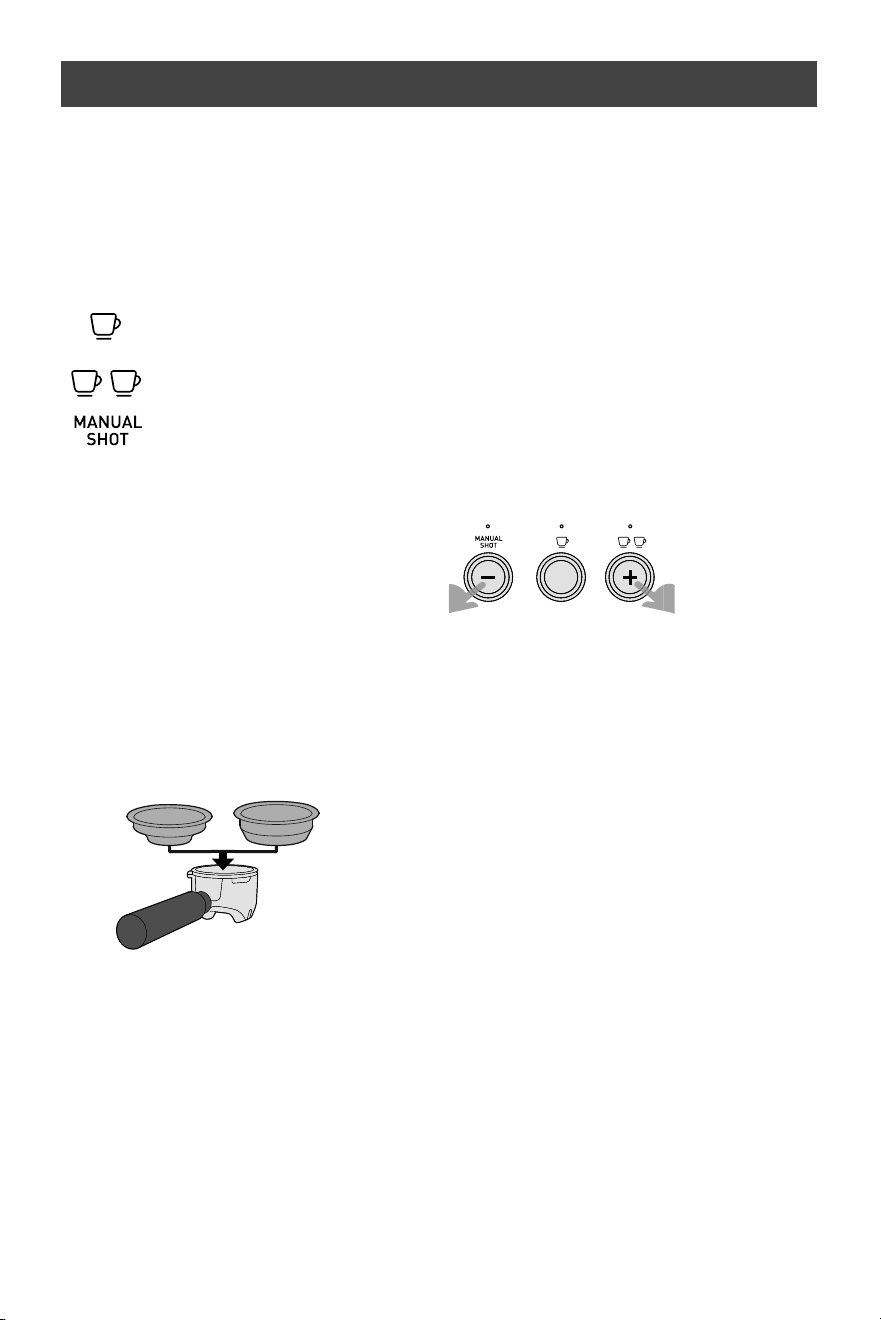
Customisable - Shot Volumes
The Origins Sense Espresso Machine
features Auto Shot Volumetric Control.
It extracts just the right amount of
espresso then automatically stops.
Pours 1 shot of espresso.
Pours 2 shots of espresso.
Pours water up to 200ml.
At any point during espresso extraction you
can stop the pour by pressing the same
button again.
You can adjust the default shot volumes to
suit how you like your coffee.
Customise – Single or Double Cup Shot
Volume
- Insert appropriate Filter into the Group
Handle.
- Fill with coffee grinds then tamp.
- PRESS AND HOLD for 4 seconds, the
button for the shot volume you wish to
customise (single or double), the other
buttons light will extinguish.
- The machine will beep x 1 for 0.5s and
the currently selected volume button
combination will begin to Pulse at 1Hz.
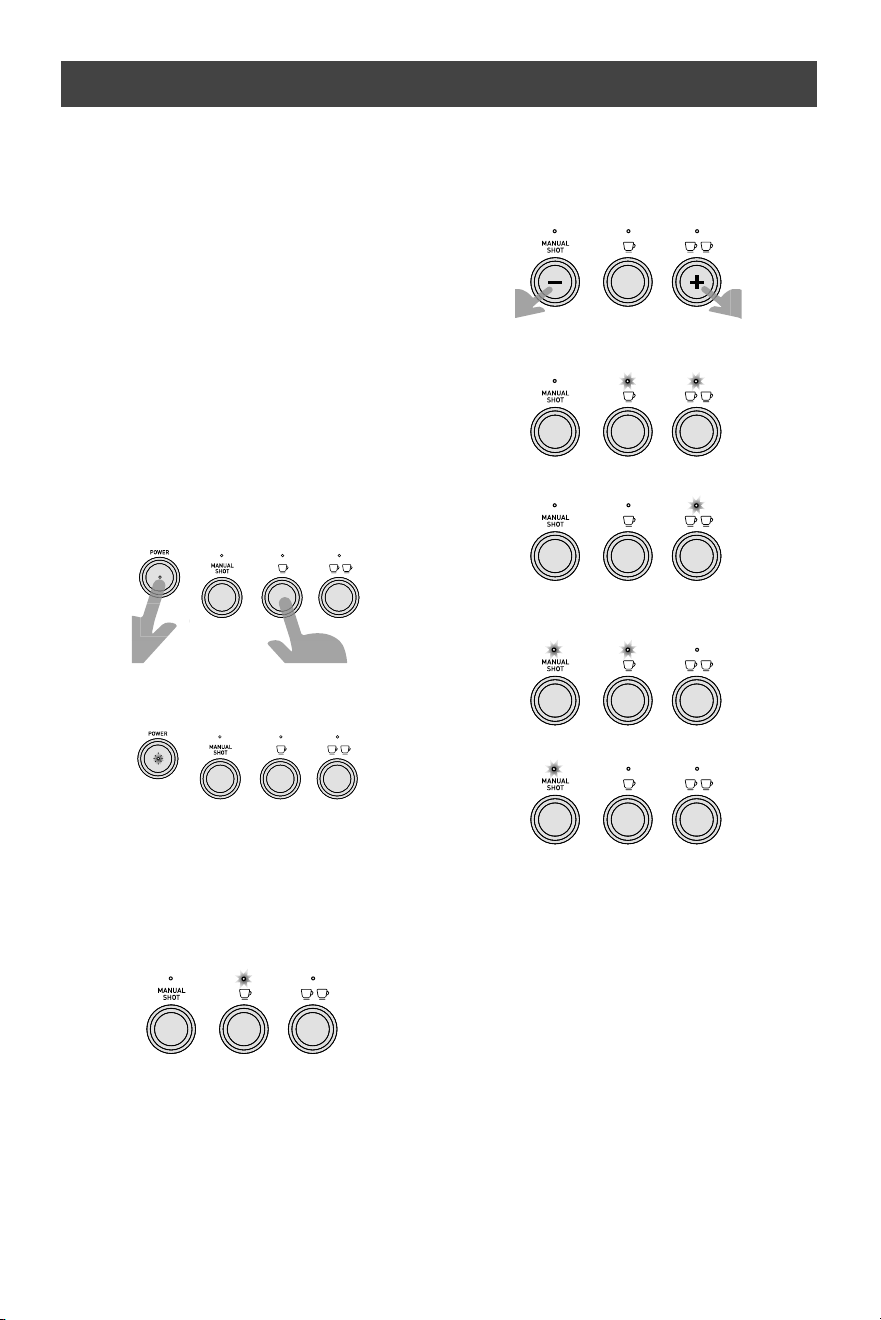
The button combinations are as follows:
• 20ml = Manual button
• 25ml = Manual and One Cup buttons
• 30ml = One Cup button
• 35ml = One Cup and Two Cup buttons
• 40ml = Two Cup buttons
- To adjust between volume settings, use
the manual and Two Cup buttons to
toggle up and down.
- Once the desired setting has been
selected, press the Power On button , the
machine will beep x 1 for 0.5s and the
setting will be saved.
Fine tuning your espresso
TWO CUP
ONE CUP
OR
27
Customisable - Extraction Temperature
You can adjust the water temperature used
for espresso extraction, in 2°C increments
between 88 and 96°C, to cater for different
types of roasted coffee beans and for
personal preference.
- Higher temperatures increase bitterness
and decrease acidity.
- Lower temperatures decrease bitterness
and increase acidity.
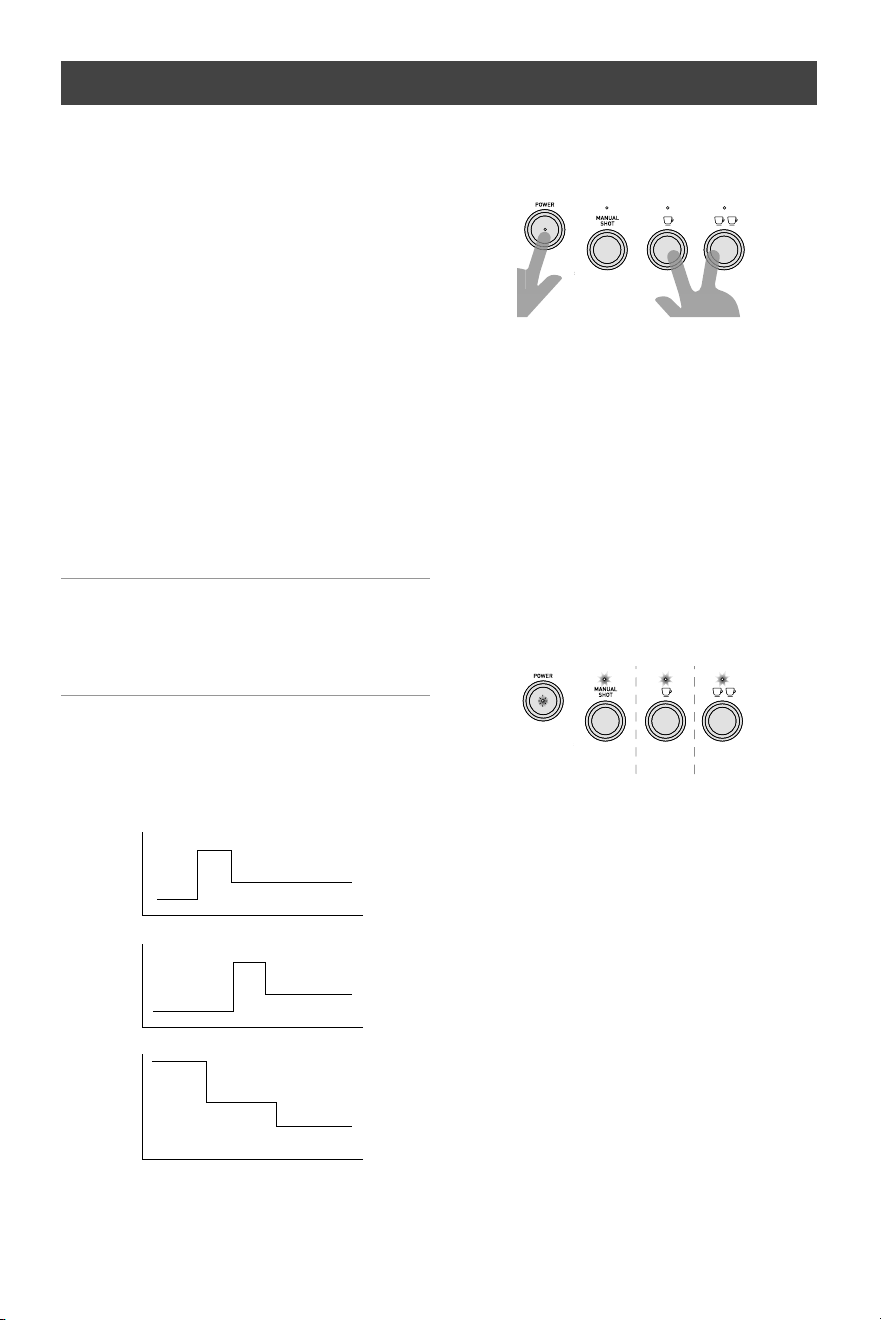
• Adjusting Extraction Temperature
- Starting from the READY state, press &
hold the Power On and One Cup button
for 4 seconds.
The Power On Indicator will begin to pulse
and the unit will beep.
• Adjusting Extraction Temperature
The combination of EXTRACTION LIGHTS
illuminated signals the temperature
selected. The default setting is:
- 92°C = ONE CUP LIGHT illuminated.
To Adjust extraction temperatures press:
- MANUAL SHOT BUTTON = Minus Button.
- TWO CUP BUTTON = Plus Button.
- 94°C = ONE & TWO CUP LIGHT
illuminated.
- 96°C = TWO CUP LIGHT illuminated.
- 90°C = MANUAL SHOT & TWO CUP
LIGHT illuminated.
- 88°C = MANUAL SHOT LIGHT illuminated.
To save the setting, press the Power On
button, the machine will beep and the
setting will be saved.
The machine will return to the READY state
if no button is pressed in 60s.
Customisable - Extraction Temperature
You can adjust the water temperature used
for espresso extraction, in 2°C increments
between 88 and 96°C, to cater for different
types of roasted coffee beans and for
personal preference.
- Higher temperatures increase bitterness
and decrease acidity.
- Lower temperatures decrease bitterness
and increase acidity.
• Adjusting Extraction Temperature
- Starting from the READY state, press &
hold the Power On and One Cup button
for 4 seconds.
The Power On Indicator will begin to pulse
and the unit will beep.
• Adjusting Extraction Temperature
The combination of EXTRACTION LIGHTS
illuminated signals the temperature
selected. The default setting is:
- 92°C = ONE CUP LIGHT illuminated.
To Adjust extraction temperatures press:
- MANUAL SHOT BUTTON = Minus Button.
- TWO CUP BUTTON = Plus Button.
- 94°C = ONE & TWO CUP LIGHT
illuminated.
- 96°C = TWO CUP LIGHT illuminated.
- 90°C = MANUAL SHOT & TWO CUP
LIGHT illuminated.
- 88°C = MANUAL SHOT LIGHT illuminated.
To save the setting, press the Power On
button, the machine will beep and the
setting will be saved.
The machine will return to the READY state
if no button is pressed in 60s.
Fine tuning your espresso
28
Fine tuning your espresso
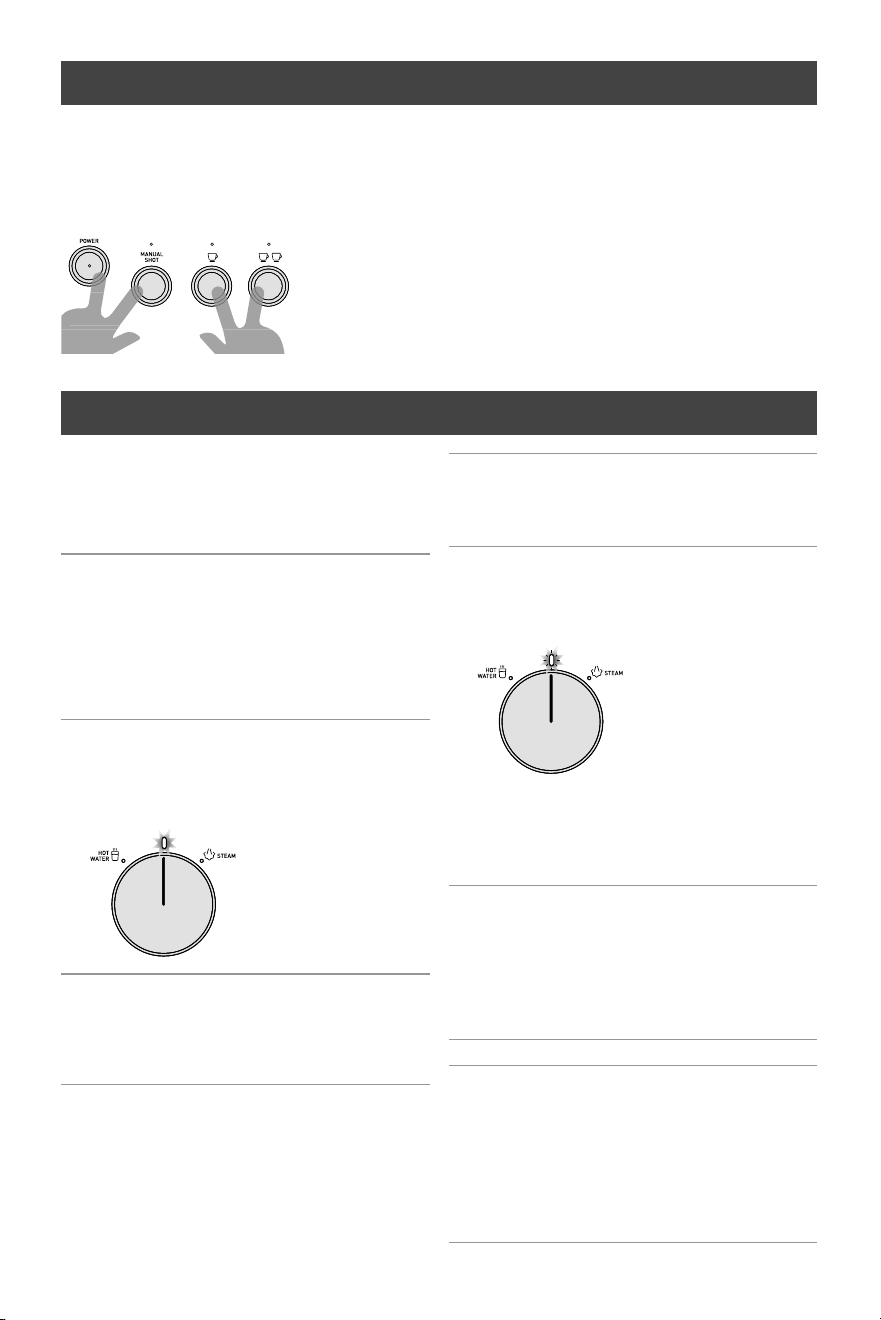
Customisable Flow Profiles
You can select from three different flow
profiles to brew your Espresso. This
feature varies the flow of water through
your grounds, which will also impact the
extraction pressure, to give surprisingly
different flavour profiles to your beans.
- Well rounded: This is the default setting
on your machine and gives a good well
balanced Espresso.
- Long Pre-infusion: provides a long and
low flow pre-infusion period to the start
of your extraction, which will increase
the body of your Espresso. Experiment
by applying this profile to lighter roasted
beans.
Note: This setting will increase the
overall dispense time by around 5
seconds, so please consider this when
dialling in.
- Declining: A more radical profile, the
extraction profile starts at full flow and
declines during the dispense cycle. This
reduces astringency and brings out
acidity – ideal for dark roasted beans.
- Starting from the READY state, press &
hold the Power On, One Cup & Two Cup
buttons for 4 seconds.
- The Power On Indicator will begin to
pulse and the unit will beep.
The illuminated button indicator signals
the Flow Profile currently selected (factory
default is Well rounded)
a. Well rounded profile = Manual button
shot indicator is illuminated
b. Long Pre-Infusion = One Cup button
indicator is illuminated
c. Declining = Two Cup button indicator is
illuminated
To save the setting, press the Power On
button, the machine will beep and the
setting will be saved.
The machine will return to the READY state
if no button is pressed in 60s.
Time
Flow
Time
Flow
Time
Flow
Well Rounded
Profile
Long
Pre-Infusion
Declining
29
Restore - all settings (both brew and
grind) to factory
- Press & hold all 4 BUTTONS at the same
time for 4 seconds.
- The Origins Sense Espresso Machine will
beep and all 4 BUTTON LIGHTS will flash
together.
- The factory settings for all features have
been restored.
- The Origins Sense Espresso Machine will
return to the READY state.
Low water level Alert
When the water tank minimum fill level is
reached the low water alert will activate.
Note: The Espresso, steam and hot
water functions will all continue to
operate, when the low water alert is
illuminated, however recommend that
the watertank is refilled at the next
opportunity.
• The Alert Indicator turns ON and the
unit beeps when the machine detects
the water level in the reservoir has
reached the low level.
Note: If you are turning the machine on
for the first time, before you have put
water in the reservoir, then the Alert
indicator will have activated.
• Refilling with water above the minimum
fill level will automatically switch the
Alert Indicator off.
Dry Tank Alert
When there is no water left in the tank the
Dry Tank alert will activate.
Note: As the water tank runs dry the
pump will suddenly become much louder,
as water stopes passing through it.
• When the water tank runs dry, the unit
beeps x3 and the Alert Indicator begins
to flash. The pump will stop operating.
• The Alert Indicator will continue to flash
until the tank is refilled above the low
water alert level.
Important: If either the Hot water or
Steam functions were being used when
water flow stopped then the Alert Indicator
will flashuntil the Selection Dial is rotated
back to the 12 o’clock position, even if the
tank has been refilled.
Note: Your machine detects that water
has stopped flowing when it activates
the Dry Tank Alert. It therefore may
be possible that the alert will activate
if the Group Handle becomes blocked
when brewing an Espresso – see the
Troubleshooting guide.
Fine tuning your espresso
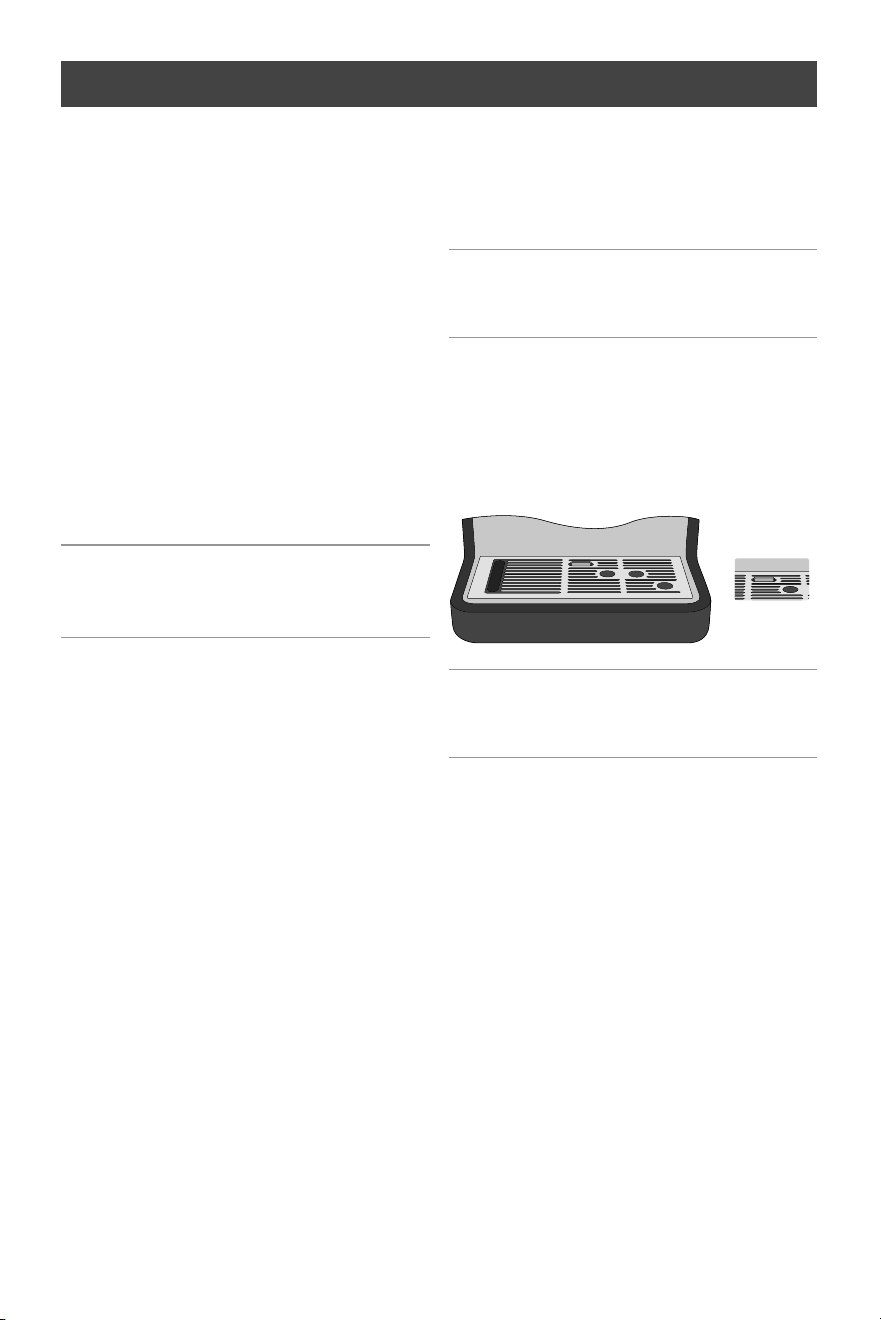
Low water and empty tank
30
The espresso making process involves
extracting oils out of coffee grinds.
Deposits of grinds & oils build up over
time, affecting the taste of the coffee &
operation of the Espresso Machine.
Purging water through the Group Head &
Steam Wand, before & after making each
coffee, is the easiest way to keep your
Espresso Machine clean.
Cleaning Accessories & Removable Parts
- Do not immerse the appliance, power
cord and plug in water or any other liquid.
- Clean parts in warm water with a mild
detergent, rinse & dry.
Note: Do not use alkaline cleaning
agents, abrasives or metal scourers, as
these will scratch the surfaces of parts.
Dishwasher Safe parts:
- Stainless Steel Milk Jug
- Stainless Steel Drip Tray Grille
- Stainless Steel Filter Baskets
- Cleaning Disc
Dishwasher Safe TOP SHELF ONLY parts:
- Hardened Stainless Steel Top Burr
- Grind Bin
NON-Dishwasher Safe parts:
- Water Reservoir
- Group Handle
- Bean Hopper
- Drip Tray
- Tamper
- Cleaning Pin
- Cleaning Brush
Cleaning Warming Plate & Exterior
• When Required
- Wipe over the machine with a soft damp
cloth with a mild detergent and wipe dry.
CAUTION: To prevent damage to the
appliance do not use alkaline cleaning
agents, abrasives or metal scourers.
Cleaning Drip Tray & Grind Bin
• When Required
- Empty water if the red Water Level
Indicator appears through the Stainless
Steel Grille, otherwise water will overflow.
Note: Over time it is normal for the
inside of the Drip Tray & Grind Bin to be
stained by the oils in the coffee grinds.
• Weekly
- Cleaning Group Handle and Filter Basket.
- Clean in warm water with a mild
detergent, rinse and dry.
• Every Time
- Wash after each use by rinsing them with
warm water under the tap.
• Regular Intervals
- Cleaning Shower and Group Head.
- In warm soapy water using a mild
detergent, rinse & dry.
• Every Time
- Run water through before making an
espresso.
• Weekly
- Purge water through the Group head by
pressing the ONE CUP BUTTON.
- Allow water to run through until it stops.
Care and cleaning – Espresso machine
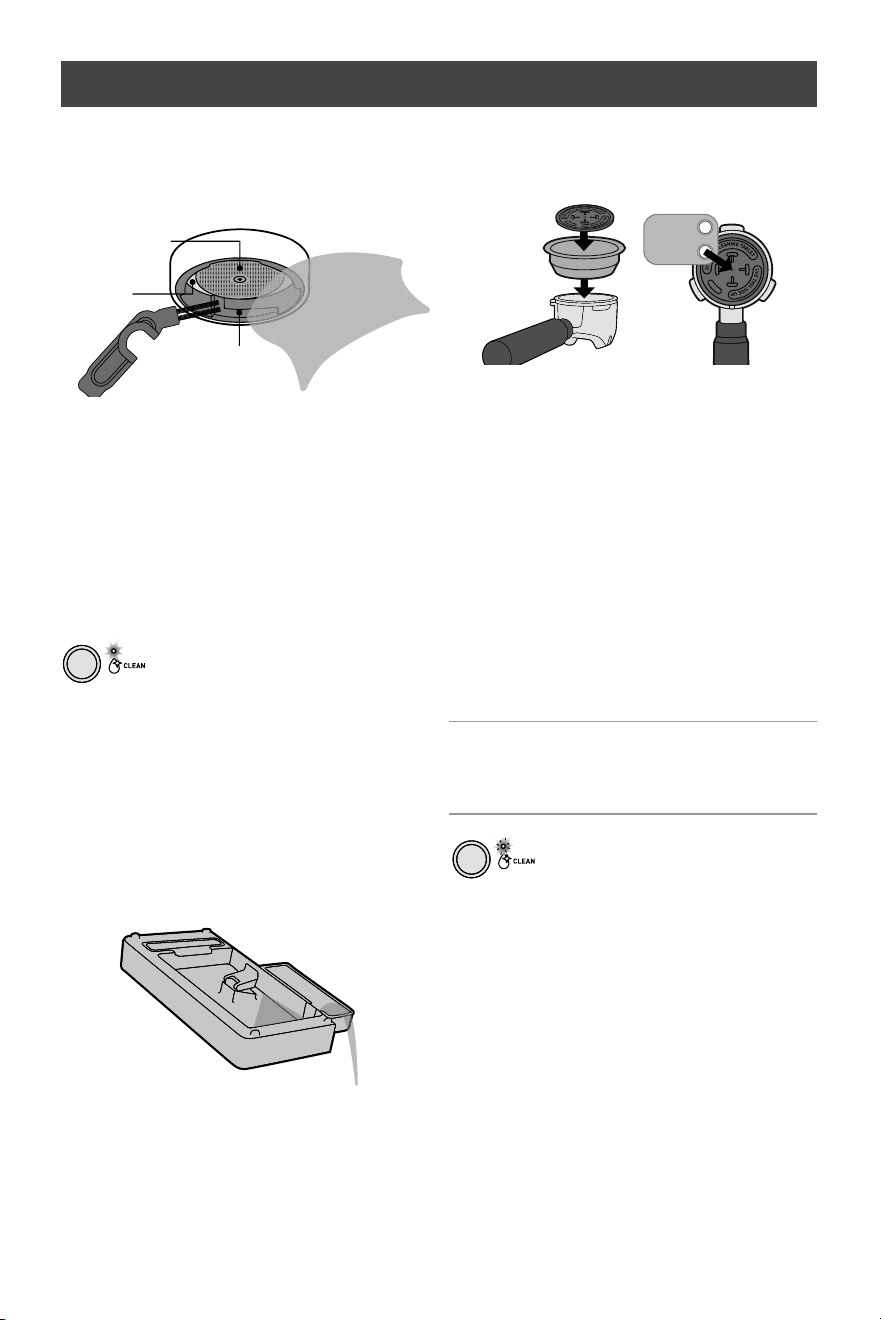
31
- With the Cleaning Brush remove any
coffee grinds from around the Group
Head inside rim and Silicone Seal. Wipe
the Shower Head with a damp cloth.
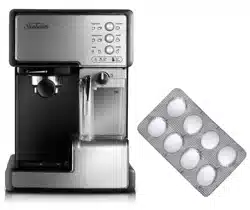
Cleaning Tablet
Cleaning tablets are perfect for removing
coffee oil build up to prolong the life of
your coffee machine. Sunbeam Espresso
Machine Cleaning Tablets can be
purchased online.
Cleaning Cycle
The CLEAN LIGHT will
illuminate to indicate a Cleaning
Cycle is required.
The Cleaning Cycle takes approximately 7
minutes to complete.
• Preparing for Cleaning Cycle
- Ensure there is at least 1 Litre of water in
the Reservoir.
- Empty the Drip Tray & replace.
- The machine is on and in the READY
state.
- Place the Two Cup Filter & the Cleaning
Disc into the Group Handle.
- Place one Cleaning Tablet in the middle
of the Cleaning Disc in the space
provided.
- Insert Group Handle into the Group Head.
- Place a large dish on the drip tray to
catch the water that will flow from the
Group Handle.
• Start the Cleaning Cycle
- Press the clean button quickly two
times (both presses need to be within 3
seconds). The Origins Sense Espresso
Machine will beep and the Cleaning Cycle
will start.
Note: The Cleaning Cycle can be exited
at any point by pressing the MANUAL
BUTTON.
The CLEAN LIGHT will pulse
during the cleaning cycle.
- Water will purge into the Drip Tray and
small amounts of water will pour from
the Group Handle spouts.
- At the end of the clean cycle the unit will
beep and will automatically return to the
READY state.
- Remove the Group Handle from the Group
Head. Check tablet has been dissolved.
SHOWER HEAD
GROUP HEAD
INSIDE RIM
ESPRESSO
MACHINE
CLEANING
TABLETS
SILICONE
SEAL
Care and cleaning – Espresso machine
32
Note: If the tablet has not been
dissolved, insert the Group Handle back
into the Group Head, empty the Drip
Tray & replace. Repeat the ‘Start the
Cleaning Cycle’ section.
• Cleaning Cycle Clean Up
- Purge the Group Head by pressing the
ONE CUP BUTTON and water should
flow.
- Allow water to run through until it stops.
- Wash the Drip Tray, Group Handle &
Cleaning Disc in warm water with a mild
detergent, rinse & dry.
Cleaning Steam Wand
• Every time
- Wipe the Steam Wand with a damp cloth.
(See page 11).
- After texturing milk purge the Steam
Wand by turning the DIAL to STEAM for
just 1-2 seconds.
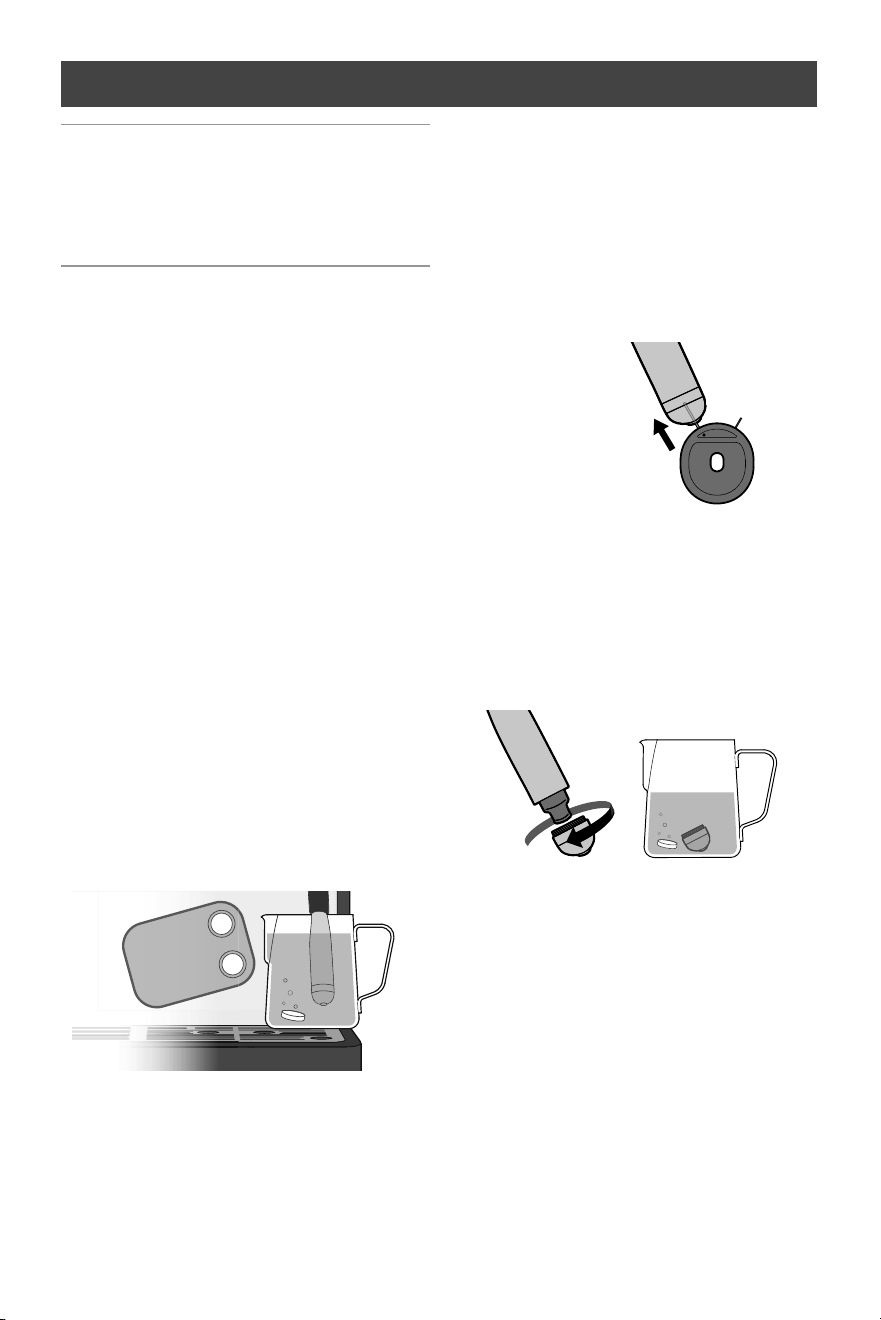
• 2-3 Months
- Soak the Steam Wand overnight in the
Milk Jug with warm water & one Cleaning
Tablet.
ESPRESSO
MACHINE
CLEANING
TABLETS
- In the morning remove the Jug and rinse
ensuring that all traces of the solution
have been removed.
- Wipe Steam Wand with a damp cloth
ensuring that all traces of the cleaning
tablet have been removed.
- Run Steam through the Steam Wand for
40 seconds.
• Unblocking Steam Wand
If the Steam Wand Tip becomes clogged
with milk residue:
- Insert the thicker ‘Steam’ Cleaning Pin up
the Steam Wand Tip hole and remove.
INSERT
STEAM
- Run Steam through the Steam Wand for
40 seconds.
• If the Steam Wand remains blocked:
Unscrew the Steam Wand Tip and soak
overnight in the Milk Jug with warm water
& one Sunbeam Cleaning Tablet.
UNSCREW
- In the morning rinse the Jug & Steam
Wand Tip under running water ensuring
all traces of the cleaning tablet have been
removed.
- Use the thicker ‘Steam’ Cleaning Pin to
clean the Steam Wand Tip.
- Ensure red O-ring is present &
undamaged.
- Screw the Steam Wand Tip back into the
Steam Wand Arm.
- Run Steam through the Steam Wand for
40 seconds.
Care and cleaning – Espresso machine
33
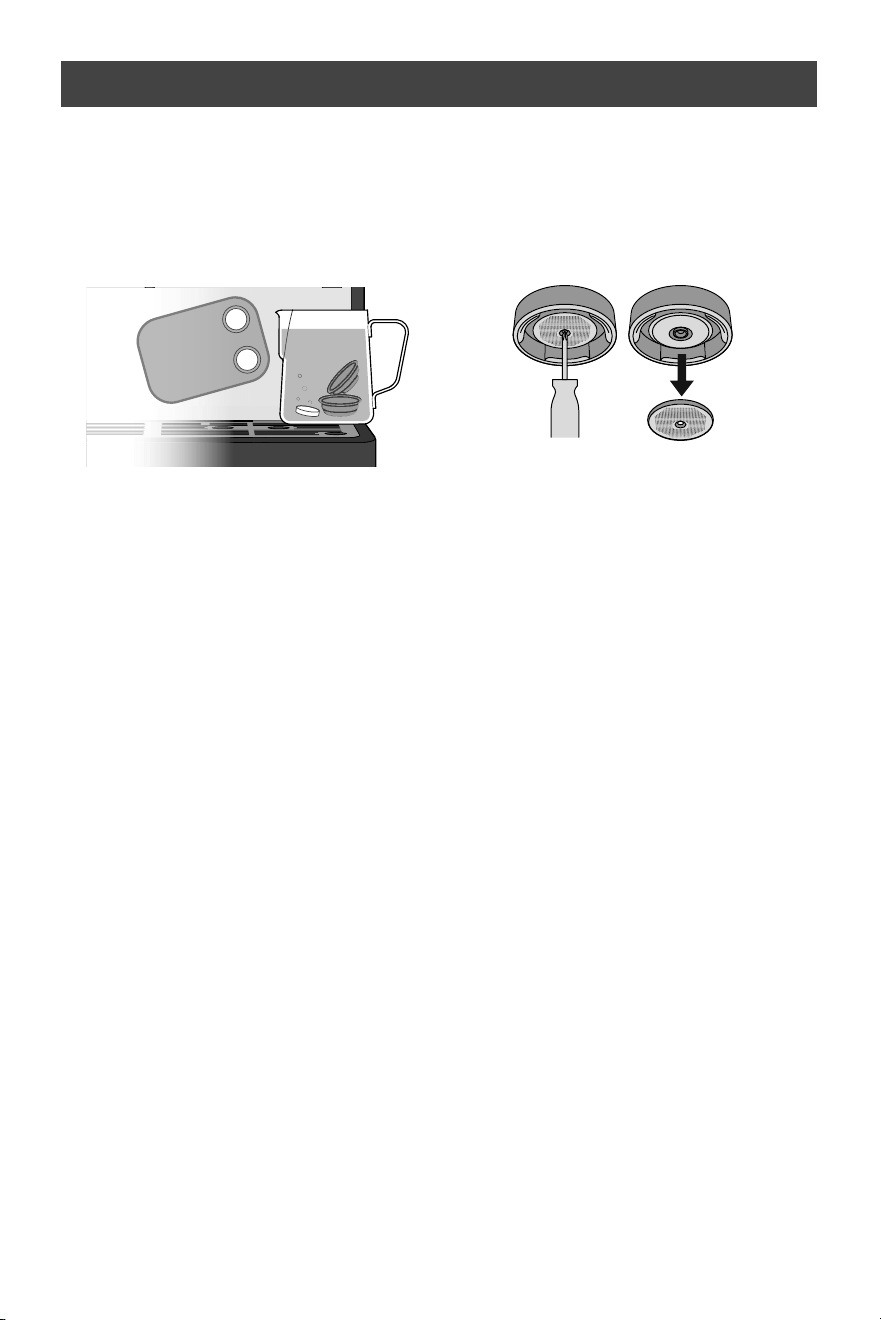
Cleaning the Filters
• 2-3 Months
Soak the Filter Basket(s) overnight in the
Milk Jug with warm water & one Cleaning
Tablet.
- In the morning rinse the Jug & Filter
Basket(s) under running water ensuring
all traces of the cleaning tablet have been
removed.
- Place a Filter Basket into Group Handle
(without coffee grinds) and insert into
Group Head.
- Press the ONE CUP BUTTON.
- Allow water to run through until it stops.
Removal of Shower Screen
• 2-3 Months
- Remove the centre screw retaining the
Shower Screen, positioned under the
Group Head.
- Remove the Stainless Steel Shower
Screen.
- Soak overnight in the Milk Jug with warm
water & one Cleaning Tablet.
- In the morning rinse the Jug & Shower
Screen under running water ensuring all
traces of the cleaning tablet have been
removed.
- Reinstall and tighten screw.
Care and cleaning – Espresso machine
ESPRESSO
MACHINE
CLEANING
TABLETS
34
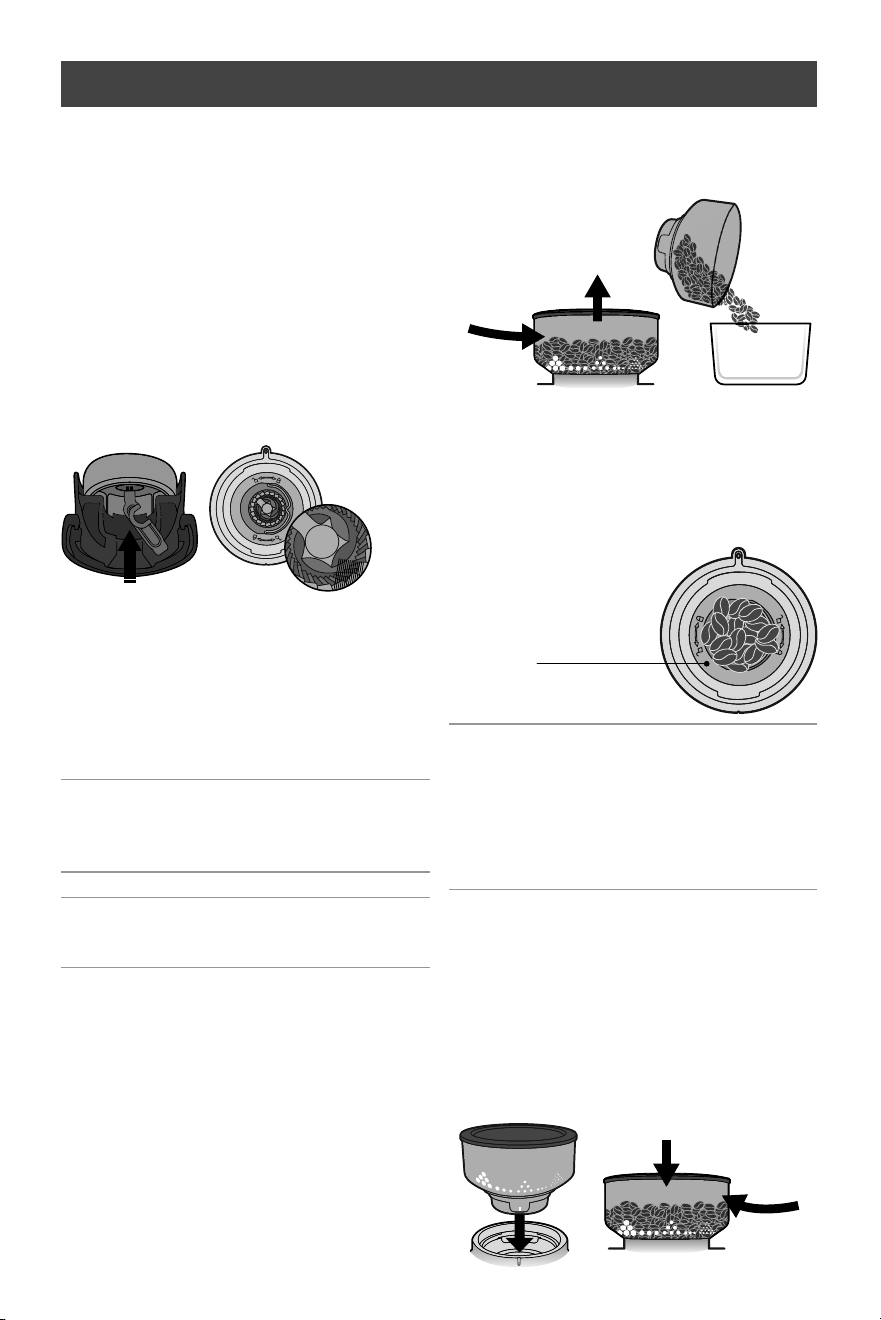
Conical Burrs are used to grind coffee beans
to a suitable size for espresso extraction.
Deposits of grinds & oils build up over time,
affecting the taste of the espresso and
operation of the integrated Grinder.
Cleaning Grinding Cradle & Grind Outlet
• Weekly
Remove any coffee grinds from the
Grinding Cradle & Grind Outlet with the
Cleaning Brush and wipe with a damp
cloth, wipe dry.
Cleaning the Bean Hopper
• 2-3 Months
If the Grinder is used frequently (everyday),
the Bean Hopper needs to be cleaned to
ensure best performance.
CAUTION: To prevent damage to the
appliance do not use alkaline cleaning
agents, abrasives or metal scourers.
WARNING: Do not immerse the
machine in water.
• Preparing to Clean Bean Hopper
- Turn off the machine, switch off & unplug
at power outlet.
- Make note of the current Grind Setting (to
use as the starting point after cleaning).
• Remove and Clean Bean Hopper
- Turn Bean Hopper fully anti-clockwise, to
close the Hopper Gates and unlock the
Bean Hopper.
Remove the Bean Hopper from the Grinder
Collar and store any remaining beans in an
airtight container to preserve their freshness.
- Wash the Bean Hopper in warm soapy
water, then rinse & dry. Let the Bean
Hopper stand to allow thorough air drying
before replacing.
• Replace Bean Hopper
- Ensure the Grinder
Collar is clear of
coffee beans or grinds.
Note: Coffee beans and grinds caught
under the Top Burr may prevent the Top
Burr from inserting properly and the
Bean Hopper will not fit correctly. See
“Cleaning Top Burr” for instructions on
emptying the grind system.
- Ensure the Hopper Guide is aligned with
the vertical white lines on the Hopper base.
- Align & insert the Bean Hopper into the
Grinder Collar and firmly pushing down
turn clockwise to lock into place and
open the Hopper Guide.
1. TURN
2. REMOVE
AIR TIGHT
CONTAINER
CLEAR OF
COFFEE BEANS
& GRINDS
1. ALIGN HOPPER GUIDE
2. INSERT
3. TURN
Care and cleaning – Grinder
35
- Reset to the Grind Setting noted prior to
cleaning.
Cleaning & Unblocking Grinder Burrs,
Collar, Grind Chamber and Outlet
• 1-2 Months
If the Grinder is used frequently (everyday),
the Burrs need to be cleaned to ensure
best performance of the integrated Grinder.
Regular cleaning helps the Burrs achieve
consistent grinding results, which is
especially important when grinding coffee
beans for espresso.
• Preparing to Clean
- Turn off the machine, switch off and
unplug at power outlet.
CAUTION: Care should be taken when
cleaning Grinder Burrs as they are
sharp.
• Grind Off Excess Coffee Beans
- The machine is on and in the READY
state.
- Make note of the current Grind Setting (to
use as the starting point after cleaning).
- Insert Two Cup Filter Basket into the
Group Handle.
- Insert Group Handle into Grinding Cradle.
- Turn Bean Hopper fully anti-clockwise to
close the Hopper Gates and unlock the
Bean Hopper. The Bean Hopper will pop
up slightly.
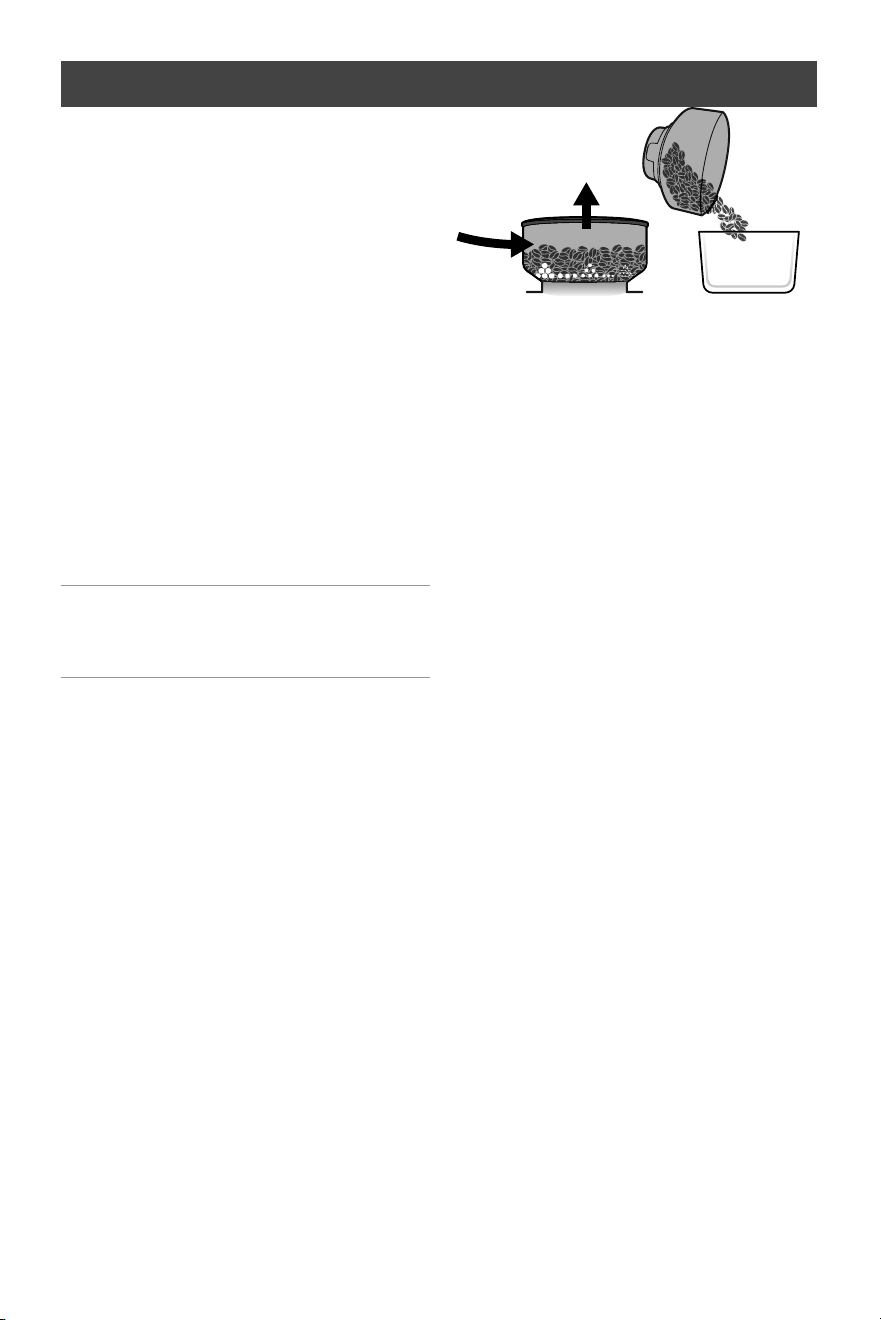
- Remove the Bean Hopper from the
Grinder Collar and store any remaining
coffee beans in an airtight container to
preserve their freshness.
1. TURN
2. REMOVE
AIR TIGHT
CONTAINER
- Reinstall the bean hopper and rotate
to setting 30. Push down on the Group
Handle to activate the grinder, and hold
until the remain beans are ground and
dispensed (you will hear the sound of the
motor change).
- Rotate and remove the bean hopper again
- Remove the Group Handle and dispose
of the waste grinds as these will be too
coarse for espresso coffee.
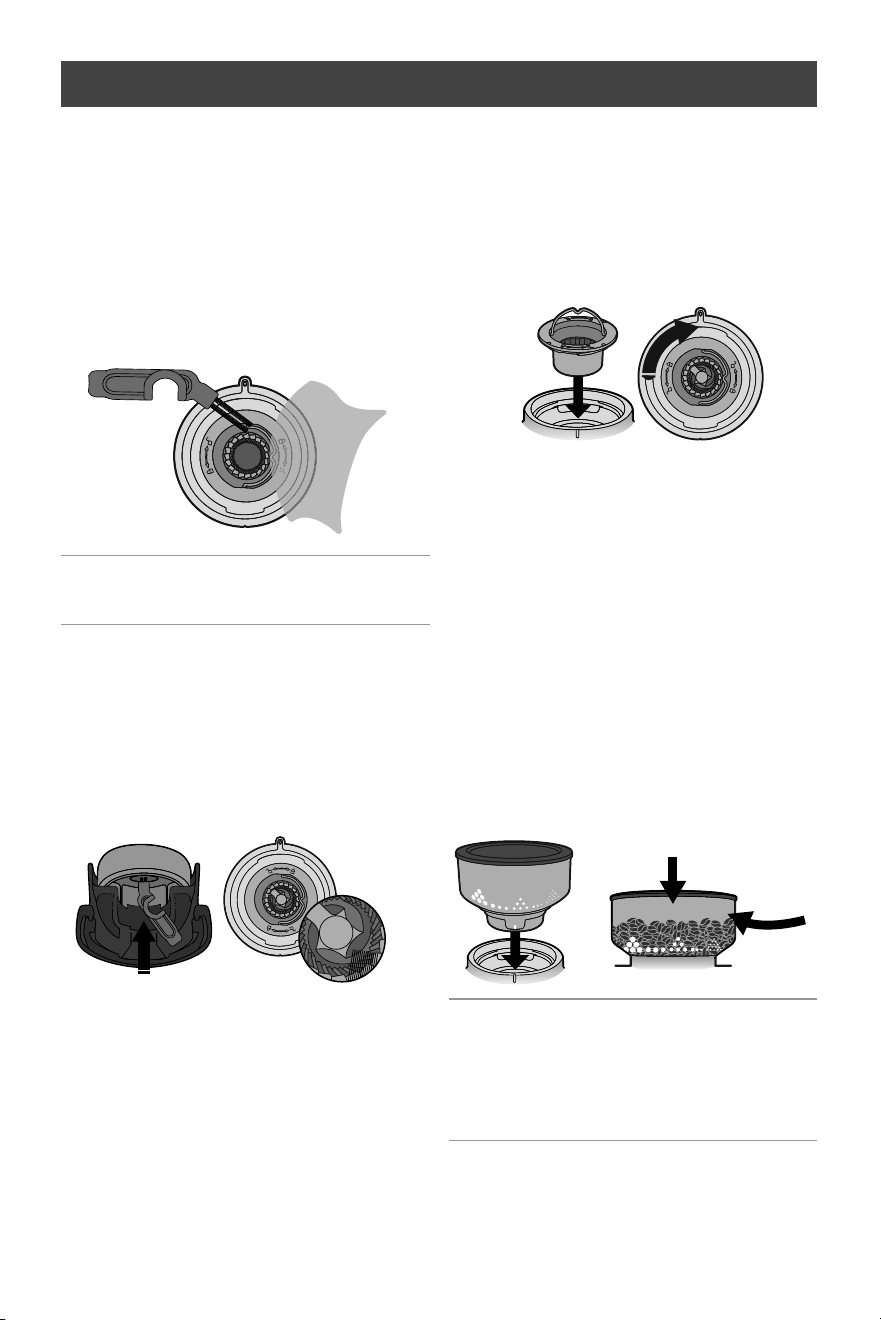
• Cleaning Top Burr
- Rotate to unlock and lift the Top Burr
from the Grinder Collar using the handle.
- Wash the Top Burr in warm soapy water
with a mild detergent, rinse & dry.
Care and cleaning – Grinder
36
• Cleaning & Unblocking Bottom Burr and
Grind Chamber
- Use the Cleaning Brush or a Vacuum
Cleaner to thoroughly clear the parts and
surfaces in the Grind Chamber of fine
coffee grinds. A damp cloth can be used
to wipe the inside of the Grind Collar.
- Allow thorough air drying.
WARNING: Do not pour water or any
other liquid into the Grind Chamber.
• Cleaning & Unblocking Grind Outlet
- Feed the Cleaning Brush up into the
Grind Outlet from below, wiping &
brushing the inside surfaces.
- If the Grind Outlet is clear the bristles
will be visible inside the Grind Chamber.
• Replace Top Burr
- Identify the locking fixtures on the
underside of the Top Burr, underneath
the moulded padlock symbols.
- Using the handle insert the Top Burr
into the Grinder Collar, ensuring locking
features align.
- Rotate the Top Burr approximately 30
degrees clockwise to lock, the burr
should click into position.
- When correctly seated, the Top Burr will
be flush with the surface of the Grinder
Collar.
Replace Bean Hopper
- Ensure the Hopper Guide is aligned, and
the tab on the Hopper base locates into
the cut-out on the rear of the housing.
- Align & insert the Bean Hopper into the
Grinder Collar and firmly pushing down
turn clockwise to lock into place and
open the Hopper Guide.
- Reset to the Grinder Setting noted prior
to cleaning.
- Refill the Bean Hopper with coffee beans.
Note: We strongly advise not to use
Torrefacto style coffee beans in your
Origins Sense Espresso Machine. Due to
the high sugar content, the burr grinder
assembly will quickly clog.
1. ALIGN HOPPER GUIDE
2. INSERT
3. TURN
Care and cleaning – Grinder
37
After continued use, your machine may
develop a build-up of mineral deposits and
therefore require occasional descaling.
Your machine will automatically prompt you
to perform a descale cycle. The machine
will come from the factory pre-programmed
for use in a hard water area, however if
you live in a soft water area, where descale
cycles can be less frequent, then you may
want to adjust the setting.
Adjusting between ‘Hard Water’ and ‘Soft
Water’ settings
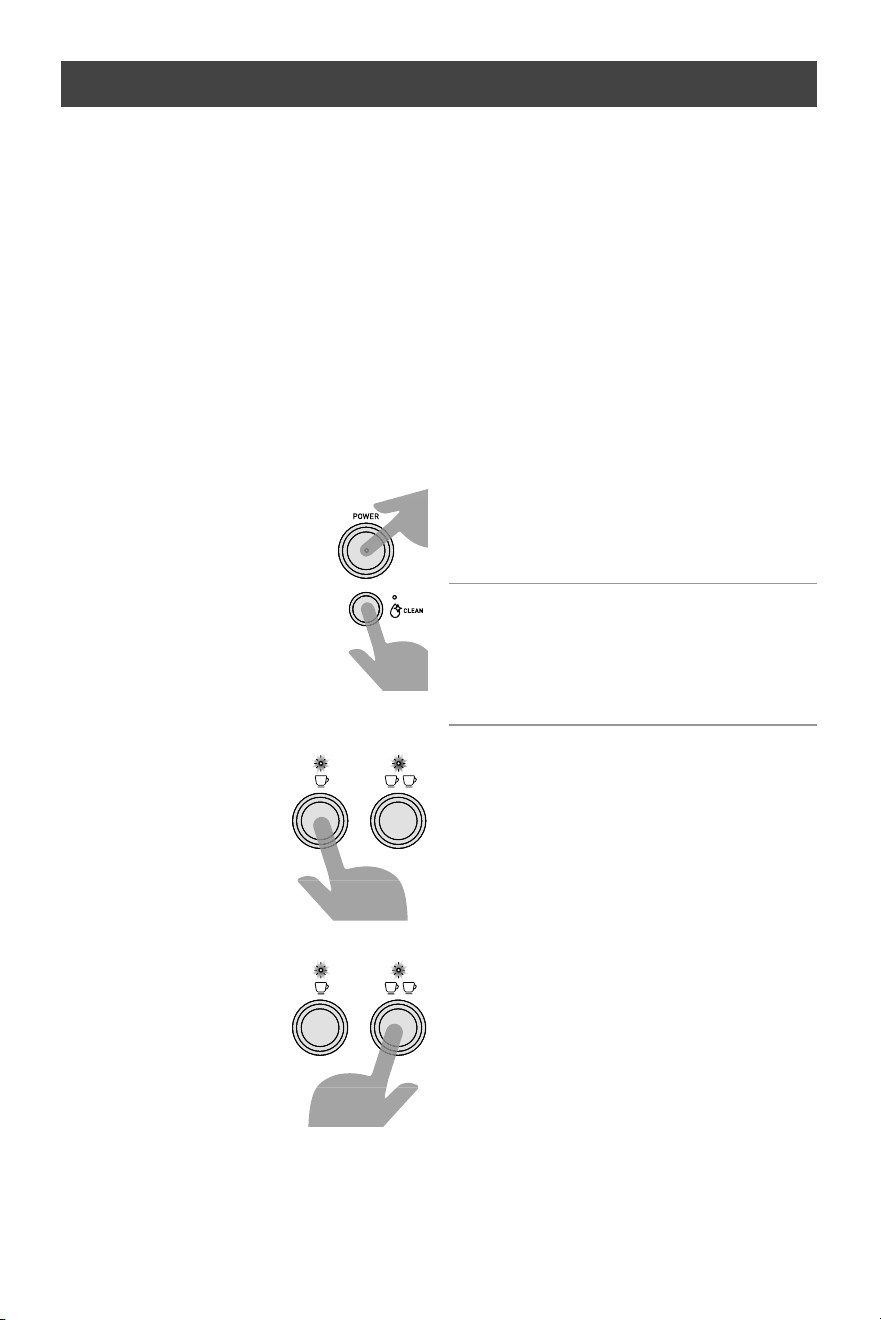
• Press and hold the Power on button
(1) and the Clean Button
(5) simultaneously for 4
seconds.
• The One Cup button (3b) and
Two Cup button (3c) will begin to pulse
• Pressing the One Cup
button will select the
‘Hard Water’ setting,
• Pressing the Two Cup
button will select the
‘Soft Water’ setting.
• When the selected button is pressed the
unit will beep x1 for 1s and will return
back to steady state.
If no selection is made within 60s then no
setting will be saved, and the machine will
default back to READY.
Descaling Process
Descaling Solution
You have 2 options:
A. Sunbeam Espresso Machine Descaling
Tablets.
or
B. White vinegar & warm water.
Descaling Cycle
The Descaling Cycle takes approximately
10 minutes to complete.
Important: If the Descaling Cycle is not
completed or stopped part way through
any of the Descaling Steps, then you will
need to start the Descaling Cycle again
from the beginning.
Preparing for Descaling Cycle
- Remove water filter and water filter
holder from the water reservoir.
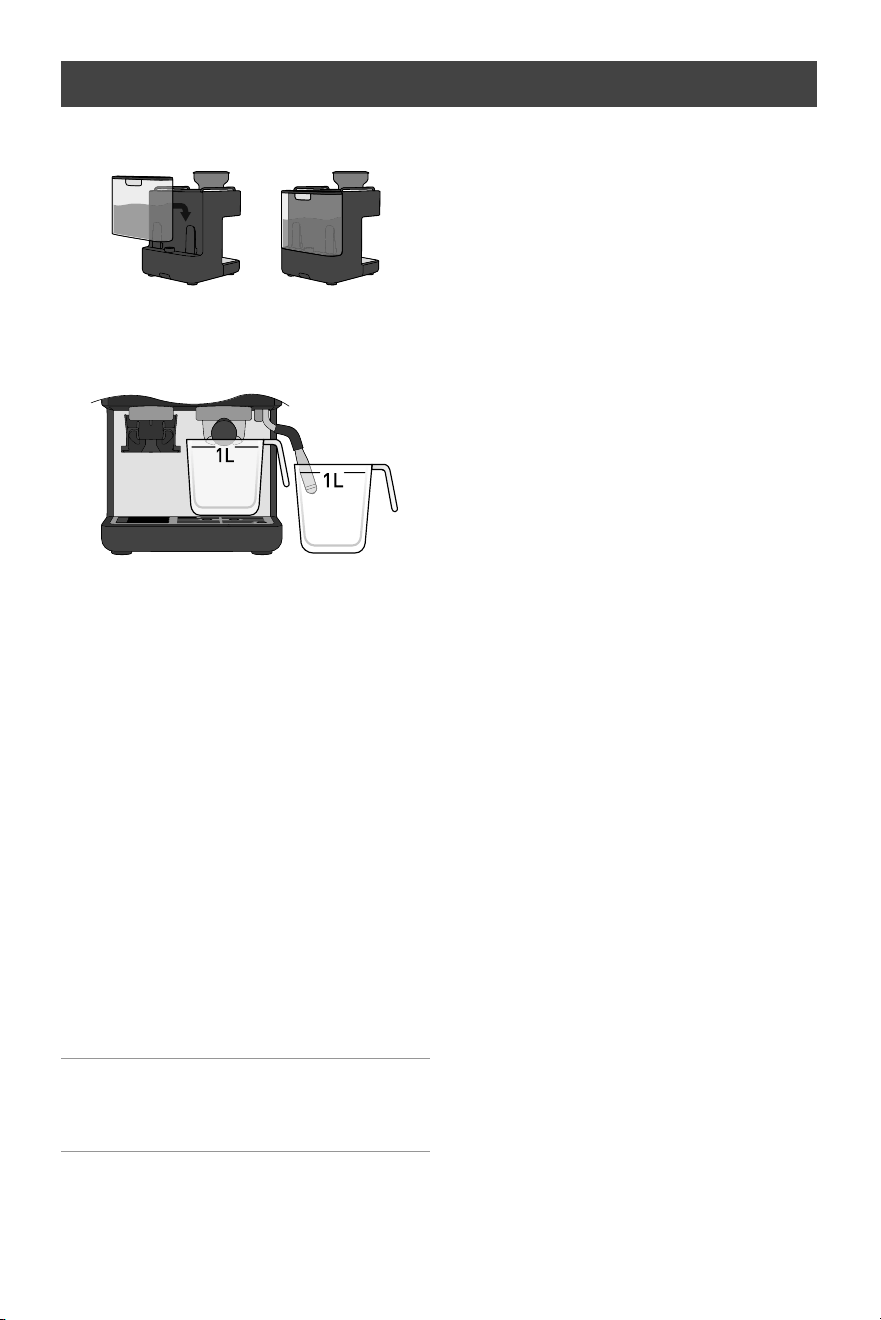
• Fill Water Reservoir with Solution
A. Fill Water Reservoir with 1 Litre of warm
water. Add one Descaling Tablet. Allow
tablet to fully dissolve.
or
B. In an empty Water Reservoir add 1½
tablespoons of white vinegar. Fill Water
Reservoir with 1 Litre of warm water.
Allow solution to mix thoroughly.
Descaling cycle – Espresso machine
38
- Insert the Water Reservoir into position.
- Place a 1 Litre container under the Group
Head/hot water tap and one under the
steam wand.
• Check Power
Ensure that:
- The Power Plug is inserted into the outlet
& switched on.
- The DIAL is in the vertical position.
- The Espresso Machine is on and in the
READY state.
• Access the Descaling Cycle
- Press and hold the clean button for 3
seconds, the unit will beep and the clean
light will begin to pulse.
- The descale icon will Pulse throughout
the duration of the Descaling cycle.
Important: The Descaling Cycle can
be exited at any point by pressing the
MANUAL BREW BUTTON.
Step 1. Descaling of Group Handle and
steam wand
- Turn the DIAL to the STEAM position.
- The Pump will start and hot water will
run from the Group Head & Steam Wand.
Over a pre-defined period the Pump will
make different noises.
- When hot water has stopped being
released from the Group Head & Steam
Wand, this step is finished.
- To indicate the machine has finished this
step the machine will beep, the CLEAN
LIGHT and ALERT INDICATOR will now
start to flash.
- Turn the DIAL to the vertical position, and
the ALERT INDICATOR will extinguish.
- Please note the CLEAN LIGHT will
continue to pulse.
Step 2. Descaling of Hot Water Tap
- Turn the DIAL to the HOT WATER position.
- The Pump will start and hot water will
run from the HOT WATER TAP. Over a
pre-defined period the Pump will make
different noises.
- When hot water has stopped being
released this step is finished.
- To indicate the machine has finished this
step the machine will beep, the CLEAN
LIGHT and ALERT INDICATOR will now
start to flash.
- Turn the DIAL to the vertical position, and
the ALERT INDICATOR will extinguish.
- Please note the CLEAN LIGHT will
continue to pulse.
Descaling cycle – Espresso machine

39
Step 3. Preparing for Purge
Important: There is a maximum of 5
minutes allowed to complete this step
before the Descaling Cycle will exit.
- The Steam Wand & Group Head now need
to be purged clean with fresh water to
remove descaling solution.
• Rinse Water Reservoir
Remove the Water Reservoir and rinse
thoroughly under running water, ensuring
that all traces of the descaling solution.
• Fill Water Reservoir
- Fill the Water Reservoir to the ‘Max’ line
with cold water and insert into position.
• Empty Containers
- Empty water from the containers and
replace.
Step 4. Start Purge
- Turn the DIAL to the STEAM position.
- The CLEAN LIGHT will begin to pulse.
- The Pump will start and hot water will
run from the Group Head & Steam Wand.
- After 2 minutes water will stop pumping
and the CLEAN LIGHT and ALERT
INDICATOR will now start to flash.
- Return the dial to the vertical position.
Turn the DIAL to the HOT WATER position.
- The Pump will start and hot water will
run from the HOT WATER TAP.
- After 2 minutes water will stop pumping
and the CLEAN LIGHT and ALERT
INDICATOR will now start to flash.
- Return the dial to the vertical position.
- The Descaling Cycle is complete
Descaling Cycle Complete
- To indicate the completion of the
Descaling Cycle the machine will beep
and the CLEAN LIGHT will stop flashing.
Descaling Cycle Clean Up
- Empty water from the containers and
clean, ensuring that all traces of the
descaling solution have been removed.
- Reinstall the water filter and water filter
holder into the water reservoir.
Descaling cycle – Espresso machine
40
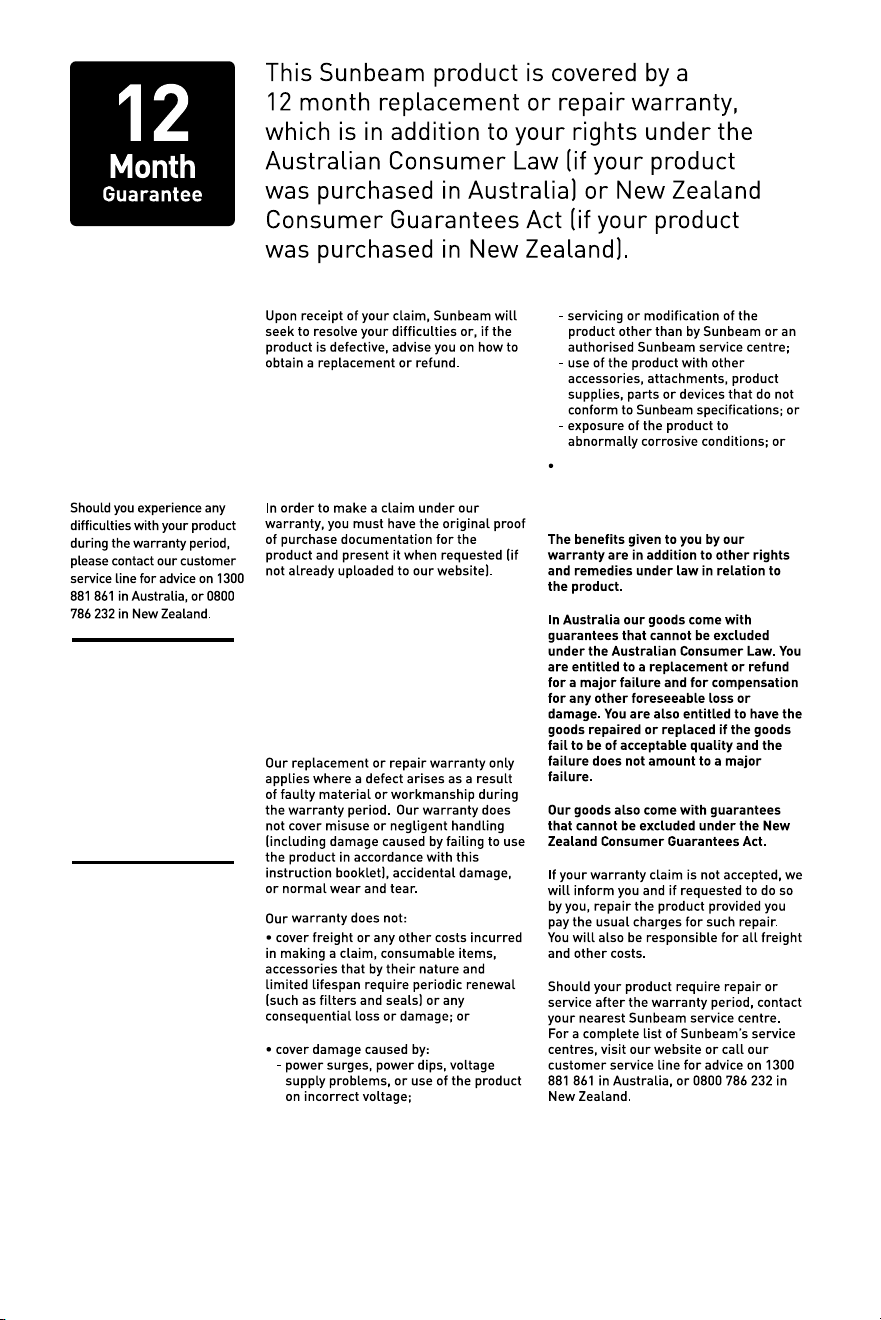
Descaling Sachets
CONTACT SUNBEAM CUSTOMER CARE:
AUS: 1300 881 861 NZ: 0800 786 232
Visit Sunbeam website to see full Espresso Machine range & accessories available.
www.sunbeam.com.au www.sunbeam.co.nz
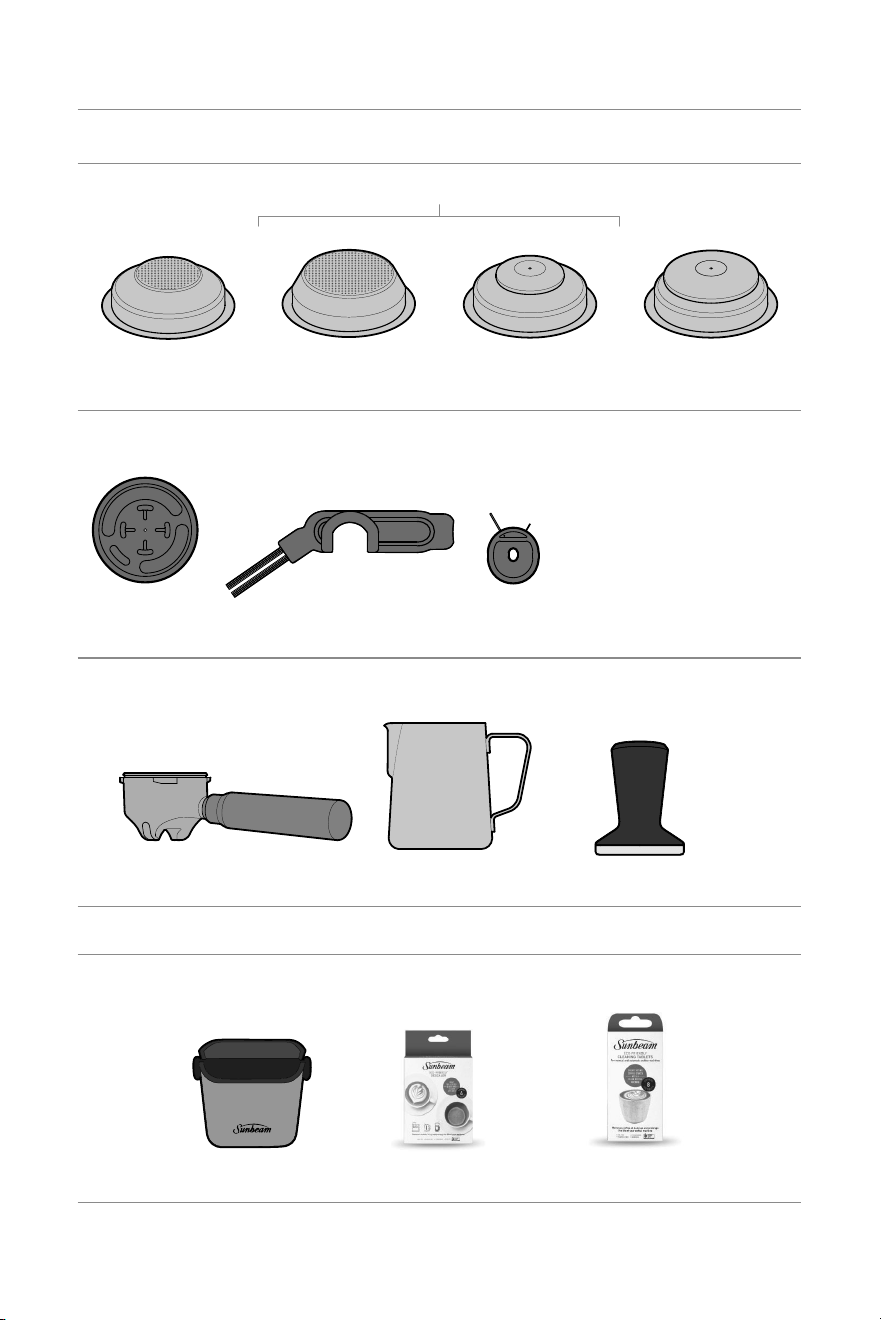
1 CUP
Single wall
Cleaning PinCleaning BrushCleaning Disc
Premium TamperMilk JugGroup Handle
2 CUP
Dual wall
1 CUP 2 CUP
58mm filter baskets
ACCESSORIES
SPARES
D
U
A
L
W
A
L
L
D
U
A
L
W
A
L
L
EMA0025CL
EMA0015CL
Mini Bang Bang
Coffee grinds disposal bin
EMA0900
EM43006
EM5300104 EM69102
EM6910101 EM6910102
2191002 2191003
2198996
EM430042199000
Water Filter Cartridge
PC78003
D
I
S
C
F
O
R
C
L
E
A
N
I
N
G
T
A
B
L
E
T
U
S
E
T
H
I
S
S
I
D
E
U
P
G
T
A
B
L
E
T
U
S
E
T
H
I
S
S
I
D
E
Cleaning Tablets
EMM7302802221587
EMM550020
41
Australia
www.sunbeam.com.au
1300 881 861
New Zealand
www.sunbeam.co.nz
0800 786 232
To assist us in managing warranty claims,
we recommend you register your product as
soon as practicable after purchase, on our
Sunbeam website and uploading a copy of
your original receipt. View the Support
section of the Sunbeam website.
extend beyond 3 months if the product is
used in commercial, industrial, educational
or applications (other than for internal or
own use in an office environment).
Under our warranty, should your product
develop any defect within 12 months of
purchase because of faulty materials or
workmanship, we will replace or repair it, at
our discretion, free of charge. A product
presented for repair may be replaced by a
refurbished product of the same type rather
than being repaired. Refurbished parts may
be used to repair the product.

EMM6500GR_25EM1 (ANZ) BOB+_GCDS-LD P.N: NWL0001677814 Rev. B
Need help with your appliance?
Contact our customer service team or visit
our website for information and tips on
getting the most from your appliance.
Australia | visit www.sunbeam.com.au
phone 1300 881 861
New Zealand | visit www.sunbeam.co.nz
phone 0800 786 232
Newell Australia Pty Ltd. ABN 68 075 071 233
Sunbeam is a registered trade mark.
Ellise is a registered trade mark.
Made in China to Sunbeam’s specification.
Due to minor changes in design or otherwise,
the product you buy may differ slightly from the one shown here.
Approved by the appropriate electrical regulatory authorities.
©Copyright Sunbeam 2025.
02/25