CANDY HOOVER GROUP S.R.L. • Via Comolli 16 • 20861 Brugherio (MB) Italy
VITROCERAMIC COOKING HOBS
INSTALLATION ADVICES - INSTRUCTIONS FOR THE USE
GB
• CH64DKC
• CH64DCK-19

22
33
Dear Customer,
Thank you for having purchased and given your preference
to our product.
The safety precautions and recommendations reported
below are for your own safety and that of others. They
will also provide a means by which to make full use of the
features oered by your appliance.
Please preserve this booklet carefully. It may be useful
in future, either to yourself or to others in the event that
doubts should arise relating to its operation.
This appliance must be used only for the task it
has explicitly been designed for, that is for cooking
foodstus. Any other form of usage is to be considered
as inappropriate and therefore dangerous.
The manufacturer declines all responsibility in the
event of damage caused by improper, incorrect or
illogical use of the appliance.
IMPORTANT INFORMATION FOR CORRECT DISPOSAL OF THE PRODUCT IN
ACCORDANCE WITH EC DIRECTIVE 2012/19/EC.
At the end of its working life, the product must not be disposed of as
urban waste. It must be taken to a special local authority dierentiated
waste collection centre or to a dealer providing this service.
Disposing of a household appliance separately avoids possible negative
consequences for the environment and health deriving from inappropriate
disposal and enables the constituent materials to be recovered to obtain
signicant savings in energy and resources. As a reminder of the need
to dispose of household appliances separately, the product is marked
with a crossed-out wheeled dustbin.
DECLARATION OF CE CONFORMITY
• This appliance has been designed to be used only for cooking. Any other use (such as
heating a room) is improper and dangerous.
• This appliance has been designed, constructed, and marketed in compliance with:
- Safety requirements of the “Low voltage” Directive 2014/35/EU;
- Safety requirements of the “EMC” Directive 2014/30/EU;
- Requirements of EU Directive 93/68/EEC;
- Requirements of EU Directive 2011/65/EU.

44
IMPORTANT SAFETY PRECAUTIONS AND RECOMMENDATIONS
IMPORTANT: This appliance is designed and manufactured
solely for the cooking of domestic (household) food and is
not suitable for any non domestic application and therefore
should not be used in a commercial environment.
The appliance guarantee will be void if the appliance is used
within a non domestic environment i.e. a semi commercial,
commercial or communal environment.
Read the instructions carefully before installing and using
the appliance.
• This appliance has been designed and manufactured in
compliance with the applicable standards for the household
cooking products and it fullls all the safety requirements shown
in this manual, including those for surface temperatures.
Some people with sensitive skin may have a more pronounced
temperature perception with some components although these
parts are within the limits allowed by the norms.
The complete safety of the appliance also depends on the correct
use, we therefore recommend to always pay a extreme attention
while using the product, especially in the presence of children.
• After having unpacked the appliance, check to ensure that it is
not damaged.
In case of doubt, do not use it and consult your supplier or a
professionally qualied technician.
• Packing elements (i.e. plastic bags, polystyrene foam, nails,
packing straps, etc.) should not be left around within easy reach
of children, as these may cause serious injuries.
• Some appliances are supplied with a protective lm on steel and
aluminium parts. This lm must be removed before using the
appliance.
• IMPORTANT: The use of suitable protective clothing/gloves is
recommended when handling or cleaning this appliance.
• Do not attempt to modify the technical characteristics of
the appliance as this may become dangerous to use. The
manufacturer declines all responsibility for any inconvenience
resulting from the inobservance of this condition.

55
• Do not operate your appliance by means of an external timer or
separate remote-control system.
• Do not carry out cleaning or maintenance operations on the
appliance without having previously disconnected it from the
electric power supply.
• Do not use a steam cleaner because the moisture can get into
the appliance therefore making it unsafe.
• Do not cover the hob with aluminium foils.
• Do not touch the appliance with wet or damp hands (or feet).
• Do not use the appliance whilst in bare feet.
• If you should decide not to use this appliance any longer (or
decide to substitute another model), before disposing of it, it
is recommended that it be made inoperative in an appropriate
manner in accordance to health and environmental protection
regulations, ensuring in particular that all potentially hazardous
parts be made harmless, especially in relation to children who
could play with unused appliances.
• The various components of the appliance are recyclable. Dispose
of them in accordance with the regulations in force in your country.
If the appliance is to be scrapped, remove the power cord.
• After use, ensure that the controls are in the o position.
• Children less than 8 years of age shall be kept away unless
continuously supervised.
• This appliance can be used by children aged from 8 years and
above and persons with reduced physical, sensory or mental
capabilities or lack of experience and knowledge if they have
been given supervision or instruction concerning use of the
appliance in a safe way and understand the hazards involved.
Children shall not play with the appliance. Cleaning and user
maintenance shall not be made by children without supervision.
• The manufacturer declines all liability for injury to persons or
damage to property caused by incorrect or improper use of the
appliance.

66
• WARNING: During use the appliance and its accessible parts
become hot; they remain hot for some time after use.
– Care should be taken to avoid touching heating elements on
the hob.
– To avoid burns and scalds, young children should be kept
away.
• Make sure that electrical cables connecting other appliances in
the proximity of the cooktop cannot come into contact with the
hob.
• WARNING: Unattended cooking on a hob with fat or oil can be
dangerous and may result in re. NEVER try to extinguish a re
with water, but switch o the appliance and then cover ame e.g.
with a lid or a re blanket.
• WARNING: Danger of re: do not store items on the cooking
surfaces.
• Do not place or leave empty pans on the glass ceramic hob.
• Do not allow heavy or sharp objects to drop on the glass ceramic
hob.
• Do not scratch the hob with sharp objects. Don’t use the hob as
a work surface.
• WARNING: If the hob is cracked or otherwise damaged by falling
objects etc., disconnect the appliance from the electrical power
supply to avoid the possibility of electric shock and call Customer
Service.
• WARNING: When correctly installed, your product meets all
safety requirements laid down for this type of product category.
However special care should be taken around the underneath
of the appliance as this area is not designed or intended to be
touched and may contain sharp or rough edges, that may cause
injury.
• CAUTION: The cooking process has to be supervised. A short
term cooking process has to be supervised continuously.
• Models provided with power supply cable. If the power supply
cable is damaged, it must be replaced only by an authorised
service agent in order to avoid a hazard.

77
• If the appliance is not tted with a supply cord and a plug, or with
other means for disconnection from the supply mains having a
contact separation in all poles that provide full disconnection under
overvoltage category III conditions, means for disconnection
must be incorporated in the xed wiring in accordance with the
wiring rules.
• WARNING: The appliance and its accessible parts become hot
during use.
Care should be taken to avoid touching heating elements.
Children less than 8 years of age shall be kept away unless
continuously supervised.
• WARNING: Use only hob guards designed by the manufacturer
of the cooking appliance or indicated by the manufacturer of the
appliance in the instructions for use as suitable or hob guards
incorporated in the appliance. The use of inappropriate guards
can cause accidents.

88
ENERGY LABELLING/ECODESIGN
• Commission regulation (EU) No 66/2014 (implementing Directive 2009/125/EC of the
European Parliament and of the Council).
Reference to the measurement and calculation methods used to establish compliance with
the above requirements:
• Standard EN 60350-2 (hobs: electric cooking zones and/or areas).
USE OF THE APPLIANCE, ENERGY SAVING TIPS
HOB
ELECTRIC COOKING ZONES AND/OR AREAS
• Avoid pouring liquids on the zones/areas while they are hot.
• Use at-bottomed (electric hotplate type) pots and pans only.
• Use cooking receptacles which cover as much of the surface of the cooking zone/area
as possible.
• To save electricity, use lids whenever possible.
• When the pan comes to the boil, turn the heat down to the level desired. Remember
that the cooking zone/area will continue to produce heat for about ve minutes after it
has been turned o.

99
Advice for
the installer

1010
IMPORTANT:
• The appliance is designed and approved for domestic use only and should not be
installed in a commercial, semi commercial or communal environment.
Your product will not be guaranteed if installed in any of the above environments
and could aect any third party or public liability insurances you may have.
• This appliance is to be installed only by an authorised person according to the current
local regulations and in observation of the manufacturer’s instructions.
Failure to comply with this condition will render the guarantee invalid.
• Incorrect installation, for which the manufacturer accepts no responsibility, may cause
personal injury of damage.
• This appliance shall only be serviced by authorized personnel.
• Always disconnect the cooktop from mains power supply before carrying out any
maintenance operations or repairs.
• Important: The use of suitable protective clothing/gloves is recommended when
handling or installing this appliance.
• The appliance must be housed in heat resistant units.
• The walls of the units must not be higher than work top and must be capable of
resisting temperatures of 70 °C above room temperature.
• We would point out that the adhesive which bonds the plastic laminate to the
furniture must withstand temperatures not less than 150 °C to avoid delamination.
• Do not install the appliance near inammable materials (eg. curtains).
WARNING
When correctly installed, your product meets all safety requirements laid down for
this type of product category.
However special care should be taken around the underneath of the appliance as
this area is not designed or intended to be touched and may contain sharp or rough
edges, that may cause injury.
INSTALLATION
1
1111
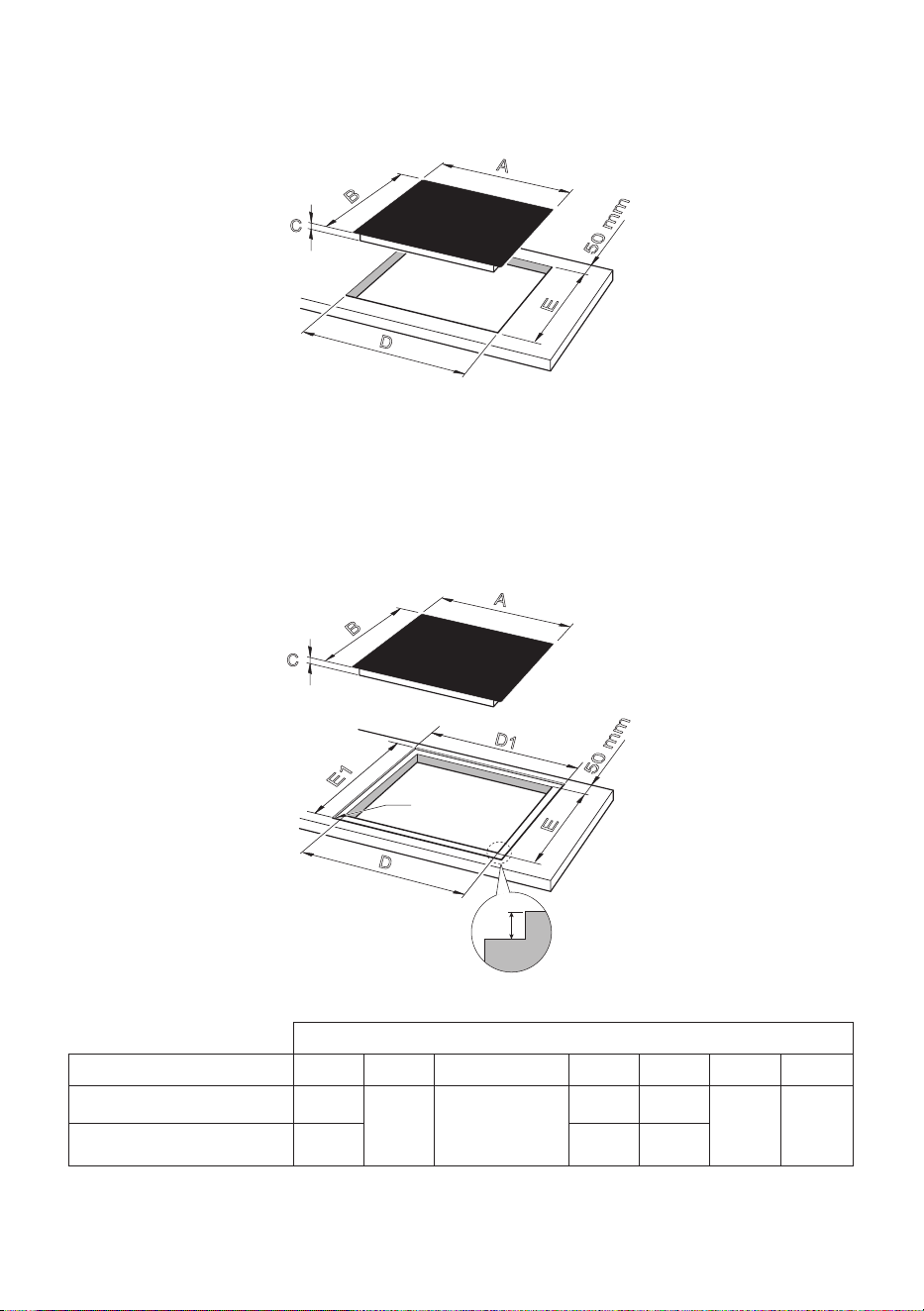
FLUSH INSTALLATION (MODELS WITHOUT METAL TRIM/S ONLY)
If you wish to install the hob ush with the work surface, it is neccessary to execute/carry
out a miling in the hole of the cut-out as indicated in g. 1.1b.
E
50 mm
D
A
B
C
Fig. 1.1a
E
50 mm
D
D1
E1
R7
5
A
B
C
Fig. 1.1b
STANDARD INSTALLATION
Measures (mm)
Description A (*) B (*) C (**) D D1 E E1
60cm wide models 600
520
50 or 55 for
ush
installation
560 605
480 525
90cm wide models 900 840 905
(*) For models with metal trim/s add 4mm to the measurement for each trim.
Example: front metal trim= B+4mm.
(**) from the top of countertop to bottom of cooktop.
1212
FITTING REQUIREMENTS
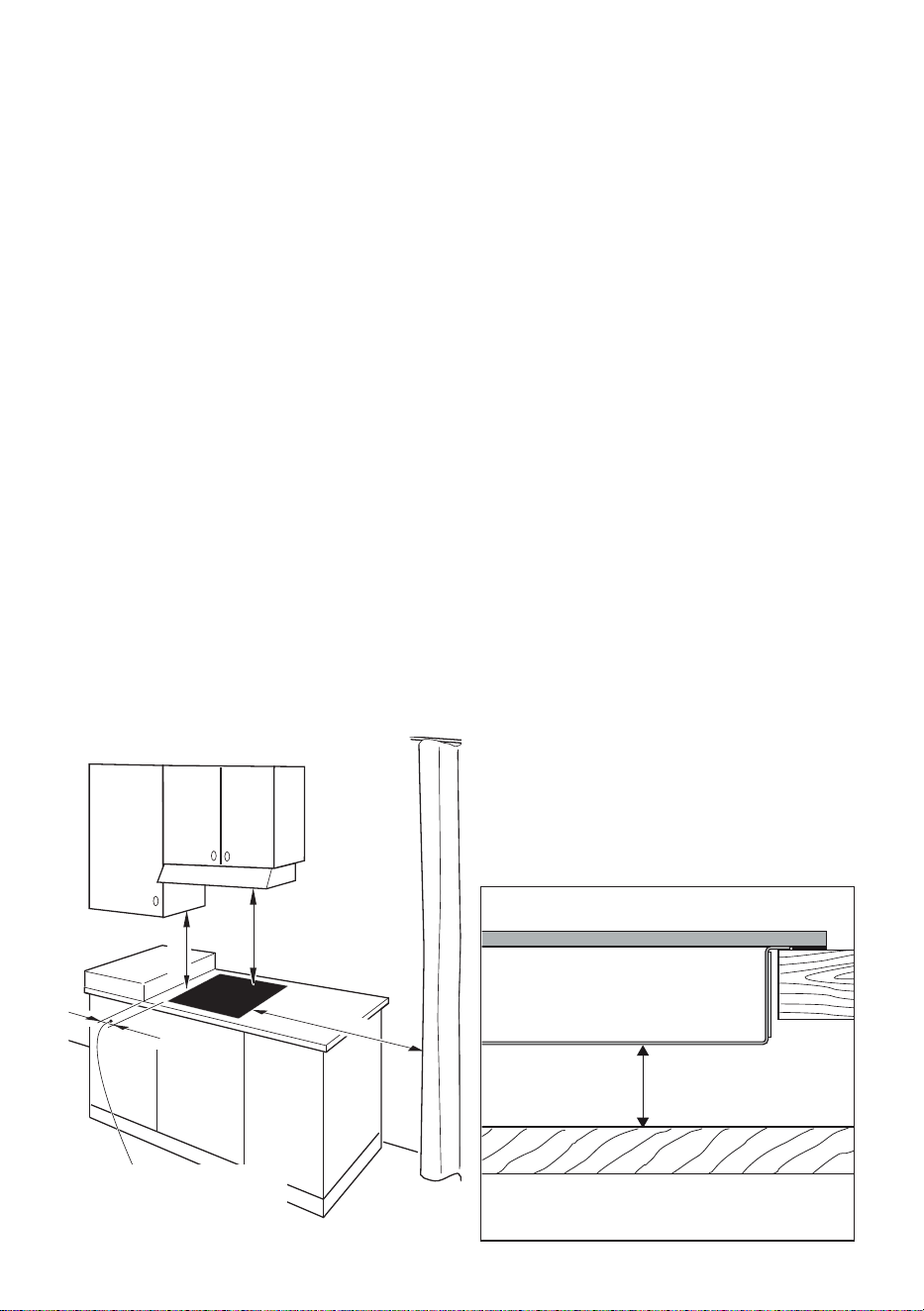
This cooktop can be built into a working surface from 20 mm thick and 600 mm deep.
In order to install the ceramic hob into the kitchen xture, a hole with the dimensions shown
in gures 1.1a or 1.1b has to be made, keeping in consideration the following:
• A 20 mm ventilation gap must be provided between the bottom of the appliance and any
cabinetry, draw unit or oven (g. 1.3).
• If the cooktop is installed above an oven, the oven shall be provided with cooling fan.
The two appliances should be connected to the electrical supply with independent
connections.
• The ceramic hob must be kept no less than 50 mm away from any side wall
(from side
edge of cutout).
• The rear wall must be at least 50 mm from the ceramic hob
(from rear edge of cutout).
• There must be a distance of at least 650 mm between the hob and any wall cupboard
or extractor hood positioned immediately above (see g. 1.2).
• Standard installation (not ush): Do not seal the cooktop into the benchtop with silicone
or glue; this makes future servicing dicult. The manufacturer will not cover the costs
of removing the cooktop, or of damage caused by this removal.
• The walls surrounding the cooktop must be made of heat-resistant material.
• Do not install the appliance near inammable materials (eg. curtains).
min
20 mm
Fig. 1.3
650 mm
500 mm
450 mm
Fig. 1.2
50 mm minimum
between the side of the
cut-out and the side wall
1313
FASTENING THE COOKTOP
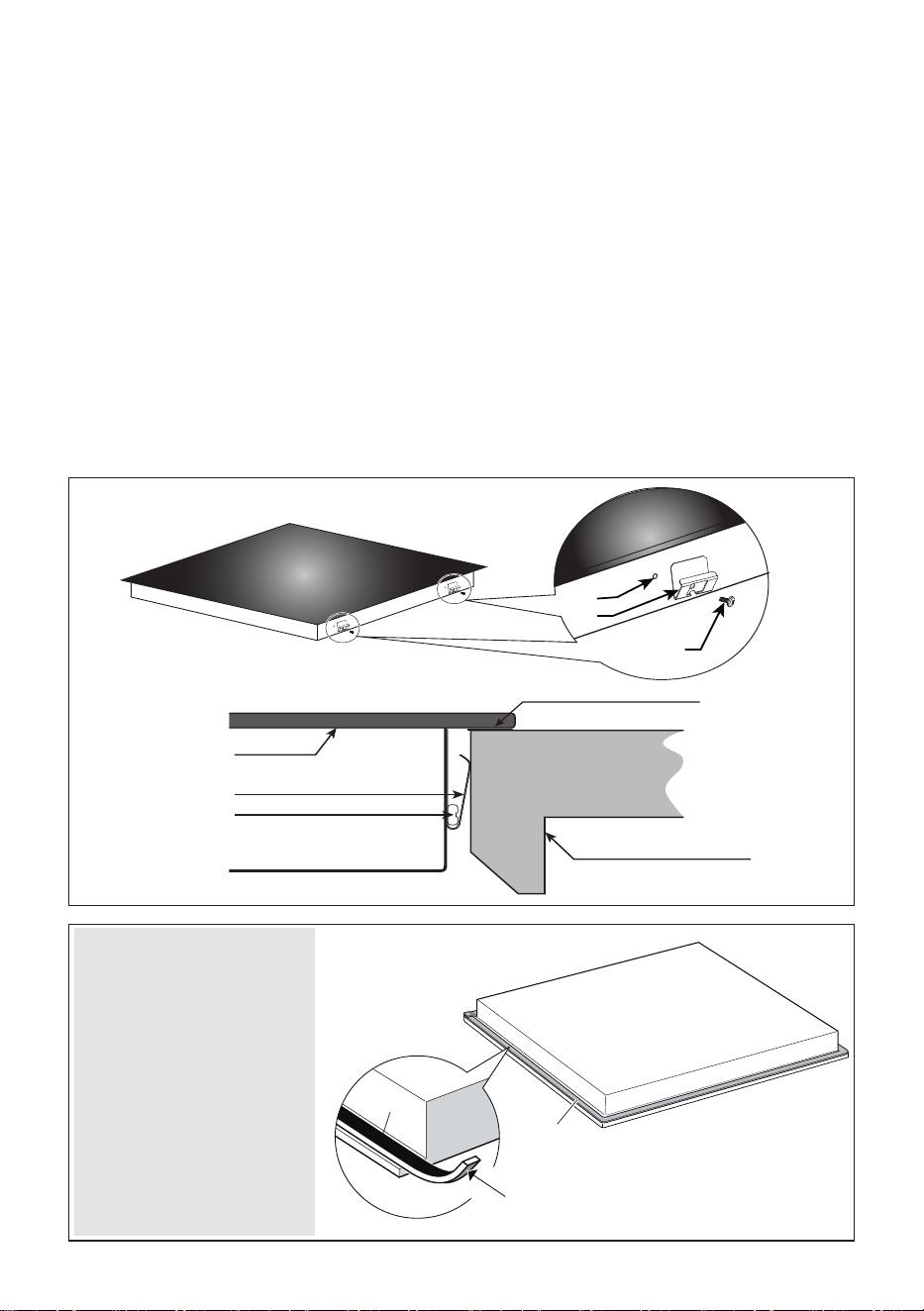
Each cooktop is provided with an installation kit including brackets and screws for fastening
the cooktop to benches from 20 mm thick. Before you install the cooktop, make sure that
the work surface is square and level, and no structural members interfere with space
requirements previously indicated.
The kit includes four metal clips “B” and four self-threading screws “A” (g. 1.4).
• Cut the unit according to the dimensions in g. 1.1a or 1.1b.
• Turn the hob upside down and rest the glass side on a soft surface.
• Spread the seal “D” around the edge of the hob (g. 1.5).
• Fasten the metal clips “B” into the hole “C” using the screws A”. Make sure that the
metal clips are mounted correctly as shown in the gure 1.4.
• Put the cooktop into the cutout and position it correctly.
• Using a sharp cutter or trimmer knife, trim the excess sealing material around the edge
of the cooktop. Take care not to damage the workbench.
• In case to install the hob ush with the work surface, ll any gaps between the glass
and along the perimeter of the work surface with insulating silicone, and wipe away
any excess.
D
D
Adhesive side
Adhesive side
Fig. 1.5
C
B
A
B
A
Fig. 1.4
Glass
Metal clips
Fixing screw
Worktop / kitchen cabinet
Seal “D”
IMPORTANT: Spread
the sealing material “D”
around the edge of the
hob (edge of the glass).
The sealing material
“D” must be installed
correctly to guarantee a
perfect seal between the
appliance and the unit.
Incorrect installation may
cause irreparable damage
to the appliance.

1414
ELECTRICAL SECTION
2
IMPORTANT: Installation must be carried out according to the manufacturer’s
instructions. Incorrect installation may cause harm and damage to people,
animals or property, for which the manufacturer accepts no responsibility.
Before carrying out any work on the electrical section of the appliance, it must be
disconnected from the mains.
Connection to a good earth wiring system is absolutely essential.
The manufacturer accepts no responsibility for any inconvenience caused by
failure to comply with this rule.
If the hob surface is cracked disconnect the appliance from the mains and contact
the After-Sales Service.
ELECTRICAL REQUIREMENTS
• Connection to the electric power supply must be carried out by a qualied technician
and following the appropriate safety regulations.
• The appliance must be connected to the mains checking that the voltage corresponds
to the value given in the rating plate and that the electrical cable sections can withstand
the load specied on the plate.
• The appliance should be connected directly to the mains placing an omnipolar switch
with minimum opening between the contacts of 3 mm between the appliance and the
mains.
• The power supply cable must not touch the hot parts and must be positioned so that it
does not exceed 50°C above ambient.
• Once the appliance has been installed, the switch must always be in a accessible
position.
• If the power supply cable is damaged it must be substituted by a suitable cable
available in the after sales service.
N.B. For connections to the mains power supply, never use adaptors, reductions or
multiple power points as these may overheat and catch re.
In the event that installation should require modications to the mains supply wiring system,
it is recommended that a qualied technician be called to carry out substitution.
He should also check that the domestic electrical system is suitable for the power absorbed
by the appliance.

1515
CONNECTION OF THE POWER SUPPLY CABLE
Important! This cooktop must be connected to the electricity supply only by an
authorised person.
To connect the feeder cable to the hob it is necessary to carry out the following operations:
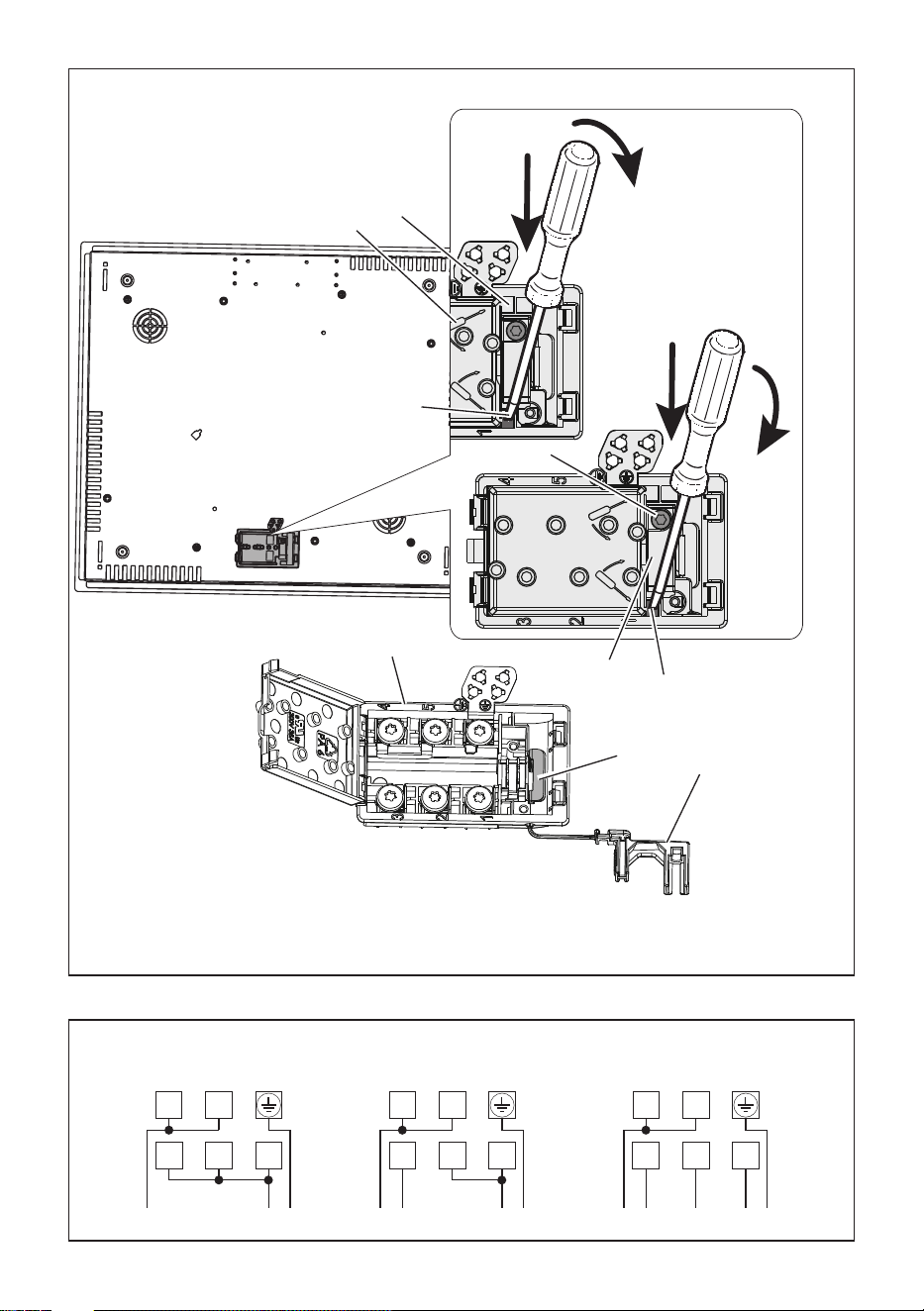
• Unhook the terminal board cover “A” by inserting a screwdriver into the two hooks “B”
(g. 2.1). Open completely the terminal block cover “A”.
• Unscrew the screw “C”, then unhook the cable clamp “D” by inserting a screwdriver
into the hook “E”. Remove completely the cable clamp “D” (g. 2.1).
• Connect the phase, neutral and earth wires to terminal board “F” according to the
diagrams in g. 2.2; the U bolts “G” (g. 2.1) shall be used as indicated in the diagrams
in g. 2.2 (they are supplied already tted to the terminals or inside the terminal board,
behind the cover).
• Strain the feeder cable and block it with cable clamp “D” (by hooking hook “E” and
screwing screw “C”).
• Close the cover “A” of the terminal board “F” (check the two hooks “B” are correctly hooked).
NOTE: The earth conductor must be left about 3 cm longer than the others.
The operations must be executed by a qualied technician.
FEEDER CABLE SECTION “Type H05RR-F, H07RN-F or H05V2V2-F
(resistance to temperatures of 90°C)”
For 60 cm models:
220-240 V ac (V 2 ac) 3 x 2,5 mm
2
(*) (**) or 3 x 4 mm
2
(*) or 5 x 1,5 mm
2
(*)
380-415 V 2N ac 5 x 1,5 mm
2
(*) (***), some models only
380-415 V 3N ac 5 x 1,5 mm
2
(*) (***), some models only
For 90 cm models:
220-240 V ac (V 2 ac) 3 x 2,5 mm
2
(*) (**) or 3 x 4 mm
2
(*) or 3 x 6 mm
2
(*) or 5 x 2,5 mm
2
(*)
380-415 V 2N ac 5 x 2,5 mm
2
(*) (***), some models only
380-415 V 3N ac 5 x 2,5 mm
2
(*) (***), some models only
(*) Connection with wall box connection.
(**) Diversity factor applied. A diversity factor may be applied to the total loading of the
appliance only by a suitably qualied person.
(***) See also “MODELS SUPPLIED WITH POWER CORD 5x1,5 mm
2
OR 5x2,5 mm
2
ALREADY FITTED TO THE APPLIANCE”
MODELS SUPPLIED WITHOUT POWER CORD
ALREADY FITTED TO THE APPLIANCE
MODELS SUPPLIED WITH POWER CORD
ALREADY FITTED TO THE APPLIANCE
FEEDER CABLE SECTION “Type H05RR-F or “H05V2V2-F (resistance to
temperatures of 90°C)”
220-240 V ac (V 2 ac) 3 x 2,5 mm
2
(*) (**)
380-415 V 2N ac
4 x 2,5 mm
2
(*) for 90 cm models, or 4 x 1,5 mm
2
(*) for 60 cm models
380-415 V 3N ac 5 x 1,5 mm
2
(*)
(*) Connection with wall box connection.
(**) Diversity factor applied. A diversity factor may be applied to the total loading of the
appliance only by a suitably qualied person.
1616
1
2
1
2
A
B
B
E
F
G
C
D
Fig. 2.1
D
220 - 240 V~
L
1N (L2) PE
4
2
5
1
3
380 - 415 V 2N~
L
1N PE
4
2
5
1
3
L2
380 - 415 V 3N~
L
3N PE
4
2
5
1
3
L1 L2
Fig. 2.2
220 - 240 V ac (V 2 ac) 380 - 415 V 2N ac 380 - 415 V 3N ac

1717
ATTENTION!
All the operations/electrical connections must be carried out by a qualied technician.
CAUTION!
Do not pierce or weld the terminal ends of the wires. This is strictly forbidden!
CAUTION!
Do not connect the power cord to the electrical power supply without the metallic terminals
correctly in place.
If the supply cord is damaged, it must be replaced by the manufacturer or its service
agent or a similarly qualied person in order to avoid a hazard.
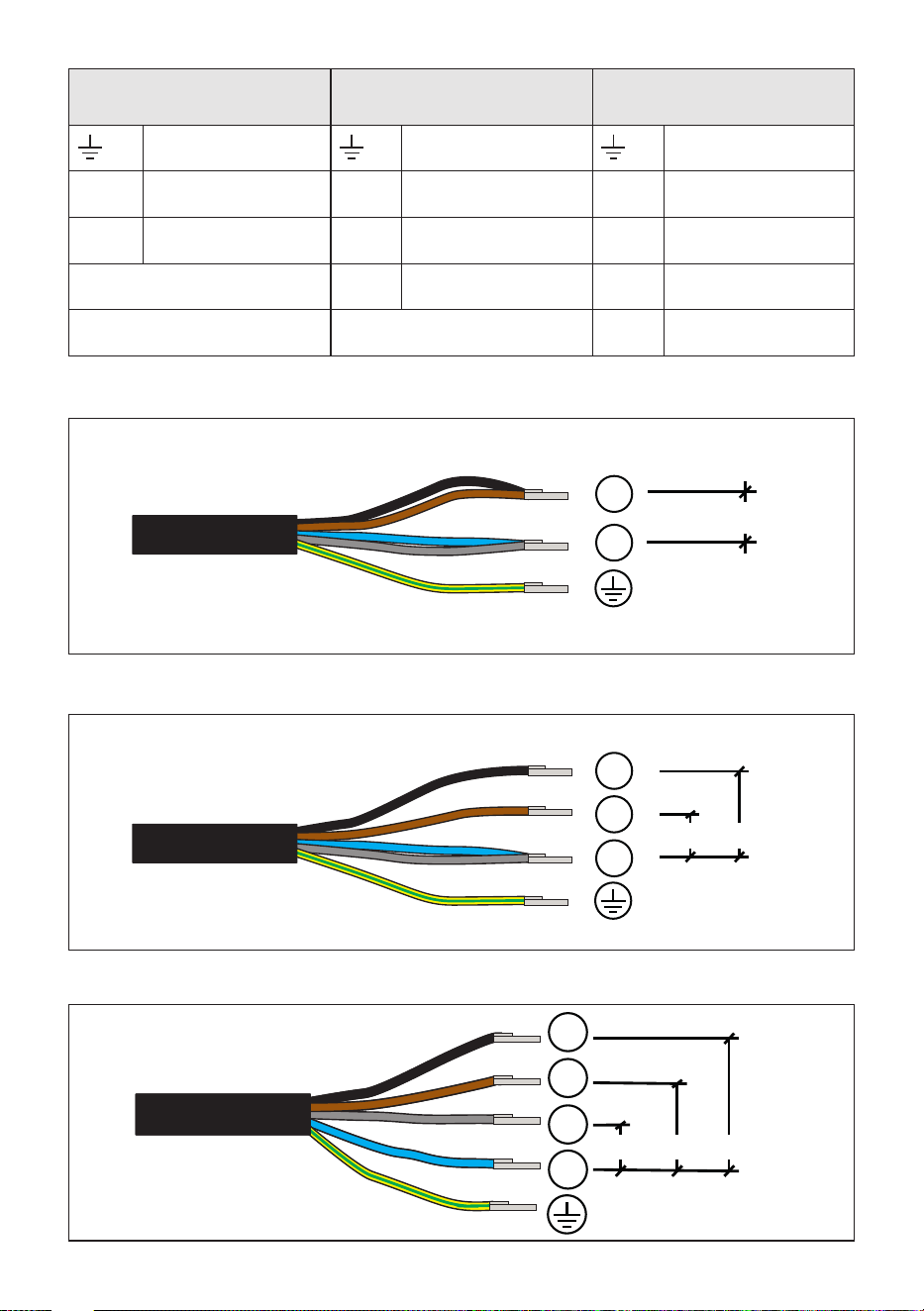
• The cooktop is supplied with a power cord already tted to the appliance and it is
suitable for a single-phase type electrical connection (g. 2.3).
• For the two-phase type electrical connection (g. 2.4):
– separate the black and brown wires by removing the metallic terminal;
– remove about 5 mm of the insulation sheathing from the terminal end of the black
and brown wires;
– tightly t a new metallic terminal (1,5 mm or 2,5 mm, depending on wire size) on the
terminal end of each wire (black and brown).
• For the three-phase type electrical connection (g. 2.5):
– disconnect the blue and gray crimped wires from the terminal block and separate
them by removing the metallic terminal on both ends (to access the terminal block
see chapter “CONNECTION OF THE POWER SUPPLY CABLE”). Remove about
5 mm of the insulation sheathing from both the terminal ends of the blue and gray
wires. Tightly t a new metallic terminal (1,5 mm or 2,5 mm, depending on wire
size) on both the terminal ends of each wire (blue and gray). Connect the blue and
gray wires respectively to the N and L3 terminals of the terminal block and close
its cover.
– separate the black and brown wires by removing the metallic terminal. Remove
about 5 mm of the insulation sheathing from the terminal ends of the black and
brown wires. Tightly t a new metallic terminal (1,5 mm or 2,5 mm, depending on
wire size) on the terminal end of each wire (black and brown).
MODELS SUPPLIED WITH POWER CORD 5x1,5 mm
2
OR 5x2,5 mm
2
ALREADY FITTED TO THE APPLIANCE
1818
“220-240 V ac (V 2 ac)”
connection
“380-415 V 2N ac”
connection
“380-415 V 3N ac”
connection
Green - Yellow Green - Yellow Green - Yellow
N
Blue and Gray
N
Blue and Gray
N
Blue
L
Black and Brown
L1
Black
L1
Black
/
L2
Brown
L2
Brown
/ /
L3
Gray
L
N
L1
N
L2
220...240 V ac
220...240 V ac
220-240 V ac
380-415 V 2N ac
L
N
L1
N
L2
220...240 V ac
220...240 V ac
220-240 V ac
380-415 V 2N ac
Fig. 2.3
Fig. 2.4
L
N
L1
N
L2
220...240 V ac
220...240 V ac
220-240 V ac
380-415 V 2N ac
L1
L3
L2
380-415 V 3N ac
N
220...240 V ac
Fig. 2.5
380-415 V 3N ac
380-415 V 2N ac
220-240 V ac (V 2 ac)

1919
User guide
2020
Fig. 1.1
FEATURES AND TECHNICAL DATA
1
60cm wide models
1
2
3
4
5
6
7
8
9
10
11
12
1
2
3
4
5
6
7
8
9
10
11
12
1
2
3
4
5
6
7
8
9
10
11
12
1
2
3
4
5
6
7
8
9
10
11
12
8
5
7
6
10
1
1
4
2
11
1
2
3
4
5
6
7
8
9
10
11
12
1
2
3
4
5
6
7
8
9
10
11
12
1
2
3
4
5
6
7
8
9
10
11
12
1
2
3
4
5
6
7
8
9
10
11
12
1
2
3
4
5
6
7
8
9
10
11
12
5
9
7
6
8
1
1 2
3
4
10
11
1
2
3
4
5
6
7
8
9
10
11
12
1
2
3
4
5
6
7
8
9
10
11
12
1
2
3
4
5
6
7
8
9
10
11
12
1
2
3
4
5
6
7
8
9
10
11
12
5
6
8
7
10
1 1
2
3
11
Fig. 1.2
Fig. 1.3
60cm wide models
90cm wide models
NOTE: This gures are
indicative only.
NOTE: The knob and
symbols may vary.

2121
Attention:
Detach the appliance from the mains if the ceramic glass is cracked and contact the After-
Sales Service.
Metallic objects such as knives, forks, spoons and lids should not be placed on the hob
surface since they can get hot.
Electrical insulation Class I
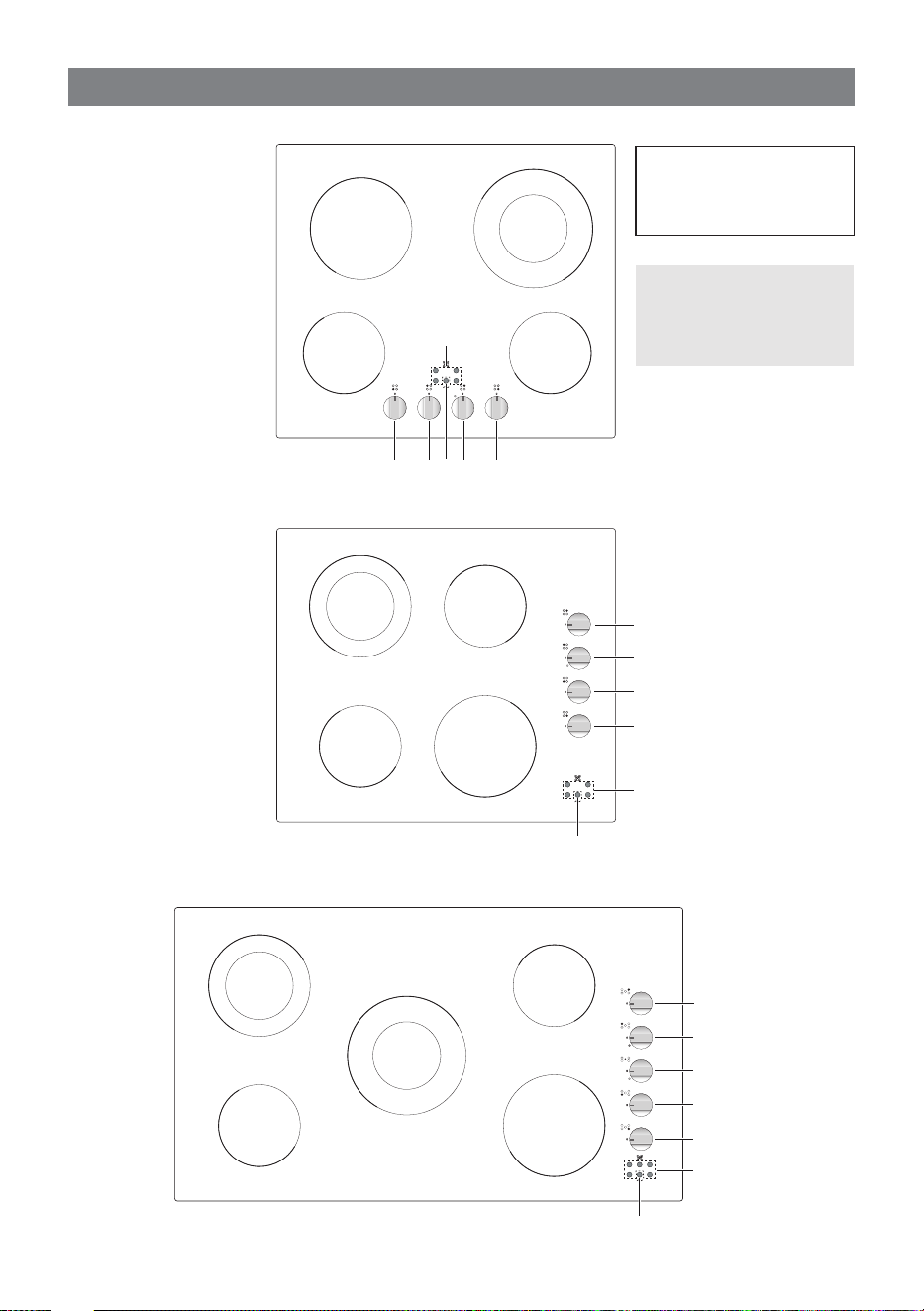
COOKING POINTS
1. Hi-light cooking zone Ø 140 mm - 1200 W
2. Hi-light cooking zone Ø 180 mm - 1800 W
3. Double hi-light cooking zone Ø 210/120 mm - 2200/750 W
4. Double hi-light cooking zone Ø 180/120 mm - 1700/700 W
CONTROLS DESCRIPTION
5. Front left cooking zone control knob
6. Rear left cooking zone control knob
7. Rear right cooking zone control knob
8. Front right cooking zone control knob
9. Central cooking zone control knob
10. Power on indicator light
11. Residual heat indicators
2222
The ceramic surface of the hob allows a fast transmission of heat in the vertical direction,
from the heating elements underneath the ceramic glass to the pans set on it.
The heat does not spread in a horizontal direction, so that the glass stays “cool” at only a
few centimeters from the cooking plate.
The cooking zones are shown by painted disks on the ceramic surface.
Before switching on the cooktop make sure that it is clean.
Important note:
The heating elements incorporate a thermolimiter that switches the element ON/OFF
during all settings to protect the ceramic glass from overheating.
The use of incorrect pans and/or wrong pan positioning will cause the temperature limiter
to operate more frequently, resulting in a reduction of cooking performance.
The temperature limiter can be seen under the glass dissecting the element. This is not a
fault with the appliance.
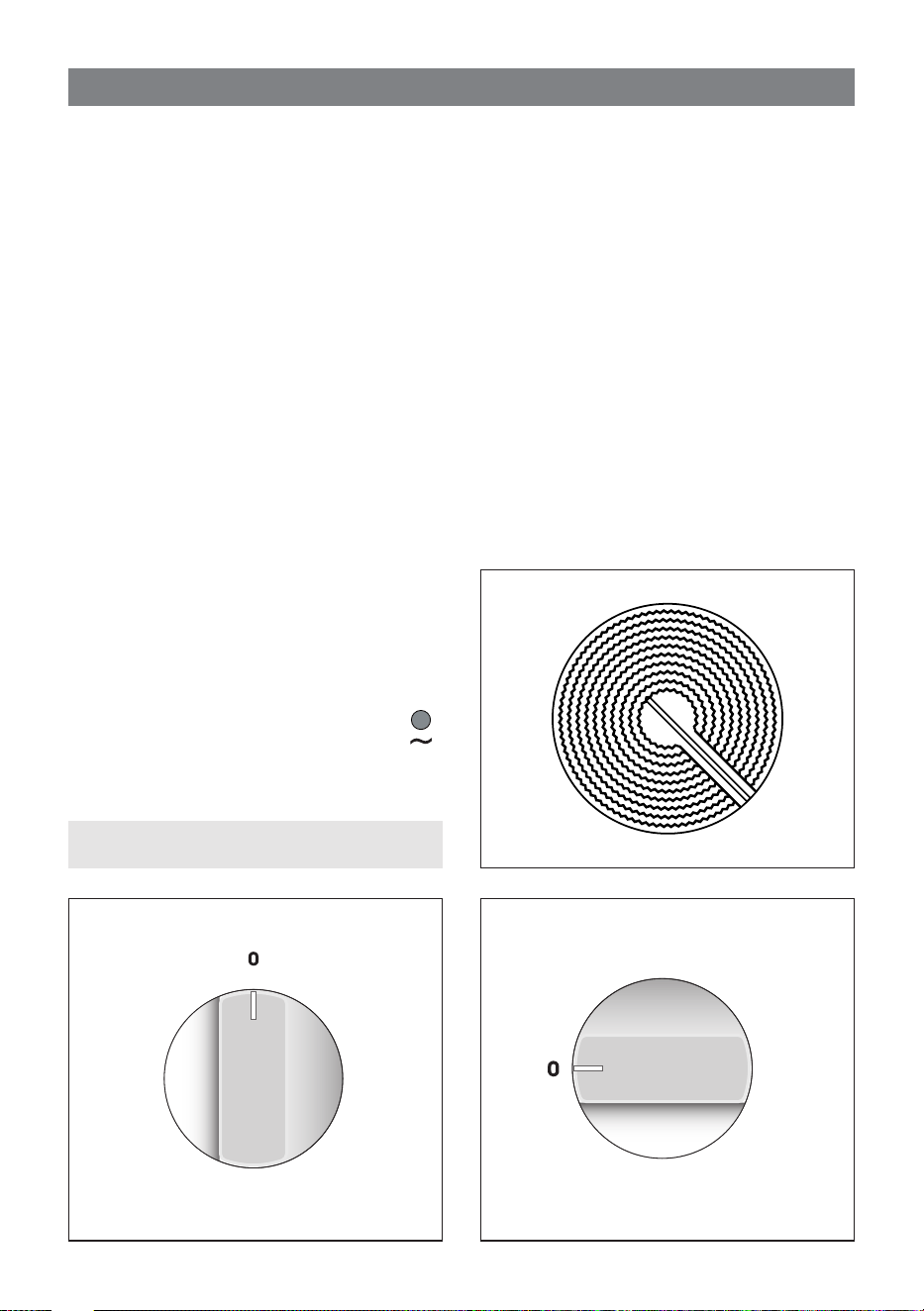
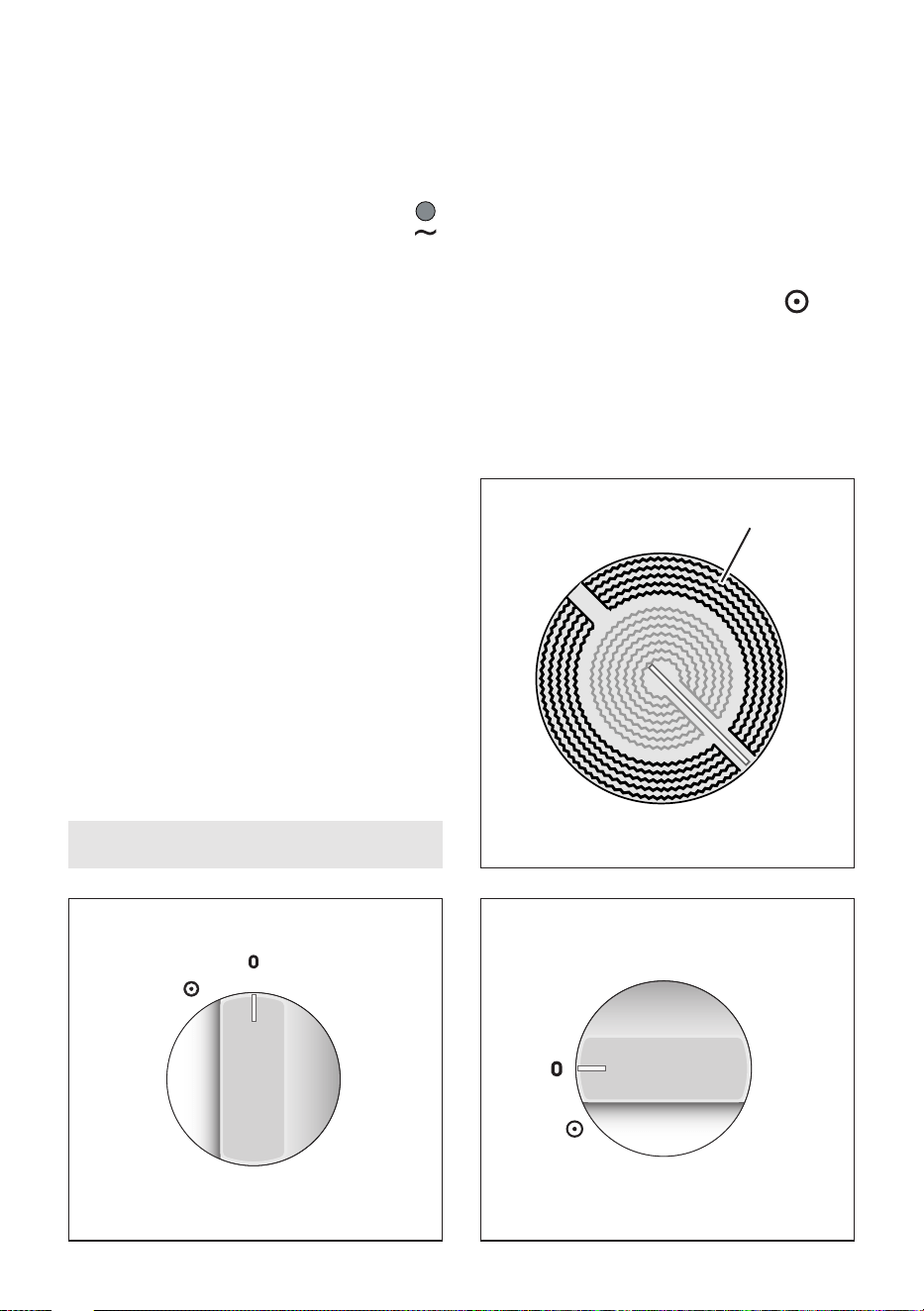
HI-LIGHT RADIANT ZONES (g. 2.1)
The heating element is formed of a coil of resistant material which reaches the working
temperature quickly.
These zones are controlled by a continuous
energy regulator switch (gs. 2.2a - 2.2b).
The heat intensity can be regulated
continuously from “0” to “12” (max).
Check that the hob is clean and then switch
on by turning the control knob.
When the hob is working, the pilot light will
be on.
Fig. 2.1
1
2
3
4
5
6
7
8
9
10
11
12
HOW TO USE THE HOB
2
NOTE: The knob and symbols may vary.
1
2
3
4
5
6
7
8
9
10
11
12
Fig. 2.2bFig. 2.2a
2323
DOUBLE ZONE
Second element
Fig. 2.3
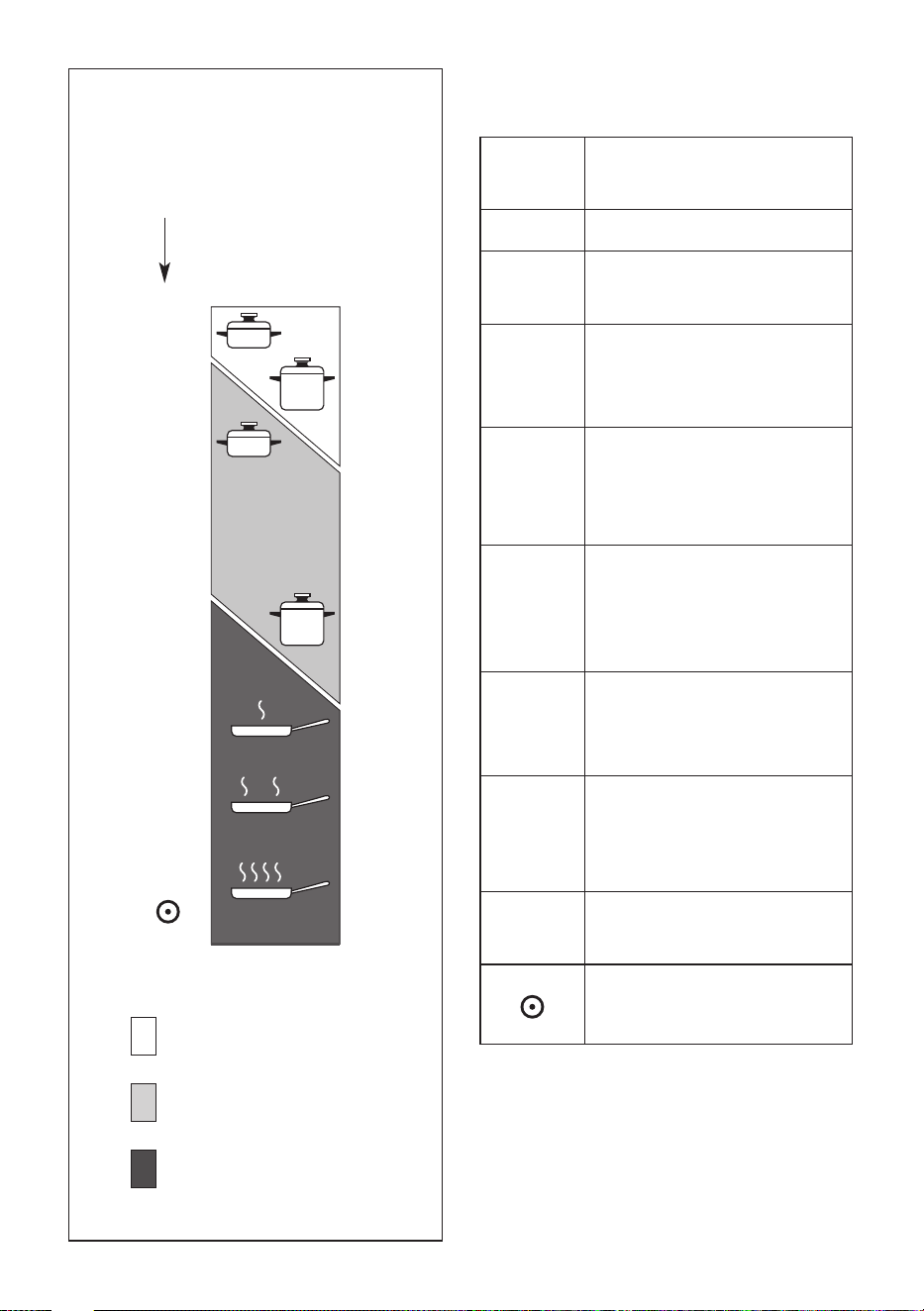
HI-LIGHT DOUBLE ZONE (g. 2.3)
The heating element is formed of a 2 coils of resistant material which reaches the working
temperature quickly.
These zones are controlled by a continuous energy regulator switch (gs. 2.4a - 2.4b).
The heat intensity can be regulated continuously from “0” to “12” (max).
Check that the hob is clean and then switch on by turning the control knob.
When the hob is working, the pilot light will be on.
By switching on the second element (g. 2.3), the surface area of the double hilight zones
can be extended.
For this purpose, turn the control knob (gs. 2.4a - 2.4b) fully to the right (position ).
1
2
3
4
5
6
7
8
9
10
11
12
1
2
3
4
5
6
7
8
9
10
11
12
Fig. 2.4bFig. 2.4a
NOTE: The knob and symbols may vary.
2424
1
2
3
4
5
6
7
8
9
10
11
12
Fig. 2.5
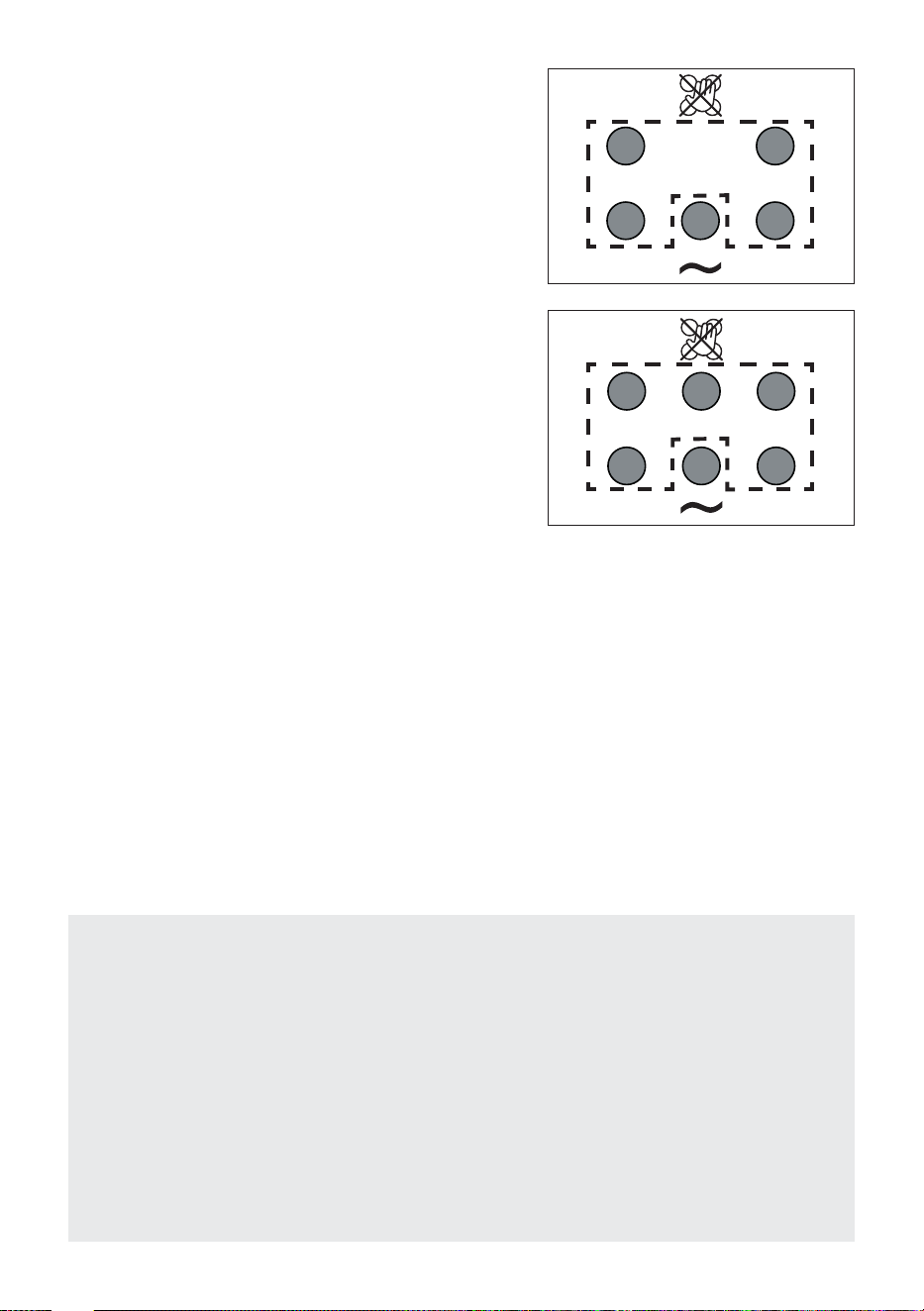
After a short period of use, experience will
teach you which setting is the right one for
your needs.
COOKING HINTS
Knob
setting
TYPE OF COOKING
O Switched OFF
1
2
For melting operations
(butter, chocolate).
2
3
4
To maintain food hot and to
heat small quantities of liquid
(sauces, eggs).
4
5
6
To heat bigger quantities;
to whip creams and sauces
(vegetables, fruits, soups).
6
7
Slow boiling, i.e.: boiled
meats, spaghetti, soups,
continuations of steam
cooking of roasts, stews,
potatoes.
7
8
For every kind of frying,
cutlets, uncovered cooking,
i.e.: risotto.
8
9
10
Browning of meats,
roasted potatoes, fried sh,
omelettes, and for boiling
large quantities of water.
11
12
Fast frying, grilled steaks,
etc.
Switching on the second
element (Double and oval
zones only)
Heating
Cooking
Roasting-frying
Cooking
zone
knob
setting
1
2
3
4
5
6
7
8
9
10
11
12
2525
Caution!
The cooking hob becomes very hot during operation.
Keep children well out of reach.
Never cook the food directly on the glass ceramic cooktop, but in special pans or
containers.
WARNING: Hobs become very hot with use, and retain their heat for a long time
after cooking has nished (about 30 minutes).
Children should be supervised at all times and be prevented from touching the hot
surfaces, until such time as the appliance has cooled.
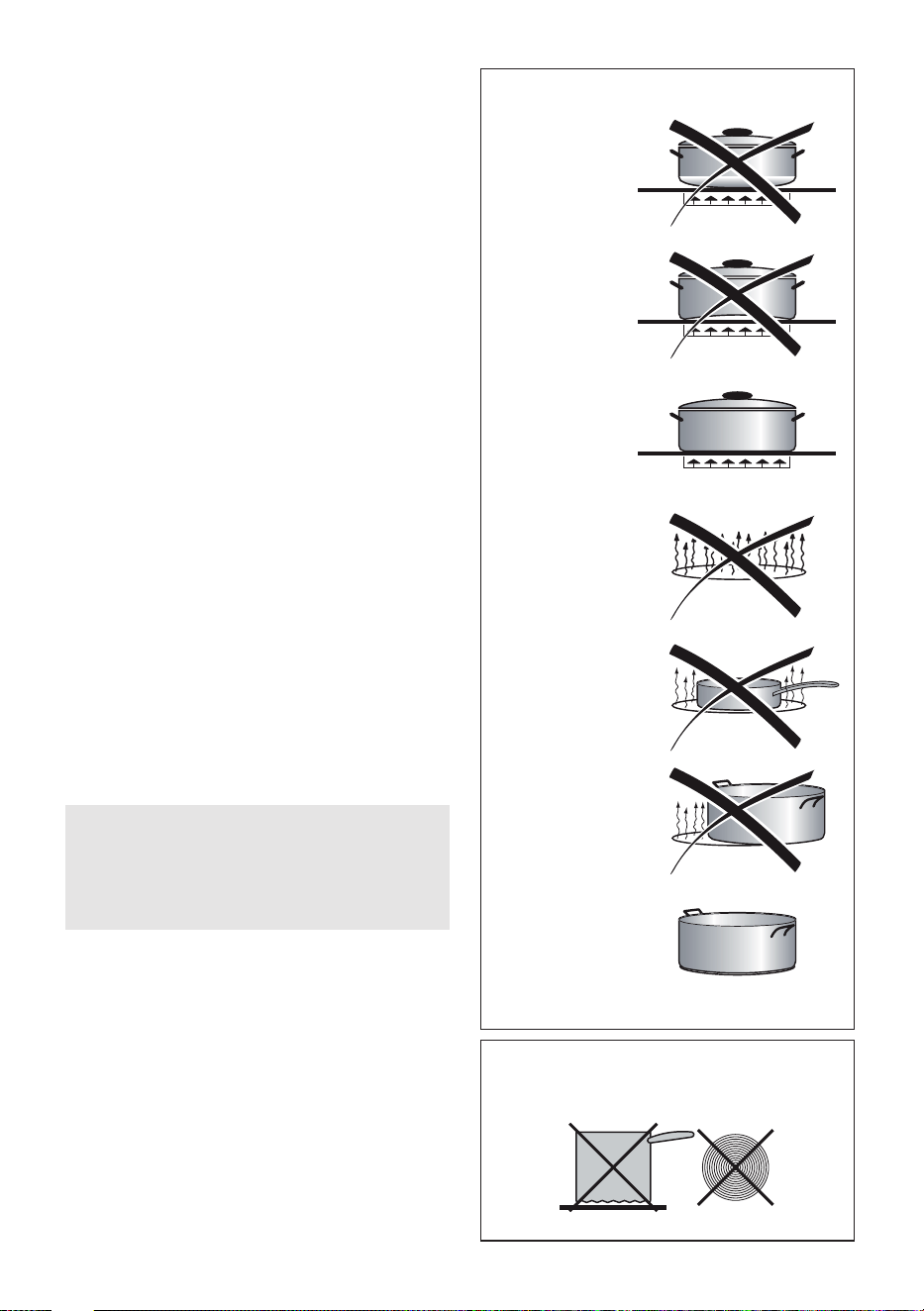
RESIDUAL HEAT INDICATORS
The hob also features 4 or 5 warning lamps which are
wired to the corresponding plate.
When the temperature of a cooking plate is over 60°C,
the relevant warning lamp is also litup to warn of heat
on the surface of the hob.
These lamps also stay on after the cooking plates
have been switched o to shown that the hob surface
is still hot.
This residual heat will lasts for a long time after the
cooking plate has been switched o.
During this time you should avoid touching
the hob surface over the cooking area.
Please pay special attention to ensure that
children are not allowed near the hob.
The lamps will switch o automatically as soon as the
surface temperature of the cooking zone falls below
60°C.
COOKING HINTS
• To reduce the cooking time, you can turn the control knob to the max when you switch
the plate on. After a short time you will set the control knob to the required position for
the cooking.
• You should use pots and pans with at bases (pans with the test mark for glassceramic
hobs are available from specialist shops).
• The diameter of the pan should match that of the cooking plate (or be slightly bigger)
to make the most of the energy.
• Since the cooking surface stays hot for a certain time after the plate has been switched
o, you can switch it o 5 or 10 minutes before the end of the cooking.
The residual heat of the hob will complete the cooking.
• To save electricity, use pan lids whenever possible.
Fig. 2.6
Fig. 2.7
2626
Figure 21
SAFETY HINTS
• Before you switch the hob on, make
sure you know which knob controls the
required cooking zone. We advise you
to set the pan over the cooking zone
before switching it on.
• Do not use pots and pans with rough
bases (pay attention to cookware
made of cast-iron). Rough bases can
damage the glass surface of the hob
(scratches).
• Always ensure that the base of your
saucepan is clean and dry before
placing on the hob.
• Pots with aluminium bottoms may
leave silver streaks or spots on the
hob.
• Do not leave wet or damp lids on the
hob.
• The glass-ceramic surface and pans
must be clean. Carefully eliminate any
food remains (especially containing
sugar), dirt etc. with the aid of a
cleansing agent.
• Pan handles should never stand out
beyond the kitchen worktop, as there
is a great danger of knocking the pan
over. This will also ensure that children
cannot reach them.
• Do not use the hob if the glass
surface is broken or cracked in any
way. Please disconnect the hob
from the mains and contact the
After-Sales Service.
• Do not lean over the cooking plate
when in use.
• Do not lay cooking foil or plastic
materials on the ceramic surface when
it is hot.
• Remember that the surface remains
hot for a long time (about 30 min.) after
the cooking plate has been switched
o.
• Follow the cleaning instructions
carefully.
• Never use the glass surface for storage.
DISTORTED
PANBASE
WRONG
DISTORTED
PANBASE
WRONG
LEVEL
PANBASE
CORRECT
WRONG
WASTING
POWER
WRONG
WASTING
POWER
WRONG
WASTING
POWER
CORRECT
COMPLETE USE
OF THE HEAT
DO NOT USE GLASSWARE ON CERAMIC
HOBS. DO NOT USE PANS WITH ROUGH
CIRCULAR MACHINED BASE.
Fig. 2.9
Fig. 2.8
2727
GENERAL ADVICE
• Before you begin cleaning, you must ensure that the appliance is switched o
and disconnected from the electrical power supply.
• It is advisable to clean when the appliance is cold.
• Avoid leaving alkaline or acidic substances (lemon juice, vinegar, etc.) on the surfaces.
• Avoid using cleaning products with a chlorine or acidic base.
• Do not use a steam cleaner because the moisture can get into the appliance thus
make it unsafe.
• Important: The use of suitable protective clothing/gloves is recommended when
handling or cleaning of this appliance.
• Do not scratch the cooktop with cutting or sharp objects.
• Important: The manufacturer declines all liability for possible damage caused by
the use of unsuitable products to clean the appliance.
• Clean surfaces with a damp cloth and use gentle, neutral cleaning products. Dry with
a clean, dry cloth.
• IMPORTANT: Do not use any abrasive products (e.g. certain types of sponge) and/
or aggressive products (e.g. caustic soda, products containing corrosive substances),
which could cause irreparable surface damage.
WARNING!
When correctly installed, your product meets all safety requirements laid down for
this type of product category. However special care should be taken around the
underneath of the appliance as this area is not designed or intended to be touched
and may contain sharp or rough edges, that may cause injury.
CLEANING THE CERAMIC HOB
• Remove spillages and other types of incrustations.
• Dust or food particles can be removed with a damp cloth.
• If you use a detergent, please make sure that it is not abrasive or scouring. Abrasive or
scouring powders can damage the glass surface of the hob.
• All traces of the cleaner must be removed with a damp cloth.
• Dust, fat and liquids from food that has boiled over must be removed as soon as
possible.
• If they are allowed to harden they become increasingly dicult to remove.
This is especially true in the case of sugar/syrup mixtures which could permanently pit
the surface of the hob if left to burn on it.
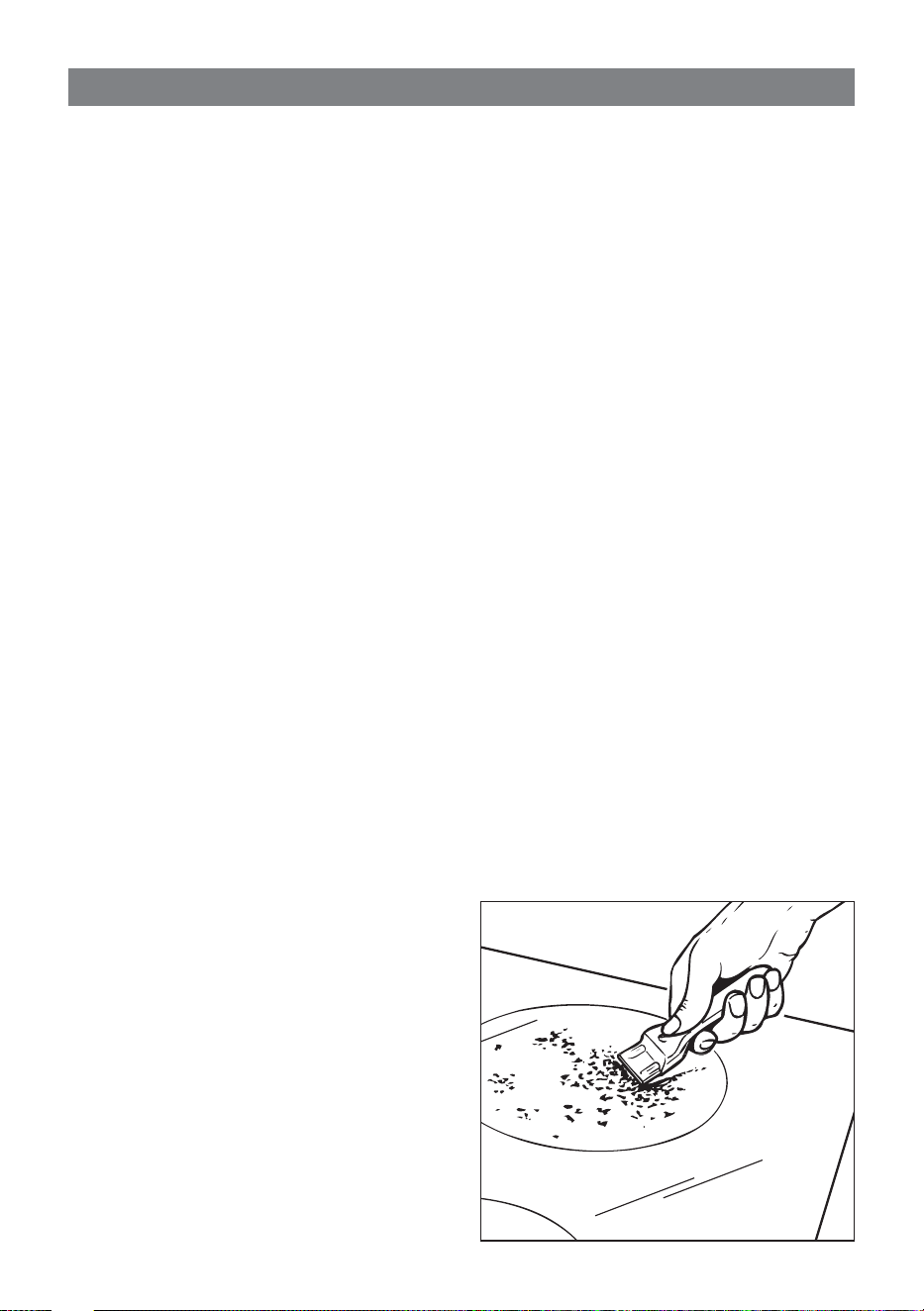
• If any of these products has melted on
the ceramic surface, you should remove
it immediately (when the surface is still
hot) by using a proper scraper to avoid
any permanent damage to the surface
of the hob.
• Do not put articles on the hob which can
melt: i.e plastic, aluminium foil, sugar,
sugar syrup mixtures etc.
• Avoid using a knife or other sharp utensil
as these may damage the ceramic
surface.
• Do not use steel wool or an abrasive
sponge which could scratch the surface
permanently.
CLEANING AND MAINTENANCE
3
Fig. 3.1

Cod. 1106442/GB - ß1
The manufacturer will not be responsible for any inaccuracy resulting from printing or transcript errors
contained in this brochure. We reserve the right to carry out modications to products as required,
including the interests of consumption, without prejudice to the characteristics relating to safety or
function.
GB