
Fire-fighting pipeline leak detection method and Steps
Before carrying out the fire-fighting pipeline leak detection work, we must first
determine whether the fire-fighting pipeline is really leaking, and how to judge the
fire-fighting pipeline leakage?
The general fire fighting system usually relies on high-level water tanks to
replenish the loss of water in the fire fighting pipe network and maintain the
pressure in the pipe. In addition, in emergency situations, the pump room is used to
replenish water and pressurize.
We usually judge whether the fire-fighting pipeline is leaking from two aspects:
1. The high-level water tank has a large daily replenishment volume;
2. The pump room can't hold the pipeline under pressure.
First step:
Start the booster pump in the pump room, and test the pressure by hitting 6-8
kg(bar), to see the pressure holding situation. If the pressure cannot be maintained,
it means that the fire pipe is suspected of leaking.
The second step:
After confirming that the fire pipe is leaking, start to investigate the location and
direction of the pipe.
How to check the location and direction of the pipeline?
1. The owner needs to provide a distribution drawing of the fire pipe network; or be
led by a person familiar with the pipe network;
2. If no distribution drawings of the fire-fighting pipe network, the pipe wells and fire
hydrants can be searched through the connection of the distribution of the pipe
wells and fire hydrants to locate of the pipelines (fire-fighting pipelines are generally
distributed in a ring shape);
3. In the case where neither of the above two are available, if it is a metal pipeline,
the pipeline detector can be used to find the location of the pipeline.
Third step:
1. When checking the tube well, check if there is any clear water flowing out, and if
there is clear water flowing out, but the source of the water cannot be confirmed,
close the main valve and observe whether the surface water continues to flow or not.
When the clear water does not flow anymore, we can determine that the pipeline

near the tube well is suspected of water leakage, and go on.
2. Observe the surrounding environment to see if the ground is sinking, the ground is
obviously different from the surrounding wetlands, and the ground is cracked. If
there are the above phenomena, you can focus on the investigation of nearby
pipelines.
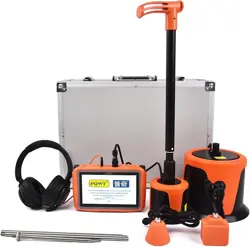
3. Use a leak detector to check the position of the valve and the exposed fire hydrant
to see if there is any abnormal sound of water leakage.
The fourth step:
When the suspected area of water leakage cannot be detected under the above
circumstances, the pipeline can be further subjected to a segmented pressure
holding test: the fire pipeline starts from the pump room, close the first valve,
observe the pressure change of the pressure gauge, the pressure reduction proves
that the water is leaking, and vice versa. Close the second valve, open the first valve,
and observe the pressure change on the pressure gauge. By analogy, look for
"suspected leaking areas."
The fifth step:
After finding the "suspected water leakage area", adjust the pressure of the air
pump to 6 kg and continue to press the pipeline. If conditions permit, the pressure
can be increased. Use the "locating" mode in the leak detector to measure while
walking along the ground above the pipeline. Observe the changes in the spectrum
bar and the sound changes in the earphones. Once close to the top of the leaking
point, the earphone sound volume will become louder, accompanied by a deep and
harsh sound or the sound of water tumbling and bursting water droplets. The
spectrum cursor signal on the screen will continue to rise and remain at a certain
high level, without drastically floating up and down. Because the missing point is a
continuous signal.
After finding the suspected leakage point, use the "locating" mode in the leak
detector to further verify. Use the filter analysis mode to perform "precision
measurement", and detect the suspected leakage point before, after, and left. Thin
bars and thick bars appear on the interface of the instrument. It is caused by external
noise, and the thick bar is water leakage noise. After the front, back, left, and right
inspections are completed, observe that the thick bar is the highest at that point,
which is the suspected leakage dot.
The sixth step:
Fire pipe leak detection focuses on the location of valve wells, fire hydrants,
joints, branches, and wall-piercing pipes. The ground has subsidence, collapse, and
the road surface cracks should be the focus of the investigation.
Note: The filter analysis of L series instruments is in positioning mode.