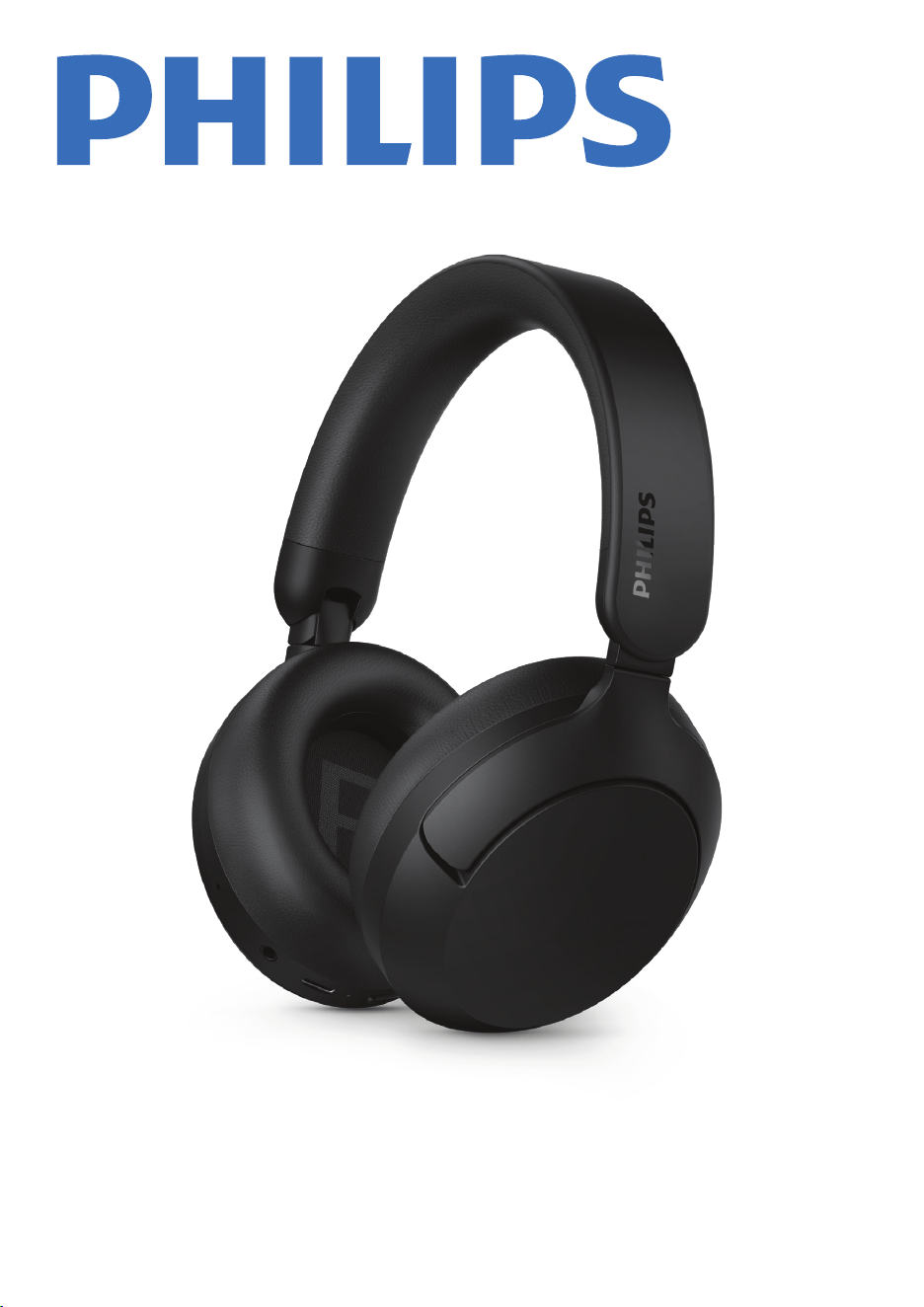
Headphones
TAH6000
User manual
Register your product and get support at
www.philips.com/support

1 Important safety instructions 2
Hearing safety 2
General information 2
2 Your Over-ear ANC
headphones 3
What's in the box 3
Other devices 3
Overview of your over-ear
headphones 4
3 Get started 4
Charge the battery 4
Change the battery 5
App download 6
Pair for the �rst time 6
Pair with another Bluetooth device 6
Multi-point connection 7
Connect the headphones via
3.5mm audio cable 7
4 Use your headphones 8
Connect to your Bluetooth device 8
Power on/off 8
Control ANC (Active Noise
Cancelation) 8
Manage your calls and music 9
Voice Assistant 9
Headphones LED indicator status 9
9 Trademarks 14
Contents
5 Reset the headphones 10
6 Technical data 10
7 Notice 11
Declaration of conformity 11
Disposal of your old product
and battery 11
Remove the integrated battery 11
Compliance with EMF 11
Environmental information 11
Notice of compliance 11
8 Frequently asked questions 13
2 EN
1 Important
safety
instructions
Hearing safety
• Be sure to observe the following guidelines
when using your headphones.
• Listen at reasonable volumes for reasonable
periods of time.
• Be careful not to adjust the volume
continuously upwards as your hearing adapts.
• Do not turn up the volume so high that you
can't hear what's around you.
• You should use caution or temporarily
discontinue use in potentially hazardous
situations.
• Excessive sound pressure from headphones
and headphones can cause hearing loss.
• Using headphones with both ears covered
while driving is not recommended and may be
illegal insome areas.
• For your safety, avoid distractions from music
or phone calls while in traffic or other
potentially dangerous environments.
General information
To avoid damage or malfunction:
Danger
• To avoid hearing damage, limit the time you
use headphones at high volume and set the
volume to a safe level. The louder the
volume, the shorter the safe listening time is.
Caution
• Do not expose headphones to excessive heat.
• Do not drop your headphones.
• Headphones shall not be exposed to dripping
or splashing. (Refer to the IP rating of specific
product)
• Do not allow your headphones to be submerged
in water.
• Do not charge your headphones when the
connector or socket is wet.
• Do not use any cleaning agents containing
alcohol, ammonia, benzene, or abrasives.
• Use a clean, damp cloth to clean your
headphones - especially the sound conduits and
the microphone holes - regularly and avoid
buildup of substances such as sweat or earwax.
• If any sweat or water droplets are left in the
sound conduits, air holes or microphone holes,
the sound level will temporarily drop or cut out
entirely. This is not a malfunction. Use a soft,
damp cloth to dry the headphones thoroughly.
Alternatively, remove the earbud tips, turn the
sound conduits downward and gently tap the
headphones about five times on a dry cloth or
similar to remove any water collected inside.
• Be sure the headphones are completely dry
before charging and using. Avoid using
disposable alcohol pads or other substances for
cleaning.
• The integrated battery shall not be exposed to
excessive heat such as sunshine, fire or the like.
• Danger of explosion if battery is incorrectly
replaced. Replace only with the same or
equivalent type.
• To achieve the specific IP rating, the charging
slot cover must be closed.
• Disposal of a battery into fire or a hot oven, or
mechanically crushing or cutting a battery, can
result in an explosion.
• Leaving a battery in an extremely high
temperature surrounding environment can result
in an explosion or the leakage of flammable
liquid or gas.
• A battery subjected to extremely low air pressure
may result in an explosion or the leakage of
flammable liquid or gas.
• Replacement of a battery with an incorrect type
risks severely damaging the headphones and the
battery (for example, in the case of some lithium
battery types).
• If the headset is not used for a long time, the
rechargeable battery will begin to lose its charge.
To avoid this loss, please fully charge the battery
at least once every three months.
• To avoid risk of fire, the equipment is supplied
only by external power source which output
shall comply with PS1 (with output capacity
less than or equal to15W).
Operating and storage temperatures and
humidity
• Store in a place where the temperature is
between -20°C (-4°F) and 50°C (122 °F) with
up to 90% relative humidity.
• Operate in a place where the temperature is
between 0°C (32°F) and 45°C (113 °F) with
up to 90% relative humidity.
• Battery life may be shorter in high or low
temperature conditions.
2 Your over-ear
ANC
headphones
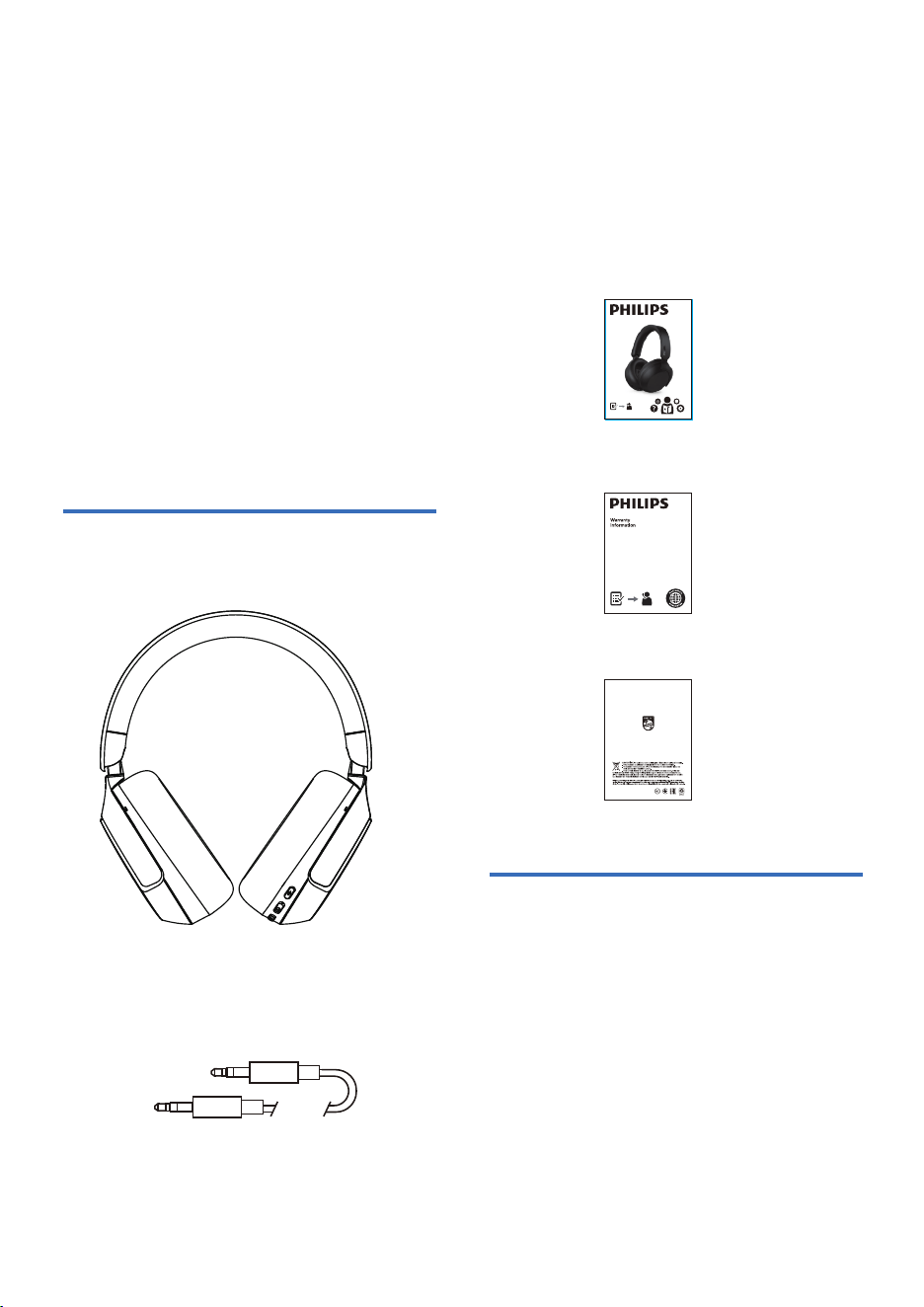
Over-ear ANC headphones TAH6000
Congratulations on your purchase, and welcome
to Philips! To fully bene�t from the support that
Philips offers, register your product at
www.philips.com/support.
With these Philips headphones, you can:
• Enjoy convenient wireless handsfree calls
• Enjoy and control music wirelessly
• Switch between calls and music
• Enjoy noise cancellation
A mobile phone or device (e.g. notebook, tablet,
Bluetooth adapters, MP3 players etc) which
supports Bluetooth and is compatible with the
headphones (see 'Technical data' on page 10).
3 EN
Other devices
What's in the box
Audio cable
3.5mm
1.0 m
3.5mm
Global Warranty
Safety lea�et
Quick start guide
Headphones
TAH6000
www.philips.com/welcome
Overview of your
Over-ear ANC
headphones
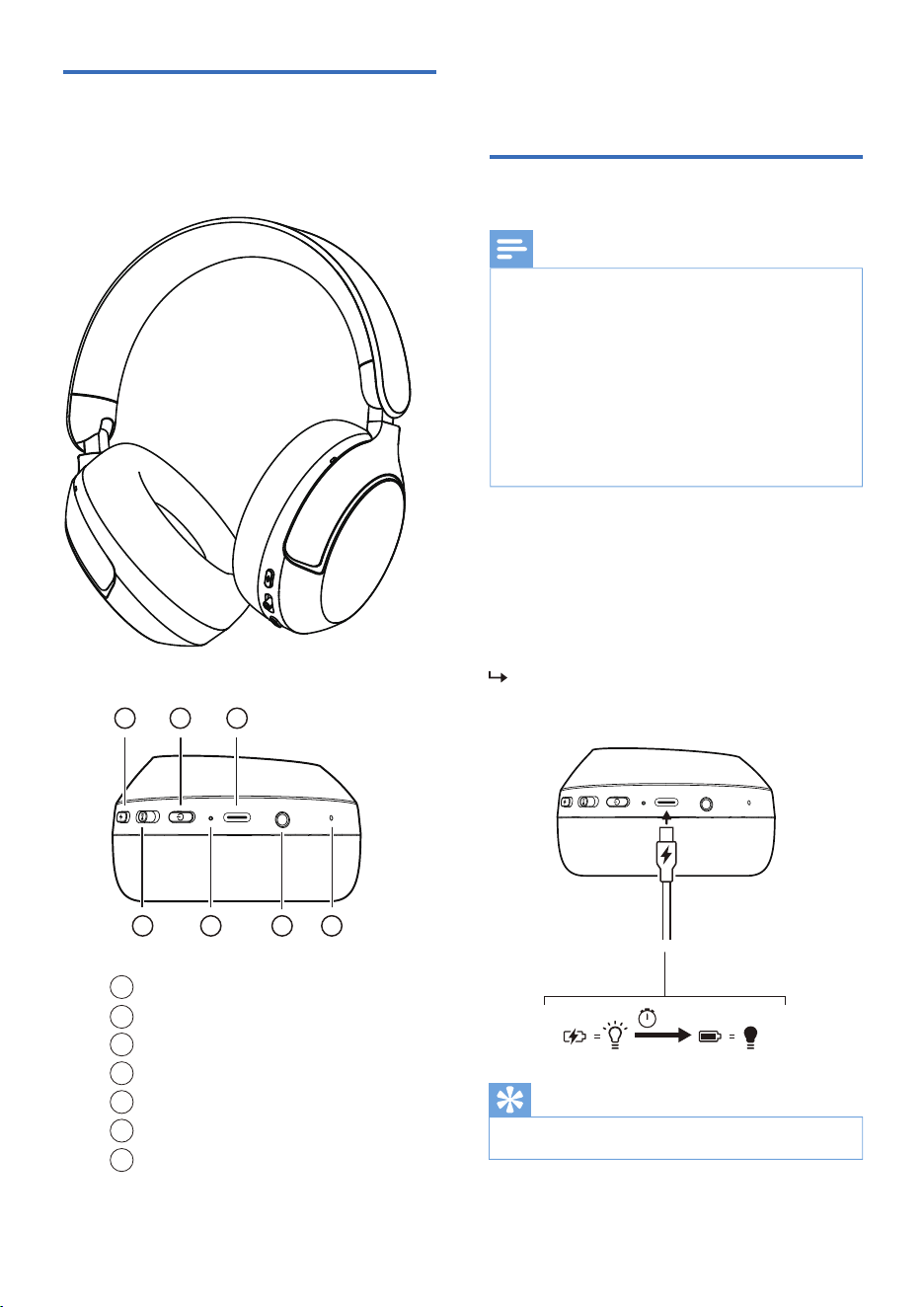
Connect the USB charging cable:
One end to the USB-C charging slot on the
headphone;
The other end to the charger/USB port of
a computer.
• Normally, a full charge takes two hours.
LED turns white during charging and turns
off when the headphones are fully charged.
ANC/Awareness mode button
Power button
LED indicator
Multi-Function Button (MFB)
USB-C charging slot
3.5mm Audio jack
1
2
3
4
5
6
Mic
7
3 Get started
Charge the battery
1. Before you use your headphones, charge
the battery for 2 hours for optimum
battery capacity and lifetime.
2. Finish your call before charging.
Connecting the headphones to charge will
power them off.
3. If the headset is not used for a long time,
the rechargeable battery will begin to lose
its charge. To avoid this loss, please fully
charge the battery at least once every
three months.
Note
Tip
4 EN
1
4
2
5
3
6 7
2h
Change the battery
EN 5
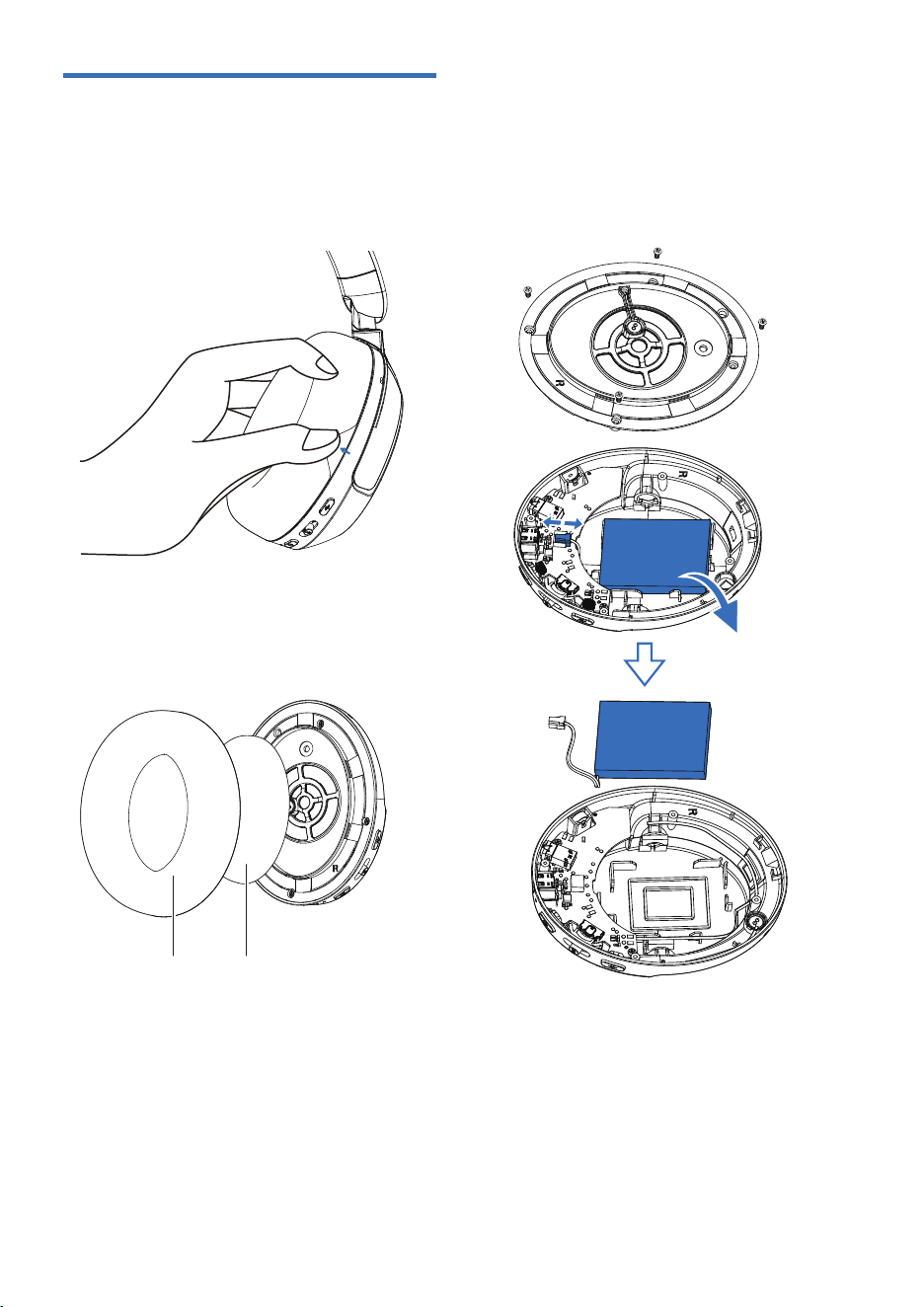
The battery is replaceable. Follow these steps:
1. Remove the right ear cushion from the
headband.
2. Remove the sponge mat beneath it.
Ear
cushion
Sponge
mat
3. Use a cross-head screwdriver to remove the four
screws from the driver housing and disconnect the
battery connector, then remove the old battery
and replace it with a new one.
6 EN
App download
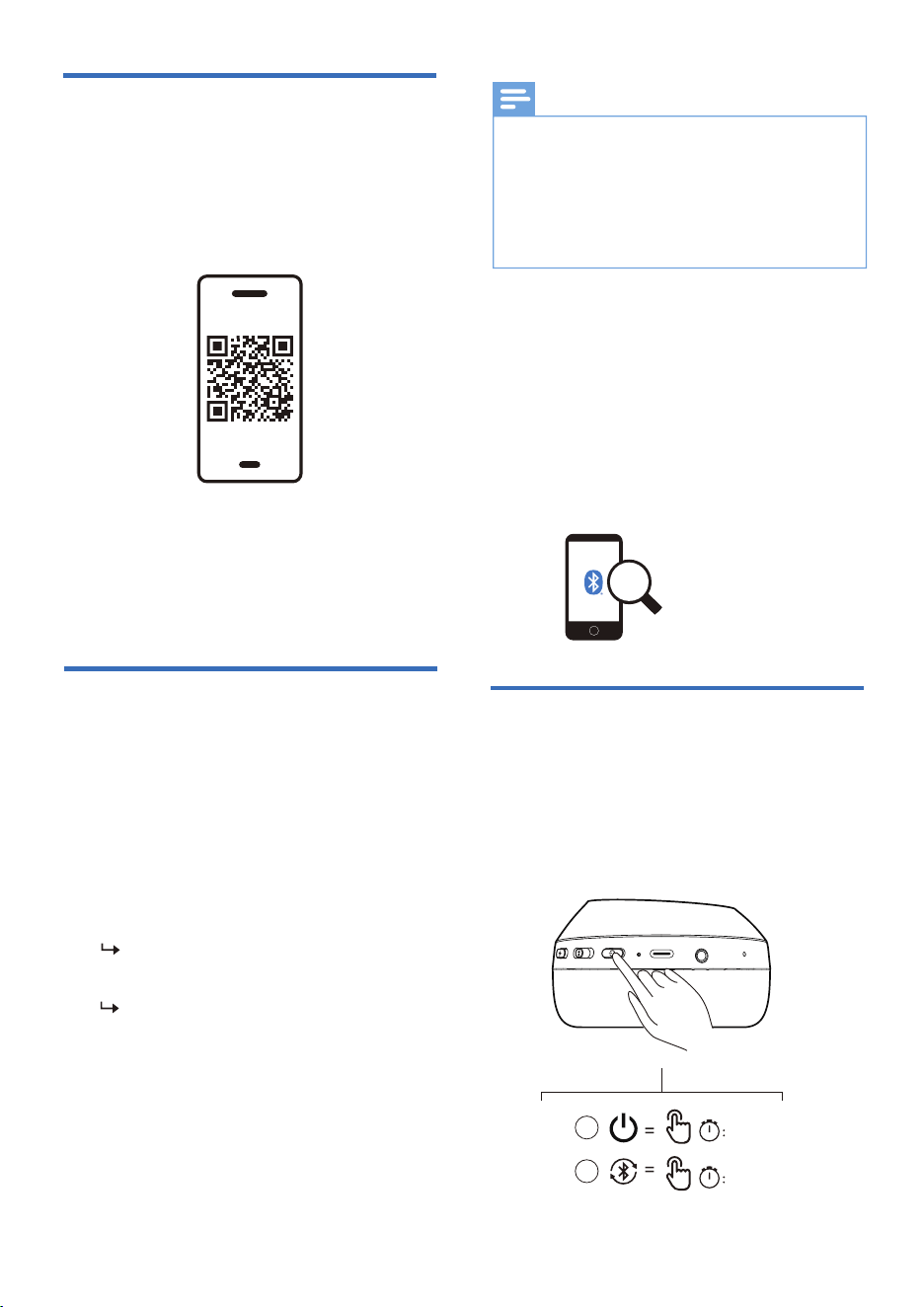
Scan the QR code/press 'Download' button or
search 'Philips Headphones' in the Apple App
Store or Google Play to download the app.
The Philips Headphones App puts you in charge
of the music you are listening to. You can
customize the sound so that your music and
calling experience always best suit your needs.
Pair the headphones with
your Bluetooth device for
the �rst time
Get Started
Make sure that the headphones are fully
charged and powered off.
Press and hold the power button for 2
seconds, the headphones will be in pairing
mode and ready to connect.
1
2
The LEDs on headphones �ash white
and blue alternately.
The headphones are now in pairing
mode and ready to pair with a
Bluetooth device
(e.g. a mobile phone).
Turn on the Bluetooth function of your
Bluetooth device.
Pair the headphones with your
Bluetooth device, refer to the user manual
of your Bluetooth device.
3
4
Pair the headphones with
another Bluetooth device
If you want to pair another Bluetooth device
with the headphones, turn on headphones and
then press the MFB for 5 seconds and discover
the second device as per normal pairing.
Philips TAH6000
The following example shows you how to pair
the headphones with your Bluetooth device.
Turn on the Bluetooth function of your
Bluetooth device, select
Philips TAH6000.
Enter the headphones' password “0000” (4
zeros) if prompted. For those devices
featuring Bluetooth 3.0 or higher, there is no
need to enter a password.
1
2
• After powering on, if the headphones can not
�nd any previously connected Bluetooth device,
please put them into pairing mode (press the
MFB for 5 seconds after powering on).
• Headphones will automatically power off after 5
minutes of Bluetooth inactivity. Actual timing
may vary by usage conditions.
Note
philips.to/headapp
02"
05"
1
2
• The headphones store 5 devices in the memory.
If you try to pair more than 5 devices, the earliest
paired device is replaced by the new one.
7 EN
Note
Note
• When streaming audio from Device 1, receiving
a call from Device 2 will automatically pause
Device 1 playback. And the call will be routed
automatically to headphones.
• Ending the call will automatically resume
playback from device 1.
Multi-point connection
Pairing
• Pairing the headphones to 2 devices, e.g.
mobile phone and notebook.
Switch between device
• At anytime, you can only listen to music
from 1 device. Another device will be for
phone call.
• Pause the audio from 1 device, then start to
play audio from the another device.
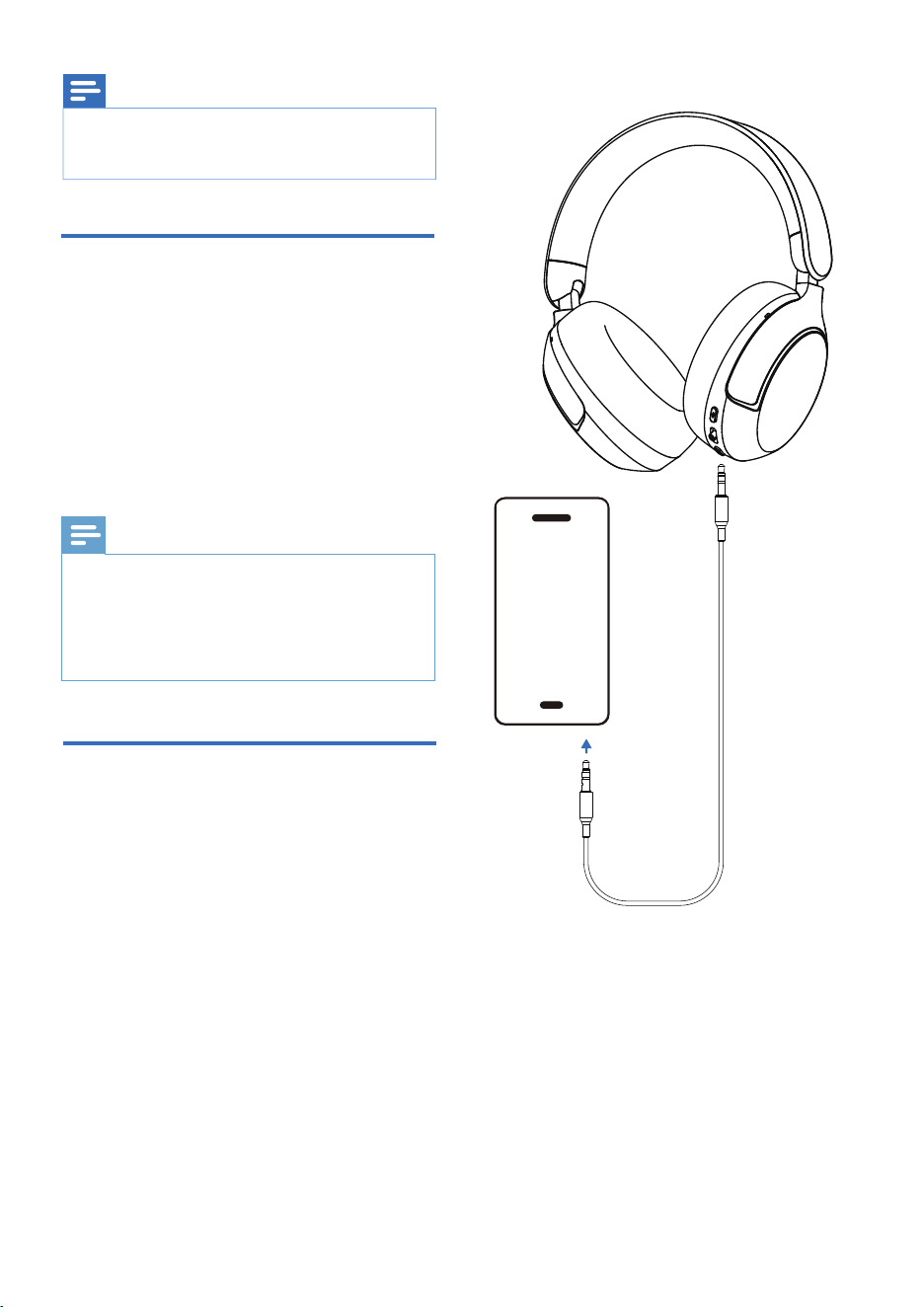
Connect the headphones
to your device via 3.5mm
audio cable
When the headphones' battery is depleted or
your device lacks Bluetooth capability, they can be
connected to the device using a 3.5mm audio
cable ( included in the packaging).
Press and hold the Power button to turn
the headphones on.
The white LED will turn on in
two seconds
The headphones are reconnected to the
last connected mobile phone/ Bluetooth
device automatically
8 EN
4 Use your
headphones
Connect the headphones
to your Bluetooth device
1
2
• If you turn on the Bluetooth function of your
Bluetooth device after turning on the
headphones, you have to go to the Bluetooth
menu of the device and connect the
headphones to the device manually.
Tip
• In some Bluetooth devices, connection may not
be automatic. In this case, you have to go to the
Bluetooth menu of your device and connect the
headphones to the Bluetooth device manually.
Note
• When powered on and with battery charge, this
model supports Active Noise Cancelation (ANC)
both wirelessly via Bluetooth and wired via the
3.5mm jack.
Note
Turn on the Bluetooth function of your
Bluetooth device.
Task
Turn the
headphones
on
Press and hold
for 2 seconds
Press and hold for 2
seconds (White LED
is on for 3 seconds)
Turn the
headphones
off
Power on/off
Button
Button
Operation
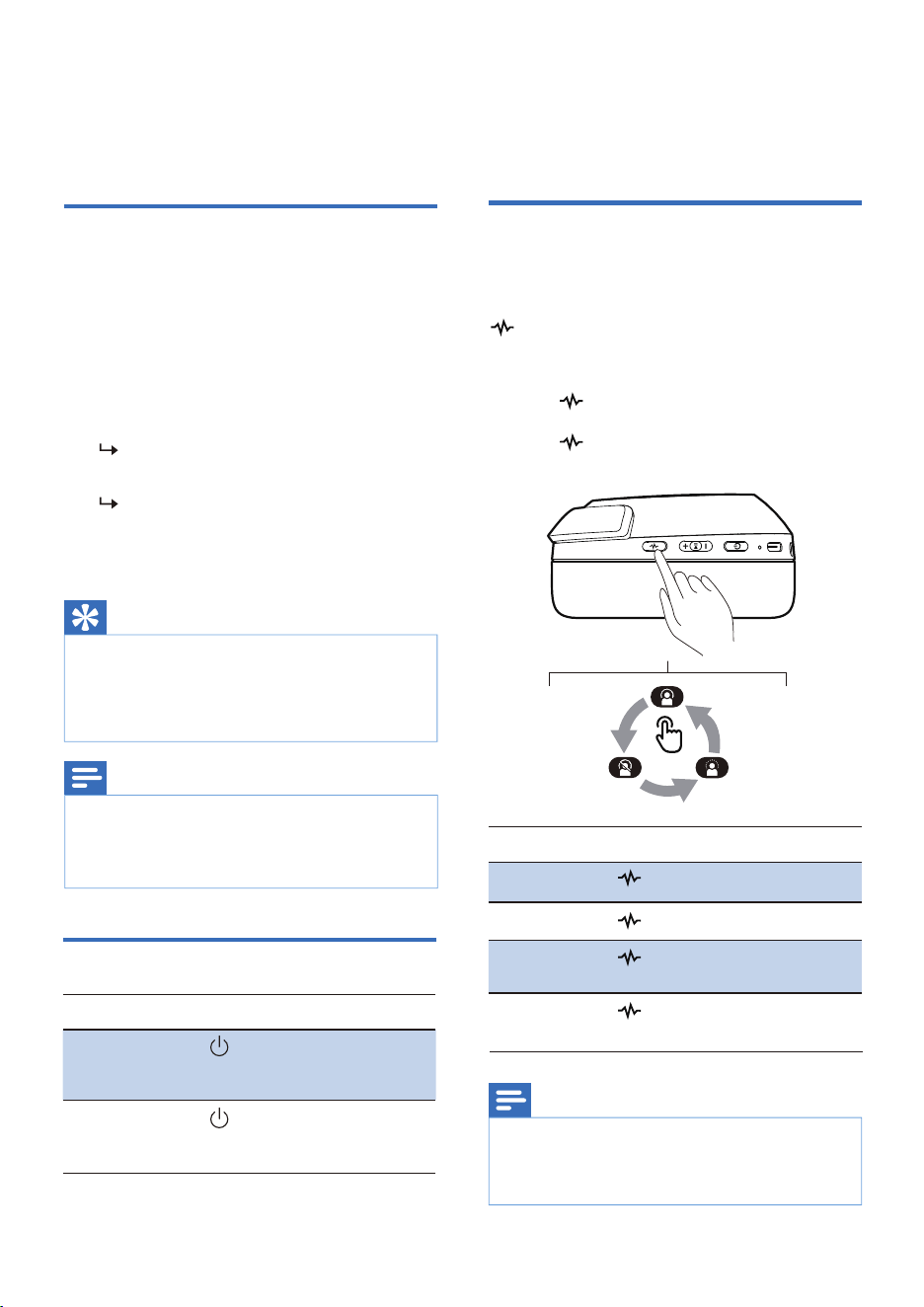
Different ANC modes can be toggled via pressing
button one time on the right earcup.
• ANC function is automatically activated
when headphone is placed on the ear.
• Press button one time, it will turn the
ANC function off.
• Press button one time again, it will
change to awareness mode.
Control ANC (Active Noise
Cancelation)
Task
ANC ON Press one time
Press one time
Press one time
Awareness
mode
ANC OFF
Operation
x1
Press and hold for
one second
Quick
awareness
• You will hear a tone that indicates when the
volume has reached maximum level.
Note
Manage your calls
and music
Music control
Play or pause
music
Next track
Push toward to “-”
and hold for one
second
Push toward to
“+” and hold for
one second
Push toward to
“+”
Push toward to
“-”
Previous track
Adjust volume +
Single press
Task Button
MFB
MFB
MFB
MFB
MFB
MFB
MFB
Operation
Call control
Pick up
Hang up call/
Reject call
Press and hold
for 1 second
Single press
Task
Button
Operation
Adjust volume -
Indicator
Headphones LED
indicator status
Headphones status
The headphones are
connected to a
Bluetooth device
The headphones are
ready for pairing
The headphones are
on but not connected
to a Bluetooth device
The LED �ashes blue
and white alternately
White LED blinks once
every 6 seconds (auto
turn off after 5
minutes)
Blue LED �ashes
every 4 seconds
Charging
completed
Low battery
Charging error
Power on White LED will be on
2 seconds
White LED will slow
blink every 4 seconds
White LED fast blink
every 1 second
White LED will be off
Charging White LED will be on
Power off White LED will be on
3 seconds
Voice Assistant
OperationTask Button
Trigger Voice
(Siri/Google)
Assistant
Press twice
Stop Voice
Assistant
Press once
Three Way Calling
Hold current call
and accept an
incoming call
Hold current call
and reject an
incoming call
Press and hold
for 1 second
Single press
Task
Button
Operation
Switch between
second-way call and
three-way call
Single press
9 EN
MFB
MFB
MFB
MFB
MFB

5 Reset the
headphones
6 Technical data
• Music play time:
(ANC off) 80 hours
(ANC on) 50 hours
• Charging time: 2 hours
• Rechargeable lithium ion battery: 720
mAh
• Bluetooth version: 6.0
• Compatible Bluetooth pro�les:
- HFP
(Hands-Free Pro�le)
- A2DP
(Advanced Audio Distribution Pro�le)
- AVRCP
(Audio Video Remote Control Pro�le)
• Supported audio codecs: SBC
• Frequency range: 2.4-2.4835 GHz
• Transmitter power: < 13 dBm
• Operating range: Up to 10 meters
(33 feet)
• Auto power off
• USB-C port for charging
• Multi-point connection
• Fast charging time: 5 mins charging
gives 4 hrs playing
Note
• Speci�cations are subject to change without
notice.
• Battery life of playtime is approximate and may
vary depending on application condition.
1. On your Bluetooth device, go to the
Bluetooth menu and remove Philips
TAH6000 from the device list.
2. Turn off the Bluetooth function of your
Bluetooth device.
3. Turn on your headphones.
4. Press and hold Power button and ANC
button for 3 seconds at the same time.
5. Follow steps in “Use your headphones-
connect the headphones to your
Bluetooth device.”
6. Pair the headphones with your Bluetooth
device, select Philips TAH6000.
If you encounter any pairing or connection issue,
you can follow the following procedure to reset
your headphones to factory default settings.
10 EN
If there is no collection/recycling system for
electronic products in your country, you can protect
the environment by removing and recycling the
battery before disposing the headphones.
This product complies with all applicable
standards and regulations regarding exposure to
electromagnetic �elds.
11 EN
7 Notice
Hereby, TP Vision Europe B.V. declares that the
product is in compliance with the essential
requirements and other relevant provisions of RED
Directive 2014/53/EU and UK Radio Equipment
Regulations SI 2017 No 1206. You can �nd the
Declaration of Conformity on
www.philips.com/support.
Declaration of conformity
Disposal of your old
product and battery
Your product is designed and
manufactured with high quality materials
and components which can be recycled
and reused.
This symbol on a product means that the
product is covered by European Directive
2012/19/EU.
This symbol means that the product
contains batteries covered by European
Regulation (EU) 2023/1542 which cannot
be disposed of with normal household
waste. Inform yourself about the local
separate collection system for electrical
and electronic products and batteries.
Follow local rules and never dispose of the
product and batteries with normal
household waste. Correct disposal of old
products and batteries helps prevent
negative consequences for the
environment and human health.
Remove the integrated
battery
Compliance with EMF
Notice of compliance
The device complies with the FCC rules, Part 15.
Operation is subject to the following two
conditions:
FCC rules
This equipment has been tested and found to
comply with the limits for a Class B digital device,
pursuant to part 15 of the FCC Rules. These limits
are designed to provide reasonable protection
against harmful interference in a residential
installation. This equipment generates, uses and
canradiate radio frequency energy and, if not
installed and used in accordance with the
instruction manual, may cause harmful
interference to radio communications.
However, there is no guarantee that
interference will not occur in a particular
installation. If this equipment does cause
harmful interference to radio or television
reception, which can be determined by turning
the equipment off and on, the user is
encouraged to try to correct the interference by
one or more of the following measures:
• Reorient or relocate the receiving antenna
• Increase the separation between equipment
and receiver
Environmental information
All unnecessary packaging has been omitted. Your
system consists of materials which can be recycled
and reused if disassembled by a specialized
company. Please observe the local regulations
regarding the disposal of packaging materials,
exhausted batteries and old equipment.
1. This device may not cause harmful
interference, and
2. This device must accept any interference
received, including interference that may
cause undesired operation.
Follw the step of ‘Change the battery’ on
page 5 to remove battery.

12 EN
• Connect the equipment into an outlet on a
circuit different from that to which the
receiver is connected
• Consult the dealer or an experienced radio/TV
technician for help
FCC Radiation Exposure Statement:
Canada:
This device contains licence-exempt
transmitter(s)/receiver(s) that comply with
Innovation, Science and Economic Development
Canada’s license-exempt RSS(s). Operation is
subject to the following two conditions: (1) This
device may not cause interference. (2) This
device must accept any interference, including
interference that may cause undesired operation
of the device.
Avis de conformité
Cet appareil satisfait aux règlements de la FCC
partie 15 du Code of Federal Regulations. Son
fonctionnement est assujetti aux deux conditions
suivantes :
1. Cet appareil ne doit pas causer
d’interférence préjudiciable et
2. l’appareil doit accepter toute interférence
reçue, y compris les interférences qui
peuvent causer un fonctionnement non
désiré.
Caution:
The user is cautioned that changes or
modifications not expressly approved by the party
responsible for compliance could void the user's
authority to operate the equipment.
The SAR limit of USA (FCC) is 1.6 W/kg averaged
over one gram of tissue. This device has been
tested to complied FCC Speci�c Absorption Rate
(SAR)compliance. The highest reported SAR level
for usage near the head (0mm) is 0.058 W/kg.
Règlement de la FCC
Cet équipement a été testé et jugé compatible
avec les limites s’appliquant aux appareils
numériques de la classe B, conformément à
l’article 15 du règlement de la FCC. Ces limites ont
été définies pour fournir une protection raisonnable
contre les interférences nuisibles dans le cadre
d’une installation résidentielle. Cet équipement
génère, utilise et peut émettre de l’énergie
radiofréquence et, s’il n’est pas installé ni utilisé
conformément aux instructions, peut causer des
interférences gênantes pour les communications
radio.
Rien ne garantit toutefois que des interférences ne
surviendront pas dans une installation particulière.
Si cet équipement cause des interférences
nuisibles pour la réception de la radio ou de la
télévision, ce qui peut être déterminé en mettant
l’équipement hors tension puis sous tension,
l’utilisateur devra essayer de corriger ces
interférences en effectuant une ou plusieurs des
opérations suivantes :
• Déplacez l’antenne de réception.
• Augmentez la distance entre l’équipement et le
récepteur.
• Branchez l’équipement à une prise d’un circuit
autre que celui sur lequel le récepteur est
branché.
• Consultez le détaillant ou un technicien de
radiotélévision expérimenté.
Canada :
Le présent appareil est conforme aux CNR
d’Industrie Canada applicables aux appareils
radio exempts de licence. L’exploitation est
autorisée aux deux conditions suivantes : (1)
l’appareil ne doit pas produire de brouillage, et
(2) l’utilisateur de l’appareil doit accepter tout
brouillage radioélectrique subi, même si le
brouillage est susceptible d’en compromettre le
fonctionnement.
CAN ICES-(B)/NMB-(B)
Déclaration d’IC sur l’exposition aux radiations:
Cet équipement est conforme aux limites
d’exposition aux radiations dé�nies par le
Canada pour des environnements non contrôlés.
Cet émetteur ne doit pas être installé au même
endroit ni utilisé avec une autre antenne ou un
autre émetteur.
Cet équipement devrait être installé et actionné
avec une distance minimum de 0mm entre le
radiateur et votre corps.
This equipment complies with Canada radiation
exposure limits set forth for uncontrolled
environments.
This transmitter must not be co-located or
operating in conjunction with any other antenna
or transmitter. This equipment should be installed
and operated with a minimum distance of 0mm
between the radiator and your body.

8 Frequently
asked
questions
My Bluetooth headphones do not turn on.
The battery level is low. Charge the headphones.
I cannot pair my Bluetooth headphones with my
Bluetooth device.
The Bluetooth is disabled. Enable the Bluetooth
feature on your Bluetooth device and turn on the
Bluetooth device before you turn on the
headphones.
How to reset pairing.
While the device is powered on, press and hold the
MFB for 5 seconds until the blue and white LED
alternately flashes. This triggers re-pairing mode in
two cases:
1) Switching devices in multipoint connection
mode;
2) Connecting to a new source device.
I hear but cannot control music on my Bluetooth
device (e.g. play/pause/skip forward/backward).
Make sure the Bluetooth audio source supports
AVRCP (see ‘Technical data’ on page 10).
The volume level of the headphones is too low.
Some Bluetooth devices cannot link the volume
level with the headphones through volume sync. In
this case, you have to adjust the volume on your
Bluetooth device independently to achieve an
appropriate volume level.
The Bluetooth device cannot �nd the
headphones.
• The headphones may be connected to a
previously paired device. Turn off the
connected device or move it out of range.
• Pairing may have been reset or the
headphones have been previously paired with
another device. Pair the headphones with the
Bluetooth device again as described in the
user manual. (see ‘Pair the headphones with
another Bluetooth device’ on page 6).
My Bluetooth headphones are connected to a
Bluetooth stereo enabled mobile phone, but
music only plays on the mobile phone speaker.
Refer to the user manual of your mobile phone.
Select to listen to music through the headphones.
The audio quality is poor and crackling noise can
be heard.
• The Bluetooth device is out of range. Reduce
the distance between your headphones and
Bluetooth device, or remove obstacles
between them.
• Charge your headphones.
Clean your headphones regularly.
• Use a clean, damp cloth to clean your
headphones - especially the sound conduits
and the microphone holes - regularly and avoid
buildup of substances such as sweat or earwax.
• If any sweat or water droplets are left in the
sound conduits, air holes or microphone holes,
the sound level will temporarily drop or cut out
entirely. This is not a malfunction. Use a soft,
damp cloth to dry the headphones thoroughly.
Alternatively, for in-ear headphones remove the
earbud tips, turn the sound conduits downward
and gently tap the headphones about five times
on a dry cloth or similar to remove any water
collected inside.
• Be sure the headphones are completely dry
before charging and using. Avoid using
disposable alcohol pads or other substances for
cleaning.
Charge your headphones regularly.
If the headset is not used for a long time, the
rechargeable battery will begin to lose its charge. To
avoid this loss, please fully charge the battery at
least once every three months.
EN 13

9 Trademarks
Bluetooth
The product with this logo is conformed to
”Hi-Res Audio Logo” standard and ”Hi-Res Audio
Wireless Logo” standard de�ned by Japan Audio
Society. The Logo is used under license from
Japan Audio Society.
Hi-Res
For further support, visit www.philips.com/support.
14 EN
The Bluetooth® word mark and logos are
registered trademarks owned by Bluetooth SIG,
Inc. and any use of such marks by MMD Hong
Kong Holding Limited is under license. Other
trademarks and trade names are those of their
respective owners.
UM_TAH6000_00_EN_V1.0
MMD Hong Kong Holding Limited. All rights reserved. Speci�cations are subject to change without notice.
Philips and the Philips Shield Emblem are registered trademarks of Koninklijke Philips N.V. and are used under license. This product
has been manufactured by and is sold under the responsibility of MMD Hong Kong Holding Limited or one of its affiliates, and
MMD Hong Kong Holding Limited is the warrantor in relation to this product. All other company and product names may be
trademarks of their respective companies with which they are associated.