READ CAREFULLY.
KEEP THESE INSTRUCTIONS.
49-5001015 Rev. 0 06-25
GE is a trademark of the General Electric Company. Manufactured under trademark license.
Owner’s
Manual
Gas-Fired Furnaces
"##$&
(P) 506679-01G
WARNING
FIRE OR EXPLOSION HAZARD
• Failure to follow the safety warnings exactly could
result in serious injury, death, or property damage.
• This furnace is equipped with an ignition control factory
enabled for use with GE A2L refrigerant systems.
• Disabling the refrigerant detection functionality on A2L
system is prohibited by safety codes. Refer to furnace
installation instructions for non-A2L and non-GE
refrigerant system setup.
• Do not store or use gasoline or other flammable vapors
and liquids in the vicinity of this or any other appliance.
WHAT TO DO IF YOU SMELL GAS
» Do not try to light any appliance.
» Do not touch any electrical switch; do not use any
phone in your building.
» Leave the building immediately.
» Immediately call your gas supplier from a neighbor’s
phone. Follow the gas supplier’s instructions.
» If you cannot reach the gas supplier, call the fire
department.
IMPORTANT: Installation and service must be
performed by a qualified installer, service agency, or the
gas supplier.
Contact GE Appliances at:
Homeowner: GEAppliances.com
HVAC Pro: GEAppliancesAirandWater.com
or
866.814.3633
Split System USAC and USHP matches:
AHRIDirectory.org
Congratulations...
...you have one of the most modern gas furnaces made.
Your unit has been carefully selected to keep you warm
and comfortable during the winter months. It will deliver
superb performance with only minimal help from you.
To keep your operating costs low and to eliminate
unnecessary service calls, we have provided a few
guidelines. These guidelines will help you understand
how your gas furnace operates and how to maintain it
so you can get years of safe and dependable service.
Read all the instructions in this manual, and keep all
manuals for future reference.
AHRI Certified
The Air-Conditioning, Heating and Refrigeration Institute
(AHRI) symbol verifies that Annual Fuel Utilization
Efficiency (AFUE) ratings for our gas furnaces have
been derived from U.S. Government standard tests.
CSA International Design Certified
The CSA International symbols on each nameplate is
your assurance that your furnace design meets nationally
recognized standards for safety and performance.
2 49-5001015 Rev. 0
NOTE: This manual is the property of the homeowner
and must be left with the equipment user.
Notice to Homeowner
This furnace is equipped with safety devices that
protect you and your property. If one or more of these
devices is activated, furnace operation will stop. If your
home is left unattended for an extended period of time,
equipment operation must be checked periodically.
If this is not possible, the water supply to the house
should be shut off and the pipes should be drained.
This will prevent problems associated with a NO HEAT
condition (frozen pipes, etc.).
WARNING
Before attempting to perform any service or
maintenance, turn the electrical power to unit OFF
at the disconnect switch.
• Do not set thermostat below 60° F (16° C) in heating
mode. Setting thermostat below 60° F (16° C) reduces
the number of heating cycles. Damage to the unit may
occur that is not covered by the warranty.
• If overheating occurs or if gas supply fails to shut off,
shut off the manual gas valve to the furnace before
shutting off electrical supply.
• Do not use this furnace if any part has been
underwater. A flood-damaged furnace is extremely
dangerous. Attempts to use the furnace can result
in fire or explosion. Immediately call a licensed
professional service technician (or equivalent) to
inspect the furnace and to replace all gas controls,
control system parts, and electrical parts that have
been wet or to replace the furnace, if deemed
necessary.
• Improper installation, adjustment, alteration, service
or maintenance can cause property damage, personal
injury or loss of life. Installation and service must be
performed by a licensed professional installer (or
equivalent), a service agency, or the gas supplier.
NOTE: Any additions, changes, or conversions
required in order for the appliance to satisfactorily meet
the application needs must be made by a licensed
professional installer (or equivalent) using factory-
specified and approved parts.
Safety Instructions
1. Keep the furnace area clear and free of combustible
material, gasoline, and other flammable vapors
and liquids. If it is installed in an insulated area, the
furnace must be kept free of insulating material.
Insulating material may be combustible.
2. After any heavy snow, ice or frozen fog event, the
furnace vent pipes may become restricted. Always
check the vent system and remove any snow or ice
that may be obstructing the exhaust pipe and intake
pipe (where applicable).
3. DO NOT obstruct air flow to unit. Unit must receive an
unobstructed flow of combustion and ventilating air.
DO NOT block or obstruct air openings on the
furnace or air openings to the area in which the
furnace is installed. Take care to maintain established
clearances surrounding the furnace.
4. DO NOT store chlorine or fluorine products near unit
or introduce these products into the combustion air.
These products can cause furnace corrosion.
5. DO NOT draw return air from a room where this
furnace, or any other gas appliance (ie., a water
heater), is installed. When return air is drawn from a
room, a negative pressure is created in the room. If
a gas appliance is operating in a room with negative
pressure, the flue products can be pulled back down
the vent pipe and into the room. This reverse flow of
the flue gas may result in incomplete combustion and
the formation of carbon monoxide gas. This toxic gas
might then be distributed throughout the house by
the furnace duct system.
WARNING
The blower door must be securely in place when the
blower and burners are operating. Gas fumes, which
could contain carbon monoxide, can be drawn into the
living space resulting in personal injury or death.
Your furnace is a gas appliance. It is critical that the
gas supplied to the unit be completely burned to avoid
the production of carbon monoxide gas. Complete
combustion of the gas requires, but is not limited to
correct gas pressure and gas flow rate, adequate
combustion air, and proper venting.
Important Safety Information
READ AND SAVE THESE INSTRUCTIONS
49-5001015 Rev. 0 3
Important Safety Information
READ AND SAVE THESE INSTRUCTIONS
WARNING
Carbon monoxide gas is invisible, odorless and
toxic.
Exposure to carbon monoxide gas can cause personal
injury and even death to all occupants, including
pets. Any item that is powered by or gives off heat
from a combustion process (including lawn mowers,
automobiles, and fireplaces) has the potential to
produce carbon monoxide gas. Because of this, we
recommend the use of a carbon monoxide detector
in your home, even if you do not own gas appliances.
Reliable detectors are available at reasonable retail
prices.
Your furnace is designed to meet standards set
by national agencies, and to operate safely when
properly installed and maintained. However, the
unit’s performance can be greatly impacted by the
individual installation and the operating environment.
It is your responsibility to ensure that this appliance
is maintained. Proper maintenance is critical for your
safety and the satisfactory operation of the product. It
is strongly recommended that annual inspections and
maintenance of this appliance be performed. Contact
your dealer for an inspection by a licensed professional
service technician (or equivalent).
DANGER
DANGER OF EXPLOSION!
There are circumstances in which odorant used with
LP/ propane gas can lose its scent. In case of a leak,
LP/ propane gas will settle close to the floor and may
be difficult to smell. An LP/propane leak detector should
be installed in all LP applications.
4 49-5001015 Rev. 0
Start-Up and Operational Information
WARNING
If you do not follow these instructions exactly, a fire
or explosion may result causing property damage,
personal injury or death.
BEFORE PLACING THE UNIT INTO OPERATION, smell
all around the appliance area for gas. Be sure to smell next
to the floor because some gas is heavier than air and will
settle on the floor.
The gas valve on this unit is equipped with a gas control
switch. Use only your hand to move the switch. Never
use tools. If the switch will not move by hand, do not try to
repair it. Call a licensed professional service technician (or
equivalent). Force or attempted repair may result in a fire or
explosion.
Placing the Gas Furnace Into Operation
These units are equipped with an ignition system. DO NOT
attempt to manually light burners on this furnace.
Each time the thermostat calls for heat, the burners will
automatically light. The ignitor does not get hot when there
is no call for heat on units with this ignition system.
Operating the Gas Valve
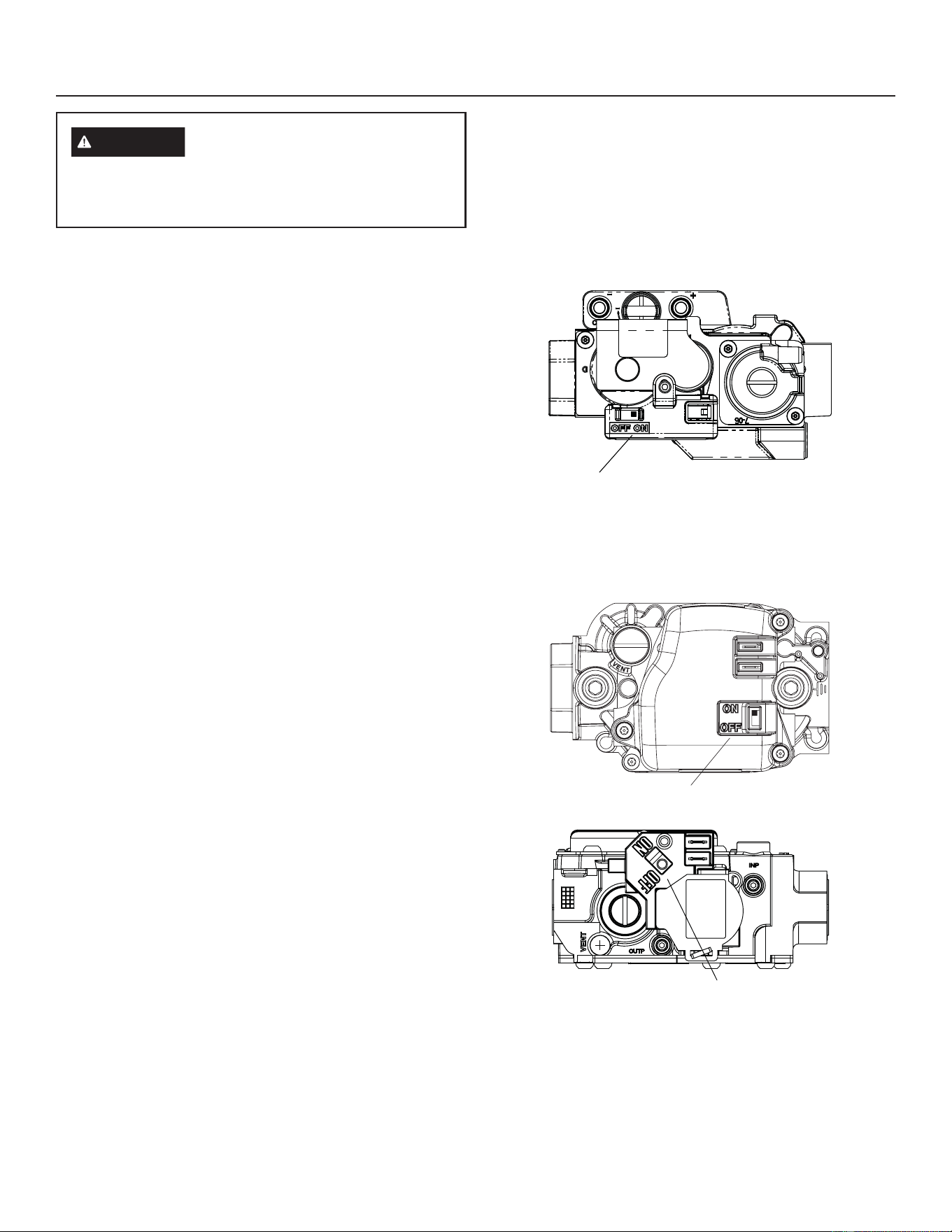
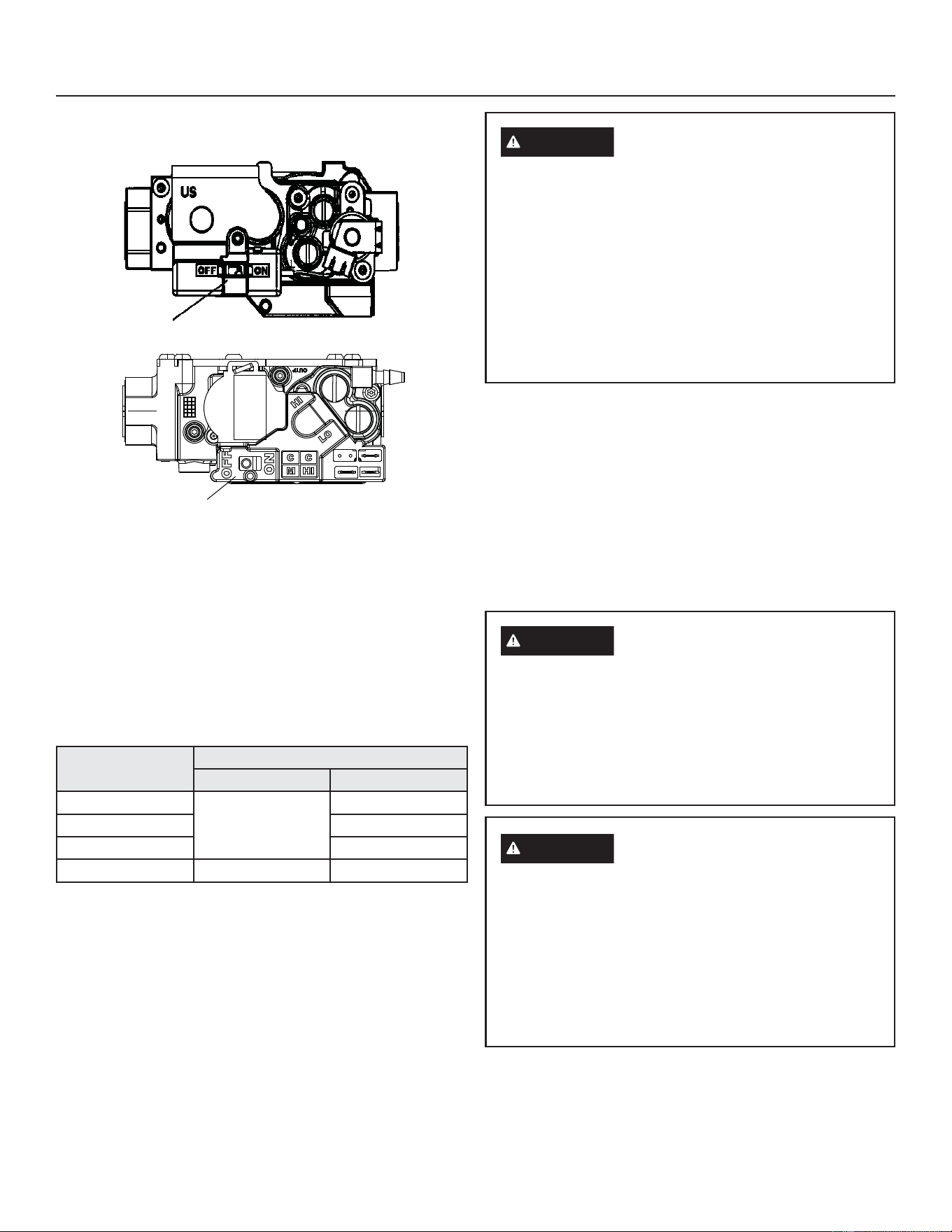
See Figure 1 through Figure 3
1. STOP! Read the safety information at the beginning of
this section.
2. Set the thermostat to the lowest setting.
3. Turn OFF all electrical power to the unit.
4. This furnace is equipped with an ignition device which
automatically lights the burners. DO NOT try to light the
burners by hand.
5. Remove the heating compartment access panel.
6. Move switch on gas valve to OFF. See Figure 1 through
Figure 3.
7. Wait five minutes to clear out any gas. If you then smell
gas, STOP! Immediately call your gas supplier from a
neighbor’s phone. Follow the gas supplier’s instructions.
If you do not smell gas proceed to the next step.
8. Move switch on gas valve to ON. See Figure 1 through
Figure 3.
9. Replace the heating compartment access panel.
10. Turn on all electrical power to the unit.
11. Set the thermostat to desired setting.
NOTE: When unit is initially started, steps 1 through 11 may
need to be repeated to purge air from gas line.
12. If the appliance will not operate, follow the section
“Turning Off Gas to the Unit” and call your licensed
professional service technician (or equivalent.).
Turning Off Gas to the Unit
1. Set the thermostat to the lowest setting.
2. Turn OFF all electrical power to the unit if service is to be
performed.
3. Remove the heating compartment access panel.
4. Move switch on gas valve to the OFF position.
5. Replace the heating compartment access panel.
Power Switch
Figure 1. Modulating Gas Valve
Power Switch
Power Switch
Figure 2. Single Stage Gas Valves
49-5001015 Rev. 0 5
Start-Up and Operational Information
Turning Off Gas to the Unit (cont)
Power Switch
Power Switch
Figure 3. Two-Stage Gas Valves
Filters
All filters are installed external to the unit. Filters should
be inspected monthly. Clean or replace the filters when
necessary to ensure proper furnace operation.
Replacement filters must be rated for high velocity airflow.
Table 1 lists recommended filter sizes. A filter must be in
place when the unit is operating.
Furnace Cabinet
Width
Filter Size
Side Return Bottom Return
14-1/2”
16 x 25 x 1 (1)
14 x 25 x 1 (1)
17-1/2” 16 x 25 x 1 (1)
21” 20 x 25 x 1 (1)
24-1/2” 16 x 25 x 1 (2) 24 x 25 x 1 (1)
Table 1.
Maintenance
A licensed professional service technician (or equivalent)
should inspect the complete system each season (heating
and cooling). The following maintenance procedures should
only be conducted by a licensed professional service
technician (or equivalent). Do not attempt to service the unit
in any way.
Replacement filters must be rated for high velocity airflow.
Table 1 lists recommended filter sizes. A filter must be in
place when the unit is operating.
WARNING
ELECTRICAL SHOCK, FIRE, OR
EXPLOSION HAZARD
• Failure to follow safety warnings exactly could result in
dangerous operation, serious injury, death or property
damage.
• Improper servicing could result in dangerous operation,
serious injury, death, or property damage.
• Before servicing controls, disconnect all electrical
power to furnace.
• When servicing controls, label all wires prior to
disconnecting. Take care to reconnect wires correctly.
• Verify proper operation after servicing.
Annually (before heating season) inspect furnace venting
system, vent cap, heat exchanger, and burners for
corrosion, deterioration, or deposits of debris. Remove any
obstructions.
During a seasonal check the service technician will conduct
a combustion analysis. The technician will also inspect the
indoor blower, burner flames, electrical connections and the
venting system.
Venting System
WARNING
ASPHYXIATION HAZARD
• The exhaust vent for this furnace must be leak-free
and must be securely connected to the furnace flue
collar at all times.
• For your safety and to fulfill the terms of the limited
warranty, a licensed professional service technician
(or equivalent) must annually inspect this furnace and
its vent system.
WARNING
CARBON MONOXIDE POISONING
HAZARD
• Failure to follow instructions could result in severe
personal injury or death due to carbon-monoxide
poisoning, if combustion products infiltrate the building.
• Check that all openings in the outside wall around
the vent (and air intake) pipe(s) are sealed to prevent
infiltration of combustion products into the building.
• Check that furnace vent (and air intake) terminal (s)
are not obstructed in any way during all seasons.
Inspect the furnace for obvious signs of deterioration.
Inspect the furnace venting system to make sure it is in
place, physically sound, and without holes, corrosion, or
blockage.
Vent pipe must be clear and free of obstructions and must
slope upward away from the furnace.
6 49-5001015 Rev. 0
Start-Up and Operational Information
Ductwork
Inspect the furnace return air duct connection to ensure duct
is sealed to the furnace and terminates outside the space
containing the furnace.
Inspect the physical support of the furnace to guarantee that
it is sound without sagging and it maintains a proper seal
between unit and ductwork.
Drain and Trap
On condensing furnaces (90% efficient and higher), inspect
the condensate drain and trap for leaks and cracks. The
drain and trap must also be cleaned and the trap must be
filled with water.
Blower (Circulating Air)
Check the blower wheel for debris and clean if necessary.
The blower motors are pre-lubricated for extended bearing
life. No further lubrication is needed.
WARNING
The blower access panel must be securely in place
when the blower and burners are operating. Gas
fumes, which could contain carbon monoxide, can be
drawn into living space resulting in personal injury or
death.
Burner Flame
CAUTION
To ensure proper operation, a licensed professional
service technician (or equivalent) should check the
burner flame and conduct a combustion analysis
annually.
Cleaning/Replacing the Filter
It is very important to clean or replace the air filter regularly.
Dirty filters are the most common cause of inadequate
heating or cooling performance and can sharply increase
the operational costs of your unit. In some cases, they can
double the cost.
NOTE: The air filter should be inspected at least every 6
weeks and cleaned or replaced as required.
Your furnace may use either a disposable filter or a
cleanable filter. The type of filter may be indicated on a label
attached to the filter. If a disposable filter is used, replace
with the same type and size. To remove excess dirt from a
cleanable filter, shake filter and/or use a vacuum cleaner.
Wash filter in soap or detergent water and replace after
filter is dry. Cleanable filters do not need to be oiled after
washing.
NOTE: Cleanable filters may be replaced with disposable
filters. Consult with a service technician for more information.
If your air distribution system has a central return air
filtergrille, the furnace does not need a filter. Filter-grilles
can be maintained the same way as cleanable filters (see
above).
SERVICE REMINDER
Call your service technician if unit will not operate. Before
calling, always check the following to be sure service is
required:
1. Check that electrical disconnect switches are ON.
2. Check room thermostat for proper setting.
3. Replace any blown fuses or reset circuit breakers.
4. Gas valve should be ON.
5. Air filter should not be plugged, which will limit air flow.
6. Is gas turned on at meter?
7. Is manual main shut-off valve open?
Record the model and serial number of the furnace. These
numbers are on the unit nameplate.
Serial Number: _________________________________
Model Number: _________________________________

49-5001015 Rev. 0 7
Start-Up and Operational Information
Safety Precautions
If you discover any of the following, shut down your unit, and
contact a dealer for an inspection by a licensed professional
service technician (or equivalent).
• If you repeatedly hear any new or unfamiliar sounds
while your unit is operating, there may be a problem.
For example, poorly performing burners can produce
unfamiliar noises.
• If you smell any unusual odors, your unit may be operating
improperly. For example, units can give off unfamiliar
odors if components are required to operate in abnormal
conditions.
• Look for visible signs of a malfunctioning unit. Examples
include unusual amounts of condensate on windows inside
your house, visibly burnt components or unusual dirt or
rust accumulations on the vent pipe or in the unit.
• If you experience headache, nausea, fatigue, or dizziness,
the cause could be exposure to carbon monoxide gas.
This is often misdiagnosed as the flu because symptoms
are similar. If you suffer from flu-like symptoms that are
exaggerated at home, but seem to subside while you are
away from the house, exposure to carbon monoxide could
be the cause.
• If the indoor blower is running continuously at the cooling
speed when thermostat is not calling for cooling demand
you may have a refrigerant leak.
Your vigilance may pay off in early detection of a problem
before either personal injury or property damage occurs.
Do not hesitate to contact a qualified service technician as
an investment in your well being.
Planned Service
You should expect a service technician to check the
following items during an annual inspection. Power to the
unit must be shut off for the service technician’s safety.
Fresh air grilles and louvers (on the unit and in the
room where the furnace is installed) – Must be open and
unobstructed to provide combustion air.
Burners - Must be inspected for rust, dirt, or signs of water.
Vent Pipe - Must be inspected for signs of water, damaged
or sagging pipe, or disconnected joints.
Unit Appearance - Must be inspected for rust, dirt, signs if
water, burnt or damaged wires, or components.
Blower Access Door - Must be properly in place and
provide a seal between the return air and the room where
the furnace is installed.
Return Air Duct - Must be properly attached and provide
an air seal to the unit.
Operating Performance - Unit must be observed during
operation to monitor proper performance of the unit and the
vent system.
Combustion Gases - Flue products must be analyzed and
compared to the unit specifications.
Problems detected during the inspection may make it
necessary to temporarily shut down the furnace until the
items can be repaired or replaced.
Pay attention to your furnace. Situations can arise between
annual furnace inspections that may result in unsafe
operation. For instance, items innocently stored next to the
furnace may obstruct the combustion air supply. This could
cause incomplete combustion and the production of carbon
monoxide gas.
Refrigerant Leak Detection System - Inspect thermostat
wires and refrigerant sensors for damage.
The refrigerant leak detection sensor must be inspected for
dust/debris deposits. Please refer to the evaporator coil and/
or refrigerant detection sensor kit instructions for additional
information.
Low GWP (A2L) mitigation capability must be tested per
the low GWP test button functionality section in the furnace
installation instructions.
8 49-5001015 Rev. 0
Repair Parts List
The following repair parts are available from your local distributor. When ordering parts, include the complete furnace model
number and serial number listed on the unit nameplate. All service must be done by a licensed professional installer (or
equivalent), a service agency, or the gas supplier.
Cabinet Parts
• Heating Compartment Access Panel
• Blower Access Panel
• Top Cap
Control Panel Parts
• Transformer
• Integrated Control
• Door Interlock Switch
Blower Parts
• Blower Wheel
• Motor
• Motor Mounting Frame
• Blower Housing Cutoff Plate
Heating Parts
• Flame Sensor
• Heat Exchanger Assembly
• Gas Manifold
• Combustion Air Inducer
• Gas Valve
• Main Burner Cluster
• Main Burner Orifices
• Pressure Switches
• Ignitor
• Primary Limit Control
• Secondary Limit Control
• Flame rollout switches
Low GWP Refrigerant Detection System Parts
• RDS Coil sensor
• Refrigerant line set sleeve
ATTENTION HOMEOWNER
Check for the “WARRANTY” document in the business size envelope in literature bag assembly inside of box your unit
came in.
(If for some unknown reason you cannot find the warranty, please go online at GEAppliances.com to print out one.)
Printed in the U.S.A.
All specifications and illustrations subject
to change without notice and without
incurring obligations.