
EN
INSTRUCTIONS FOR INSTALLATION AND USE
PIRO OVEN


EN
1
TABLE OF CONTENTS PAGE
1 - Safety instructions 2
2 - Installation of the oven 3
Electricals 3
3 - Connection to the electrical power
mains 5
4 - Instructions for use 6
Oven Racks 6
Oven extendable racks (if present) 7
5 - Electronic control 8
Control panel description 8
Programming time functions 9
Setting the time of day 9
Setting the minute minder 9
3 Tone Buzzer Setting 9
Temperature & Time Format 9
6 - Cooking with the Convection Oven 11
Advantages of Convection Cooking 11
7 - Oven Modes 12
8 - Cooking functions 13
9 - Quick Tips 14
Convection Cooking 14
Advantages of Convection Cooking 14
10 - Setting an oven function manually 15
Setting an automatic oven function 15
11 - Convection Bake Tips and Techniques 16
Convection Bake Chart 17
12 - Bake Tips and Techniques 18
General Guidelines 18
Bake Chart 18
TABLE OF CONTENTS PAGE
13 - Convection Broil Tips and Techniques 19
Convection Broil Chart 19
14 - Broil Tips and Techniques 20
Broil Chart 20
15 - Convection Roast Tips and Techniques 21
Convection Roast Chart 21
16 - Dehydrate Tips and Techniques 22
Dehydrate Chart 22
17 - Oven Care and Cleaning 23
Self-Cleaning the Oven 23
Preparing the Oven for Self-Cleaning 23
18 - Setting the Self-Cleaning Mode 24
Pyrolyse (Self-Clean) 24
19 - Sabbath Mode & Meat Probe Function 25
Sabbath Mode 25
Meat Probe Function if present 25
20 - General Oven Care 26
How to Use the Cleaning Chart 26
Cleaning Chart 26
21 - Oven Finishes / Cleaning Methods 27
22 - Do-it-Yourself Maintenance Oven Door
Removal 28
To Remove Door 28
To Replace Door 28
23 - Replacing an Oven Light 29
To Replace a Light Bulb 29
24 - Solving Baking Problems 30
25 - Solving Operational Problems 31
26 - Guidance temperature an time schedule
for cooking 32
At the end of the product life cycle, the products equipped with electronics, which have
not gone through a selection process, are potentially dangerous for the environment and
for human health due to the presence of dangerous materials. This appliance cannot be
thrown in the domestic waste at the end of its life cycle. Therefore it must be delivered to
an authorised waste collecting center tomake it safe and to recycle its parts in order to
respect the environment.
EN
2
• Do not disassemble any parts prior
to having disconnected the oven
from the mains.
• Do not use the appliance if any part
is broken (for example a glass).
Disconnect it from the mains and
call service.
• Before using the oven, it is recommended to
make it operate at noload at the maximum
temperature for an hour to eliminate the
insulating material odour.
• In all models, leave the door closed when
the grill is used.
• The cooling fan may remain in operation
so long as the oven is hot, even after it has
been switched off.
• During the use the appliance
becomes very hot; don’t touch the
heating elements inside the oven.
• During the oven operation, the front
is heated as well; consequently
keep children clear of the oven,
specially during self-cleaning.
• Parents and adults should pay particular
attention when using the product in presence
of children.
• Children should be overseen so as to ensure
thattheydon’tplaywiththeequipment.
• This appliance is not intended for use by
persons (included children) with reduced
physical sensory or mental capabilities,
or lack of experience and knowledge,
unless they have been given supervision or
instruction concerning use of the appliance
by a person responsable for their safety.
• In order to avoid damage to the oven
enamel coat, do not cover the oven muffle
sole with any item (e.g. aluminum foil, pans
and the likes).
• Use only the meat probe supplied with the
appliance.
1 - Safety instructions
IMPORTANT
Theoven’sdataplateisaccessibleevenwiththeovenfully
installed. The plate is visible simply by opening the door.
Always quote the details from it to identify the appliance
when ordering spare parts.
EN
3
2 - Installation of the oven
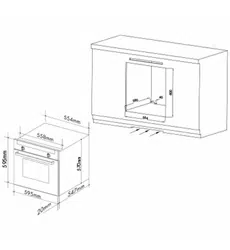
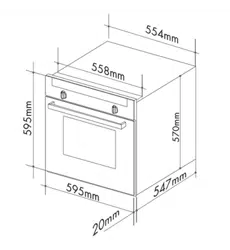
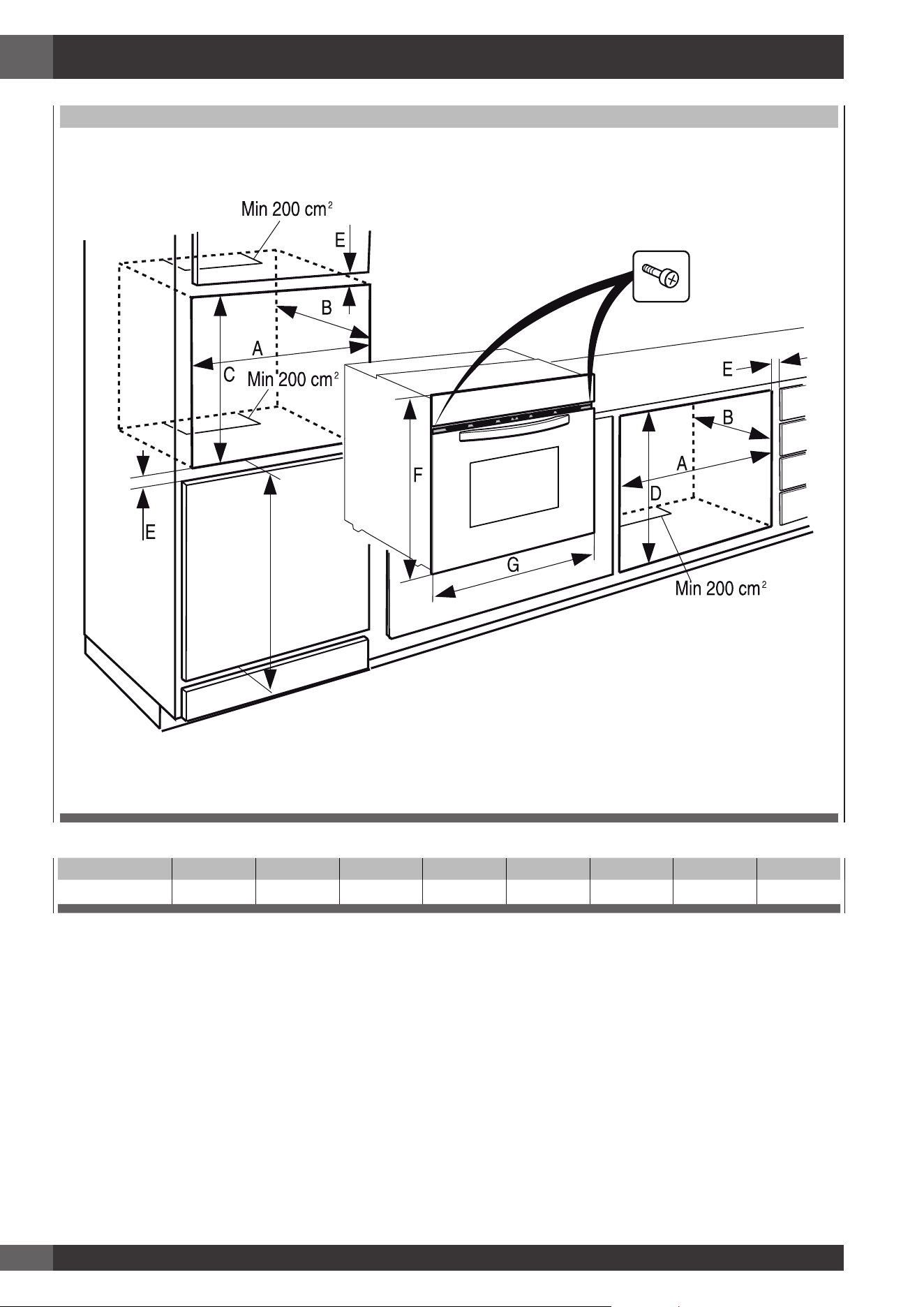
To install the oven into the kitchen a cutout should be made in
accordance with the dimensions shown in Fig. 1.
The apparatus is to be fastened to the top by means of the two
screws provided in the kit through the holes made on the oven
uprights.
The cabinet in which the apparatus is installed shall be open
on the back side to ensure a sufficient air circulation and
prevent overheating.
Leave a gap of at least 200 cm
2
(see Fig. 1) for air circulation
if the oven is installed in a column; this is not necessary if the
oven is installed under the work top.
WARNING
As the apparatus is to be fitted in your kitchen
furniture, make sure that all surfaces in contact
with the oven can resist a temperature of approx
90°C.
Electricals
Absorbed power:
oven top element: 3500W 240V
oven bottom element: 3000W 240V
round element (hot air): 2500W 240V
(on some models)
lamp: 25 W
hot air fan motor: 25 W
cooling fan motor: 25 W
Maximum absorbed power:
(see data plate)
Supply voltage:
(see data plate)
NOTE:
This appliance is in compliance with following European
directives: 2006/95/CE (LVD), 2004/108/CE (EMC),
2002/95/CE (RoHS), 2002/96/CE (WEEE), 2002/40/CE.
EN
4
FIG. 1
H
Appliances A B C D E F G H
Single oven 71 55 58,5 59,5 Min. 1,3 58,9 74,5 86,5
Dimensions are in centimeters
EN
5
3 - Connection to the electrical power mains
WARNING
This apparatus must be earthed.
The oven is only for domestic use.
The feed voltage and the absorbed power are as indicated on
the data plate attached to the left-hand side upright, which can
be seen when the oven door is open.
Connecting must be carried out by qualified personnel and in
accordance with the regulations currently in force.
The manufacturer can not be held responsible for any
damages to persons or objects caused by failure to observe
these instructions.
If the supply cord is damaged, it must be replaced by the
manufacturer, its service agent or similarly qualified persons in
order to avoid a hazard.
The oven must be connected to the mains through a multipole
circuit breaker with a contact-to-contact gap of at least 3
mm, making sure that the earth wire is not disconnected. For
connecting use a flexible cable of the H05V2V2-F 3x1,5
mm
2
type remembering to make it long enough to allow the
oven to be removed from its housing unit when maintenance
work is required.
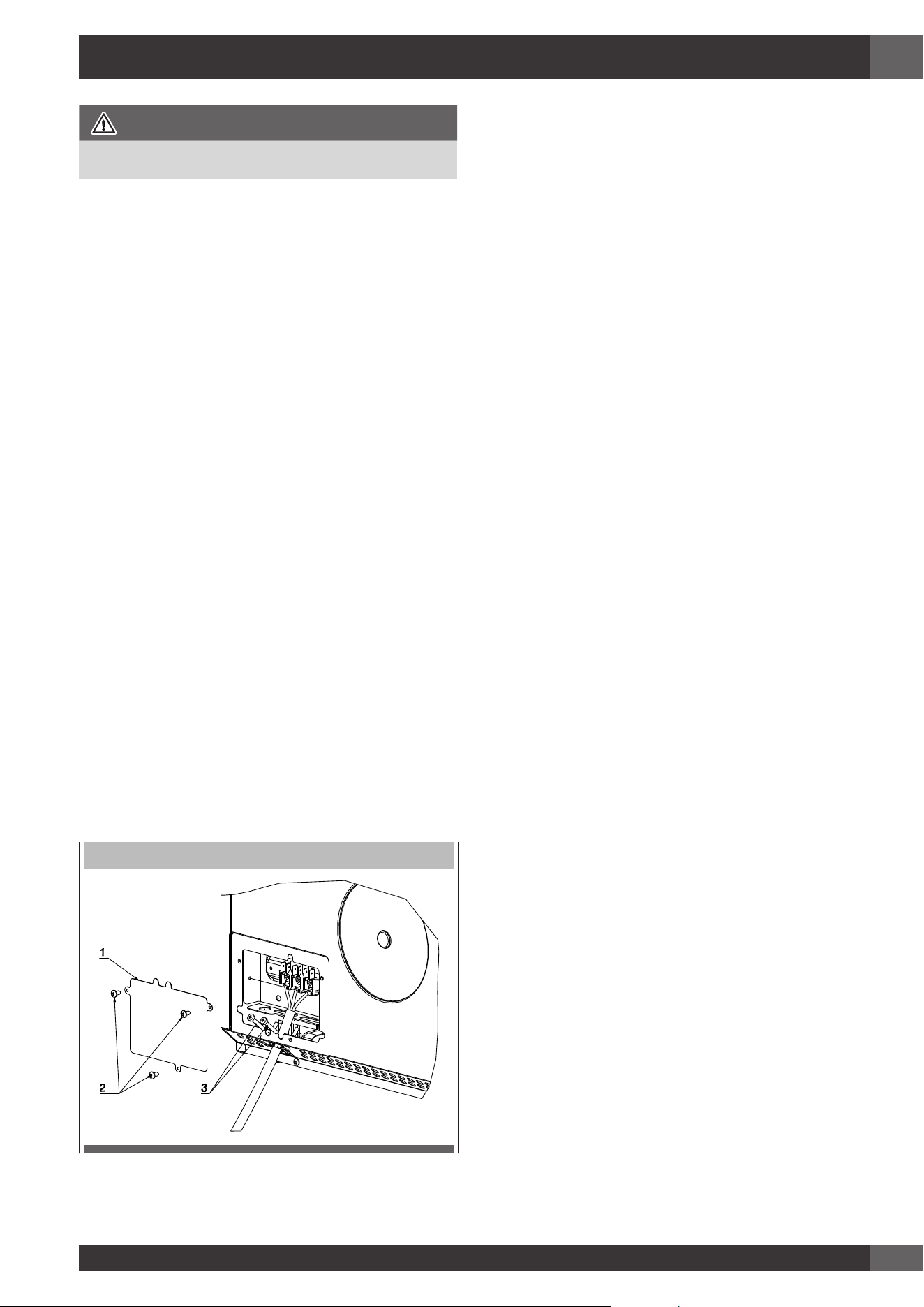
To connect the cable to the oven proceed as follows (see Fig.
2):
• Remove the lid (1) by unfastening the three screws (2).
Unfasten the two screws (3) for the cable holder and feed
the cable through the opening immediately below the cover.
• Remove about 12 cm of the outside insulation from the
cable and shorten the two active wires (live and neutral)
to 6 cm, leaving long the one to be connected to the main
earth terminal on the terminal box; remove about 1 cm of
the main insulation from the three wires and connect them
correctly to the terminal box, remembering to respect the
polarities.
• Tighten the two screws (3) of the cable holder and put the lid
(1) back on with the three screws (2).
FIG. 2
EN
6
4 - Instructions for use
Oven Racks
WARNING
Never use aluminum foil to cover the oven racks or to line
the oven. It can cause damage to the oven liner if heat is
trapped under the foil.
WARNING
Make sure you do not force it to avoid damage
to the enamel.
The oven has rack guides at four levels.
Rack positions are numbered from the bottom rack guide (#1)
to the top (#4).
Check cooking charts for best rack positions to use when
cooking.
Each level guide consists of paired supports formed in the walls
on each side of the oven cavity.
Always be sure to position the oven racks before turning on
the oven. Make sure that the racks are level once they are in
position.
The racks are designed to stop when pulled forward to their
limit.
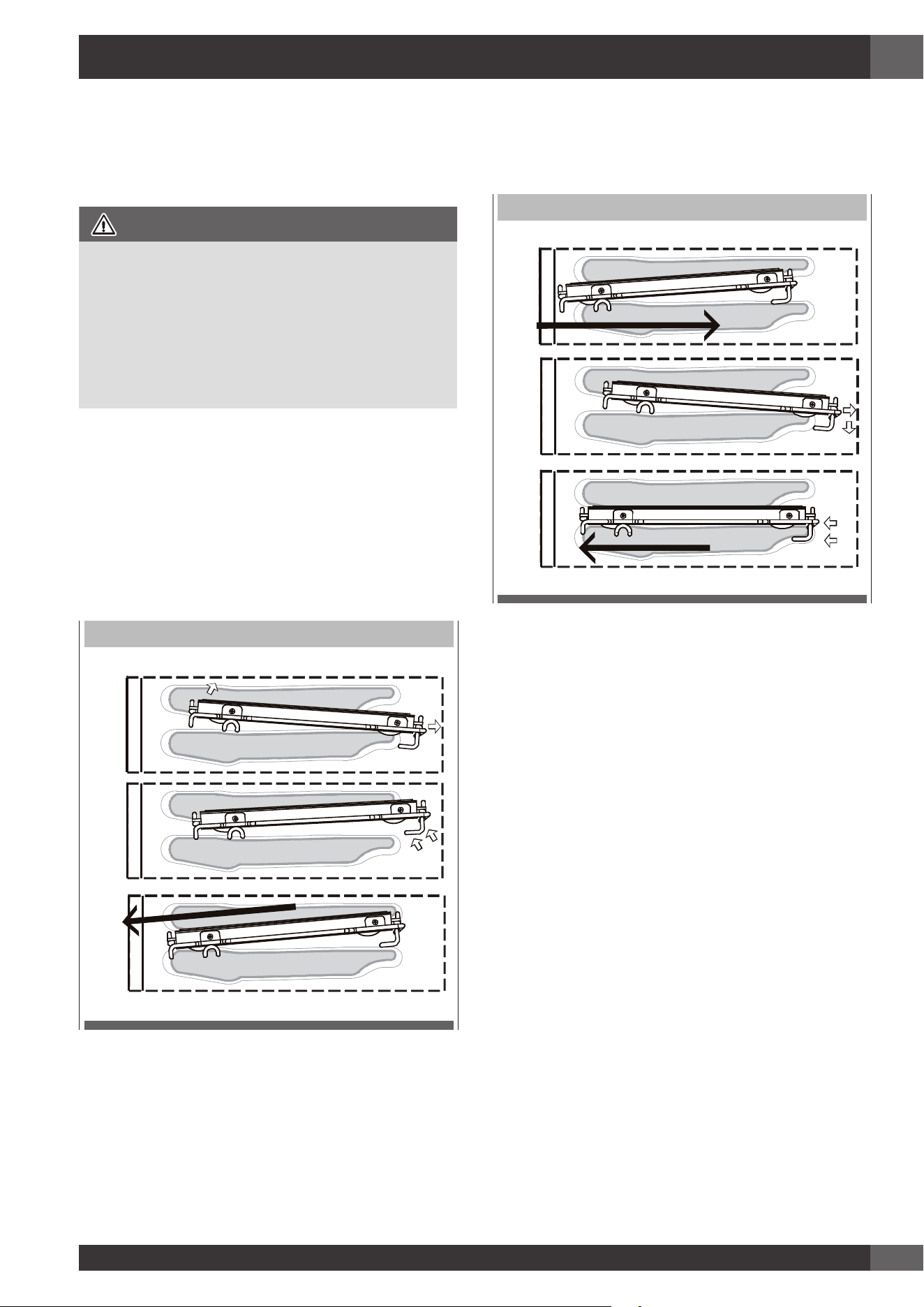
FIG. 3
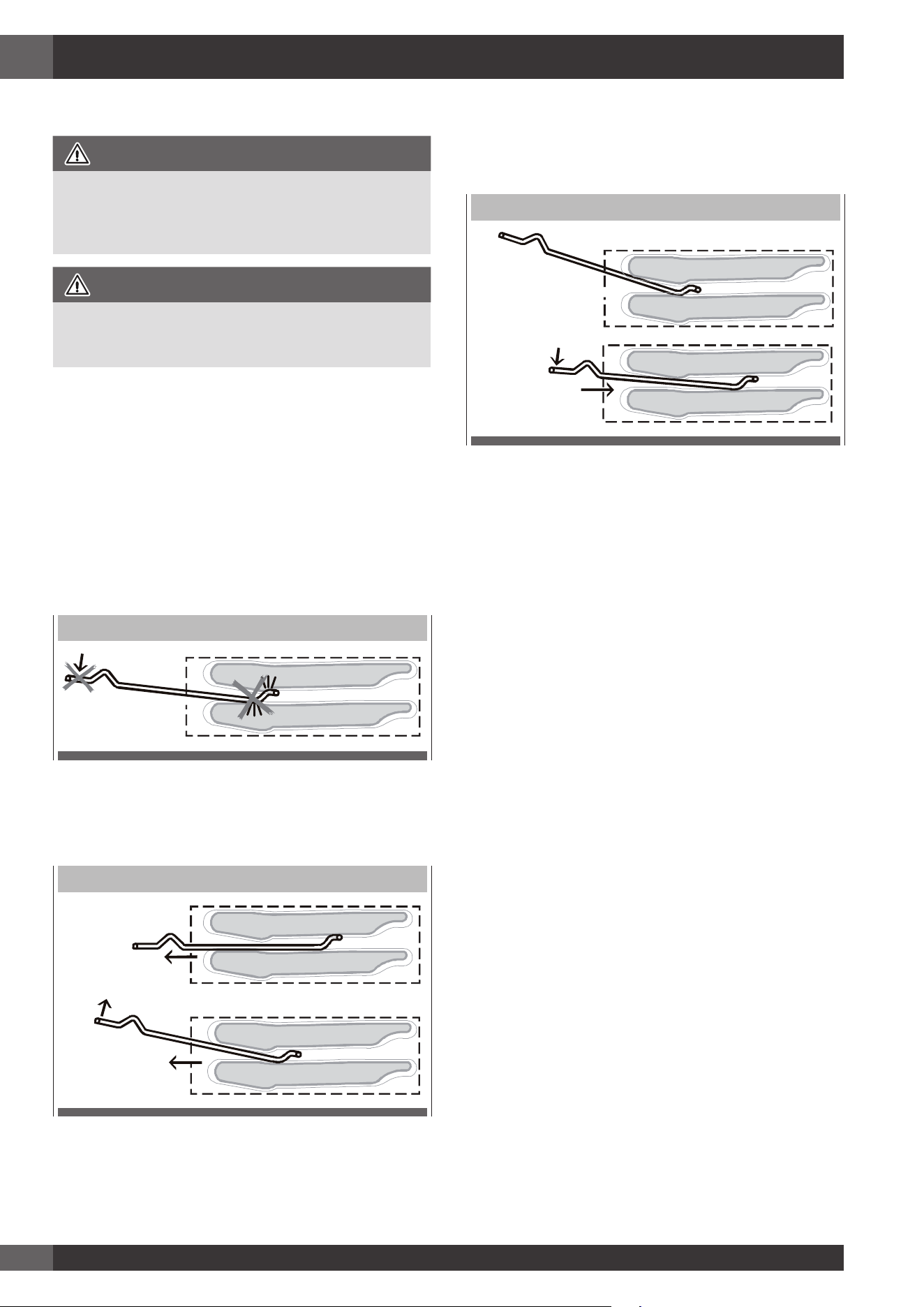
To remove oven rack from the oven (see Fig. 4):
1 Pull rack forward.
2 Lift rack up at front and then remove it.
FIG. 4
1
2
To replace an oven rack (see Fig. 5):
1 Place rear of rack between rack level guides.
2 While lifting front of rack, slide rack in all the way while
lowering the front.
FIG. 5
1
2
EN
7
Oven extendable racks (if present)
The extendable rack allows for easier access to cooking foods.
It extends beyond the standard flat rack bringing he food
closer to the user.
WARNING
Make sute that:
• When the rack is outside of the oven, slide arms do not
lock. They could unexpectedly extend if the rack is carried
incorrectly. Extending slide arms could cause injury. Rack
should only be held or carried by grasping the sides.
• To avoid burns, pull rack all the way out and lift pan
above handle when transferring food to and from oven.
NOTE
Always remove the extendable rack before self-cleaning the
oven.
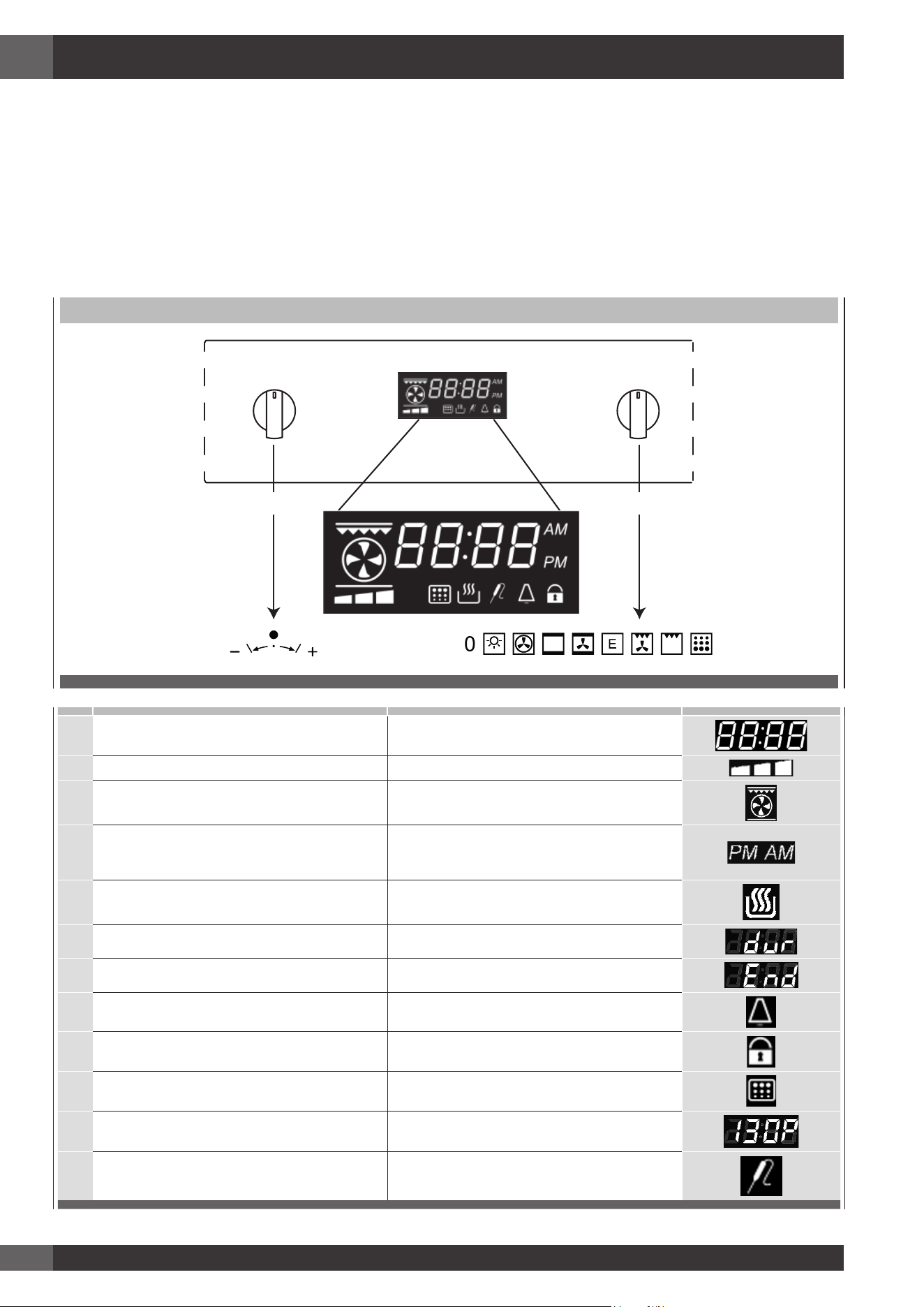
To remove extendable rack from the oven (see
Fig. 6):
1 Lift of rack slightly and push it until the stop release.
2 Raise back of rack until frame and stop clear rack guide.
3 Pull rack down and out.
FIG. 6
1
2
3
To replace an oven rack (see Fig. 5):
1 Place rear of rack between rack level guides.
2 While lifting front of rack, slide rack in all the way while
lowering the front.
FIG. 7
1
2
3
EN
8
5 - Electronic control
Control panel description
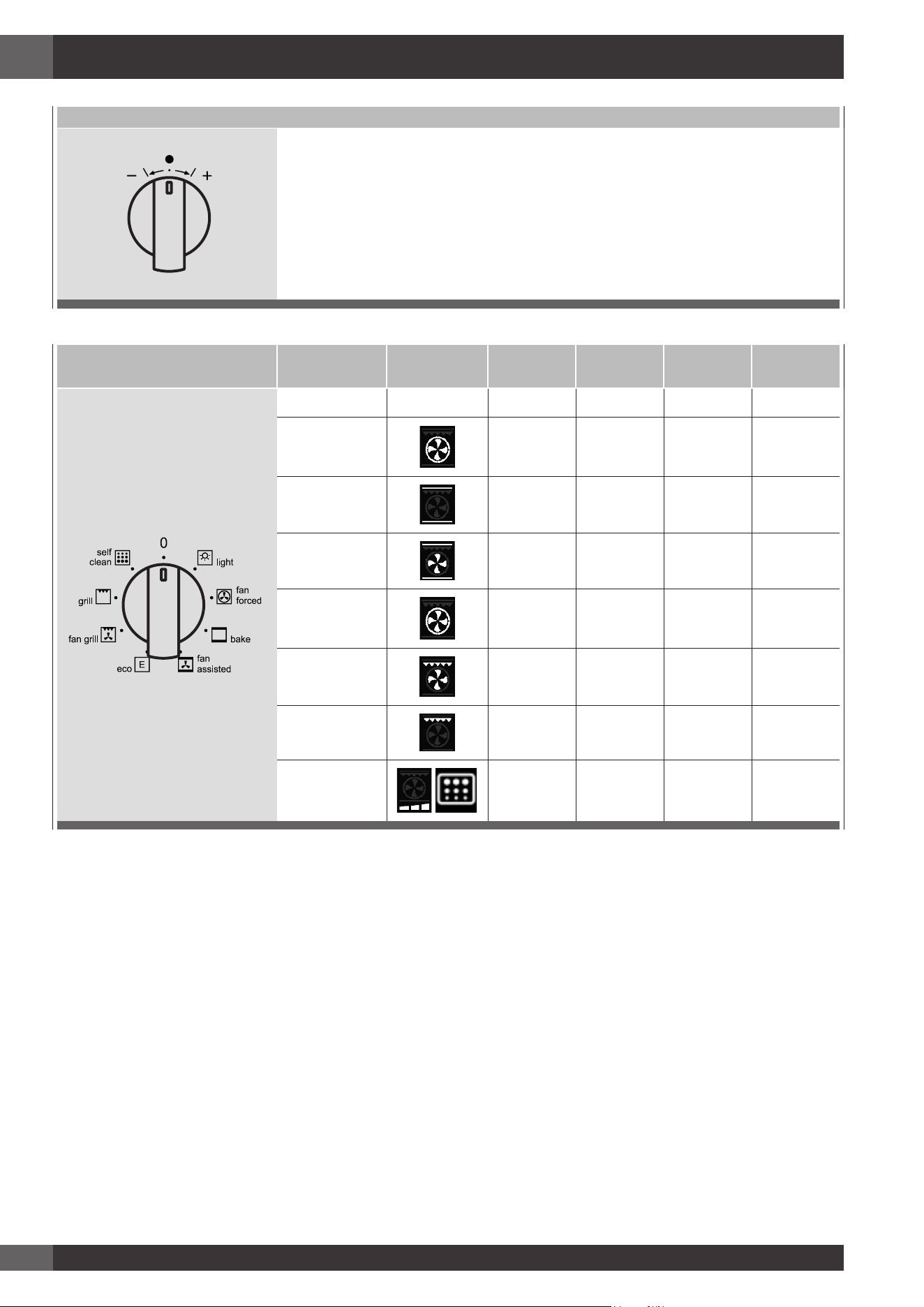
The oven control panel is made with one display and two knobs.
• Time & Temperature display.
• Time & Temperature knob (Push & Shuttle).
• Mode (oven functions) knob.
The push & shuttle knob is mainly for clock or temperature setting and automatic time functions programming. Select the desired
item by pushing the knob.
OVEN CONTROL PANEL
TEMP & TIME
MODE
1 temperature display and time display functions
2 3 preheating bar Led
3 Heating Element
4
Setting Time 12hr AM / PM
or
Setting Time 24hr
Showed when the day time is displayed if 12h
is set.
5 Pot Showed when a cooking function is set..
6 Duration cooking function
7 Delayed cooking function
8 Minute minder function Showed when the timer is active.
9 Door Lock
Fixed when door lock is closed Blinking when
the lock cycle is running
10 Pyrolytic Cycle Showed when a Pyrolytic cycle is set.
11 Meat Probe function
Showed when a cooking with meat probe is
running
12 Meat Probe Showed when when the meat probe is inserted.

EN
9
Programming time functions
At every power-up, the control shows the time of day blinking,
set at 12:00AM as the initial value, and the buzzer will sound
3 times. The time increases every minute. The only possible
actionisthe“ClockRegulation”,allotherovenoperationsare
inhibited.
In general, turn the Temp/Time selector left or right in order to
edit the values and modify them by steps; hold the knob on the
left or right to fasten the decrease/increase operations.
Setting the time of day
The time of day is always displayed in the 12:00 AM/PM
hours as default. Hours and minutes are set separately. In order
to set the time of day, mode selector must be in OFF position,
the -/+ knob acts on the time of day by default.
• Turn the selector left/right, the hours flash.
• Modify the flashing hours value turning the selector left/
right.
• Push the Temp&Time selector to switch back and forth
between hours and minutes.
• Modify the flashing minutes turning left/right.
• After a few seconds the whole time of day value starts
flashing: wait until the new time of day is steady.
Push the knob to toggle between the time of day and the
minute minder and check the set values. The clock is selected
by default while the
symbol appears when the minute
minder is displayed.
Setting the minute minder
When the symbol is displayed, turn the knob left/right in
order to set the timer value.
Thestandardvalueis30minutes,it’spossibletomodifyitin
the range between 0 and 240 minutes.
This timer has no influence on the oven activities and can be
set also when the oven is off. The time of day is displayed with
priority in any case, the
symbol shows the minute minder
is active.
When the time expires, the symbol flashes and the buzzer
sounds a warning sequence to recall the user attention. Push
the knob to stop it.
The buzzer stops in any case after a time-out.
3 Tone Buzzer Setting
With the cooking selector in OFF position press the +/- knob
until the “ton…” is showed, rotate the same knob count
clockwise to set the desired tone from 1 to 3 and press to
confirm.
Temperature & Time Format
Temperatureunitin°Fand12hAM/PMarepreset.
When the oven mode selector is in off position, push the
shuttle&push selector (TEMP & TIME) in order to select another
available format.
Turn the knob to select a different desired format, and press the
knob again to confirm.
EN
10
Temperature selector knob:
MINUS - = decrease
PLUS + = increase
PUSH = functions scroll
Cooking function selector
knob as EXAMPLE:
MODE
DISPLAY
ICON
MEAT
PROBE
MIN DEFAULT MAX
LIGHT -- -- -- -- --
FAN FORCED
X
50˚C
(120˚F)
190˚C
(375˚F)
250˚C
(480˚F)
BAKE
X
50˚C
(120˚F)
210˚C
(410˚F)
250˚C
(480˚F)
FAN ASSISTED
X
50˚C
(120˚F)
190˚C
(375˚F)
250˚C
(480˚F)
ECO
X
50˚C
(120˚F)
190˚C
(375˚F)
250˚C
(480˚F)
FAN GRILL
X
50˚C
(120˚F)
230˚C
(445˚F)
250˚C
(480˚F)
GRILL
--
50˚C
(120˚F)
230˚C
(445˚F)
250˚C
(480˚F)
SELF CLEAN
--
460˚C
(860˚F)
--

EN
11
6 - Cooking with the Convection Oven
In a conventional oven, the heat sources cycle on and off to
maintain an average temperature in the oven cavity.
As the temperature gradually rises and falls, gentle air currents
are produced within the oven. This natural convection tends
to be inefficient because the currents are irregular and slow.
Inthisconvectionsystem,theheatis“conveyed”byafanthat
provides continuous circulation of the hot air. This European
Convection system provides state-of-the-art engineering and
advanced design to create the finest convection oven. In
standard convection ovens, a fan simply circulates the hot air
around the food.
The system is characterized by the combination of an additional
heating element located around the convection fan and the
venting panel that distributes heated air in three dimensions:
along the sides, the top and the full depth of the oven cavity.
This European Convection system aids in maintaining a more
even oven temperature throughout the oven cavity.
The circulating air aids in speeding up the baking process
and cooks the food more evenly. By controlling the movement
of heated air, convection cooking produces evenly browned
foods that are crispy on the outside yet moist inside. Convection
cooking works best for breads and pastries as well as meats
and poultry. Air-leavened foods like angel food cakes, soufflés
and cream puffs rise higher than in a conventional oven.
Meats stay juicy and tender while the outside is flavourful and
crisp.
By using European Convection, foods can be cooked at a
lower temperature and cooking times can be shorter.
When using this mode, the standard oven temperature should
beloweredby15˚C(25˚F).
Foods requiring less cooking time should be checked slightly
earlier than normal. For best results, foods should be cooked
uncovered, in low-sided pans to take advantage of the forced
air circulation. When using the Convection Roast mode, the
standard oven temperature does not need to be reduced.
Advantages of Convection Cooking
• Even baking, browning and crisping are achieved.
• During roasting, juices and flavors are sealed in while the
exterior is crisp.
• Yeast breads are lighter, more evenly textured, more golden
and crustier.
• Air-leavened foods such as cream puffs, soufflés and
meringues are higher and lighter.
• Baking on multiple racks at the same time is possible with
even results.
• Multiple-rack baking saves time.
• Prepare whole meals at once with no flavor transfer.
• Dehydrates herbs, fruits and vegetables.
• Requires no specialized bake ware.
• Saves time and energy.
• Convection broiling allows for extraordinary grilling with
thicker cuts of food.
EN
12
7 - Oven Modes
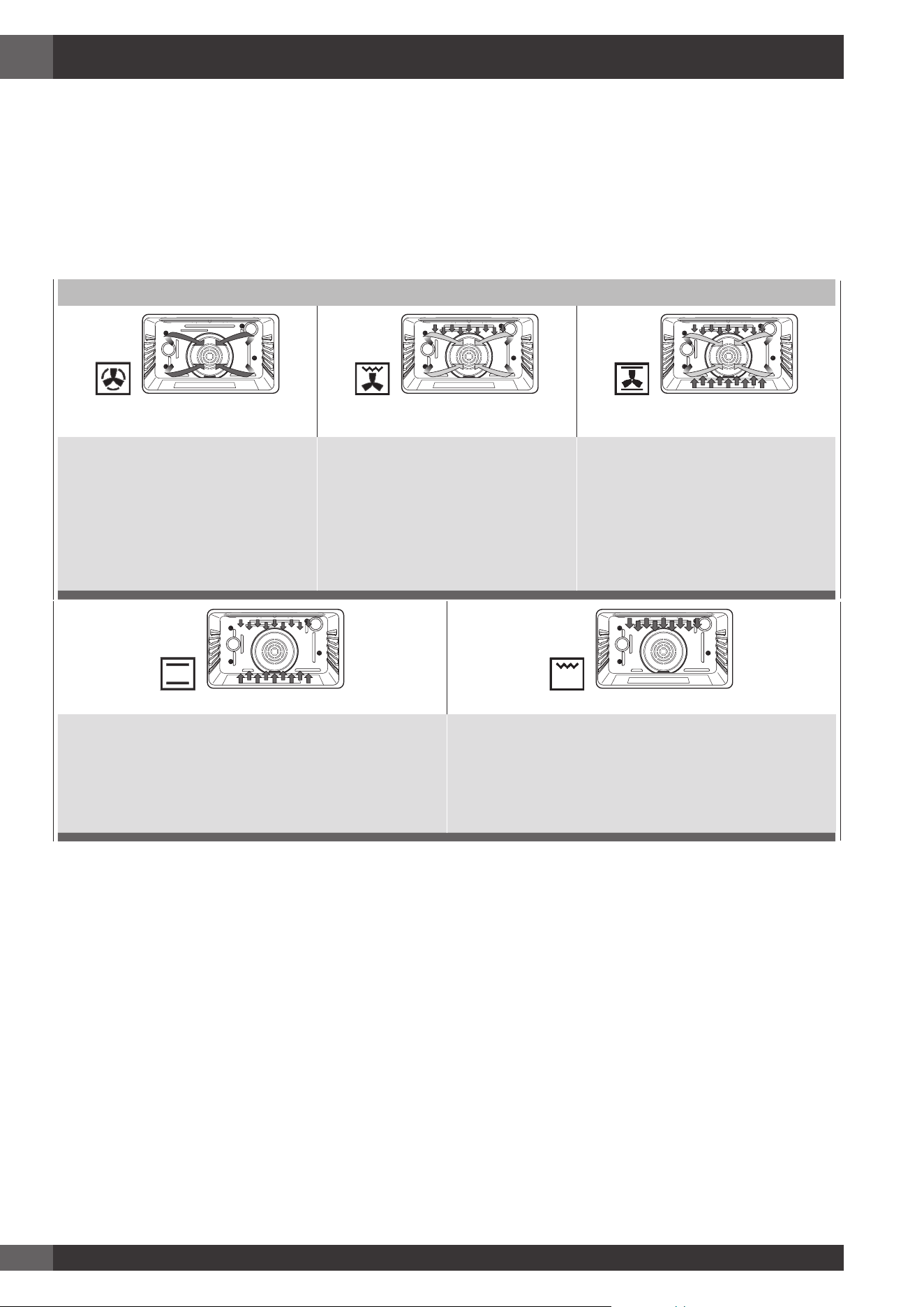
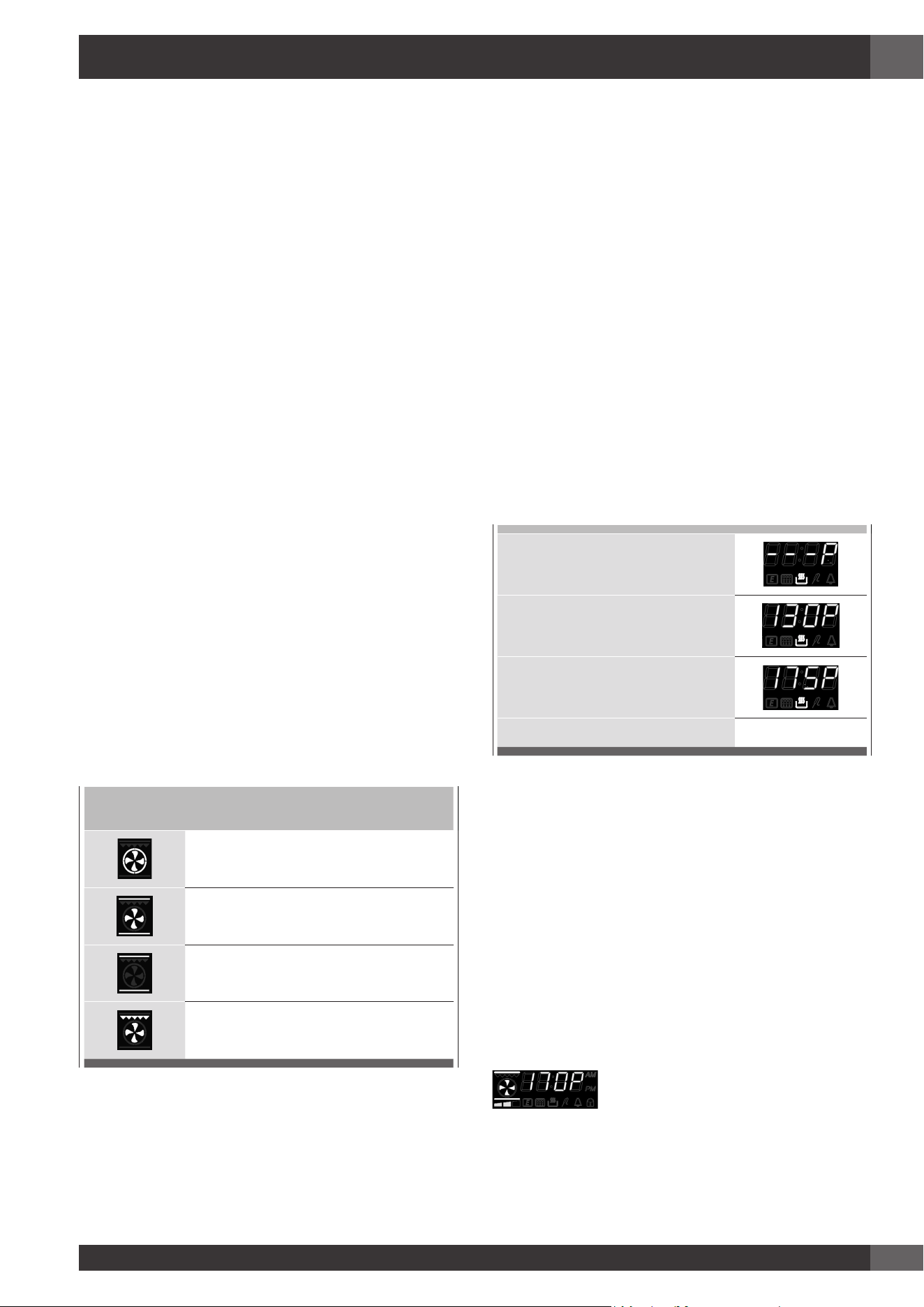
The following illustrations give an overview of what happens in the oven with each mode setting. The arrows represent the location
of the heat sources during specific modes. The lower element is concealed under the oven floor.
In maximum setting time for heating, it is until 11 hours 59 minutes.
Aftertheheatingend,“End”isdisplayingittoadisplay:
• Time is united by + [INC] or - [DEC], and additional heating can be performed.
• Change of a function can be performed by Cooking Mode Dial.
CAVITY STYLES
Convection Bake
(MULTI CONV BAKE)
Convection Broil
(CONV BROIL)
Convection Roast
(CONV ROAST)
Set temperature:
from50˚C(120˚F)to290˚C(550˚F)
(presetposition190˚C(375˚F)
Convection Bake cooks with heat from
ring elements behind the back wall of the
oven. The heat is circulated throughout
the oven by the Convection Fan.
Set temperature:
from 50
˚
C (120
˚
F) to 290
˚
C (550
˚
F)
(preset position 230
˚
C (445
˚
F)
Convection Broil combines the intense
heat from the upper element with the
heat circulated by the Convection Fan.
Set temperature:
from 50
˚
C (120
˚
F) to 290
˚
C (550
˚
F)
(preset position 190
˚
C (375
˚
F)
Convection Roast uses the upper and
lower elements and Convection Fan.
Bake (BAKE) Broil (BROIL)
Set temperature:
from 50
˚
C (120
˚
F) to 290
˚
C (550
˚
F)
(preset position 210
˚
C (410
˚
F)
Bake cooks with heated air. Both the upper and lower
elements cycle to maintain the oven temperature.
Set temperature:
from 50
˚
C (120
˚
F) to 290
˚
C (550
˚
F)
(preset position 230
˚
C (445
˚
F)
Broiling uses intense heat radiated from the upper element.
EN
13
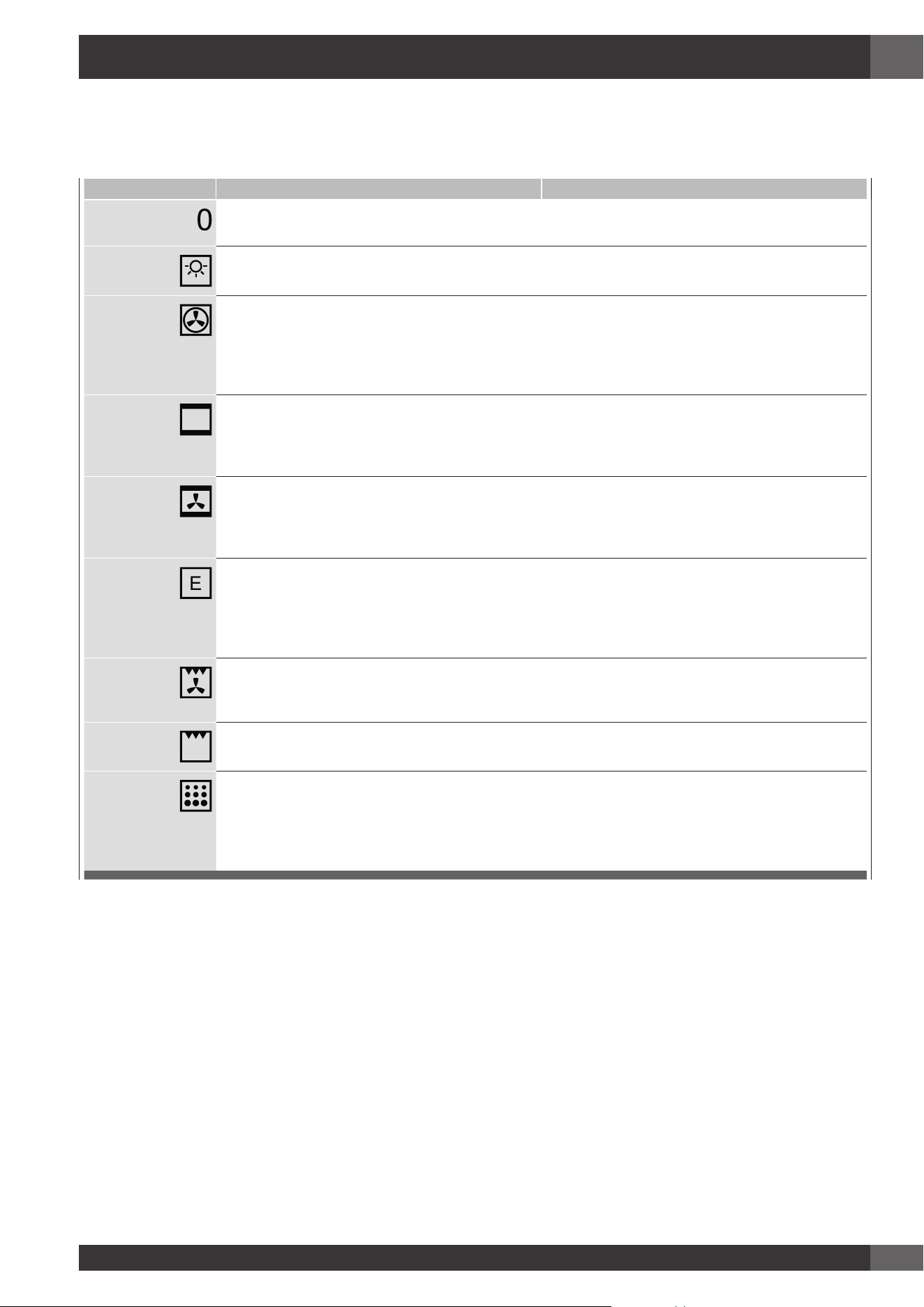
8 - Cooking functions
Each type of oven is provided for various cooking systems. A system can be selected by bringing the pointer of knob to the relating
symbol.
Icon Mode Description Used for…
All the cooking modes are OFF and the oven heating
elements are OFF.
---
The light is on only. ---
The Convection Bake mode uses the circular or third
heating element hidden behind the baffle at the back
wall of the oven. The heat is circulated throughout
the oven by the convection fan.
Consequently different foods can be cooked
simultaneously (maximum three levels) and is suitable
for preparing a complete dinner (small portions).
Mixing of flavours is avoided and an important
energy saving is obtained.
In this mode both upper (top) and lower (bottom)
oven heating elements are used to heat the oven air.
However, no fan is used to circulate the heat.
This is the traditional mode of cooking on one shelf.
Therefore only one rack can be used when selecting
the Bake mode. Ideal for Appetizers, Biscuits, Coffee
Cakes and Cookies.
The Convection Roast mode uses the upper (top)
oven heating element, the lower (bottom) heating
element and the convection fan inside the oven.
Ideal for the roasting of whole chickens or turkey
and pizza.It can also be used for baking-cooking
Appetizers, Biscuits, Coffee Cakes and Cookies on
one or more levels.
This mode is intended to save energy. In particular
the oven cooling fan works only when needed e.g.
when the oven is hot and the electronics require
cooling.
Ideal for frozen or precooked food, and small
portions-mealsThe preheat time is very short and
cooking tends to be slower.It is not recommended
for heavy loads e.g. large portions or big meal
preparation.
Suitable for preparing a complete dinner (small
portions). Mixing of flavours is avoided and an
important energy saving is obtained.
Ideal for steak, hamburgers, chicken quarters or
chicken breasts.
The Grill mode uses intense heat radiated from the
upper (top) heating element.
Ideal for preparing toast, browning and grilling.
The standard time is 1.30 h and can be changed. PYRO or self-cleaning mode. Here the oven is
automatically cleaned by burning-off cooking
residues at high temperature (about 460
˚
C) from
1h to 3h. During the self-cleaning cycle all fumes
produced are filtered and then expelled to ambient.

EN
14
9 - Quick Tips
Convection Cooking
About Convection Cooking
Standard cooking modes (Bake, Broil, etc.) use heat radiated
from one or more elements to cook food. Convection modes
use both heat from the elements and fans in the back of the
oven to continuously circulate the heated air throughout the
oven.
Advantages of Convection Cooking
• Even baking, browning and crisping.
• Juices and flavors are sealed in.
• Air-leavened foods such as cream puffs, soufflés, meringues
and breads are higher and lighter.
• Multiple rack cooking.
• No special bakeware required.
• Saves time and energy.
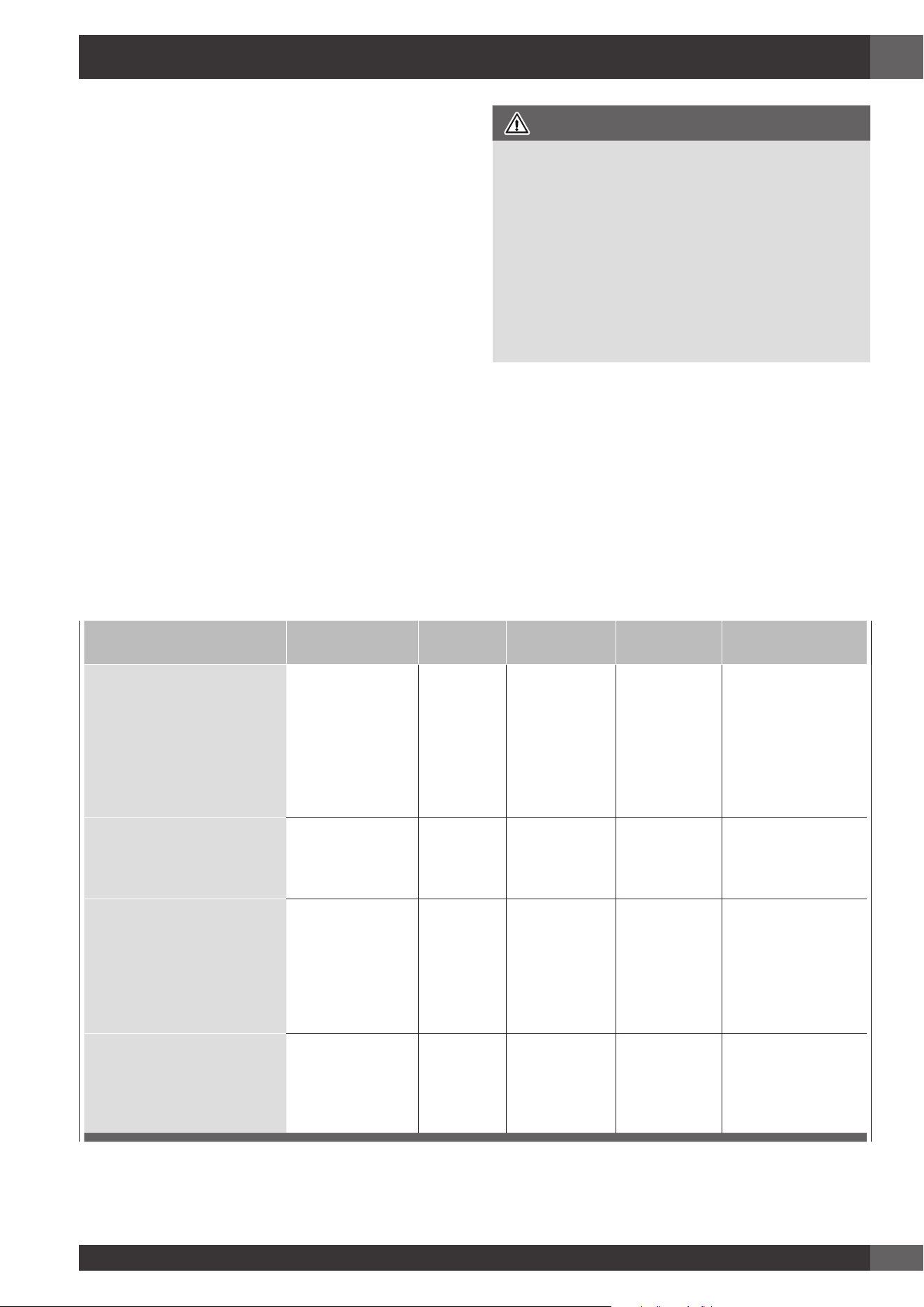
DO NOT use Convection Bake for meats. Use Convection Roast instead.
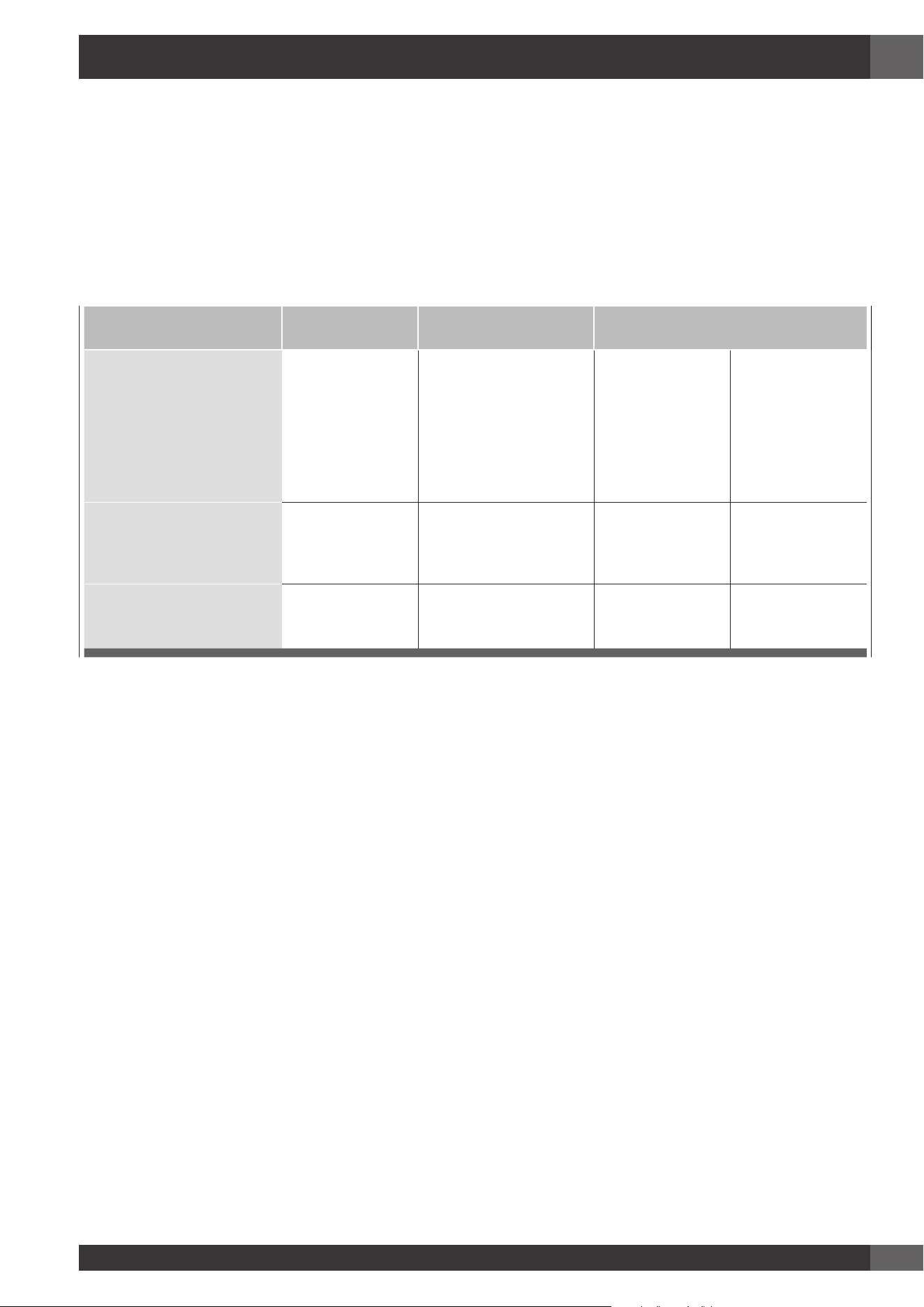
Mode Use this mode for For Best results Quick Cooking Tip
Convection Bake
• Large quantities of food on
multiple racks.
• Pastries, breads, snack, foods
and appetizers.
• Use low-sided, uncovered
pans.
• Center baking sheets side to
side on the oven rack.
• Reduce recipe temperature by
15
˚
C (25
˚
F).
• Check food for doneness early:
If recipe call for Check food
1-15 min. 3 min. early
16-30 min. 5 min. early
31 min.-1hr. 10 min. early
Convection Broil
• Thicker, tender, cuts of meat,
poultry and fish.
• DO NOT use this mode for
browning breads or casseroles.
• Meats should be at least 1”
thick.
• No conversion from standard
Broil is necessary.
• Refer to Convection Broil Chart
in this Manual for cooking
times.
Convection Roast
• Large, tender cuts of meat and
poultry such as roast or whole
chicken.
• DO NOT cover meat or use
cooking bags.
• Refer to Convection Roast
Chart in this Manual for
cooking times.
• DO NOT change recipe
temperature.

EN
15
10 - Setting an oven function manually
Turn the mode knob into the desired position, the clock
display shows On for a few seconds. The oven will work for a
maximum time (12hours). Depending on the oven model, the
number and type of available functions can be different.
If the clock display function is active the symbol appears (it
doesn’tappearinlightposition).
Turn the Temp & Time selector and set the desired oven
temperature. The control offers a PRESET temperature per
every cooking mode or a full range between MIN and MAX
to be adjusted by hand. Check the value on the display after
having selected the temperature.
The temperature appears on the clock display when the Time &
Temp selector is pushed or when a new function has just been
selected.
As soon as the oven starts, the preheat led (indicated by the
bars) on the bottom of the clock display starts flashing and
becomes steadily on when the preheat ends with 5 beeps.
Turn the mode selector to ZERO (OFF) position to stop any
activity, the display will show OFF for a few seconds.
Setting an automatic oven function
After having selected a function as described before, the
control can be programmed in order to set timed cooking
activities. The time program remains active even if the function
is changed (exception: pyrolyse). The following possibilities
are available:
1 Timed cooking setting the cooking time (duration).
2 Timed cookitng setting the end of cooking time (stop time).
3 Delayed cooking setting duration and stop time.
Push the knob in order to toggle between cooking duration
(cook time) and end of cooking time (stop time): the words
“dur”or“End”aredisplayedrespectively.
Turn the knob left/right to edit the duration or the stop time
when the proper word is displayed:
1.Whentheworddurisdisplayed,thecontrolshows30’as
the standard cooking duration. Turn the knob left/right in
order to set the actually desired cooking time in a range
between 0 and 240 minutes. The display will flash dur and
its value alternatively for a few seconds then it will show the
time of day, the pot symbol will flashes to indicate that an
automatic cooking is running. The end of cooking time is
updated automatically.
2. When the word End is displayed, the control shows the
current time as the initial stop time. In order to set the actually
desired end of cooking time in a 4 hours range:
- Turn the knob left/right, the hours flash.
- Modify the flashing hours value turning the knob left/
right.
- Push the knob to switch back and forth between hours
and minutes or wait a few seconds until the minutes flash.
- Modify the flashing minutes value the knob left/right.
- Wait until the new End of Cooking time value stops
flashing.
The display will flash End and its value alternatively for
a few seconds then it will show the time of day, the pot
symbol
will flashes to indicate that a timed cooking is
active. The cooking duration is updated automatically.
3. Repeat the same operations of point 1 then push the knob
until End appears. the control shows the “current time +
cooking time” asthe initial stop time. It’snot possible to
lower the end of cooking time below this value, in order to
set the actually desired end of cooking time in a 24 hours
range:
- Turn the knob left/right, the hours flash.
- Modify the flashing hours value turning the knob left/
right.
- Push the knob to switch back and forth between hours
and minutes or wait a few seconds until the minutes flash.
- Modify the flashing minutes value turning the knob left/
right.
- Wait until the new End of Cooking time value stops
flashing.
The display will flash End and its value alternatively for a
few seconds then it will show the time of day and flashing
the cooking icons to indicate that a delayed cooking has
been programmed. As soon as the delay time expires,
the oven starts and works for the programmed cooking
time. The pot symbol
will flashes.
At the end of any timed activity the control shuts down the
oven, the buzzer sounds a warning sequence (two short beeps
repeated every 3 seconds) to recall the user attention, for a
maximum time and makes the time related icons (
) flash on
the display. Push the knob to silent the buzzer and reset the
warning message.
Turn the mode selector to ZERO (OFF) position before reusing
the oven.
EN
16
Reduce recipe baking temperatures by 15
˚
C (25
˚
F).
• For best results, foods should be cooked uncovered, in low-
sided pans to take advantage of the forced air circulation.
Use shiny aluminum pans for best results unless otherwise
specified.
• Heatproof glass or ceramic can be used. Reduce temperature
by another 15
˚
C (25
˚
F) when using heatproof glass dishes
for a total reduction of 30
˚
C (50
˚
F).
• Dark metal pans may be used. Note that food may brown
faster when using dark metal bake ware.
• The number of racks used is determined by the height of the
food to be cooked.
• Baked items, for the most part, cook extremely well in
convection.Don’ttry to convertrecipessuchascustards,
quiches, pumpkin pie, or cheesecakes, which do not benefit
from the convection-heating process. Use the regular Bake
mode for these foods.
• Multiple rack cooking for oven meals is done on rack
positions 1, 2, 3 , 4 and 5. All five racks can be used for
cookies, biscuits and appetizers.
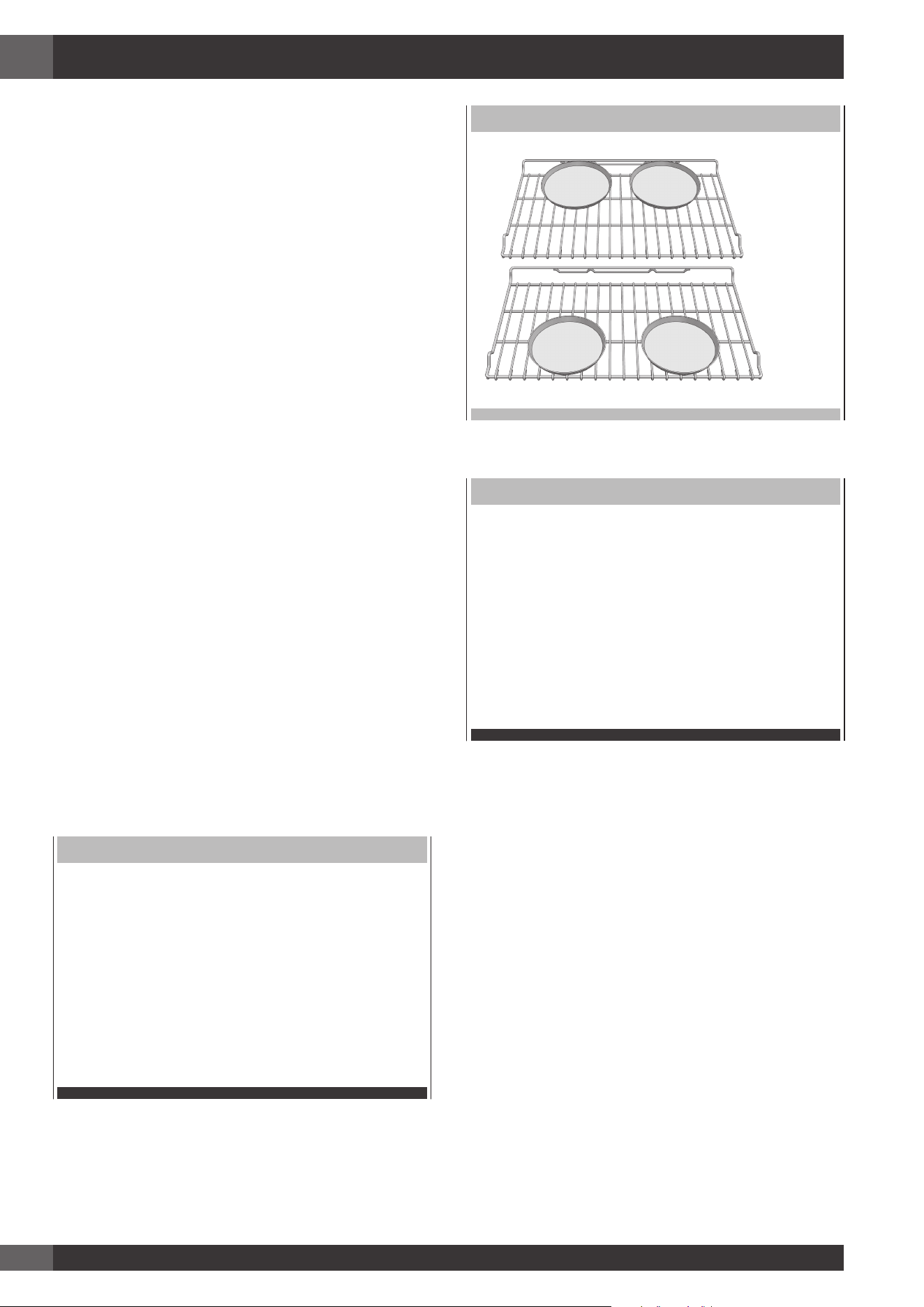
- 2 Rack baking: Use positions 1 and 3.
- 3 rack baking: Use positions 2, 3 and 4 or 1, 3 and 5.
- When baking four cake layers at the same time, stagger
pans so that one pan is not directly above another. For
best results, place cakes on front of upper rack and back
oflowerrack(Seegraphicatright).Allow1”-1½”(2.5-
3cm) air space around pans.
• Converting your own recipe can be easy. Choose a recipe
that will benefit from convection cooking.
• Reduce the temperature and cooking time if necessary. It
may take some trial and error to achieve a perfect result.
Keep track of your technique for the next time you want to
prepare the recipe using convection.
• Tips for Solving Baking Problems are found on Page 30.
Foods recommended for Convection Bake mode:
Appetizers, Biscuits, Coffee Cakes
Cookies (2 to 4 racks), Yeast Breads
Cream Puffs
Turnovers
Casseroles and One-Dish Entreés
Oven Meals (rack positions 1, 2, 3)
Air Leavened Foods (Soufflés, Meringue, Meringue-
Topped Desserts, Angel Food Cakes, Chiffon Cakes)
MULTIPLE RACK PAN PLACEMENT
Rack 3
Rack 1
Quick and easy recipe tips
Converting from standard BAKE to CONVECTION BAKE:
• Reduce the temperature by 15
˚
C (25
˚
F).
• Use the same baking time as Bake mode if under 10
to 15 minutes.
• Foods with a baking time of less than 30 minutes should
be checked for doneness 5 minutes earlier than in
standard bake recipes.
• If food is baked for more than 40 to 45 minutes, bake
time should be reduced by 25%.
11 - Convection Bake Tips and Techniques

EN
17
Convection Bake Chart
• Reduce standard recipe temperature by 15
˚
C (25
˚
F) for Convection Bake.
• Temperatures have been reduced in this chart.
FOOD ITEM RACK POSITION TEMP. °C (°F)
(PREHEATED OVEN)
TIME (Min.)
Cake
Cupcakes
Bundt Cake
Angel Food
2
1
1
165 (325)
165 (325)
165 (325)
16-20
37-43
25-35
Pie
2crust,fresh,9”
2crust,frozenfruit,9”
2
2
175-205 (350-400)
175 (350)
35-45
68-78
Cookies
Sugar
Chocolate Chip
Brownies
2
2
2
165-175 (325-350)
165-175 (325-350)
165 (325)
8-12
10-15
25-30
Breads
Yeast bread loaf, 9x5
Yeast rolls
Biscuits
Muffins
2
2
2
2
175 (350)
175-190 (350-375)
190 (375)
205 (400)
15-22
10-15
6-10
13-16
Pizza (Multiple rack cooking)
Frozen
Fresh
1 and 3
1 and 3
190-220 (375-425)
190-220 (375-425)
12-18
8-14
The TEMP. and TIME in the chart above are for the 240 V setting.
This chart is a guide. Follow recipe or package directions and adjust temperatures / time appropriately.

EN
18
12 - Bake Tips and Techniques
Baking is cooking with heated air. Both upper and lower
elements in the oven are used to heat the air but no fan is used
to circulate the heat.
Follow the recipe or convenience food directions for baking
temperature, time and rack position. Baking time will vary with
the temperature of ingredients and the size, shape and finish
of the baking utensil.
General Guidelines
• Forbestresults,bakefoodonasinglerackwithatleast1”-
1-1/2”(2,5-3cm)spacebetweenutensilsandovenwalls.
• Use one rack when selecting the Bake Mode.
• Check for doneness at the minimum time.
• Use metal bake ware (with or without a non stick finish),
heatproof glass, glass-ceramic, pottery or other utensils
suitable for the oven.
• When using heatproof glass, reduce temperature by 15
˚
C
(25
˚
F) from recommended temperature.
• Use baking sheets with or without sides or jelly roll pans.
• Dark metal pans or nonstick coatings will cook faster with
more browning. Insulated bake ware will slightly lengthen
the cooking time for most foods.
• Do not use aluminum foil or disposable aluminum trays to
line any part of the oven. Foil is an excellent heat insulator
and heat will be trapped beneath it. This will alter the
cooking performance and can damage the finish of the
oven.
• Avoid using the opened door as a shelf to place pans.
• Tips for Solving Baking and Roasting Problems are found
on Page 30.
Bake Chart
FOOD ITEM RACK POSITION TEMP. °C (°F)
(PREHEATED OVEN)
TIME (Min.)
Cake
Cupcakes
Bundt Cake
Angel Food
2
1
1
175 (350)
175 (350)
175 (350)
19-22
40-45
35-39
Pie
2crust,fresh,9”
2crust,frozenfruit,9”
2
2
190-205 (375-400)
190 (375)
45-50
68-78
Cookies
Sugar
Chocolate Chip
Brownies
2
2
2
175-190 (350-375)
175-190 (350-375)
175 (350)
8-10
8-13
29-36
Breads
Yeast bread loaf, 9x5
Yeast rolls
Biscuits
Muffins
2
2
2
2
190 (375)
190-205 (375-400)
190-205 (375-400
220 (425)
18-22
12-15
7-9
15-19
The TEMP. and TIME in the chart above are for the 240 V setting.
This chart is a guide. Follow recipe or package directions and adjust temperatures/time appropriately.
EN
19
13 - Convection Broil Tips and Techniques
• Place rack in the required position needed before turning on the oven.
• Use Convection Broil mode with the oven door closed.
• Donotpreheatoven.(Thismean,“PREHEAT”indicationisautomaticallyappearwhentheConvectionBroilmodeisselected,but
place food inside the oven before selecting the Cooking mode)
• Use the 2-piece broil pan. (Without 2 Pans may have risk of fire with drip of the fat from the meats.)
• Turn meats once halfway through the cooking time (see Convection Broil Chart).
Convection Broil Chart
FOOD AND THICKNESS RACK POSITION OVEN TEMP.
°C (°F)
TIME SIDE 1
(Min.)*
TIME SIDE 2
(Min.)*
Beef
Steak(1”ormore)
Medium rare
Medium
Well
Hamburgers(1”ormore)
Medium
Well
4
4
4
4
4
230 (450)
230 (450)
230 (450)
290 (550)
290 (550)
10-12
15-17
16-18
9-11
11-13
10-12
13-15
13-15
5-8
8-10
Poultry
Chicken Quarters
Chicken Halves
Chicken Breasts
4
3
4
230 (450)
230 (450)
230 (450)
18-20
25-27
14-16
13-15
15-18
10-14
Pork
PorkChops(1-1/4”ormore)
Sausage - fresh
4
4
230 (450)
230 (450)
13-15
4-6
12-14
3-5
The TEMP. and TIME in the chart above are for the 240 V setting.
* Broiling and convection broiling times are approximate and may vary slightly.
Cooking times are indicative and also depend on the thickness and the starting temperature of the meat before cooking.

EN
20
14 - Broil Tips and Techniques
• Place rack in the required position needed before turning on the oven.
• Use Broil mode with the oven door closed.
• Preheat oven for 5 minutes before use.
• Use the 2-piece broil pan. (Without 2 Pans may have risk of fire with drip of the fat from the meat.)
• Turn meats once halfway through the cooking time (see Broil Chart).
Broil Chart
FOOD AND
THICKNESS
RACK
POSITION
BROIL
SETTING
TIME SIDE 1
(Min.)*
TIME SIDE 2
(Min.)*
Beef
Steak(3/4”-1”)
Medium rare
Medium
Well
Hamburgers(3/4”-1”)
Medium
Well
5
5
5
4
4
L 5
L 5
L 5
L 5
L 5
5-7
6-8
8-10
8-13
10-15
4-6
5-7
7-9
11
8-12
Poultry
Breast (bone-in)
Thigh (very well done)
4
4
L 4
L 3
10-12
28-30
8-10
13-15
Pork
PorkChops(1”)
Sausage - fresh
HamSlice(1/2”)
5
5
5
L 5
L 5
L 5
7-9
5-7
4-6
5-7
3-5
3-5
Seafood
FishFilets,1”
Buttered
4 L 4 10-14
Lamb
Chops(1”)
Medium Rare
Medium
Well
5
5
5
L 5
L 5
L 5
5-7
6-8
7-9
4-6
4-6
5-7
Bread
GarlicBread,1”slices
GarlicBread,1”slices
4
3
L 5
L 5
2-3
4-6
The BROIL SETTING and TIME in the chart above are for the 240 V setting.
* Broiling and convection broiling times are approximate and may vary slightly.
Cooking times are indicative and also depend on the thickness and the starting temperature of the meat before cooking.
Food Service Temperature Guidelines from FSIS (USDA food Safety & Inspection Service)
60˚C(140˚F) Ham, precooked (to Reheat)
74˚C(165˚F)
Ham, precooked (to Reheat)
63˚C(145˚F) Fresh beef, Veal, Lamb (medium rare) Fresh beef, Veal, Lamb (medium rare)
71˚C(160˚F)
Ground Meat & Meat mixtures (Beef, Pork,
Veal, Lamb)
77˚C(170˚F)
Ground Meat & Meat mixtures (Beef, Pork,
Veal, Lamb)
Fresh beef, Veal, Lamb (medium) Fresh beef, Veal, Lamb (medium)
Fresh Pork (medium) Fresh Pork (medium)
Fresh Ham (raw)
82˚C(180˚F)
Fresh Ham (raw)
Egg Dishes Egg Dishes
74˚C(165˚F)
Ground Meat & Meat mixtures (Turkey,
Chicken)
Ground Meat & Meat mixtures (Turkey,
Chicken)
Note:Eggs(alone,notusedinarecipe)–cookuntilyolk&whitearefirm
EN
21
15 - Convection Roast Tips and Techniques
Convection Roast Chart
MEATS WEIGHT
lb (kg)
RACK
POSITION
OVEN TEMP.
°C (°F)
TIME
(Min. per lb)
INTERNAL
TEMP. °C (°F)
Beef
Rib Roast
Rib Eye Roast, (boneless)
Rump, Eye, Tip, Sirloin (boneless)
Tenderloin Roast
4-6 (2-3)
4-6 (2-3)
3-6 (1,5-3)
2-3 (1-1,5)
2
2
2
2
165 (325)
165 (325)
165 (325)
220 (425)
18-22
20-25
18-22
20-25
18-22
20-25
15-20
63 (145) medium rare
71 (160) medium
63 (145) medium rare
71 (160) medium
63 (145) medium rare
71 (160) medium
63 (145) medium rare
Pork
Loin Roast
(boneless or bone-in)
Shoulder
5-8 (2,5-4)
3-6 (1,5-3)
2
2
175 (350)
175 (350
18-22
20-25
71 (160) medium
71 (160) medium
Poultry
Chicken whole, not stuffed
Turkey, not stuffed
Turkey, not stuffed
Turkey, not stuffed
Turkey Breast
Cornish Hen
3-4 (1,5-2)
12-15 (6-7,5)
16-20 (8-10)
21-25 (10,5-12,5)
3-8 (1,5-4)
1 - 1-1/2 (0,5-0,75)
2
1
1
1
1
2
190 (375)
165 (325)
165 (325)
165 (325)
165 (325)
175 (350)
20-23
10-14
9-11
6-10
15-20
45-75 total
82 (180)
82 (180)
82 (180)
82 (180)
77 (170)
82 (180)
Lamb
Half Leg
Whole Leg
3-4 (1,5-2)
6-8 (3-4)
2
1
165 (325)
165 (325)
20-27
25-32
20-27
25-32
71 (160) medium
77 (170) well
71 (160) medium
77 (170) well
The TEMP. and TIME in the chart above are for the 240 V setting.
Cooking times are indicative and also depend on the thickness and the starting temperature of the meat before cooking.
• Do not preheat for Convection Roast. (This mean,
“PREHEAT” indication is automatically appear when the
Convection Roast mode is selected, but place food inside
the oven before selecting the Cooking mode.)
• Roast in a low-sided, uncovered pan.
• When roasting whole chickens or turkey, tuck wings behind
back and loosely tie legs with kitchen string.
• Use the 2-piece broil pan for roasting uncovered. (Without
2 Pans many have risk of the fire with drip of the fat from
the meat.)
• Use the probe or a meat thermometer to determine the
doneness by checking internal temperature (see Convection
Roast Chart).
• Double-check the internal temperature of meat or poultry by
inserting meat thermometer into another position.
• Large poultry may also need to be covered with foil (and
pan roasted) during a portion of the roasting time to prevent
over-browning.
IMPORTANT
Quick and easy recipe tips
Converting from standard BAKE to CONVECTION
ROAST:
• Temperature does not have to be lowered.
• Roasts, large cuts of meat and poultry generally take 10-
20% less cooking time. Check doneness early.
• Casseroles or pot roasts that are baked covered in
CONVECTION ROAST will cook in about the same
amount of time.
• The minimum safe internal temperature for stuffing in poultry
is74˚C(165˚F).
• After removing the item from the oven, cover loosely with foil
for 10 to 15 minutes before carving if necessary to increase
thefinalfoodstufftemperatureby3˚to6˚C(5˚to10˚F).
• Tips for Solving Baking and Roasting Problems are found
on Page 30.

EN
22
16 - Dehydrate Tips and Techniques
• Dehydrating can be done using the a lower temperature is used and the circulating heated air slowly removes the moisture for
food preservation.
• Choose convection bake as the heating mode when dehydrating
• TheDehydratetemperaturesrecommendedare50˚C(120˚F)to70˚C(160˚F).
• Multiple racks can be used simultaneously.
• Some foods require as much as 14-15 hours of time to fully dehydrate.
• Consult a food preservation book for specific times and the handling of various foods.
• This method is suitable for a variety of fruits, vegetables, herbs and meat strips.
• Drying screens can be purchased at specialty kitchen shops.
• By using paper towels, some food moisture can be absorbed before dehydrating begins (such as with sliced tomatoes or sliced
peaches).
Dehydrate Chart
FOOD PREPARATION APPROXIMATE
DRYING TIME* (hrs)
TEST FOR DONENESS
FRUIT
Apples
Dippedin¼cuplemonjuiceand2
cupswater,¼slices
11 - 15 Slightly pliable
Bananas
Dippedin¼cuplemonjuiceand2
cupswater,¼slices
11 - 15 Slightly pliable
Cherries
Wash and towel dry.
For fresh cherries, remove pits
10 - 15 Pliable, leathery, chewy
Oranges Peels and
slices
¼slicesoforange;
orange part of skin thinly peeled
from oranges
Peels:
Slices:
2 - 14
12 - 16
Orange peel: dry and brittle
Orange slices: skins are dry
and brittle, fruit is slightly moist
Pineapple rings
Towel dried
Canned:
Fresh:
9 - 13
8 - 12
Soft and pliable
Strawberries
Wash and towel dry.
Sliced½”thick,
skin (outside) down on rack
12 - 17 Dry, brittle
VEGETABLE
Peppers
Wash and towel dry.
Remove membrane of pepper,
coarselychoppedabout1”pieces
16 - 20
Leathery with no moisture
inside
Mushrooms
Wash and towel dry.
Cut of stem end.
Cutinto1/8”slices
7 - 12 Tough and leathery, dry
Tomatoes
Wash and towel dry.
Cutthisslices,1/8”thick,drywell
16 - 23 Dry, brick red color
HERBS
Oregano, sage par-
sley and thyme, and
fennel
Rinse and dry with paper towel
Dryat60˚C
(120˚F)
3 - 15 Crisp and brittle
Basil
Use basil leaves 3 to 4 inches
from top. Spray with water,
shake off moisture and pat dry
Dryat60˚C
(120˚F)
3 - 15 Crisp and brittle
EN
23
17 - Oven Care and Cleaning
Self-Cleaning the Oven
This oven features a pyrolytic Self-Cleaning function that
eliminates the difficult and time consuming manual scrubbing
of the oven interior. During Self-Cleaning, the oven uses a very
high temperature (approx.
460˚C/860˚°F)toburnawayfoodsoilandgrease.
• Do not use the cooktop during the oven self cleaning cycle.
• It is common to see smoke and/or an occasional flame-up
during the Self-Cleaning cycle, depending on the content
and amount of soil remaining in the oven. If a flame persists,
turn off the oven and allow it to cool before opening the
door to wipe up the excessive food soil.
• The door latch is automatically activated after selecting the
Self-Cleaningcycle.The“SYMBOL”writingswillappearin
the display. This ensures that the door cannot be opened
while the oven interior is at clean temperatures.
• The oven light does not operate during this mode.
• During Self-Cleaning, the kitchen should be well ventilated
to help eliminate odors associated with Self-Cleaning.
Odors will lessen with use.
• 1h:30 is the preset length of cleaning.
• The mode automatically stops at the end of the clean hours.
• When the oven heat drops to a safe temperature, the
automatic door lock will release and the door can be
opened.
Preparing the Oven for Self-Cleaning
1. Remove all utensils and bakeware.
2. Remove non-porcelain oven racks.
CAUTION
If chromed racks are left in the oven during the Self-Cleaning
cycle, they will permanently lose the shiny finish and change
to a dull dark finish. See Cleaning Chart for proper care,
page 27.
3. Wipe up any soft soil spills and grease with paper towels.
Excess grease will cause flames and smoke inside the oven
during Self-Cleaning.
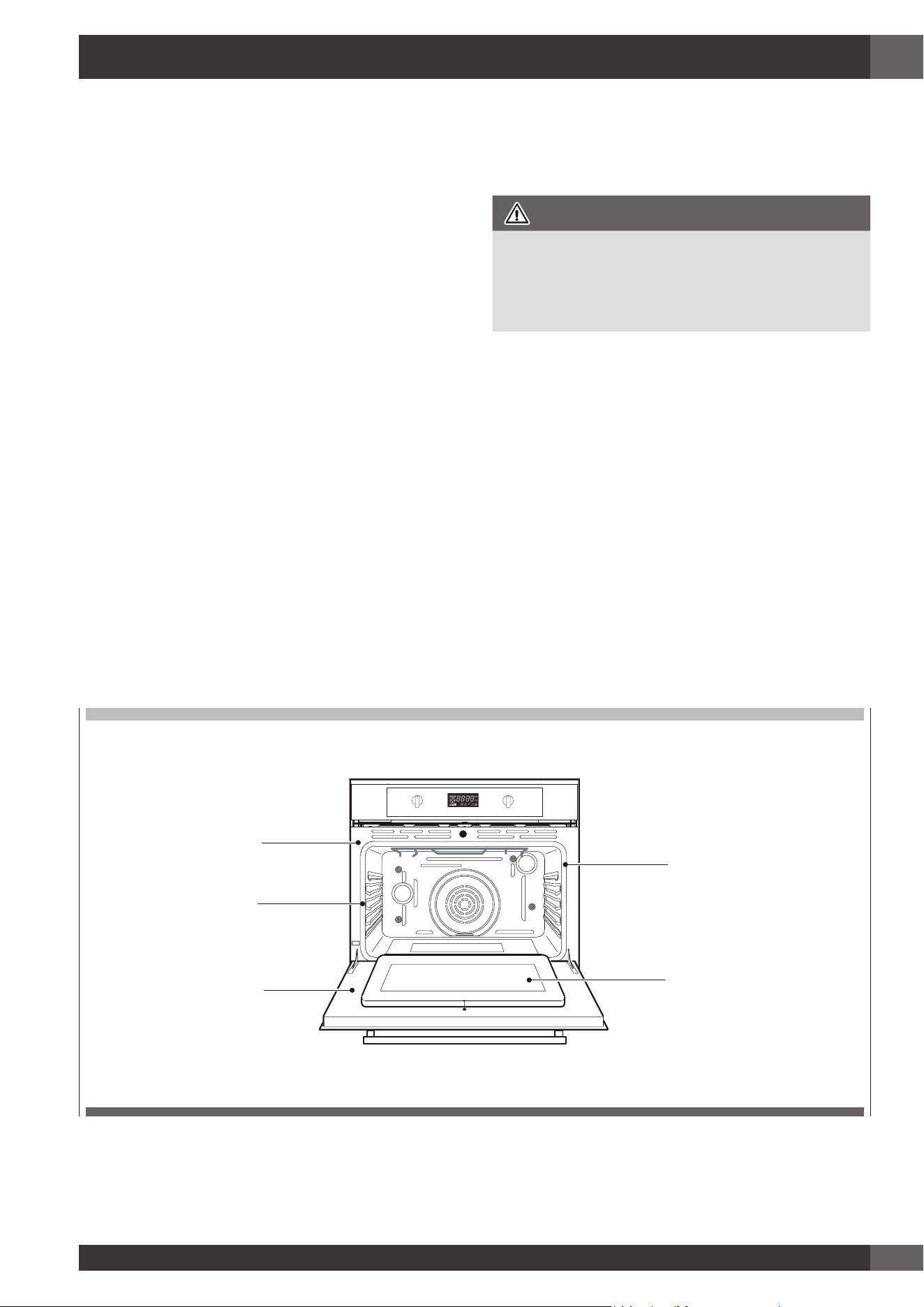
4. Review illustration below. Some areas of the oven must be
cleaned by hand before the cycle begins. They do not get
hot enough during the cleaning cycle for soil to burn away.
Use a soapy sponge or plastic scrubber or a detergent-filled
S.O.S.® pad. Hand-clean the oven door edge, oven front
frameandupto1-1/2“(2-3cm)insidetheframewith
detergent and hot water. Do not rub the gasket on oven.
Clean by hand the oven door window. Rinse all areas
thoroughly then dry.
5. Be sure oven interior lights are turned off and the light bulbs
and lens covers are in place. See Page 29.
Hand clean frame
area ouside gasket
Hand clean 1” (2cm)
from rack guides
to frame of oven cavity
Hand clean door
Hand clean door window
Hand clean door window
area ouside gasket
DO NOT
hand clean gasket
EN
24
18 - Setting the Self-Cleaning Mode
Before using the Self-Cleaning Mode please read the Oven
Care and Cleaning page carefully and follow the Preparing
the Oven for Self-Cleaning first. (see page 23)
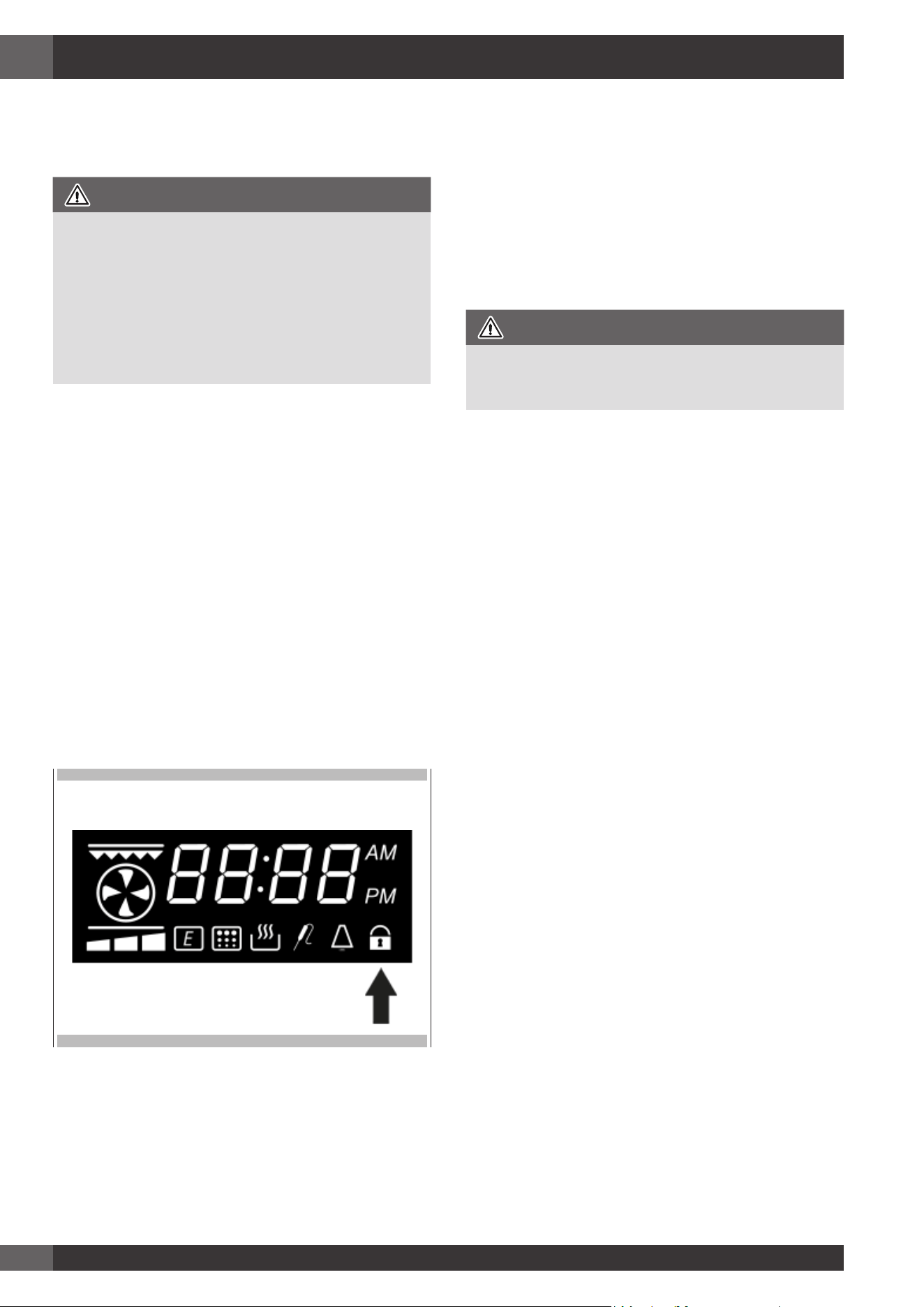
ATTENTION
Once the pyrolysis (self-clean) function has started, when
the flashing padlock symbol appears, DO NOT OPEN THE
DOOR and do not change the function.
Once the pyrolysis function is completed, the door will
automaticallyunlockwhentheoven’sinternal temperature
dropsbelow100˚C.
Do not force to open the door when the padlock symbol is
on or flashing.
Pyrolyse (Self-Clean)
Turn the mode knob in the proper position than press the +/-
knob to start a cleaning cycle.
The clean time can be set according to the same rules of the
automatic functions, and therefore the pyrolitic cycle can be
delayed.
The maximum allowed clean time is 3 hours, the minimum 1
hour. The standard time is 1h:30min, the clock display shows
P1:30. At the end of the self-cleaning activity the display shows
END steady. The writings on the display disappear when the
modeselectorisplacedintheZEROpositionshowing“---”.
The door remains locked until the oven temperature drops
below the safety threshold, at this time the control unlocks the
door.
The cooling fan starts as soon as the function is selected and
turns to its higher speed when the inner parts get hot. The oven
temperatureisautomaticallysetto460˚Cinordertoperfectly
clean the cavity.
The control also locks immediately the door in order to
guarantee the user safety, given that the temperature inside gets
very hot. A lock led shows the status of the latch mechanism
at any time:
- Door unlocked, lock led off.
- Door locked, lock led always on.
- Latch moving, transition in progress, lock led flashing.
To reuse the oven after a pyrolyse, turn the mode selector to
ZERO (OFF) position.
CAUTION
It is advisable not to use the hob during the pyrolysis function
(Self-clean)
EN
25
19 - Sabbath Mode & Meat Probe Function
Sabbath Mode
1. Rotate selector to BAKE and set the desired temperature by
the +/- knob.
2.Pressandhold+/-knobfor5seconds.“SAb”willappear
and flash on oven control knob indicating Sabbath mode
has been initiated. From this point it is no longer possible to
change the temperature by turning the +/- knob.
3. Turn cooking mode selector to OFF or to any other cooking
mode to stop the Sabbath function.
NOTE: The sabbath mode function can only be set within the
first10secondsafterchoosing‘bake’modeorafter
the set of temperature changing.
Modes or features disabled while in Sabbath
Mode is running:
• Sabbath Mode sets the oven to remain on in a BAKE setting.
• Available only in manual setting not timed cooking.
• The display(s) will not indicate temperature and time, only
SAB is showed.
• 72 Hours max duration in manual.
• All tones and chimes are disabled.
• Minute minder function is disabled.
• All time functions changing are disabled.
• Oven light status will remain always in the ON state when
the oven is in Sabbath Mode.
Meat Probe Function if present
This oven is provided with the meat probe feature to sense the
temperature inside meat and stop cooking as soon as the set
value is reached.
The following modes can be selected to work
with the meat probe:
CONVECTION BAKE
CONVECTION ROAST
BAKE
CONVECTION BROIL
Other modes are not allowed to start if the probe is inserted.
The P of 165P (in Fahrenheit) or 75P (in Celsius) text and
Meat Probe symbol flashes when the mode is not valid for
cooking with probe or the probe is removed during cooking. In
this case the heating elements are de-energized and the control
automatically switches in OFF condition, showing the time of
the day.
Activation Methods
1. Once the probe has been inserted in its receptacle and
detected by the control turn the cooking mode knob into
a valid position, the 165P (75°C) text appears on the 4
DIGITS display.
2. Once a valid cooking mode is started the probe can been
inserted in its receptacle and detected by the control, the
165P(75°C)textappearsonthe4DIGITSdisplay.
The meat probe standard temperature 75°C (165°F) flashes
ondisplayfor5seconds.Usingthe+/-knob,it’spossibleto
change the probe set.
The standard probe temperature set-point is 75°C (165°F).
The allowed range is between 50°C (120°F) and 99°C
(210°F).
The maximum cavity temperature during cooking with meat
probe is 250°C (480°F)
After 5 seconds the value on the display is accepted and the
control starts cooking. The actual oven temperature is now
shown on the 4 digits display.
Start from ambient temp.
The current probe temperature is
showedfrom40˚C(105˚F)
The current probe temperature is
showed until the set is reached.
end cooking.
As soon as the set probe temperature is reached, the control
beeps indicating the end of cooking and stops the oven.
Press +/- knob once to check the probe set temperature.
Press +/- knob twice to change the oven setting temperature.
Whenit’sflashingturnthe+/-knobtomodifythevalue.
After 5 second the current oven temperature is shown
automatically on the 4 digits display.
Always turn the cooking mode to the OFF position after the
end of cooking has automatically turned off the oven so it is
properly reset for the next time it is used.
Automatic time functions are disabled when using the meat
probe, only the minute minder can be set.
When activated the Minute Minder have to work in background.
EN
26
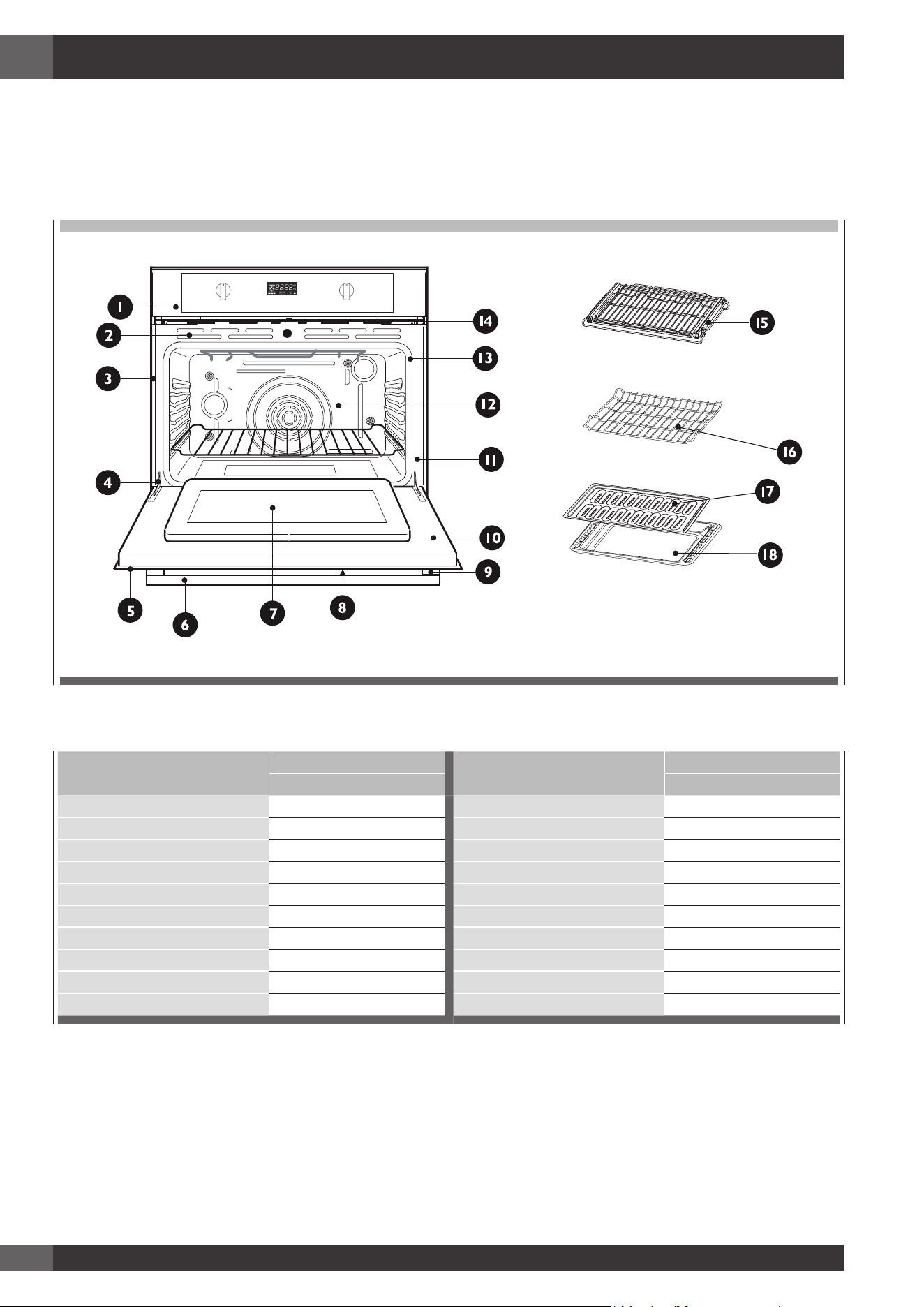
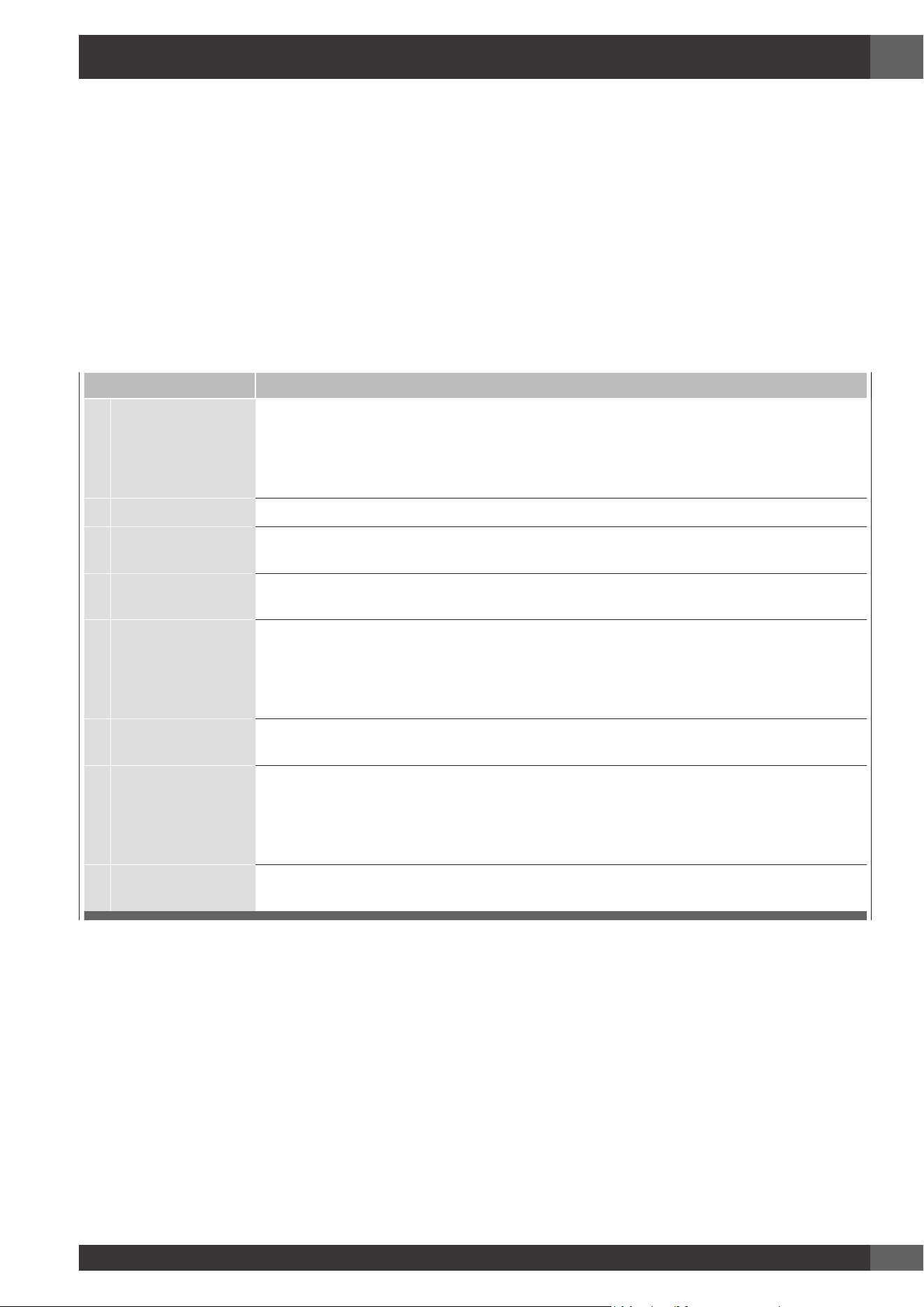
How to Use the Cleaning Chart
1. Locate the number of the part to be cleaned in the illustration on this page.
2. Find the part name in the Cleaning Chart.
3. Match the letter with the cleaning method on following page.
Cleaning Chart
Part
Cleaning Method
Part
Cleaning Method
Stainless Stell Oven Stainless Stell Oven
1 Control Panel C-G 11 Oven Front Frame E
2 Door Cooling Vent E 12 Oven Cavity E
3 Side Trim D 13 Door Gasket B
4 Bottom Trim D 14 Oven Cooling Vents D
5 Door Frame E 15 Extendable Rack A
6 Door Handle G 16 Oven Rack A
7 Interior door windows F 17 Broiler Pan Rack E
8 Door Front C&G 18 Broiler Pan E
9 End Caps D
10 Interior Oven Door E
Please refer to the next page for Cleaning Method.
20 - General Oven Care
EN
27
21 - Oven Finishes / Cleaning Methods
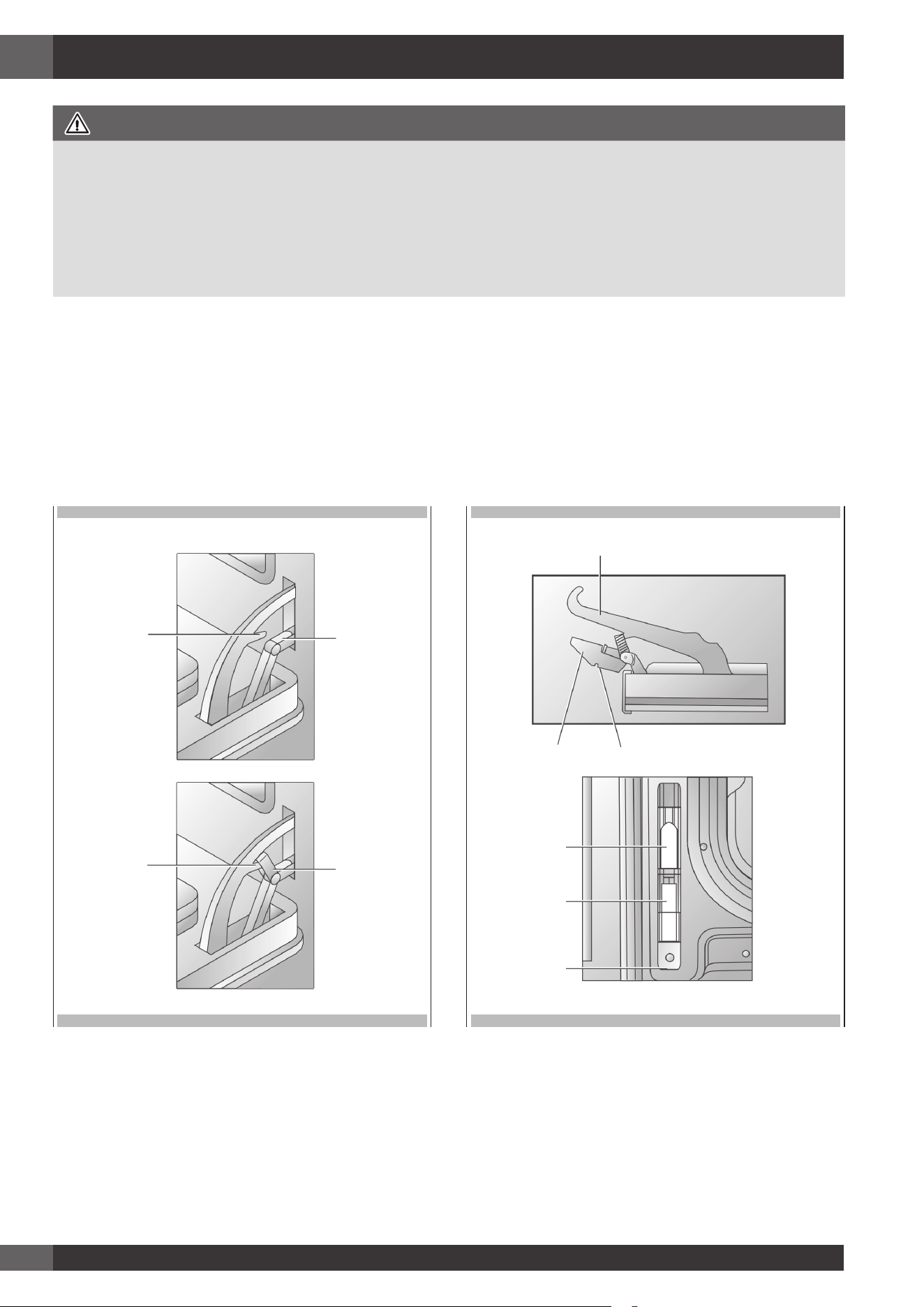
The entire oven can be safely cleaned with a soapy sponge, rinsed and dried. If stubborn soil remains, follow the recommended
cleaning methods below.
• Always use the mildest cleaner that will do the job.
• Rub metal finishes in the direction of the grain.
• Use clean, soft cloths, sponges or paper towels.
• Rinse thoroughly with a minimum of water so it does not drip into door slots.
• Dry to avoid water marks.
The cleaners listed below indicate types of products to use and are not being endorsed. Use all products according to package
directions.
Part Cleaning Method
A Chrome Plated
Wash with hot sudsy water. Rinse thoroughly and dry. Or, gently rub with Soft Scrub®,
Bon-Ami®, Comet®, Ajax®, Brillo® or S.O.S.® pads as directed. Easy Off® or Dow® Oven
Cleaners (cold oven formula) can be used, but may cause darkening and discoloration.
Racks may be cleaned in the oven during the self-clean mode. However, chromed racks will lose
their shiny finish and permanently change to a metallic gray.
B Fiberglass Knit DO NOT HAND CLEAN GASKET.
C Glass
Spray Windex® or Glass Plus® onto a cloth first then wipe to clean. Use Fantastik® or Formula
409® to remove grease spatters.
D Painted
Clean with hot sudsy water or apply Fantastik® or Formula 409® first to a clean sponge or paper
towel and wipe clean. Avoid using powdered cleansers and steel wool pads.
E Porcelain
Immediately wipe up acidic spills like fruit juice, milk and tomatoes with a dry towel. Do not use a
moistened sponge/towel on hot porcelain. When cool, clean with hot sudsy water or apply Bon-
Ami® or Soft Scrub® to a damp sponge. Rinse and dry. For stubborn stains, gently use Brillo® or
S.O.S. ® pads. It is normal for porcelain to craze (fine lines) with age due to exposure from heat
and food soil.
F Reflective Glass
Clean with hot sudsy water and sponge or plastic scrubber. Rub stubborn stains with vinegar,
Windex®, ammonia or Bon-Ami®. DO NOT USE HARSH ABRASIVES.
G Stainless
Always wipe or rub with grain. Clean with a soapy sponge then rinse and dry. Or, wipe with
Fantastik® or Formula 409® sprayed onto a paper towel. Protect and polish with Stainless Steel
Magic® and a soft cloth. Remove water spots with a cloth dampened with white vinegar. Use
Zud®,Cameo®,BarKeeper’sFriend®orRevereWareStainlessSteelCleaner®,toremoveheat
discoloration.
H Probe (if present)
Clean probe by hand with detergent and hot water. Then rinse and dry.
Do not so or clean in dishwasher.
EN
28
WARNING
• Make sure oven is cool and power to the oven has been turned off before removing the door. Failure to do so could result in
electrical shock or burns.
• The oven door is heavy and fragile. Use both hands to remove the oven door. The door front is glass. Handle carefully to avoid
breakage.
• Grasp only the sides of the oven door. Do not grasp the handle as it may swing in your hand and cause damage or ingury.
• Failure to grasp the oven door firmly and properly could result in personal injury or product damage.
22 - Do-it-Yourself Maintenance Oven Door Removal
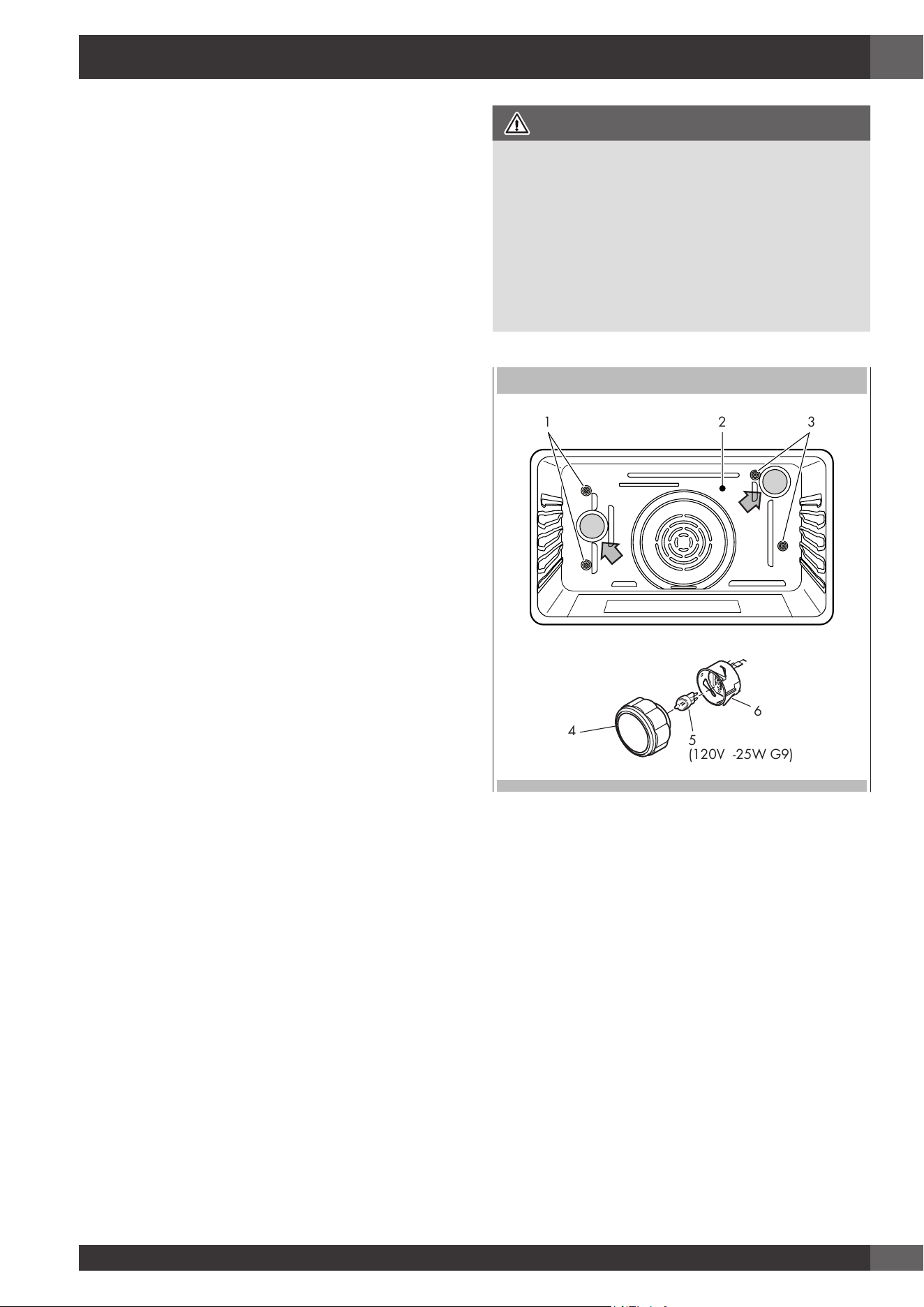
To Remove Door
1. Open the door completely.
2. Lift up the hinge bracket (1) into the slot (2).
3. Hold the door firmly on both sides using both hands and
close the door.
4. Hold firmly; the door is heavy.
5. Place the door in a convenient location.
2
1
2
1
To Replace Door
1. Insert the upper arms (3) of both hinges into the upper
slots (6) and the lower arms (4) into the lower slots (7). The
recesses (5) must hook on the lips (8).
2. Move the hinge brackets (1) back down into position.
3. Close and open the door slowly to assure that it is correctly
and securely in place.
3
4
6
7
8
5
EN
29
23 - Replacing an Oven Light
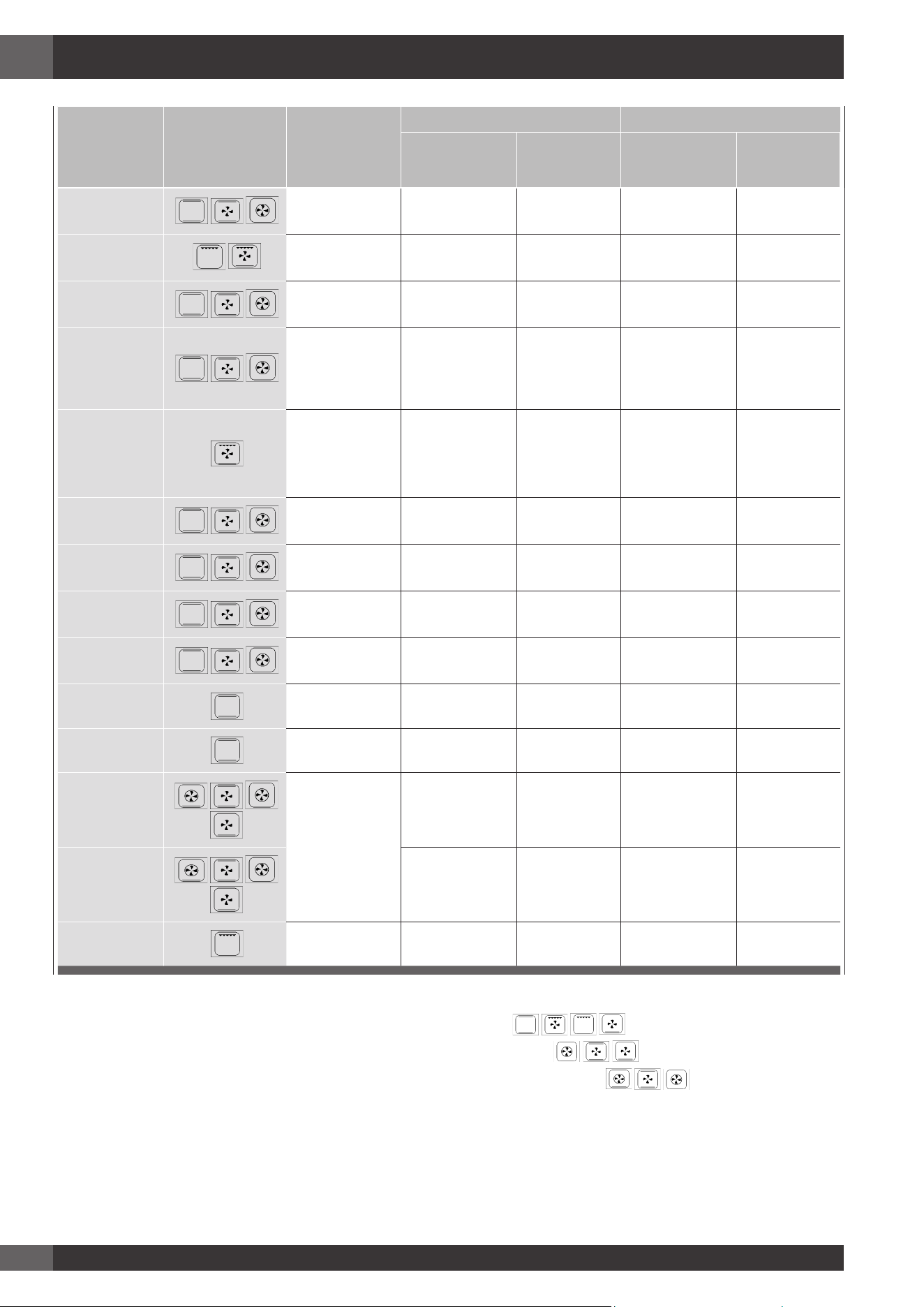
• Each oven is equipped with two halogen lights located in
the lateral walls of the oven.
• The lights are switched on when the door is opened or
when the oven is in a cooking cycle.
• The oven lights are not illuminated during SELF- CLEAN.
• Each light assembly consists of a removable lens, a light
bulb as well as a light socket housing that is fixed in place.
See figure on this page.
• Light bulb replacement is considered to be a routine
maintenance item.
To Replace a Light Bulb
1. Read WARNING on this page.
2. Turn off power at the main power supply (fuse or breaker
box).
3. In convection ovens, remove the fan cover by unscrewing
the four screws.
4. Remove the lens by unscrewing it.
5. Remove light bulb from its socket by pulling it.
6. Replace the bulb with a new one. Avoid touching the bulb
with fingers, as oils from hands can damage the bulb when
it becomes hot.
7. The bulb is halogen: use one with the same Volt and Watt
(see figures on this page).
8. Screw the lens back on.
9. Replace the fan cover if it is provided with the oven model.
Turn power back on at the main power supply (fuse or breaker
box).
WARNING
• Make sure the oven and lights are cool and power to
the oven has been turned off before replacing the light
bulb(s). Failure to do so could result in electrical shock
or burns.
• The lenses must be in place when using the oven.
• The lenses serve to protect the light bulb from breaking.
• The lenses are made of glass. Handle carefully to avoid
breakage. Broken glass could cause an injury.
OVEN LIGHT
1 2 3
4
5
(120V -25W G9)
6

EN
30
24 - Solving Baking Problems
With either Bake or Convection Bake, poor results can occur
for many reasons other than a malfunction of the oven. Check
the chart below for causes of the most common problems.
Since the size, shape and material of baking utensils directly
affect the baking results, the best solution may be to replace
old baking utensils that have darkened and warped with age
and use.
Check the Baking Charts from Page 17 to 21 for the
correct rack position and baking time.
BAKING PROBLEM CAUSE
Food browns unevenly
- Oven not preheated
- Aluminum foil on oven rack or oven bottom
- Baking utensil too large for recipe
- Pans touching each other or oven walls
Food too brown on bottom
- Oven not preheated
- Using glass, dull or darkened metal pans
- Incorrect rack position
- Pans touching each other or oven walls
Food is dry or has shrunk excessively
- Oven temperature too high
- Baking time too long
- Oven door opened frequently
- Pan size too large
Food is baking or roasting too slowly
- Oven temperature too low
- Oven not preheated
- Oven door opened frequently
- Tightly sealed with aluminum foil
- Pan size too small
Pie crusts do not brown on bottom or have sog-
gy crust
- Baking time not long enough
- Using shiny steel pans
- Incorrect rack position
- Oven temperature is too low
Cakes pale, flat and may not be done inside
- Oven temperature too low
- Incorrect baking time
- Cake tested too soon
- Oven door opened too often
- Pan size may be too large
Cakes high in middle with crack on top
- Baking temperature too high
- Baking time too long
- Pans touching each other or oven walls
- Incorrect rack position
- Pan size too small
Pie crust edges too brown
- Oven temperature too high
- Edges of crust too thin

EN
31
25 - Solving Operational Problems
Before contacting service, check the following to avoid unnecessary service charges.
Cooktop Problem Problem Solving Steps
E008 Error appears in the display
window.
A problem with latch mechanism occurred. Remove power and turn it back on again after
afewseconds.Theovenshouldrunalatchauto–test.Ifconditionpersists,notethecode
number and contact service.
Other E__ Error appears in the
display window.
Remove power and turn it back on again after a few seconds. If condition persists, note the
code number and contact service.
The oven display stays OFF Turn off power at the main power supply (fuse or breaker box). Turn breaker back on.
If condition persists, call an authorized service.
Cooling fan continues to run after
oven is turned off
The fan turns off automatically when the electronic components have cooled sufficiently.
Oven door is locked and will not
release, even after cooling
Turn the oven off at the circuit breaker and wait a few seconds. Turn breaker back on.
The oven should reset itself and will be operable.
Oven is not heating Check the circuit breaker or fuse box to your house. Make sure there is proper electrical
power to the oven. Make sure the oven temperature has been selected.
Oven is not cooking evenly Check oven calibration. Adjust calibration if necessary (see To Set Temperature, Page
9). Refer to cooking charts for recommended rack position. Always reduce recipe
temperature by 15°C (25°F) when baking with Convection Bake mode.
Oven light is not working properly Replace or reinsert the light bulb if loose or defective. See Page 29. Avoid touching the
bulb glass with bare fingers as finger oil may cause bulbs to burn out prematurely.
Oven light stays on Check for obstruction in oven door. Check to see if hinge is bent or door switch broken.
Cannot remove lens cover on light There may be a soil build-up around the lens cover. Wipe lens cover area with a clean dry
towel prior to attempting to remove the lens cover.
Oven will not Self-Clean properly Allow the oven to cool before running Self-Clean. Always wipe out loose soils or heavy spill-
over before running Self-Clean. If oven is badly soiled, set oven for a four-hour Self-Clean.
See Preparing the Oven to Self-Clean, Page 23.
Clock and timer are not working
properly
Make sure there is proper electrical power to the oven. See the Clock and Timer sections
on Page 9.
Excessive moisture When using Bake mode, preheat the oven first. Convection Bake and Convection Roast will
eliminate any moisture in oven (this is one of the advantages of convection).
Porcelain chips When oven racks are removed and replaced, always tilt racks upward and do not force
them to avoid chipping the porcelain.
EN
32
FOOD Mode
Rack position
(from the
bottom)
Traditional cooking Hot-air cooking system
Temperature
°C
Cooking
time
in minutes
Temperature
°C
Cooking
time
in minutes
Poork, calf
(roast) etc.
3th 180 ÷ 190 25 ÷ 35 170 ÷ 180 20 ÷ 30
Poork, calf
(roast) etc.
3th L3 25 ÷ 35 215 ÷ 230 20 ÷ 30
Fillet, roastbeef
2nd 170 ÷ 180 30 ÷ 35 165 ÷ 170 25 ÷ 30
Poultry (gose,
duck, turkey
chicken)
whole (2)
2nd 200 ÷ 210 18 ÷ 22 190 ÷ 200 15 ÷ 18
Chicken
quarter, thigs,
hamburger,
steak
3th -- -- 220 ÷ 230
12 ÷ 14
for each side
Game (2)
3th 180 ÷ 190 45 ÷ 75 170 ÷ 180 40 ÷ 70
Fish
3th 200 ÷ 210 30 ÷ 35 180 ÷ 190 25 ÷ 30
Cakes
2nd 190 ÷ 200 40 ÷ 50 170 ÷ 180 35 ÷ 40
Biscuits
2nd 175 ÷ 185 10 ÷ 15 165 ÷ 175 7 ÷ 13
Pizza (fresh)
2nd 215 ÷ 225 15 ÷ 18 -- --
Pizza (frozen)
2nd 200 ÷ 210 25 ÷ 30 -- --
Pizza
multilevel
(fresh)
2nd & 4th
or
1st & 3th
-- -- 200 ÷ 220 12 ÷ 15
Pizza
multilevel
(frozen)
-- -- 190 ÷ 200 23 ÷ 26
Bread toast
3th L3 4 ÷ 6 -- --
Warning for hot-air cooking - Position of pans:
• For fooking on 1 plane make use on 2nd holder from the bottom; (using
)
• For cooking on 2 planes make use of 2nd - 4th holders from the bottom; (using
)
• For cooking on 3 planes make use of 2nd - 3th and 4th holders from the bottom; (using
)
• (2) The time depends of poultry dimension, (40 ÷ 45 mins for kg).
IMPORTANT: The cooking times are considered with oven preheated
26 - Guidance temperature an time schedule for cooking

33
Note / Note / Nota

34
Note / Note / Nota


DOC COD.
09X9800 - ed. 05/2023