1
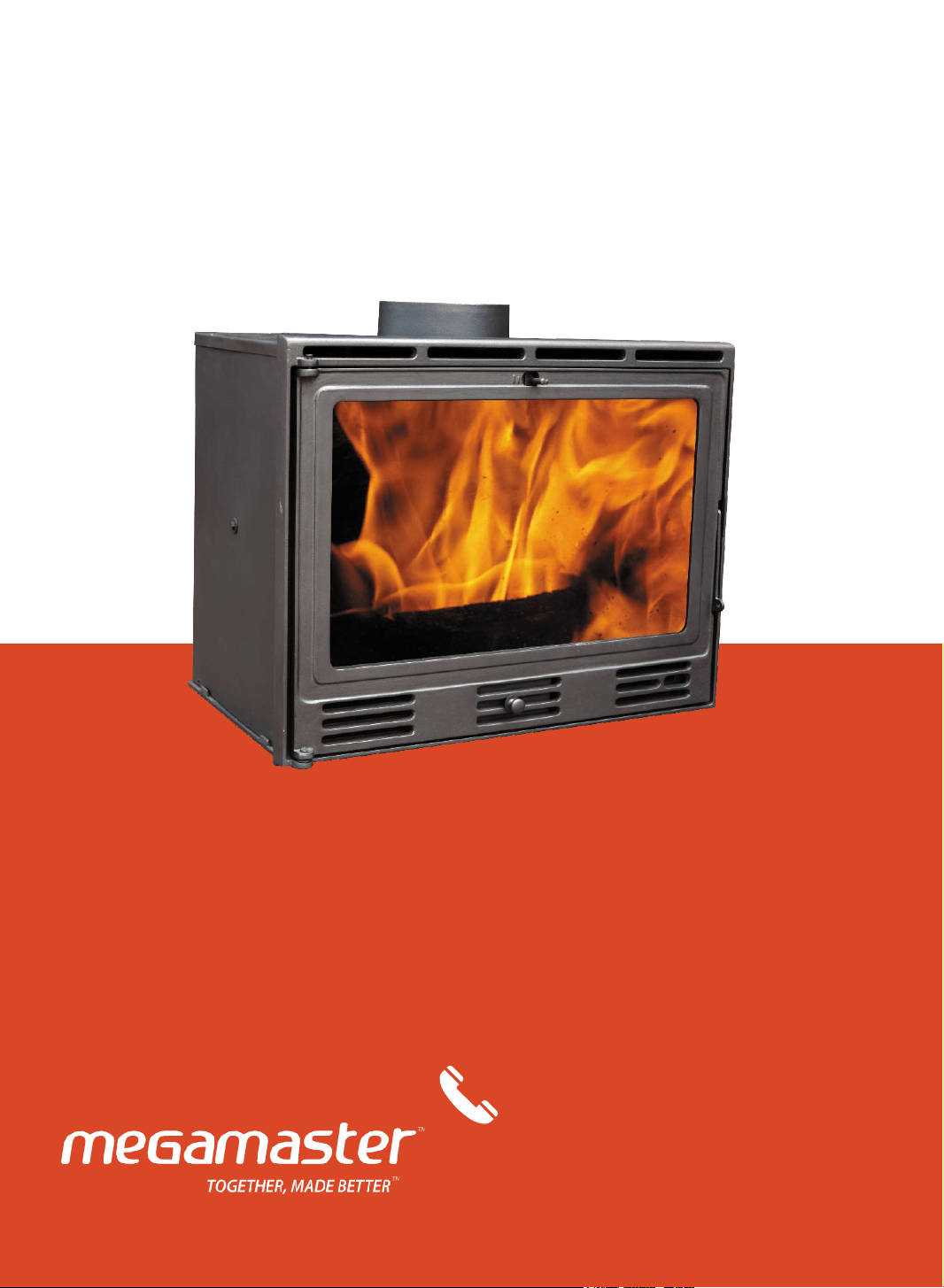
BALLINA 14kW BUILT-IN CAST IRON
FIREPLACE
ASSEMBLY & OPERATING INSTRUCTIONS
This instructions manual contains important information necessary
for the proper assembly and safe use of the appliance.
Read these instructions and warnings carefully so as to familiarize
yourself with the appliance before operating the appliance.
Keep this manual for future reference.
Questions, problems, missing parts?
Before returning to your retailer, call our
Customer Service Department at Tel: (010)
001 6342, 8 a.m. - 5 p.m., CAT, Monday-
Thursday and Friday till 3 p.m. Or send us
an E-mail at service@megagroup.co.za or
visit us online at: www.megamaster.co.za
FSFC0036 / AM35-14K

THIS MANUAL IS
DESIGNED TO FIT INTO
THE BOTTOM DRAWER,
BUT THAT’S NOT WHERE IT
BELONGS
We get it. You’ve just unboxed your Megamaster Cast Iron Fireplace and
you can’t wait to fire it up.
At Megamaster, we believe anything worth doing is worth doing well.
That’s why, as with all of our products, we’ve put a lot of thought and
effort into this user manual. It really is the first step towards making your
time with friends, family truely better.
Manufactured in China. Distributed by Megamaster
+27 (0)12 802 1515 PO Box 15, Woodlands, 0072, South Africa
www.megamaster.co.za
2
TOGETHER, MADE BETTER
At Megamaster, we understand that the warmth of the flames is really the warmth of human connection.
And that the more we kindle it, the brighter it burns. Times may change. Technology may come or go.
But there will always be one real and meaningful place for us to gather. For hugs. For smiles. For literally
laughing out loud. Where our hearts and minds are free because we have everything we truly need.
We believe that, in those moments, it’s more than a Fire. It’s a celebration. It’s together, made better.
AN ACCREDITED FIREPLACE INSTALLER SHOULD CARRY OUT THE INSTALLATION OF
THIS FIREPLACE. ALTERNATIVELY, SHOULD A NONACCREDITED INSTALLER
UNDERTAKE THE INSTALLATION, YOUR LOCAL BUILDING CONTROL OFFICER WILL
BE REQUIRED TO APPROVE THE COMPLETED INSTALLATION. IF THE FIREPLACE IS
NOT FITTED CORRECTLY, BY AN ACCREDITED PERSON OR OUTSIDE THE SCOPE OF
THIS MANUAL IT COULD RESULT IN A HOUSE FIRE OR CARBON MONOXIDE
POISONING.
3
Safety Instructions 4
Component View 5
Parts List 6
Assembly and Installation Instructions 7-13
Operating Instructions 14-17
Care and Maintenance 17-18
Troubleshooting 19
Warranty 20

SAFETY FIRST, LAST & EVERYWHERE IN BETWEEN
WARNING
THIS FIREPLACE WILL BE HOT when in operation and due care should be taken. Thick gloves
should be used to operate the primary/ secondary controls or reaching inside the fireplace to
position fuel or remove ash.
FIRES CAN BE DANGEROUS - Always use a fireguard in the presence of children, the elderly or
the infirm.
DO NOT OVERFIRE - it is possible to fire the fireplace beyond its design capacity. This could
damage the fireplace, so watch for signs of over firing - if any part of the fireplace starts to glow
red, the fireplace is in an over fire situation and the controls should be adjusted accordingly. Never
leave the fireplace unattended for long periods without first adjusting the controls to a safe setting.
Careful air supply control should be exercised at all times.
THIS FIREPLACE MUST BE CONNECTED TO A SUITABLE FLUE OUTLET. Due to high
temperature this fireplace should be located well away from furniture and curtains. Children and
adults should be alerted to the hazards of hot surfaces. Young children should be carefully
supervised when they are in the same room as the fireplace. Do not place clothing or other
flammable material on or near the fireplace. Keep the fireplace area clear of combustible materials,
flammable liquids or vapours.
CARBON MONOXIDE POISONING CAN BE FATAL. Due consideration should be given to the
dangers of carbon monoxide poisoning following incomplete combustion of solid fuels in an
enclosed space.
4
1. ALWAYS read and understand the manual before installing and commissioning the fireplace.
2. ALWAYS ensure the fireplace is installed in accordance with local regulations.
3. ALWAYS ensure that the fireplace is correctly installed and positioned as described in the
diagram on page 7, and that the immediate area is kept clear.
4. ALWAYS check for damage before using the fireplace. Check for breakage of parts and any
other condition that may affect the fireplaces performance. Any damage should be properly
repaired or the part replaced. If in doubt, DO NOT use the fireplace. Consult your local dealer.
5. ALWAYS keep children and visitors at a safe distance from the fireplace.
6. NEVER direct any kind of liquid on to the fireplace, particularly when it is hot.
7. NEVER use gasoline or other flammable liquids for fire starting.
8. NEVER use the fireplace to incinerate materials other than recommended fuels.
9. NEVER carry out any modifications to this product. If experiencing difficulty of any kind consult
your local dealer.
10. The installation of the fireplace and chimney MUST comply with all local building regulations. It
is the responsibility of the owner and the installer to ensure that the installation complies.
11. All rooms where a fireplace is situated must have a non-motorized air vent (air brick). Refer to
details contained in the Building Regulations.
PRODUCT SPECIFICATIONS
5
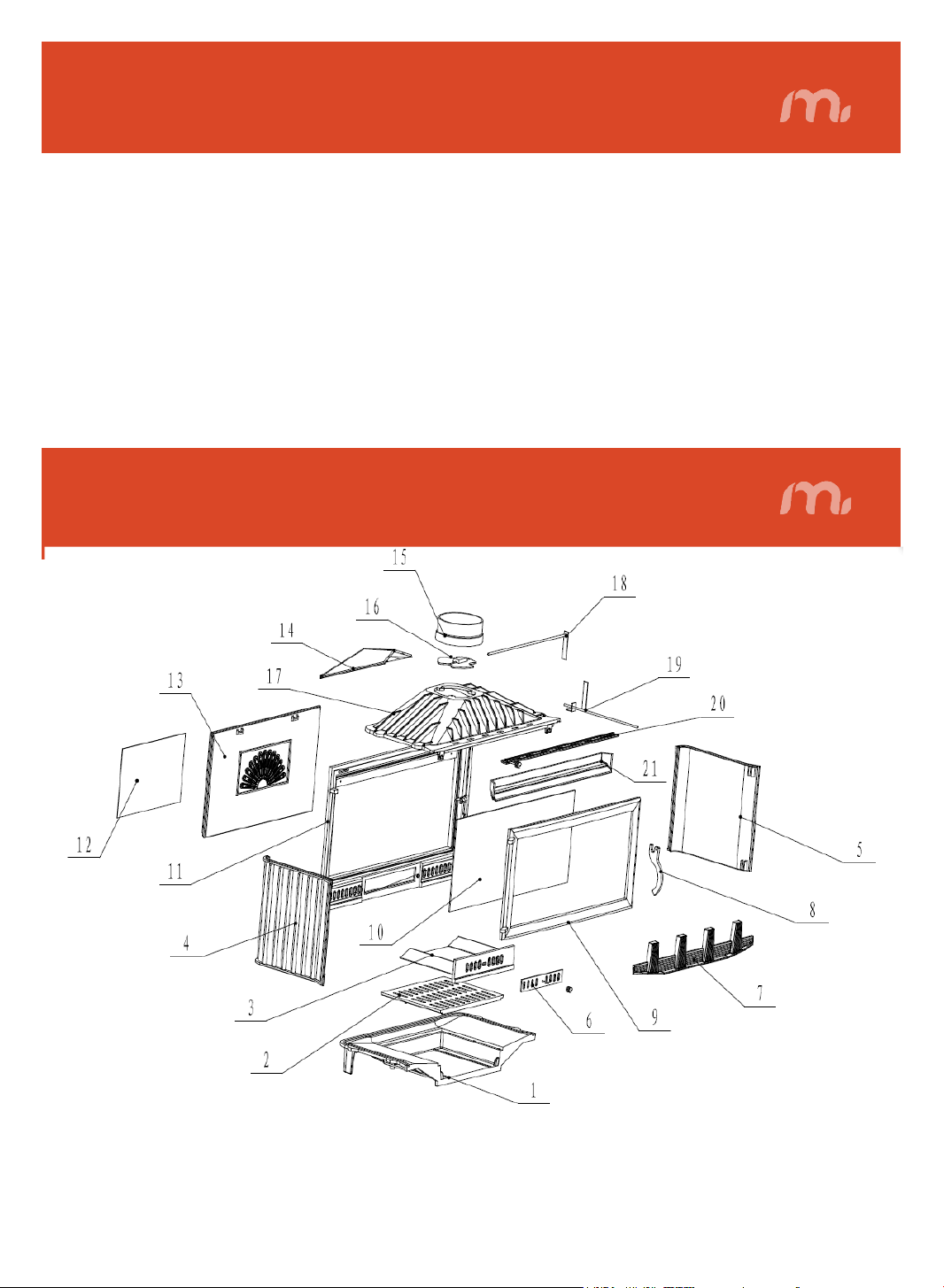
COMPONENT VIEW
1. Product Size 800 X 580 X 750mm
2. Material Cast Iron
3. Front Glass Size 594 X 367mm
4. Output 14kW
5. Flue Outlet Top
6. Net Weight 135kg
7. Flue Size 150mm
PARTS LIST
6
Part
Numbe
r
Part Description Quantity
1 Base 1
2 Grate 1
3 Tin Ashpan & Bottom Air Door 1
4 Left Side Brick 1
5 Right Side Brick 1
6 Bottom Air Slider 1
7 Coal Guard 1
8 Door Handle 1
9 Stove Door 1
10 Glass Panel 1
11 Door Frame 1
12 Steel Back Plate 1
13 Back 1
14 Baffle Plate 1
15 Flue Coupling 1
16 Guide Plate 1
17 Top 1
18 Steel Bar 2 for Guide Plate 1
19 Steel Bar 1 for Guide Plate 1
20 Upper Air Slider 1
21 Upper Air Box 1

PUTTING IT ALLTOGETHER
7
ASSEMBLY:
You can either:
• Use a registered installer who can self certify that the work he does complies with the
relevant Building Regulations; or
• The consumer applies to their local authority building control department for a building
notice, and pays the appropriate fee.
It is generally worthwhile to use an accredited installer who will supply a Certificate of
Compliance as a record of the job and that it complies with Building Regulations
The fireplace must only be installed on floors with an adequate load bearing capacity and if
the existing construction is not suitable, additional measures such as a load distributing plate
must be provided. The hearth should be able to accommodate the weight of the fireplace
and its chimney if the chimney is not independently supported.
Fireplaces should stand wholly above hearths made of non-combustible board/sheet material
or tiles at least 12mm thick, if the fireplace is not to stand in a recess and has been tested to
an applicable standard to verify that it cannot cause the temperature of the upper surface of
the hearth to exceed 100°C.
Constructional hearths should be made of solid, non-combustible material such as concrete
or masonry, at least 125mm thick, including the thickness of any non-combustible floor
and/or decorative surface.
Specific guidance for surfaces on which the fireplace may be allowed to stand should be of
ceramic or concrete construction. When the fireplace is positioned near a wall constructed of
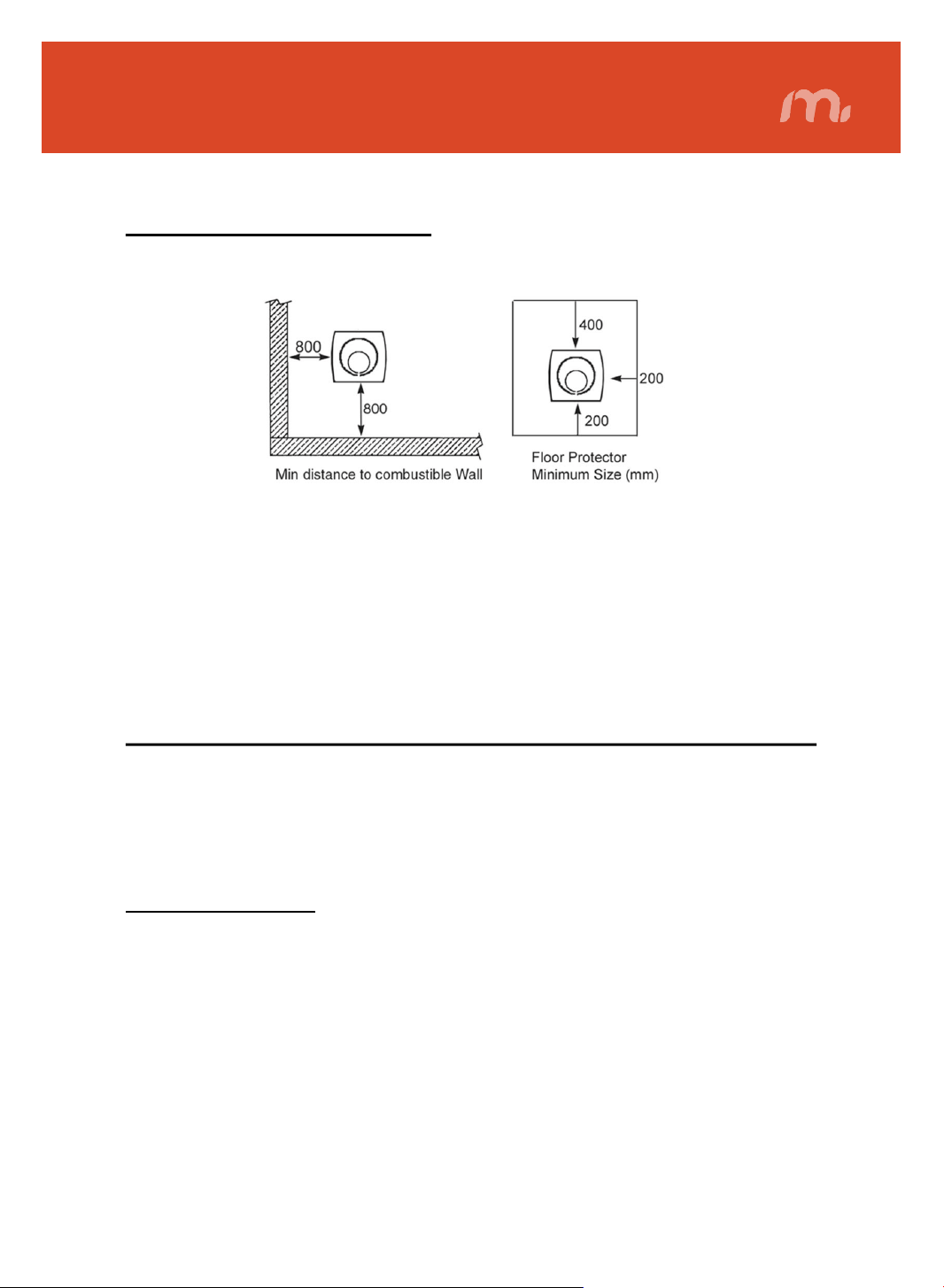
flammable material, the distances shown on Fig 5 must be adhered to. Alternatively, a heat
shield may be used, mounted according to the position of the fireplace. A firewall must be at
least 100mm thick and typically made of brick, or concrete/stone.
SUPPORTING FLOOR:
PUTTING IT ALLTOGETHER
8
MATERIAL CLEARANCE
The fireplace must have a minimum clearance of 1200mm to a combustible ceiling above.
It is recommended that the fireplace be installed at least 800mm from combustible
materials. However, any household furnishings should be at least 1000mm away as they
could be adversely affected by heat.
The fireplace can be recessed in a suitable sized fireplace but a permanent free air gap of at
least 200mm must be left around the sides and top and at least 50 mm at the back of the
fireplace to obtain maximum heat output and for access to the rear of the fireplace.
MINIMUM DISTANCE TO COMBUSTIBLE MATERIALS
Note: combustible material refers to any material that will degrade when subjected to heat
e.g. plaster. Due to the heat of a hot fireplace, a suitable fireguard should always be used
to provide additional protection. Never allow young children to be left unsupervised in a
room containing a hot fireplace.
THE CHIMNEY
The fireplace is supplied with a flue pipe connector for top mounting with the fixing screws
supplied. The fireplace should never be connected to a shared chimney/flue system.
Flue pipes with a smaller cross-sectional area than that of the fireplace outlet should never
be used. Flue pipes must not project into the chimney connector, such as to cause a
restriction to the gas flow.
PUTTING IT ALLTOGETHER
Fireplaces of up to 20kW rated output burning any fuel require 150 mm diameter (or
rectangular flues having the same cross-sectional area and a minimum dimension not less
than 125mm.
Liners should be installed in accordance with their manufacturers instructions. Appropriate
components should be selected to form the flue without cutting and to keep joints to a
minimum. Bends and offsets should be formed only with the matching factory-made
components. Liners need to be placed with the sockets or rebate ends uppermost to contain
moisture and other condensates in the flue. Joints should be sealed with fire cement,
refractory mortar or installed in accordance with their manufacturers instructions.
Ensure the joints are completely sealed, as air leakage will lead to poor performance. Avoid
having more than two bends in the flue system. Any offset between bends should be
minimized and the flue should be equipped with suitable access doors for inspection &
cleaning.
THIS FIREPLACE MUST NOT BE INSTALLED INTO A CHIMNEY THAT SERVES ANY OTHER
HEATING APPLIANCE. THERE MUST NOT BE AN EXTRACTOR FAN FITTED IN THE SAME
ROOM AS THE FIREPLACE, AS THIS CAN CAUSE THE FIREPLACE TO EMIT FUMES INTO
THE ROOM.
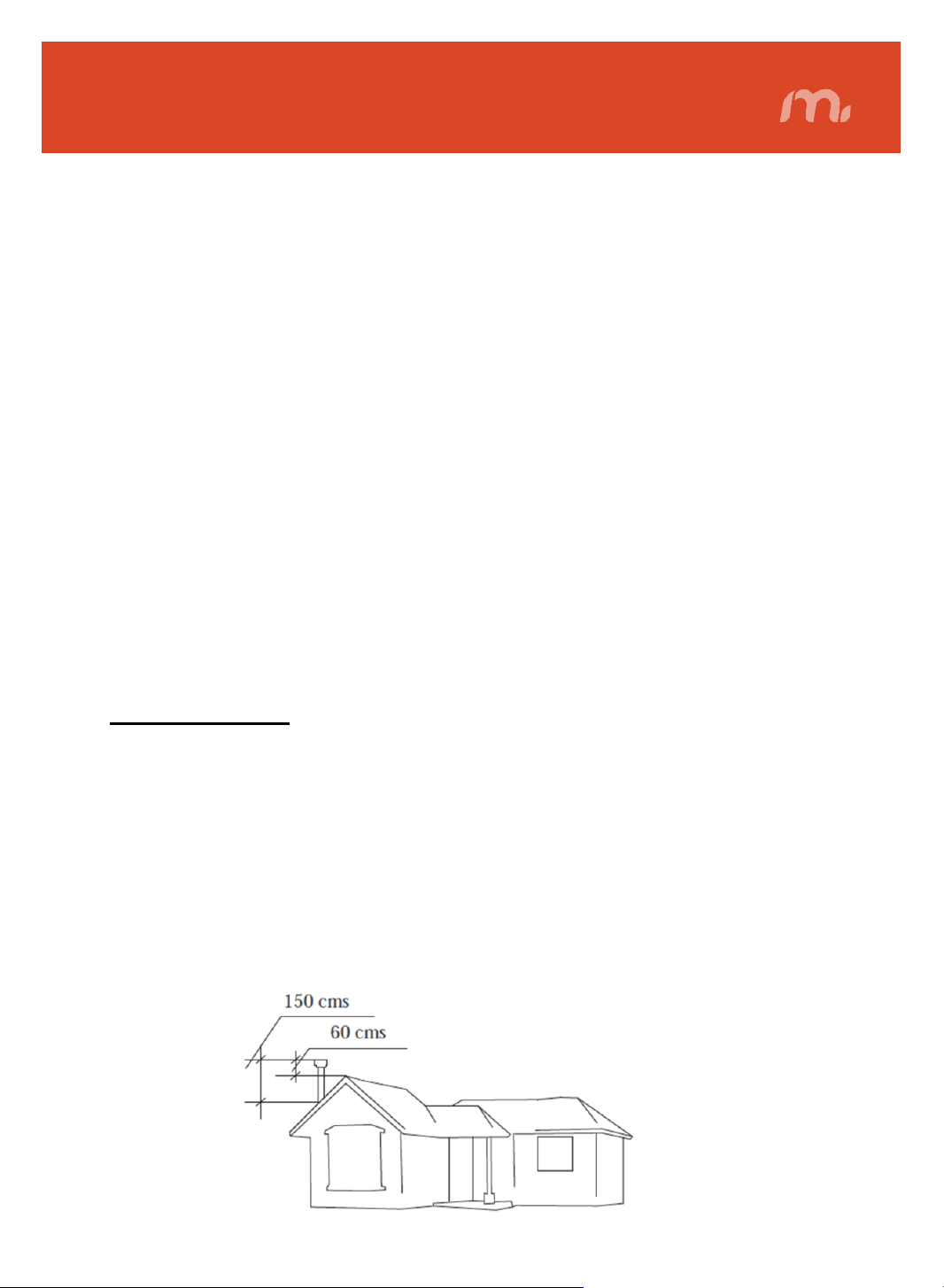
FLUE HEIGHT
The chimney height and the position of the chimney should conform to the manufacturers
recommendations. Flues should be high enough to clear the products of combustion. The
height necessary for this will depend on the type of the appliance, the height of the
building, the type of flue and the number of bends in it, and an assessment of local wind
patterns. However, a minimum flue height of 4.5m could be satisfactory. External flue pipes
should be ‘twin wall’. These retain the heat, enabling it to rise and disperse from the
chimney. See diagram below for effective flue height recommendations.
The outlet from a flue should be above the roof of the building in a position where the
products of combustion can discharge freely and will not present a fire hazard, whatever the
wind conditions.
9

PUTTING IT ALLTOGETHER
10
BENDS IN FLUES
Offsets in flues are only acceptable if the following rules are respected:
a) The chimney system shall have no more than 4 bends in total; - 2 bends in the chimney
and 2 bends in the flue pipe connection.
b) The offset shall provide a change of direction no more than 45 degrees from the
vertical.
c) The run of the chimney between bends shall not exceed 20% of the total chimney
length.
d) The maximum length of the horizontal flue must not exceed 150mm (6”).
INSPECTION AND CLEANING
Check that the chimney is in good condition, dry and free from cracks and obstructions. The
diameter of the chimney should not be less than 150mm and not more than 230mm. If any
of these requirements are not met, the chimney should be lined by a suitable method.
The chimney must be swept before connection to the fireplace. Where the chimney is
believed to have previously served an open fire installation, it is possible that the higher flue
gas temperature from the fireplace may loosen deposits that were previously firmly
adhered, with the consequent risk of flue blockage. It is therefore recommended that the
chimney be swept a second time within a month of regular use after installation.
Assuming that when the fireplace is first installed, the chimney is clean, and sound, then the
chimney flue should be inspected part way through the burning season to establish the
regularity of sweeping required. If you have any doubts about the suitability of your
chimney, consult your local dealer/stockiest.
INSPECTION AND CLEANING
Any room or space containing a fireplace should have a permanent air vent opening of at
least the sizes shown in the table below. For fireplaces designed to burn a range of different
solid fuels, the air supply should be designed to accommodate burning the fuel that
produces the highest heating output.
FIREPLACE AIR SUPPLY
Permanently open vents as below:
Stove with no flue draught stabilizer If design air permeability > 5m³/h.m²
then 550mm²/kW of appliance rated output
above 5kW
If design air permeability < 5m³/h.m²
then 550mm²/kW for balance of appliance rated
output
PUTTING IT ALLTOGETHER
11
There must always be a permanent means of providing air for combustion into the room in
which the fire is installed. A permanent vent with a total free area of at least 550mm² for
every kW rated above 5kW should be connected directly to the outside air or an adjacent
room which itself has a permanent vent of the same size direct to the outside air. The fitting
of an extractor fan to either of these rooms is not permitted.
CONNECTION TO THE CHIMNEY
This MUST be carried out by an accredited/competent person and/or approved by your local
authority before using the fireplace.
Any existing flue must be in good condition with suitable access for collection and removal
of debris.
It is also important that suitable flue pipe complying with manufacturer recommendations is
used to connect the fireplace to the chimney flue and that suitable access is provided into
the flue for regular inspection and sweeping of the flue ways.
Chimneys should be as straight as possible. Horizontal runs should be avoided except where
the rear outlet of the appliance is used, in which case, the horizontal section should not
exceed 150mm (6 inches) in length.
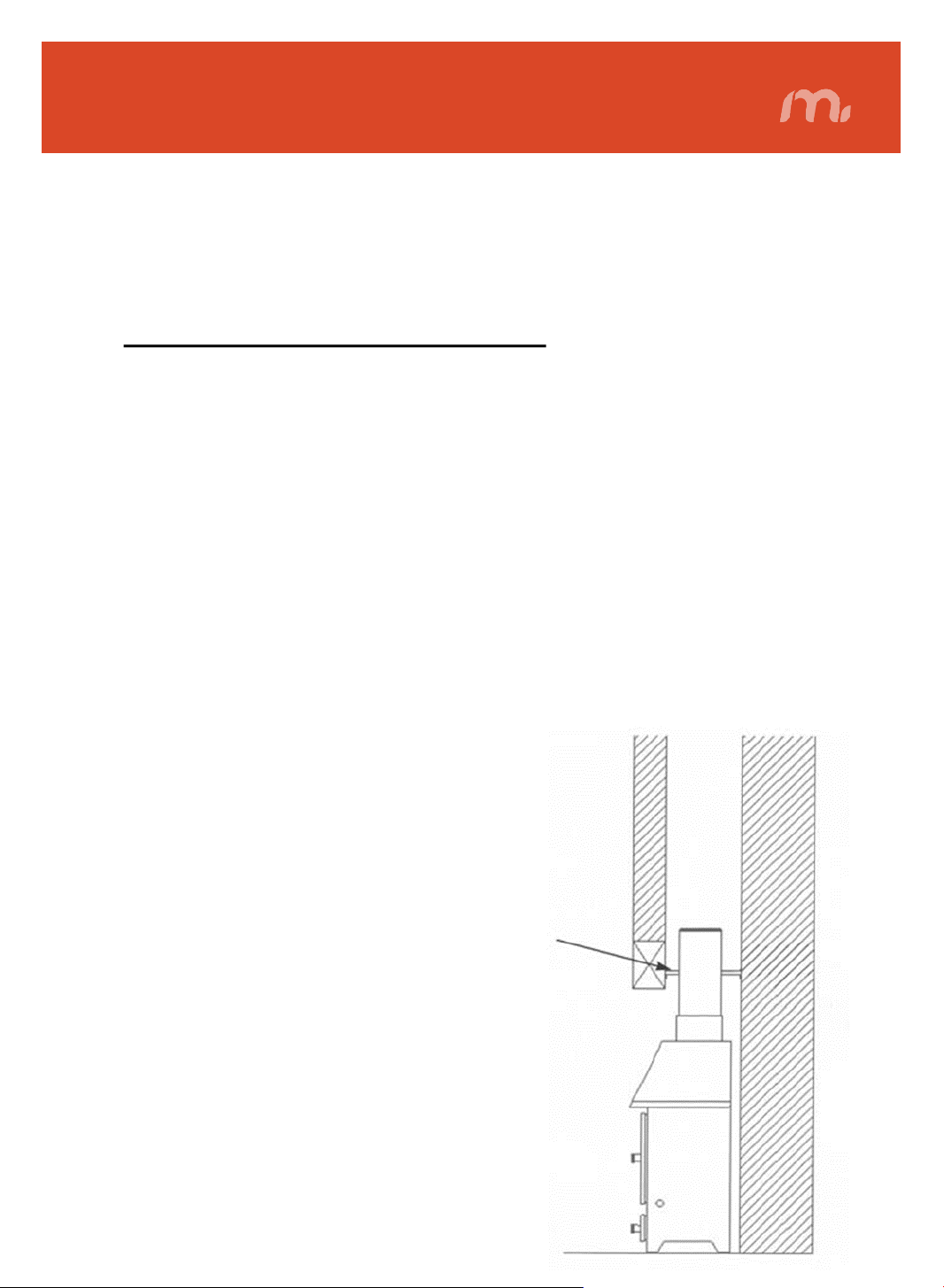
Refer to the typical installation diagrams, Fig 7-9. Flue connections must be well sealed.
A non-combustible register plate minimum 1.5mm thick
should be fitted to all installations between the flue and
the building structure.
PUTTING IT ALLTOGETHER
12
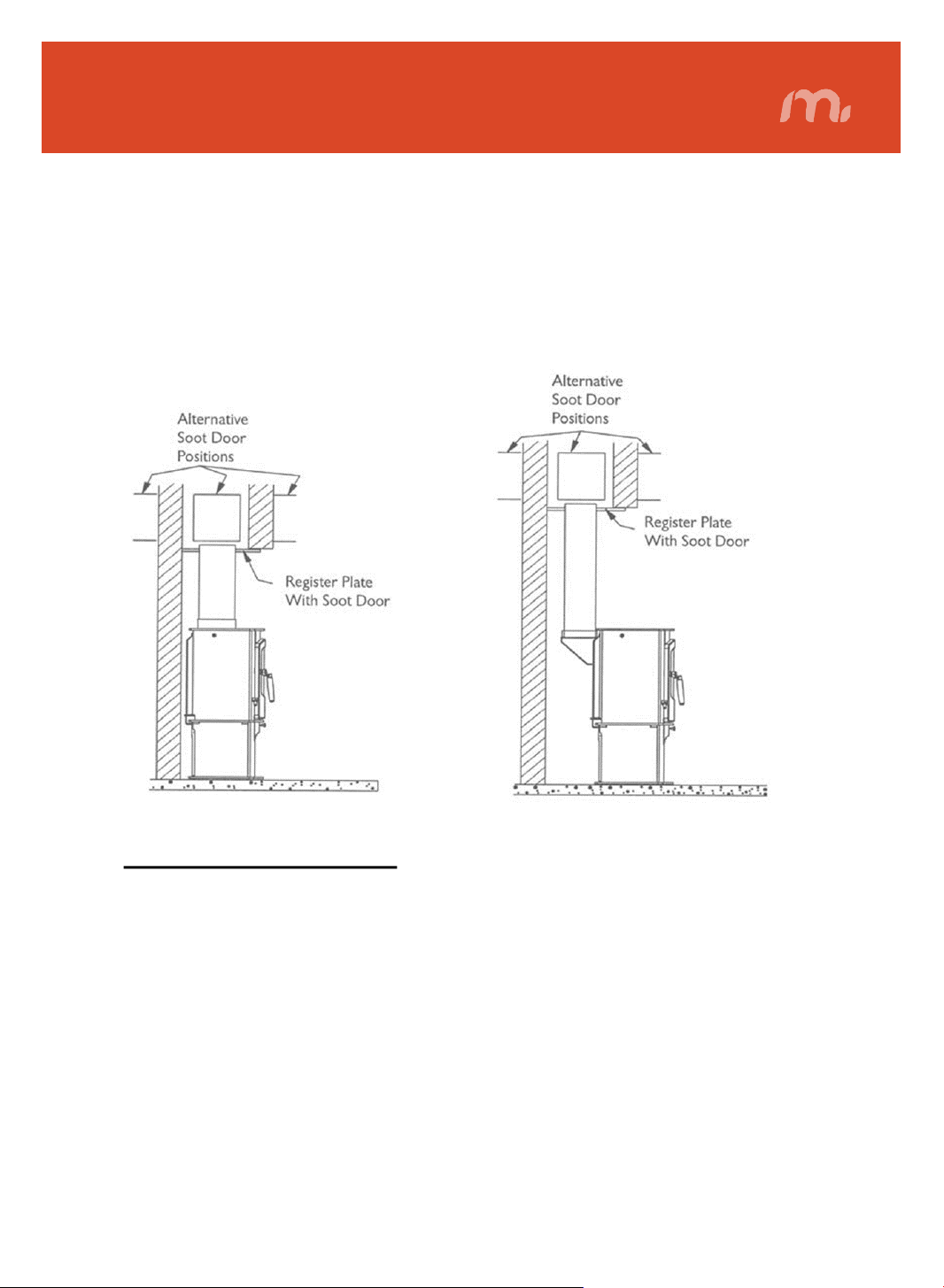
Fig 8: Horizontal register plate with top flue connection
Fig 9: Horizontal register plate with optional vertical rear flue connection
There are several ways of connecting the fireplace to the flue as shown in Figures 8 & 9. If
the vertical rear flue is used, the chimney may be swept through the appliance. If it is not
possible to pass the sweeps brush through the fireplace, a soot door will be necessary. This
may be either in the actual brickwork of the chimney or fitted in the register plate. Various
suitable positions of soot doors are shown in Figures 8 & 9.
CLEANING THE FLUE
Access for cleaning the flue should be incorporated in the system other than through the
appliance (e.g. a soot door or access through a register plate).
Purpose-made soot doors and inspection lengths are available from your local fireplace
specialist or installer. Ensure that the whole length of the flue can be reached from the soot
door.

PUTTING IT ALLTOGETHER
13
FUME EMISSIONS
To avoid chimney problems, your fire should not be burnt slowly for longer than 12 hours
without a period of fast burning. Properly installed and operated, this fireplace will not emit
fumes. Occasional fumes from de-ashing and refuelling may occur. Persistent fume emission
must not be tolerated. If fume emission persists, the following immediate action should be
taken:
1. Open doors and windows to ventilate room.
2. Let the fire out, or eject and safely dispose of fuel from the fireplace.
3. Check for flue chimney blockage and clean if required.
4. Do not attempt to re-light the fire until the cause has been identified and corrected.
If necessary, seek professional advice.
Important! Never fit an extractor fan in the same room as this fireplace.

USING YOUR FIREPLACE
14
THE CONTROLS
The amount of heat emitted by the fireplace is regulated using the following air controls:
• The primary air supply is controlled using the air regulator built into the front ash door
(all models) and by the regulator in the feed door.
• A further air supply is controlled by turning the butterfly damper mounted at the top of
the fireplace to provide an up draught to the chimney
WARNING
THE TEMPERATURES REACHED BY THESE ITEMS DURING OPERATION MAY
CAUSE
INJURY. AS THESE ITEMS ARE ITENDED TO BE ADJUSTED DURING OPERATION,
IT IS RECOMMENDED THAT PROTECTIVE GLOVES ARE WORN
TYPES OF FUEL
Fuel should be dry and timber should be well seasoned so as to have moisture content
below 20%. The use of damp wood will result in more soot and tar deposits being left in the
chimney, flu and fireplace, and will not release heat if thermal energy is being used to drive
out moisture from the fuel.
Other fuels can be used in conjunction with wood, provided the base of the fire remains as
wood or compressed block fuels. Do not use the fireplace to incinerate other materials
including household waste.
Avoid using ‘green’ unseasoned wood, treated wood such as telegraph poles, or plywood /
chipboard containing glues and resins which pollute the environment and cause the fire to
burn too quickly. Such materials can produce excessive tar or creosote which can be
damaging and in extreme cases cause a fire inside the chimney. Looking at the end of the
log can assess the dryness of wood. Radial cracks, deep enough to be considered as splits
should be present in dry, seasoned logs. This level of dryness may take up to two years to
achieve.
The maximum length of fuel suitable for this fireplace is approx. 25cm so as to lay flat over
the embers, and logs of greater than 6 cm diameter should be split.

USING YOUR FIREPLACE
15
INITIAL SEASONING
Following installation, and before regular use, the fireplace must be seasoned to prevent
cracking of the metal casting. This procedure should also be followed if the fireplace has not
been used for prolonged periods (during the summer months for example), and is carried
out as follows:
1. Light a small fire in the middle of the fireplace, well away from the sides.
2. Allow the fireplace to warm up slowly and evenly with the air controls almost closed,
avoiding intense flames.
3. Keep the fire burning for three hours or so, gradually increasing the size of the fire
using larger logs, which will burn naturally but slowly, keeping the fireplace on a low
setting.
4. After a couple of days’ burning at this level, increase the brightness & intensity of the
fire gradually over the next 10 days.
Full strength fires should not be used until completion of approx. 20 days of mild use. Only
from this time will the fireplace have been properly seasoned. It should be remembered that
this procedure should be carried out at the beginning of each season of use in order to
remove the moisture retained by the metal during the period of non-use. When used for the
first time the fireplace may smell a little, due to fumes being given off. The fumes are not
toxic but the room should be thoroughly ventilated. Let the fire burn with a high draught
until no smells can be detected.
Take care not to open the fireplace doors too vigorously in case of causing smoke spillage.
If smoke spillage occurs after the fire door has been opened this could be due to poor
chimney draft. SEE TROUBLESHOOTING.
FIRE-LIGHTING WITH WOOD
1. Open the air controls.
2. Lay firelighters or rolled up newspapers on the grate with a reasonable quantity of dry
kindling wood. Place 2 or 3 small logs on top.
3. Light the newspaper or firelighters using a long taper and close the door.
4. When the fire is burning strongly, add further logs up to 10 mm diameter.
5. When the fireplace is really hot, close the front air control as required. Ensure there are
lasting flames until the wood becomes charcoal.

USING YOUR FIREPLACE
16
REFUELLING
1. Always open the doors slowly to avoid a sudden rush of intake air and smoke escaping
into the room.
2. Open the air controls and leave open for a few minutes to allow the gasses in the wood
to burn before closing the air controls.
• The rate of refuelling and heat available are dependent upon individual requirements
based upon the user’s experience. When re-loading, it is normally necessary to burn the
fireplace fast initially, to drive off any gasses and moisture, before closing the air vents
to control the burn rate.
• Ensure the doors are kept closed to contain fumes except when lighting up, re-fuelling or
removing ash.
• It is not recommended to leave the fireplace alight at night or to continue using the
fireplace in mild weather, which gives poor combustion leading to a greater build-up of
soot.
• If overnight burning is required, can best be achieved by first driving off any gasses or
moisture as usual, following a full charge of fuel and then closing the air vents fully.
Experience will indicate the optimum setting.
However, by reducing the burn rate to such a level that the fire is still burning the following
day, the burning process creates heavy, tarry chemicals which will become deposited on the
inside of the flue or chimney. This is an inefficient process, which greatly increases the risk
of a chimney fire and makes it necessary to sweep the chimney more often.
ASH REMOVAL
Keep the fireplace free from a heavy build-up of ash. The frequency of this is dependent
upon the type and quality of fuel being used. Ash should be removed before it builds up to
the underside of the grate, at which point, the grate would be burning hot on both sides,
shortening its life expectancy.
When disposing of ashes, ensure they have cooled and always place in a metal container.
Be sure to remove the ash when the fire is at its lowest point, such as first thing in the
morning.

USING YOUR FIREPLACE
17
ACCESSORIES
Refer to the Megamaster website www.megamaster.co.za for a full range of flue kits, flue
pipes and other accessories for use with this cast iron fireplace.
If disposing of this product or any damaged components, do not dispose of with general
waste. Metal products should be taken to your local civic amenity site for recycling of metal
products.
CLEANING
The inside of the fireplace may require regular cleaning, especially during periods of peak
use, the frequency of this being indicated by experience. It is advisable to wear a dust
mask, protective gloves and safety glasses when cleaning.
WARNING! MAKE SURE THE FIRE IS COMPLETELY BUNRED OUT BEFORE
ATTEMPTING TO CLEAN THE FIREPLACE.
Use a stiff brush and industrial type vacuum cleaner to dislodge and remove as much
material as possible, starting at the top of the fireplace and working down to the bottom.
Particular attention should be given to the air inlet controls, which can become obstructed.
MAINTENANCE
GENERAL MAINTENANCE
Take this opportunity to check for any damaged parts inside the fireplace. In the event of
damage or broken components, please contact Megamaster Customer Service on:
TEL: +27 12 802 1515
Email: service@megamaster.co.za
The fireplace and flue way should be inspected and maintained when in a cold condition.
NO unauthorized modification of this product should be carried out. This fireplace requires
regular maintenance by a competent person.

MAINTENANCE
18
FIREPLACE BODY
The fireplace is finished with a heat-resistant paint, which can be cleaned with a soft brush.
Wait until the fireplace has cooled down before doing this. This finish can be renovated with
heat resistant fireplace paint, although the paint may not be an exact match and it may be
necessary to repaint the complete fireplace.
If the fireplace is purely ornamental, painting will provide a durable, attractive finish. If the
fireplace is used for heating, a high temperature heat resistant paint (available from your
hardware or paint dealer) must be used, in either aerosol or brush applied form. Should rust
become apparent, clean thoroughly with a wire brush and apply a suitable anti-rust
treatment.
During prolonged periods out of use, the air inlets should be left open and the door left
slightly ajar in order to circulate fresh air and discourage condensation from forming which
could encourage corrosion.
Surface rust may occur on the outside of the fireplace, coastal or humid regions can cause
this to happen faster than arid or dry regions. Proper cleaning and retreating may need to
be done seasonally.
Heavy rains and strong winds may cause rain water to enter via the flue pipe and flood the
internal cavity of the fireplace. Check the inside of fireplace for rainwater after storms or
heavy rains and clean where necessary to prevent rust. Consult your local installer for
examination of the flue pipe installation should the problem be persistent after every rain.
CHIMNEYS AND FLUE-WAYS
It is important that the chimney, flue-ways and any connecting flue pipe are swept
regularly. This means at least once a year for smokeless fuels and at least twice a year for
wood and other fuels. Only wire-centered sweep’s brushes fitted with a guide wheel should
be used. If it is not possible to sweep all parts of the chimney through the fireplace, ensure
there is adequate access to cleaning doors.
TROUBLESHOOTING
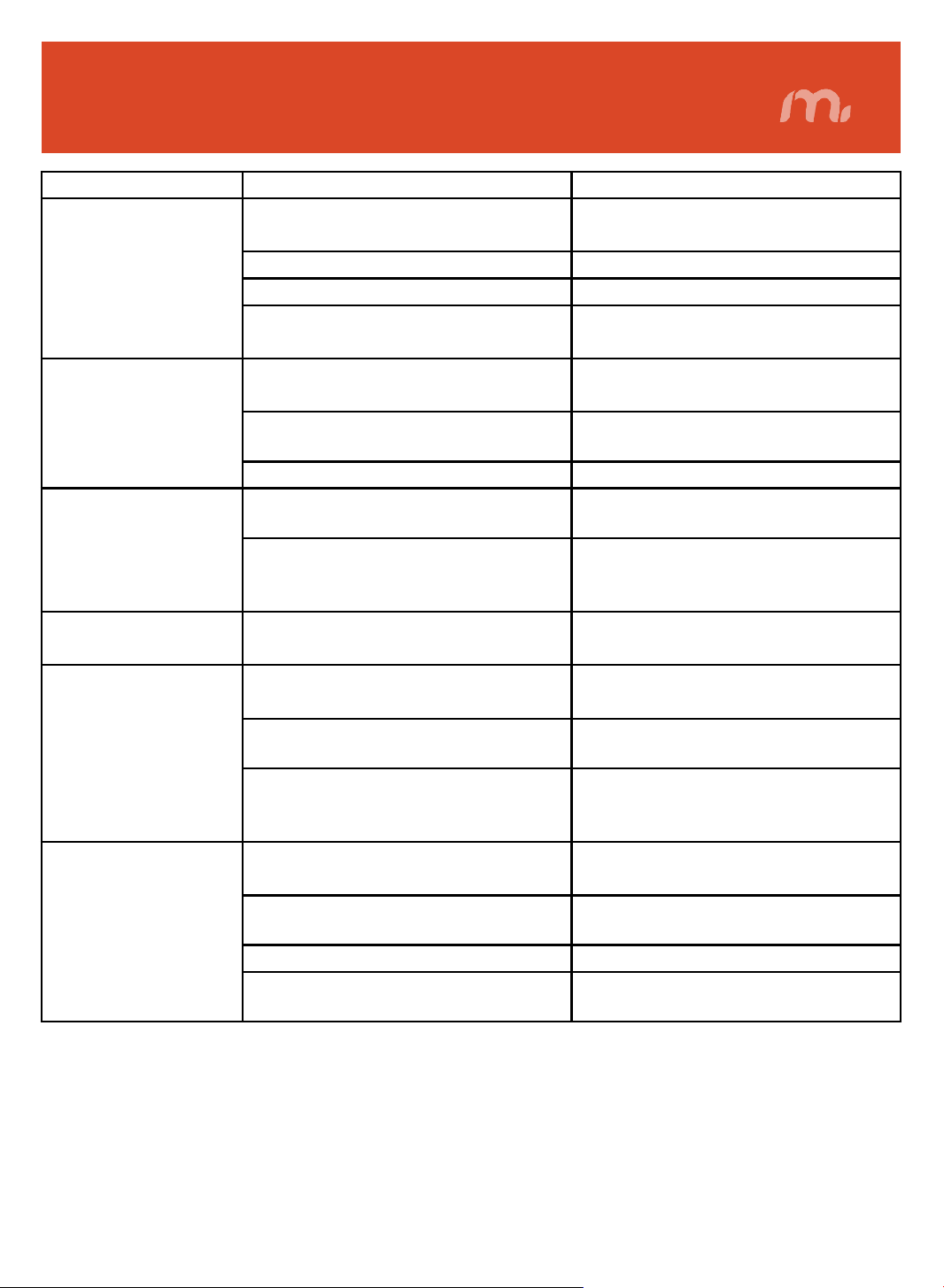
PROBLEM CAUSE SOLUTION
Fire to difficult to start
Fire goes out
Wood too green, too damp or poor
quality
Use recommended fuel
Logs are too large
When lighting, use small, dry kindling
Air starvation
Open lower and upper air controls
Insufficient draught
Check that the flue is not obstructed
-
clean if necessary
Fire burns too quickly
Too much draught
Ensure that the lower air control is
closed. Partially close the top air control
Excessive draw
Install a draught stabilizer. Consult your
installer
Poor quality wood
Use recommended fuel
Fireplace smokes when
lighting up
Flue duct is cold
Burn paper and kindling wood to increase
heat
Room is at negative air pressure to the
outside
In houses equipped with mechanical
ventilation, open a window until the fire
is well established
Low heat output
Incorrect fuels
Use recommended fuel
Smokes while burning
Draught is insufficient
Check that the flue is not obstructed
-
clean if necessary
Downdraught present
Install an anti
-
downdraught cowl. Consult
your installer
Room is at negative air pressure to the
outside
In houses equipped with mechanical
ventilation, open a window until the fire
is well established
Smoke spillage when
opening the door
Chimney not tall enough to be clear of
the roof
Increase height of chimney
Poor sealing of flue pipe joints
Re
-connect flue and replace joining
material
Flue is partially blocked with soot
Clean chimney
House too tighly sealed
Ensure fresh air supply is reaching the
fireplace
19

The manufacturer warrants to the original consumer-purchaser only that this product (Turano Cast Iron Fireplace) shall be free from defects in
workmanship and materials after correct assembly and under normal and reasonable home use for the periods indicated below beginning on the
date of purchase. The manufacturer reserves the right to require photographic evidence of damage, or that defective parts be returned, postage
and/or freight pre-paid by the consumer, for review and examination. Megamaster obligation is limited to repair, replacement, or depreciated value,
at the option of Megamaster.
•Cast iron body: 5 year LIMITED warranty (*Does not cover dropping, chipping, cracking, surface corrosion, scratches or rust.)
•Removable parts: 1 year LIMITED warranty (*Does not cover dropping, chipping, cracking, surface corrosion, scratches or rust.)
The following is not covered by this guarantee or warranty:
1. Glass Panel
2. Rope and gasket seals
3. Paint discolouration
Upon consumer supplying proof of purchase as provided herein, Manufacturer will repair or replace the parts which are proven defective during the
applicable warranty period. Parts required to complete such repair or replacement shall be free of charge to you except for shipping costs, as long
as the purchaser is within the warranty period from the original date of purchase. reasonable proof of your date of purchase. The original
consumer-purchaser will be responsible for all shipping charges of parts replaced under the terms of this limited warranty. This limited warranty is
applicable in South Africa only, is only available to the original owner of the product and is not transferable. Manufacturer requires, you should
retain your sales receipt and/or invoice. If the unit was received as a gift, please ask the gift-giver to send in the receipt on your behalf, to the
below address. Defective or missing parts subject to this limited warranty will not be replaced without registration or proof of purchase. Missing
parts needs to be reported within 7 days of purchase. This limited warranty applies to the functionality of the product ONLY and does not cover
cosmetic issues such as scratches, dents, corrosions or discolouring by heat, abrasive and chemical cleaners or any tools used in the assembly or
installation of the appliance, surface rust, or the discoloration. Surface rust, corrosion, or powder paint chipping on metal parts that does not affect
the structural integrity of the product is not considered a defect in workmanship or material and is not covered by this warranty. This limited
warranty will not reimburse you for the cost of any inconvenience, food, personal injury or property damage. If an original replacement part is not
available, a comparable replacement part will be sent. You will be responsible for all shipping charges of parts replaced under the terms of this
limited warranty.
MANUFACTURER WILL NOT PAY FOR:
•Service calls to your home.
•Repairs when your product is used for other than normal, single-family household or residential use.
•Damage resulting from accident, alteration, misuse, lack of maintenance/cleaning, abuse, fire, flood, acts of God, improper installation, and
installation not in accordance with electrical or plumbing codes or misuse of product.
•Replacement parts or repair labour costs for units operated outside South Africa.
•Pickup and delivery of your product.
•Postage fees or photo processing fees for photos sent in as documentation.
•Repairs to parts or systems resulting from unauthorized modifications made to the product.
•The removal and/or reinstallation of your product.
•Shipping cost, standard or expedited, for warranty/non warranty and replacement parts.
DISCLAIMER OF IMPLIED WARRANTIES; LIMITATION OF REMEDIES
Repair or replacement of defective parts is your exclusive remedy under the terms of this limited warranty. Manufacturer will not be responsible for
any consequential or incidental damages arising from the breach of either this limited warranty or any applicable implied warranty, or for failure or
damage resulting from acts of God, improper care and maintenance, grease fire, accident, alteration, replacement of parts by anyone other than
manufacturer, misuse, transportation, commercial use, abuse, hostile environments (inclement weather, acts of nature, animal tampering),
improper installation or installation not in accordance with local codes or printed manufacturer instructions.
THIS LIMITED WARRANTY IS THE SOLE EXPRESS WARRANTY GIVEN BY THE MANUFACTURER. NO PRODUCT PERFORMANCE SPECIFICATION OR
DESCRIPTION WHEREVER APPEARING IS WARRANTED BY MANUFACTURER EXCEPT TO THE EXTENT SET FORTH IN THIS LIMITED WARRANTY.
ANY IMPLIED WARRANTY PROTECTION ARISING UNDER THE LAWS OF ANY STATE, INCLUDING IMPLIED WARRANTY OF MERCHANTABILITY OR
FITNESS FOR A PARTICULAR PURPOSE OR USE, IS HEREBY LIMITED IN DURATION TO THE DURATION OF THIS LIMITED WARRANTY.
Neither dealers nor the retail establishment selling this product has any authority to make any additional warranties or to promise remedies in
addition to or inconsistent with those stated above. Manufacturer's maximum liability, in any event, shall not exceed the documented purchase
price of the product paid by the original consumer. This warranty only applies to units purchased from an authorized retailer and or re-seller.
If you wish to obtain performance of any obligation under this limited warranty, you should write to:
Megamaster Customer Service
PO Box 15, Woodlands,0072, South Africa
All consumer returns, parts orders, general questions, and troubleshooting
assistance can be acquired by calling
010 001 6342
or sending an e-mail to
WARRANTY
20