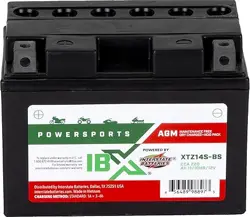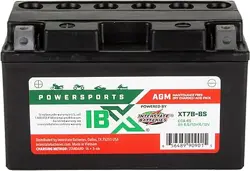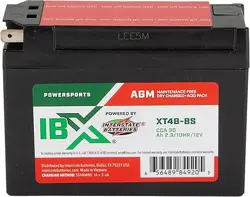
12V 1 AMP {1000 mA) Automatic
Bae Charger & Maintainer
1000mA Charger
For lead-acid batteries
THIS MANUAL CONTAINS IMPORTANT SAFE
AND OPERATING INSTRUCTIONS FOR 12V BAERY CHARGER:
KEEP IT WITH OR NEAR CHARGER AT ALL TIMES.
IMPORTANT SAFE INSTRUIONS
Please read this manual and follow the instructions carefully before using the charger.
WARNING - RISK OF EXPLOSIVE GASES. WORKING IN VICINI OF A LEAD-ACID BAERY
IS DANGEROUS. EXPLOSIVE GASES DEVELOP DURING NORMAL BAERY OPERAON. IT IS
IMPORTANT THAT EACH ME BEFORE USING YOUR CHARGER, YOU READ THIS MANUAL AND
FOLLOW.THE INSTRUONS EXALY,
Never charge lithium ion batteri on this charger.
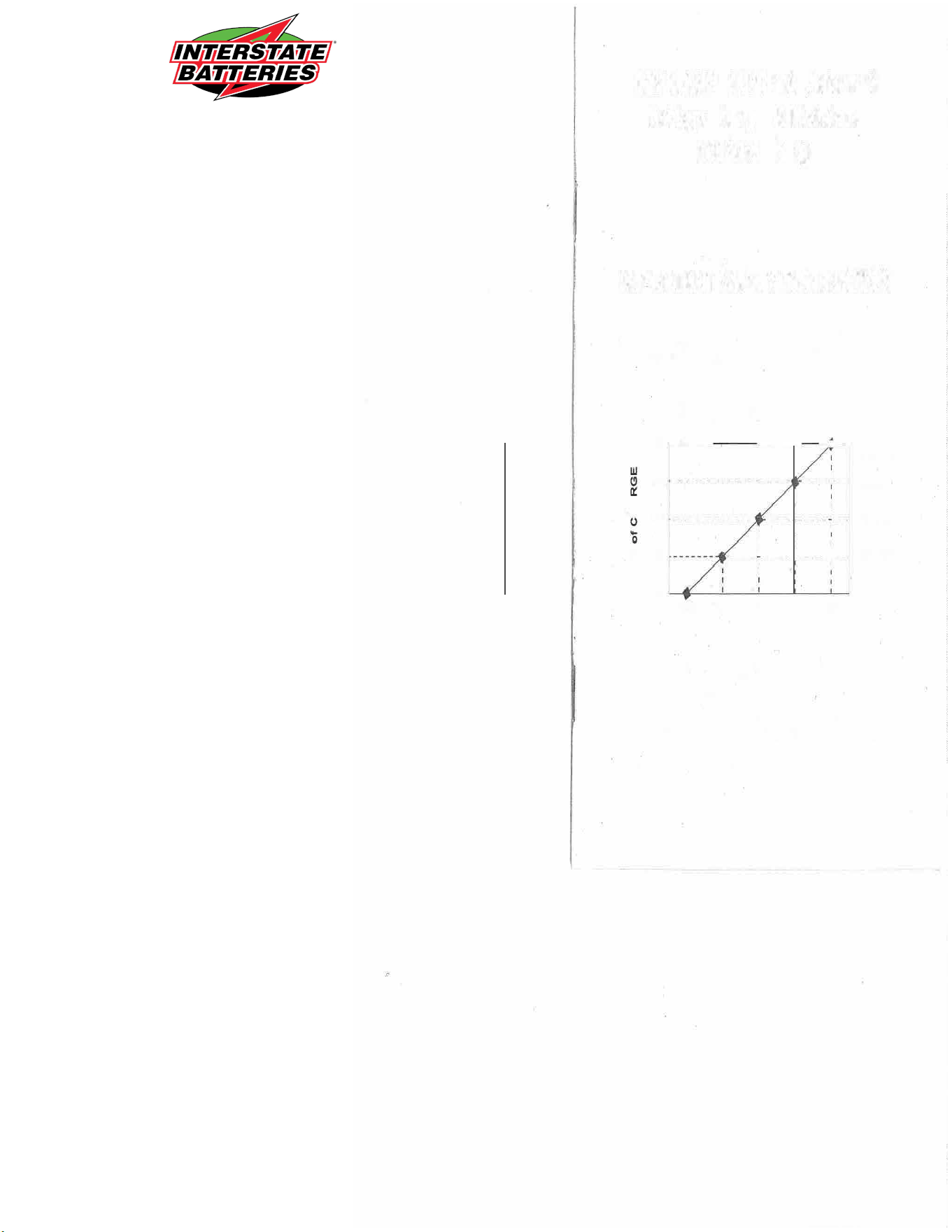
The charge me will be dependent on the Ah rating of the individual battery. See cha below.
100% .�-----------------
7
5%
- - -
---
- - - - - - - - --- - -
-
____ __ _
I
I I
50% ---------
----
-
____ j _____ , __ _
25%
0%
11.SV
I I
I
I
I
t I
------ , _____ _____ __ _
11.9V
I
I
I
12.3V
VOLTAGE
12.7V 13V
*Approximate carge time using a constant current charger at
standard amps specified on the batte. Charging times may
va depending on the Ah rating of the batte.
'Approximate
charge time
3-6 hours
5-11 hours
13-20 hours
We always remmend that you check the batte manufacturer's specications before using lhis charger.
To reduce sk of battery_ explosion, follow ese instructions and those published by battery manufacturer and
manufacturer of any equipment yo intend to use in vicinity of battery. Review cautionary marking on these
products and on engine.
Do not expose charger to rain, snow, or liquids.

. 1
Use of
an attachment not recommended or sold by the
batte
ry ch
a
rger manufacturer may result in a fire,
electrfc hock, or personal injury.
lo
reduce risk of electric shock, unplug charger from AC out
l
et
before attemp
ting
any maintenance or
cleaning
, Turning o controls will not reduce
this risk.
Do not operate charger ir it has received a sharp blow,. been dropped, or otherwise
damaged in any way;
take
it to a quali
f
ied seice professional.
Do not disassemble charger; take
it to a
qualified service center when service or repair is required.
Incorrect
reassembly may result
In
a risk of electric
shock or fire.
PERSONAL PRECAUTIONS
Someone should be within range
of your voice or close enough to
come to your aid when you work
near a lead-acid battery. Have plenty of fresh water and soap nearby in case battery acid concts skin,
clothing or eyes. Wear complete eye and clothing proteion. Avoid touching eyes while working near
battery.
If batte acid contacts skin or clothing, wash immediately with soap and water. If acid enters eye,
immediately flush eye with running cold water r at least 10 minutes and get medical aention
immediately.
.
NEVER smoke or allow a spark or flame in vicinity of battery or engine.
Be
extra cautious to reduce risk of dropping a metal
tool onto battery. It might spark or short-circuit
battery or other eleril part that may use explosion.
Wheri working with a lead-acid batte, remove personal metal items such as rings, bracelets,
necklaces, watches, etc. A lead-acid baery n
produce a short-circuit current high enough
to weld a
ring or the like to mel, causing a severe burn.
Use
charger for charging a Lead-Acid Bae only. It Is not intended to supply power to a low
voltage el�ical system other than
In a st
a
rter-motor application. Do not
use baery charger r
charging d-cell batteries that are commonly used with home appliances. These baeries may burst
and use bodily Inju and damage to property.
NEVER charge a frozen battery.
PREPARING TO CHARGE
If necessa to remove battery om vehicle to charge, alwa remove grounded terminal from baery
first. Make sure all accessories in the vehicle are off, so as not to cause an arc. Be sure area around
bary
is well ventilated while batte is being
charged. Gas can be forcefully blown away by using a
piece of cardboard or other non-metallic material
as
a ran.
Clean baery terminals. Be reful to keep corrosion from coming into contact with eyes. Add distilled
wa In ch ll unUI bat acid reach level speed by baery manucturer. This hel purge
excessive gas from cells. Do not overfill. For a batte without caps, carefully follow manufacturer's
recharging instructions.
Study all batte manuurer's specific prautions such as removing or not removing cell caps while
charging and recommended rates of charge.
Determine voltage of battery by contacting batte manufacturer and make sure it matches output
ratings of battery charger.
CHARGER LOCAON
Locate charger as far away from batte as DC cables permit.
Never pla charger directly above battery being charged; gases from batte will corrode and damage
charger.
Never allow bae acid to drip on charger when reading gvity or lling batte.
Do not operate charger in a clos-in area or restrict ven�latlon in any way.
Do not set a batte on top of charger.
If an extension cord is needed, It should be a grounded, heavy duty cord (12 gauge or better).
DC CONNEON PRECAUONS
Connect and disnnect DC output terminals only aer removing charger from AC outlet.
Ner allow DC output termina to touch each oer.
If problems arise nneing the output leads, solicit the aid of your Deal�r from whom you purtha�ed
this product or the charger manufacturer for finding a suible connection device ror yaur application.
FOLLOW THESE STEPS WHEN BAER IS INSTALLED IN VEHICLE. A SPARK NEAR BAERY
MAY CAUSE BAERY EXPLOSION. TO REDUCE RISK OF A SPARK NEAR BAERY:
P.2
Position AC and DC rds to reduce risk of damage by hd, door or moving engine part.
Stay clear of fan blades, bel, pulleys, and any other pa that can cause Inju to persons .

Check polarity
of battery
posts POSITIVE (POS.,P,+) post usually has larger diameter than
NEGAVE - (NEG.,N,-),
Determine
which post of battery is grounded
(conneed) to chassis.
For negative-g
rounded
vehicle, rst connect POSITIVE (RED) clip from charger to POSVE
(POS.,P,+) ungrounded post of battery. Then connect NEGAVE (BCK) terminal to vehicle
chassis or engine block away from battery.
For
positive-grounded vehicle, conne NEGAVE (BCK) clip from charger to NEGAVE
(NEG.,N,-)
ungrounded
st of batte1y. _C
onnect POSmVE (RED) clip to vehicle chassis or engine
block
away from
ba
tty keeping the ba
t
tery LErminal well-removed therefrom.
Do not connect any charger clips to carburetor, el lines, or sheet-metal body pa. Connect to a
heavy gauge metal pa of the frame or engine block.
Connect AC supply cord charger to electric outlet.
When disconneing charger, turn switches (if supplied) to o, disconnect charger from AC power,
remove clip from vehicle chassis, and then remove clip from baery terminal. See operating
instructions for length of charge information.
Make sure the batte pe seleion switch position is corr.
See operating instruions r length of charge information.
FOLLOW THESE STEPS WHEN BAERY IS OUTSIDE VEHICLE. A SPARK NEAR THE BAERY MAY
CAUSE BAERY EXPLOSION. TO REDUCE RISK OF A SPARK NEAR BAERY:
Check polarity of battery posts. POSITIVE (P0S.,P,+) battery post usually has a larger diameter than
NEGATIVE (NEG.,N,-) post. Some batteries are equipped with 'Wing- nut' terminals allowing for easy
placement of the terminals to these posts.
Attach at least a 24 inch long 6 gauge (AWG) insulated batte cable to NEGAVE (NEG.,N,-)
batte post.
Connect POSITIVE (RED) charger terminal to POSfVE (POS.,P,+) post of batte.
Position
yourself and free end of ble as far away from bae as possible, then nnect NEGAVE
(BLACK) terminal to free end of cable.
Do not face baery when making final connection.
Conne AC supply cord charger to power outlet.
When
disconnecting charger, always do so in
reverse sequence of connecting procedure and break
first connection while as far away from battery as possib
l
e.
A marine (boat) batte must be removed and charged on shore. To charge it on board requires
equipment specially designed for marine use.
SAFE & FEATURES: Automatic Switching Mode Batte Charger & Maintainer
Never overcharge your bae
Easy to Use: The Bary Charger is easy to operate and requires no technil experience.
Charge & Maintain - Automatic Charge: On power up, the charger will automatically go to charging
system, then could be le unattended and never overcharge your batteries.
Charge & Maintain - Automatic Maintenance: When the batte is charged to "full" state, the
charger automatilly switches to maintain the baery. It will monitor the baery voltage and continue
to peak performance to the bae.
Sho circuit protection: The charger will automatically turn o when the output short circuit
occurred and prevent any damage.
Output overload proteion: The charger employs the use of a 'Solid State Orcuit Interrupter' that
opens under severe overload. This condition may our if attempting to charge any severely
discharged or heavily sulted battery. On the Interrupter opens, e charger will stop charging r
a short period and then rume charging automatically and the yellow. L.E.D. will be OFF, until
resume charging. Overloading uld be due to an external load, remove the load ndition prior to
attempting to recharge the batte.
Resee Bae / O_verload Condition: The charger has reverse batte and short circuit.
proteion. If a reverse baery condition exis (Fault L.E.D. will turn RED, only, while output leads are
connected backwards), simply unplug charger from AC power and properly remake the connections as
described in this manual.
Bae cells shoed detection: The unit will automatilly det the baery internal cells
condion, if the battery cells are shorted or bad, the Red fault LED will Hash.
Weak or sulphated bat detecon: The unit will automatically detect the battery sulphated
conditions, If the battery is sulphated or cannot hold the charge, the Green LED will Hash.
P.3
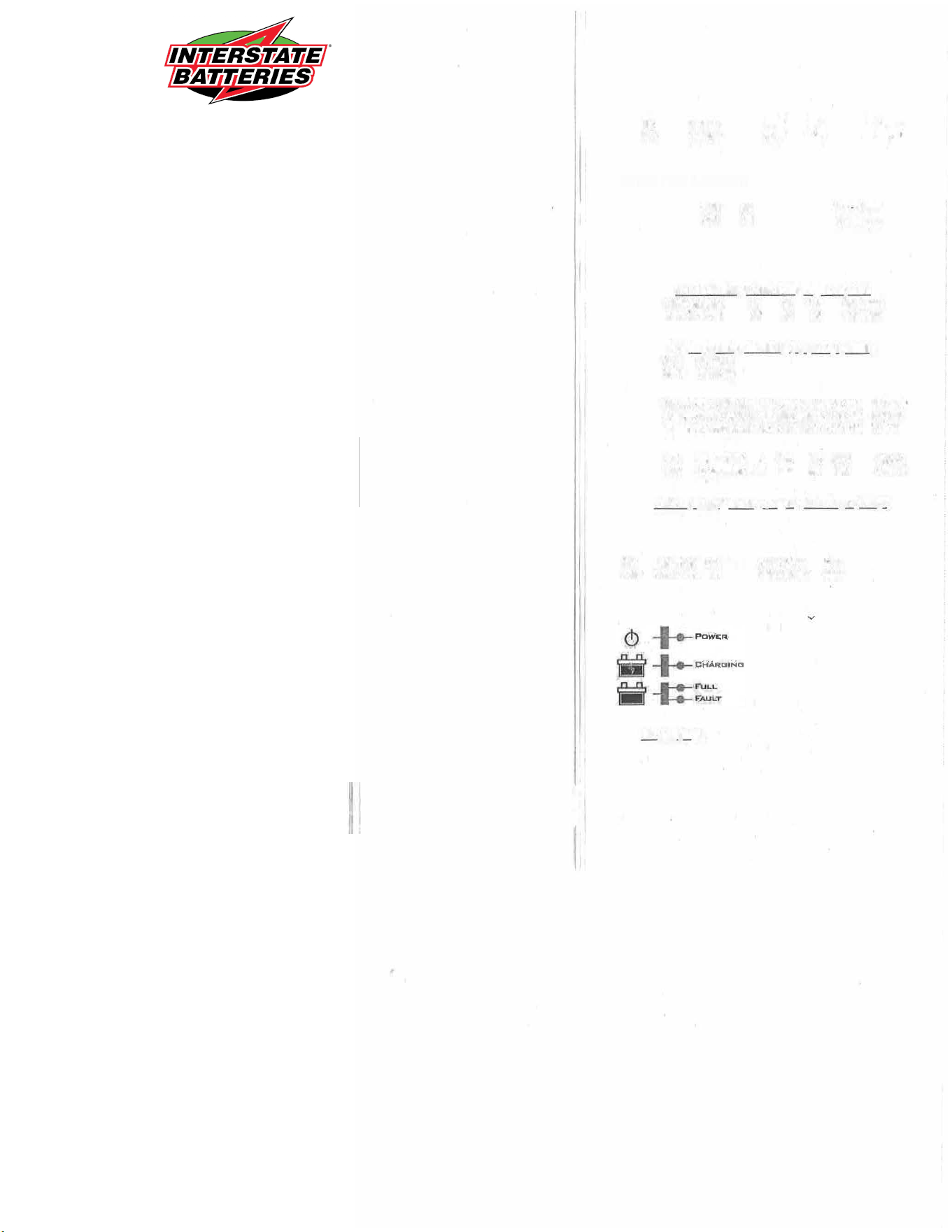
Internal overheat heat protecon:
The charger has internal
overheat protection. The charger will
turn o power until the temperature
is down to a safe level and star
t
charging again. All LEDs will be
o.
Output clips and ring terminals provided: It comes with a quick conne
fly lead and 2 dierent
kinds of connectors, afllgator clips and ring termlnals. The ng terminals are perf F
or
rmanent
connection to your baery. u
can nnect the
lead to the battery and tuck the lead away whJ!e you
are using your vehicle and when you get back to your garage simply plug e lead back into the
charger.
BAERY PES & CAPAC:
Suits all lead-acid batteries. (Conventional, AGM & High Peormance AGM).
Batte pacity: e thrger Is design to charge Interstate
®
brand 12V lead-acid batteries.
The maximum AH pacles are to used as a general guide only; some batti maybe able to
handle a higher Charge Current. Check with the baery Manufaurer when charging batteries with
small capacity.
OPERATING INSTRUIONS:
STEP 1 - Pre Chae Check & Elerole Level Check
Check the bae elerolyte level (Not required on aled & Maintenance Free Batteri).
If necessary, remove the vent and add distilled wa so the lels are halay be1wn the upper
and lower fill lines.
2 - nneing the Batte charger to your Batte
If the Bae Is out of e vehlde:
o nn the Red ld fm e charger to the positive ( +) batte terminal.
o Connect the Black lead from e charger to the negative (-) batte terminal.
If the Batte is ll in the vehicle, determine If the vehicle
Is
sftlvely ( +) or nativy(-) eart11ed.
o
ir Negatively Earthed (Most Common) - FtRST Conne t Red ( +) ttery charger leI to
the positive ( +) Bary pa ad
t
�en nnect the Bla (-) batte charger lead to U1e
vehicle's chassis and away om the fuel line.
o lf Positively Earth - RST onne the a (-)_batry charger lead to the Negative (-)
battery post and then connect the Red ( +) batte charger lead the Vehicle's chassis and far
away from the el line.
EP 3 - Conne e batte chaer Mains Power C120VAC)
Conne e bae charger to a 120VAC Mains Power outlet.
Turn on the 120VAC Power ouet.
The Charger will automatically when AC power Is conneed and switched on.
(Note: If the Fault Indicar LEO mumlnates red, plse check your connions it is likely that the positive
and negative leads are revsed. Refer to trouble Shting page for further Information)
THE CHARGING PROCESS:
The charging stages are as follows:
P.4
So chae
Gently charges the bae using a redud charge output until the battery voltag reaches 11.0 V.
(LED color -Yellow ashing).
Bulk Charge
Charges using a
constant
maximum current (1A) until the battery reaches 14.4 V.
(12 Volt batteries) - (LED lor
-
Yellow)
Absorption Chae
Uses a constant voltage while reducing the
charging
output current to ensure the battery receives a
full charge without overcharging e battery. (LED Color -Yellow)
Fully/ Roat
Battery is fully charged and is being maintained. (LED Color - Green)
P 4 - Disconneng e Bae chaer from Ba
If the Battery is out of the vehide.
o Switch OFF and Remove the AC Power Socket from the outlet.
o Remove the Black lead and then the Red lead.
o Check elerolyte levels if possible.
( they may need topping up with distilled water aer charging)
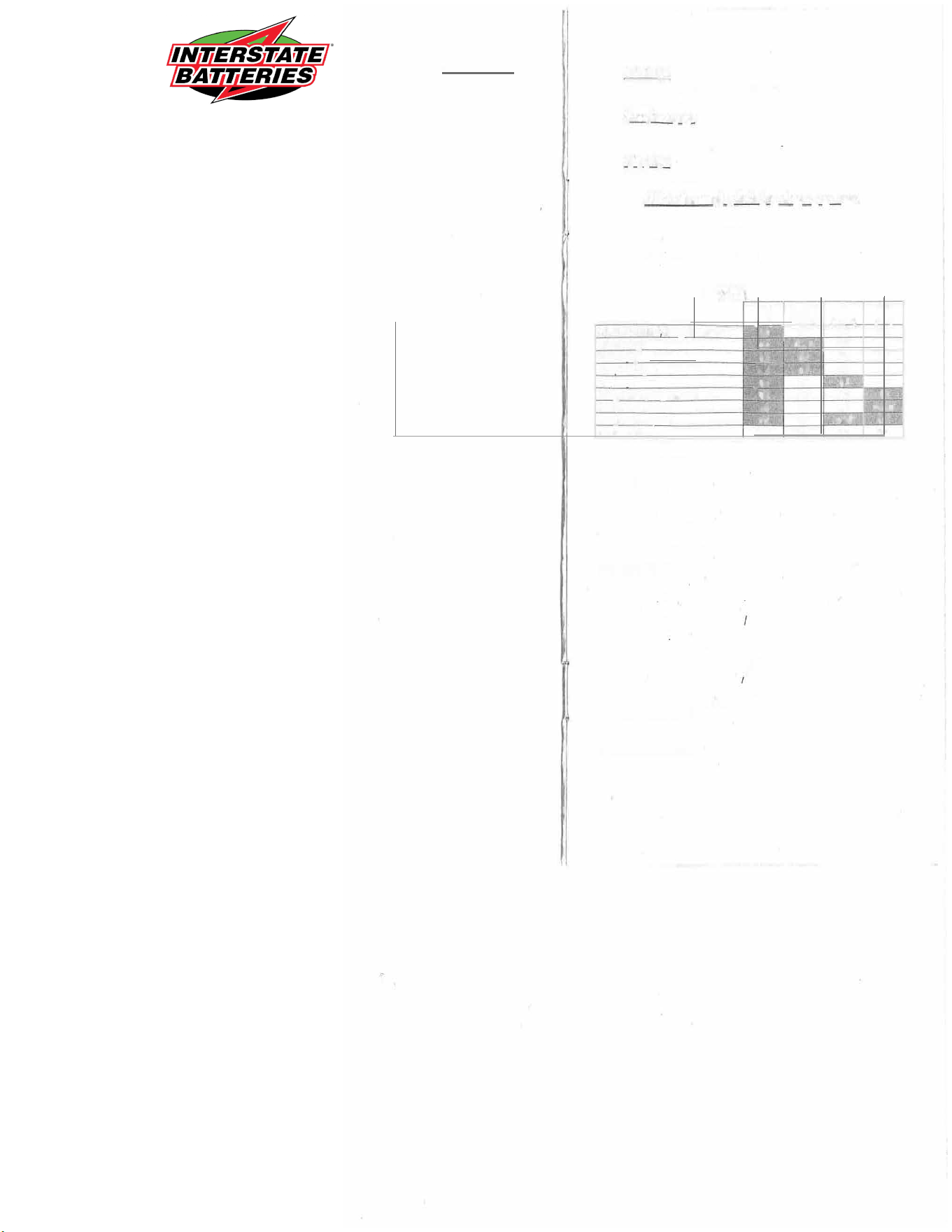
LED STATUS INIDITOR TABLE:
A.C. Power conneed batte disconneed
So sta chae
Bulk arging
Absorotion charoe
Fullv charoed
Batte Reverse oolari connection
Baerv bad cells deteion
Batte weak or sulphated
A.C. Power OFF
ELERICAL PARTS:
Delivered with:
Input connector:
o 2 PIN plug
Output rd:
o 10 feet with Quick Connector
Extension cord:
..
Power
(R)
QJ.l
ON
ON
ON
ON
.
01\h
ON
ON
OFF
Charging
{Yellow)
OFF
RH
ON
O.N
OFF
OFF
OFF
OFF
OF.F
o 2 feet inllne 3A fused with alligator dips
/
ring terminals.
SPECIFICATIONS:
Input voltage:
Input Frequency:
Output:
Size (L *W*H) In in:
Weight:
Approvals:
100-120Vac
S0/60Hz
1A@12V
3.9*2.7*1.4 in mm 105*68*35
0.91bs
/ 0.4Kg
UcUL/FCC/BGDOE
ENVIRONMENTAL CHARAERISTICS:
Operating Temperature:
Storage Temperature:
Operating Humidi Range:
Cooling: Passive / Natural
TROUBLE SHOONG
0 to 113•F
o to 4s•c
-13 to 185"F I -25 to as·c
0 to 90% RH
Full
{Green)
OFF
OFF
OFF
OFF
"ON
OFF
OFF
FH
OFF
Fault
{Red)
OFF
OFF
OFF
OFF
OFF
�ON
OFF
OFF
P.5
I
i
11
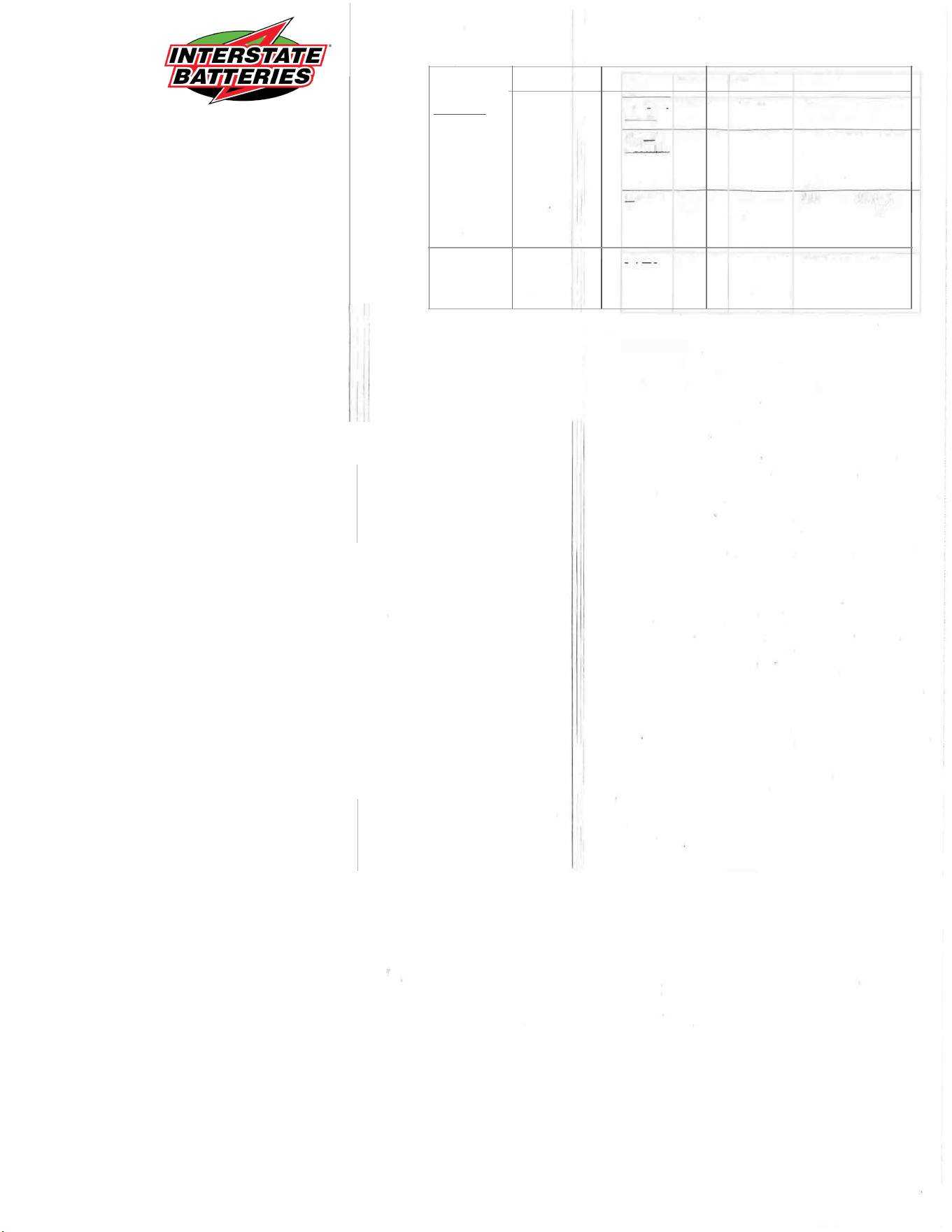
Typ of
Pblems
tbme
r
5
not work?
!
e
.
r
h
nonr� .. n
No
�bml
�
f L
ED
l
s
Indication
No Indicator
ligh ON
Fault LED is ON.
Fault RED LED
is Flashing.
Full LED is
Flashing.
MAINTENANCE
Possible Causes
Suggested Solution
- No AC power
- Check AC conneions and make sure
Power
Point is switched ON
- Reverse polarity
- Chk that the crocodile clips haven't
connion
to
fallen o the battery.
Ba
- Check that the crocodile clips / ring
terminals are conneed to the corr
polarity.
- Baery is severely
- Check the Baery condiUon, age, etc.
sulphated
- Baery cannot be charged and mu be
- Bae has a
replaced.
damaged cell
- Baery is severely
- Battery may need replacement.
sulphated.
Store In dean, d pla. Osionally cln the case and cords with a d cloth. The charger should be
disconneed from the power while deaning.
P.6
Do not disassemble charger, cord or any associated part; take it to a q_ualified service center when seice
or repair Is required. Incorre reassembly may result In a risk of eleric shock or re.