nual
H
E
N)
g
Manual
Register your instrument!
www.eppendorf.com/myeppendorf
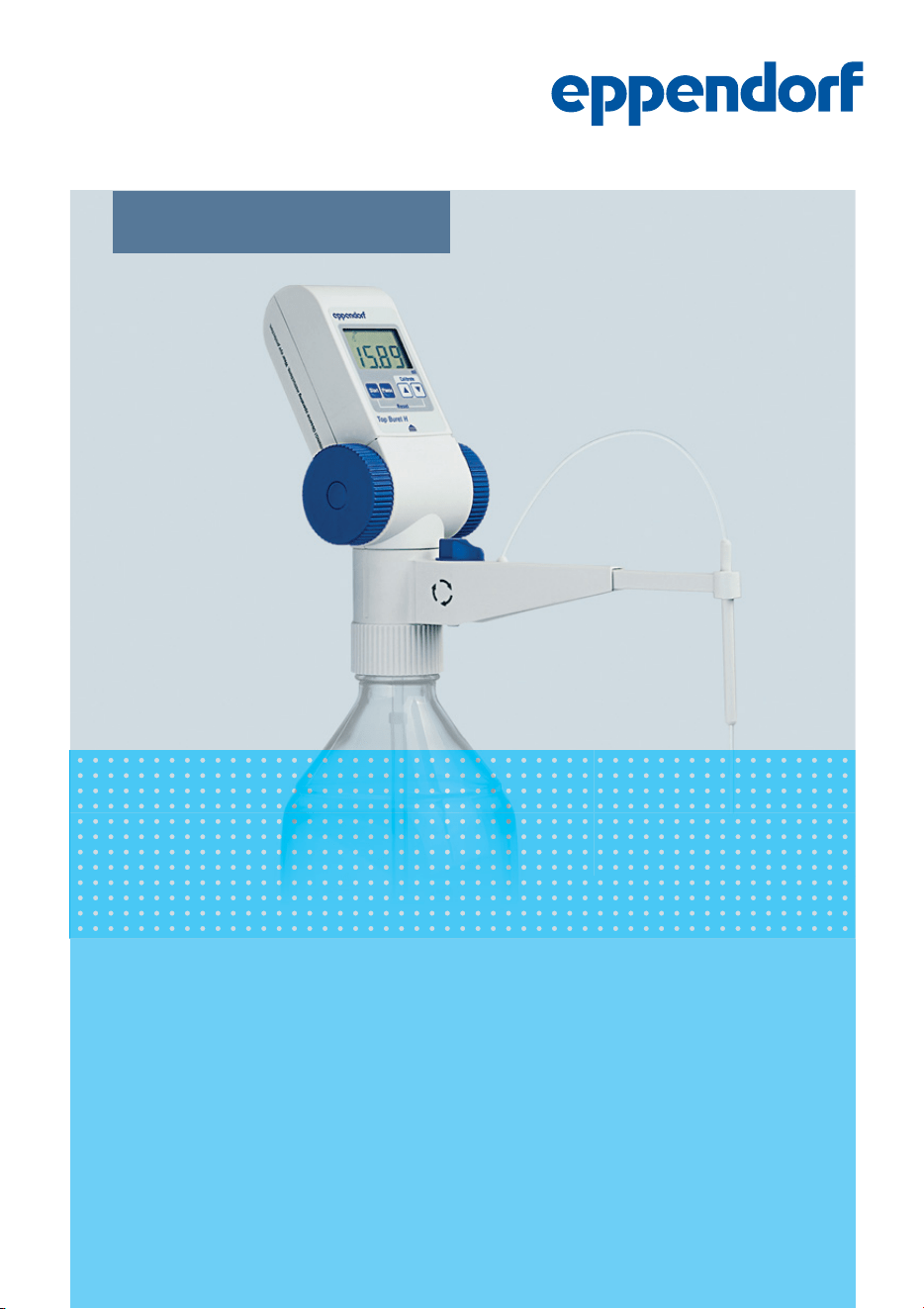
Top Buret M/H
Operating Manual

4965 900 018-08/102022
Copyright© 2022 Eppendorf SE, Germany. All rights reserved, including graphics and
images. No part of this publication may be reproduced without the prior permission of the
copyright owner.
Eppendorf
®
and the Eppendorf Brand Design are registered trademarks of Eppendorf SE,
Germany.
Eppendorf trademarks and trademarks of third parties may appear in this manual. All
trademarks are the property of their respective owners. The respective trademark name,
representations and listed owners can be found here: www.eppendorf.com/ip
.
U.S. Patents and U.S. Design Patents are listed on www.eppendorf.com/ip
.

Table of contents
Top Buret M/H
English (EN)
3
Table of contents
1 Operating instructions. . . . . . . . . . . . . . . . . . . . . . . . . . . . . . . . . . . . . . . . . . . . . . . . 5
1.1 Using this manual . . . . . . . . . . . . . . . . . . . . . . . . . . . . . . . . . . . . . . . . . . . . . . 5
1.2 Danger symbols and danger levels . . . . . . . . . . . . . . . . . . . . . . . . . . . . . . . . . 5
1.2.1 Danger symbols . . . . . . . . . . . . . . . . . . . . . . . . . . . . . . . . . . . . . . . . 5
1.2.2 Danger levels . . . . . . . . . . . . . . . . . . . . . . . . . . . . . . . . . . . . . . . . . . 5
1.3 Symbols used . . . . . . . . . . . . . . . . . . . . . . . . . . . . . . . . . . . . . . . . . . . . . . . . . 5
1.4 Abbreviations used . . . . . . . . . . . . . . . . . . . . . . . . . . . . . . . . . . . . . . . . . . . . . 6
2 Safety . . . . . . . . . . . . . . . . . . . . . . . . . . . . . . . . . . . . . . . . . . . . . . . . . . . . . . . . . . . . . 7
2.1 Intended use . . . . . . . . . . . . . . . . . . . . . . . . . . . . . . . . . . . . . . . . . . . . . . . . . . 7
2.2 Symbols on the device . . . . . . . . . . . . . . . . . . . . . . . . . . . . . . . . . . . . . . . . . . 7
2.3 Application limits . . . . . . . . . . . . . . . . . . . . . . . . . . . . . . . . . . . . . . . . . . . . . . 9
2.3.1 Physical properties of the liquid . . . . . . . . . . . . . . . . . . . . . . . . . . . 9
2.3.2 Unsuitable liquids . . . . . . . . . . . . . . . . . . . . . . . . . . . . . . . . . . . . . . 9
2.3.3 Suitable liquids . . . . . . . . . . . . . . . . . . . . . . . . . . . . . . . . . . . . . . . 10
2.4 User profile . . . . . . . . . . . . . . . . . . . . . . . . . . . . . . . . . . . . . . . . . . . . . . . . . . 11
2.5 Warnings for intended use . . . . . . . . . . . . . . . . . . . . . . . . . . . . . . . . . . . . . . 11
3 Product description . . . . . . . . . . . . . . . . . . . . . . . . . . . . . . . . . . . . . . . . . . . . . . . . . 13
3.1 Delivery package . . . . . . . . . . . . . . . . . . . . . . . . . . . . . . . . . . . . . . . . . . . . . . 13
3.1.1 Accessories – bottle thread adapter . . . . . . . . . . . . . . . . . . . . . . . 13
3.2 Product overview. . . . . . . . . . . . . . . . . . . . . . . . . . . . . . . . . . . . . . . . . . . . . . 14
3.2.1 Control panel . . . . . . . . . . . . . . . . . . . . . . . . . . . . . . . . . . . . . . . . . 15
3.2.2 Telescopic aspirating tube. . . . . . . . . . . . . . . . . . . . . . . . . . . . . . . 16
3.2.3 Thread adapter . . . . . . . . . . . . . . . . . . . . . . . . . . . . . . . . . . . . . . . 16
3.3 Features. . . . . . . . . . . . . . . . . . . . . . . . . . . . . . . . . . . . . . . . . . . . . . . . . . . . . 17
3.4 Materials . . . . . . . . . . . . . . . . . . . . . . . . . . . . . . . . . . . . . . . . . . . . . . . . . . . . 18
4 Installation . . . . . . . . . . . . . . . . . . . . . . . . . . . . . . . . . . . . . . . . . . . . . . . . . . . . . . . . 19
4.1 Mounting the dispenser . . . . . . . . . . . . . . . . . . . . . . . . . . . . . . . . . . . . . . . . 19
4.2 Mounting the canula arm . . . . . . . . . . . . . . . . . . . . . . . . . . . . . . . . . . . . . . . 20
4.3 Inserting the batteries . . . . . . . . . . . . . . . . . . . . . . . . . . . . . . . . . . . . . . . . . . 21
4.4 Mounting the telescopic aspirating tube . . . . . . . . . . . . . . . . . . . . . . . . . . . 22
4.4.1 Adjusting the telescopic aspiration tube to the height
of the bottle . . . . . . . . . . . . . . . . . . . . . . . . . . . . . . . . . . . . . . . . . . 22
4.4.2 Shortening the telescopic aspiration tube for smaller bottles. . . . 23
4.4.3 Inserting the telescopic aspirating tube . . . . . . . . . . . . . . . . . . . . 23
4.5 Screwing the dispenser onto the bottle . . . . . . . . . . . . . . . . . . . . . . . . . . . . 23
4.5.1 Determining the diameter of the flask neck . . . . . . . . . . . . . . . . . 24
4.5.2 Screwing on the thread adapter . . . . . . . . . . . . . . . . . . . . . . . . . . 24
4.6 Connecting the drying tube . . . . . . . . . . . . . . . . . . . . . . . . . . . . . . . . . . . . . 25

4
Table of contents
Top Buret M/H
English (EN)
5 Operation . . . . . . . . . . . . . . . . . . . . . . . . . . . . . . . . . . . . . . . . . . . . . . . . . . . . . . . . . 26
5.1 Venting the dispenser . . . . . . . . . . . . . . . . . . . . . . . . . . . . . . . . . . . . . . . . . . 26
5.2 Titrating liquid . . . . . . . . . . . . . . . . . . . . . . . . . . . . . . . . . . . . . . . . . . . . . . . 27
5.3 Changing the supply bottle during titration . . . . . . . . . . . . . . . . . . . . . . . . . 28
5.4 Removing the bottle . . . . . . . . . . . . . . . . . . . . . . . . . . . . . . . . . . . . . . . . . . . 29
5.5 Emptying the dispenser . . . . . . . . . . . . . . . . . . . . . . . . . . . . . . . . . . . . . . . . 29
6 Calibration and adjustment . . . . . . . . . . . . . . . . . . . . . . . . . . . . . . . . . . . . . . . . . . . 30
6.1 Calibrating the dispenser . . . . . . . . . . . . . . . . . . . . . . . . . . . . . . . . . . . . . . . 30
6.2 Adjusting the dispenser . . . . . . . . . . . . . . . . . . . . . . . . . . . . . . . . . . . . . . . . 30
6.2.1 Adjustment to distilled water. . . . . . . . . . . . . . . . . . . . . . . . . . . . . 30
6.2.2 Adjustment to a liquid with a different density . . . . . . . . . . . . . . . 31
6.3 Resetting the Top Buret to the factory settings . . . . . . . . . . . . . . . . . . . . . . 32
7 Troubleshooting . . . . . . . . . . . . . . . . . . . . . . . . . . . . . . . . . . . . . . . . . . . . . . . . . . . . 33
7.1 Error search. . . . . . . . . . . . . . . . . . . . . . . . . . . . . . . . . . . . . . . . . . . . . . . . . . 33
8 Maintenance. . . . . . . . . . . . . . . . . . . . . . . . . . . . . . . . . . . . . . . . . . . . . . . . . . . . . . . 34
8.1 Cleaning the dispenser . . . . . . . . . . . . . . . . . . . . . . . . . . . . . . . . . . . . . . . . . 34
8.1.1 Standard cleaning . . . . . . . . . . . . . . . . . . . . . . . . . . . . . . . . . . . . . 35
8.1.2 Intensive cleaning . . . . . . . . . . . . . . . . . . . . . . . . . . . . . . . . . . . . . 35
8.2 Disassembling the dispenser . . . . . . . . . . . . . . . . . . . . . . . . . . . . . . . . . . . . 36
8.3 Replacing the batteries . . . . . . . . . . . . . . . . . . . . . . . . . . . . . . . . . . . . . . . . . 37
9 Technical data . . . . . . . . . . . . . . . . . . . . . . . . . . . . . . . . . . . . . . . . . . . . . . . . . . . . . 38
9.1 Ambient conditions . . . . . . . . . . . . . . . . . . . . . . . . . . . . . . . . . . . . . . . . . . . . 38
9.2 Errors of measurement . . . . . . . . . . . . . . . . . . . . . . . . . . . . . . . . . . . . . . . . . 38
9.3 Parameters for titratable liquids . . . . . . . . . . . . . . . . . . . . . . . . . . . . . . . . . . 38
9.4 Conditions for calibration . . . . . . . . . . . . . . . . . . . . . . . . . . . . . . . . . . . . . . . 38
10 Transport, storage and disposal . . . . . . . . . . . . . . . . . . . . . . . . . . . . . . . . . . . . . . . 39
10.1 Transport . . . . . . . . . . . . . . . . . . . . . . . . . . . . . . . . . . . . . . . . . . . . . . . . . . . . 39
10.2 Storage . . . . . . . . . . . . . . . . . . . . . . . . . . . . . . . . . . . . . . . . . . . . . . . . . . . . . 39
10.3 Disposal. . . . . . . . . . . . . . . . . . . . . . . . . . . . . . . . . . . . . . . . . . . . . . . . . . . . . 40
11 Ordering Information. . . . . . . . . . . . . . . . . . . . . . . . . . . . . . . . . . . . . . . . . . . . . . . . 41
11.1 Dispenser . . . . . . . . . . . . . . . . . . . . . . . . . . . . . . . . . . . . . . . . . . . . . . . . . . . 41
11.2 Spare parts . . . . . . . . . . . . . . . . . . . . . . . . . . . . . . . . . . . . . . . . . . . . . . . . . . 41
11.3 Thread adapter . . . . . . . . . . . . . . . . . . . . . . . . . . . . . . . . . . . . . . . . . . . . . . . 42
Certificates . . . . . . . . . . . . . . . . . . . . . . . . . . . . . . . . . . . . . . . . . . . . . . . . . . . . . . . . 43
Operating instructions
Top Buret M/H
English (EN)
5
1 Operating instructions
1.1 Using this manual
Read this operating manual completely before using the device for the first time.
Observe the instructions for use of the accessories where applicable.
This operating manual is part of the product. Please keep it in a place that is easily
accessible.
Enclose this operating manual when transferring the device to third parties.
The current version of the operating manual for all available languages can be found
on our webpage www.eppendorf.com/manuals
.
1.2 Danger symbols and danger levels
1.2.1 Danger symbols
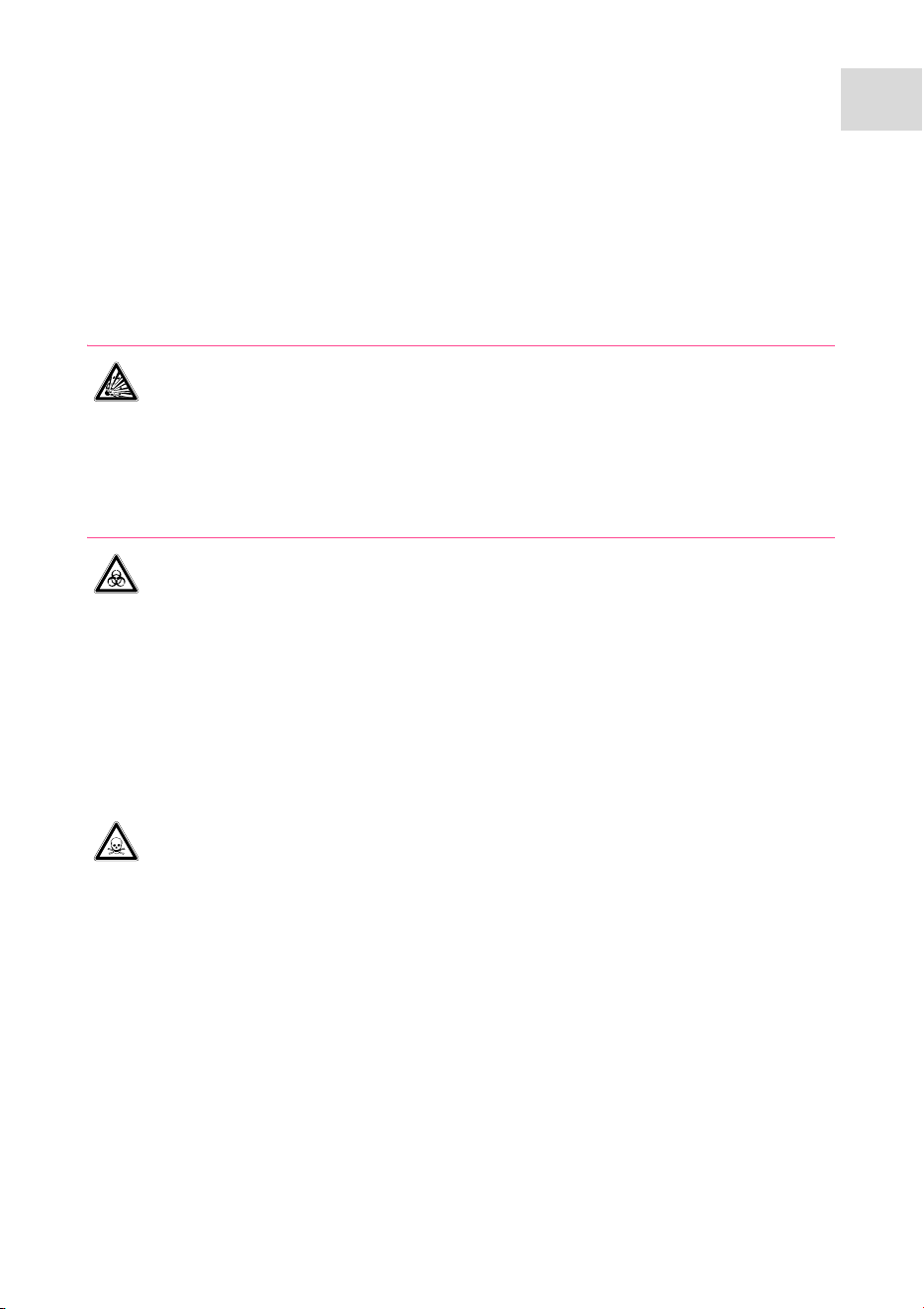
The safety instructions in this manual have the following danger symbols and danger
levels:
1.2.2 Danger levels
1.3 Symbols used
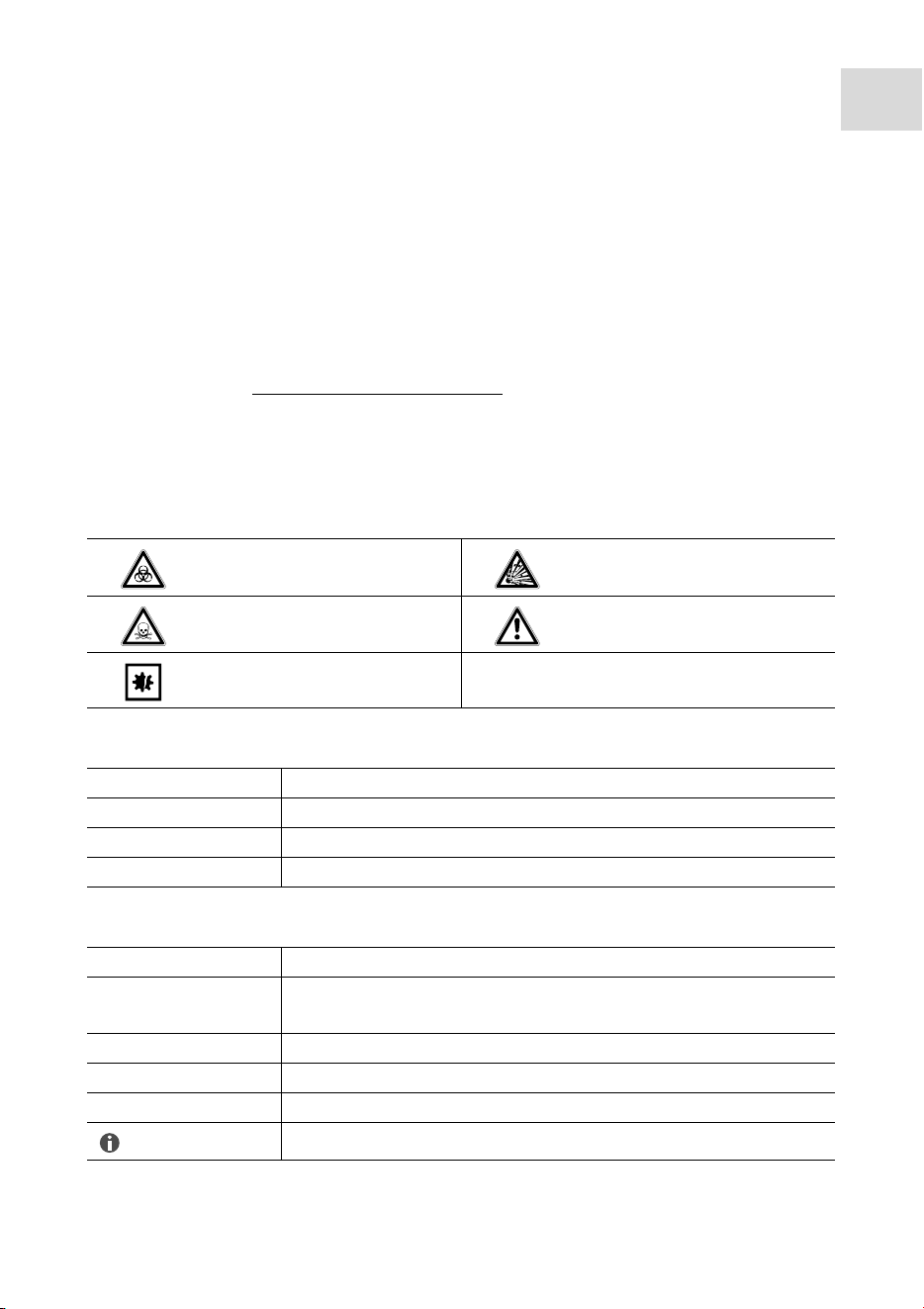
Biohazard Explosive substances
Toxic substances Hazard point
Material damage
DANGER Will lead to severe injuries or death.
WARNING May lead to severe injuries or death.
CAUTION May lead to light to moderate injuries.
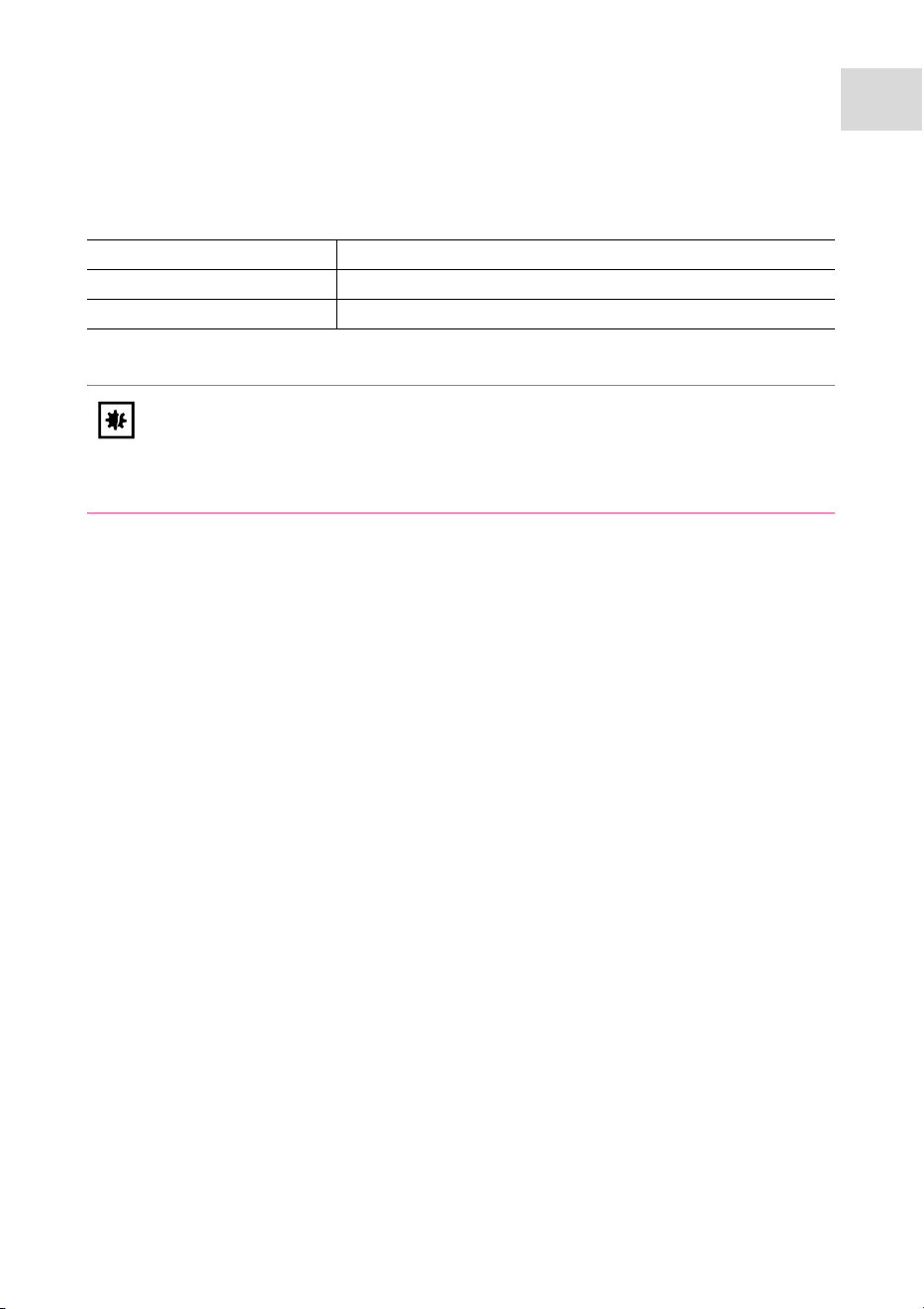
NOTICE May lead to material damage.
Depiction Meaning
1.
2.
Actions in the specified order
Actions without a specified order
• List
Text Display or software texts
Additional information

6
Operating instructions
Top Buret M/H
English (EN)
1.4 Abbreviations used
ETFE
Ethylene-tetrafluoroethylene copolymer
FEP
Tetrafluorethylene-hexafluorpropylene Copolymer
FKM
Fluororubber
PFA
Perfluoroalkoxy copolymer
PP
Polypropylene
PTFE
Polytetrafluorethylene
PVDF
Polyvinylidene fluoride
Safety
Top Buret M/H
English (EN)
7
2Safety
2.1 Intended use
The Top Buret is a product generally used in the laboratory for dispensing aqueous
solutions. Applications in or on the human body (in vivo applications) are not permitted.
The dispenser may only be used within the specified technical and physical limits.
The dispenser must not be exposed to an aggressive atmosphere (e.g., HCI vapors). The
dispenser must not be autoclaved.
2.2 Symbols on the device
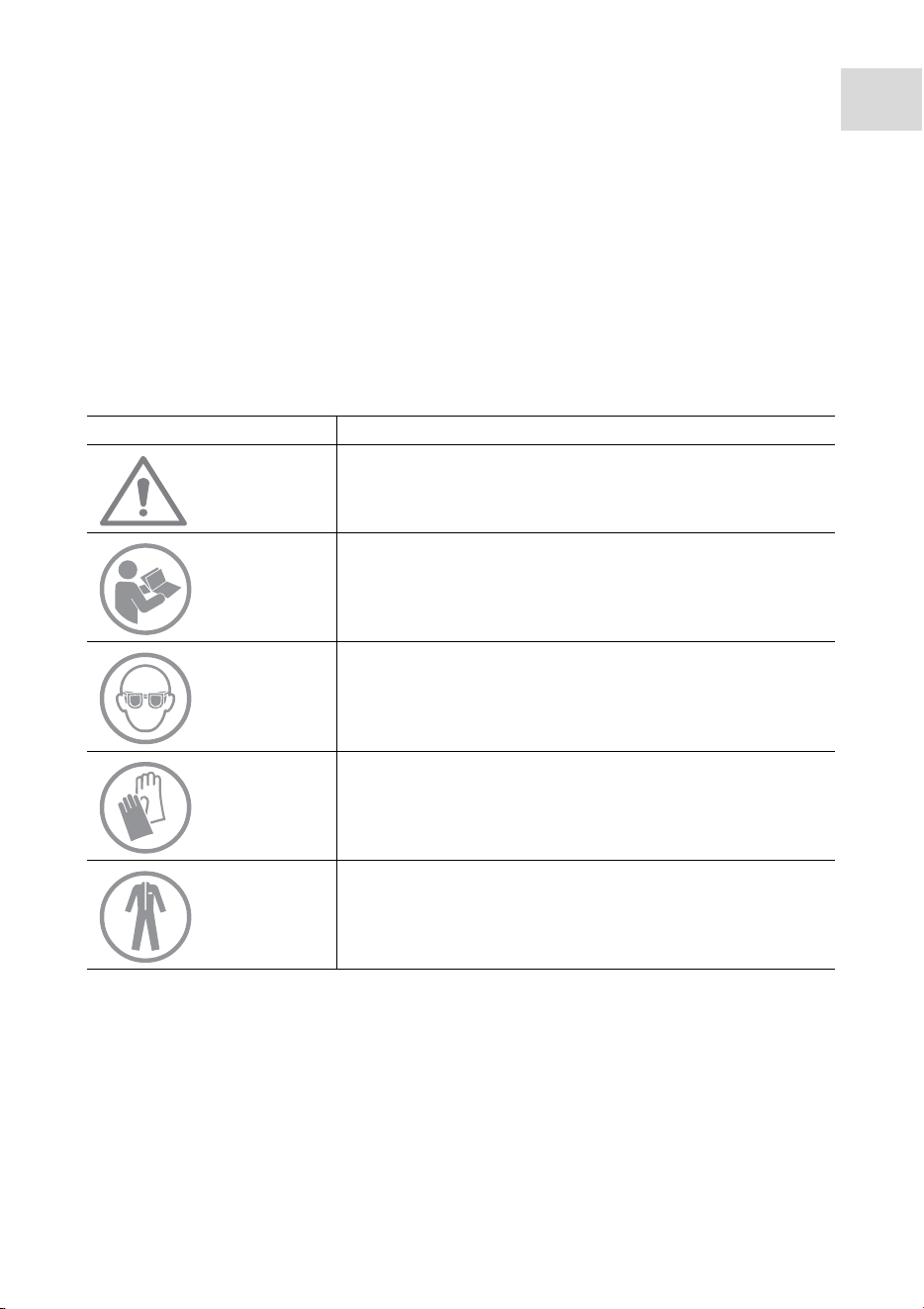
Symbol Meaning
General warning sign
Read instructions
Wear protective eyewear
Wear hand protection
Wear protective clothing
8
Safety
Top Buret M/H
English (EN)
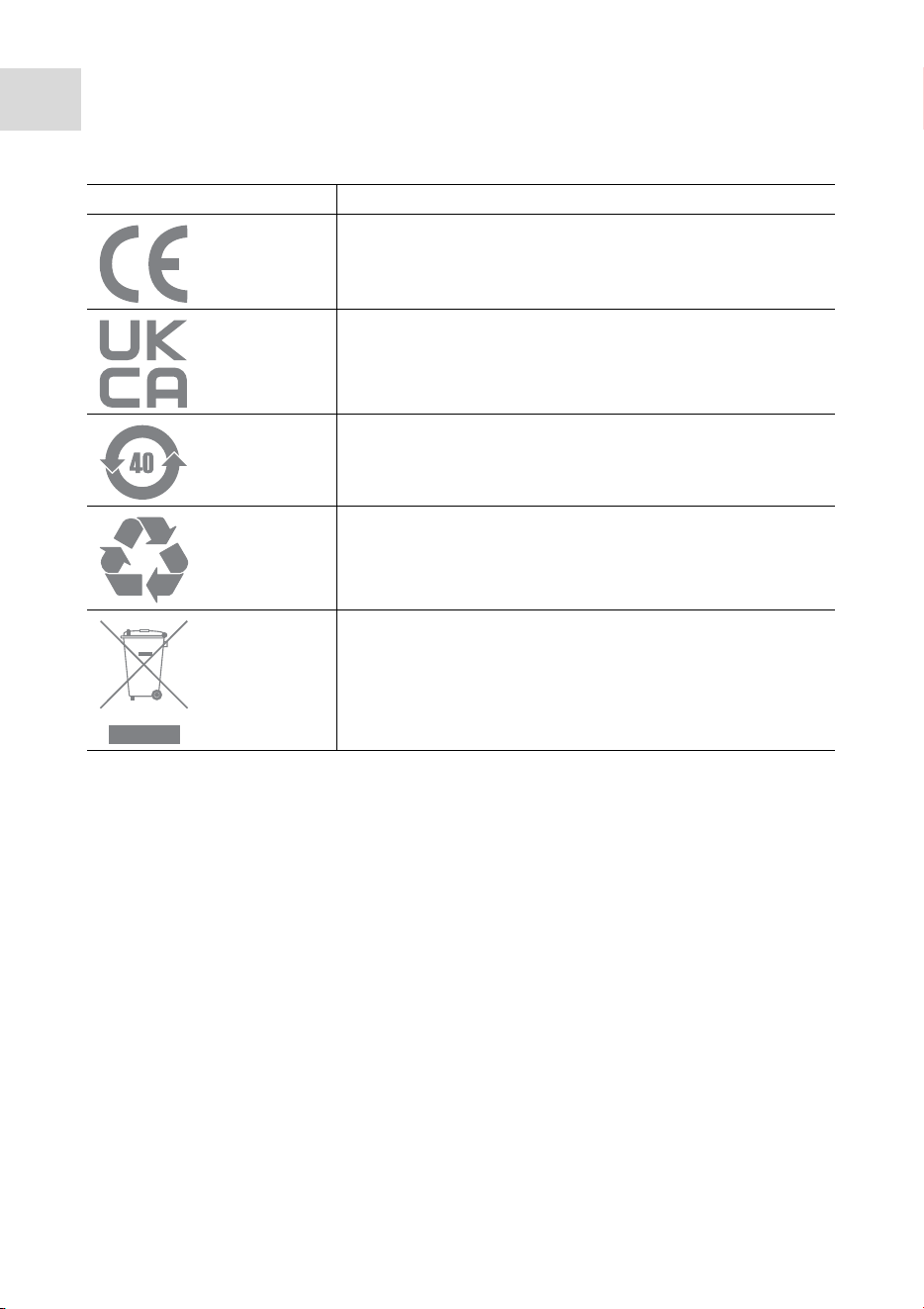
Symbol Meaning
Device meets the European requirements for safety, health
protection and environmental protection.
Device meets the requirements for safety, health
protection and environmental protection in Great Britain.
Device meets the requirements for the authorized use of
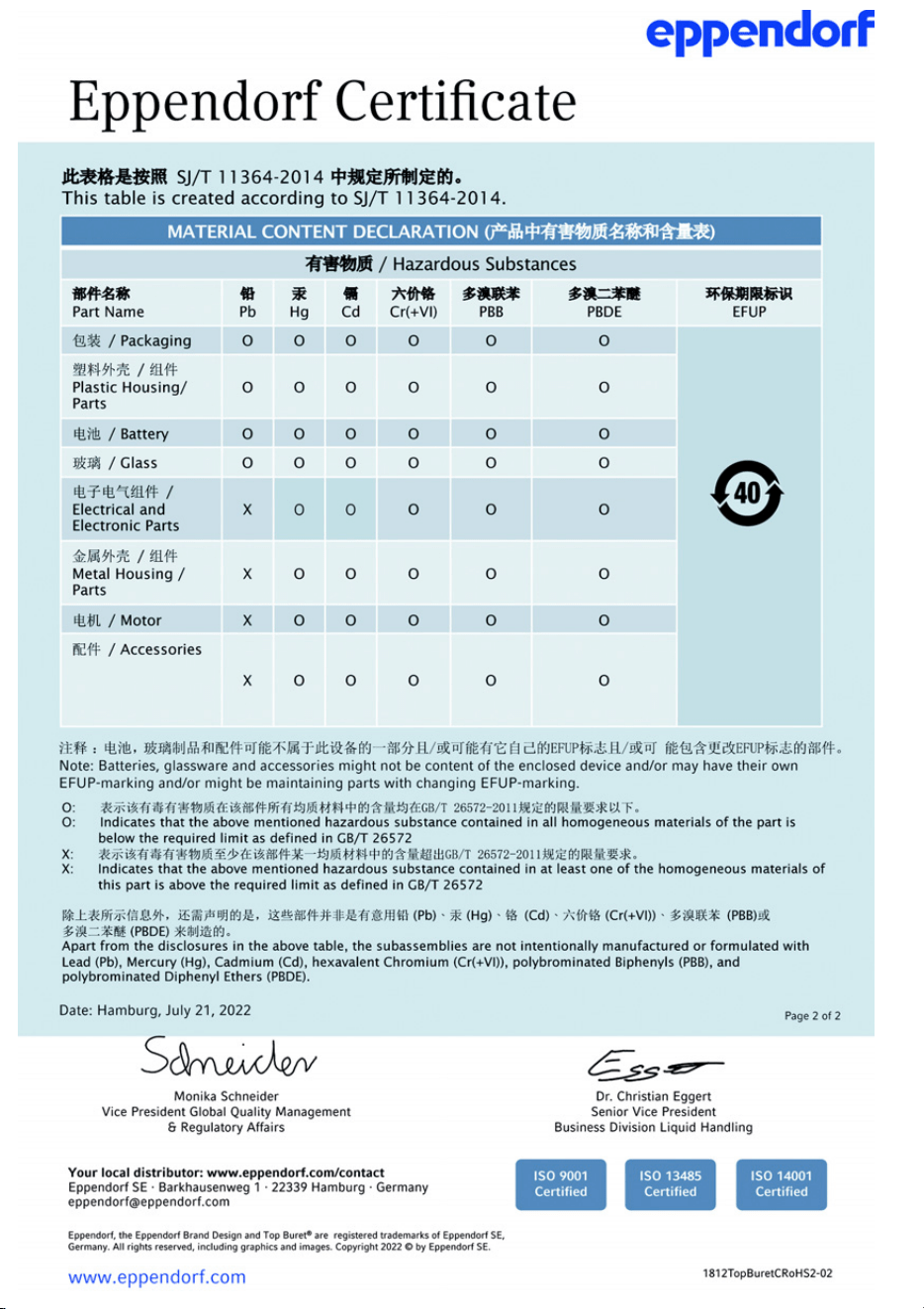
harmful substances in the People's Republic of China.
Dispose of the device properly.
Symbol for the proper disposal of electronic equipment on
European markets.
Safety
Top Buret M/H
English (EN)
9
2.3 Application limits
2.3.1 Physical properties of the liquid
2.3.2 Unsuitable liquids
The dispenser is not suitable for the following solutions, substances, and liquids:
• Liquids with low ignition temperatures (e.g., carbon disulfide).
• Liquids which attack ETFE, FEP, PFA, PTFE or Boro 3.3.
• Solutions containing hydrofluoric acid.
• Suspensions, as solid particles can clog or damage the device (e.g. activated carbon).
• Liquids which form insoluble deposits and decomposing solutions (e.g. Biuret
reagent).
• Fuming acids or highly concentrated alkaline solutions
• Substances which react catalytically with platinum iridium (e.g. H
2
O
2
).
• Solutions prone to crystallization.
Density (maximum) 2,2 g/cm
Concentration (maximum) 1 mol/L
Vapor pressure (maximum) 50 kPa
NOTICE! Material damage due to incorrect handling
Deposits that are hard to dissolve lead to irreparable damage on the piston, the
valves, and the discharge tube.
Only use approved liquids.

10
Safety
Top Buret M/H
English (EN)
2.3.3 Suitable liquids
The dispenser is suitable for the following titration liquids up to a concentration of
1 mol/L:
• Ammonium iron(II) sulfate solution
• Ammonium thiocyanate solution
• Barium chloride solution
• Bromid bromate solution
• Cerium(IV) sulfate solution
•EDTA solution
• Iron(II) sulfate solution
•Acetic acid
• Caustic potash solution
• Potassium bromate solution
• Potassium bromide bromate solution
• Potassium dichromate solution
• Potassium iodate solution
• Potassium permanganate solution
• Potassium thiocyanate solution
• Sodium arsenite solution
• Sodium carbonate solution
• Sodium chloride solution
• Sodium nitrite solution
• Sodium thiosulfate solution
• Caustic soda
• Oxalic acid
• Perchloric acid
• Nitric acid
• Hydrochloric acid
•Sulfuric acid
• Silver nitrate solution
• Tetra-n-butylammonium hydroxide solution
• Zinc sulfate solution
Refer to the information provided by the reagent manufacturers. If you have any
questions, contact our authorized Eppendorf Service.
Safety
Top Buret M/H
English (EN)
11
2.4 User profile
The device and accessories may only be operated by trained and skilled personnel.
Before using the device, read the operating manual and the instructions for use of the
accessories carefully and familiarize yourself with the device's mode of operation.
2.5 Warnings for intended use
DANGER! Explosion hazard.
Do not operate the device in areas where work with explosive substances is
carried out.
Do not use this device to process any explosive or highly reactive substances.
Do not use this device to process any substances that could create an
explosive atmosphere.
WARNING! Damage to health due to infectious liquids and pathogenic
germs.
When handling infectious liquids and pathogenic germs, observe the national
regulations, the biosafety level of your laboratory, and the manufacturers'
Safety Data Sheets and application notes.
Wear your personal protective equipment.
Consult the "Laboratory Biosafety Manual" (source: World Health
Organization, Laboratory Biosafety Manual, as amended) for comprehensive
regulations on the handling of germs or biological material of risk group II or
higher.
WARNING! Damage to health due to toxic, radioactive or aggressive
chemicals.
Wear your personal protective equipment.
Observe the national regulations for handling these substances.
Observe the manufacturers' Safety Data Sheets and application notes.
12
Safety
Top Buret M/H
English (EN)
CAUTION! Contamination due to contact with biological and chemical
reagents.
Contact with reagents may be harmful to eyes or skin.
Wear your personal protective equipment.
Make sure that no reagents are leaking from the device.
Ensure that the piston can move freely before starting work.
Do not point the opening of the discharge tube towards people.
Only initiate liquid dispensing if you are not endangering other people.
Dispense liquid slowly and evenly to prevent splashing. Do not use force.
Only disassemble the device when it is clean.
CAUTION! Poor safety due to incorrect accessories and spare parts.
The use of accessories and spare parts other than those recommended by
Eppendorf may impair the safety, functioning and precision of the device.
Eppendorf cannot be held liable or accept any liability for damage resulting from
the use of accessories and spare parts other than those recommended or from
improper use.
Only use accessories and original spare parts recommended by Eppendorf.
CAUTION! Personal injury due to incorrect transportation of the device.
If the assembled device is not transported correctly, reagents will be released.
Contact with reagents may be harmful to eyes or skin.
To transport the assembled device, hold the head gear of the device with one
hand and support the bottom of the bottle with the other hand.
Do not hold the device by the cylinder sleeve.
NOTICE! Damage to device due to autoclaving.
Do not autoclave the device.

Product description
Top Buret M/H
English (EN)
13
3 Product description
3.1 Delivery package
3.1.1 Accessories – bottle thread adapter
Quantity Description
1Top Buret
1 Canula arm
1 Discharge tube with knurled nut
1 Tube holder
1 Telescopic aspirating tube
2 Battery LR03/AAA, 1.5 V
1 Operating manual
Quantity Description
1 GL 45/S 40
1 GL 45/GL 38
1 GL 45/GL 32
14
Product description
Top Buret M/H
English (EN)
3.2 Product overview
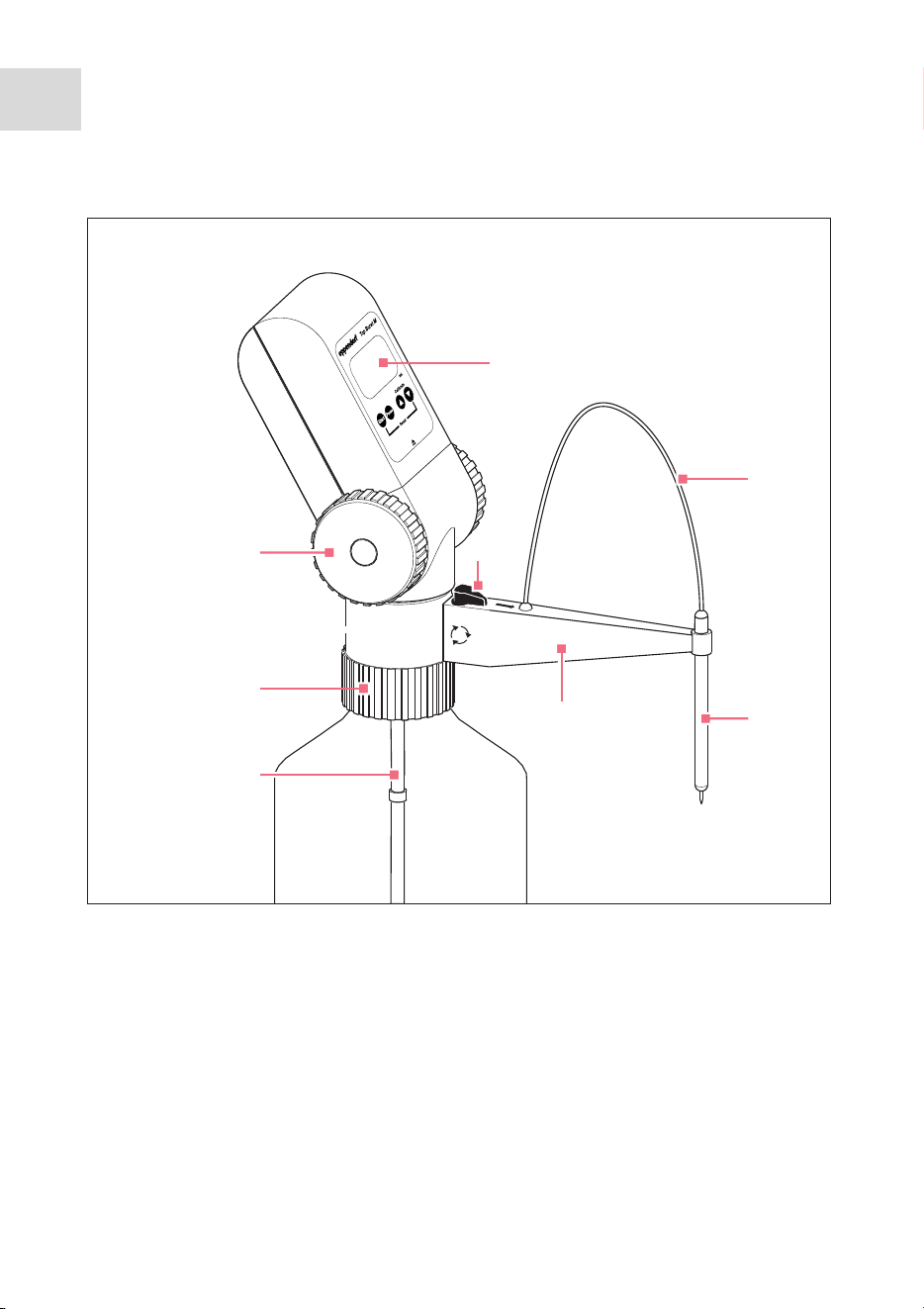
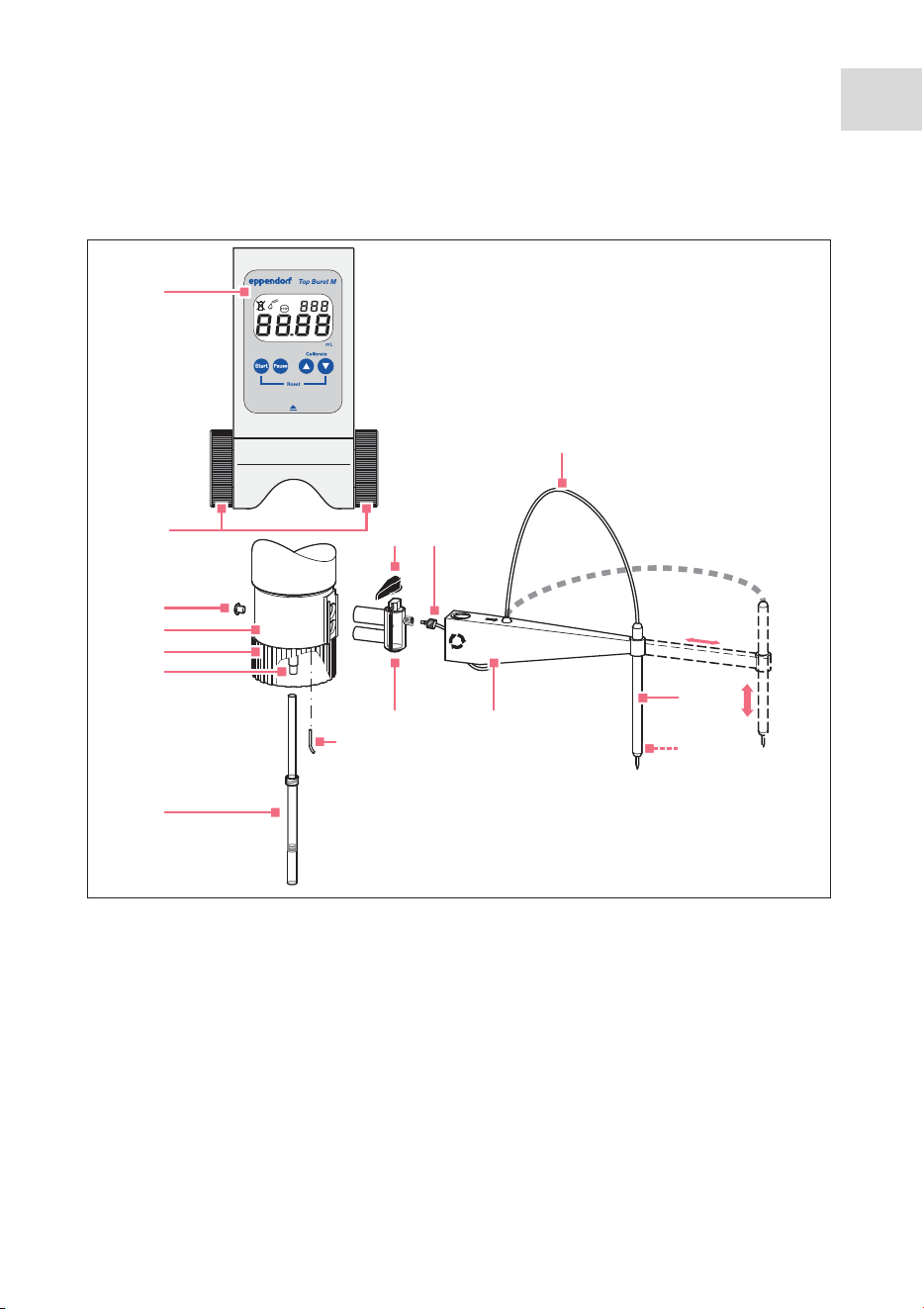
Abb. 3-1:Top Buret M/H
Fig. 3-1: Top Buret M/H
1 Control panel
2 Dispensing wheels
3Bottle thread
4 Telescopic aspirating tube
5 Discharge valve toggle
6 Canula arm
7 Discharge tube
8 Tube holder
5
6
8
7
2
3
4
1
Product description
Top Buret M/H
English (EN)
15
3.2.1 Control panel
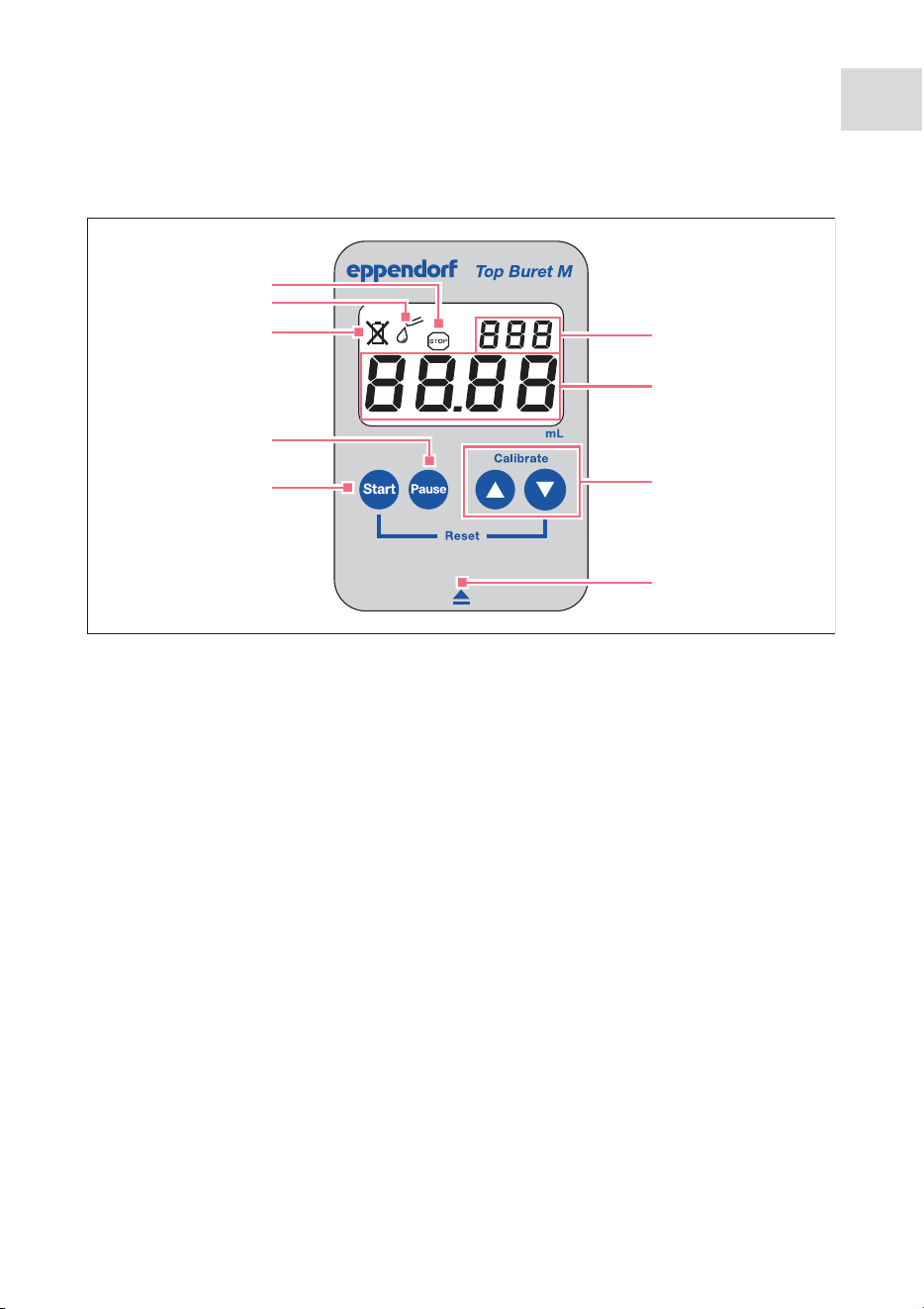
Abb. 3-2:Control panel with display and keys
Fig. 3-2: Control panel with display and keys
1Pause symbol
2 Titration mode symbol
3 Battery empty symbol
4Pause key
5Start key
6Calibration mode
7Volume display
8Arrow keys
9 Opening symbol
9
8
7
6
5
4
3
2
1
16
Product description
Top Buret M/H
English (EN)
3.2.2 Telescopic aspirating tube
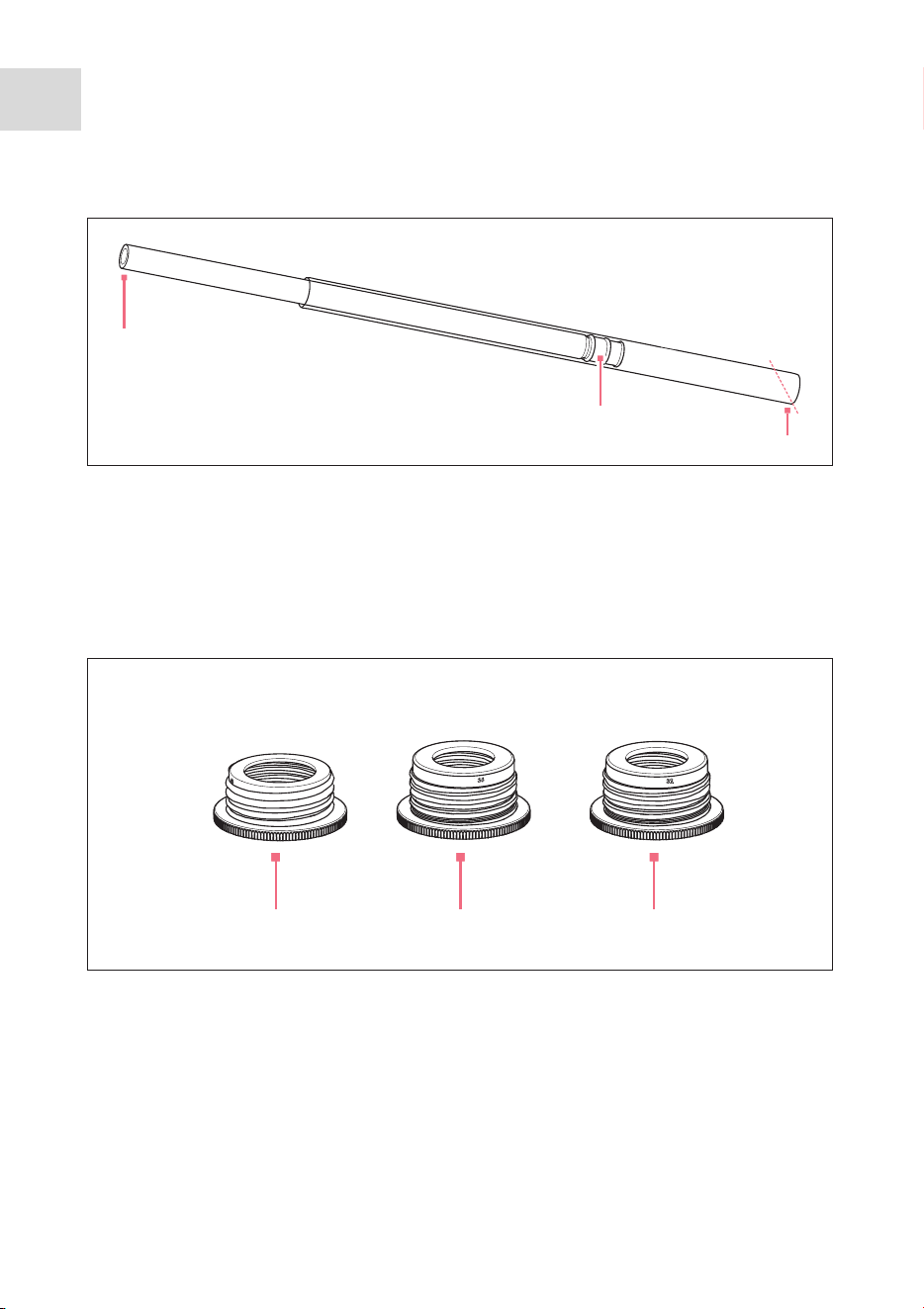
Abb. 3-3:Telescopic aspirating tube
Fig. 3-3: Telescopic aspirating tube
3.2.3 Thread adapter
Abb. 3-4:Thread adapter
Fig. 3-4: Thread adapter
1 Connection opening
Inner tube
2 Seal
3 Aspirating opening
Outer tube
1 Reducing from 45 mm to 40 mm
2 Reducing from 45 mm to 38 mm
3 Reducing from 45 mm to 32 mm
1
2
3
1 2 3

Product description
Top Buret M/H
English (EN)
17
3.3 Features
The Top Buret is a bottle-top buret which features a continuous, pulse-free dispensing
technique. The Top Buret can dispense liquids with a maximum concentration of 1 mol/L.
When the dispensing wheels are fully rotated, the following volumes are dispensed:
•Top Buret M: 2.5 mL
•Top Buret H: 5.0 mL
The Top Buret has two dispensing settings. The dispensing settings are set with the
toggle on the canula arm.
• Titration
Titrate liquid from the bottle to a destination vessel.
• Deairing
Rinse liquid through the discharge valve into the bottle, e.g., to remove air bubbles.
18
Product description
Top Buret M/H
English (EN)
3.4 Materials
The assembly parts of the dispenser consist of the following materials:
NOTICE! Aggressive substances may damage components, consumables and
accessories.
Check the chemical resistance before using organic solvents or aggressive
chemicals.
Only use liquids whose vapors do not attack the materials used.
CAUTION! Material damage caused by aggressive vapors.
The electronic components of the dispenser can be corroded by aggressive
chemical vapors.
Do not expose the dispenser to aggressive vapors over an extended period of
time.
Component Material
Suction pipe Ethylene-tetrafluoroethylene (ETFE),
polytetrafluorethylene (PTFE), fluorinated
ethylene propylene (FEP)
Discharge tube Tetrafluoroethylene-perfluoropropylen
copolymer (FEP)
Discharge valve, recirculation valve Perfluoroalkoxy alkane (PFA),
polytetrafluorethylene (PTFE)
Valve block Borosilicate glass, PFA, platinum iridium
(Pt-Ir)
Valve balls Borosilicate glass
Piston/Cylinder PFA/borosilicate glass
Adapter Polypropylene (PP), ETFE, PTFE
Installation
Top Buret M/H
English (EN)
19
4 Installation
4.1 Mounting the dispenser
Abb. 4-1:Overview of the individual parts
Fig. 4-1: Overview of the individual parts
1 Control panel
2 Dispensing wheels
3 Air vent cover
4Valve head
5Bottle thread
6 Connection opening
7 Telescopic aspirating tube
8 Recirculation tube
9 Discharge valve toggle
10 Discharge valve
11 Knurled nut
12 Canula arm
13 Discharge tube
14 Tube holder
15 Gripping nubs (inside)
1
3
4
5
6
7
2
9 11
13
8
15
14
10 12
20
Installation
Top Buret M/H
English (EN)
4.2 Mounting the canula arm
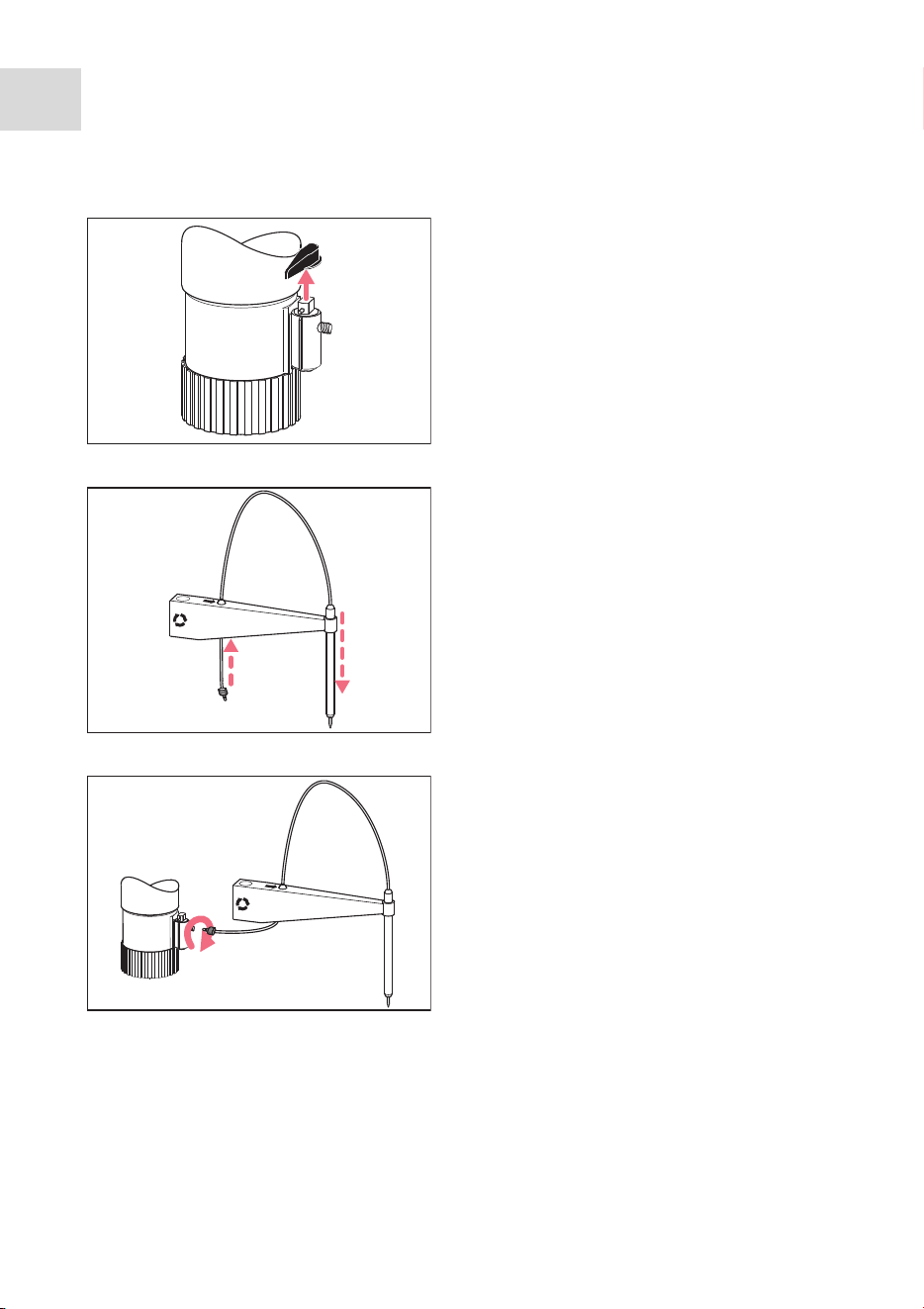
1. Rotate the toggle to the deairing
position.
2. Remove the toggle upwards.
3. Insert the tube holder into the canula
arm with the gripping nubs pointing
downwards.
4. Guide the discharge tube through the
hole in the canula arm from below.
5. Insert the discharge tube through the
tube holder from above.
The discharge tube should protrude
slightly from the tube holder.
6. Screw the knurled nut onto the discharge
valve.
Installation
Top Buret M/H
English (EN)
21
4.3 Inserting the batteries
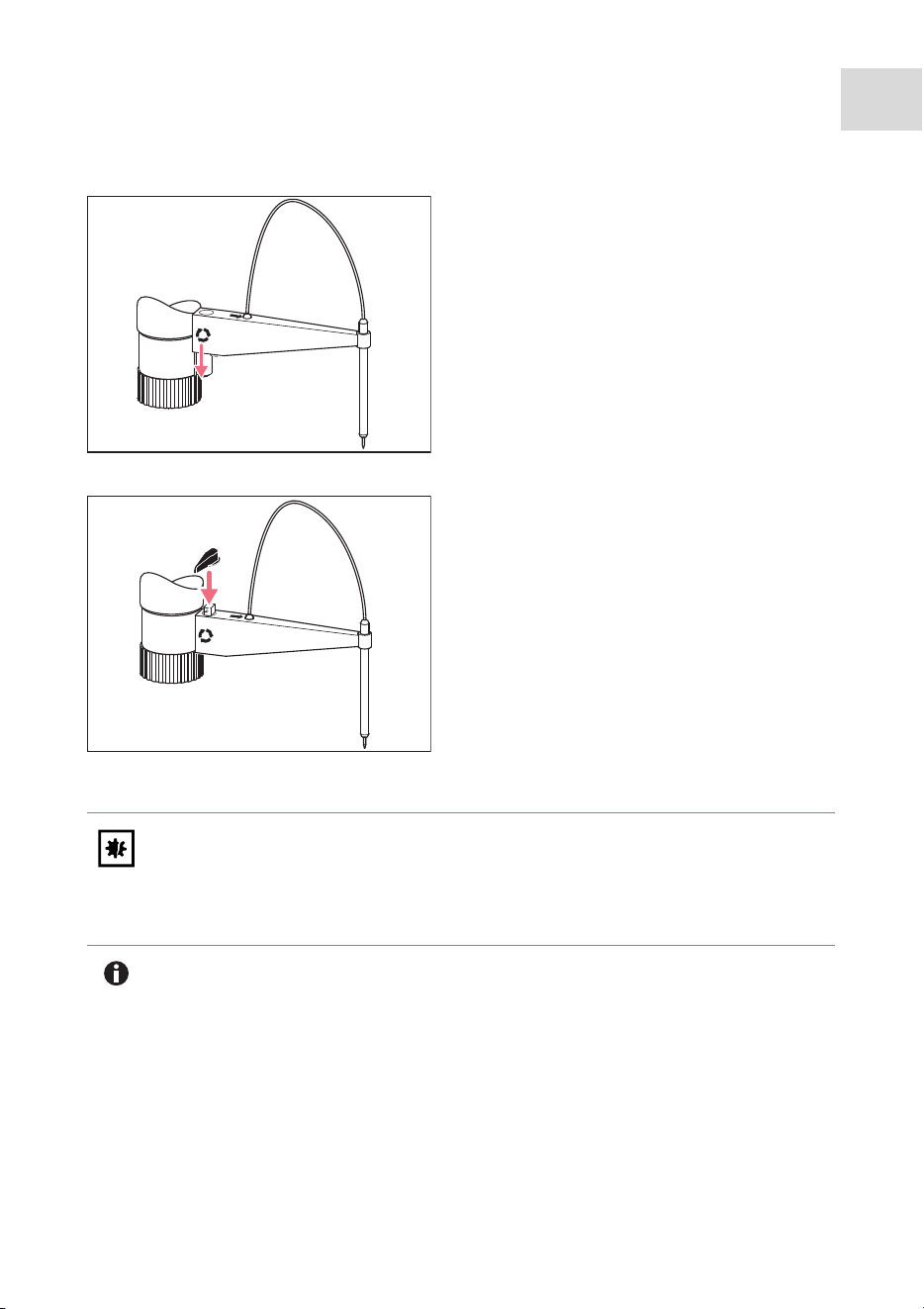
7. Slide the canula arm over the discharge
valve from above up to the stop.
8. Attach the toggle.
NOTICE! Damage to the battery compartment due to incorrect insertion of
the batteries
Observe the correct polarity of the batteries.
Do not use force.
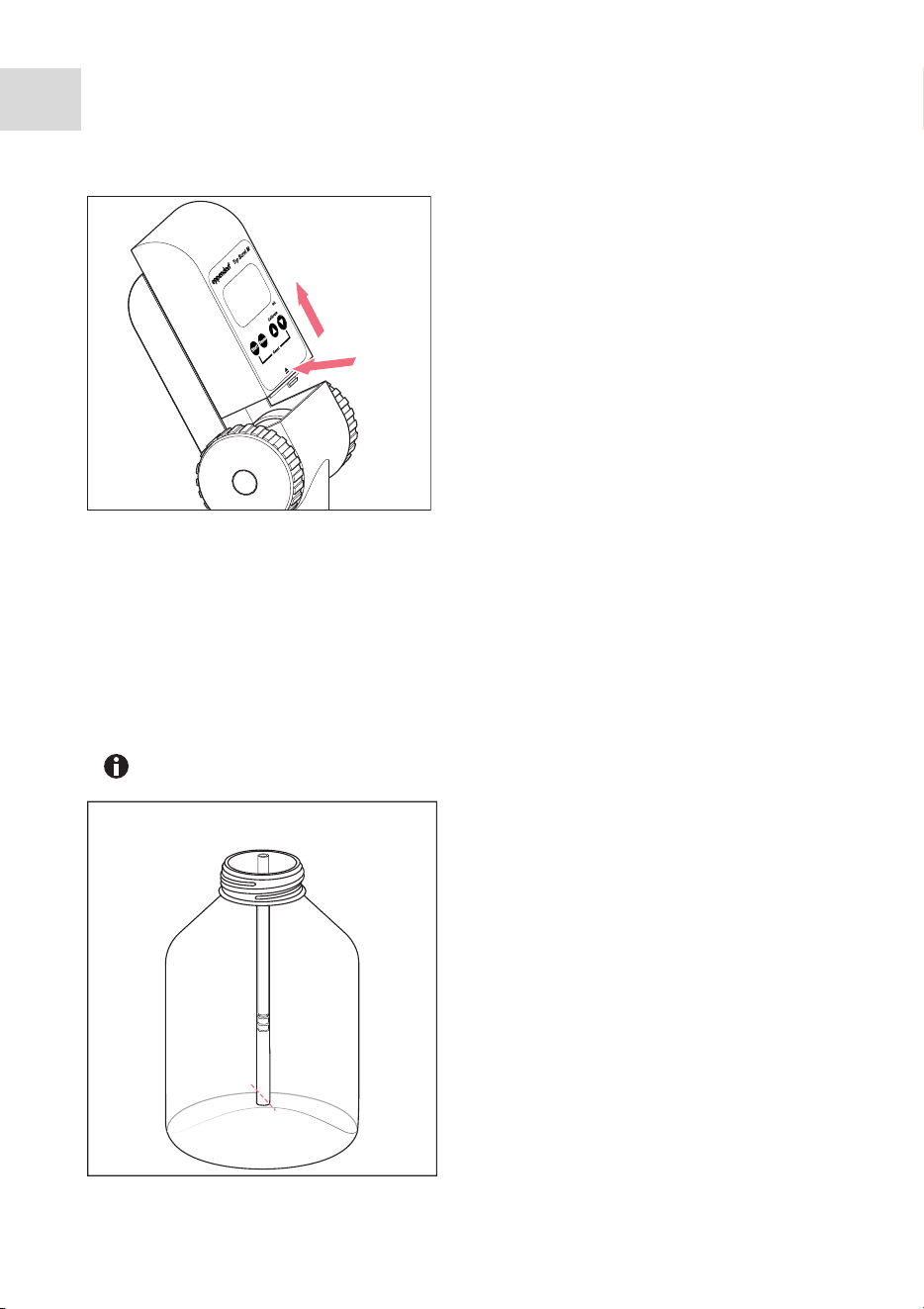
The display automatically switches on when the batteries are inserted (1.5 V,
LR03/AAA)). If the device is not used, the display will switch off after
about 5 minutes.
22
Installation
Top Buret M/H
English (EN)
4.4 Mounting the telescopic aspirating tube
The dispenser conveys the liquid through the telescopic aspirating tube from the supply
bottle. Adjust the length of the telescopic aspirating tube to the bottle height to empty the
bottle completely.
4.4.1 Adjusting the telescopic aspiration tube to the height of the bottle
Prerequisites
• The bottle is larger than the collapsed telescopic aspirating tube.
1. Press and hold the opening symbol.
2. Slide the control panel upwards and
remove it.
3. Remove the battery compartment lid at
the back of the control panel.
4. Insert the batteries.
5. Insert the battery compartment lid.
6. Attach the control panel and slide it
downwards until it engages.
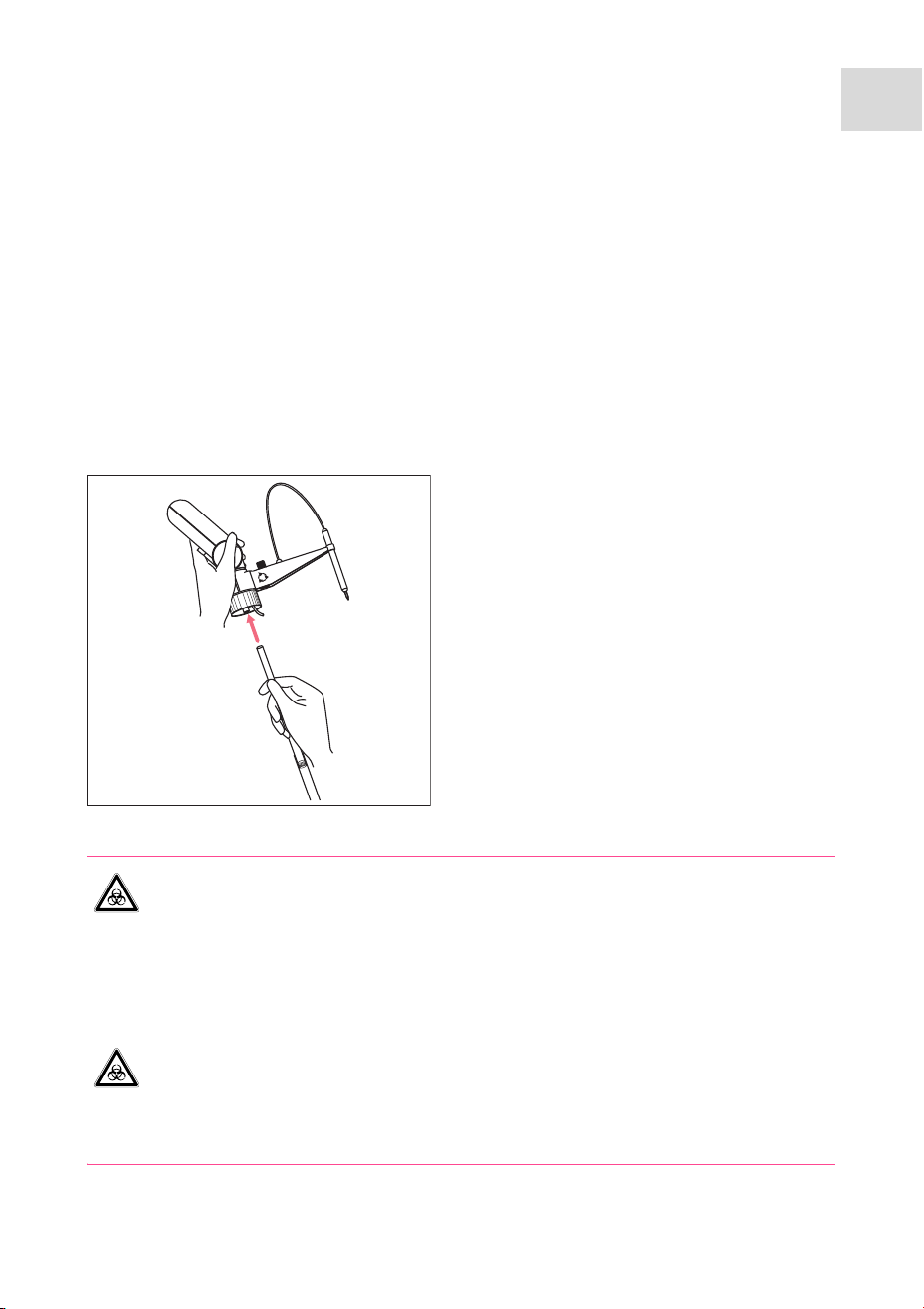
Use an empty bottle to adjust the telescopic aspiration tube.
1. Hold the telescopic aspiration tube next
to the bottle.
2. Extend the telescopic aspiration tube.
The telescopic aspiration tube is
supposed to reach from the bottle
opening to just above the base of the
bottle.
3. Cut the lower end of the outer tube off at
an angle.
Installation
Top Buret M/H
English (EN)
23
4.4.2 Shortening the telescopic aspiration tube for smaller bottles.
Prerequisites
• The bottle is smaller than the collapsed telescopic aspirating tube.
1. Shorten the inner tube.
2. Shorten the outer tube.
3. Cut the lower end of the outer tube off at an angle.
4.4.3 Inserting the telescopic aspirating tube
Prerequisites
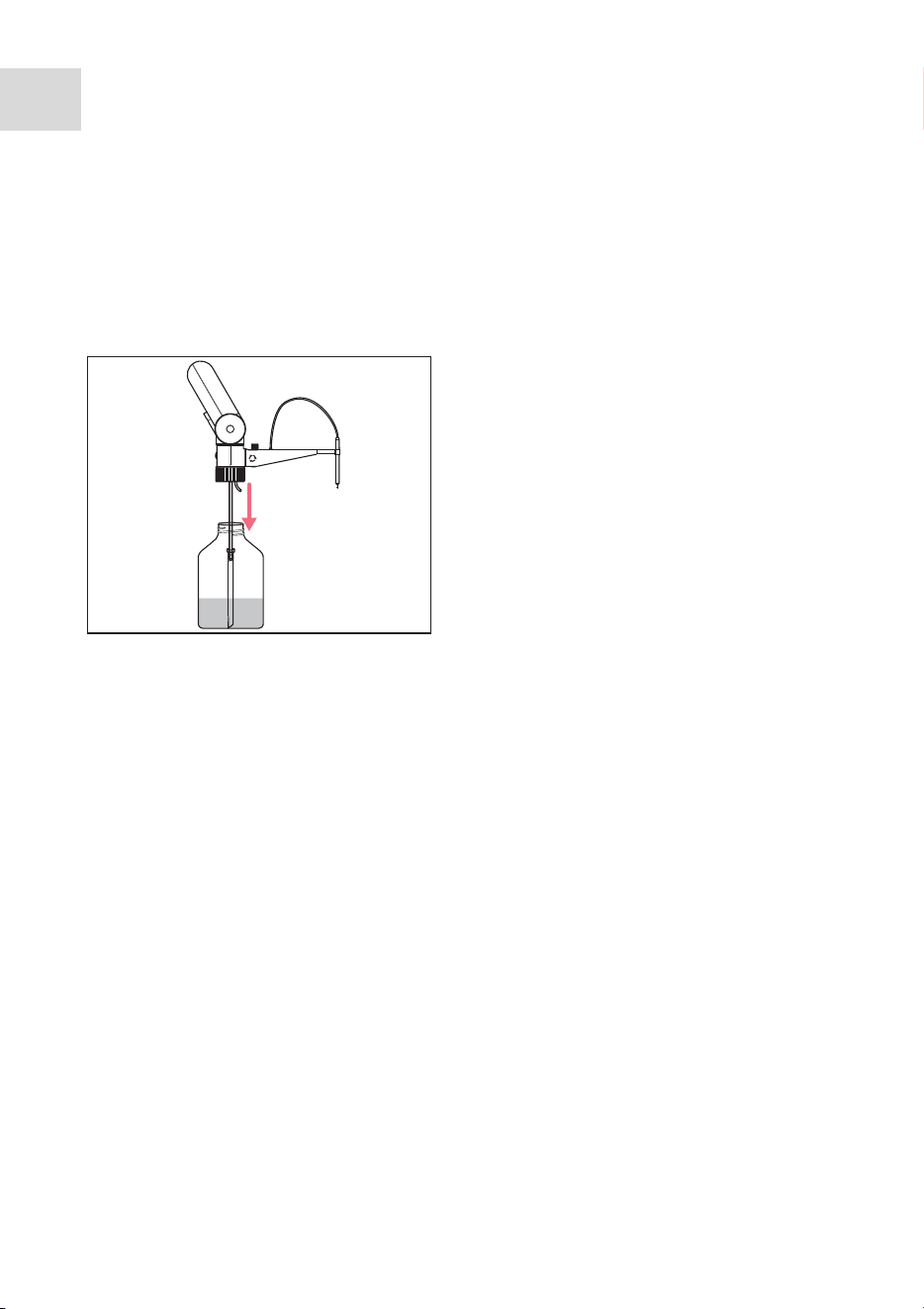
• The telescopic aspiration tube is adjusted to the height of the bottle.
4.5 Screwing the dispenser onto the bottle
1. Cut the lower end of the outer tube off at
an angle.
2. Slide the inner tube onto the connection
opening up to the stop.
CAUTION! Personal injury due to incorrect transportation of the burette.
If the mounted burette is not transported correctly, reagents will be released.
Contact with reagents may be harmful to eyes or skin.
To transport the mounted burette, grasp the burette with one hand and the
bottle with the other hand.
Do not carry the burette by the housing.
CAUTION! Personal injury due to contact with reagents.
Contact with reagents may be harmful to eyes or skin.
Wear your personal protective equipment.
Make sure that no reagents are leaking from the device.
24
Installation
Top Buret M/H
English (EN)
The thread connection of the dispenser is designed for bottle threads of 45 mm. For other
bottle threads a thread adapter can be used.
Prerequisites
• The telescopic aspirating tube is inserted.
• The length of the telescopic aspirating tube has been adjusted to the height of the
bottle.
4.5.1 Determining the diameter of the flask neck
Prerequisites
• A suitable thread adapter is available.
Some thread adapters are included in the delivery package. Other diameters can be
ordered. The diameter of the thread adapter is imprinted on the adapter. If the bottle
thread is smaller than 32 mm, a second adapter must be used.
1. Measure the inner diameter of the bottle top or the outer diameter of the flask neck.
2. Choose the suitable thread adapter.
4.5.2 Screwing on the thread adapter
Prerequisites
• A suitable thread adapter is available.
1. Screw the thread adapter onto the flask neck.
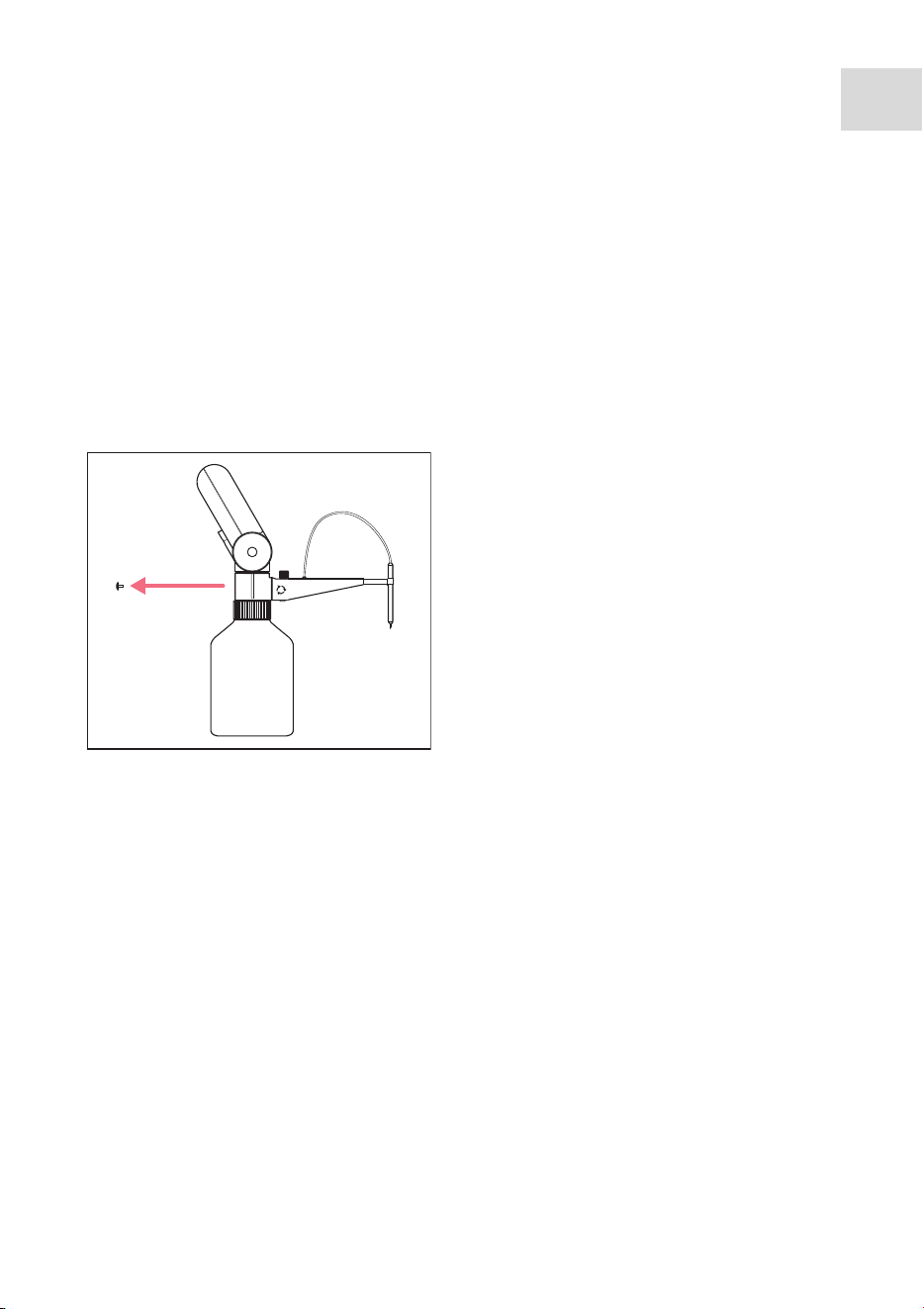
2. Rotate the discharge valve toggle to deairing.
3. Attach the dispenser onto the bottle from above.
4. Screw the dispenser onto the bottle.
1. Rotate the discharge valve toggle to
deairing.
2. Attach the dispenser onto the bottle from
above.
3. Screw the dispenser onto the bottle.
Installation
Top Buret M/H
English (EN)
25
4.6 Connecting the drying tube
For the titration of hygroscopic liquids you need a drying tube with a suitable liquid
absorber.
The drying tube is not included in the delivery package and can be ordered as an
accessory (without filling/liquid absorber).
Suitable liquid absorbers:
• Silica gel with a particle size of 1 mm – 3 mm
•CaCO
2
• NaOH pills with a diameter of 5 mm for the absorption of CO
2
1. Remove the air vent cover.
2. Insert the drying tube into the opening.
3. Fill the drying tube with moisture
absorber.
26
Operation
Top Buret M/H
English (EN)
5Operation
5.1 Venting the dispenser
Air bubbles in the supply lines and in the feeding mechanics will distort the measuring
results.
Deair the dispenser in the following situations:
• Prior to initial operation
• After intensive cleaning
• After changing the bottle
• After a long period of inactivity
Prerequisites
• The dispenser has been completely mounted.
Rinse the dispenser thoroughly before first use or discard the first units
dispensed.
CAUTION! Personal injury due to contact with reagents.
Contact with reagents may be harmful to eyes or skin.
Wear your personal protective equipment.
Do not point the discharge tube at people.
Do not remove the discharge tube from the tube holder in order to avoid any
splashing of reagents.
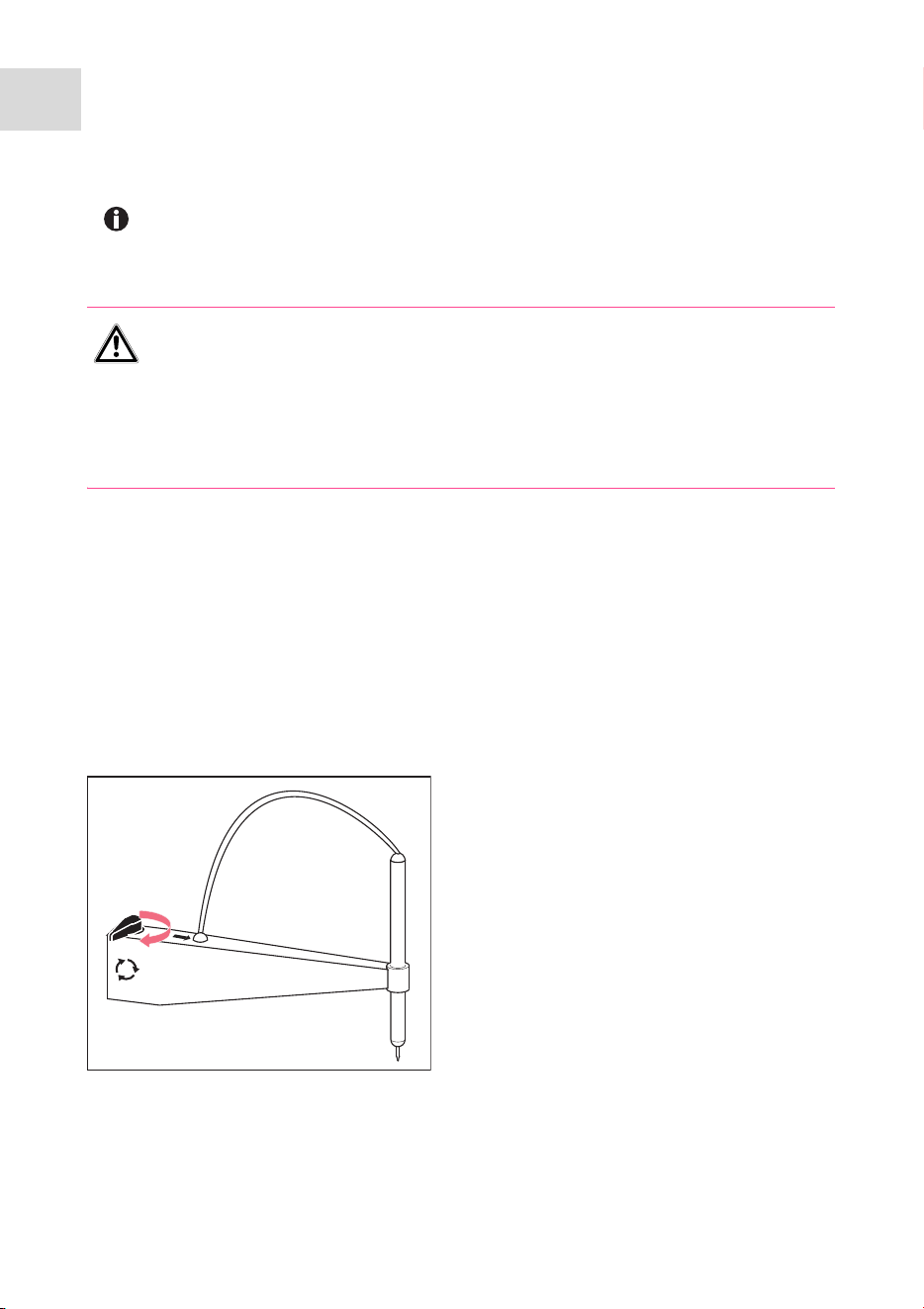
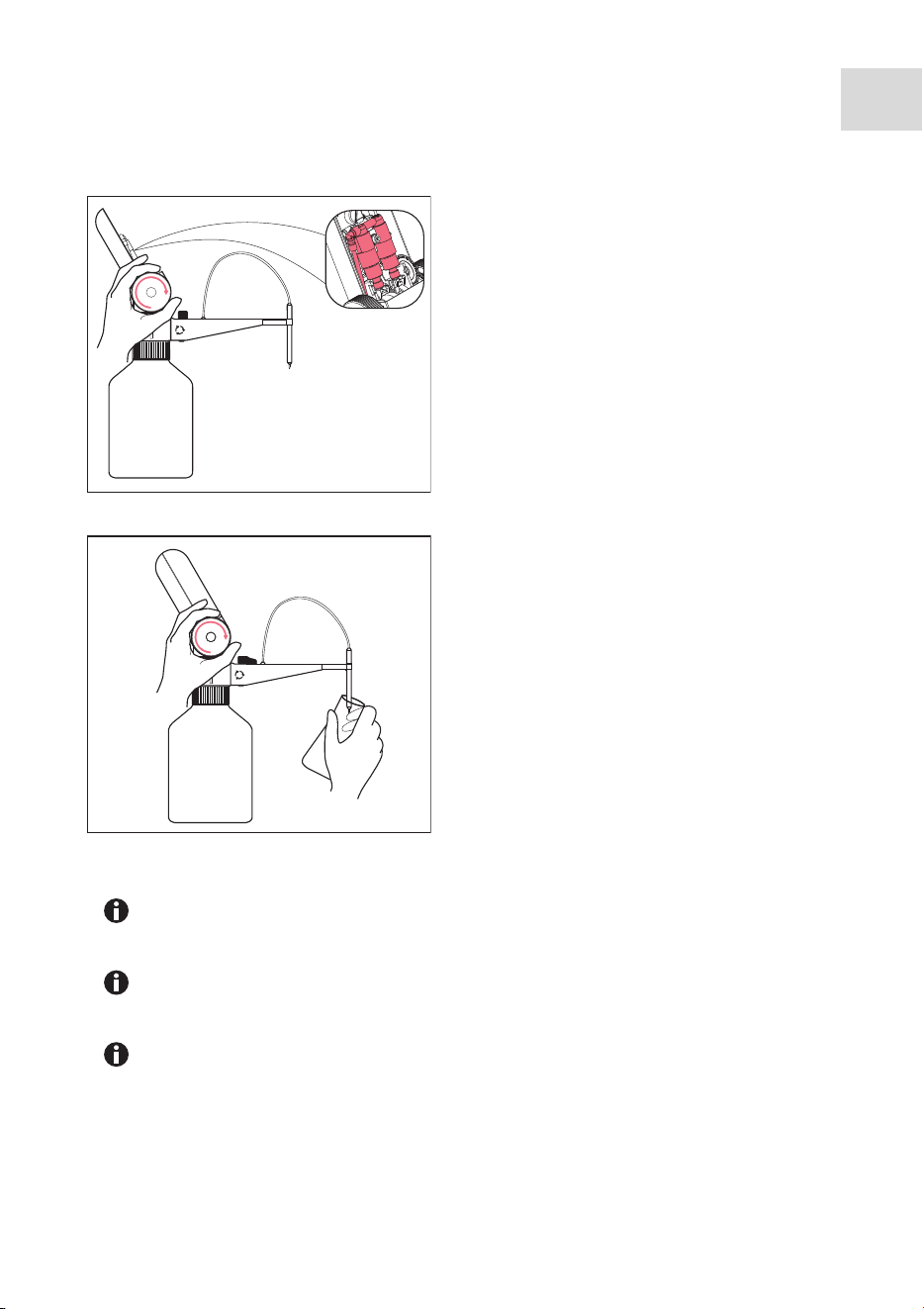
1. Rotate the discharge valve toggle to
deairing.
Operation
Top Buret M/H
English (EN)
27
5.2 Titrating liquid
2. Remove the control panel.
3. Rotate the dispensing wheels slowly and
evenly forward until there is no more air
left in the system or in the dispensing
hose.
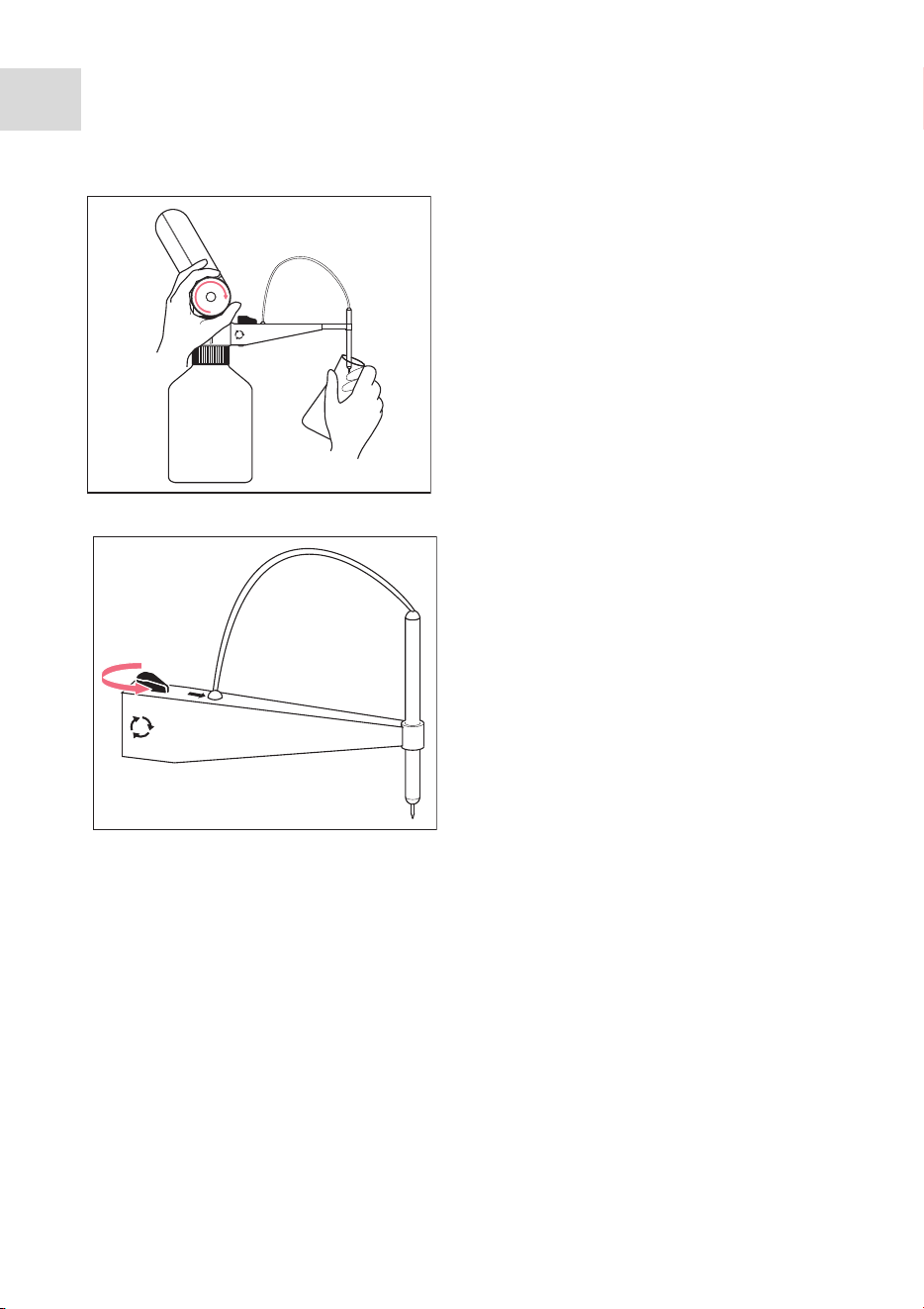
4. Rotate the discharge valve toggle to
titration.
5. Place a collection vessel below the
canula.
6. Rotate the dispensing wheels forward
until liquid emerges from the opening of
the discharge tube.
7. Attach the control panel.
8. Wipe any chemical residues from the
discharge tube.
If you rotate the dispensing wheels backwards, they do not engage. No
dispensing of liquid is performed and no volume is counted.
When you have completed or interrupted the titration, move the toggle to return
dosing to prevent any liquid from inadvertently escaping.
If the dispenser is not used, the display will switch off after 5 minutes. The
titrated volume is stored until the next titration.
28
Operation
Top Buret M/H
English (EN)
5.3 Changing the supply bottle during titration
You can change the supply bottle during a titration sequence without changing the
displayed volume.
Prerequisites
• The same chemical is used.
1. Press the Pause key.
On the display, the Stop symbol appears.
The titrated value is stored.
2. Remove the bottle.
3. Mount the new bottle.
4. Vent the dispenser.
1. Press the Start key.
The display switches on.
The display shows 0.00 or the volume of
the last titration.
2. Press the Start key.
The volume display is set to 0.00.
3. Pull out the canula arm to the desired
length.
4. Hold a collection vessel below the
discharge tube.
5. Rotate the toggle to titration.
6. Rotate the dispensing wheels forward
evenly.
The liquid is dispensed.
7. After titration, rotate the toggle to
deairing.
Operation
Top Buret M/H
English (EN)
29
5. Press the Pause key again.
The display is enabled. The display shows the stored value and the titration symbol .
6. Continue titration.
5.4 Removing the bottle
5.5 Emptying the dispenser
Before changing the liquid and before cleaning, the dispenser must be emptied.
Prerequisites
• The bottle has been unscrewed.
1. Screw the dispenser onto an empty bottle.
2. Place a collection vessel below the canula.
3. Rotate the toggle to titration.
4. Rotate the dispensing wheels forward until no more liquid runs out of the discharge
tube.
5. Rotate the toggle to deairing.
6. Rotate the dispensing wheels forward until no more liquid runs out of the recirculation
tube.
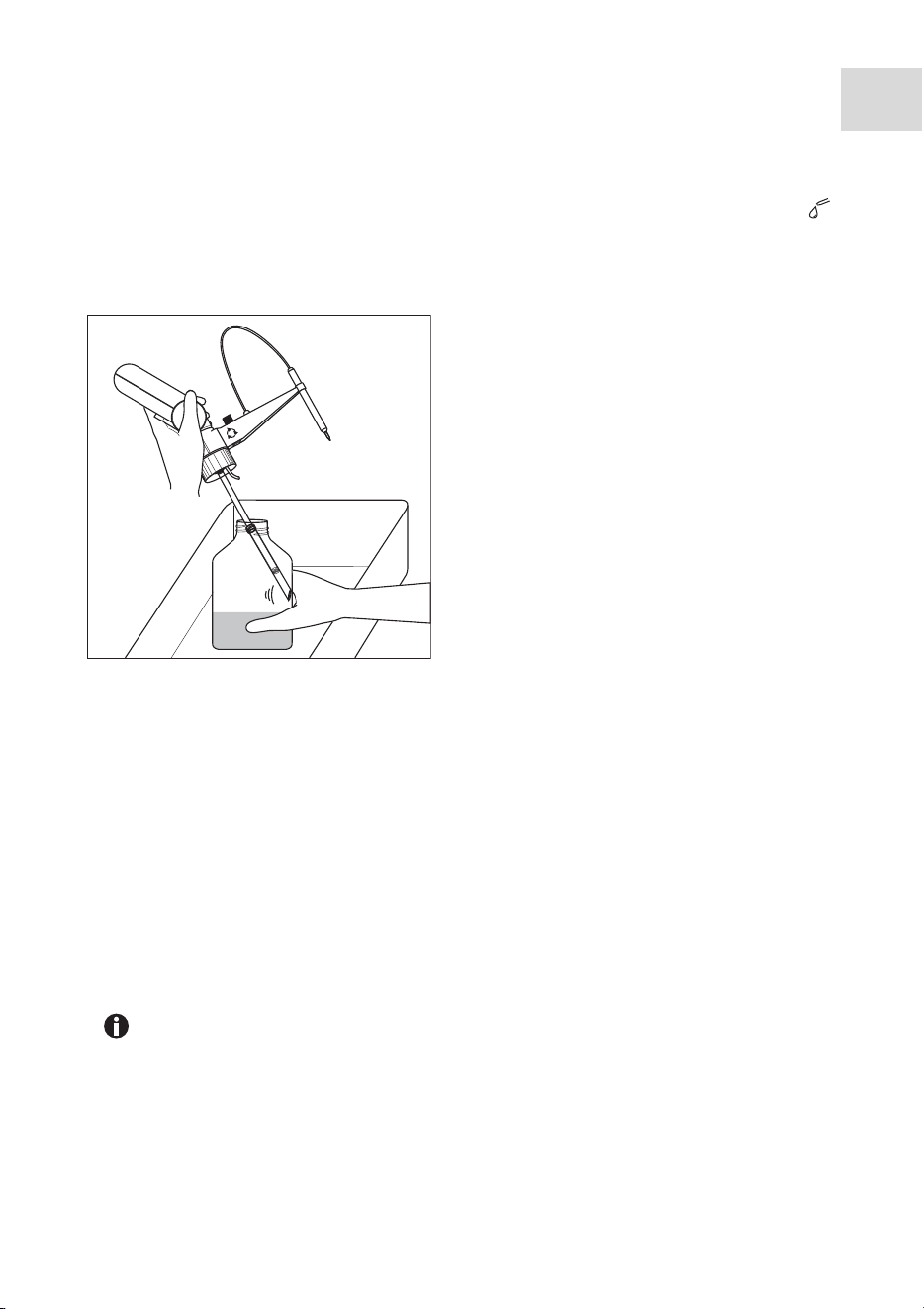
1. Rotate the discharge valve toggle to
deairing.
2. Place the dispenser with bottle into a
suitable collecting vessel.
3. Unscrew the dispenser from the bottle in
a counterclockwise direction.
4. Lift the dispenser until the telescopic
aspirating tube is no longer immersed in
the liquid.
5. Gently tap the telescopic aspirating tube
against the inside of the bottle.
The residual liquid from the telescopic
aspirating tube runs into the bottle.
To remove the reagents completely, clean the dispenser.
30
Calibration and adjustment
Top Buret M/H
English (EN)
6 Calibration and adjustment
6.1 Calibrating the dispenser
The gravimetric test and the conversion of the measured values for the volume are
described in the document "Standard operating procedure for manual dispensing systems
(SOP)". The document is available on the webpage www.eppendorf.com/manuals
.
6.2 Adjusting the dispenser
The dispenser has been adjusted to the physical properties of demineralized water at the
factory.
The dispenser can be readjusted:
• If the physical properties of the liquid are different to those of water.
• If the error of measurement of the dispensed volume is outside of the tolerance range.
Calibration is only possible with a testing volume between 10 mL – 90 mL.
6.2.1 Adjustment to distilled water
Prerequisites
• The document "Standard operating procedure for manual dispensing systems – (SOP)" is
available.
1. Measure the testing volume according to the method described in the SOP.
2. Use the average value of the volumes from the calibration.
3. Press the Pause key.
The volume is saved.
4. Press and hold the and arrow keys for 3 seconds.
The display shows CAL.
5. Set the calculated average value of the volumes using the and arrow keys.
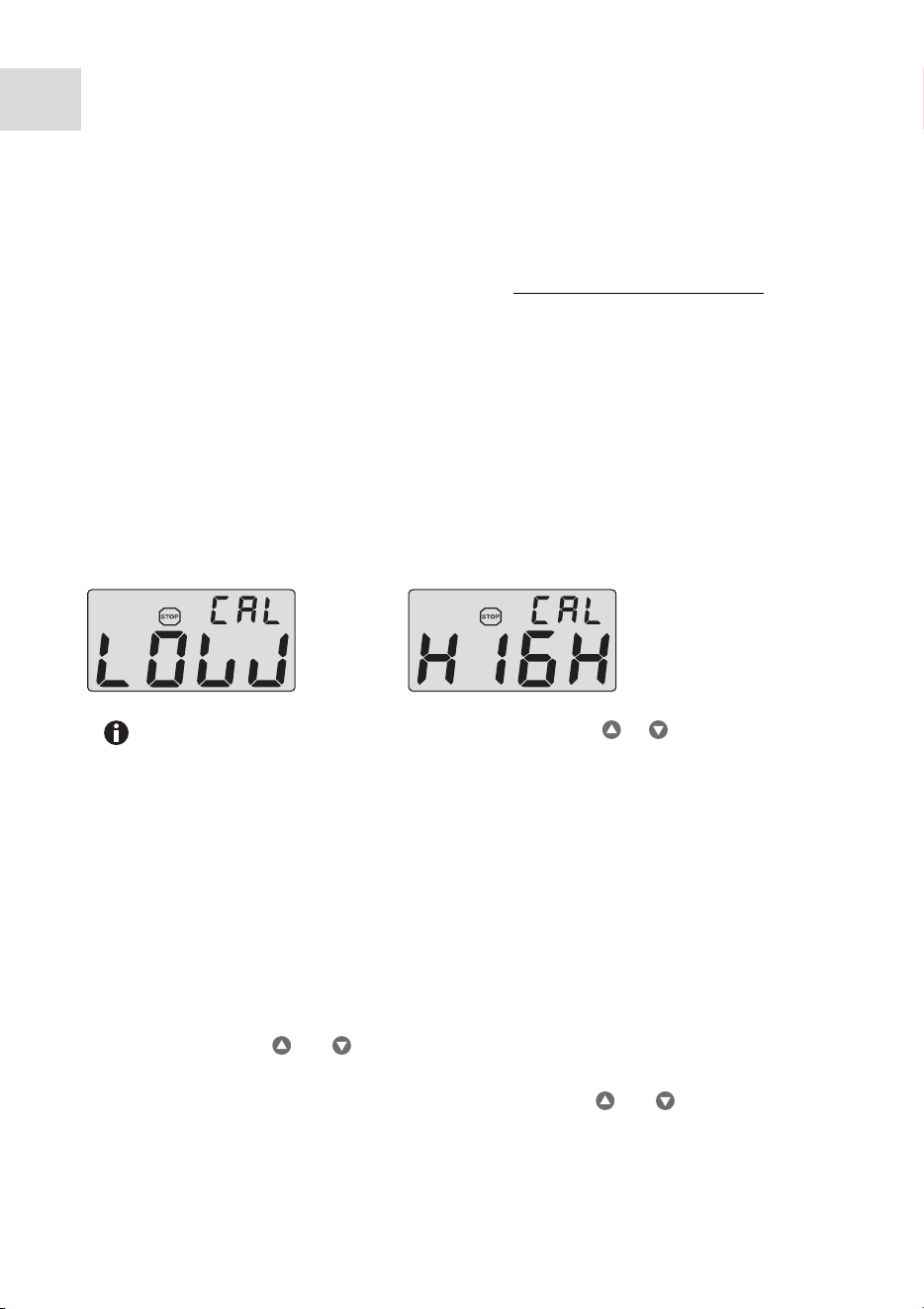
If the testing volume is < 10 mL, the
display shows:
If the testing volume is > 90 mL, the display
shows:
To display the set adjustment value, either press the or arrow key in
titration mode. After you release the key, the display automatically returns to the
last volume display.

Calibration and adjustment
Top Buret M/H
English (EN)
31
6. Press the Start key.
• The set value is accepted.
• The display is reset to zero.
• The adjustment is ended.
• The display shows C at the top right. The display indicates that the factory settings
have been changed.
6.2.2 Adjustment to a liquid with a different density
• The document "Standard operating procedure for manual dispensing systems – (SOP)" is
available.
1. Set up the calibrated analytical balance at a vibration and draft-free location.
2. Place a beaker on the balance.
3. With the Top Buret M, titrate 25 mL of the test liquid into the beaker and record the
weight.
4. Repeat step 3 10 times.
5. With the Top Buret H, titrate 50 mL of the test liquid into the beaker and record the
weight.
6. Repeat step 5 10 times.
7. Calculate the volume of the standard solution according to the SOP.
8. Calculate the average value of the volumes according to the SOP.
9. Press the Pause key.
The volume is saved.
10.Press and hold the and arrow keys for 3 seconds.
The display shows CAL at the top right.
11.Set the calculated average value of the volumes using the and arrow keys.
12.Press the Start key.
• The set value is accepted.
• The display is reset to zero.
• The adjustment is ended.
• The display shows C. The display indicates that the factory settings have been
changed.

32
Calibration and adjustment
Top Buret M/H
English (EN)
6.3 Resetting the Top Buret to the factory settings
The reset function is used to restore the factory settings. If you have adjusted the device,
the display will show a C. When you restore the factory settings again, the C will
disappear.
1. Press the Start key to switch on the Top Buret.
2. Press and hold the Start and keys at the same time for 3 seconds to activate the
reset function.
• The display C disappears.
• The factory settings have been restored.
Troubleshooting
Top Buret M/H
English (EN)
33
7 Troubleshooting
7.1 Error search
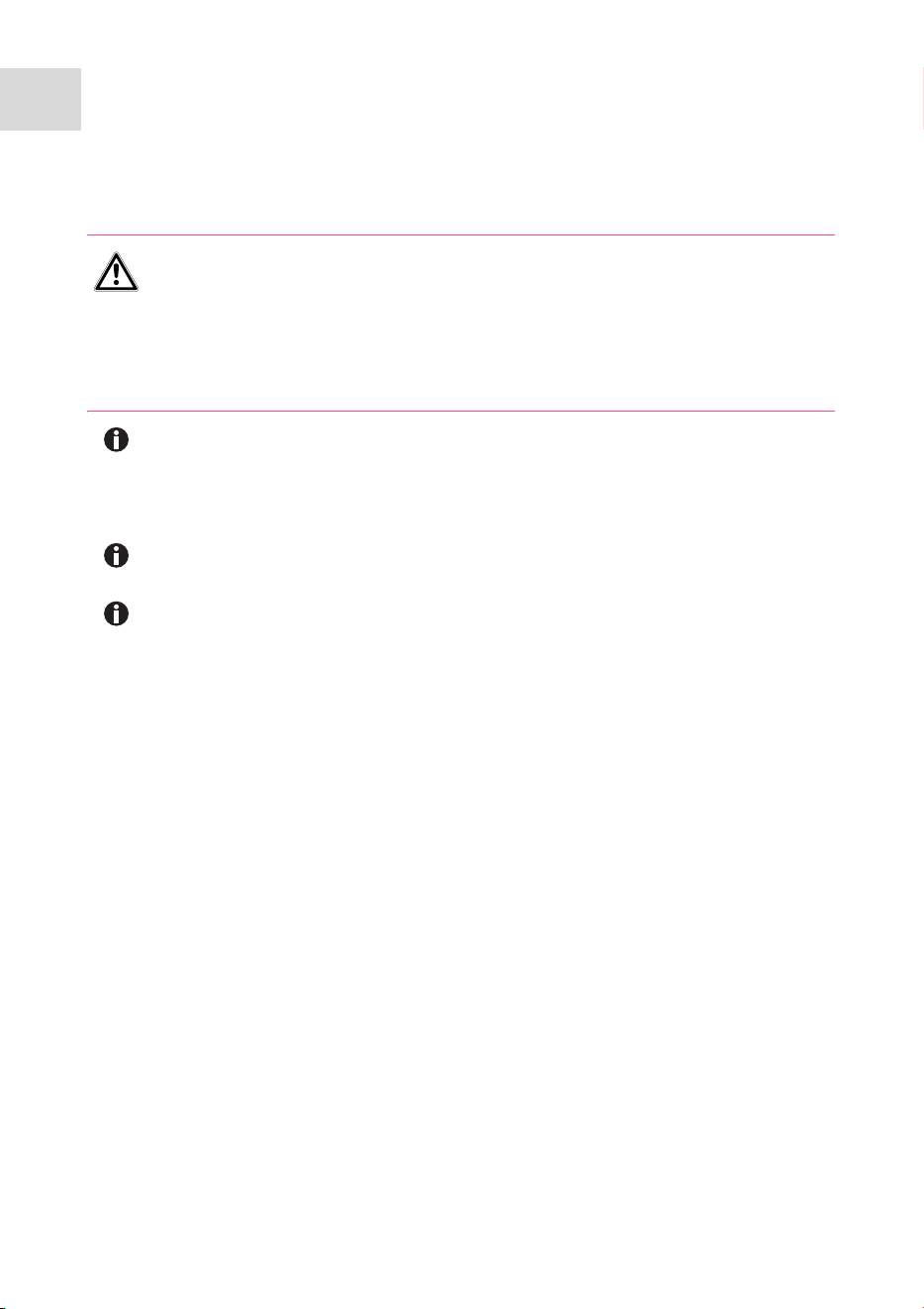
Problem Cause Solution
• Air is aspirated.
• There are air
bubbles in the
titrated liquid.
• The dispenser has not been
sufficiently deaired.
Deair the dispenser
(see p. 26).
• The telescopic aspirating
tube is not fully mounted.
Push the telescopic
aspirating tube firmly onto
the connection opening.
• The telescopic aspirating
tube is damaged.
Shorten the telescopic
aspirating tube or replace it.
• The telescopic aspirating
tube does not immerse into
the liquid.
Make the telescopic
aspirating tube longer until it
immerses into the liquid.
• The connection opening is
damaged.
Send the dispenser for repair.
No liquid is
aspirated.
• The connection opening is
blocked.
Clean the dispenser.
The titrating volume
is too small.
• The telescopic aspirating
tube is not fully mounted.
Push the telescopic
aspirating tube firmly onto
the connection opening.
• The telescopic aspirating
tube is damaged.
Shorten the telescopic
aspirating tube or replace it.
• The dispenser is adjusted
incorrectly.
Set the dispenser to factory
adjustment.
• The connection opening is
damaged.
Send the dispenser for repair.
The icon appears
on the display.
• The batteries are empty.
Replace the batteries.
The dosing wheel is
difficult to rotate.
• The piston is stiff.
Stop the dispensing
procedure and clean the
device.
34
Maintenance
Top Buret M/H
English (EN)
8 Maintenance
8.1 Cleaning the dispenser
Clean the dispenser in the following situations:
• Before a change of reagent.
• Prior to storage.
• If it has not been used for some time.
• Before maintenance and repairs.
• Daily, if concentrated alkaline solutions were used.
• Daily, if solutions which are prone to crystallization were used.
• Weekly, if the dispenser has been mounted to the storage bottle for some time.
• The dispensing wheels are hard to rotate.
• The dispenser is heavily contaminated.
CAUTION! Personal injury due to contact with reagents.
The feeding mechanism, valves, telescopic aspirating tube and discharge tube
are filled with reagents. Reagents enter the bottle with the cleaning solution.
Contact with reagents may be harmful to eyes or skin.
Wear your personal protective equipment.
Discard the cleaning solution after use.
The feeding mechanics is inside the device and consists of hoses and valves.
Hoses and valves can get heavily contaminated.
The feeding mechanics must only be cleaned by authorized skilled personnel. If
the feeding mechanics need to be cleaned, please contact the authorized service.
Replace the discharge tube if it is heavily contaminated or damaged.
Clean the dispenser with a suitable disinfectant, e.g., 70 % ethanol.

Maintenance
Top Buret M/H
English (EN)
35
8.1.1 Standard cleaning
Prerequisites
• The dispenser is empty.
• A neutral cleaning solution is available.
• Distilled water is available.
1. Mount the dispenser onto a bottle filled with a neutral cleaning solution.
2. Place a collection vessel below the discharge tube.
3. Switch the toggle to titration.
4. Rotate the dispensing wheels at least 10 times slowly and evenly forward.
5. Switch the toggle to deairing.
6. Rotate the dispensing wheels at least 10 times slowly and evenly forward.
7. Remove the dispenser from the bottle.
8. Rotate the dispensing wheels until the dispenser is completely emptied.
9. Screw the dispenser onto a bottle filled with distilled water.
10.Repeat steps 2 to 6.
11.Remove the dispenser from the bottle.
12.Rotate the dispensing wheels until the dispenser is completely emptied.
8.1.2 Intensive cleaning
Perform intensive cleaning in the following situations:
• The dispenser is heavily contaminated.
• The dispensing wheels are hard to rotate.
• You have titrated a highly crystalline liquid.
Prerequisites
• The dispenser has been cleaned according to the standard procedure.
• The dispenser has been disassembled.
1. Clean the telescopic aspirating tube with a soft bottle brush.
2. Clean all parts with a soft brush and a mild cleaning agent.
3. Wipe the housing without the control panel with a damp cloth and a mild cleaning
agent.
4. Rinse all parts with distilled water.
5. Allow all assembly parts to dry.
6. Reassemble the dispenser.
Carry out assembly in the reverse order to disassembly.
7. Using distilled water, check that the dispenser is not leaking and that it is functioning
correctly.
8. Adjust the dispenser.
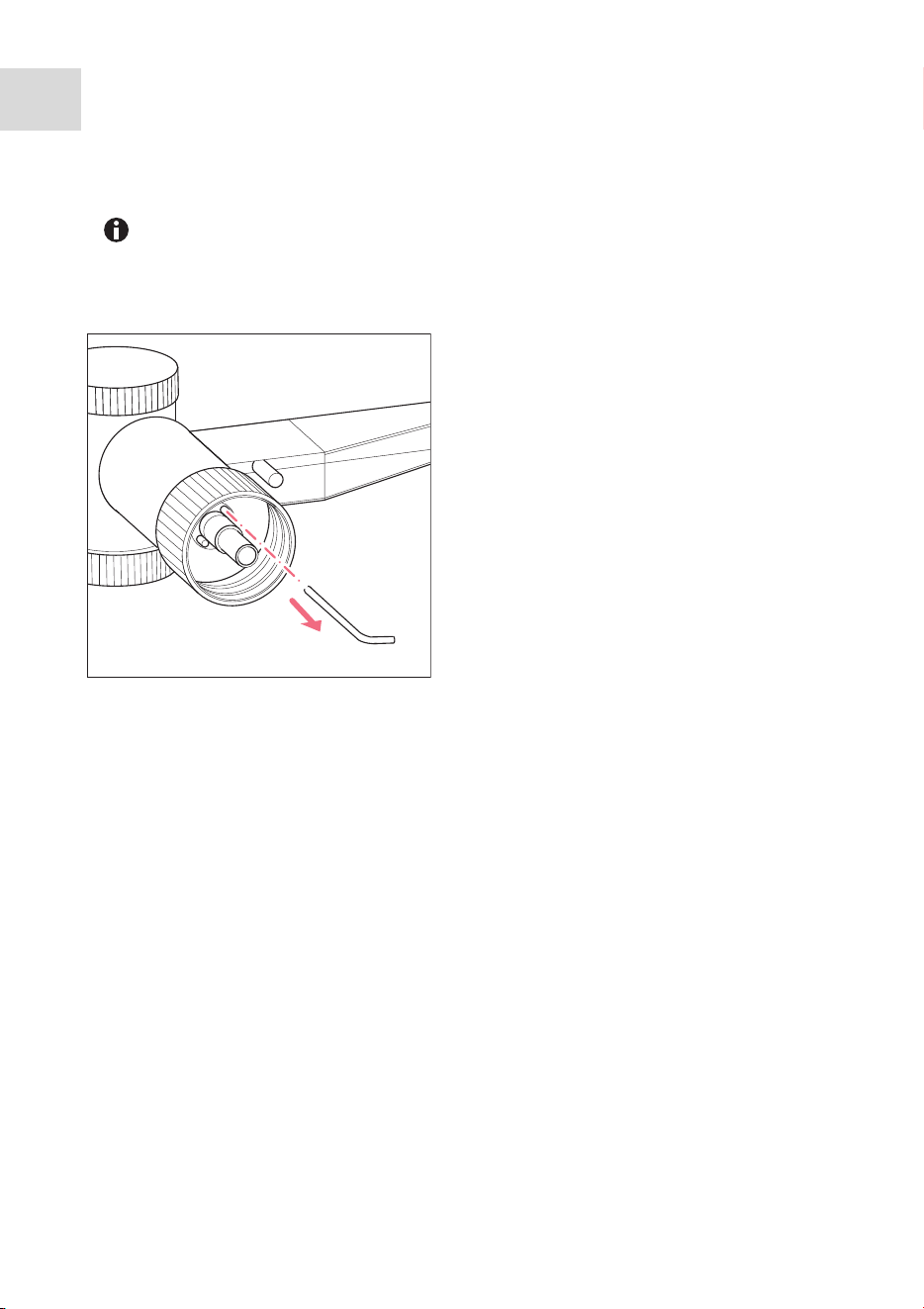
36
Maintenance
Top Buret M/H
English (EN)
8.2 Disassembling the dispenser
Prerequisites
• The dispenser has been cleaned according to the standard procedure.
When disassembling the canula arm, be careful not to bend the discharge tube.
1. Unscrew the dispenser from the bottle in
a counterclockwise direction.
2. Remove the telescopic aspirating tube
from the connection opening.
3. Remove the recirculation tube from the
front hole in the valve head.
4. Rotate the discharge valve toggle to
deairing and remove it upwards.
5. Pull off the canula arm in an upward
motion.
6. Unscrew the discharge tube knurled nut
from the discharge valve thread.
7. Remove the discharge tube from the
discharge valve.
8. Remove the discharge tube from the
canula holder and canula arm.
9. Remove the canula holder from the
canula arm.
10.Pull the discharge valve out of the valve
head.
Maintenance
Top Buret M/H
English (EN)
37
8.3 Replacing the batteries
Prerequisites
• New batteries are available.
If the battery capacity is exhausted, the icon will appear on the display. The batteries
must be replaced.
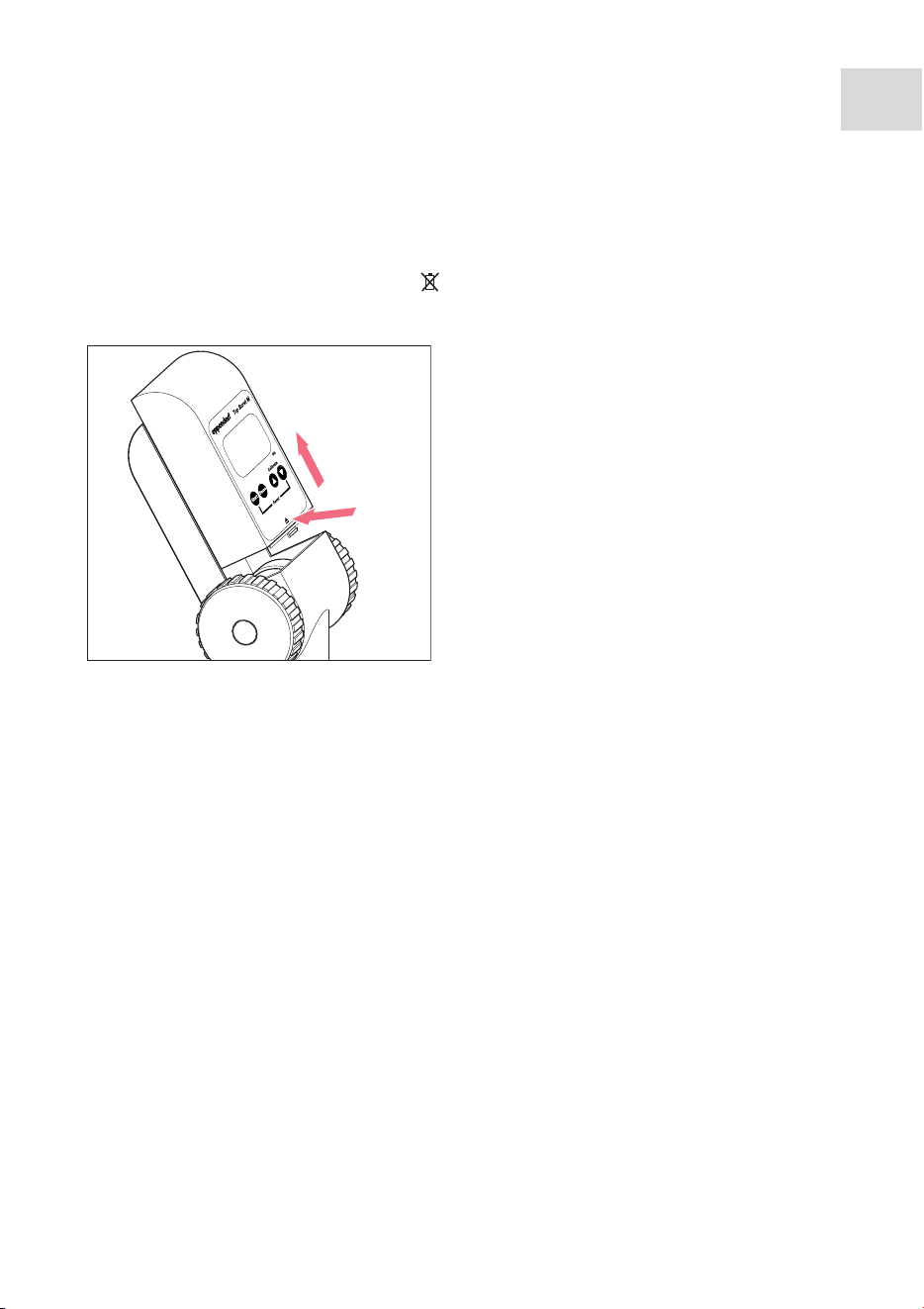
1. Press and hold the opening symbol.
2. Slide the control panel upwards and
remove it.
3. Remove the battery compartment lid at
the back of the control panel.
4. Replace the batteries.
5. Replace the battery compartment lid.
6. Attach the control panel and slide it
downwards until it engages.
7. Dispose of the old batteries in an
environmentally friendly manner.

38
Technical data
Top Buret M/H
English (EN)
9 Technical data
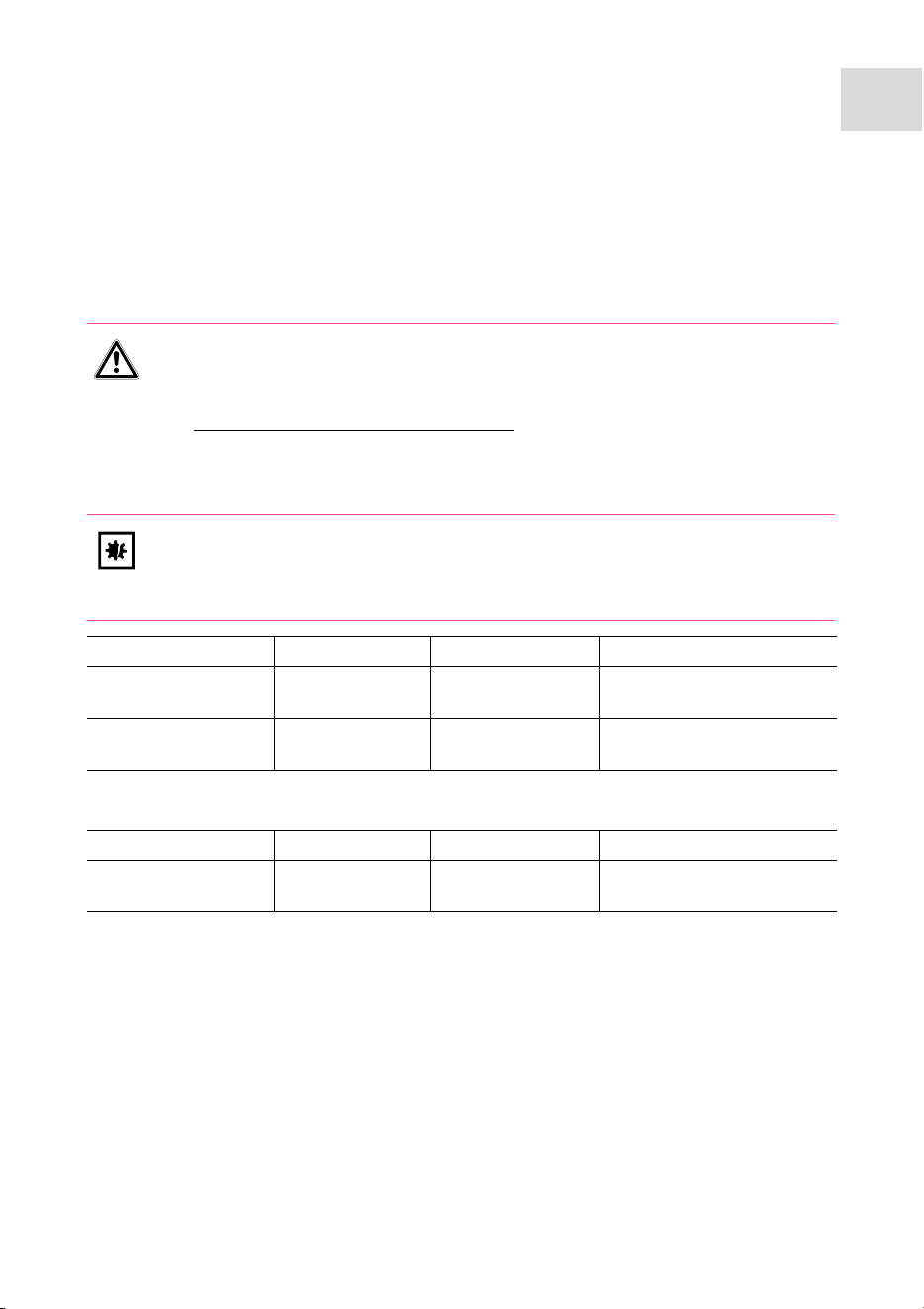
9.1 Ambient conditions
9.2 Errors of measurement
9.3 Parameters for titratable liquids
9.4 Conditions for calibration
Test conditions and test evaluation in accordance with ISO 8655, part 6. Test with
analytical balance with evaporation protection, approved by the board of weights and
measures.
The errors were determined under the following conditions:
Environment For indoor use only.
Ambient temperature 15 °C – 40 °C
Relative humidity 0 % – 90 %, non-condensing.
Atmospheric pressure Use up to a height of 2000 m above sea level.
Model M Testing
volume
Error
Systematic error Random error
± % ± mL ± % ± mL
0.01 mL – 999.9 mL 2.5 mL 2.0 0.05 1.0 0.025
12.5 mL 0.4 0.05 0.2 0.025
25 mL 0.2 0.05 0.1 0.025
Model H Testing
volume
Error
Systematic error Random error
± %± mL± %± mL
0.01 mL – 999.9 mL 5 mL 2.0 0.1 1.0 0.05
25 mL 0.4 0.1 0.2 0.05
50 mL 0.2 0.1 0.1 0.05
Medium temperature 15 °C – 40 °C
Maximum density
2.2 g/cm
3
Maximum vapor pressure 50 kPa
Liquid Water according to ISO 3696
Number of determinations 10
Ambient temperature 20 °C – 25 °C; ± 0.5 °C
Liquid dispensing Dispensing on the tube inner wall
Transport, storage and disposal
Top Buret M/H
English (EN)
39
10 Transport, storage and disposal
10.1 Transport
Decontamination before shipment
If you are shipping the device to the authorized Technical Service for repairs or to your
authorized dealer for disposal please note the following:
10.2 Storage
WARNING! Risk to health from contaminated device.
1. Observe the information contained in the decontamination certificate. It is
available as a PDF document on our webpage
(www.eppendorf.com/decontamination
).
2. Decontaminate all parts to be shipped.
3. Include the fully completed decontamination certificate in the shipment.
NOTICE! Damage due to incorrect packing.
Eppendorf SE is not liable for any damage caused by improper packing.
Only store and transport the device in its original packing.
Air temperature Relative humidity Atmospheric pressure
General transport 15 °C – 40 °C 0 % – 90 %,
non-condensing.
Up to a height of 2000 m
above sea level.
Air freight -20 °C – 50 °C 0 % – 90 %,
non-condensing.
Up to a height of 12200 m
above sea level.
Air temperature Relative humidity Atmospheric pressure
Storage 15 °C – 40 °C 0 % – 90 %,
non-condensing.
Up to a height of 2000 m
above sea level.
40
Transport, storage and disposal
Top Buret M/H
English (EN)
10.3 Disposal
Observe the relevant legal regulations when disposing of the product.
Information on the disposal of electrical and electronic devices in the European
Community:
Within the European Community, the disposal of electrical devices is regulated by
national regulations based on EU Directive 2012/19/EU pertaining to waste electrical and
electronic equipment (WEEE).
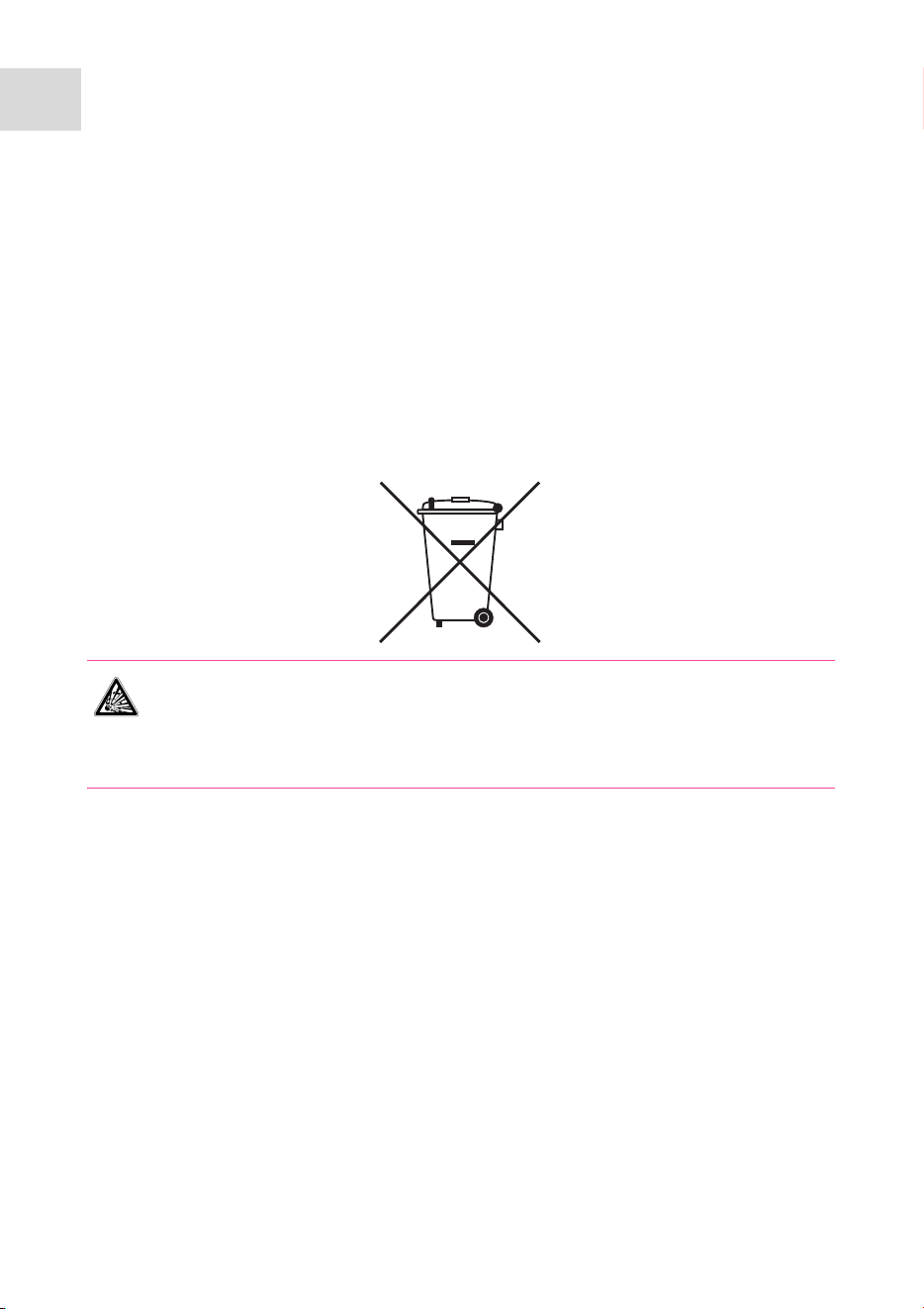
According to these regulations, any devices supplied after August 13, 2005, in the
business-to-business sphere, to which this product is assigned, may no longer be
disposed of in municipal or domestic waste. They are marked with the following symbol to
indicate this:
Do not dispose of batteries as household waste. Dispose of batteries in accordance with
the local regulations.
As the disposal regulations may differ from one country to another within the EU, please
contact your supplier for more information.
WARNING! Risk of explosion or fire due to overheated rechargeable batteries
and batteries.
Do not heat rechargeable batteries and other batteries to temperatures above
60 °C and do not throw them into a fire.

Ordering Information
Top Buret M/H
English (EN)
41
11 Ordering Information
11.1 Dispenser
11.2 Spare parts
Order no.
(International)
Description
Eppendorf Top Buret M
4965 000.017 25 mL
Eppendorf Top Buret H
4965 000.025 50 mL
Order no.
(International)
Description
Discharge tube
4965 612.004 with knurled nut
4965 611.008 Tube holder
Discharge valve
4965 616.000 with toggle
Telescopic aspirating tube
4960 805.009 2.5 mL, 5 mL, 10 mL, 25 mL, 50 mL, 100 mL
Drying tube
4960 851.000 without drying agent
4965 620.007 Air vent cover/filter connection
Battery
4965 625.009 LR03/AAA, 1.5 V, 2 pieces

42
Ordering Information
Top Buret M/H
English (EN)
11.3 Thread adapter
• GL – round thread DIN 138 for glass threads. Number indicates the maximum outer
diameter of the male thread.
• S – buttress thread. Thread type for glass bottles seals which is to prevent them
becoming loose unintentionally due to vibrations.
• NS – glass vessel with ground glass joint. 1st digit is the inner diameter of the
roughened glass, 2nd digit is the length into the vessel.
Order no.
(International)
Description
Bottle thread adapter
PP
4960 800.040 from GL 32 to GL 25,
4960 800.139 from GL 32 to GL 27
4960 800.058 from GL 32 to GL/S 28
4960 800.120 from GL 45 to GL 32
4960 800.155 from GL 45 to GL 38
4960 800.147 from GL 45 to S 40
4960 800.082 from GL 32 to NS 19/26
4960 800.090 from GL 32 to NS 24/29
4960 800.104 from GL 32 to NS 29/32

Certificates




Evaluate Your Manual
Give us your feedback.
www.eppendorf.com/manualfeedback
Your local distributor: www.eppendorf.com/contact
Eppendorf SE · Barkhausenweg 1 · 22339 Hamburg · Germany
eppendorf@eppendorf.com · www.eppendorf.com