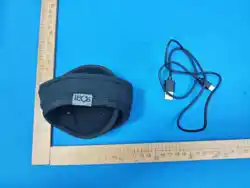
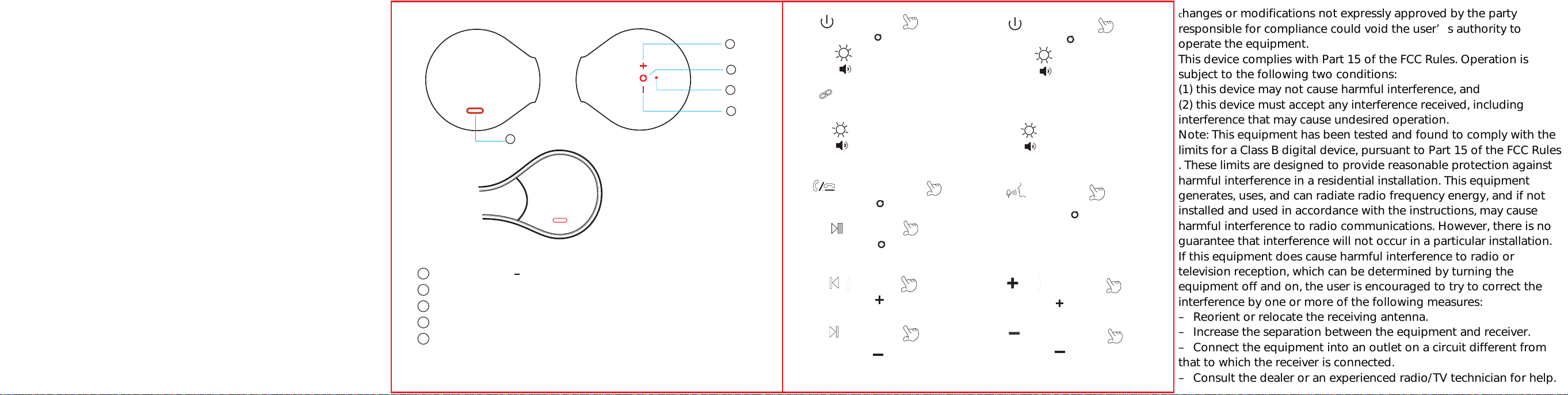
Fig. 1 Interior View
USB C
connector
Music Time ≥25H (80%Volume)
Call Time ≥20H
Standby Time ≥250H
Charging Time ≥2.5H
1
2
3
4
R- Face
5
R- Interior
1
2
3
4
Indicator Light
Multi-function Key
Next / Volume +
Charging Port
5
Previous / Volume
④
③
①
Previous
Short press button to
Short press button to
Long press 2S’ Power On
Pair with phone
Automatically enter pairing mode after
power-up.
When the earphones in pairing state, locate “180S” on your device to pair them.
Pairing succeeded
After auto reconnect on power on or
pairing succeeded
Short press Answer/Hang Up
Play/Pause
Short press to pause Short
press again to play
*1
Smart voice
( Activate Siri )
Increase volume
Long press button to
Next track
Decrease volume
Long press button to
Blue light on for 1 S’.
Red & Blue light ash alternately fast
Pairing
du
Blue light ashes once every 5 S’
Red light on for 1 S’
Long press 3S’ Power On
Double press Activate Smart Voice
Power On
Power On
Power O
Power O
*2
3S’
2S’
1. 2
3
*1
Answer/Hang up
select next song
increase volume
decrease
select previous song
volume
1S’
1S’
*1
*1
changes or modifications not expressly approved by the party
responsible for compliance could void the user’s authority to
operate the equipment.
This device complies with Part 15 of the FCC Rules. Operation is
subject to the following two conditions:
(1) this device may not cause harmful interference, and
(2) this device must accept any interference received, including
interference that may cause undesired operation.
Note: This equipment has been tested and found to comply with the
limits for a Class B digital device, pursuant to Part 15 of the FCC Rules
. These limits are designed to provide reasonable protection against
harmful interference in a residential installation. This equipment
generates, uses, and can radiate radio frequency energy, and if not
installed and used in accordance with the instructions, may cause
harmful interference to radio communications. However, there is no
guarantee that interference will not occur in a particular installation.
If this equipment does cause harmful interference to radio or
television reception, which can be determined by turning the
equipment off and on, the user is encouraged to try to correct the
interference by one or more of the following measures:
– Reorient or relocate the receiving antenna.
– Increase the separation between the equipment and receiver.
– Connect the equipment into an outlet on a circuit different from
that to which the receiver is connected.
– Consult the dealer or an experienced radio/TV technician for help.