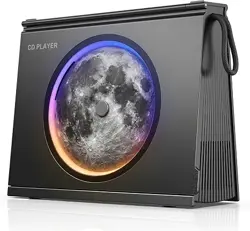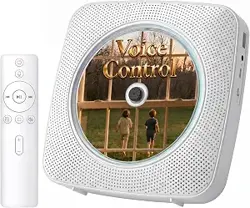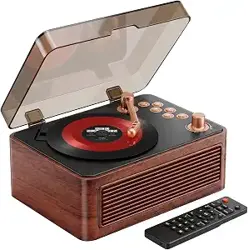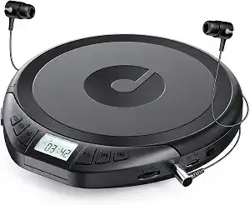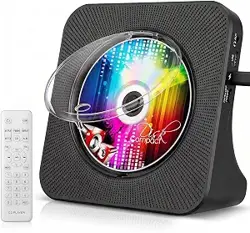
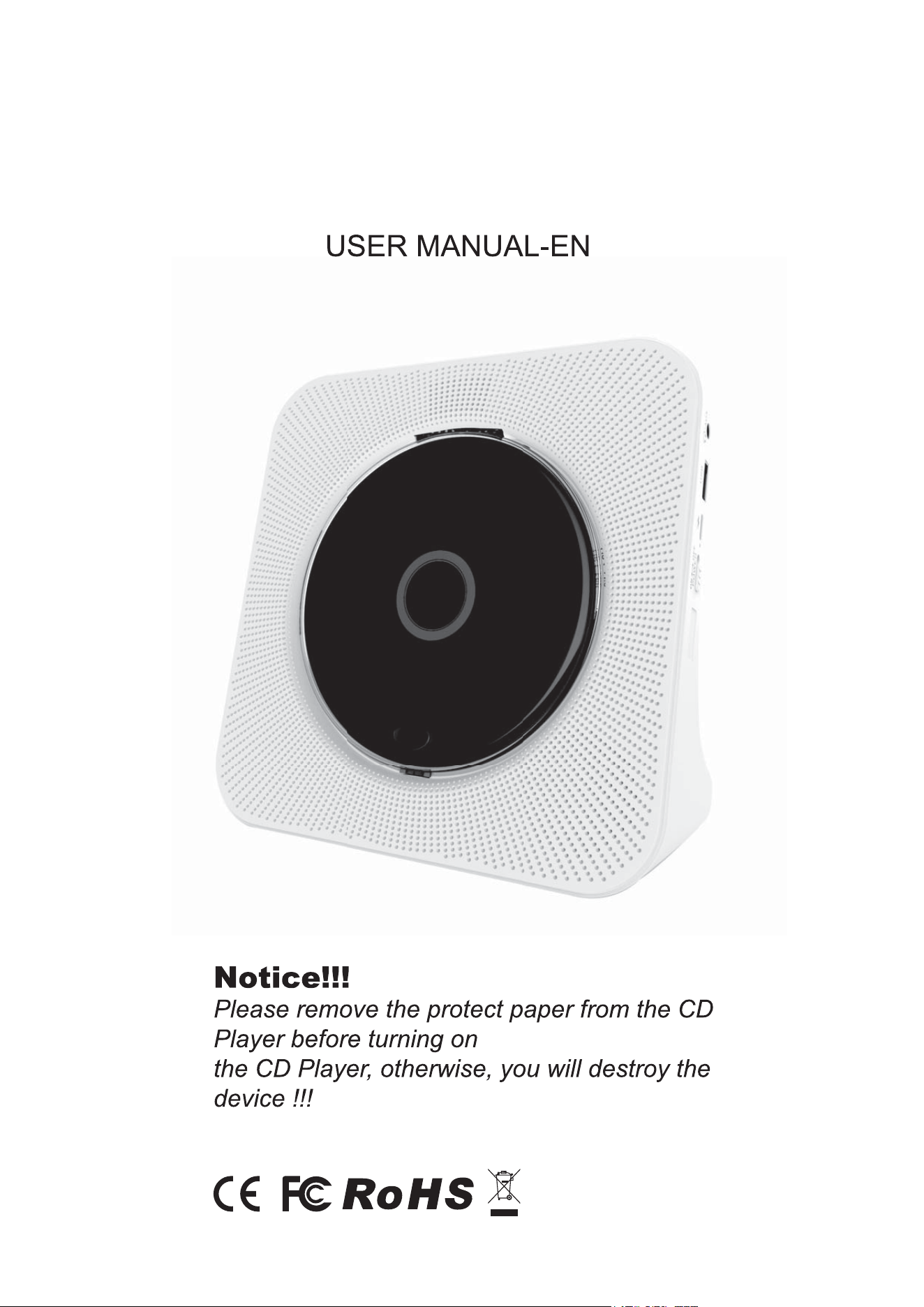
KC-806
EN
CD Player
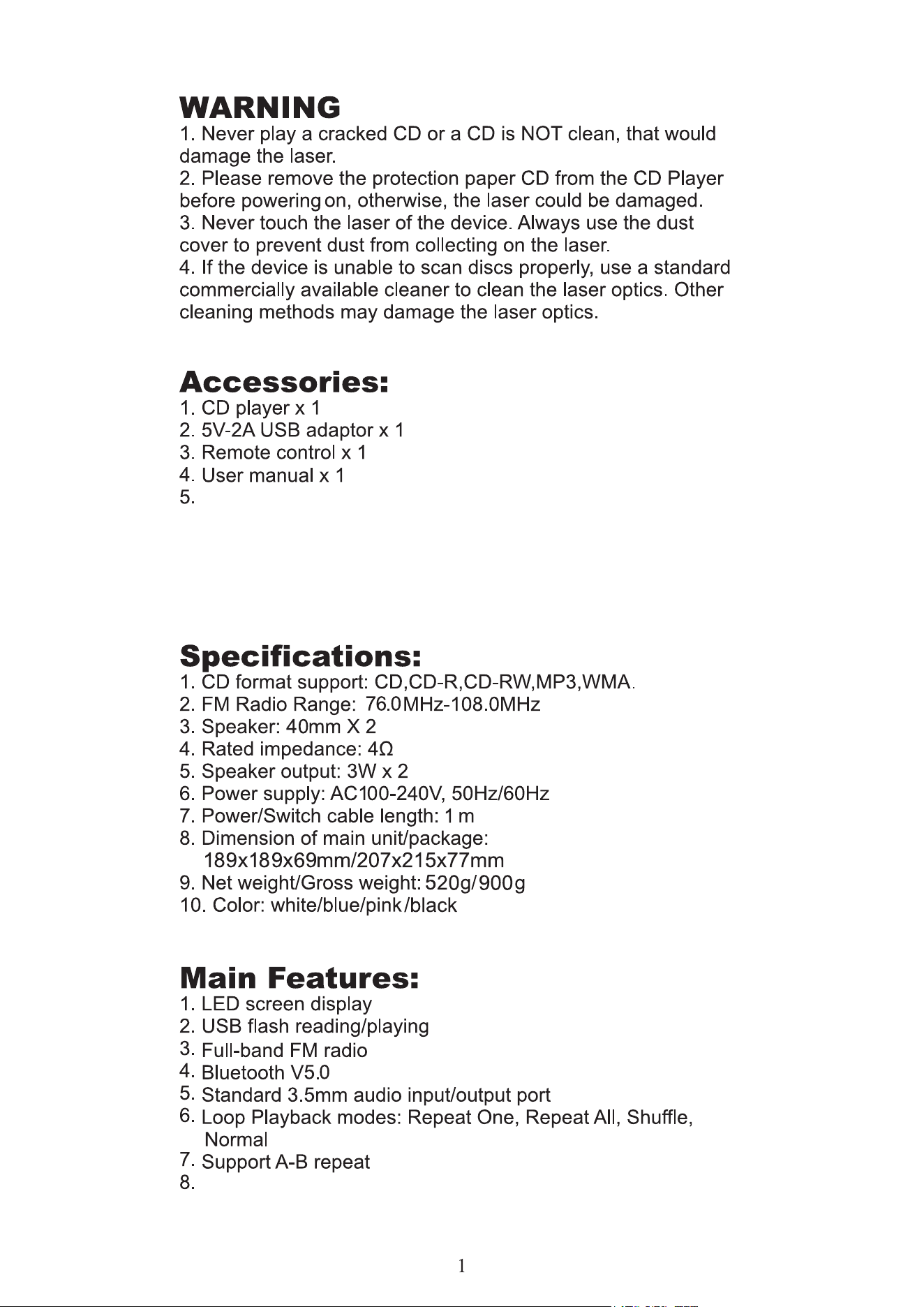
Type-C Power cord x 1
Support scheduled shutdown
EN
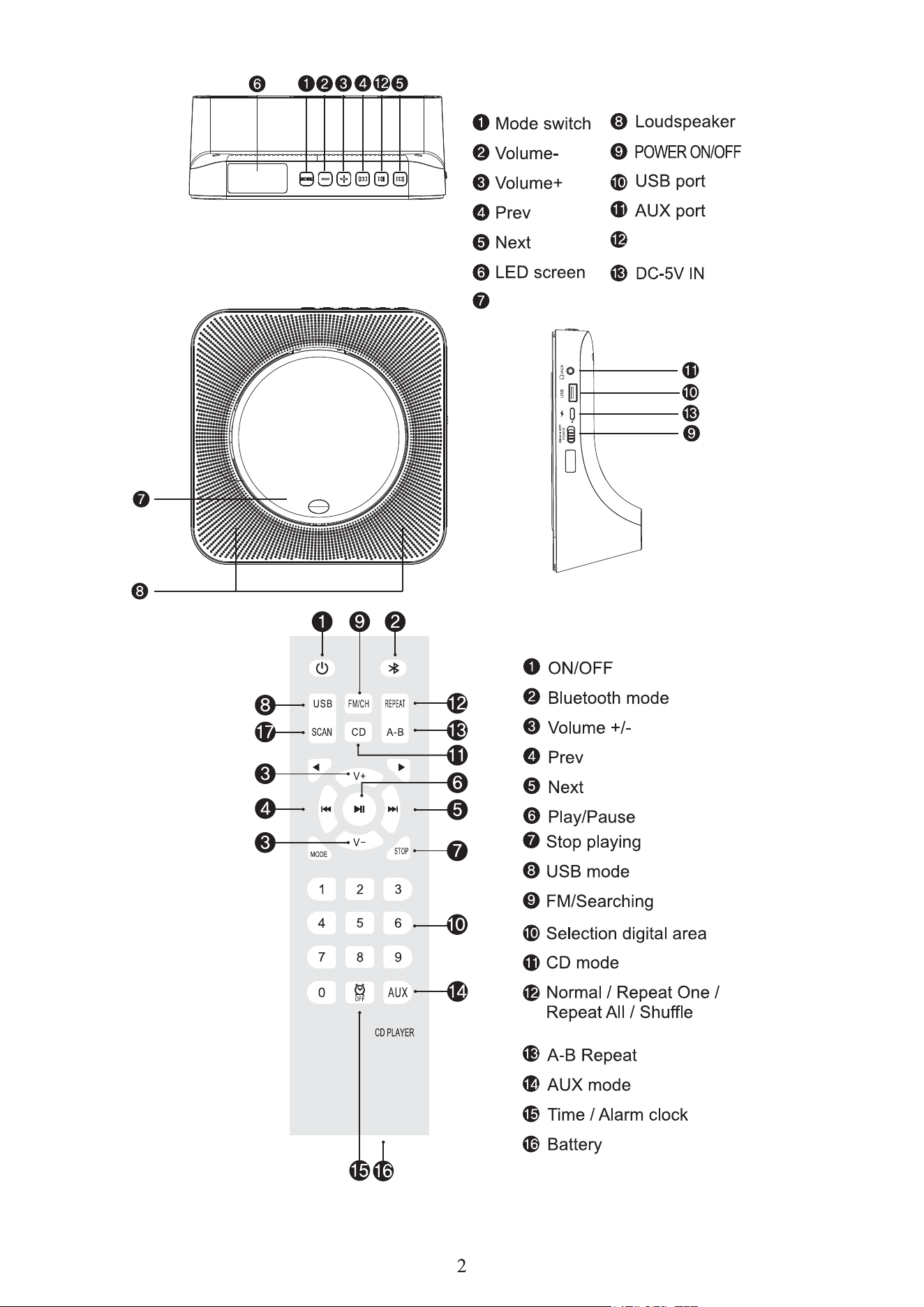
Play/Pause
CD lid
EN
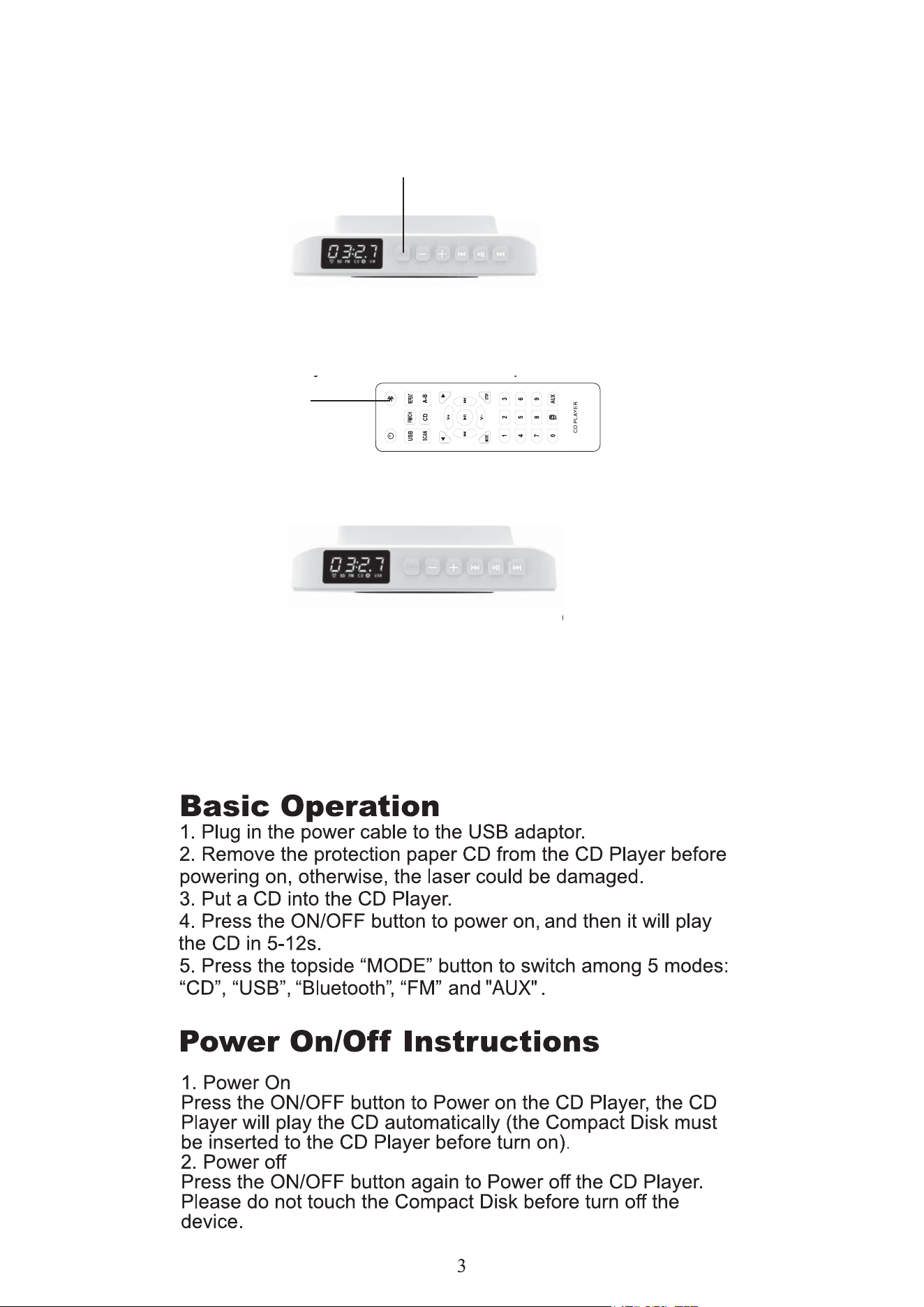
1. Insert a disc that conforms to the format and short press
the mode switch button to enter the CDMode (default is CD
mode) to start playing.
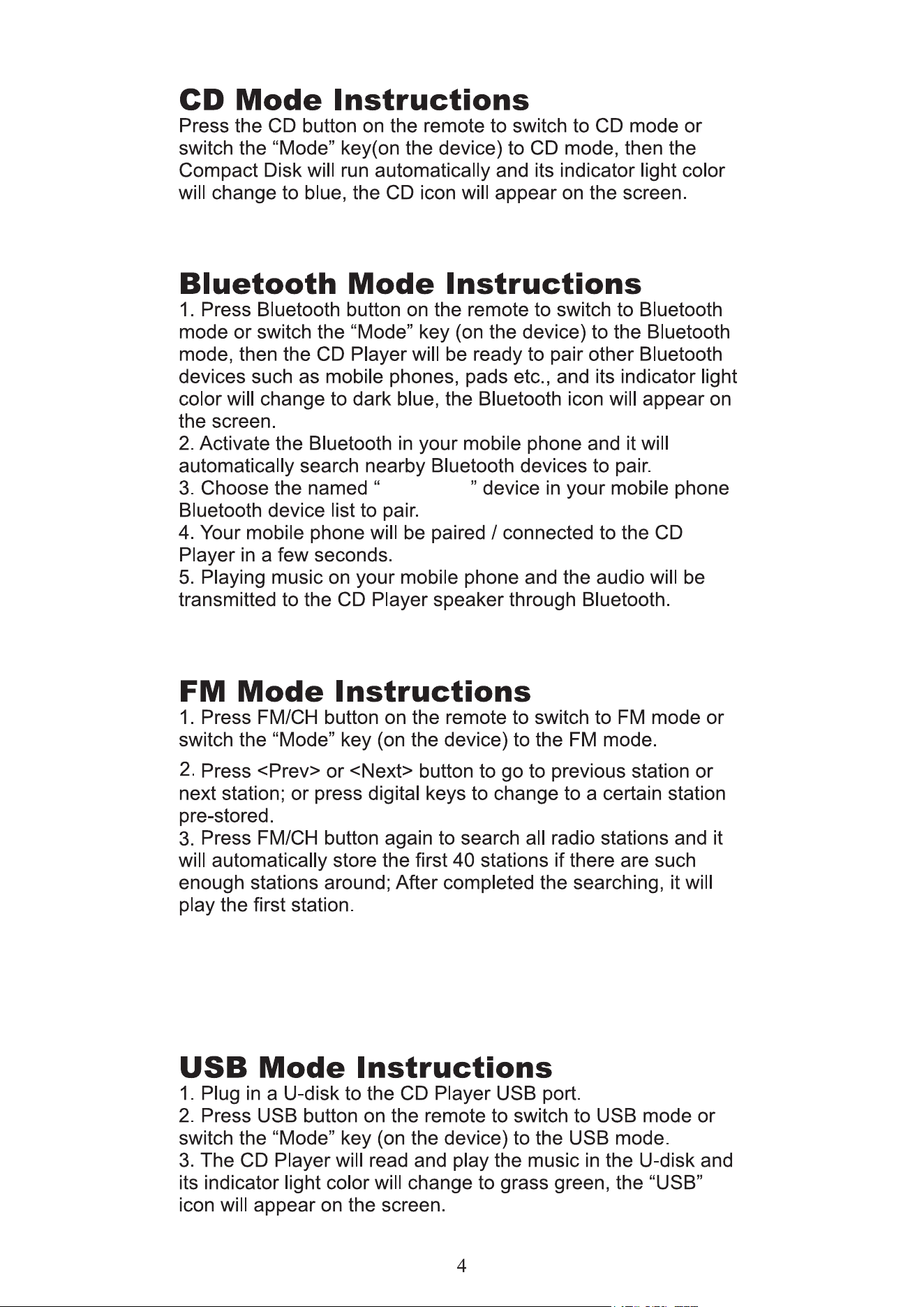
2. Turn on the headset that needs to receive Bluetooth signals,
and press and hold the Bluetooth mode button of the remote
control for three seconds until the Bluetooth icon player on the
CD LED display flashes, and the CD player enters Bluetooth
Transfer method.
3. When the Bluetooth icon on the LED display of the CD
player no longer flashes but is always onBluetooth pairing
succeeded.
Note: It is best not to turn on other Bluetooth devices within
ten meters during pairingIf the pairing is unsuccessful, please
check if there are other Bluetooth devices within ten meters
Open.
Bluetooth transmission
isc that con
f
orms to the
f
or
m
w
itch button to enter the
C
D
a
rt pla
y
in
g
.
e headset that needs to recei
v
n
d hold the Bluetooth mode
b
ree seconds until the Blueto
o
p
la
y
f
lashes
,
and the
C
D
p
la
y
e
Bluetooth icon on the LED di
n
g
er
f
lashes but is alwa
y
s on
B
e
s
t
n
o
t
t
o
t
u
r
n
o
n
o
t
h
e
r
B
l
u
e
t
o
o
d
urin
g
p
airin
g
I
f
the
p
airin
g
is un
s
re
a
r
e
o
th
e
r Bl
ue
t
oo
th
de
vi
ces
EN
MODE
MODE
CD PLAYER
EN
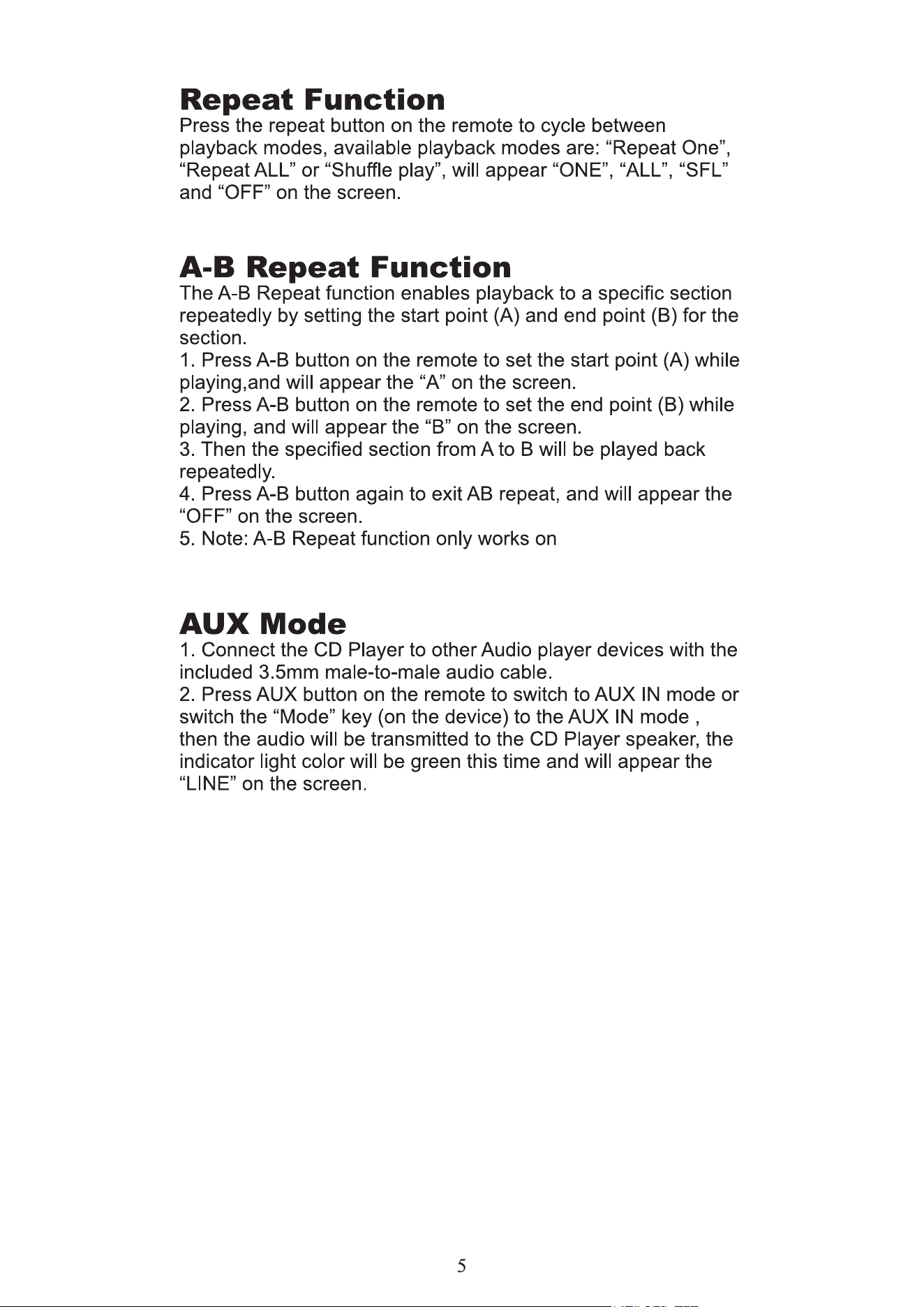
CD and USB mode.
EN
EN

This equipment has been tested and found to comply with the limits for a Class
B digital device, pursuant to part 15 of the FCC Rules. These limits are
designed to provide reasonable protection against harmful interference in a
residential installation. This equipment generates, uses and can radiate radio
frequency energy and, if not installed and used in accordance with the
instructions, may cause harmful interference to radio communications.
However, there is no guarantee that interference will not occur in a particular
installation. If this equipment does cause harmful interference to radio or
television reception, which can be determined by turning the equipment off and
on, the user is encouraged to try to correct the interference by one or more of
the following measures:
Ь Reorient or relocate the receiving antenna.
Ь Increase the separation between the equipment and receiver.
Ь Connect the equipment into an outlet on a circuit different from that to which
the receiver is connected.
Ь Consult the dealer or an experienced radio/TV technician for help.
Caution: Any changes or modifications to this device not explicitly approved
by manufacturer could void your authority to operate this equipment.
This device complies with part 15 of the FCC Rules. Operation is subject to the
following two conditions: (1) This device may not cause harmful interference,
and (2) this device must accept any interference received, including
interference that may cause undesired operation.
The device has been evaluated to meet general RF exposure requirement.

IC warning statements:
-English Warning Statement:
“This device complies with Industry Canada licence-exempt RSS standard(s).
Operation is subject to the following two conditions: (1) this device may not
cause interference, and (2) this device must accept any interference, including
interference that may cause undesired operation of the device."
The digital apparatus complies with Canadian CAN ICES-3 (B)/NMB-3(B).
-French Warning Statement:
“Le présent appareil est conforme aux CNR d'Industrie Canada applicables
aux appareils radio exempts de licence. L'exploitation est autorisée aux deux
conditions suivantes : (1) l'appareil ne doit pas produire de brouillage, et (2)
l'utilisateur de l'appareil doit accepter tout brouillage radioélectrique subi, même
si le brouillage est susceptible d'en compromettre le fonctionnement."
Cet appareil numérique de la classe B est conforme à la norme NMB-003 du
Canada.
This equipment complies with IC radiation exposure limits set forth for an
uncontrolled environment and meets RSS-102 of the IC radio frequency (RF)
Exposure rules. This equipment has very low levels of RF energy that are deemed to
comply without testing of specifc absorption ratio (SAR).Cet équipement est
conforme aux limites d’exposition aux rayonnements énoncées pour un
environnement non contrôlé et respecte les règles d’exposition aux fréquences
radioélectriques (RF) CNR-102 de l’IC. Cet équipement émet une énergie RF très
faible qui est considérée conforme sans évaluation du débit d’absorption spécifque
(DAS).