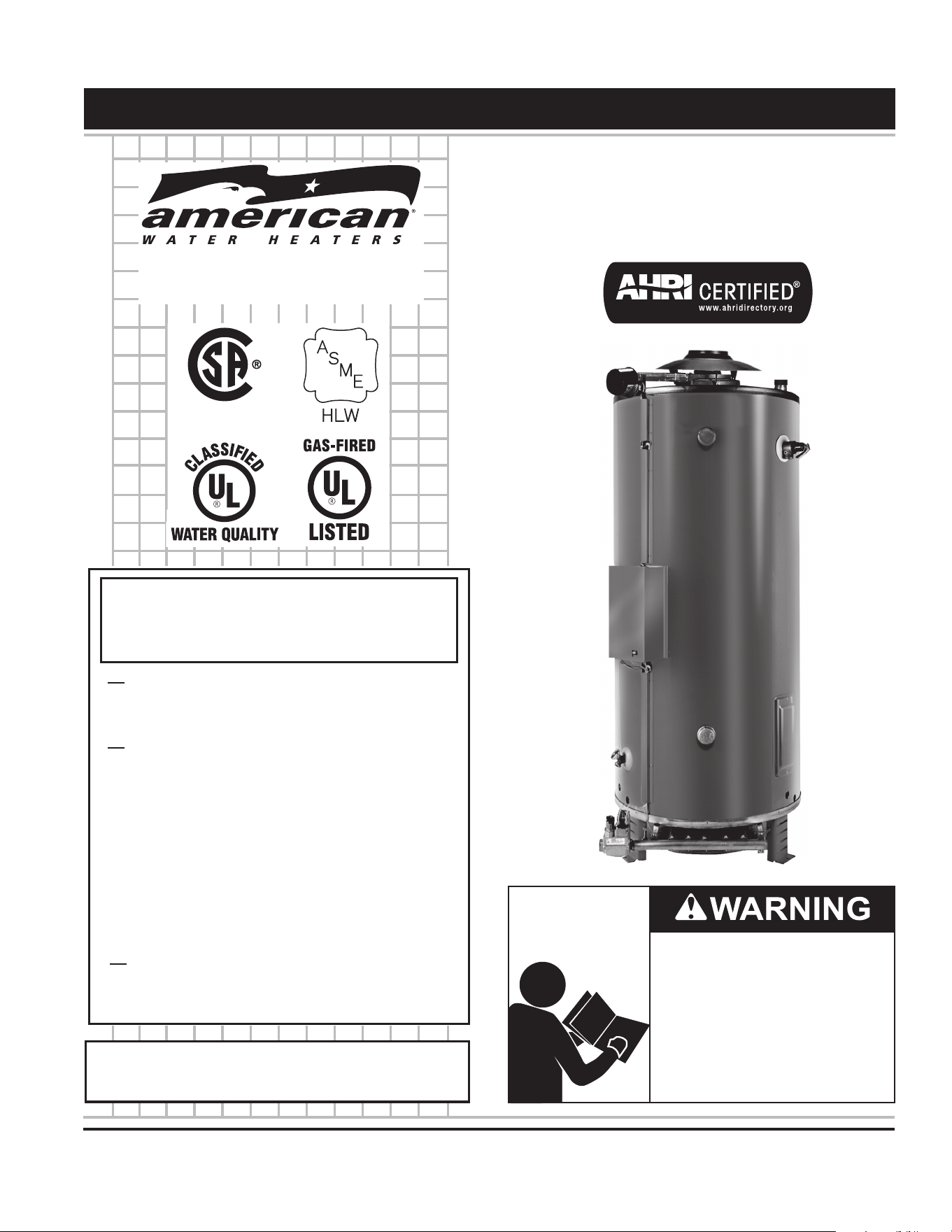
COMMERCIAL GAS WATER HEATERS
Instruction Manual
PRINTED 1215 197935-006
PLACE THESE INSTRUCTIONS ADJACENT TO HEATER AND NOTIFY OWNER TO KEEP FOR FUTURE REFERENCE.
MODELS BCG3 & ABCG3
SERIES 118/119
INSTALLATION - OPERATION - SERVICE
- MAINTENANCE - LIMITED WARRANTY
Read and understand this instruction
manual and the safety messages
herein before installing, operating or
servicing this water heater.
Failure to follow these instructions and
safety messages could result in death
or serious injury.
This manual must remain with the
water heater.
Thank you for buying this energy efcient water heater.
We appreciate your condence in our products.
WARNING: If the information in these
instructions is not followed exactly, a fire
or explosion may result causing property
damage, personal injury or death.
Do not store or use gasoline or other
flammable vapors and liquids in the
vicinity of this or any other appliance.
WHAT TO DO IF YOU SMELL GAS:
Do not try to light any appliance.
Do not touch any electrical switch; do
not use any phone in your building.
Immediately call your gas supplier
from a neighbor’s phone. Follow the
gas supplier’s instructions.
If you cannot reach your gas supplier,
call the fire department.
Installation and service must be
performed by a qualified installer,
service agency or the gas supplier.
•
•
•
•
www.americanwaterheater.com
American Water Heater
Johnson City, TN 37605
LOW LEAD
CONTENT

2
Air From Other Indoor Spaces ........................................................ 18
Technical Data Venting ..............................................................19-20
Mechanical Venting ......................................................................... 21
WATER HEATER INSTALLATION ................................................. 21-24
Water Line Connections .................................................................. 21
T&P Valve Discharge Pipe .............................................................. 21
Installation Diagrams - Top Inlet/Outlet Usage ............................... 22
Heater Wiring .................................................................................. 23
Gas Piping ....................................................................................... 24
Gas Line Leak Testing .................................................................... 24
Purging ............................................................................................ 24
OPERATION ........................................................................................ 25
Prior to Start Up .............................................................................. 25
SEQUENCE OF OPERATION ............................................................ 25
Sequence of Operation Flow Chart ................................................ 26
Lighting & Operation Labels ...................................................... 27-28
Adjustments..................................................................................... 29
Checking Venting ............................................................................ 29
Checking the Input .......................................................................... 29
MAINTENANCE ................................................................................... 31
Venting System ............................................................................... 31
Remote Storage Tank Temperature Control ................................... 31
Temperature-Pressure Relief Valve Test ........................................ 31
Anode Rod Inspection................................................................ 31-32
Draining and Flushing ..................................................................... 32
Recommended Procedure for Periodic Removal or Lime Deposits
from the Tank Type Commercial Water Heaters ............................ 32
DeLiming Solvents .......................................................................... 33
Tank Cleanout Procedure ............................................................... 33
Deliming Using Flo-Jug Method ................................................33-34
Pilot Burner...................................................................................... 34
Main Burner ..................................................................................... 35
Gas Control Valve ........................................................................... 35
SERVICE ............................................................................................. 35
Electrical Servicing ......................................................................... 35
TROUBLESHOOTING ......................................................................... 36
Ignition Module ................................................................................ 36
Flue Damper .................................................................................... 36
Efkal RVGP-KSF Series Flue Damper Trouble Shooting Guide
........ 37
Troubleshooting Checklist ............................................................... 38
FOR YOUR INFORMATION ................................................................ 39
Start up Conditions ......................................................................... 39
Operational Conditions ................................................................... 39
WATER PIPING DIAGRAMS ..........................................................40-54
MANIFOLD KITS ................................................................................. 55
NOTES ............................................................................................56-58
WARRANTY ........................................................................................ 59
TABLE OF CONTENTS
SAFE INSTALLATION, USE AND SERVICE ........................................ 3
APPROVALS .......................................................................................... 3
GENERAL SAFETY INFORMATION .................................................4-5
Precautions ....................................................................................... 5
Grounding Instructions ...................................................................... 5
Hydrogen Gas Flammable ................................................................ 5
INTRODUCTION ................................................................................... 6
Abbreviations Used ........................................................................... 6
Qualications .................................................................................... 6
Preparing for the Installation ............................................................. 6
FEATURES AND COMPONENTS ........................................................ 7
The Eliminator (Self Cleaning System) ............................................. 7
High Limit Switch ............................................................................... 7
Electronic Ignition Control ................................................................. 7
Automatic Flue Damper .................................................................... 7
Uncrating ........................................................................................... 7
INSTALLATION CONSIDERATIONS ............................................... 8-12
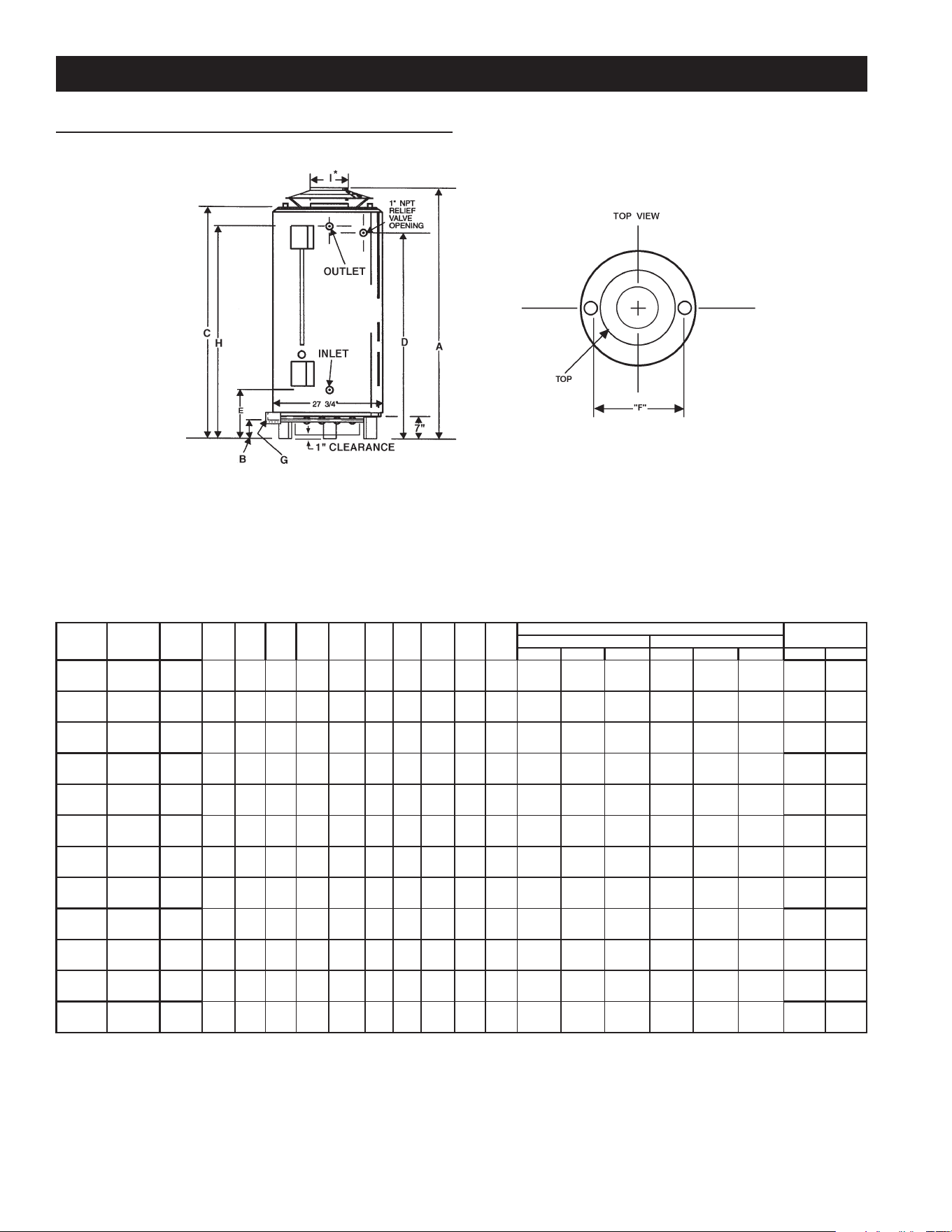
Rough In Dimensions ........................................................................ 8
Locating The Water Heater ............................................................. 10
Clearances ...................................................................................... 10
NSF Leg Kit ......................................................................................11
Insulation Blanket .............................................................................11
Hard Water .......................................................................................11
Circulation Pumps .......................................................................11-12
High Altitude Installations ............................................................... 12
INSTALLATION REQUIREMENTS ..................................................... 13
Gas Supply Systems ....................................................................... 13
Supply Gas Regulator ..................................................................... 13
Power Supply .................................................................................. 13
Water Temperature Control and Mixing Valves .............................. 13
Dishwashing Machines ................................................................... 14
Closed Water Systems .................................................................... 14
Thermal Expansion ......................................................................... 14
Temperature-Pressure Relief Valve........................................... 14-15
Contaminated Air ............................................................................ 15
Air Requirements ............................................................................ 15
Unconned Space ........................................................................... 16
Conned Space ............................................................................... 16
VENTING INSTALLATION .................................................................. 16
Venting ............................................................................................ 16
Vent Reducer .................................................................................. 16
Multiple Heater Manifold ................................................................. 17
Fresh Air Opening for Conned Spaces ......................................... 17
Outdoor Air Through Two Openings ............................................... 17
Outdoor Air Through One Opening ................................................ 17
Outdoor Air Through Two Horizontal Ducts .................................... 17
Outdoor Air Through Two Vertical Ducts ........................................ 18
3
SAFE INSTALLATION, USE AND SERVICE
The proper installation, use and servicing of this water heater is extremely important to your safety and the safety of others.
Many safety-related messages and instructions have been provided in this manual and on your own water heater to warn you and
others of a potential injury hazard. Read and obey all safety messages and instructions throughout this manual. It is very important
that the meaning of each safety message is understood by you and others who install, use, or service this water heater.
All safety messages will generally tell you about the type of hazard, what can happen if you do not follow the safety message, and
how to avoid the risk of injury.
DANGER
WARNING
CAUTION
CAUTION
DANGER indicates an imminently
hazardous situation which, if not avoided,
will result in injury or death.
This is the safety alert symbol. It is used to alert you to
potential personal injury hazards. Obey all safety
messages that follow this symbol to avoid possible
injury or death.
WARNING indicates a potentially hazardous
situation which, if not avoided, could result
in injury or death.
CAUTION indicates a potentially hazardous
situation which, if not avoided, could result in
minor or moderate injury.
CAUTION used without the safety alert
symbol indicates a potentially hazardous
situation which, if not avoided, could result in
property damage.
APPROVALS
Note: ASME construction is optional on the water heaters covered in this manual.
LOW LEAD
CONTENT
4
GENERAL SAFETY INFORMATION
Fire or Explosion Hazard
Read instruction manual before
installing, using or servicing
water heater.
Avoid all ignition sources if you smell gas.
Do not store or use gasoline or other flammable vapors and
liquids in the vicinity of this or any other appliance.
Use only the gas shown on the water heater rating label.
Keep ignition sources away from faucets after extended
periods of non-use.
Maintain required clearances to combustibles.
Do not expose water heater controls to excessive gas
pressure.
Property Damage Hazard
All water heaters eventually leak.
•
Do not install without adequate drainage.
•
CAUTION
Turn off power to the water heater
before performing any service.
Electrical Shock Hazard
•
Label all wires prior to disconnecting
when performing service. Wiring errors
can cause improper and dangerous
operation.
•
Verify proper operation after servicing.
•
Failure to follow these instructions can
result in personal injury or death.
•
Fire and Explosion Hazard
Leak test before placing the
water heater in operation.
Disconnect gas piping and main
gas shutoff valve before leak
testing.
Install sediment trap in
accordance with NFPA 54.
Use joint compound or Teflon tape
compatible with propane gas.
Fire Hazard
For continued protection against
risk of fire:
•
Do not install water heater on
carpeted floor.
•
Do not operate water heater if
any part has been exposed to
flooding or water damage.
Fire and Explosion Hazard
Turn off gas lines during installation.
Contact a qualified installer or service
technician for installation and service.
Excessive gas pressure to gas valve can
cause serious injury or death.
Do not use water heater with any gas
other than the gas shown on the rating
label.
Jumping out control circuits or components can
result in property damage, personal injury or death.
Service should only be performed by a qualified service
technician using proper test equipment.
•
Altering the water heater controls and/or wiring in any way
could result in permanent damage to the controls or water
heater and is not covered under the limited warranty.
•
Any bypass or alteration of the water
heater controls and/or wiring will result
in voiding the water heater warranty.
Altering the water heater controls and/or wiring in any way
could result in altering the ignition sequence allowing gas to
flow to the main burner before the hot surface igniter is at
ignition temperature causing delayed ignition which can
cause a fire or explosion.
•
5
PRECAUTIONS
DO NOT USE THIS WATER HEATER IF ANY PART HAS
BEEN EXPOSED TO FLOODING OR WATER DAMAGE.
Immediately call a qualified service technician to inspect the
water heater and to make a determination on what steps
should be taken next.
If the unit is exposed to the following, do not operate heater
until all corrective steps have been made by a qualified
service technician.
1. External re.
2. Damage.
3. Firing without water.
GROUNDING INSTRUCTIONS
This water heater must be grounded in accordance with the
National Electrical Code and/or local codes. These must be
followed in all cases.
This water heater must be connected to a grounded, permanent
wiring system; or an equipment grounding conductor must be
run with the circuit conductors and connected to the equipment
grounding terminal or lead on the water heater, see Figure 20.
HYDROGEN GAS FLAMMABLE
Explosion Hazard
Flammable hydrogen gases
may be present.
Keep all ignition sources away
from faucet when turning on
hot water.
Hydrogen gas can be produced in a hot water system served
by this water heater that has not been used for a long period of
time (generally two weeks or more). Hydrogen gas is extremely
ammable. To reduce the risk of injury under these conditions,
it is recommended that a hot water faucet served by this water
heater be opened for several minutes before using any electrical
appliance connected to the hot water system. If hydrogen is
present there will probably be an unusual sound such as air
escaping through the pipe as the water begins to ow. THERE
SHOULD BE NO SMOKING OR OPEN FLAME NEAR THE
FAUCET AT THE TIME IT IS OPEN.
GENERAL SAFETY INFORMATION
Verify the power to the water heater is turned off before performing any service procedures.
Read and understand this instruction
manual and the safety messages
herein before installing, operating or
servicing this water heater.
Failure to follow these instructions and
safety messages could result in death
or serious injury.
This manual must remain with the
water heater.
Water temperature over 125°F (52°C)
can cause severe burns instantly
resulting in severe injury or death.
Children, the elderly and the
physically or mentally disabled are at
highest risk for scald injury.
Feel water before bathing or
showering.
Temperature limiting devices such as
mixing valves must be installed
when required by codes and to
ensure safe temperatures at fixtures.
Explosion Hazard
Overheated water can cause
water tank explosion.
Properly sized temperature and
pressure relief valve must be
installed in the opening provided.
GENERAL SAFETY INFORMATION
Improper installation, use and service may result
in property damage.
•
Do not operate water heater if any part has been exposed
to flooding or water damage.
•
Inspect anode rods regularly, replace if damaged.
•
Install in location with drainage.
•
Fill tank with water before operation.
•
Properly sized thermal expansion tanks are required on all
closed water systems.
Refer to this manual for installation and service.
CAUTION

6
INTRODUCTION
Thank You for purchasing this water heater. Properly installed
and maintained, it should give you years of trouble free service.
ABBREVIATIONS USED
Abbreviations found in this Instruction Manual include :
• ANSI - American National Standards Institute
• ASME - American Society of Mechanical Engineers
• AHRI - Air-Conditioning, Heating and Refrigeration Institute
• NEC - National Electrical Code
• NFPA - National Fire Protection Association
• UL - Underwriters Laboratory
• CSA - Canadian Standards Association
QUALIFICATIONS
QUALIFIED INSTALLER OR SERVICE AGENCY
Installation and service of this water heater requires ability
equivalent to that of a Qualied Agency (as dened by ANSI
below) in the eld involved. Installation skills such as plumbing,
air supply, venting, gas supply and electrical supply are required
in addition to electrical testing skills when performing service.
ANSI Z223.1 2006 Sec. 3.3.83: “Qualied Agency” - “Any
individual, rm, corporation or company that either in person or
through a representative is engaged in and is responsible for (a)
the installation, testing or replacement of gas piping or (b) the
connection, installation, testing, repair or servicing of appliances
and equipment; that is experienced in such work; that is familiar
with all precautions required; and that has complied with all the
requirements of the authority having jurisdiction.”
If you are not qualied (as dened by ANSI above) and licensed
or certied as required by the authority having jurisdiction
to perform a given task do not attempt to perform any of the
procedures described in this manual. If you do not understand
the instructions given in this manual do not attempt to perform
any procedures outlined in this manual.
PREPARING FOR THE INSTALLATION
1. Read the “General Safety” section, page 4-5 of this manual
first and then the entire manual carefully. If you don’t follow
the safety rules, the water heater will not operate properly.
It could cause DEATH, SERIOUS BODILY INJURY AND/OR
PROPERTY DAMAGE.
This manual contains instructions for the installation, operation,
and maintenance of the gas-red water heater. It also contains
warnings throughout the manual that you must read and be
aware of. All warnings and all instructions are essential to the
proper operation of the water heater and your safety. Since we
cannot put everything on the rst few pages, READ THE ENTIRE
MANUAL BEFORE ATTEMPTING TO INSTALL OR OPERATE
THE WATER HEATER.
2. The installation must conform with these instructions and the
local code authority having jurisdiction. In the absence of local
codes, the installation must comply with the current editions
of the National Fuel Gas Code, ANSI Z223.1/NFPA 54 or CAN/
CSA-B149.1 the Natural Gas and Propane Installation Code.
All documents are available from the Canadian Standards
Association, 8501 East Pleasant Valley Road, Cleveland, OH
44131. NFPA documents are also available from the National
Fire Protection Association, 1 Batterymarch Park, Quincy, MA
02269.
3. If after reading this manual you have any questions or do
not understand any portion of the instructions, call the local
gas utility or the manufacturer whose name appears on the
rating plate.
4. Carefully plan the place where you are going to put the
water heater. Correct combustion, vent action, and vent pipe
installation are very important in preventing death from possible
carbon monoxide poisoning and res.
Examine the location to ensure the water heater complies with
the “Locating the New Water Heater” section in this manual.
5. For California installation this water heater must be braced,
anchored, or strapped to avoid falling or moving during
an earthquake. See instructions for correct installation
procedures. Instructions may be obtained from California
Office of the State Architect, 400 P Street, Sacramento,
CA 95814.
6. Massachusetts Code requires this water heater to be installed in
accordance with Massachusetts 248-CMR 2.00: State Plumbing
Code and 248-CMR 5.00.
7
THE ELIMINATOR (SELF-CLEANING SYSTEM)
These units include The Eliminator (Self-Cleaning System) installed
in the front water inlet, See Figure 1. The Eliminator inlet tube can
only be used in the front water inlet connection. Do not install the
Eliminator inlet tube in either the top or back inlet water connection.
The Eliminator must be oriented correctly for proper function. There
is a marked range on pipe nipple portion of the Eliminator, that
must be aligned with top of inlet spud. A label above the jacket hole
has an arrow that will point to marked portion of pipe nipple if the
orientation is correct. If the arrow does not point within the marked
range on pipe nipple, adjust the pipe nipple to correct. A pipe union
is supplied with the Eliminator to reduce probability of misaligning
the Eliminator accidentally while tightening the connection to inlet
water supply line. Improper orientation of the Eliminator can cause
poor performance of heater and can signicantly reduce outlet water
temperatures during heavy draws.
Note: The Eliminator may have 1, 3 or 7 cross tubes.
FIGURE 1.
HIGH LIMIT SWITCH
The digital thermostat (Figure 2) contains the high limit (energy
cutout) switch. The high limit switch interrupts main burner gas ow
should the water temperature reach 203°F (95°C).
In the event of high limit switch operation, the water heater cannot be
restarted unless the water temperature is reduced to approximately
120°F (49°C). The high limit reset button on the front of the control
then needs to be depressed.
Continued manual resetting of high limit control, preceded by higher
than usual water temperature is evidence of high limit switch operation.
The following is a possible reason for high limit switch operation:
• A malfunction in the thermostatic controls would allow the gas
control valve to remain open causing water temperature to
exceed the thermostat setting. The water temperature would
continue to rise until high limit switch operation.
Contact your dealer or service agent if continued high limit switch
operation occurs.
DIGITAL THERMOSTAT
FIGURE 2.
ELECTRONIC IGNITION CONTROL
Each heater is equipped with a Honeywell ignition module.
The solid state ignition control ignites the pilot burner gas
by creating a spark at the pilot assembly. See Figure 3. Pilot
gas is ignited and burns during each running cycle. The
main burner and pilot gases are cut off during the OFF cycle.
Pilot gas ignition is proven by the pilot sensor. Main burner
ignition will not occur if the pilot sensor does not first sense
pilot ignition.
IGNITION MODULE
FIGURE 3.
AUTOMATIC FLUE DAMPER
All units are equipped with an automatic flue damper that
reduces heat loss during the OFF cycles.
Each automatic flue damper drive assembly is equipped with a
“Service Switch”, as shown in Figure 4
The “Service Switch” has 2 positions: AUTOMATIC
OPERATION and HOLD OPEN DAMPER. For normal operation
the switch should be in the AUTOMATIC OPERATION position.
If there is a problem with the damper the “Service Switch” can
be placed in the HOLD OPEN DAMPER position. When the
switch is placed in the HOLD OPEN DAMPER position the
damper disc will rotate to the open position and the heater may
be used until vent assembly is repaired or replaced. DO NOT
turn the damper disc manually; damage will occur to the drive
assembly if operated manually. Refer to TESTING DAMPER
OPERATION section of this manual for additional information.
FLUE DAMPER
FIGURE 4.
UNCRATING
The heater is shipped with the ue damper already installed. The
wiring conduit runs from the thermostat to the damper drive cover.
Before turning unit on, check to make sure the wiring conduit is
securely plugged into damper drive.
FEATURES AND COMPONENTS
8
ROUGH IN DIMENSIONS
INSTALLATION CONSIDERATIONS
TABLE 1. BCG370T1205_ THROUGH (A)BCG3100T3998_
MODEL
INPUT
RATE
BTU/HR.
APPROX.
TANK
CAP.
A B C D E F
GAS
INLET
G
H
VENT
DIA.
I
J
CONNECTIONS
APPROXIMATE
SHIP WEIGHT
INLET OUTLET
TOP FRONT BACK TOP FRONT BACK STD. ASME
BCG3
70T120
120,000
BTU/Hr.
35 Kw/Hr
71 Gal
268 L
69-3/4”
177 cm
4-1/4”
11 cm
59-1/2”
151 cm
50-7/8”
129 cm
19-11/16”
50 cm
19”
48 cm
1/2”
1/2”
51-7/8”
132 cm
6”
15 cm
27-3/4”
71 cm
1-1/2" NPT
1-1/2" NPT
1-1/2" NPT
1-1/2" NPT
1-1/2" NPT
1-1/2" NPT
1-1/2" NPT
1-1/2" NPT
1-1/2" NPT
1-1/2" NPT
1-1/2" NPT
1-1/2" NPT
400 Lbs
182 Kg
NA
NA
BCG3
80T150
154,000
BTU/Hr
45 Kw/Hr
81 Gal
307 L
73”
185 cm
4-1/4”
11 cm
66-1/2”
169 cm
57-7/8”
147 cm
19-11/16”
50 cm
19”
48 cm
1/2”
1/2”
59”
150 cm
6”
15 cm
27-3/4”
71 cm
1-1/2" NPT
1-1/2" NPT
1-1/2" NPT
1-1/2" NPT
1-1/2" NPT
1-1/2" NPT
1-1/2" NPT
1-1/2" NPT
1-1/2" NPT
1-1/2" NPT
1-1/2" NPT
1-1/2" NPT
470 Lbs
213 Kg
NA
NA
BCG3
80T180
180,000
BTU/Hr
53 Kw/Hr
81Gal
307 L
67-1/2”
171 cm
4-1/2”
12 cm
62”
157 cm
53-5/8”
136 cm
20-1/2”
52 cm
21”
53 cm
1/2”
1/2”
54-5/8”
139 cm
6”
15 cm
27-3/4”
71 cm
1-1/2" NPT
1-1/2" NPT
1-1/2" NPT
1-1/2" NPT
1-1/2" NPT
1-1/2" NPT
1-1/2" NPT
1-1/2" NPT
1-1/2" NPT
1-1/2" NPT
1-1/2" NPT
1-1/2" NPT
470 Lbs
213 Kg
NA
NA
BCG3
100T199
199,000
BTU/Hr
58 kW/Hr
100 Gal
379 L
75”
192 cm
4-1/2”
12 cm
70”
178 cm
61-5/8”
157 cm
20-1/2”
52 cm
21”
53 cm
1/2”
1/2”
62-58”
159 cm
6”
15 cm
27-3/4”
71 cm
1-1/2" NPT
1-1/2" NPT
1-1/2" NPT
1-1/2" NPT
1-1/2" NPT
1-1/2" NPT
1-1/2" NPT
1-1/2" NPT
1-1/2" NPT
1-1/2" NPT
1-1/2" NPT
1-1/2" NPT
603 Lbs
273 Kg
NA
NA
BCG3
80T199
199,000
BTU/Hr
58 kW/Hr
81 Gal
307 L
67-1/2”
171 cm
4-1/2”
12 cm
62”
157 cm
53-5/8”
136 cm
20-1/2”
52 cm
21”
53 cm
1/2”
1/2”
54-5/8”
139 cm
6”
15 cm
27-3/4”
71 cm
1-1/2" NPT
1-1/2" NPT
1-1/2" NPT
1-1/2" NPT
1-1/2" NPT
1-1/2" NPT
1-1/2" NPT
1-1/2" NPT
1-1/2" NPT
1-1/2" NPT
1-1/2" NPT
1-1/2" NPT
470 Lbs
213 Kg
NA
NA
(A)BCG3
100T200
199,000
BTU/Hr
58 kW/Hr
100 Gal
379 L
72”
183 cm
4-1/2”
12 cm
65-1/8”
165 cm
55-7/8”
142 cm
19-3/4”
50 cm
23”
58 cm
1/2”
1/2”
56-3/8”
143 cm
6”
15 cm
30-1/4”
77 cm
1-1/2" NPT
1-1/2" NPT
2" NPT
2" NPT
2" NPT
2" NPT
1-1/2" NPT
1-1/2" NPT
2" NPT
2" NPT
2" NPT
2" NPT
630 Lbs
286 Kg
725 Lbs
329 Kg
(A)BCG3
100T250
250,000
BTU/Hr
72 kW/Hr
100 Gal
379 L
72”
183 cm
4-1/2”
12 cm
65-1/8”
165 cm
55-7/8”
142 cm
19-1/4”
50 cm
23”
58 cm
1/2”
1/2”
56-3/8”
143 cm
8”
20 cm
30-1/4”
77 cm
1-1/2" NPT
1-1/2" NPT
2" NPT
2" NPT
2" NPT
2" NPT
1-1/2" NPT
1-1/2" NPT
2" NPT
2" NPT
2" NPT
2" NPT
630 Lbs
286 Kg
725 Lbs
329 Kg
(A)BCG3
65T250
251,000
BTU/Hr
73 kW/Hr
65 Gal
246 L
75”
191 cm
4-1/2”
12 cm
65-3/4”
167 cm
57-1/4”
145 cm
20”
51 cm
NA
NA
1/2”
1/2”
58-3/4”
149 cm
8”
20 cm
27-3/4”
70 cm
NA
NA
1-1/2" NPT
1-1/2" NPT
1-1/2" NPT
1-1/2" NPT
NA
NA
1-1/2" NPT
1-1/2" NPT
1-1/2" NPT
1-1/2" NPT
750Lbs
341 Kg
862 Lbs
391 Kg
(A)BCG3
100T275
275,000
BTU/Hr
80 kW/Hr
100 Gal
379 L
72”
183 cm
4-1/2”
12 cm
65-1/8”
165 cm
55-7/8”
142 cm
19-3/4”
50 cm
23”
58 cm
1/2”
1/2”
56-3/8”
143 cm
8”
20 cm
30-1/4”
77 cm
1-1/2" NPT
1-1/2" NPT
2" NPT
2" NPT
2" NPT
2" NPT
1-1/2" NPT
1-1/2" NPT
2" NPT
2" NPT
2" NPT
2" NPT
630 Lbs
286 Kg
725 Lbs
329 Kg
(A)BCG3
65T300
305,000
BTU/Hr
89 kW/Hr
65 Gal
246 L
75”
191 cm
4-1/2”
12 cm
65-3/4”
167 cm
57-1/4”
145 cm
20”
51 cm
NA
NA
1/2”
1/2”
58-3/4”
149 cm
8”
20 cm
27-3/4”
70 cm
NA
NA
1-1/2" NPT
1-1/2" NPT
1-1/2" NPT
1-1/2" NPT
NA
NA
1-1/2" NPT
1-1/2" NPT
1-1/2" NPT
1-1/2" NPT
750 Lbs
341 Kg
862 Lbs
391 Kg
(A)BCG3
85T360
365,000
BTU/Hr
107 kW/Hr
85 Gal
322 L
79-1/2”
202 cm
4-1/2”
12 cm
70-1/4”
178 cm
62-1/2”
159 cm
22-1/2”
57 cm
23”
58 cm
3/4”
3/4”
63”
160 cm
8”
20 cm
27-3/4”
70 cm
1-1/2" NPT
1-1/2" NPT
1-1/2" NPT
1-1/2" NPT
1-1/2" NPT
1-1/2" NPT
1-1/2" NPT
1-1/2" NPT
1-1/2" NPT
1-1/2" NPT
1-1/2" NPT
1-1/2" NPT
725 Lbs
329 Kg
833 Lbs
379 Kg
(A)BCG3
100T390
390,000
BTU/Hr
114 kW/Hr
100 Gal
379 L
75-1/2”
192 cm
4-1/2”
12 cm
67-1/2”
171 cm
58-1/4”
148 cm
26-3/4”
68 cm
23”
58 cm
3/4”
3/4”
59”
150 cm
8”
20 cm
30-1/4”
77 cm
1-1/2" NPT
1-1/2" NPT
2" NPT
2" NPT
2" NPT
2" NPT
1-1/2" NPT
1-1/2" NPT
2" NPT
2" NPT
2" NPT
2" NPT
760 Lbs
345 Kg
874 Lbs
396 Kg
See Models Below
* BCG370T120 Models are approved for 5” (13 cm) venting using a 6” (15 cm) to 5” (13 cm) reducer.
FIGURE 5.
9
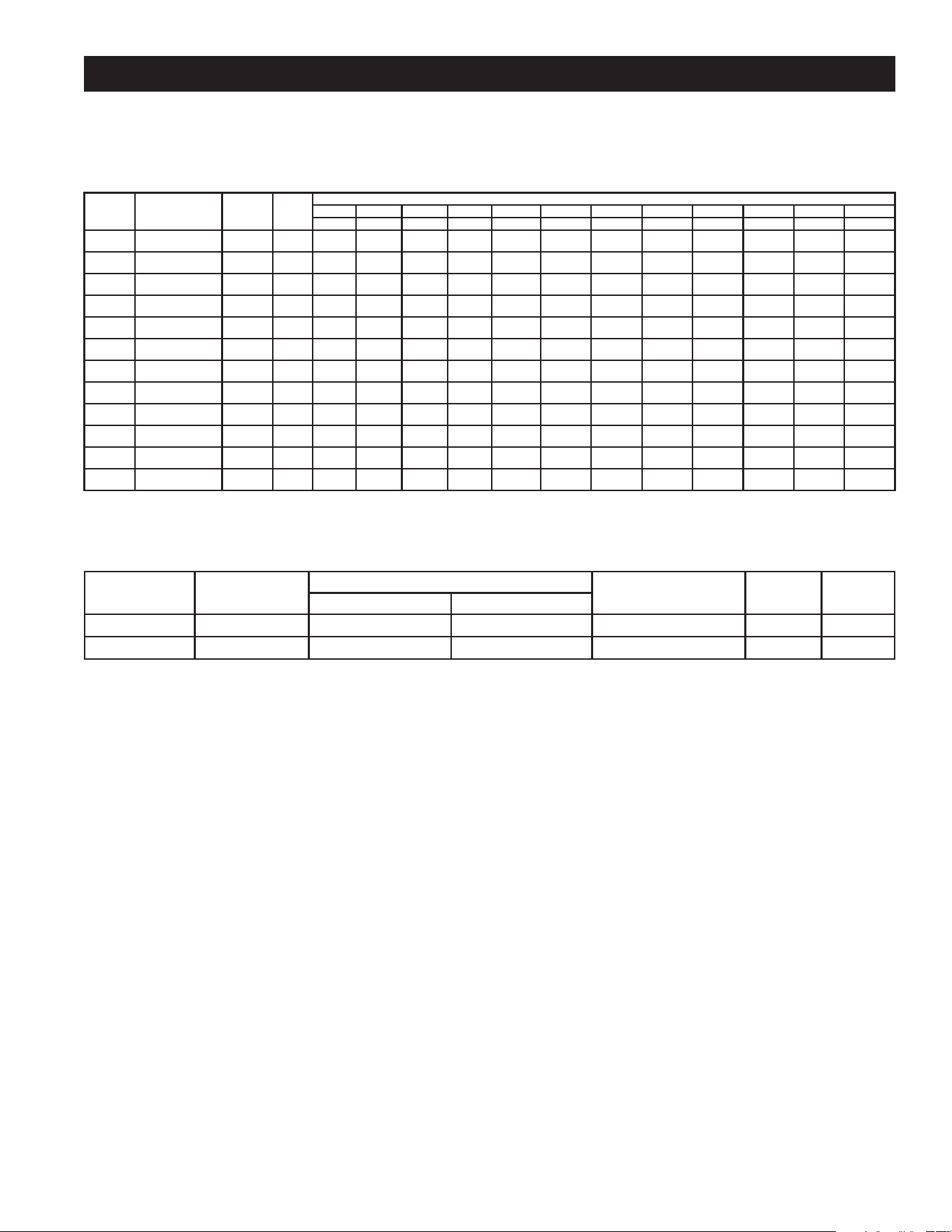
TABLE 2. HEATER PERFORMANCE DATA (A)BCG3 MODELS
MODEL
INPUT RATE
BTUH
APPROX.
GAL.
CAP.
EFF. %
RECOVERY RATING CAPACITIES (GPH AND LPH)
30°F 40°F 50°F 60°F 70°F 80°F 90°F 100°F 110°F 120°F 130°F 140°F
(-)1°C 4°C 10°C 15°C 21°C 27°C 32°C 38°C 43°C 49°C 54°C 60°C
BCG3
70T120
120,000 BTU/Hr.
35 Kw/Hr
71 Gal
268 L
80
388
1469
291
1102
233
882
194
734
166
628
145
549
129
488
116
439
106
401
97
367
90
341
83
314
BCG3
80T150
154,000 BTU/Hr
45 Kw/Hr
81 Gal
306 L
80
498
1885
373
1412
299
1132
249
943
213
806
187
708
166
628
149
564
136
515
124
469
115
435
107
405
BCG3
80T180
180,000 BTU/Hr
53 Kw/Hr
81 Gal
306 L
80
579
2192
434
1643
347
1314
289
1094
248
939
217
821
193
731
174
650
158
598
145
549
134
507
124
469
BCG3
100T199
199,000 BTU/Hr
58 kW/Hr
100 Gal
379 L
80
643
2434
482
1825
386
1461
322
1219
276
1045
241
912
214
810
193
731
175
662
161
609
148
560
132
500
BCG3
80T199
199,000 BTU/Hr
58 kW/Hr
81 Gal
306 L
80
643
2434
482
1825
386
1461
322
1219
276
1045
241
912
214
810
193
731
175
662
161
609
148
560
132
500
(A)BCG3
100T200
199,000 BTU/Hr
58 kW/Hr
100 Gal
379 L
80
643
2434
482
1825
386
1461
322
1219
276
1045
241
912
214
810
193
731
175
662
161
609
148
560
132
500
(A)BCG3
100T250
250,000 BTU/Hr
72 kW/Hr
100 Gal
379 L
80
808
3059
606
2294
485
1835
404
1529
346
1311
303
1147
269
1020
242
918
220
834
202
765
186
706
173
655
(A)BCG3
65T250
251,000 BTU/Hr
73 kW/Hr
65 Gal
246 L
80
811
3071
608
2303
487
1843
406
1536
348
1316
304
1152
270
1024
243
921
221
838
203
768
187
709
174
658
(A)BCG3
100T275
275,000 BTU/Hr
80 kW/Hr
100 Gal
379 L
80
889
3365
667
2524
533
2019
444
1682
381
1442
333
1262
296
1122
267
1009
242
918
222
841
205
776
190
721
(A)BCG3
65T300
305,000 BTU/Hr
89 kW/Hr
65 Gal
246 L
80
986
3732
739
2799
592
2239
493
1866
423
1599
370
1399
329
1244
296
1120
269
1018
246
933
228
861
211
800
(A)BCG3
85T360
365,000 BTU/Hr
107 kW/Hr
85 Gal
322 L
80
1180
4466
885
3349
708
2680
590
2233
506
1914
442
1675
393
1489
354
1340
322
1218
295
1116
272
1031
253
957
(A)BCG3
100T390
390,000 BTU/Hr
114 kW/Hr
100 Gal
379 L
80
1293
4894
970
3671
776
2936
646
2447
554
2097
485
1835
431
1631
388
1468
353
1335
323
1224
298
1129
277
1049
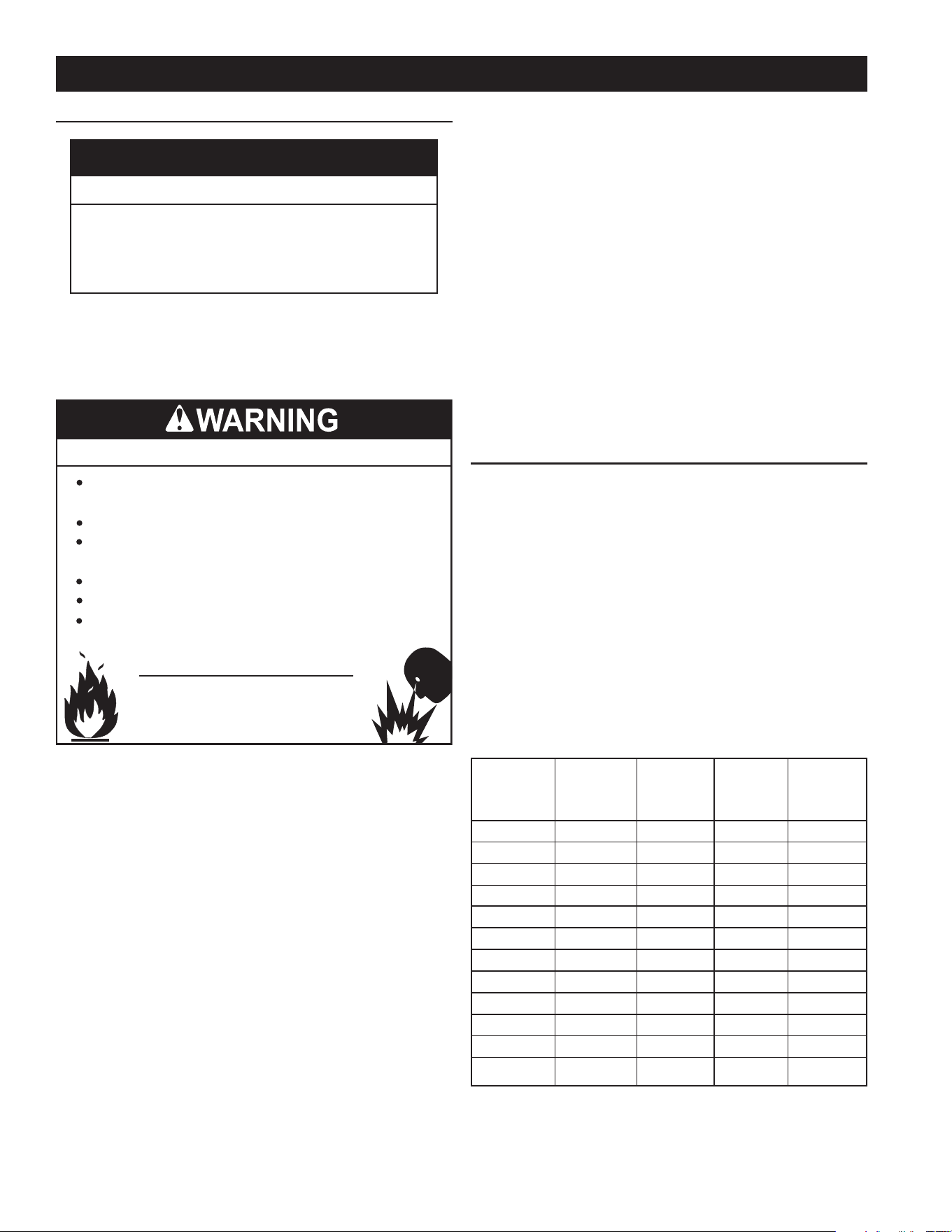
TABLE 3. GAS AND ELECTRICAL CHARACTERISTICS
Model Type of Gas
Gas Supply Pressure
Gas Manifold Pressure Volts/Hz AmperesMinimum Maximum
All Models Natural 4.5" W.C. (1.12 kPa) 14" W.C. (3.48 kPa) 3.5" W.C. (0.87 kPa) 120/60 <5
All Models Propane 11.0" W.C. (2.74kPa) 14" W.C. (3.48kPa) 10.0" W.C. (2.49 kPa) 120/60 <5
INSTALLATION CONSIDERATIONS
10
Flammable items, pressurized containers or any other
potential fire hazardous articles must never be placed on
or adjacent to the heater. Open containers or flammable
material should not be stored or used in the same room
with the heater.
The heater must not be located in an area where it will
be subject to freezing.
Locate it near a floor drain. The heater should be located
in an area where leakage from heater or connections will
not result in damage to adjacent area or to lower floors
of the structure.
When such locations cannot be avoided, a suitable metal
drain pan should be installed under heater. Such pans
should be fabricated with sides at least 2” deep, with
length and width at least 2” greater than diameter of
heater and must be piped to an adequate drain. Pan
must not restrict combustion air flow.
CLEARANCES
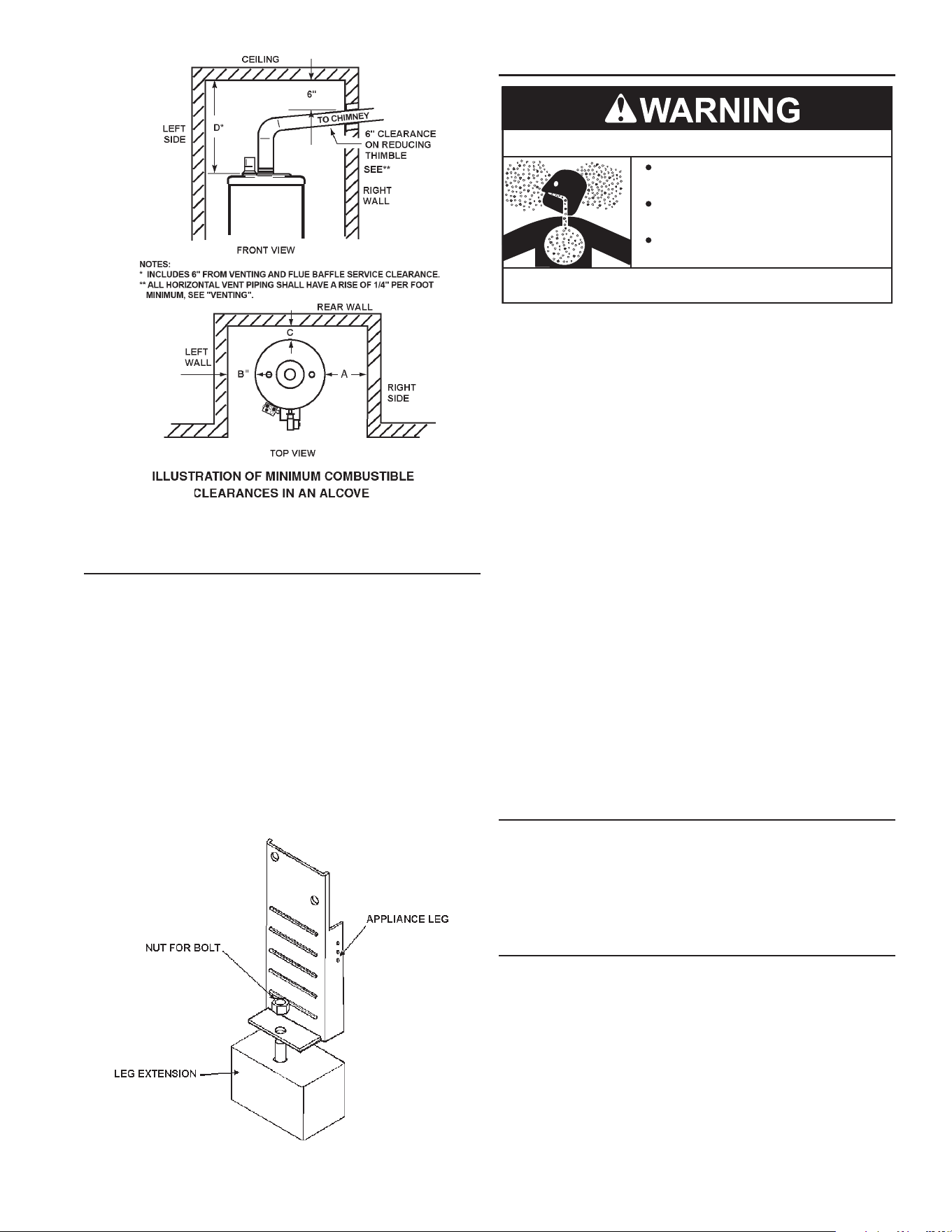
These heaters are approved for installation on combustible
flooring in an alcove when the minimum clearance from
combustion or non-combustible construction are followed
as indicated in Figure 6 and Table 4.
In all installations the minimum combustible clearances from
draft hood surface or vent piping shall be 6” (152mm).
Vent piping passing through a combustible wall or ceiling
must be a continuous run (no joints) and retain 6” (152mm)
clearance unless an approved reducing thimble is used.
A service clearance of 24” (610mm) should be maintained
from serviceable parts, such as relief valves, baffles,
thermostats, cleanout openings or drain valves.
TABLE 4. INSTALLATION CLEARANCES
A
(RIGHT SIDE)
B
(LEFTSIDE)
C
(BACK)
D
(CEILING)
70T120 1” (2.54 cm) 1” (2.54 cm) 1” (2.54 cm) 12” (30.48 cm)
80T150 1” (2.54 cm) 1” (2.54 cm) 1” (2.54 cm) 12” (30.48 cm)
80T180 1” (2.54 cm) 1” (2.54 cm) 1” (2.54 cm) 12” (30.48 cm)
100T199 1” (2.54 cm) 1” (2. 54 cm) 1” (2.54 cm) 12” (30.48 cm)
80T199 1” (2. 54 cm) 1” (2. 54 cm) 1” (2. 54 cm) 12” (30.48 cm)
100T200 1” (2. 54 cm) 1” (2. 54 cm) 1” (2. 54 cm) 12” (30.48 cm)
100T250 2” (5.08 cm) 2” (5.08 cm) 2” (5.08 cm) 12” (30.48 cm)
65T250 2” (5.08 cm) 2” (5.08 cm) 2” (5.08 cm) 12” (30.48 cm)
100T275 2” (5.08 cm) 2” (5.08 cm) 2” (5.08 cm) 12” (30.48 cm)
65T300 2” (5.08 cm) 2” (5.08 cm) 2” (5.08 cm) 12” (30.48 cm)
85T360 3” (7.75 cm) 3” (7.75 cm) 3” (7.75 cm) 12” (30.48 cm)
100T390 3” (7.75 cm) 3” (7.75 cm) 3” (7.75 cm) 12” (30.48 cm)
LOCATING THE WATER HEATER
Property Damage Hazard
All water heaters eventually leak.
•
Do not install without adequate drainage.
•
CAUTION
When installing the heater, consideration must be given
to proper location. Location selected should be as close
to the stack or chimney as practicable, with adequate air
supply and as centralized with the piping system as possible.
Fire or Explosion Hazard
Read instruction manual before
installing, using or servicing
water heater.
Avoid all ignition sources if you smell gas.
Do not store or use gasoline or other flammable vapors and
liquids in the vicinity of this or any other appliance.
Use only the gas shown on the water heater rating label.
Keep ignition sources away from faucets after extended
periods of non-use.
Maintain required clearances to combustibles.
Do not expose water heater controls to excessive gas
pressure.
There is a risk in using fuel burning appliances such
as gas water heaters in rooms, garages or other areas
where gasoline, other flammable liquids or engine driven
equipment or vehicles are stored, operated or repaired.
Flammable vapors are heavy and travel along the floor
and may be ignited by the heater’s igniter or main burner
flames causing fire or explosion. Some local codes permit
operation of gas appliances in such areas if they are
installed 18” or more above the floor. This may reduce
the risk if location in such an area cannot be avoided.
Do not install this water heater directly on a carpeted floor.
A fire hazard may result. Instead the water heater must
be placed on a metal or wood panel extending beyond
the full width and depth by at least 3 inches in any
direction. If the heater is installed in a carpeted alcove,
the entire floor shall be covered by the panel. Also, see
the DRAINING requirements in MAINTENANCE Section.
The heater shall be located or protected so it is not
subject to physical damage by a moving vehicle.
INSTALLATION CONSIDERATIONS
11
INSULATION BLANKET
Do not obstruct water heater air intake
with insulating blanket.
Gas and carbon monoxide detectors
are available.
Install water heater in accordance with
the instruction manual.
Breathing carbon monoxide can cause brain damage or
death. Always read and understand instruction manual.
Breathing Hazard - Carbon Monoxide Gas
Insulation blankets are available to the general public for external
use on gas water heaters but are not necessary with these
products. The purpose of an insulation blanket is to reduce the
standby heat loss encountered with storage tank heaters. The
water heaters covered by this manual meet or exceed the Energy
Policy Act standards with respect to insulation and standby heat
loss requirements, making an insulation blanket unnecessary.
Should you choose to apply an insulation blanket to this
heater, you should follow these instructions. See the Features
and Components section of this manual for identication of
components mentioned below. Failure to follow these instructions
can restrict the air ow required for proper combustion, potentially
resulting in re, asphyxiation, serious personal injury or death.
• DO NOT apply insulation to the top of the water heater, as
this will interfere with safe operation of the draft hood.
• DO NOT cover the gas control valve, thermostat or the
Temperature-Pressure Relief Valve.
• DO NOT allow insulation to come within 2” (5 cm) of the
burners, to prevent blockage of combustion air ow to the
burners.
• DO NOT allow insulation to come within 9 inches (23 cm)
of oor, (within 2 inches (5 cm) of bottom cover) to prevent
blockage of combustion air ow to the burners..
• DO NOT cover the instruction manual. Keep it on the side of
the water heater or nearby for future reference.
• DO obtain new warning and instruction labels from the
manufacturer for placement on the blanket directly over the
existing labels.
• DO inspect the insulation blanket frequently to make certain
it does not sag, thereby obstructing combustion air ow.
HARD WATER
Where hard water conditions exist, water softening or the
threshold type of water treatment is recommended. This will
protect the dishwashers, coffee urns, water heaters, water piping
and other equipment.
See the Maintenance Section in this manual for sediment and
lime scale removal procedures.
CIRCULATION PUMPS
A circulating pump is used when a system requires a circulating
loop or there is a storage tank used in conjunction with the water
heater. See Water Piping Diagrams in this manual for installation
location of circulating pumps.
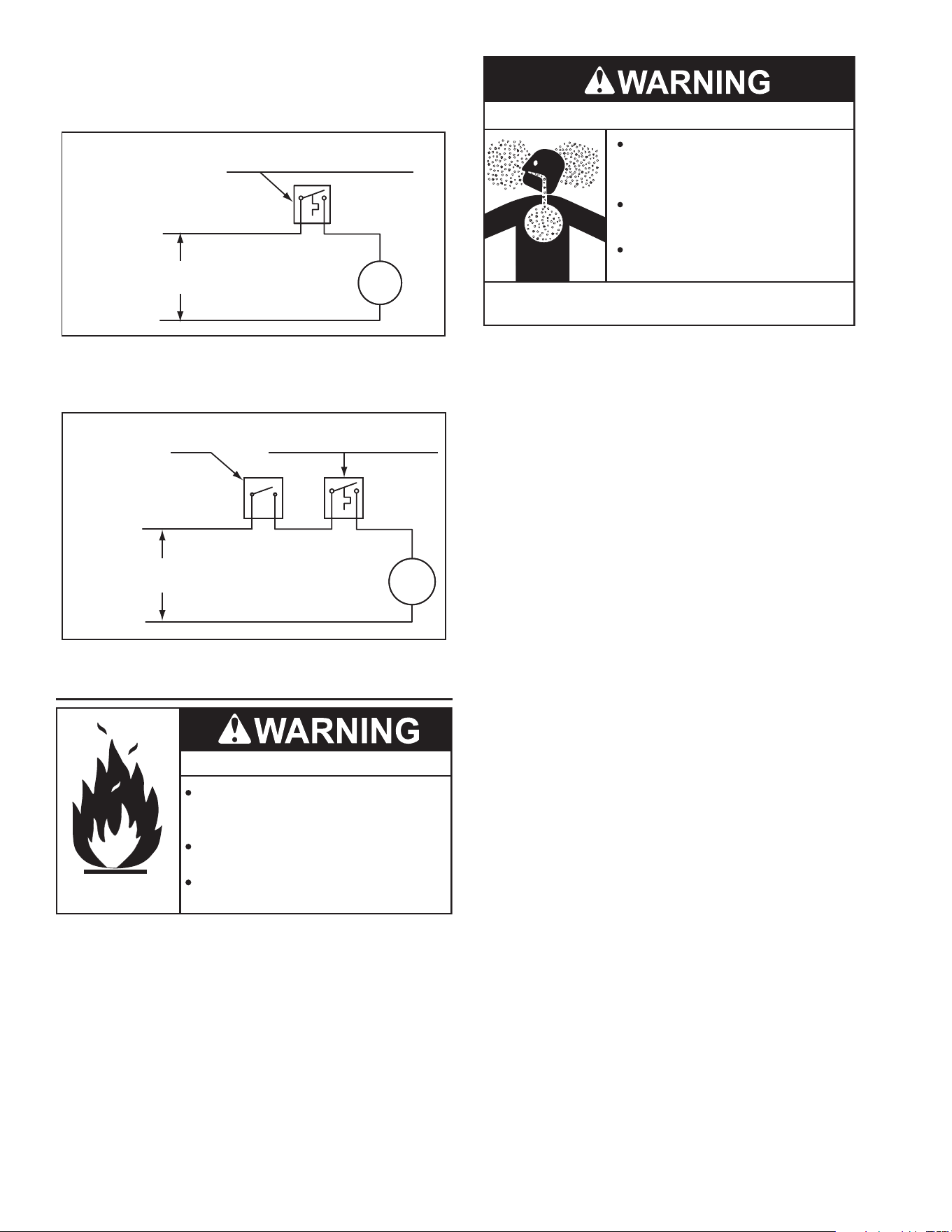
See the Circulation Pump Wiring Diagrams in this manual for
electrical hookup information. Install in accordance with the
current edition of the National Electrical Code, NFPA 70 or the
Canadian Electrical Code, CSA C22.1.
All-bronze circulating pumps are recommended for used with
commercial water heaters.
Some circulating pumps are manufactured with sealed bearings
and do not require further lubrication. Some circulating pumps
FIGURE 6.
NSF LEG KIT
The NSF Leg Kit (part number 9003425205) is needed only
for applications that must conform to NSF/ANSI Standard 5.
Installation of the NSF leg kit will increase the height of the unit
and all connection points by 3 inches. See Figure 7.
Follow these steps to install the Leg Kit:
1. Unit needs to be lifted in a way not to damage unit or laid on
it’s side to access the bottom of the legs.
2. Slide leg extension under leg and the bolt up through the
bottom hole located in the bottom of the leg.
3. Once in place, screw nut down and secure.
4. Front of leg should line up with front of leg extension as
shown to make sure weight of unit is distributed through the
leg extension.
FIGURE 7.
12
Breathing Hazard - Carbon Monoxide Gas
Breathing carbon monoxide can cause brain damage or
death. Always read and understand instruction manual.
Under no circumstances should
the input exceed the rate shown
on the water heater’s rating label.
Overfiring could result in damage to
the water heater and sooting.
Gas and carbon monoxide detectors
are available.
Installations above 2000 feet (610 meters) require
replacement of burner orifices in accordance with current
edition of the National Fuel Gas Code (ANSI Z223.1). For
Canadian installations consult Canadian Installations Code
CAN/CSA B149.1. Failure to replace orifices will result in
improper and inefficient operation of the water heater resulting
in the production of increased levels of carbon monoxide gas
in excess of safe limits which could result in serious personal
injury or death.
You shoul d cont ac t your gas supplier for any sp ec ific chan ge s
which may be required in your area.
As the elevation above sea level is increased, there is less
oxygen per cubic foot of air. Therefore, the heater input rate
should be reduced at high altitudes for satisfactory operation
w i t h t h e re d u c e d ox y g e n supply. Failure t o m a ke t h i s r e d u c t i o n
would result in an over firing of the heater causing sooting,
poor combustion and/or unsatisfactory heater performance.
Ratings specied by manufacturers for most appliances apply
for elevations up to 2000 feet (610m). For elevations above
2000 feet (610), ratings must be reduced at the rate of 4%
for each 1000 feet (305m) above sea level. For example, if a
heater is rated at 78,000 Btuh (22.9 Kwh) at sea level, to rate
the heater at 4000 feet (1219m), you subtract 4 (once for each
thousand feet) x.04 (4% input reduction) x 78,000 (original
rating) from the original rating.
Therefore, to calculate the input rating at 4,000 feet (1219m):
4 x .04 x 78,000 = 12,480 Btuh (3.7 Kwh), 78,000 (22.9 Kwh) -
12,480 (3.7 Kwh) = 65,520 Btuh (19.2 Kwh). At 6000 feet (1829m)
the correct input rating should be 59,280 Btuh (17.4 Kwh).
must be periodically oiled. Refer to the pump manufacturer’s
instructions for lubrication requirements.
CIRCULATING PUMP WIRING DIAGRAM
STORAGE TANK OR BUILDING RECIRCULATION
FIELD SUPPLIED TEMPERATURE CONTROL
INSTALLED IN THE STORAGE TANK
OR CIRCULATING LOOP RETURN LINE
CIRC
PUMP
MOTOR
L1 HOT
L2 NEUTRAL
120 VAC
POWER
CIRCULATING PUMP WIRING DIAGRAM
DISHWASHER LOOP WITH TOGGLE SWITCH
FIELD SUPPLIED TEMPERATURE
CONTROL INSTALLED IN THE
CIRCULATING LOOP RETURN LINE
DISHWASHER
TOGGLE
SWITCH
CIRC
PUMP
MOTOR
L1 HOT
L2 NEUTRAL
120 VAC
POWER
NOTE: USE SEPARATE 120 VAC POWER
SUPPLY FOR PUMP CIRCUIT. DO NOT
SHARE POWER WITH WATER HEATER AS THIS
MAY CAUSE ELECTRICAL LINE NOISE AND
LEAD TO ERRATIC CONTROL SYSTEM
OPERATION.
NOTE: USE SEPARATE 120 VAC POWER
SUPPLY FOR PUMP CIRCUIT. DO NOT SHARE
POWER WITH WATER HEATER AS THIS MAY
CAUSE ELECTRICAL LINE NOISE AND LEAD
TO ERRATIC CONTROL SYSTEM OPERATION.
FIGURE 8.
CIRCULATING PUMP WIRING DIAGRAM
STORAGE TANK OR BUILDING RECIRCULATION
FIELD SUPPLIED TEMPERATURE CONTROL
INSTALLED IN THE STORAGE TANK
OR CIRCULATING LOOP RETURN LINE
CIRC
PUMP
MOTOR
L1 HOT
L2 NEUTRAL
120 VAC
POWER
CIRCULATING PUMP WIRING DIAGRAM
DISHWASHER LOOP WITH TOGGLE SWITCH
FIELD SUPPLIED TEMPERATURE
CONTROL INSTALLED IN THE
CIRCULATING LOOP RETURN LINE
DISHWASHER
TOGGLE
SWITCH
CIRC
PUMP
MOTOR
L1 HOT
L2 NEUTRAL
120 VAC
POWER
NOTE: USE SEPARATE 120 VAC POWER
SUPPLY FOR PUMP CIRCUIT. DO NOT
SHARE POWER WITH WATER HEATER AS THIS
MAY CAUSE ELECTRICAL LINE NOISE AND
LEAD TO ERRATIC CONTROL SYSTEM
OPERATION.
NOTE: USE SEPARATE 120 VAC POWER
SUPPLY FOR PUMP CIRCUIT. DO NOT SHARE
POWER WITH WATER HEATER AS THIS MAY
CAUSE ELECTRICAL LINE NOISE AND LEAD
TO ERRATIC CONTROL SYSTEM OPERATION.
FIGURE 9.
HIGH ALTITUDE INSTALLATIONS
Fire and Explosion Hazard
Gas and carbon monoxide detectors are
available.
Overfiring could result in fire or
explosion.
Under no circumstances should the
input exceed the rate shown on the
water heater’s rating label.
13
4. When installing multiple water heaters in the same gas supply
system it is recommended that individual positive lock-up gas
pressure regulators be installed at each unit.
POWER SUPPLY
The water heaters covered in this manual require a 120 VAC,
1Ø (single phase), 60Hz, 15 amp power supply and must also
be electrically grounded in accordance with local codes or, in the
absence of local codes, with the National Electrical Code, ANSI/
NFPA 70 or the Canadian Electrical Code, CSA C22.1.
WATER TEMPERATURE CONTROL AND MIXING VALVES
Water temperature over 125°F (52°C)
can cause severe burns instantly
resulting in severe injury or death.
Children, the elderly and the
physically or mentally disabled are at
highest risk for scald injury.
Feel water before bathing or showering.
Temperature limiting devices such as
mixing valves must be installed
when required by codes and to
ensure safe temperatures at fixtures.
Water heated to a temperature which will satisfy clothes washing, dish
washing, and other sanitizing needs can scald and cause permanent
injury upon contact. Short repeated heating cycles caused by small
hot water uses can cause temperatures at the point of use to exceed
the water heater’s temperature setting by up to 20°F (11°C).
Some people are more likely to be permanently injured by hot water
than others. These include the elderly, children, the inrm and the
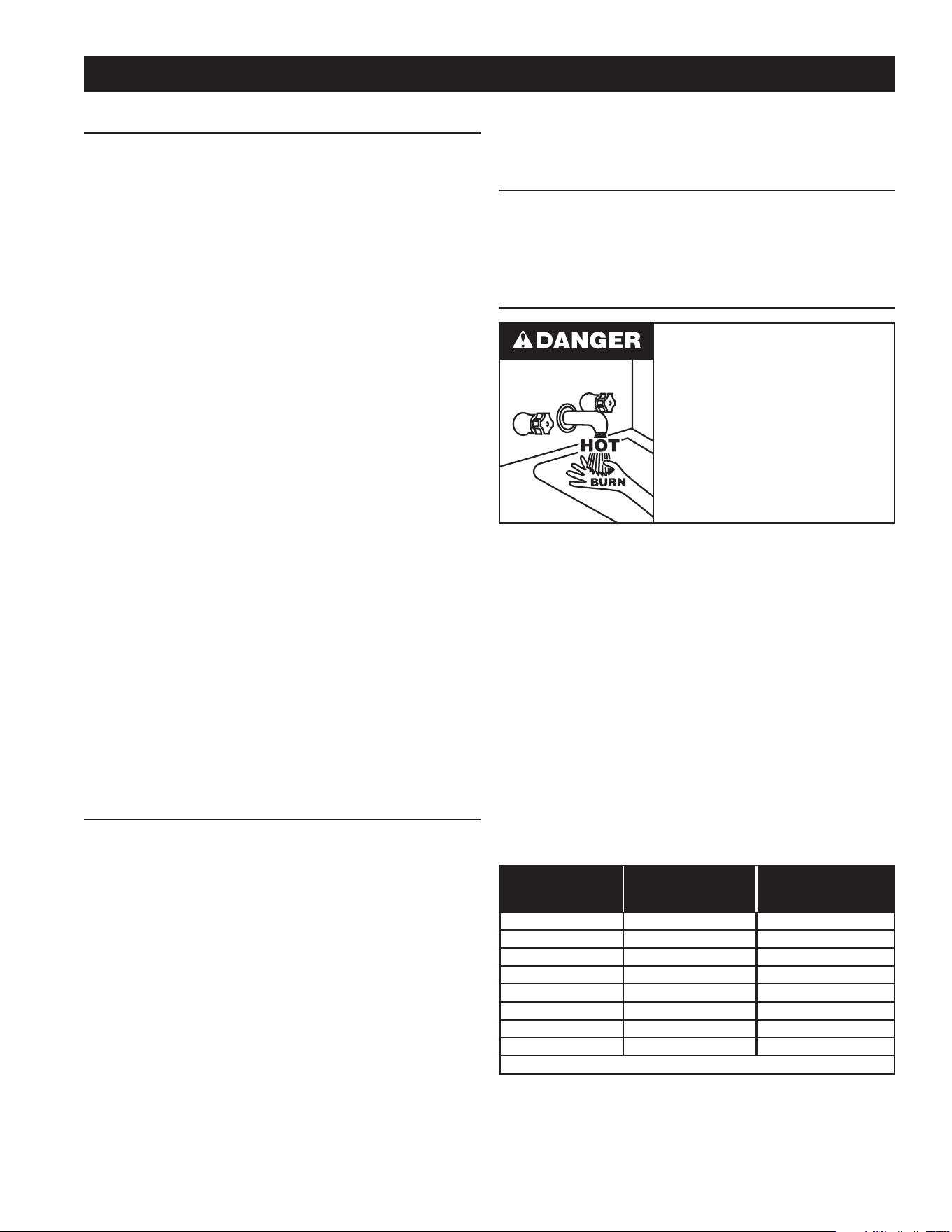
physically/mentally disabled. Table 5 shows approximate time-to-burn
relationship for normal adult skin. If anyone using hot water provided
by the water heater being installed ts into one of these groups or if
there is a local code or state law requiring a certain water temperature
at the point of use, then special precautions must be taken.
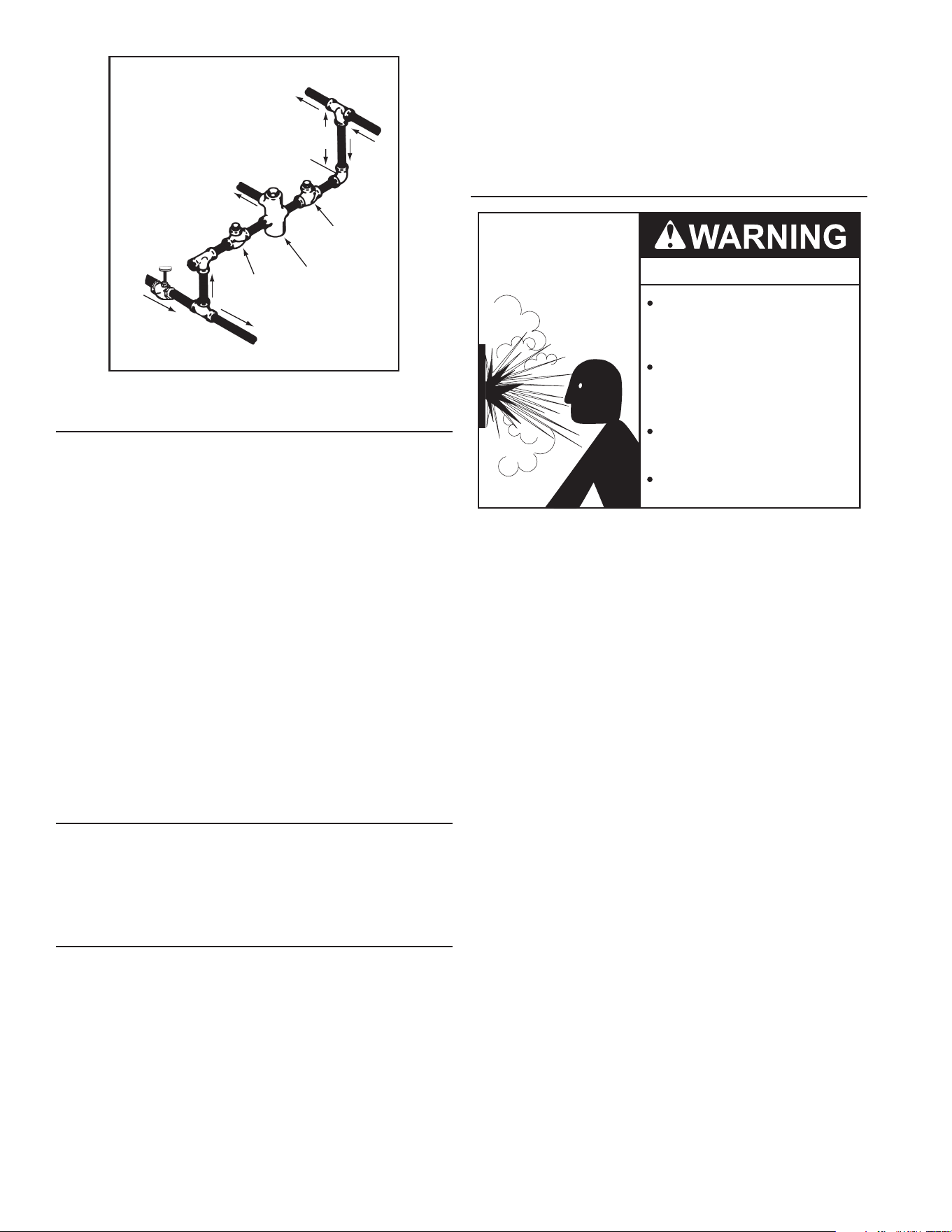
In addition to using the lowest possible temperature setting that
satises the demand of the application a Mixing Valve should be
installed at the water heater (see Figure 10) or at the hot water taps
to further reduce system water temperature.
Mixing valves are available at plumbing supply stores. Consult a
Qualied Installer or Service Agency. Follow mixing valve manufacturer’s
instructions for installation of the valves.
TABLE 5.
Water Temperature °F
Time for 1st Degree Burn
(Less Severe Burns)
Time for Permanent Burns
2nd & 3rd Degree
(Most Severe Burns)
110
(normal shower temp.)
116 (pain threshold)
116 35 minutes 45 minutes
122 1 minute 5 minutes
131 5 seconds 25 seconds
140 2 seconds 5 seconds
149 1 second 2 seconds
154 instantaneous 1 second
(U.S. Government Memorandum, C.P.S.C., Peter L. Armstrong, Sept. 15,1978)
GAS SUPPLY SYSTEMS
Low pressure building gas supply systems are defined as those
systems that cannot under any circumstances exceed 14”
W.C. (1/2 PSI Gauge). These systems do not require pressure
regulation. Measurements should be taken to insure that gas
pressures are stable and fall within the requirements stated on
the water heater rating plate. Readings should be taken with
all gas burning equipment off (static pressure) and with all gas
burning equipment running at maximum rate (dynamic pressure).
The gas supply pressure must be stable within 1.5” W.C.
from static to dynamic pressure to provide good performance.
Pressure drops that exceed 1.5” W.C. may cause rough starting,
noisy combustion or nuisance outages. Increases or spikes
in static pressure during off cycles may cause failure to ignite
or in severe cases damage to appliance gas valves. If your
low pressure system does NOT meet these requirements, the
installer is responsible for the corrections.
High Pressure building supply systems use pressures that
exceed 14” W.C. (1/2 PSI Gauge). These systems must use eld
supplied regulators to lower the gas pressure to less than 14”
W.C. (1/2 PSI Gauge). Water heaters require gas regulators that
are properly sized for the water heater input and deliver the rating
plate specied pressures. Gas supply systems where pressure
exceeds 5 PSI often require multiple regulators to achieve desired
pressures. Systems in excess of 5 PSI building pressure should
be designed by gas delivery professionals for best performance.
Water heaters connected to gas supply systems that exceed 14”
W.C. (1/2 PSI Gauge) at any time must be equipped with a gas
supply regulator.
All models require a minimum gas supply pressure of 4.5" W.C. for
natural gas and 11.0" W.C. for propane gas. The minimum supply
pressure is measured while gas is owing (dynamic pressure).
The supply pressure should never fall below 4.5" W.C. for natural
gas and 11.0" W.C. for propane gas. The supply pressure should
be measured with all gas red appliances connected to the
common main ring at full capacity. If the supply pressure drops
more than 1.5” W.C. as gas begins to ow to the water heater
then the supply gas system including the gas line and/or the
gas regulator may be restricted or undersized. See Supply Gas
Regulator section and Gas Piping section of this manual. The gas
valve on all models has a maximum gas supply pressure limit of
14” W.C. The maximum supply pressure is measured while gas is
not owing (static pressure).
SUPPLY GAS REGULATOR
The maximum allowable gas supply pressure for this water heater
is 14 inches W.C. (3.48 kPa). Install a positive lock-up gas pressure
regulator in the gas supply line if inlet gas pressure can exceed 14
inches W.C. (3.48 kPa) at any time. Regulators must be sized/used
according to manufacturer’s specications.
If a positive lock-up regulator is required follow these instructions:
1. Positive lock-up gas pressure regulators must be rated at or above
the input Btu/hr rating of the water heater they supply.
2. Positive lock-up gas pressure regulator(s) should be installed no closer
than 3 equivalent feet (1 meter) and no farther than 8 equivalent
feet (2.4 meters) from water heater’s inlet gas connection.
3. After installing the positive lock-up gas pressure regulator(s) an
initial nominal supply pressure setting of 7.0” W.C. while the water
heater is operating is recommended and will generally provide good
water heater operation. Some addition adjustment maybe required
later to maintain a steady gas supply pressure.
INSTALLATION REQUIREMENTS
14
HOT WATER
OUTLET
TO TANK
INLET
CHECK
VALVE
MIXING
VALVE
COLD
WATER
INLET
TEMPERED WATER
OUTLET
12” TO 15”
(30-38 cm)
CHECK
VALVE
FIGURE 10.
DISHWASHING MACHINES
All dishwashing machines meeting the National Sanitation
Foundation requirements are designed to operate with water ow
pressures between 15 and 25 pounds per square inch (103 kPa
and 173 kPa). Flow pressures above 25 pounds per square inch
(173 kPa), or below 15 pounds per square inch (103 kPa), will
result in improperly sanitized dishes. Where pressures are high,
a water pressure reducing or ow regulating control valve should
be used in the 180°F (82°C) line to the dishwashing machine and
should be adjusted to deliver water pressure between these limits.
The National Sanitation Foundation also recommends circulation
of 180°F (82°C) water. The circulation ow rate should be just
enough to provide 180°F (82°C) water at the point of take-off to
the dishwashing machine.
Adjust ow by throttling a full port ball valve installed in the
circulating line on the outlet side of the pump. Never throttle ow
on the suction side of a pump. See Water Piping Diagrams in
this manual.
NOTE: These water heaters meet the NSF Standard 5 for
sanitary installations when used with the leg kit part number
9003425205.
CLOSED WATER SYSTEMS
Water supply systems may, because of code requirements
or such conditions as high line pressure, among others, have
installed devices such as pressure reducing valves, check
valves, and back ow preventers. Devices such as these cause
the water system to be a closed system.
THERMAL EXPANSION
As water is heated, it expands (thermal expansion). In a closed
system the volume of water will grow when it is heated. As the
volume of water grows there will be a corresponding increase
in water pressure due to thermal expansion. Thermal expansion
can cause premature tank failure (leakage). This type of failure
is not covered under the limited warranty. Thermal expansion
can also cause intermittent Temperature-Pressure Relief Valve
operation: water discharged from the valve due to excessive
pressure build up. This condition is not covered under the limited
warranty. The Temperature-Pressure Relief Valve is not intended
for the constant relief of thermal expansion.
A properly sized thermal expansion tank must be installed on
all closed systems to control the harmful effects of thermal
expansion. Contact a local plumbing service technician to have a
thermal expansion tank installed.
See Water Line Connections on page 21 and the Water Piping
Diagrams beginning on page 40.
TEMPERATURE-PRESSURE RELIEF VALVE
Explosion Hazard
Temperature-Pressure Relief Valve
must comply with ANSI Z21.22-
CSA 4.4 and ASME code.
Properly sized temperature-
pressure relief valve must be
installed in opening provided.
Can result in overheating and
excessive tank pressure.
Can cause serious injury or death.
This water heater is provided with a properly rated/sized and certied
combination Temperature-Pressure Relief Valve (T&P valve) by
the manufacturer. The valve is certied by a nationally recognized
testing laboratory that maintains periodic inspection of production
of listed equipment of materials as meeting the requirements for
Pressure Relief Valves for Hot Water Supply Systems, ANSI Z21.22
• CSA 4.4, and the code requirements of ASME.
If replaced, the new T&P valve must meet the requirements
of local codes, but not less than a combination Temperature-
Pressure Relief Valve rated/sized and certied as indicated in
the above paragraph. The new valve must be marked with a
maximum set pressure not to exceed the marked hydrostatic
working pressure of the water heater (150 psi = 1,035 kPa) and
a discharge capacity not less than the water heater Btu/hr or kW
input rate as shown on the water heater’s model rating label.
NOTE: In addition to the factory installed Temperature-Pressure
Relief Valve on the water heater, each remote storage tank that
may be installed and piped to a water heating appliance must also
have its own properly sized, rated and approved Temperature-
Pressure Relief Valve installed. Call the toll free technical
support phone number listed on the back cover of this manual
for technical assistance in sizing a Temperature-Pressure Relief
Valve for remote storage tanks.
For safe operation of the water heater, the Temperature-Pressure
Relief Valve must not be removed from its designated opening
nor plugged. The Temperature-Pressure Relief Valve must be
installed directly into the tting of the water heater designed for
the pressure relief valve . Install discharge piping so that any
discharge will exit the pipe within 6 inches (15.2 cm) above an
adequate oor drain, or external to the building. In cold climates
it is recommended that it be terminated at an adequate drain
inside the building. Be certain that no contact is made with any
live electrical part. The discharge opening must not be blocked
or reduced in size under any circumstances. Excessive length,
over 30 feet (9.14 m), or use of more than four elbows can cause
restriction and reduce the discharge capacity of the valve.
15
No valve or other obstruction is to be placed between the
Temperature-Pressure Relief Valve and the tank. Do not connect
discharge piping directly to the drain unless a 6” (15.2 cm)
air gap is provided. To prevent bodily injury, hazard to life, or
property damage, the relief valve must be allowed to discharge
water in adequate quantities should circumstances demand. If
the discharge pipe is not connected to a drain or other suitable
means, the water ow may cause property damage.
Water Damage Hazard
Temperature-Pressure Relief Valve discharge
pipe must terminate at adequate drain.
•
CAUTION
T&P Valve Discharge Pipe Requirements:
• Shall not be smaller in size than the outlet pipe size of the
valve, or have any reducing couplings or other restrictions.
• Shall not be plugged or blocked.
• Shall not be exposed to freezing temperatures.
• Shall be of material listed for hot water distribution.
• Shall be installed so as to allow complete drainage of both
the Temperature-Pressure Relief Valve and the discharge
pipe.
• Must terminate a maximum of six inches above a oor
drain or external to the building. In cold climates, it is
recommended that the discharge pipe be terminated at an
adequate drain inside the building.
• Shall not have any valve or other obstruction between the
pressure relief valve and the drain.
Burn hazard.
Hot water discharge.
Keep clear of Temperature-
Pressure Relief Valve
discharge outlet.
The Temperature-Pressure Relief Valve must be manually operated
at least twice a year. Caution should be taken to ensure that (1) no
one is in front of or around the outlet of the Temperature-Pressure
Relief Valve discharge line, and (2) the water manually discharged
will not cause any bodily injury or property damage because
the water may be extremely hot. If after manually operating the
valve, it fails to completely reset and continues to release water,
immediately close the cold water inlet to the water heater, follow the
draining instructions in this manual, and replace the Temperature-
Pressure Relief Valve with a properly rated/sized new one.
NOTE: The purpose of a Temperature-Pressure Relief Valve is to
prevent excessive temperatures and pressures in the storage tank.
The T&P valve is not intended for the constant relief of thermal
expansion. A properly sized thermal expansion tank must be
installed on all closed systems to control thermal expansion, see
Closed Water Systems and Thermal Expansion on page 14.
If you do not understand these instructions or have any questions
regarding the Temperature-Pressure Relief Valve call the toll
free number listed on the back cover of this manual for technical
assistance.
CONTAMINATED AIR
Breathing Hazard - Carbon Monoxide Gas
Install water heater in accordance with
the Instruction Manual and NFPA 54 or
CAN/CSA-B149.1.
To avoid injury, combustion and ventilation
air must be taken from outdoors.
Do not place chemical vapor emitting
products near water heater.
Breathing carbon monoxide can cause brain damage or
death. Always read and understand instruction manual.
Corrosion of the ue ways and vent system may occur if air for
combustion contains certain chemical vapors. Such corrosion
may result in failure and risk of asphyxiation.
Combustion air that is contaminated can greatly diminish the life
span of the water heater and water heater components such as
hot surface igniters and burners. Propellants of aerosol sprays,
beauty shop supplies, water softener chemicals and chemicals
used in dry cleaning processes that are present in the combustion,
ventilation or ambient air can cause such damage.
Do not store products of this sort near the water heater. Air which
is brought in contact with the water heater should not contain any
of these chemicals. If necessary, uncontaminated air should be
obtained from remote or outdoor sources. The limited warranty
is voided when failure of water heater is due to a corrosive
atmosphere. (See limited warranty for complete terms and
conditions).
AIR REQUIREMENTS
Breathing Hazard - Carbon Monoxide Gas
Install water heater in accordance with
the Instruction Manual and NFPA 54 or
CAN/CSA-B149.1.
To avoid injury, combustion and ventilation
air must be taken from outdoors.
Do not place chemical vapor emitting
products near water heater.
Breathing carbon monoxide can cause brain damage or
death. Always read and understand instruction manual.
For safe operation an adequate supply of fresh uncontaminated
air for combustion and ventilation must be provided.
An insufcient supply of air can cause recirculation of combustion
products resulting in contamination that may be hazardous to
life. Such a condition often will result in a yellow, luminous burner
ame, causing sooting of the combustion chamber, burners and
ue tubes and creates a risk of asphyxiation.
Do not install the water heater in a conned space unless an
adequate supply of air for combustion and ventilation is brought
in to that space using the methods described in the Conned
Space section that follows.
Never obstruct the ow of ventilation air. If you have any doubts
or questions at all, call your gas supplier. Failure to provide the
proper amount of combustion air can result in a re or explosion
and cause property damage, serious bodily injury or death.
16
DIRECT VENT APPLIANCES
Appliances installed in a Direct Vent conguration that derive all
air for combustion from the outdoor atmosphere through sealed
intake air piping are not factored in the total appliance input Btu/
hr calculations used to determine the size of openings providing
fresh air into conned spaces.
EXHAUST FANS
Where exhaust fans are installed, additional air shall be provided
to replace the exhausted air. When an exhaust fan is installed
in the same space with a water heater, sufcient openings to
provide fresh air must be provided that accommodate the
requirements for all appliances in the room and the exhaust fan.
Undersized openings will cause air to be drawn into the room
through the water heater’s vent system causing poor combustion.
Sooting, serious damage to the water heater and the risk of re
or explosion may result. It can also create a risk of asphyxiation.
LOUVERS AND GRILLES
The free areas of the fresh air openings in the instructions that
follow do not take in to account the presence of louvers, grilles or
screens in the openings.
The required size of openings for combustion, ventilation and
dilution air shall be based on the “net free area” of each opening.
Where the free area through a design of louver or grille or screen
is known, it shall be used in calculating the size of opening
required to provide the free area specied. Where the louver and
grille design and free area are not known, it shall be assumed
that wood louvers will have 25% free area and metal louvers and
grilles will have 75% free area. Non motorized louvers and grilles
shall be xed in the open position.
UNCONFINED SPACE
An Unconned Space is one whose volume IS NOT LESS THAN
50 cubic feet per 1,000 Btu/hr (4.8 cubic meters per kW) of the
total input rating of all appliances installed in the space. Rooms
communicating directly with the space, in which the appliances
are installed, through openings not furnished with doors, are
considered a part of the unconned space.
Makeup air requirements for the operation of exhaust fans,
kitchen ventilation systems, clothes dryers and replaces shall
also be considered in determining the adequacy of a space to
provide combustion, ventilation and dilution air.
UNUSUALLY TIGHT CONSTRUCTION
In unconned spaces in buildings, inltration may be adequate
to provide air for combustion, ventilation and dilution of ue
gases. However, in buildings of unusually tight construction (for
example, weather stripping, heavily insulated, caulked, vapor
barrier, etc.) additional air must be provided using the methods
described in the Conned Space section that follows.
CONFINED SPACE
A Conned Space is one whose volume is less than 50 cubic
feet per 1,000 Btu/hr (4.8 cubic meters per kW) of the total input
rating of all appliances installed in the space.
Openings must be installed to provide fresh air for combustion,
ventilation and dilution in conned spaces. The required size for
the openings is dependent on the method used to provide fresh
air to the conned space and the total Btu/hr input rating of all
appliances installed in the space.
VENTING INSTALLATION
VENTING
THE INSTRUCTIONS IN THIS SECTION ON VENTING MUST
BE FOLLOWED TO AVOID CHOKED COMBUSTION OR
RECIRCULATION OF FLUE GASES. SUCH CONDITIONS CAUSE
SOOTING OR RISKS OF FIRE AND ASPHYXIATION.
Heater must be protected from freezing downdrafts.
Remove all soot or other obstructions from the chimney that will retard
a free draft.
Type B venting is recommended with these heaters. For typical venting
application see TECHNICAL DATA VENTING on pages 19 and 20.
This water heater must be vented in compliance with all local codes,
the current revision of the National Fuel Gas Code (ANSI-Z223.1) and
with the Category I Venting Tables.
If any part of the vent system are exposed to ambient temperatures
below 40°F it must be insulated to prevent condensation.
• Do not connect the heater to a common vent or chimney with solid
fuel burning equipment. This practice is prohibited by many local
building codes as is the practice of venting gas red equipment to
the duct work of ventilation systems.
• Where a separate vent connection is not available and the vent pipe
from the heater must be connected to a common vent with an oil
burning furnace, the vent pipe should enter the smaller common
vent or chimney at a point above the large vent pipe.
VENT REDUCER
Model BCG370T120 is shipped with a 6" to 5" flue outlet
adapter. Models (A)BCG3100T250, (A)BCG365T250 and (A)
BCG3100T275 are shipped with a 8" to 6" ue outlet adapter.
Each adapter ts on top of the installed ue damper. Use only vent
reducers supplied with the unit. The venting must comply with the
current editions of the NATIONAL FUEL GAS CODE, ANSI Z223.1/
NFPA 54 or NATURAL GAS AND PROPANE INSTALLATION
CODE CAN/CSA-B149.1
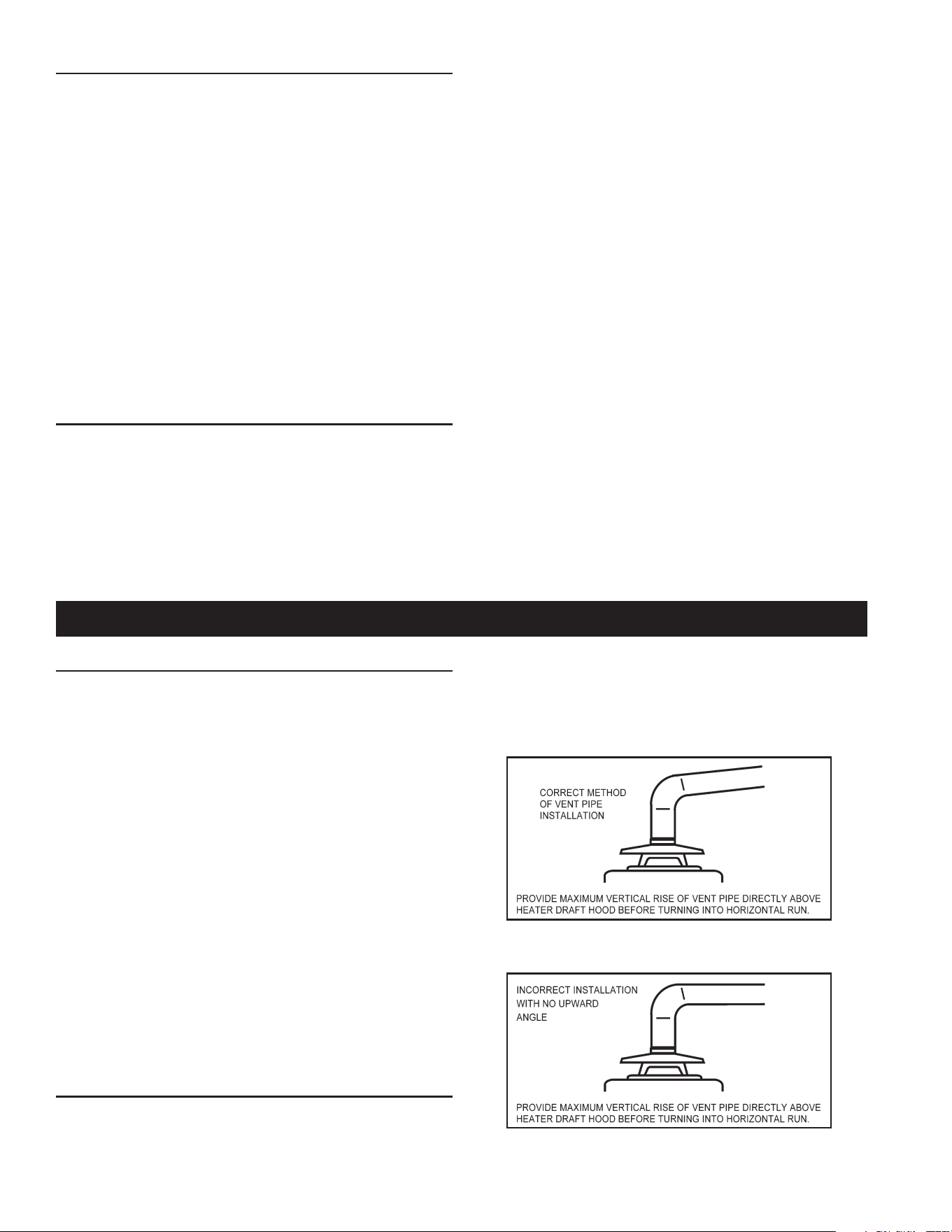
FIGURE 11.
FIGURE 12.
17
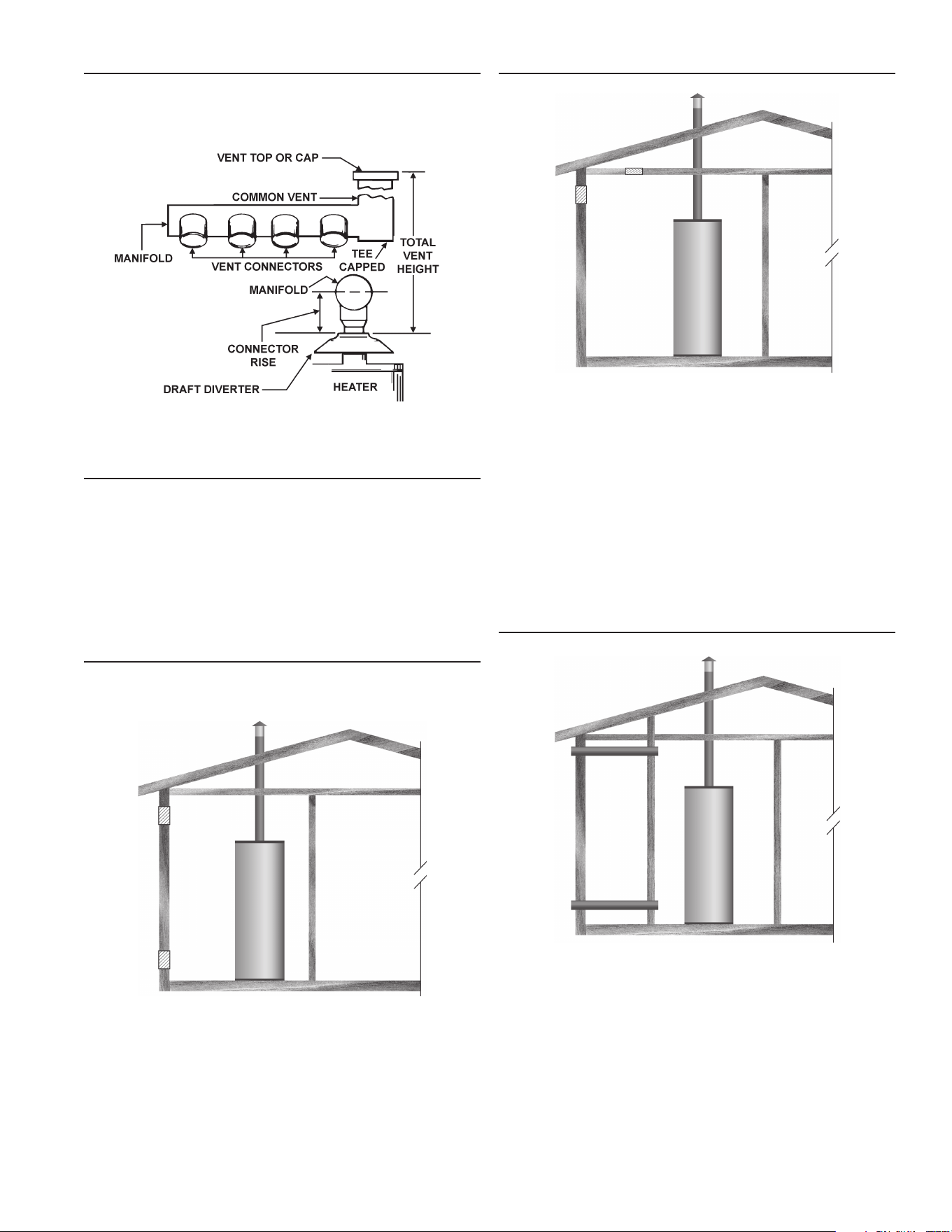
MULTIPLE HEATER MANIFOLD
Figure 13 and tables on pages 19 and 20 should be used for
horizontally manifolding two or more heaters.
FIGURE 13.
FRESH AIR OPENINGS FOR CONFINED SPACES
The following instructions shall be used to calculate the size,
number and placement of openings providing fresh air for
combustion, ventilation and dilution in conned spaces. The
illustrations shown in this section of the manual are a reference
for the openings that provide fresh air into conned spaces
only. DO NOT refer to these illustrations for the purpose of vent
installation. See Venting Installation on page 16 for complete
venting installation instructions.
OUTDOOR AIR THROUGH TWO OPENINGS
FIGURE 14.
The conned space shall be provided with two permanent
openings, one commencing within 12 inches (300 mm) of the top
and one commencing within 12 inches (300 mm) of the bottom of
the enclosure. The openings shall communicate directly with the
outdoors. See Figure 14.
Each opening shall have a minimum free area of 1 square inch
per 4,000 Btu/hr (550 mm
2
per kW) of the aggregate input rating
of all appliances installed in the enclosure. Each opening shall
not be less than 100 square inches (645 cm
2
).
OUTDOOR AIR THROUGH ONE OPENING
FIGURE 15.
Alternatively a single permanent opening, commencing within 12
inches (300 mm) of the top of the enclosure, shall be provided.
See Figure 14. The water heater shall have clearances of at
least 1 inch (25 mm) from the sides and back and 6 inches (l50
mm) from the front of the water heater. The opening shall directly
communicate with the outdoors or shall communicate through a
vertical or horizontal duct to the outdoors or spaces that freely
communicate with the outdoors and shall have a minimum free
area of the following:
1. 1 square inch per 3000 Btu/hr (733 mm
2
per kW) of the total input
rating of all appliances located in the enclosure, and
2. Not less than the sum of the areas of all vent connectors in the space.
OUTDOOR AIR THROUGH TWO HORIZONTAL DUCTS
FIGURE 16.
The conned space shall be provided with two permanent
horizontal ducts, one commencing within 12 inches (300 mm) of
the top and one commencing within 12 inches (300 mm) of the
bottom of the enclosure. The horizontal ducts shall communicate
directly with the outdoors. See Figure 16.
Each duct opening shall have a minimum free area of 1 square
inch per 2,000 Btu/hr (1100 mm
2
per kW) of the aggregate input
rating of all appliances installed in the enclosure.
When ducts are used, they shall be of the same cross sectional
area as the free area of the openings to which they connect.
The minimum dimension of rectangular air ducts shall be not less
than 3 inches.
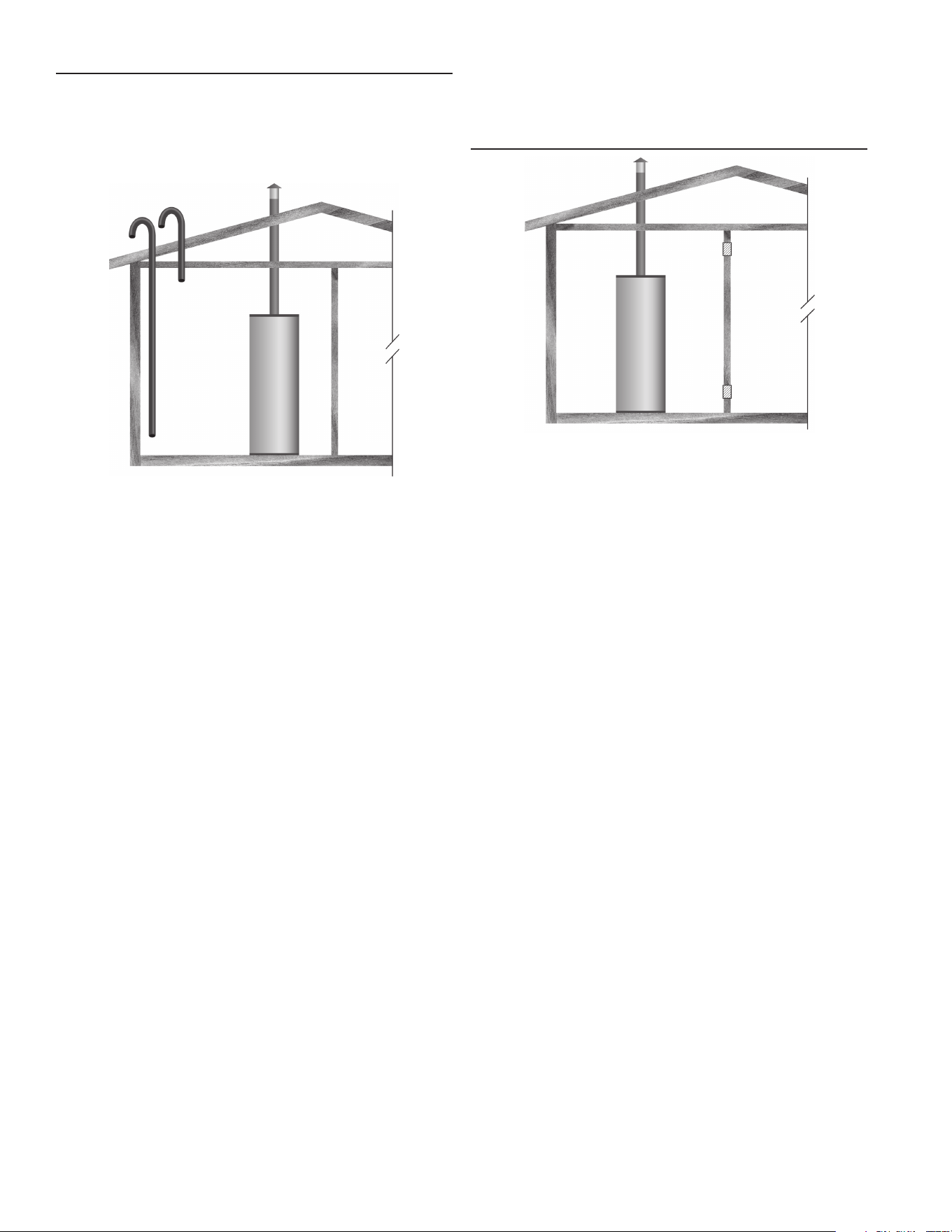
18
When ducts are used, they shall be of the same cross sectional
area as the free area of the openings to which they connect.
The minimum dimension of rectangular air ducts shall be not less
than 3 inches.
AIR FROM OTHER INDOOR SPACES
FIGURE 18.
The conned space shall be provided with two permanent
openings, one commencing within 12 inches (300 mm) of the top
and one commencing within 12 inches (300 mm) of the bottom of
the enclosure. See Figure 18.
Each opening shall communicate directly with an additional
room(s) of sufcient volume so that the combined volume of all
spaces meets the criteria for an Unconned Space.
Each opening shall have a minimum free area of 1 square inch
per 1,000 Btu/hr (2200 mm
2
per kW) of the aggregate input rating
of all appliances installed in the enclosure. Each opening shall
not be less than 100 square inches (645 cm
2
).
OUTDOOR AIR THROUGH TWO VERTICAL DUCTS
The illustrations shown in this section of the manual are a
reference for the openings that provide fresh air into conned
spaces only.
DO NOT refer to these illustrations for the purpose of vent
installation. See Venting Installation on page 14 for complete
venting installation instructions.
FIGURE 17.
The conned space shall be provided with two permanent vertical
ducts, one commencing within 12 inches (300 mm) of the top and
one commencing within 12 inches (300 mm) of the bottom of the
enclosure. The vertical ducts shall communicate directly with the
outdoors. See Figure 17.
Each duct opening shall have a minimum free area of 1 square
inch per 4,000 Btu/hr (550 mm
2
per kW) of the aggregate input
rating of all appliances installed in the enclosure.
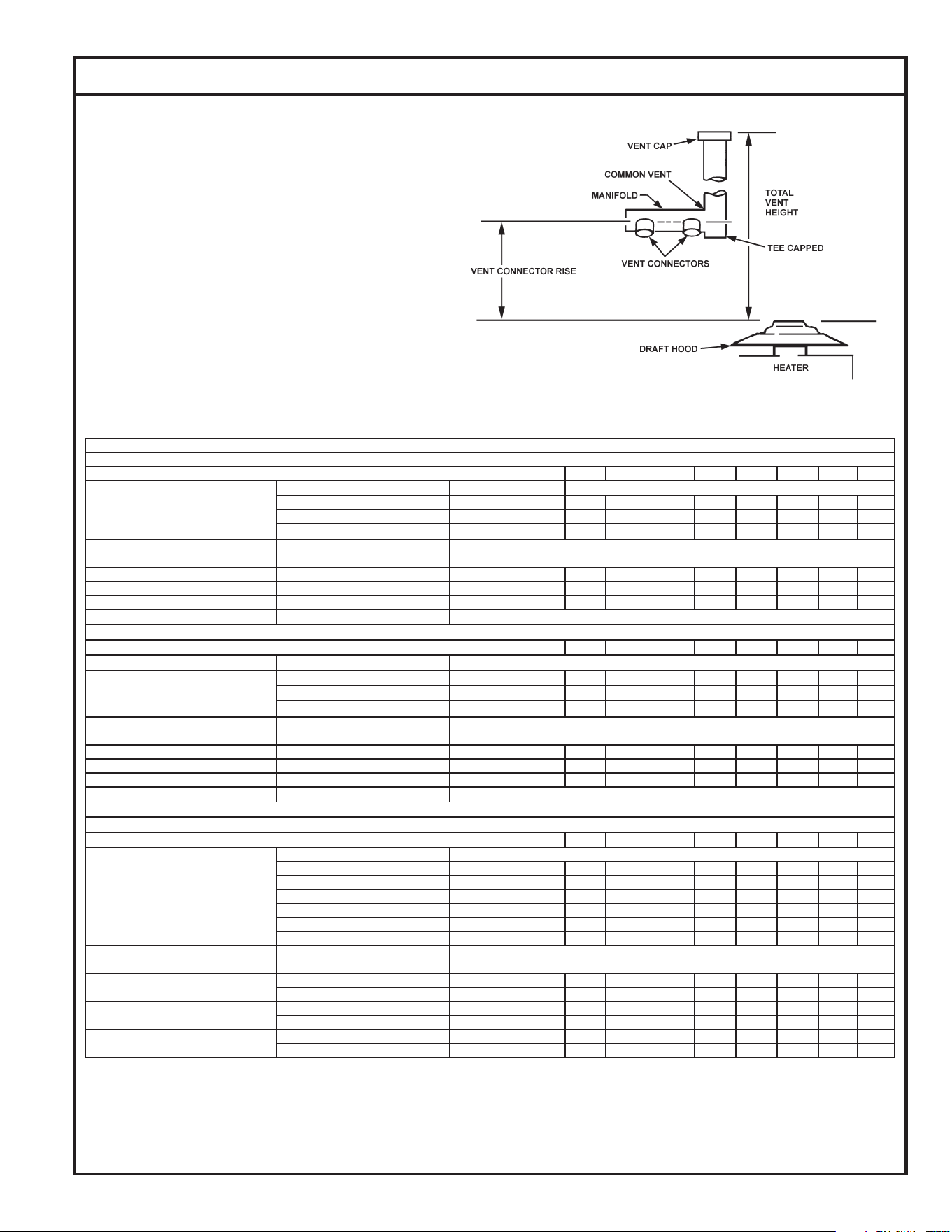
19
TYPE B GAS VENT
Multiple Gas Fired Tank-Type Heaters
When venting multiple tank type heaters using Type B vent pipe,
follow the installation diagram (Figure 13) and tables below
which give sizing and data based upon NFPA 54/ANSI Z223.
TABLE 6. TECHNICAL DATA VENTING
MODEL (A)BCG370T120
Input: 120,000 Btuh Total Vent Height (Feet)
Draft Hood: 5” 6 8 10 15 20 30 50 100
Input Btuh Rise Vent Connector Diameter (inches)
120,000 1 Ft. 7 7 7 6 6 6 6 6
120,000 2 Ft. 6 6 6 6 6 6 6 5
120,000 3 Ft. 6 6 6 6 6 5 5 5
Number of
Heaters
Combined Input in
Thousands of Btuh
Manifold and Common Vent Diameter (In inches)
2
240 10 8 8 7 7 7 6 7
3
360 10 10 10 10 8 8 7 7
4 480 12 12 12 10 10 10 8 8
MODEL (A)BCG380T150
Input: 154,000 Btuh Total Vent Height (Feet)
Draft Hood: 6” 6 8 10 15 20 30 50 100
Input Btuh Rise Vent Connector Diameter (in inches)
154,000 1 Ft. 8 8 7 7 7 7 7 7
154,000 2 Ft. 7 7 7 7 7 6 6 6
154,000 3 Ft. 7 7 7 6 6 6 6 6
Numbers of
Heaters
Combined Input in
Thousands of Btuh
Manifold and Common Vent Diameter (in inches)
2
308 10 10 10 8 8 7 7 7
3
462 12 12 12 10 10 10 8 8
4 616 14 14 12 12 12 10 1 10
MODEL BCG380T180, BCG3100T199, BCG380T199, & (A)BCG3100T200
Input: 180,000, 199,000 Btuh Total Vent Height (Feet)
Draft Hood: 6” 6 8 10 15 20 30 50 100
Input Btuh Rise Vent Connector Diameter (in inches)
180,000 1 Ft. 8 8 8 8 8 7 7 7
199,000 - - 8 8 8 8 8 7
180,000 2 Ft. 8 8 7 7 7 7 7 7
199,000 8 8 8 8 7 7 7 7
180,000 3 Ft. 7 7 7 7 7 7 6 6
199,000 8 8 7 7 7 7 7 6
Number of
Heaters
Combined Input in
Thousands of Btuh
Manifold & Common Vent Diameter
2
360 10 10 10 10 8 8 7 7
398 12 10 10 10 10 8 8 7
3
540 14 12 12 12 10 10 10 8
597 14 14 12 12 12 10 10 10
4
720 14 14 14 12 12 12 10 10
796 16 14 14 14 12 12 12 10
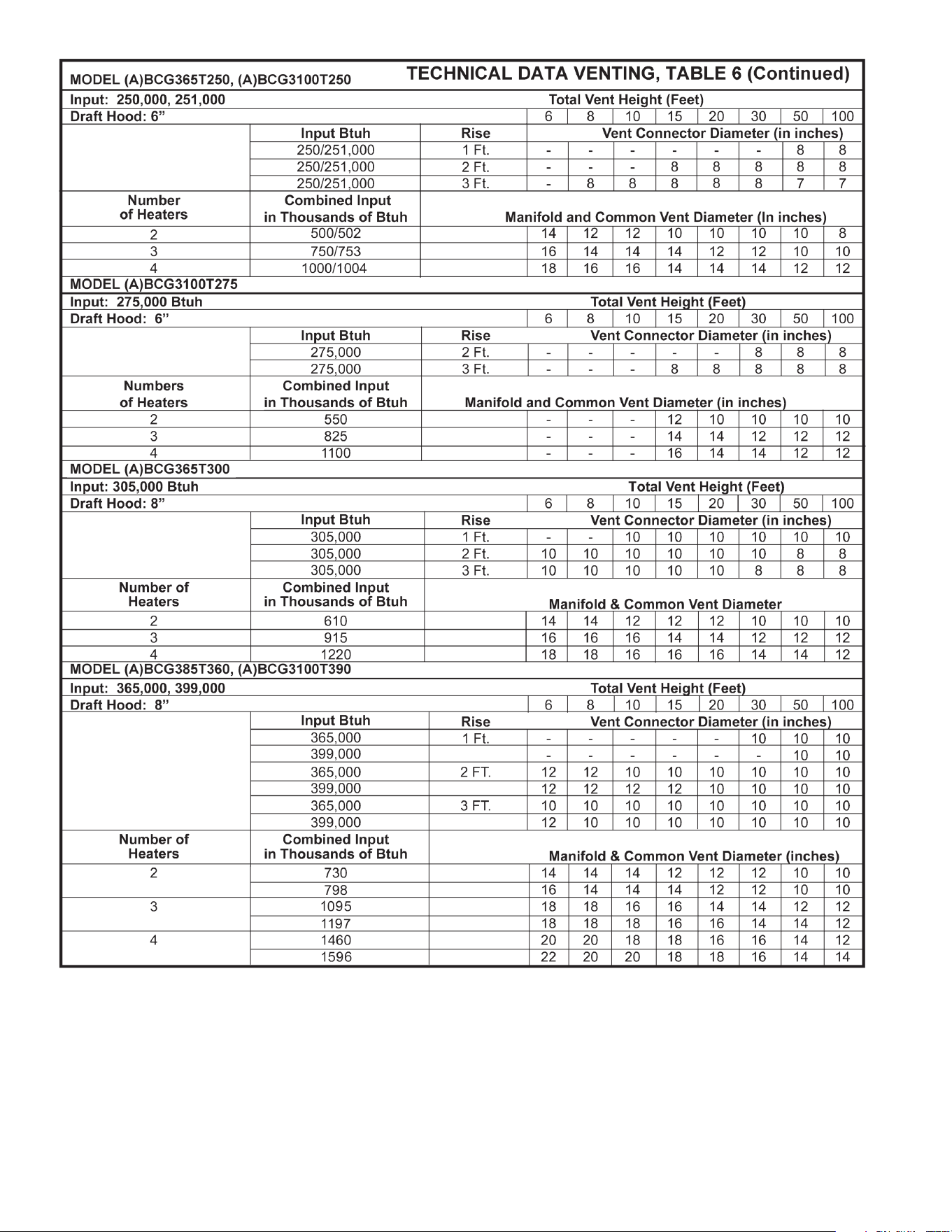
20
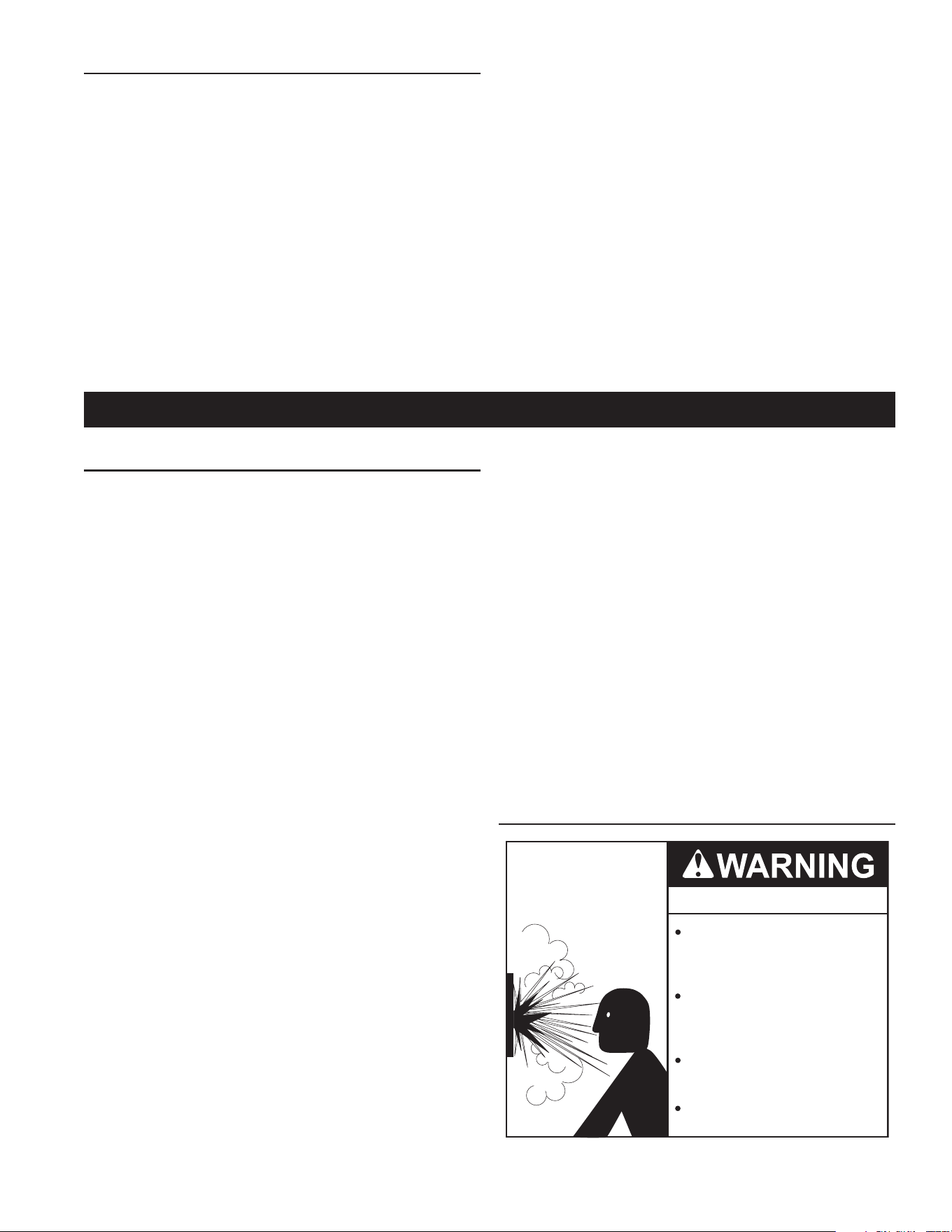
21
grounding shall be done in accordance with the current edition
of the Canadian Electrical Code CSA C22.1 and/or local codes.
VENT INSTALLATION
Seal all joints between the power venter and the vent
termination. This is to prevent leakage of exhaust products
into the room(s) due to positive pressure of blower.
The “Sequence of Operation” description will be the same with
mechanical venting except;
When the water heater thermostat calls for heat:
Thermostat contacts “Close” and the power venter blower
(120 VAC) is energized. Sufficient draft must be established
for the “Draft Prover Switch (N.O.)” to “Close”. When the
draft prover switch “Closes” the relay coil of the flue damper
is energized.
WATER HEATER INSTALLATION
MECHANICAL VENTING
SINGLE UNIT INSTALLATION
When mechanical venting of these heaters is desired, the
following kits are available.
Models with inputs from 120,000 to 200,000 btu/h
part number 9005381205
Models with inputs from 250,000 to 390,000 btu/h
part number 9003434205
Where an approved power venter is to be installed to operate
in conjunction with the water heater thermostat, the following
codes must be adhered to. Field wiring should conform to
the current edition of the National Electrical Code NFPA 70.
For Canadian installations the electrical connections and
WATER PIPING DIAGRAMS
This manual provides detailed water piping diagrams for typical
methods of application for the water heaters, see Water Piping
Diagrams beginning on page 40.
The water heater may be installed by itself, or with a separate
storage tank. When used with a separate storage tank, the
circulation may be either by gravity or by means of circulating
pump. Adjust ow by throttling a full port ball valve installed in the
circulating line on the outlet side of the pump. Never throttle ow
on the suction side of a pump. See the Water Piping Diagrams
beginning on page 40.
NOTE: In addition to the factory installed Temperature-Pressure
Relief Valve (T&P valve) on the water heater, each remote
storage tank that may be installed and piped to a water heating
appliance must also have its own properly sized, rated and
approved Temperature-Pressure Relief Valve installed.
Call the toll free technical support phone number listed on the
back cover of this manual for further assistance in sizing a T&P
valve for remote storage tanks.
T&P VALVE DISCHARGE PIPE
Explosion Hazard
Temperature-Pressure Relief Valve
must comply with ANSI Z21.22-
CSA 4.4 and ASME code.
Properly sized temperature-
pressure relief valve must be
installed in opening provided.
Can result in overheating and
excessive tank pressure.
Can cause serious injury or death.
WATER LINE CONNECTIONS
The water piping installation must conform to these instructions
and to all local code authority having jurisdiction. Good practice
requires that all heavy piping be supported.
Read and observe all requirements in the following sections
before installation of the water piping begins:
1. Water Temperature Control and Mixing Valves on page 13.
2. Dishwashing Machines on page 14.
3. Temperature-Pressure Relief Valve on page 14-15.
4. Closed Systems and Thermal Expansion on page 14.
5. For multiple water heater installations see Water Piping
Diagrams beginning on page 40.
WATER (POTABLE) HEATING AND SPACE HEATING
1. All piping components connected to this unit for space
heating applications shall be suitable for use with potable
water.
2. Toxic chemicals, such as those used for boiler treatment,
shall NEVER be introduced into this system.
3. This unit may NEVER be connected to any existing heating
system or component(s) previously used with a non-potable
water heating appliance.
4. When the system requires water for space heating at
temperatures higher than required for domestic water
purposes, a tempering valve must be installed. Please
refer to installation diagrams beginning on page 40 of this
manual for suggested piping arrangements.
5. These water heaters cannot be used in space heating
applications only
THERMOMETERS (NOT SUPPLIED)
Thermometers should be obtained and eld installed as shown
in the installation diagrams.
Thermometers are installed in the system as a means of
detecting the temperature of the outlet water supply.
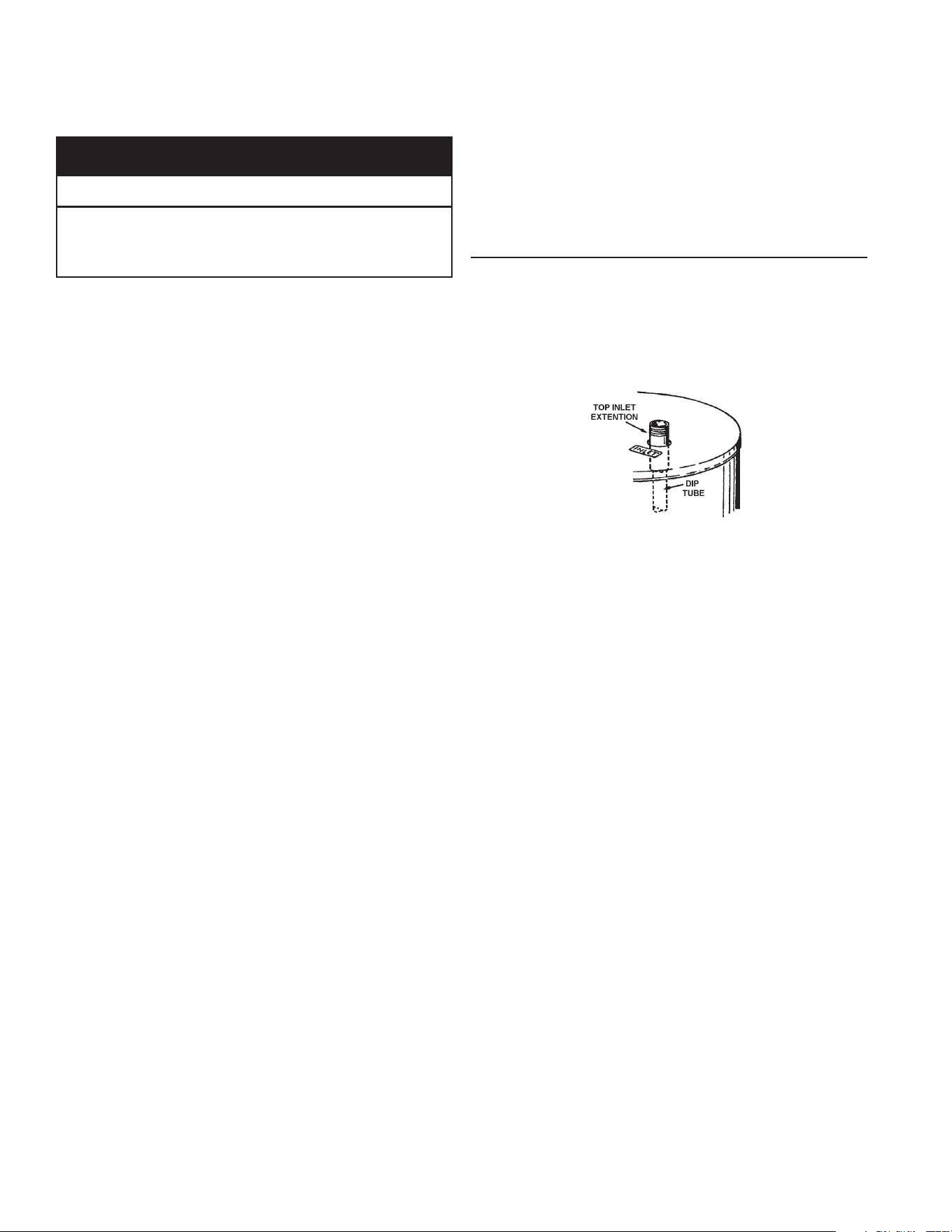
22
This water heater is provided with a properly rated/sized and
certied combination temperature - pressure (T&P) relief valve by
the manufacturer. See Temperature-Pressure Relief Valve on pages
14-15 for information on replacement and other requirements.
Water Damage Hazard
Temperature-Pressure Relief Valve discharge
pipe must terminate at adequate drain.
•
CAUTION
Install a discharge pipe between the T&P valve discharge
opening and a suitable oor drain. Do not connect discharge
piping directly to the drain unless a 6” (15.2 cm) air gap is
provided. To prevent bodily injury, hazard to life, or property
damage, the relief valve must be allowed to discharge water
in adequate quantities should circumstances demand. If the
discharge pipe is not connected to a drain or other suitable
means, the water ow may cause property damage.
T&P VALVE DISCHARGE PIPE REQUIREMENTS:
• Shall not be smaller in size than the outlet pipe size of the
valve, or have any reducing couplings or other restrictions.
• Shall not be plugged or blocked.
• Shall not be exposed to freezing temperatures.
• Shall be of material listed for hot water distribution.
• Shall be installed so as to allow complete drainage of both
Temperature-Pressure Relief Valve and the discharge pipe.
• Must terminate a maximum of six inches above a oor
drain or external to the building. In cold climates, it is
recommended that the discharge pipe be terminated at an
adequate drain inside the building.
• Shall not have any valve or other obstruction between the
relief valve and the drain.
INSTALLATION DIAGRAMS - TOP INLET/OUTLET USAGE
Use of the top inlet water connection requires an inlet dip tube
(refer to gure 19). The tube is supplied in the heater. Follow
caution labels if applying heat to this tting. Do not allow pipe
dope to contact the plastic tube during installation.
TUBE INLET INSTALLATION
FIGURE 19.
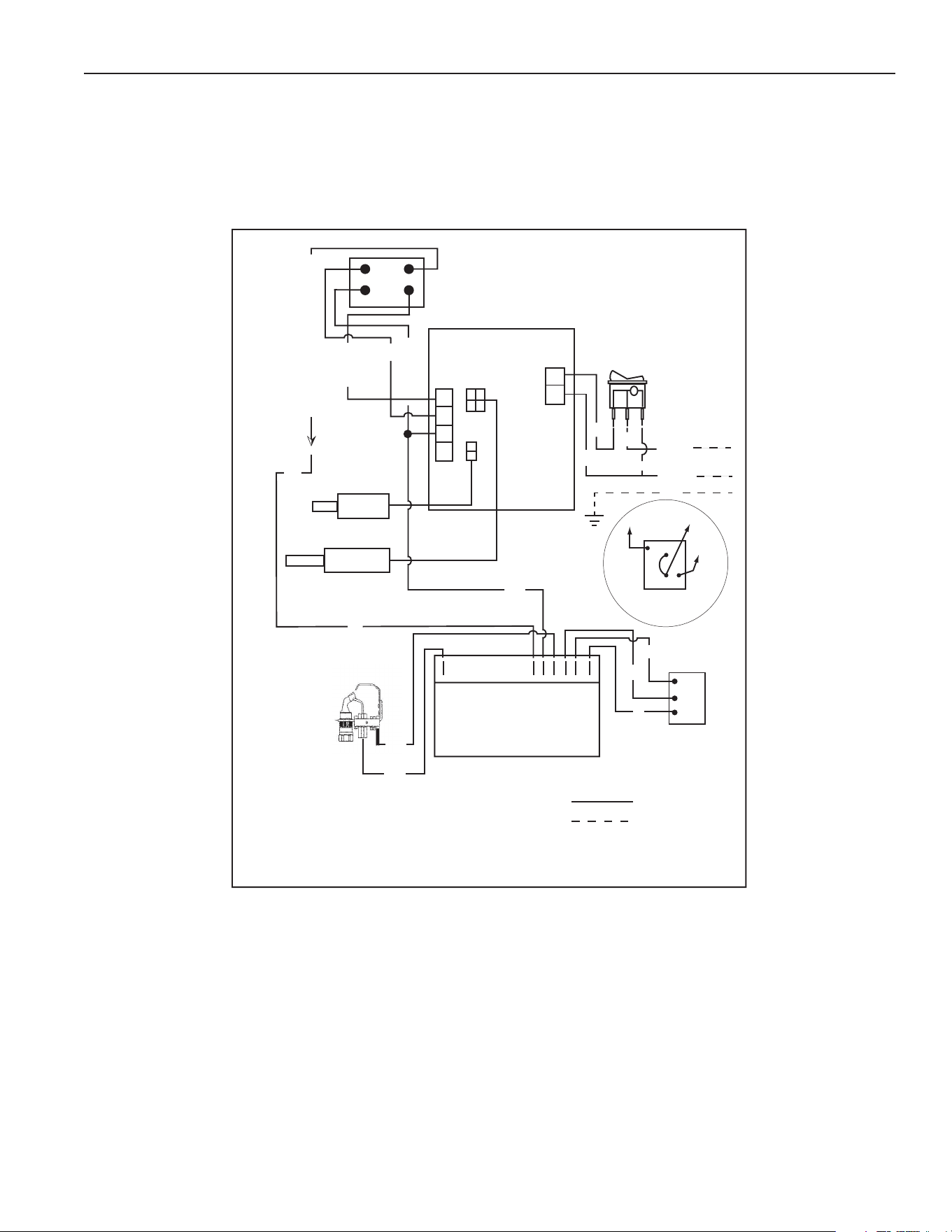
23
HEATER WIRING
All electrical work must be installed in accordance with the current edition of the National Electrical Code ANSI/NFPA No. 70 or Canadian Electrical
Code CSA C22.1 and must conform to all local code authority having jurisdiction. AN ELECTRICAL GROUND IS REQUIRED TO REDUCE RISK OF
ELECTRICAL SHOCK OR POSSIBLE ELECTROCUTION.
If any of the original wire as supplied with the water heater must be replaced, use only type 105°C thermoplastic or equivalent 250
0
C type F must be
used for the ame sensor and igniter leads.
The controls of this water heater are polarity sensitive. Be certain to properly wire the hot and neutral connections.
13
42
C
P
M
X
MV
MV/PV
PV
24 V GND
24 V
SPARKER
GND-BURNER
HONEYWELL IGNITION
DAMPER
DRIVE
ON/OFF
SWITCH
LOWER
PROBE
UPPER
PROBE/ECO
11E79
LINE
IN
1
2
3
4
NEUTRAL
GND
NATURAL
GAS
VALVE
PV
PV
TH
TR
MV
MV/PV
MV
PROPANE
GAS
VALVE
120 vac
24 VAC TO IGNITION CONTROL
DAMPER
DRIVE
24 VAC
24 NEUTRAL
FACTORY WIRED
BY INSTALLER
IF ANY OF THE ORIGINAL WIRE AS SUPPLIED MUST BE REPLACED, USE ONLY TYPE 105
O
C
THERMOPLASTIC OR EQUIVALENT. FLAME SENSOR IGNITION CABLE MUST BE 250
O
C TYPE F.
330548-000 REV 00
W
W
W
Y
BLK
BLK
BLK
W
R
R
Y
BLK
BL
W
LEGEND:
W--WHITE
BLK--BLACK
BL--BLUE
R--RED
Y--YELLOW
FIGURE 20.
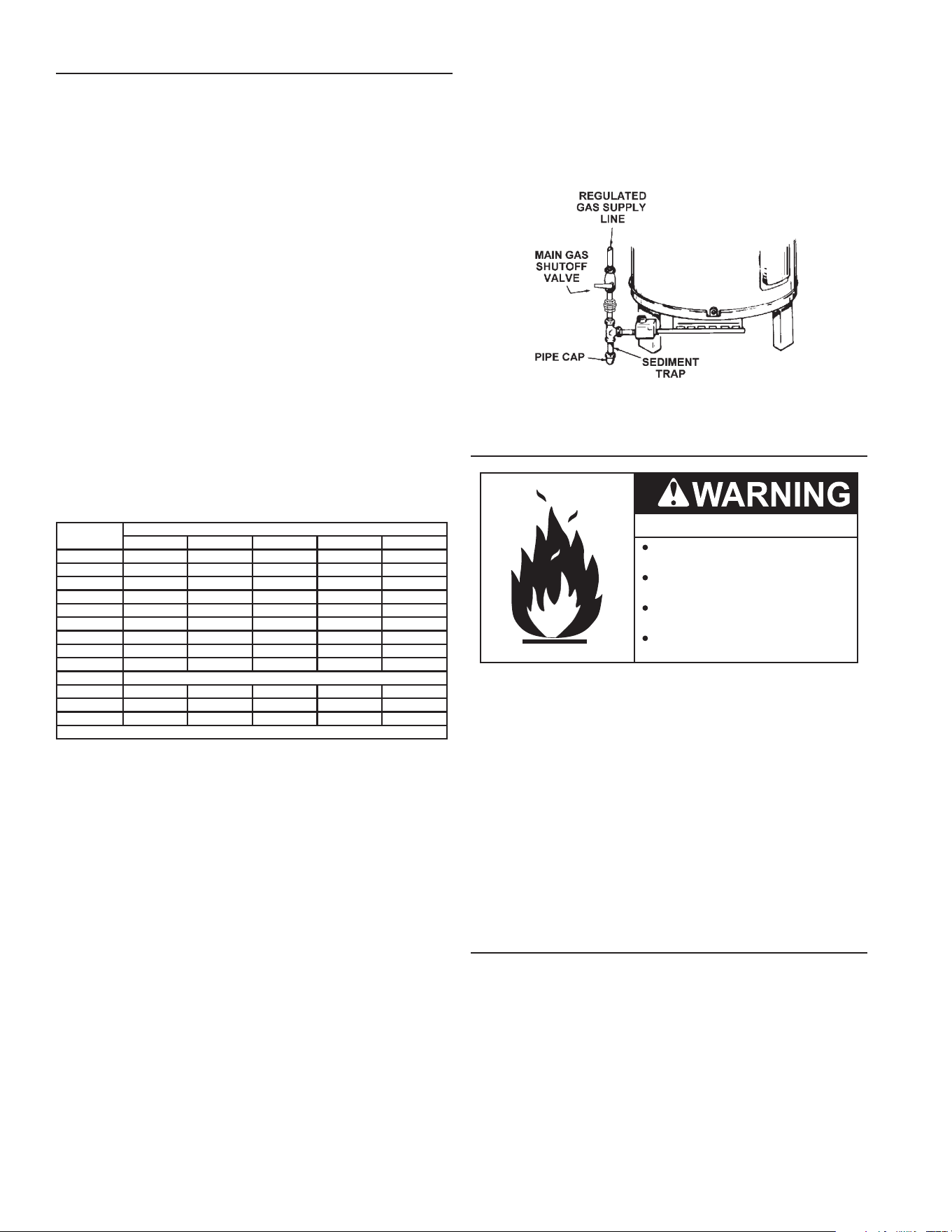
24
GAS PIPING
Contact your local gas service company to ensure that adequate
gas service is available and to review applicable installation codes
for your area.
Size the main gas line in accordance with Table 7. The gures shown
are for straight lengths of pipe at 0.5 in. W.C. pressure drop, which is
considered normal for low pressure systems. Note: Fittings such as
elbows, tees and line regulators will add to the pipe pressure drop.
Also refer to the latest version of the National Fuel Gas Code.
Schedule 40 Steel or Wrought Iron Pipe is the preferred material
for the gas line of this water heater. It is imperative to follow the
sizing recommendations in the latest version of the National Fuel
Gas Code if Corrugated Stainless Steel Tubing (CSST) is used as
the gas line for this water heater.
The heater is not intended for operation at higher than 14.0" W.C.-
natural gas, (1/2 pound per square inch gage) supply gas pressure.
Exposure to higher supply pressure may cause damage to the
gas valve which could result in re or explosion. If overpressure
has occurred such as through improper testing of gas lines or
emergency malfunction of the supply system, the gas valve must be
checked for safe operation. Make sure that the outside vents on the
supply regulators and the safety vent valves are protected against
blockage. These are parts of the gas supply system, not the heater.
Vent blockage may occur during ice storms.
TABLE 7. GAS SUPPLY PIPE LENGTHS (IN FEET)
Maximum Equivalent Pipe Length - Natural Gas Only
Input rate
(BTU/HR)
Schedule 40 Steel or Wrought Iron Pipe
1/2" 3/4" 1" 1 1/4" 1 1/2"
120,000 20 70 200 200 200
154,000 10 40 150 200 200
180,000 - 30 100 200 200
199,000 - 30 90 200 200
250,000 - 20 60 200 200
275,000 - 10 50 200 200
310,000 - 10 40 150 200
366,000 - - 30 100 200
390,000 - - 20 100 200
Fitting Type* Equivalent length in feet
45°Ell 0.7 1.0 1.2 1.6 1.9
90°Ell 1.6 2.1 2.6 3.5 4.0
Tee 3.1 4.1 5.2 6.9 8.0
Natural Gas 0.60 Specic Gravity, 0.50" W.C. Pressure Drop
*Screwed Fittings
It is important to guard against gas valve fouling from contaminants in
gas ways. Such fouling may cause improper operation, re or explosion.
If copper supply lines are used they must be internally tinned and
certied for gas service. Before attaching the gas line, be sure that
all gas pipe is clean on the inside.
To trap any dirt or foreign material in the gas supply line, a sediment
trap must be incorporated in the piping (see Figure 21). The sediment
trap must be readily accessible and not subject to freezing conditions.
Install in accordance with recommendations of serving gas suppliers.
Refer to the latest version of the National Fuel Gas Code.
To prevent damage, care must be taken not to apply too much torque
when attaching gas supply pipe to gas valve inlet.
Apply joint compounds (pipe dope) sparingly and only to the male
threads of pipe joints. Do not apply compounds to the rst two threads.
Use compounds resistant to the action of liqueed petroleum gases.
GAS METER SIZE – NATURAL GASES ONLY
Be sure the gas meter has sufcient capacity to supply the full rated
gas input of the water heater as well as the requirements of all other
gas red equipment supplied by the meter. If gas meter is too small, ask
the gas company to install a larger meter having adequate capacity.
GAS PIPING AND SEDIMENT TRAP INSTALLATION
FIGURE 21.
GAS LINE LEAK TESTING
Fire and Explosion Hazard
Leak test before placing the water
heater in operation.
Disconnect gas piping and main gas
shutoff valve before leak testing.
Install sediment trap in accordance
with NFPA 54.
Use joint compound or Teflon tape
compatible with propane gas.
Any time work is done on the gas supply system perform a leak test
to avoid the possibility of re or explosion.
1. For test pressures exceeding 1/2 psi (3.45 kPa) disconnect the
water heater and its Main Gas Shutoff Valve from the gas supply
piping system during testing, see Figure 21. The gas supply line
must be capped when disconnected from the water heater.
2. For test pressures of 1/2 psi (3.45 kpa) or less, the water heater
need not be disconnected, but must be isolated from the supply
gas line by closing the Main Gas Shutoff Valve during testing.
3. Coat all supply gas line joints and connections upstream of the
water heater with a non-corrosive soap and water solution to
test for leaks. Bubbles indicate a gas leak. Do not use matches,
candles, ame or other sources of ignition for this purpose.
4. Repair any leaks before placing the water heater in operation.
PURGING
Gas line purging is required with new piping or systems in which air
has entered.
Purging should be performed per the current edition of NFPA 54 the
National Fuel Gas Code.
25
is locked out, the power to the unit must be cycled to restart the
Ignition Control.
8. If the pilot ame is proved during the ignition trial period, the
Ignition Control turns off the Spark Ignitor and opens the Main
Gas Valve.
9. The Ignition Control allows a 2 second pilot ame stabilization
period to insure that the pilot ame is not extinguished by the
main burner light-off process.
10. The Ignition Control monitors the Flame Sensor during the
heating cycle. If the ame signal is lost, the Ignition Control shuts
the Main Gas Valve and Pilot Gas Valve and re-starts the ignition
process at step 4.
11. Once the unit is satised, the Ignition Control will shut off the
Main Gas Valve and the Pilot Gas Valve and the unit will be in
standby mode until another call for heat is initiated by
the thermostat.
See the ow chart on page 26 for more information.
Light the water heater in accordance with the Lighting and
Operation Instruction label on the water heater and in this manual
on pages 27 and 28.
The water heaters covered by this manual are equipped with
an electronic control system that automatically sequences
the Igniter, the 24 VAC Gas Valve, the Burner ignition, and
flame sensing.
Before attempting start up, thoroughly study and know the exact
Sequence Of Operation. See written Sequence Of Operation on
page 25 and Sequence Of Operation Flow Chart on page 26.
Be certain that the water heater is full of water, that air is purged
from the gas and water lines and that there are no leaks in the
gas and water lines. Ensure all inlet water valves are open.
FILLING THE WATER HEATER
Follow these steps to ll the water heater prior to start up.
1. Close the heater drain valve.
2. Open a nearby hot water faucet to permit air in system to escape.
3. Fully open the cold water inlet valve allowing the piping and
water heater to ll with water.
4. Close hot water faucet opened in Step 2 as water starts to ow.
Read SEQUENCE OF OPERATION section of this manual prior
to lighting and operating this water heater.
With above conditions satisfied, start the unit in accordance with
the instructions on the operating label attached to the heater.
For your convenience a copy of the instructions are shown on
pages 27 and 28.
Fire or Explosion Hazard
Read instruction manual before
installing, using or servicing
water heater.
To avoid risk of fire or explosion purge discharge must not
enter into confined areas or spaces where ignition can occur.
The area must be well ventilated and all sources of ignition
must be deactivated or removed.
Gas line purging is required with new piping or systems in
which air has entered.
PRIOR TO START UP
Installation and start up of this water heater requires abilities and
skills equivalent to that of a licensed tradesman in the eld involved,
see Qualications on page 6.
Do not place the water heater in operation if any part has been under
water. Immediately call a qualied service technician to inspect the
water heater and to replace any part of the control system and any
gas control which has been under water.
OPERATION
SEQUENCE OF OPERATION
The following information will describe the Sequence of Operation
for this water heater.
1. Switch power on to unit.
2. Thermostat calls for heat.
3. Ignition Control performs diagnostic self check on system
components.
4. The Ignition Control begins the trial for ignition.
5. The Ignition Control turns on the Spark Igniter and opens the Pilot
Gas Valve.
6. The Ignition Control monitors the Flame Sensor during the ignition
trial period.
7. If the Ignition Control does not sense the pilot ame during the
ignition trial period, the Ignition Control shuts the Pilot Gas
Valve and turns off the Spark Igniter. Depending on the water
heater model, the Ignition Control will either retry the ignition trial
at step 4 or lockout the ignition sequence. If the ignition sequence
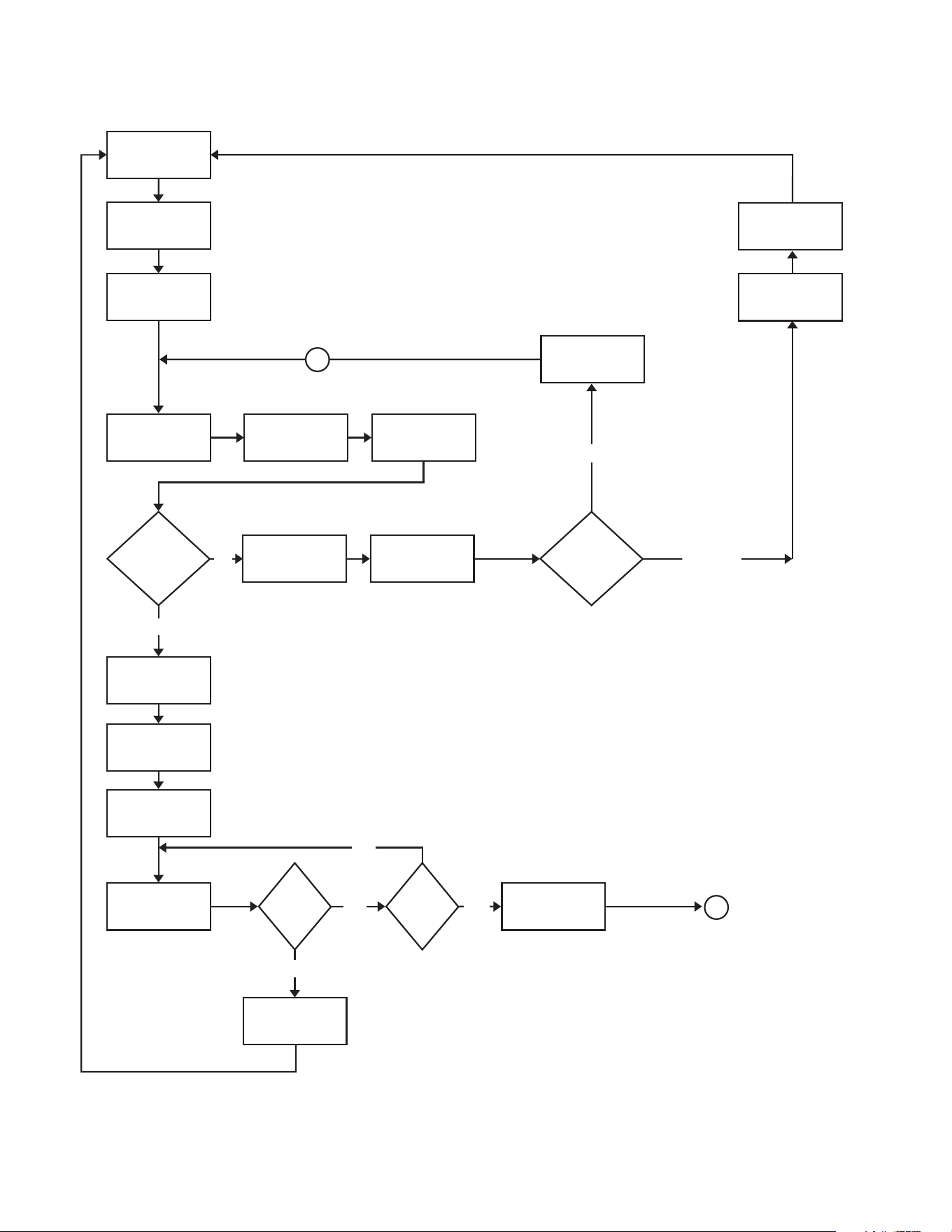
26
SEQUENCE OF OPERATION FLOW CHART
Description of this ow chart can be found in the “SEQUENCE OF OPERATION” section found on page 25.
FLOW CHART 1.
A
A
IDLE
(NOT POWERED)
“CALL FOR HEAT”
RECEIVED FROM
THERMOSTAT
POWER TO
MODULE AND
SELF CHECK
TRIAL FOR
IGNITION
(TIMER STARTED)
FLAME
PROVED?
CLOSE PILOT
GAS VALVE
SPARK OFF
(BEFORE TRIAL FOR IGNITION TIMER EXPIRES)
SPARK OFF
OPEN MAIN GAS
VALVE
FLAME
STABILIZATION
(2 SECONDS)
RUN
NO
NO
NO
YES
YES
YES
“CALL
FOR HEAT”
ENDS?
FLAME
LOST?
CLOSE MAIN GAS
VALVE AND PILOT
GAS VALVE
CLOSE MAIN GAS
VALVE AND PILOT
GAS VALVE
SPARK ON
OPEN PILOT GAS
VALVE
RETRY DELAY
(5 MINUTES)
WAIT FOR
“CALL FOR HEAT ”
TO BE REMOVED
ACTIVATE ALARM
CONTACT(S)
(OPTIONAL)
RETRY OR
LOCKOUT
MODEL?
LOCKOUT
RETRY
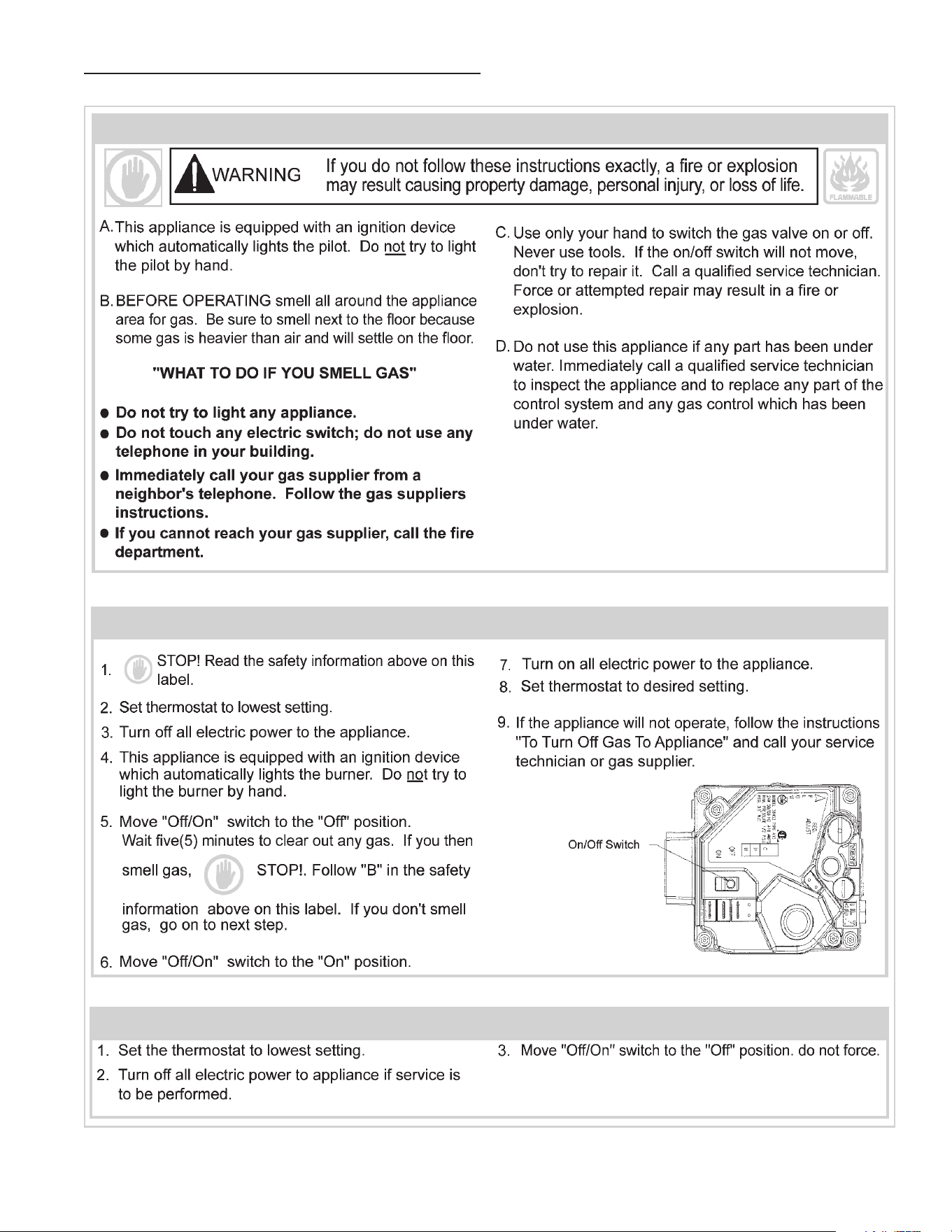
27
LIGHTING & OPERATION LABEL
FIGURE 22. LABEL FOR NATURAL GAS MODELS
FOR YOUR SAFETY READ BEFORE OPERATING
OPERATING INSTRUCTIONS
FOR YOUR SAFETY READ BEFORE OPERATING
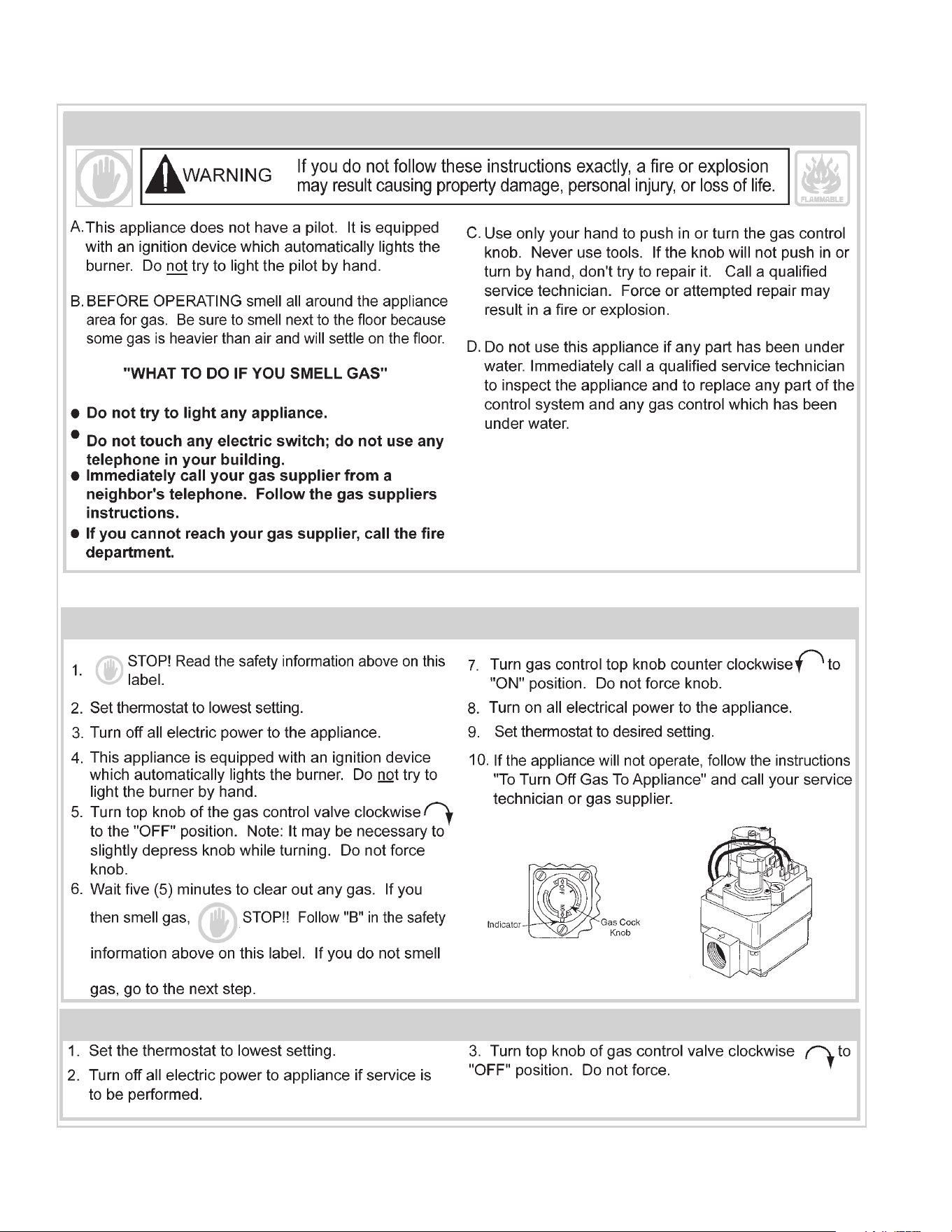
28
FIGURE 23. LABEL FOR PROPANE GAS MODELS
FOR YOUR SAFETY READ BEFORE OPERATING
OPERATING INSTRUCTIONS
TO TURN OFF GAS TO APPLIANCE
29
ADJUSTMENTS
ON INITIAL STARTUP SOME ADJUSTMENTS MAY BE NECESSARY.
Check Manifold and inlet gas pressures (see GAS SUPPLY
SYSTEMS on page 13 and CHECKING THE INPUT on page 29-30.)
Check Pilot Burner (See Pilot Burner section on page 34.)
TESTING DAMPER OPERATION
With the Service Switch in the AUTOMATIC OPERATION
position, check the operation of the ue damper three (3) times
with the water operating controls for proper operating sequence:
• The damper disc must be open (in the vertical position) before
the ignition and combustion process begins.
• The damper disc must be in the open position when the main
burner is ring.
• The gas control valve must close and the main burner must
have ceased ring before the damper disc begins its return to
the closed (horizontal) position.
If during testing of the operation of the damper you nd that
there is a problem with the operation of the water heater when
the Service Switch is in the AUTOMATIC OPERATION position:
Reset the Service Switch to the HOLD OPEN DAMPER position
and check operation again.
If the water heater does operate when placed in the HOLD OPEN
DAMPER position:
• Refer to the EFFIKAL RVGP-FSF-SERIES TROUBLESHOOTING
GUIDE on page 37.
If the water heater does not operate with the Service Switch in
either position:
• Refer to the Troubleshooting Sections and Troubleshooting
Checklist.
CHECKING VENTING
The following steps shall be followed with each appliance connected
to the venting system placed in operation, while any other appliances
connected to the venting system are not in operation.
1. Seal any unused openings in the venting system.
2. Inspect the venting system for proper size and horizontal pitch, as
required in the National Fuel Gas Code, ANSI Z223.1or the CAN/
CGA B149 Installation Codes and these instructions. Determine
that there is no blockage or restriction, leakage, corrosion and
other deciencies which could cause an unsafe condition.
3. So far as is practical, close all building doors and windows
and all doors between the space in which the water heater(s)
connected to the venting system are located and other spaces
of the building. Turn on all appliances not connected to the
venting system. Turn on all exhaust fans, such as range hoods
and bathroom exhausts, so they shall operate at maximum
speed. Close replace dampers.
4. Follow the lighting instruction. Place the water heater being
inspected in operation. Adjust thermostat so water heater shall
operate continuously.
5. Test for draft hood spillage at the relief opening after 5 minutes
of main burner operation.
6. After it has been determined that each appliance connected to
the venting system properly vents when tested as outlined above,
return doors, windows, exhaust fans, replace dampers and any
other gas burning appliance to their previous conditions of use.
7. If improper venting is observed during any of the above tests,
the venting system must be corrected.
FAILURE TO CORRECT BACK DRAFTS MAY CAUSE AIR
CONTAMINATION AND UNSAFE CONDITIONS.
• If the back draft cannot be corrected by the normal method or
if a suitable draft cannot be obtained, a blower type ue gas
exhauster must be employed to assure proper venting and
correct combustion.
CHECKING THE INPUT
For installation locations with elevations above 2000 feet, refer
to HIGH ALTITUDE INSTALLATIONS section of this manual for
input reduction procedure.
1. Attach a pressure gauge or a manometer to the manifold
pressure tap on the gas control valve and refer to Table
8, for correct manifold pressure.
2. Use this formula to “clock” the meter. Be sure that other
gas consuming appliances are not operating during this
interval.
(3600/T) x H = Btuh
T = Time in seconds to burn one cubic foot of gas.
H = Btu’s per cubic foot of gas.
Btuh = Actual heater input.
Example:
T = 15.1 seconds
H = 1050 Btu
Btuh = ?
(3600/15.1) x 1050 = 250,000
TABLE 8.
APPROXIMATE TIME REQUIRED TO CONSUME
1 CU. FT. OF GAS AT FULL CAPACITY
INPUT
RATE
(BTUH)
TYPE
OF
GAS
BTUH
PER
CU. FT.
TIME REQ’D TO
CONSUME 1 CU.
FT. OF GAS
120,000
NATURAL
PROPANE
1050
2500
31. 5 SEC.
75.0 SEC.
154,000
NATURAL
PROPANE
1050
2500
24.5 SEC.
58.4 SEC.
180,000
NATURAL
PROPANE
1050
2500
21.0 SEC.
50.0 SEC.
199,000
NATURAL
PROPANE
1050
2500
19.0 SEC.
45.2 SEC.
250,000
NATURAL
PROPANE
1050
2500
15.1 SEC.
36.0 SEC.
251,000
NATURAL
PROPANE
1050
2500
15.1 SEC.
35.9 SEC.
275,000
NATURAL
PROPANE
1050
2500
13.7 SEC.
32.7 SEC.
305,000
NATURAL
PROPANE
1050
2500
12.4 SEC.
29.5 SEC.
365,000
NATURAL
PROPANE
1050
2500
10.4 SEC.
24.7 SEC.
390,000
NATURAL
PROPANE
1050
2500
9.7 SEC.
23.1 SEC.
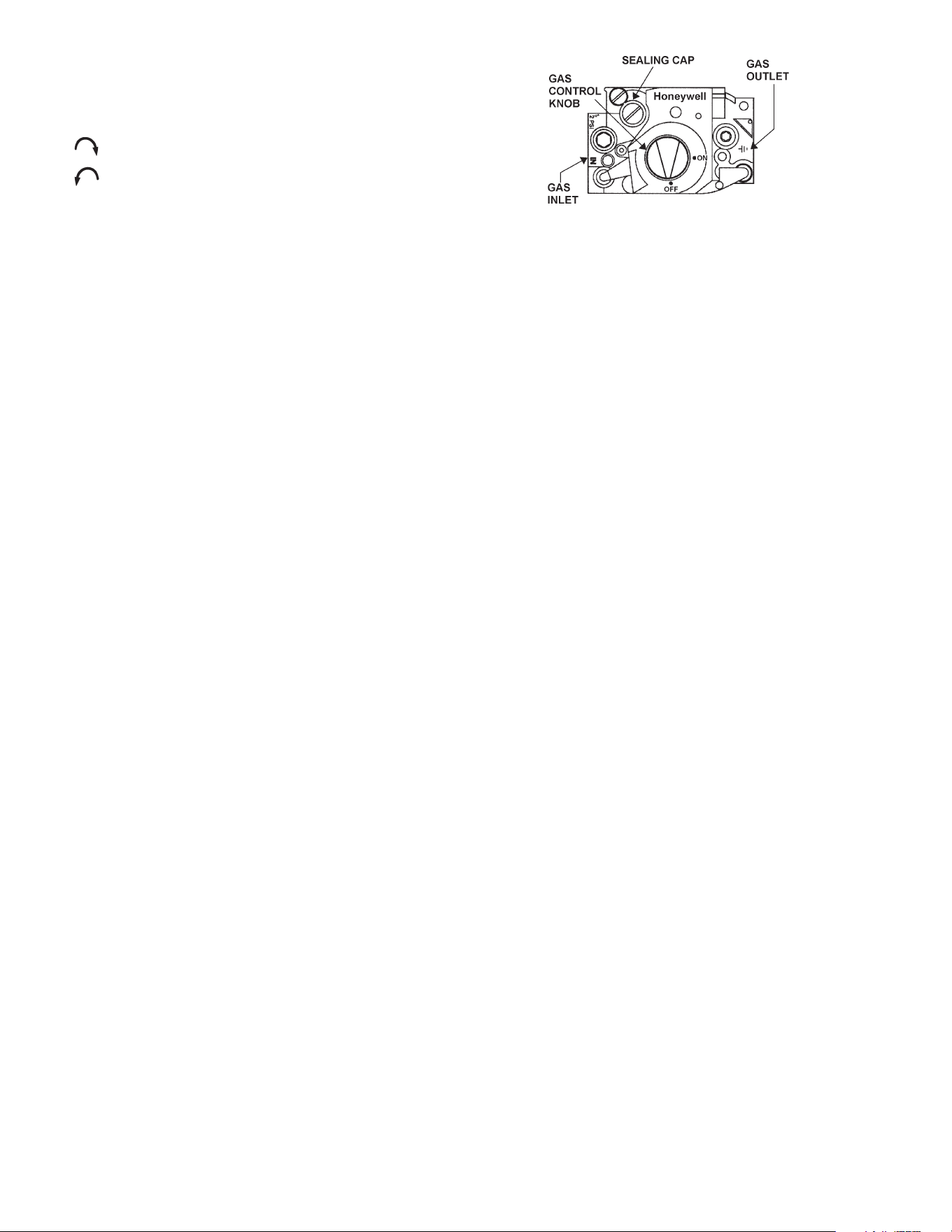
30
FIGURE 24.
UNDER NO CIRCUMSTANCES SHOULD THE GAS INPUT EXCEED
THE INPUT SHOWN ON THE HEATER MODEL AND RATING
PLATE. OVERFIRING COULD RESULT IN DAMAGE OR SOOTING
OF THE HEATER.
Should it be necessary to adjust the gas pressure to the burners
to obtain the full input rate, the steps below should be followed:
3. Remove the regulator adjustment sealing cap and adjust the pressure
by turning the adjusting screw with a screwdriver. See Figure 24.
Clockwise to increase gas pressure and input rate.
Counterclockwise to decrease gas pressure and input rate.
4. “Clock” the meter as in step 2 above.
5. Repeat steps 3 and 4 until the specied input rate is achieved.
6. Turn the gas control knob to PILOT. Remove the pressure
gauge and replace the sealing cap and the Allen wrench set
screw in the pressure tap opening.
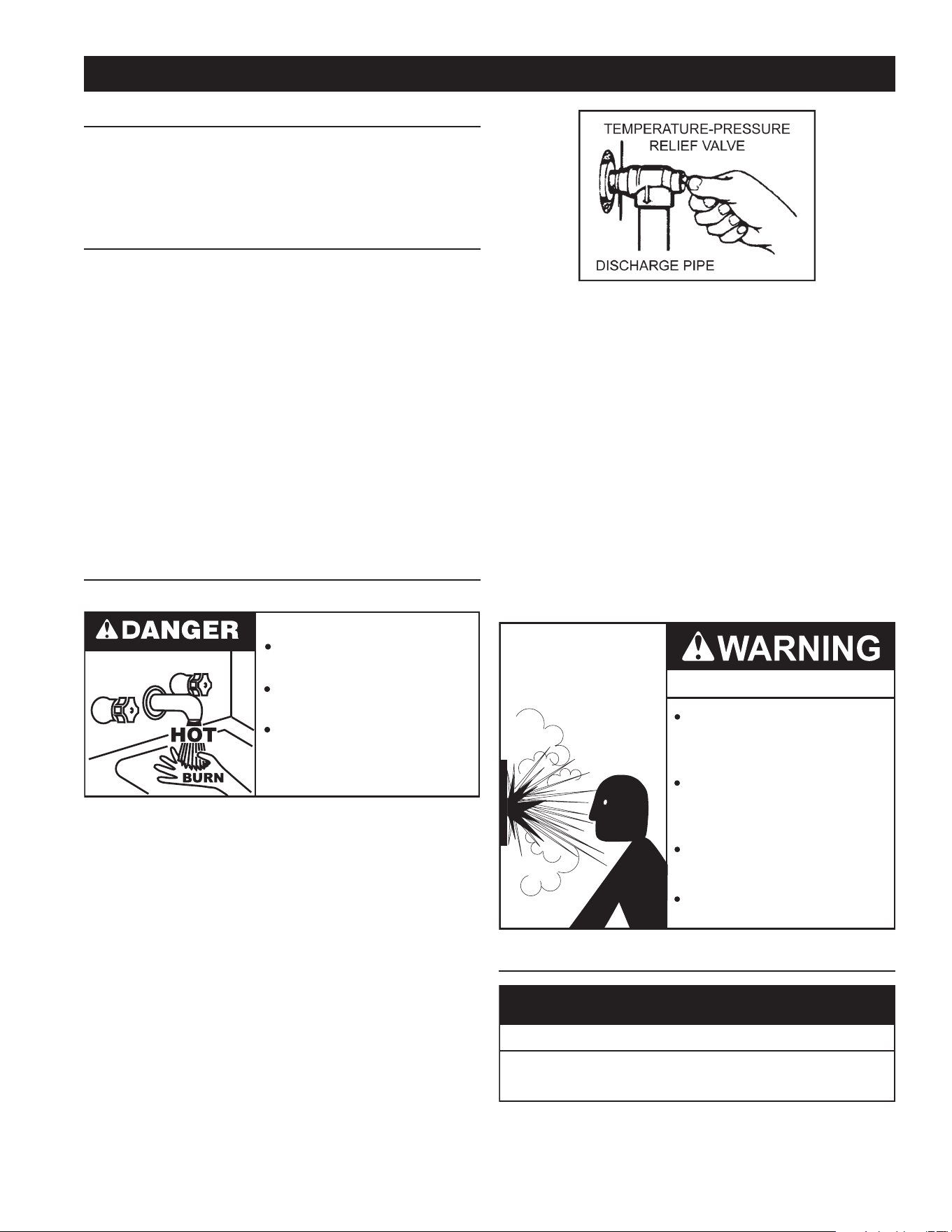
31
FIGURE 25.
If the Temperature-Pressure Relief Valve on water heater weeps
or discharges periodically, this may be due to thermal expansion.
NOTE: Excessive water pressure is the most common cause
of Temperature-Pressure Relief Valve leakage. Excessive
water system pressure is most often caused by "thermal
expansion" in a "closed system." See Closed Water Systems
and Thermal Expansion on page 12. The Temperature-
Pressure Relief Valve is not intended for the constant relief
of thermal expansion.
Temperature-Pressure Relief Valve leakage due to pressure build
up in a closed system that does not have a thermal expansion
tank installed is not covered under the limited warranty. Thermal
expansion tanks must be installed on all closed water systems.
DO NOT PLUG THE TEMPERATURE-PRESSURE RELIEF
VALVE OPENING. THIS CAN CAUSE PROPERTY DAMAGE,
SERIOUS INJURY OR DEATH.
Explosion Hazard
Temperature-Pressure Relief Valve
must comply with ANSI Z21.22-
CSA 4.4 and ASME code.
Properly sized temperature-
pressure relief valve must be
installed in opening provided.
Can result in overheating and
excessive tank pressure.
Can cause serious injury or death.
ANODE ROD INSPECTION
Property Damage Hazard
Avoid water heater damage.
•
Inspection and replacement of anode rod required.
•
CAUTION
The anode rod is used to protect the tank from corrosion. Most
hot water tanks are equipped with an anode rod. The submerged
rod sacrices itself to protect the tank. Instead of corroding tank,
VENTING SYSTEM
Examine the venting system every six months for obstructions
and/or deterioration of the vent piping.
Remove all soot or other obstructions from chimney which will
retard free draft.
REMOTE STORAGE TANK TEMPERATURE CONTROL
The water temperature in the remote storage tank (if used) is
controlled by the storage tank temperature control. The sensing
element is mounted in the hot water storage tank, see Water
Piping Diagram section.
A change in water temperature in the storage tank lower than
the tank temperature control setting will cause the sensor to
activate the circulating pump. The pump then circulates the
water through the heater where the thermostat senses the drop
in water temperature and activates main burner operation of the
water heater.
If the storage tank temperature control is out of calibration, replace
with new control.
SHOULD OVERHEATING OCCUR OR THE GAS SUPPLY FAIL
TO SHUT OFF, TURN OFF THE MANUAL GAS CONTROL VALVE
TO THE WATER HEATER.
TEMPERATURE-PRESSURE RELIEF VALVE TEST
Burn hazard.
Hot water discharge.
Keep clear of Temperature-
Pressure Relief Valve
discharge outlet.
It is recommended that the Temperature-Pressure Relief Valve
should be checked to ensure that it is in operating condition every
6 months.
When checking the Temperature-Pressure Relief Valve operation,
make sure that (1) no one is in front of or around the outlet of the
Temperature-Pressure Relief Valve discharge line, and (2) that
the water discharge will not cause any property damage, as the
water may be extremely hot. Use care when operating valve as
the valve may be hot.
To check the pressure relief valve , lift the lever at the end of the
valve several times, see Figure 25. The valve should seat properly
and operate freely.
If after manually operating the valve, it fails to completely reset and
continues to release water, immediately close the cold water inlet
to the water heater and drain the water heater, see Draining And
Flushing on page 32. Replace the Temperature-Pressure Relief
Valve with a properly rated/sized new one, see Temperature-
Pressure Relief Valve on pages 12-13 for instructions on
replacement.
MAINTENANCE
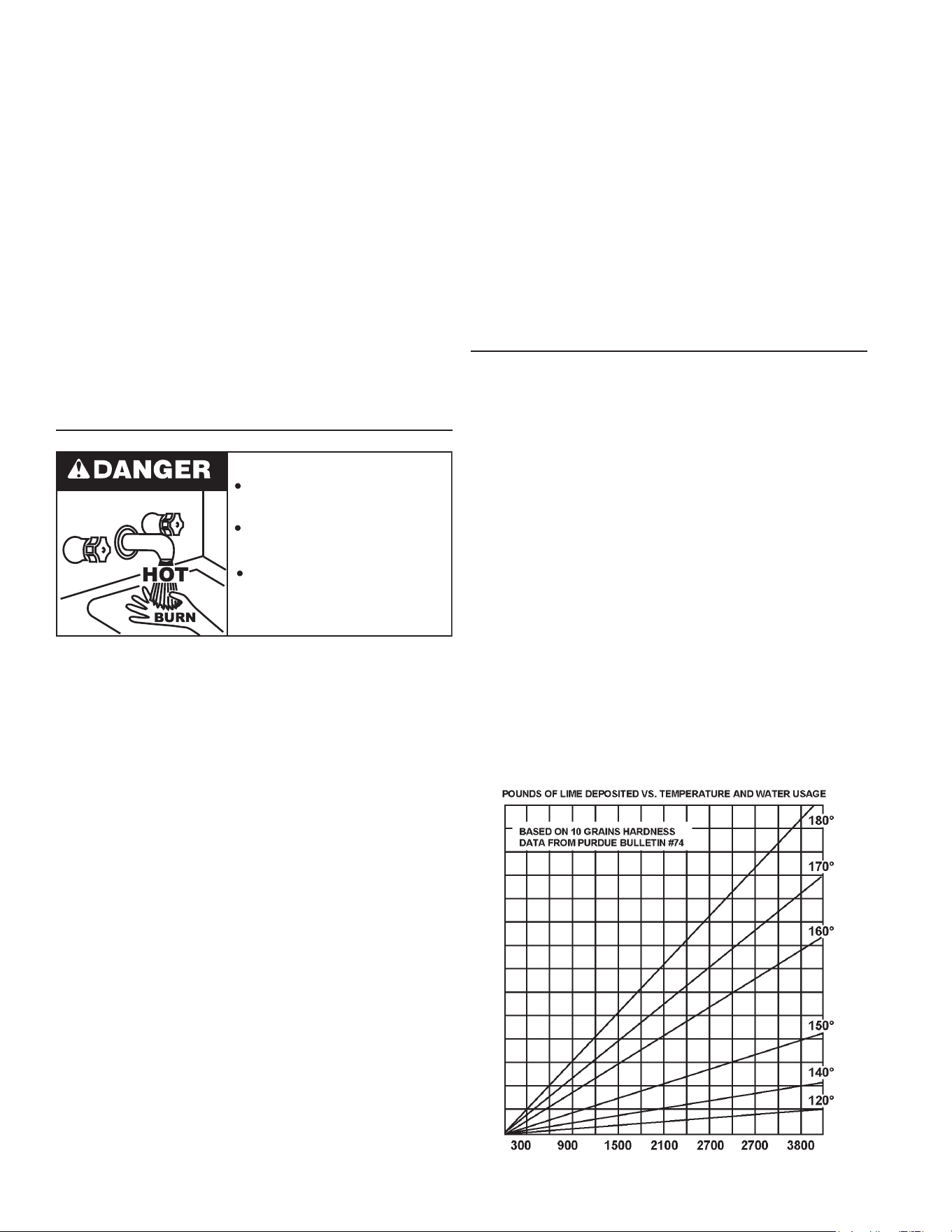
32
5. Ensure the drain hose is secured before and during the
entire ushing procedure. Flushing is performed with system
water pressure applied to the water heater.
6. Open the water heater drain valve to ush the storage tank.
7. Flush the water heater storage tank to remove sediment and
allow the water to ow until it runs clean.
8. Close the water heater drain valve when ushing is completed.
9. Remove the drain hose.
10. Fill the water heater - see Filling The Water Heater in this manual.
11. Turn on the electrical supply to place the water heater back
in operation.
12. Allow the water heater to complete several heating cycles to
ensure it is operating properly.
RECOMMENDED PROCEDURE FOR PERIODIC
REMOVAL OF LIME DEPOSITS FROM TANK TYPE
COMMERCIAL WATER HEATERS
The amount of calcium carbonate (lime) released from water is
in direct proportion to water temperature and usage, see chart.
The higher the water temperature or water usage, the more lime
deposits are dropped out of the water. This is the lime scale
which forms in pipes, heaters and on cooking utensils.
Lime accumulation not only reduces the life of equipment but also
reduces efciency of the heater and increases fuel consumption.
The usage of water softening equipment greatly reduces the hardness
of the water. However, this equipment does not always remove all of
the hardness (lime). For this reason it is recommended that a regular
schedule for deliming be maintained.
The time between cleaning will vary from weeks to months
depending upon water conditions and usage.
The depth of lime buildup should be measured periodically. Heaters
equipped with cleanouts will have about 2" of lime buildup when
the level of lime has reached the bottom of the cleanout opening. A
schedule for deliming should then be set up,based on the amount
of time it would take for a 1" buildup of lime. It is recommended that
the water heater initially be inspected after 6 months.
Example 1:
Initial inspection after 6 months shows 1/2" of lime accumulation.
Therefore, the heater should be delimed once a year.
Example 2:
Initial inspection after 6 months shows 2" of lime accumulation.
Therefore, the heater should be delimed every 3 months.
FIGURE 26.
water ions attack and eat away the anode rod. This does not affect
water’s taste or color. The rod must be maintained to keep tank in
operating condition.
Anode rod deterioration depends on water conductivity, not
necessarily water condition. A corroded or pitted anode rod
indicates high water conductivity and should be checked and/or
replaced more often than an anode rod that appears to be intact.
Replacement of a depleted anode rod can extend the life of your
water heater. Inspection should be conducted by a qualied
technician, and at a minimum should be checked annually after
the warranty period.
Articially softened water is exceedingly corrosive because the
process substitutes sodium ions for magnesium and calcium ions.
The use of a water softener may decrease the life of the water
heater tank.
The anode rod should be inspected after a maximum of three
years and annually thereafter until the condition of the anode rod
dictates its replacement. Anode replacement is not covered by
warranty. NOTE: articially softened water requires the anode rod
to be inspected annually.
DRAINING AND FLUSHING
Burn harzard.
Hot water discharge.
Keep hands clear of drain
valve discharge.
It is recommended that the water heater storage tank be drained
and ushed every 6 months to reduce sediment buildup. The
water heater should be drained if being shut down during freezing
temperatures. See Features And Components in this manual for
the location of the water heater components described below.
TO DRAIN THE WATER HEATER STORAGE TANK:
1. Turn off the electrical supply to the water heater.
2. Turn off the gas supply at the Main Gas Shutoff Valve if the
water heater is going to be shut down for an extended period.
3. Ensure the cold water inlet valve is open.
4. Open a nearby hot water faucet and let the water run until
the water is no longer hot.
5. Close the cold water inlet valve to the water heater.
6. Connect a hose to the water heater drain valve and terminate
it to an adequate drain.
7. Open the water heater drain valve and allow all the water to
drain from the storage tank.
8. Close the water heater drain valve when all water in the
storage tank has drained.
9. Close the hot water faucet opened in Step 4.
10. If the water heater is going to be shut down for an extended
period, the drain valve should be left open.
TO FLUSH THE WATER HEATER STORAGE TANK:
1. Turn off the electrical supply to the water heater.
2. Ensure the cold water inlet valve is open.
3. Open a nearby hot water faucet and let the water run until
the water is no longer hot. Then close the hot water faucet.
4. Connect a hose to the drain valve and terminate it to an
adequate drain.
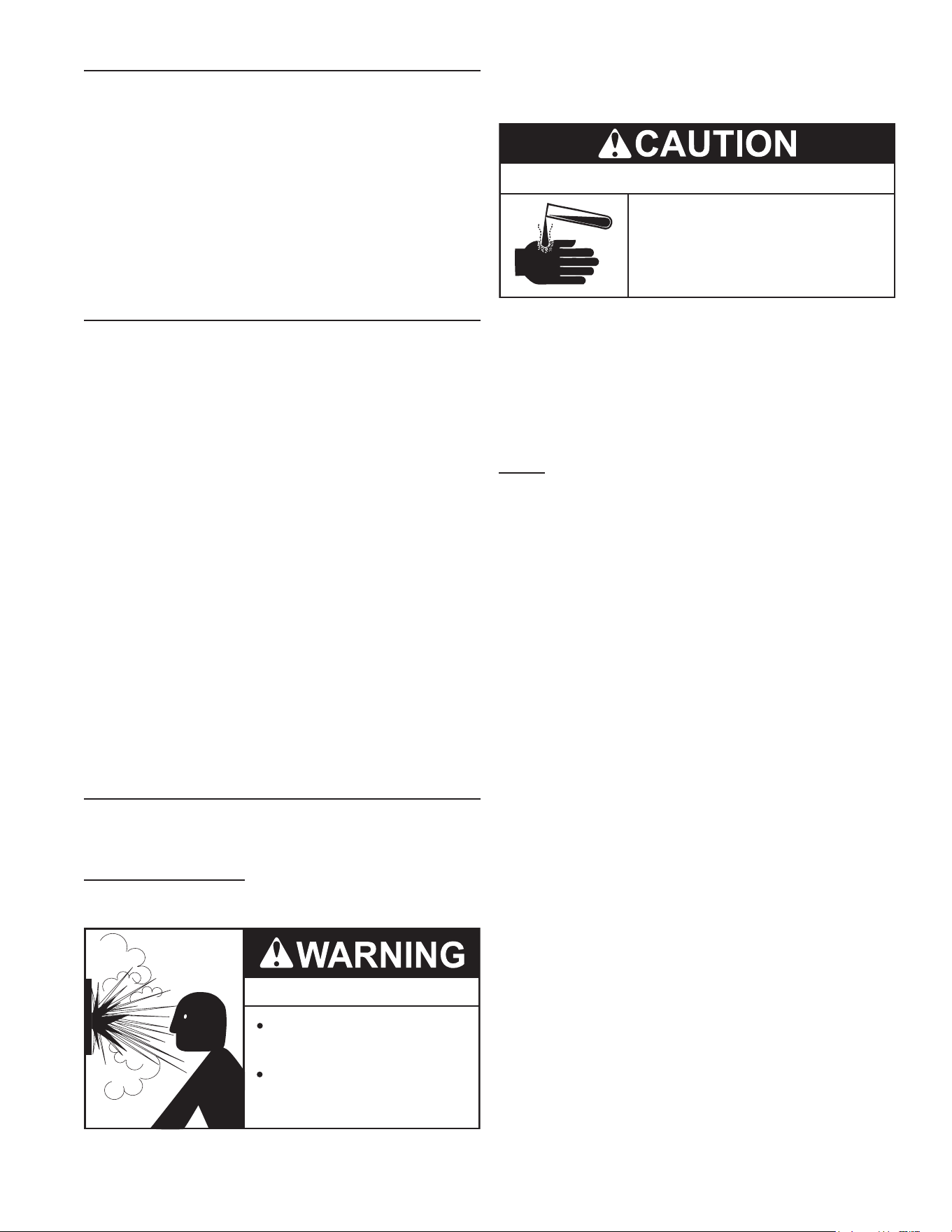
33
Do not smoke or have open ame or sparks in vicinity of heater.
Do not mix UN•LIME with other chemicals. Do not allow contact
with magnesium, aluminum or galvanized metals.
Chemical Hazard
• Product contains phosphoric acid.
• Keep out of reach of children.
• Use rubber or neoprene gloves.
Contains phosphoric acid. In case of external contact,
ush with cool water. If irritation persists, get medical
attention. If swallowed, give 1 or 2 glasses of water or milk and
call physician.
Get immediate medical attention for eyes. Keep out of reach
of children.
NOTE: THE USE OF RUBBER OR NEOPRENE GLOVES IS
RECOMMENDED, ESPECIALLY IF YOU HAVE ANY OPEN
SORES OR CUTS TO AVOID UNNECESSARY IRRITATION
OR DISCOMFORT.
1. Turn off fuel and/or power supply to heater. Also, turn
off power to any electrical device or equipment, which is
attached, or part of the system.
2. Open hot water side of faucet closest to heater and allow
water to run until it is cool enough to handle safely.
3. Close cold water inlet valve to heater.
4. Connect hose to drain valve at bottom of heater and start
draining heater into suitable floor drain area.
5. Remove pressure relief valve while heater is draining.
NOTE: Do not replace pressure relief valve until deliming
is completed. Pressure relief valve opening will also act
as a vent in case of possible contact between the delimer
and the anode rod(s), which may produce flammable
hydrogen-air mixtures.
6. If pressure relief valve appears to be limed-up, place it in a
clean glass or plastic container adequate in size so that you
can pour enough UN•LIME® into container to cover the valve
and allow space for foaming. When foaming stops, run fresh
cool water into the container and rinse the pressure relief
valve for a few minutes.
7. If heater does not drain completely after a reasonable
length of time, turn off the main water supply valve to stop
water from entering the tank due to a by-pass problem or
defective cold water inlet valve. Also, check for clogged
drain valve opening. Heater must be completely drained
before introducing UN•LIME.
8. Remove the cleanout cover and place a clean plastic
bucket next to the cleanout opening.
Partially open the cold water inlet valve to allow time to
accomplish the following and then close the valve.
DELIMING SOLVENTS
UN•LIME is recommended for deliming. UN•LIME is a patented
food grade acid which is safe to handle and does not create the
harmful fumes which are associated with other products.
UN•LIME may be obtained from your dealer, distributor or
water heater manufacturer. Order Part Number 9005416105,
1 gallon, packed 4 gallons per case or Part Number 9005417105,
5 gallon container.
NOTE: Un•Lime is not available for use in Canada.
Hydrochloric base acids are not recommended for use on glass
lined tanks.
Observe handling instructions on label of product being used.
TANK CLEANOUT PROCEDURE
The following practices will ensure longer life and enable the
unit to operate at its designed efciency:
1. Once a month the heater should be ushed. Open drain valve
and allow two gallons of water to drain from heater. Inlet water
valve should remain open to maintain pressure in tank.
2. A cleanout opening is provided for periodic cleaning of the
tank. Gas must be shut off and heater drained before opening
cleanout.
To clean heater through cleanout opening, proceed as follows:
3. Drain heater.
4. Remove outer cover plate from lower side of heater jacket.
5. Remove six (6) hex head screws securing tank cleanout plate
and remove plate.
6. Remove lime, scale, or sediment using care not to damage
the glass lining.
7. Inspect cleanout plate gasket, if new gasket is required,
replace with part no. 9004099215.
8. Install cleanout plate. Be sure to draw plate up tight by
tightening screws securely.
9. Replace outer jacket cover plate.
In some water areas the sediment might not be removed by this
method and may result in the water heater making rumbling or
boiling noises. To dissolve and remove these more stubborn
mineral deposits, UN•LIME Professional Delimer should be used.
DELIMING USING FLO-JUG METHOD
UN•LIME in the 5 gallon size is recommended for deliming of all
models. Contact your local dealer, distributor or, water heater
manufacturer:
Prepare the Water Heater
To delime the water heater using the Flo-Jug method, rst
prepare the heater for deliming.
Explosion Hazard
Flammable hydrogen gases
may be present.
Keep all ignition sources away
from faucet when turning on
hot water.
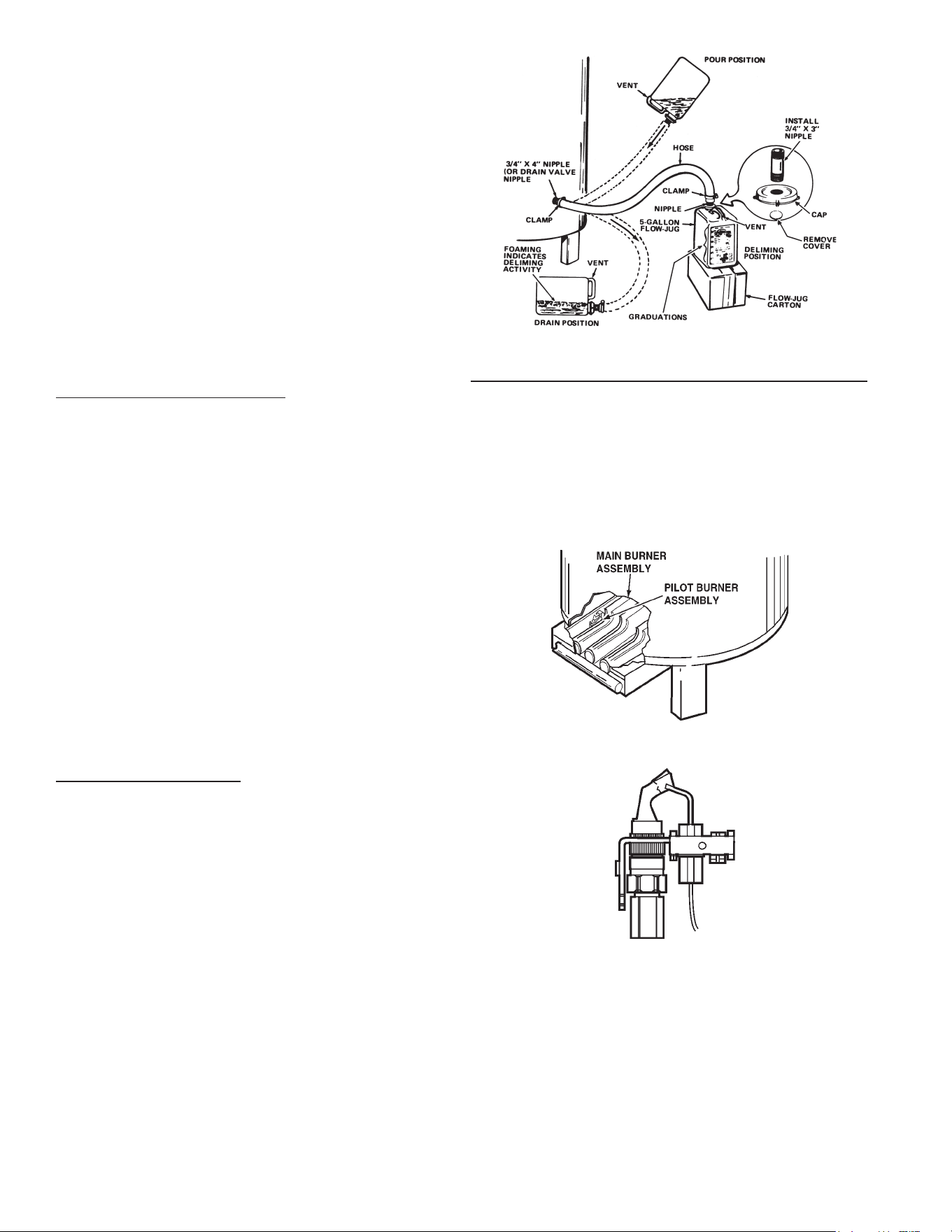
34
FIGURE 27.
PILOT BURNER
At least once a year, check the pilot burner, Figure 29, and the
main burner, Figure 30, for proper operation. See Figure 28 for
the location of the Pilot Burner and the Main Burners. For access
to pilot, unfasten two screws to burner cover and remove. Locate
the burner with pilot and remove screw holding burner to manifold.
Unfasten pilot tubing from valve and slide out burner and pilot.
Servicing of the pilot burner includes keeping pilot free of lint,
cleaning the burner head, the primary air opening and the orice
of the pilot burner.
FIGURE 28.
FIGURE 29.
Pilot burner ame is affected by:.
1. Low gas pressure.
• Adjust pilot ame by means of the pilot gas adjustment
located on the gas control valve. See Figure 31.
• The pilot ame should envelop sensing device with 5/8” (1.6cm)
ame, Figure30. Remove pilot adjustment cover screw, Figure
31. Turn inner adjustment screw clockwise to decrease, or
counterclockwise to increase pilot ame. Be sure to replace
cover screw on gas control valve after adjustment to prevent
possible gas leakage.
2. Clogged pilot burner orice.
• Clean or replace orice. A clogged orice will restrict gas ow.
While the water is being run through the tank, insert a
stiff wire, copper tube attened at one end or an opened
wire coat hanger through the cleanout opening and
scrape out any loose deposits of scale or sediment. This
is an economical way to avoid unnecessary usage of the
deliming solution.
Repeat the opening and closing of the cold water inlet valve
as necessary but be sure the heater is completely drained
when ready to introduce the UN•LIME.
Upon completion, reinstall the cleanout cover and use a new
cleanout cover gasket (part number 9004099215).
Remove the drain valve.
9. Install the long plastic male adapter insert tting into the drain
valve opening of heater after applying Teon tape or paste to
threads. Tighten rmly by hand and use wrench or adjustable
pliers to check for secure connection. Do not over tighten to
avoid damage to threads and ttings.
Prepare the Up-N-Down Transfer Kit
The next step is the preparation on the Up-N-Down Transfer Kit,
if you have not already done so:
1. With the 5 gallon Up-N-Down container in the vertical
position, unscrew the plastic vent cap in the handle and
pierce the plastic membrane over the vent boss under the
cap to allow the container to vent.
Note: If your container does not have the vent cap and vent
boss, drill a 3/16” hole in the handle. When you have nished
deliming you will be able to plug this drilled vent with the
stainless steel screw that is supplied with the kit.
2. Remove the container’s cap and cut the plastic membrane
located in the 3/4” IPT opening in the cap. Take care to not
damage the threads.
3. Find the 3/4” male adapter, apply teon tape to the threaded
end and screw it into the 3/4” IPT opening in the cap.
4. Put cap with male adapter back on the container and slide
3/4” hose over end of male adapter and fasten in place using
hose clamp provided.
Delime using Flo-Jug Method
5. Slide the hose clamp over end of hose and slide hose over
the male adapter in the water heater drain opening and
secure in place using hose clamp.
6. Lift container to the “Pour” Position, see Figure 27, being
careful to keep the vent in the handle above the liquid level
and pour the UN•LIME into the heater.
7. Lower container, you may have to place the container on its
empty carton to prevent the UN•LIME from owing back into
the container.
8. Let UN•LIME remain in the heater for 5 minutes and then
lower the container to the “Drain” Position, see Figure 27.
9. Deliming activity is indicated by foaming on the surface of the
UN•LIME. If there is deliming activity, repeat steps 6 thru 8.
Normally, lime removal will be completed within one hour.
Severe build-up of lime may take longer than an hour to complete
descaling.
Note: To check UN•LIME for continued use, place some scale
or white chalk in a glass with a small amount of UN•LIME. If
the material is vigorously dissolved by the UN•LIME, it can be
reused; if not, the UN•LIME should be replaced.
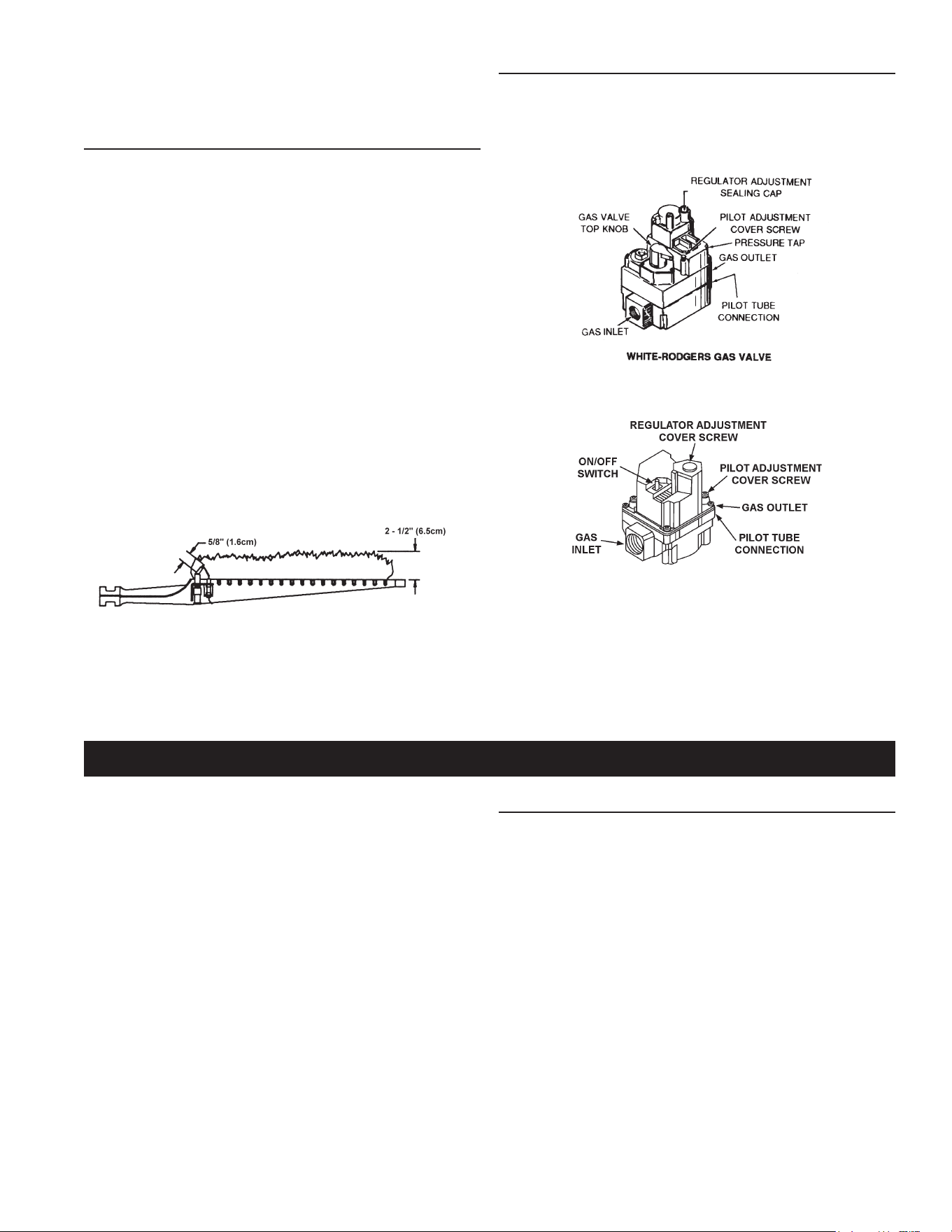
35
GAS CONTROL VALVE
Figure 31 shows the two types of combination gas control valves
used on these heaters.
If gas control valve becomes defective, repairs should not be
attempted. A new valve should be installed in place of defective one.
LP VALVE
NATURAL VALVE
FIGURE 31.
SERVICE
The installer may be able to observe and correct certain problems
which may arise when the unit is put into operation. HOWEVER,
it is recommended that only a qualied service technician or
qualied agencys, using appropriate test equipment, be allowed
to service the heater.
As preliminary step, check wiring against diagram, check for
grounded, broken or loose wires. Check all wire ends to be sure
that they are making good contact.
ELECTRICAL SERVICING
LABEL ALL WIRES PRIOR TO DISCONNECTION WHEN SERVICING
CONTROLS. WIRING ERRORS CAN CAUSE IMPROPER AND
DANGEROUS OPERATION.
VERIFY PROPER OPERATION AFTER SERVICING.
Pilot sensing device must sense a ame before sparking will stop.
Loose wires or a draft may cause intermittent or abnormal
sparking. To eliminate this condition, rst correct loose wiring
condition, and then, if necessary, increase pilot ame.
MAIN BURNER
The main burner, Figure 30, should display the following
characteristics:
• Cause rapid ignition and carry over of ame across entire burner.
• Give reasonably quiet operation during ignition, burning and extinction.
• Cause no excessive lifting of ame from burner ports.
If the
preceding burner characteristics are not evident, check for
accumulation of lint or other foreign material that restricts or other
foreign material that restricts or blocks air openings to burner
or heater.
To clean main burners:
1. Remove main burners from unit.
2. Check that burner venturi and ports are free of foreign matter.
3. Clean burners with bristle brush and/or vacuum cleaner
DO NOT distort burner ports or pilot location.
4. Reinstall burners in unit. Make sure front and rear of burners
are installed correctly in burner support brackets.
Also check for good ow of combustion and ventilating air to the unit.
TYPICAL PILOT AND MAIN BURNER FLAMES
FIGURE 30.
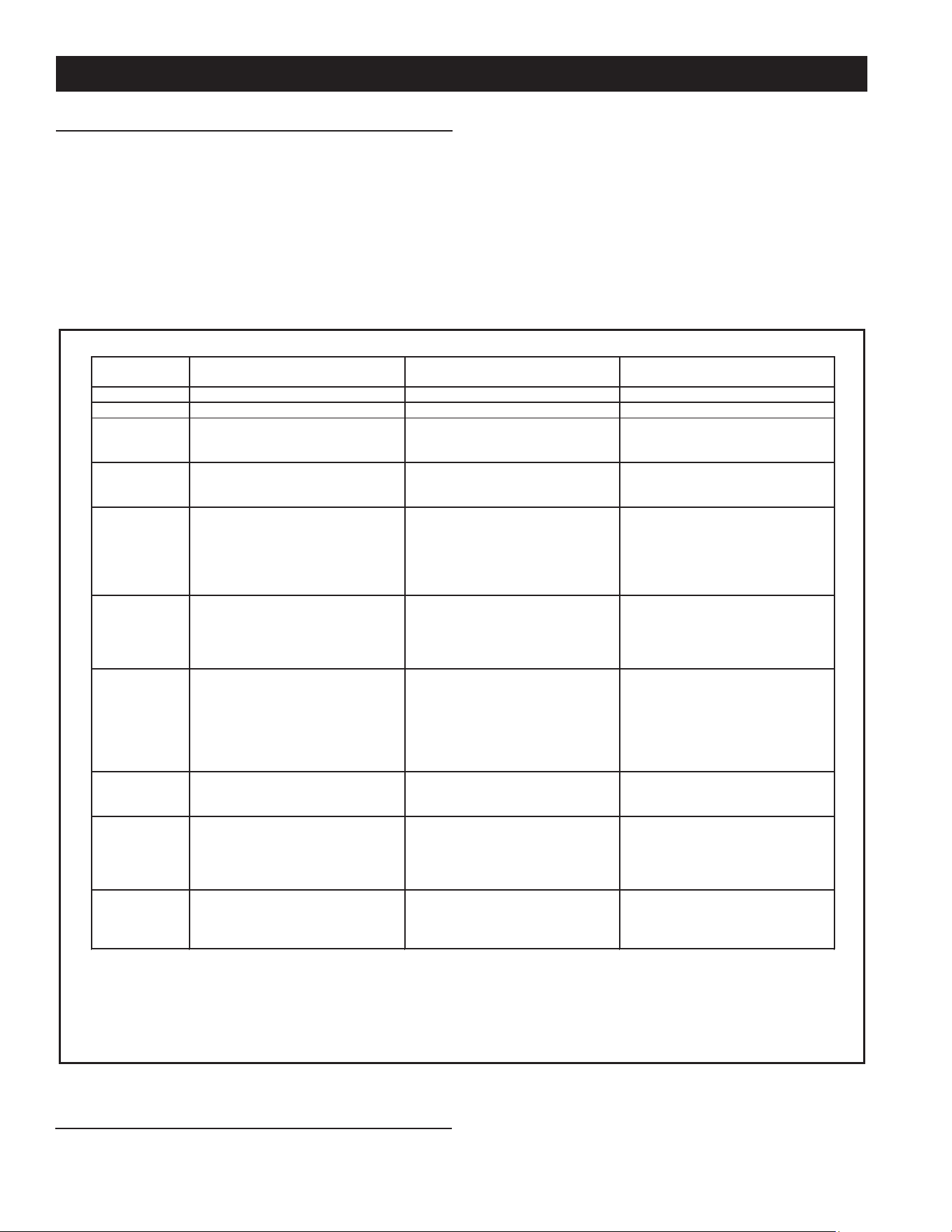
36
receptacle. Do not push meter leads into harness receptacle.
This opens the pins and will create connection problems. See
the following EFFIKAL RVGP-KSF-SERIES FLUE DAMPER
TROUBLE SHOOTING GUIDE.
Green LED
Flash Code
a
Indicates
Next System Action
Recommended Service Action
OFF No “Call for Heat” Not applicable None
Flash Fast Power up - internal check Not applicable None
Heartbeat Norma l startup – ignition
sequence started (including
prepurge)
Not applicable None
4 Seconds
ON then “x”
flashes
Device in run mode. “x” = flame
current to the nearest μ A.
Not applicable None
2 5 minute Retry Delay - Pilot flame
not detected during trial for ignition
Initiate new trial for ignition after
retry delay completed.
If system fails to light on next trial
for ignition check gas supply, pilot
burner, spark and flame sense
wiring, flame rod contaminated or
out of position, burner ground
connection.
3 Recycle - Flame failed during run Initiate new trial for ignition. Flash
code will remain through the
ignition trial until flame is proved.
If system fails to light on next trial
for ignition, check gas supply, pilot
burner, flame sense wiring,
contamination of flame rod, burner
ground connection.
4 Flame sensed out of sequence If situation self corrects within 10
seconds, control returns to normal
sequence. If flam e out of
sequence remains longer than 10
seconds, control will resume
normal operation 1 hour after error
is corrected.
Check for pilot flame. Replace gas
valve if pilot flame present. If no
pilot flame, cycle “Call for Heat.” If
error repeats, replace con trol.
6 Control Internal Error Control remains in wait mode.
When the fault corrects, control
resumes normal operation.
Cycle “Call for Heat”. If error
repeats, replace control.
7 Flame rod shorted to ground Control remains in wait mode.
When the fault corrects, control
resumes normal operation.
Check flame sense lead wire for
damage or shorting. Check that
flame rod is in proper position.
Check flame rod ceramic for
cracks, damage or tracking.
8
Low secondary voltage supply
Control remains in wait mo de.
When the fault corrects, control
resumes normal operation.
Check transformer and AC line for
proper input voltage to the control.
Check with full system load on the
transformer.
a
Flash Code Descriptions:
- Flash Fast: rapid blinking.
- Heartbeat: Constant ½ second bright, ½ second dim cycles.
- 4 second solid on pulse followed by “x” 1 second flashes indicates flame current to the nearest μ A. This is only available in run mode.
- A single flash code number signifies that the LED flashes X times at 2H z, remains off for two seconds, and then repeats the sequence.
TROUBLESHOOTING
IGNITION MODULE
Before calling your service agent, the following checklist should
be examined to eliminate obvious problems from those requiring
replacement or servicing.
• Check that “main manual gas shut-off valve” is fully open
and that gas service has not been interrupted.
• Check that after following the water OPERATING
INSTRUCTIONS, the “Top Knob” of the gas control valve
is in “ON” position.
• Check electrical supply to the water heater for possible
blown (or tripped) fusing or power interruption.
• Is the water temperature in tank below the thermostat dial
setting on the thermostat (calling for heat)?
• It is possible that the high limit (E.C.O.) has functioned to shut
off the water heater. See FEATURES - Water Temperature
Control for reset procedure. Contact your serviceman if limit
continues to function to shut off water heater.
FLUE DAMPER
Do not turn damper open manually or motor damage will result,
use the service switch. All readings are taken from harness
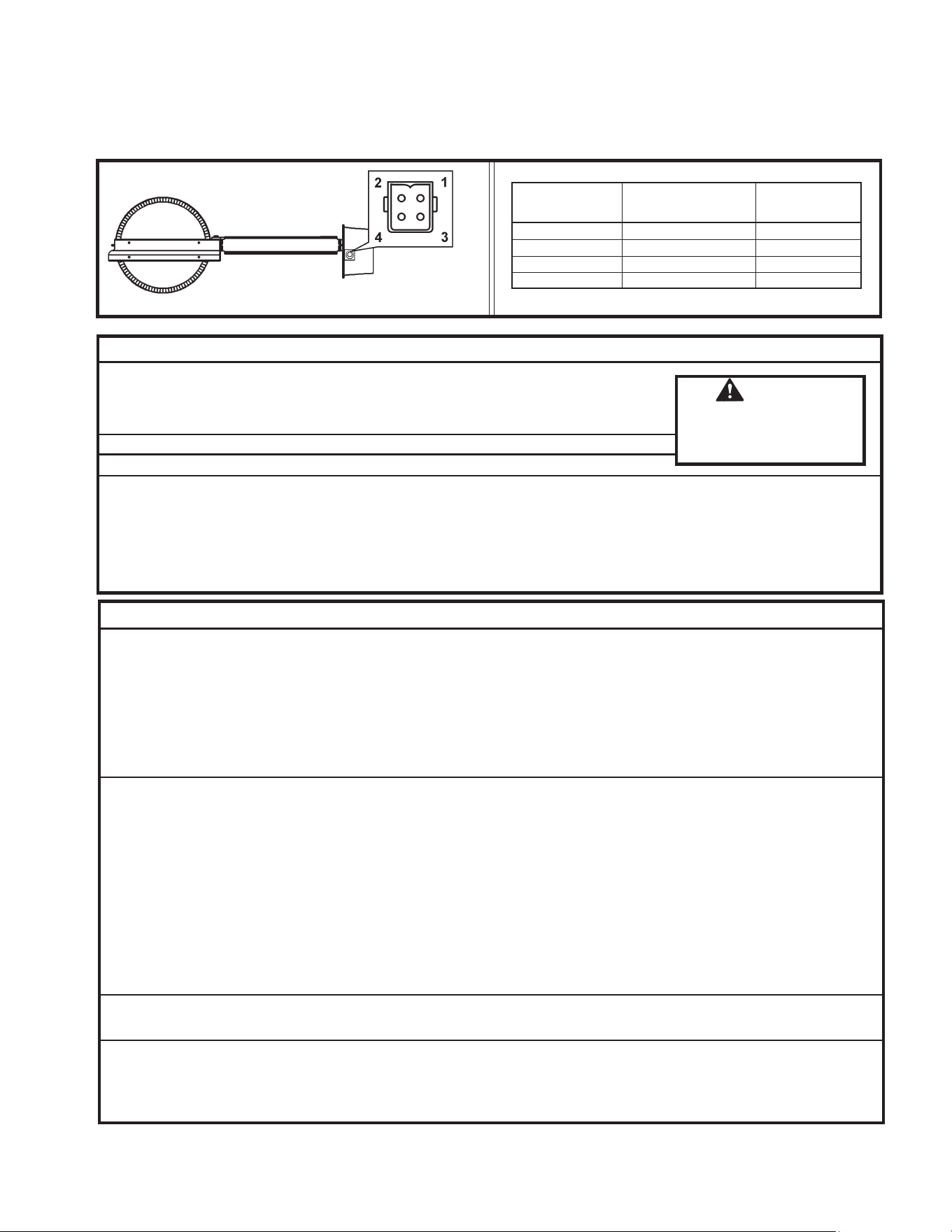
37
PIN END VIEW
24 V.A.C. NORMAL SEQUENCE OF OPERATION
B. DAMPER HAS OPENED,
NO COMBUSTION
VOLTAGE ACROSS:
4 & 1; 4 & 2; 4 & 3: 1. Check for power at ignition module terminals. If 24VAC power is present damper
is working properly.
2. Defective component in water heater after the ue damper.
3. If 24 VAC is not present at the ignition module, look for loose or broken
connections between damper and ignition module.
4. If the connections from damper to ignition module seem proper, replace damper
assembly. If a damper assembly is not available, place the service switch in the
hold open position. This should keep the damper in the open position and allow
the customer to have automatic heat, until a replacement damper can be installed.
C. DAMPER ROTATES
CONTINUOUSLY Change the entire damper assembly
D. DAMPER STICKS 1. Make sure no screws obstruct the damper blade.
2. Make sure damper pipe assembly is not egg shaped.
3. Make sure damper rod is not rubbing on pipe assembly.
See gure on front page of this insert sheet
ABNORMAL OPERATION
A. NOTHING WORKING
NO VOLTAGE ACROSS:
4 & 1 1. High Limit has tripped and is OPEN. Determine reason for tripping of high limit
2. Bad Transformer
3. Loose or broken connections
4. Blown fuse or circuit breaker
5. Disconnect switch off
6. Harness not plugged into water heater receptacle
A. FLUE DAMPER OPEN OR OPENING
(Unit is calling for heat and damper disc should be in vertical position)
VOLTAGE ACROSS:
4 & 1 All Times that High Limit is closed
4 & 2 Calling for Heat Open or Opening
4 & 3 During Combustion Damper Open+
B. FLUE DAMPER CLOSED (Unit is not calling for heat and damper disc should be in horizontal position)
NOTE: POSITION 4 IS COMMON AND POSITION 3 IS HOT 24VAC
VOLTAGE ACROSS:
4 & 1 All Times that High Limit is closed
NO VOLTAGE ACROSS:
4 & 3 or 4 & 2 1.Thermostat not calling for heat.
EFFIKAL RVGP-KSF-SERIES FLUE DAMPER TROUBLE SHOOTING GUIDE
Do not turn damper open manually or motor damage will result, use the service switch.
All readings are taken from harness receptacle. Do not push meter leads into harness receptacle.
This opens the pins and will create connection problems.
WARNING
Do not negate the action
of any existing safety
or operational controls.
IMPORTANT: DAMPER MUST BE OPEN BEFORE COMBUSTION TAKES PLACE. If all steps have
been tried and damper problems persists call Product Service and Support 800-456-9805.
NOTE: DAMPER DISC SHOWN IN OPEN POSITION.
Efkal Pinouts Adapter wire
& wire colors Function colors in*
1. Brown 24 VAC HOT Black
2. Orange Signal In Yellow
3. Yellow Signal Out Red
4. Black 24 VAC Common White
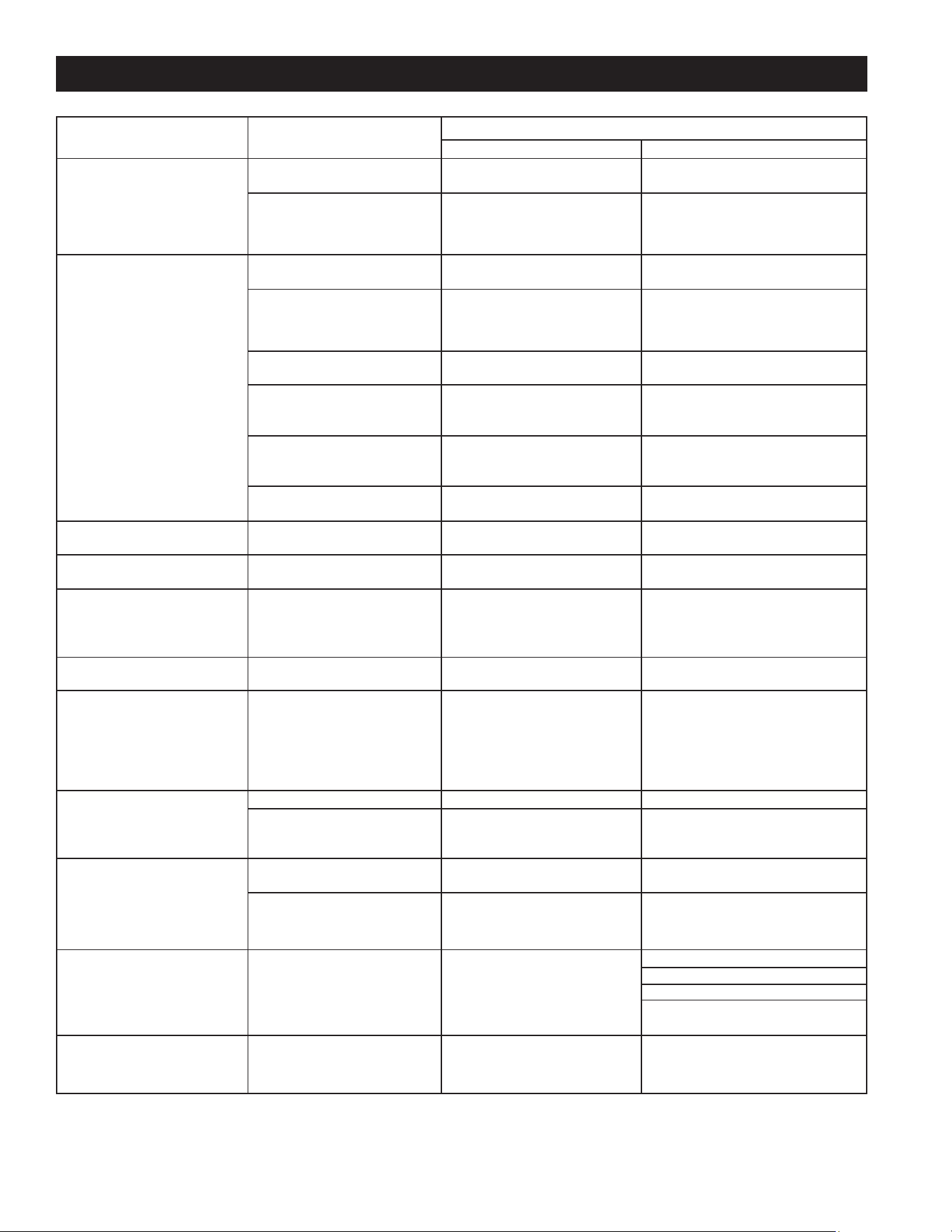
38
COMPLAINT CAUSE
REMEDY
USER QUALIFIED SERVICE AGENCY
Water not hot enough.
Thermostat set too low.
Set thermostat dial to a higher
temperature.
Upper and/or lower temperature
probe out of calibration.
Call qualied service agency.
Check continuity and resistance
(Ohms) of upper and lower
thermostat probes. Replace probes
if out of specication.
Insufcient hot water
Thermostat set too low.
Set thermostat dial to a higher
temperature.
Upper and/or lower temperature
probe out of calibration.
Call qualied service agency.
Check continuity and resistance
(Ohms) of upper and lower
thermostat probes. Replace probes
if out of specication..
Main manual gas shutoff valve
partially closed.
Open main manual gas shutoff
valve to fullest extent.
Heater too small for demand.
Space usage to give heater time
to restore water temperature.
Heater recovery is slower. Call qualied service agency.
Check gas input. If incorrect, adjust
gas pressure or replace main burner
orice.
Draft hood not installed or one
or more bafes.
Call qualied service agency.
Install draft hood or bafes as
furnished with unit.
Water temperature too hot. Thermostat set too high. Set thermostat to a lower setting.
Heater makes sounds: sizzling.
Condensation on outside of
tank - normal.
Rumbling.
Sediment accumulation on
bottom of tank.
Drain a quantity of water through
drain valve. If rumbling persists,
call a qualied service agency.
Delime heater.
Ticking or metallic sounds.
Expansion and contraction-
normal.
Pounding / water hammer.
Air chambers in piping have
become waterlogged. Thermal
expansion tank damaged,
improperly charged, or
improperly sized.
Drain piping system and rell.
Heater must be off while this
is being done. Check thermal
expansion tank charge pressure
when the water system pressure
is zero.
Follow the manufacturer's
instructions for proper charging
of the thermal expansion tank.
Combustion noises.
Too much primary air. Adjust shutters.
Overtired heater. Incorrect
burners or orice for types of
gas used.
Call qualied service agency. Check and correct as necessary.
Water leaks.
Drain valve not closed tightly.
If drain valve cannot be closed
tightly, replace.
If leakage source cannot be
corrected or identied, call
qualied service agency.
Shut off gas supply to heater
and close cold water inlet valve to
heater.
Repair or in case of suspected tank
leakage, be certain to conrm before
replacing heater.
Gas odors.
Heater is overtired.
Shut off gas supply to heater and
call qualied service agency.
Check for sooted ue passage.
Check for obstructed vent line.
Check backdraft or lack of draft.
Draft hood may be improperly
installed or not sized properly.
Possible gas leaks.
Shut off gas supply to heater and
call gas company at once.
TROUBLESHOOTING CHECKLIST

39
c. A sulfate reducing bacteria which has accumulated
within the water heater (this harmless bacteria is
nontoxic to humans).
d. An excess of active hydrogen in the tank. This is caused
by the corrosion protective action of the anode rod.
Smelly water may be eliminated or reduced in some water
heater models by replacing the anode rod(s) with one of less
active material, and then chlorinating water heater tank and all
water lines.
Contact the local water heater supplier or service agency for
further information concerning an Anode Rod Replacement Kit
and this chlorination treatment.
If smelly water persists after anode rod replacement and chlorination
treatment, we can only suggest that chlorination or aeration of the
water supply be considered to eliminate the water problem.
Do not remove the anode rod leaving the tank unprotected. By
doing so, all warranty on the water heater tank is voided.
“AIR” IN HOT WATER FAUCETS
HYDROGEN GAS: Hydrogen gas can be produced in a hot
water system that has not been used for a long period of time
(generally two weeks or more). Hydrogen gas is extremely
ammable and explosive. To prevent the possibility of injury under
these conditions, we recommend the hot water faucet, located
farthest away, be opened for several minutes before any electrical
appliances which are connected to the hot water system are
used (such as a dishwasher or washing machine). If hydrogen
gas is present, there will probably be an unusual sound similar to
air escaping through the pipe as the hot water faucet is opened.
There must be no smoking or open ame near the faucet at the
time it is open.
HIGH WATER TEMPERATURE SHUT OFF SYSTEM
This water heater is equipped with a manual reset type high limit
(Energy Cutout) switch. The high limit switch interrupts the main
burner gas ow should water temperature reach 203°F (95°C).
In the event of high limit switch operation, the water heater
cannot be restarted unless the water temperature is reduced
to approximately 120F (49C). The high limit reset button on the
front of the thermostat then needs to be depressed. See Figure 2
for the location of the reset button.
START UP CONDITIONS
SMOKE/ODOR
It is not uncommon to experience a small amount of smoke and
odor during the initial start-up. This is due to burning off of oil
from metal parts, and will disappear in a short while.
STRANGE SOUNDS
Possible noises due to expansion and contraction of some metal
parts during periods of heat-up and cool-down do not necessarily
represent harmful or dangerous conditions.
Condensation causes sizzling and popping within the burner area
during heating and cooling periods and should be considered
normal. See “Condensation" section in this manual.
CONDENSATION
Whenever the water heater is lled with cold water, some
condensate will form while the burner is on. A water heater may
appear to be leaking when in fact the water is condensation.
This usually happens when:
a. A new water heater is lled with cold water for the rst time.
b. Burning gas produces water vapor in water heaters,
particularly high efciency models where ue temperatures
are lower.
c. Large amounts of hot water are used in a short time and the
rell water in the tank is very cold.
Moisture from the products of combustion condense on the cooler
tank surfaces and form drops of water which may fall onto the
burner or other hot surfaces to produce a “sizzling” or “frying” noise.
OPERATIONAL CONDITIONS
HOT WATER ODOR
In each water heater there is installed at least one anode rod for
corrosion protection of the tank. Certain water conditions will
cause a reaction between this rod and the water. The most
common complaint associated with the anode rod is one of a
“rotten egg smell” in the hot water. The smell is a result of four
factors which must all be present for the odor to develop:
a. A concentration of sulfate in the supply water.
b. Little or no dissolved oxygen in the water.
FOR YOUR INFORMATION
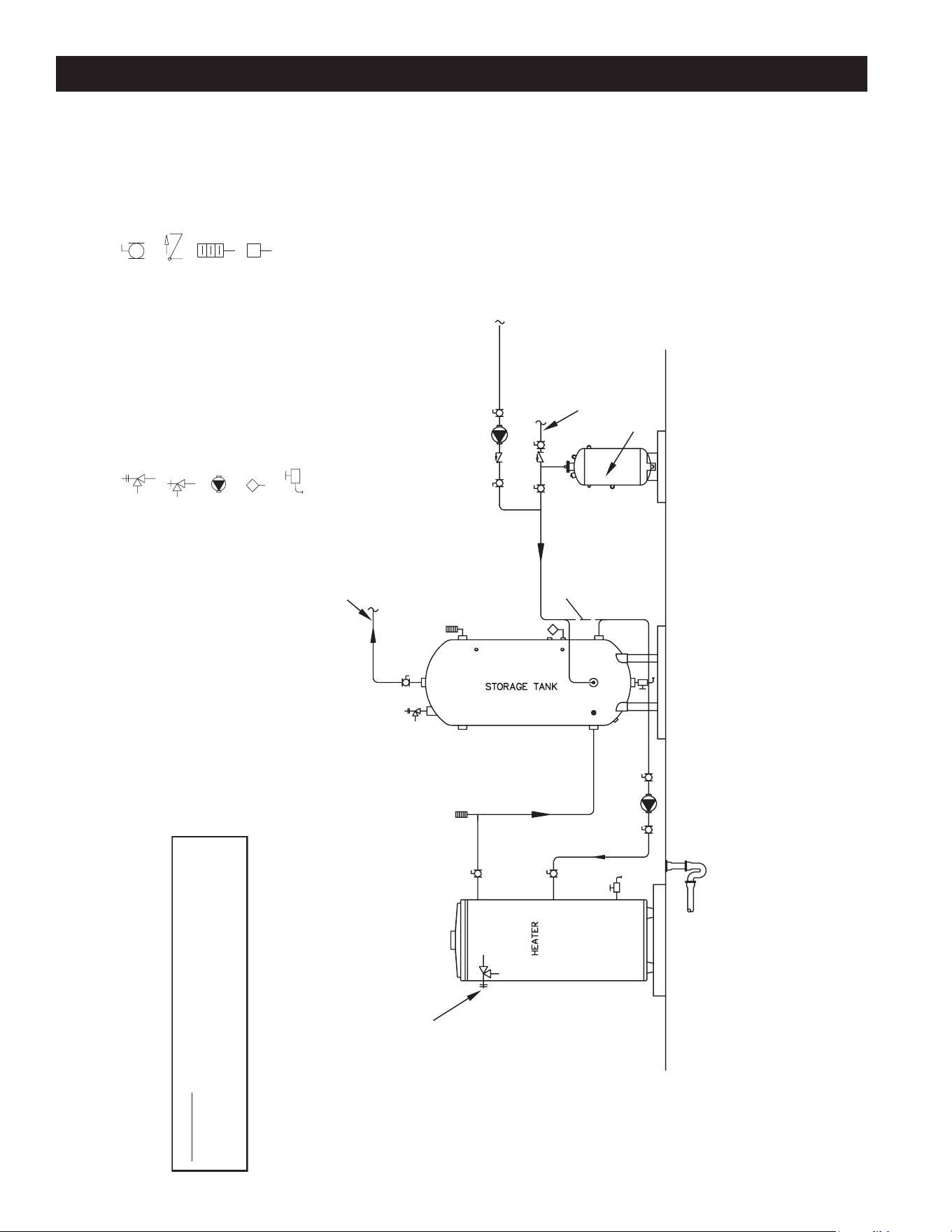
40
WATER PIPING DIAGRAMS
NOTES:
1. Preferred piping diagram.
2. The temperature and pressure relief valve setting shall not exceed pressure rating of any component in the system.
3. Service valves are shown for servicing unit. However, local codes shall govern their usage.
4. The Tank Temperature Control should be wired to and control the pump between the water heater(s) and the storage tank(s).
5. The water heater’s operating thermostat should be set 5 degrees F higher than the Tank Temperature Control.
MULTI FLUE - (1 UNIT) WITH VERTICAL STORAGE TANK
LEGEND
TEMPERATURE & PRESSURE
RELIEF VALVE
PRESSURE RELIEF VALVE
CIRCULATING PUMP
TANK TEMPERATURE CONTROL
DRAIN
FULL PORT BALL VALV
E
TEMPERATURE GAGE
WATER FLOW SWITCH
CHECK VALVE
WARNING: THIS DRAWING SHOWS SUGGESTED
PIPING CONFIGURATION AND OTHER DEVICES;
CHECK WITH LOCAL CODES AND ORDINANCES
FOR ADDITIONAL REQUIREMENTS.
FINISHED
FLOOR
HOT WATER
TO FIXTURES
COLD WATER
SUPPLY
EXPANSION
TANK
ALT. COLD WATER
CONNECTION
HOT WATER RETURN
FROM FIXTURES
PIPE T&P TO
OPEN DRAIN
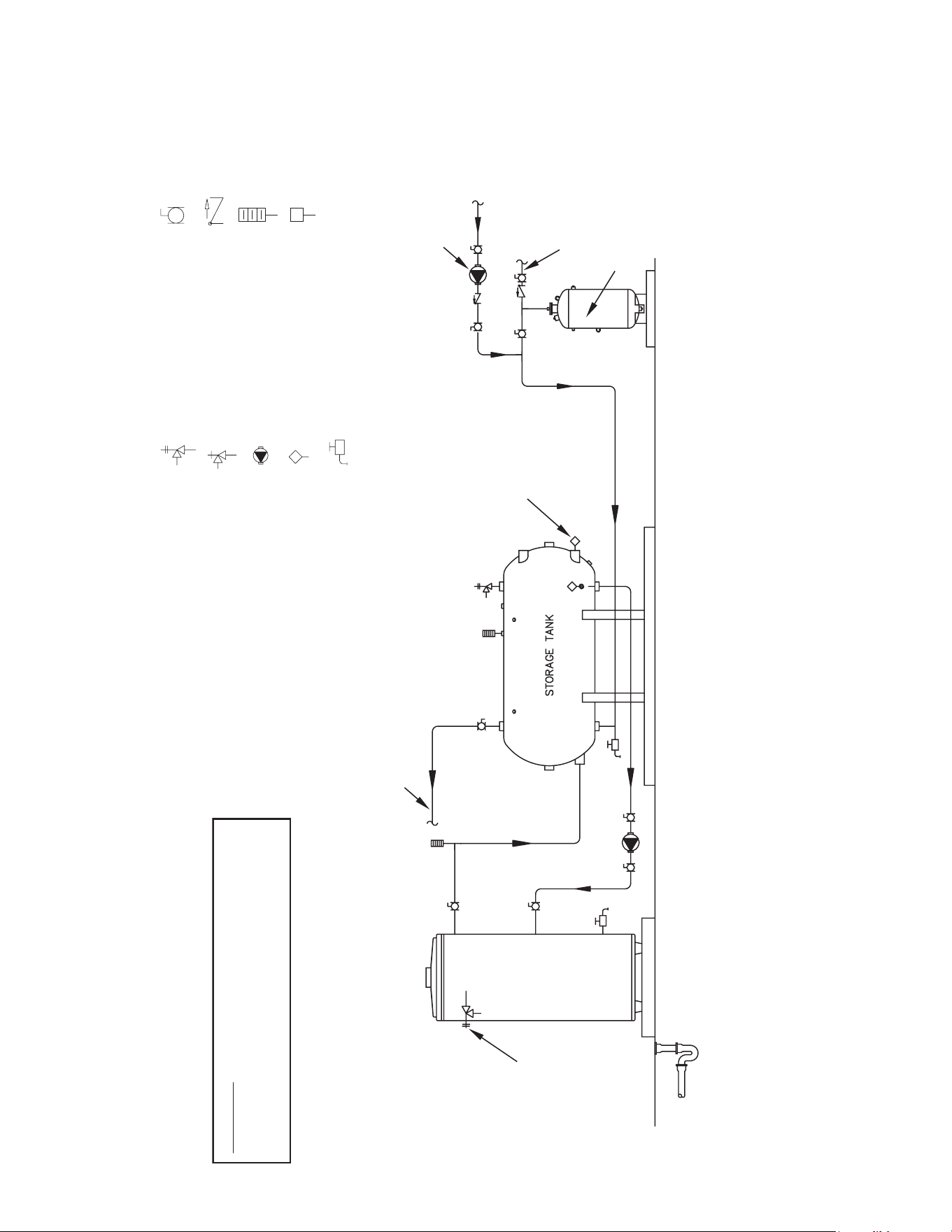
41
NOTES:
1. Preferred piping diagram.
2. The temperature and pressure relief valve setting shall not exceed pressure rating of any component in the system.
3. Service valves are shown for servicing unit. However, local codes shall govern their usage.
4. The Tank Temperature Control should be wired to and control the pump between the water heater(s) and the storage tank(s).
5. The water heater’s operating thermostat should be set 5 degrees F higher than the Tank Temperature Control.
MULTI FLUE - (1 UNIT) WITH HORIZONTAL STORAGE TANK
LEGEND
TEMPERATURE & PRESSURE
RELIEF VALVE
PRESSURE RELIEF VALVE
CIRCULATING PUMP
TANK TEMPERATURE CONTROL
DRAIN
FULL PORT BALL VALV
E
TEMPERATURE GAGE
WATER FLOW SWITCH
CHECK VALVE
WARNING: THIS DRAWING SHOWS SUGGESTED
PIPING CONFIGURATION AND OTHER DEVICES;
CHECK WITH LOCAL CODES AND ORDINANCES
FOR ADDITIONAL REQUIREMENTS.
FINISHED
FLOOR
HOT WATER TO FIXTURES
COLD WATER
SUPPLY
HOT WATER
RETURN FROM
FIXTURES
ALTERNATE
LOCATION
CIRCULATING PUMP
EXPANSION
TANK
PIPE T&P TO
OPEN DRAIN
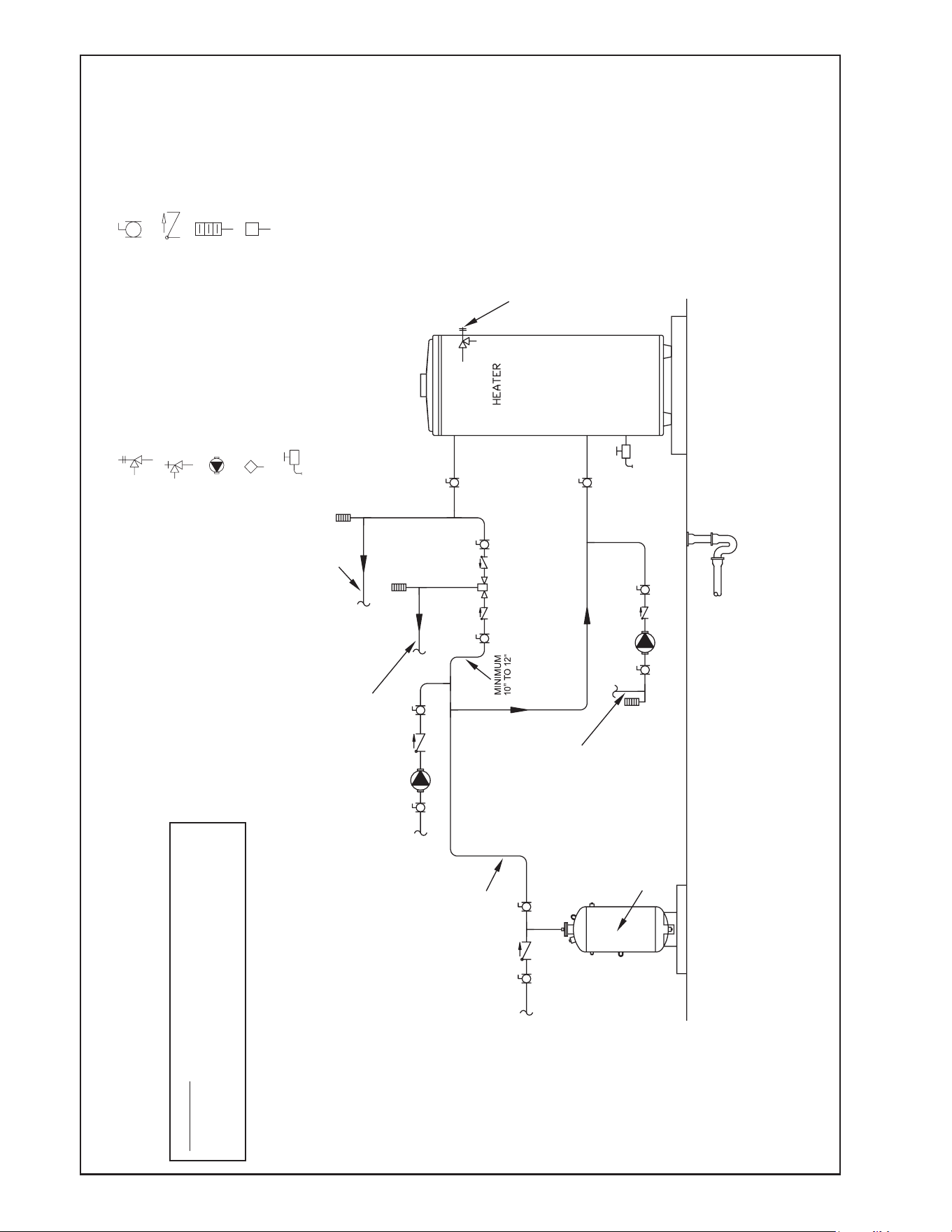
42
NOTES:
1. Preferred piping diagram.
2. The temperature and pressure relief valve setting shall not exceed pressure rating of any component in the system.
3. Service valves are shown for servicing unit. However, local codes shall govern their usage.
4. The Tank Temperature Control should be wired to and control the pump between the water heater(s) and the storage tank(s).
MULTI FLUE - (1 UNIT) WITH MIXING VALVE TWO TEMPERATURE
LEGEND
TEMPERATURE & PRESSURE
RELIEF VALVE
PRESSURE RELIEF VALVE
CIRCULATING PUMP
TANK TEMPERATURE CONTROL
DRAIN
FULL PORT BALL VALVE
TEMPERATURE GAGE
WATER FLOW SWITCH
CHECK VALVE
WARNING: THIS DRAWING SHOWS SUGGESTED
PIPING CONFIGURATION AND OTHER DEVICES;
CHECK WITH LOCAL CODES AND ORDINANCES
FOR ADDITIONAL REQUIREMENTS.
TEMPERED
WATER
RETURN
TEMPERED
WATER
OUTLET
HOT
WATER
OUTLET
HOT
WATER
RETURN
COLD WATER
SUPPLY
COLD
HOT
EXPANSION
TANK
PIPE T&P TO
OPEN DRAIN
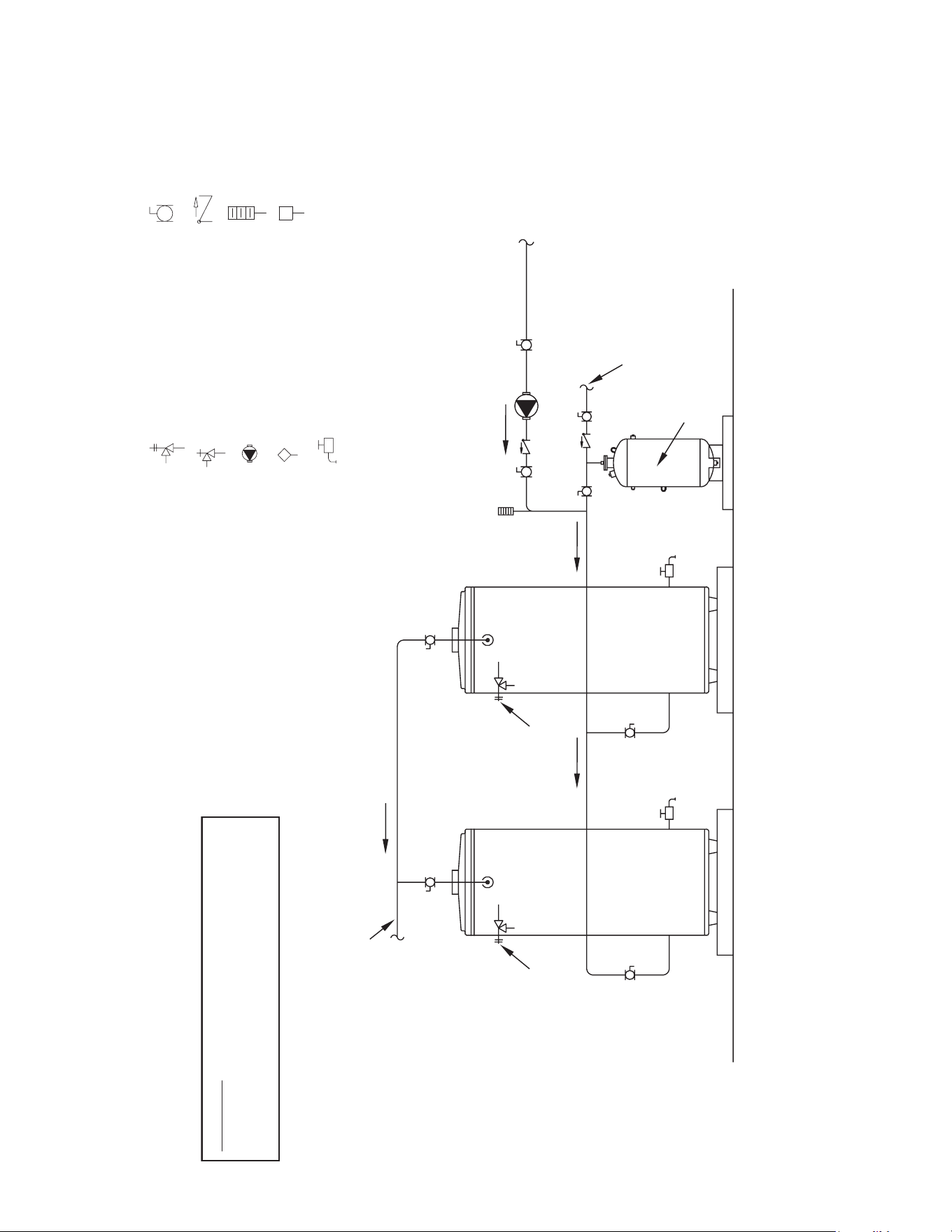
43
NOTES:
1. Preferred piping diagram.
2. The temperature and pressure relief valve setting shall not exceed pressure rating of any component in the system.
3. Service valves are shown for servicing unit. However, local codes shall govern their usage.
4. The Tank Temperature Control should be wired to and control the pump between the water heater(s) and the storage tank(s).
MULTI FLUE - (2 UNITS)
LEGEND
TEMPERATURE & PRESSURE
RELIEF VALVE
PRESSURE RELIEF VALVE
CIRCULATING PUMP
TANK TEMPERATURE CONTROL
DRAIN
FULL PORT BALL VALV
E
TEMPERATURE GAGE
WATER FLOW SWITCH
CHECK VALVE
WARNING: THIS DRAWING SHOWS SUGGESTED
PIPING CONFIGURATION AND OTHER DEVICES;
CHECK WITH LOCAL CODES AND ORDINANCES
FOR ADDITIONAL REQUIREMENTS.
HOT WATER
TO FIXTURES
COLD WATER
SUPPLY
HOT WATER
RETURN
EXPANSION
TANK
PIPE T&P TO
OPEN DRAIN
PIPE T&P TO
OPEN DRAIN
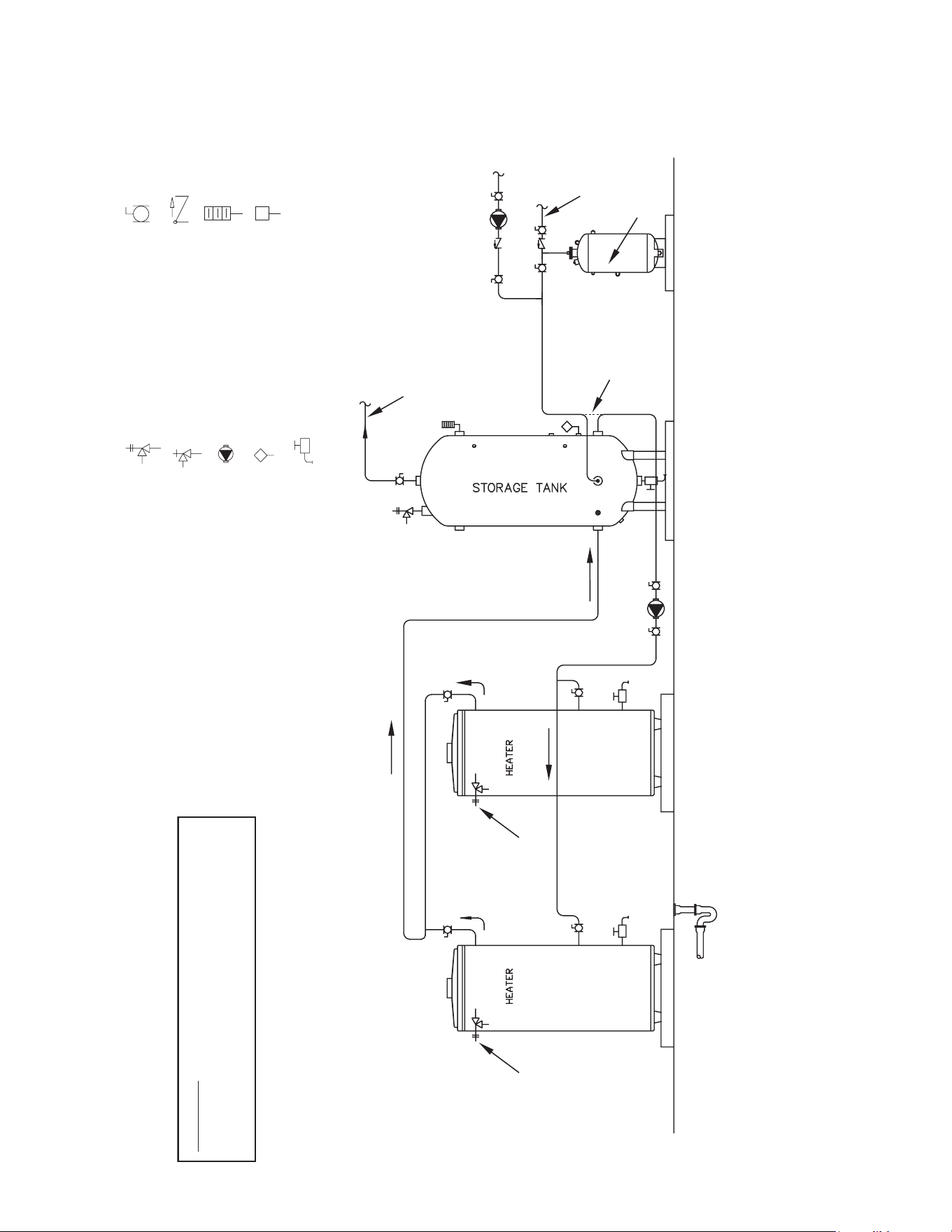
44
NOTES:
1. Preferred piping diagram.
2. The temperature and pressure relief valve setting shall not exceed pressure rating of any component in the system.
3. Service valves are shown for servicing unit. However, local codes shall govern their usage.
4. The Tank Temperature Control should be wired to and control the pump between the water heater(s) and the storage tank(s).
5. The water heater’s operating thermostat should be set 5 degrees F higher than the Tank Temperature Control.
MULTI FLUE - (2 UNITS) WITH VERTICAL STORAGE TANK
LEGEND
TEMPERATURE & PRESSURE
RELIEF VALVE
PRESSURE RELIEF VALVE
CIRCULATING PUMP
TANK TEMPERATURE CONTROL
DRAIN
FULL PORT BALL VALV
E
TEMPERATURE GAGE
WATER FLOW SWITCH
CHECK VALVE
WARNING: THIS DRAWING SHOWS SUGGESTED
PIPING CONFIGURATION AND OTHER DEVICES;
CHECK WITH LOCAL CODES AND ORDINANCES
FOR ADDITIONAL REQUIREMENTS.
FINISHED
FLOOR
COLD WATER
SUPPLY
HOT WATER
TO FIXTURES
ALTERNATE
COLD WATER
CONNECTION
HOT WATER
RETURN
EXPANSION
TANK
PIPE T&P TO
OPEN DRAIN
PIPE T&P TO
OPEN DRAIN
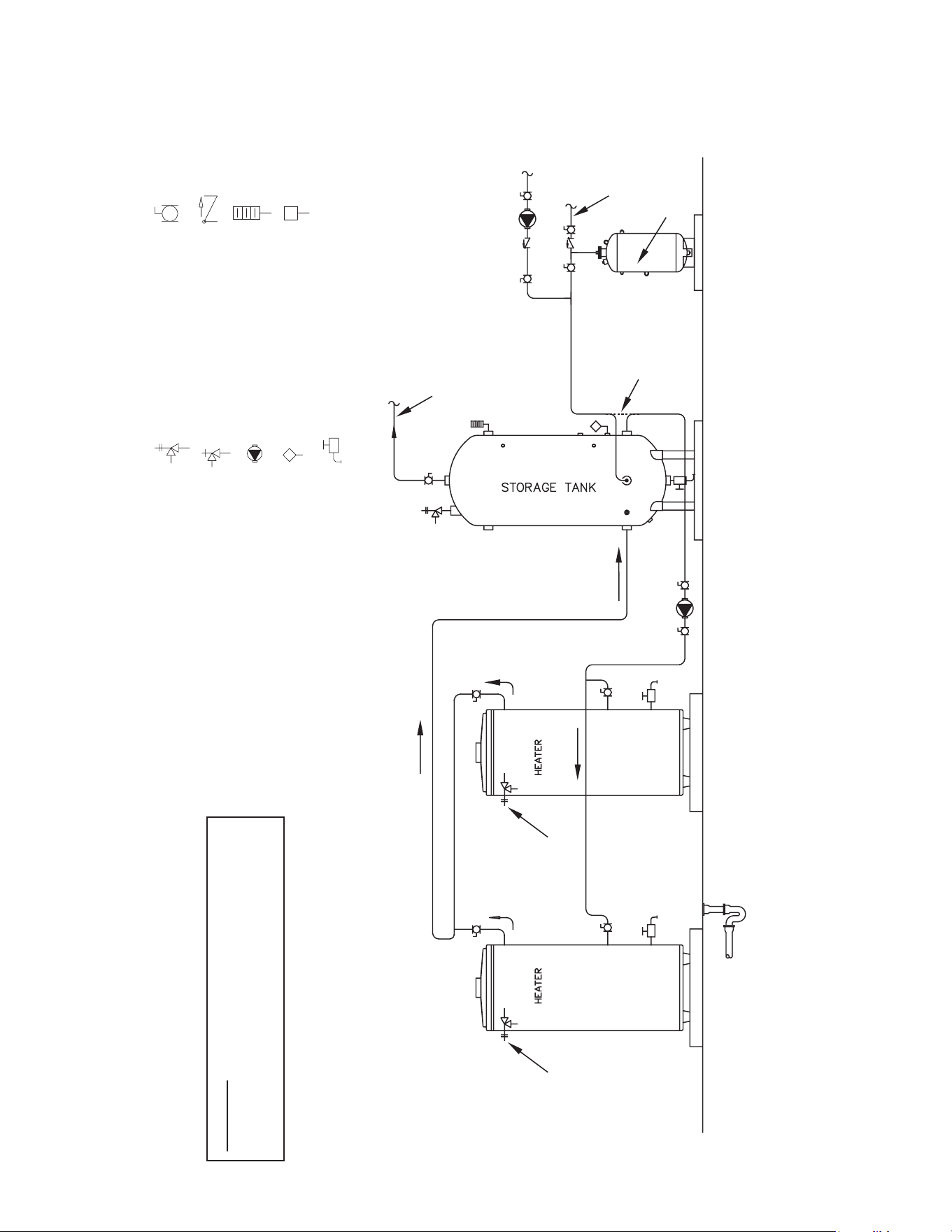
45
NOTES:
1. Preferred piping diagram.
2. The temperature and pressure relief valve setting shall not exceed pressure rating of any component in the system.
3. Service valves are shown for servicing unit. However, local codes shall govern their usage.
4. The Tank Temperature Control should be wired to and control the pump between the water heater(s) and the storage tank(s).
5. The water heater’s operating thermostat should be set 5 degrees F higher than the Tank Temperature Control.
MULTI FLUE - (2 UNITS) WITH VERTICAL STORAGE TANK
LEGEND
TEMPERATURE & PRESSURE
RELIEF VALVE
PRESSURE RELIEF VALVE
CIRCULATING PUMP
TANK TEMPERATURE CONTROL
DRAIN
FULL PORT BALL VALV
E
TEMPERATURE GAGE
WATER FLOW SWITCH
CHECK VALVE
WARNING: THIS DRAWING SHOWS SUGGESTED
PIPING CONFIGURATION AND OTHER DEVICES;
CHECK WITH LOCAL CODES AND ORDINANCES
FOR ADDITIONAL REQUIREMENTS.
FINISHED
FLOOR
COLD WATER
SUPPLY
HOT WATER
TO FIXTURES
ALTERNATE
COLD WATER
CONNECTION
HOT WATER
RETURN
EXPANSION
TANK
PIPE T&P TO
OPEN DRAIN
PIPE T&P TO
OPEN DRAIN
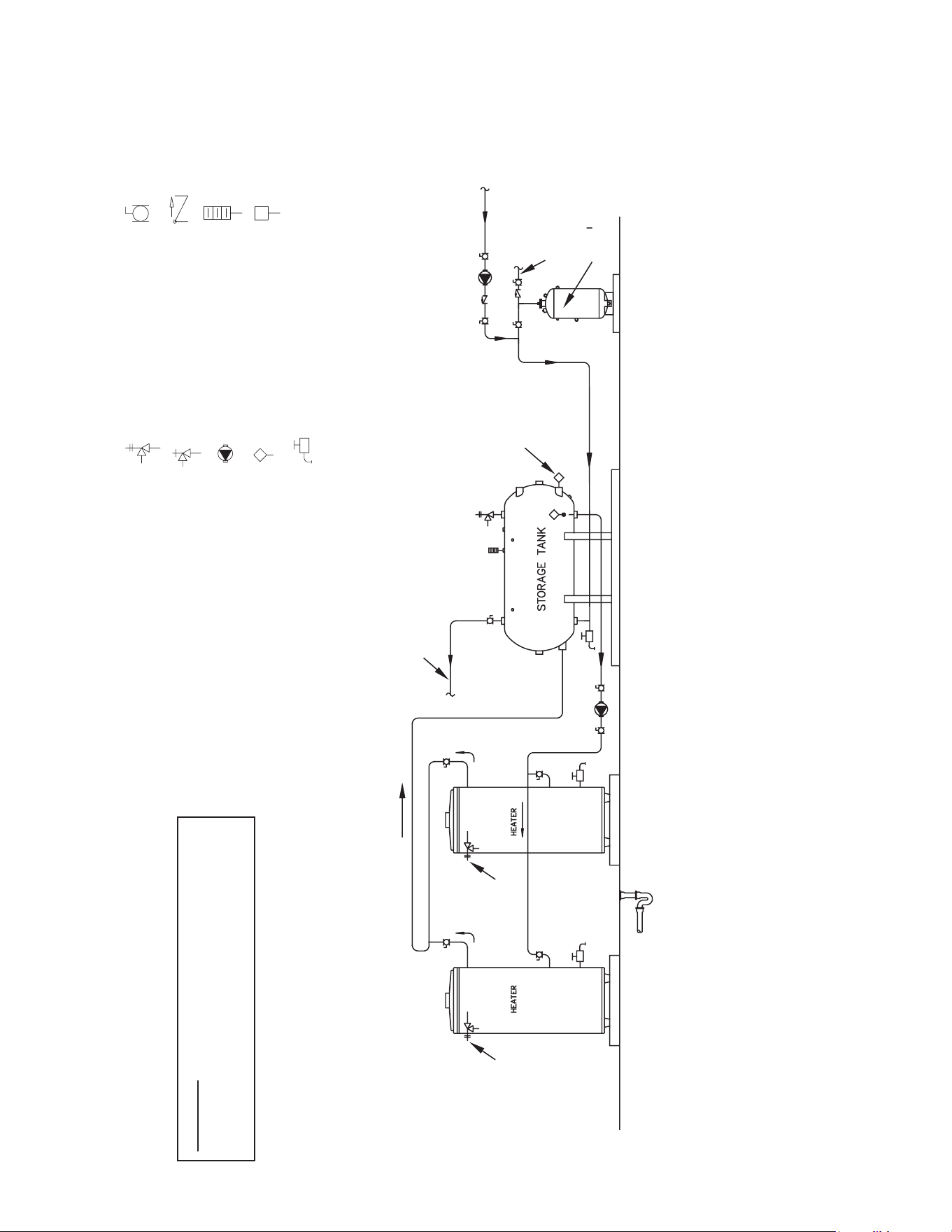
46
NOTES:
1. Preferred piping diagram.
2. The temperature and pressure relief valve setting shall not exceed pressure rating of any component in the system.
3. Service valves are shown for servicing unit. However, local codes shall govern their usage.
4. The Tank Temperature Control should be wired to and control the pump between the water heater(s) and the storage tank(s).
5. The water heater’s operating thermostat should be set 5 degrees F higher than the Tank Temperature Control.
MULTI FLUE - (2 UNITS) WITH HORIZONTAL STORAGE TANK
LEGEND
TEMPERATURE & PRESSURE
RELIEF VALVE
PRESSURE RELIEF VALVE
CIRCULATING PUMP
TANK TEMPERATURE CONTROL
DRAIN
FULL PORT BALL VALV
E
TEMPERATURE GAGE
WATER FLOW SWITCH
CHECK VALVE
WARNING: THIS DRAWING SHOWS SUGGESTED
PIPING CONFIGURATION AND OTHER DEVICES;
CHECK WITH LOCAL CODES AND ORDINANCES
FOR ADDITIONAL REQUIREMENTS.
FINISHED
FLOOR
HOT WATER TO FIXTURES
COLD WATER
SUPPLY
HOT WATER
RETURN FROM
FIXTURES
ALTERNATE
LOCATION
EXPANSION
TANK
PIPE T&P TO
OPEN DRAIN
PIPE T&P TO
OPEN DRAIN
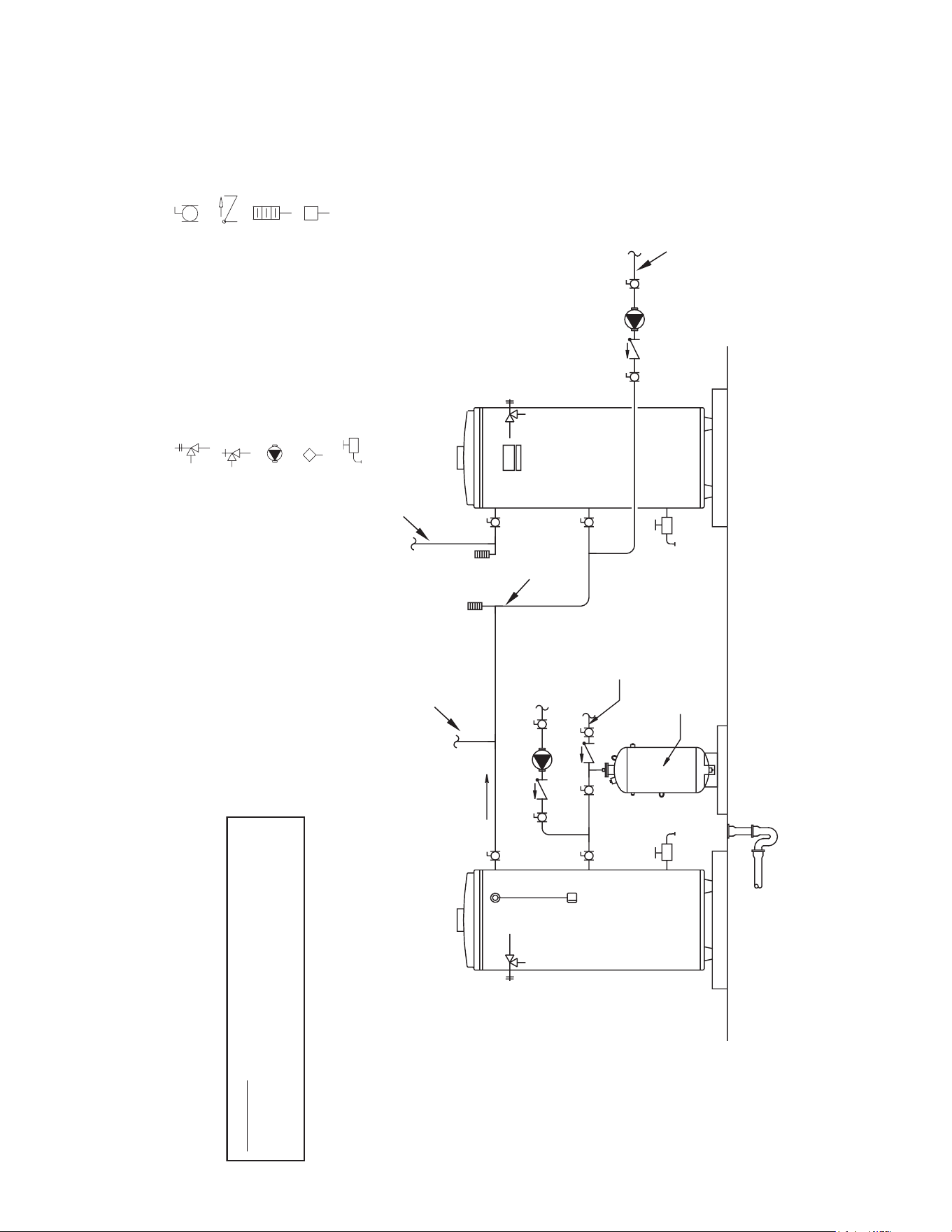
47
NOTES:
1. Preferred piping diagram.
2. The temperature and pressure relief valve setting shall not exceed pressure rating of any component in the system.
3. Service valves are shown for servicing unit. However, local codes shall govern their usage.
MULTI FLUE (2 UNITS) TWO TEMPERATURE
LEGEND
TEMPERATURE & PRESSURE
RELIEF VALVE
PRESSURE RELIEF VALVE
CIRCULATING PUMP
TANK TEMPERATURE CONTROL
DRAIN
FULL PORT BALL VALV
E
TEMPERATURE GAGE
WATER FLOW SWITCH
CHECK VALVE
WARNING: THIS DRAWING SHOWS SUGGESTED
PIPING CONFIGURATION AND OTHER DEVICES;
CHECK WITH LOCAL CODES AND ORDINANCES
FOR ADDITIONAL REQUIREMENTS.
BOOSTER WATER RETUR
N
PRE-HEATED
WATER TO
BOOSTER
BOOSTER WATER
TO FIXTURES
HOT WATER
TO FIXTURES
EXPANSION TANK
HOT WATER
RETURN
COLD WATER
SUPPLY
1st HEATER
BOOSTER
HEATER
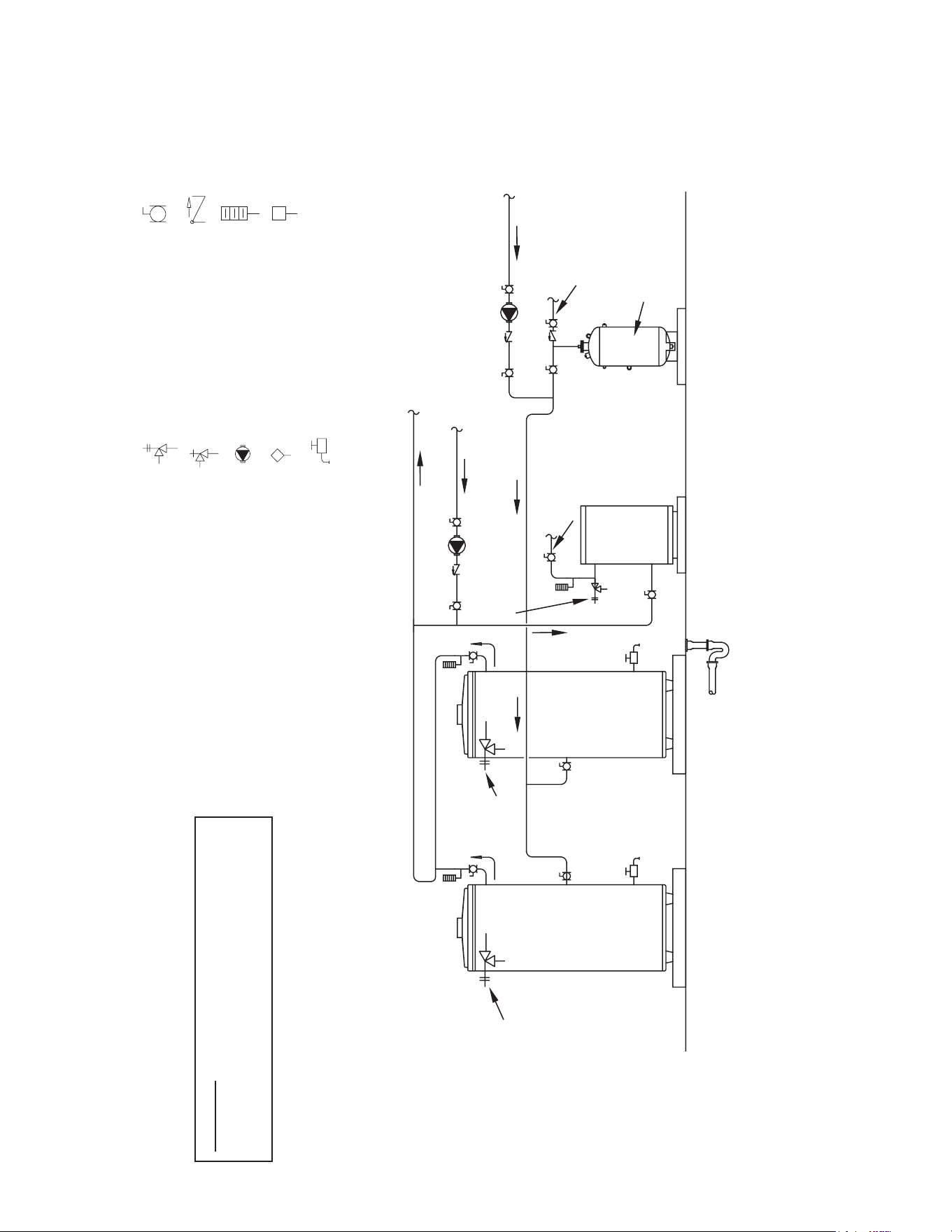
48
NOTES:
1. Preferred piping diagram.
2. The temperature and pressure relief valve setting shall not exceed pressure rating of any component in the system.
3. Service valves are shown for servicing unit. However, local codes shall govern their usage.
MULTI FLUE (2 UNITS) WITH BOOSTER TWO TEMPERATURE
LEGEND
TEMPERATURE & PRESSURE
RELIEF VALVE
PRESSURE RELIEF VALVE
CIRCULATING PUMP
TANK TEMPERATURE CONTROL
DRAIN
FULL PORT BALL VALV
E
TEMPERATURE GAGE
WATER FLOW SWITCH
CHECK VALVE
WARNING: THIS DRAWING SHOWS SUGGESTED
PIPING CONFIGURATION AND OTHER DEVICES;
CHECK WITH LOCAL CODES AND ORDINANCES
FOR ADDITIONAL REQUIREMENTS.
EXPANSION
TANK
BOOSTED
WATER
OUTLET
TYPICAL
BOOSTER
HEATER
PRE-HEATER
PRE-HEATER
MUST BE IDENTICAL HEATERS
FINISHED FLOOR
COLD WATER
SUPPLY
HOT OUTLET
AT STORED
TEMPERATURE
BOOSTER RETURN
(IF USED)
HOT WATE
R
RETURN
PIPE T&P TO
OPEN DRAIN
PIPE T&P TO
OPEN DRAIN
PIPE T&P TO
OPEN DRAIN
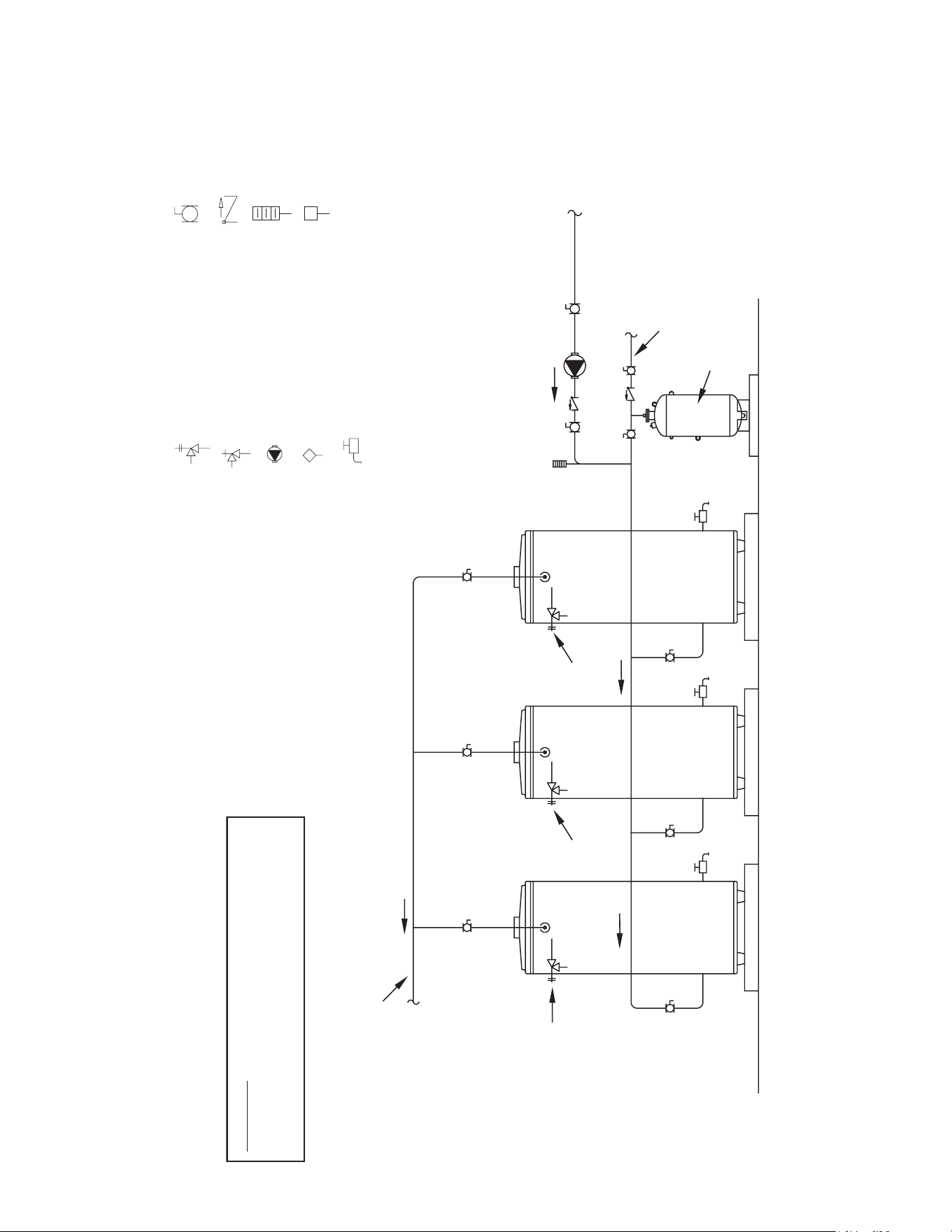
49
NOTES:
1. Preferred piping diagram.
2. The temperature and pressure relief valve setting shall not exceed pressure rating of any component in the system.
3. Service valves are shown for servicing unit. However, local codes shall govern their usage.
MULTI-FLUE (3 UNITS)
LEGEND
TEMPERATURE & PRESSURE
RELIEF VALVE
PRESSURE RELIEF VALVE
CIRCULATING PUMP
TANK TEMPERATURE CONTROL
DRAIN
FULL PORT BALL VALV
E
TEMPERATURE GAGE
WATER FLOW SWITCH
CHECK VALVE
WARNING: THIS DRAWING SHOWS SUGGESTED
PIPING CONFIGURATION AND OTHER DEVICES;
CHECK WITH LOCAL CODES AND ORDINANCES
FOR ADDITIONAL REQUIREMENTS.
HOT WATER
TO FIXTURES
HOT WATE
R
RETURN
COLD WATER
SUPPLY
EXPANSION
TANK
PIPE T&P TO
OPEN DRAIN
PIPE T&P TO
OPEN DRAIN
PIPE T&P TO
OPEN DRAIN
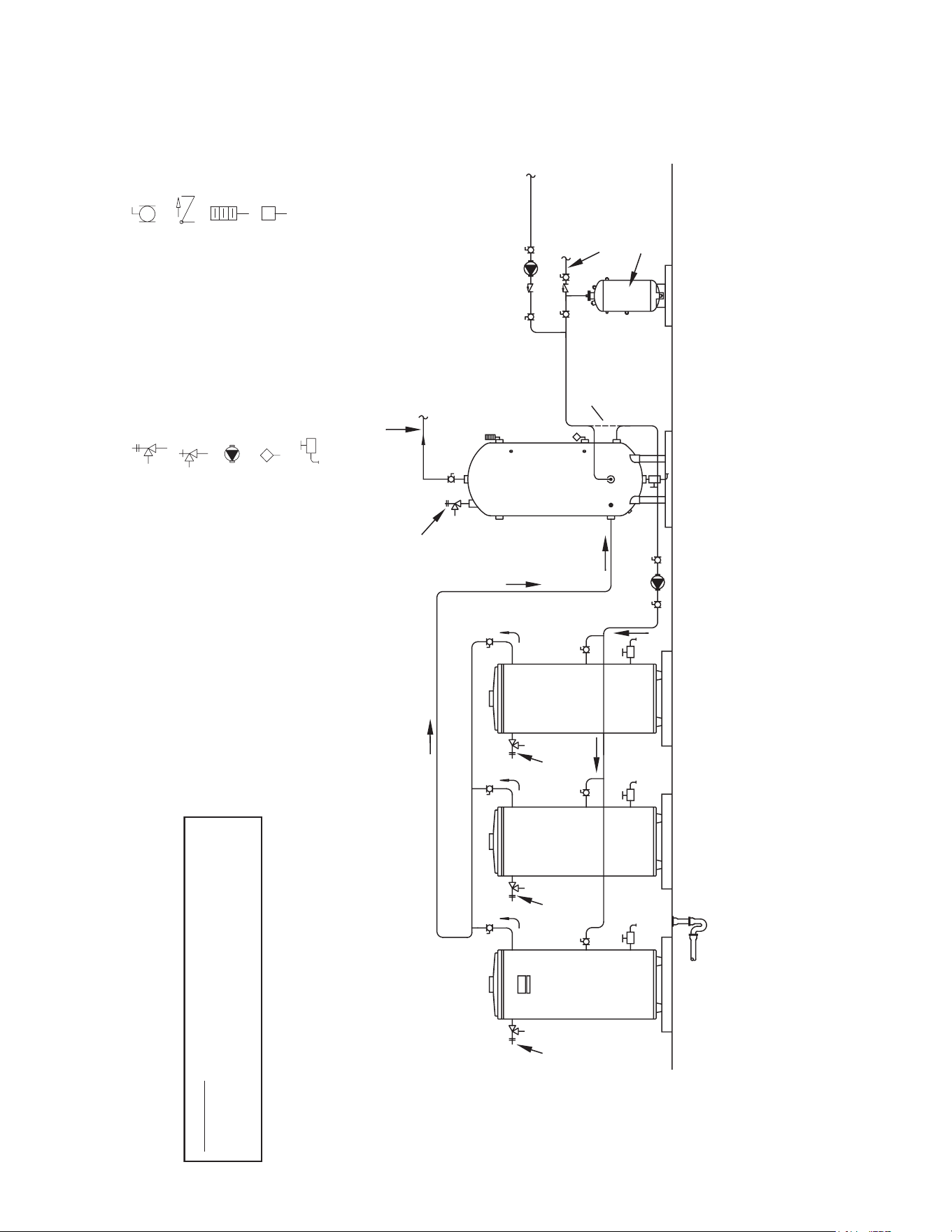
50
NOTES:
1. Preferred piping diagram.
2. The temperature and pressure relief valve setting shall not exceed pressure rating of any component in the system.
3. Service valves are shown for servicing unit. However, local codes shall govern their usage.
4. The Tank Temperature Control should be wired to and control the pump between the water heater(s) and the storage tank(s).
5. The water heater’s operating thermostat should be set 5 degrees F higher than the Tank Temperature Control.
MULTI-FLUE (3 UNITS) WITH VERTICAL STORAGE TANK
LEGEND
TEMPERATURE & PRESSURE
RELIEF VALVE
PRESSURE RELIEF VALVE
CIRCULATING PUMP
TANK TEMPERATURE CONTROL
DRAIN
FULL PORT BALL VALV
E
TEMPERATURE GAGE
WATER FLOW SWITCH
CHECK VALVE
WARNING: THIS DRAWING SHOWS SUGGESTED
PIPING CONFIGURATION AND OTHER DEVICES;
CHECK WITH LOCAL CODES AND ORDINANCES
FOR ADDITIONAL REQUIREMENTS.
TO FIXTURES
HOT WATE
R
RETURN
ALT. COLD WATER
CONNECTION
AOS
STORAGE TANK
HOT WATER
HEATERHEATERHEATER
FINISHED FLOOR
COLD WATER
SUPPLY
EXPANSION TANK
PIPE T&P TO
OPEN DRAIN
PIPE T&P TO
OPEN DRAIN
PIPE T&P TO
OPEN DRAIN
PIPE T&P TO
OPEN DRAIN
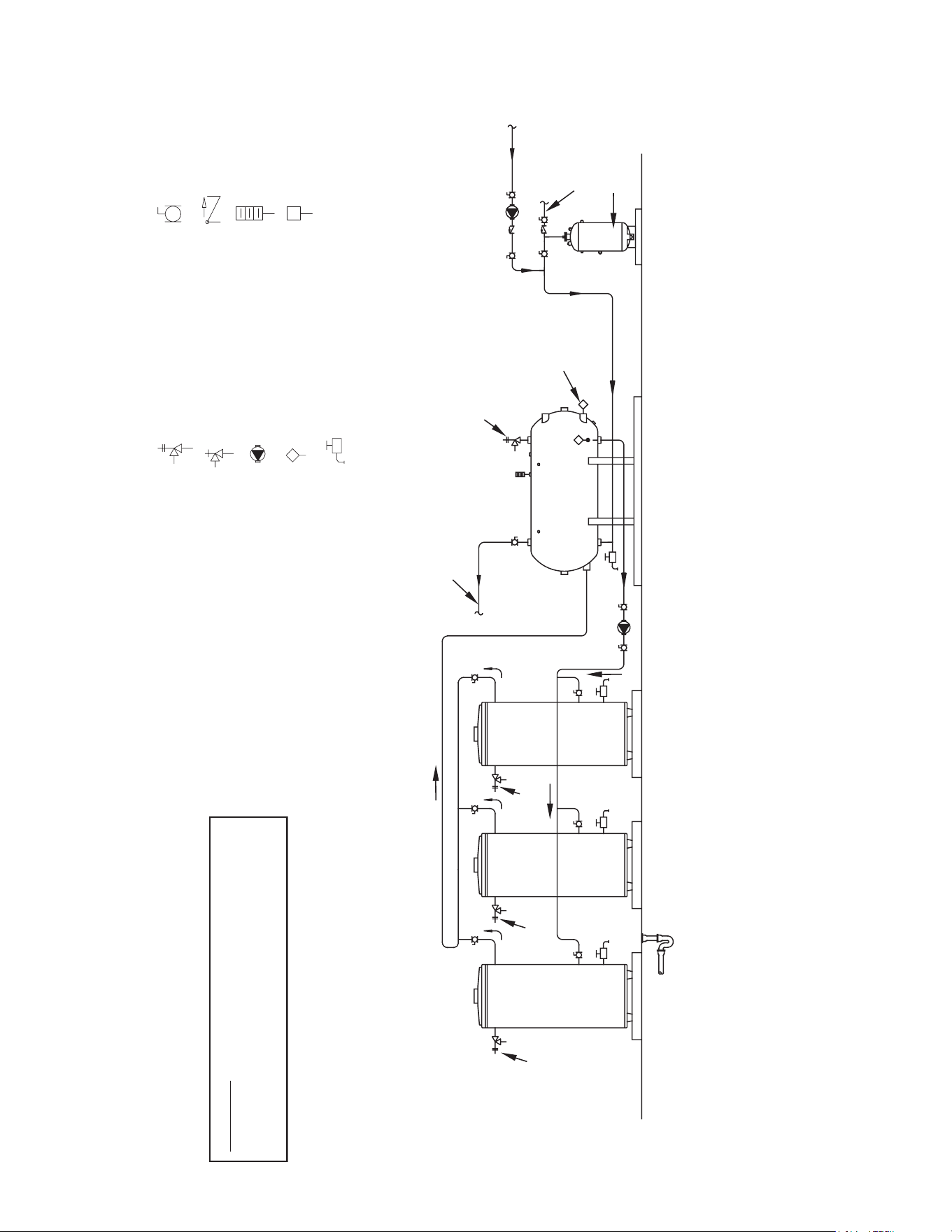
51
NOTES:
1. Preferred piping diagram.
2. The temperature and pressure relief valve setting shall not exceed pressure rating of any component in the system.
3. Service valves are shown for servicing unit. However, local codes shall govern their usage.
4. The Tank Temperature Control should be wired to and control the pump between the water heater(s) and the storage tank(s).
5. The water heater’s operating thermostat should be set 5 degrees F higher than the Tank Temperature Control.
MULTI-FLUE (3 UNITS) WITH HORIZONTAL STORAGE TANK
LEGEND
TEMPERATURE & PRESSURE
RELIEF VALVE
PRESSURE RELIEF VALVE
CIRCULATING PUMP
TANK TEMPERATURE CONTROL
DRAIN
FULL PORT BALL VALV
E
TEMPERATURE GAGE
WATER FLOW SWITCH
CHECK VALVE
WARNING: THIS DRAWING SHOWS SUGGESTED
PIPING CONFIGURATION AND OTHER DEVICES;
CHECK WITH LOCAL CODES AND ORDINANCES
FOR ADDITIONAL REQUIREMENTS.
HOT WATER
RETURN
ALTERNATE
LOCATION
HOT WATER TO FIXTURES
AOS
STORAGE TANK
HEATERHEATERHEATER
FINISHED FLOOR
EXPANSION TANK
COLD WATER
SUPPLY
PIPE T&P TO
OPEN DRAIN
PIPE T&P TO
OPEN DRAIN
PIPE T&P TO
OPEN DRAIN
PIPE T&P TO
OPEN DRAIN
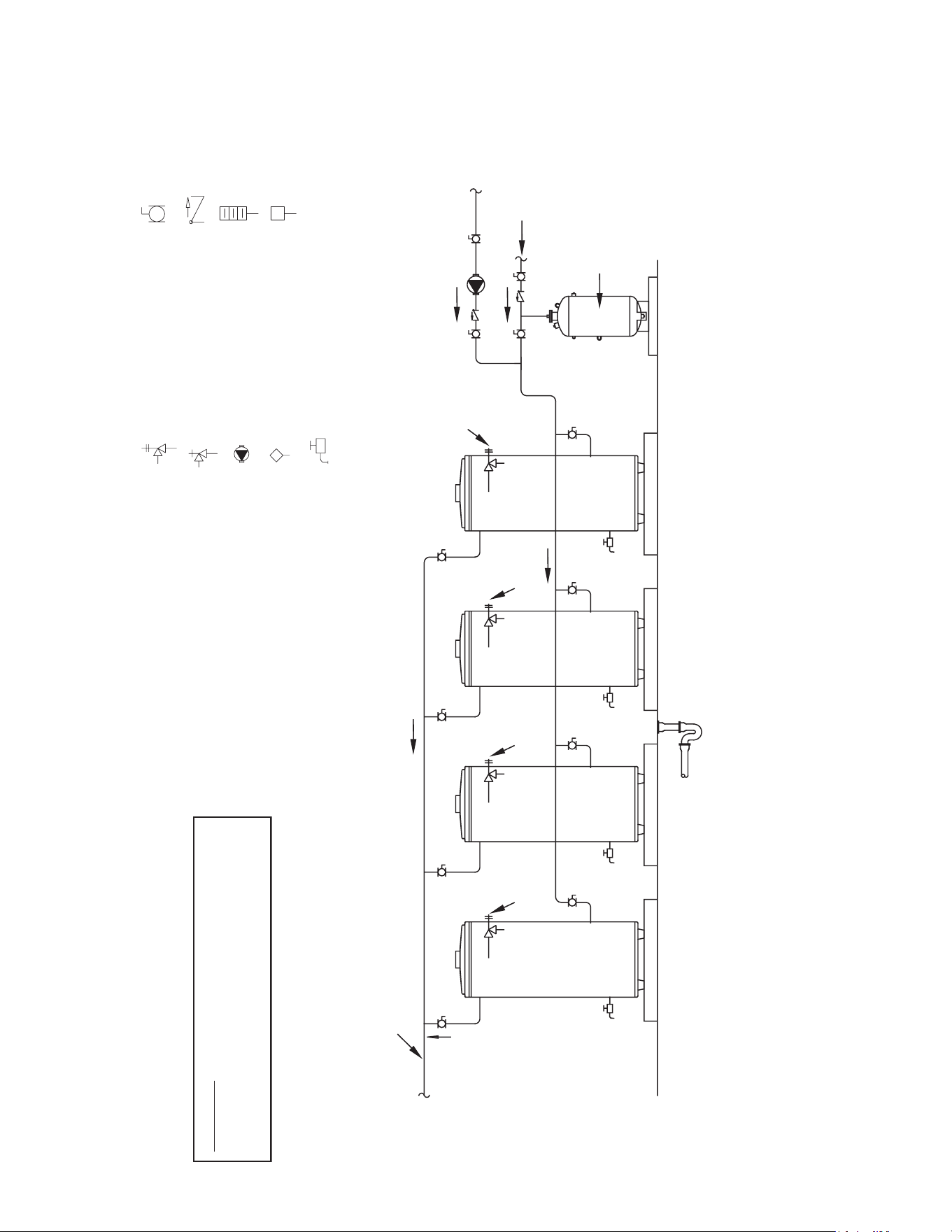
52
NOTES:
1. Preferred piping diagram.
2. The temperature and pressure relief valve setting shall not exceed pressure rating of any component in the system.
3. Service valves are shown for servicing unit. However, local codes shall govern their usage.
MULTI FLUE FLUE (4 UNITS)
LEGEND
TEMPERATURE & PRESSURE
RELIEF VALVE
PRESSURE RELIEF VALVE
CIRCULATING PUMP
TANK TEMPERATURE CONTROL
DRAIN
FULL PORT BALL VALV
E
TEMPERATURE GAGE
WATER FLOW SWITCH
CHECK VALVE
WARNING: THIS DRAWING SHOWS SUGGESTED
PIPING CONFIGURATION AND OTHER DEVICES;
CHECK WITH LOCAL CODES AND ORDINANCES
FOR ADDITIONAL REQUIREMENTS.
EXPANSION
TANK
COLD WATER
SUPPLY
HOT WATER
TO FIXTURES
FINISHED FLOOR
HOT WATE
R
RETURN
PIPE T&P TO
OPEN DRAIN
PIPE T&P TO
OPEN DRAIN
PIPE T&P TO
OPEN DRAIN
PIPE T&P TO
OPEN DRAIN
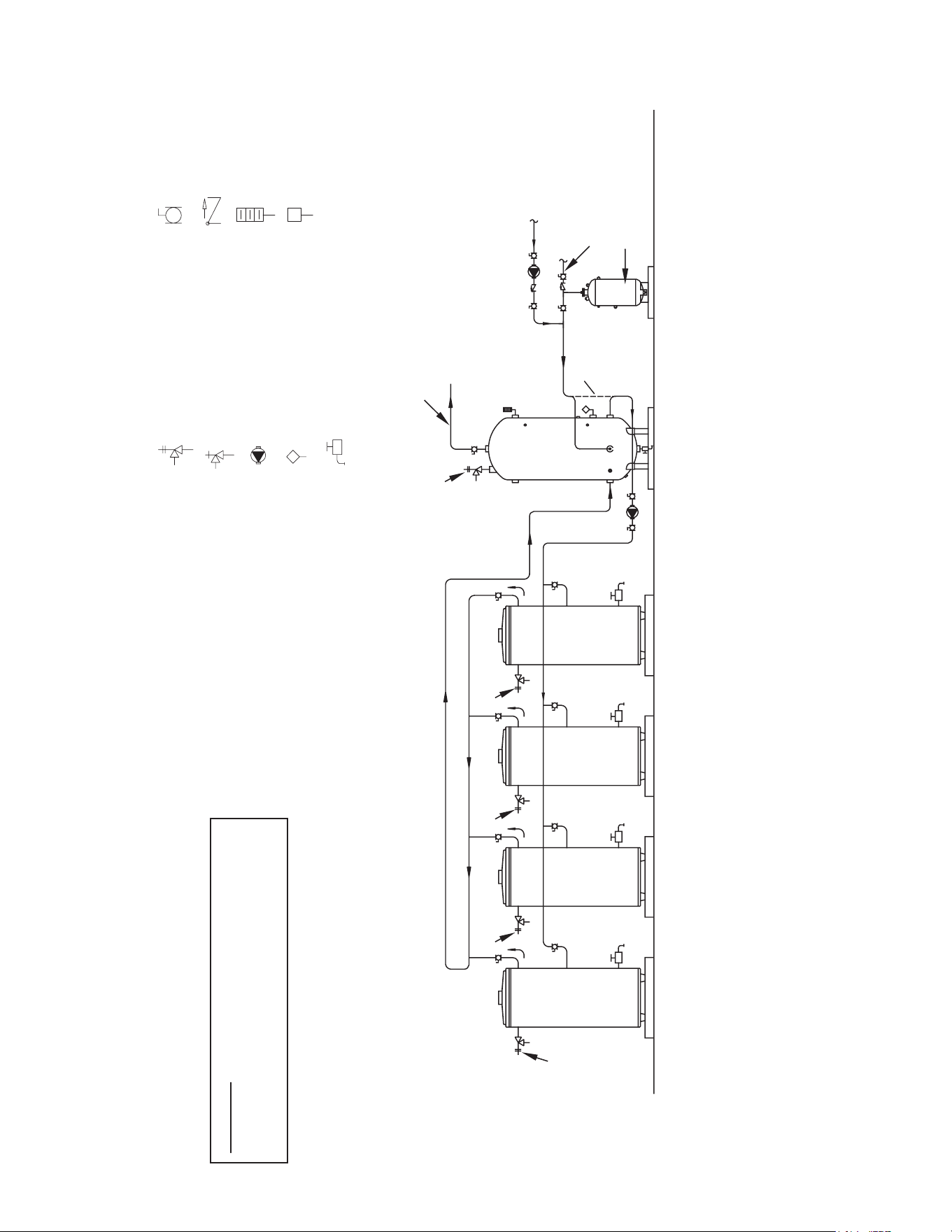
53
NOTES:
1. Preferred piping diagram.
2. The temperature and pressure relief valve setting shall not exceed pressure rating of any component in the system.
3. Service valves are shown for servicing unit. However, local codes shall govern their usage.
4. The Tank Temperature Control should be wired to and control the pump between the water heater(s) and the storage tank(s).
5. The water heater’s operating thermostat should be set 5 degrees F higher than the Tank Temperature Control.
MULTI-FLUE (4 UNITS) WITH VERTICAL STORAGE TANK
LEGEND
TEMPERATURE & PRESSURE
RELIEF VALVE
PRESSURE RELIEF VALVE
CIRCULATING PUMP
TANK TEMPERATURE CONTROL
DRAIN
FULL PORT BALL VALV
E
TEMPERATURE GAGE
WATER FLOW SWITCH
CHECK VALVE
WARNING: THIS DRAWING SHOWS SUGGESTED
PIPING CONFIGURATION AND OTHER DEVICES;
CHECK WITH LOCAL CODES AND ORDINANCES
FOR ADDITIONAL REQUIREMENTS.
HOT WATER
TO FIXTURES
HOT WATER
RETURN
COLD WATER
SUPPLY
EXPANSION
TANK
ALT. COLD
WATER
CONNECTION
AOS
STORAGE TANK
HEATERHEATERHEATERHEATER
FINISHED FLOOR
PIPE T&P TO
OPEN DRAIN
PIPE T&P TO
OPEN DRAIN
PIPE T&P TO
OPEN DRAIN
PIPE T&P TO
OPEN DRAIN
PIPE T&P TO
OPEN DRAIN
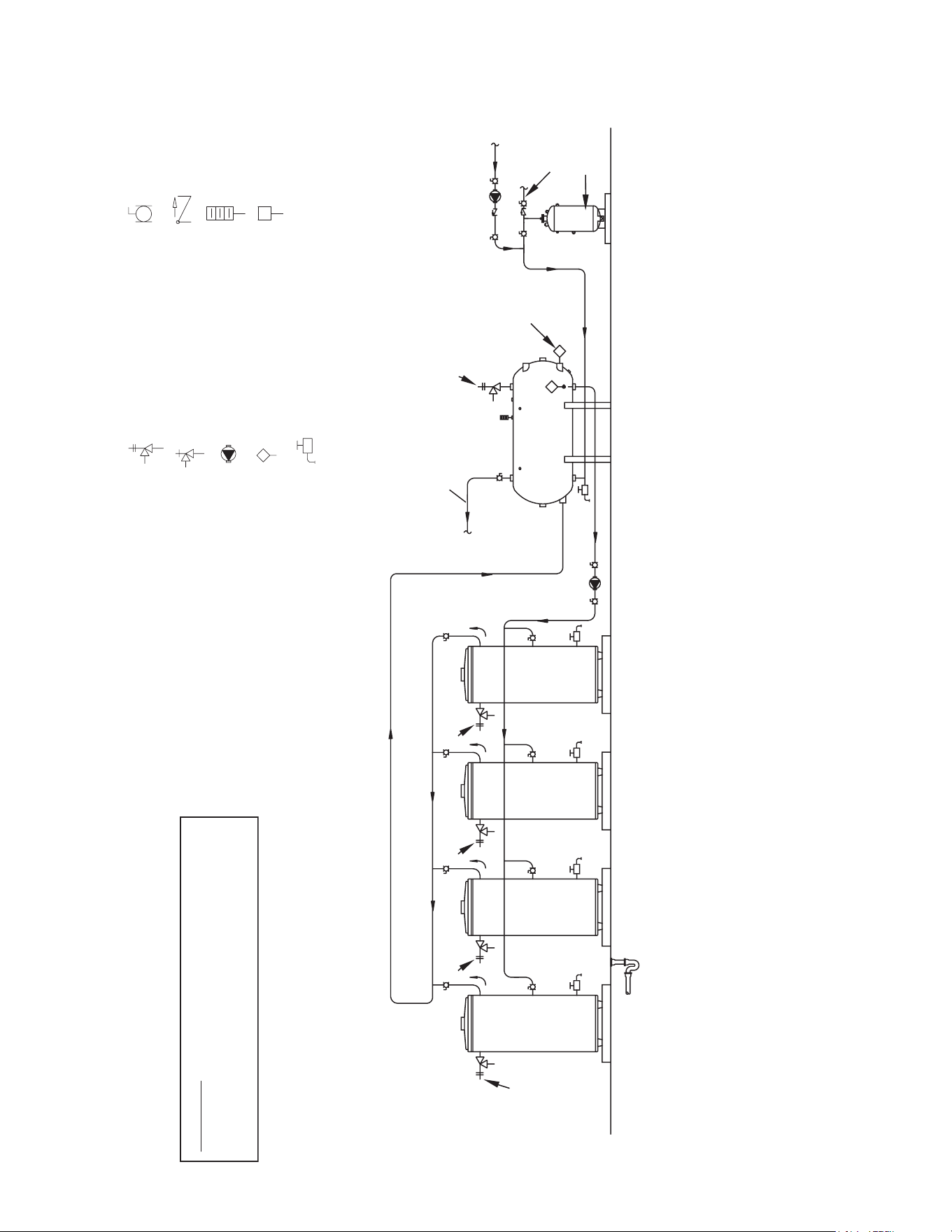
54
NOTES:
1. Preferred piping diagram.
2. The temperature and pressure relief valve setting shall not exceed pressure rating of any component in the system.
3. Service valves are shown for servicing unit. However, local codes shall govern their usage.
4. The Tank Temperature Control should be wired to and control the pump between the water heater(s) and the storage tank(s).
5. The water heater’s operating thermostat should be set 5 degrees F higher than the Tank Temperature Control.
MULTI-FLUE (4 UNITS) WITH HORIZONTAL STORAGE TANK
LEGEND
TEMPERATURE & PRESSURE
RELIEF VALVE
PRESSURE RELIEF VALVE
CIRCULATING PUMP
TANK TEMPERATURE CONTROL
DRAIN
FULL PORT BALL VALV
E
TEMPERATURE GAGE
WATER FLOW SWITCH
CHECK VALVE
WARNING: THIS DRAWING SHOWS SUGGESTED
PIPING CONFIGURATION AND OTHER DEVICES;
CHECK WITH LOCAL CODES AND ORDINANCES
FOR ADDITIONAL REQUIREMENTS.
HOT WATER
TO FIXTURES
HOT WATER
RETURN
COLD WATER
SUPPLY
ALTERNATE
LOCATION
AOS
STORAGE TANK
HEATERHEATERHEATERHEATER
FINISHED FLOOR
EXPANSION TANK
PIPE T&P TO
OPEN DRAIN
PIPE T&P TO
OPEN DRAIN
PIPE T&P TO
OPEN DRAIN
PIPE T&P TO
OPEN DRAIN
PIPE T&P TO
OPEN DRAIN
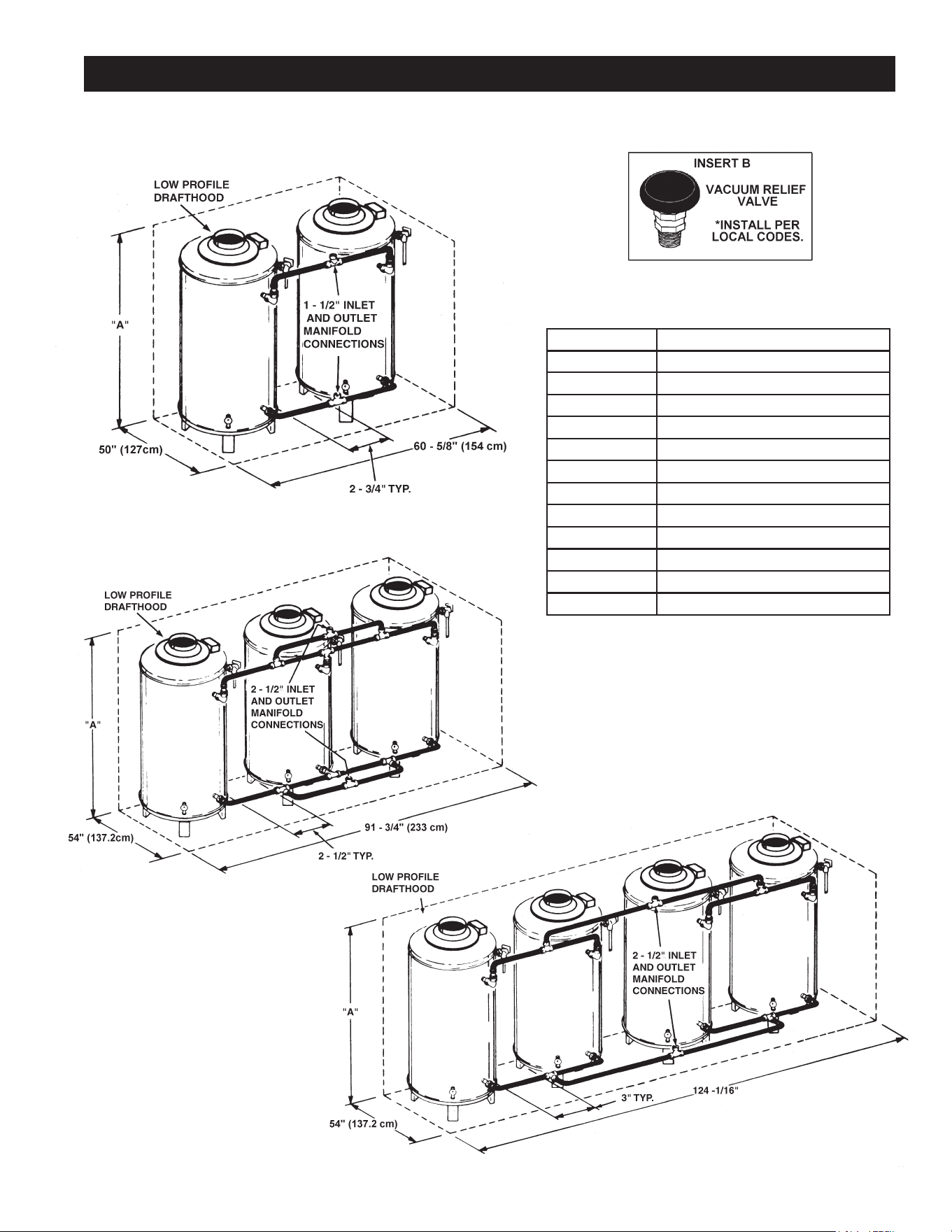
55
MANIFOLD KITS
TWO UNIT MANIFOLD KIT
(9003426205)
THREE UNIT MANIFOLD KIT
(9003427205)
FOUR UNIT MANIFOLD KIT
(9003428205)
MODEL DIMENSIONS "A" INCHES (CM)
BCG370T120 69.75” (177cm)
BCG380T150
73.00” (185cm)
BCG380T180
67.50” (171cm)
BCG3100T199
75.00 (192cm)
BCG380T199
67.50” (171cm)
(A)BCG3100T200
72.00” (183cm)
(A)BCG3100T250
72.00” (183cm)
(A)BCG365T250
75.00” (191cm)
(A)BCG3100T275
72.00” (183cm)
(A)BCG365T300
75.00” (191cm)
(A)BCG385T360
79.50” (202cm)
(A)BCG3100T390
75.50” (192cm)

NOTES
56

NOTES
57

NOTES
58
EFFECTIVE
For 3 Years, in the event of a tank leak, we will repair or, at our
discretion, replace the defective water heater.
For 1 Year, in the event of part failure, we will repair or, at our
discretion, replace the defective part.
We warrant this product against defects in materials or
workmanship as described in this document if installed within
the United States or Canada and provided the product remains
at its original place of installation.
Warranty coverage begins the date of installation OR the date of
manufacture if installation cannot be veried.
WHAT'S COVERED
Subject to these terms, in the event of defect in materials and/
or workmanship resulting in a tank leak during the rst three
years, we will:
• Replace the water heater should the tank leak.
Subject to these terms, in the event of a defect in materials and/or
workmanship appearing during the rst year, we will:
• Repair or, at our discretion, replace any part of the water
heater covered under this limited warranty excluding parts
subject to normal maintenance (Example: non-electronic
anode rod, lter, etc)
Service/labor, shipping, delivery, installation, handling or any
other costs are not covered at any time under this warranty.
Any replacement part or product will be warranted only for
the unexpired portion of the original water heater’s limited
warranty period.
If an identical model is no longer available due to a change in law,
regulation, or standard, we will replace the product with one having
comparable capacity and input. In these instances, the owner will
have the option of paying the difference between what was paid for
the original model and the new model with the additional features,
or receiving a refund of the portion of the purchase price, on a
pro-rata basis allocable to the unexpired portion of the warranty.
WHAT'S NOT COVERED
• Problems caused by improper: gas supply line sizing, gas type,
venting, connections, combustion air, voltage, wiring, or fusing
• Failure to follow applicable codes
• Failure to follow printed instructions
• Abuse, misuse, accident, re, ood, Acts of God
• Improper installation, sizing, delivery, or maintenance
• Claims related to rust, noise, smell, or taste of water
• Failure to conduct authorized factory start up if required
• Alterations to the water heater
• Non-outdoor heaters installed outdoors
• Damages due to a failure to allow for thermal expansion
• Heat exchanger failure due to lack of adequate / proper supply
of water
• Heaters moved from their original location
• Service trips to explain proper installation, use, or maintenance
of the product/unit or to describe compliance requirements
under applicable codes and regulations
• Charges related to accessing your heater including but not
limited to door/wall removal, equipment rental, etc.
• Replacement parts after expiration of this warranty
LIMITATIONS
NOTWITHSTANDING ANYTHING ELSE TO THE CONTRARY,
THIS IS YOUR SOLE AND EXCLUSIVE WARRANTY.
ALL OTHER WARRANTIES INCLUDING A WARRANTY
OF MERCHANTABILITY OR FITNESS FOR PARTICULAR
PURPOSE ARE EXPRESSLY DISCLAIMED. SELLER SHALL
NOT BE LIABLE FOR ANY CONSEQUENTIAL, INCIDENTAL,
SPECIAL, PUNITIVE OR OTHER INDIRECT DAMAGES. TOTAL
LIABILITY ARISING AT ANY TIME SHALL NOT EXCEED THE
PURCHASE PRICE PAID WHETHER BASED ON CONTRACT,
TORT, STRICT LIABILITY OR ANY OTHER LEGAL THEORY.
SERVICE INQUIRIES:
For service inquiries call the telephone number listed below. Be prepared to provide the following information:
name, address, and telephone number; the model and serial number of the water heater; proof of installation; and a clear description
of the problem.
For your records, fill in the product:
Serial: ___________________
Model: ___________________
U.S. Customers:
American Water Heaters
500 Princeton Road
Johnson City, TN 37605
800-999-9515
www.americanwaterheaters.com
COMMERCIAL
WATER HEATER
LIMITED WARRANTY
59

P.O. Box 1597, Johnson City, TN 37605
Phone: 800-456-9805 • Fax: 800-999-5210
www.americanwaterheater.com
Copyright © 2015 American Water Heater Company. All rights reserved.
www.americanwaterheater.com
American Water Heater
Johnson City, TN 37605