
1
Guide Specifications
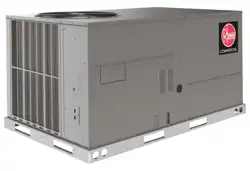
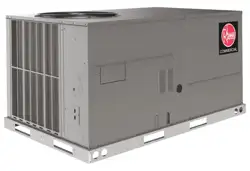
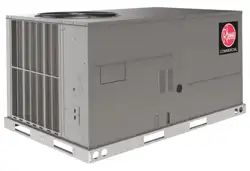
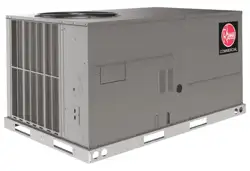
RACC Series
Guide Specifications RACC–036–072
You may copy this document directly into your building specification. This specification is written to comply with the 2016 version of
the “master format” as published by the Construction Specification Institute. www.csinet.org.
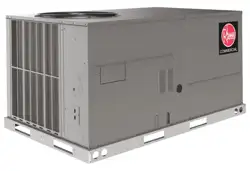
ELECTRIC HEAT PACKAGED ROOFTOP
HVAC Guide Specifications
Size Range: 3 to 6 Nominal Tons
1.00 General:
A. Outdoor, rooftop mounted, electrically controlled, heating and cooling unit utilizing a(n) hermetic scroll compressor(s) for
cooling duty and heat pump for heating duty.
B. Factory assembled, single-piece heating and cooling rooftop unit. Contained within the unit enclosure shall be all factory
wiring, piping, controls, and special features required prior to field start-up.
C. Unit shall use environmentally safe, R-454B refrigerant.
D. Unit shall be installed in accordance with the manufacturer’s instructions.
E. Unit must be selected and installed in compliance with local, state, and federal codes.
1.01 Quality Assurance:
A. Unit meets ASHRAE 90.1 2022 minimum efficiency requirements.
B. Unit shall be rated in accordance with AHRI Standards 210/240 or 340/360 and 10 CFR appendix M1 to subpart B or
part 430.
C. Unit shall be designed to conform to ASHRAE 15.
D. Unit shall be UL-tested and certified in accordance with Standards and UL-listed and certified under Canadian standards as
a total package for safety requirements.
E. Insulation and adhesive shall meet NFPA 90A requirements for flame spread and smoke generation.
F. Unit casing shall be capable of withstanding 1000-hour salt spray exposure per ASTM B117 (scribed specimen).
G. Roof curb shall be designed to conform to NRCA Standards.
H. Unit shall be subjected to a completely automated run test on the assembly line. The data for each unit will be stored at the
factory, and must be available upon request.
I. Unit shall be designed in accordance with UL Standard 60335-2-40 4th Edition. including tested to withstand rain.
1.02 Manufacturer Qualifications
A. Unit shall be designed in accordance with ISO 9001:2015, and shall be manufactured in a facility registered by
ISO 9001:2015.
1.03 Installer Qualifications
A. The installer shall be trained to install and service equipment with A2L refrigerants.
1.04 Delivery, Storage, and Handling:
A. Unit shall be stored and handled per manufacturer’s recommendations.
B. Lifted by crane requires either shipping top panel or spreader bars.
C. Unit shall only be stored or positioned in the upright position.
1.05 Unit Cabinet:
A. Unit cabinet shall be constructed of galvanized steel.
B. Unit cabinet exterior paint shall be: pre-painted steel.
C. Evaporator fan compartment interior cabinet insulation shall conform to AHRI Standards 210 or 360 minimum exterior sweat
criteria. Interior surfaces shall be insulated with a minimum 1/2-in. thick, 1.6 lbs. density, flexible fiberglass insulation, foil
faced on the air side. Aluminum foil-faced fiberglass insulation shall be used in the gas heat compartment.
D. Base of unit shall have a location for thru-the-base gas and electrical connections standard.
E. Base Rail:
i. Unit shall have base rails on a minimum of 4 sides.
ii. Holes shall be provided in the base rails for rigging shackles to facilitate maneuvering and overhead rigging.
iii. Holes shall be provided in the base rail for moving the rooftop for fork truck.
iv. Base rail shall be a minimum of 14 gauge thickness.
1/26 QG FORM NO.S11-994-GS REV. 2

2
F. Condensate pan and connections:
i. Shall be a sloped condensate drain pan made of a non-corrosive material and be removable for cleaning.
ii. Shall comply with ASHRAE Standard 62.
iii. Shall use a 3/4" NPT drain connection, possible either through the bottom or side of the drain pan. Connection shall be
made per manufacturer’s recommendations.
iv. Shall be able to be easily removed.
G. Top panel
i. Shall be a single piece top panel over indoor section.
H. Electrical Connections:
i. All unit power wiring shall enter unit cabinet via a single, factory-prepared, continuous raised flange opening
in the basepan.
ii. Thru-the-base capability:
a. Standard unit shall have a thru-the-base electrical location(s) using a raised, continuous raised flange
opening in the basepan.
b. No basepan penetration, other than those authorized by the manufacturer, is permitted.
I. Component access panels (standard):
i. Cabinet panels shall be easily opened for servicing.
ii. Panels covering control box, indoor fan, indoor fan motor, gas components (where applicable), and filters shall have
hinges with 1/4 turn fasteners on units with factory-installed hinged option.
iii. 1/4 fasteners shall be permanently attached.
1.06 Operating Characteristics:
A. Unit shall be capable of starting and running at 115°F (46°C) ambient outdoor temperature, meeting maximum load criteria
of AHRI Standard 210/240 or 340/360 at ± 10% voltage.
B. Compressor with standard controls shall be capable of operation down to 50°F (10°C), ambient outdoor temperatures.
Low ambient accessory kit is necessary if mechanically cooling at ambient temperatures to 0°F (-17.7°C).
C. Unit shall discharge supply air vertically or horizontally as shown on contract drawings.
D. Unit shall be factory configured for vertical supply & return configurations.
E. Unit shall be field convertible from vertical to horizontal configuration.
1.07 Electrical Requirements
A. Main power supply voltage, phase, and frequency must match those required by the manufacturer.
1.08 Evaporator fan compartment:
A. Interior cabinet surfaces shall be insulated with a minimum 1/2-in. thick, minimum 1.6 LB density, flexible fiberglass
insulation bonded with foil face on the air side.
B. Insulation and adhesive shall meet NFPA 90A requirements for flame spread and smoke generation.
C. Insulation shall also be mechanically fastened with welded pin and retainer washer.
1.09 Thermostats
A. Thermostat must:
i. Energize both “W” and “G” when calling for heat.
ii. Have capability to energize 1 stage of cooling, and at least 1 stage of heating.
iii. Include capability for occupancy scheduling.
1.10 Electronic Control System for HVAC:
A. Shall be complete with self-contained low-voltage control circuit protected by a fuse on the 24-V transformer side.
B. Shall utilize color-coded wiring.
C. Unit shall include a self-contained low-voltage control circuit protected by a fuse on the 24-V transformer side.
D. Unit shall include a minimum of one 8-pin screw terminal connection board for connection of control wiring.
1.11 Safeties:
A. Compressor over-temperature, over current.
B. Low-pressure switch.
i. Units shall have low pressure, loss of charge automatic reset device that will shut off compressor when tripped.
C. High-pressure switch.
i. Unit shall be equipped with high pressure switch device that will shut off compressor when tripped.
Guide Specifications
RACC Series
1/26 QG FORM NO.S11-994-GS REV. 2

D. Automatic reset, motor thermal overload protector.
E. The unit must be permanently grounded.
F. Components are not compatible between different refrigerants. Do not use R-410A service equipment or components
on R-454B equipment. System or part failure could occur.
1.12 Standard Filter Section:
A. Shall consist of factory-installed, low velocity, throwaway 2-in. thick fiberglass filters of commercially available sizes.
B. Unit will accept both 2-in. and 4-in. filters.
C. Filter face velocity shall not exceed 365 fpm at nominal airflows.
D. Filters shall be accessible through an access panel with “no-tool” removal as described in the unit cabinet section
of the specification.
E. Filters access is specified in the unit cabinet section of this specification.
F. Filters shall be held in place by metal rods, facilitating easy removal and installation.
1.13 Coils
A. Standard Aluminum/MicroChannel Coils:
i. Standard evaporator and condenser coils shall be aluminum.
ii. Evaporator and condenser coils shall be leak tested to 150 psig, pressure tested to 400 psig, and qualified to
burst test at 2,200 psi.
1.14 Refrigerant Components:
A. Refrigerant circuit shall include the following control, safety, and maintenance features:
i. TXV metering system shall prevent mal-distribution of two-phase refrigerant.
ii. Refrigerant filter drier.
iii. Service gauge connections on suction and discharge lines.
iv. External pressure gauge ports access shall be located in front exterior of cabinet.
B. Compressors:
i. Unit shall use one fully hermetic scroll compressor.
ii. 3-5 ton RACCYB units include one single-stage compressor.
iii. 3-5 ton RACCYC and 6 ton RACCYB units include one two-stage compressor.
iv. Compressor motors shall be cooled by refrigerant gas passing through motor windings.
v. Compressors shall be internally protected from high discharge temperature conditions.
vi. Compressors shall be protected from an over-temperature and over-amperage conditions by an internal,
motor overload device.
vii. Compressor shall be factory mounted on rubber grommets.
viii. Compressor motors shall have internal line break thermal and current overload protection.
ix. Crankcase heaters shall not be required for normal operating range.
x. Compressor shall have molded electrical plug.
1.15 Evaporator Fan and Motor:
A. Evaporator Fan Motor:
i. Shall have permanently lubricated bearings.
ii. Shall have inherent automatic-reset thermal overload protection.
B. Direct Drive Evaporator Fan:
i. Direct drive ECM technology with (5) dedicated speed selections as follows: fan, low, high, AC low static,
AC high static.
ii. Blower fan shall be double-inlet type with forward-curved blades.
iii. Shall be constructed from steel with a corrosion resistant finish and dynamically balanced.
1.16 Condenser Fans and Motors:
A. Condenser Fan Motor:
i. Shall be a totally enclosed motor.
ii. Shall use permanently lubricated bearings.
iii. Shall have inherent thermal overload protection with an automatic reset feature.
iv. Shall use a shaft-down design. Shaft-up designs including those with “rain-slinger devices” shall not be allowed.
Guide Specifications
RACC Series
3
1/26 QG FORM NO.S11-994-GS REV. 2

B. Condenser Fans shall:
i. Shall be a direct-driven propeller type fan
ii. Shall have blades riveted to corrosion-resistant steel spiders and shall be dynamically balanced.
1.17 Special Features:
A. Integrated Economizers:
i. Integrated parallel modulating blade design type capable of simultaneous economizer and compressor operation.
ii. Independent modules for vertical or horizontal return configurations shall be available. Vertical return modules shall be
available as a factory-installed option.
iii. Damper blades shall be galvanized steel. Plastic or composite blades on intake or return shall not be acceptable.
iv. Shall include all hardware and controls to provide free cooling with outdoor air when temperature and/or humidity are
below setpoints.
v. Shall be equipped with dampers for both the outdoor ventilation air and the return air for positive air stream control.
vi. Shall be equipped with low-leakage dampers, not to exceed 2% leakage at 1 in. wg pressure differential.
vii. Shall be capable of introducing up to 100% outdoor air.
viii. Shall be equipped with a barometric relief damper capable of relieving up to 100% return air.
ix. Shall be designed to close damper(s) during loss-of-power situations with spring return built into motor.
x. Enthalpy sensor shall be provided as standard. Outdoor air sensor set point shall be adjustable and shall range
from 40 to 100°F / 4 to 38°C. Additional sensor options shall be available as accessories.
xi. The economizer controller shall also provide control of an accessory power exhaust unit function.
Factory set at 70%, with a range of 0% to 100%.
xii. The economizer shall maintain minimum airflow into the building during occupied period and provide design ventilation
rate for full occupancy. A remote potentiometer may be used to override the damper set point.
xiii. Dampers shall be completely closed when the unit is in the unoccupied mode.
xiv. Economizer controller shall accept a 2-10Vdc CO2 sensor input for IAQ/DCV control. In this mode, dampers
shall modulate the outdoor-air damper to provide ventilation based on the sensor input.
xv. Economizer controller shall provide indications when in free cooling mode, in the DCV mode, or the exhaust fan contact
is closed.
xvi. Economizer wire harness will have provision for smoke detector.
B. Manual damper
i. Manual damper package shall consist of damper, air inlet screen, and rain hood which can be preset to admit
up to 50% outdoor air for year-round ventilation.
C. Condenser Coil Hail Guard Assembly:
i. Shall protect against damage from hail.
ii. Shall be louvered style.
D. Unit-Mounted, Non-Fused Disconnect Switch:
i. Switch shall be factory-installed, internally mounted.
ii. National Electric Code (NEC) and UL approved non-fused switch shall provide unit power shutoff.
iii. Shall be accessible from outside the unit.
iv. Shall provide local shutdown and lockout capability.
E. Convenience Outlet:
i. Non-Powered convenience outlet.
ii. Outlet shall be powered from a separate 115-120v power source.
iii. A transformer shall not be included.
iv. Outlet shall be field-installed and internally mounted with easily accessible 115-v female receptacle.
v. Outlet shall include 15 amp GFI receptacle with independent fuse protection.
vi. Outlet shall be accessible from outside the unit.
Guide Specifications
RACC Series
4
1/26 QG FORM NO.S11-994-GS REV. 2

F. Propeller Power Exhaust:
i. Power exhaust shall be used in conjunction with an integrated economizer.
ii. Independent modules for vertical or horizontal return configurations shall be available.
iii. Horizontal power exhaust shall be mounted in return ductwork.
iv. Power exhaust shall be controlled by economizer controller operation. Exhaust fans shall be energized when dampers
open past the 0-100% adjustable setpoint on the economizer control.
G. Roof Curbs (Vertical):
i. Formed galvanized steel with wood nailer strip and shall be capable of supporting entire unit weight.
ii. Permits installation and securing of ductwork to curb prior to mounting unit on the curb.
H. Return Air Enthalpy Sensor
i. The return air enthalpy sensor shall be used in conjunction with an outdoor air enthalpy sensor to provide
differential enthalpy control.
I. Indoor Air Quality (CO2) Sensor:
i. Shall be able to provide demand ventilation indoor air quality (IAQ) control.
ii. The IAQ sensor shall be available in duct mount, wall mount, or wall mount with LED display.
The set point shall have adjustment capability.
J. Smoke detectors:
i. Shall be a Four-Wire Controller and Detector.
ii. Shall be environmental compensated with differential sensing for reliable, stable, and drift-free sensitivity.
iii. Shall use magnet-activated test/reset sensor switches.
iv. Shall have tool-less connection terminal access.
v. Shall have a recessed momentary switch for testing and resetting the detector.
vi. Controller shall include:
a. One set of normally open alarm initiation contacts for connection to an initiating device circuit on a fire alarm
control panel
b. Two Form-C auxiliary alarm relays for interface with rooftop unit or other equipment
c. One Form-C supervision (trouble) relay to control the operation of the Trouble LED on a remote test/reset station
d. Capable of direct connection to two individual detector modules.
e. Can be wired to up to 14 other duct smoke detectors for multiple fan shutdown applications.
K. Barometric Relief:
i. Shall include damper, seals, hard-ware, and hoods to relieve excess building pressure.
ii. Damper shall gravity-close upon shutdown.
L. Time Guard:
i. Shall prevent compressor short cycling by providing a 5-minute delay (±2 minutes) before restarting a
compressor after shutdown for any reason.
ii. One device shall be required per compressor.
M. Refrigerant Leak Detection System:
i. Shall be standard and factory-installed in every unit.
ii. Shall trigger a fault code to the unit controller and initiate mitigation procedures.
5
1/26 QG FORM NO.S11-994-GS REV. 2
Guide Specifications
RACC Series