INSTALLATION GUIDE / USER MANUAL
PowerZone™ Connect
1002 • 1502 • 2004 / 2004D • 3004 / 3004D • 4008 • 6008 / 6008D
2
Technical and Safety Notices
Please read the following important technical, safety
and environmental notices before installing and using
your amplier.
Technical Notices
All reasonable design and engineering steps have been taken
to ensure that these ampliers always perform satisfactorily
in their intended application and environment and will provide
appropriate levels of support to ensure that all reasonable
customer needs and expectations are met. Such support
however is contingent on the following provisions.
• These ampliers are Class-I products and should be installed
with a mains cable including the required earth connection to
comply with the Safety Class-I.
• These ampliers should always be installed by competent
and qualied personnel. Amplier damage or failure caused
by installation or operational errors may invalidate support,
warranty or guarantees of performance.
• These ampliers are not suitable for use in locations where
they may be accessible to minors.
• These ampliers are intended to be used specically for
the amplication of audio signals and for connection to
moving-coil loudspeaker systems. Use of these ampliers
for amplication of signals outside the audio band (20Hz
to 20kHz) or to drive transducers other than moving-coil
loudspeakers may invalidate support, warranty or guarantees
of performance.
• These ampliers should only be used within professionally
installed and congured audio systems comprising input
and output ancillary equipments that is known to be of an
appropriate level of performance and in good operating
condition. Any damage to, or unsatisfactory performance
from, these ampliers caused by inadequate or failed input
or output ancillaries may invalidate support, warranty or
guarantees of performance.
• These ampliers are intended to be installed and operated
indoor in a controlled environment (pollution degree, PD2)
within an ambient temperature range of 0°C to 40°C. These
ampliers are not intended for use above 2000 meters above
sea level. Ampliers installed or operated in environments
outside these limits may invalidate support, warranty or
guarantees of performance.
• Specic warranty terms are the responsibility of the amplier
re-seller.
Safety and Environmental Notices
Note: The intent of the lightning ash with arrowhead symbol
in a triangle is to alert the user to the presence of uninsulated
“dangerous” voltage within the product’s enclosure that may be of
sufcient magnitude to constitute a risk of electric shock to humans.
Note: The intent of the exclamation point within an equilateral
triangle is to alert the user to the presence of important safety, and
operating and maintenance instructions in this manual.
WARNING! TO PREVENT FIRE OR ELECTRIC SHOCK,
DO NOT EXPOSE THIS EQUIPMENT TO RAIN OR
MOISTURE.
Ambient Temperature Note: If this equipment is
operated in a conned or multiple rack installation, the
internal ambient operating temperature may exceed
the external ambient temperature.
It is important to ensure in these
circumstances that the published
maximum operating temperature for the
equipment is not exceeded.
Reduced Air Flow: Ensure that rack or
other closed installation does not restrict
the cooling airow required for safe and
reliable operation of the equipment.

3
Technical and Safety Notices
Important Safety Instructions
• Read these instructions.
• Keep these instructions.
• Heed all warnings.
• Follow all instructions.
• Do not use this apparatus near water.
• Do not submerge the equipment in water or liquids.
• Do not use any aerosol spray, cleaner, disinfectant or
fumigant on, near or into the equipment.
• Clean only with a dry cloth.
• Do not block any ventilation opening. Install in accordance
with the manufacturer’s instructions.
• Do not install near any heat sources such as radiators, heat
registers, stoves, or other apparatus (including ampliers)
that produce heat.
• To reduce the risk of electrical shock, the power cord shall be
connected to a mains socket outlet with a protective earthing
connection.
• Do not defeat the safety purpose of the polarized or
grounding type plug. A polarized plug has two blades with
one wider than the other. A grounding type plug has two
blades and a third grounding prong. The wide blade or the
third prong are provided for your safety. If the provided
plug does not t into your outlet, consult an electrician for
replacement of the obsolete outlet.
• Protect the power cord from being walked on or pinched
particularly at plugs, convenience receptacles, and the point
where they exit from the apparatus.
• Do not unplug the unit by pulling on the cord, use the plug.
• Only use attachments/accessories specied by the
manufacturer.
• Unplug this apparatus during lightning storms or when
unused for long periods of time.
• Refer all servicing to qualied service personnel. Servicing
is required when the apparatus has been damaged in any
way, such as power supply cord or plug is damaged, liquid
has been spilled or objects have fallen into the apparatus, the
apparatus has been exposed to rain or moisture, does not
operate normally, or has been dropped.
• The appliance coupler, or the AC Mains plug, is the AC mains
disconnect device and shall remain readily accessible after
installation.
• Adhere to all applicable, local codes.
• Consult a licensed, professional engineer when any doubt or
questions arise regarding a physical equipment installation.
Environmental Statement
This product complies with international
directives, including but not limited to the
Restriction of Hazardous Substances (RoHS)
in electrical and electronic equipment, the
Registration, Evaluation, Authorization and
restriction of Chemicals (REACH) and the
disposal of Waste Electrical and Electronic Equipment (WEEE).
Consult your local waste disposal authority for guidance on
how properly to recycle or dispose of this product.

4
Introduction and Overview
1. Introduction
PowerZone™ Connect power ampliers have been
designed to provide congurable, consistent and
reliable high performance audio power amplication for
residential, commercial and entertainment applications.
This manual covers the features, installation and
functions of the PowerZone™ Connect 1002, 1502,
2004/2004D, 3004/3004D, 4008 and 6008/6008D
models. Please read the manual fully before installing
and using an amplier. If you have any questions
regarding amplier conguration, installation or
operation please contact the appropriate customer
support portal.
Following this introduction, the manual is divided into sections
covering the following topics:
• 2. Overview
• 3. Carton Contents
• 4. Installation
• 5. Conguration
• 6. Connections
• 7. Operation
• 8. Specications
2. Amplier Overview
PowerZone™ Connect 1002, 1502, 2004/2004D,
3004/ 3004D, 4008 and 6008/6008D ampliers are a full
rack width, 2U format power ampliers that can drive both
conventional low impedance (Lo-Z, 4 Ω to 16 Ω) loudspeakers
and high impedance (Hi-Z, 70 V / 100 V) transformer coupled
loudspeakers. They provide four or eight analog inputs, one
stereo S/PDIF digital input, and two or four or eight outputs
(Lo-Z mode), or one or two or four outputs (Hi-Z or Lo-Z BTL
mode). PowerZone™ Connect amplier model output channel
counts and power outputs are as follows:
PowerZone™ Connect 1002
Mode Channels Max Rated Output per Channel
Lo-Z Two 500 Watts
Lo-Z (BTL) One 1000 Watts
Hi-Z One 1000 Watts
PowerZone™ Connect 1502
Mode Channels Max Rated Output per Channel
Lo-Z Two 750 Watts
Lo-Z (BTL) One 1500 Watts
Hi-Z One 1500 Watts
PowerZone™ Connect 2004/2004D
Mode Channels Max Rated Output per Channel
Lo-Z Four 500 Watts
Lo-Z (BTL) Two 1000 Watts
Hi-Z Two 1000 Watts
PowerZone™ Connect 3004/3004D
Mode Channels Max Rated Output per Channel
Lo-Z Four 750 Watts
Lo-Z (BTL) Two 1500 Watts
Hi-Z Two 1500 Watts
PowerZone™ Connect 4008
Mode Channels Max Rated Output per Channel
Lo-Z Eight 500 Watts
Lo-Z (BTL) Four 1000 Watts
Hi-Z Four 1000 Watts
PowerZone™ Connect 6008/6008D
Mode Channels Max Rated Output per Channel
Lo-Z Eight 750 Watts
Lo-Z (BTL) Four 1500 Watts
Hi-Z Four 1500 Watts
Note: In Lo-Z BTL (bridge-tied load) mode, two amplier output
channels are combined to create a single, double power output
channel. BTL mode can be engaged via the amplier Output Mode
conguration setup menu described in Section 5 of this manual.

5
Introduction and Overview
2.1 Connections and Power Switching
PowerZone™ Connect signal input and output connections are
accomplished via RCA Phono and Euroblock style connectors.
A GPIO (General Purpose In/Out) Euroblock connector enables
some amplier functions to be controlled externally, and
wireless or RJ45 socket Ethernet network connection options
are also provided. Cable connectors and connections are
described and illustrated in Section 6 of this manual
PowerZone™ Connect ampliers incorporate a front panel
mounted power button. Press the button once to switch the
amplier on or off. Amplier power management behaviour
can be congured via the Control web app Settings Menu
described in Section 5 of this manual.
2.2 Network Features
PowerZone™ Connect ampliers are TCP/IP network
connected devices that require a wired or wireless network
connection to access their conguration menus. The
conguration menus are accessed via the
PowerZone™ Connect control web app interface and cover
Input, Zone, Output and General Settings functions. The
conguration menus are fully described in Section 4 of this
manual.
Audinate Dante
®
Two and four output PowerZone™ Connect ampliers are
optionally compatible with Audinate Dante
®
audio over IP
(AoIP) networks and installations.
Dante
®
equipped versions of PowerZone™ Connect ampliers
enable the transmission and receipt of digital audio over
an Ethernet network using the IP based Dante
®
protocol.
Conguration and management of the IP routing for Dante
®
digital audio, including the setting of network parameters
such as IP addresses and subnet masks, is administered by
Audinate’s Dante
®
Controller software application. Dante
®
Controller downloads and comprehensive guidance on the
conguration and installation of Dante
®
based audio over IP
can be found at:
www.audinate.com/products/software/dante-controller.
2.3 Firmware
This manual describes the features, functions and user
interface of PowerZone™ Connect ampliers running
Firmware Version 1.8.0.
It is strongly recommended that the rmware version
installed in the amplier in use is checked initially, and
regularly thereafter. If updated rmware is available,
the amplier should be updated as a priority.
The rmware installed in the amplier can be identied and
updated by selecting the Device option in the Control web
app Settings Menu. Firmware versions can be checked, and
rmware downloaded, from the website: https://???
3. Carton Contents
PowerZone™ Connect ampliers are shipped in a cardboard
carton containing the amplier unit, a mains cable appropriate
for the sales territory, an accessory pack, and a document pack.
The full contents is listed below.
• Amplier unit
• Rack mount ears (tted)
• Mains power cable
• Input connector x 2 or 4
• GPIO socket connector
• Output connector x 1, 2 or 4
• Adhesive rubber feet x 4
• Document pack
6
Installation
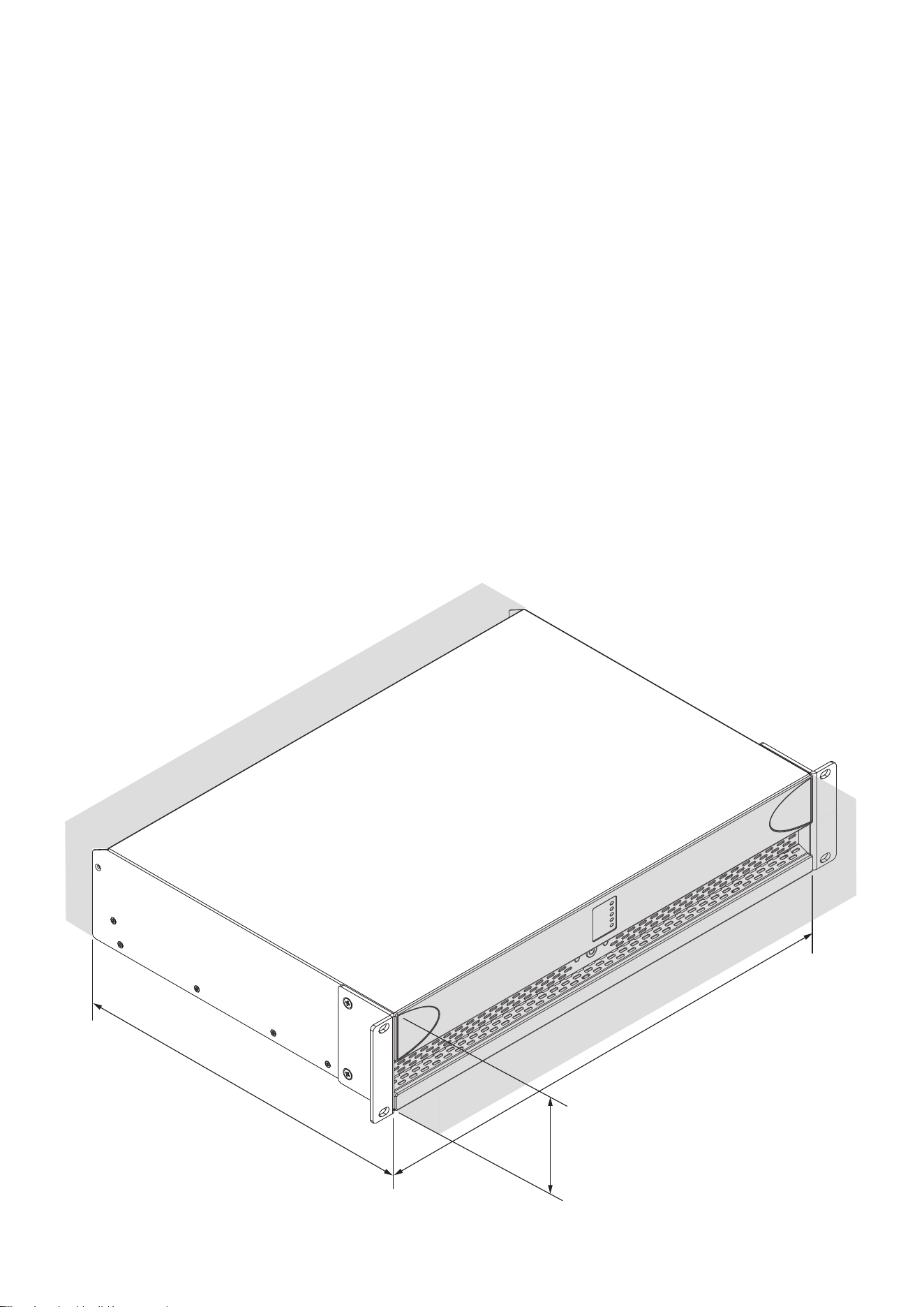
Diagram 4A
PowerZone™ Connect two and four output amplier
dimensions. (Shaded area denes ventilation space.)
4. Installation
4.1 Amplier Location
PowerZone™ Connect ampliers are shipped with rack
“ears” attached and are primarily intended for standard (19
inch)equipment rack installation. If not to be installed in an
equipment rack, PowerZone™ Connect ampliers can be
placed free-standing on a at surface. Adhesive rubber feet are
supplied for this purpose.
It is important that any installation provides space for airow
through the ventilation apertures at the front and rear of the
amplier. This is illustrated in Diagram 4A.
440 mm
17.3 in
321 mm
12.6 in
88 mm
3.5 in
7
Installation
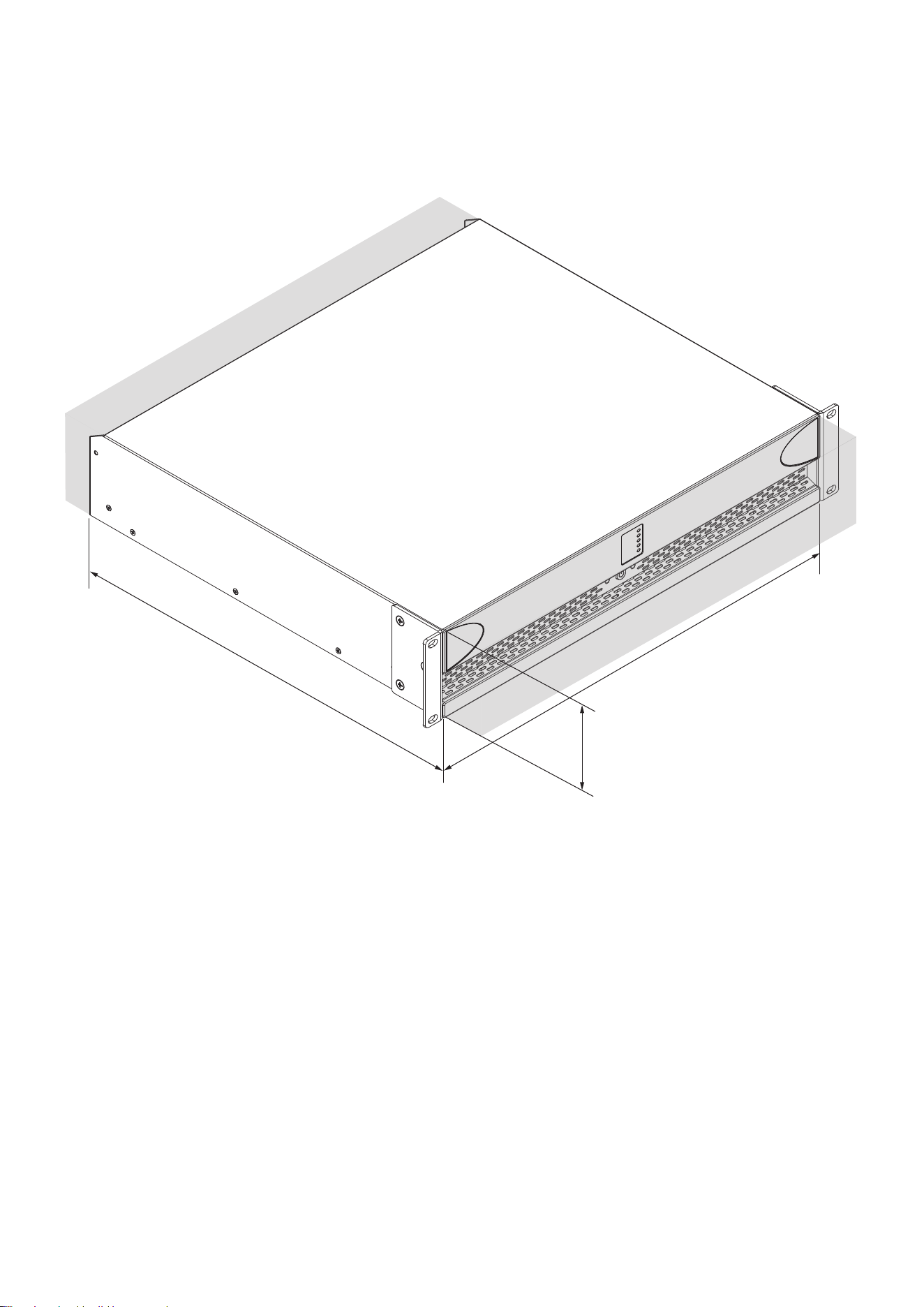
Diagram 4B
PowerZone™ Connect eight output amplier dimensions.
(Shaded area denes ventilation space.)
440 mm
17.3 in
88 mm
3.5 in
414 mm
16.3 in

8
Conguration
5. Conguration
Before making input, output and GPIO connections, an
initial PowerZone™ Connect amplier conguration
should be established. It is particularly important that
the amplier output format is congured appropriately
for the speakers that are to be connected.
Conguration requires that PowerZone™ Connect
ampliers are connected to mains power, switched on
and connected to network services. These connections
are described in the following two sections.
5.1 Mains Power Connection
PowerZone™ Connect ampliers incorporate a power factor
corrected power supply and can be used with mains input
voltage from 100V AC to 240V AC, 50/60Hz. Use the mains
cable supplied with the amplier and connect it to a mains
supply.
Press the front panel power button to switch on the amplier.
After a short delay the front panel Status indicator will
illuminate green.
5.2 Network Services
PowerZone™ Connect ampliers are congured via
the Control Web App interface. Before the Web App
conguration menus can be accessed, PowerZone™
Connect ampliers must be connected to the same TCP/
IP network as the computer or mobile device that is to
be used for conguration.
To connect a PowerZone™ Connect amplier to a TCP/IP
network using a wired connection (Ethernet) follow the steps
below.
1. Use an Ethernet cable to connect the PowerZone™ Connect
amplier rear panel Network Control socket (upper socket) to
a free socket on a network router or switch, or directly to an
Ethernet equipped laptop or desktop computer.
2. Connect the PowerZone™ Connect amplier to mains
power using the supplied mains cable. Wait for the front panel
Network indicator to illuminate green to indicate that the
amplier has network connectivity.
3. Depending on its manufacturer defaults, The PowerZone™
Connect amplier network settings will be congured either to
DHCP or have a xed LAN IP address of 192.168.64.100.
In the case of DHCP, the network router will automatically
assign the PowerZone™ Connect amplier a network
address to enable the amplier to connect automatically to
the network. A network scanning application can be used if
required to identify the amplier’s IP address.
In the case of an PowerZone™ Connect amplier with a xed
IP address, congure the laptop or desktop computer for a xed
IP address in the same IP range; eg. 192.168.64.10, with Subnet
mask of 255.255.255.0 (or prex 24) and set the Gateway to
192.168.64.1.
4. Open a laptop or desktop web browser and enter
the amplier’s DHCP assigned network address or
http://192.168.64.100. The PowerZone™ Connect Control
Web App interface will open to enable amplier conguration
as required.
Note: PowerZone™ Connect ampliers can be congured
to use DHCP for network connection if required. However, if a
PowerZone™ Connect amplier using DHCP is power cycled, it
is possible that the TCP/IP network router will assign it a different
IP address, leaving its conguration page inaccessible via the
previous address. If this occurs, a network scanning app can be used
to identify the new IP address. DHCP and Fixed IP address option
settings can be found in the Settings Tab menu described in Section
6.3.
Note: The second network socket present on the amplier rear panel
is intended for Audinate Dante
®
AoIP network connection only. It
cannot be used for PowerZone™ Control connection.
5.2.2 Wireless (WiFi) Network Connection
To connect a PowerZone™ Connect amplier to a TCP/IP
network using a wireless connection (WiFi) follow the steps
below.
1. With the PowerZone™ Connect amplier connected
to mains power, wait for the front panel WiFi indicator to
illuminate green.
2. Use a mobile, laptop or desktop device to search for available
WiFi networks. Connect to, PowerZone™ Connect (product
serial number)’ using the password, ‘password’. The amplier
serial number can be found on its rear panel.
3. Open a computer or mobile device web browser and enter
the IP address: 192.168.4.1. The Control Web App interface
will open to enable amplier conguration as required.
4. Select the Web App Settings Tab followed by WiFi > WiFi
Mode > Client to congure the amplier to connect to the
required WiFI network. The WiFi network name and password
will be required.
It is strongly recommended that the PowerZone™ Connect
amplier Access Point WiFi password is changed following
initial wireless connection.
9
Conguration
5.3.1 Input Tab
The Input Tab provides the following conguration parameters
for each amplier input channel:
• Input name
• Mono/Stereo selection
• Input sensitivity
• High-pass lter
• Gain trim
• Five band equalisation
The Input Tab also enables input signals to be mixed and routed
to specic amplier zones. The mix function enables any
amplier input, including stereo or split mono S/PDIF inputs,
to be grouped with any other input or inputs to create multiple
predened mixes.
Note: The number of individual mixes possible is equal to the
number of amplier analogue outputs (two outputs enables two
mixes, four outputs enables four mixes, eight outputs enables eight
mixes).
Note: Mix inputs are muted by default with their level adjustment
sliders set to zero.
Mix operations take place following high-pass lter, input
equalisation and mono/stereo selection.
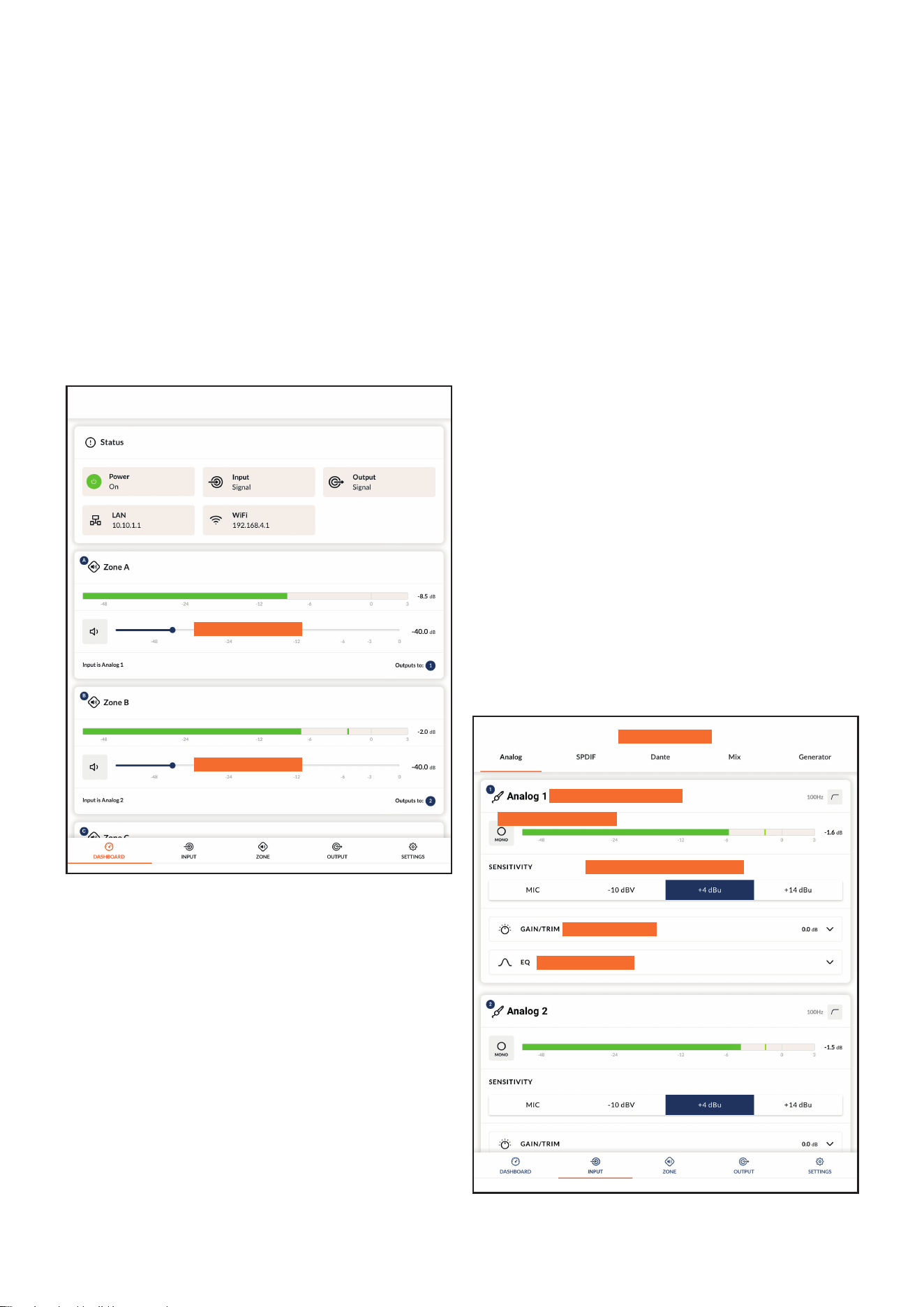
Diagram 5A
Conguration Dashboard display
Diagram 5B
Input Tab display
Input name - type to edit
Select mono or stereo
Select input sensitivity option
Adjust input gain
Open EQ window
Adjust zone volume
Adjust zone volume
Note: When adjusting input gain, the input level display should
remain green. If it displays red, the input gain should be reduced.
5.3 Conguration Menus
Opening a web browser that is network connected to
a PowerZone™ Connect amplier initially displays the
PowerZone™ Connect Control Web App Dashboard illustrated
in Diagram 5A. The Dashboard is the ‘home’ page from which all
other conguration options can be accessed.
The Dashboard displays the amplier status, output zones and
the conguration menu tabs. It also enables immediate access
to zone volume control The functions available under each
conguration menu tab are described in the following sections.
Select input type
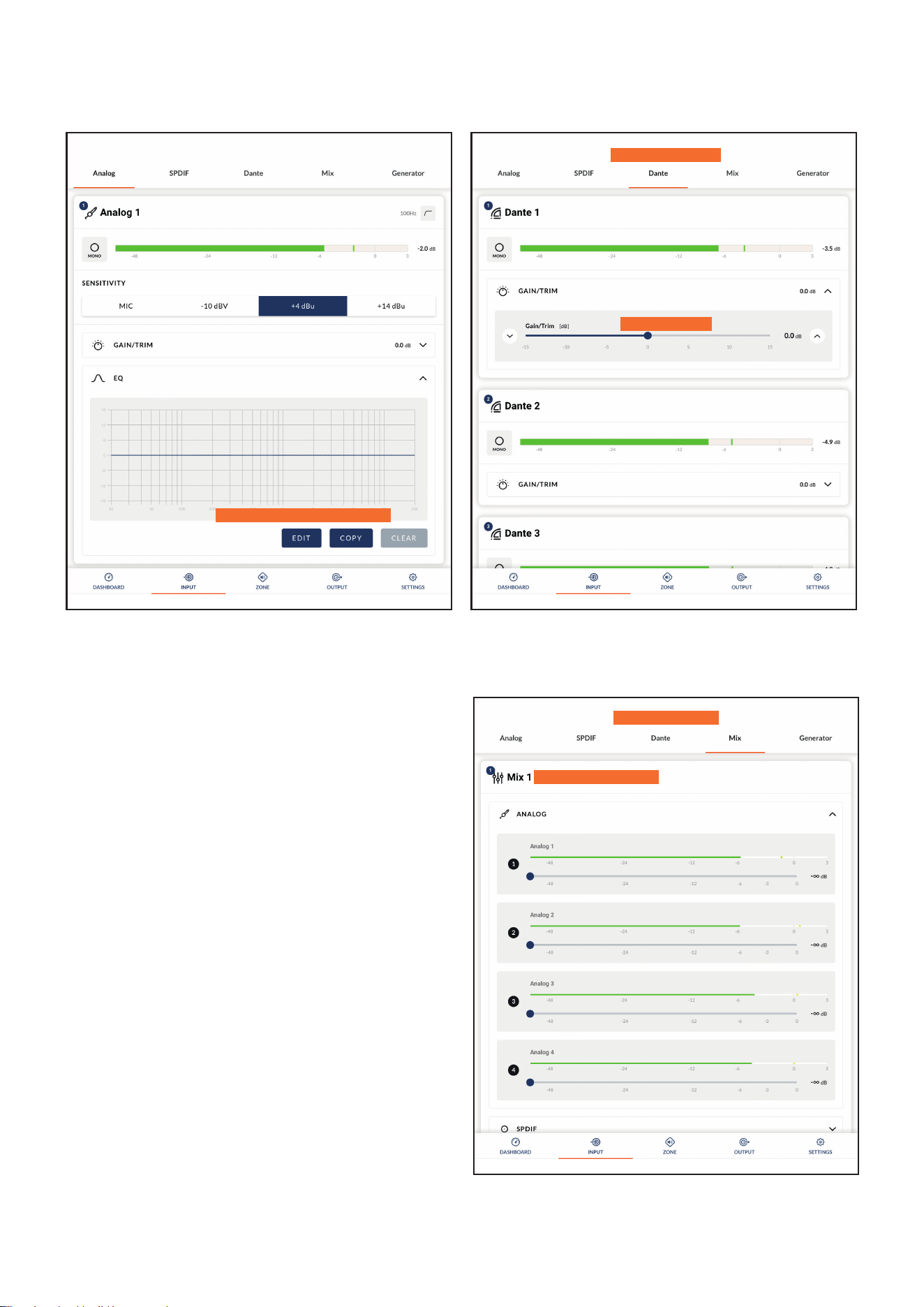
10
Diagram 5C
Input EQ display
Diagram 5D
Dante
®
Input display
Diagram 5E
Input Mix display
A pink noise or sine wave audio signal generator, appropriate
for audio system testing and set up, can also be enabled,
disabled, and adjusted for gain and frequency via the Input Tab.
Diagrams 5B, 5C, 5D and 5E illustrate the Input Tab, Dante
®
Input Tab, Input EQ and Input Mix displays respectively.
Note: The inputs displayed in the Dante
®
input tab will correspond
to those congured and enabled in the Dante
®
Controller Mac OS
or Windows application. If no inputs are displayed they must rst be
enabled in Dante
®
Controller.
5.3.2 Zone Tab
The Zone Tab enables installation zones to be dened and
named, and provides access to further sub-menus. Zones
might be bar or restaurant areas for example, or different
rooms in a home. For all Zone Tab menus, the installation zone
under conguration is selected by highlighting one of the zone
identiers (A to H depending on amplier output count) at the
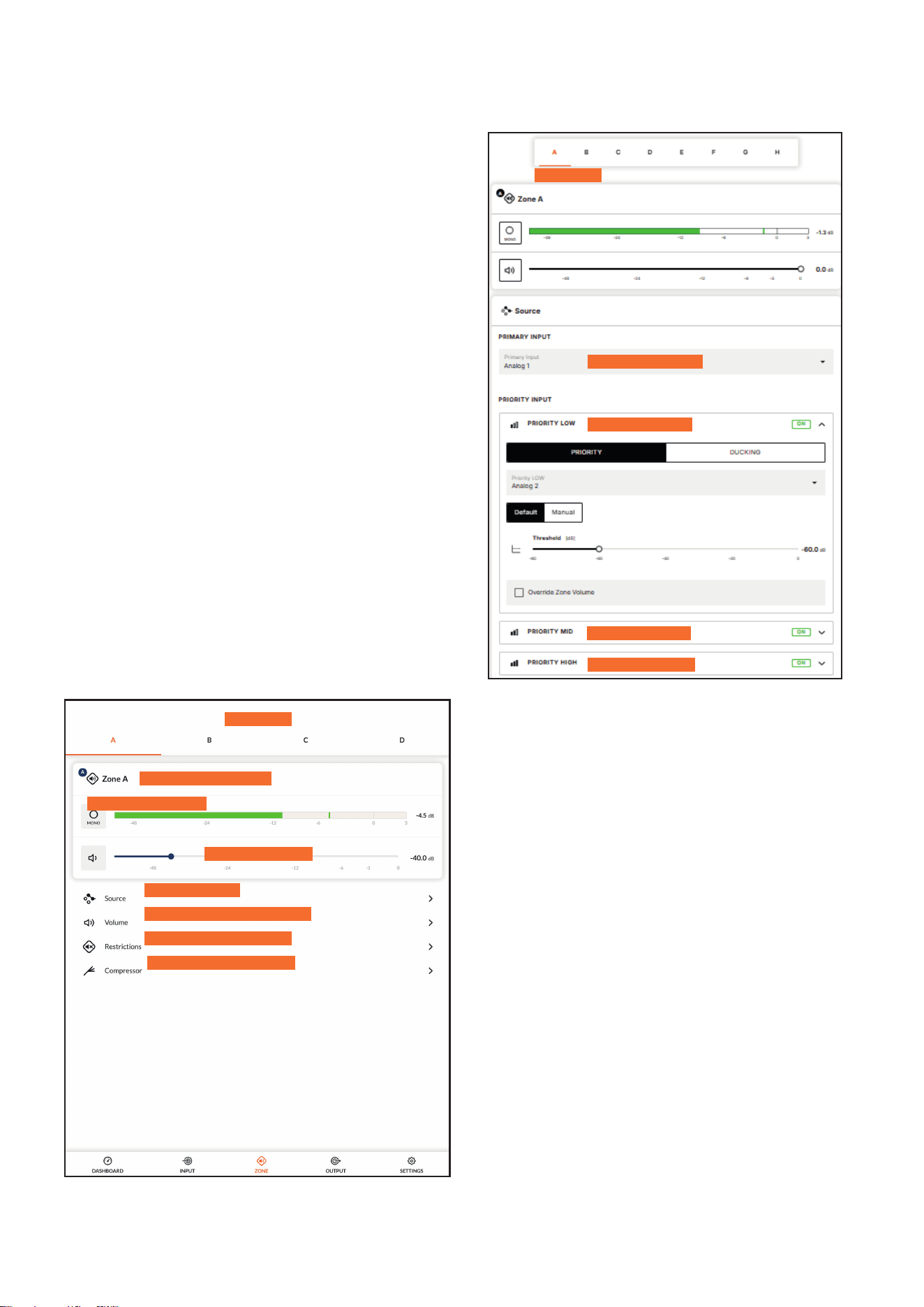
top of the display. Diagram 5F and 5G illustrates the Zone Tab
and Source menu displays.
• The Source menu enables inputs to be assigned to zones
and Input Priority or Input Ducking to be congured. The
Input Priority function enables up to three alternative
inputs to the Primary Input on each of the zones. This
provides the possibility to prioritize, replace and mute the
input(s) routed to the zone when the alternative input(s)
Select mix function
Select EDIT to apply required EQ
Mix name - type to edit
Adjust gain/trim
Conguration
Select Dante
®
input
11
Zone name - type to edit
Select zone
Select mono or stereo
Select zone input
Congure zone volume options
Congure zone restrictions
Congure zone compressor
Adjust zone volume
Diagram 5F
Zone Tab display
Conguration
exceed(s) a preset level. The Primary Input is the main
input, such as background music played in a shopping
centre. 1. Priority Low, for example commercials, takes
priority over the Primary Input. 2. Priority Mid, e.g.
paging, takes priority over both background music and
commercials. 3. Priority High, such as an emergency alarm,
takes priority over and mutes all other inputs.
The Input Ducking function enables an alternative input,
Ducking Low, to replace and attenuate the Primary Input
routed to the zone under conguration when the alternative
input exceeds a preset level.
Note: The Priority Low parameters can be either set to default
values or to its Threshold, Attack, Hold and Release values as
required (Manual). The Priority Mid and Priority High parameters
can be either set to default values or to their Threshold and Hold
values as required. All Input Priorities can also be set to ignore the
volume level set for the specied zone (Override Zone Volume).
The Ducking Low parameters can be either set to default values or
its Threshold, Depth, Attack, Hold and Release values as required.
• The Volume menu allows minimum and maximum zone
volume limits to be set, and enables external GPIO volume
control to be applied to individual zones. The GPIO
conguration menu can be found under the Settings Tab,
and notes on connecting an external volume control via the
Diagram 5G
Zone Source menu display
GPIO interface can be found in Section 5.5 of this manual.
Note: If an amplier is controlled via a third-party control system
API, volume level limits set via the Input Tab will not apply.
• The Restrictions menu enables zone inputs or input mixes
to be restricted from routing to particular zones.
Note: Routing restrictions cannot be applied to priority zone inputs.
Note: If an amplier is controlled via a third-party control system
API, input routing restrictions set via the Input Tab will not apply.
• The Compressor option enables default or custom signal
compression to be applied to individual zones.
Note: Compression can be useful to reduce the volume difference
between loud and quiet audio material. The lower the compression
threshold is set, the more the difference between loud and soft will
be reduced. The overall zone volume may need to be increased
when compression is used. The default compression parameters are
appropriate for most installations.
Select zone
Select Primary Imput
Select Priority Low
Select Priority Mid
Select Priority High
12
Conguration
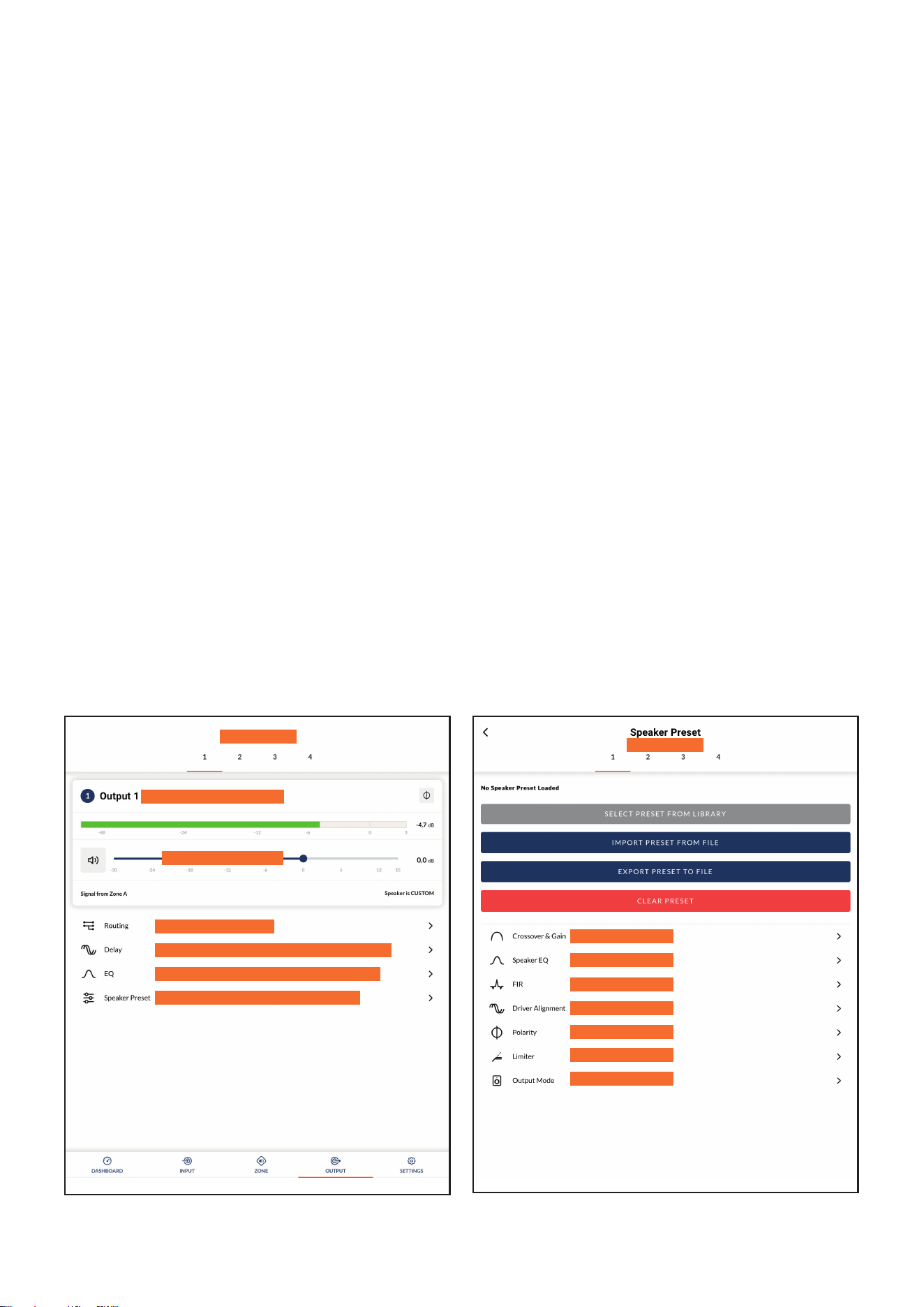
Select to congure
Select to congure
Select to congure
Select to congure
Select to congure
Select to congure
Select to congure
Diagram I
Speaker Preset Parameters
Select output
Output name - type to edit
Select output
Enable and congure output delay if required
Dene output routing
Enable and congure output EQ if required
Congure and manage speaker presets
Diagram 5H
Output Tab display
5.3.3 Output Tab
The Output Tab enables amplier outputs to be named, linked
to zones, and provides access to Delay, Room Equalizer and
Speaker Preset menus. Diagram 5H illustrates the Output Tab
display.
For all Output Tab menus, the amplier output under
conguration is selected by highlighting one of the output
identiers at the top of the display.
Note: The number of individual outputs available for conguration
will depend on the PowerZone™ Connect amplier model and the
input, zone and output mode conguration. The diagrams following
illistrate a four output amplier.
• The Routing menu enables zones to be assigned to amplier
outputs.
Note: Routing for zones specied as stereo will automatically offer
three output options: left channel, right channel or summed mono.
The summed mono signal can potentially be used to drive a mono
subwoofer or a 70/100V mono speaker line.
• The Delay menu enables delay to be applied to individual
amplier outputs.
• The Equalizer menu enables parametric equalization to be
applied to individual amplier outputs. Equalizer settings
congured for one amplier output can be copied and
applied to other outputs.
• The Speaker Preset menu enables a set of speaker
parameters to be adjusted, and preset congurations to be
created, exported, imported or cleared.
Speaker Presets can be simply applied to the selected
amplier output or imported, chosen from a library,
exported or cleared. The preset congurations can include
any or all of the parameters described in Section 5.3.4
and can be locked to prevent inadvertent modication.
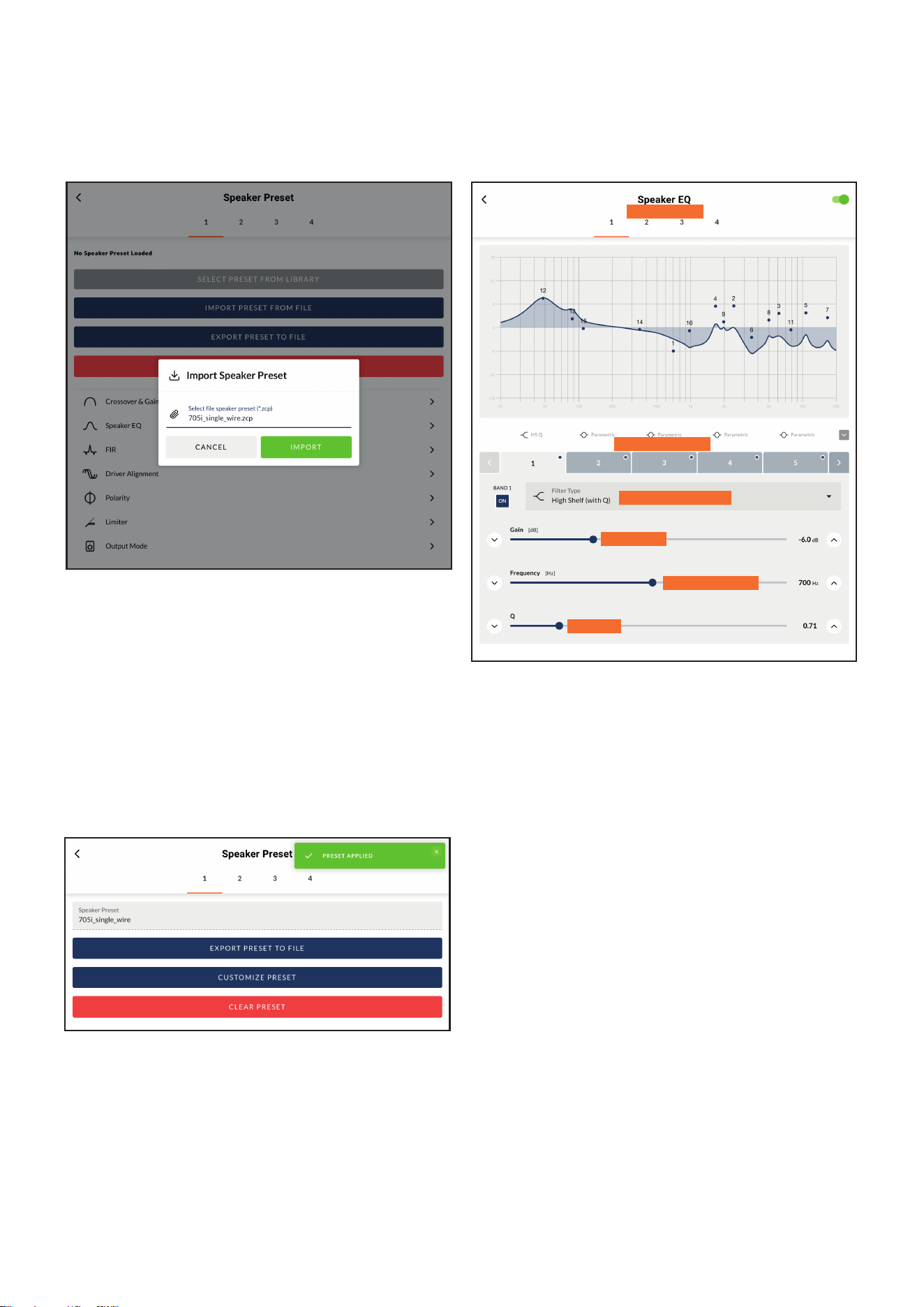
Diagrams 5I to 5L illustrate the application of speaker
presets.
Speaker Preset data provided by third parties for use with
specic speakers can be imported and applied to amplier
outputs. To import speaker preset parameters follow the
steps described below and illustrated in the diagrams.
1. Select either the IMPORT PRESET FROM
LIBRARY or SELECT PRESET FROM FILE option
from the Speaker Preset menu. If no import
option is visible, select CLEAR to delete any
existing speaker preset data.
Note: The SELECT PRESET FROM LIBRARY option will be
unavailable if no speaker preset libraries have been created. Speaker
preset library creation and management is described in Section
5.3.5.
Adjust gain if required
13
2. Select the appropriate ‘.zcp’ format speaker preset
data le to import from either a Library or a
computer folder. The preset data will be applied
to the selected amplier output as soon as the le
import is complete.
3. If the Speaker Preset data requires modication it
can be customized by selecting the CUSTOMIZE
PRESET option.
Note: If an imported Speaker Preset data le includes locked
parameters, they will be unavailable for modication.
Diagram 5J
Speaker Preset import le selection
Conguration
Diagram 5K
Speaker Preset applied
5.3.4 Speaker Preset Menu Parameters
• The Crossover & Gain preset menu enables high or low-
pass crossover lters and gain adjustment to be applied to
individual amplier outputs.
• The Speaker EQ preset menu enables parametric
equalization to be applied to individual amplier outputs.
• The FIR preset menu enables FIR (Finite Impulse Response)
based equalization lter coefcients generated by external
speaker measurement software to be imported and applied
to individual amplier outputs. The FIR lter has 512 taps at
48kHz.
Note: FIR coefcient les in either .csv or .txt format can be
imported.
• The Driver Alignment preset menu enables delay to be
applied to individual amplier outputs.
• The Polarity preset menu enables the polarity of individual
amplier outputs to be reversed.
Diagram 5L
Speaker Preset parameter adjustment
Select output
Engage EQ bands
Select band function
Adjust gain
Adjust frequency
Adjust Q
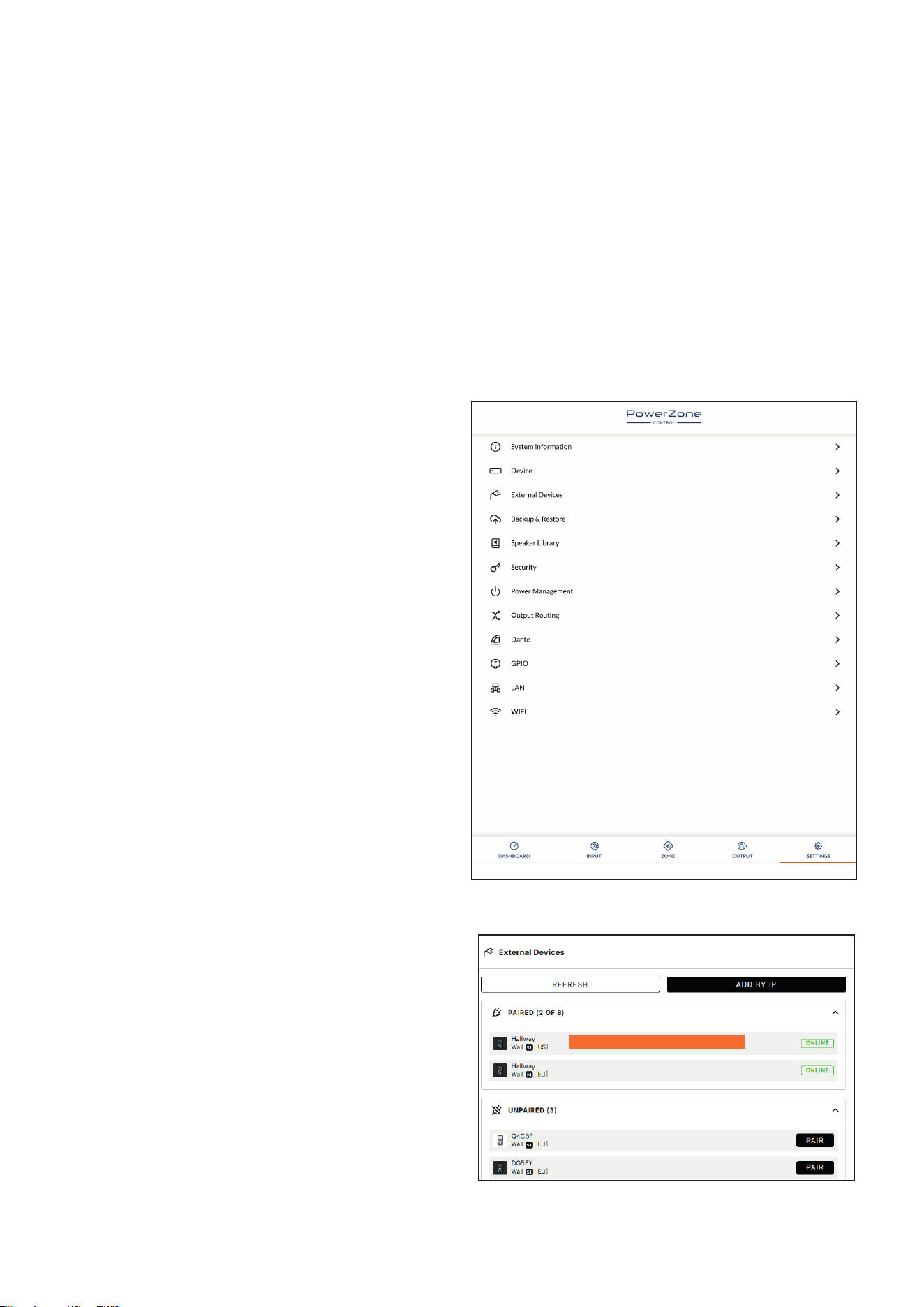
14
Conguration
Diagram 5M
Settings Tab menu
Diagram 5N
The External Devices display
• The Limiter preset menu enables signal limiting to be
engaged or bypassed on individual amplier outputs. Clip
limiting, Peak limiting and RMS limiting can be individually
or collectively engaged. The Clip limiting function offers
Fast and Normal response time options. The Peak limiting
function can be set to either Automatic or Manual
parameter values. The RMS Limiter has default parameter
values that can be adjusted but has no automatic option.
Note: It is strongly advised that if an amplier is driving low
impedance loads (<4Ω) the Clip Limiter should be engaged and set
to Fast.
Note: In automatic mode, the peak limiter parameters adjust
automatically in response to Crossover & Gain high-pass lter
settings.
• The Output Mode preset menu enables individual
amplier outputs to be switched off or congured for Lo-Z
or Hi-Z modes. In Hi-Z modes, a high-pass lter can also
be congured and applied to the output. The number of
outputs available will depend on the amplier model, input
setup and zone setup. For example, a two output amplier
will have two outputs available if Lo-Z mode is selected but
only one output available if Hi-Z mode is selected.
Note: Use of a high-pass lter with Hi-Z mode loudspeakers is useful
to avoid the possibility of distortion caused by low frequency line
transformer saturation. Begin with the default lter setting of 70Hz.
If low frequency distortion is still audible, increase the frequency
setting one step at a time until the distortion is no longer audible.
5.3.5 Settings Tab
The Settings Tab enables miscellaneous amplier settings to be
congured and installation data to be recorded. The Settings
Tab provides access to further sub-menus. Diagram 5M
illustrates the Settings Tab.
• The System Information menu provides text elds for the
recording of installation data.
• The Device menu records amplier specic information
such as the model number and rmware version. A rmware
update routine and identier button can also be found
under the Device menu.
External device - tap to congure
15
Conguration
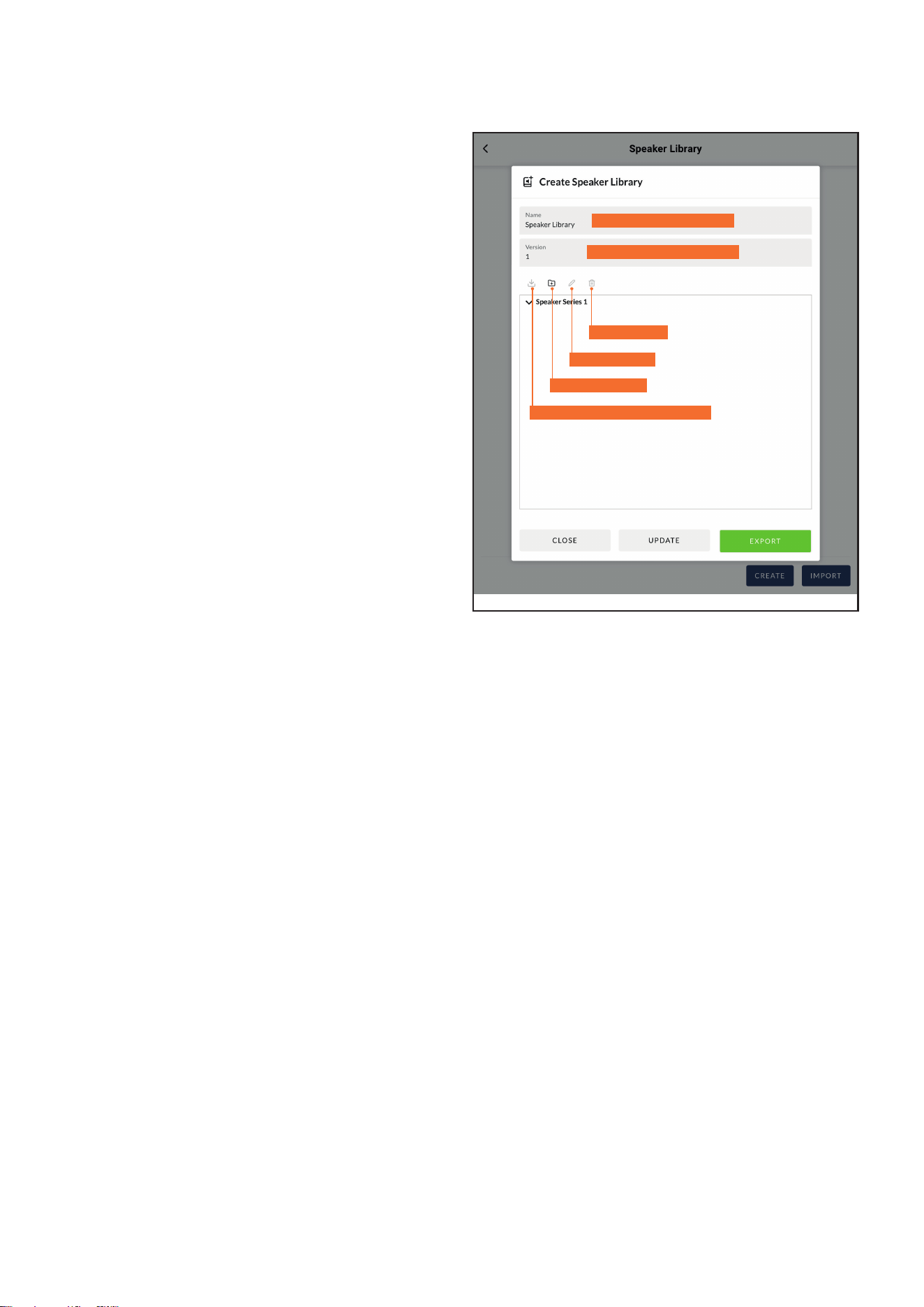
Diagram 5O
Speaker Library Creation and Management
Library name - type to edit
Library version - type to edit
Import preset data (.zcp) to library
Creat new library
Rename library
Delete library
• The External Devices menu enables control panels to be
paired with an amplier and congured. Depending on
product, setup and conguration, each device can remotely
control one single or multiple amplier zones. Diagram 5N
illustrates the External Devices display.
• The Backup & Restore menu enables amplier
conguration data to be downloaded to an external archive,
and enables previously saved conguration les to be
uploaded and adopted by the currently connected amplier.
• The Speaker Library menu enables management of speaker
preset libraries. Existing libraries of speaker preset les
(.zcl) can be created or imported, and existing libraries
edited or fully deleted. Diagram 5O illustrates the creation
and management of speaker preset libraries.
• The Security menu enables a password to be set in order
to protect against unauthorised access to the amplier
Control Web App. Password protection is particularly
important when an amplier is connected to a wired
network as the a WiFi password is no longer required to
gain access to Control Web App.
Note: It is recommended that a Control Web App password is
different from that required to gain access to the amplier via WiFi.
• The Power Management menu enables various automatic
switch-on options to be engaged. The Power Management
menu also offers timed Standby and Mute functions.
Note: In Eco mode the network is switched off during standby. When
the amplier has Dante
®
enabled use the Audio (Digital) or Network
Only settings.
• The Output Routing menu enables specied inputs or zones
to be routed to the amplier S/PDIF outputs. The output
level can also be adjusted.
Any zone or input can be routed to either digital output,
including inputs not actively assigned to a zone. Primary
or priority input status is immaterial. The specied input is
always routed to the specied output to be available for use
by downstream devices.
Note: When a zone is selected for the digital S/PDIF (or Dante
®
)
output - the output signal is variable. However, when an input signal
is routed out an S/PDIF (or Dante
®
) output, the signal will be xed.
Note: The digital output function is especially useful when ampliers
are to be daisy chained and a specic input; a central paging mic, for
example, is required to be routed to multiple ampliers.
• The Dante
®
menu enables identication of Dante
®
capable
devices present on the AoIP network. Dante
®
devices must
be appropriately enabled and congured using the Dante
®
Control app. Use Dante
®
Controller to activate AES67
mode if required.
• The GPIO menu enables conguration of the multi-purpose
GPIO interface pins. A description of the individual settings
is detailed in PowerZone™ Connect Control.
• The LAN menu enables conguration and reset of the wired
network options and parameters.
• The WiFi menu enables conguration and reset of the
wireless network options and parameters.
5.4 Setup and Signal Routing
Thanks to their network based conguration features,
PowerZone™ Connect ampliers offer considerable versatility
in terms of sources, signal routing, installation zones and output
modes. Inputs can be freely assigned to installation zones, and
those zones assigned freely to the available amplier outputs in
either Lo-Z or Hi-Z modes.
This versatility enables, for example, one amplier
simultaneously to drive both Lo-Z and Hi-Z speakers, or for
different inputs to be routed to different output zones.
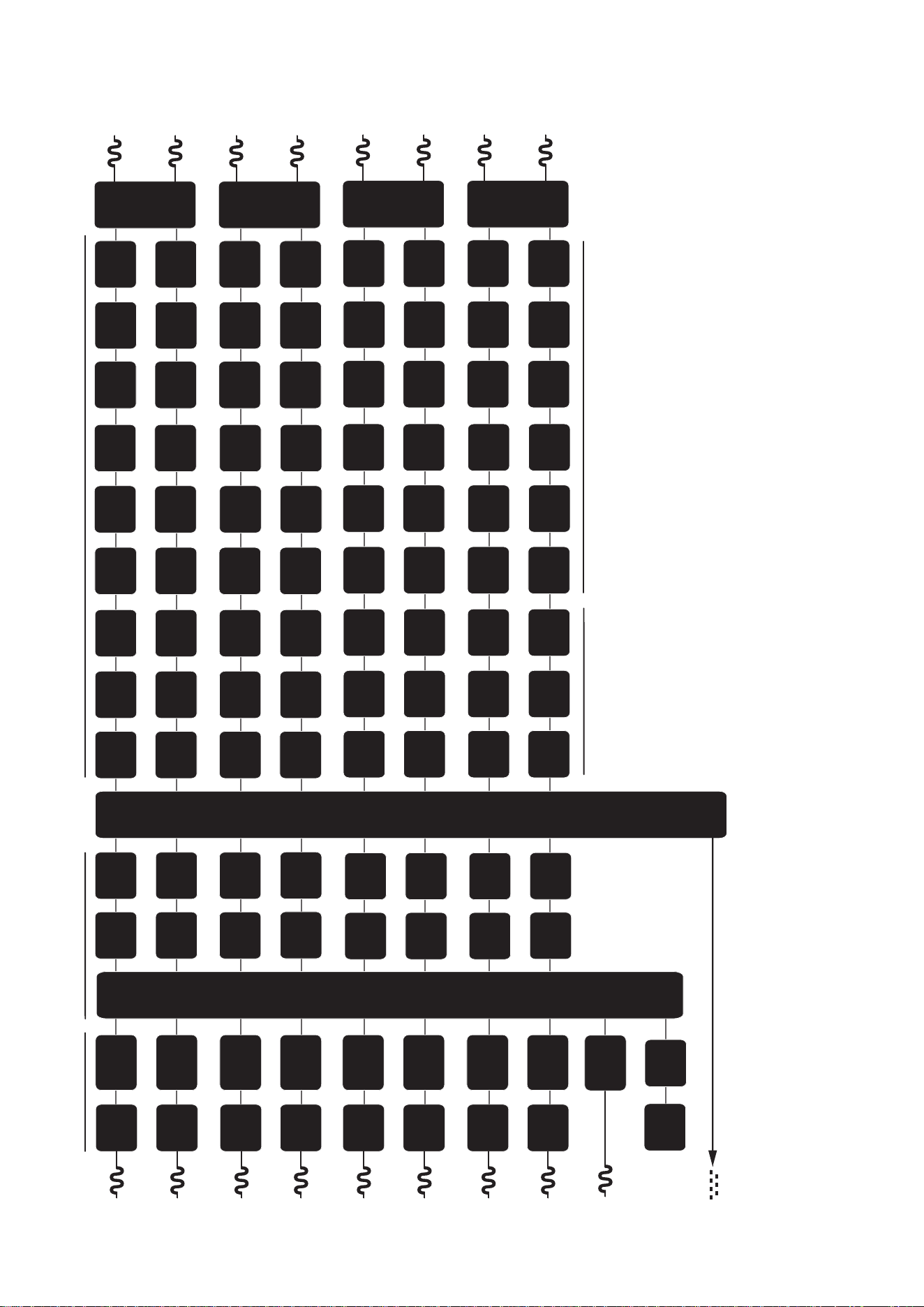
The following paragraphs describe and illustrate the
recommended procedure for conguring input, zone and
output routing. A general signal ow schematic is also
illustrated in Diagram 5P.
16
Conguration
Diagram 5P
Signal Flow Schematic
(eight output amplier)
Analog 3
Output
Matrix
Zones A - D
Outputs 1 - 8
Analog 2
Input
Sensitivity
Analog 1
Input
Gain
Input
Sensitivity
Input
Gain
Input
Sensitivity
Input
Gain
Analog 4
SPDIF (stereo)
SPDIF Out (any two input or zone signals).
Pink Noise
Gain
Delay
Level
Adjustment
Level
Adjustment
Level
Adjustment
Level
Adjustment
Compressor
Compressor
Compressor
Compressor
Level
Adjustment
Level
Adjustment
Level
Adjustment
Level
Adjustment
Compressor
Compressor
Compressor
Compressor
Delay
Delay
Delay
EQ
EQ
EQ
EQ
EQ
EQ
EQ
EQ
FIR
FIR
FIR
FIR
Polarity
Polarity
Polarity
Polarity
Limiter
BTL
Amplifier
2 x Low-Z
1 x Hi-Z
BTL
Amplifier
2 x Low-Z
1 x Hi-Z
Limiter
Limiter
Limiter
Driver
Alignment
Driver
Alignment
Driver
Alignment
Driver
Alignment
Crossover
Crossover
Crossover
Crossover
Gain Trim
Gain Trim
Gain Trim
Gain Trim
Input
Sensitivity
Input
Gain
Analog 7
Analog 6
Input
Sensitivity
Analog 5
Input
Gain
Input
Sensitivity
Input
Gain
Input
Sensitivity
Input
Gain
Analog 8
Input
Sensitivity
Input
Gain
Input
Selection
Input Setup
Zone Setup & Routing
Output Setup
Output 1
Output 2
Output 3
Output 4
Delay
Delay
Delay
Delay
EQ
EQ
EQ
EQ
EQ
EQ
EQ
EQ
FIR
FIR
FIR
FIR
Polarity
Polarity
Polarity
Polarity
Limiter
BTL
Amplifier
2 x Low-Z
1 x Hi-Z
BTL
Amplifier
2 x Low-Z
1 x Hi-Z
Limiter
Limiter
Limiter
Driver
Alignment
Driver
Alignment
Driver
Alignment
Driver
Alignment
Crossover
Crossover
Crossover
Crossover
Gain Trim
Gain Trim
Gain Trim
Gain Trim
Output
5
Output 6
Output 7
Output 8
Zone Adjustment Parameters
Speaker Preset Parameters
Input
Gain
Input
Gain
Input
Gain
Input
Gain

17
Conguration
5.4.1 Input Setup
Open the conguration Dashboard and select the Input Tab.
The Input Tab is shown in Diagram 5B.
• To edit default input names simply select and type in the
Input Name eld.
• Dene a mono or stereo input by selecting the appropriate
option. Dening a stereo input will reduce the total number
of discrete inputs available.
• Select an input sensitivity option from the drop-down
menu: +14dB, +4dB, -10dB and ‘microphone’ options
are available. Generally, the +14dB or +4dB options are
appropriate for ‘professional audio’ source hardware
with balanced outputs, while the -10dB option is more
appropriate for ‘consumer audio’ source hardware with
unbalanced outputs. The ‘microphone’ option provides the
signicantly greater sensitivity required for microphones.
Note: Only dynamic microphones are suitable for connection.
Phantom power for condenser microphones is not provided.
• If necessary, adjust the input gain using the slider or up/
down icons. Gain adjustment is intended to be used for ne
output level adjustment following initial use. If necessary,
adjust the input EQ using the 5 band equalizer.
5.4.2 Zone Setup & Routing
Open the conguration Dashboard and select the Zone Tab.
The Zone Tab is shown in Diagram 5F.
• Select the zone to be congured. The number of zones
available and their channel format (stereo or mono) will
depend on the amplier model, input setup and output
mode (Lo-Z or Hi-Z). For example, a two output amplier
can have the following zone congurations:
• 1 x stereo Lo-Z zone
• 2 x mono Lo-Z zones
• 1 x mono Hi-Z or Lo-Z BTL zone
• A four output amplier can have the following zones
congured:
• 2 x stereo Lo-Z zones
• 4 x mono Lo-Z zones
• 2 x mono Hi-Z or Lo-Z BTL zones
• 1 x mono Hi-Z or Lo-Z BTL zone + 1 x stereo Lo-Z zone
• 1 x mono Hi-Z or Lo-Z BTL zone + 2 x mono Lo-Z zones
• An eight output amplier can have the following zones
congured:
• 4 x stereo Lo-Z zones
• 8 x mono Lo-Z zones
• 4 x mono Hi-Z or Lo-Z BTL zones
• 2 x mono Hi-Z or Lo-Z BTL zones + 2 x stereo Lo-Z zone
• 2 x mono Hi-Z or Lo-Z BTL zones + 4 x mono Lo-Z zones
Note: When congured in Hi-Z or Lo-Z BTL mode PowerZone™
Connect ampliers operate in ‘bridged’ mode where the output of
two channels is combined. This means that the number of output
channels available in Hi-Z mode is half that available in Lo-Z mode .
Note: Mono signals might be mono at source, created though
combining the left and right channels of a stereo signal (summed
mono) or treating the left and right channels of a stereo signal
independently (split mono).
• Name zones by typing in the Zone Name eld.
• Adjust the zone volume if required by using the slider.
• Dene a mono or stereo zone by selecting the appropriate
option. Dening a stereo zone will reduce the total number
of further zones available.
• Specify an input for the zone by selecting from the drop-
down menu. Selecting a stereo input for a mono zone will
automatically sum the stereo channels to mono.
18
Conguration
5.5 GPIO Setup and Connection
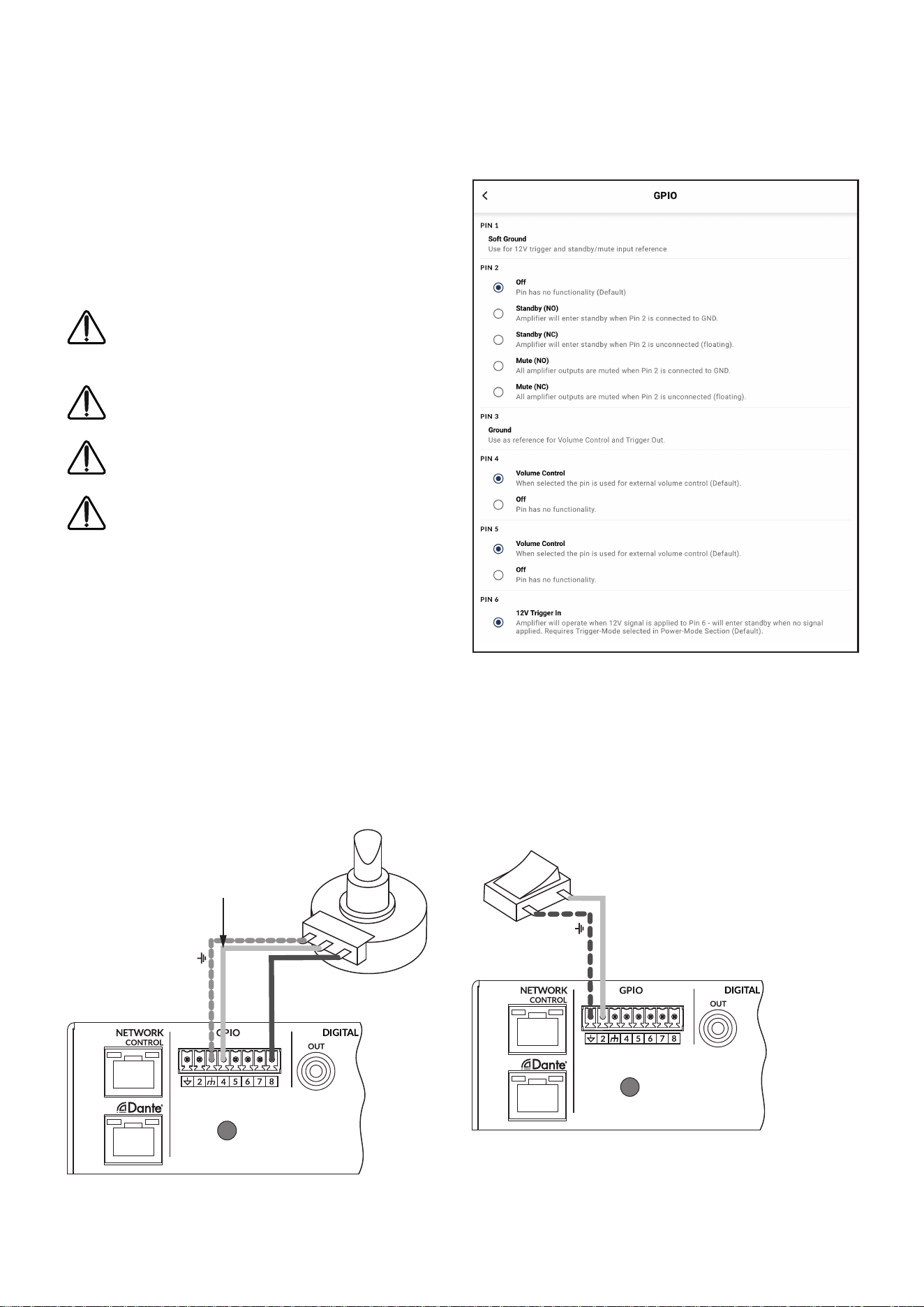
PowerZone™ Connect ampliers provide a GPIO socket that
enables remote control of volume, standby, mute and trigger
functions. The GPIO connector pin functions are described
in the GPIO Settings menu illustrated in Diagram 5Q. The
connection of GPIO based remote volume control and
standby/mute are illustrated in Diagram 5R and Diagram 5S
respectively.
Note: The GPIO connector must not be used for any
unintended purpose. Amplier damage may result from
incorrect use of GPIO.
Note: Shielded cable must be used when connecting standby
switches and potentiometers via GPIO.
Note: GPIO Pin 8 has a low output impedance and is able to
supply a maximum current of 10mA.
Note: GPIO Pin 1 and Pin 3 both offer ground connections:
Pin 1 is connected directly to the amplier chassis.
Pin 3 is connected to the chassis via a 220 Ohm resistor. The ‘soft
ground’ connection of Pin 3 is potentially useful for managing
ground loops that may cause audible hum.
Diagram 5Q
GPIO Settings Menu
Diagram 5R
Potentiometer connections for remote vol-
ume control via GPIO.
Note: Diagram 6E illustrates
use of the GPIO connector.
Diagram 5S
Connections for remote
standby/mute switch via GPIO.
Note: Diagram 6E illustrates
use of the GPIO connector.
Ground
+3V3
Ground
Standby/Mute
Potentiometer
(>10kΩ)
Connect Wiper to
Pin 4, 5, 6 or 7.
Switch open (NO) or closed
(NC) toggles Standby or
Mute depending on options
selected in the GPIO
Settings Menu

19
Connections
6. Connections
PowerZone™ Connect amplier rear panel connections
are illustrated in Diagrams 6A and 6B.
6.1 Mains Power Connection
PowerZone™ Connect ampliers incorporate a power factor
corrected universal power supply and can be used with mains
input voltage from 100V AC to 240V AC, 50/60Hz. Use the
mains cable supplied with the amplier.
PowerZone™ Connect ampliers incorporate a front panel
mounted power button. Press the button once to switch the
amplier on or off. Ensure that all signal, GPIO and output
connections are made before switching on the amplier.
6.2 Input Connection
All PowerZone™ Connect amplier models provide four or
eight balanced or unbalanced analog audio inputs and a stereo
S/PDIF digital audio input. Any input channel can be routed to
any output channel. Input routing options can be congured via
the Control Web App Input Tab. See Section 5 of this manual.
Analog Inputs
PowerZone™ Connect analog inputs are of line level format
with a default input sensitivity of +4dBu (full output voltage
swing/sensitivity) in all output modes. Depending on the
selected sensitivity, the inputs can handle up to +24dBu
without clipping. Input sensitivity options can be set via the
Control Web App Input Tab. See Section 5 of this manual.
Balanced input connections to the ampliers are made via male
‘Euro Block’ connectors. Connecting cables to the supplied
female input connectors is illustrated in Diagrams 6C and 6F
for two/four, and eight output ampliers respectively.
Unbalanced input connections to the ampliers are made via
RCA phono sockets connected in parallel with the balanced
inputs.
Digital Outputs
PowerZone™ Connect Connect S/PDIF stereo digital audio
output connections are made via a single RCA Phono socket.
The S/PDIF output signal can be routed from any input or zone
and is intended to be used for daisy-chaining PowerZone™
Connect ampliers.
Note: See the Output Routing paragraphs of Section 5.3.3 for more
information on Digital Output conguration.
Note: 75Ω RCA Phono cables specically intended for digital audio
should always be used for S/PDIF connections. Standard Phono
cables can be used but may not result in optimal performance.
Note: The S/PDIF output level is by default set at -10dB to reduce
the possibility of downstream input clipping.
6.3 Output Connections
Output connections from the ampliers are achieved via male
‘Euro Block’ connectors. Ensure that speaker connection
polarity is correct throughout the installation:
In the case of Lo-Z speaker connections, positive (+) amplier
terminals should always be connected to positive speaker
terminals and negative (–) amplier terminals always connected
to negative speaker terminals.
In the case of Hi-Z speaker connections, the two speaker cable
conductors should be connected between the positive (+)
terminal of Output 1 and the negative terminal (-) of Output 2,
and likewise for Outputs 3 and 4.
Output mode options (Lo-Z or Hi-Z or Lo-Z BTL ) can be
congured via the Control Web App Input Tab. See Section 5 of
this manual.
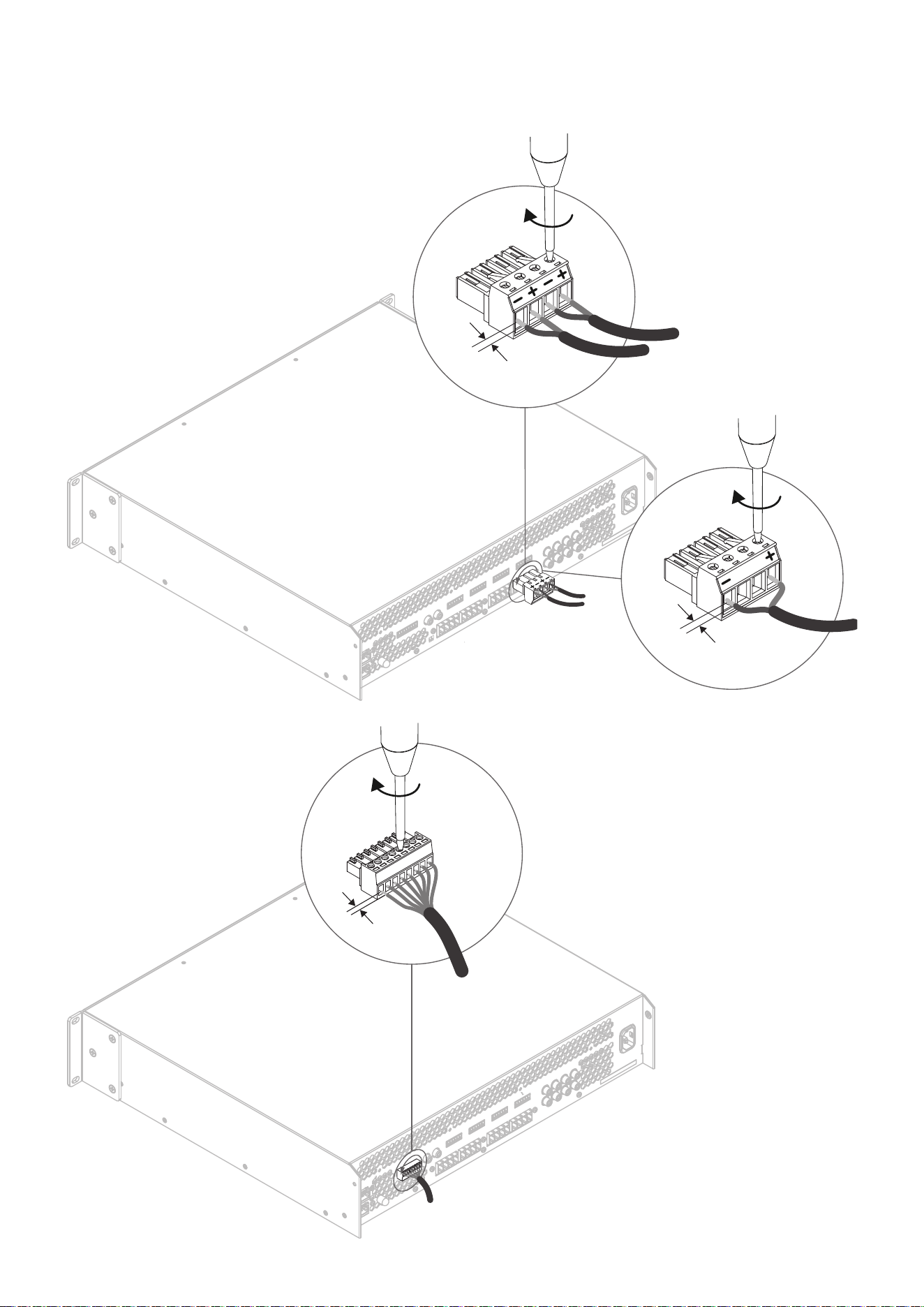
Connecting cables to the supplied female output connector
is illustrated in Diagrams 6D and 6G for two/four, and eight
output ampliers respectively..
The exclamation point printed next to the output terminals of the ampliers is, in addition to the CLASS 2
WIRING text, intended to alert users to the risk of hazardous voltages. Output connectors that could pose a risk
are marked with the exclamation point. Do not touch the output terminals while the amplier is switched on.
Make all connections with the amplier switched off.
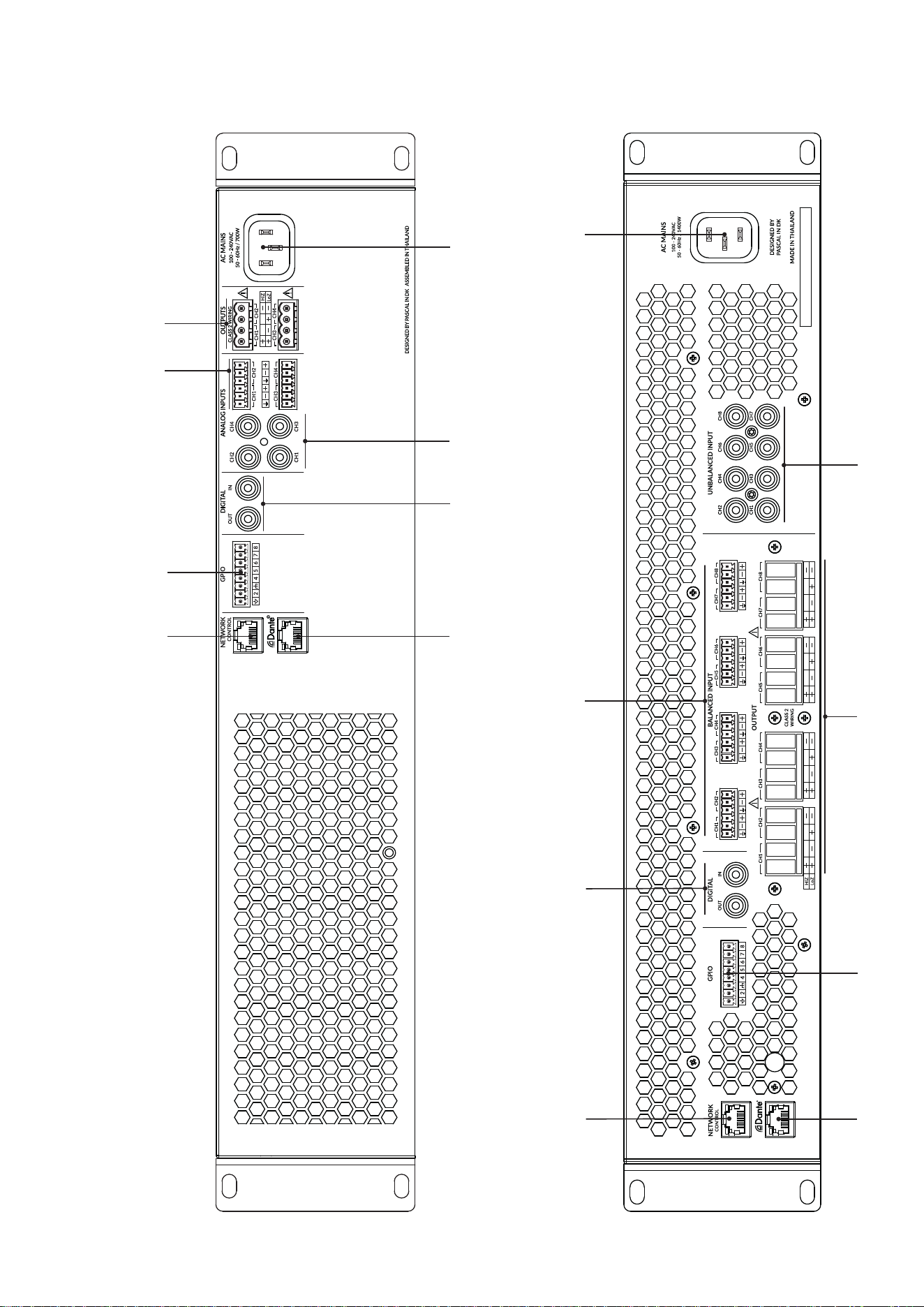
20
Connections
Dante
®
(optional)
Dante
®
(optional)
Network
Control
Congurable
GPIO
S/PDIF
Audio I/O
Audio Inputs
Balanced: Euroblock
Congurable
Speaker Outputs
Mains
Power Input
Mains
Power Input
Audio Inputs
Unbalanced: RCA Phono
Network
Control
Congurable
GPIO
Audio Inputs
Unbalanced: RCA Phono
S/PDIF
Audio I/O
Audio Inputs
Balanced: Euroblock
Congurable
Speaker Outputs
Diagram 6A
PowerZone™ Connect
two and four output
rear panel connections.
Note: Two output
amplier model
connection sockets differ
only in the deletion of
channel 3 and channel 4 output connectors.
Diagram 6B
PowerZone™ Connect
eight output rear
panel connections.
21
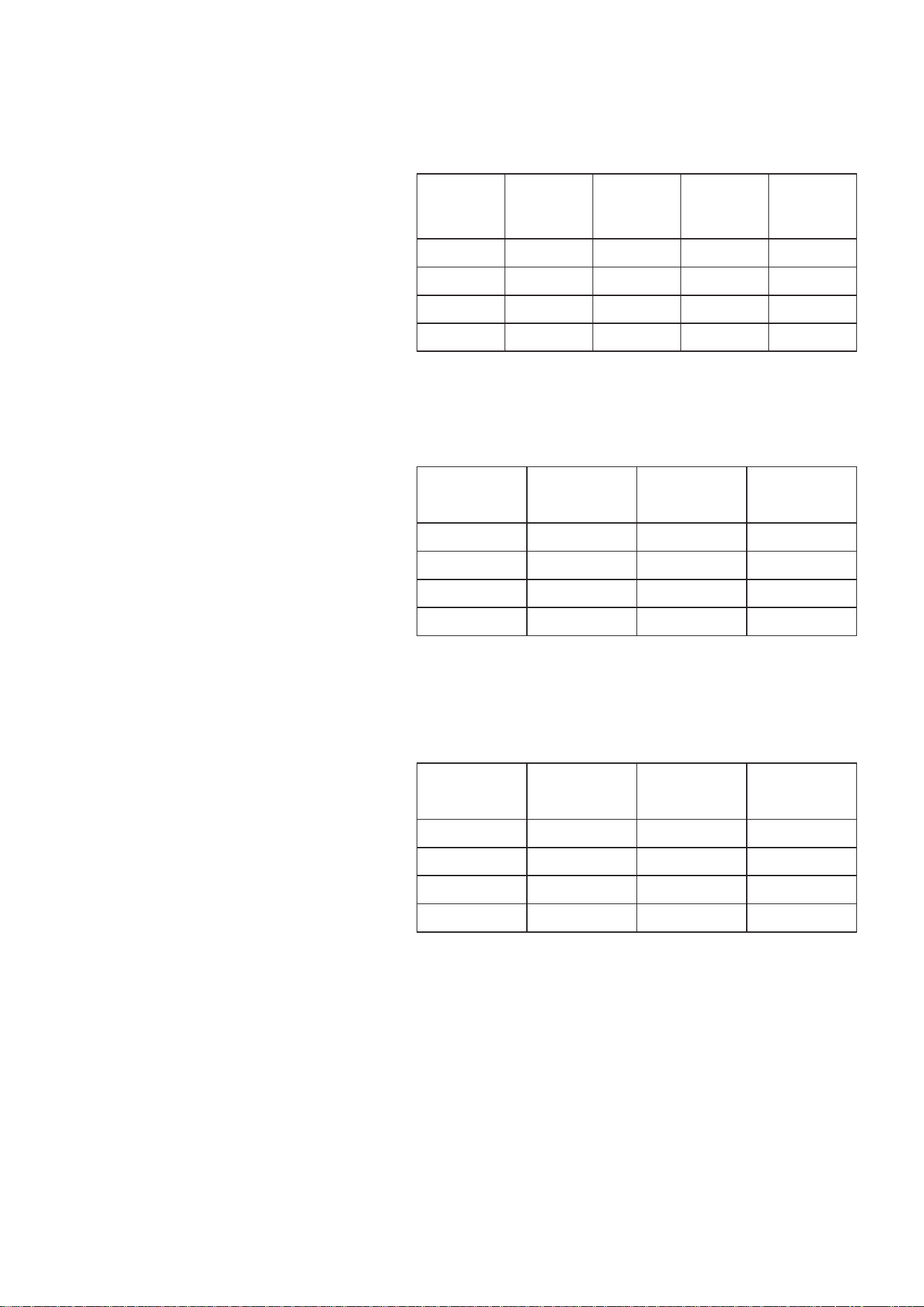
Cable Gauge Table
Lo-Z installations, 0.5dB attenuation. 2 Ω, 4 Ω & 8 Ω loads
Cable Gauge Table
70V Hi-Z installations, 1.0dB attenuation
20 speakers evenly distributed
Cable Gauge Table
100V Hi-Z installations, 1.0dB attenuation
20 speakers evenly distributed
Cable Cross
Section
(mm
2
)
Cable Gauge
(AWG)
Max Cable
Length
(Metres, 2 Ω
load)
Max Cable
Length
(Metres, 4 Ω
load)
Max Cable
Length
(Metres, 8 Ω
load)
0.75 ≈18 N/A 5 10
1.5 ≈16 5 10 20
2.5 ≈14 8 17 35
4.0 ≈12 14 28 55
Cable Cross
Section
(mm
2
)
Cable Gauge
(AWG)
Max Cable Length
(Metres),
(1000 W/channel)
Max Cable Length
(Metres),
(1200 W/channel)
0.75 ≈18 25 20
1.5 ≈16 50 40
2.0 ≈14 80 60
3.5 ≈12 125 100
Cable Cross
Section
(mm
2
)
Cable Gauge
(AWG)
Max Cable Length
(Metres),
(1000 W/channel)
Max Cable Length
(Metres),
(1500 W/channel)
0.75 ≈18 50 30
1.5 ≈16 100 60
2.0 ≈14 160 100
3.5 ≈12 250 160
Connections
6.4 Speaker Cable Gauge
PowerZone™ Connect speaker connection cable
gauge should be chosen appropriately to reect the
type of installation. The adjacent tables specify the
appropriate cable gauge and maximum cable length for
less than 0.5dB cable loss in Lo-Z mode and less than
1.0dB cable loss in Hi-Z mode.
6.5 GPIO Connections
If any PowerZone™ Connect GPIO functionality is
required, cables will need to be connected to the
supplied GPIO connector. Connecting cables to the
GPIO connector is illustrated in Diagrams 6E and 6H
for two/four, and eight output ampliers respectively..
6.6 Network Connections
PowerZone™ Control
PowerZone™ Connect ampliers are TCP/IP network
connected devices that are congured via a web
page based interface. Wired (Ethernet) and wireless
(WiFi) connection options are available. Connecting
PowerZone™ Connect ampliers to a TCP/IP network
is described in Section 5 of this manual. If a wired
connection is used, connect an Ethernet cable to the
amplier rear panel Network Control socket.
Audinate Dante
®
PowerZone™ Connect two and four output ampliers
are optionally compatible with Audinate Dante
®
audio
over IP (AoIP) networks and installations. Connect to
a Dante
®
network via the amplier rear panel Dante
®
socket and congure the network as required using
the Audinate Dante
®
Controller Mac OS and Windows
application available for download from:
www.audinate.com/products/software/dante-
controller.
22
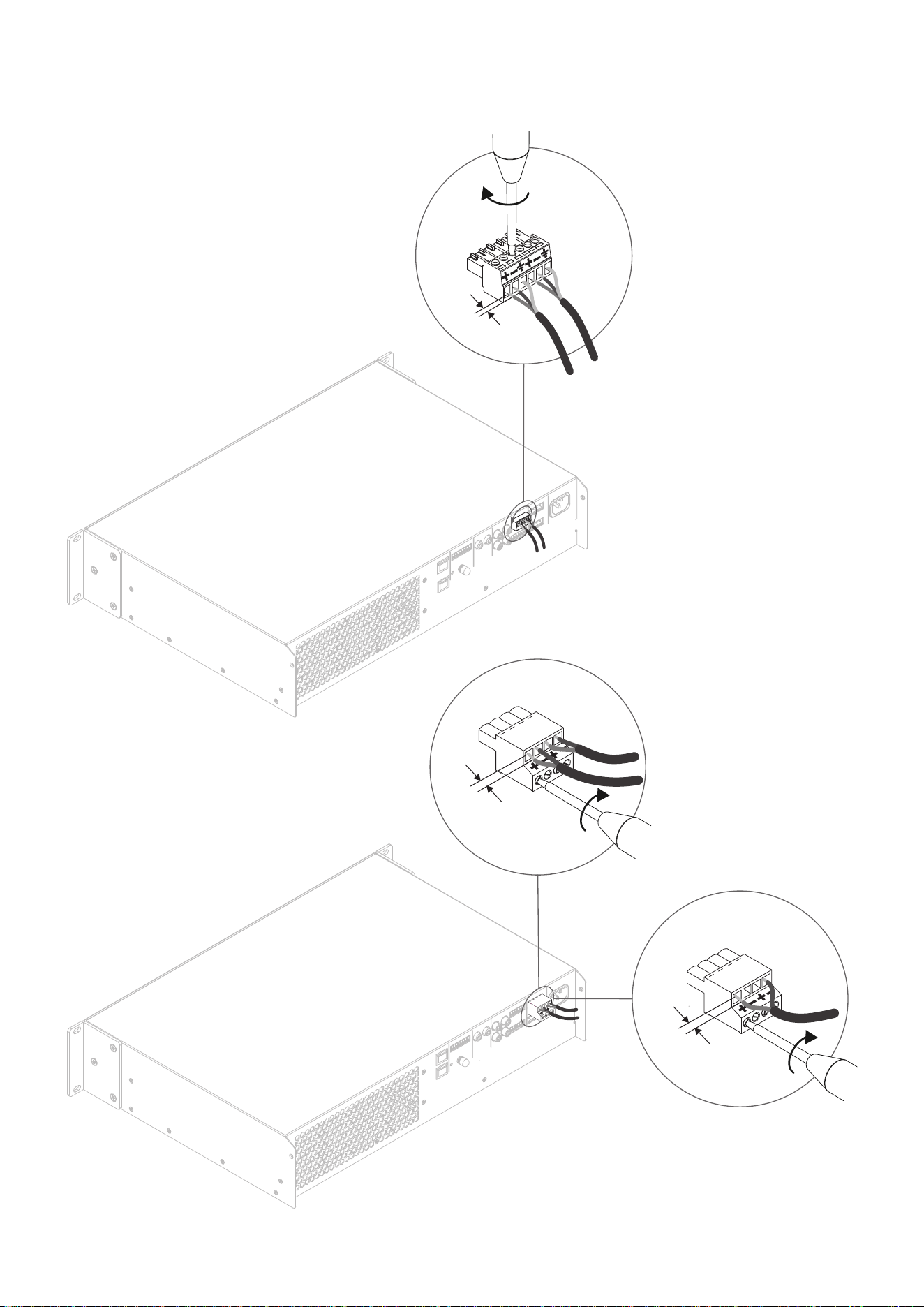
Low-Z Mode
Hi-Z/BTL
Modes
5 mm
5 mm
5 mm
Connections
Diagram 6C
Two and four output amplier balanced
analog input cable connections.
Diagram 6D
Two and four output amplier
Output cable connections.
Note: Eight channel ampliers
employ a larger output connector.
23
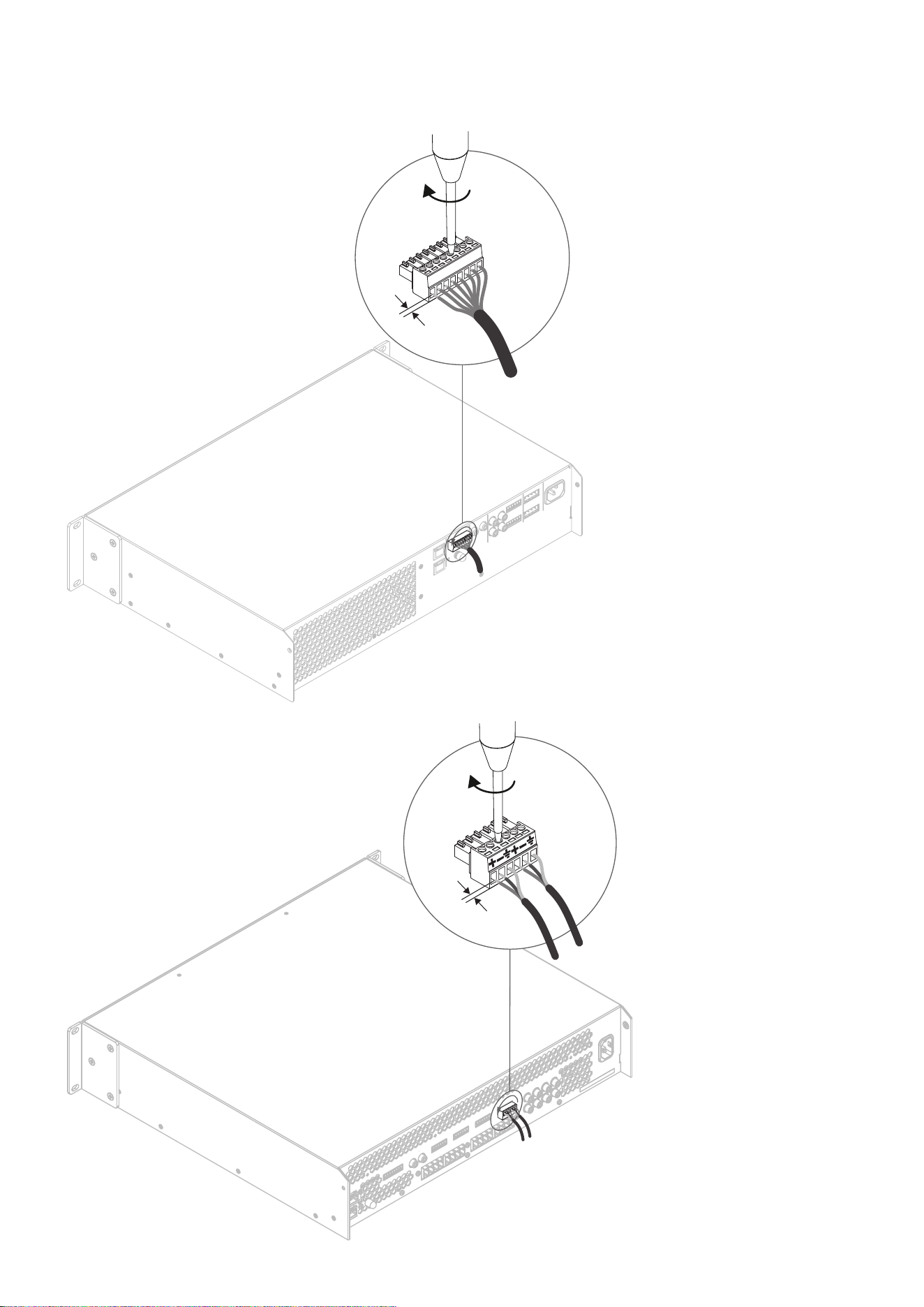
5 mm
Diagram 6E
Two and four output amplier
GPIO cable connections.
Connections
5 mm
Diagram 6F
Eight output amplier balanced analog input
cable connections.
24
Diagram 6H
Eight output amplier GPIO
cable connections.
Connections
Low-Z Mode
5 mm
Hi-Z/BTL Mode
5 mm
Diagram 6G
Eight output amplier Output
cable connections.
5 mm
Note: Two and four channel ampliers
employ a smaller output connector.

25
Operation
7. Operation
Once all connections have been made and conguration
options selected, PowerZone™ Connect ampliers
are ready for use. If an input signal above -60dB is
present on any input, the front panel Input and Standby
indicators will illuminate green to indicate normal
amplier operation. Audio will be heard from any
connected speakers.
Note: PowerZone™ Connect ampliers will by default not wake
from Standby Mode unless an input signal is present, a network ‘ON’
command is received, or an external standby switch (or 12V trigger)
is operated. Standby behaviour can be congured via the Power
Management menu of the Control Web App Settings Tab.
Amplier outputs will mute if no input signal is present for 5
minutes, and the amplier will switch automatically to Standby
Mode if no signal is present on any input for more than 15
minutes. Alternative standby and mute delay times can selected
via the Settings Tab. Amplier cooling fan speed is temperature
controlled. The fan will switch off when the amplier enters
standby mode.
7.1 Front Panel Indicators
PowerZone™ Connect amplier front panel indicators illumi-
nate to indicate the following operational states:
Status: Off – Mains power disconnected.
Green – Amplier operational.
Pulse Green – Standby Mode.
Amber – GPIO triggered Standby Mode
Input: Off – No input signal present.
Green – Signal present on one or more inputs.
Amber – Signal limiting/clipping on one or more
inputs.
Output: Off – No output signal present.
Green – Signal present on one or more outputs.
Amber – Signal limiting/clipping on one or more
outputs.
Red – One or more channel pair is in
overload/protection mode.
Network: Off – No Ethernet network detected.
Green – Ethernet network detected.
WiFi: Off – WiFi disabled.
Green – WiFi enabled.
7.2 Default Reset
PowerZone™ Connect ampliers can be returned to their
default settings via either the Control Web App Settings Tab or
through the front panel power button.
To reset the amplier using the front panel power button,
follow the steps below:
• Disconnect the amplier from mains power.
• Press and hold the front panel power button while
simultaneously reconnecting mains power.
• Continue to hold the front panel power button for 3 to 5
seconds as the amplier restarts.
The amplier will restart with all settings at their default state.
Any previously congured settings will be deleted.

26
Specications
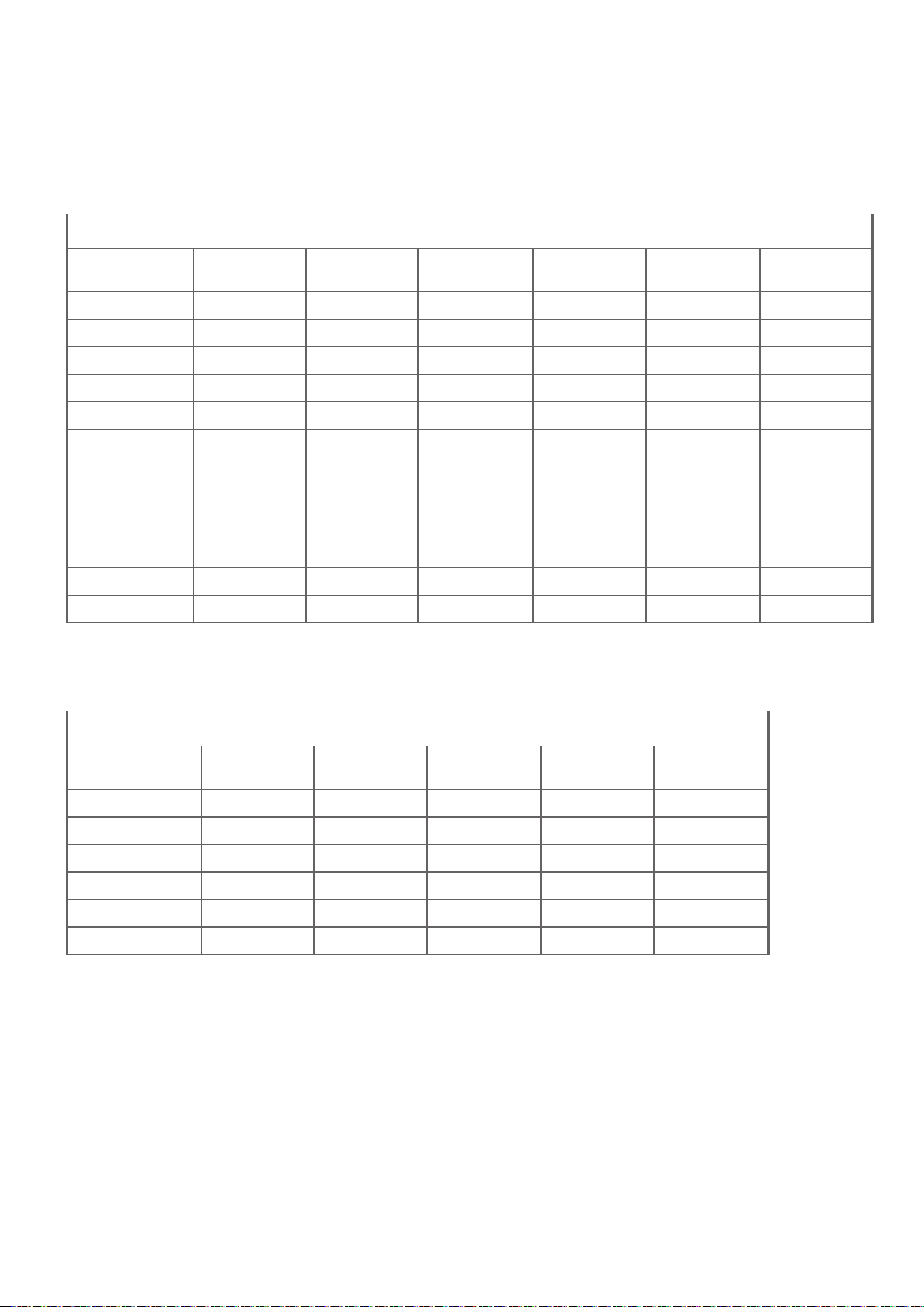
Model
PowerZone™
Connect 1002
PowerZone™
Connect 1502
PowerZone™
Connect 2004/2004D
PowerZone™
Connect 3004/3004D
PowerZone™
Connect 4008
PowerZone™
Connect 6008/6008D
Channels 2 x Lo-Z/1 x Hi-Z 2 x Lo-Z/1 x Hi-Z 4 x Lo-Z/2 x Hi-Z 4 x Lo-Z/2 x Hi-Z 8 x Lo-Z/4 x Hi-Z 8 x Lo-Z/4 x Hi-Z
Output Power
@ 2 Ω
2 x 500 W (SE)* 2 x 750 W (SE)* 4 x 500 W (SE)* 4 x 750 W (SE)* 8 x 500 W (SE)* 8 x 750 W (SE)*
Output Power
@ 4 Ω
2 x 500 W (SE)
1 x 1000 W (BTL)**
2 x 750 W (SE)
1 x 1500 W (BTL)**
4 x 500 W (SE)
2 x 1000 W (BTL)**
4 x 750 W (SE)
2 x 1500 W (BTL)**
8 x 500 W (SE)
4 x 1000 W (BTL)**
8 x 750 W (SE)
4 x 1500 W (BTL)**
Output Power
@ 8 Ω
2 x 250 W (SE)
1 x 1000 W (BTL)**
2 x 400 W (SE)
1 x 1500 W (BTL)**
4 x 250 W (SE)
2 x 1000 W (BTL)**
4 x 400 W (SE)
2 x 1500 W (BTL)**
8 x 250 W (SE)
4 x 1000 W (BTL)**
8 x 400 W (SE)
4 x 1500 W (BTL)**
Output Power
@ 70 V*
1 x 1000 W (BTL) 1 x 1200 W (BTL) 2 x 1000 W (BTL) 2 x 1200 W (BTL) 4 x 1000 W (BTL) 4 x 1200 W (BTL)
Output Power
@ 100 V*
1 x 1000 W (BTL) 1 x 1500 W (BTL) 2 x 1000 W (BTL) 2 x 1500 W (BTL) 4 x 1000 W (BTL) 4 x 1500 W (BTL)
Total System
Power
1000 W 1500 W 2000 W 3000 W 4000 W 6000 W
Power
Consumption
350 W 350 W 700 W 700 W 1400 W 1400 W
Output Voltage
65 Vp / 130 Vpp
(SE unloaded)
130 Vp / 260 Vpp
(BTL unloaded)
80 Vp / 160 Vpp
(SE unloaded)
160 Vp / 320 Vpp
(BTL unloaded)
65 Vp / 130 Vpp
(SE unloaded)
130 Vp / 260 Vpp
(BTL unloaded)
80 Vp / 160 Vpp
(SE unloaded)
160 Vp / 320 Vpp
(BTL unloaded)
65 Vp / 130 Vpp
(SE unloaded)
130 Vp / 260 Vpp
(BTL unloaded)
80 Vp / 160 Vpp
(SE unloaded)
160 Vp / 320 Vpp
(BTL unloaded)
Dimensions
88 x 440 x 321 mm
(3.5 x 17.3 x 12.6 in)
88 x 440 x 321 mm
(3.5 x 17.3 x 12.6 in)
88 x 440 x 321 mm
(3.5 x 17.3 x 12.6 in)
88 x 440 x 321 mm
(3.5 x 17.3 x 12.6 in)
88 x 440 x 414 mm
(3.5 x 17.3 x 16.3 in)
88 x 440 x 414 mm
(3.5 x 17.3 x 16.3 in)
Weight 5.9 kg (13.0 lbs) 5.9 kg (13.0 lbs) 7.4 kg (16.3 lbs) 7.4 kg (16.3 lbs) 11.6 kg (25.6 lbs) 11.6 kg (25.6 lbs)
Output
Circuitry
UMAC™ Class D - full bandwidth PWM modulator with ultra-low distortion
Signal To Noise-
Ratio
>108 dB (A-weighted, 20 Hz - 20 kHz, 8 Ω load)
THD+N (typical) < 0.05% (20 Hz - 20 kHz, 8 Ω load, 3 dB below rated power)
Frequency
Response
20 Hz-20 kHz (+0 / -0.5 dB (8 Ω load, 3d B below rated power)
Protection
Circuits
Short circuit -, DC -, Undervoltage -, Temperature - and Overload protection
Power Supply UREC™ universal mains switch mode power supply with Power Factor Correction (PFC) and standby converter
Operating
temperature
0 - 40° C
Operating
Voltage/
Frequency
Universal Mains, 100 V - 240 V, 50 Hz - 60 Hz
Standby
Consumption
< 0.5 W
Accessories
2 Rack ears included (tted)
4 adhesive feet, input/output connection plugs (included)
2 Rear rack support brackets (included only with 4008/6008/6008D)
Options
Audinate Dante® AoIP compatibility: Ultimo® Chip 4x4, 2 ows rx/tx (PowerZone™ Connect 2004D/3004D/6008D only)
*SE – conventional, single ended output mode
**BTL – bridge-tied load output mode
27
Specications
1/8th Full Power
PowerZone™
Connect Model
Load
(Ohms)
Power In
(W)
Power Out
(W)
Efciency
(%)
Thermal Loss
(W)
Thermal Loss
(BTU)
1002
4 174 125 71.8 49 167
1502
4 247 187.5 75.9 59.5 203
2004/2004D
4 346 250 72.2 96 327
3004/3004D
4 498 375 75.3 123 419
4008
4 689 500 72.6 189 644
6008/6008D
4 999 750 75.1 249 849
1002
2 191 125 65.4 66.0 225
1502
2 275 187.5 68.2 87.5 298
2004/2004D
2 378 250 66.6 128 436
3004/3004D
2 545 375 68.9 170 580
4008
2 758 500 66.0 258 880
6008/6008D
2 1089 750 68.9 339 1156
Standby and Idle
PowerZone™
Connect Model
Standby
(mW)
Idle @ 120V
(W)
Idle @ 120V
(BTU)
Idle @ 230V
(W)
Idle @ 230V
(BTU)
1002
<500* 13.1 45 14.5 49
1502
<500* 13.1 45 14.5 49
2004/2004D
<500* 23.2 79 25.6 87
3004/3004D
<500* 23.2 79 25.6 87
4008
<500* 43.0 147 48.0 164
6008/6008D
<500* 43.0 147 48.0 164
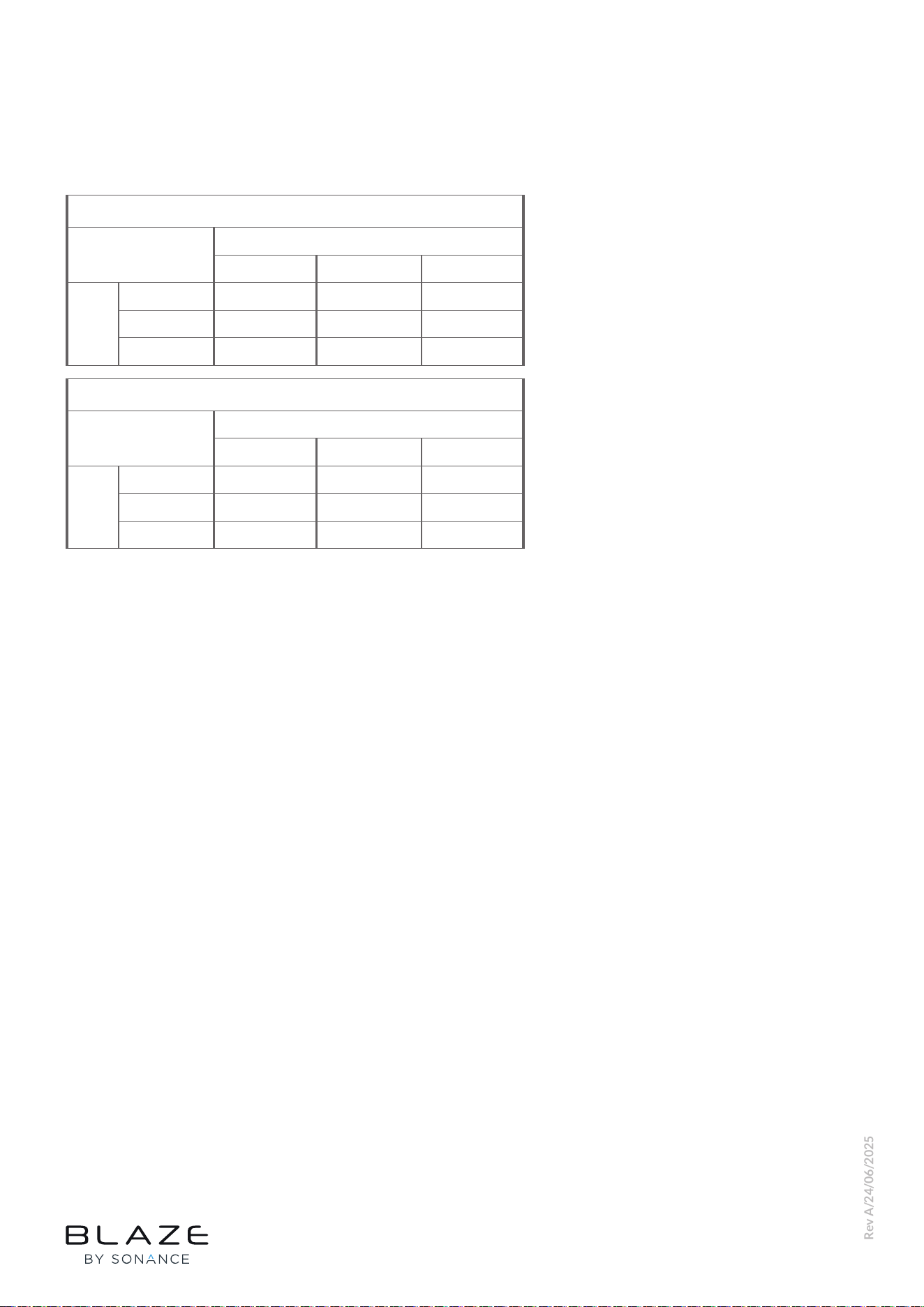
Power Efciency Data
The following table describes the efciency and power performance of PowerZone™ Connect ampliers.
The table also includes the derived thermal losses.
*As per compliance to ErP
©2025 Sonance. All rights reserved. Sonance is a registered trademarks of Dana Innovations.
Due to continuous product improvement, all features and specications are subject to change without notice.
For the latest Sonance product specication information visit our website at www.sonance.com.
SONANCE • 991 Calle Amanecer • San Clemente, CA 92673 USA • Phone: (949) 492-7777 • Technical Support: (949) 492-7777 • www.sonance.com • 07.01.25
2 & 4 Channel Ampliers
OUT
Analogue S/PDIF Dante
®
*
IN
Analogue 1177µS 458µS 1520µS
S/PDIF 1833µS 1104µS 2166µS
Dante
®
* 1895µS 1166µS 2125µS
8 Channel Ampliers
OUT
Analogue S/PDIF Dante
®
*
IN
Analogue 1307µS 600µS 1662µS
S/PDIF 1955µS 1250µS 2312µS
Dante
®
* 2017µS 1312µS 2125µS
Propagation Delay Data
The following tables describes the input/output latency performance of PowerZone™ Connect ampliers.
*Dante
®
network latency not included.
Note: Dante
®
latency is measured in a Dante
®
to
Dante
®
connection setup. The propagation delay is both
measured from both analog inputs and digital inputs.
The total delay of: Amp1 SPDIF input to Dante
®
out ->
Amp2 Dante
®
input to SPDIF output is 4333 µs. Out of
this the network latency accounts for 1000 µs and the
ASCRs accounts for 3 x 1000 µs. Out of the nal 333 µs
seconds, the DSP accounts for roughly 208 µs, leaving
125 µs for the Dante
®
chip processing. For this test the
Dante
®
process occurs twice resulting in a 62,49 µs delay
per Dante
®
transmission.
Specications
Rev A/24/06/2025