If you have any questions, please
call or write to:
In the United States
500 Tennessee Waltz Parkway
Ashland City, TN 37015
Toll Free: 1-877-737-2840
In Canada
599 Hill Street West
Fergus, ON N1M 2X1
1-888-479-8324
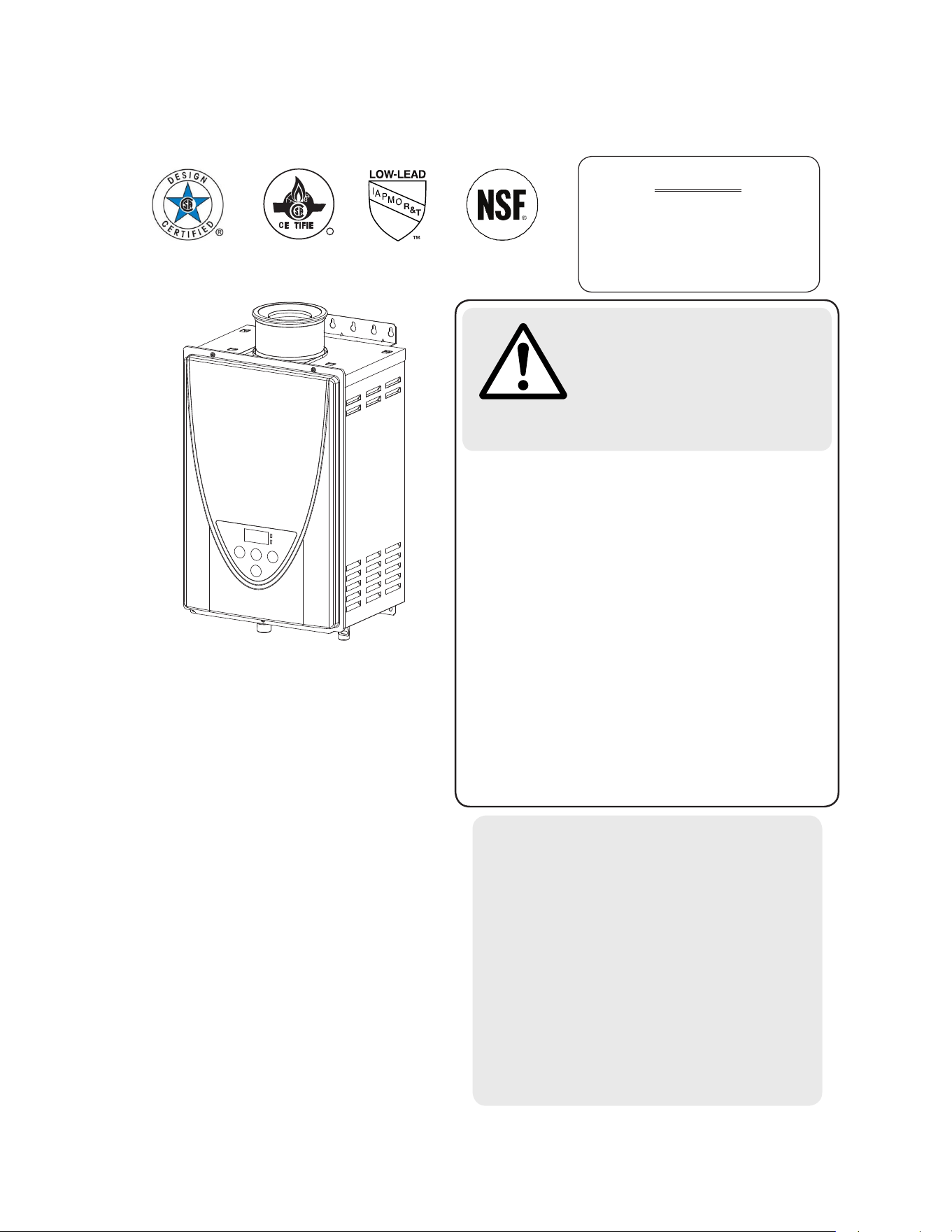
On-Demand Water Heater
Installation Manual and Owner’s Guide
- Do not store or use gasoline or other
flammable vapors and liquids in the vicinity
of this or any other appliance.
- WHAT TO DO IF YOU SMELL GAS
• Do not try to light any appliance.
• Do not touch any electric switch; do not
use any phone in your building.
• Immediately call your gas supplier from
a neighbor's phone. Follow the gas
supplier's instructions.
• If you cannot reach your gas supplier, call
the fire department.
- Installation and service must be performed
by a qualified installer, service agency or the
gas supplier.
WARNING
If the information in these
instructions is not followed
exactly, a fire or explosion may
result causing property damage,
personal injury or death.
Gas Tankless Water Heater
TM
Suitable for combination potable water heating
and space-heating.
Please refer to local codes
for space-heating compliance.
FEATURING
• ENDLESS HOT WATER
• ON-DEMAND USAGE
• COMPACT, SPACE SAVING
• ENERGY CONSERVATION
• COMPUTERIZED SAFETY
• ELECTRONIC IGNITION
• Complies with SCAQMD Rule
1146.2 for natural gas Low NOx
Emissions of 14 ng/J or 20-ppm
• CONCENTRIC VENT
• FIELD GAS CONVERSION
• EASY-LINK SYSTEM*
• MULTI-UNIT SYSTEM*
*(510C model only)
Models
• 110C
• 310C
• 510C
Series 110
ANSI Z21.10.3 ・ CSA 4.3
510C
model only
R
DR
Keep this manual near the water heater for future reference whenever maintenance, adjustment, or
service is required.

2 Page
Contents
CONTENTS
Installation Manual
SPECIFICATIONS .............................................4
INTRODUCTION..............................................5
SAFETY GUIDELINES.....................................6
SAFETY DEFINITION ....................................6
GENERAL ......................................................6
INSTALLATION ................................................7
GENERAL ......................................................7
CLEARANCES ...............................................9
INCLUDED ACCESSORIES ............................9
OPTIONAL ITEMS ........................................ 9
WARNING FOR INSTALLATIONS ...............11
HIGH-ALTITUDE INSTALLATIONS .............12
VENTING INSTRUCTIONS .........................13
General .....................................................13
Vent length and no. of elbows .................14
DIP switch settings for vent length ...........14
Venting illustrations ..................................15
Vent termination clearances ....................16
Clearances for sidewall terminations .......17
Clearances for rooftop terminations ........17
GAS SUPPLY AND GAS PIPE SIZING ......... 18
General .....................................................18
Gas connections .......................................18
Natural gas supply piping .........................19
Propane (LP) supply piping ....................... 19
WATER CONNECTIONS .............................20
Pressure relief valve .................................20
ELECTRICAL CONNECTIONS ..................... 21
TEMPERATURE REMOTE CONTROLLER .....22
Optional item ............................................22
Installation ................................................ 22
EASY-LINK SYSTEM .........................................24
Easy link connection procedures ..............24
MULTI-UNIT SYSTEM ......................................26
APPLICATIONS .............................................. 27
Space-Heating Applications ........................27
Recirculation ...................... .........................27
Dual-purpose hot water heating ...................28
INITIAL OPERATION .....................................29
Owner's Guide
OPERATING SAFETY .....................................31
NORMAL OPERATION ..................................33
BUILT-IN CONTROLLER
AND REMOTE CONTROLLER ..................33
GENERAL ....................................................33
TEMPERATURE SETTING ..........................34
Set temperature .......................................34
TEMPERATURE TABLE OF CONTROLLER .34
ADDITIONAL FEATURES ............................35
Information mode ....................................35
Unit conversion mode ..............................35
TEMPERATURE SETTINGS ON THE PCB ........36
FLOW .......................................................... 36
FREEZE PROTECTION SYSTEM ................. 37
MAINTENANCE AND SERVICE .................37
Measuring inlet gas pressure ...................38
UNIT DRAINING AND FILTER CLEANING .......38
TROUBLESHOOTING .....................................39
GENERAL ....................................................39
ERROR CODES ...........................................41
General .....................................................41
Single unit installation ..............................41
Easy-Link System ....................................... 41
Fault Analysis of Error Codes .................... 42
COMPONENTS DIAGRAM ............................44
PARTS LIST .................................................... 48
OUTPUT TEMPERATURE CHART ..................50
3 Page
Installaon Manual
Installation Manual
CONGRATULATIONS
Congratulations and thank you for choosing our tankless water heater.
Before use, we recommend that you read through this installation
manual carefully. Keep this manual for future reference.
If you need an additional manual, contact the manufacturer or your
local distributor. You may also download a manual from our web page.
When you call, please tell us the product name and the serial number
of your unit written on the rating plate of the water heater.
4 Page
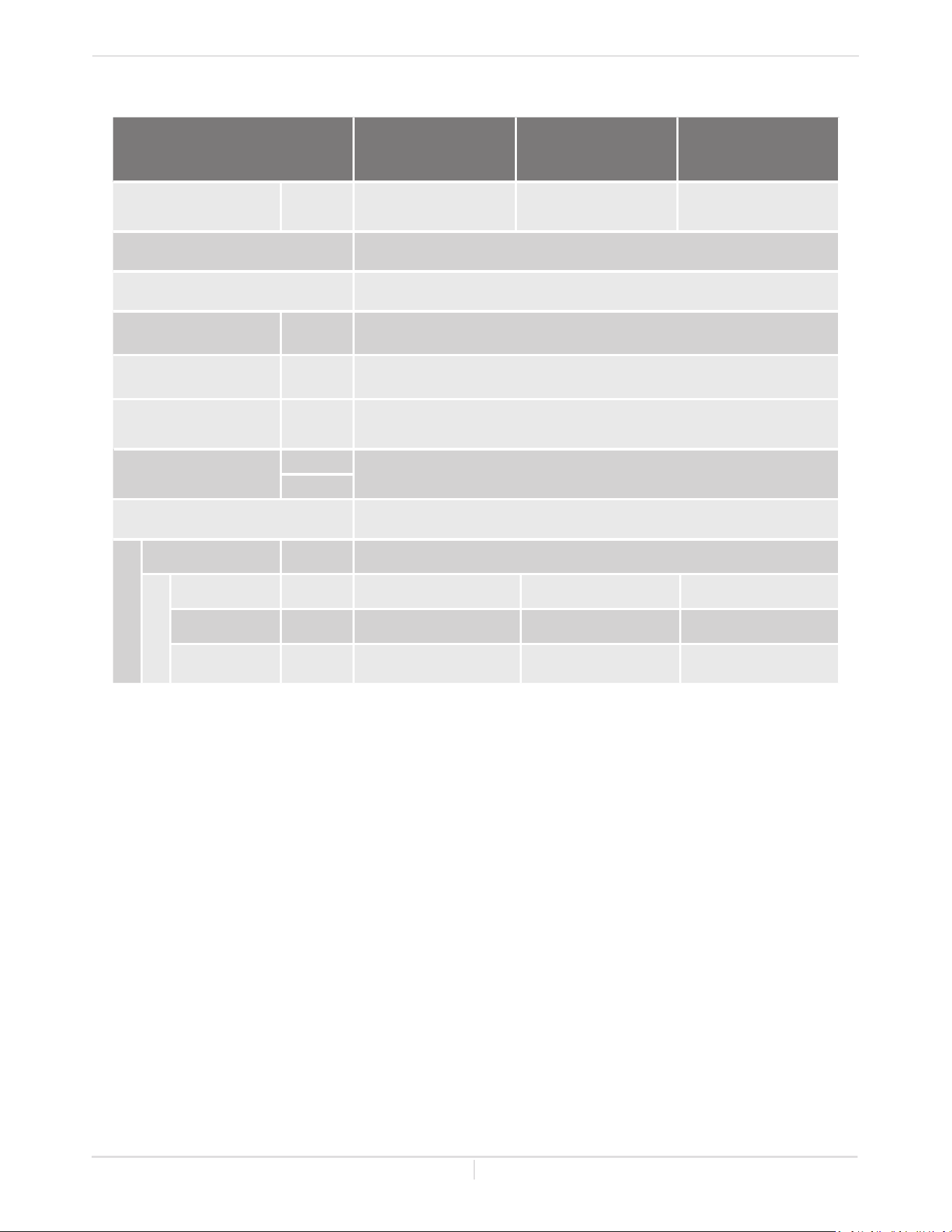
Model
110C 310C 510C
Natural Gas Input
(Operating Range)
BTU/h
Min.: 15,000
Max.: 140,000
Min.: 15,000
Max.: 190,000
Min.: 15,000
Max.: 199,000
Gas Connection 3/4" NPT
Water Connections 3/4" NPT
Water Pressure*
psi
(Mpa)
15 - 150 (0.1 - 1)
Natural gas
Inlet Pressure
" W.C.
(kPa)
Min. 4.0 (1.00)
Max. 10.5 (2.61)
Weight lbs. (kg) 51 (23)
Dimensions
inch
H 20.5 x W 13.7 x D 10.5
H 520 x W 350 x D 266
mm
Ignition Electric Ignition
Electric
Supply VAC / Hz 120 / 60
Consumption
Operation W / A 53 / 0.58 71 / 0.81 72 / 0.85
Standby W / A 2 / 0.06 2 / 0.06 3 / 0.07
Freeze-
Protection
W / A 99 / 0.83 99 / 0.83 100 / 0.83
SPECIFICATIONS
*Maximum flow may need water pressure equal to or above 40 psi.
NOTE:
• Check the rating plate to ensure this product matches your specifications.
• The manufacturer reserves the right to discontinue, or change at any time, specifications or designs
without notice and without incurring obligations.
Specicaons
Installaon Manual
5 Page
INTRODUCTION
• This manual provides information necessary for the installation, operation, and maintenance
of the water heater.
• The model description is listed on the rating plate which is attached to the side panel of the
water heater.
• Please read all installation instructions completely before installing this product.
• If you have any problems or questions regarding this equipment, consult the manufacturer or
its local representative.
• This appliance is an on-demand, tankless water heater. It is designed to efficiently supply
endless hot water for your needs.
• The 110C, 310C, and 510C models are only to be installed indoors with concentric venting.
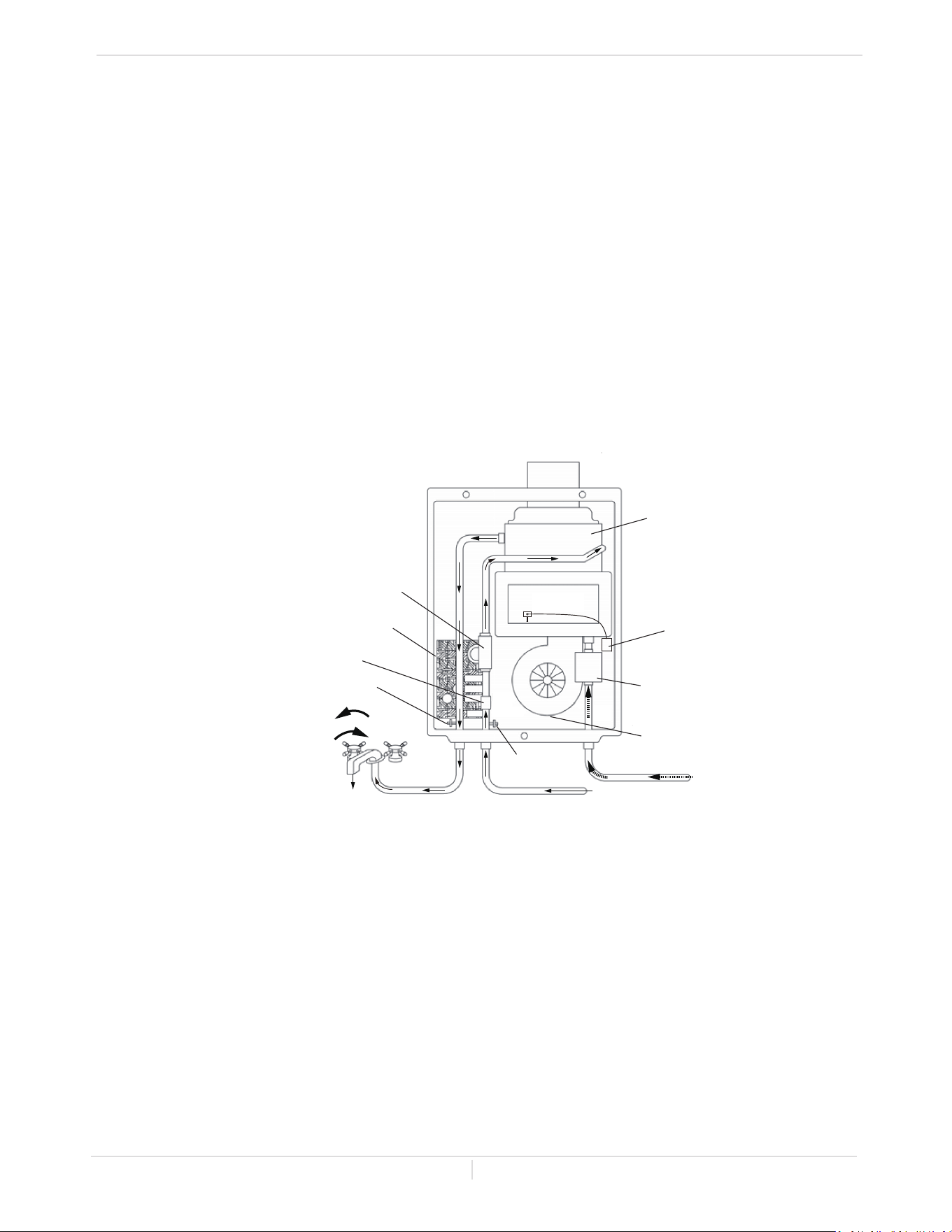
• The principle behind tankless water heaters is simple:
*This diagram illustrates tankless water heater design concepts only and does not accurately represent
the water heater’s physical description.
1. A hot water fixture is turned on.
2. Water flows through the heater.
3. The water flow sensor detects the water flow.
4. The computer initiates the fan motor and gas valve to let gas flow through the heater and sends a
signal to the igniter to create an ignition spark.
5. The gas ignites and flames appear within the burner chamber.
6. Water is heated as it flows through the heat exchanger.
7. Using thermistors to measure temperatures throughout the water heater, the computer modulates
the gas and water valves to ensure proper output water temperature and hot water outflows.
8. When the fixture is turned off, the unit shuts down.
Introducon
Installaon Manual
Burners
Hot water xture
Exhaust vent and
combuson air intake
collar
Heat exchanger
Gas valves
Fan motor
Flow adjustment valve
Computer board
Thermistor
Cold water inlet
Hot water outlet
Gas inlet
Thermistor
Burners
Flow sensor
Igniter
1
2
3
4
5
4
6
7
7
7
8
4
4
6 Page
SAFETY GUIDELINES
SAFETY DEFINITION
GENERAL
1. Follow all local codes, or in the absence of local codes, follow the current edition of the National Fuel Gas Code:
ANSI Z223.1/NFPA 54 in the USA or B149.1, Natural Gas and propane installation code in Canada.
2. Properly ground the unit in accordance with all local codes or in the absence of local codes, with the current
edition of the National Electrical Code: ANSI/NFPA 70 in the USA or CSA standard C22.1 Canadian Electrical
Code Part 1 in Canada.
3. Carefully plan where you intend to install the water heater. Please ensure:
• Your water heater will have enough combustion air and proper ventilation.
• Locate your heater where water leakage will not damage surrounding areas. (Please refer to p. 8.)
4. Check the rating plate for the correct GAS TYPE, GAS PRESSURE, WATER PRESSURE and ELECTRIC RATING. If
this unit does not match your requirements, do not install and consult with the manufacturer. The water
heater is configured only for use with Natural Gas at the factory. If the appliance is used with propane gas,
conversion to propane gas with an included conversion kit (LP Conversion Kit: 100281154) is required. The
conversion must be done by a qualified service agent or a gas utility service person in accordance with this
instruction and all codes and requirements of the authority having jurisdiction. Failure to follow instructions
could result in property damage, serious personal injury, or death. The agent performing this work assumes
responsibility for this conversion. (Refer to the gas conversion leaflet.)
5. If any problem should occur, turn off all hot water fixtures and turn off the gas. Then call a trained technician,
the gas company, or the manufacturer.
WARNING
• Water temperatures over 125 °F (52 °C) can cause severe burns instantly or death from
scalding. The water temperature is set at 120 °F (50 °C) from the factory to minimize any
scalding risk. Before bathing or showering always check the water temperature.
• Do not store or use gasoline or other flammables, vapors, or liquids in the vicinity of this
appliance.
• Do not reverse the water and/or gas connections as this will damage the gas valves and
can cause severe injury or death. Follow the diagram on p. 20 when installing your water
heater.
• The conversion to propane must be done by a qualified service agent or a gas utility
serviceman in accordance with this instruction and all codes and requirements of the
authority having jurisdiction. Failure to follow instructions could result in serious injury
or property damage. The qualified agent performing this work assumes responsibility
for this conversion.
• Do not use this appliance if any part has been in contact with or been immersed in water.
Immediately call a qualified installer or service agency to replace a flooded water heater.
Do not attempt to repair the unit. It must be replaced.
• Failure to observe these warnings could result in severe personal injury or death.
Safety Guidelines
Installaon Manual
WARNING
Indicates an imminently hazardous situation which, if not avoided, could result in death or seri-
ous injury.
CAUTION
Indicates an imminently hazardous situation which, if not avoided, could result in minor or
moderate injury.
Indicates an imminently hazardous situation which, if not avoided, will result in death or serious
injury.
DANGER
Indicates information considered important but not hazard related.
NOTICE
7 Page
INSTALLATION
GENERAL
1. Follow all local codes, or in the absence of local codes, follow the current edition of the National Fuel
Gas Code: ANSI Z223.1/NFPA 54 in the USA or B149.1, Natural Gas and propane installation code in
Canada.
2. All gas water heaters require careful and correct installation to ensure safe and efficient operation.
This manual must be followed exactly. Read the “Safety Guidelines” section.
3. The manifold gas pressure is preset at the factory. It is computer controlled and should not need
adjustment.
4. Maintain proper space for servicing. Install the unit so that it can be connected or removed easily.
Refer to the "Clearances" section on p. 9 for proper clearances.
5. Electrical service to the water heater requires a means of disconnection. This will allow power to the
water heater to be shut off for servicing and safety purposes.
6. Do not install the unit where the exhaust vent is pointing into any opening in a building or where the
noise may disturb your neighbors. Make sure the vent termination meets the required distance from
any doorway or opening to prevent exhaust from entering a building. (Refer to p. 11, 16, and 17.)
Check local code requirements prior to installation.
7. Carefully plan the installation location of the heater and vent terminations. Contaminants such
as aerosols, lint, and fine powders (including flour) can clog the air intake. This could reduce the
operation of the fan, causing improper combustion and reduced life of the water heater. Ensure that
the area around the heater and vent termination is free of dust and debris. Regular maintenance is
recommended in environments with these items in the air.
8. 110C, 310C, and 510C models: A condensate collector and trap (100266140 & 100266139) are
required to be installed in the venting system when there is more than 8 ft (2.4 m) of equivalent vent
length, not including the sidewall termination. 87° elbow is equivalent to 5 ft (1.5 m) of vent length.
The condensate collector must be installed on the heater's flue. The condensate trap and collector
are required on all vertical installations. See the illustrations on p. 15.
9. Only install the water heater in a heated area where below freezing temperatures cannot occur.
Installaon
Installaon Manual
Do not disconnect the electrical supply if the ambient temperature will drop below
freezing. The Freeze Protection System only works if the unit has electrical power.
The warranty will not be covered if the heat exchanger is damaged due to freezing.
Refer to "Freeze Protection System" on p. 37 for more information.
Failure to observe this warning could result in severe personal injury or death.
WARNING
8 Page
Installaon
Installaon Manual
• The warranty will not cover damage caused by water quality.
• Only potable water can be used with this water heater. Do not introduce pool
or spa water, or any chemically treated water into the water heater.
• Water hardness levels must not exceed 7 grains per gallon (120 ppm) for single
family domestic applications or more than 4 grains per gallon (70 ppm) for
all other types of applications. Water hardness leads to scale formation and
may affect/damage the water heater. Hard water scaling must be avoided or
controlled by proper water treatment.
• Water pH levels must be between 6.5 and 8.5.
• Well water must be treated.
• The manufacturer recommends direct venting when the water heater is installed
in beauty salons, dry cleaners or any other locations in which such chemicals are
present in the air. Some chemicals used in beauty salons or dry cleaners may affect
the flame sensor. In such cases, the water heater may not work properly.
• Although the water heater is designed to operate with minimal sound, the
manufacturer does not recommend installing the unit on a wall adjacent to a
bedroom, or a room that is intended for quiet study or meditation, etc.
• Locate your water heater close to a drain where water leakage will not do damage
to surrounding areas. As with any water heating appliance, the potential for leakage
at some time in the life of the product does exist. A drain pan, or other means of
protection against water damage, is recommended to be installed under the water
heater in case of leaks. In addition, you may install an active water leak detector
with a shutoff valve which can turn off the water supply in the event of a leak. The
manufacturer is not responsible for damage due to water leaks. If you install a drain
pan under the unit, ensure that it will not restrict the combustion air flow.
NOTICE
• Installation and service must be performed by a qualified installer (for example, a
licensed plumber or gas fitter). Otherwise, the warranty will be void.
• The installer (licensed professional) is responsible for the correct installation of the
water heater and for compliance with all national, state/provincial, and local codes.
• The manufacturer does not recommend installing the water heater in a pit or
location where gas and water can accumulate.
• Do not have the vent terminal pointing toward any operating window, door, or
opening into a building.
• Do not install next to any source of airborne debris, such as a clothes dryer, that can
cause debris to be trapped inside the combustion chamber.
• Do not install the unit where water, debris, or flammable vapors may get into the flue
terminal or the air intake line.
• The manufacturer does not recommend installing the water heater in an attic due
to safety issues. If you install the water heater in an attic:
• Make sure the unit will have enough combustion air and proper ventilation.
Failure to do so could lead to carbon monoxide poisoning or death.
• Keep the area around the water heater clean. When dust collects on the flame
sensor, the water heater will shut down on an error code.
• Place the unit where it will allow easy access for service and maintenance.
• A drain pan, or other means of protection against water damage, is
recommended to be installed under the water heater in case of leaks. See the
NOTICE below.
• The water heater must be securely mounted to a wall or other suitable structure.
• Failure to observe these warnings could result in severe personal injury, death,
and/or property damage.
WARNING
9 Page
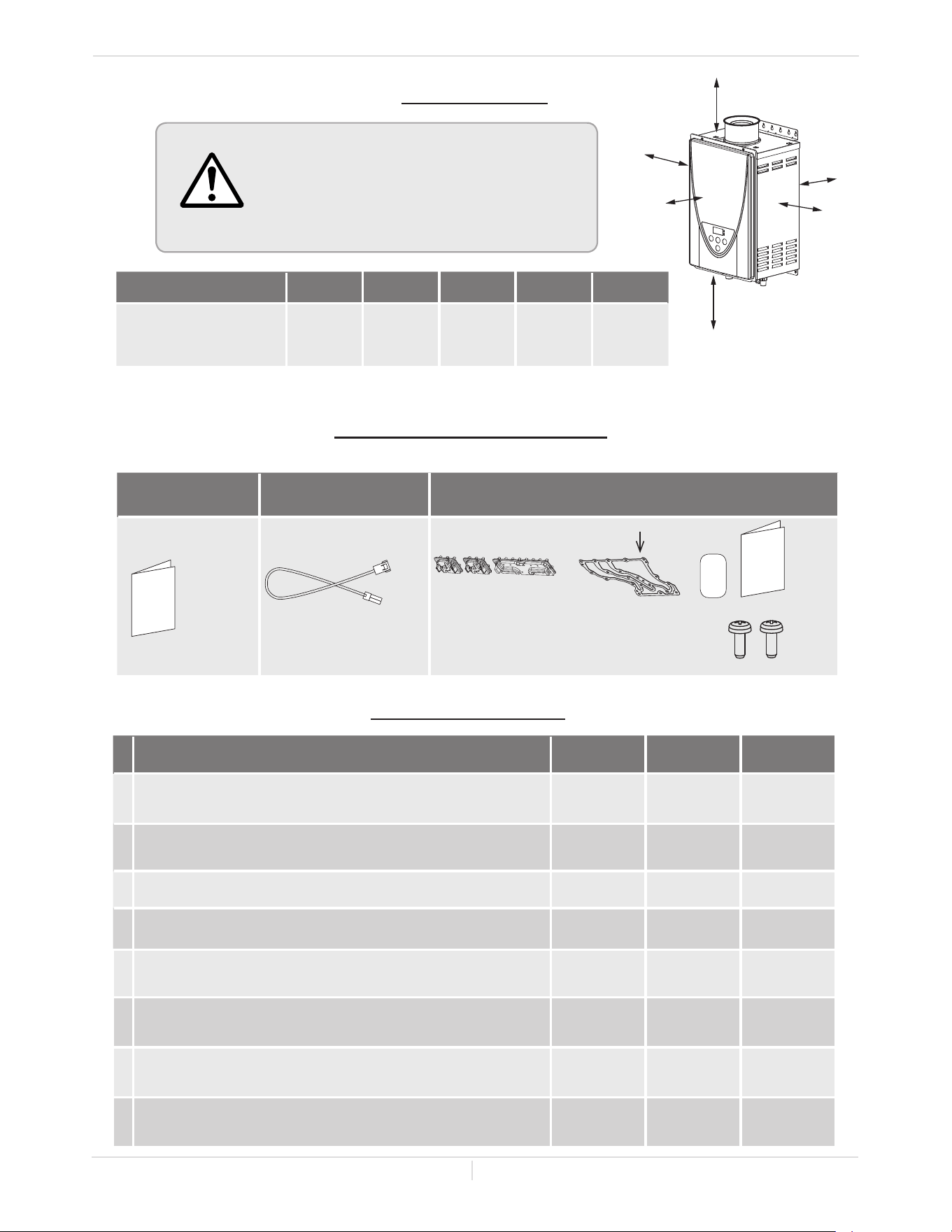
CLEARANCES
Model Top Bottom Front Back Sides
110C
310C
510C
12 in.
(305 mm)
12 in.
(305 mm)
4 in.*
(102 mm)
1 in.
(25 mm)
3 in.
(76 mm)
*24 inches (610 mm) recommended for maintenance.
OPTIONAL ITEMS
#
Model
110C 310C 510C
1.
Condensate collector and trap
✓ ✓ ✓
2.
Concentric Sidewall Termination Kit
✓ ✓ ✓
3.
Concentric Roof Termination
✓ ✓ ✓
4
Elbow
✓ ✓ ✓
5.
Straight Pipe
✓ ✓ ✓
6.
Roof Flashing
✓ ✓ ✓
7.
Pipe Hanger
✓ ✓ ✓
8.
Remote controller
✓ ✓ ✓
INCLUDED ACCESSORIES
Installaon
Installaon Manual
Top
Back
Side
Side
Front
Boom
Check that these items below are included with the water heater.
Installation manual
and Owner’s guide
Communication cable
510C model only
LP Conversion Kit (100281154)
Qty: 1
Qty: 1
Manifold aachments: 2 Small / 1 Large
Manifold gasket (100281157): 1
Gas conversion scker: 1
Gas conversion instrucon: 1
Spare screw: 2
(100281157)
(100076516)
Maintain all clearances around the water
heater. Failure to do so could create a fire
hazard, potentially leading to death, serious
injury, and/or property damage.
WARNING
10 Page
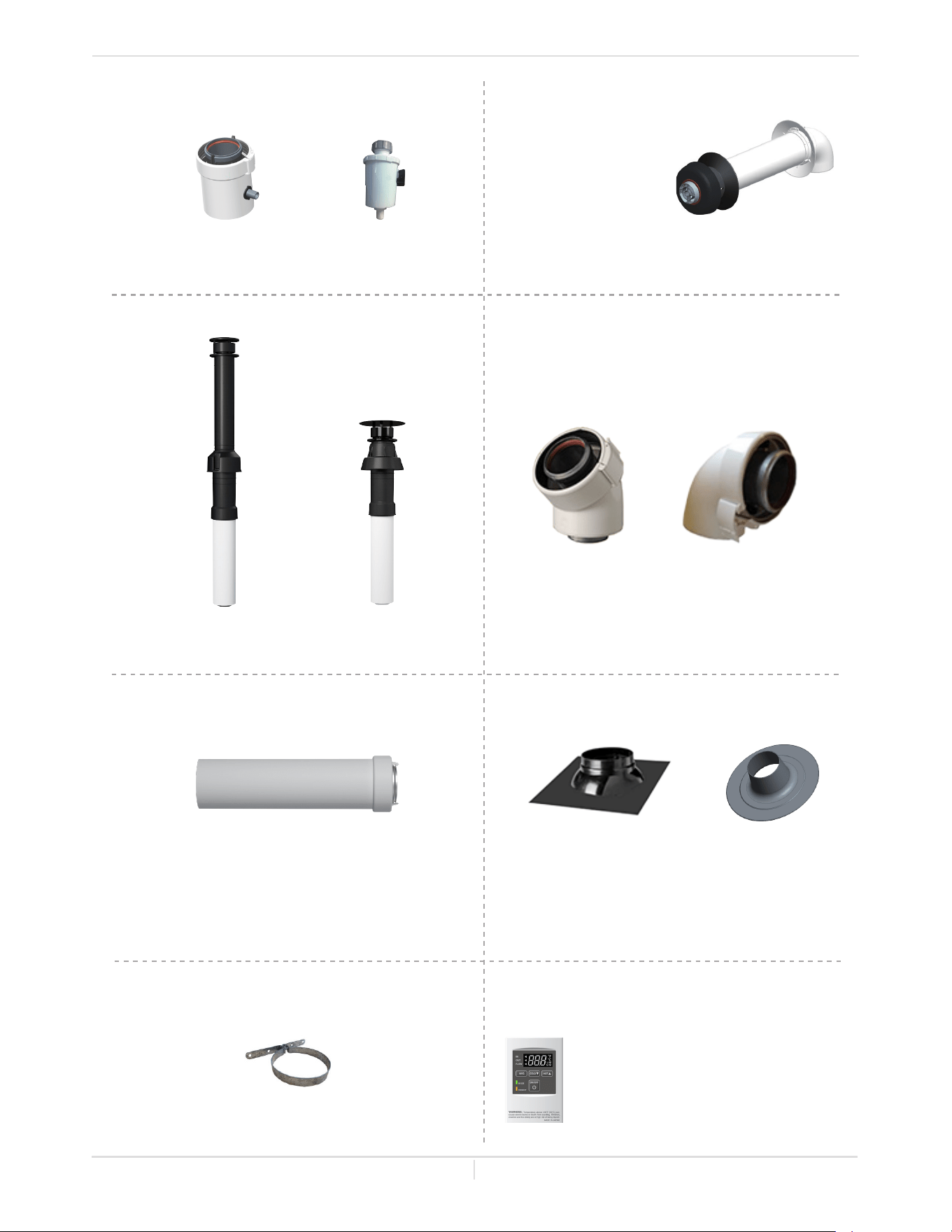
1. Condensate Collector and Trap
3. Concentric Roof Termination
Installaon
Installaon Manual
7. Pipe Hanger (100266141)
4. Elbow
8. Remote controller
100209924 (TM-RE42)
This remote can be added to the
heater, in addition to the built-in
controller.
Collector
(100266140)
Trap
(100266139)
It includes: One Sidewall Termination, One 87° Elbow,
Two Wall Plates.
6. Roof Flashing
Flat Roof
Flashing
(100266187)
2. Concentric Sidewall Termination Kit
11 1/2" (292mm)
(100266115)
21" (533 mm)
(100266117)
38" (965 mm)
(100266118)
18" (457 mm)
(100305170)
Tile / Shingle Roof Flashing
1/12 to 6/12 Pitch (100266136)
8/12 to 16/12 Pitch (100266137)
6/12 to 12/12 Pitch (100266138)
45° Elbow
(100266119)
87° Elbow
(100266132)
5. Straight Pipe
10" (254 mm) Straight Pipe (100266133)
19.5" (495 mm) Straight Pipe (100266134)
39" (991 mm) Straight Pipe (100266135)
11 Page
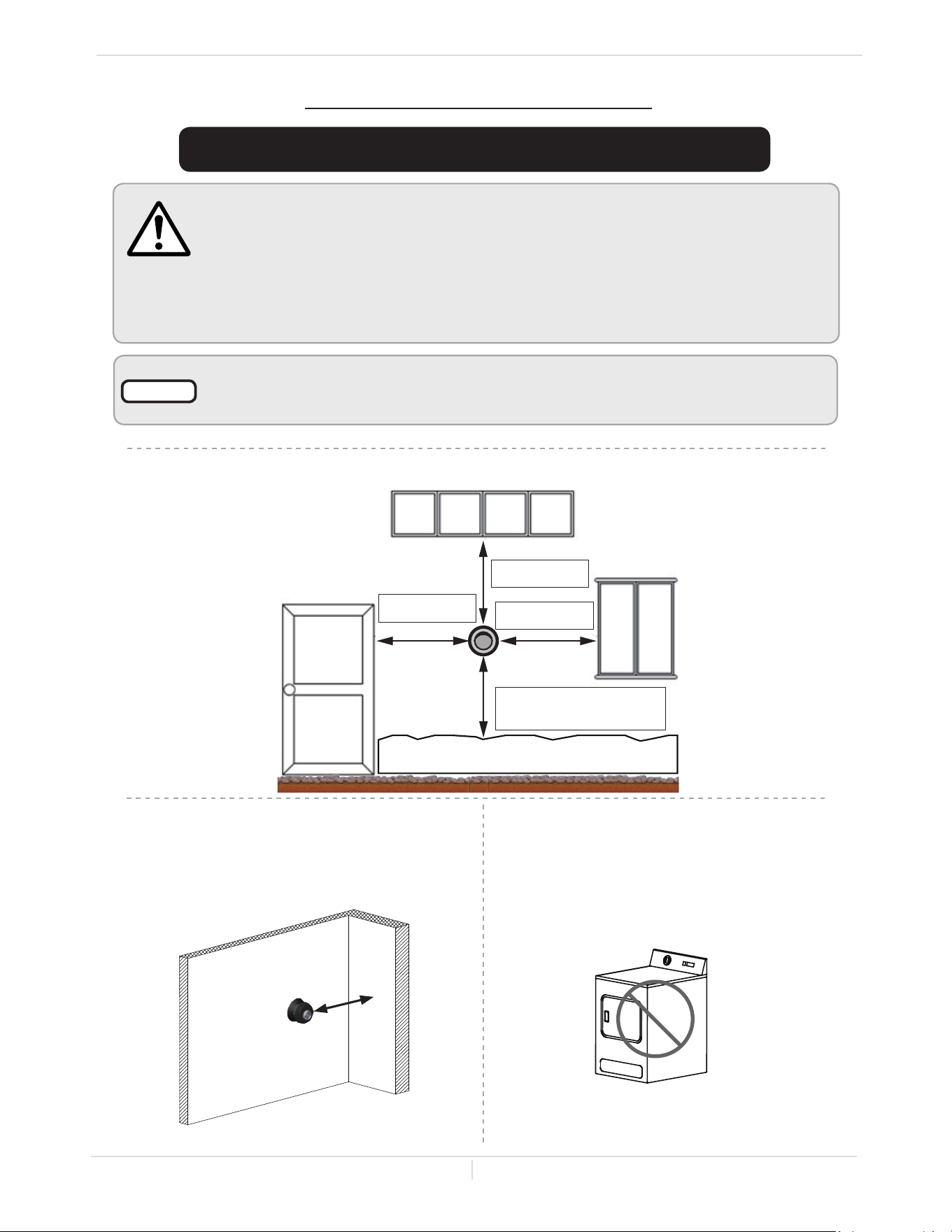
FOR YOUR SAFETY, READ BEFORE INSTALLATION:
Do not install the water heater or vent
termination next to a dryer or dryer vent. The
water heater environment must be free from
any source of airborne debris that can be
trapped inside the water heater.
Installaon
Installaon Manual
Water heater vent terminator must be at least 2 ft
(61 cm) away from an inside corner.
WARNING FOR INSTALLATIONS
USA: 1 (30 cm) min.
Canada: 3 (91 cm) min.
USA: 1 (30 cm) min.
Canada: 3 (91 cm) min.
USA: 1 (30 cm) min.
Canada: 3 (91 cm) min.
USA: 12 in. (30 cm) above grade and
above ancipated snow level
Canada: 12 in. (30 cm) above grade
Ancipated snow level
Ensure that you meet the minimum clearances shown below for a direct vent termination:
Inside
corner
2 ft
(61 cm)
min.
Improper installation will void the warranty and may cause damage to the water heater.
NOTICE
WARNING
• Do not install the water heater and its termination where water, debris or
flammable vapors may get into the water heater and flue terminal.
• Do not have the vent terminal pointing toward any opening into a building.
• Do not locate your heater in a pit or location where gas and water can
accumulate.
• Failure to observe these warnings could result in carbon monoxide poisoning
or death.
12 Page
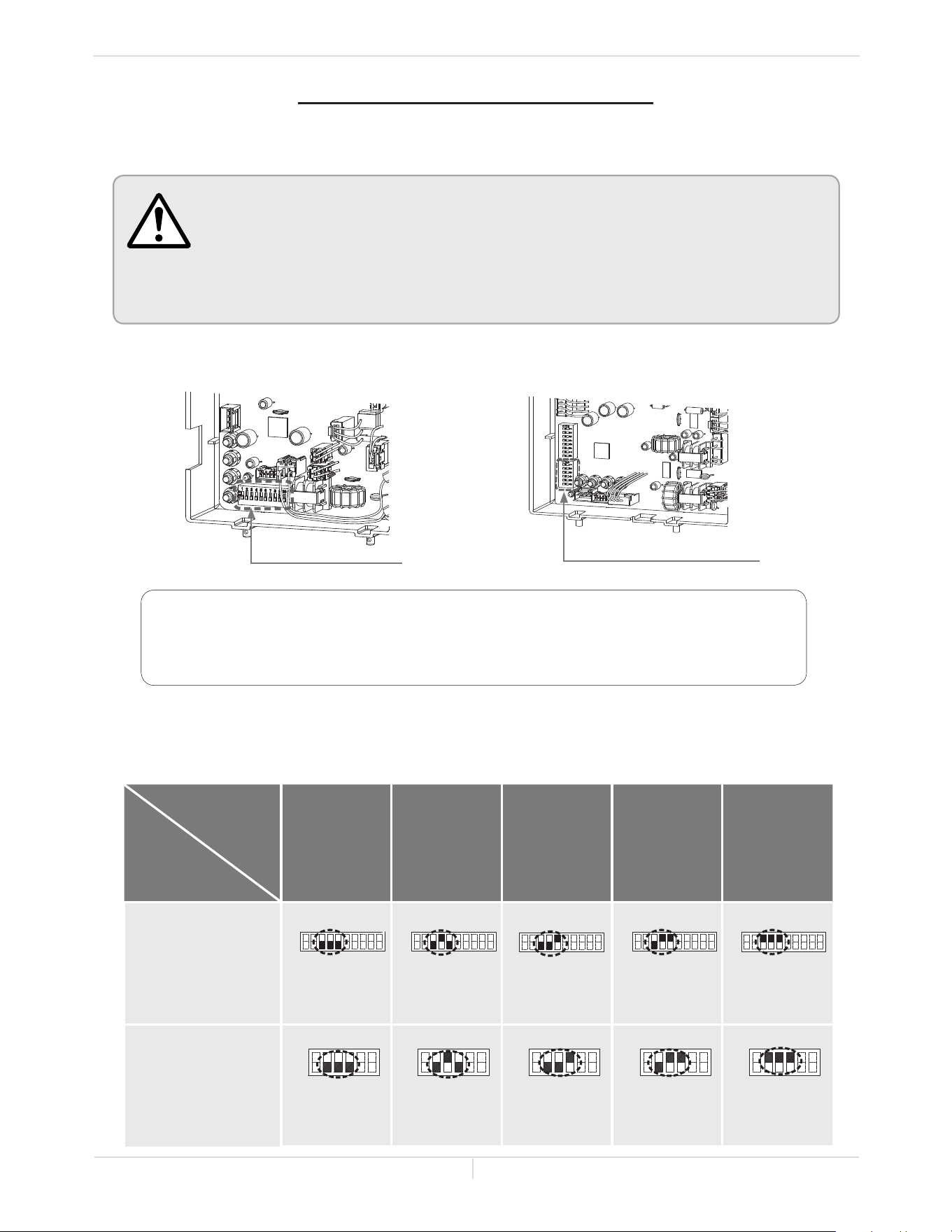
HIGH-ALTITUDE INSTALLATIONS
Check the altitude where your water heater is installed. Set DIP switches shown in the table below. The
DIP switch settings depend on the altitude.
The black squares indicate the correct DIP switch positions for high altitude installation.
The 110C and 310C : Only adjust DIP switch No. 3, No. 4, and No.5.
The 510C : Only adjust DIP switch No. 2, No. 3, and No. 4 on the lower bank.
WARNING
• Adjust the appropriate DIP switches according to model and elevation as
shown below. DO NOT adjust the other DIP switches.
• Turn off the power supply to the water heater before changing the DIP
switch settings.
• Failure to observe these warnings could lead to carbon monoxide poisoning
or death.
Bank of DIP switches
110C and 310C models
Computer board
Lower bank of DIP switches
510C model
Computer board
Installaon
Installaon Manual
Installation altitude
The maximum certified or allowable installed altitude is 10,100 ft (3,078 m) for
110C, 310C, and 510C models.
0 to 2,000 ft
(0 to 609 m)
DEFAULT
2,001 ft to
3,000 ft
(610 m to
914 m)
3,001 ft to
5,000 ft
(915 m to
1,524 m)
5,001 ft to
7,500 ft
(1,525 m to
2,286 m)
7,501 ft to
10,100 ft
(2,287 m to
3,078 m)
110C and
310C models
No. 3 : OFF
No. 4 : OFF
No. 5 : OFF
No. 3 : OFF
No. 4 : ON
No. 5 : OFF
No. 3 : OFF
No. 4 : OFF
No. 5 : ON
No. 3 : OFF
No. 4 : ON
No. 5 : ON
No. 3 : ON
No. 4 : ON
No. 5 : ON
510C model
(Lower bank of
DIP switches)
No. 2 : OFF
No. 3 : OFF
No. 4 : OFF
No. 2 : OFF
No. 3 : ON
No. 4 : OFF
No. 2 : OFF
No. 3 : OFF
No. 4 : ON
No. 2 : OFF
No. 3 : ON
No. 4 : ON
No. 2 : ON
No. 3 : ON
No. 4 : ON
Altitude
Model
OFF
ON
1 2 3 4 5 6
OFF
ON
1 2 3 4 5 6
OFF
ON
1 2 3 4 5 6
OFF
ON
1 2 3 4 5 6
OFF
ON
1 2 3 4 5 6
OFF
ON
1 2 3 4 5 6 7 8 9 10
OFF
ON
1 2 3 4 5 6 7 8 9 10
OFF
ON
1 2 3 4 5 6 7 8 9 10
OFF
ON
1 2 3 4 5 6 7 8 9 10
OFF
ON
1 2 3 4 5 6 7 8 9 10
13 Page
Installaon
Installaon Manual
VENTING INSTRUCTIONS
-General-
WARNING
• Improper venting of this appliance can result in excessive levels of carbon
monoxide which can result in severe personal injury or death.
• Improper installation can cause nausea or asphyxiation, severe injury or death
from carbon monoxide and flue gases poisoning. Improper installation will void
product warranty.
• When installing the vent system, all applicable national and local codes must be
followed. If you install thimbles, fire stops or other protective devices and they
penetrate any combustible or noncombustible construction, be sure to follow
all applicable national and local codes.
The water heater must be vented in accordance with “Venting of Equipment" in the current edition of the
National Fuel Gas Code: ANSI Z223.1/NFPA 54 in the United States and/or Section 8 of the current B149.1
Natural Gas, propane installation code in Canada, as well as applicable local building codes.
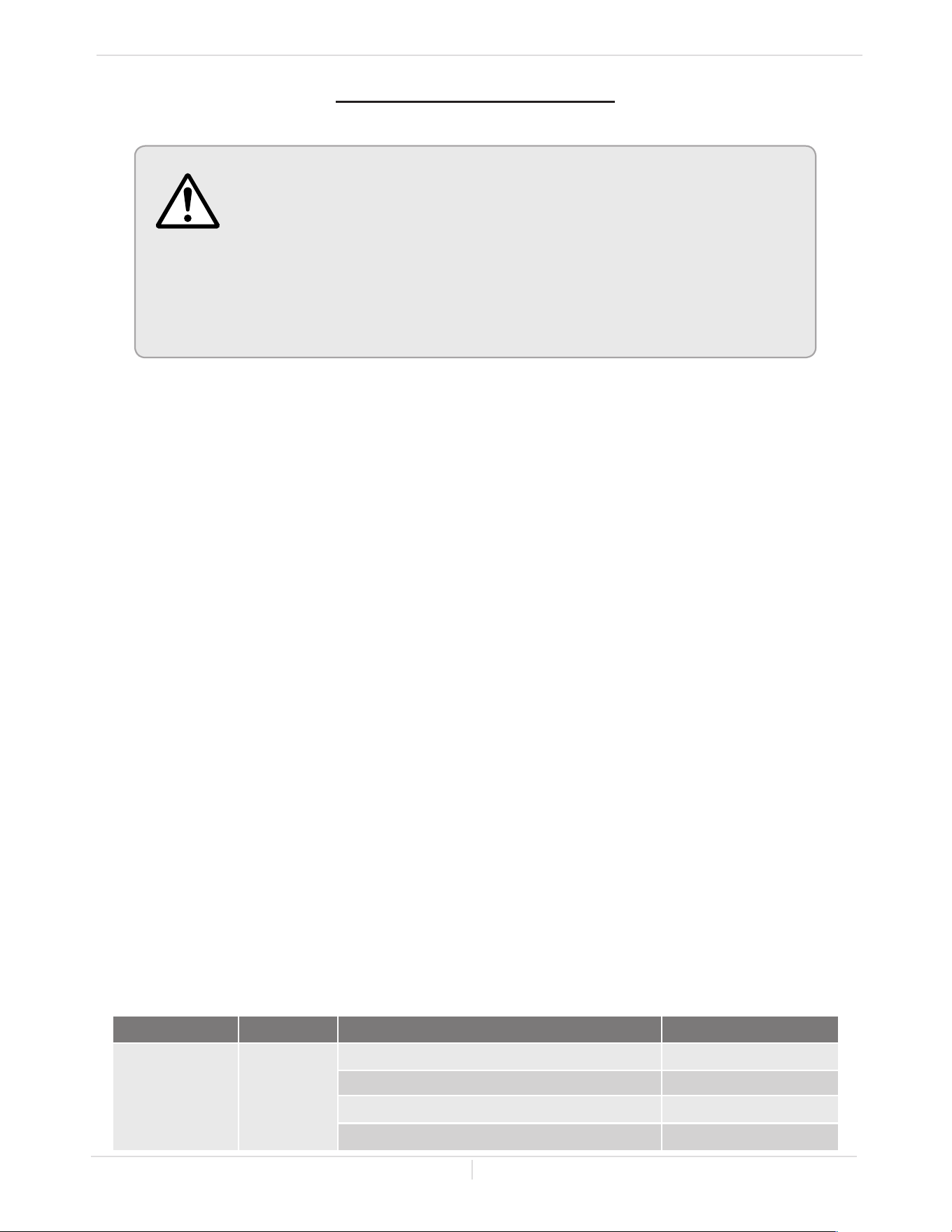
The water heater is designed for a concentric venting system, which uses one pipe system with two
ducts for combustion air and exhaust air. The manufacturer approves the use of Centrotherm Eco
Systems Direct Vent APNC35 venting systems on new installations. This system is furnished through
the heater manufacturer. See the table below for certified vent terminations.
General rules for venting water heaters:
• Place the water heater as close as possible to the vent termination.
• Do not weld the vent pipe to the water heater’s vent collar.
• Do not cut the vent collar of the unit.
• The vent must be easily removable from the top of the water heater for normal service and
inspection of the unit and vent system.
• The water heater vent must not be connected to any other gas appliance or vent stack.
• Avoid using an oversized vent pipe or using extremely long runs of the pipe.
• Do not common vent or connect any vent from other appliances to the water heater vent.
• The vent should slope towards the heater and condensate collector (100266140). The
condensate trap (100266139) must be installed below the condensate collector's drain nipple to
keep condensate from draining back into the heater's exhaust and causing damage. These two
venting components must be installed in roof top terminations and when horizontal terminations
exceed 8 feet (2.4 m) of equivalent vent length, excluding the sidewall termination. Condensate
is corrosive and should be treated and disposed of according to local codes.
General rules for vent terminations:
• Avoid locating the water heater vent termination near any air intake devices. These fans can
pick up the exhaust flue products from the water heater and return them to the building. This
can create a health hazard.
• Locate the vent termination so that it cannot be blocked by any debris, at any time. Most codes
require that the termination must be at least 12 in. (305 mm) above grade and anticipated snow
line, but the installer may determine if it should be higher depending on the job site condition
and applicable codes.
• A proper sidewall termination is required when the water heater is vented through a sidewall.
• Regarding the clearances from the exhaust termination to the air inlet or opening, refer to
p 11, 16, and 17.
Use Vent Brand Description Model Number
New Installation
(New Venting)
Centrotherm
Eco Systems
Direct Vent
APNC35
11-1/2" Concentric, Sidewall Termination Kit
100266115
21" Concentric, Sidewall Termination Kit
100266117
38" Roof Termination 100266118
18" Roof Termination 100305170
14 Page
-Vent length and no. of elbows-
• For best results, a vent system should be as short and straight as possible.
• This water heater must be vented with approved concentric venting as described on page 13.
• Follow the vent pipe manufacturer's instructions and the instructions in this manual when install-
ing the vent pipe.
• Do not common vent this appliance with any other vented appliance. (Do not terminate vent inside
a chimney. If the vent must go through the chimney, it must run through the top of the chimney and
terminate with the roof termination listed on page 10. Install per the vent manufacturer's instructions.)
• When the horizontal vent run exceeds 5 ft (1.5 m), support the vent run at 3 ft (0.9 m) intervals with
overhead hangers.
• The maximum length of exhaust vent piping must not exceed 43 ft (13.1 m) (deducting 5 ft (1.5 m) for
each 87° elbow used in the venting system). Do not use more than 4 pieces of 87° elbows.
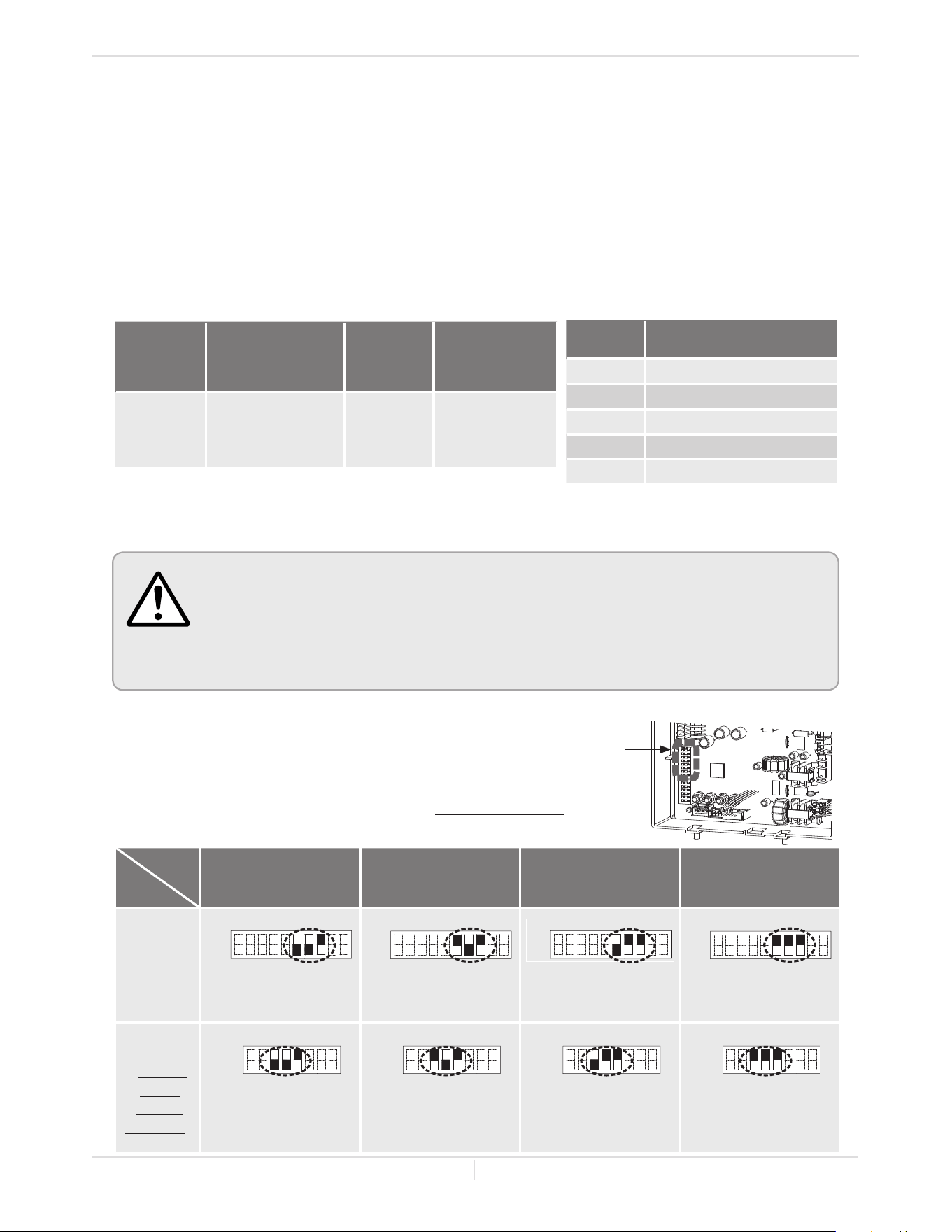
-DIP switch settings for vent length-
WARNING
• Adjust the appropriate DIP switches according to model and vent length as
shown below. DO NOT adjust the other DIP switches.
• Turn off the power supply to the water heater before changing the DIP
switch settings.
• Failure to observe these warnings could lead to carbon monoxide poisoning
or death.
Vent type Diameter
Max. No. of
87° Elbows
Max. Vertical and
Horizontal (Total)
Vent Length
Concentric
3 in. / 5 in.
(80 mm / 125 mm)
4 43 ft (13.1 m )
For each 87° elbow added, deduct 5 ft (1.5m) from max. vent
length. Two 45° elbows are equivalent to one 87° elbow.
No. of 87°
Elbows
Max. Vertical
or Horizontal Vent Length
0 43 ft (13.1 m)
1 38 ft (11.6 m)
2 33 ft (10.1. m)
3 28 ft (8.5 m)
4 23 ft (7.0 m)
Excludes the Concentric termination
Installaon
Installaon Manual
110C and 310C:
Only adjust DIP switch No. 6 , No. 7, and No. 8.
510C:
Only adjust DIP switch No. 3, No. 4, and No. 5 on the upper bank.
The black squares indicate the correct DIP switch positions for vent length.
0 to 10 ft
(0 to 3 m)
DEFAULT
11 to 20 ft
(3.1 to 6.1 m)
21 to 30 ft
(6.2 to 9.1 m)
31 to 43 ft
(9.2 to 13.1 m)
110C
and
310C
OFF
ON
1 2 3 4 5 6 7 8 9 10
No. 6 : OFF
No. 7 : OFF
No. 8 : ON
OFF
ON
1 2 3 4 5 6 7 8 9 10
No. 6 : ON
No. 7 : OFF
No. 8 : ON
OFF
ON
1 2 3 4 5 6 7 8 9 10
No. 6 : OFF
No. 7 : ON
No. 8 : ON
OFF
ON
1 2 3 4 5 6 7 8 9 10
No. 6 : ON
No. 7 : ON
No. 8 : ON
510C
(Upper
bank
of DIP
switches)
1 2 3 4 5 6 7 8
OFF
ON
No. 3 : OFF
No. 4 : OFF
No. 5 : ON
OFF
ON
1 2 3 4 5 6 7 8
No. 3 : ON
No. 4 : OFF
No. 5 : ON
OFF
ON
1 2 3 4 5 6 7 8
No. 3 : OFF
No. 4 : ON
No. 5 : ON
OFF
ON
1 2 3 4 5 6 7 8
No. 3 : ON
No. 4 : ON
No. 5 : ON
Vent
length
Model
510C Computer board
Upper bank of
DIP switches
15 Page
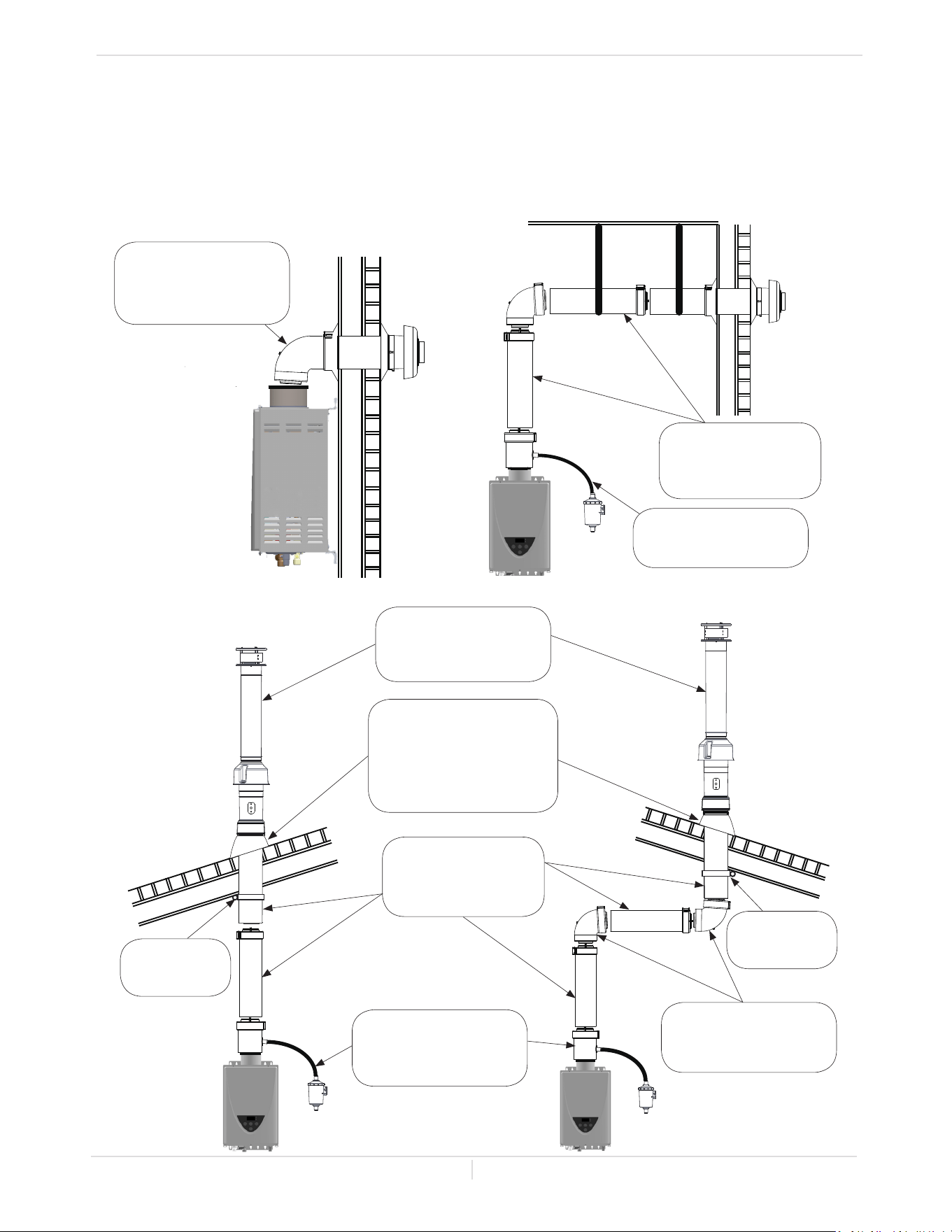
-Venng illustraons-
For the 110C, 310C and 510C models
The condensate trap and collector are required when there is more than 8 ft (2.4 m) of equivalent vent length,
excluding the vent termination. For details of
the venting installation, refer to the Centrotherm Eco Systems
Direct Vent APNC35 concentric venting installation manuals.
Installaon
Installaon Manual
Horizontal Installation
Vertical Installation
Condensate Trap &
Collector*
100266139&100266140
Straight Pipe
10" (254 mm): 100266133
19.5" (495 mm): 100266134
39" (990 mm): 100266135
Elbow
87°:100266132
45°:100266119
Standard Sidewall kit
11.5" (292 mm):100266115
21" (533 mm):100266117
Condensate Trap &
Collector*
100266139&100266140
Roof termination
38" (965 mm): 100266118
18" (457 mm): 100305170
Tile / Shingle Roof Flashing
1/12 to 6/12 pitch: 100266136
8/12 to 16/12 pitch: 100266137
6/12 to 12/12 pitch: 100266138
Flat: 100266187
Straight Pipe
10" (254 mm) : 100266133
19.5" (495 mm) : 100266134
39" (990 mm) : 100266135
Pipe Hanger
100266141
Pipe Hanger
100266141
*Condensate must be disposed
of according to local code.
*Condensate must be disposed of according to local code.
*Condensate must be disposed
of according to local code.
16 Page
Installaon
Installaon Manual
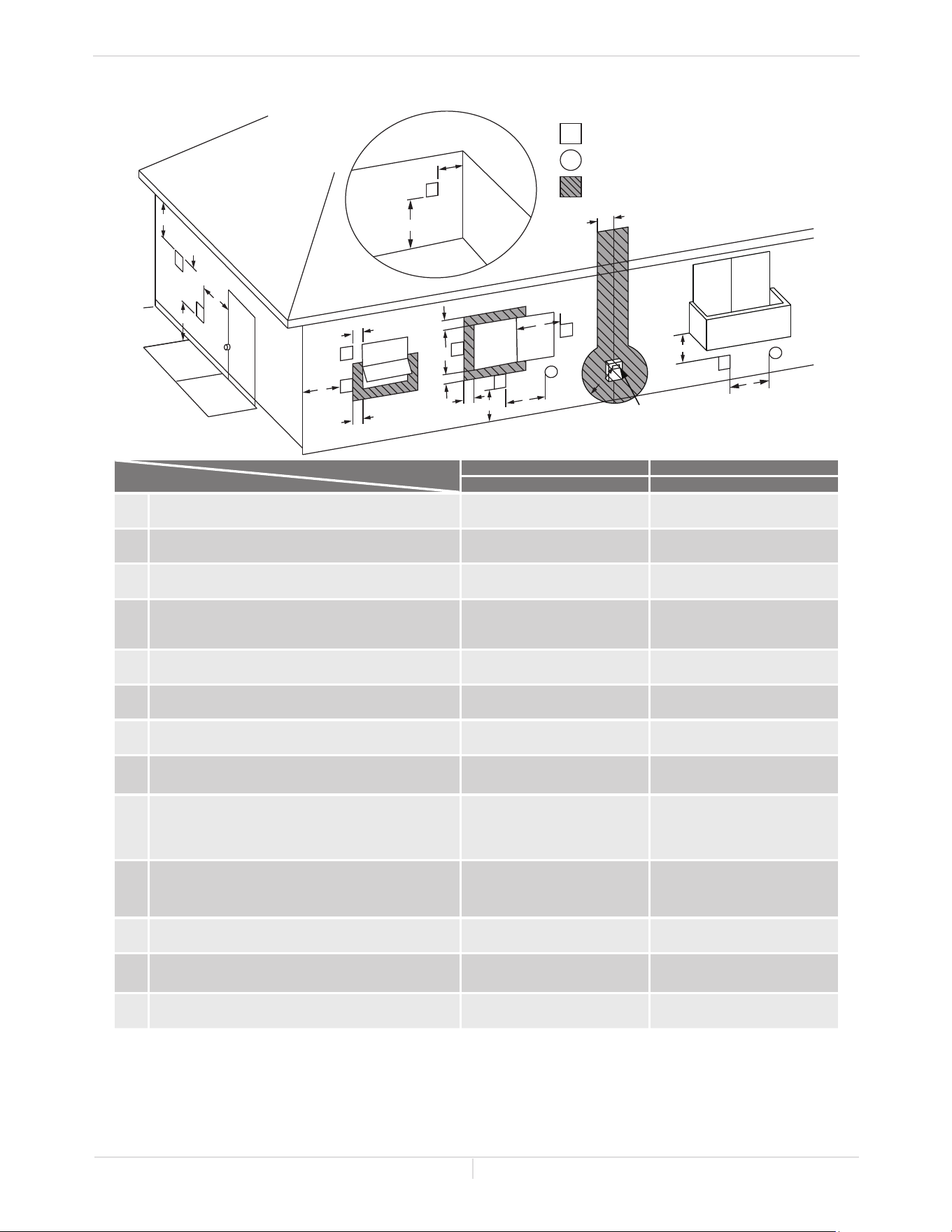
-Vent terminaon clearances-
H
D
E
L
B
V
V
V
V
B
F
C
B
B
B
V
V
V
V
V
X
X
A
J
M
Operable
Fixed
closed
Fixed
closed
Operable
B
Inside corner
detail
G
A
K
V
X
= Vent terminal
= Air supply inlet
= Area where the terminal
is not permied
Regulator/Gas meter
vent outlet
I
Canada Installations
1
US Installations
2
Direct-vent Direct- vent
A Clearance above grade, veranda, porch, deck, or balcony 1 ft (30 cm) 1 ft (30 cm)
B Clearance to window or door that may be opened 3 ft (91 cm) 1 ft (30 cm)
C Clearance to permanently closed window 0 0
D
Vertical clearance to ventilated soffit located above the
vent terminator within a horizontal distance of 2 feet
(61cm) from the center line of the termination
3 ft (91 cm) 3 ft (91 cm)
E Clearance to unventilated soffit 3 ft (91 cm) 3 ft (91 cm)
F Clearance to outside corner 2 ft (61 cm) 2 ft (61 cm)
G Clearance to inside corner 2 ft (61 cm) 2 ft (61 cm)
H
Clearance to each side of center line extended above
meter/regulator assembly
3 ft (91 cm) *
I Clearance to service regulator vent outlet
Above a regulator within 3 ft
(91 cm) horizontally of the verti-
cal center line of the regulator
vent outlet to a maximum verti-
cal distance of 15 ft (4.5 m)
*
J
Clearance to non-mechanical air supply inlet to build-
ing or the combustion air inlet to any other appliance.
3 ft (91 cm) 1 ft (30 cm)
K Clearance to mechanical air supply inlet 6 ft (183 cm)
3 ft (91 cm) above if within
10 ft (3 m) horizontally.
L
Clearance above paved sidewalk or paved driveway
located on public property
7 ft (213 cm)** 7 ft (213 cm)
M Clearance under veranda, porch deck, or balcony 1 ft (30 cm)*** 1 ft (30 cm)***
*Clearance in accordance with local installation codes and the requirements of the gas supplier.
**A vent shall not terminate directly above a sidewalk or paved driveway that is located between two single family dwellings and
serves both dwellings.
***Permitted only if veranda, porch, deck, or balcony is fully open on a minimum of two sides beneath the floor.
Notes:
1) In accordance with the current CSA B149.1, Natural Gas and Propane Installation Code
2) In accordance with the current ANSI Z223.1/NFPA 54, National Fuel Gas Code
17 Page
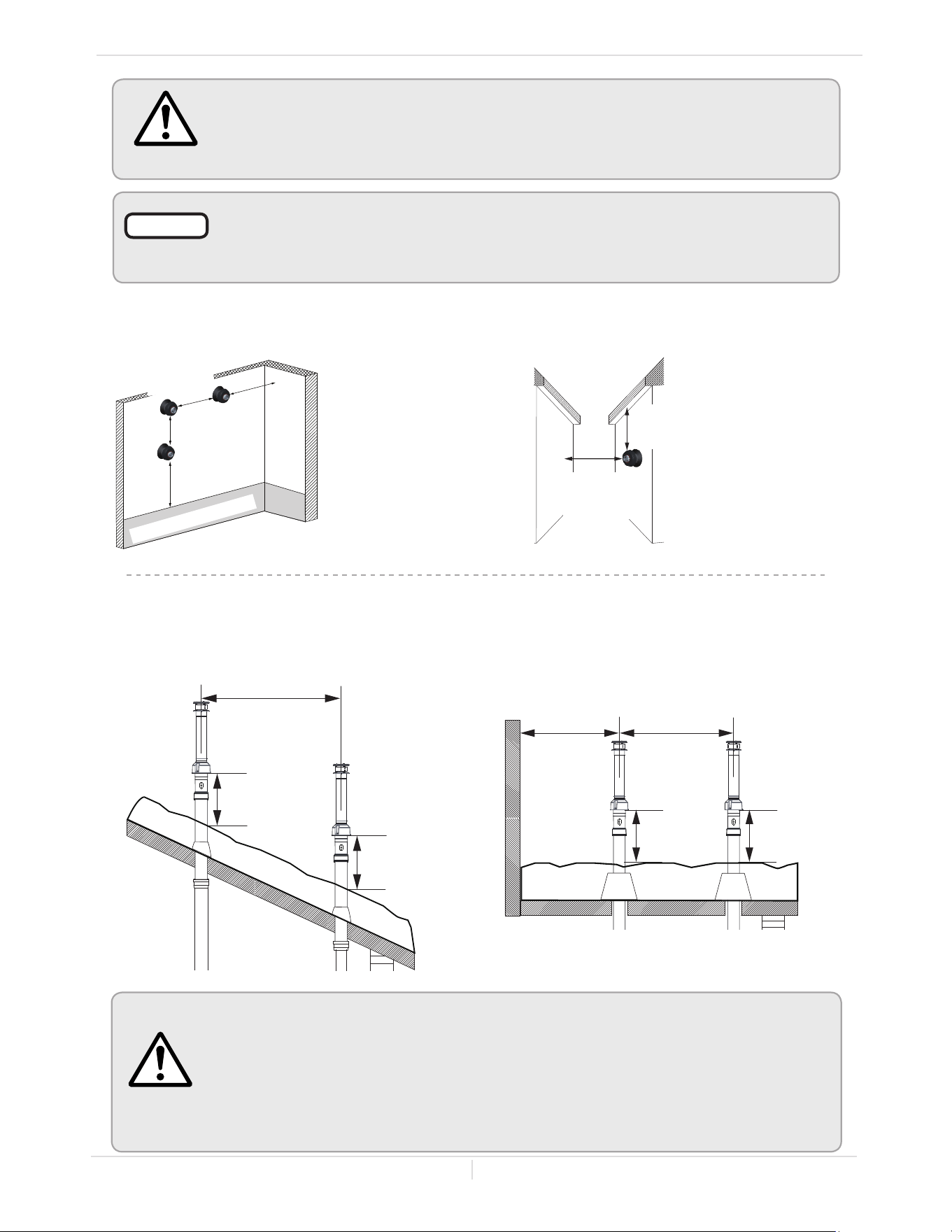
-Clearances for sidewall terminaons-
-Clearances for rooop terminaons-
Multiple-unit, concentric wall
terminals: Space each concentric
wall terminal at least 1 ft (30 cm)
away from each other, no matter
the orientation. A concentric wall
terminal must also be at least 2 ft
(61 cm) away from an inside corner.
If the adjacent wall is less than 2
ft (61 cm) of length, the minimum
required distance away from the
inside corner will be equal to the
length of that adjacent wall.
Concentric wall terminals
should be at least 2 ft (61
cm) away from an opposite
surface/wall. Do not place the
termination directly in front of
an opening into a building.
Concentric wall
terminals should be at
least 3 ft (91 cm) away
from a ventilated or
unventilated soffit.
Installaon
Installaon Manual
Inside
corner
Anticipated snow level
1 ft
(30 cm)
min.
2 ft
(61 cm)
min.
1 ft (30 cm)
min.
2 ft
(61 cm)
min.
3 ft
(91 cm)
min.
Improper installation can result in carbon monoxide poisoning or death. Follow all local
and national codes in regards to proper termination clearances. In the absence of such
codes, the clearances below can be used as guidelines. Local codes supersede these
guidelines.
WARNING
Canadian requirements differ from the guidelines in this section. In Canada, follow
the requirements of B149.1 (Natural Gas and Propane Installation Code, current
edition) as well as local and provincial codes. Contact your local code enforcement
agency for direction.
NOTICE
Angled roof termination
Intake air
Intake air
Exhaust
gas
Exhaust
gas
5 ft (152 cm) min.
1 ft
(30 cm)
min.
1 ft
(30 cm)
min.
Anticipated
snow level
Flat roof termination
Intake airIntake air
Exhaust
gas
Exhaust
gas
2 ft (61 cm)
min.
1 ft
(30 cm)
min.
Anticipated
snow level
2 ft (61 cm) min.
1 ft
(30 cm)
min.
Vertical
wall
• Minimum spacing between multiple concentric terminals for rooftop:
• On the same level: 2 ft (61 cm) spacing between each
• On the different level: 5 ft (152 cm) spacing between each
• The exhaust termination must be a horizontal distance of at least 2 ft (61 cm) from a wall
or surface unless specified differently by local code.
• Failure to observe this warning may result in severe personal injury or death.
WARNING
1 ft
(30 cm)
min.
18 Page
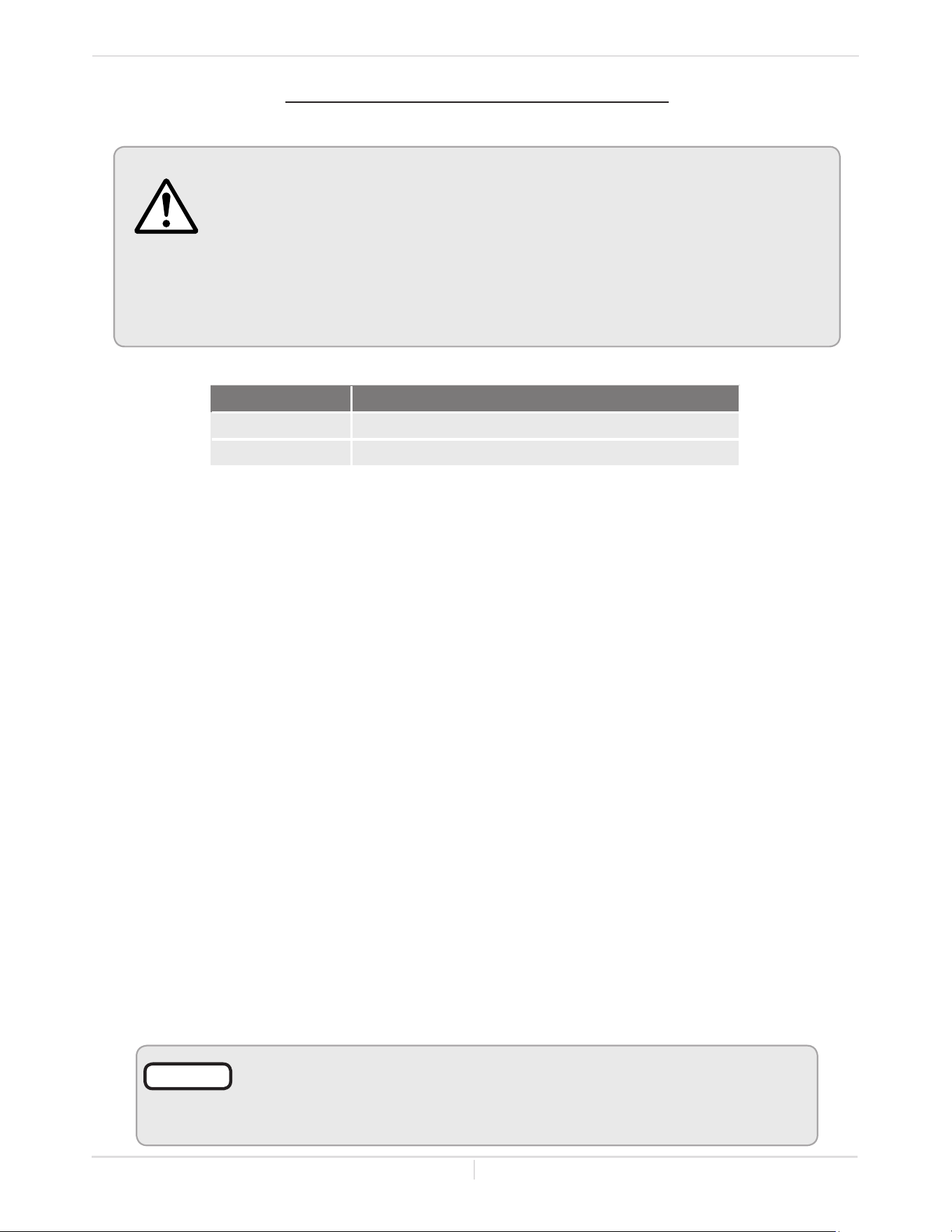
GAS SUPPLY AND GAS PIPE SIZING
-General-
• Do not use this water heater with any gas other than the one listed on the rating
plate unless the water heater has been properly converted.
• Ensure that any and all gas regulators used are operating properly and providing
gas pressures within the specified range shown below. Excess gas inlet pressure
may cause serious accidents.
• If your water heater needs a gas conversion, refer to the instructions supplied with
the heater and included with the conversion components.
• Failure to observe these warnings could result in severe personal injury, carbon
monoxide poisoning, or death.
WARNING
• The minimum and maximum inlet gas pressures
Gas type Inlet gas pressure
Natural Gas Min. 4.0” W.C. (1.00 kPa) – Max. 10.5” W.C. (2.61 kPa)
Propane Min. 8.0” W.C. (1.99 kPa) – Max. 14.0” W.C. (3.48 kPa)
• Inlet gas pressures that fall outside the range of values listed above may adversely affect the
performance of the water heater. These pressures are measured when the water heater is in full
operation and in standby.
• Inlet gas pressure must not exceed the above maximum values; gas pressure above the specified range
will cause dangerous operating conditions and damage to the unit.
• Until testing of the main gas line supply pressure is completed, ensure the gas line to the water heater
is disconnected to avoid any damage to the water heater.
• If the gas supply pressure to the heater is greater than the specified maximum, a field-supplied
regulator is required. The regulator must lower the gas pressure within the approved range.
• Install the gas regulator according to the manufacturer's instructions.
• The regulator must be sized for the water heater input and provide the specified pressures that
are listed on the rating plate.
• In the absence of a minimum installation distance stated by the regulator manufacturer, it is
recommended that there is at least 3 ft (1 m) of piping between the regulator outlet and the
water heater's inlet gas connection.
-Gas connecons-
1. Install a full port, manual gas shutoff valve between the water heater and the gas supply line.
2. When the gas connections are completed, it is necessary to perform a gas leak test either by applying
soapy water to all gas fittings and observing for bubbles or by using a gas leak detection device.
• The water heater and its individual shutoff valve must be disconnected from the gas supply
piping system during any pressure testing of that system at test pressures in excess of 1/2 psi
(3.5 kPa).
• The water heater must be isolated from the gas supply piping system by closing its individual
manual shutoff valve during any pressure testing of the gas supply piping system at test
pressures equal to or less than 1/2 psi (3.5 kPa).
3. Always purge the gas line of any debris and/or water before connecting to the gas inlet.
Size the gas pipe to supply the necessary volume of gas for the water heater. Refer
to and follow the requirements listed in the current edition of ANSI Z223.1/NFPA
54 (USA), B149.1 (Canada), or local codes. Otherwise, flow capabilities and output
temperatures will be limited.
NOTICE
Installaon
Installaon Manual
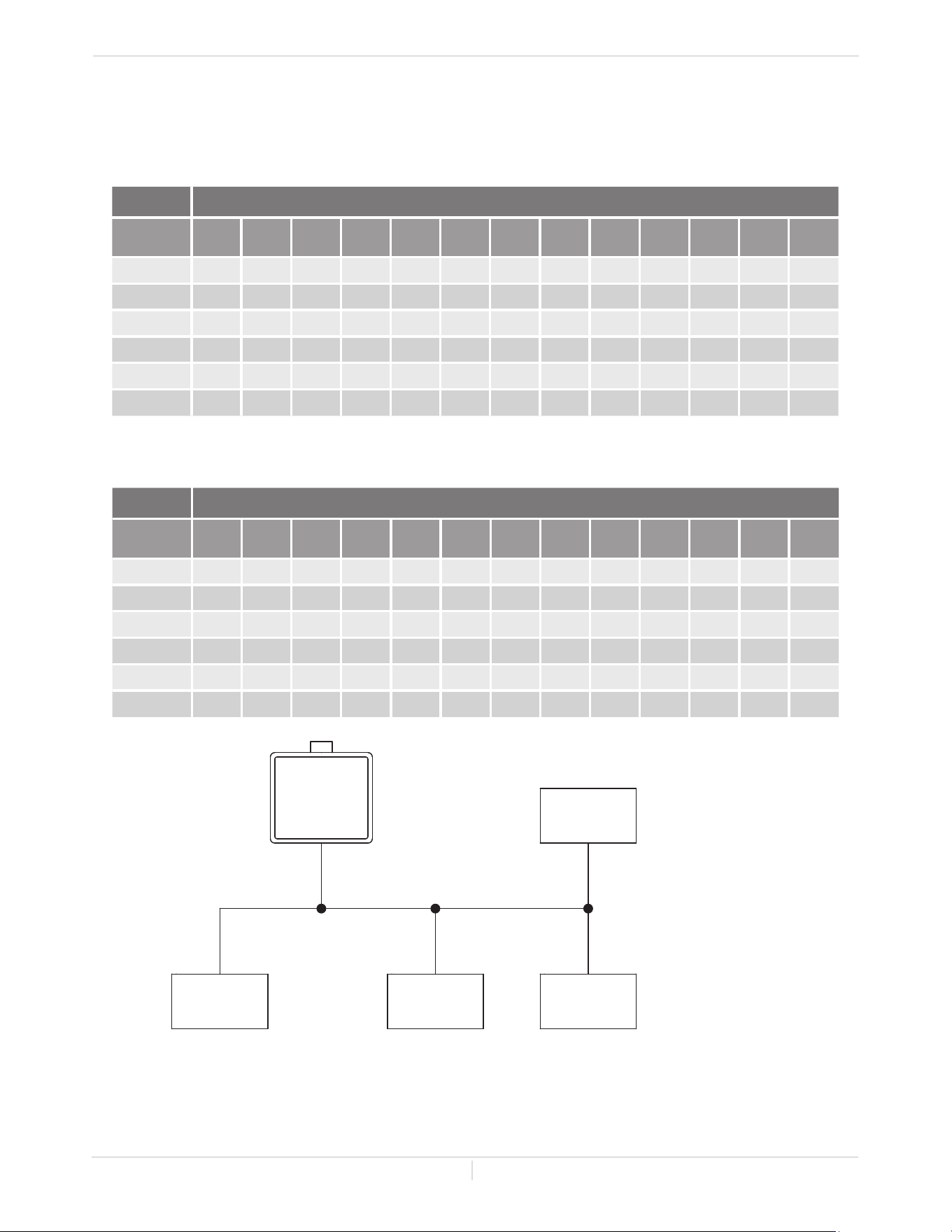
19 Page
Based on Energy
Content of 1,000
BTU/Cubic ft:
Divide each
appliance's BTU/h
requirement by
1,000 BTU/ft
3
to get
the appliance's ft
3
/h
requirement.
Take into account
the distance the
appliance is from
the gas meter, then
look in the above
gas chart to properly
size the line.
For sections of the
gas line supplying gas to more than one appliance (Ex: Point A to Point B), add up the cubic ft per hour requirements
of the appliances that are being supplied by that section, and size to the farthest appliance.
For Example: The section from A to B supplies gas to the furnace, range and dryer. Adding up the BTU/h requirements
and dividing by 1,000 yields a cubic ft per hour requirement of 220 cubic ft of gas per hour. The farthest appliance
is the range, which is 50 ft (15.2 m) away from the meter. According to the chart above, the 50-ft (15.2 m) column
shows that Section A to B must be 1" in order to supply 220 cubic ft per hour.
Water
heater
199,000 BTU/h
Dryer
35,000 BTU/h
Gas meter
Furnace
120,000 BTU/h
Range
65,000 BTU/h
A
B
C
10' (3.1 m) Length
1/2" Pipe size
15' (4.6 m) Length
1/2" Pipe size
15' (4.6 m) Length
1" Pipe size
10' (3.1 m) Length
3/4" Pipe size
10' (3.1 m) Length
1" Pipe size
5' (1.5 m) Length
1-1/4" Pipe size
10' (3.1 m) Length
3/4" Pipe size
5' (1.5 m) Length
1-1/4" Pipe size
Gas sizing example
(Natural Gas)
Installaon
Installaon Manual
Pipe Size Length: ft (m)
Diameter:
in.
10'
(3.0)
20'
(6.1)
30'
(9.1)
40'
(12.2)
50'
(15.2)
60'
(18.3)
70'
(21.3)
80'
(24.4)
90'
(27.4)
100'
(30.5)
125'
(38.1)
150'
(45.7)
200'
(61.0)
1/2"
172 118 95 81 72 65 60 56 52 50 44 40 34
3/4"
360 247 199 170 151 137 126 117 110 104 92 83 71
1"
678 466 374 320 284 257 237 220 207 195 173 157 134
1-1/4"
1,309 957 768 657 583 528 486 452 424 400 355 322 275
1-1/2"
2,090 1,430 1,150 985 873 791 728 677 635 600 532 482 412
2"
4,020 2,760 2,220 1,900 1,680 1,520 1,400 1,300 1,220 1,160 1,020 928 794
Unit: Cubic feet per hour
-Natural gas supply piping-
Maximum delivery Capacity of Cubic Feet of Gas per Hour of IPS Pipe carrying Natural Gas with 0.60 Specific Gravity
Based on Pressure Drop of 0.5" W.C.
Based on Energy Content of 1,000 BTU/Cubic ft: The water heater requires 140 Cubic ft/hr for the 110C, 190 Cubic
ft/hr for 310C, and 199 Cubic ft/hr for the 510C model.
Unit: kBTU per hour
Pipe Size
Length: ft (m)
Diameter:
in.
10'
(3.0)
20'
(6.1)
30'
(9.1)
40'
(12.2)
50'
(15.2)
60'
(18.3)
70'
(21.3)
80'
(24.4)
90'
(27.4)
100'
(30.5)
125'
(38.1)
150'
(45.7)
200'
(61.0)
1/2"
268 184 148 126 112 101 93 87 82 77 68 62 53
3/4"
567 393 315 267 237 217 196 185 173 162 146 132 112
1"
1,071 732 590 504 448 409 378 346 322 307 275 252 213
1-1/4"
2,205 1,496 1,212 1,039 913 834 771 724 677 630 567 511 440
1-1/2"
3,307 2,299 1,858 1,559 1,417 1,275 1,181 1,086 1,023 976 866 787 675
2"
6,221 4,331 3,465 2,992 2,646 2,394 2,205 2,047 1,921 1,811 1,606 1,496 1,260
-Propane (LP) supply piping-
Maximum Capacity of Propane (LP) Based on 11" W.C. supply pressure at a 0.5" W.C. pressure drop
20 Page
-Pressure relief valve-
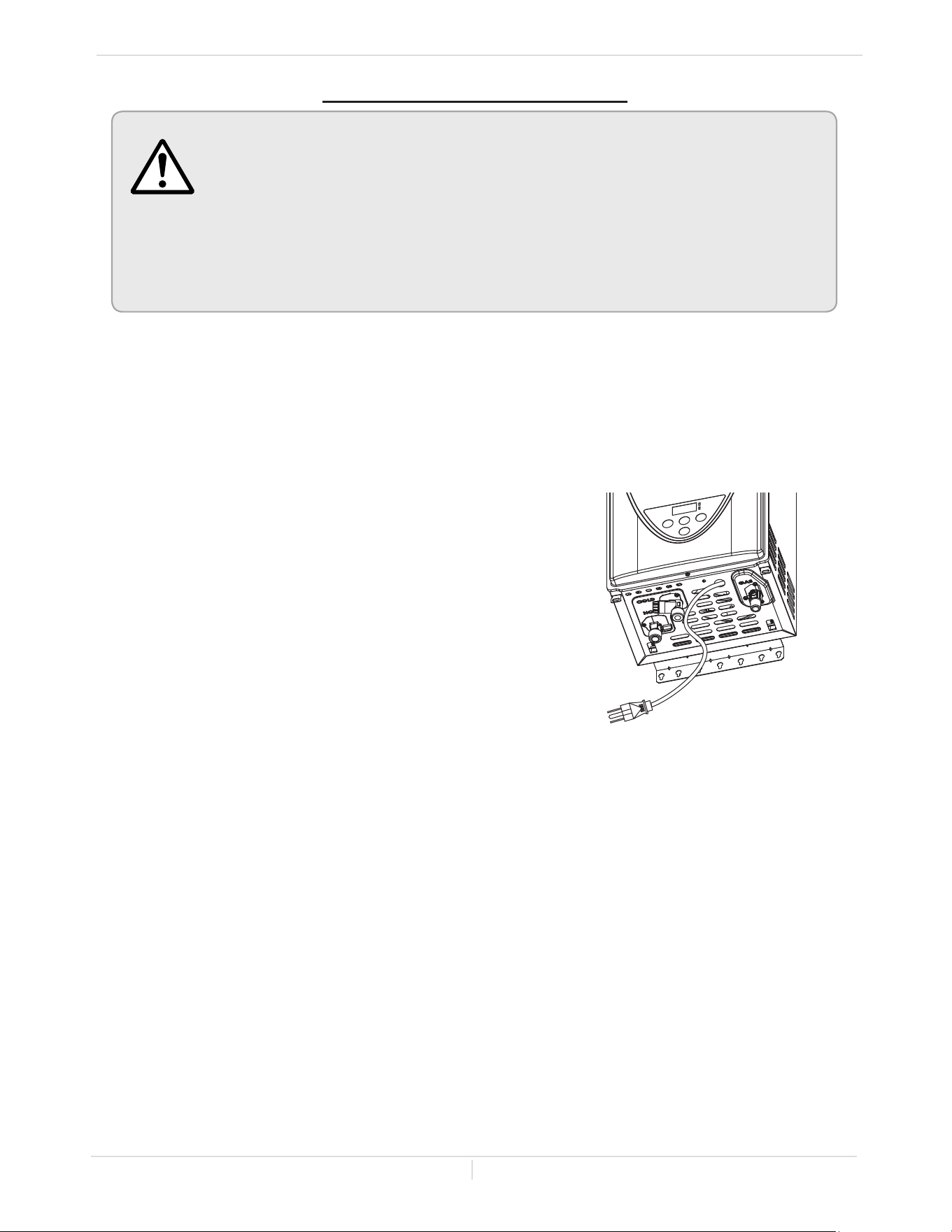
The water heater has a high-temperature shutoff switch built in as a standard safety feature (called a
Hi-Limit switch). Therefore, a “pressure only” relief valve is required.
• This unit does not come with an approved pressure relief valve.
• An approved pressure relief valve must be installed on the hot water outlet.
• The pressure relief valve must conform to the current edition of ANSI Z21.22 or CAN 1-4.4 and instal-
lation must follow local codes.
• The discharge capacity must be at least 140,000 BTU/h for the 110C model, 190,000 BTU/h for the
310C model, and 199,000 BTU/h for the 510C model.
• The pressure relief valve must be rated for a maximum of 150 psi (1 MPa).
• The discharge piping for the pressure relief valve must be directed so that the hot water cannot splash
outward and cause damage or personal injury.
• Attach the discharge tube to the pressure relief valve and run the end of the tube to within 6 in.
(152 mm) from the floor. This discharge tube must allow free and complete drainage without any
restrictions.
• If the pressure relief valve installed on the water heater discharges periodically, this may be due to a
defective thermal expansion tank or defective pressure relief valve.
• The pressure relief valve must be manually operated periodically to check for correct operation.
• No valve must be placed between the relief valve and the water heater.
WARNING
Hot water could be released when the pressure relief valve is opened. This
could result in severe personal injury. Before operating the pressure relief
valve manually, check that it will discharge in a safe place. If water does not
flow freely from the end of the discharge pipe, turn the gas supply and power
OFF and call a qualified person to determine the cause.
Refer to the pressure relief valve manufacturer's instructions for inspection and
maintenance requirements.
Installaon
Installaon Manual
WATER CONNECTIONS
5. There is a wire mesh filter within the cold inlet to
trap debris from entering your heater. This will need
to be cleaned periodically to maintain optimum flow.
(Refer to p. 38.)
All pipes, pipe fittings, valves and other components, including soldering materials, must be suitable for
potable water systems.
1. A manual shutoff valve must be installed on the cold water inlet to the water heater between the
main water supply line and the water heater.
2. In addition, a manual shutoff valve is also recommended on
the hot water outlet of the unit. Isolation valves with
hose bibbs for service are available.
Cold
inlet
Hot
outlet
Gas
inlet
As close
as possible
Pressure relief
valve
3. If the water heater is installed within, or subjected to, a closed
loop water system, a thermal expansion tank or a code
approved device to handle thermal expansion must be installed.
Do not use this appliance if any part has been under water. Immediately contact a
qualified installer or service agency to replace a flooded water heater. Do not attempt
to repair the unit! It must be replaced!
WARNING
Do not reverse the hot outlet and cold inlet connections to the water heater. This will
prevent the water heater from activating properly.
NOTICE
4. Before installing the water heater, flush the
water line to remove all debris, and after
installation is complete, purge the air from the
line. Failure to do so may cause damage to the
water heater.
21 Page
ELECTRICAL CONNECTIONS
• Follow the electrical code requirements of the local authority having
jurisdiction. In the absence of such requirements, follow the current edition
of the National Electrical Code ANSI/NFPA 70 in the U.S. or the current
edition of CSA C22.1 Canadian Electrical Code Part 1 in Canada.
• When servicing or replacing parts within the water heater, label all wires
prior to disconnection to facilitate an easy and error-free reconnection.
Wiring errors can cause improper and dangerous operation. Verify proper
operation after servicing.
• Failure to observe these warnings could result in personal injury or loss of life.
WARNING
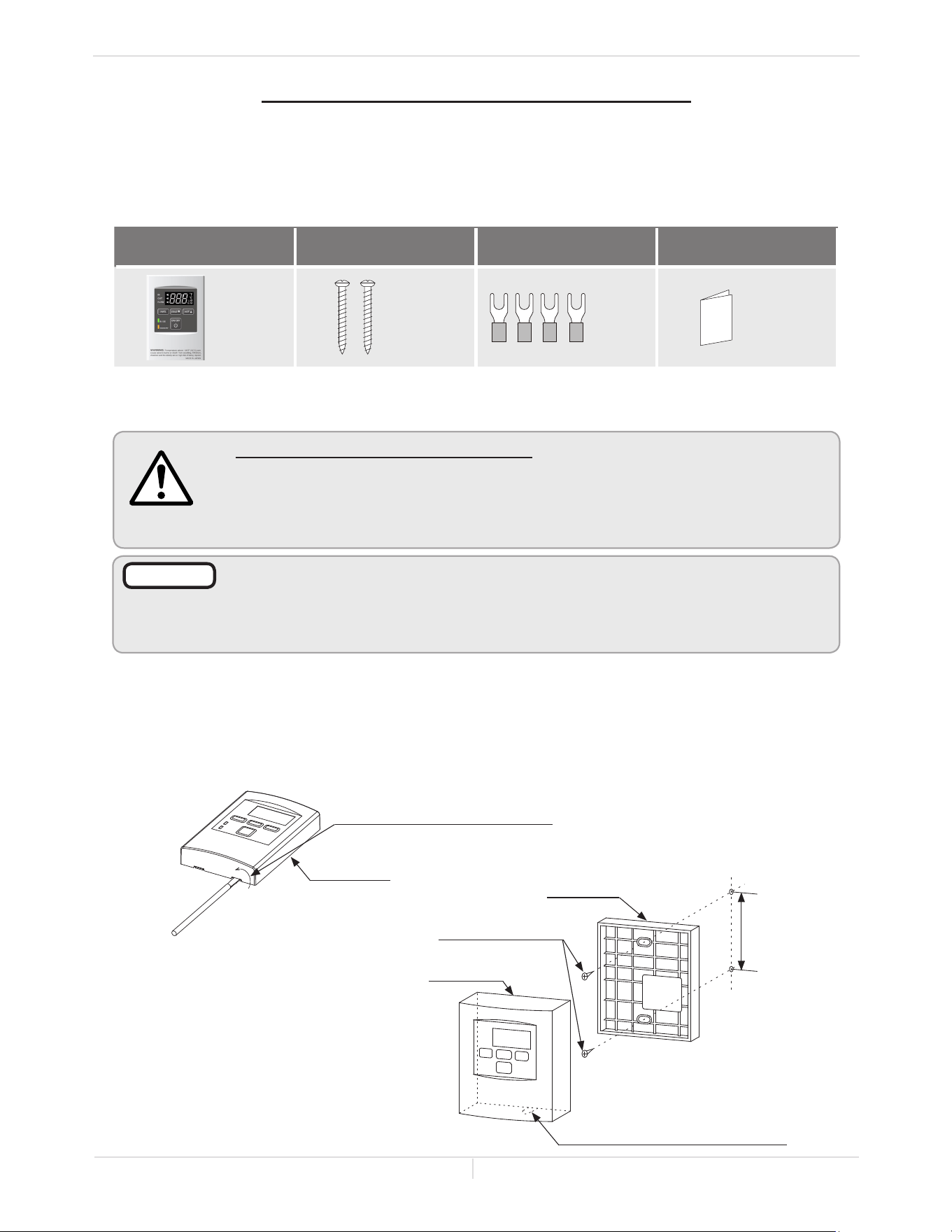
All concentric vent models come with a power plug.
1. The water heater requires 120 VAC, 60 Hz electrical power supply that is properly grounded.
• A proper disconnect (i.e. on/off switch, power plug, etc.) controlling the main power to the water
heater must be provided for service reasons. (Must comply with local codes.)
2. The use of a surge protector is recommended in order to protect the unit from power surges.
Installaon
Installaon Manual
22 Page
TEMPERATURE REMOTE CONTROLLER
-Oponal item-
• The remote control is an oponal accessory that can be installed in a hall, closet, etc., to allow for
temperature adjustment without having to go to the heater.
• When installed, the remote will take priority over the built-in controller.
Verify that the items listed below are included with the remote controller 100209924 (TM-RE42).
Temperature
remote controller
Screws Fork terminals Manual
Qty: 1
Qty: 2
Qty: 4
Qty: 1
-Installaon-
• This remote controller is NOT waterproof.
• The water heater can only have one remote controller.
• Do not install in high temperature environments, high humidity conditions outdoors,
in direct sunlight, or within the reach of children.
• Make sure the remote controller does not come into contact with water or oil.
WARNING
• Do not place the remote controller cable close to other wires from other products.
• Cables used for the remote controller connection must be:
• Minimum 20 gauge wire (No polarity)
• Maximum 400 ft (122 m) long
NOTICE
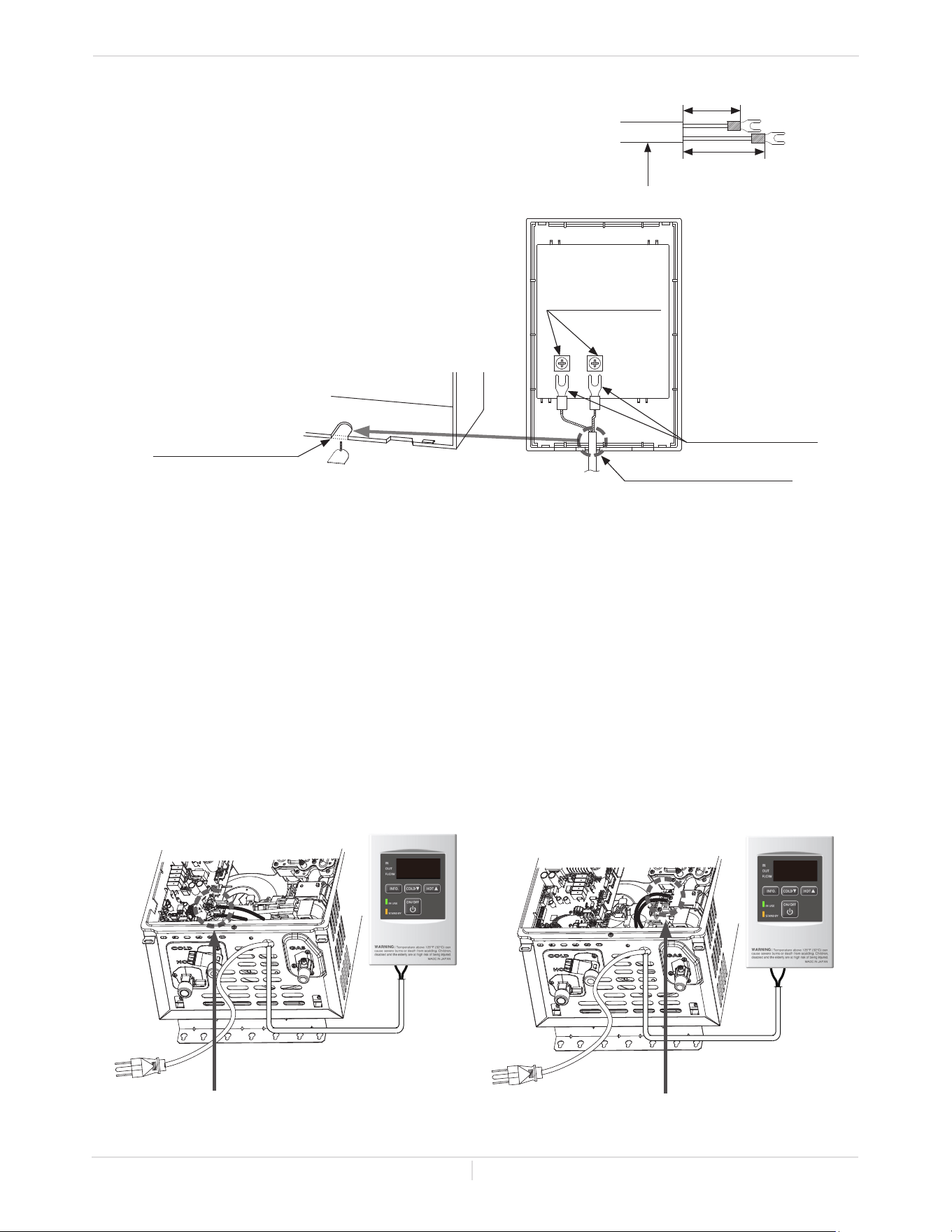
<Mounting and wiring the remote controller>
1.
Take off the Back plate from the remote controller with a flat head screwdriver. (Fig. A and B)
2.
Attach the Back plate on the wall with the two provided screws. (Fig. B)
Fig. B
Back plate
3-1/4 inches
(82.6 mm)
Attach the screws
Cut out the partition with pliers
Main body
Fig. A
Main body
Twist
Press and twist flat head
screwdriver against the cutout.
Installaon
Installaon Manual
23 Page
3.
Crimp the Fork terminals to the cable. (Fig. C)
4.
Tighten the two Fork terminals beneath the two
Remote controller terminal screws on the back of
the main body. (Fig. D-1)
5.
Cut out the inlet for the remote controller cable
from the bottom of the main body. (Fig. D-2)
6.
Place the Main body back on the Back plate, with
the Remote controller cable running out of the
bottom inlet.
Remote controller
terminals
Fig. D-1
Two fork terminals
Remote controller cable
Inlet for the remote
controller cable
Cut out
Fig. D-2
<How to connect the remote controller to the water heater>
1. Disconnect power supply from the water heater.
2. Take off the water heater’s front cover.
3. Locate the two terminals for the remote controller in the water heater. (Refer to the Fig. E-1 and E-2.)
4. Put the remote controller cable through the hole at the bottom of the casing of water heater from
outside.
5. Secure both terminals on the controller cable to the terminals in the cabinet as shown below.
(Secure them underneath the screw terminals. No polarity.) See Figures E-1 and E-2.
* Do NOT jump or short-circuit the wires, or the computer will be damaged.
6. Replace the water heater's front cover securely.
7. Reconnect power supply to the water heater.
Installaon
Installaon Manual
Fig. E-1
110C and
310C models
100209924
(TM-RE42)
Connect other end to these terminals.
510C model
100209924
(TM-RE42)
Connect other end to these terminals.
Fig. E-2
Remote controller cable
1-3/8 Inch
(35 mm)
Fig. C
1-5/8 Inch
(41 mm)
Fork
Terminals
24 Page
EASY-LINK SYSTEM
(Available on the 510C model only)
-General-
The 510C model water heaters can
be connected together to work as a
multiple-unit manifold system.
You can manifold from 2 to 4 units
without the need for a multi-unit
controller. A 4-unit system has full
automatic modulation between 15,000 BTU/h and 796,000 BTU/h.
• The Easy-Link System is limited to up to 4 units. If you connect more than 4 units,
only the first 4 units will work as a part of the Easy-Link System. The other additional
units will not work.
• A remote controller is not required for an Easy-Link System. However, it does provide
for more temperature options and ease of maintenance.
• If a remote controller is used, the temperature on all the units in the system will auto-
matically be set to the same temperature that is set on the remote.
• When a remote is used in an Easy-Link System, it must be connected to the parent unit.
• Only one remote can be connected.
NOTICE
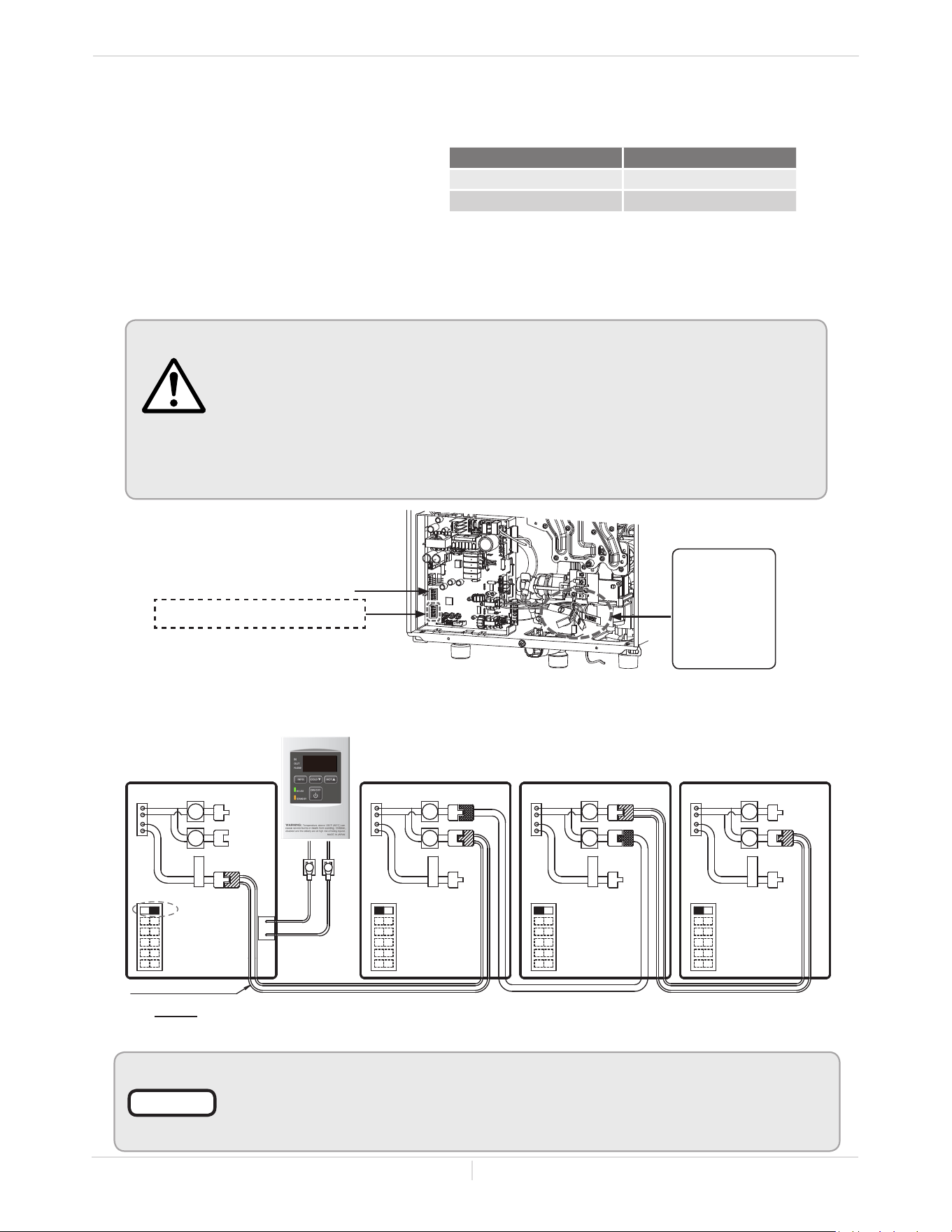
-Easy-Link Connecon Procedures-
1. Make sure the power to the heaters is turned off.
2. Verify the DIP switch set temperatures of all units within the system. Every water heater must be set to
the same set temperature. If a remote controller (100209924/TM-RE42) is used, it should be installed
to the “PARENT” unit. The remote will set the temperature for the entire system.
3. Select one unit to be the “PARENT” unit. The “PARENT” unit should be one of the end units.
4. “PARENT” unit:
Locate the two banks of DIP switches at the bottom left of the computer board of the unit that you
select to be the “PARENT” unit. Change DIP switch No. 1 on the lower bank of DIP switches to the
ON position. See the computer board diagram as shown on the next page. Do not change any DIP
switches on any of the “CHILD” units.
5. Between the “PARENT” and the “CHILD-1” units:
Connect the “PARENT” connector of the “PARENT” unit to the “1” connector of the “CHILD-1” unit
using the supplied communication cable.
6. Between the “CHILD-1” and the “CHILD-2” units:
Connect the “2” connector of the “CHILD-1” unit to the “1” connector of the “CHILD-2” unit.
7. Between the “CHILD-2” and the “CHILD-3” units:
Connect the “2” connector of the “CHILD-2” unit to the “1” connector of the “CHILD-3” unit.
8. Verify that all cables are connected like the diagram (B).
9. Turn on power to the “PARENT” unit.
Next, turn on “CHILD-1”. When the built-in controller installed in “CHILD-1” unit displays a number,
turn on “CHILD-2”.
Installaon
Installaon Manual
Hot Out
Cold In
Gas In
• The built-in Easy-Link System
allows up to 4 units to manifold
together (connected with com-
municaon cables).
• A communicaon cable (gray
color) comes with each 510C
model.
25 Page
When the built-in controller installed in the “CHILD-2” unit displays a number, turn on “CHILD-3”.
Make sure the built-in controller installed in each child unit displays each unit #. (Refer to p.40.) The
numbering system automatically allocates the unit No. to each water heater in the Easy-Link System,
in accordance with the table below.
10. Set the water temperature using the built-in temperature controller on the “PARENT” unit. It will set
the temperature for the Easy-Link System. If a remote controller is installed to the “PARENT” heater,
it will override the built-in controller.
(A) 510C model Computer board
WARNING
• To change the DIP switch settings for the Easy-Link System, locate the
lower bank of DIP switches at the bottom left of the computer board.
• Adjust the approproate DIP switch as shown below. DO NOT adjust any
other DIP switches.
• Turn off the power supply to the water heater before changing the DIP
switch settings.
• Failure to observe this warning could result in carbon monoxide poison-
ing or death.
Easy-Link /
Mul-Unit
connectors
are next to
the computer
board.
Upper bank of DIP switches
Lower bank of DIP switches
(B) Diagram of connections between the Easy-Link System units
Type of unit Unit # of easy-link
Parent 1
Child 2, 3, or 4
NOTE: The black squares indicate the correct DIP switch positions.
PARENT
Communicaon cable
Connectors
Lower bank of
DIP switches
OFF
ON
1
1
1
12
2
2
2
PARENT
PARENT
PARENT
1
2
3
4
5
6
Connectors Connectors Connectors
1
2
3
4
5
6
OFF
ON
OFF
ON
1
2
3
4
5
6
OFF
ON
1
2
3
4
5
6
Lower bank of
DIP switches
Lower bank of
DIP switches
Lower bank of
DIP switches
PARENT unit
CHILD-1 unit
CHILD-3 unit
CHILD-2 unit
Remote controller
Installaon
Installaon Manual
Connecting two “PARENT” connectors together from two separate units may damage
the computer board. The communication cable has a female end and a male end, so
it’s impossible to have a PARENT-to-PARENT connection with the communication cable.
Do not splice or modify connectors.
NOTICE
26 Page
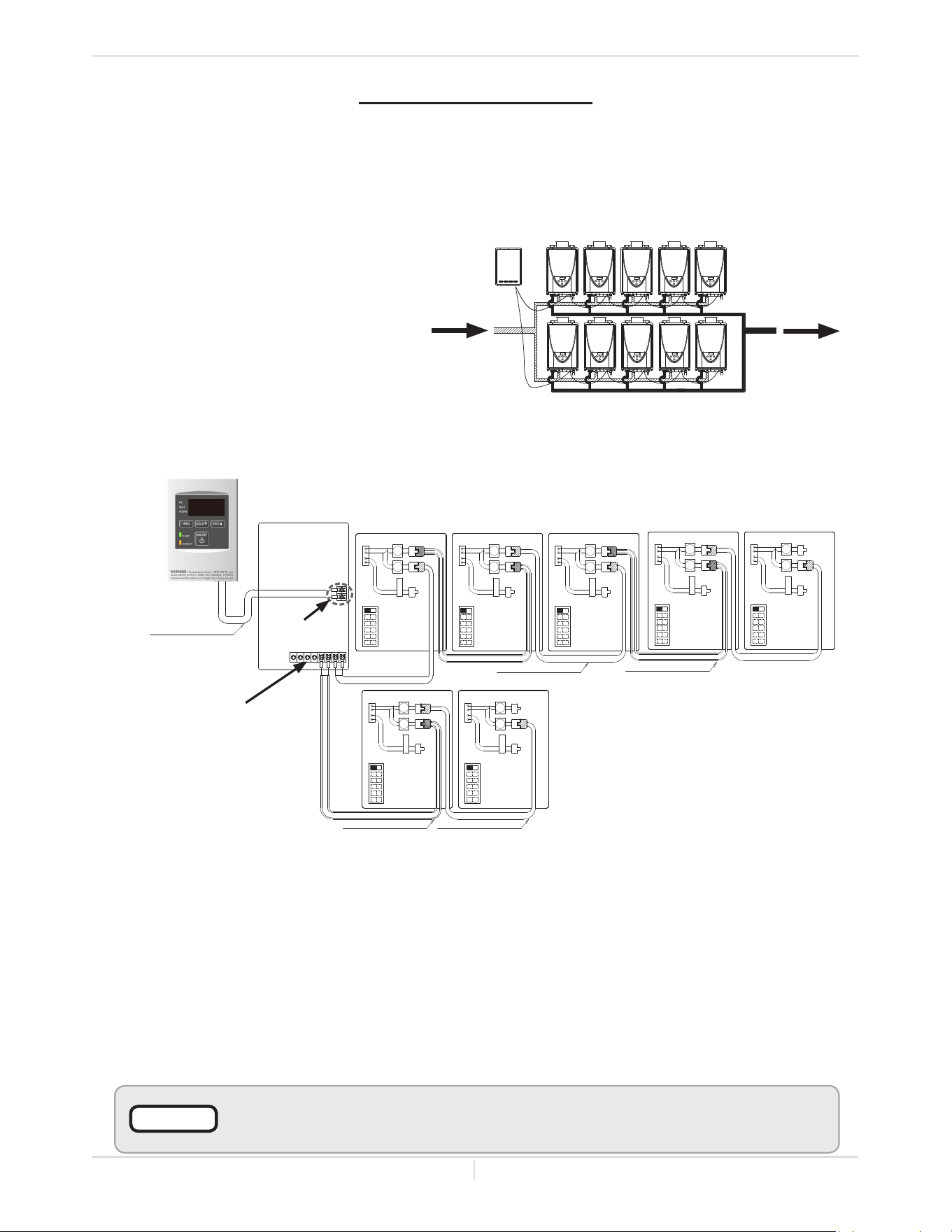
• The parent/child DIP switch, No.1 on the lower bank of DIP switches, should be in the OFF
position.
• This is the connection diagram for a 510C model and a multi-unit controller for 2 to 20 water
heaters. The example above shows seven water heaters.
• The multi-unit controller automatically allocates the unit # (1-20) to each water heater that is
part of the Multi-Unit System.
• In a Multi-Unit System, connect the “[1]” connector and the “[2]” connector with the
communication cable (refer to p. 9) or 18 gauge wire cables. The total cable length can be up
to 250 ft (76.2 m) long.
• The multi-unit controller allocates random numbering. See the controller instructions to
learn how to renumber the system units sequentially.
Installaon
Installaon Manual
100112691
(TM-MC02)
510C
Cold IN
Hot Out
MULTI-UNIT SYSTEM
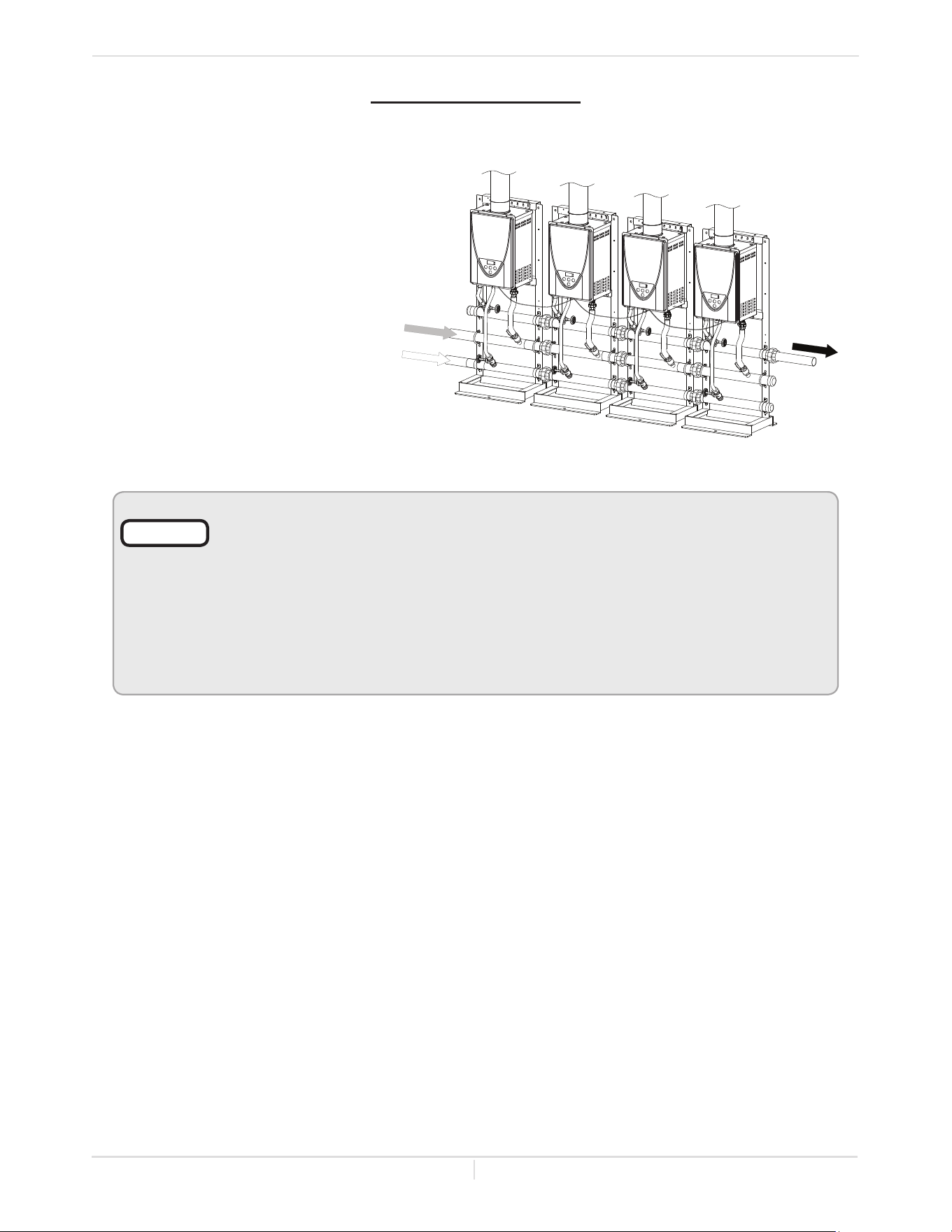
Multiple 510C models can be combined for a Multi-Unit System, along with the multi-unit controller
(Part 100112691 (TM-MC02)). Each multi-unit/remote controller set can control from 2 to 20
units for commercial or residential applications. For a 20-unit system, the computer can modulate
between the usages of 15,000 BTU/h to 3.98 million BTU/h.
An individual cut-off switch is recommended
for each unit in a Multi-Unit System for the
purpose of maintenance.
Multi-Unit System connection diagram
Multi-unit controller and temperature remote controller wiring:
OFF
ON
1
1
1
2
2
2
PARENT
PARENT
PARENT
1
2
3
4
5
6
Connectors Connectors Connectors
OFF
ON
OFF
ON
Lower bank of
DIP switches
Lower bank of
DIP switches
Lower bank of
DIP switches
Lower bank of
DIP switches
Lower bank of
DIP switches
Lower bank of
DIP switches
Lower bank of
DIP switches
1
2
3
4
5
6
1
2
3
4
5
6
Communicaon cable
Communicaon cable
Communicaon cable
Communicaon cable
Remote controller cable
1
1
2
2
PARENT
PARENT
Connectors Connectors
OFF
ON
OFF
ON
1
2
3
4
5
6
1
2
3
4
5
6
1
1
2
2
PARENT
PARENT
Connectors Connectors
OFF
ON
OFF
ON
1
2
3
4
5
6
1
2
3
4
5
6
Remote controller
100112691
(TM-MC02)
Terminals for
water heaters
Remote
controller
terminals
Example : 510C model x 7 units
For detailed instructions on the multi-unit controller, refer to the
instructions that are packaged with the multi-unit controller.
NOTICE
27 Page
APPLICATIONS
-Space-Heang Applicaons-
-Recirculaon-
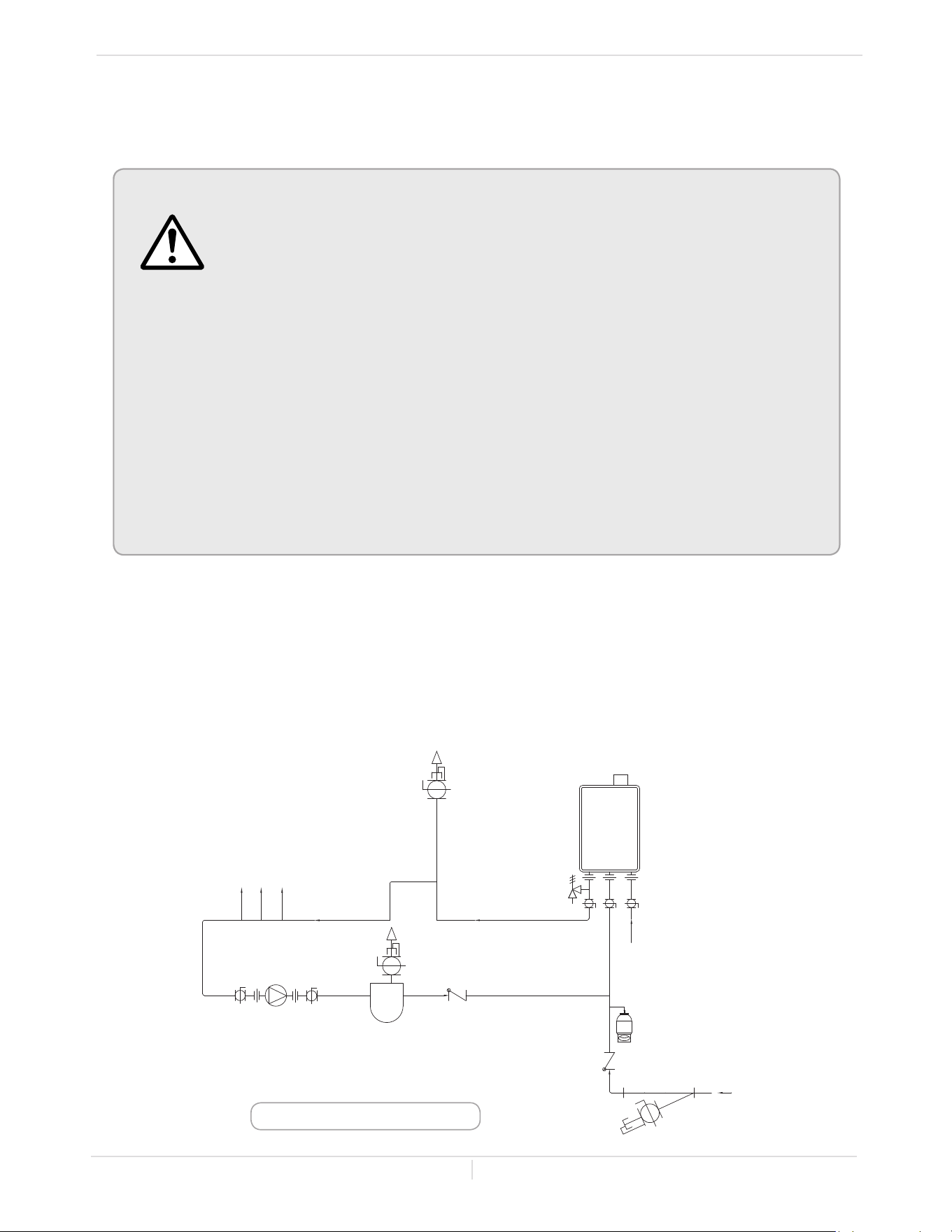
*The recirculation pump is to be controlled by:
-Dual-set aquastat (recommended w/timer)
• The aquastat's differential should be a minimum of 10 °F (5 °C).
*The recirculation pump is to provide no less than 2 GPM (7.5 L/min) and no more than 4 GPM (15 L/min) through
each activated unit in the system. Refer to the heaters specification sheet on the manufacturer's website for
pressure drop information.
• This water heater is suitable for combination water (potable) heating and space
heating and not suitable for space heating applications only.
• In order to purge air in water pipes within a closed-loop system, an air vent and
air separator should be installed in the system. Required circulation flow rates are
labeled next to each application diagram. These flow rate requirements must be
followed.
• Toxic chemicals used in boiler treatments such as alcohol, glycerol and glycol groups
must not be introduced into the system.
• The water heater can be used to supply potable water and space heating and shall
not be connected to any heating system or component(s) previously used with non-
potable water where any chemicals were added to the water heating appliances.
• When the system requires water for space heating at temperatures higher than
required for other uses, a means such as a mixing valve shall be installed to temper
the water for those other uses in order to reduce scald hazard potential.
• Water temperature over 125 °F (52 °C) can cause severe burns instantly or death
from scalding.
WARNING
Air vent
Hot water outlet to xtures
Recirculaon
pump
Air
separator
S
Check valve
Check valve
Y-Strainer
Cold water inlet
Expansion tank
Gas supply
Ball valves
Unions
Hot water outlet
Cold water inlet
Gas inlet
Pressure
relief valve
This is a concept drawing only.
Applicaons
Installaon Manual
28 Page
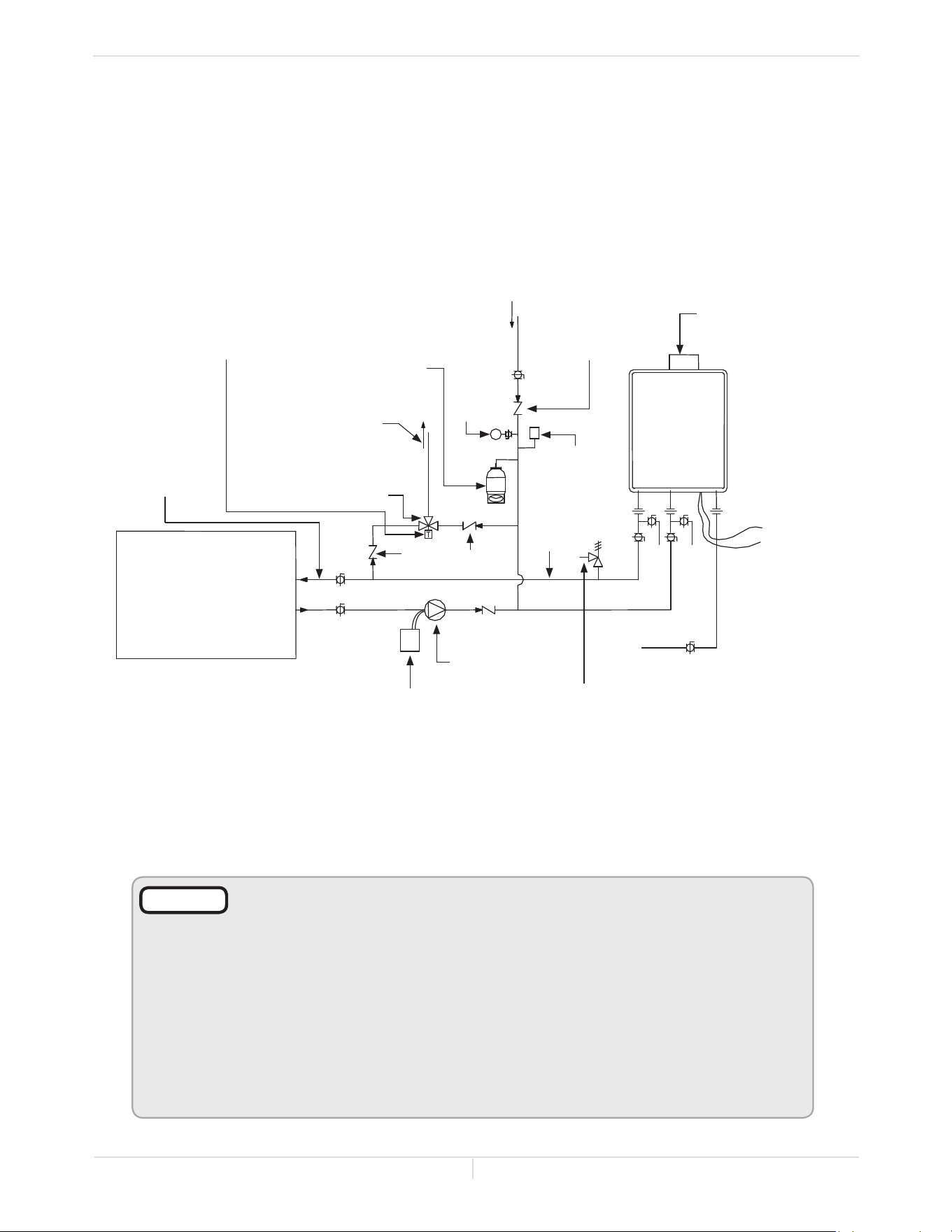
• Priority Control Devices such as a flow switch, an Aquastat or other
electronic controller can be used to prioritize the domestic water system over
the heating system.
• Follow all local codes, or in the absence of local codes, follow the current
edition of the National Standard Code, ANSI Z21.10.3 ・ CSA 4.3.
• This illustration is a concept design only. The reference to the 1/8-inch hole
in the check valve is only required in the State of Massachusetts. There are
a wide variety of variations to the application of controls and equipment
presented. Designers must add all necessary safety and auxiliary equipment
to conform to code requirements and design practice. For more details,
contact the manufacturer or local code authority.
NOTICE
120 VAC
switch or
outlet
Hot water outlet
Unions
T-handle gas shuto valve
Check valve
Electronically controlled
pump mer. Acvates
every 6 hours for 60
seconds. Wire to
product approved pump
Heang Coil
(used with air-handler)
Cold water supply
3/5 inch concentric
vent (Discharge must
comply with local and
state codes.) Cannot
be common vented
with other appliances
An approved temperature and pressure
relief valve. Tie to locaon approved by
local codes and must meet BTU rang of
water heater model used
Check valve will have
1/8-inch hole drilling
in clapper (oponal)
Atmospheric
vacuum
breaker
Shuto
valve
Pressure
gauge
Apply correct thermal
expansion tank-size
per applicaon
Shuto valves
Shuto valves
Check valves
Cold water inlet
Gas inlet
Water
lter
Drain
plug
Thermostac mixing valve
Hot water
supply and
return to
heang coil
System installed with reverse
acng aquastat to shut o fan.
Suggested but not required by
248 CMR
50’-0” maximum distance from
water heater to fan coil.
(Developed length) Not including
coil in heang unit
NSF-61 product
approved pump
Automac tempering device
must be installed below
the top of the water heater
as per manufacturer’s
recommendaons
Piping loop
between water
heater and fan
coil shall be in
compliance with
248 CMR
Tempered water to
plumbing xtures. Must
meet temperature
requirements of 248 CMR
All water piping should be insulated
in accordance with 780 CMR
(Massachuses energy code)
-Dual-purpose hot water heang-
(Domestic and Space Heating):
Diagrammatic layout of radiant heating and domestic water heater.
The recirculation pump is to provide no less than 2 GPM (7.5 L/min) and no more than 4 GPM (15 L/min)
through each activated unit in the system
Installaon
Installaon Manual
Ball
Valve
Isolation
Valve
29 Page
INITIAL OPERATION
IF YOU SMELL GAS:
• Do not try to start the water heater.
• Do not touch any electric switches; do not use any phone in your building.
• Immediately call your gas supplier from a neighbor’s phone. Follow the gas
supplier’s instructions.
• If you cannot reach your gas supplier, call the fire department.
WARNING
Operation
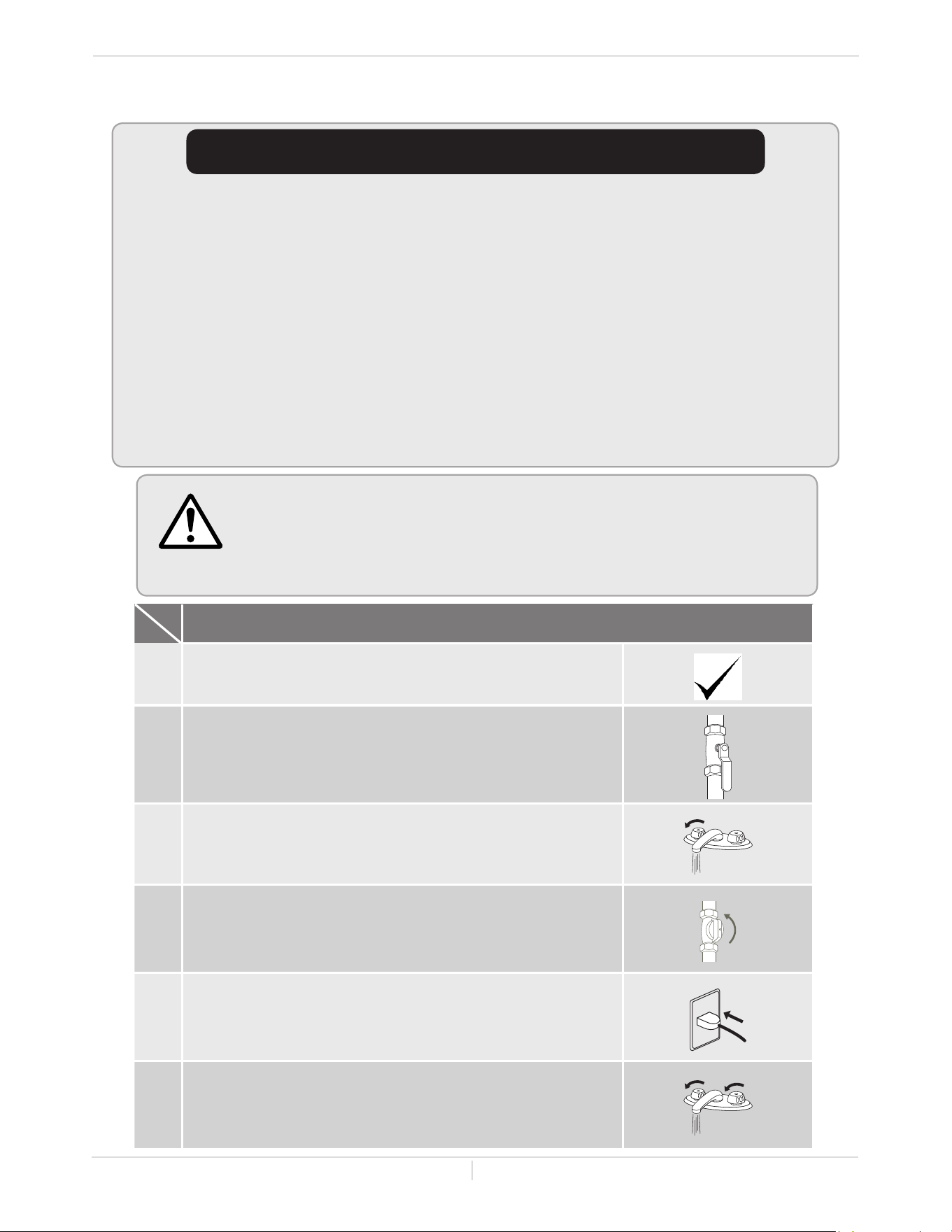
1.
Once the above checks have been completed, please clean
the filter of any debris. Refer to p. 38 for instructions.
2.
Fully open the manual water control valve on the water
supply line.
3.
Open a hot water tap to verify that water is flowing to that
tap, then close the hot water fixture.
4.
Open the manual gas control valve fully.
5.
Turn on the 120 VAC, 60 Hz power supply to the water
heater.
6.
Now you are ready to enjoy hours of endless hot water.
• Check the GAS and WATER CONNECTIONS for leaks before firing unit for the first time.
• Open the main gas supply valve to the unit using only your hand to avoid any spark. Never use
tools. If the knob will not turn by hand, do not try to force it; call a qualified service technician.
Forced or attempted repair may result in a fire or explosion due to gas leaks.
• Be sure to check for the presence of leaking gas toward the bottom of the unit because some gases
are heavier than air and may settle towards the floor.
• Check the GAS PRESSURE. Refer to p. 20.
• Do not try to light the burner manually. It is equipped with an electronic ignition device which
automatically lights the burner.
• Check for PROPER VENTING and COMBUSTION AIR to the water heater.
• Purge the GAS and WATER LINES to remove any air pockets.
• Do not use this appliance if any part has been under water. Immediately contact a qualified
installer or service agency to replace a flooded water heater. Do not attempt to repair the unit! It
must be replaced!
FOR YOUR SAFETY, READ BEFORE OPERATING
Inial operaon
Installaon Manual
30 Page
Owner's Guide
Owner's Guide
CONGRATULATIONS
Congratulations and thank you for choosing our tankless water heater.
Before use, we recommend that you read through this owner's guide
carefully. Keep this manual for future reference.
If you need an additional manual, contact the manufacturer or your
local distributor. You may also download a manual from our web page.
When you call, please tell us the product name and the serial number
of your unit written on the rating plate of the water heater.
31 Page
Operang Safety
Owner's Guide
OPERATING SAFETY
WARNING:
If you do not follow these instructions exactly, a re or explosion may result
causing property damage, personal injury or loss of life.
A. This appliance does not have a pilot. It is equipped with an ignition device which automatically
lights the burner. Do not try to light the burner by hand.
B. BEFORE OPERATING smell all around the appliance area for gas. Be sure to smell next to
the oor because some gas is heavier than air and will settle on the oor.
WHAT TO DO IF YOU SMELL GAS
• Do not try to light any appliance.
• Do not touch any electric switch; do not use any phone in your building.
• Immediately call your gas supplier from a neighbor’s phone. Follow the gas supplier’s
instructions.
• If you cannot reach your gas supplier, call the re department.
C. Use only your hand to turn the gas shutoff valve. Never use tools. If the valve will not turn by
hand, don’t try to repair it, call a qualied service technician. Force or attempted repair may result
in a re or explosion.
D. Do not use this appliance if any part has been under water. Immediately contact a qualied
installer or service agency to replace a ooded water heater. Do not attempt to repair the unit! It
must be replaced!
1. STOP! Read the safety information above on this label.
2. Turn off all electric power to the appliance.
3. Do not attempt to light the burner by hand.
4. Turn the gas shutoff valve located on the outside of the unit to the closed position.
5. Wait ve (5) minutes to clear out any gas. If you then smell gas, STOP! Follow “B” in the
safety information above on this label. If you don’t smell gas, go to the next step.
6. Turn the gas shutoff valve located on the outside of the unit to the open position.
7. Turn on all electrical power to the appliance.
8. If the appliance will not operate, follow the instructions in “To Turn Off Gas to Appliance,” and
call your service technician or gas supplier.
1. Turn off all electric power to the appliance if service is to be performed.
2. Turn the gas shutoff valve located on the outside of the unit to the closed position.
FOR YOUR SAFETY READ BEFORE OPERATING
OPERATING INSTRUCTIONS
TO TURN OFF GAS TO APPLIANCE
32 Page
Operang Safety
Owner's Guide
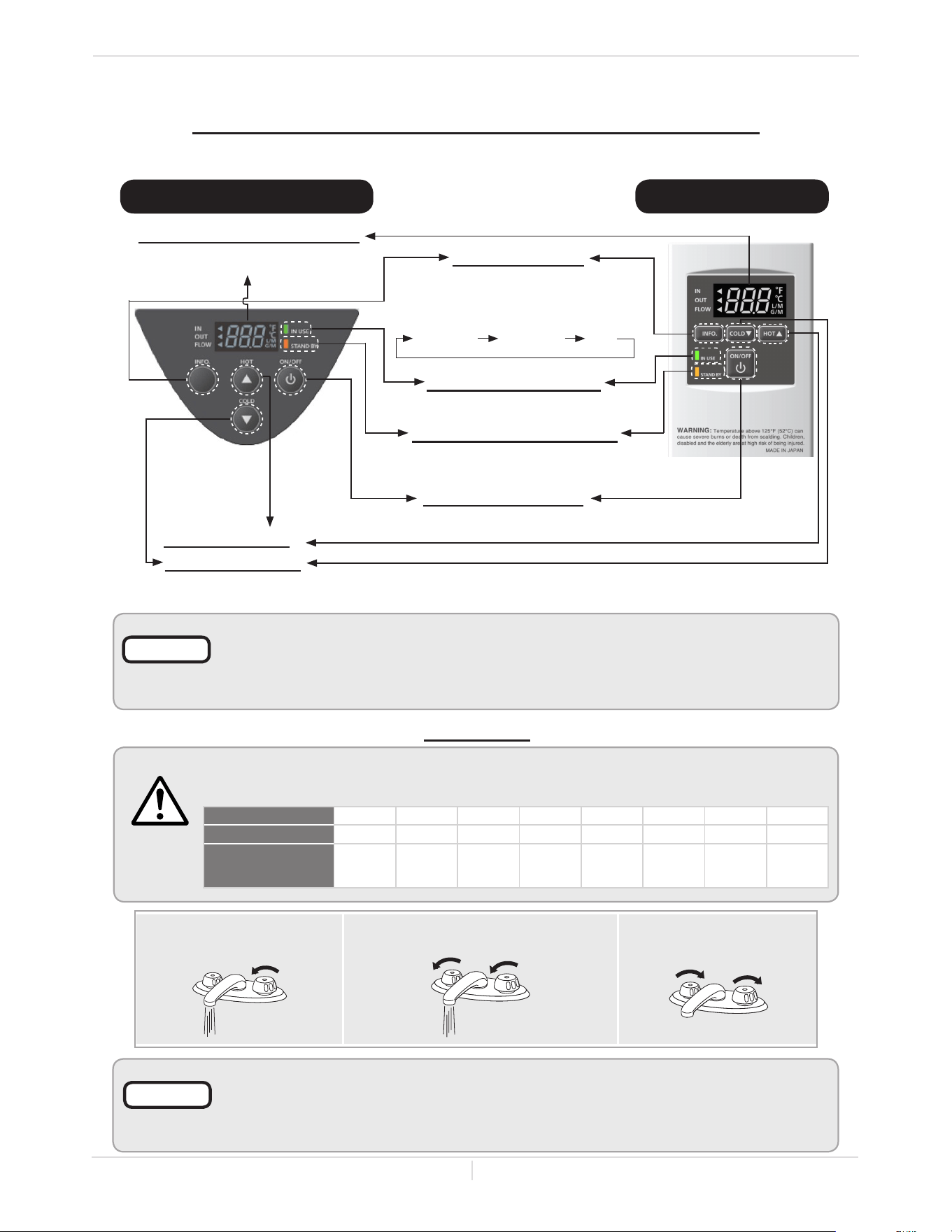
Vapors from ammable liquids will explode and catch re causing death or severe burns.
Do not use or store ammable products such as gasoline, solvents or adhesives in the same
room or area near the water heater.
Read and follow water heater warnings and instructions. If the owner’s manual is missing,
contact the retailer or manufacturer.
1. Water temperature over 125°F (52°C) can cause severe burns instantly or death from
scalds.
2. Children, disabled and elderly are at highest risk of being scalded.
3. Feel water before bathing or showering.
4. Temperature limiting valves are available. See manual.
5. The outlet temperature of the water heater is set at 120°F (50°C). If you require water temperatures
below this setting, follow the instruction manual.
6. Use this heater at your own risk. Test the water before bathing or showering. Do not leave children or
an inrm person unsupervised.
BRÛLURE
BURN
CHAUDECHAUDE
HOTHOT
CHAUDE
HOT
DANGER
DANGER
BURN
FLAMMABLES
Flammable Vapors
33 Page
NORMAL OPERATION
Normal Operaon
Owner's Guide
BUILT-IN CONTROLLER and REMOTE CONTROLLER
The illustraons below show examples of the displays of the controller. The exact display may dier
from examples.
"COLD" Button
"HOT" Button
Press the "HOT" button or the "COLD"
button to set the hot water temperature.
STAND BY LED (Orange)
The indicator is ON to show that
power is ON.
IN USE LED (Green)
The indicator lights during combustion.
"INFO" Button
Each time the button is pressed,
the operation mode is selected
in the sequence of the following.
Inlet water
temperature
Outlet water
temperature
Water
flow
When the STAND BY LED is ON, the
hot water temperature will be
displayed.
Display for Temperature
"ON/OFF" Button
Press this button to
start or stop operation.
Built-in controller
Remote controller
• When the remote controller is installed it will take priority over the built-in controller.
• The controller has an energy saving mode. Five minutes after the water heater stops
operating, the backlight of the controller turns off.
• The backlight of the remote will turn back on once the water heater begins firing again.
NOTICE
GENERAL
1. Open a cold water
fixture.
2. Mix hot water with the cold water
to get the correct temperature water.
3. When finished, close the
water fixtures.
• Flow rate to activate the water heater: 0.5 gallon per minute at the default set
temperature (1.9 L/min).
• Flow rate to keep the water heater running: 0.4 gallon per minute (1.5 L/min).
NOTICE
Temperatures above 125 °F (52 °C) can cause severe burns or death from scalding.
Children, disabled and the elderly are at high risk of being injured.
WARNING
°F 120 125 130 135 140 145 150 155
°C 49 52 54 57 60 63 66 68
Time to produce
serious burn
more
than 5
min.
1½ to 2
min.
about
30 sec.
about
10 sec.
less than
5 sec.
less than
3 sec.
about
1½ sec.
about
1 sec.
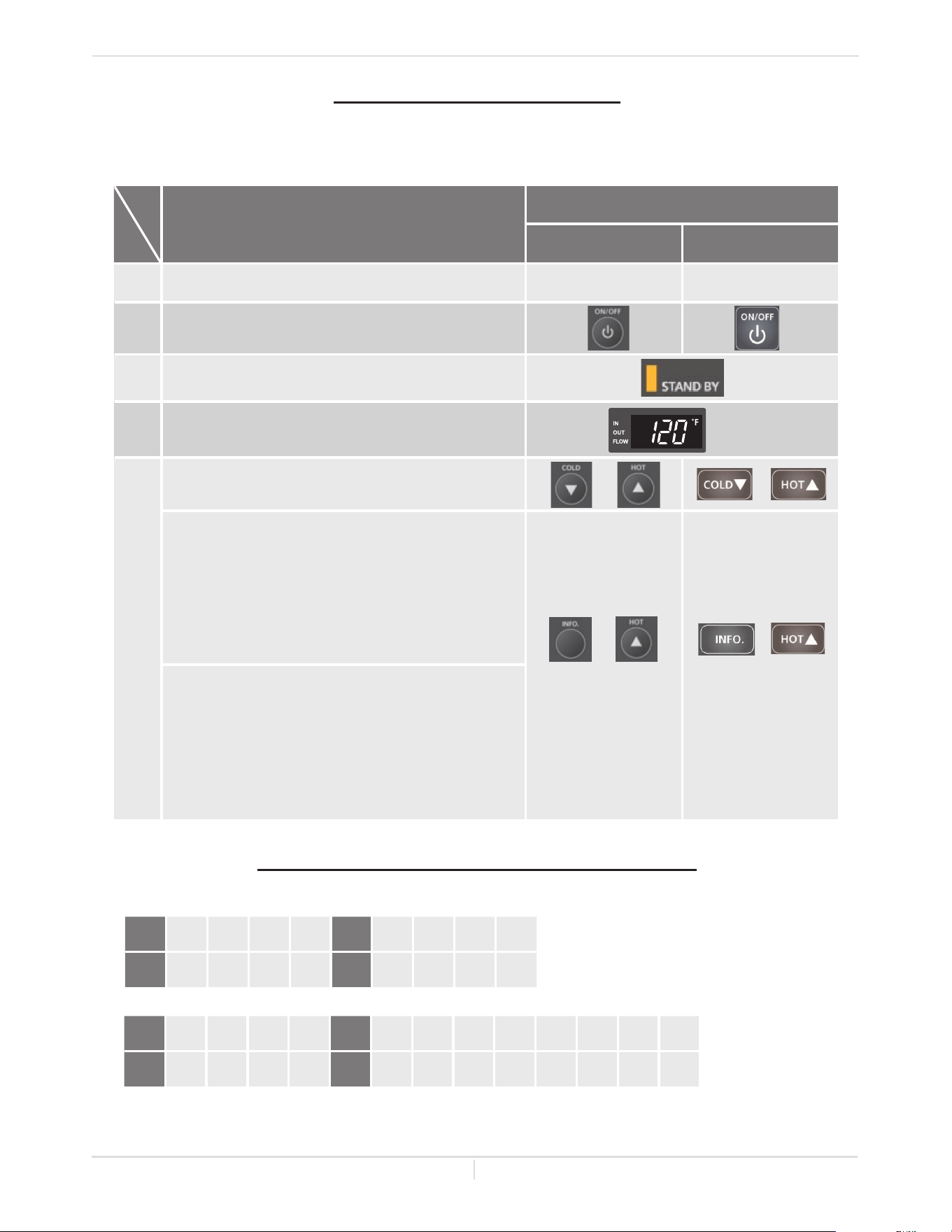
34 Page
TEMPERATURE SETTINGS
-Set temperature-
TEMPERATURE TABLE OF CONTROLLER
Normal Operaon
Owner's Guide
°F 100 105 110 115 120* 125 130 135 140
°C 38 40 43 45 50* 52 55 57 60
a) For 110C and 310C models
°F 100 105 110 115 120* 125 130 135 140 145 150 155 160
°C 38 40 43 45 50* 52 55 57 60 63 65 68 70
b) For 510C model
*Factory setting (Default): 120 °F
Operation
Screen on the controller
Built-in controller Remote controller
1.
Turn on the 120 VAC power supply to the unit (the water
heater or the multi-unit controller).
2.
Press the "ON/OFF" button on the controller in order to
turn the controller on.
3.
When ON, the STAND BY LED is lit.
4.
It shows the set temperature on its display as shown in
the picture on the right. (EX.: 120 °F)
5.
Press the "HOT" button or the "COLD" button to set the
temperature setting of the unit.
Increasing temperature from 120 °F (50 °C) to 125 °F (52 °C) :
1. The water heater must be in Stand By to increase the
temperature.
2. Press the "HOT" button to set 120 °F (50 °C).
3. Press and hold the "INFO" button and the "HOT"
button for at least 3 seconds. The remote will emit a
beep and change to 125 °F (52 °C).
4. Press the "HOT" button to set up to 140 °F (60 °C).
Increasing temperature above 140 °F (60 °C)
-510C model only-:
1. The water heater must be in Stand By to increase the
temperature.
2. Press the "HOT" button to set 140 °F (60 °C).
3. Press and hold the "INFO" button and the "HOT"
button for at least 3 seconds. The remote will emit a
beep and change to 145 °F (63 °C).
4. Press the "HOT" button to set up to 160 °F (70 °C).
(EX.: 120 °F)
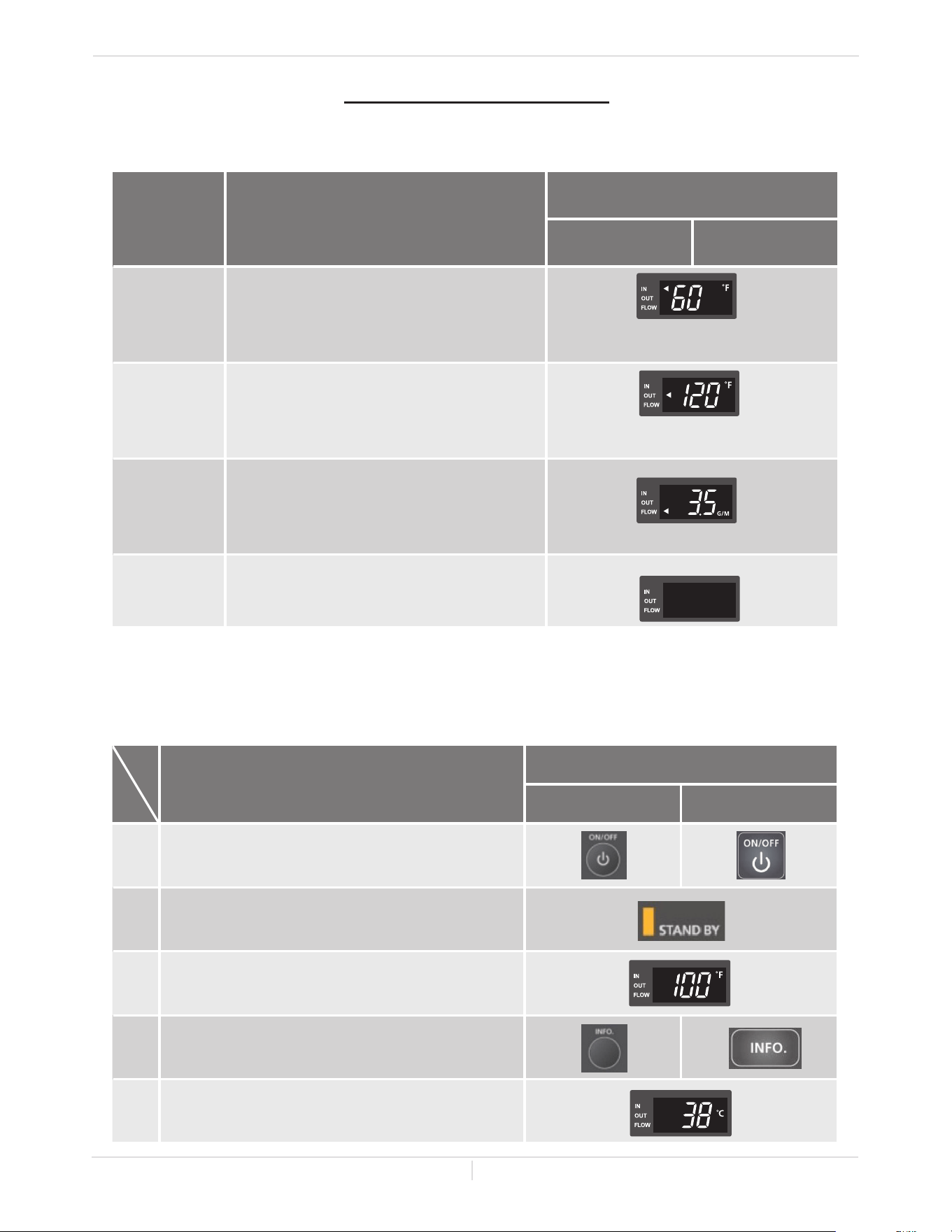
35 Page
ADDITIONAL FEATURES
-Informaon mode-
You can get some information about the water heater condition by pressing the "INFO" button. For
more information, follow the procedures below:
INFO
Button
Operation
Screen on the controller
Built-in controller Remote controller
1st. press
Inlet water temperature will be displayed on
the remote controller by pressing the "INFO"
button.
2nd. press
Outlet water temperature will be displayed on
the remote controller by pressing the "INFO"
button.
3rd. press
Water flow will be displayed on the remote
controller by pressing the "INFO" button.
4th. press
Press the "INFO" button to finish information
mode.
Inlet water
temperature
Outlet water
temperature
Water flow
Normal Operaon
Owner's Guide
-Unit conversion mode-
Units of measure can be changed from Imperial to Metric and vice versa. For example, temperature can
be changed from °F to °C. Flow rate will also change from gallons per minute to liters per minute when
this setting is changed. Follow this procedure to change this setting:
Operation
Screen on the controller
Built-in controller Remote controller
1.
Press the "ON/OFF" button on the controller in
order to turn the controller on.
2.
When ON, the orange LED is lit.
3.
The previous set temperature will be displayed on
the screen.
4.
Press the "INFO" buttons for at least 3 seconds.
5.
The set temperature should now be displayed in the
alternate unit of measurement.
(EX.: 100 °F)
(EX.: 38 °C)
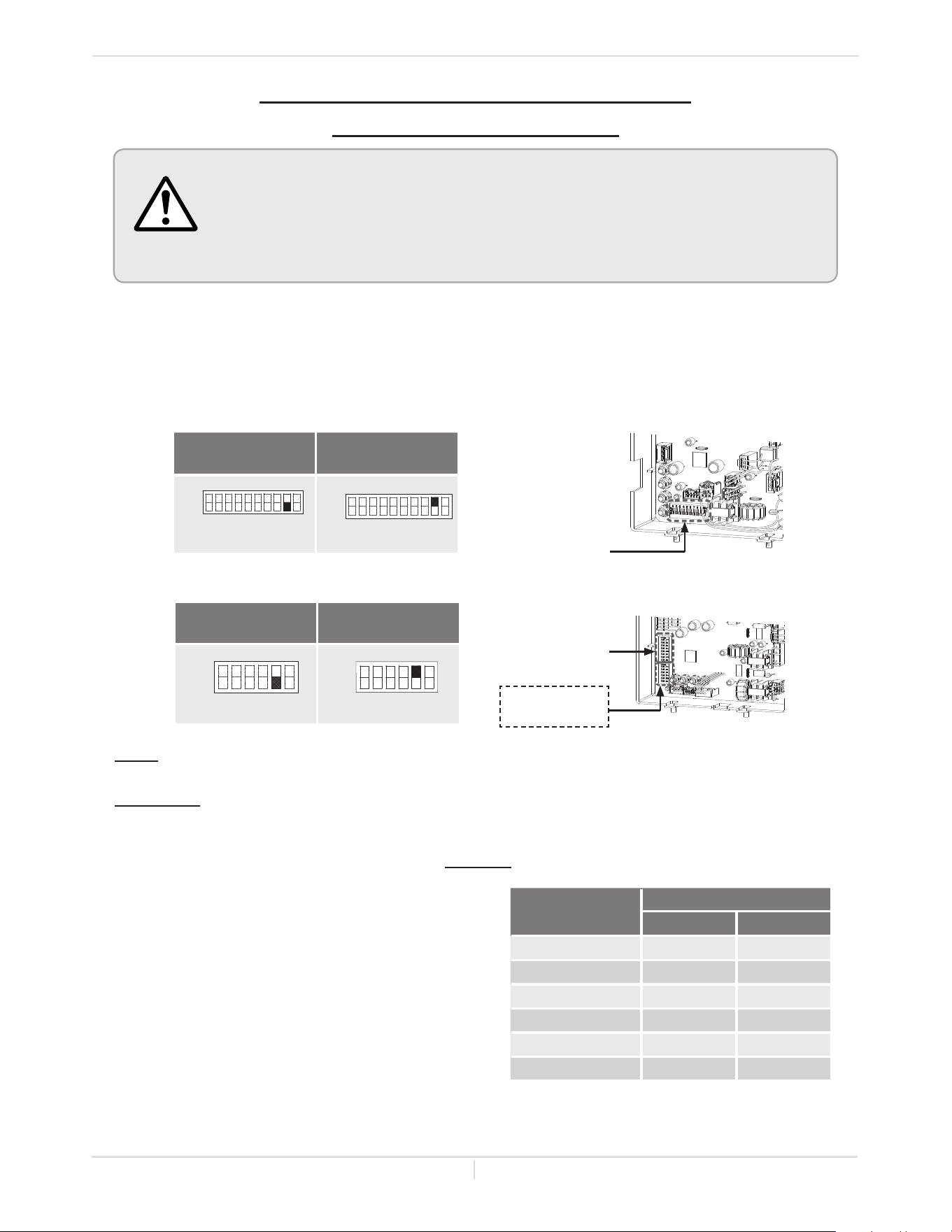
36 Page
TEMPERATURE SETTINGS ON THE PCB
(WITHOUT CONTROLLER)
WARNING
• DO NOT adjust the upper bank of DIP switches for the 510C model.
• Turn off the power supply to the water heater before changing the DIP switch
settings.
• Failure to observe these warnings could result in carbon monoxide poisoning, severe
personal injury, or death.
There are 2 preset temperatures, 120 °F (50 °C) and 140 °F (60 °C), that you can select by changing the
DIP switch settings on the computer board without the controller. See below.
When the controller is in normal operation, the set temperature of the controller is given priority over the
set temperature of the DIP switch settings.
NOTE: The black square indicates the correct DIP switch position for set temperature. For the
110C and 310C, only adjust DIP switch No. 9. For the 510C, only adjust DIP switch No. 5 on the
lower bank. Do not adjust the other DIP switches for temperature adjustment.
• The temperature has been preset at the factory to 120 °F (50 °C).
DIP switches
Computer board
120 °F (50 °C)
DEFAULT
140 °F (60 °C)
No. 9 : OFF
No. 9 : ON
110C and 310C models
OFF
ON
1 2 3 4 5 6
7 8 9
10
OFF
ON
1 2 3 4 5 6 7 8 9 10
Lower bank of
DIP switches
Computer board
Upper bank of
DIP switches
(Lower bank of DIP switches)
120 °F (50 °C)
DEFAULT
140 °F (60 °C)
No. 5 : OFF No. 5 : ON
510C model
OFF
ON
1 2 3 4 5 6
OFF
ON
1 2 3 4 5 62 3 4 5 6
Normal Operaon
Owner's Guide
Appliance/Use
Flow rate
GPM (US) L/min
Lavatory Faucet 1.0 3.8
Bath Tub 4.0 – 10.0 15.2 - 37.8
Shower 2.0 7.5
Kitchen Sink 1.5 5.6
Dishwasher 1.5 5.6
Washing machine 4.0 15.2
Household Flow Rates
Taken from UPC 2006
FLOW
• The flow rate through the water heater is limited to a
maximum of 6.6 GPM (25 L/min) for the 110C model,
8.0 GPM (30 L/min) for the 310C model, and 10.0
GPM (38 L/min) for the 510C model.
• The temperature setting, along with the supply
temperature of the water, will determine the flow
rate output of the unit.
• Please refer to the temperature vs. gallons per
minute charts on p. 50 to determine the likely flow
rates based on your local ground water temperature
and your desired outlet water temperature.
• Refer to the above table for typical household plumbing fixture flow rates to determine what the water
heater can do in a household application.
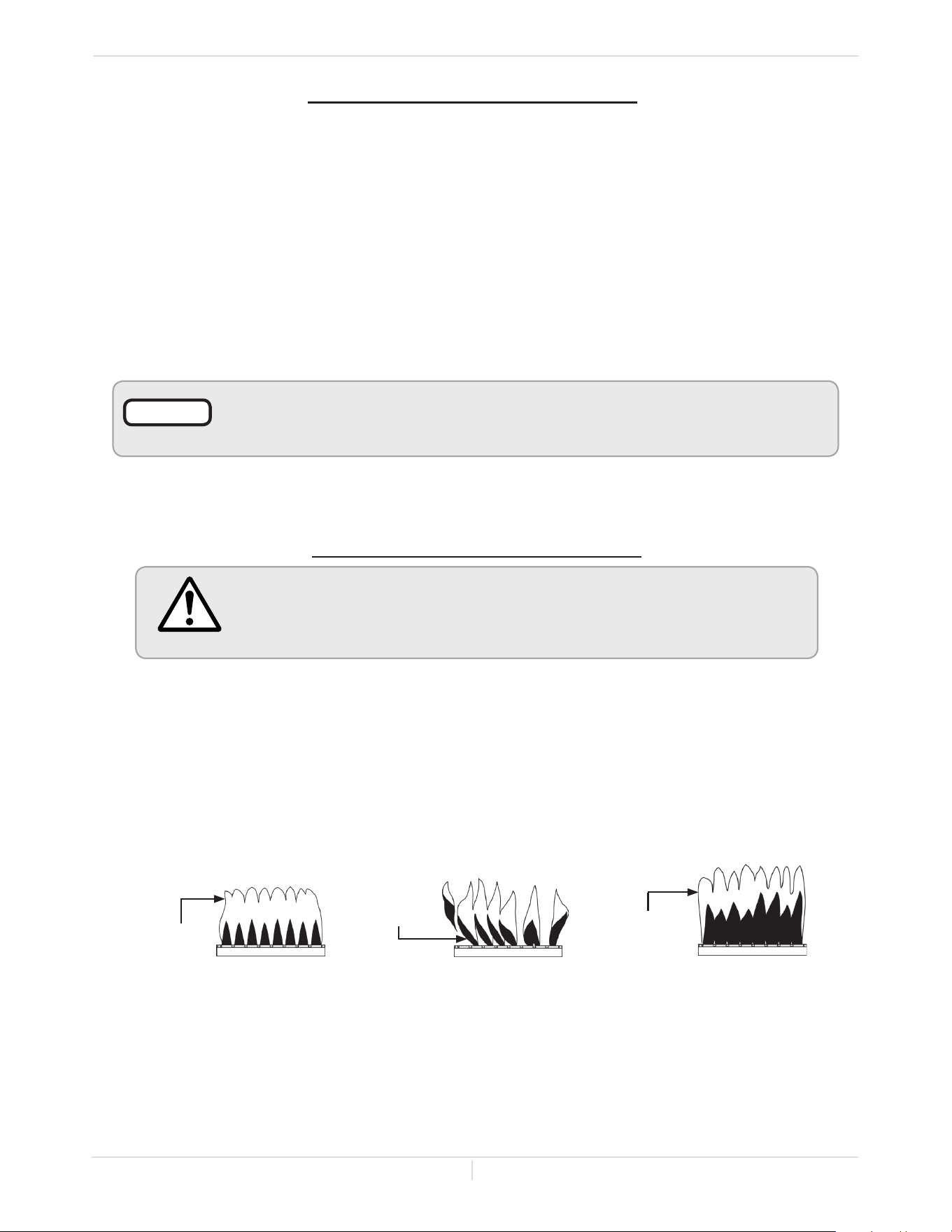
37 Page
Normal Operaon
Owner's Guide
• This unit comes equipped with heating blocks to protect it from damage associated with freezing.
• For this freeze protection system to operate, there has to be electrical power to the unit. Damage
to the heat exchanger caused by freezing temperatures due to power loss is not covered under the
warranty. In cases where power losses can occur, consider the use of a backup power supply.
• The freeze protection system will activate when the air temperature inside the case or water in the heat
exchanger is less than 36.5 °F (2.5 °C).
• It is the installer’s responsibility to be aware of freezing issues and take all preventative measures. The
manufacturer will not be responsible for any damage to the heat exchanger as a result of freezing.
• If you will not be using your heater for a long period of time:
1. Completely drain the water out of the unit. Refer to p. 38.
2. Disconnect power to your heater.
This will keep your unit from freezing and being damaged.
FREEZE PROTECTION SYSTEM
Only pipes within the water heater are protected by the freeze protection system.
Any water pipes (hot or cold) located outside the unit will not be protected. Properly
protect and insulate these pipes from freezing.
NOTICE
MAINTENANCE AND SERVICE
Turn off the electrical power supply and close the manual gas shutoff
valve and the manual water control valve before servicing. Failure to do
so could result in serious personal injury or death.
WARNING
• Clean the cold-water inlet filter. (Refer to Unit draining and filter cleaning section on p. 38.)
• Be sure that all openings for combustion and ventilation air are not blocked.
• The venting system should be checked annually for any leaks, corrosion, blockages or damage.
• The burner should be checked annually for dust, lint, grease or dirt.
• Keep the area around the water heater and terminations clear. Remove any combustible materials, gasoline or
any flammable vapors and liquids.
• If the relief valve discharges periodically, it may be due to thermal expansion in a closed water supply system.
Contact the water supplier or local plumbing inspector on how to correct this situation.
• Visually check the burner flames (see below) through the burner window in the burner assembly located at the
middle of the water heater.
Sasfactory
Blue ame
Unsasfactory
Flame liing
above the
burner
Unsasfactory
Red or Yellow
ame
The manufacturer recommends having the unit checked once a year or as necessary by a licensed technician. If
repairs are needed, any repairs should be done by a licensed technician.
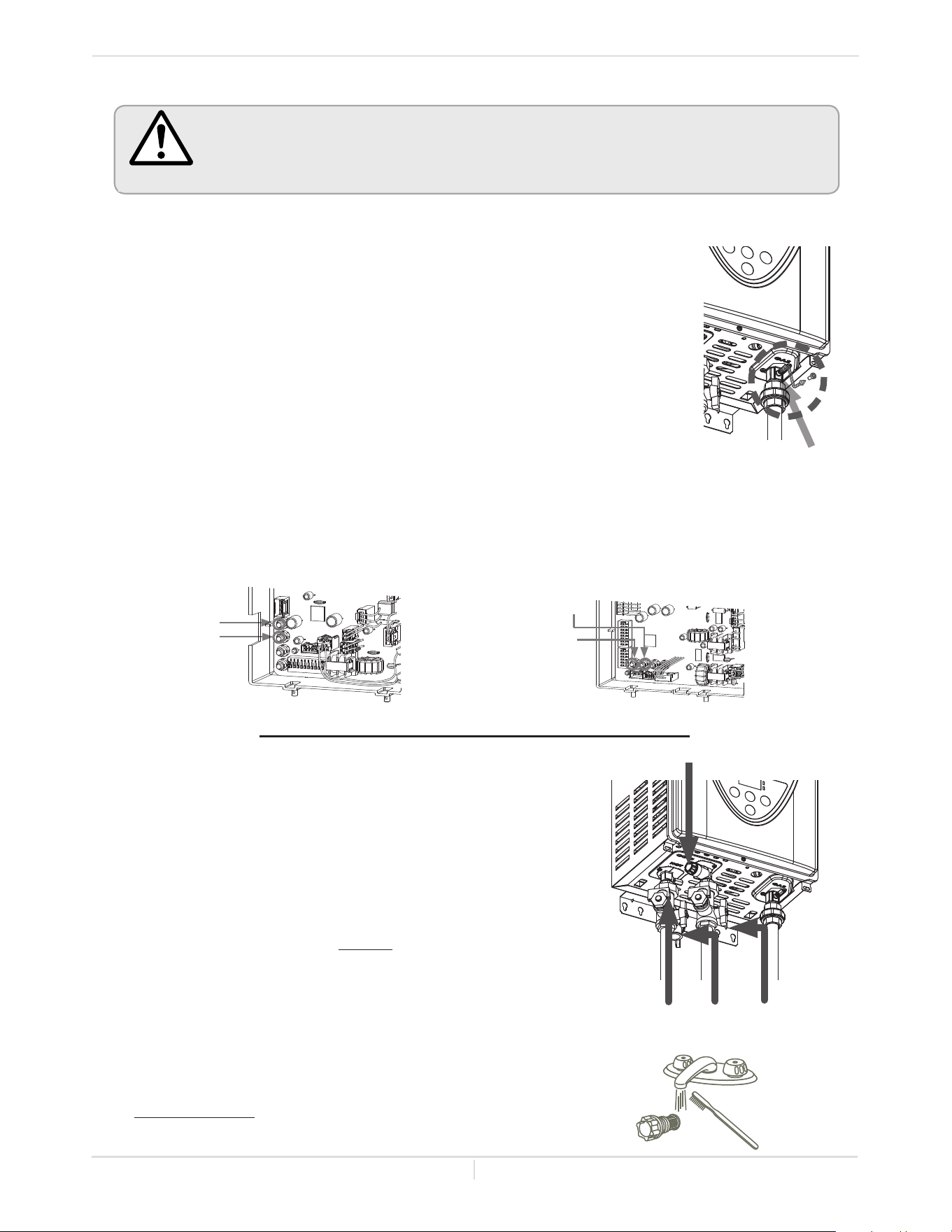
38 Page
Normal Operaon
Owner's Guide
UNIT DRAINING and FILTER CLEANING
1. Close the manual gas shutoff valve.
2. Turn off power to the unit and wait a couple of seconds. Turn on again.
3. Wait 30 seconds, and then turn off power to the unit.
4. Close the inlet water valve.
• If the heater is part of an Easy-Link or Multi-Unit System, close the inlet
and outlet water valves to isolate the heater. Then proceed to step 6.
5. Open all hot water taps in the house. When the residual water flow has
ceased, close all hot water taps.
6. Have a bucket or pan to catch the water from the unit’s drain plugs.
If Isolation valves are installed, open the drains to drain the water. If
isolation valves are not installed, unscrew the two drain plugs (large and
small) to drain all the water out of the unit. Do not lose the o-rings that
will be on the two drain plugs.
7. Wait a few minutes to ensure all water has completely drained from the
unit.
8. Clean the filter: Check the water filter located within the cold inlet.
With a tiny brush, clean the water filter of any debris which may have
accumulated and reinsert the filter back into the cold water inlet.
9. Securely screw the drain plugs back into place.
Hand- tighten only.
Inlet
water valve
Drain plug
(Small)
Outlet
water
valve
Drain plug with Filter (Large)
-Measuring inlet gas pressure-
The water heater cannot perform properly without sufficient inlet gas pressure. Below are instructions
on how to check the inlet gas pressure. THIS IS ONLY TO BE DONE BY A LICENSED PROFESSIONAL.
1. Shut off the manual gas valve on the gas supply line.
2. Remove the screw from the pressure port which is located on the gas inlet of the water
heater shown in the diagram on the right.
3. Connect the manometer to the pressure port and zero the manometer.
4. Re-open the manual gas valve. Verify that there are no gas leaks.
5. With all gas burning equipment off, take a reading of the static gas pressure and make
a note of it.
6. Measure gas supply pressure at maximum heater operation: Open hot water faucets
to create maximum flow. Press the MAX button on the computer board. (Refer to the
diagrams below.) Take a reading of the supply dynamic gas pressure with all gas burning
equipment running at maximum rate.
7. The static and dynamic pressures should be within the ranges specified on the heater's
rating plate and the table on page 18.
8. The difference of static to dynamic pressure should not exceed 1.5" W.C. Pressure
drops that exceed 1.5" W.C. can indicate restricted gas flow, undersized gas lines, and/or undersized supply
regulators. (NOTICE: In Canada, the pressure drops cannot exceed those specified in CSA B149.1.)
9. Measure gas supply pressure at minimum heater operation: Reduce water flow so the heater is running at mini-
mal operation. Press the MIN button on the computer board. (Refer to the diagrams below.) Take a supply gas
pressure reading and verify that it is within the specified inlet gas pressure range.
1. Turn off all electric power to the water heater if service is to be performed.
2. Turn the manual gas valve located on the outside of the unit to the off position.
3. Failure to follow these steps could lead to fire or explosion, resulting in personal injury
or death.
WARNING
Pressure
port
110C and 310C Computer board
MAX button
MIN button
510C Computer board
MAX button
MIN button
39 Page
TROUBLESHOOTING
GENERAL
PROBLEM SOLUTIONS
TEMPERATURE and AMOUNT OF HOT WATER
It takes a long time to
get hot water at the
fixtures.
• The time it takes to deliver hot water from the water heater to your
fixtures depends on the length of piping between the two. The longer
the distance or the bigger the pipes, the longer it will take to get hot
water.
• If you would like to receive hot water to your fixtures more quickly, you
may want to consider a hot water recirculation system. (p. 27)
The water is not hot
enough.
• Compare the flow and temperature. See the charts on p. 50.
• Check cross plumbing between cold water lines and hot water lines.
• Is the gas supply valve open fully? (p. 29)
• Is the gas line sized properly? (p. 19)
• Is the gas supply pressure within specified limits? (p. 18 and 38)
• Is the set temperature set too low? (p. 34 and 36)
The water is too hot. • Is the set temperature set too high? (p. 34 and 36)
The hot water is not
available when a
fixture is opened.
• Make sure the unit has 120 VAC, 60 Hz power supply.
• Is the power button turned on?
• Is the gas supply valve open fully? (p.29)
• Is the water supply valve open fully? (p. 29)
• Is the filter on the cold water inlet clean? (p. 38)
• Is the hot water fixture sufficiently open to draw at least 0.5 GPM
(1.9 L/min) through the water heater? (p. 33)
• Is the unit frozen? (p. 37)
The hot water turns
cold and stays cold.
• Is the flow rate enough to keep the water heater running? (p. 33)
• If there is a recirculation system installed, does the recirculation line have
enough check valves? (p. 27)
• Is the gas supply valve open fully? (p. 29)
• Is the filter on the cold water inlet clean? (p. 38)
• Are the fixtures clean of debris and obstructions?
Fluctuation in hot
water temperature.
• Is the filter on the cold water inlet clean? (p. 38)
• Is the gas line sized properly? (p. 19)
• Is the supply gas pressure within specified limits? (p. 18 and 38)
• Check for cross connection between cold water lines and hot water lines.
Troubleshoong
Owner's Guide
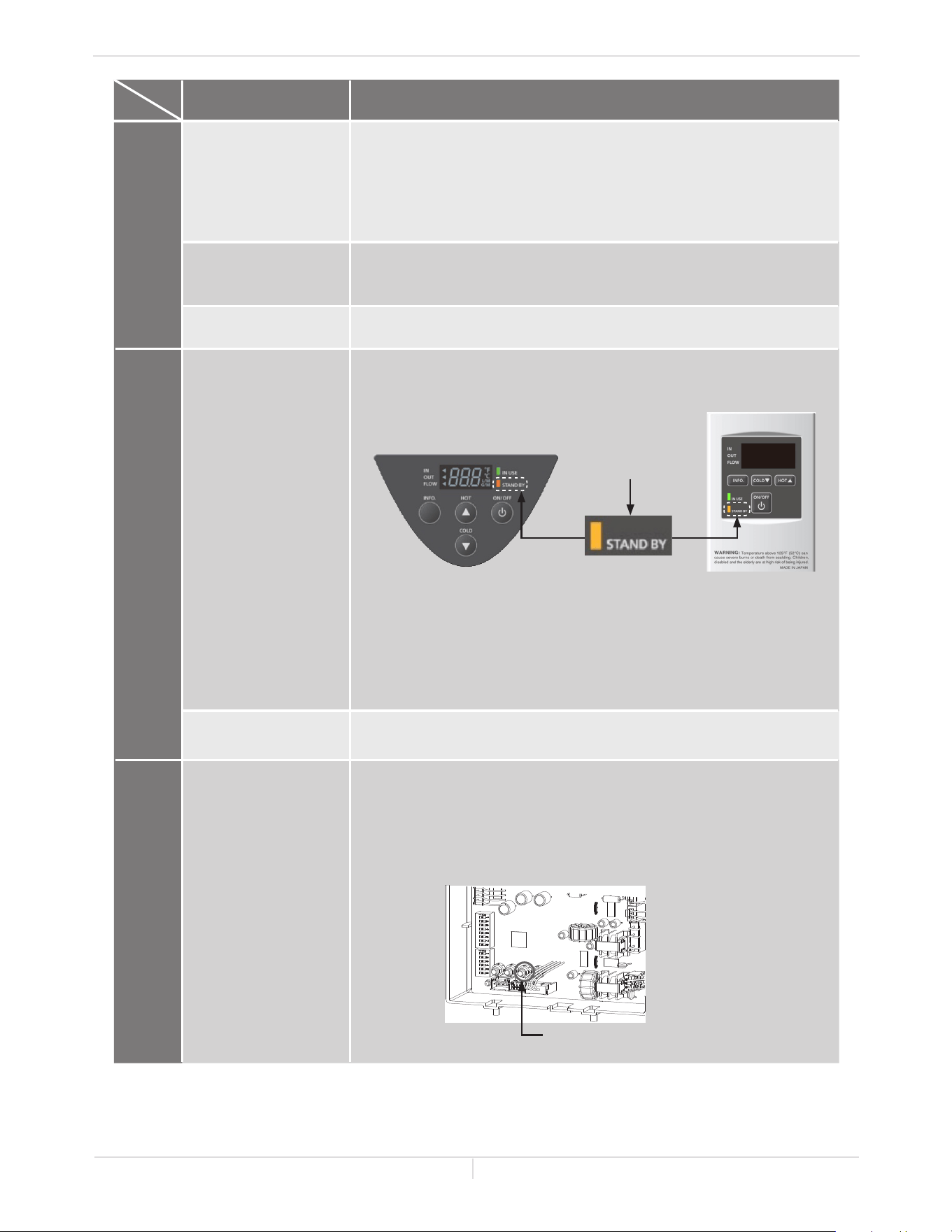
40 Page
PROBLEM SOLUTIONS
WATER HEATER
Unit does not ignite
when water goes
through the unit.
• Is the flow rate over 0.5 GPM (1.9 L/min)? (p. 33)
• Check the filter on cold water inlet. (p. 38)
• Check for reverse connection and cross connection.
• If you use the remote controller, is the power button turned on?
• Check if the inlet water temperature is too high. If it is too close to
the set temperature, the water heater will not activate.
The fan motor is
still spinning after
operation has stopped.
• This is normal. After operation has stopped, the fan motor keeps
running from 10 to 70 seconds in order to re-ignite quickly, as well
as purge all the exhaust gas out of the flue.
Unit sounds abnormal
while in operation
• Contact the manufacturer at 1-877-737-2840 (USA)
1-888-479-8324 (CANADA).
BUIT-IN CONTROLLER
and REMOTE CONTROLLER
Built-in and remote
controller do not
display anything when
the power button is
turned on.
• Make sure the unit is supplied with power.
• For the remote controller: Make sure the connection to the unit is
correct. (p. 22 and 23)
When the
controller is turned
ON, STAND BY LED
is lit.
Buit-in controller
• When the unit has not operated for five minutes or more, the
display turns off to conserve energy.
• Although the controller of the parent unit will display the set
temperature at the Easy-Link System, the controller of the child
unit will not display the set temperature.
An ERROR code is
displayed.
• Please see p. 42 and 43.
EASY-LINK SYSTEM
510C model only
How are the unit
numbers assigned?
• For an Easy-Link System, the Parent unit is always labeled #1 and all
other subsequent Child units are numbered randomly.
• To check which numbers are assigned to which Child units, push the
button on the computer board of any Child unit as shown below.
The unit number will be displayed on the built-in controller of each
Child unit. (Refer to p. 25.)
Buon to check unit numbers
Troubleshoong
Owner's Guide
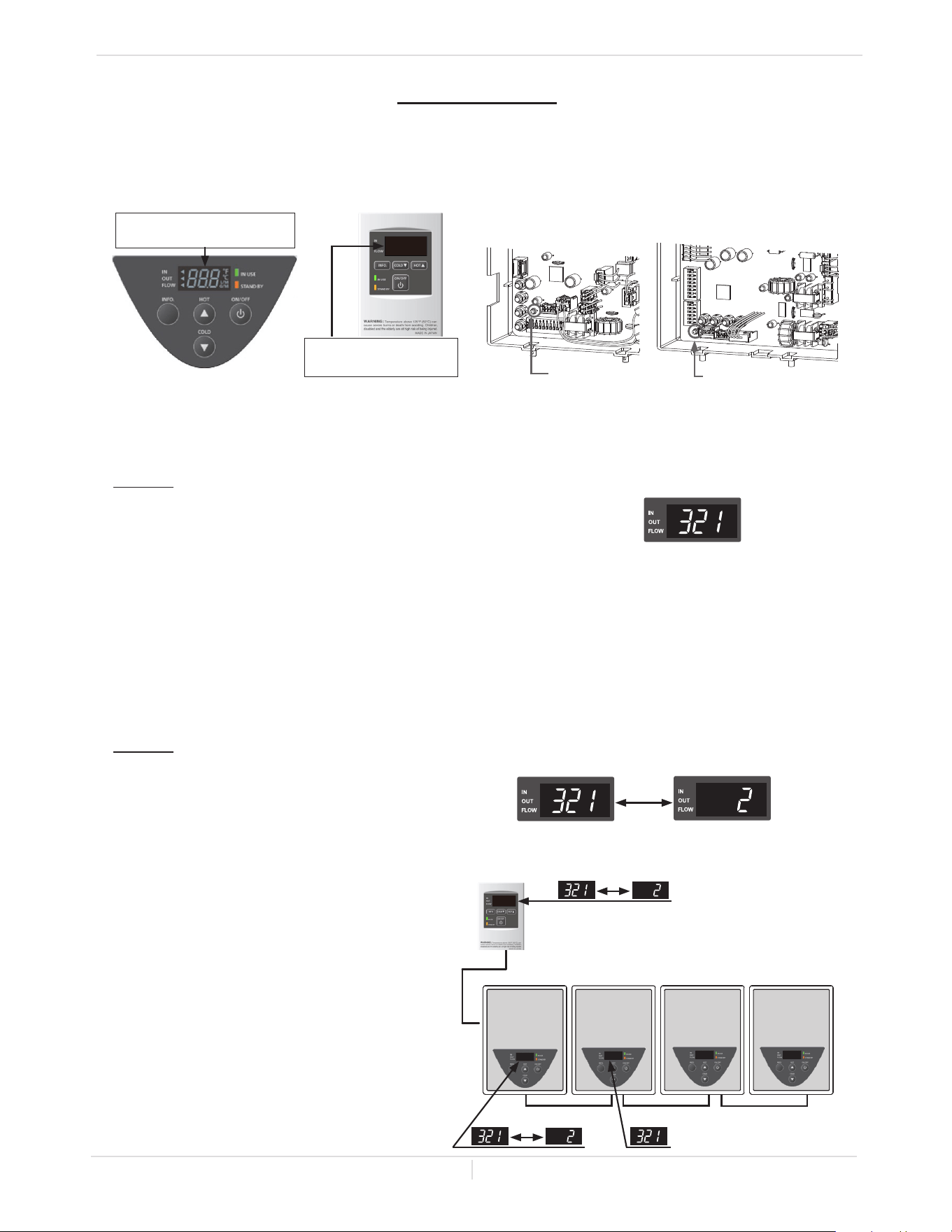
41 Page
Troubleshoong
Owner's Guide
Unit #Error code
Error code
ERROR CODES
-General-
• The units have self-diagnostic functions for safety and convenience when troubleshooting.
• If there is a problem with the installation or the unit, the error code will be displayed on the
temperature controller and remote controller.
• Consult the table on the following pages for the description of each error code.
-Single unit installaon-
Example: If your unit has the “321” error code (which signifies an inlet thermistor failure)
• Indicator on the built-in controller and/or remote controller:
“321” will be displayed on the screen.
• Green LED on the computer board: The green LED on the computer board will indicate this code with
two flashes every 1/2 second. The pattern will repeat with a three second delay between patterns.
-Easy-Link System-
(For the 510C model only)
Error codes will be displayed differently with units installed within an Easy-Link System, not only to show
what the error code is, but to also indicate which unit within the system has the error code. Below is a
sample of how the error code of "321" is displayed in an Easy-Link System.
Example: If Unit #2 has the “321” error code (inlet thermistor failure)
• Indicator on the built-in controller
and/or remote controller of Parent unit:
“321” and "2" will intermittently flash on
the display.
• Unit #2:
"321" will intermittently flash on the display.
The green LED on the computer board will
flash twice, just like in the single unit example.
• Unit #3 and #4:
These units will not display anything,
as the error code does not pertain to them.
Green LED
110C and 310C
models
Error code on the computer board
510C model
Green LED
Error code indicator on
the built-in controller
Error code indicator on
the remote controller
Indicated by 1/2-second flashes on the Green LED.
100209924 (TM-RE42)
Unit #1
PARENT
Unit #2
CHILD
Unit #4
CHILD
Unit #3
CHILD
42 Page
-Fault Analysis of Error Codes-
If the error code is displayed on the computer board of the water heater or remote controller, please
check the following. After checking, consult with the manufacturer.
Troubleshoong
Owner's Guide
Remote
Green
LED
Malfunction
description
Diagnosis
031
One Flash
Incorrect DIP switch
setting
• Check the DIP switch settings on the PCB (Part #701).
101
Five Flashes
Warning for the “991”
error code
• Check the gas type of the water heater.
• Check if there is any blockage in the intake air and/or
exhaust.
• Check to make sure that there is enough distance between
the concentric vent terminal and other exhaust vent
terminals.
• Check the altitude/elevation of the area where the water
heater is installed.
• Check if there is grease and/or dirt in the burner (Part #101)
and the fan motor (Part #103), especially if the water heater
has been installed in a contaminated area.
• Inspect the environment around the water heater.
Determine how long the unit has been installed.
111*
Three Flashes
Ignition failure • Check if the Hi-limit switch (Part #412) is properly
functioning.
• Check for connection/breakage of wires (Part #413, 708,
709), burn marks on the computer board (Part #701), and/or
soot on the flame rod (Part #108).
• Check if there is a buzzing spark ignition sound coming
from the burner (Part #101) when the water heater
prepares for combustion.
• Listen for the double “clunk” sound coming from the gas
valve assembly (Part #102) when the water heater goes
into combustion.
• Check if there is leaking from heat exchanger (Part #401).
121*
Three Flashes
Loss of flame • Check if the Hi-limit switch (Part #412) is functioning
properly.
• Check for connection/breakage of wires (Part #413, 708,
709), burn marks on the computer board (Part #701),
and/or soot on the flame rod (Part #108).
• Check if there is leaking from heat exchanger (Part #401).
311*
Two Flashes
110C & 310C:
Outlet thermistor
failure
510C:
Heat exchanger
thermistor failure
• Check for connection/breakage of wires and/or debris on
thermistor (Part #407, 408, 411, 713).
321*
Two Flashes
Inlet thermistor failure
331*
Two Flashes
Outlet thermistor
failure
(510C model only)
391
Two Flashes
Air-fuel ratio rod failure • Check for connection/breakage of wires (Part #709) and/
or soot on the AFR rod (Part #108).
441
Two Flashes
Flow sensor failure
(Only Easy-Link &
Multi-Unit System)
• Check for connection/breakage of wires and/or debris on
the flow sensor impeller (Part #402).
• Verify the shutoff valves on the hot and cold water lines
to the water heater are open.
• Inspect the filter for blockage/debris. Refer to the proce-
dure on p. 38.
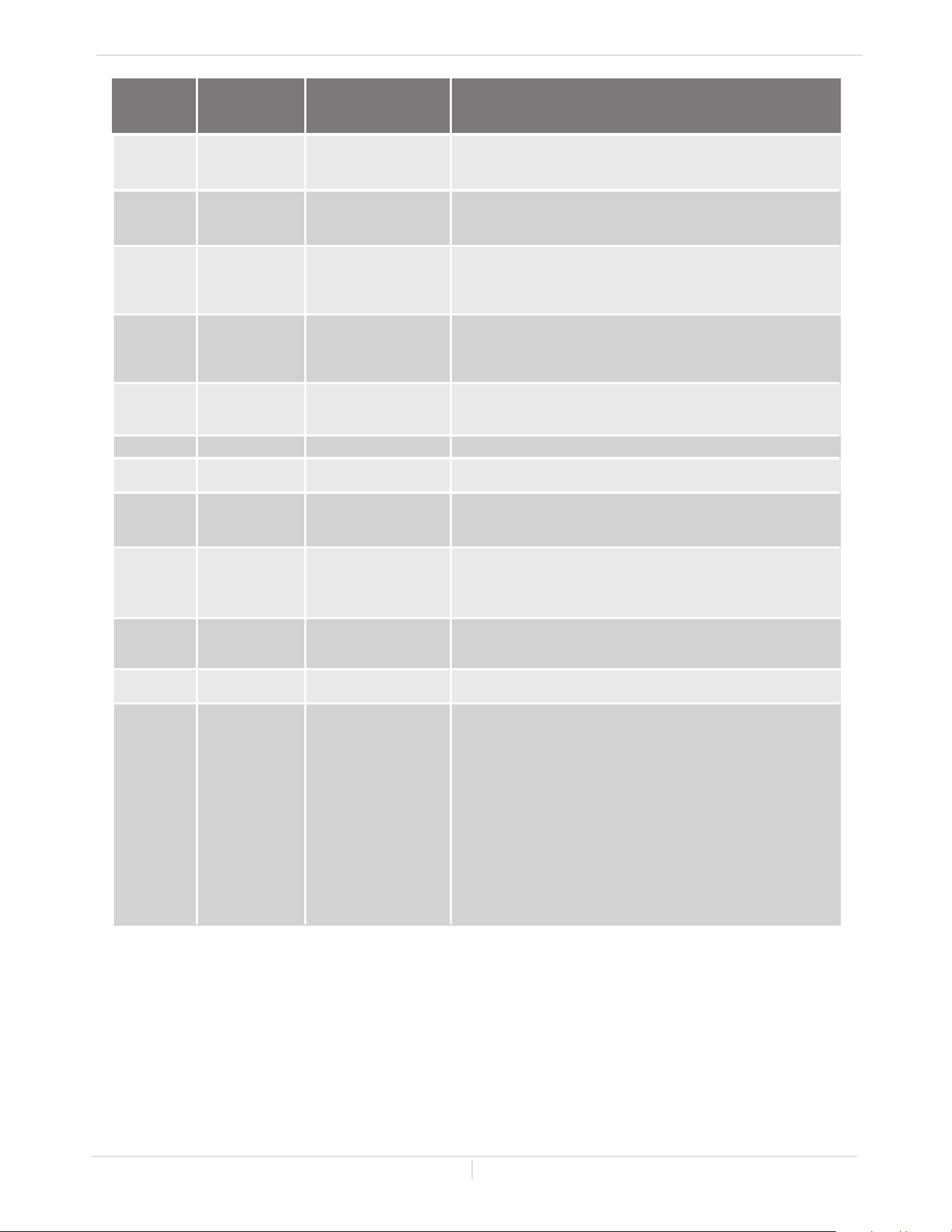
43 Page
Troubleshoong
Owner's Guide
Remote Green LED
Malfunction
description
Diagnosis
510
Six Flashes
Abnormal main gas
solenoid valve
• Check for connection/breakage of wires (Part #708) and/
or burn marks on the computer board (Part #701).
551
Six Flashes
Abnormal gas
solenoid valve
• Check for connection/breakage of wires (Part #708) and/
or burn marks on the computer board (Part #701).
611*
Four Flashes
Fan motor fault • Check for connection/breakage of wires, dust buildup
in the fan motor (Part #103) and/or burn marks on the
computer board (Part #701).
• Check for frozen/corrosion of connectors (Part #103).
651
Four Flashes
Flow adjustment
valve fault (Only
Easy-Link & Multi-Unit
System)
• Inspect the flow adjustment valve (Part #402), for
connection/breakage of wires, locked motor drive due to
scale buildup, and/or water leakage.
661*
Four Flashes
Bypass valve fault
(510C model only)
• Inspect the bypass valve (Part #403), for connection/
breakage of wires, locked motor drive due to scale
buildup, and/or water leakage.
701*
One Flash
Computer board fault
• Check for connection/breakage of wires (Part #713).
711*
One Flash
Gas solenoid valve
drive circuit failure
• Refer to the 111 and 121 error codes.
721*
Six Flashes
False flame detection • Check if condensate drain is installed on the vent collar of
the water heater.
• Check if there is leaking from heat exchanger (Part #401).
741
N/A
Miscommunication
between water heater
and remote controller
• Check the model type of the remote controller.
• Inspect the connections between the water heater and
remote controller.
• Check the power supply of the water heater.
751
N/A
Miscommunication
between water heater
and built-in controller
• Inspect the connections between the water heater and
built-in controller.
• Check the power supply of the water heater.
761
N/A
Miscommunication in
Easy-Link System
• Check if the connections between the parent unit and the
child units are correct. Refer to p. 25.
991
Five Flashes
Imperfect
combustion
• Check the gas type of the water heater.
• Check if there is any blockage in the intake air and/or
exhaust.
• Check to make sure that there is enough distance between
the concentric vent terminal and other exhaust vent
terminals.
• Check the altitude/elevation of the area where the water
heater is installed.
• Check if there is grease and/or dirt in the burner (Part #101)
and the fan motor (Part #103), especially if the water heater
has been installed in a contaminated area.
• Inspect the environment around the water heater.
Determine how long the unit has been installed.
*These error codes will be cleared when water flow stops.
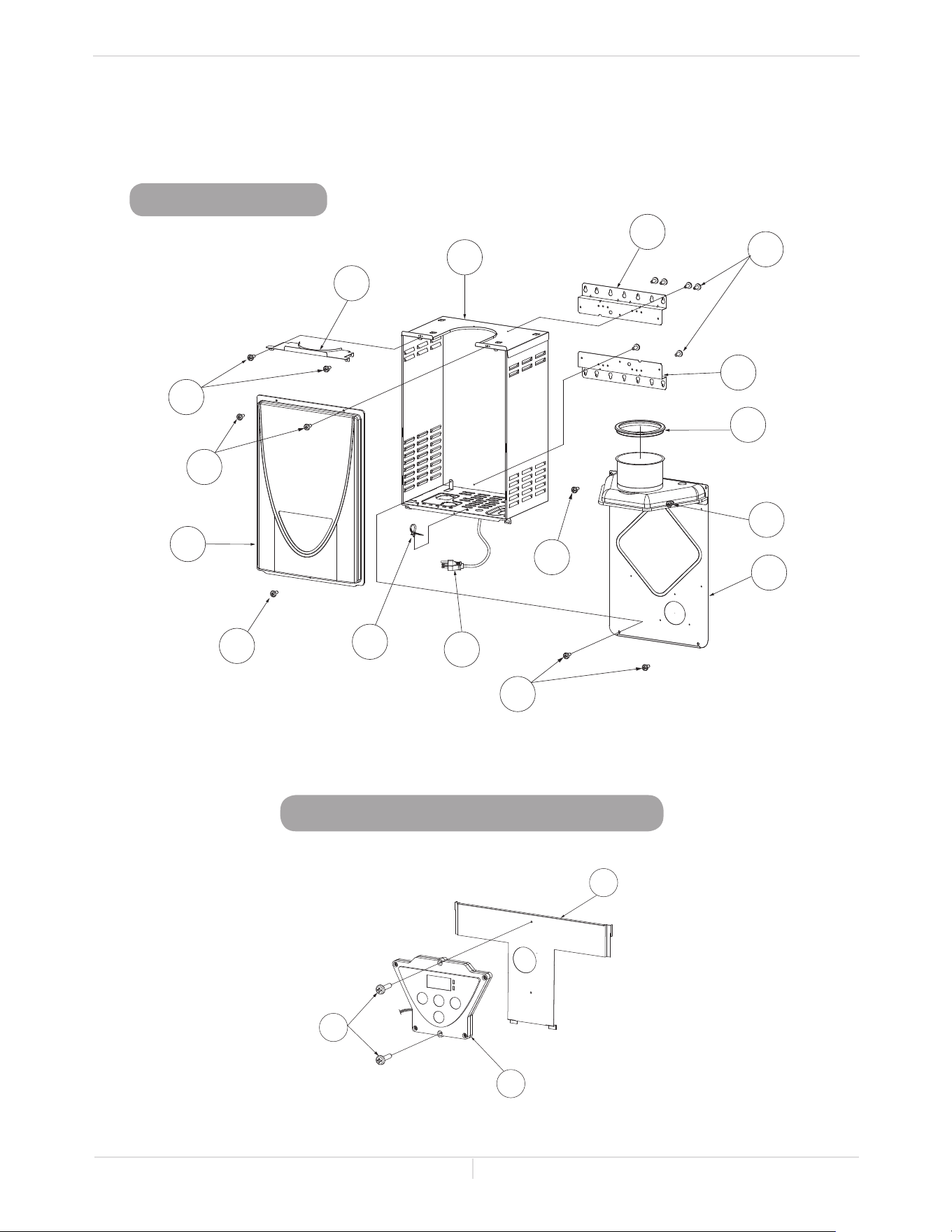
44 Page
COMPONENTS DIAGRAM
Components Diagram
Owner's Guide
Case assembly
001
002
003
003
463
004
005
704
710
053
052
052
051
051
053
053
Built-in temperature controller
722
721
056
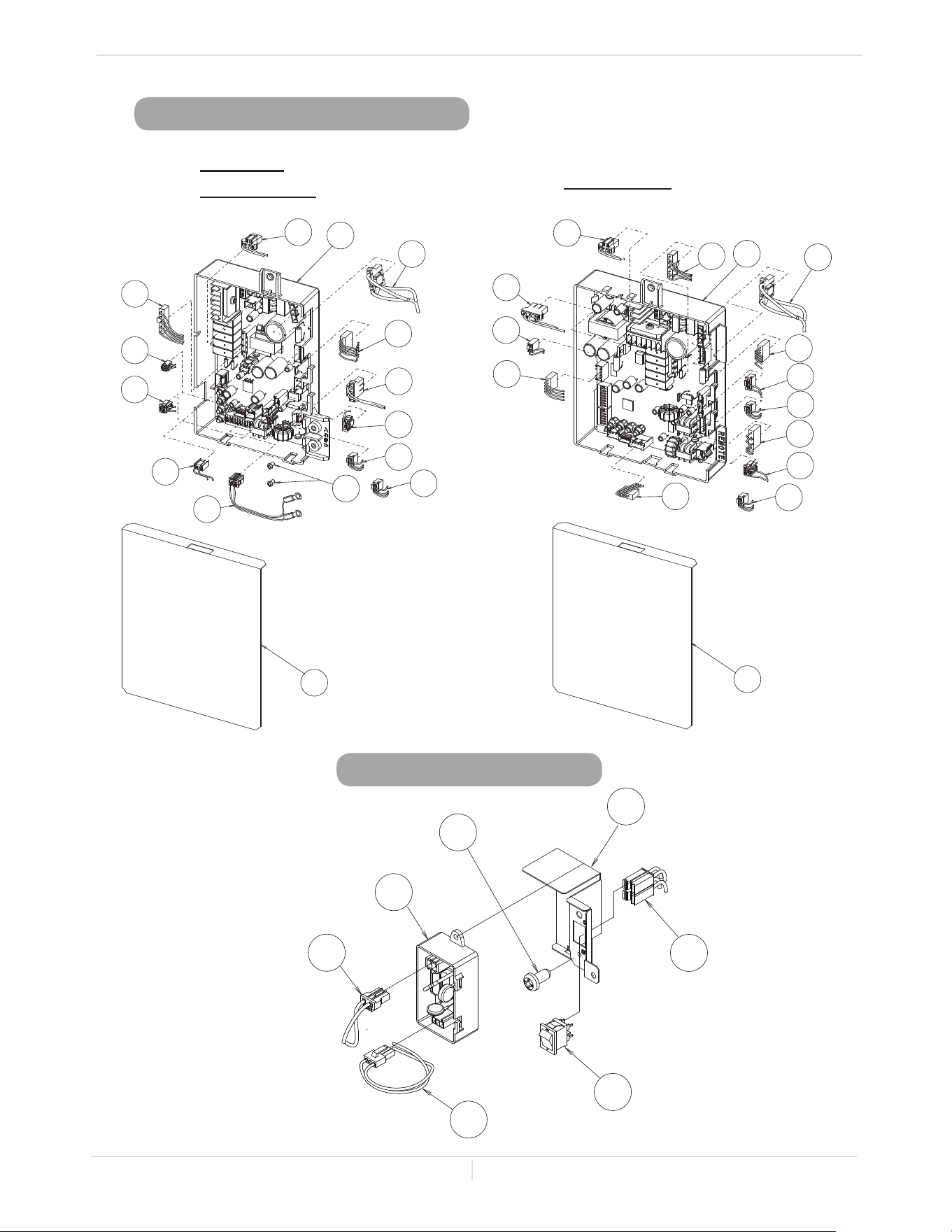
45 Page
510C model
110C and
310C models
701
705
103
402
402
707
713
403
714
709
708
711
705
103
709
402
402
711
707
714
407
408
708
701
061
713
712
712
721
721
Computer board assembly
Surge box assembly
Components Diagram
Owner's Guide
121
705
063
706
703
704
705
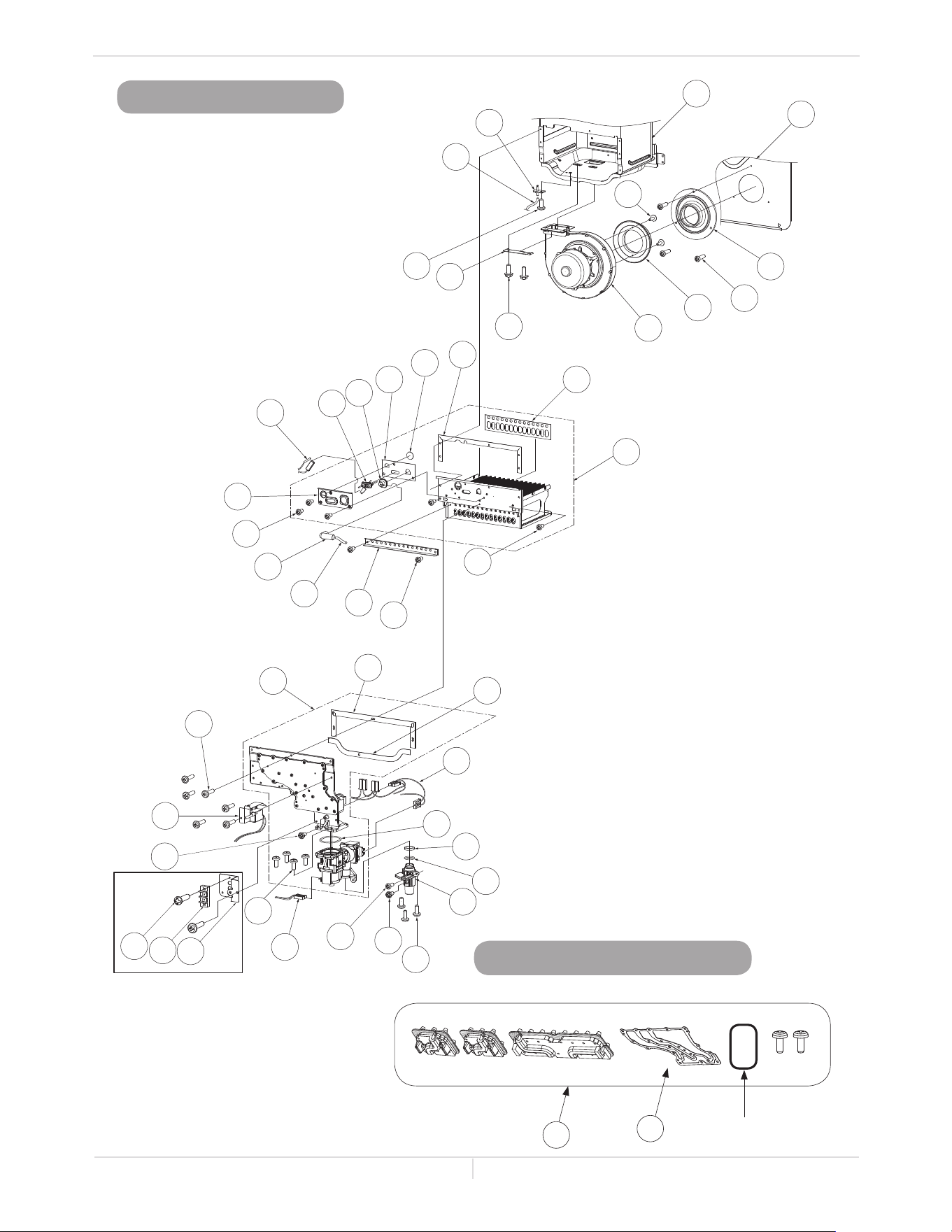
46 Page
101
119
120
106
107
109
108
709
111
711
112
110
053
711
113
114
102
118
117
708
151
052
714
057
707
702
055
150
055
066
401
004
105
104
103
115
116
053
122
054
063
065
065
062
063
064
Components Diagram
Owner's Guide
Burner assembly
510C model
LP Conversion Kit
130
131
Gas conversion
sticker
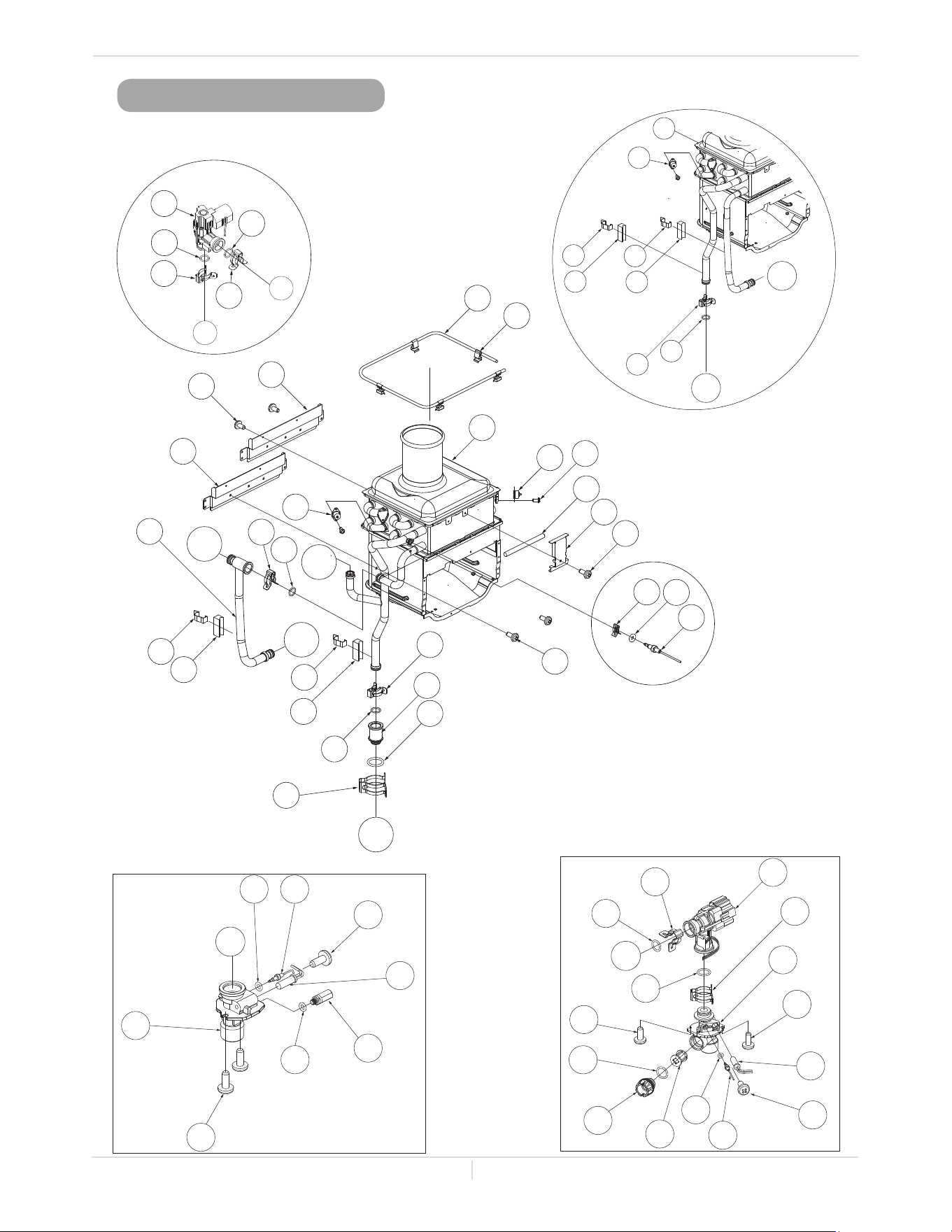
47 Page
Components Diagram
Owner's Guide
Water Way assembly
Bypass secon
(510C model)
510C model
Water outlet section
408
410
409
415
059
454
455
052
C
Water inlet section
402
404
407406
405
460
456
458
461
052
415
059
454
457
052
D
To Water
inlet secon
D
To Water
outlet secon
C
A
B
418
414
414
451
451
416
460
456
453
453
462
417
458
411
450
459
454
414
412
058
053
053
401
413
452
458
B
A
458
462
403
456
460
060
461
110C & 310C model
To Water
inlet secon
D
To Water
outlet secon
C
418
414
451
414
451
458
462
401
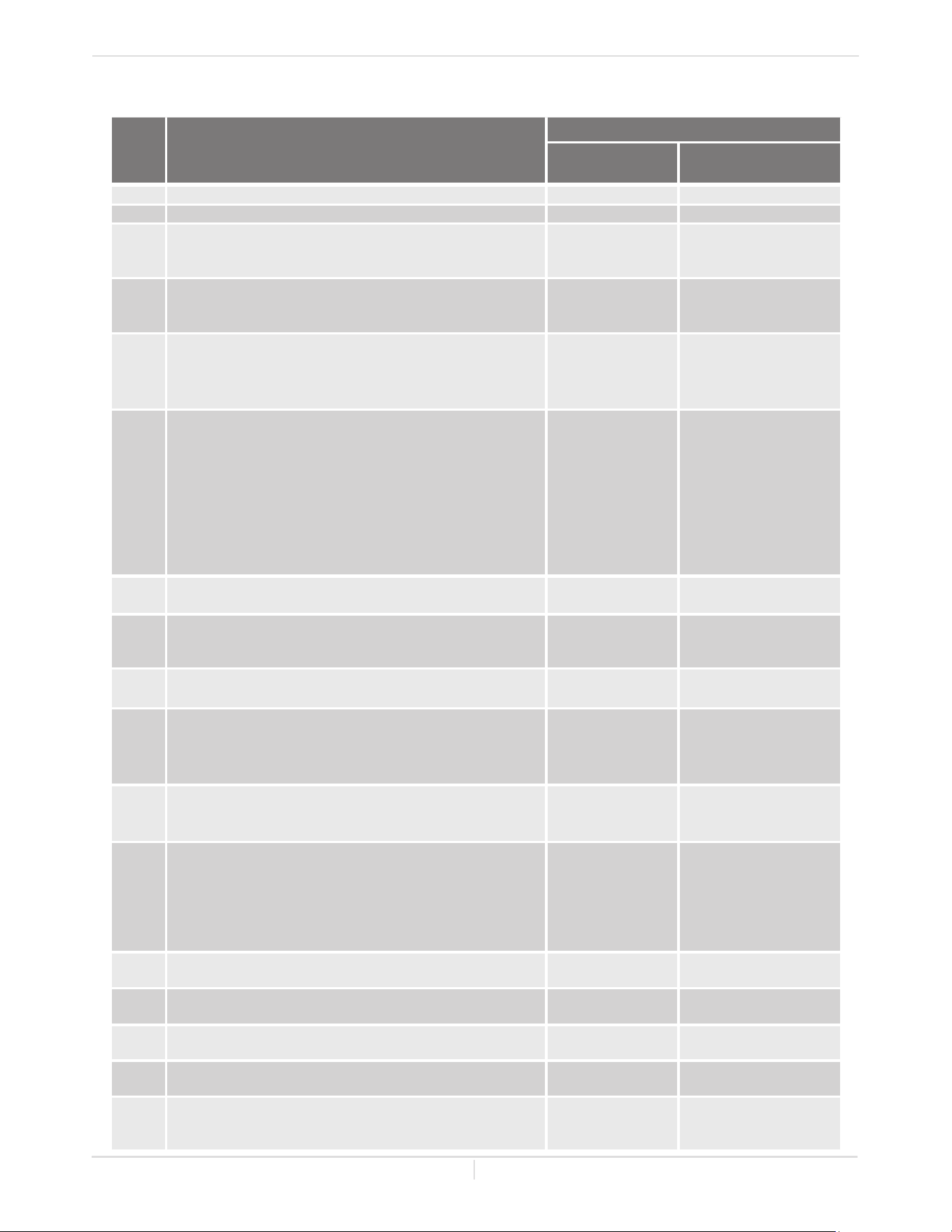
48 Page
Parts List
Owner's Guide
PARTS LIST
Item # Description
Part #
110C, 310C and
510C models
AT-KJr3U-CV, AT-K5U-CV
and AT-D3U-CV models
001 Case assembly
N/A EK550
002 Front cover N/A EK551
003
004
005
Bracket
Duct unit
Duct unit cover
N/A
N/A
N/A
EK455
EK552
EK553
051
052
053
Truss Screw M4×12 (W/Washer) SUS410
Truss Screw M4×10 (Coated) SUS3
Truss Screw M4x10 SUS
100074210
100074211
100074245
EW000
EW002
EW003
054
055
056
057
Hex head screw M4×12 (W/Washer) SUS3
Hex head screw M4x8 FEZN
Pan Screw M4x20 SUS410
Tap tight screw M4x12 FEZN
100074510
100074248
N/A
100074385
EW004
EW005
EW018
EKK31
058
059
060
061
062
063
064
065
066
Tapping Screw M3x6 SUS3 Pan head
Tapping Screw M4x6 SUS3 Truss head
Truss Screw M4x8 SUS3
Screw M3x6 BSNI Binding head
Screw M3x12 BSNI Raised counter sunk head
Tapping Screw M4x14 SUS410 Truss head
Pan Screw M3x10 SEMS MFZN
Pan Screw M4x8 MFZN
Pan Screw M4x10 FEZN
100074272
100074512
N/A
N/A
100074515
100076450
N/A
100074244
100074247
EW00A
EW009
EW02A
EW016
EW00X
EW00E
EW02C
EW00D
EW006
101
102
Burner and mixing chamber assembly
Manifold with gas valve assembly NA
100224092
100224093
EK554
EK555
103
104
105
Fan motor assembly
Fan motor gasket
Fan motor plate
100224094
100224095
100224096
EK556
EK557
EK558
106
107
Burner window
Rod holder gasket
100076535
100224097
EKN58
EK559
108
109
110
111
Flame rod with AFR function
Igniter rod
Rod holder
Rod cap
100224098
100224099
100224100
100076319
EK560
EK561
EK562
EK462
112
113
114
Burner damper
Manifold gasket A
Manifold gasket B
100224101
100224102
100224103
EK563
EK564
EK565
115
116
117
118
119
120
Pressure port
Combustion chamber tube
Gas inlet
Gas inlet ring
Burner gasket
Burner holder gasket
100074227
100074528
100224104
100074234
100224105
100224106
EKK2D
EX019
EK566
EKK2Z
EK567
EK568
121
122
Surge box plate
Fan motor plate
100074360
N/A
EK436
EK569
130
131
LP Conversion Kit
Manifold Gasket
100281154
100281157
EK591
EK592
150
151
O-ring (Manifold)
O-ring P20 NBR (Black)
N/A
100074242
EK570
EK042
401 Heat exchanger assembly for 110C, 310C
for 510C
100224107
100224108
EK571
EK572
402
403
404
Flow adjustment valve / Flow sensor
Bypass valve for 510C model
Water inlet
100074624
100074625
100074377
EK129
EKD58
EKK1U
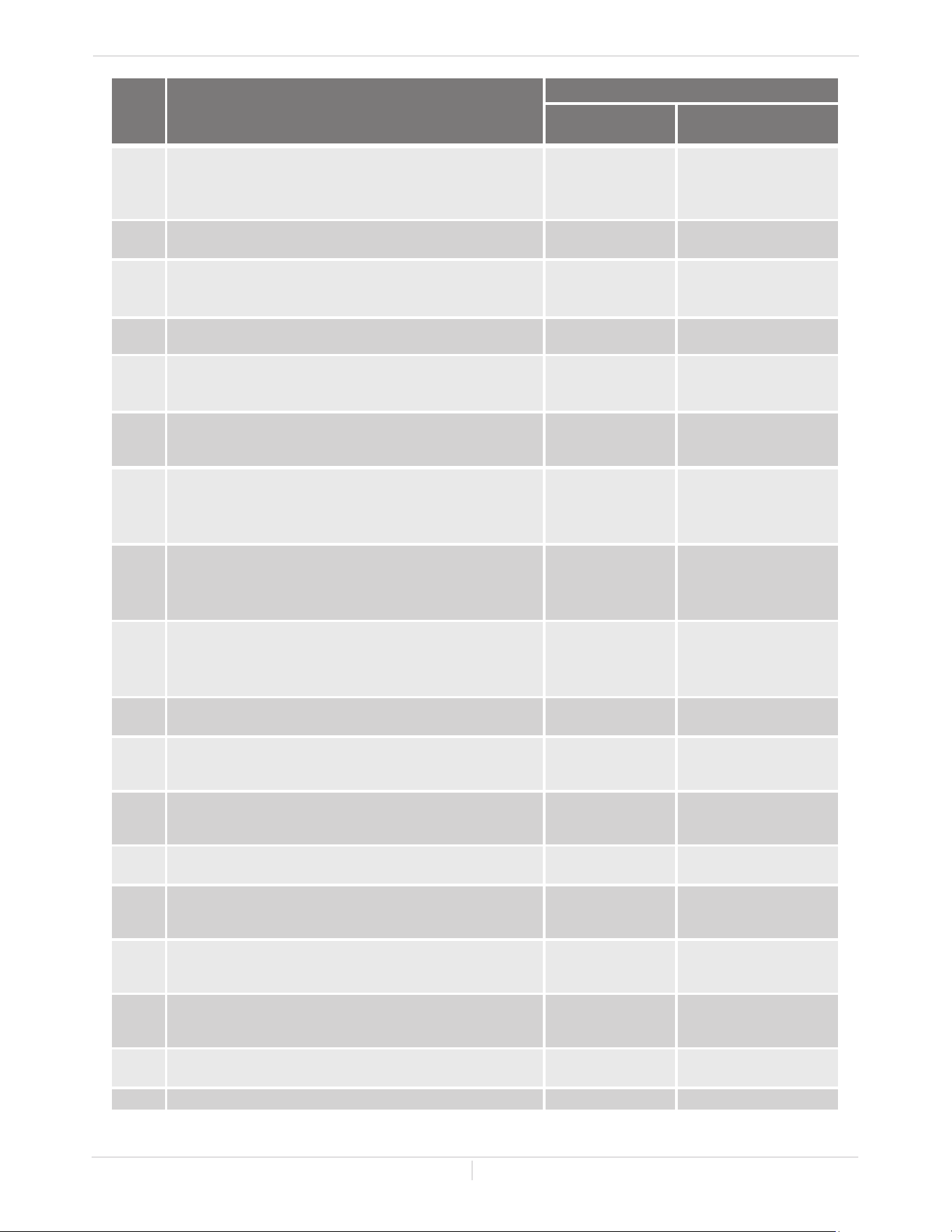
49 Page
Item # Description
Part #
110C, 310C and
510C models
AT-KJr3U-CV, AT-K5U-CV
and AT-D3U-CV models
405
406
407
Inlet drain plug
Inlet water filter
Inlet thermistor for 110C and 310C models
Inlet thermistor for 510C model
100074381
100074382
100074398
100224109
EKK2B
EKK2C
EKK4J
EK573
408 Outlet thermistor for 110C and 310C models
Outlet thermistor for 510C model
100074402
100224110
EKK55
EK574
409
410
411
Water outlet
Outlet drain plug
Heat exchanger thermistor for 510C model
100074627
100074264
100224111
EK104
EK239
EK575
412 Hi-Limit switch for 110C and 310C models
Hi-Limit switch for 510C model
100074412
100074280
EM212
EKN34
413
414
415
Overheat-cut-off fuse
Pipe heater
Inlet heater
100074252
100074682
100074629
EX02A
EK209
EK105
416
417
418
Pipe inlet for 510C model
Joint outlet for 510C model
Thermo switch
100224112
100224113
N/A
EK576
EK577
EK589
450
451
452
453
Pipe heater fixing plate
Heater fixing plate 16
Fuse fixing plate 18
Combustion chamber fixing plate
N/A
100074310
N/A
N/A
EK578
EK031
EK476
EK579
454
455
456
457
O-ring P4 FKM
O-ring P6 FKM
O-ring P14 FKM
O-ring P15 FKM
100076303
100076305
100076306
100076307
EZF04
EZF06
EZF14
EZF15
458
459
460
461
O-ring P16 FKM
Fastener “4-11” for 510C model
Fastener “14-22”
Fastener “16A”
100076308
100074282
100074290
100074410
EZF16
EKH30
EKK24
EM192
462
463
Fastener “16-25A”
Silicon ring
100074389
N/A
EKK39
EK580
701 Computer board for 110C model
for 310C model
for 510C model
100224114
100224115
100224116
EK581
EK582
EK583
702
703
704
Remote fixing plate for 510C
Surge box
120 VAC wire
100074644
100076100
100074601
EK152
EK280
EK146
705
706
Switch wire
120 VAC Power ON-OFF switch
N/A
N/A
EK584
EK590
707
708
Remote controller wire for 110C and 310C models
for 510C model
Gas valve wire
100074649
100074650
N/A
EK189
EK165
EK585
709
710
711
Flame rod wire
Cable strap
Igniter assembly
N/A
N/A
100074640
EK586
EW022
EK153
712
713
714
Computer board cover
24V cables for 510C model
Proportional gas valve wire
100074458
N/A
100074642
EM329
EK587
EK112
721
722
Temperature controller
Controller fixing plate
100074660
N/A
EK173
EK588
N/A * Communication cable 100076516 EKK0J
Parts List
Owner's Guide
*Refer to p. 9.
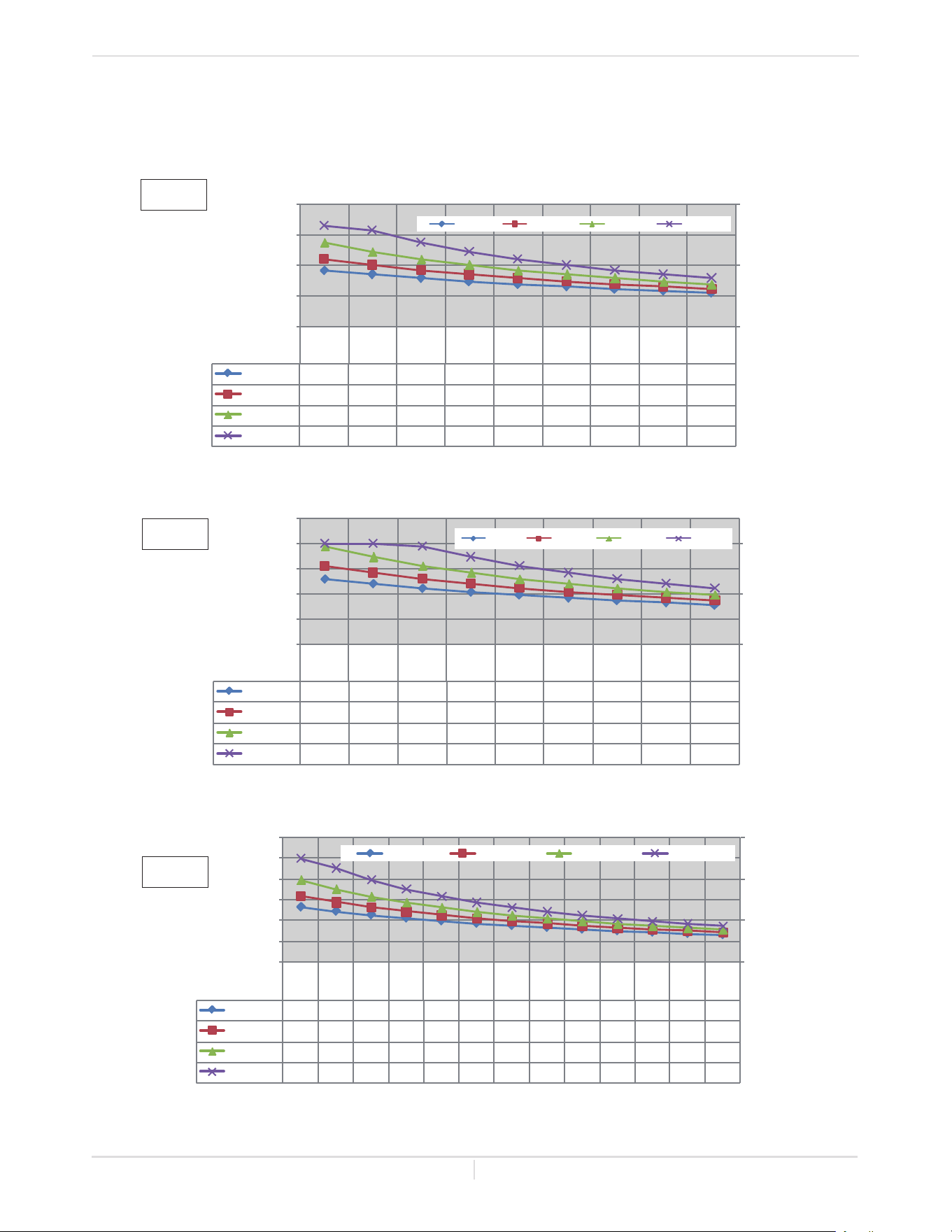
50 Page
OUTPUT TEMPERATURE CHART
Chart is based on properly sized gas line
Output Temperature Chart
Owner's Guide
Output Temperature vs. GPM (Max. 6.6 GPM) with Various Inlet Water Temperature
110C
310C
510C*
*When the set temperature is 130 °F (55 °C) or higher, maximum flow rate is limited to 8.0 GPM.
100
(38)
105
(40)
110
(43)
115
(45)
120
(50)
125
(52)
130
(55)
135
(57)
140
(60)
145
(63)
150
(65)
155
(68)
160
(70)
40°F (4°C)
50°F(10°C)
60°F(16°C)
70°F(21°C)
0.0
2.0
4.0
6.0
8.0
10.0
12.0
40°F (4°C)
50°F(10°C)
60°F(16°C)
70°F(21°C)
5.3
(20.1)
6.4
(24.2)
8.0
(30.1)
10.0
(37.9)
4.9
(18.6)
5.8
(22.0)
7.1
(26.9)
9.1
(34.5)
4.5
(17.0)
5.3
(20.1)
6.4
(24.2)
8.0
(30.1)
4.2
(15.9)
4.9
(18.6)
5.8
(22.0)
7.1
(26.9)
4.0
(15.1)
4.5
(17.0)
5.3
(20.1)
6.4
(24.2)
3.7
(14.0)
4.2
(15.9)
4.9
(18.6)
5.8
(22.0)
3.5
(13.3)
4.0
(15.1)
4.5
(17.0)
5.3
(20.1)
3.4
(12.9)
3.7
(14.0)
4.2
(15.9)
4.9
(18.6)
3.2
(12.1)
3.5
(13.3)
4.0
(15.1)
4.5
(17.0)
3.0
(11.4)
3.4
(12.9)
3.7
(14.0)
4.2
(15.9)
2.9
(11.0)
3.2
(12.1)
3.5
(13.3)
4.0
(15.1)
2.8
(10.6)
3.0
(11.4)
3.4
(12.9)
3.7
(14.0)
2.7
(10.2)
2.9
(11.0)
3.2
(12.1)
3.5
(13.3)
( L /M)
45
30
15
( L /M)
30
15
( L /M)
30
15
0
0
0
100
(38)
105
(40)
110
(43)
115
(45)
120
(50)
125
(52)
130
(55)
135
(57)
140
(60)
40°F(4°C)
50°F(10°C)
60°F(16°C)
70°F(21°C)
0.0
2.0
4.0
6.0
8.0
10.0
40°F(4°C)
50°F(10°C)
60°F(16°C)
70°F(21°C)
5.2
(19.7)
6.2
(23.5)
7.8
(29.5)
8.0
(30.3)
4.8
(18.2)
5.7
(21.6)
6.9
(26.1)
8.0
(30.3)
4.4
(16.7)
5.2
(19.7)
6.2
(23.5)
7.8
(29.5)
4.1
(15.5)
4.8
(18.2)
5.7
(21.6)
6.9
(26.1)
3.9
(14.8)
4.4
(16.7)
5.2
(19.7)
6.2
(23.5)
3.7
(14.0)
4.1
(15.5)
4.8
(18.2)
5.7
(21.6)
3.5
(13.3)
3.9
(14.8)
4.4
(16.7)
5.2
(19.7)
3.3
(12.5)
3.7
(14.0)
4.1
(15.5)
4.8
(18.2)
3.1
(11.7)
3.5
(13.3)
3.9
(14.8)
4.4
(16.7)
100
(38)
105
(40)
110
(43)
115
(45)
120
(50)
125
(52)
130
(55)
135
(57)
140
(60)
40°F(4°C)
50°F(10°C)
60°F(16°C)
70°F(21°C)
0.0
2.0
4.0
6.0
8.0
40°F(4°C)
50°F(10°C)
60°F(16°C)
70°F(21°C)
3.7
(14.0)
4.4
(16.7)
5.5
(20.8)
6.6
(25.0)
3.4
(12.9)
4.0
(15.1)
4.9
(18.6)
6.3
(23.9)
3.1
(11.7)
3.7
(14.0)
4.4
(16.7)
5.5
(20.8)
2.9
(11.0)
3.4
(12.9)
4.0
(15.1)
4.9
(18.6)
2.8
(10.6)
3.1
(11.7)
3.7
(14.0)
4.4
(16.7)
2.6
(9.8)
2.9
(11.0)
3.4
(12.9)
4.0
(15.1)
2.4
(9.8)
2.8
(10.6)
3.1
(11.7)
3.7
(14.0)
2.3
(8.7)
2.6
(9.8)
2.9
(11.0)
3.4
(12.9)
2.2
(8.3)
2.4
(9.8)
2.8
(10.6)
3.1
(11.7)
Output Hot Water GPM
Set Temp.
°F(°C)
Incoming Temp.
Output Hot Water GPM
Set Temp.
°F(°C)
Incoming Temp.
Output Hot Water GPM
Set Temp.
°F(°C)
Incoming Temp.
Output Temperature vs. GPM (Max. 8.0 GPM) with Various Inlet Water Temperature
Output Temperature vs. GPM (Max. 10.0 GPM) with Various Inlet Water Temperature

51 Page
This page is intentionally left blank.

1W5101-5
DIR 2000535218
(REV. C)