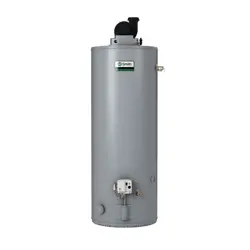
COMMERCIAL GAS WATER HEATERS
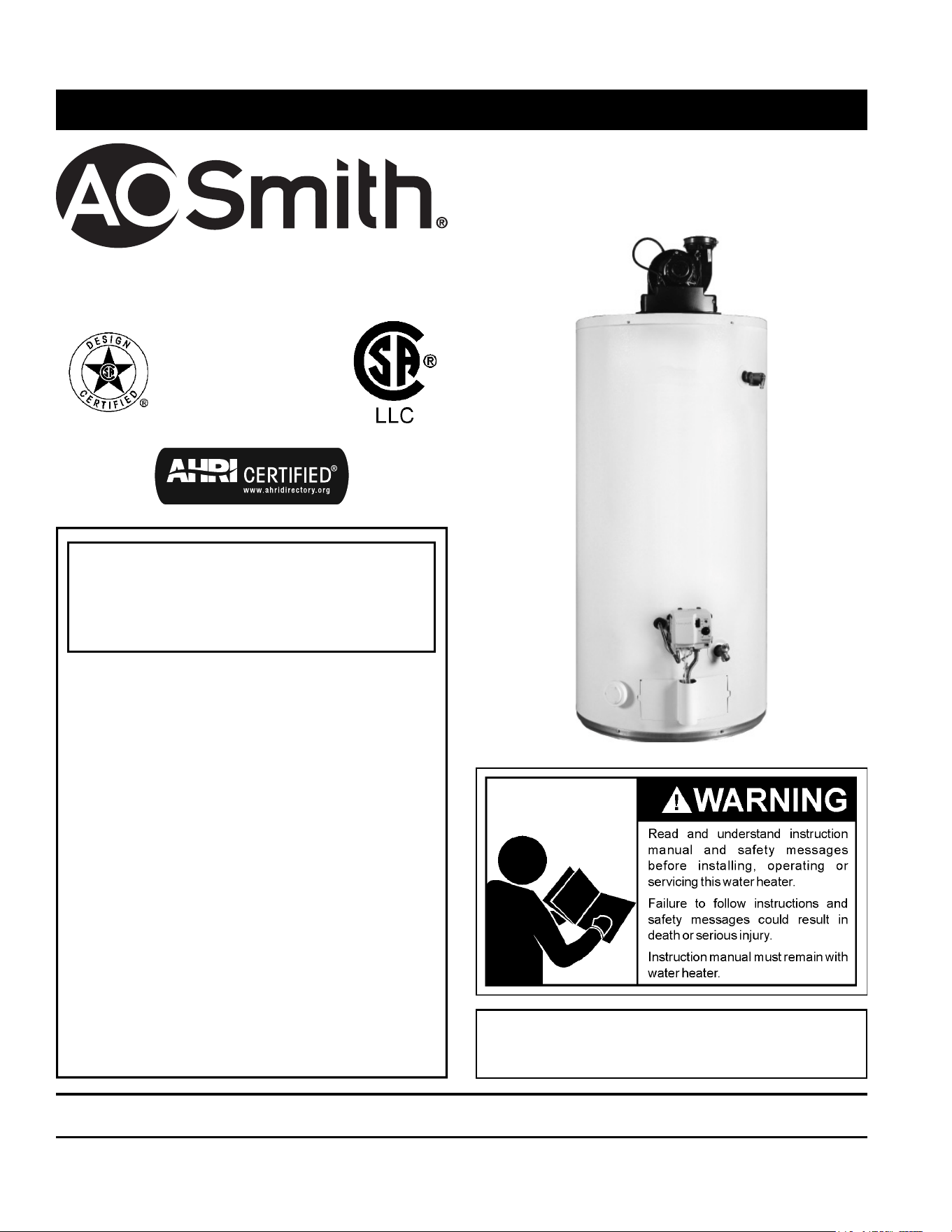
Installation and Operating Manual
1503 331602-001
KEEP THIS MANUAL IN THE POCKET ON HEATER FOR FUTURE REFERENCE
WHENEVER MAINTENANCE ADJUSTMENT OR SERVICE IS REQUIRED.
POWER VENTED GAS MODELS
WITH HOT SURFACE IGNITION
NOT FOR USE IN MANUFACTURED (MOBILE) HOMES
ALL TECHNICAL AND WARRANTY QUESTIONS: SHOULD BE DIRECTED TO THE LOCAL DEALER FROM WHOM THE WATER HEATER WAS
PURCHASED. IF YOU ARE UNSUCCESSFUL, PLEASE CONTACT THE COMPANY LISTED ON THE RATING PLATE ON THE WATER HEATER.
MODELS BTF-80 SERIES 210, 211
- Do not store or use gasoline or other flam-
mable vapors and liquids in the vicinity of
this or any other appliance.
- WHAT TO DO IF YOU SMELL GAS:
• Do not try to light any appliance.
• Do not touch any electrical switch; do not
use any phone in your building.
• Immediately call your gas supplier from a
neighbor's phone. Follow the gas sup-
plier's instructions.
• If you cannot reach your gas supplier, call
the fire department.
- Installation and service must be performed by
a qualified installer, service agency or the
gas supplier.
WARNING: If the information in these instruc-
tions is not followed exactly, a fire or explosion
may result causing property damage, personal
injury or death.
• For Your Safety •
AN ODORANT IS ADDED TO THE GAS USED
BY THIS WATER HEATER.

2 331602-001
TABLE OF CONTENTS
Safe Installation, Use And Service . . . . . . . . . . . . . . . . . . 3
General Safety. . . . . . . . . . . . . . . . . . . . . . . . . . . . . . . . . . 4
Introduction . . . . . . . . . . . . . . . . . . . . . . . . . . . . . . . . . . . . 6
Qualifi ed Installer Or Service Agency . . . . . . . . . . . . 6
Preparing For The Installation. . . . . . . . . . . . . . . . . . 6
Installation Requirements For The Commonwealth Of
Massachusetts. . . . . . . . . . . . . . . . . . . . . . . . . . . . . . . . . . 7
Typical Installation . . . . . . . . . . . . . . . . . . . . . . . . . . . . . . . 9
Get To Know Your Water Heater - Gas Models
(List Referencing Figures 1-7). . . . . . . . . . . . . . . . . . 9
Replacement Parts And Deliming Products . . . . . . 10
Combo Heating Inlet And Outlet Side Taps. . . . . . . 10
Water Piping - Mixing Valve Usage . . . . . . . . . . . . . .11
Mixing Valves
Water Heater Operation . . . . . . . . . . . . . . . . . . . . . 12
Electrical Requirements & Wiring Diagram . . . . . . . 13
Safety Lockouts . . . . . . . . . . . . . . . . . . . . . . . . . . . . . . . . 14
High Limit Controls (Energy Cut Off). . . . . . . . . . . . 14
Thermostat/Water Temperature
Blower High Limit Switch
Blower Air Pressure Switch . . . . . . . . . . . . . . . . . . . 14
Flammable Vapor Sensor . . . . . . . . . . . . . . . . . . . . 14
Locating The New Water Heater . . . . . . . . . . . . . . . . . . . 15
Facts To Consider About The Location . . . . . . . . . . 15
Storage Of Flammable Liquids . . . . . . . . . . . . . . . . 15
Clearances to combustibles
Floors with carpeting
Clearance for servicing
Insulation Blankets . . . . . . . . . . . . . . . . . . . . . . . . . 17
Air Requirements . . . . . . . . . . . . . . . . . . . . . . . . . . 17
Unconfi ned Space. . . . . . . . . . . . . . . . . . . . . . . . . . 17
Unusually Tight Construction . . . . . . . . . . . . . . . . . 17
Confi ned Space. . . . . . . . . . . . . . . . . . . . . . . . . . . . 18
Direct Vent Appliances . . . . . . . . . . . . . . . . . . . . . . 18
Exhaust Fans . . . . . . . . . . . . . . . . . . . . . . . . . . . . . 18
Fresh Air Openings For Confi ned Spaces. . . . . . . . 18
Chemical Vapor Corrosion . . . . . . . . . . . . . . . . . . . 19
Installing The New Water Heater . . . . . . . . . . . . . . . . . . . 20
Water Piping . . . . . . . . . . . . . . . . . . . . . . . . . . . . . . 20
Space Heating And Potable Water Systems . . . . . . 20
Combo Heating . . . . . . . . . . . . . . . . . . . . . . . . . . . . 21
System Requirements
Installation
Closed Water Systems . . . . . . . . . . . . . . . . . . . . . . 22
Thermal Expansion . . . . . . . . . . . . . . . . . . . . . . . . . 22
Temperature-Pressure Relief Valve. . . . . . . . . . . . . 23
T&P valve discharge pipe requirements:
Temperature-Pressure Relief Valve and
Pipe Insulation
High Altitude Installation . . . . . . . . . . . . . . . . . . . . . 24
Gas Piping. . . . . . . . . . . . . . . . . . . . . . . . . . . . . . . . 24
Sediment Traps/Dirt Leg . . . . . . . . . . . . . . . . . . . . . 25
Filling The Water Heater . . . . . . . . . . . . . . . . . . . . . 26
Venting . . . . . . . . . . . . . . . . . . . . . . . . . . . . . . . . . . 26
Termination Clearances Sidewall Power Vent. . . . . 27
Blower Assembly Installation. . . . . . . . . . . . . . . . . . 28
Installation Of Vent System . . . . . . . . . . . . . . . . . . . 28
Planning The Vent System . . . . . . . . . . . . . . . . . . . 28
Polypropylene Vent Systems . . . . . . . . . . . . . . . . . 29
Condensate. . . . . . . . . . . . . . . . . . . . . . . . . . . . . . . 29
Exhaust Venting . . . . . . . . . . . . . . . . . . . . . . . . . . . 29
Important Notes and Warnings
Venting terminations and sizing
Vent screen installation
Calculating Equivalent Feet
Venting instructions
Vent pipe connection to blower
Coupling installations according to vent sizes
Blower Exhaust Direction . . . . . . . . . . . . . . . . . . . . 34
Vent Pipe Preparation . . . . . . . . . . . . . . . . . . . . . . . 34
Installation Checklist . . . . . . . . . . . . . . . . . . . . . . . . 37
Lighting Instructions. . . . . . . . . . . . . . . . . . . . . . . . . . . . . 38
Operating The Temperature Control System . . . . . . . . . . 39
Gas Control Valve/Thermostat . . . . . . . . . . . . . . . . 40
For Your Information . . . . . . . . . . . . . . . . . . . . . . . . . . . . 41
Start Up Conditions . . . . . . . . . . . . . . . . . . . . . . . . . 41
Condensate
Smoke/odor
Strange sounds
Operational Conditions . . . . . . . . . . . . . . . . . . . . . . 41
Smelly water
“Air” In Hot-Water Faucets . . . . . . . . . . . . . . . . . . . 41
Periodic Maintenance . . . . . . . . . . . . . . . . . . . . . . . . . . . 42
General Upkeep . . . . . . . . . . . . . . . . . . . . . . . . . . . 42
Venting System Inspection . . . . . . . . . . . . . . . . . . . 42
Blower Maintenance . . . . . . . . . . . . . . . . . . . . . . . . 42
Cleaning The Blower. . . . . . . . . . . . . . . . . . . . . . . . 42
Burner Operation And Inspection . . . . . . . . . . . . . . 43
Combustion Chamber And Burner Cleaning . . . . . . 44
Housekeeping . . . . . . . . . . . . . . . . . . . . . . . . . . . . . 44
Anode Rod Inspection. . . . . . . . . . . . . . . . . . . . . . . 44
Anode Rod . . . . . . . . . . . . . . . . . . . . . . . . . . . . . . . 44
Removing Anode Rod:
Installing Anode Rod:
Temperature-Pressure Relief Valve Test . . . . . . . . . 45
Draining And Flushing . . . . . . . . . . . . . . . . . . . . . . . 46
To drain the water heater storage tank:
To fl ush the water heater storage tank:
Leakage Checkpoints . . . . . . . . . . . . . . . . . . . . . . . . . . . 47
Service . . . . . . . . . . . . . . . . . . . . . . . . . . . . . . . . . . 47
Reference Parts Listing . . . . . . . . . . . . . . . . . . . . . . . . . . 48
Troubleshooting Guidelines . . . . . . . . . . . . . . . . . . . . . . . 50
Resetting The Heater Control . . . . . . . . . . . . . . . . . 53
Lockouts . . . . . . . . . . . . . . . . . . . . . . . . . . . . . . . . . 53
Soft Lockout
Hard Lockout
Ignition State And Timing . . . . . . . . . . . . . . . . . . . . 53
System Status And Error Codes . . . . . . . . . . . . . . . 54
Reading The LED Flash Sequence. . . . . . . . . . . . . 54
Notes . . . . . . . . . . . . . . . . . . . . . . . . . . . . . . . . . . . . . . . . 58
331602-001 3
SAFE INSTALLATION, USE AND SERVICE
Your safety and the safety of others is extremely important in the installation, use and servicing of this water heater.
Many safety-related messages and instructions have been provided in this manual and on your own water heater to warn you
and others of a potential injury hazard. Read and obey all safety messages and instructions throughout this manual. It is very
important that the meaning of each safety message is understood by you and others who install, use or service this water heater.
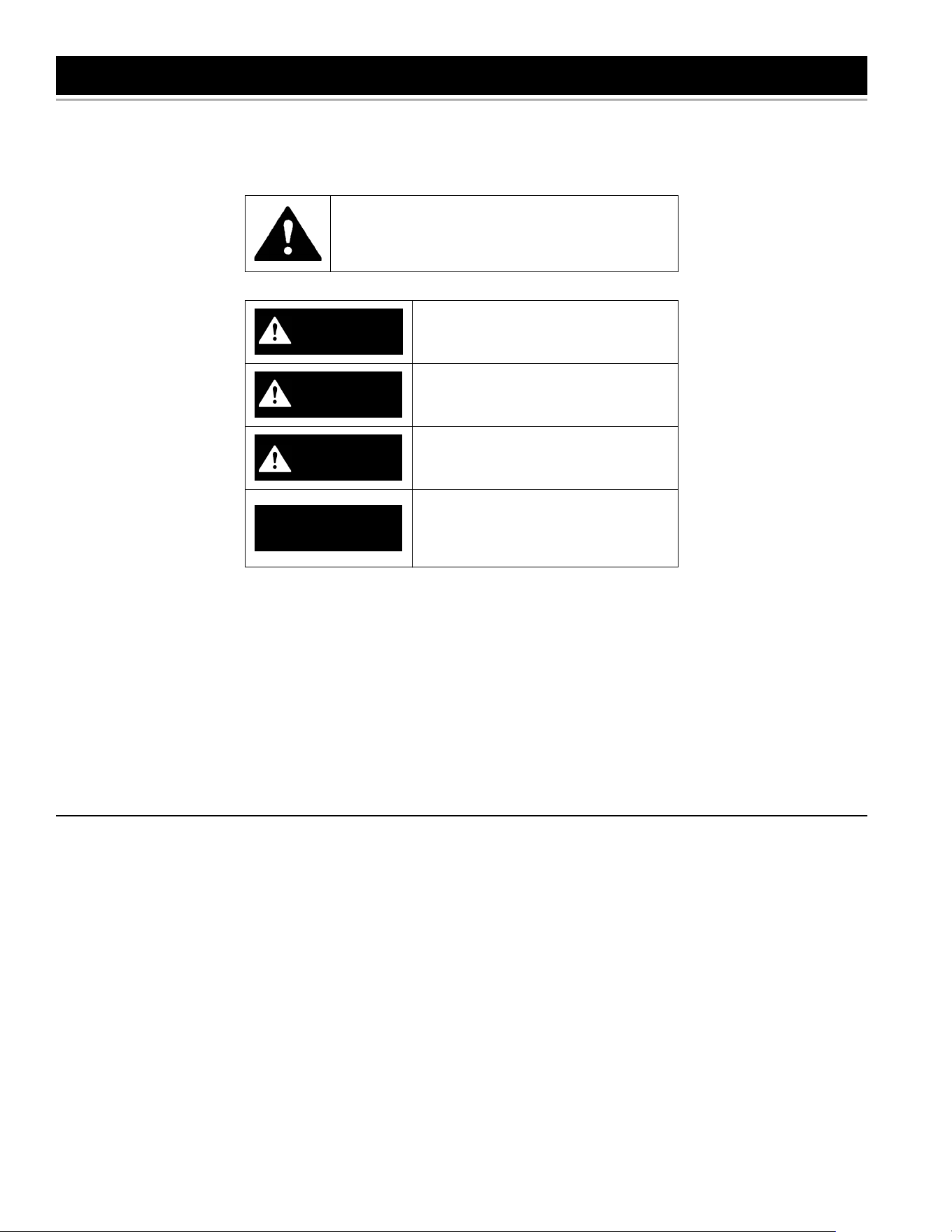
This is the safety alert symbol. It is used to alert you
to potential personal injury hazards. Obey all safety
messages that follow this symbol to avoid possible
injury or death.
CAUTION used without the safety alert
symbol indicates a potentially hazardous
situation which, if not avoided, could
result in property damage
CAUTION indicates a potentially
hazardous situation which, if not avoided,
could result in minor or moderate injury.
WARNING indicates a potentially
hazardous situation which, if not avoided,
could result in death or injury.
DANGER indicates an imminently
hazardous situation which, if not avoided,
will result in death or injury.
CAUTION
WARNING
CAUTION
DANGER
All safety messages will generally tell you about the type of hazard, what can happen if you do not follow the safety message
and how to avoid the risk of injury.
The California Safe Drinking Water and Toxic Enforcement Act requires the Governor of California to publish a list of substances
known to the State of California to cause cancer, birth defects or other reproductive harm and requires businesses to warn
of potential exposure to such substances.
This product contains a chemical known to the State of California to cause cancer, birth defects or other reproductive harm.
This appliance can cause low level exposure to some of the substances listed in the Act.
This product is certifi ed to comply with a maximum weighted average of 0.25% lead content as required in some areas.
IMPORTANT DEFINITIONS
Qualifi ed Installer: A qualifi ed installer must have ability equivalent to a licensed tradesman in the fi elds of plumbing,
air supply, venting and gas supply, including a thorough understanding of the requirements of the “National Fuel Gas
Code”, ANSI Z223.1/NFPA 54 as it relates to the installation of gas fi red water heaters. The qualifi ed installer must also
be familiar with the design features and use of fl ammable vapor ignition resistant water heaters and have a thorough
understanding of this Installation and Operating manual.
Service Agency: A service agency also must have ability equivalent to a licensed tradesman in the fi elds of plumbing, air
supply, venting and gas supply, including a thorough understanding of the requirements of the “National Fuel Gas Code”,
ANSI Z223.1/NFPA 54 as it relates to the installation of gas fi red water heaters. The service agency must also have a
thorough understanding of this Installation and Operating manual, and be able to perform repairs strictly in accordance
with the service guidelines provided by the manufacturer.
Gas Supplier: The Natural Gas or Propane Utility or service who supplies gas for utilization by the gas burning appliances
within this application. The gas supplier typically has responsibility for the inspection and code approval of gas piping
up to and including the Natural Gas meter or Propane storage tank of a building. Many gas suppliers also offer service
and inspection of appliances within the building.
4 331602-001
GENERAL SAFETY
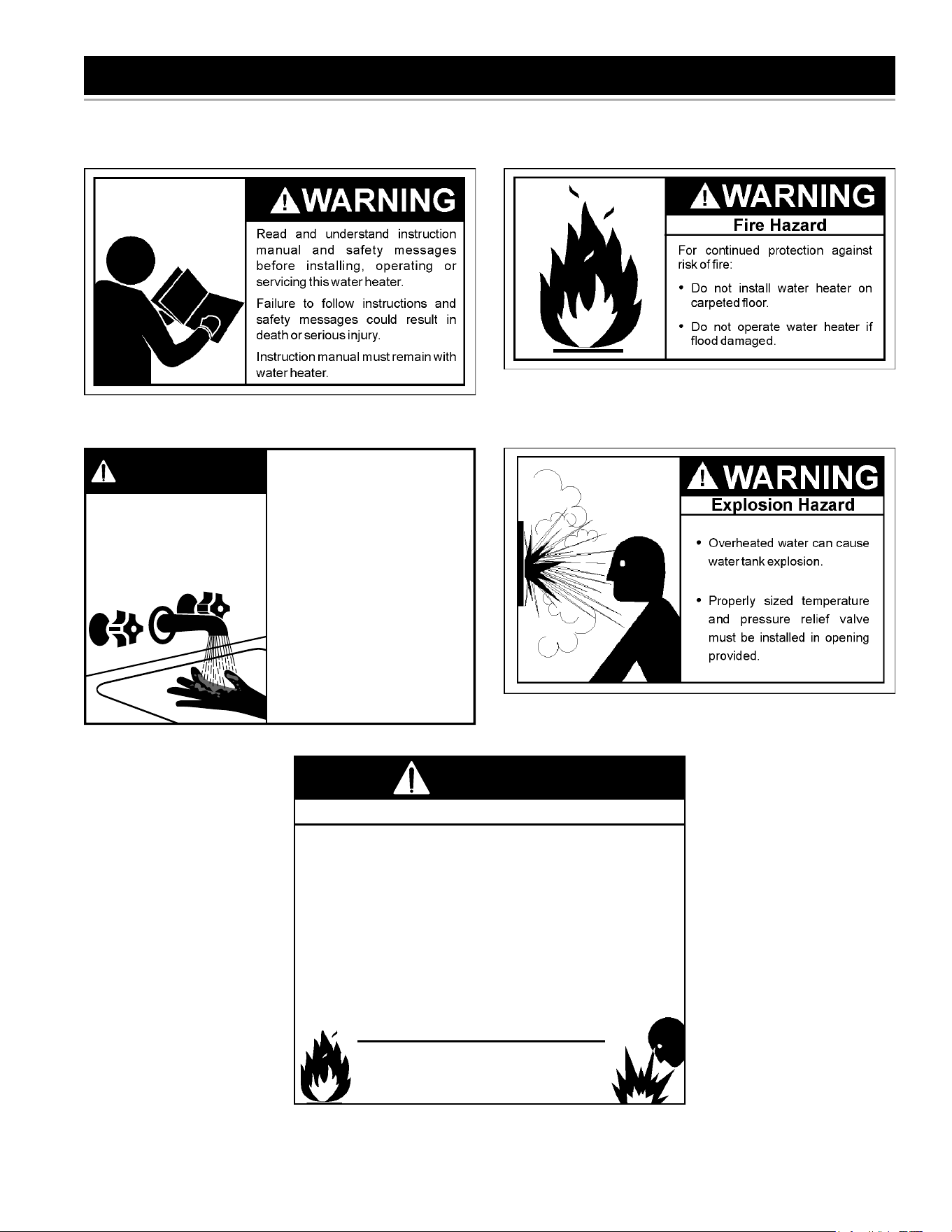
Water temperature over
125°F can cause severe
burns instantly resulting in
severe injury or death.
Children, the elderly and the
disabled and are at highest
risk of scald injury.
Feel water before bathing or
showering.
Temperature limiting valves
are available.
Read instruction manual for
safe temperature setting.
BURN
HOT
HOT
DANGER
Read instruction manual before
installing, using or servicing
water heater.
• Do not store or use gasoline or other flammable
vapors and liquids in the vicinity of this or any other
appliance.
• Avoid all ignition sources if you smell gas.
• Do not expose water heater control to excessive
gas pressure.
• Use only gas shown on rating plate.
• Maintain required clearances to combustibles.
• Keep ignition sources away from faucets after
extended period of non-use.
Fire or Explosion Hazard
WARNING
331602-001 5
GENERAL SAFETY
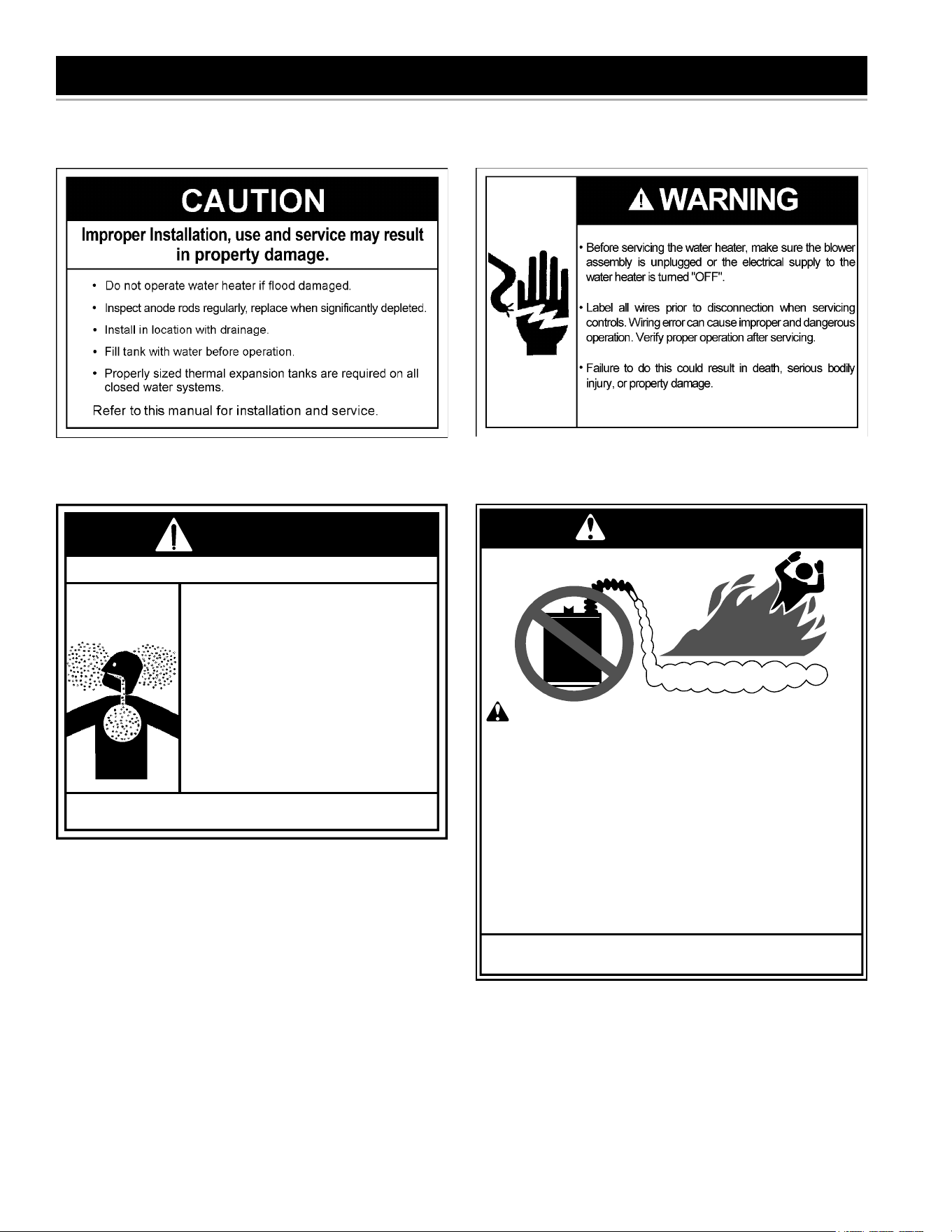
Breathing carbon monoxide can cause brain damage or death.
Always read and understand instruction manual.
• Install vent system in accordance with codes.
• Do not operate water heater if flood damaged.
• For operation above 10,100’, a high altitude
orifice must be installed.
• Do not operate if soot buildup is present.
• Do not obstruct water heater air intake with
insulating jacket.
• Do not obstruct blower air intake.
• Do not place chemical vapor emitting products
near water heater.
• Gas and carbon monoxide detectors are
available.
• No vent damper installation is compatible with
this power vented water heater.
Breathing Hazard - Carbon Monoxide Gas
WARNING
Installation: Do not install the water heater where flammable
products will be stored or used.
Vapors from flammable
liquids may explode and
catch fire causing death or
severe burns.
Do not use or store
flammable products such as
gasoline, solvents or adhe-
sives in the same room or
area near the water heater.
Keep flammable products:
1. far away from heater,
2. in approved containers,
3. tightly closed and
4. out of children's reach.
Water heater has a main
burner and hot surface igniter.
The hot surface igniter:
1. can be triggered at any
time and
2. the hot surface will ignite
flammable vapors.
Vapors:
1. cannot be seen,
2. are heavier than air,
3. go a long way on the floor
and
4. can be carried from other
rooms to the the
electodes by air currents.
Flammable Vapors
FLAMMBLE
DANGER

6 331602-001
INTRODUCTION
Thank You for purchasing this water heater. Properly
installed and maintained, it should give you years of trouble
free service.
Abbreviations found in this Installation and Operating
manual:
• CSA - Canadian Standards Association
• ANSI - American National Standards Institute
• NFPA - National Fire Protection Association
• ASME - American Society of Mechanical Engineers
• UL - Underwriters Laboratories Inc.
• AHRI - Air Conditioning, Heating and Refrigeration
Institute.
This gas-fi red water heater is design certifi ed by CSA
International, under Water Heater Standard ANSI
Z21.10.3 • CSA 4.3 (current edition).
QUALIFIED INSTALLER OR SERVICE AGENCY
Installation and service of this water heater requires ability
equivalent to that of a Qualifi ed Agency (as defi ned by
ANSI below) in the fi eld involved. Installation skills such
as plumbing, air supply, venting, gas supply and electrical
supply are required in addition to electrical testing skills
when performing service.
ANSI Z223.1 2006 Sec. 3.3.83: “Qualifi ed Agency” - “Any
individual, fi rm, corporation or company that either in
person or through a representative is engaged in and is
responsible for (a) the installation, testing or replacement
of gas piping or (b) the connection, installation, testing,
repair or servicing of appliances and equipment; that
is experienced in such work; that is familiar with all
precautions required and that has complied with all the
requirements of the authority having jurisdiction.”
If you are not qualifi ed (as defi ned by ANSI above) and
licensed or certified as required by authority having
jurisdiction to perform a given task, do not attempt to
perform any of the procedures described in this manual.
If you do not understand the instructions given in this
manual do not attempt to perform any procedures outlined
in this manual.
PREPARING FOR THE INSTALLATION
1. Read the “General Safety” section of this manual
fi rst and then entire manual carefully. If you don’t
follow safety rules, the water heater will not
operate properly. It could cause DEATH, SERIOUS
BODILY INJURY AND/OR PROPERTY DAMAGE.
This manual contains instructions for installation,
operation, and maintenance of the gas-fi red water
heater. It also contains warnings throughout the
manual that you must read and be aware of. All
warnings and instructions are essential to proper
operation of the water heater and your safety. Since
we cannot put everything on the fi rst few pages,
READ ENTIRE MANUAL BEFORE ATTEMPTING
TO INSTALL OR OPERATE THE WATER HEATER.
2. The installation must conform with these instructions
and local code authority having jurisdiction. In absence
of local codes, installation must comply with current
editions of the “National Fuel Gas Code”, ANSI
Z223.1/NFPA 54 and “National Electrical Code”,
NFPA 70. All documents are available from:
CSA International,
8501 East Pleasant Valley Road,
Cleveland, Ohio, United States
44131-5575.
NFPA documents are also available from:
National Fire Protection Association,
1 Batterymarch Park,
Quincy, MA 02269.
3. The water heater, when installed, must be electrically
grounded in accordance with the local codes or in the
absence of local codes, the current editions of the
“National Electrical Code”, NFPA 70.
4. If after reading this manual you have any questions or
do not understand any portion of the instructions, call
the local gas utility or the manufacturer whose name
appears on the rating plate.
5. Carefully plan the place where you are going to put
the water heater. Correct combustion, vent action, and
vent pipe installation are very important in preventing
death from possible carbon monoxide poisoning and
fi res (see Figure 15 & Figure 16). Examine the location
to ensure the water heater complies with the “Locating
The New Water Heater” section in this manual.
6. For installation in areas subject to earthquakes, this
water heater must be braced, anchored, or strapped to
avoid falling or moving during an earthquake. Contact
local utilities for code requirements in your area.

331602-001 7
INSTALLATION REQUIREMENTS FOR THE COMMONWEALTH OF MASSACHUSETTS
COMMONWEALTH OF MASSACHUSETTS
For all side wall terminated, horizontally vented power vent, direct vent and power direct vent gas fueled water heaters
installed in every dwelling, building or structure used in whole or in part for residential purposes, including those owned
or operated by the Commonwealth and where the side wall exhaust vent termination is less than seven (7) feet above
fi nished grade in the area of the venting, including but not limited to decks and porches, the following requirements shall
be satisfi ed:
INSTALLATION OF CARBON MONOXIDE DETECTORS
At the time of installation of the side wall horizontal vented gas fueled equipment, the installing plumber or gasfi tter shall
observe that a hard wired carbon monoxide detector with an alarm and battery back-up is installed on the fl oor level where
the gas equipment is to be installed. In addition, the installing plumber or gasfi tter shall observe that a battery operated
or hard wired carbon monoxide detector with an alarm is installed on each additional level of the dwelling, building or
structure served by the sidewall horizontal vented gas fueled equipment. It shall be the responsibility of the property owner
to secure the services of qualifi ed licensed professionals for the installation of hard wired carbon monoxide detectors.
In the event that the side wall horizontally vented gas fueled equipment is installed in a crawl space or an attic, the hard
wired carbon monoxide detector with alarm and battery back-up may be installed on the next adjacent fl oor level.
In the event that the requirements of this subdivision can not be met at the time of completion of installation, the owner
shall have a period of thirty (30) days to comply with the above requirements provided that during said thirty (30) day
period, a battery operated carbon monoxide detector with an alarm shall be installed.
APPROVED CARBON MONOXIDE DETECTORS
Each carbon monoxide detector as required in accordance with the above provisions shall comply with NFPA 720 and
be ANSI/ UL 2034 listed and CSA certifi ed.
SIGNAGE
A metal or plastic identifi cation plate shall be permanently mounted to the exterior of the building at a minimum height
of eight (8) feet above grade directly in line with the exhaust vent terminal for the horizontally vented gas fueled heating
appliance or equipment. The sign shall read, in print size no less than one- half (1/2) inch in size, “GAS VENT DIRECTLY
BELOW. KEEP CLEAR OF ALL OBSTRUCTIONS.”
INSPECTION
The state or local gas inspector of the side wall horizontally vented gas fueled equipment shall not approve the installation
unless, upon inspection, the inspector observes carbon monoxide detectors and signage installed in accordance with
the provisions of 248 CMR 5.08(2)(a) 1 through 4.
EXEMPTIONS
The following equipment is exempt from 248 CMR 5.08(2) (a) 1 through 4:
1. The equipment listed in Chapter 10 entitled “Equipment Not Required To Be Vented” in the most current edition of
NFPA 54 as adopted by the Board; and
2. Product Approved side wall horizontally vented gas fueled equipment installed in a room or structure separate from
the dwelling, building, or structure used in whole or in part for residential purposes.
MANUFACTURER REQUIREMENTS - GAS EQUIPMENT VENTING SYSTEM PROVIDED
When the manufacturer of Product Approved side wall horizontally vented gas equipment provides a venting system
design or venting system components with the equipment, the instructions provided by the manufacturer for installation
of the equipment and the venting system shall include:
1. Detailed instructions for the installation of the venting system design or the venting system components; and
2. A complete parts list for the venting system design or venting system.
MANUFACTURER REQUIREMENTS - GAS EQUIPMENT VENTING SYSTEM NOT PROVIDED
When the manufacturer of Product Approved side wall horizontally vented gas fueled equipment does not provide the
parts for venting the fl ue gases, but identifi es “special venting systems,” the following requirements shall be satisfi ed by
the manufacturer:
1. The referenced “special venting system” instructions shall be included with the appliance or equipment installation
instructions; and
2. The “special venting systems” shall be Product Approved by the Board, and the instructions for that system shall
include a parts list and detailed installation instructions.
A copy of all installation instructions for all Product Approved side wall horizontally vented gas fueled equipment, all
venting instructions, all parts lists for venting instructions, and/or all venting design instructions shall remain with the
appliance or equipment at the completion of the installation.
8 331602-001
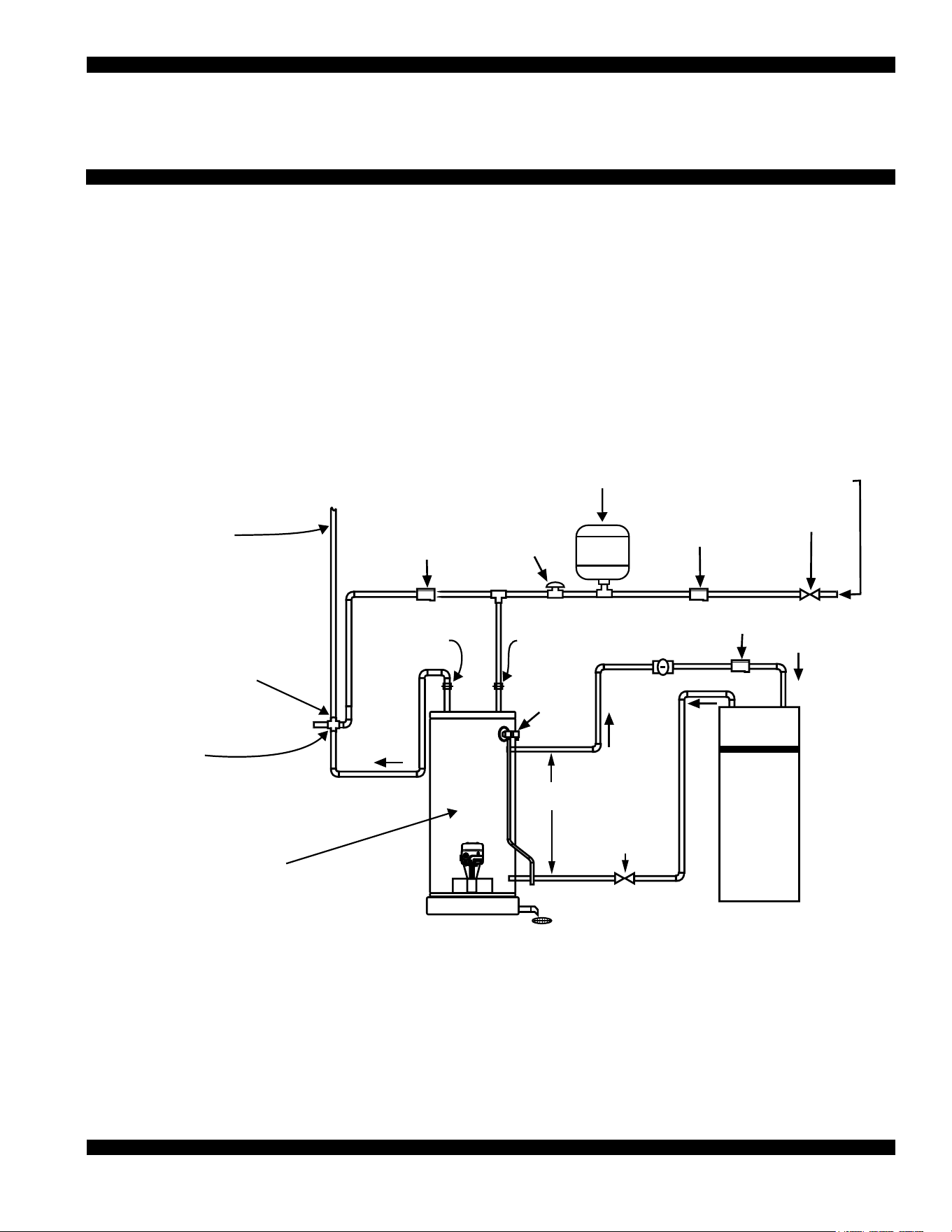
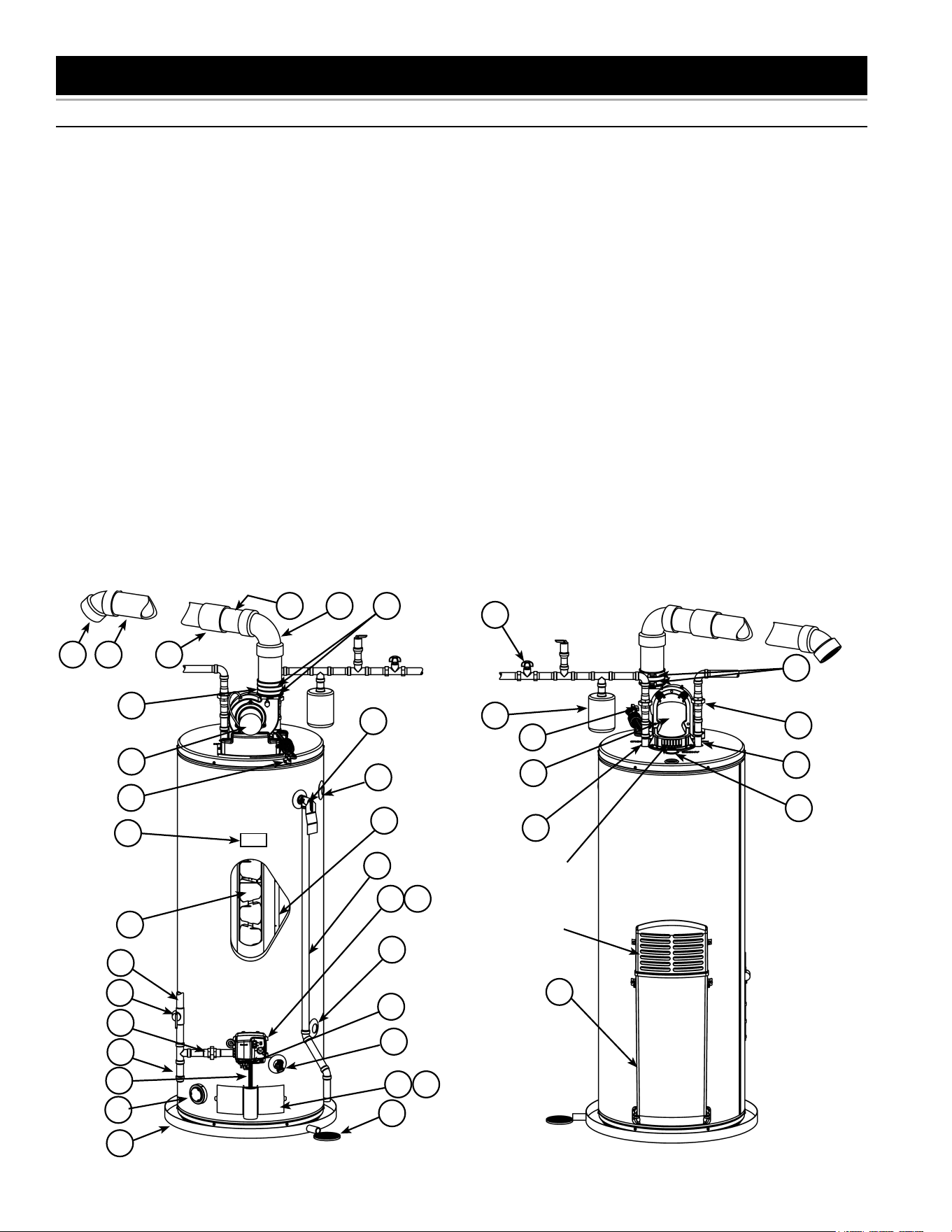
• If your water heater will be installed in the Commonwealth of Massachusetts, refer to the following
graphic during installation and during modifications to the water supply system.
IN
REMOVE A
MUST BE VERTICAL TO
IR BUBBLES
E
OUT
COIL
AIR
HANDLER
TO
AIR
HANDLER
SHUT-OFF
VALVE
*
EXPANSION TANK
VACUUM
RELIEF
VALVE
COLD WATER INLET
VA
FLOW CONTROL
LV
PUMP
*
SHUT-OFF
CHECK VALVE
†
(1/8” HOLE
DRILLED IN CLAPPER)
VALVE
CHECK
VALVE
†
TEMP/
PRESSURE
RELIEF
VALVE
TEMPERED WATER
TO FIXTURES
(MUST MEET TEMPS LISTED
IN MASS. CODE 248 CMR
†
)
MIXING VALVE
(MUST BE INSTALLED BELOW
TOP OF WATER HEATER
AS PER MANUFACTURER’S
RECOMMENDATIONS)
UNION
UNION
HOT
WATER
OUT
*
MASSACHUSETTS INSTALLATION REQUIREMENTS:
1.) CONNECT ELECTRONICALLY-CONTROLLED TIMER TO AN ALL-BRONZE PUMP. PUMP MUST ACTIVATE EVERY 6 HOURS
FOR 60 SECONDS. TURN PUMP TIMER OFF BEFORE CLOSING PIPING LOOP SHUT-OFF VALVE.
2.) ALL WATER PIPING MUST BE INSTALLED AND INSULATED IN ACCORDANCE WITH MASSACHUSETTS CODE (248 CMR
& 780 CMR).
3.) PIPING LOOP BETWEEN WATER HEATER AND AIR HANDLER MUST BE INSTALLED IN COMPLIANCE WITH 248 CMR.
† REQUIRED FOR MASSACHUSETTS.
‡ PIPING FROM THE TOP OF THE WATER HEATER WITH TEES IS ACCEPTABLE.
WATER HEATER ACCEPTED
BY THE BOARD FOR
INSTALLATION IN
MASSACHUSETTS.
†
TYPICAL MIXING VALVE INSTALLATION
COMBINATION SPACE HEATING / POTABLE WATER HEATING SYSTEM
SEE
NOTE ‡
INSTALLATION GRAPHIC: GAS-FIRED POTABLE
WATER HEATING/SPACE HEATING SYSTEM
100’-0” MAXIMUM DISTANCE
FROM WATER HEATER TO FAN
COIL AND BACK. (DEVELOPED
LENGTH) NOT INCLUDING COIL
IN HEATING UNIT
†
331602-001 9
TYPICAL INSTALLATION
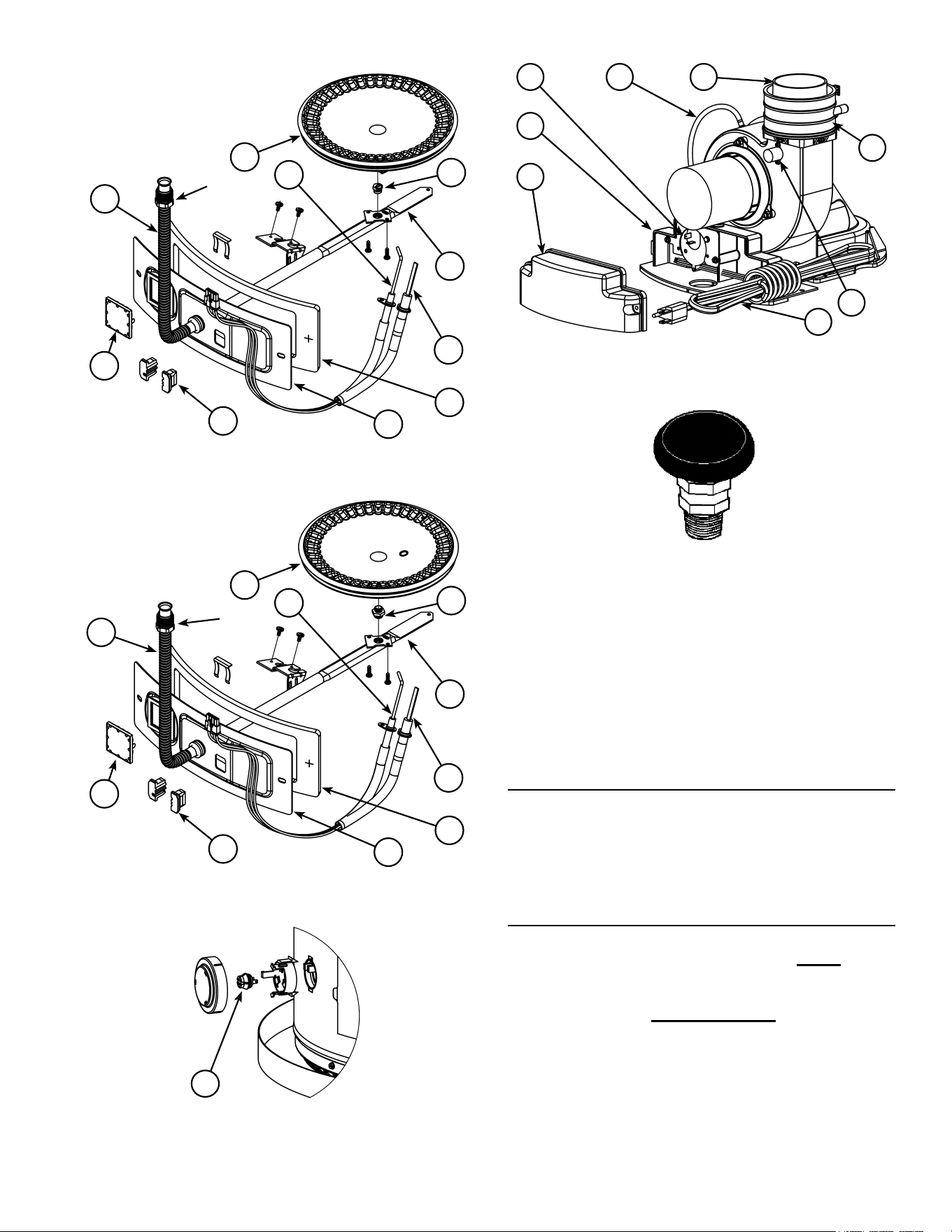
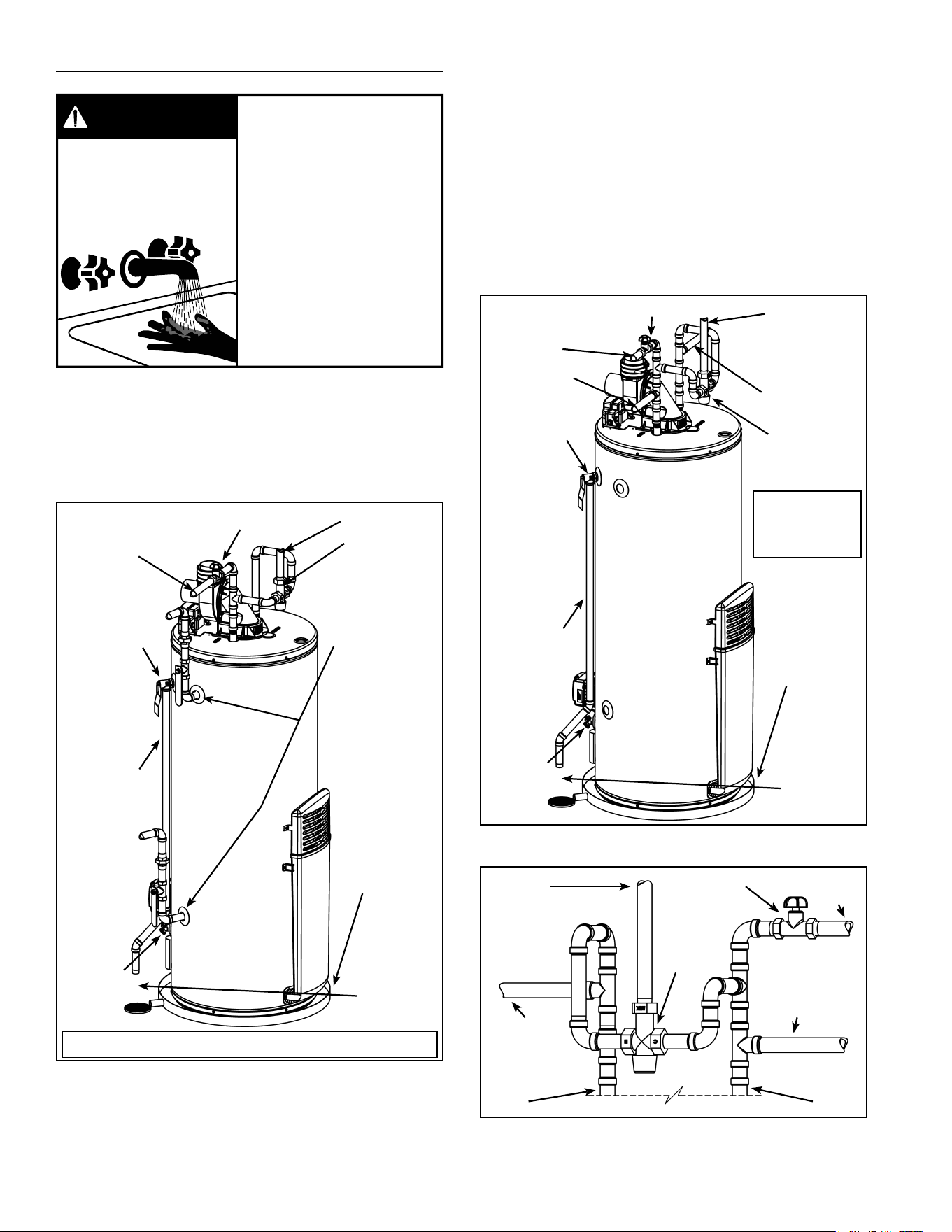
GET TO KNOW YOUR WATER HEATER - GAS MODELS (LIST REFERENCING FIGURES 1-7)
1 Vent Termination Elbow with Rodent
Screen
2 *Vent Pipe
3 *Vent Pipe Coupling (if required)
4 CPVC Vent Pipe ( 5 ft. supplied)
5 *CPVC Vent Pipe Elbow (long
radius)
6 Gear Clamp (see Figure 6)
7 T&P Valve
8 **Combo Heating System Supply
Outlet (Optional)
9 Cold-Water Inlet Nipple/Diptube
10 * Discharge Pipe
11 Gas Control Valve/Thermostat
(Honeywell)
12 Gas Valve Electronic Control Module
And Cover (Honeywell)
13 **Combo Heating System Return
Inlet (Optional)
14 ***Control Harness
15 Drain Valve
16 Outer Gas Door
17 Manifold Door Assembly (behind
outer door) (see Figure 3 (NG) or
Figure 4 (LP))
18 *Floor Drain
19 *Metal Drain Pan
20 Flammable Vapor Sensor (under
cover) (see Figure 5)
21 Flexible Manifold Tube (see
Figure 3)
22 *Sediment Trap/Dirt Leg
23 *Ground Joint Union (gas
connection)
24 *Main Manual Gas Shut-off Valve
25 *Gas Supply*
26 Baffl e Assembly
27 Rating Plate
28 Blower with Power Cord (see Figure
6)
29 *Rubber Coupling (see Figure 6)
30 *Inlet Water Shut-off Valve
31 *Union (water connection)
32 Hot-Water Outlet Nipple
33 Anode (under cap)
34 Air Inlet Snorkel
35 Flue Collector
36 *Thermal Expansion Tank (required
for all closed systems)
37 Aluminum Burner (see Figure 3)
38 Gas Orifi ce (see Figure 3)
39 Gas Manifold (see Figure 3)
40 Hot-Surface Igniter (see Figure 3)
41
Manifold Door Gasket (see
Figure 3)
42 Manifold Door (see Figure 3)
43 Two Piece Grommet With Clip (see
Figure 3)
44 Viewport (see Figure 3)
45 Flame Sensor Rod (see Figure 3)
46 Stainless Steel Burner (see
Figure 4)
47 Air Switch (inside box) (see
Figure 6)
48 Air Tubing (see Figure 6)
49 Blower High Limit Switch (see
Figure 6)
50 Junction Box Cover (see Figure 6)
51 Junction Box (see Figure 6)
*, **, ***, **** see notes on following
page
7
10
11
14
16
19
20
8
13
28
28
26
9
17
12
18
25
24
23
22
21
27
15
Figure 1
Front View
1 2
5
3
6
29
4
34
35
32
9
33
Combustion
Air Inlets
6
31
31
36
Blower
Dilution Air
Inlets
30
Figure 2
Rear View
10 331602-001
Natural gas main burner
with igniter assembly
(item 17 in Figure 1).
Flare
Nut
42
44
40
37
39
41
38
45
43
21
Figure 3
Propane (LP) main burner
with igniter assembly
(item 17 in Figure 1).
Flare
Nut
42
44
40
46
39
41
38
45
43
21
Figure 4
20
Figure 5
48
51
50
47
49
29
6
28
Figure 6
Vacuum relief valve
install per local
codes (not supplied
with heater).
Figure 7
Notes:
* Items not supplied with the water heater.
** The side recirculation loop connections may not be
used as the primary water inlet and outlet connections.
See “Combo Heating Inlet And Outlet Side Taps”.
*** Caution: harness has 120 VAC In operation.
**** See “Planning The Vent System”, “Condensate” and
“Blower Assembly Installation” for more information.
REPLACEMENT PARTS AND DELIMING PRODUCTS
Replacement parts and recommended delimer may be
ordered through authorized servicers or distributors. When
ordering parts, provide complete model and serial numbers
(see rating plate), quantity and name of part desired.
Standard hardware items may be purchased locally.
COMBO HEATING INLET AND OUTLET SIDE TAPS
Models equipped with Combo Heating capabilities are
shipped with the two side plumbing taps OPEN (item 8
and item 13 in Figure 1 and see also Figure 8 & Figure
28). If the heater is to be operated without using the side
taps these openings must be plugged with the two pipe
plugs supplied with the heaters.
1331602-001 11
WATER PIPING - MIXING VALVE USAGE
Mixing Valves
Water temperature over
125°F can cause severe
burns instantly resulting in
severe injury or death.
Children, the elderly and the
disabled and are at highest
risk of scald injury.
Feel water before bathing or
showering.
Temperature limiting devices
such as mixing valves must
be installed when required
by codes and to ensure safe
temperatures at fixtures.
BURN
HOT
HOT
DANGER
Water heated to a temperature which satisfi es space
heating, clothes washing, dish washing, and other
sanitizing needs can scald and cause permanent injury
upon contact. Short repeated heating cycles caused by
small hot-water uses can cause a temperature increase of
the hot water by 20F° higher than the heater’s temperature
settings.
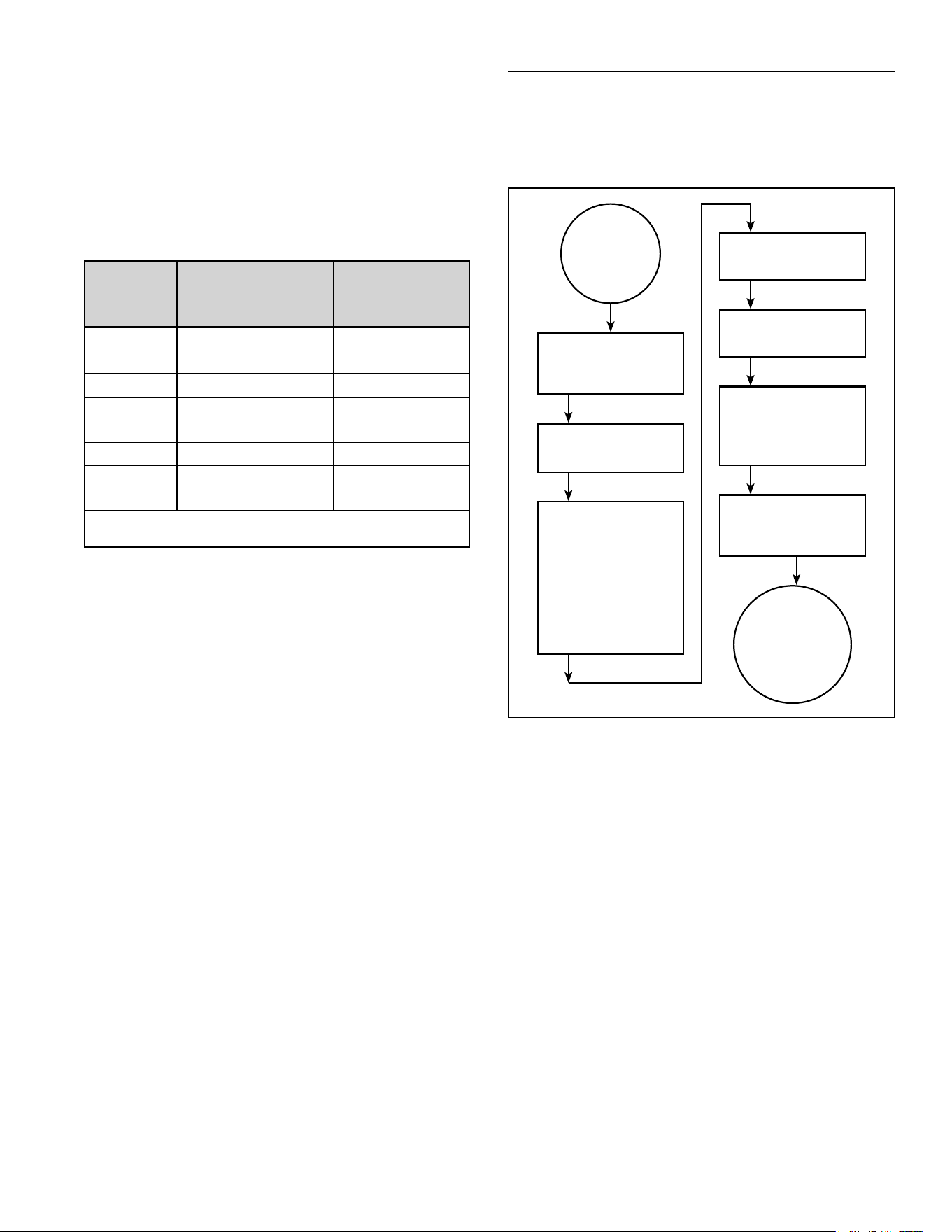
MIXING VALVE
SHUT-OFF
VALVE
SUGGESTED PIPING
ARRANGEMENT FOR
SIDE CONNECTIONS
COLD-WATER
INLET
TEMPERED
POTABLE WATER
DISCHARGE
PIPE (DO NOT
CAP OR PLUG)
TEMPERATURE-
PRESSURE
RELIEF VALVE
DRAIN
VALVE
METAL DRAIN
PAN 1.75 in.
MAX. DEPTH.
AT LEAST 2 in.
GREATER THAN
THE DIAMETER
OF THE WATER
HEATER.
6 in. MAX.
AIR GAP*
CERTAIN
MODELS ARE
EQUIPPED WITH
SIDE PLUMBING
CONNECTIONS
FOR SPACE
HEATING.
* NOTE: THE
T&P VALVE
DISCHARGE
PIPE SHALL
BE PIPED
DIRECTLY TO
THE DRAIN
OR EXTERNAL
TO THE
BUILDING
MASSACHUSETTS: INSTALL A VACUUM RELIEF IN COLD WATER LINE
PER SECTION 19 MGL 142.
Figure 8
This appliance has been design certifi ed as complying
with American National Standard/CSA Standard for water
heaters and certain models with side plumbing connections
are considered suitable for Water (Potable) Heating and
Space Heating. Note: Do not use in space heating only
applications.
The water supply pressure should not exceed 80 psi. If this
occurs, a pressure reducing valve with a bypass should be
installed in the cold water inlet line. This should be placed
on the supply to the entire house in order to maintain equal
hot and cold water pressures.
MIXING VALVE
SHUT-OFF
VALVE
SUGGESTED PIPING
ARRANGEMENT FOR
TOP CONNECTIONS
COLD-WATER
INLET
TEMPERED
POTABLE WATER
DISCHARGE
PIPE (DO NOT
CAP OR PLUG)
TEMPERATURE-
PRESSURE
RELIEF VALVE
DRAIN
VALVE
METAL DRAIN
PAN 1.75 in.
MAX. DEPTH.
AT LEAST 2 in.
GREATER THAN
THE DIAMETER
OF THE WATER
HEATER.
6 in. MAX.
AIR GAP*
* NOTE: THE
T&P VALVE
DISCHARGE
PIPE SHALL
BE PIPED
DIRECTLY TO
THE DRAIN
OR EXTERNAL
TO THE
BUILDING
NON-TEMPERED
WATER SUPPLY
NON-TEMPERED
WATER RETURN
MASSACHUSETTS:
INSTALL A VACUUM
RELIEF IN COLD
WATER LINE PER
SECTION 19 MGL
142.
Figure 9
SHUT-OFF
VALVE
COLD-
WATER
SUPPLY
TEMPERED
POTABLE
WATER
MIXING
VALVE
NON-
TEMPERED
WATER
SUPPLY
NON-
TEMPERED
WATER
RETURN
TO COLD
INLET
TO HOT
OUTLET
Figure 10
12 331602-001
Some people are more likely to be permanently injured
by hot water than others. These include the elderly,
children, the infi rm and the physically/mentally disabled.
Table 1 (published by U.S. Government Memorandum,
1978) shows the approximate time-to-burn relationship
for normal adult skin. If anyone using hot water provided
by the water heater being installed fi ts into one of these
groups or if there is a local code or state law requiring a
certain water temperature at the point of use, then special
precautions must be taken.
Water
Temperature
°F
Time for 1st
Degree Burns
(Less Severe Burns)
Time for Permanent
Burns 2nd & 3rd
Degree (Most
Severe Burns)
110 (normal shower temp.)
116 (pain threshold)
116 35 minutes 45 minutes
122 1 minute 5 minutes
131 5 seconds 25 seconds
140 2 seconds 5 seconds
149 1 second 2 seconds
154 instantaneous 1 seconds
(U.S. Government Memorandum, C.P.S.C., Peter L. Armstrong,
Sept. 15,1978)
Table 1
In addition to using lowest possible temperature setting
that satisfi es demand of application, a mixing valve should
be installed at water heater (see Figure 8 & Figure 9) or at
hot-water taps to further reduce system water temperature.
Mixing valves are available at plumbing supply stores.
Consult a Qualifi ed Installer or Service Agency. Follow
mixing valve manufacturer’s instructions for installation
of the valves. Before changing the factory setting on the
thermostat, read the “Operating The Temperature Control
System” section in this manual.
WATER HEATER OPERATION
Figure 11 shows the water heater’s sequence of operation
when a call for heat is initiated. The ignition control module
will attempt to light the burner three times. If the ignition
control does not detect ignition it will enter lockout mode
and fl ash the corresponding error code.
HEATER CONTROL
CHECKS TO ENSURE
BLOWER PRESSURE
SWITCH IS OPEN
BLOWER IS
ENERGIZED
CONTROL CHECKS
TO ENSURE PRES-
SURE SWITCH CLOSES
INDICATING BLOWER
IS OPERATING AND
THERE ARE NO
VENTING BLOCKAGES
(INLET OR OUTLET)
IGNITER IS ENERGIZED
AND MAIN GAS VALVE
IS OPENED
MAIN BURNER COMES
ON AND THE FLAME IS
SENSED BY CONTROL
MAIN BURNER CONTIN-
UES UNTIL THE WATER
IN THE TANK REACHES
THERMOSTAT SETTING
MAIN BURNER SHUTS
OFF. BLOWER
CONTINUES FOR A
POST PURGE TIME
HEATER
THERMOSTAT
CALLS FOR
HEAT
HEATER
REMAINS ON
STANDBY UNTIL
NEXT CALL FOR
HEAT
Figure 11
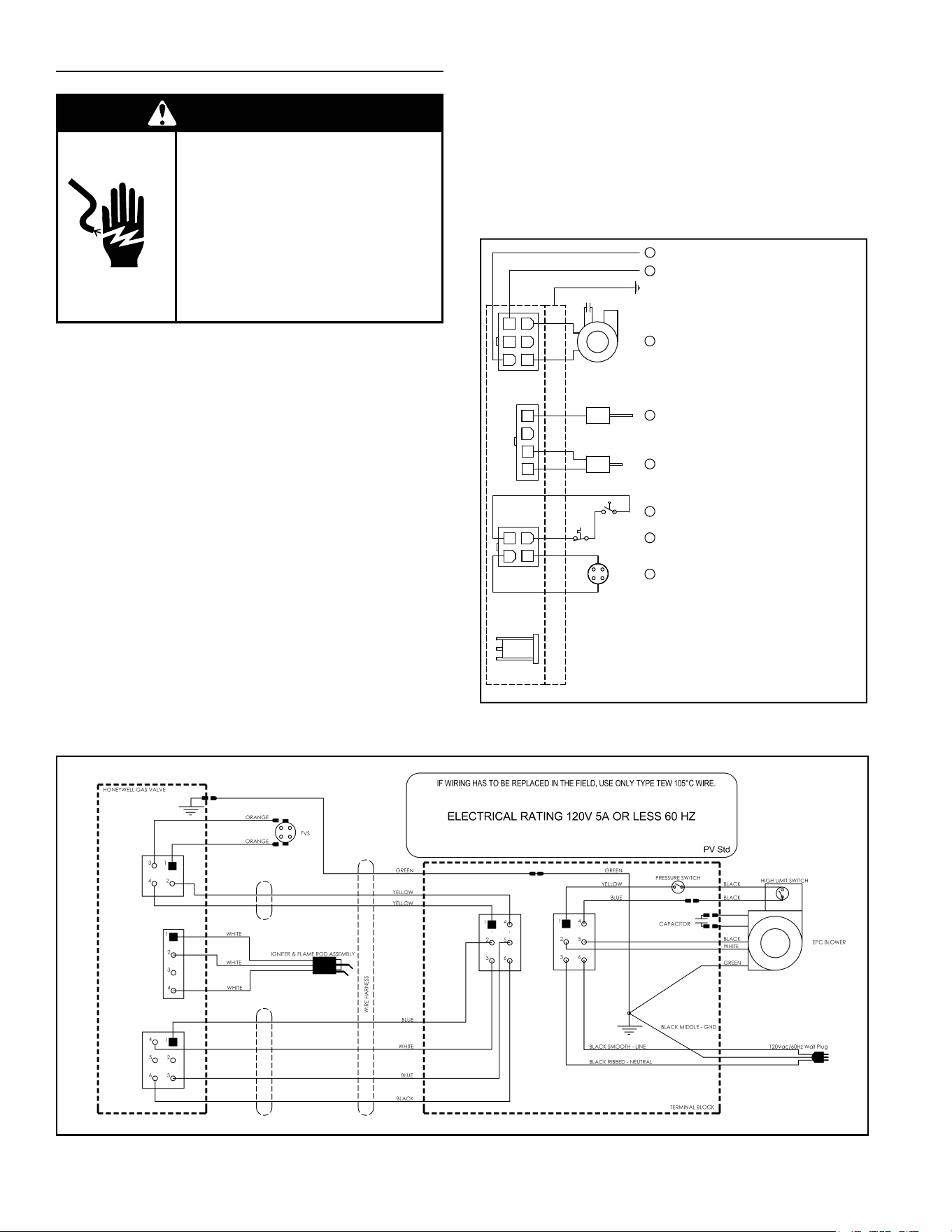
1331602-001 13
ELECTRICAL REQUIREMENTS & WIRING DIAGRAM
Failure to do so can result in
death or electrical shock.
Replace all parts and panels
before operating.
Disconnect power before
servicing.
Electric Shock Hazard
WARNING
Before plugging in the water heater, always make sure:
• The voltage and frequency correspond to that specifi ed
on the water heater wiring diagram.
• The electrical outlet has the proper overload fuse or
breaker protection.
1. The unit must be connected to a dedicated power
supply.
2. The unit must be connected to a 120VAC power
supply.
3. The water heater must be properly grounded.
4. This water heater is a polarity sensitive appliance and
will not operate if the power supply polarity is reversed.
Note: Always reference the wiring diagram for the correct
electrical connections.
After making all electrical connections, completely fi ll the
tank with water and check all connections for leaks. Open
the nearest hot-water faucet and let it run for 3 minutes to
purge the water lines of air and sediment and to ensure
complete fi lling of the tank. The electrical power may then
be turned on. Verify proper operation after servicing. See
also “Installation Checklist”.
Figure 12
CAUTION
LABEL ALL WIRES PRIOR TO DISCONNECTION WHEN
SERVICING CONTROLS. WIRING ERRORS CAN
CAUSE IMPROPER AND DANGEROUS OPERATION.
VERIFY PROPER OPERATION AFTER SERVICING.
POWER VENT WIRING SCHEMATIC.
NOTE: REFER TO THE “Installation Checklist”
BEFORE OPERATING THIS HEATER.
N
1
2
3
HOT SURFACE IGNITER
HIGH LIMIT SWITCH
CAPACITOR
L1
EARTH GND
PRESSURE SWITCH
BLOWER
4
5
6
4
3
2
1
2
1
3
4
FLAME SENSOR
FLAMMABLE VAPOUR SENSOR
P1
P2
P3
4
6
1
5
3
2
7
Circled numbers indicate
sequence of operation.
P4
1
Figure 13
14 331602-001
SAFETY LOCKOUTS
This water heater has several lockout features designed
to prevent the heater from operating in unsafe conditions.
HIGH LIMIT CONTROLS (ENERGY CUT OFF)
Thermostat/Water Temperature
This feature is a part of the gas control valve/thermostat
(see Figure 1, item 11) and limits the maximum water
temperature. In the event of the water overheating, this
safety feature shuts off the fuel supply to the burner. This
ECO is not resettable and the gas control valve/thermostat
will need to be replaced by a qualifi ed service technician.
Blower High Limit Switch
This device is located on the blower (see Figure 6, item
49) and limits the maximum temperature of the blower.
If the blower temperature rises above the temperature
setting, the switch opens causing the heater to shut down.
The switch will auto reset once the temperature drops
suffi ciently.
BLOWER AIR PRESSURE SWITCH
This device, located in the junction box, monitors the air
pressure produced by the blower. In the event that the
exhaust venting becomes blocked or suffi ciently restricted,
the switch will shut the heater down (see Figure 6, item
47). If the water heater has not gone into a soft lockout
condition, the heater will restart after the blockage is
removed (see “Resetting The Heater Control”).
FLAMMABLE VAPOR SENSOR
When using a gas fi red water heater there is a risk of
fl ammable vapors entering the combustion chamber, being
ignited by the burner fl ame and causing a fl ashback. In
order to detect such fl ammable vapors before they enter
the combustion chamber, this water heater is equipped
with a fl ammable vapor sensor (FVS). It is a chemical-
absorption based sensor that is connected to the gas
control/thermostat (see Figure 14). When exposed to
fl ammable vapors it will trigger the control to stop the
fl ow of gas and enter the FVS lockout state. While in the
FVS lockout state the LED on the control will fl ash the
gas lockout code. (Refer to the “System Status And Error
Codes” section of this manual for an explanation of the
codes applicable to the control installed on your water
heater.) If this error occurs, check around the water heater
for sources of chemical contamination such as: fl ammable
vapors including gas vapors, solvents, paint and thinners
as well as sources of water and detergents.
Note: Resetting the heater will reset the FVIR circuit if
all sources of contamination have been removed and the
sensor clears. If all sources of contamination have been
removed and the system will not reset, the sensor will
need to be replaced (see “Resetting The Heater Control”).
If there is a problem with the wiring of the fl ammable
vapor sensor or the fl ammable vapor interface, the LED
will fl ash the failure status code (see “System Status And
Error Codes”).
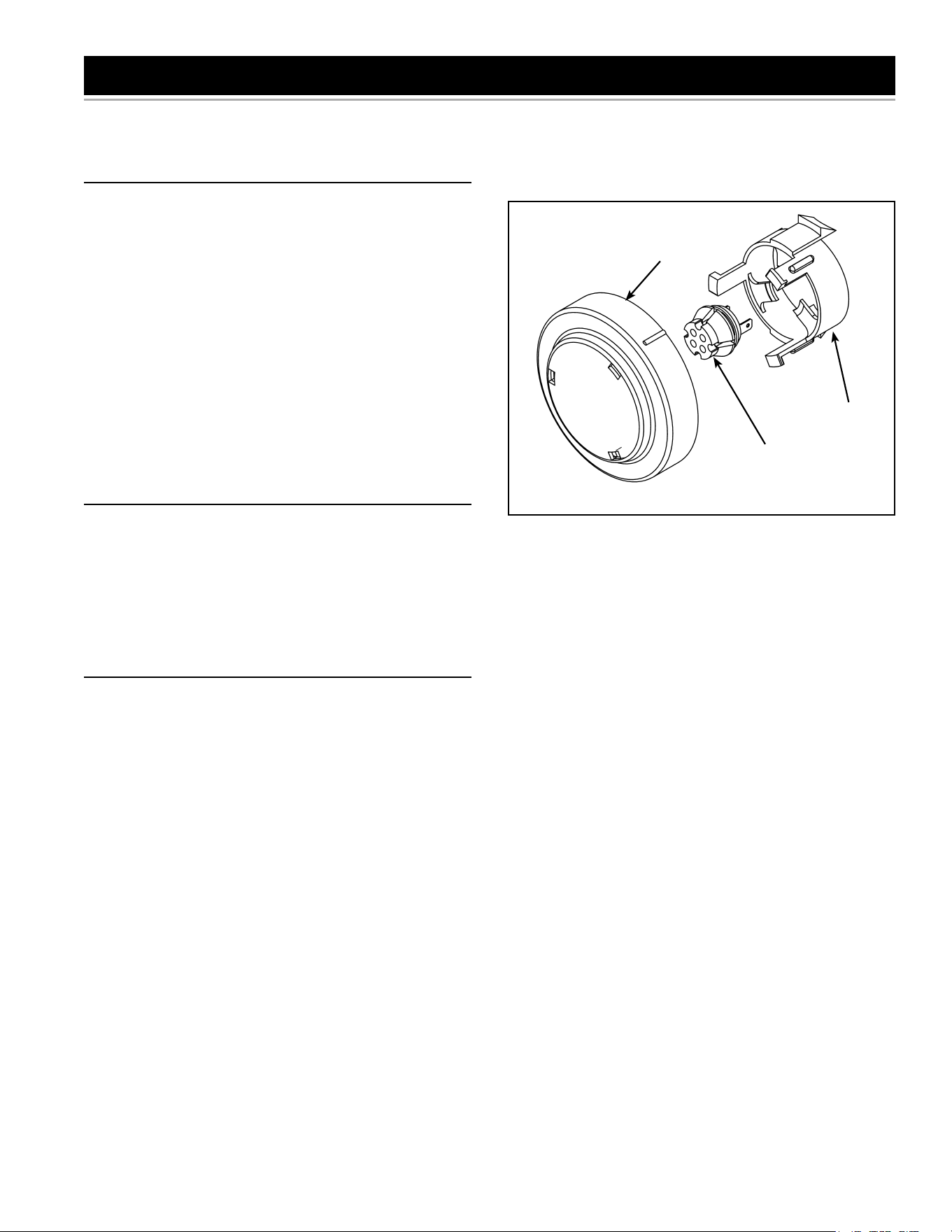
MOUNTING
BRACKET
FLAMMABLE
VAPOR SENSOR
(PULL TO REMOVE)
COVER*
* ROTATE LEFT (CCW)
TO REMOVE
Figure 14
1331602-001 15
LOCATING THE NEW WATER HEATER
FACTS TO CONSIDER ABOUT THE LOCATION
Carefully choose an indoor location for the new water
heater because the placement is a very important
consideration for the safety of the occupants in the building
and for the most economical use of the appliance. This
water heater is not for use in manufactured (mobile) homes
or outdoor installation.
Whether replacing an old water heater or putting the water
heater in a new location, the following critical points must
be observed:
1. Select a location indoors as close as practical to
the vent termination or location to which the water
heater vent piping is going to be connected, and as
centralized with the water piping system as possible.
2. Selected location must provide adequate clearances
for servicing and proper operation of the water heater.
3. Ensure the area has a continuous supply of air for
combustion, dilution and ventilation.
4. Avoid locations that could cause the water heater to
freeze from outside air.
5. Selected location must provide access to a properly
grounded electrical branch circuit. A dedicated circuit
is preferred. Do not use a GFI outlet.
6. Avoid locations that expose the water heater to direct
sunlight.
7. Keep combustibles such as boxes, magazines,
clothes, etc., away from the water heater area.
Important: Do not use an extension cord to connect the
water heater to an electrical outlet.
Important: this heater has special venting requirements
when installed in areas where the ambient temperatures
exceed 110°F (see “Polypropylene Vent Systems”).
• All water heaters eventually leak.
• Do not install without adequate drainage.
Property Damage Hazard
CAUTION
Installation of the water heater must be accomplished in
such a manner that if the tank or any connections should
leak, the fl ow of water will not cause damage to the
structure. For this reason it is not advisable to install the
water heater in an attic or upper fl oor. In all cases, a metal
drain pan should be installed under the water heater. Metal
drain pans are available at your local hardware store. Such
a metal drain pan must have a clearance of at least 1 in.
greater than any point on the water heater’s outer jacket
and must be piped to an adequate drain. The pan must
have a maximum depth of 1.75 in. .
Water heater life depends upon water quality, water
pressure and the environment in which the water heater
is installed. Water heaters are sometimes installed in
locations where leakage may result in property damage,
even with the use of a metal drain pan piped to a drain.
However, unanticipated damage can be reduced or
prevented by a leak detector or water shut-off device used
in conjunction with a piped metal drain pan. These devices
are available from some plumbing supply wholesalers and
retailers, and detect and react to leakage in various ways:
• Sensors mounted in the metal drain pan that trigger an
alarm or turn off the incoming water to the water heater
when leakage is detected.
• Sensors mounted in the metal drain pan that turn off
the water supply to the entire building when water is
detected in the metal drain pan.
• Water supply shut-off devices that activate based on
the water pressure differential between the cold-water
and hot-water pipes connected to the water heater.
• Devices that will turn off the gas supply to a gas water
heater while at the same time shutting off its water
supply.
STORAGE OF FLAMMABLE LIQUIDS
Flammable liquids (such as gasoline, solvents, propane
(LP or butane, etc.) and other substances (such as
adhesives, paints, etc.) emit fl ammable vapors which can
be ignited by a gas water heater’s hot surface igniter (HSI)
or main burner. The resulting fl ashback and fi re can cause
death or serious burns to anyone in the area.
This water heater is equipped with a FV (Flammable Vapor)
sensor for detecting the presence of fl ammable vapors.
When the sensor detects those vapors, the unit will shut
down and not operate. Should this happen, please refer
to the “Troubleshooting Guidelines” section of this manual.
Even though this water heater is a fl ammable vapors
ignition resistant (FVIR) water heater and is designed to
reduce the chances of fl ammable vapors being ignited,
gasoline and other fl ammable substances should never
be stored or used in the same vicinity or area containing a
gas water heater or other open fl ame or spark producing
appliance. Examples of such locations are garages,
storage and utility areas.
The water heater must be located and/or protected so it
is not subject to physical damage by a moving vehicle.
16 331602-001
Read instruction manual before
installing, using or servicing
water heater.
• Do not store or use gasoline or other flammable vapors and
liquids in the vicinity of this or any other appliance.
• Avoid all ignition sources if you smell gas.
• Do not expose water heater control to excessive gas
pressure.
• Use only gas shown on rating plate.
• Maintain required clearances to combustibles.
• Keep ignition sources away from faucets after extended
period of non-use.
Fire or Explosion Hazard
WARNING
FLAMMABLE
Do not store or use gasoline or other flammable vapors and
liquids in the vicinity of this or any other appliance. Storage or
use of gasoline or other flammable vapors or liquids in the
vicinity of this or any other appliance can result in serious injury
or death.
Can result in serious injury or death
FIRE AND EXPLOSION HAZARD
Flammable Vapors
FLAMMABLES
WARNING
For continued protection against
risk of fire:
• Do not install water heater on
carpeted floor.
• Do not operate water heater if
flood damaged.
Fire Hazard
WARNING
Clearances to combustibles
Minimum clearances between water heater and
combustibles are 0 in. at the sides and rear, 5.5 in. from the
front and 12 in. from top (standard clearance.) If clearances
stated on the heater differ from standard clearances, install
water heater according to clearances stated on the heater
(see Figure 15).
Floors with carpeting
This water heater must not be installed directly on
carpeting. Carpeting must be protected by a metal or wood
panel beneath the appliance extending beyond the full
width and depth of the appliance by at least 76mm (3 in. in
every direction, or if the appliance is installed in an alcove
or closet, the entire fl oor must be covered by the panel.
Failure to heed this warning may result in a fi re hazard.
Clearance for servicing
Adequate clearance of 24 in. for servicing this appliance
should be considered before installation, such as changing
the anodes, etc.
A minimum clearance of 5.5 in. must be allowed for access
to replaceable parts such as thermostats, drain valve and
relief valve.
When installing the heater, consideration must be given to
proper location. Location selected should be as close to
the wall as practicable and as centralized with the water
piping system as possible.
TOP VIEW
OF CLOSET
WITHOUT DOOR
AIR INTAKE*
TOP VIEW OF
CLOSET WITH
DOOR
0 in. MIN.
0 in.
MIN.
0 in.
MIN.
5.5 in. MIN.
* DO NOT BLOCK THE AIR INTAKES AT THE BACK OF THE WATER HEATER.
Figure 15
A gas water heater cannot operate properly without the
correct amount of air for combustion and ventilation. Do
not install in a confi ned area such as a closet unless
you provide air as shown below and described in the”Air
Requirements” section (see Figure 16). Never obstruct the
fl ow of ventilation air for dilution and combustion. If you
have any doubts or questions at all, call your gas supplier.
Failure to provide the proper amount of combustion air
can result in a fi re or explosion and cause death, serious
bodily injury, or property damage.
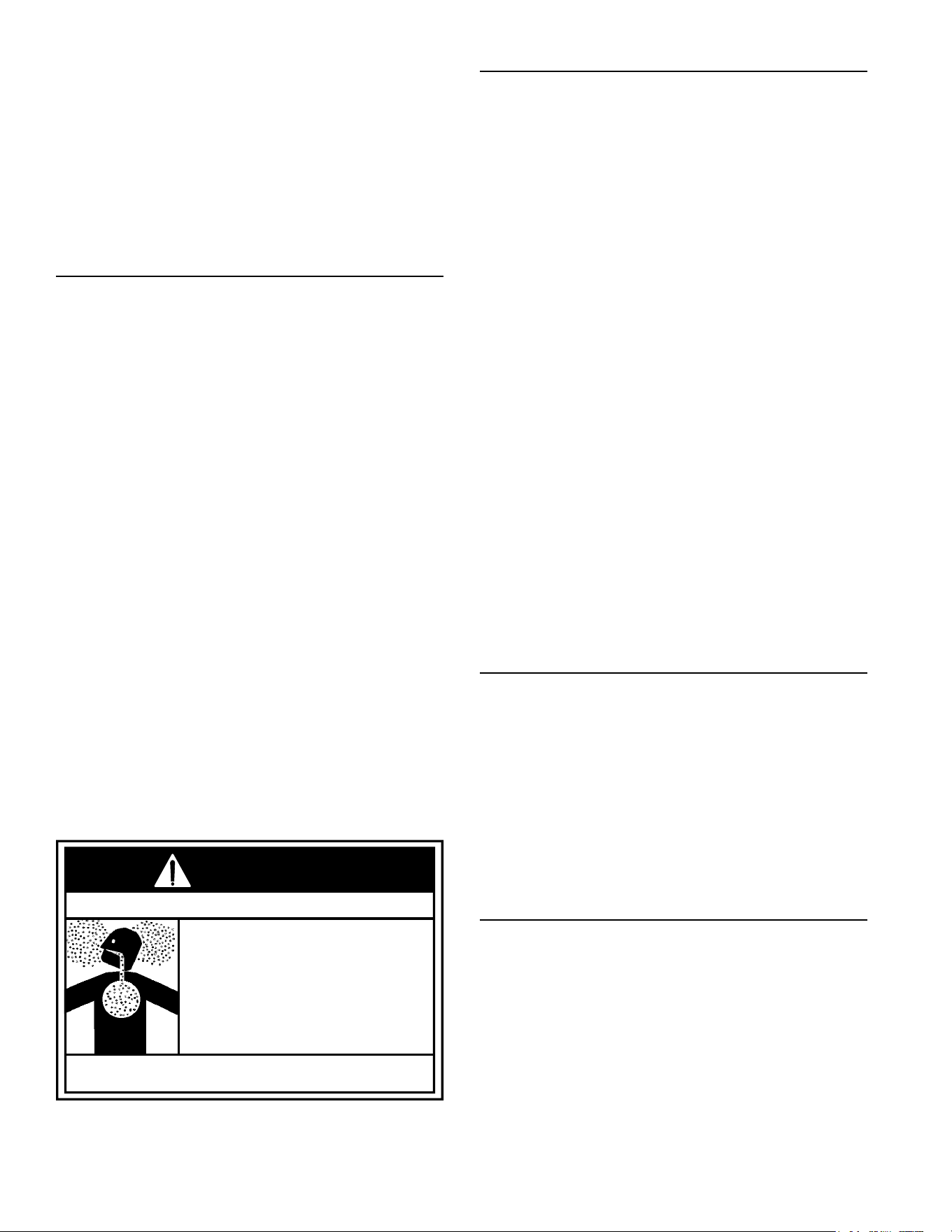
Breathing carbon monoxide can cause brain damage or death.
Always read and understand instruction manual.
• Install water heater in accordance with the
instruction manual and NFPA 54.
• To avoid injury, combustion and ventilation air
must be taken from outdoors.
• Do not place chemical vapor emitting products
near water heater.
Breathing Hazard - Carbon Monoxide Gas
WARNING
Figure 16
If this water heater will be used in beauty shops, barber
1331602-001 17
shops, cleaning establishments, or self-service laundries
with dry cleaning equipment, it is imperative that the water
heater or water heaters be installed so that combustion
and ventilation air be taken from outside these areas.
Propellants of aerosol sprays and volatile compounds,
(cleaners, chlorine based chemicals, refrigerants, etc.) in
addition to being highly fl ammable in many cases, will also
react to form corrosive hydrochloric acid when exposed to
the combustion products of the water heater. The results
can be hazardous, and also cause product failure.
INSULATION BLANKETS
Insulation blankets are available to the general public for
external use on gas water heaters but are not necessary
with these products. The purpose of an insulation blanket is
to reduce standby heat loss encountered with storage tank
heaters. Your water heater meets or exceeds the current
standards with respect to insulation and standby loss
requirements, making an insulation blanket unnecessary.
Should you choose to apply an insulation blanket to
this heater, you should follow these instructions (For
identifi cation of components mentioned below, see Figure
1 thru Figure 7). Failure to follow these instructions will
restrict the air fl ow required for proper combustion and
dilution, potentially resulting in fi re, asphyxiation, serious
personal injury or death.
• Do not apply insulation to the top of the water heater,
as this will interfere with safe operation of the blower
assembly.
• Do not cover the outer door, thermostat or T&P relief
valve, FV sensor, or Air Intake Snorkel.
• Do not cover the “Installation And Operating manual”.
Keep it on the side of the water heater or nearby for
future reference.
• Do obtain new warning and instruction labels from the
manufacturer for placement on the blanket directly over
the existing labels.
• Do inspect the insulation blanket frequently to make
certain it does not sag, thereby obstructing combustion
air fl ow.
Breathing carbon monoxide can cause brain damage or death.
Always read and understand instruction manual.
• Do not obstruct water heater air intake(s) with
insulating jacket.
• Gas and carbcn monoxide detectors are available.
• Install water heater in accordance with the
instruction manual and NFPA54.
Breathing Hazard - Carbon Monoxide Gas
WARNING
AIR REQUIREMENTS
For safe operation an adequate supply of fresh,
uncontaminated air for combustion, dilution and ventilation
must be provided.
Note: Contaminated or dusty air may cause build-up on
the blower wheel resulting in nuisance shut downs.
An insuffi cient supply of air can cause recirculation of
combustion products resulting in contamination that may
be hazardous to life. Such a condition often will result in
a yellow, luminous burner fl ame, causing sooting of the
combustion chamber, burners and fl ue tubes and creates
a risk of asphyxiation.
Do not install the water heater in a confi ned space unless
an adequate supply of air for combustion, dilution and
ventilation is brought into that space using the methods
described in the “Confi ned Space” section that follows.
Never obstruct the fl ow of dilution/ventilation air. If you
have any doubts or questions at all, call your gas supplier.
Failure to provide the proper amounts of air can result in
a fi re or explosion and cause property damage, serious
bodily injury or death. The combustion and dilution air
inlets are shown in Figure 2.
Important: Power Vented water heaters require air for
combustion and dilution air for the blower.
Air supply must be provided as required by the current
edition of “Natural Gas and Propane Installation Codes”
B149.1.
UNCONFINED SPACE
An Unconfi ned Space is one whose volume is not less than
50 cubic feet per 1,000 Btu/hr of the total input rating of all
appliances installed in the space. Rooms communicating
directly with the space in which the appliances are
installed, through openings not furnished with doors, are
considered a part of the unconfi ned space.
Makeup air requirements for the operation of exhaust fans,
kitchen ventilation systems, clothes dryers and fi replaces
should also be considered in determining the adequacy of
a space to provide combustion, ventilation and dilution air.
UNUSUALLY TIGHT CONSTRUCTION
In unconfi ned spaces in buildings, infi ltration may be
adequate to provide air for combustion, ventilation and
dilution of fl ue gases. However, in buildings of unusually
tight construction (e.g., weather stripping, heavily
insulated, caulked, vapourvapor barrier, etc.) additional
air must be provided using the methods described in
the”Confi ned Space” section that follows.
18 331602-001
CONFINED SPACE
A Confi ned Space is one whose volume is less than 50
cubic feet per 1,000 Btu/hr of the total input rating of all
appliances installed in the space.
Openings must be installed to provide fresh air for
combustion, ventilation and dilution in confi ned spaces.
The required size for the openings is dependent on the
method used to provide fresh air to the confi ned space
and the total Btu/hr input rating of all appliances installed
in the space.
DIRECT VENT APPLIANCES
Other appliances installed in a Direct Vent confi guration
that derive all air for combustion from the outdoor
atmosphere through sealed intake air piping are not
factored in the total appliance input Btu/hr calculations
used to determine the size of openings providing fresh
air into confi ned spaces.
EXHAUST FANS
Where exhaust fans are installed, additional air should be
provided to replace the exhausted air. When an exhaust
fan is installed in the same space with a water heater,
suffi cient openings to provide fresh air must be provided
that accommodate the requirements for all appliances
in the room and the exhaust fan. Undersized openings
will cause air to be drawn into the room through the
water heater’s vent system causing poor combustion.
Sooting, serious damage to the water heater and the risk
of fi re or explosion may result. It can also create a risk of
asphyxiation.
FRESH AIR OPENINGS FOR CONFINED SPACES
The following instructions should be used to calculate the
size, number and placement of openings providing fresh air
for combustion, ventilation and dilution in confi ned spaces.
The illustrations shown in this section of the manual are
a reference for the openings that provide fresh air into
confi ned spaces only. Do not refer to these illustrations
for the purpose of vent installation. See “Installation Of
Vent System” section for complete venting installation
instructions.
Chemical vapourvapor corrosion of the flue, blower
assembly and vent system may occur if the air supply
contains certain chemical vapoursvapors. Spray can
propellants, cleaning solvents, refrigerator and air
conditioner refrigerants, swimming pool chemicals,
calcium and sodium chloride (water softener salt), waxes,
bleach and process chemicals are typical compounds
which are potentially corrosive.
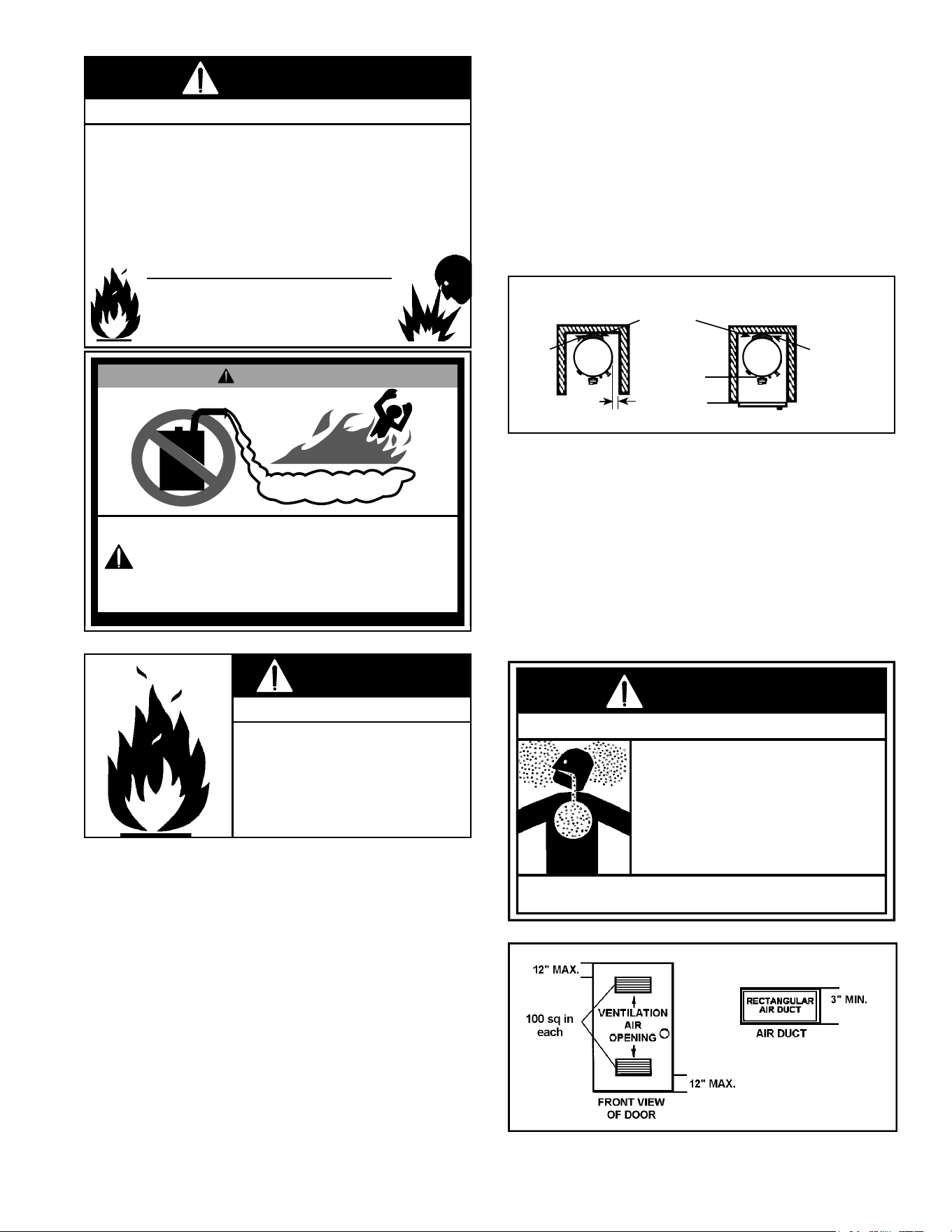
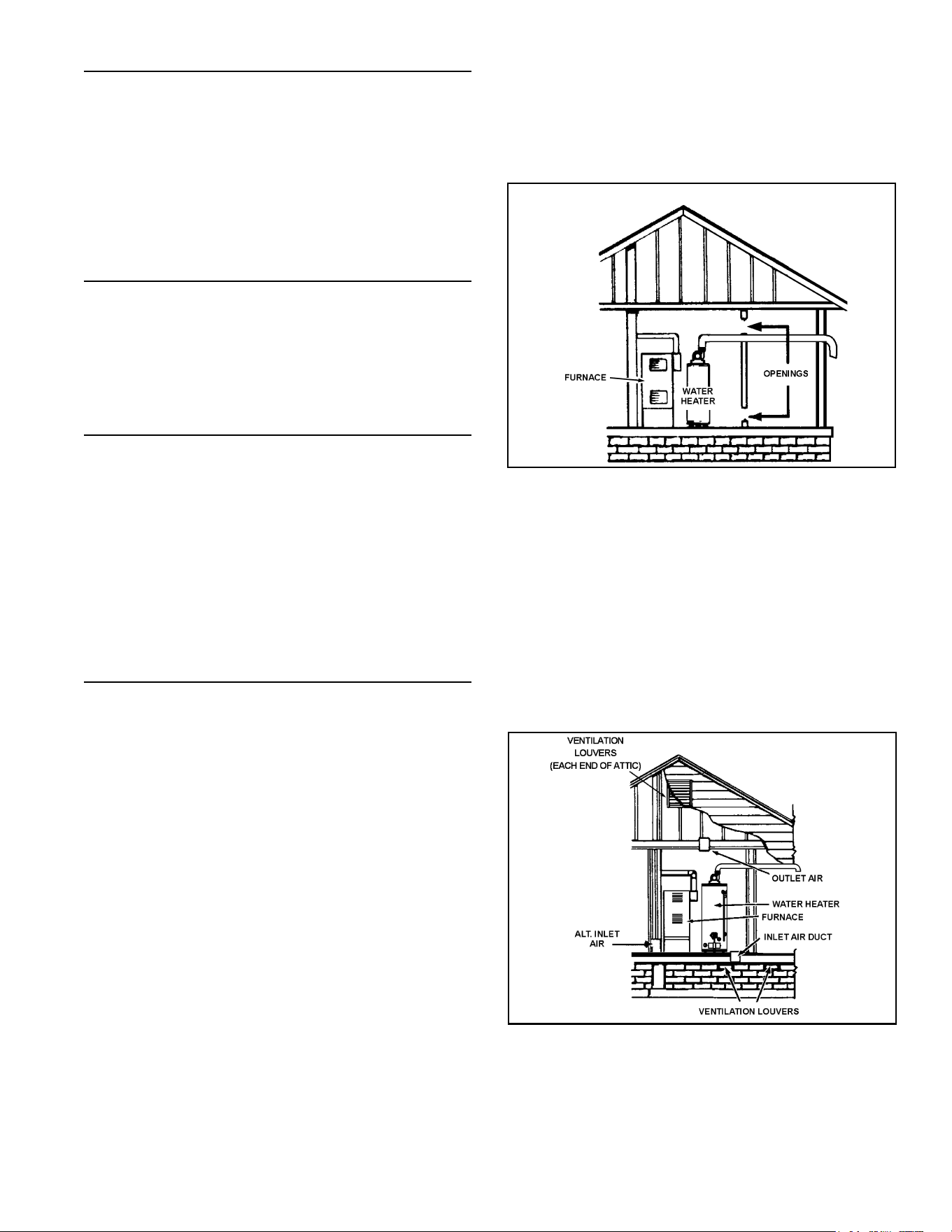
A. ALL AIR FROM INSIDE BUILDINGS: (See Figure 17)
The confined space shall be provided with two
permanent openings communicating directly with an
additional room(s) of suffi cient volume so that the
combined volume of all spaces meets the criteria for an
unconfi ned space. The total input of all gas utilization
equipment installed in the combined space shall be
considered in making this determination. Each opening
shall have a minimum free area of one square inch per
1,000 Btu/hr of the total input rating of all gas utilization
equipment in the confi ned space, but not less than 100
square inches. One opening shall commence within
305mm (12 in.) of the top and one commencing within
305mm (12 in.) of the bottom of the enclosures.
Figure 17
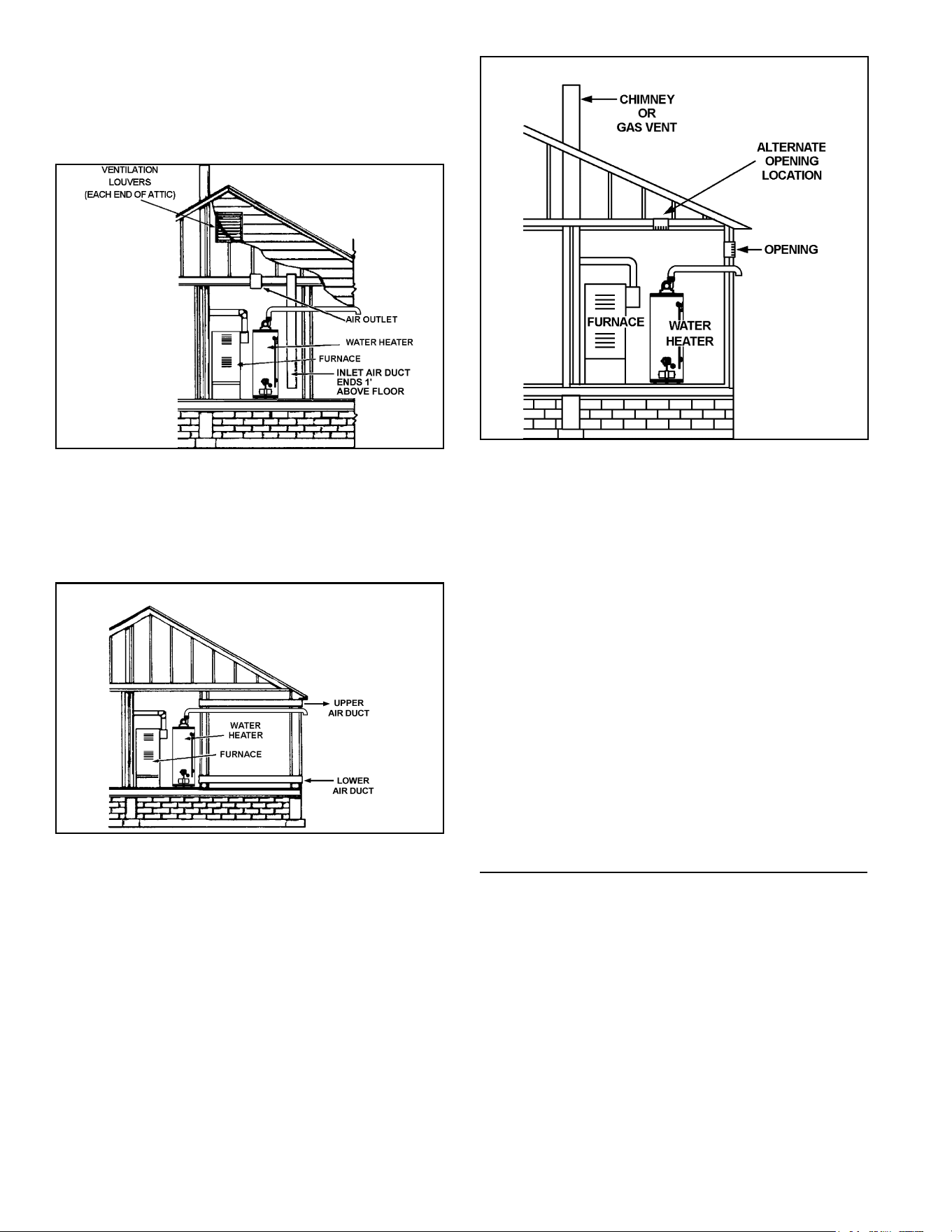
B. ALL AIR FROM OUTDOORS: (See Figure 18 thru
Figure 20)
The confined space shall be provided with two
permanent openings, one commencing within 305mm
(12 in.) of the top and one commencing within
305mm (12 in.) from the bottom of the enclosure.
The openings shall communicate directly, or by ducts,
with the outdoors or spaces (crawl or attic) that freely
communicate with the outdoors.
1. When directly communicating with the outdoors,
each opening shall have a minimum free area of
1 square inch per 4,000 Btu/hr of total input rating
of all equipment in the enclosure (see Figure 18).
Figure 18
2. When communicating with the outdoors through
vertical ducts, each opening shall have a minimum
free area of 1 square inch per 4,000 Btu/hr of total
input rating of all equipment in the enclosure (see
Figure 19).
1331602-001 19
3. When communicating with the outdoors through
horizontal ducts, each opening shall have a
minimum free area of 1 square inch per 2,000
Btu/hr of total input rating of all equipment in the
enclosure (see Figure 20).
Figure 19
4. When ducts are used, they shall be of the same
cross-sectional area as the free area of the
openings to which they connect. The minimum
short side dimension of rectangular air ducts shall
not be less than 76mm (3 in.) (see Figure 20).
Figure 20
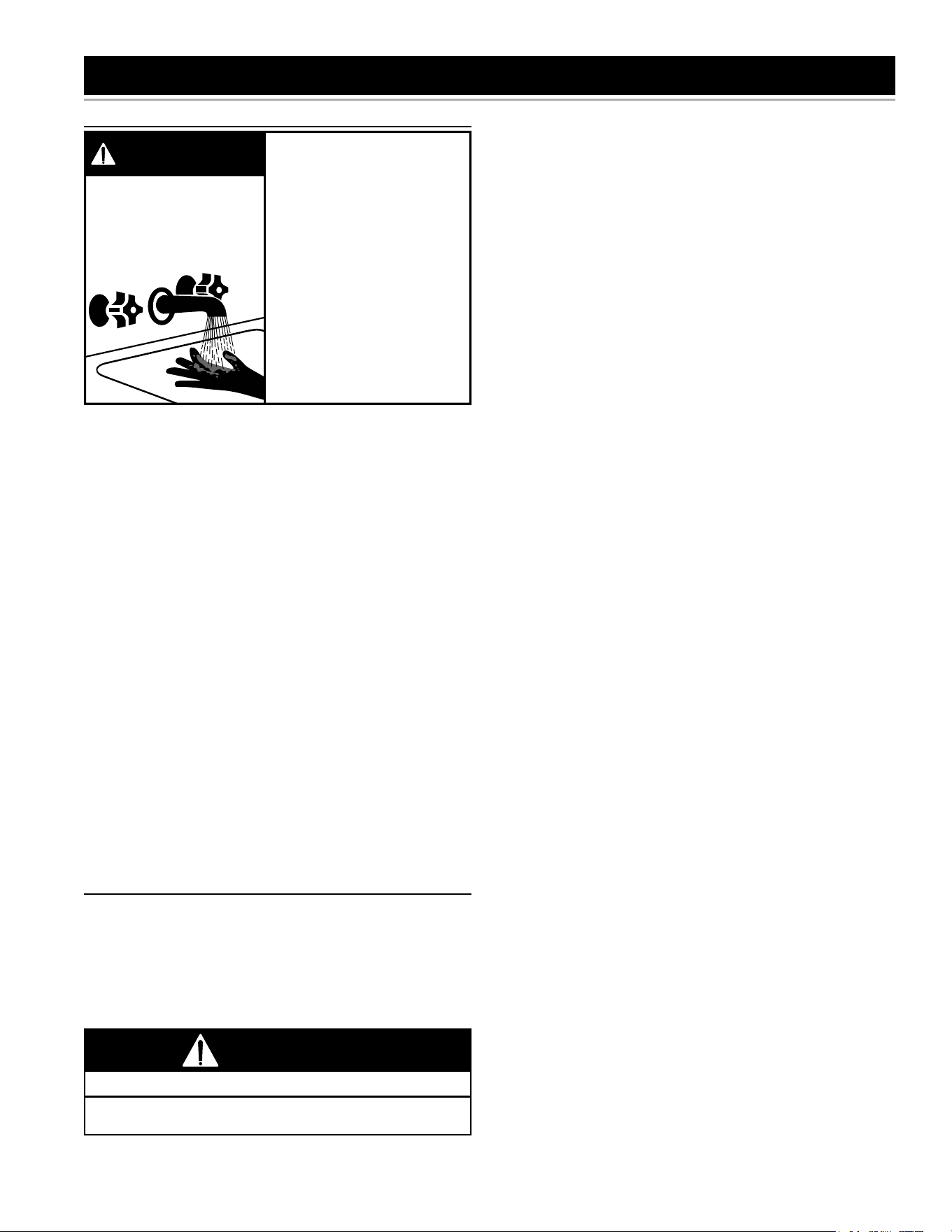
5. Alternatively a single permanent opening may
be used when communicating directly with the
outdoors, or with spaces that freely communicate
with the outdoors. The opening shall have a
minimum free area of 1 square inch per 3,000 Btu/
hr of total input rating of all equipment in enclosure
(see Figure 21).
Figure 21
6. Louvers and Grilles: In calculating free area,
consideration shall be given to the blocking effect
of louvers, grilles or screens protecting openings.
Screens used shall not be smaller than 6mm (1/4
in.) mesh. If the free area through a design of louver
or grille is known, it should be used in calculating
the size opening required to provide the free
area specifi ed. If the design and free area is not
known, it may be assumed that wood louvers will
be 20-25 percent free area and metal louvers and
grilles will have 60-75 percent free area. Louvers
and grilles shall be fi xed in the open position or
interlocked with the equipment so that they are
opened automatically during equipment operation.
7. Special Conditions Created by Mechanical
Exhausting or Fireplaces: operation of exhaust
fans, ventilation systems, clothes dryers or
fi replaces may create conditions requiring special
attention to avoid unsatisfactory operation of
installed gas utilization equipment.
CHEMICAL VAPOR CORROSION
CORROSION OF THE FLUEWAYS AND VENT SYSTEM
MAY OCCUR IF AIR FOR COMBUSTION CONTAINS
CERTAIN CHEMICAL VAPORS. SUCH CORROSION
MAY RESULT IN FAILURE AND RISK OF ASPHYXIATION.
Spray can propellants, cleaning solvents, refrigerator and
air conditioning refrigerants, swimming pool chemicals,
calcium and sodium chloride (water softener salt), waxes,
and process chemicals are typical compounds which
are potentially corrosive. Do not store products of this
sort near the heater. Also air which is brought in contact
with the heater should not contain any of the chemicals.
If necessary, uncontaminated air should be obtained
from remote or outside sources. The Limited Warranty is
voided when failure of water heater is due to a corrosive
atmosphere. See Limited Warranty for complete terms
and conditions.
20 331602-001
INSTALLING THE NEW WATER HEATER
WATER PIPING
Water temperature over
125°F can cause severe
burns instantly resulting in
severe injury or death.
Children, the elderly and the
disabled and are at highest
risk of scald injury.
Feel water before bathing or
showering.
Temperature limiting devices
such as mixing valves must
be installed when required
by codes and to ensure safe
temperatures at fixtures.
BURN
HOT
HOT
DANGER
The water supply pressure should not exceed 80 psi. If this
occurs, a pressure reducing valve with a bypass should be
installed in the cold water inlet line. This should be placed
on the supply to the entire house in order to maintain equal
hot and cold water pressures.
HOT WATER CAN SCALD:
Water heaters are intended to produce hot water.
Water heated to a temperature which will satisfy space
heating, clothes washing, dish washing, cleaning and
other sanitizing needs can scald and permanently injure
you upon contact. Some people are more likely to be
permanently injured by hot water than others. These
include the elderly, children, the infi rm, or physically/
mentally handicapped. If anyone using hot water fi ts into
one of these groups or if there is a local code or state law
requiring certain temperature water at the hot-water tap,
then you must take special precautions. In addition to
using lowest possible temperature setting that satisfi es
your hot water needs, a means such as a mixing valve,
should be used at hot-water taps used by these people
or at the water heater (see Figure 8 & Figure 9). Valves
for reducing point of use temperature by mixing cold and
hot water are also available.
SPACE HEATING AND POTABLE WATER SYSTEMS
This appliance has been design certifi ed as complying
with American National Standard/CSA Standard for water
heaters and are considered suitable for Water (Potable)
Heating and Space Heating. Note: Water heaters used
in combination water/space heating shall not be used in
space heating only applications.
Toxic Chemical Hazard
WARNING
• Do not connect to non-potable water system.
Consult a Qualifi ed Installer or Service Agency. Follow
manufacturer’s instructions for installation of valves.
Before changing the factory setting on thermostat, read
“Operating The Temperature Control System” section in
this manual.
• This water heater should not be connected to any
heating systems or components previously used with
a non-potable water heating appliance.
• All piping components connected to this unit for space
heating applications should be suitable for use with
potable water.
• Toxic chemicals, such as those used for boiler treatment
shall not be introduced into the potable water used for
space heating.
• When the system requires water for space heating at
temperatures higher than required for domestic water
purposes, a mixing valve must be installed. Please
refer to Figure 8 & Figure 9 for suggested piping
arrangement.
Note: Water piping and vent piping occupy the space
above the water heater. Plan the water piping to ensure
it does not cause interference with the vent piping (see
“Planning The Vent System”).
If this water heater is to be used to supply both space
heating and potable water, the instructions listed below
must be followed:
• Be sure to follow the manual(s) shipped with the air
handler or other type heating system.
• This water heater is not to be used as a replacement
for an existing boiler installation.
• Do not use with piping that has been treated with
chromates, boiler seal or other chemicals and do not
add any chemicals to the water heater piping.
• If the space heating system requires water temperatures
in excess of 120°F , a mixing valve must be installed,
per the manufacturer’s instructions, in the potable hot-
water supply to limit the risk of scald injury.
• Pumps, valves, piping and fi ttings must be compatible
with potable water.
• A properly installed fl ow control valve is required to
prevent thermosiphoning. Thermosiphoning is the
result of a continuous fl ow of water through the air
handler circuit during the off cycle. Weeping (blow off)
of the temperature-pressure relief valve (T&P) or higher
than normal water temperatures are the fi rst signs of
thermosiphoning.
• The hot-water line from the water heater should be
vertical past any mixing valve or supply line to the
heating system to remove air bubbles from the system.
• Do not connect the water heater to any system or
components previously used with non-potable water
heating appliances when used to supply potable water.
1331602-001 21
COMBO HEATING
This section serves as a guide for the installation and use
of “Combo” heating systems utilizing a domestic water
heater that has been specifi cally approved for such use.
It is written for those knowledgeable in the required trades
and professionals involved in the design and installation
of Combo Heating Systems.
It is the responsibility of the installer/designer to follow all
applicable codes to ensure the effectiveness and safety
of the installation.
System Requirements
The following requirements must be met for the installation
of Combo Heating Systems:
1. All components used for the distribution of water in
the heating loop must be suitable for potable water.
These include all piping, fi ttings, solder and fl uxes,
pumps for circulation of water, valves, etc.
2. The water heater must not be connected to a hydronic
heating system that has been used previously.
3. No boiler treatment chemicals of any kind shall be
introduced into the system.
4. The Combo System components must be selected
and sized to meet and maintain the total calculated
demands for both domestic service hot water
and space heating requirement. The sizing and
installation must be performed in accordance with
good engineering practice such as “ASHRAE
Handbooks”, HRAI’s Unifi ed Combo Guidelines,
“Hydronics Institute Manuals”, ANSI Z223.1, CSA
F280, National/Provincial Building Codes, ANSI
and/or codes having jurisdiction.
5. The air handler (fan coil) and/or the circulating pump
in a baseboard hydronic loop will require a dedicated
120V circuit. This must be provided and identifi ed for
this purpose.
6. All piping between the water heater and the air handler
or hydronic baseboard loop must be adequately
insulated to reduce heat loss.
7. If the local jurisdiction requires a back-fl ow preventer
in the cold water line, an expansion tank of adequate
size must be installed.
8. “Combo” Heating Systems require higher water
temperatures than other applications. When the
system is used to supply water for Combo Heating
applications, a means, such as mixing valve, must be
installed to temper the water in order to reduce scald
hazard potential (see Figure 22 & Figure 23).
Installation
The heating mode may be one of the following options:
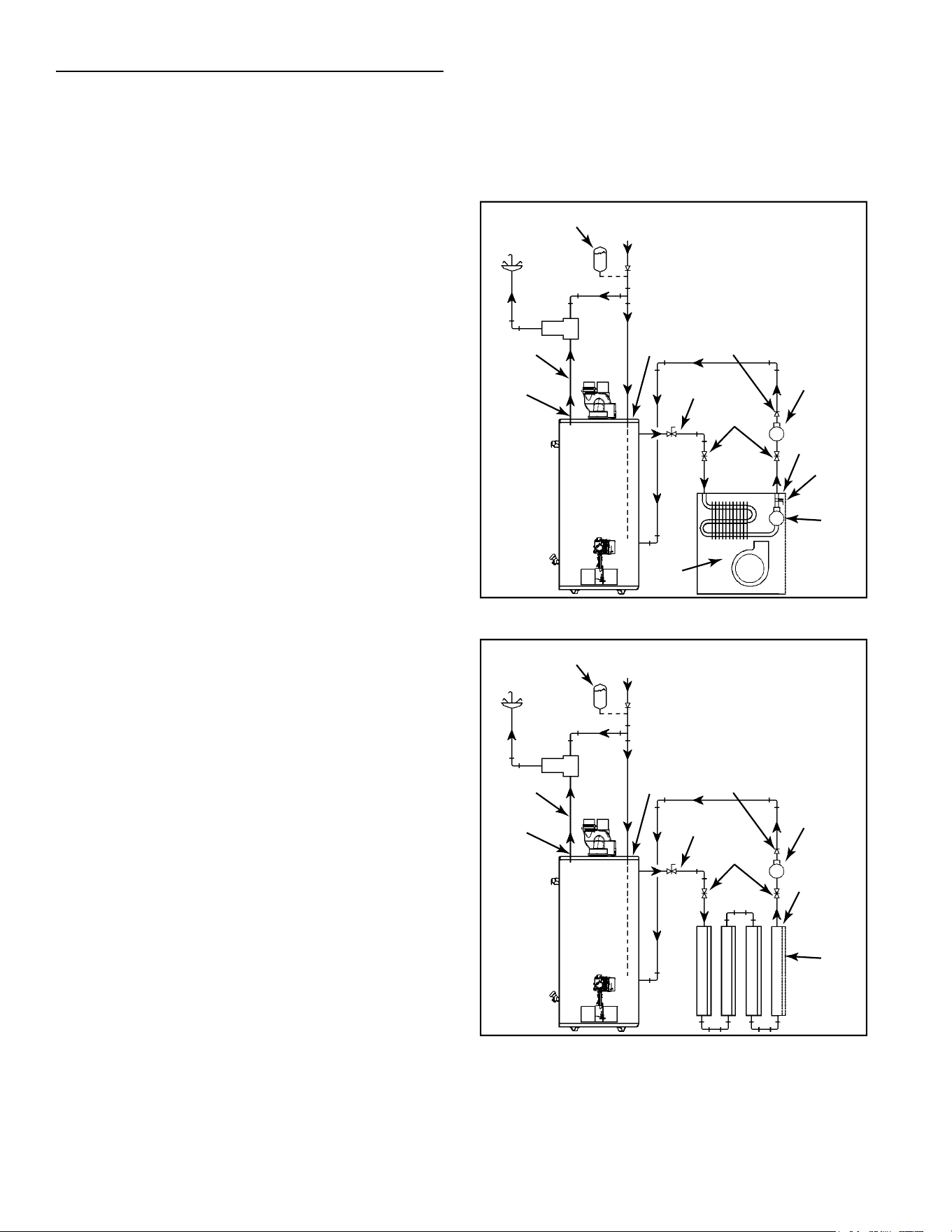
A. A fan coil/air handler (Figure 22).
B. A hydronic baseboard (fi nned tube) loop/In fl oor heating
(Figure 23).
The following is a list of requirements for the installation
of option A or B.
1. Install shut-off valves and unions so that the water
heater can be isolated from the heating module should
servicing of the water heater become necessary.
2. Install a drain valve at the lowest point of the heating
loop so that water can be drained from the heating
module without affecting the water heater.
3. If the air handler does not have a venting means at
the highest point of the piping arrangement, install
an air bleed at the highest point of the plumbing
arrangement.
WATER
HEATER
8 in TO
12 in MAX.
HOT
OUTLET
EXPANSION TANK
(OPTIONAL)
MIXING
VALVE
COLD INLET
CHECK VALVE (IF USED
REQUIRES EXPANSION TANK)
COLD SUPPLY
HOSE BIB
(OPTIONAL)
FLOW
CONTROL
SUPPLY
RETURN
CHECK
VALVE
EXTERNAL
CIRCULATOR
AIR
HANDLER
HOT WATER
TO HOUSE
FIXTURE
C
H
M
INTERNAL
CIRCULATOR
DRAIN/
PURGE
VALVE
(see also
Massachusetts
code requirements
on pg 8)
Figure 22
WATER
HEATER
8 in TO
12 in MAX.
HOT
OUTLET
EXPANSION TANK
(OPTIONAL)
MIXING
VALVE
COLD INLET
CHECK VALVE (IF USED
REQUIRES EXPANSION TANK)
COLD SUPPLY
HOSE BIB
(OPTIONAL)
FLOW
CONTROL
SUPPLY
RETURN
CHECK
VALVE
EXTERNAL
CIRCULATOR
HOT WATER
TO HOUSE
FIXTURE
C
H
M
HYDRONIC
BASEBOARDS
(SERIES
CONNECTED
SHOWN)
(see also
Massachusetts
code requirements
on pg 8)
Figure 23
22 331602-001
CLOSED WATER SYSTEMS
Water supply systems may, because of code requirements
or such conditions as high line pressure, among others,
have installed devices such as pressure-reducing valves,
check valves, and back fl ow preventers. Devices such
as these cause the water system to be a closed system.
THERMAL EXPANSION
As water is heated, it expands (thermal expansion). In a
closed system, the volume of water will increase. As the
volume of water increases, there will be a corresponding
increase in water pressure due to thermal expansion.
Thermal expansion can cause premature tank failure
(leakage). This type of failure is not covered under the
limited warranty. Thermal expansion can also cause
intermittent temperature-pressure relief valve operation:
water discharged from the valve due to excessive pressure
build up. The temperature-pressure relief valve is not
intended for the constant relief of thermal expansion. This
condition is not covered under the limited warranty.
A properly-sized thermal expansion tank should be
installed on all closed systems to control the harmful
effects of thermal expansion. Contact a plumbing service
agency or your retail supplier regarding the installation of
a thermal expansion tank.
Note: To protect against untimely corrosion of hot and cold
water fi ttings, it is recommended that di-electric unions or
couplings be installed on this water heater when connected
to copper pipe.
• Avoid water heater damage.
• Install thermal expansion tank if necessary.
• Do not apply heat to cold water inlet.
• Contact qualified installer or service agency.
Property Damage Hazard
CAUTION
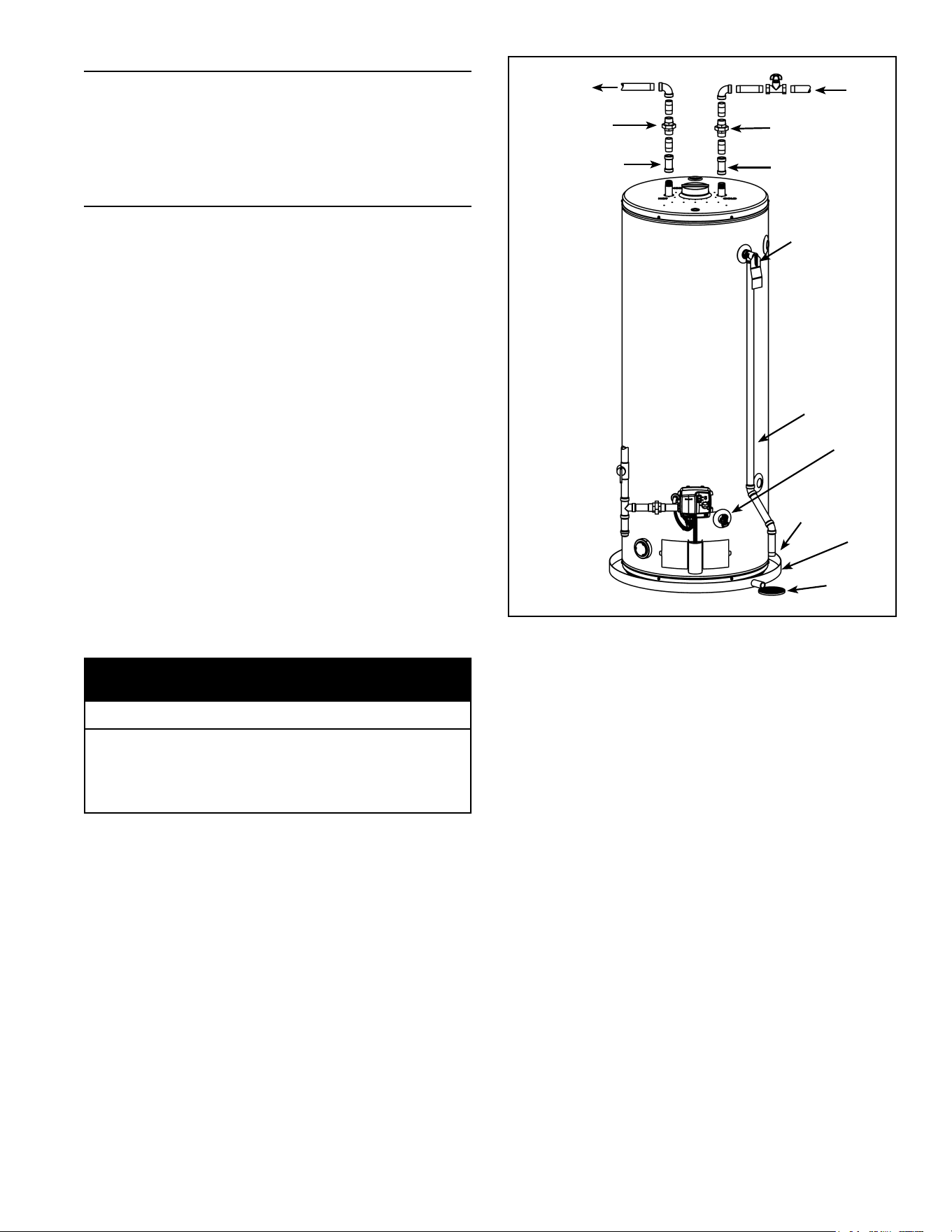
METAL
DRAIN
PAN
FLOOR
DRAIN
HOT-WATER
OUTLET
COLD-
WATER
INLET
UNION
UNION
3/4” SWEAT
FITTING
3/4” SWEAT
FITTING
TEMPERATURE-
PRESSURE
RELIEF VALVE
DISCHARGE PIPE
(DO NOT CAP
OR PLUG)
6 in. MAX. AIR
GAP
DRAIN
VALVE
SHUT-OFF VALVE
SOME
COMPONENTS
NOT SHOWN
FOR CLARITY.
Figure 24
Figure 24 shows typical attachment of water piping to the
water heater. The water heater is equipped with 3/4” NPT
water connections.
Note: If using copper tubing, solder tubing to an
adapter before attaching the adapter to the water heater
connections. Do not solder the water lines directly to the
water heater connections - it will harm the dip tube and
heat traps and damage the tank.
1331602-001 23
TEMPERATURE-PRESSURE RELIEF VALVE
• Temperature-pressure relief
valve must comply with ANSI
Z21.22-CSA4.4 and ASME
code.
• Properly sized temperature-
pressure relief valve must be
installed in opening provided.
• Do not plug, block, or cap the
discharge line.
• Failure to follow this warning
can result in excessive tank
pressure, serious injury or
death.
Explosion Hazard
WARNING
This water heater is provided with a properly rated/sized
and certifi ed combination Temperature-Pressure Relief
Valve (T&P valve) by the manufacturer. The valve is
certifi ed by a nationally recognized testing laboratory
that maintains periodic inspection of production of listed
equipment of materials as meeting the requirements for
Relief Valves for Hot Water Supply Systems, ANSI
Z21.22-CSA 4.4, and the code requirements of ASME.
If replaced, the new T&P valve must meet the requirements
of local codes, but not less than a combination temperature-
pressure relief valve rated/sized and certifi ed as indicated
in the above paragraph. The new valve must be marked
with a maximum set pressure not to exceed the marked
hydrostatic working pressure of the water heater (150 psi)
and a discharge capacity not less than the water heater
Btu/hr input rate as shown on the water heater’s model
rating plate.
For safe operation of the water heater, the temperature-
pressure relief valve must not be removed from its
designated opening nor plugged. The T&P valve must be
installed directly into the fi tting of the water heater designed
for the relief valve. Install discharge piping so that any
discharge will exit the pipe within 6 in. above an adequate
fl oor drain, or external to the building. In cold climates it is
recommended that it be terminated at an adequate drain
inside the building. Be certain that no contact is made with
any live electrical part.
The discharge opening must not be blocked or reduced in
size under any circumstances. Excessive length (over 30
ft. ), or use of more than four elbows can cause restriction
and reduce the discharge capacity of the valve.
No valve or other obstruction is to be placed between the
T&P valve and the tank. Do not connect discharge piping
directly to the drain unless a maximum of 6 in. air gap is
provided. To prevent bodily injury, hazard to life, or property
damage, the relief valve must be allowed to discharge
water in adequate quantities should circumstances
demand. If the discharge pipe is not connected to a drain
or other suitable means, the water fl ow may cause property
damage.
• Temperature-pressure relief valve discharge pipe
must terminate at an adequate drain.
Water Damage Hazard
CAUTION
T&P valve discharge pipe requirements:
• Shall not be smaller in size than the outlet pipe size
of the valve, or have any reducing couplings or other
restrictions.
• Shall not be plugged or blocked.
• Shall not be exposed to freezing temperatures.
• Shall be of material listed for hot water distribution.
• Shall be installed so as to allow complete drainage
of both the temperature-pressure relief valve and the
discharge pipe.
• Must terminate a maximum of 6 in. above an adequate
fl oor drain or external to the building. In cold climates, it
is recommended that the discharge pipe be terminated
at an adequate drain inside the building
• Shall not have any valve or other obstruction between
the relief valve and the drain.
• Burn hazard.
• Hot water discharge.
• Keep clear of
temperature-pressure
relief valve discharge.
BURN
HOT
HOT
DANGER
The T&P valve must be manually operated at least once
a year. Caution should be taken to ensure (1) no one is
in front of or around the outlet of the discharge line, and
(2) the water manually discharged will not cause any
bodily injury or property damage because the water may
be extremely hot. If after manually operating the valve, it
fails to completely reset and continues to release water,
immediately close the cold-water inlet to the water heater,
follow the draining instructions in this manual, and replace
the temperature-pressure relief valve with a properly rated/
sized new one.
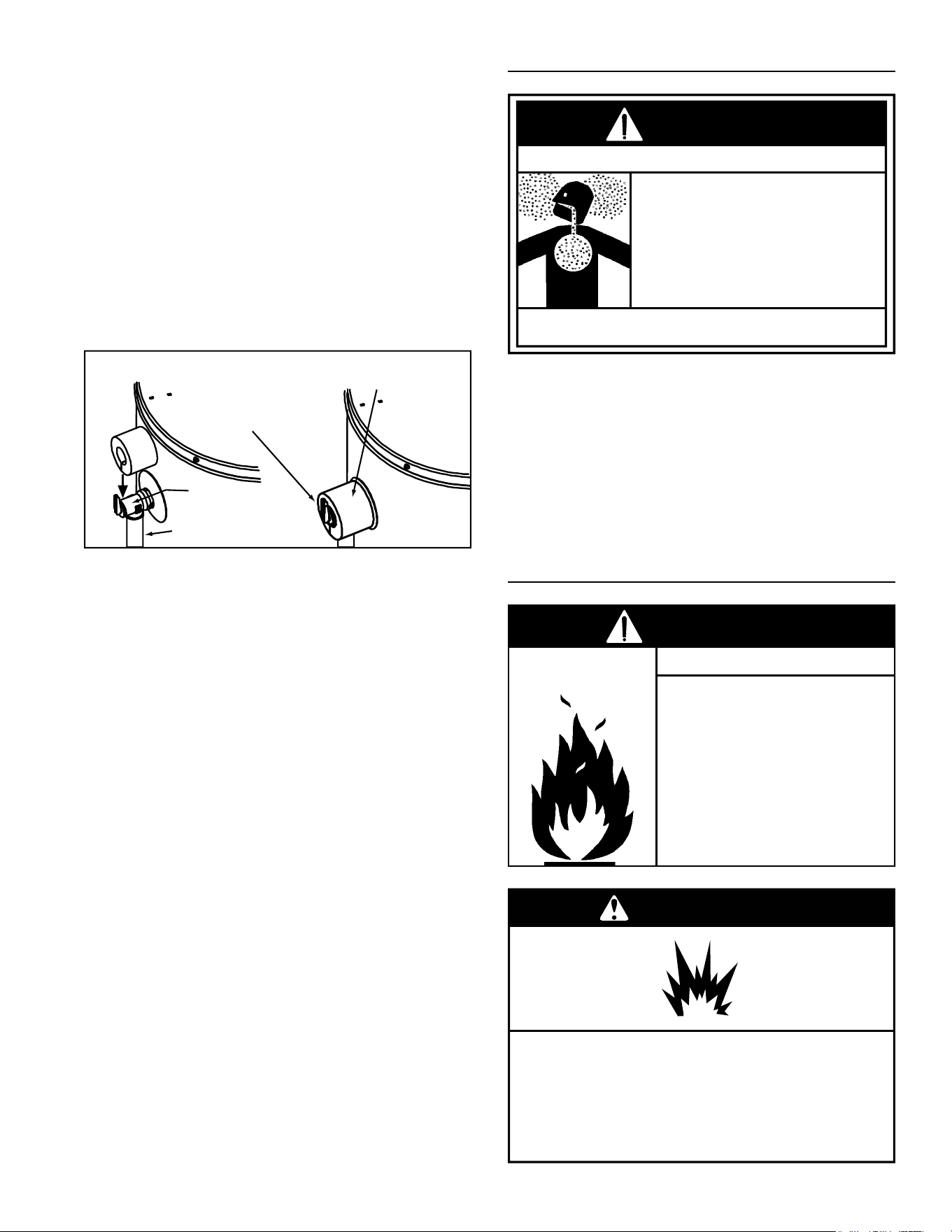
24 331602-001
Note: The purpose of a temperature-pressure relief valve
is to prevent excessive temperatures and pressures in
the storage tank. The T&P valve is not intended for the
constant relief of thermal expansion. A properly sized
thermal expansion tank must be installed on all closed
systems to control thermal expansion, see “Closed Water
Systems” and “Thermal Expansion” section.
Temperature-Pressure Relief Valve and Pipe
Insulation
The T&P valve installed on this water heater is covered by
insulation to minimize heat loss. The insulation has a hole
on the bottom side to accommodate the valve outlet and
allow for the piping connection. Do not restrict the outlet
opening of the T&P valve.
T&P Relief Valve
T&P Relief Valve
Drain Line
Manual Relief Lever
T&P Relief Valve Insulation
(Outlet opening on underside)
Figure 25
Locate the temperature and pressure relief valve on the
water heater (also known as a T&P relief valve). See
Figure 25.
1. Locate the slit running the length of the T&P relief
valve insulation.
2. Spread the slit open and fi t the insulation over the T&P
relief valve. See Figure 25. Apply gentle pressure to
the insulation to ensure that it is fully seated on the T&P
Relief Valve. Once seated, secure the insulation with
duct tape, electrical tape, or equivalent. Important:
The insulation and tape must not block the discharge
opening or hinder access to the manual relief lever
(Figure 25). Ensure a discharge pipe is installed into
the T&P valve discharge opening per the instructions
in this manual.
3. Locate the hot water (outlet) & cold water (inlet) pipes
to the water heater.
4. Locate the slit running the length of a section of pipe
insulation.
5. Spread the slit open and slip the insulation over the
cold water (inlet) pipe. Apply gentle pressure along
the length of the insulation to ensure that it is fully
seated around the pipe. Also, ensure that the base
of the insulation is fl ush with the water heater. Once
seated, secure the insulation with duct tape, electrical
tape, or equivalent.
6. Repeat steps 5 and 6 for the hot water (outlet) pipe.
7. Add additional sections of pipe insulation as needed.
HIGH ALTITUDE INSTALLATION
Breathing carbon monoxide can cause brain damage or death.
Always read and understand instruction manual.
• For operation above 10,100 ft.
a high altitude orifice must be
installed.
• Contact a qualified installer or
service agency.
Breathing Hazard - Carbon Monoxide Gas
WARNING
This heater is approved for operation up to 10,100 ft.
without alteration.
Failure to replace standard orifi ce with a high altitude
orifi ce when installed above 10,100 ft. could result in
improper and inefficient operation of the appliance,
producing carbon monoxide gas in excess of safe limits,
which could result in serious injury or death. Contact
your gas supplier for any specifi c changes which may be
required in your area.
GAS PIPING
• Do not use water heater with
any gas other than the gas
shown on the rating plate.
• Excessive pressure to gas
control valve can cause serious
injury or death.
• Turn off gas lines during
installation.
• Contact qualified installer or
service agency.
Fire and Explosion Hazard
WARNING
Explosion Hazard
Have a qualified technician make sure that the L.P.
gas operating pressure does not exceed 14" water
column.
Failure to do so can result in death, explosion, or
fire.
WARNING
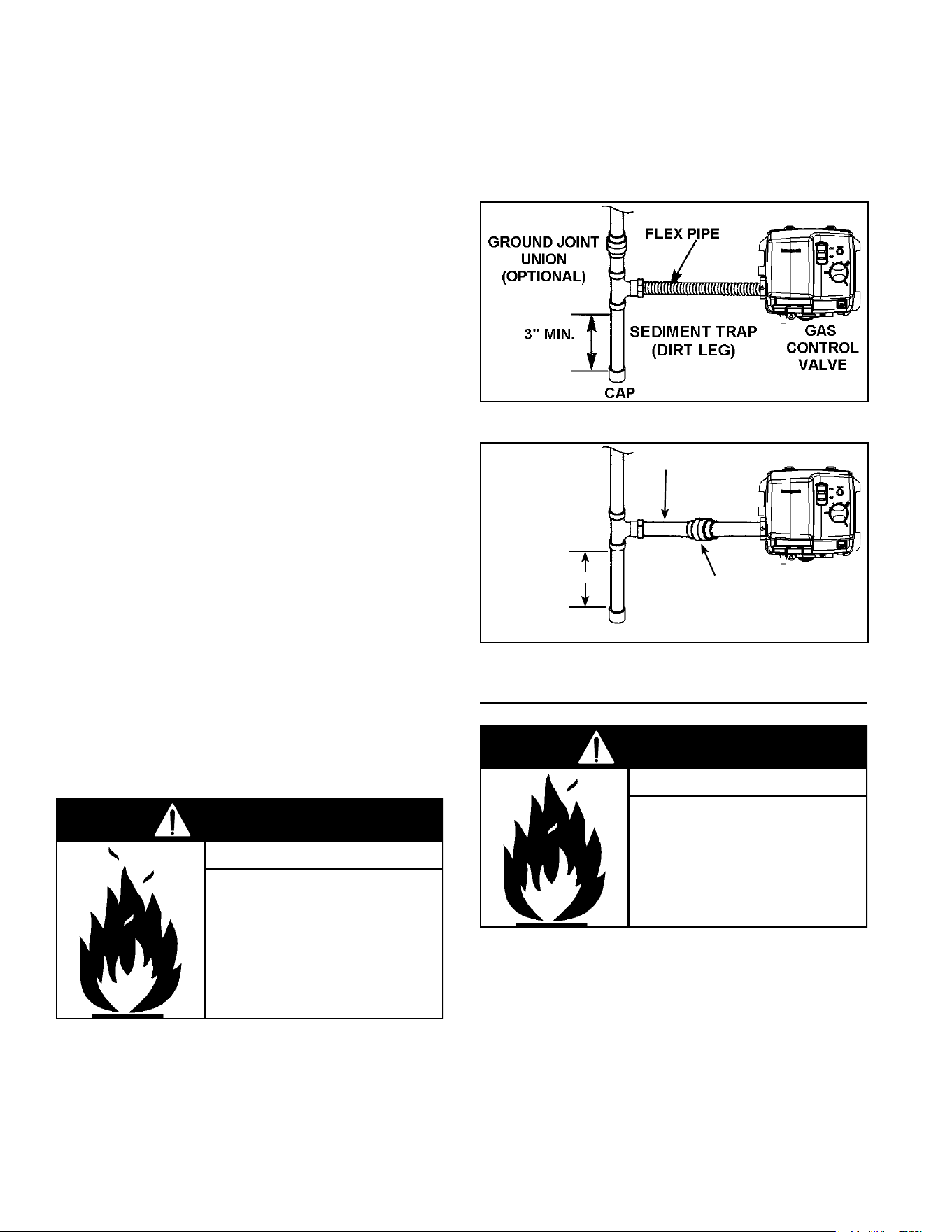
1331602-001 25
Make sure the gas supplied is the same type listed on
the model rating plate. The inlet gas pressure must not
exceed 14 inch w.c. for natural gas and propane gas. The
minimum inlet gas pressure shown on the rating plate is
that which will permit fi ring at rated input.
All gas piping must comply with local codes and ordinances
or with the current edition of the “National Fuel Gas
Code”, ANSI Z223.1/NFPA 54. Copper or brass tubing
and fi ttings (except tin lined copper tubing) should not be
used.
If the gas control valve/thermostat is subjected to
pressures exceeding 1/2 psi, the damage to the gas
control valve/thermostat could result in a fi re or explosion
from leaking gas.
If the main gas line shut-off serving all gas appliances is
used, also turn “OFF” the gas at each appliance. Leave
all gas appliances shut “OFF” until the water heater
installation is complete.
A gas line of suffi cient size must be run to the water
heater. Consult the current edition of the “National Fuel
Gas Code”, ANSI Z223.1/NFPA 54 and your gas supplier
concerning pipe size.
There must be:
• A readily accessible manual shut-off valve in the gas
supply line serving the water heater, and
• A sediment trap (dirt leg) ahead of gas control valve/
thermostat to help prevent dirt and foreign materials
from entering the gas control valve/thermostat.
• A fl exible gas connector or ground joint union between
the shut-off valve and gas control valve/thermostat to
permit servicing of the unit.
Be sure to check all the gas piping for leaks before lighting
the water heater. Use a soapy water solution, not a match
or open fl ame. Repair and retest as required. When
fi nished, rinse off soapy solution and wipe dry.
• Use joint compound or tape
compatible with propane.
• Leak test before operating
heater.
• Disconnect gas piping and
shut-off valve before pressure
testing system.
Fire and Explosion Hazard
WARNING
Use pipe joint compound or Tefl on tape marked as being
resistant to the action of gases.
The appliance and its gas connection must be leak tested
before placing the appliance in operation.
The appliance and its individual shut-off valve should be
disconnected from the gas supply piping system during
any pressure testing of that system at test pressures in
excess of 1/2 psi. It should be isolated from the gas supply
piping system by closing its individual manual shut-off
valve during any pressure testing of the gas supply piping
system at test pressures equal to or less than 1/2 psi.
Connecting gas piping to the gas control valve/thermostat
of water heater can be accomplished by either of two
methods shown in Figure 26 & Figure 27.
Figure 26
BLACK PIPE
SEDIMENT
TRAP
GAS
CONTROL
VALVE
GROUND
JOINT
UNION
(OPTIONAL)
CAP
3 in. MIN.
Figure 27
SEDIMENT TRAPS/DIRT LEG
• Contaminants in gas lines can
cause fire or explosion.
• Clean all gas piping before
installation.
• Install sediment trap in accor-
dance with NFPA 54.
Fire and Explosion Hazard
WARNING
Contaminants in the gas lines may cause improper
operation of the gas control valve/thermostat that may
result in fi re or explosion. Before attaching the gas line be
sure that all gas pipe is clean on the inside. To trap any
dirt or foreign material in the gas supply line, a sediment
trap (sometimes called a dirt leg) must be incorporated in
the piping. The sediment trap should be either a tee fi tting
with a capped nipple in the bottom outlet or other device
recognized as an effective sediment trap. If a tee fi tting
is used, it should be installed in conformance with one of
the methods of installation shown in Figure 26 & Figure
27. Refer to the current edition of the “National Fuel Gas
Code”, ANSI Z223.1/NFPA 54.
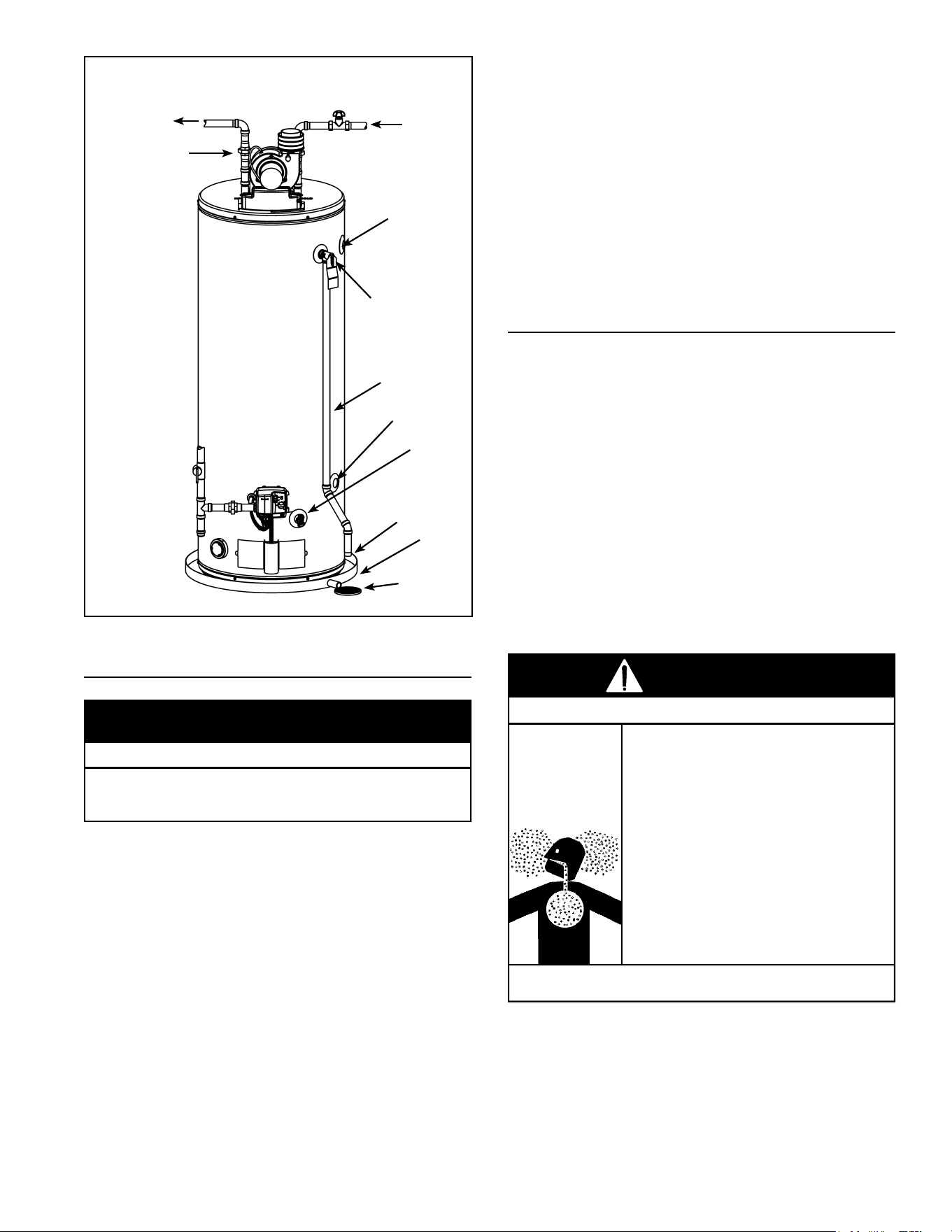
26 331602-001
HOT-WATER
OUTLET
COLD-
WATER
INLET
UNION
TEMPERATURE-
PRESSURE
RELIEF VALVE
DISCHARGE PIPE
(DO NOT CAP
OR PLUG)
6 in. MAX. AIR GAP
BELOW DISCHARGE
PIPE
METAL
DRAIN
PAN
FLOOR
DRAIN
DRAIN
VALVE
SHUT-OFF VALVE
SOME
COMPONENTS
NOT SHOWN
FOR CLARITY.
SIDE TAP
(OUTLET)
SIDE TAP
(INLET)
Figure 28
FILLING THE WATER HEATER
• Avoid water heater damage.
• Fill tank with water before operating.
Property Damage Hazard
CAUTION
• Do not insert the power cord into the electrical
receptacle until the heater has been fully installed.
• Never use this water heater unless it is completely full
of water. To prevent damage to the tank, the tank must
be fi lled with water. Water must fl ow from the hot-water
faucet before turning “ON” gas to the water heater.
To fi ll the water heater with water:
1. Close the water heater drain valve by turning handle
to the right (clockwise). The drain valve is on the lower
front of water heater (see Figure 28).
2. If the heater is equipped with plumbing side taps and
they are not connected to piping, ensure that the side
taps have been closed with pipe plugs.
3. Open all hot-water faucets served by the water heater
to allow air to escape from the tank and the water
piping. Ensure any shut-off valves between the heater
and the faucets are the open position.
4. Open the cold-water supply valve to the water heater.
Notes:
• The cold-water supply valve must be left open when
the water heater is in use.
• Avoid water leakage when fi lling the tank. Do not
allow the insulation of the water heater to get wet as
water can reduce the effectiveness of the insulation.
5. To ensure complete fi lling of the tank, allow air to exit.
Check that the nearest hot-water faucet is still open.
Allow water to run until a constant fl ow is obtained.
This will let air out of the water heater and the piping.
6. Check all water piping and connections for leaks.
Repair as needed.
VENTING
All venting must comply with the current edition of the
“National Fuel Gas Code”, ANSI Z223.1/NFPA 54. This
heater is certifi ed to be installed using Schedule 40 PVC,
ABS or CPVC or polypropylene plastic vent material.
Only use approved material. All venting material and
components must be joined with the approved primer/
cleaner and solvent cement or mechanical seals (see
“Polypropylene Vent Systems”).
Use only Schedule 40 CPVC piping and fi ttings for the fi rst
linear 5 ft. of the outlet vent system. A 5 ft. section of 3”
Schedule 40 CPVC vent pipe is supplied with the water
heater for this purpose. If 4” venting is to be used it must
be fi eld supplied. For the rest of the outlet vent system
use piping and fi ttings as defi ned above.
Breathing carbon monoxide can cause brain damage or death.
Always read and understand instruction manual.
• Install vent system In accordance with codes.
• Do not operate water heater if flood damaged.
• Install water heater in accordance with the
instruction manual.
• Do not operate if soot buildup is present.
• Do not obstruct water heater air intake(s) with
insulating blanket.
• Do not place chemical vapor emitting products near
water heater.
• Gas and carbon monoxide detectors are available.
• Never operate the heater unless it is vented to the
outdoors and has adequate air supply to avoid risks
of improper operation, fire, explosion or asphyxia-
tion.
• Analyze the entire vent system to make sure that
condensate will not become trapped in a section of
vent pipe and therefore reduce the open cross
sectional area of the vent.
Breathing Hazard - Carbon Monoxide Gas
WARNING
Important: DO NOT common vent this water heater with
any power vented appliance. DO NOT vent into a common
chimney.
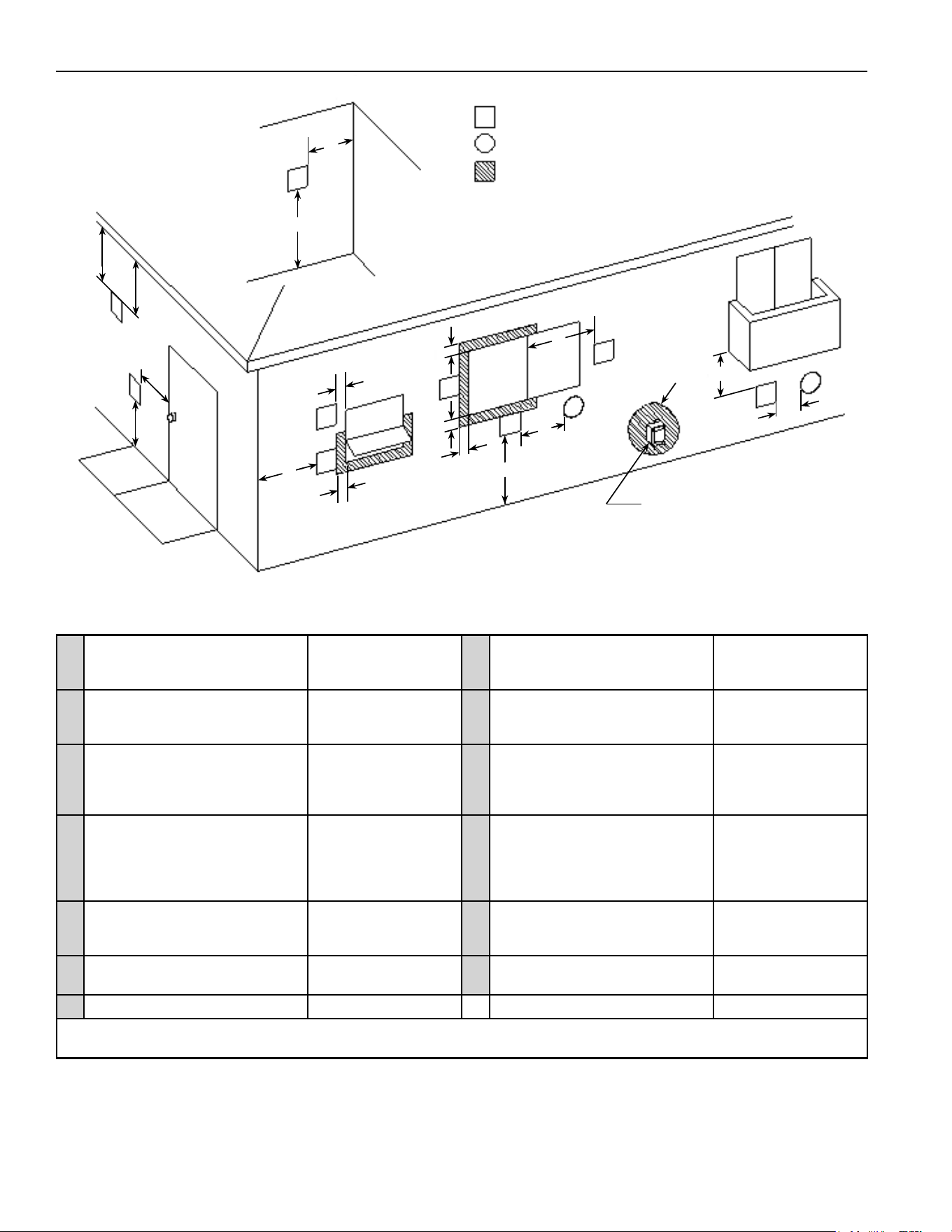
331602-001 27
TERMINATION CLEARANCES SIDEWALL POWER VENT
INSIDE CORNER
DETAIL
FIXED
CLOSED
OPERABLE
FIXED
CLOSED
OPERABLE
Vent terminal
Air supply inlet
Area where is not permitted
Gas meter / regulator
C
B
B
B
B
B
J
A
K
M
F
B
L
E
D
I
V
V
V
V
V
V
V
V
V
V
X
X
X
G
A
Figure 29
Vent terminal clearances for “Power Vent” installations. Power Vent confi gurations use room air for combustion.
A
Clearance above grade,
veranda, porch, deck or
balcony
12 in. H
Clearance to each side of
center line extended above
meter/regulator assembly
N/A
B
Clearance to window or door
that may be opened
4 ft. below or to side
of opening; 1 ft.
above opening
I
Clearance to service regulator
vent outlet
3 ft.*
C
Clearance to permanently
closed window
12 in. J
Clearance to a non
mechanical air supply inlet into
building or combustion air inlet
to any other appliance
4 ft. below or to side
of opening; 1 foot
above opening.
D
Vertical clearance to ventilated
soffi t located above the
terminal within a horizontal
distance of 2 ft. from the
center line of the terminal
12 in. K
Clearance to a mechanical air
supply inlet
3 ft. above if within
10 ft. horizontally
E
Clearance to unventilated
soffi t
12 in. L
Clearance above paved
sidewalk or paved driveway
located on public property
7 ft.
F Clearance to outside corner 2 ft. M
Clearance under veranda,
porch, deck, or balcony
12 in.‡
G Clearance to inside corner 18 in.
In accordance with the current ANSI Z223.1/NFPA 54, National Fuel Gas Code.
‡ Permitted only if veranda, porch, deck, or balcony is fully open on a minimum of two sides beneath the fl oor.
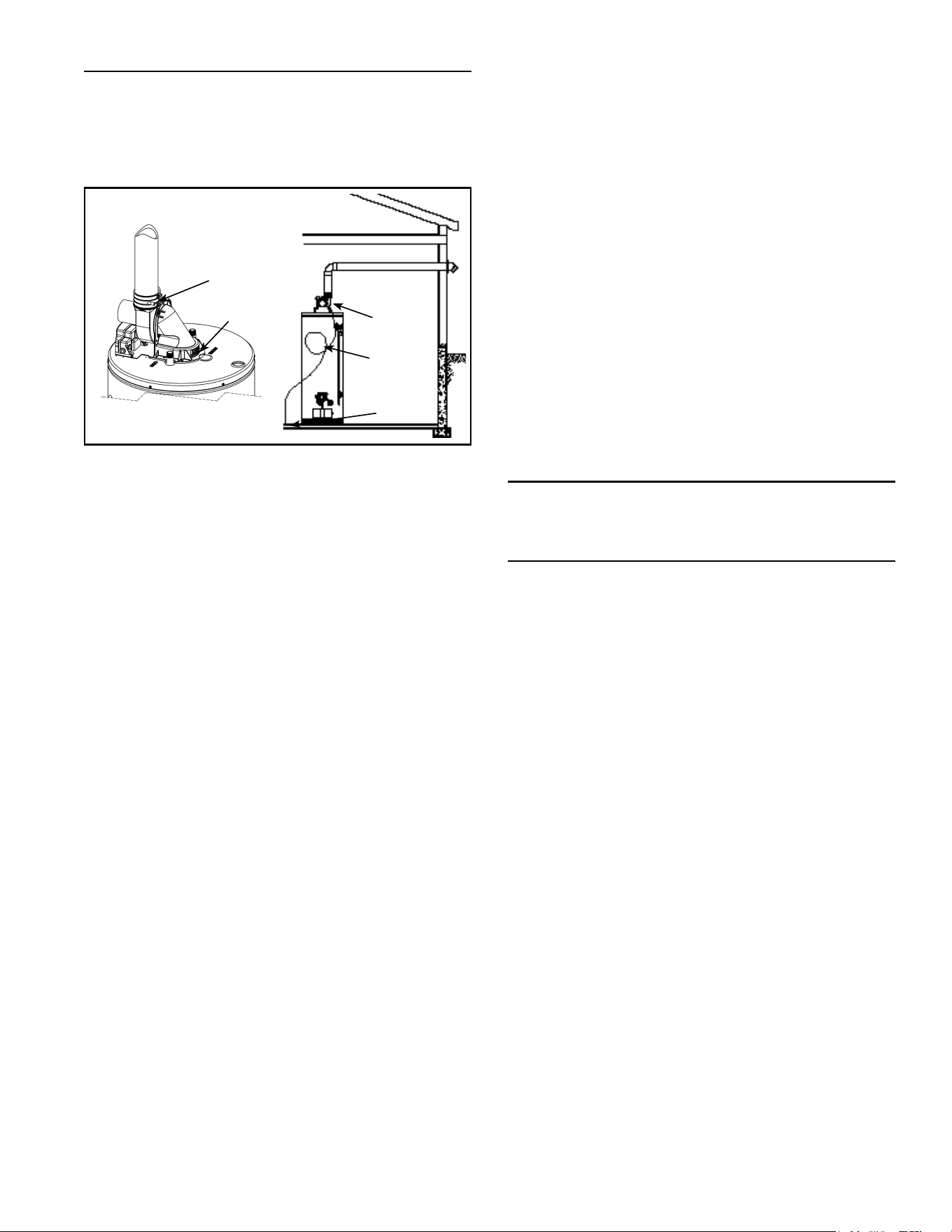
28 331602-001
BLOWER ASSEMBLY INSTALLATION
1. This power vented water heater comes with blower
assembly installed (see Figure 30).
2. After unit is set in place, make sure blower assembly is
still mounted securely. Make sure there is no damage
to blower.
HOSE
CONNECTION
PORT FOR
CONDENSATE
DRAIN
DILUTION
AIR
INLETS
8 in.
LOOP
TO
DRAIN
BLOWER
ASSEMBLY
Figure 30
3. Make sure there is no packing material in the inlet or
discharge of the blower.
4. Make sure that the plastic tubing is still attached
from the air pressure switch to the port on the blower
housing. Make sure the plastic tubing is not folded
anywhere between the pressure switch and the blower
housing (see Figure 38 thru Figure 40).
5. This water heater is a polarity sensitive appliance and
will not operate if the power supply polarity is reversed.
Power to this water heater must be wired properly
(correct polarity).
6. Do not plug in power cord until vent system is
completely installed. The Power Vent operates on 110
-120 VAC. therefore a grounded outlet must be within
reach of the 6 foot fl exible power cord supplied with
the heater. The power cord supplied may be used on
a unit only where local codes permit. If local codes do
not permit use of fl exible power supply cord:
a. Make sure the unit is unplugged from the wall
outlet. Remove the screw and open panel on the
front of the junction box on the blower.
b. Cut the fl exible power cord, leaving enough to be
able to make connections. Remove the strain relief
fi tting from the box.
c. Install a suitable conduit fi tting inside the enclosure.
d. Splice fi eld wiring into existing wiring using code
authorized method (wire nuts, etc).
e. Be certain that the neutral and line connections
are not reversed when making these connections.
f. Ground heater properly. This water heater must
be grounded in accordance with the “National
Electrical Code”, NFPA 70 and/or local codes.
These must be followed in all cases. The water
heater must be connected to a grounded metal,
permanent wiring system or an equipment
grounding conductor must be run with the circuit
conductors and connected to the equipment
grounding terminal or lead on the water heater (see
Figure 12; the wiring diagram).
g. Close the panel on the junction box. Make sure the
access panel is properly secured.
7. The blower discharge boot is made to accept only
straight sections of 2” or 3” pipe. To start off with an
elbow, a short section of the straight pipe must be cut
and glued into the end of the elbow that will mount on
the discharge boot.
8. A rubber coupling is an integral part of the vent system
and must be used in every installation. Failure to do so
may result in overheating, poor performance, nuisance
lock-outs, personal injury or death.
INSTALLATION OF VENT SYSTEM
Before beginning installation of piping system, thoroughly
read the “Vent Pipe Preparation” section of this manual.
PLANNING THE VENT SYSTEM
Plan the layout of the vent system from the vent termination
to the water heater considering all of the 90 degree and 45
degree elbows plus the number of feet of pipe that would
be needed to install the total vent system. The water heater
must be vented to the outdoors as described in these
instructions. This water heater must be vented separately
from all other appliances.
The unit may be vented horizontally through a wall or
vertically through the roof. Pipe runs must be adequately
supported along both vertical and horizontal runs.
Note: Do not use an elbow as a support point. Elbows are
not designed to carry the load or stresses of the venting
system if they are rigidly held.
It is imperative that the fi rst hanger (or support) be located
on the horizontal run immediately adjacent to the fi rst
90-degree elbow from the vertical rise. Support method
used should isolate the vent pipe from the fl oor joists or
other structural members to prevent the transmission of
noise and vibration. Do not support, pin, or otherwise
secure the venting system in a way that restricts the
normal thermal expansion and contraction of the chosen
venting material.
If the water heater is being installed as a replacement for
an existing power vented heater in pre-existing venting,
a thorough inspection of existing venting system must be
performed prior to any installation work. Verify that correct
material, as detailed in below, has been used, and that the
minimum or maximum vent lengths and terminal location
as detailed in this manual have been met.
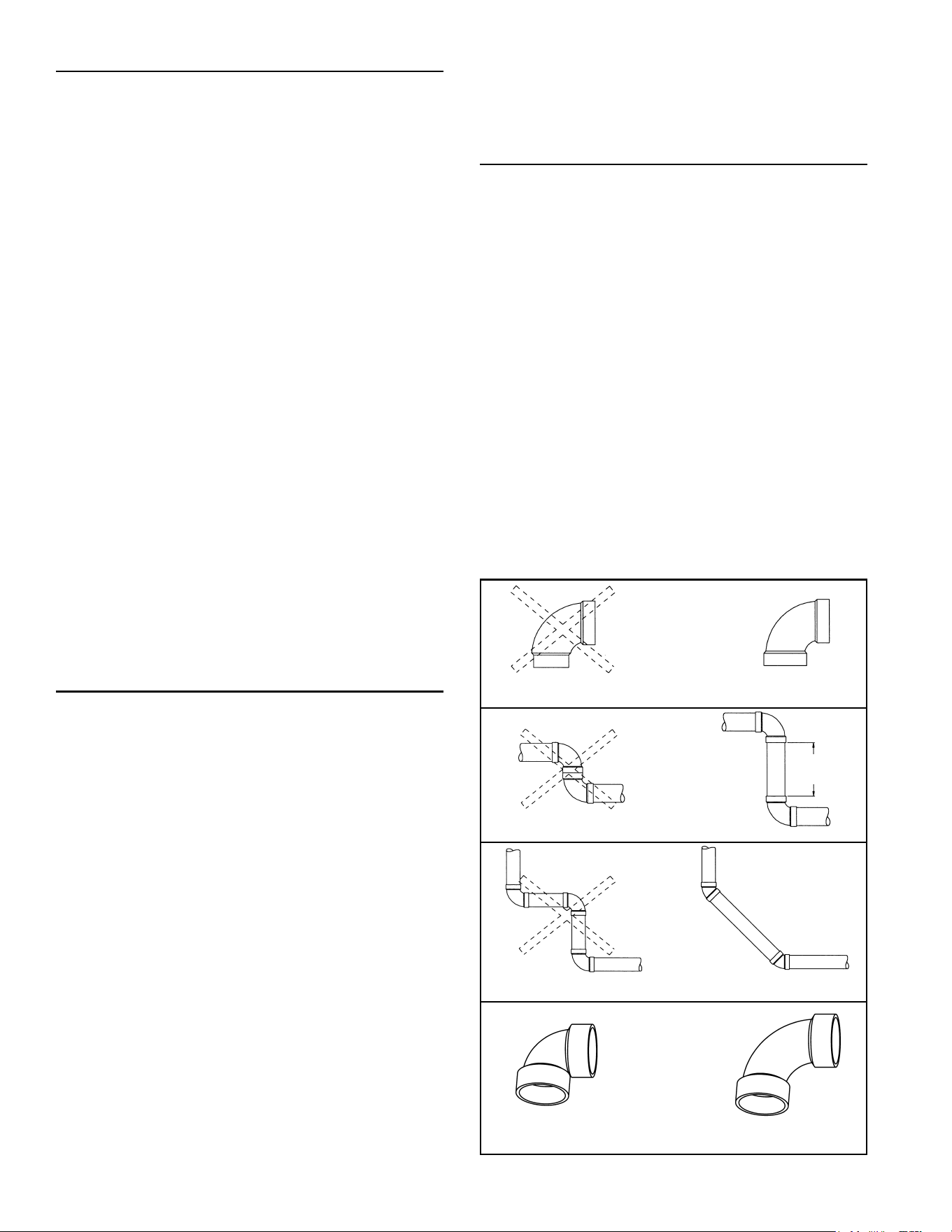
1331602-001 29
POLYPROPYLENE VENT SYSTEMS
Polypropylene vent systems do not use cement to connect
the pipe and elbow sections but use a push together gasket
seal method. Do not attempt to connect polypropylene
with sealant cement.
Polypropylene vent systems are designed to use specifi c
adaptors to connect into the rubber coupling on the top
of the blower. These are available through your venting
supplier.
The PVC vent termination elbow supplied with this heater
has been certifi ed to be used with polypropylene vent
systems. A polypropylene to PVC end connection is
required and is available through your supplier.
Optional wall plates that fi t the polypropylene venting are
also available through your supplier.
Carefully inspect the entire venting system for any signs of
cracks or fractures, particularly at joints between elbows
and other fi ttings and straight runs of vent pipe. Check
system for signs of sagging or other stresses in joints as
a result of misalignment of any components in the system.
If any of these conditions are found, they must be corrected
in accordance with the venting instructions in this manual
before completing installation and putting the water heater
into service.
The vent piping shall be connected to the blower with
the rubber coupling and secured with gear clamps. The
coupling and clamps are provided with the heater.
Even though the fl ue gas temperature leaving the blower
is hot, some installations will have water condense in
the vent piping. If this occurs, then adequate means of
draining and disposing of the condensate shall be made
by the installer.
CONDENSATE
Condensate formation does not occur in all installations
of power vented water heaters, but should be drained
on installations where it can form in the venting system.
Condensation in the venting system of power vented
water heaters is dependent upon installation conditions
including, but not limited to, ambient temperature and
humidity of installation location, ambient temperature
and humidity of venting space, vent discharge and slope,
and product usage. In certain conditions, installations in
unconditioned space or having long horizontal or vertical
vent runs can accumulate condensate. Long lengths of
venting that pass through cool/cold areas will experience
condensation. The vent pipe should be sloped upwards
away from the blower assembly, then adequate means
for draining and disposing of the condensate needs to
be made by the installer. If installation conditions cause
condensation, install a condensate trap loop approximately
8 in. in diameter using 3/8 in. plastic hose. Connect the
hose to the built-in drain port of the rubber coupling of
the blower assembly (see Figure 30). Loop the hose in a
vertical position as shown. The tube loop must be fi lled with
water at least half way prior to operating the heater. Ensure
the end of the tube has access to a drain as condensate
will fl ow from the end. Secure the tubing to the side of the
heater. Prior to operating the water heater, make sure
the removable cap is installed on the drain port (if a drain
hose is not needed).
Note: This cap must remain in place if a drain hose is not
installed.
EXHAUST VENTING
This heater is designed to exhaust the products of
combustion (fl ue gases) to the outdoors using a sealed
piping system. Table 2 lists the allowable vent materials
and sizing information. Figure 34 shows the general
venting layout while Figure 35 thru Figure 37 show various
end termination details and clearances. Connection of the
venting piping to the blower is shown in Figure 38 thru
Figure 40.
Correct installation of the venting system is essential to
the safe and effi cient operation of this water heater. Vent
piping must be installed in accordance with all applicable
codes. All installations shall meet the requirements as
stated in the current edition of the “National Fuel Gas
Code, ANSI Z223.1/NFPA 54”.
Note: The information provided in Figure 31 is intended
as a guideline for good vent installation practices only
and is not intended to restrict venting options beyond
those restrictions established by the current edition of the
“National Fuel Gas Code, ANSI Z223.1/NFPA 54” or any
applicable local and state codes.
6 in.
min.
BACK TO BACK ELBOWS
NORMAL ELBOW
90° LONG SWEEP ELBOW
(LESS RESTRICTIVE)
90° SHORT SWEEP ELBOW
(MORE RESTRICTIVE)
STREET ELBOW
PREFERRED PRACTICE
Figure 31
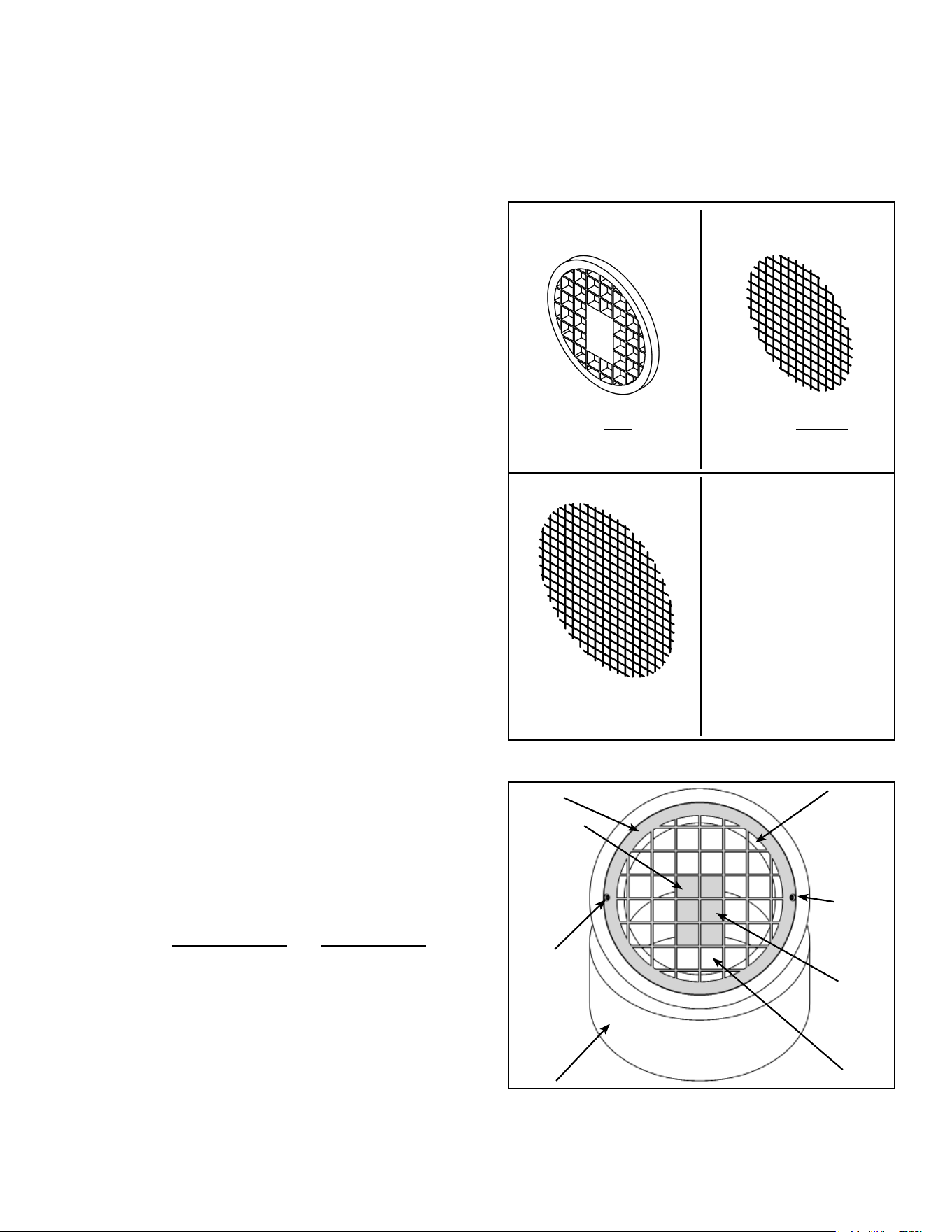
30 331602-001
Important Notes and Warnings
• This heater is certifi ed to be installed using PVC,
CPVC, ABS or polypropylene plastic vent material.
Only use approved material. All venting material and
components must be joined with the approved primer/
cleaner and solvent cement or mechanical seals (see
“Polypropylene Vent Systems”).
• Do not common vent this heater with any other
appliance.
• During operation the plastic piping will expand as it
heats up and contract as it cools down. This is normal
for this type of venting. Rigidly fastening the vent piping
can cause undue stress that may result in the cracking
or fracturing the vent piping material. A fracture of the
venting pipe may pose a serious safety hazard. To
prevent stressing of the vent system, all hangers and
supports must allow the vent piping freedom to move.
• Use long sweep elbows wherever possible. Closely-
coupled elbows and short radius elbows can reduce
the venting capacity.
• All power vented water heaters generate a certain
amount of operational noise. In order to minimize noise
transmission to the support structure, use isolation pads
between the pipe hangers and the vent pipe.
• Most power vent installations develop some
condensation in the vent piping. When using long runs
of venting or when the venting passes through cold or
unheated areas, considerable amounts of condensate
from the fl ue gases can develop. Provision must be
made for the condensate to drain freely from the
system or to be collected in a condensate trap(s) that
can be drained. Damage or fracture of the vent piping
may occur if the condensate is allowed to collect and
freeze. Pooling of condensate can restrict airfl ow and
can cause nuisance failures of the system.
Venting terminations and sizing
• Heaters are supplied with a 3”x3” rubber coupling to
attach the venting to the blower and a 3”, 45° vent
termination elbow.
• Supplied with this heater are several vent termination
screens (see Figure 32).
Installed in the vent termination elbow, the vent screen
is required to keep foreign objects, rodents and small
birds from entering the venting system. These screens
have been sized to ensure maximum energy effi ciency of
the vent system based on the “equivalent length” of the
vent piping. CHOOSE ONLY the ONE SCREEN THAT
MATCHES YOUR VENTING CONFIGURATION (see
Figure 32). How to determine the “equivalent length” is
shown in Figure 34 and in Table 2.
Vent screen installation
• Install the appropriate vent screen into the vent
termination elbow.
• Gently push the screen into the termination elbow until
it sits against the inside shoulder.
• The metal wire screens are self-securing.
• Plastic screens must be secured with (2) screws:
1. Install plastic screen into elbow (see Figure 33).
2. Orient screen as shown in see Figure 33 with an
opening at the bottom of the assembly and the
smooth side facing in.
3. Ensure screen is fully seated against shoulder in
elbow.
4. Secure screen in place with screws (fi eld supplied)
(see Figure 33).
with 4 in. venting
VENT LENGTH GREATER THAN
50 EQUIVALENT FT. USE THIS
SCREEN (SUPPLIED).
with 3 in. venting (short) with 3 in. venting (long)
VENT LENGTH LESS THAN OR
EQUAL TO 20 EQUIVALENT FT.
USE THIS SCREEN (SUPPLIED).
VENT LENGTH GREATER THAN
20 EQUIVALENT FT.
USE THIS SCREEN (SUPPLIED).
Figure 32
#6 SHEET
METAL
SCREW
ELBOW
#6 SHEET
METAL
SCREW
(FIELD
SUPPLIED)
PLASTIC
SCREEN
SHOULDER
OPEN
POCKET
CLOSED
POCKET
POCKETS
FACING OUT
Figure 33
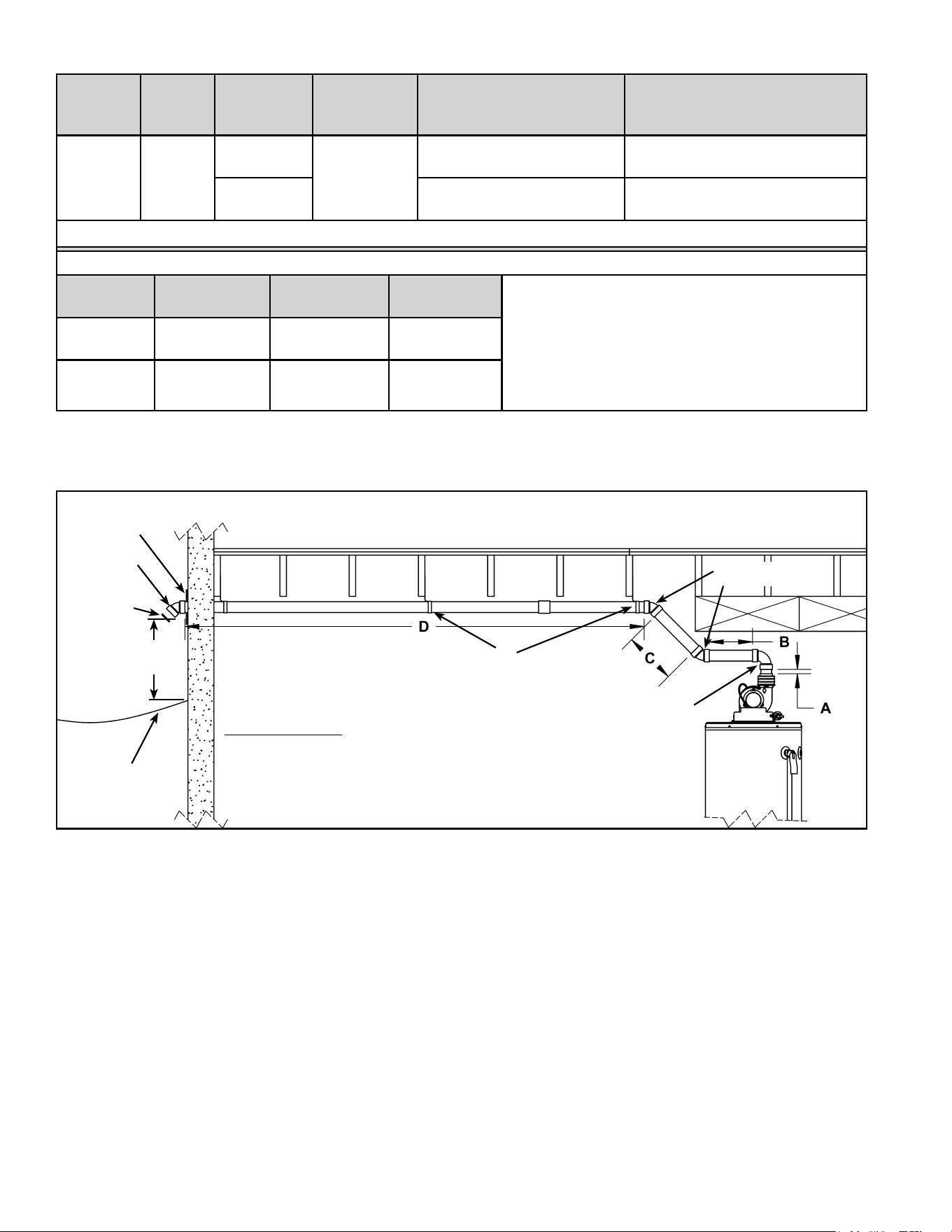
1331602-001 31
Calculating Equivalent Feet
WATER
HEATER
MODEL
HEATER
INPUT
(Btu/hr)
VENT SIZE
(Inside
Diam.)
PRESSURE
SWITCH
SETTING
MAXIMUM EQUIVALENT
VENT LENGTH
MINIMUM EQUIVALENT VENT
LENGTH
75 gal. 76,000
3”
-0.90 in. w.c.
50’ + termination elbow and
screen*
7’ + termination elbow and
screen*
4”
125’ + termination elbow
and screen*
50’ + termination elbow and
screen*
* see Figure 32, “Venting terminations and sizing” and “Vent screen installation”.
Equivalent lengths of straight pipe for various elbows using Schedule 40 PVC, CPVC, ABS and polypropylene.
Size Type
Short Sweep/
Short Radius
Long Sweep/
Long Radius
Notes:
1. Use long radius elbows where possible. Minimum
distance between 90º elbows should be 6 in.
wherever possible.
2. Venting systems may use a maximum of fi ve (5)
90° elbows.
3. Use proper screen termination (see Figure 32).
3"
4"
90° elbow 8’ 5’
3"
4"
45° elbow 4’ 2.5’
Table 2
Note: Use only Schedule 40 CPVC piping and fi ttings for the fi rst linear 5 ft. of the outlet vent system.
Example for calculating equivalent feet.
Section “A” 0.5 ft.
90° elbow 8.0 ft.
Section B 1.0 ft.
45° elbow 4.0 ft.
Section C 1.5 ft.
45° elbow 4.0 ft.
Section D 15.0 ft.
Total Equivalent 34.0 ft.)
Based on this example use the (fully open) rodent
screen for vent length greater than 20 equivalent ft.
(see Figure 32).
Note: The vent pipe must be supported every 4 ft. . To prevent vibration and sagging, it is recommended to use
isolation pads when attaching straps to fl oor joists, walls or ceilings. PVC and CPVC vent pipe should be sloped
upwards away from the blower assembly at a pitch of 1/8 in. rise per 4 ft. . Polypropylene vent systems require
a 1/4 in. per 1 ft. upward slope to ensure proper drainage.
STRAP
45° SHORT
ELBOW
90° SHORT
ELBOW
RODENT
SCREEN
(INSTALL INTO
ELBOW)
TERMINATION
ELBOW
GROUND LEVEL
12 in. MIN. OR ABOVE
ANTICIPATED SNOW
LEVEL.
COVER PLATE
(OPTIONAL)
Figure 34
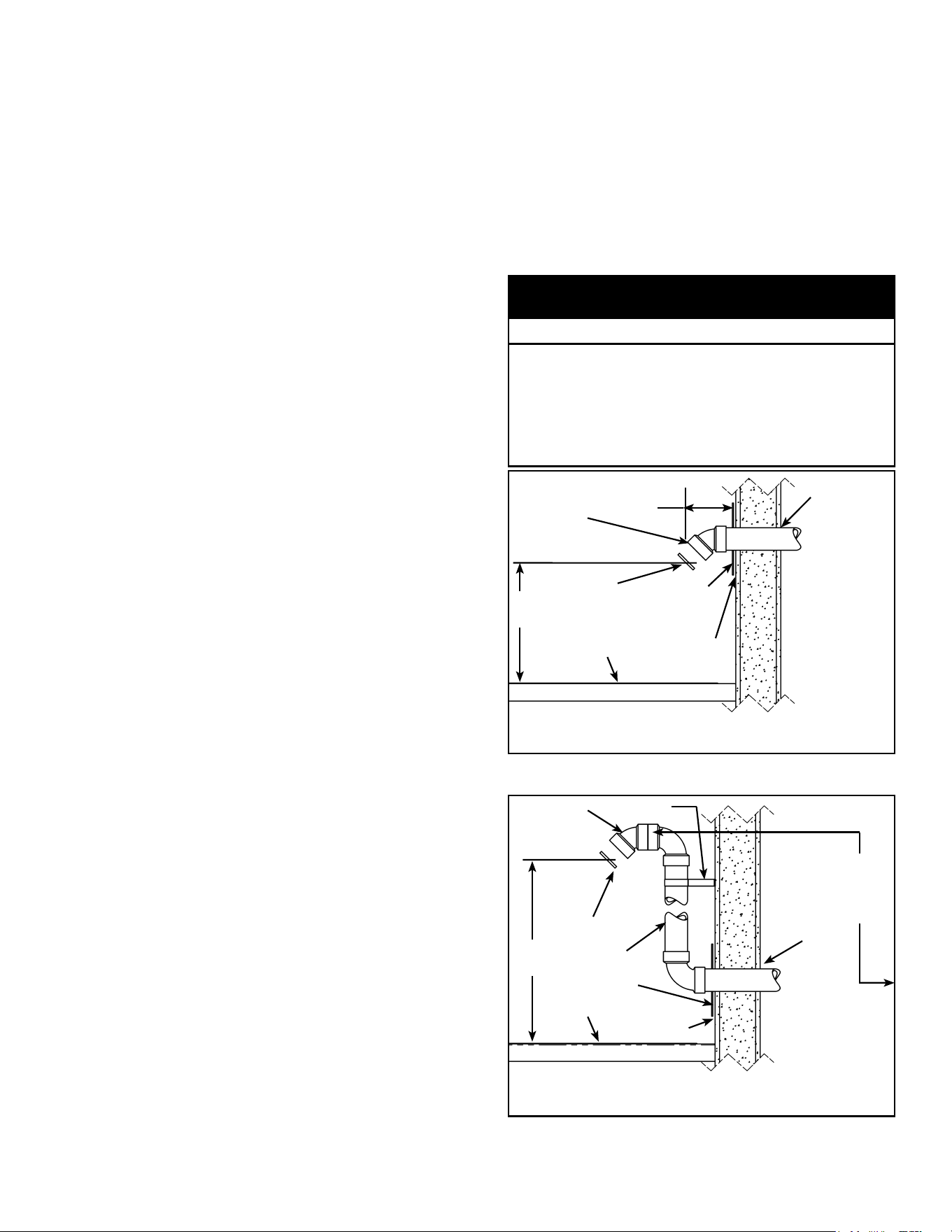
32 331602-001
Venting instructions
1. Plan the venting layout starting at the vent termination
and work back toward the heater. Take into consideration
the style and position of the vent termination, the vent
pipe routing, elbows and connectors required and the
necessary support hangers.
2. Venting should be as direct as possible with the fewest
number of fi ttings. Use long radius 45 degree and long
radius 90 degree elbows wherever possible.
3. Avoid using 90 degree elbows “back to back” and
do not use street elbows. Maintain a minimum 6 in.
straight section between elbows. Closely coupled
and short radius elbows reduce the venting capacity.
Figure 31 shows examples of vent pipe connections.
4. DO NOT USE AN ELBOW AS A SUPPORT POINT.
Elbows are not designed to carry the weight of the
venting system.
5. Calculate “Equivalent Vent Length” before starting. Do
not exceed the values shown in Table 2. An example
of how this length is determined is shown in Figure
34. The value from your calculations should also be
used to determine which rodent screen to install into
the vent termination elbow.
6. Measure the vent piping and cut to required lengths.
Pipes must be cut at right angles and deburred to
ensure a good smooth fi t with suffi cient overlap for
the glue joints. Correct any interference conditions.
7. Provide support hangers for horizontal vent piping
every 4 ft. to prevent sagging and stress. Provide
a minimum of 1/8 in. rise per 4 ft. of vent piping
to ensure adequate drainage (polypropylene vent
systems require a 1/4 in. rise per 1 ft. of vent pipe).
Horizontal vent piping must not sag to form valleys
where condensate can collect. Vertical venting shall
be supported every 5 ft. . Use appropriate support
straps and vibration isolators (foam pads) on straight
sections only. Allow suffi cient clearance for expansion
and contraction of the venting system.
8. At the point where the venting exits the building, cut
a 3-1/2” hole for 3” venting or a 4-1/2” hole for 4”
venting. For sidewall applications, use the appropriate
metal cover plate as a template to mark the hole for
the vent pipe to pass through the wall. BEWARE OF
CONCEALED WIRING AND PIPING INSIDE THE
WALL.
9. Insert the vent piping through this hole and secure into
position. Connect the vent pipe to the end termination
elbow as shown in Figure 35 thru Figure 37.
10. Dry fi t all vent pipes, elbows, connectors and fi ttings
before joining any parts with solvent cement. PARTS
MUST FIT WITHOUT STRESS OR BENDING OF
ANY SECTION and each connection must overlap
a minimum of 1/2 in. . Do not force fi t any of the
connections. Use only the appropriate solvent cement.
Caution: Solvent cements may produce fl ammable
vapors. Use only in well-ventilated areas and keep
away from all sources of ignition.
Note: DO NOT use solvent cement on polypropylene
vent systems.
11. Install the properly sized rodent screen into the outlet
elbow and secure with a small quantity of silicone
sealant. Refer to Figure 32 to determine the proper
screen.
12. Do not seal the vent piping to the wall until the venting
is properly connected to the blower assembly.
13. Complete the venting installation by sealing around
the termination assembly where it passes through
the outside wall, inside and out, with silicone or other
suitable sealant. Apply enough sealant to secure the
(optional) cover plate to the wall.
• Use only in well-ventilated areas.
• Do not use near flame or open fire.
• Use only the Solvent Cement and Primer appropriate for
the venting material being used.
• Solvent cements for plastic pipe are flammable liquids and
must be kept away from all sources of ignition.
Use of Solvent Cement and Primer
CAUTION
SEALANT
SEALANT
(UNDER
PLATE)
GROUND
LEVEL*
RODENT
SCREEN
(INSTALL
INTO
ELBOW)
* WHERE SNOW COVER IS NORMAL DURING
WINTER, ENSURE OUTLET IS INSTALLED
ABOVE ANTICIPATED SNOW LEVEL.
12 in.
MIN.*
ATTACH
TERMINATION
ELBOW (MAY
ALSO BE 90°)
6 in.
VENT PIPING MAY
BE SLOPED IN ANY
DIRECTION, AS
LONG AS A WATER
TRAP IS NOT
CREATED IN THE
VENTING SYSTEM.
THE SLOPE
SHOULD BE KEPT
TO A MINIMUM
SO AS NOT TO
EXERT ANY UNDUE
STRESS ON THE
PIPE.
COVER PLATE
(OPTIONAL)
Figure 35
BRACKET
VENT
RISER
SEALANT
SEALANT
(UNDER
PLATE)
ATTACH
TERMINATION
ELBOW (MAY
ALSO BE 90°)
GROUND
LEVEL*
RODENT
SCREEN
(INSTALL
INTO
ELBOW)
VENT PIPING TO BE
SLOPED (DOWN)
TOWARD HEATER
TO PREVENT
WATER FROM
COLLECTING
(MAY REQUIRE
A CONDENSATE
TEE).
EQUIVALENT
VENT LENGTH
MEASURED
FROM THIS
POSITION
* WHERE SNOW COVER IS NORMAL DURING
WINTER, ENSURE OUTLET IS INSTALLED ABOVE
ANTICIPATED SNOW LEVEL.
12 in.
MIN.*
COVER PLATE
(OPTIONAL)
Figure 36
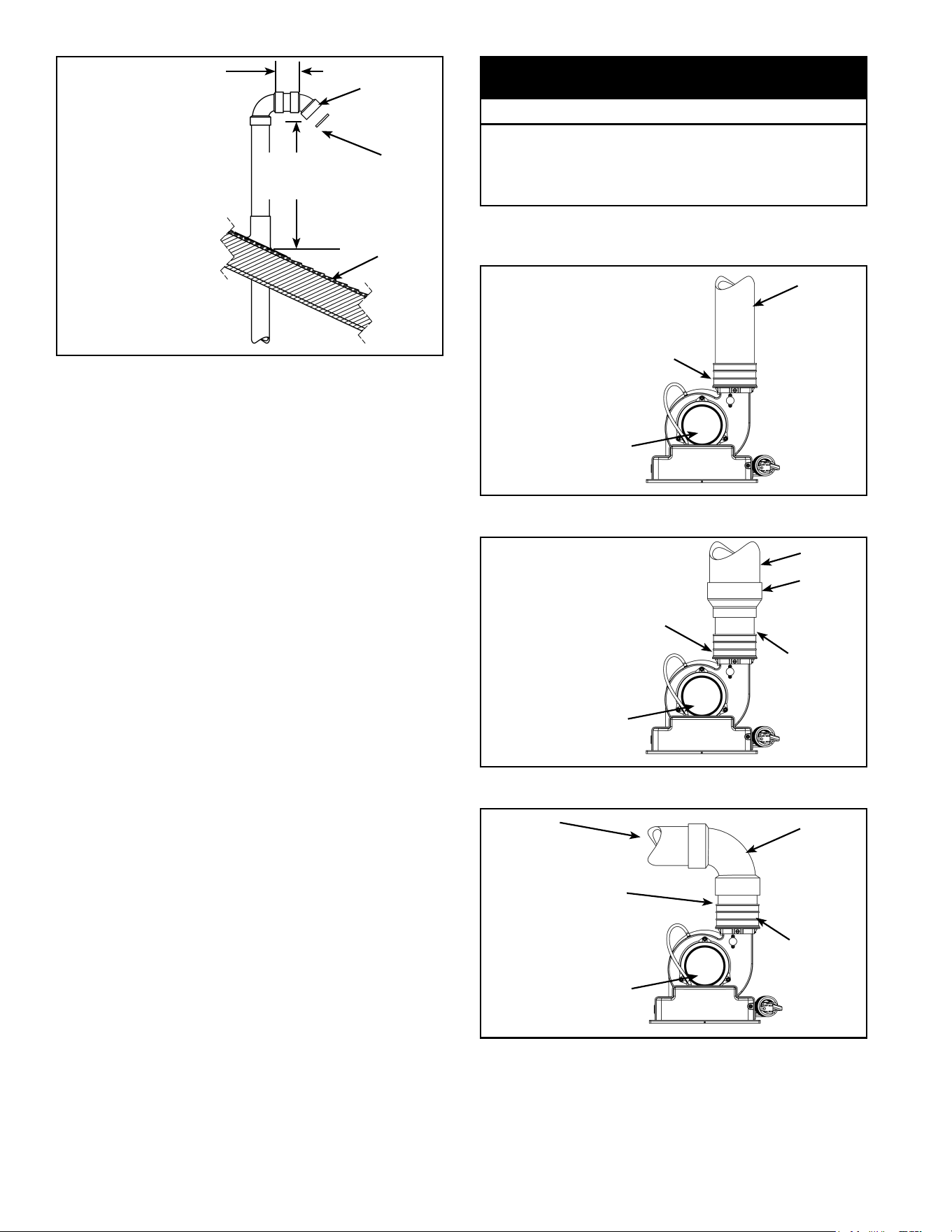
1331602-001 33
TERMINATION
MAY BE 90°
ELBOW
3 in. MIN.
LENGTH
ROOF
LINE
A VENT USED IN A
SPECIAL VENTING
SYSTEM WITH POSITIVE
VENT PRESSURE AND
PASSING THROUGH A
ROOF SHALL EXTEND AT
LEAST 18 in. ABOVE THE
HIGHEST POINT WHERE
IT PASSES THROUGH THE
ROOF SURFACE AND ANY
OTHER OBSTRUCTION
WITHIN A HORIZONTAL
DISTANCE OF 18 in. .
A VERTICAL VENTING
SYSTEM MUST BE
SUPPORTED EVERY 5 ft. .
18 in. OR
ABOVE
ANTICIPATED
SNOW LEVEL
RODENT
SCREEN
(INSTALL
INTO
ELBOW)
Figure 37
Vent pipe connection to blower
1. The CPVC vent piping connects into the rubber
coupling located on the top of the blower assembly.
This coupling includes gear clamps to connect the
venting to the blower. These connections must be
properly seated and tightened to prevent the leakage
of fl ue gases into the area. See Figure 38 thru Figure
40.
2. The water heater are supplied with a 3” rubber
coupling to accept the vent pipe. Note: Polypropylene
vent systems require separate adaptor.
3. Before installing clean and lightly sand the end of
the CPVC plastic vent piping that will connect into
the rubber coupling. For polypropylene vent systems
follow manufacturer’s instructions.
4. Loosen the upper clamp on the rubber coupling and
insert the sanded end of the vent piping a full 1-1/4
in. . Do not use glue or sealant in the rubber coupling.
Check that there is no stress on the connection or the
vent piping that may be caused by twisting or bending.
5. Tighten the upper clamp so that the vent piping is
fi rmly secured in the coupling and is gas tight. Do not
over tighten or cause distortion of any of the parts.
Ensure the bottom of the rubber coupling is fi rmly
seated on the blower outlet and that the lower gear
clamp is also secure. Check to ensure there is no
distortion or movement of the clamped assembly once
it is completed.
6. If the outlet vent pipe is to be turned horizontally
directly off the blower, a 3 in. long section of CPVC
pipe may be cut from the 5 ft. (supplied) section of 3”
Schedule 40 CPVC vent pipe. This is to be used to
connect the CPVC outlet vent pipe elbow to the water
heater (see Figure 40). This elbow SHALL be used in
equivalent length calculations but does NOT contribute
to the fi rst 5 ft. of the outlet vent system (see “Venting”).
• Do not overtighten the top and bottom gear clamps of the
rubber coupling.
• Do not apply solvent cement or silicone to the rubber
coupling connection.
Property Damage Hazard
CAUTION
Coupling installations according to vent sizes
3” CPVC
VENT PIPE
3” RUBBER
COUPLING
(SUPPLIED)
BLOWER
CONFIGURATION
FOR HEATERS
CONNECTED TO
3” VENTING.
Figure 38
4” CPVC
VENT PIPE
3” RUBBER
COUPLING
(SUPPLIED)
3” CPVC
VENT PIPE,
3 in. MAX
LENGTH
3”-4” CPVC
ADAPTER
(FIELD
SUPPLIED)
BLOWER
CONFIGURATION
FOR HEATERS
CONNECTED TO
4” VENTING.
Figure 39
3” CPVC
ELBOW
(FIELD
SUPPLIED)
3” RUBBER
COUPLING
(SUPPLIED)
BLOWER
3” CPVC
VENT PIPE
(SUPPLIED)
3” CPVC
VENT PIPE
(SUPPLIED)
Figure 40
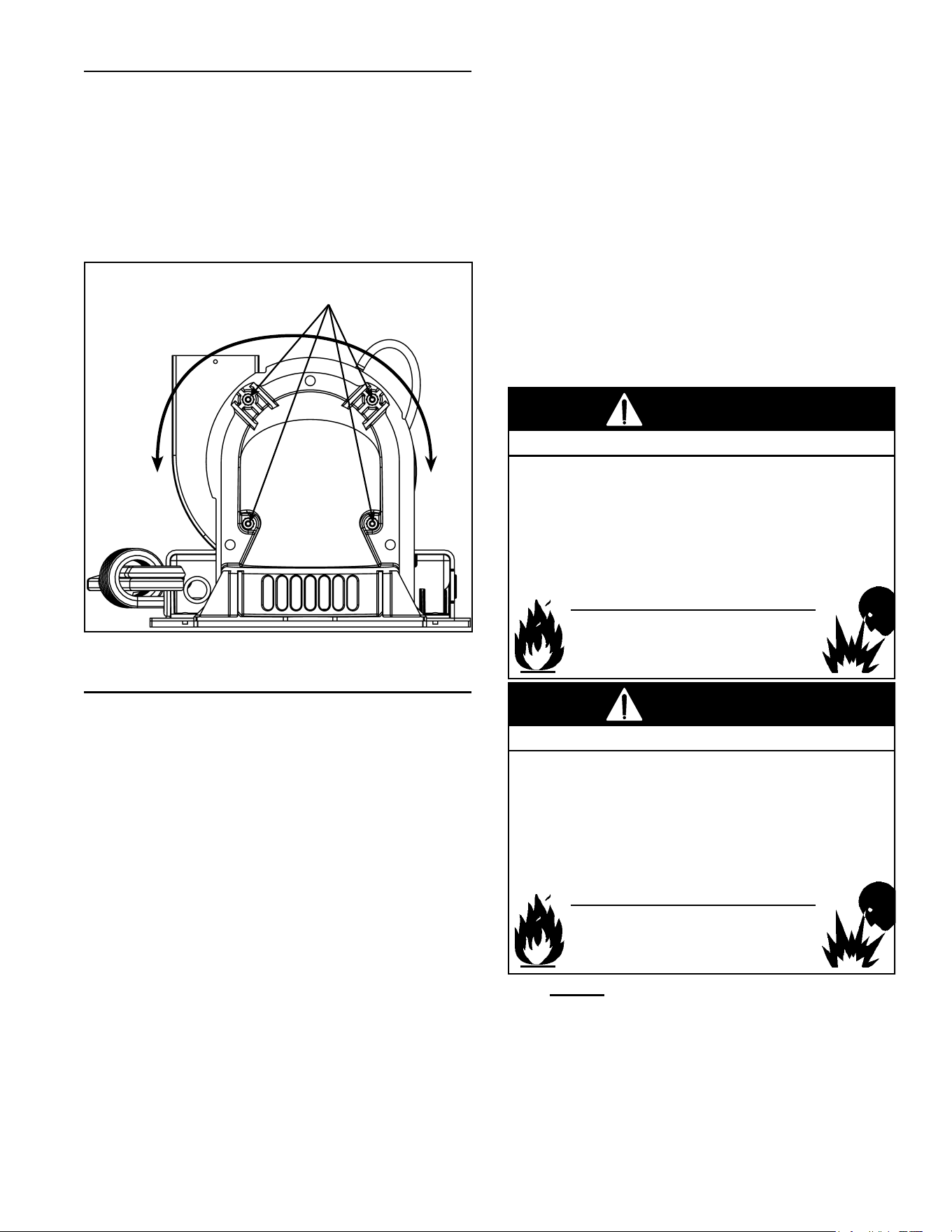
34 331602-001
BLOWER EXHAUST DIRECTION
The blower assembly may be rotated 90 degree clockwise
or counterclockwise to allow horizontal venting in areas
having restricted space above the water heater. To rotate
the blower outlet, remove the four nuts (with 11/32” nut
driver) (see Figure 41), securing the fl ue collector to the
blower housing. Pull the blower assembly forward to free
it from the mounting studs. Rotate the blower housing
clockwise or counter-clockwise and align the four holes
and screws together. Reattach the blower housing to the
fl ue collector.
11/32” nut
Note: Coupling to vent system
not shown for clarity.
Figure 41
VENT PIPE PREPARATION
1. INITIAL PREPARATION
• Make sure the solvent cement you are planning to
use is designed for the specifi c application you are
attempting.
• Know the physical and chemical characteristics and
limitations of the PVC and CPVC piping materials
that you are about to use.
• Know the reputation of your manufacturer and their
products.
• Know your own qualifications or those of your
contractor. The solvent welding technique of joining
PVC and CPVC pipe is a specialized skill just as any
other pipe fi tting technique.
• Closely supervise the installation and inspect the
fi nished job before start-up.
• Contact the manufacturer, supplier, or competent
consulting agency if you have any questions about
the application or installation of PVC and CPVC
pipe.
• Take the time and effort to do a professional job.
Shortcuts will only cause you problems and delays
in start-up. By far, the majority of failures in PVC
and CPVC systems are the result of shortcuts and/
or improper joining techniques.
2. SELECTION OF MATERIALS (PCV and CPVC
VENTING)
• Cutting Device - Saw or Pipe Cutter
• Deburring Tool, Knife, File, or Beveling Machine (2”
and above)
• Brush - Pure Bristle
• Rag - Cotton (Not Synthetic)
• Primer and Cleaner
• Solvent Cement - PVC for PVC Components and
CPVC for CPVC Components only
• Containers - Metal or Glass to hold Primer and
Cement. Select the type of PVC or CPVC materials
to be used on the basis of their application with
respect to chemical resistance, pressure rating,
temperature characteristics, etc.
• Insertion Tool - Helpful for larger diameter pipe and
fi ttings 6” and above.
Read instruction manual before
installing, using or servicing
water heater.
• Do not store or use gasoline or other flammable vapours
and liquids in the vicinity of this or any other appliance.
• Avoid all ignition sources if you smell gas.
• Do not expose water heater control to excessive gas
pressure.
• Use only gas shown on rating plate.
• Maintain required clearances to combustibles.
• Keep ignition sources away from faucets after extended
period of non-use.
Fire or Explosion Hazard
WARNING
Read instruction manual before
installing, using or servicing
water heater.
• Do not store or use gasoline or other flammable vapors and
liquids in the vicinity of this or any other appliance.
• Avoid all ignition sources if you smell gas.
• Do not expose water heater control to excessive gas
pressure.
• Use only gas shown on rating plate.
• Maintain required clearances to combustibles.
• Keep ignition sources away from faucets after extended
period of non-use.
Fire or Explosion Hazard
WARNING
Primer:
It is recommended that Tetrahydrofuran (THF) be
used to prepare the surfaces of pipe and fi ttings for
solvent welding. Do not use water, rags, gasoline
or any other substitutes for cleaning PVC or CPVC
surfaces. A chemical cleaner such as MEK may be
used.
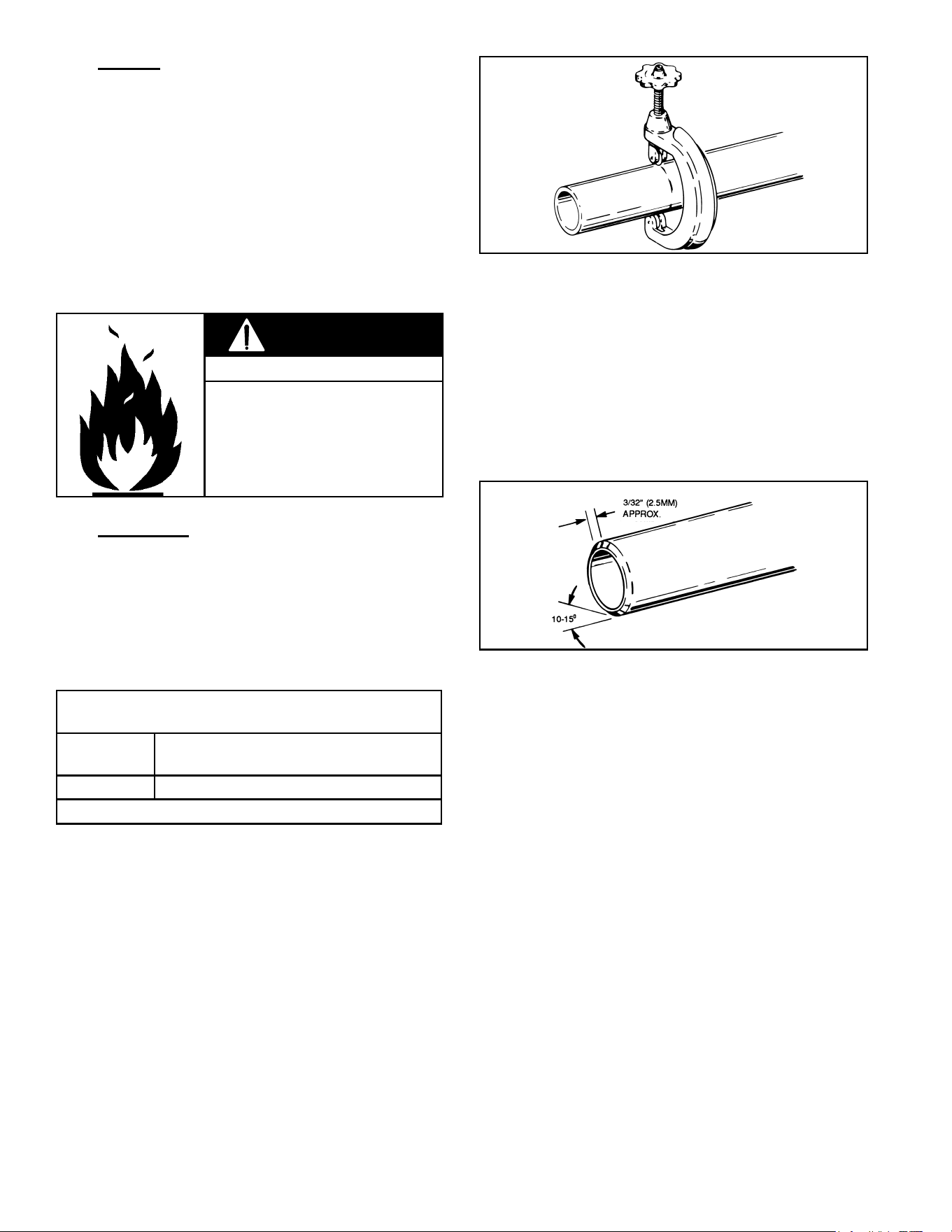
1331602-001 35
Cement:
The cement should be a bodied cement of
approximately 500 to 1600 centipoise viscosity
containing 10-20% (by weight) virgin PVC material
solvated with Tetrahydrofuran (THF). Small
quantities of Dimethyl Formamide (DMF) may
be included to act as a retarding agent to extend
curing time. Select the proper cement; Schedule
40 cement should be used for Schedule 40 pipe.
Never use all-purpose cements, commercial glues
and adhesives or ABS cement to join PVC or CPVC
pipe and fi ttings. To join PVC and CPVC materials,
use ATSM F-493 compliant cement.
• Primers and cements are
extremely flammable, and must
not be stored or used near heat
or open flame.
• Also, use only in a well venti-
lated area.
Fire Hazard
WARNING
Applicators:
Select a suitable pure bristle type paint brush. Use
a proper width brush or roller to apply the primer
and cement (see chart below). Speedy application
of cement is important due to its fast drying
characteristics. IMPORTANT NOTE: A dauber type
applicator should only be used on pipe sizes 2” and
below. For larger diameter pipe, a brush or roller
must be used.
RECOMMENDED BRUSH* SIZE FOR
PRIMER AND CEMENT APPLICATIONS
Nominal
Pipe (IPS)
Brush Size
3 1.5” - 2.5”
*USE ONLY NATURAL BRISTLE
Table 3
3. MAKING THE JOINT
A. Cutting
Pipe must be squarely cut to allow for the proper
interfacing of the pipe end and the fi tting socket
bottom. This can be accomplished with a miter box
saw or wheel type cutter. Wheel type cutters are not
generally recommended for larger diameters since
they tend to fl are the corner of the pipe end. If this
type of cutter is used, the fl are on the end must be
completely removed.
Note: Power saws, if used, should be specifi cally
designed to cut plastic pipe.
Figure 42
B. Deburring
Use a knife, plastic pipe deburring tool, or fi le to
remove burrs from the end of small diameter pipe.
Be sure to remove all burrs from around the inside
as well as the outside of the pipe. A slight chamfer
(bevel) of about 10°-15° should be added to the end
to permit easier insertion of the pipe into the end of
the fi tting. Failure to chamfer the edge of the pipe
may remove cement from the fi tting socket, causing
the joint to leak.
Figure 43
C. Test dry fi t of the joint
Tapered fitting sockets are designed so that
an interfaced fi t should occur when the pipe is
inserted about 1/3 to 2/3 of the way into the socket.
Occasionally, when pipe fi tting dimensions are at
the tolerance extremes, it will be possible to fully
insert dry pipe to the bottom of the fi tting socket.
When this happens, a suffi cient quantity of cement
must be applied to the joint to fi ll the gap between
the pipe and fi tting. The gap must be fi lled to obtain
a strong, leak-free joint.
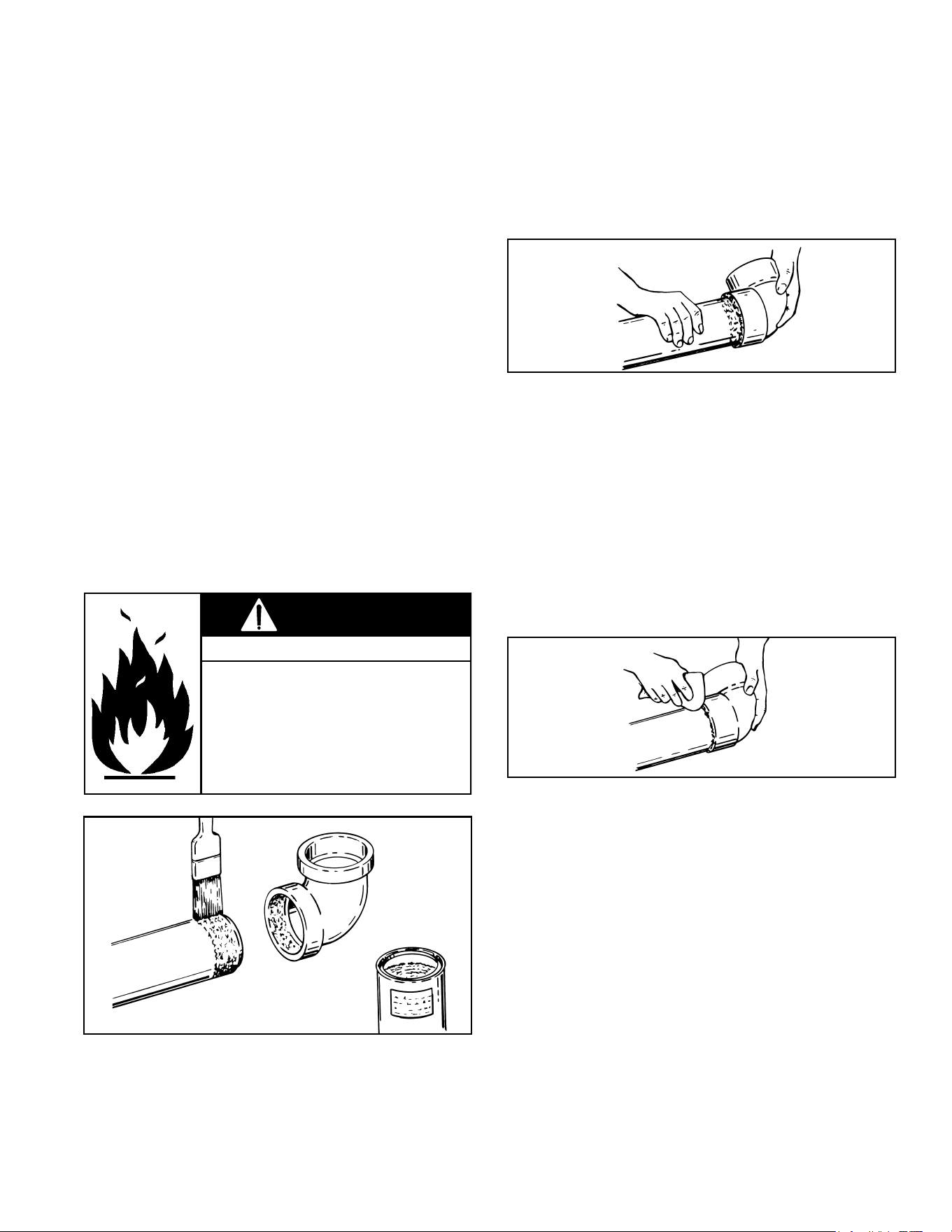
36 331602-001
D. Inspection, cleaning, priming
Visually inspect the inside of the pipe and fi tting
sockets and remove all dirt, grease or moisture
with a clean dry rag. If wiping fails to clean the
surfaces, a chemical cleaner must be used. Check
for possible damage such as splits or cracks and
replace if necessary.
Depth-of-entry
Marking the depth of entry is a way to check if the
pipe has reached the bottom of the fi tting socket
in Step F. Measure the fi tting depth and mark this
distance on the pipe O.D. You may want to add
several inches to the distance and make a second
mark as the primer and cement will most likely
destroy your fi rst one.
Apply primer to the surface of the pipe and fi tting
socket with a natural bristle brush. This process
softens and prepares the PVC or CPVC for the
solvent cementing step. Move quickly and without
hesitation to the cementing procedure while the
surfaces are still wet with primer.
E. Application of solvent cement
• Apply solvent cement evenly and quickly around
outside of pipe at a width a little greater than the
depth of the fi tting socket.
• Apply a light coat of cement evenly around the inside
of the fi tting socket. Avoid puddling.
• Apply a second coat of cement to the pipe end.
• Cans of cement and primer should
be closed at all times when not in
use to prevent evaporation of
chemicals and hardening of cement.
• They are also very flammable and
should be kept away from heat or
flame.
Fire Hazard
WARNING
Figure 44
F. Joint assembly
Working quickly, insert the pipe into the fi tting socket
bottom and give the pipe or fi tting a 1/4 turn to evenly
distribute the cement. Do not continue to rotate the
pipe after it has hit the bottom of the fi tting socket.
A good joint will have suffi cient cement to make a
bead all the way around the outside of the fi tting hub.
The fi tting will have a tendency to slide back while
the cement is still wet so hold the joint together for
about 15 seconds.
Figure 45
G. Cleanup and joint movement
Remove all excess cement from around the pipe
and fi tting with a dry cotton rag. This must be done
while the cement is still soft.
The joint should not be disturbed immediately after
the cementing procedure, and suffi cient time should
be allowed for proper curing of the joint. Exact drying
time is diffi cult to predict because it depends on
variables such as temperature, humidity and cement
integrity. For more specifi c information, you should
contact your solvent cement manufacturer.
Figure 46

1331602-001 37
INSTALLATION CHECKLIST
Note: Use and complete this checklist before lighting the
heater. Correct any conditions that do not meet these
instructions.
Water Heater Location
Centrally located with the water piping system.
Located as close to gas piping and vent pipe system
as possible.
Located indoors and in a vertical position. Protected
from freezing temperatures.
Proper clearances from combustible surfaces
maintained and not installed directly on a carpeted
floor.
Provisions made to protect the area from water
damage. Metal drain pan installed and piped to an
adequate drain.
Installation area free of corrosive elements and
flammable material.
Sufficient room to service the water heater.
Protected from moving vehicles.
Gas Supply and Piping
Gas supply is the same type as listed on the water
heater data plate.
Gas line equipped with shut-off valve, union and dirt
leg
Approved pipe joint compound used.
Adequate pipe size and of approved material.
Chloride-free soap and water solution or other
approved means used to check all connections and
fittings for possible gas leaks.
Vent Pipe System
Vent pipe and fittings of approved material.
Acceptable size, length and number of elbows on
exhaust vent system.
Installed in accordance with prevailing provisions
of local codes, or in the absence of such, the latest
edition of “National Fuel Gas Code” ANSI Z223.1
(NFPA 54).
Horizontal piping slopes at an upward pitch of 1/8 in.
rise per 4 ft. away from the water heater.
Not obstructed in any way.
Vent Termination
Horizontal
12 in. min. above grade/snow level.
Away from corners, other vents, windows etc.
Vertical
Exhaust vent termination 18 in. min. above roof/
snow level.
Water System Piping
Temperature and Pressure relief valve properly
installed with a discharge line run to an open drain
and protected from freezing.
All piping properly installed and free of leaks.
Side taps plugged if not used for combo heating.
Heater completely filled with water.
Closed system pressure build-up precautions installed.
Electrical Connections
Unit connected to a dedicated 120V electrical supply.
Proper polarity.
Water heater properly grounded.
Installed in accordance with prevailing provisions
of local codes, or in the absence of such, the latest
edition of the “National Electrical Code”, NFPA 70”.
After all actions on checklist are checked/
completed, read the Lighting Instructions and
proceed with lighting the heater.
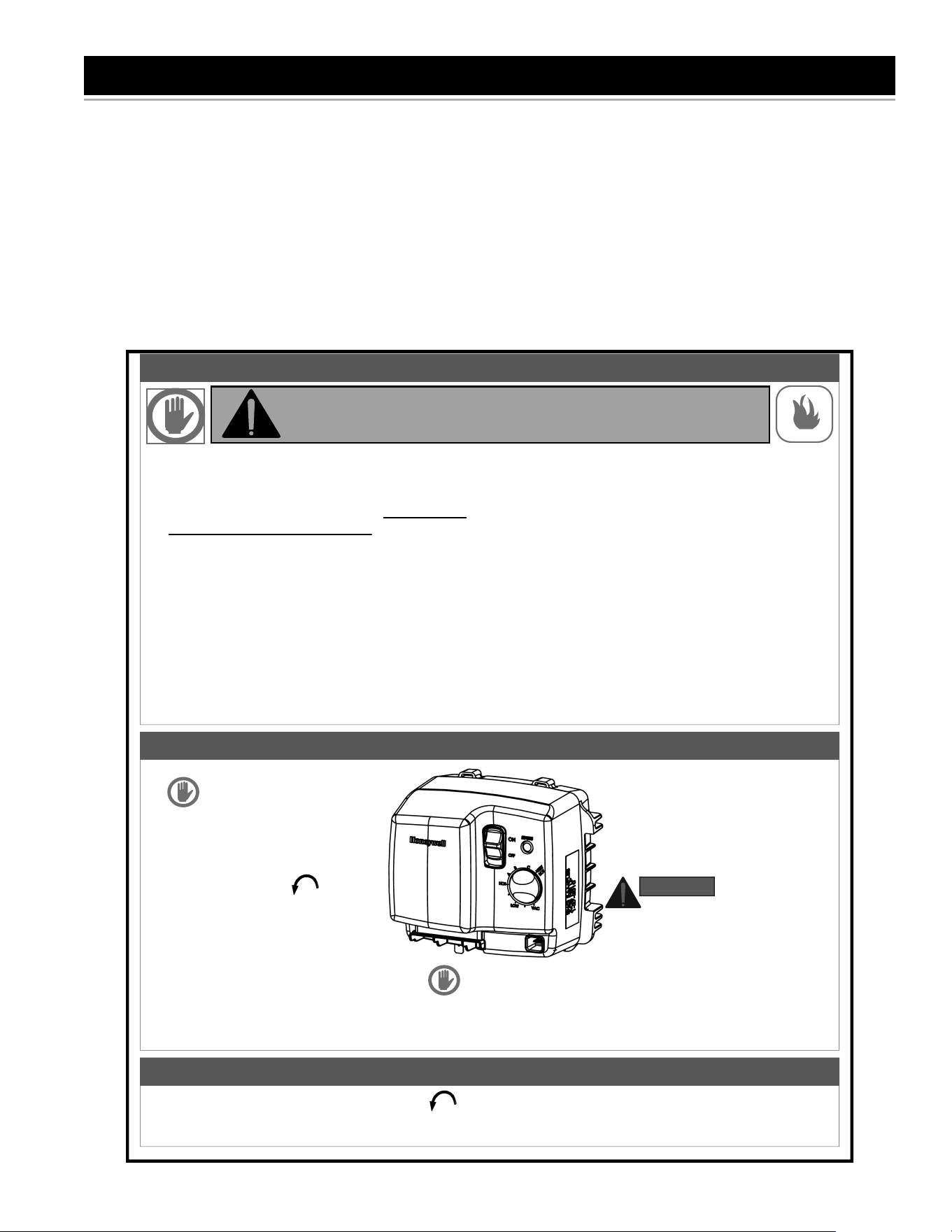
38 331602-001
LIGHTING INSTRUCTIONS
Read and understand these directions thoroughly before attempting to operate the water heater. Make sure the burner
viewport is not missing or damaged. Make sure the tank is completely fi lled with water before operating the water heater.
The gas control valve/thermostat has an “On/Off Switch” and must be turned on before the water heater is operational.
Check the label on the front of the water heater near the gas control valve/thermostat for the correct gas. Do not start
this water heater with any gas other than the one listed on the label. If you have any questions or doubts, consult the
gas supplier or gas utility company. The following Lighting Instruction label appears on the front of the water heater.
This heater is equipped with a Honeywell gas control/thermostat and a hot-surface igniter. This control is a combination
gas valve, thermostat and ignition controller for use on this power vented water heater. The valve contains a micro-
controller that supervises the ignition sequence and monitors the temperature settings and operation of the heater. The
controller also monitors the fl ammable vapor safety features of this heater.
This heater is equipped with a hot-surface ignition system that automatically ignites the burner. Do not attempt
to light this heater manually with a match or fl ame-producing device.
323546-000
1. Turn the thermostat counter-clockwise to the lowest setting.
2. Set the gas control switch to the “OFF” position.
3. Turn off electrical power to the appliance if service is to be performed.
TO TURN OFF GAS TO APPLIANCE
1. STOP! Read the safety
information above on this
label.
2. Turn off all electric power to the
appliance.
3. Turn the thermostat
counter-clockwise to the
lowest setting.
4. Set the switch on the control to
the “OFF” position.
5. Do not attempt to light manually.
6. Wait five (5) minutes to clear out
any gas. If you then smell gas, STOP!
Follow “B” in the safety information above on
this label. If you don't smell gas, go the next
step.
7. Turn on all electric power to
the appliance.
8. Set the switch on the control
to the “ON” position.
9. Turn thermostat to desired
setting.
DANGER Hotter water
increases the risk of
scald injury. Consult the
instruction manual before
changing temperature.
10. If the appliance will not operate, follow the
instructions “To Turn Off Gas To Appliance”
and call your service technician or gas
supplier.
OPERATING INSTRUCTIONS
DANGER
A. This appliance does not have a pilot. It is
equipped with an ignition device which
automatically lights the burner. Do NOT try
to light the burner by hand.
B. BEFORE OPERATING smell all around the
appliance area for gas. Be sure to smell next
to the floor because some gas is heavier
than air and will settle on the floor.
WHAT TO DO IF YOU SMELL GAS:
• Do not try to light any appliance.
• Do not touch any electric switch; Do not use
any phone in your building.
• Immediately call your gas supplier from a
neighbor's phone. Follow the gas suppliers
instructions.
• If you cannot reach your gas supplier, call the
fire department.
C. Use only your hand to turn the gas control
buttons. Never use tools. If the control
buttons will not turn, don't try to repair them,
call a qualified service technician. Force or
attempted repair may result in a fire or
explosion.
D. Do not use this appliance if any part has
been under water. Immediately contact a
qualified installer or service agency to
replace a flooded water heater. Do not
attempt to repair the unit. It must be
replaced!
BEFORE OPERATING: ENTIRE SYSTEM MUST BE FILLED WITH WATER AND AIR PURGED FROM ALL LINES.
FLAMMABLE
FLAMMABLE
WARNING: If you do not follow these instructions exactly, a fire
or explosion may result causing property damage, personal
injury or loss of life.
FOR YOUR SAFETY READ BEFORE LIGHTING
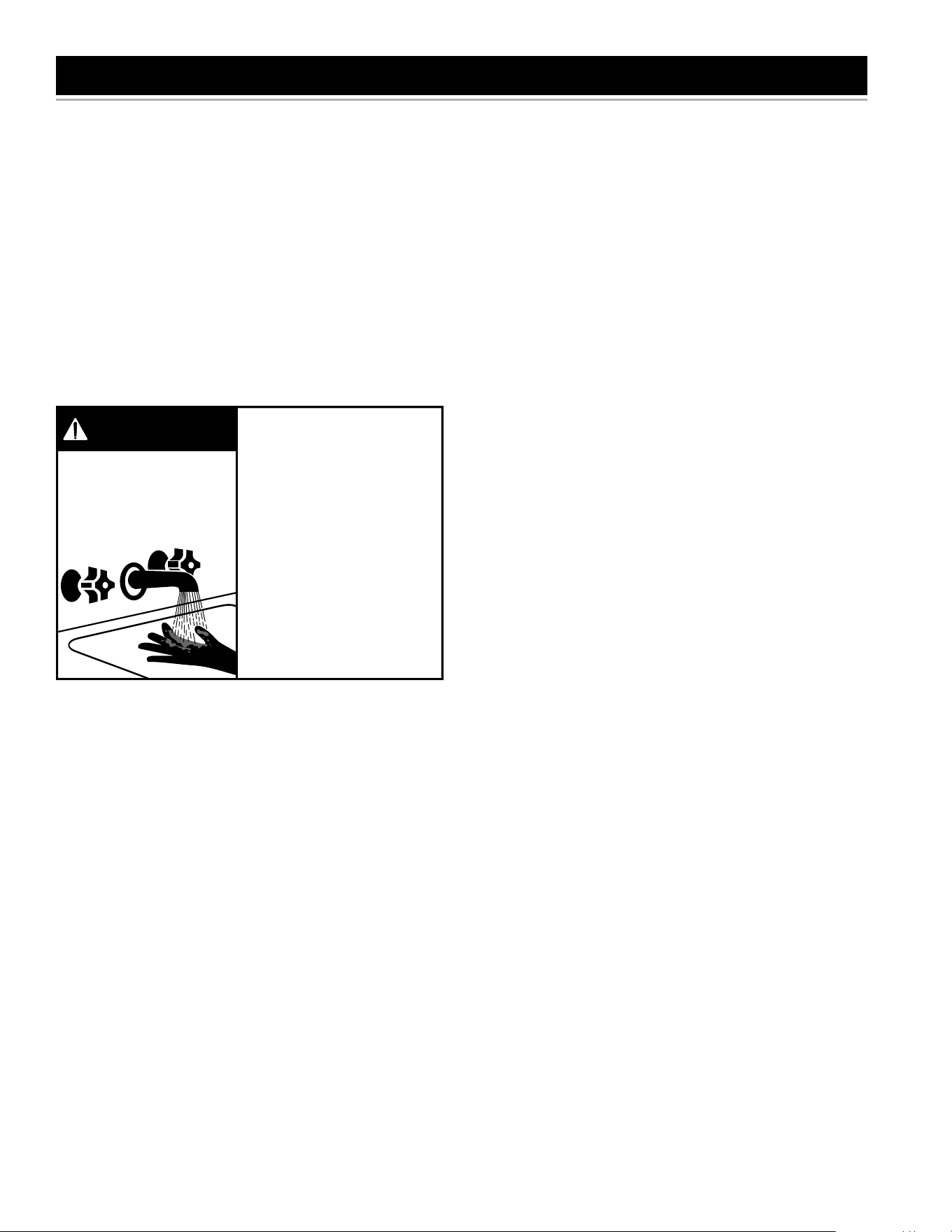
331602-001 39
OPERATING THE TEMPERATURE CONTROL SYSTEM
It is recommended that lower water temperatures be used
to avoid the risk of scalding. It is further recommended, in
all cases, that the water temperature be set for the lowest
temperature which satisfi es your hot-water needs. This
will also provide the most energy effi cient operation of
the water heater.
Short repeated heating cycles caused by small hot-water
uses can cause a temperature increase of the hot water
by 20F° higher than the heater’s temperature settings. If
you experience this type of use you should consider using
lower temperature settings to reduce scald hazards.
Should overheating occur or the gas supply fails to shut
off, turn off the main manual gas shut off valve to the
appliance (see Figure 1).
Water temperature over
125°F can cause severe
burns instantly resulting in
severe injury or death.
Children, the elderly and the
disabled and are at highest
risk of scald injury.
Feel water before bathing or
showering.
Temperature limiting devices
such as mixing valves must
be installed when required
by codes and to ensure safe
temperatures at fixtures.
BURN
HOT
HOT
DANGER
HOT WATER CAN SCALD:
Water heaters are intended to produce hot water. Water
heated to a temperature which will satisfy space heating,
clothes washing, dish washing, and other sanitizing needs
can scald and permanently injure you upon contact. Some
people are more likely to be permanently injured by hot
water than others. These include the elderly, children, the
infi rm or physically/mentally handicapped. If anyone using
hot water from this heater fi ts into one of these groups
or if there is a local code or state law requiring certain
temperature water at the hot-water tap, then you must
take special precautions. In addition to using the lowest
possible temperature setting that satisfi es your hot-water
needs, a means such as a mixing valve, should be used
at the hot-water taps used by these people or at the water
heater. Mixing valves are available at plumbing supply
or hardware stores (see Figure 8 & Figure 9). Follow
manufacturer’s instructions for installation of the valves.
Before changing the factory setting on the thermostat, in
this manual, see Table 4.
The water heater should be located in an area where
the general public does not have access. If a suitable
area is not available, a cover should be installed over the
thermostat to prevent tampering.
This water heater is equipped with an adjustable
thermostat to control water temperature (see Figure 47).
Hot water temperatures required for automatic dishwasher
and laundry use can cause scald burns resulting in serious
personal injury and/or death. The temperature at which
injury occurs varies with the person’s age and time of the
exposure. The slower response time of children, aged or
disabled persons increases the hazards to them. Never
allow small children to use a hot-water tap, or to draw their
own bath water. Never leave a child or disabled person
unattended in a bathtub or shower.
The hot setting shown on the dial is approximately 120°F .
This is a good starting point to set the temperature.
Setting the water heater temperature at 120°F will reduce
the risk of scalds. Some states require settings at specifi c
lower temperatures.
The thermostat settings on the gas control valve are shown
in Figure 47.
The water temperature setting was factory set at the lowest
(VAC) temperature setting.
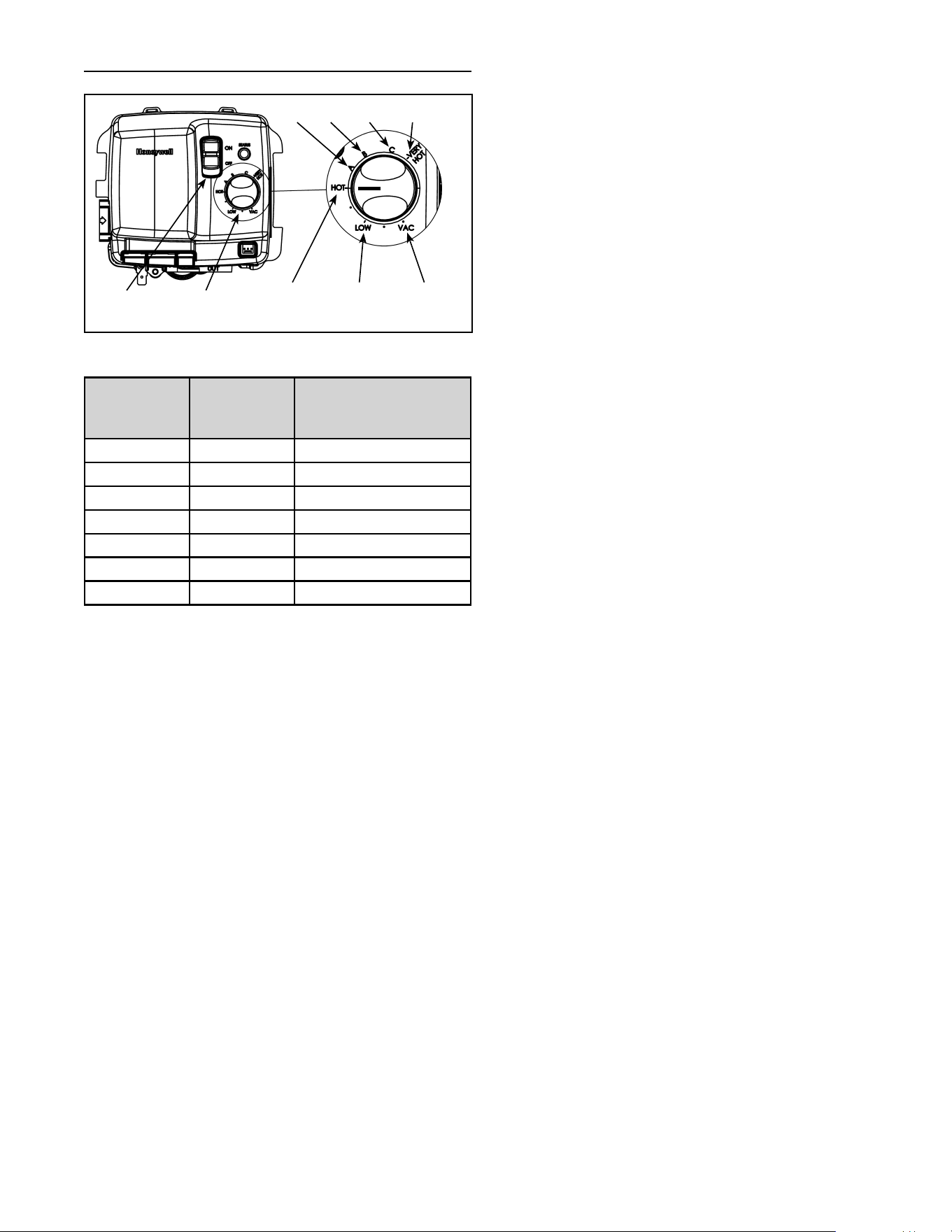
40 331602-001
GAS CONTROL VALVE/THERMOSTAT
ON/OFF
SWITCH
TEMPERATURE
SETTING DIAL
181°F
70°F
140°F 155°F 165°F
130°F 110°F
Figure 47
Temperature
Dial Setting
Approximate
Temperature
°F
Time to induce a 2nd
and 3rd Degree burn
to adult skin
VERY HOT 181 Less than 1 second
C 165 Less than 1 second
B 155 About 1.5 seconds
A 140 Less than 5 seconds
HOT 130 More than 30 seconds
LOW 110 Normal shower temp
VAC 70 N/A
Table 4
Note: The temperatures indicated are approximates. The
actual temperature of the heated water may vary.
The Vacation Setting (VAC) sets the controller at
approximately 70°F . This setting is recommended when
the water heater is not in use for a long period of time. This
effectively turns the controller temperature setting down to
a temperature that prevents the water in the water heater
from freezing while still conserving energy.
1331602-001 41
FOR YOUR INFORMATION
START UP CONDITIONS
Condensate
Whenever the water heater is fi lled with cold water, some
condensate will form while the burner is ON. A water
heater may appear to be leaking when in fact the water is
condensate. This usually happens when:
a. A new water heater is fi lled with cold water for the fi rst
time.
b. Burning gas produces water vapor in water heaters,
particularly high efficiency models where flue
temperatures are lower.
c. Large amounts of hot water are used in a short time
and the refi ll water in the tank is very cold.
Moisture from the products of combustion condense on
the cooler tank surfaces and form drops of water which
may fall onto the burner or other hot surfaces to produce
a “sizzling” or “frying” noise.
Because of the suddenness and amount of water,
condensate water maybe diagnosed as a “tank leak”.
After the water in the tank warms up (about 1-2 hours),
the condition should disappear.
Do not assume the water heater is leaking until there has
been enough time for the water in the tank to warm up.
An undersized water heater will cause more condensation.
The water heater must be sized properly to meet the
family’s demands for hot water including dishwashers,
washing machines and shower heads.
Excessive condensate maybe noticed during the
winter and early spring months when incoming water
temperatures are at their lowest.
Good venting is essential for a gas fi red water heater
to operate properly as well as to carry away products
of combustion and water vapor (see also “Condensate”
section).
Smoke/ odor
It is not uncommon to experience a small amount of smoke
and odor during the initial start-up. This is due to burning off
of oil from metal parts, and will disappear in a short while.
Strange sounds
Possible noises due to expansion and contraction of some
metal parts during periods of heat-up and cool-down do
not necessarily represent harmful or dangerous conditions.
Condensation causes sizzling and popping within the
burner area during heating and cooling periods and should
be considered normal. See “Condensate” section in this
manual.
OPERATIONAL CONDITIONS
Smelly water
Each water heater contains at least one anode rod for
corrosion protection of the tank. Certain water conditions
will cause a reaction between this rod and the water. The
most common complaint associated with the anode rod
is one of a “rotten egg smell” in the hot water. The smell
is a result of four factors which must all be present for the
odor to develop:
a. A concentration of sulfate in the supply water.
b. Little or no dissolved oxygen in the water.
c. A sulfate reducing bacteria which has accumulated
within the water heater (this harmless bacteria is
nontoxic to humans).
d. An excess of active hydrogen in the tank. This is caused
by the corrosion protective action of the anode.
Smelly water may be eliminated or reduced in some water
heater models by replacing the anode(s) with one of less
active material, and then chlorinating the water heater tank
and all water lines. Contact the local water heater supplier
or service agency for further information concerning an
Anode Replacement Kit and this chlorination treatment.
If the smelly water persists after the anode replacement
and chlorination treatment, we can only suggest that
chlorination or aeration of the water supply be considered
to eliminate the water problem.
Do not remove the anode leaving the tank unprotected.
By doing so, all warranty on the water heater tank is
voided.
“AIR” IN HOT-WATER FAUCETS
• Flammable hydrogen gases may
be present.
• Keep all ignition sources away
from faucet when turning on hot
water.
Explosion Hazard
WARNING
HYDROGEN GAS: Hydrogen gas can be produced in
a hot-water system that has not been used for a long
period of time (generally two weeks or more). Hydrogen
gas is extremely fl ammable and explosive. To prevent
the possibility of injury under these conditions, it is
recommended that the hot-water faucet, located farthest
away, be opened for several minutes before any electrical
appliances which are connected to the hot-water system
are used (such as a dishwasher or washing machine). If
hydrogen gas is present, there will probably be an unusual
sound similar to air escaping through the pipe as the hot-
water faucet is opened. There must be no smoking or open
fl ame near the faucet at the time it is open.
42 331602-001
PERIODIC MAINTENANCE
GENERAL UPKEEP
Make it a habit to look around the heater, the vent piping,
and the hot and cold water pipes. Do not allow any material
to be piled up against the heater. Do not place any object
on top of the vent pipes.
Every 3 - 6 months or as necessary:
• Clean lint from blower, top of heater.
Once per year:
• Inspect the Vent System.
• Burner Operation and Inspection.
• Combustion Chamber for scaling or sooting.
• Temperature-Pressure Relief Valve Test.
• Anode Rod Inspection.
• Flush a pail of water from the heater drain valve, once
per year.
If any defi ciencies or abnormalities are encountered during
these inspections call a qualifi ed service technician.
VENTING SYSTEM INSPECTION
Breathing carbon monoxide can cause brain damage or death.
Always read and understand instruction manual.
• Flue gases may escape if vent pipe is not properly
connected.
• Be alert for obstructed, sooted or deteriorated vent
system to avoid serious injury or death.
• Do not store corrosive chemicals in vicinity of water
heater.
• Chemical corrosion of flue and vent system can
cause serious injury or death.
• Analyze the entire vent system to make sure that
condensate will not become trapped in a section of
vent pipe and therefore reduce the open cross
sectional area of the vent.
Breathing Hazard - Carbon Monoxide Gas
WARNING
At least once a year a visual inspection should be made
of the venting system. You should look for:
• Obstructions which could cause improper venting. The
combustion, dilution and ventilation air fl ow must not
be obstructed.
• Damage or deterioration which could cause improper
venting or leakage of combustion products.
Be sure the vent piping is properly connected to prevent
escape of dangerous fl ue gasses which could cause
deadly asphyxiation.
Obstructions and deteriorated vent systems may present
serious health risk or asphyxiation.
Chemical vapor corrosion of the fl ue and vent system
may occur if air for combustion contains certain chemical
vapors. Spray can propellants, cleaning solvents,
refrigerator and air conditioner refrigerants, swimming pool
chemicals, calcium and sodium chloride, waxes, bleach
and process chemicals are typical compounds which are
potentially corrosive.
If after inspection of the vent system you found sooting or
deterioration, something is wrong. Call the local gas utility
to correct the problem and clean or replace the fl ue and
venting before resuming operation of the water heater.
BLOWER MAINTENANCE
Inspect the top of the heater and around the ventilation
openings of the blower motor and the rear blower dilution
air intakes for any lint and dust that may have accumulated.
Depending on the location of the heater, significant
quantities of lint may accumulate. The lint may obstruct
the free fl ow of air to the motor, and cause the motor and
blower to run hotter than normal (see Figure 48).
To clean any dust and lint, proceed as follows:
1. Unplug the water heater.
2. Using a nylon bristled paint or toothbrush, brush away
any lint. Pick up the lint with a cloth.
Better results can be achieved by using the small brush
on a vacuum cleaner to remove all lint and dust which
have accumulated on top of the heater, the louvres of the
air intake snorkel, the motor ventilation openings and the
rear blower dilution air intakes.
Important: Do not insert any foreign object into the
ventilation openings of the motor.
CLEANING THE BLOWER.
In dusty and contaminated air conditions, the interior of
the blower and the blower wheel may require periodic
cleaning. This is often indicated by nuisance failures of the
air pressure switch or the high limit temperature control.
A collection of dust or debris on the rear blower dilution
air intakes can also indicate reduced blower capacity. To
clean the inside of the blower assembly and the blower
wheel requires the removal of the blower/motor from the
mounting plate located on the top of the heater. Tools
required include an 11/32” nut driver, small (1”) paint brush,
toothbrush and vacuum cleaner.
1. Turn the thermostat on the gas control to the lowest
setting. If the heater is running, wait for it to shut down
(see Figure 47).
2. Turn the gas control switch to the “OFF” position.
3. Disconnect the electrical power to the water heater
from the wall outlet.
4. Disconnect the vent piping from the top of the blower.
Loosen the lower gear clamp that holds the rubber
coupling to the blower (see Figure 48).
5. Remove and retain the (4) 11/32” nuts located on the
back of the blower with the nutdriver (see Figure 41
& Figure 48).
6. Holding the blower motor and the blower housing,
pull the assembly forward to disengage it from the
mounting plate. The blower will still be connected to
the junction box so exercise care not to stress the
wiring.
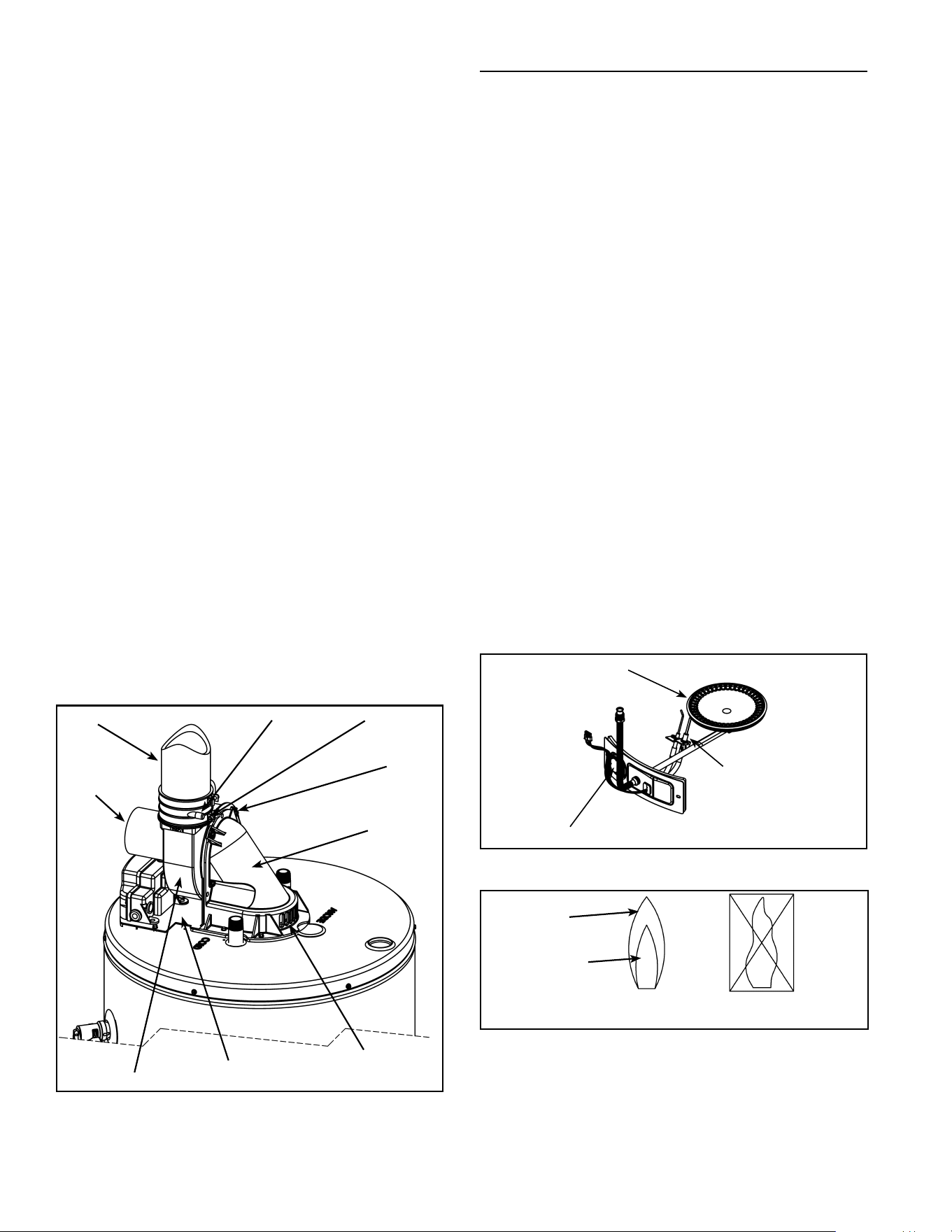
1331602-001 43
7. Accessing the blower wheel through the outlet, use
the paint brush to brush off the outer edge of the
blower wheel to dislodge any dirt stuck on the blades
and the inside of the housing. Rotate the wheel until
all blades are clear. Note: The wheel is a balanced
component. Do not bend, dent or distort the blades as
this can upset the wheel balance and affect the blower
operation. Vacuum out the loosened dirt.
8. Accessing the inside of the blower wheel through the
rear of the housing, gently brush off the inside of the
blades using the toothbrush. Again, take care not to
distort the blades. Rotate the wheel until all blades are
cleaned and vacuum the debris. Do not remove any
of the balancing chips attached to the blades.
9. Inspect the fl ue collector hood (still attached to the
heater) and vacuum out the dust and debris that may
have accumulated.
10. With all parts cleaned and the blower wheel turning
freely, reinstall the blower to the mounting plate
aligning the (4) studs and pushing tight against the
mounting plate.
11. Reinstall the (4) 11/32” nuts and tighten securely. All
(4) nuts must be in place and secure to safely operate
the blower.
12. Reattach the vent piping and coupling to the top of the
blower, tighten the bottom gear clamp and ensure the
piping is secure.
13. With all components clean and secure, reconnect the
electrical power to the heater.
14. Reset the thermostat to the desired temperature
setting and turn the gas control switch back to the
“ON” position. Note: If the water in the heater is hot,
the unit will wait to operate until there is a need for
more hot water.
BLOWER
DILUTION
AIR INTAKES
COUPLING
BLOWER
FLUE
COLLECTOR
HOOD
11/32”
NUTS
MOUNTING
PLATE
GEAR
CLAMP
VENT
PIPE
MOTOR
Figure 48
BURNER OPERATION AND INSPECTION
Flood damage to a water heater may not be readily visible
or immediately detectable. However, over a period of time
a fl ooded water heater will create dangerous conditions
which can cause death, serious bodily injury, or property
damage. Contact a qualifi ed installer or service agency to
replace a fl ooded water heater. Do not attempt to repair
the unit! It must be replaced!
At least once a year a visual inspection should be made of
the main burner and the hot surface igniter assembly for
proper fl ame characteristics and ignition sequences. This
can be done by removing the outer door and viewing the
main burner operation through the viewport on the inner
door (see Figure 49). The main burner should provide
complete combustion of gas, ignite rapidly, give reasonably
quiet operation, and cause no excessive fl ame lifting from
the burner ports. If the proper fl ame characteristics are
not evident (see Figure 50), make sure that the fl ow of
combustion and ventilation air is not blocked.
You should also check for sooting. Soot is not normal and
will impair proper combustion. A visual inspection of the
main burner and hot surface igniter should also be done
at least once a year (see Figure 49).
Soot build-up indicates a problem that requires correction
before further use. Turn “OFF” gas to water heater by
unplugging the power cord and leave off until repairs are
made. Failure to correct the cause of the sooting can result
in a fi re causing death, serious injury, or property damage.
VIEWPORT
MAIN
BURNER
IGNITER
AND
FLAME
ROD
Figure 49
CORRECT FLAME
SOFT BLUE
INCORRECT
FLAME LAZY
YELLOW
BLUE TIPS
LIGHT BLUE INNER
CONES ARE
SATISFACTORY
Figure 50
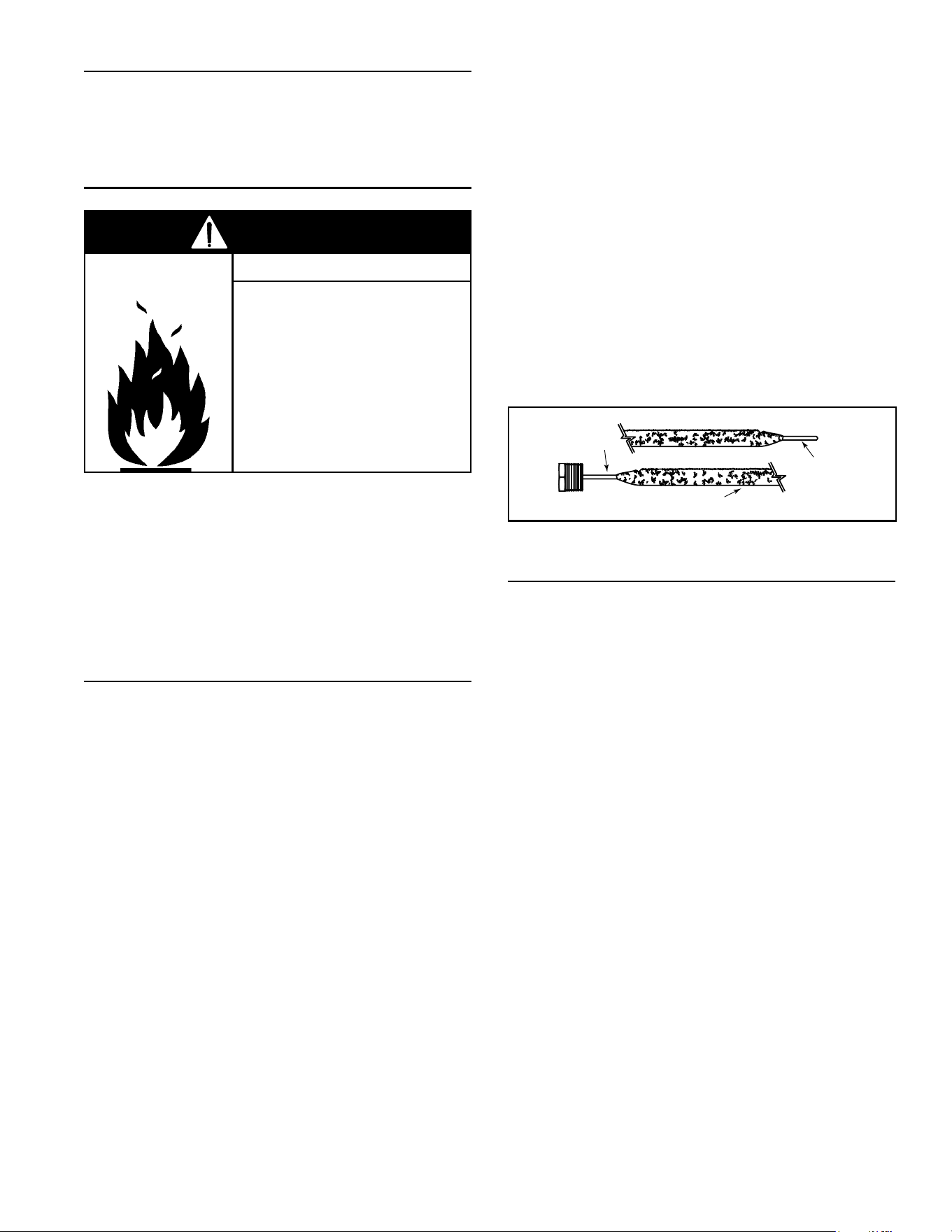
44 331602-001
COMBUSTION CHAMBER AND BURNER CLEANING
In the event your burner or burner air openings require
cleaning, Call your service agency to remove and clean
the burner and correct the problem that required the burner
to be cleaned.
HOUSEKEEPING
• Do not obstruct combustion air
openings at the rear of the water
heater.
• Do not use or store flammable
vapor products such as gaso-
line, solvents or adhesives in the
same room or area near water
heater or other appliance.
• Can cause serious injury or
death.
Fire and Explosion Hazard
DANGER
INSTALLED IN SUITABLE AREA:
To ensure sufficient ventilation and combustion air
supply, proper clearances from the water heater must
be maintained. See “Locating The New Water Heater”
section. Combustible materials such as clothing, cleaning
materials, or fl ammable liquids, etc. must not be placed
against or adjacent to the water heater which can cause
a fi re.
ANODE ROD INSPECTION
Each water heater contains at least one anode rod,
which will slowly deplete (due to electrolysis) prolonging
the life of the water heater by protecting the glass-lined
tank from corrosion. Adverse water quality, hotter water
temperatures, high hot water usage, hydronic heating
devices and water softening methods can increase the rate
of anode rod depletion. Once the anode rod is depleted,
the tank will start to corrode eventually developing a leak.
Certain water conditions will cause a reaction between the
anode rod and the water. The most common complaint
associated with the anode rod is a “rotten egg smell”
produced from the presence of hydrogen sulfi de gas
dissolved in the water. Important: Do not remove this
anode rod permanently as it will void any warranties.
A special anode rod may be available if water odor or
discoloration occurs. Note: This anode rod may reduce
but not eliminate water odor problems. The water supply
system may require special fi ltration equipment from a
water conditioning company to successfully eliminate all
water odor problems.
Artifi cially softened water can be exceedingly corrosive
because the process substitutes sodium ions for
magnesium and calcium ions. The use of a excessively
soft water may decrease the life of the water heater tank.
The anode rod should be inspected after a maximum of
three years and annually thereafter until the condition of
the anode rod dictates its replacement. Note: Artifi cially
softened water requires the anode rod to be inspected
annually.
The following are typical (but not all) signs of a depleted
anode rod:
• The majority of the anode rod’s diameter is less than
3/8 in. .
• Signifi cant sections of the support wire (approx. 1/3
or more of the anode rod’s length) are visible (see
Figure 51).
If the anode rod show signs of either or both it should be
replaced. Note: Whether re-installing or replacing the
anode rod, check for any leaks and immediately correct
if found.
EXPOSED
SUPPORT
WIRE
PITTED ANODE ROD
EXPOSED
SUPPORT
WIRE
Figure 51
ANODE ROD
Important: Use only factory authorized replacement parts.
If you lack the necessary skills to properly perform the
installation, you should not proceed, but get help from a
qualifi ed service technician.
• Tools required:
• Ratchet with 1-1/16” Socket
• Pliers
• Tefl on
®
Tape or an approved pipe sealant
Removing Anode Rod:
1. Set the gas control valve/thermostat to its lowest
setting by turning the knob counter-clockwise to
the VAC point (see Figure 47). If the water heater is
running, wait for it to shut down.
2. Turn gas control switch to the “OFF” position.
3. Disconnect the electrical power to the water heater
from the wall outlet.
4. Shut off the incoming water supply to the water heater
and open a nearby hot-water faucet to depressurize
the water tank.
5. Connect a hose to the drain valve and terminate it to
adequate drain or to the exterior of the building. Open
the drain valve and allow at least 5 gallons of water
to drain from the tank. Close drain and remove hose.
6. Remove the anode cap on top of the heater and
remove just enough insulation so you can access to
the anode head (see Figure 52). Keep the anode cap
in a safe place for reinstallation later.
7. Remove the anode rod by using a ratchet and a
1-1/16” socket turning counter-clockwise (see Figure
52).
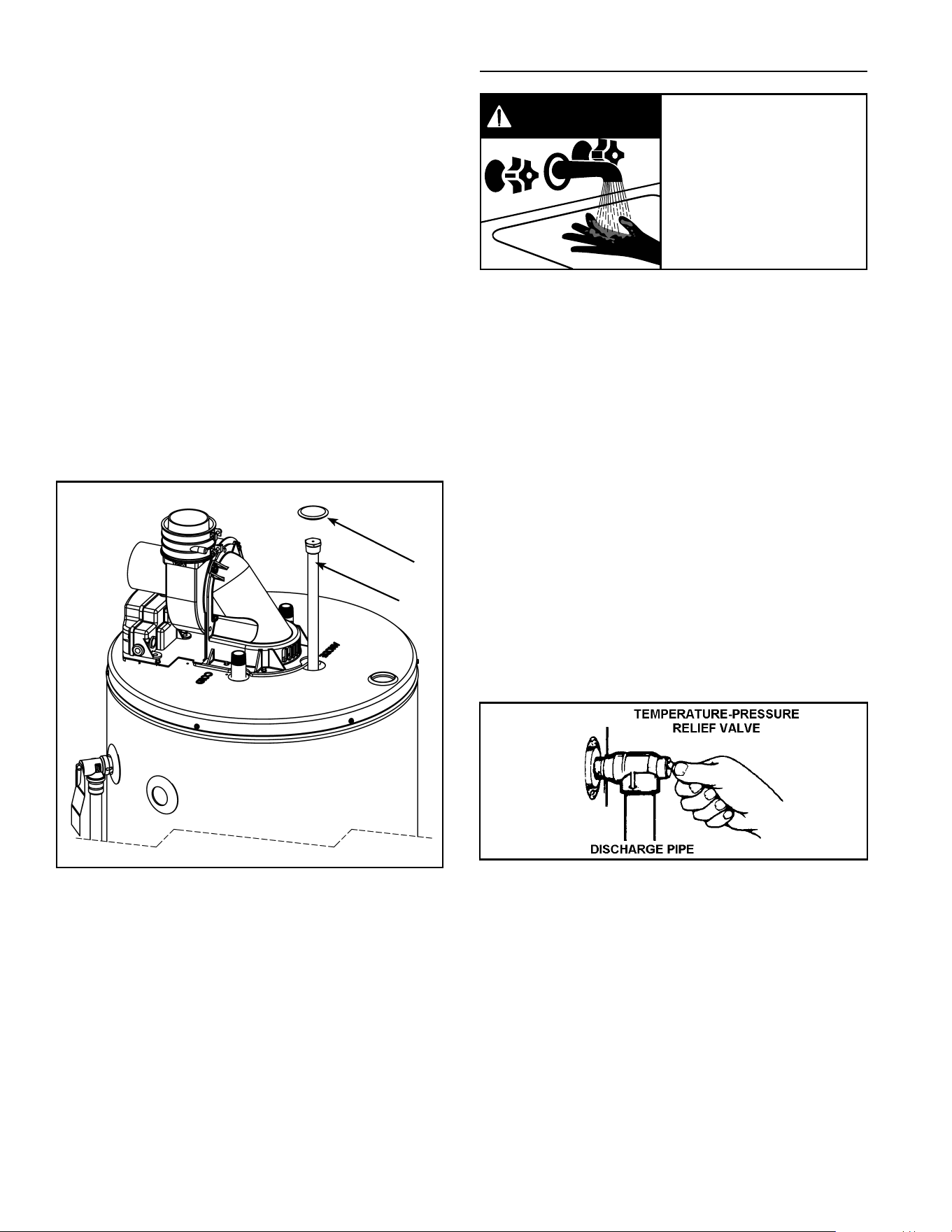
1331602-001 45
Installing Anode Rod:
1. Use Tefl on® tape or an approved pipe sealant on
threads of the new anode rod.
2. Place the anode rod in the spud (top of the tank) and
turn clockwise until the threads are hand tight. Using
a ratchet and 1-1/16” socket tighten down water tight.
3. Open a nearby hot-water faucet to purge air from the
water line. Open the incoming water supply and fi ll
water heater tank completely (Note: To assure the
water heater tank is full, keep the hot-water faucet
open for 3 minutes after a constant fl ow of water is
obtained).
4. Turning off the hot-water faucet, check for water
leaks around anode rod and immediately correct any
if found.
5. Reinstall the insulation and anode cap which were
removed in step 6 of removal instructions.
6. With all components clean and secure, reconnect the
electric power to the heater.
7. Reset the thermostat to the desired temperature
setting and turn the gas control switch back to the
“ON” position (see Figure 47).
CAP
ANODE ROD *
* THE ANODE ROD IS COVERED
BY URETHANE FOAM LOCATED
UNDER THE CAP. CHIP AWAY
THE FOAM TO EXPOSE THE
TOP OF THE ANODE ROD
Figure 52
TEMPERATURE-PRESSURE RELIEF VALVE TEST
• Burn hazard.
• Hot water discharge.
• Keep clear of
temperature-pressure
relief valve discharge.
BURN
HOT
HOT
DANGER
It is recommended that the temperature-pressure relief
valve be checked to ensure it is in operating condition at
least once a year.
When checking the temperature-pressure relief valve
operation, make sure that (1) no one is in front of or around
the outlet of the T&P valve discharge line, and (2) that
water discharge will not cause any property damage, as
water may be extremely hot. Use care when operating
valve as the valve may be hot.
To check the relief valve, lift lever at the end of valve
several times (see Figure 53). The valve should seat
properly and operate freely.
If after manually operating the valve, it fails to completely
reset and continues to release water, immediately close
the cold-water inlet to the water heater and drain the water
heater, see “Draining And Flushing” section. Replace
the T&P valve with a properly rated/sized new one, see
“Temperature-Pressure Relief Valve” for instructions on
replacement.
Figure 53
If the Temperature-Pressure Relief Valve on the water
heater weeps or discharges periodically, it may be due to
thermal expansion.
Note: Excessive water pressure is the most common
cause of temperature-pressure relief valve leakage.
Excessive water system pressure is most often caused
by “thermal expansion” in a “closed system.” See “Closed
Water Systems” and “Thermal Expansion” sections of this
manual. The T&P valve is not intended for the constant
relief of thermal expansion.
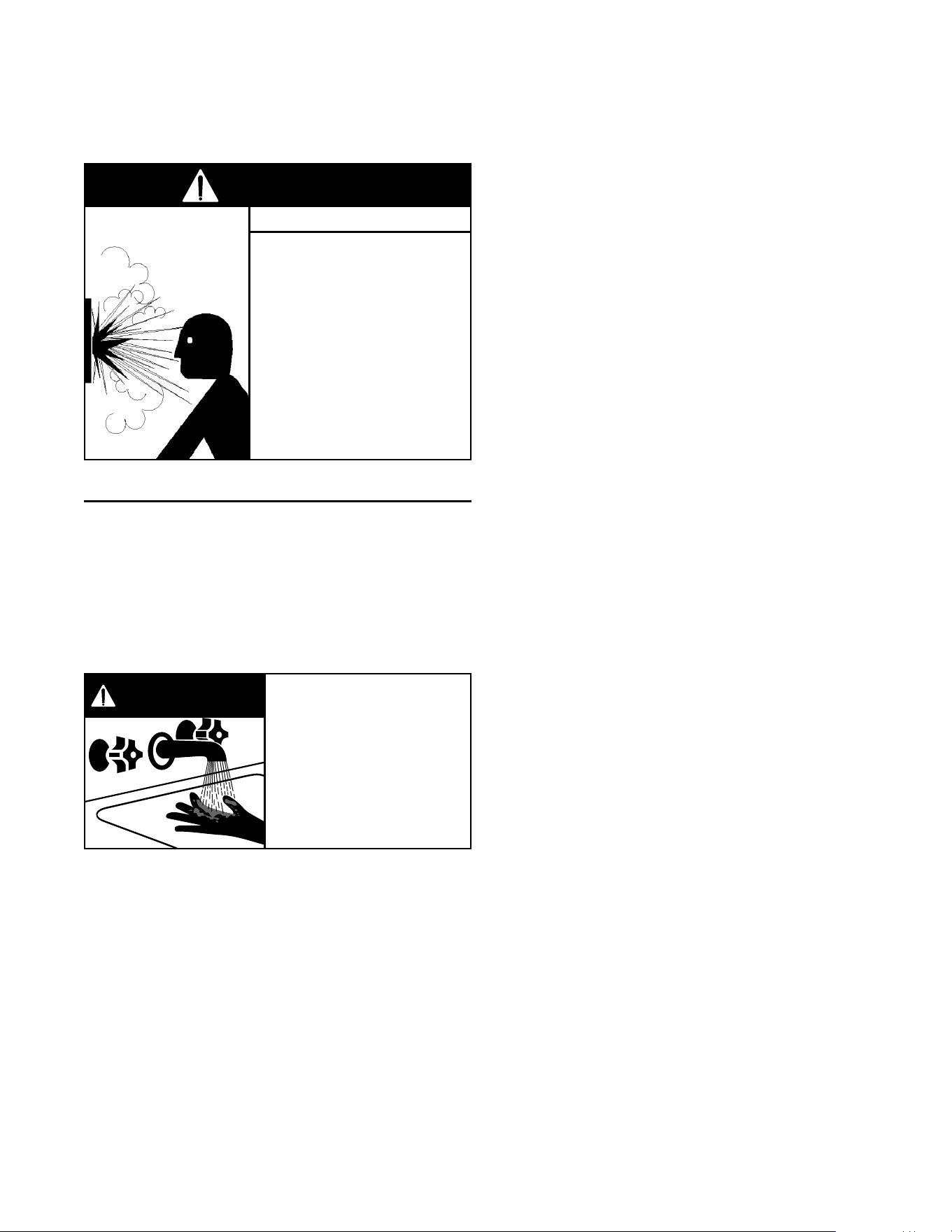
46 331602-001
Temperature-pressure relief valve leakage due to pressure
build up in a closed system that does not have a thermal
expansion tank installed is not covered under the Limited
Warranty. Thermal expansion tanks must be installed on
all closed water systems.
• Temperature-pressure relief
valve must comply with ANSI
Z21.22-CSA4.4 and ASME
code.
• Properly sized temperature-
pressure relief valve must be
installed in opening provided.
• Do not plug, block, or cap the
discharge line.
• Failure to follow this warning
can result in excessive tank
pressure, serious injury or
death.
Explosion Hazard
WARNING
DRAINING AND FLUSHING
Periodic draining and cleaning of sediment from the tank
maybe necessary. It is recommended that the tank be
drained and fl ushed every 6 months to remove sediment
which may build up during operation. The water heater
should be drained if being shut down during freezing
temperatures. See “Typical Installation” section in this
manual for location of the water heater components
described below.
• Burn hazard.
• Hot water discharge.
• Keep hands clear of drain
valve discharge.
BURN
HOT
HOT
DANGER
To drain the water heater storage tank:
1. Turn “OFF” the electrical supply to the water heater.
2. Turn “OFF” the gas supply at the Main Gas shut-off
Valve if the water heater is going to be shut down for
an extended period.
3. CLOSE the cold-water inlet valve to the water heater.
4. OPEN a nearby hot-water faucet and leave open to
allow for draining.
5. Connect a hose to the drain valve and terminate to
an adequate drain.
Note: If the water heater is going to be shut down and
drained for an extended period, the drain valve should be
left open with hose connected allowing water to terminate
to an adequate drain.
6. Close the water heater drain valve when all water in
the storage tank has drained.
7. Follow instructions in the “Filling The Water Heater”
section.
8. Turn “ON” the gas supply at the main gas shut-off
valve.
9. Follow the lighting instructions on the label or see
“Lighting Instructions” to restart the water heater.
To fl ush the water heater storage tank:
1. Turn “OFF” the electrical supply to the water heater.
2. Ensure the cold-water inlet valve is open.
3. Connect a hose to the drain valve and terminate it to
an adequate drain.
4. Ensure the drain hose is secured before and during the
entire fl ushing procedure. Flushing is performed with
system water pressure applied to the water heater.
5. Open the water heater drain valve to fl ush the storage
tank. Caution: Water will be hot.
6. Flush the water heater storage tank to remove
sediment and allow the water to fl ow until it runs clean.
7. Close the water heater drain valve when fl ushing is
completed.
8. Remove the drain hose.
9. Ensure the heater is full of water.
10. Turn “ON” electrical supply to place water heater back
in operation and follow the lighting instructions.
11. Allow the water heater to complete several heating
cycles to ensure it is operating properly.
Caution: Do not turn on power to the water heater unless
the tank is full. Open a hot-water faucet and allow the
water to run until the air is purged and the water fl ows
uninterrupted from the faucet.
Important: When operating a cold tank, condensation can
occur and drip on the burner. This should not be confused
with a tank leak.
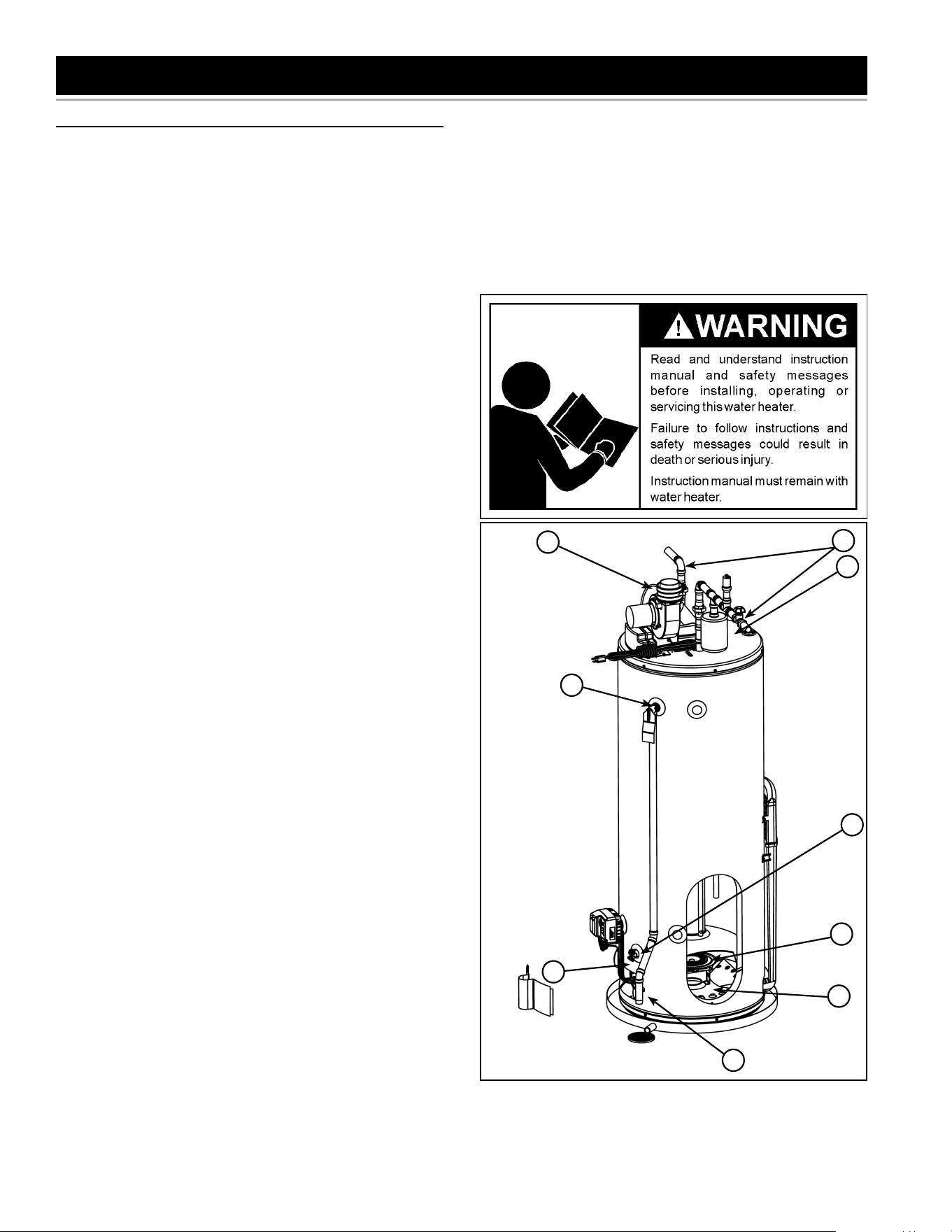
1331602-001 47
LEAKAGE CHECKPOINTS
SERVICE
If a condition persists or you are uncertain about the
operation of the water heater contact a service agency.
Use this guide to check a “leaking” water heater. Many
suspected “leakers” are not leaking tanks. Often the source
of the water can be found and corrected.
If you are not thoroughly familiar with gas codes, your
water heater and safety practices, contact your gas
supplier or qualifi ed installer to check the water heater.
Ensure the venting is properly attached and secured.
Never use this water heater unless it is completely fi lled
with water. To prevent damage to the tank, the tank must
be fi lled with water. Water must fl ow from the hot-water
faucet before turning “ON” gas to the water heater.
A. Water at the blower assembly is water vapor which
has condensed out of the combustion products. This
is caused by a problem in the vent. A drainage port is
included at the vent pipe connection. Contact the gas
utility.
B. *Condensation may be seen on pipes in humid weather
or pipe connections may be leaking.
C. *The anode rod fi tting may be leaking.
D. Small amounts of water from temperature-pressure
relief valve may be due to thermal expansion or high
water pressure in your area.
E. *The temperature-pressure relief valve may be leaking
at the tank fi tting.
F. Water from a drain valve may be due to the valve being
slightly opened.
G. *The drain valve may be leaking at the tank fi tting.
H. Combustion products contain water vapor which can
condense on the cooler surfaces of the tank. Droplets
form and drip onto the burner. This is common at the
time of start-up after installation and when incoming
water is cold.
I. Water in the water heater bottom may be from
condensation, loose connections, or the relief valve.
DO NOT replace the water heater until a full inspection
of all possible water sources is made and necessary
corrective steps taken.
Leakage from other appliances, water lines, or ground
seepage should also be checked.
* To check where threaded portion enters tank, insert
cotton swab between jacket opening and fi tting. If cotton
is wet, follow “Draining And Flushing” instructions in the
“Periodic Maintenance” section and then remove fi tting.
Put pipe dope or Tefl on tape on the threads and replace.
Then follow “Filling The Water Heater” instructions in
the “Installing The New Water Heater” section.
A
C
B
H
E
F
G
I
D
Figure 54
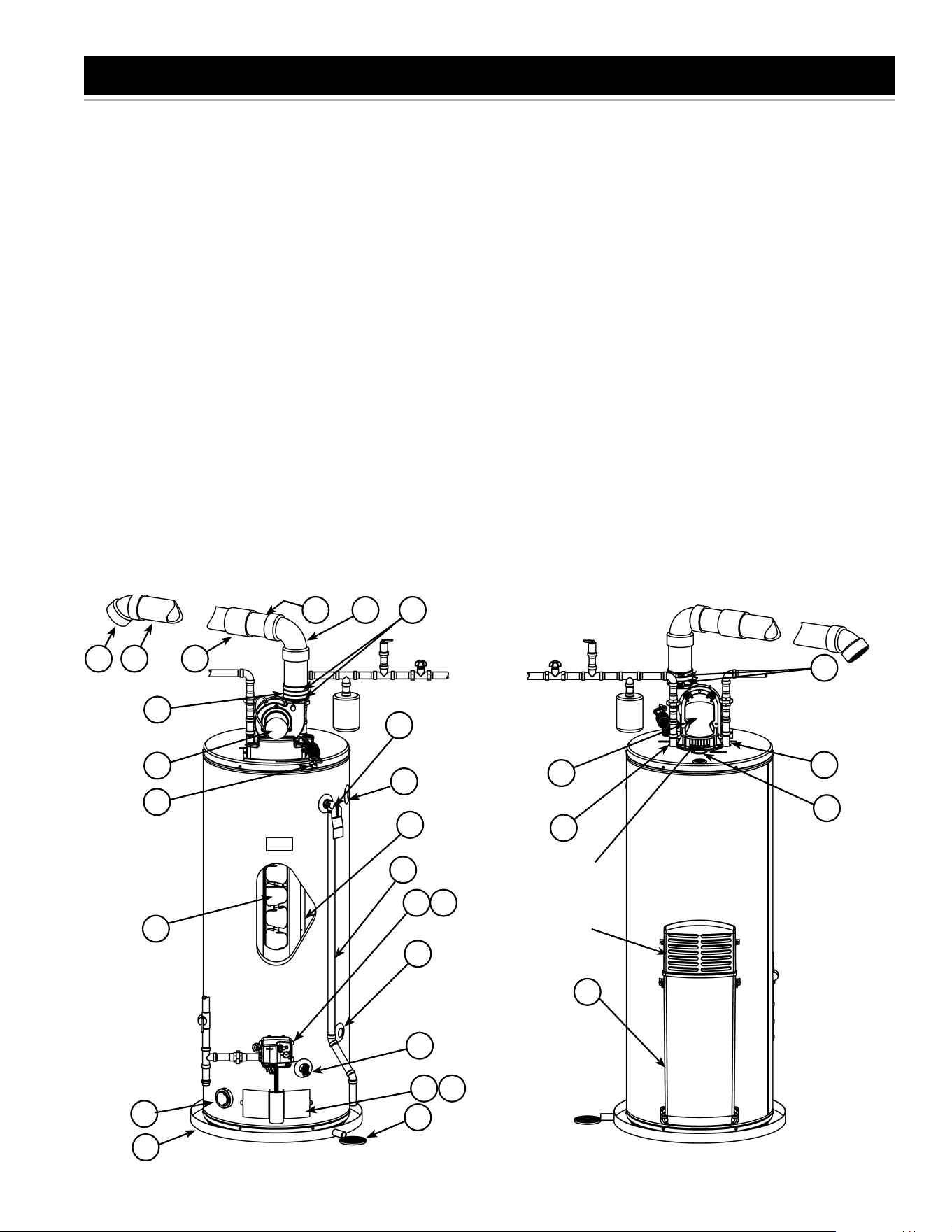
48 331602-001
REFERENCE PARTS LISTING
Replacement parts may be ordered
through your plumber or the local
distributor. When ordering replacement
parts, always have the following
information ready:
Model, Serial and Product number
Type of gas
Item number
Parts description
1 Vent Termination Elbow with Rodent
Screen
2 *Vent Pipe
3 *Vent Pipe Coupling (if required)
4 CPVC Vent Pipe (5 ft. supplied)
5 *CPVC Vent Pipe Elbow (long radius)
6 Gear Clamp (see Figure 6) (see also
Figure 60)
7 T&P Valve
8 **Combo Heating System Supply Outlet
(Optional)
9 Cold-Water Inlet Nipple/Diptube
10 * Discharge Pipe
11 Gas Control Valve/Thermostat
(Honeywell)
12 Gas Valve Electronic Control Module
And Cover (Honeywell)
13 **Combo Heating System Return Inlet
(Optional)
15 Drain Valve
16 Outer Gas Door
17 Manifold Door Assembly (behind outer
door) (see Figure 3 (NG) or Figure 4
(LP)) (see also Figure 57)
18 *Floor Drain
19 *Metal Drain Pan
20 Flammable Vapor Sensor (under
cover) (see Figure 5) (see also Figure
59)
26 Baffl e Assembly
28 Blower with Power Cord (see Figure 6)
29 *Rubber Coupling (see Figure 6) (see
also Figure 60)
32 Hot-Water Outlet Nipple
33 Anode (under cap)
34 Air Inlet Snorkel
35 Flue Collector
37 Aluminum Burner (see Figure 3) (see
also Figure 57)
38 Gas Orifi ce (see Figure 3) (see also
Figure 57)
39 Gas Manifold (see Figure 3) (see also
Figure 57)
40 Hot-Surface Igniter (see Figure 3) (see
also Figure 57)
41 Manifold Door Gasket (see
Figure 3) (see also Figure 57)
42 Manifold Door (see Figure 3) (see also
Figure 57)
43 Two Piece Grommet With Clip (see
Figure 3) (see also Figure 57)
44 Viewport (see Figure 3) (see also
Figure 57)
45 Flame Sensor Rod (see Figure 3) (see
also Figure 57)
46 Stainless Steel Burner (see
Figure 4) (see also Figure 58)
47 Air Switch (inside box) (see
Figure 6) (see also Figure 60)
48 Air Tubing (see Figure 6) (see also
Figure 60)
49 Blower High Limit Switch (see Figure
6) (see also Figure 60)
50 Junction Box Cover (see Figure 6) (see
also Figure 60)
* parts not supplied with the water heater
** The side recirculation loop connections
may not be used as the primary water
inlet and outlet connections. See “Combo
Heating Inlet And Outlet Side Taps”.
7
10
11
16
19
20
8
13
28
28
26
9
17
12
18
15
Figure 55
Front View
1 2
5
3
6
29
4
34
35
32
9
33
Combustion
Air Inlets
6
Blower
Dilution Air
Inlets
Figure 56
Rear View
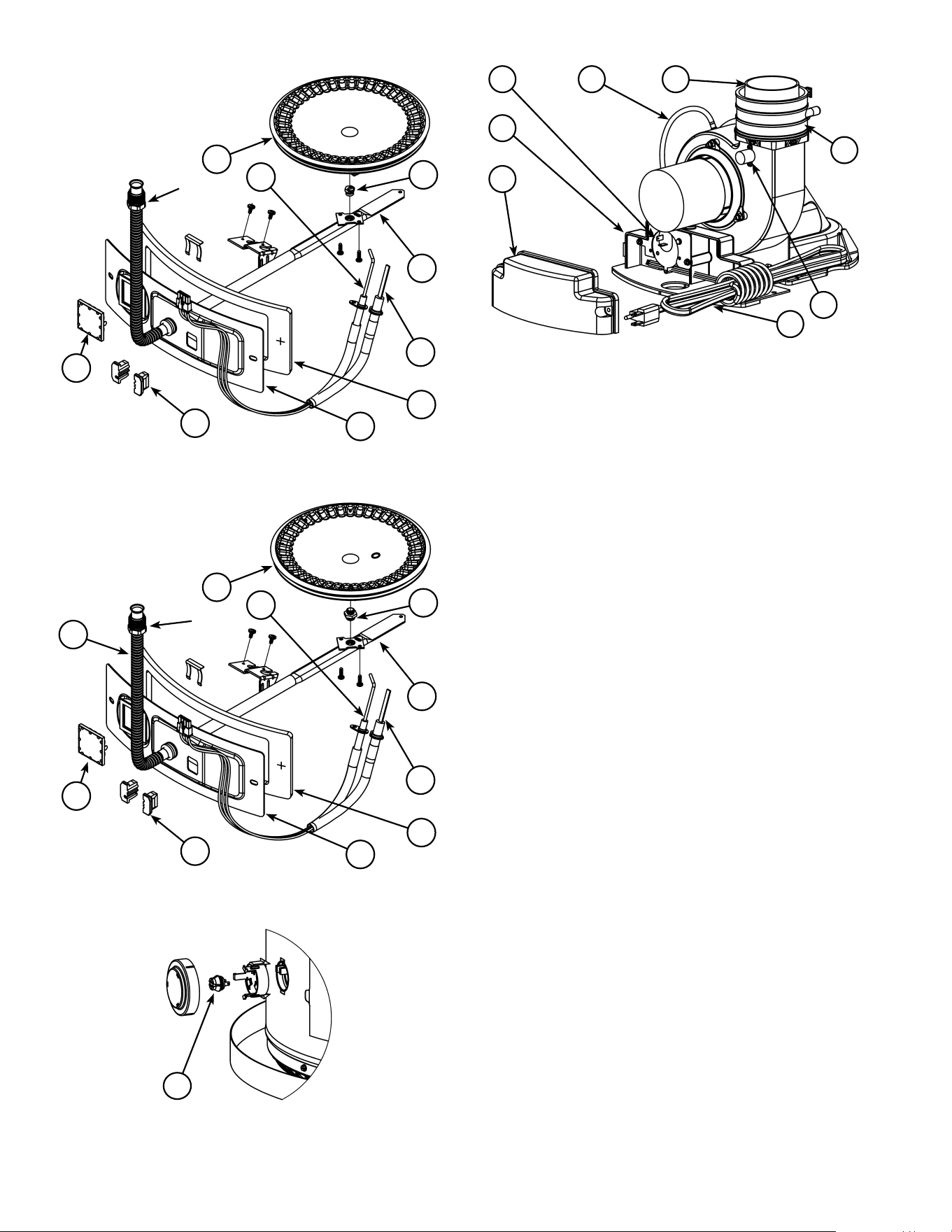
1331602-001 49
Natural gas main burner
with igniter assembly
(item 17 in Figure 55).
Flare
Nut †
42
44
40
37
39
41
38
45
43
Figure 57
Propane (LP) main burner
with igniter assembly
(item 17 in Figure 55).
Flare
Nut †
42
44
40
46
39
41
38
45
43
21
Figure 58
20
Figure 59
48
51
50
47
49
29
6
28
Figure 60
Note: † For Natural gas models the Flare Nut has Right-
hand thread. For Propane models the Flare Nut
has Left-hand thread.
50 331602-001
TROUBLESHOOTING GUIDELINES
These guidelines should be utilized by a qualifi ed service agent.
PROBLEM POSSIBLE CAUSE(S) CORRECTIVE ACTION
BURNER FLAME
TOO HIGH
1. Air inlets blocked
2. Insuffi cient secondary air
3. Orifi ce too large
1. Unblock inlet air openings
2. Provide ventilation to water heater
3. Replace with correct orifi ce
FLAME BURNS
AT ORIFICE
1. Low gas pressure
2. Defective gas control valve/thermostat
1. Check with gas utility company
2. Replace gas control valve/thermostat
INSUFFICIENT
HOT WATER
1. Low gas pressure
2. Orifi ce too small
3. Thermostat set too low
4. Gas control error codes
5. Sediment or lime in tank
6. Water heater too small
7. Wrong piping connections
8. Leaking faucets
9. Wasted hot water
10. Long runs of exposed piping
11. Hot-water piping in outside wall
1. Check with gas utility company
2. Replace with correct orifi ce (see rating
plate)
3. Turn temperature knob to higher setting
4. Refer to gas control error codes
5. Drain/fl ush-provide water treatment if
needed
6. Install adequate heater
7. Correct piping: dip tube must be in cold
inlet
8. Repair faucets
9. Advise customer
10. Insulate piping
11. Insulate piping
WATER IS TOO HOT
1. Thermostat is set too high
2. Defective gas control valve/thermostat
1. Turn temperature knob to lower setting
2. Replace the gas control valve/
thermostat
SLOW HOT WATER
RECOVERY
1. Insuffi cient air/ fl ue blockage
2. Low gas pressure
3. Orifi ce too small
4. Thermostat set too low
5. Heater too small
6. Wrong piping connection
7. Wasted hot water
8. Flue clogged
9. Air inlets blocked
1. Provide ventilation to water heater.
Check fl ue way, fl ue baffl e and burner
2. Check with gas utility company
3. Replace with correct orifi ce (see rating
plate)
4. Turn temperature knob to higher setting
5. Install adequate heater
6. Correct piping-dip tube must be in cold
inlet
7. Advise customer
8. Clean fl ue, locate source and correct
9. Unblock inlet air openings
DRIP FROM
RELIEF VALVE
1. Pressure build-up
2. Heater stacking
3. Closed water system
4. Improperly seated valve
1. Use a pressure-reducing valve and
relief valve
2. Lower the thermostat setting
3. See “Thermal Expansion” section
4. Check Relief valve for proper operation
(Do Not plug T&P valve)
GAS CONTROL VALVE/
THERMOSTAT FAILS TO
SHUT OFF
1. Defective gas control valve/thermostat 1. Replace gas control valve/thermostat
SMELLY WATER
1. Sulfi des in water supply
2. Bacteria in water supply
3. Incompatible anode
1. Chlorination procedure
2. Chlorination procedure
3. Replace with anode appropriate for
water conditions
1331602-001 51
PROBLEM POSSIBLE CAUSE(S) CORRECTIVE ACTION
CONDENSATION
1. Filling the new water heater for the fi rst
time
2. Moisture from the products of combustion
3. Water dripping from blower assembly
4. Undersized water heater
1. Normal operation: the condensation
should disappear after heater warms up
2. Normal operation: the condensation
should disappear in time
3. Install condensate hose to drain port on
the rubber coupling
4. Install adequate heater
COMBUSTION ODORS
1. Air inlets blocked
2. Insuffi cient air
3. Flue clogged
4. Heater installed in a confi ned area
5. House too tight
1. Unblock inlet air openings
2. Provide fresh air ventilation to the water
heater
3. Clean, locate source and correct
4. Provide fresh air ventilation to the water
heater
5. Provide fresh air ventilation to the water
heater
SMOKING AND CARBON
FORMATION
1. Air inlets blocked
2. Insuffi cient air
3. Low gas pressure
4. Orifi ce too large
5. Flue clogged
6. Defective gas control valve/thermostat
7. Heater installed in a confi ned area
1. Unblock inlet air openings
2. Provide ventilation to water heater.
Check fl ue way, fl ue baffl e and burner
3. Check with gas utility company
4. Replace with correct orifi ce (see rating
plate)
5. Clean, locate source and correct
6. Replace gas control valve/thermostat
7. Provide fresh air ventilation
UNABLE TO LIGHT
THE BURNER
1. Air in gas line
2. Pressure switch
3. Blocked exhaust
4. Wire connection
5. Defective gas control valve/thermostat
1. Purge the air from gas line
2. Check the pressure switch, make sure
the pressure switch hose is not kinked
3. Check vent pipe for blockage
4. Check wire connections
5. Replace the gas control valve/thermostat
SIZZLING, RUMBLING
NOISE
1. Scale and sediment
2. Condensation dripping on burner
1. Drain/fl ush-provide water treatment if
needed
2. Refer to “Condensate” section
WATER LEAKAGE
1. Condensation
2. Dripping Temperature & Pressure Relief
Valve
3. Drain valve dripping/leaking
4. Tank Leak
1. Refer to “Condensate” section
2. Refer to “Temperature-Pressure Relief
Valve” section
3. Back flush to clean- out sediment,
replace if necessary.
4. Check “Leakage Checkpoints”
BLOWER WILL
NOT START
1. No power to unit
2. Thermostat set too low
3. Defective air pressure switch
4. Defective blower
5. Disconnected or loose wire
6. Control locked out
1. Plug in power cord, check fuses and/or
supply voltage
2. Turn temperature knob to higher setting
3. Replace air pressure switch
4. Replace blower
5. Repair and reconnect wires
6. Refer to “Resetting The Heater Control”
– determine cause of lockout
52 331602-001
PROBLEM POSSIBLE CAUSE(S) CORRECTIVE ACTION
BLOWER RUNS
CONTINUOUSLY
1. Air pressure switch not closing due to
insuffi cient draft – check for:
a. Vent piping blocked
b. Piping length too long
c. Clogged/dirty blower
2. Disconnected, torn or blocked pressure
switch hose from air pressure switch to
blower housing
3. Defective pressure switch
4. High limit switch open due to excessive
vent temperature or defective switch
1. Determine cause of insuffi cient draft.
Check draft with manometer at pressure
switch
a. Remove blockage
b. Reduce vent length/increase vent
size
c. Clean blower wheel
2. Reconnect or replace pressure switch
hose
3. Replace defective pressure switch
4. Determine cause of overheating check
for: overfi ring, insuffi cient air supply, high
ambient air temperature
HOT SURFACE IGNITER
NOT GLOWING
FOLLOWING WARM-UP
PERIOD
1. 120VAC polarity reversed at 120VAC
outlet receptacle
2. Defective hot surface igniter
3. Defective gas control valve/thermostat
1. Reverse polarity at 120VAC outlet
receptacle
2. Replace igniter
3. Replace gas control valve/thermostat
VENT PIPE TOO HOT
1. Blower high limit switch fails to open -
switch defective
2. Not enough dilution air to mix with fl ue
gases
3. Air in room too hot for mixing with fl ue
gases
4. Wrong burner orifi ce
1. Replace blower high limit switch
2. Proper air circulation must be provided
for combustion and dilution of fl ue temp
3. Increase ventilation to lower room
temperature
4. Install correct orifi ce.
331602-001 53
RESETTING THE HEATER CONTROL
• Soft lockouts as diagnosed by the system error codes
require the gas control to be reset.
• To reset the control, slide the “ON/OFF” switch to the
“OFF” position. Wait for 10 seconds and move the
switch back to the “ON” position.
• If the problem that caused the control to lock out has
not been corrected, the control will remain or again go
back into lockout.
LOCKOUTS
Soft Lockout
• occurs when a system safety device trips to break the
sequence of operation. The control will retry the system
in a timed basis but will not reinstate operation until the
failure is corrected.
Hard Lockout
• occurs when the main controller fails and must be
replaced.
The gas control valve\thermostat includes a temperature
limiting ECO (Energy Cut Off) system that will shut off the
water heater if the water temperature is too high.
Should the water temperature get too high, the diagnostic
status light will indicate a code (4 fl ashes), indicating an
over-temperature condition and the main burner will be
shut off. If a high temperature condition occurs, turn the
main gas supply OFF and have the water heater repaired
by a qualifi ed service technician. Contact your local dealer
for service information.
Note: Should an over-temperature condition occur, restart
the water heater and verify the LED fl ash sequence. If the
4 fl ash sequence is observed, slide the “ON/OFF” switch to
the “OFF” position. Turn Main Gas Supply “OFF”. Replace
the gas control valve\thermostat.
IGNITION STATE AND TIMING
IGNITION STATE TIMING
Pre-purge
5 seconds (NG models)
15 seconds (LP models)
Hot Surface Igniter
(HSI) Warmup
10 seconds
Ignition Activation
Period (IAP)
3.5 seconds maximum
Flame Recognition
Period (FRP)
0.5 second
Trial For Ignition IAP + FRP
Flame Stabilization
Period
Not Applicable
Inter-purge 30 seconds
Flame Failure
Response Time
2 seconds max
(@ 1uA fl ame current)
Post-purge 30 seconds
Pressure Switch (PS)
Prove Period
2 minutes
Pressure Switch (PS)
Fault Delay (failed
open/closed)
2 minutes
Soft Lockout 20 minutes
Energy Cut Off
(ECO) Limit Lockout
Indefi nite
Flammable Vapor
(FV) Sensor Lockout
Indefi nite (see “Resetting The
Heater Control”)
54 331602-001
SYSTEM STATUS AND ERROR CODES
The micro-controller inside the gas control monitors the fl ammable vapor safety features, the ignition sequence,
temperature settings and overall operation of the heater. If any of these parameters does not operate properly the
controller will shut down the water heater, diagnose the failure and fl ash an error code. The table below lists the System
Status Codes for the Honeywell control. Refer to it and to the “Troubleshooting Guidelines” to diagnose the problem
before attempting corrective action. See also “Flammable Vapor Sensor”.
LED Flash Sequence Control Status
Corrective
Action
Number
Short fl ash once every four seconds IDLE (no call for heat, no fault conditions) 1
“Heartbeat”, alternates bright/dim Call For Heat (no fault conditions) 2
One Flash, three second pause Low Flame Signal (control continues to operate) 3
Two Flash, three second pause Pressure Switch Failed Closed 4
Three Flash, three second pause Pressure Switch Failed Open 5
Four Flash, three second pause
ECO (Energy Cut Off) Limit Lockout
thermostat temperature limit was exceeded.
6
Five Flash, three second pause Flame Out Of Sequence 7
Six-One Flash, three second pause
Soft Lockout
- Retry Limit
- Failed Trial For Ignition
8
Six-Two Flash, three second pause
Soft Lockout
- Recycle Limit
- Pressure Switch/ High Limit opened
9
Six-Three Flash, three second pause
Soft Lockout
- Recycle Limit
- Flame Lost
10
Six-Four Flash, three second pause
Soft Lockout
- Flame out of Sequence Sensed
11
Seven Flash, three second pause N/A (Flammable Vapor Sensor Lockout) 12
Eight-One Flash, three second pause N/A (Flammable Vapor Sensor Fault Detected) 13
Eight-Two Flash, three second pause Temperature Sensor Fault Detected 14
Eight-Three Flash, three second pause Electronics Fault Detected 15
Eight-Four Flash, three second pause Valve Fault Detected 16
LED continuously “ON” Hard Lockout 17
READING THE LED FLASH SEQUENCE.
The LED indicator light is active when the gas valve/thermostat is in operation. The light will normally show a fl ash
sequence of a short fl ash once every four seconds or a “Heartbeat” of alternating bright/dim. Multiple fl ash codes indicate
an error and can be read as follows:
Example: Corrective Action Number 9, Six-Two Flash, three second pause. For this code, the LED indicator light will
make six bright fl ashes, pause for one second and then make two more bright fl ashes. The LED will pause for three
seconds and repeat the six-two cycle of fl ashes.
1331602-001 55
Corrective
Action
Number
Corrective Action
1 Normal operation, no action necessary.
2
Normal operation, no action necessary.
3
1. Flame rod not properly seated in flame, reposition rod.
2. Clean flame sensor rod with fine steel wood to avoid lock-out.
4
1. Check that blower operates and does not have any blockages.
2. Check that all wiring is correct.
3. Ensure the air pressure sensing tubes are properly connected and not kinked or damaged.
4. Ensure the air pressure switch is correct and the air pressure switch (N.O.) is not bypassed
(jumpered).
5. Turn power to the unit “OFF” – check for continuity of the air pressure switch (N.O.) with wires
disconnected;
a. If the pressure switch contacts show continuity (closed circuit), replace the pressure switch,
b. If the pressure switch contacts are open and all wiring is correct, replace the Gas Control.
5
1. Ensure the blower is running - check for 120 VAC to the blower when the heating cycle begins.
a. If the Gas Control does not energize the blower - replace the Gas Control.
b. If the blower fails to start when energized:
i. Turn power to the heater “OFF” – check if the capacitor is connected;
ii. Turn power to the heater “OFF” – check the capacitor rating ( 3uF +/-5%);
iii. Turn power to the heater “OFF” - replace the blower assembly.
2. Ensure the air pressure sensing tubes are properly connected and not kinked or damaged;
3. Check continuity of the vent temperature limit switch – replace switch if contact remain open.
4. Check continuity of the air pressure switch (N.C.) – replace switch if contact remain open.
5. Ensure the correct size of exhaust and air intake pipes were used per the instruction manual
for vent length. Ensure maximum number of elbows or equivalent feet of both pipes was not
exceeded.
6. Ensure there are no obstructions in the exhaust and air intake pipes.
7. If there are excessive restrictions in the air intake pipe the air pressure switch (N.C.) will open.
8. Check air pressure switch performance - Check blower vacuum with a manometer - Compare
with air pressure switch (N.O.) setting. If the air pressure switch proves defective – replace the air
pressure switch (N.O.).
9. If the air pressure switch (N.O.) performance test results prove the air pressure switch is working
properly, and all other steps are followed, and fault code persist – replace the control.
6
Resetting the ECO (Energy Cut-Out) requires manual intervention. It cannot be reset by cycling power
to the control.
Reset Procedure
1. Manual reset is performed by turning the set point knob to lowest set point position for a minimum
of 10 seconds and then return it to the desired set point.
2. The manual reset of the ECO can only be performed 2 times, after the ECO trips a third time, the
gas valve will enter a hard lock out where the gas control will need to be replaced.
7
1. Turn the power “OFF” for 10-20 seconds then “ON” again to clear the fault code.
2. Flame rod not properly seated in flame, reposition rod.
3. Clean flame sensor rod with fine steel wood to avoid lock-out.
4. Replace the control if the fault code persists.
56 331602-001
Corrective
Action
Number
Corrective Action
8
1. Gas supply is turned off or gas pressure is too low. Ensure supply pressure and manifold gas
pressures are within requirements. Manifold pressure is nonadjustable, if gas supply pressure
proves correct and manifold pressure is off by more than 0.3” WC replace the control.
2. Low supply voltage - should be 115 - 125 VAC
3. Ensure flame sensor is making good contact with the burner flame and flame is steady.
4. Ensure flame sensor is clean, use ultra- fine steel wool to clean flame sensor.
5. Ensure the Hot Surface Igniter is positioned properly to provide consistent ignition.
6. Check for any cracks in igniter assembly ceramic insulators - replace igniter assembly if damaged.
7. Check resistance of igniter at room temperature (at the plug). Replace the igniter if resistance is
not within 42-76 ohms at room temperature.
8. Ensure correct size of exhaust and air intake pipes were used per the instruction manual for vent
length. Ensure maximum number of elbows or equivalent feet of both pipes was not exceeded.
9
1. Ensure the blower is running - check for 120 VAC to the blower when the heating cycle begins.
a. If the Gas Control does not energize the blower - replace the Gas Control.
b. If the blower fails to start when energized:
i. Turn power to the unit “OFF” – check if the capacitor is connected;
ii. Turn power to the unit “OFF” – check the capacitor rating ( 3uF +/-5%);
iii. Turn power to the unit “OFF” - replace the blower assembly.
2. Ensure the air pressure sensing tubes are properly connected and not kinked or damaged;
3. Check continuity of the vent temperature limit switch – replace switch if contacts remain open.
4. Check continuity of the air pressure switch (N.C.) – replace switch if contacts remain open.
5. Ensure correct size of exhaust and air intake pipes were used per the instruction manual for vent
length. Ensure maximum number of elbows or equivalent feet of both pipes was not exceeded.
6. Ensure there are no obstructions in the exhaust and air intake pipes.
7. If there are excessive restrictions in the air intake pipe the air pressure switch (N.C.) will open.
8. Check air pressure switch performance - Check blower vacuum with a manometer - Compare
with air pressure switch (N.O.) setting. If the air pressure switch proves defective – replace the air
pressure switch (N.O.).
9. If the air pressure switch (N.O.) performance test results prove the air pressure switch is working
properly, and all other steps are followed, and fault code persist – replace the control.
10
1. Gas supply is turned “OFF” or gas pressure is too low. Ensure supply pressure and manifold gas
pressures are within requirements. Manifold pressure is nonadjustable. If supply pressure proves
correct and manifold, pressure is off by more than 0.3” WC replace the control.
2. Low supply voltage - should be 115 - 125 VAC
3. Ensure flame sensor is making good contact with the burner flame and flame is steady.
4. Ensure the flame sensor is clean, use ultra-fine steel wool to clean flame sensor.
5. Ensure the Hot Surface Igniter is positioned properly to provide consistent ignition.
6. Check for any cracks in igniter assembly ceramic insulators - replace igniter assembly if damaged.
7. Check resistance of igniter at room temperature (at the plug). Replace the igniter if resistance is
not within 42-76 ohms at room temperature.
8. Ensure correct size of exhaust and air intake pipes were used per the instruction manual for vent
length. Ensure maximum number of elbows or equivalent feet of both pipes was not exceeded.
11
1. Turn the power “OFF” for 10-20 seconds then “ON” again to clear the fault code.
2. Replace the control if fault code persists.
12 N/A – If this happens replace the gas control.
13 N/A – If this happens replace the gas control.
14
1. Turn the power “OFF” for 10-20 seconds then “ON” again to clear the fault code.
2. Replace the control if the fault code persist.
15
1. Turn the power “OFF” for 10-20 seconds then “ON” again to clear the fault code.
2. Replace the control if the fault code persist.
16
1. Turn the power “OFF” for 10-20 seconds then “ON” again to clear the fault code.
2. Replace the control if the fault code persist.
17 1. Control has failed. If resetting the control does not clear the fault code, replace the control.

1331602-001 57
NOTES

58 331602-001
NOTES

331602-001 59
NOTES

500 Tennessee Waltz Parkway,
Ashland City, TN 37015
• Technical Support: 800-527-1953
• Parts: 800-433-2545
• Fax: 800-644-9306
www.hotwater.com
Copyright © 2013 A. O. Smith Corporation. All rights reserved.