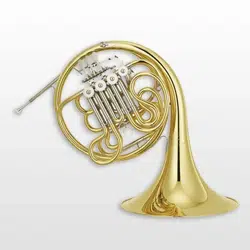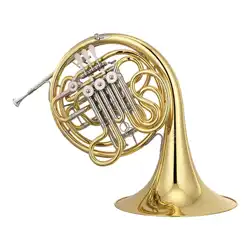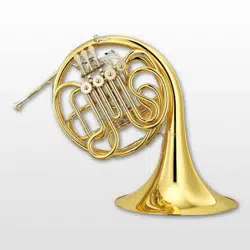
ホルン
取扱説明書
French Horn
Owner’s Manual
Waldhorn
Benutzerhandbuch
Cor
Mode d’emploi
Trompa
Manual de instrucciones
Trompa Francesa
Manual do Proprietário
圆号
使用说明书
Валторна
Руководство пользователя
호른
사용설명서
法國號
使用說明書
JA EN DE FR ES PT ZH-CN RU KO ZH-TW
日本語
EnglishDeutschFrançaisEspañol
简体中文繁體中文
Русский
한국어
Português

2
P. 3
야마하 악기를 구입해 주셔서 감사합니다 . 악기의 알맞은 조립 방법 및 보관을 위해 본
사용설명서를 반드시 읽어주시기 바랍니다 .
このたびは、ヤマハ管楽器をお買い上げいただき、まことにありがとうございます。
楽器を正しく組み立て性能をフルに発揮させるため、また永く良い状態で楽器をお
使いいただくために、この取扱説明書をよくお読みください。
P. 3
You are now the owner of a high quality musical instrument. Thank you for choos-
ing Yamaha. For instructions on the proper assembly of the instrument, and how to
keep the instrument in optimum condition for as long as possible, we urge you to
read this Owner’s Manual thoroughly.
P. 3
Sie sind nun der stolze Besitzer eines hochwertigen Musikinstruments. Vielen Dank, dass Sie sich
für ein Instrument der Marke Yamaha entschiedenen haben. Um mit den Handgrien zum Zusam-
mensetzen und Zerlegen des Instruments vertraut zu werden und dieses über Jahre hinweg in
op
timalem Zustand halten zu können, raten wir Ihnen, diese Anleitung aufmerksam durchzulesen.
P. 3
Vous êtes dès à présent le propriétaire d’un instrument de musique de haute qualité. Nous vous
remercions d’avoir choisi Yamaha. En ce qui concerne les instructions relatives à un assemblage adé-
quat de l’instrument et sur la façon de garder l’instrument dans des conditions optimales aussi long-
temps que possible, nous vous conseillons vivement de lire entièrement le présent Mode d’emploi.
P. 3
P. 3
Usted es ahora propietario de un instrumento musical de alta calidad. Le agradecemos su
elección de un instrumento Yamaha. Le aconsejamos que lea todo este manual de instruc-
ciones para ver las instrucciones para el montaje correcto del instrumento y para aprender
a co
nservar el instrumento en óptimas condiciones durante tanto tiempo como sea posible.
Agora você é o proprietário de um instrumento musical de alta qualidade. Obrigado
pela sua escolha de um instrumento Yamaha. Para instruções da montagem correta
do instrumento, e de como conservar o instrumento em condições ideais pelo maior
tempo possível, pedimos que você leia este Manual do Proprietário por completo.
P. 3
P. 3
现在您已经是高品质乐器的主人了!感谢您选择 Yamaha 乐器。有关如
何正确地安装乐器以及使乐器尽可能长久地处于最佳状况的说明,请完
整地阅读该使用说明书。
感謝您選擇 Yamaha 購買優質樂器。如需瞭解如何正確組裝樂器,
以及如何讓樂器盡可能長時間保持最佳狀態,強烈建議您詳閱本使用
說明書。
P. 3
P. 3
Вы стали обладателем высококачественного музыкального инструмента. Благо-
дарим вас за выбор продукции Yamaha. Для получения инструкций по правильной
сб
орке данного инструмента и его длительном хранении в оптимальных условиях
мы настоятельно рекомендуем вам внимательно прочитать настоящее руководство.
3
French Horn
Owner’s Manual
Precautions
Please read before using
■
About the Icons
: This icon indicates points which should be paid
attention to.
: This icon indicates actions that are prohibited.
Caution
Do not throw or swing the instrument.
The mouthpiece or other parts may fall o hitting
other people. Always treat the instrument gently.
Keep the oil, polish, etc., out of chil-
dren’s mouths.
Keep the oil, polish, etc., out of children’s reach and
do maintenance when children are not present.
Keep small parts out of the reach of
infants.
Your children may accidentally swallow them.
NOTICE
• Be aware of climatic conditions such as
temperature, humidity, etc.
Keep the instrument away from heat sources
such as heaters, etc. Also, do not use or store
the instrument in any extreme conditions of
temperature or humidity. Doing so may result in
damage to key balance, linkage, or pads, resulting
in problems during performance.
• Never use benzene or thinner for mainte-
nance on instruments with a lacquer nish.
Doing so may result in damage to the nish’s top coat.
• Take care not to disgure the instrument.
Placing the instrument where it is unstable may
cause the instrument to fall or drop resulting in
disgurement. Take care as to where and how you
place the instrument.
• Do not modify the instrument.
Besides voiding the warranty, modication of the
instrument may make repairs impossible.
The precautions given below concern the proper and safe use of the instru-
ment, and are to protect you and others from any damage or injuries. Please
follow and obey these precautions.
If children are using the instrument, a guardian should clearly explain these precautions to the
child and make sure they are fully understood and obeyed. After reading this manual, please
keep it in a safe place for future reference.
Disobeying the points indicated with this
mark may lead to injury.
In regards to brass instruments with a plate nish, the color of the nish may change
over time however, it should be of no concern in regards to the instrument’s perfor-
mance. Discoloration in its early stage can easily be removed with maintenance. (As
discoloration progresses, it may be dicult to remove.)
* Please use the accessories that are specied for use with the particular type of nish found on the instru-
ment. Also, metal polishes remove a thin layer of the nish’s top coat which will make the nish thinner.
Please be aware of this before using polish.
4
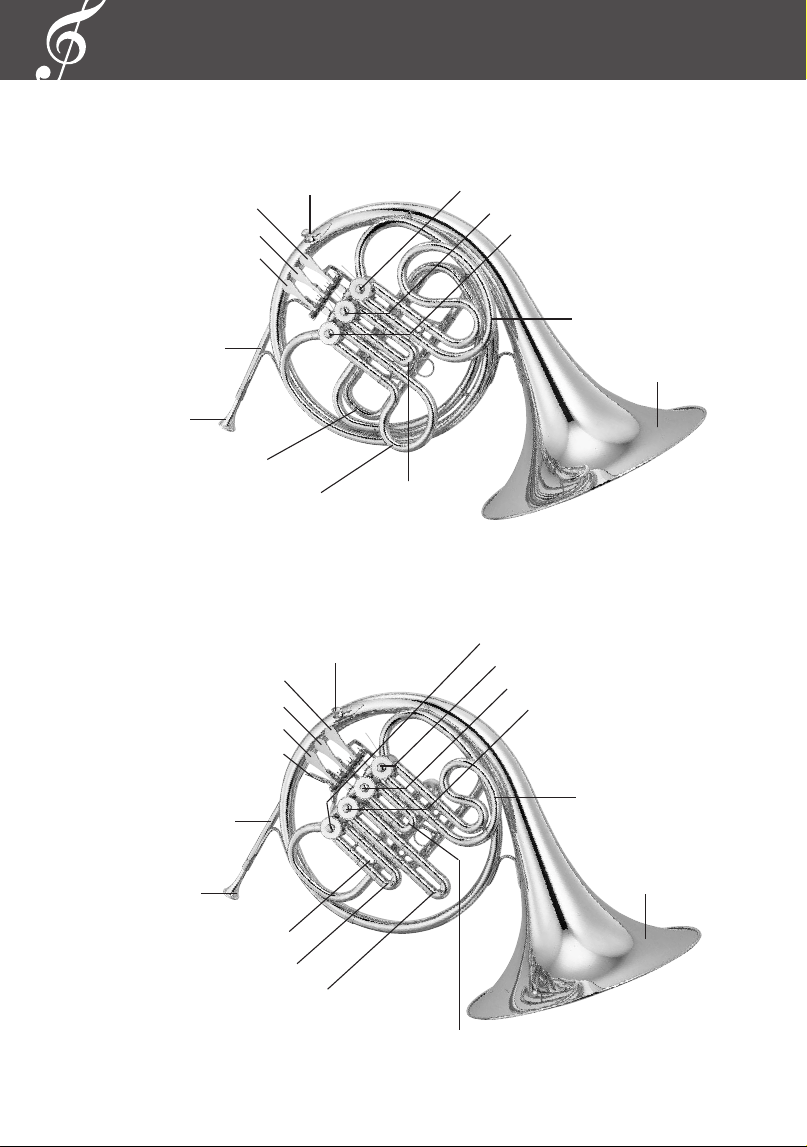
Nomenclature
■
F Single Horn
■
B
b
Single Horn
Mouthpiece
Mouthpipe
1st Lever
2nd Lever
3rd Lever
Finger Hook
3rd Valve
2nd Valve
1st Valve
3rd Valve Slide
Bell
2nd Valve
Slide
1st Valve Slide
Main Tuning Slide
Mouthpiece
Mouthpipe
4th Lever
1st Lever
2nd Lever
3rd Lever
Finger Hook
4th Valve
3rd Valve
2nd Valve
1st Valve
3rd Valve Slide
Bell
2nd Valve Slide
1st Valve Slide
4th Valve Slide
Main Tuning Slide (Back side)
5
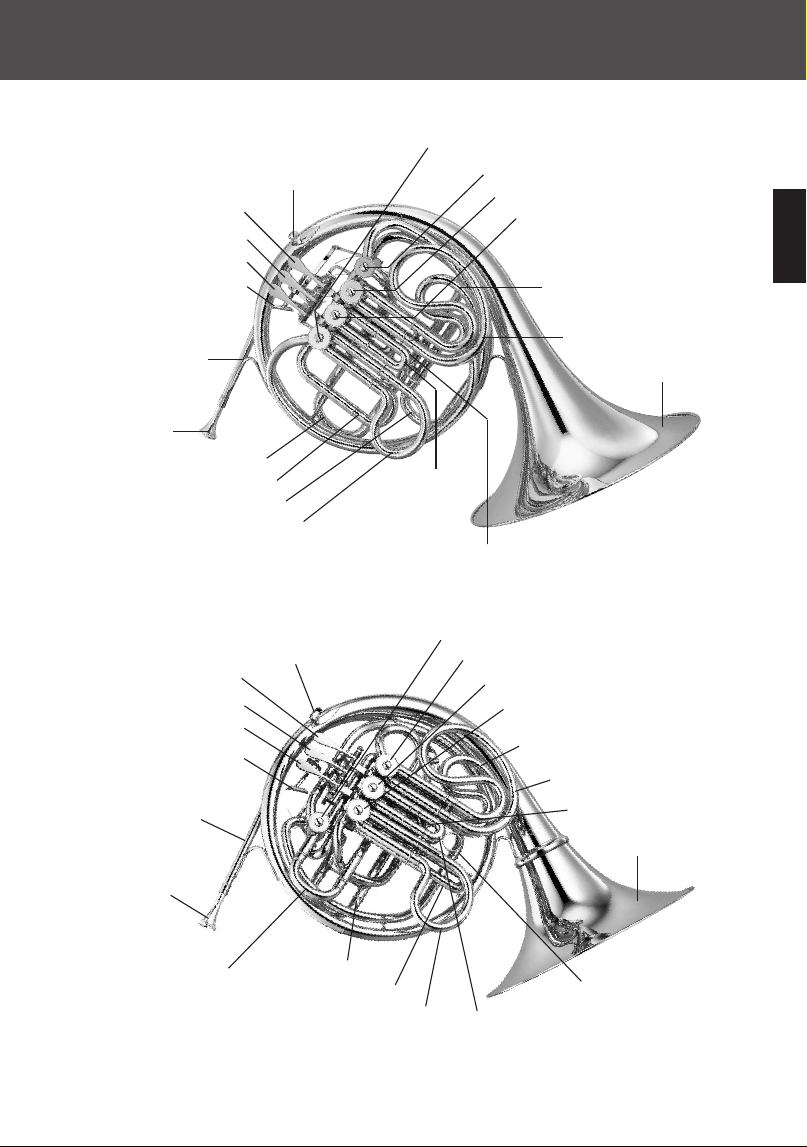
Nomenclature
■
F/B
b
Double Horn
Mouthpiece
Mouthpipe
4th Lever
1st Lever
2nd Lever
3rd Lever
Finger Hook
1st Valve
4th Valve
3rd Valve
2nd Valve
B
b
3rd Valve Slide
F 3rd Valve Slide
Bell
B
b
2nd Valve Slide
F 2nd Valve
Slide
F 1st Valve Slide
F Tuning Slide
B
b
1st Valve Slide
Main Tuning Slide
Mouthpiece
Mouthpipe
4th Lever
1st Lever
2nd Lever
3rd Lever
Finger Hook
4th Valve
3rd Valve
2nd Valve
1st Valve
B
b
3rd Valve Slide
Bell
F 3rd Valve Slide
F Tuning Slide (1)
B
b
2nd Valve Slide
F 2nd Valve Slide
F 1st Valve Slide
B
b
1st Valve Slide
Main Tuning Slide
F Tuning Slide (2)
* The contents of this manual apply to the latest specications as of the publishing date. To obtain the latest
manual, access the Yamaha website then download the manual le.
6
Before You Play
Handling the Instrument
The instrument is made of a thin metal so please handle it with care. Do
not apply any excessive force to the instrument, or bump it in a manner
that will dent or damage it.
■
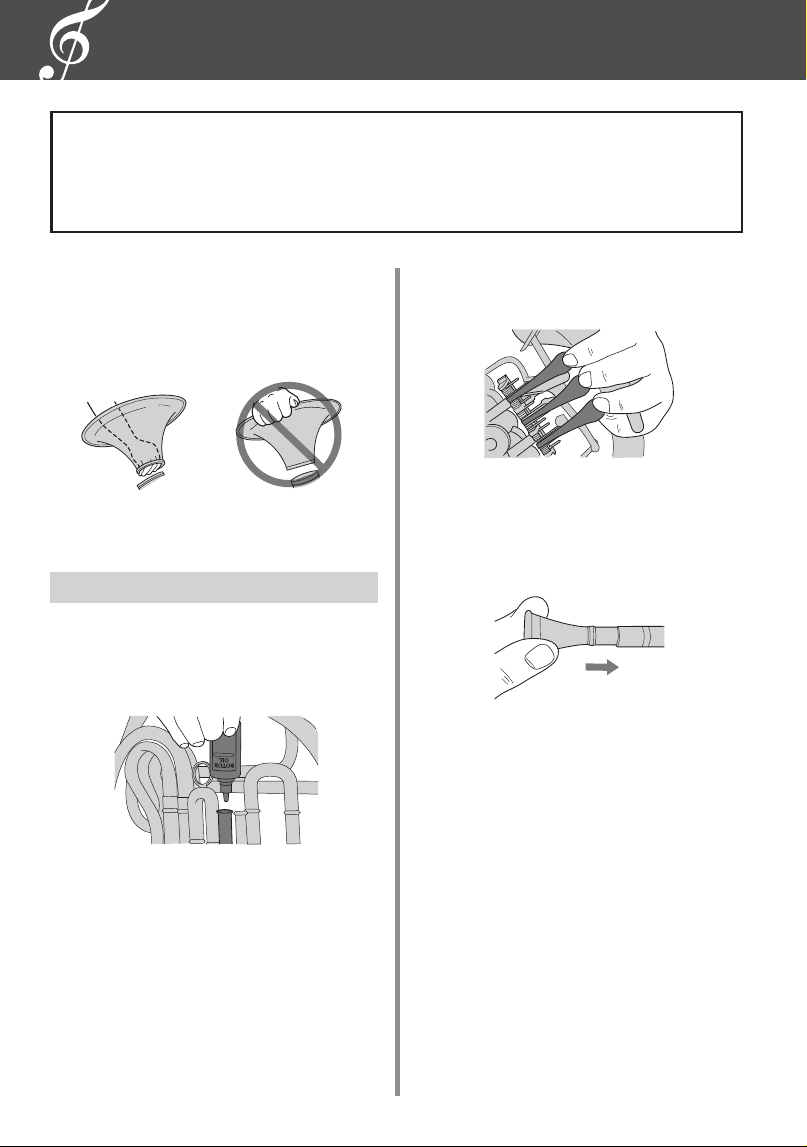
Attaching the Screw-On Bell
When attaching the screw-on bell, always
hold the bell by its mid section and as-
semble. Do not over-tighten.
■
Lubrication
Oiling the Rotors
1.
While holding the levers down, remove
the valve slides then apply rotor oil to
the rotors as shown in the illustration
below (a few drops per rotor).
* Apply oil if the lever does not work
smoothly.
* When applying oil, do not let the oil mix
with the slide grease adhering to the
valve slide’s interior.
2.
Move the levers so that the oil is
spread evenly.
■
Attaching the Mouthpiece
Gently insert the mouthpiece into the
mouthpipe.
* Never force the mouthpiece into the
mouthpipe. The mouthpiece may be-
come stuck in the mouthpipe.
7
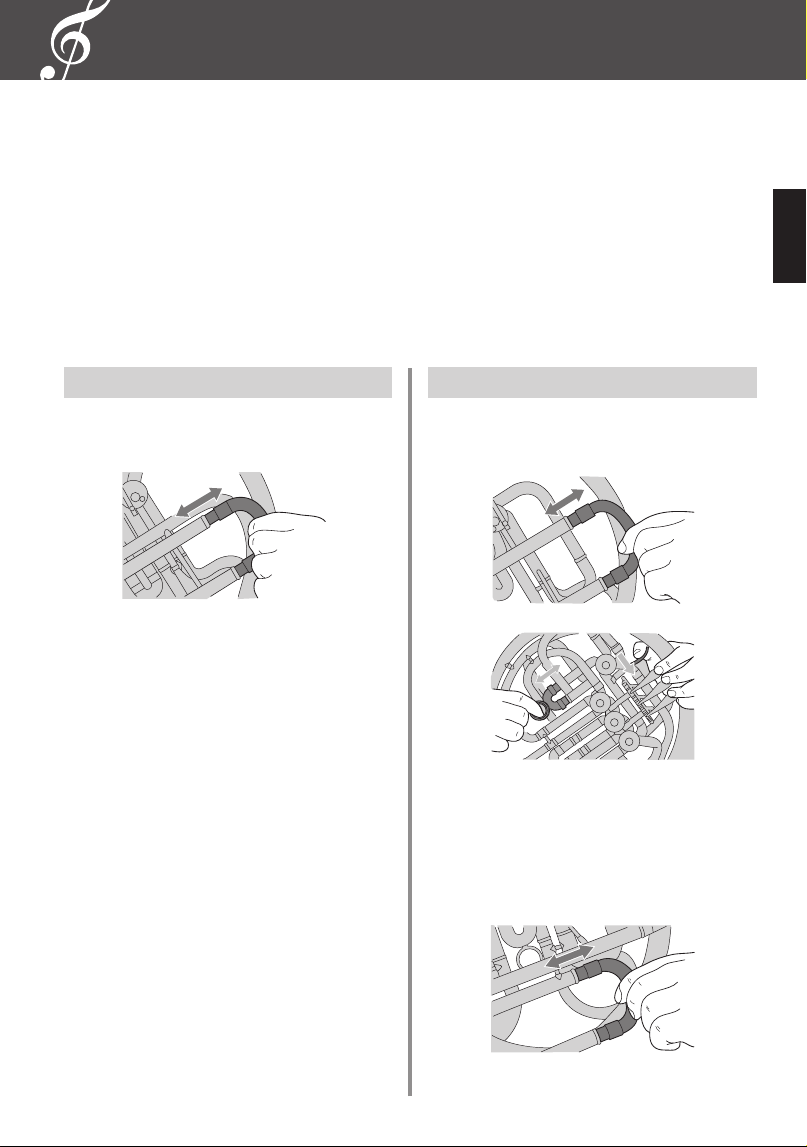
Single Horns
Slide the main tuning slide in or out to
tune the instrument.
Use the main tuning slide to make sure that the instrument is in tune before playing.
Since temperature has an eect on the instrument’s pitch, blow some warm air
through it to warm it up before tuning. The amount of tuning slide adjustment
needed to get the horn in tune will vary between individuals so there is no stan-
dard rule to follow (however, at 68°F pulling the main tuning slide out about 0.6”
should more or less tune the instrument to A=442Hz).
Take notice that when temperatures are warmer, the main tuning slide should be
pulled out a little more, while cooler temperatures will require that you push the
slide in. Also, the position and angle of your right hand in the bell will have an inu-
ence on pitch as well.
Tuning
Double Horns
1.
Use the main tuning slide to tune the
B
b
side.
* Instruments with a B
b
tuning slide
should tune with the main tuning slide
as well.
2.
Use the F tuning slide to tune the F
side of the instrument.
8
Tuning
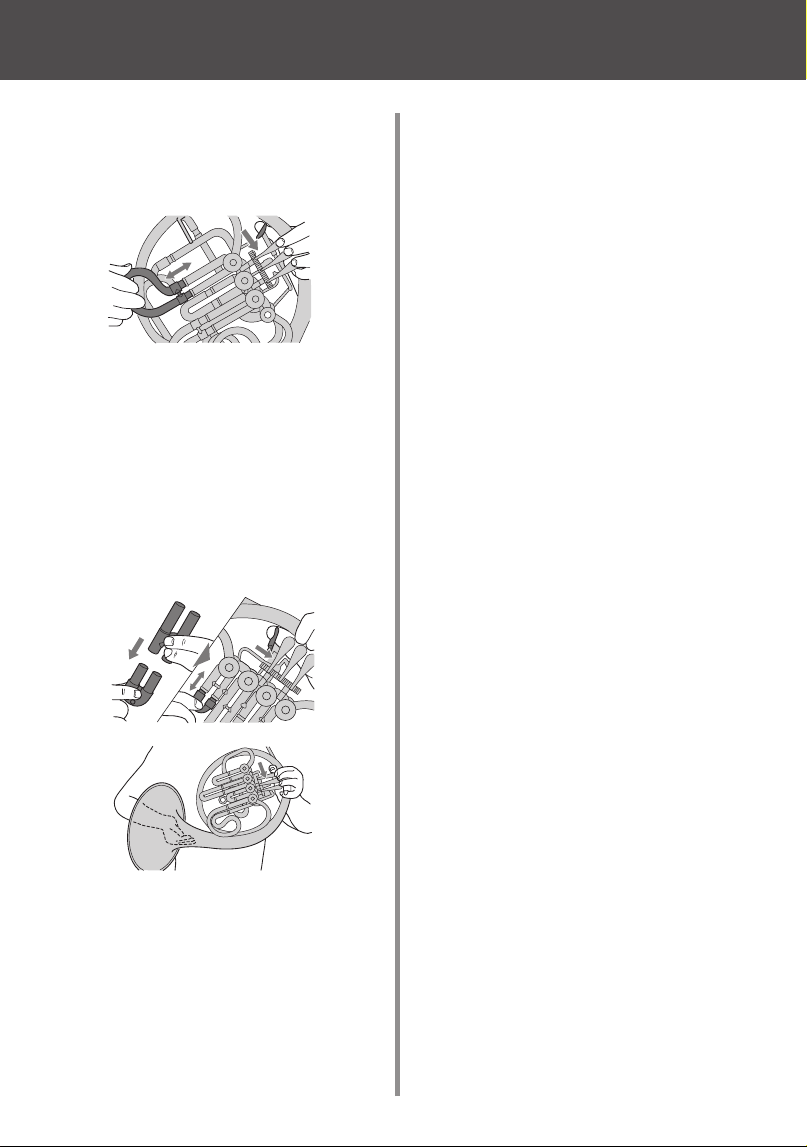
3.
Pull out each of the valve slides be-
tween 1/5-2/5 inch. When pulling out
the slides, make sure that the lever cor-
responding to the slide is depressed.
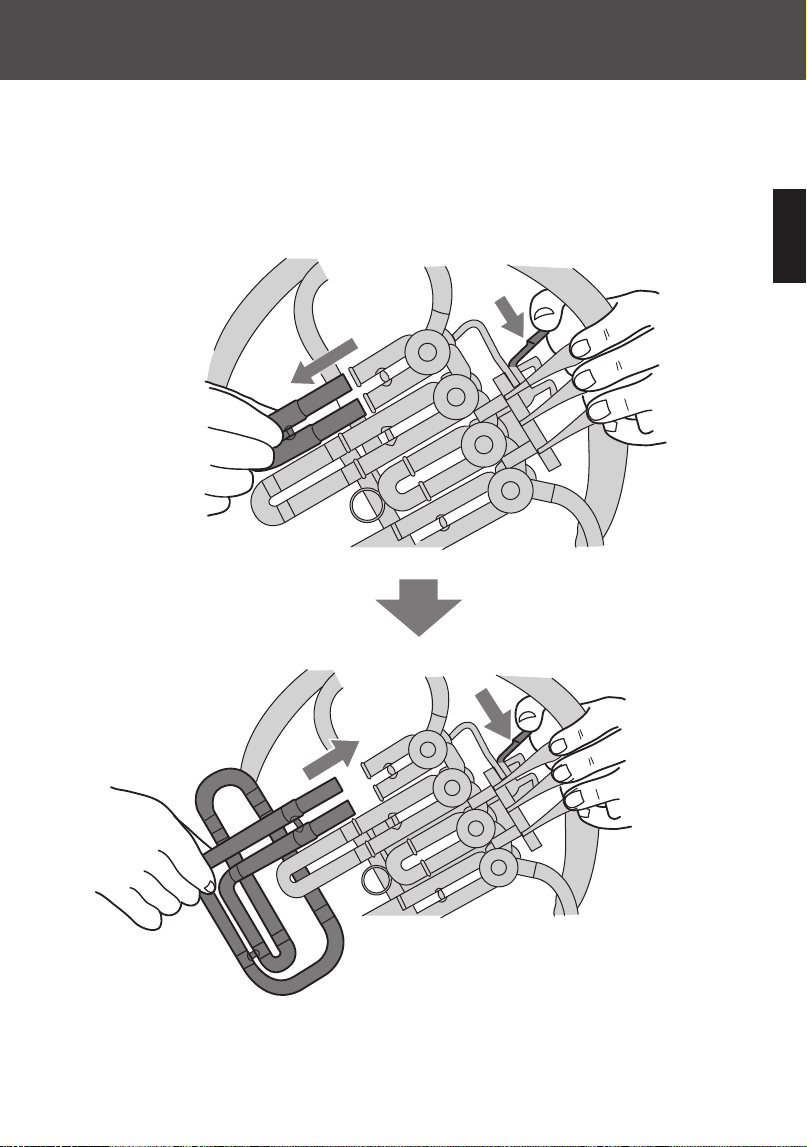
4.
The 4th valve on the B
b
single horn
is designed so that you can play with
normal ngering when performing the
hand-stopping technique. Also, you
can play as a semitone lower with the
4th lever pressed when you detach
the extension tube from the 4th valve
as shown in the illustration below.
In other words, you can play as an A
single horn.
* What is the hand-stopping technique
Hand-stopping is a technique by which a
French horn can be made to produce a
characteristic metallic sound. When you
play by this technique, you need to play
with ngering that is a semitone lower than
the note written in the score because the
F single horn and the double horn (F horn
side) produce pitches of a semitone higher.
Also, since the B
b
single horn produces
pitches from 2/3 to 3/4 higher, you can use
regular ngerings by pressing the 4th valve
on the B
b
single horn.
9
Maintenance
■
Caring for your instrument
after playing
To keep your instrument both looking
and playing well, make sure you take
proper care of it after you have nished
playing. When caring for the instrument,
place it on a table or, hold it securely in
your hands, taking care not to drop it.
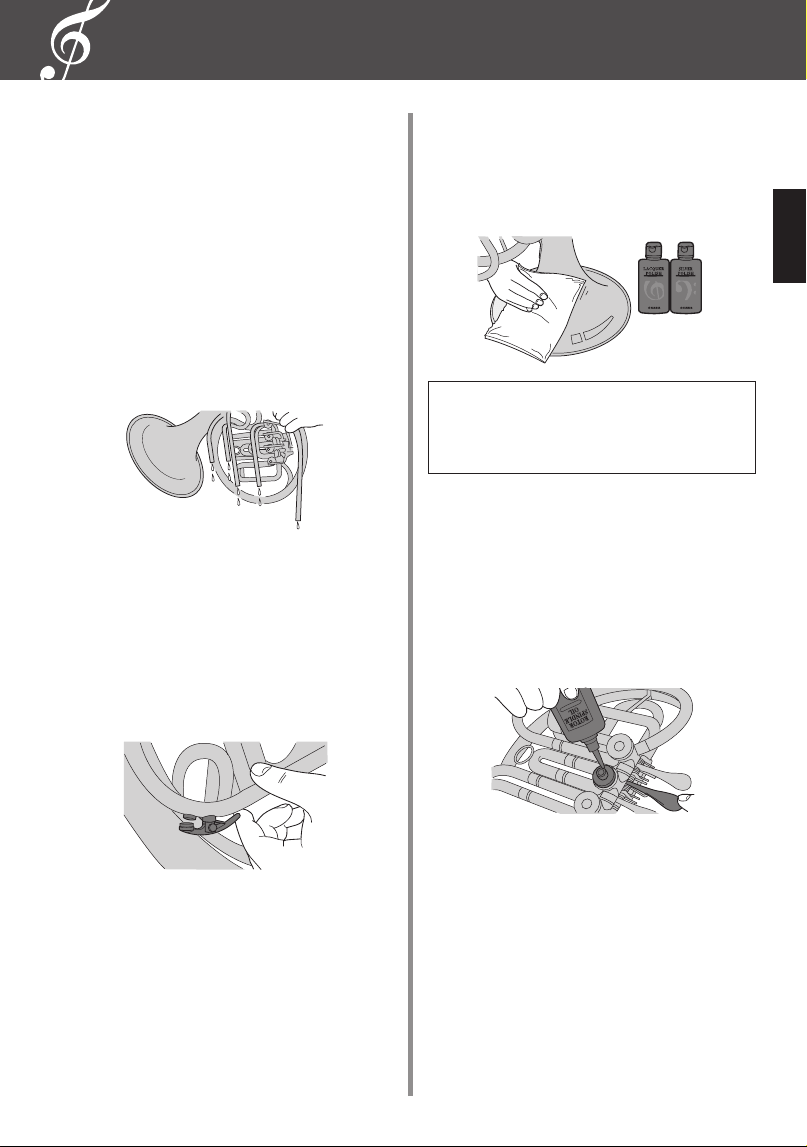
●
Valve Slide Maintenance
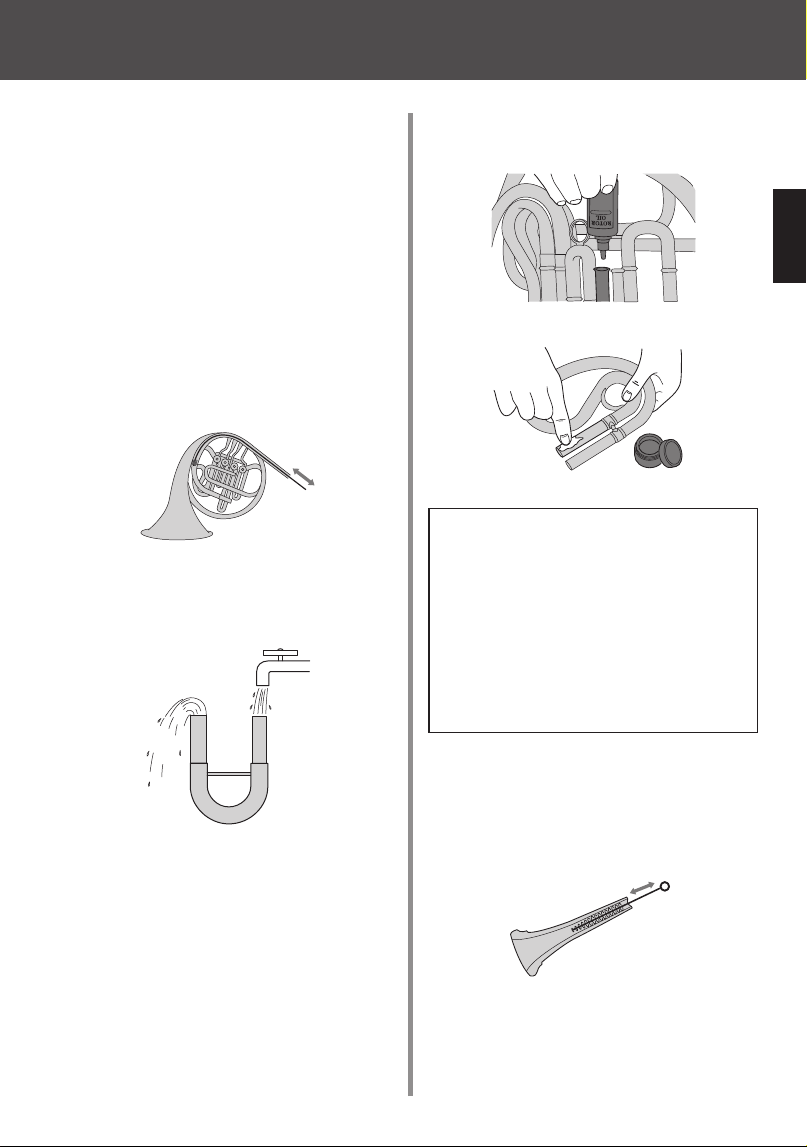
1.
Remove the valve slides to remove any
moisture.
* Removing the valve slide without holding
the corresponding lever down creates
a drop in air pressure within the pipe,
creating a suction that can result in poor
rotor function or damage to the inside of
the pipe.
2.
If the instrument has a water key, re-
move moisture from the water key too.
* The valve slides are made of brass or
nickel silver, which are both excellent at
resisting corrosion. However, corrosion
may appear if moisture is left in the in-
strument for an extended period of time.
Please use caution.
* To eectively remove moisture from
inside the instrument, use a cleaning
swab.
●
Body Maintenance
Use a polishing cloth to gently wipe the
instrument’s surface. If dirt or tarnish is
obvious, the following products can be
used.
For lacquer nishes…
Lacquer cloth + lacquer polish
For silver plate…
Silver cloth + silver polish
■
Once a Week Maintenance
●
Rotor Maintenance
1.
Remove the cap on the rotor valve and
apply a little rotor spindle oil to the ro-
tor bearings.
* After applying the oil, remove any excess
oil. Finally, replace the cap and move the
lever a few times to distribute the oil
evenly.
10
Maintenance
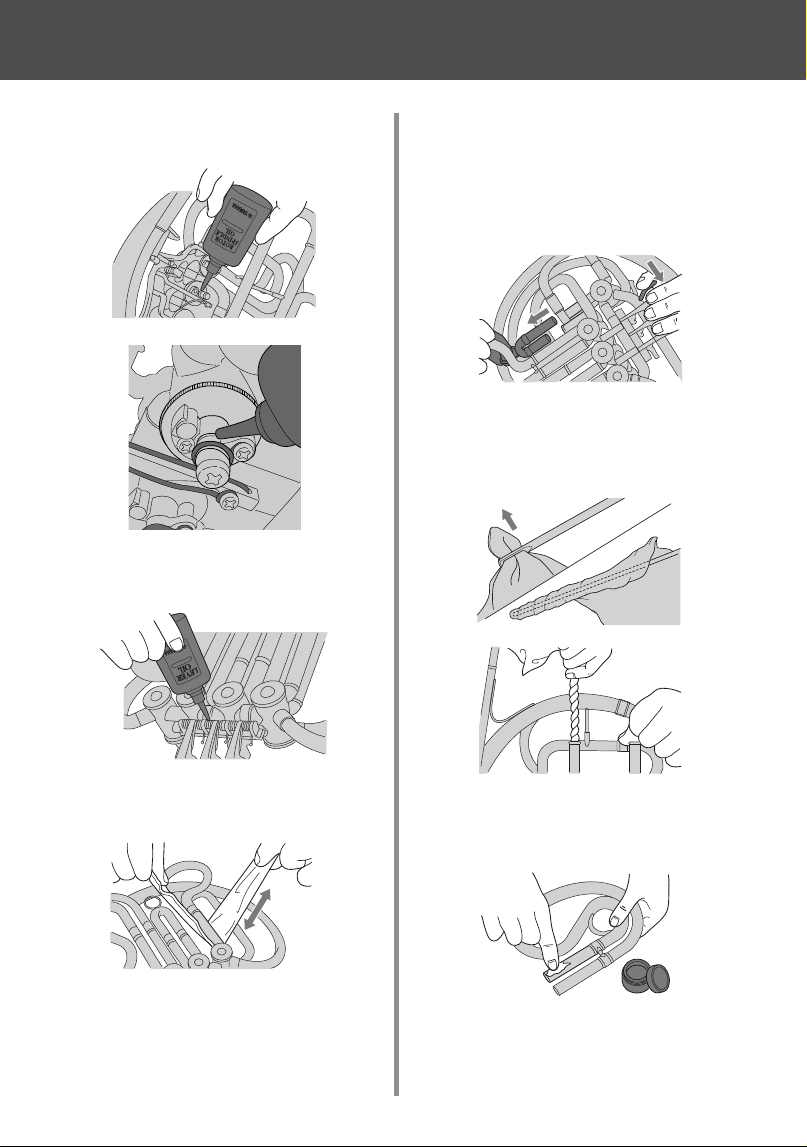
2.
Apply a little rotor spindle oil to the
rotor spindle and receiver.
3.
Apply a little lever oil to each linkage of
the lever assembly.
* Remove excess oil and use a gauze cloth
to clean the smaller parts.
■
Once or Twice a Month
Maintenance
●
Valve Slide Maintenance
1.
Depress the valve levers and remove
the valve slides.
2.
Wrap a cleaning rod with a gauze cloth
leaving no bare metal exposed, and re-
move dirt from the insides of the valve
slides and the outer pipes.
3.
Use the gauze to remove dirt from the
surface of the valve slide, then apply a
little slide grease.
4.
Slide the valve slide in and out a few
times to distribute the grease evenly.
Then wipe o any extra grease that
comes o the slide.
11
Maintenance
■
Twice Yearly Maintenance
●
Cleaning the Instrument
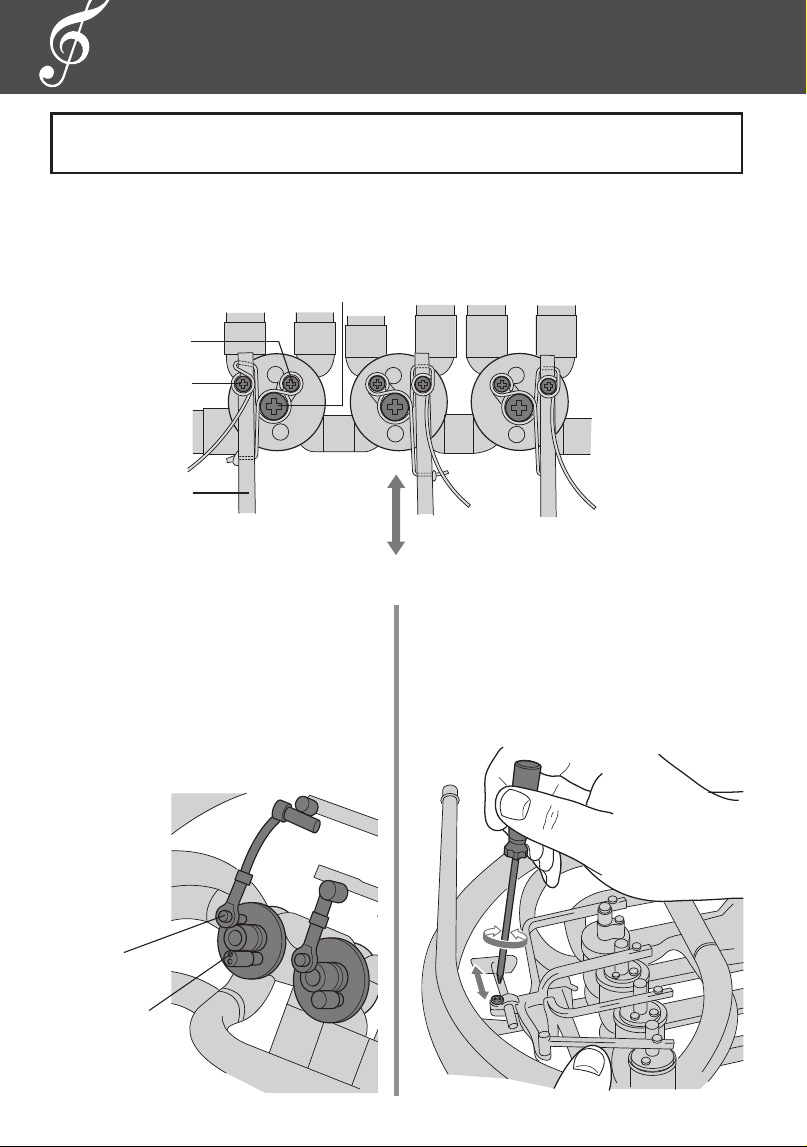
1.
Prepare a brass soap water solution
using between 10 to 15 parts warm
water (78°F to 88°F) and 1 part brass
soap. Before putting the instrument
into the solution, remove the valve
slides.
2.
Apply some soap water solution to the
brush on the end of exible cleaner
and use the cleaner to clean the inside
of the instrument’s tubing.
3.
After cleaning the instrument, use
clean water to thoroughly rinse out the
dirt and soap.
4.
After completely removing all moisture
with a gauze, apply oil and grease.
Take Care When Cleaning Inside of
the Instrument
Never dismantle the rotors. Also, when
rinsing the tubing with water, run water
through the main tuning slides in the
opposite direction of the airow. If water
is run through the instrument from the
mouthpiece, dirt can become clogged in
the valves causing the valves to become
sluggish.
5.
Apply some soap water solution to a
mouthpiece brush and insert it into
the throat to clean the mouthpiece,
then thoroughly rinse it out with clean
water.
12
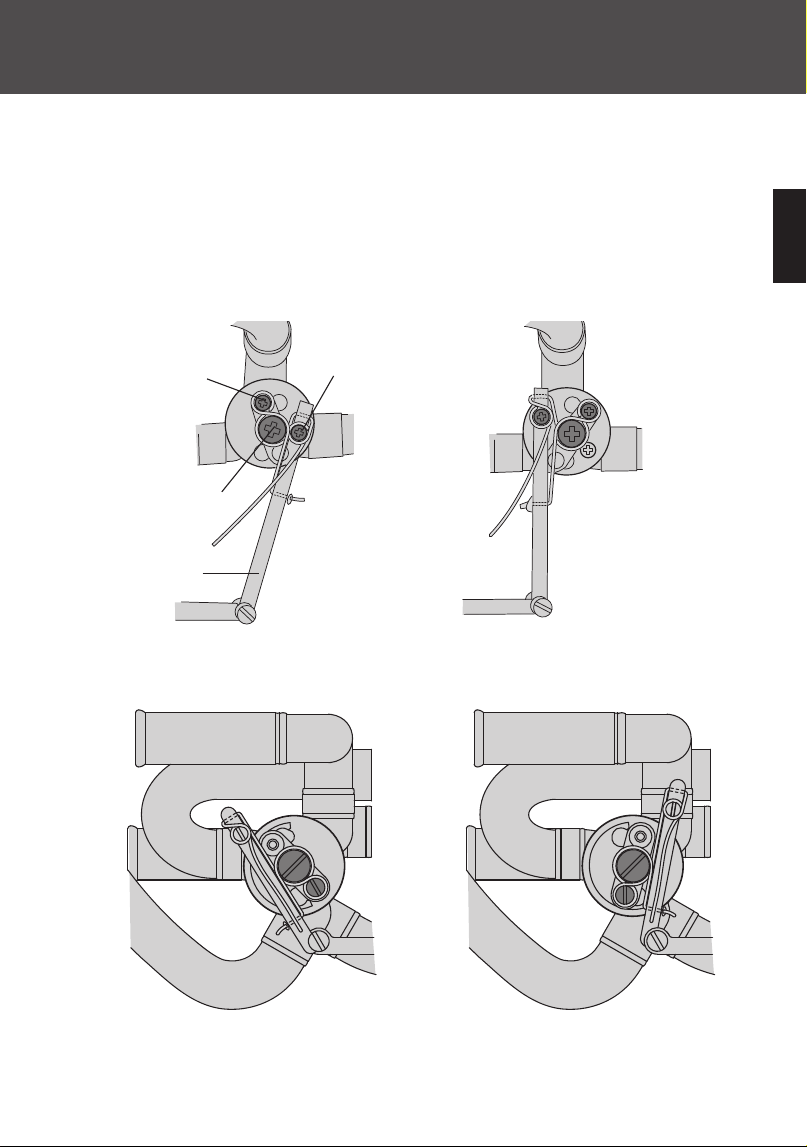
Adjusting the Rotary String and the
Lever Function
●
Wind the string as shown in the illustration below, and tighten the string stopper screw.
Wind the string around the screw in the same direction that the screw tightens. After
winding, use the String Stopper Screw B to adjust the lever’s height.
You can change the stroke from long to
short by changing the position of the
bearing stopper screw on the mechanical
action type, the YHR-567G(D)B, etc.
* When the bearing stopper screw is in-
stalled near the rotating center, the stroke
will become short. When the screw is
installed far from the rotating center, the
stroke will become long.
Bearing
stopper screw
Install here for
Standing B
b
.
Rotor Stem Screw
String Stopper
Screw B
String Stopper
Screw A
Lever Linkage
Lowers the lever
Raises the lever
The YHR-567/567D is used in this illustration.
Winding and adjusting the rotary string is dicult for beginner players.
Please consult with a wind instrument technician.
The 4th lever with an adjustment mecha-
nism can be adjusted to better t the
players hand size and position.
Use a screw driver and adjust the lever
length as shown in the illustration below.
13
■
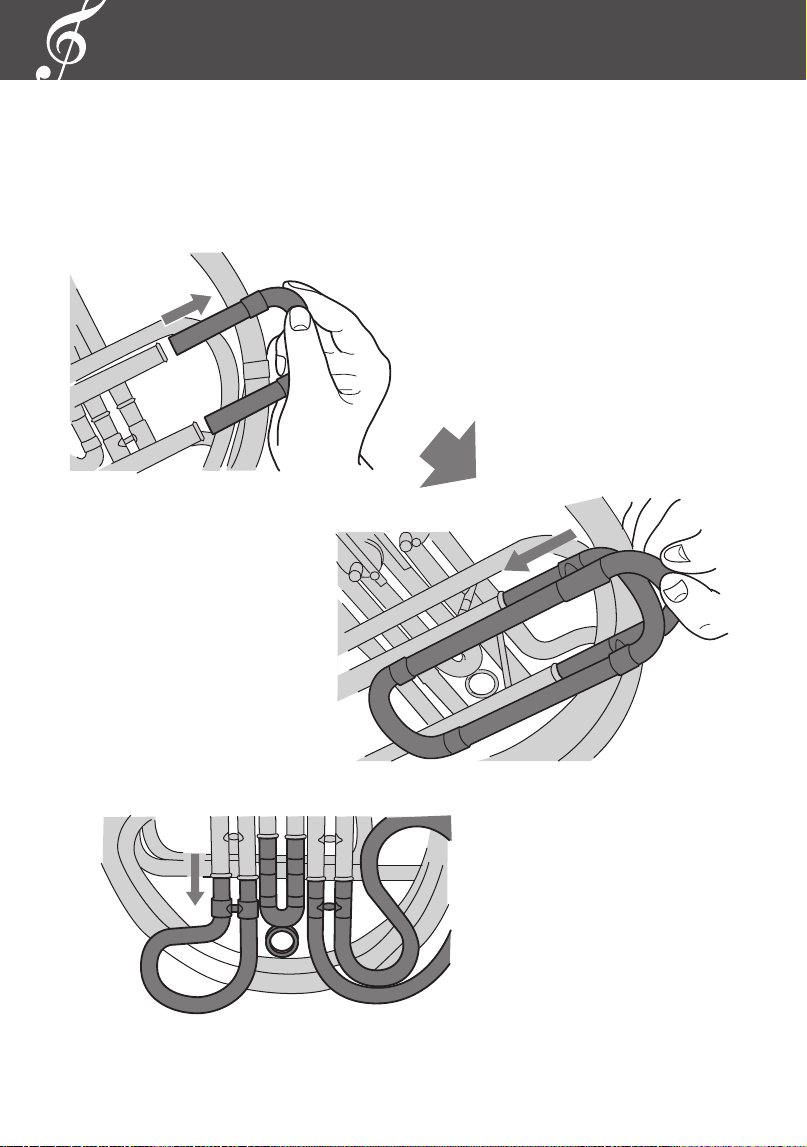
Switching the 4th Lever Function
●
F/B
b
Double Horn
The Yamaha double horn is designed so that it normally plays in the key of F (standing F)
when the 4th lever is not depressed, and in the key of B
b
when the 4th lever is depressed.
However, by re-conguring the linkage as shown in the illustration below, this function
can be reversed so that the horn plays in B
b
(standing B
b
) when the lever is not de-
pressed, and in the key of F when the lever is depressed.
To use this setup, move the string and the string seat, then place the string over the string seat.
String Stopper
Screw B
Rotor Stem Screw
Lever Linkage
String Stopper
Screw A
Standing F
Standing F
Standing B
b
Standing B
b
The above gure shows a double horn with
the 4th valve on the little nger side.
The above gure shows a double horn with
the 4th valve on the thumb side.
Adjusting the Rotary String and the
Lever Function
14
Options
●
E
b
Crook (optional)
This optional main tuning slide is designed for the F single horn, turning it into an E
b
horn so that you can play E
b
parts without transposing.
The crook is designed so that the horn ts in the case when it is attached.
When using the E
b
crook, the 1st through 3rd
valve tuning slides should be pulled out a little.
Main Tuning Slide
E
b
Crook
15
Options
●
F Natural Slide (optional)
When attached to the B
b
single horn’s 4th valve slide, the F natural slide oers the sound
of the F natural harmonic series. It enhances clarity in the mid-low range such as C (actual
F) or G (actual C) and stable intonation.
The F Natural Slide is designed so that the horn ts in the case when attached.
F Natural Slide

16
Tone is not clear and pitch is poor.
•
Dirt has accumulated inside the tubing.
➞
Use the procedure described in the
“Valve Slide Maintenance” section and
wash out the insides of the tubing.
• The water key cork is cracked causing
air to leak.
➞
Replace the water key cork with a
new one.
• The mouthpiece is loose and rattles,
and air is leaking from around the
mouthpiece.
• There is a large dent in the tubing,
and air is leaking from the ferrules
where the tubing connects.
• There is a foreign object in the tubing.
•
Holes in the rotors are not aligned with
holes in the valve casing branches.
➞
Contact the dealer from whom you
purchased the instrument.
The rotors are sluggish.
• The string is loose.
➞
Use a screwdriver and tighten the
string.
• Dirt has accumulated between the
valve casing and rotor.
• The valve casing is deformed.
• The rotary valve was disassembled,
then reassembled.
➞
Contact the dealer from whom you
purchased the instrument.
The valve slide is stuck and can not
be removed. The slide is sluggish.
• Dirt or dust has accumulated between
the outer and inner slides and the
valve slide is damaged.
➞
Remove dirt from the slides then
apply some slide grease.
• Dropping or hitting the slide has
created a dent, or the slide was bent
while cleaning.
➞
Contact the dealer from whom you
purchased the instrument.
Troubleshooting
The screw is too tight and can
not be loosened.
• The screw is corroded.
• Hitting the screw has damaged it.
➞
Contact the dealer from whom you
purchased the instrument.
The mouthpiece can not be removed.
• The instrument was dropped or hit
with the mouthpiece attached. Or,
the mouthpiece was inserted with too
much force.
• The instrument was left for a long
period of time with the mouthpiece
inserted in the instrument.
➞
Contact the dealer from whom you
purchased the instrument.
The instrument makes an abnor-
mal sound when played.
• Solder on the instrument has come
loose.
• There is a foreign object in the tubing.
➞
Contact the dealer from whom you
purchased the instrument.

MEMO
18
:
押さえる
/Close/Geschlossen/Fermé/Cerrado/Fechado/
按下
/ Закрыт /
닫기
/
按下
:
放す
/Open /Oen /Ouvert /Abierto/Aberto/
放开
/Открыт/
열기
/
放開
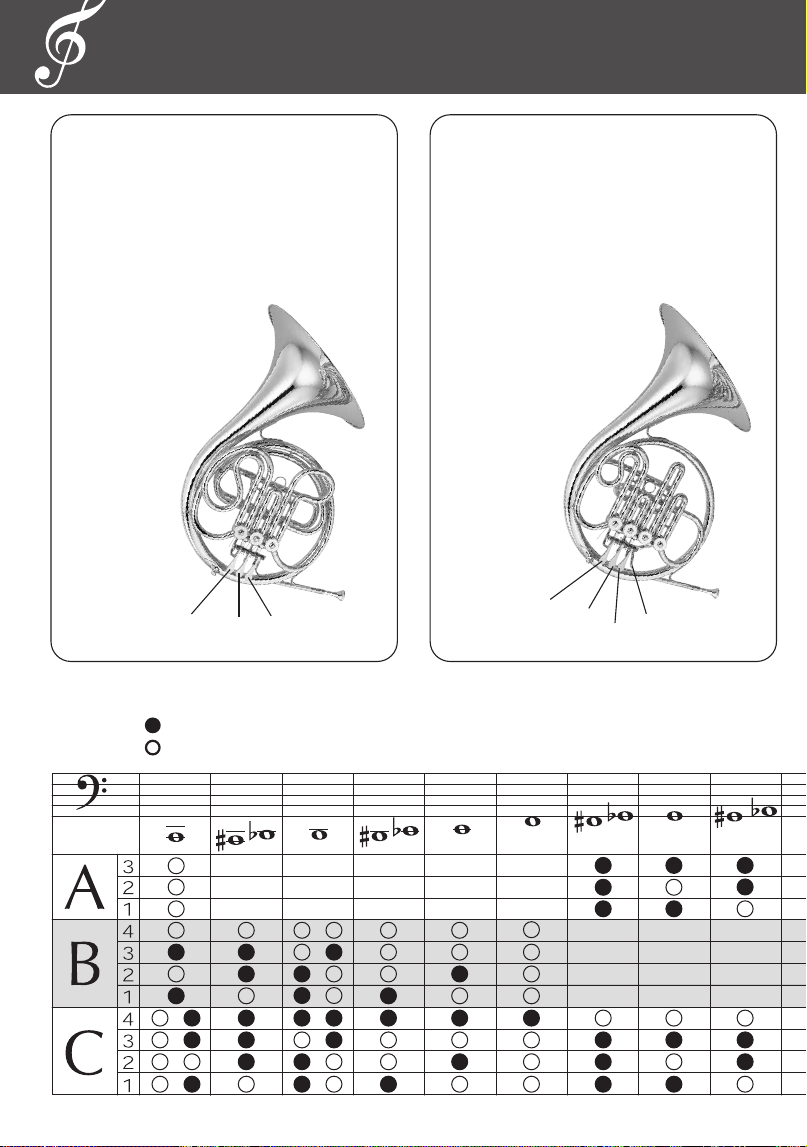
1
2
フィンガリング チャート
/ Fingering Chart /
Gritabelle / Tablature /
3
in F
1
2
3
4
F シングルホルン
F Single Horn
F-Einfachhorn
Cor simple en Fa
Trompa en Fa sencilla
Trompa simples em Fá
F单排圆号
Одинарная валторна F
F 싱글 호른
F單調性法國號
B
b
シングルホルン
B
b
Single Horn
B-Einfachhorn
Cor simple en Si
b
Trompa en Si
b
sencilla
Trompa simples em Si bemol
降 B单排圆号
Одинарная валторна B
b
Bb 싱글 호른
降B單調性法國號
A B
19
Tabla de digitaciones / Tabela de digitação /
指法表
/ Аппликатура /
운지법
/
指法表
ダブルホルンの第 4 レバーは、F 管と B
b
管の切り替えに使用します。
工場出荷時は、第 4 レバーを押すと、F 管から B
b
管に切り替わるよ
うにセットされています。
The 4th lever on full double horns is used to switch between
the F and B
b
sides of the horn. When shipped from the factory,
this valve is set so that the horn changes from the F side to the
B
b
side when the 4th lever is pressed.
Der vierte Hebel von echten Doppelhörnern dient zum Umschal-
ten zwischen der F- und B-Seite des Horns. Bei der Auslieferung
des Instruments ist dieses Ventil so eingerichtet, dass das Horn
beim Betätigen des Hebels von der F-Seite zur B-Seite wechselt.
La 4ème palette des cors doubles sert à faire passer l’instru-
ment de Fa en Si
b
. Par défaut, elle est congurée de telle sorte
que le cor joue en Fa lorsqu’elle n’est pas enfoncée et qu’il joue
en Si
b
lorsqu’elle est enfoncée.
La cuarta espátula de las trompas dobles completas se emplea para
cambiar entre los lados de Fa y Si
b
de la trompa. Cuando la trompa
sale de fábrica, este cilindro está ajustado para que la trompa
cambie del lado de F al de B
b
cuando se presiona la cuarta espátula.
A quarta chave da trompa dupla é usada para alternar entre os lados
Fá e Si da trompa. Quando sai da fábrica, está chave esta ajustada
para o lado Fá,ativando o lado si quando a quarta chave é acionada.
双管圆号的第四连杆用于 F 调与降 B 调之间的转换。
出厂设置为 : 按下第四连杆时 , 圆号从原来的 F 调改发降 B 调。
4-я клавиша на двойных валторнах используется для
переключения между строями F и B
b
. При поставке с
завода клапан настроен таким образом, что переключение
между F и B
b
осуществляется нажатием 4-й клавиши.
풀더블호른의4th레버는호른의F및Bb사이드간의전환을위해사용
됩니다 .공장출고시 ,본밸브는4th레버를누를 경우F사이드에서Bb
사이드로바뀌도록설정된상태로출고됩니다 .
標準雙調性法國號的第 4 連桿用於切換 F 調和降 B 調。
出廠設置為:按下第 4 連桿時, 法國號會從 F 調變成降 B 調。
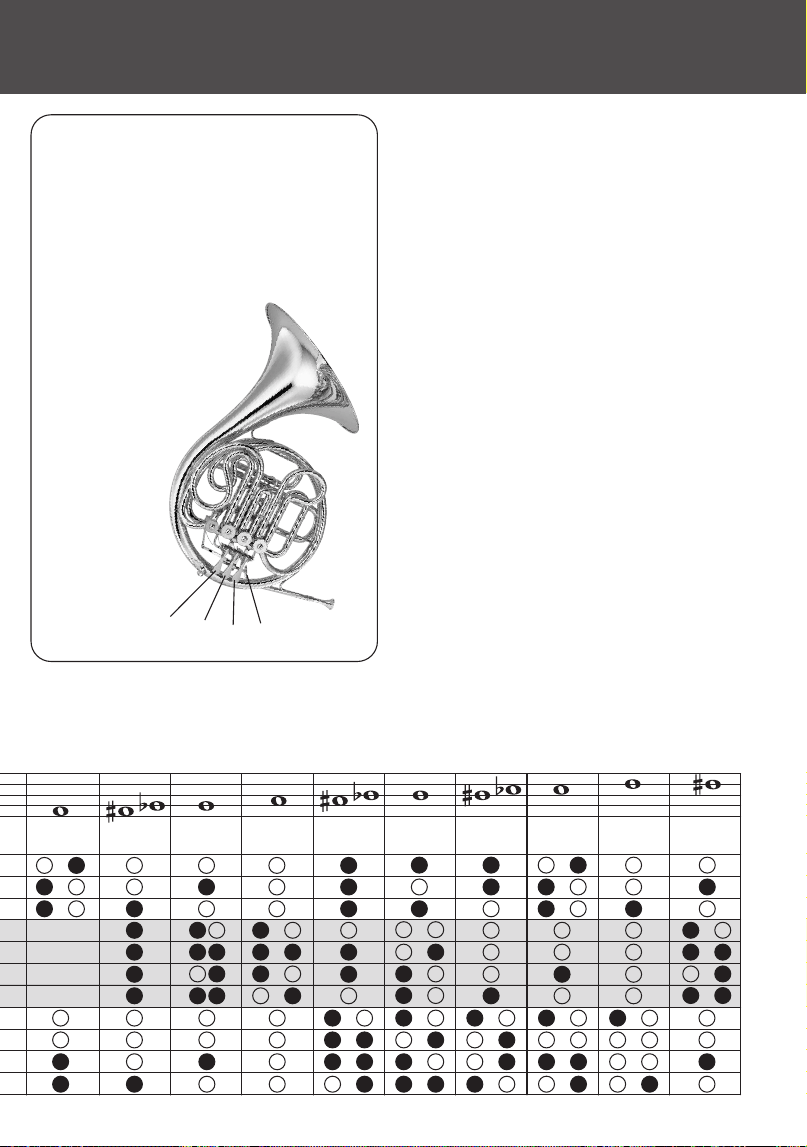
1
2
3
4
F/B
b
ダブルホルン
F/B
b
Double Horn
F/B-Doppelhorn
Cor double en Fa/Si
b
Trompa doble en Fa/Si
b
Trompa dupla em Fá/Si bemol
F/ 降 B双排圆号
Двойная валторна F/B
b
F/B
b
더블 호른
F/ 降 B 雙調性法國號
C
20
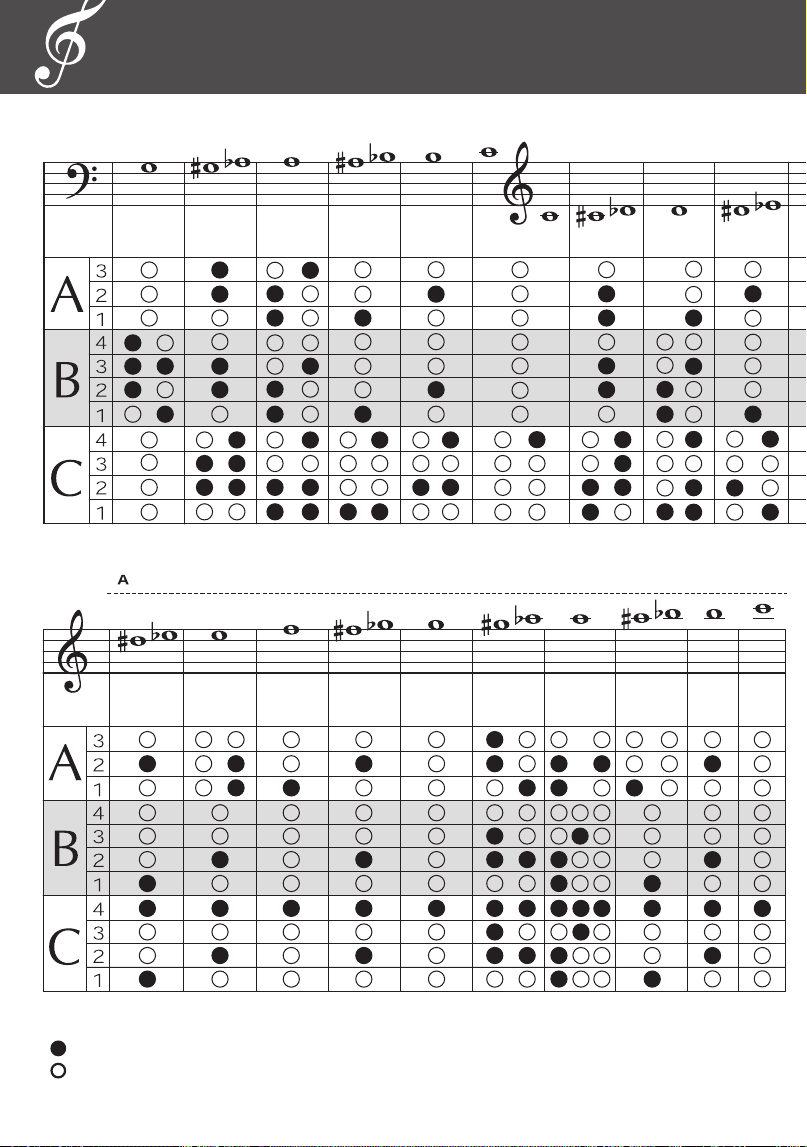
フィンガリング チャート
/ Fingering Chart /
Gritabelle / Tablature /
:
押さえる
/Close/Geschlossen/Fermé/Cerrado/Fechado/
按下
/ Закрыт /
닫기
/
按下
:
放す
/Open /Oen /Ouvert /Abierto/Aberto/
放开
/Открыт/
열기
/
放開
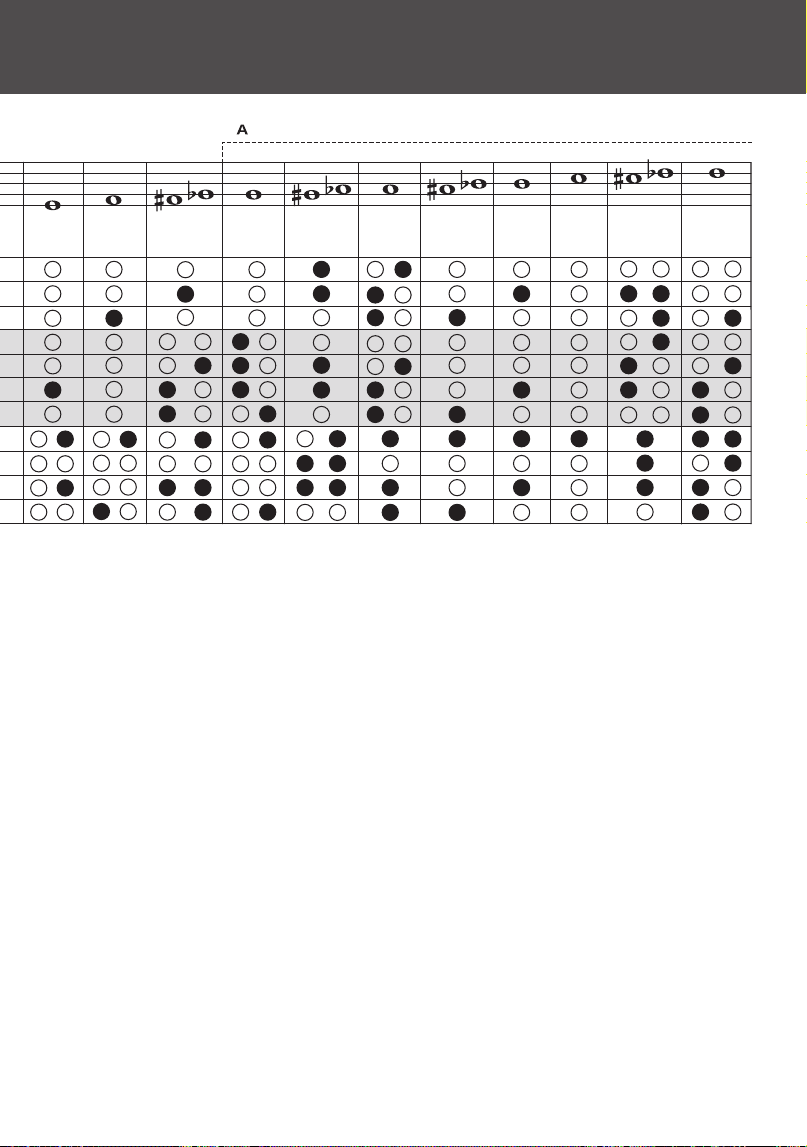
21
慣例上古典派、ロマン派等の曲で、ヘ音記号はこれより 1 オクターブ下げて書かれるものもあります。同一の音で 2 種類ある運指は、
一般的に左側に書かれている運指を用います。右側は替え指です。
Some bass clef parts in Classical and Romantic, etc., music are customarily written an octave lower. The ngering on the left
should be played for notes that have double ngerings. The ngering on the right is an alternate ngering.
Manche Bassschlüssel-Partituren sind in der Romantischen oder Klassischen Musik oft eine Oktave tiefer geschrieben. Noten mit
Doppelgri sollten mit dem linken Gri gespielt werden. Beim rechts angegebenen Gri handelt es sich um einen alternativen Gri.
Certaines parties de basse des musiques classiques, romantiques, etc. sont écrites une octave plus bas. Les doigtés de
gauche doivent être utilisés pour les notes à double doigté. Les doigtés de droite représentent un autre doigté possible.
Algunas partes de a clave de bajos de música clásica y romántica, etc., están escritas especialmente una octava menos. El
digitado de la izquierda debe tocarse para notas que tienen doble digitado. El digitado de la derecha es un digitado alternativo.
Algumas partes em clave de Fá dos períodos Clássico e Romântico costumam estar uma oitava abaixo. O dedilhado da
esquerda deve ser usado para notas que tem dedilhado duplo. O dedilhado da direita é um dedilhado alternativo.
古典和浪漫主义音乐的一些低音谱号在习惯上会降低一个八度。应当注意左手指法是双指法 , 而右手指法为交替指法。
Некоторые партии в басовом ключе в жанрах классицизма и романтизма и т.д. традиционно пишутся на октаву ниже.
Аппликатура слева используется для нот с двойной аппликатурой. С правой стороны - альтернативное положение пальцев.
고전주의 ,낭만주의 계열 음악에서는 일반적으로 낮은음자리표 부분을1 옥타브 낮게 표시합니다 .왼쪽의 운지법은 양손 운지법 악보를 위해
사용해야 합니다 . 오른쪽의 운지법은 대체 운지법입니다 .
部分古典時期和浪漫時期的樂譜習慣將低音譜低一個八度。同一個音有兩種指法時,一般情況下應使用左側指法。右側
為替代指法。
A
ダブルホルンの場合、通常は B
b
に切り替えて演奏する音域です。
For double horns, this range is usually played on the B
b
side of the horn.
Bei Doppelhörnern wird dieser Bereich gewöhnlich auf der B-Seite des Horns gespielt.
Sur les cors doubles, ce registre est en général joué avec le cor réglé en Si
b
.
Para las trompas dobles, este margen se toca normalmente en el lado de Si
b
de la trompa.
Nas trompas duplas, esta extensão normalmente é tocada no lado Sí
b
da trompa.
通常使用双管圆号的降 B 调演奏此音域。
Для двойных валторн эта последовательность обычно играется в строе B
b
.
더블 호른의 경우 이 음역은 보통Bb음역에서 연주합니다 .
雙調性法國號通常會以降 B 調演奏此音域。
Tabla de digitaciones / Tabela de digitação /
指法表
/ Аппликатура /
운지법
/
指法表

© 2013 Yamaha Corporation
Published 09/2023
发行
IPCP-A0
VGS2800
〒430-8650 静岡県浜松市中央区中沢町 10-1