
E S S E N T I A L S FOR LIFE
User
Manual
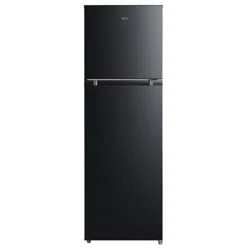
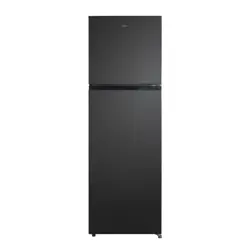
Top Load Refrigerator
266L Capacity
MODEL
GGSTM266DS
V1.0 0426
2
Welcome Congratulations on purchasing
your new Refrigerator! The Sôlt
brand is proudly distributed within
Australia by Residentia Group Pty
Ltd.
Please refer to the warranty card at the rear of this manual
for information regarding your product’s parts and labour
warranty, or visit us online at www.residentia.group
At Residentia Group, we are customer obsessed and our
Support Team are there to ensure you get the most out
of your appliance. Should you want to learn more about
the various features of your Refrigerator, and importantly
taking care of your appliance when cleaning, our Support
Team are here to help.
You can use our online Support Centre at anytime by
visiting http://support.residentiagroup.com.au, or you can
contact us via calling us on 1300 11 HELP (4357).
It is important that you read through the following use and
care manual thoroughly to familiarise yourself with the
installation and operation requirements of your appliance
to ensure optimum performance.
Again, thank you for choosing an Sôlt appliance and we
look forward to being of service to you.
Kind Regards,
The Residentia Team
Residentia Group
—
Head Office.
165 Barkly Ave
Burnley
Victoria 3121
Australia
—
ACN.
600 546 656
—
Online.
residentia.group
Sôlt
—
Online.
www.solt.house
—
Instagram.
/solt.house
—
Facebook.
/solt.appliances
3
Contents 2 Welcome
4 General Information
4 Important Safety Warnings
8 Environmental Protection
11 Installation Instructions
13 Product Overview
14 Operation Instructions
16 Food Storage
17 Maintenance & Cleaning
19 Troubleshooting
21
Specifications
22 Purchase Details
26 Warranty Information
Customer Care
Sôlt recommends the use of original spare parts. When contacting our customer service team,
please ensure that you have the following information at hand (which can be found on your appliances’
rating plate).
— Model Number
— Serial Number
T . 1300 11 4357 | E. support@residentiagroup.com.au
4
General Information
Before switching on the appliance for the first time read the following safety hints!
> This appliance is intended to be used in household and similar applications such
as staff kitchen areas in shops, offices and other working environments; farm
houses and by clients in hotels, motels and other residential type environments;
bed and breakfast type environments; catering and similar non-retail
applications.
> This appliance is not intended for use by persons (including children) with
reduced physical, sensory or mental capabilities, or lack of experience and
knowledge, unless they have been given supervision or instruction concerning
use of the appliance by a person responsible for their safety.
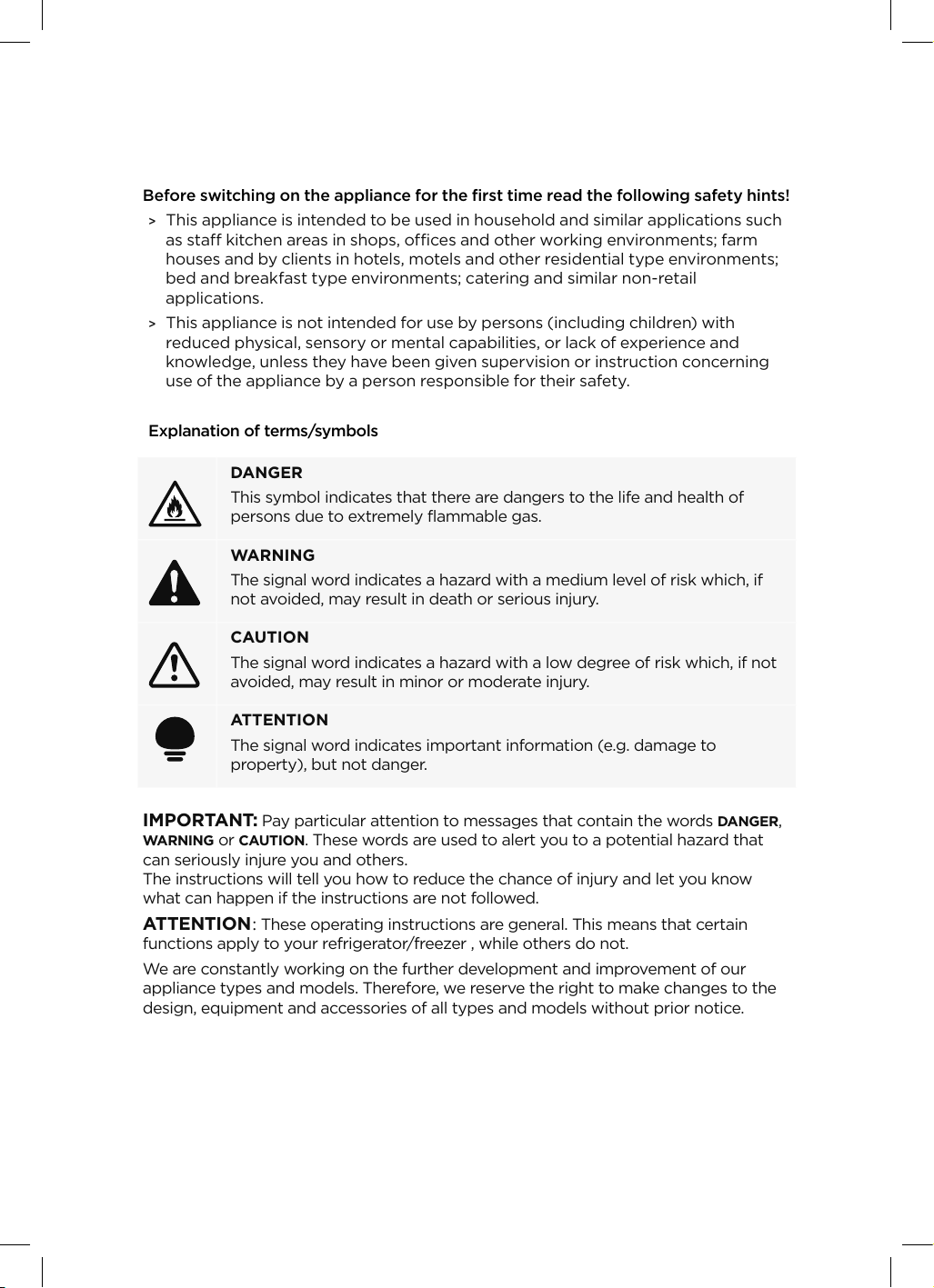
Explanation of terms/symbols
DANGER
This symbol indicates that there are dangers to the life and health of
persons due to extremely flammable gas.
WARNING
The signal word indicates a hazard with a medium level of risk which, if
not avoided, may result in death or serious injury.
CAUTION
The signal word indicates a hazard with a low degree of risk which, if not
avoided, may result in minor or moderate injury.
ATTENTION
The signal word indicates important information (e.g. damage to
property), but not danger.
IMPORTANT: Pay particular attention to messages that contain the words DANGER,
WARNING or CAUTION. These words are used to alert you to a potential hazard that
can seriously injure you and others.
The instructions will tell you how to reduce the chance of injury and let you know
what can happen if the instructions are not followed.
ATTENTION:These operating instructions are general. This means that certain
functions apply to your refrigerator/freezer , while others do not.
We are constantly working on the further development and improvement of our
appliance types and models. Therefore, we reserve the right to make changes to the
design, equipment and accessories of all types and models without prior notice.
2
EN
Important safety instructions
IMPORTANT SAFETY INSTRUCTIONS
READ AnD sAvE ThEsE InsTRUCTIOns!
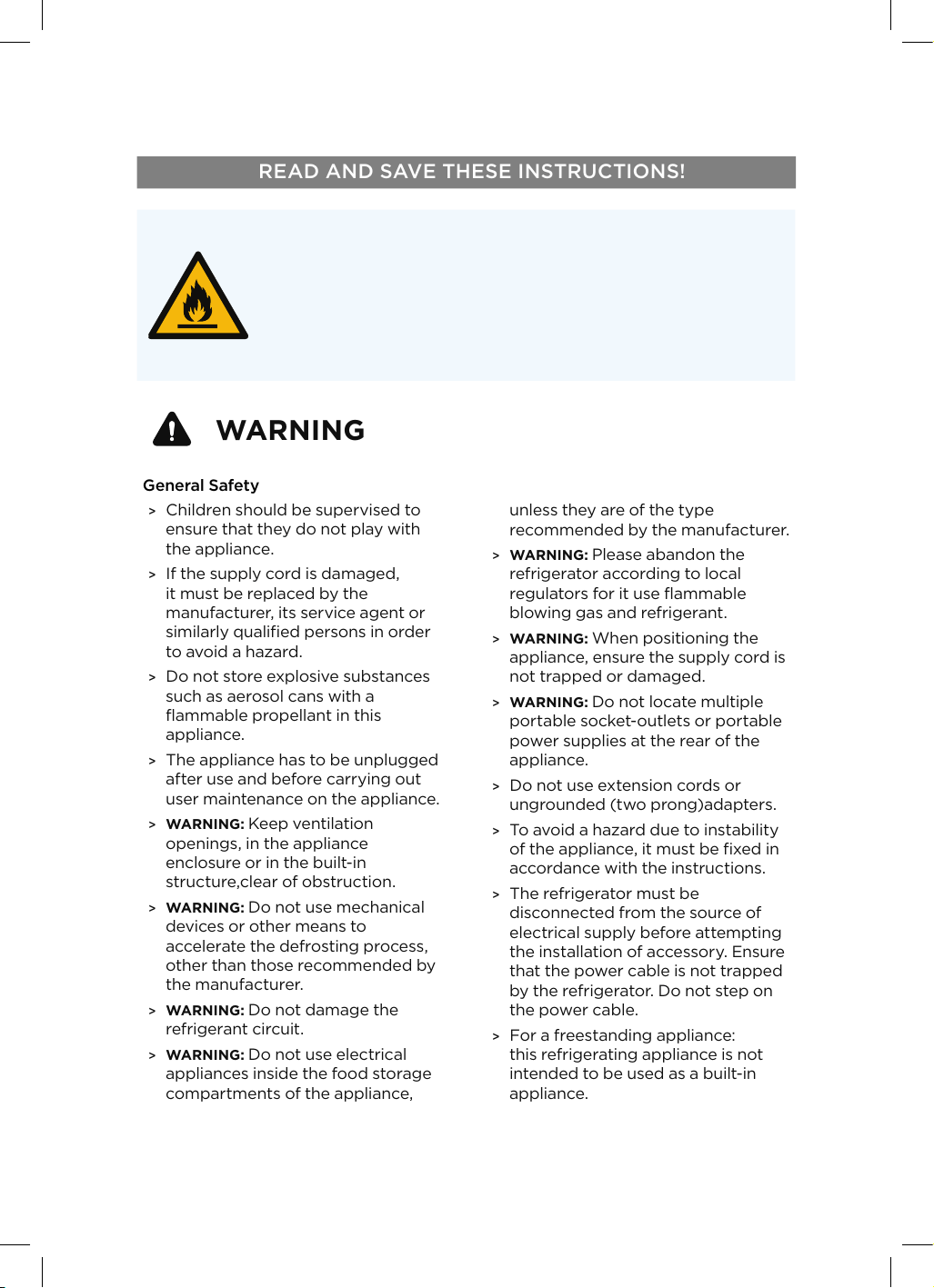
WARNING: Risk of fire / flammable material
Refrigerant and cyclopentane foaming material used for the
appliance are flammable. Therefore, when the appliance is scrapped,
it shall be kept away from any fire source and be recovered by a
special recovering company with corresponding qualification other
than be disposed by combustion, so as to prevent damage to the
environment or any other harm
WARNING
General safety
> Children should be supervised to
ensure that they do not play with
the appliance.
> If the supply cord is damaged,
it must be replaced by the
manufacturer, its service agent or
similarly qualified persons in order
to avoid a hazard.
> Do not store explosive substances
such as aerosol cans with a
flammable propellant in this
appliance.
> The appliance has to be unplugged
after use and before carrying out
user maintenance on the appliance.
> WARNING: Keep ventilation
openings, in the appliance
enclosure or in the built-in
structure,clear of obstruction.
> WARNING: Do not use mechanical
devices or other means to
accelerate the defrosting process,
other than those recommended by
the manufacturer.
> WARNING: Do not damage the
refrigerant circuit.
> WARNING: Do not use electrical
appliances inside the food storage
compartments of the appliance,
unless they are of the type
recommended by the manufacturer.
> WARNING: Please abandon the
refrigerator according to local
regulators for it use flammable
blowing gas and refrigerant.
> WARNING: When positioning the
appliance, ensure the supply cord is
not trapped or damaged.
> WARNING: Do not locate multiple
portable socket-outlets or portable
power supplies at the rear of the
appliance.
> Do not use extension cords or
ungrounded (two prong)adapters.
> To avoid a hazard due to instability
of the appliance, it must be fixed in
accordance with the instructions.
> The refrigerator must be
disconnected from the source of
electrical supply before attempting
the installation of accessory. Ensure
that the power cable is not trapped
by the refrigerator. Do not step on
the power cable.
> For a freestanding appliance:
this refrigerating appliance is not
intended to be used as a built-in
appliance.
2
EN
Important safety instructions
IMPORTANT SAFETY INSTRUCTIONS
READ AnD sAvE ThEsE InsTRUCTIOns!
WARNING: Risk of fire / flammable material
Refrigerant and cyclopentane foaming material used for the
appliance are flammable. Therefore, when the appliance is scrapped,
it shall be kept away from any fire source and be recovered by a
special recovering company with corresponding qualification other
than be disposed by combustion, so as to prevent damage to the
environment or any other harm
WARNING
General safety
> Children should be supervised to
ensure that they do not play with
the appliance.
> If the supply cord is damaged,
it must be replaced by the
manufacturer, its service agent or
similarly qualified persons in order
to avoid a hazard.
> Do not store explosive substances
such as aerosol cans with a
flammable propellant in this
appliance.
> The appliance has to be unplugged
after use and before carrying out
user maintenance on the appliance.
> WARNING: Keep ventilation
openings, in the appliance
enclosure or in the built-in
structure,clear of obstruction.
> WARNING: Do not use mechanical
devices or other means to
accelerate the defrosting process,
other than those recommended by
the manufacturer.
> WARNING: Do not damage the
refrigerant circuit.
> WARNING: Do not use electrical
appliances inside the food storage
compartments of the appliance,
unless they are of the type
recommended by the manufacturer.
> WARNING: Please abandon the
refrigerator according to local
regulators for it use flammable
blowing gas and refrigerant.
> WARNING: When positioning the
appliance, ensure the supply cord is
not trapped or damaged.
> WARNING: Do not locate multiple
portable socket-outlets or portable
power supplies at the rear of the
appliance.
> Do not use extension cords or
ungrounded (two prong)adapters.
> To avoid a hazard due to instability
of the appliance, it must be fixed in
accordance with the instructions.
> The refrigerator must be
disconnected from the source of
electrical supply before attempting
the installation of accessory. Ensure
that the power cable is not trapped
by the refrigerator. Do not step on
the power cable.
> For a freestanding appliance:
this refrigerating appliance is not
intended to be used as a built-in
appliance.
2
EN
Important safety instructions
IMPORTANT SAFETY INSTRUCTIONS
READ AnD sAvE ThEsE InsTRUCTIOns!
WARNING: Risk of fire / flammable material
Refrigerant and cyclopentane foaming material used for the
appliance are flammable. Therefore, when the appliance is scrapped,
it shall be kept away from any fire source and be recovered by a
special recovering company with corresponding qualification other
than be disposed by combustion, so as to prevent damage to the
environment or any other harm
WARNING
General safety
> Children should be supervised to
ensure that they do not play with
the appliance.
> If the supply cord is damaged,
it must be replaced by the
manufacturer, its service agent or
similarly qualified persons in order
to avoid a hazard.
> Do not store explosive substances
such as aerosol cans with a
flammable propellant in this
appliance.
> The appliance has to be unplugged
after use and before carrying out
user maintenance on the appliance.
> WARNING: Keep ventilation
openings, in the appliance
enclosure or in the built-in
structure,clear of obstruction.
> WARNING: Do not use mechanical
devices or other means to
accelerate the defrosting process,
other than those recommended by
the manufacturer.
> WARNING: Do not damage the
refrigerant circuit.
> WARNING: Do not use electrical
appliances inside the food storage
compartments of the appliance,
unless they are of the type
recommended by the manufacturer.
> WARNING: Please abandon the
refrigerator according to local
regulators for it use flammable
blowing gas and refrigerant.
> WARNING: When positioning the
appliance, ensure the supply cord is
not trapped or damaged.
> WARNING: Do not locate multiple
portable socket-outlets or portable
power supplies at the rear of the
appliance.
> Do not use extension cords or
ungrounded (two prong)adapters.
> To avoid a hazard due to instability
of the appliance, it must be fixed in
accordance with the instructions.
> The refrigerator must be
disconnected from the source of
electrical supply before attempting
the installation of accessory. Ensure
that the power cable is not trapped
by the refrigerator. Do not step on
the power cable.
> For a freestanding appliance:
this refrigerating appliance is not
intended to be used as a built-in
appliance.
5
Important Safety Warnings
> WARNING: Tipping Hazard:
This appliance is heavy and may tip
over. Use two or more people to
move and install the appliance.
> WARNING: Ventilation
Before switching on the appliance for the first time read the following safety hints!
> This appliance is intended to be used in household and similar applications such
as staff kitchen areas in shops, offices and other working environments; farm
houses and by clients in hotels, motels and other residential type environments;
bed and breakfast type environments; catering and similar non-retail
applications.
> This appliance is not intended for use by persons (including children) with
reduced physical, sensory or mental capabilities, or lack of experience and
knowledge, unless they have been given supervision or instruction concerning
use of the appliance by a person responsible for their safety.
Explanation of terms/symbols
DANGER
This symbol indicates that there are dangers to the life and health of
persons due to extremely flammable gas.
WARNING
The signal word indicates a hazard with a medium level of risk which, if
not avoided, may result in death or serious injury.
CAUTION
The signal word indicates a hazard with a low degree of risk which, if not
avoided, may result in minor or moderate injury.
ATTENTION
The signal word indicates important information (e.g. damage to
property), but not danger.
IMPORTANT: Pay particular attention to messages that contain the words DANGER,
WARNING or CAUTION. These words are used to alert you to a potential hazard that
can seriously injure you and others.
The instructions will tell you how to reduce the chance of injury and let you know
what can happen if the instructions are not followed.
ATTENTION:These operating instructions are general. This means that certain
functions apply to your refrigerator/freezer , while others do not.
We are constantly working on the further development and improvement of our
appliance types and models. Therefore, we reserve the right to make changes to the
design, equipment and accessories of all types and models without prior notice.
2
EN
Important safety instructions
IMPORTANT SAFETY INSTRUCTIONS
READ AnD sAvE ThEsE InsTRUCTIOns!
WARNING: Risk of fire / flammable material
Refrigerant and cyclopentane foaming material used for the
appliance are flammable. Therefore, when the appliance is scrapped,
it shall be kept away from any fire source and be recovered by a
special recovering company with corresponding qualification other
than be disposed by combustion, so as to prevent damage to the
environment or any other harm
WARNING
General safety
> Children should be supervised to
ensure that they do not play with
the appliance.
> If the supply cord is damaged,
it must be replaced by the
manufacturer, its service agent or
similarly qualified persons in order
to avoid a hazard.
> Do not store explosive substances
such as aerosol cans with a
flammable propellant in this
appliance.
> The appliance has to be unplugged
after use and before carrying out
user maintenance on the appliance.
> WARNING: Keep ventilation
openings, in the appliance
enclosure or in the built-in
structure,clear of obstruction.
> WARNING: Do not use mechanical
devices or other means to
accelerate the defrosting process,
other than those recommended by
the manufacturer.
> WARNING: Do not damage the
refrigerant circuit.
> WARNING: Do not use electrical
appliances inside the food storage
compartments of the appliance,
unless they are of the type
recommended by the manufacturer.
> WARNING: Please abandon the
refrigerator according to local
regulators for it use flammable
blowing gas and refrigerant.
> WARNING: When positioning the
appliance, ensure the supply cord is
not trapped or damaged.
> WARNING: Do not locate multiple
portable socket-outlets or portable
power supplies at the rear of the
appliance.
> Do not use extension cords or
ungrounded (two prong)adapters.
> To avoid a hazard due to instability
of the appliance, it must be fixed in
accordance with the instructions.
> The refrigerator must be
disconnected from the source of
electrical supply before attempting
the installation of accessory. Ensure
that the power cable is not trapped
by the refrigerator. Do not step on
the power cable.
> For a freestanding appliance:
this refrigerating appliance is not
intended to be used as a built-in
appliance.
2
EN
Important safety instructions
IMPORTANT SAFETY INSTRUCTIONS
READ AnD sAvE ThEsE InsTRUCTIOns!
WARNING: Risk of fire / flammable material
Refrigerant and cyclopentane foaming material used for the
appliance are flammable. Therefore, when the appliance is scrapped,
it shall be kept away from any fire source and be recovered by a
special recovering company with corresponding qualification other
than be disposed by combustion, so as to prevent damage to the
environment or any other harm
WARNING
General safety
> Children should be supervised to
ensure that they do not play with
the appliance.
> If the supply cord is damaged,
it must be replaced by the
manufacturer, its service agent or
similarly qualified persons in order
to avoid a hazard.
> Do not store explosive substances
such as aerosol cans with a
flammable propellant in this
appliance.
> The appliance has to be unplugged
after use and before carrying out
user maintenance on the appliance.
> WARNING: Keep ventilation
openings, in the appliance
enclosure or in the built-in
structure,clear of obstruction.
> WARNING: Do not use mechanical
devices or other means to
accelerate the defrosting process,
other than those recommended by
the manufacturer.
> WARNING: Do not damage the
refrigerant circuit.
> WARNING: Do not use electrical
appliances inside the food storage
compartments of the appliance,
unless they are of the type
recommended by the manufacturer.
> WARNING: Please abandon the
refrigerator according to local
regulators for it use flammable
blowing gas and refrigerant.
> WARNING: When positioning the
appliance, ensure the supply cord is
not trapped or damaged.
> WARNING: Do not locate multiple
portable socket-outlets or portable
power supplies at the rear of the
appliance.
> Do not use extension cords or
ungrounded (two prong)adapters.
> To avoid a hazard due to instability
of the appliance, it must be fixed in
accordance with the instructions.
> The refrigerator must be
disconnected from the source of
electrical supply before attempting
the installation of accessory. Ensure
that the power cable is not trapped
by the refrigerator. Do not step on
the power cable.
> For a freestanding appliance:
this refrigerating appliance is not
intended to be used as a built-in
appliance.
2
EN
Important safety instructions
IMPORTANT SAFETY INSTRUCTIONS
READ AnD sAvE ThEsE InsTRUCTIOns!
WARNING: Risk of fire / flammable material
Refrigerant and cyclopentane foaming material used for the
appliance are flammable. Therefore, when the appliance is scrapped,
it shall be kept away from any fire source and be recovered by a
special recovering company with corresponding qualification other
than be disposed by combustion, so as to prevent damage to the
environment or any other harm
WARNING
General safety
> Children should be supervised to
ensure that they do not play with
the appliance.
> If the supply cord is damaged,
it must be replaced by the
manufacturer, its service agent or
similarly qualified persons in order
to avoid a hazard.
> Do not store explosive substances
such as aerosol cans with a
flammable propellant in this
appliance.
> The appliance has to be unplugged
after use and before carrying out
user maintenance on the appliance.
> WARNING: Keep ventilation
openings, in the appliance
enclosure or in the built-in
structure,clear of obstruction.
> WARNING: Do not use mechanical
devices or other means to
accelerate the defrosting process,
other than those recommended by
the manufacturer.
> WARNING: Do not damage the
refrigerant circuit.
> WARNING: Do not use electrical
appliances inside the food storage
compartments of the appliance,
unless they are of the type
recommended by the manufacturer.
> WARNING: Please abandon the
refrigerator according to local
regulators for it use flammable
blowing gas and refrigerant.
> WARNING: When positioning the
appliance, ensure the supply cord is
not trapped or damaged.
> WARNING: Do not locate multiple
portable socket-outlets or portable
power supplies at the rear of the
appliance.
> Do not use extension cords or
ungrounded (two prong)adapters.
> To avoid a hazard due to instability
of the appliance, it must be fixed in
accordance with the instructions.
> The refrigerator must be
disconnected from the source of
electrical supply before attempting
the installation of accessory. Ensure
that the power cable is not trapped
by the refrigerator. Do not step on
the power cable.
> For a freestanding appliance:
this refrigerating appliance is not
intended to be used as a built-in
appliance.
6
3
EN
Important safety instructions
CAUTION
Daily use
> Do not pull the power cord when
pulling the power plug of the
refrigerator. Please firmly grasp the
plug and pull out it from the socket
directly.
> To ensure safe use, do not damage
the power cord or use the power
cord when it is damaged or worn.
> Please use a dedicated power
socket and the power socket shall
not be shared with other electrical
appliances.
> The power plug should be firmly
contacted with the socket or else
fires might be caused.
> Please ensure that the grounding
electrode of the power socket is
equipped with a reliable grounding
line.
> Please turn off the valve of the
leaking gas and then open the
doors and windows in case of
leakage of gas and other flammable
gases.
> Do not unplug the refrigerator
and other electrical appliances
considering that spark may cause
a fire.
> Do not use electrical appliances on
the top of the appliance,unless they
are of the type recommended by
the manufacturer.
> The gaps between refrigerator
doors and between doors and
refrigerator body are small, be
noted not to put your hand in these
areas to prevent from squeezing the
finger. Please be gentle when close
the refrigerator door to avoid falling
articles.
> Do not pick foods or containers
with wet hands in the freezing
chamber when the refrigerator is
running, especially metal containers
in order to avoid frostbite.
> Do not allow any child to get into
or climb the refrigerator; otherwise
suffocation or falling injury of the
child may be caused.
> Do not place heavy objects on the
top of the refrigerator considering
that objectives may fall when close
or open the door, and accidental
injuries might be caused.
> Do not put flammable, explosive,
volatile and highly corrosive items in
the refrigerator to prevent damages
to the product or fire accidents.
> Do not place flammable items near
the refrigerator to avoid fires.
> The refrigerator is intended for
household use, such as storage of
foods; it shall not be used for other
purposes, such as storage of blood,
drugs or biological products, etc.
> Do not store beer, beverage or
other fluid contained in bottles or
enclosed containers in the freezing
chamber of the refrigerator; or
otherwise the bottles or enclosed
containers may crack due to
freezing to cause damages.
WARNING
> Connect to potable water supply
only. (Suitable for ice cube maker)
(*)
> To prevent children from being
entrapped, the keys must be keep
out of reach of children and not
in the vicinity of chest freezer (or
refrigerator) (suitable for products
with locks).
(*)
(*): This feature varies depending on the
model purchased.
Important Safety Warnings (Continued)
3
EN
Important safety instructions
CAUTION
Daily use
> Do not pull the power cord when
pulling the power plug of the
refrigerator. Please firmly grasp the
plug and pull out it from the socket
directly.
> To ensure safe use, do not damage
the power cord or use the power
cord when it is damaged or worn.
> Please use a dedicated power
socket and the power socket shall
not be shared with other electrical
appliances.
> The power plug should be firmly
contacted with the socket or else
fires might be caused.
> Please ensure that the grounding
electrode of the power socket is
equipped with a reliable grounding
line.
> Please turn off the valve of the
leaking gas and then open the
doors and windows in case of
leakage of gas and other flammable
gases.
> Do not unplug the refrigerator
and other electrical appliances
considering that spark may cause
a fire.
> Do not use electrical appliances on
the top of the appliance,unless they
are of the type recommended by
the manufacturer.
> The gaps between refrigerator
doors and between doors and
refrigerator body are small, be
noted not to put your hand in these
areas to prevent from squeezing the
finger. Please be gentle when close
the refrigerator door to avoid falling
articles.
> Do not pick foods or containers
with wet hands in the freezing
chamber when the refrigerator is
running, especially metal containers
in order to avoid frostbite.
> Do not allow any child to get into
or climb the refrigerator; otherwise
suffocation or falling injury of the
child may be caused.
> Do not place heavy objects on the
top of the refrigerator considering
that objectives may fall when close
or open the door, and accidental
injuries might be caused.
> Do not put flammable, explosive,
volatile and highly corrosive items in
the refrigerator to prevent damages
to the product or fire accidents.
> Do not place flammable items near
the refrigerator to avoid fires.
> The refrigerator is intended for
household use, such as storage of
foods; it shall not be used for other
purposes, such as storage of blood,
drugs or biological products, etc.
> Do not store beer, beverage or
other fluid contained in bottles or
enclosed containers in the freezing
chamber of the refrigerator; or
otherwise the bottles or enclosed
containers may crack due to
freezing to cause damages.
WARNING
> Connect to potable water supply
only. (Suitable for ice cube maker)
(*)
> To prevent children from being
entrapped, the keys must be keep
out of reach of children and not
in the vicinity of chest freezer (or
refrigerator) (suitable for products
with locks).
(*)
(*): This feature varies depending on the
model purchased.
3
EN
Important safety instructions
CAUTION
Daily use
> Do not pull the power cord when
pulling the power plug of the
refrigerator. Please firmly grasp the
plug and pull out it from the socket
directly.
> To ensure safe use, do not damage
the power cord or use the power
cord when it is damaged or worn.
> Please use a dedicated power
socket and the power socket shall
not be shared with other electrical
appliances.
> The power plug should be firmly
contacted with the socket or else
fires might be caused.
> Please ensure that the grounding
electrode of the power socket is
equipped with a reliable grounding
line.
> Please turn off the valve of the
leaking gas and then open the
doors and windows in case of
leakage of gas and other flammable
gases.
> Do not unplug the refrigerator
and other electrical appliances
considering that spark may cause
a fire.
> Do not use electrical appliances on
the top of the appliance,unless they
are of the type recommended by
the manufacturer.
> The gaps between refrigerator
doors and between doors and
refrigerator body are small, be
noted not to put your hand in these
areas to prevent from squeezing the
finger. Please be gentle when close
the refrigerator door to avoid falling
articles.
> Do not pick foods or containers
with wet hands in the freezing
chamber when the refrigerator is
running, especially metal containers
in order to avoid frostbite.
> Do not allow any child to get into
or climb the refrigerator; otherwise
suffocation or falling injury of the
child may be caused.
> Do not place heavy objects on the
top of the refrigerator considering
that objectives may fall when close
or open the door, and accidental
injuries might be caused.
> Do not put flammable, explosive,
volatile and highly corrosive items in
the refrigerator to prevent damages
to the product or fire accidents.
> Do not place flammable items near
the refrigerator to avoid fires.
> The refrigerator is intended for
household use, such as storage of
foods; it shall not be used for other
purposes, such as storage of blood,
drugs or biological products, etc.
> Do not store beer, beverage or
other fluid contained in bottles or
enclosed containers in the freezing
chamber of the refrigerator; or
otherwise the bottles or enclosed
containers may crack due to
freezing to cause damages.
WARNING
> Connect to potable water supply
only. (Suitable for ice cube maker)
(*)
> To prevent children from being
entrapped, the keys must be keep
out of reach of children and not
in the vicinity of chest freezer (or
refrigerator) (suitable for products
with locks).
(*)
(*): This feature varies depending on the
model purchased.
>
CAUTION: Do not touch frozen food
or freezer walls with wet hands
as this may cause frostbite or skin injury.
> NOTE: Use of a surge protector is
recommended in areas with unstable
power supply.
7
4
EN
Important safety instructions
WARNING
For EU standard:
This appliance can be used by children
aged from 8 years and above and persons
with reduced physical, sensory or mental
capabilities or lack of experience and
knowledge if they have been given
supervision or instruction concerning
use of the appliance in a safe way and
understand the hazards involved. Children
shall not play with the appliance. Cleaning
and user maintenance shall not be made
by children without supervision.
To avoid contamination of food, please
respect the following instructions:
– Opening the door for long
periods can cause a significant
increase of the temperature in the
compartments of the appliance.
– Clean regularly surfaces that can
come in contact with food and
accessible drainage systems.
– Clean water tanks if they have not
been used for 48h; flush the water
system connected to a water supply
if water has not been drawn for 5
days.
(Note 1)(*)
– Store raw meat and fish in suitable
containers in the refrigerator, so that
it is not in contact with or drip onto
other food.
– Two-star frozen-food compartments
are suitable for storing pre-frozen
food, storing or making ice-cream
and making ice cubes.
(Note 2)(*)
– 1 star, 2 star and 3 star
compartments are not suitable for
the freezing of fresh food.
(note 3)(*)
– For appliances without a 4-star
compartment: this refrigerating
appliance is not suitable for freezing
foodstuffs.
(note 4)(*)
– If the refrigerating appliance is left
empty for long periods, switch
off, defrost, clean, dry, and leave
the door open to prevent mould
developing within the appliance.
Note 1,2,3,4: Please confirm whether it
is applicable according to your product
compartment type.
(*): This feature varies depending on the
model purchased.
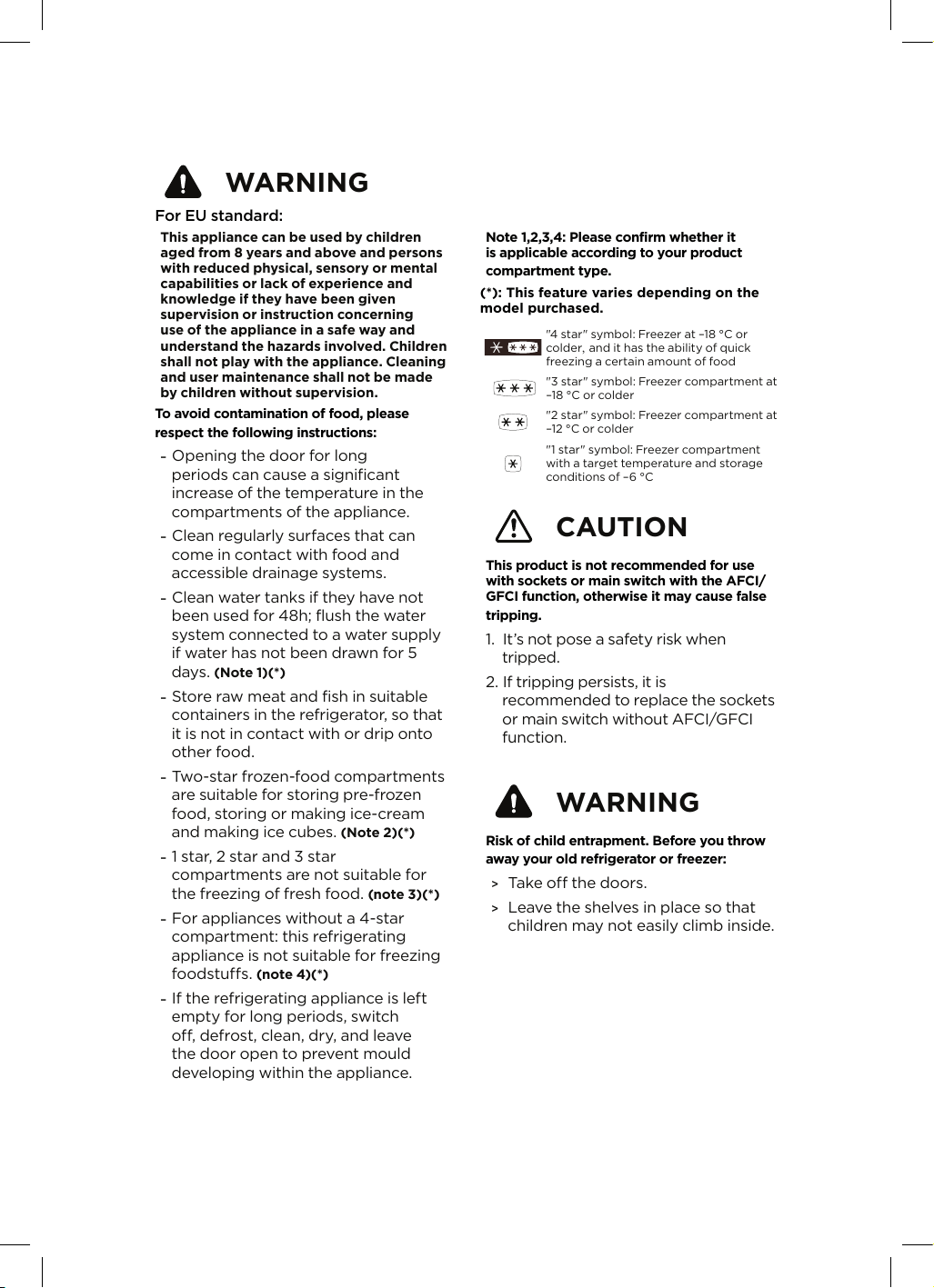
"4 star" symbol: Freezer at –18 °C or
colder,and it has the ability of quick
freezing a certain amount of food
"3 star" symbol: Freezer compartment at
–18 °C or colder
"2 star" symbol: Freezer compartment at
–12 °C or colder
"1 star" symbol: Freezer compartment
with a target temperature and storage
conditions of –6 °C
CAUTION
This product is not recommended for use
with sockets or main switch with the AFCI/
GFCI function, otherwise it may cause false
tripping.
1. It’s not pose a safety risk when
tripped.
2. If tripping persists, it is
recommended to replace the sockets
or main switch without AFCI/GFCI
function.
WARNING
Risk of child entrapment. Before you throw
away your old refrigerator or freezer:
> Take off the doors.
> Leave the shelves in place so that
children may not easily climb inside.
Important Safety Warnings (Continued)
8
Environmental Protection
5
EN
Environmental protection
ENVIRONMENTAL PROTECTION
Disposing of old electrical devices in an
environmentally-friendly manner
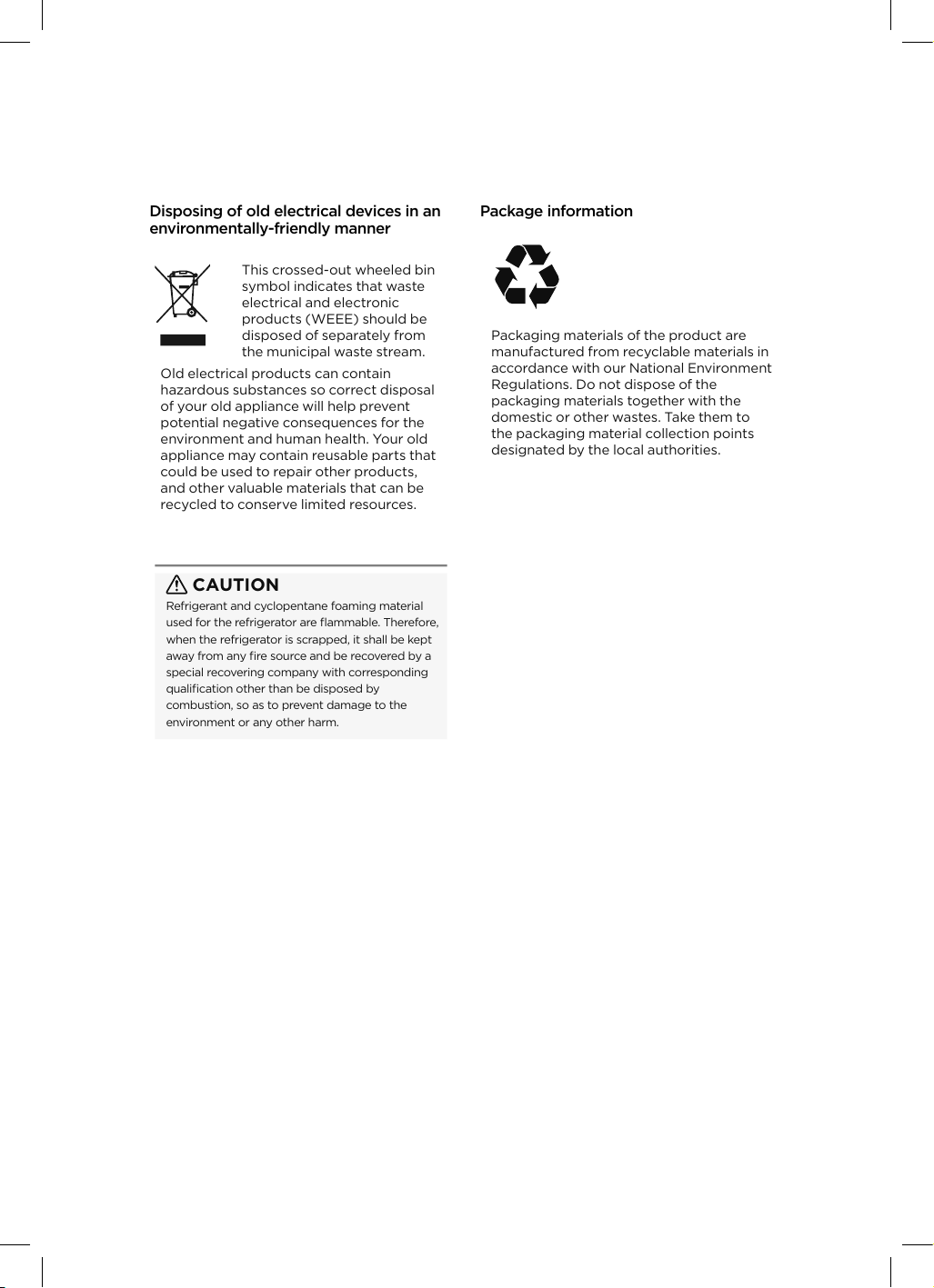
This crossed-out wheeled bin
symbol indicates that waste
electrical and electronic
products (WEEE) should be
disposed of separately from
the municipal waste stream.
Old electrical products can contain
hazardous substances so correct disposal
of your old appliance will help prevent
potential negative consequences for the
environment and human health. Your old
appliance may contain reusable parts that
could be used to repair other products,
and other valuable materials that can be
recycled to conserve limited resources.
CAUTION
Refrigerant and cyclopentane foaming material
used for the refrigerator are flammable. Therefore,
when the refrigerator is scrapped, it shall be kept
away from any fire source and be recovered by a
special recovering company with corresponding
qualification other than be disposed by
combustion, so as to prevent damage to the
environment or any other harm.
Package information
Packaging materials of the product are
manufactured from recyclable materials in
accordance with our National Environment
Regulations. Do not dispose of the
packaging materials together with the
domestic or other wastes. Take them to
the packaging material collection points
designated by the local authorities.
6
EN
Install Instruction
INSTALL INSTRUCTION
Before first use
Remove the exterior and interior packing,
wipe the outside thoroughly with a soft dry
cloth and the inside with a wet, lukewarm
cloth.
Avoid placing the cabinet in a narrow recess
or near any heat source, direct sunlight, or
moisture.
Inadequate clearance from adjacent items
may result in the degradation of freezing
capability and increased electricity costs.
Allow over 100 mm of clearance at both
sides and the top, and 50-75 mm at the back
when installing the appliance.
Before connecting your refrigerator to
the power supply, check that the voltage
stated on the rating label of your appliance
corresponds to the voltage in your home.
A different voltage could damage the
appliance.
The appliance must be grounded. The
manufacturer is not responsible for damages
that may occur as a result of usage without
grounding.
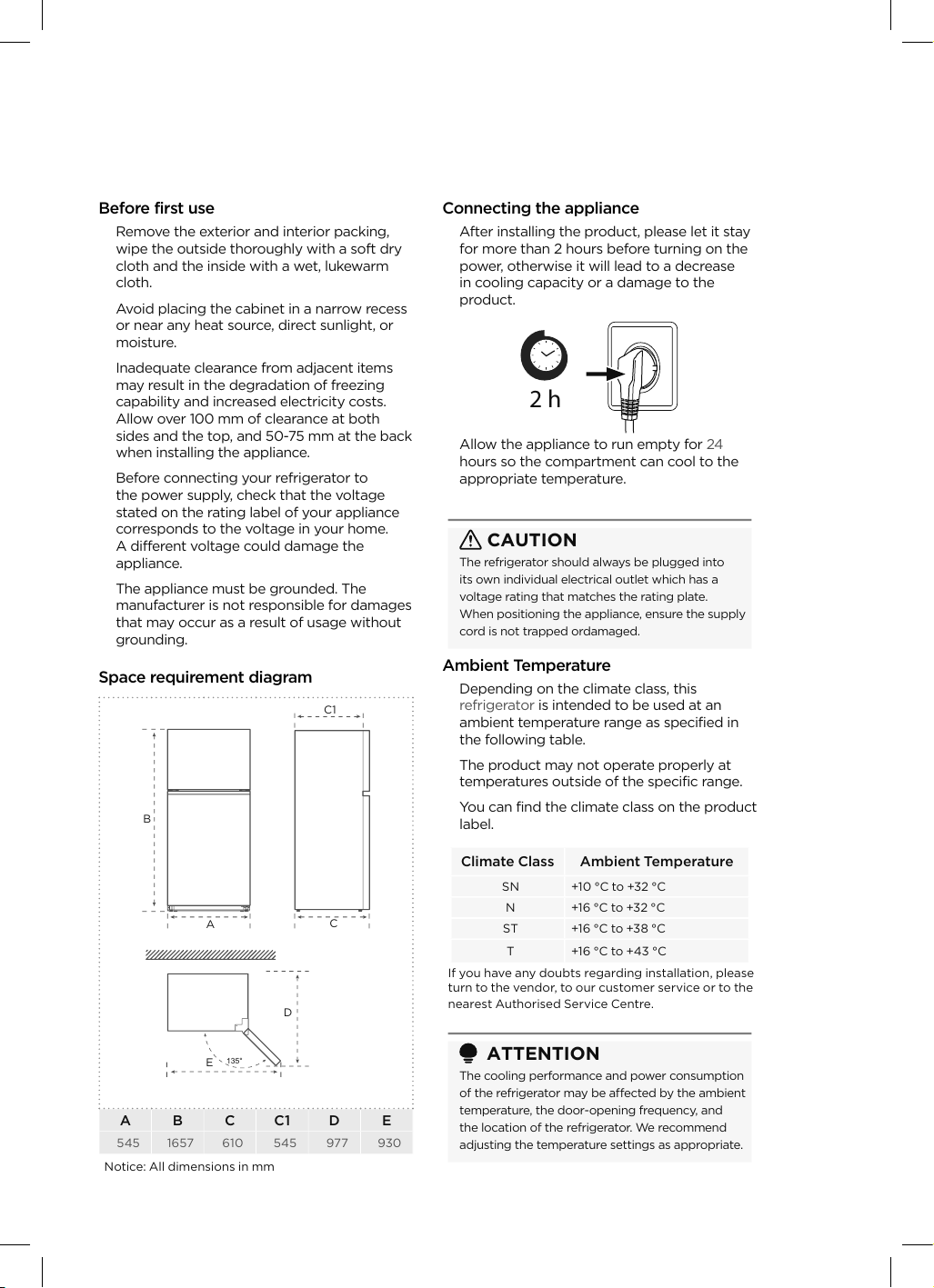
space requirement diagram
A
B
E
D
C
C1
135°
A B C C1 D E
545 1657 610 545 977 930
Notice: All dimensions in mm
Connecting the appliance
After installing the product, please let it stay
for more than 2 hours before turning on the
power, otherwise it will lead to a decrease
in cooling capacity or a damage to the
product.
2 h
Allow the appliance to run empty for 24
hours so the compartment can cool to the
appropriate temperature.
CAUTION
The refrigerator should always be plugged into
its own individual electrical outlet which has a
voltage rating that matches the rating plate.
When positioning the appliance, ensure the supply
cord is not trapped ordamaged.
Ambient Temperature
Depending on the climate class, this
refrigerator is intended to be used at an
ambient temperature range as specified in
the following table.
The product may not operate properly at
temperatures outside of the specific range.
You can find the climate class on the product
label.
Climate Class Ambient Temperature
SN +10 °C to +32 °C
N +16 °C to +32 °C
ST +16 °C to +38 °C
T +16 °C to +43 °C
If you have any doubts regarding installation, please
turn to the vendor, to our customer service or to the
nearest Authorised Service Centre.
ATTENTION
The cooling performance and power consumption
of the refrigerator may be aected by the ambient
temperature, the door-opening frequency, and
the location of the refrigerator. We recommend
adjusting the temperature settings as appropriate.
9
Installation Instructions
6
EN
Install Instruction
INSTALL INSTRUCTION
Before first use
Remove the exterior and interior packing,
wipe the outside thoroughly with a soft dry
cloth and the inside with a wet, lukewarm
cloth.
Avoid placing the cabinet in a narrow recess
or near any heat source, direct sunlight, or
moisture.
Inadequate clearance from adjacent items
may result in the degradation of freezing
capability and increased electricity costs.
Allow over 100 mm of clearance at both
sides and the top, and 50-75 mm at the back
when installing the appliance.
Before connecting your refrigerator to
the power supply, check that the voltage
stated on the rating label of your appliance
corresponds to the voltage in your home.
A different voltage could damage the
appliance.
The appliance must be grounded. The
manufacturer is not responsible for damages
that may occur as a result of usage without
grounding.
space requirement diagram
A
B
E
D
C
C1
135°
A B C C1 D E
545 1657 610 545 977 930
Notice: All dimensions in mm
Connecting the appliance
After installing the product, please let it stay
for more than 2 hours before turning on the
power, otherwise it will lead to a decrease
in cooling capacity or a damage to the
product.
2 h
Allow the appliance to run empty for 24
hours so the compartment can cool to the
appropriate temperature.
CAUTION
The refrigerator should always be plugged into
its own individual electrical outlet which has a
voltage rating that matches the rating plate.
When positioning the appliance, ensure the supply
cord is not trapped ordamaged.
Ambient Temperature
Depending on the climate class, this
refrigerator is intended to be used at an
ambient temperature range as specified in
the following table.
The product may not operate properly at
temperatures outside of the specific range.
You can find the climate class on the product
label.
Climate Class Ambient Temperature
SN +10 °C to +32 °C
N +16 °C to +32 °C
ST +16 °C to +38 °C
T +16 °C to +43 °C
If you have any doubts regarding installation, please
turn to the vendor, to our customer service or to the
nearest Authorised Service Centre.
ATTENTION
The cooling performance and power consumption
of the refrigerator may be aected by the ambient
temperature, the door-opening frequency, and
the location of the refrigerator. We recommend
adjusting the temperature settings as appropriate.
6
EN
Install Instruction
INSTALL INSTRUCTION
Before first use
Remove the exterior and interior packing,
wipe the outside thoroughly with a soft dry
cloth and the inside with a wet, lukewarm
cloth.
Avoid placing the cabinet in a narrow recess
or near any heat source, direct sunlight, or
moisture.
Inadequate clearance from adjacent items
may result in the degradation of freezing
capability and increased electricity costs.
Allow over 100 mm of clearance at both
sides and the top, and 50-75 mm at the back
when installing the appliance.
Before connecting your refrigerator to
the power supply, check that the voltage
stated on the rating label of your appliance
corresponds to the voltage in your home.
A different voltage could damage the
appliance.
The appliance must be grounded. The
manufacturer is not responsible for damages
that may occur as a result of usage without
grounding.
space requirement diagram
A
B
E
D
C
C1
135°
A B C C1 D E
545 1657 610 545 977 930
Notice: All dimensions in mm
Connecting the appliance
After installing the product, please let it stay
for more than 2 hours before turning on the
power, otherwise it will lead to a decrease
in cooling capacity or a damage to the
product.
2 h
Allow the appliance to run empty for 24
hours so the compartment can cool to the
appropriate temperature.
CAUTION
The refrigerator should always be plugged into
its own individual electrical outlet which has a
voltage rating that matches the rating plate.
When positioning the appliance, ensure the supply
cord is not trapped ordamaged.
Ambient Temperature
Depending on the climate class, this
refrigerator is intended to be used at an
ambient temperature range as specified in
the following table.
The product may not operate properly at
temperatures outside of the specific range.
You can find the climate class on the product
label.
Climate Class Ambient Temperature
SN +10 °C to +32 °C
N +16 °C to +32 °C
ST +16 °C to +38 °C
T +16 °C to +43 °C
If you have any doubts regarding installation, please
turn to the vendor, to our customer service or to the
nearest Authorised Service Centre.
ATTENTION
The cooling performance and power consumption
of the refrigerator may be aected by the ambient
temperature, the door-opening frequency, and
the location of the refrigerator. We recommend
adjusting the temperature settings as appropriate.
10
Installation Instructions (Continued)
7
EN
Install Instruction
Door reversal (Optional)
Based on the location where you plan to
use your refrigerator, you may find it more
convenient to reverse the position of the
door.
CAUTION
To avoid injury to yourself or your property, we
recommend that someone assist you during the
door reversal process.
>
Make sure that your refrigerator is
unplugged and empty.
> Have someone available to assist you in
the process.
> Keep all of the parts you remove to reuse
them later.
sTEP:
1. Please power off this appliance before
conduct this operation. Remove all food
from door shelves.
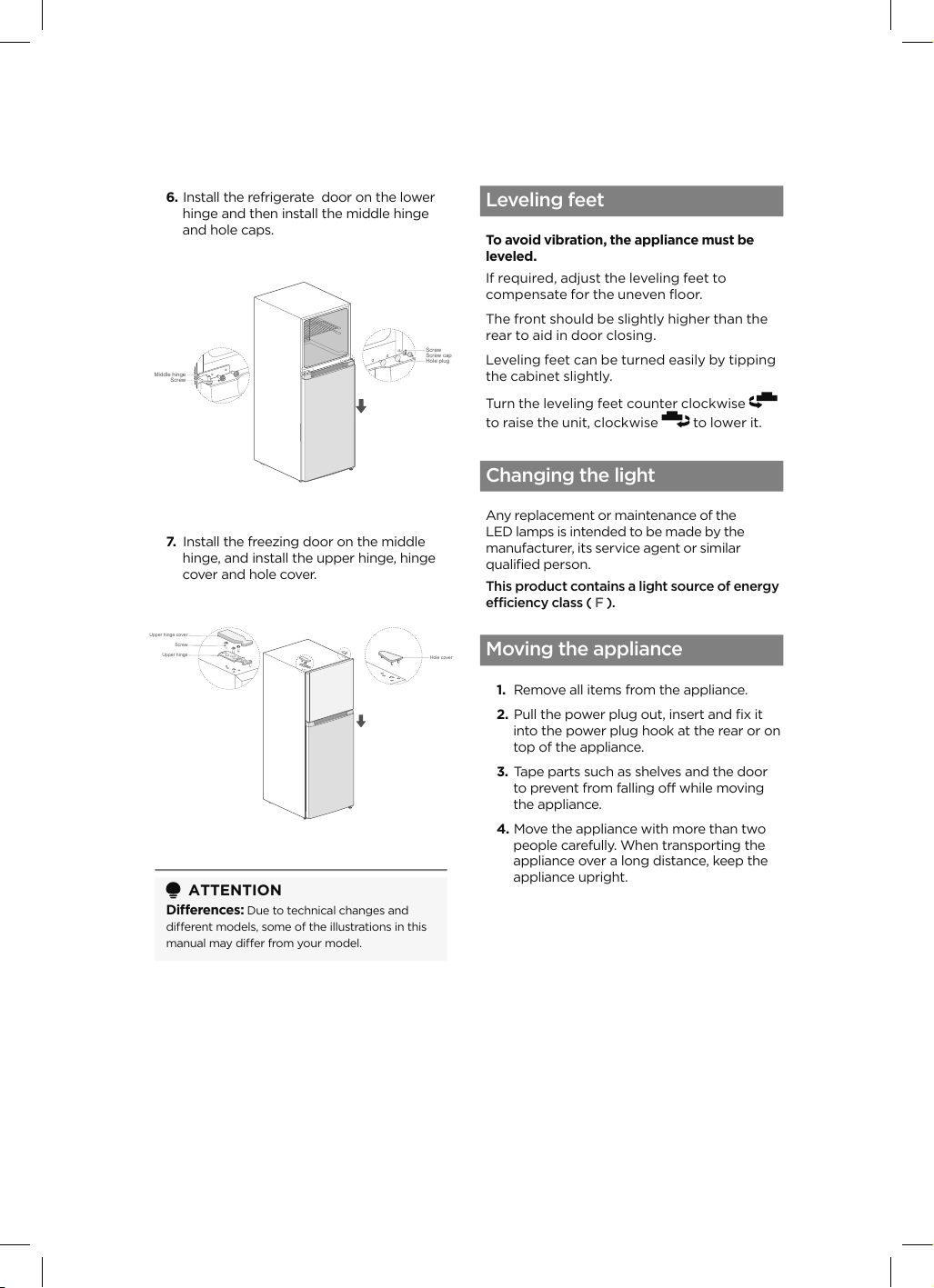
2. Remove hole cap, the upper hinge cover,
fitting screws of upper hinge, upper hinge
and sleeve pipe, then uplift the freezer
door until it is separated from cabinet
completely.
Hole cover
Upper hinge cover
Upper hinge
Screw
3. Unscrew the middle hinge screws, remove
the middle hinge, and remove the two
hole plug, a screw, a screw cap on the
middle beam , then remove the refrigerate
door.
Middle hinge
Screw
Hole plug
Screw
Screw cap
4. Remove the adjusting feet, lower hinge
screw and lower hinge assembly, then
install the lower hinge assembly on the
other side of the box and install the
adjusting feet on the side of the adjusting
feet opening.
Lower hinge assembly
Screw
Adjusting feet
5. Dismantle the limiting blocks and screws
on the lower cover of both refrigerator
door and freezing door, install them on
the other side of both doors; then install
the sleeve pipe on the upper cover of the
refrigerate door on the other side.
Limiting block
Screw
Sleeve pipe
Limiting block
Screw
11
8
EN
Install Instruction
6. Install the refrigerate door on the lower
hinge and then install the middle hinge
and hole caps.
Middle hinge
Screw
Hole plug
Screw
Screw cap
7. Install the freezing door on the middle
hinge, and install the upper hinge, hinge
cover and hole cover.
Hole cover
Upper hinge cover
Upper hinge
Screw
ATTENTION
Dierences: Due to technical changes and
dierent models, some of the illustrations in this
manual may dier from your model.
Leveling feet
To avoid vibration, the appliance must be
leveled.
If required, adjust the leveling feet to
compensate for the uneven floor.
The front should be slightly higher than the
rear to aid in door closing.
Leveling feet can be turned easily by tipping
the cabinet slightly.
Turn the leveling feet counter clockwise
to raise the unit, clockwise
to lower it.
Changing the light
Any replacement or maintenance of the
LED lamps is intended to be made by the
manufacturer, its service agent or similar
qualified person.
This product contains a light source of energy
efficiency class ( F ).
Moving the appliance
1. Remove all items from the appliance.
2. Pull the power plug out, insert and fix it
into the power plug hook at the rear or on
top of the appliance.
3. Tape parts such as shelves and the door
to prevent from falling off while moving
the appliance.
4. Move the appliance with more than two
people carefully. When transporting the
appliance over a long distance, keep the
appliance upright.
Installation Instructions (Continued)
12
9
EN
Install Instruction
Tips for energy saving
Do not place the appliance near cookers,
radiators or other heat sources. If the
ambient temperature is high, the compressor
will run more frequently and for longer,
resulting in increased energy consumption.
Ensure that there is sufficient ventilation at
the base of the appliance, on the sides of the
appliance and at the back of the appliance.
Please also observe the spacing dimensions
in the chapter “Installation”.
The arrangement of drawers, shelves and
trays as shown in the product overview
offers the most efficient use of energy and
should be retained as far as possible.
To obtain a larger storage space (e.g. for
large refrigerated/frozen goods), the middle
drawers and shelves can be removed. The
top and bottom drawers and shelves should
be removed last if necessary.
An evenly filled refrigerator/freezer
compartment contributes to optimal energy
use.
Allow warm food to cool before placing it in
the refrigerator/freezer compartment. Food
that has already cooled down increases
energy efficiency.
Allow frozen food to defrost in the
refrigeration compartment The coldness
of the frozen food reduces the energy
consumption in the refrigerator
compartment and thus increases the energy
efficiency.
Open the door only as briefly as necessary
to minimise cold loss. Opening the door
briefly and closing it properly reduces
energy consumption.
Setting the temperature no colder than
necessary contributes to optimal energy use.
The door gaskets of your appliance must
be perfectly intact so that the doors close
properly and energy consumption is not
increased unnecessarily.
stop using
Power failure:
In case of power failure, even if it is in
summer, foods inside the appliance can be
kept for several hours; during the power
failure, the times of door opening shall be
reduced, and no more fresh food shall be put
into the appliance.
Long-time nonuse:
The appliance shall be unplugged and then
cleaned; then the doors are left open to
prevent odor.
Moving:
Before the refrigerator is moved, take all
objects inside out, fix the glass partitions,
vegetable holder, freezing chamber drawers
and etc. with tape, and tighten the leveling
feet; close the doors and fix them with
tape. During moving, the appliance shall not
be laid upside down or horizontally, or be
vibrated; the inclination during movement
shall be no more than 45°
Installation Instructions (Continued)
13
10
EN
Product overview
PRODUCT OVERVIEW
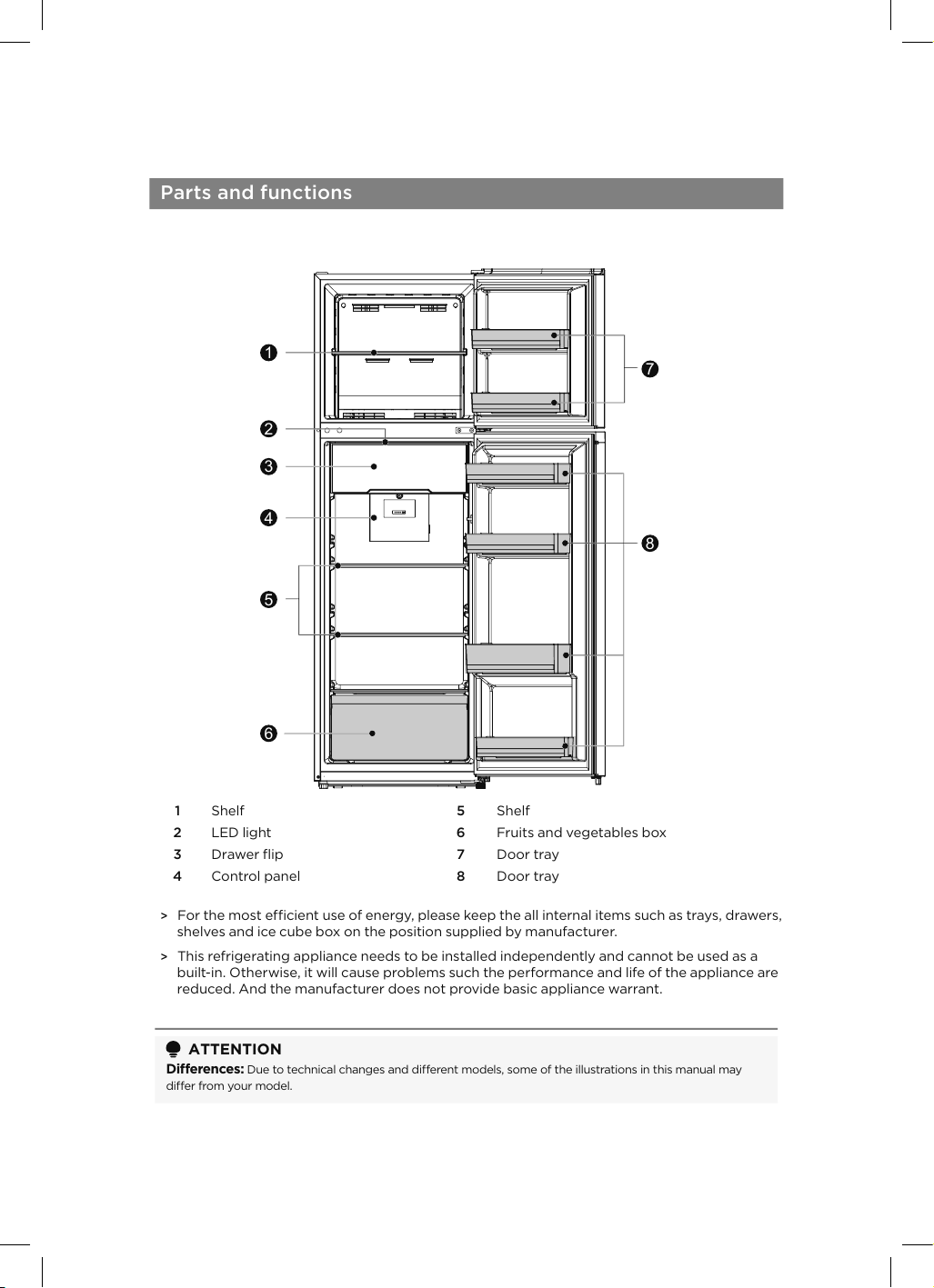
Parts and functions
Type A
1 Shelf 5 Shelf
2 LED light 6 Fruits and vegetables box
3 Drawer flip 7 Door tray
4 Control panel 8 Door tray
> For the most efficient use of energy, please keep the all internal items such as trays, drawers,
shelves and ice cube box on the position supplied by manufacturer.
> This refrigerating appliance needs to be installed independently and cannot be used as a
built-in. Otherwise, it will cause problems such the performance and life of the appliance are
reduced. And the manufacturer does not provide basic appliance warrant.
ATTENTION
Dierences: Due to technical changes and dierent models, some of the illustrations in this manual may
dier from your model.
2
7
8
5
1
3
4
6
Product Overview
14
Operation Instructions
12
EN
Operation Instructions
OPERATION INSTRUCTIONS
Use and functions
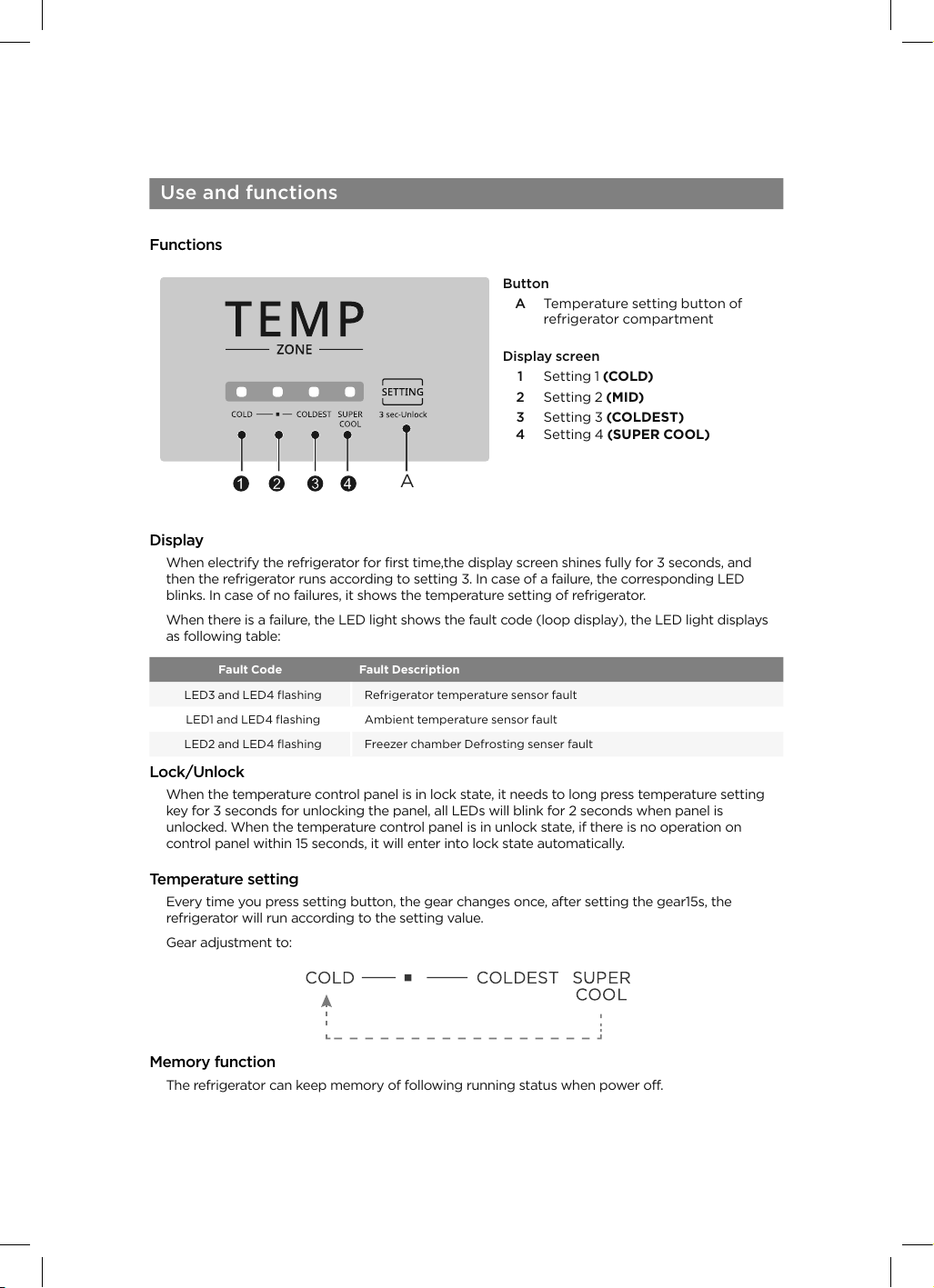
Functions
A
Button
A Temperature setting button of
refrigerator compartment
Display screen
1 Setting 1 (COLD)
2 Setting 2 (MID)
3 Setting 3 (COLDEST)
4 Setting 4 (SUPER COOL)
Display
When electrify the refrigerator for first time,the display screen shines fully for 3 seconds, and
then the refrigerator runs according to setting 3. In case of a failure, the corresponding LED
blinks. In case of no failures, it shows the temperature setting of refrigerator.
When there is a failure, the LED light shows the fault code (loop display), the LED light displays
as following table:
Fault Code Fault Description
LED3 and LED4 flashing Refrigerator temperature sensor fault
LED1 and LED4 flashing Ambient temperature sensor fault
LED2 and LED4 flashing Freezer chamber Defrosting senser fault
Lock/Unlock
When the temperature control panel is in lock state, it needs to long press temperature setting
key for 3 seconds for unlocking the panel, all LEDs will blink for 2 seconds when panel is
unlocked. When the temperature control panel is in unlock state, if there is no operation on
control panel within 15 seconds, it will enter into lock state automatically.
Temperature setting
Every time you press setting button, the gear changes once, after setting the gear15s, the
refrigerator will run according to the setting value.
Gear adjustment to:
Memory function
The refrigerator can keep memory of following running status when power off.
15
13
EN
Operation Instructions
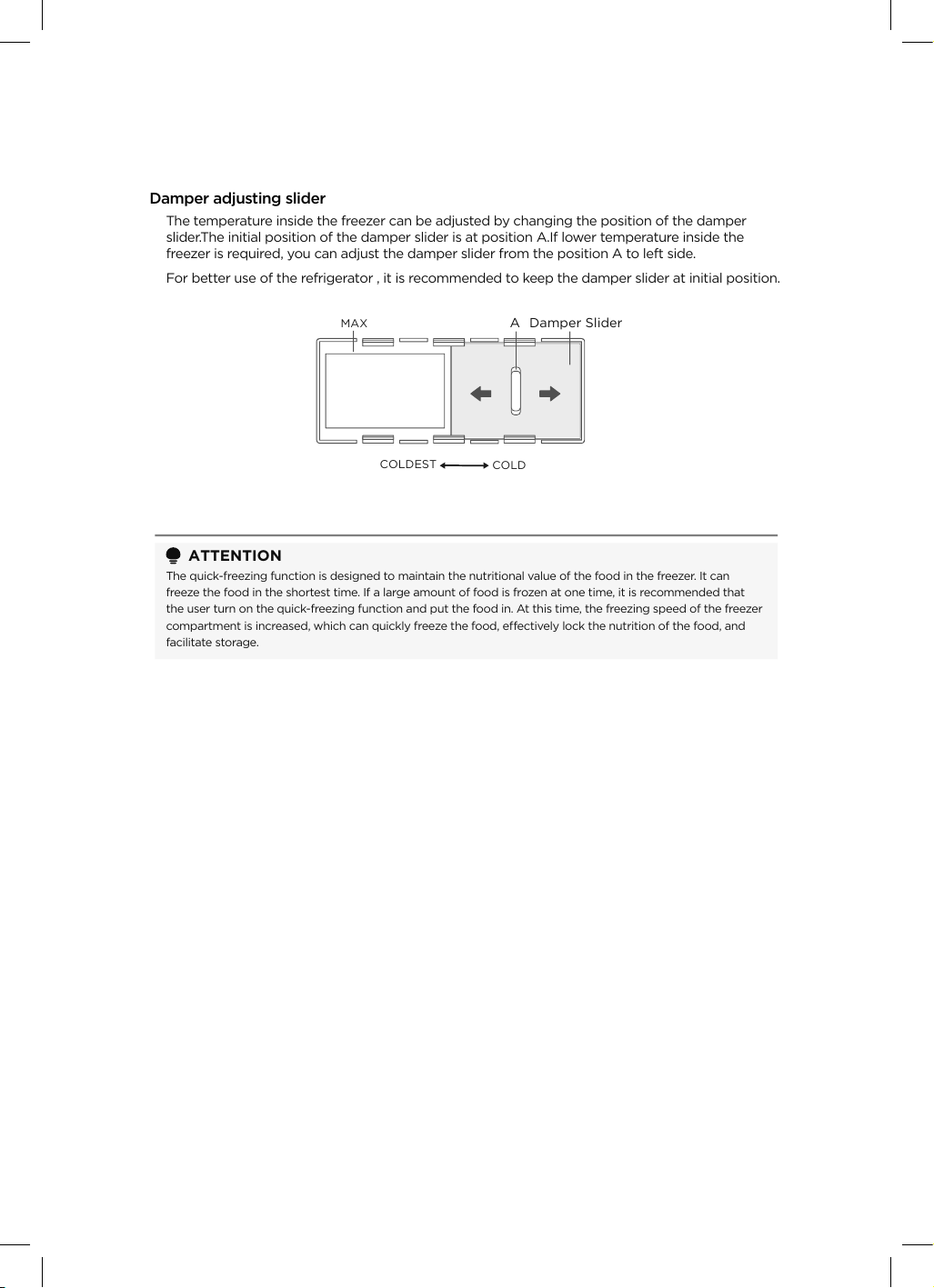
Damper adjusting slider
The temperature inside the freezer can be adjusted by changing the position of the damper
slider.The initial position of the damper slider is at position A.If lower temperature inside the
freezer is required, you can adjust the damper slider from the position A to left side.
For better use of the refrigerator , it is recommended to keep the damper slider at initial position.
COLDEST
COLD
MAX
Damper SliderA
ATTENTION
The quick-freezing function is designed to maintain the nutritional value of the food in the freezer. It can
freeze the food in the shortest time. If a large amount of food is frozen at one time, it is recommended that
the user turn on the quick-freezing function and put the food in. At this time, the freezing speed of the freezer
compartment is increased, which can quickly freeze the food, eectively lock the nutrition of the food, and
facilitate storage.
Operation Instructions (Continued)
16
Food Storage
15
EN
Operation Instructions
storing food
Freezer compartment
The freezer compartment is designated
for the low-temperature freezing of food,
long-term storage of frozen food, and for the
production of ice cubes.
Pay attention to the star classifications
(4 star, 2 star and 1 star) in the freezer
compartment and the resulting storage
periods for frozen food.
Do not put fresh and frozen food next to
each other. The frozen food may thaw.
When freezing large amounts of fresh food
(such as meat, fish or chopped meat), please
divide them into several small pieces before
putting in, so that they can be quickly frozen
and pick up easily.
Abide by the storage times recommended
by food manufacturers on the packages,
there is no information on the packaging,
food should not be stored frozen for
longer than three months from the date of
purchase.
When purchasing frozen food, make sure
that it was frozen at a suitable temperature
and that the packaging is not damaged.
Frozen food should be kept in suitable
individual packages to ensure that adjacent
food cannot be contaminated.Consume
thawed and defrosted foods immediately, do
not refreeze them.
In case of prolonged power failure or
malfunction of the appliance, remove the
stored frozen food and check whether
they are still edible, then store them in
a sufficiently cool place or in another
appliance.
To defrost food, remove it from the freezer
and let it defrost at room temperature or
in the refrigerator. To defrost food quickly,
you can use the defrost function on your
microwave, for example.
If you only want to defrost part of a
pack, remove the portion you need and
immediately close the rest of the pack. In
this way, you will avoid “freezer burn” and
will reduce ice formation on the remaining
foods.
Cooling compartment
To reduce moisture and subsequent ice
build-up, never put liquid into the fridge
compartment in unsealed containers.
Frost tends to concentrate in the coolest
parts of the evaporator. Storing uncovered
liquids results in a more frequent need for
defrosting.
Never put warm foods in the fridge
compartment. These should first cool down
at room temperature and then be placed so
as to ensure adequate air circulation in the
fridge compartment.
Foods or food containers should not
touch the back wall of the fridge because
they could freeze to the wall. Do not
keep regularly opening the door of the
refrigerator.
Meat and clean fish (packed in a package
or plastic foil) can be placed in the fridge
compartment, which can be used in 1–2 days.
Fruit and vegetables without packaging can
be placed in the part designated for fresh
fruit and vegetables.
ATTENTION
Storage of too much food during operation after
the initial connection to power may adversely
aect the freezing eect of the refrigerator.
storage times and temperature
Note: Overlong storage or storage at
inappropriate freezing temperature may
cause a quality loss or spoiled foods, which
causes food waste, is inedible and may cause
food poisoning. The minimum temperature
in most cases should be -18°C or colder.
Follow the maximum recommended storage
times below:
> Stew, ice cream, sausages, bread: 2-6
months.
> Fish, shrimp, lamb, meat: 4-8 months.
> Vegetables, fruits, poultry, beef: 6-12
months.
17
Maintenance & Cleaning
16
EN
Maintenance and cleaning
MAINTENANCE AND CLEANING
CAUTION
Disconnect the appliance from the electrical
supply before ndertaking any routine
maintenance. Allow at least 5 minutes before
restarting the appliance, as frequent starting
may damage the compressor.
Do not use mechanical devices or other
means to accelerate the defrosting process,
other than those recommended by the
manufacturer.
Do not try to repair, disassemble or modify
the appliance by yourself. In case of repair
please contact our customer service.
Eliminate the dust on the back of the unit at
least once in the year to avoid hazard by fire,
as well as increased energy consumption.
Check the door gasket regularly to make
sure there are no debris. Clean the door
gasket with a soft cloth dampened with
soapy water or diluted detergent.
The interior of the product should be
cleaned regularly to avoid odor.
Use a soft cloth or sponge to clean the
inside of the product, with two tablespoons
of baking soda and a quart of warm water.
Then rinse with water and wipe clean.
After cleaning, open the door and let it dry
naturally before turning on the power.
For areas that are difficult to clean in the
product (such as narrow sandwiches, gaps
or corners), it is recommended to wipe them
regularly with a soft rag, soft brush, etc.
and when necessary, combined with some
auxiliary tools (such as thin sticks) to ensure
no contaminants or bacterials accumulation
in these areas.
Wipe the outer surface of the product with
a soft cloth dampened with soapy water,
detergent, etc., and then wipe dry.
Do not use hard brushes, clean steel
balls, wire brushes, abrasives (such as
toothpastes), organic solvents (such as
alcohol, acetone, banana oil, etc.), boiling
water, acid or alkaline items, which may
damage the fridge surface and interior.
Boiling water and organic solvents such as
benzene may deform or damage plastic
parts.
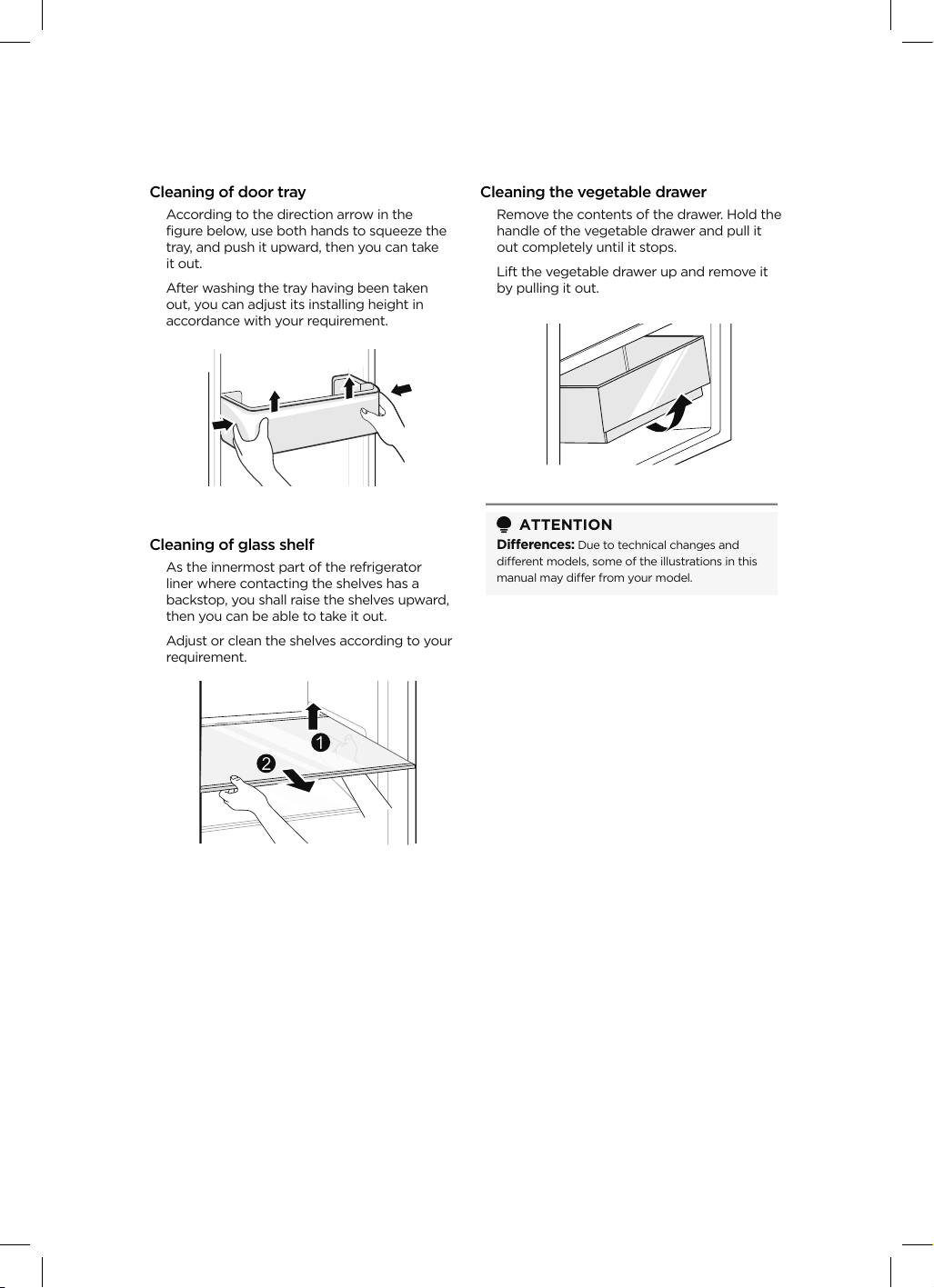
Do not rinse directly with water or other
liquids during cleaning to avoid short circuits
or affect electrical insulation after immersion.
Defrosting
Although this appliance automatically
defrosts, a layer of frost may occur on the
freezer compartment’s interior walls if the
freezer door is opened frequently or kept
open too long. If the frost is too thick,
choose a time when the supply of food
stocks are low and proceed as follows:
1. Remove existing food and accessories
baskets, unplug the appliance from
the mains power and leave the doors
open. Ventilate the room thoroughly to
accelerate the thawing process.
2. When defrosting is completed, clean your
freezer as described above.
CAUTION! Don’t use sharp objects to
remove frost from the freezer. Only after the
interior completely dry should the appliance
be switched back on and plugged back into
the mains socket.
ATTENTION
The appliance shall run continuously once it is
started. Generally, the operation of the appliance
shall not be interrupted;otherwise the service life
may be impaired
18
17
EN
Maintenance and cleaning
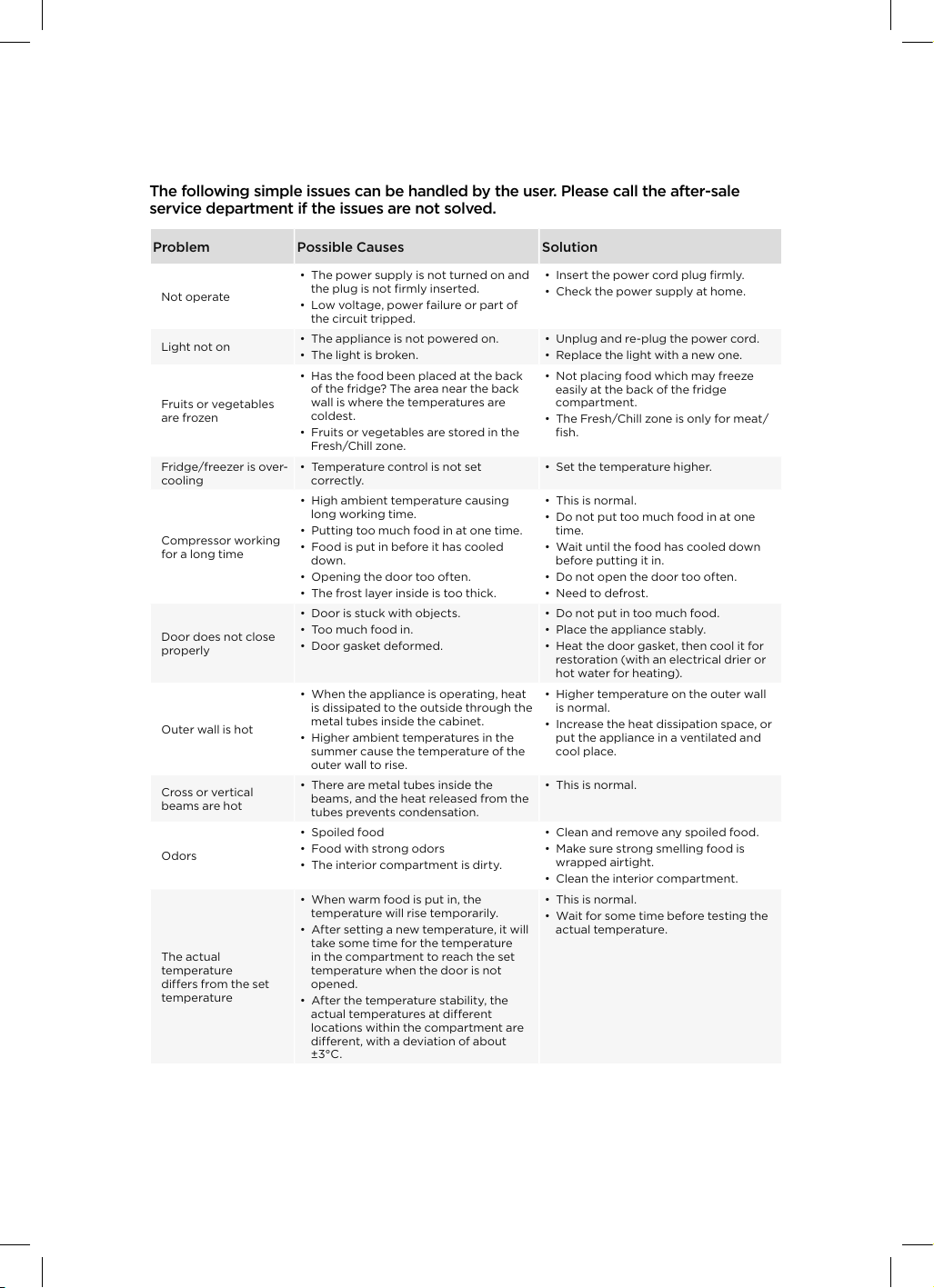
Cleaning of door tray
According to the direction arrow in the
figure below, use both hands to squeeze the
tray, and push it upward, then you can take
it out.
After washing the tray having been taken
out, you can adjust its installing height in
accordance with your requirement.
Cleaning of glass shelf
As the innermost part of the refrigerator
liner where contacting the shelves has a
backstop, you shall raise the shelves upward,
then you can be able to take it out.
Adjust or clean the shelves according to your
requirement.
Cleaning the vegetable drawer
Remove the contents of the drawer. Hold the
handle of the vegetable drawer and pull it
out completely until it stops.
Lift the vegetable drawer up and remove it
by pulling it out.
ATTENTION
Dierences: Due to technical changes and
dierent models, some of the illustrations in this
manual may dier from your model.
Maintenance & Cleaning (Continued)
19
18
EN
Troubleshooting
TROUBLESHOOTING
The following simple issues can be handled by the user. Please call the after-sale
service department if the issues are not solved.
Problem Possible Causes solution
Not operate
• The power supply is not turned on and
the plug is not firmly inserted.
• Low voltage, power failure or part of
the circuit tripped.
• Insert the power cord plug firmly.
• Check the power supply at home.
Light not on
• The appliance is not powered on.
• The light is broken.
• Unplug and re-plug the power cord.
• Replace the light with a new one.
Fruits or vegetables
are frozen
• Has the food been placed at the back
of the fridge? The area near the back
wall is where the temperatures are
coldest.
• Fruits or vegetables are stored in the
Fresh/Chill zone.
• Not placing food which may freeze
easily at the back of the fridge
compartment.
• The Fresh/Chill zone is only for meat/
fish.
Fridge/freezer is over-
cooling
• Temperature control is not set
correctly.
• Set the temperature higher.
Compressor working
for a long time
• High ambient temperature causing
long working time.
• Putting too much food in at one time.
• Food is put in before it has cooled
down.
• Opening the door too often.
• The frost layer inside is too thick.
• This is normal.
• Do not put too much food in at one
time.
• Wait until the food has cooled down
before putting it in.
• Do not open the door too often.
• Need to defrost.
Door does not close
properly
• Door is stuck with objects.
• Too much food in.
• Door gasket deformed.
• Do not put in too much food.
• Place the appliance stably.
• Heat the door gasket, then cool it for
restoration (with an electrical drier or
hot water for heating).
Outer wall is hot
• When the appliance is operating, heat
is dissipated to the outside through the
metal tubes inside the cabinet.
• Higher ambient temperatures in the
summer cause the temperature of the
outer wall to rise.
• Higher temperature on the outer wall
is normal.
• Increase the heat dissipation space, or
put the appliance in a ventilated and
cool place.
Cross or vertical
beams are hot
• There are metal tubes inside the
beams, and the heat released from the
tubes prevents condensation.
• This is normal.
Odors
• Spoiled food
• Food with strong odors
• The interior compartment is dirty.
• Clean and remove any spoiled food.
• Make sure strong smelling food is
wrapped airtight.
• Clean the interior compartment.
The actual
temperature
differs from the set
temperature
• When warm food is put in, the
temperature will rise temporarily.
• After setting a new temperature, it will
take some time for the temperature
in the compartment to reach the set
temperature when the door is not
opened.
• After the temperature stability, the
actual temperatures at different
locations within the compartment are
different, with a deviation of about
±3°C.
• This is normal.
• Wait for some time before testing the
actual temperature.
Troubleshooting
20
19
EN
Troubleshooting
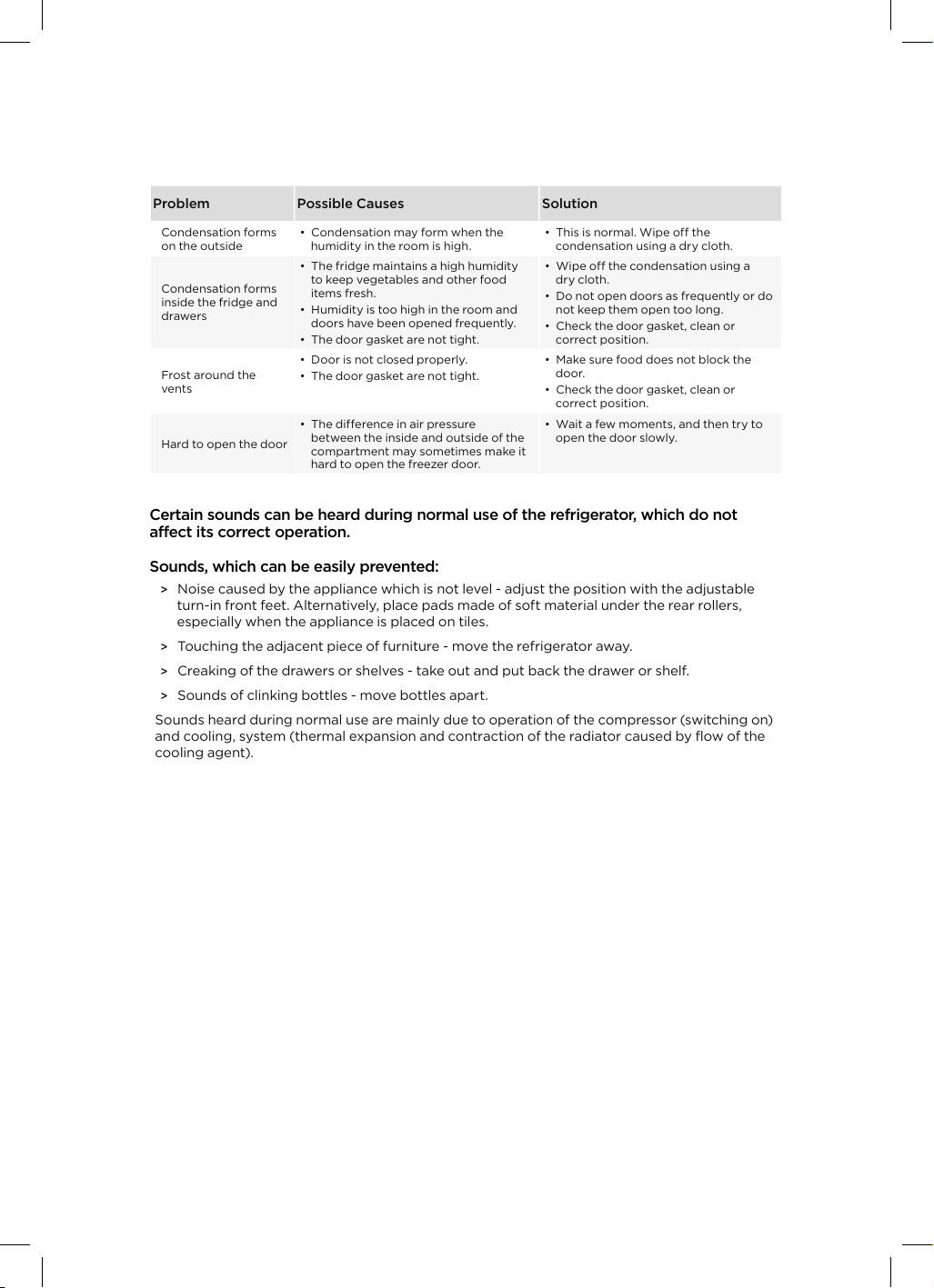
Problem Possible Causes solution
Condensation forms
on the outside
• Condensation may form when the
humidity in the room is high.
• This is normal. Wipe off the
condensation using a dry cloth.
Condensation forms
inside the fridge and
drawers
• The fridge maintains a high humidity
to keep vegetables and other food
items fresh.
• Humidity is too high in the room and
doors have been opened frequently.
• The door gasket are not tight.
• Wipe off the condensation using a
dry cloth.
• Do not open doors as frequently or do
not keep them open too long.
• Check the door gasket, clean or
correct position.
Frost around the
vents
• Door is not closed properly.
• The door gasket are not tight.
• Make sure food does not block the
door.
• Check the door gasket, clean or
correct position.
Hard to open the door
• The difference in air pressure
between the inside and outside of the
compartment may sometimes make it
hard to open the freezer door.
• Wait a few moments, and then try to
open the door slowly.
Certain sounds can be heard during normal use of the refrigerator, which do not
affect its correct operation.
sounds, which can be easily prevented:
> Noise caused by the appliance which is not level - adjust the position with the adjustable
turn-in front feet. Alternatively, place pads made of soft material under the rear rollers,
especially when the appliance is placed on tiles.
> Touching the adjacent piece of furniture - move the refrigerator away.
> Creaking of the drawers or shelves - take out and put back the drawer or shelf.
> Sounds of clinking bottles - move bottles apart.
Sounds heard during normal use are mainly due to operation of the compressor (switching on)
and cooling, system (thermal expansion and contraction of the radiator caused by flow of the
cooling agent).
Troubleshooting (Continued)
21
Specifications
Model: GGSTM266DS
Product Dimensions: W: 545mm, D: 610mm, H: 1657mm
Weight: 45kg
Total Capacity: 266L
Fridge Capacity: 206L
Freezer Capacity: 60L
Temperature Range: Fridge: 1 – 10°C / Freezer: -12 – -24°C
Cooling Zone Compartment: 3 – -3°C
Other Features: Reversible Door, Cooling Drawer, Fruit & Vegetable Crisper Drawer,
Glass Shelves, Electronic Temperature controls, NoFrost Automatic Defrost
System, LED Lighting, Adjustable Levelling Feet
Energy Rating: 4.5 Stars MEPS
Max Noise Rating: 43 dB(A)
22
For your records, please record details of your purchase below and staple your receipt on the opposite
page. Your serial number can be found on the rating plate of your Refrigerator.
STORE DETAILS
STORE NAME
|
ADDRESS
|
TELEPHONE
|
PURCHASE DATE
|
PRODUCT DETAILS
MODEL NO.
|
SERIAL NO.*
|
Purchase Details
23
Attach your receipt to this page
24
Notes...
25
Notes...
26
WARRANTY TERMS AND CONDITIONS
REFRIGERATORS
This document sets out the terms and conditions
of the product warranties for Residentia Group
Appliances. It is an important document. Please
keep it with your proof of purchase documents in a
safe place for future reference should you require
service for your Appliance.
1. IN THIS WARRANTY
(a) ‘acceptable quality’ as referred to in clause 10
of this warranty has the same meaning referred
to in the ACL;
(b) ‘ACL’ means Trade Practices Amendment
(Australian Consumer Law) Act (No.2) 2010;
(c) ‘Appliance’ means any Residentia Group
product purchased by you accompanied by
this document;
(d) ‘ASR’ means Residentia Group authorised
service representative;
(e) ‘Residentia Group’ means Residentia Group
Pty Ltd of 165 Barkly Ave, Burnley VIC 3121,
ACN 600 546 656 in respect of Appliances
purchased in Australia;
(f ) ‘major failure’ as referred to in clause 10 of
this warranty has the same meaning referred
to in the ACL and includes a situation when
an Appliance cannot be repaired or it is
uneconomic for Residentia Group, at its
discretion, to repair an Appliance during the
Warranty Period;
(g) ‘Warranty Period’ means:
(i) where the Appliance is used for personal,
domestic or household use (i.e. normal
single family use) as set out in the
instruction manual, the Appliance is
warranted against manufacturing defects
for 24 months, following the date of
original purchase of the Appliance;
(h) ‘you’ means the purchaser of the Appliance not
having purchased the Appliance for re-sale,
and ‘your’ has a corresponding meaning.
2. This warranty only applies to Appliances
purchased and used in Australia and is in
addition to (and does not exclude, restrict,
or modify in any way) any non-excludable
statutory warranties in Australia.
3. During the Warranty Period Residentia Group
or its ASR will, at no extra charge if your
Appliance is readily accessible for service,
without special equipment and subject
to these terms and conditions, repair or
replace any parts which it considers to be
defective. Residentia Group or its ASR may use
remanufactured parts to repair your Appliance.
You agree that any replaced Appliances or
parts become the property of Residentia
Group. This warranty does not apply to
light globes, batteries, filters, seals or similar
perishable parts.
4. Parts and Appliances not supplied by
Residentia Group are not covered by
this warranty.
5. You will bear the cost of transportation, travel
and delivery of the Appliance to and from
Residentia Group or its ASR. If you reside
outside of the service area, you will bear the
cost of:
(a) travel of an authorised representative;
(b) transportation and delivery of the Appliance
to and from Residentia Group or its ASR, in all
instances, unless the Appliance is transported
by Residentia Group or its ASR, the Appliance
is transported at the owner’s cost and risk while
in transit to and from Residentia Group or its
ASR.
6. Proof of purchase is required before you can
make a claim under this warranty.
7. You may not make a claim under this warranty
unless the defect claimed is due to faulty or
defective parts or workmanship. Residentia
Group is not liable in the following situations
(which are not exhaustive):
(a) the Appliance is damaged by:
(i) accident
(ii) misuse or abuse, including failure to
properly maintain or service
(iii) normal wear and tear
(iv) power surges, electrical storm damage or
incorrect power supply
(v) incomplete or improper installation
(vi) incorrect, improper or inappropriate
operation
(vii) insect or vermin infestation
(viii) failure to comply with any additional
instructions supplied with the Appliance;
Warranty Information
27
(b) the Appliance is modified without authority
from Residentia Group in writing;
(c) the Appliance’s serial number or warranty seal
has been removed or defaced;
(d) the Appliance was serviced or repaired by
anyone other than Residentia Group, an
authorised repairer or ASR.
8. This warranty, the contract to which it
relates and the relationship between you
and Residentia Group are governed by the
law applicable where the Appliance
was purchased.
9. To the extent permitted by law, Residentia
Group excludes all warranties and liabilities
(other than as contained in this document)
including liability for any loss or damage
whether direct or indirect arising from your
purchase, use or non use of the Appliance.10.
For Appliances and services provided by
Residentia Group in Australia, the Appliances
come with a guarantee by Residentia
Group that cannot be excluded under the
Australian Consumer Law. You are entitled to a
replacement or refund for a major failure and
for compensation for any other reasonably
foreseeable loss or damage. You are also
entitled to have the Appliance repaired
or replaced if the Appliance fails to be of
acceptable quality and the failure does not
amount to a major failure. The benefits to
you given by this warranty are in addition to
your other rights and remedies under a law in
relation to the Appliances or services to which
the warranty relates.
11. At all times during the Warranty Period,
Residentia Group shall, at its discretion,
determine whether repair, replacement or
refund will apply if an Appliance has a valid
warranty claim applicable to it.
12. Missing parts are not covered by warranty.
Residentia Group reserves the right to assess
each request for missing parts in a case by case
basis.
Any parts that are not reported missing in the
first week after purchase will not provide free
of charge.
13. To enquire about claiming under this warranty,
please follow these steps:
(a) carefully check the operating instructions, user
manual and the terms of this warranty;
(b) have the model and serial number of the
Appliance available;
(c) have the proof of purchase (e.g. an invoice)
available;
(d) telephone the numbers shown below.
14. You accept that if you make a warranty claim,
Residentia Group and its ASR may exchange
information in relation to you to enable
Residentia Group to meet its obligations under
this warranty.
IMPORTANT
Before calling for service, please ensure that the
steps in point 13 have been followed.
CONTACT SERVICE
Service: 1300 11 HELP (4357)
Our goods come with guarantees that cannot be excluded under the
Australian Consumer Law. You are entitled to a replacement or refund
for a major failure and for compensation for any other reasonably
foreseeable loss or damage. You are also entitled to have the goods
repaired or replaced if the goods fail to be of acceptable quality and
the failure does not amount to a major failure.
The Australian Consumer
Law requires the inclusion
of the following statement
with this warranty:
Warranty Information (Continued)

T. 1300 11 4357
E. support@residentiagroup.com.au
E S S E N T I A L S FOR LIFE
An initiative by
Residentia Group
www.solt.house